


Fragile X
陳佳菁
SYNDROME
Diagnosis and Differential Diagnosis
CLERK 2017.0714
CONTENTS
 PART ONE Diagnosis
 PART TWO Differential Diagnosis
 SUMMARY
ONE DIAGNOSIS
DIAGNOSIS
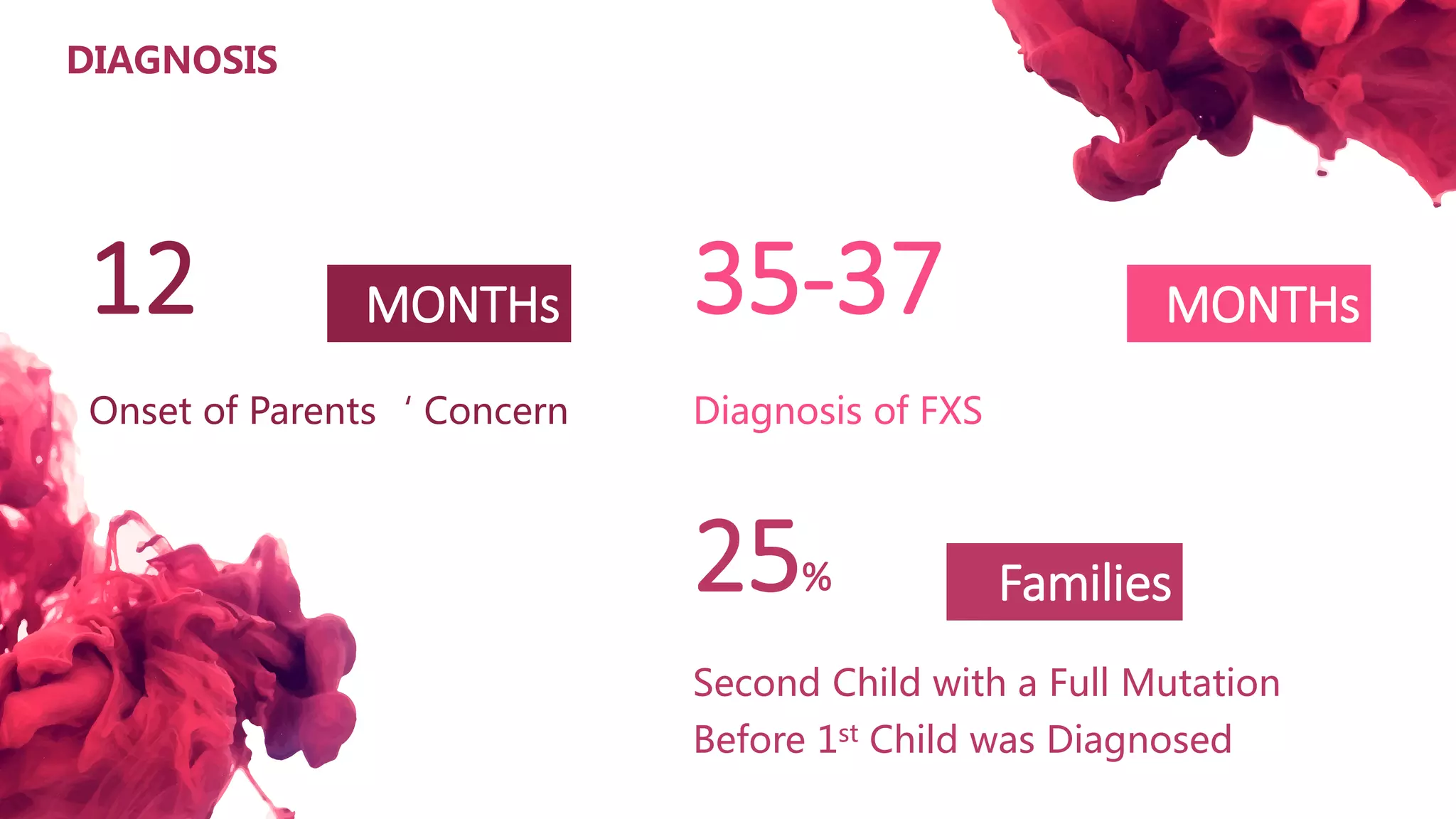
Onset of Parents‘ Concern
12 MONTHs
Second Child with a Full Mutation
Before 1st Child was Diagnosed
25% Families
Diagnosis of FXS
35-37 MONTHs
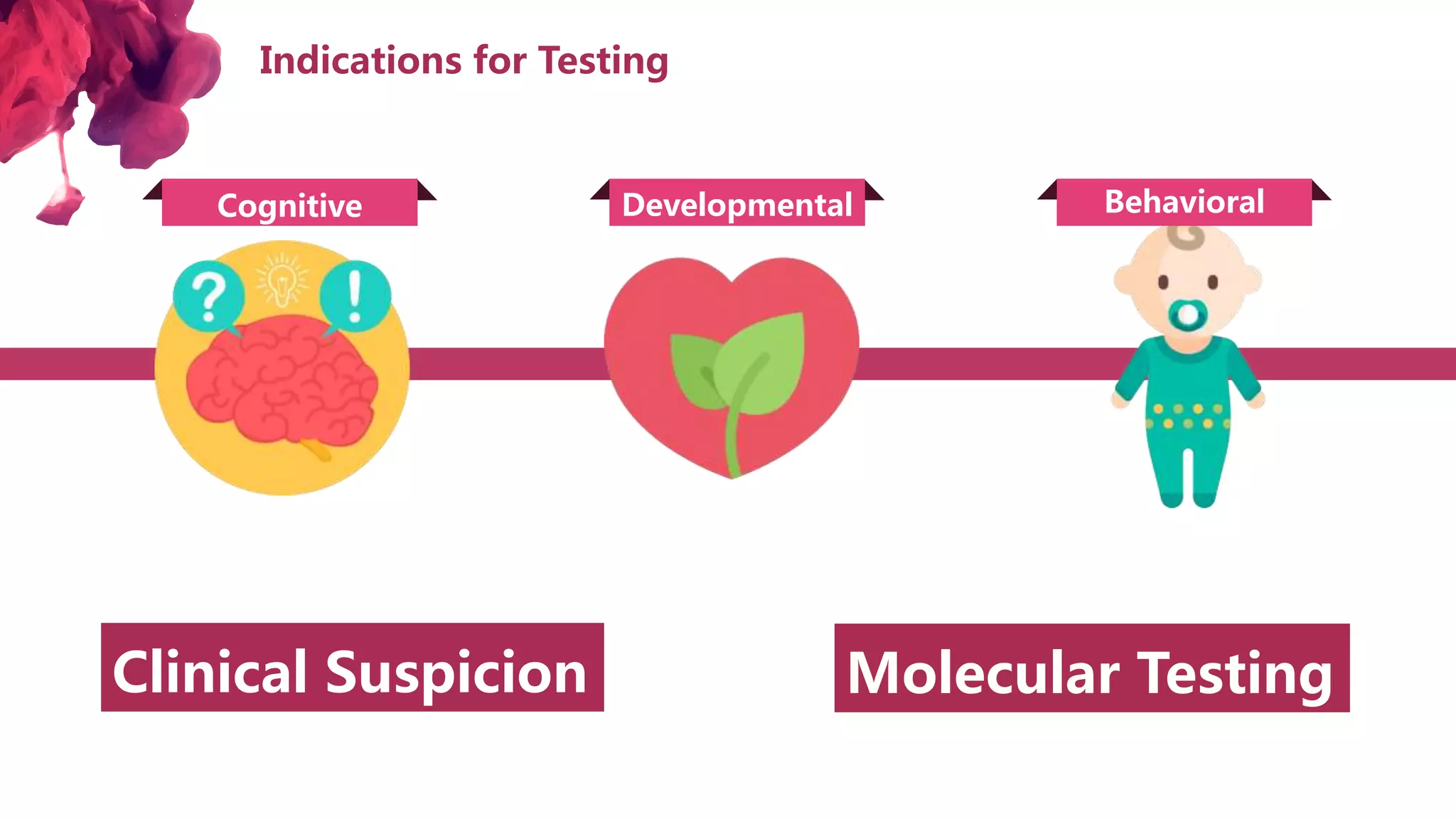
Indications for Testing
Cognitive Developmental Behavioral
Clinical Suspicion Molecular Testing
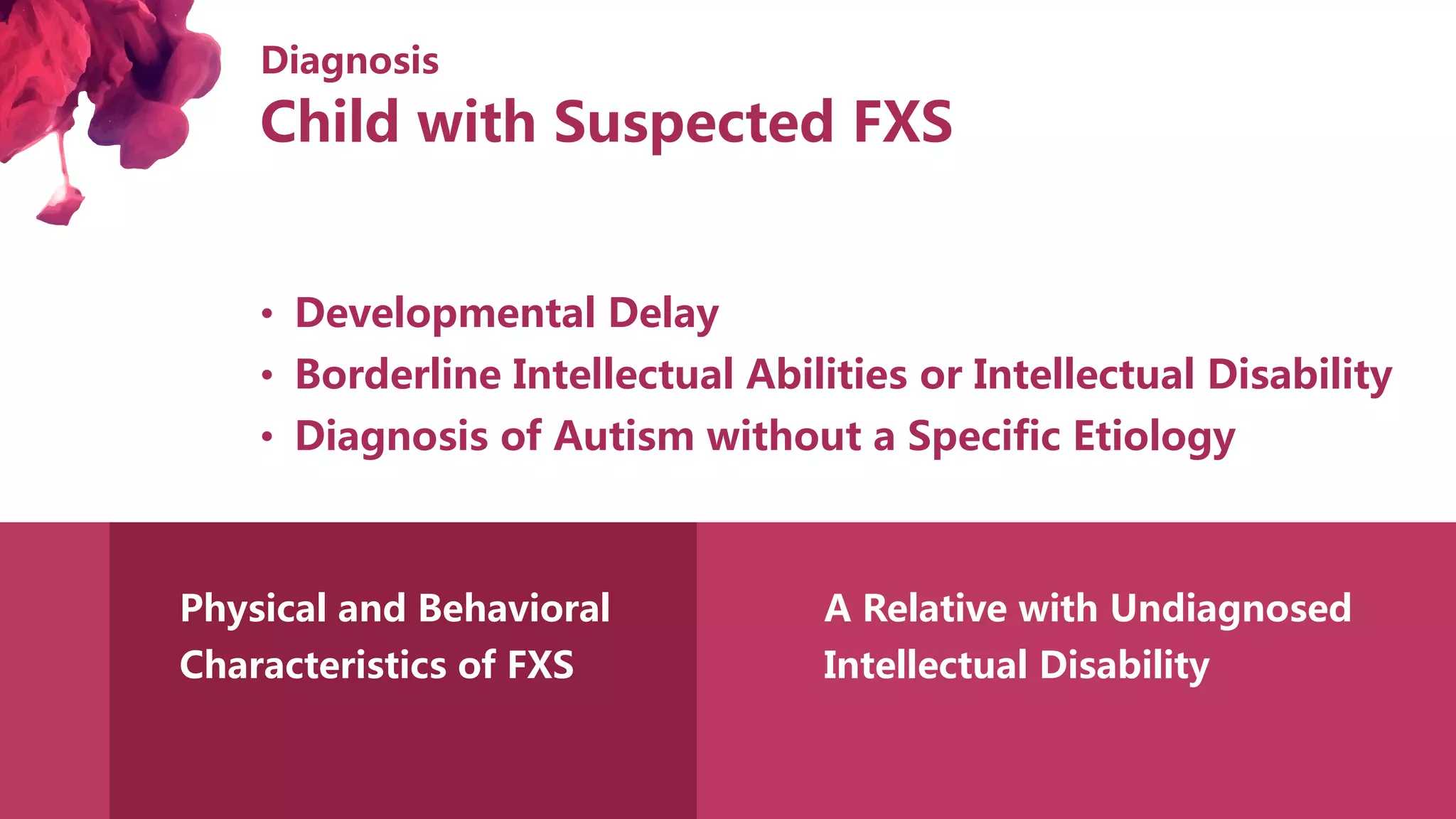
Diagnosis
• Developmental Delay
• Borderline Intellectual Abilities or Intellectual Disability
• Diagnosis of Autism without a Specific Etiology
Physical and Behavioral
Characteristics of FXS
A Relative with Undiagnosed
Intellectual Disability
Child with Suspected FXS
Diagnosis
• Females with Primary Ovarian Insufficiency (POI)
• Patients over 50 y/o with Progressive Cerebellar Ataxia
and Intention Tremor
• Adults with Typical Features and Intellectual Disability
without a Specific Etiology
Genetic Testing should be Offered
Adult with Suspected FXS
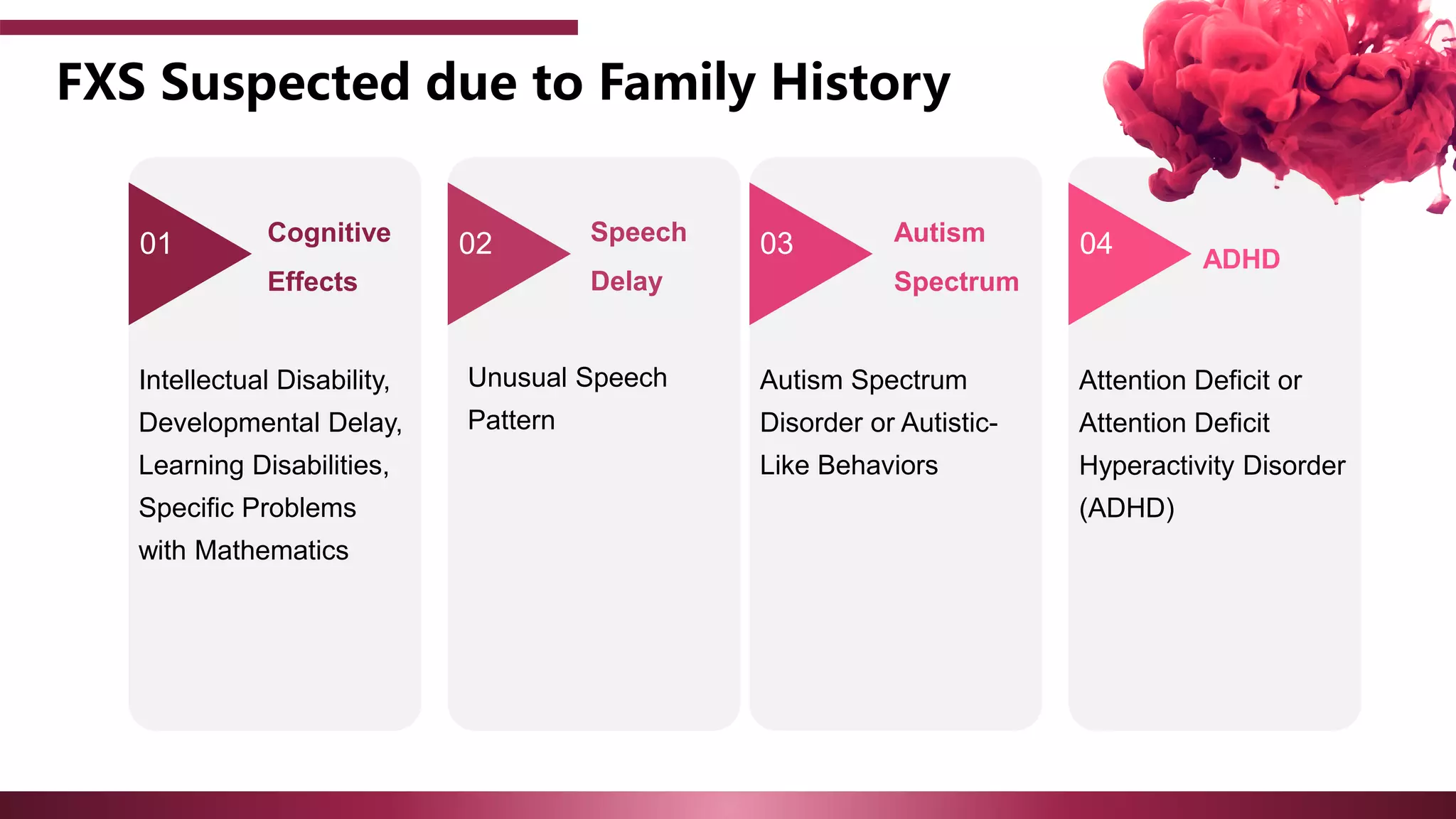
FXS Suspected due to Family History
01 02 03 04
Intellectual Disability,
Developmental Delay,
Learning Disabilities,
Specific Problems
with Mathematics
Cognitive
Effects
Speech
Delay
Autism
Spectrum
ADHD
Unusual Speech
Pattern
Autism Spectrum
Disorder or Autistic-
Like Behaviors
Attention Deficit or
Attention Deficit
Hyperactivity Disorder
(ADHD)
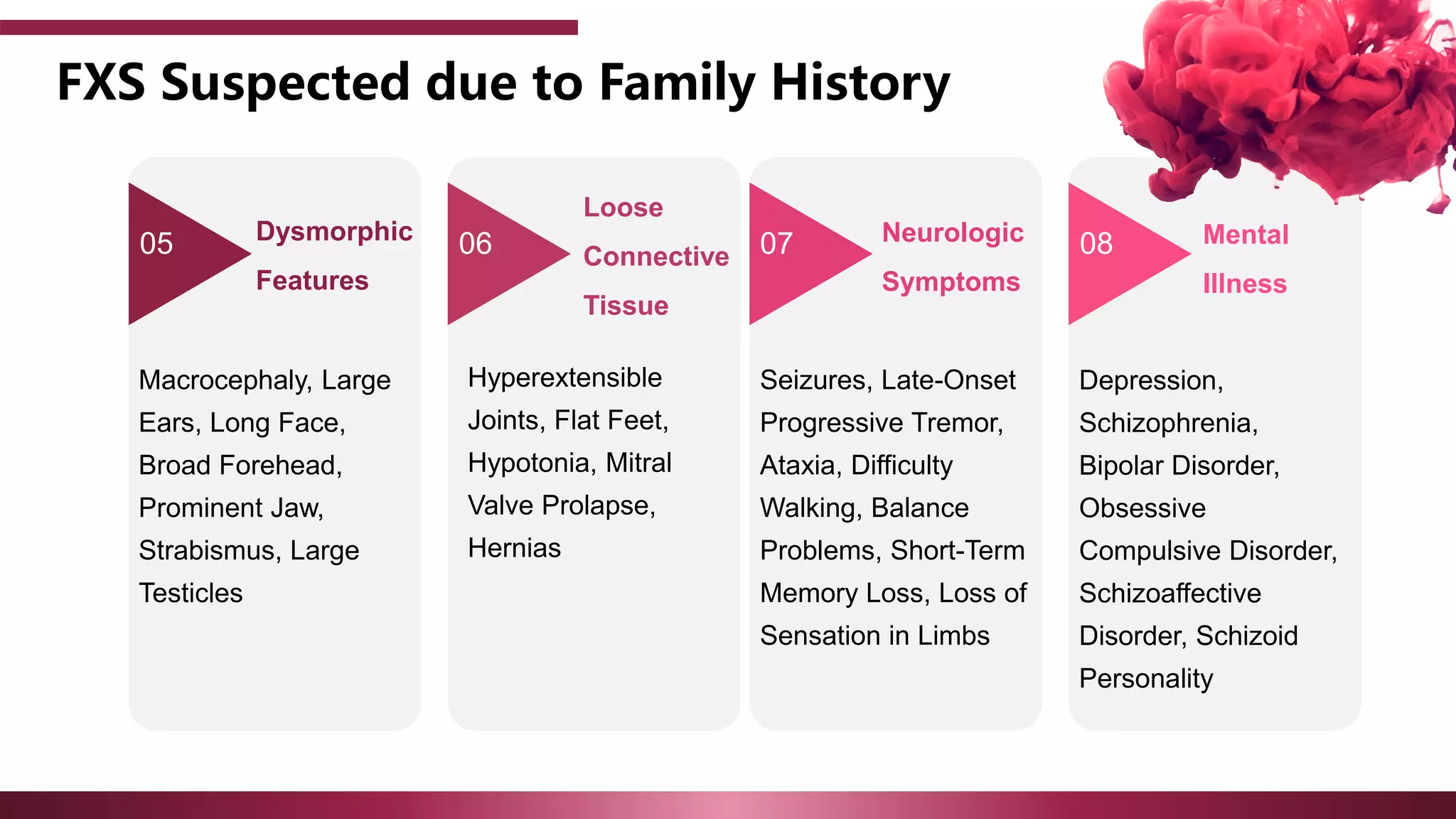
FXS Suspected due to Family History
05 06 07 08
Macrocephaly, Large
Ears, Long Face,
Broad Forehead,
Prominent Jaw,
Strabismus, Large
Testicles
Dysmorphic
Features
Loose
Connective
Tissue
Neurologic
Symptoms
Mental
Illness
Hyperextensible
Joints, Flat Feet,
Hypotonia, Mitral
Valve Prolapse,
Hernias
Seizures, Late-Onset
Progressive Tremor,
Ataxia, Difficulty
Walking, Balance
Problems, Short-Term
Memory Loss, Loss of
Sensation in Limbs
Depression,
Schizophrenia,
Bipolar Disorder,
Obsessive
Compulsive Disorder,
Schizoaffective
Disorder, Schizoid
Personality
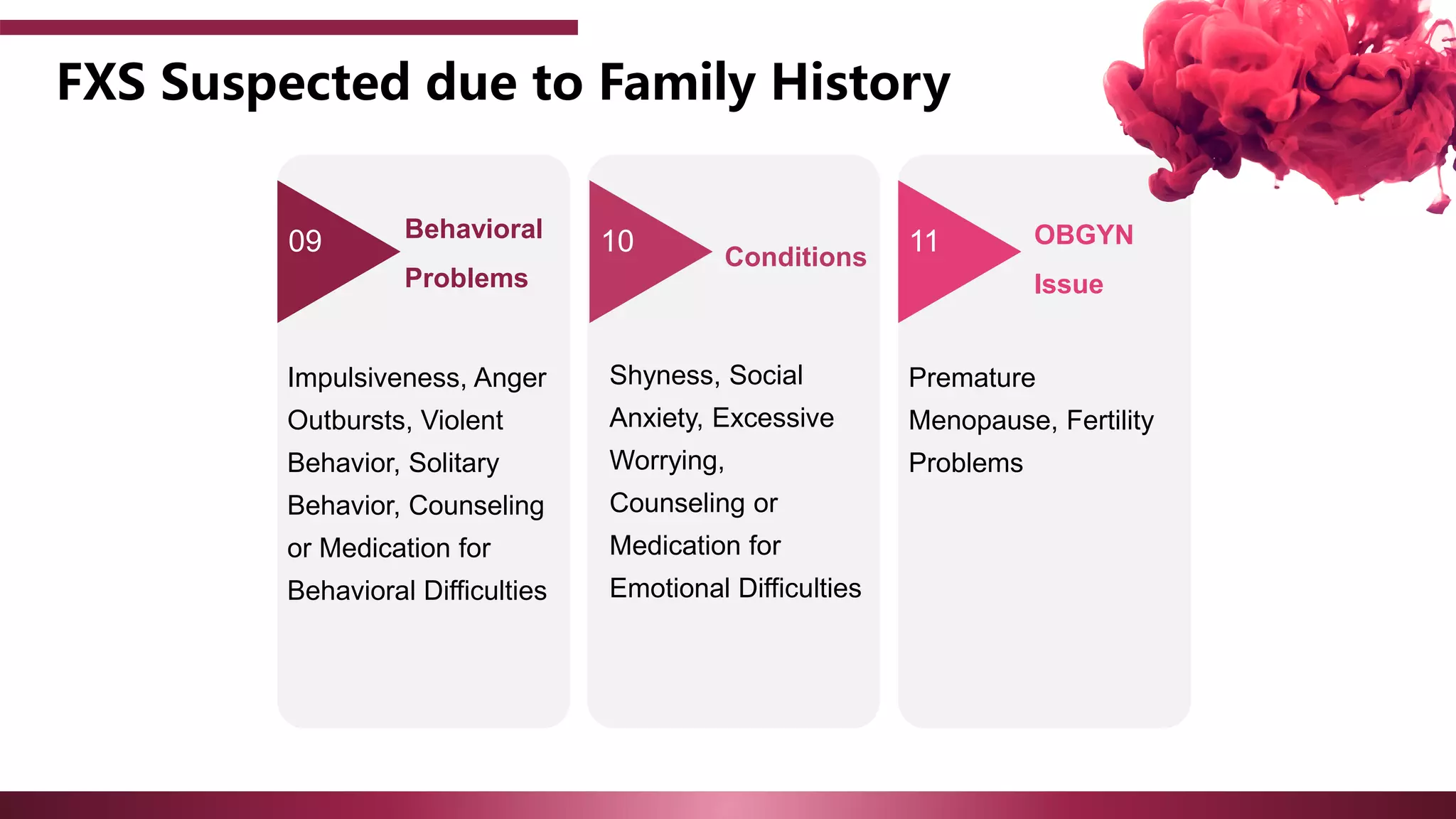
FXS Suspected due to Family History
09 11
Impulsiveness, Anger
Outbursts, Violent
Behavior, Solitary
Behavior, Counseling
or Medication for
Behavioral Difficulties
Behavioral
Problems
OBGYN
Issue
10 Conditions
Shyness, Social
Anxiety, Excessive
Worrying,
Counseling or
Medication for
Emotional Difficulties
Premature
Menopause, Fertility
Problems
Diagnosis
• Several Features are Present ☞ Symptomatic Individual
• Several Features are Present ☞ Strong Family History
• Genetic Counseling / Testing ☞ At-Risk Family Members
of Patients with FXS, even if Asymptomatic
FMR1 DNA Analysis Diagnosis of FXS ☞ Detection of an
Alternation in Fragile X Mental
Retardation 1 (FMR1) Gene!
Molecular Testing is Warranted!
Diagnosis
• Standard Karyotype
• DNA Testing
FMR1 DNA Analysis Detect FMR1 Gene
Exact # of CGG Triplet Repeats
Molecular Testing is Warranted!
Diagnosis
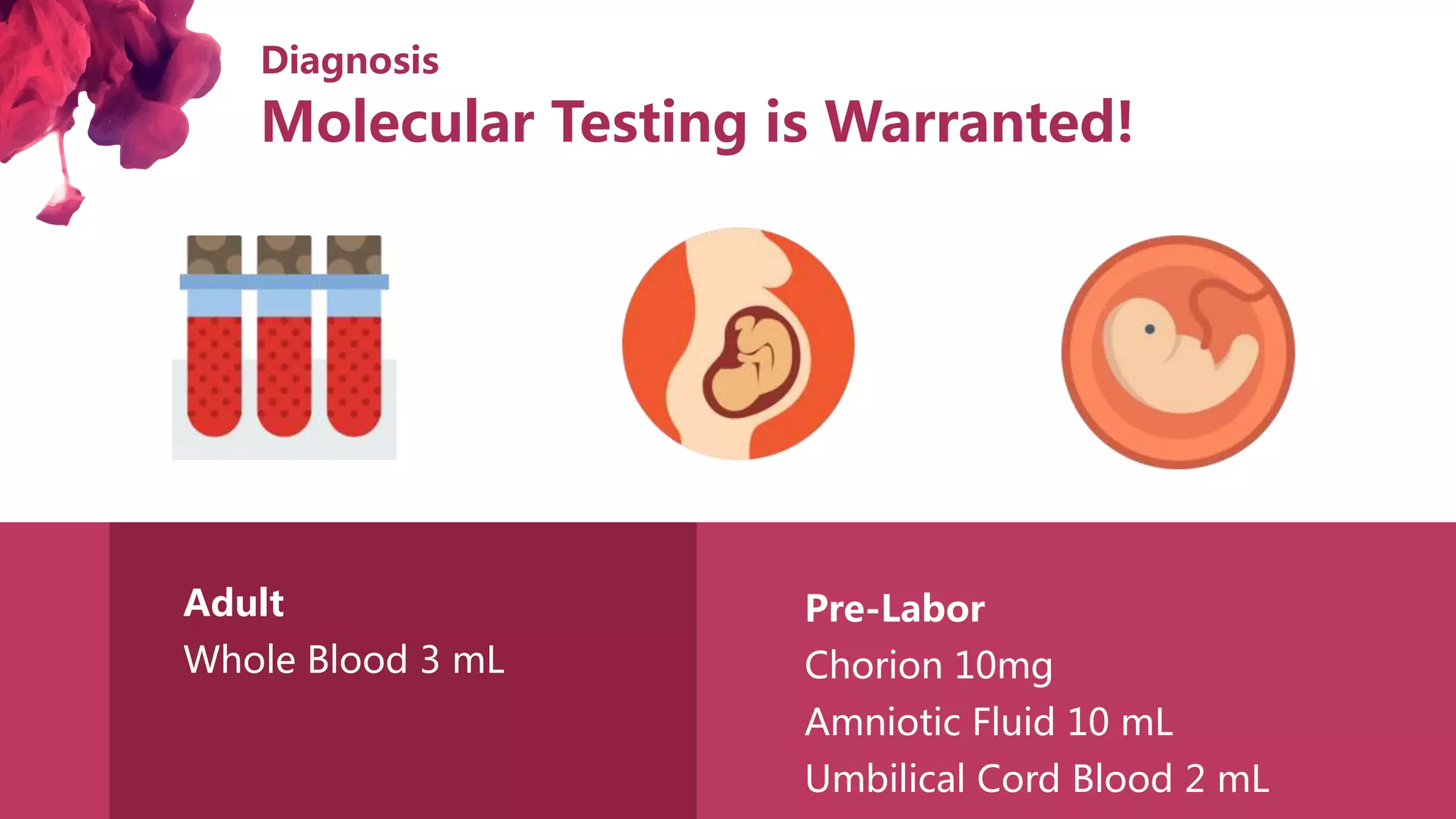
Adult
Whole Blood 3 mL
Pre-Labor
Chorion 10mg
Amniotic Fluid 10 mL
Umbilical Cord Blood 2 mL
Molecular Testing is Warranted!
TWO DIFFERENTIAL
DIAGNOSIS
Differential Diagnosis
Autism
Spectrum
Disorder
Attention
Deficit
Hyperactivity
Disorder
标题数字等都可以通过点击和
重新输入进行更改,顶部“开
始”面板中可以对字体、字号、
颜色、行距等进行修改。
击此处添加标题
Differential Diagnosis
Fragile
XE
Syndrome
Klinefelter
Syndrome
(XXY)
Cerebral
Gigantism
(Sotos
Syndrome)
Prader-Willi
Syndrome
SUMMARY
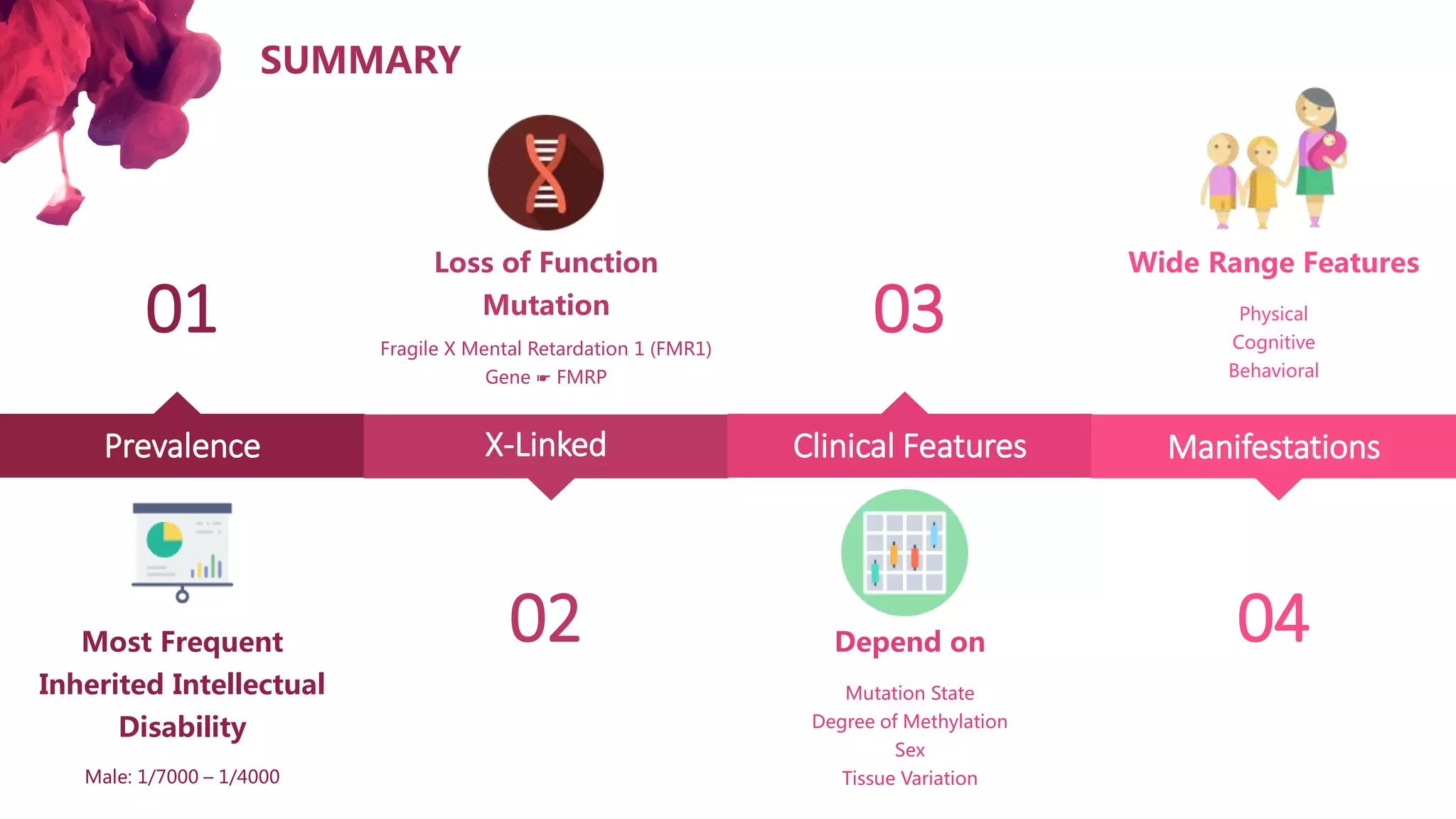
SUMMARY
Prevalence
01
Male: 1/7000 – 1/4000
Most Frequent
Inherited Intellectual
Disability
X-Linked
02
Fragile X Mental Retardation 1 (FMR1)
Gene ☛ FMRP
Loss of Function
Mutation
Clinical Features
03
Mutation State
Degree of Methylation
Sex
Tissue Variation
Depend on
Manifestations
04
Physical
Cognitive
Behavioral
Wide Range Features
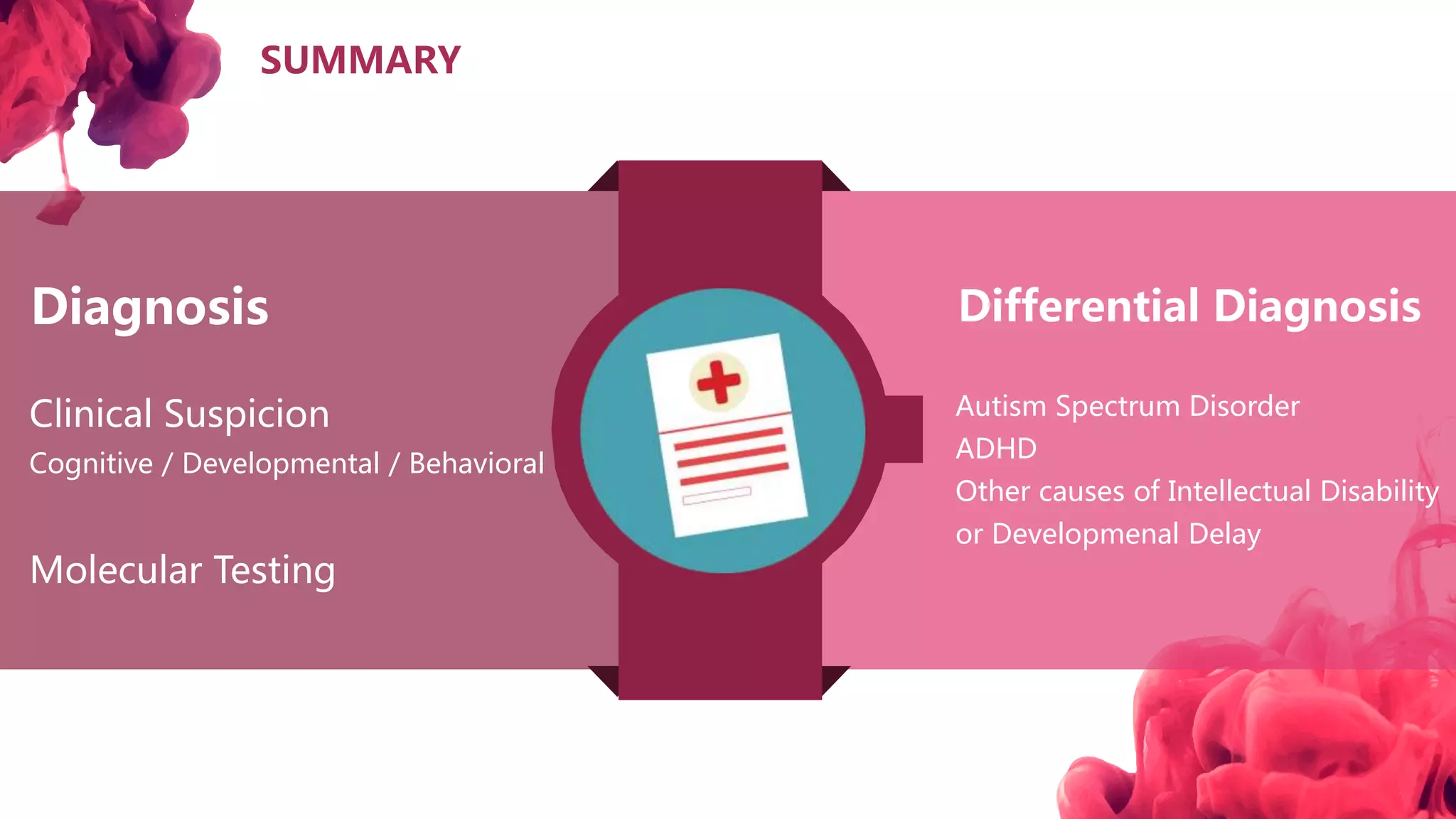
SUMMARY
Clinical Suspicion
Cognitive / Developmental / Behavioral
Molecular Testing
Diagnosis
Autism Spectrum Disorder
ADHD
Other causes of Intellectual Disability
or Developmenal Delay
Differential Diagnosis
THANK YOU!
陳佳菁CLERK 2017.0714

[20170714][Fragile X Syndrome Diagnosis and DD][陳佳菁]

Editor's Notes

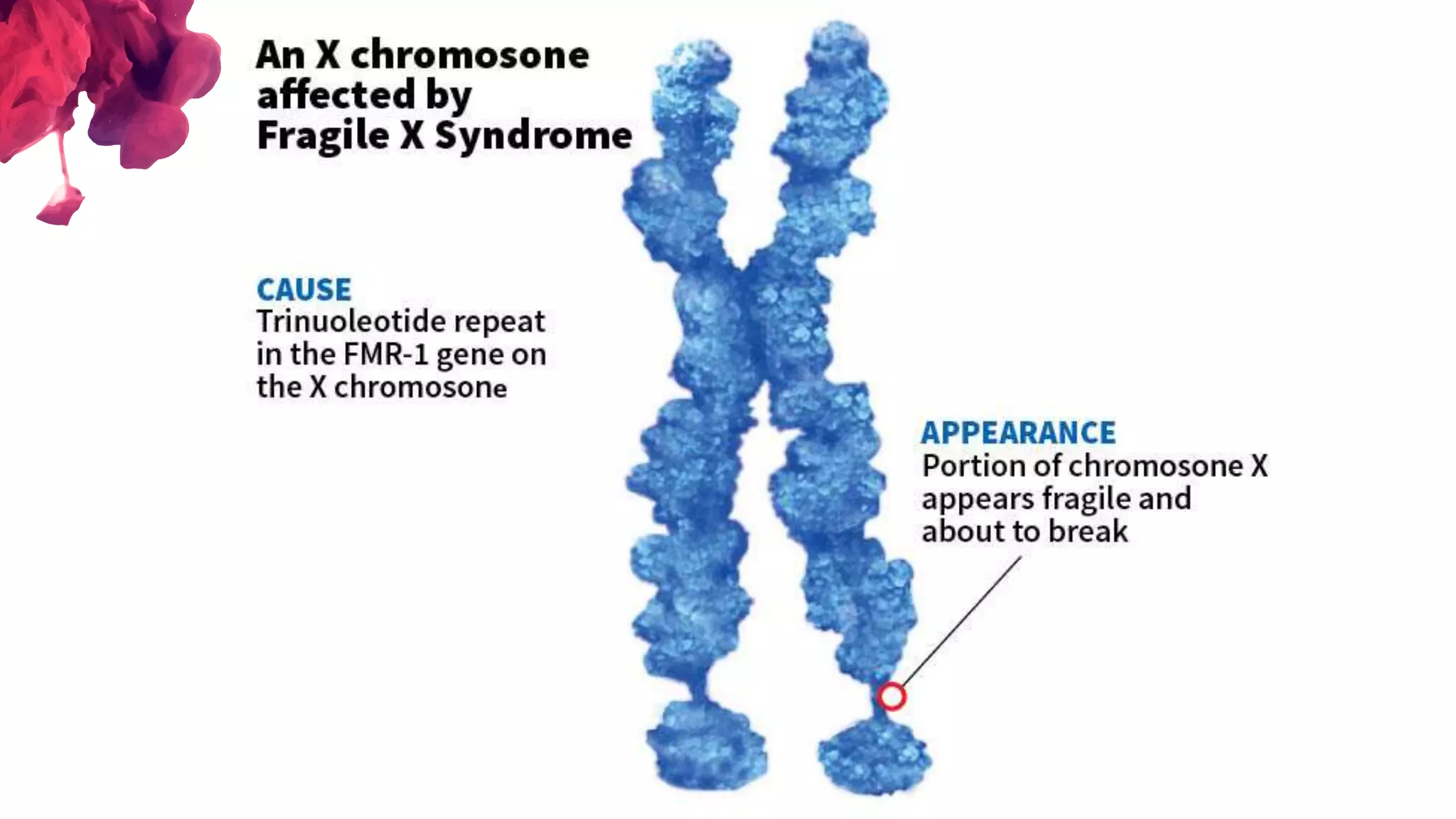
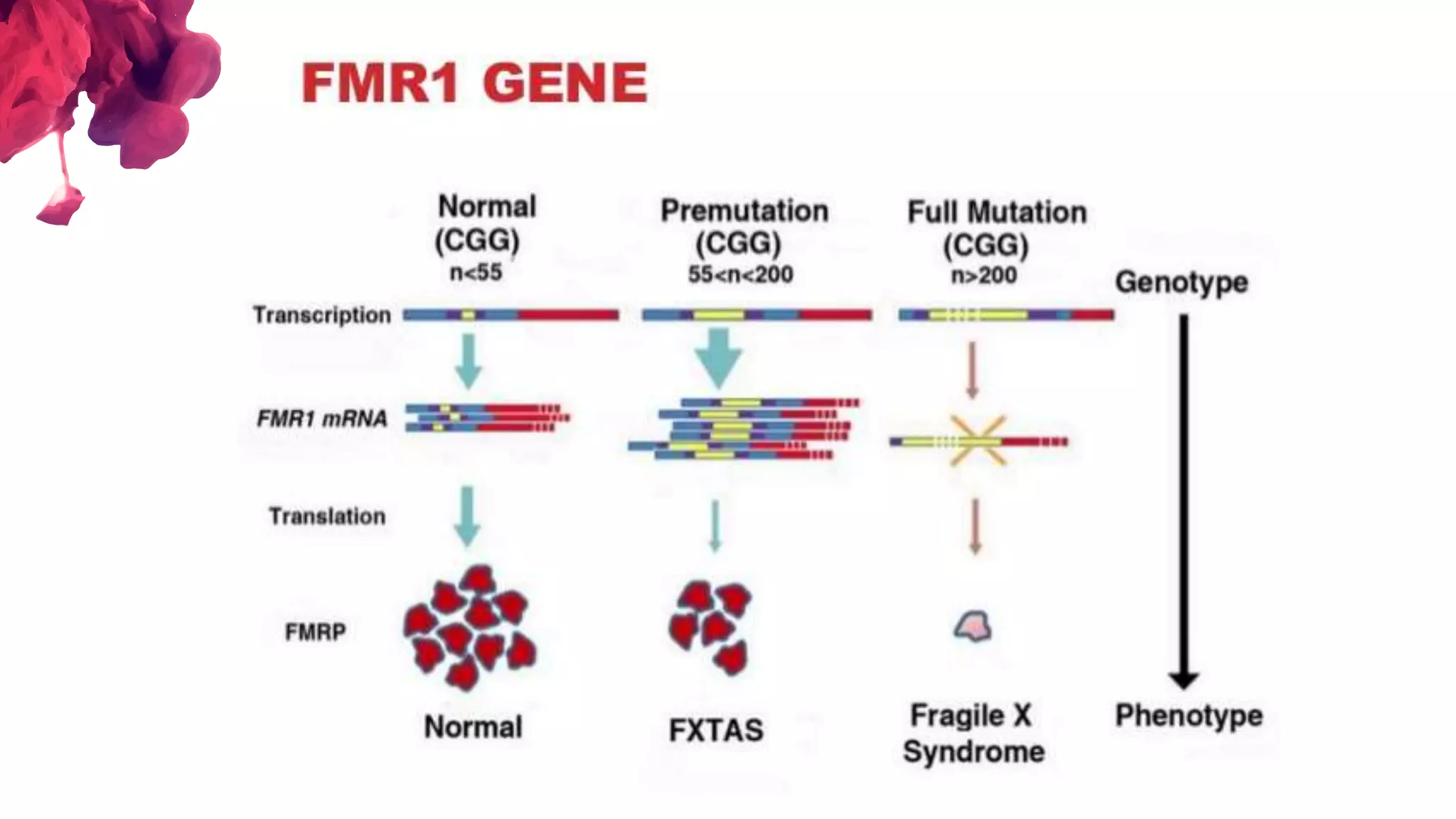
  • #6 患者的血液淋巴球經過特殊培養後,其X染色體的長臂末端在顯微鏡下常呈現較為脆弱、斷裂的情況而得名。
  • #7 X染色體上之「FMR1基因」產生突變的現象,導致FMR1蛋白質的製造量減少。由於FMR1蛋白質是腦部維持正常神經傳導所必需,若缺乏便會導致腦細胞彼此聯結上的異常,而發生X染色體脆折症。 這個基因有一段三核苷酸(CGG)重複性序列的結構,在正常情況下這個重複次數是少於54次,當重複次數擴增至200次以內時,稱為“準突變”,個案本身並無症狀,但卻會遺傳,使得下一代有可能產生“全突變”的情況。而“全突變”為重複次數異常擴增到大於200次,結果這個基因就無法製造FMR1蛋白質而發病。 它可經由無症狀的帶因者傳遞數個世代而不發病;但其一旦進行到“全突變”時,就會在智力、行為及身體上有不同程度的變化,從輕微的學習問題到最嚴重的智障都有可能發生。 不論任何種族及性別都可能罹患此病,但通常男性病患的症狀會比女性嚴重的多。
  • #8 It is important to make the diagnosis of FXS as early as possible so that appropriate interventions (eg, speech and language therapy, special education support, genetic counseling) can be initiated. Surveys of parents of children diagnosed with FXS indicate a significant delay between the onset of their concerns (average age approximately 12 months) and the diagnosis of FXS (average age 35 to 37 months). Approximately one-fourth of families had a second child with a full mutation before the first child was diagnosed 發生率在台灣較歐美低,約為1/10,000。
  • #9 認知上的特性      智能遲緩或不足是這類病人最重要的特徵,但他們之間有相當大的範圍差異,大約80%的X染色體脆折症男孩與30%的女孩有這種情況。即便是有一些智力表現正常的患者,他們大多數仍是有不同程度的認知發展不足,但女性患者的表現通常會優於男性患者。所有的患者對於非視覺所發展的學習技能,像是計畫、專注、持續的努力、思考問題解決之策略、運用回饋機制及自我反省的能力上,都有較為薄弱的情況。 生理上的特徵      X染色體脆折症患者的身體健康狀況大致良好,沒有特殊的病痛,壽命亦與一般人無異。通常患者的外觀上看起來跟常人沒有太大的差異,但在仔細觀察下可以發現有下列幾個特點,臉型及下巴較長,額頭較高、大而(或)突出的耳朵(招風耳)及青春期後睪丸較常人大。而他們較鬆散的結締組織也常導致關節鬆動、扁平足及視力上的問題。另外,也常見有心雜音(二尖瓣脫垂)的情況。要注意的是,不是所有男性患者都有以上全部的特性;而女性患者也許會出現跟成年男性患者一樣的身體特徵,但她們通常外觀上的特徵並不明顯。另外,約有百分之二十的患者會有癲癇的發生。而百分之二十的女性準突變帶因者,會有早期停經的現象,但不會有智能、認知的問題。 行為上的特性  患者間的行為特徵差異頗大,從渴望與他人互動到對人厭惡、反感、焦慮,或對人友善到極度害羞都可能發生。他們也對外在的感官刺激較為敏感,例如擁擠、噪音或觸感等,因此,他們對碰觸可能會表現出反感。而過動與任性是這類男孩普遍的行為特徵,80%患者因此曾被認為是過動兒,並有注意力不集中的現象。但是20%的患者也曾被診斷為自閉症,原因是易害羞與膽怯、逃避與他人眼神接觸、頭部晃動、拍手、咬手、易被移動的物體吸引等。大部分男孩的語言發展比較遲緩,說話速度快但不平順,也常會重複的說一個字或一個句子。
  • #11 POI: 早期停經 常見的遺傳性智障,心智發育遲緩 ,若為潛在帶因者的女性,則可能有早期停經(POI)的問題 男性潛在帶因者,則可能於50歲後會有震顫及運動失調(FXTAS)的問題。
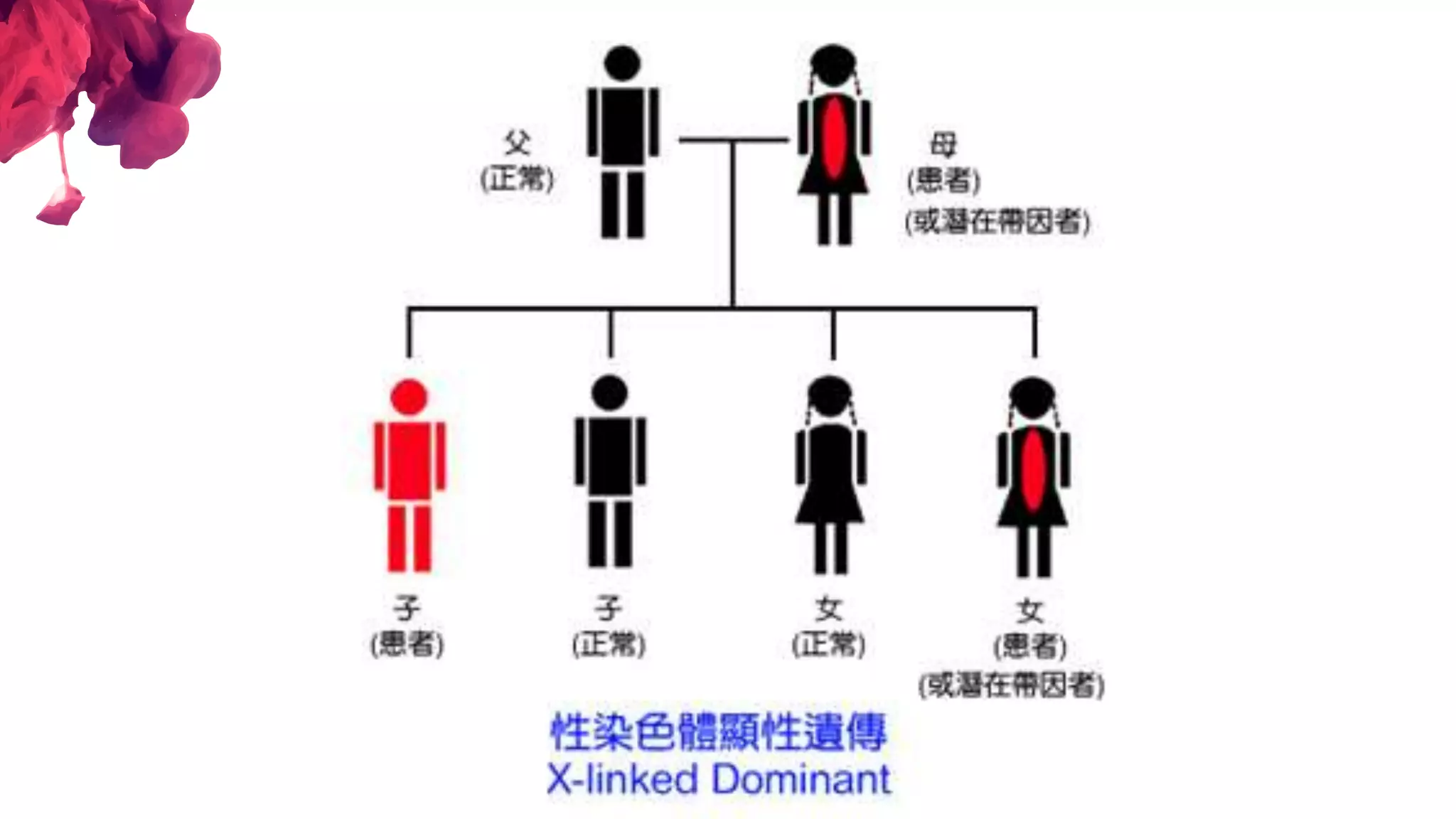
  • #15 性聯顯性遺傳,只要帶到異常擴增之基因,就會有症狀,女性症狀通常較男性輕微。 若為潛在突變的帶因者,則有可能會具有前述的臨床表徵。
  • #16 X染色體脆折現在是以血液的DNA來做診斷。當有下列兩種情況發生時,醫生都會建議作這個檢驗: 有原因不明的智能障礙,發展遲緩或有自閉傾向時,尤其是有家族史者。 家族裏有X染色體脆折症患者。
  • #17 分析 FMR1基因的 CGG 重複次數。以PCR分析對偶基因之片段長度。 本分子遺傳檢驗報告之準確率為98%,結果僅供醫師臨床參考
  • #18 檢體需求 成人: 全血 3 ml   產前:絨毛(10mg以上)、羊水(10ml)或臍帶血(2ml) 報告時程 1周
  • #20 Autism spectrum disorder. Although children with FXS often have autistic behaviors and may have comorbid autism, absence of other clinical features of FXS suggests the isolated diagnosis of autism. Attention deficit hyperactivity disorder (ADHD). FXS is unlikely in the child with ADHD and normal intelligence. Other causes of intellectual disability or developmental delay, including
  • #21 Fragile XE syndrome (FRAXE). FRAXE, which is extremely rare, is characterized by mild intellectual disability without consistent physical features. It has been described in boys with expanded cytosine-cytosine-guanine (CCG) repeats in fragile X mental retardation 2 (FMR2) gene, near the fragile X mental retardation 1 (FMR1) gene. XXY (Klinefelter syndrome). Boys with Klinefelter syndrome may have specific learning disabilities, particularly in expressive language. In contrast to postpubertal boys with FXS, boys with XXY usually have small testes. Cerebral gigantism (also known as Sotos syndrome). Characteristic features of cerebral gigantism include typical facial appearance (macrocephaly, frontal bossing, prominent chin, pointed chin, downslanting palpebral fissures), overgrowth, learning disability, behavioral problems, and congenital cardiac anomalies. Prader-Willi syndrome (PWS). Some boys with FXS have a phenotype similar to that of PWS, but they do not have the genetic abnormalities associated with PWS.
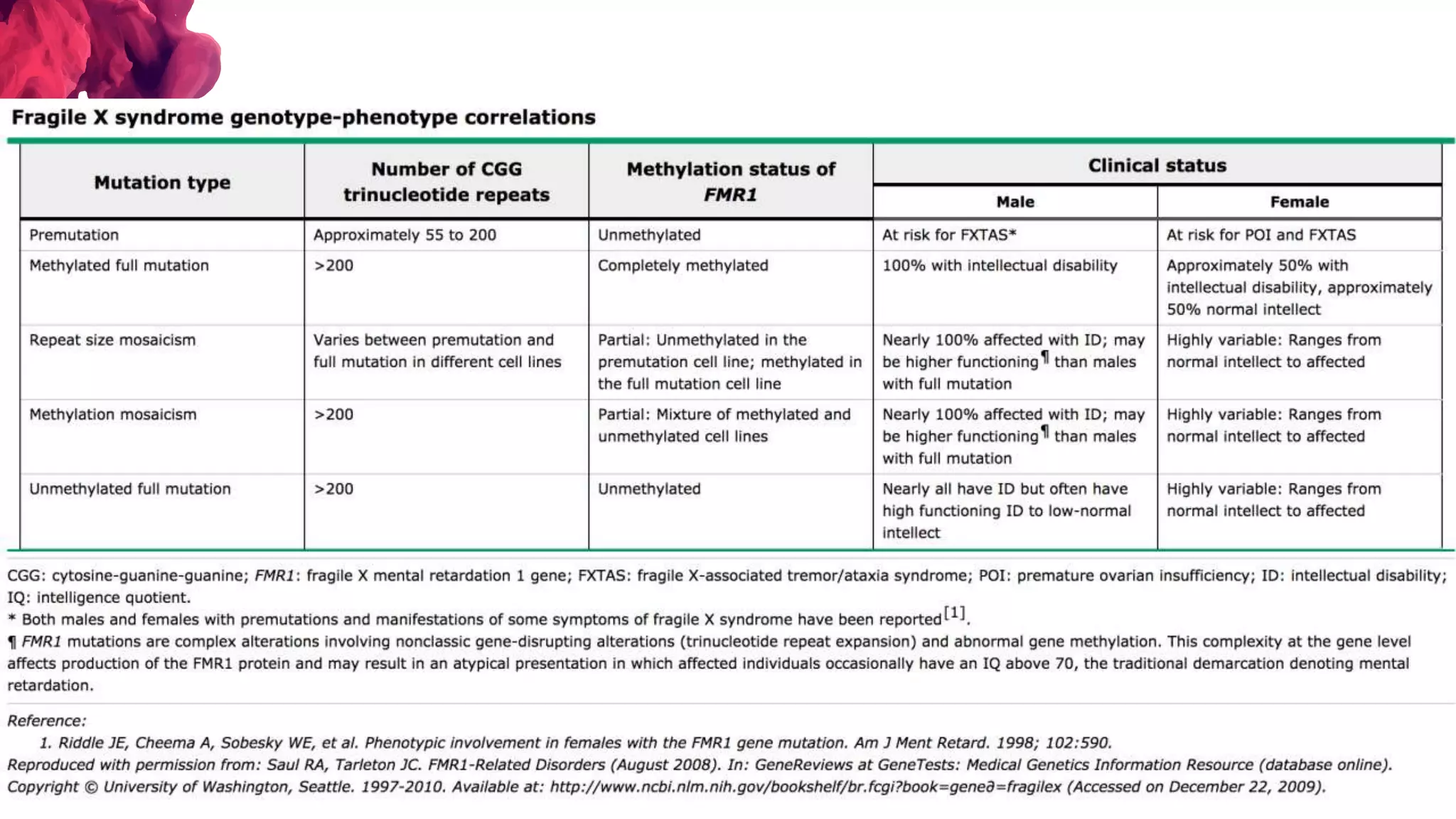
  • #23 ● Fragile X syndrome (FXS) is the most frequent form of inherited intellectual disability, with a prevalence between 1 in 4000 and 1 in 7000 in males. The prevalence in females is approximately two-thirds to one-half of that in males.完全突變型(full mutation): 男性 1/4,000,女性 1/8,000 潛在突變的女性帶因者(premutation carrier): 1.3% 台灣地區男性完全突變型: 1/10,000, 男性潛在突變型: 1/1,674 ● FXS is an X-linked disorder. It is caused by a loss of function mutation in the fragile X mental retardation 1 (FMR1) gene that leads to decreased or absent fragile X mental retardation protein (FMRP). ● The clinical features of FXS vary depending upon the mutation state (full mutation versus premutation), degree of methylation, sex, and tissue variation (table 1).  ●All males with full mutation FXS have manifestations of FXS, but there are a wide range of physical, cognitive, and behavioral features. •Classic physical features include long and narrow face with prominent forehead and chin, large ears, and testicular enlargement, but these features typically are not obvious until adolescence or adulthood (picture 1). Physical features in younger males may include macrocephaly, strabismus, midface hypoplasia, arched palate, mitral valve prolapse, hyperextensible joints, hypotonia, soft skin, and flexible flat feet. •Intellectual disability is usually in the moderate range. Expressive language is more affected than receptive language. •Behavioral features may include hyperactivity, inattention, gaze aversion, stereotypic movements (eg, hand flapping, hand biting), hyperarousal, social anxiety, and unusual speech. ●Girls with the full mutation usually have milder features than boys, and 50 percent have normal cognitive function. However, the full spectrum of cognitive, behavioral, and physical findings may occur. (See 'Full mutation in girls'above.)
  • #24 ●In the absence of a family history of FXS, diagnosis of FXS requires a low threshold for clinical suspicion based upon cognitive, developmental, or behavioral concerns, as described above. Diagnosis is confirmed by molecular testing.  ●The differential diagnosis of FXS includes autism spectrum disorder, attention deficit hyperactivity disorder (ADHD), and other causes of intellectual disability or developmental delay.