1.Impact of early childhood
adverse experiences on later
health and development
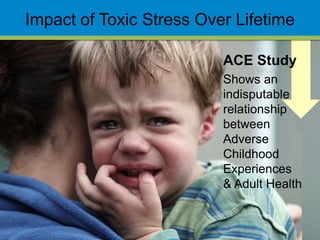
Impact of Toxic Stress Over Lifetime
ACE Study
Shows an
indisputable
relationship
between
Adverse
Childhood
Experiences
& Adult Health
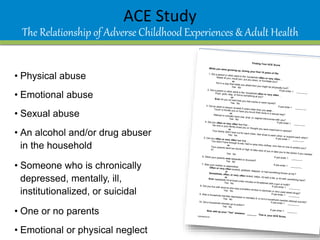
ACE Study
• Physical abuse
• Emotional abuse
• Sexual abuse
• An alcohol and/or drug abuser
in the household
• Someone who is chronically
depressed, mentally, ill,
institutionalized, or suicidal
• One or no parents
• Emotional or physical neglect
Finding Your ACE Score
092406RA4CR
While you were growing up, during your first 18 years of life:1. Did a parent or other adult in the household often or very often…
Swear at you, insult you, put you down, or humiliate you?or
Act in a way that made you afraid that you might be physically hurt?
Yes No
If yes enter 1 ________
2. Did a parent or other adult in the household often or very often…
Push, grab, slap, or throw something at you?or
Ever hit you so hard that you had marks or were injured?Yes No
If yes enter 1 ________
3. Did an adult or person at least 5 years older than you ever…
Touch or fondle you or have you touch their body in a sexual way?
or
Attempt or actually have oral, anal, or vaginal intercourse with you?
Yes No
If yes enter 1 ________
4. Did you often or very often feel that …No one in your family loved you or thought you were important or special?
or
Your family didn’t look out for each other, feel close to each other, or support each other?
Yes No
If yes enter 1 ________
5. Did you often or very often feel that …You didn’t have enough to eat, had to wear dirty clothes, and had no one to protect you?
or
Your parents were too drunk or high to take care of you or take you to the doctor if you needed
it?
Yes No
If yes enter 1 ________
6. Were your parents ever separated or divorced?Yes No
If yes enter 1 ________
7. Was your mother or stepmother:Often or very often pushed, grabbed, slapped, or had something thrown at her?
or
Sometimes, often, or very often kicked, bitten, hit with a fist, or hit with something hard?
or
Ever repeatedly hit at least a few minutes or threatened with a gun or knife?
Yes No
If yes enter 1 ________
8. Did you live with anyone who was a problem drinker or alcoholic or who used street drugs?
Yes No
If yes enter 1 ________
9. Was a household member depressed or mentally ill, or di d a household member attempt suicide?
Yes No
If yes enter 1 ________
10. Did a household member go to prison?
Yes No
If yes enter 1 _______Now add up your “Yes” answers: _______ This is your ACE Score.
ACEs Questionnaire
The Relationship of Adverse Childhood Experiences & Adult Health
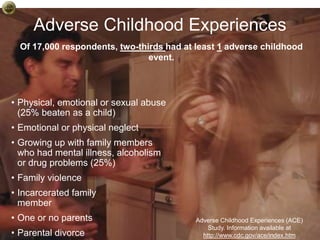
Adverse Childhood Experiences
• Physical, emotional or sexual abuse
(25% beaten as a child)
• Emotional or physical neglect
• Growing up with family members
who had mental illness, alcoholism
or drug problems (25%)
• Family violence
• Incarcerated family
member
• One or no parents
• Parental divorce
Adverse Childhood Experiences (ACE)
Study. Information available at
http://www.cdc.gov/ace/index.htm
Of 17,000 respondents, two-thirds had at least 1 adverse childhood
event.
Source: V. Felitti, 2005
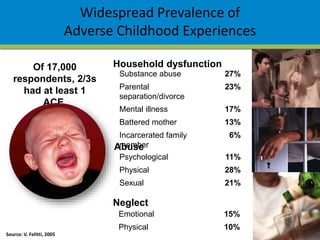
Widespread Prevalence of
Adverse Childhood Experiences
Substance abuse 27%
Parental
separation/divorce
23%
Mental illness 17%
Battered mother 13%
Incarcerated family
member
6%
Household dysfunction
Psychological 11%
Physical 28%
Sexual 21%
Emotional 15%
Physical 10%
Abuse
Neglect
Of 17,000
respondents, 2/3s
had at least 1
ACE.
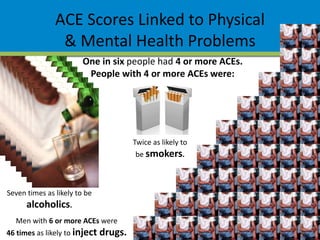
ACE Scores Linked to Physical
& Mental Health Problems
One in six people had 4 or more ACEs.
People with 4 or more ACEs were:
Twice as likely to
be smokers.
Seven times as likely to be
alcoholics.
Men with 6 or more ACEs were
46 times as likely to inject drugs.
ACE Scores Linked to Physical & Mental
Health Problems
People with 4+ ACEs were likely to:
• Be sexually active before age 15: 6x
• Have cancer or heart disease: 2x
• Attempt suicide: 12x
People with 7+ ACEs had:
• A 360% higher risk
for heart disease,
even if they did not smoke,
drink, or carry extra weight
Adverse Childhood Experiences (ACE) Study. Information available at http://www.cdc.gov/ace/index.htm
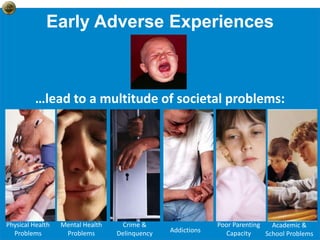
Early Adverse Experiences
Physical Health
Problems
Mental Health
Problems
Crime &
Delinquency Addictions
Poor Parenting
Capacity
Academic &
School Problems
…lead to a multitude of societal problems:
1. Heart disease
2. Cancer
3. Chronic lower respiratory
diseases
4. Stroke
5. Unintentional injuries
6. Alzheimer's disease
7. Diabetes
8. Kidney disease
9. Influenza and pneumonia
10. Suicide
ACE Study, Felitti et al. 1998
ACEs Predict the 10 Leading Causes
of Adult Death/Disability
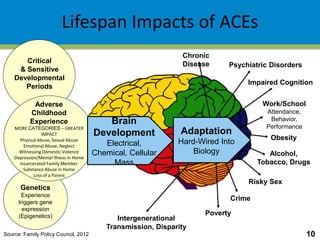
Chronic
Disease
Alcohol,
Tobacco, Drugs
Psychiatric Disorders
Risky Sex
Impaired Cognition
Work/School
Attendance,
Behavior,
Performance
Genetics
Experience
triggers gene
expression
(Epigenetics)
Critical
& Sensitive
Developmental
Periods
Adverse
Childhood
Experience
MORE CATEGORIES – GREATER
IMPACT
Physical Abuse, Sexual Abuse
Emotional Abuse, Neglect
Witnessing Domestic Violence
Depression/Mental Illness in Home
Incarcerated Family Member
Substance Abuse in Home
Loss of a Parent
Brain
Development
Electrical,
Chemical, Cellular
Mass
Crime
Obesity
Poverty
Intergenerational
Transmission, Disparity
Source: Family Policy Council, 2012 10
Lifespan Impacts of ACEs
Adaptation
Hard-Wired Into
Biology
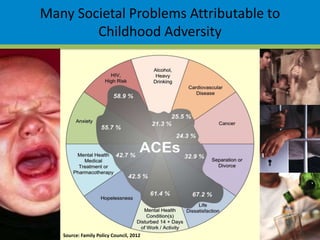
Source: Family Policy Council, 2012
Many Societal Problems Attributable to
Childhood Adversity
Adverse Childhood Events (ACE)
Source: Video Clips from Felitti, Vincent J. MD.
The Relationship of Adverse Childhood Experiences to Adult Health Status.
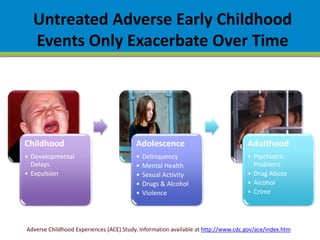
Untreated Adverse Early Childhood
Events Only Exacerbate Over Time
Childhood
• Developmental
Delays
• Expulsion
Adolescence
• Delinquency
• Mental Health
• Sexual Activity
• Drugs & Alcohol
• Violence
Adulthood
• Psychiatric
Problems
• Drug Abuse
• Alcohol
• Crime
Adverse Childhood Experiences (ACE) Study. Information available at http://www.cdc.gov/ace/index.htm
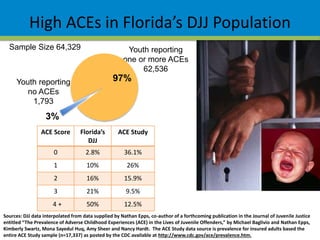
High ACEs in Florida’s DJJ Population
Sample Size 64,329
Youth reporting
no ACEs
1,793
Youth reporting
one or more ACEs
62,536
3%
97%
ACE Score Florida’s
DJJ
ACE Study
0 2.8% 36.1%
1 10% 26%
2 16% 15.9%
3 21% 9.5%
4 + 50% 12.5%
Sources: DJJ data interpolated from data supplied by Nathan Epps, co-author of a forthcoming publication in the Journal of Juvenile Justice
entitled “The Prevalence of Adverse Childhood Experiences (ACE) in the Lives of Juvenile Offenders,” by Michael Baglivio and Nathan Epps,
Kimberly Swartz, Mona Sayedul Huq, Amy Sheer and Nancy Hardt. The ACE Study data source is prevalence for insured adults based the
entire ACE Study sample (n=17,337) as posted by the CDC available at http://www.cdc.gov/ace/prevalence.htm.
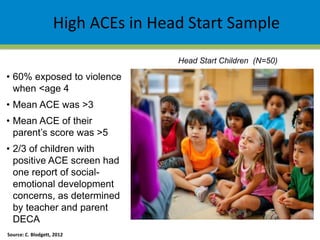
High ACEs in Head Start Sample
Source: C. Blodgett, 2012
• 60% exposed to violence
when <age 4
• Mean ACE was >3
• Mean ACE of their
parent’s score was >5
• 2/3 of children with
positive ACE screen had
one report of social-
emotional development
concerns, as determined
by teacher and parent
DECA
Head Start Children (N=50)
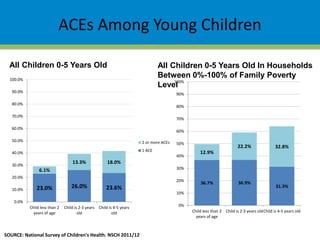
36.7% 36.9%
31.3%
12.9%
22.2% 32.8%
0%
10%
20%
30%
40%
50%
60%
70%
80%
90%
100%
Child less than 2
years of age
Child is 2-3 years oldChild is 4-5 years old
SOURCE: National Survey of Children's Health. NSCH 2011/12
All Children 0-5 Years Old In Households
Between 0%-100% of Family Poverty
Level
All Children 0-5 Years Old
23.0% 26.0% 23.6%
6.1%
13.3% 18.0%
0.0%
10.0%
20.0%
30.0%
40.0%
50.0%
60.0%
70.0%
80.0%
90.0%
100.0%
Child less than 2
years of age
Child is 2-3 years
old
Child is 4-5 years
old
2 or more ACEs
1 ACE
ACEs Among Young Children
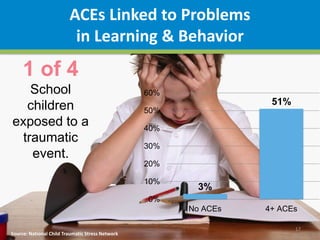
ACEs Linked to Problems
in Learning & Behavior
17
3%
51%
0%
10%
20%
30%
40%
50%
60%
No ACEs 4+ ACEs
Source: National Child Traumatic Stress Network
1 of 4
School
children
exposed to a
traumatic
event.
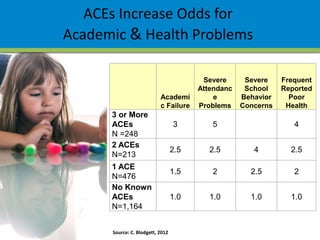
Academi
c Failure
Severe
Attendanc
e
Problems
Severe
School
Behavior
Concerns
Frequent
Reported
Poor
Health
3 or More
ACEs
N =248
3 5 4
2 ACEs
N=213
2.5 2.5 4 2.5
1 ACE
N=476
1.5 2 2.5 2
No Known
ACEs
N=1,164
1.0 1.0 1.0 1.0
Source: C. Blodgett, 2012
ACEs Increase Odds for
Academic & Health Problems
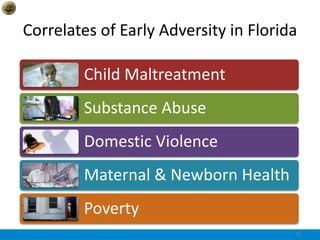
Correlates of Early Adversity in Florida
Child Maltreatment
Substance Abuse
Domestic Violence
Maternal & Newborn Health
Poverty
19

Impact of aces

  • 1.
    1.Impact of earlychildhood adverse experiences on later health and development
  • 2.
    Impact of ToxicStress Over Lifetime ACE Study Shows an indisputable relationship between Adverse Childhood Experiences & Adult Health
  • 3.
    ACE Study • Physicalabuse • Emotional abuse • Sexual abuse • An alcohol and/or drug abuser in the household • Someone who is chronically depressed, mentally, ill, institutionalized, or suicidal • One or no parents • Emotional or physical neglect Finding Your ACE Score 092406RA4CR While you were growing up, during your first 18 years of life:1. Did a parent or other adult in the household often or very often… Swear at you, insult you, put you down, or humiliate you?or Act in a way that made you afraid that you might be physically hurt? Yes No If yes enter 1 ________ 2. Did a parent or other adult in the household often or very often… Push, grab, slap, or throw something at you?or Ever hit you so hard that you had marks or were injured?Yes No If yes enter 1 ________ 3. Did an adult or person at least 5 years older than you ever… Touch or fondle you or have you touch their body in a sexual way? or Attempt or actually have oral, anal, or vaginal intercourse with you? Yes No If yes enter 1 ________ 4. Did you often or very often feel that …No one in your family loved you or thought you were important or special? or Your family didn’t look out for each other, feel close to each other, or support each other? Yes No If yes enter 1 ________ 5. Did you often or very often feel that …You didn’t have enough to eat, had to wear dirty clothes, and had no one to protect you? or Your parents were too drunk or high to take care of you or take you to the doctor if you needed it? Yes No If yes enter 1 ________ 6. Were your parents ever separated or divorced?Yes No If yes enter 1 ________ 7. Was your mother or stepmother:Often or very often pushed, grabbed, slapped, or had something thrown at her? or Sometimes, often, or very often kicked, bitten, hit with a fist, or hit with something hard? or Ever repeatedly hit at least a few minutes or threatened with a gun or knife? Yes No If yes enter 1 ________ 8. Did you live with anyone who was a problem drinker or alcoholic or who used street drugs? Yes No If yes enter 1 ________ 9. Was a household member depressed or mentally ill, or di d a household member attempt suicide? Yes No If yes enter 1 ________ 10. Did a household member go to prison? Yes No If yes enter 1 _______Now add up your “Yes” answers: _______ This is your ACE Score. ACEs Questionnaire The Relationship of Adverse Childhood Experiences & Adult Health
  • 4.
    Adverse Childhood Experiences •Physical, emotional or sexual abuse (25% beaten as a child) • Emotional or physical neglect • Growing up with family members who had mental illness, alcoholism or drug problems (25%) • Family violence • Incarcerated family member • One or no parents • Parental divorce Adverse Childhood Experiences (ACE) Study. Information available at http://www.cdc.gov/ace/index.htm Of 17,000 respondents, two-thirds had at least 1 adverse childhood event.
  • 5.
    Source: V. Felitti,2005 Widespread Prevalence of Adverse Childhood Experiences Substance abuse 27% Parental separation/divorce 23% Mental illness 17% Battered mother 13% Incarcerated family member 6% Household dysfunction Psychological 11% Physical 28% Sexual 21% Emotional 15% Physical 10% Abuse Neglect Of 17,000 respondents, 2/3s had at least 1 ACE.
  • 6.
    ACE Scores Linkedto Physical & Mental Health Problems One in six people had 4 or more ACEs. People with 4 or more ACEs were: Twice as likely to be smokers. Seven times as likely to be alcoholics. Men with 6 or more ACEs were 46 times as likely to inject drugs.
  • 7.
    ACE Scores Linkedto Physical & Mental Health Problems People with 4+ ACEs were likely to: • Be sexually active before age 15: 6x • Have cancer or heart disease: 2x • Attempt suicide: 12x People with 7+ ACEs had: • A 360% higher risk for heart disease, even if they did not smoke, drink, or carry extra weight Adverse Childhood Experiences (ACE) Study. Information available at http://www.cdc.gov/ace/index.htm
  • 8.
    Early Adverse Experiences PhysicalHealth Problems Mental Health Problems Crime & Delinquency Addictions Poor Parenting Capacity Academic & School Problems …lead to a multitude of societal problems:
  • 9.
    1. Heart disease 2.Cancer 3. Chronic lower respiratory diseases 4. Stroke 5. Unintentional injuries 6. Alzheimer's disease 7. Diabetes 8. Kidney disease 9. Influenza and pneumonia 10. Suicide ACE Study, Felitti et al. 1998 ACEs Predict the 10 Leading Causes of Adult Death/Disability
  • 10.
    Chronic Disease Alcohol, Tobacco, Drugs Psychiatric Disorders RiskySex Impaired Cognition Work/School Attendance, Behavior, Performance Genetics Experience triggers gene expression (Epigenetics) Critical & Sensitive Developmental Periods Adverse Childhood Experience MORE CATEGORIES – GREATER IMPACT Physical Abuse, Sexual Abuse Emotional Abuse, Neglect Witnessing Domestic Violence Depression/Mental Illness in Home Incarcerated Family Member Substance Abuse in Home Loss of a Parent Brain Development Electrical, Chemical, Cellular Mass Crime Obesity Poverty Intergenerational Transmission, Disparity Source: Family Policy Council, 2012 10 Lifespan Impacts of ACEs Adaptation Hard-Wired Into Biology
  • 11.
    Source: Family PolicyCouncil, 2012 Many Societal Problems Attributable to Childhood Adversity
  • 12.
    Adverse Childhood Events(ACE) Source: Video Clips from Felitti, Vincent J. MD. The Relationship of Adverse Childhood Experiences to Adult Health Status.
  • 13.
    Untreated Adverse EarlyChildhood Events Only Exacerbate Over Time Childhood • Developmental Delays • Expulsion Adolescence • Delinquency • Mental Health • Sexual Activity • Drugs & Alcohol • Violence Adulthood • Psychiatric Problems • Drug Abuse • Alcohol • Crime Adverse Childhood Experiences (ACE) Study. Information available at http://www.cdc.gov/ace/index.htm
  • 14.
    High ACEs inFlorida’s DJJ Population Sample Size 64,329 Youth reporting no ACEs 1,793 Youth reporting one or more ACEs 62,536 3% 97% ACE Score Florida’s DJJ ACE Study 0 2.8% 36.1% 1 10% 26% 2 16% 15.9% 3 21% 9.5% 4 + 50% 12.5% Sources: DJJ data interpolated from data supplied by Nathan Epps, co-author of a forthcoming publication in the Journal of Juvenile Justice entitled “The Prevalence of Adverse Childhood Experiences (ACE) in the Lives of Juvenile Offenders,” by Michael Baglivio and Nathan Epps, Kimberly Swartz, Mona Sayedul Huq, Amy Sheer and Nancy Hardt. The ACE Study data source is prevalence for insured adults based the entire ACE Study sample (n=17,337) as posted by the CDC available at http://www.cdc.gov/ace/prevalence.htm.
  • 15.
    High ACEs inHead Start Sample Source: C. Blodgett, 2012 • 60% exposed to violence when <age 4 • Mean ACE was >3 • Mean ACE of their parent’s score was >5 • 2/3 of children with positive ACE screen had one report of social- emotional development concerns, as determined by teacher and parent DECA Head Start Children (N=50)
  • 16.
    36.7% 36.9% 31.3% 12.9% 22.2% 32.8% 0% 10% 20% 30% 40% 50% 60% 70% 80% 90% 100% Childless than 2 years of age Child is 2-3 years oldChild is 4-5 years old SOURCE: National Survey of Children's Health. NSCH 2011/12 All Children 0-5 Years Old In Households Between 0%-100% of Family Poverty Level All Children 0-5 Years Old 23.0% 26.0% 23.6% 6.1% 13.3% 18.0% 0.0% 10.0% 20.0% 30.0% 40.0% 50.0% 60.0% 70.0% 80.0% 90.0% 100.0% Child less than 2 years of age Child is 2-3 years old Child is 4-5 years old 2 or more ACEs 1 ACE ACEs Among Young Children
  • 17.
    ACEs Linked toProblems in Learning & Behavior 17 3% 51% 0% 10% 20% 30% 40% 50% 60% No ACEs 4+ ACEs Source: National Child Traumatic Stress Network 1 of 4 School children exposed to a traumatic event.
  • 18.
    Academi c Failure Severe Attendanc e Problems Severe School Behavior Concerns Frequent Reported Poor Health 3 orMore ACEs N =248 3 5 4 2 ACEs N=213 2.5 2.5 4 2.5 1 ACE N=476 1.5 2 2.5 2 No Known ACEs N=1,164 1.0 1.0 1.0 1.0 Source: C. Blodgett, 2012 ACEs Increase Odds for Academic & Health Problems
  • 19.
    Correlates of EarlyAdversity in Florida Child Maltreatment Substance Abuse Domestic Violence Maternal & Newborn Health Poverty 19