We are still trying to understand how a movie creates an absorbing experience for the viewer. 
Chapter 2 showed that the concept of form offers a way to grasp the film as a whole. Chapter 3 
examined how narrative form can shape a film and our response to it. Later we’ll see that film-makers 
have employed other types of form in documentaries and experimental films. 
When we see a film, though, we don’t engage only with its overall form. We experience 
a film—not a painting or a novel. A painter knows how to manipulate color, shape, and com-position. 
A novelist lives intimately with language. Likewise, filmmakers work with a distinct 
medium. 
You’re already somewhat aware of 
the creative choices available in the film 
medium. As a viewer you probably notice 
performance and color design. If you’ve 
made videos, you’ve become more aware 
of framing and composition, editing and 
sound. If you’ve tried your hand at mak-ing 
a fictional piece, you’ve already faced 
problems of staging and acting. 
Part Three of this book gives you a 
chance to learn about film techniques in a systematic way. We look at two techniques govern-ing 
the shot, mise-en-scene and cinematography. Then we consider the technique that relates 
shot to shot, editing. Then we consider the role that sound plays in relation to film images. A 
wrapup chapter returns to Citizen Kane and examines how it coordinates all these techniques 
with its narrative form. 
Each chapter introduces a single technique, surveying the choices it offers to the film-maker. 
We survey how various filmmakers have used the techniques. Several key questions 
will guide us: How can a technique shape the viewer’s expectations? How may it furnish motifs 
for the film? How may a technique support the film’s overall form—its story/plot relations or its 
narrational patterning? How may it direct our attention, clarify or emphasize meanings, and 
shape our emotional response? 
The chapters that follow also explore how a film can organize its chosen techniques in 
consistent ways. This pattern of technical choices we call style. Style is what creates a movie’s 
“look and feel.” Late in each chapter, we focus on one or two particular films to show how the 
technique we’re studying helps establish a distinctive style. 
111 
p a r t3 
Film Style
112 
C H a p t E r 
4 
The Shot: Mise-en-Scene 
of all fi lm techniques, mise-en-scene is the one that viewers notice most. 
After seeing a fi lm, we may not recall the cutting or the camera movements, 
the dissolves or the offscreen sound. But we do remember the costumes in 
Gone with the Wind and the bleak, chilly lighting in Charles Foster Kane’s Xanadu. 
We retain vivid impressions of the misty streets in The Big Sleep and the laby-rinthine, 
fl uorescent-lit lair of Buffalo Bill in The Silence of the Lambs. We recall 
Harpo Marx clambering over Edgar Kennedy’s lemonade stand (Duck Soup) and 
Michael J. Fox escaping high-school bullies on an improvised skateboard (Back to 
the Future). Many of our most vivid memories of movies stem from mise-en-scene. 
What Is Mise-en-Scene? 
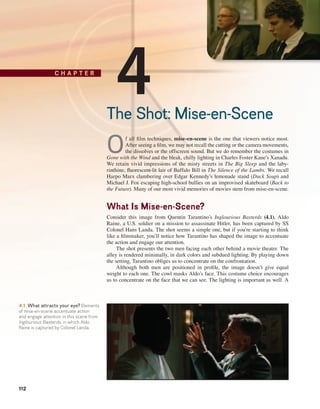
Consider this image from Quentin Tarantino’s Inglourious Basterds (4.1). Aldo 
Raine, a U.S. soldier on a mission to assassinate Hitler, has been captured by SS 
Colonel Hans Landa. The shot seems a simple one, but if you’re starting to think 
like a fi lmmaker, you’ll notice how Tarantino has shaped the image to accentuate 
the action and engage our attention. 
The shot presents the two men facing each other behind a movie theater. The 
alley is rendered minimally, in dark colors and subdued lighting. By playing down 
the setting, Tarantino obliges us to concentrate on the confrontation. 
Although both men are positioned in profi le, the image doesn’t give equal 
weight to each one. The cowl masks Aldo’s face. This costume choice encourages 
us to concentrate on the face that we can see. The lighting is important as well. A 
4.1 What attracts your eye? Elements 
of mise-en-scene accentuate action 
and engage attention in this scene from 
Inglourious Basterds, in which Aldo 
Raine is captured by Colonel Landa.
The Power of Mise-en-Scene 113 
thread of illumination picks out the edge of Raine’s cowl; with-out 
it, it would merge into the background. Again, however, it 
is Landa’s face that gets greater emphasis. Strong lighting from 
above and left sharply outlines his profi le, and a less powerful 
light (what fi lmmakers call fi ll) reveals his features. 
Landa is emphasized in another way, through the actor’s 
dialogue and facial expression. As Landa speaks, he shows de-light 
in the capture of his quarry. His satisfaction bursts out 
when he chortles: “Alas, you’re now in the hands of the SS— 
my hands, to be exact!” Letting the actor’s hands fl y up into 
the center of the frame and emphasizing them by the dialogue, 
Tarantino reminds us of the offi cer’s fl orid self-assurance. This 
hand gesture will be developed when Landa playfully taps 
Raine’s head with a forefi nger: “I’ve been waiting a long time 
to touch you.” 
Although Tarantino has made many creative choices in 
this shot (notably the decision to fi lm in a relatively close fram-ing), 
certain techniques stand out. Setting, costume, lighting, 
and performance have all been coordinated to highlight Lan-da’s 
gloating and remind us that he enjoys his cat-and-mouse 
4.2 Unplanned events and mise-en-scene. While filming 
She Wore a Yellow Ribbon, John Ford took advantage of a 
thunderstorm in Monument Valley. 
interrogation tactics. Tarantino has shaped our experience of this story action by his 
decisions about mise-en-scene. 
In the original French, mise en scène (pronounced meez-ahn-sen) means “put-ting 
into the scene,” and it was fi rst applied to the practice of directing plays. Film 
scholars, extending the term to fi lm direction, use the term to signify the director’s 
control over what appears in the fi lm frame. As you would expect, mise-en-scene 
includes those aspects of fi lm that overlap with the art of the theater: setting, light-ing, 
costume and makeup, and staging and performance. 
As the Inglourious Basterds shot suggests, mise-en-scene usually involves 
planning in advance. But the fi lmmaker may seize on unplanned events as well. An 
actor may add a line on the set, or an unexpected change in lighting may enhance a 
dramatic effect. While fi lming a cavalry procession through Monument Valley for 
She Wore a Yellow Ribbon, John Ford took advantage of an approaching lightning 
storm to create a dramatic backdrop for the action (4.2). The storm remains part 
of the fi lm’s mise-en-scene even though Ford neither planned it nor controlled it; it 
was a lucky accident that helped create one of the fi lm’s most affecting passages. 
Jean Renoir, Robert Altman, and other directors have allowed their actors to impro-vise 
their performances, making the fi lms’ mise-en-scene more spontaneous and 
unpredictable. 
the power of Mise-en-Scene 
Filmmakers can use mise-en-scene to achieve realism, giving settings an authentic 
look or letting actors perform as naturally as possible. Throughout fi lm history, 
however, audiences have also been attracted to fantasy, and mise-en-scene has of-ten 
been used for this purpose. This attraction is evident in the work of cinema’s 
fi rst master of the technique, Georges Méliès. Méliès used highly original mise-en-scene 
to create an imaginary world on fi lm. 
A caricaturist and stage magician, Méliès became fascinated by the Lumière 
brothers’ demonstration of their short fi lms in 1895. (For more on the Lumières, 
see p. 182.) After building a camera based on an English projector, Méliès began 
fi lming unstaged street scenes and moments of passing daily life. One day, the story 
goes, he was fi lming at the Place de l’Opéra, but his camera jammed as a bus was 
passing. By the time he could resume fi lming, the bus had gone and a hearse was 
CoNNECT To THE BLoG 
www.davidbordwell.net/blog 
For more on Méliès and his last 
years, visit our entry “Hugo: 
Scorsese’s birthday present to 
Georges Méliès.”
114 CHAPTER 4 The Shot: Mise-en-Scene 
in front of his lens. When Méliès screened the film, he discovered something unex-pected: 
a moving bus seemed to transform instantly into a hearse. Whether or not 
the anecdote is true, it at least illustrates Méliès’s recognition of the magical powers 
of mise-en-scene. He would devote most of his efforts to cinematic conjuring. 
To do so would require preparation, since Méliès could not count on lucky 
accidents like the bus–hearse transformation. He would have to plan and stage ac-tion 
for the camera. Drawing on his theatrical experience, Méliès built one of the 
first film studios—a small, crammed affair bristling with balconies, trapdoors, and 
sliding backdrops. Such control was necessary to create the fantasy world he en-visioned 
(4.3–4.6). He drew shots beforehand, designed sets and costumes, and 
devised elaborate special effects. As if this were not enough, Méliès starred in his 
own films (4.6). 
Méliès’s “Star-Film” studio made hundreds of short fantasy and trick films based 
on a strict control over every element in the frame, and the first master of mise-en-scene 
demonstrated the resources of the technique. The legacy of Méliès’s magic is a 
delightfully unreal world wholly obedient to the whims of the imagination. 
When Buñuel was preparing The 
Discreet Charm of the Bourgeoisie, 
he chose a tree-lined avenue for 
the recurring shot of his characters 
traipsing endlessly down it. The 
avenue was strangely stranded 
in open country and it perfectly 
suggested the idea of these people 
coming from nowhere and going 
nowhere. Buñuel’s assistant said, 
‘You can’t use that road. It’s been 
used in at least ten other movies.’ 
‘Ten other movies?’ said Buñuel, 
impressed. ‘Then it must be good.’ ” 
4.3 4.4 
4.5 
4.6 
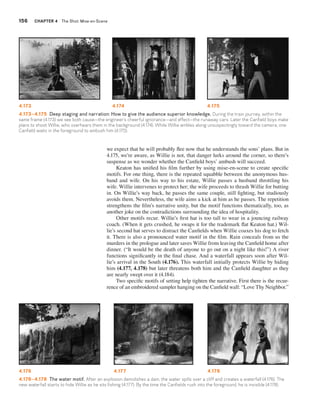
4.3–4.6 Méliès and mise-en-scene. Méliès made detailed plans for his shots, as seen in the drawing and final version of the 
rocket-launching scene in A Trip to the Moon (4.3–4.4). For The Mermaid (4.5) he summoned up an undersea world by placing 
a fish tank between the camera and an actress, some backdrops, and “carts for monsters.” In La Lune à une mètre (4.6) Melies 
plays an astronomer. His study and its furnishings, including telescope, globe, and blackboard, are all painted cut-outs. 
“
Components of Mise-en-Scene 115 
Components of Mise-en-Scene 
Mise-en-scene offers the filmmaker four general areas of 
choice and control: setting, costumes and makeup, lighting, 
and staging (which includes acting and movement in the shot). 
Setting 
Since the earliest days of cinema, critics and audiences have 
understood that setting plays a more active role in cinema than 
it usually does in the theater. André Bazin writes: 
The human being is all-important in the theatre. The drama on 
the screen can exist without actors. A banging door, a leaf in 
the wind, waves beating on the shore can heighten the dramatic 
effect. Some film masterpieces use man only as an accessory, 
like an extra, or in counterpoint to nature, which is the true 
leading character. 
4.7 Setting creates narrative expectations. The railway 
yard at the opening of Wendy and Lucy is a setting that will 
take on significance later in the film. 
In a film, the setting can come to the forefront; it need not be only a container 
for human events but can dynamically enter the narrative action. Kelly Reichardt’s 
Wendy and Lucy begins with shots of a railroad yard as trains pass through (4.7). 
But we don’t see any people. Wendy, who is making her way across the United 
States by car, is later seen walking her dog Lucy in a park. The opening shots of the 
rail yard suggest the sort of neighborhoods where she must stay. At later points in 
the film, the roar and whistle of rail traffic will increase suspense, but not until the 
ending will we come to understand why the opening emphasized the trains. 
The filmmaker may select an existing locale for the action. The very early short 
comedy L’Arroseur arrosé (“The Waterer Watered,” 4.8) was filmed in a garden. At 
the close of World War II, Roberto Rossellini shot Germany Year Zero in the rubble 
of Berlin (4.9). Alternatively, the filmmaker may construct the setting. Méliès un-derstood 
that shooting in a studio increased his control, and many filmmakers fol-lowed 
his lead. In France, Germany, and especially the United States, commercial 
filmmaking became centered on studio facilities in which every aspect of mise-en-scene 
could be manipulated. 
Some directors have emphasized authenticity even in purpose-built settings. 
For example, Erich von Stroheim prided himself on meticulous research into details 
of locale for the sets of Greed (4.10). All the President’s Men (1976) took a similar 
tack, seeking to duplicate the Washington Post office on a sound stage (4.11). Other 
films have been less committed to accuracy. Though D. W. Griffith studied the vari-ous 
historical periods presented in Intolerance, his Babylon constitutes a personal 
image of that city (4.12). Similarly, in Ivan the Terrible, Sergei Eisenstein freely 
stylized the decor of the czar’s palace to harmonize with the lighting, costume, and 
figure movement, so that characters crawl through doorways that resemble mouse-holes 
and stand frozen before allegorical murals (4.13). 
Setting can overwhelm the actors, as in Wim Wender’s Wings of Desire (4.14), 
or it can be reduced to almost nothing, as in Francis Ford Coppola’s Bram Stoker’s 
Dracula (4.15). The overall design of a setting can shape how we understand story 
action. In Louis Feuillade’s silent crime serial The Vampires, a criminal gang has 
killed a courier on his way to a bank. The gang’s confederate, Irma Vep, is also a 
bank employee, and just as she tells her superior that the courier has vanished, an 
imposter, in beard and bowler hat, strolls in behind them (4.16). They turn away 
from us in surprise as he comes forward (4.17). Working in a period when cutting to 
closer shots was rare in a French film, Feuillade draws our attention to the man by 
centering him in the doorway. 
But suppose a filmmaker is using a more crowded locale. How can a compact 
setting yield smooth drama? The heroine of Juzo Itami’s Tampopo is a widow who 
4.8 
4.9 
4.8–4.9 Actual locations used 
as setting. Although Louis Lumière’s 
camera­men 
were famous for documen-tary 
filming, they also made short narra-tives 
such as the 1895 Arroseur arrosé 
(4.8). Roberto Rossellini’s Germany 
Year Zero (4.9) maintained the tradi-tion 
of staging fictional stories in actual 
­locations.
116 CHAPTER 4 The Shot: Mise-en-Scene 
4.10 4.11 
4.10–4.11 Authenticity in constructed settings. Details such as hanging flypaper and posters create a tavern scene in 
Greed (4.10). To replicate an actual newsroom in All the President’s Men (4.11), even wastepaper from the actual office was 
scattered around the set. 
4.12 4.13 
4.12–4.13 Stylized settings. The Babylonian sequences of Intolerance (4.12) combined influences from Assyrian history, 
19th-century biblical illustration, and modern dance. In Ivan the Terrible, Part 2, the décor (4.13) dominates the characters. 
4.14 4.15 
4.14–4.15 The interplay of setting and actors. In Wings of Desire, busy, colorful graffiti draw attention away from the man lying 
on the ground (4.14). In contrast, in Bram Stoker’s Dracula, apart from the candles, the setting of this scene has been obliterated by 
darkness (4.15).
Components of Mise-en-Scene 117 
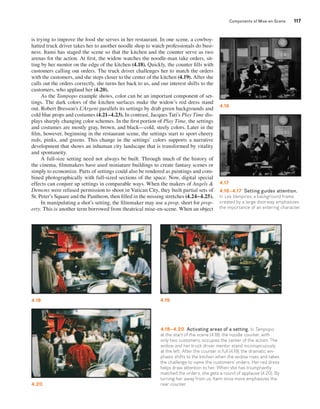
4.16 
4.17 
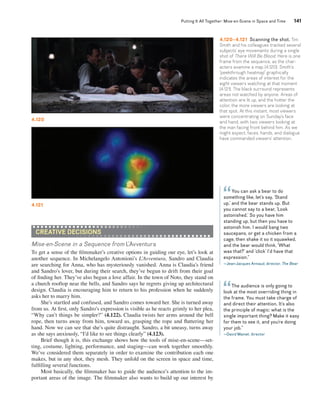
4.16–4.17 Setting guides attention. 
In Les Vampires, a background frame 
created by a large doorway emphasizes 
the importance of an entering character. 
is trying to improve the food she serves in her restaurant. In one scene, a cowboy-hatted 
truck driver takes her to another noodle shop to watch professionals do busi-ness. 
Itami has staged the scene so that the kitchen and the counter serve as two 
arenas for the action. At first, the widow watches the noodle-man take orders, sit-ting 
by her mentor on the edge of the kitchen (4.18). Quickly, the counter fills with 
customers calling out orders. The truck driver challenges her to match the orders 
with the customers, and she steps closer to the center of the kitchen (4.19). After she 
calls out the orders correctly, she turns her back to us, and our interest shifts to the 
customers, who applaud her (4.20). 
As the Tampopo example shows, color can be an important component of set-tings. 
The dark colors of the kitchen surfaces make the widow’s red dress stand 
out. Robert Bresson’s L’Argent parallels its settings by drab green backgrounds and 
cold blue props and costumes (4.21–4.23). In contrast, Jacques Tati’s Play Time dis-plays 
sharply changing color schemes. In the first portion of Play Time, the settings 
and costumes are mostly gray, brown, and black—cold, steely colors. Later in the 
film, however, beginning in the restaurant scene, the settings start to sport cheery 
reds, pinks, and greens. This change in the settings’ colors supports a narrative 
development that shows an inhuman city landscape that is transformed by vitality 
and spontaneity. 
A full-size setting need not always be built. Through much of the history of 
the cinema, filmmakers have used miniature buildings to create fantasy scenes or 
simply to economize. Parts of settings could also be rendered as paintings and com-bined 
photographically with full-sized sections of the space. Now, digital special 
effects can conjure up settings in comparable ways. When the makers of Angels & 
Demons were refused permission to shoot in Vatican City, they built partial sets of 
St. Peter’s Square and the Pantheon, then filled in the missing stretches (4.24–4.25). 
In manipulating a shot’s setting, the filmmaker may use a prop, short for prop-erty. 
This is another term borrowed from theatrical mise-en-scene. When an object 
4.18 4.19 
4.18–4.20 Activating areas of a setting. In Tampopo, 
at the start of the scene (4.18), the noodle counter, with 
only two customers, occupies the center of the action. The 
widow and her truck driver mentor stand inconspicuously 
at the left. After the counter is full (4.19), the dramatic em-phasis 
shifts to the kitchen when the widow rises and takes 
the challenge to name the customers’ orders. Her red dress 
helps draw attention to her. When she has triumphantly 
matched the orders, she gets a round of applause (4.20). By 
turning her away from us, Itami once more emphasizes the 
rear counter. 
4.20
118 CHAPTER 4 The Shot: Mise-en-Scene 
4.21 4.22 
4.21–4.23 Color creates parallels among settings. 
Color links the affluent home in L’Argent (4.21) to the prison 
(4.22) and later to the old woman’s home (4.23). 
4.23 
4.24 4.25 
4.24–4.25 Digital set replacement. Only a portion of the buildings lining St. Peter’s Square were built for Angels & Demons. The 
remainder of the set was covered with greenscreens during filming. Digital matte paintings were added to create major elements like 
the colonnades at the sides and the tops of the background buildings. 
in the setting has a function within the ongoing action, we can call it a prop. Films 
teem with examples: the snowstorm paperweight that shatters at the beginning of 
Citizen Kane, the little girl’s balloon in M, the cactus rose in The Man Who Shot 
Liberty Valance, Sarah Connor’s hospital bed turned exercise machine in Termina-tor 
2: Judgment Day. Comedies often use props to create gags (4.26). 
Over the course of a narrative, a prop may become a motif. In Alexander Payne’s 
Election, the fussy, frustrated high-school teacher is shown cleaning out spoiled food
Components of Mise-en-Scene 119 
and hallway litter, and these actions prepare for the climactic 
moment when he crumples a ballot and secretly disposes of it 
(4.27–4.29). Payne calls this the motif of trash, “of throwing 
things away, since that’s in fact the climax of the film. . . . So 
we establish it early on.” Color may help props become motifs. 
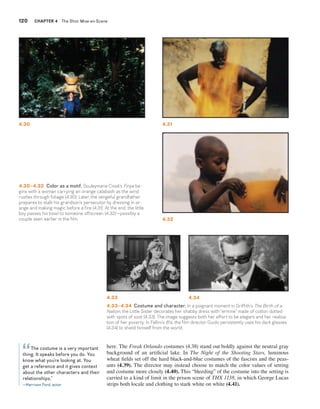
In some scenes of Finye (The Wind), the recurrent use of or-ange 
creates a cluster of nature motifs (4.30–4.32). When we 
look at Our Hospitality later in the chapter, we’ll examine how 
elements of setting, particularly props, can weave through a 
film to create motifs. 
Costume and Makeup 
If you were planning a film, you’d probably give as much at-tention 
to what your actors wear as you pay to their surround-ings. 
Like setting, costume can have a great variety of specific 
functions in the film’s overall form. 
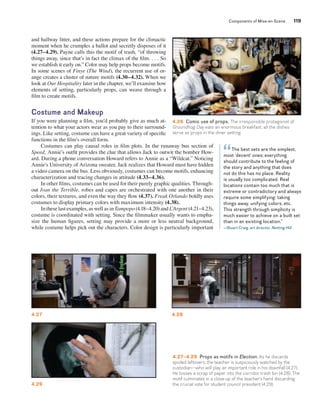
4.26 Comic use of props. The ­irresponsible 
Costumes can play causal roles in film plots. In the runaway bus section of 
Speed, Annie’s outfit provides the clue that allows Jack to outwit the bomber How-ard. 
During a phone conversation Howard refers to Annie as a “Wildcat.” Noticing 
Annie’s University of Arizona sweater, Jack realizes that Howard must have hidden 
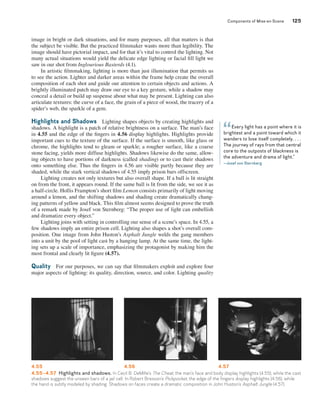
a video camera on the bus. Less obviously, costumes can become motifs, enhancing 
characterization and tracing changes in attitude (4.33–4.36). 
In other films, costumes can be used for their purely graphic qualities. Through-out 
Ivan the Terrible, robes and capes are orchestrated with one another in their 
colors, their textures, and even the way they flow (4.37). Freak Orlando boldly uses 
costumes to display primary colors with maximum intensity (4.38). 
In these last examples, as well as in Tampopo (4.18–4.20) and L’Argent ­( 
4.21–4.23), 
costume is coordinated with setting. Since the filmmaker usually wants to empha-size 
the human figures, setting may provide a more or less neutral background, 
while costume helps pick out the characters. Color design is particularly important 
protagonist of 
Groundhog Day eats an enormous breakfast; all the dishes 
serve as props in the diner ­setting. 
The best sets are the simplest, 
“ 
most ‘decent’ ones; everything 
should contribute to the feeling of 
the story and anything that does 
not do this has no place. Reality 
is usually too complicated. Real 
locations contain too much that is 
extreme or contradictory and always 
require some simplifying: taking 
things away, unifying colors, etc. 
This strength through simplicity is 
much easier to achieve on a built set 
than in an existing location.” 
—Stuart Craig, art director, Notting Hill 
4.27 4.28 
4.27–4.29 Props as motifs in Election. As he discards 
spoiled leftovers, the teacher is suspiciously watched by the 
custodian—who will play an important role in his downfall (4.27). 
He tosses a scrap of paper into the corridor trash bin (4.28). The 
motif culminates in a close-up of the teacher’s hand discarding 
the crucial vote for student council president (4.29). 
4.29
120 CHAPTER 4 The Shot: Mise-en-Scene 
4.30 4.31 
4.32 
4.30–4.32 Color as a motif. Souleymane Cissé’s Finye be-gins 
with a woman carrying an orange calabash as the wind 
rustles through foliage (4.30). Later, the vengeful grandfather 
prepares to stalk his grandson’s persecutor by dressing in or-ange 
and making magic before a fire (4.31). At the end, the little 
boy passes his bowl to someone offscreen (4.32)—possibly a 
couple seen earlier in the film. 
4.33 4.34 
here. The Freak Orlando costumes (4.38) stand out boldly against the neutral gray 
background of an artificial lake. In The Night of the Shooting Stars, luminous 
wheat fields set off the hard black-and-blue costumes of the fascists and the peas-ants 
(4.39). The director may instead choose to match the color values of setting 
and costume more closely (4.40). This “bleeding” of the costume into the setting is 
carried to a kind of limit in the prison scene of THX 1138, in which George Lucas 
strips both locale and clothing to stark white on white (4.41). 
The costume is a very important 
“ 
thing. It speaks before you do. You 
know what you’re looking at. You 
get a reference and it gives context 
about the other characters and their 
relationships.” 
—Harrison Ford, actor 
4.33–4.34 Costume and character. In a poignant moment in Griffith’s The Birth of a 
Nation, the Little Sister decorates her shabby dress with “ermine” made of cotton dotted 
with spots of soot (4.33). The image suggests both her effort to be elegant and her realiza-tion 
of her poverty. In Fellini’s 8½, the film director Guido persistently uses his dark glasses 
(4.34) to shield himself from the world.
Components of Mise-en-Scene 121 
4.35 4.36 
4.35–4.36 Costume and character change. When Hildy Johnson, in His Girl Friday, 
switches from her role of aspiring housewife to that of reporter, her hats change as well— 
from a stylish number with a low-dipping brim (4.35) to a more “masculine” hat with its brim 
pushed up, journalist-style (4.36). 
4.37 4.38 
4.37–4.38 Graphic qualities of costumes. In Ivan the Terrible, the sweeping folds of a priest’s lightweight black 
robe contrast with the heavy cloak and train of the czar’s finery (4.37). In Freak Orlando, stylized costumes with intense, 
primary colors are featured (4.38). The director, Ulrike Ottinger, is a professional costume designer. 
Women in Love affords a clear example of how costume 
and setting can contribute to a film’s narrative progression. 
The opening scenes portray the characters’ shallow middle-class 
life by means of saturated primary and complementary 
colors in costume and setting (4.42). In the middle portions of 
the film, as the characters discover love on a country estate, 
pale pastels predominate (4.43). The last section of Women in 
Love takes place around the Matterhorn, and the characters’ 
ardor has cooled. Now the colors have almost disappeared, 
and scenes are dominated by pure black and white (4.44). By 
combining with setting, costumes may reinforce narrative and 
thematic patterns. 
Computer technology has been used to graft virtual cos-tumes 
onto fully computer-­generated 
characters, like Gollum 
in The Lord of the Rings or the many extras in the backgrounds 
of big crowd scenes. Entirely digital costumes for human actors 
are less common, but fantasy and science-fiction films have be-gun 
4.39 Color contrast of costume and setting. In the climac-tic 
skirmish of The Night of the Shooting Stars, the dark cos-tumes 
stand out starkly against the more neutral background. 
using them (4.45). 
Many of these points about costume apply equally to a closely related area 
of mise-en-scene, the actors’ makeup. In the early days of cinema, makeup was
122 CHAPTER 4 The Shot: Mise-en-Scene 
4.40 4.41 
4.40–4.41 Color coordinates costume and setting. Fellini’s Casanova creates a color gradation that runs from bright red cos-tumes 
to paler red walls (4.40), the whole composition capped by a small white accent in the distance. In THX 1138, heads seem to float 
4.42 4.43 4.44 
4.42–4.44 Costume, setting, and narrative. Bright colors in an early scene of Women in Love (4.42) give way to the softer hues of 
trees and fields (4.43) and finally to a predominantly white-and-black scheme (4.44), contributing to the progression of the story. 
necessary because actors’ faces would not register 
well on film stocks. Over the course of film history, 
a wide range of possibilities emerged. Dreyer’s La 
Passion de Jeanne d’Arc was famous for its com-plete 
avoidance of makeup (4.46). For Ivan the 
Terrible, however, Nikolai Cherkasov plays the czar 
wearing a wig and a false beard, nose, and eyebrows 
(4.47). Changing actors to look like historical per-sonages 
has been one common function of makeup. 
Today makeup usually tries to pass unnoticed, 
but it also accentuates expressive qualities of the 
actor’s face. Since the camera may record cruel 
details that we wouldn’t notice in ordinary life, un-suitable 
blemishes, wrinkles, and sagging skin will 
in space as white costumes blend into white settings (4.41). 
4.45 Virtual costume. In making Green Lantern, Ryan Reynolds wore 
a plain gray outfit, and his tight green superhero costume was generated 
digitally. 
have to be hidden. The makeup artist can sculpt the face, making it seem narrower 
or broader by applying blush and shadow. Viewers expect that female performers 
will wear lipstick and other cosmetics, but the male actors are usually wearing 
makeup as well (4.48, 4.49). 
Film actors rely on their eyes to a very great extent (see A Closer Look, p. 138), 
and makeup artists can often enhance eye behavior. Eyeliner and mascara can draw 
attention to the eyes and emphasize the direction of a glance. Nearly every actor will 
also have expressively shaped eyebrows. Lengthened eyebrows can enlarge the face, 
while shorter brows make it seem more compact. Eyebrows plucked in a slightly ris-ing 
curve add gaiety to the face, while slightly sloping ones hint at sadness. Thick, 
straight brows, commonly applied to men, reinforce the impression of a hard, seri-ous 
gaze. In such ways eye makeup can assist the actor’s performance (4.50, 4.51).
Components of Mise-en-Scene 123 
4.46 Plain faces. Pale backgrounds focus 
attention on the actors’ faces in many shots 
of La Passion de Jeanne d’Arc. The actors 
wore no makeup, and the director, Carl 
Dreyer, relied on close-ups and tiny facial 
changes to create an intense religious 
drama. 
4.47 Makeup interprets a historical 
figure. In Ivan the Terrible, Part 1, makeup 
shapes the eyebrows and hollows the 
eye sockets to emphasize Ivan’s piercing 
gaze, a central feature in director Sergei 
Eisenstein’s conception of the all-knowing 
czar. 
4.48 4.49 
4.48–4.49 Creative choices in makeup. In Heat (4.48), Al Pacino’s makeup gives him slightly rounded 
eyebrows and, with the help of the lighting, minimizes the bags under his eyes. In The Godfather Part 
III, made five years before Heat, Pacino looks older (4.49). Not only has his hair been whitened, but the 
makeup, again assisted by the lighting, gives him more sunken and baggy eyes, more hollow cheeks, and 
a longer, flatter chin. 
4.50 4.51 
4.50–4.51 Makeup: Man and woman. In Speed, Sandra Bullock’s eyeliner, shadow, and arched brows make her eyes vivid and give 
her an alert expression (4.50). For the same scene, the eyeliner on Keanu Reeves makes the upper edges of his eyes stand out (4.51). 
Note the somewhat fierce slope of the eyebrows, accentuating his slight frown.
124 CHAPTER 4 The Shot: Mise-en-Scene 
4.53 
4.54 
In recent decades, the craft of makeup has developed in response to the popu-larity 
of horror and science fiction genres. Rubber and plasticine compounds create 
bumps, bulges, extra organs, and layers of artificial skin (4.52). In such contexts, 
makeup, like costume, becomes important in creating character traits or motivating 
plot action. 
Although most makeup continues to be physically applied to actors’ faces, 
digital technology can be used as well. Minor clean-ups remove flaws or shadows 
from faces. More drastically, a villain can lose a nose, or, via head replacement, an 
actor can play two roles in the same shot (4.53–4.54). CGI has extended the im-portance 
of makeup, because now the filmmaker can sculpt entire bodies, not just 
faces. Gary Sinese’s legs were removed so that he could play an amputee in Forrest 
Gump, and a muscular actor was made to look thin and weak before becoming a 
superhero in Captain America: The First Avenger. 
Lighting 
If you’ve shot videos with your cellphone or camera, you may not have thought 
much about manipulating lighting. Modern digital capture can produce a legible 
4.52 Horror makeup. Jeff Goldblum is 
nearly unrecognizable under grotesque 
makeup during his transformation into 
The Fly. 
4.53–4.54 Digital makeup. In Harry Potter and the Goblet of Fire, Ralph Fiennes’s nose 
was removed and replaced with nostrils appropriate to the snake-like Lord Voldemort 
(4.53). When two clones of the same man get into a fight in Moon, a stunt man wearing a 
green hood with motion-capture dots played one of the clones (4.54). Actor Sam Rockwell’s 
head was shot separately and then inserted into the scene. 
Light is everything. It expresses 
“ 
ideology, emotion, colour, depth, 
style. It can efface, narrate, 
describe. With the right lighting, 
the ugliest face, the most idiotic 
expression can radiate with beauty 
or intelligence.” 
—Federico Fellini, director
Components of Mise-en-Scene 125 
image in bright or dark situations, and for many purposes, all that matters is that 
the subject be visible. But the practiced filmmaker wants more than legibility. The 
image should have pictorial impact, and for that it’s vital to control the lighting. Not 
many actual situations would yield the delicate edge lighting or facial fill light we 
saw in our shot from Inglourious Basterds (4.1). 
In artistic filmmaking, lighting is more than just illumination that permits us 
to see the action. Lighter and darker areas within the frame help create the overall 
composition of each shot and guide our attention to certain objects and actions. A 
brightly illuminated patch may draw our eye to a key gesture, while a shadow may 
conceal a detail or build up suspense about what may be present. Lighting can also 
articulate textures: the curve of a face, the grain of a piece of wood, the tracery of a 
spider’s web, the sparkle of a gem. 
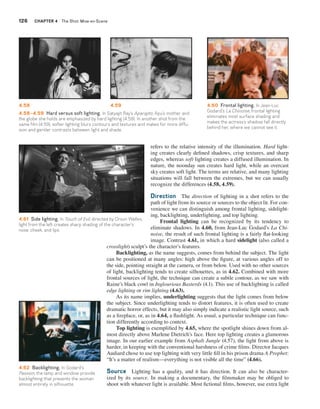
Highlights and Shadows Lighting shapes objects by creating highlights and 
shadows. A highlight is a patch of relative brightness on a surface. The man’s face 
in 4.55 and the edge of the fingers in 4.56 display highlights. Highlights provide 
important cues to the texture of the surface. If the surface is smooth, like glass or 
chrome, the highlights tend to gleam or sparkle; a rougher surface, like a coarse 
stone facing, yields more diffuse highlights. Shadows likewise do the same, allow-ing 
objects to have portions of darkness (called shading) or to cast their shadows 
onto something else. Thus the fingers in 4.56 are visible partly because they are 
shaded, while the stark vertical shadows of 4.55 imply prison bars offscreen. 
Lighting creates not only textures but also overall shape. If a ball is lit straight 
on from the front, it appears round. If the same ball is lit from the side, we see it as 
a half-circle. Hollis Frampton’s short film Lemon consists primarily of light moving 
around a lemon, and the shifting shadows and shading create dramatically chang-ing 
patterns of yellow and black. This film almost seems designed to prove the truth 
of a remark made by Josef von Sternberg: “The proper use of light can embellish 
and dramatize every object.” 
Lighting joins with setting in controlling our sense of a scene’s space. In 4.55, a 
few shadows imply an entire prison cell. Lighting also shapes a shot’s overall com-position. 
One image from John Huston’s Asphalt Jungle welds the gang members 
into a unit by the pool of light cast by a hanging lamp. At the same time, the light-ing 
sets up a scale of importance, emphasizing the protagonist by making him the 
most frontal and clearly lit figure (4.57). 
Quality For our purposes, we can say that filmmakers exploit and explore four 
major aspects of lighting: its quality, direction, source, and color. Lighting quality 
Every light has a point where it is 
“ 
brightest and a point toward which it 
wanders to lose itself completely. . . . 
The journey of rays from that central 
core to the outposts of blackness is 
the adventure and drama of light.” 
—Josef von Sternberg 
4.55 4.56 4.57 
4.55–4.57 Highlights and shadows. In Cecil B. DeMille’s The Cheat, the man’s face and body display highlights (4.55), while the cast 
shadows suggest the unseen bars of a jail cell. In Robert Bresson’s Pickpocket, the edge of the fingers display highlights (4.56), while 
the hand is subtly modeled by shading. Shadows on faces create a dramatic composition in John Huston’s Asphalt Jungle (4.57).
126 CHAPTER 4 The Shot: Mise-en-Scene 
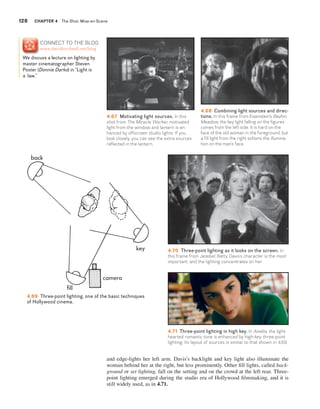
4.58 4.59 4.60 Frontal lighting. In Jean-Luc 
4.58–4.59 Hard versus soft lighting. In Satyajit Ray’s Aparajito, Apu’s mother and 
the globe she holds are emphasized by hard lighting (4.58). In another shot from the 
same film (4.59), softer lighting blurs contours and textures and makes for more diffu-sion 
Godard’s La Chinoise, frontal lighting 
eliminates most surface shading and 
makes the actress’s shadow fall directly 
behind her, where we cannot see it. 
refers to the relative intensity of the illumination. Hard light-ing 
creates clearly defined shadows, crisp textures, and sharp 
edges, whereas soft lighting creates a diffused illumination. In 
nature, the noonday sun creates hard light, while an overcast 
sky creates soft light. The terms are relative, and many lighting 
situations will fall between the extremes, but we can usually 
recognize the differences (4.58, 4.59). 
Direction The direction of lighting in a shot refers to the 
path of light from its source or sources to the object lit. For con-venience 
we can distinguish among frontal lighting, sidelight-ing, 
backlighting, underlighting, and top lighting. 
Frontal lighting can be recognized by its tendency to 
eliminate shadows. In 4.60, from Jean-Luc Godard’s La Chi-noise, 
the result of such frontal lighting is a fairly flat-looking 
image. Contrast 4.61, in which a hard sidelight (also called a 
and gentler contrasts between light and shade. 
4.61 Side lighting. In Touch of Evil, directed by Orson Welles, 
light from the left creates sharp shading of the character’s 
nose, cheek, and lips. 
crosslight) sculpt’s the character’s features. 
Backlighting, as the name suggests, comes from behind the subject. The light 
can be positioned at many angles: high above the figure, at various angles off to 
the side, pointing straight at the camera, or from below. Used with no other sources 
of light, backlighting tends to create silhouettes, as in 4.62. Combined with more 
frontal sources of light, the technique can create a subtle contour, as we saw with 
Raine’s black cowl in Inglourious Basterds (4.1). This use of backlighting is called 
edge lighting or rim lighting (4.63). 
As its name implies, underlighting suggests that the light comes from below 
the subject. Since underlighting tends to distort features, it is often used to create 
dramatic horror effects, but it may also simply indicate a realistic light source, such 
as a fireplace, or, as in 4.64, a flashlight. As usual, a particular technique can func-tion 
differently according to context. 
Top lighting is exemplified by 4.65, where the spotlight shines down from al-most 
directly above Marlene Dietrich’s face. Here top lighting creates a glamorous 
image. In our earlier example from Asphalt Jungle (4.57), the light from above is 
harder, in keeping with the conventional harshness of crime films. Director Jacques 
Audiard chose to use top lighting with very little fill in his prison drama A Prophet: 
“It’s a matter of realism—everything is not visible all the time” (4.66). 
Source Lighting has a quality, and it has direction. It can also be character-ized 
by its source. In making a documentary, the filmmaker may be obliged to 
shoot with whatever light is available. Most fictional films, however, use extra light 
4.62 Backlighting. In Godard’s 
Passion, the lamp and window provide 
backlighting that presents the woman 
almost entirely in silhouette.
Components of Mise-en-Scene 127 
4.63 Edge, or rim, lighting. Edge light-ing 
makes the outline of each actor’s 
body stand out from the background. 
This shot from Wings shows edge light-ing 
on many parts of the frame, espe-cially 
along the actors’ faces and hair 
and on the edge of the porch. 
4.64 Underlighting. In The Sixth Sense, a flashlight lights the boy’s face from 
below, enhancing our empathy with his fright as he feels the presence of a ghost. 
sources to obtain greater control of the image’s look. Typically the table lamps and 
streetlights you see in a set aren’t strong or varied enough to create a powerful im-age. 
Still, the filmmaker will usually create a lighting design that seems consistent 
with the sources in the setting. The pattern of illumination is motivated by the vis-ible 
sources. (See p. 65.) 
Look back at Figure 4.1, the confrontation in Inglourious Basterds. The pattern 
of light we see is roughly consistent with the source in the shot, the street lamp in 
the alley. But that lamp at that distance could not produce the hard light on Landa’s 
head or the fill light that reveals his features. In 4.67, from The Miracle Worker, the 
window in the rear and the lantern in the right foreground appear to be the sources 
of illumination, but many studio lights supplemented them. 
Directors and cinematographers manipulating the lighting of the scene typi-cally 
decide on two primary sources: a key light and a fill light. The key light is 
the primary source, providing the brightest illumination and casting the strongest 
shadows. The key light is the most directional light, and it is usually suggested by a 
light source in the setting. A fill is a less intense illumination that “fills in,” soften-ing 
or eliminating shadows cast by the key light. By combining key and fill, and by 
adding other sources, lighting can be controlled quite exactly. 
The key lighting source may be aimed at the subject from any angle, as we’ve 
seen. In our shot from The Sixth Sense (4.64), underlighting may be the key source, 
while a softer and dimmer fill falls on the setting in the background. Lights from 
various directions are often combined (4.68). 
Classical Hollywood filmmaking developed the custom of using at least three 
light sources per shot: key light, fill light, and backlight. The most basic arrangement 
of these lights on a single figure is shown in 4.69. The backlight typically comes 
from behind and above the figure, the key light comes diagonally from the front, 
and a fill light comes from a position near the camera. The key will usually be closer 
to the figure or brighter than the fill. Typically, each major character in a scene will 
have his or her own key light, fill light, and backlight. If another actor is added (the 
dotted figure in 4.69), the key light for one can be altered slightly to form the back-light 
for the other, and vice versa, with a fill light on either side of the camera. 
In 4.70, the Bette Davis character in Jezebel is the most important figure, and 
the three-point lighting centers attention on her. The key light is off left, making 
her right arm brightly illuminated. A fill light comes from just to the right of the 
camera. It is less bright than the key. This balanced lighting creates mild shading, 
modeling Davis’s face to suggest volume rather than flatness. (A slight shadow is 
cast by her nose.) A bright backlight from the rear upper right highlights her hair 
4.65 Top lighting for glamour. 
Director Josef Von Sternberg frequently 
used a high frontal light to bring out the 
cheekbones of his star, as shown here in 
Shanghai Express. 
4.66 Top lighting for realism. Since 
actors’ eyes are crucial to their perfor-mances, 
most filmmakers light scenes to 
make the eyes visible. But in the prison 
cells of A Prophet, harsh single-source 
lighting from above often renders the 
eyes as dark patches, making the charac-ters 
more sinister and inscrutable.
128 CHaptEr 4 The Shot: Mise-en-Scene 
4.67 Motivating light sources. In this 
shot from The Miracle Worker, motivated 
light from the window and lantern is en-hanced 
by offscreen studio lights. If you 
look closely, you can see the extra sources 
reflected in the lantern. 
and edge-lights her left arm. Davis’s backlight and key light also illuminate the 
woman behind her at the right, but less prominently. Other fi ll lights, called back-ground 
or set lighting, fall on the setting and on the crowd at the left rear. Three-point 
lighting emerged during the studio era of Hollywood fi lmmaking, and it is 
still widely used, as in 4.71. 
4.68 Combining light sources and direc-tions. 
In this frame from Eisenstein’s Bezhin 
Meadow, the key light falling on the figures 
comes from the left side. It is hard on the 
face of the old woman in the foreground, but 
a fill light from the right softens the illumina-tion 
on the man’s face. 
4.69 Three-point lighting, one of the basic techniques 
of Hollywood cinema. 
4.70 Three-point lighting as it looks on the screen. In 
this frame from Jezebel, Betty Davis’s character is the most 
important, and the lighting concentrates on her. 
4.71 Three-point lighting in high key. In Amélie, the light-hearted 
romantic tone is enhanced by high-key, three-point 
lighting. Its layout of sources is similar to that shown in 4.69. 
CoNNECT To THE BLoG 
www.davidbordwell.net/blog 
We discuss a lecture on lighting by 
master cinematographer Steven 
Poster (Donnie Darko) in “Light is 
a law.”
Components of Mise-en-Scene 129 
We’ve referred to key, fill, and backlight as separate sources, but in production 
there will often be many lighting units providing each of those. Several lamps, for 
instance, might be recruited to provide a strong key light. Moreover, you’ve prob-ably 
already realized that this three-point lighting system demands that the lamps 
be rearranged virtually every time the camera shifts to a new framing. In spite of 
the great cost involved, most commercial filmmakers choose to adjust lighting for 
each camera position. Changing light sources this way isn’t very realistic, but it 
does enable filmmakers to create strong compositions for each shot. 
Three-point lighting was particularly well suited for the high-key lighting used 
in classical Hollywood cinema and other filmmaking traditions. High-key lighting 
refers to an overall lighting design that uses fill light and backlight to create rela-tively 
low contrast between brighter and darker areas. Usually, the light quality is 
soft, making shadow areas fairly transparent. The frames from Jezebel (4.70) and 
Amélie (4.71) exemplify high-key lighting. Hollywood directors and cinematogra-phers 
have chosen this pattern for comedies and most dramas. 
High-key lighting is not used simply to render a brightly lit situation, such as a 
dazzling ballroom or a sunny afternoon. High-key lighting is an overall approach to 
illumination that can suggest different lighting conditions or times of day. Consider, 
for example, two frames from Back to the Future. The first shot (4.72) uses high-key 
illumination matched to daylight and a brightly lit malt shop. The second frame (4.73) 
is from a scene set in a room at night, but it still uses the high-key approach, as can 
be seen from the lighting’s softness, its low contrast, and its detail in shadow areas. 
Low-key lighting creates stronger contrasts and sharper, darker shadows. Often 
the lighting is hard, and fill light is lessened or eliminated altogether. The effect is 
of chiaroscuro, or extremely dark and light regions within the image. An example is 
4.74, from Kanal. Here the fill light and background light are less intense than in high-key 
technique. As a result, shadow areas on the left third of the screen remain hard 
and fairly opaque. In 4.75, a low-key shot from Leos Carax’s Mauvais sang, the key 
light is hard and comes from the left side. Carax eliminates both fill and background 
illumination, creating very sharp shadows and a dark void around the characters. 
As our examples indicate, low-key lighting is often applied to somber, threat-ening, 
or mysterious scenes. It was common in horror films of the 1930s and films 
noirs (dark films) of the 1940s and 1950s. The low-key approach was revived in the 
1980s in such films as Blade Runner and Rumble Fish and continued in the 1990s 
in films noirs like Se7en and The Usual Suspects. In El Sur, Victor Erice’s low-key 
lighting yields dramatic chiaroscuro effects (4.76). 
When the actors change position, the director faces another forced choice: to 
alter the lighting or not. Surprisingly often, directors decide to maintain a con-stant 
lighting on the actors as they walk, even though that’s quite unrealistic. By 
4.72 4.73 
When taking close-ups in a 
“ 
colour picture, there is too much 
visual information in the background, 
which tends to draw attention away 
from the face. That is why the faces 
of the actresses in the old black 
and white pictures are so vividly 
remembered. Even now, movie fans 
nostalgically recall Dietrich . . . 
Garbo . . . Lamarr . . . Why? Filmed in 
black and white, those figures looked 
as if they were lit from within. When 
a face appeared on the screen over-exposed— 
the high-key technique, 
which also erased imperfections— 
it was as if a bright object was 
emerging from the screen.” 
—Nestor Almendros, cinematographer 
When I started watching films 
“ 
in the 1940s and 1950s, Indian 
cinematography was completely 
under the influence of Hollywood 
aesthetics, which mostly insisted on 
the ‘ideal light’ for the face, using 
heavy diffusion and strong backlight. 
I came to resent the complete 
disregard of the actual source of 
light and the clichéd use of backlight. 
Using backlight all the time is like 
using chili powder in whatever you 
cook.” 
—Subrata Mitra, cinematographer 
4.72–4.73 High-key lighting for different times and settings. Back to the Future: A brightly lit malt shop in daytime (4.72) and 
Doc’s laboratory at night (4.73) both get the high-key treatment.
130 CHAPTER 4 The Shot: Mise-en-Scene 
4.74 4.75 
4.74–4.76 Low-key lighting. In Andrzej 
Wajda’s Kanal, low-key lighting creates a harsh 
highlight on one side of the woman’s face, a 
deep shadow on the other (4.74). In Mauvais 
sang, a single key light without any fill on the 
actress’s face leaves her expression nearly in-visible 
(4.75). In El Sur, low-key lighting suggests 
that the child views the adult world as full of 
mystery and danger (4.76). 
4.76 
4.77 4.78 4.79 
4.77–4.79 Light, constant or changing? At the end of Fellini’s Nights of Cabiria, the heroine moves diagonally toward us, accom-panied 
by a band of young street musicians (4.77). As she walks, the lighting on her face does not vary, enabling us to notice slight 
changes in her expression (4.78). By contrast, the sword fight in Rashomon is intensified by the contrast between the ferocious combat 
and the cheerfully dappled lighting pouring into the glade (4.79). 
overlapping several different key-lighting units, the filmmaker can maintain a con-stant 
intensity on moving actors. As a result, distracting shadows and highlights do 
not flit across them (4.77, 4.78). Alternatively, the filmmaker may prefer to have the 
players move through shifting patches of light and shade (4.79). 
In today’s big-budget films, there are often three or more cameras covering 
scenes in large settings. To avoid lengthy rearrangement of dozens of lamps, the 
cinematographer will often opt for a soft, bright top-light covering the entire scene. 
Wherever the cameras are placed, the lighting units will not be visible on camera. 
In The Wolfman (2010), a nighttime forest scene had many lights nested in big 
translucent boxes hung on cranes above the location.
Components of Mise-en-Scene 131 
Color We tend to think of fi lm lighting as limited to two 
colors, the white of sunlight or the soft yellow of incandescent 
room lamps. In practice, fi lmmakers who choose to control 
lighting typically work with as purely white a light as they 
can. With fi lters placed in front of the light source, the fi lm-maker 
can color the onscreen illumination in any fashion. 
There may be a realistic source in the scene to moti-vate 
colored light (4.80). Alternatively, colored light can 
also be unrealistic. In Eisenstein’s Ivan the Terrible, Part 
2, a blue light suddenly bursts upon the actor without any 
diegetic source. In the context of the scene, the abrupt light-ing 
change expresses the character’s terror and uncertainty 
(4.81, 4.82). Using lighting instead of acting to convey an 
emotion makes the scene more vivid and surprising. 
Most fi lm lighting is arranged as part of preparation for 
live-action fi lmmaking. But what if the settings and fi gures 
are created with a computer? Scanning a model or motion-capturing 
4.80 Filtered lighting. An orange filter suggests that all the 
light in this scene from The Green Room comes from candles. 
a fi gure does not record the light falling on it, and the resulting image is 
a neutral gray. Animators add simulated light to a scene using dedicated programs. 
Watch the credits for any special-effects-heavy fi lm, and you will see long lists of 
names of people dealing with light and shade. 
In The Golden Compass, the vicious combat between two armored polar bears 
was created entirely digitally. The fi ght takes place with a bright sun low in the sky, 
coming from off right. The icy clearing contains shadows of the surrounding crags 
(4.83). Simulated light is also used in digital animation. Pixar’s Cars experimented 
with rendering the look of colored lights refl ected on metal and glass (4.84). 
We are used to ignoring the illumination of our everyday surroundings, so fi lm 
lighting is easy to take for granted. Yet the power of a shot is centrally controlled 
by light quality, direction, source, and color. The fi lmmaker can manipulate and 
combine these factors to shape the viewer’s experience in a great many ways. No 
component of mise-en-scene is more important than what Sternberg called “the 
drama and adventure of light.” 
Staging: Movement and performance 
When we think of a fi lm director, we usually think of someone directing perform-ers. 
The director is the person who says, “Stand over there,” “Walk toward the cam-era,” 
or “Show that you’re holding back tears.” In such ways, the director controls a 
major component of mise-en-scene: the fi gures we see onscreen. Typically the fi g-ure 
is a person, but it could be an animal (Lassie the collie, Balthasar the donkey), a 
robot, an object (4.85), or even a pure shape (4.86). Mise-en-scene allows all these 
entities to express feelings and thoughts; it can also dynamize them to create kinetic 
patterns (4.87–4.88). 
Cinema gains great freedom from the fact that here expression and movement 
aren’t restricted to human fi gures. Puppets may be manipulated frame by frame 
through the technique of stop-action or stop-motion (4.89). In science-fi ction and 
fantasy movies, robots and fabulous monsters created as models can be scanned 
and movement added via computer manipulation (1.27). The fi lmmaker can breathe 
life into two-dimensional characters like Shrek or Daffy Duck. Even if the fi gures 
are fantastical, however, the fi lmmaker is obliged to stage their actions and con-struct 
their performances. 
acting and actuality Although abstract shapes and animated fi gures can be-come 
important in the mise-en-scene, the most familiar cases of fi gure expression 
and movement involve actors performing roles. An actor’s performance consists of 
visual elements (appearance, gestures, facial expressions) and sound (voice, effects). 
4.81 
4.82 
4.81–4.82 Lighting without a mo-tivated 
source. In Ivan the Terrible, a 
character’s fear registers on his face 
(4.81), and this is underscored by a blue 
light that bursts onto him (4.82). 
CoNNECT To THE BLoG 
www.davidbordwell.net/blog 
our entry on “The Cross” talks about 
a kind of staging largely forgotten 
in this era of rapid cutting and close 
framing. We discuss how scenic de-tails 
can be integrated into staging in 
“You are my density.”
132 CHAPTER 4 The Shot: Mise-en-Scene 
4.83 
4.84 
4.83–4.84 Digitally simulated lighting. In The Golden Compass, stark arctic sunshine 
from offscreen right falls as sidelight on the snow and the fighting bears (4.83). Simulated 
fill light was added to the onlookers and in areas of shading on the foreground bears. Cars 
puts on a virtuoso display of computer-simulated lighting, with neon signs reflecting in 
shiny surfaces as the cars cruise through their small-town street (4.84). 
4.85 
4.85–4.86 Controlling figure movement. In The Hudsucker Proxy, when the mailboy Norville proposes his new toy idea, the click-ing 
balls on his boss’s desktop inexplicably stop (4.85). The abstract film Parabola uses lighting and a pure background to emphasize 
shifting sculptural forms (4.86). 
4.86
Components of Mise-en-Scene 133 
4.87 4.88 
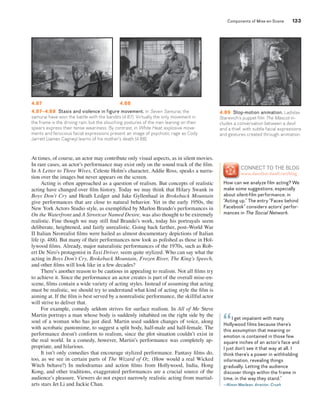
4.87–4.88 Stasis and violence in figure movement. In Seven Samurai, the 
samurai have won the battle with the bandits (4.87). Virtually the only movement in 
the frame is the driving rain, but the slouching postures of the men leaning on their 
spears express their tense weariness. By contrast, in White Heat, explosive move-ments 
and ferocious facial expressions present an image of psychotic rage as Cody 
Jarrett (James Cagney) learns of his mother’s death (4.88). 
At times, of course, an actor may contribute only visual aspects, as in silent movies. 
In rare cases, an actor’s performance may exist only on the sound track of the fi lm. 
In A Letter to Three Wives, Celeste Holm’s character, Addie Ross, speaks a narra-tion 
over the images but never appears on the screen. 
Acting is often approached as a question of realism. But concepts of realistic 
acting have changed over fi lm history. Today we may think that Hilary Swank in 
Boys Don’t Cry and Heath Ledger and Jake Gyllenhaal in Brokeback Mountain 
give performances that are close to natural behavior. Yet in the early 1950s, the 
New York Actors Studio style, as exemplifi ed by Marlon Brando’s performances in 
On the Waterfront and A Streetcar Named Desire, was also thought to be extremely 
realistic. Fine though we may still fi nd Brando’s work, today his portrayals seem 
deliberate, heightened, and fairly unrealistic. Going back farther, post–World War 
II Italian Neorealist fi lms were hailed as almost documentary depictions of Italian 
life (p. 488). But many of their performances now look as polished as those in Hol-lywood 
fi lms. Already, major naturalistic performances of the 1970s, such as Rob-ert 
De Niro’s protagonist in Taxi Driver, seem quite stylized. Who can say what the 
acting in Boys Don’t Cry, Brokeback Mountain, Frozen River, The King’s Speech, 
and other fi lms will look like in a few decades? 
There’s another reason to be cautious in appealing to realism. Not all fi lms try 
to achieve it. Since the performance an actor creates is part of the overall mise-en-scene, 
fi lms contain a wide variety of acting styles. Instead of assuming that acting 
must be realistic, we should try to understand what kind of acting style the fi lm is 
aiming at. If the fi lm is best served by a nonrealistic performance, the skillful actor 
will strive to deliver that. 
For example, comedy seldom strives for surface realism. In All of Me Steve 
Martin portrays a man whose body is suddenly inhabited on the right side by the 
soul of a woman who has just died. Martin used sudden changes of voice, along 
with acrobatic pantomime, to suggest a split body, half-male and half-female. The 
performance doesn’t conform to realism, since the plot situation couldn’t exist in 
the real world. In a comedy, however, Martin’s performance was completely ap-propriate, 
and hilarious. 
It isn’t only comedies that encourage stylized performance. Fantasy fi lms do, 
too, as we see in certain parts of The Wizard of Oz. (How would a real Wicked 
Witch behave?) In melodramas and action fi lms from Hollywood, India, Hong 
Kong, and other traditions, exaggerated performances are a crucial source of the 
audience’s pleasure. Viewers do not expect narrowly realistic acting from martial-arts 
stars Jet Li and Jackie Chan. 
4.89 Stop-motion animation. Ladislav 
Starevich’s puppet film The Mascot in-cludes 
a conversation between a devil 
and a thief, with subtle facial expressions 
and gestures created through animation. 
CoNNECT To THE BLoG 
www.davidbordwell.net/blog 
How can we analyze film acting? We 
make some suggestions, especially 
about silent-film performance, in 
“Acting up.” The entry “Faces behind 
Facebook” considers actors’ perfor-mances 
in The Social Network. 
I get impatient with many 
“ 
Hollywood films because there’s 
this assumption that meaning or 
emotion is contained in those few 
square inches of an actor’s face and 
I just don’t see it that way at all. I 
think there’s a power in withholding 
information, revealing things 
gradually. Letting the audience 
discover things within the frame in 
time, in the way they stand.” 
—Alison Maclean, director, Crush
4.90 4.91 
134 
A CLoSE R Look 
The Film Actor’s Toolkit 
We might think that the most important task facing an 
actor is speaking dialogue in a convincing and stirring way. 
Certainly, voice and delivery are very important in cinema, 
but considered in terms of mise-en-scene, the actor is al-ways 
part of the overall visual design. Many film scenes con-tain 
little or no dialogue, but at every moment onscreen, the 
actor must be in character. The actor and director shape 
the performance pictorially. 
Most of the time, film actors use their faces. This was 
most evident before movies had sound, and theorists of the 
silent film were full of praise for the subtle facial acting of 
Charlie Chaplin, Greta Garbo, and Lillian Gish. Since some 
happiness, fear, anger, and other facial expressions are un-derstood 
easily across cultures, silent films could become 
popular around the world. Today, with mainstream films 
using many close-ups (see p. 45), actors’ faces are hugely 
enlarged, and the performers must control their expres-sions 
minutely. 
The most expressive parts of the face are the mouth, 
eyebrows, and eyes. All work together to signal how the 
character is responding to the dramatic situation. In Jerry 
Maguire, the accountant Dorothy Boyd accidentally meets 
Jerry at an airport baggage conveyor. She has a crush on 
him, partly because she admires the courageous mission 
statement he has issued to the sports agency that they 
work for. As he starts to back off from the statement, she 
eagerly quotes it from memory; Renée Zellwegger’s earnest 
smile and admiring gaze suggest that she takes the issues 
more seriously than Jerry does (4.90). This impression is 
confirmed when Jerry says, “Uh-huh” and studies her skep-tically, 
his fixed smile signaling social politeness rather than 
genuine pride (4.91). This encounter sets up one premise 
of the film—that Jerry’s idealistic impulses will need con-stant 
shoring up, for he might at any moment slip back into 
being “a shark in a suit.” 
The eyes hold a special place in film. In any scene, crucial 
story information is conveyed by the direction of a charac-ter’s 
glance, the use of the eyelids, and the shape of the 
eyebrows. One of Chaplin’s most heart-rending moments 
comes in City Lights, when the blind flower girl, now sighted, 
suddenly realizes that he’s her benefactor and we must find 
signs of hope in his eyes (4.92). 
Normally, we don’t stare intently at the people we talk 
with. We glance away about half the time to gather our 
thoughts, and we blink 10–12 times a minute. But actors 
must learn to look directly at each other, locking eyes and 
seldom blinking. If an actor glances away from the partner 
in the conversation, it suggests distraction or evasion. If an 
actor blinks, it suggests a reaction to what is happening 
in the scene (surprise, or anxiety). Actors playing forceful 
characters often stare fixedly. Anthony Hopkins said this of 
playing Hannibal Lecter: “If you don’t blink you can keep the 
audience mesmerized.” (See 8.7, 8.9.) In our Jerry Maguire 
scene, the protagonists watch each other fixedly. When 
Jerry closes his eyes in response to Dorothy’s praise, it indi-cates 
his nervousness about confronting the issues that his 
mission statement raised. 
Thanks to facial expressions—eyes plus eyebrows plus 
mouth—actors can develop their characterizations across 
the film. The Social Network centers on two college friends, 
Mark Zuckerberg and Eduardo Savarin, who collaborate 
to create Facebook. Throughout the film Jesse Eisenberg 
plays Mark with knitted brows, squinting eyes, and a grimly 
set mouth, all suggesting his fierce concentration and com-petitiveness 
(4.93). By contrast Andrew Garfield portrays 
the more trusting Eduardo with wide eyes, raised brows, 
and slightly bowed head (4.94). In their climactic confronta-tion, 
during a deposition for the suit that Eduardo has filed 
against Mark, Eduardo’s facial behavior has changed to a di-rect, 
frowning challenge (4.95). This causes Mark to lower 
his head in embarrassment, an unusual reaction for the ag-gressive 
entrepreneur we’ve seen so far (4.96). 
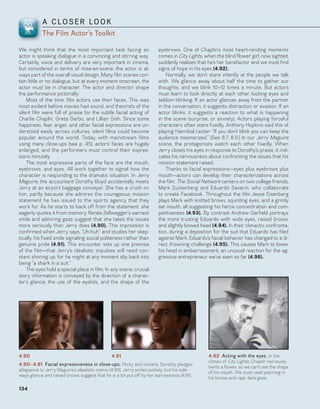
4.92 Acting with the eyes. In the 
climax of City Lights, Chaplin nervously 
twirls a flower, so we can’t see the shape 
of his mouth. We must read yearning in 
his brows and rapt, dark gaze. 
4.90–4.91 Facial expressiveness in close-ups. Perky and sincere, Dorothy pledges 
allegiance to Jerry Maguire’s idealistic memo (4.90). Jerry smiles politely, but his side-ways 
glance and raised brows suggest that he is a bit put off by her earnestness (4.91).
4.95 4.96 
4.93–4.96 Character domination through actors’ expressions. Early in The Social Network, Mark insists that Eduardo invest 
more in Facebook. The actors’ expressions establish Mark as a tough, demanding leader and Eduardo as more submissive (4.93–4.94). 
During the climactic deposition, Eduardo fights back facially, and Mark submits (4.95–4.96). 
4.97 4.98 4.99 
4.97–4.99 Extroverted acting for extravagant suffering. In Tigre Reale, Menichelli’s right hand seizes her hair, as if pulling her 
head back in agony; but her body still expresses defiance, thrust forward and standing firm as the left hand grips her waist (4.97). As 
Menichelli begins to feel shame, she retreats toward the fireplace, turning from us and slumping in a way that suggests regret (4.98). 
She keeps her back to the camera as she withdraws, now a pathetic figure (4.99). 
135 
4.93 4.94 
Actors act with their bodies as well as their faces. How 
a character walks, stands, or sits conveys a great deal 
about personality and attitude. In fact, during the 18th and 
19th centuries, attitude was used to refer to the way a per-son 
stood. Stage acting gave early film a repertoire of pos-tures 
that could express a character’s state of mind. In the 
1916 Italian film Tigre Reale (The Royal Tigress), the diva Pina 
Menichelli plays a countess with a shady past. At one point, 
she confesses this in a florid attitude that expresses noble 
suffering (4.97). While few actors today would resort to 
this stylized posture, early film audiences would have ac-cepted 
it as vividly expressive, like a movement in dance. 
Menichelli plays the rest of the scene more quietly, but she 
still employs expressive attitudes (4.98, 4.99). 
Chaplin’s and Menichelli’s gestures show that hands 
are important tools of the film actor. Hands are to the 
body what eyes are to the face: They focus our attention 
and evoke the character’s thoughts and feelings. Actress 
Maureen O’Hara said of Henry Fonda, “All he had to do 
was wag his little finger and he could steal a scene from
A CLoSE R Look Continued 
anybody.” A good example can be seen in the doomsday 
thriller Fail-Safe. Henry Fonda plays the U.S. president, who 
has learned that an American warplane has been acciden-tally 
sent to bomb the Soviet Union. Fonda stands erect at 
the phone as he hears distressing news about the plane’s 
progress, and he hangs up with his left hand (4.100– 
4.103). By keeping most of the shot still and bare, director 
Sidney Lumet has given Fonda’s fingers the main role, let-ting 
them express the president’s measured prudence but 
also suggesting the strain of the crisis. 
4.100 4.101 4.102 
4.103 
136 
4.100–4.103 Acting as finger exercise. In Fail-Safe, the president stands erect at the 
phone as he hears distressing news about the plane’s progress, and he hangs up with his 
left hand (4.100). The president pauses and rubs his fingers together thoughtfully (4.101), 
then he taps into the intercom with his right hand (4.102). As he waits, for a brief moment 
his left fingers waggle anxiously, betraying his nervous concern (4.103). 
CoNNECT To THE BLoG 
www.davidbordwell.net/blog 
For more on how actors use their 
hands, see “Hand jive.” 
Finally, when we watch any fi ctional fi lm, we are to some degree aware that 
the performances are the result of the actors’ skills and decisions. (See “A Closer 
Look.”) When we use the phrase “larger than life” to describe an effective perfor-mance, 
we seem to be acknowledging the actor’s craft. In analyzing a particular 
fi lm, we usually must go beyond assumptions about realism and consider the pur-poses 
that the actor’s craft serves. How appropriate, we can ask, is the performance 
to the context established by the genre, the fi lm’s narrative, and the overall mise-en-scene? 
A performance, realistic or not, should be examined according to its func-tion 
in the fi lm’s overall formal design. 
acting: Functions and Motivation We can consider performance along two 
dimensions. A performance will be more or less individualized, and it will be more 
or less stylized. Often we have both in mind when we think of a realistic perfor-mance: 
it creates a unique character, and it does not seem too exaggerated or too 
underplayed. Marlon Brando’s portrayal of Don Vito Corleone in The Godfather is 
quite individualized. Brando gives the Godfather a complex psychology, a distinc-tive 
appearance and voice, and a string of facial expressions and gestures that make 
CoNNECT To THE BLoG 
www.davidbordwell.net/blog 
Sometimes critics concentrate on 
acting to the exclusion of a film’s 
other qualities, as we complain in 
“Good actors spell good acting.” on 
the conventions governing award-winning 
performances, see “Good ac-tors 
spell good acting, 2: oscar bait.”
Components of Mise-en-Scene 137 
him significantly different from the standard image of a gang boss. As for styliza-tion, 
Brando keeps Don Vito in the middle range. His performance is neither flat 
nor flamboyant. He isn’t impassive, but he doesn’t chew the scenery either. 
Yet this middle range, which we often identify with realistic performance, 
isn’t the only option. On the individuality scale, films may create broader, more 
anonymous types. Classical Hollywood narrative was built on ideologically stereo-typed 
roles: the Irish cop on the beat, the black servant, the Jewish pawnbroker, the 
wisecracking waitress or showgirl. Through typecasting, actors were selected and 
directed to conform to what audiences expected. Often, however, skillful perform-ers 
gave these conventions a freshness and vividness. The 1920s Soviet filmmakers 
adapted this principle, which they called typage. Here the actor was expected to por-tray 
a typical representative of a social class or historical movement (4.104, 4.105). 
Whether more or less typed, the performance can also be located on a con-tinuum 
of stylization. A long tradition of film acting strives for an expressive natu-ralness, 
with actors speaking their lines with slightly more clarity and emotion than 
we usually find in everyday life. The director and the performer may choose to 
enhance this streamlined naturalness by adding specific physical actions. Frequent 
gestures and movements by the actors add plausibility to the humor of Woody Al-len’s 
films (4.106). 
The actor is usually obliged to express emotion, but emotions come in many 
colors. Some are intense and burst out violently (4.107). Other emotions are masked, 
as when jealousy and suspicion are covered by excessive politeness (4.108). Some-times 
emotional expression is broad and sweeping, almost operatic (4.109). And 
the same film may combine different degrees of emotional stylization. Amadeus 
contrasts a grotesque, giggling performance by Tom Hulce as Mozart with Murray 
Abraham’s suave Salieri. The two acting styles sharpen the contrast between the 
older composer’s decorous but dull music and the young man’s offensive genius. In 
every film, the actor needs to blend the performance with the genre, the narrative, 
and the overall formal patterning. 
Films like Ivan the Terrible and Amadeus create stylized performances through 
extroversion and exaggeration. The director can also explore the possibilities of 
very muted performances. Compared to normal practice, highly restrained acting 
can seem quite stylized. Robert Bresson is noted for such restrained performances. 
Using nonprofessional actors and drilling them in the de-tails 
of the characters’ physical actions, Bresson makes his 
actors nearly flat by conventional standards (4.110, 4.111). 
Although these performances may upset our expectations, 
we soon realize that such restraint focuses our attention on 
details of action we never notice in most movies. 
Motion and Performance Capture Since the cre-ation 
of digitally generated characters Jar Jar Binks in Star 
Wars: Episode 1—The Phantom Menace in 1999 and Gol-lum 
in The Lord of the Rings: The Two Towers (2002), actors 
have had to learn new skills. In these early films, perform-ers 
in special suits covered with dots were filmed digitally 
to form the basis for characters’ movements. Soon CGI 
(computer-­generated 
imagery) programs allowed more dense 
arrays of dots to capture smaller details of facial movement 
(4.112). The addition of tiny cameras attached to the actors’ 
heads permitted even subtler capture of expressions. 
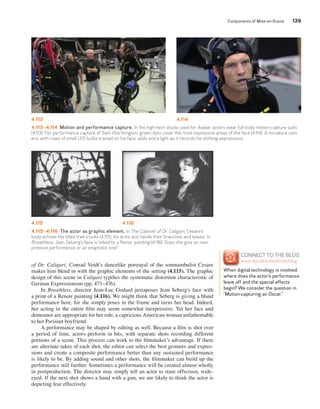
Now a distinction is made between motion capture, 
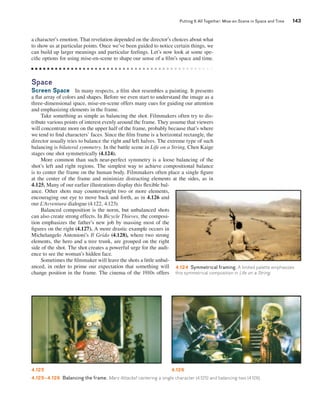
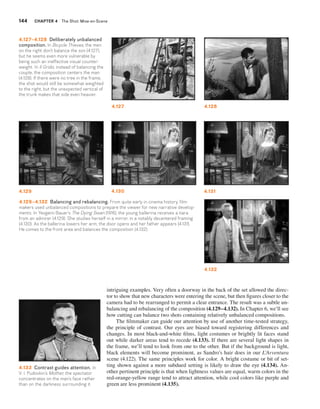
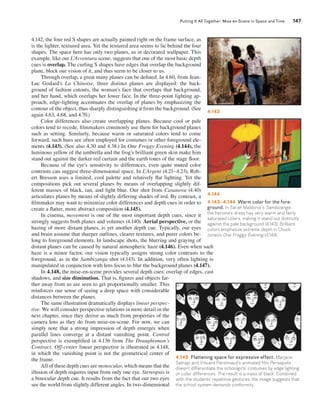
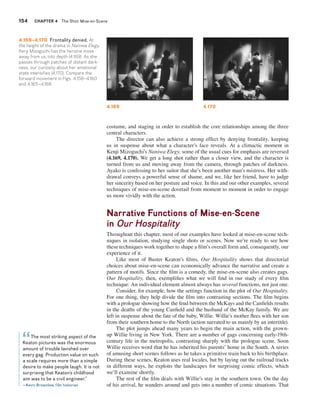
where the whole body is filmed, and performance cap-ture, 
which concentrates on the face (4.113, 4.114). Motion 
capture can also be used on animals. Thanks to capture 
4.104 
4.105 
4.104–105 A range of acting styles 
in the same film. The opening of 
Eisenstein’s Strike presents the cartoon-ish 
cliché of the top-hatted capitalist 
(4.104), while in contrast the workers 
are presented as earnest and resolute 
(4.105). 
4.106 Expressive naturalness in acting style. In Hannah and 
Her Sisters, Mia Farrow as Hannah, Diane Wiest as her sister 
Holly, and Carrie Fisher as their friend April set a table, chatting 
about the other guests as they do so.
138 CHAPTER 4 The Shot: Mise-en-Scene 
4.107 4.108 4.109 
4.107–4.109 Stylized acting and emotion. In Winchester 73, James Stewart’s mild manner occasionally erupts into vengeful anger, 
revealing him as on the brink of psychosis (4.107). The exaggerated smiles and gestures in Trouble in Paradise are amusing because we 
know that the women, competing for the same man, are only pretending to be friends (4.108). Nikolai Cherkasov’s dramatically raised 
arm and thrown-back head are appropriate to Ivan the Terrible, which creates a larger-than-life portrait of its hero (4.109). 
4.110 4.111 
4.110–4.111 Restrained acting. Playing the heroine of Au Hasard Balthasar, Anna Wiazemsky looks without expression at her would-be 
seducer, who wants her to get in his car (4.110). She glances downward, still without registering her thoughts, before sliding in (4.111). 
dots, ordinary horses can be transformed into fantastical creatures, as when the six-legged 
Direhorses were created for Avatar. The Polar Express, Beowulf, The Ad-ventures 
of Tintin, and other animated films used motion and performance capture 
for both human and nonhuman creatures. 
In predigital days, actors would play fantasy characters 
with heavy prosthetics and ample makeup. Motion capture and 
performance capture make it easier for the actor to concentrate 
on the performance. As James Cameron explained: 
Actors have said to me, half jokingly but a little nervously, “Are 
you trying to replace actors?” And of course, the answer is 
no, we love actors. This whole thing is about acting. It’s about 
creating these fantasy characters through the process of acting. 
What we’re replacing is five hours in the makeup chair, having 
rubber glued all over your face. 
Acting in the Context of Other Techniques By ex-amining 
how an actor’s performance functions within the over-all 
film, we can also notice how acting blends with other film 
techniques. For instance, the actor is always a graphic element 
in the film, but some films underline this fact. In The Cabinet 
4.112 Digital capture of detailed facial movements. For 
his role as Davy Jones in Pirates of the Caribbean: Dead Man’s 
Chest, actor Bill Nighy had white motion-capture dots ap-plied 
to his face. His expressions were used to create virtual 
makeup, including a beard made of writhing tentacles.
Components of Mise-en-Scene 139 
4.113 4.114 
4.113–4.114 Motion and performance capture. In the high-tech studio used for Avatar, actors wear full-body motion-capture suits 
(4.113). For performance capture of Sam Worthington, green dots cover the most expressive areas of the face (4.114). A miniature cam-era, 
with rows of small LED bulbs trained on his face, adds extra light as it records his shifting expressions. 
4.115 4.116 
4.115–4.116 The actor as graphic element. In The Cabinet of Dr. Caligari, Cesare’s 
body echoes the tilted tree trunks (4.115), his arms and hands their branches and leaves. In 
Breathless, Jean Seberg’s face is linked to a Renoir painting (4.116). Does she give an inex-pressive 
performance or an enigmatic one? 
of Dr. Caligari, Conrad Veidt’s dancelike portrayal of the somnambulist Cesare 
makes him blend in with the graphic elements of the setting (4.115). The graphic 
design of this scene in Caligari typifi es the systematic distortion characteristic of 
German Expressionism (pp. 473–476). 
In Breathless, director Jean-Luc Godard juxtaposes Jean Seberg’s face with 
a print of a Renoir painting (4.116). We might think that Seberg is giving a bland 
performance here, for she simply poses in the frame and turns her head. Indeed, 
her acting in the entire fi lm may seem somewhat inexpressive. Yet her face and 
demeanor are appropriate for her role, a capricious American woman unfathomable 
to her Parisian boyfriend. 
A performance may be shaped by editing as well. Because a fi lm is shot over 
a period of time, actors perform in bits, with separate shots recording different 
portions of a scene. This process can work to the fi lmmaker’s advantage. If there 
are alternate takes of each shot, the editor can select the best gestures and expres-sions 
and create a composite performance better than any sustained performance 
is likely to be. By adding sound and other shots, the fi lmmaker can build up the 
performance still further. Sometimes a performance will be created almost wholly 
in postproduction. The director may simply tell an actor to stare offscreen, wide-eyed. 
If the next shot shows a hand with a gun, we are likely to think the actor is 
depicting fear effectively. 
CoNNECT To THE BLoG 
www.davidbordwell.net/blog 
When digital technology is involved, 
where does the actor’s performance 
leave off and the special effects 
begin? We consider the question in 
“Motion-capturing an oscar.”
140 CHAPTER 4 The Shot: Mise-en-Scene 
Camera techniques also create a controlling context for acting. Film acting, 
as you know, differs from theatrical acting. In a theater, we are usually at a con-siderable 
distance from the actor on the stage. We certainly can never get as close 
to the theater actor as the camera can put us in a film. For that reason, we’re in-clined 
to think that the film actor must always underplay—that is, act in a more 
restrained fashion than stage acting would require. But recall that the camera can 
be at any distance from the figure. Filmed from very far away, the actor is a dot on 
the screen—much smaller than an actor on stage seen from the back of the balcony. 
Filmed from very close, the actor’s tiniest eye movement may be revealed. 
Thus the film actor must behave differently than the stage actor does, but not 
always by being more restrained. Rather, she or he must be able to adjust to each 
type of camera distance. If the actor is far from the camera, he or she may have to 
gesture broadly or move around to be seen as acting at all. But if the camera and ac-tor 
are inches apart, a twitch of a mouth muscle will come across clearly. Between 
these extremes, there is a whole range of adjustments to be made. 
Often a shot will concentrate on either the actor’s facial expression or on bodily 
movement. In most close shots, the face will be emphasized, and so the actor will 
have to control eyes, brows, and mouth quite precisely. But if the camera is farther 
back, or the actor is turned away from us, gestures and body language become the 
center of attention. In all, both the staging of the action and the camera’s distance 
from the action control how we understand the performances (4.117–4.118). 
Matters of context are particularly important when the performers are not ac-tors, 
or even human beings. Framing, editing, and other film techniques can make 
trained animals give appropriate performances. Jonesy, the cat in Aliens, seems 
threatening because his hissing movement has been emphasized by lighting, fram-ing, 
editing, and the sound track. (4.119). 
As with every element of a film, acting offers an unlimited range of creative 
choices. It cannot be judged on a universal scale outside the context of the entire 
film’s form. 
Putting It All Together: 
Mise-en-Scene in Space and Time 
Back in Chapter 2, we argued that viewers try to blend what they see and hear into 
a larger pattern (p. 54). This process starts at the level of the shot, when we have to 
assemble information into a coherent space and time. And creating that coherence 
requires that the filmmaker guide us to certain areas of the frame. 
How do we know that viewers scan the frame for important information? The 
psychologist Tim Smith asked viewers to wear lightweight glasses that could track 
their eye movements and then showed them a scene from There Will Be Blood. The 
eye movements were recorded by computers and mapped onto the film sequence, so 
Smith could study how the viewers’ attention shifted within the scene. There was 
remarkable agreement among the subjects about where to look at any moment. The 
primary points of attention were, as we might expect, items crucial to building up 
a story: faces and hand gestures (4.120–4.121). The characters’ dialogue was im-portant, 
too; the scan-paths revealed that people tend to look at the person speaking 
in the shot. 
Before viewers can follow the story, recognize the emotional tenor of the scene, 
respond with their own emotions, and reflect on possible meanings, they must no-tice 
certain things in the frame. In setting up a shot, the filmmaker makes some 
things more salient than others. We noticed this happening when we examined 
how Tarantino nudged us to watch Colonel Landa in the scene from Inglourious 
Basterds. Thinking like a filmmaker means, to a large extent, finding ways to guide 
the viewer’s eye. In other words, directors direct attention. 
4.117 
4.118 
4.117–4.118 Performance in long 
shot and close-up. The Spider’s 
Stratagem: In long shot, the actors’ man-ner 
of walking helps characterize them 
(4.117). The stiff, upright way in which the 
heroine holds her parasol is one of the 
main facets of Alida Valli’s performance. 
In a closer framing, her performance 
displays detailed eye and lip movements 
(4.118). 
4.119 Editing to create a perfor-mance. 
In Aliens, editing makes it seem 
that Jonesy is reacting angrily to some-thing 
in the scene.
Putting It All Together: Mise-en-Scene in Space and Time 141 
creative decisions 
Mise-en-Scene in a Sequence from L’Avventura 
To get a sense of the filmmaker’s creative options in guiding our eye, let’s look at 
another sequence. In Michelangelo Antonioni’s L’Avventura, Sandro and Claudia 
are searching for Anna, who has mysteriously vanished. Anna is Claudia’s friend 
and Sandro’s lover, but during their search, they’ve begun to drift from their goal 
of finding her. They’ve also begun a love affair. In the town of Noto, they stand on 
a church rooftop near the bells, and Sandro says he regrets giving up architectural 
design. Claudia is encouraging him to return to his profession when he suddenly 
asks her to marry him. 
She’s startled and confused, and Sandro comes toward her. She is turned away 
from us. At first, only Sandro’s expression is visible as he reacts grimly to her plea, 
“Why can’t things be simpler?” (4.122). Claudia twists her arms around the bell 
rope, then turns away from him, toward us, grasping the rope and fluttering her 
hand. Now we can see that she’s quite distraught. Sandro, a bit uneasy, turns away 
as she says anxiously, “I’d like to see things clearly” (4.123). 
Brief though it is, this exchange shows how the tools of mise-en-scene—set-ting, 
costume, lighting, performance, and staging—can work together smoothly. 
We’ve considered them separately in order to examine the contribution each one 
makes, but in any shot, they mesh. They unfold on the screen in space and time, 
fulfilling several functions. 
Most basically, the filmmaker has to guide the audience’s attention to the im-portant 
areas of the image. The filmmaker also wants to build up our interest by 
You can ask a bear to do 
“ 
something like, let’s say, ‘Stand 
up,’ and the bear stands up. But 
you cannot say to a bear, ‘Look 
astonished.’ So you have him 
standing up, but then you have to 
astonish him. I would bang two 
saucepans, or get a chicken from a 
cage, then shake it so it squawked, 
and the bear would think, ‘What 
was that?’ and ‘click’ I’d have that 
expression.” 
—Jean-Jacques Annaud, director, The Bear 
4.120 
4.121 
4.120–4.121 Scanning the shot. Tim 
Smith and his colleagues tracked several 
subjects’ eye movements during a single 
shot of There Will Be Blood. Here is one 
frame from the sequence, as the char-acters 
examine a map (4.120). Smith’s 
“peekthrough heatmap” graphically 
indicates the areas of interest for the 
eight viewers watching at that moment 
(4.121). The black surround represents 
areas not watched by anyone. Areas of 
attention are lit up, and the hotter the 
color, the more viewers are looking at 
that spot. At this instant, most viewers 
were concentrating on Sunday’s face 
and hand, with two viewers looking at 
the man facing front behind him. As we 
might expect, faces, hands, and dialogue 
have commanded viewers’ attention. 
The audience is only going to 
“ 
look at the most overriding thing in 
the frame. You must take charge of 
and direct their attention. It’s also 
the principle of magic: what is the 
single important thing? Make it easy 
for them to see it, and you’re doing 
your job.” 
—David Mamet, director
142 CHAPTER 4 The Shot: Mise-en-Scene 
arousing curiosity and suspense. And the filmmaker tries to add 
expressive qualities, giving the shot an emotional coloration. 
Mise-en-scene helps the filmmaker achieve all these purposes. 
How did Antonioni guide our attention in the Claudia– 
Sandro exchange? First, we’re watching the figures, not the 
railing behind them. Based on the story so far, we expect 
Sandro and Claudia to be the objects of interest. At other 
points in the film, Antonioni makes them tiny figures in mas-sive 
urban or seaside landscapes. Here, however, his mise-en-scene 
keeps their intimate interchange foremost in our minds. 
Consider the first image merely as a two-dimensional pic-ture. 
Both Sandro and Claudia stand out against the pale sky 
and the darker railing. They’re also mostly curved shapes— 
heads and shoulders—and so they contrast with the geometri-cal 
regularity of the balcony. In the first frame, light strikes 
Sandro’s face and suit from the right, picking him out against 
the rails. His dark hair is well positioned to make his head 
stand out against the sky. Claudia, a blonde, stands out against 
the railing and sky less vividly, but her polka-dot blouse creates 
a distinctive pattern. And considered only as a picture, the shot 
roughly balances the two figures, Sandro in the left half and 
Claudia in the right. 
It’s hard to think of the shot as simply two-dimensional, 
though. We instinctively see it as portraying a space that we 
could move around in. Claudia seems closer to us because her 
body masks things farther away, a spatial cue called overlap. 
She’s also somewhat larger in the frame than Sandro, which 
reinforces our sense that she’s closer. The rope slices across 
the bottom third of the frame, separating the couple (overlap 
again). Sandro himself overlaps the railing, which in turn over-laps 
the sky and the town beyond. We get a sense of distinct 
planes of space, layers lying closer to or farther from us. Costume, lighting, setting, 
and figure placement create this sense of a three-dimensional arena for the action. 
Antonioni has used mise-en-scene to emphasize his characters and their inter-action. 
But that interaction unfolds in time, and it gives him an opportunity to guide 
our attention while building up suspense and expressing emotion. Claudia is turned 
away from us when Sandro presses her to marry him, and the rope is taut between 
them (4.120). How will she respond? 
Antonioni starts by giving Claudia a bit of business. She twists the rope around 
her arms and slips it over her back. This could be a hint that she’s drawn to Sandro’s 
proposal. At the same time, she hesitates. For as soon as he presses her, she turns 
away from him (4.121). 
We know that faces give us access to characters’ thoughts and emotions. 
Another filmmaker might have had Claudia already facing us when Sandro asked, 
so we’d see her response immediately. Antonioni instead makes things uncertain 
for a moment. He conceals Claudia’s reaction and then lets her turn toward us. To 
make sure that we watch her and not Sandro at this moment, Antonioni has him 
turn away when she gestures and speaks (“I’d like to see things clearly”). Our atten-tion 
is riveted on Claudia. 
Soon enough, Sandro turns back toward the camera, so we can see his reac-tion, 
but already Claudia’s anxiety has flashed out at us. Her complex relation to 
Sandro—attraction (sliding under the bell rope) and uncertainty (turning away 
tensely)—has been presented to us concretely. 
This is only one moment in a complex scene, but it shows how various elements 
of mise-en-scene can cooperate to create a specific effect: the delayed revelation of 
4.122 
4.123 
4.122–4.123 Frontality gets attention. In L’Avventura, first 
Claudia has her back to the camera (4.122), and then Sandro 
does (4.123). Each shift is timed to show us a crucial facial 
­reaction.
Putting It All Together: Mise-en-Scene in Space and Time 143 
a character’s emotion. That revelation depended on the director’s choices about what 
to show us at particular points. Once we’ve been guided to notice certain things, we 
can build up larger meanings and particular feelings. Let’s now look at some spe-cific 
options for using mise-en-scene to shape our sense of a film’s space and time. 
Space 
Screen Space In many respects, a film shot resembles a painting. It presents 
a flat array of colors and shapes. Before we even start to understand the image as a 
three-dimensional space, mise-en-scene offers many cues for guiding our attention 
and emphasizing elements in the frame. 
Take something as simple as balancing the shot. Filmmakers often try to dis-tribute 
various points of interest evenly around the frame. They assume that viewers 
will concentrate more on the upper half of the frame, probably because that’s where 
we tend to find characters’ faces. Since the film frame is a horizontal rectangle, the 
director usually tries to balance the right and left halves. The extreme type of such 
balancing is bilateral symmetry. In the battle scene in Life on a String, Chen Kaige 
stages one shot symmetrically (4.124). 
More common than such near-perfect symmetry is a loose balancing of the 
shot’s left and right regions. The simplest way to achieve compositional balance 
is to center the frame on the human body. Filmmakers often place a single figure 
at the center of the frame and minimize distracting elements at the sides, as in 
4.125. Many of our earlier illustrations display this flexible bal-ance. 
Other shots may counterweight two or more elements, 
encouraging our eye to move back and forth, as in 4.126 and 
our L’Avventura dialogue (4.122, 4.123). 
Balanced composition is the norm, but unbalanced shots 
can also create strong effects. In Bicycle Thieves, the composi-tion 
emphasizes the father’s new job by massing most of the 
figures on the right (4.127). A more drastic example occurs in 
Michelangelo Antonioni’s Il Grido (4.128), where two strong 
elements, the hero and a tree trunk, are grouped on the right 
side of the shot. The shot creates a powerful urge for the audi-ence 
to see the woman’s hidden face. 
Sometimes the filmmaker will leave the shots a little unbal-anced, 
in order to prime our expectation that something will 
change position in the frame. The cinema of the 1910s offers 
4.124 Symmetrical framing. A limited palette emphasizes 
this symmetrical composition in Life on a String. 
4.125 4.126 
4.125–4.126 Balancing the frame. Mars Attacks!: centering a single character (4.125) and balancing two (4.126).
144 CHAPTER 4 The Shot: Mise-en-Scene 
4.127 4.128 
intriguing examples. Very often a doorway in the back of the set allowed the direc-tor 
to show that new characters were entering the scene, but then figures closer to the 
camera had to be rearranged to permit a clear entrance. The result was a subtle un-balancing 
and rebalancing of the composition (4.129–4.132). In Chapter 6, we’ll see 
how cutting can balance two shots containing relatively unbalanced compositions. 
The filmmaker can guide our attention by use of another time-tested strategy, 
the principle of contrast. Our eyes are biased toward registering differences and 
changes. In most black-and-white films, light costumes or brightly lit faces stand 
out while darker areas tend to recede (4.133). If there are several light shapes in 
the frame, we’ll tend to look from one to the other. But if the background is light, 
black elements will become prominent, as Sandro’s hair does in our L’Avventura 
scene (4.122). The same principles work for color. A bright costume or bit of set-ting 
shown against a more subdued setting is likely to draw the eye (4.134). An-other 
pertinent principle is that when lightness values are equal, warm colors in the 
red-orange-yellow range tend to attract attention, while cool colors like purple and 
green are less prominent (4.135). 
4.127–4.128 Deliberately unbalanced 
composition. In Bicycle Thieves, the men 
on the right don’t balance the son (4.127), 
but he seems even more vulnerable by 
being such an ineffective visual counter-weight. 
In Il Grido, instead of balancing the 
couple, the composition centers the man 
(4.128). If there were no tree in the frame, 
the shot would still be somewhat weighted 
to the right, but the unexpected vertical of 
the trunk makes that side even heavier. 
4.129 4.130 4.131 
4.132 
4.129–4.132 Balancing and rebalancing. From quite early in cinema history, film-makers 
used unbalanced compositions to prepare the viewer for new narrative develop-ments. 
In Yevgenii Bauer’s The Dying Swan (1916), the young ballerina receives a tiara 
from an admirer (4.129). She studies herself in a mirror, in a notably decentered framing 
(4.130). As the ballerina lowers her arm, the door opens and her father appears (4.131). 
He comes to the front area and balances the composition (4.132). 
4.133 Contrast guides attention. In 
V. I. Pudovkin’s Mother, the spectator 
concentrates on the man’s face rather 
than on the darkness surrounding it.
Putting It All Together: Mise-en-Scene in Space and Time 145 
4.134 4.135 
4.134–4.135 Bright and warm colors get attention. In Jiří Menzel’s Larks on a String, a propaganda display about happy workers 
stand out against the earthy grays and blacks of the junkyard (4.134). In Yilmaz Güney’s Yol, the setting and the characters’ outfits are 
warm in hue, but the hot pink vest of the man in the central middle ground helps make him the primary object of attention (4.135). 
Color contrasts don’t have to be huge, because we’re sensitive to small dif-ferences. 
What painters call a limited palette involves a few colors in the same 
range, as in our earlier example from Fellini’s Casanova (4.40). Peter Greenaway’s 
The Draughtsman’s Contract employs a limited palette from the cooler end of the 
spectrum (4.136). An extreme case of the principle is sometimes called monochro-matic 
color design. Here the filmmaker emphasizes a single color, varying it only 
in purity or lightness. We’ve already seen an example of monochromatic mise-en-scene 
in the white décor and costumes of THX 1138 (4.41). In a monochromatic 
design, even a fleck of a contrasting color will catch the viewer’s attention (4.137). 
Film has one resource that painting lacks. Our tendency to notice visual differ-ences 
is strongly aroused when the image includes movement. In the L’Avventura 
scene, the turning of Claudia’s head became a major event, but we are sensitive to 
far smaller motions in the frame. Normally, for instance we ignore the movement 
of scratches and dust on a film. But in David Rimmer’s Watching for the Queen, 
in which the first image is an absolutely static photograph (4.138), the jumping bits 
of dust on the film draw our attention. In 4.139, from Yasujiro Ozu’s Record of a 
4.136 4.137 
4.136–4.137 Limited color palettes. The Draughtsman’s Contract uses a limited palette of green, black, and white (4.136). The color 
design of Aliens is dominated by metallic tones, so even a dingy yellow can mark the stiltlike loader as an important prop in the narra-tive 
(4.137).
146 CHaptEr 4 The Shot: Mise-en-Scene 
Tenement Gentleman, many items compete for our attention. But the moment that 
a scrap of newspaper fl aps in the wind, it immediately attracts the eye because it is 
the only motion in the frame. 
When several moving elements appear on the screen, we are likely to shift our 
attention among them, according to other cues or depending on our expectations 
about which one is most important for the narrative. In 4.140, from John Ford’s 
Young Mr. Lincoln, Lincoln is moving much less than the dancers we see in front of 
him. Yet as the fi lm’s major character he is framed centrally, and the dancers pass 
rapidly through the frame. As a result, we are likely to concentrate on his gestures 
and facial expressions, however slight they might be compared to the energetic ac-tion 
in the foreground. 
Scene Space Looking at a fi lm image as a two-dimensional picture helps us 
appreciate the artistry of fi lmmakers, but it requires some effort. We fi nd it easier 
to immediately see the shapes on the screen as presenting a three-dimensional area, 
like the spaces we live in. The elements of the image that create this impression are 
called depth cues. 
Depth cues are what enabled us to understand the encounter of Sandro and 
Claudia as taking place in a realistic space, with layers and volumes. We develop 
our understanding of depth cues from our experience of real locales and from our 
earlier experience with pictorial media. In cinema, depth cues are provided by light-ing, 
setting, costumes, and staging—that is, by all the aspects of mise-en-scene. 
Depth cues suggest that a space has both volume and several distinct planes. 
When we speak of an object as having volume, we mean that it is solid and occupies 
a three-dimensional area. A fi lm suggests volume by shape, shading, and move-ment. 
In 4.116 and 4.141, we don’t see the actors as fl at cutouts, like paper dolls. 
The shapes of those heads and shoulders suggest solid people. The attached shad-ows 
on the faces suggest the curves and recesses of the actors’ features and give a 
modeling effect. We assume that if Jean Seberg in 4.116 turned her head, we would 
see a profi le. Thus we use our knowledge of objects in the world to discern volume 
in fi lmic space. 
An abstract fi lm, because it can use shapes that are not familiar objects, can 
create compositions without a sense of volume. The shapes in 4.142 give us no 
depth cues for volume—they are unshaded, do not have a recognizable shape, and 
do not move in such a way as to reveal new views that suggest roundness. 
Depth cues also pick out planes within the image. Planes are the layers of space 
occupied by persons or objects. Planes are described according to how close to or 
far away from the camera they are: foreground, middle ground, background. 
Only a completely blank screen has a single plane. Whenever a shape, even 
an abstract one, appears, we will perceive it as being in front of a background. In 
4.138 
4.139 
4.138–4.139 Minimal motion. 
Watching for the Queen emphasizes 
scratches and dust (4.138), while flapping 
paper catches our attention in Record of 
a Tenement Gentleman (4.139). 
CoNNECT To THE BLoG 
www.davidbordwell.net/blog 
Whether you see Coraline in a 3D or 
a 2D version, it has some fascinating 
use of depth cues to differentiate the 
heroine’s real life and the alterna-tive 
life she finds behind a door in 
her room. We take a look at these in 
“Coraline, cornered.” 
bch_hb 
bch_hc 
4.140 Centered framing. Central posi-tion 
emphasizes a background figure in 
Young Mr. Lincoln. 
4.141 Volume in scene space. Shading 
and shape suggest volume in Dreyer’s La 
Passion de Jeanne d’Arc. 
4.142 Flattened space. Norman 
McLaren’s Begone, Dull Care, provides no 
depth cues for volume.
Putting It All Together: Mise-en-Scene in Space and Time 147 
4.142, the four red S shapes are actually painted right on the frame surface, as 
is the lighter, textured area. Yet the textured area seems to lie behind the four 
shapes. The space here has only two planes, as in decorated wallpaper. This 
example, like our L’Avventura scene, suggests that one of the most basic depth 
cues is overlap. The curling S shapes have edges that overlap the background 
plane, block our vision of it, and thus seem to be closer to us. 
Through overlap, a great many planes can be defined. In 4.60, from Jean- 
Luc Godard’s La Chinoise, three distinct planes are displayed: the back-ground 
of fashion cutouts, the woman’s face that overlaps that background, 
and her hand, which overlaps her lower face. In the three-point lighting ap-proach, 
edge-lighting accentuates the overlap of planes by emphasizing the 
contour of the object, thus sharply distinguishing it from the background. (See 
again 4.63, 4.68, and 4.70.) 
Color differences also create overlapping planes. Because cool or pale 
colors tend to recede, filmmakers commonly use them for background planes 
such as setting. Similarly, because warm or saturated colors tend to come 
forward, such hues are often employed for costumes or other foreground ele-ments 
(4.143). (See also 4.30 and 4.38.) In One Froggy Evening (4.144), the 
luminous yellow of the umbrella and the frog’s brilliant green skin make him 
stand out against the darker red curtain and the earth tones of the stage floor. 
Because of the eye’s sensitivity to differences, even quite muted color 
contrasts can suggest three-dimensional space. In L’Argent (4.21–4.23), Rob-ert 
Bresson uses a limited, cool palette and relatively flat lighting. Yet the 
compositions pick out several planes by means of overlapping slightly dif-ferent 
masses of black, tan, and light blue. Our shot from Casanova (4.40) 
articulates planes by means of slightly differing shades of red. By contrast, a 
filmmaker may want to minimize color differences and depth cues in order to 
create a flatter, more abstract composition (4.145). 
In cinema, movement is one of the most important depth cues, since it 
strongly suggests both planes and volumes (4.140). Aerial perspective, or the 
hazing of more distant planes, is yet another depth cue. Typically, our eyes 
and brain assume that sharper outlines, clearer textures, and purer colors be-long 
to foreground elements. In landscape shots, the blurring and graying of 
distant planes can be caused by natural atmospheric haze (4.146). Even when such 
haze is a minor factor, our vision typically assigns strong color contrasts to the 
foreground, as in the Sambizanga shot (4.143). In addition, very often lighting is 
manipulated in conjunction with lens focus to blur the background planes (4.147). 
In 4.148, the mise-en-scene provides several depth cues: overlap of edges, cast 
shadows, and size diminution. That is, figures and objects far-ther 
away from us are seen to get proportionally smaller. This 
reinforces our sense of seeing a deep space with considerable 
distances between the planes. 
The same illustration dramatically displays linear perspec-tive. 
We will consider perspective relations in more detail in the 
next chapter, since they derive as much from properties of the 
camera lens as they do from mise-en-scene. For now, we can 
simply note that a strong impression of depth emerges when 
parallel lines converge at a distant vanishing point. Central 
perspective is exemplified in 4.136 from The Draughtsman’s 
Contract. Off-center linear perspective is illustrated in 4.148, 
in which the vanishing point is not the geometrical center of 
the frame. 
All of these depth cues are monocular, which means that the 
illusion of depth requires input from only one eye. Stereopsis is 
a binocular depth cue. It results from the fact that our two eyes 
see the world from slightly different angles. In two-­dimensional 
4.143 
4.144 
4.143–4.144 Warm color for the fore-ground. 
In Sarah Maldoror’s Sambizanga, 
the heroine’s dress has very warm and fairly 
saturated colors, making it stand out distinctly 
against the pale background (4.143). Brilliant 
colors emphasize extreme depth in Chuck 
Jones’s One Froggy Evening (4.144). 
4.145 Flattening space for expressive effect. Marjane 
Satrapi and Vincent Paronnaud’s animated film Persepolis 
doesn’t differentiate the schoolgirls’ costumes by edge lighting 
or color differences. The result is a mass of black. Combined 
with the students’ repetitive gestures, the image suggests that 
the school system demands ­conformity.
148 CHAPTER 4 The Shot: Mise-en-Scene 
4.146 Aerial perspective through atmospheric effects. Fog 
emphasizes the distance between the foreground and back-ground 
trees in Güney’s The Wall. 
4.147 Aerial perspective through 
lighting. In The Charge of the Light 
Brigade, aerial perspective is artificially 
created by diffused lighting of the back-ground 
and a lack of clear focus behind 
the officer in the foreground. 
films, there is a single lens and thus no stereoptic effect. Three-­dimensional 
cinema 
uses two lenses, imitating the separation of our eyes. The glasses used for viewing 
3D films direct different visual information to each eye, creating a stronger illusion 
of depth than monocular depth cues can render. Stereopsis is a depth cue rendered 
by cinematography rather than mise-en-scene, although it does demand arranging 
the scene in depth. 
In many of the examples already given, you may have noticed that mise-en-scene 
serves not simply to direct our attention to foreground elements but rather 
to create a dynamic relation between foreground and background. In 4.60, for in-stance, 
Godard keeps our attention on the whole composition by using prominent 
backgrounds. Here the pictures behind the actress’s head lead us to scan the various 
small shapes quickly. 
The La Chinoise shot is a shallow-space composition. In such shots, the mise-en- 
scene suggests comparatively little depth, and the closest and most distant planes 
seem only slightly separated. The opposite tendency is deep-space composition, 
in which a significant distance seems to separate planes. Our example from The 
Chronicle of Anna Magdalena Bach (4.148) exemplifies deep-space mise-en-scene. 
Often a director creates a deep-space composition by making the foreground plane 
quite large and the background plane quite distant (4.149). 
4.148 Size diminution. Steep size 
diminution emphasizes depth in Straub 
and Huillet’s The Chronicle of Anna 
Magdalena Bach. 
4.149 Deep space composition. Several scenes of Wajda’s 
Ashes and Diamonds create large foregrounds and distant 
background planes. 
4.150 Playing with depth cues. Leos Carax creates an optical 
illusion in Boy Meets Girl by making the painted advertisement 
seem to thrust out into the space inhabited by the boy.
Putting It All Together: Mise-en-Scene in Space and Time 149 
Shallow and deep mise-en-scene are relative concepts. Most compositions pre-sent 
a moderately deep space, falling between the extremes we’ve just considered. 
Sometimes a fi lmmaker manipulates depth cues to make a space appear deeper or 
shallower than it really is—creating an optical illusion (4.150). 
At this point, you might want to return to shots illustrated earlier in this chap-ter. 
You’ll notice that these images use depth cues of overlap, movement, cast shad-ows, 
aerial perspective, size diminution, and linear perspective to create distinctive 
foreground/background relations. 
CrEatIvE DECISIOnS 
Mise-en-Scene in Two Shots from Day of Wrath 
The fact that our vision is sensitive to differences allows fi lmmakers to guide our 
understanding of the mise-en-scene. All the cues to story space interact with one 
another, working to emphasize narrative elements, direct our attention, and set up 
dynamic relations among areas of screen space. We can see this interaction clearly 
in two shots from Carl Dreyer’s Day of Wrath. 
In the fi rst shot, the heroine, Anne, is standing before a grillwork panel (4.151). 
She isn’t speaking, but since she is a major character in the fi lm, the narrative al-ready 
directs us to her. Setting, lighting, costume, and fi gure expression create pic-torial 
cues that confi rm our expectations. The setting yields a pattern of horizontal 
and vertical lines that intersect in the delicate curves of Anne’s face and shoulders. 
The lighting yields a patch of brightness on the right half of the frame and a patch 
of darkness on the left, creating pictorial balance. Anne is the meeting point of 
these two areas. Her face is modeled by the relatively strong key lighting from the 
right, a little top lighting on her hair, and relatively little fi ll light. Anne’s costume, a 
black dress punctuated by a white collar, and a black cap edged with white, further 
emphasizes her face. 
The shot is comparatively shallow, displaying two major planes with little dis-tance 
between them. The background sets off the most important element, Anne. 
The rigid geometrical grid in the rear makes Anne’s slightly sad face the most ex-pressive 
element in the frame, thus encouraging our eye to pause there. In addition, 
the composition divides the screen space horizontally, with the grid pattern running 
across the top half and the dark, severe vertical of Anne’s dress dominating the 
lower half. As is common, the upper zone is the stronger because the character’s 
head and shoulders occupy it. Anne’s fi gure is positioned slightly off center, but 
with her face turned to compensate for the vacant area on the right. (Imagine how 
unbalanced the shot would look if she were turned to face us squarely and the same 
amount of space were left empty on the right.) Thus compositional balance rein-forces 
the shot’s emphasis on Anne’s expression. Without using movement, Dreyer 
has channeled our attention by means of lines and shapes, lights and darks, and the 
foreground and background relations in the mise-en-scene. 
In the second example, also from Day of Wrath, Dreyer coaxes our attention 
into a to-and-fro movement (4.152). Again, the plot guides us, since the characters 
and the cart are crucial narrative elements. Sound helps, too, since Martin is at the 
moment explaining to Anne that the wood in the cart will fuel the witch-burning. 
But mise-en-scene also plays a role. Size diminution and cast shadows establish 
basic foreground/background relations, with Anne and Martin on the front plane 
and the cart of wood in the background. The space is comparatively deep (though 
the foreground is not as exaggeratedly close as that in Ashes and Diamonds, 4.149). 
The prominence of the couple and the cart is reinforced by line, shape, and light-ing 
contrasts. The fi gures are defi ned by hard edges and by dark costumes within 
the predominantly bright setting. Unlike most shots, this puts the human fi gures 
in the lower half of the frame, which gives that zone an unusual importance. The 
CoNNECT To THE BLoG 
www.davidbordwell.net/blog 
For our thoughts on some digital 3D 
films, see “A turning point in digital 
projection?”; “Bwana Beowulf”; and 
“Do not forget to return your 3D 
glasses.” 
CoNNECT To THE BLoG 
www.davidbordwell.net/blog 
For a variety of staging options, in 
both shallow space and depth, see 
“Gradations of emphasis, starring 
Glenn Ford” and “How to watch 
Fantômas, and why.” 
4.151 
4.152 
4.151–4.152 Concentrating our at-tention. 
Day of Wrath: Highlighting a 
single figure (4.151) and dividing attention 
between foreground and background 
(4.152).
150 CHAPTER 4 The Shot: Mise-en-Scene 
composition thus creates a vertical balance, counterweighting the cart with the 
couple. Were Tim Smith to test his viewers’ scanning on this shot, we’d expect eye 
movements glancing up and down between the two objects of our attention. 
Similar processes are at work in color films. In one shot of Yasujiro Ozu’s An 
Autumn Afternoon (4.153), our attention is concentrated on the bride in the center 
foreground. Many depth cues are at work. Overlap locates the two figures in two fore-ground 
planes, setting them against a series of more distant planes. Aerial perspective 
makes the foliage outside somewhat out of focus. Movement creates depth when the 
bride lowers her head. Perspective diminution makes the more distant objects smaller. 
The woman’s face and the bright silver, red, and gold bridal costume stand out strik-ingly 
against the muted colors of the background planes. Moreover, the colors lead 
us to recall a red-and-silver motif that appeared in the first shot of the film (4.154). 
In looking at a shot, we’re more aware of what we see than how we see it. To 
think like a filmmaker, though, we need to reflect on that how. The filmmaker ar-ranges 
shapes and colors on the two-dimensional screen. He or she also controls 
depth cues that suggest three dimensions. The filmmaker uses those patterns to 
activate what is most important at each moment. Mise-en-scene structures space in 
ways that guide, and sometimes dazzle, our eyes. 
Time 
Cinema is an art of time as well as space. So we shouldn’t be surprised to find that 
many of our examples of two-­dimensional 
composition and three-dimensional sce-nic 
space have unfolded over time. The director’s control over mise-en-scene gov-erns 
not only what we see but when we see it and for how long. In our L’Avventura 
scene between Sandro and Claudia on the rooftop, the timing of the characters’ 
movements—Sandro turning away just as Claudia turns toward us—contributes to 
the effect of a sudden, sharp revelation of her anxiety. 
The director shapes the speed and direction of movement within the shot. Since 
our eyes are attuned to noticing changes, we can pick up the slightest cues. In 4.155, 
from Chantal Akerman’s Jeanne Dielman, 23 quai du Commerce, 1080 Bruxelles, 
the protagonist simply peels potatoes. This feminist film traces, in painstaking de-tail, 
the everyday routines of a Belgian housewife. The composition of this shot 
strongly centers Jeanne, and no competing movements distract us from her steady 
and efficient preparation of a meal. The same rhythm is carried throughout the film, 
so that when she does start to vary her habits, we are prepared to notice even the 
slight errors she makes under emotional pressure. 
A far busier shot is 4.156, from Busby Berkeley’s 42nd 
Street. This overhead view presents strongly opposed move-ments. 
The central and outer rings of dancers circle in one di-rection, 
while the second ring turns in a contrary direction. 
The dancers also swing strips of shiny cloth back and forth. 
The result is a partially abstract composition, but it’s easy to 
grasp because the movement of the wheels within wheels has a 
geometrical clarity. 
The dancers in 42nd Street are synchronized to a consider-able 
degree, but 4.157, from Jacques Tati’s Play Time, contains 
movements of differing speeds, with different visual accents. 
Moreover, they occur on different planes and follow contrast-ing 
trajectories. These diverse movements accord with Tati’s 
tendency to cram his compositions with gags that compete for 
our attention. 
As we have already seen, we scan any film frame for in-formation. 
This scanning brings time sharply into play. Only a 
4.153 
4.154 
4.153–4.154 Color and composi-tion. 
An apparently simple shot from 
An Autumn Afternoon employs several 
depth cues (4.153) and harks back to the 
striped smokestacks seen at the begin-ning 
(4.154). 
4.155 Movement cues. Slow, quiet movements of the actor 
in Jeanne Dielman, 23 quai du Commerce, 1080 Bruxelles en-able 
the audience to detect even slight changes.
Putting It All Together: Mise-en-Scene in Space and Time 151 
4.156 Strong, synchronized movements. 
In 42nd Street, the shot is busy but the move-ments 
are synchronized. 
4.157 Vivid, competing movements. The competing rhythms 
of movement in a busy shot from Play Time divide the audi-ence’s 
attention around the frame. 
very short shot forces us to try to take in the image all at once. In most shots, we get 
an initial overall impression that creates formal expectations. These expectations 
are quickly modified as our eye roams around the frame. 
As we’d expect, our scanning of the shot is strongly affected by the presence of 
movement. A static composition may keep pulling our attention back to a single ele-ment, 
as our first shot from Day of Wrath does with Anne’s face (4.140). In contrast, 
a composition emphasizing movement may use the movement’s speed or direction 
to guide our glance. In the second image from Day of Wrath (4.141), Anne and 
Martin are turned from us and are standing still. Thus the single moving thing in 
the frame—the cart—catches our attention. But when Martin speaks and turns, we 
look back at the couple, then back at the cart, and so on, in a shuttling, dynamic 
shift of attention. 
Our time-bound process of scanning involves not only looking to and fro across 
the screen but also, in a sense, looking into its depths. A deep-space composition 
will often use background events to create expectations about what is about to hap-pen 
in the foreground. “Composing in depth isn’t simply a matter of pictorial rich-ness,” 
British director Alexander Mackendrick has remarked. “It has value in the 
narrative of the action, the pacing of the scene. Within the same frame, the director 
can organize the action so that preparation for what will happen next is seen in the 
background of what is happening now.” 
Our example from The Dying Swan (4.129–4.132) illustrates MacKendrick’s 
point. The same principle is used in 4.158–4.160, from Three Kings. Here the 
frame starts off unbalanced, and the fact that it includes a background doorway 
prepares us for the scene’s dramatic development. In addition, any movement from 
background to foreground is a strong attention-getter. At moments like these, the 
mise-en-scene is quietly setting up what will happen. By arousing our expectations, 
the director has engaged us with the unfolding action. 
The Dying Swan and Three Kings examples also illustrate the force of frontality. 
In explaining one five-minute shot in his film Adam’s Rib, George Cukor acknowl-edged 
this power. He remarked how the defense attorney was positioned to focus 
our attention on her client, who’s reciting the reasons she shot her husband (4.161). 
Katharine Hepburn “had her back to the camera almost the whole time, but that had 
a meaning: she indicated to the audience that they should look at Judy Holliday.” 
All other things being equal, the viewer expects that more story information 
will come from a character’s face than from a character’s back. The viewer’s atten-tion 
will thus usually pass over figures that are turned away and fasten on figures 
that are positioned frontally. A more distant view can exploit frontality, too. In Hou 
Hsiao-hsien’s City of Sadness, depth staging centers the Japanese woman coming 
to visit the hospital, and a burst of bright fabric also draws attention to her (4.162).
152 CHAPTER 4 The Shot: Mise-en-Scene 
4.158 4.159 
4.160 
4.158–4.160 Movements arouse narrative expectations. In 
this shot from Three Kings, Chief Elgin comes in to tell the partying 
GIs that their superior is coming. Normally, when a character is 
looking offscreen, he or she is placed a little off center, leaving an 
empty space to imply the area that the person is looking at. (See 
the shot of Anne, 4.151.) But Elgin is decentered in a different way; 
here the space on the right side sits empty (4.158). That makes the 
tent flap behind him prominent. Without being aware of it, we’re 
prepared for some action to develop there. Abruptly, the superior 
officer bursts into the background (4.159). He strides forward, 
which is always a powerful way to command the viewer’s atten-tion 
(4.160). As he comes into close-up, he ramps up the conflict, 
demanding to know where the men got alcohol. 
Just as important, the other characters are turned away from us. It’s characteristic 
of Hou’s style to employ long shots with small changes in figure movement. The 
subdued, delicate effect of his scenes depends on our seeing characters’ faces in 
relation to others’ bodies and the overall setting. 
Frontality can change over time to guide our attention to various parts of the 
shot. We’ve already seen alternating frontality at work in our L’Avventura scene, 
when Sandro and Claudia turn to and away from us (4.122, 4.123). When actors are 
in dialogue, a director may allow frontality to highlight one moment of one actor’s 
4.161 Movements coordinated with 
other cues for attention. In Adam’s 
Rib, the wife who has shot her hus-band 
is given the greatest emphasis 
by three-point lighting, her animated 
gestures, and her three-quarter frontal 
positioning. Daringly, the most frontal 
and centered character is the nurse 
in the background, but Cukor keeps 
her out of focus and unmoving so that 
she won’t distract from Judy Holliday’s 
­performance. 
4.162 Frontality. Although she is farther from the camera than other 
characters, the woman visiting the hospital in City of Sadness draws our 
eye partly because she is the only one facing front. (Compare the unimpor-tance 
of the front-facing nurse in 4.161.)
Putting It All Together: Mise-en-Scene in Space and Time 153 
4.163 4.164 
performance and then give another performer more prominence (4.163, 4.164). This 
device reminds us that mise-en-scene can borrow devices from theatrical staging. 
A flash of frontality can be very powerful if it’s integrated into the scene’s 
unfolding drama. In the opening of Rebel without a Cause, three teenagers are 
being held at the police station (4.165). They don’t know one another yet. When 
Jim sees that Plato is shivering, he drunkenly comes forward to offer the younger 
boy his sport coat (4.166, 4.167). Jim’s frontality, forward movement, bright white 
shirt, and central placement emphasize his gesture. The moment foreshadows the 
ways in which Jim will become something of a father to Plato. Just as Plato takes 
the coat, Judy turns and notices Jim for the first time (4.168). Like Claudia’s turn 
to the camera in our L’Avventura example, this sudden revelation spikes our in-terest. 
It prepares us for the tense romance that will develop between Judy and 
Jim in later scenes. Director Nicholas Ray has blended the scene’s setting, lighting, 
4.163–4.164 Fluctuating frontality. 
In a conversation in The Bad and the 
Beautiful, our attention fastens on the 
studio executive on the right because 
the other two characters are turned 
away from us (4.163). But when the pro-ducer 
turns to the camera, his centered 
position and frontal posture emphasize 
him (4.164). 
4.165 4.166 
4.167 4.168 
4.165–4.168 Developing a scene over time. A long shot lays out the major characters in Rebel without a Cause (4.165). Jim comes 
forward, drawing our attention and arousing expectations of a dramatic exchange (4.166). Jim offers Plato his jacket, his action cen-tered 
and his brightly lit white shirt making him the dominant player. Judy remains a secondary center of interest, segregated by the 
office window but highlighted by her bright red coat (4.167). Judy turns abruptly, and her face’s frontal position lets us see her interest 
in Jim (4.168).
154 CHAPTER 4 The Shot: Mise-en-Scene 
4.169 4.170 
costume, and staging in order to establish the core relationships among the three 
central characters. 
The director can also achieve a strong effect by denying frontality, keeping 
us in suspense about what a character’s face reveals. At a climactic moment in 
Kenji Mizoguchi’s Naniwa Elegy, some of the usual cues for emphasis are reversed 
(4.169, 4.170). We get a long shot rather than a closer view, and the character is 
turned from us and moving away from the camera, through patches of darkness. 
Ayako is confessing to her suitor that she’s been another man’s mistress. Her with-drawal 
conveys a powerful sense of shame, and we, like her friend, have to judge 
her sincerity based on her posture and voice. In this and our other examples, several 
techniques of mise-en-scene dovetail from moment to moment in order to engage 
us more vividly with the action. 
Narrative Functions of Mise-en-Scene 
in Our Hospitality 
Throughout this chapter, most of our examples have looked at mise-en-scene tech-niques 
in isolation, studying single shots or scenes. Now we’re ready to see how 
these techniques work together to shape a film’s overall form and, consequently, our 
experience of it. 
Like most of Buster Keaton’s films, Our Hospitality shows that directorial 
choices about mise-en-scene can economically advance the narrative and create a 
pattern of motifs. Since the film is a comedy, the mise-en-scene also creates gags. 
Our Hospitality, then, exemplifies what we will find in our study of every film 
technique: An individual element almost always has several functions, not just one. 
Consider, for example, how the settings function in the plot of Our Hospitality. 
For one thing, they help divide the film into contrasting sections. The film begins 
with a prologue showing how the feud between the McKays and the Canfields results 
in the deaths of the young Canfield and the husband of the McKay family. We are 
left in suspense about the fate of the baby, Willie. Willie’s mother flees with her son 
from their southern home to the North (action narrated to us mainly by an intertitle). 
The plot jumps ahead many years to begin the main action, with the grown-up 
Willie living in New York. There are a number of gags concerning early-19th-century 
life in the metropolis, contrasting sharply with the prologue scene. Soon 
Willie receives word that he has inherited his parents’ home in the South. A series 
of amusing short scenes follows as he takes a primitive train back to his birthplace. 
During these scenes, Keaton uses real locales, but by laying out the railroad tracks 
in different ways, he exploits the landscapes for surprising comic effects, which 
we’ll examine shortly. 
The rest of the film deals with Willie’s stay in the southern town. On the day 
of his arrival, he wanders around and gets into a number of comic situations. That 
4.169–4.170 Frontality denied. At 
the height of the drama in Naniwa Elegy, 
Kenji Mizoguchi has the heroine move 
away from us, into depth (4.169). As she 
passes through patches of distant dark-ness, 
our curiosity about her emotional 
state intensifies (4.170). Compare the 
forward movement in Figs. 4.158–4.160 
and 4.165–4.168. 
The most striking aspect of the 
“ 
Keaton pictures was the enormous 
amount of trouble lavished over 
every gag. Production value on such 
a scale requires more than a simple 
desire to make people laugh. It is not 
surprising that Keaton’s childhood 
aim was to be a civil engineer.” 
—Kevin Brownlow, film historian
Narrative Functions of Mise-en-Scene in Our Hospitality 155 
night he stays in the Canfield house itself. An extended chase occurs the next day, 
moving through the countryside and back to the Canfield house for the settling of 
the feud. Thus the action depends heavily on shifts of setting that establish Willie’s 
two journeys, as baby and as man, and later his wanderings to escape his enemies’ 
pursuit. The narration is relatively unrestricted after Willie reaches the South, shift-ing 
between him and members of the Canfield family. We usually know more about 
what they’re doing than Willie does, and the narrative generates suspense by show-ing 
them coming toward the places where Willie is hiding. 
Specific settings fulfill distinct narrative functions. The McKay estate, which 
Willie envisions as a mansion, turns out to be a tumbledown shack. The McKay 
house is contrasted with the Canfield’s palatial plantation home. In narrative terms, 
the Canfield home gains even more functional importance when the Canfield father 
forbids his sons to kill Willie on the premises: “Our code of honor forbids us to 
shoot him while he is a guest in our house.” (Once Willie overhears this, he deter-mines 
never to leave.) Ironically, the home of Willie’s enemies becomes the only 
safe spot in town, and many scenes are organized around the Canfield brothers’ 
attempts to lure Willie outside. At the end of the film, another setting takes on sig-nificance: 
the landscape of meadows, mountains, riverbanks, rapids, and waterfalls 
across which the Canfields pursue Willie. Finally, the feud ends back in the Canfield 
house itself, with Willie now welcomed as the daughter’s husband. The pattern of 
development is clear: from the opening shootout at the McKay house that breaks up 
Willie’s family to the final scene in the Canfield house with Willie becoming part 
of a new family. In such ways, every setting becomes highly motivated by the narra-tive’s 
system of causes and effects, parallels and contrasts, and overall development. 
The same narrative motivation marks the film’s use of costume. Willie is char-acterized 
as a city boy through his dandified suit, but the southern gentility of the 
elder Canfield is represented by his white planter’s suit. Props become important 
here: Willie’s suitcase and umbrella succinctly summarize his role as visitor and 
wanderer, and the Canfields’ ever-present pistols remind us of their goal of con-tinuing 
the feud. In addition, a change of costume (Willie’s disguising himself as a 
woman) enables him to escape from the Canfield household. At the end, when the 
characters put aside their guns, the feud is over. 
Like setting, lighting in Our Hospitality has both general and specific func-tions. 
The film alternates scenes in darkness with scenes in daylight. The feuding 
in the prologue takes place at night; Willie’s trip South and wanderings through the 
town occur in daylight; that night Willie comes to dinner at the Canfield’s and stays 
as a guest; the next day, the Canfields pursue him; and the film ends that night with 
the marriage of Willie and the Canfield daughter. More specifically, the bulk of the 
film is evenly lit in the three-point method. Yet the somber action of the prologue 
takes place in hard sidelighting (4.171, 4.172). Later, the murder scene is played 
out in flashes of light—lightning, gunfire—that fitfully punctuate the overall dark-ness. 
Because this sporadic lighting hides part of the action from us, it helps build 
suspense. The gunshots themselves are seen only as flashes in the darkness, and we 
learn that both men have died only during a burst of lightning. 
Most economically of all, virtually every bit of the acting functions to support 
and advance the cause–effect chain of the narrative. The way Canfield sips and 
savors his mint julep establishes his southern ways; his southern hospitality in turn 
will not allow him to shoot a guest in his house. Similarly, Willie’s every move ex-presses 
his diffidence or resourcefulness. 
Even more concise is the way the film uses staging in depth to present two 
narrative events simultaneously, obliging us to scan back and forth between them. 
While the engineer drives the locomotive, the other cars pass him on a parallel track 
(4.173). In other shots, Willie’s awareness or ignorance of a situation is displayed 
through planes of depth (4.174, 4.175). Thanks to such spatial arrangements, ­Keaton 
is able to pack together two story events, resulting in a tight narrative construction 
and in a relatively unrestricted narration. In 4.174, we know what Willie knows, and 
4.171 
4.172 
4.171–4.172 Dramatic lighting 
changes in Our Hospitality. When the 
elder McKay flings off his hat to douse 
the lamp, the illumination changes from a 
soft blend of key, fill, and backlight (4.171) 
to a stark key light from the fireplace 
(4.172).
156 CHAPTER 4 The Shot: Mise-en-Scene 
4.173 4.174 4.175 
4.173–4.175 Deep staging and narration: How to give the audience superior knowledge. During the train journey, within the 
same frame (4.173) we see both cause—the engineer’s cheerful ignorance—and effect—the runaway cars. Later the Canfield boys make 
plans to shoot Willie, who overhears them in the background (4.174). While Willie ambles along unsuspectingly toward the camera, one 
Canfield waits in the foreground to ambush him (4.175). 
we expect that he will probably flee now that he understands the sons’ plans. But in 
4.175, we’re aware, as Willie is not, that danger lurks around the corner, so there’s 
suspense as we wonder whether the Canfield boys’ ambush will succeed. 
Keaton has unified his film further by using mise-en-scene to create specific 
motifs. For one thing, there is the repeated squabble between the anonymous hus-band 
and wife. On his way to his estate, Willie passes a husband throttling his 
wife. Willie intervenes to protect her; the wife proceeds to thrash Willie for butting 
in. On Willie’s way back, he passes the same couple, still fighting, but studiously 
avoids them. Nevertheless, the wife aims a kick at him as he passes. The repetition 
strengthens the film’s narrative unity, but the motif functions thematically, too, as 
another joke on the contradictions surrounding the idea of hospitality. 
Other motifs recur. Willie’s first hat is too tall to wear in a jouncing railway 
coach. (When it gets crushed, he swaps it for the trademark flat Keaton hat.) Wil-lie’s 
second hat serves to distract the Canfields when Willie coaxes his dog to fetch 
it. There is also a pronounced water motif in the film. Rain conceals from us the 
murders in the prologue and later saves Willie from leaving the Canfield home after 
dinner. (“It would be the death of anyone to go out on a night like this!”) A river 
functions significantly in the final chase. And a waterfall appears soon after Wil-lie’s 
arrival in the South (4.176). This waterfall initially protects Willie by hiding 
him (4.177, 4.178) but later threatens both him and the Canfield daughter as they 
are nearly swept over it (4.184). 
Two specific motifs of setting help tighten the narrative. First there is the recur-rence 
of an embroidered sampler hanging on the Canfield wall: “Love Thy Neighbor.” 
4.176 4.177 4.178 
4.176–4.178 The water motif. After an explosion demolishes a dam, the water spills over a cliff and creates a waterfall (4.176). The 
new waterfall starts to hide Willie as he sits fishing (4.177). By the time the Canfields rush into the foreground, he is invisible (4.178).
Narrative Functions of Mise-en-Scene in Our Hospitality 157 
It first appears in the prologue of the film, when seeing it motivates Canfield’s attempt 
to stop the feud. The sampler reappears at the end when Canfield, enraged that Wil-lie 
has married his daughter, glances at the wall, reads the inscription, and resolves 
to halt the years of feuding. His change in attitude is motivated by an item of setting. 
The film also uses gun racks as a motif. In the prologue, each feuder goes to 
his mantelpiece to get his pistol. Later, when Willie arrives in town, the Canfields 
hurry to their gun rack and begin to load their pistols. Near the end of the film, 
when the Canfields return home after failing to find Willie, one of the sons notices 
that the gun rack is now empty. And, in the final shot, when the Canfields accept the 
marriage and lay down their arms, Willie produces from all over his person a stag-gering 
assortment of pistols swiped from the Canfields’ own supply. 
Yet Our Hospitality is more than a film whose narrative system relates economi-cally 
to patterns of mise-en-scene. It’s a comedy, and one of the funniest. We shouldn’t 
be surprised to find that Keaton uses mise-en-scene for gags. Indeed, so unified is the 
film that most of the elements that create narrative economy yield comic effects, too. 
The mise-en-scene bristles with many comic elements. Settings are exploited for 
amusement—the ramshackle McKay estate, the Broadway of 1830, the specially cut 
train tunnel that just fits the old-fashioned train and its smokestack (4.179). Costume 
gags also stand out. Willie’s disguise as a woman is exposed by a gap in the rear of 
his skirt; later, Willie puts the same costume on a horse to distract the Canfields. 
Most strongly, comedy arises from the staging and performances. The railroad en-gineer’s 
high kick unexpectedly swipes off his conductor’s hat (4.180). The elder 
Canfield sharpens his carving knife with ferocious energy, just inches from Willie’s 
head. When Willie lands at the bottom of the river, he stands there looking left and 
right, his hand shading his eyes, before he realizes where he is. Later, Willie scuds 
down the river, leaping out of the water like a fish and slithering across the rocks. 
Perhaps the only aspect of mise-en-scene that competes with the comic inven-tiveness 
of the performances is the film’s use of deep space for gags. Many of the 
shots we’ve already examined function to create comedy as well: The engineer stands 
firmly oblivious to the separation of train cars from the engine (see 4.173) just as Wil-lie 
is unaware that the Canfield boy is lurking murderously in the foreground (4.175). 
Even more striking, though, is the deep-space gag that follows the demolition of 
the dam. The Canfield boys have been searching the town for Willie. In the mean-time, 
Willie sits on a ledge, fishing. As the water bursts from the dam and sweeps 
over the cliff, it completely engulfs Willie (4.177). At that very instant, the Canfield 
brothers step into the foreground from either side of the frame, still looking for their 
victim (4.178). The water’s concealment of Willie reduces him to a neutral back-ground 
for the movement of the Canfields. This sudden eruption of new action into 
the scene surprises us, rather than generating suspense, since we were not aware 
that the Canfield sons were so close by. Here surprise is crucial to the comedy. 
However appealing the individual gags are, Our Hospitality organizes its comic 
aspects as strictly as it does its other motifs. The film’s journey pattern often ar-ranges 
a series of gags according to a formal principle of theme and variations. For 
instance, during the train trip South, a string of gags is based on the idea of people 
encountering the train. Several people turn out to watch it pass, a tramp rides the 
rods, and an old man chucks rocks at the engine. Another swift series of gags takes 
the train tracks themselves as its theme. The variations include a humped track, a 
donkey blocking the tracks, curled and rippled tracks, and finally no tracks at all. 
But the most complex theme-and-variations series can be seen in the motif of 
“the fish on the line.” Soon after Willie arrives in town, he is angling and hauls up 
a minuscule fish. Shortly afterward, a huge fish yanks him into the water (4.181). 
Later in the film, through a series of mishaps, Willie becomes tied by a rope to one 
of the Canfield sons. Many gags arise from this umbilical-cord linkage, including 
one that results in Canfield’s being pulled into the water as Willie was earlier. 
Perhaps the single funniest shot in the film occurs when Willie realizes that 
since the Canfield boy has fallen off the rocks (4.182), so must he (4.183). But even 
4.179 Setting used for comic effect. 
The tunnel is cut to fit the old-fashioned 
train. 
4.180 Performance as comic sur-prise. 
As the engineer, Keaton’s father, 
Joe, uses his famous high-kick vaudeville 
stunt for this gag.
158 CHaptEr 4 The Shot: Mise-en-Scene 
4.181 4.182 
4.183 4.184 
after Willie gets free of Canfi eld, the rope remains tied around his waist. So in the 
fi lm’s climax, Willie is dangling from a log over the waterfall (4.184). Here again, 
one element fulfi lls multiple functions. The fi sh-on-the-line device advances the 
narrative, becomes a motif unifying the fi lm, and takes its place in a pattern of par-allel 
gags involving variations of Willie on the rope. In such ways, Our Hospitality 
becomes an outstanding example of how a fi lmmaker can integrate cinematic mise-en- 
scene with narrative form. 
4.181–4.184 Men as fish. The fish-on-the- 
line motif begins as Willie is jerked 
into the water (4.181). Later, tied to Willie, 
the Canfield boy falls off the cliff (4.182), 
and Willie braces himself to be yanked 
after him (4.183). Still later, Willie dangles 
like a fish on the end of a pole (4.184). 
SUMMA RY 
If we want to think like a fi lmmaker, we should notice 
mise-en-scene systematically. In any fi lm, we can watch, 
fi rst of all, for how setting, costume, lighting, and staging 
and performance are presented. Try tracing only one sort 
of element—say, setting or lighting—through a scene. How 
does it change, and what purposes does it fulfi ll? 
We should also refl ect on how mise-en-scene factors 
work together. Try pausing on a single image and scrutiniz-ing 
it, as we’ve done throughout this chapter. How are the 
aspects of mise-en-scene arranged to attract our attention? 
Do they guide us toward key narrative elements—a face, a 
gesture, an object? Once we notice those elements, how are 
we cued to react? 
Mise-en-scene can operate as part of narration, the 
unfolding of story information; how does it achieve this? 
Do the settings, lighting, costume, and staging and perfor-mance 
create curiosity, or suspense, or surprise? Do they 
become motifs that weave their ways through the entire 
fi lm? 
As we look more closely, we’ll become aware of the 
vast range of possibilities offered by this area of technique. 
The simplest choice—where to put a light, what gesture an 
actor should employ—can have a powerful impact. Whether 
by intuition or by calculation, fi lmmakers have shown that 
mise-en-scene can engage and move viewers in an almost 
endless variety of ways.
Recommended DVD Supplements 159 
RECoMMENDED DVD SUP P L EMENTS 
DVDs often include galleries of designs for sets, costumes, 
and occasionally makeup. Documentaries on the subject in-clude 
Pulp Fiction’s “Production Design Featurette.” The 
huge, labyrinthine spaceship interior in Alien, as well as the 
fi lm’s other sets, are discussed in the “Fear of the Unknown” 
and “The Darkest Reaches” segments. (The fi rst also deals 
with costume design.) “Creating 1967” deals with the cre-ation 
of period sets, costumes, and props for A Serious Man. 
The recreation of a much older period for Kingdom of Heaven 
is covered by “Colors of the Crusade.” A supplement dealing 
specifi cally with costumes is the Blade Runner documentary 
“Fashion Forward: Wardrobe & Styling.” “The “Magical 
Places,” a supplement for The Da Vinci Code, is an excel-lent 
demonstration of the logistics of going on location: per-missions 
needed, technical challenges (such as lighting real 
interiors), and the substitution of one real building for an-other. 
Three supplements for The Golden Compass—“The 
Alethiometer,” “Production Design,” and “Costumes”— 
offer particularly detailed examples of prop, set, and cos-tume 
design, including some discussion of motifs. 
The DVD for Hellboy II: The Golden Army includes a 
lengthy documentary, “Hellboy: In Service of the Demon.” 
In one lengthy segment, Doug Jones is made up as the 
Angel of Death while offering a fascinating discussion of 
makeup and acting—including how digital controls move 
the eyes in the wings of his costume! 
Lighting is an area of mise-en-scene that receives 
relatively little coverage. An exception is “Painting with 
Light,” a 27-minute documentary on cinematographer 
Jack Cardiff’s work on the extraordinary color fi lm Black 
Narcissus. A brief but informative look at lighting comes 
in the “Shooting on Location: Annie’s Offi ce” supplement 
for Collateral. In the “Here to Show Everybody the Light” 
section of the “Working like a Dog” supplement for A 
Hard Day’s Night, director of photography Gilbert Taylor 
talks about how high-key lighting on the Beatles achieved 
the characteristic look of the images and about such chal-lenges 
as rigging lighting equipment in a train. Toy Story’s 
“Shaders and Lighting” section reveals how computer ani-mation 
can simulate rim and key lighting. Hellboy cinema-tographer 
Guillermo Navarro presents and discusses some 
lighting tests in “Hellboy: The Seeds of Creation.” 
Auditions are commonly included in DVD supple-ments, 
such as those for “The Making of American Graffi ti” 
and especially The Godfather—where 72 minutes cover the 
casting, including many screen tests. Some discs go more 
deeply into aspects of acting. The Kingdom of Heaven ex-tras 
include “Cast Rehearsals,” which show director Ridley 
Scott meeting with the lead actors for a read-through; it 
deals primarily with line readings, motivations, and histori-cal 
background. “The Stunts,” included with Speed, shows 
how the drivers’ maneuvers with the vehicles involved in 
the accidents and near-misses were choreographed using 
models, as well as covering how decisions are made about 
whether to let stars do their own stunts. “Becoming an 
Oompa-Loompa” details the training Deep Roy under-went 
to play all the OompaLoompas in Charlie and the 
Chocolate Factory. A detailed exploration of the distinctive 
acting in the fi lms of Robert Bresson is offered by Babette 
Mangolte’s “The Models of Pickpocket,” including lengthy 
interviews with the three main performers recalling the di-rector’s 
methods. 
The Dancer in the Dark supplement “Choreography: 
Creating Vincent Paterson’s Dance Sequences” takes an un-usually 
close look at this particular type of staging. (This 
section can be best appreciated if you have watched the 
whole fi lm or at least the musical numbers “Cvalda” [Track 
9] and “I Have Seen It All” [Track 13].) 
Most big special-effects films include supplements 
dealing with motion and performance capture. A notable 
instance is “Capturing Avatar.” 
Detailed discussion of staging strategies can be found 
on a six-DVD set, Hollywood Camera Work: The Master 
Course in High-End Blocking and Staging. The exercises 
cover stationary scenes, actor movement, and camera move-ment. 
See www.hollywoodcamerawork.us/. 
For further recommendations, see our blog entries, 
“Beyond praise 3: Yet more DVD supplements that really 
tell you something” (May 19, 2010) and “Beyond praise 
4: Even more DVD supplements that really tell you some-thing” 
(April 14, 2011).

Film Style

  • 1.
    We are stilltrying to understand how a movie creates an absorbing experience for the viewer. Chapter 2 showed that the concept of form offers a way to grasp the film as a whole. Chapter 3 examined how narrative form can shape a film and our response to it. Later we’ll see that film-makers have employed other types of form in documentaries and experimental films. When we see a film, though, we don’t engage only with its overall form. We experience a film—not a painting or a novel. A painter knows how to manipulate color, shape, and com-position. A novelist lives intimately with language. Likewise, filmmakers work with a distinct medium. You’re already somewhat aware of the creative choices available in the film medium. As a viewer you probably notice performance and color design. If you’ve made videos, you’ve become more aware of framing and composition, editing and sound. If you’ve tried your hand at mak-ing a fictional piece, you’ve already faced problems of staging and acting. Part Three of this book gives you a chance to learn about film techniques in a systematic way. We look at two techniques govern-ing the shot, mise-en-scene and cinematography. Then we consider the technique that relates shot to shot, editing. Then we consider the role that sound plays in relation to film images. A wrapup chapter returns to Citizen Kane and examines how it coordinates all these techniques with its narrative form. Each chapter introduces a single technique, surveying the choices it offers to the film-maker. We survey how various filmmakers have used the techniques. Several key questions will guide us: How can a technique shape the viewer’s expectations? How may it furnish motifs for the film? How may a technique support the film’s overall form—its story/plot relations or its narrational patterning? How may it direct our attention, clarify or emphasize meanings, and shape our emotional response? The chapters that follow also explore how a film can organize its chosen techniques in consistent ways. This pattern of technical choices we call style. Style is what creates a movie’s “look and feel.” Late in each chapter, we focus on one or two particular films to show how the technique we’re studying helps establish a distinctive style. 111 p a r t3 Film Style
  • 2.
    112 C Ha p t E r 4 The Shot: Mise-en-Scene of all fi lm techniques, mise-en-scene is the one that viewers notice most. After seeing a fi lm, we may not recall the cutting or the camera movements, the dissolves or the offscreen sound. But we do remember the costumes in Gone with the Wind and the bleak, chilly lighting in Charles Foster Kane’s Xanadu. We retain vivid impressions of the misty streets in The Big Sleep and the laby-rinthine, fl uorescent-lit lair of Buffalo Bill in The Silence of the Lambs. We recall Harpo Marx clambering over Edgar Kennedy’s lemonade stand (Duck Soup) and Michael J. Fox escaping high-school bullies on an improvised skateboard (Back to the Future). Many of our most vivid memories of movies stem from mise-en-scene. What Is Mise-en-Scene? Consider this image from Quentin Tarantino’s Inglourious Basterds (4.1). Aldo Raine, a U.S. soldier on a mission to assassinate Hitler, has been captured by SS Colonel Hans Landa. The shot seems a simple one, but if you’re starting to think like a fi lmmaker, you’ll notice how Tarantino has shaped the image to accentuate the action and engage our attention. The shot presents the two men facing each other behind a movie theater. The alley is rendered minimally, in dark colors and subdued lighting. By playing down the setting, Tarantino obliges us to concentrate on the confrontation. Although both men are positioned in profi le, the image doesn’t give equal weight to each one. The cowl masks Aldo’s face. This costume choice encourages us to concentrate on the face that we can see. The lighting is important as well. A 4.1 What attracts your eye? Elements of mise-en-scene accentuate action and engage attention in this scene from Inglourious Basterds, in which Aldo Raine is captured by Colonel Landa.
  • 3.
    The Power ofMise-en-Scene 113 thread of illumination picks out the edge of Raine’s cowl; with-out it, it would merge into the background. Again, however, it is Landa’s face that gets greater emphasis. Strong lighting from above and left sharply outlines his profi le, and a less powerful light (what fi lmmakers call fi ll) reveals his features. Landa is emphasized in another way, through the actor’s dialogue and facial expression. As Landa speaks, he shows de-light in the capture of his quarry. His satisfaction bursts out when he chortles: “Alas, you’re now in the hands of the SS— my hands, to be exact!” Letting the actor’s hands fl y up into the center of the frame and emphasizing them by the dialogue, Tarantino reminds us of the offi cer’s fl orid self-assurance. This hand gesture will be developed when Landa playfully taps Raine’s head with a forefi nger: “I’ve been waiting a long time to touch you.” Although Tarantino has made many creative choices in this shot (notably the decision to fi lm in a relatively close fram-ing), certain techniques stand out. Setting, costume, lighting, and performance have all been coordinated to highlight Lan-da’s gloating and remind us that he enjoys his cat-and-mouse 4.2 Unplanned events and mise-en-scene. While filming She Wore a Yellow Ribbon, John Ford took advantage of a thunderstorm in Monument Valley. interrogation tactics. Tarantino has shaped our experience of this story action by his decisions about mise-en-scene. In the original French, mise en scène (pronounced meez-ahn-sen) means “put-ting into the scene,” and it was fi rst applied to the practice of directing plays. Film scholars, extending the term to fi lm direction, use the term to signify the director’s control over what appears in the fi lm frame. As you would expect, mise-en-scene includes those aspects of fi lm that overlap with the art of the theater: setting, light-ing, costume and makeup, and staging and performance. As the Inglourious Basterds shot suggests, mise-en-scene usually involves planning in advance. But the fi lmmaker may seize on unplanned events as well. An actor may add a line on the set, or an unexpected change in lighting may enhance a dramatic effect. While fi lming a cavalry procession through Monument Valley for She Wore a Yellow Ribbon, John Ford took advantage of an approaching lightning storm to create a dramatic backdrop for the action (4.2). The storm remains part of the fi lm’s mise-en-scene even though Ford neither planned it nor controlled it; it was a lucky accident that helped create one of the fi lm’s most affecting passages. Jean Renoir, Robert Altman, and other directors have allowed their actors to impro-vise their performances, making the fi lms’ mise-en-scene more spontaneous and unpredictable. the power of Mise-en-Scene Filmmakers can use mise-en-scene to achieve realism, giving settings an authentic look or letting actors perform as naturally as possible. Throughout fi lm history, however, audiences have also been attracted to fantasy, and mise-en-scene has of-ten been used for this purpose. This attraction is evident in the work of cinema’s fi rst master of the technique, Georges Méliès. Méliès used highly original mise-en-scene to create an imaginary world on fi lm. A caricaturist and stage magician, Méliès became fascinated by the Lumière brothers’ demonstration of their short fi lms in 1895. (For more on the Lumières, see p. 182.) After building a camera based on an English projector, Méliès began fi lming unstaged street scenes and moments of passing daily life. One day, the story goes, he was fi lming at the Place de l’Opéra, but his camera jammed as a bus was passing. By the time he could resume fi lming, the bus had gone and a hearse was CoNNECT To THE BLoG www.davidbordwell.net/blog For more on Méliès and his last years, visit our entry “Hugo: Scorsese’s birthday present to Georges Méliès.”
  • 4.
    114 CHAPTER 4The Shot: Mise-en-Scene in front of his lens. When Méliès screened the film, he discovered something unex-pected: a moving bus seemed to transform instantly into a hearse. Whether or not the anecdote is true, it at least illustrates Méliès’s recognition of the magical powers of mise-en-scene. He would devote most of his efforts to cinematic conjuring. To do so would require preparation, since Méliès could not count on lucky accidents like the bus–hearse transformation. He would have to plan and stage ac-tion for the camera. Drawing on his theatrical experience, Méliès built one of the first film studios—a small, crammed affair bristling with balconies, trapdoors, and sliding backdrops. Such control was necessary to create the fantasy world he en-visioned (4.3–4.6). He drew shots beforehand, designed sets and costumes, and devised elaborate special effects. As if this were not enough, Méliès starred in his own films (4.6). Méliès’s “Star-Film” studio made hundreds of short fantasy and trick films based on a strict control over every element in the frame, and the first master of mise-en-scene demonstrated the resources of the technique. The legacy of Méliès’s magic is a delightfully unreal world wholly obedient to the whims of the imagination. When Buñuel was preparing The Discreet Charm of the Bourgeoisie, he chose a tree-lined avenue for the recurring shot of his characters traipsing endlessly down it. The avenue was strangely stranded in open country and it perfectly suggested the idea of these people coming from nowhere and going nowhere. Buñuel’s assistant said, ‘You can’t use that road. It’s been used in at least ten other movies.’ ‘Ten other movies?’ said Buñuel, impressed. ‘Then it must be good.’ ” 4.3 4.4 4.5 4.6 4.3–4.6 Méliès and mise-en-scene. Méliès made detailed plans for his shots, as seen in the drawing and final version of the rocket-launching scene in A Trip to the Moon (4.3–4.4). For The Mermaid (4.5) he summoned up an undersea world by placing a fish tank between the camera and an actress, some backdrops, and “carts for monsters.” In La Lune à une mètre (4.6) Melies plays an astronomer. His study and its furnishings, including telescope, globe, and blackboard, are all painted cut-outs. “
  • 5.
    Components of Mise-en-Scene115 Components of Mise-en-Scene Mise-en-scene offers the filmmaker four general areas of choice and control: setting, costumes and makeup, lighting, and staging (which includes acting and movement in the shot). Setting Since the earliest days of cinema, critics and audiences have understood that setting plays a more active role in cinema than it usually does in the theater. André Bazin writes: The human being is all-important in the theatre. The drama on the screen can exist without actors. A banging door, a leaf in the wind, waves beating on the shore can heighten the dramatic effect. Some film masterpieces use man only as an accessory, like an extra, or in counterpoint to nature, which is the true leading character. 4.7 Setting creates narrative expectations. The railway yard at the opening of Wendy and Lucy is a setting that will take on significance later in the film. In a film, the setting can come to the forefront; it need not be only a container for human events but can dynamically enter the narrative action. Kelly Reichardt’s Wendy and Lucy begins with shots of a railroad yard as trains pass through (4.7). But we don’t see any people. Wendy, who is making her way across the United States by car, is later seen walking her dog Lucy in a park. The opening shots of the rail yard suggest the sort of neighborhoods where she must stay. At later points in the film, the roar and whistle of rail traffic will increase suspense, but not until the ending will we come to understand why the opening emphasized the trains. The filmmaker may select an existing locale for the action. The very early short comedy L’Arroseur arrosé (“The Waterer Watered,” 4.8) was filmed in a garden. At the close of World War II, Roberto Rossellini shot Germany Year Zero in the rubble of Berlin (4.9). Alternatively, the filmmaker may construct the setting. Méliès un-derstood that shooting in a studio increased his control, and many filmmakers fol-lowed his lead. In France, Germany, and especially the United States, commercial filmmaking became centered on studio facilities in which every aspect of mise-en-scene could be manipulated. Some directors have emphasized authenticity even in purpose-built settings. For example, Erich von Stroheim prided himself on meticulous research into details of locale for the sets of Greed (4.10). All the President’s Men (1976) took a similar tack, seeking to duplicate the Washington Post office on a sound stage (4.11). Other films have been less committed to accuracy. Though D. W. Griffith studied the vari-ous historical periods presented in Intolerance, his Babylon constitutes a personal image of that city (4.12). Similarly, in Ivan the Terrible, Sergei Eisenstein freely stylized the decor of the czar’s palace to harmonize with the lighting, costume, and figure movement, so that characters crawl through doorways that resemble mouse-holes and stand frozen before allegorical murals (4.13). Setting can overwhelm the actors, as in Wim Wender’s Wings of Desire (4.14), or it can be reduced to almost nothing, as in Francis Ford Coppola’s Bram Stoker’s Dracula (4.15). The overall design of a setting can shape how we understand story action. In Louis Feuillade’s silent crime serial The Vampires, a criminal gang has killed a courier on his way to a bank. The gang’s confederate, Irma Vep, is also a bank employee, and just as she tells her superior that the courier has vanished, an imposter, in beard and bowler hat, strolls in behind them (4.16). They turn away from us in surprise as he comes forward (4.17). Working in a period when cutting to closer shots was rare in a French film, Feuillade draws our attention to the man by centering him in the doorway. But suppose a filmmaker is using a more crowded locale. How can a compact setting yield smooth drama? The heroine of Juzo Itami’s Tampopo is a widow who 4.8 4.9 4.8–4.9 Actual locations used as setting. Although Louis Lumière’s camera­men were famous for documen-tary filming, they also made short narra-tives such as the 1895 Arroseur arrosé (4.8). Roberto Rossellini’s Germany Year Zero (4.9) maintained the tradi-tion of staging fictional stories in actual ­locations.
  • 6.
    116 CHAPTER 4The Shot: Mise-en-Scene 4.10 4.11 4.10–4.11 Authenticity in constructed settings. Details such as hanging flypaper and posters create a tavern scene in Greed (4.10). To replicate an actual newsroom in All the President’s Men (4.11), even wastepaper from the actual office was scattered around the set. 4.12 4.13 4.12–4.13 Stylized settings. The Babylonian sequences of Intolerance (4.12) combined influences from Assyrian history, 19th-century biblical illustration, and modern dance. In Ivan the Terrible, Part 2, the décor (4.13) dominates the characters. 4.14 4.15 4.14–4.15 The interplay of setting and actors. In Wings of Desire, busy, colorful graffiti draw attention away from the man lying on the ground (4.14). In contrast, in Bram Stoker’s Dracula, apart from the candles, the setting of this scene has been obliterated by darkness (4.15).
  • 7.
    Components of Mise-en-Scene117 4.16 4.17 4.16–4.17 Setting guides attention. In Les Vampires, a background frame created by a large doorway emphasizes the importance of an entering character. is trying to improve the food she serves in her restaurant. In one scene, a cowboy-hatted truck driver takes her to another noodle shop to watch professionals do busi-ness. Itami has staged the scene so that the kitchen and the counter serve as two arenas for the action. At first, the widow watches the noodle-man take orders, sit-ting by her mentor on the edge of the kitchen (4.18). Quickly, the counter fills with customers calling out orders. The truck driver challenges her to match the orders with the customers, and she steps closer to the center of the kitchen (4.19). After she calls out the orders correctly, she turns her back to us, and our interest shifts to the customers, who applaud her (4.20). As the Tampopo example shows, color can be an important component of set-tings. The dark colors of the kitchen surfaces make the widow’s red dress stand out. Robert Bresson’s L’Argent parallels its settings by drab green backgrounds and cold blue props and costumes (4.21–4.23). In contrast, Jacques Tati’s Play Time dis-plays sharply changing color schemes. In the first portion of Play Time, the settings and costumes are mostly gray, brown, and black—cold, steely colors. Later in the film, however, beginning in the restaurant scene, the settings start to sport cheery reds, pinks, and greens. This change in the settings’ colors supports a narrative development that shows an inhuman city landscape that is transformed by vitality and spontaneity. A full-size setting need not always be built. Through much of the history of the cinema, filmmakers have used miniature buildings to create fantasy scenes or simply to economize. Parts of settings could also be rendered as paintings and com-bined photographically with full-sized sections of the space. Now, digital special effects can conjure up settings in comparable ways. When the makers of Angels & Demons were refused permission to shoot in Vatican City, they built partial sets of St. Peter’s Square and the Pantheon, then filled in the missing stretches (4.24–4.25). In manipulating a shot’s setting, the filmmaker may use a prop, short for prop-erty. This is another term borrowed from theatrical mise-en-scene. When an object 4.18 4.19 4.18–4.20 Activating areas of a setting. In Tampopo, at the start of the scene (4.18), the noodle counter, with only two customers, occupies the center of the action. The widow and her truck driver mentor stand inconspicuously at the left. After the counter is full (4.19), the dramatic em-phasis shifts to the kitchen when the widow rises and takes the challenge to name the customers’ orders. Her red dress helps draw attention to her. When she has triumphantly matched the orders, she gets a round of applause (4.20). By turning her away from us, Itami once more emphasizes the rear counter. 4.20
  • 8.
    118 CHAPTER 4The Shot: Mise-en-Scene 4.21 4.22 4.21–4.23 Color creates parallels among settings. Color links the affluent home in L’Argent (4.21) to the prison (4.22) and later to the old woman’s home (4.23). 4.23 4.24 4.25 4.24–4.25 Digital set replacement. Only a portion of the buildings lining St. Peter’s Square were built for Angels & Demons. The remainder of the set was covered with greenscreens during filming. Digital matte paintings were added to create major elements like the colonnades at the sides and the tops of the background buildings. in the setting has a function within the ongoing action, we can call it a prop. Films teem with examples: the snowstorm paperweight that shatters at the beginning of Citizen Kane, the little girl’s balloon in M, the cactus rose in The Man Who Shot Liberty Valance, Sarah Connor’s hospital bed turned exercise machine in Termina-tor 2: Judgment Day. Comedies often use props to create gags (4.26). Over the course of a narrative, a prop may become a motif. In Alexander Payne’s Election, the fussy, frustrated high-school teacher is shown cleaning out spoiled food
  • 9.
    Components of Mise-en-Scene119 and hallway litter, and these actions prepare for the climactic moment when he crumples a ballot and secretly disposes of it (4.27–4.29). Payne calls this the motif of trash, “of throwing things away, since that’s in fact the climax of the film. . . . So we establish it early on.” Color may help props become motifs. In some scenes of Finye (The Wind), the recurrent use of or-ange creates a cluster of nature motifs (4.30–4.32). When we look at Our Hospitality later in the chapter, we’ll examine how elements of setting, particularly props, can weave through a film to create motifs. Costume and Makeup If you were planning a film, you’d probably give as much at-tention to what your actors wear as you pay to their surround-ings. Like setting, costume can have a great variety of specific functions in the film’s overall form. 4.26 Comic use of props. The ­irresponsible Costumes can play causal roles in film plots. In the runaway bus section of Speed, Annie’s outfit provides the clue that allows Jack to outwit the bomber How-ard. During a phone conversation Howard refers to Annie as a “Wildcat.” Noticing Annie’s University of Arizona sweater, Jack realizes that Howard must have hidden a video camera on the bus. Less obviously, costumes can become motifs, enhancing characterization and tracing changes in attitude (4.33–4.36). In other films, costumes can be used for their purely graphic qualities. Through-out Ivan the Terrible, robes and capes are orchestrated with one another in their colors, their textures, and even the way they flow (4.37). Freak Orlando boldly uses costumes to display primary colors with maximum intensity (4.38). In these last examples, as well as in Tampopo (4.18–4.20) and L’Argent ­( 4.21–4.23), costume is coordinated with setting. Since the filmmaker usually wants to empha-size the human figures, setting may provide a more or less neutral background, while costume helps pick out the characters. Color design is particularly important protagonist of Groundhog Day eats an enormous breakfast; all the dishes serve as props in the diner ­setting. The best sets are the simplest, “ most ‘decent’ ones; everything should contribute to the feeling of the story and anything that does not do this has no place. Reality is usually too complicated. Real locations contain too much that is extreme or contradictory and always require some simplifying: taking things away, unifying colors, etc. This strength through simplicity is much easier to achieve on a built set than in an existing location.” —Stuart Craig, art director, Notting Hill 4.27 4.28 4.27–4.29 Props as motifs in Election. As he discards spoiled leftovers, the teacher is suspiciously watched by the custodian—who will play an important role in his downfall (4.27). He tosses a scrap of paper into the corridor trash bin (4.28). The motif culminates in a close-up of the teacher’s hand discarding the crucial vote for student council president (4.29). 4.29
  • 10.
    120 CHAPTER 4The Shot: Mise-en-Scene 4.30 4.31 4.32 4.30–4.32 Color as a motif. Souleymane Cissé’s Finye be-gins with a woman carrying an orange calabash as the wind rustles through foliage (4.30). Later, the vengeful grandfather prepares to stalk his grandson’s persecutor by dressing in or-ange and making magic before a fire (4.31). At the end, the little boy passes his bowl to someone offscreen (4.32)—possibly a couple seen earlier in the film. 4.33 4.34 here. The Freak Orlando costumes (4.38) stand out boldly against the neutral gray background of an artificial lake. In The Night of the Shooting Stars, luminous wheat fields set off the hard black-and-blue costumes of the fascists and the peas-ants (4.39). The director may instead choose to match the color values of setting and costume more closely (4.40). This “bleeding” of the costume into the setting is carried to a kind of limit in the prison scene of THX 1138, in which George Lucas strips both locale and clothing to stark white on white (4.41). The costume is a very important “ thing. It speaks before you do. You know what you’re looking at. You get a reference and it gives context about the other characters and their relationships.” —Harrison Ford, actor 4.33–4.34 Costume and character. In a poignant moment in Griffith’s The Birth of a Nation, the Little Sister decorates her shabby dress with “ermine” made of cotton dotted with spots of soot (4.33). The image suggests both her effort to be elegant and her realiza-tion of her poverty. In Fellini’s 8½, the film director Guido persistently uses his dark glasses (4.34) to shield himself from the world.
  • 11.
    Components of Mise-en-Scene121 4.35 4.36 4.35–4.36 Costume and character change. When Hildy Johnson, in His Girl Friday, switches from her role of aspiring housewife to that of reporter, her hats change as well— from a stylish number with a low-dipping brim (4.35) to a more “masculine” hat with its brim pushed up, journalist-style (4.36). 4.37 4.38 4.37–4.38 Graphic qualities of costumes. In Ivan the Terrible, the sweeping folds of a priest’s lightweight black robe contrast with the heavy cloak and train of the czar’s finery (4.37). In Freak Orlando, stylized costumes with intense, primary colors are featured (4.38). The director, Ulrike Ottinger, is a professional costume designer. Women in Love affords a clear example of how costume and setting can contribute to a film’s narrative progression. The opening scenes portray the characters’ shallow middle-class life by means of saturated primary and complementary colors in costume and setting (4.42). In the middle portions of the film, as the characters discover love on a country estate, pale pastels predominate (4.43). The last section of Women in Love takes place around the Matterhorn, and the characters’ ardor has cooled. Now the colors have almost disappeared, and scenes are dominated by pure black and white (4.44). By combining with setting, costumes may reinforce narrative and thematic patterns. Computer technology has been used to graft virtual cos-tumes onto fully computer-­generated characters, like Gollum in The Lord of the Rings or the many extras in the backgrounds of big crowd scenes. Entirely digital costumes for human actors are less common, but fantasy and science-fiction films have be-gun 4.39 Color contrast of costume and setting. In the climac-tic skirmish of The Night of the Shooting Stars, the dark cos-tumes stand out starkly against the more neutral background. using them (4.45). Many of these points about costume apply equally to a closely related area of mise-en-scene, the actors’ makeup. In the early days of cinema, makeup was
  • 12.
    122 CHAPTER 4The Shot: Mise-en-Scene 4.40 4.41 4.40–4.41 Color coordinates costume and setting. Fellini’s Casanova creates a color gradation that runs from bright red cos-tumes to paler red walls (4.40), the whole composition capped by a small white accent in the distance. In THX 1138, heads seem to float 4.42 4.43 4.44 4.42–4.44 Costume, setting, and narrative. Bright colors in an early scene of Women in Love (4.42) give way to the softer hues of trees and fields (4.43) and finally to a predominantly white-and-black scheme (4.44), contributing to the progression of the story. necessary because actors’ faces would not register well on film stocks. Over the course of film history, a wide range of possibilities emerged. Dreyer’s La Passion de Jeanne d’Arc was famous for its com-plete avoidance of makeup (4.46). For Ivan the Terrible, however, Nikolai Cherkasov plays the czar wearing a wig and a false beard, nose, and eyebrows (4.47). Changing actors to look like historical per-sonages has been one common function of makeup. Today makeup usually tries to pass unnoticed, but it also accentuates expressive qualities of the actor’s face. Since the camera may record cruel details that we wouldn’t notice in ordinary life, un-suitable blemishes, wrinkles, and sagging skin will in space as white costumes blend into white settings (4.41). 4.45 Virtual costume. In making Green Lantern, Ryan Reynolds wore a plain gray outfit, and his tight green superhero costume was generated digitally. have to be hidden. The makeup artist can sculpt the face, making it seem narrower or broader by applying blush and shadow. Viewers expect that female performers will wear lipstick and other cosmetics, but the male actors are usually wearing makeup as well (4.48, 4.49). Film actors rely on their eyes to a very great extent (see A Closer Look, p. 138), and makeup artists can often enhance eye behavior. Eyeliner and mascara can draw attention to the eyes and emphasize the direction of a glance. Nearly every actor will also have expressively shaped eyebrows. Lengthened eyebrows can enlarge the face, while shorter brows make it seem more compact. Eyebrows plucked in a slightly ris-ing curve add gaiety to the face, while slightly sloping ones hint at sadness. Thick, straight brows, commonly applied to men, reinforce the impression of a hard, seri-ous gaze. In such ways eye makeup can assist the actor’s performance (4.50, 4.51).
  • 13.
    Components of Mise-en-Scene123 4.46 Plain faces. Pale backgrounds focus attention on the actors’ faces in many shots of La Passion de Jeanne d’Arc. The actors wore no makeup, and the director, Carl Dreyer, relied on close-ups and tiny facial changes to create an intense religious drama. 4.47 Makeup interprets a historical figure. In Ivan the Terrible, Part 1, makeup shapes the eyebrows and hollows the eye sockets to emphasize Ivan’s piercing gaze, a central feature in director Sergei Eisenstein’s conception of the all-knowing czar. 4.48 4.49 4.48–4.49 Creative choices in makeup. In Heat (4.48), Al Pacino’s makeup gives him slightly rounded eyebrows and, with the help of the lighting, minimizes the bags under his eyes. In The Godfather Part III, made five years before Heat, Pacino looks older (4.49). Not only has his hair been whitened, but the makeup, again assisted by the lighting, gives him more sunken and baggy eyes, more hollow cheeks, and a longer, flatter chin. 4.50 4.51 4.50–4.51 Makeup: Man and woman. In Speed, Sandra Bullock’s eyeliner, shadow, and arched brows make her eyes vivid and give her an alert expression (4.50). For the same scene, the eyeliner on Keanu Reeves makes the upper edges of his eyes stand out (4.51). Note the somewhat fierce slope of the eyebrows, accentuating his slight frown.
  • 14.
    124 CHAPTER 4The Shot: Mise-en-Scene 4.53 4.54 In recent decades, the craft of makeup has developed in response to the popu-larity of horror and science fiction genres. Rubber and plasticine compounds create bumps, bulges, extra organs, and layers of artificial skin (4.52). In such contexts, makeup, like costume, becomes important in creating character traits or motivating plot action. Although most makeup continues to be physically applied to actors’ faces, digital technology can be used as well. Minor clean-ups remove flaws or shadows from faces. More drastically, a villain can lose a nose, or, via head replacement, an actor can play two roles in the same shot (4.53–4.54). CGI has extended the im-portance of makeup, because now the filmmaker can sculpt entire bodies, not just faces. Gary Sinese’s legs were removed so that he could play an amputee in Forrest Gump, and a muscular actor was made to look thin and weak before becoming a superhero in Captain America: The First Avenger. Lighting If you’ve shot videos with your cellphone or camera, you may not have thought much about manipulating lighting. Modern digital capture can produce a legible 4.52 Horror makeup. Jeff Goldblum is nearly unrecognizable under grotesque makeup during his transformation into The Fly. 4.53–4.54 Digital makeup. In Harry Potter and the Goblet of Fire, Ralph Fiennes’s nose was removed and replaced with nostrils appropriate to the snake-like Lord Voldemort (4.53). When two clones of the same man get into a fight in Moon, a stunt man wearing a green hood with motion-capture dots played one of the clones (4.54). Actor Sam Rockwell’s head was shot separately and then inserted into the scene. Light is everything. It expresses “ ideology, emotion, colour, depth, style. It can efface, narrate, describe. With the right lighting, the ugliest face, the most idiotic expression can radiate with beauty or intelligence.” —Federico Fellini, director
  • 15.
    Components of Mise-en-Scene125 image in bright or dark situations, and for many purposes, all that matters is that the subject be visible. But the practiced filmmaker wants more than legibility. The image should have pictorial impact, and for that it’s vital to control the lighting. Not many actual situations would yield the delicate edge lighting or facial fill light we saw in our shot from Inglourious Basterds (4.1). In artistic filmmaking, lighting is more than just illumination that permits us to see the action. Lighter and darker areas within the frame help create the overall composition of each shot and guide our attention to certain objects and actions. A brightly illuminated patch may draw our eye to a key gesture, while a shadow may conceal a detail or build up suspense about what may be present. Lighting can also articulate textures: the curve of a face, the grain of a piece of wood, the tracery of a spider’s web, the sparkle of a gem. Highlights and Shadows Lighting shapes objects by creating highlights and shadows. A highlight is a patch of relative brightness on a surface. The man’s face in 4.55 and the edge of the fingers in 4.56 display highlights. Highlights provide important cues to the texture of the surface. If the surface is smooth, like glass or chrome, the highlights tend to gleam or sparkle; a rougher surface, like a coarse stone facing, yields more diffuse highlights. Shadows likewise do the same, allow-ing objects to have portions of darkness (called shading) or to cast their shadows onto something else. Thus the fingers in 4.56 are visible partly because they are shaded, while the stark vertical shadows of 4.55 imply prison bars offscreen. Lighting creates not only textures but also overall shape. If a ball is lit straight on from the front, it appears round. If the same ball is lit from the side, we see it as a half-circle. Hollis Frampton’s short film Lemon consists primarily of light moving around a lemon, and the shifting shadows and shading create dramatically chang-ing patterns of yellow and black. This film almost seems designed to prove the truth of a remark made by Josef von Sternberg: “The proper use of light can embellish and dramatize every object.” Lighting joins with setting in controlling our sense of a scene’s space. In 4.55, a few shadows imply an entire prison cell. Lighting also shapes a shot’s overall com-position. One image from John Huston’s Asphalt Jungle welds the gang members into a unit by the pool of light cast by a hanging lamp. At the same time, the light-ing sets up a scale of importance, emphasizing the protagonist by making him the most frontal and clearly lit figure (4.57). Quality For our purposes, we can say that filmmakers exploit and explore four major aspects of lighting: its quality, direction, source, and color. Lighting quality Every light has a point where it is “ brightest and a point toward which it wanders to lose itself completely. . . . The journey of rays from that central core to the outposts of blackness is the adventure and drama of light.” —Josef von Sternberg 4.55 4.56 4.57 4.55–4.57 Highlights and shadows. In Cecil B. DeMille’s The Cheat, the man’s face and body display highlights (4.55), while the cast shadows suggest the unseen bars of a jail cell. In Robert Bresson’s Pickpocket, the edge of the fingers display highlights (4.56), while the hand is subtly modeled by shading. Shadows on faces create a dramatic composition in John Huston’s Asphalt Jungle (4.57).
  • 16.
    126 CHAPTER 4The Shot: Mise-en-Scene 4.58 4.59 4.60 Frontal lighting. In Jean-Luc 4.58–4.59 Hard versus soft lighting. In Satyajit Ray’s Aparajito, Apu’s mother and the globe she holds are emphasized by hard lighting (4.58). In another shot from the same film (4.59), softer lighting blurs contours and textures and makes for more diffu-sion Godard’s La Chinoise, frontal lighting eliminates most surface shading and makes the actress’s shadow fall directly behind her, where we cannot see it. refers to the relative intensity of the illumination. Hard light-ing creates clearly defined shadows, crisp textures, and sharp edges, whereas soft lighting creates a diffused illumination. In nature, the noonday sun creates hard light, while an overcast sky creates soft light. The terms are relative, and many lighting situations will fall between the extremes, but we can usually recognize the differences (4.58, 4.59). Direction The direction of lighting in a shot refers to the path of light from its source or sources to the object lit. For con-venience we can distinguish among frontal lighting, sidelight-ing, backlighting, underlighting, and top lighting. Frontal lighting can be recognized by its tendency to eliminate shadows. In 4.60, from Jean-Luc Godard’s La Chi-noise, the result of such frontal lighting is a fairly flat-looking image. Contrast 4.61, in which a hard sidelight (also called a and gentler contrasts between light and shade. 4.61 Side lighting. In Touch of Evil, directed by Orson Welles, light from the left creates sharp shading of the character’s nose, cheek, and lips. crosslight) sculpt’s the character’s features. Backlighting, as the name suggests, comes from behind the subject. The light can be positioned at many angles: high above the figure, at various angles off to the side, pointing straight at the camera, or from below. Used with no other sources of light, backlighting tends to create silhouettes, as in 4.62. Combined with more frontal sources of light, the technique can create a subtle contour, as we saw with Raine’s black cowl in Inglourious Basterds (4.1). This use of backlighting is called edge lighting or rim lighting (4.63). As its name implies, underlighting suggests that the light comes from below the subject. Since underlighting tends to distort features, it is often used to create dramatic horror effects, but it may also simply indicate a realistic light source, such as a fireplace, or, as in 4.64, a flashlight. As usual, a particular technique can func-tion differently according to context. Top lighting is exemplified by 4.65, where the spotlight shines down from al-most directly above Marlene Dietrich’s face. Here top lighting creates a glamorous image. In our earlier example from Asphalt Jungle (4.57), the light from above is harder, in keeping with the conventional harshness of crime films. Director Jacques Audiard chose to use top lighting with very little fill in his prison drama A Prophet: “It’s a matter of realism—everything is not visible all the time” (4.66). Source Lighting has a quality, and it has direction. It can also be character-ized by its source. In making a documentary, the filmmaker may be obliged to shoot with whatever light is available. Most fictional films, however, use extra light 4.62 Backlighting. In Godard’s Passion, the lamp and window provide backlighting that presents the woman almost entirely in silhouette.
  • 17.
    Components of Mise-en-Scene127 4.63 Edge, or rim, lighting. Edge light-ing makes the outline of each actor’s body stand out from the background. This shot from Wings shows edge light-ing on many parts of the frame, espe-cially along the actors’ faces and hair and on the edge of the porch. 4.64 Underlighting. In The Sixth Sense, a flashlight lights the boy’s face from below, enhancing our empathy with his fright as he feels the presence of a ghost. sources to obtain greater control of the image’s look. Typically the table lamps and streetlights you see in a set aren’t strong or varied enough to create a powerful im-age. Still, the filmmaker will usually create a lighting design that seems consistent with the sources in the setting. The pattern of illumination is motivated by the vis-ible sources. (See p. 65.) Look back at Figure 4.1, the confrontation in Inglourious Basterds. The pattern of light we see is roughly consistent with the source in the shot, the street lamp in the alley. But that lamp at that distance could not produce the hard light on Landa’s head or the fill light that reveals his features. In 4.67, from The Miracle Worker, the window in the rear and the lantern in the right foreground appear to be the sources of illumination, but many studio lights supplemented them. Directors and cinematographers manipulating the lighting of the scene typi-cally decide on two primary sources: a key light and a fill light. The key light is the primary source, providing the brightest illumination and casting the strongest shadows. The key light is the most directional light, and it is usually suggested by a light source in the setting. A fill is a less intense illumination that “fills in,” soften-ing or eliminating shadows cast by the key light. By combining key and fill, and by adding other sources, lighting can be controlled quite exactly. The key lighting source may be aimed at the subject from any angle, as we’ve seen. In our shot from The Sixth Sense (4.64), underlighting may be the key source, while a softer and dimmer fill falls on the setting in the background. Lights from various directions are often combined (4.68). Classical Hollywood filmmaking developed the custom of using at least three light sources per shot: key light, fill light, and backlight. The most basic arrangement of these lights on a single figure is shown in 4.69. The backlight typically comes from behind and above the figure, the key light comes diagonally from the front, and a fill light comes from a position near the camera. The key will usually be closer to the figure or brighter than the fill. Typically, each major character in a scene will have his or her own key light, fill light, and backlight. If another actor is added (the dotted figure in 4.69), the key light for one can be altered slightly to form the back-light for the other, and vice versa, with a fill light on either side of the camera. In 4.70, the Bette Davis character in Jezebel is the most important figure, and the three-point lighting centers attention on her. The key light is off left, making her right arm brightly illuminated. A fill light comes from just to the right of the camera. It is less bright than the key. This balanced lighting creates mild shading, modeling Davis’s face to suggest volume rather than flatness. (A slight shadow is cast by her nose.) A bright backlight from the rear upper right highlights her hair 4.65 Top lighting for glamour. Director Josef Von Sternberg frequently used a high frontal light to bring out the cheekbones of his star, as shown here in Shanghai Express. 4.66 Top lighting for realism. Since actors’ eyes are crucial to their perfor-mances, most filmmakers light scenes to make the eyes visible. But in the prison cells of A Prophet, harsh single-source lighting from above often renders the eyes as dark patches, making the charac-ters more sinister and inscrutable.
  • 18.
    128 CHaptEr 4The Shot: Mise-en-Scene 4.67 Motivating light sources. In this shot from The Miracle Worker, motivated light from the window and lantern is en-hanced by offscreen studio lights. If you look closely, you can see the extra sources reflected in the lantern. and edge-lights her left arm. Davis’s backlight and key light also illuminate the woman behind her at the right, but less prominently. Other fi ll lights, called back-ground or set lighting, fall on the setting and on the crowd at the left rear. Three-point lighting emerged during the studio era of Hollywood fi lmmaking, and it is still widely used, as in 4.71. 4.68 Combining light sources and direc-tions. In this frame from Eisenstein’s Bezhin Meadow, the key light falling on the figures comes from the left side. It is hard on the face of the old woman in the foreground, but a fill light from the right softens the illumina-tion on the man’s face. 4.69 Three-point lighting, one of the basic techniques of Hollywood cinema. 4.70 Three-point lighting as it looks on the screen. In this frame from Jezebel, Betty Davis’s character is the most important, and the lighting concentrates on her. 4.71 Three-point lighting in high key. In Amélie, the light-hearted romantic tone is enhanced by high-key, three-point lighting. Its layout of sources is similar to that shown in 4.69. CoNNECT To THE BLoG www.davidbordwell.net/blog We discuss a lecture on lighting by master cinematographer Steven Poster (Donnie Darko) in “Light is a law.”
  • 19.
    Components of Mise-en-Scene129 We’ve referred to key, fill, and backlight as separate sources, but in production there will often be many lighting units providing each of those. Several lamps, for instance, might be recruited to provide a strong key light. Moreover, you’ve prob-ably already realized that this three-point lighting system demands that the lamps be rearranged virtually every time the camera shifts to a new framing. In spite of the great cost involved, most commercial filmmakers choose to adjust lighting for each camera position. Changing light sources this way isn’t very realistic, but it does enable filmmakers to create strong compositions for each shot. Three-point lighting was particularly well suited for the high-key lighting used in classical Hollywood cinema and other filmmaking traditions. High-key lighting refers to an overall lighting design that uses fill light and backlight to create rela-tively low contrast between brighter and darker areas. Usually, the light quality is soft, making shadow areas fairly transparent. The frames from Jezebel (4.70) and Amélie (4.71) exemplify high-key lighting. Hollywood directors and cinematogra-phers have chosen this pattern for comedies and most dramas. High-key lighting is not used simply to render a brightly lit situation, such as a dazzling ballroom or a sunny afternoon. High-key lighting is an overall approach to illumination that can suggest different lighting conditions or times of day. Consider, for example, two frames from Back to the Future. The first shot (4.72) uses high-key illumination matched to daylight and a brightly lit malt shop. The second frame (4.73) is from a scene set in a room at night, but it still uses the high-key approach, as can be seen from the lighting’s softness, its low contrast, and its detail in shadow areas. Low-key lighting creates stronger contrasts and sharper, darker shadows. Often the lighting is hard, and fill light is lessened or eliminated altogether. The effect is of chiaroscuro, or extremely dark and light regions within the image. An example is 4.74, from Kanal. Here the fill light and background light are less intense than in high-key technique. As a result, shadow areas on the left third of the screen remain hard and fairly opaque. In 4.75, a low-key shot from Leos Carax’s Mauvais sang, the key light is hard and comes from the left side. Carax eliminates both fill and background illumination, creating very sharp shadows and a dark void around the characters. As our examples indicate, low-key lighting is often applied to somber, threat-ening, or mysterious scenes. It was common in horror films of the 1930s and films noirs (dark films) of the 1940s and 1950s. The low-key approach was revived in the 1980s in such films as Blade Runner and Rumble Fish and continued in the 1990s in films noirs like Se7en and The Usual Suspects. In El Sur, Victor Erice’s low-key lighting yields dramatic chiaroscuro effects (4.76). When the actors change position, the director faces another forced choice: to alter the lighting or not. Surprisingly often, directors decide to maintain a con-stant lighting on the actors as they walk, even though that’s quite unrealistic. By 4.72 4.73 When taking close-ups in a “ colour picture, there is too much visual information in the background, which tends to draw attention away from the face. That is why the faces of the actresses in the old black and white pictures are so vividly remembered. Even now, movie fans nostalgically recall Dietrich . . . Garbo . . . Lamarr . . . Why? Filmed in black and white, those figures looked as if they were lit from within. When a face appeared on the screen over-exposed— the high-key technique, which also erased imperfections— it was as if a bright object was emerging from the screen.” —Nestor Almendros, cinematographer When I started watching films “ in the 1940s and 1950s, Indian cinematography was completely under the influence of Hollywood aesthetics, which mostly insisted on the ‘ideal light’ for the face, using heavy diffusion and strong backlight. I came to resent the complete disregard of the actual source of light and the clichéd use of backlight. Using backlight all the time is like using chili powder in whatever you cook.” —Subrata Mitra, cinematographer 4.72–4.73 High-key lighting for different times and settings. Back to the Future: A brightly lit malt shop in daytime (4.72) and Doc’s laboratory at night (4.73) both get the high-key treatment.
  • 20.
    130 CHAPTER 4The Shot: Mise-en-Scene 4.74 4.75 4.74–4.76 Low-key lighting. In Andrzej Wajda’s Kanal, low-key lighting creates a harsh highlight on one side of the woman’s face, a deep shadow on the other (4.74). In Mauvais sang, a single key light without any fill on the actress’s face leaves her expression nearly in-visible (4.75). In El Sur, low-key lighting suggests that the child views the adult world as full of mystery and danger (4.76). 4.76 4.77 4.78 4.79 4.77–4.79 Light, constant or changing? At the end of Fellini’s Nights of Cabiria, the heroine moves diagonally toward us, accom-panied by a band of young street musicians (4.77). As she walks, the lighting on her face does not vary, enabling us to notice slight changes in her expression (4.78). By contrast, the sword fight in Rashomon is intensified by the contrast between the ferocious combat and the cheerfully dappled lighting pouring into the glade (4.79). overlapping several different key-lighting units, the filmmaker can maintain a con-stant intensity on moving actors. As a result, distracting shadows and highlights do not flit across them (4.77, 4.78). Alternatively, the filmmaker may prefer to have the players move through shifting patches of light and shade (4.79). In today’s big-budget films, there are often three or more cameras covering scenes in large settings. To avoid lengthy rearrangement of dozens of lamps, the cinematographer will often opt for a soft, bright top-light covering the entire scene. Wherever the cameras are placed, the lighting units will not be visible on camera. In The Wolfman (2010), a nighttime forest scene had many lights nested in big translucent boxes hung on cranes above the location.
  • 21.
    Components of Mise-en-Scene131 Color We tend to think of fi lm lighting as limited to two colors, the white of sunlight or the soft yellow of incandescent room lamps. In practice, fi lmmakers who choose to control lighting typically work with as purely white a light as they can. With fi lters placed in front of the light source, the fi lm-maker can color the onscreen illumination in any fashion. There may be a realistic source in the scene to moti-vate colored light (4.80). Alternatively, colored light can also be unrealistic. In Eisenstein’s Ivan the Terrible, Part 2, a blue light suddenly bursts upon the actor without any diegetic source. In the context of the scene, the abrupt light-ing change expresses the character’s terror and uncertainty (4.81, 4.82). Using lighting instead of acting to convey an emotion makes the scene more vivid and surprising. Most fi lm lighting is arranged as part of preparation for live-action fi lmmaking. But what if the settings and fi gures are created with a computer? Scanning a model or motion-capturing 4.80 Filtered lighting. An orange filter suggests that all the light in this scene from The Green Room comes from candles. a fi gure does not record the light falling on it, and the resulting image is a neutral gray. Animators add simulated light to a scene using dedicated programs. Watch the credits for any special-effects-heavy fi lm, and you will see long lists of names of people dealing with light and shade. In The Golden Compass, the vicious combat between two armored polar bears was created entirely digitally. The fi ght takes place with a bright sun low in the sky, coming from off right. The icy clearing contains shadows of the surrounding crags (4.83). Simulated light is also used in digital animation. Pixar’s Cars experimented with rendering the look of colored lights refl ected on metal and glass (4.84). We are used to ignoring the illumination of our everyday surroundings, so fi lm lighting is easy to take for granted. Yet the power of a shot is centrally controlled by light quality, direction, source, and color. The fi lmmaker can manipulate and combine these factors to shape the viewer’s experience in a great many ways. No component of mise-en-scene is more important than what Sternberg called “the drama and adventure of light.” Staging: Movement and performance When we think of a fi lm director, we usually think of someone directing perform-ers. The director is the person who says, “Stand over there,” “Walk toward the cam-era,” or “Show that you’re holding back tears.” In such ways, the director controls a major component of mise-en-scene: the fi gures we see onscreen. Typically the fi g-ure is a person, but it could be an animal (Lassie the collie, Balthasar the donkey), a robot, an object (4.85), or even a pure shape (4.86). Mise-en-scene allows all these entities to express feelings and thoughts; it can also dynamize them to create kinetic patterns (4.87–4.88). Cinema gains great freedom from the fact that here expression and movement aren’t restricted to human fi gures. Puppets may be manipulated frame by frame through the technique of stop-action or stop-motion (4.89). In science-fi ction and fantasy movies, robots and fabulous monsters created as models can be scanned and movement added via computer manipulation (1.27). The fi lmmaker can breathe life into two-dimensional characters like Shrek or Daffy Duck. Even if the fi gures are fantastical, however, the fi lmmaker is obliged to stage their actions and con-struct their performances. acting and actuality Although abstract shapes and animated fi gures can be-come important in the mise-en-scene, the most familiar cases of fi gure expression and movement involve actors performing roles. An actor’s performance consists of visual elements (appearance, gestures, facial expressions) and sound (voice, effects). 4.81 4.82 4.81–4.82 Lighting without a mo-tivated source. In Ivan the Terrible, a character’s fear registers on his face (4.81), and this is underscored by a blue light that bursts onto him (4.82). CoNNECT To THE BLoG www.davidbordwell.net/blog our entry on “The Cross” talks about a kind of staging largely forgotten in this era of rapid cutting and close framing. We discuss how scenic de-tails can be integrated into staging in “You are my density.”
  • 22.
    132 CHAPTER 4The Shot: Mise-en-Scene 4.83 4.84 4.83–4.84 Digitally simulated lighting. In The Golden Compass, stark arctic sunshine from offscreen right falls as sidelight on the snow and the fighting bears (4.83). Simulated fill light was added to the onlookers and in areas of shading on the foreground bears. Cars puts on a virtuoso display of computer-simulated lighting, with neon signs reflecting in shiny surfaces as the cars cruise through their small-town street (4.84). 4.85 4.85–4.86 Controlling figure movement. In The Hudsucker Proxy, when the mailboy Norville proposes his new toy idea, the click-ing balls on his boss’s desktop inexplicably stop (4.85). The abstract film Parabola uses lighting and a pure background to emphasize shifting sculptural forms (4.86). 4.86
  • 23.
    Components of Mise-en-Scene133 4.87 4.88 4.87–4.88 Stasis and violence in figure movement. In Seven Samurai, the samurai have won the battle with the bandits (4.87). Virtually the only movement in the frame is the driving rain, but the slouching postures of the men leaning on their spears express their tense weariness. By contrast, in White Heat, explosive move-ments and ferocious facial expressions present an image of psychotic rage as Cody Jarrett (James Cagney) learns of his mother’s death (4.88). At times, of course, an actor may contribute only visual aspects, as in silent movies. In rare cases, an actor’s performance may exist only on the sound track of the fi lm. In A Letter to Three Wives, Celeste Holm’s character, Addie Ross, speaks a narra-tion over the images but never appears on the screen. Acting is often approached as a question of realism. But concepts of realistic acting have changed over fi lm history. Today we may think that Hilary Swank in Boys Don’t Cry and Heath Ledger and Jake Gyllenhaal in Brokeback Mountain give performances that are close to natural behavior. Yet in the early 1950s, the New York Actors Studio style, as exemplifi ed by Marlon Brando’s performances in On the Waterfront and A Streetcar Named Desire, was also thought to be extremely realistic. Fine though we may still fi nd Brando’s work, today his portrayals seem deliberate, heightened, and fairly unrealistic. Going back farther, post–World War II Italian Neorealist fi lms were hailed as almost documentary depictions of Italian life (p. 488). But many of their performances now look as polished as those in Hol-lywood fi lms. Already, major naturalistic performances of the 1970s, such as Rob-ert De Niro’s protagonist in Taxi Driver, seem quite stylized. Who can say what the acting in Boys Don’t Cry, Brokeback Mountain, Frozen River, The King’s Speech, and other fi lms will look like in a few decades? There’s another reason to be cautious in appealing to realism. Not all fi lms try to achieve it. Since the performance an actor creates is part of the overall mise-en-scene, fi lms contain a wide variety of acting styles. Instead of assuming that acting must be realistic, we should try to understand what kind of acting style the fi lm is aiming at. If the fi lm is best served by a nonrealistic performance, the skillful actor will strive to deliver that. For example, comedy seldom strives for surface realism. In All of Me Steve Martin portrays a man whose body is suddenly inhabited on the right side by the soul of a woman who has just died. Martin used sudden changes of voice, along with acrobatic pantomime, to suggest a split body, half-male and half-female. The performance doesn’t conform to realism, since the plot situation couldn’t exist in the real world. In a comedy, however, Martin’s performance was completely ap-propriate, and hilarious. It isn’t only comedies that encourage stylized performance. Fantasy fi lms do, too, as we see in certain parts of The Wizard of Oz. (How would a real Wicked Witch behave?) In melodramas and action fi lms from Hollywood, India, Hong Kong, and other traditions, exaggerated performances are a crucial source of the audience’s pleasure. Viewers do not expect narrowly realistic acting from martial-arts stars Jet Li and Jackie Chan. 4.89 Stop-motion animation. Ladislav Starevich’s puppet film The Mascot in-cludes a conversation between a devil and a thief, with subtle facial expressions and gestures created through animation. CoNNECT To THE BLoG www.davidbordwell.net/blog How can we analyze film acting? We make some suggestions, especially about silent-film performance, in “Acting up.” The entry “Faces behind Facebook” considers actors’ perfor-mances in The Social Network. I get impatient with many “ Hollywood films because there’s this assumption that meaning or emotion is contained in those few square inches of an actor’s face and I just don’t see it that way at all. I think there’s a power in withholding information, revealing things gradually. Letting the audience discover things within the frame in time, in the way they stand.” —Alison Maclean, director, Crush
  • 24.
    4.90 4.91 134 A CLoSE R Look The Film Actor’s Toolkit We might think that the most important task facing an actor is speaking dialogue in a convincing and stirring way. Certainly, voice and delivery are very important in cinema, but considered in terms of mise-en-scene, the actor is al-ways part of the overall visual design. Many film scenes con-tain little or no dialogue, but at every moment onscreen, the actor must be in character. The actor and director shape the performance pictorially. Most of the time, film actors use their faces. This was most evident before movies had sound, and theorists of the silent film were full of praise for the subtle facial acting of Charlie Chaplin, Greta Garbo, and Lillian Gish. Since some happiness, fear, anger, and other facial expressions are un-derstood easily across cultures, silent films could become popular around the world. Today, with mainstream films using many close-ups (see p. 45), actors’ faces are hugely enlarged, and the performers must control their expres-sions minutely. The most expressive parts of the face are the mouth, eyebrows, and eyes. All work together to signal how the character is responding to the dramatic situation. In Jerry Maguire, the accountant Dorothy Boyd accidentally meets Jerry at an airport baggage conveyor. She has a crush on him, partly because she admires the courageous mission statement he has issued to the sports agency that they work for. As he starts to back off from the statement, she eagerly quotes it from memory; Renée Zellwegger’s earnest smile and admiring gaze suggest that she takes the issues more seriously than Jerry does (4.90). This impression is confirmed when Jerry says, “Uh-huh” and studies her skep-tically, his fixed smile signaling social politeness rather than genuine pride (4.91). This encounter sets up one premise of the film—that Jerry’s idealistic impulses will need con-stant shoring up, for he might at any moment slip back into being “a shark in a suit.” The eyes hold a special place in film. In any scene, crucial story information is conveyed by the direction of a charac-ter’s glance, the use of the eyelids, and the shape of the eyebrows. One of Chaplin’s most heart-rending moments comes in City Lights, when the blind flower girl, now sighted, suddenly realizes that he’s her benefactor and we must find signs of hope in his eyes (4.92). Normally, we don’t stare intently at the people we talk with. We glance away about half the time to gather our thoughts, and we blink 10–12 times a minute. But actors must learn to look directly at each other, locking eyes and seldom blinking. If an actor glances away from the partner in the conversation, it suggests distraction or evasion. If an actor blinks, it suggests a reaction to what is happening in the scene (surprise, or anxiety). Actors playing forceful characters often stare fixedly. Anthony Hopkins said this of playing Hannibal Lecter: “If you don’t blink you can keep the audience mesmerized.” (See 8.7, 8.9.) In our Jerry Maguire scene, the protagonists watch each other fixedly. When Jerry closes his eyes in response to Dorothy’s praise, it indi-cates his nervousness about confronting the issues that his mission statement raised. Thanks to facial expressions—eyes plus eyebrows plus mouth—actors can develop their characterizations across the film. The Social Network centers on two college friends, Mark Zuckerberg and Eduardo Savarin, who collaborate to create Facebook. Throughout the film Jesse Eisenberg plays Mark with knitted brows, squinting eyes, and a grimly set mouth, all suggesting his fierce concentration and com-petitiveness (4.93). By contrast Andrew Garfield portrays the more trusting Eduardo with wide eyes, raised brows, and slightly bowed head (4.94). In their climactic confronta-tion, during a deposition for the suit that Eduardo has filed against Mark, Eduardo’s facial behavior has changed to a di-rect, frowning challenge (4.95). This causes Mark to lower his head in embarrassment, an unusual reaction for the ag-gressive entrepreneur we’ve seen so far (4.96). 4.92 Acting with the eyes. In the climax of City Lights, Chaplin nervously twirls a flower, so we can’t see the shape of his mouth. We must read yearning in his brows and rapt, dark gaze. 4.90–4.91 Facial expressiveness in close-ups. Perky and sincere, Dorothy pledges allegiance to Jerry Maguire’s idealistic memo (4.90). Jerry smiles politely, but his side-ways glance and raised brows suggest that he is a bit put off by her earnestness (4.91).
  • 25.
    4.95 4.96 4.93–4.96Character domination through actors’ expressions. Early in The Social Network, Mark insists that Eduardo invest more in Facebook. The actors’ expressions establish Mark as a tough, demanding leader and Eduardo as more submissive (4.93–4.94). During the climactic deposition, Eduardo fights back facially, and Mark submits (4.95–4.96). 4.97 4.98 4.99 4.97–4.99 Extroverted acting for extravagant suffering. In Tigre Reale, Menichelli’s right hand seizes her hair, as if pulling her head back in agony; but her body still expresses defiance, thrust forward and standing firm as the left hand grips her waist (4.97). As Menichelli begins to feel shame, she retreats toward the fireplace, turning from us and slumping in a way that suggests regret (4.98). She keeps her back to the camera as she withdraws, now a pathetic figure (4.99). 135 4.93 4.94 Actors act with their bodies as well as their faces. How a character walks, stands, or sits conveys a great deal about personality and attitude. In fact, during the 18th and 19th centuries, attitude was used to refer to the way a per-son stood. Stage acting gave early film a repertoire of pos-tures that could express a character’s state of mind. In the 1916 Italian film Tigre Reale (The Royal Tigress), the diva Pina Menichelli plays a countess with a shady past. At one point, she confesses this in a florid attitude that expresses noble suffering (4.97). While few actors today would resort to this stylized posture, early film audiences would have ac-cepted it as vividly expressive, like a movement in dance. Menichelli plays the rest of the scene more quietly, but she still employs expressive attitudes (4.98, 4.99). Chaplin’s and Menichelli’s gestures show that hands are important tools of the film actor. Hands are to the body what eyes are to the face: They focus our attention and evoke the character’s thoughts and feelings. Actress Maureen O’Hara said of Henry Fonda, “All he had to do was wag his little finger and he could steal a scene from
  • 26.
    A CLoSE RLook Continued anybody.” A good example can be seen in the doomsday thriller Fail-Safe. Henry Fonda plays the U.S. president, who has learned that an American warplane has been acciden-tally sent to bomb the Soviet Union. Fonda stands erect at the phone as he hears distressing news about the plane’s progress, and he hangs up with his left hand (4.100– 4.103). By keeping most of the shot still and bare, director Sidney Lumet has given Fonda’s fingers the main role, let-ting them express the president’s measured prudence but also suggesting the strain of the crisis. 4.100 4.101 4.102 4.103 136 4.100–4.103 Acting as finger exercise. In Fail-Safe, the president stands erect at the phone as he hears distressing news about the plane’s progress, and he hangs up with his left hand (4.100). The president pauses and rubs his fingers together thoughtfully (4.101), then he taps into the intercom with his right hand (4.102). As he waits, for a brief moment his left fingers waggle anxiously, betraying his nervous concern (4.103). CoNNECT To THE BLoG www.davidbordwell.net/blog For more on how actors use their hands, see “Hand jive.” Finally, when we watch any fi ctional fi lm, we are to some degree aware that the performances are the result of the actors’ skills and decisions. (See “A Closer Look.”) When we use the phrase “larger than life” to describe an effective perfor-mance, we seem to be acknowledging the actor’s craft. In analyzing a particular fi lm, we usually must go beyond assumptions about realism and consider the pur-poses that the actor’s craft serves. How appropriate, we can ask, is the performance to the context established by the genre, the fi lm’s narrative, and the overall mise-en-scene? A performance, realistic or not, should be examined according to its func-tion in the fi lm’s overall formal design. acting: Functions and Motivation We can consider performance along two dimensions. A performance will be more or less individualized, and it will be more or less stylized. Often we have both in mind when we think of a realistic perfor-mance: it creates a unique character, and it does not seem too exaggerated or too underplayed. Marlon Brando’s portrayal of Don Vito Corleone in The Godfather is quite individualized. Brando gives the Godfather a complex psychology, a distinc-tive appearance and voice, and a string of facial expressions and gestures that make CoNNECT To THE BLoG www.davidbordwell.net/blog Sometimes critics concentrate on acting to the exclusion of a film’s other qualities, as we complain in “Good actors spell good acting.” on the conventions governing award-winning performances, see “Good ac-tors spell good acting, 2: oscar bait.”
  • 27.
    Components of Mise-en-Scene137 him significantly different from the standard image of a gang boss. As for styliza-tion, Brando keeps Don Vito in the middle range. His performance is neither flat nor flamboyant. He isn’t impassive, but he doesn’t chew the scenery either. Yet this middle range, which we often identify with realistic performance, isn’t the only option. On the individuality scale, films may create broader, more anonymous types. Classical Hollywood narrative was built on ideologically stereo-typed roles: the Irish cop on the beat, the black servant, the Jewish pawnbroker, the wisecracking waitress or showgirl. Through typecasting, actors were selected and directed to conform to what audiences expected. Often, however, skillful perform-ers gave these conventions a freshness and vividness. The 1920s Soviet filmmakers adapted this principle, which they called typage. Here the actor was expected to por-tray a typical representative of a social class or historical movement (4.104, 4.105). Whether more or less typed, the performance can also be located on a con-tinuum of stylization. A long tradition of film acting strives for an expressive natu-ralness, with actors speaking their lines with slightly more clarity and emotion than we usually find in everyday life. The director and the performer may choose to enhance this streamlined naturalness by adding specific physical actions. Frequent gestures and movements by the actors add plausibility to the humor of Woody Al-len’s films (4.106). The actor is usually obliged to express emotion, but emotions come in many colors. Some are intense and burst out violently (4.107). Other emotions are masked, as when jealousy and suspicion are covered by excessive politeness (4.108). Some-times emotional expression is broad and sweeping, almost operatic (4.109). And the same film may combine different degrees of emotional stylization. Amadeus contrasts a grotesque, giggling performance by Tom Hulce as Mozart with Murray Abraham’s suave Salieri. The two acting styles sharpen the contrast between the older composer’s decorous but dull music and the young man’s offensive genius. In every film, the actor needs to blend the performance with the genre, the narrative, and the overall formal patterning. Films like Ivan the Terrible and Amadeus create stylized performances through extroversion and exaggeration. The director can also explore the possibilities of very muted performances. Compared to normal practice, highly restrained acting can seem quite stylized. Robert Bresson is noted for such restrained performances. Using nonprofessional actors and drilling them in the de-tails of the characters’ physical actions, Bresson makes his actors nearly flat by conventional standards (4.110, 4.111). Although these performances may upset our expectations, we soon realize that such restraint focuses our attention on details of action we never notice in most movies. Motion and Performance Capture Since the cre-ation of digitally generated characters Jar Jar Binks in Star Wars: Episode 1—The Phantom Menace in 1999 and Gol-lum in The Lord of the Rings: The Two Towers (2002), actors have had to learn new skills. In these early films, perform-ers in special suits covered with dots were filmed digitally to form the basis for characters’ movements. Soon CGI (computer-­generated imagery) programs allowed more dense arrays of dots to capture smaller details of facial movement (4.112). The addition of tiny cameras attached to the actors’ heads permitted even subtler capture of expressions. Now a distinction is made between motion capture, where the whole body is filmed, and performance cap-ture, which concentrates on the face (4.113, 4.114). Motion capture can also be used on animals. Thanks to capture 4.104 4.105 4.104–105 A range of acting styles in the same film. The opening of Eisenstein’s Strike presents the cartoon-ish cliché of the top-hatted capitalist (4.104), while in contrast the workers are presented as earnest and resolute (4.105). 4.106 Expressive naturalness in acting style. In Hannah and Her Sisters, Mia Farrow as Hannah, Diane Wiest as her sister Holly, and Carrie Fisher as their friend April set a table, chatting about the other guests as they do so.
  • 28.
    138 CHAPTER 4The Shot: Mise-en-Scene 4.107 4.108 4.109 4.107–4.109 Stylized acting and emotion. In Winchester 73, James Stewart’s mild manner occasionally erupts into vengeful anger, revealing him as on the brink of psychosis (4.107). The exaggerated smiles and gestures in Trouble in Paradise are amusing because we know that the women, competing for the same man, are only pretending to be friends (4.108). Nikolai Cherkasov’s dramatically raised arm and thrown-back head are appropriate to Ivan the Terrible, which creates a larger-than-life portrait of its hero (4.109). 4.110 4.111 4.110–4.111 Restrained acting. Playing the heroine of Au Hasard Balthasar, Anna Wiazemsky looks without expression at her would-be seducer, who wants her to get in his car (4.110). She glances downward, still without registering her thoughts, before sliding in (4.111). dots, ordinary horses can be transformed into fantastical creatures, as when the six-legged Direhorses were created for Avatar. The Polar Express, Beowulf, The Ad-ventures of Tintin, and other animated films used motion and performance capture for both human and nonhuman creatures. In predigital days, actors would play fantasy characters with heavy prosthetics and ample makeup. Motion capture and performance capture make it easier for the actor to concentrate on the performance. As James Cameron explained: Actors have said to me, half jokingly but a little nervously, “Are you trying to replace actors?” And of course, the answer is no, we love actors. This whole thing is about acting. It’s about creating these fantasy characters through the process of acting. What we’re replacing is five hours in the makeup chair, having rubber glued all over your face. Acting in the Context of Other Techniques By ex-amining how an actor’s performance functions within the over-all film, we can also notice how acting blends with other film techniques. For instance, the actor is always a graphic element in the film, but some films underline this fact. In The Cabinet 4.112 Digital capture of detailed facial movements. For his role as Davy Jones in Pirates of the Caribbean: Dead Man’s Chest, actor Bill Nighy had white motion-capture dots ap-plied to his face. His expressions were used to create virtual makeup, including a beard made of writhing tentacles.
  • 29.
    Components of Mise-en-Scene139 4.113 4.114 4.113–4.114 Motion and performance capture. In the high-tech studio used for Avatar, actors wear full-body motion-capture suits (4.113). For performance capture of Sam Worthington, green dots cover the most expressive areas of the face (4.114). A miniature cam-era, with rows of small LED bulbs trained on his face, adds extra light as it records his shifting expressions. 4.115 4.116 4.115–4.116 The actor as graphic element. In The Cabinet of Dr. Caligari, Cesare’s body echoes the tilted tree trunks (4.115), his arms and hands their branches and leaves. In Breathless, Jean Seberg’s face is linked to a Renoir painting (4.116). Does she give an inex-pressive performance or an enigmatic one? of Dr. Caligari, Conrad Veidt’s dancelike portrayal of the somnambulist Cesare makes him blend in with the graphic elements of the setting (4.115). The graphic design of this scene in Caligari typifi es the systematic distortion characteristic of German Expressionism (pp. 473–476). In Breathless, director Jean-Luc Godard juxtaposes Jean Seberg’s face with a print of a Renoir painting (4.116). We might think that Seberg is giving a bland performance here, for she simply poses in the frame and turns her head. Indeed, her acting in the entire fi lm may seem somewhat inexpressive. Yet her face and demeanor are appropriate for her role, a capricious American woman unfathomable to her Parisian boyfriend. A performance may be shaped by editing as well. Because a fi lm is shot over a period of time, actors perform in bits, with separate shots recording different portions of a scene. This process can work to the fi lmmaker’s advantage. If there are alternate takes of each shot, the editor can select the best gestures and expres-sions and create a composite performance better than any sustained performance is likely to be. By adding sound and other shots, the fi lmmaker can build up the performance still further. Sometimes a performance will be created almost wholly in postproduction. The director may simply tell an actor to stare offscreen, wide-eyed. If the next shot shows a hand with a gun, we are likely to think the actor is depicting fear effectively. CoNNECT To THE BLoG www.davidbordwell.net/blog When digital technology is involved, where does the actor’s performance leave off and the special effects begin? We consider the question in “Motion-capturing an oscar.”
  • 30.
    140 CHAPTER 4The Shot: Mise-en-Scene Camera techniques also create a controlling context for acting. Film acting, as you know, differs from theatrical acting. In a theater, we are usually at a con-siderable distance from the actor on the stage. We certainly can never get as close to the theater actor as the camera can put us in a film. For that reason, we’re in-clined to think that the film actor must always underplay—that is, act in a more restrained fashion than stage acting would require. But recall that the camera can be at any distance from the figure. Filmed from very far away, the actor is a dot on the screen—much smaller than an actor on stage seen from the back of the balcony. Filmed from very close, the actor’s tiniest eye movement may be revealed. Thus the film actor must behave differently than the stage actor does, but not always by being more restrained. Rather, she or he must be able to adjust to each type of camera distance. If the actor is far from the camera, he or she may have to gesture broadly or move around to be seen as acting at all. But if the camera and ac-tor are inches apart, a twitch of a mouth muscle will come across clearly. Between these extremes, there is a whole range of adjustments to be made. Often a shot will concentrate on either the actor’s facial expression or on bodily movement. In most close shots, the face will be emphasized, and so the actor will have to control eyes, brows, and mouth quite precisely. But if the camera is farther back, or the actor is turned away from us, gestures and body language become the center of attention. In all, both the staging of the action and the camera’s distance from the action control how we understand the performances (4.117–4.118). Matters of context are particularly important when the performers are not ac-tors, or even human beings. Framing, editing, and other film techniques can make trained animals give appropriate performances. Jonesy, the cat in Aliens, seems threatening because his hissing movement has been emphasized by lighting, fram-ing, editing, and the sound track. (4.119). As with every element of a film, acting offers an unlimited range of creative choices. It cannot be judged on a universal scale outside the context of the entire film’s form. Putting It All Together: Mise-en-Scene in Space and Time Back in Chapter 2, we argued that viewers try to blend what they see and hear into a larger pattern (p. 54). This process starts at the level of the shot, when we have to assemble information into a coherent space and time. And creating that coherence requires that the filmmaker guide us to certain areas of the frame. How do we know that viewers scan the frame for important information? The psychologist Tim Smith asked viewers to wear lightweight glasses that could track their eye movements and then showed them a scene from There Will Be Blood. The eye movements were recorded by computers and mapped onto the film sequence, so Smith could study how the viewers’ attention shifted within the scene. There was remarkable agreement among the subjects about where to look at any moment. The primary points of attention were, as we might expect, items crucial to building up a story: faces and hand gestures (4.120–4.121). The characters’ dialogue was im-portant, too; the scan-paths revealed that people tend to look at the person speaking in the shot. Before viewers can follow the story, recognize the emotional tenor of the scene, respond with their own emotions, and reflect on possible meanings, they must no-tice certain things in the frame. In setting up a shot, the filmmaker makes some things more salient than others. We noticed this happening when we examined how Tarantino nudged us to watch Colonel Landa in the scene from Inglourious Basterds. Thinking like a filmmaker means, to a large extent, finding ways to guide the viewer’s eye. In other words, directors direct attention. 4.117 4.118 4.117–4.118 Performance in long shot and close-up. The Spider’s Stratagem: In long shot, the actors’ man-ner of walking helps characterize them (4.117). The stiff, upright way in which the heroine holds her parasol is one of the main facets of Alida Valli’s performance. In a closer framing, her performance displays detailed eye and lip movements (4.118). 4.119 Editing to create a perfor-mance. In Aliens, editing makes it seem that Jonesy is reacting angrily to some-thing in the scene.
  • 31.
    Putting It AllTogether: Mise-en-Scene in Space and Time 141 creative decisions Mise-en-Scene in a Sequence from L’Avventura To get a sense of the filmmaker’s creative options in guiding our eye, let’s look at another sequence. In Michelangelo Antonioni’s L’Avventura, Sandro and Claudia are searching for Anna, who has mysteriously vanished. Anna is Claudia’s friend and Sandro’s lover, but during their search, they’ve begun to drift from their goal of finding her. They’ve also begun a love affair. In the town of Noto, they stand on a church rooftop near the bells, and Sandro says he regrets giving up architectural design. Claudia is encouraging him to return to his profession when he suddenly asks her to marry him. She’s startled and confused, and Sandro comes toward her. She is turned away from us. At first, only Sandro’s expression is visible as he reacts grimly to her plea, “Why can’t things be simpler?” (4.122). Claudia twists her arms around the bell rope, then turns away from him, toward us, grasping the rope and fluttering her hand. Now we can see that she’s quite distraught. Sandro, a bit uneasy, turns away as she says anxiously, “I’d like to see things clearly” (4.123). Brief though it is, this exchange shows how the tools of mise-en-scene—set-ting, costume, lighting, performance, and staging—can work together smoothly. We’ve considered them separately in order to examine the contribution each one makes, but in any shot, they mesh. They unfold on the screen in space and time, fulfilling several functions. Most basically, the filmmaker has to guide the audience’s attention to the im-portant areas of the image. The filmmaker also wants to build up our interest by You can ask a bear to do “ something like, let’s say, ‘Stand up,’ and the bear stands up. But you cannot say to a bear, ‘Look astonished.’ So you have him standing up, but then you have to astonish him. I would bang two saucepans, or get a chicken from a cage, then shake it so it squawked, and the bear would think, ‘What was that?’ and ‘click’ I’d have that expression.” —Jean-Jacques Annaud, director, The Bear 4.120 4.121 4.120–4.121 Scanning the shot. Tim Smith and his colleagues tracked several subjects’ eye movements during a single shot of There Will Be Blood. Here is one frame from the sequence, as the char-acters examine a map (4.120). Smith’s “peekthrough heatmap” graphically indicates the areas of interest for the eight viewers watching at that moment (4.121). The black surround represents areas not watched by anyone. Areas of attention are lit up, and the hotter the color, the more viewers are looking at that spot. At this instant, most viewers were concentrating on Sunday’s face and hand, with two viewers looking at the man facing front behind him. As we might expect, faces, hands, and dialogue have commanded viewers’ attention. The audience is only going to “ look at the most overriding thing in the frame. You must take charge of and direct their attention. It’s also the principle of magic: what is the single important thing? Make it easy for them to see it, and you’re doing your job.” —David Mamet, director
  • 32.
    142 CHAPTER 4The Shot: Mise-en-Scene arousing curiosity and suspense. And the filmmaker tries to add expressive qualities, giving the shot an emotional coloration. Mise-en-scene helps the filmmaker achieve all these purposes. How did Antonioni guide our attention in the Claudia– Sandro exchange? First, we’re watching the figures, not the railing behind them. Based on the story so far, we expect Sandro and Claudia to be the objects of interest. At other points in the film, Antonioni makes them tiny figures in mas-sive urban or seaside landscapes. Here, however, his mise-en-scene keeps their intimate interchange foremost in our minds. Consider the first image merely as a two-dimensional pic-ture. Both Sandro and Claudia stand out against the pale sky and the darker railing. They’re also mostly curved shapes— heads and shoulders—and so they contrast with the geometri-cal regularity of the balcony. In the first frame, light strikes Sandro’s face and suit from the right, picking him out against the rails. His dark hair is well positioned to make his head stand out against the sky. Claudia, a blonde, stands out against the railing and sky less vividly, but her polka-dot blouse creates a distinctive pattern. And considered only as a picture, the shot roughly balances the two figures, Sandro in the left half and Claudia in the right. It’s hard to think of the shot as simply two-dimensional, though. We instinctively see it as portraying a space that we could move around in. Claudia seems closer to us because her body masks things farther away, a spatial cue called overlap. She’s also somewhat larger in the frame than Sandro, which reinforces our sense that she’s closer. The rope slices across the bottom third of the frame, separating the couple (overlap again). Sandro himself overlaps the railing, which in turn over-laps the sky and the town beyond. We get a sense of distinct planes of space, layers lying closer to or farther from us. Costume, lighting, setting, and figure placement create this sense of a three-dimensional arena for the action. Antonioni has used mise-en-scene to emphasize his characters and their inter-action. But that interaction unfolds in time, and it gives him an opportunity to guide our attention while building up suspense and expressing emotion. Claudia is turned away from us when Sandro presses her to marry him, and the rope is taut between them (4.120). How will she respond? Antonioni starts by giving Claudia a bit of business. She twists the rope around her arms and slips it over her back. This could be a hint that she’s drawn to Sandro’s proposal. At the same time, she hesitates. For as soon as he presses her, she turns away from him (4.121). We know that faces give us access to characters’ thoughts and emotions. Another filmmaker might have had Claudia already facing us when Sandro asked, so we’d see her response immediately. Antonioni instead makes things uncertain for a moment. He conceals Claudia’s reaction and then lets her turn toward us. To make sure that we watch her and not Sandro at this moment, Antonioni has him turn away when she gestures and speaks (“I’d like to see things clearly”). Our atten-tion is riveted on Claudia. Soon enough, Sandro turns back toward the camera, so we can see his reac-tion, but already Claudia’s anxiety has flashed out at us. Her complex relation to Sandro—attraction (sliding under the bell rope) and uncertainty (turning away tensely)—has been presented to us concretely. This is only one moment in a complex scene, but it shows how various elements of mise-en-scene can cooperate to create a specific effect: the delayed revelation of 4.122 4.123 4.122–4.123 Frontality gets attention. In L’Avventura, first Claudia has her back to the camera (4.122), and then Sandro does (4.123). Each shift is timed to show us a crucial facial ­reaction.
  • 33.
    Putting It AllTogether: Mise-en-Scene in Space and Time 143 a character’s emotion. That revelation depended on the director’s choices about what to show us at particular points. Once we’ve been guided to notice certain things, we can build up larger meanings and particular feelings. Let’s now look at some spe-cific options for using mise-en-scene to shape our sense of a film’s space and time. Space Screen Space In many respects, a film shot resembles a painting. It presents a flat array of colors and shapes. Before we even start to understand the image as a three-dimensional space, mise-en-scene offers many cues for guiding our attention and emphasizing elements in the frame. Take something as simple as balancing the shot. Filmmakers often try to dis-tribute various points of interest evenly around the frame. They assume that viewers will concentrate more on the upper half of the frame, probably because that’s where we tend to find characters’ faces. Since the film frame is a horizontal rectangle, the director usually tries to balance the right and left halves. The extreme type of such balancing is bilateral symmetry. In the battle scene in Life on a String, Chen Kaige stages one shot symmetrically (4.124). More common than such near-perfect symmetry is a loose balancing of the shot’s left and right regions. The simplest way to achieve compositional balance is to center the frame on the human body. Filmmakers often place a single figure at the center of the frame and minimize distracting elements at the sides, as in 4.125. Many of our earlier illustrations display this flexible bal-ance. Other shots may counterweight two or more elements, encouraging our eye to move back and forth, as in 4.126 and our L’Avventura dialogue (4.122, 4.123). Balanced composition is the norm, but unbalanced shots can also create strong effects. In Bicycle Thieves, the composi-tion emphasizes the father’s new job by massing most of the figures on the right (4.127). A more drastic example occurs in Michelangelo Antonioni’s Il Grido (4.128), where two strong elements, the hero and a tree trunk, are grouped on the right side of the shot. The shot creates a powerful urge for the audi-ence to see the woman’s hidden face. Sometimes the filmmaker will leave the shots a little unbal-anced, in order to prime our expectation that something will change position in the frame. The cinema of the 1910s offers 4.124 Symmetrical framing. A limited palette emphasizes this symmetrical composition in Life on a String. 4.125 4.126 4.125–4.126 Balancing the frame. Mars Attacks!: centering a single character (4.125) and balancing two (4.126).
  • 34.
    144 CHAPTER 4The Shot: Mise-en-Scene 4.127 4.128 intriguing examples. Very often a doorway in the back of the set allowed the direc-tor to show that new characters were entering the scene, but then figures closer to the camera had to be rearranged to permit a clear entrance. The result was a subtle un-balancing and rebalancing of the composition (4.129–4.132). In Chapter 6, we’ll see how cutting can balance two shots containing relatively unbalanced compositions. The filmmaker can guide our attention by use of another time-tested strategy, the principle of contrast. Our eyes are biased toward registering differences and changes. In most black-and-white films, light costumes or brightly lit faces stand out while darker areas tend to recede (4.133). If there are several light shapes in the frame, we’ll tend to look from one to the other. But if the background is light, black elements will become prominent, as Sandro’s hair does in our L’Avventura scene (4.122). The same principles work for color. A bright costume or bit of set-ting shown against a more subdued setting is likely to draw the eye (4.134). An-other pertinent principle is that when lightness values are equal, warm colors in the red-orange-yellow range tend to attract attention, while cool colors like purple and green are less prominent (4.135). 4.127–4.128 Deliberately unbalanced composition. In Bicycle Thieves, the men on the right don’t balance the son (4.127), but he seems even more vulnerable by being such an ineffective visual counter-weight. In Il Grido, instead of balancing the couple, the composition centers the man (4.128). If there were no tree in the frame, the shot would still be somewhat weighted to the right, but the unexpected vertical of the trunk makes that side even heavier. 4.129 4.130 4.131 4.132 4.129–4.132 Balancing and rebalancing. From quite early in cinema history, film-makers used unbalanced compositions to prepare the viewer for new narrative develop-ments. In Yevgenii Bauer’s The Dying Swan (1916), the young ballerina receives a tiara from an admirer (4.129). She studies herself in a mirror, in a notably decentered framing (4.130). As the ballerina lowers her arm, the door opens and her father appears (4.131). He comes to the front area and balances the composition (4.132). 4.133 Contrast guides attention. In V. I. Pudovkin’s Mother, the spectator concentrates on the man’s face rather than on the darkness surrounding it.
  • 35.
    Putting It AllTogether: Mise-en-Scene in Space and Time 145 4.134 4.135 4.134–4.135 Bright and warm colors get attention. In Jiří Menzel’s Larks on a String, a propaganda display about happy workers stand out against the earthy grays and blacks of the junkyard (4.134). In Yilmaz Güney’s Yol, the setting and the characters’ outfits are warm in hue, but the hot pink vest of the man in the central middle ground helps make him the primary object of attention (4.135). Color contrasts don’t have to be huge, because we’re sensitive to small dif-ferences. What painters call a limited palette involves a few colors in the same range, as in our earlier example from Fellini’s Casanova (4.40). Peter Greenaway’s The Draughtsman’s Contract employs a limited palette from the cooler end of the spectrum (4.136). An extreme case of the principle is sometimes called monochro-matic color design. Here the filmmaker emphasizes a single color, varying it only in purity or lightness. We’ve already seen an example of monochromatic mise-en-scene in the white décor and costumes of THX 1138 (4.41). In a monochromatic design, even a fleck of a contrasting color will catch the viewer’s attention (4.137). Film has one resource that painting lacks. Our tendency to notice visual differ-ences is strongly aroused when the image includes movement. In the L’Avventura scene, the turning of Claudia’s head became a major event, but we are sensitive to far smaller motions in the frame. Normally, for instance we ignore the movement of scratches and dust on a film. But in David Rimmer’s Watching for the Queen, in which the first image is an absolutely static photograph (4.138), the jumping bits of dust on the film draw our attention. In 4.139, from Yasujiro Ozu’s Record of a 4.136 4.137 4.136–4.137 Limited color palettes. The Draughtsman’s Contract uses a limited palette of green, black, and white (4.136). The color design of Aliens is dominated by metallic tones, so even a dingy yellow can mark the stiltlike loader as an important prop in the narra-tive (4.137).
  • 36.
    146 CHaptEr 4The Shot: Mise-en-Scene Tenement Gentleman, many items compete for our attention. But the moment that a scrap of newspaper fl aps in the wind, it immediately attracts the eye because it is the only motion in the frame. When several moving elements appear on the screen, we are likely to shift our attention among them, according to other cues or depending on our expectations about which one is most important for the narrative. In 4.140, from John Ford’s Young Mr. Lincoln, Lincoln is moving much less than the dancers we see in front of him. Yet as the fi lm’s major character he is framed centrally, and the dancers pass rapidly through the frame. As a result, we are likely to concentrate on his gestures and facial expressions, however slight they might be compared to the energetic ac-tion in the foreground. Scene Space Looking at a fi lm image as a two-dimensional picture helps us appreciate the artistry of fi lmmakers, but it requires some effort. We fi nd it easier to immediately see the shapes on the screen as presenting a three-dimensional area, like the spaces we live in. The elements of the image that create this impression are called depth cues. Depth cues are what enabled us to understand the encounter of Sandro and Claudia as taking place in a realistic space, with layers and volumes. We develop our understanding of depth cues from our experience of real locales and from our earlier experience with pictorial media. In cinema, depth cues are provided by light-ing, setting, costumes, and staging—that is, by all the aspects of mise-en-scene. Depth cues suggest that a space has both volume and several distinct planes. When we speak of an object as having volume, we mean that it is solid and occupies a three-dimensional area. A fi lm suggests volume by shape, shading, and move-ment. In 4.116 and 4.141, we don’t see the actors as fl at cutouts, like paper dolls. The shapes of those heads and shoulders suggest solid people. The attached shad-ows on the faces suggest the curves and recesses of the actors’ features and give a modeling effect. We assume that if Jean Seberg in 4.116 turned her head, we would see a profi le. Thus we use our knowledge of objects in the world to discern volume in fi lmic space. An abstract fi lm, because it can use shapes that are not familiar objects, can create compositions without a sense of volume. The shapes in 4.142 give us no depth cues for volume—they are unshaded, do not have a recognizable shape, and do not move in such a way as to reveal new views that suggest roundness. Depth cues also pick out planes within the image. Planes are the layers of space occupied by persons or objects. Planes are described according to how close to or far away from the camera they are: foreground, middle ground, background. Only a completely blank screen has a single plane. Whenever a shape, even an abstract one, appears, we will perceive it as being in front of a background. In 4.138 4.139 4.138–4.139 Minimal motion. Watching for the Queen emphasizes scratches and dust (4.138), while flapping paper catches our attention in Record of a Tenement Gentleman (4.139). CoNNECT To THE BLoG www.davidbordwell.net/blog Whether you see Coraline in a 3D or a 2D version, it has some fascinating use of depth cues to differentiate the heroine’s real life and the alterna-tive life she finds behind a door in her room. We take a look at these in “Coraline, cornered.” bch_hb bch_hc 4.140 Centered framing. Central posi-tion emphasizes a background figure in Young Mr. Lincoln. 4.141 Volume in scene space. Shading and shape suggest volume in Dreyer’s La Passion de Jeanne d’Arc. 4.142 Flattened space. Norman McLaren’s Begone, Dull Care, provides no depth cues for volume.
  • 37.
    Putting It AllTogether: Mise-en-Scene in Space and Time 147 4.142, the four red S shapes are actually painted right on the frame surface, as is the lighter, textured area. Yet the textured area seems to lie behind the four shapes. The space here has only two planes, as in decorated wallpaper. This example, like our L’Avventura scene, suggests that one of the most basic depth cues is overlap. The curling S shapes have edges that overlap the background plane, block our vision of it, and thus seem to be closer to us. Through overlap, a great many planes can be defined. In 4.60, from Jean- Luc Godard’s La Chinoise, three distinct planes are displayed: the back-ground of fashion cutouts, the woman’s face that overlaps that background, and her hand, which overlaps her lower face. In the three-point lighting ap-proach, edge-lighting accentuates the overlap of planes by emphasizing the contour of the object, thus sharply distinguishing it from the background. (See again 4.63, 4.68, and 4.70.) Color differences also create overlapping planes. Because cool or pale colors tend to recede, filmmakers commonly use them for background planes such as setting. Similarly, because warm or saturated colors tend to come forward, such hues are often employed for costumes or other foreground ele-ments (4.143). (See also 4.30 and 4.38.) In One Froggy Evening (4.144), the luminous yellow of the umbrella and the frog’s brilliant green skin make him stand out against the darker red curtain and the earth tones of the stage floor. Because of the eye’s sensitivity to differences, even quite muted color contrasts can suggest three-dimensional space. In L’Argent (4.21–4.23), Rob-ert Bresson uses a limited, cool palette and relatively flat lighting. Yet the compositions pick out several planes by means of overlapping slightly dif-ferent masses of black, tan, and light blue. Our shot from Casanova (4.40) articulates planes by means of slightly differing shades of red. By contrast, a filmmaker may want to minimize color differences and depth cues in order to create a flatter, more abstract composition (4.145). In cinema, movement is one of the most important depth cues, since it strongly suggests both planes and volumes (4.140). Aerial perspective, or the hazing of more distant planes, is yet another depth cue. Typically, our eyes and brain assume that sharper outlines, clearer textures, and purer colors be-long to foreground elements. In landscape shots, the blurring and graying of distant planes can be caused by natural atmospheric haze (4.146). Even when such haze is a minor factor, our vision typically assigns strong color contrasts to the foreground, as in the Sambizanga shot (4.143). In addition, very often lighting is manipulated in conjunction with lens focus to blur the background planes (4.147). In 4.148, the mise-en-scene provides several depth cues: overlap of edges, cast shadows, and size diminution. That is, figures and objects far-ther away from us are seen to get proportionally smaller. This reinforces our sense of seeing a deep space with considerable distances between the planes. The same illustration dramatically displays linear perspec-tive. We will consider perspective relations in more detail in the next chapter, since they derive as much from properties of the camera lens as they do from mise-en-scene. For now, we can simply note that a strong impression of depth emerges when parallel lines converge at a distant vanishing point. Central perspective is exemplified in 4.136 from The Draughtsman’s Contract. Off-center linear perspective is illustrated in 4.148, in which the vanishing point is not the geometrical center of the frame. All of these depth cues are monocular, which means that the illusion of depth requires input from only one eye. Stereopsis is a binocular depth cue. It results from the fact that our two eyes see the world from slightly different angles. In two-­dimensional 4.143 4.144 4.143–4.144 Warm color for the fore-ground. In Sarah Maldoror’s Sambizanga, the heroine’s dress has very warm and fairly saturated colors, making it stand out distinctly against the pale background (4.143). Brilliant colors emphasize extreme depth in Chuck Jones’s One Froggy Evening (4.144). 4.145 Flattening space for expressive effect. Marjane Satrapi and Vincent Paronnaud’s animated film Persepolis doesn’t differentiate the schoolgirls’ costumes by edge lighting or color differences. The result is a mass of black. Combined with the students’ repetitive gestures, the image suggests that the school system demands ­conformity.
  • 38.
    148 CHAPTER 4The Shot: Mise-en-Scene 4.146 Aerial perspective through atmospheric effects. Fog emphasizes the distance between the foreground and back-ground trees in Güney’s The Wall. 4.147 Aerial perspective through lighting. In The Charge of the Light Brigade, aerial perspective is artificially created by diffused lighting of the back-ground and a lack of clear focus behind the officer in the foreground. films, there is a single lens and thus no stereoptic effect. Three-­dimensional cinema uses two lenses, imitating the separation of our eyes. The glasses used for viewing 3D films direct different visual information to each eye, creating a stronger illusion of depth than monocular depth cues can render. Stereopsis is a depth cue rendered by cinematography rather than mise-en-scene, although it does demand arranging the scene in depth. In many of the examples already given, you may have noticed that mise-en-scene serves not simply to direct our attention to foreground elements but rather to create a dynamic relation between foreground and background. In 4.60, for in-stance, Godard keeps our attention on the whole composition by using prominent backgrounds. Here the pictures behind the actress’s head lead us to scan the various small shapes quickly. The La Chinoise shot is a shallow-space composition. In such shots, the mise-en- scene suggests comparatively little depth, and the closest and most distant planes seem only slightly separated. The opposite tendency is deep-space composition, in which a significant distance seems to separate planes. Our example from The Chronicle of Anna Magdalena Bach (4.148) exemplifies deep-space mise-en-scene. Often a director creates a deep-space composition by making the foreground plane quite large and the background plane quite distant (4.149). 4.148 Size diminution. Steep size diminution emphasizes depth in Straub and Huillet’s The Chronicle of Anna Magdalena Bach. 4.149 Deep space composition. Several scenes of Wajda’s Ashes and Diamonds create large foregrounds and distant background planes. 4.150 Playing with depth cues. Leos Carax creates an optical illusion in Boy Meets Girl by making the painted advertisement seem to thrust out into the space inhabited by the boy.
  • 39.
    Putting It AllTogether: Mise-en-Scene in Space and Time 149 Shallow and deep mise-en-scene are relative concepts. Most compositions pre-sent a moderately deep space, falling between the extremes we’ve just considered. Sometimes a fi lmmaker manipulates depth cues to make a space appear deeper or shallower than it really is—creating an optical illusion (4.150). At this point, you might want to return to shots illustrated earlier in this chap-ter. You’ll notice that these images use depth cues of overlap, movement, cast shad-ows, aerial perspective, size diminution, and linear perspective to create distinctive foreground/background relations. CrEatIvE DECISIOnS Mise-en-Scene in Two Shots from Day of Wrath The fact that our vision is sensitive to differences allows fi lmmakers to guide our understanding of the mise-en-scene. All the cues to story space interact with one another, working to emphasize narrative elements, direct our attention, and set up dynamic relations among areas of screen space. We can see this interaction clearly in two shots from Carl Dreyer’s Day of Wrath. In the fi rst shot, the heroine, Anne, is standing before a grillwork panel (4.151). She isn’t speaking, but since she is a major character in the fi lm, the narrative al-ready directs us to her. Setting, lighting, costume, and fi gure expression create pic-torial cues that confi rm our expectations. The setting yields a pattern of horizontal and vertical lines that intersect in the delicate curves of Anne’s face and shoulders. The lighting yields a patch of brightness on the right half of the frame and a patch of darkness on the left, creating pictorial balance. Anne is the meeting point of these two areas. Her face is modeled by the relatively strong key lighting from the right, a little top lighting on her hair, and relatively little fi ll light. Anne’s costume, a black dress punctuated by a white collar, and a black cap edged with white, further emphasizes her face. The shot is comparatively shallow, displaying two major planes with little dis-tance between them. The background sets off the most important element, Anne. The rigid geometrical grid in the rear makes Anne’s slightly sad face the most ex-pressive element in the frame, thus encouraging our eye to pause there. In addition, the composition divides the screen space horizontally, with the grid pattern running across the top half and the dark, severe vertical of Anne’s dress dominating the lower half. As is common, the upper zone is the stronger because the character’s head and shoulders occupy it. Anne’s fi gure is positioned slightly off center, but with her face turned to compensate for the vacant area on the right. (Imagine how unbalanced the shot would look if she were turned to face us squarely and the same amount of space were left empty on the right.) Thus compositional balance rein-forces the shot’s emphasis on Anne’s expression. Without using movement, Dreyer has channeled our attention by means of lines and shapes, lights and darks, and the foreground and background relations in the mise-en-scene. In the second example, also from Day of Wrath, Dreyer coaxes our attention into a to-and-fro movement (4.152). Again, the plot guides us, since the characters and the cart are crucial narrative elements. Sound helps, too, since Martin is at the moment explaining to Anne that the wood in the cart will fuel the witch-burning. But mise-en-scene also plays a role. Size diminution and cast shadows establish basic foreground/background relations, with Anne and Martin on the front plane and the cart of wood in the background. The space is comparatively deep (though the foreground is not as exaggeratedly close as that in Ashes and Diamonds, 4.149). The prominence of the couple and the cart is reinforced by line, shape, and light-ing contrasts. The fi gures are defi ned by hard edges and by dark costumes within the predominantly bright setting. Unlike most shots, this puts the human fi gures in the lower half of the frame, which gives that zone an unusual importance. The CoNNECT To THE BLoG www.davidbordwell.net/blog For our thoughts on some digital 3D films, see “A turning point in digital projection?”; “Bwana Beowulf”; and “Do not forget to return your 3D glasses.” CoNNECT To THE BLoG www.davidbordwell.net/blog For a variety of staging options, in both shallow space and depth, see “Gradations of emphasis, starring Glenn Ford” and “How to watch Fantômas, and why.” 4.151 4.152 4.151–4.152 Concentrating our at-tention. Day of Wrath: Highlighting a single figure (4.151) and dividing attention between foreground and background (4.152).
  • 40.
    150 CHAPTER 4The Shot: Mise-en-Scene composition thus creates a vertical balance, counterweighting the cart with the couple. Were Tim Smith to test his viewers’ scanning on this shot, we’d expect eye movements glancing up and down between the two objects of our attention. Similar processes are at work in color films. In one shot of Yasujiro Ozu’s An Autumn Afternoon (4.153), our attention is concentrated on the bride in the center foreground. Many depth cues are at work. Overlap locates the two figures in two fore-ground planes, setting them against a series of more distant planes. Aerial perspective makes the foliage outside somewhat out of focus. Movement creates depth when the bride lowers her head. Perspective diminution makes the more distant objects smaller. The woman’s face and the bright silver, red, and gold bridal costume stand out strik-ingly against the muted colors of the background planes. Moreover, the colors lead us to recall a red-and-silver motif that appeared in the first shot of the film (4.154). In looking at a shot, we’re more aware of what we see than how we see it. To think like a filmmaker, though, we need to reflect on that how. The filmmaker ar-ranges shapes and colors on the two-dimensional screen. He or she also controls depth cues that suggest three dimensions. The filmmaker uses those patterns to activate what is most important at each moment. Mise-en-scene structures space in ways that guide, and sometimes dazzle, our eyes. Time Cinema is an art of time as well as space. So we shouldn’t be surprised to find that many of our examples of two-­dimensional composition and three-dimensional sce-nic space have unfolded over time. The director’s control over mise-en-scene gov-erns not only what we see but when we see it and for how long. In our L’Avventura scene between Sandro and Claudia on the rooftop, the timing of the characters’ movements—Sandro turning away just as Claudia turns toward us—contributes to the effect of a sudden, sharp revelation of her anxiety. The director shapes the speed and direction of movement within the shot. Since our eyes are attuned to noticing changes, we can pick up the slightest cues. In 4.155, from Chantal Akerman’s Jeanne Dielman, 23 quai du Commerce, 1080 Bruxelles, the protagonist simply peels potatoes. This feminist film traces, in painstaking de-tail, the everyday routines of a Belgian housewife. The composition of this shot strongly centers Jeanne, and no competing movements distract us from her steady and efficient preparation of a meal. The same rhythm is carried throughout the film, so that when she does start to vary her habits, we are prepared to notice even the slight errors she makes under emotional pressure. A far busier shot is 4.156, from Busby Berkeley’s 42nd Street. This overhead view presents strongly opposed move-ments. The central and outer rings of dancers circle in one di-rection, while the second ring turns in a contrary direction. The dancers also swing strips of shiny cloth back and forth. The result is a partially abstract composition, but it’s easy to grasp because the movement of the wheels within wheels has a geometrical clarity. The dancers in 42nd Street are synchronized to a consider-able degree, but 4.157, from Jacques Tati’s Play Time, contains movements of differing speeds, with different visual accents. Moreover, they occur on different planes and follow contrast-ing trajectories. These diverse movements accord with Tati’s tendency to cram his compositions with gags that compete for our attention. As we have already seen, we scan any film frame for in-formation. This scanning brings time sharply into play. Only a 4.153 4.154 4.153–4.154 Color and composi-tion. An apparently simple shot from An Autumn Afternoon employs several depth cues (4.153) and harks back to the striped smokestacks seen at the begin-ning (4.154). 4.155 Movement cues. Slow, quiet movements of the actor in Jeanne Dielman, 23 quai du Commerce, 1080 Bruxelles en-able the audience to detect even slight changes.
  • 41.
    Putting It AllTogether: Mise-en-Scene in Space and Time 151 4.156 Strong, synchronized movements. In 42nd Street, the shot is busy but the move-ments are synchronized. 4.157 Vivid, competing movements. The competing rhythms of movement in a busy shot from Play Time divide the audi-ence’s attention around the frame. very short shot forces us to try to take in the image all at once. In most shots, we get an initial overall impression that creates formal expectations. These expectations are quickly modified as our eye roams around the frame. As we’d expect, our scanning of the shot is strongly affected by the presence of movement. A static composition may keep pulling our attention back to a single ele-ment, as our first shot from Day of Wrath does with Anne’s face (4.140). In contrast, a composition emphasizing movement may use the movement’s speed or direction to guide our glance. In the second image from Day of Wrath (4.141), Anne and Martin are turned from us and are standing still. Thus the single moving thing in the frame—the cart—catches our attention. But when Martin speaks and turns, we look back at the couple, then back at the cart, and so on, in a shuttling, dynamic shift of attention. Our time-bound process of scanning involves not only looking to and fro across the screen but also, in a sense, looking into its depths. A deep-space composition will often use background events to create expectations about what is about to hap-pen in the foreground. “Composing in depth isn’t simply a matter of pictorial rich-ness,” British director Alexander Mackendrick has remarked. “It has value in the narrative of the action, the pacing of the scene. Within the same frame, the director can organize the action so that preparation for what will happen next is seen in the background of what is happening now.” Our example from The Dying Swan (4.129–4.132) illustrates MacKendrick’s point. The same principle is used in 4.158–4.160, from Three Kings. Here the frame starts off unbalanced, and the fact that it includes a background doorway prepares us for the scene’s dramatic development. In addition, any movement from background to foreground is a strong attention-getter. At moments like these, the mise-en-scene is quietly setting up what will happen. By arousing our expectations, the director has engaged us with the unfolding action. The Dying Swan and Three Kings examples also illustrate the force of frontality. In explaining one five-minute shot in his film Adam’s Rib, George Cukor acknowl-edged this power. He remarked how the defense attorney was positioned to focus our attention on her client, who’s reciting the reasons she shot her husband (4.161). Katharine Hepburn “had her back to the camera almost the whole time, but that had a meaning: she indicated to the audience that they should look at Judy Holliday.” All other things being equal, the viewer expects that more story information will come from a character’s face than from a character’s back. The viewer’s atten-tion will thus usually pass over figures that are turned away and fasten on figures that are positioned frontally. A more distant view can exploit frontality, too. In Hou Hsiao-hsien’s City of Sadness, depth staging centers the Japanese woman coming to visit the hospital, and a burst of bright fabric also draws attention to her (4.162).
  • 42.
    152 CHAPTER 4The Shot: Mise-en-Scene 4.158 4.159 4.160 4.158–4.160 Movements arouse narrative expectations. In this shot from Three Kings, Chief Elgin comes in to tell the partying GIs that their superior is coming. Normally, when a character is looking offscreen, he or she is placed a little off center, leaving an empty space to imply the area that the person is looking at. (See the shot of Anne, 4.151.) But Elgin is decentered in a different way; here the space on the right side sits empty (4.158). That makes the tent flap behind him prominent. Without being aware of it, we’re prepared for some action to develop there. Abruptly, the superior officer bursts into the background (4.159). He strides forward, which is always a powerful way to command the viewer’s atten-tion (4.160). As he comes into close-up, he ramps up the conflict, demanding to know where the men got alcohol. Just as important, the other characters are turned away from us. It’s characteristic of Hou’s style to employ long shots with small changes in figure movement. The subdued, delicate effect of his scenes depends on our seeing characters’ faces in relation to others’ bodies and the overall setting. Frontality can change over time to guide our attention to various parts of the shot. We’ve already seen alternating frontality at work in our L’Avventura scene, when Sandro and Claudia turn to and away from us (4.122, 4.123). When actors are in dialogue, a director may allow frontality to highlight one moment of one actor’s 4.161 Movements coordinated with other cues for attention. In Adam’s Rib, the wife who has shot her hus-band is given the greatest emphasis by three-point lighting, her animated gestures, and her three-quarter frontal positioning. Daringly, the most frontal and centered character is the nurse in the background, but Cukor keeps her out of focus and unmoving so that she won’t distract from Judy Holliday’s ­performance. 4.162 Frontality. Although she is farther from the camera than other characters, the woman visiting the hospital in City of Sadness draws our eye partly because she is the only one facing front. (Compare the unimpor-tance of the front-facing nurse in 4.161.)
  • 43.
    Putting It AllTogether: Mise-en-Scene in Space and Time 153 4.163 4.164 performance and then give another performer more prominence (4.163, 4.164). This device reminds us that mise-en-scene can borrow devices from theatrical staging. A flash of frontality can be very powerful if it’s integrated into the scene’s unfolding drama. In the opening of Rebel without a Cause, three teenagers are being held at the police station (4.165). They don’t know one another yet. When Jim sees that Plato is shivering, he drunkenly comes forward to offer the younger boy his sport coat (4.166, 4.167). Jim’s frontality, forward movement, bright white shirt, and central placement emphasize his gesture. The moment foreshadows the ways in which Jim will become something of a father to Plato. Just as Plato takes the coat, Judy turns and notices Jim for the first time (4.168). Like Claudia’s turn to the camera in our L’Avventura example, this sudden revelation spikes our in-terest. It prepares us for the tense romance that will develop between Judy and Jim in later scenes. Director Nicholas Ray has blended the scene’s setting, lighting, 4.163–4.164 Fluctuating frontality. In a conversation in The Bad and the Beautiful, our attention fastens on the studio executive on the right because the other two characters are turned away from us (4.163). But when the pro-ducer turns to the camera, his centered position and frontal posture emphasize him (4.164). 4.165 4.166 4.167 4.168 4.165–4.168 Developing a scene over time. A long shot lays out the major characters in Rebel without a Cause (4.165). Jim comes forward, drawing our attention and arousing expectations of a dramatic exchange (4.166). Jim offers Plato his jacket, his action cen-tered and his brightly lit white shirt making him the dominant player. Judy remains a secondary center of interest, segregated by the office window but highlighted by her bright red coat (4.167). Judy turns abruptly, and her face’s frontal position lets us see her interest in Jim (4.168).
  • 44.
    154 CHAPTER 4The Shot: Mise-en-Scene 4.169 4.170 costume, and staging in order to establish the core relationships among the three central characters. The director can also achieve a strong effect by denying frontality, keeping us in suspense about what a character’s face reveals. At a climactic moment in Kenji Mizoguchi’s Naniwa Elegy, some of the usual cues for emphasis are reversed (4.169, 4.170). We get a long shot rather than a closer view, and the character is turned from us and moving away from the camera, through patches of darkness. Ayako is confessing to her suitor that she’s been another man’s mistress. Her with-drawal conveys a powerful sense of shame, and we, like her friend, have to judge her sincerity based on her posture and voice. In this and our other examples, several techniques of mise-en-scene dovetail from moment to moment in order to engage us more vividly with the action. Narrative Functions of Mise-en-Scene in Our Hospitality Throughout this chapter, most of our examples have looked at mise-en-scene tech-niques in isolation, studying single shots or scenes. Now we’re ready to see how these techniques work together to shape a film’s overall form and, consequently, our experience of it. Like most of Buster Keaton’s films, Our Hospitality shows that directorial choices about mise-en-scene can economically advance the narrative and create a pattern of motifs. Since the film is a comedy, the mise-en-scene also creates gags. Our Hospitality, then, exemplifies what we will find in our study of every film technique: An individual element almost always has several functions, not just one. Consider, for example, how the settings function in the plot of Our Hospitality. For one thing, they help divide the film into contrasting sections. The film begins with a prologue showing how the feud between the McKays and the Canfields results in the deaths of the young Canfield and the husband of the McKay family. We are left in suspense about the fate of the baby, Willie. Willie’s mother flees with her son from their southern home to the North (action narrated to us mainly by an intertitle). The plot jumps ahead many years to begin the main action, with the grown-up Willie living in New York. There are a number of gags concerning early-19th-century life in the metropolis, contrasting sharply with the prologue scene. Soon Willie receives word that he has inherited his parents’ home in the South. A series of amusing short scenes follows as he takes a primitive train back to his birthplace. During these scenes, Keaton uses real locales, but by laying out the railroad tracks in different ways, he exploits the landscapes for surprising comic effects, which we’ll examine shortly. The rest of the film deals with Willie’s stay in the southern town. On the day of his arrival, he wanders around and gets into a number of comic situations. That 4.169–4.170 Frontality denied. At the height of the drama in Naniwa Elegy, Kenji Mizoguchi has the heroine move away from us, into depth (4.169). As she passes through patches of distant dark-ness, our curiosity about her emotional state intensifies (4.170). Compare the forward movement in Figs. 4.158–4.160 and 4.165–4.168. The most striking aspect of the “ Keaton pictures was the enormous amount of trouble lavished over every gag. Production value on such a scale requires more than a simple desire to make people laugh. It is not surprising that Keaton’s childhood aim was to be a civil engineer.” —Kevin Brownlow, film historian
  • 45.
    Narrative Functions ofMise-en-Scene in Our Hospitality 155 night he stays in the Canfield house itself. An extended chase occurs the next day, moving through the countryside and back to the Canfield house for the settling of the feud. Thus the action depends heavily on shifts of setting that establish Willie’s two journeys, as baby and as man, and later his wanderings to escape his enemies’ pursuit. The narration is relatively unrestricted after Willie reaches the South, shift-ing between him and members of the Canfield family. We usually know more about what they’re doing than Willie does, and the narrative generates suspense by show-ing them coming toward the places where Willie is hiding. Specific settings fulfill distinct narrative functions. The McKay estate, which Willie envisions as a mansion, turns out to be a tumbledown shack. The McKay house is contrasted with the Canfield’s palatial plantation home. In narrative terms, the Canfield home gains even more functional importance when the Canfield father forbids his sons to kill Willie on the premises: “Our code of honor forbids us to shoot him while he is a guest in our house.” (Once Willie overhears this, he deter-mines never to leave.) Ironically, the home of Willie’s enemies becomes the only safe spot in town, and many scenes are organized around the Canfield brothers’ attempts to lure Willie outside. At the end of the film, another setting takes on sig-nificance: the landscape of meadows, mountains, riverbanks, rapids, and waterfalls across which the Canfields pursue Willie. Finally, the feud ends back in the Canfield house itself, with Willie now welcomed as the daughter’s husband. The pattern of development is clear: from the opening shootout at the McKay house that breaks up Willie’s family to the final scene in the Canfield house with Willie becoming part of a new family. In such ways, every setting becomes highly motivated by the narra-tive’s system of causes and effects, parallels and contrasts, and overall development. The same narrative motivation marks the film’s use of costume. Willie is char-acterized as a city boy through his dandified suit, but the southern gentility of the elder Canfield is represented by his white planter’s suit. Props become important here: Willie’s suitcase and umbrella succinctly summarize his role as visitor and wanderer, and the Canfields’ ever-present pistols remind us of their goal of con-tinuing the feud. In addition, a change of costume (Willie’s disguising himself as a woman) enables him to escape from the Canfield household. At the end, when the characters put aside their guns, the feud is over. Like setting, lighting in Our Hospitality has both general and specific func-tions. The film alternates scenes in darkness with scenes in daylight. The feuding in the prologue takes place at night; Willie’s trip South and wanderings through the town occur in daylight; that night Willie comes to dinner at the Canfield’s and stays as a guest; the next day, the Canfields pursue him; and the film ends that night with the marriage of Willie and the Canfield daughter. More specifically, the bulk of the film is evenly lit in the three-point method. Yet the somber action of the prologue takes place in hard sidelighting (4.171, 4.172). Later, the murder scene is played out in flashes of light—lightning, gunfire—that fitfully punctuate the overall dark-ness. Because this sporadic lighting hides part of the action from us, it helps build suspense. The gunshots themselves are seen only as flashes in the darkness, and we learn that both men have died only during a burst of lightning. Most economically of all, virtually every bit of the acting functions to support and advance the cause–effect chain of the narrative. The way Canfield sips and savors his mint julep establishes his southern ways; his southern hospitality in turn will not allow him to shoot a guest in his house. Similarly, Willie’s every move ex-presses his diffidence or resourcefulness. Even more concise is the way the film uses staging in depth to present two narrative events simultaneously, obliging us to scan back and forth between them. While the engineer drives the locomotive, the other cars pass him on a parallel track (4.173). In other shots, Willie’s awareness or ignorance of a situation is displayed through planes of depth (4.174, 4.175). Thanks to such spatial arrangements, ­Keaton is able to pack together two story events, resulting in a tight narrative construction and in a relatively unrestricted narration. In 4.174, we know what Willie knows, and 4.171 4.172 4.171–4.172 Dramatic lighting changes in Our Hospitality. When the elder McKay flings off his hat to douse the lamp, the illumination changes from a soft blend of key, fill, and backlight (4.171) to a stark key light from the fireplace (4.172).
  • 46.
    156 CHAPTER 4The Shot: Mise-en-Scene 4.173 4.174 4.175 4.173–4.175 Deep staging and narration: How to give the audience superior knowledge. During the train journey, within the same frame (4.173) we see both cause—the engineer’s cheerful ignorance—and effect—the runaway cars. Later the Canfield boys make plans to shoot Willie, who overhears them in the background (4.174). While Willie ambles along unsuspectingly toward the camera, one Canfield waits in the foreground to ambush him (4.175). we expect that he will probably flee now that he understands the sons’ plans. But in 4.175, we’re aware, as Willie is not, that danger lurks around the corner, so there’s suspense as we wonder whether the Canfield boys’ ambush will succeed. Keaton has unified his film further by using mise-en-scene to create specific motifs. For one thing, there is the repeated squabble between the anonymous hus-band and wife. On his way to his estate, Willie passes a husband throttling his wife. Willie intervenes to protect her; the wife proceeds to thrash Willie for butting in. On Willie’s way back, he passes the same couple, still fighting, but studiously avoids them. Nevertheless, the wife aims a kick at him as he passes. The repetition strengthens the film’s narrative unity, but the motif functions thematically, too, as another joke on the contradictions surrounding the idea of hospitality. Other motifs recur. Willie’s first hat is too tall to wear in a jouncing railway coach. (When it gets crushed, he swaps it for the trademark flat Keaton hat.) Wil-lie’s second hat serves to distract the Canfields when Willie coaxes his dog to fetch it. There is also a pronounced water motif in the film. Rain conceals from us the murders in the prologue and later saves Willie from leaving the Canfield home after dinner. (“It would be the death of anyone to go out on a night like this!”) A river functions significantly in the final chase. And a waterfall appears soon after Wil-lie’s arrival in the South (4.176). This waterfall initially protects Willie by hiding him (4.177, 4.178) but later threatens both him and the Canfield daughter as they are nearly swept over it (4.184). Two specific motifs of setting help tighten the narrative. First there is the recur-rence of an embroidered sampler hanging on the Canfield wall: “Love Thy Neighbor.” 4.176 4.177 4.178 4.176–4.178 The water motif. After an explosion demolishes a dam, the water spills over a cliff and creates a waterfall (4.176). The new waterfall starts to hide Willie as he sits fishing (4.177). By the time the Canfields rush into the foreground, he is invisible (4.178).
  • 47.
    Narrative Functions ofMise-en-Scene in Our Hospitality 157 It first appears in the prologue of the film, when seeing it motivates Canfield’s attempt to stop the feud. The sampler reappears at the end when Canfield, enraged that Wil-lie has married his daughter, glances at the wall, reads the inscription, and resolves to halt the years of feuding. His change in attitude is motivated by an item of setting. The film also uses gun racks as a motif. In the prologue, each feuder goes to his mantelpiece to get his pistol. Later, when Willie arrives in town, the Canfields hurry to their gun rack and begin to load their pistols. Near the end of the film, when the Canfields return home after failing to find Willie, one of the sons notices that the gun rack is now empty. And, in the final shot, when the Canfields accept the marriage and lay down their arms, Willie produces from all over his person a stag-gering assortment of pistols swiped from the Canfields’ own supply. Yet Our Hospitality is more than a film whose narrative system relates economi-cally to patterns of mise-en-scene. It’s a comedy, and one of the funniest. We shouldn’t be surprised to find that Keaton uses mise-en-scene for gags. Indeed, so unified is the film that most of the elements that create narrative economy yield comic effects, too. The mise-en-scene bristles with many comic elements. Settings are exploited for amusement—the ramshackle McKay estate, the Broadway of 1830, the specially cut train tunnel that just fits the old-fashioned train and its smokestack (4.179). Costume gags also stand out. Willie’s disguise as a woman is exposed by a gap in the rear of his skirt; later, Willie puts the same costume on a horse to distract the Canfields. Most strongly, comedy arises from the staging and performances. The railroad en-gineer’s high kick unexpectedly swipes off his conductor’s hat (4.180). The elder Canfield sharpens his carving knife with ferocious energy, just inches from Willie’s head. When Willie lands at the bottom of the river, he stands there looking left and right, his hand shading his eyes, before he realizes where he is. Later, Willie scuds down the river, leaping out of the water like a fish and slithering across the rocks. Perhaps the only aspect of mise-en-scene that competes with the comic inven-tiveness of the performances is the film’s use of deep space for gags. Many of the shots we’ve already examined function to create comedy as well: The engineer stands firmly oblivious to the separation of train cars from the engine (see 4.173) just as Wil-lie is unaware that the Canfield boy is lurking murderously in the foreground (4.175). Even more striking, though, is the deep-space gag that follows the demolition of the dam. The Canfield boys have been searching the town for Willie. In the mean-time, Willie sits on a ledge, fishing. As the water bursts from the dam and sweeps over the cliff, it completely engulfs Willie (4.177). At that very instant, the Canfield brothers step into the foreground from either side of the frame, still looking for their victim (4.178). The water’s concealment of Willie reduces him to a neutral back-ground for the movement of the Canfields. This sudden eruption of new action into the scene surprises us, rather than generating suspense, since we were not aware that the Canfield sons were so close by. Here surprise is crucial to the comedy. However appealing the individual gags are, Our Hospitality organizes its comic aspects as strictly as it does its other motifs. The film’s journey pattern often ar-ranges a series of gags according to a formal principle of theme and variations. For instance, during the train trip South, a string of gags is based on the idea of people encountering the train. Several people turn out to watch it pass, a tramp rides the rods, and an old man chucks rocks at the engine. Another swift series of gags takes the train tracks themselves as its theme. The variations include a humped track, a donkey blocking the tracks, curled and rippled tracks, and finally no tracks at all. But the most complex theme-and-variations series can be seen in the motif of “the fish on the line.” Soon after Willie arrives in town, he is angling and hauls up a minuscule fish. Shortly afterward, a huge fish yanks him into the water (4.181). Later in the film, through a series of mishaps, Willie becomes tied by a rope to one of the Canfield sons. Many gags arise from this umbilical-cord linkage, including one that results in Canfield’s being pulled into the water as Willie was earlier. Perhaps the single funniest shot in the film occurs when Willie realizes that since the Canfield boy has fallen off the rocks (4.182), so must he (4.183). But even 4.179 Setting used for comic effect. The tunnel is cut to fit the old-fashioned train. 4.180 Performance as comic sur-prise. As the engineer, Keaton’s father, Joe, uses his famous high-kick vaudeville stunt for this gag.
  • 48.
    158 CHaptEr 4The Shot: Mise-en-Scene 4.181 4.182 4.183 4.184 after Willie gets free of Canfi eld, the rope remains tied around his waist. So in the fi lm’s climax, Willie is dangling from a log over the waterfall (4.184). Here again, one element fulfi lls multiple functions. The fi sh-on-the-line device advances the narrative, becomes a motif unifying the fi lm, and takes its place in a pattern of par-allel gags involving variations of Willie on the rope. In such ways, Our Hospitality becomes an outstanding example of how a fi lmmaker can integrate cinematic mise-en- scene with narrative form. 4.181–4.184 Men as fish. The fish-on-the- line motif begins as Willie is jerked into the water (4.181). Later, tied to Willie, the Canfield boy falls off the cliff (4.182), and Willie braces himself to be yanked after him (4.183). Still later, Willie dangles like a fish on the end of a pole (4.184). SUMMA RY If we want to think like a fi lmmaker, we should notice mise-en-scene systematically. In any fi lm, we can watch, fi rst of all, for how setting, costume, lighting, and staging and performance are presented. Try tracing only one sort of element—say, setting or lighting—through a scene. How does it change, and what purposes does it fulfi ll? We should also refl ect on how mise-en-scene factors work together. Try pausing on a single image and scrutiniz-ing it, as we’ve done throughout this chapter. How are the aspects of mise-en-scene arranged to attract our attention? Do they guide us toward key narrative elements—a face, a gesture, an object? Once we notice those elements, how are we cued to react? Mise-en-scene can operate as part of narration, the unfolding of story information; how does it achieve this? Do the settings, lighting, costume, and staging and perfor-mance create curiosity, or suspense, or surprise? Do they become motifs that weave their ways through the entire fi lm? As we look more closely, we’ll become aware of the vast range of possibilities offered by this area of technique. The simplest choice—where to put a light, what gesture an actor should employ—can have a powerful impact. Whether by intuition or by calculation, fi lmmakers have shown that mise-en-scene can engage and move viewers in an almost endless variety of ways.
  • 49.
    Recommended DVD Supplements159 RECoMMENDED DVD SUP P L EMENTS DVDs often include galleries of designs for sets, costumes, and occasionally makeup. Documentaries on the subject in-clude Pulp Fiction’s “Production Design Featurette.” The huge, labyrinthine spaceship interior in Alien, as well as the fi lm’s other sets, are discussed in the “Fear of the Unknown” and “The Darkest Reaches” segments. (The fi rst also deals with costume design.) “Creating 1967” deals with the cre-ation of period sets, costumes, and props for A Serious Man. The recreation of a much older period for Kingdom of Heaven is covered by “Colors of the Crusade.” A supplement dealing specifi cally with costumes is the Blade Runner documentary “Fashion Forward: Wardrobe & Styling.” “The “Magical Places,” a supplement for The Da Vinci Code, is an excel-lent demonstration of the logistics of going on location: per-missions needed, technical challenges (such as lighting real interiors), and the substitution of one real building for an-other. Three supplements for The Golden Compass—“The Alethiometer,” “Production Design,” and “Costumes”— offer particularly detailed examples of prop, set, and cos-tume design, including some discussion of motifs. The DVD for Hellboy II: The Golden Army includes a lengthy documentary, “Hellboy: In Service of the Demon.” In one lengthy segment, Doug Jones is made up as the Angel of Death while offering a fascinating discussion of makeup and acting—including how digital controls move the eyes in the wings of his costume! Lighting is an area of mise-en-scene that receives relatively little coverage. An exception is “Painting with Light,” a 27-minute documentary on cinematographer Jack Cardiff’s work on the extraordinary color fi lm Black Narcissus. A brief but informative look at lighting comes in the “Shooting on Location: Annie’s Offi ce” supplement for Collateral. In the “Here to Show Everybody the Light” section of the “Working like a Dog” supplement for A Hard Day’s Night, director of photography Gilbert Taylor talks about how high-key lighting on the Beatles achieved the characteristic look of the images and about such chal-lenges as rigging lighting equipment in a train. Toy Story’s “Shaders and Lighting” section reveals how computer ani-mation can simulate rim and key lighting. Hellboy cinema-tographer Guillermo Navarro presents and discusses some lighting tests in “Hellboy: The Seeds of Creation.” Auditions are commonly included in DVD supple-ments, such as those for “The Making of American Graffi ti” and especially The Godfather—where 72 minutes cover the casting, including many screen tests. Some discs go more deeply into aspects of acting. The Kingdom of Heaven ex-tras include “Cast Rehearsals,” which show director Ridley Scott meeting with the lead actors for a read-through; it deals primarily with line readings, motivations, and histori-cal background. “The Stunts,” included with Speed, shows how the drivers’ maneuvers with the vehicles involved in the accidents and near-misses were choreographed using models, as well as covering how decisions are made about whether to let stars do their own stunts. “Becoming an Oompa-Loompa” details the training Deep Roy under-went to play all the OompaLoompas in Charlie and the Chocolate Factory. A detailed exploration of the distinctive acting in the fi lms of Robert Bresson is offered by Babette Mangolte’s “The Models of Pickpocket,” including lengthy interviews with the three main performers recalling the di-rector’s methods. The Dancer in the Dark supplement “Choreography: Creating Vincent Paterson’s Dance Sequences” takes an un-usually close look at this particular type of staging. (This section can be best appreciated if you have watched the whole fi lm or at least the musical numbers “Cvalda” [Track 9] and “I Have Seen It All” [Track 13].) Most big special-effects films include supplements dealing with motion and performance capture. A notable instance is “Capturing Avatar.” Detailed discussion of staging strategies can be found on a six-DVD set, Hollywood Camera Work: The Master Course in High-End Blocking and Staging. The exercises cover stationary scenes, actor movement, and camera move-ment. See www.hollywoodcamerawork.us/. For further recommendations, see our blog entries, “Beyond praise 3: Yet more DVD supplements that really tell you something” (May 19, 2010) and “Beyond praise 4: Even more DVD supplements that really tell you some-thing” (April 14, 2011).