HeatSmart Tompkins
Comfort, Cost, Climate:
Harnessing the Efficiency of Heat Pumps
and Improving Home Energy Performance
in Tompkins County, NY
Matthew Johnston, Program Director
What is Solar Tompkins?
•  A not-for-profit community-based organization
•  Promotes the rapid adoption of renewable energy through
community education, by providing trusted 3rd party support
•  In 2013 and 2014, successfully tripled the amount of solar in
Tompkins County
What is HeatSmart Tompkins?
•  First-of-kind program leading home heating away from fossil fuels
•  Promotes better building efficiency through insulation, air sealing,
and highly efficient air- and ground-source heat pump systems
Our Goals This Year
•  Facilitate more than 100 homes in Tompkins County to
adopt these home energy efficiency measures
•  Reduce fossil fuel use and mitigate climate change by
shrinking both personal and community carbon footprint
•  Create and sustain local and regional industry-based job growth
•  Stimulate the ongoing development of the home energy
efficiency and heat pump markets
A Proven Model
HeatSmart seeks to eliminate the barriers to heat pump
and energy efficiency adoption:
•  A simple process
•  Vetted technology/partners
•  Best practice standards
•  Educational outreach
•  Lower-than-market pricing
for participants
•  Promote financing options
•  Participants motivated by
limited time offer
1.  Lack of Familiarity
with Technologies
2. Upfront Cost
3. Customer Inertia
Why is the HeatSmart Program Needed?
•  75% of home energy use in Tompkins County goes toward
home heating, cooling, and hot water
•  Of this energy use, more than 70% is from fossil fuels
•  Reducing fossil fuel use is essential to meeting Tompkins
County’s 80% GHG emission reduction goal by 2050
•  “The Upstate climate zone is generally the most cost-effective
market for heat pumps due to lower equipment and labor costs,
and very moderate winter electric costs.”
- NYSERDA, 2014
Why HeatSmart Can Work
•  Compelling economics for making these specific home
efficiency improvements
-  Reductions in labor and equipment cost
-  Incentives and tax credits available
-  Accessible local and national financing
•  Strong homeowner engagement
-  Desire for clean, comfortable heating/cooling solutions
-  Pride in an energy efficient “legacy property” and resultant
increase in home marketability/value
-  Civic belief that environmental benefits extend beyond
property lines, add value to the community at-large
What Makes an Energy Efficient Home?
Insulating and Air-Sealing Improvements
•  No single measure alone can achieve an energy efficient home
•  Requires a comprehensive approach to the building envelope
•  There is a mix of common improvements that can make a
significant difference in most homes
•  HeatSmart recognizes this– Best Practice Standards are the
foundation of our program
•  In the U.S., a majority of
houses lack adequate
insulation at key places
•  If all leaks in a typical
home were combined,
they would be equivalent
to having a window open
every day of the year!
- U.S. DOE, EnergyStar
Program
Present State of NY Housing
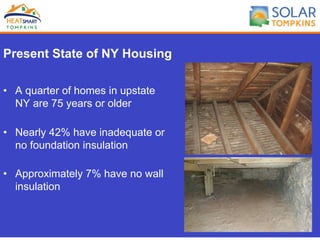
•  A quarter of homes in upstate
NY are 75 years or older
•  Nearly 42% have inadequate or
no foundation insulation
•  Approximately 7% have no wall
insulation
Insulation Types Offered Through HeatSmart
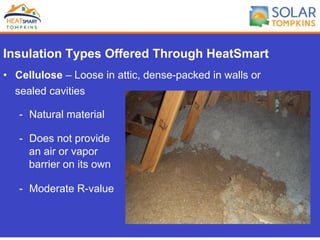
•  Cellulose – Loose in attic, dense-packed in walls or
sealed cavities
-  Natural material
-  Does not provide
an air or vapor
barrier on its own
-  Moderate R-value
•  Spray Foam – Blown application, closed cell material
-  Synthetic plastic that hardens in place
-  Provides both air sealing and vapor barrier
-  Blower agents have been HFC-based, water-based but…
-  Now 4th Gen- Low/No GHG emission, R-value combination
Typical Insulation R-Value Targets
•  R-value is a measure of the resistance of a material to
heat flow. The larger the R-value, the slower the heat moves
across the boundary of that material
•  Attic Flat: R-49
•  Basement/Crawl Space Rim Joists: R-18
•  Basement/Crawl Space Walls Above Grade: R-18
•  Walls: R-20 to R-25
Insulation Type Not Allowed in HeatSmart
•  Fiberglass
- Poor R-value
- Can emit styrene, a
synthetic material that
is likely carcinogenic
- Can reduce lung function,
cause inflammation in
humans and animals
Health & Safety Aspects of Insulation/Air-Sealing
•  Our Best Practices are in compliance with building air flow
standards (natural and/or mechanical ventilation as needed)
•  Adhere to spray foam ventilation/re-occupancy requirements
•  Proper handling of any hazardous existing insulation
-  Vermiculite in walls or attic-- often contains asbestos
-  Pure asbestos insulation often found in stovepipe insulation,
insulation tape on duct work
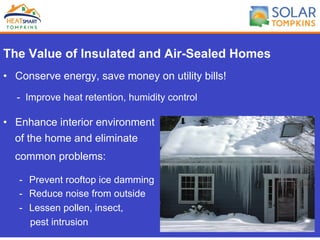
The Value of Insulated and Air-Sealed Homes
•  Conserve energy, save money on utility bills!
- Improve heat retention, humidity control
•  Enhance interior environment
of the home and eliminate
common problems:
-  Prevent rooftop ice damming
-  Reduce noise from outside
-  Lessen pollen, insect,
pest intrusion
Improving the Home Heating (and Cooling) System
•  ~20% of natural gas and ~29% of fuel oil heating systems
in NY State homes are more than 20 years old
•  More than 80% of central AC systems in NY State are not
high efficiency
•  Result: Heat pumps are particularly attractive for homes using
propane or fuel oil – the higher cost fossil fuels that combust
in lower efficiency systems
- NYSERDA, 2014
Sizing the Home Heating System
•  Sized on a design day basis which represents the
temperature above which 99% of the hours of the year
are in our NY State climate zone
•  For heat pump systems in HeatSmart, we use a design
day temperature of 0°F
•  Heat pump system sizes are presented in the unit of “tons”
•  One ton is equal to 12,000 BTUs per hour
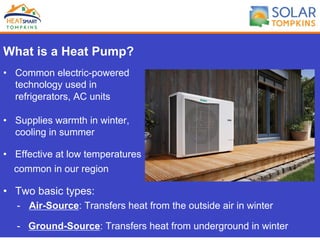
What is a Heat Pump?
•  Common electric-powered
technology used in
refrigerators, AC units
•  Supplies warmth in winter,
cooling in summer
•  Effective at low temperatures
common in our region
•  Two basic types:
-  Air-Source: Transfers heat from the outside air in winter
-  Ground-Source: Transfers heat from underground in winter
Heat Pump Efficiencies
•  Achieve season-long efficiencies above 100%
- Air-source heat pump systems: 200+%
-  Ground-source heat pump systems: 300%
•  Comparatively, range of fossil fuel heaters ≅ 70-95% efficiency
•  For GSHPs, one unit of electricity is used to provide 3 units of
heat energy to the home, resulting in >100% efficiency
- Achieved by electricity running pumps in a compressor
unit that extracts renewable heat from the ground and
transfers it into the home
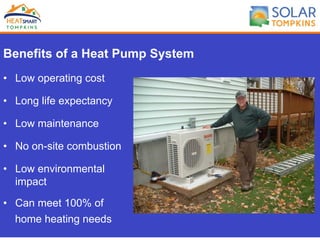
Benefits of a Heat Pump System
•  Low operating cost
•  Long life expectancy
•  Low maintenance
•  No on-site combustion
•  Low environmental
impact
•  Can meet 100% of
home heating needs
Air Source Heat Pumps (ASHPs)
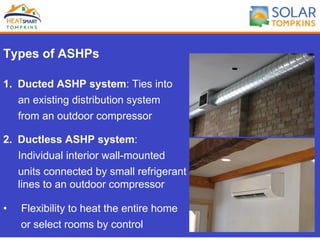
Types of ASHPs
1.  Ducted ASHP system: Ties into
an existing distribution system
from an outdoor compressor
2.  Ductless ASHP system:
Individual interior wall-mounted
units connected by small refrigerant
lines to an outdoor compressor
•  Flexibility to heat the entire home
or select rooms by control
How an ASHP System Works
•  Graphic shows a ductless
ASHP system:
- Compressor unit extracts
heat from the air outside and
transfers it indoors
- Units demonstrated to remain
highly efficient down to at
least -13 oF
- Seasonal efficiencies of 200+%
•  Cold climate hyper-heat
ASHP models can handle
upstate NY winters
•  Advanced inverter-driven
compressor technology
allows heat capture in the
worst winter conditions
•  Units defrost themselves
by briefly reversing heat
flow, included for in
their efficiency rating
ASHP Components
-  Compressor
-  Refrigerant cycle
-  Transfer lines
-  Mini split unit or
ductwork
-  Thermostat
-  Remote control(s)
ASHPs for Domestic Hot Water Heating
•  Domestic hot water can
account for up to 22% of fossil
fuel heating in NY State homes
•  Replacement of an existing
water heater with an ASHP unit
can be a big bang for the buck
•  A good option if a whole home
heat pump system is not feasible
Ground-Source Geothermal Heat Pumps (GSHPs)
How a GSHP System Works
•  The ground provides a relatively
constant temperature (~50oF) for
efficient year-round heat transfer
•  GSHPs move water through
closed pipes in the ground
(a ‘ground loop’ or ‘loopfield’)
and couples with a home's
HVAC distribution system
•  Inside the ground loop is
typically water mixed with safe,
food-grade glycol (~5%) to
prevent freezing and facilitate
heat transfer
•  On a case-by-case basis,
GSHPs can connect with some
hydronic (baseboard, radiant
floor) HVAC distribution systems
GSHP Components
-  Water-based
ground loop
-  Heat Pump
-  Compressor
-  Distribution
system interface
-  Desuperheater
-  Thermostat
GSHP Components
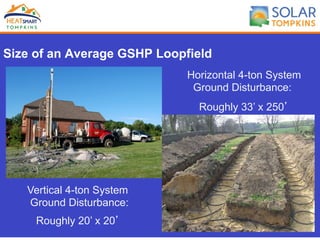
Size of an Average GSHP Loopfield
Horizontal 4-ton System
Ground Disturbance:
Roughly 33’ x 250’
Vertical 4-ton System
Ground Disturbance:
Roughly 20’ x 20’
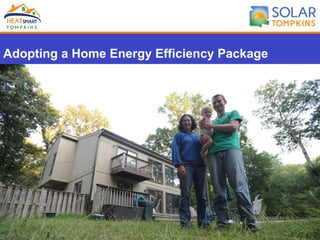
Adopting a Home Energy Efficiency Package
How HeatSmart Helps Tompkins County Residents
•  The program’s structure and process is predicated
on the successful Solarize model
Select
Installer
Marketing
&
Workshops
Enrollment
Site
Assessment
Decision &
Installation
2015/16 Installer Partners Selected
by Competitive RFP Process
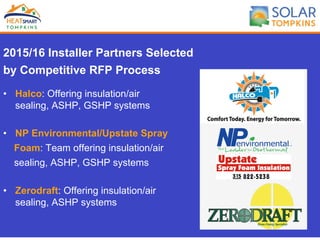
•  Halco: Offering insulation/air
sealing, ASHP, GSHP systems
•  NP Environmental/Upstate Spray
Foam: Team offering insulation/air
sealing, ASHP, GSHP systems
•  Zerodraft: Offering insulation/air
sealing, ASHP systems
Participants choose an Installer Partner
•  Three local companies
(within 50 miles) selected as
HeatSmart Installer Partners
•  Upon enrollment, participants
can speak with each about
products and services before
choosing one
•  Approximately 95% of
customers pick and contract
with that same installer
What Participants Receive After Enrollment
•  Free Home Energy Assessment from Installer Partner:
- Informs residents of
home’s insulation
needs/options
- Helps size a suitable
heat pump system
- Provides enrollees a
set of two proposals
Elements of the Assessment
•  Includes inspection of the house:
- Measures dimensions
- Inspects current insulation and
distribution system
- Infrared imaging and blower
door test to inventory air leaks
•  For accuracy of heat load calculation,
customers provide installers utility data
from the previous year
Presentation of Proposals
•  Installer Partner presents at least two options for a mix of
insulation, air-sealing, and heating system combinations
•  Proposals include a description of all available state/federal
incentives, tax credits, and details of financing options
•  All proposals based on the fixed, below-market pricing
negotiated by HeatSmart Tompkins
Below-Market Pricing
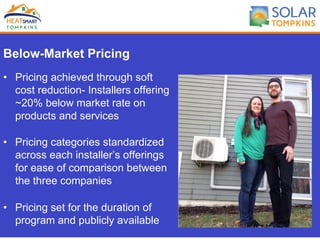
•  Pricing achieved through soft
cost reduction- Installers offering
~20% below market rate on
products and services
•  Pricing categories standardized
across each installer’s offerings
for ease of comparison between
the three companies
•  Pricing set for the duration of
program and publicly available
“Adder” Cost Pricing
•  Examples:
-  Removal of existing attic or basement insulation
-  Post GSHP-installation landscaping beyond basic
leveling, reseeding/strawing and removal of large rocks
-  An upgraded thermostat with extended home heat system
monitoring ability
-  Low/No GHG spray foam blower agent for insulation/
air-sealing work in the home
Incentives for Envelope Efficiency Improvement
•  State - NYSERDA
-  Families above 80% county Median Income: 10% grant up to
$3,000, and NYSERDA low-interest loan available
(NYSERDA Home Performance)
- Families below 80% of county median income: 50% grant up
$5,000, and NYSERDA low interest loan available
(NYSERDA Assisted Home Performance)
- Families below 60% state median income: 100% grant for
selected measures (EmPower NY Program)
Tax Credits for Heating System Improvement
•  Federal
- ENERGY STAR-certified geothermal
heat pump systems eligible for 30%
federal tax credit
•  Installer Partners complete required
state and federal paperwork to assist
HeatSmart program participants
Financing for Home Energy Efficiency Improvement
•  Unsecured Loans
- NYSERDA 3.49% for 5-15 years up to $25,000
-  Home Improvement Loans 6-7% for 10 years up
to $30,000
•  Secured Loans
-  Home Equity Lines or Loans – 3.5-4.5% for 20 years
up to 85% of home valuation minus mortgage
•  Other products from regional and national banks
available through HeatSmart Installer Partners
HeatSmart Case Study Example #1
•  Average 2,000 square foot house with a heat load of 4 tons
•  Current fuel used is propane, costing $3,310/year
•  Preliminary home energy assessment results in proposal for:
-  Cellulose insulation on attic flat
-  Spray foam in basement, down 4 feet of wall and on rim
joists (for moisture/thermal barrier)
-  After these improvements, a 3 ton horizontal GSHP
system to meet the home’s new heat load
HeatSmart Case Study Example #1- Cost Breakdown
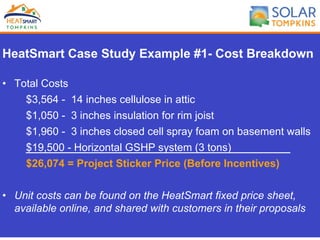
•  Total Costs
$3,564 - 14 inches cellulose in attic
$1,050 - 3 inches insulation for rim joist
$1,960 - 3 inches closed cell spray foam on basement walls
$19,500 - Horizontal GSHP system (3 tons)______
$26,074 = Project Sticker Price (Before Incentives)
•  Unit costs can be found on the HeatSmart fixed price sheet,
available online, and shared with customers in their proposals
HeatSmart Case Study Example #1- Final Cost
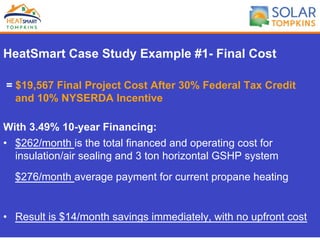
= $19,567 Final Project Cost After 30% Federal Tax Credit
and 10% NYSERDA Incentive
With 3.49% 10-year Financing:
•  $262/month is the total financed and operating cost for
insulation/air sealing and 3 ton horizontal GSHP system
$276/month average payment for current propane heating
•  Result is $14/month savings immediately, with no upfront cost
HeatSmart Case Study Example #1- Savings Details
•  At end of the 10-year loan, cost goes down to just
$68/month electricity cost necessary to operate the system!
•  $14,300 = Home Energy System Savings Over 15 years
(in constant dollars)
•  Significant GHG emissions savings even with grid electricity
ü  5,790 kg CO2 savings from avoided propane use
ü  1,380 kg CO2 emissions from increased electricity use
ü  Net 74% GHG savings total per year
With solar or working with an ESCO, a carbon neutral home is possible!
HeatSmart Case Study Example #2
•  Same 2,000 square foot house with a heat load of 4 tons
•  Same propane heating bill, costing $3,310/year
•  Preliminary home energy assessment results in proposal for the
same insulation package now with an ASHP system:
•  Cellulose insulation on attic flat
•  Spray foam in basement, down 4 feet of wall and on rim
joists (for moisture/thermal barrier)
•  After these improvements, a 3.75 ton ductless ASHP
system to meet the home’s new heat load
HeatSmart Case Study Example #2- Explanation
Why a larger ASHP (3.75 tons) than GSHP (3 tons) for
the same home?
•  ASHPs lose capacity as outdoor temperature drops below 0oF
•  HeatSmart Tompkins requires the sizing of ASHP units to
take this into account to meet 100% of home heating needs
•  Geothermal systems rely on ground temperature which is
more constant throughout the winter, yielding better efficiency
•  Result is a larger ASHP system compared to GSHP system
HeatSmart Case Study Example #2- Final Cost
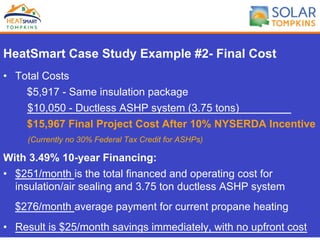
•  Total Costs
$5,917 - Same insulation package
$10,050 - Ductless ASHP system (3.75 tons)
$15,967 Final Project Cost After 10% NYSERDA Incentive
(Currently no 30% Federal Tax Credit for ASHPs)
With 3.49% 10-year Financing:
•  $251/month is the total financed and operating cost for
insulation/air sealing and 3.75 ton ductless ASHP system
$276/month average payment for current propane heating
•  Result is $25/month savings immediately, with no upfront cost
HeatSmart Case Study Example #2- Savings Details
•  At end of the 10-year loan, cost goes down to just
$93/month electricity cost necessary to operate the system!
•  $15,261 = Home Energy System Savings Over 15 years
(in constant dollars)
ü  Significant GHG savings even with grid electricity
ü  Net 64% GHG savings total per year
With solar or working with an ESCO, a carbon neutral home is possible!
Pros and Cons of Heating with ASHPs
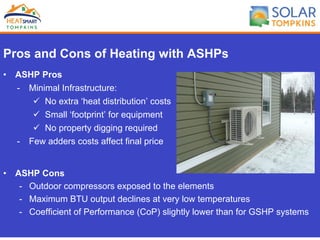
•  ASHP Pros
-  Minimal Infrastructure:
ü  No extra ‘heat distribution’ costs
ü  Small ‘footprint’ for equipment
ü  No property digging required
-  Few adders costs affect final price
•  ASHP Cons
-  Outdoor compressors exposed to the elements
-  Maximum BTU output declines at very low temperatures
-  Coefficient of Performance (CoP) slightly lower than for GSHP systems
Pros and Cons of Heating with GSHPs
•  GSHP Pros
-  Highest efficiency for seasonally-averaged operation
-  Utilizes existing HVAC distribution system in the home
-  30% federal tax-credit reduces final project cost
-  No ‘oversizing’ of system to meet coldest-day demand
-  Ground-loops last 50+ years, pumps/compressors indoors
•  GSHP Cons
-  Requires more land area
-  Adder costs can arise:
ü Vertical loop field drilling, property remediation
ü Heat distribution upgrades (e.g. adapting to hydronic systems)
-  Price rises sharply if ineligible for 30% tax credit
Moving Forward with HeatSmart
•  Get HeatSmart by learning about energy efficiency
technologies in this presentation or watch a video of
our community event on YouTube
•  Speak with HeatSmart and Solar Tompkins staff
•  Review the HeatSmart Best Practice Standards and
fixed pricing guide
•  Consider access to state and federal incentives as
well as local and national financing options
This and more at: SolarTompkins.org
HeatSmart Tompkins
Comfort, Cost, Climate:
Harnessing the Efficiency of Heat Pumps
and Improving Home Energy Performance
in Tompkins County, NY
Matthew Johnston, Program Director
matt@solartompkins.org
www.solartompkins.org

2016-HeatSmart-Presentation-MASTER

  • 1.
    HeatSmart Tompkins Comfort, Cost,Climate: Harnessing the Efficiency of Heat Pumps and Improving Home Energy Performance in Tompkins County, NY Matthew Johnston, Program Director
  • 2.
    What is SolarTompkins? •  A not-for-profit community-based organization •  Promotes the rapid adoption of renewable energy through community education, by providing trusted 3rd party support •  In 2013 and 2014, successfully tripled the amount of solar in Tompkins County What is HeatSmart Tompkins? •  First-of-kind program leading home heating away from fossil fuels •  Promotes better building efficiency through insulation, air sealing, and highly efficient air- and ground-source heat pump systems
  • 3.
    Our Goals ThisYear •  Facilitate more than 100 homes in Tompkins County to adopt these home energy efficiency measures •  Reduce fossil fuel use and mitigate climate change by shrinking both personal and community carbon footprint •  Create and sustain local and regional industry-based job growth •  Stimulate the ongoing development of the home energy efficiency and heat pump markets
  • 4.
    A Proven Model HeatSmartseeks to eliminate the barriers to heat pump and energy efficiency adoption: •  A simple process •  Vetted technology/partners •  Best practice standards •  Educational outreach •  Lower-than-market pricing for participants •  Promote financing options •  Participants motivated by limited time offer 1.  Lack of Familiarity with Technologies 2. Upfront Cost 3. Customer Inertia
  • 5.
    Why is theHeatSmart Program Needed? •  75% of home energy use in Tompkins County goes toward home heating, cooling, and hot water •  Of this energy use, more than 70% is from fossil fuels •  Reducing fossil fuel use is essential to meeting Tompkins County’s 80% GHG emission reduction goal by 2050 •  “The Upstate climate zone is generally the most cost-effective market for heat pumps due to lower equipment and labor costs, and very moderate winter electric costs.” - NYSERDA, 2014
  • 6.
    Why HeatSmart CanWork •  Compelling economics for making these specific home efficiency improvements -  Reductions in labor and equipment cost -  Incentives and tax credits available -  Accessible local and national financing •  Strong homeowner engagement -  Desire for clean, comfortable heating/cooling solutions -  Pride in an energy efficient “legacy property” and resultant increase in home marketability/value -  Civic belief that environmental benefits extend beyond property lines, add value to the community at-large
  • 7.
    What Makes anEnergy Efficient Home?
  • 8.
    Insulating and Air-SealingImprovements •  No single measure alone can achieve an energy efficient home •  Requires a comprehensive approach to the building envelope •  There is a mix of common improvements that can make a significant difference in most homes •  HeatSmart recognizes this– Best Practice Standards are the foundation of our program
  • 9.
    •  In theU.S., a majority of houses lack adequate insulation at key places •  If all leaks in a typical home were combined, they would be equivalent to having a window open every day of the year! - U.S. DOE, EnergyStar Program
  • 10.
    Present State ofNY Housing •  A quarter of homes in upstate NY are 75 years or older •  Nearly 42% have inadequate or no foundation insulation •  Approximately 7% have no wall insulation
  • 11.
    Insulation Types OfferedThrough HeatSmart •  Cellulose – Loose in attic, dense-packed in walls or sealed cavities -  Natural material -  Does not provide an air or vapor barrier on its own -  Moderate R-value
  • 12.
    •  Spray Foam– Blown application, closed cell material -  Synthetic plastic that hardens in place -  Provides both air sealing and vapor barrier -  Blower agents have been HFC-based, water-based but… -  Now 4th Gen- Low/No GHG emission, R-value combination
  • 13.
    Typical Insulation R-ValueTargets •  R-value is a measure of the resistance of a material to heat flow. The larger the R-value, the slower the heat moves across the boundary of that material •  Attic Flat: R-49 •  Basement/Crawl Space Rim Joists: R-18 •  Basement/Crawl Space Walls Above Grade: R-18 •  Walls: R-20 to R-25
  • 14.
    Insulation Type NotAllowed in HeatSmart •  Fiberglass - Poor R-value - Can emit styrene, a synthetic material that is likely carcinogenic - Can reduce lung function, cause inflammation in humans and animals
  • 15.
    Health & SafetyAspects of Insulation/Air-Sealing •  Our Best Practices are in compliance with building air flow standards (natural and/or mechanical ventilation as needed) •  Adhere to spray foam ventilation/re-occupancy requirements •  Proper handling of any hazardous existing insulation -  Vermiculite in walls or attic-- often contains asbestos -  Pure asbestos insulation often found in stovepipe insulation, insulation tape on duct work
  • 16.
    The Value ofInsulated and Air-Sealed Homes •  Conserve energy, save money on utility bills! - Improve heat retention, humidity control •  Enhance interior environment of the home and eliminate common problems: -  Prevent rooftop ice damming -  Reduce noise from outside -  Lessen pollen, insect, pest intrusion
  • 17.
    Improving the HomeHeating (and Cooling) System •  ~20% of natural gas and ~29% of fuel oil heating systems in NY State homes are more than 20 years old •  More than 80% of central AC systems in NY State are not high efficiency •  Result: Heat pumps are particularly attractive for homes using propane or fuel oil – the higher cost fossil fuels that combust in lower efficiency systems - NYSERDA, 2014
  • 18.
    Sizing the HomeHeating System •  Sized on a design day basis which represents the temperature above which 99% of the hours of the year are in our NY State climate zone •  For heat pump systems in HeatSmart, we use a design day temperature of 0°F •  Heat pump system sizes are presented in the unit of “tons” •  One ton is equal to 12,000 BTUs per hour
  • 19.
    What is aHeat Pump? •  Common electric-powered technology used in refrigerators, AC units •  Supplies warmth in winter, cooling in summer •  Effective at low temperatures common in our region •  Two basic types: -  Air-Source: Transfers heat from the outside air in winter -  Ground-Source: Transfers heat from underground in winter
  • 20.
    Heat Pump Efficiencies • Achieve season-long efficiencies above 100% - Air-source heat pump systems: 200+% -  Ground-source heat pump systems: 300% •  Comparatively, range of fossil fuel heaters ≅ 70-95% efficiency •  For GSHPs, one unit of electricity is used to provide 3 units of heat energy to the home, resulting in >100% efficiency - Achieved by electricity running pumps in a compressor unit that extracts renewable heat from the ground and transfers it into the home
  • 21.
    Benefits of aHeat Pump System •  Low operating cost •  Long life expectancy •  Low maintenance •  No on-site combustion •  Low environmental impact •  Can meet 100% of home heating needs
  • 22.
    Air Source HeatPumps (ASHPs)
  • 23.
    Types of ASHPs 1. Ducted ASHP system: Ties into an existing distribution system from an outdoor compressor 2.  Ductless ASHP system: Individual interior wall-mounted units connected by small refrigerant lines to an outdoor compressor •  Flexibility to heat the entire home or select rooms by control
  • 24.
    How an ASHPSystem Works •  Graphic shows a ductless ASHP system: - Compressor unit extracts heat from the air outside and transfers it indoors - Units demonstrated to remain highly efficient down to at least -13 oF - Seasonal efficiencies of 200+%
  • 25.
    •  Cold climatehyper-heat ASHP models can handle upstate NY winters •  Advanced inverter-driven compressor technology allows heat capture in the worst winter conditions •  Units defrost themselves by briefly reversing heat flow, included for in their efficiency rating
  • 26.
    ASHP Components -  Compressor - Refrigerant cycle -  Transfer lines -  Mini split unit or ductwork -  Thermostat -  Remote control(s)
  • 27.
    ASHPs for DomesticHot Water Heating •  Domestic hot water can account for up to 22% of fossil fuel heating in NY State homes •  Replacement of an existing water heater with an ASHP unit can be a big bang for the buck •  A good option if a whole home heat pump system is not feasible
  • 28.
  • 29.
    How a GSHPSystem Works •  The ground provides a relatively constant temperature (~50oF) for efficient year-round heat transfer •  GSHPs move water through closed pipes in the ground (a ‘ground loop’ or ‘loopfield’) and couples with a home's HVAC distribution system
  • 30.
    •  Inside theground loop is typically water mixed with safe, food-grade glycol (~5%) to prevent freezing and facilitate heat transfer •  On a case-by-case basis, GSHPs can connect with some hydronic (baseboard, radiant floor) HVAC distribution systems
  • 31.
    GSHP Components -  Water-based groundloop -  Heat Pump -  Compressor -  Distribution system interface -  Desuperheater -  Thermostat
  • 32.
  • 33.
    Size of anAverage GSHP Loopfield Horizontal 4-ton System Ground Disturbance: Roughly 33’ x 250’ Vertical 4-ton System Ground Disturbance: Roughly 20’ x 20’
  • 34.
    Adopting a HomeEnergy Efficiency Package
  • 35.
    How HeatSmart HelpsTompkins County Residents •  The program’s structure and process is predicated on the successful Solarize model Select Installer Marketing & Workshops Enrollment Site Assessment Decision & Installation
  • 36.
    2015/16 Installer PartnersSelected by Competitive RFP Process •  Halco: Offering insulation/air sealing, ASHP, GSHP systems •  NP Environmental/Upstate Spray Foam: Team offering insulation/air sealing, ASHP, GSHP systems •  Zerodraft: Offering insulation/air sealing, ASHP systems
  • 37.
    Participants choose anInstaller Partner •  Three local companies (within 50 miles) selected as HeatSmart Installer Partners •  Upon enrollment, participants can speak with each about products and services before choosing one •  Approximately 95% of customers pick and contract with that same installer
  • 38.
    What Participants ReceiveAfter Enrollment •  Free Home Energy Assessment from Installer Partner: - Informs residents of home’s insulation needs/options - Helps size a suitable heat pump system - Provides enrollees a set of two proposals
  • 39.
    Elements of theAssessment •  Includes inspection of the house: - Measures dimensions - Inspects current insulation and distribution system - Infrared imaging and blower door test to inventory air leaks •  For accuracy of heat load calculation, customers provide installers utility data from the previous year
  • 40.
    Presentation of Proposals • Installer Partner presents at least two options for a mix of insulation, air-sealing, and heating system combinations •  Proposals include a description of all available state/federal incentives, tax credits, and details of financing options •  All proposals based on the fixed, below-market pricing negotiated by HeatSmart Tompkins
  • 41.
    Below-Market Pricing •  Pricingachieved through soft cost reduction- Installers offering ~20% below market rate on products and services •  Pricing categories standardized across each installer’s offerings for ease of comparison between the three companies •  Pricing set for the duration of program and publicly available
  • 42.
    “Adder” Cost Pricing • Examples: -  Removal of existing attic or basement insulation -  Post GSHP-installation landscaping beyond basic leveling, reseeding/strawing and removal of large rocks -  An upgraded thermostat with extended home heat system monitoring ability -  Low/No GHG spray foam blower agent for insulation/ air-sealing work in the home
  • 43.
    Incentives for EnvelopeEfficiency Improvement •  State - NYSERDA -  Families above 80% county Median Income: 10% grant up to $3,000, and NYSERDA low-interest loan available (NYSERDA Home Performance) - Families below 80% of county median income: 50% grant up $5,000, and NYSERDA low interest loan available (NYSERDA Assisted Home Performance) - Families below 60% state median income: 100% grant for selected measures (EmPower NY Program)
  • 44.
    Tax Credits forHeating System Improvement •  Federal - ENERGY STAR-certified geothermal heat pump systems eligible for 30% federal tax credit •  Installer Partners complete required state and federal paperwork to assist HeatSmart program participants
  • 45.
    Financing for HomeEnergy Efficiency Improvement •  Unsecured Loans - NYSERDA 3.49% for 5-15 years up to $25,000 -  Home Improvement Loans 6-7% for 10 years up to $30,000 •  Secured Loans -  Home Equity Lines or Loans – 3.5-4.5% for 20 years up to 85% of home valuation minus mortgage •  Other products from regional and national banks available through HeatSmart Installer Partners
  • 46.
    HeatSmart Case StudyExample #1 •  Average 2,000 square foot house with a heat load of 4 tons •  Current fuel used is propane, costing $3,310/year •  Preliminary home energy assessment results in proposal for: -  Cellulose insulation on attic flat -  Spray foam in basement, down 4 feet of wall and on rim joists (for moisture/thermal barrier) -  After these improvements, a 3 ton horizontal GSHP system to meet the home’s new heat load
  • 47.
    HeatSmart Case StudyExample #1- Cost Breakdown •  Total Costs $3,564 - 14 inches cellulose in attic $1,050 - 3 inches insulation for rim joist $1,960 - 3 inches closed cell spray foam on basement walls $19,500 - Horizontal GSHP system (3 tons)______ $26,074 = Project Sticker Price (Before Incentives) •  Unit costs can be found on the HeatSmart fixed price sheet, available online, and shared with customers in their proposals
  • 48.
    HeatSmart Case StudyExample #1- Final Cost = $19,567 Final Project Cost After 30% Federal Tax Credit and 10% NYSERDA Incentive With 3.49% 10-year Financing: •  $262/month is the total financed and operating cost for insulation/air sealing and 3 ton horizontal GSHP system $276/month average payment for current propane heating •  Result is $14/month savings immediately, with no upfront cost
  • 49.
    HeatSmart Case StudyExample #1- Savings Details •  At end of the 10-year loan, cost goes down to just $68/month electricity cost necessary to operate the system! •  $14,300 = Home Energy System Savings Over 15 years (in constant dollars) •  Significant GHG emissions savings even with grid electricity ü  5,790 kg CO2 savings from avoided propane use ü  1,380 kg CO2 emissions from increased electricity use ü  Net 74% GHG savings total per year With solar or working with an ESCO, a carbon neutral home is possible!
  • 50.
    HeatSmart Case StudyExample #2 •  Same 2,000 square foot house with a heat load of 4 tons •  Same propane heating bill, costing $3,310/year •  Preliminary home energy assessment results in proposal for the same insulation package now with an ASHP system: •  Cellulose insulation on attic flat •  Spray foam in basement, down 4 feet of wall and on rim joists (for moisture/thermal barrier) •  After these improvements, a 3.75 ton ductless ASHP system to meet the home’s new heat load
  • 51.
    HeatSmart Case StudyExample #2- Explanation Why a larger ASHP (3.75 tons) than GSHP (3 tons) for the same home? •  ASHPs lose capacity as outdoor temperature drops below 0oF •  HeatSmart Tompkins requires the sizing of ASHP units to take this into account to meet 100% of home heating needs •  Geothermal systems rely on ground temperature which is more constant throughout the winter, yielding better efficiency •  Result is a larger ASHP system compared to GSHP system
  • 52.
    HeatSmart Case StudyExample #2- Final Cost •  Total Costs $5,917 - Same insulation package $10,050 - Ductless ASHP system (3.75 tons) $15,967 Final Project Cost After 10% NYSERDA Incentive (Currently no 30% Federal Tax Credit for ASHPs) With 3.49% 10-year Financing: •  $251/month is the total financed and operating cost for insulation/air sealing and 3.75 ton ductless ASHP system $276/month average payment for current propane heating •  Result is $25/month savings immediately, with no upfront cost
  • 53.
    HeatSmart Case StudyExample #2- Savings Details •  At end of the 10-year loan, cost goes down to just $93/month electricity cost necessary to operate the system! •  $15,261 = Home Energy System Savings Over 15 years (in constant dollars) ü  Significant GHG savings even with grid electricity ü  Net 64% GHG savings total per year With solar or working with an ESCO, a carbon neutral home is possible!
  • 54.
    Pros and Consof Heating with ASHPs •  ASHP Pros -  Minimal Infrastructure: ü  No extra ‘heat distribution’ costs ü  Small ‘footprint’ for equipment ü  No property digging required -  Few adders costs affect final price •  ASHP Cons -  Outdoor compressors exposed to the elements -  Maximum BTU output declines at very low temperatures -  Coefficient of Performance (CoP) slightly lower than for GSHP systems
  • 55.
    Pros and Consof Heating with GSHPs •  GSHP Pros -  Highest efficiency for seasonally-averaged operation -  Utilizes existing HVAC distribution system in the home -  30% federal tax-credit reduces final project cost -  No ‘oversizing’ of system to meet coldest-day demand -  Ground-loops last 50+ years, pumps/compressors indoors •  GSHP Cons -  Requires more land area -  Adder costs can arise: ü Vertical loop field drilling, property remediation ü Heat distribution upgrades (e.g. adapting to hydronic systems) -  Price rises sharply if ineligible for 30% tax credit
  • 56.
    Moving Forward withHeatSmart •  Get HeatSmart by learning about energy efficiency technologies in this presentation or watch a video of our community event on YouTube •  Speak with HeatSmart and Solar Tompkins staff •  Review the HeatSmart Best Practice Standards and fixed pricing guide •  Consider access to state and federal incentives as well as local and national financing options This and more at: SolarTompkins.org
  • 57.
    HeatSmart Tompkins Comfort, Cost,Climate: Harnessing the Efficiency of Heat Pumps and Improving Home Energy Performance in Tompkins County, NY Matthew Johnston, Program Director matt@solartompkins.org www.solartompkins.org