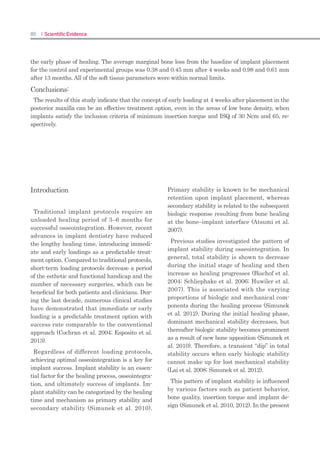
2016. 02. Ver.2
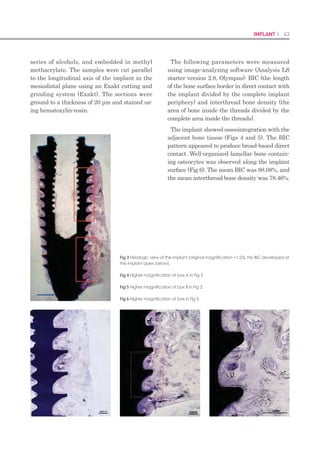
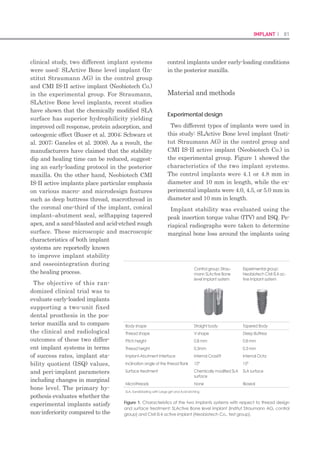
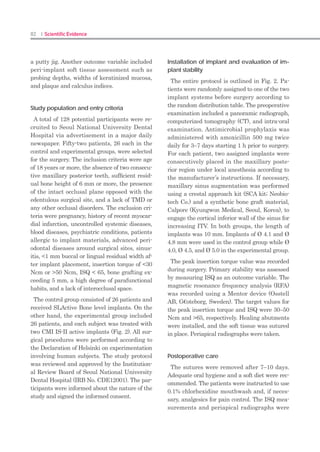
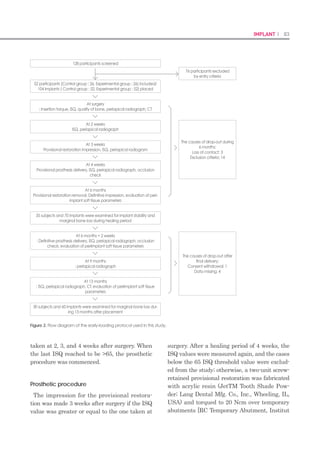
2016C A T A L O G
Scientific
Evidence
N E O B I O T E C H
CLINICAL RESEARCH
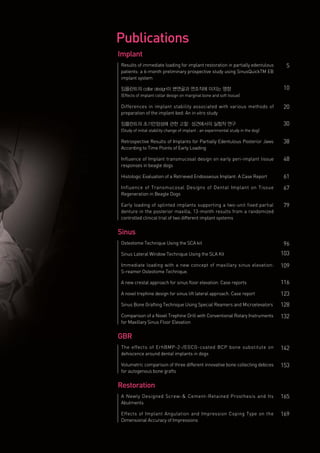
Publications
5
10
20
30
38
48
61
67
79
96
103
109
116
123
128
132
142
153
165
169
Implant
Results of immediate loading for implant restoration in partially edentulous
patients: a 6-month preliminary prospective study using SinusQuickTM EB
implant system
임플란트의 collar design이 변연골과 연조직에 미치는 영향
(Effects of implant collar design on marginal bone and soft tissue)
Differences in implant stability associated with various methods of
preparation of the implant bed: An in vitro study
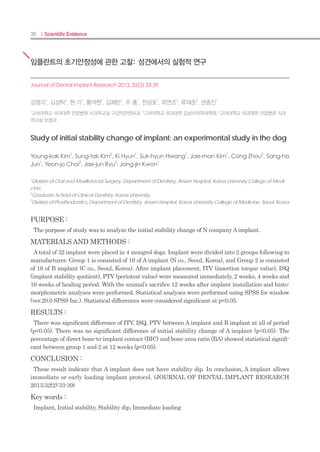
임플란트의 초기안정성에 관한 고찰: 성견에서의 실험적 연구
(Study of initial stability change of implant : an experimental study in the dog)
Retrospective Results of Implants for Partially Edentulous Posterior Jaws
According to Time Points of Early Loading
Influence of Implant transmucosal design on early peri-implant tissue
responses in beagle dogs
Histologic Evaluation of a Retrieved Endosseous Implant: A Case Report
Influence of Transmucosal Designs of Dental Implant on Tissue
Regeneration in Beagle Dogs
Early loading of splinted implants supporting a two-unit fixed partial
denture in the posterior maxilla, 13-month results from a randomized
controlled clinical trial of two different implant systems
Sinus
Osteotome Technique Using the SCA kit
Sinus Lateral Window Technique Using the SLA Kit
Immediate loading with a new concept of maxillary sinus elevation:
S-reamer Osteotome Technique.
A new crestal approach for sinus floor elevation: Case reports
A novel trephine design for sinus lift lateral approach. Case report
Sinus Bone Grafting Technique Using Special Reamers and Microelevators
Comparison of a Novel Trephine Drill with Conventional Rotary Instruments
for Maxillary Sinus Floor Elevation
GBR
The effects of ErhBMP-2-/EGCG-coated BCP bone substitute on
dehiscence around dental implants in dogs
Volumetric comparison of three different innovative bone collecting debices
for autogenous bone grafts
Restoration
A Newly Designed Screw-& Cement-Retained Prosthesis and Its
Abutments
Effects of Implant Angulation and Impression Coping Type on the
Dimensional Accuracy of Impressions
4 I Scientific Evidence 5IMPLANT I
Results of immediate loading for implant restoration in partially edentulous
patients: a 6-month preliminary prospective study using SinusQuickTM
EB
implant system
J Adv Prosthodont 2009;1:136-9
Jong-Hwa Kim1
, DDS, Young-Kyun Kim2
, DDS, MSD, PhD, Yang-Jin Yi3
, DDS, MSD, PhD,
Pil-Young Yun4
, DDS, MSD, PhD, Hyo-Jung Lee5
, DDS, MSD, Myung-Jin Kim6
, DDS, MSD,
In-Sung Yeo7
, DDS, MSD, PhD
1
Resident, 2
Associate Professor, 4
Assistant Professor, Department of Oral and Maxillofacial Surgery,
3
Associate Professor, 7
Assistant Professor, Department of Prosthodontics,
5
Assistant Professor, 6
Clinical Instructor, Department Of Periodontology, Section of Dentistry, Seoul National University
Bundang Hospital
ABSTRACT
STATEMENT OF PROBLEM. Many dental clinicians are concerned about immediate loading of
inserted implants. However, there have been few clinical studies surveying the success rates of im-
mediate loading, based on Korean implant systems. PURPOSE. The aim of this study was to evalu-
ate the outcome of immediate functional loading of the implant (SinusQuickTM
EB, Neobiotech Co.,
Seoul, Korea) in partially edentulous maxilla or mandible. MATERIAL AND METHODS. Total 15
implants were placed. Within 2 weeks after implant insertion, provisional implant-supported fixed
partial dentures were delivered to the patients. Quantitatively, marginal bone loss was measured
at the time of immediate loading, after 3-months of continued loading and at the last follow-up. The
mean follow-up period was 4.8 months. RESULTS. Mean marginal bone loss from implant surgery to
early loading, 3-months follow-up and last follow-up was 0.03 ± 0.07 mm, 0.16 ± 0.17 mm and 0.29 ±
0.19 mm. No implant failed up to 6 months after insertion, resulting in a 100% survival rate. CON-
CLUSION. Immediate loading exhibited high success rate in partial edentulism for up to 6 months.
Well-controlled long term clinical studies with large sample size are necessary to confirm this finding.
KEY WORDS. Immediate loading, Partially edentulous, Dental implant, Prospective clinical study,
Marginal bone loss
Implant
6 I Scientific Evidence 7IMPLANT I
Co., Mortsel, Belgium) system of periapical
radiographs. Measurements were recorded at
the time of surgery, immediate loading, after
3-months of continued loading, and at the last
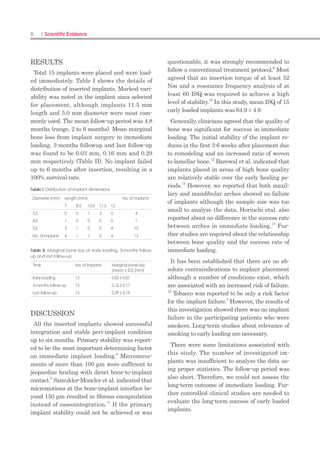
follow-up (Fig. 2). Marginal bone height was
determined on these images by measuring the
distance from a reference point, defined as the
platform of the implant (Fig. 2), to the most
coronal point of bone-to-implant contact on
both the mesial and distal sides of the implant.
A single value for marginal bone height was
then calculated by obtaining the mean of these
two measurements for each implant.
The definition of implant success was based
on the following clinical and radiologic crite-
ria: 1) absence of clinically detectable implant
mobility, 2) absence of pain or any subjective
sensation, 3) absence of recurrent peri-implant
infection, and 4) absence of continuous radiolu-
cency around the implant.10
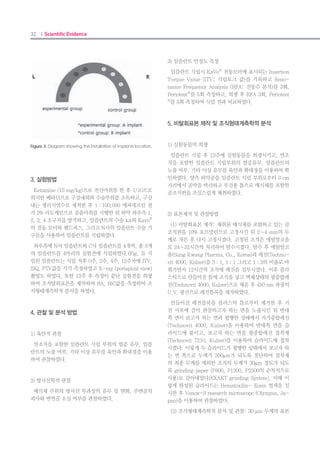
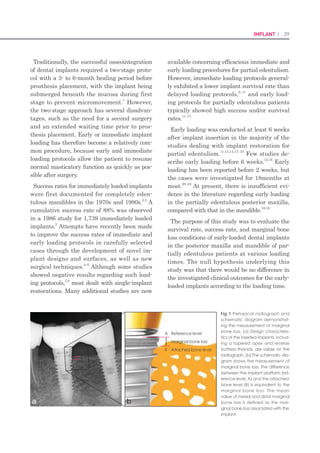
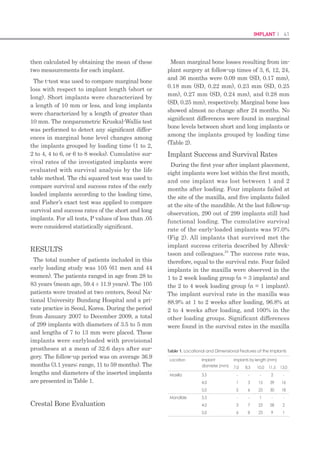
Fig. 2. Periapical radiograph was taken at the time of (A) immediate loading and (B) 3-months after continued loading. The platform
(black arrows) was a reference point to measure marginal bone loss. Provsional resin restoration was made by polymethylmethacry-
late that is radiolucent. Therefore, only temporary cylinders are seen (white arrows).
A B
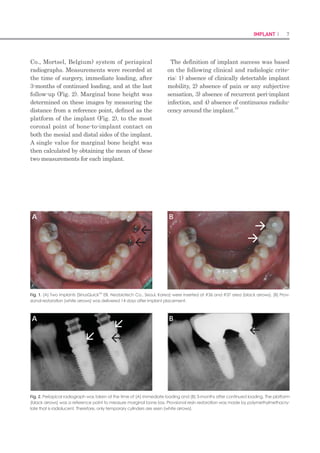
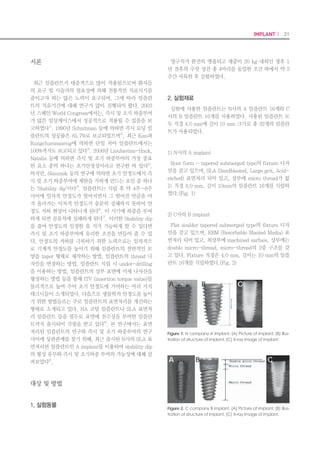
Fig. 1. (A) Two implants (SinusQuickTM
EB, Neobiotech Co., Seoul, Korea) were inserted at #36 and #37 area (black arrows). (B) Prov-
sional restoration (white arrows) was delivered 14 days after implant placement.
A B
INTRODUCTION
Traditionally, implant treatment is based on
a 2-stage protocol with a healing period of 3-6
months during which the implants are sub-
merged to achieve osseointegration.1
Recently,
this clinical suggestion has been challenged.
Numerous practitioners now advocate immedi-
ate or early loading of implants.2
The advan-
tages of immediately loaded implants are clear:
they require shorter treatment periods and al-
low immediate recovery of function and esthet-
ics.3
High success rate of immediately loaded im-
plants in humans was first documented in the
middle 1980s. The 88% cumulative success rate
on 1739 immediately loading implants was sug-
gested.4
The clinical performance and prognosis
of the singlestage surgical protocol are known
to be comparable to the traditional 2-stage
method.5
There are some articles reporting a
cumulative survival rate of 95%, which inves-
tigated immediately loaded single implants.6,7
Results from these studies suggest that imme-
diate loading could achieve equal success rates
as those found in delayed loading.
It is also known as a common claim that treat-
ment with immediate loading improved patient
satisfaction and was cost effective although no
scientific evidence was presented to support.8
However, advantages of early or immediate
loading as mentioned may be offset by an in-
creased risk of implant failure. It was reported
that immediately loaded implants were ap-
proximately 3 times more likely to fail within
1 year of placement.3 Furthermore, there have
been few clinical studies investigating the suc-
cess or failure rates of immediate loading based
on Korean implant systems.
The aim of this preliminary prospective study
was to evaluate the outcome of immediate func-
tional loading in partial edentulism, using Si-
nusQuickTM
EB (Neobiotech Co., Seoul, Korea)
implant system.
MATERIALAND METHODS
Four subjects (2 smokers and 2 non-smokers)
recruited from a population of patients under
routine care at Seoul National Bundang Hos-
pital were enrolled in the study. The patients
were selected according to the following in-
clusion criteria: they were in normal general
health with sufficient bone to allow the place-
ment of implants at least 7 mm length. Pa-
tients with high masticatory or parafunctional
forces were excluded. The mean age of the
subjects was 50.3 years (range from 39 to 65
years), with a gender distribution of 100% men.
Informed written consent was obtained from
all subjects following approved institutional re-
view board guidelines for clinical research.
Surgery was performed under local anesthe-
sia (1 : 100,000 Epinephrine) or conscious in-
travenous sedation with 1% Propofol solution
and Midazolam. After a crestal incision, a mu-
coperiosteal flap was elevated. Implants were
inserted according to the procedures recom-
mended by manufacturers. During the period
from April to October 2009 (range from 2 to 6
months), 15 SinusQuickTM
EB implants were
installed in patients’jaws. Immediate loading
was applied to the implants showing implant
stability quotient (ISQ) and insertion torque
values that were more than 60 and 35 Ncm,
respectively. Immediate loading is defined as
provisional or final implantsupported resto-
ration delivered within 2 weeks.9
Therefore,
provisional implant-supported fixed partial
dentures were delivered within 2 weeks (Fig.
1). The patients were instructed in soft diet and
thorough oral hygiene care. The definite resto-
ration was performed approximately 12 weeks
after implant insertion.
Periapical radiographs were taken using com-
mercially available film holders and a parallel-
ing imaging technique during the investigating
period. In each patient, peri-implant marginal
bone level was evaluated by IMPAX®
(Agfa
8 I Scientific Evidence 9IMPLANT I
RESULTS
Total 15 implants were placed and were load-
ed immediately. Table I shows the details of
distribution of inserted implants. Marked vari-
ability was noted in the implant sizes selected
for placement, although implants 11.5 mm
length and 5.0 mm diameter were most com-
monly used. The mean follow-up period was 4.8
months (range, 2 to 6 months). Mean marginal
bone loss from implant surgery to immediate
loading, 3-months followup and last follow-up
was found to be 0.03 mm, 0.16 mm and 0.29
mm respectively (Table II). No implant failed
up to 6 months after insertion, resulting in a
100% survival rate.
DISCUSSION
All the inserted implants showed successful
integration and stable peri-implant condition
up to six months. Primary stability was report-
ed to be the most important determining factor
on immediate implant loading.6
Micromove-
ments of more than 100 μm were sufficient to
jeopardize healing with direct bone-to-implant
contact.6
Szmukler-Moncler et al. indicated that
micromotions at the bone-implant interface be-
yond 150 μm resulted in fibrous encapsulation
instead of osseointegration.11
If the primary
implant stability could not be achieved or was
Diameter (mm) Length (mm) No. of Implants
7 8.5 10.0 11.5 13
3.5 0 0 1 3 0 4
4.0 1 0 0 0 0 1
5.0 3 1 0 2 4 10
No. of implants 4 1 1 5 4 15
Table I. Distribution of implant dimensions
Time No. of implants Marginal bone loss
(Mean ± SD) (mm)
Early loading 15 0.03 ± 0.07
3-months follow-up 15 0.16 ± 0.17
Last follow-up 15 0.29 ± 0.19
Table II. Marginal bone loss at early loading, 3-months follow-
up and last follow-up
questionable, it was strongly recommended to
follow a conventional treatment protocol.6
Most
agreed that an insertion torque of at least 32
Nm and a resonance frequency analysis of at
least 60 ISQ was required to achieve a high
level of stability.12
In this study, mean ISQ of 15
early loaded implants was 64.9 ± 4.9.
Generally, clinicians agreed that the quality of
bone was significant for success in immediate
loading. The initial stability of the implant re-
duces in the first 3-6 weeks after placement due
to remodeling and an increased ratio of woven
to lamellar bone.12
Barewal et al. indicated that
implants placed in areas of high bone quality
are relatively stable over the early healing pe-
riods.13
However, we reported that both maxil-
lary and mandibular arches showed no failure
of implants although the sample size was too
small to analyze the data. Horiuchi etal. also
reported about no difference in the success rate
between arches in immediate loading.14
Fur-
ther studies are required about the relationship
between bone quality and the success rate of
immediate loading.
It has been established that there are no ab-
solute contraindications to implant placement
although a number of conditions exist, which
are associated with an increased risk of failure.
12
Tobacco was reported to be only a risk factor
for the implant failure.3
However, the results of
this investigation showed there was no implant
failure in the participating patients who were
smokers. Long-term studies about relevance of
smoking to early loading are necessary.
There were some limitations associated with
this study. The number of investigated im-
plants was insufficient to analyze the data us-
ing proper statistics. The follow-up period was
also short. Therefore, we could not assess the
long-term outcome of immediate loading. Fur-
ther controlled clinical studies are needed to
evaluate the long-term success of early loaded
implants.
CONCLUSION
Within the limitation of this clinical study the
preliminary results indicate that immediate
loading of the implants in partial edentulism,
based on SinusQuickTM
EB implant system,
may be successful for short period up to six
months. Well-controlled long term clinical stud-
ies with large sample size are necessary.
ACKNOWLEDGEMENTS
The authors appreciate the financial help for this
clinical research from Neobiotech Co., Korea.
REFERENCES
Adell R, Lekholm U, Rockler B, Brånemark P. A1.	
15-year study of osseointegrated implants in the
treatment of the edentulous jaw. Int J Oral Surg
1981;10:387-416.
Chiapasco M, Gatti C, Rossi E, Haefliger W, Mark-2.	
walder TH. Implant-retained mandibular over-
dentures with immediate loading. A retrospec-
tive multicenter study on 226 consecutive cases.
Clin Oral Implants Res 1997;8:48-57.
Susarla SM, Chuang SK, DodsonTB. Delayed ver-3.	
sus immediate loading of implants: survival analy-
sis and risk factors for dental implant failure. J Oral
Maxillofac Surg 2008;66:251-5.
Babbush CA, Kent JN, Misiek DJ. Titanium plasma-4.	
sprayed (TPS) screw implants for the reconstruc-
tion of the edentulous mandible. J Oral Maxillo-
fac Surg 1986;44:274-82.
Henry P, Rosenberg I. Single-stage surgery for5.	
rehabilitation of the edentulous mandible: pre-
liminary results. Pract Periodontics Aesthet Dent
1994;6:15-22.
Calandriello R, Tomatis M. Immediate Occlusal6.	
Loading of Single Lower Molars Using Brånemark
System(R) Wide Platform TiUnite Implants: A 5-Year
Follow-Up Report of a Prospective Clinical Multi-
center Study. Clin Implant Dent Relat Res 2009.
[Epub ahead of print].
MalóP, Rangert B, Dvärsäater L. Immediate func-7.	
tion of Brånemark implants in the esthetic zone:
a retrospective clinical study with 6 months to 4
years of follow-up. Clin Implant Dent Relat Res
2000;2:138-46.
Attard NJ, Zarb GA. Immediate and early implant8.	
loading protocols: a literature review of clinical
studies. J Prosthet Dent 2005;94:242-58.
Misch CE, Wang HL, Misch CM, Sharawy M, Lem-9.	
ons J, Judy KW. Rationale for the application of
immediated load in implant dentistry: Part I. Im-
plant Dent 2004;13:207-17.
Hobo S, Ichida E, Garcia LT. Osseointegration and10.	
occlusal rehabilitation. Tokyo: Quintessence Pub-
lishing Co., Ltd.; 1989.
Szmukler-Moncler S, Salama H, Reingewirtz Y, Du-11.	
bruille JH. Timing of loading and effect of micro-
motion on bone-dental implant interface: review
of experimental literature. J Biomed Mater Res
1998;43:192-203.
Henry PJ, Liddelow GJ. Immediate loading of12.	
dental implants. Aust Dent J 2008;53:S69-81.
Barewal RM, Oates TW, Meredith N, Cochran DL.13.	
Resonance frequency measurement of implant
stability in vivo on implants with a sandblasted
and acid-etched surface. Int J Oral Maxillofac
Implants 2003;18:641-51.
Horiuchi K, Uchida H, Yamamoto K, Sugimura M.14.	
Immediate loading of Brånemark system implants
following placement in edentulous patients:
a clinical report. Int J Oral Maxillofac Implants
2000;15:824-30.
Corresponding author: In-Sung Yeo
Department of Prosthodontics, Section of Dentistry, Seoul National University Bundang Hospital, 300 Gumi-
dong, Bundang-gu, Seongnam-si, Gyeonggi-do, Korea / Tel: +82 31 787 2780; e-mail: yuriphin@chol.com
Received October 23, 2009 / Last Revision November 4, 2009 / Accepted November 9, 2009
10 I Scientific Evidence 11IMPLANT I
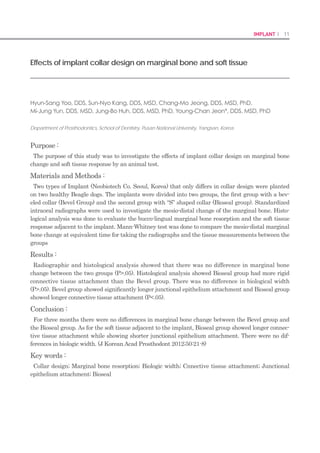
임플란트의 collar design이 변연골과 연조직에 미치는 영향
대한치과보철학회지 2012년 50권 1호
유현상, 강선녀, 정창모, 윤미정, 허중보, 전영찬*
부산대학교 치의학전문대학원 치과보철학교실
연구 목적 :
임플란트 경부가 잘 설계된 경우 양호한 연조직 반응을 통해 변연골을 보존하는데 도움이 된다. 본 실험에서는 연, 경조직
경계부에 가장 가까이 위치하는 임플란트의 collar design이 변연골 변화와 연조직 반응에 미치는 영향을 동물실험을 통해
알아보고자 하였다.
연구 재료 및 방법 :
2마리의 건강한 Beagle dog에 임플란트 collar design만 다른 두 종류의 임플란트(Neobiotech Co. Seoul, Korea)를 식립
하였다. Collar에 bevel 을 부여한 군(Bevel 군)과 “S”자 형태를 부여한 군(Bioseal 군)으로 나누어 마리 당 7개, 군당 7개,
총 14개의 임플란트를 무작위로 식립한 후 Healing abutment를 즉시 체결하였다. 디지털 표준구내 방사선사진을 이용해 4
주 간격으로 총 12주간 근원심 변연골 변화를 관찰하였고, 12주에 희생하여 조직학적 분석을 통해 협설 변연골 흡수 및 임플
란트 주변 연조직 반응을 평가하였다. Mann-Whitney test를 통해 동일한 방사선 사진 촬영 시점에서 근원심 변연골 변화
량 및 조직계측치를 군 간 비교하였고, Kruskal-Wallis test를 통해 방사선 사진상 근원심 변연골 변화량이 시간에 따른 차
이가 있는지 군 내 분석 한 후 Duncan test를 통해 사후 검증하였다(α=.05).
결과 :
방사선학적 분석 결과 각 촬영 시점에서 두 군간 근원심 변연골 변화량의 차이를 보이지 않았다(P>.05). 군 내에서 시간에
따른 근원심 변연골의 흡수량을 분석한 결과 Bevel 군에서는 시간에 따른 차이를 보이지 않았으나 (P>.05), Bioseal 군에서
는 시간에 따른 차이를 보였으며, 4주및8주와 비교했을 때 12주에서 변연골의 증가를 보였다(P<.05). 조직학적 분석 결과
협설측 변연골 흡수량에서 두 군간 차이를 보이지 않았으나 (P>.05), Bevel 군에 비해 Bioseal 군에서 더 견고한 결합조직부
착을 관찰할 수 있었으며, 생물학적 폭경의 값은 두 집단 간 차이를 보이지 않은 반면에 (P>.05), 접합상피부착은 Bevel 군
에서 유의하게 길었고, 결합조직부착은 Bioseal 군에서 더 길게 나타났다 (P<.05).
결론 :
Bevel 군에 비해 Bioseal 군에서 결합조직부착은 길게 형성된 반면에 접합상피부착은 더 짧게 나타났으며, 생물학적 폭경
과 초기 변연골 흡수에는 차이가 없음을 알 수 있었다. 연조직 반응의 차이가 실제 기능하중 하에서 변연골 변화에 미치는 영
향에 대해서 향후 연구가 필요할 것으로 생각된다. (대한치과보철학회지 2012;50:21-8)
주요단어 :
Collar design; 변연골흡수; 생물학적 폭경; 결합조직부착; 접합상피부착; Bioseal
Effects of implant collar design on marginal bone and soft tissue
Hyun-Sang Yoo, DDS, Sun-Nyo Kang, DDS, MSD, Chang-Mo Jeong, DDS, MSD, PhD,
Mi-Jung Yun, DDS, MSD, Jung-Bo Huh, DDS, MSD, PhD, Young-Chan Jeon*, DDS, MSD, PhD
Department of Prosthodontics, School of Dentistry, Pusan National University, Yangsan, Korea
Purpose :
The purpose of this study was to investigate the effects of implant collar design on marginal bone
change and soft tissue response by an animal test.
Materials and Methods :
Two types of Implant (Neobiotech Co. Seoul, Korea) that only differs in collar design were planted
on two healthy Beagle dogs. The implants were divided into two groups, the first group with a bev-
eled collar (Bevel Group) and the second group with “S” shaped collar (Bioseal group). Standardized
intraoral radiographs were used to investigate the mesio-distal change of the marginal bone. Histo-
logical analysis was done to evaluate the bucco-lingual marginal bone resorption and the soft tissue
response adjacent to the implant. Mann-Whitney test was done to compare the mesio-distal marginal
bone change at equivalent time for taking the radiographs and the tissue measurements between the
groups
Results :
Radiographic and histological analysis showed that there was no difference in marginal bone
change between the two groups (P>.05). Histological analysis showed Bioseal group had more rigid
connective tissue attachment than the Bevel group. There was no difference in biological width
(P>.05). Bevel group showed significantly longer junctional epithelium attachment and Bioseal group
showed longer connective tissue attachment (P<.05).
Conclusion :
For three months there were no differences in marginal bone change between the Bevel group and
the Bioseal group. As for the soft tissue adjacent to the implant, Bioseal group showed longer connec-
tive tissue attachment while showing shorter junctional epithelium attachment. There were no dif-
ferences in biologic width. (J Korean Acad Prosthodont 2012;50:21-8)
Key words :
Collar design; Marginal bone resorption; Biologic width; Cnnective tissue attachment; Junctional
epithelium attachment; Bioseal
12 I Scientific Evidence 13IMPLANT I
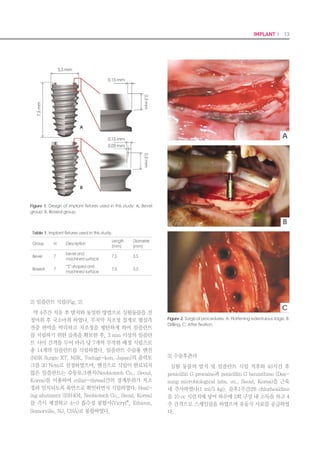
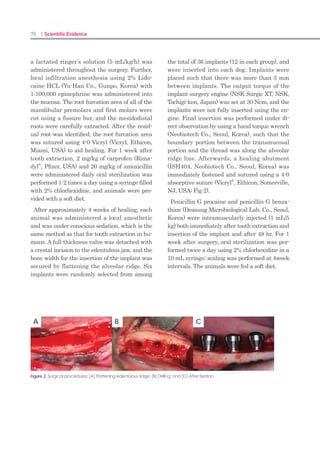
2) 임플란트 식립(Fig. 2)
약 4주간 치유 후 발치와 동일한 방법으로 실험동물을 진
정마취 후 국소마취 하였다. 무치악 치조정 절개로 협설측
전층 판막을 박리하고 치조정을 평탄하게 하여 임플란트
를 식립하기 위한 골폭을 확보한 후, 3 mm 이상의 임플란
트 사이 간격을 두어 마리 당 7개씩 무작위 배정 식립으로
총 14개의 임플란트를 식립하였다. 임플란트 수술용 엔진
(NSK Surgic XT, NSK, Tochigi-ken, Japan)의 출력토
크를 30 Ncm로 설정하였으며, 엔진으로 식립이 완료되지
않은 임플란트는 수동토크렌치(Neobiotech Co., Seoul,
Korea)를 이용하여 collar-thread간의 경계부위가 치조
정과 일치되도록 육안으로 확인하면서 식립하였다. Heal-
ing abutment (ISH404, Neobiotech Co., Seoul, Korea)
를 즉시 체결하고 4-0 흡수성 봉합사(Vicryl®
, Ethicon,
Somerville, NJ, USA)로 봉합하였다.
3) 수술후관리
실험 동물의 발치 및 임플란트 식립 직후와 48시간 후
penicillin G procaine과 penicillin G benzathine (Dea-
sung microbiological labs. co., Seoul, Korea)을 근육
내 주사하였다(1 ml/5 kg). 술후1주간2% chlorhexidine
을 10 cc 시린지에 넣어 하루에 2회 구강 내 소독을 하고 4
주 간격으로 스케일링을 하였으며 유동식 사료를 공급하였
다.
Table 1. Implant fixtures used in this study.
Group N Description
Length
(mm)
Diameter
(mm)
Bevel 7
bevel and
machined surface
7.5 3.5
Bioseal 7
“S”-shaped and
machined surface
7.5 3.5
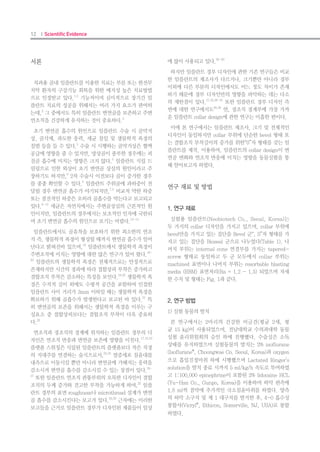
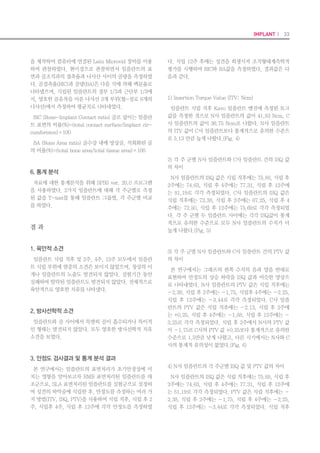
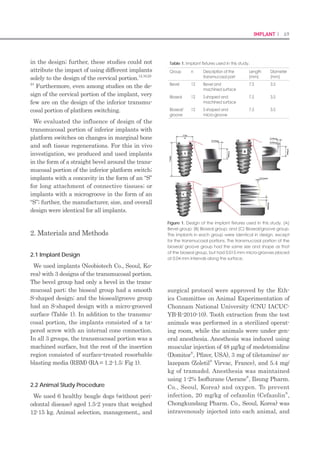
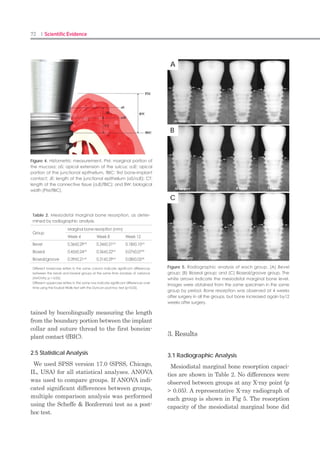
Figure 1. Design of implant fixtures used in this study: A, Bevel
group; B, Bioseal group.
Figure 2. Surgical procedures. A: Flattening edentulous ridge, B:
Drilling, C: After fixation.
0.15 mm
0.15 mm
0.05 mm
3.5 mm
0.5mm
7.5mm
0.5mm
A
B
C
서론
치과용 골내 임플란트를 이용한 치료는 부분 또는 완전무
치악 환자의 구강기능 회복을 위한 예지성 높은 치료방법
으로 인정받고 있다.1,2
기능적이며 심미적으로 장기간 임
플란트 치료의 성공을 위해서는 여러 가지 요소가 관여하
는데,3
그 중에서도 특히 임플란트 변연골을 보존하고 주변
연조직을 건강하게 유지하는 것이 중요하다.4
초기 변연골 흡수의 원인으로 임플란트 수술 시 골막거
상, 골삭제, 과도한 응력, 세균 침입 및 생물학적 폭경의
침범 등을 들 수 있다.5
수술 시 시행하는 골막거상은 혈액
공급에 영향을 줄 수 있지만, 망상골이 풍부한 경우에는 피
질골 흡수에 미치는 영향은 크지 않다.5
임플란트 식립 드
릴링으로 인한 외상이 초기 변연골 상실의 원인이라고 주
장하기도 하지만,6
2차 수술시 이전보다 골이 증가한 경우
를 종종 확인할 수 있다.5
임플란트 주위골에 과하중이 전
달될 경우 변연골 흡수가 야기되지만,7,8
비교적 약한 하중
또는 점진적인 하중은 오히려 골흡수를 막는다고 보고되고
있다.9-12
세균은 자연치에서는 주변골상실의 근본적인 원
인이지만, 임플란트의 경우에서는 보조적인 인자에 국한되
며 초기 변연골 흡수의 원인으로 보기는 어렵다.13-15
임플란트에서도 골유착을 보호하기 위한 최소한의 연조
직 즉, 생물학적 폭경이 형성될 때까지 변연골 흡수가 일어
난다고 밝혀진바 있으며,16
임플란트에서 생물학적 폭경이
주변조직에 미치는 영향에 대한 많은 연구가 있어 왔다.16-
20
임플란트의 생물학적 폭경은 전체적으로는 안정적으로
존재하지만 시간의 경과에 따라 접합상피 부착은 증가하고
결합조직 부착은 감소하는 특징을 보인다.19,20
생물학적 폭
경은 수직적 길이 외에도 수평적 공간을 포함하여 인접한
임플란트 사이 거리가 3mm 이하일 때는 생물학적 폭경을
확보하기 위해 골흡수가 발생한다고 보고된 바 있다.21
특
히 변연골의 보존을 위해서는 생물학적 폭경을 이루는 구
성요소 중 접합상피보다는 결합조직 부착이 더욱 중요하
다.22
연조직과 경조직의 경계에 위치하는 임플란트 경부의 디
자인은 연조직 반응과 변연골 보존에 영향을 미친다.17,18,22
플랫폼 스위칭은 식립된 임플란트의 플랫폼보다 작은 직경
의 지대주를 연결하는 술식으로서,23,24
염증세포 침윤대를
내측으로 이동시킬 뿐만 아니라 변연골에 가해지는 응력을
감소시켜 변연골 흡수를 감소시킬 수 있는 장점이 있다.25-
27
또한 임플란트 연조직 관통부위의 오목한 디자인이 결합
조직의 두께 증가와 견고한 부착을 가능하게 하며,22
임플
란트 경부의 표면 roughness나 microthread 설계가 변연
골 흡수를 감소시킨다는 보고가 있다.28,29
근자에는 이러한
보고들을 근거로 임플란트 경부가 디자인된 제품들이 임상
에 많이 사용되고 있다.28-30
하지만 임플란트 경부 디자인에 관한 기존 연구들은 비교
한 임플란트의 제조사가 다르거나, 크기뿐만 아니라 경부
이외에 다른 부분의 디자인에서도 어느 정도 차이가 존재
하기 때문에 경부 디자인만의 영향을 파악하는 데는 다소
의 제한점이 있다.17,22,28-31
또한 임플란트 경부 디자인 측
면에 대한 연구에서도28,29
연, 경조직 경계부에 가장 가까
운 임플란트 collar design에 관한 연구는 미흡한 편이다.
이에 본 연구에서는 임플란트 제조사, 크기 및 전체적인
디자인이 동일하지만 collar 부위에 단순한 bevel 형태 또
는 결합조직 부착길이의 증가를 위한“S”자 형태를 갖는 임
플란트를 제작, 이용하여, 임플란트의 collar design이 변
연골 변화와 연조직 반응에 미치는 영향을 동물실험을 통
해 알아보고자 하였다.
연구 재료 및 방법
1. 연구 재료
실험용 임플란트(Neobiotech Co., Seoul, Korea)는
두 가지의 collar 디자인을 가지고 있으며, collar 부위에
bevel만을 가지고 있는 집단을 Bevel 군“, S”자 형태를 가
지고 있는 집단을 Bioseal 군으로 나누었다(Table 1). 나
머지 부위는 internal cone 연결부를 가지는 tapered-
screw 형태로 동일하고 두 군 모두에서 collar 부위는
machined 표면이나 나머지 부위는 resorbable blasting
media (RBM) 표면처리(Ra = 1.2 - 1.5) 되었으며 자세
한 수치 및 형태는 Fig. 1과 같다.
2. 연구 방법
1) 실험 동물의 발치
본 연구에서는 2마리의 건강한 비글견(평균 2세, 평
균 15 kg)이 사용되었으며, 전남대학교 수의과대학 동물
실험 윤리위원회의 승인 하에 진행했다. 수술실은 소독
상태를 유지하였으며 실험동물의 발치는 2% isoflurane
(Isoflurane®
, Choongwae Co. Seoul, Korea)과 oxygen
으로 흡입진정마취 하에 시행했으며 Lactated Ringer’s
solution을 발치 종료 시까지 5 ml/kg/h 속도로 투여하였
고 1:100,000 epinephrine이 포함된 2% lidocaine HCL
(Yu-Han Co., Gunpo, Korea)을 이용하여 하악 편측에
1.8 ml씩 점막에 추가적인 국소침윤마취를 하였다. 양측
의 하악 소구치 및 제 1 대구치를 발거한 후, 4-0 흡수성
봉합사(Vicryl®
, Ethicon, Somerville, NJ, USA)로 봉합
하였다.
14 I Scientific Evidence 15IMPLANT I
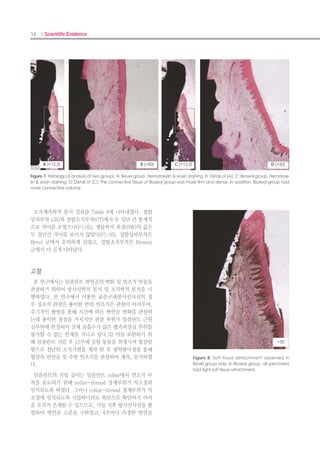
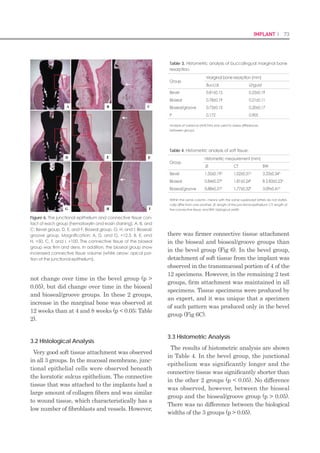
계측점을 이용하여 다음을 구하였다(Fig. 4).
JE: length of junctional epithelium (aS-aJE, mm)
CT: length of connective tissue (aJE-fBIC, mm)
BW: biologic width (PM-fBIC, mm)
임플란트 collar-thread간의 경계부위에서 fBIC (first
bone-implant contact)까지의 길이를 협설측에서 측정하
여 변연골 흡수량을 구하였다.
6) 통계 분석
본 연구는 SPSS (Ver. 17.0, SPSS, Chicago, IL, USA)
를 사용하여 통계 처리하였다. 실험 결과에 대한 정규성 검
정을 실시한 결과 정규성을 만족하지 않아 비모수적 방법
으로 분석하였다. Mann-Whitney test를 통해 동일한 방
사선 사진 촬영 시점에서 근원심 변연골 변화량 및 조직계
측치를 군 간 비교하였고, Kruskal-Wallis test를 통해 방
사선 사진 상 근원심 변연골 변화량이 시간에 따른 차이가
있는지 군 내 분석 한 후 Duncan test를 통해 사후 검증하
였다. 유의 수준5%에서 검정하였다.
결과
1. 임플란트 주위 변연골 변화
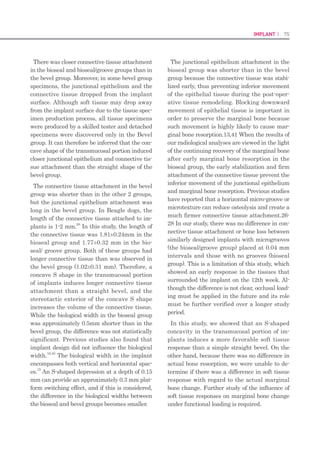
방사선 촬영을 통해 근원심 변연골 흡수량을 계산한 결
과는 Table 2와 같으며, 각 촬영 시점에서 두 군간 차이를
보이지 않았다(P>.05). 각군의대표적인방사선사진을Figs.
5, 6에나타내었다.
군 내에서 시간에 따른 근원심 변연골의 흡수량을 분석한
결과 Bevel 군에서는 시간에 따른 차이를 보이지 않았으나
(P>.05), Bioseal 군에서는 시간에 따른 차이를 보였으며,
4주및8주와 비교했을 때 12주에서 변연골 증가를 보였다
(P<.05) (Table 2).
조직학적 분석을 통해 희생 시의 협설측 변연골 흡수량을
비교한 결과를Table 3에 나타내었으며, 두 군간 차이를 보
이지 않았다(P>.05).
2. 임플란트 주위 연조직 반응
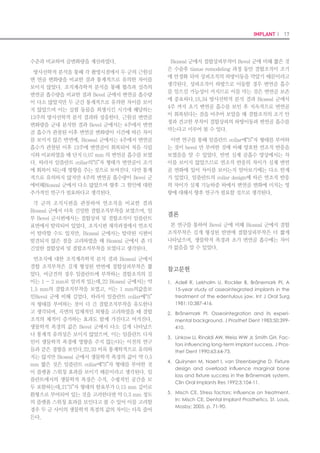
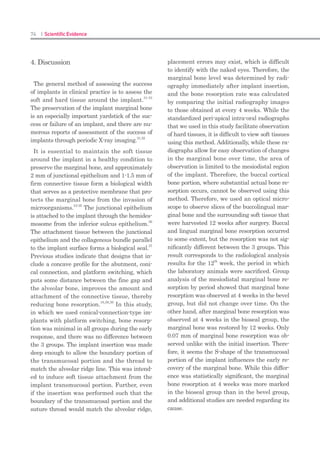
조직시편을 관찰한 결과 Bevel 군에 비해 Bioseal 군에
서 더 견고한 결합조직부착을 관찰할 수 있었으며(Fig. 7),
Bevel 군에서는 2개의 시편에서 연조직이 임플란트에서
탈락되었으나, Bioseal 군에서는 연조직 부착이 탈락된 시
편은 없었다(Fig. 8).
Table 2. Mesiodistal marginal bone resorption in
radiographic analysis
Group
Marginal bone resorption (mm)
Week 4 Week 8 Week 12
Bevel 0.26 ± 0.29aA
0.34 ± 0.33aA
0.14 ± 0.31aA
Bioseal 0.45 ± 0.30aA
0.36 ± 0.30aA
0.07 ± 0.26aB
Different lowercase letters in the same column indicate significant differences
between Bevel and Bioseal at the same time using Mann-Whitney test (P<.05).
Different uppercase letters in the same row indicate significant differences ac-
cording to time using Kruskal-Wallis test and Duncan post-hoc test (P<.05).
Table 3. Buccolingual marginal bone resorption in
histometric analysis
Group
Marginal bone resorption (mm)
Buccal Lingual
Bevel 0.91 ± 0.17 0.25 ± 0.23
Bioseal 0.77 ± 0.20 0.23 ± 0.16
P 0.132 0.937
Mann-Whitney test was used to assess differences between Bevel and Bioseal.
Table 4. Result of histometric analysis for soft tissue
Group
Histometric measurement (mm)
JE CT BW
Bevel 1.25 ± 0.19 1.09 ± 0.31 3.33 ± 0.34
Bioseal 0.84 ± 0.27 1.54 ± 0.20 2.83 ± 0.23
P 0.015 0.004 0.065
Mann-Whitney test was used to assess differences between Bevel and Bioseal.
JE, length of junctional epithelium ; CT, length of connective tissue; BW, biologic
width.
Week 0 Week 4 Week 8 Week 12
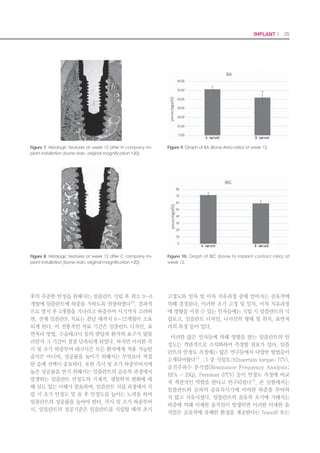
Figure 5. Radiographic analysis on Bevel group. The white ar-
rows indicate mesiodistal marginal bone level.
Week 0 Week 4 Week 8 Week 12
Figure 6. Radiographic analysis on Bioseal group. The white ar-
rows indicate mesiodistal marginal bone level.
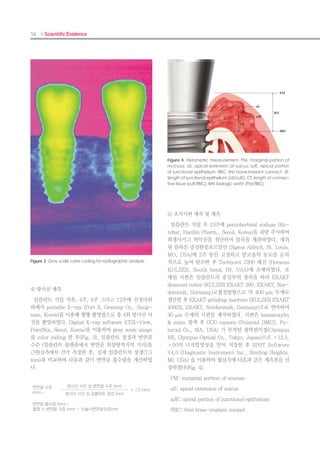
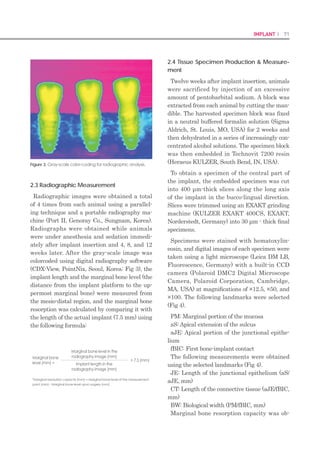
Figure 3. Gray scale color coding for radiographic analysis.
Figure 4. Histometric measurement. PM, marginal portion of
mucosa; aS, apical extension of sulcus; aJE, apical portion
of junctional epithelium, fBIC, first bone-implant contact; JE,
length of junctional epithelium (aS/aJE); CT, length of connec-
tive tissue (aJE/fBIC); BW, biologic width (PM/fBIC).
4) 방사선 계측
임플란트 식립 직후, 4주, 8주 그리고 12주에 진정마취
하에서 portable X-ray (Port II, Genoray Co., Sung-
nam, Korea)를 이용해 평행 촬영법으로 총 4회 방사선 사
진을 촬영하였다. Digital X-ray software (CDX-View,
PointNix, Seoul, Korea)를 이용하여 gray scale image
를 color coding 한 후(Fig. 3), 임플란트 장경과 변연골
수준 (임플란트 플랫폼에서 변연골 최상방까지의 거리)을
근원심측에서 각각 측정한 후, 실제 임플란트의 장경(7.5
mm)과 비교하여 다음과 같이 변연골 흡수량을 계산하였
다.
5) 조직시편 제작 및 계측
임플란트 식립 후 12주에 pentobarbital sodium (En-
tobar, Hanlim Pharm., Seoul, Korea)을 과량 주사하여
희생시키고 하악골을 절단하여 블록을 채취하였다. 채취
된 블록은 중성완충포르말린 (Sigma Aldrich, St. Louis,
MO, USA)에 2주 동안 고정하고 알코올의 농도를 순차
적으로 높여 탈수한 후 Technovit 7200 레진 (Heraeus
KULZER, South bend, IN, USA)에 포매하였다. 포
매된 시편은 임플란트의 중심부의 장축을 따라 EXAKT
diamond cutter (KULZER EXAKT 300, EXAKT, Nor-
derstedt, Germany)로협설방향으로 약 400 μm 두께로
절단한 후 EXAKT grinding machine (KULZER EXAKT
400CS, EXAKT, Norderstedt, Germany)으로 연마하여
30 μm 두께의 시편을 제작하였다. 시편은 hematoxylin
& eosin 염색 후 CCD camera (Polaroid DMC2, Po-
laroid Co., MA, USA) 가 부착된 광학현미경(Olympus
BX, Olympus Optical Co., Tokyo, Japan)으로 ×12.5,
×50의 디지털영상을 얻어 저장한 후 SPOT Software
V4.0 (Diagnostic Instrument Inc., Sterling Heights,
MI, USA) 을 이용하여 협설측에 다음과 같은 계측점을 선
정하였다(Fig. 4).
PM: marginal portion of mucosa
aS: apical extension of sulcus
aJE: apical portion of junctional epithelium
fBIC: first bone-implant contact
변연골 수준
(mm) =
방사선 사진 상 변연골 수준 (mm)
× 7.5 (mm)
방사선 사진 상 임플란트 장경 (mm)
변연골 흡수량 (mm) =
촬영 시 변연골 수준 (mm) - 수술시변연골수준(mm)
16 I Scientific Evidence 17IMPLANT I
Bioseal 군에서 접합상피부착이 Bevel 군에 비해 짧은 것
은 수술후 tissue remodeling 과정 동안 결합조직이 조기
에 안정화 되어 상피조직의 하방이동을 막았기 때문이라고
생각된다. 상피조직이 하방으로 이동할 경우 변연골 흡수
를 일으킬 가능성이 커지므로 이를 막는 것은 변연골 보존
에 중요하다.18,34 방사선학적 분석 결과 Bioseal 군에서
4주 까지 초기 변연골 흡수를 보인 후 지속적으로 변연골
이 회복된다는 점을 비추어 보았을 때 결합조직의 조기 안
정과 견고한 부착이 접합상피의 하방이동과 변연골 흡수를
막는다고 미루어 볼 수 있다.
이번 연구를 통해 임플란트 collar에“S”자 형태를 부여하
는 것이 bevel 만 부여한 것에 비해 양호한 연조직 반응을
보였음을 알 수 있었다. 반면 실제 골흡수 양상에서는 차
이를 보이지 않았으므로 연조직 반응의 차이가 실제 변연
골 변화에 있어 차이를 보이는지 알아보기에는 다소 한계
가 있었다. 임플란트의 collar design에 따른 연조직 반응
의 차이가 실제 기능하중 하에서 변연골 변화에 미치는 영
향에 대해서 향후 연구가 필요할 것으로 생각된다.
결론
본 연구를 통하여 Bevel 군에 비해 Bioseal 군에서 결합
조직부착은 길게 형성된 반면에 접합상피부착은 더 짧게
나타났으며, 생물학적 폭경과 초기 변연골 흡수에는 차이
가 없음을 알 수 있었다.
참고문헌
Adell R, Lekholm U, Rockler B, Brånemark PI. A1.	
15-year study of osseointegrated implants in the
treatment of the edentulous jaw. Int J Oral Surg
1981;10:387-416.
Brånemark PI. Osseointegration and its experi-2.	
mental background. J Prosthet Dent 1983;50:399-
410.
Linkow LI, Rinaldi AW, Weiss WW Jr, Smith GH. Fac-3.	
tors influencing long-term implant success. J Pros-
thet Dent 1990;63:64-73.
Quirynen M, Naert I, van Steenberghe D. Fixture4.	
design and overload influence marginal bone
loss and fixture success in the Brånemark system.
Clin Oral Implants Res 1992;3:104-11.
Misch CE. Stress factors: influence on treatment.5.	
In: Misch CE. Dental Implant Prosthetics. St. Louis,
Mosby; 2005. p. 71-90.
수준과 비교하여 골변화량을 계산하였다.
방사선학적 분석을 통해 각 촬영시점에서 두 군의 근원심
변 연골 변화량을 비교한 결과 통계적으로 유의한 차이를
보이지 않았다. 조직계측학적 분석을 통해 협측과 설측의
변연골 흡수량을 비교한 결과 Bevel 군에서 변연골 흡수량
이 다소 많았지만 두 군간 통계적으로 유의한 차이를 보이
지 않았으며 이는 실험 동물을 희생시킨 시기에 해당하는
12주의 방사선학적 분석 결과와 상응한다. 근원심 변연골
변화량을 군내 분석한 결과 Bevel 군에서는 4주에서 변연
골 흡수가 관찰된 이후 변연골 변화량이 시간에 따른 차이
를 보이지 않은 반면에, Bioseal 군에서는 4주에서 변연골
흡수가 관찰된 이후 12주에 변연골이 회복되어 처음 식립
시와 비교하였을 때 단지 0.07 mm 의 변연골 흡수를 보였
다. 따라서 임플란트 collar의“S”자 형태가 변연골이 조기
에 회복이 되는데 영향을 주는 것으로 보여진다. 다만 통계
적으로 유의하지 않지만 4주의 변연골 흡수량이 Bevel 군
에비해Bioseal 군에서 다소 많았으며 향후 그 원인에 대한
추가적인 연구가 필요하다고 생각된다.
각 군의 조직시편을 관찰하여 연조직을 비교한 결과
Bioseal 군에서 더욱 긴밀한 결합조직부착을 보였으며, 일
부 Bevel 군시편에서는 접합상피 및 결합조직이 임플란트
표면에서 탈락되어 있었다. 조직시편 제작과정에서 연조직
이 탈락할 수도 있지만, Bioseal 군에서는 탈락된 시편이
발견되지 않은 점을 고려하였을 때 Bioseal 군에서 좀 더
긴밀한 접합상피 및 결합조직부착을 보였다고 생각된다.
연조직에 대한 조직계측학적 분석 결과 Bioseal 군에서
결합 조직부착은 길게 형성된 반면에 접합상피부착은 짧
았다. 비글견의 경우 임플란트에 부착하는 결합조직의 길
이는 1 - 2 mm로 알려져 있는데,22 Bioseal 군에서는 약
1.5 mm의 결합조직부착을 보였고, 이는 1 mm의값을보
인Bevel 군에 비해 길었다. 따라서 임플란트 collar에“S”
자 형태를 부여하는 것이 더 긴 결합조직부착을 유도한다
고 생각되며, 곡면의 입체적인 외형을 고려하였을 때 결합
조직의 체적이 증가하는 효과도 함께 가진다고 여겨진다.
생물학적 폭경의 값은 Bevel 군에서 다소 길게 나타났으
나 통계적 유의성은 보이지 않았으며, 이는 임플란트 디자
인이 생물학적 폭경에 영향을 주지 않는다는 이전의 연구
들과 같은 경향을 보인다.22,33 비록 통계학적으로 유의하
지는 않지만 Bioseal 군에서 생물학적 폭경의 값이 약 0.5
mm 짧은 것은 임플란트 collar에“S”자 형태를 부여한 것
이 플랫폼 스위칭 효과를 보이기 때문이라고 생각된다. 임
플란트에서의 생물학적 폭경은 수직, 수평적인 공간을 모
두 포함하는데,21“S”자 형태의 함요부가 0.15 mm 깊이로
환형으로 부여되어 있는 것을 고려한다면 약 0.3 mm 정도
의 플랫폼 스위칭 효과를 보인다고 볼 수 있어 이를 고려할
경우 두 군 사이의 생물학적 폭경의 값의 차이는 더욱 줄어
든다.
조직계측학적 분석 결과를 Table 4에 나타내었다. 접합
상피부착 (JE)과 결합조직부착(CT)에서 두 집단 간 통계적
으로 차이를 보였으나(P<.05), 생물학적 폭경(BW)의 값은
두 집단간 차이를 보이지 않았다(P>.05). 접합상피부착은
Bevel 군에서 유의하게 길었고, 결합조직부착은 Bioseal
군에서 더 길게 나타났다.
고찰
본 연구에서는 임플란트 변연골의 변화 및 연조직 반응을
관찰하기 위하여 방사선학적 분석 및 조직학적 분석을 시
행하였다. 본 연구에서 이용한 표준구내방사선사진의 경
우 경조직 관찰은 용이한 반면 연조직은 관찰이 어려우며,
주기적인 촬영을 통해 시간에 따른 변연골 변화를 관찰하
는데 용이한 장점을 가지지만 관찰 부위가 임플란트 근원
심부위에 한정되어 실제 골흡수가 많은 협측피질골 부위를
평가할 수 없는 한계를 지니고 있다.32 이를 보완하기 위
해 임플란트 식립 후 12주에 실험 동물을 희생시켜 협설방
향으로 절단된 조직시편을 제작 한 후 광학현미경을 통해
협설측 변연골 및 주변 연조직을 관찰하여 계측, 분석하였
다.
임플란트의 식립 깊이는 임플란트 collar에서 연조직 부
착을 유도하기 위해 collar-thread 경계부위가 치조정과
일치되도록 하였다. 그러나 collar-thread 경계부위가 치
조정에 일치되도록 식립하더라도 육안으로 확인하기 어려
운 오차가 존재할 수 있으므로, 식립 직후 방사선사진을 촬
영하여 변연골 수준을 구하였고, 4주마다 측정한 변연골
Figure 8. Soft tissue detachment observed in
Bevel group only. In Bioseal group, all specimens
had tight soft tissue attachment.
Figure 7. Histological analysis of two groups. A: Bevel group. Hematoxylin & eosin staining, B: Detail of (A), C: Bioseal group. Hematoxi-
lin & eosin staining, D: Detail of (C). The connective tissue of Bioseal group was more firm and dense. In addition, Bioseal group had
more connective volume.
A (×12.5) B (×50) C (×12.5) D (×50)
×50
18 I Scientific Evidence 19IMPLANT I
Lee SY, Piao CM, Koak JY, Kim SK, Kim YS, Ku Y,28.	
Rhyu IC, Han CH, Heo SJ. A 3-year prospective
radiographic evaluation of marginal bone level
around different implant systems. J Oral Rehabil
2010;37:538-44.
Yun HJ, Park JC, Yun JH, Jung UW, Kim CS, Choi29.	
SH, Cho KS. A short-term clinical study of marginal
bone level change around microthreaded and
platform-switched implants. J Periodontal Im-
plant Sci 2011;41:211-7.
de Almeida FD, Carvalho AC, Fontes M, Pedrosa30.	
A, Costa R, Noleto JW, Mourão CF. Radiographic
evaluation of marginal bone level around inter-
nal-hex implants with switched platform: a clinical
case report series. Int J Oral Maxillofac Implants
2011;26: 587-92.
Baumgarten H, Cocchetto R, Testori T, Meltzer A,31.	
Porter S. A new implant design for crestal bone
preservation: initial observations and case report.
Pract Proced Aesthet Dent 2005;17:735-40.
Korean academy of oral and maxillofacial radiol-32.	
ogy. Intraoral radiography. In: Oral and Maxillo-
facial Radiology. 3rd ed. Seoul; Narae publishing;
2001. p. 70-115.
Baffone GM, Botticelli D, Pantani F, Cardoso LC,33.	
Schweikert MT, Lang NP. Influence of various im-
plant platform configurations on peri-implant tis-
sue dimensions: an experimental study in dog.
Clin Oral Implants Res 2011;22:438-44.
Abrahamsson I, Berglundh T, Lindhe J. The mu-34.	
cosal barrier following abutment dis/reconnec-
tion. An experimental study in dogs. J Clin Perio-
dontol 1997;24:568-72.
plant mucosa. Biological width revisited. J Clin
Periodontol 1996;23:971-3.
Bae EK, Chung MK, Cha IH, Han DH. Marginal tis-17.	
sue response to different implant neck design. J
Korean Acad Prosthodont 2008;46:602-9.
Hermann F, Lerner H, Palti A. Factors influenc-18.	
ing the preservation of the periimplant marginal
bone. Implant Dent 2007;16:165-75.
Cochran DL, Hermann JS, Schenk RK, Higginbot-19.	
tom FL, Buser D. Biologic width around titanium
implants. A histometric analysis of the implanto-
gingival junction around unloaded and loaded
nonsubmerged implants in the canine mandible.
J Periodontol 1997;68:186-98.
Hermann JS, Buser D, Schenk RK, Higginbottom20.	
FL, Cochran DL. Biologic width around titanium
implants. A physiologically formed and stable
dimension over time. Clin Oral Implants Res
2000;11:1-11.
Tarnow DP, Cho SC, Wallace SS. The effect of21.	
inter-implant distance on the height of inter-im-
plant bone crest. J Periodontol 2000;71:546-9.
Kim S, Oh KC, Han DH, Heo SJ, Ryu IC, Kwon JH,22.	
Han CH. Influence of transmucosal designs of
three one-piece implant systems on early tissue
responses: a histometric study in beagle dogs. Int
J Oral Maxillofac Implants 2010;25:309-14.
Gardner DM. Platform switching as a means to23.	
achieving implant esthetics. N Y State Dent J
2005;71:34-7.
Lazzara RJ, Porter SS. Platform switching: a new24.	
concept in implant dentistry for controlling
postrestorative crestal bone levels. Int J Periodon-
tics Restorative Dent 2006;26:9-17.
Maeda Y, Miura J, Taki I, Sogo M. Biomechani-25.	
cal analysis on platform switching: is there any
biomechanical rationale? Clin Oral Implants Res
2007;18:581-4.
Quaresma SE, Cury PR, Sendyk WR, Sendyk C.26.	
A finite element analysis of two different dental
implants: stress distribution in the prosthesis, abut-
ment, implant, and supporting bone. J Oral Im-
plantol 2008;34:1-6.
Kim DY, Kim TI, Seol YJ, Lee YM. Influence of plat-27.	
form switching on crestal bone resorption. J Ko-
rean Acad Periodontol 2008;38:135-42.
Haider R, Watzek G, Plenk H. Effects of drill cool-6.	
ing and bone structure on IMZ implant fixation. Int
J Oral Maxillofac Implants 1993;8:83-91.
Isidor F. Loss of osseointegration caused by oc-7.	
clusal load of oral implants. A clinical and radio-
graphic study in monkeys. Clin Oral Implants Res
1996;7:143-52.
Duyck J, Rønold HJ, Van Oosterwyck H, Naert8.	
I, Vander Sloten J, Ellingsen JE. The influence of
static and dynamic loading on marginal bone
reactions around osseointegrated implants: an
animal experimental study. Clin Oral Implants Res
2001;12:207-18.
Piattelli A, Ruggeri A, Franchi M, Romasco N, Trisi9.	
P. An histologic and histomorphometric study of
bone reactions to unloaded and loaded non-
submerged single implants in monkeys: a pilot
study. J Oral Implantol 1993;19:314-20.
Miyata T, Kobayashi Y, Araki H, Motomura Y, Shin K.10.	
The influence of controlled occlusal overload on
peri-implant tissue: a histologic study in monkeys.
Int J Oral Maxillofac Implants 1998;13:677-83.
Miyata T, Kobayashi Y, Araki H, Ohto T, Shin K. The11.	
influence of controlled occlusal overload on peri-
implant tissue. Part 3: A histologic study in mon-
keys. Int J Oral Maxillofac Implants 2000;15:425-
31.
Miyata T, Kobayashi Y, Araki H, Ohto T, Shin K. The12.	
influence of controlled occlusal overload on peri-
implant tissue. part 4: a histologic study in mon-
keys. Int J Oral Maxillofac Implants 2002;17:384-
90.
Lekholm U, Ericsson I, Adell R, Slots J. The condition13.	
of the soft tissues at tooth and fixture abutments
supporting fixed bridges. A microbiological and
histological study. J Clin Periodontol 1986;13:558-
62.
Adell R, Lekholm U, Rockler B, Brånemark PI,14.	
Lindhe J, Eriksson B, Sbordone L. Marginal tissue
reactions at osseointegrated titanium fixtures (I).
A 3-year longitudinal prospective study. Int J Oral
Maxillofac Surg 1986;15:39-52.
Rams TE, Roberts TW, Tatum H Jr, Keyes PH. The15.	
subgingival microbial flora associated with hu-
man dental implants. J Prosthet Dent 1984;51:529-
34.
Berglundh T, Lindhe J. Dimension of the periim-16.	
*Corresponding Author: Young-Chan Jeon
Department of Prosthodontics, School of dentistry, Pusan National University, Beomeo-ri, Mulgeum-eup, Yang-
san, 626-870, Korea / +82 55 360 5130: e-mail, jeonyc@paran.com
Article history : Received December 23, 2011 / Last Revision January 2, 2012 / Accepted January 5, 2012
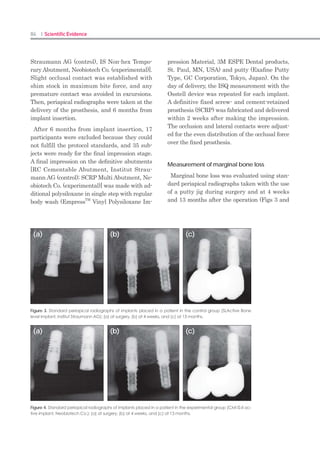
20 I Scientific Evidence 21IMPLANT I
Differences in implant stability associated with various methods of
preparation of the implant bed: An in vitro study
Su-Jin Ahn, DMD, MSD, PhD,a
Richard Leesungbok, DMD, MSD, PhD,b
Suk-Won Lee, DMD, MSD,
PhD,c
Young-Ku Heo, DMD, MSD, PhD,d
Kyung Lhi Kang, DMD, MSD, PhDe
Kyung Hee University Dental Hospital at Gangdong, Seoul,
Korea; Boston University School of Dental Medicine, Boston, Mass
Supported by grant No. KHU-20091453 from the Kyung Hee University, Seoul, Korea.
a
Clinical Assistant Professor, Department of Biomaterials & Prosthodontics, Kyung Hee University Dental Hospital at
Gangdong.
b
Professor & Chairman, Department of Biomaterials & Prosthodontics, Kyung Hee University Dental Hospital at Gang-
dong.
c
Assistant Professor, Department of Biomaterials & Prosthodontics, Kyung Hee University Dental Hospital at Gangdong.
d
Adjunct Assistant Clinical professor, Center for Implantology, Boston University School of Dental Medicine.
e
Assistant Professor, Department of Periodontics, Kyung Hee University Dental Hospital at Gangdong.
Abstract
Statement of problem. It is difficult to achieve the primary stability necessary for immediate loading
in the posterior maxilla because of thin cortical bone, low density trabecular bone, and inadequate
bone height due to the presence of the maxillary sinus.
Material and methods.
Sixty screw-shaped implants (4.0 × 10 mm) were inserted into solid rigid polyurethane blocks. The
implants were divided into 6 groups (n=10) to test 2 variables: 1) location (monocortical or bicortical
block) and 2) preparation method (standard preparation, underpreparation, or the osteotome tech-
nique). The insertion and removal torques were measured and resonance frequency analysis (RFA)
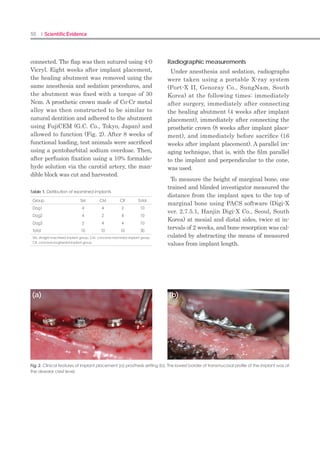
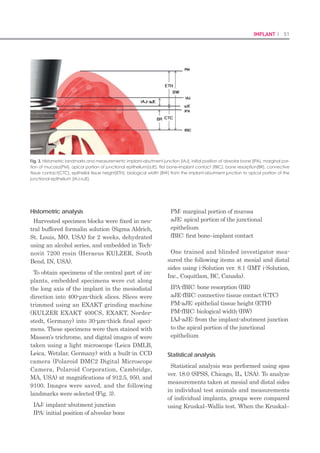
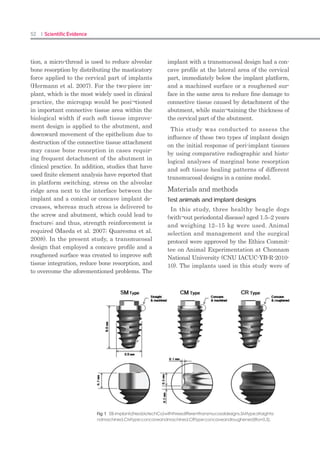
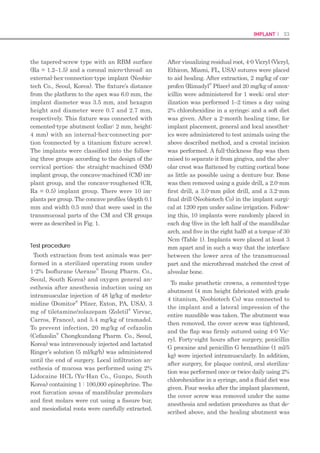
was performed to determine the primary stability of each implant. Insertion and removal torque
data were analyzed by 2-way ANOVA, followed by the post hoc Tukey HSD multiple comparison test.
RFA data were analyzed by 2-way and 1-way ANOVAs and the Tukey HSD multiple comparison test
(α=.05). The Pearson correlation analysis was also performed to examine correlations among the val-
ues.
Results.
The preparation method had a significant effect on insertion torque, RFA value, and removal torque;
however location had a significant effect only on the removal torque (P<.001). There was a significant
interaction between location and preparation method for RFA values (P=.045) and a significant dif-
ference in standard preparation method according to the location (P=.039); however, there was no
significant difference in underpreparation (P=1.00) and osteotome technique (P=1.00). Statistically
significant correlations were found between insertion torque and RFA values (r=0.529, P< .001), in-
sertion torque and removal torque values (r=0.517, P< .001), and removal torque and RFA values
(r=0.481, P<.001).
J Prosthet Dent. 2012 Jun;107(6):366-72. DOI: 10.1016/S0022-3913(12)60092-4.
Conclusions.
Underpreparation and bicortical fixation significantly increased implant stability and the osteotome
technique decreased implant stability in synthetic bone models that mimicked the posterior maxil-
lary region. The primary stability values had statistically significant correlations to each other. (J
Prosthet Dent 2012;107:366-372)
Clinical Implications
Based on the results of this in vitro study, standard preparation and
the bicortical fixation method produce greater primary stability than
the various other surgical methods evaluated.
Several critical factors are necessary for suc-
cessful osseointegration of dental implants,
including the primary stability and surface
characteristics of the implant, anatomical con-
ditions, bone metabolism, design of the interim
prosthesis, and the occlusion pattern during
the healing phase.1
The primary stability of
the implant, which results from the initial in-
terlocking between alveolar bone and the body
of the implant, affects the secondary stability
of the implant because the latter results from
subsequent contact osteogenesis and bone
remodeling.2,3
As a consequence, a high degree
of primary implant stability is a key prereq-
uisite for immediate or early loading.4,5
The
primary determinants of the primary stability
of an implant are the surgical technique used,
the design of the implant, and the mechanical
properties of the bone tissue.6
The posterior region of the maxilla is char-
acterized by thin cortical bone and trabecular
bone of low density. In addition, in many in-
stances the height of the bone in this region is
insufficient to achieve high primary stability
because of the presence of the maxillary si-
nus. Therefore, dental implants in this region
show the highest rate of failure, and surgical
techniques have been proposed to increase
their primary stability.7-10
The most widely
used methods include preparation of the site
with tools one size smaller than the diameter
of the implant,11
bone condensation using an
osteotome,12-14
and the use of bicortical fixa-
tion.15
Among these methods, the osteotome
technique was introduced to increase the pri-
mary stability and success rate of implants in
areas of poor bone density, such as the posterior
maxillary region.16
Theoretically, the osteotome
condenses the bone to increase primary sta-
bility by lateral osseocompression. However,
according to Blanco et al,17
who studied the
placement of implants using the osteotome in
the maxillary tuberosities of human cadavers
and performed histomorphometric assessment
around the implants, the increase in bone den-
sity is actually limited to the periapical area
of the entire periimplant area, and in the peri-
cylinder area there was no increase in bone
density with the osteotome technique. In addi-
tion, many studies have suggested that the use
of the osteotome decreases or does not affect
primary stability.18-20
According to Nkenke et
22 I Scientific Evidence 23IMPLANT I
al,21
use of the osteotome to condense the bone
results in longitudinal cracks and gaps in the
region of the bone collar, increasing the rate of
implant failure. To date there is insufficient sci-
entific and clinical evidence to support immedi-
ate loading in the posterior maxillary region.22
Several methods can be used to measure pri-
mary implant stability; these include biome-
chanical tests, which are represented by mea-
surement of the insertion and removal torque
and nondestructive measurements such as res-
onance frequency analysis (RFA). Biomechani-
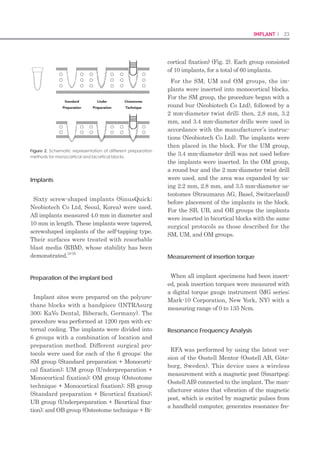
cal testing, such as measurement of the inser-
tion and removal torque, is more accurate than
nondestructive measurements such as RFA and
the Periotest.23
However since biomechanical
testing is destructive and can be applied only
once, its clinical utility is limited. Therefore,
nondestructive measurements such as RFA are
commonly used in clinical practice.24
The use of
RFA and the Periotest is also limited because of
the low resolution and high variability of these
instruments during examination.25
Currently,
there is no gold standard for the accurate mea-
surement of implant stability, and studies have
cast doubt upon the correlation between the
values of insertion and removal torques and
RFA.21,26-29
This study had 2 objectives: to compare the
primary implant stability associated with dif-
ferent preparation methods in both monocorti-
cal and bicortical models of the posterior max-
illa and to examine the correlation between
biomechanical testing (insertion and removal
torque) and RFA. The null hypotheses were
that location (monocortical block or bicorti-
cal block) and preparation method (standard
preparation, underpreparation, or osteotome
technique) would not affect the primary sta-
bility of implants and that there would be no
correlation between the values of insertion and
removal torques and RFA.
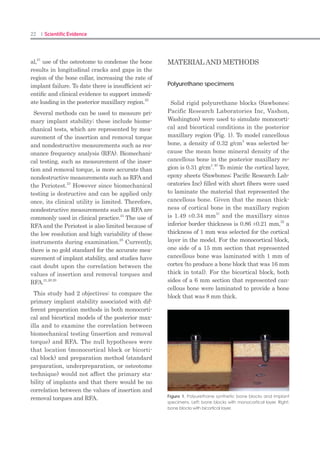
MATERIALAND METHODS
Polyurethane specimens
Solid rigid polyurethane blocks (Sawbones;
Pacific Research Laboratories Inc, Vashon,
Washington) were used to simulate monocorti-
cal and bicortical conditions in the posterior
maxillary region (Fig. 1). To model cancellous
bone, a density of 0.32 g/cm3
was selected be-
cause the mean bone mineral density of the
cancellous bone in the posterior maxillary re-
gion is 0.31 g/cm3
.30
To mimic the cortical layer,
epoxy sheets (Sawbones; Pacific Research Lab-
oratories Inc) filled with short fibers were used
to laminate the material that represented the
cancellous bone. Given that the mean thick-
ness of cortical bone in the maxillary region
is 1.49 ±0.34 mm31
and the maxillary sinus
inferior border thickness is 0.86 ±0.21 mm,32
a
thickness of 1 mm was selected for the cortical
layer in the model. For the monocortical block,
one side of a 15 mm section that represented
cancellous bone was laminated with 1 mm of
cortex (to produce a bone block that was 16 mm
thick in total). For the bicortical block, both
sides of a 6 mm section that represented can-
cellous bone were laminated to provide a bone
block that was 8 mm thick.
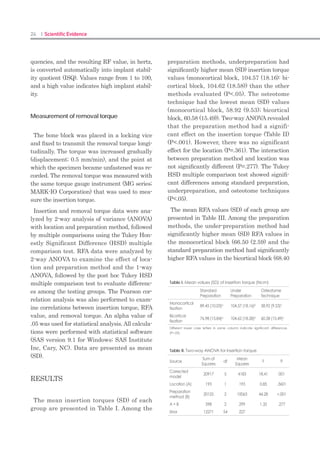
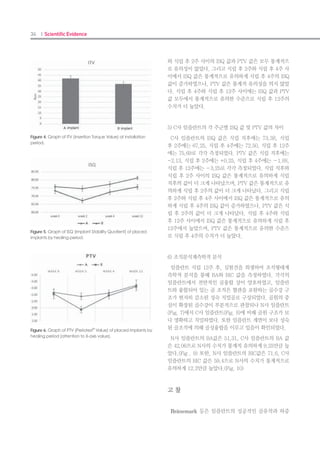
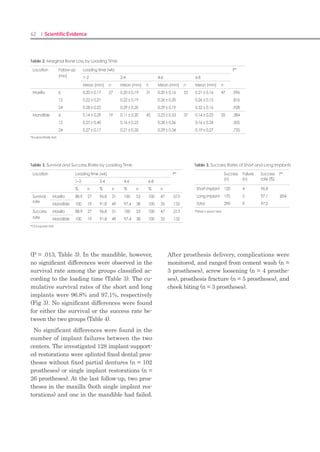
Figure 1. Polyurethane synthetic bone blocks and implant
specimens. Left: bone blocks with monocortical layer. Right:
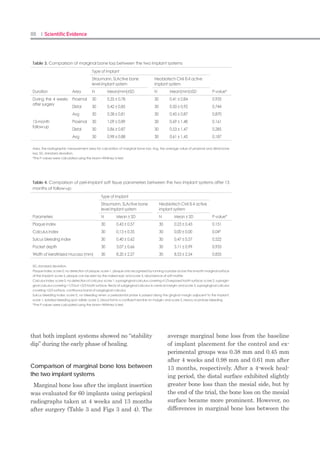
bone blocks with bicortical layer.
Implants
Sixty screw-shaped implants (SinusQuick;
Neobiotech Co Ltd, Seoul, Korea) were used.
All implants measured 4.0 mm in diameter and
10 mm in length. These implants were tapered,
screwshaped implants of the self-tapping type.
Their surfaces were treated with resorbable
blast media (RBM), whose stability has been
demonstrated.33-35
Preparation of the implant bed
Implant sites were prepared on the polyure-
thane blocks with a handpiece (INTRAsurg
300; KaVo Dental, Biberach, Germany). The
procedure was performed at 1200 rpm with ex-
ternal cooling. The implants were divided into
6 groups with a combination of location and
preparation method. Different surgical pro-
tocols were used for each of the 6 groups: the
SM group (Standard preparation + Monocorti-
cal fixation); UM group (Underpreparation +
Monocortical fixation); OM group (Osteotome
technique + Monocortical fixation); SB group
(Standard preparation + Bicortical fixation);
UB group (Underpreparation + Bicortical fixa-
tion); and OB group (Osteotome technique + Bi-
cortical fixation) (Fig. 2). Each group consisted
of 10 implants, for a total of 60 implants.
For the SM, UM and OM groups, the im-
plants were inserted into monocortical blocks.
For the SM group, the procedure began with a
round bur (Neobiotech Co Ltd), followed by a
2 mm-diameter twist drill; then, 2.8 mm, 3.2
mm, and 3.4 mm-diameter drills were used in
accordance with the manufacturer’s instruc-
tions (Neobiotech Co Ltd). The implants were
then placed in the block. For the UM group,
the 3.4 mm-diameter drill was not used before
the implants were inserted. In the OM group,
a round bur and the 2 mm-diameter twist drill
were used, and the area was expanded by us-
ing 2.2 mm, 2.8 mm, and 3.5 mm-diameter os-
teotomes (Straumann AG, Basel, Switzerland)
before placement of the implants in the block.
For the SB, UB, and OB groups the implants
were inserted in bicortical blocks with the same
surgical protocols as those described for the
SM, UM, and OM groups.
Measurement of insertion torque
When all implant specimens had been insert-
ed, peak insertion torques were measured with
a digital torque gauge instrument (MG series;
Mark-10 Corporation, New York, NY) with a
measuring range of 0 to 135 Ncm.
Resonance Frequency Analysis
RFA was performed by using the latest ver-
sion of the Osstell Mentor (Osstell AB, Göte-
borg, Sweden). This device uses a wireless
measurement with a magnetic post (Smartpeg;
Osstell AB) connected to the implant. The man-
ufacturer states that vibration of the magnetic
post, which is excited by magnetic pulses from
a handheld computer, generates resonance fre-
Figure 2. Schematic representation of different preparation
methods for monocortical and bicortical blocks.
24 I Scientific Evidence 25IMPLANT I
quencies, and the resulting RF value, in hertz,
is converted automatically into implant stabil-
ity quotient (ISQ). Values range from 1 to 100,
and a high value indicates high implant stabil-
ity.
Measurement of removal torque
The bone block was placed in a locking vice
and fixed to transmit the removal torque longi-
tudinally. The torque was increased gradually
(displacement; 0.5 mm/min), and the point at
which the specimen became unfastened was re-
corded. The removal torque was measured with
the same torque gauge instrument (MG series;
MARK-IO Corporation) that was used to mea-
sure the insertion torque.
Insertion and removal torque data were ana-
lyzed by 2-way analysis of variance (ANOVA)
with location and preparation method, followed
by multiple comparisons using the Tukey Hon-
estly Significant Difference (HSD) multiple
comparison test. RFA data were analyzed by
2-way ANOVA to examine the effect of loca-
tion and preparation method and the 1-way
ANOVA, followed by the post hoc Tukey HSD
multiple comparison test to evaluate differenc-
es among the testing groups. The Pearson cor-
relation analysis was also performed to exam-
ine correlations between insertion torque, RFA
value, and removal torque. An alpha value of
.05 was used for statistical analysis. All calcula-
tions were performed with statistical software
(SAS version 9.1 for Windows; SAS Institute
Inc, Cary, NC). Data are presented as mean
(SD).
RESULTS
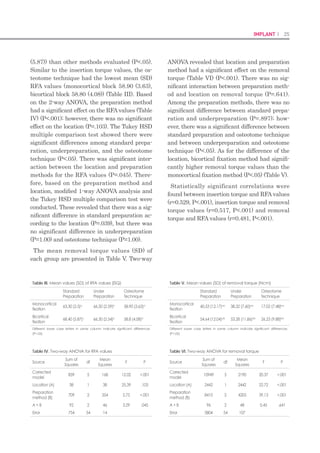
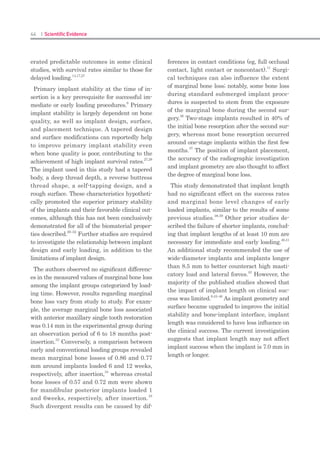
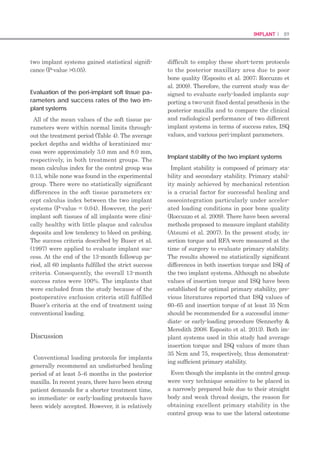
The mean insertion torques (SD) of each
group are presented in Table I. Among the
preparation methods, underpreparation had
significantly higher mean (SD) insertion torque
values (monocortical block, 104.57 (18.16): bi-
cortical block, 104.62 (18.58)) than the other
methods evaluated (P<.05). The osteotome
technique had the lowest mean (SD) values
(monocortical block, 58.92 (9.53); bicortical
block, 60.58 (15.49)). Two-way ANOVA revealed
that the preparation method had a signifi-
cant effect on the insertion torque (Table II)
(P<.001). However, there was no significant
effect for the location (P=.361). The interaction
between preparation method and location was
not significantly different (P=.277). The Tukey
HSD multiple comparison test showed signifi-
cant differences among standard preparation,
underpreparation, and osteotome techniques
(P<.05).
The mean RFA values (SD) of each group are
presented in Table III. Among the preparation
methods, the under-preparation method had
significantly higher mean (SD) RFA values in
the monocortical block (66.50 (2.59) and the
standard preparation method had significantly
higher RFA values in the bicortical block (68.40
Table I. Mean values (SD) of insertion torque (Ncm)
Standard
Preparation
Under
Preparation
Osteotome
Technique
Monocortical
fixation
89.45 (10.03)a
104.57 (18.16)b
58.92 (9.53)c
Bicortical
fixation
76.98 (15.84)a
104.62 (18.58)b
60.58 (15.49)c
Different lower case letters in same column indicate significant differences
(P<.05)
Table II. Two-way ANOVA for insertion torque
Source
Sum of
Squares
df
Mean
Squares
F P
Corrected
model
20917 5 4183 18.41 001
Location (A) 193 1 193 0.85 .3601
Preparation
method (B)
20125 2 10063 44.28 <.001
A × B 598 2 299 1.32 .277
Error 12271 54 227
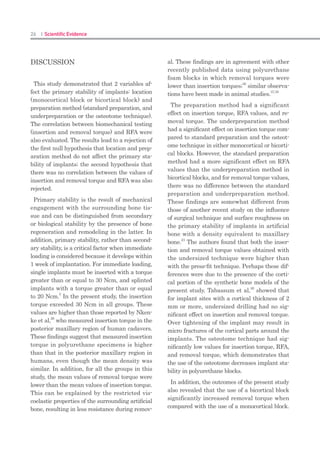
(5.87)) than other methods evaluated (P<.05).
Similar to the insertion torque values, the os-
teotome technique had the lowest mean (SD)
RFA values (monocortical block 58.90 (3.63),
bicortical block 58.80 (4.08)) (Table III). Based
on the 2-way ANOVA, the preparation method
had a significant effect on the RFA values (Table
IV) (P<.001); however, there was no significant
effect on the location (P=.103). The Tukey HSD
multiple comparison test showed there were
significant differences among standard prepa-
ration, underpreparation, and the osteotome
technique (P<.05). There was significant inter-
action between the location and preparation
methods for the RFA values (P=.045). There-
fore, based on the preparation method and
location, modified 1-way ANOVA analysis and
the Tukey HSD multiple comparison test were
conducted. These revealed that there was a sig-
nificant difference in standard preparation ac-
cording to the location (P=.039), but there was
no significant difference in underpreparation
(P=1.00) and osteotome technique (P=1.00).
The mean removal torque values (SD) of
each group are presented in Table V. Two-way
ANOVA revealed that location and preparation
method had a significant effect on the removal
torque (Table VI) (P<.001). There was no sig-
nificant interaction between preparation meth-
od and location on removal torque (P=.641).
Among the preparation methods, there was no
significant difference between standard prepa-
ration and underpreparation (P=.897); how-
ever, there was a significant difference between
standard preparation and osteotome technique
and between underpreparation and osteotome
technique (P<.05). As for the difference of the
location, bicortical fixation method had signifi-
cantly higher removal torque values than the
monocortical fixation method (P<.05) (Table V).
Statistically significant correlations were
found between insertion torque and RFA values
(r=0.529, P<.001), insertion torque and removal
torque values (r=0.517, P<.001) and removal
torque and RFA values (r=0.481, P<.001).
Table III. Mean values (SD) of RFA values (ISQ)
Standard
Preparation
Under
Preparation
Osteotome
Technique
Monocortical
fixation
63.30 (2.5)a
66.50 (2.59)b
58.90 (3.63)d
Bicortical
fixation
68.40 (5.87)c
66.30 (2.54)b
58.8 (4.08)d
Different lower case letters in same column indicate significant differences
(P<.05)
Table V. Mean values (SD) of removal torque (Ncm)
Standard
Preparation
Under
Preparation
Osteotome
Technique
Monocortical
fixation
40.53 (12.17)aa
38.32 (7.60)aa
17.02 (7.48)ba
Bicortical
fixation
54.64 (12.04)ab
53.28 (11.86)ab
26.23 (9.88)bb
Different lower case letters in same column indicate significant differences
(P<.05)
Table IV. Two-way ANOVA for RFA values
Source
Sum of
Squares
df
Mean
Squares
F P
Corrected
model
839 5 168 12.02 <.001
Location (A) 38 1 38 25.39 .103
Preparation
method (B)
709 2 354 2.75 <.001
A × B 92 2 46 3.29 .045
Error 754 54 14
Table VI. Two-way ANOVA for removal torque
Source
Sum of
Squares
df
Mean
Squares
F P
Corrected
model
10949 5 2190 20.37 <.001
Location (A) 2442 1 2442 22.72 <.001
Preparation
method (B)
8410 2 4205 39.13 <.001
A × B 96 2 48 0.45 .641
Error 5804 54 107
26 I Scientific Evidence 27IMPLANT I
DISCUSSION
This study demonstrated that 2 variables af-
fect the primary stability of implants: location
(monocortical block or bicortical block) and
preparation method (standard preparation, and
underpreparation or the osteotome technique).
The correlation between biomechanical testing
(insertion and removal torque) and RFA were
also evaluated. The results lead to a rejection of
the first null hypothesis that location and prep-
aration method do not affect the primary sta-
bility of implants; the second hypothesis that
there was no correlation between the values of
insertion and removal torque and RFA was also
rejected.
Primary stability is the result of mechanical
engagement with the surrounding bone tis-
sue and can be distinguished from secondary
or biological stability by the presence of bone
regeneration and remodeling in the latter. In
addition, primary stability, rather than second-
ary stability, is a critical factor when immediate
loading is considered because it develops within
1 week of implantation. For immediate loading,
single implants must be inserted with a torque
greater than or equal to 30 Ncm, and splinted
implants with a torque greater than or equal
to 20 Ncm.5
In the present study, the insertion
torque exceeded 30 Ncm in all groups. These
values are higher than those reported by Nken-
ke et al,26
who measured insertion torque in the
posterior maxillary region of human cadavers.
These findings suggest that measured insertion
torque in polyurethane specimens is higher
than that in the posterior maxillary region in
humans, even though the mean density was
similar. In addition, for all the groups in this
study, the mean values of removal torque were
lower than the mean values of insertion torque.
This can be explained by the restricted vis-
coelastic properties of the surrounding artificial
bone, resulting in less resistance during remov-
al. These findings are in agreement with other
recently published data using polyurethane
foam blocks in which removal torques were
lower than insertion torques;36
similar observa-
tions have been made in animal studies.37,38
The preparation method had a significant
effect on insertion torque, RFA values, and re-
moval torque. The underpreparation method
had a significant effect on insertion torque com-
pared to standard preparation and the osteot-
ome technique in either monocortical or bicorti-
cal blocks. However, the standard preparation
method had a more significant effect on RFA
values than the underpreparation method in
bicortical blocks, and for removal torque values,
there was no difference between the standard
preparation and underpreparation method.
These findings are somewhat different from
those of another recent study on the influence
of surgical technique and surface roughness on
the primary stability of implants in artificial
bone with a density equivalent to maxillary
bone.23
The authors found that both the inser-
tion and removal torque values obtained with
the undersized technique were higher than
with the press-fit technique. Perhaps these dif-
ferences were due to the presence of the corti-
cal portion of the synthetic bone models of the
present study. Tabassum et al,36
showed that
for implant sites with a cortical thickness of 2
mm or more, undersized drilling had no sig-
nificant effect on insertion and removal torque.
Over tightening of the implant may result in
micro fractures of the cortical parts around the
implants. The osteotome technique had sig-
nificantly low values for insertion torque, RFA,
and removal torque, which demonstrates that
the use of the osteotome decreases implant sta-
bility in polyurethane blocks.
In addition, the outcomes of the present study
also revealed that the use of a bicortical block
significantly increased removal torque when
compared with the use of a monocortical block.
However there were no significant effects of
the bicortical block on insertion torque or RFA
values. The insertion torque and RFA values
were affected by the preparation method and
RFA values interacted significantly between
preparation method and location. Among the
preparation methods, the standard preparation
caused a significant difference between bicorti-
cal and monocortical blocks, which means that
with bicortical blocks, the standard preparation
method is more effective in increasing RFA val-
ues than with monocortical blocks.
Primary stability can be measured during
the placement of an implant by means of vari-
ous parameters such as insertion and removal
torque or by using RFA or the Periotest. Al-
though individual parameters have been inves-
tigated, few studies of the correlations between
parameters have been done. In this study,
statistically significant correlations were found
between insertion torque, RFA value, and
removal torque, even though the correlation
coefficient value was lower than another study
with a smaller number of specimens.29
Never-
theless, a similar study with a larger number of
specimens showed low coefficient values with
statistically significant differences.39
In the
present study, insertion torque, RFA value. and
removal torque were correlated but only with a
poor linear relationship for strength.
A limitation of the present study is that only
the mechanical characteristics of the primary
stability of an implant were considered. Fur-
thermore, the model only simulated the oral
environment, which is more complex. In vivo
studies are required to understand the actual
clinical situation in which many biological fac-
tors influence the primary stability of implants.
CONCLUSIONS
Within the limitations of this in vitro study,
the following conclusions were drawn:
1. Preparation method and location had a sig-
nificant effect on implant stability in synthetic
bone models that mimicked the posterior max-
illary region.
2. The underpreparation and bicortical fixa-
tion method significantly increased implant
stability compared to standard preparation and
monocortical fixation.
3. Low values of insertion torque, RFA, and
removal torque were found in groups in which
the osteotome was used, which demonstrates
that use of the osteotome decreases implant
stability in polyurethane blocks.
4. There were significant correlations between
insertion torque, RFA value, and removal
torque.
REFERENCES
Chiapasco M. Early and immediate restoration1.	
and loading of implants in completely edentu-
lous patients. Int J Oral Maxillofac Implants Suppl
2004;19:76-91.
Berglundh T, Abrahamsson I, Lang NP, Lindhe2.	
J. De novo alveolar bone formation adjacent
to endosseous implants. Clin Oral Implants Res
2003;14:251-62.
Esposito M, Grusovin MG, Willings M, Coulthard P,3.	
Worthington HV. Interventions for replacing miss-
ing teeth: different times for loading dental im-
plants. Cochrane Database Systematic Reviews
2007;18:CD003878
Kim SK, Lee HN, Choi YC, Heo SJ, Lee CW, Choie4.	
MK. Effects of anodized oxidation or turned im-
plants on bone healing after using conventional
drilling or trabecular compaction technique: his-
tomorphometric analysis and RFA. Clin Oral Im-
plants Res 2006;17:644-50.
Roccuzzo M, Aglietta M, Cordaro L. Implant load-5.	
ing protocols for partially edentulous maxillary
posterior sites. Int J Oral Maxillofac Implants Suppl
2009;24:147-57.
28 I Scientific Evidence 29IMPLANT I
Sennerby L, Meredith N. Implant stability mea-6.	
surements using resonance frequency analysis:
biological and biomechanical aspects and clini-
cal implications. Periodontol 2000 2008;47:51-66.
Jaffin RA, Berman CL. The excessive loss of Brane-7.	
mark fixtures in type IV bone: a 5-year analysis. J
Periodontol 1991;62:2-4.
Balshi TJ, Lee HY, Hernandez RE. The use of ptery-8.	
gomaxillary implants in the partially edentulous
patient: a preliminary report. Int J Oral Maxillofac
Implants 1995;10:89-98.
Balshi TJ, Wolfinger GJ, Balshi SF. Analysis of 3569.	
pterygomaxillary implants in edentulous arches
for fixed prosthesis anchorage. Int J Oral Maxillo-
fac Implants 1999;14:398-406.
Herrmann I, Lekholm U, Holm S, Kultje C. Evalua-10.	
tion of patient and implant characteristics as po-
tential prognostic factors for oral implant failures.
Int J Oral Maxillofac Implants 2005;20:220-30.
Friberg B, Ekestubbe A, Sennerby L. Clinical out-11.	
come of Brånemark system implants of various
diameters: a retrospective study. Int J Oral Maxil-
lofac Implants 2002;17:671-7.
Nedir R, Nurdin N, Szmukler-Moncler S, Bischof12.	
M. Placement of tapered implants using an os-
teotome sinus floor elevation technique without
bone grafting: 1-year results. Int J Oral Maxillofac
Implants 2009;24:727-33.
Nedir R, Bischof M, Vazquez L, Nurdin N, Szmukler-13.	
Moncler S, Bernard JP. Osteotome sinus floor el-
evation technique without grafting material:
3-year results of a prospective pilot study. Clin
Oral Implants Res 2009;20:701-7.
Crespi R, Capparè P, Gherlone E. Osteotome sinus14.	
floor elevation and simultaneous implant place-
ment in grafted biomaterial sockets: 3 years of
follow-up. J Periodontol 2010;81:344-9.
Ivanoff CJ, Gröndahl K, Bergström C, Lekholm U,15.	
Brånemark PI. Influence of bicortical or mono-
cortical anchorage on maxillary implant stabil-
ity: a 15-year retrospective study of Brånemark
system implants. Int J Oral Maxillofac Implants
2000;15:103-10.
Summers RB. A new concept in maxillary implant16.	
surgery: the osteotome technique. Compendium
1994;15:152-8.
Blanco J, Suárez J, Novio S, Villaverde G, Ramos I,17.	
Segade LA. Histomorphometric assessment in hu-
man cadavers of the periimplant bone density in
maxillary tuberosity following implant placement
using osteotome and conventional techniques.
Clin Oral Implants Res 2008;19:505-10.
Büchter A, Kleinheinz J, Wiesmann HP, Kersken J,18.	
Nienkemper M, Weyhrother H, et al. Biological
and biomechanical evaluation of bone remodel-
ing and implant stability after using an osteotome
technique. Clin Oral Implants Res 2005;16:1-8.
Fanuscu MI, Chang TL, Akça K. Effect of surgical19.	
techniques on primary implant stability and peri-
implant bone. J Oral Maxillofac Surg 2007;65:2487-
91.
Proff P, Bayerlein T, Rottner K, Mai R, Fanghänel20.	
J, Gedrange T. Effect of bone conditioning on
primary stability of FRIALIT-2 impalts. Clin Oral Im-
plants Res 2008;19:42-7.
Nkenke E, Lehner B, Fenner M, Roman FS, Thams21.	
U, Neukam FW, et al. Immediate versus delayed
loading of dental implants in the maxillae of
minipigs: follow-up of implant stability and implant
failures. Int J Oral Maxillofac Implants 2005;20:39-
47.
Weber HP, Morton D, Gallucci GO, Roccuzzo M,22.	
Cordaro L, Grutter L. Consensus statements and
recommended clinical procedures regarding
loading protocols. Int J Oral Maxillofac Implants
Suppl 2009;24:180-3.
Tabassum A, Meijer GJ, Wolke JG, Jansen JA.23.	
Influence of the surgical technique and surface
roughness on the primary stability of an implant in
artificial bone with a density equivalent to maxil-
lary bone: a laboratory study. Clin Oral Implants
Res 2009;20:327-32.
Chang PC, Lang NP, Giannobile WV. Evaluation24.	
of functional dynamics during osseointegration
and regeneration associated with oral implants.
Clin Oral Implants Res 2010;21:1-12.
Aparico C, Lang NP, Rangert B. Validity and clini-25.	
cal significance of biomechanical testing of im-
plant/bone interface. Clin Oral Implants Res Sup-
pl.2 2006;17:2-7.
Nkenke E, Hahn M, Weinzierl K, Radespiel- Tröger26.	
M, Neukam FW, Engelke K. Implant stability and
histomorphometry: a correlation study in human
cadavers using stepped cylinder implants. Clin
Oral Implants Res 2003;14:601-9.
Akkocaoglu M, Uysal S, Tekdemir l, Akca K, Cehreli27.	
MC. Implant design and intraosseous stability of
immediately placed implants: a human cadaver
study. Clin Oral Implants Res 2005;16:202-9.
da Cunha HA, Francischone CE, Filho HN, de Ol-28.	
iveira RC. A comparison between cutting torque
and resonance frequency in the assessment
of primary stability and final torque capacity of
standard and TiUnite single-tooth implant under
immediate loading. Int J Oral Maxillofac Implants
2004;19:578-85.
Akça K, Akkocaoglu M, Cömert A, Tekdemir I,29.	
Cehreli MC. Bone strains around immediately
loaded implants supporting mandibular over-
dentures in human cadavers. Int J Oral Maxillofac
Implants 2007;22:101-9.
Devlin H, Homer K, Ledgerton D. A comparison of30.	
maxillary and mandibular bone mineral densities.
J Prosthet Dent 1998;79:323-7.
Miyamoto I, Tsuboi Y, Wada E, Suwa H, Iizuka T.31.	
Influence of cortical bone thickness and implant
length on implant stability at the time of surgery-
-clinical, prospective, biomechanical, and imag-
ing study. Bone 2005;37:776-80.
Cakur B, Sümbüllü MA, Durna D. Relationship32.	
among schneiderian membrane, Underwood’s
septa, and maxillary sinus inferior border. Clin Im-
plant Dent Relat Res 2011 Apr 19. [Epub ahead
of print]
Wennerberg A, Albrektsson T, Johansson C, An-33.	
dersson B. Experimental study of turned and grit-
blasted screw-shaped implants with special em-
phasis on effects of blasting material and surface
topography. Biomaterials 1996;17:15-22.
Wennerberg A, Albrektsson T, Lausmaa J. Torque34.	
and histomorphometric evaluation of c.p. tita-
nium screws blasted with 25- and 75-microns-
sized particles of Al2O3. J Biomed Mater Res
1996;30:251-60.
Piattelli M, Scarano A, Paolantonio M, Iezzi G,35.	
Petrone G, Piattelli A. Bone response to machined
and resorbable blast material titanium implants:
an experimental study in rabbits. J Oral Implantol
2002;28:2-8.
Tabassum A, Meijer GJ, Wolke JG, Jansen JA.36.	
Influence of surgical technique and surface
roughness on the primary stability of an implant
in artificial bone with different cortical thick-
ness: a laboratory study. Clin Oral Implants Res
2010;21:213-20.
Shalabi MM, Wolke JG, Jansen JA. The effects37.	
of implant surface roughness and surgical tech-
nique on implant fixation in an in vitro model. Clin
Oral Implants Res 2006;17:172-8.
Shalabi MM, Wolke JG, de Ruijter AJ, Jansen JA. A38.	
mechanical evaluation of implants placed with
different surgical techniques into the trabecular
bone of goats. J Oral Implantol 2007;33:51-8.
Jun SH, Chang BM, Weber HP, Kwon JJ. Compari-39.	
son of initial stability parameters and histomor-
phometric analysis of implants inserted into ex-
traction sockets: human fresh cadaver study. Int
J Oral Maxillofac Implants 2010;25:985-90.
Corresponding author: Dr Richard Leesungbok, Department of Biomaterials &
Prosthodontics, Kyung Hee University Dental Hospital at Gangdong, Sangil-Dong
149, Kangdong-Gu, Seoul134-727 KOREA
Fax: +82-2-440-7549 / E-mail: sbykmw@yahoo.co.kr
30 I Scientific Evidence 31IMPLANT I
임플란트의 초기안정성에 관한 고찰: 성견에서의 실험적 연구
Journal of Dental Implant Research 2013, 32(2) 33-39
김영각1
, 김성탁2
, 현 기1
, 황석현1
, 김재만1
, 주 총2
, 전상호1
, 최연조3
, 류재준3
, 권종진1
1
고려대학교 의과대학 안암병원 치과학교실 구강악안면외과, 2
고려대학교 의과대학 임상치의학대학원, 3
고려대학교 의과대학 안암병원 치과
학교실 보철과
Study of initial stability change of implant: an experimental study in the dog
Young-kak Kim1
, Sung-tak Kim2
, Ki Hyun1
, Suk-hyun Hwang1
, Jae-man Kim1
, Cong Zhou2
, Sang-ho
Jun1
, Yeon-jo Choi3
, Jae-jun Ryu3
, Jong-jin Kwon1
1
Division of Oral and Maxillofacial Surgery, Department of Dentistry, Anam Hospital, Korea University College of Medi-
cine,
2
Graduate School of Clinical Dentistry, Korea University,
3
Division of Prosthodontics, Department of Dentistry, Anam Hospital, Korea University College of Medicine, Seoul, Korea
PURPOSE :
The purpose of study was to analyze the initial stability change of N company A implant.
MATERIALS AND METHODS :
A total of 32 implant were placed in 4 mongrel dogs. Implant were divided into 2 groups following to
manufacturer. Group 1 is consisted of 16 of A implant (N co., Seoul, Korea), and Group 2 is consisted
of 16 of B implant (C co., Seoul, Korea). After implant placement, ITV (insertion torque value), ISQ
(implant stability quotient), PTV (periotest value) were measured immediately, 2 weeks, 4 weeks and
16 weeks of healing period. With the animal’s sacrifice 12 weeks after implant installation and histo-
morphometric analyses were performed. Statistical analyses were performed using SPSS for window
(ver.20.0 SPSS Inc.). Statistical differences were considered significant at p<0.05.
RESULTS :
There was significant difference of ITV, ISQ, PTV between A implant and B implant at all of period
(p<0.05). There was no significant difference of initial stability change of A implant (p<0.05). The
percentage of direct bone-to-implant contact (BIC) and bone area ratio (BA) showed statistical signifi-
cant between group 1 and 2 at 12 weeks (p<0.05).
CONCLUSION :
These result indicate that A implant does not have stability dip. In conclusion, A implant allows
immediate or early loading implant protocol. (JOURNAL OF DENTAL IMPLANT RESEARCH
2013;32(2):33-39)
Key words :
Implant, Initial stability, Stability dip, Immediate loading
서론
최근 임플란트가 대중적으로 많이 적용됨으로써 환자들
의 요구 및 시술자의 필요성에 의해 전통적인 치료시기를
줄이고자 하는 많은 노력이 요구되며, 그에 따라 임플란
트의 치유기간에 대해 연구가 많이 진행되어 왔다. 2002
년 스페인 World Congress에서는, 즉시 및 조기 하중부여
가 많은 임상케이스에서 성공적으로 적용될 수 있음을 보
고하였다1)
. 1990년 Schnitman 등에 의하면 즉시 로딩 임
플란트의 성공률은 85.7%로 보고되었으며2)
, 최근 Kan과
Rungcharassaeng에 의하면 단일 치아 임플란트에서는
100%까지도 보고되고 있다3)
. 2006년 Lioubavina-Hack,
Natalia 등에 의하면 즉시 및 조기 하중부여의 가장 중요
한 요소 중의 하나는 초기안정성이라고 연구한 바 있다4)
.
하지만, Simunek 등의 연구에 의하면 초기 안정도에서 즉
시 및 조기 하중부여에 제한을 가하게 만드는 요인 중 하나
는 ‘Stability dip’이다5)
. 임플란트는 식립 후 약 4주∼6주
사이에 일차적 안정도가 떨어지면서 그 떨어진 만큼을 아
직 올라가는 이차적 안정도가 충분히 상쇄하지 못하여 안
정도 저하 현상이 나타나게 된다6)
. 이 시기에 하중을 부여
하게 되면 골유착에 실패하게 된다7)
. 이러한 Stability dip
을 줄여 안정도의 일정한 유 지가 가능하게 할 수 있다면
즉시 및 조기 하중부여에 유리한 조건을 만들어 줄 수 있
다. 안정도의 저하를 극복하기 위한 노력으로는 일차적으
로 기계적 안정도를 높이기 위해 임플란트의 전반적인 모
양을 taper 형태로 제작하는 방법, 임플란트의 thread 디
자인을 변경하는 방법, 임플란트 식립 시 under-drilling
을 이용하는 방법, 임플란트의 상부 표면에 미세 나사산을
형성하는 방법 등을 통해 ITV (insertion torque value)를
물리적으로 높여 주어 초기 안정도에 기여하는 여러 가지
테크닉들이 소개되었다. 다음으로 생물학적 안정도를 높이
기 위한 방법들로는 주로 임플란트의 표면처리를 개선하는
형태로 소개되고 있다. HA 코팅 임플란트나 SLA 표면처
리 임플란트 등을 필두로 표면에 친수성을 부여한 임플란
트까지 출시되어 각광을 받고 있다8)
. 본 연구에서는 표면
처리된 임플란트의 연구와 즉시 및 조기 하중부여의 연구
사이에 상관관계를 찾기 위해, 최근 출시된 N사의 SLA 표
면처리된 임플란트인 A implant를 이용하여 stability dip
의 형성 유무와 즉시 및 조기하중 부여의 가능성에 대해 살
펴보았다9)
.
대상 및 방법
1. 실험동물
영구치가 완전히 맹출되고 체중이 20 kg 내외인 생후 1
년 전후의 수컷 성견 총 4마리를 동일한 조건 하에서 약 2
주간 사육한 후 실험하였다.
2. 실험재료
실험에 사용한 임플란트는 N사의 A 임플란트 16개와 C
사의 B 임플란트 16개를 사용하였다. 사용된 임플란트 모
두 직경 4.0 mm에 길이 10 mm 크기로 총 32개의 임플란
트가 사용되었다.
1) N사의 A implant
Root form - tapered submerged type의 fixture 디자
인을 갖고 있으며, SLA (Sandblasted, Large grit, Acid-
etched) 표면처리 되어 있고, 상부에 micro thread가 없
는 직경 4.0 mm, 길이 10mm의 임플란트 16개를 식립하
였다.(Fig. 1)
2) C사의 B implant
Flat soulder tapered submerged type의 fixture 디자
인을 갖고 있으며, RBM (Resorbable Blasted Media) 표
면처리 되어 있고, 최상부에 machined surface, 상부에는
double micro-thread, micro-thread의 2중 구조를 갖
고 있다. Fixture 직경은 4.0 mm, 길이는 10 mm의 임플
란트 16개를 식립하였다.(Fig. 2)
Figure 2. C company B implant. (A) Picture of implant, (B) Illus-
tration of structure of implant, (C) X-ray image of implant.
A B C
Figure 1. N company A implant. (A) Picture of implant, (B) Illus-
tration of structure of implant, (C) X-ray image of implant.
A B C
32 I Scientific Evidence 33IMPLANT I
을 제작하여 컴퓨터에 연결된 Leitz Microvid 장비를 이용
하여 관찰하였다. 현미경으로 관찰하면서 임플란트의 표
면과 골조직과의 접촉율과 나사산 사이의 골량을 측정하였
다. 골접촉율(BIC)과 골량(BA)은 다음 식에 의해 백분율로
나타냈으며, 식립된 임플란트의 경부 1/3과 근단부 1/3에
서, 양호한 골유착을 이룬 나사산 3개 부위(협-설로 6개의
나사산)에서 측정하여 평균치로 나타내었다.
BIC (Bone-Implant Contact ratio) 골로 덮이는 임플란
트 표면의 비율(%)=(total contact surface/Implant cir-
cumference)×100
BA (Bone Area ratio) 골수강 내에 망상골, 석회화된 골
의 비율(%)=(total bone area/total tissue area)×100
6. 통계 분석
자료에 대한 통계분석을 위해 SPSS ver. 20.0 프로그램
을 사용하였다. 2가지 임플란트에 대해 각 주군별로 측정
된 값을 T-test를 통해 임플란트 그룹별, 각 주군별 비교
를 하였다.
결 과
1. 육안적 소견
임플란트 식립 직후 및 2주, 4주, 12주 모두에서 임플란
트 식립 부위에 염증의 소견은 보이지 않았으며, 창상의 이
개나 임플란트의 노출도 발견되지 않았다. 실험기간 동안
실패하여 탈락된 임플란트도 발견되지 않았다. 전체적으로
육안적으로 양호한 치유를 나타냈다.
2. 방사선학적 소견
임플란트와 골 사이에서 특별히 골이 흡수되거나 특이적
인 형태는 발견되지 않았다. 모두 양호한 방사선학적 치유
소견을 보였다.
3. 안정도 검사결과 및 통계 분석 결과
본 연구에서는 임플란트의 표면처리가 초기안정성에 미
치는 영향을 알아보고자 RMB 표면처리된 임플란트를 대
조군으로, SLA 표면처리된 임플란트를 실험군으로 설정하
여 성견의 하악골에 식립한 후, 안정도를 측정하는 여러 가
지 방법(ITV, ISQ, PTV)을 사용하여 식립 직후, 식립 후 2
주, 식립후 4주, 식립 후 12주에 각각 안정도를 측정하였
3. 실험방법
Ketamine (10 mg/kg)으로 전신마취를 한 후 1/10으로
희석한 베타딘으로 구강내외와 수술부위를 소독하고, 구강
내는 생리식염수로 세척한 후 1:100,000 에피네프린 첨
가 2% 리도케인으로 침윤마취를 시행한 뒤 하악 좌우측 1,
2, 3, 4 소구치를 발거하고, 임플란트의 수술 kit와 KavoⓇ
의 전동 모터와 핸드피스, 그리고 N사의 임플란트 수술 기
구들을 사용하여 임플란트를 식립하였다.
좌우측에 N사 임플란트와 C사 임플란트를 4개씩, 총 8개
의 임플란트를 4마리의 실험견에 식립하였다.(Fig. 3) 식
립된 임플란트는 식립 직후 0주, 2주, 4주, 12주차에 ITV,
ISQ, PTV값을 각각 측정하였고 X-ray (periapical view)
촬영도 하였다. 또한 12주 후 측정이 끝난 실험견을 희생
하여 조직탈회표본을 제작하여 BA, BIC값을 측정하여 조
직형태계측학적 분석을 하였다.
4. 관찰 및 분석 방법
1) 육안적 관찰
연조직을 포함한 임플란트 식립 부위의 염증 유무, 임플
란트의 노출 여부, 기타 이상 유무를 육안과 확대경을 이용
하여 관찰하였다.
2) 방사선학적 관찰
매식체 주위의 방사선 투과상의 유무 및 변화, 주변골의
괴사와 변연골 소실 여부를 관찰하였다.
다. 식립 12주 후에는 성견을 희생시켜 조직형태계측학적
평가를 시행하여 BIC와 BA값을 측정하였다. 결과값은 다
음과 같다.
1) Insertion Torque Value (ITV: Ncm)
임플란트 식립 직후 Kavo 임플란트 엔진에 측정된 토크
값을 측정한 것으로 N사 임플란트의 값이 41.83 Ncm, C
사 임플란트의 값이 36.75 Ncm로 나왔다. N사 임플란트
의 ITV 값이 C사 임플란트보다 통계적으로 유의한 수준으
로 5.13 만큼 높게 나왔다.(Fig. 4)
2) 각 주 군별 N사 임플란트와 C사 임플란트 간의 ISQ 값
의 차이
N사 임플란트의 ISQ 값은 식립 직후에는 75.88, 식립 후
2주에는 74.63, 식립 후 4주에는 77.31, 식립 후 12주에
는 81.19로 각각 측정되었다. C사 임플란트의 ISQ 값은
식립 직후에는 73.38, 식립 후 2주에는 67.25, 식립 후 4
주에는 72.50, 식립 후 12주에는 75.69로 각각 측정되었
다. 각 주 군별 두 임플란트 사이에는 각각 ISQ값이 통계
적으로 유의한 수준으로 모두 N사 임플란트의 수치가 더
높게 나왔다.(Fig. 5)
3) 각 주 군별 N사 임플란트와 C사 임플란트 간의 PTV 값
의 차이
본 연구에서는 그래프의 왼쪽 수치의 음과 양을 반대로
표현하여 안정도의 상승 하락을 ISQ 값과 비슷한 양상으
로 나타내었다. N사 임플란트의 PTV 값은 식립 직후에는
-2.38, 식립 후 2주에는 -1.75, 식립후 4주에는 -2.25,
식립 후 12주에는 -3.44로 각각 측정되었다. C사 임플
란트의 PTV 값은 식립 직후에는 -2.13, 식립 후 2주에
는 +0.25, 식립 후 4주에는 -1.88, 식립 후 12주에는 -
3.25로 각각 측정되었다. 식립 후 2주에서 N사의 PTV 값
이 -1.75로 C사의 PTV 값 +0.25보다 통계적으로 유의한
수준으로 1.5만큼 낮게 나왔고, 다른 시기에서는 N사와 C
사의 통계적 유의성이 없었다.(Fig. 6)
4) N사 임플란트의 각 주군별 ISQ 값 및 PTV 값의 차이
N사 임플란트의 ISQ 값은 식립 직후에는 75.88, 식립 후
2주에는 74.63, 식립 후 4주에는 77.31, 식립 후 12주에
는 81.19로 각각 측정되었다. PTV 값은 식립 직후에는 -
2.38, 식립 후 2주에는 -1.75, 식립 후 4주에는 -2.25,
식립 후 12주에는 -3.44로 각각 측정되었다. 식립 직후
3) 임플란트 안정도 측정
임플란트 식립시 KaVoⓇ
전동모터에 표시되는 Insertion
Torque Value (ITV: 식립토크 값)를 기록하고 Reso-
nance Frequency Analysis (RFA: 진동수 분석)를 3회,
PeriotestⓇ
를 5회 측정하고, 희생 후 RFA 3회, Periotest
Ⓡ
를 5회 측정하여 식립 전과 비교하였다.
5. 비탈회표본 제작 및 조직형태계측학적 분석
1) 실험동물의 희생
임플란트 식립 후 12주에 실험동물을 희생시키고, 연조
직을 포함한 임플란트 식립부위의 염증유무, 임플란트의
노출 여부, 기타 이상 유무를 육안과 확대경을 이용하여 확
인하였다. 양측 하악골을 임플란트 식립 부위로부터 3 cm
거리에서 골막을 박리하고 부검용 톱으로 매식체를 포함한
골조직편을 조심스럽게 채취하였다.
2) 표본제작 및 관찰방법
(1) 비탈회표본 제작: 채취된 매식체를 포함하고 있는 골
조직편을 10% 포르말린으로 고정시킨 뒤 2∼4 mm의 두
께로 자른 후 다시 고정시켰다. 고정된 조직은 에틸알코올
로 24∼32시간씩 처리하여 탈수시켰다. 탈수 후 에틸알코
올(Sung Kwang Pharma, Co., Korea)과 레진(Techno-
vit 4000, Kulzer)을 3:1, 1:1 그리고 1:3의 비율로 바
꿔가면서 12시간씩 조직에 레진을 침투시켰다. 이후 플라
스틱으로 만들어진 틀에 조직을 넣고 액체상태의 광중합레
진(Technovit 4000, Kulzer)으로 채운 후 450 nm 파장의
U.V. 광선으로 레진블록을 제작하였다.
만들어진 레진블록을 플라스틱 틀로부터 제거한 후 거
친 사포에 갈아 관찰하고자 하는 면을 노출시킨 뒤 반대
쪽 면이 보고자 하는 면과 평행한 상태에서 자가중합레진
(Technovit 4000, Kulzer)을 이용하여 반대쪽 면을 슬
라이드에 붙이고, 보고자 하는 면을 광중합레진 접착제
(Technovit 7210, Kulzer)를 이용하여 슬라이드에 접착
시켰다. 이렇게 두 슬라이드가 평행한 상태에서 보고자 하
는 면 쪽으로 두께가 200μm가 되도록 절단하여 접착제
의 최종 두께를 제외한 조직의 두께가 30μm 정도가 되도
록 grinding paper (P800, P1200, P2500의 순차적으로
사용)로 갈아내었다(EXAKT grinding System). 이때 이
렇게 완성된 슬라이드는 Hematoxilin- Eosin 염색을 실
시한 후 Vanox-S research microscope (Olympus, Ja-
pan)을 이용하여 관찰하였다.
(2) 조직형태계측학적 분석 및 관찰: 30 μm 두께의 표본
Figure 3. Diagram showing the installation of implants location.
34 I Scientific Evidence 35IMPLANT I
후의 꾸준한 안정을 위해서는 임플란트 식립 후 최소 3∼6
개월에 임플란트에 하중을 가하도록 권장하였다10)
. 결과적
으로 발치 후 3개월을 기다리고 하중부여 시기까지 고려하
면, 전체 임플란트 치료는 끝날 때까지 6∼12개월이 소요
되게 된다. 이 전통적인 치료 기간은 임플란트 디자인, 표
면처리 방법, 수술테크닉 등의 발달과 환자의 요구가 맞물
리면서 그 기간이 점점 단축되게 되었다. 하지만 이러한 즉
시 및 조기 하중부여 테크닉은 모든 환자에게 적용 가능한
술식은 아니며, 성공률을 높이기 위해서는 무엇보다 적절
한 증례 선택이 중요하다. 또한 즉시 및 조기 하중부여시에
높은 성공률을 얻기 위해서는 임플란트의 골유착 과정에서
발생하는 임플란트 안정도의 기계적, 생물학적 변화에 대
해 심도 있는 이해가 필요하며, 임플란트 식립 과정에서 식
립 시 초기 안정도 및 술 후 안정도를 높이는 노력을 하여
임플란트의 성공률을 높여야 한다. 즉시 및 조기 하중부여
시, 임플란트의 성공기준은 임플란트를 식립할 때의 초기
와 식립 후 2주 사이의 ISQ 값과 PTV 값은 모두 통계적으
로 유의성이 없었다. 그리고 식립 후 2주와 식립 후 4주 사
이에서 ISQ 값은 통계적으로 유의하게 식립 후 4주의 ISQ
값이 증가하였으나, PTV 값은 통계적 유의성을 띄지 않았
다. 식립 후 4주와 식립 후 12주 사이에는 ISQ 값과 PTV
값 모두에서 통계적으로 유의한 수준으로 식립 후 12주의
수치가 더 높았다.
5) C사 임플란트의 각 주군별 ISQ 값 및 PTV 값의 차이
C사 임플란트의 ISQ 값은 식립 직후에는 73.38, 식립
후 2주에는 67.25, 식립 후 4주에는 72.50, 식립 후 12주
에는 75.69로 각각 측정되었다. PTV 값은 식립 직후에는
-2.13, 식립 후 2주에는 +0.25, 식립 후 4주에는 -1.88,
식립 후 12주에는 -3.25로 각각 측정되었다. 식립 직후와
식립 후 2주 사이의 ISQ 값은 통계적으로 유의하게 식립
직후의 값이 더 크게 나타났으며, PTV 값은 통계적으로 유
의하게 식립 후 2주의 값이 더 크게 나타났다. 그리고 식립
후 2주와 식립 후 4주 사이에서 ISQ 값은 통계적으로 유의
하게 식립 후 4주의 ISQ 값이 증가하였으나, PTV 값은 식
립 후 2주의 값이 더 크게 나타났다. 식립 후 4주와 식립
후 12주 사이에서 ISQ 값은 통계적으로 유의하게 식립 후
12주에서 높았으며, PTV 값은 통계적으로 유의한 수준으
로 식립 후 4주의 수치가 더 높았다.
6) 조직분석계측학적 분석
임플란트 식립 12주 후, 실험견을 희생하여 조직형태계
측학적 분석을 통해 BA와 BIC 값을 측정하였다. 각각의
임플란트에서 전반적인 골융합 상이 양호하였고, 임플란
트와 융합되어 있는 골 조직은 혈관을 포함하는 골수강 구
조가 현저히 감소된 성숙 치밀골로 구성되었다. 골원의 중
심이 확장된 골수강이 부분적으로 관찰되나 N사 임플란트
(Fig. 7)에서 C사 임플란트(Fig. 8)에 비해 골원 구조가 보
다 명확하고 치밀하였다. 또한 임플란트 계면이 보다 성숙
된 골조직에 의해 골성융합을 이루고 있음이 확인되었다.
N사 임플란트의 BA값은 51.31, C사 임플란트의 BA 값
은 42.06으로 N사의 수치가 통계적 유의하게 9.25만큼 높
았다.(Fig . 9) 또한, N사 임플란트의 BIC값은 71.6, C사
임플란트의 BIC 값은 59.4으로 N사의 수치가 통계적으로
유의하게 12.2만큼 높았다.(Fig. 10)
고 찰
Bränemark 등은 임플란트의 성공적인 골유착과 하중
고정도와 일차 및 이차 치유과정 중에 얻어지는 골유착에
의해 결정된다. 이러한 초기 고정 및 일차, 이차 치유과정
에 영향을 미칠 수 있는 인자들에는 식립 시 임플란트의 식
립토크, 임플란트 디자인, 나사산의 형태 및 위치, 표면처
리의 특징 등이 있다.
이러한 많은 인자들에 의해 영향을 받는 임플란트의 안
정도는 객관적으로 수치화하여 측정할 필요가 있다. 임플
란트의 안정도 측정에는 많은 연구들에서 다양한 방법들이
소개되어왔다11)
. 그 중 식립토크(Insertion torque; ITV),
공진주파수 분석법(Resonance Frequency Analysis;
RFA - ISQ), Periotest (PTV) 등이 안정도 측정에 비교
적 객관적인 역할을 한다고 연구되었다12)
. 본 실험에서는
임플란트와 골과의 골유착시기에 어떠한 하중을 부여하
지 않고 치유시켰다. 임플란트의 골유착 초기에 가해지는
하중에 의해 미세한 움직임이 발생하면 이러한 미세한 움
직임은 골유착에 유해한 환경을 제공한다는 Ivanoff 또는
Figure 4. Graph of ITV (Insertion Torque Value) at installation
period.
Figure 9. Graph of BA (Bone Area ratio) at week 12.Figure 7. Histologic features at week 12 after N company im-
plant installation (bone stain, original magnification ×20).
Figure 8. Histologic features at week 12 after C company im-
plant installation (bone stain, original magnification ×20).
Figure 10. Graph of BIC (bone to implant contact ratio) at
week 12.
Figure 5. Graph of ISQ (Implant Stability Quotient) of placed
implants by healing period.
Figure 6. Graph of PTV (Periotest®
Value) of placed implants by
healing period (attention to X-axis value).
36 I Scientific Evidence 37IMPLANT I
Brunski 등의 연구에서 볼 수 있듯이13,14)
, 즉시 및 조기 하
중 부여를 시행했을 때의 골 유착 형태 및 안정도를 측정
하는 추가적인 실험이 필요하다고 하겠다. 또한, 본 연구
에서는 PTV의 값이 ISQ 값과는 다르게 통계적으로 유의
미한 차이를 보이지 않아 PTV 값이 안정도를 측정하는 결
정인자로서의 의미와 신뢰도에 대한 고찰이 필요할 것으로
사료된다15)
.
Boyan 등의 연구16)
에서는 임플란트의 표면조도에 따라
골 유착이 더 성공적으로 이루어 졌으며, 그 결과는 BIC
(bone to implant contact ratio)를 통하여 간접적으로 측
정할 수 있음을 보고하였다. 또한, Buser 등의 연구에서는
조직형태계측학적인 분석을 통하여 임플란트의 표면 거칠
기를 증가시키는 것은 골과 임플란트의 접촉을 증가시키
는 경향이 있음을 보고하였다17)
. 본 실험의 결과에서, N사
의 SLA 표면처리된 A 임플란트의 BA, BIC값이 통계적으
로 유의하게 C사의 임플란트에 비해 높은 수치를 보이는
것은 이러한 임플란트의 표면처리의 차이에서 오는 임플란
트 표면조도와 관계가 있는 것으로 사료된다. Huang 등은
연구에서 ISQ 값과 BIC 값의 양의 상관관계에 대해 보고
하였고18)
, Abrahamsson 등은 ISQ 값과 BIC 값과의 관계
는 아직 불명확하다는 연구를 발표하는 등, 아직 정립된 연
구는 없는 것으로 보고되고 있다19)
. 본 실험결과 중, 높은
ISQ 값을 보이는 임플란트에서 12주 후 골수강 내에 망상
골, 석회화된 골의 비율(BA)와 골로 덮이는 임플란트 표면
의 비율(BIC)의 값이 꾸준히 비례하는 것을 알 수 있다. 그
러므로 향후 ISQ 값과 BA, BIC 값의 상관관계에 대한 추
가 연구도 필요할 것으로 생각된다20)
.
결 론
본 실험의 결론으로는, N사의 A 임플란트의 ITV 값이 C
사 임플란트보다 통계적으로 유의하게 높았으며, N사의 A
임플란트와 C사 임플란트 모두 시간이 지날수록 통계적으
로 유의하게 ISQ와 PTV 값이 증가되는 양상을 보였다. 식
립 2주후에 측정한 ISQ와 PTV값에서 N사의 A 임플란트
가 C사 임플란트에 대해 통계적으로 유의한 수준으로 높게
나타났다. 또한, 12주 후 조직형태계측학적 분석을 통해 N
사의 A 임플란트의 BA와 BIC가 통계적으로 유의한 수준
으로 C사 임플란트의 BA, BIC높게 나타났다. 이로써, N
사의 A 임플란트가 C사 임플란트보다 초기 안정성 및 전
체적인 안정성에서 높게 나타났으며, 이러한 결과는 N사
의 A 임플란트가 초기 안정도 감소량(stability dip)을 줄
여 즉시 및 조기하중 부여에 유리한 조건을 갖는다고 결론
지을 수 있다.
interface using resonance frequency analysis.
Clin Oral Implants Res 1996;7:261-7.
Friberg B, Sennerby L, Meredith N, Lekholm U. A12.	
comparison between cutting torque and reso-
nance frequency measurements of maxillary im-
plants. A 20-month clinical study. Int J Oral Maxil-
lofac Surg 1999;28:297-303.
Ivanoff CJ, Sennerby L, Lekholm U. Influence of13.	
initial implant mobility on the integration of tita-
nium implants. An experimental study in rabbits.
Clin Oral Implants Res 1996;7:120-7.
Brunski JB. Avoid pitfalls of overloading and micro14.	
motion of intraosseous implants. Dent Implantol
Update. 1993;4:77-81.
Al-Jetaily S, Al-dosari AF. Assessment of Oss-15.	
tellTM
and Periotest®
systems in measuring den-
tal implant stability (in vitro study). Saudi Dent J
2011;23:17-21.
Boyan BD, Lohmann CH, Dean DD, Sylvia VL, Co-16.	
chran DL, Schwartz Z. Mechanisms involved in
osteoblast response to implant surface morphol-
ogy. Ann Rev Mat Res 2001;31:357-71.
REFERENCES
Multiple independent investigators have demon-1.	
strated that immediate/early loading of implants
is possible in many clinical situations; (Immediate/
Early Loading of Dental Implants: a Report from
the Sociedad Espanola de Implantes World Con-
gress Consensus Meeting in Barcelona, Spain,
2002).
Schnitman PA, Wohrle PS, Rubenstein JE. Imme-2.	
diate fixed interim prostheses supported by two-
stage threaded implants: Methodology and re-
sults. J Oral Implantol 1990;16:96-105.
Kan YK, Rungcharassaeng K. Immediate place-3.	
ment and provisionalization of maxillary anterior
single implants: 1-year prospective study. Int J
Oral Maxillofac Implants 2003;18:31-9.
Lioubavina-Hack N, Lang NP, Karring T. Signifi-4.	
cance of primary stability for osseointegration of
dental implants. Clin Oral Implants Res 2006;17:
244-50.
Simunek A, Kopecka D, Brazda T, Strnad I, Capek5.	
L, Slezak R. Development of implant stability dur-
ing early healing of immediately loaded implants.
Int J Oral Maxillofac Implants 2012; 27:619-27.
Raghavendra S, Wood MC, Taylor TD. Early wound6.	
healing around endosseous implants: a review
of the literature. Int J Oral Maxillofac Implants
2005;20:425-31.
Albrektsson T, Sennerby L. Direct bone anchor-7.	
age of oral implants: Clinical and experimental
considerations of the concept of osseointegra-
tion. Int J Prosthodont 1990;3:30-41.
Mardas N, Schwarz F, Petrie A, Hakimi AR, Donos8.	
N.. The effect of SLActive surface in guided bone
formation in osteoporotic-like conditions. Clin
Oral Implants Res 2011;22:40615.
Oslini G, Assenza B, Scarano A, Piatelli M, Piatelli9.	
A. Surface analysis of machined versus sand-
blasted and acid-etched titanium implants. Int J
Oral Maxillofac Implants 2000;15: 779-84.
Adell R, Lekholm U, Rockler B, Branemark PI. A10.	
15-year study of osseointegrated implants in the
treatment of the edentulous jaw. Int J Oral Surg
1981;10:387-416.
Meredith N, Alleyne D, Cawley P. Quantitative11.	
determination of the stability of the implant-tissue
Buser D, Scjenk RK, Steinemann S. Influence of sur-17.	
face characteristics in bone integration titanium
implants. A stomor-phometic study in miniature
pigs. J Biomed Mater 1991;25:889-902.
Huang HL, Tsai MT, Su KC, Li YF, Hsu JT, Chang CH,18.	
et al. Relation between initial implant stability
quotient and bone-implant contact percentage:
an in vitro model study. Oral Surg Oral Med Oral
Pathol Oral Radiol 2013;116:e356-61.
Abrahamsson I, Linder E, Lang NP. Implant stabil-19.	
ity in relation to osseointegration: an experimen-
tal study in the Labrador dog. Clin Oral Implants
Res 2009;20:313-8.
Seong WJ, Kim UK, Swift JQ, Hodges JS, Ko CC.20.	
Correlations between physical properties of jaw-
bone and dental implant initial stability. J Prosthet
Dent 2009;101:306-18.
Correspondence to: Jong-jin Kwon, Division of Oral and Maxillofacial Surgery, Department of Dentistry, Anam
Hospital, Korea University Medical Center, 126-1, Anam-dong 5-ga, Seongbuk-gu, Seoul 136-705, Korea. Tel:
+82-2-920-5786, Fax: +82-2-921-7348, E-mail: kwonjj@korea.ac.kr
38 I Scientific Evidence 39IMPLANT I
Int J Oral Maxillofac Implants 2013;28:1:1293-1299. DOI: 10.11607/jomi.2884
Retrospective Results of Implants for Partially Edentulous
Posterior Jaws According to Time Points of Early Loading
Jong-Hwa Kim, DDS1
/ Jin-Yong Yang, DDS, MSD, PhD2
/ Young-Kyun Kim, DDS, MSD, PhD3
/
Young-Ku Heo, DDS, MSD, PhD4
/ In-Sung Yeo, DDS, MSD, PhD5
1
Resident, Division of Oral and Maxillofacial Surgery, Seoul National University Bundang Hospital, Seongnam, Korea.
2
Private Practice, Seoul, Korea.
3
Associate Professor, Department of Oral and Maxillofacial Surgery, School of Dentistry, Seoul National University,
Seoul, Korea.
4
Adjunct Assistant Clinical Professor, Center of Implantology, Goldman School of Dental Medicine, Boston University,
Boston, Massachusetts, USA.
5
Assistant Professor, Department of Prosthodontics, School of Dentistry and Dental Research Institute, Seoul National
University, Seoul, Korea.
Jong-Hwa Kim and Jin-Yong Yang contributed equally to this work.
Purpose:
This study evaluated the survival and success rates and marginal bone loss conditions of earlyload-
ed implants in the posterior maxilla and mandible of partially edentulous patients.
Materials and Methods:
Implants (n = 299) were placed in 105 patients at two research centers. Provisional fixed dental
prostheses were provided to the patients between 1 week and 2 months after implant placement. The
implants were classified into four groups according to the loading time (1 to 2, 2 to 4, 4 to 6, and 6 to
8 weeks). Periapical radiographs were taken via a parallel imaging technique, and the peri-implant
marginal bone level was measured on the radiographic images.
Results:
Most implants were lost within 1 month, and one implant was removed at 36 days after loading.
The cumulative survival rate of the implants was 97.0%. Implants loaded in the maxilla at 1 to 2
weeks after prosthesis insertion had significantly lower survival rates than any other group (P =
.013). There were no significant differences in marginal bone levels among the implant groups clas-
sified according to loading time. Conclusions: Early loading is a safe and predictable procedure for
implant-supported restoration of posterior partial edentulism. However, care must be taken in early
loading within 2 weeks after maxillary implant insertion.
Key words:
early loading, implant, partial edentulism, mandible, maxilla
Traditionally, the successful osseointegration
of dental implants required a two-stage proto-
col with a 3- to 6-month healing period before
prosthesis placement, with the implant being
submerged beneath the mucosa during first
stage to prevent micromovement.1
However,
the two-stage approach has several disadvan-
tages, such as the need for a second surgery
and an extended waiting time prior to pros-
thesis placement. Early or immediate implant
loading has therefore become a relatively com-
mon procedure, because early and immediate
loading protocols allow the patient to resume
normal masticatory function as quickly as pos-
sible after surgery.
Success rates for immediately loaded implants
were first documented for completely eden-
tulous mandibles in the 1970s and 1980s.2,3
A
cumulative success rate of 88% was observed
in a 1986 study for 1,739 immediately loaded
implants.2
Attempts have recently been made
to improve the success rates of immediate and
early loading protocols in carefully selected
cases through the development of novel im-
plant designs and surfaces, as well as new
surgical techniques.4–6
Although some studies
showed negative results regarding such load-
ing protocols,7,8
most dealt with single-implant
restorations. Many additional studies are now
available concerning efficacious immediate and
early loading procedures for partial edentulism.
However, immediate loading protocols general-
ly exhibited a lower implant survival rate than
delayed loading protocols,9–11
and early load-
ing protocols for partially edentulous patients
typically showed high success and/or survival
rates.11–17
Early loading was conducted at least 6 weeks
after implant insertion in the majority of the
studies dealing with implant restoration for
partial edentulism.11,13,14,17–19
Few studies de-
scribe early loading before 6 weeks.12,16
Early
loading has been reported before 2 weeks, but
the cases were investigated for 18months at
most.20–22
At present, there is insufficient evi-
dence in the literature regarding early loading
in the partially edentulous posterior maxilla,
compared with that in the mandible.18,19
The purpose of this study was to evaluate the
survival rate, success rate, and marginal bone
loss conditions of early-loaded dental implants
in the posterior maxilla and mandible of par-
tially edentulous patients at various loading
times. The null hypothesis underlying this
study was that there would be no difference in
the investigated clinical outcomes for the early-
loaded implants according to the loading time.
a b
Fig 1 Periapical radiograph and
schematic diagram demonstrat-
ing the measurement of marginal
bone loss. (a) Design characteris-
tics of the inserted implants, includ-
ing a tapered apex and reverse
buttress threads, are visible on the
radiograph. (b) The schematic dia-
gram shows the measurement of
marginal bone loss. The difference
between the implant platform (ref-
erence level, A) and the attached
bone level (B) is equivalent to the
marginal bone loss. The mean
value of mesial and distal marginal
bone loss is defined as the mar-
ginal bone loss associated with the
implant.
Reference levelA
B
Marginal bone loss
Attached bone level
40 I Scientific Evidence 41IMPLANT I
MATERIALS AND METHODS
Treatment records were reviewed, and the ret-
rospective investigation was approved by the
Institutional Review Board of Seoul National
University Bundang Hospital (Seoul, Korea)
(No. B-1007-106-109). The patients were se-
lected based on the inclusion criteria of good
general health and sufficient bone to allow for
the placement of implants at least 7 mm in
length. To be included in this study, a minimum
implant stability quotient (ISQ) value of 65 and
an insertion torque of 35 Ncm were required for
all implants (CMI EB implants, Neobiotech).
The implants used had a tapered apex design,
a reverse buttress and self-tapping threads, an
external hex connection, and a blasted surface
created by resorbable blast media (Fig 1). The
dental implants were placed with early loading
in the posterior regions of both jaws. Patients
with systemic diseases such as uncontrolled
diabetes, medical conditions such as pregnancy
or radiation therapy in the head or neck, were
heavy smokers, required bone augmentation
procedures, had uncontrolled periodontitis, or
exhibited high masticatory or parafunctional
forces were excluded from the study.
Surgery was performed under local anesthesia
(1:100,000 epinephrine) or conscious intrave-
nous sedation with 1% propofol and midazolam,
if required by the patient’s general condition.
One experienced surgeon at each center per-
formed all operations, and each surgeon fol-
lowed the procedures for implant insertion by
using the same implant drill kit (CMI EB im-
plant kit, Neobiotech), as recommended by the
manufacturer. Screw-retained acrylic resin (Jet
Tooth Shade, Lang Dental) provisional restora-
tions were inserted between 7 and 56 days (8
weeks) after implant insertion, according to the
definition of early loading established by the
2008 ITI Consensus Conference, which was a
prosthesis in contact with the opposing denti-
tion and placed at least 1 week after implant
placement, but no later than 2 months after-
ward.23 The implants were early-loaded with
occlusal contacts in centric closure and without
eccentric contacts. The beginning of loading
was defined as the time of provisionalization,
and the early-loaded implants were classified
according to the loading time (1 to 2 weeks, 2
to 4 weeks, 4 to 6 weeks, or 6 to 8 weeks after
implant insertion). Final implant-supported
restorations were delivered after 12 weeks. All
prosthodontic procedures were performed by
one prosthodontist at each center.
Implant success was defined by the criteria
set forth by Albrektsson and associates
24
: (1)
the absence of implant mobility; (2) the absence
of any continuous peri-implant radiolucency; (3)
the absence of recurrent peri-implant infection,
pain, neuropathy, paresthesia, or protrusion
into the maxillary sinus or mandibular canal;
and (4) the ability of the implant to support a
prosthesis. Regardless of the circumferential
conditions, implants and superstructures that
remained in place at the point of final observa-
tion were considered survival cases. Implants
that were removed for any reason or that ex-
hibited 1.5 mm or greater resorption of the
marginal bone were classified as failures.
Periapical radiographs were taken using com-
mercially available film holders and a parallel
imaging technique during the investigation pe-
riod. The periimplant marginal bone level was
evaluated in each patient (IMPAX, Agfa). Mea-
surements were performed on the radiographic
images at the time of surgery and early loading,
at 3 and 6 months, and every year thereafter
for an average of 3.1 years after loading. Mar-
ginal bone height was determined from these
images by measuring the distance from the im-
plant platform, defined as the reference level,
to the most coronal level of bone-to-implant
contact on both the mesial and distal sides of
the implant (Fig 1). A representative value for
the marginal bone loss around the implant was
then calculated by obtaining the mean of these
two measurements for each implant.
The t-test was used to compare marginal bone
loss with respect to implant length (short or
long). Short implants were characterized by
a length of 10 mm or less, and long implants
were characterized by a length of greater than
10 mm. The nonparametric Kruskal-Wallis test
was performed to detect any significant differ-
ences in marginal bone level changes among
the implants grouped by loading time (1 to 2,
2 to 4, 4 to 6, or 6 to 8 weeks). Cumulative sur-
vival rates of the investigated implants were
evaluated with survival analysis by the life
table method. The chi squared test was used to
compare survival and success rates of the early
loaded implants according to the loading time,
and Fisher’s exact test was applied to compare
survival and success rates of the short and long
implants. For all tests, P values of less than .05
were considered statistically significant.
RESULTS
The total number of patients included in this
early loading study was 105 (61 men and 44
women). The patients ranged in age from 28 to
83 years (mean age, 59.4 ± 11.9 years). The 105
patients were treated at two centers, Seoul Na-
tional University Bundang Hospital and a pri-
vate practice in Seoul, Korea. During the period
from January 2007 to December 2009, a total
of 299 implants with diameters of 3.5 to 5 mm
and lengths of 7 to 13 mm were placed. These
implants were earlyloaded with provisional
prostheses at a mean of 32.6 days after sur-
gery. The follow-up period was on average 36.9
months (3.1 years; range, 11 to 59 months). The
lengths and diameters of the inserted implants
are presented in Table 1.
Crestal Bone Evaluation
Mean marginal bone losses resulting from im-
plant surgery at follow-up times of 3, 6, 12, 24,
and 36 months were 0.09 mm (SD, 0.17 mm),
0.18 mm (SD, 0.22 mm), 0.23 mm (SD, 0.25
mm), 0.27 mm (SD, 0.24 mm), and 0.28 mm
(SD, 0.25 mm), respectively. Marginal bone loss
showed almost no change after 24 months. No
significant differences were found in marginal
bone levels between short and long implants or
among the implants grouped by loading time
(Table 2).
Implant Success and Survival Rates
During the first year after implant placement,
eight implants were lost within the first month,
and one implant was lost between 1 and 2
months after loading. Four implants failed at
the site of the maxilla, and five implants failed
at the site of the mandible. At the last follow-up
observation, 290 out of 299 implants still had
functional loading. The cumulative survival
rate of the early-loaded implants was 97.0%
(Fig 2). All implants that survived met the
implant success criteria described by Albrek-
tsson and colleagues.24
The success rate was,
therefore, equal to the survival rate. Four failed
implants in the maxilla were observed in the
1 to 2 week loading group (n = 3 implants) and
the 2 to 4 week loading group (n = 1 implant).
The implant survival rate in the maxilla was
88.9% at 1 to 2 weeks after loading, 96.8% at
2 to 4 weeks after loading, and 100% in the
other loading groups. Significant differences
were found in the survival rates in the maxilla
Location Implant
diameter (mm)
Implants by length (mm)
7.0 8.5 10.0 11.5 13.0
Maxilla 3.5 - - - 2 -
4.0 1 3 15 39 16
5.0 5 6 23 30 18
Mandible 3.5 - - 1 - -
4.0 3 7 23 58 2
5.0 6 8 23 9 1
Table 1. Locational and Dimensional Features of the Implants
42 I Scientific Evidence 43IMPLANT I
(P = .013, Table 3). In the mandible, however,
no significant differences were observed in the
survival rate among the groups classified ac-
cording to the loading time (Table 3). The cu-
mulative survival rates of the short and long
implants were 96.8% and 97.1%, respectively
(Fig 3). No significant differences were found
for either the survival or the success rate be-
tween the two groups (Table 4).
No significant differences were found in the
number of implant failures between the two
centers. The investigated 128 implant-support-
ed restorations were splinted fixed dental pros-
theses without fixed partial dentures (n = 102
prostheses) or single implant restorations (n =
26 prostheses). At the last follow-up, two pros-
theses in the maxilla (both single implant res-
torations) and one in the mandible had failed.
After prosthesis delivery, complications were
monitored, and ranged from cement wash (n =
3 prostheses), screw loosening (n = 4 prosthe-
ses), prosthesis fracture (n = 5 prostheses), and
cheek biting (n = 3 prostheses).
Location Follow-up
(mo)
Loading time (wk) P*
1–2 2-4 4-6 6-8
Mean (mm) n Mean (mm) n Mean (mm) n Mean (mm) n
Maxilla 6 0.20 ± 0.17 27 0.20 ± 0.19 31 0.20 ± 0.16 53 0.21 ± 0.16 47 .996
12 0.22 ± 0.21 0.22 ± 0.19 0.26 ± 0.20 0.26 ± 0.15 .816
24 0.28 ± 0.22 0.29 ± 0.20 0.29 ± 0.19 0.32 ± 0.16 .928
Mandible 6 0.14 ± 0.29 19 0.11 ± 0.20 45 0.23 ± 0.33 37 0.14 ± 0.23 35 .384
12 0.25 ± 0.40 0.16 ± 0.25 0.28 ± 0.36 0.16 ± 0.24 .505
24 0.27 ± 0.17 0.21 ± 0.30 0.29 ± 0.34 0.19 ± 0.27 .735
Table 2. Marginal Bone Loss by Loading Time
*Kruskal-Wallis test.
Location Loading time (wk) P*
1–2 2-4 4-6 6-8
% n % n % n % n
Survival
rate
Maxilla 88.9 27 96.8 31 100 53 100 47 .013
Mandible 100 19 91.8 49 97.4 38 100 35 .132
Success
rate
Maxilla 88.9 27 96.8 31 100 53 100 47 .013
Mandible 100 19 91.8 49 97.4 38 100 35 .132
*Chi-square test.
Table 3. Survival and Success Rates by Loading Time
Success
(n)
Failure
(n)
Success
rate (%)
P*
Short implant 120 4 96.8
Long implant 170 5 97.1 .854
Total 290 9 97.0
*Fisher’s exact test.
Table 3. Success Rates of Short and Long Implants
1.000
0.995
0.990
0.985
0.980
0.975
0.970
0 2 4 6 8 10 12
Survival period (mo)
Cumulativesurvival
DISCUSSION
The results of this study suggest the potential
necessity of subdividing the time points that
correspond to early loading of dental implants.
For example, the implant survival rate was
significantly lower for early loading at 1 to 2
weeks post-implantation in the posterior max-
illa compared with later time points, indicating
that precautions must be taken when under-
taking particularly early loading procedures in
this region. In support of this idea, decalcified
bone spicules were mainly found within the
extracted socket at 1 and 2 weeks after tooth
extraction in an investigation by Amler and col-
leagues, whereas bone mineralization within
the entire socket wall was evident after about
3 weeks.25
Additional prospective studies are
therefore needed for a detailed exploration of
factors influencing survival rates in early load-
ed implant-supported prosthesis in the maxil-
lary posterior area.
Overall, this study showed that implants in-
serted in partially edentulous posterior areas
of the arch may be successfully loaded at early
time points. Only 9 out of 299 implants failed
within 2 months of loading, resulting in a suc-
cess rate of 97.0%. No other implants were lost
since that time, yielding a cumulative survival
rate of 97.0%. These results indicate that im-
plant success following early loading is compa-
rable to that of implants loaded after the con-
ventional 3 to 6 month healing period, similar
to previously reported outcomes regarding ear-
ly loading protocols. Indeed, high success rates
of about 98% to 99% have been documented for
early loading.14,22,26
Furthermore, a prior inves-
tigation reported that the cumulative survival
rate of early loading at 2 months after place-
ment of 405 implants was 97.7% in the poste-
rior area of the jaw,17
and another reported that
the 1-year survival rate was 97.2% for 36 early
loaded implants at 43 days after placement in
the posterior maxilla.16
Early loading has gen-
Fig 2 Cumulative survival rate of the investigated
implants. Survival analysis was performed by the life
table method. The survival rate did not change after
12 months (data not shown). Most implant failures oc-
curred within 1 month after early loading. Only one
implant failed at 36 days after loading.
1.00
0.99
0.98
0.97
0.96
0 2 4 6 8 10 12
Survival period (mo)
Cumulativesurvival
Short implants
Long implants
Fig 3 Comparison of the survival rates between short
and long implants. Survival analysis was performed by
the life table method. No significant difference was
found in survival rates between long and short implants.
The cumulative survival rate of short implants was
96.8%, and that of long implants was 97.1%.
44 I Scientific Evidence 45IMPLANT I
erated predictable outcomes in some clinical
studies, with survival rates similar to those for
delayed loading.14,17,27
Primary implant stability at the time of in-
sertion is a key prerequisite for successful im-
mediate or early loading procedures.6
Primary
implant stability is largely dependent on bone
quality, as well as implant design, surface,
and placement technique. A tapered design
and surface modifications can reportedly help
to improve primary implant stability even
when bone quality is poor, contributing to the
achievement of high implant survival rates.27,28
The implant used in this study had a tapered
body, a deep thread depth, a reverse buttress
thread shape, a self-tapping design, and a
rough surface. These characteristics hypotheti-
cally promoted the superior primary stability
of the implants and their favorable clinical out-
comes, although this has not been conclusively
demonstrated for all of the biomaterial proper-
ties described.29–32
Further studies are required
to investigate the relationship between implant
design and early loading, in addition to the
limitations of implant design.
The authors observed no significant differenc-
es in the measured values of marginal bone loss
among the implant groups categorized by load-
ing time. However, results regarding marginal
bone loss vary from study to study. For exam-
ple, the average marginal bone loss associated
with anterior maxillary single tooth restoration
was 0.14 mm in the experimental group during
an observation period of 6 to 18 months post-
insertion.33
Conversely, a comparison between
early and conventional loading groups revealed
mean marginal bone losses of 0.86 and 0.77
mm around implants loaded 6 and 12 weeks,
respectively, after insertion,34
whereas crestal
bone losses of 0.57 and 0.72 mm were shown
for mandibular posterior implants loaded 1
and 6weeks, respectively, after insertion.35
Such divergent results can be caused by dif-
ferences in contact conditions (eg, full occlusal
contact, light contact or noncontact).11
Surgi-
cal techniques can also influence the extent
of marginal bone loss; notably, some bone loss
during standard submerged implant proce-
dures is suspected to stem from the exposure
of the marginal bone during the second sur-
gery.36
Two-stage implants resulted in 40% of
the initial bone resorption after the second sur-
gery, whereas most bone resorption occurred
around one-stage implants within the first few
months.37
The position of implant placement,
the accuracy of the radiographic investigation
and implant geometry are also thought to affect
the degree of marginal bone loss.
This study demonstrated that implant length
had no significant effect on the success rates
and marginal bone level changes of early
loaded implants, similar to the results of some
previous studies.38,39
Other prior studies de-
scribed the failure of shorter implants, conclud-
ing that implant lengths of at least 10 mm are
necessary for immediate and early loading.40,41
An additional study recommended the use of
wide-diameter implants and implants longer
than 8.5 mm to better counteract high masti-
catory load and lateral forces.42
However, the
majority of the published studies showed that
the impact of implant length on clinical suc-
cess was limited.9,43–46
As implant geometry and
surface became upgraded to improve the initial
stability and bone-implant interface, implant
length was considered to have less influence on
the clinical success. The current investigation
suggests that implant length may not affect
implant success when the implant is 7.0 mm in
length or longer.
CONCLUSIONS
Early loaded implants showed successful
results in patients with posterior partial eden-
tulism. However, lower survival rates for early
loading were observed at 1 to 2 weeks after
implant insertion in the posterior maxilla. This
suggests that particular care is warranted
when implants are early loaded within 2 weeks
after placement in the posterior maxillary re-
gion. Conversely, implant lengths of 7.0 mm
and above (up to 13.0 mm) had no apparent
effect on implant failure in regard to early load-
ing.
ACKNOWLEDGMENTS
This work was supported by the Basic Science Re-
search Program through the National Research
Foundation of Korea (NRF) funded by the Ministry
of Education, Science and Technology (No. 2011-
0007662). The authors reported no conflicts of inter-
est related to this study.
REFERENCES
Szmukler-Moncler S, Salama H, Reingewirtz Y,1.	
Dubruille JH. Timing of loading and effect of mi-
cromotion on bone-dental implant interface: Re-
view of experimental literature. J Biomed Mater
Res 1998;43:192–203.
Babbush CA, Kent JN, Misiek DJ. Titanium plasma-2.	
sprayed (TPS) screw implants for the reconstruc-
tion of the edentulous mandible. J Oral Maxillo-
fac Surg 1986;44:274–282.
Ledermann P. Bar-prosthetic management of3.	
the edentulous mandible by means of plasma-
coated implantation with titanium screws. Dtsch
Zahnarztl Z 1979;34:907–911.
Cochran DL, Morton D, Weber HP. Consensus4.	
statements and recommended clinical proce-
dures regarding loading protocols for endosseous
dental implants. Int J Oral Maxillofac Implants
2004;19(suppl):109–113.
Esposito M, Grusovin MG, Achille H, Coulthard P,5.	
WorthingtonHV.Interventionsforreplacingmissing
teeth: Different times for loading dental implants.
Cochrane Database Syst Rev 2009:CD003878.
Esposito M, Grusovin MG, Willings M, Coulthard6.	
P, Worthington HV. The effectiveness of immedi-
ate, early, and conventional loading of dental
implants: A Cochrane systematic review of ran-
domized controlled clinical trials. Int J Oral Maxil-
lofac Implants 2007;22:893–904.
Ottoni JM, Oliveira ZF, Mansini R, Cabral AM. Cor-7.	
relation between placement torque and survival
of single-tooth implants. Int J Oral Maxillofac Im-
plants 2005;20:769–776.
Tawse-Smith A, Payne AG, Kumara R, Thomson8.	
WM. Early loading of unsplinted implants support-
ing mandibular overdentures using a one-stage
operative procedure with two different implant
systems: A 2-year report. Clin Implant Dent Relat
Res 2002;4:33–42.
Fischer K, Backstrom M, Sennerby L. Immediate9.	
and early loading of oxidized tapered implants
in the partially edentulous maxilla: A 1-year pro-
spective clinical, radiographic, and resonance
frequency analysis study. Clin Implant Dent Relat
Res 2009;11:69–80.
Susarla SM, Chuang SK, Dodson TB. Delayed ver-10.	
sus immediate loading of implants: Survival analy-
sis and risk factors for dental implant failure. J Oral
Maxillofac Surg 2008;66:251–255.
Zembic A, Glauser R, Khraisat A, Hammerle CH.11.	
Immediate vs early loading of dental implants:
3-year results of a randomized controlled clinical
trial. Clin Oral Implants Res 2010;21:481–489.
Bornstein MM, Lussi A, Schmid B, Belser UC, Buser12.	
D. Early loading of nonsubmerged titanium im-
plants with a sandblasted and acidetched (SLA)
surface: 3-year results of a prospective study in
partially edentulous patients. Int J Oral Maxillofac
Implants 2003;18:659–666.
Capelli M, Esposito M, Zuffetti F, Galli F, Del Fab-13.	
bro M, Testori T. A 5-year report from a multicentre
randomised clinical trial: Immediate non-occlus-
al versus early loading of dental implants in par-
tially edentulous patients. Eur J Oral Implantol
2010;3:209–219.
Cochran DL, Buser D, ten Bruggenkate CM, et al.14.	
The use of reduced healing times on ITI implants
with a sandblasted and acid-etched (SLA) sur-
46 I Scientific Evidence 47IMPLANT I
face: Early results from clinical trials on ITI SLA im-
plants. Clin Oral Implants Res 2002;13:144–153.
Grandi T, Garuti G, Guazzi P, Tarabini L, Forabosco15.	
A. Survival and success rates of immediately and
early loaded implants: 12-month results from a
multicentric randomized clinical study. J Oral Im-
plantol 2012;38:239–249.
Roccuzzo M, Wilson TG, Jr. A prospective study of16.	
3 weeks’ loading of chemically modified titanium
implants in the maxillary molar region: 1-year re-
sults. Int J Oral Maxillofac Implants 2009;24:65–72.
Testori T, Del Fabbro M, Feldman S, et al. A mul-17.	
ticenter prospective evaluation of 2-months
loaded Osseotite implants placed in the posterior
jaws: 3-year follow-up results. Clin Oral Implants
Res 2002;13: 154–161.
Cordaro L, Torsello F, Roccuzzo M. Implant load-18.	
ing protocols for the partially edentulous pos-
terior mandible. Int J Oral Maxillofac Implants
2009;24(suppl):158–168.
Roccuzzo M, Aglietta M, Cordaro L. Implant19.	
loading protocols for partially edentulous maxil-
lary posterior sites. Int J Oral Maxillofac Implants
2009;24(suppl):147–157.
Nordin T, Nilsson R, Frykholm A, Hallman M. A 3-arm20.	
study of early loading of rough-surfaced implants
in the completely edentulous maxilla and in the
edentulous posterior maxilla and mandible: Re-
sults after 1 year of loading. Int J Oral Maxillofac
Implants 2004;19:880–886.
Vanden Bogaerde L, Pedretti G, Dellacasa P,21.	
Mozzati M, Rangert B. Early function of splinted
implants in maxillas and posterior mandibles using
Brånemark system machined-surface implants:
An 18-month prospective clinical multicenter
study. Clin Implant Dent Relat Res 2003;5(suppl
1):21–28.
Vanden Bogaerde L, Pedretti G, Dellacasa P, Moz-22.	
zati M, Rangert B, Wendelhag I. Early function of
splinted implants in maxillas and posterior mandi-
bles, using Brånemark System Tiunite implants: An
18-month prospective clinical multicenter study.
Clin Implant Dent Relat Res 2004;6:121–129.
Weber HP, Morton D, Gallucci GO, Roccuzzo M,23.	
Cordaro L, Grutter L. Consensus statements and
recommended clinical procedures regarding
loading protocols. Int J Oral Maxillofac Implants
2009; 24(suppl):180–183.
Albrektsson T, Zarb G, Worthington P, Eriksson AR.24.	
The long-term efficacy of currently used dental
implants: A review and proposed criteria of suc-
cess. Int J Oral Maxillofac Implants 1986;1:11–25.
Amler MH, Johnson PL, Salman I. Histological and25.	
histochemical investigation of human alveolar
socket healing in undisturbed extraction wounds.
J Am Dent Assoc 1960;61:32–44.
Ganeles J, Wismeijer D. Early and immediately26.	
restored and loaded dental implants for single-
tooth and partial-arch applications. Int J Oral
Maxillofac Implants 2004;19(suppl):92–102.
Ganeles J, Zollner A, Jackowski J, ten Bruggen-27.	
kate C, Beagle J, Guerra F. Immediate and early
loading of Straumann implants with a chemi-
cally modified surface (SLActive) in the posterior
mandible and maxilla: 1-year results from a pro-
spective multicenter study. Clin Oral Implants Res
2008;19:1119–1128.
Glauser R, Lundgren AK, Gottlow J, et al. Imme-28.	
diate occlusal loading of Brånemark TiUnite im-
plants placed predominantly in soft bone: 1-year
results of a prospective clinical study. Clin Implant
Dent Relat Res 2003;5(suppl 1):47–56.
Chang JZ, Chen YJ, Tung YY, et al. Effects of29.	
thread depth, taper shape, and taper length on
the mechanical properties of miniimplants. Am J
Orthod Dentofacial Orthop 2012;141:279–288.
Kim YS, Lim YJ. Primary stability and self-tapping30.	
blades: Biomechanical assessment of dental im-
plants in medium-density bone. Clin Oral Implants
Res 2011;22:1179–1184.
Neugebauer J, Weinlander M, Lekovic V, von31.	
Berg KH, Zoeller JE. Mechanical stability of imme-
diately loaded implants with various surfaces and
designs: A pilot study in dogs. Int J Oral Maxillofac
Implants 2009;24:1083–1092.
Park JH, Lim YJ, Kim MJ, Kwon HB. The effect of32.	
various thread designs on the initial stability of ta-
per implants. J Adv Prosthodont 2009;1:19–25.
Ericsson I, Nilson H, Lindh T, Nilner K, Randow K. Im-33.	
mediate functional loading of Brånemark single
tooth implants. An 18 months’ clinical pilot follow-
up study. Clin Oral Implants Res 2000;11:26–33.
Roccuzzo M, Bunino M, Prioglio F, Bianchi SD. Early34.	
loading of sandblasted and acid-etched (SLA)
implants: A prospective split-mouth comparative
study. Clin Oral Implants Res 2001;12:572–578.
Salvi GE, Gallini G, Lang NP. Early loading (2 or35.	
6 weeks) of sandblasted and acid-etched (SLA)
ITI implants in the posterior mandible. A 1-year
randomized controlled clinical trial. Clin Oral Im-
plants Res 2004;15:142–149.
Lorenzoni M, Pertl C, Zhang K, Wimmer G, Weg-36.	
scheider WA. Immediate loading of single-tooth
implants in the anterior maxilla. Preliminary results
after one year. Clin Oral Implants Res 2003;14:180–
187.
Weber HP, Buser D, Donath K, et al. Comparison37.	
of healed tissues adjacent to submerged and
non-submerged unloaded titanium dental im-
plants. A histometric study in beagle dogs. Clin
Oral Implants Res 1996;7:11–19.
Testori T, Wiseman L, Woolfe S, Porter SS. A pro-38.	
spective multicenter clinical study of the Osseo-
tite implant: Four-year interim report. Int J Oral
Maxillofac Implants 2001;16:193–200.
Vercruyssen M, Marcelis K, Coucke W, Naert I,39.	
Quirynen M. Longterm, retrospective evaluation
(implant and patient-centred outcome) of the
two-implants–supported overdenture in the man-
dible. Part 1: Survival rate. Clin Oral Implants Res
2010;21:357–365.
Tarnow DP, Emtiaz S, Classi A. Immediate loading40.	
of threaded implants at stage 1 surgery in eden-
tulous arches: Ten consecutive case reports with
1- to 5-year data. Int J Oral Maxillofac Implants
1997;12:319–324.
Horiuchi K, Uchida H, Yamamoto K, Sugimura M.41.	
Immediate loading of Brånemark system implants
following placement in edentulous patients:
A clinical report. Int J Oral Maxillofac Implants
2000;15:824–830.
Mordenfeld MH, Johansson A, Hedin M, Billstrom42.	
C, Fyrberg KA. A retrospective clinical study
of wide-diameter implants used in posterior
edentulous areas. Int J Oral Maxillofac Implants
2004;19:387–392.
Attard NJ, Zarb GA. Immediate and early implant43.	
loading protocols: A literature review of clinical
studies. J Prosthet Dent 2005;94: 242–258.
Friberg B, Jemt T, Lekholm U. Early failures in 4,64144.	
consecutively placed Brånemark dental implants:
A study from stage 1 surgery to the connection of
completed prostheses. Int J Oral Maxillofac Im-
plants 1991;6:142–146.
Jemt T. Failures and complications in 391 con-45.	
secutively inserted fixed prostheses supported by
Brånemark implants in edentulous jaws: A study of
treatment from the time of prosthesis placement
to the first annual checkup. Int J Oral Maxillofac
Implants 1991;6:270–276.
Romeo E, Lops D, Margutti E, Ghisolfi M, Chiapas-46.	
co M, Vogel G. Long-term survival and success
of oral implants in the treatment of full and par-
tial arches: A 7-year prospective study with the
ITI dental implant system. Int J Oral Maxillofac Im-
plants 2004;19:247–259.
Correspondence to: Dr In-Sung Yeo, Department of Prosthodontics, Seoul Nation-
al University School of Dentistry, 101 Daehak-ro, Jongno-gu, Seoul 110-749, Korea.
Tel: +82 2 2072 2661; Fax: +82 2 2072 3860; E-mail: pros53@snu.ac.kr
©2013 by Quintessence Publishing Co Inc.
48 I Scientific Evidence 49IMPLANT I
Clin. Oral Impl. Res. 25,2014 / 962-968. DOI: 10.1111/clr.12179
Influence of Implant transmucosal design on early peri-implant tissue
responses in beagle dogs
Jung-Bo Huh / Gun-Bak Rheu / Young-Soo Kim / Chang-Mo Jeong /
Jeong-Yeol Lee / Sang-Wan Shin
Authors’ affiliations:
Jung-Bo Huh, Chang-Mo Jeong, Department of Prosthodontics, School of Dentistry, Pusan National University, Yang-
san, South Korea Gun-Bak Rheu, Jeong-Yeol Lee, Sang-Wan Shin, Department of Prosthodontics, Institute for Clinical
Dental Research, Korea University, Seoul, South Korea Young-Soo Kim, Department of Clinical Preventive Dentistry and
Oral Biostatistics, Institute for Clinical Dental Research, Korea University, Seoul, South Korea
Corresponding author:
Sang-Wan Shin Department of Prosthodontics Institute for Clinical Dental Research, Korea University Guro Hospital,
Korea University 97, Gurodonggil, Guro-gu, Seoul 152-703, South Korea
Key words: bone resorption, connective tissue contact, dental implants, transmucosal design
Abstract
Objectives:
This study was undertaken to evaluate the influences of concave, machined and concave-roughened
profiles of transmucosal implant designs on early peri-implant tissue responses. Materials and
Methods: Implants were used and classified by transmucosal profile and surface type as straight-ma-
chined implants (SM), concave-machined implants (CM), or concave-roughened implants (CR). A to-
tal of 30 implants (10 per each type) with matching transmucosal profiles were placed directly on al-
veolar crests in randomized order in the edentulous mandibular ridges of three beagle dogs. Healing
abutments were connected 4 weeks after implant placement, and prostheses were connected 8 weeks
after implant placement and functionally loaded. All animals were sacrificed at 16 weeks. Peri-apical
radiographs were obtained and measured to evaluate peri-implant marginal bone levels. Histologi-
cal specimens were prepared to measure bone resorption, connective tissue contact, epithelial tissue
height, biological width, and length of implant-abutment junction to the apical portion of junctional
epithelium.
Results:
Radiographic and histometric analysis showed that least bone resorption occurred around CM im-
plants and greatest bone resorption around SM implants (P < 0.05). Histometric analysis showed
that highest connective tissue attachment and shortest biological width had formed around CM im-
plants.
Conclusion:
Concave-machined profiled implants with a transmucosal design may induce less bone resorption
and better connective tissue attachment around implants than the straight-machined profiled im-
plants during the early healing phase.
To ensure the long-term success of implant
treatment, good initial stability, osseointegra-
tion, and soft tissue healing immediately after
placement are essential, and functionality and
esthetic excellence should be maintained by
protecting osseointegration through robust bio-
logical sealing of neighboring soft tissue after
loading (Meffert 1988; Mombelli & Lang 1998).
Recently, various factors have been suggested
to influence the preservation of periimplant
bone (e.g., biological width, platform switching,
design of implant cervical area, fine threads,
insertion depth, nanoroughness, abutment
design, and the avoidance of microlesions in
soft tissues around implants), and the number
of studies performed to improve soft tissue at-
tachment is increasing (Hermann et al. 2007;
Oh et al. 2002). Studies on beagle dogs have re-
ported that a biological barrier comprised of at
least soft tissue is required to protect implant
osseointegration, as occurs with natural teeth,
so that bone resorption to accommodate soft tis-
sue occurs until soft tissue develops a biological
dimension and that although biological width,
including the epithelial attachment similar to
that in natural teeth, remains stable around
implants, junctional epithelium increases and
connective tissue attachment and sulcular
depth decrease over time (Berglundh & Lindhe
1996; Cochran et al. 1997; Hermann et al.
2000). It is known that if stable soft tissues,
which consist of 2-mm-thick junctional epithe-
lium and 1- to 1.5-mm-thick connective tissue,
are integrated with implants, they can play a
role as a protective barrier against bacterial
invasion (Berglundh et al. 1991; Glauser et al.
2005). In one study, it was reported that epithe-
lium was further attached to implants as junc-
tional epithelium inferior to non-keratinized
sulcular epithelium with a hemidesmosome
(connection site) and produced collagen fibers
and enzymes (McKinney et al. 1988). In addi-
tion, it has been reported that through connec-
tive tissue attachment, numerous fibroblasts
form a focal adhesion contact on implant
surfaces at the cellular level. In this previous
study, areas on the surfaces of implants had a
20-nm-thick proteoglycan layer and dense con-
nective tissue parallel to the implant surface
appeared externally, all of which formed a bio-
logical seal (Groessner-Schriber 2006). When
this connective tissue was damaged by repeti-
tive replacement of the abutment, the connec-
tive tissue layer moved downward to secure the
biological width, due to the downward migra-
tion of epithelial cells, and marginal bone was
resorbed (Abrahamsson et al. 1997).
Numerous implant designs and procedures
have been developed and used in clinical
practice to achieve a good soft tissue seal, and
numbers of studies conducted on this topic are
increasing (Hermann et al. 2007; Tenenbaum
et al. 2003; Touati et al. 2005). Recently, two
implant design factors, that is, the microgap
between an implant and the abutment and
the superficial features of implants, have been
suggested to be related to marginal bone re-
sorption (Alomrani et al. 2005). Regarding the
microgap, platform switching is known not to
cause marginal bone resorption because in plat-
form switching, the microgap is repositioned
horizontally on the interior side, and thus, the
a-ICT would not contact marginal bone at the
abutment–implant interface (Lazzara & Porter
2006). One study on the superficial features of
implants reported firm attachment of soft tis-
sue could prevent downward growth of epithe-
lial cells through implants, as Sharpey’s fibers
do in natural teeth, and that a rough surface is
effective at achieving osseointegration and soft
tissue attachment (Kim et al. 2006). The cur-
rent trend in implant design favors the reduced
area offered by machined surfaces or the re-
moval of non-machined surfaces and the use of
the platform switching concept. A microrough
or nanorough surface extends to the implant
shoulder and thus promotes osseointegration
over the entire length of the implant. In addi-
50 I Scientific Evidence 51IMPLANT I
connected. The flap was then sutured using 4-0
Vicryl. Eight weeks after implant placement,
the healing abutment was removed using the
same anesthesia and sedation procedures, and
the abutment was fixed with a torque of 30
Ncm. A prosthetic crown made of Co-Cr metal
alloy was then constructed to be similar to
natural dentition and adhered to the abutment
using FujiCEM (G.C. Co., Tokyo, Japan) and
allowed to function (Fig. 2). After 8 weeks of
functional loading, test animals were sacrificed
using a pentobarbital sodium overdose. Then,
after perfusion fixation using a 10% formalde-
hyde solution via the carotid artery, the man-
dible block was cut and harvested.
Radiographic measurements
Under anesthesia and sedation, radiographs
were taken using a portable X-ray system
(Port-X II, Genoray Co., SungNam, South
Korea) at the following times: immediately
after surgery, immediately after connecting
the healing abutment (4 weeks after implant
placement), immediately after connecting the
prosthetic crown (8 weeks after implant place-
ment), and immediately before sacrifice (16
weeks after implant placement). A parallel im-
aging technique, that is, with the film parallel
to the implant and perpendicular to the cone,
was used.
To measure the height of marginal bone, one
trained and blinded investigator measured the
distance from the implant apex to the top of
marginal bone using PACS software (Digi-X
ver. 2.7.5.1, Hanjin Digi-X Co., Seoul, South
Korea) at mesial and distal sides, twice at in-
tervals of 2 weeks, and bone resorption was cal-
culated by abstracting the means of measured
values from implant length.
Group SM CM CR Total
Dog1 4 4 2 10
Dog2 4 2 4 10
Dog3 2 4 4 10
Total 10 10 10 30
SM, straight-machined implant group; CM, concave-machined implant group;
CR, concave-roughened implant group.
Table 1. Distribution of examined implants
Fig. 2. Clinical features of implant placement (a) prosthesis setting (b). The lowest border of transmucosal profile of the implant was at
the alveolar crest level.
(a) (b)
Histometric analysis
Harvested specimen blocks were fixed in neu-
tral buffered formalin solution (Sigma Aldrich,
St. Louis, MO, USA) for 2 weeks, dehydrated
using an alcohol series, and embedded in Tech-
novit 7200 resin (Heraeus KULZER, South
Bend, IN, USA).
To obtain specimens of the central part of im-
plants, embedded specimens were cut along
the long axis of the implant in the mesiodistal
direction into 400-μm-thick slices. Slices were
trimmed using an EXAKT grinding machine
(KULZER EXAKT 400CS, EXAKT, Norder-
stedt, Germany) into 30-μm-thick final speci-
mens. These specimens were then stained with
Masson’s trichrome, and digital images of were
taken using a light microscope (Leica DMLB,
Leica, Wetzlar, Germany) with a built-in CCD
camera (Polaroid DMC2 Digital Microscope
Camera, Polaroid Corporation, Cambridge,
MA, USA) at magnifications of 912.5, 950, and
9100. Images were saved, and the following
landmarks were selected (Fig. 3).
IAJ: implant-abutment junction
IPA: initial position of alveolar bone
PM: marginal portion of mucosa
aJE: apical portion of the junctional
epithelium
fBIC: first bone–implant contact
One trained and blinded investigator mea-
sured the following items at mesial and distal
sides using i-Solution ver. 8.1 (IMT i-Solution,
Inc., Coquitlam, BC, Canada).
IPA-fBIC: bone resorption (BR)
aJE-fBIC: connective tissue contact (CTC)
PM-aJE: epithelial tissue height (ETH)
PM-fBIC: biological width (BW)
IAJ-aJE: from the implant-abutment junction
to the apical portion of the junctional
epithelium
Statistical analysis
Statistical analysis was performed using spss
ver. 18.0 (SPSS, Chicago, IL, USA). To analyze
measurements taken at mesial and distal sides
in individual test animals and measurements
of individual implants, groups were compared
using Kruskal–Wallis test. When the Kruskal–
Fig. 3. Histometric landmarks and measurements: implant-abutment junction (IAJ), initial position of alveolar bone (IPA), marginal por-
tion of mucosa(PM), apical portion of junctional epithelium(aJE), first bone–implant contact (fBIC), bone resorption(BR), connective
tissue contact(CTC), epithelial tissue height(ETH), biological width (BW) from the implant-abutment junction to apical portion of the
junctional epithelium (IAJ-aJE).
52 I Scientific Evidence 53IMPLANT I
tion, a micro-thread is used to reduce alveolar
bone resorption by distributing the masticatory
force applied to the cervical part of implants
(Hermann et al. 2007). For the two-piece im-
plant, which is the most widely used in clinical
practice, the microgap would be posi¬tioned
in important connective tissue area within the
biological width if such soft tissue improve-
ment design is applied to the abutment, and
downward movement of the epithelium due to
destruction of the connective tissue attachment
may cause bone resorption in cases requir-
ing frequent detachment of the abutment in
clinical practice. In addition, studies that have
used finite element analysis have reported that
in platform switching, stress on the alveolar
ridge area next to the interface between the
implant and a conical or concave implant de-
creases, whereas much stress is delivered to
the screw and abutment, which could lead to
fracture; and thus, strength reinforcement is
required (Maeda et al. 2007; Quaresma et al.
2008). In the present study, a transmucosal
design that employed a concave profile and a
roughened surface was created to improve soft
tissue integration, reduce bone resorption, and
to overcome the aforementioned problems. The
implant with a transmucosal design had a con-
cave profile at the lateral area of the cervical
part, immediately below the implant platform,
and a machined surface or a roughened sur-
face in the same area to reduce fine damage to
connective tissue caused by detachment of the
abutment, while main¬taining the thickness of
the cervical part of the abutment.
This study was conducted to assess the
influence of these two types of implant design
on the initial response of peri-implant tissues
by using comparative radiographic and histo-
logical analyses of marginal bone resorption
and soft tissue healing patterns of different
transmucosal designs in a canine model.
Materials and methods
Test animals and implant designs
In this study, three healthy beagle dogs
(with¬out periodontal disease) aged 1.5–2 years
and weighing 12–15 kg were used. Animal
selection and management and the surgical
protocol were approved by the Ethics Commit-
tee on Animal Experimentation at Chonnam
National University (CNU IACUC-YB-R-2010-
10). The implants used in this study were of
Fig 1 EB-implants(NeobiotechCo)withthreedifferenttransmucosaldesigns.SMtype:straighta
ndmachined,CMtype:concaveandmachined,CRtype:concaveandroughened(Ra=0.5).
the tapered-screw type with an RBM surface
(Ra = 1.2–1.5) and a coronal micro-thread: an
external-hex-connection-type implant (Neobio-
tech Co., Seoul, Korea). The fixture’s distance
from the platform to the apex was 6.0 mm, the
implant diameter was 3.5 mm, and hexagon
height and diameter were 0.7 and 2.7 mm,
respectively. This fixture was connected with
cemented-type abutment (collar: 2 mm, height:
4 mm) with an internal-hex-connecting por-
tion (connected by a titanium fixture screw).
The implants were classified into the follow-
ing three groups according to the design of the
cervical portion: the straight-machined (SM)
implant group, the concave-machined (CM) im-
plant group, and the concave-roughened (CR,
Ra = 0.5) implant group. There were 10 im-
plants per group. The concave profiles (depth 0.1
mm and width 0.5 mm) that were used in the
transmucosal parts of the CM and CR groups
were as described in Fig. 1.
Test procedure
Tooth extraction from test animals was per-
formed in a sterilized operating room under
1-2% Isoflurane (Aerane®
Ilsung Pharm. Co.,
Seoul, South Korea) and oxygen general an-
esthesia after anesthesia induction using an
intramuscular injection of 48 lg/kg of medeto-
midine (Domitor®
Pfizer, Exton, PA, USA), 3
mg of tiletamine/zolazepam (Zoletil®
Virvac,
Carros, France), and 5.4 mg/kg of tramadol.
To prevent infection, 20 mg/kg of cefazolin
(Cefazolin®
Chongkundang Pharm. Co., Seoul,
Korea) was intravenously injected and lactated
Ringer’s solution (5 ml/kg/h) was administered
until the end of surgery. Local infiltration an-
esthesia of mucosa was performed using 2%
Lidocaine HCL (Yu-Han Co., Gunpo, South
Korea) containing 1 : 100,000 epinephrine. The
root furcation areas of mandibular premolars
and first molars were cut using a fissure bur,
and mesiodistal roots were carefully extracted.
After visualizing residual root, 4-0 Vicryl (Vicryl,
Ethicon, Miami, FL, USA) sutures were placed
to aid healing. After extraction, 2 mg/kg of car-
profen (Rimadyl®
Pfizer) and 20 mg/kg of amox-
icillin were administered for 1 week; oral ster-
ilization was performed 1–2 times a day using
2% chlorohexidine in a syringe; and a soft diet
was given. After a 2-month healing time, for
implant placement, general and local anesthet-
ics were administered to test animals using the
above described method, and a crestal incision
was performed. A full-thickness flap was then
raised to separate it from gingiva, and the alve-
olar crest was flattened by cutting cortical bone
as little as possible using a denture bur. Bone
was then removed using a guide drill, a 2.0-mm
first drill, a 3.0-mm pilot drill, and a 3.2-mm
final drill (Neobiotech Co) in the implant surgi-
cal at 1200 rpm under saline irrigation. Follow-
ing this, 10 implants were randomly placed in
each dog (five in the left half of the mandibular
arch, and five in the right half) at a torque of 30
Ncm (Table 1). Implants were placed at least 3
mm apart and in such a way that the interface
between the lower area of the transmucosal
part and the microthread matched the crest of
alveolar bone.
To make prosthetic crowns, a cemented-type
abutment (4 mm height fabricated with grade
4 titanium, Neobiotech Co) was connected to
the implant and a lateral impression of the
entire mandible was taken. The abutment was
then removed, the cover screw was tightened,
and the flap was firmly sutured using 4-0 Vic-
ryl. Forty-eight hours after surgery, penicillin
G procaine and penicillin G benzathine (1 ml/5
kg) were injected intramuscularly. In addition,
after surgery, for plaque control, oral steriliza-
tion was performed once or twice daily using 2%
chlorohexidine in a syringe, and a fluid diet was
given. Four weeks after the implant placement,
the cover screw was removed under the same
anesthesia and sedation procedures as that de-
scribed above, and the healing abutment was
54 I Scientific Evidence 55IMPLANT I
Wallis test was statistically significant, mul-
tiple comparison analysis was performed as a
post hoc test, using the Mann–Whitney U-test.
And to analyze the time lapse factor of ra-
diographic measurements in each group, the
Friedman v² test was used. Values of P < 0.05
were taken to indicate statistical significance.
Results
Clinical findings
All 30 implants with prosthetic crowns func-
tioned well without complications or failure of
osseointegration until sacrifice, although heal-
ing after implant placement differed slightly
between animals. Some implants had calculus
deposition, and neighboring soft tissues usually
exhibited mild redness or gingival swelling.
Radiographic analysis
According to radiographic measurements,
65% of total bone resorption occurred in the
first 4 weeks, 22% in the following 4 weeks,
and 13% in the following 8 weeks. During
the entire period, the CM group showed least
bone resorption and the SM group most bone
resorption. The CR group showed most bone
resorption over time (Table 2). Friedman v²
tests were used in each implant group to ana-
lyze the repeated measured data. The test re-
sult indicated that there would be statistically
significant difference among time lapses. The
Kruskal–Wallis test was used for the analysis
of the bone resorption difference among the im-
plant groups. According to Kruskal–Wallis test,
it showed that each implant group brought out
significant difference in 4 and 16 weeks, respec-
tively. (P < 0.05, Table 3 and 4). Then, we car-
ried out the Mann–Whitney U-test; we could
conclude that there were statistically signifi-
cant difference between SM and CM implant
group, and between CM and CR implant group,
respectively. (P < 0.05, Table 5).
Group 4 weeks 8 weeks 16 weeks
SM 1.08 ± 0.62 1.49 ± 0.55 1.61 ± 0.56
CM 0.54 ± 0.43 0.73 ± 0.47 0.81 ± 0.49
CR 0.87 ± 0.51 1.21 ± 0.55 1.46 ± 0.58
SM, straight-machined implant group; CM, concave-machined implant group;
CR, concave-roughened implant group.
Table 2. Radiographic mean values (mm ± SD) for crestal
bone loss of implants
Group 4 weeks 8 weeks 16 weeks Test results
SM
Measured data 20 20 20 v² = 36.750
Average rank (SD) 1.025 (0.1118) 2.150 (0.2856) 2.825 (0.2447) df = 2
P = 0.000
CM
Measured data 20 20 20 v² = 15.579
Average rank (SD) 1.450 (0.7052) 2.050 (0.5356) 2.500 (0.3627) df = 2
P = 0.000
CR
Measured data 20 20 20 v² = 38.079
Average rank (SD) 1.075 (0.1832) 1.950 (0.2236) 2.975 (0.1118) df = 2
P = 0.000
SM, straight-machined implant group; CM, concave-machined implant group; CR, concave-roughened implant group.
Table 3. The Friedman tests of time factor in radiographic analysis
Histological analysis
Of the 30 implants, 10 were not measured
because of physical damage due to detachment
of prosthetic crowns during tissue specimen
preparation; 19 were measured at their mesial
and distal sides; and one was measured only on
one side. The total number of measurements
on one side was 39, that is, 12 in the SM group,
14 in the CM group, and 13 in the CR group.
Regarding mucosal membranes, junctional
epithelial cells were observed beneath the kera-
totic sulcus epithelium, and connective tissues
attached to implants had large numbers of col-
lagen fibers and were similar to wound tissues
that characteristically have low numbers of fi-
broblasts and vessels. In the SM group, nearly
the entire transmucosal part came in contact
with epithelial tissue, and in about 85% of the
SM group, aJE was observed at the lower part,
unlike that observed in the CM and CR groups.
In the concave area of the CM group, good con-
nective tissue was observed and the amount of
attached connective tissue was greatest (Figs 4
and 5).
Table 4. The Kruskal–Wallis test results of implant type factor
in radiographic analysis
Time
lapse
Implant
type
N Sum of
average ranks
Test
statistics
4 weeks SM 20 26.35 x² = 7.309
CM 20 36.10 df = 2
CR 20 29.05 P = 0.026*
8 weeks SM 20 34.10 x² = 4.900
CM 20 33.10 df = 2
CR 20 24.30 P = 0.086
16 weeks SM 20 32.38 x² = 22.212
CM 20 18.50 df = 2
CR 20 40.63 P = 0.000**
SM, straight-machined implant group; CM, concave-machined implant group;
CR, concave-roughened implant group.
*Means statistically significant P value under 0.05 type I error.
**Means statistically significant P value under 0.01 type I error.
Table 5. The multiple comparison test result of implant type
factor in radiographic analysis
Period Implant
type
SM CM CR
4 weeks SM – 0.015* 0.298
CM 0.015* – 0.081
CR 0.298 0.081 –
16 weeks SM – 0.004* 0.019
CM 0.004* – 0.000*
CR 0.019 0.000* –
SM, straight-machined implant group; CM, concave-machined implant group;
CR, concave-roughened implant group.
*Means statistically significant P value under a modified type I error.
Fig. 4. Soft tissue contact around the cervical portion (Masson’s trichrome stain, Original
magnification 950). (a) SM group; (b) CM group; (c) CR group. Red arrow: aJE (apical
portion of the junctional epithelium), blue arrow: IAJ (implant-abutment junction), white
arrow: IPA (initial position of alveolar bone), yellow arrow: fBIC (first bone–implant con-
tact).
(a) (b) (c)
56 I Scientific Evidence 57IMPLANT I
resorption and soft tissue attachment after im-
plant placement, to overcome the weak struc-
ture of the cervical portion of the abutment due
to platform switching and conical connection
and to overcome lack of soft tissue adherence
due to the repetitive detachment of the abut-
ment. Also, in a recent study, implants with an
external-hex connection showed faster bone
loss during the early healing stage than im-
plants with the internal mores tapered connec-
tion (Weng et al. 2011). We sought to determine
early marginal bone resorption and soft tissue
healing patterns by transmucosal design for
implants with an externalhex connection.
In humans, the first 3–4 months after implant
placement is a critical period for osseointegra-
tion, and during this period, bone loss in the al-
veolar ridge is most intensive. Bone resorption
during the first 4 weeks is known to be mainly
due to tissue response to surgical injuries, such
as those associated with drilling heat, perioste-
um elevation, and implant placement pressure
(Hermann et al. 1997; Oh et al. 2002). Most of
the initial bone loss starts within 2 weeks and
is closely related to wound healing. Studies
have reported that initial bone loss is related
Histometric analysis
The CM group showed lowest bone resorption
(BR) and biological width (BW), the CM group
showed the highest BR, and the CR group
showed the longest BW and greatest epithelial
tissue height (ETH). The distance between the
implant platform and the apical portion of junc-
tional epithelium was greatest in the SM group
and least in the CM group. The Kruskal–Wallis
test and a post hoc test showed a significant
difference in the BR, ETH, BW, and IAJ-aJE,
but not in the connective tissue contact (CTC)
between groups. The BRs of the CM group and
the other groups differed significantly, but not
those of the SM and CR groups. IAJ-aJE dif-
fered significantly between the SM and CM
groups, but not between the CR group and the
other groups (Table 6).
Discussion
This study was conducted to assess the in-
fluences of concave-machined and concave-
roughened profiles of the transmucosal portion
just below the implant platform on initial bone
Fig. 5. Junctional epithelium and connective tissue contacts of the SM (a,b) and the CM implants (c,d). For the CM im-
plant, dense connective tissue was found to be attached in the concave area. (Masson’s trichrome stain, original mag-
nifications 950 (a,c) and 9100 (b,d)).
(a) (b) (c) (d)
to connective tissue rather than to epithelial
cells and that decreased blood flow, persistent
inflammation, and increased scarring increase
bone loss (Weber et al. 1996; Joly et al. 2003;
Berglundh et al. 2007). Connective tissue,
which is important for the maintenance of the
marginal bone, forms completely within the
first 4–6 weeks after implant placement, and
the epithelial cell layer is fully formed after 6–8
weeks (Berglundh et al. 2007). In the present
study, 22% of bone resorption occurred during
the first 4–8 weeks, which we believe is related
to soft tissue healing after secondary surgery.
In addition, during the 8 weeks following the
first 8 weeks, bone resorption was mild (13%)
and the influence of functional loading was in-
significant, presumably because osseointegra-
tion and soft tissue healing had been achieved.
Furthermore, the amount of bone resorption
was found to change with time. Radiographic
analysis showed that the amount of bone re-
sorption differed significantly at weeks 4 and
8 and at weeks 8 and 16, which suggests bone
resorption differs over time or that total bone
resorption could differ depending on the times
after secondary surgery and prosthetic crown
connection. This suggestion implies that times
of secondary surgery and prosthetic crown con-
nection after implant placement influence the
wound healing process and could significantly
influence initial bone resorption. In addition,
our analysis showed the higher bone resorption
between weeks 8 and 16 in the CR group than
in the other groups was due to the significant
influence of the interaction between time and
the roughness of the transmucosal portion of
the implant. Accordingly, future differences in
bone resorption for different implants could be
estimated even during the functional loading
period after prosthetic crown connection.
Previous studies have reported on different
abutment designs, such as the concave profile,
the conical connection, and the platform switch-
ing designs, effectively reduce bone resorption
by separating the microgap from alveolar bone
and by improving the amount and attachment
of connective tissue (Tenenbaum et al. 2003;
Touati et al. 2005; Kim et al. 2010). However,
in the present study, during the entire healing
period, the CM group showed about half the
bone resorption of the SM group, which indi-
cates that the concave profile of the transmu-
cosal portion of the implant could reduce initial
bone resorption substantially as compared
with the other profiles. The significantly differ-
ent bone resorptions displayed by the SM and
CM groups were caused by the concave profile,
which was employed in the transmucosal por-
tion of the implant used in this study. Further-
more, the concave profile was considered to
have caused intergroup differences in bone re-
sorptions by widening the distance between the
microgap and alveolar bone and by providing a
healing space for connective tissue, because the
concave profile is positioned just above alveolar
bone. The significantly different bone resorp-
tions observed in the CM and CR groups were
Table 6. Histometric mean values (mm ± SD) for each implant groups
Group Bone
resorption
Connective
tissue contact
Epithelial
tissue height
Biological width IAJ-aJE
SM 1.44 ± 0.54a
1.04 ± 0.40 1.84 ± 0.56a,b
2.88 ± 0.66a,b
1.24 ± 0.44a
CM 0.60 ± 0.38b
0.91 ± 0.40 1.44 ± 0.49a
2.36 ± 0.63a
0.48 ± 0.31b
CR 1.15 ± 0.56a
0.99 ± 0.36 2.19 ± 0.51b
3.18 ± 0.63b
0.73 ± 0.76a,b
SM, straight-machined implant group; CM, concave-machined implant group; CR, concave-roughened implant group.
Within the same column, the means with the same superscript letters are not statistically different from one another. IAJ-aJE: from implant-
abutment junction to apical portion of junctional epithelium.
58 I Scientific Evidence 59IMPLANT I
deemed to have been due to difference between
the surfaces of the transmucosal portions of im-
plants. In this study, the transmucosal portion
was located in the supra-alveolar crest because
we wanted to determine early marginal bone
resorptions and soft tissue healing patterns for
the different transmucosal designs of implants
with an external-hex connection, as shown in
Fig. 2. This study design was possible to make
the insufficient oral hygiene control after the
healing abutment connection, which resulted in
the plaque deposition, consequential inflamma-
tion, and downward movement of the epithe-
lium. Consequentially, the design of this study
might have more increased bone resorption
in the CR group than in the CM group; this is
contrary to the results of previous studies, in
which a rough surface was found to be effective
at promoting osseointegration and soft tissue
attachment (Abrahamsson et al. 2002; Kim
et al. 2006; Rossi et al. 2008). Actually, many
researchers have shown that exposed rough
titanium surfaces enhance microbial adhesion
(Quirynen et al. 1993; Quirynen & Bollen 1995;
Kuula et al. 2004; Sardin et al. 2004).
Based on our statistical analyses of radio-
graphic and histometric results, the con-
cavemachined profile of the transmucosal
portion of the implant that was used in this
study appears superior in terms of reducing
bone resorption in the lower area, as it could
be more advantageous than the straightma-
chined profile with respect to connective tissue
contact during the wound healing period, and
thus, soft tissue, particularly connective tissue,
could be positioned higher. It is considered that
this profile aids connective tissue formation
and attachment by playing the role of a scaffold
for tissue when connective tissue forms and
that it allows neighboring connective tissues to
remain hanging due to the elasticity of connec-
tive tissue after it has formed and stabilized. It
is noteworthy that in this study, bone resorp-
tion was significantly different in the three
groups, that is, it depended on the shape of the
transmucosal portion above alveolar bone. It
is considered that further studies on this topic
are required. However, it is possible that the
conditions of jawbones and differences in tissue
healing due to inflammation or infection had
strong influences on measurement values be-
cause of the small numbers of test animals and
implants used. Most previous animal model
studies on the effects of the cervical shape and
surficial designs of two-piece implants have
compared the influences of cervical design us-
ing implants made by different manufacturers
by placing the platform as high as the alveolar
bone ridge. Moreover, the majority of studies on
platform switching have addressed the effects
of platform design of the cervical portion of
the lower abutment. This study is meaningful
because unlike previous studies, the concave
profile was used in the cervical portion of the
platform of the externalconnection-type im-
plant, and the implant was placed such that
the concave profile was positioned just above
the alveolar bone ridge as a novel transmucosal
portion. Further studies on a longer and deeper
concave profile within the allowed range of the
structural strengths of the transmucosal por-
tion of the implant or with a concave profile
with a nanorough or nanogrooved surface are
required to determine whether outcomes could
be improved. The short observation period and
small number of test animals used in this study
were undoubtedly limitations. If histological
assessments and histometric analyses were
performed at the same time as radiographic
measurements in a larger number of test ani-
mals, changes in soft tissue could be analyzed
in greater detail by quantifying changes in
healing patterns, scar patterns, spatial shapes,
qualitative compositions, and components of
biological width.
Nevertheless, despite its limitations, this
study showed firmer connective tissue attach-
ment in the concave transmucosal portion in
the CM group than in the SM and CR groups.
Thus, the study shows that concavemachined
transmucosal portion of the external-connec-
tion-type implant could induce less bone re-
sorption and better promote connective tissue
attachment than a straightmachined profile.
Acknowledgements
This work was supported by the Basic Science Research
Program through the National Research Foundation of
Korea (NRF) funded by the Ministry of Education, Sci-
ence and Technology (2012R1A1A1005122).
References
Abrahamsson, I., Berglundh, T. & Lindhe, J. (1997)1.	
The mucosal barrier following abutment dis/ re-
connection. An experimental study in the dog.
Journal of Clinical Periodontology 24: 568–572.
Abrahamsson, I., Zitzmann, N.U., Berglundh, T.,2.	
Linder, E., Wennerberg, A. & Lindhe, J. (2002) The
mucosal attachment to titanium implants with
different surface characteristics: an experimental
study in dogs. Journal of Clinical Periodontology
29: 448–455.
Alomrani, A., Hermann, J.S., Jones, A., Buser, D.,3.	
Schoolfield, J. & Cochran, D.L. (2005) The effect
of a machined collar on coronal hard tissue
around titanium implants: a radiographic study in
the canine mandible. The International Journal of
Oral & Maxillofacial Implants 20: 677–686.
Berglundh, T., Abrahammson, I., Welander, M.,4.	
Lang, N.P. & Lindhe, J. (2007) Morphogenesis of
the peri-implant mucosa: an experimental study
in dogs. Clinical Oral Implants Research 18: 1–8.
Berglundh, T. & Lindhe, J. (1996) Dimension of the5.	
periimplant mucosa. Biological width revisited.
Journal of Clinical Periodontology 23: 971–973.
Berglundh, T., Lindhe, J., Ericsson, I., Marinella,6.	
C.P., Liljenberg, B. & Thomsen, P. (1991) The soft
tissue barrier at implants and teeth. Clinical Oral
Implants Research 2: 81–90.
Cochran, D.L., Hermann, J.S., Schenk, R.K., Hig-7.	
ginbottom, F.L. & Buser, D. (1997) Biologic width
around titanium implants. A histometric analysis
of the implanto-gingival junction around unload-
ed and loaded nonsubmerged implants in the
canine mandible. Journal of Periodontology 68:
186–198.
Glauser, R., Schupbach, P., Gottlow, J. & Ham-8.	
merle, C.H. (2005) Periimplant soft tissue barrier at
experimental one-piece mini-implants with differ-
ent surface topography in humans: a light-micro-
scopic overview and histometric analysis. Clinical
Implant Dentistry and Related Research 7: 44–51.
Groessner-Schriber, B. (2006) Focal adhesion con-9.	
tact formation by fibroblasts cultured on surface-
modified dental implants: an in vitro study. Clini-
cal Oral Implants Research 17: 726–745.
Hermann, J.S., Cochran, D.L., Nummikoski, P.V.10.	
& Buser, D. (1997) Crestal bone changes around
titanium implants. A radiographic evaluation of
unloaded nonsubmerged and submerged im-
plants in the canine mandible. Journal of Perio-
dontology 68: 1117–1130.
Hermann, J.S., Buser, D., Schenk, R.K., Higgin-11.	
bottom, F.L., & Cochran, D.L. (2000) Biologic
width around titanium implants A physiologically
formed and stable dimension over time. Clinical
Oral Implant Research 11: 1–11.
Hermann, F., Lerner, H., & Palti, A., (2007) Factors12.	
influencing the preservation of the periimplant
marginal bone. Implant Dentistry 16: 165–175.
Joly, C., de Lima, A.F.M. & da Silva, R.C. (2003) Clini-13.	
cal and radiographic evaluation of soft and hard tis-
sue changes around implants: a pilot study. Journal
of Periodontology 74: 1097–1103.
Kim, H., Murakami, H., Chehroudi, B., Textor, M. &14.	
Brunette, D.M. (2006) Effects of surface topogra-
phy on the connective tissue attachment to sub-
cutaneous implants. The International Journal of
Oral & Maxillofacial Implants 21: 354–365.
Kim, S.J., Oh, K.C., Han, D.H., Heo, S.J., Ryu, I.C.,15.	
Kwon, J.H. & Han, C.H. (2010) Influence of trans-
mucosal designs of three one-piece implant sys-
tems on early tissue responses: a histometric study
in beagle dogs. The International Journal of Oral
& Maxillofacial Implants 25: 309–314.
Kuula, H., Kononen, E., Lounatmaa, K., Kont-16.	
tinen, Y.T. & Kononen, M. (2004) Attachment of
oral gram-negative anaerobic rods to a smooth
titanium surface: an electron microscopy study.
60 I Scientific Evidence 61IMPLANT I
The International Journal of Oral & Maxillofacial
Implants 19: 803–809.
Lazzara, R.J. & Porter, S.S. (2006) Platform switch-17.	
ing: a new concept in implant dentistry for con-
trolling postrestorative crestal bone levels. The In-
ternational Journal of Periodontics & Restorative
Dentistry 26: 9–17.
Maeda, Y., Miura, J., Taki, I. & Sogo, M. (2007)18.	
Biomechanical analysis on platform switching: is
there any biomechanical rationale? Clinical Oral
Implants Research 18: 581–584.
McKinney, R.V. Jr, Steflik, D.E. & Koth, D.L. (1988)19.	
The epithelium dental implant interface. Journal
of Oral Implantology 13: 622–641.
Meffert, R.M. (1988) The soft tissue interface in20.	
dental implantology. International Journal of Oral
Implantology 5: 55–58.
Mombelli, A. & Lang, N.P. (1998) The diagnosis21.	
and treatment of peri-implantitis. Periodontology
2000 17: 63–76.
Oh, T.J., Yoon, J., Misch, C.E. & Wang, H.L. (2002)22.	
The causes of early implant bone loss: myth or sci-
ence? Journal of Periodontology 73: 322–333.
Quaresma, S.E., Cury, P.R., Sendyk, W.R. & Sendyk,23.	
C. (2008) A finite element analysis of two differ-
ent dental implants: stress distribution in the pros-
thesis, abutment, implant, and supporting bone.
Journal of Oral Implantology 34: 1–6.
Quirynen, M. & Bollen, C.M.L. (1995) The influence24.	
of surface roughness and surface-free energy on
supra and subgingival plaque formation in man.
Journal of Clinical Periodontology 22: 1–14.
Quirynen, M., van Der Mei, H.C., Bollen, C.M.,25.	
Schotte, A., Marechal, M., Doornbusch, G.I.,
Naert, I., Busscher, H.J. & van Steenberghe, D.
(1993) An in vivo study of the influence of the sur-
face roughness of implants on the microbiology
of supra- and subgingival plaque. Journal of Den-
tal Research 72: 1304–1309.
Rossi, S., Tirri, T., Paldan, H., Kuntsi-Vaattovaara, H.,26.	
Tulamo, R. & N€arhi, T. (2008) Peri-implant tissue
response to TiO2 surface modified implants. Clini-
cal Oral Implants Research 19: 348–355.
Sardin, S., Borrier, J.J., Benay, G. & Barsotti, O.27.	
(2004) In vitro streptococcal adherence on pros-
thetic and implant materials. Interactions with
physicochemical surface properties. Journal of
Oral Rehabilitation 31: 140–148.
Tenenbaum, H., Schaaf, J.F. & Cuisinier, F.J. (2003)28.	
Histological analysis of the Ankylos peri-implant
soft tissues in a dog model. Implant Dentistry 12:
259–265.
Touati, B., Rompen, E. & Van Dooren, E. (2005) A29.	
new concept for optimizing soft tissue integra-
tion. Practical Procedures & Aesthetic Dentistry
17: 711–715.
Weber, H.P., Buser, D. & Donath, K. (1996) Com-30.	
parison of healed tissues adjacent to submerged
and non-submerged unloaded titanium dental
implants. A histometric study in beagle dogs.
Clinical Oral Implants Research 7: 11–19.
Weng, D., Nagata, M.J., Bosco, A.F. & de Melo,31.	
L.G. (2011) Influence of microgap location and
configuration on radiographic bone loss around
submerged implants: an experimental study in
dogs. The International Journal of Oral & Maxil-
lofacial Implants 26: 941–946.
Date: Accepted 28 March 2013
To cite this article: Huh J-B, Rheu G-B, Kim Y-S, Jeong C-M, Lee J-Y, Shin S-W.
Influence of implant transmucosal design on early periimplant tissue responses in beagle dogs.
Histologic Evaluation of a Retrieved Endosseous Implant:
A Case Report
Young-Kyun Kim, DDS, PhD1
/ Su-Gwan Kim, DDS, PhD2
/ Jong-Yub Kim, DDS3
Young-Ku Heo, DDS, PhD3
/ Ju-Cheol Park, DDS, PhD4
/ Ji-Su Oh, DDS5
An implant that had penetrated the nasal cavity of a 53-year-old woman was removed after
10 months. The implant had a resorbable blast media surface and an external connection.
Histomorphometric evaluation showed that the mean bone-implant contact ratio was 88.08%,
and excellent osseointegration was observed. The mean bone fill between threads was 78.46%.
1
Associate Professor, Department of Oral and Maxillofacial Surgery, Section of Dentistry, Seoul National University Bun-
dang Hospital, Sungnam, Republic of Korea.
2
Professor, Department of Oral and Maxillofacial Surgery, School of Dentistry, Chosun University, Gwangju, Republic of
Korea.
3
Boston Hub Dental Clinic, Seoul, Republic of Korea.
4
Associate Professor, Department of Oral Histology, School of Dentistry, Seoul National University, Seoul, Republic of
Korea.
5
Assistant Professor, Department of Oral and Maxillofacial Surgery, School of Dentistry, Chosun University, Gwangju,
Republic of Korea.
Osseointegration was initially defined as direct contact between living bone and an implant as seen
under light microscopic examination. This was subsequently changed to a structural and functional
connection between living bone and the implant surface.1,2
More recently, Albrektsson and Zarb3
de-
fined it as the absence of specific symptoms clinically with the implant firmly held within the bone
structure and maintained under normal loading conditions, such as masticatory function.
Histomorphometrically, the bone-implant contact (BIC) ratio and bone density have been applied
to represent the level of bone formation between the implant threads and thus evaluate the level of
osseointegration. The greater the volume of bone formation in the vicinity of the implant, the higher
the BIC ratio and the better the implant withstands loading. The reported BIC ratio of implants af-
ter initial loading is 25% for type 4 bone quality (D4) and 80% for type 1 bone quality.4
Recently, the
osseointegration period of a rough surface was reported to be shorter than that of a smooth surface.
Int J Periodontics Restorative Dent 2013;33:e32–e36. DOI: 10.11607/prd.1015
62 I Scientific Evidence 63IMPLANT I
Augmenting the surface roughness using
various methods may enhance the resistance
to shear force and maximize the initial fixation
and osteoconduction effect.5,6
Since histologic evaluations of implant os-
seointegration have been conducted primarily
in animals, less is known of the actual os-
seointegration reaction in humans.
The occasional case reports and histologic
evaluations of implants removed from humans
as a result of prosthesis failure and poor place-
ment are a great help. In this case report, the
authors evaluate an implant placed in the
maxillary anterior area that was removed to-
gether with the adjacent bone to examine the
osseointegration reaction by assessing the BIC
ratio, bone density, and histologic findings.
Case report
A 53-year-old woman was referred to the Bos-
ton Hub Dental Clinic, Seoul, Korea, because
she developed persistent discomfort near the
nasal cavity after implant treatment performed
at another dental clinic. The cause was found to
be perforation of the nasal floor by an implant
placed in the maxillary left canine area (Fig
1). The placement angle and depth were deter-
mined to be inappropriate for fabrication and
maintenance of a maxillary prosthesis. This
implant had been placed immediately after
tooth extraction and subjected to early loading
6 weeks after placement by connecting provi-
sional acrylic resin teeth enforced with wires to
adjacent implants.
Ten months after implant placement, no
movement of the implant or inflammation of
the periodontal tissues was detected. The im-
plant (SinusQuick EB, Neobiotech) was seen
to have perforated the nasal cavity using pan-
oramic radiographs and computed tomogra-
phy scans. The surgical record of the referring
dental clinic indicated that the implant was
11.5 mm in length and 4.0 mm in diameter. A
provisional tooth was prepared using an os-
seointegrated posterior implant. Underlocal
anesthesia, a full-thickness flap was elevated,
and the implant was removed together with
the adjacent bone using a trephine bur 4.5 mm
in diameter. No BIC had developed at the im-
plant apex (Figs 2 and 3). The removed sample
was fixed immediately in 10% formalin solution
and sent for histologic evaluation. At the time
of implant removal, an additional implant was
placed in an adjacent area.
Histologic findings
The implant specimen was fixed in 10% neu-
tral-buffered formalin, dehydrated in a graded
Fig 1 The implant placed in the maxillary left canine area had penetrated
the nasal fossa.
Fig 2 Appearance after removing the implant using
a trephine bur.
series of alcohols, and embedded in methyl
methacrylate. The samples were cut parallel
to the longitudinal axis of the implant in the
mesiodistal plane using an Exakt cutting and
grinding system (Exakt). The sections were
ground to a thickness of 20 μm and stained us-
ing hematoxylin-eosin.
The following parameters were measured
using image-analyzing software (Analysis LS
starter version 2.8, Olympus): BIC (the length
of the bone surface border in direct contact with
the implant divided by the complete implant
periphery) and interthread bone density (the
area of bone inside the threads divided by the
complete area inside the threads).
The implant showed osseointegration with the
adjacent bone tissue (Figs 4 and 5). The BIC
pattern appeared to produce broad-based direct
contact. Well-organized lamellar bone contain-
ing osteocytes was observed along the implant
surface (Fig 6). The mean BIC was 88.08%, and
the mean interthread bone density was 78.46%.
Fig 3 Histologic view of the implant (original magnification ×1.25). No BIC developed at
the implant apex (arrow).
Fig 4 Higher magnification of box A in Fig 3.
Fig 5 Higher magnification of box B in Fig 3.
Fig 6 Higher magnification of box in Fig 5.
64 I Scientific Evidence 65IMPLANT I
Discussion
Implant surface texture and design are im-
portant factors for initial osseointegration. The
microscale rough topography of a porous im-
plant can favorably affect angiogenesis, cellular
migration, activity, and function, resulting in
greater BIC and mechanical interlocking.7,8
Landi et al9
reported a histologic analysis of
a failing three-part dental implant. The coro-
nal section of the implant consisted of a long,
smooth collar, and the central and apical parts
were threaded and lightly tapered. Bone loss
was visible in the most coronal area. The alveo-
lar bone loss stopped at the level of the fourth
thread. Sakakura et al10
performed a histo-
morphometric evaluation of a threaded, sand-
blasted, acid-etched implant retrieved from
the mandible of a 68-year-old man because of
fracture of the abutment screw after function-
ing for 40 months. This showed 75.40% BIC
and 89.30% bone fill within the limits of the
implant threads.
Sennerby et al11
examined the structure of the
bone-titanium interface of seven retrieved oral
implants placed in humans and removed after
1 to 16 years. The implant threads were well
filled (79% to 95%) with dense lamellar bone. A
large proportion of the implant surface (56% to
85%) achieved direct contact with mineralized
bone. Suzuki et al12
performed a clinical and
histologic evaluation of immediately loaded
posterior implants in nonhuman primates.
After 90 days, the samples were evaluated his-
tologically. The control group showed 50.34% to
64.13% BIC versus 43.23% to 75.72% (mean,
62.40%) for immediately loaded implants.
Grassi et al13 evaluated the histologic human
bone integration on machined and sandblasted,
acid-etched, titanium surfaces in type IV bone.
Implants were placed, and samples were col-
lected after a 2-month healing period. The
mean BICs were 20.66% ± 14.54% and 40.08%
± 9.89% for the machined and sandblasted, aci-
detched surfaces, respectively. The bone density
in the thread area was 26.33% ± 19.92% and
54.84% ± 22.77% for the respective surfaces.
Lazzara et al14
performed a human histologic
analysis of Osseotite (Biomet 3i) and machined
surface implants. After a 6-month healing
period, samples were collected and evaluated
histomorphometrically. The mean BIC for the
Osseotite surface was 72.96% ± 25.13%, and
that for the machined surface was 33.98% ±
31.04%. Brunel et al15
observed a 60% to 70%
BIC for titanium plasma-sprayed implants re-
moved from the maxilla after 14 months. After
9 months, Degidi et al16
reported 60% BIC for a
porous anodized implant subjected to immedi-
ate loading.
Jung et al17,18
evaluated the relationship be-
tween implants that had penetrated the max-
illary sinus cavity and sinus complications.
There were no clinical signs of sinusitis in
any patient. However, computed tomography
showed postoperative sinus mucous thickening
around 14 of 23 implants. Although sinus mem-
brane perforation is not related directly to the
occurrence of sinus complications, it has been
reported that dust or bacterial accumulation
around the implant apex, with excessive expo-
sure, may cause delayed sinusitis. However,
few studies have examined the histology of im-
plants that have penetrated the nasal cavity or
its complications. In this case, no osseointegra-
tion was seen in the apex region of histologic
specimens of an implant that was removed 10
months after penetrating the nasal cavity.
The SinusQuick external-connection implant
system with a resorbable blast media surface
has a rounded form for sufficient soft tissue seal-
ing in small 0.5-mm spaces and microgrooves to
augment the fixation force of the maxilla while
minimizing bone loss. The implant body is ta-
pered-straight-tapered; the thread has a deep,
thin, inverted triangular shape to maximize
the bone volume between threads, with easy
self-tapping abilities and excellent resistance to
vertical occlusal forces and lateral pressure. In
this case, the mean BIC ratio was 88.08%. Ex-
cellent osseointegration was achieved, and the
mean bone fill between threads was 78.46%.
In the case reported by Sakakura et al,10
the
sandblasted, large-grit, acid-etched implant re-
moved after 40 months had a 75.40% BIC ratio
and 89.30% bone density. Remarkably, despite
the short 10-month healing period, the implant
in this study showed excellent osseointegration
in comparison with the 79% to 95% bone den-
sity between threads reported by Sennerby et
al11 for seven implants removed after 1 to 16
years.
Conclusions
A resorbable blast media surface implant
removed 10 months after nasal cavity pen-
etration was observed histologically. No BIC
developed at the implant apex. Histomorpho-
metric evaluation showed that the mean BIC
ratio was 88.08%, with excellent osseointegra-
tion. The mean bone fill between threads was
78.46%.
Acknowledgment
The authors reported no conflicts of interest related to
this study.
References
Brånemark PI, Adell R, Breine U, Hansson BO, Lind-1.	
ström J, Ohlsson A. Intraosseous anchorage of
dental prostheses. I. Experimental studies. Scand
J Plast Reconstr Surg 1969;3:81–100.
Albrektsson T, Brånemark PI, Hansson HA, Lindström2.	
J. Osseointegrated titanium implants. Require-
ments for ensuring a long-lasting, direct bone-to-
implant anchorage in man. Acta Orthop Scand
1981; 52:155–170.
Albrektsson T, Zarb GA. Current interpretations3.	
of the osseointegrated response: Clinical signifi-
cance. Int J Prosthodont 1993;6:95–105.
Misch CE. Contemporary Implant Dentistry. St4.	
Louis: Mosby, 2008:662–665.
Buser D, Schenk RK, Steinemann S, Fiorellini JP, Fox5.	
CH, Stich H. Influence of surface characteristics
on bone integration of titanium implants. A histo-
morphometric study in miniature pigs. J Biomed
Mater Res 1991;25:889–902.
Marinho VC, Celletti R, Bracchetti G, Petrone6.	
G, Minkin C, Piattelli A. Sandblasted and acid-
etched dental implants: A histologic study in rats.
Int J Oral Maxillofac Implants 2003;18:75–81.
Kim YK, Yun PY, Kim SG, Oh DS. In vitro scanning7.	
electron microscopic comparison of inner sur-
face of exposed and unexposed nonresorbable
membranes. Oral Surg Oral Med Oral Pathol Oral
Radiol Endod 2009;107:e5–e11.
Yang GL, He FM, Hu JA, Wang XX, Zhao SF. Ef-8.	
fects of biomimetically and electrochemically
deposited nano-hydroxyapatite coatings on os-
seointegration of porous titanium implants. Oral
Surg Oral Med Oral Pathol Oral Radiol Endod
2009;107:782–789.
Landi L, Manicone PF, Piccinelli S, Raia R. Histolog-9.	
ic analysis of a failing three-part dental implant: A
human case report. Int J Periodontics Restorative
Dent 2005;25: 615–621.
Sakakura CE, Nociti FH Jr, Mello GP, de Mello ED,10.	
de Rezende ML. Histomorphometric evaluation
of a threaded, sandblasted, acid-etched implant
retrieved from a human lower jaw: A case report.
Implant Dent 2005;14:289–293.
Sennerby L, Ericson LE, Thomsen P, Lekholm U, As-11.	
trand P. Structure of the bone-titanium interface
in retrieved clinical oral implants. Clin Oral Im-
plants Res 1991;2:103–111.
Suzuki JB, Misch CE, Sharawy M, et al. Clinical and12.	
histological evaluation of immediate-loaded
posterior implants in nonhuman primates. Implant
Dent 2007; 16:176–186.
Grassi S, Piattelli A, Ferrari DS, et al. Histologic eval-13.	
uation of human bone integration on machined
and sandblasted acid-etched titanium surfaces
in type IV bone. J Oral Implantol 2007;33:8–12.
Lazzara RJ, Testori T, Trisi P, Porter SS, Weinstein RL.14.	
A human histologic analysis of osseotite and ma-
66 I Scientific Evidence 67IMPLANT I
chined surfaces using implants with 2 opposing
surfaces. Int J Periodontics Restorative Dent 1999;
19:117–129.
Brunel G, Armand S, Miller N, Rue J. Histologic15.	
analysis of a fractured implant: A case report. Int
J Periodontics Restorative Dent 2000;20:520–526.
Degidi M, Petrone G, Iezzi G, Piattelli A. Histologic16.	
evaluation of a human immediately loaded ti-
tanium implant with a porous anodized surface.
Clin Implant Dent Relat Res 2002;4:110–114.
Jung JH, Choi BH, Jeong SM, Li J, Lee SH, Lee HJ. A17.	
retrospective study of the effects on sinus compli-
cations of exposing dental implants to the maxil-
lary sinus cavity. Oral Surg Oral Med Oral Pathol
Oral Radiol Endod 2007;103:623–625.
Jung JH, Choi BH, Zhu SJ, et al. The effects of ex-18.	
posing dental implants to the maxillary sinus cav-
ity on sinus complications. Oral Surg Oral Med
Oral Pathol Oral Radiol Endod 2006;102:602–605.
Correspondence to: Prof Su-Gwan Kim, Department of Oral and Maxillofacial Surgery,
School of Dentistry, Chosun University, 375, SeoSukDong, DongGu, GwangJu City, Re-
public of Korea 501-759; fax: 82-62-228-7316; email: sgckim@chosun.ac.kr.
©2013 by Quintessence Publishing Co Inc.
Tissue Engineering and Regenerative Medicine, Vol. 10, No.1, pp25-32 (2013).
DOI: 10.1007/s13770-013-0373-9
Influence of Transmucosal Designs of Dental Implant on Tissue
Regeneration in Beagle Dogs
Won-Hee Kim1
, Young-Ku Heo2
, Chang-Mo Jeong3
, Dong-Woo Cho4
, Jae-Jun Ryu1
*,
and Jung-Bo Huh3
*
1
Department of Dentistry, School of Medicine, Korea University, 145 Anamro, SungBuk-gu, 136-701 Korea
2
Research center, Neobiotech Co.,Gurodong 3, Gurogu, Seoul, 152-582 Korea
3
Department of Prosthodontics, School of Dentistry, Pusan National University, 49 Mulgueumep, Bumeri, Yangsan, 626-
870 Korea
4
Department of Mechanical Engineering, POSTECH, San 31, Hyoja-dong, Nam-gu, Pohang, Gyeongbuk, 790-784 Ko-
rea
(Received: September 25th
, 2012; Revision: October 15th
, 2012; Accepted: November 7th
, 2012)
Abstract
This study was conducted to evaluate the influence of concave machined and concave microgrooved
profiles of the transmucosal portion of implants on early peri-implant tissue regeneration. We as-
sessed implants with 3 different transmucosal profiles: the bevel group that had only a bevel in the
transmucosal part, bioseal group and bioseal/ groove group that had a micro-groove in the S-shaped
portion of the implant. A total of 36 implants (12 of each type) were placed in the edentulous man-
dibular ridges of 6 beagle dogs. We used radiographs to investigate the mesio-distal change of the
marginal bone. Bucco-lingual bone resorption and soft tissue reactions were evaluated histologically.
Radiographic and histological analysis did not show any difference in mesio-distal or bucco-lingual
marginal bone resorption among any of the 3 groups (p > 0.05). The bioseal and bioseal/groove groups
had more rigid connective tissue attachment than that in the bevel group. However, the bevel group
had significantly long junctional epithelium attachment and the bioseal and bioseal/groove groups
had long connective tissue attachment (p < 0.05). Implants with S-shaped concavity of the transmu-
cosal portion resulted in a firmer connective tissue barrier, and thus, a better soft tissue regenera-
tion, than implants with straight bevel.
Key words:
transmucosal design, marginal bone resorption, biologic width, connective tissue, junctional epithe-
lium
68 I Scientific Evidence 69IMPLANT I
1. Introduction
Various factors must be considered for long-
term implant treatments to be functionally and
esthetically successful. The initial stability of
the implant, osseointegration, and soft tissue
healing are essential for successful treatment,
and the function and aesthetics of implants
must be maintained by protecting osseo-inte-
gration after loading with a firm biological seal
of the surrounding soft tissues.1
The causes of early marginal bone resorption
include periosteal elevation, bone reduction, ex-
cessive stress, bacterial invasion, and invasion
of the biological width after implant surgery.2
Peri-osteal elevation after surgery may affect
the blood supply; if there is rich cancellous
bone at the site, its impact on the absorption of
the cortical bone is insignificant.2
While there
are claims that trauma due to drilling during
implant insertion causes initial alveolar bone
loss,3
there are often cases in which the bone
increased.2
If an overload is transferred to the
bones that surround the implant, early margin-
al bone resorption occurs,4,5
however relatively
weak loading or progressive loading prevents
bone resorption.6,7
Bacteria are the fundamen-
tal cause behind the loss of surrounding bones
in the dentulous regions; but the role of bacte-
ria in bone loss associated with implants is lim-
ited and it is difficult to view bacteria the cause
of early marginal bone resorption.8-10
It has been shown that even in implants, mar-
ginal bone resorption occurs until the formation
of the least amount of soft tissue, called biologi-
cal width, which prevents osseointegration.11
There have been numerous studies of the im-
pact of the biological width on the surrounding
tissues in implants.12-15
Although the biological
width of implants is generally stable, over time
it typically increases in the junctional epithe-
lium attachment and decreases in the connec-
tive tissue attachment.14,15
Connective tissue
attachment is more important than junctional
epithelium attachment for preserving marginal
bone.16
The design of the cervical portion of implants,
located at the boundary between the soft and
hard tissues may affect soft tissue reaction and
marginal bone preservation.12,13,16
Platform
switching is a technique that connects an abut-
ment with a small diameter to the platform of
the inserted implant.17,18
It reduces marginal
bone resorption, not only by preventing the
apical down-growth of the barrier epithelium,
but also by reducing the stress applied to the
marginal bone.19-21
Moreover, the concave de-
sign of the transmucosal part of the implant is
shown to increase soft tissue thickness and en-
able firm attachment of the connective tissue.16
The surface roughness of the cervical portion
of implants or microthread design of implants
reduces marginal bone resorption.22,23
Thus, im-
plants with cervical designs have recently been
used extensively in clinical practice.22-24
Smooth implant surfaces may allow pro-
nounced downgrowth of epithelial tissue, unlike
rougher surfaces.25
Less epithelial downgrowth
and longer connective tissue seal is associated
with implants that have shallow horizontal
grooves than that associated with machined
implants.26
A grooved surface might have a
conductive effect on connective tissue adhesion
during healing, which would inhibit epithelial
downgrowth.27
Because microtextured implants
may enhance the tissue healing response
through their structural resemblance to the
natural extracellular matrix network,28,29
and
because pillars may reduce inflammation and
formation of capsules around implants,30
micro-
textures may inhibit epithelial downgrowth.26,27
Existing studies on the design of the cervical
portion of implants, which compared implants
from different manufacturers showed a certain
degree of difference in portions other than the
cervical portion and not only in the size but also
in the design; further, these studies could not
attribute the impact of using different implants
solely to the design of the cervical portion.12,16,22-
24
Furthermore, even among studies on the de-
sign of the cervical portion of the implant, very
few are on the design of the inferior transmu-
cosal portion of platform switching.
We evaluated the influence of design of the
transmucosal portion of inferior implants with
platform switches on changes in marginal bone
and soft tissue regenerations. For this in vivo
investigation, we produced and used implants
in the form of a straight bevel around the trans-
mucosal portion of the inferior platform switch;
implants with a concavity in the form of an “S”
for long attachment of connective tissues; or
implants with a microgroove in the form of an
“S”; further, the manufacturer, size, and overall
design were identical for all implants.
2. Materials and Methods
2.1 Implant Design
We used implants (Neobiotech Co., Seoul, Ko-
rea) with 3 designs of the transmucosal portion.
The bevel group had only a bevel in the trans-
mucosal part; the bioseal group had a smooth
S-shaped design; and the bioseal/groove group
had an S-shaped design with a micro-grooved
surface (Table 1). In addition to the transmu-
cosal portion, the implants consisted of a ta-
pered screw with an internal cone connection.
In all 3 groups, the transmucosal portion was a
machined surface, but the rest of the insertion
region consisted of surface-treated resorbable
blasting media (RBM) (RA = 1.2-1.5: Fig 1).
2.2 Animal Study Procedure
We used 6 healthy beagle dogs (without peri-
odontal disease) aged 1.5-2 years that weighed
12-15 kg. Animal selection, management,, and
surgical protocol were approved by the Eth-
ics Committee on Animal Experimentation of
Chonnam National University (CNU IACUC-
YB-R-2010-10). Tooth extraction from the test
animals was performed in a sterilized operat-
ing room, while the animals were under gen-
eral anesthesia. Anesthesia was induced using
muscular injection of 48 μg/kg of medetomidine
(Domitor®
, Pfizer, USA), 3 mg of tiletamine/ zo-
lazepam (Zoletil®
Virvac, France), and 5.4 mg/
kg of tramadol. Anesthesia was maintained
using 1-2% Isoflurane (Aerane®
, Ilsung Pharm.
Co., Seoul, Korea) and oxygen. To prevent
infection, 20 mg/kg of cefazolin (Cefazolin®
,
Chongkundang Pharm. Co., Seoul, Korea) was
intravenously injected into each animal, and
Table 1. Implant fixtures used in this study.
Group n Description of the
transmucosal part
Length
(mm)
Diameter
(mm)
Bevel 12 Bevel and
machined surface
7.5 3.5
Bioseal 12 S-shaped and
machined surface
7.5 3.5
Bioseal/
groove
12 S-shaped and
micro-groove
7.5 3.5
Figure 1. Design of the implant fixtures used in this study. (A)
Bevel group; (B) Bioseal group; and (C) Bioseal/groove group.
The implants in each group were identical in design, except
for the transmucosal portions. The transmucosal portion of the
bioseal/ groove group had the same size and shape as that
of the bioseal group, but had 0.015 mm micro-grooves placed
at 0.04 mm intervals along the surface.
70 I Scientific Evidence 71IMPLANT I
a lactated ringer’s solution (5 mL/kg/h) was
administered throughout the surgery. Further,
local infiltration anesthesia using 2% Lido-
caine HCL (Yu-Han Co., Gunpo, Korea) with
1:100,000 epinephrine was administered into
the mucosa. The root furcation area of all of the
mandibular premolars and first molars were
cut using a fissure bur, and the mesidodistal
roots were carefully extracted. After the resid-
ual root was identified, the root furcation area
was sutured using 4-0 Vicryl (Vicryl, Ethicon,
Miami, USA) to aid healing. For 1 week after
tooth extraction, 2 mg/kg of carprofen (Rima-
dyl®
, Pfizer, USA) and 20 mg/kg of amoxicillin
were administered daily oral sterilization was
performed 1-2 times a day using a syringe filled
with 2% chlorhexidine, and animals were pro-
vided with a soft diet.
After approximately 4 weeks of healing, each
animal was administered a local anesthetic
and was under conscious sedation, which is the
same method as that for tooth extraction in hu-
mans. A full-thickness valve was detached with
a crestal incision to the edentulous jaw, and the
bone width for the insertion of the implant was
secured by flattening the alveolar ridge. Six
implants were randomly selected from among
the total of 36 implants (12 in each group), and
were inserted into each dog. Implants were
placed such that there was more than 3 mm
between implants. The output torque of the
implant surgery engine (NSK Surgic XT, NSK,
Tochigi-ken, Japan) was set at 30 Ncm, and the
implants were not fully inserted using the en-
gine. Final insertion was performed under di-
rect observation by using a hand torque wrench
(Neobiotech Co., Seoul, Korea), such that the
boundary portion between the transmucosal
portion and the thread was along the alveolar
ridge line. Afterwards, a healing abutment
(ISH404, Neobiotech Co., Seoul, Korea) was
immediately fastened and sutured using a 4-0
absorptive suture (Vicryl®
, Ethicon, Somerville,
NJ, USA; Fig 2).
Penicillin G procaine and penicillin G benza-
thine (Deasung Microbiological Lab. Co., Seoul,
Korea) were intramuscularly injected (1 mL/5
kg) both immediately after tooth extraction and
insertion of the implant and after 48 hr. For 1
week after surgery, oral sterilization was per-
formed twice a day using 2% chlorhexidine in a
10 mL syringe; scaling was performed at 4week
intervals. The animals were fed a soft diet.
Figure 2. Surgical procedures: (A) Flattening edentulous ridge; (B) Drilling; and (C) After fixation.
A B C
2.4 Tissue Specimen Production & Measure-
ment
Twelve weeks after implant insertion, animals
were sacrificed by injection of an excessive
amount of pentobarbital sodium. A block was
extracted from each animal by cutting the man-
dible. The harvested specimen block was fixed
in a neutral buffered formalin solution (Sigma
Aldrich, St. Louis, MO, USA) for 2 weeks and
then dehydrated in a series of increasingly con-
centrated alcohol solutions. The specimen block
was then embedded in Technovit 7200 resin
(Heraeus KULZER, South Bend, IN, USA).
To obtain a specimen of the central part of
the implant, the embedded specimen was cut
into 400 μm-thick slices along the long axis
of the implant in the bucco-lingual direction.
Slices were trimmed using an EXAKT grinding
machine (KULZER EXAKT 400CS, EXAKT,
Norderstedt, Germany) into 30 μm - thick final
specimens.
Specimens were stained with hematoxylin-
eosin, and digital images of each specimen were
taken using a light microscope (Leica DM LB,
Fluorescence, Germany) with a built-in CCD
camera (Polaroid DMC2 Digital Microscope
Camera, Polaroid Corporation, Cambridge,
MA, USA) at magnifications of ×12.5, ×50, and
×100. The following landmarks were selected
(Fig 4).
PM: Marginal portion of the mucosa
aS: Apical extension of the sulcus
aJE: Apical portion of the junctional epithe-
lium
fBIC: First bone-implant contact
The following measurements were obtained
using the selected landmarks (Fig 4).
JE: Length of the junctional epithelium (aS/
aJE, mm)
CT: Length of the connective tissue (aJE/fBIC,
mm)
BW: Biological width (PM/fBIC, mm)
Marginal bone resorption capacity was ob-
Figure 3. Gray-scale color-coding for radiographic analysis.
2.3 Radiographic Measurement
Radiographic images were obtained a total
of 4 times from each animal using a parallel-
ing technique and a portable radiography ma-
chine (Port II, Genoray Co., Sungnam, Korea).
Radiographs were obtained while animals
were under anesthesia and sedation immedi-
ately after implant insertion and 4, 8, and 12
weeks later. After the gray-scale image was
colorcoded using digital radiography software
(CDX-View, PointNix, Seoul, Korea: Fig 3), the
implant length and the marginal bone level (the
distance from the implant platform to the up-
permost marginal bone) were measured from
the mesio-distal region, and the marginal bone
resorption was calculated by comparing it with
the length of the actual implant (7.5 mm) using
the following formula:
Marginal bone
level (mm) =
Marginal bone level in the
radiography image (mm)
× 7.5 (mm)
Implant length in the
radiography image (mm)
*Marginal resorption capacity (mm) = Marginal bone level of the measurement
point (mm) - Marginal bone level upon surgery (mm)
72 I Scientific Evidence 73IMPLANT I
tained by buccolingually measuring the length
from the boundary portion between the implant
collar and suture thread to the first boneim-
plant contact (fBIC).
2.5 Statistical Analysis
We used SPSS version 17.0 (SPSS, Chicago,
IL, USA) for all statistical analyses. ANOVA
was used to compare groups. If ANOVA indi-
cated significant differences between groups,
multiple comparison analysis was performed
using the Scheffe & Bonferroni test as a post-
hoc test.
3. Results
3.1 Radiographic Analysis
Mesiodistal marginal bone resorption capaci-
ties are shown in Table 2. No differences were
observed between groups at any X-ray point (p
> 0.05). A representative X-ray radiograph of
each group is shown in Fig 5. The resorption
capacity of the mesiodistal marginal bone did
Figure 4. Histometric measurement. PM: marginal portion of
the mucosa; aS: apical extension of the sulcus; aJE: apical
portion of the junctional epithelium, fBIC: first bone-implant
contact; JE: length of the junctional epithelium (aS/aJE); CT:
length of the connective tissue (aJE/fBIC); and BW: biological
width (PM/fBIC).
Figure 5. Radiographic analysis of each group. (A) Bevel
group; (B) Bioseal group; and (C) Bioseal/groove group. The
white arrows indicate the mesiodistal marginal bone level.
Images were obtained from the same specimen in the same
group by period. Bone resorption was observed at 4 weeks
after surgery in all the groups, but bone increased again by12
weeks after surgery.
Table 2. Mesiodistal marginal bone resorption, as deter-
mined by radiographic analysis.
Group
Marginal bone resorption (mm)
Week 4 Week 8 Week 12
Bevel 0.36±0.29aA
0.34±0.31aA
0.18±0.10aA
Bioseal 0.45±0.24aA
0.36±0.22aA
0.07±0.07aB
Bioseal/groove 0.39±0.21aA
0.31±0.29aA
0.08±0.05aB
Different lowercase letters in the same column indicate significant differences
between the bevel and bioseal groups at the same time (analysis of variance
[ANOVA]; p < 0.05).
Different uppercase letters in the same row indicate significant differences over
time using the Kruskal–Wallis test with the Duncan post-hoc test (p<0.05).
A
B
C
not change over time in the bevel group (p >
0.05), but did change over time in the bioseal
and bioseal/groove groups. In these 2 groups,
increase in the marginal bone was observed at
12 weeks than at 4 and 8 weeks (p < 0.05; Table
2).
3.2 Histological Analysis
Very good soft tissue attachment was observed
in all 3 groups. In the mucosal membrane, junc-
tional epithelial cells were observed beneath
the keratotic sulcus epithelium. The connective
tissue that was attached to the implants had a
large amount of collagen fibers and was similar
to wound tissue, which characteristically has a
low number of fibroblasts and vessels. However,
there was firmer connective tissue attachment
in the bioseal and bioseal/groove groups than
in the bevel group (Fig 6). In the bevel group,
detachment of soft tissue from the implant was
observed in the transmucosal portion of 4 of the
12 specimens. However, in the remaining 2 test
groups, firm attachment was maintained in all
specimens. Tissue specimens were produced by
an expert, and it was unique that a specimen
of such pattern was produced only in the bevel
group (Fig 6C).
3.3 Histometric Analysis
The results of histometric analysis are shown
in Table 4. In the bevel group, the junctional
epithelium was significantly longer and the
connective tissue was significantly shorter than
in the other 2 groups (p < 0.05). No difference
was observed, however, between the bioseal
group and the bioseal/groove group (p > 0.05).
There was no difference between the biological
widths of the 3 groups (p > 0.05).
Figure 6. The junctional epithelium and connective tissue con-
tact of each group (hematoxylin and eosin staining). A, B, and
C: Bevel group. D, E, and F: Bioseal group. G, H, and I: Bioseal/
groove group. Magnification: A, D, and G, ×12.5. B, E, and
H, ×50. C, F, and I, ×100. The connective tissue of the bioseal
group was firm and dens. In addition, the bioseal group show
increased connective tissue volume (white arrow: apical por-
tion of the junctional epithelium).
Table 3. Histometric analysis of buccolingual marginal bone
resorption.
Group
Marginal bone resorption (mm)
Buccal Lingual
Bevel 0.81±0.15 0.25±0.19
Bioseal 0.78±0.19 0.21±0.11
Bioseal/groove 0.73±0.15 0.20±0.17
P 0.172 0.905
Analysis of variance (ANOVA) was used to assess differences
between groups.
Table 4. Histometric analysis of soft tissue.
Group
Histometric measurement (mm)
JE CT BW
Bevel 1.35±0.19A
1.02±0.31A
3.33±0.34A
Bioseal 0.84±0.27B
1.81±0.24B
B 2.83±0.23A
Bioseal/groove 0.88±0.31B
1.77±0.32B
3.09±0.41A
Within the same column, means with the same superscript letters do not statisti-
cally differ from one another. JE: length of the junctional epithelium; CT: length of
the connective tissue; and BW: biological width
74 I Scientific Evidence 75IMPLANT I
4. Discussion
The general method of assessing the success
of implants in clinical practice is to assess the
soft and hard tissue around the implant.31-33
The preservation of the implant marginal bone
is an especially important yardstick of the suc-
cess or failure of an implant, and there are nu-
merous reports of assessment of the success of
implants through periodic X-ray imaging.31,32
It is essential to maintain the soft tissue
around the implant in a healthy condition to
preserve the marginal bone, and approximately
2 mm of junctional epithelium and 1-1.5 mm of
firm connective tissue form a biological width
that serves as a protective membrane that pro-
tects the marginal bone from the invasion of
microorganisms.34-35
The junctional epithelium
is attached to the implant through the hemides-
mosome from the inferior sulcus epithelium.36
The attachment tissue between the junctional
epithelium and the collagenous bundle parallel
to the implant surface forms a biological seal.37
Previous studies indicate that designs that in-
clude a concave profile for the abutment, coni-
cal connection, and platform switching, which
puts some distance between the fine gap and
the alveolar bone, improves the amount and
attachment of the connective tissue, thereby
reducing bone resorption.18,38,39
In this study,
in which we used conical-connection-type im-
plants with platform switching, bone resorp-
tion was minimal in all groups during the early
response, and there was no difference between
the 3 groups. The implant insertion was made
deep enough to allow the boundary portion of
the transmucosal portion and the thread to
match the alveolar ridge line. This was intend-
ed to induce soft tissue attachment from the
implant transmucosal portion. Further, even
if the insertion was performed such that the
boundary of the transmucosal portion and the
suture thread would match the alveolar ridge,
placement errors may exist, which is difficult
to identify with the naked eyes. Therefore, the
marginal bone level was determined by radi-
ography immediately after implant insertion,
and the bone resorption rate was calculated
by comparing the initial radiography images
to those obtained at every 4 weeks. While the
standardized peri-apical intra-oral radiographs
that we used in this study facilitate observation
of hard tissues, it is difficult to view soft tissues
using this method. Additionally, while these ra-
diographs allow for easy observation of changes
in the marginal bone over time, the area of
observation is limited to the mesiodistal region
of the implant. Therefore, the buccal cortical
bone portion, where substantial actual bone re-
sorption occurs, cannot be observed using this
method. Therefore, we used an optical micro-
scope to observe slices of the buccolingual mar-
ginal bone and the surrounding soft tissue that
were harvested 12 weeks after surgery. Buccal
and lingual marginal bone resorption occurred
to some extent, but the resorption was not sig-
nificantly different between the 3 groups. This
result corresponds to the radiological analysis
results for the 12th
week, the period in which
the laboratory animals were sacrificed. Group
analysis of the mesiodistal marginal bone re-
sorption by period showed that marginal bone
resorption was observed at 4 weeks in the bevel
group, but did not change over time. On the
other hand, after marginal bone resorption was
observed at 4 weeks in the bioseal group, the
marginal bone was restored by 12 weeks. Only
0.07 mm of marginal bone resorption was ob-
served unlike with the initial insertion. There-
fore, it seems the S-shape of the transmucosal
portion of the implant influences the early re-
covery of the marginal bone. While this differ-
ence was statistically significant, the marginal
bone resorption at 4 weeks was more marked
in the bioseal group than in the bevel group,
and additional studies are needed regarding its
cause.
There was closer connective tissue attachment
in the bioseal and bioseal/groove groups than in
the bevel group. Moreover, in some bevel group
specimens, the junctional epithelium and the
connective tissue dropped from the implant
surface. Although soft tissue may drop away
from the implant surface due to the tissue spec-
imen production process, all tissue specimens
were produced by a skilled tester and detached
specimens were discovered only in the Bevel
group. It can therefore be inferred that the con-
cave shape of the transmucosal portion induced
closer junctional epithelium and connective tis-
sue attachment than the straight shape of the
bevel group.
The connective tissue attachment in the bevel
group was shorter than in the other 2 groups,
but the junctional epithelium attachment was
long in the bevel group. In Beagle dogs, the
length of the connective tissue attached to im-
plants is 1-2 mm.28
In this study, the length of
the connective tissue was 1.81±0.24mm in the
bioseal group and 1.77±0.32 mm in the bio-
seal/ groove group. Both of these groups had
longer connective tissue than was observed in
the bevel group (1.02±0.31 mm). Therefore, a
concave S shape in the transmucosal portion
of implants induces longer connective tissue
attachment than a straight bevel, and the
stereotactic exterior of the concave S shape
increases the volume of the connective tissue.
While the biological width in the bioseal group
was approximately 0.5mm shorter than in the
bevel group, the difference was not statistically
significant. Previous studies also found that
implant design did not influence the biological
width.16,40
The biological width in the implant
encompasses both vertical and horizontal spac-
es.15
An S-shaped depression at a depth of 0.15
mm can provide an approximately 0.3 mm plat-
form switching effect, and if this is considered,
the difference in the biological widths between
the bioseal and bevel groups becomes smaller.
The junctional epithelium attachment in the
bioseal group was shorter than in the bevel
group because the connective tissue was stabi-
lized early, thus preventing inferior movement
of the epithelial tissue during the post-oper-
ative tissue remodeling. Blocking downward
movement of epithelial tissue is important in
order to preserve the marginal bone because
such movement is highly likely to cause mar-
ginal bone resorption.13,41 When the results of
our radiological analyses are viewed in the light
of the continuing recovery of the marginal bone
after early marginal bone resorption in the
bioseal group, the early stabilization and firm
attachment of the connective tissue prevent the
inferior movement of the junctional epithelium
and marginal bone resorption. Previous studies
have reported that a horizontal micro-groove or
microtexture can reduce osteolysis and create a
much firmer connective tissue attachment.26-
28 In our study, there was no difference in con-
nective tissue attachment or bone loss between
similarly designed implants with microgrooves
(the bioseal/groove group) placed at 0.04 mm
intervals and those with no grooves (bioseal
group). This is a limitation of this study, which
showed an early response in the tissues that
surrounded the implant on the 12th week. Al-
though the difference is not clear, occlusal load-
ing must be applied in the future and its role
must be further verified over a longer study
period.
In this study, we showed that an S-shaped
concavity in the transmucosal portion of im-
plants induces a more favorable soft tissue
response than a simple straight bevel. On the
other hand, because there was no difference in
actual bone resorption, we were unable to de-
termine if there was a difference in soft tissue
response with regard to the actual marginal
bone change. Further study of the influence of
soft tissue responses on marginal bone change
under functional loading is required.
76 I Scientific Evidence 77IMPLANT I
5. Conclusion
Implants with an S-shaped concavity of the
transmucosal portion were associated with a
more favorable soft tissue response through the
formation of a firmer connective tissue barrier
than were implants with a straight bevel.
Acknowledgment
This research was supported by Basic Science Research
Program through the National Research Foundation
of Korea(NRF) funded by the Ministry of Education, Sci-
ence and Technology(2012005122) and the National
Research Foundation of Korea(NRF) grant funded by
the Korea government(MEST) (No. 2012-0001235).
References
LI Linkow, AW Rinaldi, WW Jr Weiss, et al., Factors1.	
influencing long-term implant success, J Prosthet
Dent, 63, 64 (1990).
CE Misch, Stress factors: influence on treatment2.	
planning: in Dental Implant Prosthetics, Misch CE
(ed), Elsevier Mosby, St. Louis, 71 (2005).
R Haider, G Watzek, H Plenk, Effects of drill cooling3.	
and bone structure on IMZ implant fixation, Int J
Oral Maxillofac Implants, 8, 83 (1993).
F Isidor, Loss of osseointegration caused by the4.	
occlusal load of oral implants. A clinical and ra-
diographic study in monkeys, Clin Oral Implants
Res, 7, 143 (1996).
J Duyck, HJ Rønold, HV Oosterwyck, et al., The5.	
influence of static and dynamic loading on mar-
ginal bone reactions around osseointegrated
implants: an animal experimental study, Clin Oral
Implants Res, 12, 207 (2001).
T Miyata, Y Kobayashi, H Araki, et al., The influ-6.	
ence of controlled occlusal overload on peri-im-
plant tissue. Part 3: a histologic study in monkeys,
Int J Oral Maxillofac Implants, 15, 425 (2000).
T Miyata, Y Kobayashi, H Araki, et al., The influ-7.	
ence of controlled occlusal overload on peri-im-
plant tissue. Part 4: a histologic study in monkeys,
Int J Oral Maxillofac Implants, 17, 384 (2002).
U Lekholm, I Ericsson, R Adell, et al., The condi-8.	
tion of the soft tissues at tooth and fixture abut-
ments supporting fixed bridges. a microbiological
and histological study, J Clin Periodontol, 13, 558
(1986).
R Adell, U Lekholm, B Rockler, et al., Marginal tis-9.	
sue reactions at osseointegrated titanium fixtures
(I). a 3-year longitudinal prospective study, Int J
Oral Maxillofac Surg, 15, 39 (1986).
TE Rams, TW Roberts, H Jr Tatum, et al., The sub-10.	
gingival microbial flora associated with human
dental implants, J Prosthet Dent, 51, 529 (1984).
T Berglundh, J Lindhe, Dimension of the periim-11.	
plant mucosa. biological width revisited, J Clin
Periodontol, 23, 971 (1996).
L den Hartog, HJ Meijer, B Stegenga, et al., Single12.	
implants with different neck designs in the aes-
thetic zone: a randomized clinical trial, Clin Oral
Implants Res, 22, 1289 (2011).
F Hermann, H Lerner, A Palti, Factors influenc-13.	
ing the preservation of the periimplant marginal
bone, Implant Dent, 16, 165 (2007).
DL Cochran, JS Hermann, RK Schenk, et al., Bio-14.	
logic width around titanium implants. a histo-
metric analysis of the implantogingival junction
around unloaded and loaded nonsubmerged
implants in the canine mandible, J Periodontol,
68, 186 (1997).
JS Hermann, D Buser, RK Schenk, et al., Biologic15.	
width around titanium implants. a physiologically
formed and stable dimension over time, Clin Oral
Implants Res, 11, 1 (2000).
S Kim, KC Oh, DH Han, et al., Influence of trans-16.	
mucosal designs of three one-piece implant sys-
tems on early tissue responses: a histometric study
in beagle dogs, Int J Oral Maxillofac Implants, 25,
309 (2010).
DM Gardner, Platform switching as a means of17.	
achieving implant esthetics, N Y State Dent J, 71,
34 (2005).
RJ Lazzara, SS Porter, Platform switching: a new18.	
concept in implant dentistry for controlling post-
restorative crestal bone levels, Int J Periodontics
Restorative Dent, 26, 9 (2006).
J Becker, D Ferrari, M Herten, et al., Influence of19.	
platform switching on crestal bone changes at
non-submerged titanium implants: a histomor-
phometrical study in dogs, J Clin Periodontol, 34,
1089 (2007).
Y Maeda, J Miura, I Taki, et al., Biomechanical20.	
analysis of platform switching: Is there any bio-
mechanical rationale?, Clin Oral Implants Res,
18, 581 (2007).
SE Quaresma, PR Cury, WR Sendyk, et al., A finite21.	
element analysis of two different dental implants:
stress distribution in the prosthesis, abutment, im-
plant, and supporting bone, J Oral Implantol, 34,
1 (2008).
HJ Yun, JC Park, JH Yun, et al., A short-term clini-22.	
cal study of marginal bone level change around
microthreaded and platformswitched implants, J
Periodontal Implant Sci, 41, 211 (2011).
SY Lee, CM Piao, JY Koak, et al., A 3-year pro-23.	
spective radiographic evaluation of the marginal
bone level around different implant systems, J
Oral Rehabil, 37, 538 (2010).
FD de Almeida, AC Carvalho, M Fontes, et al., Ra-24.	
diographic evaluation of the marginal bone lev-
el around internal-hex implants with a switched
platform: a clinical case report series, Int J Oral
Maxillofac Implants, 26, 587 (2011).
R Glauser, P Schüpbach, J Gottlow, et al., Peri-im-25.	
plant soft tissue barrier in experimental one-piece
mini-implants with different surface topographies
in humans: a lightmicroscopic overview and his-
tometric analysis, Clin Implant Dent Relat Res, 7,
44 (2005).
B Chehroudi, TR Gould, DM Brunette, Effects of a26.	
grooved titanium-coated implant surface on epi-
thelial cell behavior in vitro and in vivo, J Biomed
Mater Res, 23, 1067 (1989).
DM Brunette, The effects of implant surface to-27.	
pography on the behavior of cells, Int J Oral Max-
illofac Implants, 3, 231 (1988).
J Meyle, H Wolburg, AF von Recum, Surface mi-28.	
cromorphology and cellular interactions, J Biom-
ater Appl, 7, 362 (1993).
P Clark, P Connolly, AS Curtis, et al., Topographi-29.	
cal control of cell behavior: II. multiple grooved
substrata, Development, 108, 635 (1990).
GJ Picha, RF Drake, Pillared-surface microstruc-30.	
ture and softtissue implants: effect of the implant
site and fixation, J Biomed Mater Res, 30, 305
(1996).
LF Cooper, S Ellner, J Moriarty, et al., Three-year31.	
evaluation of single-tooth implants restored 3
weeks after 1-stage surgery, Int J Oral Maxillofac
Implants, 22, 791 (2007).
T Albrektsson, G Zarb, P Worthington, et al., The32.	
long-term efficacy of currently used dental im-
plants: a review and proposed criteria for suc-
cess, Int J Oral Maxillofac Implants, 1, 11 (1986).
K Nishimura, T Itoh, K Takaki, et al., Periodontal33.	
parameters of osseointegrated dental implants.
a 4-year controlled follow-up study, Clin Oral Im-
plants Res, 8, 272 (1997).
T Berglundh, J Lindhe, I Ericsson, et al., The soft34.	
tissue barrier in implants and teeth, Clin Oral Im-
plants Res, 2, 81 (1991).
R Glauser, P Schüpbach, J Gottlow, et al., Peri-im-35.	
plant soft tissue barrier in experimental one-piece
mini-implants with different surface topographies
in humans: a light-microscopic overview and his-
tometric analysis, Clin Implant Dent Relat Res, 7,
44 (2005).
H Ikeda, T Yamaza, M Yoshinari, et al., Ultrastruc-36.	
tural and immunoelectron microscopic studies
of the peri-implant epithelium-implant (Ti-6Al-4V)
interface of rat maxilla, J Periodontol, 71, 961
(2000).
I Abrahamsson, T Berglundh, J Wennström, et al.,37.	
The periimplant hard and soft tissues in different
implant systems. a comparative study in the dog,
Clin Oral Implants Res, 7, 212 (1996).
H Tenenbaum, JF Schaaf, FJ Cuisinier, Histological38.
78 I Scientific Evidence 79IMPLANT I
analysis of the ankylos peri-implant soft tissues in a
dog model, Implant Dent, 12, 259 (2003).
B Touati, E Rompen, E Van Dooren, A new con-39.	
cept for optimizing soft tissue integration, Pract
Proced Aesthet Dent, 17, 711 (2005).
GM Baffone, D Botticelli, F Pantani, et al., Influ-40.	
ence of various implant platform configurations
on peri-implant tissue dimensions: an experimen-
tal study in dogs, Clin Oral Implants Res, 22, 438
(2011).
I Abrahamsson, T Berglundh, J Lindhe, The mu-41.	
cosal barrier following abutment dis/reconnec-
tion. an experimental study in the dog, J Clin
Periodontol, 24, 568 (1997).
Corresponding author
Tel: +82-55-360-5144; Fax: +82-55-360-5134; e-mail: neoplasia96@daum.net (Jung-Bo Huh)
Tel: +82-31-412-5370; Fax: +82-31-2626-1923; e-mail koprosth@unitel.co.kr (Jae-Jun Ryu)
Early loading of splinted implants supporting a two-unit fixed partial denture
in the posterior maxilla: 13-month results from a randomized controlled
clinical trial of two different implant systems
Clin. Oral Impl. Res. 00, 2015, 1–9 doi: 10.1111/clr.12667
Hyo-Sook Ryu, Cheol Namgung, Young-Ku Heo, Jong-Ho Lee, Young-Jun Lim
Hyo-Sook Ryu, Cheol Namgung, Young-Jun Lim, Department of Prosthodontics and Dental Research Institute, School
of Dentistry, Seoul National University, Seoul, Korea
Young-Ku Heo, Director, Global Academy of Osseointegration, Seoul, Korea
Jong-Ho Lee, Department of Oral Maxillofacial Surgery and Dental Research Institute, School of Dentistry, Seoul Na-
tional University, Seoul, Korea
Key words:
dental implants, early loading, resonance frequency analysis, implant stability dip, insertion torque,
posterior maxilla, resonance
Abstract
Objectives:
The aim of this study was to evaluate early-loaded implants supporting a two-unit fixed dental pros-
thesis in the posterior maxilla and to compare the clinical and radiological outcomes of two different
implant systems in terms of success rates, implant stability quotient (ISQ) values, and peri-implant
parameters.
Materials and methods:
Thirty patients with the unilateral loss of two consecutive maxillary posterior teeth were randomly
assigned to two different implant systems: SLActive Bone level implant (Institut Straumann AG, Ba-
sel, Switzerland) in the control group and CMI IS-II active implant (Neobiotech Co., Seoul, Korea) in
the experimental group. The patients received provisional and definitive two-unit fixed prostheses at
4 weeks and 6 months after implant surgery, respectively. The peak insertion torque was recorded at
surgery. The stability of each implant was evaluated during surgery and at 2, 3, and 4 weeks and 6
and 13 months after implant placement by means of ISQ values. In addition, periapical radiographs
and peri-implant parameters were taken throughout the trial.
Results:
Overall, comparable results were obtained between the control and experimental groups in terms
of insertion torque, ISQ values, marginal bone loss, and peri-implant soft tissue parameters. All 60
implants had 100% of success rate. The average insertion torque was 36.83 6.09 (control) and 35.33
3.20 (test) Ncm. The ISQ values remained steady until 4 weeks and then increased with statistical
significance during 4 weeks to 13 months after surgery. Both groups exhibited no stability dip during
80 I Scientific Evidence 81IMPLANT I
the early phase of healing. The average marginal bone loss from the baseline of implant placement
for the control and experimental groups was 0.38 and 0.45 mm after 4 weeks and 0.98 and 0.61 mm
after 13 months. All of the soft tissue parameters were within normal limits.
Conclusions:
The results of this study indicate that the concept of early loading at 4 weeks after placement in the
posterior maxilla can be an effective treatment option, even in the areas of low bone density, when
implants satisfy the inclusion criteria of minimum insertion torque and ISQ of 30 Ncm and 65, re-
spectively.
Introduction
Traditional implant protocols require an
unloaded healing period of 3–6 months for
successful osseointegration. However, recent
advances in implant dentistry have reduced
the lengthy healing time, introducing immedi-
ate and early loadings as a predictable treat-
ment option. Compared to traditional protocols,
short-term loading protocols decrease a period
of the esthetic and functional handicap and the
number of necessary surgeries, which can be
beneficial for both patients and clinicians. Dur-
ing the last decade, numerous clinical studies
have demonstrated that immediate or early
loading is a predictable treatment option with
success rate comparable to the conventional
approach (Cochran et al. 2004; Esposito et al.
2013).
Regardless of different loading protocols,
achieving optimal osseointegration is a key for
implant success. Implant stability is an essen-
tial factor for the healing process, osseointegra-
tion, and ultimately success of implants. Im-
plant stability can be categorized by the healing
time and mechanism as primary stability and
secondary stability (Simunek et al. 2010).
Primary stability is known to be mechanical
retention upon implant placement, whereas
secondary stability is related to the subsequent
biologic response resulting from bone healing
at the bone–implant interface (Atsumi et al.
2007).
Previous studies investigated the pattern of
implant stability during osseointegration. In
general, total stability is shown to decrease
during the initial stage of healing and then
increase as healing progresses (Bischof et al.
2004; Schliephake et al. 2006; Huwiler et al.
2007). This is associated with the varying
proportions of biologic and mechanical com-
ponents during the healing process (Simunek
et al. 2012). During the initial healing phase,
dominant mechanical stability decreases, but
thereafter biologic stability becomes prominent
as a result of new bone apposition (Simunek et
al. 2010). Therefore, a transient “dip” in total
stability occurs when early biologic stability
cannot make up for lost mechanical stability
(Lai et al. 2008; Simunek et al. 2012).
This pattern of implant stability is influenced
by various factors such as patient behavior,
bone quality, insertion torque and implant de-
sign (Simunek et al. 2010, 2012). In the present
clinical study, two different implant systems
were used: SLActive Bone level implant (In-
stitut Straumann AG) in the control group
and CMI IS-II active implant (Neobiotech Co.)
in the experimental group. For Straumann,
SLActive Bone level implants, recent studies
have shown that the chemically modified SLA
surface has superior hydrophilicity yielding
improved cell response, protein adsorption, and
osteogenic effect (Buser et al. 2004; Schwarz et
al. 2007; Ganeles et al. 2008). As a result, the
manufacturers have claimed that the stability
dip and healing time can be reduced, suggest-
ing an early-loading protocol in the posterior
maxilla. On the other hand, Neobiotech CMI
IS-II active implants place particular emphasis
on various macro- and microdesign features
such as deep buttress thread, macrothread in
the coronal one-third of the implant, conical
implant–abutment seal, selftapping tapered
apex, and a sand-blasted and acid-etched rough
surface. These microscopic and macroscopic
characteristics of both implant
systems are reportedly known
to improve implant stability
and osseointegration during
the healing process.
The objective of this ran-
domized clinical trial was to
evaluate early-loaded implants
supporting a two-unit fixed
dental prosthesis in the pos-
terior maxilla and to compare
the clinical and radiological
outcomes of these two differ-
ent implant systems in terms
of success rates, implant sta-
bility quotient (ISQ) values,
and peri-implant parameters
including changes in marginal
bone level. The primary hy-
pothesis evaluates whether the
experimental implants satisfy
non-inferiority compared to the
control implants under early-loading conditions
in the posterior maxilla.
Material and methods
Experimental design
Two different types of implants were used in
this study: SLActive Bone level implant (Insti-
tut Straumann AG) in the control group and
CMI IS-II active implant (Neobiotech Co.) in
the experimental group. Figure 1 showed the
characteristics of the two implant systems.
The control implants were 4.1 or 4.8 mm in
diameter and 10 mm in length, while the ex-
perimental implants were 4.0, 4.5, or 5.0 mm in
diameter and 10 mm in length.
Implant stability was evaluated using the
peak insertion torque value (ITV) and ISQ. Pe-
riapical radiographs were taken to determine
marginal bone loss around the implants using
Control group: Strau-
mann SLActive Bone
level Implant system
Experimental group:
Neobiotech CMI IS-II ac-
tive Implant system
Body shape Straight body Tapered Body
Thread shape V-shape Deep Buttress
Pitch height 0.8 mm 0.8 mm
Thread height 0.3mm 0.3 mm
Implant-Abutment Interface Internal CrossFit Internal Octa
Inclination angle of the thread flank 15° 15°
Surface treatment Chemically modified SLA
surface
SLA surface
Microthreads None Bioseal
SLA, Sandblasting with Large grit and Acid etching
Figure 1. Characteristics of the two implants systems with respect to thread design
and surface treatment: SLActive Bone level implant (Institut Straumann AG, control
group) and CMI IS-II active implant (Neobiotech Co., test group).
82 I Scientific Evidence 83IMPLANT I
a putty jig. Another outcome variable included
peri-implant soft tissue assessment such as
probing depths, widths of keratinized mucosa,
and plaque and calculus indices.
Study population and entry criteria
A total of 128 potential participants were re-
cruited to Seoul National University Dental
Hospital via advertisement in a major daily
newspaper. Fifty-two patients, 26 each in the
control and experimental groups, were selected
for the surgery. The inclusion criteria were age
of 18 years or more, the absence of two consecu-
tive maxillary posterior teeth, sufficient resid-
ual bone height of 6 mm or more, the presence
of the intact occlusal plane opposed with the
edentulous surgical site, and a lack of TMD or
any other occlusal disorders. The exclusion cri-
teria were pregnancy, history of recent myocar-
dial infarction, uncontrolled systemic diseases,
blood diseases, psychiatric conditions, patients
allergic to implant materials, advanced peri-
odontal diseases around surgical sites, sinus-
itis, <1 mm buccal or lingual residual width af-
ter implant placement, insertion torque of <30
Ncm or >50 Ncm, ISQ < 65, bone grafting ex-
ceeding 5 mm, a high degree of parafunctional
habits, and a lack of interocclusal space.
The control group consisted of 26 patients and
received SLActive Bone level implants. On the
other hand, the experimental group included
26 patients, and each subject was treated with
two CMI IS-II active implants (Fig. 2). All sur-
gical procedures were performed according to
the Declaration of Helsinki on experimentation
involving human subjects. The study protocol
was reviewed and approved by the Institution-
al Review Board of Seoul National University
Dental Hospital (IRB No. CDE12001). The par-
ticipants were informed about the nature of the
study and signed the informed consent.
Installation of implant and evaluation of im-
plant stability
The entire protocol is outlined in Fig. 2. Pa-
tients were randomly assigned to one of the two
implant systems before surgery according to
the random distribution table. The preoperative
examination included a panoramic radiograph,
computerized tomography (CT), and intra-oral
examination. Antimicrobial prophylaxis was
administered with amoxicillin 500 mg twice
daily for 3–7 days starting 1 h prior to surgery.
For each patient, two assigned implants were
consecutively placed in the maxillary poste-
rior region under local anesthesia according to
the manufacturer’s instructions. If necessary,
maxillary sinus augmentation was performed
using a crestal approach kit (SCA kit; Neobio-
tech Co.) and a synthetic bone graft material,
Calpore (Kyungwon Medical, Seoul, Korea), to
engage the cortical inferior wall of the sinus for
increasing ITV. In both groups, the length of
implants was 10 mm. Implants of Ø 4.1 and Ø
4.8 mm were used in the control group while Ø
4.0, Ø 4.5, and Ø 5.0 in the experimental group.
The peak insertion torque value was recorded
during surgery. Primary stability was assessed
by measuring ISQ as an outcome variable. The
magnetic resonance frequency analysis (RFA)
was recorded using a Mentor device (Osstell
AB, G€oteborg, Sweden). The target values for
the peak insertion torque and ISQ were 30–50
Ncm and >65, respectively. Healing abutments
were installed, and the soft tissue was sutured
in place. Periapical radiographs were taken.
Postoperative care
The sutures were removed after 7–10 days.
Adequate oral hygiene and a soft diet were rec-
ommended. The patients were instructed to use
0.1% chlorhexidine mouthwash and, if neces-
sary, analgesics for pain control. The ISQ mea-
surements and periapical radiographs were
taken at 2, 3, and 4 weeks after surgery. When
the last ISQ reached to be >65, the prosthetic
procedure was commenced.
Prosthetic procedure
The impression for the provisional restora-
tion was made 3 weeks after surgery if the ISQ
value was greater or equal to the one taken at
surgery. After a healing period of 4 weeks, the
ISQ values were measured again, and the cases
below the 65 ISQ threshold value were exclud-
ed from the study; otherwise, a two-unit screw-
retained provisional restoration was fabricated
with acrylic resin (JetTM Tooth Shade Pow-
der; Lang Dental Mfg. Co., Inc., Wheeling, IL,
USA) and torqued to 20 Ncm over temporary
abutments [RC Temporary Abutment, Institut
128 participants screened
76 participants excluded
by entry criteria
52 participants (Control group : 26, Experimental group : 26) included/
104 implants ( Control group : 52, Experimental group : 52) placed
At surgery
: Insertion torque, ISQ, quality of bone, periapical radiograph, CT
At 2 weeks
ISQ, periapical radiograph
The causes of drop-out during
6 months:
Loss of contact: 3
Exclusion criteria: 14
At 3 weeks
Provisional restoration impression, ISQ, periapical radiogram
At 4 weeks
Provisional prosthesis delivery, ISQ, periapical radiograph, occlusion
check
At 6 months
Provisional restoration removal, Definitive impression, evaluation of peri-
implant soft tissue parameters
35 subjects and 70 implants were examined for implant stability and
marginal bone loss during healing period
At 6 months + 2 weeks
: Definitive prosthesis delivery, ISQ, periapical radiograph, occlusion
check, evaluation of periimplant soft tissue parameters
The causes of drop-out after
final delivery:
Consent withdrawal: 1
Data missing: 4
At 9 months
: periapical radiograph
At 13 months
: ISQ, periapical radiograph, CT, evaluation of periimplant soft tissue
parameters
30 subjects and 60 implants were examined for marginal bone loss dur-
ing 13 months after placement
Figure 2. Flow diagram of the early-loading protocol used in this study.
84 I Scientific Evidence 85IMPLANT I
Straumann AG (control), IS Non-hex Tempo-
rary Abutment, Neobiotech Co. (experimental)].
Slight occlusal contact was established with
shim stock in maximum bite force, and any
premature contact was avoided in excursions.
Then, periapical radiographs were taken at the
delivery of the prosthesis, and 6 months from
implant insertion.
After 6 months from implant insertion, 17
participants were excluded because they could
not fulfill the protocol standards, and 35 sub-
jects were ready for the final impression stage.
A final impression on the definitive abutments
[RC Cementable Abutment, Institut Strau-
mann AG (control); SCRP Multi Abutment, Ne-
obiotech Co. (experimental)] was made with ad-
ditional polysiloxane in single step with regular
body wash (EmpressTM
Vinyl Polysiloxane Im-
pression Material, 3M ESPE Dental products,
St. Paul, MN, USA) and putty (Exafine Putty
Type, GC Corporation, Tokyo, Japan). On the
day of delivery, the ISQ measurement with the
Osstell device was repeated for each implant.
A definitive fixed screw- and cement-retained
prosthesis (SCRP) was fabricated and delivered
within 2 weeks after making the impression.
The occlusion and lateral contacts were adjust-
ed for the even distribution of the occlusal force
over the fixed prosthesis.
Measurement of marginal bone loss
Marginal bone loss was evaluated using stan-
dard periapical radiographs taken with the use
of a putty jig during surgery and at 4 weeks
and 13 months after the operation (Figs 3 and
4). To obtain the marginal bone level, the en-
largement ratio of each image was calculated
from the manufacturer-specified thread pitch of
0.8 mm that is known for each implant system
used in this study. The distance from the first
thread (reference point) to the level of the alve-
olar bone crest was measured in the mesial and
distal surfaces of the implant and converted to
the actual value using the enlargement ratio.
This value was then compared with the mea-
surement taken at surgery (baseline).
Follow-up procedures and implant success
The patients were scheduled for recall visits
at 9 and 13 months after implant surgery. The
clinical and radiographic examinations were
performed during the follow-up period. The oc-
clusion was checked, and the ISQ values were
measured at the final appointment. In addi-
tion, soft tissue parameters, such as plaque
index, sulcus bleeding index, and widths of
keratinized mucosa (KM), were assessed, and
periapical radiographs were taken.
The following criteria described by Buser et
al. (1997) were applied to evaluate implant
success: (1) the absence of clinically detectable
mobility; (2) the absence of pain or other symp-
toms of discomfort or ongoing pathologic pro-
cesses; (3) the absence of recurrence of peri-im-
plantitis with suppuration; and (4) no evidence
of continuous radiolucency around the implant.
During this follow-up period after the op-
eration, one subject withdrew the consent to
continue participating in the study and four
additional subjects were excluded due to data
missing. As a result, the data from 60 implants
in 30 participants were used for the final statis-
tical analysis of the present study.
Statistical analysis
The statistical analysis comparing the two
groups was performed based on the Per Pro-
tocol (PP) analysis. The chi-square test for
categorical variables and the independent two-
sample t-test or the Mann–Whitney Utest for
continuous variables were used for compara-
tive evaluation depending on the normality of
the distribution. The normality was examined
using the Shapiro–Wilk method. Two-way
repeated-measures analyses of variance in the
general linear model were performed after the
verification of sphericity using the Huynh–
Feldt method to evaluate differences in the
patterns of ISQ change over time. The level of
significance was set at P-value <0.05.
Results
Participants and implant placed
Seventy-six of a total of 128 screened can-
didates were excluded by the entry criteria.
During 6 months after surgery, 17 participants
dropped out because they could not fulfill the
protocol standards. After delivery of definitive
prostheses, one subject withdrew the consent
to continue participating in the study, and
four additional subjects were excluded due to
data missing (Fig. 2). Therefore, the results of
60 implants in 30 patients were examined for
the final analysis of our 13-month randomized
clinical trial.
Demographic characteristics of the partici-
pants
The demographic and clinical characteristics
of the study population for each implant sys-
tem are presented in Table 1. The mean age of
15 patients (22 men and eight women) in the
control group was 62.47 7.83, while the experi-
mental group was composed of 15 patients (18
men and 12 women) with a mean age of 60.53
8.52 years. In both groups, the bone quality
Figure 3. Standard periapical radiographs of implants placed in a patient in the control group (SLActive Bone
level implant, Institut Straumann AG): (a) at surgery, (b) at 4 weeks, and (c) at 13 months.
Figure 4. Standard periapical radiographs of implants placed in a patient in the experimental group (CMI IS-II ac-
tive implant, Neobiotech Co.): (a) at surgery, (b) at 4 weeks, and (c) at 13 months.
(a)
(a)
(b)
(b)
(c)
(c)
86 I Scientific Evidence 87IMPLANT I
of the surgical sites was classified as D3 or
D4 based on Lekholm & Zarb (1985) during
the drilling sequence. The statistical analysis
showed that there were no significant differenc-
es in age, sex, surgical location, and bone qual-
ity between the two groups (P-value >0.05).
Comparison of implant stability between the
two implant systems
Primary stability was evaluated using the
peak insertion torque and ISQ at surgery (Table
2). The control group had slightly greater aver-
age insertion torque and ISQ values at implant
insertion than the experimental group, but
no statistically significant differences were
observed between the two systems (P-value
>0.05). The ISQ values continued to be as-
sessed during follow-up appointments for a
postoperative period of 13 months, as shown in
Fig. 5. For the first 4 weeks after surgery, the
ISQ values of the control group were steadily
greater than those of the experimental group,
but there were no statistically significant dif-
ferences between the two groups (P-value
>0.05). As the provisional restorations were
delivered at 4 weeks after the operation, the
ISQ values of the experimental group had
started rising and finally exceeded those of the
control samples by the end of the clinical trial.
In particular, the differences in the ISQ results
from the two implant systems at 6 months and
13 months after surgery achieved statistical
significance with P-values of 0.053 and 0.003,
respectively, as compared with previous vis-
its. Likewise, within each implant group, the
ISQ values showed little change until 4 weeks
but then led to a significant increase during 4
weeks to 13 months after the operation (P-value
<0.001). Therefore, it was possible to conclude
Table 1. Demographic data of study participants
Variables
Type of implant
Control (Straumann,
SLActive bone level
implant system)
Experimental (Neobio-
tech CMI IS-II active
implant system)
P-value*
Implant based
(N = 60)
Implant number 30 30
Age (mean SD) 62.47 ± 7.83 60.53 ± 8.52 0.459
20–60 10 16 0.192
Over 60 20 14
Sex
Male 22 18 0.412
Female 8 12
Location
2nd premolar 5 2 0.432
1st molar 15 15
2nd molar 10 13
Bone quality
D1 0 0 1.000
D2 0 0
D3 19 18
D4 11 12
Participant based
(N = 30)
Participant number 15 15
Age (mean SD) 62.47 ± 7.83 60.53 ± 8.52 0.624
20–60 5 8 0.462
Over 60 10 7
Sex
Male 11 9 0.700
Female 4 6
SD, standard deviation.
“Control” indicates the Standard Straumann Dental Implant system and “Experimental” the Neobiotech CMI IS-II active Implant system.
Data, except for age, are presented as the number of implants or participants. The units of age are year.
*The P-values were calculated using the chi-square test for all variables except age. The P-value for age was calculated using the Mann–Whitney U-test.
Bone quality was assessed based on the classification system of Lekholm & Zarb (1985) during the drilling sequence.
Table 2. Comparison of primary stability between the two implant systems
Type of implant
Straumann, SLActive bone level
implant system
Neobiotech CMI IS-II active implant
system
N Mean ± SD N Mean ± SD P-value*
Insertion torque (Ncm) 36.83 ± 6.09 35.33 ± 3.20 0.387
ISQ at surgery 30 76.34 ± 5.89 30 75.66 ± 6.41 0.663
ISQ, implant stability quotient; SD, standard deviation.
*The P-values for insertion torque and ISQ were calculated by the t-test.
N Surgery 2-week 3-week 4-week 6-month
+ 2-week
13-month
Straumann SLActive Bone level Im-
plant system (Mean ± SD)
30 76.34±5.89 75.84±5.52 76.10±4.48 75.66±3.98 81.62±2.00 82.02±2.75
Neobiotech CMI IS-II active Implant
system (Mean ± SD)
30 75.66±6.41 74.73±5.91 74.83±5.38 74.97±4.80 82.80±2.84 84.47±2.14
P-value* between two subsequent
visits
0.334 0.716 0.534 <0.001* <0.001*
P-value* between two subsequent
visits and implant groups
0.775 0.704 0.711 0.053* 0.003*
*The P-values were calculated using the two-way repeated measures ANOVA.
ISQ, implant stability quotient; SD, standard deviation
Figure 5. Comparison of secondary stability in terms of the pattern of change in implant stability quotient (ISQ)
during the 13-month observation period after implant surgery.
88 I Scientific Evidence 89IMPLANT I
that both implant systems showed no “stability
dip” during the early phase of healing.
Comparison of marginal bone loss between
the two implant systems
Marginal bone loss after the implant insertion
was evaluated for 60 implants using periapical
radiographs taken at 4 weeks and 13 months
after surgery (Table 3 and Figs 3 and 4). The
average marginal bone loss from the baseline
of implant placement for the control and ex-
perimental groups was 0.38 mm and 0.45 mm
after 4 weeks and 0.98 mm and 0.61 mm after
13 months, respectively. After a 4-week heal-
ing period, the distal surface exhibited slightly
greater bone loss than the mesial side, but by
the end of the trial, the bone loss on the mesial
surface became more prominent. However, no
differences in marginal bone loss between the
two implant systems gained statistical signifi-
cance (P-value >0.05).
Evaluation of the peri-implant soft tissue pa-
rameters and success rates of the two im-
plant systems
All of the mean values of the soft tissue pa-
rameters were within normal limits through-
out the treatment period (Table 4). The average
pocket depths and widths of keratinized mu-
cosa were approximately 3.0 mm and 8.0 mm,
respectively, in both treatment groups. The
mean calculus index for the control group was
0.13, while none was found in the experimental
group. There were no statistically significant
differences in the soft tissue parameters ex-
cept calculus index between the two implant
systems (P-value = 0.04). However, the peri-
implant soft tissues of all implants were clini-
cally healthy with little plaque and calculus
deposits and low tendency to bleed on probing.
The success criteria described by Buser et al.
(1997) were applied to evaluate implant suc-
cess. At the end of the 13-month followup pe-
riod, all 60 implants fulfilled the strict success
criteria. Consequently, the overall 13-month
success rates were 100%. The implants that
were excluded from the study because of the
postoperative exclusion criteria still fulfilled
Buser’s criteria at the end of treatment using
conventional loading.
Discussion
Conventional loading protocols for implants
generally recommend an undisturbed healing
period of at least 5–6 months in the posterior
maxilla. In recent years, there have been strong
patient demands for a shorter treatment time,
so immediate- or early-loading protocols have
been widely accepted. However, it is relatively
difficult to employ these short-term protocols
to the posterior maxillary area due to poor
bone quality (Esposito et al. 2007; Roccuzzo et
al. 2009). Therefore, the current study was de-
signed to evaluate early-loaded implants sup-
porting a two-unit fixed dental prosthesis in the
posterior maxilla and to compare the clinical
and radiological performance of two different
implant systems in terms of success rates, ISQ
values, and various peri-implant parameters.
Implant stability of the two implant systems
Implant stability is composed of primary sta-
bility and secondary stability. Primary stabil-
ity mainly achieved by mechanical retention
is a crucial factor for successful healing and
osseointegration particularly under acceler-
ated loading conditions in poor bone quality
(Roccuzzo et al. 2009). There have been several
methods proposed to measure implant stability
(Atsumi et al. 2007). In the present study, in-
sertion torque and RFA were measured at the
time of surgery to evaluate primary stability.
The results showed no statistically significant
differences in both insertion torque and ISQ of
the two implant systems. Although no absolute
values of insertion torque and ISQ have been
established for optimal primary stability, pre-
vious literatures reported that ISQ values of
60–65 and insertion torque of at least 35 Ncm
should be recommended for a successful imme-
diate- or early-loading procedure (Sennerby &
Meredith 2008; Esposito et al. 2013). Both im-
plant systems used in this study had average
insertion torque and ISQ values of more than
35 Ncm and 75, respectively, thus demonstrat-
ing sufficient primary stability.
Even though the implants in the control group
were very technique sensitive to be placed in
a narrowly prepared hole due to their straight
body and weak thread design, the reason for
obtaining excellent primary stability in the
control group was to use the lateral osteotome
Table 3. Comparison of marginal bone loss between the two implant systems
Duration Area
Type of implant
Straumann, SLActive bone
level implant system
Neobiotech CMI IS-II active
implant system
N Mean(mm)±SD N Mean(mm)±SD P-value*
During the 4 weeks
after surgery
Proximal 30 0.35 ± 0.78 30 0.41 ± 0.84 0.935
Distal 30 0.42 ± 0.85 30 0.50 ± 0.92 0.744
Avg 30 0.38 ± 0.81 30 0.45 ± 0.87 0.870
13-month
follow-up
Proximal 30 1.09 ± 0.89 30 0.69 ± 1.48 0.161
Distal 30 0.86 ± 0.87 30 0.53 ± 1.47 0.285
Avg 30 0.98 ± 0.88 30 0.61 ± 1.45 0.187
Area, the radiographic measurement area for calculation of marginal bone loss; Avg, the average value of proximal and distal bone
loss; SD, standard deviation.
*The P-values were calculated using the Mann–Whitney U-test.
Table 4. Comparison of peri-implant soft tissue parameters between the two implant systems after 13
months of follow-up
Parameters
Type of implant
Straumann, SLActive bone
level implant system
Neobiotech CMI IS-II active
implant system
N Mean ± SD N Mean ± SD P-value*
Plaque index 30 0.43 ± 0.57 30 0.23 ± 0.43 0.151
Calculus index 30 0.13 ± 0.35 30 0.00 ± 0.00 0.04*
Sulcus bleeding index 30 0.40 ± 0.62 30 0.47 ± 0.57 0.522
Pocket depth 30 3.07 ± 0.66 30 3.11 ± 0.99 0.933
Width of keratinized mucosa (mm) 30 8.20 ± 2.27 30 8.53 ± 2.54 0.835
SD, standard deviation.
Plaque index: score 0, no detection of plaque; score 1, plaque only recognized by running a probe across the smooth marginal surface
of the implant; score 2, plaque can be seen by the naked eye; and score 3, abundance of soft matter.
Calculus index: score 0, no detection of calculus; score 1, supragingival calculus covering ≤1/3 exposed tooth surface; score 2, supragin-
gival calculus covering >1/3 but <2/3 tooth surface, flecks of subgingival calculus in cervical margin; and score 3, supragingival calculus
covering >2/3 surface, continuous band of subgingival calculus.
Sulcus bleeding index: score 0, no bleeding when a periodontal probe is passed along the gingival margin adjacent to the implant;
score 1, isolated bleeding spot visible; score 2, blood forms a confluent red line on margin; and score 3, heavy or profuse bleeding.
*The P-values were calculated using the Mann–Whitney U-test.
90 I Scientific Evidence 91IMPLANT I
compaction technique. An implant was placed
after the soft bone was prepared with under-
sized drilling and compacted laterally using a
lateral osteotome instrument before implant
placement. On the other hand, in the experi-
mental group, optimal primary stability could
be achieved by placing the implants directly
in a 1- or 2-step undersized hole in diameter
without the lateral osteotome compaction
procedure. This procedure, called “selfcompac-
tion” (Ahn et al. 2012), allows the experimental
implants with a narrow and tapered apex and
deep buttress thread design to perform effec-
tively in D3-D4 cancellous bone.
During the healing process around an im-
plant, secondary stability emerges from new
bone apposition as primary stability at the time
of implant placement gradually subsides (Zhou
et al. 2009). To evaluate the pattern of change
in secondary stability, longitudinal monitoring
of ISQ values was performed for a postopera-
tive period of 13 months. The general pattern
of ISQ changes was similar across both implant
systems. The ISQ values of each group were
steady without a “dip” for the first 4 weeks
after surgery and then increased significantly
during 4 weeks to 13 months after the implants
were loaded at 4 weeks. In addition, these lon-
gitudinal changes did not reveal statistically
significant differences between the two implant
groups until 6 months and 13 months after the
operation. During the late postoperative period,
the experimental group had greater ISQ values
than the control group although the difference
at 6 months showed border-line significance
with P-value of 0.053. A similar result was re-
ported in the previous study, where the authors
described these changes in ISQ values over
time based on the bone remodeling process in
the peri-implant region (Huwiler et al. 2007).
They explained that the turning point in the
pattern of implant stability occurred after 2–4
weeks when bone remodeling changed from a
resorptive to a formative state (Huwiler et al.
2007). However, these results should be inter-
preted with caution, because a lack of double
blinding might have led to potential bias such
as performance bias with the clinicians possibly
being more familiar with one implant system
than the other system. Furthermore, due to
splinting of the two implants in each patient,
the measurement interval was too large to de-
tect the detailed pattern of the ISQ change dur-
ing the later observation period after 4 weeks.
Lastly, further evaluation of ISQ beyond the
trial period may be necessary to obtain more
thorough comparisons of the two implant sys-
tems, because the ISQ values were still increas-
ing at the end of the study.
Implant stability is influenced by various fac-
tors, such as bone quality, the insertion tech-
nique, and the microscopic and macroscopic
components of an implant (Akca et al. 2006).
Both implant systems used in our study exhib-
ited a high degree of primary and secondary
stability, demonstrating almost no dip in im-
plant stability. However, despite the similarity
of their ISQ patterns, the underlying mecha-
nisms leading to this observation may be differ-
ent between the two groups. For Straumann,
SLActive Bone level implants, multiple clinical
and experimental studies have demonstrated
favorable cell response, protein adsorption,
and osteogenic effect of their super-hydrophilic
implant surfaces (Buser et al. 2004; Ganeles
et al. 2008; Lang et al. 2011; Wennerberg et al.
2011). This superior biologic response resulted
in a faster increase in secondary stability of the
control implant system ensuring a high level
of stability without a dip. On the other hand,
Neobiotech CMI IS-II active implants are de-
signed with various macrodesign features such
as deep buttress thread, conical implant–abut-
ment seal, and self-tapping tapered apex. One
of the key factors for successful stability and
osseointegration is an even stress distribution
within the peri-implant bone (Geng et al. 2001).
Previous studies reported that the aforemen-
tioned macroscopic components diminish unde-
sirable stress and strain around the implants
and improve mechanical retention during the
early phase of the healing process after the
operation (Hansson 2003; Aloy-Prosper et al.
2011; Kim et al. 2013; Kumar et al. 2013). No
stability dip was observed in both implant sys-
tems in this study. This phenomenon could re-
sult from two different paths: eliminating rapid
decrease in primary stability and increasing
secondary stability. The former is associated
with establishing maximum bone-to-implant
contact using the compaction technique, which
could slow down the remodeling process. The
latter process can be achieved by making fast
new bone attachment to the bioactive surfaces.
Marginal bone loss and success rates of the
two implant systems
The initial marginal bone loss after 4 weeks
from the baseline level at surgery for the con-
trol group was smaller than that for the ex-
perimental group but increased, exceeding the
experimental implants by the end of the trial at
13 months. However, the authors observed no
significant differences between the two implant
groups. The measured values were consistent
with the results from previous clinical studies
(Ganeles et al. 2008; Morton et al. 2010; Kim
et al. 2013). The extent of marginal bone loss is
influenced by various factors such as implant
geometry, surgical techniques and locations,
bone quality, and types of prostheses. Nonethe-
less, despite a lack of statistical significance,
the slight divergence in the results can be
explained by the macroscopic features of the
experimental implant. It has macrothreads in
the coronal part, which could contain the maxi-
mum amount of bone to distribute occlusal
stress evenly to the crestal cortical bone, mini-
mizing stress concentration per unit area.
In the present study, implants were inserted
in the bone type 3 or 4 of posterior maxilla and
loaded 4 weeks after surgery. At the end of the
trial, the overall 13-month success rates were
100% for both the control and experimental
groups. The peri-implant soft tissues were clini-
cally healthy with minimal plaque and calculus
deposits and tendency to bleed. These results
were comparable to those of previous studies on
early-loaded implants in the posterior maxilla
(Ganeles et al. 2008; Roccuzzo & Wilson 2009;
Kim et al. 2013; Markovic et al. 2014). The
high success rates obtained in this study can
be explained by high primary stability at place-
ment. According to Meredith, primary stability
can be used as a prognostic marker for success-
ful osseointegration, particularly when bone
quality is poor (Meredith 1998). He and many
other authors have highlighted the importance
of primary stability for the long-term success of
implants (Meredith 1998; Roccuzzo et al. 2009).
Therefore, it indicates that both implant sys-
tems used in this 13-month trial can achieve
successful clinical results in the low-density
bone of the posterior maxilla using an early-
loading protocol.
Conclusions
It is generally assumed that the placement
of implants in the posterior maxilla requires
considerably more caution during surgery and
prosthetic procedures. After an observation
period of 13 months, all 60 implants achieved
high implant stability, yielding a 100% suc-
cess rate. Both implant systems exhibited no
dip in implant stability when comparing their
ISQ values. Overall, comparable results were
obtained between the control and experimental
groups in terms of insertion torque, ISQ val-
ues, marginal bone loss, and peri-implant soft
tissue parameters. The results of the present
study indicate that the concept of early load-
ing at 4 weeks after placement in the posterior
maxilla can be an effective treatment option,
92 I Scientific Evidence 93IMPLANT I
Lekholm, U. & Zarb, G.A. (1985) Patient selection
and preparation. In: Branemark, P.I., Zarb, G.A. &
Albrektsson, T., eds. Tissue Tissue-Integrated Pros-
theses: Osseointegration in Clinical Dentistry, 199–
209. Chicago: Quintessence Publishing Co Inc.
Markovic, A., Colic, S., Scepanovic, M., Misic, T., Ethin-
ic, A.  Bhusal, D.S. (2014) A 1-year prospective
clinical and radiographic study of early-loaded
bone level implants in the posterior maxilla. Clini-
cal Implant Dentistry and Related Research doi:
10.1111/cid.12201. [Epub ahead of print].
Meredith, N. (1998) Assessment of implant stability as
a prognostic determinant. The International Jour-
nal of Prosthodontics 11: 491–501.
Morton, D., Bornstein, M.M., Wittneben, J.G., Martin,
W.C., Ruskin, J.D., Hart, C.N.  Buser, D. (2010)
Early loading after 21 days of healing of non-
submerged titanium implants with a chemically
modified sandblasted and acid-etched surface:
two-year results of a prospective two-center
study. Clinical Implant Dentistry and Related Re-
search 12: 9–17.
Roccuzzo, M., Aglietta, M.  Cordaro, L. (2009) Im-
plant loading protocols for partially edentulous
maxillary posterior sites. The International Journal
of Oral  Maxillofacial Implants 24(Suppl): 147–
157.
Roccuzzo, M.  Wilson, T.G., Jr. (2009) A prospective
study of 3 weeks’ loading of chemically modified
titanium implants in the maxillary molar region:
1-year results. The International Journal of Oral 
Maxillofacial Implants 24: 65–72.
Schliephake, H., H€uls, A.  M€uller, M. (2006) Early
loading of surface modified titanium implants in
the posterior mandible: preliminary results. Ap-
plied Osseointegration Research 5: 56–58.
Schwarz, F., Herten, M., Sager, M., Wieland, M., Dard,
M.  Becker, J. (2007) Histological and immuno-
histochemical analysis of initial and early osseous
integration at chemically modified and conven-
tional SLA titanium implants: preliminary results of
a pilot study in dogs. Clinical Oral Implants Re-
search 11: 481–488.
Sennerby, L.  Meredith, N. (2008) Implant stabil-
ity measurements using resonance frequency
analysis: biological and biomechanical aspects
and clinical implications. Periodontology 2000 47:
51–66.
Ganeles, J., Zollner, A., Jackowski, J., ten Bruggen-
kate, C., Beagle, J.  Guerra, F. (2008) Immedi-
ate and early loading of Straumann implants
with a chemically modified surface (SLActive) in
the posterior mandible and maxilla: 1-year results
from a prospective multicenter study. Clinical
Oral Implants Research 19: 1119–1128.
Geng, J.P., Tan, K.B.  Liu, G.R. (2001) Application of
finite element analysis in implant dentistry: a re-
view of the literature. The Journal of Prosthetic
Dentistry 85: 585–598.
Hansson, S. (2003) A conical implant-abutment inter-
face at the level of the marginal bone improves
the distribution of stresses in the supporting bone.
An axisymmetric finite element analysis. Clinical
Oral Implants Research 14: 286–293.
Hasan, I., Bourauel, C., Keilig, L., Stark, H.  L€uckerath,
W. (2015) The effect of implant splinting on the
load distribution in bone bed around implantsup-
ported fixed prosthesis with different framework
materials: a finite element study. Annals of Anat-
omy-Anatomischer Anzeiger 199: 43–51.
Huwiler, M.A., Pjetursson, B.E., Bosshardt, D.D., Salvi,
G.E.  Lang, N.P. (2007) Resonance frequency
analysis in relation to jawbone characteristics
and during early healing of implant installation.
Clinical Oral Implants Research 18: 275–280.
Kim, J.H., Yang, J.Y., Kim, Y.K., Heo, Y.K.  Yeo, I.S.
(2013) Retrospective results of implants for par-
tially edentulous posterior jaws according to time
points of early loading. The International Journal
of Oral  Maxillofacial Implants 28: 1293–1299.
Kumar, A.B.T., Khalia, N., Gayathri, G.V., Kumar, B.H.D.
 Mehta, D.S. (2013) Peri-implant crestal bone
preservation: where do we stand? The Interna-
tional Journal of Oral Implantology  Clinical Re-
search 4: 72–77.
Lai, H.C., Zhang, Z.Y., Wang, F., Zhuang, L.F.  Liu, X.
(2008) Resonance frequency analysis of stability
on ITI implants with osteotome sinus floor eleva-
tion technique without grafting: a 5-month pro-
spective study. Clinical Oral Implants Research
19: 469–475.
Lang, N.P., Salvi, G.E., Huynh-Ba, G., Ivanovski, S., Do-
nos, N.  Bosshardt, D.D. (2011) Early osseointe-
gration to hydrophilic and hydrophobic implant
surfaces in humans. Clinical Oral Implants Re-
search 22: 349–356.
bone loss in relation to the implant neck surface:
an update. Medicina Oral, Patologia Oral y Ciru-
gia Bucal 16: e365–e368.
Atsumi, M., Park, S.H.  Wang, H.L. (2007) Methods
used to assess implant stability: current status. The
International Journal of Oral  Maxillofacial Im-
plants 22: 743–754.
Bergkvist, G., Simonsson, K., Rydberg, K., Johansson,
F.  Derand, T. (2008) A finite element analysis of
stress distribution in bone tissue surrounding un-
coupled or splinted dental implants. Clinical Im-
plant Dentistry and Related Research 10: 40–46.
Bischof, M., Nedir, R., Szmukler-Moncler, S., Bernard,
J.P.  Samson, J. (2004) Implant stability mea-
surement of delayed and immediately loaded
implants during healing. A clinical resonance-
frequency analysis study with sandblasted-ande-
tched ITI implants. Clinical Oral Implants Research
15: 529–539.
Buser, D., Broggini, N., Wieland, M., Schenk, R.K., Den-
zer, A.J., Cochran, D.L., Hoffmann, B., Lussi, A. 
Steinemann, S.G. (2004) Enhanced bone appo-
sition to a chemically modified SLA titanium sur-
face. Journal of Dental Research 83: 529–533.
Buser, D., Mericske-Stern, R., Bernard, J.P., Behneke,
A., Behneke, N., Hirt, H.P., Belser, U.C.  Lang, N.P.
(1997) Long-term evaluation of nonsubmerged ITI
implants. Part 1: 8-year life table analysis of a pro-
spective multi-center study with 2359 implants.
Clinical Oral Implants Research 8: 161–172.
Cochran, D.L., Morton, D.  Weber, H.P. (2004) Con-
sensus statements and recommended clinical
procedures regarding loading protocols for en-
dosseous dental implants. The International Jour-
nal of Oral  Maxillofacial Implants 19(Suppl):
109–113.
Esposito, M., Grusovin, M.G., Maghaireh, H.  Wor-
thington, H.V. (2013) Interventions for replacing
missing teeth: different times for loading dental
implants. The Cochrane Database of Systematic
Reviews (3): CD003878.
Esposito, M., Grusovin, M.G., Willings, M., Coulthard,
P.  Worthington, H.V. (2007) The effectiveness of
immediate, early, and conventional loading of
dental implants: a Cochrane systematic review
of randomized controlled clinical trials. The Inter-
national Journal of Oral  Maxillofacial Implants
22: 893–904.
even in the areas of low bone density, as long
as the defined inclusion criteria are met; mini-
mum insertion torque and ISQ of 30 Ncm and
65, respectively. In this study, a high degree
of primary stability appears to be one of the
prerequisites for a successful immediate- or
early-loading procedure as previous literature
has suggested (Meredith 1998; Roccuzzo et al.
2009). Furthermore, the use of splinted im-
plants supporting a two-unit fixed prosthesis
during the osseointegration period may play an
important role in the high success rate of the
procedure by promoting an even stress distri-
bution in the surrounding tissue (Bergkvist et
al. 2008; Shigemitsu et al. 2013; Hasan et al.
2015). However, despite the successful clinical
results of the present study, additional well-
designed randomized controlled clinical trials
with a larger sample size and longer observa-
tion period are needed to further validate this
treatment concept for implants in healed sites
in the posterior maxilla.
Acknowledgement
This research was supported by a grant of the Korea
Health Technology RD Project through the Korea
Health Industry Development Institute (KHIDI), funded
by the Ministry of Health  Welfare, Republic of Korea
(Grant Number: HI12C0064).
References
Ahn, S.J., Leesungbok, R., Lee, S.W., Heo, Y.K.  Kang,
K.L. (2012) Differences in implant stability associ-
ated with various methods of preparation of the
implant bed: an in vitro study. Journal of Prosthet-
ic Dentistry 107: 366–372.
Akca, K., Chang, T.L., Tekdemir, I.  Fanuscu, M.I.
(2006) Biomechanical aspects of initial in-
traosseous stability and implant design: a quanti-
tative micro-morphometric analysis. Clinical Oral
Implants Research 17: 465–472.
Aloy-Prosper, A., Maestre-Ferrın, L., Pe~narrocha-Ol-
tra, D.  Pe~narrocha-Diago, M. (2011) Marginal
94 I Scientific Evidence 95IMPLANT I
Sinus
Wennerberg, A., Galli, S.  Albrektsson, T. (2011) Cur-
rent knowledge about the hydrophilic and nano-
structured SLActive surface. Clinical, Cosmetic
and Investigational Dentistry 3: 59–67.
Zhou, W., Han, C., Yunming, L., Li, D., Song, Y.  Zhao,
Y. (2009) Is the osseointegration of immediately
and delayed loaded implants the same?–com-
parison of the implant stability during a 3-month
healing period in a prospective study. Clinical
Oral Implants Research 20: 1360–1366.
Shigemitsu, R., Ogawa, T., Matsumoto, T., Yoda, N.,
Gunji, Y., Yamakawa, Y.  Sasaki, K. (2013) Stress
distribution in the peri-implant bone with splint-
ed and non-splinted implants by in vivo loading
data-based finite element analysis. Odontology
101: 222–226.
Simunek, A., Kopecka, D., Brazda, T., Strnad, I., Ca-
pek, L.  Slezak, R. (2012) Development of im-
plant stability during early healing of immediately
loaded implants. The International Journal of Oral
 Maxillofacial Implants 27: 619–627.
Simunek, A., Strnad, J., Kopecka, D., Brazda, T., Pi-
lathadka, S., Chauhan, R., Slezak, R.  Capek,
L. (2010) Changes in stability after healing of im-
mediately loaded dental implants. The Interna-
tional Journal of Oral  Maxillofacial Implants 25:
1085–1092.
Corresponding author
Young-Jun Lim, DDS, MSD, PhD Department of Prosthodontics and Dental Research Institute, School of Den-
tistry, Seoul National University 101 Daehak-ro, Jongno-gu, Seoul 110-749, Korea
Tel.: +82 2 2072 2940 / Fax: +82 2 2072 3860 / e-mail: limdds@snu.ac.kr
96 I Scientific Evidence 97SINUS I
Osteotome Technique Using the SCA kit
SU-Gwan KIM1)
, Ji-Su Oh1)
, Young-Ku HEO2)
1) Department of Oral  Maxillofacial Surgery, School of Dentistry, Chosun University, GwangJu, Republic of Korea
(Chief: Prof. Su-Gwan KIM)
2) Boston Hub Dental Clinic, Private Office, Seoul, Republic of Korea (Chief: Prof. Young-Ku HEO)
SUMMARY
Here, we introduce a procedure that can be performed with conventional drilling methods. The si-
nus membrane can be elevated quickly, safely, and simply by drilling via the sinus crestal approach
(SCA), without using an osteotome malleting technique. In addition, a perforation of the required
size can also be made in the inferior wall of the sinus. Therefore, this surgical tool permits CMI fixa-
tion (Crestal cortical fixation, Middle cancellous fixation, and Inferior cortical fixation), which is the
best method for achieving a successful outcome in maxillary molar dental implant treatment. The
surgical time is markedly reduced via the alveolar tip approach at a higher speed of 800-1200 rpm.
This technique is safe and comfortable for both patients and surgeons.
KEY WORDS
osteotome technique, SCA kit
Introduction
The sinus membrane can he elevated quickly,
safely, and simply by drilling via the sinus
crestal approach (SCA), wi thout using an os-
teotome malleting technique. In addition, the
inferior sinus wall can also be perforated at
the required size. Therefore, this surgical tool
permits CMI fixation, which is the best method
for achieving a successful outcome of the dental
implant in maxillary molar area. CMI fixation
is a procedure in which a certain type of initial
fixation is achieved during maxillary sinus sur-
gery. Ideal initial fixation can be obtained in all
structures, including the crestal cortical bone,
middle cancellous bone, and inferior cortical
bone.
The SLA kit has the ”3S” advantage: speed,
safety, and simplicity (Table 1)
Table 1. Characteristics of the SCA kit
Speed: The procedure is quickly performed at a high speed of•	
800-1200 rpm.
Safety:Useofadrillstopperincreasescomfortandsafetyforboth•	
the patient and surgeon in the maxillary sinus elevation.
Simplicity: The procedure can be performed simply with the use•	
of conventional drilling methods following one- time reamer drill-
ing.
2.4, 2.8, 3.2, and 3.6 and 4mm long. Selection of
the appropriate diameter is essential for CMI
fixation (Table2).
The selection of an S-reamer is dependent on
the diameter of the SinusQuick implant.
3. Drill stopper
The drill stopper is composed of 10 pieces of
various sizes to ensure that drilling with the
S-reamer can be performed at a depth ranging
from 2 to 11 mm. A 1-mm gap stopper pre-
vents the S-reamer from entering the maxil-
lary sinus. This prevents the sinus membrane
rupture due to physical force during S-reamer
drilling.
The length of the drill stopper corresponds
not to the length of the stopper alone but to the
length of the instrument exposed when the drill
stopper is connected to the S-reamer and bone
condenser (Figs. 3, 4).
The drill Stopper is also compatible with the
bone spreader and bone condenser should be
installed to ensure that the membrane is not
ruptured during the spreading or condensing of
bones.
Table 2. Selection of S-reamer diameter based on the inser-
tion depth of the implant within the sinus
Regular fixture•	
Insertion at a depth of 1-3 mm: 2.4 mm S-reamer
Insertion at a depth of 4 mm: 2.8 mm S-reamer
Wide fixture•	
Insertion at a depth of 1-3 mm: 3.2mm S-reamer
Insertion at a depth of 4mm: 3.6 mm S-reamer
SCA kit components
1 .Initial drill (Fig.1)
The initial drill is used to determine the cor-
rect drilling point and form a guide hole prior
to using the S-reamer. To ensure that drilling is
performed to the appropriate depth, it should
be used with a drill stopper.
2. S-reamer (Fig.2)
The sinus (S)-reamer is an essential instru-
ment in the SCA kit; it creates a hole of the
required size in the sinus inferior cortical wall
without damaging to the maxillary sinus mem-
brane. The S-reamer, which derives its name
from the S shape of drill’s edge, it specifically
designed for sinus surgery.
The S-reamer can perform high-speed rotation
at 800-1200 rpm because of the specific struc-
ture of the drill edge, it can be drilled effective-
ly. A bone chip makes the edge of the S-reamer
flat so that sinus membrane is not torn, even
when they come into direct contact. In cases
in which perforation occurs in the septum, the
membrane is safe. As drilling is performed us-
ing a drill stopper, the S-reamer can be drilled
safely and rapidly.
The S-reamer is available in four diameters:
Fig. 1. Initial Drill
Fig. 3. Drill stopper
Fig. 4. Drill stopper
Fig. 2. S-reamer
Hosp. Dent. (Tokyo) Vol. 22, No.1, 2010
98 I Scientific Evidence 99SINUS I
4. Depth gauge (Fig.5)
A depth gauge is an instrument that measures
the height of residual bone following puncture
with S-reamer. Both ends of the depth gauge
are flat, it can be held against the interior side
of the sinus wall. The depth can be measured
when the depth gauge is inserted and hang on
the sinus inferior wall.
Note that the depth gauge should not be in-
serted more than 1 mm beyond the residual
bone.
5. Bone carrier (Fig.6)
The bone carrier is a tool that can be used to
safety carry bone into the sinus hole.
6. Bone condenser (Fig.7)
A bone condenser is used to fill perforated
holes with bone carried by a bone carrier. A
stopper equal in length to the height of the re-
sidual bone should be used.
The bone condenser includes diameters of
1.0 and 2.2 mm. A small-diameter condenser
should be used for cases involving the insertion
of hard bone or large particles.
7. Bone inserter (Fig. 8)
During bone grafting, bone is inserted into the
hole using a bone carrier. The bone inserter is a
tool that pulls the bone into the sinus. It can be
used safely together with a stopper to prevent
damage to the membrane.
8. Bone spreader (Fig.9)
A bone spreader is a tool that allows safe el-
evation of the membrane by laterally spreading
the inserted bone. Bone spreaders are available
with diameters of 2 mm and 3mm.
A bone spreader should be used after the in-
sertion of bone in volumes greater than 0.3cc.
After a drill stopper equal in length to the
height of residual bone, the bone spreader
is slowly rotated to the left and right. When
the bone material in a volume of 0.2-0.3 cc is
added, the length of the drill stopper should
be increased by 1 mm. This procedure should
be repeated as required. For both vertical and
lateral elevation of the membrane, when re-
sistance is perceived during bone condensing,
spreading should be performed.
Fig. 5. Depth gauge
Fig. 6. Bone carrier
Fig. 7. Bone condenser
Fig. 8. Bone inserter
Fig. 9. Bone spreader
Procedures
The residual bone height of the maxillary1.	
sinus should be measured by preoperative
X-ray.
Stepwisedrillingshouldbestartedtoadepth2.	
of 1 mm less than the measured height. The
final diameter of the hole drilled should be
determined based on bone density.
For safety, a drill stopper 1 mm longer than3.	
the desired depth of drilling should be mea-
sured on the S-reamer.
The diameter of the S-reamer should be se-4.	
lected based on the diameter of the fixture
and the depth of insertion into the sinus
(Table 1).
The inferior wall doesn’t perforate though5.	
the stopper reaches the crestal bone, the
stopper should be replaced by a one size
larger, and drilling should then be repeated.
When perforation is achieved can be deter-6.	
mined. The height of residual bone should
be measured using a depth gauge. The depth
gauge should be inserted carefully along the
lateral wall and hang on the inferior sinus
wall. Thus, the height of residual bone can
be measured accurately. The depth gauge
should not enter the sinus wall by more
than 1 mm.
When perforation of the inferior wall is con-7.	
firmed, the nose should be obstructed and a
nose blow test should be performed to con-
firm membrane perforation. If sinus mem-
brane was not perforated, the bone mate-
rial should be inserted, and the membrane
should be elevated accordingly. When a large
amount of bone is to be inserted, soft bone,
such as a demineralized freeze-dried bone
allograft (DFABA), should first be inserted
relative to the degree of elevation. The mem-
brane can then be safety elevated, and hard
bone can be inserted.
Case Report
(CMI fixation without bone graft)
Fig. 10. The height of residual bone in teeth
#16 and #17 was confirmed to be 8.0 mm.
Following the addition of bone, a wide-body
implant (5.0 X 10 mm) was placed.
Fig. 11. Drilling is performed during flapless sur-
gery using a drill that is 1 mm shorter than the
depth of residual bone.
Fig. 12. In planning for wide-body implant
placement, the hole should be enlarged as
drilling is performed.
Fig. 13. A wide implant is inserted to depth of 3
mm following selection of a 3.2 mm S-reamer
with an 8.0-mm stopper.
100 I Scientific Evidence 101SINUS I
Fig. 18. Despite the use of D3-D4 bone, using
CMI fixation of the SiunsQuick implant, the
ideal initial fixation was achieved at a torque
of 40 Ncm.
Fig. 19. After the ideal initial fixation, a healing
abutment was mounted.
Fig. 17. A SiunsQuick 5.0 X 11.5-mm implant
was placed without the addition of bone.
Fig. 16. For implant placement, final drilling was
performed after S-reamer drilling. For CMI fixa-
tion, the placement protocol for a SinusQuick
5.0 X 11.5-mm implant was modified.
Fig. 15. The perforation was achieved to a
depth of 11 mm, which was greater than pre-
dicted by 3.0 mm. Drilling should be performed
in the direction of lateral wall. The nose was
obstructed, and a nose blow was performed
to confirm that the membrane of the maxillary
sinus was not perforated.
Fig. 21. Final delivery of the prosthesis after 2
weeks. As described here, even for cases in
which panoramic measurement was per-
formed incorrectly, use of the SCA kit safely
allowed perforation of the inferior cortical wall
without damage to the maxillary sinus mem-
brane. Thus, CMI fixation could be achieved.
Fig. 20. The initial fixation was achieved follow-
ing CMI fixation.
Fig. 14. No perforation occurred using an 8.0-
mm drill stopper. As a result, a 9.0-mm drill
stopper was used. However, no perforation
occurred even after using a 10.0-mm stopper.
An appropriate amount of bone should be8.	
placed in the hole using a bone carrier. The
bone should be inserted into sinus using a
bone condenser along with a drill stopper.
The appropriate amount of bone to be in-9.	
serted is determined based on the height
of elevation. In general, at an elevation of
1 mm, a volume of approximately 0.1 cc of
bone should be inserted.
According to the amount of bone inserted,10.	
spreading should be performed using a bone
spreader for lateral elevation of the mem-
brane. A bone spreader specifically designed
for contra-angle bends should be rotated at
a speed of 20-30 rpm for 10-20 s after using
a drill stopper 1-2 mm longer than the re-
sidual bone. Generally, spreading should be
performed after inserting at a volume of 0.3
cc.
Spreading should be performed whenever11.	
insertion involves a volume of 0.2-0.3 cc. For
cases with additional insertion, the length
of the stopper should be increased by 1 mm,
and this maneuver should be repeated.
When the bone grafting is finished, a drill12.	
can be used to enlarge the hole.
Based on the density of cortical bone, coun-13.	
tersinking should be performed (excluding
IT type). In general, this should be done for
D1-D2 bone quality. It doesn’t matter skip
the countersinking in D3 and D4 bone qual-
ity.
The implant should be placed when all drill-14.	
ing procedures have been completed.
Discussion
Various noninvasive surgical treatments have
been introduced as alternatives to maxillary
sinus bone elevation via an invasive lateral ap-
proach in clinic. The crestal approach is a rep-
resentative alternative to the lateral approach.
Elevation of the maxillary sinus membrane
via the crestal approach is a predictable sur-
gical procedure with almost no postsurgi-
cal complications. To secure a long-term and
stable prognosis, the selection of appropriate
indications and extensive training in surgical
technique are required. For cases in which the
amount of residual alveolar bone is insufficient,
excessive surgical attempts would lead to an
increased likelihood of surgical failure1)
.
The crestal approach is possible for cases in
which the height of residual alveolar bone to
the floor of the maxillary sinus exceeds 6 mm.
When the mucosa of the maxillary sinus is el-
evated via the crestal approach, it is dangerous
to attempt elevation 5 mm. Some authors fa-
vor a crestal approach, even for cases in which
the height of residual bone is greater than 6
mm. When multiple implants are placed in the
maxillary molar area, the lateral approach is
safer and reduces the duration of surgery com-
pared to the crestal approach2)
.
Zitzmann and Schärer3)
recommended the os-
teotome technique when residual bone height
exceeds 6 mm and an elevation of about 3 to 4
mm is expected. One-step or two-step lateral
antrostomy must be performed in cases of more
advanced resorption.
One of the methods associated with the cr-
estal approach, the sinus crestal approach
technique (SCA technique), can be drilled by
rotation of the S-reamer at a speed of 800-1200
rpm to achieve the required size. This surgical
procedure can be used for safe elevation with-
out causing damage to the membrane of the
102 I Scientific Evidence 103SINUS I
maxillary sinus. The kit includes four types of
S-reamer (2.4, 2.8, 3.2 and 4.6 mm diameters),
one depth gauge, 12 drill stoppers (1-12 mm),
two bone condensers, one bone carrier, and tow
bone spreaders with diameters of 2 mm and 3
mm.
CMI fixation (Crestal cortical fixation, Middle
cancellous fixation, and Inferior cortical fixa-
tion) is a new implantation method to increase
the success rate in areas where the bone is
weak and available space is insufficient, such
as the maxillary molar area.
CMI fixation achieves effective fixation in all
three areas, using specific implants for which
under-drilling and self-compaction techniques
can be performed. As a result, even in cases
in which the bone quality is poor, immediate
loading as well as a one-stage approach can be
attempted. When the crestal approach is at-
tempted, CMI fixation can minimize patient
discomfort while reducing the possibility of per-
foration of the maxillary sinus membrane.
However, because this method is a blind tech-
nique, it is associated with a risk of perforation
of the maxillary sinus membrane. When the
perforation is occurred, shorter implants place-
ment or a lateral approach is recommended.
References
Yu KH, et al: Socket lifting with osteotome tech-1.	
nique for implant installation in posterior maxilla:
review of the literature. Implantology 13: 214,
2009
Kim YK, et al: A new crestal approach for sinus2.	
floor elevation: Case reports. The Journal of the
Korean Academy of Implant Dentistry, 28: 41,
2009.
Zitzmann NU, Schärer P: Sinus elevation proce-3.	
dures in the resorbed posterior maxilla. Compari-
son of crestal and lateral approaches. Oral Surg
Oral Med Pathol Oral Radiol Endod, 85: 8, 1998.
Reprint requests to: Su-Gwan Kim
Department of Oral and Maxillofacial Surgery, School of Dentistry, Chosun University,
375, SeoSukDong, DongGu, GwangJu City, Korea. Zip Code: 501-759
Sinus Lateral Window Technique Using the SLA Kit
SU-Gwan KIM1)
, Ji-Su Oh1)
, Young-Ku HEO2)
1) Department of Oral  Maxillofacial Surgery, School of Dentistry, Chosun University, GwangJu, Republic of Korea
(Chief: Prof. Su-Gwan KIM)
2) Boston Hub Dental Clinic, Private Office, Seoul, Republic of Korea (Chief: Prof. Young-Ku HEO)
SUMMARY
The sinus lateral approach (SLA) kit is a new instrument that creates a 4-6mm hole in the lateral
antral wall. It is faster than other instruments developed to date. The sinus lateral window tech-
nique is safe because it reduces the risk of accidental perforation of the maxillary sinus membrane.
The process of lateral wall formation is simple and does not require specialized skills. Here, we report
our procedure.
KEY WORDS
Sinus lateral window technique, SLA kit
SLA kit components
1. LS-reamer (Fig.1, Table 1)
The lateral sinus (LS)-reamer is a drill used
for forming bony window via the lateral ap-
proach without preserving the bone core. There
are a total of six types of reamer with head di-
ameters of 4.5 , 5.5 and 6.5 mm and lengths of
2mm and 3.5mm.
Fig. 1. LS-reamer
Fig. 2. C-guide  C-reamer
Introduction
The bone support for implants in the posterior
part of the maxilla is often poor. This condition
may be treated by augmentation of the maxil-
lary sinus floor. The most common sinus floor
augmentation technique used involves elevat-
ing the sinus floor and increasing the bone vol-
ume by inserting a bone graft through a win-
dow in the lateral antral wall1-4)
The sinus lateral approach (SLA) kit is a new
instrument for easily and safely creating a
lateral window to perform the sinus lateral
window technique. The SLA kit is used for
cases in which application of a sinus crestal
approach(SCA)kit is difficult, including those in
which the residual bone is shorter than 3-4mm,
those in which the membrane is perforated
during the crestal approach, or those in which
multiple implants are placed simultaneously.
Hosp. Dent. (Tokyo) Vol. 22, No.1, 2010
104 I Scientific Evidence 105SINUS I
2. C-guide and C-reamer (Fig.2)
The C-guide is a guide drill that is used to
prevent sliding and ensure accuracy while us-
ing the C-reamer.
The C-reamer is a drill that leaves a round
core when forming a window on the lateral
wall of the maxillary sinus; the name ”C” was
derived from the shape of this core. This drill
was developed to allow the procedure to be per-
formed safely and quickly and to promote the
bone formation. The C-reamer has a total of
four heads with diameters of 5.5mm and 6.5mm
and length 1.5mm and 3mm(Table2).
3. Sinus Membrane Elevator
The Sinus Membrane Elevator was designed
for effective elevation of the membrane through
a small lateral hole formed by the LS-or C-
reamer.
1)Elevator 1
Immediately after holes are formed, Elevator
1 plays a role in initially elevating the mem-
brane on the medial and distal sides. The angle
of the shaft is designed such that surgeons can
easily access.
2) Elevator 2
Elevator 2 is used subsequent to Elevator 1.
The side that is bent in the shape of a sickle is
used to detach the lower and upper parts of the
lateral wall from the holes. The contralateral
side, which has a smooth slope of approximate-
ly 30˚, is used to elevate the overall floor of the
sinus, the medial wall, and the membrane of
the posterior wall.
3)Elevator 3
Elevator 3 was designed to safely detach the
remaining membrane that was not previously
elevated.
Simultaneous application of LS-and C-
reamers
The lateral wall commonly has a thickness
of 2mm. However, the lateral wall may also be
thicker than 2mm in many cases, which may
be problematic b ecause the LS-reamer and C-
reamer were designed to penetrate to a depth
no greater than 3.5mm. In such cases, follow-
ing the formation of the hole with the largest
diameter, 6.5mm, a reamer with a diameter
of 5.5mm can be created the window 5mm in
Table 1. Characteristics of the SCA kit
The LS-reamer allows depth control and is , therefore, safe.•	
With sufficient water irrigation, drilling can be performed at•	
speeds of 2000~5000 rpm.
The bone chip removed during formation of the window can be•	
filled the groove. The LS-reamer prevents damage, even when
coming into direct contact with the sinus membrane.
During the drilling, a thin bone membrane is formed between the•	
sinus membrane and the LS-reamer. This prevents damage to the
sinus membrane.
The perforated hole can be grossly confirmed. Therefore, spe-•	
cific structures, such as blood vessels or septa, can be observed
during drilling, which ensures that the procedure can be per-
formed safely.
Table 2. Characteristics and application of the C-reamer
During the drilling, a round core is formed that is 1 mm smaller in•	
diameter than the head of each reamer. This core can be re-
placed in the hole and covered the lateral wall of the maxillary
sinus.
The C-reamer is designed such that drilling cannot proceed to•	
a depth greater than is required, as LS-reamer, and its use is safe
even in the absence of a drill stopper.
The cutting edge of the C-reamer is located on the frontal and•	
lateral aspect of the head, and it can, therefore, be used for
perforation at a speed of 2000rpm. The bone membrane is pre-
served at the edge, and the sinus membrane, therefore, cannot
be damaged. The formed core is retained in the reamer head.
Prior to rotation, it is recommended that this core be removed us-
ing an elevator following the appropriate drilling pattern.
The holes are formed on the lateral side, which facilitates cooling•	
during drilling. This prevents overheating and permits removal of
the formed core.
depth. Following the formation of a core with
a depth of 2-3mm using a C-reamer, the bone
core is removed by a chisel or a periosteal el-
evator. With the LS-reamer, the residual part is
dissected, and a hole is formed. The bone core
can be respositioned in the hole and covered.
Procedures
1.Radiography
The residual bone height of the maxillary si-
nus is measured by preoperative X-rays. If a
CT scan is performed, the complex structures
with in the maxillary sinus can be examined in
detail. The location of the artery or the thick-
ness of the lateral wall can also be determined.
2.Selection of SLA
SLA is selected for cases in which the residual
bone height is less than 3-4mm, those in which
the membrane is perforated via the crestal ap-
proach, those in which the sinus floor is con-
vex, and those in which multiple implants are
placed simultaneously.
3.Flap formation
A small vertical incision and restricted lateral
flap are needed, but extensive flap formation
is unnecessary. A semilunar incision may be
sufficient for the lateral site for cases in which
flapless surgery is performed.
4.Selection of an LS-reamer
It is best to select the LS-reamer for areas
where arterial bleeding is of concern, the sep-
tum is present, or for cases in which the hole
should include the lower region to the inferior
cortical wall of the maxillary sinus. In some
cases, the sinus membrane may be used follow-
ing bone grafting.
5.Selection of a C-reamer
The C-reamer is used to obtain a core, and it
should, therefore, be selected in cases for which
a core is needed. Unless a core is necessary,
the selection of an LS-reamer is preferred. The
bone core can be repositioned following bone
grafting.
6.Location of the lateral hole
If possible, the lateral hole should be located
at the most anterior and inferior position pos-
sible. This location is ideal for elevating a flap
effectively without causing damage to the
membrane. If residual bone quality is high, it
is recommended that a hole includes approxi-
mately 1mm of the inferior cortical wall. If nec-
essary, multiple holes can be made.
7.Rotational speed
In the early stages, a rotational speed of
5000rpm is recommended to drill without vi-
bration. To obtain this speed, however, a 1:1
contra-angle is needed. If a rotational speed of
2000rpm is used, vibration occurs in the early
stages. To prevent this, the handpiece should
be held firmly, a maximal speed of 2000rpm
should be selected, and vertical force should be
exerted until the drilling is stable.
8. Hole formation using the LS-reamer
With sufficient water irrigation, the depth of
puncture should be checked while pumping-ac-
tion drilling. The LS-reamer should be used for
drilling until the lateral wall is completely per-
forated. At this point, a thin bone membrane
can be visualized between the membrane and
reamer. This is called the residual bone shield,
and it plays an important role in preventing
membrane damage. For cases in which large-
diameter blood vessels are identified during
106 I Scientific Evidence 107SINUS I
drilling, other holes can be drilled lower in the
lateral wall to avoid these sites.
9.Hole formation with the C-reamer
With sufficient water irrigation, the depth of
puncture should be checked while pumping-
action drilling. In most cases, direct contact be-
tween the C-reamer and the membrane is con-
sidered safe. In comparison to the LS-reamer,
however, use of the C-reamer is less safe. As a
result, when a thicknedd of 3mm is encoun-
tered. The core should removed using a chisel
or a periosteal elevator, and the remaining
bone should be finished using the LS-reamer.
The drilling is performed until the bone core
can be removed by lever action of the elevator.
Attempts should not be made to completely dis-
sect the core with the C-reamer. The removed
bone core should be preserved on wet gauze or
in saline.
10. Sinus membrane elevator
The membrane should be elevated by the
sequential use of Elevator 1-3, as described
above. This should be done using conventional
methods.
11. Graft material insertion and implant
placement
The graft material insertion and implant
placement should be performed using conven-
tional methods.
Case Report
Surgical procedure based on extraction
of the left maxillary second molar via the
lateral approach
Fig. 3. Panoramic radiographs of patients requiring im-
plant placement for the left maxillary molar and bone
grafting for the maxillary sinus
Fig. 4. Flap formation for surgical sites
Fig. 5. Bony window formation using the LS-reamer
Fig. 6. Elevation of maxillary sinus membrane with the
LS-reamer
Fig. 7. Photographs illustrating the finding after eleva-
tion of the maxillary sinus membrane using a micro
elevator
Fig. 11. Radiologic findings after prosthesis delivery
Fig. 8. Bone grafting via the bony window Fig. 12. Clinical finding after completed prosthesis
Fig. 9. The process of dental implant placement after
bone grafting of the maxillary sinus
Fig. 10. Panoramic radiography after dental implant
placement and maxillary sinus bone grafting
Discussion
Edentulous sites in the posterior maxilla are
often compromised by reduced bone volume,
which prohibits the placement of 10-mm im-
plants without sinus augmentation2). For
cases in which the height of residual bone is
less than 5mm, excessive elevation of the max-
illary sinus mucosa via the crestal approach is
very dangerous and increases the possibility of
treatment failure1).
The SLA kit has the “3S” advantage: speed,
safety, and simplicity. It forms a 4-6mm hole at
once, and is, therefore, faster than any other
instrument reported to date. The perforation
of the maxillary sinus membrane is unlikely
with this approach. Therefore, it is considered
108 I Scientific Evidence 109SINUS I
a safe procedure. This process of making a hole
in the lateral wall is simplified and can be per-
formed without specialized skills. The SLA
technique resolves the burdensome features
of the conventional types of the sinus lateral
approach(Table 3).
References
Kim YK, et al :A new crestal approach for sinus1.	
floor elevation: Case reports. The Journal of the
Korean Academy of Implant Dentistry, 28:41,
2009.
Toffler M: Treating the atrophic posterior maxilla2.	
by combining short implants with minimally inva-
sive osteotome procedures. Pract Proced Aes-
thet Dent, 18:301, 2006.
Fermergard R, Astrand P: Osteotome sinus floor el-3.	
evation and simultaneous placement of implants-
-a 1-year retrospective study with Astra Tech im-
plants. Clin Implant Dent Relat Res, 10:62,2008.
Kolerman R, Barnea E: [Crestal core elevation4.	
technique- -case series and literature review ] Re-
fuat Hapeh Vehashinayim, 25: 27, 2008.
Reprint requests to: Su-Gwan Kim
Department of Oral and Maxillofacial Surgery, School of Dentistry, Chosun University,
375, SeoSukDong, DongGu, GwangJu City, Korea. Zip Code: 501-759
Table 3. Advantages of the SLA technique
No Requirement for extensive flap opening: The procedure can•	
be performed with a minimal flap opening using the SLA-KIT.
No need for a large window: A stable approach can be com-•	
pleted without requiring a large window.
Does not require such instruments as a straight handpiece or•	
round bur: Preparation is simplified because the surgeon need
not use a straight handpiece or round bur. Damage to the mem-
brane during window formation can be minimized.
Minimal risk of arterial bleeding during window formation: The•	
procedure can be performed while monitoring blood vessels in
the area. Therefore, this is a safe procedure.
Risk of membrane tearing during a window formation: The spe-•	
cial shape of the reamer edge minimizes the risk of damage to
the membrane.
Risk of swelling and pain with extensive surgery: The degree of•	
swelling and pain can be markedly reduced by minimizing surgi-
cal time and scope.
Lack of confidence with regard to techniques of membrane el-•	
evation: Three types of custom-designed elevators can elevate
the membrane both safely and effectively.
Immediate loading with a new concept of maxillary sinus elevation
: S-reamer Osteotome Technique.
Richard Leesungbok(1) FP
, Suk-Won Lee (1), Su-Jin Ahn(1), Young-Ku Heo(2), HoonChang (3)
(1)Dept of Biomaterials  Prosthodontics,Schoolof Dentistry, Kyung HeeUniversity,
(2)Global Academy of Osseointegration,
(3) Harmony Dental Clinic
Seoul, Republic of Korea
Background  Aim
Once in a while, the malleting osteotome technique arises several post-operative complications such
as discomfort and inner auditory organ damage. Also the possibility of damage on the sinus mem-
brane with excessive fracture of sinus floor still remains.
This report introduced a new maxillary sinus floor elevation technique in which only the inferior cor-
tical wall underneath the sinus would be perforated without tearing of maxillary sinus membrane by
drilling instead of malleting using a rotary instrument, called S-reamer®
(Neobiotec Co., Seoul, Ko-
rea).
The objective of this presentation is to show our scientific and clinical experience related to implant
supported fixed restorations for the partially and fully edentulous jaws including a situation after si-
nus graft with S-reamer osteotome technique, and to assess the survival outcome of immediate load-
ing protocols according to their treatment sequence and selected prosthodontic design.
110 I Scientific Evidence 111SINUS I
In Vitro Study
Difference in Implant Stability According to
Various Methods of Implant Bed Preparation
(inpublishing)
Su-Jin Ahn, DMD, MSD, PhD, Richard Leesungbok,
DMD, MSD, PhD.
Young-Ku Heo, DMD, MSD, PhD, Kyung-Li Kang,
DMD, MSD, PhD
Department of Biomaterials  Prosthodontics, East
West Neo Medical Center, Kyung Hee University
School of Dentistry, Seoul, Korea
Correspondenceto:
Richard Leesungbok, Professor  Chairman, Depart-
ment of Biomaterials  Prosthodontics, East–West Neo-
Medical Center, Kyung Hee University School of Den-
tistry, Sangil-Dong 149, Kangdong-Gu, Seoul 134-727,
Korea.. E-mail : sbykmw@yahoo.co.kr
This study aims to compare primary implant
stability according to the different surgical
techniques in both monocortical and bicortical
posterior mxilla models and to examine correla-
tion between insertion torque values, resonance
frequency analysis (RFA) and removal torque
values. Sixty screw-shaped (CMI implant ; Ne-
obiotech, Seoul, Korea) implants (4.0mm diam-
eter and 10mm length) were inserted into solid
rigid polyurethane blocks (Sawbones®
); 10 im-
plants for each group. It used a 0.32g/cm3
block,
which is equivalent to the mean bone mineral
density of the posterior maxilla region, for the
cancellous bone part. To mimic the cortical lay-
er, it laminated 1mm thickness of short fibre-
filled epoxy sheets on the cancellous bone part.
Implants were divided into 6 groups : group 1,
CM (Crest cortical and Middle cancellous) fixa-
tion; group 2, CM fixation with underdrilling;
group 3, CM fixation with osteotome technique;
group 4, CMI (Crest cortical, Middle cancellous
and Inferior cortical) fixation; group 5, CMI
fixation with underdrilling; and group 6, CMI
fixation with osteotome technique. It measured
insertion and removal torques and carried
out RFA for measurement of primary implant
stability. As the results, the highest insertion
torque was observed in the group 5 and the
hightest RFA value and removal torque were
measured in the group 4. In the result of corre-
lation analysis, no significant correlations has
been found among most of parameters except
group 5, demonstrating low correlations among
insertion, RFA value and removal torque.
Diagram of different surgical procedure. The
implant specimens were divided into 6 groups:
group 1, CM (Crest cortical and Middle cancel-
lous) fixation; group 2, CM fixation with under-
drilling; group 3, CM fixation with osteotome
technique; group 4, CMI (Crest cortical, Middle
cancellous and Inferior cortical) fixation; group
5, CMI fixation with underdrilling; and group 6,
CMI fixation with osteotome technique.
Mean and standard deviations of insertion
torque for the 6 groups. The star shows sig-
nificant differences with the One-way ANOVA
(**P0.05, ***P0.01).
The highest insertion torque was observed in
the group 5 and the hightest RFA value and re-
moval torque were measured in the group 4.
Clinical Study; Methods  Materials
S-reamer used in this report was designed1.	
to remove the bone beneath maxillary sinus
floor without tearing any maxillary sinus
membrane.
104 implants for 32 patients were placed2.	
with help of S-reamer in order to increase
vertical bone dimension on the posterior
maxillae, and had immediate restorations
after implant surgery with this sinus el-
evation procedure at Kyung Hee University
East-West Neo Medical Dental Hospital
(Seoul, Korea) since 2006.
The bone chip is collected in the head of the3.	
reamer that has the letter ‘S’ shape, making
the head surface smooth to prevent the tear-
ing of the membrane.
The image of S-reamer was captured from4.	
the recorded video clip when it was drilling
on the sinus wall of a pig in a simulation test.
It revealed that moving drill did not tear the
sinus membrane even though it was push-
ing over the border of inner sinus wall.
112 I Scientific Evidence 113SINUS I
Clinical Procedure with S-reamer
1
3
4
5
62
7 11
8 12
9
10
114 I Scientific Evidence 115SINUS I
Results
Theinitialremainedbonethicknessbetween1.	
sinus floor and alveolar crest were various
from 5 to 10mm.
Asaresult,8mmto10mmlengthofimplants2.	
were installed according to site preparation
including internal sinus augmentation.
The post-operative CT image demonstrated3.	
that about 2-3.5mm grafted material was
detected on the apex of implant fixture.
There were no perforation of membrane or4.	
no post operative complications reported.
Conclusions and clinical implications
The newly designed “S-reamer osteotome
technique” can be used as a predictable alter-
native treatment modality as compared with
malleting osteotome technique as well as exter-
nal lateral window approah.
This technique would be a minimal invasive
sinus floor elevation procedure and an effective
way to achieve immediate loading due to the
sinus inferior cortical fixation on the posterior
maxilla.
References
Chiapasco M. Early and immediate restoration1.	
and loading of implants in completely eden-
tulous patients. Int J Oral Maxillofac Implants
2004;19(suppl):76-91.
Berglundh T, Abrahamsson I, Lang NP, Lindhe2.	
J. De novo alveolar bone formation adjacent
to endosseous implants. Clin Oral Implants Res
2003;14:251-262.
Esposito M, Grusovin MG, Willings M, Coulthard P,3.	
Worthington HV. Interventions for replacing miss-
ing teeth: different loading times for dental im-
plants. Cochrane Database Systematic Reviews
2007:CD003878
Kim SK, Lee HN, Choi YC, Heo SJ, Lee CW, Choie4.	
MK. Effects of anodized oxidation or turned im-
plants on bone healing after using conventional
drilling or trabecular compaction technique: his-
tomorphometric analysis and RFA. Clin Oral Im-
plants Res 2006;17:644-50.
Roccuzzo M, Aglietta M, Cordaro L. Implant5.	
loading protocols for partially edentulous maxil-
lary posterior sites. Int J Oral Maxillofac Implants
2009;24(suppl):147-157.
Richard Leesungbok, DMD, MSD, PhD
Prof.  Chair, Dept of Biomaterials  Prosthodontics, School of Dentistry, Kyung
HeeUniversity, Seoul, Republic of Korea
Presented at the 19th Annual Scientific Meeting of the European Association of
Osseointegration, 6-9 October 2010, Glasgow
116 I Scientific Evidence 117SINUS I
A new crestal approach for sinus floor elevation:
Case reports
Young-Kyun Kim1
, Young-Ku Heo2
, Pil-Young Yun3
, Hyo-Jung Lee4
1
Department of Oral and Maxillofacial Surgery, Section of Dentistry, Seoul National University Bundang Hospital, Korea
2
Center for Implantology, School of Dental Medicine, Boston University, Boston, MA, USA. Private Practice Seoul Korea,
3
Department of Oral and Maxillofacial Surgery, Section of Dentistry, Seoul National University Bundang Hospital, Korea
4
Department of Periodontology, Section of Dentistry, Seoul National University Bundang Hospital, Korea
Co., Korea) used in this report was designed to
remove the bone beneath sinus floor without
tearing any sinus membrane (Fig. 1A). The
head of the reamer was designed like letter ‘S’
to prevent tearing of membrane by keeping the
bone chip in the bone reservoir of the reamer
head to make the head surface smooth (Fig.
1B). The image of S-reamer was captured from
the movie when it was drilling on the sinus
wall of pig (Fig. 2). It reveled that moving drill
did not tear the sinus membrane even it was
pushing over the border of inner sinus wall.
This technique would be a minimal invasive
sinus floor elevation procedure and an effective
way to achieve sinus inferior cortical fixation
for this reason.
Case reports
Total ten patients were included for this re-
port. Two of them were treated at a private
dental clinic (Seoul, Korea). The others visited
at Seoul National University Bundang Hos-
pital. Crestal sinus lifting procedures using
S-reamer and implant installation were per-
formed in each of the patients.
Introduction
The posterior maxilla often presents specific
problems for placement of dental implants.
Frequently poor bone quality with inadequate
bone volume has rendered long-term success
rates for implants1)
. To overcome this situa-
tion, usually sinus floor elevation was carried
out through the lateral approach technique or
crestal approach, so called, osteotome method.
The osteotome technique, first described in
1994, has been known for the primary advan-
tage of being less invasive than lateral window
approach2)
. However, osteotome technique
comes with the magnitude of forces and the
amount of heat. This malleting osteotome tech-
nique has several post operative complications
such as unpleasant discomfort and inner audi-
tory organ damage once in a while3)
. Also the
possibility of damage on the sinus membrane
still remains.
This report introduced a new sinus floor eleva-
tion technique in which only the inferior corti-
cal wall underneath the sinus would be perfo-
rated without tearing of sinus membrane by
drilling instead of malleting using a rotary in-
strument, called S-reamer. Sreamer®
(Neobiotec
Case 1
A 63-year old female patient complained dif-
ficulty of chewing due to missing teeth on left
posterior area. Conventional oral examination
was performed. Panorama radiographic im-
age showed that residual bone height was not
enough for conventional implant placement.
Initially 8.2 and 6.4 mm alveolar bone existed
below the sinus floor respectively (Fig. 3A). To
overcome insufficient alveolar bone for implant
placement, sinus lift was assessed. Drilling
was performed 1mm shorter than the exist-
ing bone length. Then, a certain diameter of
the S-reamers matched to the diameter of an
implant placed was chosen and a stopper 1mm
longer than the existing bone was connected
and drilled with 800-1200rpm until the stopper
toughed on the alveolar crest (Fig. 3C).
Changing 1mm shorter stopper, drilling on
the sinus inferior cortical bone was repeated
until the cortical wall was perforated (Fig. 3B
and C). This osteotome technique was accu-
rately planned and measured because implant
bed was prepared by only drilling not compres-
sive malleting. To check any perforation of the
cortical wall, a depth gauge was inserted care-
fully and measured the remnant bone height
precisely (Fig. 3D).
Any perforation of sinus membrane should be
recognized by blurring test. In this case Sch-
neiderian membrane was not torn even if the
spinning S-reamer contacted to the membrane.
It may be due to the smooth surface of the S-
reamer in which bone chips were supposed to
remain in the reservoir of the head of the ream-
er.
After verifying the membrane was not perfo-
rated, a synthetic bone graft material was used
such as CalPore®
(βTCP 60% + HA 40%) in this
case. 0.2-0.3 cc of bone particles were pushed
inside using a condenser until reached to
enough height (Fig. 3E). At this moment a bone
spreader was applied in order to spread graft
material into the sinus cavity properly below
the Schneiderian membrane (Fig. 3F). Spread-
ing was repeated after adding bone. When the
bone grafting was performed, two 5x11.5mm
implants (SinusQuick®
, Neobiotec Co., Korea)
were placed with insertion torque up to 35Ncm.
The sufficient initial stability may result from
the inferior cortical fixation due to proper size
of the hole made by the S-reamer. Three days
later, post-operation CT scan and panorama
were taken. Panoramic view of CT scan showed
adequate bone filled around fixtures (Fig. 3G).
In one month after surgery, final prosthesis
was delivered since it was regarded as initial
stability was achieved (Fig. 3H).
Case 2
A 46 year old male patient visited at a private
dental clinic in Seoul Korea. His chief problem
was pain on right upper side. Right first premo-
lar had an abscess which was extracted. Subse-
quently radiographic image was obtained (Fig.
4A). Panorama radiographic finding was ex-
amined. He had only anterior teeth left on the
upper jaw. Both left and right maxillary recon-
struction was planned with implant supported
prosthesis thorough sinus lift procedure. The
remaining bone height in the right side sinus
area was 6-7mm and left side was 1-3mm. In
terms of the remaining bone height, right side
was performed with a crestal approach using
the S-reamer while left side was assessed with
a conventional lateral window approach at the
same day.
In the right side, sinus inferior wall was
prepared to make 3 proper holes using the S-
reamer without tearing the sinus membrane.
After verifying the intact membrane, 4x10mm,
5x7mm, 5x7mm and 5x8.5mm implant (Si-
nusQuick®
, Neobiotech Co., Korea) from right
first premolar to secondary molar were placed
without bone graft. Implants were inserted
Kaid 2009;28(1):41-48
118 I Scientific Evidence 119SINUS I
into the sinus up to 1-1.5mm and all implants
earned initial stability ranging approximately
35-45Ncm. Left side was treated with conven-
tional lateral window approach. Four 4x13mm
implants were placed simultaneously. Postop-
eration panorama view was taken (Fig.4B).
Restoration was finished at fourteen days after
implant installation (Fig. 4C). No complications
have been reported.
Besides these two cases, eight patients had
implant surgery with sinus lift procedure us-
ing S-reamer simultaneously at Seoul National
University Bundang Hospital. Fourteen im-
plants were placed with help of Sreamer in
order to increase apico-occlusal bone dimen-
sion (Table 1). Four implants did not require
additional bone support. Approximately initial
remained bone level were various from 4.4 to
10mm. As a result, 8mm to 12mm length of
implants were installed according to site prepa-
ration including internal sinus augmentation.
One of the post-operative radiographic image
demonstrated that about 3-3.5 mm grafted
material was detected on the apex of implant
fixture (Fig. 5A and B). There were no post op-
erative complications reported.
Discussion
Implant insertion in the posterior region of
the maxilla is a challenging procedure. The re-
duced bone quantity and low bone quality are
limiting factors. Although Summer’s osteotome
method is considered less invasive than lateral
window approach, post-operative problems was
existed once in a while. Besides simple compli-
cations, a recent report mentioned that it had
been associated with the provocation of benign
paroxysmal positional vertigo (BPPV)3)
. These
authors also warned that the trauma induced
by percussion with surgical hammer, along
with hypertension of neck during operation,
could displace otoliths by BPPV3)
.
In 2006 Ferrigno et al, pointed that from the
patient aspect, implant site preparation is more
comfortable when performed with spiral drills
than with continuous malleting4)
. This kind of
opinions has been supported by other studies.
For instance, Fugazzotto described the use of a
calibrated trephine bur in the first step in the
procedure, mentioning that this method is less
traumatic and disconcerting to the patient com-
pared to repeated malleting5, 6)
.
On the other hand, summer’s osteotome tech-
nique may not achieve inferior cortical fixation
from inferior border of sinus floor because it
breaks the cortical bone broadly. Compared
with malleting method, this osteotome tech-
nique can mostly obtain true meaning of infe-
rior cortical fixation by preparing proper size of
hole matching to the size of an implant placed.
Taken into another concern, Strietzel et al,
mentioned that indication for the use of osteot-
ome technique should be considered critically
with respect to the bone quality: bone quality
class 1 or 2 is not suitable for this kind of im-
plant bed preparation via compressive packing
method7)
.
In 2003, Wallace and Froum published a re-
view article on implant survival rate related to
sinus augmentation8)
. They proposed a 93.5 %
overall survival rate of implants with conven-
tional Osteotome techniques. Interestingly it
was noted that the higher survival rate of local-
ized management of sinus floor and crestal core
elevation which was 96.9% and 98.3 respective-
ly8)
.
According to recent meta-analysis for survival
rate of implant with osteotome technique, the
combined data revealed survival probability
of 98% until loading and 99% after 56 month
of loading9)
. Other systemic review and meta-
analysis study reported that the outcome of
dental implantation using the osteotome tech-
nique in terms of implant survival seems to be
similar to that of implants placed by means of
the conventional implantation technique10)
. It
concluded that survival and success rate were
95.7% and 96% after 24months and 36 month
respectively10)
.
Conclusion
This report showed that implant placement
following drilling osteotome technique was less
invasive than conventional malleting osteot-
ome. The prognosis of implant using drilling os-
teotome technique is estimated to be at least as
same as the published data of implants placed
by conventional malleting osteotome method.
The newly designed “S- reamer osteotome tech-
nique” can be used as a predictable alternative
treatment modality as compared with “mal-
leting osteotome technique”as well as external
lateral window technique.
References
Rodoni LR et al. Impacts in the posterior maxilla:1.	
A comparative clinical and radiologic study. Int J
Oral Maxillaofac Implants 2005; 20: 231-7.
Summers RB. A new concept in maxillary implant2.	
surgery: the osteotome technique. Compendium
1994; 15: 152- 62.
Penarrocha-Diago M et al. Benign paroxysmal3.	
vertigo secondary to placement of maxillary im-
plants using the alveolar expansion technique
with osteotome: a study of 4 cases. Int J Oral
Maxillofac Implants. 2008; 23(1): 129-32.
Ferrigno N et al. Dental implants placement in4.	
conjunction with osteotome sinus floor elevation:
1 12-year life-table analysis from a prospective
study on 588 ITI®
implants. Clin Oral Impl Res 2006;
17: 194-205.
Fugazzotto PA. Immediate placement following5.	
a modified trephine/osteotome approach: Suc-
cess rates of 116 implants to 4 years in function.
Int J Oral Maxillofac Implants 2002; 17: 113-20.
Fugazzotto PA et al. Sinus Floor augmentation at6.	
the time of maxillary molar extraction : Success
and failure rates of 137 implants in function for up
to 3 years. J Periodontol 2002; 73: 39-44.
Strietzel FP et al. Peri-implant alveolar bone loss7.	
with respect to bone quality after use of the os-
teotome technique result of retrospective study.
Clin Oral Impl Res 2002; 13:508-13.
Wallace SS, Froum SJ. Effect of maxillary sinus aug-8.	
mentation on the survival of endosseous dental
implants. A systemic review. Ann Periodontl 2003;
8: 328-43.
Shalabi MM et al. A meta-analysis of clinical stud-9.	
ies to estimate the 4.5-year survival rate of im-
plants placed with the osteotome technique. Int
J Oral Maxillofac Implants 2007; 22: 110-6.
Emmerich D et al. Sinus floor elevation using os-10.	
teotomes: systemic review and meta-analysis. J
periodontal 2005; 76: 1237-51.
120 I Scientific Evidence 121SINUS I
case Age/sex Site (Rt/Lt) Site Residual
bone level#
S-reamer
Yes/No
Implant-type,
Implant length
1 26/F Lt 1st
PM 9mm Yes Implantium †, 10mm
2 54/M Rt 2nd
PM 9.6mm Yes Implantium, 12mm
Lt 1st
M
1st
M
2nd
M
10mm
8mm
8.5mm
Yes
Yes
Yes
Implantium, 12mm
Implantium, 12mm
Implantium, 12mm
3 47/M Lt 1st
M 4.5mm Yes Osstem GS§, 10mm
4 56/M Lt 1st
PM
1st
M
9mm
6mm
Yes
Yes
Implantium, 10mm
Implantium, 8mm
5 58/M Lt 2nd
PM
1st
M
2nd
M
9.5mm
6mm
6mm
Yes
Yes
Yes
Implantium, 10mm
Implantium, 10mm
Implantium, 8mm
6 57/M Lt 2nd
PM 9.5mm Yes Osstem GS 11.5mm
7 46/F Rt 1st
M 6mm Yes Tiunite¶, 10mm
8 44/M Lt 1st
M 4.4mm Yes Implantium, 8mm
# Approximate value based on panoramic radiographic image
† implantium®
, Dentium, Seoul, Korea
§ Osstem GS®
, Osstem Implant system, Seoul, Korea
¶ Tiunite®
, Nobel Biocare, Gothenburg, Sweden.
Table 1
Fig. 2. It reveled that moving drill did not tear the sinus membrane
even it was pushing over the border of inner sinus wall.
Fig. 1. A. and B. S-reamer tip was de-
signed like letter ‘S’to protect tearing
of membrane through keeping bone
chip around tip while spinning.
Fig. 1. B.
Fig. 3. A. 63- year old female patient. Preoperative radio-
graphic image explained that 8.2mm and 6.4mm of apico-
occlusal dimension of alveolar bone was remained at left first
and secondary axillary molar respectively.
Fig. 3. F. A bone spreader was applied in order to spread graft
material into the sinus cavity properly below the Schneiderian
membrane.
Fig. 3. G. Three days after surgery, post-operation CT scan and
panorama was taken. In the Panoramic view of CT scan, ad-
equate amount of bone was filled around fixtures.
Fig. 3. H. In one month after surgery, final prosthesis was deliv-
ered since it was regarded as initial stability was achieved for
immediate loading.
Fig. 3. B and C. Drilling was performed until stoppe®
toughed
the alveolar bone crest. Changing shorter stopper, drilling on
the crestal bone underneath of sinus floor was repeated.
Fig. 3. D. To check any perforation, Depth gauge was inserted
carefully and measured the remnant bone height precisely.
Fig. 3. C.
Fig. 3. E. A condenser was used connecting with stopper until
reached to enough height.
122 I Scientific Evidence 123SINUS I
Fig. 4. A. A 46 year old male patient visited at a private dental
clinic. His chief problem was pain on right upper side previous-
ly. Right first premolar had an abscess which was extracted.
Subsequently radiographic image was obtained which re-
vealed that he lost all premolar and molar on both side of up-
per jaw.
Fig.4. B. 10mm, 7mm, 7mm and 8.5mm length implant were
chosen from right first premolar to secondary molar. Alveolar
bone defect was grafted with synthetic bone material on dis-
tal of right first premolar.
Left side was finished with conventional lateral approach sinus
lift and all 13mm implant installation.
Fig.4. C. Final restoration was delivered at two weeks after sur-
gery.
Fig. 5. A and B. One of the post-
operative radiographic image dem-
onstrated that about 3-3.5mm grafted
material was detected on the apex of
implant fixture. Radio-opaque bone
graft material was Osteon®
(Dentium,
Korea).
Fig. 6. A and B. Summer’s osteotome
technique can not achieve a bi-
cortification from inferior border of
sinus floor because inner cortical lining
bone was broken broadly. Compared
with malleting method, this drilling os-
teotome acquired true meaning of bi-
cortification.
Fig. 5. B.
Fig. 6. B.
Corresponding Author : Hyo-Jung Lee, D.D.S., M.S.D.
Department of Periodontology, Section of Dentistry, Seoul National University Bundang
Hospital 300, Gumi-dong, Bundang-gu, Seongnam-si, Gyeonggi-do, 463-707, Korea
E-mail: periolee@gmail.com / Received May 11, 2009 Accepted May 27, 2009
Med Oral Patol Oral Cir Bucal. 2011 Jan 1;16(1):e79-82.
A novel trephine design for sinus lift lateral approach: Case report
Núria Farré-Pagès 1
, Maria-Luisa Augé-Castro 2
, Fernando Alaejos-Algarra 3
,
Javier Mareque-Bueno 4
, Eduard Ferrés-Padró 5
, Federico Hernández-Alfaro 6
1
DDS, Master in Oral Implantology, PhD student
2
MD, DDS, Master in Oral Implantology, A. Professor
3
MD, DDS, PhD Master in Oral Implantology, A. Professor
4
MD, DDS, PhD OMFS, A. Professor
5
MD, DDS, PhD OMFS, Prof. and Head of Department
6
MD, DDS, PhD OMFS, Prof. and Director Master in Oral Implantology
Abstract
Various techniques are described in the literature, either by crestal or lateral approach. Sinus aug-
mentation has a high percentage of success, but presents a number of intraoperative and postopera-
tive complications. The most frequent complication is the Schneiderian membrane perforation with
a percentage of perforations between 11% and 56% according to authors. The aim of this study is
to describe another membrane approach technique for the sinus lateral wall osteotomy that mini-
mizes the risk of Schneiderian membrane perforation. We present a case of a 50 year old patient at-
tended the University Dental Clinic (UDC) of International University of Catalonia for implant and
crown treatment due to the loss of a right maxillary first molar. To insert an implant in position 1.6
a computerized tomography (CT) was requested to determine with greater accuracy the quantity of
residual crestal bone. It showed a height of 5 mm and width of 8 mm. The lateral osteotomy was per-
formed with a (SLA KIT® -Neobiotech) trephine mounted in the same implant handpiece with which
the field for the implant and the implant itself were prepared. It can be concluded that in the case
described, the use of trephine drills of the SLA system mounted in a handpiece allows better access
to lateral approach due to its perpendicular position relative to the sinus wall minimizing the mem-
brane perforation risk.
Key words:
Sinus lift, lateral approach, membrane perforation, trephine drills, dental implant.
124 I Scientific Evidence 125SINUS I
Introduction
The sinus lift technique was introduced by
Tatum in 1975 and published by Boyne 
James in 1980 (1). This pre-prosthetic surgery
allows bone augmentation in the posterior zone
of atrophic maxilla in pneumatized sinus cases
for implant surgery at the same time as, or af-
ter osseointegration of sinusal graft material.
Various techniques are described in the litera-
ture, either by crestal or lateral approach. The
lateral approach is to perform an osteotomy in
the lateral sinus wall opening a bone window
that allows access to lift the Schneiderian mem-
brane and to place the graft material. Sinus
augmentation has a high percentage of success,
but presents a number of intraoperative com-
plications (membrane perforation, fracture of
the residual alveolar ridge, obstruction of the
maxillary ostium, hemorrhage, and damage to
adjacent dentition), early postoperative com-
plications (hemorrhage, wound dehiscences,
acute infection, exposure of barrier membrane,
graft infection, graft loss and dental implants
failure) and late postoperative complications
(graft loss, implant loss or failure, implant mi-
gration, oroantral fistula, chronic pain, chronic
sinus disease, chronic infection) (2,3). The most
frequent complication is the Schneiderian
membrane perforation with a percentage of
perforations between 11% and 56% according
to authors. The Schneiderian membrane is
composed of periosteum covered by respiratory
epithelium, which is thin, friable and easy to
perforate. The window design, the presence of
maxillary sinus septa, sinus floor irregularities
and a residual ridge of 3 mm or less, increase
the risk of perforation (4,5). Wallace et al. (6)
describe that in most cases, perforation occurs
during the use of rotary instruments for sinus
wall osteotomy, before lifting the membrane.
His study, showed 30% perforations with the
use of rotary instruments and a drill, while
with the use of piezoelectrics there were only 7%
perforations. According to results, Stübinger et
al. (7) who compare the ultrasonic bone cutting
with burs for surgical approach for sinus lift
and bone blocks graft, conclude that ultrasonic
use preserves adjacent soft tissues structures.
Later, Blus et al. (8) in 2008 refers to 3.8%
perforations, 2 out of 53 membranes that were
perforated during the sinus approach with the
application of ultrasonics. The membrane per-
foration can lead to graft material loss, graft
material dispersion leading to bacterial con-
tamination and postoperative infection (9).
The aim of this study is to describe another
membrane approach technique for the sinus
lateral wall osteotomy that minimizes the risk
of Schneiderian membrane perforation us-
ing the surgical instruments from a SLA KIT
–Yield® (Neobiotech) mounted in a dental im-
plant handpiece, and to assess the advantages
and disadvantages offered by the system.
Clinical Case
We present a case of a 50 year old patient at-
tended the University Dental Clinic (UDC) of
International University of Catalonia for im-
plant and crown treatment due to the loss of
a right maxillary first molar. A clinical history
was completed, an intraoral examination made,
and extraoral and intraoral registers (study
cast, frontal and lateral pictures in maxim
intercuspidation, excursives movements and
panoramic radiography) were performed at the
first visit. The patient did not have any medical
nor surgical contraindication to maxillary sub-
antral augmentation. In a radiographic test we
observed a right maxillary sinus pneumatized
with a low bone height. To insert an implant in
position 1.6 a computerized tomography (CT)
was requested to determine with greater ac-
curacy the quantity of residual crestal bone. It
showed a height of 5 mm and width of 8 mm
(Fig. 1).
We carried out a sinus lift and the implant in-
sertion in position 1.6 at the same time to mini-
mize the number of operations on the patient.
Access to the membrane approach was effect-
ed using the SLA KIT –Yield® (Neobiotech) for
sinus lift lateral approach access. This kit has
a guide drill to start the window design and
obtain the correct position so avoiding slips,
then the SL Reamer and/or C Reamer drills
are used. The drills have diameters of 4.5 mm,
5.5 mm and 6.5 mm. The LS Reamer drills
have a height of 2 mm and 3.5 mm and the
C Reamer drills have heights of 1.5 mm and
3 mm. After setting the position with a guide
drill the LS Reamer drill is used to collect bone
chips during osteotomy of the lateral window of
the sinus or the C Reamer drill that allows the
safe osteotomy of the lateral window. The drill
diameter and height is determined depending
on each case. The contact surface of the reamer
drill allows the osteotomy without the risk of
perforating the Schneiderian membrane sinus.
A sterile surgical area was prepared. Surgical
procedure was under a local anesthetic nerve
block in the right upper maxilla, and infiltra-
tive anesthesia in palatal zone at palatal fora-
men level. A crestal incision was made and a
distal vertical discharge. A mucoperiosteal flap
was lifted and a maxillary alveolar process was
revealed. The osteotomy was performed at a
height of 7 mm above the crestal margin with
a trephine mounted in the same implant hand-
piece with which the field for the implant and
the implant itself were prepared. Osteotomy
milling was at 2000 rpm with external irriga-
tion, perpendicular to the sinus wall up to the
sinusal membrane. The contact area of tre-
phine drill permits contact with the membrane
without causing perforation (Fig. 2).
The lateral bone window was removed with
a periosteal elevator and the membrane lifted
with lift instruments from the SLA KIT. After
the insertion of the sinus graft and implant in
1.6 position, the lateral window wall was repo-
sitioned and the surgical incision area was su-
tured with a monofilament suture 4/0. To pre-
vent early postoperative complications of sinus
augmentation, antibiotics and analgesics were
prescribed and the patient was given informa-
tion on postoperative care. The suture was re-
moved one week after surgery. After 7 months
a panoramic radiography image was obtained
(Fig. 3).
Fig. 1. Panoramic projection in the CT of surgical zone.
Fig. 2. Lateral osteotomy.
Fig. 3. Panoramic radiography before second stage.
126 I Scientific Evidence 127SINUS I
Discussion
As the membrane integrity is important it is
essential to produce a cavity which will limit
the amount of sinus graft material inserted
into the zone so improving implant survival
and reducing complications.
Ardekian et al. (4) assess the incidence of
membrane perforations, complications, and
successful treatment. They did not find sig-
nificant differences between implant survival
for implants inserted in a grafted sinus where
there was a membrane perforation and sinus
with the membrane intact. However, Prous-
saefs et al. (9) found fewer implant survivals
for implants installed in a grafted sinus with
membrane perforation. Subsequently agreeing
with this author, Hernández-Alfaro et al. (10)
studied the prevalence of surgical complications
and described an action protocol relating to
the perforation size. These authors describe in
their results a lower implant survival rate for
implants installed in grafted sinus when there
was a membrane perforation influenced also by
perforation size. These results coincided with
the results reported by Viña-Almunia et al. (11)
who concluded that the survival of implants
diminishes when they are placed in sinus lifts
with a perforated membrane.
There are different options described in the
literature for preparing the lateral window,
such as conventional osteotomy using rotating
instruments (round burrs), trephines, piezosur-
gery and/or lasers.
Romanos (12) describes a different technique
for window preparation for sinus lift procedure.
A round burr is used to prepare the osteotomy
with continuous saline solution irrigation. Be-
fore the sinus mucosa is visible through the
maxillary bone at the osteotomy site, a mallet
and a dental mirror holder is used to tap in one
blow in a perpendicular direction to the lateral
bony wall, in the middle of the window. The
author was not able to observe any perforation
of the sinus floor mucosa using this technique
in the 56 cases described. However, Sohn et
al. (13) published a study where erbium, chro-
mium, yttrium–scandium–gallium–garnet (Er,
Cr:YSGG) laser and various laser systems were
used for 12 sinus bone grafts in ten patients.
The efficiency of the laser was evaluated ac-
cording to the osteotomy time and the rate of
sinus membrane perforation. The author de-
scribes a perforation ratio of 33.3% and all the
implants placed immediately were successful.
In 2002, Emtiaz et al. (14) published the same
surgical procedure using trephines (Implant In-
novations®, Inc., Ibérica, SL, Barcelona, Spain)
although reference is made to the need for cau-
tion during the lateral osteotomy due to the
membrane perforation risk using a trephine.
The trephine used in this situation (SLA KIT
–Yield® Neobiotech), presents differences from
conventional trephine used. The contact surface
of the new trephine has a curved periphery and
a bone-maintaining area contacting surface.
The bone maintaining area includes a first in-
side wall oriented in a drilling direction higher
than a second inside wall with a drilling sur-
face exposed in the drilling direction prevent-
ing sinus membrane damage when the head
of drill contacts the membrane. The described
technique in this article presents a number of
advantages such as reduced surgical time, a
small and accurate access for sinus lift for a
single implant and lower risk of perforation of
the sinus membrane. Due to the technique of
performing osteotomy with a trephine mounted
in the same handpiece used later for implant
surgery, the use of auxiliary different handpiec-
es or piezoelectric equipment was eliminated,
so reducing the surgical cost.
It can be concluded that in the case described,
the use of trephine drills of the SLA system
mounted in a handpiece allows better access to
lateral approach due to its perpendicular posi-
tion relative to the sinus wall. The shape of the
contact area of the drills minimizes the sinus
membrane perforation risk during osteotomy.
Lateral approach for sinus lifts by this tech-
nique did not present any complications in the
documented case. This method provides greater
confidence and security for the clinician at the
time of the lateral osteotomy, and reduces the
surgical time of this phase.
References
Chanavaz M. Maxillary sinus: anatomy, physiol-1.	
ogy, surgery, and bone grafting related to im-
plantology--eleven years of surgical experience
(1979-1990). J Oral Implantol. 1990;16:199-209.
Zijderveld SA, Van den Bergh JP, Schulten EA, Ten2.	
Bruggenkate CM. Anatomical and surgical find-
ings and complications in 100 consecutive maxil-
lary sinus floor elevation procedures. J Oral Maxil-
lofac Surg. 2008;66:1426-38.
Raghoebar GM, Batenburg RH, Timmenga NM,3.	
Vissink A, Reintsema H. Morbidity and complica-
tions of bone grafting of the floor of the maxillary
sinus for the placement of endosseous implants.
Mund Kiefer Gesichtschir. 1999;3Suppl 1:S65-9.
Ardekian L, Oved-Peleg E, Mactei EE, Peled M.4.	
The clinical significance of sinus membrane per-
foration during augmentation of the maxillary si-
nus. J Oral Maxillofac Surg. 2006;64:277-82.
Pikos MA. Maxillary sinus membrane repair: report5.	
of a technique for large perforations. Implant
Dent. 1999;8:29-34.
Wallace SS, Mazor Z, Froum SJ, Cho SC, Tarnow6.	
DP. Schneiderian membrane perforation rate
during sinus elevation using piezosurgery: clinical
results of 100 consecutive cases. Int J Periodontics
Restorative Dent. 2007;27:413-9.
Stübinger S, Landes C, Seitz O, Zeilhofer HF, Sader7.	
R. [Ultrasonic bone cutting in oral surgery: a re-
view of 60 cases]. Ultraschall Med. 2008;29:66-71.
Blus C, Szmukler-Moncler S, Salama M, Salama H,8.	
Garber D. Sinus bone grafting procedures using
ultrasonic bone surgery: 5-year experience. Int J
Periodontics Restorative Dent. 2008;28:221-9.
Proussaefs P, Lozada J, Kim J, Rohrer MD. Repair9.	
of the perforated sinus membrane with a resorb-
able collagen membrane: a human study. Int J
Oral Maxillofac Implants. 2004;19:413-20.
Hernández-Alfaro F, Torradeflot MM, Marti C.10.	
Prevalence and management of Schneiderian
membrane perforations during sinuslift proce-
dures. Clin Oral Implants Res. 2008;19:91-8.
Viña-Almunia J, Peñarrocha-Diago M, Peñar-11.	
rocha-Diago M. Influence of perforation of the
sinus membrane on the survival rate of implants
placed after direct sinus lift. Literature update.
Med Oral Patol Oral Cir Bucal. 2009;14:E133-6.
Romanos GE. Window preparation for sinus lift12.	
procedures: a simplified technique. Implant Dent.
2008;17:377-81.
Sohn DS, Lee JS, An KM, Romanos GE. Erbium,13.	
chromium:yttrium-scandium-gallium-garnet la-
ser-assisted sinus graft procedure. Lasers Med Sci.
2009;24:673-7.
Emtiaz S, Caramês JM, Pragosa A. An alternative14.	
sinus floor elevation procedure: trephine osteoto-
my. Implant Dent. 2006;15:171-7.
Correspondence: Medicine, Surgery and Oral Implantology Department. Dental
School. Universitat Internacional de Catalunya Josep Trueta, s/n 08195 Sant Cugat del
Vallès Barcelona.Spain
nuriafarrepages@telefonica.net
128 I Scientific Evidence 129SINUS I
Sinus Bone Grafting Technique Using
Special Reamers and Microelevators
Young-Kyun Kim, DDS, PhD,* and Su-Gwan Kim, DDS, PhD†
*Associate Professor, Department of Oral and Maxillofacial Surgery, Seoul National University Bundang Hospital,
Seongnam-si, South Korea.
†Professor, Department of Oral and Maxillofacial Surgery, School of Dentistry, Chosun University, Gwang-Ju, South Ko-
rea.
When residual bone height is insufficient in the maxillary posterior area, the maxillary sinus eleva-
tion and implant placement with lateral approach are oftentimes used. However, the risk of sinus
membrane perforation, or tearing, is high for this procedure. This article introduces a technique that
uses a special reamer and a microelevator to minimize sinus membrane injury.
KEY WORDS
maxillary sinus elevation, microelevator, reamer, sinus membrane injury
South Korea) was performed in a 62-year-old
male patient. The right maxillary second mo-
lar was extracted, a flap was lifted, and the
maxillary bone was exposed. Using a C-reamer
(diameter, 6.5 mm and length, 3.0 mm), a lat-
eral round window was formed in the first and
second molar area, removed, and stored. The
lateral window of the second premolar areawas
removed using the identical method. Nonethe-
less, the bone wall was thick, and thus, a bone
window was formed by the additional use of the
LS reamer. The sinus membrane was elevated
through the use of a microelevator, bone graft
materials were filled, and the removed bone
window was repositioned. During the proce-
dure, perforation of the maxillarymucosa did
not occur, and successful sinus bone grafting
outcomes were obtained (Figs. 1–5).
Sinus bone grafting is a procedure that is com-
monly performed in maxillary molar areas with
insufficient bone volume, and it shows good
clinical outcomes. However, sinus membrane
perforation is the most common complication
during sinus bone grafting, and it may occur
during the formation of the lateral window.1,2
Here, we introduce a special technique for per-
forming successful sinus bone grafting that
minimizes the risk of injuring the maxillary
mucosa through the use of a special reamer
and a microelevator.
TECHNIQUE
Sinus bone grafting using the sinus lateral
approach (SLA) instrument (Neobiotech, Seoul,
Implant Dent. 2012 Oct;21(5):387-9. DOI: 10.1097/ID. 0b013e31826a56c3.
DISCUSSION
The incidence of perforation of the
maxillary mucosa has been report-
ed with various rates ranging from
14% to 56%.1–3
The height of the
residual bones, a large edentulous
area, the septum, the thickness
of the maxillary lateral wall, the
thickness of the maxillary mucosa,
the presence of cystic lesions in
the maxillary sinus, and previous
allergy involving the maxillary si-
nus have been reported as factors
increasing the risk for perforation.
In addition, sinus membrane injury
occurs during the process of lateral
window formation via the use of
surgical burs and/or drills in many
cases.2,4–6
It has been reported
that perforation of the maxillary
mucosa adversely affected the
prognosis of sinus bone grafts and
dental implants.3,7
However, Oh
and Kraut8
suggested that perfora-
tion of the Schneiderian membrane
does not cause negative long-term
effects on sinus bone grafts and
dental implants. Regardless of the
controversies in the potential effect
of membrane perforation on postop-
erative complications and implant
Fig. 2. Formation of a lateral window using a C-reamer. A, Appearance after
the formation of a lateral hole in the second molar area using a C-reamer. B,
A C-reamer of 6.5 mm in diameter and 3 mm in length. C, After the removal
of the lateral window, the sinus membrane was elevated using a microeleva-
tor.
Fig. 3. Formation of a lateral window using a LS reamer. A, A lateral hole was
formed using a C-reamer. Nonetheless, the bone wall was very thick, and
thus, it could not be removed completely. B, A LS reamer of 6.5 mm in diam-
eter and 3.5 mm in length. C, Complete formation of the lateral window using
the LS-reamer. D, Two lateral holes were formed, and the sinus membrane
was elevated using a microelevator.
Fig. 4. A, Filled bone graft materials. B, After repositioning of the previously re-
moved lateral window bone.
Fig. 1. Panoramic radiograph of the initial di-
agnosis. Sinus bone grafting was planned after
extraction of the maxillary right second molar,
followed by the placement of implants after 4
months.
130 I Scientific Evidence 131SINUS I
Bundang Hospital. Perforation of the maxillary
mucosa occurred in 3 cases, and a perforation
rate of 8.2% was determined for the procedure.
The perforation area was smaller than 2 mm
and was minor, and the bone graft proceeded
without special treatment. Our cases showed
an 8.2% perforation rate,which was relatively
high compared with the rates reported in Wal-
lace et al (7%),9
Blus et al (3.8%),11
and Toscano
et al (3.6%),12
who used piezosurgery. However,
the perforations in these 3 studies occurred
not when a bony windowwas formed but when
sinus mucosal elevations were conducted. The
reasons for the perforation are believed to be
due toaverythinmucosa, the septum,and the
surgeon’s carelessness. As such, particular at-
tention is neededwhen performing sinus mem-
brane elevation after bony window formation.
The advantages of lateral window formation
through the application of the C-reamer and
LS-reamer of the SLA kit are as follows.
1. Because a smallwindow is formed, the for-
mation of a minimal flap is possible, the risk of
arterial bleeding is minimized, and postsurgi-
cal swelling and pain may be reduced.
2. Several holes with different diameters (4–6
mm) can be formed readily without injuring
the sinus membrane, and the operation time is
shortened.
3. Use of the optimal microelevator fitted to
the angle of approach allows the sinus mem-
brane elevation to be performed readily and
safely.
The principle of the C-reamer is similar to
that of trephine drills, and it could form lat-
eral windows via the safe formation of a bone
core. However, there is a greater possibility of
perforation than that associated with the LS
reamer, and the selection of the appropriate
failure, this potential for an intraoperative
complication absolutely increases the surgical
difficulty and lengthens surgical time. There-
fore, it is preferable to prevent the occurrence
of a membrane perforation.4
To minimize perforation during the genera-
tion of the lateral window, various techniques
and instruments have been recently developed
and applied frequently in clinical practice. Wal-
lace et al9
have reported that the perforation
rate with piezosurgery was lower than with
traditional rotator instrumentation during
the formation of the maxillary lateral win-
dow. Sohn et al10
have reported that a bony
window osteotomy could be performed in 2 to
7 minutes through the use of erbium and a
chromium:yttrium-scandiumgallium-garnet
laser. Nonetheless, in cases with a thick lateral
wall of the maxillary sinus, it may take too long
to form a bony window using a laser, piezoelec-
tric device, or the like.
Herein, the SLA instrument was used to re-
move the bone wall safely without injuring
the maxillary mucosa by the application of the
reamer principle. The SLA kit is a tool that
connects a special reamer to the contra-angle
and forms a lateral window safely without in-
juring the membrane, even in the absence of
stoppers, by rotating the tool at 1500 to 2000
rotations per minute. Thirty-seven cases of
sinus bone grafting were performed using the
SLA instrument from September 2008 to De-
cember 2009 in the Seoul National University
Fig. 5. Postsurgical panoramic radiograph. Successful bone
graft outcomes without tearing of the sinus membrane were
obtained.
length of the reamer and formation of the bony
window must be done carefully. If the bony wall
is thick or if a septum exists, use in conjunction
with LS reamers may be safe. The LS reamer
forms a lateral hole of the desired size, and dur-
ing perforation of the lateral wall, it functions
to protect the membrane by forming a thin
bone plate between the reamer and the sinus
membrane. Microelevators are instruments of
a specific shape that can elevate the membrane
freely (right and left, up, and down) within a
small lateral hole.
CONCLUSION
A sinus bone grafting technique using special
reamers and microelevators is considered to be
an effective surgical method to reduce the risk
of sinus membrane perforation, and it is per-
formed easily with anticipated surgical care.
DISCLOSURE
The authors claim to have no financial inter-
est, either directly or indirectly, in the products
or informationmentioned in the article.
REFERENCES
Schwartz-Arad D, Herzberg R, Dolev E. The preva-1.	
lence of surgical complications of the sinus graft
procedure and their impact on implant survival. J
Periodontol. 2004;75:511–516.
Ardekian L, Oved-Peleg E, Mactei EE, et al. The2.	
clinical significance of sinus membrane perfora-
tion during augmentation of the maxillary sinus. J
Oral Maxillofac Surg. 2006;64:277–282.
Hernandez-Alfaro F, Torradelflot MM, Marti C.3.	
Prevalence and management of Schneiderian
membrane perforations during sinus-lift proce-
dures. Clinical Oral Implants Res. 2008;19:91–98.
Chan HL, Wang HL. Sinus pathology and anatomy4.	
in relation to complications in lateral window sinus
augmentation. Implant Dent. 2011;20:406–412.
Cho SC, Wallace SS, Froum SJ, et al. Influence5.	
of anatomy on Schneiderian membrane perfo-
rations during sinus elevation surgery: three-di-
mensional analysis. Pract Proced Aesthet Dent.
2001;13:160–163.
van den Bergh JP, ten Bruggenkate CM, Disch FJ,6.	
et al. Anatomical aspects of sinus floor elevations.
Clin Oral Implants Res. 2000;11:256–265.
Proussaefs P, Lozada J, Kim J, et al. Repair of the7.	
perforated sinus membrane with a resorbable
collagen membrane: a human study. Int J Oral
Maxillofac Implants. 2004;19:413–420.
Oh E, Kraut RA. Effect of sinus membrane per-8.	
foration on dental implant integration: a retro-
spective study on 128 patients. Implant Dent.
2011;20:13–19.
Wallace SS, Mazor Z, Froum SJ, et al. Schneide-9.	
rian membrane perforation rate during sinus el-
evation using piezosurgery: clinical results of 100
consecutive cases. Int J Periodontics Restorative
Dent. 2007;27:413–419.
Sohn DS, Lee JS, An KM, et al. Erbium,10.	
chromium:yttrium-scandiumgallium- garnet la-
ser-assisted sinus graft procedure. Lasers Med Sci.
2009;24:673–677.
Blus C, Szmukler-Moncler S, Salama M, et al. Sinus11.	
bone grafting procedures using ultrasonic bone
surgery: 5-year experience. Int J Periodontics Re-
storative Dent. 2008;28:221–229.
Toscano NJ, Holtzclaw D, Rosen PS. The effect of12.	
piezoelectric use on open sinus lift perforation:
a retrospective evaluation of 56 consecutively
treated cases from private practices. J Periodon-
tol. 2010;81:167–171.
Reprint requests and correspondence to: Su-Gwan Kim,
DDS, PhD, Dept. of Oral and Maxillofacial Surgery, School of Dentistry, Chosun Uni-
versity, 375, SeoSuk Dong, Dong-Gu, Gwangju, South Korea 501-759,
Phone: 82-62-220-3819, Fax: 82-62-228-7316, E-mail: sgckim@chosun.ac.kr
132 I Scientific Evidence 133SINUS I
Int J Oral Maxillofac Implants 2013;28:1201–1206. doi: 10.11607/jomi.2708
Comparison of a Novel Trephine Drill with Conventional
Rotary Instruments for Maxillary Sinus Floor Elevation
Hakki Oguz Kazancioglu, DDS, PhD1
/Mustafa Tek, DDS, PhD2
/
Seref Ezirganli, DDS, PhD1
/Ahmet Mihmanli, DDS, PhD1
1
Assistant Professor, Department of Oral and Maxillofacial Surgery, Faculty of Dentistry, Bezmialem Vakif University, Is-
tanbul, Turkey.
2
Assistant Professor, Department of Oral and Maxillofacial Surgery, Faculty of Dentistry, Abant Izzet Baysal University,
Bolu, Turkey.
Purpose:
The purpose of this study was to compare a newly designed trephine drill (SLA KIT, Neobiotech)
with conventional rotary instruments for maxillary sinus floor elevation based on operative time,
postoperative pain, and perforation rates.
Materials and Methods:
Twenty-five patients were treated with a bilateral sinus floor elevation procedure with rotary tre-
phine and conventional instruments. One side was treated with conventional rotary instruments,
while the contralateral side was treated with rotary trephine instruments, with a 2-week gap be-
tween surgeries. Operative time was measured with a chronometer in seconds as the time from soft
tissue incision to primary closure of the incision with the last suture. Pain was scored on a 10-point
visual analog scale at 24 hours after surgery. The presence of tears and perforations was determined
by direct visualization and the Valsalva maneuver.
Results:
Twenty-five patients were included in the study. Operative time was shorter when the trephine drill
was used (11.1 ± 2.4 minutes) than with conventional rotary instruments (15.1 ± 2.9 minutes). Sinus
membrane perforation was observed in eight patients when conventional rotary instruments were
used, while the trephine drill resulted in two sinus perforations. Mean pain scores were 2.01 ± 0.11
after using the trephine drill and 2.25 ± 0.76 when conventional rotary instruments were used. No
significant difference was found in postoperative pain scores.
Conclusion:
The trephine drill technique may result in decreased perforation rates and operative time.
Key words:
drill, implant, sinus elevation, trephine
Dental implant placement is a very simple
dental procedure in patients with normal bone
volume and density. The standard surgical
technique consists of simple preparation of the
implant site and results in a success rate of
almost 100%.1,2
However, inadequate bone vol-
ume can complicate this procedure.3
Alveolar
bone resorption decreases alveolar bone height
and quality.4–8
As a result, alveolar bone may be
unsatisfactory for dental implant placement.8
Augmentation of the maxillary sinus floor,
formerly called sinus elevation, is a well-doc-
umented technique and is generally accepted
as a standard implant dentistry procedure to
facilitate placement of dental implants in the
posterior atrophic maxilla.9–11
The two different techniques described in
the literature for sinus augmentation are the
crestal and lateral approaches.12
The crestal
approach may be preferred for maxillary sinus
elevation if alveolar bone remains between the
alveolar crest and the maxillary sinus height
is  5 mm. If the residual alveolar bone is  5
mm, the traditional treatment option of choice
prior to implant placement is subantral aug-
mentation. The lateral approach consists of
performing an osteotomy in the lateral sinus
wall, opening a bone window that allows ac-
cess to the maxillary sinus membrane, and
placing the graft materials into the sinus. The
periosteal portion of the sinus membrane has
a few elastic fibers, which makes separation a
simple procedure for an experienced dentist. As
a result of this surgical procedure, the lateral
maxillary sinus wall is prepared and internally
rotated to a horizontal position. The newly el-
evated sinus floor, together with the inner max-
illary mucosa, will create a space that can be
filled with graft material.9,12,13
Previous studies of sinus elevation reported
rates of 10% to 60% for perforation of the sinus
membrane during sinus augmentation.14–20
In most instances, perforation occurs either
while using instruments to make the window
or, more frequently, when using hand instru-
ments to gain initial access for elevation of the
membrane from the sinus walls. Sinus mem-
brane integrity can guarantee graft stability
and subsequent vascularization, which leads
to the maturation and mineralization of the
bone graft. Membrane perforation could result
in graft material loss, an increased risk of in-
fection as a result of the communication with
other sinuses, or a risk of migration of graft
particles into the sinus, where they can induce
polyps or other sinus diseases and postopera-
tive infection.14
Today, minimally invasive surgery is preferred
by oral surgeons, and ultrasonic devices are
often used for this type of surgery. Piezoelectric
devices are one type of ultrasonic device used
for this type of surgery because they pose a
much lower risk of causing visible injury to the
adjacent soft tissues and many other critical
structures such as nerves and vessels.21–24
Wallace et al22
showed that when a piezoelec-
tric device is used instead of rotary instrumen-
tation, the incidence of perforations of the sinus
membrane decreased from 30% to 7%. Blus et
al23
revealed that during the sinus approach
with the application of piezosurgery, the per-
foration rate was 3.8%. Another study showed
that piezoelectric devices increased operative
time but did not affect the sinus membrane
perforation rate.24
All of these studies conclude
that piezoelectric devices increased operative
time.
Emtiaz et al25
used trephine drills (Biomet 3i)
in sinus elevation procedures; however, caution
was advised for the risk of membrane perfora-
tion during the lateral osteotomy when using
a trephine drill. A recently introduced trephine
drill kit (SLA KIT, Neobiotech) has a special
design, using a guide drill to start the window
and obtain the correct position to avoid slip-
ping, after which the other drills in the kit are
134 I Scientific Evidence 135SINUS I
used. The drills have diameters of 4.5 mm, 5.5
mm, and 6.5 mm with heights of 2 mm and 3.5
mm. Drill diameter and height are determined
depending on the case. The SLA KIT is used
at high speeds (2,000 to 10,000 rpm) and with
necessary irrigation. The tapered trunk of the
drill is designed to control the drilling depth
without the use of stoppers. Only the initial
contact surface of the drill is sharp (Fig 1a).
This sharpness is convenient when the drill
enters the bone for the first time. The contact
surface of this trephine has a curved periphery
and a bonemaintaining area contacting the
surface of the drill. The bone-maintaining area
includes two inside walls: the first is oriented
in a drilling direction higher than the second,
which has a drilling surface exposed in the
drilling direction. This orientation prevents
sinus membrane damage when the head of
the drill contacts the membrane (Fig 1b). Dur-
ing the operation, the reamer, filled with bone
chips, protects the membrane from tearing.26
This specially designed trephine drill has sev-
eral unique features that are expected to solve
various problems with the conventional lateral
approach. One such problem is the difficulty in
using a straight handpiece and round bur. Oth-
er challenges are arterial bleeding and rupture
of the membrane.
The aim of this study was to perform sinus
elevation using the surgical instruments from
the SLA KIT mounted in a dental handpiece
and to compare it with the same procedure
done with conventional rotary instruments.
Operative time, postoperative pain, and opera-
tive and postoperative rates of complications
were recorded.
MATERIALS AND METHODS
Twenty-five patients (mean age 45.6 ± 6.9
years; range, 35 to 63 years; 11 women and 14
men) agreed to participate in this study. The
patients, who had been referred to the Bezmi-
alem Vakif University Department of Oral and
Maxillofacial Surgery in Istanbul, required
prostheses for their bilaterally edentulous pos-
terior maxillae.
The inclusion criteria were as follows:
Severely resorbed bilaterally maxilla (class V•	
or VI according to Cawood and Howell27)
Edentulism in the posterior maxilla for at•	
least 1 year
No history of radiotherapy in the head or•	
neck region
No history of previous implant surgery•	
Fig 1 Specially designed trephine drill.
a b
No pathology in the maxillary sinus•	
Patients were deemed ineligible for this study
if any of the following criteria were met:
Poor dental hygiene habits•	
Presence of acute infection requiring antibi-•	
otics at the time of screening
Presence of acute or chronic sinus pathology•	
History of sinus augmentation in either max-•	
illary sinus
Known allergies to metal alloys•	
History of alcohol or drug abuse within the•	
previous 2 years
Heavy smoking habit (10 or more cigarettes•	
per day)
Compromised general health•	
In all patients, fixed partial prostheses on
each side supported by two to three implants
were planned. Informed consent to participate
in this study was obtained in writing from all
patients. Panoramic radiographs were obtained
and lateral cephalometric analyses were per-
formed to assess the height of the maxillary
alveolar bone and the dimensions of the maxil-
lary sinus. The radiographs were also screened
for sinus pathology. The mean vertical height of
the alveolar bone on the panoramic radiograph
between the top of the alveolar crest and the
sinus floor was 3.2 ± 2.4 mm (range, 1.5 to 5.5
mm), indicating a need for preimplantation re-
constructive surgery in all cases.
All patients were treated with a bilateral
sinus floor elevation procedure using both tre-
phine rotary instruments and conventional
rotary instruments (Figs 2a and 2b). Through
random assignment by opening envelopes pre-
operatively, one side was treated with conven-
tional rotary instruments (the control group),
and the other side was treated 2 weeks later
with trephine rotary instruments (the test
group)—or the opposite, ie, test treatment fol-
lowed by control treatment—for within-patient
comparisons of postoperative pain. The surgeon
did not know which was the control side and
which was the test side until opening the enve-
lope just prior to surgery.
The following variables were analyzed for
each patient:
Operative time. This was measured in sec-•	
onds with a digital chronometer by one in-
vestigator who was blinded to the treatment
and comprised the time from soft tissue inci-
Fig 2a SLA KIT trephine drill application for lateral win-
dow osteotomy.
Fig 2b Access to the maxillary sinus without sinus mem-
brane perforation.
a b
136 I Scientific Evidence 137SINUS I
sion to primary closure of the incision with
the last suture.
Postoperative pain. Pain was scored with•	
a 10-point visual analog scale (VAS) at 24
hours after surgery.
Operative and postoperative complications.•	
This included membrane tears or perfora-
tions, which were repaired by applying col-
lagen membranes.
The maxillae of all patients were reconstruct-
ed with allogeneic bone grafts (SteriGraft, Bone
Bank Allografts) under local anesthesia. In all
cases, because the height of the maxillary bone
was  5 mm, a two-stage bilateral procedure
was performed (stage-one surgery: bone graft-
ing; stage-two surgery: placement of implants).
All surgeries were performed by the same sur-
geon.
A collagen membrane (Bio-Gide, Geistlich)
was used to cover the facial sinus wall surface
of grafted sites. The mucoperiosteal flap was
replaced, and wound closure was performed
using 3.0 silk nonresorbable suture material
(Doğsan).
After surgery, the patients received 1,000 mg
amoxicillin and 550 mg naproxen sodium orally
for 5 days (two times a day) and used an aque-
ous 0.2% chlorhexidine mouth rinse (1 minute,
three times daily) for 1 week. An ice pack was
applied to the surgical area for at least 30 min-
utes postsurgery. After a healing period of 3 to
4 months, stage-two surgery was performed
under local anesthesia. Because the bone vol-
ume was sufficient in all cases, nonsubmerged
dental implants (neo CMI, Neobiotech) with
adequate primary stability could be placed (a
total of 123 implants, 60 on the right and 63 on
the left; mean: 4.9 implants per patient). Three
months after implant placement, prostheses
were inserted.
All patients were clinically evaluated 1, 3,
6, and 12 weeks after surgery. Furthermore,
patients were followed up at 1 year after func-
tional loading.
A t test for statistical analysis and a linear
regression analysis for analysis of time were
used. A P value of  .05 was considered signifi-
cant.
RESULTS
Healing was uneventful in all 25 patients, and
all underwent the planned implant placement
and received a functioning implant-supported
prosthesis. Adequate bone was created through
all 50 maxillary sinus elevation procedures that
were performed.
Operative time was significantly shorter when
using the trephine drill (11.1 ± 2.4 minutes)
than when using conventional rotary instru-
ments (15.1 ± 2.9 minutes) (P  .001).
Tears and perforations were detected by di-
rect visualization and the Valsalva maneuver.
When the conventional rotary instruments
were used, eight sinus membrane perforations
occurred. In contrast, when the trephine drill
was used, only two perforations occurred (P 
.001). Membrane perforations were repaired
with collagen membranes, and implants were
inserted as usual at the grafted sites.
Mean pain scores on the VAS were 2.01 ± 0.11
after using the trephine drill and 2.25 ± 0.76
when conventional rotary instruments were
used (P  .005).
In all, 123 implants were placed and primary
stability was achieved in all cases. The im-
plants were placed an average of 12.6 weeks
(range, 10 to 16 weeks) postaugmentation.
Healing was uneventful, and all patients re-
ceived the planned implants and prostheses.
Implant survival 1 year after functional loading
was 100%.
DISCUSSION
Successful sinus elevation depends greatly on
the patient’s physical condition. The position
of sinus floor convolutions, presence of septa,
transient mucosa swelling, and a narrow sinus
may be a contraindication for sinus floor eleva-
tion. Absolute contraindications are maxillary
sinus tumors and destructive previous sinus
surgery such as the Caldwell-Luc operation.13
The lateral sinus wall is usually a thin bone
plate that is easily penetrated by rotating or
sharp instruments. The fragile sinus mem-
brane plays an important role in the contain-
ment of bone grafts applied to the sinus cavity.
The process of preparing the window and ele-
vating it, together with preparation of the sinus
mucosa, may cause a mucosal tear. When these
perforations are not too large, they will usually
fold together when the trap window is turned
inward and upward and can be glued with a
fibrin sealant or covered with a resorbable col-
lagen membrane. If the perforation is too large,
the procedure will be aborted.16–20
Although sinus augmentation has a high
rate of success, it may result in a number of
intraoperative complications, which include
sinus membrane perforation, obstruction of the
maxillary ostium, hemorrhage, fracture of the
residual alveolar ridge, and damage to teeth
while preparing the window. Early postopera-
tive complications include hemorrhage, wound
dehiscence, acute infection, exposure of the
barrier membrane, graft infection, graft loss,
and dental implant failure. Late postoperative
complications include graft loss, implant loss
or failure, implant migration, oroantral fistula,
chronic pain, sinusitis, and chronic infection.
However, the most frequent complication is
sinus membrane perforation.11,13
This complica-
tion could decrease implant success rates and
cause chronic maxillary sinusitis.15,28
Because the bony thickness of lateral maxil-
lary sinus walls averages only 0.91 mm, and
the adjacent sinus membrane averages 0.15
mm in thickness, the traditional use of high-
speed rotating instruments for the preparation
of lateral sinus antrostomies requires precision
and attention to detail.29
With conventional
rotary instruments, the risk of membrane per-
foration is high (11% to 56%, depending on the
surgeon’s experience).30,31
In their study, Nken-
ke et al31
noted that the presence of microtears
and perforations cannot be adequately deter-
mined with the Valsalva maneuver and may
require the use of an endoscope.
Trephine drills are usually used for collecting
autogenous bone blocks; however, the SLA tre-
phine drills used in this study are special. The
advantages of the SLA KIT are small window
formation (the formation of a minimal flap is
possible, the risk of arterial bleeding is mini-
mized, and postsurgical swelling and pain may
be reduced); the ability to form several windows
with different diameters (4 to 6 mm) without
injuring the sinus membrane; and shortened
surgical time.32
In this study, it was observed
that using an SLA trephine drill in sinus el-
evation procedures decreased the membrane
perforation rate versus the use of conventional
rotary instruments (P  .001).
Piezosurgery is an elegant bone-cutting
modality with a rapidly increasing number
of indications in various surgical areas. The
main advantages of piezosurgery include soft
tissue protection, optimal visibility in the sur-
gical field, decreased blood loss, decreases in
vibration and noise, increased comfort for the
patient, and protection of tooth structures. An
additional benefit of the piezoelectric unit was
the lack of arterial lacerations.33
Intraosseous
arterial branches have been found in 100%
of cadaver specimens and 52% of computed
tomography studies.34,35
The discrepancy in
the prevalence of arterial encounters in prior
anatomic studies of the maxillary sinus might
138 I Scientific Evidence 139SINUS I
be explained by the average location of the in-
traosseous arterial branch, which ranges from
16 to 19 mm from the alveolar crest.35
There-
fore, if the superior aspect of the lateral an-
trostomy is less than 16 mm from the alveolar
crest, the artery will not be encountered. SLA
drills decrease injuries to the sinus floor during
membrane elevation, which may lead to a de-
crease in injury to the soft tissue and arteries.
The only reported limitation of piezosurgery is
operative time, which was significantly longer
than when using conventional rotary instru-
ments. These data are in agreement with pre-
vious studies.33,36,37
From a clinical perspective,
the difference in surgical time between both op-
erative procedures is negligible; however, in ar-
eas with a higher bone structure or thickness,
an osteotomy via piezoelectric surgery could
take up to five times longer than conventional
rotary instruments.33
In this study, SLA tre-
phine drills reduced operative time compared
to conventional rotary instruments (P  .001).
Some studies showed that using piezosurgery
in sinus elevation procedures decreases postop-
erative discomfort.24,38
Moreover, in an in vivo
experimental model, the wound-healing re-
sponse was evaluated following osteotomy with
piezosurgery and diamond or carbide burs. The
results, while acknowledging the small sample
size, indicated a more favorable osseous re-
sponse with piezosurgery when compared with
diamond or carbide burs.39
In this study, it was
found that, compared to carbide burs, using
trephine drills in sinus elevation procedures de-
creases postsurgical pain. This difference was
not significant, possibly because of the small
sample.
CONCLUSION
This study compared SLA KIT trephine drills
to conventional rotary instrumentation with
the described technique in sinus elevation pro-
cedures. Advantages of the SLA drills include
reduced surgical time and lower risk for perfo-
ration of the sinus membrane. In addition, SLA
drills are much less expensive than piezoelec-
tric devices, and they perform sinus elevation
more quickly than conventional rotary instru-
ments. No difference was found in postopera-
tive pain scores. Further studies are needed to
compare piezoelectric devices and SLA trephine
drill techniques in sinus elevation procedures.
ACKNOWLEDGMENTS
The authors reported no conflicts of interest related
to this study.
REFERENCES
Lekholm U. Osseointegrated implants in the treat-1.	
ment of partially edentulous jaws: A prospective
5-year multicenter study. Int J Oral Maxillofac Im-
plants 1994;9:627–635.
Lazzara R, Siddiqui AA, Binon P, et al. Retrospec-2.	
tive multicenter analysis of 3i endosseous dental
implants placed over a five-year period. Clin Oral
Implants Res 1996;7:73–83.
Van der Bergh JPA, ten Bruggenkate CM, Disch3.	
FJM, Tuinzing DB. Anatomical aspects of sinus floor
elevation. Clin Oral Implants Res 2000;11:256–
265.
Sharan A, Madjar D. Maxillary sinus pneumatiza-4.	
tion following extractions: A radiographic study.
Int J Oral Maxillofac Implants 2008;23:48–56.
Albrektsson T, Zarb GA, Worthington P, Eriksson AR.5.	
The long-term efficacy of currently used dental
implants. A review and proposed criteria of suc-
cess. Int J Oral Maxillofac Implants 1986;1:11–25.
Jemt T, Lekholm U. Oral implant treatment in pos-6.	
terior partially edentulous jaws: A 5-year follow-up
report. Int J Oral Maxillofac Implants 1993;8:635–
640.
Raghoebar GM, Timmenga NM, Reintsema H,7.	
Stegenga B, Vissink A. Maxillary bone grafting for
insertion of endosseous implants: Results after 12–
124 months. Clin Oral Implants Res 2001;12:279–
286.
Nevins M, Langer B. The successful application of8.	
osseointegrated implants to the posterior jaw: A
long-term retrospective study. Int J Oral Maxillo-
fac Implants 1993;8:428–432.
Tatum H. Maxillary and sinus implant reconstruc-9.	
tions. Dent Clin North Am 1986;30:207–229.
Boyne P, James RA. Grafting of the maxillary sinus10.	
floor with autogenous marrow and bone. J Oral
Surg 1980;38:613–616.
Zijderveld SA, van den Bergh JP, Schulten EA, ten11.	
Bruggenkate CM. Anatomical and surgical find-
ings and complications in 100 consecutive maxil-
lary sinus floor elevation procedures. J Oral Maxil-
lofac Surg 2008;66:1426–1438.
Garg AK, Quinones CR. Augmentation of the12.	
maxillary sinus: A surgical technique. Pract Perio-
dontics Aesthet Dent 1997;9:211–219.
Raghoebar GM, Batenburg RH, Timmenga NM,13.	
Vissink A, Reintsema H. Morbidity and complica-
tions of bone grafting of the floor of the maxillary
sinus for the placement of endosseous implants.
Mund Kiefer Gesichtschir 1999;3:65–69.
Ardekian L, Oved-Peleg E, Mactei EE, Peled M.14.	
The clinical significance of sinus membrane per-
foration during augmentation of the maxillary si-
nus. J Oral Maxillofac Surg 2006;64:277–282.
Galli SKD, Lebowitz RA, Giacchi RJ, Glickman R,15.	
Jacobs JB. Chronic sinusitis complicating sinus lift
surgery. Am J Rhinol 2001;15:181–186.
Karabuda C, Arisan V, Özyuvaci H. Effects of sinus16.	
membrane perforations on the success of dental
implants placed in the augmented sinus. J Perio-
dontol 2006;77:1991–1997.
Lifshey FM, Kang B. A simple method of bar-17.	
rier membrane fixation for large sinus membrane
tears. J Oral Maxillofac Surg 2009;67: 1937–1940.
Pikos M. Maxillary sinus membrane repair: Report18.	
of a technique for large perforations. Implant
Dent 1999;8:29–34.
Proussaefs P, Lozada J, Kim J, Rohrer MD. Repair19.	
of the perforated sinus membrane with a resorb-
able collagen membrane: A human study. Int J
Oral Maxillofac Implants 2004;19:413–420.
Vlassis JM, Fugazzotto PA. A classification system20.	
for sinus membrane perforations during augmen-
tation procedures with options for repair. J Perio-
dontol 1999;70:692–699.
Vercellotti T, De Paoli S, Nevins M. The piezoelec-21.	
tric bony window osteotomy and sinus mem-
brane elevation: Introduction of a new tech-
nique for simplification of the sinus augmentation
procedure. Int J Periodontics Restorative Dent
2001;21:561–567.
Wallace SS, Mazor Z, Froum SJ, Cho SC, Tarnow22.	
DP. Schneiderian membrane perforation rate
during sinus elevation using piezosurgery: Clinical
results of 100 consecutive cases. Int J Periodontics
Restorative Dent 2007;27:413–419.
Blus C, Szmukler-Moncler S, Salama M, Salama H,23.	
Garber D. Sinus bone grafting procedures using
ultrasonic bone surgery: 5-year experience. Int J
Periodontics Restorative Dent 2008;28:221–229.
Rickert D, Vissink A, Slater JJRH, Meijer HJA, Rag-24.	
hoebar GM. Comparison between conventional
and piezoelectric surgical tools for maxillary si-
nus floor elevation. A randomized controlled
clinical trial. Clin Implant Dent Relat Res 2013
Apr;15(2):297–302.
Emtiaz S, Caramês JM, Pragosa A. An alternative25.	
sinus floor elevation procedure: Trephine osteoto-
my. Implant Dent 2006;15:171–177.
Farré-Pagés N, Augé-Castro ML, Alaejos-Algarra26.	
F, Mareque-Bueno J, Ferrés-Padró E, Hernández-
Alfaro F. A novel trephine design for sinus lift lat-
eral approach. Case report. Med Oral Patol Oral
Cir Bucal 2011;16:79–82.
Cawood JI, Howell RA. A classification of edentu-27.	
lous jaws. Int J Oral Maxillofac Surg 1988;17:232–
236.
Oh E, Kraut RA. Effect of sinus membrane per-28.	
foration on dental implant integration: A retro-
spective study on 128 patients. Implant Dent
2011;20:13–19.
Neiva RF, Gapski R, Wang HL. Morphometric anal-29.	
ysis of implant-related anatomy in Caucasian
skulls. J Periodontol 2004;75:1061–1067.
Toscano NJ, Holtzclaw D, Rosen PS. The effect of30.
140 I Scientific Evidence 141SINUS I
piezoelectric use on open sinus lift perforation:
A retrospective evaluation of 56 consecutively
treated cases from private practices. J Periodon-
tol 2010; 81:167–171.
Nkenke E, Schlebel A, Schultze-Mosgau S, Neu-31.	
kam FW, Wiltfang J. The endoscopically controlled
osteotome sinus floor elevation: A preliminary
prospective study. Int J Oral Maxillofac Implants
2002; 17:557–566.
Kim YK, Kim SG. Sinus bone grafting technique us-32.	
ing special reamers and microelevators. Implant
Dent 2012;21:387–389.
Barone A, Santini S, Marconcini S, Giacomelli L,33.	
Gherlone E, Covani U. Osteotomy and membrane
elevation during the maxillary sinus augmenta-
tion procedure. A comparative study: Piezoelec-
tric device vs. conventional rotative instrumenta-
tions. Clin Oral Implants Res 2008;19:511–515.
Solar P, Geyerhofer U, Traxler H, Windisch A, Ulm34.	
C, Watzek G. Blood supply to the maxillary sinus
relevant to sinus floor elevation procedures. Clin
Oral Implants Res 1999;10:34–44.
Traxler H, Windisch A, Geyerhofer U, Surd R, Solar35.	
P, Firbas W. Arterial blood supply of the maxillary
sinus. Clin Anat 1999;12:417–421.
Kotrikova B, Wirtz R, Krempien R, et al. Piezosurgery:36.	
A new safe technique in cranial osteoplasty? Int J
Oral Maxillofac Surg 2006; 35:461–465.
Eggers G, Klein J, Blank J, Hassfeld S. Piezosurgery:37.	
An ultrasound device for cutting bone and its use
and limitations in maxillofacial surgery. Br J Oral
Maxillofac Surg 2004;42:451–453.
Fu PY. Piezoelectric-assisted osteotome-mediat-38.	
ed sinus floor elevation: An innovative approach.
Implant Dent 2010;19:299–306.
Vercellotti T, Kim DM, Wada K, Fiorellini JP. Os-39.	
seous response following resective therapy with
piezosurgery. Int J Periodontics Restorative Dent
2005;25:543–549.
Correspondence to: Dr Hakki Oguz Kazancioglu, Bezmialem, Vakif University, Faculty of
Dentistry, Department of Oral and Maxillofacial Surgery, 34093 Fatih, Istanbul, Turkey.
Fax: +90-212-5332326. Email: dt_oguz@yahoo.com
GBR
142 I Scientific Evidence 143GBR I
Oral Diseases (2013) doi:10.1111/odi.12109
The effects of ErhBMP-2-/EGCG-coated BCP bone
substitute on dehiscence around dental implants in dogs
Y-S Shin1
, J-Y Seo2
, S-H Oh3
, J-H Kim2
, S-T Kim4
, Y-B Park2
, H-S Moon2
1
Department of Conservative Dentistry, Oral Science Research Center, Yonsei University College of Dentistry, Seoul;
2
Department of Prosthodontics, Yonsei University College of Dentistry, Seoul; 3
Department of Dental Biomaterials, Insti-
tute of Biomaterials-Implant, Wonkwang University School of Dentistry, Iksan; 4
Department of Periodontology, Dental
Research Institute, Seoul National University School of Dentistry, Seoul, Korea
OBJECTIVES:
The purpose was to evaluate the effect of Escherichia coli-derived recombinant human bone mor-
phogenetic protein-2 (ErhBMP-2)-/epigallocatechin-3-gallate (EGCG)-coated biphasic calcium phos-
phate (BCP) and titanium barrier membrane on dehiscence defects in dogs.
MATERIALS AND METHODS:
In five mongrel dogs, the dehiscence bony defects around dental implants were surgically created
and in total three implants were placed at edentulous ridge of which teeth had been extracted 12
weeks before. For the control group, BCP was applied to the dehiscence defect. For experimental
groups, ErhBMP-2-coated BCP and ErhBMP-2-/EGCGcoated BCP were applied. The newly designed
titanium barrier membrane was used to apply all the defects. The defects were evaluated histologi-
cally and histometrically after 12 weeks. The comparative statistics of the groups were obtained
through Kruskal–Wallis test.
RESULTS:
In bone-to-implant contact (BIC), bone density (BD), bone regeneration height (BRH), and bone
mineralization apposition rate (BMAR), differences among groups were not found. ErhBMP-2/EGCG
group appeared to have higher value. In fluorescence analysis, bone remodeling around graft mate-
rial was more active in the ErhBMP-2/EGCG group.
CONCLUSION:
Within the limit of this study, it is reasonable to assume that BMP-2-/EGCG-coated biphasic BCP
and the newly designed titanium membrane were more beneficial in dehiscence defect healing with
increased bone remodeling.
Keywords:
GBR; biphasic calcium phosphate; dehiscence defect; epigallocatechin-3-gallate; ErhBMP-2; tita-
nium barrier membrane
Introduction
The success rate of guided bone regeneration
(GBR) procedure is diversely reported from
79% to 100%, and it has been greatly affected
by barrier membranes and graft materials
(Hammerle et al, 2002). Membrane induces
selective cell proliferation and maintains space
for new bone to be regenerated (Rosen and
Reynolds, 2001). Nonresorbable membrane like
titanium mesh is superior to resorbable ones
in maintaining the space and in keeping a low
incidence of degradation by immune reaction
(Hammerle et al, 2002). However, when non-
resorbable membranes are clinically used for
GBR procedure, additional surgery for mem-
brane removal is needed. In addition, when the
membrane is exposed, infection and inflamma-
tory reaction might jeopardize the defect even
worse than without GBR.
Graft material not only retains the space but
also prevents the formation of empty space un-
der the membrane and consequently contrib-
utes to the formation and stabilization of the
blood clot. In addition, it could reduce the fine
movement of the membrane and promotes the
formation of new bone (Jovanovic and Nevins,
1995). Biphasic calcium phosphate (BCP) is one
of alloplastic bone substitutes, which consists
of hydroxyapatite (HA) and b-tricalcium phos-
phate (TCP), and has a similar structure with
human bone. As the ratio of b-TCP gets higher,
the resorption rate becomes higher accordingly,
whereas as the ratio of HA gets higher, the
resorption rate becomes lower accordingly as
well. It is revealed that the overall resorption
rate is regulated according to their proper ra-
tio. Thus, BCP bone substitute consisting of HA
and b-TCP in the ratio of 7:3 was used to maxi-
mize the osteoconductive effect since this ratio
showed good results in previous studies (Bae et
al, 2010; Kim et al, 2011b).
Many surface treatments have been tested
to improve osteoinductive effect on BCP (Zhu
et al, 2009). Rh-BMP is a growth factor, which
is osteoinductive and also differentiates mes-
enchymal stem cell into osteoblastic cells to
increase new bone formation (Jung et al, 2003).
As watersoluble osteoinductive proteins such as
BMP diffuse rapidly when applied to the trans-
plant area directly, a carrier system is needed
to make it work on the local spot continuously
(Jung et al, 2011). Collagen has been used clini-
cally and experimentally as a BMP carrier and
has made a good result in new bone formation
(Kim et al, 2011a). However, it has failed to
provide sufficient space for bone regeneration
when applied to the large bony defect (Jung et
al, 2011). Therefore, BCP could be considered
as a better carrier than collagen (Kim et al,
2011a). The method of putting a carrier into
the solution diluted with osteoinductive protein
presents a difficulty in manipulating the flow
and in keeping the accurate concentration (Park
et al, 2011). For these reasons, BCP coated with
rhBMP-2 could be better than BCP moistened
with diluted rhBMP-2.
Escherichia coli-derived recombinant human
bone morphogenetic protein-2 (ErhBMP-2) was
made to overcome difficulties in making rhB-
MP-2. A new production method in which BMP
gene is inserted into Escherichia coli (E. coli)
was introduced, so that BMP can be obtained
much more easily with a cheaper cost (Vallejo
et al, 2002). ErhBMP-2 showed more adipose
tissue in bone matrix and bone formations than
CrhBMP-2. In the previous study by Kim et
al (2011a), more bone formation was shown in
BCP group that was coated with ErhBMP-2
than the group with no surface treatment.
Of various osteoinductive agents, epigallocat-
echin-3-gallate (EGCG) reduces the fat content
in the blood and enhances the immune reac-
tion as well as has a therapeutic efficacy on
several diseases including vascular diseases,
diabetes, allergy, cancer, and obesity (Chacko et
144 I Scientific Evidence 145GBR I
al, 2010). It was shown that such effects were
mainly originated from the green tea extract’s
antioxidant effect and the removal effect on
the active oxygen (Shen et al, 2011). EGCG,
one of the compounds in green tea extract, is
known to prevent bone resorption by inducing
the apoptotic cell depth of osteoclast and inhibi-
tion of osteoclast formation. Green tea’s extract
blocks the activity of NF-кB and inhibits the
generation of IL-1β. Consequently, it blocks the
formation of the osteoclast and inhibits bone
resorption (Nakamura et al, 2010). Recently, it
was also reported that EGCG enhances bone
formation by suppressing T3-stimulated syn-
thesis of osteocalcin, which is a determinant of
bone formation (Kato et al, 2011). If such effects
of green tea extract are applied to the defect
site of implant by being coated to BCP together
with ErhBMP-2, more beneficial effects will
surely be obtained.
The purpose of this study was to examine the
osteogenic potential of BCP coated with low-
concentrate ErhBMP-2 and epigallocatechin-
3-gallate (EGCG) and to evaluate the healing
aspect and the newly designed titanium barrier
membrane with a histological manner in dehis-
cence defects in dogs.
Materials and methods
Animals and experimental groups
In this study, five mongrel dogs (weighing ap-
proximately 30 kg) were used. For prestudy
preparation, scaling and plaque control were
performed for periodontal health. After treat-
ments, they were fed with liquid foods to pre-
vent masticatory trauma during healing. All
experiments were approved by the Animal
Care and Use Committee, Yonsei Medical Cen-
ter, Seoul, Korea (no. 2010-0362).
All of the surgical treatments were carried
out under anesthesia. Atropine (0.04 mg kg-1
:
Korea). This membrane was newly designed
for the customized titanium membrane. It can
provide various sizes of membrane, which are
suitable for treatment use and can bend the
membrane for attaching on that location. After
completing GBR, it can easily be removed with-
out additional flap surgery (Figure 1).
Each group was treated with bone graft ma-
terials and membranes after implantation and
randomly allocated for reducing differences
of the sites. Membranes were fixed by fixing
screws (IS CTi Spacer, Neobiotech) and caps
(CTi Cover Cap, Neobiotech) (Figure 2). Before
closing the wounds, all residual bone particles
were removed with physiological saline, which
Kwangmyung Pharmaceutical Ind. Co. Ltd.,
Seoul, Korea) was injected by intravenous ad-
ministration, and xylazine (2 mg kg-1
: Rompun,
Bayer Korea Co., Seoul, Korea) and ketamine
(10 mg kg-1
: Ketara, Yuhan Co., Seoul, Korea)
were injected by intramuscular administration.
During the treatment, intubation was imple-
mented, and then, inhalation anesthesia (Gero-
lan, Choongwae Pharmaceutical Co., Seoul,
Korea) was carried out. Additional local anes-
thesia with 2% lidocaine (1:80 000 epinephrine,
lidocaine HCl, Yuhan Co., Seoul, Korea) was
added on surgical sites. Laboratory animals
were monitored by electrocardiogram during
operation.
Twelve weeks after the extraction of four teeth
(P2, P3, P4, and M1) on the left mandible, cr-
estal incision was conducted to elevate a full
thickness flap. Three bone defects were formed
for groups 1, 2, and 3, respectively, at interval of
11 mm around the buccal sites of alveolar bone.
Enough intervals were positioned to prevent
interaction among adjacent implants. Those
defects were equally formed 4 mm width, 5 mm
height, irrigating them with enough saline. The
defects were informed through probing.
A total of 15 hydroxyapatite-coated implants
(3.5 9 10 mm; Neo CMI Implant Neobiotech,
Seoul, Korea) were used. For control group,
BCP (OSTEON, Dentium, Seoul, Korea) was
applied to the dehiscence defect. It is synthetic
bone graft material with similar pore system to
human cancellous bone, particle size of 0.5–1.0
mm, hydroxyapatite 70%, and b-TCP 30%. For
experimental group 1, ErhBMP-2 (0.05 mg
ml-1
)-coated BCP was applied. For the experi-
mental group 2, BCP coated with EGCG 5 mg
ml-1
(purity 97.5–102.5%; Sigma, St Louis, MO,
USA) and ErhBMP-2 0.05 mg ml-1
(Cowell-
medi®
, Busan, Korea) was used (Table 1). Each
defect site was grafted with corresponding bone
substitute and covered with titanium mesh
membrane (CTi-mem®
, Neobiotech, Seoul,
rinsed all the defect sites. Then, periosteal re-
leasing incisions were conducted and vertical
mattress suture was used for primary closing
with 4-0 Monosyn (glyconate absorbable mono-
filament, BBraun, Aesculap, PA, USA). The
same experienced operator performed all surgi-
cal procedures. Suture materials were removed
after 2 weeks.
Preparation of BCP coated with low-concen-
trate ErhBMP-2 and EGCG
Surface coating process of bone graft material
can be classified into three stages. First step
was 3-aminopropyltriethoxysilane (APTES)
(Sigma) to combine the OH- of HA with silane
coupling agent. The second step was to com-
bine N-succinimidyl-3-maleimidopropionate
(SMP) (Sigma), which is a bifunctional cross-
linker, with amino radicals. The last step was
to combine EGCG and ErhBMP-2 with SMP.
The graft material that had completed the coat-
ing procedure was lyophilized. The graft mate-
rial was frozen in temperature to –45°. It was
kept for 3 h at that temperature. Then, it went
through primary drying and was kept for 2 h in
the pressure chamber at 7–10 mTorr. Second-
ary drying was performed from –20 to 20°C.
For sterilization of bone graft material, gas
sterilization was performed at low concentra-
tion for a long time with ethylene oxide.
Fluorescence analysis
Fluorescence expression agents were injected
in specimen for observation under a fluorescent
microscope. Oxy-TC (oxytetracycline HCl; yel-
low; Pfizer, Seoul, Korea; 20 mg kg-1
; iv) was in-
jected 3 days after implantation, calcein green
(calcein green, Sigma; 20 mg kg-1
; iv) 4 weeks
later, oxytetracycline HCl 8 weeks later, and
Alizarin red S (Alizarin red S; Junsei Chemi-
cal, Tokyo, Japan; 20 mg kg-1
; iv) was injected 3
days before sacrifice.
Figure 2 Clinical views of the dental implantation and bone
graft. (a) Buccal view after implant placement. Those defects
were equally formed with 4 mm width, 5 mm height. The
defects were informed through probing (blue arrow). (b) Tita-
nium membrane application after implant placement. It can
effectively apply and cover the guided bone graft sites (red
arrow)
(a) (b)
Figure 1 The newly designed titanium membrane and acces-
sories design used in the study. (a) Membrane (b) screw (c)
cap (d) schematic drawing describing the installation of tita-
nium membrane
(a) (b) (c) (d)
Table 1 Experimental design
Bone graft materials Healing
time (weeks)
N
(=implant)
Group 1 BCP 12 5
Group 2 ErhBMP-2-coated BCP 12 5
Group 3
EGCG-/ErhBMP-2-coated
BCP
12 5
BCP, biphasic calcium phosphate; ErhBMP-2, Escherichia coli-derived recom-
binant human bone morphogenetic protein-2; EGCG, epigallocatechin-3-gal-
late.
146 I Scientific Evidence 147GBR I
Topographic localization of the new bone for-
mation and remodeling activity was analyzed
in 2, 4, 8, and 12 weeks. Their fluorescence mi-
croscopic image (DM LB, Leica, Wetzlar, Ger-
many) was taken at the wave range of 543–617
nm (red filter) and 515–560 nm (green filter).
Necropsy and tissue collection
After healing time of 12 weeks, thiopental was
excessively injected to euthanize the animals.
The oral tissues including an implant were sec-
tioned, and it was fixed with 10% neutral buff-
ered formalin (pH 7.0) for 2 weeks. After that,
it was dehydrated by ethanol and embedded in
methylmethacrylate (Technovit 720VLC., Her-
aeusKulzer, Dormagen, Germany).
Determination of bony change in the dehis-
cence defects
The specimen was cut along the center axis
of the implant and into bucco-lingual plane by
a cutting system (Exakt 300, Kulzer, Norder-
stedt, Germany). The central section of each
specimen was cut 15 µm in thickness by a mi-
crogrinding system (Exakt, Apparatebau, Nor-
derstedt, Germany). The sectioned specimens
were dyed with hematoxylin and eosin (HE).
Dyed specimens were histologically analyzed
under an optical microscope (Leica DM 2500,
Leica Microsystems, Wetzlar, Germany). And
then, Image Pro Plus 4.5 program (Media Cy-
bermetics Inc, Bethesda, MD, USA) and SPOT
(SPOT ver. 4.1, Diagnostic instrument Inc.,
Sterling heights, MI) were used to implement
computerassisted histometric measurement.
The following parameters were histologically
evaluated (Figure 3).
Defect height: half of implant length1.	
Bone-to-implant contact (BIC): percentage2.	
regenerated from bone-to-implant contact
membrane. Therefore, removal procedure of
membrane was not carried out additionally.
Histological effects of ErhBMP-2/EGCG
The shape of the alveolar bone varied ac-
cording to each dog, so different shapes of new
bones were formed on the buccal defect side.
The shape of the bone which formed in the buc-
cal side was affected by membrane exposure.
Thick connective tissue formed under the mem-
brane and the upper side of the new bone was
collapsed where the membrane was exposed. In
addition, many of the inflammatory cells infil-
trated under the membrane and buccal graft-
ing material was lost. It had an effect on the os-
seointegration of the lingual bone side (Figures
4 and 5).
In each specimen out of the groups, the bone
grafting materials did not remain. After check-
ing the specimens, they were regrouped and
compared among groups in which the bone
grafting materials still remained.
When comparing BIC among groups having
the bone grafting materials, the higher BIC
was shown in order of the ErhBMP-2 group,
the ErhBMP-2/EGCG group, and lastly the
BCP group. There were no significant differ-
ences. However, when the control group (BCP)
and the experimental group (ErhBMP-2, ErhB-
MP-2/EGCG) were compared, the experimental
group showed significantly higher value in BIC
(α = 0.05). The bone density increased in the
order of the BCP group, the ErhBMP-2 group,
and then the ErhBMP-2/EGCG group. But
these differences did not reach statistical sig-
nificance. All three groups showed over 4 mm
of bone regeneration height. But there were
no statistically significant differences in BRH
(Table 2).
Analysis of bone mineral apposition rate
Bone density (BD): percentage of mineral-3.	
ized bone at the base of defect in the same
square (1 × 1 mm)
Bone regeneration height (BRH): linear dis-4.	
tance from the defect base to top of the re-
generate bone
Bone mineral apposition rate (BMAR): bone5.	
mineral apposition rate from the implant
surface to 150 µm region
Statistical analysis
All data were expressed as means ± standard
deviation. Data obtained from histological
analysis were processed by SAS 9.2. Because of
the limited number of implants, nonparamet-
ric analysis was implemented. The compara-
tive statistics of groups were obtained through
Kruskal–Wallis test.
Results
The clinical healing patterns in all samples
were progressed without any singularity. How-
ever, membrane was exposed in some implants.
No edema and acute inflammation response
such as redness were seen around the exposed
Throughout fluorescence analysis, the active
bone forming area was observed and the bone
mineral apposition rate was measured. Seen
through the green filter (515–560 nm wave
length), calcein green emitted green, and under
the red filter (450–490 nm wavelength), aliza-
rin red S emitted red.
The green emitting region showed the bone
formation at 4 weeks, and the red emitting
region showed the bone formation at 12 weeks
(Figure 6). In the 4-week period, a bright fluo-
rescence color appeared in the space between
bone defect base and graft material; in the
12-week period, a bright fluorescence color
appeared at the boundary of bone grafting
material and the interface of implant. Like the
4 weeks, the 6 weeks’ bright fluorescent color
was observed in the space between the base of
the bone defect and graft material. Comparing
the 4 weeks and the 12 weeks, there were more
regions of bright fluorescent color in the 4-week
group.
However, when comparing the active bone
forming area around the implant (from outer
surface of implant to 150 µm of it), ErhBMP-2/
EGCG group showed higher BMAR value in 4
and 12 weeks. There were no statistically sig-
nificant differences (Figure 7, Table 3).
Discussion
Buccal bone loss often occurs due to peri-
odontal disease or trauma. It can cause defects
around the implant in the form of perforation
or dehiscence, because the thin buccal bone
is absorbed more rapidly compared with the
lingual bone (Araujo and Lindhe, 2005). Insuf-
ficient bone volume threatens the long-term
prognosis of implants (Chiapasco and Zaniboni,
2011). To overcome such problems, GBR proce-
dure was attempted and has been successful.
In previous studies, various time intervals re-
Figure 3 Schematic drawing describing measurement of the
guided bone regeneration with defect height, BIC, BD, and
BRH
148 I Scientific Evidence 149GBR I
Figure 6 Fluorescence microscopic images. (a) Histological findings in the same region. (b) green emitting
region (4 weeks): bright fluorescence color appeared at the space between bone defect base and graft
material. (c) Red emitting region (12 weeks): bright fluorescence color appeared at the boundary of bone
grafting material and the interface of implant
(b) (c)(a)
Figure 4 The representative histological images (×12.5, HE staining) at 12 weeks. (a) BCP group. Character-
istically, small particles being absorbed can be seen in the buccal side (blue box). (b) ErhBMP-2 group. The
coated graft material has excellent bone formation ability (red box). (c) ErhBMP-2/ EGCG group. The buccal
bone shows superior bone formation and bone-to-implant contact from the base to the top of implant (yellow
box). It also shows the absorption of the graft material
(b) (c)(a)
Figure 5 The high-resolution images (950, HE staining). (a) BCP group. The margin of grafting materials be-
came smooth (blue arrow). (b) ErhBMP-2 group. There is a clear boundary between the new bone and the
defect (red arrow). (c) ErhBMP-2/EGCG group. Unlike the BMP group, vague boundary was shown between
the defect and the new bone (yellow arrow)
(b) (c)(a)
Table 2 Mean values ± s.d. of bone-to-implant contact (%), bone density (%), and bone regeneration
height (mm) after 12-week healing period (n = 4 dogs)
DH BIC BD BRH
BCP 4963.45 ± 33.50 35.39 ± 7.40 25.37 ± 14.31 4.48 ± 0.56
ErhBMP-2 4971.87 ± 23.47 58.68 ± 16.47 36.63 ± 10.9 4.23 ± 0.64
ErhBMP-2/EGCG 4953.01 ± 33.02 50.25 ± 12.39 37.71 ± 20.08 4.86 ± 0.10
DH, defect height; BIC, bone-to-implant contact; BD, bone density (%); BRH, bone regeneration height; BCP, biphasic calcium phosphate;
ErhBMP-2, Escherichia coli-derived recombinant human bone morphogenetic protein-2; EGCG, epigallocatechin-3-gallate.
Figure 7 Graph with BMAR (%). ErhBMP-2/EGCG group
showed higher BMAR value in 4 weeks and the 12 weeks.
There were no statistically significant differences
Table 3 Mean and standard deviation of BMAR in the 4 and
12 weeks
Group BMAR in 4 weeks (%) BMAR in 12 weeks (%)
BCP 5.39 ± 2.09 6.68 ± 2.82
ErhBMP-2 5.95 ± 2.76 6.38 ± 2.98
ErhBMP-2/EGCG 9.03 ± 3.67 9.35 ± 5.09
BMAR, bone mineral apposition rate; BCP, biphasic calcium phosphate; ErhB-
MP-2, Escherichia coli-derived recombinant human bone morphogenetic pro-
tein-2; EGCG, epigallocatechin-3-gallate.
quired for the healing of the defect in each ani-
mal model were tried (Caton, 1997). Compared
with a human bone, bone remodeling period is
shorter in dogs. Six weeks, 12 weeks, and 17
weeks are needed for bone remodeling in rab-
bits, dogs, and human, respectively (Roberts et
al, 1987). Therefore, in this experiment, for suf-
ficient healing in dogs, the experimental time
was set at 12 weeks.
In this experiment, BCP was coated with
ErhBMP-2 and EGCG. However, a highly con-
centrated BMP could bring the adverse effects
such as cyst-like bone formation, ectopic bone
formation, and soft tissue swelling (Smucker et
al, 2006; Wong et al, 2008). Therefore, if possi-
ble, the application of a low-concentrated BMP
in clinics is recommended. The concentration
of EGCG (25 µM) was chosen from previous
studies, which showed good bone formations,
and for ErhBMP-2, a low concentration of 0.05
mg ml-1
was selected to avoid the adverse ef-
fect from a high-concentration rhBMP-2 while
producing an optimum effect (Wikesjö et al,
1999; Boyne et al, 2005). Dehiscence defect was
treated using BCP coated with a combination of
low-concentration ErhBMP-2 and EGCG, and
osteogenic potential was evaluated at 12 weeks
after implantation.
150 I Scientific Evidence 151GBR I
The newly designed titanium membrane was
fixed with screws and caps to minimize fine
movement. The fixing screw of the membrane
not only prevents minute movement but also
induces tight contact between the bone and the
membrane. Therefore, bone formation is en-
hanced by preventing adipose tissues and con-
nective tissues from growing it into the space
under the membrane. This titanium membrane
would affect the comparisons of bone graft
materials in this study because the stability of
the non-resorbable membrane was sufficient
to maintain the bone graft, which resulted in
gaining of large amount of bone graft materi-
als. This could be why BMP site showed similar
bone regeneration compared with control sites
in this experiment.
However, the structure of screws and caps,
which protrude over the bone surface as much
as 3 mm, makes primary closure of the soft tis-
sue difficult. To minimize the tension remain-
ing inside the soft tissues, a sufficient releasing
incision was made. But there was membrane
exposure and loss of bone grafting material
in many specimens. In previous animal ex-
periments, wound dehiscence and membrane
exposure were often reported in GBR proce-
dures. In this study, the specimen with exposed
membrane formed thick soft tissues under the
membrane and most of bone grafting material
was lost, and such cases were excluded from
the histometric analysis.
It is known that EGCG improves osteoblastic
activity, suppresses osteoclastic activity, and
influences bone metabolism. In addition, it can
also enhance vascular endothelial growth fac-
tor-mediated mechanism (Chen et al, 2005; Vali
et al, 2007; Luo et al, 2012). Therefore, in this
experiment, ErhBMP-2/EGCG group showed
a high measured value in bone-to-implant con-
tact (BIC), bone density (BD), bone regenera-
tion height (BRH), and bone mineral apposition
rate (BMAR). In fluorescence analysis, the bone
mineral apposition pattern was compared for
various periods. In the 4-week group, a bright
fluorescent color appeared at the space between
bone defect base and bone grafting material; in
the 12-week group, a bright fluorescent color
appeared at the boundary of the bone grafting
material and the interface of implant. When
the 4-week group is compared with the 12-week
group, more area shows fluorescent color in the
4-week group. It showed that bone formation
was more active in the 4-week group. In the 12-
week group, the resorption of grafting material
was more active than new bone formation. Con-
tinuous bone remodeling around the implant
was still seen at 12 weeks. Osteogenic potential
was compared to confirm the combination effect
of low-concentration ErhBMP-2 and EGCG by
histological analysis, fluorescence analysis, and
histometric analysis (BIC, BV, and BRH). The
surface modification of BCP with low-concen-
tration BMP and EGCG showed better results
than other groups. Consequently, ErhBMP-2/
EGCG group was more effective in enhancing
the osteogenic potential around dental im-
plants.
Until now, the studies on EGCG have been
made mostly in vitro, while in vivo studies are
rare. Additional study is needed to evaluate the
proper concentration, releasing kinetics, and
the synergy effect when it is used together with
ErhBMP-2 and EGCG in vivo. It was hard to
obtain statistically significant data between
the experimental groups. But BMP-2-/EGCG-
coated BCP showed more active tendency of
bone healing in this experimental design.
Conclusion
In this study, osteogenic potential was com-
pared to confirm the effectiveness of the combi-
nation of Escherichia coli-derived recombinant
human bone morphogenetic protein-2 (ErhB-
MP-2)/epigallocatechin-3-gallate (EGCG) by
histological analysis, fluorescence analysis, and
histometric analysis. The results were obtained
as follows. But significant difference was not
found.
When comparing among the three groups,1.	
ErhBMP-2/EGCG group appeared to have
higher value in bone-to-implant contact
(BIC), bone density (BD), bone regeneration
height (BRH), and bone mineralization ap-
position rate (BMAR).
In fluorescence analysis, bone remodeling2.	
aroundgraftmaterialandimplantwasmore
active in the ErhBMP-2/EGCG group.
Consequently, within the limit of this study,
it is reasonable to assume that BMP-2-/EGCG-
coated biphasic calcium phosphate (BCP) and
the newly designed titanium barrier membrane
were more beneficial in dehiscence defect heal-
ing with increased bone remodeling.
Acknowledgement
Y-S Shin and H-S Moon contributed equally
to this study. This research was supported by
the Basic Science Research Program through
the National Research Foundation of Korea
(NRF) funded by the Ministry of Education,
Science and Technology (2012-0001818). The
authors are grateful to Professor Ui-Won Jung
from Department of Periodontology, College of
Dentistry, Yonsei University, for his guidance in
research design.
Conflict of interest
The authors declare no conflict of interest.
Author contributions
Y-S Shin, J-Y Seo, and H-S Moon performed
the experiments, analyzed the data, and wrote
the manuscript. Y-S Shin and H-S Moon con-
tributed equally to this study. J-H Kim and
Y-B Park revised the manuscript. S-H Oh gave
conceptual advice. S-T Kim designed the study
and analyzed the data and supervised.
References
Araujo MG, Lindhe J (2005). Dimensional ridge1.	
alterations following tooth extraction. An exper-
imental study in the dog. J Clin Periodontol 32:
212–218.
Bae JH, Kim YK, Kim SG, Yun PY, Kim JS (2010). Si-2.	
nus bone graft using new alloplastic bone graft
material (Osteon)-II: clinical evaluation. Oral Surg
Oral Med Oral Pathol Oral Radiol Endod 109:
e14–e20.
Boyne PJ, Lilly LC, Marx RE et al (2005). De novo3.	
bone induction by recombinant human bone
morphogenetic protein-2 (rhBMP-2) in maxillary
sinus floor augmentation. J Oral Maxillofac Surg
63: 1693–1707.
Caton JG (1997). Overview of clinical trials on4.	
periodontal regeneration. Ann Periodontol 2:
215–222.
Chacko SM, Thambi PT, Kuttan R, Nishigaki I5.	
(2010). Beneficial effects of green tea: a literature
review. Chin Med 5: 13.
Chen CH, Ho ML, Chang JK, Hung SH, Wang GJ6.	
(2005). Green tea catechin enhances osteogen-
esis in a bone marrow mesenchymal stem cell
line. Osteoporos Int 16: 2039–2045.
Chiapasco M, Zaniboni M (2011). Failures in jaw7.	
reconstructive surgery with autogenous onlay
bone grafts for pre-implant purposes: incidence,
prevention and management of complications.
Oral Maxillofac Surg Clin North Am 23: 1–15.
Hammerle CH, Jung RE, Feloutzis A (2002). A sys-8.	
tematic review of the survival of implants in bone
sites augmented with barrier membranes (guid-
ed bone regeneration) in partially edentulous
patients. J Clin Periodontol 29(Suppl 3): 226–231;
discussion 232–3.
152 I Scientific Evidence 153GBR I
models. J Periodontal Res 46: 682–690.
Roberts WE, Turley PK, Brezniak N, Fielder PJ (1987).18.	
Implants: Bone physiology and metabolism. CDA
J 15: 54–61.
Rosen PS, Reynolds MA (2001). Guided bone re-19.	
generation for dehiscence and fenestration de-
fects on implants using an absorbable polymer
barrier. J Periodontol 72: 250–256.
Shen CL, Cao JJ, Dagda RY, Tenner TE Jr, Chyu20.	
MC, Yeh JK (2011). Supplementation with green
tea polyphenols improves bone microstructure
and quality in aged, orchidectomized rats. Calcif
Tissue Int 88: 455–463.
Smucker JD, Rhee JM, Singh K, Yoon ST, Heller JG21.	
(2006). Increased swelling complications associ-
ated with off-label usage of rhBMP-2 in the ante-
rior cervical spine. Spine 31: 2813–2819.
Vali B, Rao LG, El-Sohemy A (2007). Epigallocate-22.	
chin-3-gallate increases the formation of mineral-
ized bone nodules by human osteoblast-like cells.
J Nutr Biochem 18: 341–347.
Vallejo LF, Brokelmann M, Marten S et al (2002).23.	
Renaturation and purification of bone morpho-
genetic protein-2 produced as inclusion bodies in
high-cell-density cultures of recombinant Escheri-
chia coli. J Biotechnol 94: 185–194.
Wikesjö UM, Guglielmoni P, Promsudthi A et al24.	
(1999). Periodontal repair in dogs: effect of rhB-
MP-2 concentration on regeneration of alveolar
bone and periodontal attachment. J Clin Perio-
dontol 26: 392–400.
Wong DA, Kumar A, Jatana S, Ghiselli G, Wong25.	
K (2008). Neurologic impairment from ectopic
bone in the lumbar canal: a potential complica-
tion of off-label PLIF/TLIF use of bone morphoge-
netic protein-2 (BMP-2). Spine J 8: 1011–1018.
Zhu XD, Fan HS, Xiao YM et al (2009). Effect of sur-26.	
face structure on protein adsorption to biphasic
calcium-phosphate ceramics in vitro and in vivo.
Acta Biomater 5: 1311–1318.
Jovanovic SA, Nevins M (1995). Bone formation9.	
utilizing titanium-reinforced barrier membranes.
Int J Periodontics Restorative Dent 15: 56–69.
Jung RE, Glauser R, Scharer P, Hammerle CH,10.	
Sailer HF, Weber FE (2003). Effect of rhBMP-2 on
guided bone regeneration in humans. Clin Oral
Implant Res 14: 556–568.
Jung JH, Yun JH, Um YJ et al (2011). Bone forma-11.	
tion of Escherichia coli expressed rhBMP-2 on ab-
sorbable collagen block in rat calvarial defects.
Oral Surg Oral Med Oral Pathol Oral Radiol Endod
111: 298–305.
Kato K, Otsuka T, Adachi S et al (2011). (-)-Epigal-12.	
locatechin gallate inhibits thyroid hormone-stim-
ulated osteocalcin synthesis in osteoblasts. Mol
Med Rep 4: 297–300.
Kim JW, Choi KH, Yun JH et al (2011a). Bone forma-13.	
tion of block and particulated biphasic calcium
phosphate lyophilized with Escherichia coli-de-
rived recombinant human bone morphogenetic
protein 2 in rat calvarial defects. Oral Surg Oral
Med Oral Pathol Oral Radiol Endod 112: 298–306.
Kim S, Jung UW, Lee YK, Choi SH (2011b). Effects14.	
of biphasic calcium phosphate bone substitute
on circumferential bone defects around dental
implants in dogs. Int Journal Oral Maxillofac Im-
plants 26: 265–273.
Luo T, Zhang W, Shi B, Cheng X, Zhang Y (2012).15.	
Enhanced bone regeneration around dental im-
plant with bone morphogenetic protein 2 gene
and vascular endothelial growth factor protein
delivery. Clin Oral Implant Res 23: 467–473.
Nakamura H, Ukai T, Yoshimura A et al (2010).16.	
Green tea catechin inhibits lipopolysaccharide-
induced bone resorption in vivo. J Periodontal
Res 45: 23–30.
Park JC, So SS, Jung IH et al (2011). Induction of17.	
bone formation by Escherichia coli-expressed
recombinant human bone morphogenetic pro-
tein-2 using block-type macroporous biphasic
calcium phosphate in orthotopic and ectopic rat
Correspondence: Sungtae Kim, Department of Periodontology, Dental Research Insti-
tute, Seoul National University School of Dentistry, 101 Daehak-ro, Jongno-gu, Seoul 110-
774, Korea. Tel: +82 2 2072 4712, Fax: +82 2 744 0051, E-mail: kst72@snu.ac.kr
Received 31 December 2012; revised 11 March 2013; accepted 1 April 2013
Volumetric comparison of three different innovative bone collecting
debices for autogenous bone grafts
Heang-Gon Kim, DDS1
/ Shin-Young Park, DDS, MSD, PhD2
/ Hyun-Chang Lim, DDS, MSD3
/
Ji-Youn Hong, DDS, MSD, PhD3
/ Seung-Il Shin, DMD, MSD, PhD4
/
Jong-Hyuk Chung, DMD, MSD, PhD5
/ Yeek Herr, DMD, MSD, PhD6
/
Seung-Yun Shin, DDS, MSD, PhD7
1
Graduate Student, Department of Periodontology, School of Dentistry, Kyung Hee University, Seoul, Korea.
2
Clinical Faculty, Department of Periodontology, Section of Dentistry, Seoul National University Bundang Hospital,
Sungnam, Korea.
3
Clinical Assistant Professor, Department of Periodontology, School of Dentistry, Kyung Hee University, Seoul, Korea.
4
Assistant Professor, Department of Periodontology, Institute of Oral Biology, School of Dentistry, Kyung Hee University,
Seoul, Korea.
5
Associate Professor and Chairman, Department of Periodontology, Institute of Oral Biology, School of Dentistry, Kyung
Hee University, Seoul, Korea.
6
Professor, Department of Periodontology, Institute of Oral Biology, School of Dentistry, Kyung Hee University, Seoul, Ko-
rea.
7
Associate Professor, Department of Periodontology, Institute of Oral Biology, School of Dentistry, Kyung Hee University,
Seoul, Korea.
OBJECTIVES:
The aim of this study was to evaluate the clinical relevance of three different bone collecting devices
in a volumetric comparison.
METHOD AND MATERIALS:
Bone harvesting for the collection of bone particles was performed on bovine mandibles. Three dif-
ferent types of bone collecting devices (Tests 1, 2, and 3) were used. Ten drilling sites in each group
were prepared and bone particles were collected. Bone particles were sieved twice in sieves with 500
μm and 1,000 μm openings. The bone particles were divided into three groups:  500 μm (SP), 500–
1,000 μm (MP), and 1,000 μm (LP). Total wet volume, fractional wet volume, fractional dry volume,
and weight were measured. The shape of the dried particles was examined using a microscope.
RESULTS:
All particles in all three groups had a wood shaving-like appearance. With Test 1 and Test 2, LP
were the most common (0.510 ± 0.064 mL, 0.430 ± 0.067 mL), and in Test 3, MP was the most com-
mon (0.112 ± 0.019 mL). Among the SP and MP, the wet volume of Test 3 was significantly greater
than those of Tests 1 and 2 (P  .001). However, among the LP, the wet volume sequentially increased
from Test 1, to Test 2, and Test 3 (P  .001). The proportion of dry volume was similar to that of wet
volume.
QUINTESSENCE INTERNATIONAL. VOLUME 46 • NUMBER 9 • OCTOBER 2015
154 I Scientific Evidence 155GBR I
CONCLUSION:
Three innovative bone collecting devices could collect comparable amounts of bone particles to
commercially available bone graft materials. (Quintessence Int 2015;46:807–815; doi: 10.3290/j.qi.
a34458)
Key words:
autogenous bone graft, bone collector, oral implantology, particle size
Implantation is a successful procedure in den-
tal rehabilitation. This procedure often requires
guided bone regeneration or bone grafts when
the alveolar ridge is atrophic or if implant de-
hiscence is present. Of the various bone graft
materials, autogenous bone is considered the
gold standard because of its superior biocom-
patibility, osteogenicity, osteoconductivity, and
osteoinduction.1,2
There are many methods to
collect autogenous bone in the mouth. Autog-
enous bone grafts can be collected in either
particulate or block form.3-5
Autogenous bone
in particulate form can be collected using hand
chisels, burs, or bone collectors.6-8
If protruded
alveolar bone, such as torus and exostosis, is
present around the implant site, a hand instru-
ment such as an Ochseinbein chisel and mallet
may be useful to collect the autogenous bone.
These sites allow for the easy collection of au-
togenous bone. When the collected bone parti-
cles are grafted onto the dehiscence or fenestra-
tion bone defects of the implant site, new bone
formation can be successful and stable results
maintained.9-11
A bone scraper (Safescraper curve, Meta),
which consists of a blade, body, and collec-
tion chamber, can be used to scrape cortical
bone around the surgical field to place in the
chamber.8,12
A trephine bur can be used to col-
lect bone cores at the chin or retromolar area
and has the advantage of allowing for the col-
lection of large amounts of autogenous bone
core (diamete 5 to 7 mm).13
However, additional
steps are required to crush the bone core with a
bone crusher or bone mill if particulate bone is
necessary. There is also the possibility of dam-
aging the nerve with excessive drilling because
there is no stop. Another bone collecting device
such as a bone collector is connected to the suc-
tion. Sufficient bone can be obtained without
an additional surgical site.14,15
However, this
device is not appropriate to use in the maxilla
where there is not enough cortical bone. Al-
though contamination is another limitation of
this method, preoperative chlorhexidine mouth
rinse for 1 minute showed good results, with-
out infection.16
Anitua et al17
suggested a novel
drilling procedure for collecting autogenous
bone during implant site preparation proce-
dures. They drilled at low speed (20 to 80 rpm)
without irrigation, which was useful when a
small amount of bone was needed, and had the
advantage that no additional surgical site was
necessary. However, the authors did not report
on the amount of bone debris.
There have been many efforts to collect au-
togenous bone more easily and faster. Several
innovative devices for collecting autogenous
bone are available. These devices have been de-
signed to collect more bone debris than implant
drills. The aim of this study was to evaluate the
clinical relevance of three different bone collect-
ing devices in a volumetric comparison.
METHOD AND MATERIALS
Description of three bone collecting devices
Three different types of currently available
bone collecting devices were used in the pres-
ent study. They have been designed to collect
autogenous bone particles using a rotating
drilling system. They are recommended for use
at low speed (200 to 300 rpm). They have stops
to prevent overdrilling to the nerve, and also to
collect bone particles.
Test 1:Auto Chip Maker, Neobiotech. This is•	
a straight, cylindrical device with an empty
center. It has two flutes and a 15-mm plas-
tic cap that extends to the tip end. The role
of the plastic cap is not only to collect the
bone particles during the drilling, but also
to function as a 4-mm stop. The device has
a protruded point at the tip of the drill to al-
low for initial drilling stability on the corti-
cal bone.
Test 2:AutoBone Collector, Osstem Implant.•	
This is a twist drill that has two flutes and a
10-mm metal cap that extends to 4 mm be-
low the tip end. It has a protruded point on
the front portion of the drill to help stabilize
the initial drilling.
Test 3: Dentium Harvest Drill, Dentium.•	
This is also a twist drill that has two flutes,
anda16-mmmetalcapthatextendsto4mm
below the tip end. It was designed to be used
without a stop during implant site prepara-
tion for harvesting autogenous bone.
The diameters of Tests 1, 2, and 3 were 5.0
mm, 5.0 mm, and 4.4 mm respectively. The
description of each device and the protocol sug-
gested by the manufacturers is summarized in
Table 1.
In vitro experiment
The experimental protocol was designed by
modifying a previously described in vitro ex-
periment for bone collection.6,18
Briefly, bone
harvesting for the collection of bone particles
was performed on bovine mandibles. Frozen
mandible bone was left for 3 hours at room
temperature for thawing. The periosteum was
removed with periosteal elevators to expose the
cortical bone. Three different types of bone col-
lecting devices were used (Fig 1).
Ten drilling sites in each group were prepared
using the implant engine (Surgic XT Plus,
NSK) under irrigation. All drilling sites were
prepared on bovine mandible body (Fig 2). The
drilling speed was 300 rpm in Tests 1 and 2,
and 200 rpm in Test 3, according to the manu-
facturers’ instructions. Bone particles were
collected in a small bowl after drilling with
the devices. Particles around the preparation
holes were also collected with thorough saline
irrigation. The bone particles were packed into
a 1-mL syringe to measure the total wet vol-
ume. The bone particles were then sieved using
sieves (Chunggye) with 500-μm and 1,000-μm
openings. The bone particles were divided into
three groups:
 500 μm (small particles; SP)•	
Table 1 Characteristics of the three innovative bone collecting devices and the manufacturers’ protocols
Shape Flute number Diameter (mm) Length (mm) Speed (rpm) Torque (N·cm)
Test 1 Straight and hollow 2 5.0 14 (stop 4 mm) 300 10
Test 2 Twist 2 5.0 14 (stop 4 mm) 300 10
Test 3 Twist 2 4.4 20 (stop 4 mm) 200 50
156 I Scientific Evidence 157GBR I
500 – 1,000 μm (medium particles; MP)•	
 1,000 μm (large particles; LP).•	
Each group was packed into a 1-mL syringe
and the fractional wet volume was measured.
After drying for 24 hours at room temperature,
the fractional dry volume was measured. In
addition, the total dry volume and weight were
measured. A JW-1 electronic-scale (Acom) was
used for measuring dry weight. Three more
drilling sites in each group were prepared to
evaluate the size distribution of particles.
Microscopic analysis
The shape and size of the dried particles were
examined using an Olympus BX51 fluores-
cence microscope and an illuminator (DLS-
100HD, Daeshin I Tech). Digital images were
captured by Olympus software (DP Controller
v2.1.1.231). The size distribution of particles
was also evaluated using digital images.
Statistical analysis
Statistical analysis was performed using a
computer program (SPSS v17.0). Nonparamet-
ric tests were used. Intergroup and intragroup
comparisons of the properties of the collected
bone particles were statistically evaluated us-
ing the Kruskal-Wallis test followed by the
Mann-Whitney test. A P value of  .05 was con-
sidered statistically significant.
RESULTS
Microscopic analysis
Particles were shown to have a wood shaving-
like appearance in all three groups. However,
this characteristic feature was more clearly
found with increasing particle size, especially
in LP. SP seemed to be the crushed fragments
from MP and LP. Among the three kinds of
bone collecting devices, the particles from Test
3 had less pronounced wood-shaving shape
compared to the bone from Tests 1 and 2. No
specific difference in shape between the par-
ticles from the three devices was found within
each size (LP, MP, or SP; Fig 3).
Quantitative analysis
Table 2 and Fig 4 show the wet volume among
the three groups. Drilling time was less than 15
seconds in all groups. The total wet volumes of
Tests 1 and 2 were greater than that of Test 3
(P  .001). Among bone particles that were LP,
the wet volume of Tests 1, 2, and 3 significantly
and sequentially increased (P  .001). However,
among the bone particles that were SP and
MP, the wet volume of Test 3 was significantly
greater than that of Tests 1 and 2 (P  .001). In
the intragroup comparison of wet volume, the
particle proportion in Tests 1 and 2 showed a
similar pattern; most of the wet volume was LP
followed by MP and SP. However, MP made up
the greatest proportion of the bone particles in
Test 3 (Fig 4). The number of particles of clini-
cally useful size ( 500 μm) showed a similar
pattern. Most of the wet volume was LP fol-
lowed by MP and SP (Table 2).
Table 3 and Fig 5 show the dry volume among
the three groups. The proportion of dry vol-
ume was similar to that of wet volume. Table
4 shows the intragroup comparison of total dry
weight. The total dry weight of Test 1 was sig-
nificantly more than for Test 3 (P  .001), but
not than Test 2 (P = .052). Both the wet volume
and the dry volume in Test 1 were significantly
greater than in Tests 2 and 3.
Figures 6 and 7 show the size distribution of
particles among the three groups. SP was the
most common in all test groups, and in particu-
lar SP accounted for more than 50% in Test 3.
LP was the most common in Test 1.
DISCUSSION
In the present study, the amount and the size
distribution of autogenous bone particles were
evaluated when three types of innovative bone
collecting devices were used. The result was
comparable to other studies on bone graft par-
ticle size. Many studies on graft particle size
Figs 1a to 1c The three types
of autogenous bone collect-
ing devices used in the pres-
ent study: (a) Test 1 (Auto Chip
Maker, Neobiotech); (b) Test 2
(AutoBone Collector, Osstem
Implant); (c) Test 3 (Harvest
Drill, Dentium).a b c
Fig 2 Drilling sites in the bovine mandible.
Figs 3a to 3c Microscopic views of bone particles from Test 1 (original magnification ×20): (a) large particles (LP); (b) medium par-
ticles (MP); and (c) small particles (SP).
1.0 mm 1.0 mm 1.0 mm
158 I Scientific Evidence 159GBR I
have been reported. Small particles showed
more rapid resorption, greater surface area,
and enhanced osteogenesis compared with
large particles.19-22
Many studies have sug-
gested particles of various size for grafting and
bone regeneration.20,23,24
Decalcified freezedried
bone allografts (DFDBAs) ranging from 250
to 420μm showed better bone induction than
DFDBA ranging from 1,000 to 2,000 μm.25
However, other researchers have shown that
bone particles ranging from 500 to 1,000 μm
result in more new bone formation than larger
particles after 4 weeks.22,26-28
Based on these
data, two types of particle-sized bone graft ma-
terials are available on the market: 250 to 1,000
μm, or  1,000 μm.
Bone particles collected during implant site
preparation have been studied. Characteris-
tics of mesenchymal stem cells were found in
stromal cells from bone chips during implant
osteotomy.29
The authors isolated human al-
veolar bone derived stromal cells from the bone
chips. These cells were positive for early mes-
enchymal stem cell markers such as STRO-1
and CD146. The quality of the bone particle
can be influenced by the drilling speed, drilling
time, and the drill’s shape. Jeong et al18
studied
the effect of implant drilling speed on the com-
position of the particles collected during site
preparation with the Brånemark system drill.
They used 1,500 rpm and 800 rpm speeds dur-
ing the collection of the bone particles in the bo-
vine mandible. The drilling speed did not affect
the total volume and weight of the bone debris.
However, drilling at 800 rpm produced a larger
percentage of large particles ( 500 μm) than
drilling at 1,500 rpm. In the present study,
the amount of LP was greater in Tests 1 and 2
(300 rpm) than in Test 3 (200 rpm). Park et al6
studied the effect of implant drill design on par-
ticle size and found that tapered- and stepped-
shaped drills produced smaller bone particles
than parallel- or tapered-shaped drills. They
also reported that the group in which osteot-
omy was performed at 2,000 rpm had signifi-
cantly more large particles ( 500 μm) than the
group with osteotomy performed at 1,000 rpm.
The authors suggested that other factors such
as drill geometry had a larger influence on bone
particle size than drilling speed. In their study,
the parallel twisted drill was a more favorable
design for collecting larger bone particles and
a greater collectable quantity of bone than the
tapered stepped-shaped drill. They also re-
ported that drills with a large web and narrow
flute produced more small particles and a lower
amount of bone particles. In the present study,
Test 3 collected fewer bone particles than Tests
1 and 2. The difference in drill design could
explain this result. In clinical situations, Test
3 without using the stop during implant site
preparation could collect acceptable amounts of
bone particles without an additional donor site.
The donor site could be another factor affect-
ing particle properties (Table 5). In the present
study, the donor site was bovine mandible body
with cortical bone thickness of approximately
5 mm. Because all three devices were mounted
with a 4-mm stop, all collected bone particles
were cortical bone. The cortical bone thickness
in the human mandible is usually less than 4
Table 2 Wet volume (mL) of the bone particles collected from the
three different bone collecting devices (mean ± standard deviation)
Particle size Test 1 Test 2 Test 3 P value
Total 0.531 ± 0.060 0.491 ± 0.049* 0.237 ± 0.043  .001
 500 μm (SP) 0.007 ± 0.008 0.017 ± 0.009 0.063 ± 0.018  .001
500–1,000 μm (MP) 0.034 ± 0.012 0.053 ± 0.022 0.112 ± 0.019  .001
 1,000 μm (LP) 0.510 ± 0.064 0.430 ± 0.067 0.021 ± 0.016  .001
≥ 500 μm (MP + LP) 0.544 ± 0.062 0.483 ± 0.053 0.133 ± 0.026  .001
P value  .001  .001 .001
* There were no significant differences between Tests 1 and 2 (P = .088).
Table 4 Total dry weight (mg) of bone particles collected from the
three different bone collecting devices (mean ± standard deviation)
Particle size Test 1 Test 2 Test 3 P value
Total dry weight 0.099 ± 0.020 0.082 ± 0.009* 0.046 ± 0.011  .001
* No significant differences between Tests 1 and 2 (P = .052).
Table 3 Dry volume (mL) of the bone particles collected from the three
different bone collecting devices (mean ± standard deviation)
Particle size Test 1 Test 2 Test 3 P value
Total 0.468 ± 0.081 0.406 ± 0.079* 0.119 ± 0.032  .001
 500 μm (SP) 0.006 ± 0.002 0.010 ± 0.006 0.044 ± 0.018  .001
500–1,000 μm (MP) 0.040 ± 0.041 0.037 ± 0.013†
0.083 ± 0.024  .001
 1,000 μm (LP) 0.511 ± 0.080 0.415 ± 0.075 0.012 ± 0.004  .001
≥ 500 μm (MP + LP) 0.551 ± 0.085 0.452 ± 0.081 0.094 ± 0.023  .001
P value  .001  .001 .001
*No significant differences between Tests 1 and 2 (P = .096).
†
No significant differences between Tests 1 and 2 (P = .445).
Fig 4 The measurement of wet volume (mL) of the
bone particles from the three bone collecting devices.
Fig 7 The size distribution of bone particles from three bone
collecting devices.
Fig 5 The measurement of dry volume (mL) of the
bone particles from the three bone collecting devices.
Figs 6a to 6c Microscopic views of bone particles (original magnification ×12.5): (a) Test 1; (b) Test 2; (c) Test 3.
1.0 mm 1.0 mm 1.0 mm
160 I Scientific Evidence 161GBR I
mm.30-33
Al-Jandan et al30
evaluated the corti-
cal bone thickness of the mandible using CBCT
and reported that the mean thickness at the
apex of the mandibular second molar was 3.18
mm. The labial cortical plate of the mid-man-
dibular symphyseal region was 1.26 to 2.31 mm
thick and became thicker from the superior to
the inferior region. In one cadaver study, the
buccal bone of the mandibular molar area was
2.61 to 2.87 mm thick.31
The amount of bone
could have been smaller if cancellous bone had
been collected along with the cortical bone in a
clinical situation.
Several authors have recommended that
an appropriate particle size is 250 to 1,000
μm.20,22,24,25
In the present study, there were
0.544 mL, 0.483 mL, and 0.133 mL of  500
μm-sized particles in Tests 1, 2, and 3, respec-
tively. Savant et al34
collected 0.195 mL of wet
bone particles using a bone collector during
single implant site preparation. Kainulainen
et al35
collected 0.09 to 0.12 mL of bone for a
Straumann implant site preparation while
Young et al15
collected 0.054 g of bone for a
Frialit-2 implant site. The volumes of bone par-
ticles collected during the present three types of
implant drilling procedures were less than 0.13
mL in bovine rib bone (unpublished results).
Although the devices used in the present study
need additional surgical sites, the amount of
collected bone was much larger than in other
studies using implant drills. For clinically use-
ful sizes ( 500 μm), Tests 1 and 2 collected
0.544 mL and 0.483 mL at one drilling, respec-
tively. Because commercial bone graft material
is usually approximately 0.5 mL or 1.0 mL,
one or two uses of these devices could collect
autogenous bone particles equivalent to com-
mercially available bone graft materials (Fig 8).
In addition, these devices allow safety by using
a stop, and are free from the salivary contami-
nation that is found with aspiration-collecting
technique devices.
In clinical situations, many factors would dif-
fer from the conditions in the present study.
First, the study used bovine mandible cortical
bone. As previously described, cortical bone
thickness is different in humans. In clinical sit-
uations, less bone could be collected in cases of
thin cortical bone. Second, all collected particles
had a wood shaving-like appearance. If large-
sized particles are compressed during bone
collecting or grafting, they could be broken into
smallsized particles, which would decrease the
volume of particles. Third, it is not easy to col-
lect SP because most SP would be lost during
saline irrigation.
CONCLUSION
In this in vitro study, three different types of
autogenous bone harvesting drills were com-
pared with regards to the characteristics of
the bone particle collected. Three innovative
bone collecting devices could collect sufficient
amounts of bone particle to use clinically, and
enough to provide an alternative to the use of
commercially available bone graft materials.
ACKNOWLEDGMENT
This study was supported by the Kyung Hee Medical
Center Research Fund by Young-Hyuk Kwon, Profes-
sor Emeritus of Kyung Hee University.
REFERENCES
Cushing M. Autogenous red marrow grafts: their1.	
potential for induction of osteogenesis. J Perio-
dontol 1969;40:492–497.
Misch CE, Dietsh F. Bone-grafting materials in im-2.	
plant dentistry. Implant Dent 1993;2:158–167.
Dasmah A, Thor A, Ekestubbe A, Sennerby L,3.	
Rasmusson L. Particulate vs. block bone grafts:
three-dimensional changes in graft volume after
reconstruction of the atrophic maxilla, a 2-year
Table 5 Measurement of bone thickness in the human mandible
Study Study design Measurement Measuring site Value (mm) Notes
Al-Jandan
et al30 CBCT
Cortical bone
thickness
Mandibular 1st molar 2.5 (1.6–3.5)
Root apex
Mandibular 2nd molar 3.18 (2–5.25)
Leong et al31 Cadaver (Boley
gauge caliper)
Cortical bone
thickness
Mandibular 1st molar 2.76 ± 0.62
NA
Mandibular 2nd molar 2.81 ± 0.67
Mandibular 3rd molar 2.53 ± 0.65
Total 2.70 ± 0.15
Park et al32
Cadaver
sectioning
and scanning
Cortical and
cancellous bone
thickness
Mandibular
symphysis
Cortical bone 1.32–2.43 5 mm below the
root apex: the
internal margin of
the inferior border
of the mandible
Cancellous bone 3.30–6.75
Yates et al33
Cadaver
Cortico-cancellous
bone thickness
Mandibular ramus 5.12 (4.69–5.60)
NA
Mandibular symphysis 7.82 (7.37–8.30)
* No significant differences between Tests 1 and 2 (P = .052).
Figs 8a to 8d Clinical picture of autogenous bone collection using Test 1. (a) Preoperative view. There is soft tissue depression at the
position of the mandibular right second premolar. (b) After flap reflection, the alveolar socket is not fully filled with new bone. (c) Au-
togenous bone was collected from the mandibular buccal shelf using Test 1 (diameter 4 mm; inset). (d) Three months later cortical
bone had almost been regenerated with new bone (circle).
a
c
b
d
162 I Scientific Evidence 163GBR I
radiographic follow-up. J Craniomaxillofac Surg
2012;40:654–659.
de Avila ED, Filho JS, de Oliveira Ramalho LT,4.	
Real Gabrielli MF, Pereira Filho VA. Alveolar ridge
augmentation with the perforated and nonper-
forated bone grafts. J Periodontal Implant Sci
2014;44:33–38.
Zeiter DJ, Ries WL, Sanders JJ. The use of a bone5.	
block graft from the chin for alveolar ridge aug-
mentation. Int J Periodontics Restorative Dent
2000;20: 618–627.
Park SY, Shin SY, Yang SM, Kye SB. Effect of implant6.	
drill design on the particle size of the bone col-
lected during osteotomy. Int J Oral Maxillofac
Surg 2010;39:1007–1011.
Takamoto M, Takechi M, Ohta K, et al. Risk of7.	
bacterial contamination of bone harvesting de-
vices used for autogenous bone graft in implant
surgery. Head Face Med 2013;9:3.
Zaffe D, D’Avenia F. A novel bone scraper for in-8.	
traoral harvesting: a device for filling small bone
defects. Clin Oral Implants Res 2007;18:525–533.
Zide MF. Autogenous bone harvest and bone9.	
compacting for dental implants. Compend Con-
tin Educ Dent 2000;21:585–590.
Blay A, Tunchel S, Sendyk WR. Viability of autog-10.	
enous bone grafts obtained by using bone col-
lectors: histological and microbiological study.
Pesqui Odontol Bras 2003;17:234–240.
Widmark G, Ivanoff CJ. Augmentation of ex-11.	
posed implant threads with autogenous bone
chips: prospective clinical study. Clin Implant
Dent Relat Res 2000;2:178–183.
Trombelli L, Farina R, Marzola A, Itro A, Calura G.12.	
GBR and autogenous cortical bone particulate
by bone scraper for alveolar ridge augmenta-
tion: a 2-case report. Int J Oral Maxillofac Implants
2008;23:111–116.
Nkenke E, Radespiel-Troger M, Wiltfang J, Schul-13.	
tze-Mosgau S, Winkler G, Neukam FW. Morbidity of
harvesting of retromolar bone grafts: a prospec-
tive study. Clin Oral Implants Res 2002;13:514–
521.
Kainulainen V, Oikarinen K. Comparison of four14.	
bone collectors designed for oral and maxillofa-
cial surgery: an in vitro study. Clin Oral Implants
Res 1998;9:327–332.
Young MP, Worthington HV, Lloyd RE, Drucker DB,15.	
Sloan P, Carter DH. Bone collected during dental
implant surgery: a clinical and histological study.
Clin Oral Implants Res 2002;13:298–303.
Young MP, Korachi M, Carter DH, Worthington HV,16.	
McCord JF, Drucker DB. The effects of an immedi-
ately pre-surgical chlorhexidine oral rinse on the
bacterial contaminants of bone debris collected
during dental implant surgery. Clin Oral Implants
Res 2002;13:20–29.
Anitua E, Carda C, Andia I. A novel drilling pro-17.	
cedure and subsequent bone autograft prepa-
ration: a technical note. Int J Oral Maxillofac Im-
plants 2007;22:138–145.
Jeong CH, Kim DY, Shin SY, Hong J, Kye SB,18.	
Yang SM. The effect of implant drilling speed
on the composition of particle collected dur-
ing site preparation. J Korean Acad Periodontol
2009;39:S253–S259.
Pallesen L, Schou S, Aaboe M, Hjorting-Hansen E,19.	
Nattestad A, Melsen F. Influence of particle size
of autogenous bone grafts on the early stages of
bone regeneration: a histologic and stereologic
study in rabbit calvarium. Int J Oral Maxillofac Im-
plants 2002;17:498–506.
Zaner DJ, Yukna RA. Particle size of periodon-20.	
tal bone grafting materials. J Periodontol
1984;55:406–409.
Schallhorn RG. Present status of osseous grafting21.	
procedures. J Periodontol 1977;48:570–576.
Shapoff CA, Bowers GM, Levy B, Mellonig JT, Yuk-22.	
na RA. The effect of particle size on the osteo-
genic activity of composite grafts of allogeneic
freeze-dried bone and autogenous marrow. J
Periodontol 1980;51:625–630.
Bobyn JD, Wilson GJ, MacGregor DC, Pilliar23.	
RM, Weatherly GC. Effect of pore size on the
peel strength of attachment of fibrous tissue to
porous-surfaced implants. J Biomed Mater Res
1982;16:571–584.
Xu H, Shimizu Y, Asai S, Ooya K. Experimental si-24.	
nus grafting with the use of deproteinized bone
particles of different sizes. Clin Oral Implants Res
2003;14:548–555.
Urist MR, Silverman BF, Buring K, Dubuc FL, Rosen-25.	
berg JM. The bone induction principle. Clin Or-
thop Relat Res 1967;53:243–283.
Fonseca RJ, Clark PJ, Burkes EJ Jr, Baker RD.26.	
Revascularization and healing of onlay particu-
late autologous bone grafts in primates. J Oral
Surg 1980;38: 572–577.
Fonseca RJ, Nelson JF, Clark PJ, Frost DE, Olson27.	
RA. Revascularization and healing of onlay par-
ticulate allogeneic bone grafts in primates. J Oral
Maxillofac Surg 1983;41:153–162.
Springer IN, Terheyden H, Geiss S, Harle F, Hedd-28.	
erich J, Acil Y. Particulated bone grafts: effective-
ness of bone cell supply. Clin Oral Implants Res
2004;15:205–212.
Park JC, Kim JC, Kim YT, et al. Acquisition of hu-29.	
man alveolar bone-derived stromal cells us-
ing minimally irrigated implant osteotomy: in
vitro and in vivo evaluations. J Clin Periodontol
2012;39:495–505.
Al-Jandan BA, Al-Sulaiman AA, Marei HF, Syed FA,30.	
Almana M. Thickness of buccal bone in the man-
dible and its clinical significance in mono-cortical
screws placement. A CBCT analysis. Int J Oral
Maxillofac Surg 2013;42:77–81.
Leong DJ, Li J, Moreno I, Wang HL. Distance be-31.	
tween external cortical bone and mandibular
canal for harvesting ramus graft: a human ca-
daver study. J Periodontol 2010;81:239–243.
Park HD, Min CK, Kwak HH, Youn KH, Choi SH, Kim32.	
HJ. Topography of the outer mandibular symphy-
seal region with reference to the autogenous
bone graft. Int J Oral Maxillofac Surg 2004;33:781–
785.
Yates DM, Brockhoff HC 2nd, Finn R, Phillips C.33.	
Comparison of intraoral harvest sites for cortico-
cancellous bone grafts. J Oral Maxillofac Surg
2013;71:497–504.
Savant TD, Smith KS, Sullivan SM, Owen WL. Bone34.	
volume collected from dental implant sites dur-
ing osteotomy. J Oral Maxillofac Surg 2001;59:
905–907.
Kainulainen VT, Kainulainen TJ, Oikarinen KS, Car-35.	
michael RP, Sandor GK. Performance of six bone
collectors designed for dental implant surgery.
Clin Oral Implants Res 2006;17:282–287.
Correspondence:
Associate Professor Seung-Yun Shin, Department of Periodontology, Institute of Oral Biology,
School of Dentistry, Kyung Hee University, Seoul, Korea, 130-872. Email: ssyislet@khu.ac.kr
164 I Scientific Evidence 165Restoration I
Restoration
A Newly Designed Screw- and Cement-Retained Prosthesis
and Its Abutments
Young-Ku Heo, DDS, MSD, PhDa
/ Young-Jun Lim, DDS, MSD, PhDb
a
Director, Global Academy of Osseointegration, Seoul, Korea.
b
Professor, Department of Prosthodontics and Dental Research Institute, School of Dentistry, Seoul National University,
Seoul, Korea.
The degree of misfit between a prosthesis and its supporting implants is a major concern in screw-
retained prostheses because it can lead to screw loosening or mechanical failure of implant compo-
nents. On the other hand, the difficulty of removing subgingival excess cement and the irretriev-
ability of the superstructure are major drawbacks to cement-retained prostheses. A newly designed
screw- and cement-retained prosthesis (SCRP) may solve these problems with its passivity, retriev-
ability, and ease in the complete removal of excess cement, giving it the advantages of both screw-
retained and cement-retained prostheses. This prosthetic system is mainly composed of a cement-
retained framework with screw holes on the occlusal surface and specially designed cementable
abutments for multiunit prostheses. The principle and structure of the SCRP system is described in
this article.
The International Journal of Prosthodontics. 2015;28:612–614. doi: 10.11607/ijp.4236
One of the key factors for the long-term suc-
cess of implant treatment is the passivity of fit
between the superstructure and the implants.1
However, in a clinical situation, it is almost
impossible to achieve a completely passive fit of
the prosthetic framework to the implant abut-
ments, especially in multiple splinted implant
restorations.2
For retention, implant-supported
fixed prostheses can be either screw- or cement-
retained. One advantage of the cement-retained
approach is the ability to compensate for minor
discrepancies between the superstructure and
the abutment by filling the space with cement.3
While the screw-retained approach requires
a high degree of precision, a cement-retained
prosthesis can obtain a passive fit with relative-
ly simple clinical and laboratory procedures.
Despite these benefits of cement-retained im-
plant prostheses, their disadvantages include
irretrievability, the difficulty of removing the
cement surplus in the subgingival sulcus, and
a lack of retention with a short abutment in ar-
eas with insufficient interocclusal space.3
Previous studies have attempted to overcome
these problems with single- and multiunit fixed
implant restorations. The KAL technique by
Voitik4
and a technique for multiunit implant-
supported prostheses by Jiménez and Torroba5
compensate for the misfit of the superstructure
by using cements for fixation of the framework
to obtain a passive fit of the prosthesis. In ad-
dition, Rajan and Gunaseelan6
introduced a re-
trievable cement- and screw-retained implant-
supported crown, but this approach is limited
to single-tooth replacement.
The present article introduces a new method
for fabricating a screw- and cement-retained
166 I Scientific Evidence 167Restoration I
multiunit implant-supported prosthesis to
overcome the disadvantages of both types of
prostheses.
The Principle and Structure of Screw-
and Cement-Retained Prostheses
A screw- and cement-retained multiunit im-
plantsupported prosthesis (SCRP) is a new
concept for an implant restorative system
and incorporates the advantages of both the
screw- and cement-retained approaches. The
prostheses of the SCRP system have achieved
extraorally. The finished one-piece prosthesis is
a passively fitting screwretained prosthesis.
SCRPAbutment
Conventional cementable abutments with ex-
ternal hex connections can be used for both sin-
gle- and multiunit implant restorations when
implants are placed in parallel. However, hex
abutments on nonparallel implants are not re-
trievable because of the undercuts created be-
tween the angled implants. Nonhex abutments
should be used in such cases, but they cannot
be repositioned after preparation without a
repositioning jig. Nonhex abutments, however,
sometimes cannot be repositioned if the jig is
not fit precisely or if the seating is disturbed by
the surrounding gingiva.
A specially designed prepared abutment
called an SCRP abutment (Fig 1) is unique in
having both hex and nonhex components in one
cementable abutment. The lower half of the
hex portion has a nonhex figure. The upper hex
(engaging) portion of the abutment is designed
to allow for each prepared abutment to be re-
connected to its corresponding implant without
a repositioning jig in the mouth. The lower
nonhex portion is designed for retrievability of
the SCRP after cementing the multiunit super-
structure to the abutments intraorally. Unlike
conventional hex abutments, the SCRP abut-
ments allow the entire superstructure to be
retrieved even if the implants are not parallel
(Figs 3 and 4). This is possible because of the
special structural design of the SCRP abut-
ment, which provides spaces to compensate for
the undercuts created between the hex parts of
the nonparallel implants.
The Clinical Pros and Cons of SCRP
not only a passive fit through using a cement,
but also retrievability, if needed, through the
screw holes on the occlusal surfaces. The SCRP
system is composed of specially designed abut-
ments and a cement-retained prosthesis with
the screw holes on the occlusal surfaces (Fig 1).
After the prepared abutments are repositioned
individually by their hex part and attached to
the implants, the prosthesis is cemented over
the abutments with a definitive cement. The
abutment-superstructure unit is removed from
the mouth by unscrewing the abutment screws
through the holes (Fig 2). A clinician can then
remove the excess cement around the abut-
ments and polish any ill-fitting crown margins
With the SCRP system, the prosthetic super-
structure is retained with any definitive resin
cement, which can compensate for minor dis-
crepancies created during fabrication processes.
As a result, it is possible to achieve a passive
fit even in long-span prostheses without cut-
ting and soldering. The prosthesis of the SCRP
system is retrievable after permanent cementa-
tion, so a clinician can unscrew and retighten
the entire superstructure as needed for repair,
maintenance, or the removal of excess cement
extraorally. Furthermore, this retrievability
makes it possible to use a definitive cement
instead of a temporary cement. Lastly, in cases
with a limited interarch distance, a longer
abutment with a deep subgingival margin can
be used because it can be retrieved for extraoral
cleaning and repair.
As with conventional screw-retained prosthe-
ses, the presence of screw holes on the occlusal
surface can affect the stable occlusion and es-
thetic component of the SCRP prosthesis. Since
the SCRP is cement-retained, cement washout
is inevitable in the long term even if a defini-
tive cement is used. Therefore, it is critical for
the success of the SCRP system to establish the
maximum retention form of the abutment and
select a definitive cement with a high strength.
Conclusions
The SCRP system is a new concept for an im-
plant restorative system that can easily obtain
a passive fit and retrievability. The SCRP abut-
ment with both hex and nonhex components in
one allows repositioning of the abutment and
retrievability of the prosthesis. The SCRP sys-
tem simplifies implant treatment procedures
and eliminates the difficulty of removing excess
cement.
Acknowledgments
Fig 2 Retrieved SCRP prosthesis. The abut-
ment-superstructure unit can be removed
from the mouth after cementation by
unscrewing the abutment screws through
the holes. The excess cement around the
abutments and any ill-fitting crown mar-
gins can also be removed and polished
extraorally.
Fig 1 The components of the SCRP sys-
tem. (a) SCRP is composed of specially
designed abutments (SCRP abutments)
and a cement-retained prosthesis with the
screw holes on the occlusal surfaces. (b)
This abutment has both hex and nonhex
configurations, which satisfies two func-
tions, repositioning of abutment and re-
trievability of SCRP.
Fig 3 Conventional cementable abut-
ments with hex connections: For conven-
tional cementable abutments that possess
a totally hex-type engagement, the pros-
thesis-abutment unit cannot be retrieved
from the implants because of undercuts
created from the hex parts of the nonpar-
allel implants.
Fig 4 Schematic image of retrievable mul-
tiunit SCRP. Even for the angled implants,
any multiunit SCRP can be retrieved due
to the nonhex part of the abutments,
which are designed to compensate for
most of undercuts created from the path
of insertion.
a b
Screw hole
Crown
Cement space
SCRP abutment
Abutment screw
168 I Scientific Evidence 169Restoration I
This research was supported by the Overseas Rease-
arch Program of Seoul National University Dental
Hospital. The authors reported no conflicts of interest
related to this study.
References
Sahin S, Cehreli MC. The significance of passive1.	
framework fit in implant prosthodontics: Current
status. Implant Dent 2001; 10:85–92.
Jemt T. In vivo measurements of precision of fit2.	
involving implant-supported prostheses in the
edentulous jaw. Int J Oral Maxillofac Implants
1996;11:151–158.
Chee W, Felton DA, Johnson PF, Sullivan DY. Ce-3.	
mented versus screw retained prosthesis: Which is
better? Int J Oral Maxillofac Implants 1999;14:137–
141.
Voitik AJ. The Kulzer abutment luting; KAL tech-4.	
nique. A direct assembly framework method for
osseointegrated implant prostheses. Implants Soc
1991;2:11–14.
Jiménez V, Torroba P. Diseño de prótesis sobre im-5.	
plantes para conseguir un ajuste pasivo: Técnica
del cilindro cementado sobre próstesis atornilla-
das. Actual Implantol 1992;1:27–32.
Rajan M, Gunaseelan R. Fabrication of a cement-6.	
and screwretained implant prosthesis. J Prosthet
Dent 2004;92:578–580.
Literature Abstract
Does Ridge Preservation Following Tooth Extraction Improve Implant Treatment Outcomes: A Systematic Re-
view.
Group 4: Therapeutic Concepts and Methods
This systematic review and meta-analysis (1) investigated the additional effect of alveolar ridge preservation
(ARP) on implant-related outcomes in comparison with unassisted socket healing and (2) estimated the size
effects according to the type of intervention for ARP. General inclusion and exclusion criteria were explained
in detail. Ten randomized controlled trials (RCTs) and controlled clinical trials (CCTs) and 30 RCTs and CCTs
and prospective case series were included in the study for each respective aspect of the proposed aim. The
authors found that ARP procedures may decrease the need for further ridge augmentation during implant
placement (pooled relative risk for further ridge augmentation was 0.150) but did not increase the feasibility
of implant placement. The survival and success rates and marginal bone levels of implants placed in alveolar
ridges following ARP are comparable to those of implants placed in untreated sockets. Different types of ARP
intervention (GBR, socket filler, and socket seal) did not show superior impact on implant outcomes. The au-
thors mentioned that the majority of included studies were qualified for high risk of bias.
Mardas N, Trullenque-Eriksson A, MacBeth N, Donos N. Clin Oral Implants Res 2015;26(suppl 11):180–201. Refer-
ences: 63.
Reprints: Nikos Mardas, Unit of Periodontology, UCL Eastman Dental Institute, 256 Gray’s Inn Road, London
WC1X 8LD, UK.
Fax: +44 (20) 79151137. Email: n.mardas@ucl.ac.uk—Huong Nguyen, Edmond, Oklahoma, USA.
Effects of Implant Angulation and Impression Coping Type on the
Dimensional Accuracy of Impressions
Ji Suk Shim, DDS, MSD,* Jae Jun Ryu, DDS, PhD,† Sang Wan Shin, DDS, PhD,‡
and Jeong Yol Lee, DDS, PhD§
*Affiliated Professor, Department of Prosthodontics, Faculty of Dentistry, Korea University Ansan Hospital, Seoul, Korea.
†Full-Time Professor, Department of Prosthodontics, Faculty of Dentistry, Korea University Anam Hospital, Seoul, Korea.
‡Full-Time Professor, Department of Prosthodontics, Faculty of Dentistry, Korea University Guro Hospital, Seoul, Korea.
§Affiliated Professor, Department of Advanced Prosthodontics, Faculty of Dentistry, Korea University Guro Hospital,
Seoul, Korea.
PURPOSE:
To analyze the accuracy of impressions in relation to implant angulation and type of impression cop-
ing.
MATERIALS AND METHODS:
Three metal master models with 2 implants of 3 different angulations (parallel, mesiodistal, and
buccolingual) were fabricated. Nine groups of experimental models were fabricated to duplicate the
3 master models using 3 types of impression copings: transfer, pick-up, and hybrid. The distance be-
tween the analogs for each model was measured using a video measuring system. The influence of
angulation and type of impression coping was analyzed by a two-way ANOVA (P , 0.05).
RESULTS:
There were significant differences in error rates in relation to implant angulation and type of im-
pression coping (P , 0.05). Impressions of buccolingually divergent implants with transfer copings
showed statistically higher error rates than other groups (P , 0.05).
CONCLUSIONS:
Buccolingual divergence can be a variable that influences the impression accuracy of transfer cop-
ings compared with pick-up and hybrid copings. Hybrid copings demonstrate reasonable reproduc-
ibility similar to that of pick-up copings. (Implant Dent 2015;24:726–729)
Key Words:
transfer, pick-up, divergence
Implant Dentistry/Volume 24, Number 6, 2015. DOI: 10.1097/ID.0000000000000336
170 I Scientific Evidence 171Restoration I
Accurate impression taking is one of the chal-
lenging procedures in implant dentistry be-
cause it provides the opportunity to produce an
implant restoration with a passive fit,1
which is
related to the long-term success of the implant
treatment.2
The accuracy of impressions is af-
fected by the impression material, impression
technique, angulation of implants, and implant
impression components.3,4
Most studies analyzing the effects of implant
angulation on multiple-unit implant impression
accuracy have used2 implants. In the majority
of these studies, implant angulation signifi-
cantly influenced reproducibility at 20 to 25 de-
grees, but no statistically significant differences
were reported at 5 to 15 degrees angulations.5–7
Most of the previous studies have modified the
degree of angulation to simulate mesiodistally
angulated implants, although implants with
buccolingual angulations are also observed
in clinical situations. Moreover, there are few
studies comparing the differences of impression
accuracy between mesiodistal and buccolingual
divergence of the same angulation.
As for the implant impression components,
most studies have analyzed the difference be-
tween 2 types of impression copings: pick-up
and transfer. Although there were no consistent
results, the majority of these studies demon-
strated that the pick-up type seemed to have
better reproducibility than the transfer type,
especially where a larger number of implants
were involved.8–10
However, the transfer im-
pression coping has also been used frequently
in clinics because of its convenience of use.
When sufficient space for access to use the open
tray technique is not available, the transfer
impression coping can be the only option for
impression taking. Recently, the hybrid impres-
sion coping designed to offer the advantages of
both types of impression copings, the accuracy
of the pick-up and the convenience of the trans-
fer type, was introduced. However, there are no
studies investigating the reproducibility of the
hybrid impression coping.
The purpose of this study was to compare the
accuracy of impressions in relation to the angu-
lation between implants (parallel, mesiodistal
divergence, and buccolingual divergence) and
the type of impression coping (pick-up, transfer,
and hybrid).
MATERIALS AND METHODS
Master Models
Three metal master models (length: 30 mm,
width: 20 mm, height: 15 mm) with 2 holes of
9-mm depth at 10-mm intervals were fabricat-
ed using the Computer Aided Design-Computer
Aided Manufacturing system. Three different
angulations between the holes (parallel, 15
degree mesiodistal divergence, and 15 degree
buccolingual divergence) were established in
each master cast (Fig. 1). Implant laboratory
analogs were positioned into the holes using
resin cement (G-CEM LinkAce; GC Corpora-
tion, Tokyo, Japan).
Experimental Models
Ninety experimental models were fabricated
with 3 different types of impression copings in-
cluding pick-up (Neobiotech Corporation, Seoul,
Korea), transfer (Neobiotech Corporation), and
hybrid (Pick-cap; Neobiotech Corporation) for
duplicating the 3 master models with 3 differ-
ent angulations between the holes (Table 1, Fig.
2). The open tray method was used for pick-up
coping impressions, and the closed tray method
was used for transfer and hybrid coping im-
pressions. The impression coping was fixed to
the metal master cast, and the impression was
taken using light body and heavy body impres-
sion materials (Imprint III; 3M ESPE, Saint
Paul,MN). After 8 minutes, for complete set-
ting of the impression material, the impression
body was separated from the master cast. The
impression-coping analog assembly was then
prepared on the impression body for fabricating
the models as per the manufacturer’s instruc-
tions. Type IV dental stone (GC Fujirock; GC
Corporation, Leuven, Belgium) was poured into
the impression, and the tray was separated
from themodel after the setting of the stone.
Measurement of Distance
The distance between the analogs of the mod-
els was measured using a video measuring sys-
tem (Optical video measuring system; Seven
Ocean Technology, Dongguan city, China) fol-
lowing installation of the abutments on the
analogs. The distance between the centers of
the 2 abutments was measured, and all mea-
Fig 1. Three Metal master models were fabricated using the
CAD-CAM system. Two implants with different angulations
were installed in the master models including parallel, 15 de-
gree mesiodistal divergence, and 15 degree buccolingual
divergence.
Fig 2. The 3 different types of impression copings used in this
study. Hybrid coping is composed of a plastic coping that
remains within the impression body, and a metal component
that remains on the implant after impression taking. A, Pick-up,
(B) transfer, and (C) hybrid.
A B C
Pick-up Transfer Hybrid
Table 3. Mean Differences Between the Master and Experi-
mental Models and the Error Rates
Impression
Coping
Angulation Mean
Difference
Error Rate
Pick-up Parallel -0.034 0.52*
Mesiodistal 0.022 0.20*
Buccolingual 0.036 0.47*
Transfer Parallel -0.021 0.32*
Mesiodistal -0.080 0.72*
Buccolingual -0.188 2.45†
Hybrid Parallel -0.024 0.36*
Mesiodistal 0.105 0.94*
Buccolingual 0.006 0.08*
The error rates for the buccolingual angulation with the transfer impression cop-
ing showed statistically higher than others (P , 0.05).
*It did not show any statistically significant difference (P . 0.05).
†Stastically significant differences with other groups.
Table 2. Mean Distances Between Abutments and Their
Standard Deviations
Impression
Coping
Angulation Mean Differ-
ence (mm)
Standard
Deviation
Pick-up Parallel 10.62 0.11
Mesiodistal 15.14 0.13
Buccolingual 11.62 0.17
Transfer Parallel 10.61 0.13
Mesiodistal 15.24 0.14
Buccolingual 11.85 0.23
Hybrid Parallel 10.61 0.12
Mesiodistal 16.06 0.07
Buccolingual 11.65 0.16
The error rate was calculated using following formula: Distance (master model) -
Distance (experimental model)/Distance (master model) 3 100 (%).
Table 1. The Design of the Study
Impression Coping/
Angulation
Parallel Mesiodistal Buccolingual
Pick-up P-p (N = 10) P-m (N = 10) P-b (N = 10)
Transfer T-p (N = 10) T-m (N = 10) T-b (N = 10)
Hybrid H-p (N = 10) H-m (N = 10) H-b (N = 10)
Ninety experimental models were fabricated with 3 different types of impression
copings including pick-up, transfer, and hybrid, for duplicating the 3 master mod-
els with 3 different angulations between the holes.
172 I Scientific Evidence 173Restoration I
surements were performed by a single trained
examiner using the double blind method. The
error rate was calculated using the following
formula:
Distance (mastermodel) − Distance (experi-
mental model)/Distance (master model) × 100
(%).
Statistical Analyses
The mean and standard deviation of the er-
ror rates were calculated for each group. The
influence of the independent variables, namely
angulation and type of impression coping, was
analyzed by a two-way ANOVA (P , 0.05). Com-
parison of error rates between experimental
groups was conducted by the one-way ANOVA
and Tukey multiple-comparison tests (P , 0.05).
All statistical analyses were carried out using
SPSS for Windows (release 12.01; SPSS Inc.,
Chicago, IL).
RESULTS
The mean distances between the abutments
and standard deviations for each group are
summarized in Table 2. Mean differences be-
tween the master and experimental models are
demonstrated in Table 3, and the error rates
are shown in Table 3 and Figure 3. The error
rate of impressions with transfer coping and
buccolingual divergence (Group T-b) exceeded
the International Standardization Organiza-
tion standard (1.5%). The two-way ANOVA re-
vealed that there were significant differences in
error rates because of the implant angulation
and type of impression coping (P , 0.05; Table 4).
When comparing the error rates to evaluate
the effect of implant angulation, there were no
significant differences with a change in angu-
lation for the pick-up and hybrid types of im-
pression copings. However, the error rates for
the buccolingual angulation (Group T-b) were
significantly higher than was for other angula-
tions with transfer impression coping (Groups
T-p and T-m) (P , 0.05).
As for the effect of the type of impression cop-
ing, the results demonstrated that there were
no statistically significant differences between
the types of impression coping with parallel
and mesiodistal angulations. However, signifi-
cantly higher error rates were found when the
transfer coping (Group T-b) was used compared
with pick-up and hybrid impression copings
with a buccolingual angulation (Groups P-b
and H-b) (P , 0.05).
DISCUSSION
This study examined the error rates of im-
plant impressions at parallel, mesiodistally
divergent, and buccolingually divergent im-
plant angulations using pick-up, transfer, and
hybrid types of impression copings to evaluate
the effect of implant angulation and type of im-
pression coping on the accuracy of implant im-
pressions. Parallel and mesiodistal divergence
of 15 degree had no effect on the accuracy of
impressions regardless of the type of impres-
sion coping, but buccolingual divergence of 15
degree caused statistically higher error rates
when the transfer type of coping was used. Hy-
brid copings showed reproducibility similar to
that of pick-up copings, but the transfer type
demonstrated relative inaccuracy, especially at
15 degree buccolingual divergence.
There were no statistical differences between
the error rates of parallel and 15 degree me-
siodistal divergence in this study. This result
corresponds with the results of previous stud-
ies and demonstrated that a divergence below
15 degree had no effect on the accuracy of the
impression.11–13
However, buccolingual diver-
gence of 15 degree demonstrated statistically
higher error rates than parallel angulation.
The difference between mesiodistal and bucco-
lingual angulations of the same degree seemed
to be induced by the difference in the direction
of impression material distortion during the
process of removal of the impression body. The
impression material on mesiodistally angu-
lated impression copings is distorted only in
the mesiodistal direction during the process of
removal of the impression body; however, the
impression material on buccolingually angu-
lated impression copings is distorted not only
buccolingually but also mesiodistally because of
the mesiodistal distance between the implants.
Moreover, the impression tray is usually tilted
in the anteroposterior direction during removal
from the patient’s mouth, and this tilting may
cause further distortion of the impression ma-
terial in buccolingually divergent impression
copings, when the implant is placed in the mo-
lar area.
The error rates of pick-up and transfer cop-
ings with parallel or mesiodistally divergent
angulations had no statistical differences.
These results concur with the results of a num-
ber of previous studies,14–19
although the op-
posite results were also demonstrated by some
studies.9,20
Some authors suggested that the
number of implants involved is the variable
that induces differences in the reproducibility
of pickup and transfer copings.21
Based on the
results of this study, buccolingual divergence
can also be suggested as a variable that influ-
ences the difference between pick-up and trans-
fer copings.
Although pick-up copings seem to have better
accuracy, they also have some disadvantages.
Open trays should be used for pick-up impres-
sions, but preparation of the open tray may
make the procedure complicated. To release
the retaining screw of the pick-up coping, suf-
ficient vertical space in the mouth is necessary,
and sometimes pick-up impressions may not be
feasible owing to a lack of space. On the other
hand, transfer copings seem to be less accurate
but are easy to use and have broader indica-
tions. Hybrid impression copings were invented
to combine the advantages of pick-up and
3
(%)
2.5
2
1.5
1
0.5
0
Pick-up Transfer Hybrid
Parallel
Mesio-distal
Bucco-lingual
Table 4. Results of the Two-Way ANOVA for All Test Groups
Variations P
Angulation 0.000*
Impression coping 0.003*
Angulation and Impression coping 0.062
The two-way ANOVA revealed that there were significant differences in error
rates because of the implant angulation and type of impression coping.
*The mean difference is significant at P , 0.05.
174 I Scientific Evidence 175Restoration I
transfer copings. Hybrid copings are composed
of a plastic coping that remains within the im-
pression body, and a metal component that re-
mains on the implant after impression taking.
The procedure of impression taking with hybrid
copings is simple like that of transfer copings
owing to the closed tray technique that is used;
the accuracy of impressions of hybrid type is
comparable to that of the pick-up type because
the plastic coping is picked up during removal
of the impression body. Although there is a pos-
sibility of an error occurring at the gap between
the plastic coping and the metal component
compared with the pick-up type, the results of
this study demonstrated that the hybrid coping
has reproducibility similar to that of a pick-up
coping. Future studies that examine the repro-
ducibility of the hybrid coping in multiple-unit
implants of more than 3 numbers and at larger
number of angulations may be valuable.
CONCLUSIONS
Buccolingual divergence can be a variable1.	
that influences the differences in impression
accuracy between pick-up and transfer cop-
ings; but parallel and mesiodistal divergence
angulations do not induce such differences.
Hybrid impression copings have the conve-2.	
nience of use because of the closed tray tech-
nique that is used, and their reproducibility
is similar to that of pick-up impression cop-
ings.
DISCLOSURE
The authors claim to have no financial inter-
est, either directly or indirectly, in the products
or information listed in the article.
REFERENCES
Lee H, So JS, Hochstedler JL, et al. The accuracy1.	
of implant impressions: A systematic review. J
Prosthet Dent. 2008;100:285–291.
Sahin S, Cehreli MC. The significance of passive2.	
framework fit in implant prosthodontics: Current
status. Implant Dent. 2001;10:85–92.
Sorrentino R, Gherlone EF, Calesini G, et al. Effect3.	
of implant angulation, connection length, and
impression material on the dimensional accuracy
of implant impressions: An in vitro comparative
study. Clin implant Dent Relat Res. 2010;12 (suppl
1):e63–e76.
Teo JW, Tan KB, Nicholls JI, et al. Three-dimension-4.	
al accuracy of plastic transfer impression copings
for three implant systems. Int J Oral Maxillofac Im-
plants. 2014;29:577–584.
Rutkunas V, Sveikata K, Savickas R. Effects of im-5.	
plant angulation, material selection, and impres-
sion technique on impression accuracy: A prelim-
inary laboratory study. Int J Prosthodont. 2012;25:
512–515.
Assunção WG, Cardoso A, Gomes EA, et al. Ac-6.	
curacy of impression techniques for implants. Part
1–Influence of transfer copings surface abrasion.
J Prosthodont. 2008;17:641–647.
Jang HK, Kim S, Shim JS, et al. Accuracy of im-7.	
pressions for internal-connection implant prosthe-
ses with various divergent angles. Int J Oral Maxil-
lofac Implants. 2011;26:1011–1015.
Tarib NA, Seong TW, Chuen KM, et al. Evaluation8.	
of splinting implant impression techniques: Two
dimensional analyses. Eur J Prosthodont Restor
Dent. 2012;20:35–39.
Kwon JH, Son YH, Han CH, et al. Accuracy of9.	
implant impressions without impression copings:
A three-dimensional analysis. J Prosthet Dent.
2011;105:367–373.
Carr AB. Comparison of impression techniques for10.	
a five-implant mandibular model. Int J Oral Maxil-
lofac Implants. 1991;6:448–455.
Gallucci GO, Papaspyridakos P, Ashy LM, et al.11.	
Clinical accuracy outcomes of closed-tray and
open-tray implant impression techniques for
partially edentulous patients. Int J Prosthodont.
2011;24: 469–472.
Lee YJ, Heo SJ, Koak JY, et al. Accuracy of dif-12.	
ferent impression techniques for internal-con-
nection implants. Int J Oral Maxillofac Implants.
2009;24:823–830.
Choi JH, Lim YJ, Yim SH, et al. Evaluation of the13.	
accuracy of implant-level impression techniques
for internal-connection implant prostheses in par-
allel and divergent models. Int J Oral Maxillofac
Implants. 2007;22:761–768.
Carr AB. Comparison of impression techniques for14.	
a two-implant 15- degree divergent model. Int J
Oral Maxillofac Implants. 1992;7:468–475.
Cabral LM, Guedes CG. Comparative analysis15.	
of 4 impression techniques for implants. Implant
Dent. 2007;16:187–194.
Alikhasi M, Siadat H, Monzavi A, et al. Three-di-16.	
mensional accuracy of implant and abutment
level impression techniques: Effect on marginal
discrepancy. J Oral Implantol. 2011;37:649–657.
Walker MP, Ries D, Borello B. Implant cast accu-17.	
racy as a function of impression techniques and
impression material viscosity. Int J Oral Maxillofac
Implants. 2008;23:669–674.
Conrad HJ, Pesun IJ, DeLong R, et al. Accuracy18.	
of two impression techniques with angulated im-
plants. J Prosthet Dent. 2007;97:349–356.
Wenz HJ, Hertrampf K. Accuracy of impressions19.	
and casts using different implant impression tech-
niques in a multiimplant system with an internal
hex connection. Int J Oral Maxillofac Implants.
2008;23:39–47.
Jo SH, Kim KI, Seo JM, et al. Effect of impression20.	
coping and implant angulation on the accuracy
of implant impressions: An in vitro study. J Adv
Prosthodont. 2010;2:128–133.
Baig MR. Multi-unit implant impression accura-21.	
cy: A review of the literature. Quintessence Int.
2014;45:39–51.
Reprint requests and correspondence to:
Jeong Yol Lee, DDS, PhD, Department of Advanced Prosthodontics, Korea University Guro Hospital, #148, Guro-
dong-ro, Guro-gu, Seoul 152-703, Korea, Phone: 82-2-866-1422, Fax: 82-2-866-1499, E-mail: wddc@korea.ac.kr
176 I Scientific Evidence 177Restoration I
Scientific
Evidence
N E O B I O T E C H
CLINICAL RESEARCH
Neobiotech Co., Ltd. E-space #1001, 212-26 Guro-dong,
Guro-gu, Seoul, Korea, 152-789
Tel. +82-2-582-2885 Fax. +82-2-582-2883
www.neobiotech.com
Scientific
Evidence
N E O B I O T E C H
CLINICAL RESEARCH

20160222 Neobiotech article collection.

  • 1.
    2016. 02. Ver.2 2016CA T A L O G Scientific Evidence N E O B I O T E C H CLINICAL RESEARCH
  • 2.
    Publications 5 10 20 30 38 48 61 67 79 96 103 109 116 123 128 132 142 153 165 169 Implant Results of immediateloading for implant restoration in partially edentulous patients: a 6-month preliminary prospective study using SinusQuickTM EB implant system 임플란트의 collar design이 변연골과 연조직에 미치는 영향 (Effects of implant collar design on marginal bone and soft tissue) Differences in implant stability associated with various methods of preparation of the implant bed: An in vitro study 임플란트의 초기안정성에 관한 고찰: 성견에서의 실험적 연구 (Study of initial stability change of implant : an experimental study in the dog) Retrospective Results of Implants for Partially Edentulous Posterior Jaws According to Time Points of Early Loading Influence of Implant transmucosal design on early peri-implant tissue responses in beagle dogs Histologic Evaluation of a Retrieved Endosseous Implant: A Case Report Influence of Transmucosal Designs of Dental Implant on Tissue Regeneration in Beagle Dogs Early loading of splinted implants supporting a two-unit fixed partial denture in the posterior maxilla, 13-month results from a randomized controlled clinical trial of two different implant systems Sinus Osteotome Technique Using the SCA kit Sinus Lateral Window Technique Using the SLA Kit Immediate loading with a new concept of maxillary sinus elevation: S-reamer Osteotome Technique. A new crestal approach for sinus floor elevation: Case reports A novel trephine design for sinus lift lateral approach. Case report Sinus Bone Grafting Technique Using Special Reamers and Microelevators Comparison of a Novel Trephine Drill with Conventional Rotary Instruments for Maxillary Sinus Floor Elevation GBR The effects of ErhBMP-2-/EGCG-coated BCP bone substitute on dehiscence around dental implants in dogs Volumetric comparison of three different innovative bone collecting debices for autogenous bone grafts Restoration A Newly Designed Screw-& Cement-Retained Prosthesis and Its Abutments Effects of Implant Angulation and Impression Coping Type on the Dimensional Accuracy of Impressions
  • 3.
    4 I ScientificEvidence 5IMPLANT I Results of immediate loading for implant restoration in partially edentulous patients: a 6-month preliminary prospective study using SinusQuickTM EB implant system J Adv Prosthodont 2009;1:136-9 Jong-Hwa Kim1 , DDS, Young-Kyun Kim2 , DDS, MSD, PhD, Yang-Jin Yi3 , DDS, MSD, PhD, Pil-Young Yun4 , DDS, MSD, PhD, Hyo-Jung Lee5 , DDS, MSD, Myung-Jin Kim6 , DDS, MSD, In-Sung Yeo7 , DDS, MSD, PhD 1 Resident, 2 Associate Professor, 4 Assistant Professor, Department of Oral and Maxillofacial Surgery, 3 Associate Professor, 7 Assistant Professor, Department of Prosthodontics, 5 Assistant Professor, 6 Clinical Instructor, Department Of Periodontology, Section of Dentistry, Seoul National University Bundang Hospital ABSTRACT STATEMENT OF PROBLEM. Many dental clinicians are concerned about immediate loading of inserted implants. However, there have been few clinical studies surveying the success rates of im- mediate loading, based on Korean implant systems. PURPOSE. The aim of this study was to evalu- ate the outcome of immediate functional loading of the implant (SinusQuickTM EB, Neobiotech Co., Seoul, Korea) in partially edentulous maxilla or mandible. MATERIAL AND METHODS. Total 15 implants were placed. Within 2 weeks after implant insertion, provisional implant-supported fixed partial dentures were delivered to the patients. Quantitatively, marginal bone loss was measured at the time of immediate loading, after 3-months of continued loading and at the last follow-up. The mean follow-up period was 4.8 months. RESULTS. Mean marginal bone loss from implant surgery to early loading, 3-months follow-up and last follow-up was 0.03 ± 0.07 mm, 0.16 ± 0.17 mm and 0.29 ± 0.19 mm. No implant failed up to 6 months after insertion, resulting in a 100% survival rate. CON- CLUSION. Immediate loading exhibited high success rate in partial edentulism for up to 6 months. Well-controlled long term clinical studies with large sample size are necessary to confirm this finding. KEY WORDS. Immediate loading, Partially edentulous, Dental implant, Prospective clinical study, Marginal bone loss Implant
  • 4.
    6 I ScientificEvidence 7IMPLANT I Co., Mortsel, Belgium) system of periapical radiographs. Measurements were recorded at the time of surgery, immediate loading, after 3-months of continued loading, and at the last follow-up (Fig. 2). Marginal bone height was determined on these images by measuring the distance from a reference point, defined as the platform of the implant (Fig. 2), to the most coronal point of bone-to-implant contact on both the mesial and distal sides of the implant. A single value for marginal bone height was then calculated by obtaining the mean of these two measurements for each implant. The definition of implant success was based on the following clinical and radiologic crite- ria: 1) absence of clinically detectable implant mobility, 2) absence of pain or any subjective sensation, 3) absence of recurrent peri-implant infection, and 4) absence of continuous radiolu- cency around the implant.10 Fig. 2. Periapical radiograph was taken at the time of (A) immediate loading and (B) 3-months after continued loading. The platform (black arrows) was a reference point to measure marginal bone loss. Provsional resin restoration was made by polymethylmethacry- late that is radiolucent. Therefore, only temporary cylinders are seen (white arrows). A B Fig. 1. (A) Two implants (SinusQuickTM EB, Neobiotech Co., Seoul, Korea) were inserted at #36 and #37 area (black arrows). (B) Prov- sional restoration (white arrows) was delivered 14 days after implant placement. A B INTRODUCTION Traditionally, implant treatment is based on a 2-stage protocol with a healing period of 3-6 months during which the implants are sub- merged to achieve osseointegration.1 Recently, this clinical suggestion has been challenged. Numerous practitioners now advocate immedi- ate or early loading of implants.2 The advan- tages of immediately loaded implants are clear: they require shorter treatment periods and al- low immediate recovery of function and esthet- ics.3 High success rate of immediately loaded im- plants in humans was first documented in the middle 1980s. The 88% cumulative success rate on 1739 immediately loading implants was sug- gested.4 The clinical performance and prognosis of the singlestage surgical protocol are known to be comparable to the traditional 2-stage method.5 There are some articles reporting a cumulative survival rate of 95%, which inves- tigated immediately loaded single implants.6,7 Results from these studies suggest that imme- diate loading could achieve equal success rates as those found in delayed loading. It is also known as a common claim that treat- ment with immediate loading improved patient satisfaction and was cost effective although no scientific evidence was presented to support.8 However, advantages of early or immediate loading as mentioned may be offset by an in- creased risk of implant failure. It was reported that immediately loaded implants were ap- proximately 3 times more likely to fail within 1 year of placement.3 Furthermore, there have been few clinical studies investigating the suc- cess or failure rates of immediate loading based on Korean implant systems. The aim of this preliminary prospective study was to evaluate the outcome of immediate func- tional loading in partial edentulism, using Si- nusQuickTM EB (Neobiotech Co., Seoul, Korea) implant system. MATERIALAND METHODS Four subjects (2 smokers and 2 non-smokers) recruited from a population of patients under routine care at Seoul National Bundang Hos- pital were enrolled in the study. The patients were selected according to the following in- clusion criteria: they were in normal general health with sufficient bone to allow the place- ment of implants at least 7 mm length. Pa- tients with high masticatory or parafunctional forces were excluded. The mean age of the subjects was 50.3 years (range from 39 to 65 years), with a gender distribution of 100% men. Informed written consent was obtained from all subjects following approved institutional re- view board guidelines for clinical research. Surgery was performed under local anesthe- sia (1 : 100,000 Epinephrine) or conscious in- travenous sedation with 1% Propofol solution and Midazolam. After a crestal incision, a mu- coperiosteal flap was elevated. Implants were inserted according to the procedures recom- mended by manufacturers. During the period from April to October 2009 (range from 2 to 6 months), 15 SinusQuickTM EB implants were installed in patients’jaws. Immediate loading was applied to the implants showing implant stability quotient (ISQ) and insertion torque values that were more than 60 and 35 Ncm, respectively. Immediate loading is defined as provisional or final implantsupported resto- ration delivered within 2 weeks.9 Therefore, provisional implant-supported fixed partial dentures were delivered within 2 weeks (Fig. 1). The patients were instructed in soft diet and thorough oral hygiene care. The definite resto- ration was performed approximately 12 weeks after implant insertion. Periapical radiographs were taken using com- mercially available film holders and a parallel- ing imaging technique during the investigating period. In each patient, peri-implant marginal bone level was evaluated by IMPAX® (Agfa
  • 5.
    8 I ScientificEvidence 9IMPLANT I RESULTS Total 15 implants were placed and were load- ed immediately. Table I shows the details of distribution of inserted implants. Marked vari- ability was noted in the implant sizes selected for placement, although implants 11.5 mm length and 5.0 mm diameter were most com- monly used. The mean follow-up period was 4.8 months (range, 2 to 6 months). Mean marginal bone loss from implant surgery to immediate loading, 3-months followup and last follow-up was found to be 0.03 mm, 0.16 mm and 0.29 mm respectively (Table II). No implant failed up to 6 months after insertion, resulting in a 100% survival rate. DISCUSSION All the inserted implants showed successful integration and stable peri-implant condition up to six months. Primary stability was report- ed to be the most important determining factor on immediate implant loading.6 Micromove- ments of more than 100 μm were sufficient to jeopardize healing with direct bone-to-implant contact.6 Szmukler-Moncler et al. indicated that micromotions at the bone-implant interface be- yond 150 μm resulted in fibrous encapsulation instead of osseointegration.11 If the primary implant stability could not be achieved or was Diameter (mm) Length (mm) No. of Implants 7 8.5 10.0 11.5 13 3.5 0 0 1 3 0 4 4.0 1 0 0 0 0 1 5.0 3 1 0 2 4 10 No. of implants 4 1 1 5 4 15 Table I. Distribution of implant dimensions Time No. of implants Marginal bone loss (Mean ± SD) (mm) Early loading 15 0.03 ± 0.07 3-months follow-up 15 0.16 ± 0.17 Last follow-up 15 0.29 ± 0.19 Table II. Marginal bone loss at early loading, 3-months follow- up and last follow-up questionable, it was strongly recommended to follow a conventional treatment protocol.6 Most agreed that an insertion torque of at least 32 Nm and a resonance frequency analysis of at least 60 ISQ was required to achieve a high level of stability.12 In this study, mean ISQ of 15 early loaded implants was 64.9 ± 4.9. Generally, clinicians agreed that the quality of bone was significant for success in immediate loading. The initial stability of the implant re- duces in the first 3-6 weeks after placement due to remodeling and an increased ratio of woven to lamellar bone.12 Barewal et al. indicated that implants placed in areas of high bone quality are relatively stable over the early healing pe- riods.13 However, we reported that both maxil- lary and mandibular arches showed no failure of implants although the sample size was too small to analyze the data. Horiuchi etal. also reported about no difference in the success rate between arches in immediate loading.14 Fur- ther studies are required about the relationship between bone quality and the success rate of immediate loading. It has been established that there are no ab- solute contraindications to implant placement although a number of conditions exist, which are associated with an increased risk of failure. 12 Tobacco was reported to be only a risk factor for the implant failure.3 However, the results of this investigation showed there was no implant failure in the participating patients who were smokers. Long-term studies about relevance of smoking to early loading are necessary. There were some limitations associated with this study. The number of investigated im- plants was insufficient to analyze the data us- ing proper statistics. The follow-up period was also short. Therefore, we could not assess the long-term outcome of immediate loading. Fur- ther controlled clinical studies are needed to evaluate the long-term success of early loaded implants. CONCLUSION Within the limitation of this clinical study the preliminary results indicate that immediate loading of the implants in partial edentulism, based on SinusQuickTM EB implant system, may be successful for short period up to six months. Well-controlled long term clinical stud- ies with large sample size are necessary. ACKNOWLEDGEMENTS The authors appreciate the financial help for this clinical research from Neobiotech Co., Korea. REFERENCES Adell R, Lekholm U, Rockler B, Brånemark P. A1. 15-year study of osseointegrated implants in the treatment of the edentulous jaw. Int J Oral Surg 1981;10:387-416. Chiapasco M, Gatti C, Rossi E, Haefliger W, Mark-2. walder TH. Implant-retained mandibular over- dentures with immediate loading. A retrospec- tive multicenter study on 226 consecutive cases. Clin Oral Implants Res 1997;8:48-57. Susarla SM, Chuang SK, DodsonTB. Delayed ver-3. sus immediate loading of implants: survival analy- sis and risk factors for dental implant failure. J Oral Maxillofac Surg 2008;66:251-5. Babbush CA, Kent JN, Misiek DJ. Titanium plasma-4. sprayed (TPS) screw implants for the reconstruc- tion of the edentulous mandible. J Oral Maxillo- fac Surg 1986;44:274-82. Henry P, Rosenberg I. Single-stage surgery for5. rehabilitation of the edentulous mandible: pre- liminary results. Pract Periodontics Aesthet Dent 1994;6:15-22. Calandriello R, Tomatis M. Immediate Occlusal6. Loading of Single Lower Molars Using Brånemark System(R) Wide Platform TiUnite Implants: A 5-Year Follow-Up Report of a Prospective Clinical Multi- center Study. Clin Implant Dent Relat Res 2009. [Epub ahead of print]. MalóP, Rangert B, Dvärsäater L. Immediate func-7. tion of Brånemark implants in the esthetic zone: a retrospective clinical study with 6 months to 4 years of follow-up. Clin Implant Dent Relat Res 2000;2:138-46. Attard NJ, Zarb GA. Immediate and early implant8. loading protocols: a literature review of clinical studies. J Prosthet Dent 2005;94:242-58. Misch CE, Wang HL, Misch CM, Sharawy M, Lem-9. ons J, Judy KW. Rationale for the application of immediated load in implant dentistry: Part I. Im- plant Dent 2004;13:207-17. Hobo S, Ichida E, Garcia LT. Osseointegration and10. occlusal rehabilitation. Tokyo: Quintessence Pub- lishing Co., Ltd.; 1989. Szmukler-Moncler S, Salama H, Reingewirtz Y, Du-11. bruille JH. Timing of loading and effect of micro- motion on bone-dental implant interface: review of experimental literature. J Biomed Mater Res 1998;43:192-203. Henry PJ, Liddelow GJ. Immediate loading of12. dental implants. Aust Dent J 2008;53:S69-81. Barewal RM, Oates TW, Meredith N, Cochran DL.13. Resonance frequency measurement of implant stability in vivo on implants with a sandblasted and acid-etched surface. Int J Oral Maxillofac Implants 2003;18:641-51. Horiuchi K, Uchida H, Yamamoto K, Sugimura M.14. Immediate loading of Brånemark system implants following placement in edentulous patients: a clinical report. Int J Oral Maxillofac Implants 2000;15:824-30. Corresponding author: In-Sung Yeo Department of Prosthodontics, Section of Dentistry, Seoul National University Bundang Hospital, 300 Gumi- dong, Bundang-gu, Seongnam-si, Gyeonggi-do, Korea / Tel: +82 31 787 2780; e-mail: yuriphin@chol.com Received October 23, 2009 / Last Revision November 4, 2009 / Accepted November 9, 2009
  • 6.
    10 I ScientificEvidence 11IMPLANT I 임플란트의 collar design이 변연골과 연조직에 미치는 영향 대한치과보철학회지 2012년 50권 1호 유현상, 강선녀, 정창모, 윤미정, 허중보, 전영찬* 부산대학교 치의학전문대학원 치과보철학교실 연구 목적 : 임플란트 경부가 잘 설계된 경우 양호한 연조직 반응을 통해 변연골을 보존하는데 도움이 된다. 본 실험에서는 연, 경조직 경계부에 가장 가까이 위치하는 임플란트의 collar design이 변연골 변화와 연조직 반응에 미치는 영향을 동물실험을 통해 알아보고자 하였다. 연구 재료 및 방법 : 2마리의 건강한 Beagle dog에 임플란트 collar design만 다른 두 종류의 임플란트(Neobiotech Co. Seoul, Korea)를 식립 하였다. Collar에 bevel 을 부여한 군(Bevel 군)과 “S”자 형태를 부여한 군(Bioseal 군)으로 나누어 마리 당 7개, 군당 7개, 총 14개의 임플란트를 무작위로 식립한 후 Healing abutment를 즉시 체결하였다. 디지털 표준구내 방사선사진을 이용해 4 주 간격으로 총 12주간 근원심 변연골 변화를 관찰하였고, 12주에 희생하여 조직학적 분석을 통해 협설 변연골 흡수 및 임플 란트 주변 연조직 반응을 평가하였다. Mann-Whitney test를 통해 동일한 방사선 사진 촬영 시점에서 근원심 변연골 변화 량 및 조직계측치를 군 간 비교하였고, Kruskal-Wallis test를 통해 방사선 사진상 근원심 변연골 변화량이 시간에 따른 차 이가 있는지 군 내 분석 한 후 Duncan test를 통해 사후 검증하였다(α=.05). 결과 : 방사선학적 분석 결과 각 촬영 시점에서 두 군간 근원심 변연골 변화량의 차이를 보이지 않았다(P>.05). 군 내에서 시간에 따른 근원심 변연골의 흡수량을 분석한 결과 Bevel 군에서는 시간에 따른 차이를 보이지 않았으나 (P>.05), Bioseal 군에서 는 시간에 따른 차이를 보였으며, 4주및8주와 비교했을 때 12주에서 변연골의 증가를 보였다(P<.05). 조직학적 분석 결과 협설측 변연골 흡수량에서 두 군간 차이를 보이지 않았으나 (P>.05), Bevel 군에 비해 Bioseal 군에서 더 견고한 결합조직부 착을 관찰할 수 있었으며, 생물학적 폭경의 값은 두 집단 간 차이를 보이지 않은 반면에 (P>.05), 접합상피부착은 Bevel 군 에서 유의하게 길었고, 결합조직부착은 Bioseal 군에서 더 길게 나타났다 (P<.05). 결론 : Bevel 군에 비해 Bioseal 군에서 결합조직부착은 길게 형성된 반면에 접합상피부착은 더 짧게 나타났으며, 생물학적 폭경 과 초기 변연골 흡수에는 차이가 없음을 알 수 있었다. 연조직 반응의 차이가 실제 기능하중 하에서 변연골 변화에 미치는 영 향에 대해서 향후 연구가 필요할 것으로 생각된다. (대한치과보철학회지 2012;50:21-8) 주요단어 : Collar design; 변연골흡수; 생물학적 폭경; 결합조직부착; 접합상피부착; Bioseal Effects of implant collar design on marginal bone and soft tissue Hyun-Sang Yoo, DDS, Sun-Nyo Kang, DDS, MSD, Chang-Mo Jeong, DDS, MSD, PhD, Mi-Jung Yun, DDS, MSD, Jung-Bo Huh, DDS, MSD, PhD, Young-Chan Jeon*, DDS, MSD, PhD Department of Prosthodontics, School of Dentistry, Pusan National University, Yangsan, Korea Purpose : The purpose of this study was to investigate the effects of implant collar design on marginal bone change and soft tissue response by an animal test. Materials and Methods : Two types of Implant (Neobiotech Co. Seoul, Korea) that only differs in collar design were planted on two healthy Beagle dogs. The implants were divided into two groups, the first group with a bev- eled collar (Bevel Group) and the second group with “S” shaped collar (Bioseal group). Standardized intraoral radiographs were used to investigate the mesio-distal change of the marginal bone. Histo- logical analysis was done to evaluate the bucco-lingual marginal bone resorption and the soft tissue response adjacent to the implant. Mann-Whitney test was done to compare the mesio-distal marginal bone change at equivalent time for taking the radiographs and the tissue measurements between the groups Results : Radiographic and histological analysis showed that there was no difference in marginal bone change between the two groups (P>.05). Histological analysis showed Bioseal group had more rigid connective tissue attachment than the Bevel group. There was no difference in biological width (P>.05). Bevel group showed significantly longer junctional epithelium attachment and Bioseal group showed longer connective tissue attachment (P<.05). Conclusion : For three months there were no differences in marginal bone change between the Bevel group and the Bioseal group. As for the soft tissue adjacent to the implant, Bioseal group showed longer connec- tive tissue attachment while showing shorter junctional epithelium attachment. There were no dif- ferences in biologic width. (J Korean Acad Prosthodont 2012;50:21-8) Key words : Collar design; Marginal bone resorption; Biologic width; Cnnective tissue attachment; Junctional epithelium attachment; Bioseal
  • 7.
    12 I ScientificEvidence 13IMPLANT I 2) 임플란트 식립(Fig. 2) 약 4주간 치유 후 발치와 동일한 방법으로 실험동물을 진 정마취 후 국소마취 하였다. 무치악 치조정 절개로 협설측 전층 판막을 박리하고 치조정을 평탄하게 하여 임플란트 를 식립하기 위한 골폭을 확보한 후, 3 mm 이상의 임플란 트 사이 간격을 두어 마리 당 7개씩 무작위 배정 식립으로 총 14개의 임플란트를 식립하였다. 임플란트 수술용 엔진 (NSK Surgic XT, NSK, Tochigi-ken, Japan)의 출력토 크를 30 Ncm로 설정하였으며, 엔진으로 식립이 완료되지 않은 임플란트는 수동토크렌치(Neobiotech Co., Seoul, Korea)를 이용하여 collar-thread간의 경계부위가 치조 정과 일치되도록 육안으로 확인하면서 식립하였다. Heal- ing abutment (ISH404, Neobiotech Co., Seoul, Korea) 를 즉시 체결하고 4-0 흡수성 봉합사(Vicryl® , Ethicon, Somerville, NJ, USA)로 봉합하였다. 3) 수술후관리 실험 동물의 발치 및 임플란트 식립 직후와 48시간 후 penicillin G procaine과 penicillin G benzathine (Dea- sung microbiological labs. co., Seoul, Korea)을 근육 내 주사하였다(1 ml/5 kg). 술후1주간2% chlorhexidine 을 10 cc 시린지에 넣어 하루에 2회 구강 내 소독을 하고 4 주 간격으로 스케일링을 하였으며 유동식 사료를 공급하였 다. Table 1. Implant fixtures used in this study. Group N Description Length (mm) Diameter (mm) Bevel 7 bevel and machined surface 7.5 3.5 Bioseal 7 “S”-shaped and machined surface 7.5 3.5 Figure 1. Design of implant fixtures used in this study: A, Bevel group; B, Bioseal group. Figure 2. Surgical procedures. A: Flattening edentulous ridge, B: Drilling, C: After fixation. 0.15 mm 0.15 mm 0.05 mm 3.5 mm 0.5mm 7.5mm 0.5mm A B C 서론 치과용 골내 임플란트를 이용한 치료는 부분 또는 완전무 치악 환자의 구강기능 회복을 위한 예지성 높은 치료방법 으로 인정받고 있다.1,2 기능적이며 심미적으로 장기간 임 플란트 치료의 성공을 위해서는 여러 가지 요소가 관여하 는데,3 그 중에서도 특히 임플란트 변연골을 보존하고 주변 연조직을 건강하게 유지하는 것이 중요하다.4 초기 변연골 흡수의 원인으로 임플란트 수술 시 골막거 상, 골삭제, 과도한 응력, 세균 침입 및 생물학적 폭경의 침범 등을 들 수 있다.5 수술 시 시행하는 골막거상은 혈액 공급에 영향을 줄 수 있지만, 망상골이 풍부한 경우에는 피 질골 흡수에 미치는 영향은 크지 않다.5 임플란트 식립 드 릴링으로 인한 외상이 초기 변연골 상실의 원인이라고 주 장하기도 하지만,6 2차 수술시 이전보다 골이 증가한 경우 를 종종 확인할 수 있다.5 임플란트 주위골에 과하중이 전 달될 경우 변연골 흡수가 야기되지만,7,8 비교적 약한 하중 또는 점진적인 하중은 오히려 골흡수를 막는다고 보고되고 있다.9-12 세균은 자연치에서는 주변골상실의 근본적인 원 인이지만, 임플란트의 경우에서는 보조적인 인자에 국한되 며 초기 변연골 흡수의 원인으로 보기는 어렵다.13-15 임플란트에서도 골유착을 보호하기 위한 최소한의 연조 직 즉, 생물학적 폭경이 형성될 때까지 변연골 흡수가 일어 난다고 밝혀진바 있으며,16 임플란트에서 생물학적 폭경이 주변조직에 미치는 영향에 대한 많은 연구가 있어 왔다.16- 20 임플란트의 생물학적 폭경은 전체적으로는 안정적으로 존재하지만 시간의 경과에 따라 접합상피 부착은 증가하고 결합조직 부착은 감소하는 특징을 보인다.19,20 생물학적 폭 경은 수직적 길이 외에도 수평적 공간을 포함하여 인접한 임플란트 사이 거리가 3mm 이하일 때는 생물학적 폭경을 확보하기 위해 골흡수가 발생한다고 보고된 바 있다.21 특 히 변연골의 보존을 위해서는 생물학적 폭경을 이루는 구 성요소 중 접합상피보다는 결합조직 부착이 더욱 중요하 다.22 연조직과 경조직의 경계에 위치하는 임플란트 경부의 디 자인은 연조직 반응과 변연골 보존에 영향을 미친다.17,18,22 플랫폼 스위칭은 식립된 임플란트의 플랫폼보다 작은 직경 의 지대주를 연결하는 술식으로서,23,24 염증세포 침윤대를 내측으로 이동시킬 뿐만 아니라 변연골에 가해지는 응력을 감소시켜 변연골 흡수를 감소시킬 수 있는 장점이 있다.25- 27 또한 임플란트 연조직 관통부위의 오목한 디자인이 결합 조직의 두께 증가와 견고한 부착을 가능하게 하며,22 임플 란트 경부의 표면 roughness나 microthread 설계가 변연 골 흡수를 감소시킨다는 보고가 있다.28,29 근자에는 이러한 보고들을 근거로 임플란트 경부가 디자인된 제품들이 임상 에 많이 사용되고 있다.28-30 하지만 임플란트 경부 디자인에 관한 기존 연구들은 비교 한 임플란트의 제조사가 다르거나, 크기뿐만 아니라 경부 이외에 다른 부분의 디자인에서도 어느 정도 차이가 존재 하기 때문에 경부 디자인만의 영향을 파악하는 데는 다소 의 제한점이 있다.17,22,28-31 또한 임플란트 경부 디자인 측 면에 대한 연구에서도28,29 연, 경조직 경계부에 가장 가까 운 임플란트 collar design에 관한 연구는 미흡한 편이다. 이에 본 연구에서는 임플란트 제조사, 크기 및 전체적인 디자인이 동일하지만 collar 부위에 단순한 bevel 형태 또 는 결합조직 부착길이의 증가를 위한“S”자 형태를 갖는 임 플란트를 제작, 이용하여, 임플란트의 collar design이 변 연골 변화와 연조직 반응에 미치는 영향을 동물실험을 통 해 알아보고자 하였다. 연구 재료 및 방법 1. 연구 재료 실험용 임플란트(Neobiotech Co., Seoul, Korea)는 두 가지의 collar 디자인을 가지고 있으며, collar 부위에 bevel만을 가지고 있는 집단을 Bevel 군“, S”자 형태를 가 지고 있는 집단을 Bioseal 군으로 나누었다(Table 1). 나 머지 부위는 internal cone 연결부를 가지는 tapered- screw 형태로 동일하고 두 군 모두에서 collar 부위는 machined 표면이나 나머지 부위는 resorbable blasting media (RBM) 표면처리(Ra = 1.2 - 1.5) 되었으며 자세 한 수치 및 형태는 Fig. 1과 같다. 2. 연구 방법 1) 실험 동물의 발치 본 연구에서는 2마리의 건강한 비글견(평균 2세, 평 균 15 kg)이 사용되었으며, 전남대학교 수의과대학 동물 실험 윤리위원회의 승인 하에 진행했다. 수술실은 소독 상태를 유지하였으며 실험동물의 발치는 2% isoflurane (Isoflurane® , Choongwae Co. Seoul, Korea)과 oxygen 으로 흡입진정마취 하에 시행했으며 Lactated Ringer’s solution을 발치 종료 시까지 5 ml/kg/h 속도로 투여하였 고 1:100,000 epinephrine이 포함된 2% lidocaine HCL (Yu-Han Co., Gunpo, Korea)을 이용하여 하악 편측에 1.8 ml씩 점막에 추가적인 국소침윤마취를 하였다. 양측 의 하악 소구치 및 제 1 대구치를 발거한 후, 4-0 흡수성 봉합사(Vicryl® , Ethicon, Somerville, NJ, USA)로 봉합 하였다.
  • 8.
    14 I ScientificEvidence 15IMPLANT I 계측점을 이용하여 다음을 구하였다(Fig. 4). JE: length of junctional epithelium (aS-aJE, mm) CT: length of connective tissue (aJE-fBIC, mm) BW: biologic width (PM-fBIC, mm) 임플란트 collar-thread간의 경계부위에서 fBIC (first bone-implant contact)까지의 길이를 협설측에서 측정하 여 변연골 흡수량을 구하였다. 6) 통계 분석 본 연구는 SPSS (Ver. 17.0, SPSS, Chicago, IL, USA) 를 사용하여 통계 처리하였다. 실험 결과에 대한 정규성 검 정을 실시한 결과 정규성을 만족하지 않아 비모수적 방법 으로 분석하였다. Mann-Whitney test를 통해 동일한 방 사선 사진 촬영 시점에서 근원심 변연골 변화량 및 조직계 측치를 군 간 비교하였고, Kruskal-Wallis test를 통해 방 사선 사진 상 근원심 변연골 변화량이 시간에 따른 차이가 있는지 군 내 분석 한 후 Duncan test를 통해 사후 검증하 였다. 유의 수준5%에서 검정하였다. 결과 1. 임플란트 주위 변연골 변화 방사선 촬영을 통해 근원심 변연골 흡수량을 계산한 결 과는 Table 2와 같으며, 각 촬영 시점에서 두 군간 차이를 보이지 않았다(P>.05). 각군의대표적인방사선사진을Figs. 5, 6에나타내었다. 군 내에서 시간에 따른 근원심 변연골의 흡수량을 분석한 결과 Bevel 군에서는 시간에 따른 차이를 보이지 않았으나 (P>.05), Bioseal 군에서는 시간에 따른 차이를 보였으며, 4주및8주와 비교했을 때 12주에서 변연골 증가를 보였다 (P<.05) (Table 2). 조직학적 분석을 통해 희생 시의 협설측 변연골 흡수량을 비교한 결과를Table 3에 나타내었으며, 두 군간 차이를 보 이지 않았다(P>.05). 2. 임플란트 주위 연조직 반응 조직시편을 관찰한 결과 Bevel 군에 비해 Bioseal 군에 서 더 견고한 결합조직부착을 관찰할 수 있었으며(Fig. 7), Bevel 군에서는 2개의 시편에서 연조직이 임플란트에서 탈락되었으나, Bioseal 군에서는 연조직 부착이 탈락된 시 편은 없었다(Fig. 8). Table 2. Mesiodistal marginal bone resorption in radiographic analysis Group Marginal bone resorption (mm) Week 4 Week 8 Week 12 Bevel 0.26 ± 0.29aA 0.34 ± 0.33aA 0.14 ± 0.31aA Bioseal 0.45 ± 0.30aA 0.36 ± 0.30aA 0.07 ± 0.26aB Different lowercase letters in the same column indicate significant differences between Bevel and Bioseal at the same time using Mann-Whitney test (P<.05). Different uppercase letters in the same row indicate significant differences ac- cording to time using Kruskal-Wallis test and Duncan post-hoc test (P<.05). Table 3. Buccolingual marginal bone resorption in histometric analysis Group Marginal bone resorption (mm) Buccal Lingual Bevel 0.91 ± 0.17 0.25 ± 0.23 Bioseal 0.77 ± 0.20 0.23 ± 0.16 P 0.132 0.937 Mann-Whitney test was used to assess differences between Bevel and Bioseal. Table 4. Result of histometric analysis for soft tissue Group Histometric measurement (mm) JE CT BW Bevel 1.25 ± 0.19 1.09 ± 0.31 3.33 ± 0.34 Bioseal 0.84 ± 0.27 1.54 ± 0.20 2.83 ± 0.23 P 0.015 0.004 0.065 Mann-Whitney test was used to assess differences between Bevel and Bioseal. JE, length of junctional epithelium ; CT, length of connective tissue; BW, biologic width. Week 0 Week 4 Week 8 Week 12 Figure 5. Radiographic analysis on Bevel group. The white ar- rows indicate mesiodistal marginal bone level. Week 0 Week 4 Week 8 Week 12 Figure 6. Radiographic analysis on Bioseal group. The white ar- rows indicate mesiodistal marginal bone level. Figure 3. Gray scale color coding for radiographic analysis. Figure 4. Histometric measurement. PM, marginal portion of mucosa; aS, apical extension of sulcus; aJE, apical portion of junctional epithelium, fBIC, first bone-implant contact; JE, length of junctional epithelium (aS/aJE); CT, length of connec- tive tissue (aJE/fBIC); BW, biologic width (PM/fBIC). 4) 방사선 계측 임플란트 식립 직후, 4주, 8주 그리고 12주에 진정마취 하에서 portable X-ray (Port II, Genoray Co., Sung- nam, Korea)를 이용해 평행 촬영법으로 총 4회 방사선 사 진을 촬영하였다. Digital X-ray software (CDX-View, PointNix, Seoul, Korea)를 이용하여 gray scale image 를 color coding 한 후(Fig. 3), 임플란트 장경과 변연골 수준 (임플란트 플랫폼에서 변연골 최상방까지의 거리)을 근원심측에서 각각 측정한 후, 실제 임플란트의 장경(7.5 mm)과 비교하여 다음과 같이 변연골 흡수량을 계산하였 다. 5) 조직시편 제작 및 계측 임플란트 식립 후 12주에 pentobarbital sodium (En- tobar, Hanlim Pharm., Seoul, Korea)을 과량 주사하여 희생시키고 하악골을 절단하여 블록을 채취하였다. 채취 된 블록은 중성완충포르말린 (Sigma Aldrich, St. Louis, MO, USA)에 2주 동안 고정하고 알코올의 농도를 순차 적으로 높여 탈수한 후 Technovit 7200 레진 (Heraeus KULZER, South bend, IN, USA)에 포매하였다. 포 매된 시편은 임플란트의 중심부의 장축을 따라 EXAKT diamond cutter (KULZER EXAKT 300, EXAKT, Nor- derstedt, Germany)로협설방향으로 약 400 μm 두께로 절단한 후 EXAKT grinding machine (KULZER EXAKT 400CS, EXAKT, Norderstedt, Germany)으로 연마하여 30 μm 두께의 시편을 제작하였다. 시편은 hematoxylin & eosin 염색 후 CCD camera (Polaroid DMC2, Po- laroid Co., MA, USA) 가 부착된 광학현미경(Olympus BX, Olympus Optical Co., Tokyo, Japan)으로 ×12.5, ×50의 디지털영상을 얻어 저장한 후 SPOT Software V4.0 (Diagnostic Instrument Inc., Sterling Heights, MI, USA) 을 이용하여 협설측에 다음과 같은 계측점을 선 정하였다(Fig. 4). PM: marginal portion of mucosa aS: apical extension of sulcus aJE: apical portion of junctional epithelium fBIC: first bone-implant contact 변연골 수준 (mm) = 방사선 사진 상 변연골 수준 (mm) × 7.5 (mm) 방사선 사진 상 임플란트 장경 (mm) 변연골 흡수량 (mm) = 촬영 시 변연골 수준 (mm) - 수술시변연골수준(mm)
  • 9.
    16 I ScientificEvidence 17IMPLANT I Bioseal 군에서 접합상피부착이 Bevel 군에 비해 짧은 것 은 수술후 tissue remodeling 과정 동안 결합조직이 조기 에 안정화 되어 상피조직의 하방이동을 막았기 때문이라고 생각된다. 상피조직이 하방으로 이동할 경우 변연골 흡수 를 일으킬 가능성이 커지므로 이를 막는 것은 변연골 보존 에 중요하다.18,34 방사선학적 분석 결과 Bioseal 군에서 4주 까지 초기 변연골 흡수를 보인 후 지속적으로 변연골 이 회복된다는 점을 비추어 보았을 때 결합조직의 조기 안 정과 견고한 부착이 접합상피의 하방이동과 변연골 흡수를 막는다고 미루어 볼 수 있다. 이번 연구를 통해 임플란트 collar에“S”자 형태를 부여하 는 것이 bevel 만 부여한 것에 비해 양호한 연조직 반응을 보였음을 알 수 있었다. 반면 실제 골흡수 양상에서는 차 이를 보이지 않았으므로 연조직 반응의 차이가 실제 변연 골 변화에 있어 차이를 보이는지 알아보기에는 다소 한계 가 있었다. 임플란트의 collar design에 따른 연조직 반응 의 차이가 실제 기능하중 하에서 변연골 변화에 미치는 영 향에 대해서 향후 연구가 필요할 것으로 생각된다. 결론 본 연구를 통하여 Bevel 군에 비해 Bioseal 군에서 결합 조직부착은 길게 형성된 반면에 접합상피부착은 더 짧게 나타났으며, 생물학적 폭경과 초기 변연골 흡수에는 차이 가 없음을 알 수 있었다. 참고문헌 Adell R, Lekholm U, Rockler B, Brånemark PI. A1. 15-year study of osseointegrated implants in the treatment of the edentulous jaw. Int J Oral Surg 1981;10:387-416. Brånemark PI. Osseointegration and its experi-2. mental background. J Prosthet Dent 1983;50:399- 410. Linkow LI, Rinaldi AW, Weiss WW Jr, Smith GH. Fac-3. tors influencing long-term implant success. J Pros- thet Dent 1990;63:64-73. Quirynen M, Naert I, van Steenberghe D. Fixture4. design and overload influence marginal bone loss and fixture success in the Brånemark system. Clin Oral Implants Res 1992;3:104-11. Misch CE. Stress factors: influence on treatment.5. In: Misch CE. Dental Implant Prosthetics. St. Louis, Mosby; 2005. p. 71-90. 수준과 비교하여 골변화량을 계산하였다. 방사선학적 분석을 통해 각 촬영시점에서 두 군의 근원심 변 연골 변화량을 비교한 결과 통계적으로 유의한 차이를 보이지 않았다. 조직계측학적 분석을 통해 협측과 설측의 변연골 흡수량을 비교한 결과 Bevel 군에서 변연골 흡수량 이 다소 많았지만 두 군간 통계적으로 유의한 차이를 보이 지 않았으며 이는 실험 동물을 희생시킨 시기에 해당하는 12주의 방사선학적 분석 결과와 상응한다. 근원심 변연골 변화량을 군내 분석한 결과 Bevel 군에서는 4주에서 변연 골 흡수가 관찰된 이후 변연골 변화량이 시간에 따른 차이 를 보이지 않은 반면에, Bioseal 군에서는 4주에서 변연골 흡수가 관찰된 이후 12주에 변연골이 회복되어 처음 식립 시와 비교하였을 때 단지 0.07 mm 의 변연골 흡수를 보였 다. 따라서 임플란트 collar의“S”자 형태가 변연골이 조기 에 회복이 되는데 영향을 주는 것으로 보여진다. 다만 통계 적으로 유의하지 않지만 4주의 변연골 흡수량이 Bevel 군 에비해Bioseal 군에서 다소 많았으며 향후 그 원인에 대한 추가적인 연구가 필요하다고 생각된다. 각 군의 조직시편을 관찰하여 연조직을 비교한 결과 Bioseal 군에서 더욱 긴밀한 결합조직부착을 보였으며, 일 부 Bevel 군시편에서는 접합상피 및 결합조직이 임플란트 표면에서 탈락되어 있었다. 조직시편 제작과정에서 연조직 이 탈락할 수도 있지만, Bioseal 군에서는 탈락된 시편이 발견되지 않은 점을 고려하였을 때 Bioseal 군에서 좀 더 긴밀한 접합상피 및 결합조직부착을 보였다고 생각된다. 연조직에 대한 조직계측학적 분석 결과 Bioseal 군에서 결합 조직부착은 길게 형성된 반면에 접합상피부착은 짧 았다. 비글견의 경우 임플란트에 부착하는 결합조직의 길 이는 1 - 2 mm로 알려져 있는데,22 Bioseal 군에서는 약 1.5 mm의 결합조직부착을 보였고, 이는 1 mm의값을보 인Bevel 군에 비해 길었다. 따라서 임플란트 collar에“S” 자 형태를 부여하는 것이 더 긴 결합조직부착을 유도한다 고 생각되며, 곡면의 입체적인 외형을 고려하였을 때 결합 조직의 체적이 증가하는 효과도 함께 가진다고 여겨진다. 생물학적 폭경의 값은 Bevel 군에서 다소 길게 나타났으 나 통계적 유의성은 보이지 않았으며, 이는 임플란트 디자 인이 생물학적 폭경에 영향을 주지 않는다는 이전의 연구 들과 같은 경향을 보인다.22,33 비록 통계학적으로 유의하 지는 않지만 Bioseal 군에서 생물학적 폭경의 값이 약 0.5 mm 짧은 것은 임플란트 collar에“S”자 형태를 부여한 것 이 플랫폼 스위칭 효과를 보이기 때문이라고 생각된다. 임 플란트에서의 생물학적 폭경은 수직, 수평적인 공간을 모 두 포함하는데,21“S”자 형태의 함요부가 0.15 mm 깊이로 환형으로 부여되어 있는 것을 고려한다면 약 0.3 mm 정도 의 플랫폼 스위칭 효과를 보인다고 볼 수 있어 이를 고려할 경우 두 군 사이의 생물학적 폭경의 값의 차이는 더욱 줄어 든다. 조직계측학적 분석 결과를 Table 4에 나타내었다. 접합 상피부착 (JE)과 결합조직부착(CT)에서 두 집단 간 통계적 으로 차이를 보였으나(P<.05), 생물학적 폭경(BW)의 값은 두 집단간 차이를 보이지 않았다(P>.05). 접합상피부착은 Bevel 군에서 유의하게 길었고, 결합조직부착은 Bioseal 군에서 더 길게 나타났다. 고찰 본 연구에서는 임플란트 변연골의 변화 및 연조직 반응을 관찰하기 위하여 방사선학적 분석 및 조직학적 분석을 시 행하였다. 본 연구에서 이용한 표준구내방사선사진의 경 우 경조직 관찰은 용이한 반면 연조직은 관찰이 어려우며, 주기적인 촬영을 통해 시간에 따른 변연골 변화를 관찰하 는데 용이한 장점을 가지지만 관찰 부위가 임플란트 근원 심부위에 한정되어 실제 골흡수가 많은 협측피질골 부위를 평가할 수 없는 한계를 지니고 있다.32 이를 보완하기 위 해 임플란트 식립 후 12주에 실험 동물을 희생시켜 협설방 향으로 절단된 조직시편을 제작 한 후 광학현미경을 통해 협설측 변연골 및 주변 연조직을 관찰하여 계측, 분석하였 다. 임플란트의 식립 깊이는 임플란트 collar에서 연조직 부 착을 유도하기 위해 collar-thread 경계부위가 치조정과 일치되도록 하였다. 그러나 collar-thread 경계부위가 치 조정에 일치되도록 식립하더라도 육안으로 확인하기 어려 운 오차가 존재할 수 있으므로, 식립 직후 방사선사진을 촬 영하여 변연골 수준을 구하였고, 4주마다 측정한 변연골 Figure 8. Soft tissue detachment observed in Bevel group only. In Bioseal group, all specimens had tight soft tissue attachment. Figure 7. Histological analysis of two groups. A: Bevel group. Hematoxylin & eosin staining, B: Detail of (A), C: Bioseal group. Hematoxi- lin & eosin staining, D: Detail of (C). The connective tissue of Bioseal group was more firm and dense. In addition, Bioseal group had more connective volume. A (×12.5) B (×50) C (×12.5) D (×50) ×50
  • 10.
    18 I ScientificEvidence 19IMPLANT I Lee SY, Piao CM, Koak JY, Kim SK, Kim YS, Ku Y,28. Rhyu IC, Han CH, Heo SJ. A 3-year prospective radiographic evaluation of marginal bone level around different implant systems. J Oral Rehabil 2010;37:538-44. Yun HJ, Park JC, Yun JH, Jung UW, Kim CS, Choi29. SH, Cho KS. A short-term clinical study of marginal bone level change around microthreaded and platform-switched implants. J Periodontal Im- plant Sci 2011;41:211-7. de Almeida FD, Carvalho AC, Fontes M, Pedrosa30. A, Costa R, Noleto JW, Mourão CF. Radiographic evaluation of marginal bone level around inter- nal-hex implants with switched platform: a clinical case report series. Int J Oral Maxillofac Implants 2011;26: 587-92. Baumgarten H, Cocchetto R, Testori T, Meltzer A,31. Porter S. A new implant design for crestal bone preservation: initial observations and case report. Pract Proced Aesthet Dent 2005;17:735-40. Korean academy of oral and maxillofacial radiol-32. ogy. Intraoral radiography. In: Oral and Maxillo- facial Radiology. 3rd ed. Seoul; Narae publishing; 2001. p. 70-115. Baffone GM, Botticelli D, Pantani F, Cardoso LC,33. Schweikert MT, Lang NP. Influence of various im- plant platform configurations on peri-implant tis- sue dimensions: an experimental study in dog. Clin Oral Implants Res 2011;22:438-44. Abrahamsson I, Berglundh T, Lindhe J. The mu-34. cosal barrier following abutment dis/reconnec- tion. An experimental study in dogs. J Clin Perio- dontol 1997;24:568-72. plant mucosa. Biological width revisited. J Clin Periodontol 1996;23:971-3. Bae EK, Chung MK, Cha IH, Han DH. Marginal tis-17. sue response to different implant neck design. J Korean Acad Prosthodont 2008;46:602-9. Hermann F, Lerner H, Palti A. Factors influenc-18. ing the preservation of the periimplant marginal bone. Implant Dent 2007;16:165-75. Cochran DL, Hermann JS, Schenk RK, Higginbot-19. tom FL, Buser D. Biologic width around titanium implants. A histometric analysis of the implanto- gingival junction around unloaded and loaded nonsubmerged implants in the canine mandible. J Periodontol 1997;68:186-98. Hermann JS, Buser D, Schenk RK, Higginbottom20. FL, Cochran DL. Biologic width around titanium implants. A physiologically formed and stable dimension over time. Clin Oral Implants Res 2000;11:1-11. Tarnow DP, Cho SC, Wallace SS. The effect of21. inter-implant distance on the height of inter-im- plant bone crest. J Periodontol 2000;71:546-9. Kim S, Oh KC, Han DH, Heo SJ, Ryu IC, Kwon JH,22. Han CH. Influence of transmucosal designs of three one-piece implant systems on early tissue responses: a histometric study in beagle dogs. Int J Oral Maxillofac Implants 2010;25:309-14. Gardner DM. Platform switching as a means to23. achieving implant esthetics. N Y State Dent J 2005;71:34-7. Lazzara RJ, Porter SS. Platform switching: a new24. concept in implant dentistry for controlling postrestorative crestal bone levels. Int J Periodon- tics Restorative Dent 2006;26:9-17. Maeda Y, Miura J, Taki I, Sogo M. Biomechani-25. cal analysis on platform switching: is there any biomechanical rationale? Clin Oral Implants Res 2007;18:581-4. Quaresma SE, Cury PR, Sendyk WR, Sendyk C.26. A finite element analysis of two different dental implants: stress distribution in the prosthesis, abut- ment, implant, and supporting bone. J Oral Im- plantol 2008;34:1-6. Kim DY, Kim TI, Seol YJ, Lee YM. Influence of plat-27. form switching on crestal bone resorption. J Ko- rean Acad Periodontol 2008;38:135-42. Haider R, Watzek G, Plenk H. Effects of drill cool-6. ing and bone structure on IMZ implant fixation. Int J Oral Maxillofac Implants 1993;8:83-91. Isidor F. Loss of osseointegration caused by oc-7. clusal load of oral implants. A clinical and radio- graphic study in monkeys. Clin Oral Implants Res 1996;7:143-52. Duyck J, Rønold HJ, Van Oosterwyck H, Naert8. I, Vander Sloten J, Ellingsen JE. The influence of static and dynamic loading on marginal bone reactions around osseointegrated implants: an animal experimental study. Clin Oral Implants Res 2001;12:207-18. Piattelli A, Ruggeri A, Franchi M, Romasco N, Trisi9. P. An histologic and histomorphometric study of bone reactions to unloaded and loaded non- submerged single implants in monkeys: a pilot study. J Oral Implantol 1993;19:314-20. Miyata T, Kobayashi Y, Araki H, Motomura Y, Shin K.10. The influence of controlled occlusal overload on peri-implant tissue: a histologic study in monkeys. Int J Oral Maxillofac Implants 1998;13:677-83. Miyata T, Kobayashi Y, Araki H, Ohto T, Shin K. The11. influence of controlled occlusal overload on peri- implant tissue. Part 3: A histologic study in mon- keys. Int J Oral Maxillofac Implants 2000;15:425- 31. Miyata T, Kobayashi Y, Araki H, Ohto T, Shin K. The12. influence of controlled occlusal overload on peri- implant tissue. part 4: a histologic study in mon- keys. Int J Oral Maxillofac Implants 2002;17:384- 90. Lekholm U, Ericsson I, Adell R, Slots J. The condition13. of the soft tissues at tooth and fixture abutments supporting fixed bridges. A microbiological and histological study. J Clin Periodontol 1986;13:558- 62. Adell R, Lekholm U, Rockler B, Brånemark PI,14. Lindhe J, Eriksson B, Sbordone L. Marginal tissue reactions at osseointegrated titanium fixtures (I). A 3-year longitudinal prospective study. Int J Oral Maxillofac Surg 1986;15:39-52. Rams TE, Roberts TW, Tatum H Jr, Keyes PH. The15. subgingival microbial flora associated with hu- man dental implants. J Prosthet Dent 1984;51:529- 34. Berglundh T, Lindhe J. Dimension of the periim-16. *Corresponding Author: Young-Chan Jeon Department of Prosthodontics, School of dentistry, Pusan National University, Beomeo-ri, Mulgeum-eup, Yang- san, 626-870, Korea / +82 55 360 5130: e-mail, jeonyc@paran.com Article history : Received December 23, 2011 / Last Revision January 2, 2012 / Accepted January 5, 2012
  • 11.
    20 I ScientificEvidence 21IMPLANT I Differences in implant stability associated with various methods of preparation of the implant bed: An in vitro study Su-Jin Ahn, DMD, MSD, PhD,a Richard Leesungbok, DMD, MSD, PhD,b Suk-Won Lee, DMD, MSD, PhD,c Young-Ku Heo, DMD, MSD, PhD,d Kyung Lhi Kang, DMD, MSD, PhDe Kyung Hee University Dental Hospital at Gangdong, Seoul, Korea; Boston University School of Dental Medicine, Boston, Mass Supported by grant No. KHU-20091453 from the Kyung Hee University, Seoul, Korea. a Clinical Assistant Professor, Department of Biomaterials & Prosthodontics, Kyung Hee University Dental Hospital at Gangdong. b Professor & Chairman, Department of Biomaterials & Prosthodontics, Kyung Hee University Dental Hospital at Gang- dong. c Assistant Professor, Department of Biomaterials & Prosthodontics, Kyung Hee University Dental Hospital at Gangdong. d Adjunct Assistant Clinical professor, Center for Implantology, Boston University School of Dental Medicine. e Assistant Professor, Department of Periodontics, Kyung Hee University Dental Hospital at Gangdong. Abstract Statement of problem. It is difficult to achieve the primary stability necessary for immediate loading in the posterior maxilla because of thin cortical bone, low density trabecular bone, and inadequate bone height due to the presence of the maxillary sinus. Material and methods. Sixty screw-shaped implants (4.0 × 10 mm) were inserted into solid rigid polyurethane blocks. The implants were divided into 6 groups (n=10) to test 2 variables: 1) location (monocortical or bicortical block) and 2) preparation method (standard preparation, underpreparation, or the osteotome tech- nique). The insertion and removal torques were measured and resonance frequency analysis (RFA) was performed to determine the primary stability of each implant. Insertion and removal torque data were analyzed by 2-way ANOVA, followed by the post hoc Tukey HSD multiple comparison test. RFA data were analyzed by 2-way and 1-way ANOVAs and the Tukey HSD multiple comparison test (α=.05). The Pearson correlation analysis was also performed to examine correlations among the val- ues. Results. The preparation method had a significant effect on insertion torque, RFA value, and removal torque; however location had a significant effect only on the removal torque (P<.001). There was a significant interaction between location and preparation method for RFA values (P=.045) and a significant dif- ference in standard preparation method according to the location (P=.039); however, there was no significant difference in underpreparation (P=1.00) and osteotome technique (P=1.00). Statistically significant correlations were found between insertion torque and RFA values (r=0.529, P< .001), in- sertion torque and removal torque values (r=0.517, P< .001), and removal torque and RFA values (r=0.481, P<.001). J Prosthet Dent. 2012 Jun;107(6):366-72. DOI: 10.1016/S0022-3913(12)60092-4. Conclusions. Underpreparation and bicortical fixation significantly increased implant stability and the osteotome technique decreased implant stability in synthetic bone models that mimicked the posterior maxil- lary region. The primary stability values had statistically significant correlations to each other. (J Prosthet Dent 2012;107:366-372) Clinical Implications Based on the results of this in vitro study, standard preparation and the bicortical fixation method produce greater primary stability than the various other surgical methods evaluated. Several critical factors are necessary for suc- cessful osseointegration of dental implants, including the primary stability and surface characteristics of the implant, anatomical con- ditions, bone metabolism, design of the interim prosthesis, and the occlusion pattern during the healing phase.1 The primary stability of the implant, which results from the initial in- terlocking between alveolar bone and the body of the implant, affects the secondary stability of the implant because the latter results from subsequent contact osteogenesis and bone remodeling.2,3 As a consequence, a high degree of primary implant stability is a key prereq- uisite for immediate or early loading.4,5 The primary determinants of the primary stability of an implant are the surgical technique used, the design of the implant, and the mechanical properties of the bone tissue.6 The posterior region of the maxilla is char- acterized by thin cortical bone and trabecular bone of low density. In addition, in many in- stances the height of the bone in this region is insufficient to achieve high primary stability because of the presence of the maxillary si- nus. Therefore, dental implants in this region show the highest rate of failure, and surgical techniques have been proposed to increase their primary stability.7-10 The most widely used methods include preparation of the site with tools one size smaller than the diameter of the implant,11 bone condensation using an osteotome,12-14 and the use of bicortical fixa- tion.15 Among these methods, the osteotome technique was introduced to increase the pri- mary stability and success rate of implants in areas of poor bone density, such as the posterior maxillary region.16 Theoretically, the osteotome condenses the bone to increase primary sta- bility by lateral osseocompression. However, according to Blanco et al,17 who studied the placement of implants using the osteotome in the maxillary tuberosities of human cadavers and performed histomorphometric assessment around the implants, the increase in bone den- sity is actually limited to the periapical area of the entire periimplant area, and in the peri- cylinder area there was no increase in bone density with the osteotome technique. In addi- tion, many studies have suggested that the use of the osteotome decreases or does not affect primary stability.18-20 According to Nkenke et
  • 12.
    22 I ScientificEvidence 23IMPLANT I al,21 use of the osteotome to condense the bone results in longitudinal cracks and gaps in the region of the bone collar, increasing the rate of implant failure. To date there is insufficient sci- entific and clinical evidence to support immedi- ate loading in the posterior maxillary region.22 Several methods can be used to measure pri- mary implant stability; these include biome- chanical tests, which are represented by mea- surement of the insertion and removal torque and nondestructive measurements such as res- onance frequency analysis (RFA). Biomechani- cal testing, such as measurement of the inser- tion and removal torque, is more accurate than nondestructive measurements such as RFA and the Periotest.23 However since biomechanical testing is destructive and can be applied only once, its clinical utility is limited. Therefore, nondestructive measurements such as RFA are commonly used in clinical practice.24 The use of RFA and the Periotest is also limited because of the low resolution and high variability of these instruments during examination.25 Currently, there is no gold standard for the accurate mea- surement of implant stability, and studies have cast doubt upon the correlation between the values of insertion and removal torques and RFA.21,26-29 This study had 2 objectives: to compare the primary implant stability associated with dif- ferent preparation methods in both monocorti- cal and bicortical models of the posterior max- illa and to examine the correlation between biomechanical testing (insertion and removal torque) and RFA. The null hypotheses were that location (monocortical block or bicorti- cal block) and preparation method (standard preparation, underpreparation, or osteotome technique) would not affect the primary sta- bility of implants and that there would be no correlation between the values of insertion and removal torques and RFA. MATERIALAND METHODS Polyurethane specimens Solid rigid polyurethane blocks (Sawbones; Pacific Research Laboratories Inc, Vashon, Washington) were used to simulate monocorti- cal and bicortical conditions in the posterior maxillary region (Fig. 1). To model cancellous bone, a density of 0.32 g/cm3 was selected be- cause the mean bone mineral density of the cancellous bone in the posterior maxillary re- gion is 0.31 g/cm3 .30 To mimic the cortical layer, epoxy sheets (Sawbones; Pacific Research Lab- oratories Inc) filled with short fibers were used to laminate the material that represented the cancellous bone. Given that the mean thick- ness of cortical bone in the maxillary region is 1.49 ±0.34 mm31 and the maxillary sinus inferior border thickness is 0.86 ±0.21 mm,32 a thickness of 1 mm was selected for the cortical layer in the model. For the monocortical block, one side of a 15 mm section that represented cancellous bone was laminated with 1 mm of cortex (to produce a bone block that was 16 mm thick in total). For the bicortical block, both sides of a 6 mm section that represented can- cellous bone were laminated to provide a bone block that was 8 mm thick. Figure 1. Polyurethane synthetic bone blocks and implant specimens. Left: bone blocks with monocortical layer. Right: bone blocks with bicortical layer. Implants Sixty screw-shaped implants (SinusQuick; Neobiotech Co Ltd, Seoul, Korea) were used. All implants measured 4.0 mm in diameter and 10 mm in length. These implants were tapered, screwshaped implants of the self-tapping type. Their surfaces were treated with resorbable blast media (RBM), whose stability has been demonstrated.33-35 Preparation of the implant bed Implant sites were prepared on the polyure- thane blocks with a handpiece (INTRAsurg 300; KaVo Dental, Biberach, Germany). The procedure was performed at 1200 rpm with ex- ternal cooling. The implants were divided into 6 groups with a combination of location and preparation method. Different surgical pro- tocols were used for each of the 6 groups: the SM group (Standard preparation + Monocorti- cal fixation); UM group (Underpreparation + Monocortical fixation); OM group (Osteotome technique + Monocortical fixation); SB group (Standard preparation + Bicortical fixation); UB group (Underpreparation + Bicortical fixa- tion); and OB group (Osteotome technique + Bi- cortical fixation) (Fig. 2). Each group consisted of 10 implants, for a total of 60 implants. For the SM, UM and OM groups, the im- plants were inserted into monocortical blocks. For the SM group, the procedure began with a round bur (Neobiotech Co Ltd), followed by a 2 mm-diameter twist drill; then, 2.8 mm, 3.2 mm, and 3.4 mm-diameter drills were used in accordance with the manufacturer’s instruc- tions (Neobiotech Co Ltd). The implants were then placed in the block. For the UM group, the 3.4 mm-diameter drill was not used before the implants were inserted. In the OM group, a round bur and the 2 mm-diameter twist drill were used, and the area was expanded by us- ing 2.2 mm, 2.8 mm, and 3.5 mm-diameter os- teotomes (Straumann AG, Basel, Switzerland) before placement of the implants in the block. For the SB, UB, and OB groups the implants were inserted in bicortical blocks with the same surgical protocols as those described for the SM, UM, and OM groups. Measurement of insertion torque When all implant specimens had been insert- ed, peak insertion torques were measured with a digital torque gauge instrument (MG series; Mark-10 Corporation, New York, NY) with a measuring range of 0 to 135 Ncm. Resonance Frequency Analysis RFA was performed by using the latest ver- sion of the Osstell Mentor (Osstell AB, Göte- borg, Sweden). This device uses a wireless measurement with a magnetic post (Smartpeg; Osstell AB) connected to the implant. The man- ufacturer states that vibration of the magnetic post, which is excited by magnetic pulses from a handheld computer, generates resonance fre- Figure 2. Schematic representation of different preparation methods for monocortical and bicortical blocks.
  • 13.
    24 I ScientificEvidence 25IMPLANT I quencies, and the resulting RF value, in hertz, is converted automatically into implant stabil- ity quotient (ISQ). Values range from 1 to 100, and a high value indicates high implant stabil- ity. Measurement of removal torque The bone block was placed in a locking vice and fixed to transmit the removal torque longi- tudinally. The torque was increased gradually (displacement; 0.5 mm/min), and the point at which the specimen became unfastened was re- corded. The removal torque was measured with the same torque gauge instrument (MG series; MARK-IO Corporation) that was used to mea- sure the insertion torque. Insertion and removal torque data were ana- lyzed by 2-way analysis of variance (ANOVA) with location and preparation method, followed by multiple comparisons using the Tukey Hon- estly Significant Difference (HSD) multiple comparison test. RFA data were analyzed by 2-way ANOVA to examine the effect of loca- tion and preparation method and the 1-way ANOVA, followed by the post hoc Tukey HSD multiple comparison test to evaluate differenc- es among the testing groups. The Pearson cor- relation analysis was also performed to exam- ine correlations between insertion torque, RFA value, and removal torque. An alpha value of .05 was used for statistical analysis. All calcula- tions were performed with statistical software (SAS version 9.1 for Windows; SAS Institute Inc, Cary, NC). Data are presented as mean (SD). RESULTS The mean insertion torques (SD) of each group are presented in Table I. Among the preparation methods, underpreparation had significantly higher mean (SD) insertion torque values (monocortical block, 104.57 (18.16): bi- cortical block, 104.62 (18.58)) than the other methods evaluated (P<.05). The osteotome technique had the lowest mean (SD) values (monocortical block, 58.92 (9.53); bicortical block, 60.58 (15.49)). Two-way ANOVA revealed that the preparation method had a signifi- cant effect on the insertion torque (Table II) (P<.001). However, there was no significant effect for the location (P=.361). The interaction between preparation method and location was not significantly different (P=.277). The Tukey HSD multiple comparison test showed signifi- cant differences among standard preparation, underpreparation, and osteotome techniques (P<.05). The mean RFA values (SD) of each group are presented in Table III. Among the preparation methods, the under-preparation method had significantly higher mean (SD) RFA values in the monocortical block (66.50 (2.59) and the standard preparation method had significantly higher RFA values in the bicortical block (68.40 Table I. Mean values (SD) of insertion torque (Ncm) Standard Preparation Under Preparation Osteotome Technique Monocortical fixation 89.45 (10.03)a 104.57 (18.16)b 58.92 (9.53)c Bicortical fixation 76.98 (15.84)a 104.62 (18.58)b 60.58 (15.49)c Different lower case letters in same column indicate significant differences (P<.05) Table II. Two-way ANOVA for insertion torque Source Sum of Squares df Mean Squares F P Corrected model 20917 5 4183 18.41 001 Location (A) 193 1 193 0.85 .3601 Preparation method (B) 20125 2 10063 44.28 <.001 A × B 598 2 299 1.32 .277 Error 12271 54 227 (5.87)) than other methods evaluated (P<.05). Similar to the insertion torque values, the os- teotome technique had the lowest mean (SD) RFA values (monocortical block 58.90 (3.63), bicortical block 58.80 (4.08)) (Table III). Based on the 2-way ANOVA, the preparation method had a significant effect on the RFA values (Table IV) (P<.001); however, there was no significant effect on the location (P=.103). The Tukey HSD multiple comparison test showed there were significant differences among standard prepa- ration, underpreparation, and the osteotome technique (P<.05). There was significant inter- action between the location and preparation methods for the RFA values (P=.045). There- fore, based on the preparation method and location, modified 1-way ANOVA analysis and the Tukey HSD multiple comparison test were conducted. These revealed that there was a sig- nificant difference in standard preparation ac- cording to the location (P=.039), but there was no significant difference in underpreparation (P=1.00) and osteotome technique (P=1.00). The mean removal torque values (SD) of each group are presented in Table V. Two-way ANOVA revealed that location and preparation method had a significant effect on the removal torque (Table VI) (P<.001). There was no sig- nificant interaction between preparation meth- od and location on removal torque (P=.641). Among the preparation methods, there was no significant difference between standard prepa- ration and underpreparation (P=.897); how- ever, there was a significant difference between standard preparation and osteotome technique and between underpreparation and osteotome technique (P<.05). As for the difference of the location, bicortical fixation method had signifi- cantly higher removal torque values than the monocortical fixation method (P<.05) (Table V). Statistically significant correlations were found between insertion torque and RFA values (r=0.529, P<.001), insertion torque and removal torque values (r=0.517, P<.001) and removal torque and RFA values (r=0.481, P<.001). Table III. Mean values (SD) of RFA values (ISQ) Standard Preparation Under Preparation Osteotome Technique Monocortical fixation 63.30 (2.5)a 66.50 (2.59)b 58.90 (3.63)d Bicortical fixation 68.40 (5.87)c 66.30 (2.54)b 58.8 (4.08)d Different lower case letters in same column indicate significant differences (P<.05) Table V. Mean values (SD) of removal torque (Ncm) Standard Preparation Under Preparation Osteotome Technique Monocortical fixation 40.53 (12.17)aa 38.32 (7.60)aa 17.02 (7.48)ba Bicortical fixation 54.64 (12.04)ab 53.28 (11.86)ab 26.23 (9.88)bb Different lower case letters in same column indicate significant differences (P<.05) Table IV. Two-way ANOVA for RFA values Source Sum of Squares df Mean Squares F P Corrected model 839 5 168 12.02 <.001 Location (A) 38 1 38 25.39 .103 Preparation method (B) 709 2 354 2.75 <.001 A × B 92 2 46 3.29 .045 Error 754 54 14 Table VI. Two-way ANOVA for removal torque Source Sum of Squares df Mean Squares F P Corrected model 10949 5 2190 20.37 <.001 Location (A) 2442 1 2442 22.72 <.001 Preparation method (B) 8410 2 4205 39.13 <.001 A × B 96 2 48 0.45 .641 Error 5804 54 107
  • 14.
    26 I ScientificEvidence 27IMPLANT I DISCUSSION This study demonstrated that 2 variables af- fect the primary stability of implants: location (monocortical block or bicortical block) and preparation method (standard preparation, and underpreparation or the osteotome technique). The correlation between biomechanical testing (insertion and removal torque) and RFA were also evaluated. The results lead to a rejection of the first null hypothesis that location and prep- aration method do not affect the primary sta- bility of implants; the second hypothesis that there was no correlation between the values of insertion and removal torque and RFA was also rejected. Primary stability is the result of mechanical engagement with the surrounding bone tis- sue and can be distinguished from secondary or biological stability by the presence of bone regeneration and remodeling in the latter. In addition, primary stability, rather than second- ary stability, is a critical factor when immediate loading is considered because it develops within 1 week of implantation. For immediate loading, single implants must be inserted with a torque greater than or equal to 30 Ncm, and splinted implants with a torque greater than or equal to 20 Ncm.5 In the present study, the insertion torque exceeded 30 Ncm in all groups. These values are higher than those reported by Nken- ke et al,26 who measured insertion torque in the posterior maxillary region of human cadavers. These findings suggest that measured insertion torque in polyurethane specimens is higher than that in the posterior maxillary region in humans, even though the mean density was similar. In addition, for all the groups in this study, the mean values of removal torque were lower than the mean values of insertion torque. This can be explained by the restricted vis- coelastic properties of the surrounding artificial bone, resulting in less resistance during remov- al. These findings are in agreement with other recently published data using polyurethane foam blocks in which removal torques were lower than insertion torques;36 similar observa- tions have been made in animal studies.37,38 The preparation method had a significant effect on insertion torque, RFA values, and re- moval torque. The underpreparation method had a significant effect on insertion torque com- pared to standard preparation and the osteot- ome technique in either monocortical or bicorti- cal blocks. However, the standard preparation method had a more significant effect on RFA values than the underpreparation method in bicortical blocks, and for removal torque values, there was no difference between the standard preparation and underpreparation method. These findings are somewhat different from those of another recent study on the influence of surgical technique and surface roughness on the primary stability of implants in artificial bone with a density equivalent to maxillary bone.23 The authors found that both the inser- tion and removal torque values obtained with the undersized technique were higher than with the press-fit technique. Perhaps these dif- ferences were due to the presence of the corti- cal portion of the synthetic bone models of the present study. Tabassum et al,36 showed that for implant sites with a cortical thickness of 2 mm or more, undersized drilling had no sig- nificant effect on insertion and removal torque. Over tightening of the implant may result in micro fractures of the cortical parts around the implants. The osteotome technique had sig- nificantly low values for insertion torque, RFA, and removal torque, which demonstrates that the use of the osteotome decreases implant sta- bility in polyurethane blocks. In addition, the outcomes of the present study also revealed that the use of a bicortical block significantly increased removal torque when compared with the use of a monocortical block. However there were no significant effects of the bicortical block on insertion torque or RFA values. The insertion torque and RFA values were affected by the preparation method and RFA values interacted significantly between preparation method and location. Among the preparation methods, the standard preparation caused a significant difference between bicorti- cal and monocortical blocks, which means that with bicortical blocks, the standard preparation method is more effective in increasing RFA val- ues than with monocortical blocks. Primary stability can be measured during the placement of an implant by means of vari- ous parameters such as insertion and removal torque or by using RFA or the Periotest. Al- though individual parameters have been inves- tigated, few studies of the correlations between parameters have been done. In this study, statistically significant correlations were found between insertion torque, RFA value, and removal torque, even though the correlation coefficient value was lower than another study with a smaller number of specimens.29 Never- theless, a similar study with a larger number of specimens showed low coefficient values with statistically significant differences.39 In the present study, insertion torque, RFA value. and removal torque were correlated but only with a poor linear relationship for strength. A limitation of the present study is that only the mechanical characteristics of the primary stability of an implant were considered. Fur- thermore, the model only simulated the oral environment, which is more complex. In vivo studies are required to understand the actual clinical situation in which many biological fac- tors influence the primary stability of implants. CONCLUSIONS Within the limitations of this in vitro study, the following conclusions were drawn: 1. Preparation method and location had a sig- nificant effect on implant stability in synthetic bone models that mimicked the posterior max- illary region. 2. The underpreparation and bicortical fixa- tion method significantly increased implant stability compared to standard preparation and monocortical fixation. 3. Low values of insertion torque, RFA, and removal torque were found in groups in which the osteotome was used, which demonstrates that use of the osteotome decreases implant stability in polyurethane blocks. 4. There were significant correlations between insertion torque, RFA value, and removal torque. REFERENCES Chiapasco M. Early and immediate restoration1. and loading of implants in completely edentu- lous patients. Int J Oral Maxillofac Implants Suppl 2004;19:76-91. Berglundh T, Abrahamsson I, Lang NP, Lindhe2. J. De novo alveolar bone formation adjacent to endosseous implants. Clin Oral Implants Res 2003;14:251-62. Esposito M, Grusovin MG, Willings M, Coulthard P,3. Worthington HV. Interventions for replacing miss- ing teeth: different times for loading dental im- plants. Cochrane Database Systematic Reviews 2007;18:CD003878 Kim SK, Lee HN, Choi YC, Heo SJ, Lee CW, Choie4. MK. Effects of anodized oxidation or turned im- plants on bone healing after using conventional drilling or trabecular compaction technique: his- tomorphometric analysis and RFA. Clin Oral Im- plants Res 2006;17:644-50. Roccuzzo M, Aglietta M, Cordaro L. Implant load-5. ing protocols for partially edentulous maxillary posterior sites. Int J Oral Maxillofac Implants Suppl 2009;24:147-57.
  • 15.
    28 I ScientificEvidence 29IMPLANT I Sennerby L, Meredith N. Implant stability mea-6. surements using resonance frequency analysis: biological and biomechanical aspects and clini- cal implications. Periodontol 2000 2008;47:51-66. Jaffin RA, Berman CL. The excessive loss of Brane-7. mark fixtures in type IV bone: a 5-year analysis. J Periodontol 1991;62:2-4. Balshi TJ, Lee HY, Hernandez RE. The use of ptery-8. gomaxillary implants in the partially edentulous patient: a preliminary report. Int J Oral Maxillofac Implants 1995;10:89-98. Balshi TJ, Wolfinger GJ, Balshi SF. Analysis of 3569. pterygomaxillary implants in edentulous arches for fixed prosthesis anchorage. Int J Oral Maxillo- fac Implants 1999;14:398-406. Herrmann I, Lekholm U, Holm S, Kultje C. Evalua-10. tion of patient and implant characteristics as po- tential prognostic factors for oral implant failures. Int J Oral Maxillofac Implants 2005;20:220-30. Friberg B, Ekestubbe A, Sennerby L. Clinical out-11. come of Brånemark system implants of various diameters: a retrospective study. Int J Oral Maxil- lofac Implants 2002;17:671-7. Nedir R, Nurdin N, Szmukler-Moncler S, Bischof12. M. Placement of tapered implants using an os- teotome sinus floor elevation technique without bone grafting: 1-year results. Int J Oral Maxillofac Implants 2009;24:727-33. Nedir R, Bischof M, Vazquez L, Nurdin N, Szmukler-13. Moncler S, Bernard JP. Osteotome sinus floor el- evation technique without grafting material: 3-year results of a prospective pilot study. Clin Oral Implants Res 2009;20:701-7. Crespi R, Capparè P, Gherlone E. Osteotome sinus14. floor elevation and simultaneous implant place- ment in grafted biomaterial sockets: 3 years of follow-up. J Periodontol 2010;81:344-9. Ivanoff CJ, Gröndahl K, Bergström C, Lekholm U,15. Brånemark PI. Influence of bicortical or mono- cortical anchorage on maxillary implant stabil- ity: a 15-year retrospective study of Brånemark system implants. Int J Oral Maxillofac Implants 2000;15:103-10. Summers RB. A new concept in maxillary implant16. surgery: the osteotome technique. Compendium 1994;15:152-8. Blanco J, Suárez J, Novio S, Villaverde G, Ramos I,17. Segade LA. Histomorphometric assessment in hu- man cadavers of the periimplant bone density in maxillary tuberosity following implant placement using osteotome and conventional techniques. Clin Oral Implants Res 2008;19:505-10. Büchter A, Kleinheinz J, Wiesmann HP, Kersken J,18. Nienkemper M, Weyhrother H, et al. Biological and biomechanical evaluation of bone remodel- ing and implant stability after using an osteotome technique. Clin Oral Implants Res 2005;16:1-8. Fanuscu MI, Chang TL, Akça K. Effect of surgical19. techniques on primary implant stability and peri- implant bone. J Oral Maxillofac Surg 2007;65:2487- 91. Proff P, Bayerlein T, Rottner K, Mai R, Fanghänel20. J, Gedrange T. Effect of bone conditioning on primary stability of FRIALIT-2 impalts. Clin Oral Im- plants Res 2008;19:42-7. Nkenke E, Lehner B, Fenner M, Roman FS, Thams21. U, Neukam FW, et al. Immediate versus delayed loading of dental implants in the maxillae of minipigs: follow-up of implant stability and implant failures. Int J Oral Maxillofac Implants 2005;20:39- 47. Weber HP, Morton D, Gallucci GO, Roccuzzo M,22. Cordaro L, Grutter L. Consensus statements and recommended clinical procedures regarding loading protocols. Int J Oral Maxillofac Implants Suppl 2009;24:180-3. Tabassum A, Meijer GJ, Wolke JG, Jansen JA.23. Influence of the surgical technique and surface roughness on the primary stability of an implant in artificial bone with a density equivalent to maxil- lary bone: a laboratory study. Clin Oral Implants Res 2009;20:327-32. Chang PC, Lang NP, Giannobile WV. Evaluation24. of functional dynamics during osseointegration and regeneration associated with oral implants. Clin Oral Implants Res 2010;21:1-12. Aparico C, Lang NP, Rangert B. Validity and clini-25. cal significance of biomechanical testing of im- plant/bone interface. Clin Oral Implants Res Sup- pl.2 2006;17:2-7. Nkenke E, Hahn M, Weinzierl K, Radespiel- Tröger26. M, Neukam FW, Engelke K. Implant stability and histomorphometry: a correlation study in human cadavers using stepped cylinder implants. Clin Oral Implants Res 2003;14:601-9. Akkocaoglu M, Uysal S, Tekdemir l, Akca K, Cehreli27. MC. Implant design and intraosseous stability of immediately placed implants: a human cadaver study. Clin Oral Implants Res 2005;16:202-9. da Cunha HA, Francischone CE, Filho HN, de Ol-28. iveira RC. A comparison between cutting torque and resonance frequency in the assessment of primary stability and final torque capacity of standard and TiUnite single-tooth implant under immediate loading. Int J Oral Maxillofac Implants 2004;19:578-85. Akça K, Akkocaoglu M, Cömert A, Tekdemir I,29. Cehreli MC. Bone strains around immediately loaded implants supporting mandibular over- dentures in human cadavers. Int J Oral Maxillofac Implants 2007;22:101-9. Devlin H, Homer K, Ledgerton D. A comparison of30. maxillary and mandibular bone mineral densities. J Prosthet Dent 1998;79:323-7. Miyamoto I, Tsuboi Y, Wada E, Suwa H, Iizuka T.31. Influence of cortical bone thickness and implant length on implant stability at the time of surgery- -clinical, prospective, biomechanical, and imag- ing study. Bone 2005;37:776-80. Cakur B, Sümbüllü MA, Durna D. Relationship32. among schneiderian membrane, Underwood’s septa, and maxillary sinus inferior border. Clin Im- plant Dent Relat Res 2011 Apr 19. [Epub ahead of print] Wennerberg A, Albrektsson T, Johansson C, An-33. dersson B. Experimental study of turned and grit- blasted screw-shaped implants with special em- phasis on effects of blasting material and surface topography. Biomaterials 1996;17:15-22. Wennerberg A, Albrektsson T, Lausmaa J. Torque34. and histomorphometric evaluation of c.p. tita- nium screws blasted with 25- and 75-microns- sized particles of Al2O3. J Biomed Mater Res 1996;30:251-60. Piattelli M, Scarano A, Paolantonio M, Iezzi G,35. Petrone G, Piattelli A. Bone response to machined and resorbable blast material titanium implants: an experimental study in rabbits. J Oral Implantol 2002;28:2-8. Tabassum A, Meijer GJ, Wolke JG, Jansen JA.36. Influence of surgical technique and surface roughness on the primary stability of an implant in artificial bone with different cortical thick- ness: a laboratory study. Clin Oral Implants Res 2010;21:213-20. Shalabi MM, Wolke JG, Jansen JA. The effects37. of implant surface roughness and surgical tech- nique on implant fixation in an in vitro model. Clin Oral Implants Res 2006;17:172-8. Shalabi MM, Wolke JG, de Ruijter AJ, Jansen JA. A38. mechanical evaluation of implants placed with different surgical techniques into the trabecular bone of goats. J Oral Implantol 2007;33:51-8. Jun SH, Chang BM, Weber HP, Kwon JJ. Compari-39. son of initial stability parameters and histomor- phometric analysis of implants inserted into ex- traction sockets: human fresh cadaver study. Int J Oral Maxillofac Implants 2010;25:985-90. Corresponding author: Dr Richard Leesungbok, Department of Biomaterials & Prosthodontics, Kyung Hee University Dental Hospital at Gangdong, Sangil-Dong 149, Kangdong-Gu, Seoul134-727 KOREA Fax: +82-2-440-7549 / E-mail: sbykmw@yahoo.co.kr
  • 16.
    30 I ScientificEvidence 31IMPLANT I 임플란트의 초기안정성에 관한 고찰: 성견에서의 실험적 연구 Journal of Dental Implant Research 2013, 32(2) 33-39 김영각1 , 김성탁2 , 현 기1 , 황석현1 , 김재만1 , 주 총2 , 전상호1 , 최연조3 , 류재준3 , 권종진1 1 고려대학교 의과대학 안암병원 치과학교실 구강악안면외과, 2 고려대학교 의과대학 임상치의학대학원, 3 고려대학교 의과대학 안암병원 치과 학교실 보철과 Study of initial stability change of implant: an experimental study in the dog Young-kak Kim1 , Sung-tak Kim2 , Ki Hyun1 , Suk-hyun Hwang1 , Jae-man Kim1 , Cong Zhou2 , Sang-ho Jun1 , Yeon-jo Choi3 , Jae-jun Ryu3 , Jong-jin Kwon1 1 Division of Oral and Maxillofacial Surgery, Department of Dentistry, Anam Hospital, Korea University College of Medi- cine, 2 Graduate School of Clinical Dentistry, Korea University, 3 Division of Prosthodontics, Department of Dentistry, Anam Hospital, Korea University College of Medicine, Seoul, Korea PURPOSE : The purpose of study was to analyze the initial stability change of N company A implant. MATERIALS AND METHODS : A total of 32 implant were placed in 4 mongrel dogs. Implant were divided into 2 groups following to manufacturer. Group 1 is consisted of 16 of A implant (N co., Seoul, Korea), and Group 2 is consisted of 16 of B implant (C co., Seoul, Korea). After implant placement, ITV (insertion torque value), ISQ (implant stability quotient), PTV (periotest value) were measured immediately, 2 weeks, 4 weeks and 16 weeks of healing period. With the animal’s sacrifice 12 weeks after implant installation and histo- morphometric analyses were performed. Statistical analyses were performed using SPSS for window (ver.20.0 SPSS Inc.). Statistical differences were considered significant at p<0.05. RESULTS : There was significant difference of ITV, ISQ, PTV between A implant and B implant at all of period (p<0.05). There was no significant difference of initial stability change of A implant (p<0.05). The percentage of direct bone-to-implant contact (BIC) and bone area ratio (BA) showed statistical signifi- cant between group 1 and 2 at 12 weeks (p<0.05). CONCLUSION : These result indicate that A implant does not have stability dip. In conclusion, A implant allows immediate or early loading implant protocol. (JOURNAL OF DENTAL IMPLANT RESEARCH 2013;32(2):33-39) Key words : Implant, Initial stability, Stability dip, Immediate loading 서론 최근 임플란트가 대중적으로 많이 적용됨으로써 환자들 의 요구 및 시술자의 필요성에 의해 전통적인 치료시기를 줄이고자 하는 많은 노력이 요구되며, 그에 따라 임플란 트의 치유기간에 대해 연구가 많이 진행되어 왔다. 2002 년 스페인 World Congress에서는, 즉시 및 조기 하중부여 가 많은 임상케이스에서 성공적으로 적용될 수 있음을 보 고하였다1) . 1990년 Schnitman 등에 의하면 즉시 로딩 임 플란트의 성공률은 85.7%로 보고되었으며2) , 최근 Kan과 Rungcharassaeng에 의하면 단일 치아 임플란트에서는 100%까지도 보고되고 있다3) . 2006년 Lioubavina-Hack, Natalia 등에 의하면 즉시 및 조기 하중부여의 가장 중요 한 요소 중의 하나는 초기안정성이라고 연구한 바 있다4) . 하지만, Simunek 등의 연구에 의하면 초기 안정도에서 즉 시 및 조기 하중부여에 제한을 가하게 만드는 요인 중 하나 는 ‘Stability dip’이다5) . 임플란트는 식립 후 약 4주∼6주 사이에 일차적 안정도가 떨어지면서 그 떨어진 만큼을 아 직 올라가는 이차적 안정도가 충분히 상쇄하지 못하여 안 정도 저하 현상이 나타나게 된다6) . 이 시기에 하중을 부여 하게 되면 골유착에 실패하게 된다7) . 이러한 Stability dip 을 줄여 안정도의 일정한 유 지가 가능하게 할 수 있다면 즉시 및 조기 하중부여에 유리한 조건을 만들어 줄 수 있 다. 안정도의 저하를 극복하기 위한 노력으로는 일차적으 로 기계적 안정도를 높이기 위해 임플란트의 전반적인 모 양을 taper 형태로 제작하는 방법, 임플란트의 thread 디 자인을 변경하는 방법, 임플란트 식립 시 under-drilling 을 이용하는 방법, 임플란트의 상부 표면에 미세 나사산을 형성하는 방법 등을 통해 ITV (insertion torque value)를 물리적으로 높여 주어 초기 안정도에 기여하는 여러 가지 테크닉들이 소개되었다. 다음으로 생물학적 안정도를 높이 기 위한 방법들로는 주로 임플란트의 표면처리를 개선하는 형태로 소개되고 있다. HA 코팅 임플란트나 SLA 표면처 리 임플란트 등을 필두로 표면에 친수성을 부여한 임플란 트까지 출시되어 각광을 받고 있다8) . 본 연구에서는 표면 처리된 임플란트의 연구와 즉시 및 조기 하중부여의 연구 사이에 상관관계를 찾기 위해, 최근 출시된 N사의 SLA 표 면처리된 임플란트인 A implant를 이용하여 stability dip 의 형성 유무와 즉시 및 조기하중 부여의 가능성에 대해 살 펴보았다9) . 대상 및 방법 1. 실험동물 영구치가 완전히 맹출되고 체중이 20 kg 내외인 생후 1 년 전후의 수컷 성견 총 4마리를 동일한 조건 하에서 약 2 주간 사육한 후 실험하였다. 2. 실험재료 실험에 사용한 임플란트는 N사의 A 임플란트 16개와 C 사의 B 임플란트 16개를 사용하였다. 사용된 임플란트 모 두 직경 4.0 mm에 길이 10 mm 크기로 총 32개의 임플란 트가 사용되었다. 1) N사의 A implant Root form - tapered submerged type의 fixture 디자 인을 갖고 있으며, SLA (Sandblasted, Large grit, Acid- etched) 표면처리 되어 있고, 상부에 micro thread가 없 는 직경 4.0 mm, 길이 10mm의 임플란트 16개를 식립하 였다.(Fig. 1) 2) C사의 B implant Flat soulder tapered submerged type의 fixture 디자 인을 갖고 있으며, RBM (Resorbable Blasted Media) 표 면처리 되어 있고, 최상부에 machined surface, 상부에는 double micro-thread, micro-thread의 2중 구조를 갖 고 있다. Fixture 직경은 4.0 mm, 길이는 10 mm의 임플 란트 16개를 식립하였다.(Fig. 2) Figure 2. C company B implant. (A) Picture of implant, (B) Illus- tration of structure of implant, (C) X-ray image of implant. A B C Figure 1. N company A implant. (A) Picture of implant, (B) Illus- tration of structure of implant, (C) X-ray image of implant. A B C
  • 17.
    32 I ScientificEvidence 33IMPLANT I 을 제작하여 컴퓨터에 연결된 Leitz Microvid 장비를 이용 하여 관찰하였다. 현미경으로 관찰하면서 임플란트의 표 면과 골조직과의 접촉율과 나사산 사이의 골량을 측정하였 다. 골접촉율(BIC)과 골량(BA)은 다음 식에 의해 백분율로 나타냈으며, 식립된 임플란트의 경부 1/3과 근단부 1/3에 서, 양호한 골유착을 이룬 나사산 3개 부위(협-설로 6개의 나사산)에서 측정하여 평균치로 나타내었다. BIC (Bone-Implant Contact ratio) 골로 덮이는 임플란 트 표면의 비율(%)=(total contact surface/Implant cir- cumference)×100 BA (Bone Area ratio) 골수강 내에 망상골, 석회화된 골 의 비율(%)=(total bone area/total tissue area)×100 6. 통계 분석 자료에 대한 통계분석을 위해 SPSS ver. 20.0 프로그램 을 사용하였다. 2가지 임플란트에 대해 각 주군별로 측정 된 값을 T-test를 통해 임플란트 그룹별, 각 주군별 비교 를 하였다. 결 과 1. 육안적 소견 임플란트 식립 직후 및 2주, 4주, 12주 모두에서 임플란 트 식립 부위에 염증의 소견은 보이지 않았으며, 창상의 이 개나 임플란트의 노출도 발견되지 않았다. 실험기간 동안 실패하여 탈락된 임플란트도 발견되지 않았다. 전체적으로 육안적으로 양호한 치유를 나타냈다. 2. 방사선학적 소견 임플란트와 골 사이에서 특별히 골이 흡수되거나 특이적 인 형태는 발견되지 않았다. 모두 양호한 방사선학적 치유 소견을 보였다. 3. 안정도 검사결과 및 통계 분석 결과 본 연구에서는 임플란트의 표면처리가 초기안정성에 미 치는 영향을 알아보고자 RMB 표면처리된 임플란트를 대 조군으로, SLA 표면처리된 임플란트를 실험군으로 설정하 여 성견의 하악골에 식립한 후, 안정도를 측정하는 여러 가 지 방법(ITV, ISQ, PTV)을 사용하여 식립 직후, 식립 후 2 주, 식립후 4주, 식립 후 12주에 각각 안정도를 측정하였 3. 실험방법 Ketamine (10 mg/kg)으로 전신마취를 한 후 1/10으로 희석한 베타딘으로 구강내외와 수술부위를 소독하고, 구강 내는 생리식염수로 세척한 후 1:100,000 에피네프린 첨 가 2% 리도케인으로 침윤마취를 시행한 뒤 하악 좌우측 1, 2, 3, 4 소구치를 발거하고, 임플란트의 수술 kit와 KavoⓇ 의 전동 모터와 핸드피스, 그리고 N사의 임플란트 수술 기 구들을 사용하여 임플란트를 식립하였다. 좌우측에 N사 임플란트와 C사 임플란트를 4개씩, 총 8개 의 임플란트를 4마리의 실험견에 식립하였다.(Fig. 3) 식 립된 임플란트는 식립 직후 0주, 2주, 4주, 12주차에 ITV, ISQ, PTV값을 각각 측정하였고 X-ray (periapical view) 촬영도 하였다. 또한 12주 후 측정이 끝난 실험견을 희생 하여 조직탈회표본을 제작하여 BA, BIC값을 측정하여 조 직형태계측학적 분석을 하였다. 4. 관찰 및 분석 방법 1) 육안적 관찰 연조직을 포함한 임플란트 식립 부위의 염증 유무, 임플 란트의 노출 여부, 기타 이상 유무를 육안과 확대경을 이용 하여 관찰하였다. 2) 방사선학적 관찰 매식체 주위의 방사선 투과상의 유무 및 변화, 주변골의 괴사와 변연골 소실 여부를 관찰하였다. 다. 식립 12주 후에는 성견을 희생시켜 조직형태계측학적 평가를 시행하여 BIC와 BA값을 측정하였다. 결과값은 다 음과 같다. 1) Insertion Torque Value (ITV: Ncm) 임플란트 식립 직후 Kavo 임플란트 엔진에 측정된 토크 값을 측정한 것으로 N사 임플란트의 값이 41.83 Ncm, C 사 임플란트의 값이 36.75 Ncm로 나왔다. N사 임플란트 의 ITV 값이 C사 임플란트보다 통계적으로 유의한 수준으 로 5.13 만큼 높게 나왔다.(Fig. 4) 2) 각 주 군별 N사 임플란트와 C사 임플란트 간의 ISQ 값 의 차이 N사 임플란트의 ISQ 값은 식립 직후에는 75.88, 식립 후 2주에는 74.63, 식립 후 4주에는 77.31, 식립 후 12주에 는 81.19로 각각 측정되었다. C사 임플란트의 ISQ 값은 식립 직후에는 73.38, 식립 후 2주에는 67.25, 식립 후 4 주에는 72.50, 식립 후 12주에는 75.69로 각각 측정되었 다. 각 주 군별 두 임플란트 사이에는 각각 ISQ값이 통계 적으로 유의한 수준으로 모두 N사 임플란트의 수치가 더 높게 나왔다.(Fig. 5) 3) 각 주 군별 N사 임플란트와 C사 임플란트 간의 PTV 값 의 차이 본 연구에서는 그래프의 왼쪽 수치의 음과 양을 반대로 표현하여 안정도의 상승 하락을 ISQ 값과 비슷한 양상으 로 나타내었다. N사 임플란트의 PTV 값은 식립 직후에는 -2.38, 식립 후 2주에는 -1.75, 식립후 4주에는 -2.25, 식립 후 12주에는 -3.44로 각각 측정되었다. C사 임플 란트의 PTV 값은 식립 직후에는 -2.13, 식립 후 2주에 는 +0.25, 식립 후 4주에는 -1.88, 식립 후 12주에는 - 3.25로 각각 측정되었다. 식립 후 2주에서 N사의 PTV 값 이 -1.75로 C사의 PTV 값 +0.25보다 통계적으로 유의한 수준으로 1.5만큼 낮게 나왔고, 다른 시기에서는 N사와 C 사의 통계적 유의성이 없었다.(Fig. 6) 4) N사 임플란트의 각 주군별 ISQ 값 및 PTV 값의 차이 N사 임플란트의 ISQ 값은 식립 직후에는 75.88, 식립 후 2주에는 74.63, 식립 후 4주에는 77.31, 식립 후 12주에 는 81.19로 각각 측정되었다. PTV 값은 식립 직후에는 - 2.38, 식립 후 2주에는 -1.75, 식립 후 4주에는 -2.25, 식립 후 12주에는 -3.44로 각각 측정되었다. 식립 직후 3) 임플란트 안정도 측정 임플란트 식립시 KaVoⓇ 전동모터에 표시되는 Insertion Torque Value (ITV: 식립토크 값)를 기록하고 Reso- nance Frequency Analysis (RFA: 진동수 분석)를 3회, PeriotestⓇ 를 5회 측정하고, 희생 후 RFA 3회, Periotest Ⓡ 를 5회 측정하여 식립 전과 비교하였다. 5. 비탈회표본 제작 및 조직형태계측학적 분석 1) 실험동물의 희생 임플란트 식립 후 12주에 실험동물을 희생시키고, 연조 직을 포함한 임플란트 식립부위의 염증유무, 임플란트의 노출 여부, 기타 이상 유무를 육안과 확대경을 이용하여 확 인하였다. 양측 하악골을 임플란트 식립 부위로부터 3 cm 거리에서 골막을 박리하고 부검용 톱으로 매식체를 포함한 골조직편을 조심스럽게 채취하였다. 2) 표본제작 및 관찰방법 (1) 비탈회표본 제작: 채취된 매식체를 포함하고 있는 골 조직편을 10% 포르말린으로 고정시킨 뒤 2∼4 mm의 두 께로 자른 후 다시 고정시켰다. 고정된 조직은 에틸알코올 로 24∼32시간씩 처리하여 탈수시켰다. 탈수 후 에틸알코 올(Sung Kwang Pharma, Co., Korea)과 레진(Techno- vit 4000, Kulzer)을 3:1, 1:1 그리고 1:3의 비율로 바 꿔가면서 12시간씩 조직에 레진을 침투시켰다. 이후 플라 스틱으로 만들어진 틀에 조직을 넣고 액체상태의 광중합레 진(Technovit 4000, Kulzer)으로 채운 후 450 nm 파장의 U.V. 광선으로 레진블록을 제작하였다. 만들어진 레진블록을 플라스틱 틀로부터 제거한 후 거 친 사포에 갈아 관찰하고자 하는 면을 노출시킨 뒤 반대 쪽 면이 보고자 하는 면과 평행한 상태에서 자가중합레진 (Technovit 4000, Kulzer)을 이용하여 반대쪽 면을 슬 라이드에 붙이고, 보고자 하는 면을 광중합레진 접착제 (Technovit 7210, Kulzer)를 이용하여 슬라이드에 접착 시켰다. 이렇게 두 슬라이드가 평행한 상태에서 보고자 하 는 면 쪽으로 두께가 200μm가 되도록 절단하여 접착제 의 최종 두께를 제외한 조직의 두께가 30μm 정도가 되도 록 grinding paper (P800, P1200, P2500의 순차적으로 사용)로 갈아내었다(EXAKT grinding System). 이때 이 렇게 완성된 슬라이드는 Hematoxilin- Eosin 염색을 실 시한 후 Vanox-S research microscope (Olympus, Ja- pan)을 이용하여 관찰하였다. (2) 조직형태계측학적 분석 및 관찰: 30 μm 두께의 표본 Figure 3. Diagram showing the installation of implants location.
  • 18.
    34 I ScientificEvidence 35IMPLANT I 후의 꾸준한 안정을 위해서는 임플란트 식립 후 최소 3∼6 개월에 임플란트에 하중을 가하도록 권장하였다10) . 결과적 으로 발치 후 3개월을 기다리고 하중부여 시기까지 고려하 면, 전체 임플란트 치료는 끝날 때까지 6∼12개월이 소요 되게 된다. 이 전통적인 치료 기간은 임플란트 디자인, 표 면처리 방법, 수술테크닉 등의 발달과 환자의 요구가 맞물 리면서 그 기간이 점점 단축되게 되었다. 하지만 이러한 즉 시 및 조기 하중부여 테크닉은 모든 환자에게 적용 가능한 술식은 아니며, 성공률을 높이기 위해서는 무엇보다 적절 한 증례 선택이 중요하다. 또한 즉시 및 조기 하중부여시에 높은 성공률을 얻기 위해서는 임플란트의 골유착 과정에서 발생하는 임플란트 안정도의 기계적, 생물학적 변화에 대 해 심도 있는 이해가 필요하며, 임플란트 식립 과정에서 식 립 시 초기 안정도 및 술 후 안정도를 높이는 노력을 하여 임플란트의 성공률을 높여야 한다. 즉시 및 조기 하중부여 시, 임플란트의 성공기준은 임플란트를 식립할 때의 초기 와 식립 후 2주 사이의 ISQ 값과 PTV 값은 모두 통계적으 로 유의성이 없었다. 그리고 식립 후 2주와 식립 후 4주 사 이에서 ISQ 값은 통계적으로 유의하게 식립 후 4주의 ISQ 값이 증가하였으나, PTV 값은 통계적 유의성을 띄지 않았 다. 식립 후 4주와 식립 후 12주 사이에는 ISQ 값과 PTV 값 모두에서 통계적으로 유의한 수준으로 식립 후 12주의 수치가 더 높았다. 5) C사 임플란트의 각 주군별 ISQ 값 및 PTV 값의 차이 C사 임플란트의 ISQ 값은 식립 직후에는 73.38, 식립 후 2주에는 67.25, 식립 후 4주에는 72.50, 식립 후 12주 에는 75.69로 각각 측정되었다. PTV 값은 식립 직후에는 -2.13, 식립 후 2주에는 +0.25, 식립 후 4주에는 -1.88, 식립 후 12주에는 -3.25로 각각 측정되었다. 식립 직후와 식립 후 2주 사이의 ISQ 값은 통계적으로 유의하게 식립 직후의 값이 더 크게 나타났으며, PTV 값은 통계적으로 유 의하게 식립 후 2주의 값이 더 크게 나타났다. 그리고 식립 후 2주와 식립 후 4주 사이에서 ISQ 값은 통계적으로 유의 하게 식립 후 4주의 ISQ 값이 증가하였으나, PTV 값은 식 립 후 2주의 값이 더 크게 나타났다. 식립 후 4주와 식립 후 12주 사이에서 ISQ 값은 통계적으로 유의하게 식립 후 12주에서 높았으며, PTV 값은 통계적으로 유의한 수준으 로 식립 후 4주의 수치가 더 높았다. 6) 조직분석계측학적 분석 임플란트 식립 12주 후, 실험견을 희생하여 조직형태계 측학적 분석을 통해 BA와 BIC 값을 측정하였다. 각각의 임플란트에서 전반적인 골융합 상이 양호하였고, 임플란 트와 융합되어 있는 골 조직은 혈관을 포함하는 골수강 구 조가 현저히 감소된 성숙 치밀골로 구성되었다. 골원의 중 심이 확장된 골수강이 부분적으로 관찰되나 N사 임플란트 (Fig. 7)에서 C사 임플란트(Fig. 8)에 비해 골원 구조가 보 다 명확하고 치밀하였다. 또한 임플란트 계면이 보다 성숙 된 골조직에 의해 골성융합을 이루고 있음이 확인되었다. N사 임플란트의 BA값은 51.31, C사 임플란트의 BA 값 은 42.06으로 N사의 수치가 통계적 유의하게 9.25만큼 높 았다.(Fig . 9) 또한, N사 임플란트의 BIC값은 71.6, C사 임플란트의 BIC 값은 59.4으로 N사의 수치가 통계적으로 유의하게 12.2만큼 높았다.(Fig. 10) 고 찰 Bränemark 등은 임플란트의 성공적인 골유착과 하중 고정도와 일차 및 이차 치유과정 중에 얻어지는 골유착에 의해 결정된다. 이러한 초기 고정 및 일차, 이차 치유과정 에 영향을 미칠 수 있는 인자들에는 식립 시 임플란트의 식 립토크, 임플란트 디자인, 나사산의 형태 및 위치, 표면처 리의 특징 등이 있다. 이러한 많은 인자들에 의해 영향을 받는 임플란트의 안 정도는 객관적으로 수치화하여 측정할 필요가 있다. 임플 란트의 안정도 측정에는 많은 연구들에서 다양한 방법들이 소개되어왔다11) . 그 중 식립토크(Insertion torque; ITV), 공진주파수 분석법(Resonance Frequency Analysis; RFA - ISQ), Periotest (PTV) 등이 안정도 측정에 비교 적 객관적인 역할을 한다고 연구되었다12) . 본 실험에서는 임플란트와 골과의 골유착시기에 어떠한 하중을 부여하 지 않고 치유시켰다. 임플란트의 골유착 초기에 가해지는 하중에 의해 미세한 움직임이 발생하면 이러한 미세한 움 직임은 골유착에 유해한 환경을 제공한다는 Ivanoff 또는 Figure 4. Graph of ITV (Insertion Torque Value) at installation period. Figure 9. Graph of BA (Bone Area ratio) at week 12.Figure 7. Histologic features at week 12 after N company im- plant installation (bone stain, original magnification ×20). Figure 8. Histologic features at week 12 after C company im- plant installation (bone stain, original magnification ×20). Figure 10. Graph of BIC (bone to implant contact ratio) at week 12. Figure 5. Graph of ISQ (Implant Stability Quotient) of placed implants by healing period. Figure 6. Graph of PTV (Periotest® Value) of placed implants by healing period (attention to X-axis value).
  • 19.
    36 I ScientificEvidence 37IMPLANT I Brunski 등의 연구에서 볼 수 있듯이13,14) , 즉시 및 조기 하 중 부여를 시행했을 때의 골 유착 형태 및 안정도를 측정 하는 추가적인 실험이 필요하다고 하겠다. 또한, 본 연구 에서는 PTV의 값이 ISQ 값과는 다르게 통계적으로 유의 미한 차이를 보이지 않아 PTV 값이 안정도를 측정하는 결 정인자로서의 의미와 신뢰도에 대한 고찰이 필요할 것으로 사료된다15) . Boyan 등의 연구16) 에서는 임플란트의 표면조도에 따라 골 유착이 더 성공적으로 이루어 졌으며, 그 결과는 BIC (bone to implant contact ratio)를 통하여 간접적으로 측 정할 수 있음을 보고하였다. 또한, Buser 등의 연구에서는 조직형태계측학적인 분석을 통하여 임플란트의 표면 거칠 기를 증가시키는 것은 골과 임플란트의 접촉을 증가시키 는 경향이 있음을 보고하였다17) . 본 실험의 결과에서, N사 의 SLA 표면처리된 A 임플란트의 BA, BIC값이 통계적으 로 유의하게 C사의 임플란트에 비해 높은 수치를 보이는 것은 이러한 임플란트의 표면처리의 차이에서 오는 임플란 트 표면조도와 관계가 있는 것으로 사료된다. Huang 등은 연구에서 ISQ 값과 BIC 값의 양의 상관관계에 대해 보고 하였고18) , Abrahamsson 등은 ISQ 값과 BIC 값과의 관계 는 아직 불명확하다는 연구를 발표하는 등, 아직 정립된 연 구는 없는 것으로 보고되고 있다19) . 본 실험결과 중, 높은 ISQ 값을 보이는 임플란트에서 12주 후 골수강 내에 망상 골, 석회화된 골의 비율(BA)와 골로 덮이는 임플란트 표면 의 비율(BIC)의 값이 꾸준히 비례하는 것을 알 수 있다. 그 러므로 향후 ISQ 값과 BA, BIC 값의 상관관계에 대한 추 가 연구도 필요할 것으로 생각된다20) . 결 론 본 실험의 결론으로는, N사의 A 임플란트의 ITV 값이 C 사 임플란트보다 통계적으로 유의하게 높았으며, N사의 A 임플란트와 C사 임플란트 모두 시간이 지날수록 통계적으 로 유의하게 ISQ와 PTV 값이 증가되는 양상을 보였다. 식 립 2주후에 측정한 ISQ와 PTV값에서 N사의 A 임플란트 가 C사 임플란트에 대해 통계적으로 유의한 수준으로 높게 나타났다. 또한, 12주 후 조직형태계측학적 분석을 통해 N 사의 A 임플란트의 BA와 BIC가 통계적으로 유의한 수준 으로 C사 임플란트의 BA, BIC높게 나타났다. 이로써, N 사의 A 임플란트가 C사 임플란트보다 초기 안정성 및 전 체적인 안정성에서 높게 나타났으며, 이러한 결과는 N사 의 A 임플란트가 초기 안정도 감소량(stability dip)을 줄 여 즉시 및 조기하중 부여에 유리한 조건을 갖는다고 결론 지을 수 있다. interface using resonance frequency analysis. Clin Oral Implants Res 1996;7:261-7. Friberg B, Sennerby L, Meredith N, Lekholm U. A12. comparison between cutting torque and reso- nance frequency measurements of maxillary im- plants. A 20-month clinical study. Int J Oral Maxil- lofac Surg 1999;28:297-303. Ivanoff CJ, Sennerby L, Lekholm U. Influence of13. initial implant mobility on the integration of tita- nium implants. An experimental study in rabbits. Clin Oral Implants Res 1996;7:120-7. Brunski JB. Avoid pitfalls of overloading and micro14. motion of intraosseous implants. Dent Implantol Update. 1993;4:77-81. Al-Jetaily S, Al-dosari AF. Assessment of Oss-15. tellTM and Periotest® systems in measuring den- tal implant stability (in vitro study). Saudi Dent J 2011;23:17-21. Boyan BD, Lohmann CH, Dean DD, Sylvia VL, Co-16. chran DL, Schwartz Z. Mechanisms involved in osteoblast response to implant surface morphol- ogy. Ann Rev Mat Res 2001;31:357-71. REFERENCES Multiple independent investigators have demon-1. strated that immediate/early loading of implants is possible in many clinical situations; (Immediate/ Early Loading of Dental Implants: a Report from the Sociedad Espanola de Implantes World Con- gress Consensus Meeting in Barcelona, Spain, 2002). Schnitman PA, Wohrle PS, Rubenstein JE. Imme-2. diate fixed interim prostheses supported by two- stage threaded implants: Methodology and re- sults. J Oral Implantol 1990;16:96-105. Kan YK, Rungcharassaeng K. Immediate place-3. ment and provisionalization of maxillary anterior single implants: 1-year prospective study. Int J Oral Maxillofac Implants 2003;18:31-9. Lioubavina-Hack N, Lang NP, Karring T. Signifi-4. cance of primary stability for osseointegration of dental implants. Clin Oral Implants Res 2006;17: 244-50. Simunek A, Kopecka D, Brazda T, Strnad I, Capek5. L, Slezak R. Development of implant stability dur- ing early healing of immediately loaded implants. Int J Oral Maxillofac Implants 2012; 27:619-27. Raghavendra S, Wood MC, Taylor TD. Early wound6. healing around endosseous implants: a review of the literature. Int J Oral Maxillofac Implants 2005;20:425-31. Albrektsson T, Sennerby L. Direct bone anchor-7. age of oral implants: Clinical and experimental considerations of the concept of osseointegra- tion. Int J Prosthodont 1990;3:30-41. Mardas N, Schwarz F, Petrie A, Hakimi AR, Donos8. N.. The effect of SLActive surface in guided bone formation in osteoporotic-like conditions. Clin Oral Implants Res 2011;22:40615. Oslini G, Assenza B, Scarano A, Piatelli M, Piatelli9. A. Surface analysis of machined versus sand- blasted and acid-etched titanium implants. Int J Oral Maxillofac Implants 2000;15: 779-84. Adell R, Lekholm U, Rockler B, Branemark PI. A10. 15-year study of osseointegrated implants in the treatment of the edentulous jaw. Int J Oral Surg 1981;10:387-416. Meredith N, Alleyne D, Cawley P. Quantitative11. determination of the stability of the implant-tissue Buser D, Scjenk RK, Steinemann S. Influence of sur-17. face characteristics in bone integration titanium implants. A stomor-phometic study in miniature pigs. J Biomed Mater 1991;25:889-902. Huang HL, Tsai MT, Su KC, Li YF, Hsu JT, Chang CH,18. et al. Relation between initial implant stability quotient and bone-implant contact percentage: an in vitro model study. Oral Surg Oral Med Oral Pathol Oral Radiol 2013;116:e356-61. Abrahamsson I, Linder E, Lang NP. Implant stabil-19. ity in relation to osseointegration: an experimen- tal study in the Labrador dog. Clin Oral Implants Res 2009;20:313-8. Seong WJ, Kim UK, Swift JQ, Hodges JS, Ko CC.20. Correlations between physical properties of jaw- bone and dental implant initial stability. J Prosthet Dent 2009;101:306-18. Correspondence to: Jong-jin Kwon, Division of Oral and Maxillofacial Surgery, Department of Dentistry, Anam Hospital, Korea University Medical Center, 126-1, Anam-dong 5-ga, Seongbuk-gu, Seoul 136-705, Korea. Tel: +82-2-920-5786, Fax: +82-2-921-7348, E-mail: kwonjj@korea.ac.kr
  • 20.
    38 I ScientificEvidence 39IMPLANT I Int J Oral Maxillofac Implants 2013;28:1:1293-1299. DOI: 10.11607/jomi.2884 Retrospective Results of Implants for Partially Edentulous Posterior Jaws According to Time Points of Early Loading Jong-Hwa Kim, DDS1 / Jin-Yong Yang, DDS, MSD, PhD2 / Young-Kyun Kim, DDS, MSD, PhD3 / Young-Ku Heo, DDS, MSD, PhD4 / In-Sung Yeo, DDS, MSD, PhD5 1 Resident, Division of Oral and Maxillofacial Surgery, Seoul National University Bundang Hospital, Seongnam, Korea. 2 Private Practice, Seoul, Korea. 3 Associate Professor, Department of Oral and Maxillofacial Surgery, School of Dentistry, Seoul National University, Seoul, Korea. 4 Adjunct Assistant Clinical Professor, Center of Implantology, Goldman School of Dental Medicine, Boston University, Boston, Massachusetts, USA. 5 Assistant Professor, Department of Prosthodontics, School of Dentistry and Dental Research Institute, Seoul National University, Seoul, Korea. Jong-Hwa Kim and Jin-Yong Yang contributed equally to this work. Purpose: This study evaluated the survival and success rates and marginal bone loss conditions of earlyload- ed implants in the posterior maxilla and mandible of partially edentulous patients. Materials and Methods: Implants (n = 299) were placed in 105 patients at two research centers. Provisional fixed dental prostheses were provided to the patients between 1 week and 2 months after implant placement. The implants were classified into four groups according to the loading time (1 to 2, 2 to 4, 4 to 6, and 6 to 8 weeks). Periapical radiographs were taken via a parallel imaging technique, and the peri-implant marginal bone level was measured on the radiographic images. Results: Most implants were lost within 1 month, and one implant was removed at 36 days after loading. The cumulative survival rate of the implants was 97.0%. Implants loaded in the maxilla at 1 to 2 weeks after prosthesis insertion had significantly lower survival rates than any other group (P = .013). There were no significant differences in marginal bone levels among the implant groups clas- sified according to loading time. Conclusions: Early loading is a safe and predictable procedure for implant-supported restoration of posterior partial edentulism. However, care must be taken in early loading within 2 weeks after maxillary implant insertion. Key words: early loading, implant, partial edentulism, mandible, maxilla Traditionally, the successful osseointegration of dental implants required a two-stage proto- col with a 3- to 6-month healing period before prosthesis placement, with the implant being submerged beneath the mucosa during first stage to prevent micromovement.1 However, the two-stage approach has several disadvan- tages, such as the need for a second surgery and an extended waiting time prior to pros- thesis placement. Early or immediate implant loading has therefore become a relatively com- mon procedure, because early and immediate loading protocols allow the patient to resume normal masticatory function as quickly as pos- sible after surgery. Success rates for immediately loaded implants were first documented for completely eden- tulous mandibles in the 1970s and 1980s.2,3 A cumulative success rate of 88% was observed in a 1986 study for 1,739 immediately loaded implants.2 Attempts have recently been made to improve the success rates of immediate and early loading protocols in carefully selected cases through the development of novel im- plant designs and surfaces, as well as new surgical techniques.4–6 Although some studies showed negative results regarding such load- ing protocols,7,8 most dealt with single-implant restorations. Many additional studies are now available concerning efficacious immediate and early loading procedures for partial edentulism. However, immediate loading protocols general- ly exhibited a lower implant survival rate than delayed loading protocols,9–11 and early load- ing protocols for partially edentulous patients typically showed high success and/or survival rates.11–17 Early loading was conducted at least 6 weeks after implant insertion in the majority of the studies dealing with implant restoration for partial edentulism.11,13,14,17–19 Few studies de- scribe early loading before 6 weeks.12,16 Early loading has been reported before 2 weeks, but the cases were investigated for 18months at most.20–22 At present, there is insufficient evi- dence in the literature regarding early loading in the partially edentulous posterior maxilla, compared with that in the mandible.18,19 The purpose of this study was to evaluate the survival rate, success rate, and marginal bone loss conditions of early-loaded dental implants in the posterior maxilla and mandible of par- tially edentulous patients at various loading times. The null hypothesis underlying this study was that there would be no difference in the investigated clinical outcomes for the early- loaded implants according to the loading time. a b Fig 1 Periapical radiograph and schematic diagram demonstrat- ing the measurement of marginal bone loss. (a) Design characteris- tics of the inserted implants, includ- ing a tapered apex and reverse buttress threads, are visible on the radiograph. (b) The schematic dia- gram shows the measurement of marginal bone loss. The difference between the implant platform (ref- erence level, A) and the attached bone level (B) is equivalent to the marginal bone loss. The mean value of mesial and distal marginal bone loss is defined as the mar- ginal bone loss associated with the implant. Reference levelA B Marginal bone loss Attached bone level
  • 21.
    40 I ScientificEvidence 41IMPLANT I MATERIALS AND METHODS Treatment records were reviewed, and the ret- rospective investigation was approved by the Institutional Review Board of Seoul National University Bundang Hospital (Seoul, Korea) (No. B-1007-106-109). The patients were se- lected based on the inclusion criteria of good general health and sufficient bone to allow for the placement of implants at least 7 mm in length. To be included in this study, a minimum implant stability quotient (ISQ) value of 65 and an insertion torque of 35 Ncm were required for all implants (CMI EB implants, Neobiotech). The implants used had a tapered apex design, a reverse buttress and self-tapping threads, an external hex connection, and a blasted surface created by resorbable blast media (Fig 1). The dental implants were placed with early loading in the posterior regions of both jaws. Patients with systemic diseases such as uncontrolled diabetes, medical conditions such as pregnancy or radiation therapy in the head or neck, were heavy smokers, required bone augmentation procedures, had uncontrolled periodontitis, or exhibited high masticatory or parafunctional forces were excluded from the study. Surgery was performed under local anesthesia (1:100,000 epinephrine) or conscious intrave- nous sedation with 1% propofol and midazolam, if required by the patient’s general condition. One experienced surgeon at each center per- formed all operations, and each surgeon fol- lowed the procedures for implant insertion by using the same implant drill kit (CMI EB im- plant kit, Neobiotech), as recommended by the manufacturer. Screw-retained acrylic resin (Jet Tooth Shade, Lang Dental) provisional restora- tions were inserted between 7 and 56 days (8 weeks) after implant insertion, according to the definition of early loading established by the 2008 ITI Consensus Conference, which was a prosthesis in contact with the opposing denti- tion and placed at least 1 week after implant placement, but no later than 2 months after- ward.23 The implants were early-loaded with occlusal contacts in centric closure and without eccentric contacts. The beginning of loading was defined as the time of provisionalization, and the early-loaded implants were classified according to the loading time (1 to 2 weeks, 2 to 4 weeks, 4 to 6 weeks, or 6 to 8 weeks after implant insertion). Final implant-supported restorations were delivered after 12 weeks. All prosthodontic procedures were performed by one prosthodontist at each center. Implant success was defined by the criteria set forth by Albrektsson and associates 24 : (1) the absence of implant mobility; (2) the absence of any continuous peri-implant radiolucency; (3) the absence of recurrent peri-implant infection, pain, neuropathy, paresthesia, or protrusion into the maxillary sinus or mandibular canal; and (4) the ability of the implant to support a prosthesis. Regardless of the circumferential conditions, implants and superstructures that remained in place at the point of final observa- tion were considered survival cases. Implants that were removed for any reason or that ex- hibited 1.5 mm or greater resorption of the marginal bone were classified as failures. Periapical radiographs were taken using com- mercially available film holders and a parallel imaging technique during the investigation pe- riod. The periimplant marginal bone level was evaluated in each patient (IMPAX, Agfa). Mea- surements were performed on the radiographic images at the time of surgery and early loading, at 3 and 6 months, and every year thereafter for an average of 3.1 years after loading. Mar- ginal bone height was determined from these images by measuring the distance from the im- plant platform, defined as the reference level, to the most coronal level of bone-to-implant contact on both the mesial and distal sides of the implant (Fig 1). A representative value for the marginal bone loss around the implant was then calculated by obtaining the mean of these two measurements for each implant. The t-test was used to compare marginal bone loss with respect to implant length (short or long). Short implants were characterized by a length of 10 mm or less, and long implants were characterized by a length of greater than 10 mm. The nonparametric Kruskal-Wallis test was performed to detect any significant differ- ences in marginal bone level changes among the implants grouped by loading time (1 to 2, 2 to 4, 4 to 6, or 6 to 8 weeks). Cumulative sur- vival rates of the investigated implants were evaluated with survival analysis by the life table method. The chi squared test was used to compare survival and success rates of the early loaded implants according to the loading time, and Fisher’s exact test was applied to compare survival and success rates of the short and long implants. For all tests, P values of less than .05 were considered statistically significant. RESULTS The total number of patients included in this early loading study was 105 (61 men and 44 women). The patients ranged in age from 28 to 83 years (mean age, 59.4 ± 11.9 years). The 105 patients were treated at two centers, Seoul Na- tional University Bundang Hospital and a pri- vate practice in Seoul, Korea. During the period from January 2007 to December 2009, a total of 299 implants with diameters of 3.5 to 5 mm and lengths of 7 to 13 mm were placed. These implants were earlyloaded with provisional prostheses at a mean of 32.6 days after sur- gery. The follow-up period was on average 36.9 months (3.1 years; range, 11 to 59 months). The lengths and diameters of the inserted implants are presented in Table 1. Crestal Bone Evaluation Mean marginal bone losses resulting from im- plant surgery at follow-up times of 3, 6, 12, 24, and 36 months were 0.09 mm (SD, 0.17 mm), 0.18 mm (SD, 0.22 mm), 0.23 mm (SD, 0.25 mm), 0.27 mm (SD, 0.24 mm), and 0.28 mm (SD, 0.25 mm), respectively. Marginal bone loss showed almost no change after 24 months. No significant differences were found in marginal bone levels between short and long implants or among the implants grouped by loading time (Table 2). Implant Success and Survival Rates During the first year after implant placement, eight implants were lost within the first month, and one implant was lost between 1 and 2 months after loading. Four implants failed at the site of the maxilla, and five implants failed at the site of the mandible. At the last follow-up observation, 290 out of 299 implants still had functional loading. The cumulative survival rate of the early-loaded implants was 97.0% (Fig 2). All implants that survived met the implant success criteria described by Albrek- tsson and colleagues.24 The success rate was, therefore, equal to the survival rate. Four failed implants in the maxilla were observed in the 1 to 2 week loading group (n = 3 implants) and the 2 to 4 week loading group (n = 1 implant). The implant survival rate in the maxilla was 88.9% at 1 to 2 weeks after loading, 96.8% at 2 to 4 weeks after loading, and 100% in the other loading groups. Significant differences were found in the survival rates in the maxilla Location Implant diameter (mm) Implants by length (mm) 7.0 8.5 10.0 11.5 13.0 Maxilla 3.5 - - - 2 - 4.0 1 3 15 39 16 5.0 5 6 23 30 18 Mandible 3.5 - - 1 - - 4.0 3 7 23 58 2 5.0 6 8 23 9 1 Table 1. Locational and Dimensional Features of the Implants
  • 22.
    42 I ScientificEvidence 43IMPLANT I (P = .013, Table 3). In the mandible, however, no significant differences were observed in the survival rate among the groups classified ac- cording to the loading time (Table 3). The cu- mulative survival rates of the short and long implants were 96.8% and 97.1%, respectively (Fig 3). No significant differences were found for either the survival or the success rate be- tween the two groups (Table 4). No significant differences were found in the number of implant failures between the two centers. The investigated 128 implant-support- ed restorations were splinted fixed dental pros- theses without fixed partial dentures (n = 102 prostheses) or single implant restorations (n = 26 prostheses). At the last follow-up, two pros- theses in the maxilla (both single implant res- torations) and one in the mandible had failed. After prosthesis delivery, complications were monitored, and ranged from cement wash (n = 3 prostheses), screw loosening (n = 4 prosthe- ses), prosthesis fracture (n = 5 prostheses), and cheek biting (n = 3 prostheses). Location Follow-up (mo) Loading time (wk) P* 1–2 2-4 4-6 6-8 Mean (mm) n Mean (mm) n Mean (mm) n Mean (mm) n Maxilla 6 0.20 ± 0.17 27 0.20 ± 0.19 31 0.20 ± 0.16 53 0.21 ± 0.16 47 .996 12 0.22 ± 0.21 0.22 ± 0.19 0.26 ± 0.20 0.26 ± 0.15 .816 24 0.28 ± 0.22 0.29 ± 0.20 0.29 ± 0.19 0.32 ± 0.16 .928 Mandible 6 0.14 ± 0.29 19 0.11 ± 0.20 45 0.23 ± 0.33 37 0.14 ± 0.23 35 .384 12 0.25 ± 0.40 0.16 ± 0.25 0.28 ± 0.36 0.16 ± 0.24 .505 24 0.27 ± 0.17 0.21 ± 0.30 0.29 ± 0.34 0.19 ± 0.27 .735 Table 2. Marginal Bone Loss by Loading Time *Kruskal-Wallis test. Location Loading time (wk) P* 1–2 2-4 4-6 6-8 % n % n % n % n Survival rate Maxilla 88.9 27 96.8 31 100 53 100 47 .013 Mandible 100 19 91.8 49 97.4 38 100 35 .132 Success rate Maxilla 88.9 27 96.8 31 100 53 100 47 .013 Mandible 100 19 91.8 49 97.4 38 100 35 .132 *Chi-square test. Table 3. Survival and Success Rates by Loading Time Success (n) Failure (n) Success rate (%) P* Short implant 120 4 96.8 Long implant 170 5 97.1 .854 Total 290 9 97.0 *Fisher’s exact test. Table 3. Success Rates of Short and Long Implants 1.000 0.995 0.990 0.985 0.980 0.975 0.970 0 2 4 6 8 10 12 Survival period (mo) Cumulativesurvival DISCUSSION The results of this study suggest the potential necessity of subdividing the time points that correspond to early loading of dental implants. For example, the implant survival rate was significantly lower for early loading at 1 to 2 weeks post-implantation in the posterior max- illa compared with later time points, indicating that precautions must be taken when under- taking particularly early loading procedures in this region. In support of this idea, decalcified bone spicules were mainly found within the extracted socket at 1 and 2 weeks after tooth extraction in an investigation by Amler and col- leagues, whereas bone mineralization within the entire socket wall was evident after about 3 weeks.25 Additional prospective studies are therefore needed for a detailed exploration of factors influencing survival rates in early load- ed implant-supported prosthesis in the maxil- lary posterior area. Overall, this study showed that implants in- serted in partially edentulous posterior areas of the arch may be successfully loaded at early time points. Only 9 out of 299 implants failed within 2 months of loading, resulting in a suc- cess rate of 97.0%. No other implants were lost since that time, yielding a cumulative survival rate of 97.0%. These results indicate that im- plant success following early loading is compa- rable to that of implants loaded after the con- ventional 3 to 6 month healing period, similar to previously reported outcomes regarding ear- ly loading protocols. Indeed, high success rates of about 98% to 99% have been documented for early loading.14,22,26 Furthermore, a prior inves- tigation reported that the cumulative survival rate of early loading at 2 months after place- ment of 405 implants was 97.7% in the poste- rior area of the jaw,17 and another reported that the 1-year survival rate was 97.2% for 36 early loaded implants at 43 days after placement in the posterior maxilla.16 Early loading has gen- Fig 2 Cumulative survival rate of the investigated implants. Survival analysis was performed by the life table method. The survival rate did not change after 12 months (data not shown). Most implant failures oc- curred within 1 month after early loading. Only one implant failed at 36 days after loading. 1.00 0.99 0.98 0.97 0.96 0 2 4 6 8 10 12 Survival period (mo) Cumulativesurvival Short implants Long implants Fig 3 Comparison of the survival rates between short and long implants. Survival analysis was performed by the life table method. No significant difference was found in survival rates between long and short implants. The cumulative survival rate of short implants was 96.8%, and that of long implants was 97.1%.
  • 23.
    44 I ScientificEvidence 45IMPLANT I erated predictable outcomes in some clinical studies, with survival rates similar to those for delayed loading.14,17,27 Primary implant stability at the time of in- sertion is a key prerequisite for successful im- mediate or early loading procedures.6 Primary implant stability is largely dependent on bone quality, as well as implant design, surface, and placement technique. A tapered design and surface modifications can reportedly help to improve primary implant stability even when bone quality is poor, contributing to the achievement of high implant survival rates.27,28 The implant used in this study had a tapered body, a deep thread depth, a reverse buttress thread shape, a self-tapping design, and a rough surface. These characteristics hypotheti- cally promoted the superior primary stability of the implants and their favorable clinical out- comes, although this has not been conclusively demonstrated for all of the biomaterial proper- ties described.29–32 Further studies are required to investigate the relationship between implant design and early loading, in addition to the limitations of implant design. The authors observed no significant differenc- es in the measured values of marginal bone loss among the implant groups categorized by load- ing time. However, results regarding marginal bone loss vary from study to study. For exam- ple, the average marginal bone loss associated with anterior maxillary single tooth restoration was 0.14 mm in the experimental group during an observation period of 6 to 18 months post- insertion.33 Conversely, a comparison between early and conventional loading groups revealed mean marginal bone losses of 0.86 and 0.77 mm around implants loaded 6 and 12 weeks, respectively, after insertion,34 whereas crestal bone losses of 0.57 and 0.72 mm were shown for mandibular posterior implants loaded 1 and 6weeks, respectively, after insertion.35 Such divergent results can be caused by dif- ferences in contact conditions (eg, full occlusal contact, light contact or noncontact).11 Surgi- cal techniques can also influence the extent of marginal bone loss; notably, some bone loss during standard submerged implant proce- dures is suspected to stem from the exposure of the marginal bone during the second sur- gery.36 Two-stage implants resulted in 40% of the initial bone resorption after the second sur- gery, whereas most bone resorption occurred around one-stage implants within the first few months.37 The position of implant placement, the accuracy of the radiographic investigation and implant geometry are also thought to affect the degree of marginal bone loss. This study demonstrated that implant length had no significant effect on the success rates and marginal bone level changes of early loaded implants, similar to the results of some previous studies.38,39 Other prior studies de- scribed the failure of shorter implants, conclud- ing that implant lengths of at least 10 mm are necessary for immediate and early loading.40,41 An additional study recommended the use of wide-diameter implants and implants longer than 8.5 mm to better counteract high masti- catory load and lateral forces.42 However, the majority of the published studies showed that the impact of implant length on clinical suc- cess was limited.9,43–46 As implant geometry and surface became upgraded to improve the initial stability and bone-implant interface, implant length was considered to have less influence on the clinical success. The current investigation suggests that implant length may not affect implant success when the implant is 7.0 mm in length or longer. CONCLUSIONS Early loaded implants showed successful results in patients with posterior partial eden- tulism. However, lower survival rates for early loading were observed at 1 to 2 weeks after implant insertion in the posterior maxilla. This suggests that particular care is warranted when implants are early loaded within 2 weeks after placement in the posterior maxillary re- gion. Conversely, implant lengths of 7.0 mm and above (up to 13.0 mm) had no apparent effect on implant failure in regard to early load- ing. ACKNOWLEDGMENTS This work was supported by the Basic Science Re- search Program through the National Research Foundation of Korea (NRF) funded by the Ministry of Education, Science and Technology (No. 2011- 0007662). The authors reported no conflicts of inter- est related to this study. REFERENCES Szmukler-Moncler S, Salama H, Reingewirtz Y,1. Dubruille JH. Timing of loading and effect of mi- cromotion on bone-dental implant interface: Re- view of experimental literature. J Biomed Mater Res 1998;43:192–203. Babbush CA, Kent JN, Misiek DJ. Titanium plasma-2. sprayed (TPS) screw implants for the reconstruc- tion of the edentulous mandible. J Oral Maxillo- fac Surg 1986;44:274–282. Ledermann P. Bar-prosthetic management of3. the edentulous mandible by means of plasma- coated implantation with titanium screws. Dtsch Zahnarztl Z 1979;34:907–911. Cochran DL, Morton D, Weber HP. Consensus4. statements and recommended clinical proce- dures regarding loading protocols for endosseous dental implants. Int J Oral Maxillofac Implants 2004;19(suppl):109–113. Esposito M, Grusovin MG, Achille H, Coulthard P,5. WorthingtonHV.Interventionsforreplacingmissing teeth: Different times for loading dental implants. Cochrane Database Syst Rev 2009:CD003878. Esposito M, Grusovin MG, Willings M, Coulthard6. P, Worthington HV. The effectiveness of immedi- ate, early, and conventional loading of dental implants: A Cochrane systematic review of ran- domized controlled clinical trials. Int J Oral Maxil- lofac Implants 2007;22:893–904. Ottoni JM, Oliveira ZF, Mansini R, Cabral AM. Cor-7. relation between placement torque and survival of single-tooth implants. Int J Oral Maxillofac Im- plants 2005;20:769–776. Tawse-Smith A, Payne AG, Kumara R, Thomson8. WM. Early loading of unsplinted implants support- ing mandibular overdentures using a one-stage operative procedure with two different implant systems: A 2-year report. Clin Implant Dent Relat Res 2002;4:33–42. Fischer K, Backstrom M, Sennerby L. Immediate9. and early loading of oxidized tapered implants in the partially edentulous maxilla: A 1-year pro- spective clinical, radiographic, and resonance frequency analysis study. Clin Implant Dent Relat Res 2009;11:69–80. Susarla SM, Chuang SK, Dodson TB. Delayed ver-10. sus immediate loading of implants: Survival analy- sis and risk factors for dental implant failure. J Oral Maxillofac Surg 2008;66:251–255. Zembic A, Glauser R, Khraisat A, Hammerle CH.11. Immediate vs early loading of dental implants: 3-year results of a randomized controlled clinical trial. Clin Oral Implants Res 2010;21:481–489. Bornstein MM, Lussi A, Schmid B, Belser UC, Buser12. D. Early loading of nonsubmerged titanium im- plants with a sandblasted and acidetched (SLA) surface: 3-year results of a prospective study in partially edentulous patients. Int J Oral Maxillofac Implants 2003;18:659–666. Capelli M, Esposito M, Zuffetti F, Galli F, Del Fab-13. bro M, Testori T. A 5-year report from a multicentre randomised clinical trial: Immediate non-occlus- al versus early loading of dental implants in par- tially edentulous patients. Eur J Oral Implantol 2010;3:209–219. Cochran DL, Buser D, ten Bruggenkate CM, et al.14. The use of reduced healing times on ITI implants with a sandblasted and acid-etched (SLA) sur-
  • 24.
    46 I ScientificEvidence 47IMPLANT I face: Early results from clinical trials on ITI SLA im- plants. Clin Oral Implants Res 2002;13:144–153. Grandi T, Garuti G, Guazzi P, Tarabini L, Forabosco15. A. Survival and success rates of immediately and early loaded implants: 12-month results from a multicentric randomized clinical study. J Oral Im- plantol 2012;38:239–249. Roccuzzo M, Wilson TG, Jr. A prospective study of16. 3 weeks’ loading of chemically modified titanium implants in the maxillary molar region: 1-year re- sults. Int J Oral Maxillofac Implants 2009;24:65–72. Testori T, Del Fabbro M, Feldman S, et al. A mul-17. ticenter prospective evaluation of 2-months loaded Osseotite implants placed in the posterior jaws: 3-year follow-up results. Clin Oral Implants Res 2002;13: 154–161. Cordaro L, Torsello F, Roccuzzo M. Implant load-18. ing protocols for the partially edentulous pos- terior mandible. Int J Oral Maxillofac Implants 2009;24(suppl):158–168. Roccuzzo M, Aglietta M, Cordaro L. Implant19. loading protocols for partially edentulous maxil- lary posterior sites. Int J Oral Maxillofac Implants 2009;24(suppl):147–157. Nordin T, Nilsson R, Frykholm A, Hallman M. A 3-arm20. study of early loading of rough-surfaced implants in the completely edentulous maxilla and in the edentulous posterior maxilla and mandible: Re- sults after 1 year of loading. Int J Oral Maxillofac Implants 2004;19:880–886. Vanden Bogaerde L, Pedretti G, Dellacasa P,21. Mozzati M, Rangert B. Early function of splinted implants in maxillas and posterior mandibles using Brånemark system machined-surface implants: An 18-month prospective clinical multicenter study. Clin Implant Dent Relat Res 2003;5(suppl 1):21–28. Vanden Bogaerde L, Pedretti G, Dellacasa P, Moz-22. zati M, Rangert B, Wendelhag I. Early function of splinted implants in maxillas and posterior mandi- bles, using Brånemark System Tiunite implants: An 18-month prospective clinical multicenter study. Clin Implant Dent Relat Res 2004;6:121–129. Weber HP, Morton D, Gallucci GO, Roccuzzo M,23. Cordaro L, Grutter L. Consensus statements and recommended clinical procedures regarding loading protocols. Int J Oral Maxillofac Implants 2009; 24(suppl):180–183. Albrektsson T, Zarb G, Worthington P, Eriksson AR.24. The long-term efficacy of currently used dental implants: A review and proposed criteria of suc- cess. Int J Oral Maxillofac Implants 1986;1:11–25. Amler MH, Johnson PL, Salman I. Histological and25. histochemical investigation of human alveolar socket healing in undisturbed extraction wounds. J Am Dent Assoc 1960;61:32–44. Ganeles J, Wismeijer D. Early and immediately26. restored and loaded dental implants for single- tooth and partial-arch applications. Int J Oral Maxillofac Implants 2004;19(suppl):92–102. Ganeles J, Zollner A, Jackowski J, ten Bruggen-27. kate C, Beagle J, Guerra F. Immediate and early loading of Straumann implants with a chemi- cally modified surface (SLActive) in the posterior mandible and maxilla: 1-year results from a pro- spective multicenter study. Clin Oral Implants Res 2008;19:1119–1128. Glauser R, Lundgren AK, Gottlow J, et al. Imme-28. diate occlusal loading of Brånemark TiUnite im- plants placed predominantly in soft bone: 1-year results of a prospective clinical study. Clin Implant Dent Relat Res 2003;5(suppl 1):47–56. Chang JZ, Chen YJ, Tung YY, et al. Effects of29. thread depth, taper shape, and taper length on the mechanical properties of miniimplants. Am J Orthod Dentofacial Orthop 2012;141:279–288. Kim YS, Lim YJ. Primary stability and self-tapping30. blades: Biomechanical assessment of dental im- plants in medium-density bone. Clin Oral Implants Res 2011;22:1179–1184. Neugebauer J, Weinlander M, Lekovic V, von31. Berg KH, Zoeller JE. Mechanical stability of imme- diately loaded implants with various surfaces and designs: A pilot study in dogs. Int J Oral Maxillofac Implants 2009;24:1083–1092. Park JH, Lim YJ, Kim MJ, Kwon HB. The effect of32. various thread designs on the initial stability of ta- per implants. J Adv Prosthodont 2009;1:19–25. Ericsson I, Nilson H, Lindh T, Nilner K, Randow K. Im-33. mediate functional loading of Brånemark single tooth implants. An 18 months’ clinical pilot follow- up study. Clin Oral Implants Res 2000;11:26–33. Roccuzzo M, Bunino M, Prioglio F, Bianchi SD. Early34. loading of sandblasted and acid-etched (SLA) implants: A prospective split-mouth comparative study. Clin Oral Implants Res 2001;12:572–578. Salvi GE, Gallini G, Lang NP. Early loading (2 or35. 6 weeks) of sandblasted and acid-etched (SLA) ITI implants in the posterior mandible. A 1-year randomized controlled clinical trial. Clin Oral Im- plants Res 2004;15:142–149. Lorenzoni M, Pertl C, Zhang K, Wimmer G, Weg-36. scheider WA. Immediate loading of single-tooth implants in the anterior maxilla. Preliminary results after one year. Clin Oral Implants Res 2003;14:180– 187. Weber HP, Buser D, Donath K, et al. Comparison37. of healed tissues adjacent to submerged and non-submerged unloaded titanium dental im- plants. A histometric study in beagle dogs. Clin Oral Implants Res 1996;7:11–19. Testori T, Wiseman L, Woolfe S, Porter SS. A pro-38. spective multicenter clinical study of the Osseo- tite implant: Four-year interim report. Int J Oral Maxillofac Implants 2001;16:193–200. Vercruyssen M, Marcelis K, Coucke W, Naert I,39. Quirynen M. Longterm, retrospective evaluation (implant and patient-centred outcome) of the two-implants–supported overdenture in the man- dible. Part 1: Survival rate. Clin Oral Implants Res 2010;21:357–365. Tarnow DP, Emtiaz S, Classi A. Immediate loading40. of threaded implants at stage 1 surgery in eden- tulous arches: Ten consecutive case reports with 1- to 5-year data. Int J Oral Maxillofac Implants 1997;12:319–324. Horiuchi K, Uchida H, Yamamoto K, Sugimura M.41. Immediate loading of Brånemark system implants following placement in edentulous patients: A clinical report. Int J Oral Maxillofac Implants 2000;15:824–830. Mordenfeld MH, Johansson A, Hedin M, Billstrom42. C, Fyrberg KA. A retrospective clinical study of wide-diameter implants used in posterior edentulous areas. Int J Oral Maxillofac Implants 2004;19:387–392. Attard NJ, Zarb GA. Immediate and early implant43. loading protocols: A literature review of clinical studies. J Prosthet Dent 2005;94: 242–258. Friberg B, Jemt T, Lekholm U. Early failures in 4,64144. consecutively placed Brånemark dental implants: A study from stage 1 surgery to the connection of completed prostheses. Int J Oral Maxillofac Im- plants 1991;6:142–146. Jemt T. Failures and complications in 391 con-45. secutively inserted fixed prostheses supported by Brånemark implants in edentulous jaws: A study of treatment from the time of prosthesis placement to the first annual checkup. Int J Oral Maxillofac Implants 1991;6:270–276. Romeo E, Lops D, Margutti E, Ghisolfi M, Chiapas-46. co M, Vogel G. Long-term survival and success of oral implants in the treatment of full and par- tial arches: A 7-year prospective study with the ITI dental implant system. Int J Oral Maxillofac Im- plants 2004;19:247–259. Correspondence to: Dr In-Sung Yeo, Department of Prosthodontics, Seoul Nation- al University School of Dentistry, 101 Daehak-ro, Jongno-gu, Seoul 110-749, Korea. Tel: +82 2 2072 2661; Fax: +82 2 2072 3860; E-mail: pros53@snu.ac.kr ©2013 by Quintessence Publishing Co Inc.
  • 25.
    48 I ScientificEvidence 49IMPLANT I Clin. Oral Impl. Res. 25,2014 / 962-968. DOI: 10.1111/clr.12179 Influence of Implant transmucosal design on early peri-implant tissue responses in beagle dogs Jung-Bo Huh / Gun-Bak Rheu / Young-Soo Kim / Chang-Mo Jeong / Jeong-Yeol Lee / Sang-Wan Shin Authors’ affiliations: Jung-Bo Huh, Chang-Mo Jeong, Department of Prosthodontics, School of Dentistry, Pusan National University, Yang- san, South Korea Gun-Bak Rheu, Jeong-Yeol Lee, Sang-Wan Shin, Department of Prosthodontics, Institute for Clinical Dental Research, Korea University, Seoul, South Korea Young-Soo Kim, Department of Clinical Preventive Dentistry and Oral Biostatistics, Institute for Clinical Dental Research, Korea University, Seoul, South Korea Corresponding author: Sang-Wan Shin Department of Prosthodontics Institute for Clinical Dental Research, Korea University Guro Hospital, Korea University 97, Gurodonggil, Guro-gu, Seoul 152-703, South Korea Key words: bone resorption, connective tissue contact, dental implants, transmucosal design Abstract Objectives: This study was undertaken to evaluate the influences of concave, machined and concave-roughened profiles of transmucosal implant designs on early peri-implant tissue responses. Materials and Methods: Implants were used and classified by transmucosal profile and surface type as straight-ma- chined implants (SM), concave-machined implants (CM), or concave-roughened implants (CR). A to- tal of 30 implants (10 per each type) with matching transmucosal profiles were placed directly on al- veolar crests in randomized order in the edentulous mandibular ridges of three beagle dogs. Healing abutments were connected 4 weeks after implant placement, and prostheses were connected 8 weeks after implant placement and functionally loaded. All animals were sacrificed at 16 weeks. Peri-apical radiographs were obtained and measured to evaluate peri-implant marginal bone levels. Histologi- cal specimens were prepared to measure bone resorption, connective tissue contact, epithelial tissue height, biological width, and length of implant-abutment junction to the apical portion of junctional epithelium. Results: Radiographic and histometric analysis showed that least bone resorption occurred around CM im- plants and greatest bone resorption around SM implants (P < 0.05). Histometric analysis showed that highest connective tissue attachment and shortest biological width had formed around CM im- plants. Conclusion: Concave-machined profiled implants with a transmucosal design may induce less bone resorption and better connective tissue attachment around implants than the straight-machined profiled im- plants during the early healing phase. To ensure the long-term success of implant treatment, good initial stability, osseointegra- tion, and soft tissue healing immediately after placement are essential, and functionality and esthetic excellence should be maintained by protecting osseointegration through robust bio- logical sealing of neighboring soft tissue after loading (Meffert 1988; Mombelli & Lang 1998). Recently, various factors have been suggested to influence the preservation of periimplant bone (e.g., biological width, platform switching, design of implant cervical area, fine threads, insertion depth, nanoroughness, abutment design, and the avoidance of microlesions in soft tissues around implants), and the number of studies performed to improve soft tissue at- tachment is increasing (Hermann et al. 2007; Oh et al. 2002). Studies on beagle dogs have re- ported that a biological barrier comprised of at least soft tissue is required to protect implant osseointegration, as occurs with natural teeth, so that bone resorption to accommodate soft tis- sue occurs until soft tissue develops a biological dimension and that although biological width, including the epithelial attachment similar to that in natural teeth, remains stable around implants, junctional epithelium increases and connective tissue attachment and sulcular depth decrease over time (Berglundh & Lindhe 1996; Cochran et al. 1997; Hermann et al. 2000). It is known that if stable soft tissues, which consist of 2-mm-thick junctional epithe- lium and 1- to 1.5-mm-thick connective tissue, are integrated with implants, they can play a role as a protective barrier against bacterial invasion (Berglundh et al. 1991; Glauser et al. 2005). In one study, it was reported that epithe- lium was further attached to implants as junc- tional epithelium inferior to non-keratinized sulcular epithelium with a hemidesmosome (connection site) and produced collagen fibers and enzymes (McKinney et al. 1988). In addi- tion, it has been reported that through connec- tive tissue attachment, numerous fibroblasts form a focal adhesion contact on implant surfaces at the cellular level. In this previous study, areas on the surfaces of implants had a 20-nm-thick proteoglycan layer and dense con- nective tissue parallel to the implant surface appeared externally, all of which formed a bio- logical seal (Groessner-Schriber 2006). When this connective tissue was damaged by repeti- tive replacement of the abutment, the connec- tive tissue layer moved downward to secure the biological width, due to the downward migra- tion of epithelial cells, and marginal bone was resorbed (Abrahamsson et al. 1997). Numerous implant designs and procedures have been developed and used in clinical practice to achieve a good soft tissue seal, and numbers of studies conducted on this topic are increasing (Hermann et al. 2007; Tenenbaum et al. 2003; Touati et al. 2005). Recently, two implant design factors, that is, the microgap between an implant and the abutment and the superficial features of implants, have been suggested to be related to marginal bone re- sorption (Alomrani et al. 2005). Regarding the microgap, platform switching is known not to cause marginal bone resorption because in plat- form switching, the microgap is repositioned horizontally on the interior side, and thus, the a-ICT would not contact marginal bone at the abutment–implant interface (Lazzara & Porter 2006). One study on the superficial features of implants reported firm attachment of soft tis- sue could prevent downward growth of epithe- lial cells through implants, as Sharpey’s fibers do in natural teeth, and that a rough surface is effective at achieving osseointegration and soft tissue attachment (Kim et al. 2006). The cur- rent trend in implant design favors the reduced area offered by machined surfaces or the re- moval of non-machined surfaces and the use of the platform switching concept. A microrough or nanorough surface extends to the implant shoulder and thus promotes osseointegration over the entire length of the implant. In addi-
  • 26.
    50 I ScientificEvidence 51IMPLANT I connected. The flap was then sutured using 4-0 Vicryl. Eight weeks after implant placement, the healing abutment was removed using the same anesthesia and sedation procedures, and the abutment was fixed with a torque of 30 Ncm. A prosthetic crown made of Co-Cr metal alloy was then constructed to be similar to natural dentition and adhered to the abutment using FujiCEM (G.C. Co., Tokyo, Japan) and allowed to function (Fig. 2). After 8 weeks of functional loading, test animals were sacrificed using a pentobarbital sodium overdose. Then, after perfusion fixation using a 10% formalde- hyde solution via the carotid artery, the man- dible block was cut and harvested. Radiographic measurements Under anesthesia and sedation, radiographs were taken using a portable X-ray system (Port-X II, Genoray Co., SungNam, South Korea) at the following times: immediately after surgery, immediately after connecting the healing abutment (4 weeks after implant placement), immediately after connecting the prosthetic crown (8 weeks after implant place- ment), and immediately before sacrifice (16 weeks after implant placement). A parallel im- aging technique, that is, with the film parallel to the implant and perpendicular to the cone, was used. To measure the height of marginal bone, one trained and blinded investigator measured the distance from the implant apex to the top of marginal bone using PACS software (Digi-X ver. 2.7.5.1, Hanjin Digi-X Co., Seoul, South Korea) at mesial and distal sides, twice at in- tervals of 2 weeks, and bone resorption was cal- culated by abstracting the means of measured values from implant length. Group SM CM CR Total Dog1 4 4 2 10 Dog2 4 2 4 10 Dog3 2 4 4 10 Total 10 10 10 30 SM, straight-machined implant group; CM, concave-machined implant group; CR, concave-roughened implant group. Table 1. Distribution of examined implants Fig. 2. Clinical features of implant placement (a) prosthesis setting (b). The lowest border of transmucosal profile of the implant was at the alveolar crest level. (a) (b) Histometric analysis Harvested specimen blocks were fixed in neu- tral buffered formalin solution (Sigma Aldrich, St. Louis, MO, USA) for 2 weeks, dehydrated using an alcohol series, and embedded in Tech- novit 7200 resin (Heraeus KULZER, South Bend, IN, USA). To obtain specimens of the central part of im- plants, embedded specimens were cut along the long axis of the implant in the mesiodistal direction into 400-μm-thick slices. Slices were trimmed using an EXAKT grinding machine (KULZER EXAKT 400CS, EXAKT, Norder- stedt, Germany) into 30-μm-thick final speci- mens. These specimens were then stained with Masson’s trichrome, and digital images of were taken using a light microscope (Leica DMLB, Leica, Wetzlar, Germany) with a built-in CCD camera (Polaroid DMC2 Digital Microscope Camera, Polaroid Corporation, Cambridge, MA, USA) at magnifications of 912.5, 950, and 9100. Images were saved, and the following landmarks were selected (Fig. 3). IAJ: implant-abutment junction IPA: initial position of alveolar bone PM: marginal portion of mucosa aJE: apical portion of the junctional epithelium fBIC: first bone–implant contact One trained and blinded investigator mea- sured the following items at mesial and distal sides using i-Solution ver. 8.1 (IMT i-Solution, Inc., Coquitlam, BC, Canada). IPA-fBIC: bone resorption (BR) aJE-fBIC: connective tissue contact (CTC) PM-aJE: epithelial tissue height (ETH) PM-fBIC: biological width (BW) IAJ-aJE: from the implant-abutment junction to the apical portion of the junctional epithelium Statistical analysis Statistical analysis was performed using spss ver. 18.0 (SPSS, Chicago, IL, USA). To analyze measurements taken at mesial and distal sides in individual test animals and measurements of individual implants, groups were compared using Kruskal–Wallis test. When the Kruskal– Fig. 3. Histometric landmarks and measurements: implant-abutment junction (IAJ), initial position of alveolar bone (IPA), marginal por- tion of mucosa(PM), apical portion of junctional epithelium(aJE), first bone–implant contact (fBIC), bone resorption(BR), connective tissue contact(CTC), epithelial tissue height(ETH), biological width (BW) from the implant-abutment junction to apical portion of the junctional epithelium (IAJ-aJE).
  • 27.
    52 I ScientificEvidence 53IMPLANT I tion, a micro-thread is used to reduce alveolar bone resorption by distributing the masticatory force applied to the cervical part of implants (Hermann et al. 2007). For the two-piece im- plant, which is the most widely used in clinical practice, the microgap would be posi¬tioned in important connective tissue area within the biological width if such soft tissue improve- ment design is applied to the abutment, and downward movement of the epithelium due to destruction of the connective tissue attachment may cause bone resorption in cases requir- ing frequent detachment of the abutment in clinical practice. In addition, studies that have used finite element analysis have reported that in platform switching, stress on the alveolar ridge area next to the interface between the implant and a conical or concave implant de- creases, whereas much stress is delivered to the screw and abutment, which could lead to fracture; and thus, strength reinforcement is required (Maeda et al. 2007; Quaresma et al. 2008). In the present study, a transmucosal design that employed a concave profile and a roughened surface was created to improve soft tissue integration, reduce bone resorption, and to overcome the aforementioned problems. The implant with a transmucosal design had a con- cave profile at the lateral area of the cervical part, immediately below the implant platform, and a machined surface or a roughened sur- face in the same area to reduce fine damage to connective tissue caused by detachment of the abutment, while main¬taining the thickness of the cervical part of the abutment. This study was conducted to assess the influence of these two types of implant design on the initial response of peri-implant tissues by using comparative radiographic and histo- logical analyses of marginal bone resorption and soft tissue healing patterns of different transmucosal designs in a canine model. Materials and methods Test animals and implant designs In this study, three healthy beagle dogs (with¬out periodontal disease) aged 1.5–2 years and weighing 12–15 kg were used. Animal selection and management and the surgical protocol were approved by the Ethics Commit- tee on Animal Experimentation at Chonnam National University (CNU IACUC-YB-R-2010- 10). The implants used in this study were of Fig 1 EB-implants(NeobiotechCo)withthreedifferenttransmucosaldesigns.SMtype:straighta ndmachined,CMtype:concaveandmachined,CRtype:concaveandroughened(Ra=0.5). the tapered-screw type with an RBM surface (Ra = 1.2–1.5) and a coronal micro-thread: an external-hex-connection-type implant (Neobio- tech Co., Seoul, Korea). The fixture’s distance from the platform to the apex was 6.0 mm, the implant diameter was 3.5 mm, and hexagon height and diameter were 0.7 and 2.7 mm, respectively. This fixture was connected with cemented-type abutment (collar: 2 mm, height: 4 mm) with an internal-hex-connecting por- tion (connected by a titanium fixture screw). The implants were classified into the follow- ing three groups according to the design of the cervical portion: the straight-machined (SM) implant group, the concave-machined (CM) im- plant group, and the concave-roughened (CR, Ra = 0.5) implant group. There were 10 im- plants per group. The concave profiles (depth 0.1 mm and width 0.5 mm) that were used in the transmucosal parts of the CM and CR groups were as described in Fig. 1. Test procedure Tooth extraction from test animals was per- formed in a sterilized operating room under 1-2% Isoflurane (Aerane® Ilsung Pharm. Co., Seoul, South Korea) and oxygen general an- esthesia after anesthesia induction using an intramuscular injection of 48 lg/kg of medeto- midine (Domitor® Pfizer, Exton, PA, USA), 3 mg of tiletamine/zolazepam (Zoletil® Virvac, Carros, France), and 5.4 mg/kg of tramadol. To prevent infection, 20 mg/kg of cefazolin (Cefazolin® Chongkundang Pharm. Co., Seoul, Korea) was intravenously injected and lactated Ringer’s solution (5 ml/kg/h) was administered until the end of surgery. Local infiltration an- esthesia of mucosa was performed using 2% Lidocaine HCL (Yu-Han Co., Gunpo, South Korea) containing 1 : 100,000 epinephrine. The root furcation areas of mandibular premolars and first molars were cut using a fissure bur, and mesiodistal roots were carefully extracted. After visualizing residual root, 4-0 Vicryl (Vicryl, Ethicon, Miami, FL, USA) sutures were placed to aid healing. After extraction, 2 mg/kg of car- profen (Rimadyl® Pfizer) and 20 mg/kg of amox- icillin were administered for 1 week; oral ster- ilization was performed 1–2 times a day using 2% chlorohexidine in a syringe; and a soft diet was given. After a 2-month healing time, for implant placement, general and local anesthet- ics were administered to test animals using the above described method, and a crestal incision was performed. A full-thickness flap was then raised to separate it from gingiva, and the alve- olar crest was flattened by cutting cortical bone as little as possible using a denture bur. Bone was then removed using a guide drill, a 2.0-mm first drill, a 3.0-mm pilot drill, and a 3.2-mm final drill (Neobiotech Co) in the implant surgi- cal at 1200 rpm under saline irrigation. Follow- ing this, 10 implants were randomly placed in each dog (five in the left half of the mandibular arch, and five in the right half) at a torque of 30 Ncm (Table 1). Implants were placed at least 3 mm apart and in such a way that the interface between the lower area of the transmucosal part and the microthread matched the crest of alveolar bone. To make prosthetic crowns, a cemented-type abutment (4 mm height fabricated with grade 4 titanium, Neobiotech Co) was connected to the implant and a lateral impression of the entire mandible was taken. The abutment was then removed, the cover screw was tightened, and the flap was firmly sutured using 4-0 Vic- ryl. Forty-eight hours after surgery, penicillin G procaine and penicillin G benzathine (1 ml/5 kg) were injected intramuscularly. In addition, after surgery, for plaque control, oral steriliza- tion was performed once or twice daily using 2% chlorohexidine in a syringe, and a fluid diet was given. Four weeks after the implant placement, the cover screw was removed under the same anesthesia and sedation procedures as that de- scribed above, and the healing abutment was
  • 28.
    54 I ScientificEvidence 55IMPLANT I Wallis test was statistically significant, mul- tiple comparison analysis was performed as a post hoc test, using the Mann–Whitney U-test. And to analyze the time lapse factor of ra- diographic measurements in each group, the Friedman v² test was used. Values of P < 0.05 were taken to indicate statistical significance. Results Clinical findings All 30 implants with prosthetic crowns func- tioned well without complications or failure of osseointegration until sacrifice, although heal- ing after implant placement differed slightly between animals. Some implants had calculus deposition, and neighboring soft tissues usually exhibited mild redness or gingival swelling. Radiographic analysis According to radiographic measurements, 65% of total bone resorption occurred in the first 4 weeks, 22% in the following 4 weeks, and 13% in the following 8 weeks. During the entire period, the CM group showed least bone resorption and the SM group most bone resorption. The CR group showed most bone resorption over time (Table 2). Friedman v² tests were used in each implant group to ana- lyze the repeated measured data. The test re- sult indicated that there would be statistically significant difference among time lapses. The Kruskal–Wallis test was used for the analysis of the bone resorption difference among the im- plant groups. According to Kruskal–Wallis test, it showed that each implant group brought out significant difference in 4 and 16 weeks, respec- tively. (P < 0.05, Table 3 and 4). Then, we car- ried out the Mann–Whitney U-test; we could conclude that there were statistically signifi- cant difference between SM and CM implant group, and between CM and CR implant group, respectively. (P < 0.05, Table 5). Group 4 weeks 8 weeks 16 weeks SM 1.08 ± 0.62 1.49 ± 0.55 1.61 ± 0.56 CM 0.54 ± 0.43 0.73 ± 0.47 0.81 ± 0.49 CR 0.87 ± 0.51 1.21 ± 0.55 1.46 ± 0.58 SM, straight-machined implant group; CM, concave-machined implant group; CR, concave-roughened implant group. Table 2. Radiographic mean values (mm ± SD) for crestal bone loss of implants Group 4 weeks 8 weeks 16 weeks Test results SM Measured data 20 20 20 v² = 36.750 Average rank (SD) 1.025 (0.1118) 2.150 (0.2856) 2.825 (0.2447) df = 2 P = 0.000 CM Measured data 20 20 20 v² = 15.579 Average rank (SD) 1.450 (0.7052) 2.050 (0.5356) 2.500 (0.3627) df = 2 P = 0.000 CR Measured data 20 20 20 v² = 38.079 Average rank (SD) 1.075 (0.1832) 1.950 (0.2236) 2.975 (0.1118) df = 2 P = 0.000 SM, straight-machined implant group; CM, concave-machined implant group; CR, concave-roughened implant group. Table 3. The Friedman tests of time factor in radiographic analysis Histological analysis Of the 30 implants, 10 were not measured because of physical damage due to detachment of prosthetic crowns during tissue specimen preparation; 19 were measured at their mesial and distal sides; and one was measured only on one side. The total number of measurements on one side was 39, that is, 12 in the SM group, 14 in the CM group, and 13 in the CR group. Regarding mucosal membranes, junctional epithelial cells were observed beneath the kera- totic sulcus epithelium, and connective tissues attached to implants had large numbers of col- lagen fibers and were similar to wound tissues that characteristically have low numbers of fi- broblasts and vessels. In the SM group, nearly the entire transmucosal part came in contact with epithelial tissue, and in about 85% of the SM group, aJE was observed at the lower part, unlike that observed in the CM and CR groups. In the concave area of the CM group, good con- nective tissue was observed and the amount of attached connective tissue was greatest (Figs 4 and 5). Table 4. The Kruskal–Wallis test results of implant type factor in radiographic analysis Time lapse Implant type N Sum of average ranks Test statistics 4 weeks SM 20 26.35 x² = 7.309 CM 20 36.10 df = 2 CR 20 29.05 P = 0.026* 8 weeks SM 20 34.10 x² = 4.900 CM 20 33.10 df = 2 CR 20 24.30 P = 0.086 16 weeks SM 20 32.38 x² = 22.212 CM 20 18.50 df = 2 CR 20 40.63 P = 0.000** SM, straight-machined implant group; CM, concave-machined implant group; CR, concave-roughened implant group. *Means statistically significant P value under 0.05 type I error. **Means statistically significant P value under 0.01 type I error. Table 5. The multiple comparison test result of implant type factor in radiographic analysis Period Implant type SM CM CR 4 weeks SM – 0.015* 0.298 CM 0.015* – 0.081 CR 0.298 0.081 – 16 weeks SM – 0.004* 0.019 CM 0.004* – 0.000* CR 0.019 0.000* – SM, straight-machined implant group; CM, concave-machined implant group; CR, concave-roughened implant group. *Means statistically significant P value under a modified type I error. Fig. 4. Soft tissue contact around the cervical portion (Masson’s trichrome stain, Original magnification 950). (a) SM group; (b) CM group; (c) CR group. Red arrow: aJE (apical portion of the junctional epithelium), blue arrow: IAJ (implant-abutment junction), white arrow: IPA (initial position of alveolar bone), yellow arrow: fBIC (first bone–implant con- tact). (a) (b) (c)
  • 29.
    56 I ScientificEvidence 57IMPLANT I resorption and soft tissue attachment after im- plant placement, to overcome the weak struc- ture of the cervical portion of the abutment due to platform switching and conical connection and to overcome lack of soft tissue adherence due to the repetitive detachment of the abut- ment. Also, in a recent study, implants with an external-hex connection showed faster bone loss during the early healing stage than im- plants with the internal mores tapered connec- tion (Weng et al. 2011). We sought to determine early marginal bone resorption and soft tissue healing patterns by transmucosal design for implants with an externalhex connection. In humans, the first 3–4 months after implant placement is a critical period for osseointegra- tion, and during this period, bone loss in the al- veolar ridge is most intensive. Bone resorption during the first 4 weeks is known to be mainly due to tissue response to surgical injuries, such as those associated with drilling heat, perioste- um elevation, and implant placement pressure (Hermann et al. 1997; Oh et al. 2002). Most of the initial bone loss starts within 2 weeks and is closely related to wound healing. Studies have reported that initial bone loss is related Histometric analysis The CM group showed lowest bone resorption (BR) and biological width (BW), the CM group showed the highest BR, and the CR group showed the longest BW and greatest epithelial tissue height (ETH). The distance between the implant platform and the apical portion of junc- tional epithelium was greatest in the SM group and least in the CM group. The Kruskal–Wallis test and a post hoc test showed a significant difference in the BR, ETH, BW, and IAJ-aJE, but not in the connective tissue contact (CTC) between groups. The BRs of the CM group and the other groups differed significantly, but not those of the SM and CR groups. IAJ-aJE dif- fered significantly between the SM and CM groups, but not between the CR group and the other groups (Table 6). Discussion This study was conducted to assess the in- fluences of concave-machined and concave- roughened profiles of the transmucosal portion just below the implant platform on initial bone Fig. 5. Junctional epithelium and connective tissue contacts of the SM (a,b) and the CM implants (c,d). For the CM im- plant, dense connective tissue was found to be attached in the concave area. (Masson’s trichrome stain, original mag- nifications 950 (a,c) and 9100 (b,d)). (a) (b) (c) (d) to connective tissue rather than to epithelial cells and that decreased blood flow, persistent inflammation, and increased scarring increase bone loss (Weber et al. 1996; Joly et al. 2003; Berglundh et al. 2007). Connective tissue, which is important for the maintenance of the marginal bone, forms completely within the first 4–6 weeks after implant placement, and the epithelial cell layer is fully formed after 6–8 weeks (Berglundh et al. 2007). In the present study, 22% of bone resorption occurred during the first 4–8 weeks, which we believe is related to soft tissue healing after secondary surgery. In addition, during the 8 weeks following the first 8 weeks, bone resorption was mild (13%) and the influence of functional loading was in- significant, presumably because osseointegra- tion and soft tissue healing had been achieved. Furthermore, the amount of bone resorption was found to change with time. Radiographic analysis showed that the amount of bone re- sorption differed significantly at weeks 4 and 8 and at weeks 8 and 16, which suggests bone resorption differs over time or that total bone resorption could differ depending on the times after secondary surgery and prosthetic crown connection. This suggestion implies that times of secondary surgery and prosthetic crown con- nection after implant placement influence the wound healing process and could significantly influence initial bone resorption. In addition, our analysis showed the higher bone resorption between weeks 8 and 16 in the CR group than in the other groups was due to the significant influence of the interaction between time and the roughness of the transmucosal portion of the implant. Accordingly, future differences in bone resorption for different implants could be estimated even during the functional loading period after prosthetic crown connection. Previous studies have reported on different abutment designs, such as the concave profile, the conical connection, and the platform switch- ing designs, effectively reduce bone resorption by separating the microgap from alveolar bone and by improving the amount and attachment of connective tissue (Tenenbaum et al. 2003; Touati et al. 2005; Kim et al. 2010). However, in the present study, during the entire healing period, the CM group showed about half the bone resorption of the SM group, which indi- cates that the concave profile of the transmu- cosal portion of the implant could reduce initial bone resorption substantially as compared with the other profiles. The significantly differ- ent bone resorptions displayed by the SM and CM groups were caused by the concave profile, which was employed in the transmucosal por- tion of the implant used in this study. Further- more, the concave profile was considered to have caused intergroup differences in bone re- sorptions by widening the distance between the microgap and alveolar bone and by providing a healing space for connective tissue, because the concave profile is positioned just above alveolar bone. The significantly different bone resorp- tions observed in the CM and CR groups were Table 6. Histometric mean values (mm ± SD) for each implant groups Group Bone resorption Connective tissue contact Epithelial tissue height Biological width IAJ-aJE SM 1.44 ± 0.54a 1.04 ± 0.40 1.84 ± 0.56a,b 2.88 ± 0.66a,b 1.24 ± 0.44a CM 0.60 ± 0.38b 0.91 ± 0.40 1.44 ± 0.49a 2.36 ± 0.63a 0.48 ± 0.31b CR 1.15 ± 0.56a 0.99 ± 0.36 2.19 ± 0.51b 3.18 ± 0.63b 0.73 ± 0.76a,b SM, straight-machined implant group; CM, concave-machined implant group; CR, concave-roughened implant group. Within the same column, the means with the same superscript letters are not statistically different from one another. IAJ-aJE: from implant- abutment junction to apical portion of junctional epithelium.
  • 30.
    58 I ScientificEvidence 59IMPLANT I deemed to have been due to difference between the surfaces of the transmucosal portions of im- plants. In this study, the transmucosal portion was located in the supra-alveolar crest because we wanted to determine early marginal bone resorptions and soft tissue healing patterns for the different transmucosal designs of implants with an external-hex connection, as shown in Fig. 2. This study design was possible to make the insufficient oral hygiene control after the healing abutment connection, which resulted in the plaque deposition, consequential inflamma- tion, and downward movement of the epithe- lium. Consequentially, the design of this study might have more increased bone resorption in the CR group than in the CM group; this is contrary to the results of previous studies, in which a rough surface was found to be effective at promoting osseointegration and soft tissue attachment (Abrahamsson et al. 2002; Kim et al. 2006; Rossi et al. 2008). Actually, many researchers have shown that exposed rough titanium surfaces enhance microbial adhesion (Quirynen et al. 1993; Quirynen & Bollen 1995; Kuula et al. 2004; Sardin et al. 2004). Based on our statistical analyses of radio- graphic and histometric results, the con- cavemachined profile of the transmucosal portion of the implant that was used in this study appears superior in terms of reducing bone resorption in the lower area, as it could be more advantageous than the straightma- chined profile with respect to connective tissue contact during the wound healing period, and thus, soft tissue, particularly connective tissue, could be positioned higher. It is considered that this profile aids connective tissue formation and attachment by playing the role of a scaffold for tissue when connective tissue forms and that it allows neighboring connective tissues to remain hanging due to the elasticity of connec- tive tissue after it has formed and stabilized. It is noteworthy that in this study, bone resorp- tion was significantly different in the three groups, that is, it depended on the shape of the transmucosal portion above alveolar bone. It is considered that further studies on this topic are required. However, it is possible that the conditions of jawbones and differences in tissue healing due to inflammation or infection had strong influences on measurement values be- cause of the small numbers of test animals and implants used. Most previous animal model studies on the effects of the cervical shape and surficial designs of two-piece implants have compared the influences of cervical design us- ing implants made by different manufacturers by placing the platform as high as the alveolar bone ridge. Moreover, the majority of studies on platform switching have addressed the effects of platform design of the cervical portion of the lower abutment. This study is meaningful because unlike previous studies, the concave profile was used in the cervical portion of the platform of the externalconnection-type im- plant, and the implant was placed such that the concave profile was positioned just above the alveolar bone ridge as a novel transmucosal portion. Further studies on a longer and deeper concave profile within the allowed range of the structural strengths of the transmucosal por- tion of the implant or with a concave profile with a nanorough or nanogrooved surface are required to determine whether outcomes could be improved. The short observation period and small number of test animals used in this study were undoubtedly limitations. If histological assessments and histometric analyses were performed at the same time as radiographic measurements in a larger number of test ani- mals, changes in soft tissue could be analyzed in greater detail by quantifying changes in healing patterns, scar patterns, spatial shapes, qualitative compositions, and components of biological width. Nevertheless, despite its limitations, this study showed firmer connective tissue attach- ment in the concave transmucosal portion in the CM group than in the SM and CR groups. Thus, the study shows that concavemachined transmucosal portion of the external-connec- tion-type implant could induce less bone re- sorption and better promote connective tissue attachment than a straightmachined profile. Acknowledgements This work was supported by the Basic Science Research Program through the National Research Foundation of Korea (NRF) funded by the Ministry of Education, Sci- ence and Technology (2012R1A1A1005122). References Abrahamsson, I., Berglundh, T. & Lindhe, J. (1997)1. The mucosal barrier following abutment dis/ re- connection. An experimental study in the dog. Journal of Clinical Periodontology 24: 568–572. Abrahamsson, I., Zitzmann, N.U., Berglundh, T.,2. Linder, E., Wennerberg, A. & Lindhe, J. (2002) The mucosal attachment to titanium implants with different surface characteristics: an experimental study in dogs. Journal of Clinical Periodontology 29: 448–455. Alomrani, A., Hermann, J.S., Jones, A., Buser, D.,3. Schoolfield, J. & Cochran, D.L. (2005) The effect of a machined collar on coronal hard tissue around titanium implants: a radiographic study in the canine mandible. The International Journal of Oral & Maxillofacial Implants 20: 677–686. Berglundh, T., Abrahammson, I., Welander, M.,4. Lang, N.P. & Lindhe, J. (2007) Morphogenesis of the peri-implant mucosa: an experimental study in dogs. Clinical Oral Implants Research 18: 1–8. Berglundh, T. & Lindhe, J. (1996) Dimension of the5. periimplant mucosa. Biological width revisited. Journal of Clinical Periodontology 23: 971–973. Berglundh, T., Lindhe, J., Ericsson, I., Marinella,6. C.P., Liljenberg, B. & Thomsen, P. (1991) The soft tissue barrier at implants and teeth. Clinical Oral Implants Research 2: 81–90. Cochran, D.L., Hermann, J.S., Schenk, R.K., Hig-7. ginbottom, F.L. & Buser, D. (1997) Biologic width around titanium implants. A histometric analysis of the implanto-gingival junction around unload- ed and loaded nonsubmerged implants in the canine mandible. Journal of Periodontology 68: 186–198. Glauser, R., Schupbach, P., Gottlow, J. & Ham-8. merle, C.H. (2005) Periimplant soft tissue barrier at experimental one-piece mini-implants with differ- ent surface topography in humans: a light-micro- scopic overview and histometric analysis. Clinical Implant Dentistry and Related Research 7: 44–51. Groessner-Schriber, B. (2006) Focal adhesion con-9. tact formation by fibroblasts cultured on surface- modified dental implants: an in vitro study. Clini- cal Oral Implants Research 17: 726–745. Hermann, J.S., Cochran, D.L., Nummikoski, P.V.10. & Buser, D. (1997) Crestal bone changes around titanium implants. A radiographic evaluation of unloaded nonsubmerged and submerged im- plants in the canine mandible. Journal of Perio- dontology 68: 1117–1130. Hermann, J.S., Buser, D., Schenk, R.K., Higgin-11. bottom, F.L., & Cochran, D.L. (2000) Biologic width around titanium implants A physiologically formed and stable dimension over time. Clinical Oral Implant Research 11: 1–11. Hermann, F., Lerner, H., & Palti, A., (2007) Factors12. influencing the preservation of the periimplant marginal bone. Implant Dentistry 16: 165–175. Joly, C., de Lima, A.F.M. & da Silva, R.C. (2003) Clini-13. cal and radiographic evaluation of soft and hard tis- sue changes around implants: a pilot study. Journal of Periodontology 74: 1097–1103. Kim, H., Murakami, H., Chehroudi, B., Textor, M. &14. Brunette, D.M. (2006) Effects of surface topogra- phy on the connective tissue attachment to sub- cutaneous implants. The International Journal of Oral & Maxillofacial Implants 21: 354–365. Kim, S.J., Oh, K.C., Han, D.H., Heo, S.J., Ryu, I.C.,15. Kwon, J.H. & Han, C.H. (2010) Influence of trans- mucosal designs of three one-piece implant sys- tems on early tissue responses: a histometric study in beagle dogs. The International Journal of Oral & Maxillofacial Implants 25: 309–314. Kuula, H., Kononen, E., Lounatmaa, K., Kont-16. tinen, Y.T. & Kononen, M. (2004) Attachment of oral gram-negative anaerobic rods to a smooth titanium surface: an electron microscopy study.
  • 31.
    60 I ScientificEvidence 61IMPLANT I The International Journal of Oral & Maxillofacial Implants 19: 803–809. Lazzara, R.J. & Porter, S.S. (2006) Platform switch-17. ing: a new concept in implant dentistry for con- trolling postrestorative crestal bone levels. The In- ternational Journal of Periodontics & Restorative Dentistry 26: 9–17. Maeda, Y., Miura, J., Taki, I. & Sogo, M. (2007)18. Biomechanical analysis on platform switching: is there any biomechanical rationale? Clinical Oral Implants Research 18: 581–584. McKinney, R.V. Jr, Steflik, D.E. & Koth, D.L. (1988)19. The epithelium dental implant interface. Journal of Oral Implantology 13: 622–641. Meffert, R.M. (1988) The soft tissue interface in20. dental implantology. International Journal of Oral Implantology 5: 55–58. Mombelli, A. & Lang, N.P. (1998) The diagnosis21. and treatment of peri-implantitis. Periodontology 2000 17: 63–76. Oh, T.J., Yoon, J., Misch, C.E. & Wang, H.L. (2002)22. The causes of early implant bone loss: myth or sci- ence? Journal of Periodontology 73: 322–333. Quaresma, S.E., Cury, P.R., Sendyk, W.R. & Sendyk,23. C. (2008) A finite element analysis of two differ- ent dental implants: stress distribution in the pros- thesis, abutment, implant, and supporting bone. Journal of Oral Implantology 34: 1–6. Quirynen, M. & Bollen, C.M.L. (1995) The influence24. of surface roughness and surface-free energy on supra and subgingival plaque formation in man. Journal of Clinical Periodontology 22: 1–14. Quirynen, M., van Der Mei, H.C., Bollen, C.M.,25. Schotte, A., Marechal, M., Doornbusch, G.I., Naert, I., Busscher, H.J. & van Steenberghe, D. (1993) An in vivo study of the influence of the sur- face roughness of implants on the microbiology of supra- and subgingival plaque. Journal of Den- tal Research 72: 1304–1309. Rossi, S., Tirri, T., Paldan, H., Kuntsi-Vaattovaara, H.,26. Tulamo, R. & N€arhi, T. (2008) Peri-implant tissue response to TiO2 surface modified implants. Clini- cal Oral Implants Research 19: 348–355. Sardin, S., Borrier, J.J., Benay, G. & Barsotti, O.27. (2004) In vitro streptococcal adherence on pros- thetic and implant materials. Interactions with physicochemical surface properties. Journal of Oral Rehabilitation 31: 140–148. Tenenbaum, H., Schaaf, J.F. & Cuisinier, F.J. (2003)28. Histological analysis of the Ankylos peri-implant soft tissues in a dog model. Implant Dentistry 12: 259–265. Touati, B., Rompen, E. & Van Dooren, E. (2005) A29. new concept for optimizing soft tissue integra- tion. Practical Procedures & Aesthetic Dentistry 17: 711–715. Weber, H.P., Buser, D. & Donath, K. (1996) Com-30. parison of healed tissues adjacent to submerged and non-submerged unloaded titanium dental implants. A histometric study in beagle dogs. Clinical Oral Implants Research 7: 11–19. Weng, D., Nagata, M.J., Bosco, A.F. & de Melo,31. L.G. (2011) Influence of microgap location and configuration on radiographic bone loss around submerged implants: an experimental study in dogs. The International Journal of Oral & Maxil- lofacial Implants 26: 941–946. Date: Accepted 28 March 2013 To cite this article: Huh J-B, Rheu G-B, Kim Y-S, Jeong C-M, Lee J-Y, Shin S-W. Influence of implant transmucosal design on early periimplant tissue responses in beagle dogs. Histologic Evaluation of a Retrieved Endosseous Implant: A Case Report Young-Kyun Kim, DDS, PhD1 / Su-Gwan Kim, DDS, PhD2 / Jong-Yub Kim, DDS3 Young-Ku Heo, DDS, PhD3 / Ju-Cheol Park, DDS, PhD4 / Ji-Su Oh, DDS5 An implant that had penetrated the nasal cavity of a 53-year-old woman was removed after 10 months. The implant had a resorbable blast media surface and an external connection. Histomorphometric evaluation showed that the mean bone-implant contact ratio was 88.08%, and excellent osseointegration was observed. The mean bone fill between threads was 78.46%. 1 Associate Professor, Department of Oral and Maxillofacial Surgery, Section of Dentistry, Seoul National University Bun- dang Hospital, Sungnam, Republic of Korea. 2 Professor, Department of Oral and Maxillofacial Surgery, School of Dentistry, Chosun University, Gwangju, Republic of Korea. 3 Boston Hub Dental Clinic, Seoul, Republic of Korea. 4 Associate Professor, Department of Oral Histology, School of Dentistry, Seoul National University, Seoul, Republic of Korea. 5 Assistant Professor, Department of Oral and Maxillofacial Surgery, School of Dentistry, Chosun University, Gwangju, Republic of Korea. Osseointegration was initially defined as direct contact between living bone and an implant as seen under light microscopic examination. This was subsequently changed to a structural and functional connection between living bone and the implant surface.1,2 More recently, Albrektsson and Zarb3 de- fined it as the absence of specific symptoms clinically with the implant firmly held within the bone structure and maintained under normal loading conditions, such as masticatory function. Histomorphometrically, the bone-implant contact (BIC) ratio and bone density have been applied to represent the level of bone formation between the implant threads and thus evaluate the level of osseointegration. The greater the volume of bone formation in the vicinity of the implant, the higher the BIC ratio and the better the implant withstands loading. The reported BIC ratio of implants af- ter initial loading is 25% for type 4 bone quality (D4) and 80% for type 1 bone quality.4 Recently, the osseointegration period of a rough surface was reported to be shorter than that of a smooth surface. Int J Periodontics Restorative Dent 2013;33:e32–e36. DOI: 10.11607/prd.1015
  • 32.
    62 I ScientificEvidence 63IMPLANT I Augmenting the surface roughness using various methods may enhance the resistance to shear force and maximize the initial fixation and osteoconduction effect.5,6 Since histologic evaluations of implant os- seointegration have been conducted primarily in animals, less is known of the actual os- seointegration reaction in humans. The occasional case reports and histologic evaluations of implants removed from humans as a result of prosthesis failure and poor place- ment are a great help. In this case report, the authors evaluate an implant placed in the maxillary anterior area that was removed to- gether with the adjacent bone to examine the osseointegration reaction by assessing the BIC ratio, bone density, and histologic findings. Case report A 53-year-old woman was referred to the Bos- ton Hub Dental Clinic, Seoul, Korea, because she developed persistent discomfort near the nasal cavity after implant treatment performed at another dental clinic. The cause was found to be perforation of the nasal floor by an implant placed in the maxillary left canine area (Fig 1). The placement angle and depth were deter- mined to be inappropriate for fabrication and maintenance of a maxillary prosthesis. This implant had been placed immediately after tooth extraction and subjected to early loading 6 weeks after placement by connecting provi- sional acrylic resin teeth enforced with wires to adjacent implants. Ten months after implant placement, no movement of the implant or inflammation of the periodontal tissues was detected. The im- plant (SinusQuick EB, Neobiotech) was seen to have perforated the nasal cavity using pan- oramic radiographs and computed tomogra- phy scans. The surgical record of the referring dental clinic indicated that the implant was 11.5 mm in length and 4.0 mm in diameter. A provisional tooth was prepared using an os- seointegrated posterior implant. Underlocal anesthesia, a full-thickness flap was elevated, and the implant was removed together with the adjacent bone using a trephine bur 4.5 mm in diameter. No BIC had developed at the im- plant apex (Figs 2 and 3). The removed sample was fixed immediately in 10% formalin solution and sent for histologic evaluation. At the time of implant removal, an additional implant was placed in an adjacent area. Histologic findings The implant specimen was fixed in 10% neu- tral-buffered formalin, dehydrated in a graded Fig 1 The implant placed in the maxillary left canine area had penetrated the nasal fossa. Fig 2 Appearance after removing the implant using a trephine bur. series of alcohols, and embedded in methyl methacrylate. The samples were cut parallel to the longitudinal axis of the implant in the mesiodistal plane using an Exakt cutting and grinding system (Exakt). The sections were ground to a thickness of 20 μm and stained us- ing hematoxylin-eosin. The following parameters were measured using image-analyzing software (Analysis LS starter version 2.8, Olympus): BIC (the length of the bone surface border in direct contact with the implant divided by the complete implant periphery) and interthread bone density (the area of bone inside the threads divided by the complete area inside the threads). The implant showed osseointegration with the adjacent bone tissue (Figs 4 and 5). The BIC pattern appeared to produce broad-based direct contact. Well-organized lamellar bone contain- ing osteocytes was observed along the implant surface (Fig 6). The mean BIC was 88.08%, and the mean interthread bone density was 78.46%. Fig 3 Histologic view of the implant (original magnification ×1.25). No BIC developed at the implant apex (arrow). Fig 4 Higher magnification of box A in Fig 3. Fig 5 Higher magnification of box B in Fig 3. Fig 6 Higher magnification of box in Fig 5.
  • 33.
    64 I ScientificEvidence 65IMPLANT I Discussion Implant surface texture and design are im- portant factors for initial osseointegration. The microscale rough topography of a porous im- plant can favorably affect angiogenesis, cellular migration, activity, and function, resulting in greater BIC and mechanical interlocking.7,8 Landi et al9 reported a histologic analysis of a failing three-part dental implant. The coro- nal section of the implant consisted of a long, smooth collar, and the central and apical parts were threaded and lightly tapered. Bone loss was visible in the most coronal area. The alveo- lar bone loss stopped at the level of the fourth thread. Sakakura et al10 performed a histo- morphometric evaluation of a threaded, sand- blasted, acid-etched implant retrieved from the mandible of a 68-year-old man because of fracture of the abutment screw after function- ing for 40 months. This showed 75.40% BIC and 89.30% bone fill within the limits of the implant threads. Sennerby et al11 examined the structure of the bone-titanium interface of seven retrieved oral implants placed in humans and removed after 1 to 16 years. The implant threads were well filled (79% to 95%) with dense lamellar bone. A large proportion of the implant surface (56% to 85%) achieved direct contact with mineralized bone. Suzuki et al12 performed a clinical and histologic evaluation of immediately loaded posterior implants in nonhuman primates. After 90 days, the samples were evaluated his- tologically. The control group showed 50.34% to 64.13% BIC versus 43.23% to 75.72% (mean, 62.40%) for immediately loaded implants. Grassi et al13 evaluated the histologic human bone integration on machined and sandblasted, acid-etched, titanium surfaces in type IV bone. Implants were placed, and samples were col- lected after a 2-month healing period. The mean BICs were 20.66% ± 14.54% and 40.08% ± 9.89% for the machined and sandblasted, aci- detched surfaces, respectively. The bone density in the thread area was 26.33% ± 19.92% and 54.84% ± 22.77% for the respective surfaces. Lazzara et al14 performed a human histologic analysis of Osseotite (Biomet 3i) and machined surface implants. After a 6-month healing period, samples were collected and evaluated histomorphometrically. The mean BIC for the Osseotite surface was 72.96% ± 25.13%, and that for the machined surface was 33.98% ± 31.04%. Brunel et al15 observed a 60% to 70% BIC for titanium plasma-sprayed implants re- moved from the maxilla after 14 months. After 9 months, Degidi et al16 reported 60% BIC for a porous anodized implant subjected to immedi- ate loading. Jung et al17,18 evaluated the relationship be- tween implants that had penetrated the max- illary sinus cavity and sinus complications. There were no clinical signs of sinusitis in any patient. However, computed tomography showed postoperative sinus mucous thickening around 14 of 23 implants. Although sinus mem- brane perforation is not related directly to the occurrence of sinus complications, it has been reported that dust or bacterial accumulation around the implant apex, with excessive expo- sure, may cause delayed sinusitis. However, few studies have examined the histology of im- plants that have penetrated the nasal cavity or its complications. In this case, no osseointegra- tion was seen in the apex region of histologic specimens of an implant that was removed 10 months after penetrating the nasal cavity. The SinusQuick external-connection implant system with a resorbable blast media surface has a rounded form for sufficient soft tissue seal- ing in small 0.5-mm spaces and microgrooves to augment the fixation force of the maxilla while minimizing bone loss. The implant body is ta- pered-straight-tapered; the thread has a deep, thin, inverted triangular shape to maximize the bone volume between threads, with easy self-tapping abilities and excellent resistance to vertical occlusal forces and lateral pressure. In this case, the mean BIC ratio was 88.08%. Ex- cellent osseointegration was achieved, and the mean bone fill between threads was 78.46%. In the case reported by Sakakura et al,10 the sandblasted, large-grit, acid-etched implant re- moved after 40 months had a 75.40% BIC ratio and 89.30% bone density. Remarkably, despite the short 10-month healing period, the implant in this study showed excellent osseointegration in comparison with the 79% to 95% bone den- sity between threads reported by Sennerby et al11 for seven implants removed after 1 to 16 years. Conclusions A resorbable blast media surface implant removed 10 months after nasal cavity pen- etration was observed histologically. No BIC developed at the implant apex. Histomorpho- metric evaluation showed that the mean BIC ratio was 88.08%, with excellent osseointegra- tion. The mean bone fill between threads was 78.46%. Acknowledgment The authors reported no conflicts of interest related to this study. References Brånemark PI, Adell R, Breine U, Hansson BO, Lind-1. ström J, Ohlsson A. Intraosseous anchorage of dental prostheses. I. Experimental studies. Scand J Plast Reconstr Surg 1969;3:81–100. Albrektsson T, Brånemark PI, Hansson HA, Lindström2. J. Osseointegrated titanium implants. Require- ments for ensuring a long-lasting, direct bone-to- implant anchorage in man. Acta Orthop Scand 1981; 52:155–170. Albrektsson T, Zarb GA. Current interpretations3. of the osseointegrated response: Clinical signifi- cance. Int J Prosthodont 1993;6:95–105. Misch CE. Contemporary Implant Dentistry. St4. Louis: Mosby, 2008:662–665. Buser D, Schenk RK, Steinemann S, Fiorellini JP, Fox5. CH, Stich H. Influence of surface characteristics on bone integration of titanium implants. A histo- morphometric study in miniature pigs. J Biomed Mater Res 1991;25:889–902. Marinho VC, Celletti R, Bracchetti G, Petrone6. G, Minkin C, Piattelli A. Sandblasted and acid- etched dental implants: A histologic study in rats. Int J Oral Maxillofac Implants 2003;18:75–81. Kim YK, Yun PY, Kim SG, Oh DS. In vitro scanning7. electron microscopic comparison of inner sur- face of exposed and unexposed nonresorbable membranes. Oral Surg Oral Med Oral Pathol Oral Radiol Endod 2009;107:e5–e11. Yang GL, He FM, Hu JA, Wang XX, Zhao SF. Ef-8. fects of biomimetically and electrochemically deposited nano-hydroxyapatite coatings on os- seointegration of porous titanium implants. Oral Surg Oral Med Oral Pathol Oral Radiol Endod 2009;107:782–789. Landi L, Manicone PF, Piccinelli S, Raia R. Histolog-9. ic analysis of a failing three-part dental implant: A human case report. Int J Periodontics Restorative Dent 2005;25: 615–621. Sakakura CE, Nociti FH Jr, Mello GP, de Mello ED,10. de Rezende ML. Histomorphometric evaluation of a threaded, sandblasted, acid-etched implant retrieved from a human lower jaw: A case report. Implant Dent 2005;14:289–293. Sennerby L, Ericson LE, Thomsen P, Lekholm U, As-11. trand P. Structure of the bone-titanium interface in retrieved clinical oral implants. Clin Oral Im- plants Res 1991;2:103–111. Suzuki JB, Misch CE, Sharawy M, et al. Clinical and12. histological evaluation of immediate-loaded posterior implants in nonhuman primates. Implant Dent 2007; 16:176–186. Grassi S, Piattelli A, Ferrari DS, et al. Histologic eval-13. uation of human bone integration on machined and sandblasted acid-etched titanium surfaces in type IV bone. J Oral Implantol 2007;33:8–12. Lazzara RJ, Testori T, Trisi P, Porter SS, Weinstein RL.14. A human histologic analysis of osseotite and ma-
  • 34.
    66 I ScientificEvidence 67IMPLANT I chined surfaces using implants with 2 opposing surfaces. Int J Periodontics Restorative Dent 1999; 19:117–129. Brunel G, Armand S, Miller N, Rue J. Histologic15. analysis of a fractured implant: A case report. Int J Periodontics Restorative Dent 2000;20:520–526. Degidi M, Petrone G, Iezzi G, Piattelli A. Histologic16. evaluation of a human immediately loaded ti- tanium implant with a porous anodized surface. Clin Implant Dent Relat Res 2002;4:110–114. Jung JH, Choi BH, Jeong SM, Li J, Lee SH, Lee HJ. A17. retrospective study of the effects on sinus compli- cations of exposing dental implants to the maxil- lary sinus cavity. Oral Surg Oral Med Oral Pathol Oral Radiol Endod 2007;103:623–625. Jung JH, Choi BH, Zhu SJ, et al. The effects of ex-18. posing dental implants to the maxillary sinus cav- ity on sinus complications. Oral Surg Oral Med Oral Pathol Oral Radiol Endod 2006;102:602–605. Correspondence to: Prof Su-Gwan Kim, Department of Oral and Maxillofacial Surgery, School of Dentistry, Chosun University, 375, SeoSukDong, DongGu, GwangJu City, Re- public of Korea 501-759; fax: 82-62-228-7316; email: sgckim@chosun.ac.kr. ©2013 by Quintessence Publishing Co Inc. Tissue Engineering and Regenerative Medicine, Vol. 10, No.1, pp25-32 (2013). DOI: 10.1007/s13770-013-0373-9 Influence of Transmucosal Designs of Dental Implant on Tissue Regeneration in Beagle Dogs Won-Hee Kim1 , Young-Ku Heo2 , Chang-Mo Jeong3 , Dong-Woo Cho4 , Jae-Jun Ryu1 *, and Jung-Bo Huh3 * 1 Department of Dentistry, School of Medicine, Korea University, 145 Anamro, SungBuk-gu, 136-701 Korea 2 Research center, Neobiotech Co.,Gurodong 3, Gurogu, Seoul, 152-582 Korea 3 Department of Prosthodontics, School of Dentistry, Pusan National University, 49 Mulgueumep, Bumeri, Yangsan, 626- 870 Korea 4 Department of Mechanical Engineering, POSTECH, San 31, Hyoja-dong, Nam-gu, Pohang, Gyeongbuk, 790-784 Ko- rea (Received: September 25th , 2012; Revision: October 15th , 2012; Accepted: November 7th , 2012) Abstract This study was conducted to evaluate the influence of concave machined and concave microgrooved profiles of the transmucosal portion of implants on early peri-implant tissue regeneration. We as- sessed implants with 3 different transmucosal profiles: the bevel group that had only a bevel in the transmucosal part, bioseal group and bioseal/ groove group that had a micro-groove in the S-shaped portion of the implant. A total of 36 implants (12 of each type) were placed in the edentulous man- dibular ridges of 6 beagle dogs. We used radiographs to investigate the mesio-distal change of the marginal bone. Bucco-lingual bone resorption and soft tissue reactions were evaluated histologically. Radiographic and histological analysis did not show any difference in mesio-distal or bucco-lingual marginal bone resorption among any of the 3 groups (p > 0.05). The bioseal and bioseal/groove groups had more rigid connective tissue attachment than that in the bevel group. However, the bevel group had significantly long junctional epithelium attachment and the bioseal and bioseal/groove groups had long connective tissue attachment (p < 0.05). Implants with S-shaped concavity of the transmu- cosal portion resulted in a firmer connective tissue barrier, and thus, a better soft tissue regenera- tion, than implants with straight bevel. Key words: transmucosal design, marginal bone resorption, biologic width, connective tissue, junctional epithe- lium
  • 35.
    68 I ScientificEvidence 69IMPLANT I 1. Introduction Various factors must be considered for long- term implant treatments to be functionally and esthetically successful. The initial stability of the implant, osseointegration, and soft tissue healing are essential for successful treatment, and the function and aesthetics of implants must be maintained by protecting osseo-inte- gration after loading with a firm biological seal of the surrounding soft tissues.1 The causes of early marginal bone resorption include periosteal elevation, bone reduction, ex- cessive stress, bacterial invasion, and invasion of the biological width after implant surgery.2 Peri-osteal elevation after surgery may affect the blood supply; if there is rich cancellous bone at the site, its impact on the absorption of the cortical bone is insignificant.2 While there are claims that trauma due to drilling during implant insertion causes initial alveolar bone loss,3 there are often cases in which the bone increased.2 If an overload is transferred to the bones that surround the implant, early margin- al bone resorption occurs,4,5 however relatively weak loading or progressive loading prevents bone resorption.6,7 Bacteria are the fundamen- tal cause behind the loss of surrounding bones in the dentulous regions; but the role of bacte- ria in bone loss associated with implants is lim- ited and it is difficult to view bacteria the cause of early marginal bone resorption.8-10 It has been shown that even in implants, mar- ginal bone resorption occurs until the formation of the least amount of soft tissue, called biologi- cal width, which prevents osseointegration.11 There have been numerous studies of the im- pact of the biological width on the surrounding tissues in implants.12-15 Although the biological width of implants is generally stable, over time it typically increases in the junctional epithe- lium attachment and decreases in the connec- tive tissue attachment.14,15 Connective tissue attachment is more important than junctional epithelium attachment for preserving marginal bone.16 The design of the cervical portion of implants, located at the boundary between the soft and hard tissues may affect soft tissue reaction and marginal bone preservation.12,13,16 Platform switching is a technique that connects an abut- ment with a small diameter to the platform of the inserted implant.17,18 It reduces marginal bone resorption, not only by preventing the apical down-growth of the barrier epithelium, but also by reducing the stress applied to the marginal bone.19-21 Moreover, the concave de- sign of the transmucosal part of the implant is shown to increase soft tissue thickness and en- able firm attachment of the connective tissue.16 The surface roughness of the cervical portion of implants or microthread design of implants reduces marginal bone resorption.22,23 Thus, im- plants with cervical designs have recently been used extensively in clinical practice.22-24 Smooth implant surfaces may allow pro- nounced downgrowth of epithelial tissue, unlike rougher surfaces.25 Less epithelial downgrowth and longer connective tissue seal is associated with implants that have shallow horizontal grooves than that associated with machined implants.26 A grooved surface might have a conductive effect on connective tissue adhesion during healing, which would inhibit epithelial downgrowth.27 Because microtextured implants may enhance the tissue healing response through their structural resemblance to the natural extracellular matrix network,28,29 and because pillars may reduce inflammation and formation of capsules around implants,30 micro- textures may inhibit epithelial downgrowth.26,27 Existing studies on the design of the cervical portion of implants, which compared implants from different manufacturers showed a certain degree of difference in portions other than the cervical portion and not only in the size but also in the design; further, these studies could not attribute the impact of using different implants solely to the design of the cervical portion.12,16,22- 24 Furthermore, even among studies on the de- sign of the cervical portion of the implant, very few are on the design of the inferior transmu- cosal portion of platform switching. We evaluated the influence of design of the transmucosal portion of inferior implants with platform switches on changes in marginal bone and soft tissue regenerations. For this in vivo investigation, we produced and used implants in the form of a straight bevel around the trans- mucosal portion of the inferior platform switch; implants with a concavity in the form of an “S” for long attachment of connective tissues; or implants with a microgroove in the form of an “S”; further, the manufacturer, size, and overall design were identical for all implants. 2. Materials and Methods 2.1 Implant Design We used implants (Neobiotech Co., Seoul, Ko- rea) with 3 designs of the transmucosal portion. The bevel group had only a bevel in the trans- mucosal part; the bioseal group had a smooth S-shaped design; and the bioseal/groove group had an S-shaped design with a micro-grooved surface (Table 1). In addition to the transmu- cosal portion, the implants consisted of a ta- pered screw with an internal cone connection. In all 3 groups, the transmucosal portion was a machined surface, but the rest of the insertion region consisted of surface-treated resorbable blasting media (RBM) (RA = 1.2-1.5: Fig 1). 2.2 Animal Study Procedure We used 6 healthy beagle dogs (without peri- odontal disease) aged 1.5-2 years that weighed 12-15 kg. Animal selection, management,, and surgical protocol were approved by the Eth- ics Committee on Animal Experimentation of Chonnam National University (CNU IACUC- YB-R-2010-10). Tooth extraction from the test animals was performed in a sterilized operat- ing room, while the animals were under gen- eral anesthesia. Anesthesia was induced using muscular injection of 48 μg/kg of medetomidine (Domitor® , Pfizer, USA), 3 mg of tiletamine/ zo- lazepam (Zoletil® Virvac, France), and 5.4 mg/ kg of tramadol. Anesthesia was maintained using 1-2% Isoflurane (Aerane® , Ilsung Pharm. Co., Seoul, Korea) and oxygen. To prevent infection, 20 mg/kg of cefazolin (Cefazolin® , Chongkundang Pharm. Co., Seoul, Korea) was intravenously injected into each animal, and Table 1. Implant fixtures used in this study. Group n Description of the transmucosal part Length (mm) Diameter (mm) Bevel 12 Bevel and machined surface 7.5 3.5 Bioseal 12 S-shaped and machined surface 7.5 3.5 Bioseal/ groove 12 S-shaped and micro-groove 7.5 3.5 Figure 1. Design of the implant fixtures used in this study. (A) Bevel group; (B) Bioseal group; and (C) Bioseal/groove group. The implants in each group were identical in design, except for the transmucosal portions. The transmucosal portion of the bioseal/ groove group had the same size and shape as that of the bioseal group, but had 0.015 mm micro-grooves placed at 0.04 mm intervals along the surface.
  • 36.
    70 I ScientificEvidence 71IMPLANT I a lactated ringer’s solution (5 mL/kg/h) was administered throughout the surgery. Further, local infiltration anesthesia using 2% Lido- caine HCL (Yu-Han Co., Gunpo, Korea) with 1:100,000 epinephrine was administered into the mucosa. The root furcation area of all of the mandibular premolars and first molars were cut using a fissure bur, and the mesidodistal roots were carefully extracted. After the resid- ual root was identified, the root furcation area was sutured using 4-0 Vicryl (Vicryl, Ethicon, Miami, USA) to aid healing. For 1 week after tooth extraction, 2 mg/kg of carprofen (Rima- dyl® , Pfizer, USA) and 20 mg/kg of amoxicillin were administered daily oral sterilization was performed 1-2 times a day using a syringe filled with 2% chlorhexidine, and animals were pro- vided with a soft diet. After approximately 4 weeks of healing, each animal was administered a local anesthetic and was under conscious sedation, which is the same method as that for tooth extraction in hu- mans. A full-thickness valve was detached with a crestal incision to the edentulous jaw, and the bone width for the insertion of the implant was secured by flattening the alveolar ridge. Six implants were randomly selected from among the total of 36 implants (12 in each group), and were inserted into each dog. Implants were placed such that there was more than 3 mm between implants. The output torque of the implant surgery engine (NSK Surgic XT, NSK, Tochigi-ken, Japan) was set at 30 Ncm, and the implants were not fully inserted using the en- gine. Final insertion was performed under di- rect observation by using a hand torque wrench (Neobiotech Co., Seoul, Korea), such that the boundary portion between the transmucosal portion and the thread was along the alveolar ridge line. Afterwards, a healing abutment (ISH404, Neobiotech Co., Seoul, Korea) was immediately fastened and sutured using a 4-0 absorptive suture (Vicryl® , Ethicon, Somerville, NJ, USA; Fig 2). Penicillin G procaine and penicillin G benza- thine (Deasung Microbiological Lab. Co., Seoul, Korea) were intramuscularly injected (1 mL/5 kg) both immediately after tooth extraction and insertion of the implant and after 48 hr. For 1 week after surgery, oral sterilization was per- formed twice a day using 2% chlorhexidine in a 10 mL syringe; scaling was performed at 4week intervals. The animals were fed a soft diet. Figure 2. Surgical procedures: (A) Flattening edentulous ridge; (B) Drilling; and (C) After fixation. A B C 2.4 Tissue Specimen Production & Measure- ment Twelve weeks after implant insertion, animals were sacrificed by injection of an excessive amount of pentobarbital sodium. A block was extracted from each animal by cutting the man- dible. The harvested specimen block was fixed in a neutral buffered formalin solution (Sigma Aldrich, St. Louis, MO, USA) for 2 weeks and then dehydrated in a series of increasingly con- centrated alcohol solutions. The specimen block was then embedded in Technovit 7200 resin (Heraeus KULZER, South Bend, IN, USA). To obtain a specimen of the central part of the implant, the embedded specimen was cut into 400 μm-thick slices along the long axis of the implant in the bucco-lingual direction. Slices were trimmed using an EXAKT grinding machine (KULZER EXAKT 400CS, EXAKT, Norderstedt, Germany) into 30 μm - thick final specimens. Specimens were stained with hematoxylin- eosin, and digital images of each specimen were taken using a light microscope (Leica DM LB, Fluorescence, Germany) with a built-in CCD camera (Polaroid DMC2 Digital Microscope Camera, Polaroid Corporation, Cambridge, MA, USA) at magnifications of ×12.5, ×50, and ×100. The following landmarks were selected (Fig 4). PM: Marginal portion of the mucosa aS: Apical extension of the sulcus aJE: Apical portion of the junctional epithe- lium fBIC: First bone-implant contact The following measurements were obtained using the selected landmarks (Fig 4). JE: Length of the junctional epithelium (aS/ aJE, mm) CT: Length of the connective tissue (aJE/fBIC, mm) BW: Biological width (PM/fBIC, mm) Marginal bone resorption capacity was ob- Figure 3. Gray-scale color-coding for radiographic analysis. 2.3 Radiographic Measurement Radiographic images were obtained a total of 4 times from each animal using a parallel- ing technique and a portable radiography ma- chine (Port II, Genoray Co., Sungnam, Korea). Radiographs were obtained while animals were under anesthesia and sedation immedi- ately after implant insertion and 4, 8, and 12 weeks later. After the gray-scale image was colorcoded using digital radiography software (CDX-View, PointNix, Seoul, Korea: Fig 3), the implant length and the marginal bone level (the distance from the implant platform to the up- permost marginal bone) were measured from the mesio-distal region, and the marginal bone resorption was calculated by comparing it with the length of the actual implant (7.5 mm) using the following formula: Marginal bone level (mm) = Marginal bone level in the radiography image (mm) × 7.5 (mm) Implant length in the radiography image (mm) *Marginal resorption capacity (mm) = Marginal bone level of the measurement point (mm) - Marginal bone level upon surgery (mm)
  • 37.
    72 I ScientificEvidence 73IMPLANT I tained by buccolingually measuring the length from the boundary portion between the implant collar and suture thread to the first boneim- plant contact (fBIC). 2.5 Statistical Analysis We used SPSS version 17.0 (SPSS, Chicago, IL, USA) for all statistical analyses. ANOVA was used to compare groups. If ANOVA indi- cated significant differences between groups, multiple comparison analysis was performed using the Scheffe & Bonferroni test as a post- hoc test. 3. Results 3.1 Radiographic Analysis Mesiodistal marginal bone resorption capaci- ties are shown in Table 2. No differences were observed between groups at any X-ray point (p > 0.05). A representative X-ray radiograph of each group is shown in Fig 5. The resorption capacity of the mesiodistal marginal bone did Figure 4. Histometric measurement. PM: marginal portion of the mucosa; aS: apical extension of the sulcus; aJE: apical portion of the junctional epithelium, fBIC: first bone-implant contact; JE: length of the junctional epithelium (aS/aJE); CT: length of the connective tissue (aJE/fBIC); and BW: biological width (PM/fBIC). Figure 5. Radiographic analysis of each group. (A) Bevel group; (B) Bioseal group; and (C) Bioseal/groove group. The white arrows indicate the mesiodistal marginal bone level. Images were obtained from the same specimen in the same group by period. Bone resorption was observed at 4 weeks after surgery in all the groups, but bone increased again by12 weeks after surgery. Table 2. Mesiodistal marginal bone resorption, as deter- mined by radiographic analysis. Group Marginal bone resorption (mm) Week 4 Week 8 Week 12 Bevel 0.36±0.29aA 0.34±0.31aA 0.18±0.10aA Bioseal 0.45±0.24aA 0.36±0.22aA 0.07±0.07aB Bioseal/groove 0.39±0.21aA 0.31±0.29aA 0.08±0.05aB Different lowercase letters in the same column indicate significant differences between the bevel and bioseal groups at the same time (analysis of variance [ANOVA]; p < 0.05). Different uppercase letters in the same row indicate significant differences over time using the Kruskal–Wallis test with the Duncan post-hoc test (p<0.05). A B C not change over time in the bevel group (p > 0.05), but did change over time in the bioseal and bioseal/groove groups. In these 2 groups, increase in the marginal bone was observed at 12 weeks than at 4 and 8 weeks (p < 0.05; Table 2). 3.2 Histological Analysis Very good soft tissue attachment was observed in all 3 groups. In the mucosal membrane, junc- tional epithelial cells were observed beneath the keratotic sulcus epithelium. The connective tissue that was attached to the implants had a large amount of collagen fibers and was similar to wound tissue, which characteristically has a low number of fibroblasts and vessels. However, there was firmer connective tissue attachment in the bioseal and bioseal/groove groups than in the bevel group (Fig 6). In the bevel group, detachment of soft tissue from the implant was observed in the transmucosal portion of 4 of the 12 specimens. However, in the remaining 2 test groups, firm attachment was maintained in all specimens. Tissue specimens were produced by an expert, and it was unique that a specimen of such pattern was produced only in the bevel group (Fig 6C). 3.3 Histometric Analysis The results of histometric analysis are shown in Table 4. In the bevel group, the junctional epithelium was significantly longer and the connective tissue was significantly shorter than in the other 2 groups (p < 0.05). No difference was observed, however, between the bioseal group and the bioseal/groove group (p > 0.05). There was no difference between the biological widths of the 3 groups (p > 0.05). Figure 6. The junctional epithelium and connective tissue con- tact of each group (hematoxylin and eosin staining). A, B, and C: Bevel group. D, E, and F: Bioseal group. G, H, and I: Bioseal/ groove group. Magnification: A, D, and G, ×12.5. B, E, and H, ×50. C, F, and I, ×100. The connective tissue of the bioseal group was firm and dens. In addition, the bioseal group show increased connective tissue volume (white arrow: apical por- tion of the junctional epithelium). Table 3. Histometric analysis of buccolingual marginal bone resorption. Group Marginal bone resorption (mm) Buccal Lingual Bevel 0.81±0.15 0.25±0.19 Bioseal 0.78±0.19 0.21±0.11 Bioseal/groove 0.73±0.15 0.20±0.17 P 0.172 0.905 Analysis of variance (ANOVA) was used to assess differences between groups. Table 4. Histometric analysis of soft tissue. Group Histometric measurement (mm) JE CT BW Bevel 1.35±0.19A 1.02±0.31A 3.33±0.34A Bioseal 0.84±0.27B 1.81±0.24B B 2.83±0.23A Bioseal/groove 0.88±0.31B 1.77±0.32B 3.09±0.41A Within the same column, means with the same superscript letters do not statisti- cally differ from one another. JE: length of the junctional epithelium; CT: length of the connective tissue; and BW: biological width
  • 38.
    74 I ScientificEvidence 75IMPLANT I 4. Discussion The general method of assessing the success of implants in clinical practice is to assess the soft and hard tissue around the implant.31-33 The preservation of the implant marginal bone is an especially important yardstick of the suc- cess or failure of an implant, and there are nu- merous reports of assessment of the success of implants through periodic X-ray imaging.31,32 It is essential to maintain the soft tissue around the implant in a healthy condition to preserve the marginal bone, and approximately 2 mm of junctional epithelium and 1-1.5 mm of firm connective tissue form a biological width that serves as a protective membrane that pro- tects the marginal bone from the invasion of microorganisms.34-35 The junctional epithelium is attached to the implant through the hemides- mosome from the inferior sulcus epithelium.36 The attachment tissue between the junctional epithelium and the collagenous bundle parallel to the implant surface forms a biological seal.37 Previous studies indicate that designs that in- clude a concave profile for the abutment, coni- cal connection, and platform switching, which puts some distance between the fine gap and the alveolar bone, improves the amount and attachment of the connective tissue, thereby reducing bone resorption.18,38,39 In this study, in which we used conical-connection-type im- plants with platform switching, bone resorp- tion was minimal in all groups during the early response, and there was no difference between the 3 groups. The implant insertion was made deep enough to allow the boundary portion of the transmucosal portion and the thread to match the alveolar ridge line. This was intend- ed to induce soft tissue attachment from the implant transmucosal portion. Further, even if the insertion was performed such that the boundary of the transmucosal portion and the suture thread would match the alveolar ridge, placement errors may exist, which is difficult to identify with the naked eyes. Therefore, the marginal bone level was determined by radi- ography immediately after implant insertion, and the bone resorption rate was calculated by comparing the initial radiography images to those obtained at every 4 weeks. While the standardized peri-apical intra-oral radiographs that we used in this study facilitate observation of hard tissues, it is difficult to view soft tissues using this method. Additionally, while these ra- diographs allow for easy observation of changes in the marginal bone over time, the area of observation is limited to the mesiodistal region of the implant. Therefore, the buccal cortical bone portion, where substantial actual bone re- sorption occurs, cannot be observed using this method. Therefore, we used an optical micro- scope to observe slices of the buccolingual mar- ginal bone and the surrounding soft tissue that were harvested 12 weeks after surgery. Buccal and lingual marginal bone resorption occurred to some extent, but the resorption was not sig- nificantly different between the 3 groups. This result corresponds to the radiological analysis results for the 12th week, the period in which the laboratory animals were sacrificed. Group analysis of the mesiodistal marginal bone re- sorption by period showed that marginal bone resorption was observed at 4 weeks in the bevel group, but did not change over time. On the other hand, after marginal bone resorption was observed at 4 weeks in the bioseal group, the marginal bone was restored by 12 weeks. Only 0.07 mm of marginal bone resorption was ob- served unlike with the initial insertion. There- fore, it seems the S-shape of the transmucosal portion of the implant influences the early re- covery of the marginal bone. While this differ- ence was statistically significant, the marginal bone resorption at 4 weeks was more marked in the bioseal group than in the bevel group, and additional studies are needed regarding its cause. There was closer connective tissue attachment in the bioseal and bioseal/groove groups than in the bevel group. Moreover, in some bevel group specimens, the junctional epithelium and the connective tissue dropped from the implant surface. Although soft tissue may drop away from the implant surface due to the tissue spec- imen production process, all tissue specimens were produced by a skilled tester and detached specimens were discovered only in the Bevel group. It can therefore be inferred that the con- cave shape of the transmucosal portion induced closer junctional epithelium and connective tis- sue attachment than the straight shape of the bevel group. The connective tissue attachment in the bevel group was shorter than in the other 2 groups, but the junctional epithelium attachment was long in the bevel group. In Beagle dogs, the length of the connective tissue attached to im- plants is 1-2 mm.28 In this study, the length of the connective tissue was 1.81±0.24mm in the bioseal group and 1.77±0.32 mm in the bio- seal/ groove group. Both of these groups had longer connective tissue than was observed in the bevel group (1.02±0.31 mm). Therefore, a concave S shape in the transmucosal portion of implants induces longer connective tissue attachment than a straight bevel, and the stereotactic exterior of the concave S shape increases the volume of the connective tissue. While the biological width in the bioseal group was approximately 0.5mm shorter than in the bevel group, the difference was not statistically significant. Previous studies also found that implant design did not influence the biological width.16,40 The biological width in the implant encompasses both vertical and horizontal spac- es.15 An S-shaped depression at a depth of 0.15 mm can provide an approximately 0.3 mm plat- form switching effect, and if this is considered, the difference in the biological widths between the bioseal and bevel groups becomes smaller. The junctional epithelium attachment in the bioseal group was shorter than in the bevel group because the connective tissue was stabi- lized early, thus preventing inferior movement of the epithelial tissue during the post-oper- ative tissue remodeling. Blocking downward movement of epithelial tissue is important in order to preserve the marginal bone because such movement is highly likely to cause mar- ginal bone resorption.13,41 When the results of our radiological analyses are viewed in the light of the continuing recovery of the marginal bone after early marginal bone resorption in the bioseal group, the early stabilization and firm attachment of the connective tissue prevent the inferior movement of the junctional epithelium and marginal bone resorption. Previous studies have reported that a horizontal micro-groove or microtexture can reduce osteolysis and create a much firmer connective tissue attachment.26- 28 In our study, there was no difference in con- nective tissue attachment or bone loss between similarly designed implants with microgrooves (the bioseal/groove group) placed at 0.04 mm intervals and those with no grooves (bioseal group). This is a limitation of this study, which showed an early response in the tissues that surrounded the implant on the 12th week. Al- though the difference is not clear, occlusal load- ing must be applied in the future and its role must be further verified over a longer study period. In this study, we showed that an S-shaped concavity in the transmucosal portion of im- plants induces a more favorable soft tissue response than a simple straight bevel. On the other hand, because there was no difference in actual bone resorption, we were unable to de- termine if there was a difference in soft tissue response with regard to the actual marginal bone change. Further study of the influence of soft tissue responses on marginal bone change under functional loading is required.
  • 39.
    76 I ScientificEvidence 77IMPLANT I 5. Conclusion Implants with an S-shaped concavity of the transmucosal portion were associated with a more favorable soft tissue response through the formation of a firmer connective tissue barrier than were implants with a straight bevel. Acknowledgment This research was supported by Basic Science Research Program through the National Research Foundation of Korea(NRF) funded by the Ministry of Education, Sci- ence and Technology(2012005122) and the National Research Foundation of Korea(NRF) grant funded by the Korea government(MEST) (No. 2012-0001235). References LI Linkow, AW Rinaldi, WW Jr Weiss, et al., Factors1. influencing long-term implant success, J Prosthet Dent, 63, 64 (1990). CE Misch, Stress factors: influence on treatment2. planning: in Dental Implant Prosthetics, Misch CE (ed), Elsevier Mosby, St. Louis, 71 (2005). R Haider, G Watzek, H Plenk, Effects of drill cooling3. and bone structure on IMZ implant fixation, Int J Oral Maxillofac Implants, 8, 83 (1993). F Isidor, Loss of osseointegration caused by the4. occlusal load of oral implants. A clinical and ra- diographic study in monkeys, Clin Oral Implants Res, 7, 143 (1996). J Duyck, HJ Rønold, HV Oosterwyck, et al., The5. influence of static and dynamic loading on mar- ginal bone reactions around osseointegrated implants: an animal experimental study, Clin Oral Implants Res, 12, 207 (2001). T Miyata, Y Kobayashi, H Araki, et al., The influ-6. ence of controlled occlusal overload on peri-im- plant tissue. Part 3: a histologic study in monkeys, Int J Oral Maxillofac Implants, 15, 425 (2000). T Miyata, Y Kobayashi, H Araki, et al., The influ-7. ence of controlled occlusal overload on peri-im- plant tissue. Part 4: a histologic study in monkeys, Int J Oral Maxillofac Implants, 17, 384 (2002). U Lekholm, I Ericsson, R Adell, et al., The condi-8. tion of the soft tissues at tooth and fixture abut- ments supporting fixed bridges. a microbiological and histological study, J Clin Periodontol, 13, 558 (1986). R Adell, U Lekholm, B Rockler, et al., Marginal tis-9. sue reactions at osseointegrated titanium fixtures (I). a 3-year longitudinal prospective study, Int J Oral Maxillofac Surg, 15, 39 (1986). TE Rams, TW Roberts, H Jr Tatum, et al., The sub-10. gingival microbial flora associated with human dental implants, J Prosthet Dent, 51, 529 (1984). T Berglundh, J Lindhe, Dimension of the periim-11. plant mucosa. biological width revisited, J Clin Periodontol, 23, 971 (1996). L den Hartog, HJ Meijer, B Stegenga, et al., Single12. implants with different neck designs in the aes- thetic zone: a randomized clinical trial, Clin Oral Implants Res, 22, 1289 (2011). F Hermann, H Lerner, A Palti, Factors influenc-13. ing the preservation of the periimplant marginal bone, Implant Dent, 16, 165 (2007). DL Cochran, JS Hermann, RK Schenk, et al., Bio-14. logic width around titanium implants. a histo- metric analysis of the implantogingival junction around unloaded and loaded nonsubmerged implants in the canine mandible, J Periodontol, 68, 186 (1997). JS Hermann, D Buser, RK Schenk, et al., Biologic15. width around titanium implants. a physiologically formed and stable dimension over time, Clin Oral Implants Res, 11, 1 (2000). S Kim, KC Oh, DH Han, et al., Influence of trans-16. mucosal designs of three one-piece implant sys- tems on early tissue responses: a histometric study in beagle dogs, Int J Oral Maxillofac Implants, 25, 309 (2010). DM Gardner, Platform switching as a means of17. achieving implant esthetics, N Y State Dent J, 71, 34 (2005). RJ Lazzara, SS Porter, Platform switching: a new18. concept in implant dentistry for controlling post- restorative crestal bone levels, Int J Periodontics Restorative Dent, 26, 9 (2006). J Becker, D Ferrari, M Herten, et al., Influence of19. platform switching on crestal bone changes at non-submerged titanium implants: a histomor- phometrical study in dogs, J Clin Periodontol, 34, 1089 (2007). Y Maeda, J Miura, I Taki, et al., Biomechanical20. analysis of platform switching: Is there any bio- mechanical rationale?, Clin Oral Implants Res, 18, 581 (2007). SE Quaresma, PR Cury, WR Sendyk, et al., A finite21. element analysis of two different dental implants: stress distribution in the prosthesis, abutment, im- plant, and supporting bone, J Oral Implantol, 34, 1 (2008). HJ Yun, JC Park, JH Yun, et al., A short-term clini-22. cal study of marginal bone level change around microthreaded and platformswitched implants, J Periodontal Implant Sci, 41, 211 (2011). SY Lee, CM Piao, JY Koak, et al., A 3-year pro-23. spective radiographic evaluation of the marginal bone level around different implant systems, J Oral Rehabil, 37, 538 (2010). FD de Almeida, AC Carvalho, M Fontes, et al., Ra-24. diographic evaluation of the marginal bone lev- el around internal-hex implants with a switched platform: a clinical case report series, Int J Oral Maxillofac Implants, 26, 587 (2011). R Glauser, P Schüpbach, J Gottlow, et al., Peri-im-25. plant soft tissue barrier in experimental one-piece mini-implants with different surface topographies in humans: a lightmicroscopic overview and his- tometric analysis, Clin Implant Dent Relat Res, 7, 44 (2005). B Chehroudi, TR Gould, DM Brunette, Effects of a26. grooved titanium-coated implant surface on epi- thelial cell behavior in vitro and in vivo, J Biomed Mater Res, 23, 1067 (1989). DM Brunette, The effects of implant surface to-27. pography on the behavior of cells, Int J Oral Max- illofac Implants, 3, 231 (1988). J Meyle, H Wolburg, AF von Recum, Surface mi-28. cromorphology and cellular interactions, J Biom- ater Appl, 7, 362 (1993). P Clark, P Connolly, AS Curtis, et al., Topographi-29. cal control of cell behavior: II. multiple grooved substrata, Development, 108, 635 (1990). GJ Picha, RF Drake, Pillared-surface microstruc-30. ture and softtissue implants: effect of the implant site and fixation, J Biomed Mater Res, 30, 305 (1996). LF Cooper, S Ellner, J Moriarty, et al., Three-year31. evaluation of single-tooth implants restored 3 weeks after 1-stage surgery, Int J Oral Maxillofac Implants, 22, 791 (2007). T Albrektsson, G Zarb, P Worthington, et al., The32. long-term efficacy of currently used dental im- plants: a review and proposed criteria for suc- cess, Int J Oral Maxillofac Implants, 1, 11 (1986). K Nishimura, T Itoh, K Takaki, et al., Periodontal33. parameters of osseointegrated dental implants. a 4-year controlled follow-up study, Clin Oral Im- plants Res, 8, 272 (1997). T Berglundh, J Lindhe, I Ericsson, et al., The soft34. tissue barrier in implants and teeth, Clin Oral Im- plants Res, 2, 81 (1991). R Glauser, P Schüpbach, J Gottlow, et al., Peri-im-35. plant soft tissue barrier in experimental one-piece mini-implants with different surface topographies in humans: a light-microscopic overview and his- tometric analysis, Clin Implant Dent Relat Res, 7, 44 (2005). H Ikeda, T Yamaza, M Yoshinari, et al., Ultrastruc-36. tural and immunoelectron microscopic studies of the peri-implant epithelium-implant (Ti-6Al-4V) interface of rat maxilla, J Periodontol, 71, 961 (2000). I Abrahamsson, T Berglundh, J Wennström, et al.,37. The periimplant hard and soft tissues in different implant systems. a comparative study in the dog, Clin Oral Implants Res, 7, 212 (1996). H Tenenbaum, JF Schaaf, FJ Cuisinier, Histological38.
  • 40.
    78 I ScientificEvidence 79IMPLANT I analysis of the ankylos peri-implant soft tissues in a dog model, Implant Dent, 12, 259 (2003). B Touati, E Rompen, E Van Dooren, A new con-39. cept for optimizing soft tissue integration, Pract Proced Aesthet Dent, 17, 711 (2005). GM Baffone, D Botticelli, F Pantani, et al., Influ-40. ence of various implant platform configurations on peri-implant tissue dimensions: an experimen- tal study in dogs, Clin Oral Implants Res, 22, 438 (2011). I Abrahamsson, T Berglundh, J Lindhe, The mu-41. cosal barrier following abutment dis/reconnec- tion. an experimental study in the dog, J Clin Periodontol, 24, 568 (1997). Corresponding author Tel: +82-55-360-5144; Fax: +82-55-360-5134; e-mail: neoplasia96@daum.net (Jung-Bo Huh) Tel: +82-31-412-5370; Fax: +82-31-2626-1923; e-mail koprosth@unitel.co.kr (Jae-Jun Ryu) Early loading of splinted implants supporting a two-unit fixed partial denture in the posterior maxilla: 13-month results from a randomized controlled clinical trial of two different implant systems Clin. Oral Impl. Res. 00, 2015, 1–9 doi: 10.1111/clr.12667 Hyo-Sook Ryu, Cheol Namgung, Young-Ku Heo, Jong-Ho Lee, Young-Jun Lim Hyo-Sook Ryu, Cheol Namgung, Young-Jun Lim, Department of Prosthodontics and Dental Research Institute, School of Dentistry, Seoul National University, Seoul, Korea Young-Ku Heo, Director, Global Academy of Osseointegration, Seoul, Korea Jong-Ho Lee, Department of Oral Maxillofacial Surgery and Dental Research Institute, School of Dentistry, Seoul Na- tional University, Seoul, Korea Key words: dental implants, early loading, resonance frequency analysis, implant stability dip, insertion torque, posterior maxilla, resonance Abstract Objectives: The aim of this study was to evaluate early-loaded implants supporting a two-unit fixed dental pros- thesis in the posterior maxilla and to compare the clinical and radiological outcomes of two different implant systems in terms of success rates, implant stability quotient (ISQ) values, and peri-implant parameters. Materials and methods: Thirty patients with the unilateral loss of two consecutive maxillary posterior teeth were randomly assigned to two different implant systems: SLActive Bone level implant (Institut Straumann AG, Ba- sel, Switzerland) in the control group and CMI IS-II active implant (Neobiotech Co., Seoul, Korea) in the experimental group. The patients received provisional and definitive two-unit fixed prostheses at 4 weeks and 6 months after implant surgery, respectively. The peak insertion torque was recorded at surgery. The stability of each implant was evaluated during surgery and at 2, 3, and 4 weeks and 6 and 13 months after implant placement by means of ISQ values. In addition, periapical radiographs and peri-implant parameters were taken throughout the trial. Results: Overall, comparable results were obtained between the control and experimental groups in terms of insertion torque, ISQ values, marginal bone loss, and peri-implant soft tissue parameters. All 60 implants had 100% of success rate. The average insertion torque was 36.83 6.09 (control) and 35.33 3.20 (test) Ncm. The ISQ values remained steady until 4 weeks and then increased with statistical significance during 4 weeks to 13 months after surgery. Both groups exhibited no stability dip during
  • 41.
    80 I ScientificEvidence 81IMPLANT I the early phase of healing. The average marginal bone loss from the baseline of implant placement for the control and experimental groups was 0.38 and 0.45 mm after 4 weeks and 0.98 and 0.61 mm after 13 months. All of the soft tissue parameters were within normal limits. Conclusions: The results of this study indicate that the concept of early loading at 4 weeks after placement in the posterior maxilla can be an effective treatment option, even in the areas of low bone density, when implants satisfy the inclusion criteria of minimum insertion torque and ISQ of 30 Ncm and 65, re- spectively. Introduction Traditional implant protocols require an unloaded healing period of 3–6 months for successful osseointegration. However, recent advances in implant dentistry have reduced the lengthy healing time, introducing immedi- ate and early loadings as a predictable treat- ment option. Compared to traditional protocols, short-term loading protocols decrease a period of the esthetic and functional handicap and the number of necessary surgeries, which can be beneficial for both patients and clinicians. Dur- ing the last decade, numerous clinical studies have demonstrated that immediate or early loading is a predictable treatment option with success rate comparable to the conventional approach (Cochran et al. 2004; Esposito et al. 2013). Regardless of different loading protocols, achieving optimal osseointegration is a key for implant success. Implant stability is an essen- tial factor for the healing process, osseointegra- tion, and ultimately success of implants. Im- plant stability can be categorized by the healing time and mechanism as primary stability and secondary stability (Simunek et al. 2010). Primary stability is known to be mechanical retention upon implant placement, whereas secondary stability is related to the subsequent biologic response resulting from bone healing at the bone–implant interface (Atsumi et al. 2007). Previous studies investigated the pattern of implant stability during osseointegration. In general, total stability is shown to decrease during the initial stage of healing and then increase as healing progresses (Bischof et al. 2004; Schliephake et al. 2006; Huwiler et al. 2007). This is associated with the varying proportions of biologic and mechanical com- ponents during the healing process (Simunek et al. 2012). During the initial healing phase, dominant mechanical stability decreases, but thereafter biologic stability becomes prominent as a result of new bone apposition (Simunek et al. 2010). Therefore, a transient “dip” in total stability occurs when early biologic stability cannot make up for lost mechanical stability (Lai et al. 2008; Simunek et al. 2012). This pattern of implant stability is influenced by various factors such as patient behavior, bone quality, insertion torque and implant de- sign (Simunek et al. 2010, 2012). In the present clinical study, two different implant systems were used: SLActive Bone level implant (In- stitut Straumann AG) in the control group and CMI IS-II active implant (Neobiotech Co.) in the experimental group. For Straumann, SLActive Bone level implants, recent studies have shown that the chemically modified SLA surface has superior hydrophilicity yielding improved cell response, protein adsorption, and osteogenic effect (Buser et al. 2004; Schwarz et al. 2007; Ganeles et al. 2008). As a result, the manufacturers have claimed that the stability dip and healing time can be reduced, suggest- ing an early-loading protocol in the posterior maxilla. On the other hand, Neobiotech CMI IS-II active implants place particular emphasis on various macro- and microdesign features such as deep buttress thread, macrothread in the coronal one-third of the implant, conical implant–abutment seal, selftapping tapered apex, and a sand-blasted and acid-etched rough surface. These microscopic and macroscopic characteristics of both implant systems are reportedly known to improve implant stability and osseointegration during the healing process. The objective of this ran- domized clinical trial was to evaluate early-loaded implants supporting a two-unit fixed dental prosthesis in the pos- terior maxilla and to compare the clinical and radiological outcomes of these two differ- ent implant systems in terms of success rates, implant sta- bility quotient (ISQ) values, and peri-implant parameters including changes in marginal bone level. The primary hy- pothesis evaluates whether the experimental implants satisfy non-inferiority compared to the control implants under early-loading conditions in the posterior maxilla. Material and methods Experimental design Two different types of implants were used in this study: SLActive Bone level implant (Insti- tut Straumann AG) in the control group and CMI IS-II active implant (Neobiotech Co.) in the experimental group. Figure 1 showed the characteristics of the two implant systems. The control implants were 4.1 or 4.8 mm in diameter and 10 mm in length, while the ex- perimental implants were 4.0, 4.5, or 5.0 mm in diameter and 10 mm in length. Implant stability was evaluated using the peak insertion torque value (ITV) and ISQ. Pe- riapical radiographs were taken to determine marginal bone loss around the implants using Control group: Strau- mann SLActive Bone level Implant system Experimental group: Neobiotech CMI IS-II ac- tive Implant system Body shape Straight body Tapered Body Thread shape V-shape Deep Buttress Pitch height 0.8 mm 0.8 mm Thread height 0.3mm 0.3 mm Implant-Abutment Interface Internal CrossFit Internal Octa Inclination angle of the thread flank 15° 15° Surface treatment Chemically modified SLA surface SLA surface Microthreads None Bioseal SLA, Sandblasting with Large grit and Acid etching Figure 1. Characteristics of the two implants systems with respect to thread design and surface treatment: SLActive Bone level implant (Institut Straumann AG, control group) and CMI IS-II active implant (Neobiotech Co., test group).
  • 42.
    82 I ScientificEvidence 83IMPLANT I a putty jig. Another outcome variable included peri-implant soft tissue assessment such as probing depths, widths of keratinized mucosa, and plaque and calculus indices. Study population and entry criteria A total of 128 potential participants were re- cruited to Seoul National University Dental Hospital via advertisement in a major daily newspaper. Fifty-two patients, 26 each in the control and experimental groups, were selected for the surgery. The inclusion criteria were age of 18 years or more, the absence of two consecu- tive maxillary posterior teeth, sufficient resid- ual bone height of 6 mm or more, the presence of the intact occlusal plane opposed with the edentulous surgical site, and a lack of TMD or any other occlusal disorders. The exclusion cri- teria were pregnancy, history of recent myocar- dial infarction, uncontrolled systemic diseases, blood diseases, psychiatric conditions, patients allergic to implant materials, advanced peri- odontal diseases around surgical sites, sinus- itis, <1 mm buccal or lingual residual width af- ter implant placement, insertion torque of <30 Ncm or >50 Ncm, ISQ < 65, bone grafting ex- ceeding 5 mm, a high degree of parafunctional habits, and a lack of interocclusal space. The control group consisted of 26 patients and received SLActive Bone level implants. On the other hand, the experimental group included 26 patients, and each subject was treated with two CMI IS-II active implants (Fig. 2). All sur- gical procedures were performed according to the Declaration of Helsinki on experimentation involving human subjects. The study protocol was reviewed and approved by the Institution- al Review Board of Seoul National University Dental Hospital (IRB No. CDE12001). The par- ticipants were informed about the nature of the study and signed the informed consent. Installation of implant and evaluation of im- plant stability The entire protocol is outlined in Fig. 2. Pa- tients were randomly assigned to one of the two implant systems before surgery according to the random distribution table. The preoperative examination included a panoramic radiograph, computerized tomography (CT), and intra-oral examination. Antimicrobial prophylaxis was administered with amoxicillin 500 mg twice daily for 3–7 days starting 1 h prior to surgery. For each patient, two assigned implants were consecutively placed in the maxillary poste- rior region under local anesthesia according to the manufacturer’s instructions. If necessary, maxillary sinus augmentation was performed using a crestal approach kit (SCA kit; Neobio- tech Co.) and a synthetic bone graft material, Calpore (Kyungwon Medical, Seoul, Korea), to engage the cortical inferior wall of the sinus for increasing ITV. In both groups, the length of implants was 10 mm. Implants of Ø 4.1 and Ø 4.8 mm were used in the control group while Ø 4.0, Ø 4.5, and Ø 5.0 in the experimental group. The peak insertion torque value was recorded during surgery. Primary stability was assessed by measuring ISQ as an outcome variable. The magnetic resonance frequency analysis (RFA) was recorded using a Mentor device (Osstell AB, G€oteborg, Sweden). The target values for the peak insertion torque and ISQ were 30–50 Ncm and >65, respectively. Healing abutments were installed, and the soft tissue was sutured in place. Periapical radiographs were taken. Postoperative care The sutures were removed after 7–10 days. Adequate oral hygiene and a soft diet were rec- ommended. The patients were instructed to use 0.1% chlorhexidine mouthwash and, if neces- sary, analgesics for pain control. The ISQ mea- surements and periapical radiographs were taken at 2, 3, and 4 weeks after surgery. When the last ISQ reached to be >65, the prosthetic procedure was commenced. Prosthetic procedure The impression for the provisional restora- tion was made 3 weeks after surgery if the ISQ value was greater or equal to the one taken at surgery. After a healing period of 4 weeks, the ISQ values were measured again, and the cases below the 65 ISQ threshold value were exclud- ed from the study; otherwise, a two-unit screw- retained provisional restoration was fabricated with acrylic resin (JetTM Tooth Shade Pow- der; Lang Dental Mfg. Co., Inc., Wheeling, IL, USA) and torqued to 20 Ncm over temporary abutments [RC Temporary Abutment, Institut 128 participants screened 76 participants excluded by entry criteria 52 participants (Control group : 26, Experimental group : 26) included/ 104 implants ( Control group : 52, Experimental group : 52) placed At surgery : Insertion torque, ISQ, quality of bone, periapical radiograph, CT At 2 weeks ISQ, periapical radiograph The causes of drop-out during 6 months: Loss of contact: 3 Exclusion criteria: 14 At 3 weeks Provisional restoration impression, ISQ, periapical radiogram At 4 weeks Provisional prosthesis delivery, ISQ, periapical radiograph, occlusion check At 6 months Provisional restoration removal, Definitive impression, evaluation of peri- implant soft tissue parameters 35 subjects and 70 implants were examined for implant stability and marginal bone loss during healing period At 6 months + 2 weeks : Definitive prosthesis delivery, ISQ, periapical radiograph, occlusion check, evaluation of periimplant soft tissue parameters The causes of drop-out after final delivery: Consent withdrawal: 1 Data missing: 4 At 9 months : periapical radiograph At 13 months : ISQ, periapical radiograph, CT, evaluation of periimplant soft tissue parameters 30 subjects and 60 implants were examined for marginal bone loss dur- ing 13 months after placement Figure 2. Flow diagram of the early-loading protocol used in this study.
  • 43.
    84 I ScientificEvidence 85IMPLANT I Straumann AG (control), IS Non-hex Tempo- rary Abutment, Neobiotech Co. (experimental)]. Slight occlusal contact was established with shim stock in maximum bite force, and any premature contact was avoided in excursions. Then, periapical radiographs were taken at the delivery of the prosthesis, and 6 months from implant insertion. After 6 months from implant insertion, 17 participants were excluded because they could not fulfill the protocol standards, and 35 sub- jects were ready for the final impression stage. A final impression on the definitive abutments [RC Cementable Abutment, Institut Strau- mann AG (control); SCRP Multi Abutment, Ne- obiotech Co. (experimental)] was made with ad- ditional polysiloxane in single step with regular body wash (EmpressTM Vinyl Polysiloxane Im- pression Material, 3M ESPE Dental products, St. Paul, MN, USA) and putty (Exafine Putty Type, GC Corporation, Tokyo, Japan). On the day of delivery, the ISQ measurement with the Osstell device was repeated for each implant. A definitive fixed screw- and cement-retained prosthesis (SCRP) was fabricated and delivered within 2 weeks after making the impression. The occlusion and lateral contacts were adjust- ed for the even distribution of the occlusal force over the fixed prosthesis. Measurement of marginal bone loss Marginal bone loss was evaluated using stan- dard periapical radiographs taken with the use of a putty jig during surgery and at 4 weeks and 13 months after the operation (Figs 3 and 4). To obtain the marginal bone level, the en- largement ratio of each image was calculated from the manufacturer-specified thread pitch of 0.8 mm that is known for each implant system used in this study. The distance from the first thread (reference point) to the level of the alve- olar bone crest was measured in the mesial and distal surfaces of the implant and converted to the actual value using the enlargement ratio. This value was then compared with the mea- surement taken at surgery (baseline). Follow-up procedures and implant success The patients were scheduled for recall visits at 9 and 13 months after implant surgery. The clinical and radiographic examinations were performed during the follow-up period. The oc- clusion was checked, and the ISQ values were measured at the final appointment. In addi- tion, soft tissue parameters, such as plaque index, sulcus bleeding index, and widths of keratinized mucosa (KM), were assessed, and periapical radiographs were taken. The following criteria described by Buser et al. (1997) were applied to evaluate implant success: (1) the absence of clinically detectable mobility; (2) the absence of pain or other symp- toms of discomfort or ongoing pathologic pro- cesses; (3) the absence of recurrence of peri-im- plantitis with suppuration; and (4) no evidence of continuous radiolucency around the implant. During this follow-up period after the op- eration, one subject withdrew the consent to continue participating in the study and four additional subjects were excluded due to data missing. As a result, the data from 60 implants in 30 participants were used for the final statis- tical analysis of the present study. Statistical analysis The statistical analysis comparing the two groups was performed based on the Per Pro- tocol (PP) analysis. The chi-square test for categorical variables and the independent two- sample t-test or the Mann–Whitney Utest for continuous variables were used for compara- tive evaluation depending on the normality of the distribution. The normality was examined using the Shapiro–Wilk method. Two-way repeated-measures analyses of variance in the general linear model were performed after the verification of sphericity using the Huynh– Feldt method to evaluate differences in the patterns of ISQ change over time. The level of significance was set at P-value <0.05. Results Participants and implant placed Seventy-six of a total of 128 screened can- didates were excluded by the entry criteria. During 6 months after surgery, 17 participants dropped out because they could not fulfill the protocol standards. After delivery of definitive prostheses, one subject withdrew the consent to continue participating in the study, and four additional subjects were excluded due to data missing (Fig. 2). Therefore, the results of 60 implants in 30 patients were examined for the final analysis of our 13-month randomized clinical trial. Demographic characteristics of the partici- pants The demographic and clinical characteristics of the study population for each implant sys- tem are presented in Table 1. The mean age of 15 patients (22 men and eight women) in the control group was 62.47 7.83, while the experi- mental group was composed of 15 patients (18 men and 12 women) with a mean age of 60.53 8.52 years. In both groups, the bone quality Figure 3. Standard periapical radiographs of implants placed in a patient in the control group (SLActive Bone level implant, Institut Straumann AG): (a) at surgery, (b) at 4 weeks, and (c) at 13 months. Figure 4. Standard periapical radiographs of implants placed in a patient in the experimental group (CMI IS-II ac- tive implant, Neobiotech Co.): (a) at surgery, (b) at 4 weeks, and (c) at 13 months. (a) (a) (b) (b) (c) (c)
  • 44.
    86 I ScientificEvidence 87IMPLANT I of the surgical sites was classified as D3 or D4 based on Lekholm & Zarb (1985) during the drilling sequence. The statistical analysis showed that there were no significant differenc- es in age, sex, surgical location, and bone qual- ity between the two groups (P-value >0.05). Comparison of implant stability between the two implant systems Primary stability was evaluated using the peak insertion torque and ISQ at surgery (Table 2). The control group had slightly greater aver- age insertion torque and ISQ values at implant insertion than the experimental group, but no statistically significant differences were observed between the two systems (P-value >0.05). The ISQ values continued to be as- sessed during follow-up appointments for a postoperative period of 13 months, as shown in Fig. 5. For the first 4 weeks after surgery, the ISQ values of the control group were steadily greater than those of the experimental group, but there were no statistically significant dif- ferences between the two groups (P-value >0.05). As the provisional restorations were delivered at 4 weeks after the operation, the ISQ values of the experimental group had started rising and finally exceeded those of the control samples by the end of the clinical trial. In particular, the differences in the ISQ results from the two implant systems at 6 months and 13 months after surgery achieved statistical significance with P-values of 0.053 and 0.003, respectively, as compared with previous vis- its. Likewise, within each implant group, the ISQ values showed little change until 4 weeks but then led to a significant increase during 4 weeks to 13 months after the operation (P-value <0.001). Therefore, it was possible to conclude Table 1. Demographic data of study participants Variables Type of implant Control (Straumann, SLActive bone level implant system) Experimental (Neobio- tech CMI IS-II active implant system) P-value* Implant based (N = 60) Implant number 30 30 Age (mean SD) 62.47 ± 7.83 60.53 ± 8.52 0.459 20–60 10 16 0.192 Over 60 20 14 Sex Male 22 18 0.412 Female 8 12 Location 2nd premolar 5 2 0.432 1st molar 15 15 2nd molar 10 13 Bone quality D1 0 0 1.000 D2 0 0 D3 19 18 D4 11 12 Participant based (N = 30) Participant number 15 15 Age (mean SD) 62.47 ± 7.83 60.53 ± 8.52 0.624 20–60 5 8 0.462 Over 60 10 7 Sex Male 11 9 0.700 Female 4 6 SD, standard deviation. “Control” indicates the Standard Straumann Dental Implant system and “Experimental” the Neobiotech CMI IS-II active Implant system. Data, except for age, are presented as the number of implants or participants. The units of age are year. *The P-values were calculated using the chi-square test for all variables except age. The P-value for age was calculated using the Mann–Whitney U-test. Bone quality was assessed based on the classification system of Lekholm & Zarb (1985) during the drilling sequence. Table 2. Comparison of primary stability between the two implant systems Type of implant Straumann, SLActive bone level implant system Neobiotech CMI IS-II active implant system N Mean ± SD N Mean ± SD P-value* Insertion torque (Ncm) 36.83 ± 6.09 35.33 ± 3.20 0.387 ISQ at surgery 30 76.34 ± 5.89 30 75.66 ± 6.41 0.663 ISQ, implant stability quotient; SD, standard deviation. *The P-values for insertion torque and ISQ were calculated by the t-test. N Surgery 2-week 3-week 4-week 6-month + 2-week 13-month Straumann SLActive Bone level Im- plant system (Mean ± SD) 30 76.34±5.89 75.84±5.52 76.10±4.48 75.66±3.98 81.62±2.00 82.02±2.75 Neobiotech CMI IS-II active Implant system (Mean ± SD) 30 75.66±6.41 74.73±5.91 74.83±5.38 74.97±4.80 82.80±2.84 84.47±2.14 P-value* between two subsequent visits 0.334 0.716 0.534 <0.001* <0.001* P-value* between two subsequent visits and implant groups 0.775 0.704 0.711 0.053* 0.003* *The P-values were calculated using the two-way repeated measures ANOVA. ISQ, implant stability quotient; SD, standard deviation Figure 5. Comparison of secondary stability in terms of the pattern of change in implant stability quotient (ISQ) during the 13-month observation period after implant surgery.
  • 45.
    88 I ScientificEvidence 89IMPLANT I that both implant systems showed no “stability dip” during the early phase of healing. Comparison of marginal bone loss between the two implant systems Marginal bone loss after the implant insertion was evaluated for 60 implants using periapical radiographs taken at 4 weeks and 13 months after surgery (Table 3 and Figs 3 and 4). The average marginal bone loss from the baseline of implant placement for the control and ex- perimental groups was 0.38 mm and 0.45 mm after 4 weeks and 0.98 mm and 0.61 mm after 13 months, respectively. After a 4-week heal- ing period, the distal surface exhibited slightly greater bone loss than the mesial side, but by the end of the trial, the bone loss on the mesial surface became more prominent. However, no differences in marginal bone loss between the two implant systems gained statistical signifi- cance (P-value >0.05). Evaluation of the peri-implant soft tissue pa- rameters and success rates of the two im- plant systems All of the mean values of the soft tissue pa- rameters were within normal limits through- out the treatment period (Table 4). The average pocket depths and widths of keratinized mu- cosa were approximately 3.0 mm and 8.0 mm, respectively, in both treatment groups. The mean calculus index for the control group was 0.13, while none was found in the experimental group. There were no statistically significant differences in the soft tissue parameters ex- cept calculus index between the two implant systems (P-value = 0.04). However, the peri- implant soft tissues of all implants were clini- cally healthy with little plaque and calculus deposits and low tendency to bleed on probing. The success criteria described by Buser et al. (1997) were applied to evaluate implant suc- cess. At the end of the 13-month followup pe- riod, all 60 implants fulfilled the strict success criteria. Consequently, the overall 13-month success rates were 100%. The implants that were excluded from the study because of the postoperative exclusion criteria still fulfilled Buser’s criteria at the end of treatment using conventional loading. Discussion Conventional loading protocols for implants generally recommend an undisturbed healing period of at least 5–6 months in the posterior maxilla. In recent years, there have been strong patient demands for a shorter treatment time, so immediate- or early-loading protocols have been widely accepted. However, it is relatively difficult to employ these short-term protocols to the posterior maxillary area due to poor bone quality (Esposito et al. 2007; Roccuzzo et al. 2009). Therefore, the current study was de- signed to evaluate early-loaded implants sup- porting a two-unit fixed dental prosthesis in the posterior maxilla and to compare the clinical and radiological performance of two different implant systems in terms of success rates, ISQ values, and various peri-implant parameters. Implant stability of the two implant systems Implant stability is composed of primary sta- bility and secondary stability. Primary stabil- ity mainly achieved by mechanical retention is a crucial factor for successful healing and osseointegration particularly under acceler- ated loading conditions in poor bone quality (Roccuzzo et al. 2009). There have been several methods proposed to measure implant stability (Atsumi et al. 2007). In the present study, in- sertion torque and RFA were measured at the time of surgery to evaluate primary stability. The results showed no statistically significant differences in both insertion torque and ISQ of the two implant systems. Although no absolute values of insertion torque and ISQ have been established for optimal primary stability, pre- vious literatures reported that ISQ values of 60–65 and insertion torque of at least 35 Ncm should be recommended for a successful imme- diate- or early-loading procedure (Sennerby & Meredith 2008; Esposito et al. 2013). Both im- plant systems used in this study had average insertion torque and ISQ values of more than 35 Ncm and 75, respectively, thus demonstrat- ing sufficient primary stability. Even though the implants in the control group were very technique sensitive to be placed in a narrowly prepared hole due to their straight body and weak thread design, the reason for obtaining excellent primary stability in the control group was to use the lateral osteotome Table 3. Comparison of marginal bone loss between the two implant systems Duration Area Type of implant Straumann, SLActive bone level implant system Neobiotech CMI IS-II active implant system N Mean(mm)±SD N Mean(mm)±SD P-value* During the 4 weeks after surgery Proximal 30 0.35 ± 0.78 30 0.41 ± 0.84 0.935 Distal 30 0.42 ± 0.85 30 0.50 ± 0.92 0.744 Avg 30 0.38 ± 0.81 30 0.45 ± 0.87 0.870 13-month follow-up Proximal 30 1.09 ± 0.89 30 0.69 ± 1.48 0.161 Distal 30 0.86 ± 0.87 30 0.53 ± 1.47 0.285 Avg 30 0.98 ± 0.88 30 0.61 ± 1.45 0.187 Area, the radiographic measurement area for calculation of marginal bone loss; Avg, the average value of proximal and distal bone loss; SD, standard deviation. *The P-values were calculated using the Mann–Whitney U-test. Table 4. Comparison of peri-implant soft tissue parameters between the two implant systems after 13 months of follow-up Parameters Type of implant Straumann, SLActive bone level implant system Neobiotech CMI IS-II active implant system N Mean ± SD N Mean ± SD P-value* Plaque index 30 0.43 ± 0.57 30 0.23 ± 0.43 0.151 Calculus index 30 0.13 ± 0.35 30 0.00 ± 0.00 0.04* Sulcus bleeding index 30 0.40 ± 0.62 30 0.47 ± 0.57 0.522 Pocket depth 30 3.07 ± 0.66 30 3.11 ± 0.99 0.933 Width of keratinized mucosa (mm) 30 8.20 ± 2.27 30 8.53 ± 2.54 0.835 SD, standard deviation. Plaque index: score 0, no detection of plaque; score 1, plaque only recognized by running a probe across the smooth marginal surface of the implant; score 2, plaque can be seen by the naked eye; and score 3, abundance of soft matter. Calculus index: score 0, no detection of calculus; score 1, supragingival calculus covering ≤1/3 exposed tooth surface; score 2, supragin- gival calculus covering >1/3 but <2/3 tooth surface, flecks of subgingival calculus in cervical margin; and score 3, supragingival calculus covering >2/3 surface, continuous band of subgingival calculus. Sulcus bleeding index: score 0, no bleeding when a periodontal probe is passed along the gingival margin adjacent to the implant; score 1, isolated bleeding spot visible; score 2, blood forms a confluent red line on margin; and score 3, heavy or profuse bleeding. *The P-values were calculated using the Mann–Whitney U-test.
  • 46.
    90 I ScientificEvidence 91IMPLANT I compaction technique. An implant was placed after the soft bone was prepared with under- sized drilling and compacted laterally using a lateral osteotome instrument before implant placement. On the other hand, in the experi- mental group, optimal primary stability could be achieved by placing the implants directly in a 1- or 2-step undersized hole in diameter without the lateral osteotome compaction procedure. This procedure, called “selfcompac- tion” (Ahn et al. 2012), allows the experimental implants with a narrow and tapered apex and deep buttress thread design to perform effec- tively in D3-D4 cancellous bone. During the healing process around an im- plant, secondary stability emerges from new bone apposition as primary stability at the time of implant placement gradually subsides (Zhou et al. 2009). To evaluate the pattern of change in secondary stability, longitudinal monitoring of ISQ values was performed for a postopera- tive period of 13 months. The general pattern of ISQ changes was similar across both implant systems. The ISQ values of each group were steady without a “dip” for the first 4 weeks after surgery and then increased significantly during 4 weeks to 13 months after the implants were loaded at 4 weeks. In addition, these lon- gitudinal changes did not reveal statistically significant differences between the two implant groups until 6 months and 13 months after the operation. During the late postoperative period, the experimental group had greater ISQ values than the control group although the difference at 6 months showed border-line significance with P-value of 0.053. A similar result was re- ported in the previous study, where the authors described these changes in ISQ values over time based on the bone remodeling process in the peri-implant region (Huwiler et al. 2007). They explained that the turning point in the pattern of implant stability occurred after 2–4 weeks when bone remodeling changed from a resorptive to a formative state (Huwiler et al. 2007). However, these results should be inter- preted with caution, because a lack of double blinding might have led to potential bias such as performance bias with the clinicians possibly being more familiar with one implant system than the other system. Furthermore, due to splinting of the two implants in each patient, the measurement interval was too large to de- tect the detailed pattern of the ISQ change dur- ing the later observation period after 4 weeks. Lastly, further evaluation of ISQ beyond the trial period may be necessary to obtain more thorough comparisons of the two implant sys- tems, because the ISQ values were still increas- ing at the end of the study. Implant stability is influenced by various fac- tors, such as bone quality, the insertion tech- nique, and the microscopic and macroscopic components of an implant (Akca et al. 2006). Both implant systems used in our study exhib- ited a high degree of primary and secondary stability, demonstrating almost no dip in im- plant stability. However, despite the similarity of their ISQ patterns, the underlying mecha- nisms leading to this observation may be differ- ent between the two groups. For Straumann, SLActive Bone level implants, multiple clinical and experimental studies have demonstrated favorable cell response, protein adsorption, and osteogenic effect of their super-hydrophilic implant surfaces (Buser et al. 2004; Ganeles et al. 2008; Lang et al. 2011; Wennerberg et al. 2011). This superior biologic response resulted in a faster increase in secondary stability of the control implant system ensuring a high level of stability without a dip. On the other hand, Neobiotech CMI IS-II active implants are de- signed with various macrodesign features such as deep buttress thread, conical implant–abut- ment seal, and self-tapping tapered apex. One of the key factors for successful stability and osseointegration is an even stress distribution within the peri-implant bone (Geng et al. 2001). Previous studies reported that the aforemen- tioned macroscopic components diminish unde- sirable stress and strain around the implants and improve mechanical retention during the early phase of the healing process after the operation (Hansson 2003; Aloy-Prosper et al. 2011; Kim et al. 2013; Kumar et al. 2013). No stability dip was observed in both implant sys- tems in this study. This phenomenon could re- sult from two different paths: eliminating rapid decrease in primary stability and increasing secondary stability. The former is associated with establishing maximum bone-to-implant contact using the compaction technique, which could slow down the remodeling process. The latter process can be achieved by making fast new bone attachment to the bioactive surfaces. Marginal bone loss and success rates of the two implant systems The initial marginal bone loss after 4 weeks from the baseline level at surgery for the con- trol group was smaller than that for the ex- perimental group but increased, exceeding the experimental implants by the end of the trial at 13 months. However, the authors observed no significant differences between the two implant groups. The measured values were consistent with the results from previous clinical studies (Ganeles et al. 2008; Morton et al. 2010; Kim et al. 2013). The extent of marginal bone loss is influenced by various factors such as implant geometry, surgical techniques and locations, bone quality, and types of prostheses. Nonethe- less, despite a lack of statistical significance, the slight divergence in the results can be explained by the macroscopic features of the experimental implant. It has macrothreads in the coronal part, which could contain the maxi- mum amount of bone to distribute occlusal stress evenly to the crestal cortical bone, mini- mizing stress concentration per unit area. In the present study, implants were inserted in the bone type 3 or 4 of posterior maxilla and loaded 4 weeks after surgery. At the end of the trial, the overall 13-month success rates were 100% for both the control and experimental groups. The peri-implant soft tissues were clini- cally healthy with minimal plaque and calculus deposits and tendency to bleed. These results were comparable to those of previous studies on early-loaded implants in the posterior maxilla (Ganeles et al. 2008; Roccuzzo & Wilson 2009; Kim et al. 2013; Markovic et al. 2014). The high success rates obtained in this study can be explained by high primary stability at place- ment. According to Meredith, primary stability can be used as a prognostic marker for success- ful osseointegration, particularly when bone quality is poor (Meredith 1998). He and many other authors have highlighted the importance of primary stability for the long-term success of implants (Meredith 1998; Roccuzzo et al. 2009). Therefore, it indicates that both implant sys- tems used in this 13-month trial can achieve successful clinical results in the low-density bone of the posterior maxilla using an early- loading protocol. Conclusions It is generally assumed that the placement of implants in the posterior maxilla requires considerably more caution during surgery and prosthetic procedures. After an observation period of 13 months, all 60 implants achieved high implant stability, yielding a 100% suc- cess rate. Both implant systems exhibited no dip in implant stability when comparing their ISQ values. Overall, comparable results were obtained between the control and experimental groups in terms of insertion torque, ISQ val- ues, marginal bone loss, and peri-implant soft tissue parameters. The results of the present study indicate that the concept of early load- ing at 4 weeks after placement in the posterior maxilla can be an effective treatment option,
  • 47.
    92 I ScientificEvidence 93IMPLANT I Lekholm, U. & Zarb, G.A. (1985) Patient selection and preparation. In: Branemark, P.I., Zarb, G.A. & Albrektsson, T., eds. Tissue Tissue-Integrated Pros- theses: Osseointegration in Clinical Dentistry, 199– 209. Chicago: Quintessence Publishing Co Inc. Markovic, A., Colic, S., Scepanovic, M., Misic, T., Ethin- ic, A. Bhusal, D.S. (2014) A 1-year prospective clinical and radiographic study of early-loaded bone level implants in the posterior maxilla. Clini- cal Implant Dentistry and Related Research doi: 10.1111/cid.12201. [Epub ahead of print]. Meredith, N. (1998) Assessment of implant stability as a prognostic determinant. The International Jour- nal of Prosthodontics 11: 491–501. Morton, D., Bornstein, M.M., Wittneben, J.G., Martin, W.C., Ruskin, J.D., Hart, C.N. Buser, D. (2010) Early loading after 21 days of healing of non- submerged titanium implants with a chemically modified sandblasted and acid-etched surface: two-year results of a prospective two-center study. Clinical Implant Dentistry and Related Re- search 12: 9–17. Roccuzzo, M., Aglietta, M. Cordaro, L. (2009) Im- plant loading protocols for partially edentulous maxillary posterior sites. The International Journal of Oral Maxillofacial Implants 24(Suppl): 147– 157. Roccuzzo, M. Wilson, T.G., Jr. (2009) A prospective study of 3 weeks’ loading of chemically modified titanium implants in the maxillary molar region: 1-year results. The International Journal of Oral Maxillofacial Implants 24: 65–72. Schliephake, H., H€uls, A. M€uller, M. (2006) Early loading of surface modified titanium implants in the posterior mandible: preliminary results. Ap- plied Osseointegration Research 5: 56–58. Schwarz, F., Herten, M., Sager, M., Wieland, M., Dard, M. Becker, J. (2007) Histological and immuno- histochemical analysis of initial and early osseous integration at chemically modified and conven- tional SLA titanium implants: preliminary results of a pilot study in dogs. Clinical Oral Implants Re- search 11: 481–488. Sennerby, L. Meredith, N. (2008) Implant stabil- ity measurements using resonance frequency analysis: biological and biomechanical aspects and clinical implications. Periodontology 2000 47: 51–66. Ganeles, J., Zollner, A., Jackowski, J., ten Bruggen- kate, C., Beagle, J. Guerra, F. (2008) Immedi- ate and early loading of Straumann implants with a chemically modified surface (SLActive) in the posterior mandible and maxilla: 1-year results from a prospective multicenter study. Clinical Oral Implants Research 19: 1119–1128. Geng, J.P., Tan, K.B. Liu, G.R. (2001) Application of finite element analysis in implant dentistry: a re- view of the literature. The Journal of Prosthetic Dentistry 85: 585–598. Hansson, S. (2003) A conical implant-abutment inter- face at the level of the marginal bone improves the distribution of stresses in the supporting bone. An axisymmetric finite element analysis. Clinical Oral Implants Research 14: 286–293. Hasan, I., Bourauel, C., Keilig, L., Stark, H. L€uckerath, W. (2015) The effect of implant splinting on the load distribution in bone bed around implantsup- ported fixed prosthesis with different framework materials: a finite element study. Annals of Anat- omy-Anatomischer Anzeiger 199: 43–51. Huwiler, M.A., Pjetursson, B.E., Bosshardt, D.D., Salvi, G.E. Lang, N.P. (2007) Resonance frequency analysis in relation to jawbone characteristics and during early healing of implant installation. Clinical Oral Implants Research 18: 275–280. Kim, J.H., Yang, J.Y., Kim, Y.K., Heo, Y.K. Yeo, I.S. (2013) Retrospective results of implants for par- tially edentulous posterior jaws according to time points of early loading. The International Journal of Oral Maxillofacial Implants 28: 1293–1299. Kumar, A.B.T., Khalia, N., Gayathri, G.V., Kumar, B.H.D. Mehta, D.S. (2013) Peri-implant crestal bone preservation: where do we stand? The Interna- tional Journal of Oral Implantology Clinical Re- search 4: 72–77. Lai, H.C., Zhang, Z.Y., Wang, F., Zhuang, L.F. Liu, X. (2008) Resonance frequency analysis of stability on ITI implants with osteotome sinus floor eleva- tion technique without grafting: a 5-month pro- spective study. Clinical Oral Implants Research 19: 469–475. Lang, N.P., Salvi, G.E., Huynh-Ba, G., Ivanovski, S., Do- nos, N. Bosshardt, D.D. (2011) Early osseointe- gration to hydrophilic and hydrophobic implant surfaces in humans. Clinical Oral Implants Re- search 22: 349–356. bone loss in relation to the implant neck surface: an update. Medicina Oral, Patologia Oral y Ciru- gia Bucal 16: e365–e368. Atsumi, M., Park, S.H. Wang, H.L. (2007) Methods used to assess implant stability: current status. The International Journal of Oral Maxillofacial Im- plants 22: 743–754. Bergkvist, G., Simonsson, K., Rydberg, K., Johansson, F. Derand, T. (2008) A finite element analysis of stress distribution in bone tissue surrounding un- coupled or splinted dental implants. Clinical Im- plant Dentistry and Related Research 10: 40–46. Bischof, M., Nedir, R., Szmukler-Moncler, S., Bernard, J.P. Samson, J. (2004) Implant stability mea- surement of delayed and immediately loaded implants during healing. A clinical resonance- frequency analysis study with sandblasted-ande- tched ITI implants. Clinical Oral Implants Research 15: 529–539. Buser, D., Broggini, N., Wieland, M., Schenk, R.K., Den- zer, A.J., Cochran, D.L., Hoffmann, B., Lussi, A. Steinemann, S.G. (2004) Enhanced bone appo- sition to a chemically modified SLA titanium sur- face. Journal of Dental Research 83: 529–533. Buser, D., Mericske-Stern, R., Bernard, J.P., Behneke, A., Behneke, N., Hirt, H.P., Belser, U.C. Lang, N.P. (1997) Long-term evaluation of nonsubmerged ITI implants. Part 1: 8-year life table analysis of a pro- spective multi-center study with 2359 implants. Clinical Oral Implants Research 8: 161–172. Cochran, D.L., Morton, D. Weber, H.P. (2004) Con- sensus statements and recommended clinical procedures regarding loading protocols for en- dosseous dental implants. The International Jour- nal of Oral Maxillofacial Implants 19(Suppl): 109–113. Esposito, M., Grusovin, M.G., Maghaireh, H. Wor- thington, H.V. (2013) Interventions for replacing missing teeth: different times for loading dental implants. The Cochrane Database of Systematic Reviews (3): CD003878. Esposito, M., Grusovin, M.G., Willings, M., Coulthard, P. Worthington, H.V. (2007) The effectiveness of immediate, early, and conventional loading of dental implants: a Cochrane systematic review of randomized controlled clinical trials. The Inter- national Journal of Oral Maxillofacial Implants 22: 893–904. even in the areas of low bone density, as long as the defined inclusion criteria are met; mini- mum insertion torque and ISQ of 30 Ncm and 65, respectively. In this study, a high degree of primary stability appears to be one of the prerequisites for a successful immediate- or early-loading procedure as previous literature has suggested (Meredith 1998; Roccuzzo et al. 2009). Furthermore, the use of splinted im- plants supporting a two-unit fixed prosthesis during the osseointegration period may play an important role in the high success rate of the procedure by promoting an even stress distri- bution in the surrounding tissue (Bergkvist et al. 2008; Shigemitsu et al. 2013; Hasan et al. 2015). However, despite the successful clinical results of the present study, additional well- designed randomized controlled clinical trials with a larger sample size and longer observa- tion period are needed to further validate this treatment concept for implants in healed sites in the posterior maxilla. Acknowledgement This research was supported by a grant of the Korea Health Technology RD Project through the Korea Health Industry Development Institute (KHIDI), funded by the Ministry of Health Welfare, Republic of Korea (Grant Number: HI12C0064). References Ahn, S.J., Leesungbok, R., Lee, S.W., Heo, Y.K. Kang, K.L. (2012) Differences in implant stability associ- ated with various methods of preparation of the implant bed: an in vitro study. Journal of Prosthet- ic Dentistry 107: 366–372. Akca, K., Chang, T.L., Tekdemir, I. Fanuscu, M.I. (2006) Biomechanical aspects of initial in- traosseous stability and implant design: a quanti- tative micro-morphometric analysis. Clinical Oral Implants Research 17: 465–472. Aloy-Prosper, A., Maestre-Ferrın, L., Pe~narrocha-Ol- tra, D. Pe~narrocha-Diago, M. (2011) Marginal
  • 48.
    94 I ScientificEvidence 95IMPLANT I Sinus Wennerberg, A., Galli, S. Albrektsson, T. (2011) Cur- rent knowledge about the hydrophilic and nano- structured SLActive surface. Clinical, Cosmetic and Investigational Dentistry 3: 59–67. Zhou, W., Han, C., Yunming, L., Li, D., Song, Y. Zhao, Y. (2009) Is the osseointegration of immediately and delayed loaded implants the same?–com- parison of the implant stability during a 3-month healing period in a prospective study. Clinical Oral Implants Research 20: 1360–1366. Shigemitsu, R., Ogawa, T., Matsumoto, T., Yoda, N., Gunji, Y., Yamakawa, Y. Sasaki, K. (2013) Stress distribution in the peri-implant bone with splint- ed and non-splinted implants by in vivo loading data-based finite element analysis. Odontology 101: 222–226. Simunek, A., Kopecka, D., Brazda, T., Strnad, I., Ca- pek, L. Slezak, R. (2012) Development of im- plant stability during early healing of immediately loaded implants. The International Journal of Oral Maxillofacial Implants 27: 619–627. Simunek, A., Strnad, J., Kopecka, D., Brazda, T., Pi- lathadka, S., Chauhan, R., Slezak, R. Capek, L. (2010) Changes in stability after healing of im- mediately loaded dental implants. The Interna- tional Journal of Oral Maxillofacial Implants 25: 1085–1092. Corresponding author Young-Jun Lim, DDS, MSD, PhD Department of Prosthodontics and Dental Research Institute, School of Den- tistry, Seoul National University 101 Daehak-ro, Jongno-gu, Seoul 110-749, Korea Tel.: +82 2 2072 2940 / Fax: +82 2 2072 3860 / e-mail: limdds@snu.ac.kr
  • 49.
    96 I ScientificEvidence 97SINUS I Osteotome Technique Using the SCA kit SU-Gwan KIM1) , Ji-Su Oh1) , Young-Ku HEO2) 1) Department of Oral Maxillofacial Surgery, School of Dentistry, Chosun University, GwangJu, Republic of Korea (Chief: Prof. Su-Gwan KIM) 2) Boston Hub Dental Clinic, Private Office, Seoul, Republic of Korea (Chief: Prof. Young-Ku HEO) SUMMARY Here, we introduce a procedure that can be performed with conventional drilling methods. The si- nus membrane can be elevated quickly, safely, and simply by drilling via the sinus crestal approach (SCA), without using an osteotome malleting technique. In addition, a perforation of the required size can also be made in the inferior wall of the sinus. Therefore, this surgical tool permits CMI fixa- tion (Crestal cortical fixation, Middle cancellous fixation, and Inferior cortical fixation), which is the best method for achieving a successful outcome in maxillary molar dental implant treatment. The surgical time is markedly reduced via the alveolar tip approach at a higher speed of 800-1200 rpm. This technique is safe and comfortable for both patients and surgeons. KEY WORDS osteotome technique, SCA kit Introduction The sinus membrane can he elevated quickly, safely, and simply by drilling via the sinus crestal approach (SCA), wi thout using an os- teotome malleting technique. In addition, the inferior sinus wall can also be perforated at the required size. Therefore, this surgical tool permits CMI fixation, which is the best method for achieving a successful outcome of the dental implant in maxillary molar area. CMI fixation is a procedure in which a certain type of initial fixation is achieved during maxillary sinus sur- gery. Ideal initial fixation can be obtained in all structures, including the crestal cortical bone, middle cancellous bone, and inferior cortical bone. The SLA kit has the ”3S” advantage: speed, safety, and simplicity (Table 1) Table 1. Characteristics of the SCA kit Speed: The procedure is quickly performed at a high speed of• 800-1200 rpm. Safety:Useofadrillstopperincreasescomfortandsafetyforboth• the patient and surgeon in the maxillary sinus elevation. Simplicity: The procedure can be performed simply with the use• of conventional drilling methods following one- time reamer drill- ing. 2.4, 2.8, 3.2, and 3.6 and 4mm long. Selection of the appropriate diameter is essential for CMI fixation (Table2). The selection of an S-reamer is dependent on the diameter of the SinusQuick implant. 3. Drill stopper The drill stopper is composed of 10 pieces of various sizes to ensure that drilling with the S-reamer can be performed at a depth ranging from 2 to 11 mm. A 1-mm gap stopper pre- vents the S-reamer from entering the maxil- lary sinus. This prevents the sinus membrane rupture due to physical force during S-reamer drilling. The length of the drill stopper corresponds not to the length of the stopper alone but to the length of the instrument exposed when the drill stopper is connected to the S-reamer and bone condenser (Figs. 3, 4). The drill Stopper is also compatible with the bone spreader and bone condenser should be installed to ensure that the membrane is not ruptured during the spreading or condensing of bones. Table 2. Selection of S-reamer diameter based on the inser- tion depth of the implant within the sinus Regular fixture• Insertion at a depth of 1-3 mm: 2.4 mm S-reamer Insertion at a depth of 4 mm: 2.8 mm S-reamer Wide fixture• Insertion at a depth of 1-3 mm: 3.2mm S-reamer Insertion at a depth of 4mm: 3.6 mm S-reamer SCA kit components 1 .Initial drill (Fig.1) The initial drill is used to determine the cor- rect drilling point and form a guide hole prior to using the S-reamer. To ensure that drilling is performed to the appropriate depth, it should be used with a drill stopper. 2. S-reamer (Fig.2) The sinus (S)-reamer is an essential instru- ment in the SCA kit; it creates a hole of the required size in the sinus inferior cortical wall without damaging to the maxillary sinus mem- brane. The S-reamer, which derives its name from the S shape of drill’s edge, it specifically designed for sinus surgery. The S-reamer can perform high-speed rotation at 800-1200 rpm because of the specific struc- ture of the drill edge, it can be drilled effective- ly. A bone chip makes the edge of the S-reamer flat so that sinus membrane is not torn, even when they come into direct contact. In cases in which perforation occurs in the septum, the membrane is safe. As drilling is performed us- ing a drill stopper, the S-reamer can be drilled safely and rapidly. The S-reamer is available in four diameters: Fig. 1. Initial Drill Fig. 3. Drill stopper Fig. 4. Drill stopper Fig. 2. S-reamer Hosp. Dent. (Tokyo) Vol. 22, No.1, 2010
  • 50.
    98 I ScientificEvidence 99SINUS I 4. Depth gauge (Fig.5) A depth gauge is an instrument that measures the height of residual bone following puncture with S-reamer. Both ends of the depth gauge are flat, it can be held against the interior side of the sinus wall. The depth can be measured when the depth gauge is inserted and hang on the sinus inferior wall. Note that the depth gauge should not be in- serted more than 1 mm beyond the residual bone. 5. Bone carrier (Fig.6) The bone carrier is a tool that can be used to safety carry bone into the sinus hole. 6. Bone condenser (Fig.7) A bone condenser is used to fill perforated holes with bone carried by a bone carrier. A stopper equal in length to the height of the re- sidual bone should be used. The bone condenser includes diameters of 1.0 and 2.2 mm. A small-diameter condenser should be used for cases involving the insertion of hard bone or large particles. 7. Bone inserter (Fig. 8) During bone grafting, bone is inserted into the hole using a bone carrier. The bone inserter is a tool that pulls the bone into the sinus. It can be used safely together with a stopper to prevent damage to the membrane. 8. Bone spreader (Fig.9) A bone spreader is a tool that allows safe el- evation of the membrane by laterally spreading the inserted bone. Bone spreaders are available with diameters of 2 mm and 3mm. A bone spreader should be used after the in- sertion of bone in volumes greater than 0.3cc. After a drill stopper equal in length to the height of residual bone, the bone spreader is slowly rotated to the left and right. When the bone material in a volume of 0.2-0.3 cc is added, the length of the drill stopper should be increased by 1 mm. This procedure should be repeated as required. For both vertical and lateral elevation of the membrane, when re- sistance is perceived during bone condensing, spreading should be performed. Fig. 5. Depth gauge Fig. 6. Bone carrier Fig. 7. Bone condenser Fig. 8. Bone inserter Fig. 9. Bone spreader Procedures The residual bone height of the maxillary1. sinus should be measured by preoperative X-ray. Stepwisedrillingshouldbestartedtoadepth2. of 1 mm less than the measured height. The final diameter of the hole drilled should be determined based on bone density. For safety, a drill stopper 1 mm longer than3. the desired depth of drilling should be mea- sured on the S-reamer. The diameter of the S-reamer should be se-4. lected based on the diameter of the fixture and the depth of insertion into the sinus (Table 1). The inferior wall doesn’t perforate though5. the stopper reaches the crestal bone, the stopper should be replaced by a one size larger, and drilling should then be repeated. When perforation is achieved can be deter-6. mined. The height of residual bone should be measured using a depth gauge. The depth gauge should be inserted carefully along the lateral wall and hang on the inferior sinus wall. Thus, the height of residual bone can be measured accurately. The depth gauge should not enter the sinus wall by more than 1 mm. When perforation of the inferior wall is con-7. firmed, the nose should be obstructed and a nose blow test should be performed to con- firm membrane perforation. If sinus mem- brane was not perforated, the bone mate- rial should be inserted, and the membrane should be elevated accordingly. When a large amount of bone is to be inserted, soft bone, such as a demineralized freeze-dried bone allograft (DFABA), should first be inserted relative to the degree of elevation. The mem- brane can then be safety elevated, and hard bone can be inserted. Case Report (CMI fixation without bone graft) Fig. 10. The height of residual bone in teeth #16 and #17 was confirmed to be 8.0 mm. Following the addition of bone, a wide-body implant (5.0 X 10 mm) was placed. Fig. 11. Drilling is performed during flapless sur- gery using a drill that is 1 mm shorter than the depth of residual bone. Fig. 12. In planning for wide-body implant placement, the hole should be enlarged as drilling is performed. Fig. 13. A wide implant is inserted to depth of 3 mm following selection of a 3.2 mm S-reamer with an 8.0-mm stopper.
  • 51.
    100 I ScientificEvidence 101SINUS I Fig. 18. Despite the use of D3-D4 bone, using CMI fixation of the SiunsQuick implant, the ideal initial fixation was achieved at a torque of 40 Ncm. Fig. 19. After the ideal initial fixation, a healing abutment was mounted. Fig. 17. A SiunsQuick 5.0 X 11.5-mm implant was placed without the addition of bone. Fig. 16. For implant placement, final drilling was performed after S-reamer drilling. For CMI fixa- tion, the placement protocol for a SinusQuick 5.0 X 11.5-mm implant was modified. Fig. 15. The perforation was achieved to a depth of 11 mm, which was greater than pre- dicted by 3.0 mm. Drilling should be performed in the direction of lateral wall. The nose was obstructed, and a nose blow was performed to confirm that the membrane of the maxillary sinus was not perforated. Fig. 21. Final delivery of the prosthesis after 2 weeks. As described here, even for cases in which panoramic measurement was per- formed incorrectly, use of the SCA kit safely allowed perforation of the inferior cortical wall without damage to the maxillary sinus mem- brane. Thus, CMI fixation could be achieved. Fig. 20. The initial fixation was achieved follow- ing CMI fixation. Fig. 14. No perforation occurred using an 8.0- mm drill stopper. As a result, a 9.0-mm drill stopper was used. However, no perforation occurred even after using a 10.0-mm stopper. An appropriate amount of bone should be8. placed in the hole using a bone carrier. The bone should be inserted into sinus using a bone condenser along with a drill stopper. The appropriate amount of bone to be in-9. serted is determined based on the height of elevation. In general, at an elevation of 1 mm, a volume of approximately 0.1 cc of bone should be inserted. According to the amount of bone inserted,10. spreading should be performed using a bone spreader for lateral elevation of the mem- brane. A bone spreader specifically designed for contra-angle bends should be rotated at a speed of 20-30 rpm for 10-20 s after using a drill stopper 1-2 mm longer than the re- sidual bone. Generally, spreading should be performed after inserting at a volume of 0.3 cc. Spreading should be performed whenever11. insertion involves a volume of 0.2-0.3 cc. For cases with additional insertion, the length of the stopper should be increased by 1 mm, and this maneuver should be repeated. When the bone grafting is finished, a drill12. can be used to enlarge the hole. Based on the density of cortical bone, coun-13. tersinking should be performed (excluding IT type). In general, this should be done for D1-D2 bone quality. It doesn’t matter skip the countersinking in D3 and D4 bone qual- ity. The implant should be placed when all drill-14. ing procedures have been completed. Discussion Various noninvasive surgical treatments have been introduced as alternatives to maxillary sinus bone elevation via an invasive lateral ap- proach in clinic. The crestal approach is a rep- resentative alternative to the lateral approach. Elevation of the maxillary sinus membrane via the crestal approach is a predictable sur- gical procedure with almost no postsurgi- cal complications. To secure a long-term and stable prognosis, the selection of appropriate indications and extensive training in surgical technique are required. For cases in which the amount of residual alveolar bone is insufficient, excessive surgical attempts would lead to an increased likelihood of surgical failure1) . The crestal approach is possible for cases in which the height of residual alveolar bone to the floor of the maxillary sinus exceeds 6 mm. When the mucosa of the maxillary sinus is el- evated via the crestal approach, it is dangerous to attempt elevation 5 mm. Some authors fa- vor a crestal approach, even for cases in which the height of residual bone is greater than 6 mm. When multiple implants are placed in the maxillary molar area, the lateral approach is safer and reduces the duration of surgery com- pared to the crestal approach2) . Zitzmann and Schärer3) recommended the os- teotome technique when residual bone height exceeds 6 mm and an elevation of about 3 to 4 mm is expected. One-step or two-step lateral antrostomy must be performed in cases of more advanced resorption. One of the methods associated with the cr- estal approach, the sinus crestal approach technique (SCA technique), can be drilled by rotation of the S-reamer at a speed of 800-1200 rpm to achieve the required size. This surgical procedure can be used for safe elevation with- out causing damage to the membrane of the
  • 52.
    102 I ScientificEvidence 103SINUS I maxillary sinus. The kit includes four types of S-reamer (2.4, 2.8, 3.2 and 4.6 mm diameters), one depth gauge, 12 drill stoppers (1-12 mm), two bone condensers, one bone carrier, and tow bone spreaders with diameters of 2 mm and 3 mm. CMI fixation (Crestal cortical fixation, Middle cancellous fixation, and Inferior cortical fixa- tion) is a new implantation method to increase the success rate in areas where the bone is weak and available space is insufficient, such as the maxillary molar area. CMI fixation achieves effective fixation in all three areas, using specific implants for which under-drilling and self-compaction techniques can be performed. As a result, even in cases in which the bone quality is poor, immediate loading as well as a one-stage approach can be attempted. When the crestal approach is at- tempted, CMI fixation can minimize patient discomfort while reducing the possibility of per- foration of the maxillary sinus membrane. However, because this method is a blind tech- nique, it is associated with a risk of perforation of the maxillary sinus membrane. When the perforation is occurred, shorter implants place- ment or a lateral approach is recommended. References Yu KH, et al: Socket lifting with osteotome tech-1. nique for implant installation in posterior maxilla: review of the literature. Implantology 13: 214, 2009 Kim YK, et al: A new crestal approach for sinus2. floor elevation: Case reports. The Journal of the Korean Academy of Implant Dentistry, 28: 41, 2009. Zitzmann NU, Schärer P: Sinus elevation proce-3. dures in the resorbed posterior maxilla. Compari- son of crestal and lateral approaches. Oral Surg Oral Med Pathol Oral Radiol Endod, 85: 8, 1998. Reprint requests to: Su-Gwan Kim Department of Oral and Maxillofacial Surgery, School of Dentistry, Chosun University, 375, SeoSukDong, DongGu, GwangJu City, Korea. Zip Code: 501-759 Sinus Lateral Window Technique Using the SLA Kit SU-Gwan KIM1) , Ji-Su Oh1) , Young-Ku HEO2) 1) Department of Oral Maxillofacial Surgery, School of Dentistry, Chosun University, GwangJu, Republic of Korea (Chief: Prof. Su-Gwan KIM) 2) Boston Hub Dental Clinic, Private Office, Seoul, Republic of Korea (Chief: Prof. Young-Ku HEO) SUMMARY The sinus lateral approach (SLA) kit is a new instrument that creates a 4-6mm hole in the lateral antral wall. It is faster than other instruments developed to date. The sinus lateral window tech- nique is safe because it reduces the risk of accidental perforation of the maxillary sinus membrane. The process of lateral wall formation is simple and does not require specialized skills. Here, we report our procedure. KEY WORDS Sinus lateral window technique, SLA kit SLA kit components 1. LS-reamer (Fig.1, Table 1) The lateral sinus (LS)-reamer is a drill used for forming bony window via the lateral ap- proach without preserving the bone core. There are a total of six types of reamer with head di- ameters of 4.5 , 5.5 and 6.5 mm and lengths of 2mm and 3.5mm. Fig. 1. LS-reamer Fig. 2. C-guide C-reamer Introduction The bone support for implants in the posterior part of the maxilla is often poor. This condition may be treated by augmentation of the maxil- lary sinus floor. The most common sinus floor augmentation technique used involves elevat- ing the sinus floor and increasing the bone vol- ume by inserting a bone graft through a win- dow in the lateral antral wall1-4) The sinus lateral approach (SLA) kit is a new instrument for easily and safely creating a lateral window to perform the sinus lateral window technique. The SLA kit is used for cases in which application of a sinus crestal approach(SCA)kit is difficult, including those in which the residual bone is shorter than 3-4mm, those in which the membrane is perforated during the crestal approach, or those in which multiple implants are placed simultaneously. Hosp. Dent. (Tokyo) Vol. 22, No.1, 2010
  • 53.
    104 I ScientificEvidence 105SINUS I 2. C-guide and C-reamer (Fig.2) The C-guide is a guide drill that is used to prevent sliding and ensure accuracy while us- ing the C-reamer. The C-reamer is a drill that leaves a round core when forming a window on the lateral wall of the maxillary sinus; the name ”C” was derived from the shape of this core. This drill was developed to allow the procedure to be per- formed safely and quickly and to promote the bone formation. The C-reamer has a total of four heads with diameters of 5.5mm and 6.5mm and length 1.5mm and 3mm(Table2). 3. Sinus Membrane Elevator The Sinus Membrane Elevator was designed for effective elevation of the membrane through a small lateral hole formed by the LS-or C- reamer. 1)Elevator 1 Immediately after holes are formed, Elevator 1 plays a role in initially elevating the mem- brane on the medial and distal sides. The angle of the shaft is designed such that surgeons can easily access. 2) Elevator 2 Elevator 2 is used subsequent to Elevator 1. The side that is bent in the shape of a sickle is used to detach the lower and upper parts of the lateral wall from the holes. The contralateral side, which has a smooth slope of approximate- ly 30˚, is used to elevate the overall floor of the sinus, the medial wall, and the membrane of the posterior wall. 3)Elevator 3 Elevator 3 was designed to safely detach the remaining membrane that was not previously elevated. Simultaneous application of LS-and C- reamers The lateral wall commonly has a thickness of 2mm. However, the lateral wall may also be thicker than 2mm in many cases, which may be problematic b ecause the LS-reamer and C- reamer were designed to penetrate to a depth no greater than 3.5mm. In such cases, follow- ing the formation of the hole with the largest diameter, 6.5mm, a reamer with a diameter of 5.5mm can be created the window 5mm in Table 1. Characteristics of the SCA kit The LS-reamer allows depth control and is , therefore, safe.• With sufficient water irrigation, drilling can be performed at• speeds of 2000~5000 rpm. The bone chip removed during formation of the window can be• filled the groove. The LS-reamer prevents damage, even when coming into direct contact with the sinus membrane. During the drilling, a thin bone membrane is formed between the• sinus membrane and the LS-reamer. This prevents damage to the sinus membrane. The perforated hole can be grossly confirmed. Therefore, spe-• cific structures, such as blood vessels or septa, can be observed during drilling, which ensures that the procedure can be per- formed safely. Table 2. Characteristics and application of the C-reamer During the drilling, a round core is formed that is 1 mm smaller in• diameter than the head of each reamer. This core can be re- placed in the hole and covered the lateral wall of the maxillary sinus. The C-reamer is designed such that drilling cannot proceed to• a depth greater than is required, as LS-reamer, and its use is safe even in the absence of a drill stopper. The cutting edge of the C-reamer is located on the frontal and• lateral aspect of the head, and it can, therefore, be used for perforation at a speed of 2000rpm. The bone membrane is pre- served at the edge, and the sinus membrane, therefore, cannot be damaged. The formed core is retained in the reamer head. Prior to rotation, it is recommended that this core be removed us- ing an elevator following the appropriate drilling pattern. The holes are formed on the lateral side, which facilitates cooling• during drilling. This prevents overheating and permits removal of the formed core. depth. Following the formation of a core with a depth of 2-3mm using a C-reamer, the bone core is removed by a chisel or a periosteal el- evator. With the LS-reamer, the residual part is dissected, and a hole is formed. The bone core can be respositioned in the hole and covered. Procedures 1.Radiography The residual bone height of the maxillary si- nus is measured by preoperative X-rays. If a CT scan is performed, the complex structures with in the maxillary sinus can be examined in detail. The location of the artery or the thick- ness of the lateral wall can also be determined. 2.Selection of SLA SLA is selected for cases in which the residual bone height is less than 3-4mm, those in which the membrane is perforated via the crestal ap- proach, those in which the sinus floor is con- vex, and those in which multiple implants are placed simultaneously. 3.Flap formation A small vertical incision and restricted lateral flap are needed, but extensive flap formation is unnecessary. A semilunar incision may be sufficient for the lateral site for cases in which flapless surgery is performed. 4.Selection of an LS-reamer It is best to select the LS-reamer for areas where arterial bleeding is of concern, the sep- tum is present, or for cases in which the hole should include the lower region to the inferior cortical wall of the maxillary sinus. In some cases, the sinus membrane may be used follow- ing bone grafting. 5.Selection of a C-reamer The C-reamer is used to obtain a core, and it should, therefore, be selected in cases for which a core is needed. Unless a core is necessary, the selection of an LS-reamer is preferred. The bone core can be repositioned following bone grafting. 6.Location of the lateral hole If possible, the lateral hole should be located at the most anterior and inferior position pos- sible. This location is ideal for elevating a flap effectively without causing damage to the membrane. If residual bone quality is high, it is recommended that a hole includes approxi- mately 1mm of the inferior cortical wall. If nec- essary, multiple holes can be made. 7.Rotational speed In the early stages, a rotational speed of 5000rpm is recommended to drill without vi- bration. To obtain this speed, however, a 1:1 contra-angle is needed. If a rotational speed of 2000rpm is used, vibration occurs in the early stages. To prevent this, the handpiece should be held firmly, a maximal speed of 2000rpm should be selected, and vertical force should be exerted until the drilling is stable. 8. Hole formation using the LS-reamer With sufficient water irrigation, the depth of puncture should be checked while pumping-ac- tion drilling. The LS-reamer should be used for drilling until the lateral wall is completely per- forated. At this point, a thin bone membrane can be visualized between the membrane and reamer. This is called the residual bone shield, and it plays an important role in preventing membrane damage. For cases in which large- diameter blood vessels are identified during
  • 54.
    106 I ScientificEvidence 107SINUS I drilling, other holes can be drilled lower in the lateral wall to avoid these sites. 9.Hole formation with the C-reamer With sufficient water irrigation, the depth of puncture should be checked while pumping- action drilling. In most cases, direct contact be- tween the C-reamer and the membrane is con- sidered safe. In comparison to the LS-reamer, however, use of the C-reamer is less safe. As a result, when a thicknedd of 3mm is encoun- tered. The core should removed using a chisel or a periosteal elevator, and the remaining bone should be finished using the LS-reamer. The drilling is performed until the bone core can be removed by lever action of the elevator. Attempts should not be made to completely dis- sect the core with the C-reamer. The removed bone core should be preserved on wet gauze or in saline. 10. Sinus membrane elevator The membrane should be elevated by the sequential use of Elevator 1-3, as described above. This should be done using conventional methods. 11. Graft material insertion and implant placement The graft material insertion and implant placement should be performed using conven- tional methods. Case Report Surgical procedure based on extraction of the left maxillary second molar via the lateral approach Fig. 3. Panoramic radiographs of patients requiring im- plant placement for the left maxillary molar and bone grafting for the maxillary sinus Fig. 4. Flap formation for surgical sites Fig. 5. Bony window formation using the LS-reamer Fig. 6. Elevation of maxillary sinus membrane with the LS-reamer Fig. 7. Photographs illustrating the finding after eleva- tion of the maxillary sinus membrane using a micro elevator Fig. 11. Radiologic findings after prosthesis delivery Fig. 8. Bone grafting via the bony window Fig. 12. Clinical finding after completed prosthesis Fig. 9. The process of dental implant placement after bone grafting of the maxillary sinus Fig. 10. Panoramic radiography after dental implant placement and maxillary sinus bone grafting Discussion Edentulous sites in the posterior maxilla are often compromised by reduced bone volume, which prohibits the placement of 10-mm im- plants without sinus augmentation2). For cases in which the height of residual bone is less than 5mm, excessive elevation of the max- illary sinus mucosa via the crestal approach is very dangerous and increases the possibility of treatment failure1). The SLA kit has the “3S” advantage: speed, safety, and simplicity. It forms a 4-6mm hole at once, and is, therefore, faster than any other instrument reported to date. The perforation of the maxillary sinus membrane is unlikely with this approach. Therefore, it is considered
  • 55.
    108 I ScientificEvidence 109SINUS I a safe procedure. This process of making a hole in the lateral wall is simplified and can be per- formed without specialized skills. The SLA technique resolves the burdensome features of the conventional types of the sinus lateral approach(Table 3). References Kim YK, et al :A new crestal approach for sinus1. floor elevation: Case reports. The Journal of the Korean Academy of Implant Dentistry, 28:41, 2009. Toffler M: Treating the atrophic posterior maxilla2. by combining short implants with minimally inva- sive osteotome procedures. Pract Proced Aes- thet Dent, 18:301, 2006. Fermergard R, Astrand P: Osteotome sinus floor el-3. evation and simultaneous placement of implants- -a 1-year retrospective study with Astra Tech im- plants. Clin Implant Dent Relat Res, 10:62,2008. Kolerman R, Barnea E: [Crestal core elevation4. technique- -case series and literature review ] Re- fuat Hapeh Vehashinayim, 25: 27, 2008. Reprint requests to: Su-Gwan Kim Department of Oral and Maxillofacial Surgery, School of Dentistry, Chosun University, 375, SeoSukDong, DongGu, GwangJu City, Korea. Zip Code: 501-759 Table 3. Advantages of the SLA technique No Requirement for extensive flap opening: The procedure can• be performed with a minimal flap opening using the SLA-KIT. No need for a large window: A stable approach can be com-• pleted without requiring a large window. Does not require such instruments as a straight handpiece or• round bur: Preparation is simplified because the surgeon need not use a straight handpiece or round bur. Damage to the mem- brane during window formation can be minimized. Minimal risk of arterial bleeding during window formation: The• procedure can be performed while monitoring blood vessels in the area. Therefore, this is a safe procedure. Risk of membrane tearing during a window formation: The spe-• cial shape of the reamer edge minimizes the risk of damage to the membrane. Risk of swelling and pain with extensive surgery: The degree of• swelling and pain can be markedly reduced by minimizing surgi- cal time and scope. Lack of confidence with regard to techniques of membrane el-• evation: Three types of custom-designed elevators can elevate the membrane both safely and effectively. Immediate loading with a new concept of maxillary sinus elevation : S-reamer Osteotome Technique. Richard Leesungbok(1) FP , Suk-Won Lee (1), Su-Jin Ahn(1), Young-Ku Heo(2), HoonChang (3) (1)Dept of Biomaterials Prosthodontics,Schoolof Dentistry, Kyung HeeUniversity, (2)Global Academy of Osseointegration, (3) Harmony Dental Clinic Seoul, Republic of Korea Background Aim Once in a while, the malleting osteotome technique arises several post-operative complications such as discomfort and inner auditory organ damage. Also the possibility of damage on the sinus mem- brane with excessive fracture of sinus floor still remains. This report introduced a new maxillary sinus floor elevation technique in which only the inferior cor- tical wall underneath the sinus would be perforated without tearing of maxillary sinus membrane by drilling instead of malleting using a rotary instrument, called S-reamer® (Neobiotec Co., Seoul, Ko- rea). The objective of this presentation is to show our scientific and clinical experience related to implant supported fixed restorations for the partially and fully edentulous jaws including a situation after si- nus graft with S-reamer osteotome technique, and to assess the survival outcome of immediate load- ing protocols according to their treatment sequence and selected prosthodontic design.
  • 56.
    110 I ScientificEvidence 111SINUS I In Vitro Study Difference in Implant Stability According to Various Methods of Implant Bed Preparation (inpublishing) Su-Jin Ahn, DMD, MSD, PhD, Richard Leesungbok, DMD, MSD, PhD. Young-Ku Heo, DMD, MSD, PhD, Kyung-Li Kang, DMD, MSD, PhD Department of Biomaterials Prosthodontics, East West Neo Medical Center, Kyung Hee University School of Dentistry, Seoul, Korea Correspondenceto: Richard Leesungbok, Professor Chairman, Depart- ment of Biomaterials Prosthodontics, East–West Neo- Medical Center, Kyung Hee University School of Den- tistry, Sangil-Dong 149, Kangdong-Gu, Seoul 134-727, Korea.. E-mail : sbykmw@yahoo.co.kr This study aims to compare primary implant stability according to the different surgical techniques in both monocortical and bicortical posterior mxilla models and to examine correla- tion between insertion torque values, resonance frequency analysis (RFA) and removal torque values. Sixty screw-shaped (CMI implant ; Ne- obiotech, Seoul, Korea) implants (4.0mm diam- eter and 10mm length) were inserted into solid rigid polyurethane blocks (Sawbones® ); 10 im- plants for each group. It used a 0.32g/cm3 block, which is equivalent to the mean bone mineral density of the posterior maxilla region, for the cancellous bone part. To mimic the cortical lay- er, it laminated 1mm thickness of short fibre- filled epoxy sheets on the cancellous bone part. Implants were divided into 6 groups : group 1, CM (Crest cortical and Middle cancellous) fixa- tion; group 2, CM fixation with underdrilling; group 3, CM fixation with osteotome technique; group 4, CMI (Crest cortical, Middle cancellous and Inferior cortical) fixation; group 5, CMI fixation with underdrilling; and group 6, CMI fixation with osteotome technique. It measured insertion and removal torques and carried out RFA for measurement of primary implant stability. As the results, the highest insertion torque was observed in the group 5 and the hightest RFA value and removal torque were measured in the group 4. In the result of corre- lation analysis, no significant correlations has been found among most of parameters except group 5, demonstrating low correlations among insertion, RFA value and removal torque. Diagram of different surgical procedure. The implant specimens were divided into 6 groups: group 1, CM (Crest cortical and Middle cancel- lous) fixation; group 2, CM fixation with under- drilling; group 3, CM fixation with osteotome technique; group 4, CMI (Crest cortical, Middle cancellous and Inferior cortical) fixation; group 5, CMI fixation with underdrilling; and group 6, CMI fixation with osteotome technique. Mean and standard deviations of insertion torque for the 6 groups. The star shows sig- nificant differences with the One-way ANOVA (**P0.05, ***P0.01). The highest insertion torque was observed in the group 5 and the hightest RFA value and re- moval torque were measured in the group 4. Clinical Study; Methods Materials S-reamer used in this report was designed1. to remove the bone beneath maxillary sinus floor without tearing any maxillary sinus membrane. 104 implants for 32 patients were placed2. with help of S-reamer in order to increase vertical bone dimension on the posterior maxillae, and had immediate restorations after implant surgery with this sinus el- evation procedure at Kyung Hee University East-West Neo Medical Dental Hospital (Seoul, Korea) since 2006. The bone chip is collected in the head of the3. reamer that has the letter ‘S’ shape, making the head surface smooth to prevent the tear- ing of the membrane. The image of S-reamer was captured from4. the recorded video clip when it was drilling on the sinus wall of a pig in a simulation test. It revealed that moving drill did not tear the sinus membrane even though it was push- ing over the border of inner sinus wall.
  • 57.
    112 I ScientificEvidence 113SINUS I Clinical Procedure with S-reamer 1 3 4 5 62 7 11 8 12 9 10
  • 58.
    114 I ScientificEvidence 115SINUS I Results Theinitialremainedbonethicknessbetween1. sinus floor and alveolar crest were various from 5 to 10mm. Asaresult,8mmto10mmlengthofimplants2. were installed according to site preparation including internal sinus augmentation. The post-operative CT image demonstrated3. that about 2-3.5mm grafted material was detected on the apex of implant fixture. There were no perforation of membrane or4. no post operative complications reported. Conclusions and clinical implications The newly designed “S-reamer osteotome technique” can be used as a predictable alter- native treatment modality as compared with malleting osteotome technique as well as exter- nal lateral window approah. This technique would be a minimal invasive sinus floor elevation procedure and an effective way to achieve immediate loading due to the sinus inferior cortical fixation on the posterior maxilla. References Chiapasco M. Early and immediate restoration1. and loading of implants in completely eden- tulous patients. Int J Oral Maxillofac Implants 2004;19(suppl):76-91. Berglundh T, Abrahamsson I, Lang NP, Lindhe2. J. De novo alveolar bone formation adjacent to endosseous implants. Clin Oral Implants Res 2003;14:251-262. Esposito M, Grusovin MG, Willings M, Coulthard P,3. Worthington HV. Interventions for replacing miss- ing teeth: different loading times for dental im- plants. Cochrane Database Systematic Reviews 2007:CD003878 Kim SK, Lee HN, Choi YC, Heo SJ, Lee CW, Choie4. MK. Effects of anodized oxidation or turned im- plants on bone healing after using conventional drilling or trabecular compaction technique: his- tomorphometric analysis and RFA. Clin Oral Im- plants Res 2006;17:644-50. Roccuzzo M, Aglietta M, Cordaro L. Implant5. loading protocols for partially edentulous maxil- lary posterior sites. Int J Oral Maxillofac Implants 2009;24(suppl):147-157. Richard Leesungbok, DMD, MSD, PhD Prof. Chair, Dept of Biomaterials Prosthodontics, School of Dentistry, Kyung HeeUniversity, Seoul, Republic of Korea Presented at the 19th Annual Scientific Meeting of the European Association of Osseointegration, 6-9 October 2010, Glasgow
  • 59.
    116 I ScientificEvidence 117SINUS I A new crestal approach for sinus floor elevation: Case reports Young-Kyun Kim1 , Young-Ku Heo2 , Pil-Young Yun3 , Hyo-Jung Lee4 1 Department of Oral and Maxillofacial Surgery, Section of Dentistry, Seoul National University Bundang Hospital, Korea 2 Center for Implantology, School of Dental Medicine, Boston University, Boston, MA, USA. Private Practice Seoul Korea, 3 Department of Oral and Maxillofacial Surgery, Section of Dentistry, Seoul National University Bundang Hospital, Korea 4 Department of Periodontology, Section of Dentistry, Seoul National University Bundang Hospital, Korea Co., Korea) used in this report was designed to remove the bone beneath sinus floor without tearing any sinus membrane (Fig. 1A). The head of the reamer was designed like letter ‘S’ to prevent tearing of membrane by keeping the bone chip in the bone reservoir of the reamer head to make the head surface smooth (Fig. 1B). The image of S-reamer was captured from the movie when it was drilling on the sinus wall of pig (Fig. 2). It reveled that moving drill did not tear the sinus membrane even it was pushing over the border of inner sinus wall. This technique would be a minimal invasive sinus floor elevation procedure and an effective way to achieve sinus inferior cortical fixation for this reason. Case reports Total ten patients were included for this re- port. Two of them were treated at a private dental clinic (Seoul, Korea). The others visited at Seoul National University Bundang Hos- pital. Crestal sinus lifting procedures using S-reamer and implant installation were per- formed in each of the patients. Introduction The posterior maxilla often presents specific problems for placement of dental implants. Frequently poor bone quality with inadequate bone volume has rendered long-term success rates for implants1) . To overcome this situa- tion, usually sinus floor elevation was carried out through the lateral approach technique or crestal approach, so called, osteotome method. The osteotome technique, first described in 1994, has been known for the primary advan- tage of being less invasive than lateral window approach2) . However, osteotome technique comes with the magnitude of forces and the amount of heat. This malleting osteotome tech- nique has several post operative complications such as unpleasant discomfort and inner audi- tory organ damage once in a while3) . Also the possibility of damage on the sinus membrane still remains. This report introduced a new sinus floor eleva- tion technique in which only the inferior corti- cal wall underneath the sinus would be perfo- rated without tearing of sinus membrane by drilling instead of malleting using a rotary in- strument, called S-reamer. Sreamer® (Neobiotec Case 1 A 63-year old female patient complained dif- ficulty of chewing due to missing teeth on left posterior area. Conventional oral examination was performed. Panorama radiographic im- age showed that residual bone height was not enough for conventional implant placement. Initially 8.2 and 6.4 mm alveolar bone existed below the sinus floor respectively (Fig. 3A). To overcome insufficient alveolar bone for implant placement, sinus lift was assessed. Drilling was performed 1mm shorter than the exist- ing bone length. Then, a certain diameter of the S-reamers matched to the diameter of an implant placed was chosen and a stopper 1mm longer than the existing bone was connected and drilled with 800-1200rpm until the stopper toughed on the alveolar crest (Fig. 3C). Changing 1mm shorter stopper, drilling on the sinus inferior cortical bone was repeated until the cortical wall was perforated (Fig. 3B and C). This osteotome technique was accu- rately planned and measured because implant bed was prepared by only drilling not compres- sive malleting. To check any perforation of the cortical wall, a depth gauge was inserted care- fully and measured the remnant bone height precisely (Fig. 3D). Any perforation of sinus membrane should be recognized by blurring test. In this case Sch- neiderian membrane was not torn even if the spinning S-reamer contacted to the membrane. It may be due to the smooth surface of the S- reamer in which bone chips were supposed to remain in the reservoir of the head of the ream- er. After verifying the membrane was not perfo- rated, a synthetic bone graft material was used such as CalPore® (βTCP 60% + HA 40%) in this case. 0.2-0.3 cc of bone particles were pushed inside using a condenser until reached to enough height (Fig. 3E). At this moment a bone spreader was applied in order to spread graft material into the sinus cavity properly below the Schneiderian membrane (Fig. 3F). Spread- ing was repeated after adding bone. When the bone grafting was performed, two 5x11.5mm implants (SinusQuick® , Neobiotec Co., Korea) were placed with insertion torque up to 35Ncm. The sufficient initial stability may result from the inferior cortical fixation due to proper size of the hole made by the S-reamer. Three days later, post-operation CT scan and panorama were taken. Panoramic view of CT scan showed adequate bone filled around fixtures (Fig. 3G). In one month after surgery, final prosthesis was delivered since it was regarded as initial stability was achieved (Fig. 3H). Case 2 A 46 year old male patient visited at a private dental clinic in Seoul Korea. His chief problem was pain on right upper side. Right first premo- lar had an abscess which was extracted. Subse- quently radiographic image was obtained (Fig. 4A). Panorama radiographic finding was ex- amined. He had only anterior teeth left on the upper jaw. Both left and right maxillary recon- struction was planned with implant supported prosthesis thorough sinus lift procedure. The remaining bone height in the right side sinus area was 6-7mm and left side was 1-3mm. In terms of the remaining bone height, right side was performed with a crestal approach using the S-reamer while left side was assessed with a conventional lateral window approach at the same day. In the right side, sinus inferior wall was prepared to make 3 proper holes using the S- reamer without tearing the sinus membrane. After verifying the intact membrane, 4x10mm, 5x7mm, 5x7mm and 5x8.5mm implant (Si- nusQuick® , Neobiotech Co., Korea) from right first premolar to secondary molar were placed without bone graft. Implants were inserted Kaid 2009;28(1):41-48
  • 60.
    118 I ScientificEvidence 119SINUS I into the sinus up to 1-1.5mm and all implants earned initial stability ranging approximately 35-45Ncm. Left side was treated with conven- tional lateral window approach. Four 4x13mm implants were placed simultaneously. Postop- eration panorama view was taken (Fig.4B). Restoration was finished at fourteen days after implant installation (Fig. 4C). No complications have been reported. Besides these two cases, eight patients had implant surgery with sinus lift procedure us- ing S-reamer simultaneously at Seoul National University Bundang Hospital. Fourteen im- plants were placed with help of Sreamer in order to increase apico-occlusal bone dimen- sion (Table 1). Four implants did not require additional bone support. Approximately initial remained bone level were various from 4.4 to 10mm. As a result, 8mm to 12mm length of implants were installed according to site prepa- ration including internal sinus augmentation. One of the post-operative radiographic image demonstrated that about 3-3.5 mm grafted material was detected on the apex of implant fixture (Fig. 5A and B). There were no post op- erative complications reported. Discussion Implant insertion in the posterior region of the maxilla is a challenging procedure. The re- duced bone quantity and low bone quality are limiting factors. Although Summer’s osteotome method is considered less invasive than lateral window approach, post-operative problems was existed once in a while. Besides simple compli- cations, a recent report mentioned that it had been associated with the provocation of benign paroxysmal positional vertigo (BPPV)3) . These authors also warned that the trauma induced by percussion with surgical hammer, along with hypertension of neck during operation, could displace otoliths by BPPV3) . In 2006 Ferrigno et al, pointed that from the patient aspect, implant site preparation is more comfortable when performed with spiral drills than with continuous malleting4) . This kind of opinions has been supported by other studies. For instance, Fugazzotto described the use of a calibrated trephine bur in the first step in the procedure, mentioning that this method is less traumatic and disconcerting to the patient com- pared to repeated malleting5, 6) . On the other hand, summer’s osteotome tech- nique may not achieve inferior cortical fixation from inferior border of sinus floor because it breaks the cortical bone broadly. Compared with malleting method, this osteotome tech- nique can mostly obtain true meaning of infe- rior cortical fixation by preparing proper size of hole matching to the size of an implant placed. Taken into another concern, Strietzel et al, mentioned that indication for the use of osteot- ome technique should be considered critically with respect to the bone quality: bone quality class 1 or 2 is not suitable for this kind of im- plant bed preparation via compressive packing method7) . In 2003, Wallace and Froum published a re- view article on implant survival rate related to sinus augmentation8) . They proposed a 93.5 % overall survival rate of implants with conven- tional Osteotome techniques. Interestingly it was noted that the higher survival rate of local- ized management of sinus floor and crestal core elevation which was 96.9% and 98.3 respective- ly8) . According to recent meta-analysis for survival rate of implant with osteotome technique, the combined data revealed survival probability of 98% until loading and 99% after 56 month of loading9) . Other systemic review and meta- analysis study reported that the outcome of dental implantation using the osteotome tech- nique in terms of implant survival seems to be similar to that of implants placed by means of the conventional implantation technique10) . It concluded that survival and success rate were 95.7% and 96% after 24months and 36 month respectively10) . Conclusion This report showed that implant placement following drilling osteotome technique was less invasive than conventional malleting osteot- ome. The prognosis of implant using drilling os- teotome technique is estimated to be at least as same as the published data of implants placed by conventional malleting osteotome method. The newly designed “S- reamer osteotome tech- nique” can be used as a predictable alternative treatment modality as compared with “mal- leting osteotome technique”as well as external lateral window technique. References Rodoni LR et al. Impacts in the posterior maxilla:1. A comparative clinical and radiologic study. Int J Oral Maxillaofac Implants 2005; 20: 231-7. Summers RB. A new concept in maxillary implant2. surgery: the osteotome technique. Compendium 1994; 15: 152- 62. Penarrocha-Diago M et al. Benign paroxysmal3. vertigo secondary to placement of maxillary im- plants using the alveolar expansion technique with osteotome: a study of 4 cases. Int J Oral Maxillofac Implants. 2008; 23(1): 129-32. Ferrigno N et al. Dental implants placement in4. conjunction with osteotome sinus floor elevation: 1 12-year life-table analysis from a prospective study on 588 ITI® implants. Clin Oral Impl Res 2006; 17: 194-205. Fugazzotto PA. Immediate placement following5. a modified trephine/osteotome approach: Suc- cess rates of 116 implants to 4 years in function. Int J Oral Maxillofac Implants 2002; 17: 113-20. Fugazzotto PA et al. Sinus Floor augmentation at6. the time of maxillary molar extraction : Success and failure rates of 137 implants in function for up to 3 years. J Periodontol 2002; 73: 39-44. Strietzel FP et al. Peri-implant alveolar bone loss7. with respect to bone quality after use of the os- teotome technique result of retrospective study. Clin Oral Impl Res 2002; 13:508-13. Wallace SS, Froum SJ. Effect of maxillary sinus aug-8. mentation on the survival of endosseous dental implants. A systemic review. Ann Periodontl 2003; 8: 328-43. Shalabi MM et al. A meta-analysis of clinical stud-9. ies to estimate the 4.5-year survival rate of im- plants placed with the osteotome technique. Int J Oral Maxillofac Implants 2007; 22: 110-6. Emmerich D et al. Sinus floor elevation using os-10. teotomes: systemic review and meta-analysis. J periodontal 2005; 76: 1237-51.
  • 61.
    120 I ScientificEvidence 121SINUS I case Age/sex Site (Rt/Lt) Site Residual bone level# S-reamer Yes/No Implant-type, Implant length 1 26/F Lt 1st PM 9mm Yes Implantium †, 10mm 2 54/M Rt 2nd PM 9.6mm Yes Implantium, 12mm Lt 1st M 1st M 2nd M 10mm 8mm 8.5mm Yes Yes Yes Implantium, 12mm Implantium, 12mm Implantium, 12mm 3 47/M Lt 1st M 4.5mm Yes Osstem GS§, 10mm 4 56/M Lt 1st PM 1st M 9mm 6mm Yes Yes Implantium, 10mm Implantium, 8mm 5 58/M Lt 2nd PM 1st M 2nd M 9.5mm 6mm 6mm Yes Yes Yes Implantium, 10mm Implantium, 10mm Implantium, 8mm 6 57/M Lt 2nd PM 9.5mm Yes Osstem GS 11.5mm 7 46/F Rt 1st M 6mm Yes Tiunite¶, 10mm 8 44/M Lt 1st M 4.4mm Yes Implantium, 8mm # Approximate value based on panoramic radiographic image † implantium® , Dentium, Seoul, Korea § Osstem GS® , Osstem Implant system, Seoul, Korea ¶ Tiunite® , Nobel Biocare, Gothenburg, Sweden. Table 1 Fig. 2. It reveled that moving drill did not tear the sinus membrane even it was pushing over the border of inner sinus wall. Fig. 1. A. and B. S-reamer tip was de- signed like letter ‘S’to protect tearing of membrane through keeping bone chip around tip while spinning. Fig. 1. B. Fig. 3. A. 63- year old female patient. Preoperative radio- graphic image explained that 8.2mm and 6.4mm of apico- occlusal dimension of alveolar bone was remained at left first and secondary axillary molar respectively. Fig. 3. F. A bone spreader was applied in order to spread graft material into the sinus cavity properly below the Schneiderian membrane. Fig. 3. G. Three days after surgery, post-operation CT scan and panorama was taken. In the Panoramic view of CT scan, ad- equate amount of bone was filled around fixtures. Fig. 3. H. In one month after surgery, final prosthesis was deliv- ered since it was regarded as initial stability was achieved for immediate loading. Fig. 3. B and C. Drilling was performed until stoppe® toughed the alveolar bone crest. Changing shorter stopper, drilling on the crestal bone underneath of sinus floor was repeated. Fig. 3. D. To check any perforation, Depth gauge was inserted carefully and measured the remnant bone height precisely. Fig. 3. C. Fig. 3. E. A condenser was used connecting with stopper until reached to enough height.
  • 62.
    122 I ScientificEvidence 123SINUS I Fig. 4. A. A 46 year old male patient visited at a private dental clinic. His chief problem was pain on right upper side previous- ly. Right first premolar had an abscess which was extracted. Subsequently radiographic image was obtained which re- vealed that he lost all premolar and molar on both side of up- per jaw. Fig.4. B. 10mm, 7mm, 7mm and 8.5mm length implant were chosen from right first premolar to secondary molar. Alveolar bone defect was grafted with synthetic bone material on dis- tal of right first premolar. Left side was finished with conventional lateral approach sinus lift and all 13mm implant installation. Fig.4. C. Final restoration was delivered at two weeks after sur- gery. Fig. 5. A and B. One of the post- operative radiographic image dem- onstrated that about 3-3.5mm grafted material was detected on the apex of implant fixture. Radio-opaque bone graft material was Osteon® (Dentium, Korea). Fig. 6. A and B. Summer’s osteotome technique can not achieve a bi- cortification from inferior border of sinus floor because inner cortical lining bone was broken broadly. Compared with malleting method, this drilling os- teotome acquired true meaning of bi- cortification. Fig. 5. B. Fig. 6. B. Corresponding Author : Hyo-Jung Lee, D.D.S., M.S.D. Department of Periodontology, Section of Dentistry, Seoul National University Bundang Hospital 300, Gumi-dong, Bundang-gu, Seongnam-si, Gyeonggi-do, 463-707, Korea E-mail: periolee@gmail.com / Received May 11, 2009 Accepted May 27, 2009 Med Oral Patol Oral Cir Bucal. 2011 Jan 1;16(1):e79-82. A novel trephine design for sinus lift lateral approach: Case report Núria Farré-Pagès 1 , Maria-Luisa Augé-Castro 2 , Fernando Alaejos-Algarra 3 , Javier Mareque-Bueno 4 , Eduard Ferrés-Padró 5 , Federico Hernández-Alfaro 6 1 DDS, Master in Oral Implantology, PhD student 2 MD, DDS, Master in Oral Implantology, A. Professor 3 MD, DDS, PhD Master in Oral Implantology, A. Professor 4 MD, DDS, PhD OMFS, A. Professor 5 MD, DDS, PhD OMFS, Prof. and Head of Department 6 MD, DDS, PhD OMFS, Prof. and Director Master in Oral Implantology Abstract Various techniques are described in the literature, either by crestal or lateral approach. Sinus aug- mentation has a high percentage of success, but presents a number of intraoperative and postopera- tive complications. The most frequent complication is the Schneiderian membrane perforation with a percentage of perforations between 11% and 56% according to authors. The aim of this study is to describe another membrane approach technique for the sinus lateral wall osteotomy that mini- mizes the risk of Schneiderian membrane perforation. We present a case of a 50 year old patient at- tended the University Dental Clinic (UDC) of International University of Catalonia for implant and crown treatment due to the loss of a right maxillary first molar. To insert an implant in position 1.6 a computerized tomography (CT) was requested to determine with greater accuracy the quantity of residual crestal bone. It showed a height of 5 mm and width of 8 mm. The lateral osteotomy was per- formed with a (SLA KIT® -Neobiotech) trephine mounted in the same implant handpiece with which the field for the implant and the implant itself were prepared. It can be concluded that in the case described, the use of trephine drills of the SLA system mounted in a handpiece allows better access to lateral approach due to its perpendicular position relative to the sinus wall minimizing the mem- brane perforation risk. Key words: Sinus lift, lateral approach, membrane perforation, trephine drills, dental implant.
  • 63.
    124 I ScientificEvidence 125SINUS I Introduction The sinus lift technique was introduced by Tatum in 1975 and published by Boyne James in 1980 (1). This pre-prosthetic surgery allows bone augmentation in the posterior zone of atrophic maxilla in pneumatized sinus cases for implant surgery at the same time as, or af- ter osseointegration of sinusal graft material. Various techniques are described in the litera- ture, either by crestal or lateral approach. The lateral approach is to perform an osteotomy in the lateral sinus wall opening a bone window that allows access to lift the Schneiderian mem- brane and to place the graft material. Sinus augmentation has a high percentage of success, but presents a number of intraoperative com- plications (membrane perforation, fracture of the residual alveolar ridge, obstruction of the maxillary ostium, hemorrhage, and damage to adjacent dentition), early postoperative com- plications (hemorrhage, wound dehiscences, acute infection, exposure of barrier membrane, graft infection, graft loss and dental implants failure) and late postoperative complications (graft loss, implant loss or failure, implant mi- gration, oroantral fistula, chronic pain, chronic sinus disease, chronic infection) (2,3). The most frequent complication is the Schneiderian membrane perforation with a percentage of perforations between 11% and 56% according to authors. The Schneiderian membrane is composed of periosteum covered by respiratory epithelium, which is thin, friable and easy to perforate. The window design, the presence of maxillary sinus septa, sinus floor irregularities and a residual ridge of 3 mm or less, increase the risk of perforation (4,5). Wallace et al. (6) describe that in most cases, perforation occurs during the use of rotary instruments for sinus wall osteotomy, before lifting the membrane. His study, showed 30% perforations with the use of rotary instruments and a drill, while with the use of piezoelectrics there were only 7% perforations. According to results, Stübinger et al. (7) who compare the ultrasonic bone cutting with burs for surgical approach for sinus lift and bone blocks graft, conclude that ultrasonic use preserves adjacent soft tissues structures. Later, Blus et al. (8) in 2008 refers to 3.8% perforations, 2 out of 53 membranes that were perforated during the sinus approach with the application of ultrasonics. The membrane per- foration can lead to graft material loss, graft material dispersion leading to bacterial con- tamination and postoperative infection (9). The aim of this study is to describe another membrane approach technique for the sinus lateral wall osteotomy that minimizes the risk of Schneiderian membrane perforation us- ing the surgical instruments from a SLA KIT –Yield® (Neobiotech) mounted in a dental im- plant handpiece, and to assess the advantages and disadvantages offered by the system. Clinical Case We present a case of a 50 year old patient at- tended the University Dental Clinic (UDC) of International University of Catalonia for im- plant and crown treatment due to the loss of a right maxillary first molar. A clinical history was completed, an intraoral examination made, and extraoral and intraoral registers (study cast, frontal and lateral pictures in maxim intercuspidation, excursives movements and panoramic radiography) were performed at the first visit. The patient did not have any medical nor surgical contraindication to maxillary sub- antral augmentation. In a radiographic test we observed a right maxillary sinus pneumatized with a low bone height. To insert an implant in position 1.6 a computerized tomography (CT) was requested to determine with greater ac- curacy the quantity of residual crestal bone. It showed a height of 5 mm and width of 8 mm (Fig. 1). We carried out a sinus lift and the implant in- sertion in position 1.6 at the same time to mini- mize the number of operations on the patient. Access to the membrane approach was effect- ed using the SLA KIT –Yield® (Neobiotech) for sinus lift lateral approach access. This kit has a guide drill to start the window design and obtain the correct position so avoiding slips, then the SL Reamer and/or C Reamer drills are used. The drills have diameters of 4.5 mm, 5.5 mm and 6.5 mm. The LS Reamer drills have a height of 2 mm and 3.5 mm and the C Reamer drills have heights of 1.5 mm and 3 mm. After setting the position with a guide drill the LS Reamer drill is used to collect bone chips during osteotomy of the lateral window of the sinus or the C Reamer drill that allows the safe osteotomy of the lateral window. The drill diameter and height is determined depending on each case. The contact surface of the reamer drill allows the osteotomy without the risk of perforating the Schneiderian membrane sinus. A sterile surgical area was prepared. Surgical procedure was under a local anesthetic nerve block in the right upper maxilla, and infiltra- tive anesthesia in palatal zone at palatal fora- men level. A crestal incision was made and a distal vertical discharge. A mucoperiosteal flap was lifted and a maxillary alveolar process was revealed. The osteotomy was performed at a height of 7 mm above the crestal margin with a trephine mounted in the same implant hand- piece with which the field for the implant and the implant itself were prepared. Osteotomy milling was at 2000 rpm with external irriga- tion, perpendicular to the sinus wall up to the sinusal membrane. The contact area of tre- phine drill permits contact with the membrane without causing perforation (Fig. 2). The lateral bone window was removed with a periosteal elevator and the membrane lifted with lift instruments from the SLA KIT. After the insertion of the sinus graft and implant in 1.6 position, the lateral window wall was repo- sitioned and the surgical incision area was su- tured with a monofilament suture 4/0. To pre- vent early postoperative complications of sinus augmentation, antibiotics and analgesics were prescribed and the patient was given informa- tion on postoperative care. The suture was re- moved one week after surgery. After 7 months a panoramic radiography image was obtained (Fig. 3). Fig. 1. Panoramic projection in the CT of surgical zone. Fig. 2. Lateral osteotomy. Fig. 3. Panoramic radiography before second stage.
  • 64.
    126 I ScientificEvidence 127SINUS I Discussion As the membrane integrity is important it is essential to produce a cavity which will limit the amount of sinus graft material inserted into the zone so improving implant survival and reducing complications. Ardekian et al. (4) assess the incidence of membrane perforations, complications, and successful treatment. They did not find sig- nificant differences between implant survival for implants inserted in a grafted sinus where there was a membrane perforation and sinus with the membrane intact. However, Prous- saefs et al. (9) found fewer implant survivals for implants installed in a grafted sinus with membrane perforation. Subsequently agreeing with this author, Hernández-Alfaro et al. (10) studied the prevalence of surgical complications and described an action protocol relating to the perforation size. These authors describe in their results a lower implant survival rate for implants installed in grafted sinus when there was a membrane perforation influenced also by perforation size. These results coincided with the results reported by Viña-Almunia et al. (11) who concluded that the survival of implants diminishes when they are placed in sinus lifts with a perforated membrane. There are different options described in the literature for preparing the lateral window, such as conventional osteotomy using rotating instruments (round burrs), trephines, piezosur- gery and/or lasers. Romanos (12) describes a different technique for window preparation for sinus lift procedure. A round burr is used to prepare the osteotomy with continuous saline solution irrigation. Be- fore the sinus mucosa is visible through the maxillary bone at the osteotomy site, a mallet and a dental mirror holder is used to tap in one blow in a perpendicular direction to the lateral bony wall, in the middle of the window. The author was not able to observe any perforation of the sinus floor mucosa using this technique in the 56 cases described. However, Sohn et al. (13) published a study where erbium, chro- mium, yttrium–scandium–gallium–garnet (Er, Cr:YSGG) laser and various laser systems were used for 12 sinus bone grafts in ten patients. The efficiency of the laser was evaluated ac- cording to the osteotomy time and the rate of sinus membrane perforation. The author de- scribes a perforation ratio of 33.3% and all the implants placed immediately were successful. In 2002, Emtiaz et al. (14) published the same surgical procedure using trephines (Implant In- novations®, Inc., Ibérica, SL, Barcelona, Spain) although reference is made to the need for cau- tion during the lateral osteotomy due to the membrane perforation risk using a trephine. The trephine used in this situation (SLA KIT –Yield® Neobiotech), presents differences from conventional trephine used. The contact surface of the new trephine has a curved periphery and a bone-maintaining area contacting surface. The bone maintaining area includes a first in- side wall oriented in a drilling direction higher than a second inside wall with a drilling sur- face exposed in the drilling direction prevent- ing sinus membrane damage when the head of drill contacts the membrane. The described technique in this article presents a number of advantages such as reduced surgical time, a small and accurate access for sinus lift for a single implant and lower risk of perforation of the sinus membrane. Due to the technique of performing osteotomy with a trephine mounted in the same handpiece used later for implant surgery, the use of auxiliary different handpiec- es or piezoelectric equipment was eliminated, so reducing the surgical cost. It can be concluded that in the case described, the use of trephine drills of the SLA system mounted in a handpiece allows better access to lateral approach due to its perpendicular posi- tion relative to the sinus wall. The shape of the contact area of the drills minimizes the sinus membrane perforation risk during osteotomy. Lateral approach for sinus lifts by this tech- nique did not present any complications in the documented case. This method provides greater confidence and security for the clinician at the time of the lateral osteotomy, and reduces the surgical time of this phase. References Chanavaz M. Maxillary sinus: anatomy, physiol-1. ogy, surgery, and bone grafting related to im- plantology--eleven years of surgical experience (1979-1990). J Oral Implantol. 1990;16:199-209. Zijderveld SA, Van den Bergh JP, Schulten EA, Ten2. Bruggenkate CM. Anatomical and surgical find- ings and complications in 100 consecutive maxil- lary sinus floor elevation procedures. J Oral Maxil- lofac Surg. 2008;66:1426-38. Raghoebar GM, Batenburg RH, Timmenga NM,3. Vissink A, Reintsema H. Morbidity and complica- tions of bone grafting of the floor of the maxillary sinus for the placement of endosseous implants. Mund Kiefer Gesichtschir. 1999;3Suppl 1:S65-9. Ardekian L, Oved-Peleg E, Mactei EE, Peled M.4. The clinical significance of sinus membrane per- foration during augmentation of the maxillary si- nus. J Oral Maxillofac Surg. 2006;64:277-82. Pikos MA. Maxillary sinus membrane repair: report5. of a technique for large perforations. Implant Dent. 1999;8:29-34. Wallace SS, Mazor Z, Froum SJ, Cho SC, Tarnow6. DP. Schneiderian membrane perforation rate during sinus elevation using piezosurgery: clinical results of 100 consecutive cases. Int J Periodontics Restorative Dent. 2007;27:413-9. Stübinger S, Landes C, Seitz O, Zeilhofer HF, Sader7. R. [Ultrasonic bone cutting in oral surgery: a re- view of 60 cases]. Ultraschall Med. 2008;29:66-71. Blus C, Szmukler-Moncler S, Salama M, Salama H,8. Garber D. Sinus bone grafting procedures using ultrasonic bone surgery: 5-year experience. Int J Periodontics Restorative Dent. 2008;28:221-9. Proussaefs P, Lozada J, Kim J, Rohrer MD. Repair9. of the perforated sinus membrane with a resorb- able collagen membrane: a human study. Int J Oral Maxillofac Implants. 2004;19:413-20. Hernández-Alfaro F, Torradeflot MM, Marti C.10. Prevalence and management of Schneiderian membrane perforations during sinuslift proce- dures. Clin Oral Implants Res. 2008;19:91-8. Viña-Almunia J, Peñarrocha-Diago M, Peñar-11. rocha-Diago M. Influence of perforation of the sinus membrane on the survival rate of implants placed after direct sinus lift. Literature update. Med Oral Patol Oral Cir Bucal. 2009;14:E133-6. Romanos GE. Window preparation for sinus lift12. procedures: a simplified technique. Implant Dent. 2008;17:377-81. Sohn DS, Lee JS, An KM, Romanos GE. Erbium,13. chromium:yttrium-scandium-gallium-garnet la- ser-assisted sinus graft procedure. Lasers Med Sci. 2009;24:673-7. Emtiaz S, Caramês JM, Pragosa A. An alternative14. sinus floor elevation procedure: trephine osteoto- my. Implant Dent. 2006;15:171-7. Correspondence: Medicine, Surgery and Oral Implantology Department. Dental School. Universitat Internacional de Catalunya Josep Trueta, s/n 08195 Sant Cugat del Vallès Barcelona.Spain nuriafarrepages@telefonica.net
  • 65.
    128 I ScientificEvidence 129SINUS I Sinus Bone Grafting Technique Using Special Reamers and Microelevators Young-Kyun Kim, DDS, PhD,* and Su-Gwan Kim, DDS, PhD† *Associate Professor, Department of Oral and Maxillofacial Surgery, Seoul National University Bundang Hospital, Seongnam-si, South Korea. †Professor, Department of Oral and Maxillofacial Surgery, School of Dentistry, Chosun University, Gwang-Ju, South Ko- rea. When residual bone height is insufficient in the maxillary posterior area, the maxillary sinus eleva- tion and implant placement with lateral approach are oftentimes used. However, the risk of sinus membrane perforation, or tearing, is high for this procedure. This article introduces a technique that uses a special reamer and a microelevator to minimize sinus membrane injury. KEY WORDS maxillary sinus elevation, microelevator, reamer, sinus membrane injury South Korea) was performed in a 62-year-old male patient. The right maxillary second mo- lar was extracted, a flap was lifted, and the maxillary bone was exposed. Using a C-reamer (diameter, 6.5 mm and length, 3.0 mm), a lat- eral round window was formed in the first and second molar area, removed, and stored. The lateral window of the second premolar areawas removed using the identical method. Nonethe- less, the bone wall was thick, and thus, a bone window was formed by the additional use of the LS reamer. The sinus membrane was elevated through the use of a microelevator, bone graft materials were filled, and the removed bone window was repositioned. During the proce- dure, perforation of the maxillarymucosa did not occur, and successful sinus bone grafting outcomes were obtained (Figs. 1–5). Sinus bone grafting is a procedure that is com- monly performed in maxillary molar areas with insufficient bone volume, and it shows good clinical outcomes. However, sinus membrane perforation is the most common complication during sinus bone grafting, and it may occur during the formation of the lateral window.1,2 Here, we introduce a special technique for per- forming successful sinus bone grafting that minimizes the risk of injuring the maxillary mucosa through the use of a special reamer and a microelevator. TECHNIQUE Sinus bone grafting using the sinus lateral approach (SLA) instrument (Neobiotech, Seoul, Implant Dent. 2012 Oct;21(5):387-9. DOI: 10.1097/ID. 0b013e31826a56c3. DISCUSSION The incidence of perforation of the maxillary mucosa has been report- ed with various rates ranging from 14% to 56%.1–3 The height of the residual bones, a large edentulous area, the septum, the thickness of the maxillary lateral wall, the thickness of the maxillary mucosa, the presence of cystic lesions in the maxillary sinus, and previous allergy involving the maxillary si- nus have been reported as factors increasing the risk for perforation. In addition, sinus membrane injury occurs during the process of lateral window formation via the use of surgical burs and/or drills in many cases.2,4–6 It has been reported that perforation of the maxillary mucosa adversely affected the prognosis of sinus bone grafts and dental implants.3,7 However, Oh and Kraut8 suggested that perfora- tion of the Schneiderian membrane does not cause negative long-term effects on sinus bone grafts and dental implants. Regardless of the controversies in the potential effect of membrane perforation on postop- erative complications and implant Fig. 2. Formation of a lateral window using a C-reamer. A, Appearance after the formation of a lateral hole in the second molar area using a C-reamer. B, A C-reamer of 6.5 mm in diameter and 3 mm in length. C, After the removal of the lateral window, the sinus membrane was elevated using a microeleva- tor. Fig. 3. Formation of a lateral window using a LS reamer. A, A lateral hole was formed using a C-reamer. Nonetheless, the bone wall was very thick, and thus, it could not be removed completely. B, A LS reamer of 6.5 mm in diam- eter and 3.5 mm in length. C, Complete formation of the lateral window using the LS-reamer. D, Two lateral holes were formed, and the sinus membrane was elevated using a microelevator. Fig. 4. A, Filled bone graft materials. B, After repositioning of the previously re- moved lateral window bone. Fig. 1. Panoramic radiograph of the initial di- agnosis. Sinus bone grafting was planned after extraction of the maxillary right second molar, followed by the placement of implants after 4 months.
  • 66.
    130 I ScientificEvidence 131SINUS I Bundang Hospital. Perforation of the maxillary mucosa occurred in 3 cases, and a perforation rate of 8.2% was determined for the procedure. The perforation area was smaller than 2 mm and was minor, and the bone graft proceeded without special treatment. Our cases showed an 8.2% perforation rate,which was relatively high compared with the rates reported in Wal- lace et al (7%),9 Blus et al (3.8%),11 and Toscano et al (3.6%),12 who used piezosurgery. However, the perforations in these 3 studies occurred not when a bony windowwas formed but when sinus mucosal elevations were conducted. The reasons for the perforation are believed to be due toaverythinmucosa, the septum,and the surgeon’s carelessness. As such, particular at- tention is neededwhen performing sinus mem- brane elevation after bony window formation. The advantages of lateral window formation through the application of the C-reamer and LS-reamer of the SLA kit are as follows. 1. Because a smallwindow is formed, the for- mation of a minimal flap is possible, the risk of arterial bleeding is minimized, and postsurgi- cal swelling and pain may be reduced. 2. Several holes with different diameters (4–6 mm) can be formed readily without injuring the sinus membrane, and the operation time is shortened. 3. Use of the optimal microelevator fitted to the angle of approach allows the sinus mem- brane elevation to be performed readily and safely. The principle of the C-reamer is similar to that of trephine drills, and it could form lat- eral windows via the safe formation of a bone core. However, there is a greater possibility of perforation than that associated with the LS reamer, and the selection of the appropriate failure, this potential for an intraoperative complication absolutely increases the surgical difficulty and lengthens surgical time. There- fore, it is preferable to prevent the occurrence of a membrane perforation.4 To minimize perforation during the genera- tion of the lateral window, various techniques and instruments have been recently developed and applied frequently in clinical practice. Wal- lace et al9 have reported that the perforation rate with piezosurgery was lower than with traditional rotator instrumentation during the formation of the maxillary lateral win- dow. Sohn et al10 have reported that a bony window osteotomy could be performed in 2 to 7 minutes through the use of erbium and a chromium:yttrium-scandiumgallium-garnet laser. Nonetheless, in cases with a thick lateral wall of the maxillary sinus, it may take too long to form a bony window using a laser, piezoelec- tric device, or the like. Herein, the SLA instrument was used to re- move the bone wall safely without injuring the maxillary mucosa by the application of the reamer principle. The SLA kit is a tool that connects a special reamer to the contra-angle and forms a lateral window safely without in- juring the membrane, even in the absence of stoppers, by rotating the tool at 1500 to 2000 rotations per minute. Thirty-seven cases of sinus bone grafting were performed using the SLA instrument from September 2008 to De- cember 2009 in the Seoul National University Fig. 5. Postsurgical panoramic radiograph. Successful bone graft outcomes without tearing of the sinus membrane were obtained. length of the reamer and formation of the bony window must be done carefully. If the bony wall is thick or if a septum exists, use in conjunction with LS reamers may be safe. The LS reamer forms a lateral hole of the desired size, and dur- ing perforation of the lateral wall, it functions to protect the membrane by forming a thin bone plate between the reamer and the sinus membrane. Microelevators are instruments of a specific shape that can elevate the membrane freely (right and left, up, and down) within a small lateral hole. CONCLUSION A sinus bone grafting technique using special reamers and microelevators is considered to be an effective surgical method to reduce the risk of sinus membrane perforation, and it is per- formed easily with anticipated surgical care. DISCLOSURE The authors claim to have no financial inter- est, either directly or indirectly, in the products or informationmentioned in the article. REFERENCES Schwartz-Arad D, Herzberg R, Dolev E. The preva-1. lence of surgical complications of the sinus graft procedure and their impact on implant survival. J Periodontol. 2004;75:511–516. Ardekian L, Oved-Peleg E, Mactei EE, et al. The2. clinical significance of sinus membrane perfora- tion during augmentation of the maxillary sinus. J Oral Maxillofac Surg. 2006;64:277–282. Hernandez-Alfaro F, Torradelflot MM, Marti C.3. Prevalence and management of Schneiderian membrane perforations during sinus-lift proce- dures. Clinical Oral Implants Res. 2008;19:91–98. Chan HL, Wang HL. Sinus pathology and anatomy4. in relation to complications in lateral window sinus augmentation. Implant Dent. 2011;20:406–412. Cho SC, Wallace SS, Froum SJ, et al. Influence5. of anatomy on Schneiderian membrane perfo- rations during sinus elevation surgery: three-di- mensional analysis. Pract Proced Aesthet Dent. 2001;13:160–163. van den Bergh JP, ten Bruggenkate CM, Disch FJ,6. et al. Anatomical aspects of sinus floor elevations. Clin Oral Implants Res. 2000;11:256–265. Proussaefs P, Lozada J, Kim J, et al. Repair of the7. perforated sinus membrane with a resorbable collagen membrane: a human study. Int J Oral Maxillofac Implants. 2004;19:413–420. Oh E, Kraut RA. Effect of sinus membrane per-8. foration on dental implant integration: a retro- spective study on 128 patients. Implant Dent. 2011;20:13–19. Wallace SS, Mazor Z, Froum SJ, et al. Schneide-9. rian membrane perforation rate during sinus el- evation using piezosurgery: clinical results of 100 consecutive cases. Int J Periodontics Restorative Dent. 2007;27:413–419. Sohn DS, Lee JS, An KM, et al. Erbium,10. chromium:yttrium-scandiumgallium- garnet la- ser-assisted sinus graft procedure. Lasers Med Sci. 2009;24:673–677. Blus C, Szmukler-Moncler S, Salama M, et al. Sinus11. bone grafting procedures using ultrasonic bone surgery: 5-year experience. Int J Periodontics Re- storative Dent. 2008;28:221–229. Toscano NJ, Holtzclaw D, Rosen PS. The effect of12. piezoelectric use on open sinus lift perforation: a retrospective evaluation of 56 consecutively treated cases from private practices. J Periodon- tol. 2010;81:167–171. Reprint requests and correspondence to: Su-Gwan Kim, DDS, PhD, Dept. of Oral and Maxillofacial Surgery, School of Dentistry, Chosun Uni- versity, 375, SeoSuk Dong, Dong-Gu, Gwangju, South Korea 501-759, Phone: 82-62-220-3819, Fax: 82-62-228-7316, E-mail: sgckim@chosun.ac.kr
  • 67.
    132 I ScientificEvidence 133SINUS I Int J Oral Maxillofac Implants 2013;28:1201–1206. doi: 10.11607/jomi.2708 Comparison of a Novel Trephine Drill with Conventional Rotary Instruments for Maxillary Sinus Floor Elevation Hakki Oguz Kazancioglu, DDS, PhD1 /Mustafa Tek, DDS, PhD2 / Seref Ezirganli, DDS, PhD1 /Ahmet Mihmanli, DDS, PhD1 1 Assistant Professor, Department of Oral and Maxillofacial Surgery, Faculty of Dentistry, Bezmialem Vakif University, Is- tanbul, Turkey. 2 Assistant Professor, Department of Oral and Maxillofacial Surgery, Faculty of Dentistry, Abant Izzet Baysal University, Bolu, Turkey. Purpose: The purpose of this study was to compare a newly designed trephine drill (SLA KIT, Neobiotech) with conventional rotary instruments for maxillary sinus floor elevation based on operative time, postoperative pain, and perforation rates. Materials and Methods: Twenty-five patients were treated with a bilateral sinus floor elevation procedure with rotary tre- phine and conventional instruments. One side was treated with conventional rotary instruments, while the contralateral side was treated with rotary trephine instruments, with a 2-week gap be- tween surgeries. Operative time was measured with a chronometer in seconds as the time from soft tissue incision to primary closure of the incision with the last suture. Pain was scored on a 10-point visual analog scale at 24 hours after surgery. The presence of tears and perforations was determined by direct visualization and the Valsalva maneuver. Results: Twenty-five patients were included in the study. Operative time was shorter when the trephine drill was used (11.1 ± 2.4 minutes) than with conventional rotary instruments (15.1 ± 2.9 minutes). Sinus membrane perforation was observed in eight patients when conventional rotary instruments were used, while the trephine drill resulted in two sinus perforations. Mean pain scores were 2.01 ± 0.11 after using the trephine drill and 2.25 ± 0.76 when conventional rotary instruments were used. No significant difference was found in postoperative pain scores. Conclusion: The trephine drill technique may result in decreased perforation rates and operative time. Key words: drill, implant, sinus elevation, trephine Dental implant placement is a very simple dental procedure in patients with normal bone volume and density. The standard surgical technique consists of simple preparation of the implant site and results in a success rate of almost 100%.1,2 However, inadequate bone vol- ume can complicate this procedure.3 Alveolar bone resorption decreases alveolar bone height and quality.4–8 As a result, alveolar bone may be unsatisfactory for dental implant placement.8 Augmentation of the maxillary sinus floor, formerly called sinus elevation, is a well-doc- umented technique and is generally accepted as a standard implant dentistry procedure to facilitate placement of dental implants in the posterior atrophic maxilla.9–11 The two different techniques described in the literature for sinus augmentation are the crestal and lateral approaches.12 The crestal approach may be preferred for maxillary sinus elevation if alveolar bone remains between the alveolar crest and the maxillary sinus height is 5 mm. If the residual alveolar bone is 5 mm, the traditional treatment option of choice prior to implant placement is subantral aug- mentation. The lateral approach consists of performing an osteotomy in the lateral sinus wall, opening a bone window that allows ac- cess to the maxillary sinus membrane, and placing the graft materials into the sinus. The periosteal portion of the sinus membrane has a few elastic fibers, which makes separation a simple procedure for an experienced dentist. As a result of this surgical procedure, the lateral maxillary sinus wall is prepared and internally rotated to a horizontal position. The newly el- evated sinus floor, together with the inner max- illary mucosa, will create a space that can be filled with graft material.9,12,13 Previous studies of sinus elevation reported rates of 10% to 60% for perforation of the sinus membrane during sinus augmentation.14–20 In most instances, perforation occurs either while using instruments to make the window or, more frequently, when using hand instru- ments to gain initial access for elevation of the membrane from the sinus walls. Sinus mem- brane integrity can guarantee graft stability and subsequent vascularization, which leads to the maturation and mineralization of the bone graft. Membrane perforation could result in graft material loss, an increased risk of in- fection as a result of the communication with other sinuses, or a risk of migration of graft particles into the sinus, where they can induce polyps or other sinus diseases and postopera- tive infection.14 Today, minimally invasive surgery is preferred by oral surgeons, and ultrasonic devices are often used for this type of surgery. Piezoelectric devices are one type of ultrasonic device used for this type of surgery because they pose a much lower risk of causing visible injury to the adjacent soft tissues and many other critical structures such as nerves and vessels.21–24 Wallace et al22 showed that when a piezoelec- tric device is used instead of rotary instrumen- tation, the incidence of perforations of the sinus membrane decreased from 30% to 7%. Blus et al23 revealed that during the sinus approach with the application of piezosurgery, the per- foration rate was 3.8%. Another study showed that piezoelectric devices increased operative time but did not affect the sinus membrane perforation rate.24 All of these studies conclude that piezoelectric devices increased operative time. Emtiaz et al25 used trephine drills (Biomet 3i) in sinus elevation procedures; however, caution was advised for the risk of membrane perfora- tion during the lateral osteotomy when using a trephine drill. A recently introduced trephine drill kit (SLA KIT, Neobiotech) has a special design, using a guide drill to start the window and obtain the correct position to avoid slip- ping, after which the other drills in the kit are
  • 68.
    134 I ScientificEvidence 135SINUS I used. The drills have diameters of 4.5 mm, 5.5 mm, and 6.5 mm with heights of 2 mm and 3.5 mm. Drill diameter and height are determined depending on the case. The SLA KIT is used at high speeds (2,000 to 10,000 rpm) and with necessary irrigation. The tapered trunk of the drill is designed to control the drilling depth without the use of stoppers. Only the initial contact surface of the drill is sharp (Fig 1a). This sharpness is convenient when the drill enters the bone for the first time. The contact surface of this trephine has a curved periphery and a bonemaintaining area contacting the surface of the drill. The bone-maintaining area includes two inside walls: the first is oriented in a drilling direction higher than the second, which has a drilling surface exposed in the drilling direction. This orientation prevents sinus membrane damage when the head of the drill contacts the membrane (Fig 1b). Dur- ing the operation, the reamer, filled with bone chips, protects the membrane from tearing.26 This specially designed trephine drill has sev- eral unique features that are expected to solve various problems with the conventional lateral approach. One such problem is the difficulty in using a straight handpiece and round bur. Oth- er challenges are arterial bleeding and rupture of the membrane. The aim of this study was to perform sinus elevation using the surgical instruments from the SLA KIT mounted in a dental handpiece and to compare it with the same procedure done with conventional rotary instruments. Operative time, postoperative pain, and opera- tive and postoperative rates of complications were recorded. MATERIALS AND METHODS Twenty-five patients (mean age 45.6 ± 6.9 years; range, 35 to 63 years; 11 women and 14 men) agreed to participate in this study. The patients, who had been referred to the Bezmi- alem Vakif University Department of Oral and Maxillofacial Surgery in Istanbul, required prostheses for their bilaterally edentulous pos- terior maxillae. The inclusion criteria were as follows: Severely resorbed bilaterally maxilla (class V• or VI according to Cawood and Howell27) Edentulism in the posterior maxilla for at• least 1 year No history of radiotherapy in the head or• neck region No history of previous implant surgery• Fig 1 Specially designed trephine drill. a b No pathology in the maxillary sinus• Patients were deemed ineligible for this study if any of the following criteria were met: Poor dental hygiene habits• Presence of acute infection requiring antibi-• otics at the time of screening Presence of acute or chronic sinus pathology• History of sinus augmentation in either max-• illary sinus Known allergies to metal alloys• History of alcohol or drug abuse within the• previous 2 years Heavy smoking habit (10 or more cigarettes• per day) Compromised general health• In all patients, fixed partial prostheses on each side supported by two to three implants were planned. Informed consent to participate in this study was obtained in writing from all patients. Panoramic radiographs were obtained and lateral cephalometric analyses were per- formed to assess the height of the maxillary alveolar bone and the dimensions of the maxil- lary sinus. The radiographs were also screened for sinus pathology. The mean vertical height of the alveolar bone on the panoramic radiograph between the top of the alveolar crest and the sinus floor was 3.2 ± 2.4 mm (range, 1.5 to 5.5 mm), indicating a need for preimplantation re- constructive surgery in all cases. All patients were treated with a bilateral sinus floor elevation procedure using both tre- phine rotary instruments and conventional rotary instruments (Figs 2a and 2b). Through random assignment by opening envelopes pre- operatively, one side was treated with conven- tional rotary instruments (the control group), and the other side was treated 2 weeks later with trephine rotary instruments (the test group)—or the opposite, ie, test treatment fol- lowed by control treatment—for within-patient comparisons of postoperative pain. The surgeon did not know which was the control side and which was the test side until opening the enve- lope just prior to surgery. The following variables were analyzed for each patient: Operative time. This was measured in sec-• onds with a digital chronometer by one in- vestigator who was blinded to the treatment and comprised the time from soft tissue inci- Fig 2a SLA KIT trephine drill application for lateral win- dow osteotomy. Fig 2b Access to the maxillary sinus without sinus mem- brane perforation. a b
  • 69.
    136 I ScientificEvidence 137SINUS I sion to primary closure of the incision with the last suture. Postoperative pain. Pain was scored with• a 10-point visual analog scale (VAS) at 24 hours after surgery. Operative and postoperative complications.• This included membrane tears or perfora- tions, which were repaired by applying col- lagen membranes. The maxillae of all patients were reconstruct- ed with allogeneic bone grafts (SteriGraft, Bone Bank Allografts) under local anesthesia. In all cases, because the height of the maxillary bone was 5 mm, a two-stage bilateral procedure was performed (stage-one surgery: bone graft- ing; stage-two surgery: placement of implants). All surgeries were performed by the same sur- geon. A collagen membrane (Bio-Gide, Geistlich) was used to cover the facial sinus wall surface of grafted sites. The mucoperiosteal flap was replaced, and wound closure was performed using 3.0 silk nonresorbable suture material (Doğsan). After surgery, the patients received 1,000 mg amoxicillin and 550 mg naproxen sodium orally for 5 days (two times a day) and used an aque- ous 0.2% chlorhexidine mouth rinse (1 minute, three times daily) for 1 week. An ice pack was applied to the surgical area for at least 30 min- utes postsurgery. After a healing period of 3 to 4 months, stage-two surgery was performed under local anesthesia. Because the bone vol- ume was sufficient in all cases, nonsubmerged dental implants (neo CMI, Neobiotech) with adequate primary stability could be placed (a total of 123 implants, 60 on the right and 63 on the left; mean: 4.9 implants per patient). Three months after implant placement, prostheses were inserted. All patients were clinically evaluated 1, 3, 6, and 12 weeks after surgery. Furthermore, patients were followed up at 1 year after func- tional loading. A t test for statistical analysis and a linear regression analysis for analysis of time were used. A P value of .05 was considered signifi- cant. RESULTS Healing was uneventful in all 25 patients, and all underwent the planned implant placement and received a functioning implant-supported prosthesis. Adequate bone was created through all 50 maxillary sinus elevation procedures that were performed. Operative time was significantly shorter when using the trephine drill (11.1 ± 2.4 minutes) than when using conventional rotary instru- ments (15.1 ± 2.9 minutes) (P .001). Tears and perforations were detected by di- rect visualization and the Valsalva maneuver. When the conventional rotary instruments were used, eight sinus membrane perforations occurred. In contrast, when the trephine drill was used, only two perforations occurred (P .001). Membrane perforations were repaired with collagen membranes, and implants were inserted as usual at the grafted sites. Mean pain scores on the VAS were 2.01 ± 0.11 after using the trephine drill and 2.25 ± 0.76 when conventional rotary instruments were used (P .005). In all, 123 implants were placed and primary stability was achieved in all cases. The im- plants were placed an average of 12.6 weeks (range, 10 to 16 weeks) postaugmentation. Healing was uneventful, and all patients re- ceived the planned implants and prostheses. Implant survival 1 year after functional loading was 100%. DISCUSSION Successful sinus elevation depends greatly on the patient’s physical condition. The position of sinus floor convolutions, presence of septa, transient mucosa swelling, and a narrow sinus may be a contraindication for sinus floor eleva- tion. Absolute contraindications are maxillary sinus tumors and destructive previous sinus surgery such as the Caldwell-Luc operation.13 The lateral sinus wall is usually a thin bone plate that is easily penetrated by rotating or sharp instruments. The fragile sinus mem- brane plays an important role in the contain- ment of bone grafts applied to the sinus cavity. The process of preparing the window and ele- vating it, together with preparation of the sinus mucosa, may cause a mucosal tear. When these perforations are not too large, they will usually fold together when the trap window is turned inward and upward and can be glued with a fibrin sealant or covered with a resorbable col- lagen membrane. If the perforation is too large, the procedure will be aborted.16–20 Although sinus augmentation has a high rate of success, it may result in a number of intraoperative complications, which include sinus membrane perforation, obstruction of the maxillary ostium, hemorrhage, fracture of the residual alveolar ridge, and damage to teeth while preparing the window. Early postopera- tive complications include hemorrhage, wound dehiscence, acute infection, exposure of the barrier membrane, graft infection, graft loss, and dental implant failure. Late postoperative complications include graft loss, implant loss or failure, implant migration, oroantral fistula, chronic pain, sinusitis, and chronic infection. However, the most frequent complication is sinus membrane perforation.11,13 This complica- tion could decrease implant success rates and cause chronic maxillary sinusitis.15,28 Because the bony thickness of lateral maxil- lary sinus walls averages only 0.91 mm, and the adjacent sinus membrane averages 0.15 mm in thickness, the traditional use of high- speed rotating instruments for the preparation of lateral sinus antrostomies requires precision and attention to detail.29 With conventional rotary instruments, the risk of membrane per- foration is high (11% to 56%, depending on the surgeon’s experience).30,31 In their study, Nken- ke et al31 noted that the presence of microtears and perforations cannot be adequately deter- mined with the Valsalva maneuver and may require the use of an endoscope. Trephine drills are usually used for collecting autogenous bone blocks; however, the SLA tre- phine drills used in this study are special. The advantages of the SLA KIT are small window formation (the formation of a minimal flap is possible, the risk of arterial bleeding is mini- mized, and postsurgical swelling and pain may be reduced); the ability to form several windows with different diameters (4 to 6 mm) without injuring the sinus membrane; and shortened surgical time.32 In this study, it was observed that using an SLA trephine drill in sinus el- evation procedures decreased the membrane perforation rate versus the use of conventional rotary instruments (P .001). Piezosurgery is an elegant bone-cutting modality with a rapidly increasing number of indications in various surgical areas. The main advantages of piezosurgery include soft tissue protection, optimal visibility in the sur- gical field, decreased blood loss, decreases in vibration and noise, increased comfort for the patient, and protection of tooth structures. An additional benefit of the piezoelectric unit was the lack of arterial lacerations.33 Intraosseous arterial branches have been found in 100% of cadaver specimens and 52% of computed tomography studies.34,35 The discrepancy in the prevalence of arterial encounters in prior anatomic studies of the maxillary sinus might
  • 70.
    138 I ScientificEvidence 139SINUS I be explained by the average location of the in- traosseous arterial branch, which ranges from 16 to 19 mm from the alveolar crest.35 There- fore, if the superior aspect of the lateral an- trostomy is less than 16 mm from the alveolar crest, the artery will not be encountered. SLA drills decrease injuries to the sinus floor during membrane elevation, which may lead to a de- crease in injury to the soft tissue and arteries. The only reported limitation of piezosurgery is operative time, which was significantly longer than when using conventional rotary instru- ments. These data are in agreement with pre- vious studies.33,36,37 From a clinical perspective, the difference in surgical time between both op- erative procedures is negligible; however, in ar- eas with a higher bone structure or thickness, an osteotomy via piezoelectric surgery could take up to five times longer than conventional rotary instruments.33 In this study, SLA tre- phine drills reduced operative time compared to conventional rotary instruments (P .001). Some studies showed that using piezosurgery in sinus elevation procedures decreases postop- erative discomfort.24,38 Moreover, in an in vivo experimental model, the wound-healing re- sponse was evaluated following osteotomy with piezosurgery and diamond or carbide burs. The results, while acknowledging the small sample size, indicated a more favorable osseous re- sponse with piezosurgery when compared with diamond or carbide burs.39 In this study, it was found that, compared to carbide burs, using trephine drills in sinus elevation procedures de- creases postsurgical pain. This difference was not significant, possibly because of the small sample. CONCLUSION This study compared SLA KIT trephine drills to conventional rotary instrumentation with the described technique in sinus elevation pro- cedures. Advantages of the SLA drills include reduced surgical time and lower risk for perfo- ration of the sinus membrane. In addition, SLA drills are much less expensive than piezoelec- tric devices, and they perform sinus elevation more quickly than conventional rotary instru- ments. No difference was found in postopera- tive pain scores. Further studies are needed to compare piezoelectric devices and SLA trephine drill techniques in sinus elevation procedures. ACKNOWLEDGMENTS The authors reported no conflicts of interest related to this study. REFERENCES Lekholm U. Osseointegrated implants in the treat-1. ment of partially edentulous jaws: A prospective 5-year multicenter study. Int J Oral Maxillofac Im- plants 1994;9:627–635. Lazzara R, Siddiqui AA, Binon P, et al. Retrospec-2. tive multicenter analysis of 3i endosseous dental implants placed over a five-year period. Clin Oral Implants Res 1996;7:73–83. Van der Bergh JPA, ten Bruggenkate CM, Disch3. FJM, Tuinzing DB. Anatomical aspects of sinus floor elevation. Clin Oral Implants Res 2000;11:256– 265. Sharan A, Madjar D. Maxillary sinus pneumatiza-4. tion following extractions: A radiographic study. Int J Oral Maxillofac Implants 2008;23:48–56. Albrektsson T, Zarb GA, Worthington P, Eriksson AR.5. The long-term efficacy of currently used dental implants. A review and proposed criteria of suc- cess. Int J Oral Maxillofac Implants 1986;1:11–25. Jemt T, Lekholm U. Oral implant treatment in pos-6. terior partially edentulous jaws: A 5-year follow-up report. Int J Oral Maxillofac Implants 1993;8:635– 640. Raghoebar GM, Timmenga NM, Reintsema H,7. Stegenga B, Vissink A. Maxillary bone grafting for insertion of endosseous implants: Results after 12– 124 months. Clin Oral Implants Res 2001;12:279– 286. Nevins M, Langer B. The successful application of8. osseointegrated implants to the posterior jaw: A long-term retrospective study. Int J Oral Maxillo- fac Implants 1993;8:428–432. Tatum H. Maxillary and sinus implant reconstruc-9. tions. Dent Clin North Am 1986;30:207–229. Boyne P, James RA. Grafting of the maxillary sinus10. floor with autogenous marrow and bone. J Oral Surg 1980;38:613–616. Zijderveld SA, van den Bergh JP, Schulten EA, ten11. Bruggenkate CM. Anatomical and surgical find- ings and complications in 100 consecutive maxil- lary sinus floor elevation procedures. J Oral Maxil- lofac Surg 2008;66:1426–1438. Garg AK, Quinones CR. Augmentation of the12. maxillary sinus: A surgical technique. Pract Perio- dontics Aesthet Dent 1997;9:211–219. Raghoebar GM, Batenburg RH, Timmenga NM,13. Vissink A, Reintsema H. Morbidity and complica- tions of bone grafting of the floor of the maxillary sinus for the placement of endosseous implants. Mund Kiefer Gesichtschir 1999;3:65–69. Ardekian L, Oved-Peleg E, Mactei EE, Peled M.14. The clinical significance of sinus membrane per- foration during augmentation of the maxillary si- nus. J Oral Maxillofac Surg 2006;64:277–282. Galli SKD, Lebowitz RA, Giacchi RJ, Glickman R,15. Jacobs JB. Chronic sinusitis complicating sinus lift surgery. Am J Rhinol 2001;15:181–186. Karabuda C, Arisan V, Özyuvaci H. Effects of sinus16. membrane perforations on the success of dental implants placed in the augmented sinus. J Perio- dontol 2006;77:1991–1997. Lifshey FM, Kang B. A simple method of bar-17. rier membrane fixation for large sinus membrane tears. J Oral Maxillofac Surg 2009;67: 1937–1940. Pikos M. Maxillary sinus membrane repair: Report18. of a technique for large perforations. Implant Dent 1999;8:29–34. Proussaefs P, Lozada J, Kim J, Rohrer MD. Repair19. of the perforated sinus membrane with a resorb- able collagen membrane: A human study. Int J Oral Maxillofac Implants 2004;19:413–420. Vlassis JM, Fugazzotto PA. A classification system20. for sinus membrane perforations during augmen- tation procedures with options for repair. J Perio- dontol 1999;70:692–699. Vercellotti T, De Paoli S, Nevins M. The piezoelec-21. tric bony window osteotomy and sinus mem- brane elevation: Introduction of a new tech- nique for simplification of the sinus augmentation procedure. Int J Periodontics Restorative Dent 2001;21:561–567. Wallace SS, Mazor Z, Froum SJ, Cho SC, Tarnow22. DP. Schneiderian membrane perforation rate during sinus elevation using piezosurgery: Clinical results of 100 consecutive cases. Int J Periodontics Restorative Dent 2007;27:413–419. Blus C, Szmukler-Moncler S, Salama M, Salama H,23. Garber D. Sinus bone grafting procedures using ultrasonic bone surgery: 5-year experience. Int J Periodontics Restorative Dent 2008;28:221–229. Rickert D, Vissink A, Slater JJRH, Meijer HJA, Rag-24. hoebar GM. Comparison between conventional and piezoelectric surgical tools for maxillary si- nus floor elevation. A randomized controlled clinical trial. Clin Implant Dent Relat Res 2013 Apr;15(2):297–302. Emtiaz S, Caramês JM, Pragosa A. An alternative25. sinus floor elevation procedure: Trephine osteoto- my. Implant Dent 2006;15:171–177. Farré-Pagés N, Augé-Castro ML, Alaejos-Algarra26. F, Mareque-Bueno J, Ferrés-Padró E, Hernández- Alfaro F. A novel trephine design for sinus lift lat- eral approach. Case report. Med Oral Patol Oral Cir Bucal 2011;16:79–82. Cawood JI, Howell RA. A classification of edentu-27. lous jaws. Int J Oral Maxillofac Surg 1988;17:232– 236. Oh E, Kraut RA. Effect of sinus membrane per-28. foration on dental implant integration: A retro- spective study on 128 patients. Implant Dent 2011;20:13–19. Neiva RF, Gapski R, Wang HL. Morphometric anal-29. ysis of implant-related anatomy in Caucasian skulls. J Periodontol 2004;75:1061–1067. Toscano NJ, Holtzclaw D, Rosen PS. The effect of30.
  • 71.
    140 I ScientificEvidence 141SINUS I piezoelectric use on open sinus lift perforation: A retrospective evaluation of 56 consecutively treated cases from private practices. J Periodon- tol 2010; 81:167–171. Nkenke E, Schlebel A, Schultze-Mosgau S, Neu-31. kam FW, Wiltfang J. The endoscopically controlled osteotome sinus floor elevation: A preliminary prospective study. Int J Oral Maxillofac Implants 2002; 17:557–566. Kim YK, Kim SG. Sinus bone grafting technique us-32. ing special reamers and microelevators. Implant Dent 2012;21:387–389. Barone A, Santini S, Marconcini S, Giacomelli L,33. Gherlone E, Covani U. Osteotomy and membrane elevation during the maxillary sinus augmenta- tion procedure. A comparative study: Piezoelec- tric device vs. conventional rotative instrumenta- tions. Clin Oral Implants Res 2008;19:511–515. Solar P, Geyerhofer U, Traxler H, Windisch A, Ulm34. C, Watzek G. Blood supply to the maxillary sinus relevant to sinus floor elevation procedures. Clin Oral Implants Res 1999;10:34–44. Traxler H, Windisch A, Geyerhofer U, Surd R, Solar35. P, Firbas W. Arterial blood supply of the maxillary sinus. Clin Anat 1999;12:417–421. Kotrikova B, Wirtz R, Krempien R, et al. Piezosurgery:36. A new safe technique in cranial osteoplasty? Int J Oral Maxillofac Surg 2006; 35:461–465. Eggers G, Klein J, Blank J, Hassfeld S. Piezosurgery:37. An ultrasound device for cutting bone and its use and limitations in maxillofacial surgery. Br J Oral Maxillofac Surg 2004;42:451–453. Fu PY. Piezoelectric-assisted osteotome-mediat-38. ed sinus floor elevation: An innovative approach. Implant Dent 2010;19:299–306. Vercellotti T, Kim DM, Wada K, Fiorellini JP. Os-39. seous response following resective therapy with piezosurgery. Int J Periodontics Restorative Dent 2005;25:543–549. Correspondence to: Dr Hakki Oguz Kazancioglu, Bezmialem, Vakif University, Faculty of Dentistry, Department of Oral and Maxillofacial Surgery, 34093 Fatih, Istanbul, Turkey. Fax: +90-212-5332326. Email: dt_oguz@yahoo.com GBR
  • 72.
    142 I ScientificEvidence 143GBR I Oral Diseases (2013) doi:10.1111/odi.12109 The effects of ErhBMP-2-/EGCG-coated BCP bone substitute on dehiscence around dental implants in dogs Y-S Shin1 , J-Y Seo2 , S-H Oh3 , J-H Kim2 , S-T Kim4 , Y-B Park2 , H-S Moon2 1 Department of Conservative Dentistry, Oral Science Research Center, Yonsei University College of Dentistry, Seoul; 2 Department of Prosthodontics, Yonsei University College of Dentistry, Seoul; 3 Department of Dental Biomaterials, Insti- tute of Biomaterials-Implant, Wonkwang University School of Dentistry, Iksan; 4 Department of Periodontology, Dental Research Institute, Seoul National University School of Dentistry, Seoul, Korea OBJECTIVES: The purpose was to evaluate the effect of Escherichia coli-derived recombinant human bone mor- phogenetic protein-2 (ErhBMP-2)-/epigallocatechin-3-gallate (EGCG)-coated biphasic calcium phos- phate (BCP) and titanium barrier membrane on dehiscence defects in dogs. MATERIALS AND METHODS: In five mongrel dogs, the dehiscence bony defects around dental implants were surgically created and in total three implants were placed at edentulous ridge of which teeth had been extracted 12 weeks before. For the control group, BCP was applied to the dehiscence defect. For experimental groups, ErhBMP-2-coated BCP and ErhBMP-2-/EGCGcoated BCP were applied. The newly designed titanium barrier membrane was used to apply all the defects. The defects were evaluated histologi- cally and histometrically after 12 weeks. The comparative statistics of the groups were obtained through Kruskal–Wallis test. RESULTS: In bone-to-implant contact (BIC), bone density (BD), bone regeneration height (BRH), and bone mineralization apposition rate (BMAR), differences among groups were not found. ErhBMP-2/EGCG group appeared to have higher value. In fluorescence analysis, bone remodeling around graft mate- rial was more active in the ErhBMP-2/EGCG group. CONCLUSION: Within the limit of this study, it is reasonable to assume that BMP-2-/EGCG-coated biphasic BCP and the newly designed titanium membrane were more beneficial in dehiscence defect healing with increased bone remodeling. Keywords: GBR; biphasic calcium phosphate; dehiscence defect; epigallocatechin-3-gallate; ErhBMP-2; tita- nium barrier membrane Introduction The success rate of guided bone regeneration (GBR) procedure is diversely reported from 79% to 100%, and it has been greatly affected by barrier membranes and graft materials (Hammerle et al, 2002). Membrane induces selective cell proliferation and maintains space for new bone to be regenerated (Rosen and Reynolds, 2001). Nonresorbable membrane like titanium mesh is superior to resorbable ones in maintaining the space and in keeping a low incidence of degradation by immune reaction (Hammerle et al, 2002). However, when non- resorbable membranes are clinically used for GBR procedure, additional surgery for mem- brane removal is needed. In addition, when the membrane is exposed, infection and inflamma- tory reaction might jeopardize the defect even worse than without GBR. Graft material not only retains the space but also prevents the formation of empty space un- der the membrane and consequently contrib- utes to the formation and stabilization of the blood clot. In addition, it could reduce the fine movement of the membrane and promotes the formation of new bone (Jovanovic and Nevins, 1995). Biphasic calcium phosphate (BCP) is one of alloplastic bone substitutes, which consists of hydroxyapatite (HA) and b-tricalcium phos- phate (TCP), and has a similar structure with human bone. As the ratio of b-TCP gets higher, the resorption rate becomes higher accordingly, whereas as the ratio of HA gets higher, the resorption rate becomes lower accordingly as well. It is revealed that the overall resorption rate is regulated according to their proper ra- tio. Thus, BCP bone substitute consisting of HA and b-TCP in the ratio of 7:3 was used to maxi- mize the osteoconductive effect since this ratio showed good results in previous studies (Bae et al, 2010; Kim et al, 2011b). Many surface treatments have been tested to improve osteoinductive effect on BCP (Zhu et al, 2009). Rh-BMP is a growth factor, which is osteoinductive and also differentiates mes- enchymal stem cell into osteoblastic cells to increase new bone formation (Jung et al, 2003). As watersoluble osteoinductive proteins such as BMP diffuse rapidly when applied to the trans- plant area directly, a carrier system is needed to make it work on the local spot continuously (Jung et al, 2011). Collagen has been used clini- cally and experimentally as a BMP carrier and has made a good result in new bone formation (Kim et al, 2011a). However, it has failed to provide sufficient space for bone regeneration when applied to the large bony defect (Jung et al, 2011). Therefore, BCP could be considered as a better carrier than collagen (Kim et al, 2011a). The method of putting a carrier into the solution diluted with osteoinductive protein presents a difficulty in manipulating the flow and in keeping the accurate concentration (Park et al, 2011). For these reasons, BCP coated with rhBMP-2 could be better than BCP moistened with diluted rhBMP-2. Escherichia coli-derived recombinant human bone morphogenetic protein-2 (ErhBMP-2) was made to overcome difficulties in making rhB- MP-2. A new production method in which BMP gene is inserted into Escherichia coli (E. coli) was introduced, so that BMP can be obtained much more easily with a cheaper cost (Vallejo et al, 2002). ErhBMP-2 showed more adipose tissue in bone matrix and bone formations than CrhBMP-2. In the previous study by Kim et al (2011a), more bone formation was shown in BCP group that was coated with ErhBMP-2 than the group with no surface treatment. Of various osteoinductive agents, epigallocat- echin-3-gallate (EGCG) reduces the fat content in the blood and enhances the immune reac- tion as well as has a therapeutic efficacy on several diseases including vascular diseases, diabetes, allergy, cancer, and obesity (Chacko et
  • 73.
    144 I ScientificEvidence 145GBR I al, 2010). It was shown that such effects were mainly originated from the green tea extract’s antioxidant effect and the removal effect on the active oxygen (Shen et al, 2011). EGCG, one of the compounds in green tea extract, is known to prevent bone resorption by inducing the apoptotic cell depth of osteoclast and inhibi- tion of osteoclast formation. Green tea’s extract blocks the activity of NF-кB and inhibits the generation of IL-1β. Consequently, it blocks the formation of the osteoclast and inhibits bone resorption (Nakamura et al, 2010). Recently, it was also reported that EGCG enhances bone formation by suppressing T3-stimulated syn- thesis of osteocalcin, which is a determinant of bone formation (Kato et al, 2011). If such effects of green tea extract are applied to the defect site of implant by being coated to BCP together with ErhBMP-2, more beneficial effects will surely be obtained. The purpose of this study was to examine the osteogenic potential of BCP coated with low- concentrate ErhBMP-2 and epigallocatechin- 3-gallate (EGCG) and to evaluate the healing aspect and the newly designed titanium barrier membrane with a histological manner in dehis- cence defects in dogs. Materials and methods Animals and experimental groups In this study, five mongrel dogs (weighing ap- proximately 30 kg) were used. For prestudy preparation, scaling and plaque control were performed for periodontal health. After treat- ments, they were fed with liquid foods to pre- vent masticatory trauma during healing. All experiments were approved by the Animal Care and Use Committee, Yonsei Medical Cen- ter, Seoul, Korea (no. 2010-0362). All of the surgical treatments were carried out under anesthesia. Atropine (0.04 mg kg-1 : Korea). This membrane was newly designed for the customized titanium membrane. It can provide various sizes of membrane, which are suitable for treatment use and can bend the membrane for attaching on that location. After completing GBR, it can easily be removed with- out additional flap surgery (Figure 1). Each group was treated with bone graft ma- terials and membranes after implantation and randomly allocated for reducing differences of the sites. Membranes were fixed by fixing screws (IS CTi Spacer, Neobiotech) and caps (CTi Cover Cap, Neobiotech) (Figure 2). Before closing the wounds, all residual bone particles were removed with physiological saline, which Kwangmyung Pharmaceutical Ind. Co. Ltd., Seoul, Korea) was injected by intravenous ad- ministration, and xylazine (2 mg kg-1 : Rompun, Bayer Korea Co., Seoul, Korea) and ketamine (10 mg kg-1 : Ketara, Yuhan Co., Seoul, Korea) were injected by intramuscular administration. During the treatment, intubation was imple- mented, and then, inhalation anesthesia (Gero- lan, Choongwae Pharmaceutical Co., Seoul, Korea) was carried out. Additional local anes- thesia with 2% lidocaine (1:80 000 epinephrine, lidocaine HCl, Yuhan Co., Seoul, Korea) was added on surgical sites. Laboratory animals were monitored by electrocardiogram during operation. Twelve weeks after the extraction of four teeth (P2, P3, P4, and M1) on the left mandible, cr- estal incision was conducted to elevate a full thickness flap. Three bone defects were formed for groups 1, 2, and 3, respectively, at interval of 11 mm around the buccal sites of alveolar bone. Enough intervals were positioned to prevent interaction among adjacent implants. Those defects were equally formed 4 mm width, 5 mm height, irrigating them with enough saline. The defects were informed through probing. A total of 15 hydroxyapatite-coated implants (3.5 9 10 mm; Neo CMI Implant Neobiotech, Seoul, Korea) were used. For control group, BCP (OSTEON, Dentium, Seoul, Korea) was applied to the dehiscence defect. It is synthetic bone graft material with similar pore system to human cancellous bone, particle size of 0.5–1.0 mm, hydroxyapatite 70%, and b-TCP 30%. For experimental group 1, ErhBMP-2 (0.05 mg ml-1 )-coated BCP was applied. For the experi- mental group 2, BCP coated with EGCG 5 mg ml-1 (purity 97.5–102.5%; Sigma, St Louis, MO, USA) and ErhBMP-2 0.05 mg ml-1 (Cowell- medi® , Busan, Korea) was used (Table 1). Each defect site was grafted with corresponding bone substitute and covered with titanium mesh membrane (CTi-mem® , Neobiotech, Seoul, rinsed all the defect sites. Then, periosteal re- leasing incisions were conducted and vertical mattress suture was used for primary closing with 4-0 Monosyn (glyconate absorbable mono- filament, BBraun, Aesculap, PA, USA). The same experienced operator performed all surgi- cal procedures. Suture materials were removed after 2 weeks. Preparation of BCP coated with low-concen- trate ErhBMP-2 and EGCG Surface coating process of bone graft material can be classified into three stages. First step was 3-aminopropyltriethoxysilane (APTES) (Sigma) to combine the OH- of HA with silane coupling agent. The second step was to com- bine N-succinimidyl-3-maleimidopropionate (SMP) (Sigma), which is a bifunctional cross- linker, with amino radicals. The last step was to combine EGCG and ErhBMP-2 with SMP. The graft material that had completed the coat- ing procedure was lyophilized. The graft mate- rial was frozen in temperature to –45°. It was kept for 3 h at that temperature. Then, it went through primary drying and was kept for 2 h in the pressure chamber at 7–10 mTorr. Second- ary drying was performed from –20 to 20°C. For sterilization of bone graft material, gas sterilization was performed at low concentra- tion for a long time with ethylene oxide. Fluorescence analysis Fluorescence expression agents were injected in specimen for observation under a fluorescent microscope. Oxy-TC (oxytetracycline HCl; yel- low; Pfizer, Seoul, Korea; 20 mg kg-1 ; iv) was in- jected 3 days after implantation, calcein green (calcein green, Sigma; 20 mg kg-1 ; iv) 4 weeks later, oxytetracycline HCl 8 weeks later, and Alizarin red S (Alizarin red S; Junsei Chemi- cal, Tokyo, Japan; 20 mg kg-1 ; iv) was injected 3 days before sacrifice. Figure 2 Clinical views of the dental implantation and bone graft. (a) Buccal view after implant placement. Those defects were equally formed with 4 mm width, 5 mm height. The defects were informed through probing (blue arrow). (b) Tita- nium membrane application after implant placement. It can effectively apply and cover the guided bone graft sites (red arrow) (a) (b) Figure 1 The newly designed titanium membrane and acces- sories design used in the study. (a) Membrane (b) screw (c) cap (d) schematic drawing describing the installation of tita- nium membrane (a) (b) (c) (d) Table 1 Experimental design Bone graft materials Healing time (weeks) N (=implant) Group 1 BCP 12 5 Group 2 ErhBMP-2-coated BCP 12 5 Group 3 EGCG-/ErhBMP-2-coated BCP 12 5 BCP, biphasic calcium phosphate; ErhBMP-2, Escherichia coli-derived recom- binant human bone morphogenetic protein-2; EGCG, epigallocatechin-3-gal- late.
  • 74.
    146 I ScientificEvidence 147GBR I Topographic localization of the new bone for- mation and remodeling activity was analyzed in 2, 4, 8, and 12 weeks. Their fluorescence mi- croscopic image (DM LB, Leica, Wetzlar, Ger- many) was taken at the wave range of 543–617 nm (red filter) and 515–560 nm (green filter). Necropsy and tissue collection After healing time of 12 weeks, thiopental was excessively injected to euthanize the animals. The oral tissues including an implant were sec- tioned, and it was fixed with 10% neutral buff- ered formalin (pH 7.0) for 2 weeks. After that, it was dehydrated by ethanol and embedded in methylmethacrylate (Technovit 720VLC., Her- aeusKulzer, Dormagen, Germany). Determination of bony change in the dehis- cence defects The specimen was cut along the center axis of the implant and into bucco-lingual plane by a cutting system (Exakt 300, Kulzer, Norder- stedt, Germany). The central section of each specimen was cut 15 µm in thickness by a mi- crogrinding system (Exakt, Apparatebau, Nor- derstedt, Germany). The sectioned specimens were dyed with hematoxylin and eosin (HE). Dyed specimens were histologically analyzed under an optical microscope (Leica DM 2500, Leica Microsystems, Wetzlar, Germany). And then, Image Pro Plus 4.5 program (Media Cy- bermetics Inc, Bethesda, MD, USA) and SPOT (SPOT ver. 4.1, Diagnostic instrument Inc., Sterling heights, MI) were used to implement computerassisted histometric measurement. The following parameters were histologically evaluated (Figure 3). Defect height: half of implant length1. Bone-to-implant contact (BIC): percentage2. regenerated from bone-to-implant contact membrane. Therefore, removal procedure of membrane was not carried out additionally. Histological effects of ErhBMP-2/EGCG The shape of the alveolar bone varied ac- cording to each dog, so different shapes of new bones were formed on the buccal defect side. The shape of the bone which formed in the buc- cal side was affected by membrane exposure. Thick connective tissue formed under the mem- brane and the upper side of the new bone was collapsed where the membrane was exposed. In addition, many of the inflammatory cells infil- trated under the membrane and buccal graft- ing material was lost. It had an effect on the os- seointegration of the lingual bone side (Figures 4 and 5). In each specimen out of the groups, the bone grafting materials did not remain. After check- ing the specimens, they were regrouped and compared among groups in which the bone grafting materials still remained. When comparing BIC among groups having the bone grafting materials, the higher BIC was shown in order of the ErhBMP-2 group, the ErhBMP-2/EGCG group, and lastly the BCP group. There were no significant differ- ences. However, when the control group (BCP) and the experimental group (ErhBMP-2, ErhB- MP-2/EGCG) were compared, the experimental group showed significantly higher value in BIC (α = 0.05). The bone density increased in the order of the BCP group, the ErhBMP-2 group, and then the ErhBMP-2/EGCG group. But these differences did not reach statistical sig- nificance. All three groups showed over 4 mm of bone regeneration height. But there were no statistically significant differences in BRH (Table 2). Analysis of bone mineral apposition rate Bone density (BD): percentage of mineral-3. ized bone at the base of defect in the same square (1 × 1 mm) Bone regeneration height (BRH): linear dis-4. tance from the defect base to top of the re- generate bone Bone mineral apposition rate (BMAR): bone5. mineral apposition rate from the implant surface to 150 µm region Statistical analysis All data were expressed as means ± standard deviation. Data obtained from histological analysis were processed by SAS 9.2. Because of the limited number of implants, nonparamet- ric analysis was implemented. The compara- tive statistics of groups were obtained through Kruskal–Wallis test. Results The clinical healing patterns in all samples were progressed without any singularity. How- ever, membrane was exposed in some implants. No edema and acute inflammation response such as redness were seen around the exposed Throughout fluorescence analysis, the active bone forming area was observed and the bone mineral apposition rate was measured. Seen through the green filter (515–560 nm wave length), calcein green emitted green, and under the red filter (450–490 nm wavelength), aliza- rin red S emitted red. The green emitting region showed the bone formation at 4 weeks, and the red emitting region showed the bone formation at 12 weeks (Figure 6). In the 4-week period, a bright fluo- rescence color appeared in the space between bone defect base and graft material; in the 12-week period, a bright fluorescence color appeared at the boundary of bone grafting material and the interface of implant. Like the 4 weeks, the 6 weeks’ bright fluorescent color was observed in the space between the base of the bone defect and graft material. Comparing the 4 weeks and the 12 weeks, there were more regions of bright fluorescent color in the 4-week group. However, when comparing the active bone forming area around the implant (from outer surface of implant to 150 µm of it), ErhBMP-2/ EGCG group showed higher BMAR value in 4 and 12 weeks. There were no statistically sig- nificant differences (Figure 7, Table 3). Discussion Buccal bone loss often occurs due to peri- odontal disease or trauma. It can cause defects around the implant in the form of perforation or dehiscence, because the thin buccal bone is absorbed more rapidly compared with the lingual bone (Araujo and Lindhe, 2005). Insuf- ficient bone volume threatens the long-term prognosis of implants (Chiapasco and Zaniboni, 2011). To overcome such problems, GBR proce- dure was attempted and has been successful. In previous studies, various time intervals re- Figure 3 Schematic drawing describing measurement of the guided bone regeneration with defect height, BIC, BD, and BRH
  • 75.
    148 I ScientificEvidence 149GBR I Figure 6 Fluorescence microscopic images. (a) Histological findings in the same region. (b) green emitting region (4 weeks): bright fluorescence color appeared at the space between bone defect base and graft material. (c) Red emitting region (12 weeks): bright fluorescence color appeared at the boundary of bone grafting material and the interface of implant (b) (c)(a) Figure 4 The representative histological images (×12.5, HE staining) at 12 weeks. (a) BCP group. Character- istically, small particles being absorbed can be seen in the buccal side (blue box). (b) ErhBMP-2 group. The coated graft material has excellent bone formation ability (red box). (c) ErhBMP-2/ EGCG group. The buccal bone shows superior bone formation and bone-to-implant contact from the base to the top of implant (yellow box). It also shows the absorption of the graft material (b) (c)(a) Figure 5 The high-resolution images (950, HE staining). (a) BCP group. The margin of grafting materials be- came smooth (blue arrow). (b) ErhBMP-2 group. There is a clear boundary between the new bone and the defect (red arrow). (c) ErhBMP-2/EGCG group. Unlike the BMP group, vague boundary was shown between the defect and the new bone (yellow arrow) (b) (c)(a) Table 2 Mean values ± s.d. of bone-to-implant contact (%), bone density (%), and bone regeneration height (mm) after 12-week healing period (n = 4 dogs) DH BIC BD BRH BCP 4963.45 ± 33.50 35.39 ± 7.40 25.37 ± 14.31 4.48 ± 0.56 ErhBMP-2 4971.87 ± 23.47 58.68 ± 16.47 36.63 ± 10.9 4.23 ± 0.64 ErhBMP-2/EGCG 4953.01 ± 33.02 50.25 ± 12.39 37.71 ± 20.08 4.86 ± 0.10 DH, defect height; BIC, bone-to-implant contact; BD, bone density (%); BRH, bone regeneration height; BCP, biphasic calcium phosphate; ErhBMP-2, Escherichia coli-derived recombinant human bone morphogenetic protein-2; EGCG, epigallocatechin-3-gallate. Figure 7 Graph with BMAR (%). ErhBMP-2/EGCG group showed higher BMAR value in 4 weeks and the 12 weeks. There were no statistically significant differences Table 3 Mean and standard deviation of BMAR in the 4 and 12 weeks Group BMAR in 4 weeks (%) BMAR in 12 weeks (%) BCP 5.39 ± 2.09 6.68 ± 2.82 ErhBMP-2 5.95 ± 2.76 6.38 ± 2.98 ErhBMP-2/EGCG 9.03 ± 3.67 9.35 ± 5.09 BMAR, bone mineral apposition rate; BCP, biphasic calcium phosphate; ErhB- MP-2, Escherichia coli-derived recombinant human bone morphogenetic pro- tein-2; EGCG, epigallocatechin-3-gallate. quired for the healing of the defect in each ani- mal model were tried (Caton, 1997). Compared with a human bone, bone remodeling period is shorter in dogs. Six weeks, 12 weeks, and 17 weeks are needed for bone remodeling in rab- bits, dogs, and human, respectively (Roberts et al, 1987). Therefore, in this experiment, for suf- ficient healing in dogs, the experimental time was set at 12 weeks. In this experiment, BCP was coated with ErhBMP-2 and EGCG. However, a highly con- centrated BMP could bring the adverse effects such as cyst-like bone formation, ectopic bone formation, and soft tissue swelling (Smucker et al, 2006; Wong et al, 2008). Therefore, if possi- ble, the application of a low-concentrated BMP in clinics is recommended. The concentration of EGCG (25 µM) was chosen from previous studies, which showed good bone formations, and for ErhBMP-2, a low concentration of 0.05 mg ml-1 was selected to avoid the adverse ef- fect from a high-concentration rhBMP-2 while producing an optimum effect (Wikesjö et al, 1999; Boyne et al, 2005). Dehiscence defect was treated using BCP coated with a combination of low-concentration ErhBMP-2 and EGCG, and osteogenic potential was evaluated at 12 weeks after implantation.
  • 76.
    150 I ScientificEvidence 151GBR I The newly designed titanium membrane was fixed with screws and caps to minimize fine movement. The fixing screw of the membrane not only prevents minute movement but also induces tight contact between the bone and the membrane. Therefore, bone formation is en- hanced by preventing adipose tissues and con- nective tissues from growing it into the space under the membrane. This titanium membrane would affect the comparisons of bone graft materials in this study because the stability of the non-resorbable membrane was sufficient to maintain the bone graft, which resulted in gaining of large amount of bone graft materi- als. This could be why BMP site showed similar bone regeneration compared with control sites in this experiment. However, the structure of screws and caps, which protrude over the bone surface as much as 3 mm, makes primary closure of the soft tis- sue difficult. To minimize the tension remain- ing inside the soft tissues, a sufficient releasing incision was made. But there was membrane exposure and loss of bone grafting material in many specimens. In previous animal ex- periments, wound dehiscence and membrane exposure were often reported in GBR proce- dures. In this study, the specimen with exposed membrane formed thick soft tissues under the membrane and most of bone grafting material was lost, and such cases were excluded from the histometric analysis. It is known that EGCG improves osteoblastic activity, suppresses osteoclastic activity, and influences bone metabolism. In addition, it can also enhance vascular endothelial growth fac- tor-mediated mechanism (Chen et al, 2005; Vali et al, 2007; Luo et al, 2012). Therefore, in this experiment, ErhBMP-2/EGCG group showed a high measured value in bone-to-implant con- tact (BIC), bone density (BD), bone regenera- tion height (BRH), and bone mineral apposition rate (BMAR). In fluorescence analysis, the bone mineral apposition pattern was compared for various periods. In the 4-week group, a bright fluorescent color appeared at the space between bone defect base and bone grafting material; in the 12-week group, a bright fluorescent color appeared at the boundary of the bone grafting material and the interface of implant. When the 4-week group is compared with the 12-week group, more area shows fluorescent color in the 4-week group. It showed that bone formation was more active in the 4-week group. In the 12- week group, the resorption of grafting material was more active than new bone formation. Con- tinuous bone remodeling around the implant was still seen at 12 weeks. Osteogenic potential was compared to confirm the combination effect of low-concentration ErhBMP-2 and EGCG by histological analysis, fluorescence analysis, and histometric analysis (BIC, BV, and BRH). The surface modification of BCP with low-concen- tration BMP and EGCG showed better results than other groups. Consequently, ErhBMP-2/ EGCG group was more effective in enhancing the osteogenic potential around dental im- plants. Until now, the studies on EGCG have been made mostly in vitro, while in vivo studies are rare. Additional study is needed to evaluate the proper concentration, releasing kinetics, and the synergy effect when it is used together with ErhBMP-2 and EGCG in vivo. It was hard to obtain statistically significant data between the experimental groups. But BMP-2-/EGCG- coated BCP showed more active tendency of bone healing in this experimental design. Conclusion In this study, osteogenic potential was com- pared to confirm the effectiveness of the combi- nation of Escherichia coli-derived recombinant human bone morphogenetic protein-2 (ErhB- MP-2)/epigallocatechin-3-gallate (EGCG) by histological analysis, fluorescence analysis, and histometric analysis. The results were obtained as follows. But significant difference was not found. When comparing among the three groups,1. ErhBMP-2/EGCG group appeared to have higher value in bone-to-implant contact (BIC), bone density (BD), bone regeneration height (BRH), and bone mineralization ap- position rate (BMAR). In fluorescence analysis, bone remodeling2. aroundgraftmaterialandimplantwasmore active in the ErhBMP-2/EGCG group. Consequently, within the limit of this study, it is reasonable to assume that BMP-2-/EGCG- coated biphasic calcium phosphate (BCP) and the newly designed titanium barrier membrane were more beneficial in dehiscence defect heal- ing with increased bone remodeling. Acknowledgement Y-S Shin and H-S Moon contributed equally to this study. This research was supported by the Basic Science Research Program through the National Research Foundation of Korea (NRF) funded by the Ministry of Education, Science and Technology (2012-0001818). The authors are grateful to Professor Ui-Won Jung from Department of Periodontology, College of Dentistry, Yonsei University, for his guidance in research design. Conflict of interest The authors declare no conflict of interest. Author contributions Y-S Shin, J-Y Seo, and H-S Moon performed the experiments, analyzed the data, and wrote the manuscript. Y-S Shin and H-S Moon con- tributed equally to this study. J-H Kim and Y-B Park revised the manuscript. S-H Oh gave conceptual advice. S-T Kim designed the study and analyzed the data and supervised. References Araujo MG, Lindhe J (2005). Dimensional ridge1. alterations following tooth extraction. An exper- imental study in the dog. J Clin Periodontol 32: 212–218. Bae JH, Kim YK, Kim SG, Yun PY, Kim JS (2010). Si-2. nus bone graft using new alloplastic bone graft material (Osteon)-II: clinical evaluation. Oral Surg Oral Med Oral Pathol Oral Radiol Endod 109: e14–e20. Boyne PJ, Lilly LC, Marx RE et al (2005). De novo3. bone induction by recombinant human bone morphogenetic protein-2 (rhBMP-2) in maxillary sinus floor augmentation. J Oral Maxillofac Surg 63: 1693–1707. Caton JG (1997). Overview of clinical trials on4. periodontal regeneration. Ann Periodontol 2: 215–222. Chacko SM, Thambi PT, Kuttan R, Nishigaki I5. (2010). Beneficial effects of green tea: a literature review. Chin Med 5: 13. Chen CH, Ho ML, Chang JK, Hung SH, Wang GJ6. (2005). Green tea catechin enhances osteogen- esis in a bone marrow mesenchymal stem cell line. Osteoporos Int 16: 2039–2045. Chiapasco M, Zaniboni M (2011). Failures in jaw7. reconstructive surgery with autogenous onlay bone grafts for pre-implant purposes: incidence, prevention and management of complications. Oral Maxillofac Surg Clin North Am 23: 1–15. Hammerle CH, Jung RE, Feloutzis A (2002). A sys-8. tematic review of the survival of implants in bone sites augmented with barrier membranes (guid- ed bone regeneration) in partially edentulous patients. J Clin Periodontol 29(Suppl 3): 226–231; discussion 232–3.
  • 77.
    152 I ScientificEvidence 153GBR I models. J Periodontal Res 46: 682–690. Roberts WE, Turley PK, Brezniak N, Fielder PJ (1987).18. Implants: Bone physiology and metabolism. CDA J 15: 54–61. Rosen PS, Reynolds MA (2001). Guided bone re-19. generation for dehiscence and fenestration de- fects on implants using an absorbable polymer barrier. J Periodontol 72: 250–256. Shen CL, Cao JJ, Dagda RY, Tenner TE Jr, Chyu20. MC, Yeh JK (2011). Supplementation with green tea polyphenols improves bone microstructure and quality in aged, orchidectomized rats. Calcif Tissue Int 88: 455–463. Smucker JD, Rhee JM, Singh K, Yoon ST, Heller JG21. (2006). Increased swelling complications associ- ated with off-label usage of rhBMP-2 in the ante- rior cervical spine. Spine 31: 2813–2819. Vali B, Rao LG, El-Sohemy A (2007). Epigallocate-22. chin-3-gallate increases the formation of mineral- ized bone nodules by human osteoblast-like cells. J Nutr Biochem 18: 341–347. Vallejo LF, Brokelmann M, Marten S et al (2002).23. Renaturation and purification of bone morpho- genetic protein-2 produced as inclusion bodies in high-cell-density cultures of recombinant Escheri- chia coli. J Biotechnol 94: 185–194. Wikesjö UM, Guglielmoni P, Promsudthi A et al24. (1999). Periodontal repair in dogs: effect of rhB- MP-2 concentration on regeneration of alveolar bone and periodontal attachment. J Clin Perio- dontol 26: 392–400. Wong DA, Kumar A, Jatana S, Ghiselli G, Wong25. K (2008). Neurologic impairment from ectopic bone in the lumbar canal: a potential complica- tion of off-label PLIF/TLIF use of bone morphoge- netic protein-2 (BMP-2). Spine J 8: 1011–1018. Zhu XD, Fan HS, Xiao YM et al (2009). Effect of sur-26. face structure on protein adsorption to biphasic calcium-phosphate ceramics in vitro and in vivo. Acta Biomater 5: 1311–1318. Jovanovic SA, Nevins M (1995). Bone formation9. utilizing titanium-reinforced barrier membranes. Int J Periodontics Restorative Dent 15: 56–69. Jung RE, Glauser R, Scharer P, Hammerle CH,10. Sailer HF, Weber FE (2003). Effect of rhBMP-2 on guided bone regeneration in humans. Clin Oral Implant Res 14: 556–568. Jung JH, Yun JH, Um YJ et al (2011). Bone forma-11. tion of Escherichia coli expressed rhBMP-2 on ab- sorbable collagen block in rat calvarial defects. Oral Surg Oral Med Oral Pathol Oral Radiol Endod 111: 298–305. Kato K, Otsuka T, Adachi S et al (2011). (-)-Epigal-12. locatechin gallate inhibits thyroid hormone-stim- ulated osteocalcin synthesis in osteoblasts. Mol Med Rep 4: 297–300. Kim JW, Choi KH, Yun JH et al (2011a). Bone forma-13. tion of block and particulated biphasic calcium phosphate lyophilized with Escherichia coli-de- rived recombinant human bone morphogenetic protein 2 in rat calvarial defects. Oral Surg Oral Med Oral Pathol Oral Radiol Endod 112: 298–306. Kim S, Jung UW, Lee YK, Choi SH (2011b). Effects14. of biphasic calcium phosphate bone substitute on circumferential bone defects around dental implants in dogs. Int Journal Oral Maxillofac Im- plants 26: 265–273. Luo T, Zhang W, Shi B, Cheng X, Zhang Y (2012).15. Enhanced bone regeneration around dental im- plant with bone morphogenetic protein 2 gene and vascular endothelial growth factor protein delivery. Clin Oral Implant Res 23: 467–473. Nakamura H, Ukai T, Yoshimura A et al (2010).16. Green tea catechin inhibits lipopolysaccharide- induced bone resorption in vivo. J Periodontal Res 45: 23–30. Park JC, So SS, Jung IH et al (2011). Induction of17. bone formation by Escherichia coli-expressed recombinant human bone morphogenetic pro- tein-2 using block-type macroporous biphasic calcium phosphate in orthotopic and ectopic rat Correspondence: Sungtae Kim, Department of Periodontology, Dental Research Insti- tute, Seoul National University School of Dentistry, 101 Daehak-ro, Jongno-gu, Seoul 110- 774, Korea. Tel: +82 2 2072 4712, Fax: +82 2 744 0051, E-mail: kst72@snu.ac.kr Received 31 December 2012; revised 11 March 2013; accepted 1 April 2013 Volumetric comparison of three different innovative bone collecting debices for autogenous bone grafts Heang-Gon Kim, DDS1 / Shin-Young Park, DDS, MSD, PhD2 / Hyun-Chang Lim, DDS, MSD3 / Ji-Youn Hong, DDS, MSD, PhD3 / Seung-Il Shin, DMD, MSD, PhD4 / Jong-Hyuk Chung, DMD, MSD, PhD5 / Yeek Herr, DMD, MSD, PhD6 / Seung-Yun Shin, DDS, MSD, PhD7 1 Graduate Student, Department of Periodontology, School of Dentistry, Kyung Hee University, Seoul, Korea. 2 Clinical Faculty, Department of Periodontology, Section of Dentistry, Seoul National University Bundang Hospital, Sungnam, Korea. 3 Clinical Assistant Professor, Department of Periodontology, School of Dentistry, Kyung Hee University, Seoul, Korea. 4 Assistant Professor, Department of Periodontology, Institute of Oral Biology, School of Dentistry, Kyung Hee University, Seoul, Korea. 5 Associate Professor and Chairman, Department of Periodontology, Institute of Oral Biology, School of Dentistry, Kyung Hee University, Seoul, Korea. 6 Professor, Department of Periodontology, Institute of Oral Biology, School of Dentistry, Kyung Hee University, Seoul, Ko- rea. 7 Associate Professor, Department of Periodontology, Institute of Oral Biology, School of Dentistry, Kyung Hee University, Seoul, Korea. OBJECTIVES: The aim of this study was to evaluate the clinical relevance of three different bone collecting devices in a volumetric comparison. METHOD AND MATERIALS: Bone harvesting for the collection of bone particles was performed on bovine mandibles. Three dif- ferent types of bone collecting devices (Tests 1, 2, and 3) were used. Ten drilling sites in each group were prepared and bone particles were collected. Bone particles were sieved twice in sieves with 500 μm and 1,000 μm openings. The bone particles were divided into three groups: 500 μm (SP), 500– 1,000 μm (MP), and 1,000 μm (LP). Total wet volume, fractional wet volume, fractional dry volume, and weight were measured. The shape of the dried particles was examined using a microscope. RESULTS: All particles in all three groups had a wood shaving-like appearance. With Test 1 and Test 2, LP were the most common (0.510 ± 0.064 mL, 0.430 ± 0.067 mL), and in Test 3, MP was the most com- mon (0.112 ± 0.019 mL). Among the SP and MP, the wet volume of Test 3 was significantly greater than those of Tests 1 and 2 (P .001). However, among the LP, the wet volume sequentially increased from Test 1, to Test 2, and Test 3 (P .001). The proportion of dry volume was similar to that of wet volume. QUINTESSENCE INTERNATIONAL. VOLUME 46 • NUMBER 9 • OCTOBER 2015
  • 78.
    154 I ScientificEvidence 155GBR I CONCLUSION: Three innovative bone collecting devices could collect comparable amounts of bone particles to commercially available bone graft materials. (Quintessence Int 2015;46:807–815; doi: 10.3290/j.qi. a34458) Key words: autogenous bone graft, bone collector, oral implantology, particle size Implantation is a successful procedure in den- tal rehabilitation. This procedure often requires guided bone regeneration or bone grafts when the alveolar ridge is atrophic or if implant de- hiscence is present. Of the various bone graft materials, autogenous bone is considered the gold standard because of its superior biocom- patibility, osteogenicity, osteoconductivity, and osteoinduction.1,2 There are many methods to collect autogenous bone in the mouth. Autog- enous bone grafts can be collected in either particulate or block form.3-5 Autogenous bone in particulate form can be collected using hand chisels, burs, or bone collectors.6-8 If protruded alveolar bone, such as torus and exostosis, is present around the implant site, a hand instru- ment such as an Ochseinbein chisel and mallet may be useful to collect the autogenous bone. These sites allow for the easy collection of au- togenous bone. When the collected bone parti- cles are grafted onto the dehiscence or fenestra- tion bone defects of the implant site, new bone formation can be successful and stable results maintained.9-11 A bone scraper (Safescraper curve, Meta), which consists of a blade, body, and collec- tion chamber, can be used to scrape cortical bone around the surgical field to place in the chamber.8,12 A trephine bur can be used to col- lect bone cores at the chin or retromolar area and has the advantage of allowing for the col- lection of large amounts of autogenous bone core (diamete 5 to 7 mm).13 However, additional steps are required to crush the bone core with a bone crusher or bone mill if particulate bone is necessary. There is also the possibility of dam- aging the nerve with excessive drilling because there is no stop. Another bone collecting device such as a bone collector is connected to the suc- tion. Sufficient bone can be obtained without an additional surgical site.14,15 However, this device is not appropriate to use in the maxilla where there is not enough cortical bone. Al- though contamination is another limitation of this method, preoperative chlorhexidine mouth rinse for 1 minute showed good results, with- out infection.16 Anitua et al17 suggested a novel drilling procedure for collecting autogenous bone during implant site preparation proce- dures. They drilled at low speed (20 to 80 rpm) without irrigation, which was useful when a small amount of bone was needed, and had the advantage that no additional surgical site was necessary. However, the authors did not report on the amount of bone debris. There have been many efforts to collect au- togenous bone more easily and faster. Several innovative devices for collecting autogenous bone are available. These devices have been de- signed to collect more bone debris than implant drills. The aim of this study was to evaluate the clinical relevance of three different bone collect- ing devices in a volumetric comparison. METHOD AND MATERIALS Description of three bone collecting devices Three different types of currently available bone collecting devices were used in the pres- ent study. They have been designed to collect autogenous bone particles using a rotating drilling system. They are recommended for use at low speed (200 to 300 rpm). They have stops to prevent overdrilling to the nerve, and also to collect bone particles. Test 1:Auto Chip Maker, Neobiotech. This is• a straight, cylindrical device with an empty center. It has two flutes and a 15-mm plas- tic cap that extends to the tip end. The role of the plastic cap is not only to collect the bone particles during the drilling, but also to function as a 4-mm stop. The device has a protruded point at the tip of the drill to al- low for initial drilling stability on the corti- cal bone. Test 2:AutoBone Collector, Osstem Implant.• This is a twist drill that has two flutes and a 10-mm metal cap that extends to 4 mm be- low the tip end. It has a protruded point on the front portion of the drill to help stabilize the initial drilling. Test 3: Dentium Harvest Drill, Dentium.• This is also a twist drill that has two flutes, anda16-mmmetalcapthatextendsto4mm below the tip end. It was designed to be used without a stop during implant site prepara- tion for harvesting autogenous bone. The diameters of Tests 1, 2, and 3 were 5.0 mm, 5.0 mm, and 4.4 mm respectively. The description of each device and the protocol sug- gested by the manufacturers is summarized in Table 1. In vitro experiment The experimental protocol was designed by modifying a previously described in vitro ex- periment for bone collection.6,18 Briefly, bone harvesting for the collection of bone particles was performed on bovine mandibles. Frozen mandible bone was left for 3 hours at room temperature for thawing. The periosteum was removed with periosteal elevators to expose the cortical bone. Three different types of bone col- lecting devices were used (Fig 1). Ten drilling sites in each group were prepared using the implant engine (Surgic XT Plus, NSK) under irrigation. All drilling sites were prepared on bovine mandible body (Fig 2). The drilling speed was 300 rpm in Tests 1 and 2, and 200 rpm in Test 3, according to the manu- facturers’ instructions. Bone particles were collected in a small bowl after drilling with the devices. Particles around the preparation holes were also collected with thorough saline irrigation. The bone particles were packed into a 1-mL syringe to measure the total wet vol- ume. The bone particles were then sieved using sieves (Chunggye) with 500-μm and 1,000-μm openings. The bone particles were divided into three groups: 500 μm (small particles; SP)• Table 1 Characteristics of the three innovative bone collecting devices and the manufacturers’ protocols Shape Flute number Diameter (mm) Length (mm) Speed (rpm) Torque (N·cm) Test 1 Straight and hollow 2 5.0 14 (stop 4 mm) 300 10 Test 2 Twist 2 5.0 14 (stop 4 mm) 300 10 Test 3 Twist 2 4.4 20 (stop 4 mm) 200 50
  • 79.
    156 I ScientificEvidence 157GBR I 500 – 1,000 μm (medium particles; MP)• 1,000 μm (large particles; LP).• Each group was packed into a 1-mL syringe and the fractional wet volume was measured. After drying for 24 hours at room temperature, the fractional dry volume was measured. In addition, the total dry volume and weight were measured. A JW-1 electronic-scale (Acom) was used for measuring dry weight. Three more drilling sites in each group were prepared to evaluate the size distribution of particles. Microscopic analysis The shape and size of the dried particles were examined using an Olympus BX51 fluores- cence microscope and an illuminator (DLS- 100HD, Daeshin I Tech). Digital images were captured by Olympus software (DP Controller v2.1.1.231). The size distribution of particles was also evaluated using digital images. Statistical analysis Statistical analysis was performed using a computer program (SPSS v17.0). Nonparamet- ric tests were used. Intergroup and intragroup comparisons of the properties of the collected bone particles were statistically evaluated us- ing the Kruskal-Wallis test followed by the Mann-Whitney test. A P value of .05 was con- sidered statistically significant. RESULTS Microscopic analysis Particles were shown to have a wood shaving- like appearance in all three groups. However, this characteristic feature was more clearly found with increasing particle size, especially in LP. SP seemed to be the crushed fragments from MP and LP. Among the three kinds of bone collecting devices, the particles from Test 3 had less pronounced wood-shaving shape compared to the bone from Tests 1 and 2. No specific difference in shape between the par- ticles from the three devices was found within each size (LP, MP, or SP; Fig 3). Quantitative analysis Table 2 and Fig 4 show the wet volume among the three groups. Drilling time was less than 15 seconds in all groups. The total wet volumes of Tests 1 and 2 were greater than that of Test 3 (P .001). Among bone particles that were LP, the wet volume of Tests 1, 2, and 3 significantly and sequentially increased (P .001). However, among the bone particles that were SP and MP, the wet volume of Test 3 was significantly greater than that of Tests 1 and 2 (P .001). In the intragroup comparison of wet volume, the particle proportion in Tests 1 and 2 showed a similar pattern; most of the wet volume was LP followed by MP and SP. However, MP made up the greatest proportion of the bone particles in Test 3 (Fig 4). The number of particles of clini- cally useful size ( 500 μm) showed a similar pattern. Most of the wet volume was LP fol- lowed by MP and SP (Table 2). Table 3 and Fig 5 show the dry volume among the three groups. The proportion of dry vol- ume was similar to that of wet volume. Table 4 shows the intragroup comparison of total dry weight. The total dry weight of Test 1 was sig- nificantly more than for Test 3 (P .001), but not than Test 2 (P = .052). Both the wet volume and the dry volume in Test 1 were significantly greater than in Tests 2 and 3. Figures 6 and 7 show the size distribution of particles among the three groups. SP was the most common in all test groups, and in particu- lar SP accounted for more than 50% in Test 3. LP was the most common in Test 1. DISCUSSION In the present study, the amount and the size distribution of autogenous bone particles were evaluated when three types of innovative bone collecting devices were used. The result was comparable to other studies on bone graft par- ticle size. Many studies on graft particle size Figs 1a to 1c The three types of autogenous bone collect- ing devices used in the pres- ent study: (a) Test 1 (Auto Chip Maker, Neobiotech); (b) Test 2 (AutoBone Collector, Osstem Implant); (c) Test 3 (Harvest Drill, Dentium).a b c Fig 2 Drilling sites in the bovine mandible. Figs 3a to 3c Microscopic views of bone particles from Test 1 (original magnification ×20): (a) large particles (LP); (b) medium par- ticles (MP); and (c) small particles (SP). 1.0 mm 1.0 mm 1.0 mm
  • 80.
    158 I ScientificEvidence 159GBR I have been reported. Small particles showed more rapid resorption, greater surface area, and enhanced osteogenesis compared with large particles.19-22 Many studies have sug- gested particles of various size for grafting and bone regeneration.20,23,24 Decalcified freezedried bone allografts (DFDBAs) ranging from 250 to 420μm showed better bone induction than DFDBA ranging from 1,000 to 2,000 μm.25 However, other researchers have shown that bone particles ranging from 500 to 1,000 μm result in more new bone formation than larger particles after 4 weeks.22,26-28 Based on these data, two types of particle-sized bone graft ma- terials are available on the market: 250 to 1,000 μm, or 1,000 μm. Bone particles collected during implant site preparation have been studied. Characteris- tics of mesenchymal stem cells were found in stromal cells from bone chips during implant osteotomy.29 The authors isolated human al- veolar bone derived stromal cells from the bone chips. These cells were positive for early mes- enchymal stem cell markers such as STRO-1 and CD146. The quality of the bone particle can be influenced by the drilling speed, drilling time, and the drill’s shape. Jeong et al18 studied the effect of implant drilling speed on the com- position of the particles collected during site preparation with the Brånemark system drill. They used 1,500 rpm and 800 rpm speeds dur- ing the collection of the bone particles in the bo- vine mandible. The drilling speed did not affect the total volume and weight of the bone debris. However, drilling at 800 rpm produced a larger percentage of large particles ( 500 μm) than drilling at 1,500 rpm. In the present study, the amount of LP was greater in Tests 1 and 2 (300 rpm) than in Test 3 (200 rpm). Park et al6 studied the effect of implant drill design on par- ticle size and found that tapered- and stepped- shaped drills produced smaller bone particles than parallel- or tapered-shaped drills. They also reported that the group in which osteot- omy was performed at 2,000 rpm had signifi- cantly more large particles ( 500 μm) than the group with osteotomy performed at 1,000 rpm. The authors suggested that other factors such as drill geometry had a larger influence on bone particle size than drilling speed. In their study, the parallel twisted drill was a more favorable design for collecting larger bone particles and a greater collectable quantity of bone than the tapered stepped-shaped drill. They also re- ported that drills with a large web and narrow flute produced more small particles and a lower amount of bone particles. In the present study, Test 3 collected fewer bone particles than Tests 1 and 2. The difference in drill design could explain this result. In clinical situations, Test 3 without using the stop during implant site preparation could collect acceptable amounts of bone particles without an additional donor site. The donor site could be another factor affect- ing particle properties (Table 5). In the present study, the donor site was bovine mandible body with cortical bone thickness of approximately 5 mm. Because all three devices were mounted with a 4-mm stop, all collected bone particles were cortical bone. The cortical bone thickness in the human mandible is usually less than 4 Table 2 Wet volume (mL) of the bone particles collected from the three different bone collecting devices (mean ± standard deviation) Particle size Test 1 Test 2 Test 3 P value Total 0.531 ± 0.060 0.491 ± 0.049* 0.237 ± 0.043 .001 500 μm (SP) 0.007 ± 0.008 0.017 ± 0.009 0.063 ± 0.018 .001 500–1,000 μm (MP) 0.034 ± 0.012 0.053 ± 0.022 0.112 ± 0.019 .001 1,000 μm (LP) 0.510 ± 0.064 0.430 ± 0.067 0.021 ± 0.016 .001 ≥ 500 μm (MP + LP) 0.544 ± 0.062 0.483 ± 0.053 0.133 ± 0.026 .001 P value .001 .001 .001 * There were no significant differences between Tests 1 and 2 (P = .088). Table 4 Total dry weight (mg) of bone particles collected from the three different bone collecting devices (mean ± standard deviation) Particle size Test 1 Test 2 Test 3 P value Total dry weight 0.099 ± 0.020 0.082 ± 0.009* 0.046 ± 0.011 .001 * No significant differences between Tests 1 and 2 (P = .052). Table 3 Dry volume (mL) of the bone particles collected from the three different bone collecting devices (mean ± standard deviation) Particle size Test 1 Test 2 Test 3 P value Total 0.468 ± 0.081 0.406 ± 0.079* 0.119 ± 0.032 .001 500 μm (SP) 0.006 ± 0.002 0.010 ± 0.006 0.044 ± 0.018 .001 500–1,000 μm (MP) 0.040 ± 0.041 0.037 ± 0.013† 0.083 ± 0.024 .001 1,000 μm (LP) 0.511 ± 0.080 0.415 ± 0.075 0.012 ± 0.004 .001 ≥ 500 μm (MP + LP) 0.551 ± 0.085 0.452 ± 0.081 0.094 ± 0.023 .001 P value .001 .001 .001 *No significant differences between Tests 1 and 2 (P = .096). † No significant differences between Tests 1 and 2 (P = .445). Fig 4 The measurement of wet volume (mL) of the bone particles from the three bone collecting devices. Fig 7 The size distribution of bone particles from three bone collecting devices. Fig 5 The measurement of dry volume (mL) of the bone particles from the three bone collecting devices. Figs 6a to 6c Microscopic views of bone particles (original magnification ×12.5): (a) Test 1; (b) Test 2; (c) Test 3. 1.0 mm 1.0 mm 1.0 mm
  • 81.
    160 I ScientificEvidence 161GBR I mm.30-33 Al-Jandan et al30 evaluated the corti- cal bone thickness of the mandible using CBCT and reported that the mean thickness at the apex of the mandibular second molar was 3.18 mm. The labial cortical plate of the mid-man- dibular symphyseal region was 1.26 to 2.31 mm thick and became thicker from the superior to the inferior region. In one cadaver study, the buccal bone of the mandibular molar area was 2.61 to 2.87 mm thick.31 The amount of bone could have been smaller if cancellous bone had been collected along with the cortical bone in a clinical situation. Several authors have recommended that an appropriate particle size is 250 to 1,000 μm.20,22,24,25 In the present study, there were 0.544 mL, 0.483 mL, and 0.133 mL of 500 μm-sized particles in Tests 1, 2, and 3, respec- tively. Savant et al34 collected 0.195 mL of wet bone particles using a bone collector during single implant site preparation. Kainulainen et al35 collected 0.09 to 0.12 mL of bone for a Straumann implant site preparation while Young et al15 collected 0.054 g of bone for a Frialit-2 implant site. The volumes of bone par- ticles collected during the present three types of implant drilling procedures were less than 0.13 mL in bovine rib bone (unpublished results). Although the devices used in the present study need additional surgical sites, the amount of collected bone was much larger than in other studies using implant drills. For clinically use- ful sizes ( 500 μm), Tests 1 and 2 collected 0.544 mL and 0.483 mL at one drilling, respec- tively. Because commercial bone graft material is usually approximately 0.5 mL or 1.0 mL, one or two uses of these devices could collect autogenous bone particles equivalent to com- mercially available bone graft materials (Fig 8). In addition, these devices allow safety by using a stop, and are free from the salivary contami- nation that is found with aspiration-collecting technique devices. In clinical situations, many factors would dif- fer from the conditions in the present study. First, the study used bovine mandible cortical bone. As previously described, cortical bone thickness is different in humans. In clinical sit- uations, less bone could be collected in cases of thin cortical bone. Second, all collected particles had a wood shaving-like appearance. If large- sized particles are compressed during bone collecting or grafting, they could be broken into smallsized particles, which would decrease the volume of particles. Third, it is not easy to col- lect SP because most SP would be lost during saline irrigation. CONCLUSION In this in vitro study, three different types of autogenous bone harvesting drills were com- pared with regards to the characteristics of the bone particle collected. Three innovative bone collecting devices could collect sufficient amounts of bone particle to use clinically, and enough to provide an alternative to the use of commercially available bone graft materials. ACKNOWLEDGMENT This study was supported by the Kyung Hee Medical Center Research Fund by Young-Hyuk Kwon, Profes- sor Emeritus of Kyung Hee University. REFERENCES Cushing M. Autogenous red marrow grafts: their1. potential for induction of osteogenesis. J Perio- dontol 1969;40:492–497. Misch CE, Dietsh F. Bone-grafting materials in im-2. plant dentistry. Implant Dent 1993;2:158–167. Dasmah A, Thor A, Ekestubbe A, Sennerby L,3. Rasmusson L. Particulate vs. block bone grafts: three-dimensional changes in graft volume after reconstruction of the atrophic maxilla, a 2-year Table 5 Measurement of bone thickness in the human mandible Study Study design Measurement Measuring site Value (mm) Notes Al-Jandan et al30 CBCT Cortical bone thickness Mandibular 1st molar 2.5 (1.6–3.5) Root apex Mandibular 2nd molar 3.18 (2–5.25) Leong et al31 Cadaver (Boley gauge caliper) Cortical bone thickness Mandibular 1st molar 2.76 ± 0.62 NA Mandibular 2nd molar 2.81 ± 0.67 Mandibular 3rd molar 2.53 ± 0.65 Total 2.70 ± 0.15 Park et al32 Cadaver sectioning and scanning Cortical and cancellous bone thickness Mandibular symphysis Cortical bone 1.32–2.43 5 mm below the root apex: the internal margin of the inferior border of the mandible Cancellous bone 3.30–6.75 Yates et al33 Cadaver Cortico-cancellous bone thickness Mandibular ramus 5.12 (4.69–5.60) NA Mandibular symphysis 7.82 (7.37–8.30) * No significant differences between Tests 1 and 2 (P = .052). Figs 8a to 8d Clinical picture of autogenous bone collection using Test 1. (a) Preoperative view. There is soft tissue depression at the position of the mandibular right second premolar. (b) After flap reflection, the alveolar socket is not fully filled with new bone. (c) Au- togenous bone was collected from the mandibular buccal shelf using Test 1 (diameter 4 mm; inset). (d) Three months later cortical bone had almost been regenerated with new bone (circle). a c b d
  • 82.
    162 I ScientificEvidence 163GBR I radiographic follow-up. J Craniomaxillofac Surg 2012;40:654–659. de Avila ED, Filho JS, de Oliveira Ramalho LT,4. Real Gabrielli MF, Pereira Filho VA. Alveolar ridge augmentation with the perforated and nonper- forated bone grafts. J Periodontal Implant Sci 2014;44:33–38. Zeiter DJ, Ries WL, Sanders JJ. The use of a bone5. block graft from the chin for alveolar ridge aug- mentation. Int J Periodontics Restorative Dent 2000;20: 618–627. Park SY, Shin SY, Yang SM, Kye SB. Effect of implant6. drill design on the particle size of the bone col- lected during osteotomy. Int J Oral Maxillofac Surg 2010;39:1007–1011. Takamoto M, Takechi M, Ohta K, et al. Risk of7. bacterial contamination of bone harvesting de- vices used for autogenous bone graft in implant surgery. Head Face Med 2013;9:3. Zaffe D, D’Avenia F. A novel bone scraper for in-8. traoral harvesting: a device for filling small bone defects. Clin Oral Implants Res 2007;18:525–533. Zide MF. Autogenous bone harvest and bone9. compacting for dental implants. Compend Con- tin Educ Dent 2000;21:585–590. Blay A, Tunchel S, Sendyk WR. Viability of autog-10. enous bone grafts obtained by using bone col- lectors: histological and microbiological study. Pesqui Odontol Bras 2003;17:234–240. Widmark G, Ivanoff CJ. Augmentation of ex-11. posed implant threads with autogenous bone chips: prospective clinical study. Clin Implant Dent Relat Res 2000;2:178–183. Trombelli L, Farina R, Marzola A, Itro A, Calura G.12. GBR and autogenous cortical bone particulate by bone scraper for alveolar ridge augmenta- tion: a 2-case report. Int J Oral Maxillofac Implants 2008;23:111–116. Nkenke E, Radespiel-Troger M, Wiltfang J, Schul-13. tze-Mosgau S, Winkler G, Neukam FW. Morbidity of harvesting of retromolar bone grafts: a prospec- tive study. Clin Oral Implants Res 2002;13:514– 521. Kainulainen V, Oikarinen K. Comparison of four14. bone collectors designed for oral and maxillofa- cial surgery: an in vitro study. Clin Oral Implants Res 1998;9:327–332. Young MP, Worthington HV, Lloyd RE, Drucker DB,15. Sloan P, Carter DH. Bone collected during dental implant surgery: a clinical and histological study. Clin Oral Implants Res 2002;13:298–303. Young MP, Korachi M, Carter DH, Worthington HV,16. McCord JF, Drucker DB. The effects of an immedi- ately pre-surgical chlorhexidine oral rinse on the bacterial contaminants of bone debris collected during dental implant surgery. Clin Oral Implants Res 2002;13:20–29. Anitua E, Carda C, Andia I. A novel drilling pro-17. cedure and subsequent bone autograft prepa- ration: a technical note. Int J Oral Maxillofac Im- plants 2007;22:138–145. Jeong CH, Kim DY, Shin SY, Hong J, Kye SB,18. Yang SM. The effect of implant drilling speed on the composition of particle collected dur- ing site preparation. J Korean Acad Periodontol 2009;39:S253–S259. Pallesen L, Schou S, Aaboe M, Hjorting-Hansen E,19. Nattestad A, Melsen F. Influence of particle size of autogenous bone grafts on the early stages of bone regeneration: a histologic and stereologic study in rabbit calvarium. Int J Oral Maxillofac Im- plants 2002;17:498–506. Zaner DJ, Yukna RA. Particle size of periodon-20. tal bone grafting materials. J Periodontol 1984;55:406–409. Schallhorn RG. Present status of osseous grafting21. procedures. J Periodontol 1977;48:570–576. Shapoff CA, Bowers GM, Levy B, Mellonig JT, Yuk-22. na RA. The effect of particle size on the osteo- genic activity of composite grafts of allogeneic freeze-dried bone and autogenous marrow. J Periodontol 1980;51:625–630. Bobyn JD, Wilson GJ, MacGregor DC, Pilliar23. RM, Weatherly GC. Effect of pore size on the peel strength of attachment of fibrous tissue to porous-surfaced implants. J Biomed Mater Res 1982;16:571–584. Xu H, Shimizu Y, Asai S, Ooya K. Experimental si-24. nus grafting with the use of deproteinized bone particles of different sizes. Clin Oral Implants Res 2003;14:548–555. Urist MR, Silverman BF, Buring K, Dubuc FL, Rosen-25. berg JM. The bone induction principle. Clin Or- thop Relat Res 1967;53:243–283. Fonseca RJ, Clark PJ, Burkes EJ Jr, Baker RD.26. Revascularization and healing of onlay particu- late autologous bone grafts in primates. J Oral Surg 1980;38: 572–577. Fonseca RJ, Nelson JF, Clark PJ, Frost DE, Olson27. RA. Revascularization and healing of onlay par- ticulate allogeneic bone grafts in primates. J Oral Maxillofac Surg 1983;41:153–162. Springer IN, Terheyden H, Geiss S, Harle F, Hedd-28. erich J, Acil Y. Particulated bone grafts: effective- ness of bone cell supply. Clin Oral Implants Res 2004;15:205–212. Park JC, Kim JC, Kim YT, et al. Acquisition of hu-29. man alveolar bone-derived stromal cells us- ing minimally irrigated implant osteotomy: in vitro and in vivo evaluations. J Clin Periodontol 2012;39:495–505. Al-Jandan BA, Al-Sulaiman AA, Marei HF, Syed FA,30. Almana M. Thickness of buccal bone in the man- dible and its clinical significance in mono-cortical screws placement. A CBCT analysis. Int J Oral Maxillofac Surg 2013;42:77–81. Leong DJ, Li J, Moreno I, Wang HL. Distance be-31. tween external cortical bone and mandibular canal for harvesting ramus graft: a human ca- daver study. J Periodontol 2010;81:239–243. Park HD, Min CK, Kwak HH, Youn KH, Choi SH, Kim32. HJ. Topography of the outer mandibular symphy- seal region with reference to the autogenous bone graft. Int J Oral Maxillofac Surg 2004;33:781– 785. Yates DM, Brockhoff HC 2nd, Finn R, Phillips C.33. Comparison of intraoral harvest sites for cortico- cancellous bone grafts. J Oral Maxillofac Surg 2013;71:497–504. Savant TD, Smith KS, Sullivan SM, Owen WL. Bone34. volume collected from dental implant sites dur- ing osteotomy. J Oral Maxillofac Surg 2001;59: 905–907. Kainulainen VT, Kainulainen TJ, Oikarinen KS, Car-35. michael RP, Sandor GK. Performance of six bone collectors designed for dental implant surgery. Clin Oral Implants Res 2006;17:282–287. Correspondence: Associate Professor Seung-Yun Shin, Department of Periodontology, Institute of Oral Biology, School of Dentistry, Kyung Hee University, Seoul, Korea, 130-872. Email: ssyislet@khu.ac.kr
  • 83.
    164 I ScientificEvidence 165Restoration I Restoration A Newly Designed Screw- and Cement-Retained Prosthesis and Its Abutments Young-Ku Heo, DDS, MSD, PhDa / Young-Jun Lim, DDS, MSD, PhDb a Director, Global Academy of Osseointegration, Seoul, Korea. b Professor, Department of Prosthodontics and Dental Research Institute, School of Dentistry, Seoul National University, Seoul, Korea. The degree of misfit between a prosthesis and its supporting implants is a major concern in screw- retained prostheses because it can lead to screw loosening or mechanical failure of implant compo- nents. On the other hand, the difficulty of removing subgingival excess cement and the irretriev- ability of the superstructure are major drawbacks to cement-retained prostheses. A newly designed screw- and cement-retained prosthesis (SCRP) may solve these problems with its passivity, retriev- ability, and ease in the complete removal of excess cement, giving it the advantages of both screw- retained and cement-retained prostheses. This prosthetic system is mainly composed of a cement- retained framework with screw holes on the occlusal surface and specially designed cementable abutments for multiunit prostheses. The principle and structure of the SCRP system is described in this article. The International Journal of Prosthodontics. 2015;28:612–614. doi: 10.11607/ijp.4236 One of the key factors for the long-term suc- cess of implant treatment is the passivity of fit between the superstructure and the implants.1 However, in a clinical situation, it is almost impossible to achieve a completely passive fit of the prosthetic framework to the implant abut- ments, especially in multiple splinted implant restorations.2 For retention, implant-supported fixed prostheses can be either screw- or cement- retained. One advantage of the cement-retained approach is the ability to compensate for minor discrepancies between the superstructure and the abutment by filling the space with cement.3 While the screw-retained approach requires a high degree of precision, a cement-retained prosthesis can obtain a passive fit with relative- ly simple clinical and laboratory procedures. Despite these benefits of cement-retained im- plant prostheses, their disadvantages include irretrievability, the difficulty of removing the cement surplus in the subgingival sulcus, and a lack of retention with a short abutment in ar- eas with insufficient interocclusal space.3 Previous studies have attempted to overcome these problems with single- and multiunit fixed implant restorations. The KAL technique by Voitik4 and a technique for multiunit implant- supported prostheses by Jiménez and Torroba5 compensate for the misfit of the superstructure by using cements for fixation of the framework to obtain a passive fit of the prosthesis. In ad- dition, Rajan and Gunaseelan6 introduced a re- trievable cement- and screw-retained implant- supported crown, but this approach is limited to single-tooth replacement. The present article introduces a new method for fabricating a screw- and cement-retained
  • 84.
    166 I ScientificEvidence 167Restoration I multiunit implant-supported prosthesis to overcome the disadvantages of both types of prostheses. The Principle and Structure of Screw- and Cement-Retained Prostheses A screw- and cement-retained multiunit im- plantsupported prosthesis (SCRP) is a new concept for an implant restorative system and incorporates the advantages of both the screw- and cement-retained approaches. The prostheses of the SCRP system have achieved extraorally. The finished one-piece prosthesis is a passively fitting screwretained prosthesis. SCRPAbutment Conventional cementable abutments with ex- ternal hex connections can be used for both sin- gle- and multiunit implant restorations when implants are placed in parallel. However, hex abutments on nonparallel implants are not re- trievable because of the undercuts created be- tween the angled implants. Nonhex abutments should be used in such cases, but they cannot be repositioned after preparation without a repositioning jig. Nonhex abutments, however, sometimes cannot be repositioned if the jig is not fit precisely or if the seating is disturbed by the surrounding gingiva. A specially designed prepared abutment called an SCRP abutment (Fig 1) is unique in having both hex and nonhex components in one cementable abutment. The lower half of the hex portion has a nonhex figure. The upper hex (engaging) portion of the abutment is designed to allow for each prepared abutment to be re- connected to its corresponding implant without a repositioning jig in the mouth. The lower nonhex portion is designed for retrievability of the SCRP after cementing the multiunit super- structure to the abutments intraorally. Unlike conventional hex abutments, the SCRP abut- ments allow the entire superstructure to be retrieved even if the implants are not parallel (Figs 3 and 4). This is possible because of the special structural design of the SCRP abut- ment, which provides spaces to compensate for the undercuts created between the hex parts of the nonparallel implants. The Clinical Pros and Cons of SCRP not only a passive fit through using a cement, but also retrievability, if needed, through the screw holes on the occlusal surfaces. The SCRP system is composed of specially designed abut- ments and a cement-retained prosthesis with the screw holes on the occlusal surfaces (Fig 1). After the prepared abutments are repositioned individually by their hex part and attached to the implants, the prosthesis is cemented over the abutments with a definitive cement. The abutment-superstructure unit is removed from the mouth by unscrewing the abutment screws through the holes (Fig 2). A clinician can then remove the excess cement around the abut- ments and polish any ill-fitting crown margins With the SCRP system, the prosthetic super- structure is retained with any definitive resin cement, which can compensate for minor dis- crepancies created during fabrication processes. As a result, it is possible to achieve a passive fit even in long-span prostheses without cut- ting and soldering. The prosthesis of the SCRP system is retrievable after permanent cementa- tion, so a clinician can unscrew and retighten the entire superstructure as needed for repair, maintenance, or the removal of excess cement extraorally. Furthermore, this retrievability makes it possible to use a definitive cement instead of a temporary cement. Lastly, in cases with a limited interarch distance, a longer abutment with a deep subgingival margin can be used because it can be retrieved for extraoral cleaning and repair. As with conventional screw-retained prosthe- ses, the presence of screw holes on the occlusal surface can affect the stable occlusion and es- thetic component of the SCRP prosthesis. Since the SCRP is cement-retained, cement washout is inevitable in the long term even if a defini- tive cement is used. Therefore, it is critical for the success of the SCRP system to establish the maximum retention form of the abutment and select a definitive cement with a high strength. Conclusions The SCRP system is a new concept for an im- plant restorative system that can easily obtain a passive fit and retrievability. The SCRP abut- ment with both hex and nonhex components in one allows repositioning of the abutment and retrievability of the prosthesis. The SCRP sys- tem simplifies implant treatment procedures and eliminates the difficulty of removing excess cement. Acknowledgments Fig 2 Retrieved SCRP prosthesis. The abut- ment-superstructure unit can be removed from the mouth after cementation by unscrewing the abutment screws through the holes. The excess cement around the abutments and any ill-fitting crown mar- gins can also be removed and polished extraorally. Fig 1 The components of the SCRP sys- tem. (a) SCRP is composed of specially designed abutments (SCRP abutments) and a cement-retained prosthesis with the screw holes on the occlusal surfaces. (b) This abutment has both hex and nonhex configurations, which satisfies two func- tions, repositioning of abutment and re- trievability of SCRP. Fig 3 Conventional cementable abut- ments with hex connections: For conven- tional cementable abutments that possess a totally hex-type engagement, the pros- thesis-abutment unit cannot be retrieved from the implants because of undercuts created from the hex parts of the nonpar- allel implants. Fig 4 Schematic image of retrievable mul- tiunit SCRP. Even for the angled implants, any multiunit SCRP can be retrieved due to the nonhex part of the abutments, which are designed to compensate for most of undercuts created from the path of insertion. a b Screw hole Crown Cement space SCRP abutment Abutment screw
  • 85.
    168 I ScientificEvidence 169Restoration I This research was supported by the Overseas Rease- arch Program of Seoul National University Dental Hospital. The authors reported no conflicts of interest related to this study. References Sahin S, Cehreli MC. The significance of passive1. framework fit in implant prosthodontics: Current status. Implant Dent 2001; 10:85–92. Jemt T. In vivo measurements of precision of fit2. involving implant-supported prostheses in the edentulous jaw. Int J Oral Maxillofac Implants 1996;11:151–158. Chee W, Felton DA, Johnson PF, Sullivan DY. Ce-3. mented versus screw retained prosthesis: Which is better? Int J Oral Maxillofac Implants 1999;14:137– 141. Voitik AJ. The Kulzer abutment luting; KAL tech-4. nique. A direct assembly framework method for osseointegrated implant prostheses. Implants Soc 1991;2:11–14. Jiménez V, Torroba P. Diseño de prótesis sobre im-5. plantes para conseguir un ajuste pasivo: Técnica del cilindro cementado sobre próstesis atornilla- das. Actual Implantol 1992;1:27–32. Rajan M, Gunaseelan R. Fabrication of a cement-6. and screwretained implant prosthesis. J Prosthet Dent 2004;92:578–580. Literature Abstract Does Ridge Preservation Following Tooth Extraction Improve Implant Treatment Outcomes: A Systematic Re- view. Group 4: Therapeutic Concepts and Methods This systematic review and meta-analysis (1) investigated the additional effect of alveolar ridge preservation (ARP) on implant-related outcomes in comparison with unassisted socket healing and (2) estimated the size effects according to the type of intervention for ARP. General inclusion and exclusion criteria were explained in detail. Ten randomized controlled trials (RCTs) and controlled clinical trials (CCTs) and 30 RCTs and CCTs and prospective case series were included in the study for each respective aspect of the proposed aim. The authors found that ARP procedures may decrease the need for further ridge augmentation during implant placement (pooled relative risk for further ridge augmentation was 0.150) but did not increase the feasibility of implant placement. The survival and success rates and marginal bone levels of implants placed in alveolar ridges following ARP are comparable to those of implants placed in untreated sockets. Different types of ARP intervention (GBR, socket filler, and socket seal) did not show superior impact on implant outcomes. The au- thors mentioned that the majority of included studies were qualified for high risk of bias. Mardas N, Trullenque-Eriksson A, MacBeth N, Donos N. Clin Oral Implants Res 2015;26(suppl 11):180–201. Refer- ences: 63. Reprints: Nikos Mardas, Unit of Periodontology, UCL Eastman Dental Institute, 256 Gray’s Inn Road, London WC1X 8LD, UK. Fax: +44 (20) 79151137. Email: n.mardas@ucl.ac.uk—Huong Nguyen, Edmond, Oklahoma, USA. Effects of Implant Angulation and Impression Coping Type on the Dimensional Accuracy of Impressions Ji Suk Shim, DDS, MSD,* Jae Jun Ryu, DDS, PhD,† Sang Wan Shin, DDS, PhD,‡ and Jeong Yol Lee, DDS, PhD§ *Affiliated Professor, Department of Prosthodontics, Faculty of Dentistry, Korea University Ansan Hospital, Seoul, Korea. †Full-Time Professor, Department of Prosthodontics, Faculty of Dentistry, Korea University Anam Hospital, Seoul, Korea. ‡Full-Time Professor, Department of Prosthodontics, Faculty of Dentistry, Korea University Guro Hospital, Seoul, Korea. §Affiliated Professor, Department of Advanced Prosthodontics, Faculty of Dentistry, Korea University Guro Hospital, Seoul, Korea. PURPOSE: To analyze the accuracy of impressions in relation to implant angulation and type of impression cop- ing. MATERIALS AND METHODS: Three metal master models with 2 implants of 3 different angulations (parallel, mesiodistal, and buccolingual) were fabricated. Nine groups of experimental models were fabricated to duplicate the 3 master models using 3 types of impression copings: transfer, pick-up, and hybrid. The distance be- tween the analogs for each model was measured using a video measuring system. The influence of angulation and type of impression coping was analyzed by a two-way ANOVA (P , 0.05). RESULTS: There were significant differences in error rates in relation to implant angulation and type of im- pression coping (P , 0.05). Impressions of buccolingually divergent implants with transfer copings showed statistically higher error rates than other groups (P , 0.05). CONCLUSIONS: Buccolingual divergence can be a variable that influences the impression accuracy of transfer cop- ings compared with pick-up and hybrid copings. Hybrid copings demonstrate reasonable reproduc- ibility similar to that of pick-up copings. (Implant Dent 2015;24:726–729) Key Words: transfer, pick-up, divergence Implant Dentistry/Volume 24, Number 6, 2015. DOI: 10.1097/ID.0000000000000336
  • 86.
    170 I ScientificEvidence 171Restoration I Accurate impression taking is one of the chal- lenging procedures in implant dentistry be- cause it provides the opportunity to produce an implant restoration with a passive fit,1 which is related to the long-term success of the implant treatment.2 The accuracy of impressions is af- fected by the impression material, impression technique, angulation of implants, and implant impression components.3,4 Most studies analyzing the effects of implant angulation on multiple-unit implant impression accuracy have used2 implants. In the majority of these studies, implant angulation signifi- cantly influenced reproducibility at 20 to 25 de- grees, but no statistically significant differences were reported at 5 to 15 degrees angulations.5–7 Most of the previous studies have modified the degree of angulation to simulate mesiodistally angulated implants, although implants with buccolingual angulations are also observed in clinical situations. Moreover, there are few studies comparing the differences of impression accuracy between mesiodistal and buccolingual divergence of the same angulation. As for the implant impression components, most studies have analyzed the difference be- tween 2 types of impression copings: pick-up and transfer. Although there were no consistent results, the majority of these studies demon- strated that the pick-up type seemed to have better reproducibility than the transfer type, especially where a larger number of implants were involved.8–10 However, the transfer im- pression coping has also been used frequently in clinics because of its convenience of use. When sufficient space for access to use the open tray technique is not available, the transfer impression coping can be the only option for impression taking. Recently, the hybrid impres- sion coping designed to offer the advantages of both types of impression copings, the accuracy of the pick-up and the convenience of the trans- fer type, was introduced. However, there are no studies investigating the reproducibility of the hybrid impression coping. The purpose of this study was to compare the accuracy of impressions in relation to the angu- lation between implants (parallel, mesiodistal divergence, and buccolingual divergence) and the type of impression coping (pick-up, transfer, and hybrid). MATERIALS AND METHODS Master Models Three metal master models (length: 30 mm, width: 20 mm, height: 15 mm) with 2 holes of 9-mm depth at 10-mm intervals were fabricat- ed using the Computer Aided Design-Computer Aided Manufacturing system. Three different angulations between the holes (parallel, 15 degree mesiodistal divergence, and 15 degree buccolingual divergence) were established in each master cast (Fig. 1). Implant laboratory analogs were positioned into the holes using resin cement (G-CEM LinkAce; GC Corpora- tion, Tokyo, Japan). Experimental Models Ninety experimental models were fabricated with 3 different types of impression copings in- cluding pick-up (Neobiotech Corporation, Seoul, Korea), transfer (Neobiotech Corporation), and hybrid (Pick-cap; Neobiotech Corporation) for duplicating the 3 master models with 3 differ- ent angulations between the holes (Table 1, Fig. 2). The open tray method was used for pick-up coping impressions, and the closed tray method was used for transfer and hybrid coping im- pressions. The impression coping was fixed to the metal master cast, and the impression was taken using light body and heavy body impres- sion materials (Imprint III; 3M ESPE, Saint Paul,MN). After 8 minutes, for complete set- ting of the impression material, the impression body was separated from the master cast. The impression-coping analog assembly was then prepared on the impression body for fabricating the models as per the manufacturer’s instruc- tions. Type IV dental stone (GC Fujirock; GC Corporation, Leuven, Belgium) was poured into the impression, and the tray was separated from themodel after the setting of the stone. Measurement of Distance The distance between the analogs of the mod- els was measured using a video measuring sys- tem (Optical video measuring system; Seven Ocean Technology, Dongguan city, China) fol- lowing installation of the abutments on the analogs. The distance between the centers of the 2 abutments was measured, and all mea- Fig 1. Three Metal master models were fabricated using the CAD-CAM system. Two implants with different angulations were installed in the master models including parallel, 15 de- gree mesiodistal divergence, and 15 degree buccolingual divergence. Fig 2. The 3 different types of impression copings used in this study. Hybrid coping is composed of a plastic coping that remains within the impression body, and a metal component that remains on the implant after impression taking. A, Pick-up, (B) transfer, and (C) hybrid. A B C Pick-up Transfer Hybrid Table 3. Mean Differences Between the Master and Experi- mental Models and the Error Rates Impression Coping Angulation Mean Difference Error Rate Pick-up Parallel -0.034 0.52* Mesiodistal 0.022 0.20* Buccolingual 0.036 0.47* Transfer Parallel -0.021 0.32* Mesiodistal -0.080 0.72* Buccolingual -0.188 2.45† Hybrid Parallel -0.024 0.36* Mesiodistal 0.105 0.94* Buccolingual 0.006 0.08* The error rates for the buccolingual angulation with the transfer impression cop- ing showed statistically higher than others (P , 0.05). *It did not show any statistically significant difference (P . 0.05). †Stastically significant differences with other groups. Table 2. Mean Distances Between Abutments and Their Standard Deviations Impression Coping Angulation Mean Differ- ence (mm) Standard Deviation Pick-up Parallel 10.62 0.11 Mesiodistal 15.14 0.13 Buccolingual 11.62 0.17 Transfer Parallel 10.61 0.13 Mesiodistal 15.24 0.14 Buccolingual 11.85 0.23 Hybrid Parallel 10.61 0.12 Mesiodistal 16.06 0.07 Buccolingual 11.65 0.16 The error rate was calculated using following formula: Distance (master model) - Distance (experimental model)/Distance (master model) 3 100 (%). Table 1. The Design of the Study Impression Coping/ Angulation Parallel Mesiodistal Buccolingual Pick-up P-p (N = 10) P-m (N = 10) P-b (N = 10) Transfer T-p (N = 10) T-m (N = 10) T-b (N = 10) Hybrid H-p (N = 10) H-m (N = 10) H-b (N = 10) Ninety experimental models were fabricated with 3 different types of impression copings including pick-up, transfer, and hybrid, for duplicating the 3 master mod- els with 3 different angulations between the holes.
  • 87.
    172 I ScientificEvidence 173Restoration I surements were performed by a single trained examiner using the double blind method. The error rate was calculated using the following formula: Distance (mastermodel) − Distance (experi- mental model)/Distance (master model) × 100 (%). Statistical Analyses The mean and standard deviation of the er- ror rates were calculated for each group. The influence of the independent variables, namely angulation and type of impression coping, was analyzed by a two-way ANOVA (P , 0.05). Com- parison of error rates between experimental groups was conducted by the one-way ANOVA and Tukey multiple-comparison tests (P , 0.05). All statistical analyses were carried out using SPSS for Windows (release 12.01; SPSS Inc., Chicago, IL). RESULTS The mean distances between the abutments and standard deviations for each group are summarized in Table 2. Mean differences be- tween the master and experimental models are demonstrated in Table 3, and the error rates are shown in Table 3 and Figure 3. The error rate of impressions with transfer coping and buccolingual divergence (Group T-b) exceeded the International Standardization Organiza- tion standard (1.5%). The two-way ANOVA re- vealed that there were significant differences in error rates because of the implant angulation and type of impression coping (P , 0.05; Table 4). When comparing the error rates to evaluate the effect of implant angulation, there were no significant differences with a change in angu- lation for the pick-up and hybrid types of im- pression copings. However, the error rates for the buccolingual angulation (Group T-b) were significantly higher than was for other angula- tions with transfer impression coping (Groups T-p and T-m) (P , 0.05). As for the effect of the type of impression cop- ing, the results demonstrated that there were no statistically significant differences between the types of impression coping with parallel and mesiodistal angulations. However, signifi- cantly higher error rates were found when the transfer coping (Group T-b) was used compared with pick-up and hybrid impression copings with a buccolingual angulation (Groups P-b and H-b) (P , 0.05). DISCUSSION This study examined the error rates of im- plant impressions at parallel, mesiodistally divergent, and buccolingually divergent im- plant angulations using pick-up, transfer, and hybrid types of impression copings to evaluate the effect of implant angulation and type of im- pression coping on the accuracy of implant im- pressions. Parallel and mesiodistal divergence of 15 degree had no effect on the accuracy of impressions regardless of the type of impres- sion coping, but buccolingual divergence of 15 degree caused statistically higher error rates when the transfer type of coping was used. Hy- brid copings showed reproducibility similar to that of pick-up copings, but the transfer type demonstrated relative inaccuracy, especially at 15 degree buccolingual divergence. There were no statistical differences between the error rates of parallel and 15 degree me- siodistal divergence in this study. This result corresponds with the results of previous stud- ies and demonstrated that a divergence below 15 degree had no effect on the accuracy of the impression.11–13 However, buccolingual diver- gence of 15 degree demonstrated statistically higher error rates than parallel angulation. The difference between mesiodistal and bucco- lingual angulations of the same degree seemed to be induced by the difference in the direction of impression material distortion during the process of removal of the impression body. The impression material on mesiodistally angu- lated impression copings is distorted only in the mesiodistal direction during the process of removal of the impression body; however, the impression material on buccolingually angu- lated impression copings is distorted not only buccolingually but also mesiodistally because of the mesiodistal distance between the implants. Moreover, the impression tray is usually tilted in the anteroposterior direction during removal from the patient’s mouth, and this tilting may cause further distortion of the impression ma- terial in buccolingually divergent impression copings, when the implant is placed in the mo- lar area. The error rates of pick-up and transfer cop- ings with parallel or mesiodistally divergent angulations had no statistical differences. These results concur with the results of a num- ber of previous studies,14–19 although the op- posite results were also demonstrated by some studies.9,20 Some authors suggested that the number of implants involved is the variable that induces differences in the reproducibility of pickup and transfer copings.21 Based on the results of this study, buccolingual divergence can also be suggested as a variable that influ- ences the difference between pick-up and trans- fer copings. Although pick-up copings seem to have better accuracy, they also have some disadvantages. Open trays should be used for pick-up impres- sions, but preparation of the open tray may make the procedure complicated. To release the retaining screw of the pick-up coping, suf- ficient vertical space in the mouth is necessary, and sometimes pick-up impressions may not be feasible owing to a lack of space. On the other hand, transfer copings seem to be less accurate but are easy to use and have broader indica- tions. Hybrid impression copings were invented to combine the advantages of pick-up and 3 (%) 2.5 2 1.5 1 0.5 0 Pick-up Transfer Hybrid Parallel Mesio-distal Bucco-lingual Table 4. Results of the Two-Way ANOVA for All Test Groups Variations P Angulation 0.000* Impression coping 0.003* Angulation and Impression coping 0.062 The two-way ANOVA revealed that there were significant differences in error rates because of the implant angulation and type of impression coping. *The mean difference is significant at P , 0.05.
  • 88.
    174 I ScientificEvidence 175Restoration I transfer copings. Hybrid copings are composed of a plastic coping that remains within the im- pression body, and a metal component that re- mains on the implant after impression taking. The procedure of impression taking with hybrid copings is simple like that of transfer copings owing to the closed tray technique that is used; the accuracy of impressions of hybrid type is comparable to that of the pick-up type because the plastic coping is picked up during removal of the impression body. Although there is a pos- sibility of an error occurring at the gap between the plastic coping and the metal component compared with the pick-up type, the results of this study demonstrated that the hybrid coping has reproducibility similar to that of a pick-up coping. Future studies that examine the repro- ducibility of the hybrid coping in multiple-unit implants of more than 3 numbers and at larger number of angulations may be valuable. CONCLUSIONS Buccolingual divergence can be a variable1. that influences the differences in impression accuracy between pick-up and transfer cop- ings; but parallel and mesiodistal divergence angulations do not induce such differences. Hybrid impression copings have the conve-2. nience of use because of the closed tray tech- nique that is used, and their reproducibility is similar to that of pick-up impression cop- ings. DISCLOSURE The authors claim to have no financial inter- est, either directly or indirectly, in the products or information listed in the article. REFERENCES Lee H, So JS, Hochstedler JL, et al. The accuracy1. of implant impressions: A systematic review. J Prosthet Dent. 2008;100:285–291. Sahin S, Cehreli MC. The significance of passive2. framework fit in implant prosthodontics: Current status. Implant Dent. 2001;10:85–92. Sorrentino R, Gherlone EF, Calesini G, et al. Effect3. of implant angulation, connection length, and impression material on the dimensional accuracy of implant impressions: An in vitro comparative study. Clin implant Dent Relat Res. 2010;12 (suppl 1):e63–e76. Teo JW, Tan KB, Nicholls JI, et al. Three-dimension-4. al accuracy of plastic transfer impression copings for three implant systems. Int J Oral Maxillofac Im- plants. 2014;29:577–584. Rutkunas V, Sveikata K, Savickas R. Effects of im-5. plant angulation, material selection, and impres- sion technique on impression accuracy: A prelim- inary laboratory study. Int J Prosthodont. 2012;25: 512–515. Assunção WG, Cardoso A, Gomes EA, et al. Ac-6. curacy of impression techniques for implants. Part 1–Influence of transfer copings surface abrasion. J Prosthodont. 2008;17:641–647. Jang HK, Kim S, Shim JS, et al. Accuracy of im-7. pressions for internal-connection implant prosthe- ses with various divergent angles. Int J Oral Maxil- lofac Implants. 2011;26:1011–1015. Tarib NA, Seong TW, Chuen KM, et al. Evaluation8. of splinting implant impression techniques: Two dimensional analyses. Eur J Prosthodont Restor Dent. 2012;20:35–39. Kwon JH, Son YH, Han CH, et al. Accuracy of9. implant impressions without impression copings: A three-dimensional analysis. J Prosthet Dent. 2011;105:367–373. Carr AB. Comparison of impression techniques for10. a five-implant mandibular model. Int J Oral Maxil- lofac Implants. 1991;6:448–455. Gallucci GO, Papaspyridakos P, Ashy LM, et al.11. Clinical accuracy outcomes of closed-tray and open-tray implant impression techniques for partially edentulous patients. Int J Prosthodont. 2011;24: 469–472. Lee YJ, Heo SJ, Koak JY, et al. Accuracy of dif-12. ferent impression techniques for internal-con- nection implants. Int J Oral Maxillofac Implants. 2009;24:823–830. Choi JH, Lim YJ, Yim SH, et al. Evaluation of the13. accuracy of implant-level impression techniques for internal-connection implant prostheses in par- allel and divergent models. Int J Oral Maxillofac Implants. 2007;22:761–768. Carr AB. Comparison of impression techniques for14. a two-implant 15- degree divergent model. Int J Oral Maxillofac Implants. 1992;7:468–475. Cabral LM, Guedes CG. Comparative analysis15. of 4 impression techniques for implants. Implant Dent. 2007;16:187–194. Alikhasi M, Siadat H, Monzavi A, et al. Three-di-16. mensional accuracy of implant and abutment level impression techniques: Effect on marginal discrepancy. J Oral Implantol. 2011;37:649–657. Walker MP, Ries D, Borello B. Implant cast accu-17. racy as a function of impression techniques and impression material viscosity. Int J Oral Maxillofac Implants. 2008;23:669–674. Conrad HJ, Pesun IJ, DeLong R, et al. Accuracy18. of two impression techniques with angulated im- plants. J Prosthet Dent. 2007;97:349–356. Wenz HJ, Hertrampf K. Accuracy of impressions19. and casts using different implant impression tech- niques in a multiimplant system with an internal hex connection. Int J Oral Maxillofac Implants. 2008;23:39–47. Jo SH, Kim KI, Seo JM, et al. Effect of impression20. coping and implant angulation on the accuracy of implant impressions: An in vitro study. J Adv Prosthodont. 2010;2:128–133. Baig MR. Multi-unit implant impression accura-21. cy: A review of the literature. Quintessence Int. 2014;45:39–51. Reprint requests and correspondence to: Jeong Yol Lee, DDS, PhD, Department of Advanced Prosthodontics, Korea University Guro Hospital, #148, Guro- dong-ro, Guro-gu, Seoul 152-703, Korea, Phone: 82-2-866-1422, Fax: 82-2-866-1499, E-mail: wddc@korea.ac.kr
  • 89.
    176 I ScientificEvidence 177Restoration I Scientific Evidence N E O B I O T E C H CLINICAL RESEARCH
  • 90.
    Neobiotech Co., Ltd.E-space #1001, 212-26 Guro-dong, Guro-gu, Seoul, Korea, 152-789 Tel. +82-2-582-2885 Fax. +82-2-582-2883 www.neobiotech.com Scientific Evidence N E O B I O T E C H CLINICAL RESEARCH