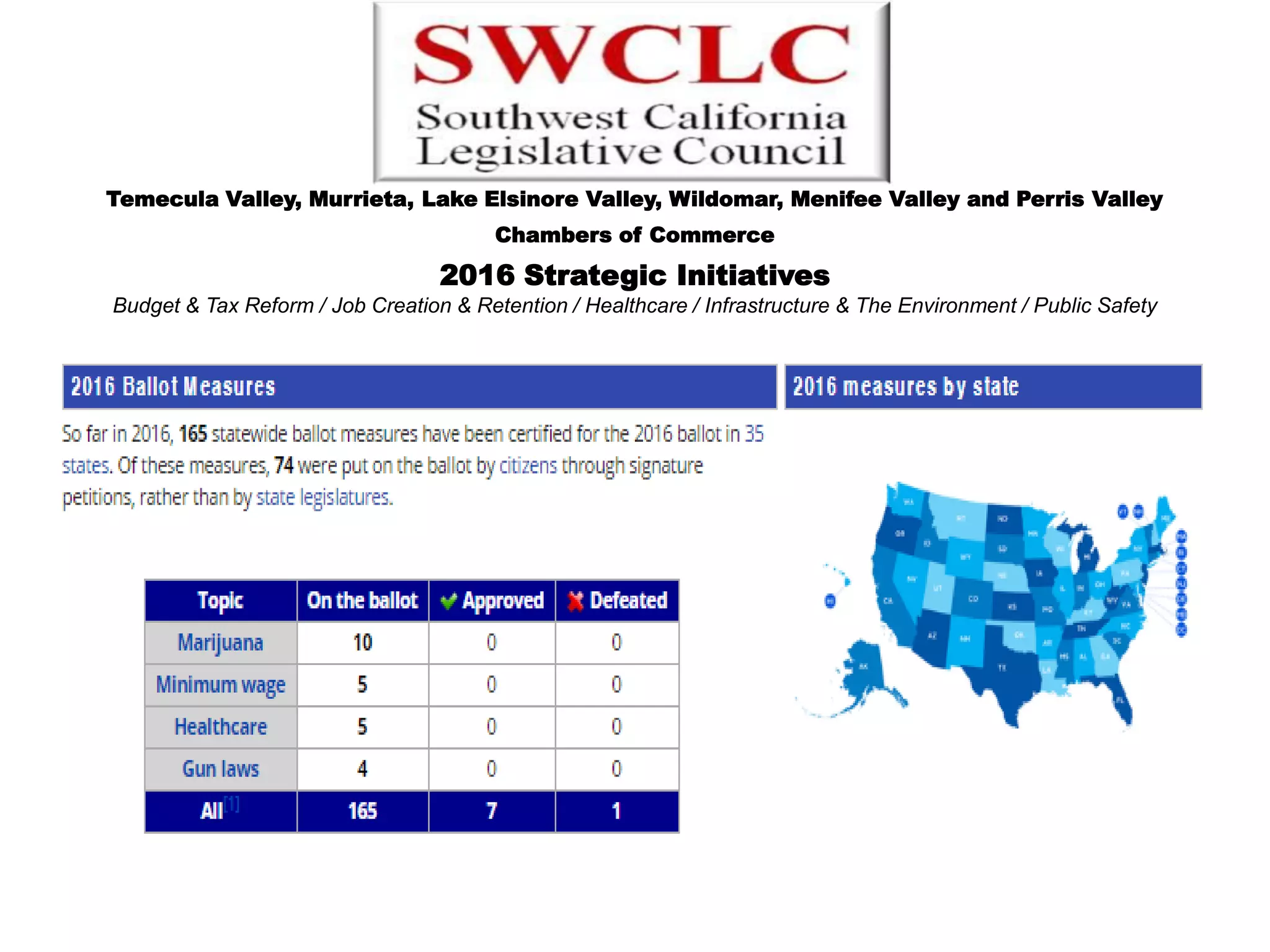
Temecula Valley, Murrieta, Lake Elsinore Valley, Wildomar, Menifee Valley and Perris Valley
Chambers of Commerce
2016 Strategic Initiatives
Budget & Tax Reform / Job Creation & Retention / Healthcare / Infrastructure & The Environment / Public Safety
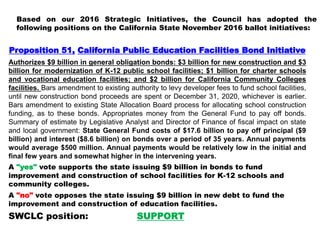
Proposition 51, California Public Education Facilities Bond Initiative
Authorizes $9 billion in general obligation bonds: $3 billion for new construction and $3
billion for modernization of K-12 public school facilities; $1 billion for charter schools
and vocational education facilities; and $2 billion for California Community Colleges
facilities. Bars amendment to existing authority to levy developer fees to fund school facilities,
until new construction bond proceeds are spent or December 31, 2020, whichever is earlier.
Bars amendment to existing State Allocation Board process for allocating school construction
funding, as to these bonds. Appropriates money from the General Fund to pay off bonds.
Summary of estimate by Legislative Analyst and Director of Finance of fiscal impact on state
and local government: State General Fund costs of $17.6 billion to pay off principal ($9
billion) and interest ($8.6 billion) on bonds over a period of 35 years. Annual payments
would average $500 million. Annual payments would be relatively low in the initial and
final few years and somewhat higher in the intervening years.
A "yes" vote supports the state issuing $9 billion in bonds to fund
improvement and construction of school facilities for K-12 schools and
community colleges.
A "no" vote opposes the state issuing $9 billion in new debt to fund the
improvement and construction of education facilities.
SWCLC position: SUPPORT
Based on our 2016 Strategic Initiatives, the Council has adopted the
following positions on the California State November 2016 ballot initiatives:
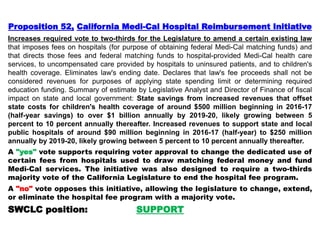
Proposition 52, California Medi-Cal Hospital Reimbursement Initiative
Increases required vote to two-thirds for the Legislature to amend a certain existing law
that imposes fees on hospitals (for purpose of obtaining federal Medi-Cal matching funds) and
that directs those fees and federal matching funds to hospital-provided Medi-Cal health care
services, to uncompensated care provided by hospitals to uninsured patients, and to children's
health coverage. Eliminates law's ending date. Declares that law's fee proceeds shall not be
considered revenues for purposes of applying state spending limit or determining required
education funding. Summary of estimate by Legislative Analyst and Director of Finance of fiscal
impact on state and local government: State savings from increased revenues that offset
state costs for children's health coverage of around $500 million beginning in 2016-17
(half-year savings) to over $1 billion annually by 2019-20, likely growing between 5
percent to 10 percent annually thereafter. Increased revenues to support state and local
public hospitals of around $90 million beginning in 2016-17 (half-year) to $250 million
annually by 2019-20, likely growing between 5 percent to 10 percent annually thereafter.
A "yes" vote supports requiring voter approval to change the dedicated use of
certain fees from hospitals used to draw matching federal money and fund
Medi-Cal services. The initiative was also designed to require a two-thirds
majority vote of the California Legislature to end the hospital fee program.
A "no" vote opposes this initiative, allowing the legislature to change, extend,
or eliminate the hospital fee program with a majority vote.
SWCLC position: SUPPORT
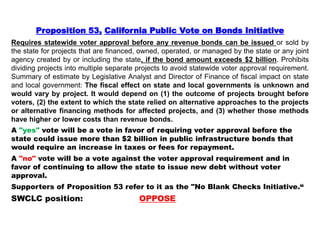
Proposition 53, California Public Vote on Bonds Initiative
Requires statewide voter approval before any revenue bonds can be issued or sold by
the state for projects that are financed, owned, operated, or managed by the state or any joint
agency created by or including the state, if the bond amount exceeds $2 billion. Prohibits
dividing projects into multiple separate projects to avoid statewide voter approval requirement.
Summary of estimate by Legislative Analyst and Director of Finance of fiscal impact on state
and local government: The fiscal effect on state and local governments is unknown and
would vary by project. It would depend on (1) the outcome of projects brought before
voters, (2) the extent to which the state relied on alternative approaches to the projects
or alternative financing methods for affected projects, and (3) whether those methods
have higher or lower costs than revenue bonds.
A "yes" vote will be a vote in favor of requiring voter approval before the
state could issue more than $2 billion in public infrastructure bonds that
would require an increase in taxes or fees for repayment.
A "no" vote will be a vote against the voter approval requirement and in
favor of continuing to allow the state to issue new debt without voter
approval.
Supporters of Proposition 53 refer to it as the "No Blank Checks Initiative.“
SWCLC position: OPPOSE
Proposition 54, California "Legislature Transparency Act"
Amendment
Prohibits Legislature from passing any bill unless it has been in print and published on
the Internet for at least 72 hours before the vote, except in cases of public emergency.
Requires the Legislature to make audiovisual recordings of all its proceedings, except closed
session proceedings, and post them on the Internet. Authorizes any person to record
legislative proceedings by audio or video means, except closed session proceedings. Allows
recordings of legislative proceedings to be used for any legitimate purpose, without payment
of any fee to the State. Summary of estimate by Legislative Analyst and Director of Finance of
fiscal impact on state and local government: Increased costs to state government of
potentially $1 million to $2 million initially and about $1 million annually for making
additional legislative proceedings available in audiovisual form on the Internet.
A "yes" vote will be a vote in favor of prohibiting the legislature from
passing any bill until it has been in print and published on the Internet for 72
hours prior to the vote.
A "no" vote will be a vote against prohibiting the legislature from passing
any bill until it has been in print and published on the Internet for 72 hours
prior to the vote.
SWCLC position: SUPPORT
Proposition 55, California Tax Extension to Fund Education and
Healthcare
Extends by twelve years the temporary personal income tax increases enacted in 2012
on earnings over $250,000 (for single filers; over $500,000 for joint filers; over $340,000 for
heads of household). Allocates these tax revenues 89% to K-12 schools and 11% to California
Community Colleges. Allocates up to $2 billion per year in certain years for healthcare
programs. Bars use of education revenues for administrative costs, but provides local school
governing boards discretion to decide, in open meetings and subject to annual audit, how
revenues are to be spent. Summary of estimate by Legislative Analyst and Director of Finance
of fiscal impact on state and local government: Increased state revenues annually from
2019 through 2030—likely in the $5 billion to $11 billion range initially—with amounts
varying based on stock market and economic trends. Increased revenues would be
allocated under constitutional formulas to schools and community colleges, budget
reserves and debt payments, and health programs, with remaining funds available for
these or other state purposes.
A "yes" vote supports extending the personal income tax increases on
incomes over $250,000 approved in 2012 for 12 years in order to fund
education and healthcare.
A "no" vote opposes extending the personal income tax increases on
incomes over $250,000 approved in 2012 for 12 years, allowing the tax
increase to expire in 2019.
SWCLC position: OPPOSE
Proposition 56, California Healthcare, Research and Prevention
Tobacco Tax
Increases cigarette tax by $2.00 per pack, with equivalent increase on other tobacco products
and electronic cigarettes containing nicotine. Allocates revenues primarily to increase funding for
existing healthcare programs; also for tobacco use prevention/control programs, tobacco-related
disease research and law enforcement, University of California physician training, dental disease
prevention programs, and administration. Excludes these revenues from Proposition 98 funding
requirements. If tax causes decreased tobacco consumption, transfers tax revenues to offset
decreases to existing tobacco-funded programs and sales tax revenues. Requires biennial audit.
Summary of estimate by Legislative Analyst and Director of Finance of fiscal impact on state and
local government: Net increase in excise tax revenues in the range of $1.1 billion to $1.6 billion
annually by 2017-18, with revenues decreasing slightly in subsequent years. The majority of
funds would be used for payments to health care providers. The remaining funds would be used
for a variety of specified purposes, including tobacco-related prevention and cessation
programs, law enforcement programs, medical research on tobacco-related diseases, and early
childhood development programs.
A "yes" vote favors increasing the cigarette tax by $2.00 per pack, with
equivalent increases on other tobacco products and electronic cigarettes.
A "no" vote opposes increasing the cigarette tax by $2.00 per pack, with
equivalent increases on other tobacco products and electronic cigarettes.
SWCLC position: NBR
Proposition 57, California Parole and Juvenile Trial Opportunity
Modification
Allows parole consideration for persons convicted of nonviolent felonies upon completion of full
prison term for primary offense, as defined. Authorizes Department of Corrections and
Rehabilitation to award sentence credits for rehabilitation, good behavior, or educational
achievements. Requires Department of Corrections and Rehabilitation to adopt regulations to
implement new parole and sentence credit provisions and certify they enhance public safety.
Provides juvenile court judges shall make determination, upon prosecutor motion, whether
juveniles age 14 and older should be prosecuted and sentenced as adults. Summary of
estimate by Legislative Analyst and Director of Finance of fiscal impact on state and local
government: Net state savings that could range from the tens of millions of dollars to the
low hundreds of millions of dollars annually primarily due to a reduction in the prison
population from additional paroles granted and credits earned. Net county costs that
could range from the millions to tens of millions of dollars annually, declining to a few
million dollars after initial implementation of the measure.
A "yes" vote supports increasing parole and good behavior opportunities for
felons convicted of nonviolent crimes and allowing judges, not prosecutors,
to decide whether to try certain juveniles as adults in court.
A "no" vote opposes increasing parole and good behavior opportunities for
felons convicted of nonviolent crimes and favors keeping the current system
of having prosecutors decide whether to try certain juveniles as adults in
court.
SWCLC position: OPPOSE
Prop 57 deems the following crimes ‘non-violent’ and makes the perpetrators eligible for EARLY
PAROLE and RELEASE into local communities:
​• Rape by intoxication • Rape of an unconscious person • Human Trafficking involving sex act with
minors • Drive-by shooting • Assault with a deadly weapon • Hostage taking • Attempting to explode
a bomb at a hospital or school • Domestic violence involving trauma • Supplying a firearm to a gang
member • Hate crime causing physical injury • Failing to register as a sex offender • Arson •
Discharging a firearm on school grounds • Lewd acts against a child 14 or 15 • False imprisonment
of an elder through violence. *partial list
​Here are five more reasons to VOTE NO on 57:
​1) 57 authorizes state government bureaucrats to reduce many sentences for “good behavior,” even
for inmates convicted of murder, rape, child molestation and human trafficking.
2) 57 permits the worst career criminals to be treated the same as first-time offenders, discounting
strong sentences imposed by a judge.
3) ‘57 effectively overturns key provisions of Marsy’s Law, ‘3-Strikes and You’re Out,’ Victims’ Bill of
Rights, Californians Against Sexual Exploitation Act – measures enacted by voters that have
protected victims and made communities Safer’—Susan Fisher, Former Chairwoman State Parole
Board
4) 57 forces victims trying to put their lives back together to re-live the crimes committed against
them over and over again, with every new parole hearing.
5) 57 will likely result in higher crime rates as at least 16,000 dangerous criminals, including those
previously convicted of murder and rape, would be eligible for early release.
​Finally, Prop. 57 places all these new privileges and rights for convicted criminals into the California
Constitution, where they cannot be changed by the Legislature.
​Make no mistake. If Prop. 57 passes, every home, every neighborhood, every school will be less safe
than it is today.
Commentary courtesy of Assembly Member Melissa Melendez
Proposition 58, California Multilingual Education Act
Preserves requirement that public schools ensure students obtain English language proficiency.
Requires school districts to solicit parent/community input in developing language acquisition
programs. Requires instruction to ensure English acquisition as rapidly and effectively as
possible. Authorizes school districts to establish dual-language immersion programs for both
native and non-native English speakers. Fiscal Impact: No notable fiscal effect on school
districts or state government.
A "yes" vote is a vote in favor of repealing most of the 1998 Proposition 227,
the "English in Public Schools" Initiative, thus effectively allowing non-English
languages to be used in public educational instruction.
A "no" vote is a vote against repealing most of the "English in Public Schools"
Initiative, which was designed to prohibit non-English languages from being
used in public schools.
SWCLC position: OPPOSE
Proposition 59, California Overturn of Citizens United Act Advisory
Question
Shall California’s elected officials use all of their constitutional authority, including, but not
limited to, proposing and ratifying one or more amendments to the United States Constitution, to
overturn Citizens United v. Federal Election Commission (2010) 558 U.S. 310, and other
applicable judicial precedents, to allow the full regulation or limitation of campaign contributions
and spending, to ensure that all citizens, regardless of wealth, may express their views to one
another, and to make clear that corporations should not have the same constitutional rights
as human beings
A ”yes” vote supports allowing the state's elected officials to use their
authority to overturn the Citizens United v. Federal Election
Commission decision, potentially through an amendment to the U.S.
Constitution.
A ”no” vote opposes this advisory question's proposal to allow the state's
elected officials to use their authority to overturn the Citizens United v.
Federal Election Commission decision.
The United States Supreme Court's ruling in Citizens United v. Federal
Election Commission (2010) held that political contributions and spending
were protected as "free speech" under the First Amendment.
SWCLC position: OPPOSE
Proposition 60, California Condoms in Pornographic Films Initiative
Requires performers in adult films to use condoms during filming of sexual intercourse.
Requires producers of adult films to pay for performer vaccinations, testing, and medical
examinations related to sexually transmitted infections. Requires producers to obtain state
health license at beginning of filming and to post condom requirement at film sites. Imposes
liability on producers for violations, on certain distributors, on performers if they have a
financial interest in the violating film, and on talent agents who knowingly refer performers to
noncomplying producers. Permits state, performers, or any state resident to enforce violations.
Summary of estimate by Legislative Analyst and Director of Finance of fiscal impact on state
and local government: Potentially reduced state and local tax revenue of millions or tens of
millions of dollars per year. Likely state costs of a few million dollars annually to administer the
law. Possible ongoing net costs or savings for state and local health and human services
programs.
A "yes" vote would be a vote in favor of requiring the use of condoms and
other protective measures during the filming of pornographic films, as well
as requiring pornography producers to pay for certain health requirements
and checkups.
A "no" vote would be a vote against requiring the use of condoms and other
safety measures during the filming of pornographic films.
SWCLC position: NBR
Proposition 61, California Drug Price Standards Initiative
Prohibits state agencies from paying more for a prescription drug than the lowest price
paid for the same drug by the United States Department of Veterans Affairs. Applies to
any program where the state is the ultimate payer for a drug, even if the state does not
purchase the drug directly. Exempts certain purchases of prescription drugs funded through
Medi-Cal. Fiscal impact: It is the opinion of the Legislative Analyst and Director of Finance that
the measure, if adopted, may result in a substantial net change in state or local finances.
A "yes" vote supports regulating drug prices by requiring state agencies to
pay the same prices that the U.S. Department of Veterans Affairs (USDVA)
pays for prescription drugs.
A "no" vote opposes regulating drug prices by requiring state agencies to
pay the same prices that the U.S. Department of Veterans Affairs (USDVA)
pays for prescription drugs.
Proposition 61 could be one of the most expensive ballot measure battles in
2016, and could be the ballot measure with the most money spent on it ever
in California's history, with the combined amount of money raised by the
support and opposition campaigns totaling to over $96 million as of mid-
September 2016.
SWCLC position: OPPOSE
Proposition 62, California Death Penalty Repeal
Repeals death penalty as maximum punishment for persons found guilty of murder and
replaces it with life imprisonment without possibility of parole. Applies retroactively to persons
already sentenced to death. States that persons found guilty of murder and sentenced to life
without possibility of parole must work while in prison as prescribed by the Department of
Corrections and Rehabilitation. Increases to 60% the portion of wages earned by persons
sentenced to life without the possibility of parole that may be applied to any victim restitution
fines or orders against them. Summary of estimate by Legislative Analyst and Director of
Finance of fiscal impact on state and local government: Net reduction in state and local
government costs of potentially around $150 million annually within a few years due to
the elimination of the death penalty
A "yes" vote supports repealing the death penalty and making life without the
possibility of parole the maximum punishment for murder.
A "no" vote opposes repealing the death penalty.
There is another death penalty related measure, Proposition 66, that will
appear on the November 8, 2016, ballot in California. If both measures pass,
the one with the most "yes" votes would supersede the other.
SWCLC position: NBR
Proposition 63, California "Safety for All" Gun Control Initiative
Prohibits possession of large-capacity ammunition magazines, and requires their disposal
by sale to dealer, destruction, or removal from state. Requires most individuals to pass
background check and obtain Department of Justice authorization to purchase ammunition.
Requires most ammunition sales be made through licensed ammunition vendors and reported to
Department of Justice. Requires lost or stolen firearms and ammunition be reported to law
enforcement. Prohibits persons convicted of stealing a firearm from possessing firearms.
Establishes new procedures for enforcing laws prohibiting firearm possession by felons and
violent criminals. Requires Department of Justice to provide information about prohibited
persons to federal National Instant Criminal Background Check System. related to new and
increased penalties.
A "yes" vote supports prohibiting the possession of large-capacity
ammunition magazines and requiring certain individuals to pass a
background check in order to purchase ammunition.
A "no" vote opposes this proposal to prohibit the possession of large-capacity
ammunition magazines and require certain individuals to pass a background
check in order to purchase ammunition.
SWCLC position: NBR
Proposition 64, California Marijuana Legalization Initiative
Legalizes marijuana and hemp under state law. Designates state agencies to license and regulate
marijuana industry. Imposes state excise tax on retail sales of marijuana equal to 15% of sales price, and
state cultivation taxes on marijuana of $9.25 per ounce of flowers and $2.75 per ounce of leaves. Exempts
medical marijuana from some taxation. Establishes packaging, labeling, advertising, and marketing
standards and restrictions for marijuana products. Allows local regulation and taxation of marijuana.
Prohibits marketing and advertising marijuana to minors. Authorizes resentencing and destruction of records
for prior marijuana convictions. Summary of estimate by Legislative Analyst and Director of Finance of fiscal
impact on state and local government: Net reduced costs ranging from tens of millions of dollars to
potentially exceeding $100 million annually to state and local governments related to enforcing
certain marijuana-related offenses, handling the related criminal cases in the court system, and
incarcerating and supervising certain marijuana offenders. Net additional state and local tax
revenues potentially ranging from the high hundreds of millions of dollars to over $1 billion annually
related to the production and sale of marijuana. Most of these funds would be required to be spent
for specific purposes such as substance use disorder education, prevention, and treatment.
A "yes" vote supports legalizing recreational marijuana and hemp under
state law and establishing certain sales and cultivation taxes.
A "no" vote opposes this proposal legalizing recreational marijuana and
hemp under state law and establishing certain sales and cultivation taxes.
Initiatives designed to legalize recreational marijuana are on the ballot in
five states in 2016, including California. The other four states
are Arizona, Maine, Massachusetts and Nevada.
SWCLC position: OPPOSE
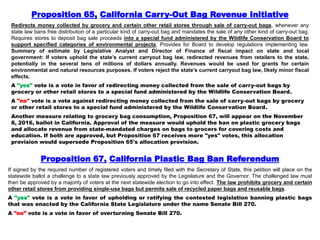
Proposition 65, California Carry-Out Bag Revenue Initiative
Redirects money collected by grocery and certain other retail stores through sale of carry-out bags, whenever any
state law bans free distribution of a particular kind of carry-out bag and mandates the sale of any other kind of carry-out bag.
Requires stores to deposit bag sale proceeds into a special fund administered by the Wildlife Conservation Board to
support specified categories of environmental projects. Provides for Board to develop regulations implementing law.
Summary of estimate by Legislative Analyst and Director of Finance of fiscal impact on state and local
government: If voters uphold the state’s current carryout bag law, redirected revenues from retailers to the state,
potentially in the several tens of millions of dollars annually. Revenues would be used for grants for certain
environmental and natural resources purposes. If voters reject the state’s current carryout bag law, likely minor fiscal
effects.
A "yes" vote is a vote in favor of redirecting money collected from the sale of carry-out bags by
grocery or other retail stores to a special fund administered by the Wildlife Conservation Board.
A "no" vote is a vote against redirecting money collected from the sale of carry-out bags by grocery
or other retail stores to a special fund administered by the Wildlife Conservation Board.
Another measure relating to grocery bag consumption, Proposition 67, will appear on the November
8, 2016, ballot in California. Approval of the measure would uphold the ban on plastic grocery bags
and allocate revenue from state-mandated charges on bags to grocers for covering costs and
education. If both are approved, but Proposition 67 receives more "yes" votes, this allocation
provision would supersede Proposition 65's allocation provision.
Proposition 67, California Plastic Bag Ban Referendum
If signed by the required number of registered voters and timely filed with the Secretary of State, this petition will place on the
statewide ballot a challenge to a state law previously approved by the Legislature and the Governor. The challenged law must
then be approved by a majority of voters at the next statewide election to go into effect. The law prohibits grocery and certain
other retail stores from providing single-use bags but permits sale of recycled paper bags and reusable bags.
A "yes" vote is a vote in favor of upholding or ratifying the contested legislation banning plastic bags
that was enacted by the California State Legislature under the name Senate Bill 270.
A "no" vote is a vote in favor of overturning Senate Bill 270.
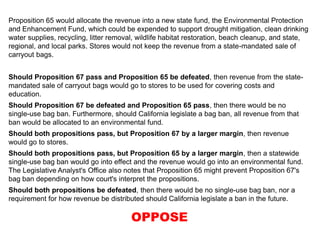
Proposition 65 would allocate the revenue into a new state fund, the Environmental Protection
and Enhancement Fund, which could be expended to support drought mitigation, clean drinking
water supplies, recycling, litter removal, wildlife habitat restoration, beach cleanup, and state,
regional, and local parks. Stores would not keep the revenue from a state-mandated sale of
carryout bags.
Should Proposition 67 pass and Proposition 65 be defeated, then revenue from the state-
mandated sale of carryout bags would go to stores to be used for covering costs and
education.
Should Proposition 67 be defeated and Proposition 65 pass, then there would be no
single-use bag ban. Furthermore, should California legislate a bag ban, all revenue from that
ban would be allocated to an environmental fund.
Should both propositions pass, but Proposition 67 by a larger margin, then revenue
would go to stores.
Should both propositions pass, but Proposition 65 by a larger margin, then a statewide
single-use bag ban would go into effect and the revenue would go into an environmental fund.
The Legislative Analyst's Office also notes that Proposition 65 might prevent Proposition 67's
bag ban depending on how court's interpret the propositions.
Should both propositions be defeated, then there would be no single-use bag ban, nor a
requirement for how revenue be distributed should California legislate a ban in the future.
OPPOSE
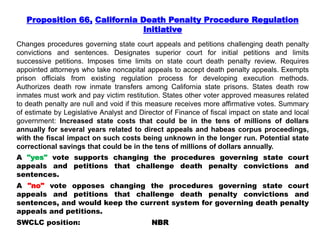
Proposition 66, California Death Penalty Procedure Regulation
Initiative
Changes procedures governing state court appeals and petitions challenging death penalty
convictions and sentences. Designates superior court for initial petitions and limits
successive petitions. Imposes time limits on state court death penalty review. Requires
appointed attorneys who take noncapital appeals to accept death penalty appeals. Exempts
prison officials from existing regulation process for developing execution methods.
Authorizes death row inmate transfers among California state prisons. States death row
inmates must work and pay victim restitution. States other voter approved measures related
to death penalty are null and void if this measure receives more affirmative votes. Summary
of estimate by Legislative Analyst and Director of Finance of fiscal impact on state and local
government: Increased state costs that could be in the tens of millions of dollars
annually for several years related to direct appeals and habeas corpus proceedings,
with the fiscal impact on such costs being unknown in the longer run. Potential state
correctional savings that could be in the tens of millions of dollars annually.
A "yes" vote supports changing the procedures governing state court
appeals and petitions that challenge death penalty convictions and
sentences.
A "no" vote opposes changing the procedures governing state court
appeals and petitions that challenge death penalty convictions and
sentences, and would keep the current system for governing death penalty
appeals and petitions.
SWCLC position: NBR
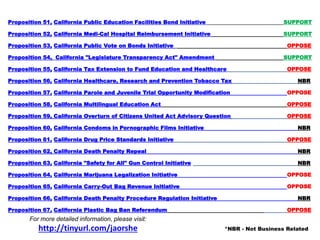
Proposition 51, California Public Education Facilities Bond Initiative SUPPORT
Proposition 52, California Medi-Cal Hospital Reimbursement Initiative SUPPORT
Proposition 53, California Public Vote on Bonds Initiative OPPOSE
Proposition 54, California "Legislature Transparency Act" Amendment SUPPORT
Proposition 55, California Tax Extension to Fund Education and Healthcare OPPOSE
Proposition 56, California Healthcare, Research and Prevention Tobacco Tax NBR
Proposition 57, California Parole and Juvenile Trial Opportunity Modification OPPOSE
Proposition 58, California Multilingual Education Act OPPOSE
Proposition 59, California Overturn of Citizens United Act Advisory Question OPPOSE
Proposition 60, California Condoms in Pornographic Films Initiative NBR
Proposition 61, California Drug Price Standards Initiative OPPOSE
Proposition 62, California Death Penalty Repeal NBR
Proposition 63, California "Safety for All" Gun Control Initiative NBR
Proposition 64, California Marijuana Legalization Initiative OPPOSE
Proposition 65, California Carry-Out Bag Revenue Initiative OPPOSE
Proposition 66, California Death Penalty Procedure Regulation Initiative NBR
Proposition 67, California Plastic Bag Ban Referendum OPPOSE
*NBR - Not Business Related
For more detailed information, please visit:
http://tinyurl.com/jaorshe

2016 California Ballot Propositions

  • 1.
    Temecula Valley, Murrieta,Lake Elsinore Valley, Wildomar, Menifee Valley and Perris Valley Chambers of Commerce 2016 Strategic Initiatives Budget & Tax Reform / Job Creation & Retention / Healthcare / Infrastructure & The Environment / Public Safety
  • 2.
    Proposition 51, CaliforniaPublic Education Facilities Bond Initiative Authorizes $9 billion in general obligation bonds: $3 billion for new construction and $3 billion for modernization of K-12 public school facilities; $1 billion for charter schools and vocational education facilities; and $2 billion for California Community Colleges facilities. Bars amendment to existing authority to levy developer fees to fund school facilities, until new construction bond proceeds are spent or December 31, 2020, whichever is earlier. Bars amendment to existing State Allocation Board process for allocating school construction funding, as to these bonds. Appropriates money from the General Fund to pay off bonds. Summary of estimate by Legislative Analyst and Director of Finance of fiscal impact on state and local government: State General Fund costs of $17.6 billion to pay off principal ($9 billion) and interest ($8.6 billion) on bonds over a period of 35 years. Annual payments would average $500 million. Annual payments would be relatively low in the initial and final few years and somewhat higher in the intervening years. A "yes" vote supports the state issuing $9 billion in bonds to fund improvement and construction of school facilities for K-12 schools and community colleges. A "no" vote opposes the state issuing $9 billion in new debt to fund the improvement and construction of education facilities. SWCLC position: SUPPORT Based on our 2016 Strategic Initiatives, the Council has adopted the following positions on the California State November 2016 ballot initiatives:
  • 3.
    Proposition 52, CaliforniaMedi-Cal Hospital Reimbursement Initiative Increases required vote to two-thirds for the Legislature to amend a certain existing law that imposes fees on hospitals (for purpose of obtaining federal Medi-Cal matching funds) and that directs those fees and federal matching funds to hospital-provided Medi-Cal health care services, to uncompensated care provided by hospitals to uninsured patients, and to children's health coverage. Eliminates law's ending date. Declares that law's fee proceeds shall not be considered revenues for purposes of applying state spending limit or determining required education funding. Summary of estimate by Legislative Analyst and Director of Finance of fiscal impact on state and local government: State savings from increased revenues that offset state costs for children's health coverage of around $500 million beginning in 2016-17 (half-year savings) to over $1 billion annually by 2019-20, likely growing between 5 percent to 10 percent annually thereafter. Increased revenues to support state and local public hospitals of around $90 million beginning in 2016-17 (half-year) to $250 million annually by 2019-20, likely growing between 5 percent to 10 percent annually thereafter. A "yes" vote supports requiring voter approval to change the dedicated use of certain fees from hospitals used to draw matching federal money and fund Medi-Cal services. The initiative was also designed to require a two-thirds majority vote of the California Legislature to end the hospital fee program. A "no" vote opposes this initiative, allowing the legislature to change, extend, or eliminate the hospital fee program with a majority vote. SWCLC position: SUPPORT
  • 4.
    Proposition 53, CaliforniaPublic Vote on Bonds Initiative Requires statewide voter approval before any revenue bonds can be issued or sold by the state for projects that are financed, owned, operated, or managed by the state or any joint agency created by or including the state, if the bond amount exceeds $2 billion. Prohibits dividing projects into multiple separate projects to avoid statewide voter approval requirement. Summary of estimate by Legislative Analyst and Director of Finance of fiscal impact on state and local government: The fiscal effect on state and local governments is unknown and would vary by project. It would depend on (1) the outcome of projects brought before voters, (2) the extent to which the state relied on alternative approaches to the projects or alternative financing methods for affected projects, and (3) whether those methods have higher or lower costs than revenue bonds. A "yes" vote will be a vote in favor of requiring voter approval before the state could issue more than $2 billion in public infrastructure bonds that would require an increase in taxes or fees for repayment. A "no" vote will be a vote against the voter approval requirement and in favor of continuing to allow the state to issue new debt without voter approval. Supporters of Proposition 53 refer to it as the "No Blank Checks Initiative.“ SWCLC position: OPPOSE
  • 5.
    Proposition 54, California"Legislature Transparency Act" Amendment Prohibits Legislature from passing any bill unless it has been in print and published on the Internet for at least 72 hours before the vote, except in cases of public emergency. Requires the Legislature to make audiovisual recordings of all its proceedings, except closed session proceedings, and post them on the Internet. Authorizes any person to record legislative proceedings by audio or video means, except closed session proceedings. Allows recordings of legislative proceedings to be used for any legitimate purpose, without payment of any fee to the State. Summary of estimate by Legislative Analyst and Director of Finance of fiscal impact on state and local government: Increased costs to state government of potentially $1 million to $2 million initially and about $1 million annually for making additional legislative proceedings available in audiovisual form on the Internet. A "yes" vote will be a vote in favor of prohibiting the legislature from passing any bill until it has been in print and published on the Internet for 72 hours prior to the vote. A "no" vote will be a vote against prohibiting the legislature from passing any bill until it has been in print and published on the Internet for 72 hours prior to the vote. SWCLC position: SUPPORT
  • 6.
    Proposition 55, CaliforniaTax Extension to Fund Education and Healthcare Extends by twelve years the temporary personal income tax increases enacted in 2012 on earnings over $250,000 (for single filers; over $500,000 for joint filers; over $340,000 for heads of household). Allocates these tax revenues 89% to K-12 schools and 11% to California Community Colleges. Allocates up to $2 billion per year in certain years for healthcare programs. Bars use of education revenues for administrative costs, but provides local school governing boards discretion to decide, in open meetings and subject to annual audit, how revenues are to be spent. Summary of estimate by Legislative Analyst and Director of Finance of fiscal impact on state and local government: Increased state revenues annually from 2019 through 2030—likely in the $5 billion to $11 billion range initially—with amounts varying based on stock market and economic trends. Increased revenues would be allocated under constitutional formulas to schools and community colleges, budget reserves and debt payments, and health programs, with remaining funds available for these or other state purposes. A "yes" vote supports extending the personal income tax increases on incomes over $250,000 approved in 2012 for 12 years in order to fund education and healthcare. A "no" vote opposes extending the personal income tax increases on incomes over $250,000 approved in 2012 for 12 years, allowing the tax increase to expire in 2019. SWCLC position: OPPOSE
  • 7.
    Proposition 56, CaliforniaHealthcare, Research and Prevention Tobacco Tax Increases cigarette tax by $2.00 per pack, with equivalent increase on other tobacco products and electronic cigarettes containing nicotine. Allocates revenues primarily to increase funding for existing healthcare programs; also for tobacco use prevention/control programs, tobacco-related disease research and law enforcement, University of California physician training, dental disease prevention programs, and administration. Excludes these revenues from Proposition 98 funding requirements. If tax causes decreased tobacco consumption, transfers tax revenues to offset decreases to existing tobacco-funded programs and sales tax revenues. Requires biennial audit. Summary of estimate by Legislative Analyst and Director of Finance of fiscal impact on state and local government: Net increase in excise tax revenues in the range of $1.1 billion to $1.6 billion annually by 2017-18, with revenues decreasing slightly in subsequent years. The majority of funds would be used for payments to health care providers. The remaining funds would be used for a variety of specified purposes, including tobacco-related prevention and cessation programs, law enforcement programs, medical research on tobacco-related diseases, and early childhood development programs. A "yes" vote favors increasing the cigarette tax by $2.00 per pack, with equivalent increases on other tobacco products and electronic cigarettes. A "no" vote opposes increasing the cigarette tax by $2.00 per pack, with equivalent increases on other tobacco products and electronic cigarettes. SWCLC position: NBR
  • 8.
    Proposition 57, CaliforniaParole and Juvenile Trial Opportunity Modification Allows parole consideration for persons convicted of nonviolent felonies upon completion of full prison term for primary offense, as defined. Authorizes Department of Corrections and Rehabilitation to award sentence credits for rehabilitation, good behavior, or educational achievements. Requires Department of Corrections and Rehabilitation to adopt regulations to implement new parole and sentence credit provisions and certify they enhance public safety. Provides juvenile court judges shall make determination, upon prosecutor motion, whether juveniles age 14 and older should be prosecuted and sentenced as adults. Summary of estimate by Legislative Analyst and Director of Finance of fiscal impact on state and local government: Net state savings that could range from the tens of millions of dollars to the low hundreds of millions of dollars annually primarily due to a reduction in the prison population from additional paroles granted and credits earned. Net county costs that could range from the millions to tens of millions of dollars annually, declining to a few million dollars after initial implementation of the measure. A "yes" vote supports increasing parole and good behavior opportunities for felons convicted of nonviolent crimes and allowing judges, not prosecutors, to decide whether to try certain juveniles as adults in court. A "no" vote opposes increasing parole and good behavior opportunities for felons convicted of nonviolent crimes and favors keeping the current system of having prosecutors decide whether to try certain juveniles as adults in court. SWCLC position: OPPOSE
  • 9.
    Prop 57 deemsthe following crimes ‘non-violent’ and makes the perpetrators eligible for EARLY PAROLE and RELEASE into local communities: ​• Rape by intoxication • Rape of an unconscious person • Human Trafficking involving sex act with minors • Drive-by shooting • Assault with a deadly weapon • Hostage taking • Attempting to explode a bomb at a hospital or school • Domestic violence involving trauma • Supplying a firearm to a gang member • Hate crime causing physical injury • Failing to register as a sex offender • Arson • Discharging a firearm on school grounds • Lewd acts against a child 14 or 15 • False imprisonment of an elder through violence. *partial list ​Here are five more reasons to VOTE NO on 57: ​1) 57 authorizes state government bureaucrats to reduce many sentences for “good behavior,” even for inmates convicted of murder, rape, child molestation and human trafficking. 2) 57 permits the worst career criminals to be treated the same as first-time offenders, discounting strong sentences imposed by a judge. 3) ‘57 effectively overturns key provisions of Marsy’s Law, ‘3-Strikes and You’re Out,’ Victims’ Bill of Rights, Californians Against Sexual Exploitation Act – measures enacted by voters that have protected victims and made communities Safer’—Susan Fisher, Former Chairwoman State Parole Board 4) 57 forces victims trying to put their lives back together to re-live the crimes committed against them over and over again, with every new parole hearing. 5) 57 will likely result in higher crime rates as at least 16,000 dangerous criminals, including those previously convicted of murder and rape, would be eligible for early release. ​Finally, Prop. 57 places all these new privileges and rights for convicted criminals into the California Constitution, where they cannot be changed by the Legislature. ​Make no mistake. If Prop. 57 passes, every home, every neighborhood, every school will be less safe than it is today. Commentary courtesy of Assembly Member Melissa Melendez
  • 10.
    Proposition 58, CaliforniaMultilingual Education Act Preserves requirement that public schools ensure students obtain English language proficiency. Requires school districts to solicit parent/community input in developing language acquisition programs. Requires instruction to ensure English acquisition as rapidly and effectively as possible. Authorizes school districts to establish dual-language immersion programs for both native and non-native English speakers. Fiscal Impact: No notable fiscal effect on school districts or state government. A "yes" vote is a vote in favor of repealing most of the 1998 Proposition 227, the "English in Public Schools" Initiative, thus effectively allowing non-English languages to be used in public educational instruction. A "no" vote is a vote against repealing most of the "English in Public Schools" Initiative, which was designed to prohibit non-English languages from being used in public schools. SWCLC position: OPPOSE
  • 11.
    Proposition 59, CaliforniaOverturn of Citizens United Act Advisory Question Shall California’s elected officials use all of their constitutional authority, including, but not limited to, proposing and ratifying one or more amendments to the United States Constitution, to overturn Citizens United v. Federal Election Commission (2010) 558 U.S. 310, and other applicable judicial precedents, to allow the full regulation or limitation of campaign contributions and spending, to ensure that all citizens, regardless of wealth, may express their views to one another, and to make clear that corporations should not have the same constitutional rights as human beings A ”yes” vote supports allowing the state's elected officials to use their authority to overturn the Citizens United v. Federal Election Commission decision, potentially through an amendment to the U.S. Constitution. A ”no” vote opposes this advisory question's proposal to allow the state's elected officials to use their authority to overturn the Citizens United v. Federal Election Commission decision. The United States Supreme Court's ruling in Citizens United v. Federal Election Commission (2010) held that political contributions and spending were protected as "free speech" under the First Amendment. SWCLC position: OPPOSE
  • 12.
    Proposition 60, CaliforniaCondoms in Pornographic Films Initiative Requires performers in adult films to use condoms during filming of sexual intercourse. Requires producers of adult films to pay for performer vaccinations, testing, and medical examinations related to sexually transmitted infections. Requires producers to obtain state health license at beginning of filming and to post condom requirement at film sites. Imposes liability on producers for violations, on certain distributors, on performers if they have a financial interest in the violating film, and on talent agents who knowingly refer performers to noncomplying producers. Permits state, performers, or any state resident to enforce violations. Summary of estimate by Legislative Analyst and Director of Finance of fiscal impact on state and local government: Potentially reduced state and local tax revenue of millions or tens of millions of dollars per year. Likely state costs of a few million dollars annually to administer the law. Possible ongoing net costs or savings for state and local health and human services programs. A "yes" vote would be a vote in favor of requiring the use of condoms and other protective measures during the filming of pornographic films, as well as requiring pornography producers to pay for certain health requirements and checkups. A "no" vote would be a vote against requiring the use of condoms and other safety measures during the filming of pornographic films. SWCLC position: NBR
  • 13.
    Proposition 61, CaliforniaDrug Price Standards Initiative Prohibits state agencies from paying more for a prescription drug than the lowest price paid for the same drug by the United States Department of Veterans Affairs. Applies to any program where the state is the ultimate payer for a drug, even if the state does not purchase the drug directly. Exempts certain purchases of prescription drugs funded through Medi-Cal. Fiscal impact: It is the opinion of the Legislative Analyst and Director of Finance that the measure, if adopted, may result in a substantial net change in state or local finances. A "yes" vote supports regulating drug prices by requiring state agencies to pay the same prices that the U.S. Department of Veterans Affairs (USDVA) pays for prescription drugs. A "no" vote opposes regulating drug prices by requiring state agencies to pay the same prices that the U.S. Department of Veterans Affairs (USDVA) pays for prescription drugs. Proposition 61 could be one of the most expensive ballot measure battles in 2016, and could be the ballot measure with the most money spent on it ever in California's history, with the combined amount of money raised by the support and opposition campaigns totaling to over $96 million as of mid- September 2016. SWCLC position: OPPOSE
  • 14.
    Proposition 62, CaliforniaDeath Penalty Repeal Repeals death penalty as maximum punishment for persons found guilty of murder and replaces it with life imprisonment without possibility of parole. Applies retroactively to persons already sentenced to death. States that persons found guilty of murder and sentenced to life without possibility of parole must work while in prison as prescribed by the Department of Corrections and Rehabilitation. Increases to 60% the portion of wages earned by persons sentenced to life without the possibility of parole that may be applied to any victim restitution fines or orders against them. Summary of estimate by Legislative Analyst and Director of Finance of fiscal impact on state and local government: Net reduction in state and local government costs of potentially around $150 million annually within a few years due to the elimination of the death penalty A "yes" vote supports repealing the death penalty and making life without the possibility of parole the maximum punishment for murder. A "no" vote opposes repealing the death penalty. There is another death penalty related measure, Proposition 66, that will appear on the November 8, 2016, ballot in California. If both measures pass, the one with the most "yes" votes would supersede the other. SWCLC position: NBR
  • 15.
    Proposition 63, California"Safety for All" Gun Control Initiative Prohibits possession of large-capacity ammunition magazines, and requires their disposal by sale to dealer, destruction, or removal from state. Requires most individuals to pass background check and obtain Department of Justice authorization to purchase ammunition. Requires most ammunition sales be made through licensed ammunition vendors and reported to Department of Justice. Requires lost or stolen firearms and ammunition be reported to law enforcement. Prohibits persons convicted of stealing a firearm from possessing firearms. Establishes new procedures for enforcing laws prohibiting firearm possession by felons and violent criminals. Requires Department of Justice to provide information about prohibited persons to federal National Instant Criminal Background Check System. related to new and increased penalties. A "yes" vote supports prohibiting the possession of large-capacity ammunition magazines and requiring certain individuals to pass a background check in order to purchase ammunition. A "no" vote opposes this proposal to prohibit the possession of large-capacity ammunition magazines and require certain individuals to pass a background check in order to purchase ammunition. SWCLC position: NBR
  • 16.
    Proposition 64, CaliforniaMarijuana Legalization Initiative Legalizes marijuana and hemp under state law. Designates state agencies to license and regulate marijuana industry. Imposes state excise tax on retail sales of marijuana equal to 15% of sales price, and state cultivation taxes on marijuana of $9.25 per ounce of flowers and $2.75 per ounce of leaves. Exempts medical marijuana from some taxation. Establishes packaging, labeling, advertising, and marketing standards and restrictions for marijuana products. Allows local regulation and taxation of marijuana. Prohibits marketing and advertising marijuana to minors. Authorizes resentencing and destruction of records for prior marijuana convictions. Summary of estimate by Legislative Analyst and Director of Finance of fiscal impact on state and local government: Net reduced costs ranging from tens of millions of dollars to potentially exceeding $100 million annually to state and local governments related to enforcing certain marijuana-related offenses, handling the related criminal cases in the court system, and incarcerating and supervising certain marijuana offenders. Net additional state and local tax revenues potentially ranging from the high hundreds of millions of dollars to over $1 billion annually related to the production and sale of marijuana. Most of these funds would be required to be spent for specific purposes such as substance use disorder education, prevention, and treatment. A "yes" vote supports legalizing recreational marijuana and hemp under state law and establishing certain sales and cultivation taxes. A "no" vote opposes this proposal legalizing recreational marijuana and hemp under state law and establishing certain sales and cultivation taxes. Initiatives designed to legalize recreational marijuana are on the ballot in five states in 2016, including California. The other four states are Arizona, Maine, Massachusetts and Nevada. SWCLC position: OPPOSE
  • 17.
    Proposition 65, CaliforniaCarry-Out Bag Revenue Initiative Redirects money collected by grocery and certain other retail stores through sale of carry-out bags, whenever any state law bans free distribution of a particular kind of carry-out bag and mandates the sale of any other kind of carry-out bag. Requires stores to deposit bag sale proceeds into a special fund administered by the Wildlife Conservation Board to support specified categories of environmental projects. Provides for Board to develop regulations implementing law. Summary of estimate by Legislative Analyst and Director of Finance of fiscal impact on state and local government: If voters uphold the state’s current carryout bag law, redirected revenues from retailers to the state, potentially in the several tens of millions of dollars annually. Revenues would be used for grants for certain environmental and natural resources purposes. If voters reject the state’s current carryout bag law, likely minor fiscal effects. A "yes" vote is a vote in favor of redirecting money collected from the sale of carry-out bags by grocery or other retail stores to a special fund administered by the Wildlife Conservation Board. A "no" vote is a vote against redirecting money collected from the sale of carry-out bags by grocery or other retail stores to a special fund administered by the Wildlife Conservation Board. Another measure relating to grocery bag consumption, Proposition 67, will appear on the November 8, 2016, ballot in California. Approval of the measure would uphold the ban on plastic grocery bags and allocate revenue from state-mandated charges on bags to grocers for covering costs and education. If both are approved, but Proposition 67 receives more "yes" votes, this allocation provision would supersede Proposition 65's allocation provision. Proposition 67, California Plastic Bag Ban Referendum If signed by the required number of registered voters and timely filed with the Secretary of State, this petition will place on the statewide ballot a challenge to a state law previously approved by the Legislature and the Governor. The challenged law must then be approved by a majority of voters at the next statewide election to go into effect. The law prohibits grocery and certain other retail stores from providing single-use bags but permits sale of recycled paper bags and reusable bags. A "yes" vote is a vote in favor of upholding or ratifying the contested legislation banning plastic bags that was enacted by the California State Legislature under the name Senate Bill 270. A "no" vote is a vote in favor of overturning Senate Bill 270.
  • 18.
    Proposition 65 wouldallocate the revenue into a new state fund, the Environmental Protection and Enhancement Fund, which could be expended to support drought mitigation, clean drinking water supplies, recycling, litter removal, wildlife habitat restoration, beach cleanup, and state, regional, and local parks. Stores would not keep the revenue from a state-mandated sale of carryout bags. Should Proposition 67 pass and Proposition 65 be defeated, then revenue from the state- mandated sale of carryout bags would go to stores to be used for covering costs and education. Should Proposition 67 be defeated and Proposition 65 pass, then there would be no single-use bag ban. Furthermore, should California legislate a bag ban, all revenue from that ban would be allocated to an environmental fund. Should both propositions pass, but Proposition 67 by a larger margin, then revenue would go to stores. Should both propositions pass, but Proposition 65 by a larger margin, then a statewide single-use bag ban would go into effect and the revenue would go into an environmental fund. The Legislative Analyst's Office also notes that Proposition 65 might prevent Proposition 67's bag ban depending on how court's interpret the propositions. Should both propositions be defeated, then there would be no single-use bag ban, nor a requirement for how revenue be distributed should California legislate a ban in the future. OPPOSE
  • 19.
    Proposition 66, CaliforniaDeath Penalty Procedure Regulation Initiative Changes procedures governing state court appeals and petitions challenging death penalty convictions and sentences. Designates superior court for initial petitions and limits successive petitions. Imposes time limits on state court death penalty review. Requires appointed attorneys who take noncapital appeals to accept death penalty appeals. Exempts prison officials from existing regulation process for developing execution methods. Authorizes death row inmate transfers among California state prisons. States death row inmates must work and pay victim restitution. States other voter approved measures related to death penalty are null and void if this measure receives more affirmative votes. Summary of estimate by Legislative Analyst and Director of Finance of fiscal impact on state and local government: Increased state costs that could be in the tens of millions of dollars annually for several years related to direct appeals and habeas corpus proceedings, with the fiscal impact on such costs being unknown in the longer run. Potential state correctional savings that could be in the tens of millions of dollars annually. A "yes" vote supports changing the procedures governing state court appeals and petitions that challenge death penalty convictions and sentences. A "no" vote opposes changing the procedures governing state court appeals and petitions that challenge death penalty convictions and sentences, and would keep the current system for governing death penalty appeals and petitions. SWCLC position: NBR
  • 20.
    Proposition 51, CaliforniaPublic Education Facilities Bond Initiative SUPPORT Proposition 52, California Medi-Cal Hospital Reimbursement Initiative SUPPORT Proposition 53, California Public Vote on Bonds Initiative OPPOSE Proposition 54, California "Legislature Transparency Act" Amendment SUPPORT Proposition 55, California Tax Extension to Fund Education and Healthcare OPPOSE Proposition 56, California Healthcare, Research and Prevention Tobacco Tax NBR Proposition 57, California Parole and Juvenile Trial Opportunity Modification OPPOSE Proposition 58, California Multilingual Education Act OPPOSE Proposition 59, California Overturn of Citizens United Act Advisory Question OPPOSE Proposition 60, California Condoms in Pornographic Films Initiative NBR Proposition 61, California Drug Price Standards Initiative OPPOSE Proposition 62, California Death Penalty Repeal NBR Proposition 63, California "Safety for All" Gun Control Initiative NBR Proposition 64, California Marijuana Legalization Initiative OPPOSE Proposition 65, California Carry-Out Bag Revenue Initiative OPPOSE Proposition 66, California Death Penalty Procedure Regulation Initiative NBR Proposition 67, California Plastic Bag Ban Referendum OPPOSE *NBR - Not Business Related For more detailed information, please visit: http://tinyurl.com/jaorshe