4-H Problem-Solving,
Teamwork and Fun
through LEGO
Mindstorm Robotics
And FIRST LEGO League Teams
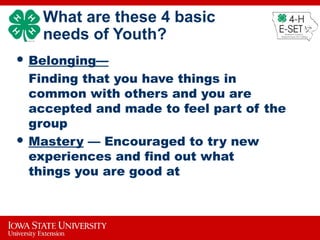
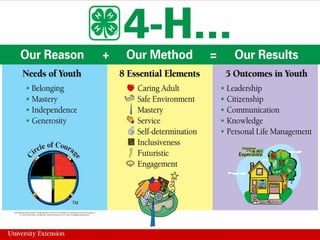
Positive Youth Development
=Meeting the Needs of Youth
 Belonging
 Mastery
 Independence
 Generosity
What are these 4 basic
needs of Youth?
 Belonging—
Finding that you have things in
common with others and you are
accepted and made to feel part of the
group
 Mastery — Encouraged to try new
experiences and find out what
things you are good at
What are these 4 basic
needs of Youth?
 Independence—
Giving youth a choice in what they will
do and a voice in where the group is
headed
 Generosity— When youth belong, feel
that they have skills they have
accomplished and are given choices,
youth will choose to share with others
of their knowledge time and skills
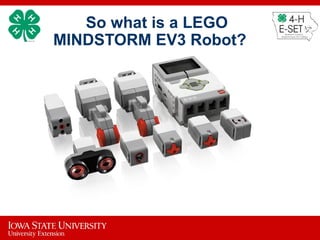
So what is a LEGO
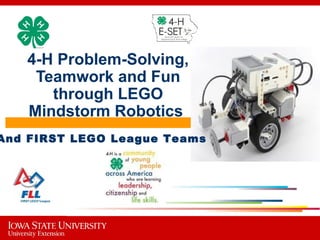
MINDSTORM EV3 Robot?
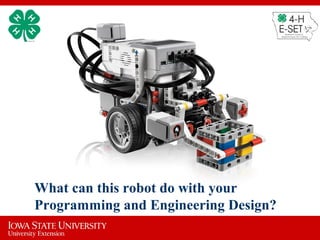
What can this robot do with your
Programming and Engineering Design?
Robots do 4 Basic Kinds of
tasks
Dirty
Dull
Dangerous
Delicate
Resource Page
Two Great Starts to understanding
Robot Programming
 Robot Programming Fundamentals Video
– http://www.education.rec.ri.cmu.edu/previews/nxt_pro
ducts/nxt_video_trainer/partial_product/basics/thinkin
g/thinking.html
 Programming is Precise Just click on Big Idea 1-2
– http://www.education.rec.ri.cmu.edu/content/lego/ev3/
curriculum/preview/
What is 4-H FIRST LEGO
League?
Teams of up to 10 kids and
guided by at least one adult
coach, team members have
about 10 weeks to work on
the Annual Challenge
Each annual Challenge has
two parts, the Project and
the Robot Game
The 3 Rs of
FIRST LEGO League
Robots– learning to program the robots, build
add-ons to accomplish the tasks set forth in the
challenge on the Challenge Field in the 2.5 minute
opportunity to showcase their robot and
programming
Research- Learning about the challenge and
how our community can make a difference and
presenting it in a creative way
Report– Defend the robot, your programming,
your teamwork and your research project
FIRST LEGO League Core
Values
 We are a team
 We do the work to find solutions with guidance
from our coaches and mentors
 We honor the spirit of friendly competition
 What we discover is more important than what we
win
 We share our experiences with others
 We display gracious professionalism in everything
we do
 We have fun
FIRST LEGO League 4-H
Clubs
Decision-making
Communication
Leadership
And Citizenship—Connecting
research to community
Open House Presentations
County Fair Club Project and
Demonstrations
Regional Competition
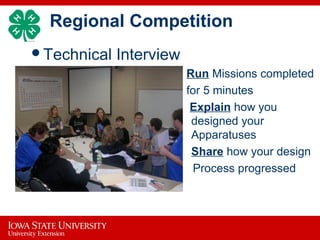
Technical Interview
 Run Missions completed
 for 5 minutes
 Explain how you
designed your
Apparatuses
 Share how your design
 Process progressed
Regional Competition
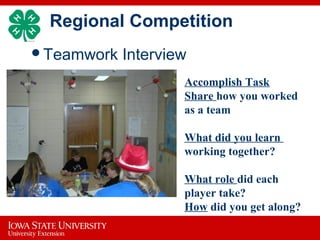
Teamwork Interview

Accomplish Task
Share how you worked
as a team
What did you learn
working together?
What role did each
player take?
How did you get along?
Regional Competition
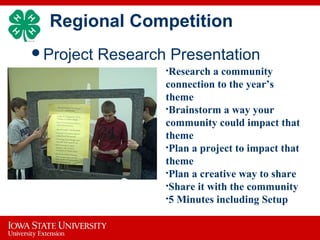
Project Research Presentation
 •Research a community
connection to the year’s
theme
•Brainstorm a way your
community could impact that
theme
•Plan a project to impact that
theme
•Plan a creative way to share
•Share it with the community
•5 Minutes including Setup
Regional Competition
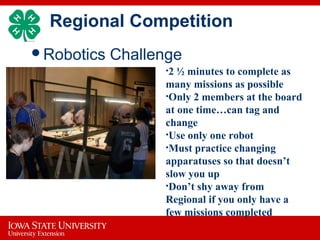
Robotics Challenge
 •2 ½ minutes to complete as
many missions as possible
•Only 2 members at the board
at one time…can tag and
change
•Use only one robot
•Must practice changing
apparatuses so that doesn’t
slow you up
•Don’t shy away from
Regional if you only have a
few missions completed
2016 Challenge
Animal Allies Your Project mission this season
is to look into the eyes of our
ANIMAL ALLIES. What might
become possible when we learn
to help each other?. In the Animal
Allies Project, your team will:
Identify opportunities to work with animals
in our communities
Design an innovative solution to the
problem you select
Share your problem and solution with
others
FLL challenges kids to
think like scientists and
engineers.
How do teams get Started?
1. Starting to build the LEGO pieces that make up
each of the missisons
– You will download the instructions for building the
Mission Model Pieces
– Check out the Mission pieces, pictures and video of the
how the constructed LEGO piece fits into the Animal
Allies Challenge on Youtube when the challenge is
released on August 28 …see what your Robot has to do
to accomplish each mission
– Lay out the mat and start building the pieces that go on
it
How do we get started?
2. Jump into the Challenge Theme “Animal Allies”
for 2016. To begin your Animal Allies project, As a
Team – Choose an animal that we could work
with in our communities. It might be finding and
putting animals to work with people or could be
providing services for animals or a connection to
animals for parts of our population.
How do we get started?
This would be a great time to invite someone in to
talk to your team…an expert who works with
animals in your community…..
How do we get started?
3. Start learning about building the robot and
programming it
a) Build a robot…there are lots of sites online to help you
design the building of your robot. Just get one built so
you can start programming. Just Google LEGO EV3
Building Instructions
a) Build the standard Driving Base in Manual with kit
b) Begin the EV3 Tutorial in the programming software or
online to learn how to use the software to program the
robot

2016 4 h first lego league orientation

  • 1.
    4-H Problem-Solving, Teamwork andFun through LEGO Mindstorm Robotics And FIRST LEGO League Teams
  • 2.
    Positive Youth Development =Meetingthe Needs of Youth  Belonging  Mastery  Independence  Generosity
  • 3.
    What are these4 basic needs of Youth?  Belonging— Finding that you have things in common with others and you are accepted and made to feel part of the group  Mastery — Encouraged to try new experiences and find out what things you are good at
  • 4.
    What are these4 basic needs of Youth?  Independence— Giving youth a choice in what they will do and a voice in where the group is headed  Generosity— When youth belong, feel that they have skills they have accomplished and are given choices, youth will choose to share with others of their knowledge time and skills
  • 5.
    So what isa LEGO MINDSTORM EV3 Robot?
  • 6.
    What can thisrobot do with your Programming and Engineering Design?
  • 7.
    Robots do 4Basic Kinds of tasks Dirty Dull Dangerous Delicate Resource Page
  • 8.
    Two Great Startsto understanding Robot Programming  Robot Programming Fundamentals Video – http://www.education.rec.ri.cmu.edu/previews/nxt_pro ducts/nxt_video_trainer/partial_product/basics/thinkin g/thinking.html  Programming is Precise Just click on Big Idea 1-2 – http://www.education.rec.ri.cmu.edu/content/lego/ev3/ curriculum/preview/
  • 9.
    What is 4-HFIRST LEGO League? Teams of up to 10 kids and guided by at least one adult coach, team members have about 10 weeks to work on the Annual Challenge Each annual Challenge has two parts, the Project and the Robot Game
  • 10.
    The 3 Rsof FIRST LEGO League Robots– learning to program the robots, build add-ons to accomplish the tasks set forth in the challenge on the Challenge Field in the 2.5 minute opportunity to showcase their robot and programming Research- Learning about the challenge and how our community can make a difference and presenting it in a creative way Report– Defend the robot, your programming, your teamwork and your research project
  • 11.
    FIRST LEGO LeagueCore Values  We are a team  We do the work to find solutions with guidance from our coaches and mentors  We honor the spirit of friendly competition  What we discover is more important than what we win  We share our experiences with others  We display gracious professionalism in everything we do  We have fun
  • 13.
    FIRST LEGO League4-H Clubs Decision-making Communication Leadership And Citizenship—Connecting research to community Open House Presentations County Fair Club Project and Demonstrations
  • 14.
    Regional Competition Technical Interview Run Missions completed  for 5 minutes  Explain how you designed your Apparatuses  Share how your design  Process progressed
  • 15.
    Regional Competition Teamwork Interview  AccomplishTask Share how you worked as a team What did you learn working together? What role did each player take? How did you get along?
  • 16.
    Regional Competition Project ResearchPresentation  •Research a community connection to the year’s theme •Brainstorm a way your community could impact that theme •Plan a project to impact that theme •Plan a creative way to share •Share it with the community •5 Minutes including Setup
  • 17.
    Regional Competition Robotics Challenge •2 ½ minutes to complete as many missions as possible •Only 2 members at the board at one time…can tag and change •Use only one robot •Must practice changing apparatuses so that doesn’t slow you up •Don’t shy away from Regional if you only have a few missions completed
  • 18.
    2016 Challenge Animal AlliesYour Project mission this season is to look into the eyes of our ANIMAL ALLIES. What might become possible when we learn to help each other?. In the Animal Allies Project, your team will: Identify opportunities to work with animals in our communities Design an innovative solution to the problem you select Share your problem and solution with others FLL challenges kids to think like scientists and engineers.
  • 19.
    How do teamsget Started? 1. Starting to build the LEGO pieces that make up each of the missisons – You will download the instructions for building the Mission Model Pieces – Check out the Mission pieces, pictures and video of the how the constructed LEGO piece fits into the Animal Allies Challenge on Youtube when the challenge is released on August 28 …see what your Robot has to do to accomplish each mission – Lay out the mat and start building the pieces that go on it
  • 20.
    How do weget started? 2. Jump into the Challenge Theme “Animal Allies” for 2016. To begin your Animal Allies project, As a Team – Choose an animal that we could work with in our communities. It might be finding and putting animals to work with people or could be providing services for animals or a connection to animals for parts of our population.
  • 21.
    How do weget started? This would be a great time to invite someone in to talk to your team…an expert who works with animals in your community…..
  • 22.
    How do weget started? 3. Start learning about building the robot and programming it a) Build a robot…there are lots of sites online to help you design the building of your robot. Just get one built so you can start programming. Just Google LEGO EV3 Building Instructions a) Build the standard Driving Base in Manual with kit b) Begin the EV3 Tutorial in the programming software or online to learn how to use the software to program the robot

Editor's Notes

  • #2 Candy on each person’s seat with handout Split up candy so that we hand out three kind of candies….Snickers, Milky Way and 3 Musketeers to split up the groups into three different sections Welcome, we are excited that you are interested in learning more about LEGO Mindstorm NXT Robots and the fun and learning that can take place for youth in building and if they choose competing in the Iowa FIRST LEGO League Competition. FIRST LEGO League is a competition where teams of up to 10 youth from ages 9-14 participate in equipping a robot to accomplish up to 20 tasks on a Challenge Field. Each year there is a different Challenge. This year the Challenge is Climate Connection so teams are challenged to complete tasks on the Challenge Field that deal with the study of Climate and working with Climate challenges in their communities. I won’t go any further into the FLL as we have the Iowa FIRST LEGO League contact here and she will go more heavily into the FIRST LEGO League program. Kids are really excited to work with the NXT Robots. They love playing with LEGOs and we had over 30 kids sign up wanting to join our FIRST LEGO League 4-H Club.
  • #6 So what is a LEGO Mindstorm Robot It is actually a fairly simple but sophisticated Robotics system that you can use to build programmable machines and robots. It starts with the Brick or Computer base which is a small computer which the youth will learn to program They run up to 3 motors which allow It to move and operate a additional tools such a s opening and closing a tool that can grab things or move a piece up or down to capture objects and up to four different sensors to give it some ability to react to it’s surroundings… The sensors are a touch sensor gives your robot the sense of touch , the light sensor can distiinguish between light and dark colors it may encounter on the surface and guide your robot, an ultrasonic metter that can detect how far away from something you are and a sound sensor which allows your robot to detect sounds and react I don’t want to get too complicated with the sensors because you will mostly work with kids on the mechanical attachments they will build to accomplish tasks.
  • #7 These are simple robots…the one on the left is set up to strike the ball like a golf club and the one on the right is your base robot for attaching implements to for accomplishing tasks. Click on What can you do with it? And Alt-Tab to IE to see video on what is it. Don’t worrry…you don’t have to know that much about the robot as the kids will start building almost immediatedly and far exceed what you would have built. I was amazed at our kids and how quickly they got into building off the base to get to a working robot that could do things.
  • #10 Slide 2—Vibrancy and Enthusiasm Briefly (within 30 seconds), introduce self, club, and give one example of what energized you from the last 4-H year. (If group is large, introductions can be done in small groups.)