OER Benefits
and Challenges:
A Brief
Overview
Introduction
SBCTC OER
101
PRESENTED BY
COURTNEY KRUZAN
Benefits Challenges Conclusion
Introduction
Open Educational Resources
(OER) are freely accessible,
openly licensed instructional
materials such as text, media,
etc.
There are great benefits
provided by OER for students
and instructors. There are also
challenges. We will review and
discuss both.
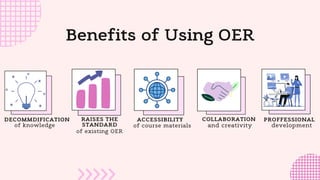
Benefits of Using OER
of knowledge
of existing OER
and creativity
of course materials
DECOMMDIFICATION RAISES THE
STANDARD
COLLABORATION
ACCESSIBILITY PROFFESSIONAL
development
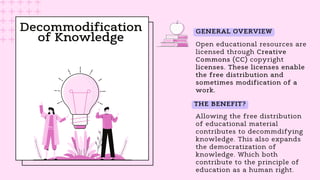
Decommodification
of Knowledge Open educational resources are
licensed through Creative
Commons (CC) copyright
licenses. These licenses enable
the free distribution and
sometimes modification of a
work.
Allowing the free distribution
of educational material
contributes to decommdifying
knowledge. This also expands
the democratization of
knowledge. Which both
contribute to the principle of
education as a human right.
GENERAL OVERVIEW
THE BENEFIT?
Raises the
Standard of OER
The nature of OER allows
material to be shared and used
widely. In many cases, depending
on the CC license applied, OER
works may be added to and/or
modified.
This allows the potential for
continuous peer reviews from a
wider pool. This also allows for
further curriculum building from
other contributors. Both of these
elements greatly contribute to
OER standards being raised.
GENERAL OVERVIEW
THE BENEFIT?
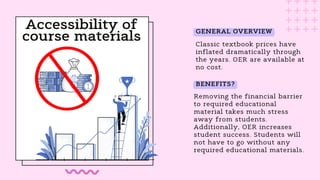
Accessibility of
course materials Classic textbook prices have
inflated dramatically through
the years. OER are available at
no cost.
Removing the financial barrier
to required educational
material takes much stress
away from students.
Additionally, OER increases
student success. Students will
not have to go without any
required educational materials.
GENERAL OVERVIEW
BENEFITS?
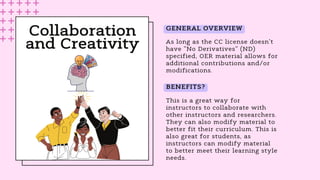
Collaboration
and Creativity
This is a great way for
instructors to collaborate with
other instructors and researchers.
They can also modify material to
better fit their curriculum. This is
also great for students, as
instructors can modify material
to better meet their learning style
needs.
GENERAL OVERVIEW
BENEFITS?
As long as the CC license doesn't
have "No Derivatives" (ND)
specified, OER material allows for
additional contributions and/or
modifications.
Professional
Development
There are many repositories for
OER. Along with many different
mediums of OER; courses,
textbooks, pictures, videos. One
great resource for finding OER is
Open Washington's OER Resource
Repository.
When accessing and reviewing
OER you will build critical
information literacy skills, along
with copyright knowledge.
Additionally, you will be exposed
to new ways of teaching and
presenting your own curriculum.
GENERAL OVERVIEW
THE BENEFIT?
OER Challenges:
Since OER can be freely
distributed and some
modified, it can be hard to
track and ensure it has been
peer reviewed. Making sure
the quality of material is
accurate and up to date can
be a big personal time
investment.
The cost to upkeep and
maintain resources can become
an issue for OER. This becomes
expensive in both finances,
resources, and labor.
While OER tends to be more
accessible financially, the
need for internet does
present a barrier. Along with
the potential of screen
fatigue for students.
QUALITY
ASSURANCE SUSTAINABILITY
ACCESSIBILITY
Combat by printing copies for
students and offer them free to low
cost to students who need them. You
could also coordinate with your
library or technology department to
provide computers and/or internet
hotspots to students.
The more popular and frequently
OER are used, the more able we
will be to build systems to lessen
this issue.
Similarly to quality assurance, the
more normalized OER become, the
better equipped we will be to
build sustainable OER
maintenance systems.
Challenges
Continued...
Finding relevant OER for the curriculum,
ensuring the quality of the information,
modifying content, and making sure it
meets the needs of your students is
extremely time consuming.
Not only does selecting and modifying OER
for curriculum take a lot of time, but also a
lot of labor. Labor that can go unrecognized,
not compensated, and/or recieve little to no
greater institutional support.
TIME
LABOR
Developing systems to make sure that educators
are compensated for this time is a great step.
Additionally, training on OER for instructional
and e-learning support staff to assist instructors
could lessen the intensity of the time challenge.
We can lessen the weight of this challenge by
implementing institutional support, creating
additional incentives to use OER, and of course
making sure educators are properly
compensated for the labor OER requires.
Conclusion
OER are amazing resources for both
students and educators. The
benefits outweigh the challenges.
Furthermore, many of the
challenges that come with OER can
be lessened or completely solved by
further developing and normalizing
the use of OER into our education
system.
Thank
You!
Resources:
How to Use Open
Educational Resources
Training by SBCTC, CC BY
4.0

OER Benefits and Challenges

  • 1.
    OER Benefits and Challenges: ABrief Overview Introduction SBCTC OER 101 PRESENTED BY COURTNEY KRUZAN Benefits Challenges Conclusion
  • 2.
    Introduction Open Educational Resources (OER)are freely accessible, openly licensed instructional materials such as text, media, etc. There are great benefits provided by OER for students and instructors. There are also challenges. We will review and discuss both.
  • 3.
    Benefits of UsingOER of knowledge of existing OER and creativity of course materials DECOMMDIFICATION RAISES THE STANDARD COLLABORATION ACCESSIBILITY PROFFESSIONAL development
  • 4.
    Decommodification of Knowledge Openeducational resources are licensed through Creative Commons (CC) copyright licenses. These licenses enable the free distribution and sometimes modification of a work. Allowing the free distribution of educational material contributes to decommdifying knowledge. This also expands the democratization of knowledge. Which both contribute to the principle of education as a human right. GENERAL OVERVIEW THE BENEFIT?
  • 5.
    Raises the Standard ofOER The nature of OER allows material to be shared and used widely. In many cases, depending on the CC license applied, OER works may be added to and/or modified. This allows the potential for continuous peer reviews from a wider pool. This also allows for further curriculum building from other contributors. Both of these elements greatly contribute to OER standards being raised. GENERAL OVERVIEW THE BENEFIT?
  • 6.
    Accessibility of course materialsClassic textbook prices have inflated dramatically through the years. OER are available at no cost. Removing the financial barrier to required educational material takes much stress away from students. Additionally, OER increases student success. Students will not have to go without any required educational materials. GENERAL OVERVIEW BENEFITS?
  • 7.
    Collaboration and Creativity This isa great way for instructors to collaborate with other instructors and researchers. They can also modify material to better fit their curriculum. This is also great for students, as instructors can modify material to better meet their learning style needs. GENERAL OVERVIEW BENEFITS? As long as the CC license doesn't have "No Derivatives" (ND) specified, OER material allows for additional contributions and/or modifications.
  • 8.
    Professional Development There are manyrepositories for OER. Along with many different mediums of OER; courses, textbooks, pictures, videos. One great resource for finding OER is Open Washington's OER Resource Repository. When accessing and reviewing OER you will build critical information literacy skills, along with copyright knowledge. Additionally, you will be exposed to new ways of teaching and presenting your own curriculum. GENERAL OVERVIEW THE BENEFIT?
  • 9.
    OER Challenges: Since OERcan be freely distributed and some modified, it can be hard to track and ensure it has been peer reviewed. Making sure the quality of material is accurate and up to date can be a big personal time investment. The cost to upkeep and maintain resources can become an issue for OER. This becomes expensive in both finances, resources, and labor. While OER tends to be more accessible financially, the need for internet does present a barrier. Along with the potential of screen fatigue for students. QUALITY ASSURANCE SUSTAINABILITY ACCESSIBILITY Combat by printing copies for students and offer them free to low cost to students who need them. You could also coordinate with your library or technology department to provide computers and/or internet hotspots to students. The more popular and frequently OER are used, the more able we will be to build systems to lessen this issue. Similarly to quality assurance, the more normalized OER become, the better equipped we will be to build sustainable OER maintenance systems.
  • 10.
    Challenges Continued... Finding relevant OERfor the curriculum, ensuring the quality of the information, modifying content, and making sure it meets the needs of your students is extremely time consuming. Not only does selecting and modifying OER for curriculum take a lot of time, but also a lot of labor. Labor that can go unrecognized, not compensated, and/or recieve little to no greater institutional support. TIME LABOR Developing systems to make sure that educators are compensated for this time is a great step. Additionally, training on OER for instructional and e-learning support staff to assist instructors could lessen the intensity of the time challenge. We can lessen the weight of this challenge by implementing institutional support, creating additional incentives to use OER, and of course making sure educators are properly compensated for the labor OER requires.
  • 11.
    Conclusion OER are amazingresources for both students and educators. The benefits outweigh the challenges. Furthermore, many of the challenges that come with OER can be lessened or completely solved by further developing and normalizing the use of OER into our education system.
  • 12.
    Thank You! Resources: How to UseOpen Educational Resources Training by SBCTC, CC BY 4.0