DMC2523 MENU PLANNING
AND COST CONTROL
LAURA LAW - PERAK COLLEGE OFTECHNOLOGY
Menu is defined as
“a detailed list of food served at a meal”
When planning menus, managers must
consider guests and financial goals of
the foodservice operation. After managers
know standard product costs for food and
beverage items, they know how much it
should cost to produce each item.
LAURA LAW - PERAK COLLEGE OFTECHNOLOGY
DMC2523 MENU PLANNING AND COST CONTROL
LAURA LAW - PERAK COLLEGE
Control Points are basic operating
activities that must be performed in any
Food & Beverage Operation.
There are 9 Main Control Points.
LAURA LAW - PERAK COLLEGE OFTECHNOLOGY
Beginning with Menu Planning, each Control Point
plays a crucial (penting) role in determining the
success or failure of the Food & Beverage
Operation.
Each Control Point is a Miniature System with its
own Structure and Functions.
Each Control Point (Basic Operating Activity) has it’s
own Specific Objectives, Guidelines, Standards
and Internal Processes that contribute to the
success of the Operation and the
Ultimate Goal: GUEST SATISFACTION.
LAURA LAW - PERAK COLLEGE OFTECHNOLOGY
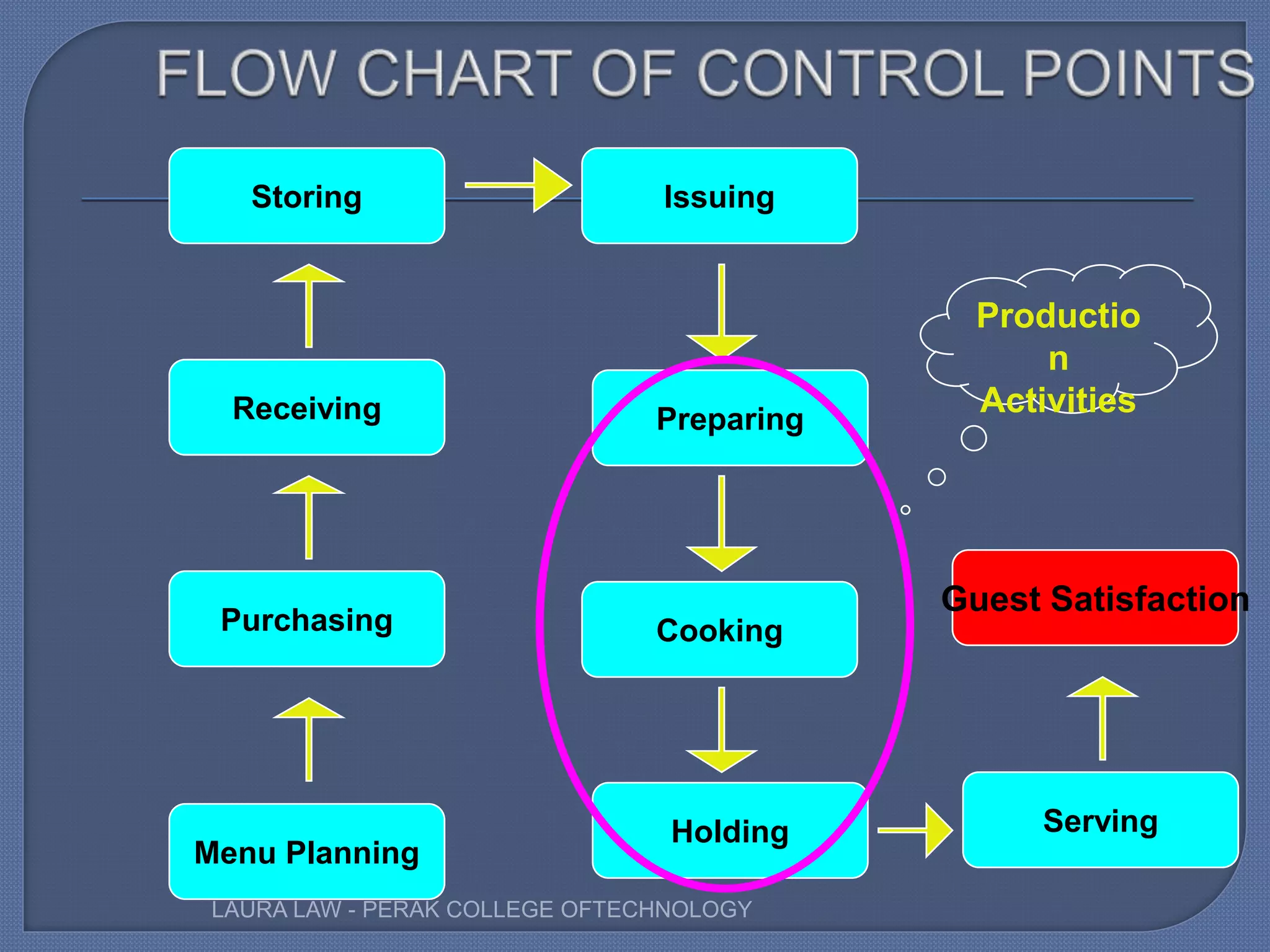
Menu Planning
Purchasing
Receiving
Storing Issuing
Preparing
Cooking
Holding Serving
Guest Satisfaction
Productio
n
Activities
LAURA LAW - PERAK COLLEGE OFTECHNOLOGY
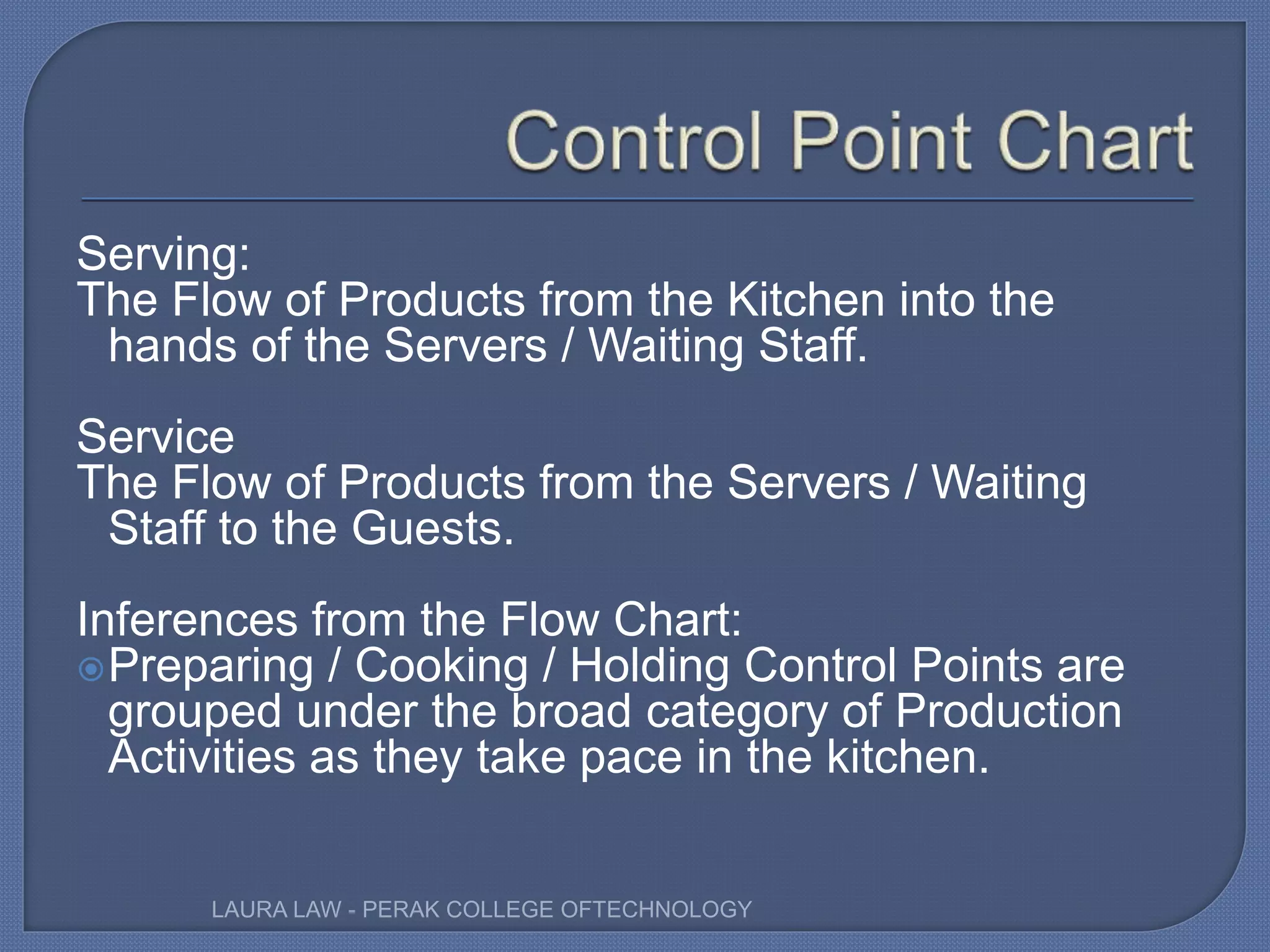
Serving:
The Flow of Products from the Kitchen into the
hands of the Servers / Waiting Staff.
Service
The Flow of Products from the Servers / Waiting
Staff to the Guests.
Inferences from the Flow Chart:
Preparing / Cooking / Holding Control Points are
grouped under the broad category of Production
Activities as they take pace in the kitchen.
LAURA LAW - PERAK COLLEGE OFTECHNOLOGY
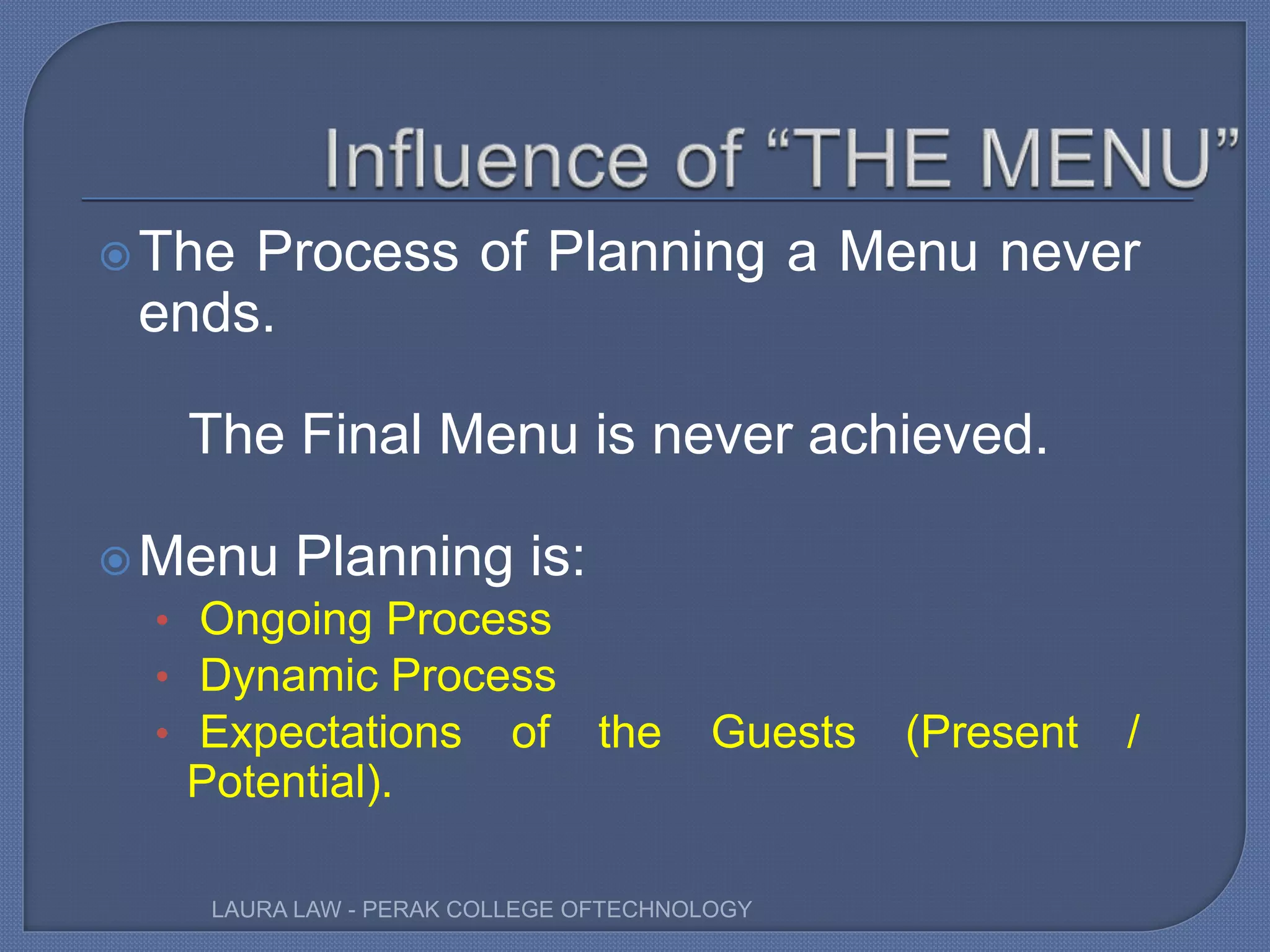
The Process of Planning a Menu never
ends.
The Final Menu is never achieved.
Menu Planning is:
• Ongoing Process
• Dynamic Process
• Expectations of the Guests (Present /
Potential).
LAURA LAW - PERAK COLLEGE OFTECHNOLOGY
The Past
Food Service Operators tried to diversify
their menus by adding new menu items.
Effect
I. Increased the number and variety of raw
ingredients.
II. Turn lead to problems in Storage
III. Increased Inventory Costs
(Cost of Ingredients + Carrying Cost + Storage Costs + Opportunity Costs)
LAURA LAW - PERAK COLLEGE OFTECHNOLOGY
Present
Rationalization Strategy: This strategy limits the menu of the
Operation to only those items that best enhance the Operation’s
Image.
Objective
Simplification for the purpose of Operational
efficiency.
Operator offer several menu items using the
same Raw Ingredients.
LAURA LAW - PERAK COLLEGE OFTECHNOLOGY
LAURA LAW - PERAK COLLEGE
DMC2523 MENU PLANNING AND COST CONTROL
LAURA LAW - PERAK COLLEGE
 To start with, it is best to base your menu plans on
the needs and desires of your targeted market
segment.
 Factors design a Menu are:
a) Storage Conditions – (Time & Temperature)
b) Personnel Skill Levels
c) Product’s Availability / Seasonality
d) Quality and Price Levels
e) Ability to produce the Menu Item in Sanitary / Cost Effective
Way
LAURA LAW - PERAK COLLEGE OFTECHNOLOGY
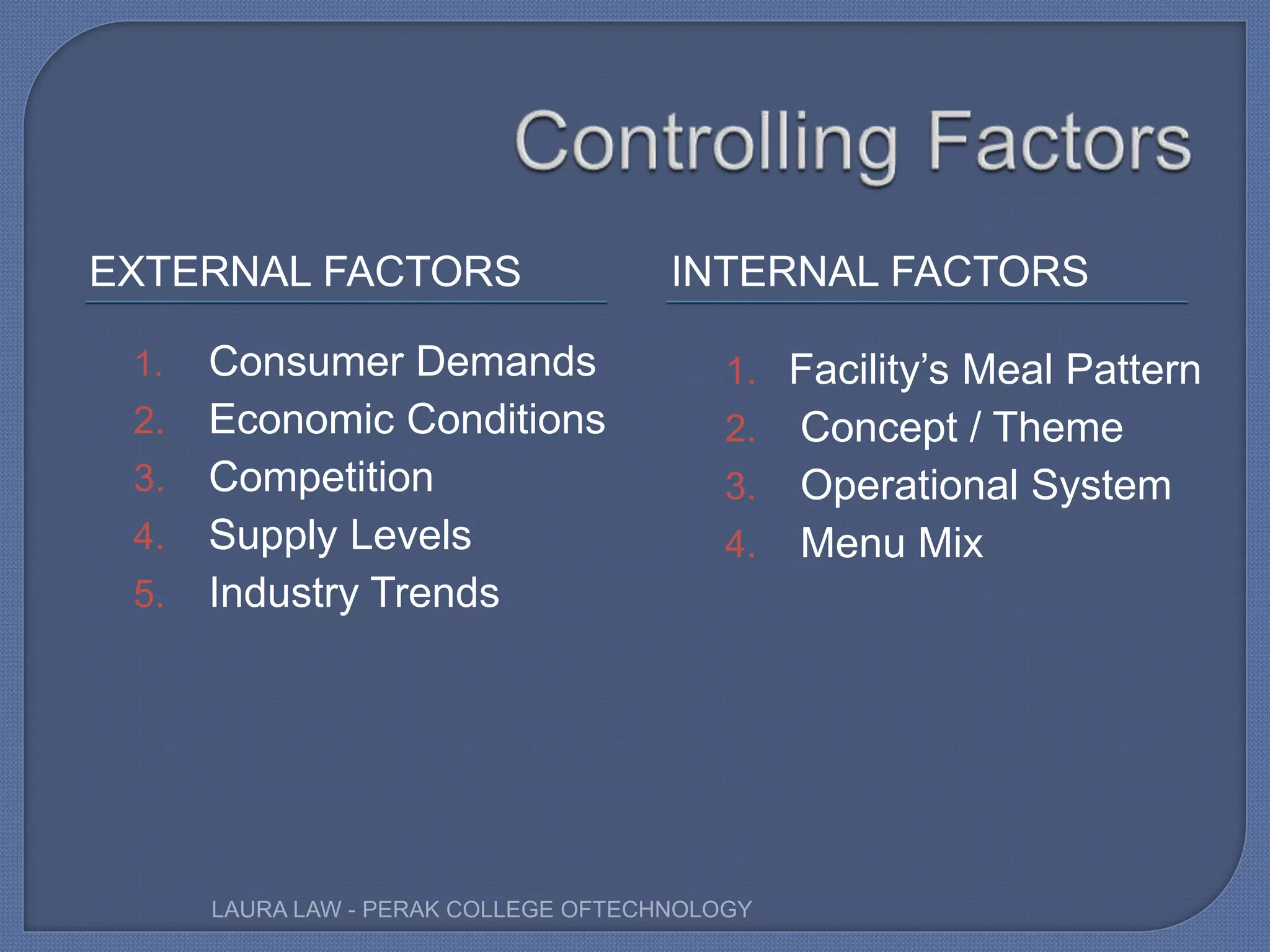
EXTERNAL FACTORS INTERNAL FACTORS
1. Consumer Demands
2. Economic Conditions
3. Competition
4. Supply Levels
5. Industry Trends
1. Facility’s Meal Pattern
2. Concept / Theme
3. Operational System
4. Menu Mix
LAURA LAW - PERAK COLLEGE OFTECHNOLOGY
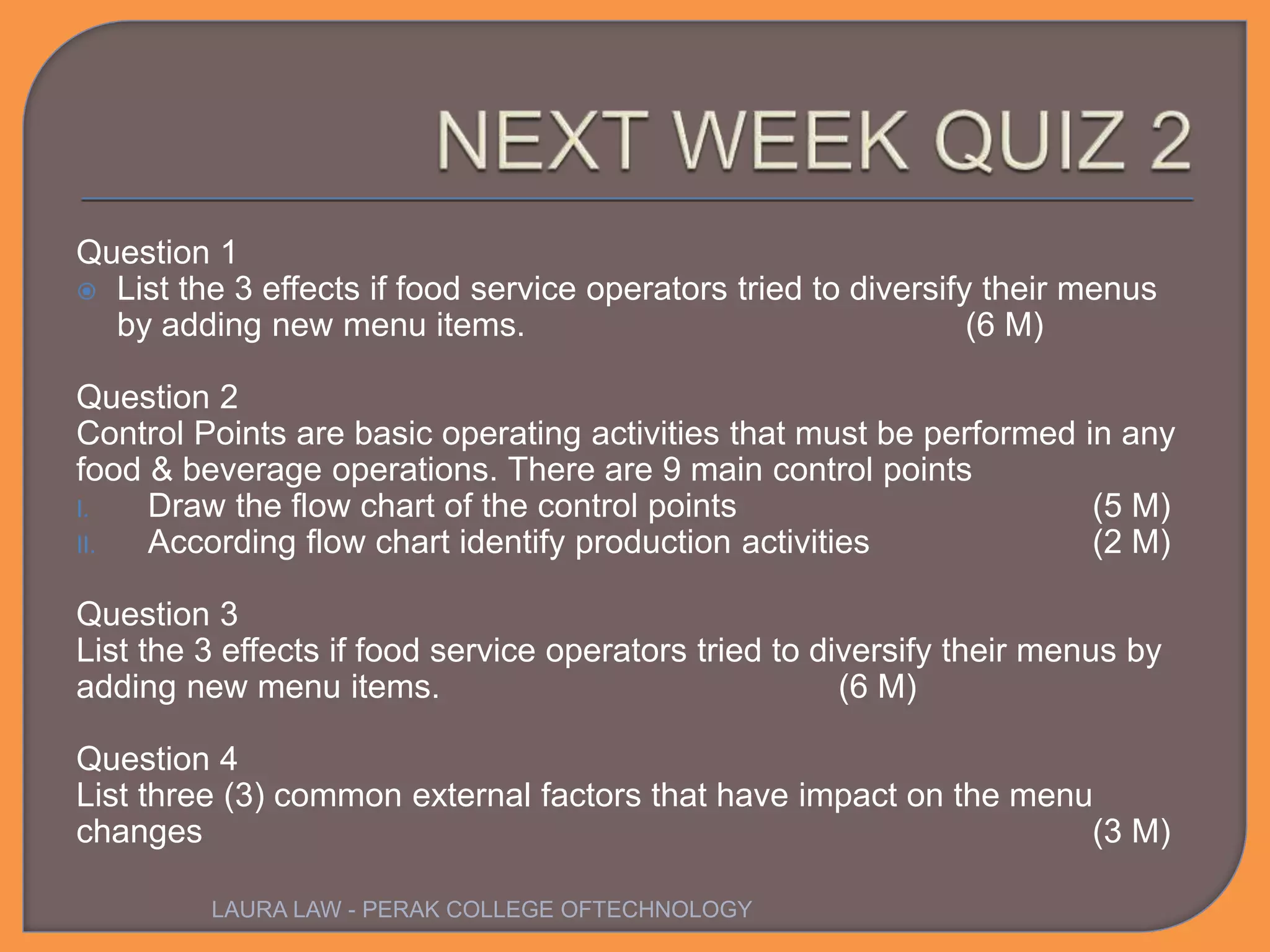
Question 1
 List the 3 effects if food service operators tried to diversify their menus
by adding new menu items. (6 M)
Question 2
Control Points are basic operating activities that must be performed in any
food & beverage operations. There are 9 main control points
I. Draw the flow chart of the control points (5 M)
II. According flow chart identify production activities (2 M)
Question 3
List the 3 effects if food service operators tried to diversify their menus by
adding new menu items. (6 M)
Question 4
List three (3) common external factors that have impact on the menu
changes (3 M)
LAURA LAW - PERAK COLLEGE OFTECHNOLOGY
DMC2523 MENU PLANNING AND COST CONTROL
LAURA LAW - PERAK COLLEGE
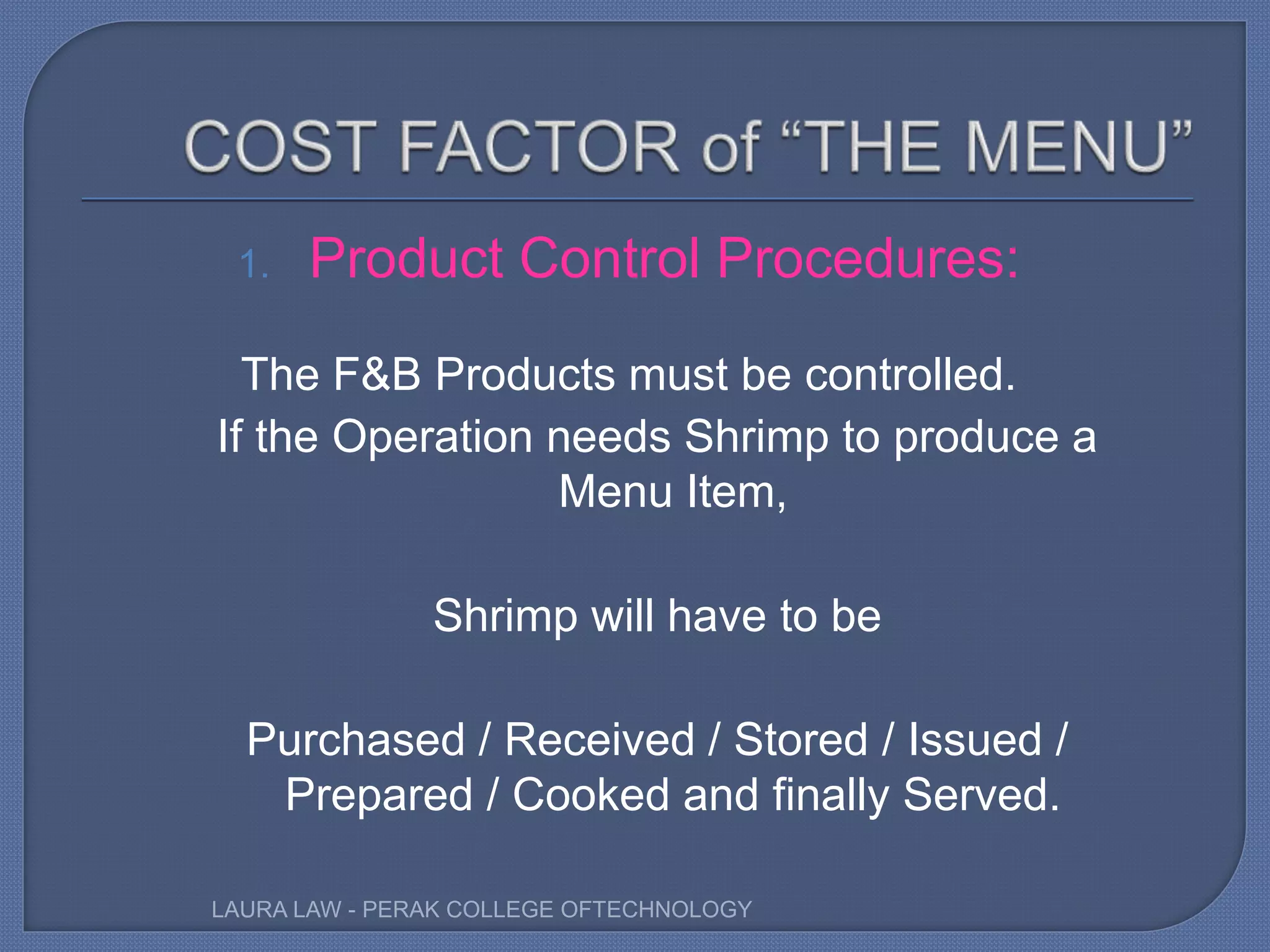
1. Product Control Procedures:
The F&B Products must be controlled.
If the Operation needs Shrimp to produce a
Menu Item,
Shrimp will have to be
Purchased / Received / Stored / Issued /
Prepared / Cooked and finally Served.
LAURA LAW - PERAK COLLEGE OFTECHNOLOGY
2. Cost Control Procedures:
Careful Cost Control Procedures must be followed as
more expensive products are served.
This is upon Guest Demand of an operation, providing
a “Dining Experience” and not just a “Meal”.
LAURA LAW - PERAK COLLEGE OFTECHNOLOGY
3. Production Requirements
Food Items required by the Menu must be
produced “Consistently”.
The following parameters are all dictated by the
Menu:
 Product Quality
 Staff Productivity
 Skills
 Timing and Scheduling
LAURA LAW - PERAK COLLEGE OFTECHNOLOGY
4. Nutritional Content of Meals:
Food & Beverage Operations (Commercial / Non –
Commercial) are increasing concerned about the
Nutritional Content of the Food served to the
Guests / Clients.
Menu can have an impact on the health and well
being of those to whom it is served.
LAURA LAW - PERAK COLLEGE OFTECHNOLOGY
5. Equipment Needs
All equipment required to produce the Menu must be
available.
The Menu must be balanced such that no one station
in the kitchen is under – utilized.
LAURA LAW - PERAK COLLEGE OFTECHNOLOGY
6. Sanitation Management:
Since the Menu sets the stage for the remaining
control points, the management must consider the
Menu Items in light of possible Sanitation Hazards.
Once potential Hazards are identified, risks can be
reduced.
LAURA LAW - PERAK COLLEGE OFTECHNOLOGY
7. Layout and Space Requirements
There must be adequate facilities for the staff and
equipment required to produce items listed on the
menu.
The layout and design facilities establish physical space
within which food production and service take place.
Physical facilities must be adequate for Purchasing /
Receiving / Storage / Issuing / Production and
Serving of Menu Items.
LAURA LAW - PERAK COLLEGE OFTECHNOLOGY
8. Staffing Needs
Employees must be able to produce and serve all the
items required by the menu.
The more complex the menu, the greater the
demands placed on the production and service
staff.
Staffing needs are influenced to a great extent by the
use of “Convenience Foods” by the operation.
LAURA LAW - PERAK COLLEGE OFTECHNOLOGY
9. Service Requirement
F&B Manager must carefully plan how products will be
served to the guest.
The Menu influences your choice of Service Style.
It influences the Skill Levels required by the Staff along
with Equipment & Inventory.
LAURA LAW - PERAK COLLEGE OFTECHNOLOGY
10. Revenue Control Procedures:
A simple Fast Food Operation would not have as much
problems in Revenue Control as a Specialty
Restaurant.
In a Fast Food Operation, there would be fewer Menu
items (comparatively lesser Product Range), hence
controlling Revenue from the sale of these would be
far easier than controlling Revenue in a Specialty
Restaurant wherein the Product Range is extensive,
involving a large Beverage. List as well as a wide
choice of Food items.
LAURA LAW - PERAK COLLEGE OFTECHNOLOGY
DMC2523 MENU PLANNING AND COST CONTROL
LAURA LAW - PERAK COLLEGE
 After a menu is planned and cost, each item has to be priced.
 Factors to take into consideration such as:
• Type of Operation
• The Market
• Costs
 The market is a major factor in the type of pricing.
• Most customers want only low prices; others seek moderate
ones; some will be willing to pay higher prices.
• The Key is to establish a fine balance between the Price and
Quality of Food offered by the Operation all other parameters
being the same.
LAURA LAW - PERAK COLLEGE OFTECHNOLOGY
 There are two main types of Pricing
Techniques.
• Subjective Pricing Method
• Objective Pricing Method
LAURA LAW - PERAK COLLEGE OFTECHNOLOGY
DMC2523 MENU PLANNING AND COST CONTROL
LAURA LAW - PERAK COLLEGE
 Prices determine to a large extent whether the
financial goals of the Operation are met, many
managers use very Subjective Pricing
Methods.
 Subjective Pricing Methods establish Prices,
however, fail to relate them to Profit
Requirements and even Costs.
 This Pricing method is based merely on
assumptions.
LAURA LAW - PERAK COLLEGE OFTECHNOLOGY
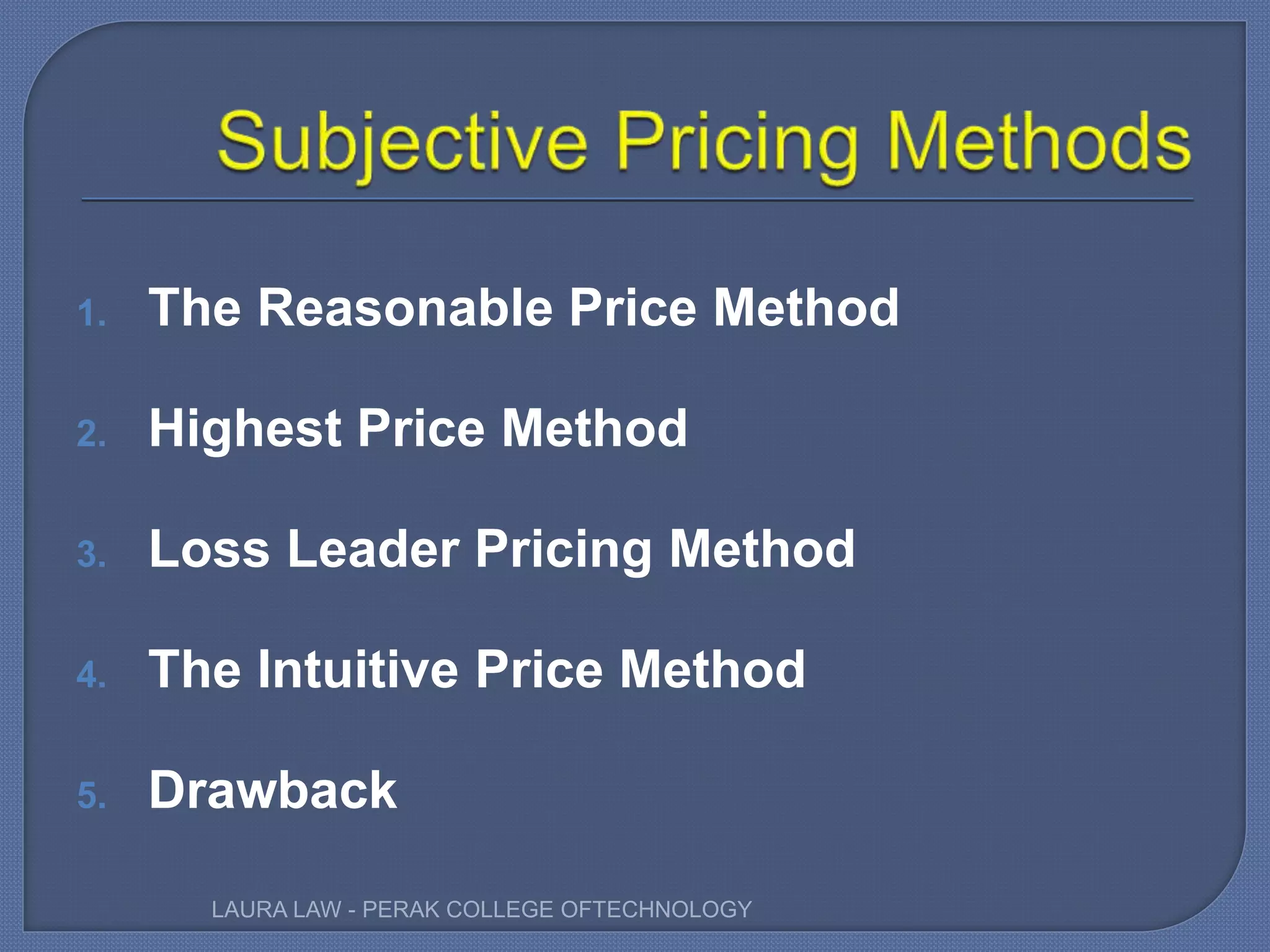
1. The Reasonable Price Method
2. Highest Price Method
3. Loss Leader Pricing Method
4. The Intuitive Price Method
5. Drawback
LAURA LAW - PERAK COLLEGE OFTECHNOLOGY
1. The Reasonable Price Method
• The method uses a price that the Operator thinks
will represent value to the guest.
• In other words, the Operator puts himself in the
guest’s shoes and asks “How much am I willing to
pay for this Item, considering the type of setting?”
• The answer to this is the Reasonable Pricing
Method.
LAURA LAW - PERAK COLLEGE OFTECHNOLOGY
2. Highest Price Method
Using this Pricing Method, the Operator sets the
Highest Price for an item that he thinks the
guest is willing to pay.
This is pushing the concept of value to the
maximum. A high price is set then “Backed Of” in
order to provide for an Error Margin in the
estimate.
LAURA LAW - PERAK COLLEGE OFTECHNOLOGY
3. Loss Leader Pricing Method
Menu Items are Priced very low
The philosophy for this pricing method is that the guests
will be attracted due to Low Prices and will then buy
other items while they are there
(Spin Off Business)
In this case, it is very important to sell other items to
make profit. This pricing method is used as an Early
Bird Promotion to attract specific market segments.
LAURA LAW - PERAK COLLEGE OFTECHNOLOGY
4. The Intuitive Price Method
Like the name suggests, Prices are set by Intuition of
the Operator alone. The Operator takes a little more
than a “Wild Guess” about the Selling Price.
It differs from the Reasonable Price Method in that it
takes a little less effort to determine the price as one
does not consider what would represent Value to
the Customer.
LAURA LAW - PERAK COLLEGE OFTECHNOLOGY
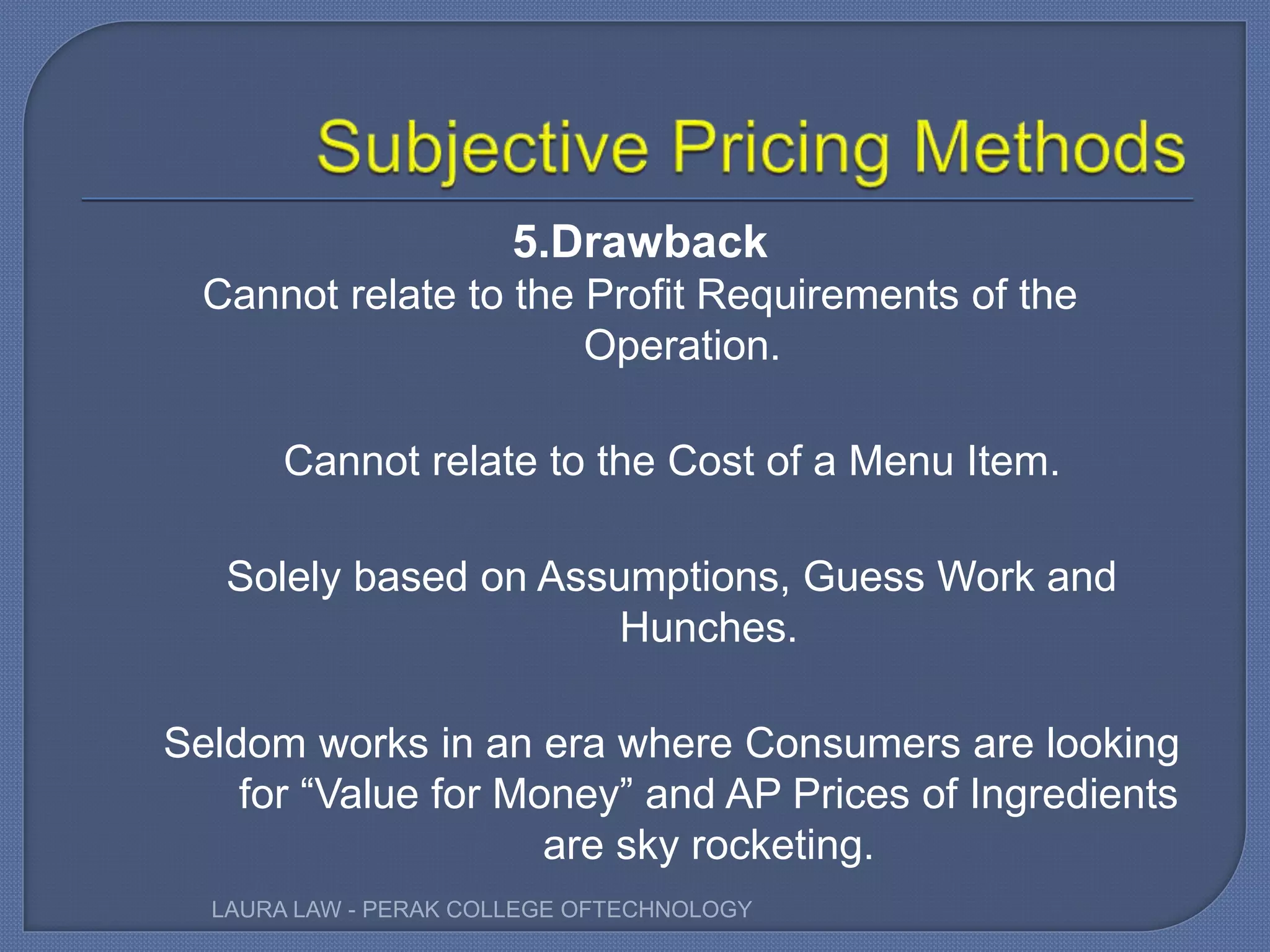
5.Drawback
Cannot relate to the Profit Requirements of the
Operation.
Cannot relate to the Cost of a Menu Item.
Solely based on Assumptions, Guess Work and
Hunches.
Seldom works in an era where Consumers are looking
for “Value for Money” and AP Prices of Ingredients
are sky rocketing.
LAURA LAW - PERAK COLLEGE OFTECHNOLOGY
DMC2523 MENU PLANNING AND COST CONTROL
LAURA LAW - PERAK COLLEGE
1. Simple Mark –Up Pricing Methods
i. Ingredient Mark – Up
ii. Prime Ingredient Mark – Up
iii. Mark – Up with Accompaniments Costs
2. Contribution Margin Pricing Method
3. Ratio Pricing Method
4. Simple Prime Costs Method
5. Specific Prime Costs Method
LAURA LAW - PERAK COLLEGE OFTECHNOLOGY
Objective Pricing Methods
Menu Pricing
LAURA LAW - PERAK COLLEGE
Simple Mark – Up Pricing Methods
It considers a Mark – Up from the cost of
good sold
The Mark – Up is designed in such a way
that it covers all costs to yield the desired
profit levels.
LAURA LAW - PERAK COLLEGE OFTECHNOLOGY
Simple Mark – Up Pricing Methods:
a) Ingredient Mark – Up Method
b) Prime Ingredient Mark – Up
c) Mark – Up with Accompaniments Costs
LAURA LAW - PERAK COLLEGE OFTECHNOLOGY
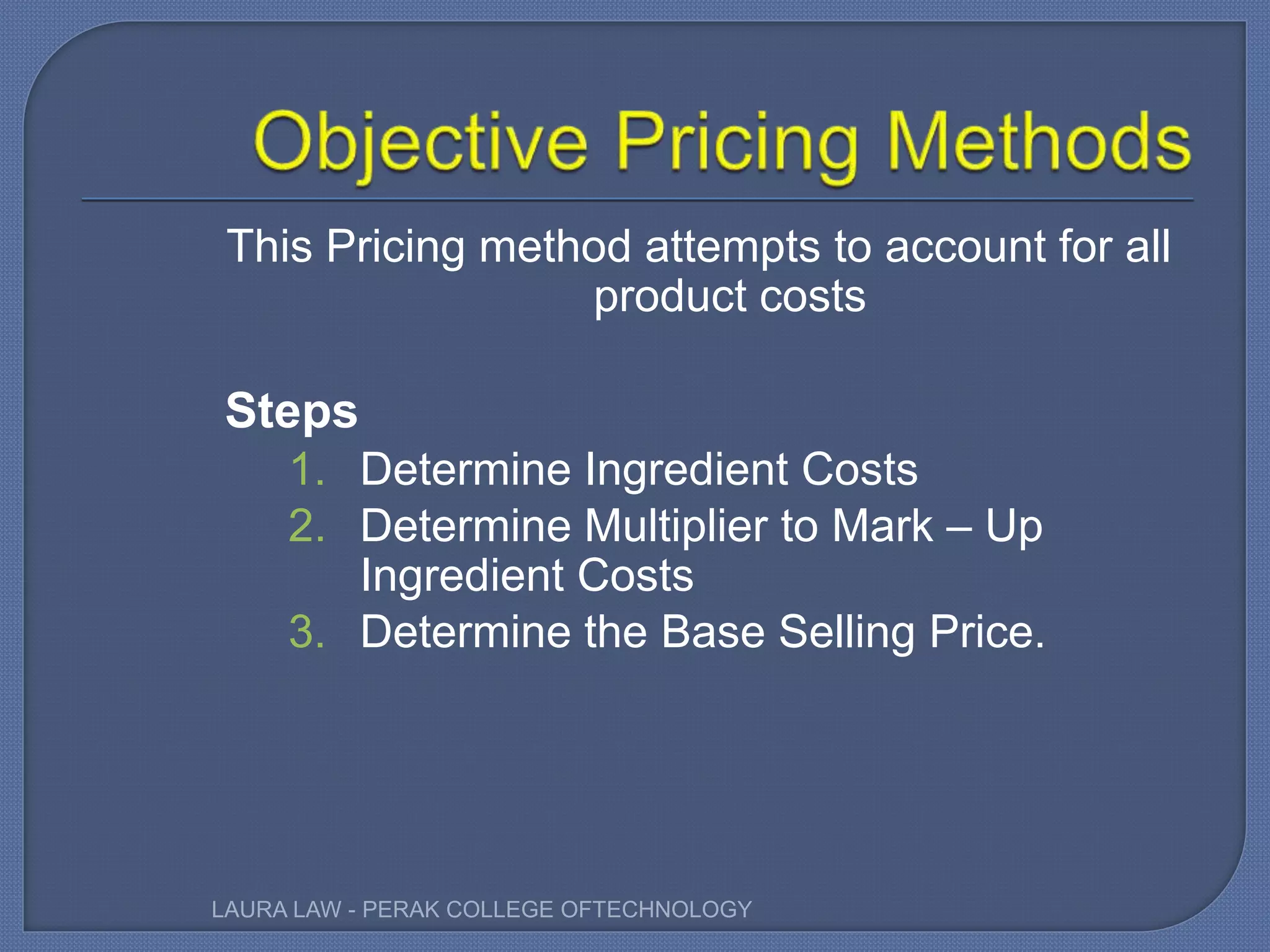
This Pricing method attempts to account for all
product costs
Steps
1. Determine Ingredient Costs
2. Determine Multiplier to Mark – Up
Ingredient Costs
3. Determine the Base Selling Price.
LAURA LAW - PERAK COLLEGE OFTECHNOLOGY
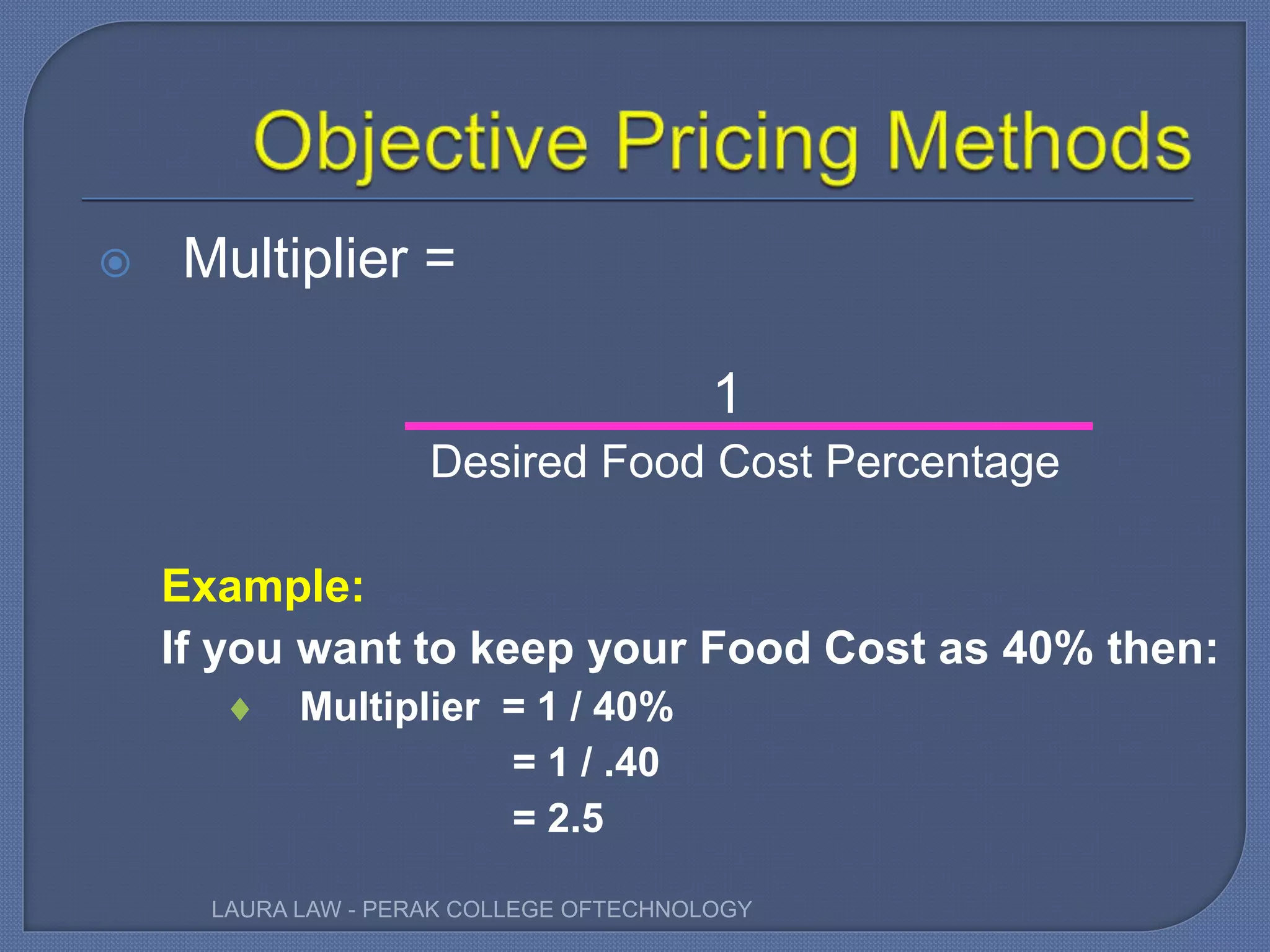
 Multiplier =
1
Desired Food Cost Percentage
Example:
If you want to keep your Food Cost as 40% then:
 Multiplier = 1 / 40%
= 1 / .40
= 2.5
LAURA LAW - PERAK COLLEGE OFTECHNOLOGY
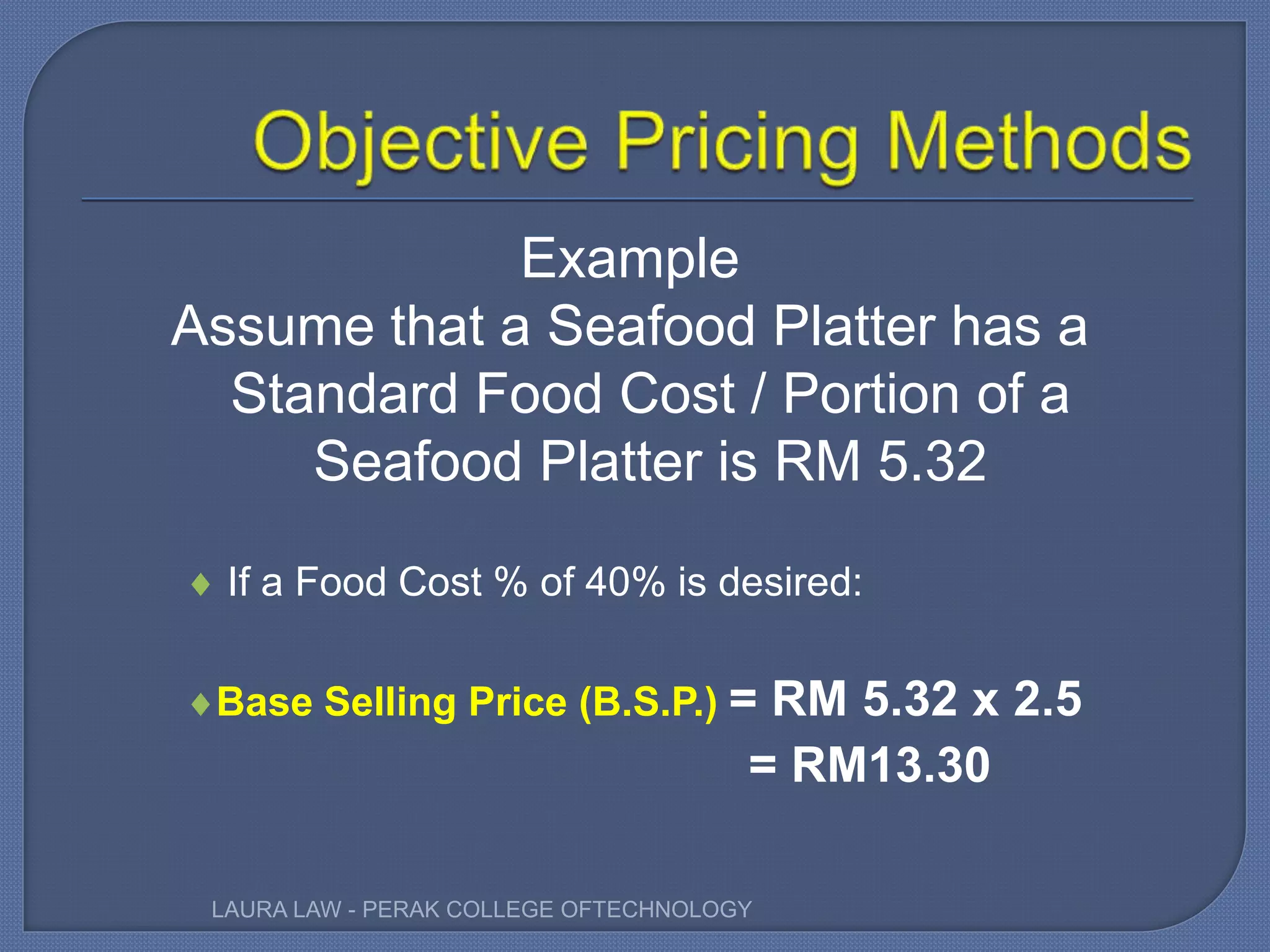
Example
Assume that a Seafood Platter has a
Standard Food Cost / Portion of a
Seafood Platter is RM 5.32
 If a Food Cost % of 40% is desired:
Base Selling Price (B.S.P.) = RM 5.32 x 2.5
= RM13.30
LAURA LAW - PERAK COLLEGE OFTECHNOLOGY
Simple Mark – Up Pricing Methods:
a) Ingredient Mark – Up Method
b) Prime Ingredient Mark – Up
c) Mark – Up with Accompaniments Costs
LAURA LAW - PERAK COLLEGE OFTECHNOLOGY
It concerns itself with only the Prime
Ingredient of the Menu Item.
Only the Cost of the Prime Ingredient is
Marked Up.
The Multiplier is usually higher in order to
account for the Cost of the ancillary
ingredients in the recipe.
LAURA LAW - PERAK COLLEGE OFTECHNOLOGY
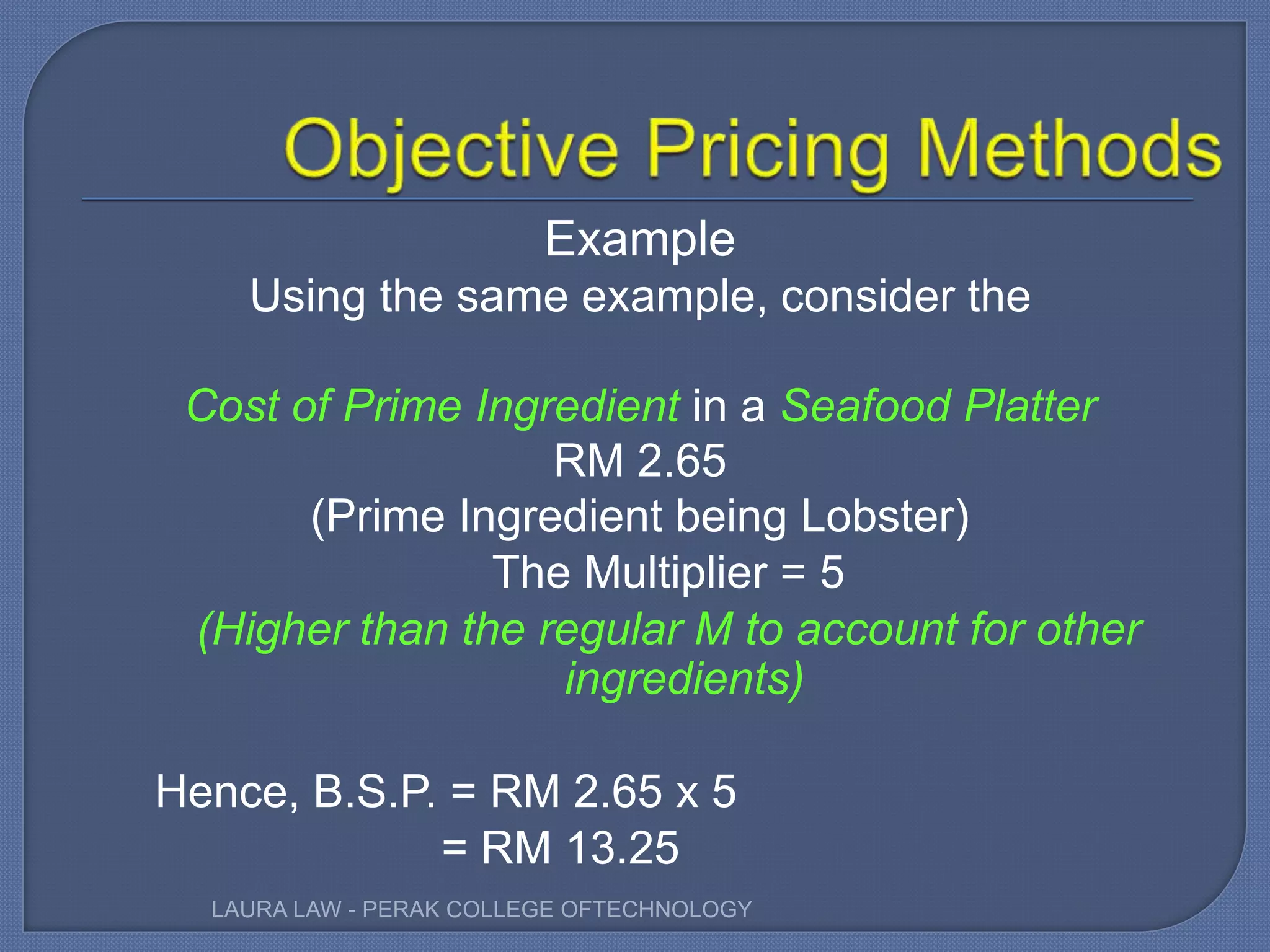
Example
Using the same example, consider the
Cost of Prime Ingredient in a Seafood Platter
RM 2.65
(Prime Ingredient being Lobster)
The Multiplier = 5
(Higher than the regular M to account for other
ingredients)
Hence, B.S.P. = RM 2.65 x 5
= RM 13.25
LAURA LAW - PERAK COLLEGE OFTECHNOLOGY
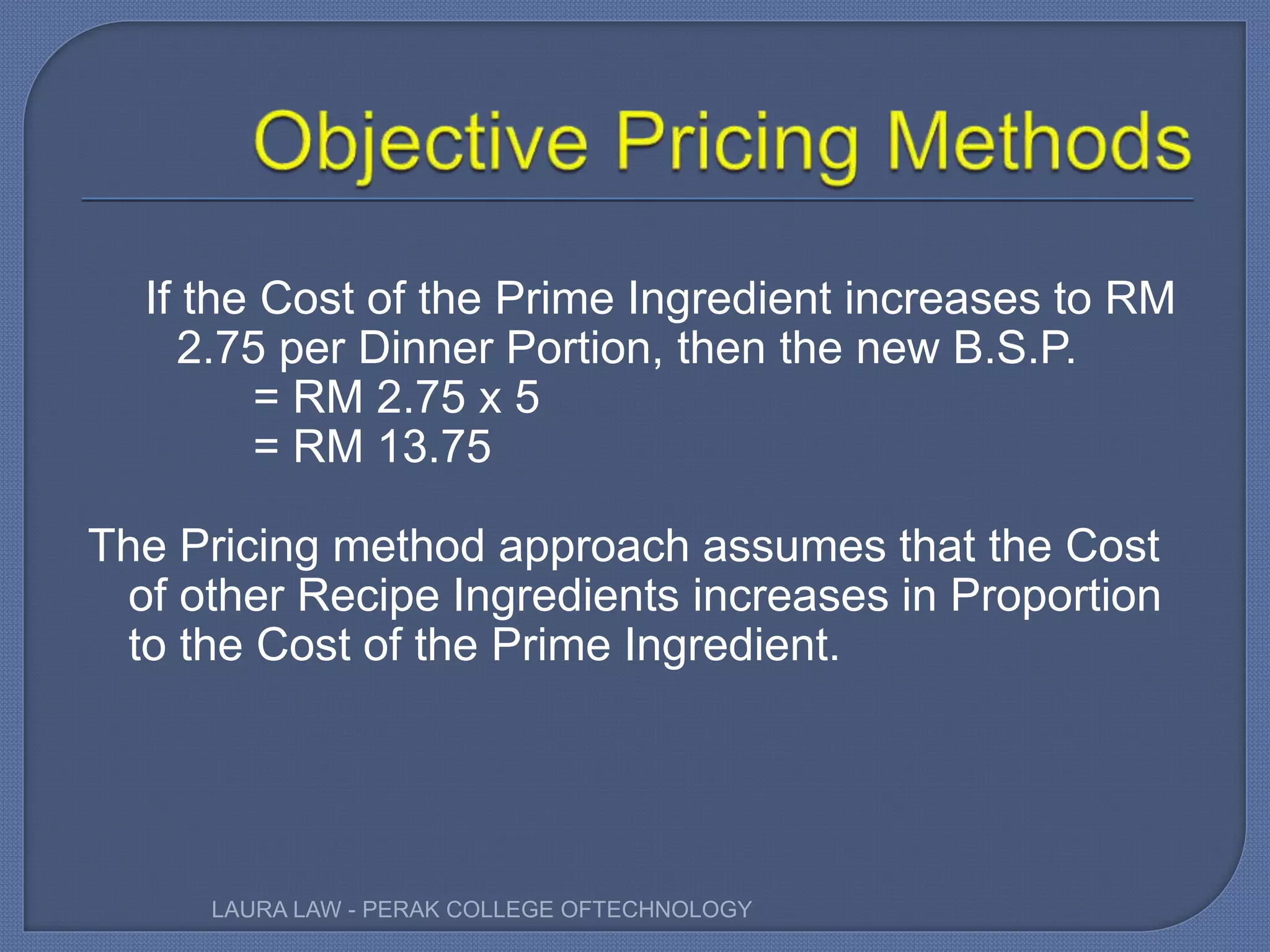
If the Cost of the Prime Ingredient increases to RM
2.75 per Dinner Portion, then the new B.S.P.
= RM 2.75 x 5
= RM 13.75
The Pricing method approach assumes that the Cost
of other Recipe Ingredients increases in Proportion
to the Cost of the Prime Ingredient.
LAURA LAW - PERAK COLLEGE OFTECHNOLOGY
Simple Mark – Up Pricing Methods:
a) Ingredient Mark – Up Method
b) Prime Ingredient Mark – Up
c) Mark – Up with Accompaniments Costs
LAURA LAW - PERAK COLLEGE OFTECHNOLOGY
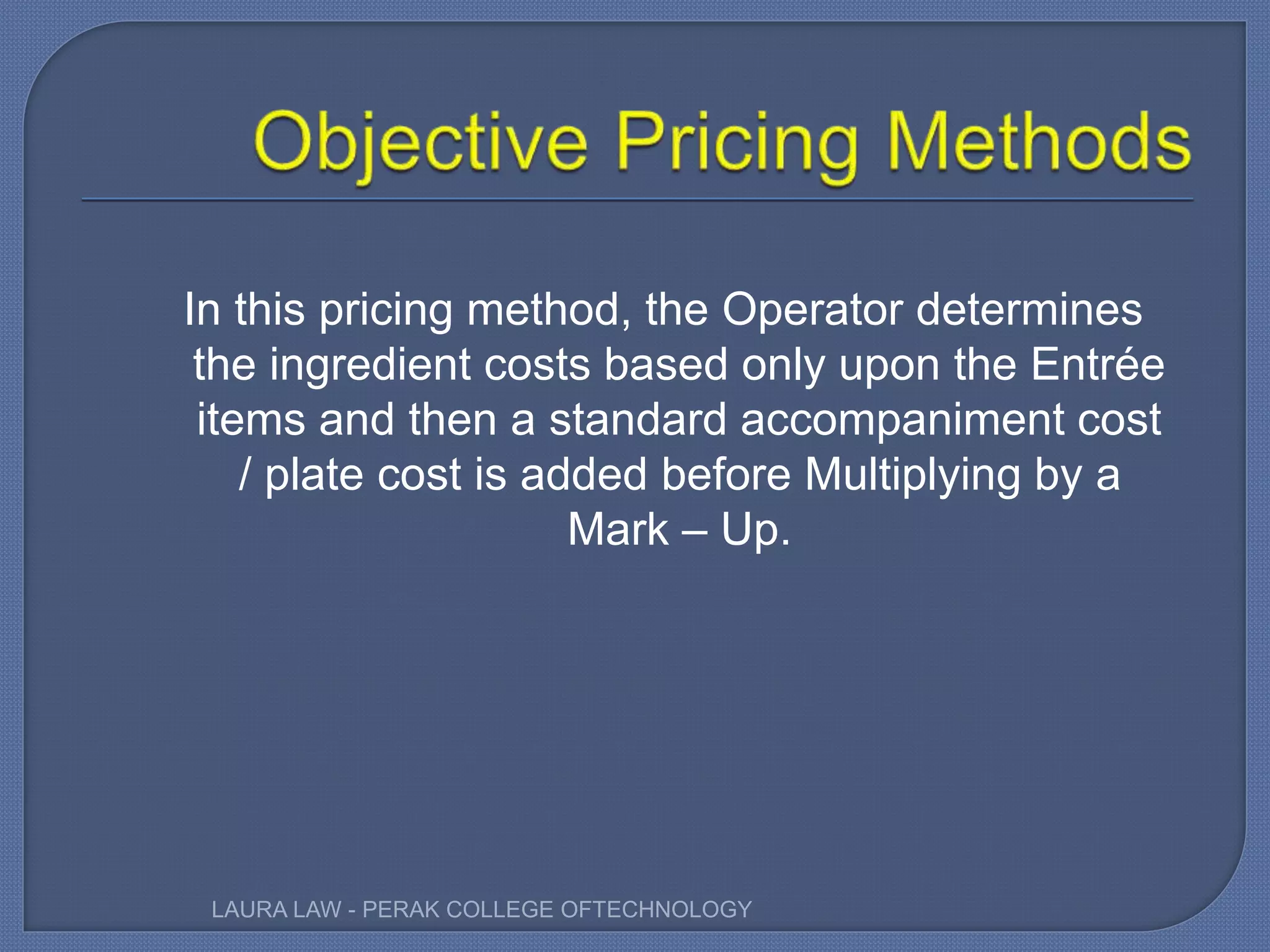
In this pricing method, the Operator determines
the ingredient costs based only upon the Entrée
items and then a standard accompaniment cost
/ plate cost is added before Multiplying by a
Mark – Up.
LAURA LAW - PERAK COLLEGE OFTECHNOLOGY
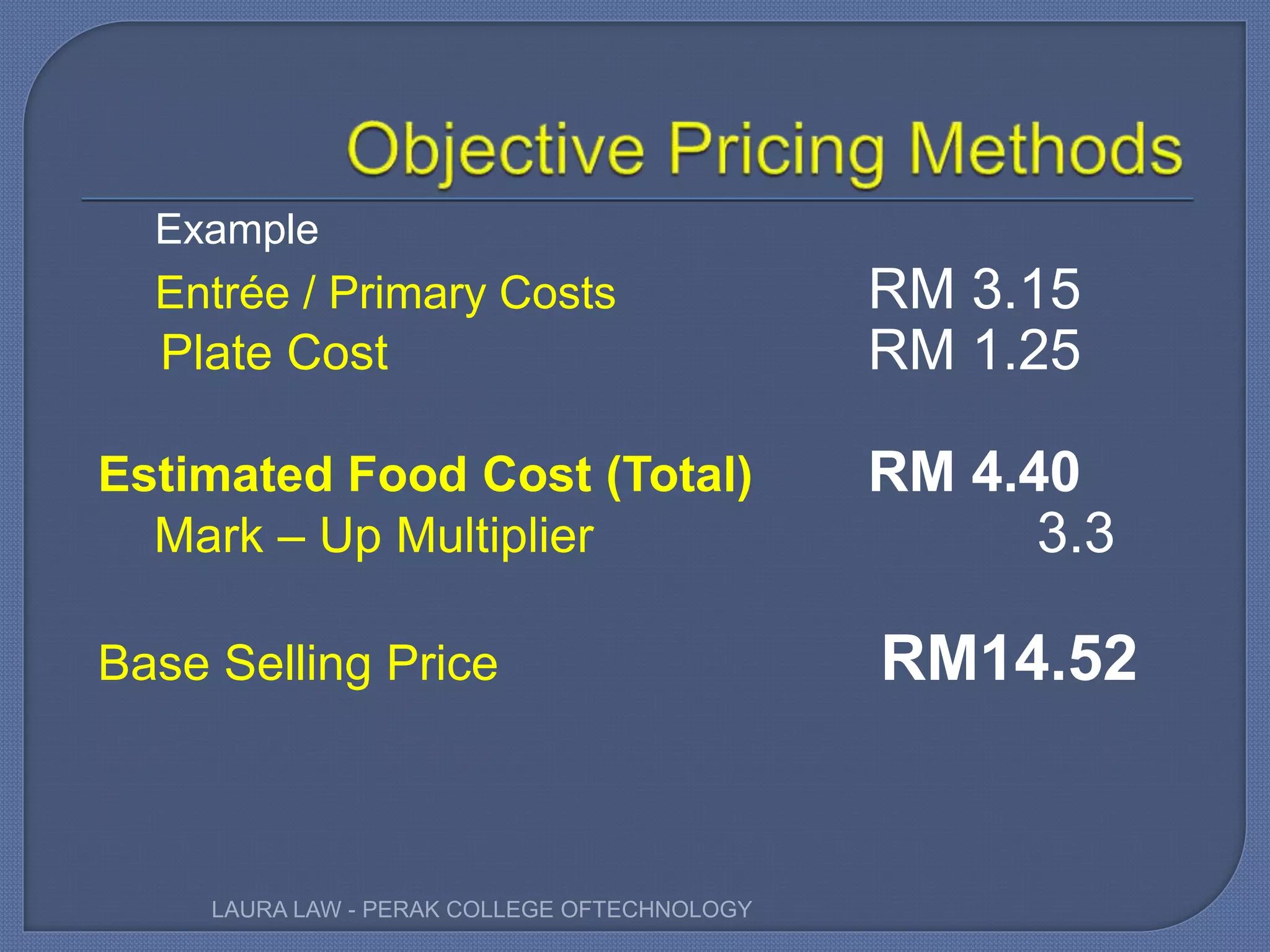
Example
Entrée / Primary Costs RM 3.15
Plate Cost RM 1.25
Estimated Food Cost (Total) RM 4.40
Mark – Up Multiplier 3.3
Base Selling Price RM14.52
LAURA LAW - PERAK COLLEGE OFTECHNOLOGY
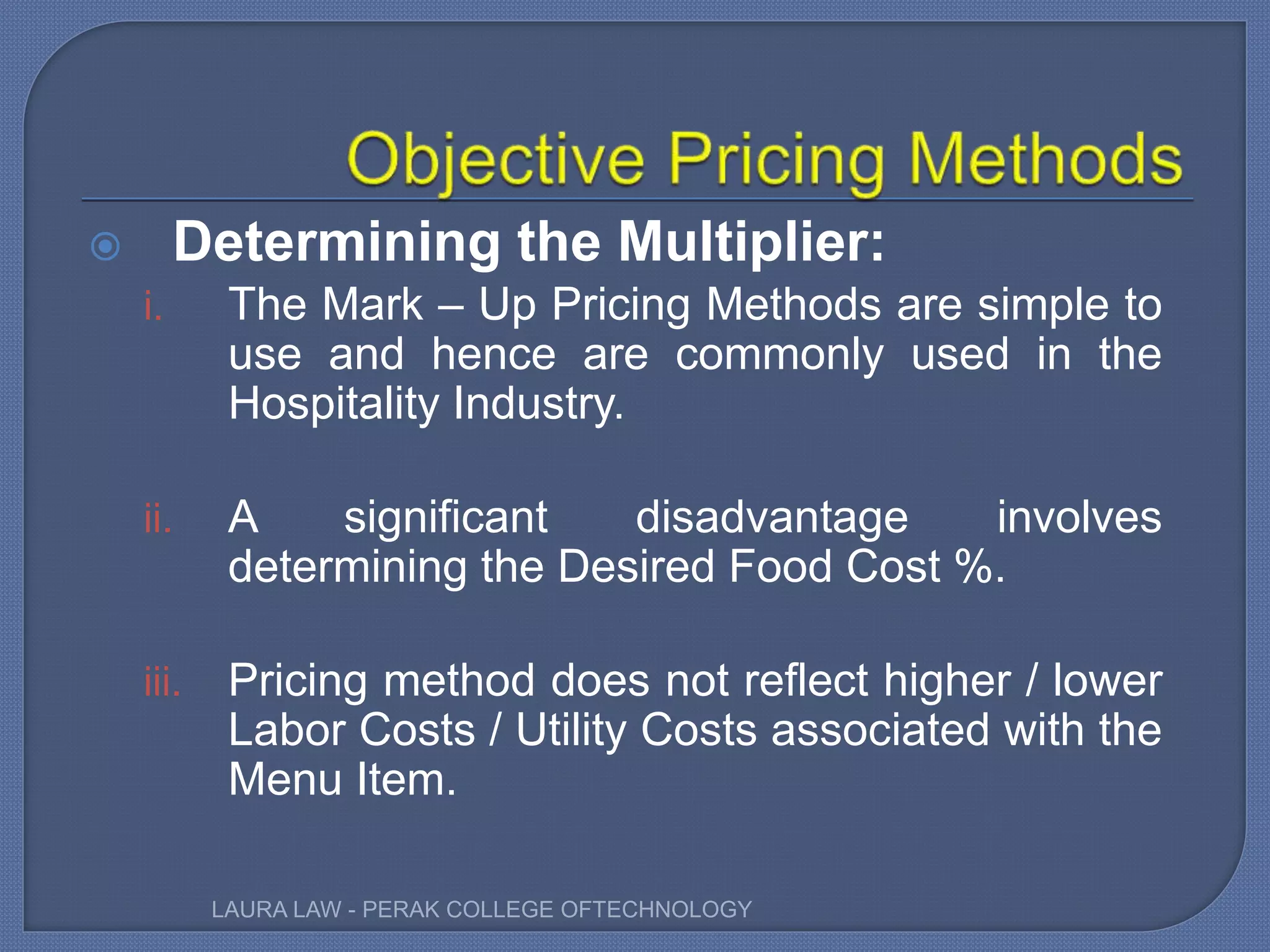
 Determining the Multiplier:
i. The Mark – Up Pricing Methods are simple to
use and hence are commonly used in the
Hospitality Industry.
ii. A significant disadvantage involves
determining the Desired Food Cost %.
iii. Pricing method does not reflect higher / lower
Labor Costs / Utility Costs associated with the
Menu Item.
LAURA LAW - PERAK COLLEGE OFTECHNOLOGY
Objective Pricing Methods
Menu Pricing
LAURA LAW - PERAK COLLEGE
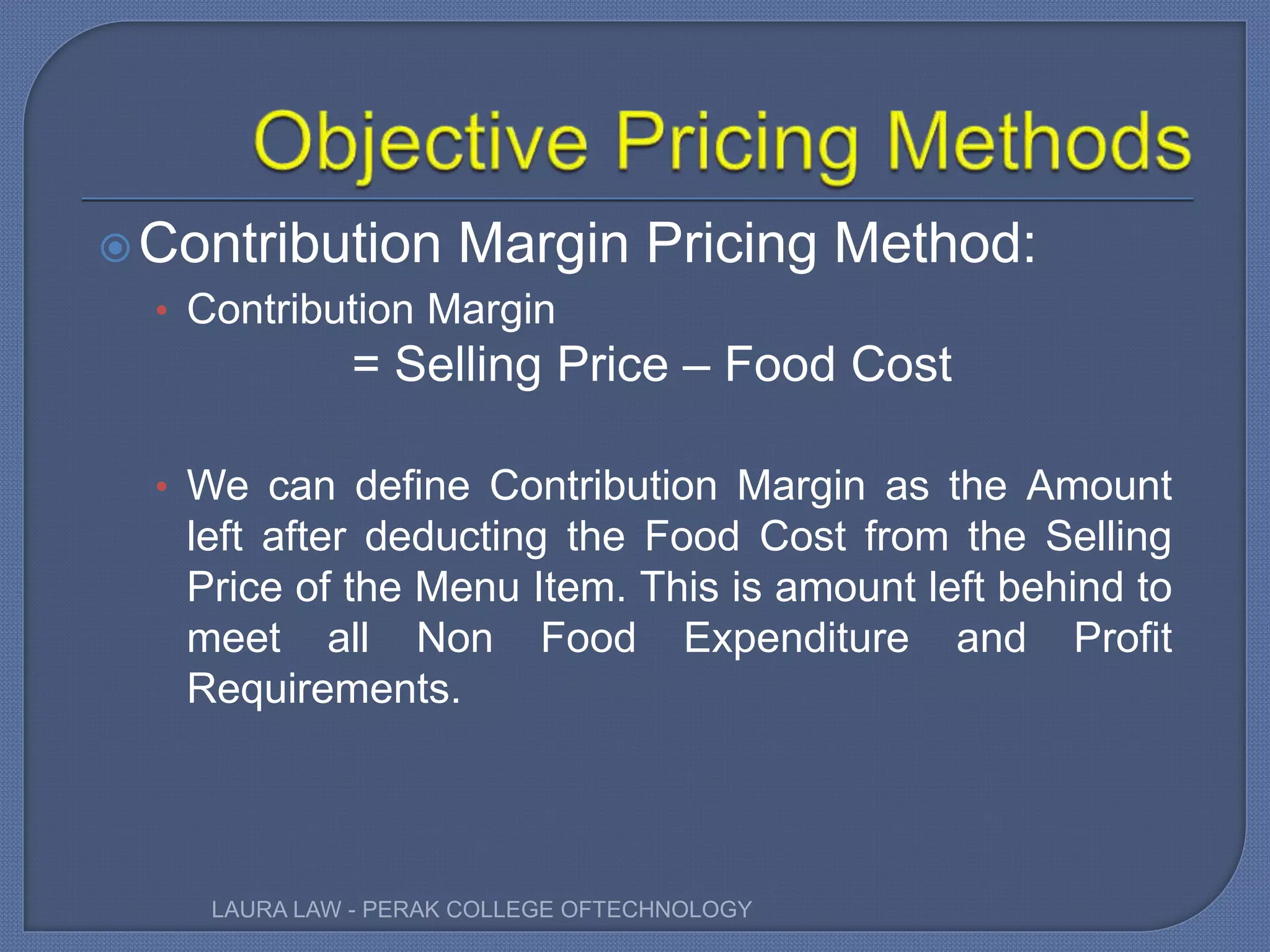
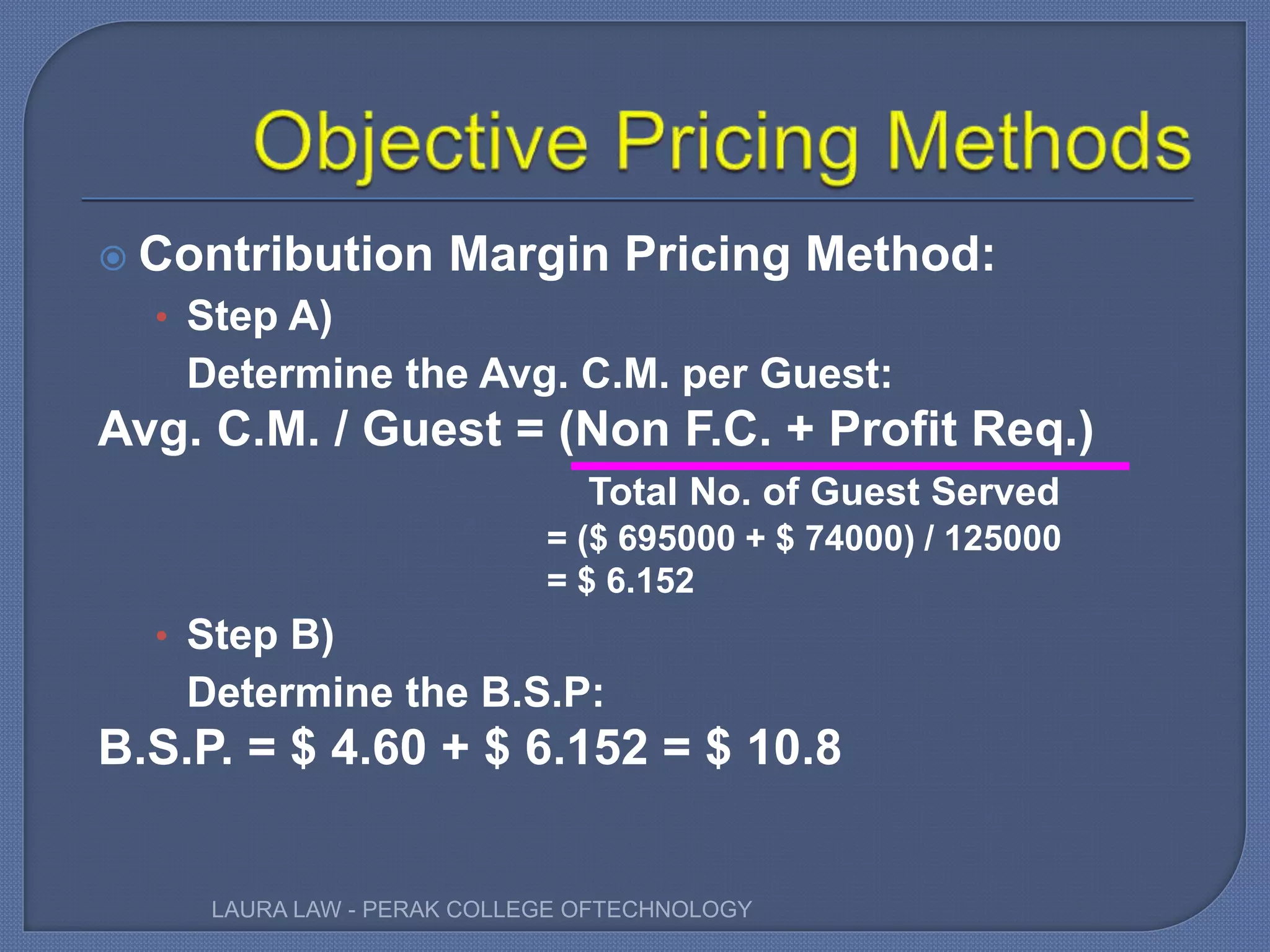
Contribution Margin Pricing Method:
• Contribution Margin
= Selling Price – Food Cost
• We can define Contribution Margin as the Amount
left after deducting the Food Cost from the Selling
Price of the Menu Item. This is amount left behind to
meet all Non Food Expenditure and Profit
Requirements.
LAURA LAW - PERAK COLLEGE OFTECHNOLOGY
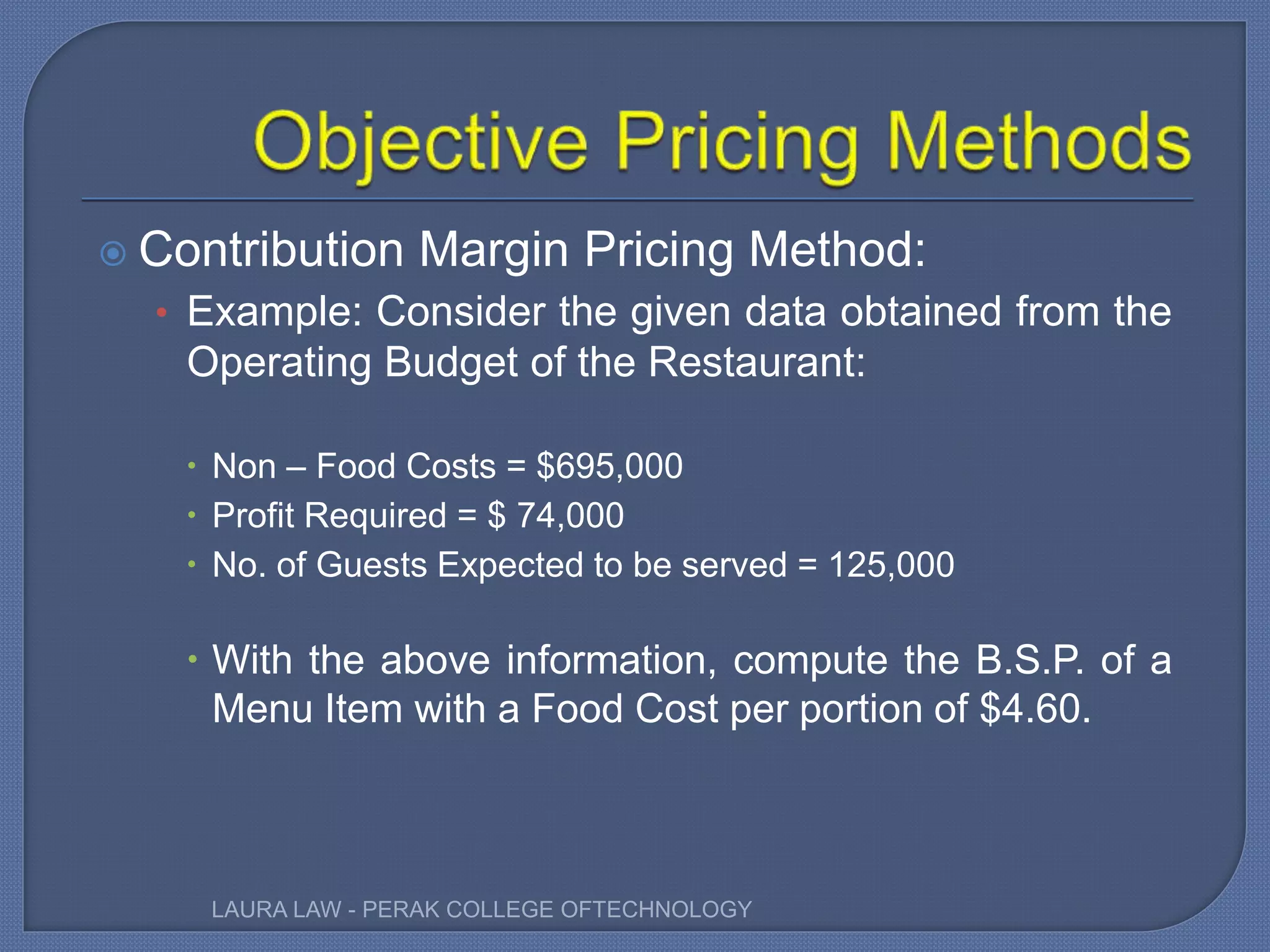
 Contribution Margin Pricing Method:
• Example: Consider the given data obtained from the
Operating Budget of the Restaurant:
 Non – Food Costs = $695,000
 Profit Required = $ 74,000
 No. of Guests Expected to be served = 125,000
 With the above information, compute the B.S.P. of a
Menu Item with a Food Cost per portion of $4.60.
LAURA LAW - PERAK COLLEGE OFTECHNOLOGY
 Contribution Margin Pricing Method:
• Step A)
Determine the Avg. C.M. per Guest:
Avg. C.M. / Guest = (Non F.C. + Profit Req.)
Total No. of Guest Served
= ($ 695000 + $ 74000) / 125000
= $ 6.152
• Step B)
Determine the B.S.P:
B.S.P. = $ 4.60 + $ 6.152 = $ 10.8
LAURA LAW - PERAK COLLEGE OFTECHNOLOGY
Objective Pricing Methods
Menu Pricing
LAURA LAW - PERAK COLLEGE
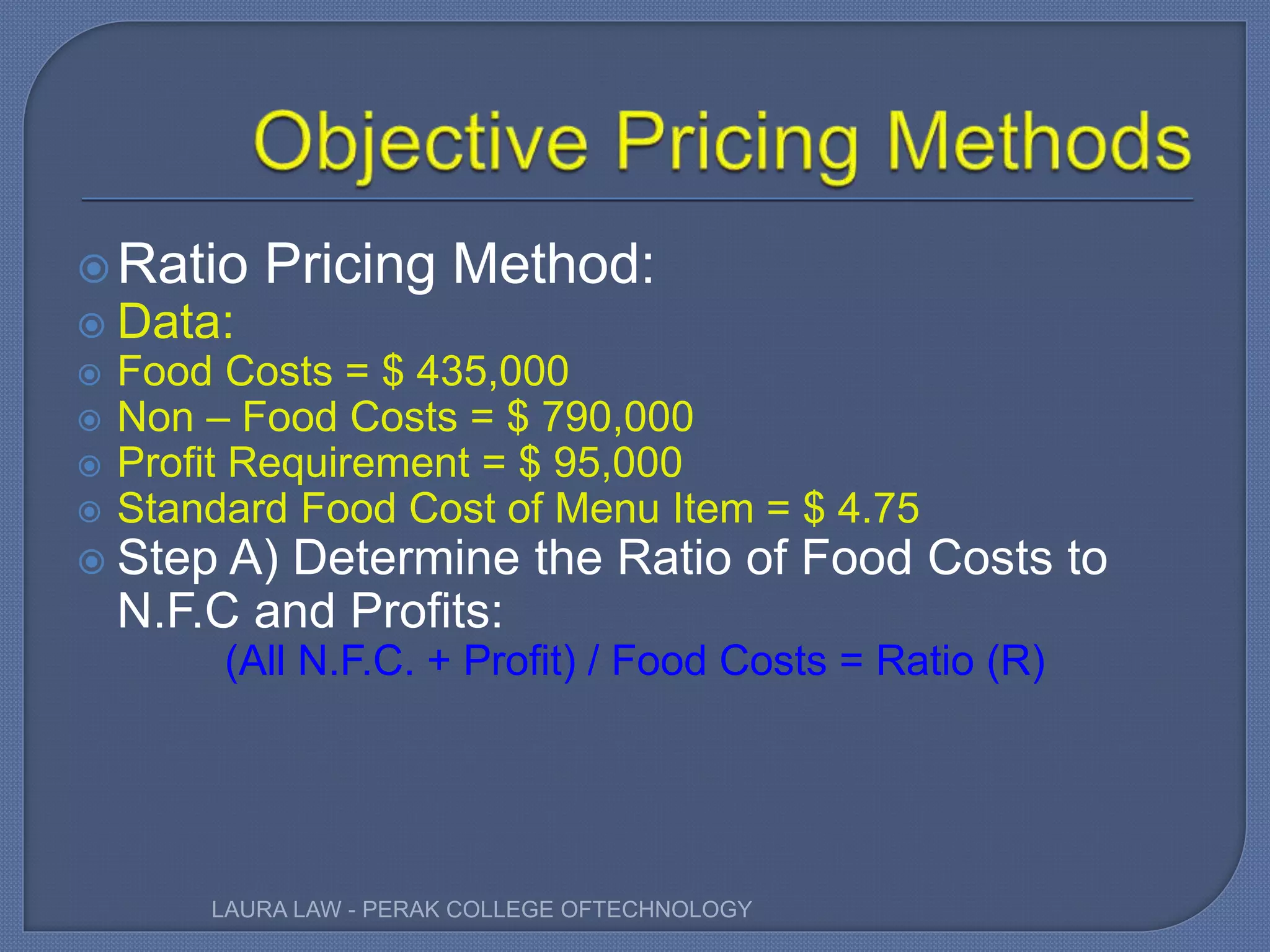
Ratio Pricing Method:
 Data:
 Food Costs = $ 435,000
 Non – Food Costs = $ 790,000
 Profit Requirement = $ 95,000
 Standard Food Cost of Menu Item = $ 4.75
 Step A) Determine the Ratio of Food Costs to
N.F.C and Profits:
(All N.F.C. + Profit) / Food Costs = Ratio (R)
LAURA LAW - PERAK COLLEGE OFTECHNOLOGY
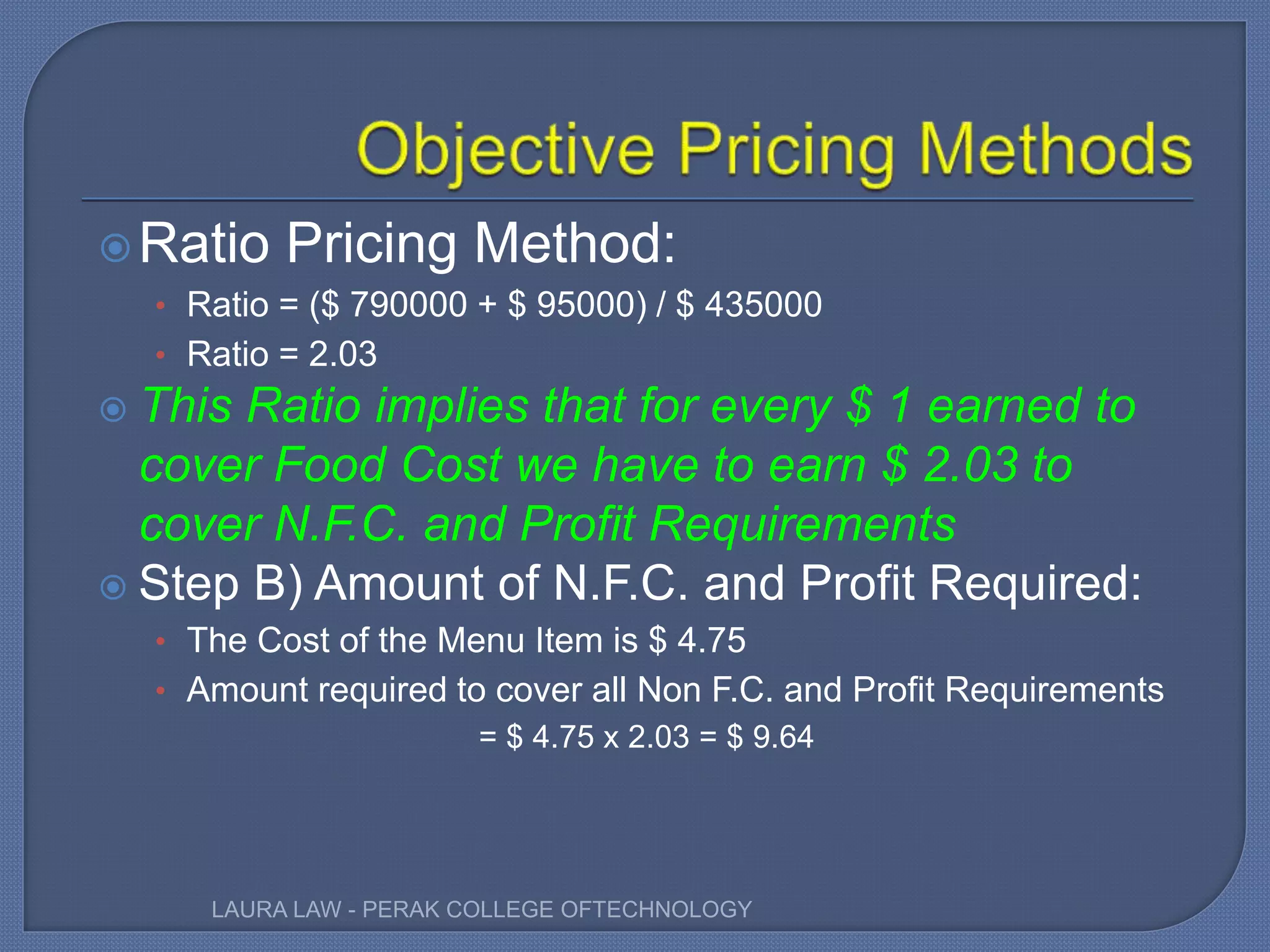
Ratio Pricing Method:
• Ratio = ($ 790000 + $ 95000) / $ 435000
• Ratio = 2.03
 This Ratio implies that for every $ 1 earned to
cover Food Cost we have to earn $ 2.03 to
cover N.F.C. and Profit Requirements
 Step B) Amount of N.F.C. and Profit Required:
• The Cost of the Menu Item is $ 4.75
• Amount required to cover all Non F.C. and Profit Requirements
= $ 4.75 x 2.03 = $ 9.64
LAURA LAW - PERAK COLLEGE OFTECHNOLOGY
Ratio Pricing Method:
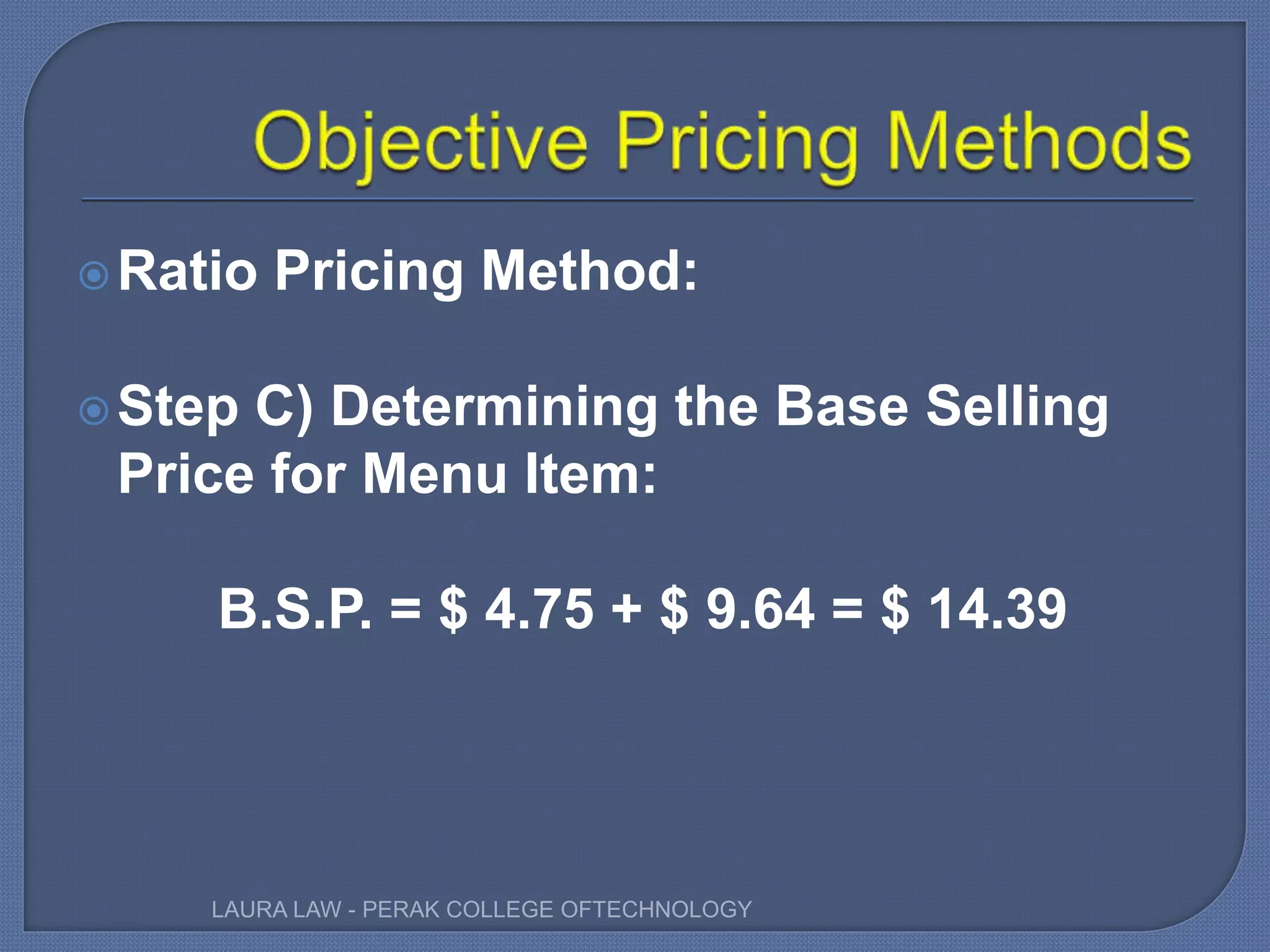
Step C) Determining the Base Selling
Price for Menu Item:
B.S.P. = $ 4.75 + $ 9.64 = $ 14.39
LAURA LAW - PERAK COLLEGE OFTECHNOLOGY
Objective Pricing Methods
Menu Pricing
LAURA LAW - PERAK COLLEGE
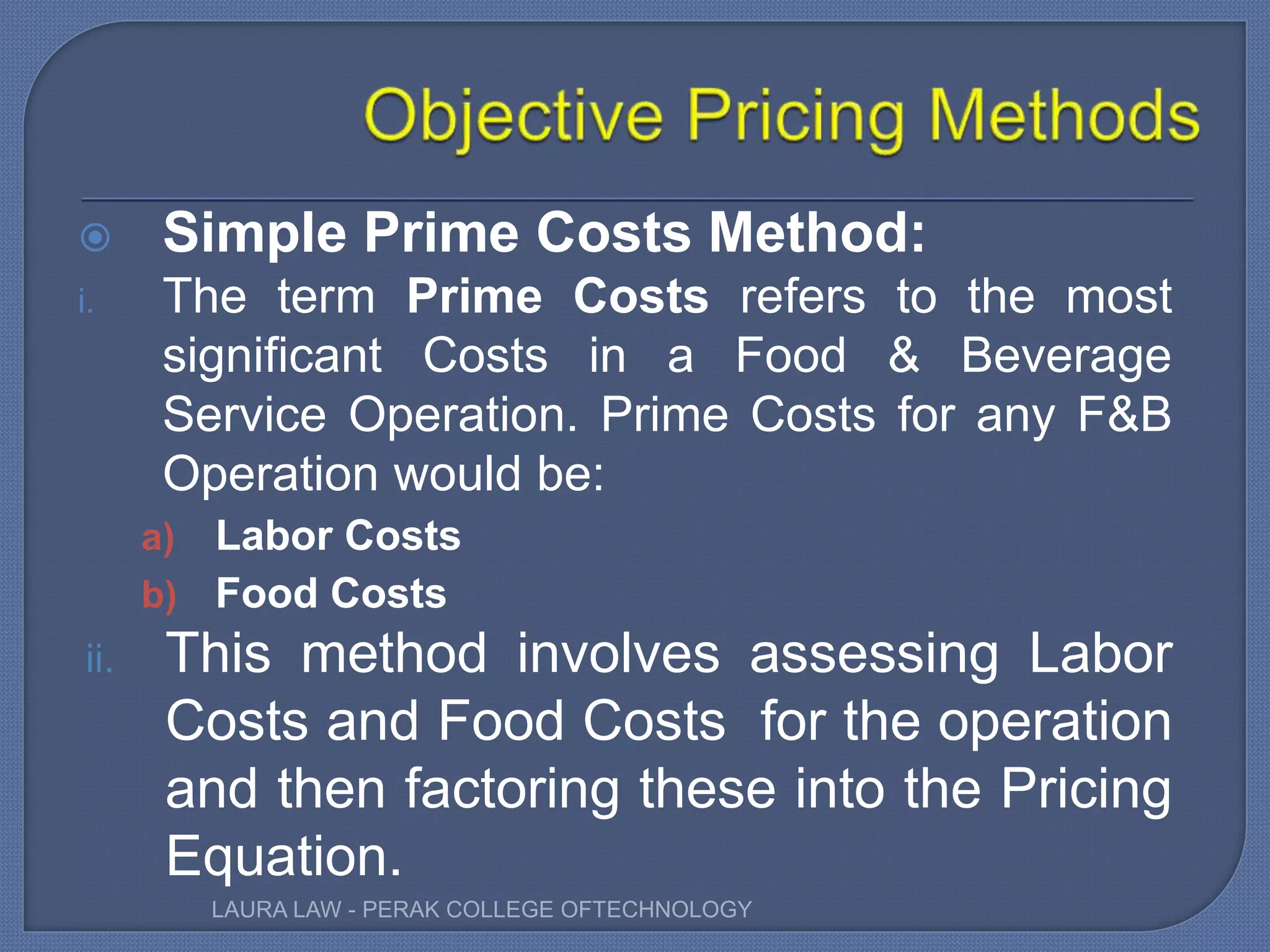
 Simple Prime Costs Method:
i. The term Prime Costs refers to the most
significant Costs in a Food & Beverage
Service Operation. Prime Costs for any F&B
Operation would be:
a) Labor Costs
b) Food Costs
ii. This method involves assessing Labor
Costs and Food Costs for the operation
and then factoring these into the Pricing
Equation.
LAURA LAW - PERAK COLLEGE OFTECHNOLOGY
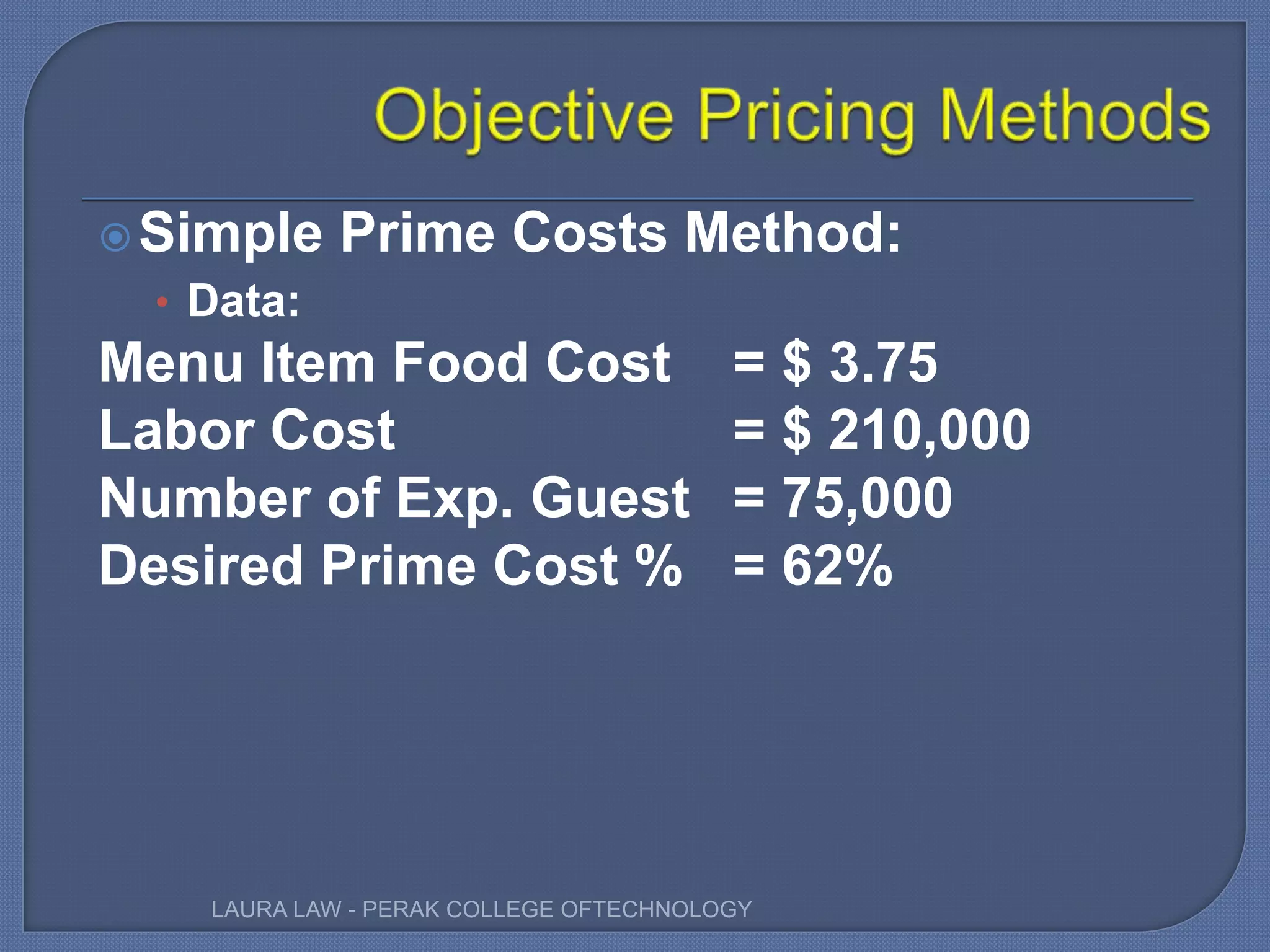
Simple Prime Costs Method:
• Data:
Menu Item Food Cost = $ 3.75
Labor Cost = $ 210,000
Number of Exp. Guest = 75,000
Desired Prime Cost % = 62%
LAURA LAW - PERAK COLLEGE OFTECHNOLOGY
Simple Prime Costs Method:
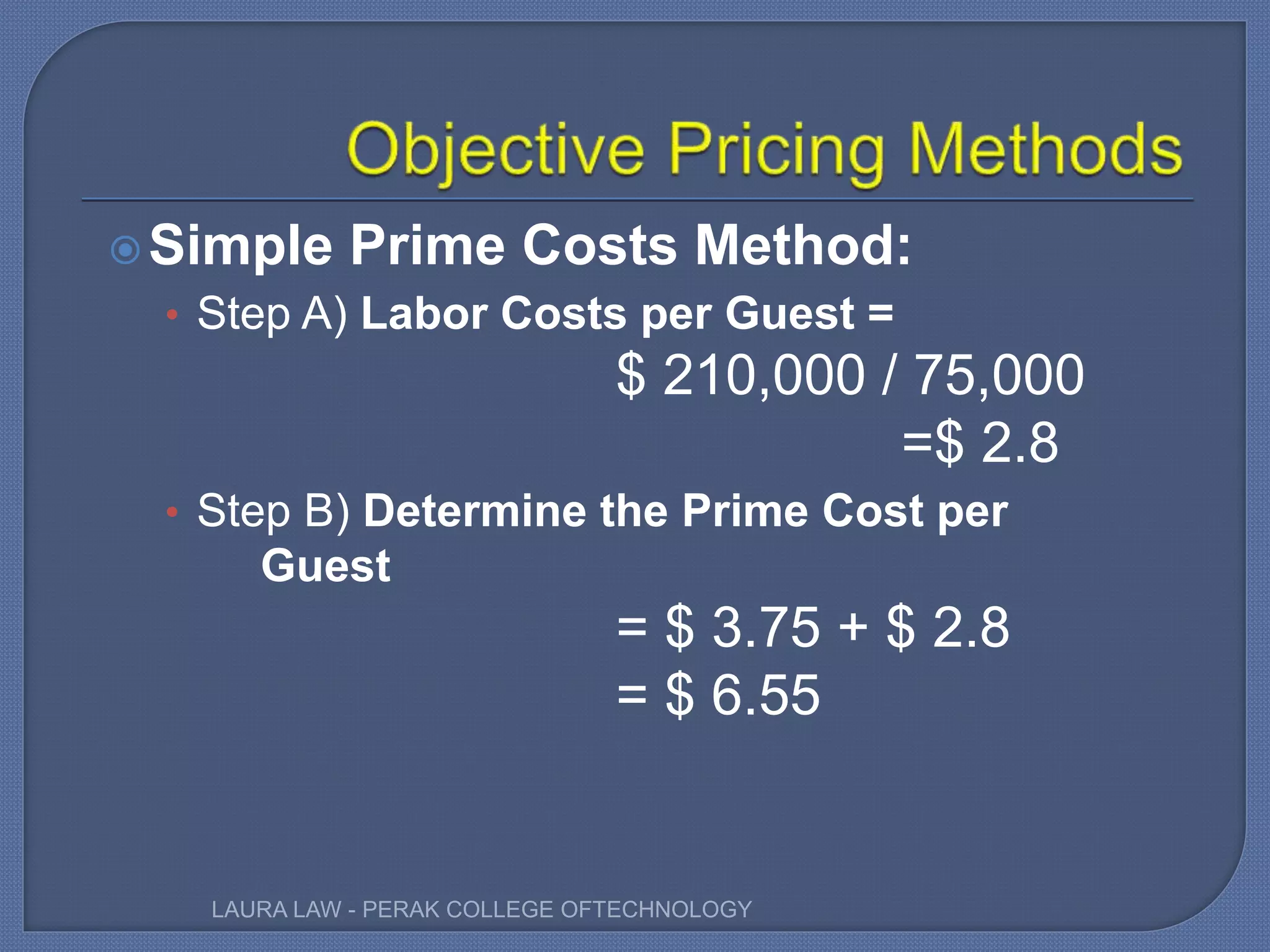
• Step A) Labor Costs per Guest =
$ 210,000 / 75,000
=$ 2.8
• Step B) Determine the Prime Cost per
Guest
= $ 3.75 + $ 2.8
= $ 6.55
LAURA LAW - PERAK COLLEGE OFTECHNOLOGY
Simple Prime Costs Method:
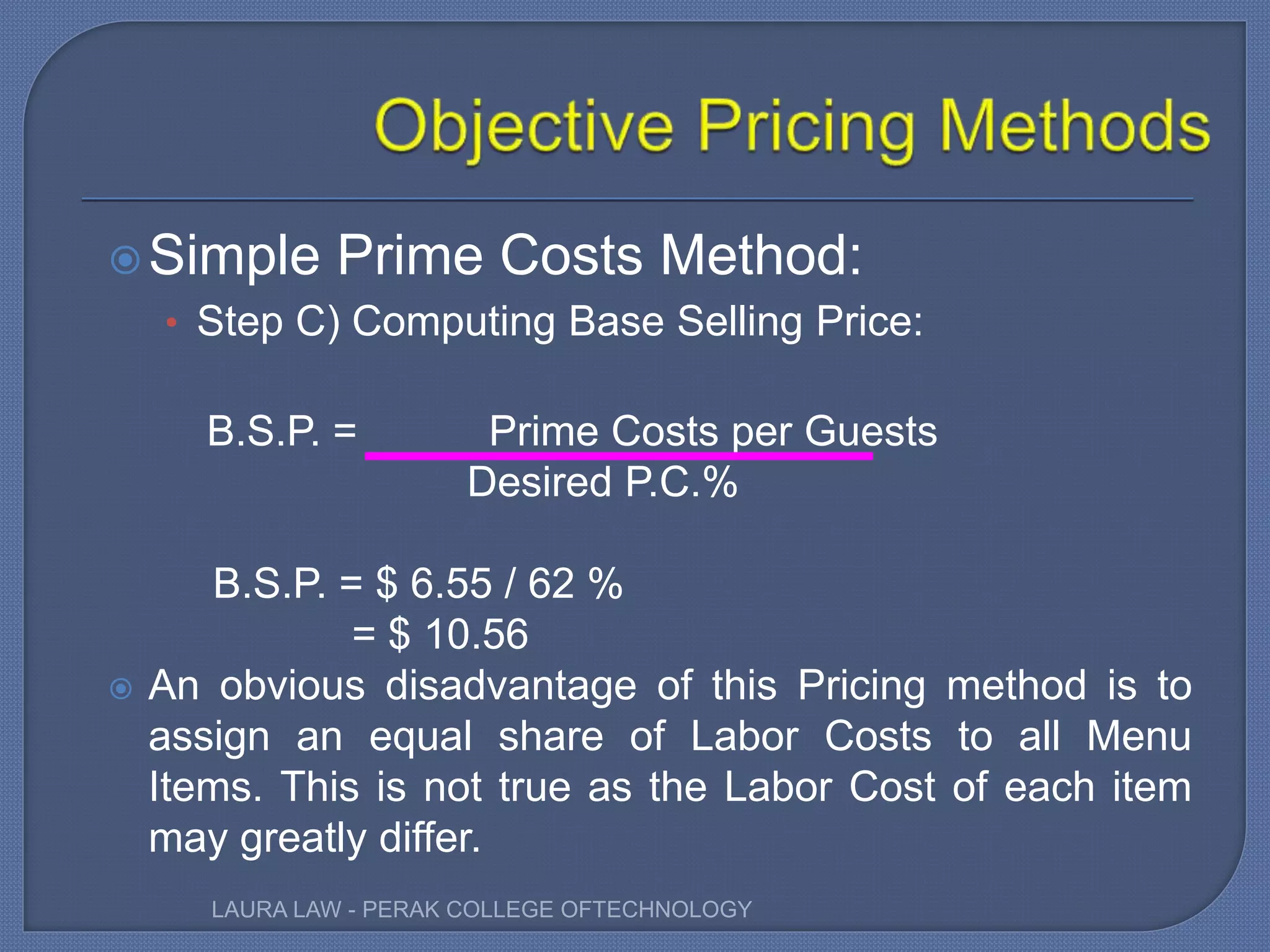
• Step C) Computing Base Selling Price:
B.S.P. = Prime Costs per Guests
Desired P.C.%
B.S.P. = $ 6.55 / 62 %
= $ 10.56
 An obvious disadvantage of this Pricing method is to
assign an equal share of Labor Costs to all Menu
Items. This is not true as the Labor Cost of each item
may greatly differ.
LAURA LAW - PERAK COLLEGE OFTECHNOLOGY
Objective Pricing Methods
Menu Pricing
LAURA LAW - PERAK COLLEGE
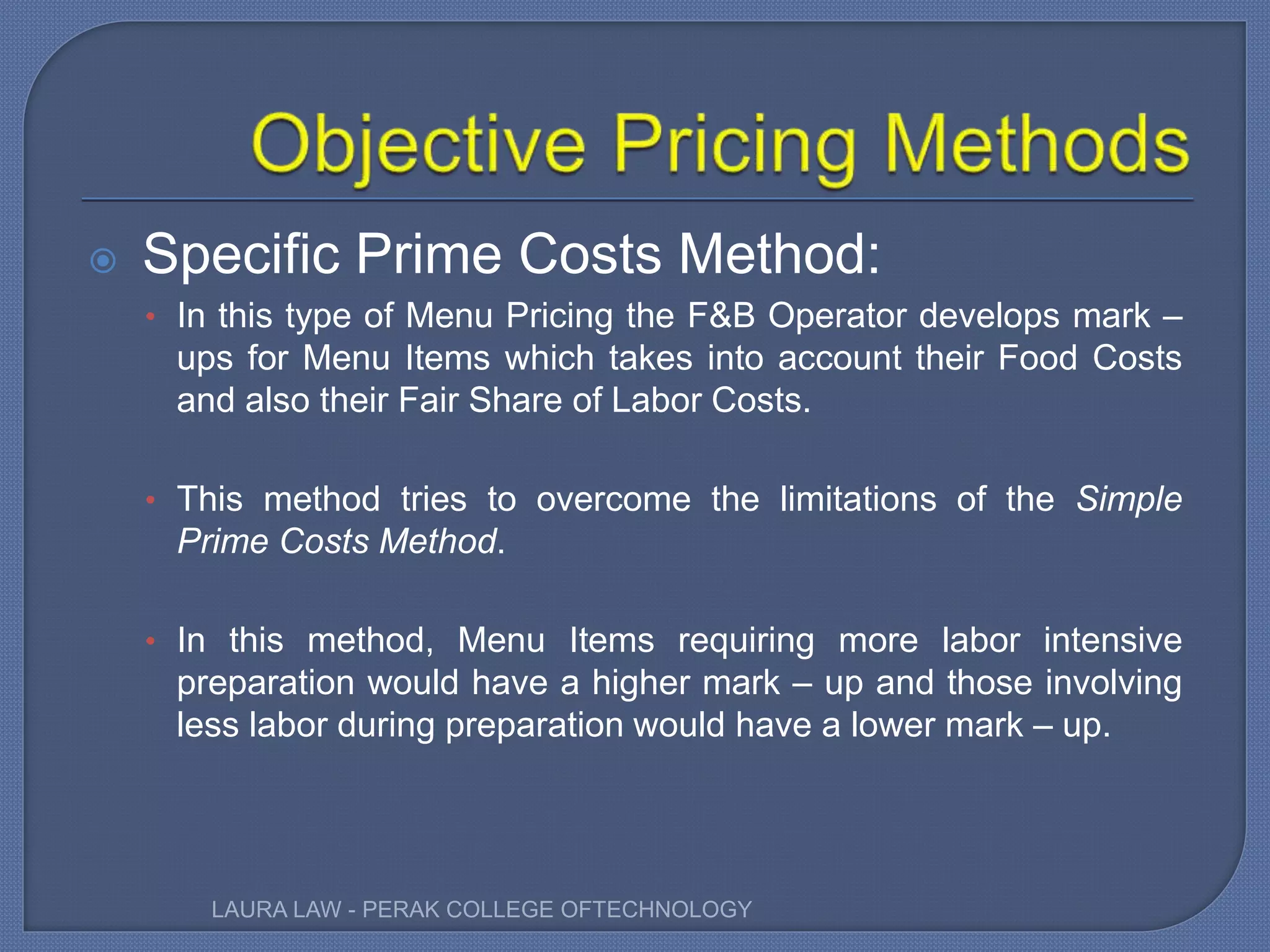
 Specific Prime Costs Method:
• In this type of Menu Pricing the F&B Operator develops mark –
ups for Menu Items which takes into account their Food Costs
and also their Fair Share of Labor Costs.
• This method tries to overcome the limitations of the Simple
Prime Costs Method.
• In this method, Menu Items requiring more labor intensive
preparation would have a higher mark – up and those involving
less labor during preparation would have a lower mark – up.
LAURA LAW - PERAK COLLEGE OFTECHNOLOGY
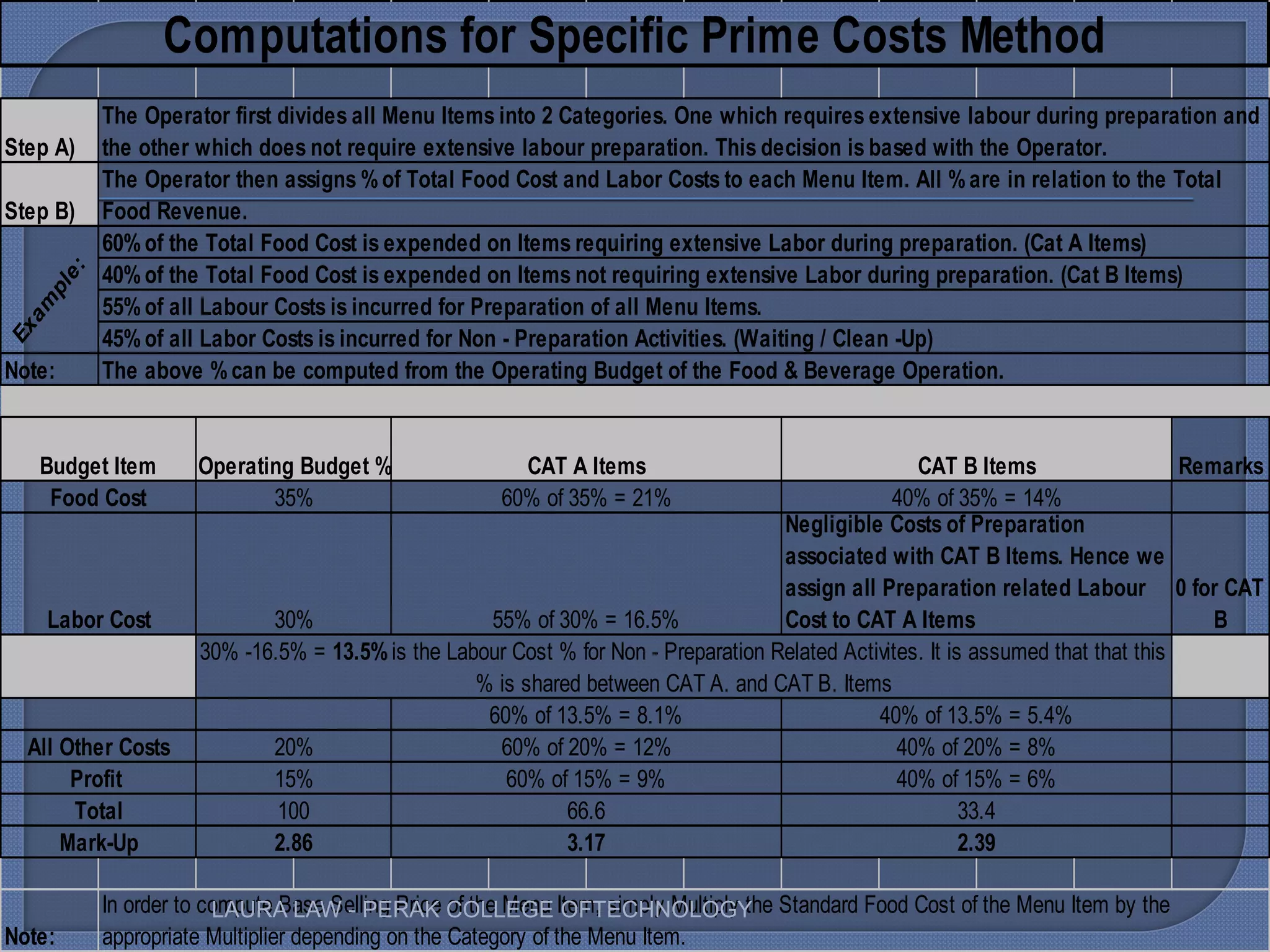
Step A)
Step B)
Computations for Specific Prime Costs Method
The Operator first divides all Menu Items into 2 Categories. One which requires extensive labour during preparation and
the other which does not require extensive labour preparation. This decision is based with the Operator.
The Operator then assigns %of Total Food Cost and Labor Costs to each Menu Item. All %are in relation to the Total
Food Revenue.
60%of the Total Food Cost is expended on Items requiring extensive Labor during preparation. (Cat A Items)
Exam
ple:
Note:
0 for CAT
B
Note:
60%of the Total Food Cost is expended on Items requiring extensive Labor during preparation. (Cat A Items)
40%of the Total Food Cost is expended on Items not requiring extensive Labor during preparation. (Cat B Items)
55%of all Labour Costs is incurred for Preparation of all Menu Items.
45%of all Labor Costs is incurred for Non - Preparation Activities. (Waiting / Clean -Up)
Exam
ple:
The above %can be computed from the Operating Budget of the Food & Beverage Operation.
Budget Item Operating Budget % CAT A Items CAT B Items Remarks
Negligible Costs of Preparation
associated with CAT B Items. Hence we
assign all Preparation related Labour
Cost to CAT A Items
Food Cost 35% 60% of 35% = 21% 40% of 35% = 14%
Labor Cost 30% 55% of 30% = 16.5%
60% of 13.5% = 8.1% 40% of 13.5% = 5.4%
All Other Costs 20% 60% of 20% = 12% 40% of 20% = 8%
Profit 15% 60% of 15% = 9% 40% of 15% = 6%
30% -16.5% = 13.5% is the Labour Cost % for Non - Preparation Related Activites. It is assumed that that this
% is shared between CAT A. and CAT B. Items
In order to compute Base Selling Price of the Menu Item, simply Multiply the Standard Food Cost of the Menu Item by the
appropriate Multiplier depending on the Category of the Menu Item.
Mark-Up 2.86 3.17 2.39
Total 100 66.6 33.4
LAURA LAW - PERAK COLLEGE OFTECHNOLOGY
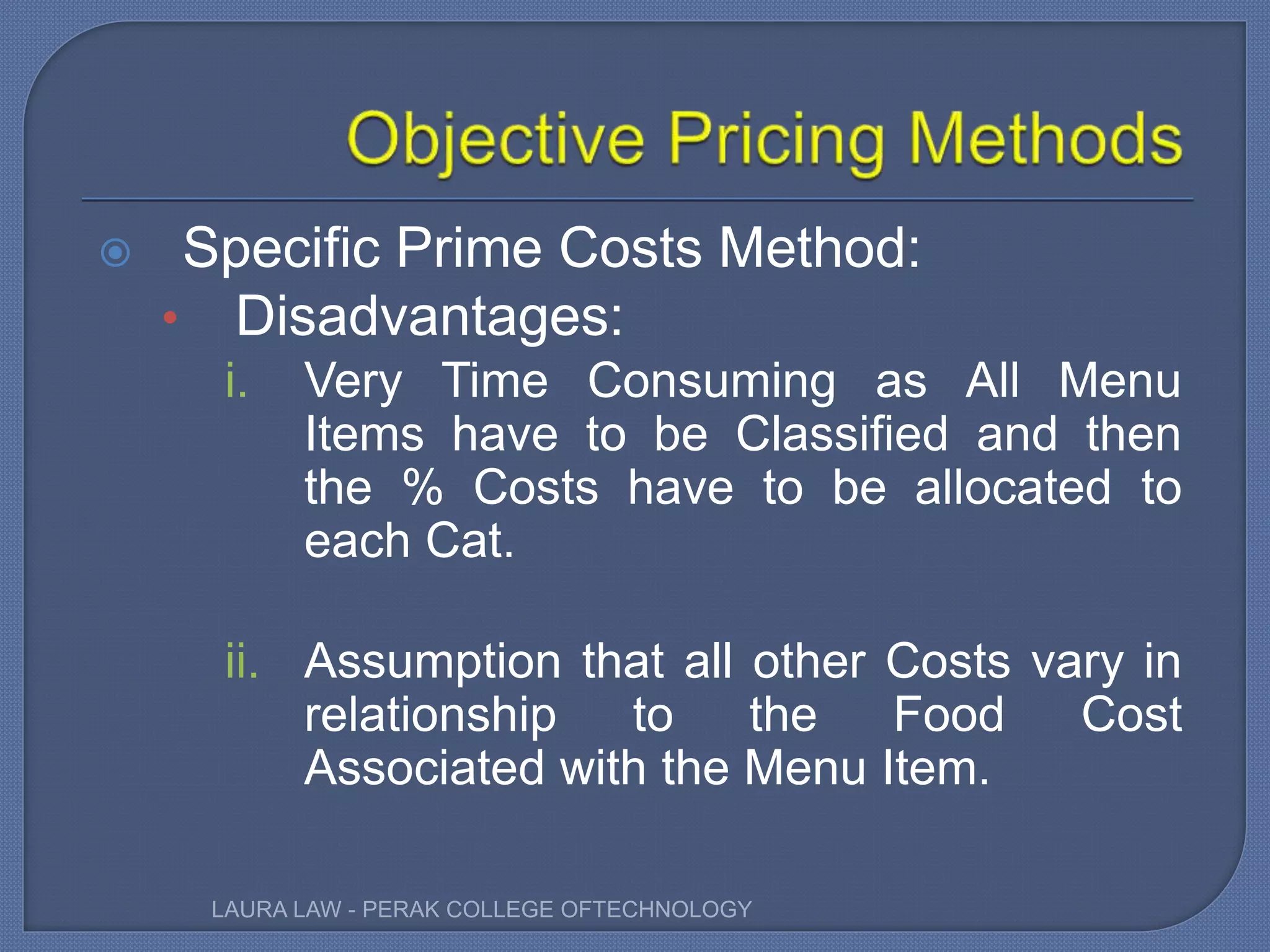
 Specific Prime Costs Method:
• Disadvantages:
i. Very Time Consuming as All Menu
Items have to be Classified and then
the % Costs have to be allocated to
each Cat.
ii. Assumption that all other Costs vary in
relationship to the Food Cost
Associated with the Menu Item.
LAURA LAW - PERAK COLLEGE OFTECHNOLOGY
Question 1
Explain why market is a major factor in the
type of menu pricing. (4 M)
LAURA LAW - PERAK COLLEGE OFTECHNOLOGY

2015 DMC2523 Topic 2 Developing Menu Cost Control

  • 1.
    DMC2523 MENU PLANNING ANDCOST CONTROL LAURA LAW - PERAK COLLEGE OFTECHNOLOGY
  • 2.
    Menu is definedas “a detailed list of food served at a meal” When planning menus, managers must consider guests and financial goals of the foodservice operation. After managers know standard product costs for food and beverage items, they know how much it should cost to produce each item. LAURA LAW - PERAK COLLEGE OFTECHNOLOGY
  • 3.
    DMC2523 MENU PLANNINGAND COST CONTROL LAURA LAW - PERAK COLLEGE
  • 4.
    Control Points arebasic operating activities that must be performed in any Food & Beverage Operation. There are 9 Main Control Points. LAURA LAW - PERAK COLLEGE OFTECHNOLOGY
  • 5.
    Beginning with MenuPlanning, each Control Point plays a crucial (penting) role in determining the success or failure of the Food & Beverage Operation. Each Control Point is a Miniature System with its own Structure and Functions. Each Control Point (Basic Operating Activity) has it’s own Specific Objectives, Guidelines, Standards and Internal Processes that contribute to the success of the Operation and the Ultimate Goal: GUEST SATISFACTION. LAURA LAW - PERAK COLLEGE OFTECHNOLOGY
  • 6.
    Menu Planning Purchasing Receiving Storing Issuing Preparing Cooking HoldingServing Guest Satisfaction Productio n Activities LAURA LAW - PERAK COLLEGE OFTECHNOLOGY
  • 7.
    Serving: The Flow ofProducts from the Kitchen into the hands of the Servers / Waiting Staff. Service The Flow of Products from the Servers / Waiting Staff to the Guests. Inferences from the Flow Chart: Preparing / Cooking / Holding Control Points are grouped under the broad category of Production Activities as they take pace in the kitchen. LAURA LAW - PERAK COLLEGE OFTECHNOLOGY
  • 8.
    The Process ofPlanning a Menu never ends. The Final Menu is never achieved. Menu Planning is: • Ongoing Process • Dynamic Process • Expectations of the Guests (Present / Potential). LAURA LAW - PERAK COLLEGE OFTECHNOLOGY
  • 9.
    The Past Food ServiceOperators tried to diversify their menus by adding new menu items. Effect I. Increased the number and variety of raw ingredients. II. Turn lead to problems in Storage III. Increased Inventory Costs (Cost of Ingredients + Carrying Cost + Storage Costs + Opportunity Costs) LAURA LAW - PERAK COLLEGE OFTECHNOLOGY
  • 10.
    Present Rationalization Strategy: Thisstrategy limits the menu of the Operation to only those items that best enhance the Operation’s Image. Objective Simplification for the purpose of Operational efficiency. Operator offer several menu items using the same Raw Ingredients. LAURA LAW - PERAK COLLEGE OFTECHNOLOGY
  • 11.
    LAURA LAW -PERAK COLLEGE
  • 12.
    DMC2523 MENU PLANNINGAND COST CONTROL LAURA LAW - PERAK COLLEGE
  • 13.
     To startwith, it is best to base your menu plans on the needs and desires of your targeted market segment.  Factors design a Menu are: a) Storage Conditions – (Time & Temperature) b) Personnel Skill Levels c) Product’s Availability / Seasonality d) Quality and Price Levels e) Ability to produce the Menu Item in Sanitary / Cost Effective Way LAURA LAW - PERAK COLLEGE OFTECHNOLOGY
  • 14.
    EXTERNAL FACTORS INTERNALFACTORS 1. Consumer Demands 2. Economic Conditions 3. Competition 4. Supply Levels 5. Industry Trends 1. Facility’s Meal Pattern 2. Concept / Theme 3. Operational System 4. Menu Mix LAURA LAW - PERAK COLLEGE OFTECHNOLOGY
  • 15.
    Question 1  Listthe 3 effects if food service operators tried to diversify their menus by adding new menu items. (6 M) Question 2 Control Points are basic operating activities that must be performed in any food & beverage operations. There are 9 main control points I. Draw the flow chart of the control points (5 M) II. According flow chart identify production activities (2 M) Question 3 List the 3 effects if food service operators tried to diversify their menus by adding new menu items. (6 M) Question 4 List three (3) common external factors that have impact on the menu changes (3 M) LAURA LAW - PERAK COLLEGE OFTECHNOLOGY
  • 16.
    DMC2523 MENU PLANNINGAND COST CONTROL LAURA LAW - PERAK COLLEGE
  • 17.
    1. Product ControlProcedures: The F&B Products must be controlled. If the Operation needs Shrimp to produce a Menu Item, Shrimp will have to be Purchased / Received / Stored / Issued / Prepared / Cooked and finally Served. LAURA LAW - PERAK COLLEGE OFTECHNOLOGY
  • 18.
    2. Cost ControlProcedures: Careful Cost Control Procedures must be followed as more expensive products are served. This is upon Guest Demand of an operation, providing a “Dining Experience” and not just a “Meal”. LAURA LAW - PERAK COLLEGE OFTECHNOLOGY
  • 19.
    3. Production Requirements FoodItems required by the Menu must be produced “Consistently”. The following parameters are all dictated by the Menu:  Product Quality  Staff Productivity  Skills  Timing and Scheduling LAURA LAW - PERAK COLLEGE OFTECHNOLOGY
  • 20.
    4. Nutritional Contentof Meals: Food & Beverage Operations (Commercial / Non – Commercial) are increasing concerned about the Nutritional Content of the Food served to the Guests / Clients. Menu can have an impact on the health and well being of those to whom it is served. LAURA LAW - PERAK COLLEGE OFTECHNOLOGY
  • 21.
    5. Equipment Needs Allequipment required to produce the Menu must be available. The Menu must be balanced such that no one station in the kitchen is under – utilized. LAURA LAW - PERAK COLLEGE OFTECHNOLOGY
  • 22.
    6. Sanitation Management: Sincethe Menu sets the stage for the remaining control points, the management must consider the Menu Items in light of possible Sanitation Hazards. Once potential Hazards are identified, risks can be reduced. LAURA LAW - PERAK COLLEGE OFTECHNOLOGY
  • 23.
    7. Layout andSpace Requirements There must be adequate facilities for the staff and equipment required to produce items listed on the menu. The layout and design facilities establish physical space within which food production and service take place. Physical facilities must be adequate for Purchasing / Receiving / Storage / Issuing / Production and Serving of Menu Items. LAURA LAW - PERAK COLLEGE OFTECHNOLOGY
  • 24.
    8. Staffing Needs Employeesmust be able to produce and serve all the items required by the menu. The more complex the menu, the greater the demands placed on the production and service staff. Staffing needs are influenced to a great extent by the use of “Convenience Foods” by the operation. LAURA LAW - PERAK COLLEGE OFTECHNOLOGY
  • 25.
    9. Service Requirement F&BManager must carefully plan how products will be served to the guest. The Menu influences your choice of Service Style. It influences the Skill Levels required by the Staff along with Equipment & Inventory. LAURA LAW - PERAK COLLEGE OFTECHNOLOGY
  • 26.
    10. Revenue ControlProcedures: A simple Fast Food Operation would not have as much problems in Revenue Control as a Specialty Restaurant. In a Fast Food Operation, there would be fewer Menu items (comparatively lesser Product Range), hence controlling Revenue from the sale of these would be far easier than controlling Revenue in a Specialty Restaurant wherein the Product Range is extensive, involving a large Beverage. List as well as a wide choice of Food items. LAURA LAW - PERAK COLLEGE OFTECHNOLOGY
  • 27.
    DMC2523 MENU PLANNINGAND COST CONTROL LAURA LAW - PERAK COLLEGE
  • 28.
     After amenu is planned and cost, each item has to be priced.  Factors to take into consideration such as: • Type of Operation • The Market • Costs  The market is a major factor in the type of pricing. • Most customers want only low prices; others seek moderate ones; some will be willing to pay higher prices. • The Key is to establish a fine balance between the Price and Quality of Food offered by the Operation all other parameters being the same. LAURA LAW - PERAK COLLEGE OFTECHNOLOGY
  • 29.
     There aretwo main types of Pricing Techniques. • Subjective Pricing Method • Objective Pricing Method LAURA LAW - PERAK COLLEGE OFTECHNOLOGY
  • 30.
    DMC2523 MENU PLANNINGAND COST CONTROL LAURA LAW - PERAK COLLEGE
  • 31.
     Prices determineto a large extent whether the financial goals of the Operation are met, many managers use very Subjective Pricing Methods.  Subjective Pricing Methods establish Prices, however, fail to relate them to Profit Requirements and even Costs.  This Pricing method is based merely on assumptions. LAURA LAW - PERAK COLLEGE OFTECHNOLOGY
  • 32.
    1. The ReasonablePrice Method 2. Highest Price Method 3. Loss Leader Pricing Method 4. The Intuitive Price Method 5. Drawback LAURA LAW - PERAK COLLEGE OFTECHNOLOGY
  • 33.
    1. The ReasonablePrice Method • The method uses a price that the Operator thinks will represent value to the guest. • In other words, the Operator puts himself in the guest’s shoes and asks “How much am I willing to pay for this Item, considering the type of setting?” • The answer to this is the Reasonable Pricing Method. LAURA LAW - PERAK COLLEGE OFTECHNOLOGY
  • 34.
    2. Highest PriceMethod Using this Pricing Method, the Operator sets the Highest Price for an item that he thinks the guest is willing to pay. This is pushing the concept of value to the maximum. A high price is set then “Backed Of” in order to provide for an Error Margin in the estimate. LAURA LAW - PERAK COLLEGE OFTECHNOLOGY
  • 35.
    3. Loss LeaderPricing Method Menu Items are Priced very low The philosophy for this pricing method is that the guests will be attracted due to Low Prices and will then buy other items while they are there (Spin Off Business) In this case, it is very important to sell other items to make profit. This pricing method is used as an Early Bird Promotion to attract specific market segments. LAURA LAW - PERAK COLLEGE OFTECHNOLOGY
  • 36.
    4. The IntuitivePrice Method Like the name suggests, Prices are set by Intuition of the Operator alone. The Operator takes a little more than a “Wild Guess” about the Selling Price. It differs from the Reasonable Price Method in that it takes a little less effort to determine the price as one does not consider what would represent Value to the Customer. LAURA LAW - PERAK COLLEGE OFTECHNOLOGY
  • 37.
    5.Drawback Cannot relate tothe Profit Requirements of the Operation. Cannot relate to the Cost of a Menu Item. Solely based on Assumptions, Guess Work and Hunches. Seldom works in an era where Consumers are looking for “Value for Money” and AP Prices of Ingredients are sky rocketing. LAURA LAW - PERAK COLLEGE OFTECHNOLOGY
  • 38.
    DMC2523 MENU PLANNINGAND COST CONTROL LAURA LAW - PERAK COLLEGE
  • 39.
    1. Simple Mark–Up Pricing Methods i. Ingredient Mark – Up ii. Prime Ingredient Mark – Up iii. Mark – Up with Accompaniments Costs 2. Contribution Margin Pricing Method 3. Ratio Pricing Method 4. Simple Prime Costs Method 5. Specific Prime Costs Method LAURA LAW - PERAK COLLEGE OFTECHNOLOGY
  • 40.
    Objective Pricing Methods MenuPricing LAURA LAW - PERAK COLLEGE
  • 41.
    Simple Mark –Up Pricing Methods It considers a Mark – Up from the cost of good sold The Mark – Up is designed in such a way that it covers all costs to yield the desired profit levels. LAURA LAW - PERAK COLLEGE OFTECHNOLOGY
  • 42.
    Simple Mark –Up Pricing Methods: a) Ingredient Mark – Up Method b) Prime Ingredient Mark – Up c) Mark – Up with Accompaniments Costs LAURA LAW - PERAK COLLEGE OFTECHNOLOGY
  • 43.
    This Pricing methodattempts to account for all product costs Steps 1. Determine Ingredient Costs 2. Determine Multiplier to Mark – Up Ingredient Costs 3. Determine the Base Selling Price. LAURA LAW - PERAK COLLEGE OFTECHNOLOGY
  • 44.
     Multiplier = 1 DesiredFood Cost Percentage Example: If you want to keep your Food Cost as 40% then:  Multiplier = 1 / 40% = 1 / .40 = 2.5 LAURA LAW - PERAK COLLEGE OFTECHNOLOGY
  • 45.
    Example Assume that aSeafood Platter has a Standard Food Cost / Portion of a Seafood Platter is RM 5.32  If a Food Cost % of 40% is desired: Base Selling Price (B.S.P.) = RM 5.32 x 2.5 = RM13.30 LAURA LAW - PERAK COLLEGE OFTECHNOLOGY
  • 46.
    Simple Mark –Up Pricing Methods: a) Ingredient Mark – Up Method b) Prime Ingredient Mark – Up c) Mark – Up with Accompaniments Costs LAURA LAW - PERAK COLLEGE OFTECHNOLOGY
  • 47.
    It concerns itselfwith only the Prime Ingredient of the Menu Item. Only the Cost of the Prime Ingredient is Marked Up. The Multiplier is usually higher in order to account for the Cost of the ancillary ingredients in the recipe. LAURA LAW - PERAK COLLEGE OFTECHNOLOGY
  • 48.
    Example Using the sameexample, consider the Cost of Prime Ingredient in a Seafood Platter RM 2.65 (Prime Ingredient being Lobster) The Multiplier = 5 (Higher than the regular M to account for other ingredients) Hence, B.S.P. = RM 2.65 x 5 = RM 13.25 LAURA LAW - PERAK COLLEGE OFTECHNOLOGY
  • 49.
    If the Costof the Prime Ingredient increases to RM 2.75 per Dinner Portion, then the new B.S.P. = RM 2.75 x 5 = RM 13.75 The Pricing method approach assumes that the Cost of other Recipe Ingredients increases in Proportion to the Cost of the Prime Ingredient. LAURA LAW - PERAK COLLEGE OFTECHNOLOGY
  • 50.
    Simple Mark –Up Pricing Methods: a) Ingredient Mark – Up Method b) Prime Ingredient Mark – Up c) Mark – Up with Accompaniments Costs LAURA LAW - PERAK COLLEGE OFTECHNOLOGY
  • 51.
    In this pricingmethod, the Operator determines the ingredient costs based only upon the Entrée items and then a standard accompaniment cost / plate cost is added before Multiplying by a Mark – Up. LAURA LAW - PERAK COLLEGE OFTECHNOLOGY
  • 52.
    Example Entrée / PrimaryCosts RM 3.15 Plate Cost RM 1.25 Estimated Food Cost (Total) RM 4.40 Mark – Up Multiplier 3.3 Base Selling Price RM14.52 LAURA LAW - PERAK COLLEGE OFTECHNOLOGY
  • 53.
     Determining theMultiplier: i. The Mark – Up Pricing Methods are simple to use and hence are commonly used in the Hospitality Industry. ii. A significant disadvantage involves determining the Desired Food Cost %. iii. Pricing method does not reflect higher / lower Labor Costs / Utility Costs associated with the Menu Item. LAURA LAW - PERAK COLLEGE OFTECHNOLOGY
  • 54.
    Objective Pricing Methods MenuPricing LAURA LAW - PERAK COLLEGE
  • 55.
    Contribution Margin PricingMethod: • Contribution Margin = Selling Price – Food Cost • We can define Contribution Margin as the Amount left after deducting the Food Cost from the Selling Price of the Menu Item. This is amount left behind to meet all Non Food Expenditure and Profit Requirements. LAURA LAW - PERAK COLLEGE OFTECHNOLOGY
  • 56.
     Contribution MarginPricing Method: • Example: Consider the given data obtained from the Operating Budget of the Restaurant:  Non – Food Costs = $695,000  Profit Required = $ 74,000  No. of Guests Expected to be served = 125,000  With the above information, compute the B.S.P. of a Menu Item with a Food Cost per portion of $4.60. LAURA LAW - PERAK COLLEGE OFTECHNOLOGY
  • 57.
     Contribution MarginPricing Method: • Step A) Determine the Avg. C.M. per Guest: Avg. C.M. / Guest = (Non F.C. + Profit Req.) Total No. of Guest Served = ($ 695000 + $ 74000) / 125000 = $ 6.152 • Step B) Determine the B.S.P: B.S.P. = $ 4.60 + $ 6.152 = $ 10.8 LAURA LAW - PERAK COLLEGE OFTECHNOLOGY
  • 58.
    Objective Pricing Methods MenuPricing LAURA LAW - PERAK COLLEGE
  • 59.
    Ratio Pricing Method: Data:  Food Costs = $ 435,000  Non – Food Costs = $ 790,000  Profit Requirement = $ 95,000  Standard Food Cost of Menu Item = $ 4.75  Step A) Determine the Ratio of Food Costs to N.F.C and Profits: (All N.F.C. + Profit) / Food Costs = Ratio (R) LAURA LAW - PERAK COLLEGE OFTECHNOLOGY
  • 60.
    Ratio Pricing Method: •Ratio = ($ 790000 + $ 95000) / $ 435000 • Ratio = 2.03  This Ratio implies that for every $ 1 earned to cover Food Cost we have to earn $ 2.03 to cover N.F.C. and Profit Requirements  Step B) Amount of N.F.C. and Profit Required: • The Cost of the Menu Item is $ 4.75 • Amount required to cover all Non F.C. and Profit Requirements = $ 4.75 x 2.03 = $ 9.64 LAURA LAW - PERAK COLLEGE OFTECHNOLOGY
  • 61.
    Ratio Pricing Method: StepC) Determining the Base Selling Price for Menu Item: B.S.P. = $ 4.75 + $ 9.64 = $ 14.39 LAURA LAW - PERAK COLLEGE OFTECHNOLOGY
  • 62.
    Objective Pricing Methods MenuPricing LAURA LAW - PERAK COLLEGE
  • 63.
     Simple PrimeCosts Method: i. The term Prime Costs refers to the most significant Costs in a Food & Beverage Service Operation. Prime Costs for any F&B Operation would be: a) Labor Costs b) Food Costs ii. This method involves assessing Labor Costs and Food Costs for the operation and then factoring these into the Pricing Equation. LAURA LAW - PERAK COLLEGE OFTECHNOLOGY
  • 64.
    Simple Prime CostsMethod: • Data: Menu Item Food Cost = $ 3.75 Labor Cost = $ 210,000 Number of Exp. Guest = 75,000 Desired Prime Cost % = 62% LAURA LAW - PERAK COLLEGE OFTECHNOLOGY
  • 65.
    Simple Prime CostsMethod: • Step A) Labor Costs per Guest = $ 210,000 / 75,000 =$ 2.8 • Step B) Determine the Prime Cost per Guest = $ 3.75 + $ 2.8 = $ 6.55 LAURA LAW - PERAK COLLEGE OFTECHNOLOGY
  • 66.
    Simple Prime CostsMethod: • Step C) Computing Base Selling Price: B.S.P. = Prime Costs per Guests Desired P.C.% B.S.P. = $ 6.55 / 62 % = $ 10.56  An obvious disadvantage of this Pricing method is to assign an equal share of Labor Costs to all Menu Items. This is not true as the Labor Cost of each item may greatly differ. LAURA LAW - PERAK COLLEGE OFTECHNOLOGY
  • 67.
    Objective Pricing Methods MenuPricing LAURA LAW - PERAK COLLEGE
  • 68.
     Specific PrimeCosts Method: • In this type of Menu Pricing the F&B Operator develops mark – ups for Menu Items which takes into account their Food Costs and also their Fair Share of Labor Costs. • This method tries to overcome the limitations of the Simple Prime Costs Method. • In this method, Menu Items requiring more labor intensive preparation would have a higher mark – up and those involving less labor during preparation would have a lower mark – up. LAURA LAW - PERAK COLLEGE OFTECHNOLOGY
  • 69.
    Step A) Step B) Computationsfor Specific Prime Costs Method The Operator first divides all Menu Items into 2 Categories. One which requires extensive labour during preparation and the other which does not require extensive labour preparation. This decision is based with the Operator. The Operator then assigns %of Total Food Cost and Labor Costs to each Menu Item. All %are in relation to the Total Food Revenue. 60%of the Total Food Cost is expended on Items requiring extensive Labor during preparation. (Cat A Items) Exam ple: Note: 0 for CAT B Note: 60%of the Total Food Cost is expended on Items requiring extensive Labor during preparation. (Cat A Items) 40%of the Total Food Cost is expended on Items not requiring extensive Labor during preparation. (Cat B Items) 55%of all Labour Costs is incurred for Preparation of all Menu Items. 45%of all Labor Costs is incurred for Non - Preparation Activities. (Waiting / Clean -Up) Exam ple: The above %can be computed from the Operating Budget of the Food & Beverage Operation. Budget Item Operating Budget % CAT A Items CAT B Items Remarks Negligible Costs of Preparation associated with CAT B Items. Hence we assign all Preparation related Labour Cost to CAT A Items Food Cost 35% 60% of 35% = 21% 40% of 35% = 14% Labor Cost 30% 55% of 30% = 16.5% 60% of 13.5% = 8.1% 40% of 13.5% = 5.4% All Other Costs 20% 60% of 20% = 12% 40% of 20% = 8% Profit 15% 60% of 15% = 9% 40% of 15% = 6% 30% -16.5% = 13.5% is the Labour Cost % for Non - Preparation Related Activites. It is assumed that that this % is shared between CAT A. and CAT B. Items In order to compute Base Selling Price of the Menu Item, simply Multiply the Standard Food Cost of the Menu Item by the appropriate Multiplier depending on the Category of the Menu Item. Mark-Up 2.86 3.17 2.39 Total 100 66.6 33.4 LAURA LAW - PERAK COLLEGE OFTECHNOLOGY
  • 70.
     Specific PrimeCosts Method: • Disadvantages: i. Very Time Consuming as All Menu Items have to be Classified and then the % Costs have to be allocated to each Cat. ii. Assumption that all other Costs vary in relationship to the Food Cost Associated with the Menu Item. LAURA LAW - PERAK COLLEGE OFTECHNOLOGY
  • 71.
    Question 1 Explain whymarket is a major factor in the type of menu pricing. (4 M) LAURA LAW - PERAK COLLEGE OFTECHNOLOGY