e
s
b

1-1

p
p
t
e
s
b

1-2

1
Small Business:
Its Opportunities and
Rewards

McGraw-Hill/Irwin

©2007 by the McGraw-Hill Companies, Inc. All rights reserved.
e
s
b

Chapter 1

1-3

Objectives:
• Understand the scope of small business in the U.S.
• Learn the differences between small business and highgrowth ventures
• Discover the rewards entrepreneurs can achieve through
their businesses
• Be able to dispel key myths about small businesses
• Identify actions key to becoming a small business owner
• Understand how small businesses are important to our
economy and your community
e
s
b

Aaron the Cartoonist

1-4

• Aaron McGruder loved to draw cartoons
• Passionate about becoming professional cartoonist
• Fewer than a dozen African-American cartoonists
• Decided to perfect art and business simultaneously
• 1996 – published on “The Hitlist” online
• 1997 – published in The Diamondback and The Source
• 1999 – The Boondocks begins national syndication
• Income in “six-figure” range in first year, largely due to
retaining rights to his work
e
s
b

Chapter 1

1-5

• Small Business: involves 1-50 people and has its
Business
owner managing the business on a day-to-day basis
– Over a million new businesses per year in U.S.

• Entrepreneur: a person who owns or starts an
Entrepreneur
organization, such as a business
e
s
b

Chapter 1

1-6

• Small Business Administration: a part of U.S.
Administration
government which provides support and advocacy
for small business
• SBA reports on new business survival rates after
four years:
– With employees: about 2/3 survive
employees
– Owner-only: about 1/2 survive
Owner-only
e
s
b

Chapter 1

1-7

• Small Business Development Center: offices coCenter
sponsored by states and the federal government
that offer free or low-cost help to existing or potential
small business
– More than 81% of SBDC clients were still in operation
after five years
e
s
b

Chapter 1

1-8

• Incubators: a facility which offers subsidized space
Incubators
and business advice to companies in their earliest
stages of operation
– More than 87% of firms receiving help from
incubators were still in operation after four years

• Small business knowledge means small business
success!
success
e
s
b

Chapter 1

1-9

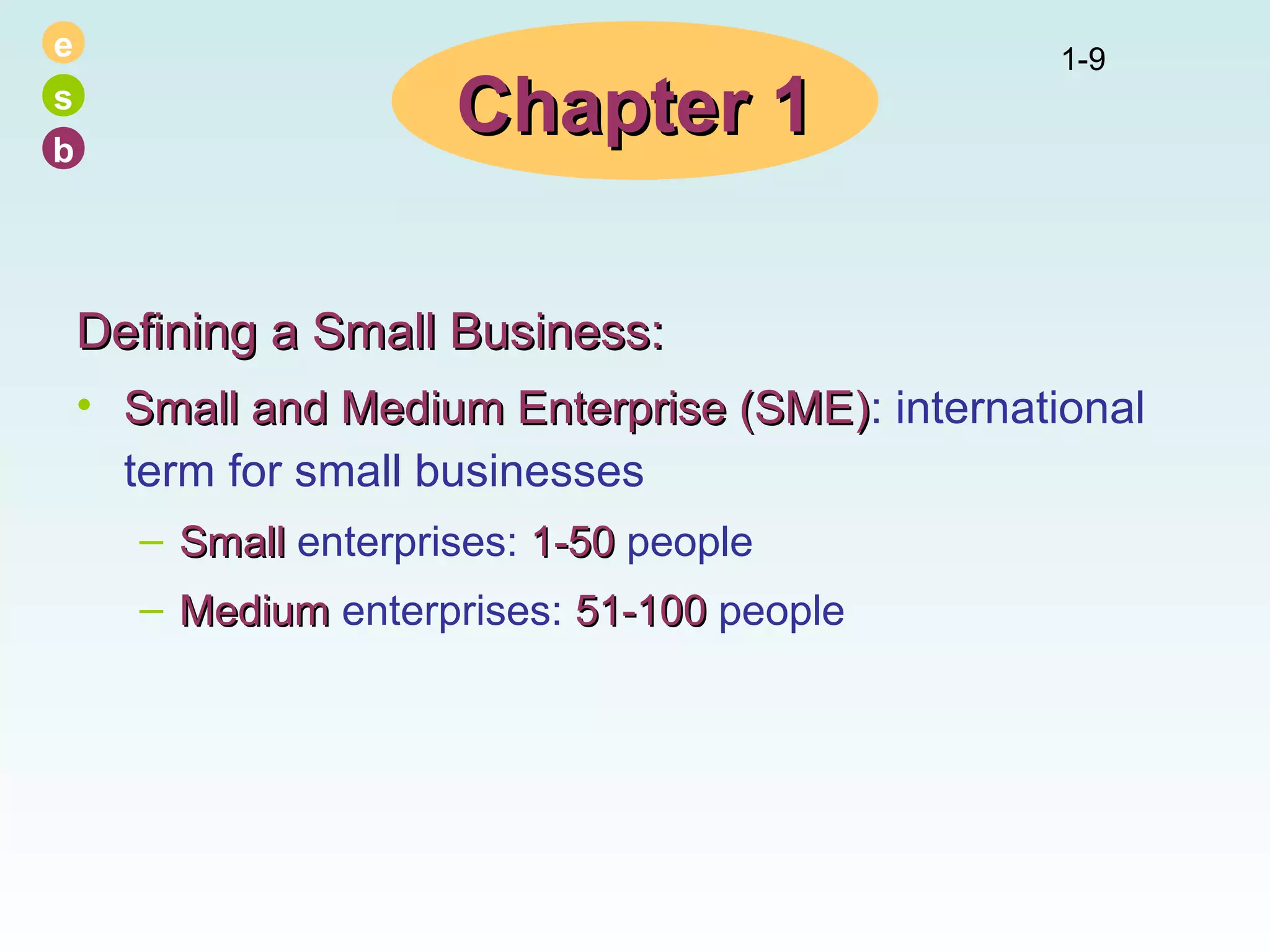
Defining a Small Business:
• Small and Medium Enterprise (SME): international
(SME)
term for small businesses
– Small enterprises: 1-50 people
– Medium enterprises: 51-100 people
e
s
b

Chapter 1

1-10

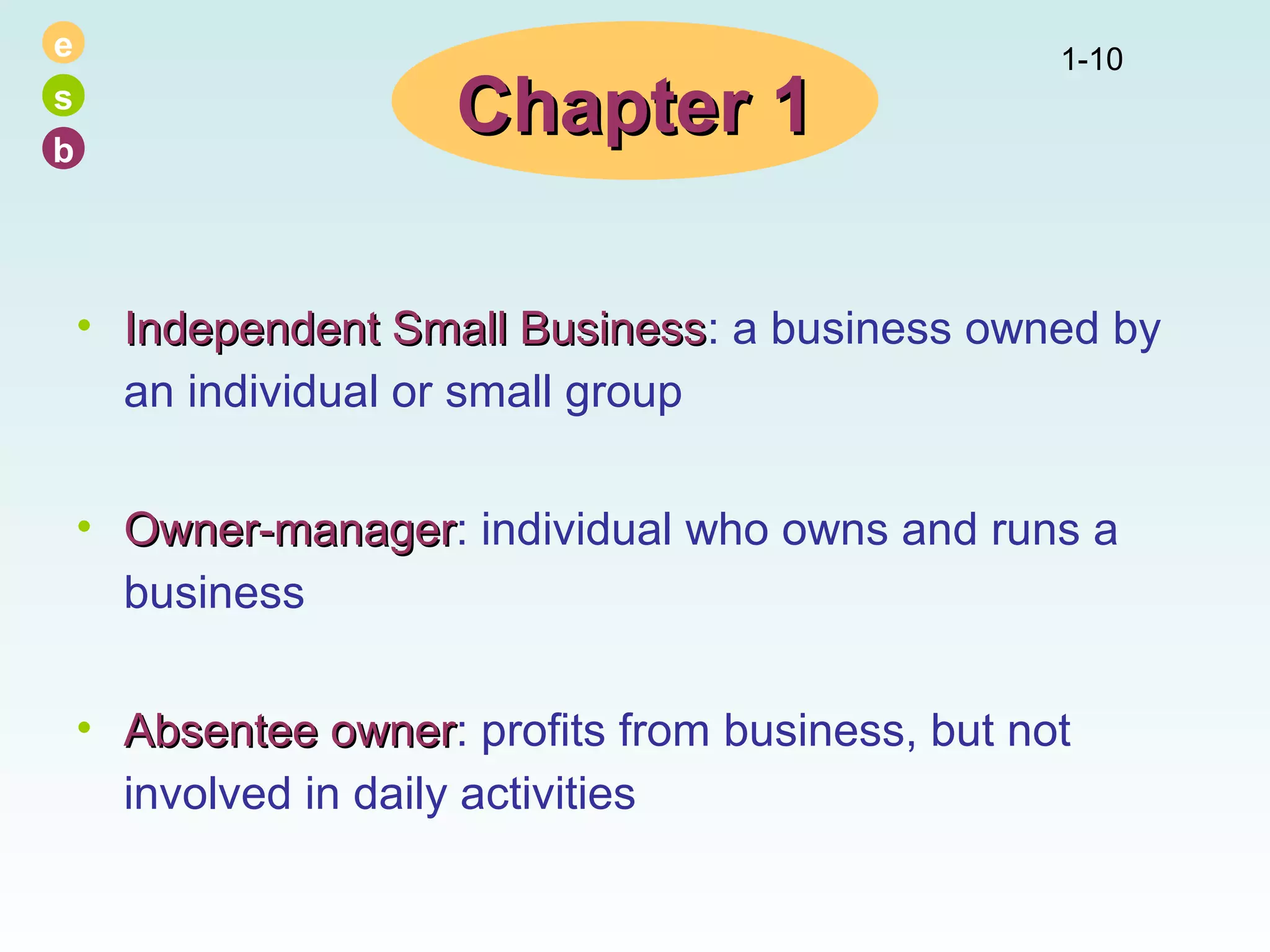
• Independent Small Business: a business owned by
Business
an individual or small group
• Owner-manager: individual who owns and runs a
Owner-manager
business
• Absentee owner: profits from business, but not
owner
involved in daily activities
e
s
b

Chapter 1

1-11

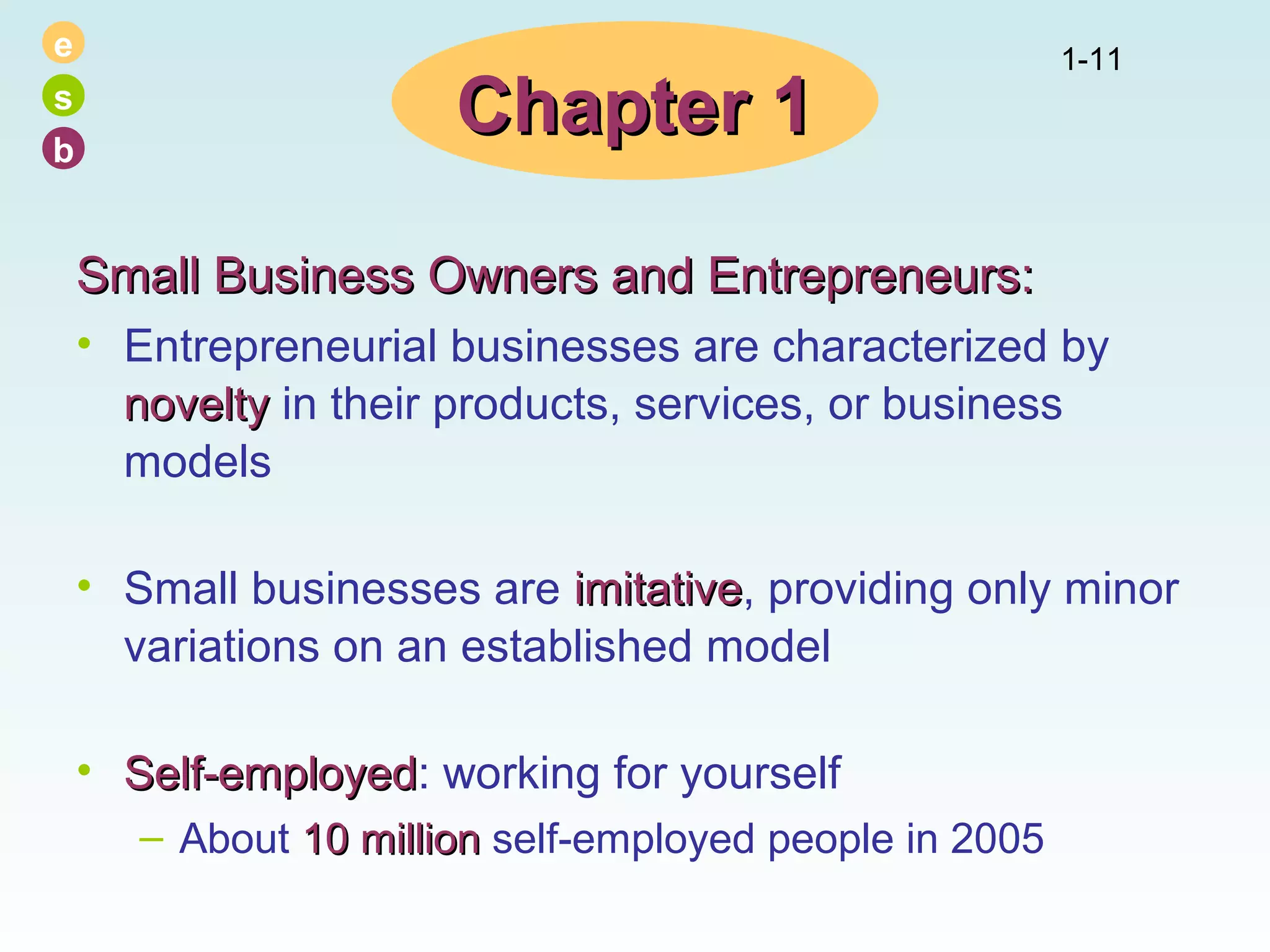
Small Business Owners and Entrepreneurs:
• Entrepreneurial businesses are characterized by
novelty in their products, services, or business
models
• Small businesses are imitative, providing only minor
imitative
variations on an established model
• Self-employed: working for yourself
Self-employed
– About 10 million self-employed people in 2005
e
s
b

Chapter 1

1-12

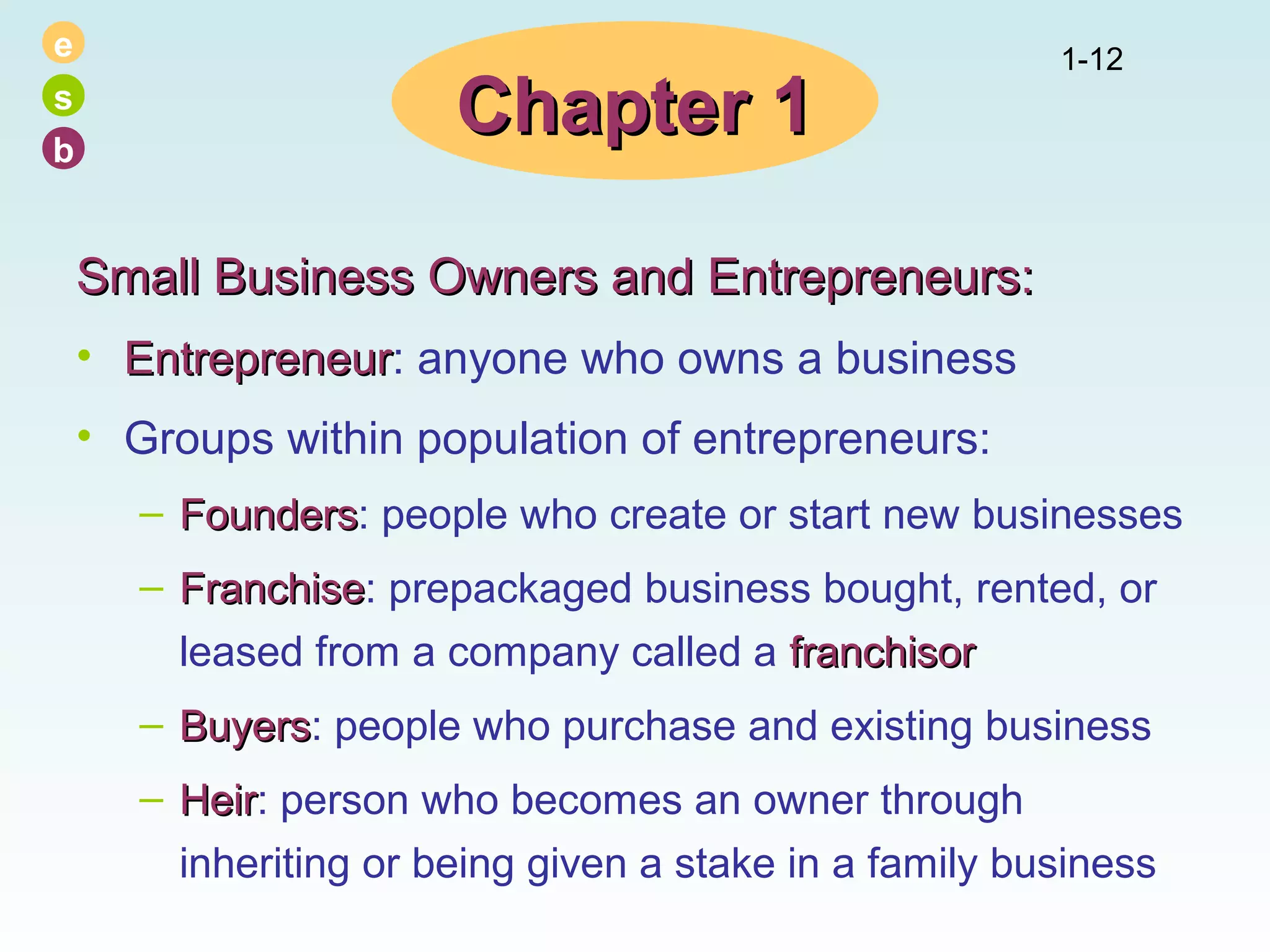
Small Business Owners and Entrepreneurs:
• Entrepreneur: anyone who owns a business
Entrepreneur
• Groups within population of entrepreneurs:
– Founders: people who create or start new businesses
Founders
– Franchise: prepackaged business bought, rented, or
Franchise
leased from a company called a franchisor
– Buyers: people who purchase and existing business
Buyers
– Heir: person who becomes an owner through
Heir
inheriting or being given a stake in a family business
e
s
b

1-13

Chapter 1
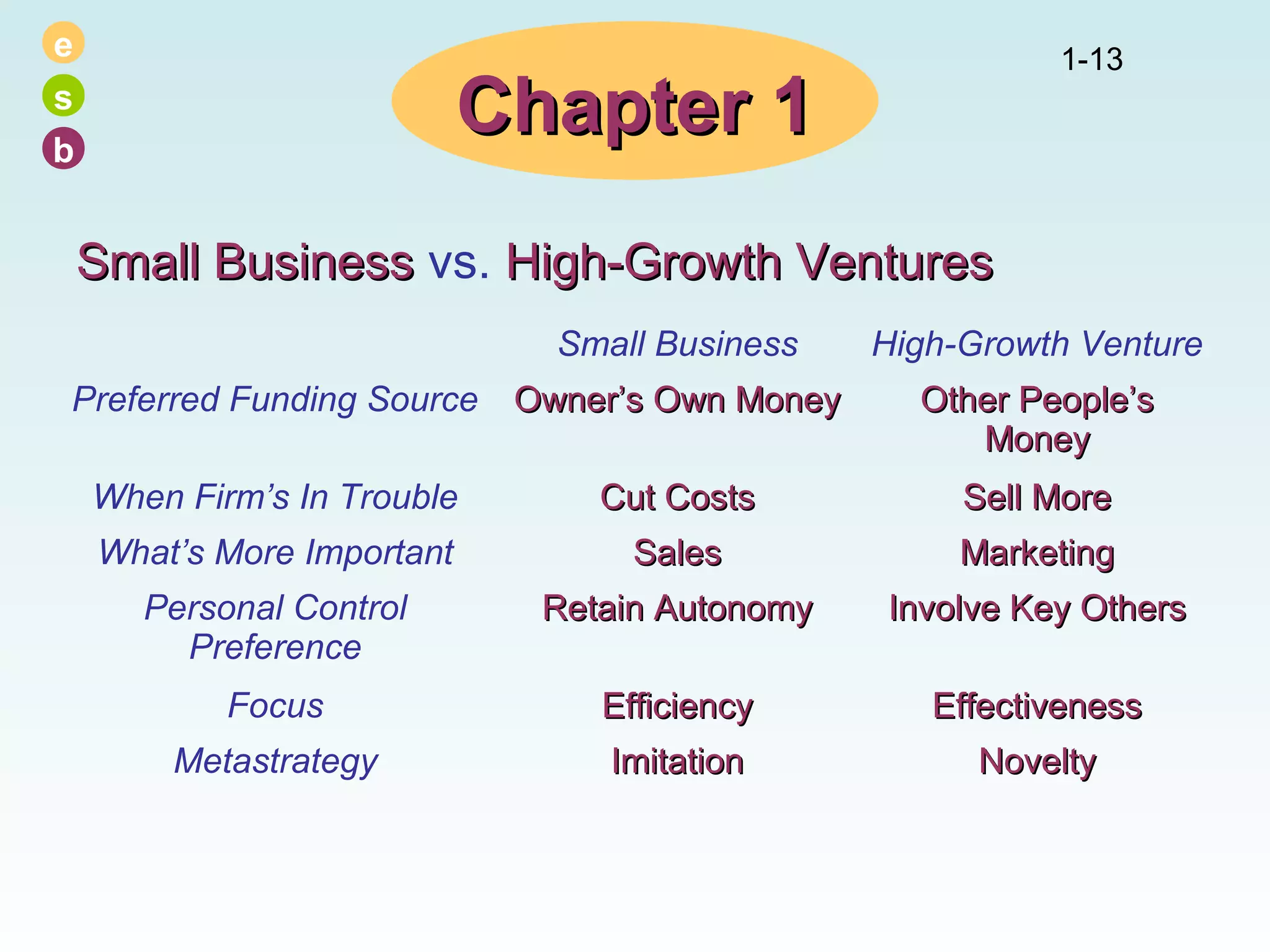
Small Business vs. High-Growth Ventures
Small Business

High-Growth Venture

Preferred Funding Source

Owner’s Own Money

Other People’s
Money

When Firm’s In Trouble

Cut Costs

Sell More

What’s More Important

Sales

Marketing

Personal Control
Preference

Retain Autonomy

Involve Key Others

Focus

Efficiency

Effectiveness

Metastrategy

Imitation

Novelty
e
s
b

Chapter 1

1-14

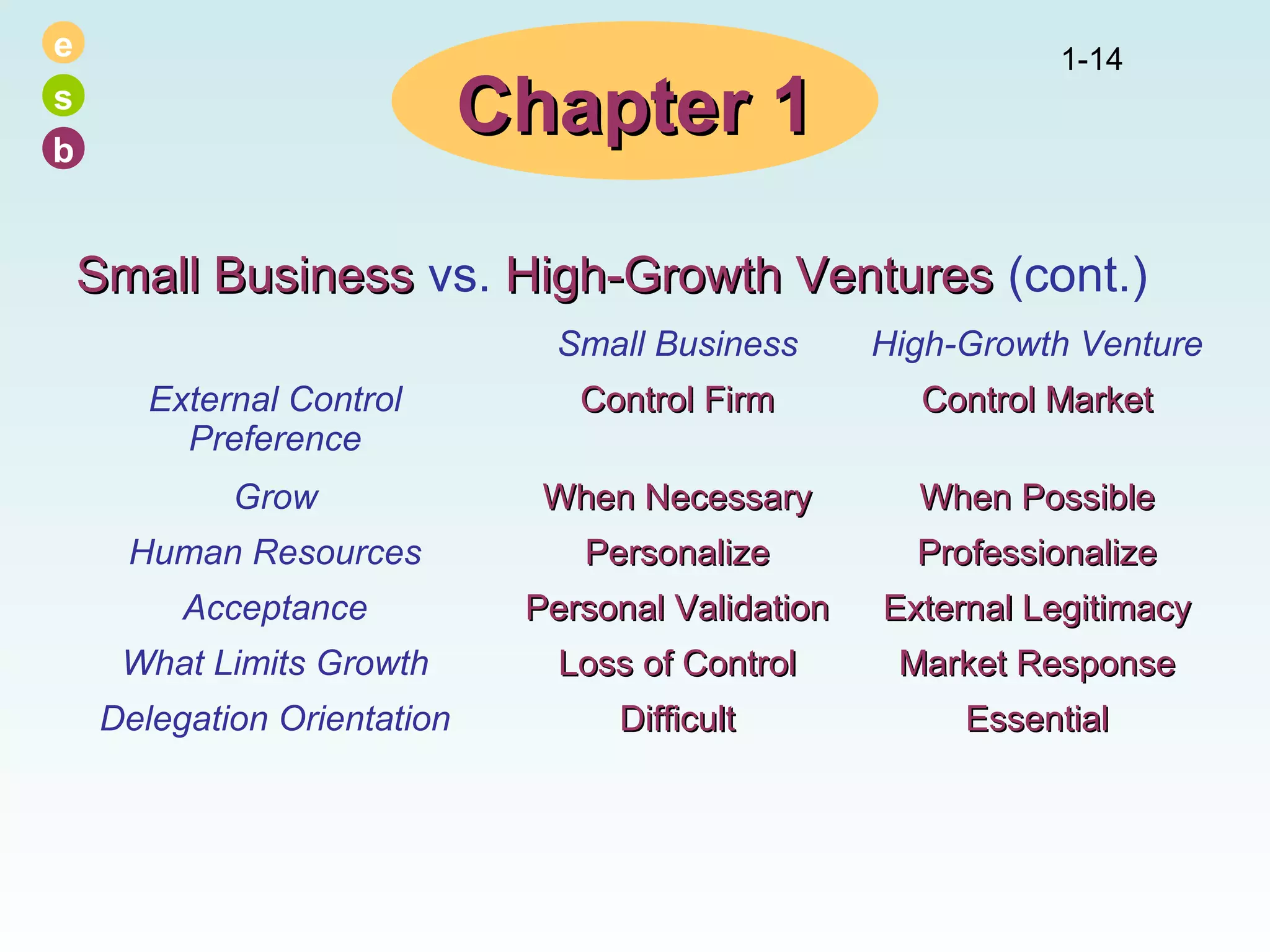
Small Business vs. High-Growth Ventures (cont.)
Small Business

High-Growth Venture

External Control
Preference

Control Firm

Control Market

Grow

When Necessary

When Possible

Human Resources

Personalize

Professionalize

Acceptance

Personal Validation

External Legitimacy

What Limits Growth

Loss of Control

Market Response

Delegation Orientation

Difficult

Essential
e
s
b

Chapter 1
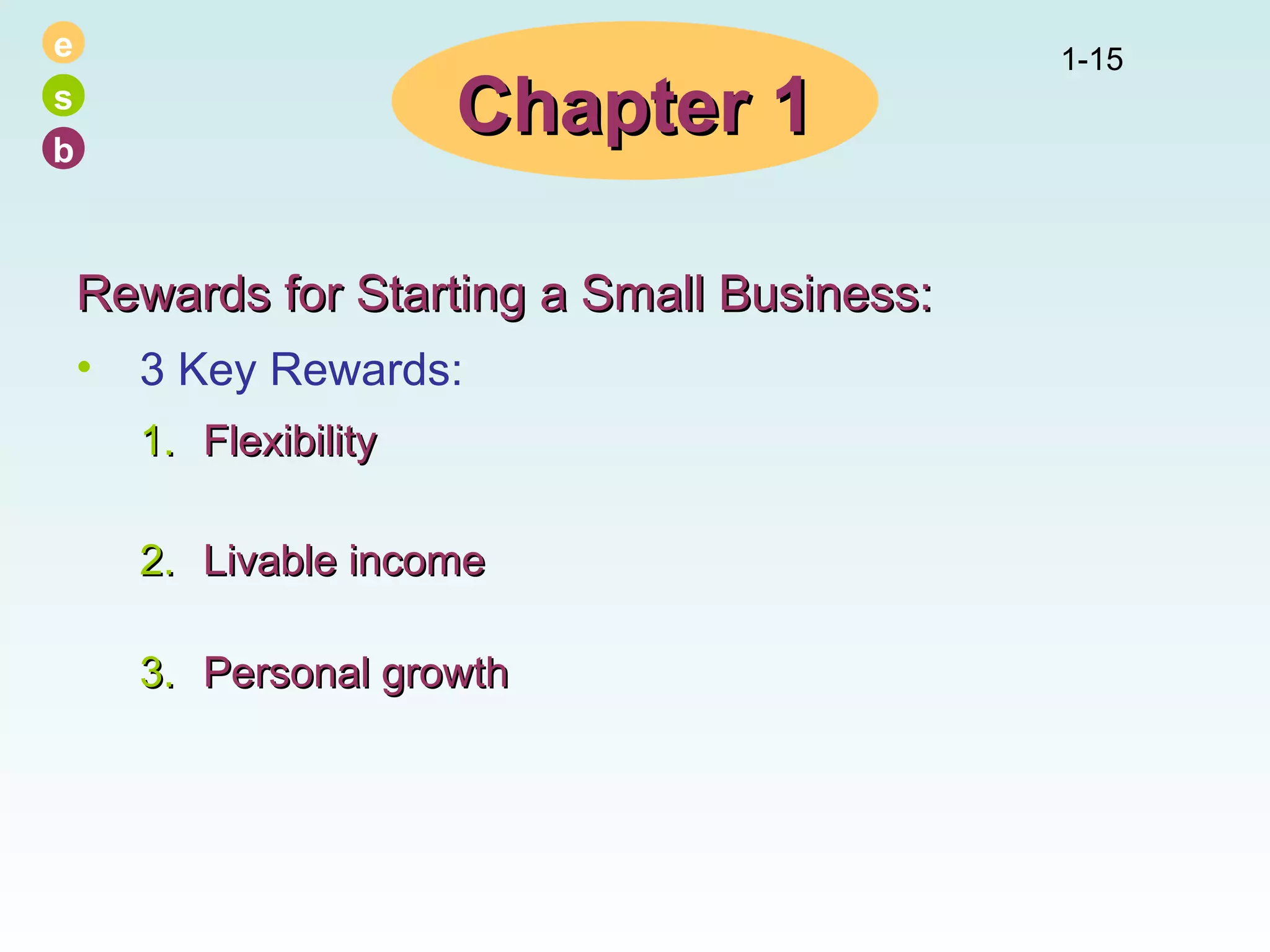
Rewards for Starting a Small Business:
•

3 Key Rewards:
1. Flexibility
2. Livable income
3. Personal growth

1-15
e
s
b

Chapter 1

1-16

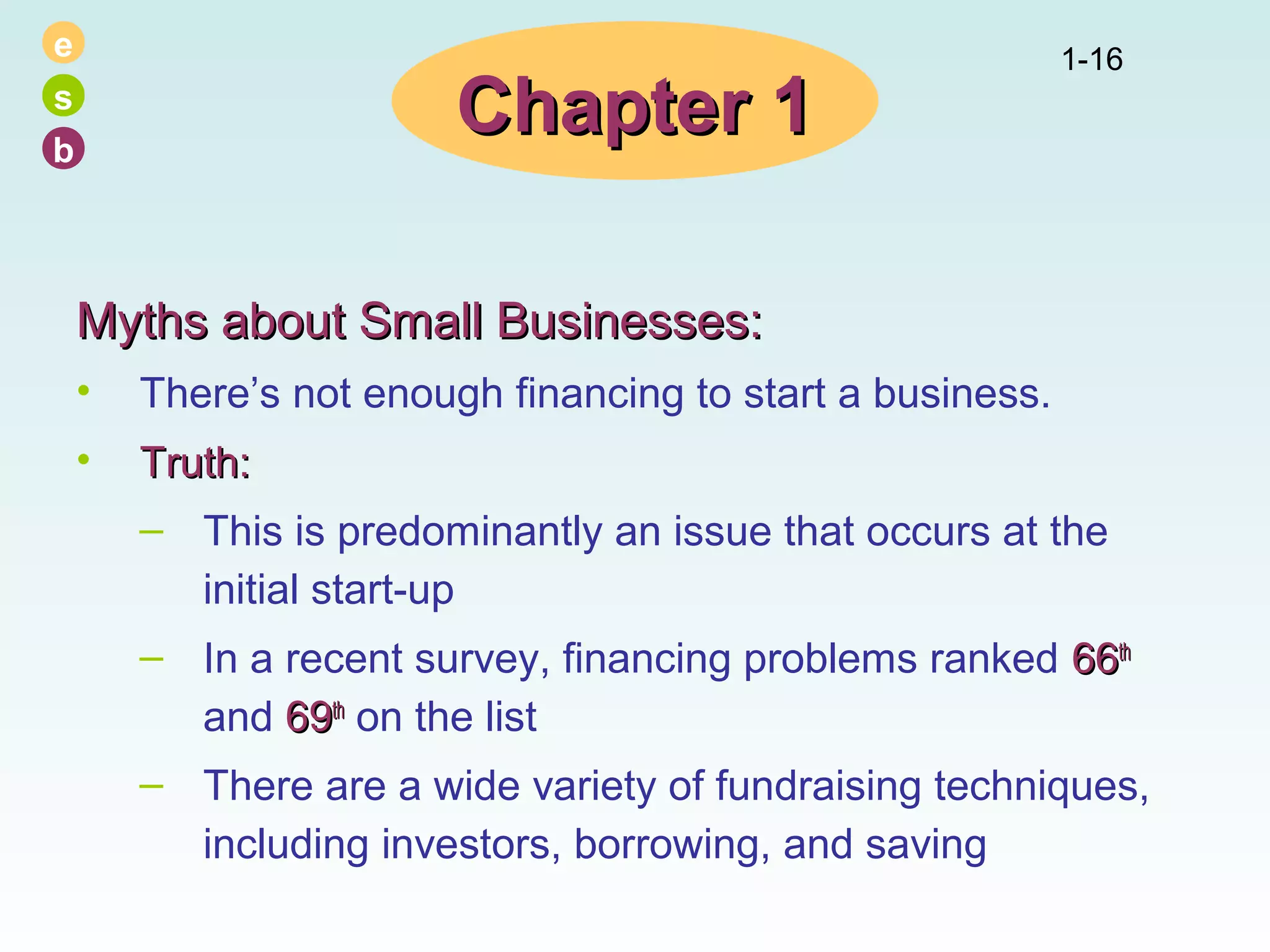
Myths about Small Businesses:
•

There’s not enough financing to start a business.

•

Truth:
– This is predominantly an issue that occurs at the
initial start-up
– In a recent survey, financing problems ranked 66th
and 69th on the list
– There are a wide variety of fundraising techniques,
including investors, borrowing, and saving
e
s
b

Chapter 1

1-17

Myths about Small Businesses:
•

You need to make something (or something high-tech)
to start a business.

•

Truth:
– Growth is in the service industry.
industry
– 40 million of the 110 million people working in the
U.S. in 2001 worked in service industries.
e
s
b

Chapter 1

1-18

Myths about Small Businesses:
•

Seventy percent (or 80% or 90%) of all new business
fail within two years.

•

Truth:
– 50% of business with employees survive 4 years
or more
– 87% of incubator-aided businesses survive 5
years or more
e
s
b

Chapter 1

1-19

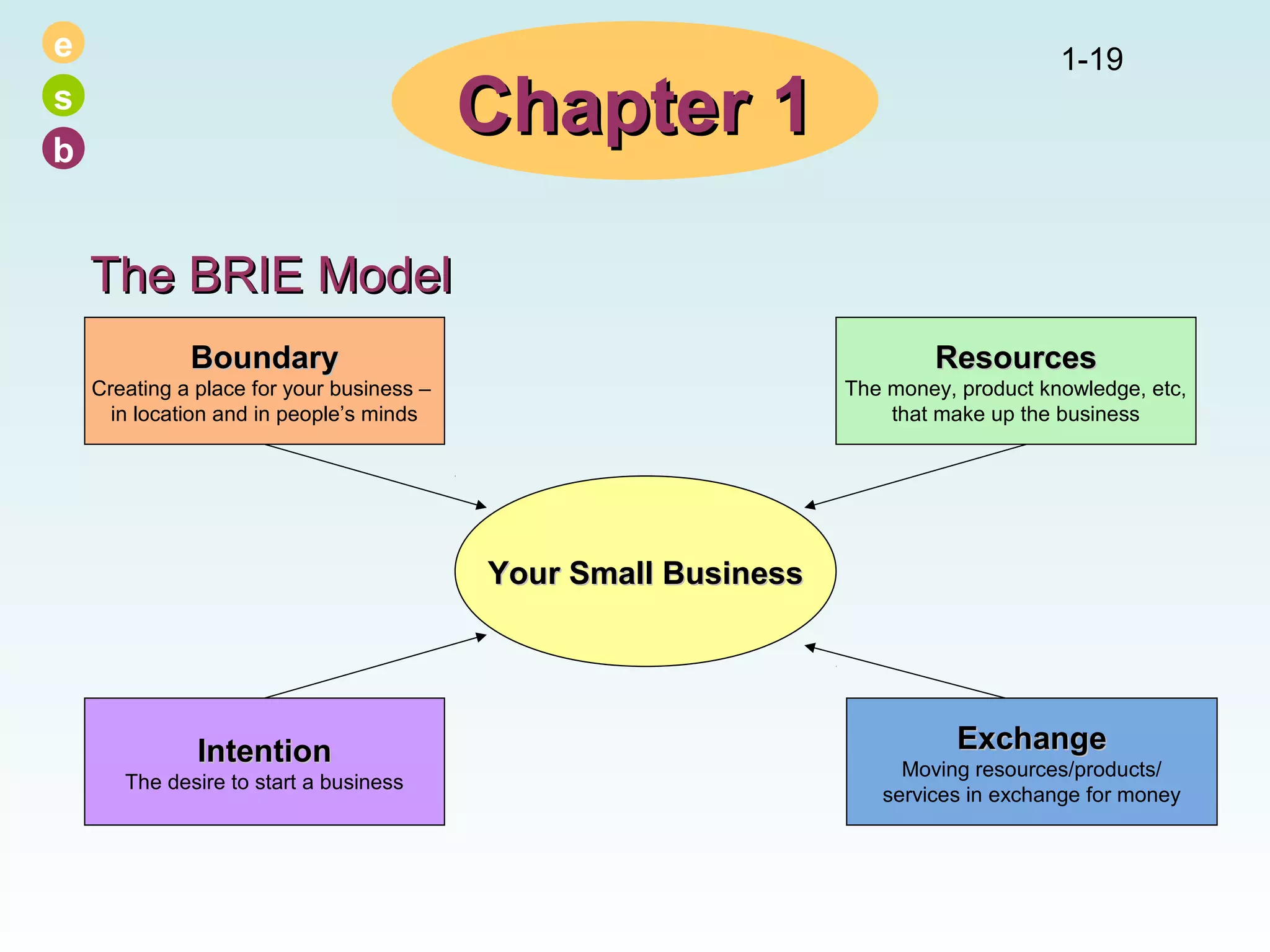
The BRIE Model
Boundary

Resources

Creating a place for your business –
in location and in people’s minds

The money, product knowledge, etc,
that make up the business

Your Small Business

Intention
The desire to start a business

Exchange
Moving resources/products/
services in exchange for money
e
s
b

Chapter 1

1-20

Small Business and the Economy:
•

Small business is vitally important to our communities
and our economy.
1. New jobs
2. Innovations
3. New opportunities
e
s
b

Chapter 1

1-21

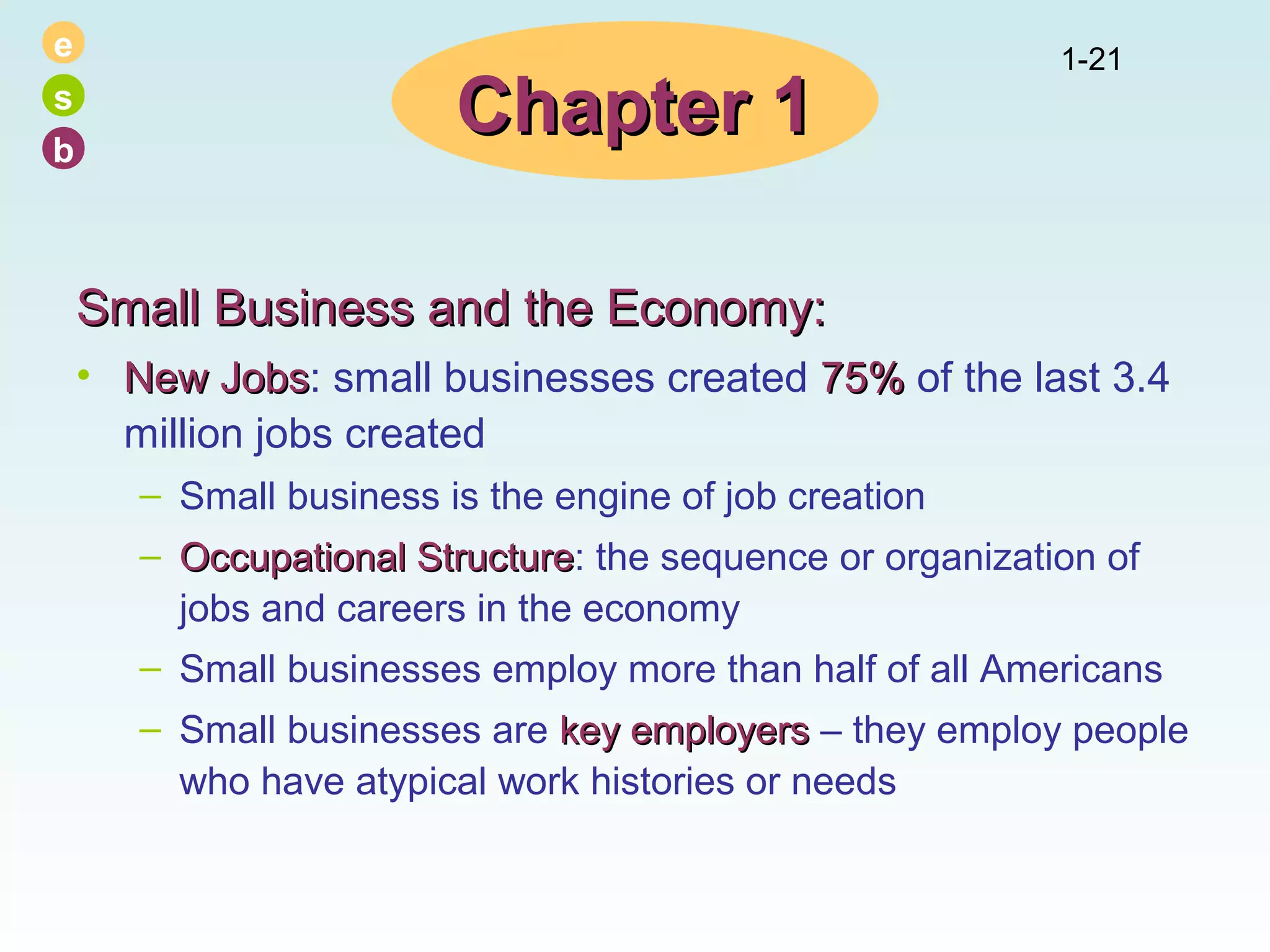
Small Business and the Economy:
• New Jobs: small businesses created 75% of the last 3.4
Jobs
million jobs created
– Small business is the engine of job creation
– Occupational Structure: the sequence or organization of
Structure
jobs and careers in the economy
– Small businesses employ more than half of all Americans
– Small businesses are key employers – they employ people
who have atypical work histories or needs
e
s
b

Chapter 1

1-22

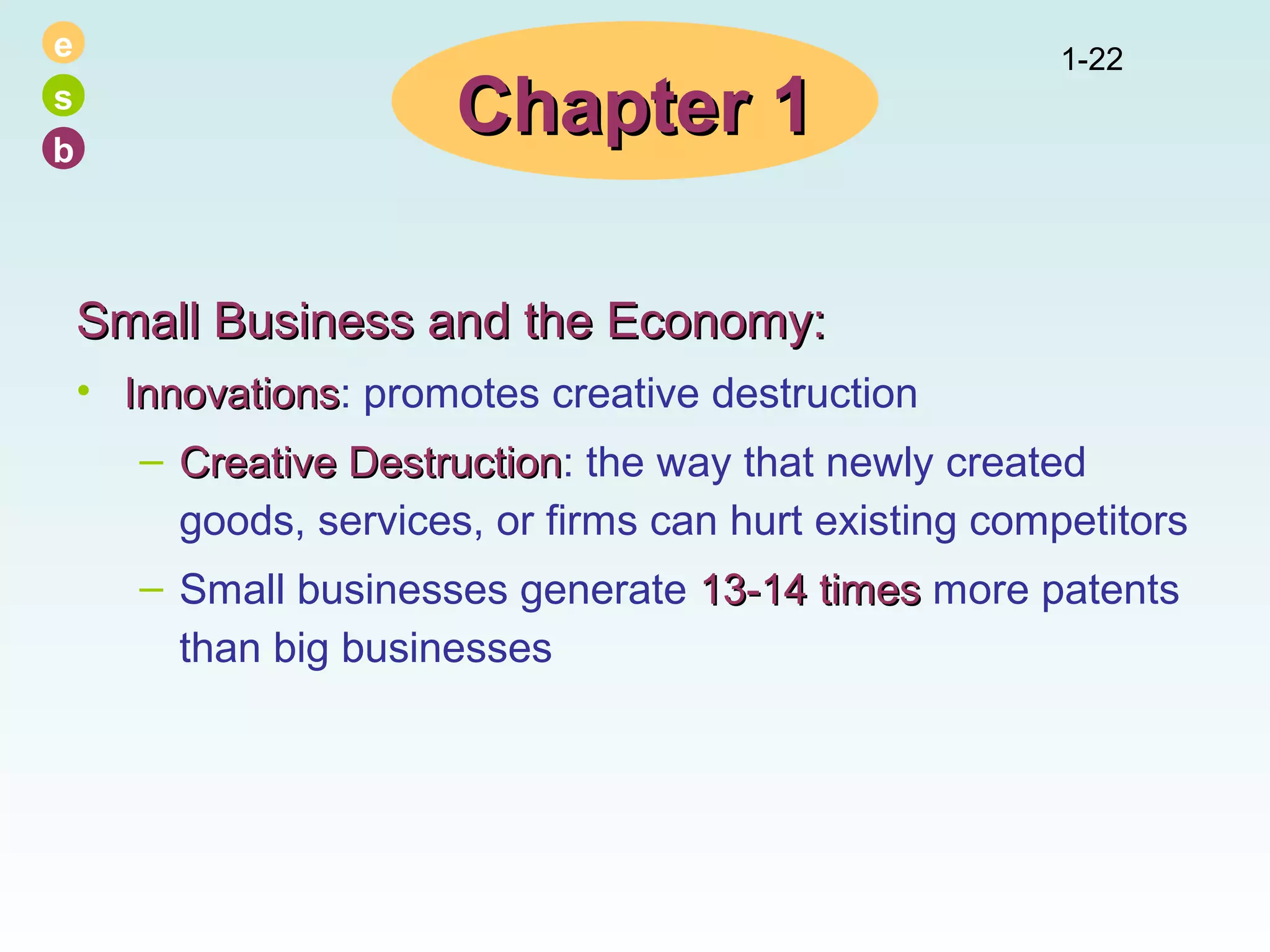
Small Business and the Economy:
• Innovations: promotes creative destruction
Innovations
– Creative Destruction: the way that newly created
Destruction
goods, services, or firms can hurt existing competitors
– Small businesses generate 13-14 times more patents
than big businesses
e
s
b

Chapter 1

1-23

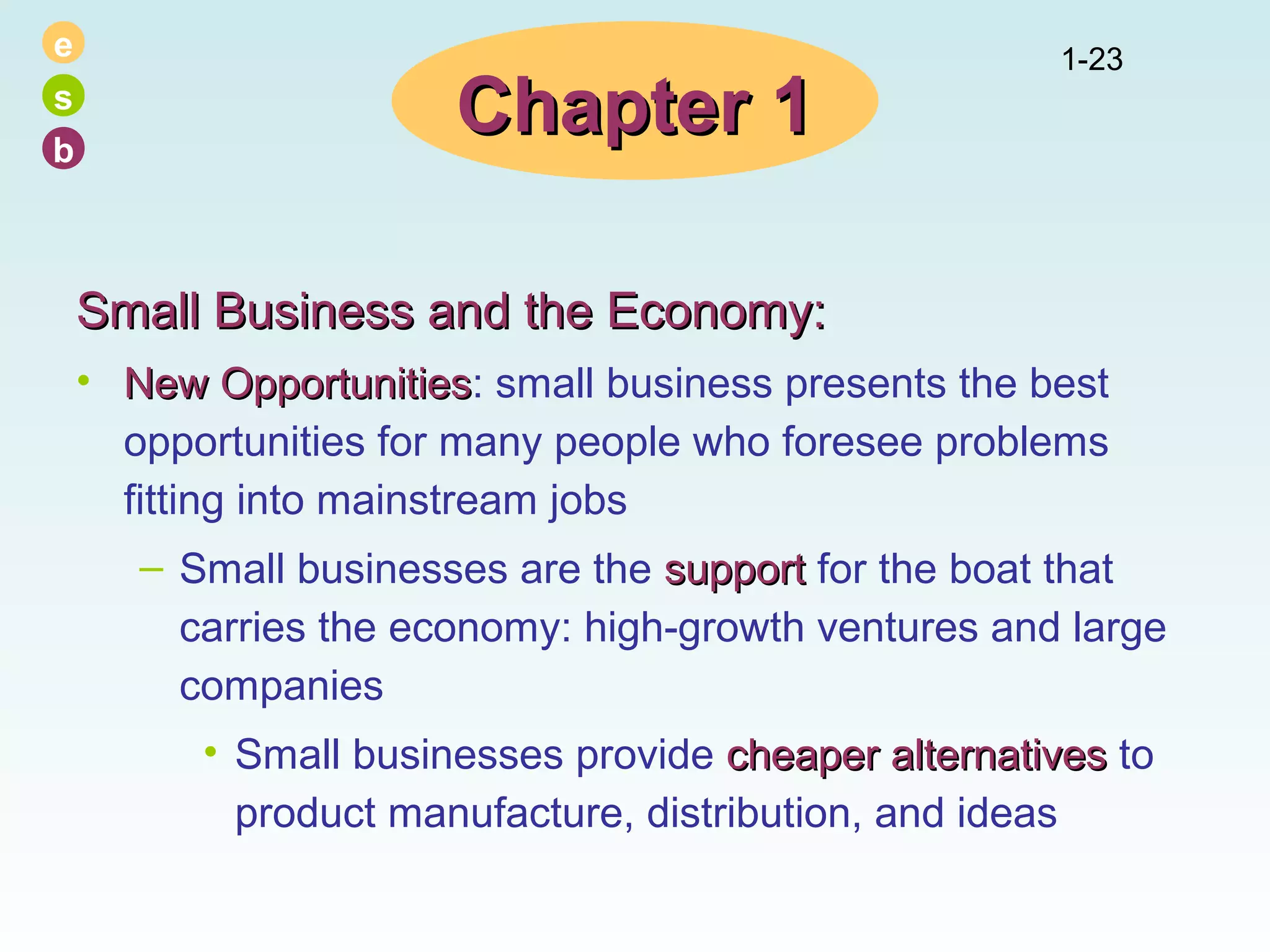
Small Business and the Economy:
• New Opportunities: small business presents the best
Opportunities
opportunities for many people who foresee problems
fitting into mainstream jobs
– Small businesses are the support for the boat that
carries the economy: high-growth ventures and large
companies
• Small businesses provide cheaper alternatives to
product manufacture, distribution, and ideas
e
s
b

Chapter 1
?

?

?

Questions?

1-24

Chap001

  • 1.
  • 2.
    e s b 1-2 1 Small Business: Its Opportunitiesand Rewards McGraw-Hill/Irwin ©2007 by the McGraw-Hill Companies, Inc. All rights reserved.
  • 3.
    e s b Chapter 1 1-3 Objectives: • Understandthe scope of small business in the U.S. • Learn the differences between small business and highgrowth ventures • Discover the rewards entrepreneurs can achieve through their businesses • Be able to dispel key myths about small businesses • Identify actions key to becoming a small business owner • Understand how small businesses are important to our economy and your community
  • 4.
    e s b Aaron the Cartoonist 1-4 •Aaron McGruder loved to draw cartoons • Passionate about becoming professional cartoonist • Fewer than a dozen African-American cartoonists • Decided to perfect art and business simultaneously • 1996 – published on “The Hitlist” online • 1997 – published in The Diamondback and The Source • 1999 – The Boondocks begins national syndication • Income in “six-figure” range in first year, largely due to retaining rights to his work
  • 5.
    e s b Chapter 1 1-5 • SmallBusiness: involves 1-50 people and has its Business owner managing the business on a day-to-day basis – Over a million new businesses per year in U.S. • Entrepreneur: a person who owns or starts an Entrepreneur organization, such as a business
  • 6.
    e s b Chapter 1 1-6 • SmallBusiness Administration: a part of U.S. Administration government which provides support and advocacy for small business • SBA reports on new business survival rates after four years: – With employees: about 2/3 survive employees – Owner-only: about 1/2 survive Owner-only
  • 7.
    e s b Chapter 1 1-7 • SmallBusiness Development Center: offices coCenter sponsored by states and the federal government that offer free or low-cost help to existing or potential small business – More than 81% of SBDC clients were still in operation after five years
  • 8.
    e s b Chapter 1 1-8 • Incubators:a facility which offers subsidized space Incubators and business advice to companies in their earliest stages of operation – More than 87% of firms receiving help from incubators were still in operation after four years • Small business knowledge means small business success! success
  • 9.
    e s b Chapter 1 1-9 Defining aSmall Business: • Small and Medium Enterprise (SME): international (SME) term for small businesses – Small enterprises: 1-50 people – Medium enterprises: 51-100 people
  • 10.
    e s b Chapter 1 1-10 • IndependentSmall Business: a business owned by Business an individual or small group • Owner-manager: individual who owns and runs a Owner-manager business • Absentee owner: profits from business, but not owner involved in daily activities
  • 11.
    e s b Chapter 1 1-11 Small BusinessOwners and Entrepreneurs: • Entrepreneurial businesses are characterized by novelty in their products, services, or business models • Small businesses are imitative, providing only minor imitative variations on an established model • Self-employed: working for yourself Self-employed – About 10 million self-employed people in 2005
  • 12.
    e s b Chapter 1 1-12 Small BusinessOwners and Entrepreneurs: • Entrepreneur: anyone who owns a business Entrepreneur • Groups within population of entrepreneurs: – Founders: people who create or start new businesses Founders – Franchise: prepackaged business bought, rented, or Franchise leased from a company called a franchisor – Buyers: people who purchase and existing business Buyers – Heir: person who becomes an owner through Heir inheriting or being given a stake in a family business
  • 13.
    e s b 1-13 Chapter 1 Small Businessvs. High-Growth Ventures Small Business High-Growth Venture Preferred Funding Source Owner’s Own Money Other People’s Money When Firm’s In Trouble Cut Costs Sell More What’s More Important Sales Marketing Personal Control Preference Retain Autonomy Involve Key Others Focus Efficiency Effectiveness Metastrategy Imitation Novelty
  • 14.
    e s b Chapter 1 1-14 Small Businessvs. High-Growth Ventures (cont.) Small Business High-Growth Venture External Control Preference Control Firm Control Market Grow When Necessary When Possible Human Resources Personalize Professionalize Acceptance Personal Validation External Legitimacy What Limits Growth Loss of Control Market Response Delegation Orientation Difficult Essential
  • 15.
    e s b Chapter 1 Rewards forStarting a Small Business: • 3 Key Rewards: 1. Flexibility 2. Livable income 3. Personal growth 1-15
  • 16.
    e s b Chapter 1 1-16 Myths aboutSmall Businesses: • There’s not enough financing to start a business. • Truth: – This is predominantly an issue that occurs at the initial start-up – In a recent survey, financing problems ranked 66th and 69th on the list – There are a wide variety of fundraising techniques, including investors, borrowing, and saving
  • 17.
    e s b Chapter 1 1-17 Myths aboutSmall Businesses: • You need to make something (or something high-tech) to start a business. • Truth: – Growth is in the service industry. industry – 40 million of the 110 million people working in the U.S. in 2001 worked in service industries.
  • 18.
    e s b Chapter 1 1-18 Myths aboutSmall Businesses: • Seventy percent (or 80% or 90%) of all new business fail within two years. • Truth: – 50% of business with employees survive 4 years or more – 87% of incubator-aided businesses survive 5 years or more
  • 19.
    e s b Chapter 1 1-19 The BRIEModel Boundary Resources Creating a place for your business – in location and in people’s minds The money, product knowledge, etc, that make up the business Your Small Business Intention The desire to start a business Exchange Moving resources/products/ services in exchange for money
  • 20.
    e s b Chapter 1 1-20 Small Businessand the Economy: • Small business is vitally important to our communities and our economy. 1. New jobs 2. Innovations 3. New opportunities
  • 21.
    e s b Chapter 1 1-21 Small Businessand the Economy: • New Jobs: small businesses created 75% of the last 3.4 Jobs million jobs created – Small business is the engine of job creation – Occupational Structure: the sequence or organization of Structure jobs and careers in the economy – Small businesses employ more than half of all Americans – Small businesses are key employers – they employ people who have atypical work histories or needs
  • 22.
    e s b Chapter 1 1-22 Small Businessand the Economy: • Innovations: promotes creative destruction Innovations – Creative Destruction: the way that newly created Destruction goods, services, or firms can hurt existing competitors – Small businesses generate 13-14 times more patents than big businesses
  • 23.
    e s b Chapter 1 1-23 Small Businessand the Economy: • New Opportunities: small business presents the best Opportunities opportunities for many people who foresee problems fitting into mainstream jobs – Small businesses are the support for the boat that carries the economy: high-growth ventures and large companies • Small businesses provide cheaper alternatives to product manufacture, distribution, and ideas
  • 24.

Editor's Notes

  • #5 It is always nice to start with an illustration students understand. In each chapter you will find this illustration. These stories show the passion found in successful entrepreneurs and highlight the challenges faced and explained in each chapter.
  • #6 It is important to note a small business owner is not necessarily an entrepreneur. It is also important to note that new jobs and growth in our country primarily come from small businesses.
  • #7 The SBA is a constant source of information and support for small business owners. Students should be encouraged to visit the site often and get to know it well. SBA is a source of networking, information, grants, and resources which may make the difference in being a successful owner or shutting down.
  • #8 SBDC is another source available to entrepreneurs and small business owners. Many cities will have both SBA and SBDCs.
  • #9 Incubators are another source of support. Owners who use all resources available to them tend to be more successful as is shown by the higher rate of success. Many times universities have Incubators to assist entrepreneurs.
  • #14 Small business owners do not necessarily dream of being the next Bill Gates. Many would prefer to stay small and stay in person control of the day to day business. As is discussed in later chapters, high growth firms may oftentimes be grown specifically to be harvested. Whereas small businesses are more likely to be careers for their founders.
  • #16 Flexibility: Small business owners covet the ability to be flexible with their time. Ironically, they must devote a large amount of time to growing the business to stability in order to have the livable income. But they can take off personal reasons when they need to without fear of retaliation by their employer. Livable Income: Many small business owners will not get rich necessarily but will be able to support their families and hobbies. They appreciate the fact that the harder they work, the more money they make. Personal Growth: Entrepreneurs like novelty. They like to do things that are new, different, and challenging. Often they can do this in business by taking their business in a new direction, trying a new product, or working with different groups of people.
  • #17 There are many myths about small businesses and their success or failure. Here we set out to disspell the more popular myths.