IRTL Grants & Fellowships Workshop
Series
Part I: Introduction to
Grants & Fellowships
Institute for Research on Teaching and Learning
Doctoral Student Research Support
September 2015
Qiana Green
greenqia@msu.edu
Doctoral Student
Higher, Adult & Lifelong Education
Graduate Assistant
Institute for Research on Teaching & Learning
Audience members…
Introductions
1. Learn about grants.
Learning Objectives
1. Learn about grants & grant writing in
general.
2. Explore dissertation grant opportunities.
3. Understand funding opportunities.
4. Identify resources to find appropriate
funding and refine grant applications.
Learning Objectives
1. IRTL
2. Grants & Fellowship Basics
3. Grant Components
4. Finding Funders / Resources
5. Funding Opportunities Overview
6. Q&A
Today’s Plan
Institute for Research on Teaching & Learning
IRTL supports doctoral students in the College of
Education by enhancing their knowledge of funding
opportunities and grant writing.
We are available to discuss funding opportunities; assist in
conceptualizing, writing, and revising a grant proposal; or
assist in preparing a competitive budget request.
http://education.msu.edu/irtl/grad
What is IRTL?
• Workshops, sessions for groups and classes
• Overview of grants & fellowships; Grant proposal
writing; Budget development; RCR; and more!
• One-on-one consultation
• in person, over the phone, Skype/FaceTime, email
• Web resources (http://education.msu.edu/irtl/grad/)
• Sample proposals, budgets, timelines, resources
• Monthly newsletters (sign up on our website)
• Announcements, workshops, resources, funding
opportunities
• Facebook updates (facebook.com/MSUIRTL)
What does IRTL do?
IRTL
Grant & Fellowship Basics
Grant Components
Finding Funders & Resources
Funding Opportunities Overview
Q&A
• To focus on research and/or writing
• To advance knowledge in your field
• National recognition and prestige
• A lifetime professional network
• Professional development opportunities
• To demonstrate your ability to win grants
for academic job applications
Doctoral student grants &
fellowships can allow you:
• Grants can be used for training, travel, work buy-
outs, supplies, hourly staff, tuition, graduate
assistantships.
• Funds can be used to complete a dissertation or
conduct small research projects.
• Funding agencies exist to advance research and/or
practice within an area.
• Foundations are required to spend their funds.
• Start small, “earn” your way up to larger awards.
What role can grants (or other
external funds) play in my career?
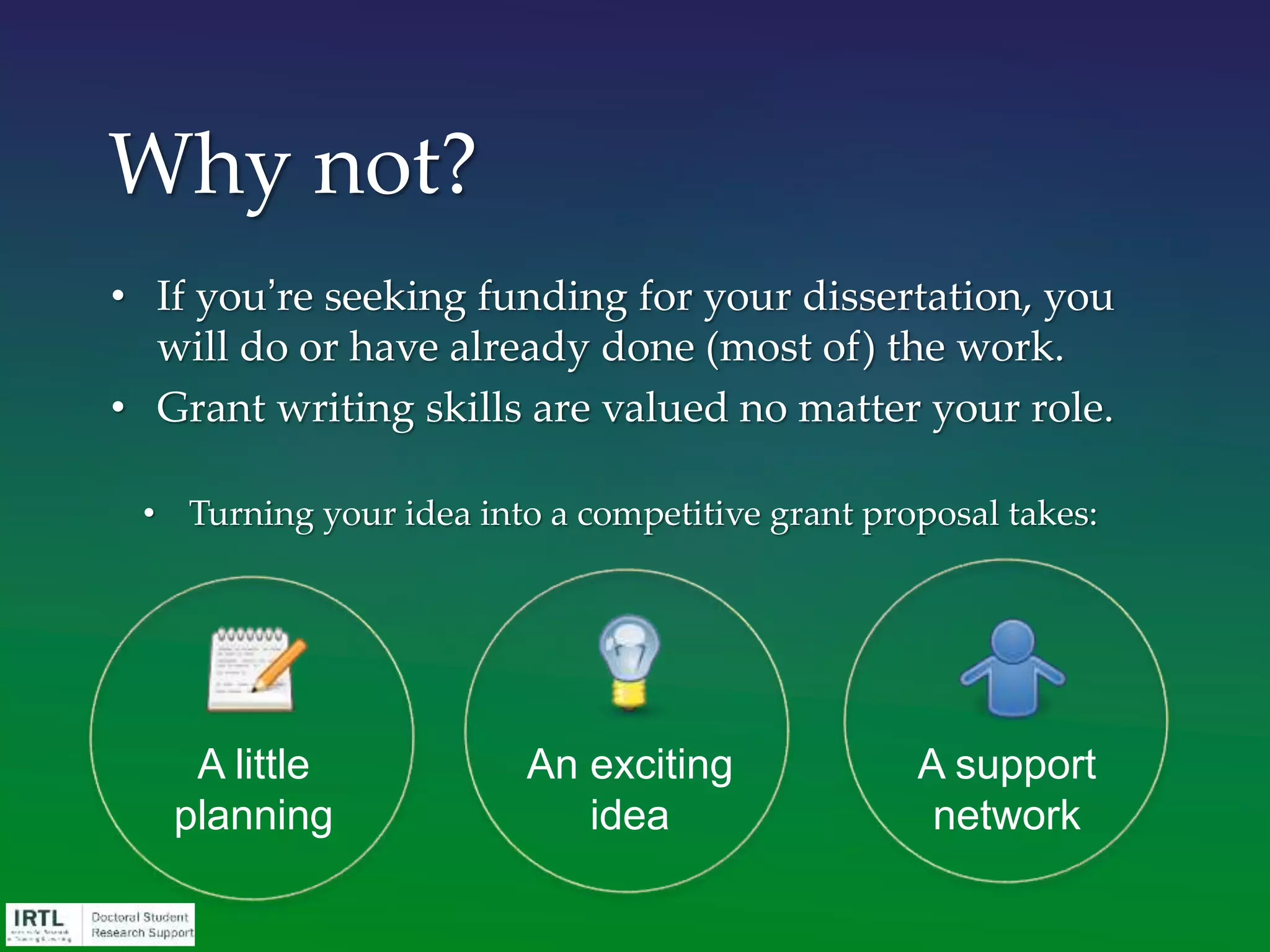
A little
planning
An exciting
idea
A support
network
• If you’re seeking funding for your dissertation, you
will do or have already done (most of) the work.
• Grant writing skills are valued no matter your role.
• Turning your idea into a competitive grant proposal takes:
Why not?
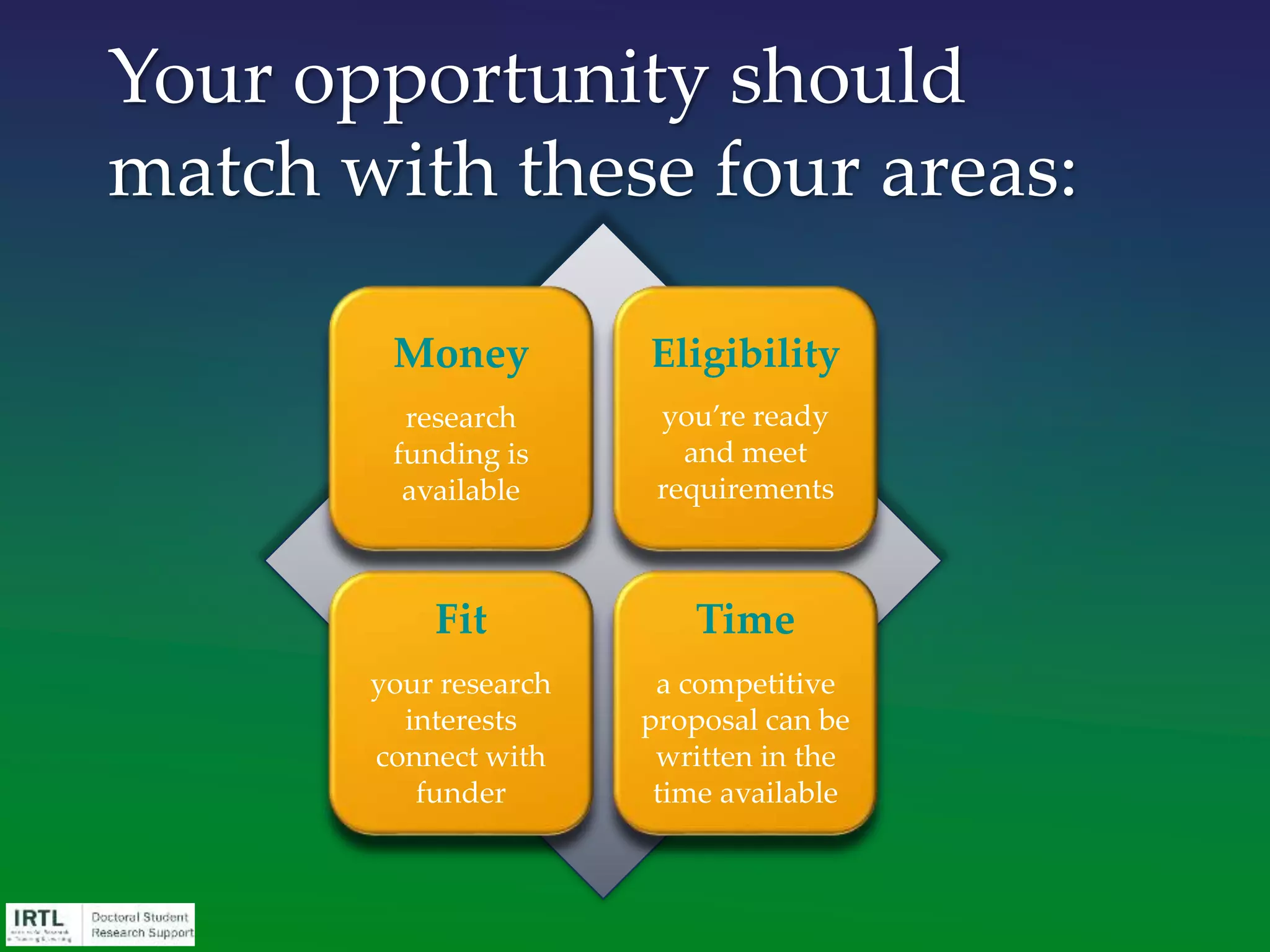
Your opportunity should
match with these four areas:
Money
research
funding is
available
Eligibility
you’re ready
and meet
requirements
Fit
your research
interests
connect with
funder
Time
a competitive
proposal can be
written in the
time available
Internal Funding
• Your department /
college / program /
organization
• Research entities on
campus (grant
administration, other
departments)
• Institution-wide
opportunities
External Funding
• Databases
• Regional foundations
• Professional
organizations &
associations
• Government entities
Money
… is there research funding available?
IRTL’s Focus
Early Stage
Funds tuition
and fees, as
well as a
stipend for
living for
early doctoral
students
Pre-
Dissertation
Funds
research
and
experiences
that aid
research,
such as
travel,
language
study, and
supplies
Dissertation
Funds research
and experiences
that aid research,
such as language
study, travel,
supplies, facility
use, and/or
stipend for living
after the defense
of the dissertation
proposal to
completion
Analysis &
Write-Up
Funds
tuition and
fees, stipend
for living
expenses to
concentrate
mostly or
only on
writing and
completing
the
dissertation
Postdoctoral
Funds
opportunities
toward the
development
of an
academic
career
Eligibility…are you ready?
Think one step ahead!
• Citizenship?
• Comprehensive exams and/or coursework complete?
Degree obtained?
• Dissertation proposal defense complete?
• Full-time employee vs. faculty member vs. student?
• Faculty advisor’s “OK”
• Pilot program complete? Collaboration in place?
Eligibility
…do you meet the sponsor’s requirements?
Many sponsors have websites with helpful information:
• What are the sponsor’s goals and priorities? What have
they funded in the past?
• What is their program focus?
population? method? Issue?
• Who can I contact for information
for assistance, guidance, or advice?
• What are the review criteria?
• Do they have sample proposals?
Fit
…does your project match the funder’s goals and priorities?
• Start early.
• Assess your timeline.
• When will you complete doctoral program requirements?
collect data? conduct analysis? write up?
• Can you continue operations until funding would be
received?
• Do you have time to complete the application?
• How long does it take for a decision? When will the funds
become available?
• Can you reapply?
Time
... can a competitive proposal be written in the time available?
• Work on and develop your research topic and ideas
• Talk with faculty members about existing grant and
funding opportunities
• Utilize College of Education fellowship process (spring)
• CoEd Summer Research Fellowships (late fall)
• CoEd Summer Research Renewable Fellowships (2 years,
late fall)
• CoEd Summer Research Development Fellowships (1st year
students only; January)
• Utilize departmental professional development funds,
COGS grants
Preparing for External
Funding – Years 1-2
• Coming to an end in courses and have narrowed down topics to
one or two potential dissertation ideas.
• 1-2 years from dissertation proposal.
• Begin exploring funding options.
• Consider what you might need funding for (e.g., data collection)
and what point in the dissertation process you will need that
funding.
• Continue conversations with faculty members about
opportunities.
• CoEd fellowship process (spring)
• Identify possible funders and opportunities to catch in next year.
• Utilize departmental professional development funds, COGS
grants.
Preparing for External
Funding – Years 2-3
• Most dissertation funding proposal due dates are approximately
6 months to 1 year prior to dispersion of funds. Plan ahead
within your own work to time application process.
• Work on and submit proposals approximately 6 months prior to
the due date. Prioritize good quality. Get advisor on board.
• For international research projects, begin working on funding
proposals 6 months to a year prior to the due date (e.g, affiliation
letters, courses, language evaluations).
• During data collection/practicum, apply for Research
Practicum/Research Development Fellowship (mid fall).
• When nearing completion, consider CoEd Dissertation
Completion Fellowship (late fall).
• Utilize departmental professional development funds, COGS
grants.
Preparing for External
Funding – Years 3-5+
• International Research: Preparing proposals for
international research funding is likely to take more time
due to the requirements, begin early. Consider enrolling in
fall seminar – International Social Science Research (1-3 cr.)
• Working students: Students who work fulltime should be
aware that many of the larger are only for fulltime
students. Be sure to explore whether or not this is a
requirement when searching for grants.
• International Students: Some grants are only available to
U.S. citizens and permanent residents (e.g., government
grants—NSF, Fulbright, NIH). Be sure to explore whether
or not this is a requirement when searching for grants.
Preparing for External
Funding – Notes
IRTL
Grants for Individuals
Grant Components
Finding Funders & Resources
Funding Opportunities Overview
Q&A
“There is no amount of
grantsmanship that will turn
a bad idea into a good one,
but there are many ways to
disguise a good one.”
William Raub
former Deputy Director, NIH
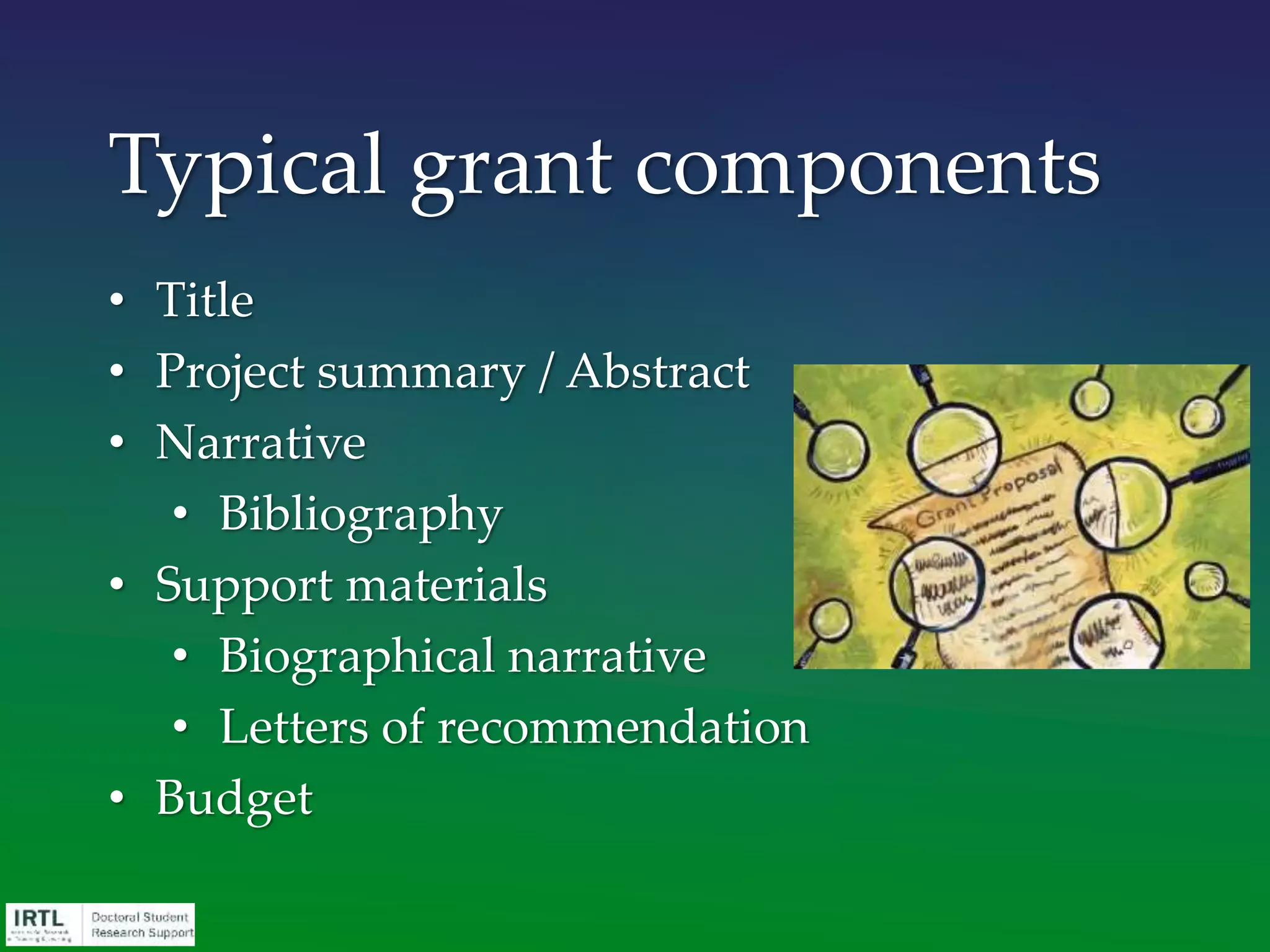
• Title
• Project summary / Abstract
• Narrative
• Bibliography
• Support materials
• Biographical narrative
• Letters of recommendation
• Budget
Typical grant components
What makes a grant proposal
successful?
• start early
• contact with funding sponsor
• research matches funding
announcement
• aligned with priorities of
sponsor
• written with the review
process in mind
• captures reviewers’ attention
• well-organized, engaging
language
• clear focus
• follows the instructions
precisely
• applicant seeks outside
review before submitting
• compelling idea that
advances the science
• not too ambitious or
unrealistic
• no typos, grammatical errors
• reasonable and accurate
budget
• submitted on time
• Keep in mind that the reviewers may not be in your
same discipline / functional area.
• Write clearly in a way that is accessible to non-
academics.
• Grab their attention right away – title, intro
sentence, etc..
• Websites may provide information on past/current
reviewers. Use this knowledge to inform your
writing.
Reviewers
• Talk to colleagues about any past experiences as
reviewers.
• What did they look for?
• What impressed them?
• What were basic mistakes they saw?
• How did they evaluate proposals with others
from different specializations?
• If possible, take advantage of opportunities to serve
as a reviewer for grants, awards, etc. within your
field.
Reviewers
Create Your Support Network
You
Colleagues &
Classmates
Friends & Family
Research
Administration Staff
Advisor, Committee &
Faculty
IRTL
Grants for Individuals
Grant Components
Finding Funders & Resources
Funding Opportunities Overview
Q&A
• It’s never too early or too late to start searching, but you
will need to cut through the clutter and be a “smart
searcher”
• To be successful, you will need to:
Finding funders
Search in the
right places
Know relevant
agencies
Learn grant
cycles
Start local.
• Talk to faculty members, people on campus with
similar interests, supervisors, colleagues, those who
work in grant-funded programs.
• Talk with your librarians.
• MSU Libraries, Jon Harrison
• http://staff.lib.msu.edu/harris23/grants/index.htm
• Grant Advisor newsletter
• http://er.lib.msu.edu/location.cfm?location=WWW
Search in the right places
Consider any on-campus funding search resources.
• College of Education fellowships
• http://education.msu.edu/resources/financial/fellows
hips.asp
• The Graduate School
• http://grad.msu.edu/funding/
• International Social Science Research Seminar
• http://grad.msu.edu/funding/docs/ISSR_Fall_2014.pdf
Search in the right places
IRTL Resources
• Instantly search IRTL selected funding opportunities on
the IRTL website (update coming soon – filterable!).
• Videos, slideshows, sample materials
• Planning stage, budgeting, writing information
• Subscribe to the IRTL monthly funding alert newsletter.
• http://education.msu.edu/irtl/grad/Subscribe.asp
• Like our Facebook page for other updates through the month
Search in the right places
Other people of interest may include:
• Grant administrators
• Statisticians or those in charge of databases
• Budget staff
• Development/Fundraising/Advancement staff
• Outreach office
• Technology staff (data management, resources,
etc.)
• Focus on community organizations or other
entities located in your area.
• Network responsibly.
Search in the right places
Databases.
• Foundation Center
http://www.foundationcenter.org
• Foundation Directory Online Professional *MSU Library
• Foundation Grants to Individuals Online *MSU Library
• Foundation Directory Free **NEW**
http://fdo.foundationcenter.org
• GrantSelect, GuideStar *MSUNetID required
• http://er.lib.msu.edu/location.cfm?location=WWW
Search in the right places
Government databases & agencies
• Government databases (e.g. grants.gov)
• Government agencies (NSF, NIH, etc..)
• http://staff.lib.msu.edu/harris23/grants/federal.h
tm
• State governments (michigan.gov)
• http://staff.lib.msu.edu/harris23/grants/state.htm
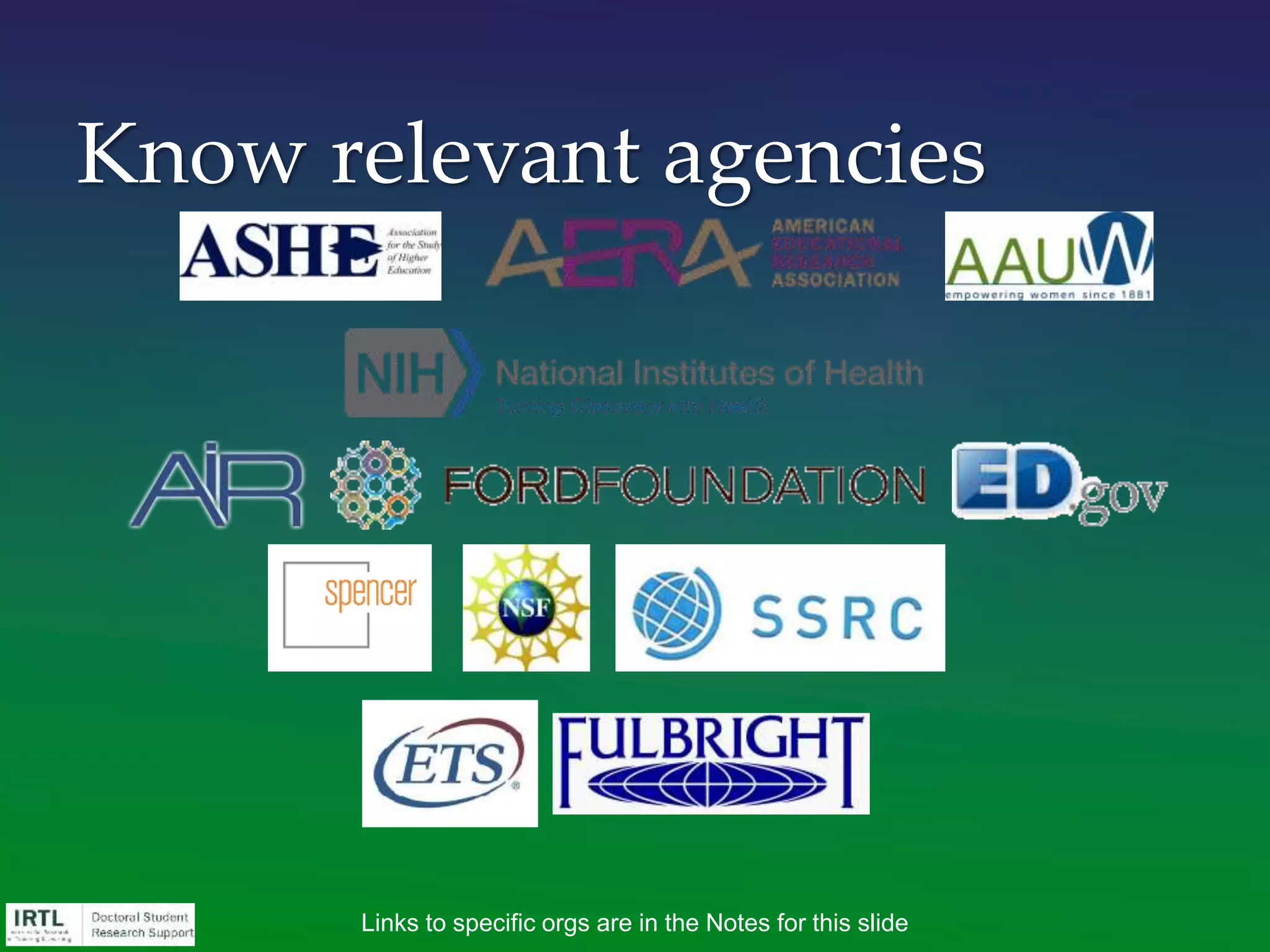
Know relevant agencies
Links to specific orgs are in the Notes for this slide
Sept: APA,
AERA,
Fullbright
IIE, NSF Oct: Spencer,
IRA, NSF
Nov: AAUW, SSRC, IRA,
Ford, Wenner-Gren, ETS,
AERA MDF, NSF GRFP,
Soros
Dec: AAUW,
Boren, ETS
Jan: AERA, APA, NSF,
SSRC, FLAS
Feb: ETS, NSF,
KCP
Mar: WARC,
Tinker
Apr: NSF, NIJ
May: Wenner-
Gren
June: Fulbright
DDRA
July: AIR
Aug: NSF,
NCAA
• Grants and
other funding
sources
typically
follow a
regular cycle.
• Plan ahead so
you can
prepare your
materials on
time, rather
than waiting
(perhaps a
year) until the
next
deadline.
Learn grant
cycles
Fall
Spring
Summer
Funds may be out there … we just need to hunt for them.
IRTL
Grants for Individuals
Grant Components
Finding Funders / Resources
Funding Opportunities Overview
Q&A
• Summer Research Fellowships
• ~20, $6,000, full-time support, no classes
• Summer Research Renewable Fellowships
• 8-10, $6,000 each of two summers, full-time support, no classes
• Summer Research Development Fellowships
• ~15, $5,000, first year students only, no classes
• Research Practicum/Research Development Fellowship
• For advanced doctoral students, develop your own budget
• Dissertation Completion Fellowships
• ~20, $6,000, max of ¼ time assistantship, complete Ph.D. during
funding period
• Professional Development Fellowships
• Annual competition for endowed scholarships/fellowships
College of Education
Opportunities
• Departmental professional development funds
• varies by department, may be renewable
• Bailey Scholars
• http://www.bsp.msu.edu
• RCAH Graduate Fellows
• http://rcah.msu.edu/people/graduate-fellows
• IIT / James Madison
• http://grad.msu.edu/iit/
• COGS Professional Development funds
• Up to $300 available once during your time at MSU, lottery
• COGS Travel funds
• Up to $300 available once during your time at MSU, lottery
MSU Funding Opportunities
• TIAA-CREF Ruth Simms Hamilton Graduate Merit Fellowship
• MSU Foreign Language and Area Studies (FLAS) Fellowships
• King-Chavez-Parks Future Faculty Fellowship Program at MSU
• Tinker Field Research Grant
• Center for Latin American and Caribbean Studies (CLACS)
Scholarship for Undergraduate and Graduate Study Abroad
* Consider non-monetary support options as well
MSU Funding Opportunities
Consider non-monetary support options as well:
• Office space
• Parking permit approval/sponsorship
• Copying
• Printing
• Telephone
• Physical storage space
• Account management
• Equipment (computer, video, audio, transcription)
Non-Monetary Support
• AERA Dissertation Grants
• Fulbright Programs
• National Academy of Education / Spencer
Dissertation Award
• Woodrow Wilson Doctoral Dissertation
Fellowship in Women’s Studies
• SSSP Dissertation Grant Awards
• Mellon/ACLS Dissertation Completion
Fellowship
• Paul & Daisy Soros Fellowship Program for
New Americans
• NSF Dissertation Research Improvement
Grants
• IRA Grants
• NACADA Academic Advising Research
Support Grant
• Wenner-Gren Dissertation Fieldwork Grants
• AERA Minority Dissertation Fellowship
Program in Education Research
• SSRC Mellon International Dissertation
Research Fellowship (IDRF)
• NSF Graduate Research Fellowship Program
(GRFP)
• American Association of University Women
Dissertation Fellowships
• Charlotte W. Newcombe Doctoral
Dissertation Fellowship
• Ford Foundation Dissertation Fellowships
• NASPAAwards
• ACPAAwards
• AERA Awards
• ASHE Awards
• NSEP David L. Boren Graduate Fellowships
• AAUW International Fellowships
• Doris Duke Fellowships for the Promotion
of Child Well-Being
• ETS Harold Gullksen Psychometric Research
Fellowship
• AIR Dissertation Grants
External Funding Opportunities
• What do you want to fund?
• Where can you find funding?
• Who can be part of your support
network?
• What related skills do you already
possess?
• What is your next step?
Moving forward …
• Keep an eye out for additional workshops in this Grants
and Fellowships series:
• Budgets
• Citation Management
• International Research & Funding
• Preparing a grant proposal
• We are always excited for
• Workshop topic ideas
• Web and newsletter content suggestions
• New award information
• Updates on your grant/fellowship applications
• Corrections on typos, spelling, and grammar.
Upcoming events
IRTL Doctoral Student Research Support
• http://education.msu.edu/irtl/grad/
IRTL facebook page
• https://www.facebook.com/MSUIRTL
MSU Reference Librarian Jon Harrison’s Grant Resources
• http://staff.lib.msu.edu/harris23/grants/
MSU College of Education – Fellowships & Scholarships
• http://education.msu.edu/resources/financial/
MSU Libraries – MSUNetID–available resources
• http://er.lib.msu.edu/location.cfm?location=WWW
MSU The Graduate School – Funding
• http://grad.msu.edu/funding/
International Social Science Research Seminar Resources List 2014
• http://grad.msu.edu/funding/docs/ISSR_Fall_2014.pdf
Main links from presentation
Institute for Research on Teaching and Learning
2nd Floor, Erickson Hall
http://education.msu.edu/irtl/grad
https://www.facebook.com/MSUIRTL
http://education.msu.edu/irtl/grad/Subscribe.asp
Bob Floden, Director, floden@msu.edu
Marcy Wallace, Associate Director,
wallacem@msu.edu
Qiana Green, Graduate Assistant, greenqia@msu.edu
(201C Erickson Hall)
IRTL – Doctoral Student
Research Support
IRTL
Grants for Individuals
Grant Components
Finding Funders & Resources
Funding Opportunities Overview
Q&A

2015 09 Intro to Grants & Fellowships

  • 1.
    IRTL Grants &Fellowships Workshop Series Part I: Introduction to Grants & Fellowships Institute for Research on Teaching and Learning Doctoral Student Research Support September 2015
  • 2.
    Qiana Green greenqia@msu.edu Doctoral Student Higher,Adult & Lifelong Education Graduate Assistant Institute for Research on Teaching & Learning Audience members… Introductions
  • 3.
    1. Learn aboutgrants. Learning Objectives
  • 4.
    1. Learn aboutgrants & grant writing in general. 2. Explore dissertation grant opportunities. 3. Understand funding opportunities. 4. Identify resources to find appropriate funding and refine grant applications. Learning Objectives
  • 5.
    1. IRTL 2. Grants& Fellowship Basics 3. Grant Components 4. Finding Funders / Resources 5. Funding Opportunities Overview 6. Q&A Today’s Plan
  • 6.
    Institute for Researchon Teaching & Learning IRTL supports doctoral students in the College of Education by enhancing their knowledge of funding opportunities and grant writing. We are available to discuss funding opportunities; assist in conceptualizing, writing, and revising a grant proposal; or assist in preparing a competitive budget request. http://education.msu.edu/irtl/grad What is IRTL?
  • 7.
    • Workshops, sessionsfor groups and classes • Overview of grants & fellowships; Grant proposal writing; Budget development; RCR; and more! • One-on-one consultation • in person, over the phone, Skype/FaceTime, email • Web resources (http://education.msu.edu/irtl/grad/) • Sample proposals, budgets, timelines, resources • Monthly newsletters (sign up on our website) • Announcements, workshops, resources, funding opportunities • Facebook updates (facebook.com/MSUIRTL) What does IRTL do?
  • 9.
    IRTL Grant & FellowshipBasics Grant Components Finding Funders & Resources Funding Opportunities Overview Q&A
  • 10.
    • To focuson research and/or writing • To advance knowledge in your field • National recognition and prestige • A lifetime professional network • Professional development opportunities • To demonstrate your ability to win grants for academic job applications Doctoral student grants & fellowships can allow you:
  • 11.
    • Grants canbe used for training, travel, work buy- outs, supplies, hourly staff, tuition, graduate assistantships. • Funds can be used to complete a dissertation or conduct small research projects. • Funding agencies exist to advance research and/or practice within an area. • Foundations are required to spend their funds. • Start small, “earn” your way up to larger awards. What role can grants (or other external funds) play in my career?
  • 12.
    A little planning An exciting idea Asupport network • If you’re seeking funding for your dissertation, you will do or have already done (most of) the work. • Grant writing skills are valued no matter your role. • Turning your idea into a competitive grant proposal takes: Why not?
  • 13.
    Your opportunity should matchwith these four areas: Money research funding is available Eligibility you’re ready and meet requirements Fit your research interests connect with funder Time a competitive proposal can be written in the time available
  • 14.
    Internal Funding • Yourdepartment / college / program / organization • Research entities on campus (grant administration, other departments) • Institution-wide opportunities External Funding • Databases • Regional foundations • Professional organizations & associations • Government entities Money … is there research funding available? IRTL’s Focus
  • 15.
    Early Stage Funds tuition andfees, as well as a stipend for living for early doctoral students Pre- Dissertation Funds research and experiences that aid research, such as travel, language study, and supplies Dissertation Funds research and experiences that aid research, such as language study, travel, supplies, facility use, and/or stipend for living after the defense of the dissertation proposal to completion Analysis & Write-Up Funds tuition and fees, stipend for living expenses to concentrate mostly or only on writing and completing the dissertation Postdoctoral Funds opportunities toward the development of an academic career Eligibility…are you ready? Think one step ahead!
  • 16.
    • Citizenship? • Comprehensiveexams and/or coursework complete? Degree obtained? • Dissertation proposal defense complete? • Full-time employee vs. faculty member vs. student? • Faculty advisor’s “OK” • Pilot program complete? Collaboration in place? Eligibility …do you meet the sponsor’s requirements?
  • 17.
    Many sponsors havewebsites with helpful information: • What are the sponsor’s goals and priorities? What have they funded in the past? • What is their program focus? population? method? Issue? • Who can I contact for information for assistance, guidance, or advice? • What are the review criteria? • Do they have sample proposals? Fit …does your project match the funder’s goals and priorities?
  • 18.
    • Start early. •Assess your timeline. • When will you complete doctoral program requirements? collect data? conduct analysis? write up? • Can you continue operations until funding would be received? • Do you have time to complete the application? • How long does it take for a decision? When will the funds become available? • Can you reapply? Time ... can a competitive proposal be written in the time available?
  • 19.
    • Work onand develop your research topic and ideas • Talk with faculty members about existing grant and funding opportunities • Utilize College of Education fellowship process (spring) • CoEd Summer Research Fellowships (late fall) • CoEd Summer Research Renewable Fellowships (2 years, late fall) • CoEd Summer Research Development Fellowships (1st year students only; January) • Utilize departmental professional development funds, COGS grants Preparing for External Funding – Years 1-2
  • 20.
    • Coming toan end in courses and have narrowed down topics to one or two potential dissertation ideas. • 1-2 years from dissertation proposal. • Begin exploring funding options. • Consider what you might need funding for (e.g., data collection) and what point in the dissertation process you will need that funding. • Continue conversations with faculty members about opportunities. • CoEd fellowship process (spring) • Identify possible funders and opportunities to catch in next year. • Utilize departmental professional development funds, COGS grants. Preparing for External Funding – Years 2-3
  • 21.
    • Most dissertationfunding proposal due dates are approximately 6 months to 1 year prior to dispersion of funds. Plan ahead within your own work to time application process. • Work on and submit proposals approximately 6 months prior to the due date. Prioritize good quality. Get advisor on board. • For international research projects, begin working on funding proposals 6 months to a year prior to the due date (e.g, affiliation letters, courses, language evaluations). • During data collection/practicum, apply for Research Practicum/Research Development Fellowship (mid fall). • When nearing completion, consider CoEd Dissertation Completion Fellowship (late fall). • Utilize departmental professional development funds, COGS grants. Preparing for External Funding – Years 3-5+
  • 22.
    • International Research:Preparing proposals for international research funding is likely to take more time due to the requirements, begin early. Consider enrolling in fall seminar – International Social Science Research (1-3 cr.) • Working students: Students who work fulltime should be aware that many of the larger are only for fulltime students. Be sure to explore whether or not this is a requirement when searching for grants. • International Students: Some grants are only available to U.S. citizens and permanent residents (e.g., government grants—NSF, Fulbright, NIH). Be sure to explore whether or not this is a requirement when searching for grants. Preparing for External Funding – Notes
  • 23.
    IRTL Grants for Individuals GrantComponents Finding Funders & Resources Funding Opportunities Overview Q&A
  • 24.
    “There is noamount of grantsmanship that will turn a bad idea into a good one, but there are many ways to disguise a good one.” William Raub former Deputy Director, NIH
  • 25.
    • Title • Projectsummary / Abstract • Narrative • Bibliography • Support materials • Biographical narrative • Letters of recommendation • Budget Typical grant components
  • 26.
    What makes agrant proposal successful? • start early • contact with funding sponsor • research matches funding announcement • aligned with priorities of sponsor • written with the review process in mind • captures reviewers’ attention • well-organized, engaging language • clear focus • follows the instructions precisely • applicant seeks outside review before submitting • compelling idea that advances the science • not too ambitious or unrealistic • no typos, grammatical errors • reasonable and accurate budget • submitted on time
  • 28.
    • Keep inmind that the reviewers may not be in your same discipline / functional area. • Write clearly in a way that is accessible to non- academics. • Grab their attention right away – title, intro sentence, etc.. • Websites may provide information on past/current reviewers. Use this knowledge to inform your writing. Reviewers
  • 29.
    • Talk tocolleagues about any past experiences as reviewers. • What did they look for? • What impressed them? • What were basic mistakes they saw? • How did they evaluate proposals with others from different specializations? • If possible, take advantage of opportunities to serve as a reviewer for grants, awards, etc. within your field. Reviewers
  • 30.
    Create Your SupportNetwork You Colleagues & Classmates Friends & Family Research Administration Staff Advisor, Committee & Faculty
  • 31.
    IRTL Grants for Individuals GrantComponents Finding Funders & Resources Funding Opportunities Overview Q&A
  • 32.
    • It’s nevertoo early or too late to start searching, but you will need to cut through the clutter and be a “smart searcher” • To be successful, you will need to: Finding funders Search in the right places Know relevant agencies Learn grant cycles
  • 33.
    Start local. • Talkto faculty members, people on campus with similar interests, supervisors, colleagues, those who work in grant-funded programs. • Talk with your librarians. • MSU Libraries, Jon Harrison • http://staff.lib.msu.edu/harris23/grants/index.htm • Grant Advisor newsletter • http://er.lib.msu.edu/location.cfm?location=WWW Search in the right places
  • 34.
    Consider any on-campusfunding search resources. • College of Education fellowships • http://education.msu.edu/resources/financial/fellows hips.asp • The Graduate School • http://grad.msu.edu/funding/ • International Social Science Research Seminar • http://grad.msu.edu/funding/docs/ISSR_Fall_2014.pdf Search in the right places
  • 35.
    IRTL Resources • Instantlysearch IRTL selected funding opportunities on the IRTL website (update coming soon – filterable!). • Videos, slideshows, sample materials • Planning stage, budgeting, writing information • Subscribe to the IRTL monthly funding alert newsletter. • http://education.msu.edu/irtl/grad/Subscribe.asp • Like our Facebook page for other updates through the month Search in the right places
  • 36.
    Other people ofinterest may include: • Grant administrators • Statisticians or those in charge of databases • Budget staff • Development/Fundraising/Advancement staff • Outreach office • Technology staff (data management, resources, etc.) • Focus on community organizations or other entities located in your area. • Network responsibly. Search in the right places
  • 37.
    Databases. • Foundation Center http://www.foundationcenter.org •Foundation Directory Online Professional *MSU Library • Foundation Grants to Individuals Online *MSU Library • Foundation Directory Free **NEW** http://fdo.foundationcenter.org • GrantSelect, GuideStar *MSUNetID required • http://er.lib.msu.edu/location.cfm?location=WWW Search in the right places
  • 38.
    Government databases &agencies • Government databases (e.g. grants.gov) • Government agencies (NSF, NIH, etc..) • http://staff.lib.msu.edu/harris23/grants/federal.h tm • State governments (michigan.gov) • http://staff.lib.msu.edu/harris23/grants/state.htm Know relevant agencies
  • 39.
    Know relevant agencies Linksto specific orgs are in the Notes for this slide
  • 40.
    Sept: APA, AERA, Fullbright IIE, NSFOct: Spencer, IRA, NSF Nov: AAUW, SSRC, IRA, Ford, Wenner-Gren, ETS, AERA MDF, NSF GRFP, Soros Dec: AAUW, Boren, ETS Jan: AERA, APA, NSF, SSRC, FLAS Feb: ETS, NSF, KCP Mar: WARC, Tinker Apr: NSF, NIJ May: Wenner- Gren June: Fulbright DDRA July: AIR Aug: NSF, NCAA • Grants and other funding sources typically follow a regular cycle. • Plan ahead so you can prepare your materials on time, rather than waiting (perhaps a year) until the next deadline. Learn grant cycles Fall Spring Summer
  • 41.
    Funds may beout there … we just need to hunt for them.
  • 42.
    IRTL Grants for Individuals GrantComponents Finding Funders / Resources Funding Opportunities Overview Q&A
  • 43.
    • Summer ResearchFellowships • ~20, $6,000, full-time support, no classes • Summer Research Renewable Fellowships • 8-10, $6,000 each of two summers, full-time support, no classes • Summer Research Development Fellowships • ~15, $5,000, first year students only, no classes • Research Practicum/Research Development Fellowship • For advanced doctoral students, develop your own budget • Dissertation Completion Fellowships • ~20, $6,000, max of ¼ time assistantship, complete Ph.D. during funding period • Professional Development Fellowships • Annual competition for endowed scholarships/fellowships College of Education Opportunities
  • 44.
    • Departmental professionaldevelopment funds • varies by department, may be renewable • Bailey Scholars • http://www.bsp.msu.edu • RCAH Graduate Fellows • http://rcah.msu.edu/people/graduate-fellows • IIT / James Madison • http://grad.msu.edu/iit/ • COGS Professional Development funds • Up to $300 available once during your time at MSU, lottery • COGS Travel funds • Up to $300 available once during your time at MSU, lottery MSU Funding Opportunities
  • 45.
    • TIAA-CREF RuthSimms Hamilton Graduate Merit Fellowship • MSU Foreign Language and Area Studies (FLAS) Fellowships • King-Chavez-Parks Future Faculty Fellowship Program at MSU • Tinker Field Research Grant • Center for Latin American and Caribbean Studies (CLACS) Scholarship for Undergraduate and Graduate Study Abroad * Consider non-monetary support options as well MSU Funding Opportunities
  • 46.
    Consider non-monetary supportoptions as well: • Office space • Parking permit approval/sponsorship • Copying • Printing • Telephone • Physical storage space • Account management • Equipment (computer, video, audio, transcription) Non-Monetary Support
  • 47.
    • AERA DissertationGrants • Fulbright Programs • National Academy of Education / Spencer Dissertation Award • Woodrow Wilson Doctoral Dissertation Fellowship in Women’s Studies • SSSP Dissertation Grant Awards • Mellon/ACLS Dissertation Completion Fellowship • Paul & Daisy Soros Fellowship Program for New Americans • NSF Dissertation Research Improvement Grants • IRA Grants • NACADA Academic Advising Research Support Grant • Wenner-Gren Dissertation Fieldwork Grants • AERA Minority Dissertation Fellowship Program in Education Research • SSRC Mellon International Dissertation Research Fellowship (IDRF) • NSF Graduate Research Fellowship Program (GRFP) • American Association of University Women Dissertation Fellowships • Charlotte W. Newcombe Doctoral Dissertation Fellowship • Ford Foundation Dissertation Fellowships • NASPAAwards • ACPAAwards • AERA Awards • ASHE Awards • NSEP David L. Boren Graduate Fellowships • AAUW International Fellowships • Doris Duke Fellowships for the Promotion of Child Well-Being • ETS Harold Gullksen Psychometric Research Fellowship • AIR Dissertation Grants External Funding Opportunities
  • 48.
    • What doyou want to fund? • Where can you find funding? • Who can be part of your support network? • What related skills do you already possess? • What is your next step? Moving forward …
  • 49.
    • Keep aneye out for additional workshops in this Grants and Fellowships series: • Budgets • Citation Management • International Research & Funding • Preparing a grant proposal • We are always excited for • Workshop topic ideas • Web and newsletter content suggestions • New award information • Updates on your grant/fellowship applications • Corrections on typos, spelling, and grammar. Upcoming events
  • 50.
    IRTL Doctoral StudentResearch Support • http://education.msu.edu/irtl/grad/ IRTL facebook page • https://www.facebook.com/MSUIRTL MSU Reference Librarian Jon Harrison’s Grant Resources • http://staff.lib.msu.edu/harris23/grants/ MSU College of Education – Fellowships & Scholarships • http://education.msu.edu/resources/financial/ MSU Libraries – MSUNetID–available resources • http://er.lib.msu.edu/location.cfm?location=WWW MSU The Graduate School – Funding • http://grad.msu.edu/funding/ International Social Science Research Seminar Resources List 2014 • http://grad.msu.edu/funding/docs/ISSR_Fall_2014.pdf Main links from presentation
  • 51.
    Institute for Researchon Teaching and Learning 2nd Floor, Erickson Hall http://education.msu.edu/irtl/grad https://www.facebook.com/MSUIRTL http://education.msu.edu/irtl/grad/Subscribe.asp Bob Floden, Director, floden@msu.edu Marcy Wallace, Associate Director, wallacem@msu.edu Qiana Green, Graduate Assistant, greenqia@msu.edu (201C Erickson Hall) IRTL – Doctoral Student Research Support
  • 52.
    IRTL Grants for Individuals GrantComponents Finding Funders & Resources Funding Opportunities Overview Q&A