Inside the ANN (Artificial Neural Network) A visual and intuitive journey* to understand how it stores knowledge and how it takes decisions*no code, no math included[following BCN Python Group’s request after my presentation on Machine Learning last September 25th2014] 
PresentedbyXavier Arrufat 
BCN Python Meetup–November2014 
Barcelona, November20th, 2014
Questions from last Meetup(Python BCN -september25th2014) 
1.How does an ANN work? Examples? 
2.You must be an engineer… a mathematicianwould never say ANNs are easy [to understand]!
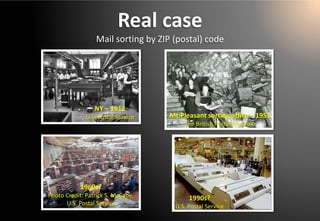
Real case 
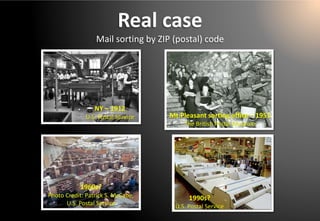
Mail sorting by ZIP (postal) codeNY –1912U.S. Postal ServiceMt.Pleasantsortingoffice –1951TheBritishPostal Museum1960s? Photo Credit: Patrick S. McCabe, U.S. Postal ServiceRoyal Mail on Christmas–Glasgow –2010s? (TheTelegraph–picture: PA) 1990s? U.S. Postal Service
Real case 
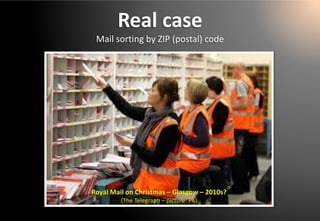
Mail sorting by ZIP (postal) codeRoyal Mail on Christmas –Glasgow –2010s? (TheTelegraph–picture: PA)
Agenda 
10 minHow humanslearn to read 
30 minHow ANNslearn to read (digits) 
0 minIs there muchdifference?
How humans learn to read 
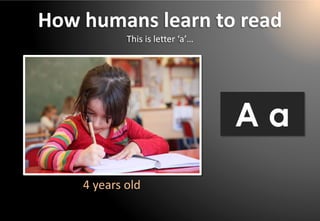
This is letter ‘a’… 
A a 
4 years old
How humans learn to read 
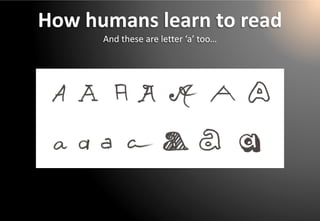
And these are letter ‘a’ too…
How humans learn to read 
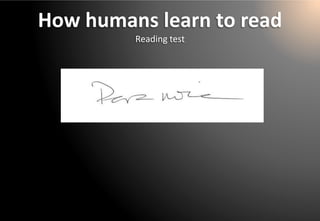
Reading test
How humans learn to read 
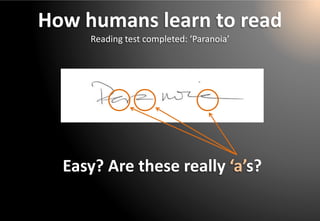
Reading test completed: ‘Paranoia’ 
Easy? Are these really ‘a’s?
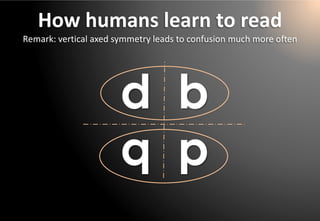
d b 
qp 
How humans learn to read 
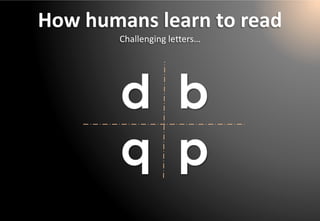
Challenging letters…
d b 
qp 
How humans learn to read 
Remark: vertical axed symmetry leads to confusion much more often
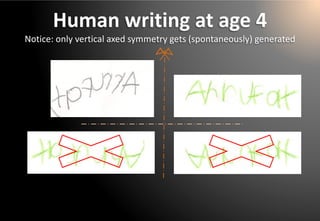
Human writing at age 4 
Notice: only vertical axed symmetry gets (spontaneously) generated
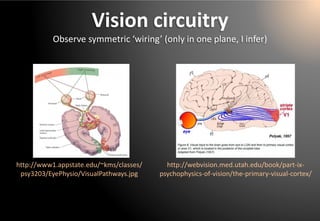
Vision circuitry 
Observe symmetric ‘wiring’ (only in one plane, I infer) 
http://webvision.med.utah.edu/book/part-ix- psychophysics-of-vision/the-primary-visual-cortex/ 
http://www1.appstate.edu/~kms/classes/ psy3203/EyePhysio/VisualPathways.jpg
Real case 
Mail sorting by ZIP (postal) codeNY –1912U.S. Postal ServiceMt.Pleasantsortingoffice –1951TheBritishPostal Museum1960s? Photo Credit: Patrick S. McCabe, U.S. Postal ServiceRoyal Mail on Christmas–Glasgow –2010s? (TheTelegraph–picture: PA) 1990s? U.S. Postal Service
MNIST dataset 
http://yann.lecun.com/exdb/mnist/ 
Training set of 60,000 examples (6,000 per digit) 
Test set of 10,000 examples (1,000 per digit) 
Each character is a 28x28 pixel box => 
784 numbers per character within range [0:white, background, 255:black, foreground] 
(N.B.: when using ANNs, normalize values to range [0,1] or [-1,1] before continuing)
Machine Learning 
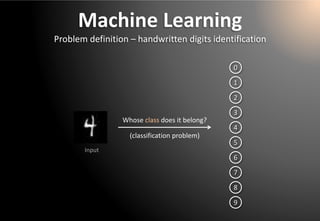
Problem definition –handwritten digits identification 
Input0123456789 
Whoseclassdoesitbelong? 
(classificationproblem)
Machine Learning 
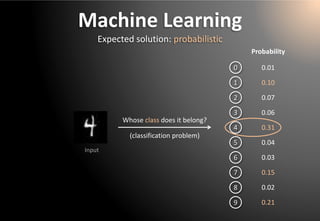
Expected solution: probabilistic 
Input0123456789 
Whoseclassdoesitbelong? 
(classificationproblem) 
Probability 
0.01 
0.10 
0.07 
0.06 
0.31 
0.04 
0.03 
0.15 
0.02 
0.21
Machine Learning 
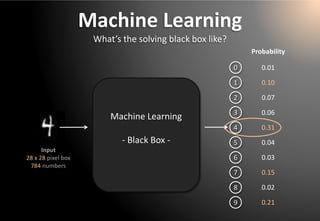
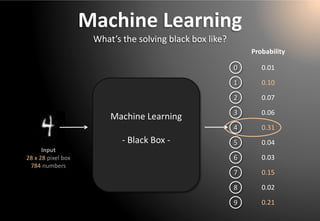
What’s the solving black box like? 
Input 
28 x 28 pixel box 
784numbers0123456789Machine Learning-Black Box - 
Probability 
0.01 
0.10 
0.07 
0.06 
0.31 
0.04 
0.03 
0.15 
0.02 
0.21
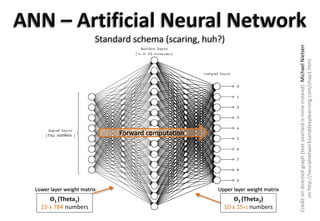
ANN –Artificial Neural Network 
Standard schema (scaring, huh?) Forward computationLowerlayerweightmatrixUpperlayerweightmatrix 
numbers 
Θ1 (Theta1) 
15 x 784 numbers 
Θ2 (Theta2) 
10 x 15+1numbers 
Credit on directed graph (text overlaid is mine instead): Michael Nielsenon http://neuralnetworksanddeeplearning.com/chap1.html
Digression 
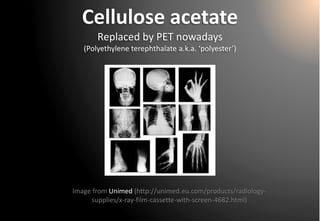
Cellulose acetate
Cellulose acetate 
Replaced by PET nowadays 
(Polyethylene terephthalate a.k.a. ‘polyester’) 
Image from Unimed(http://unimed.eu.com/products/radiology- supplies/x-ray-film-cassette-with-screen-4682.html)
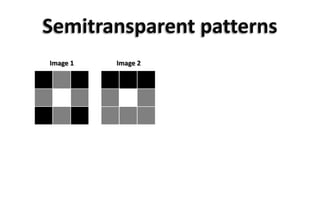
Semitransparent patternsImage1Image2
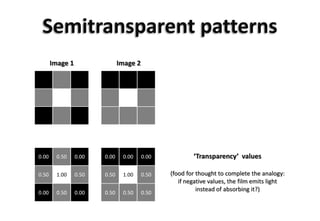
Semitransparent patternsImage1Image2 
0.00 
0.50 
0.00 
0.50 
1.00 
0.50 
0.00 
0.50 
0.00 
0.00 
0.00 
0.00 
0.50 
1.00 
0.50 
0.50 
0.50 
0.50‘Transparency’ values(foodforthoughtto complete theanalogy: ifnegativevalues, thefilm emitslight insteadof absorbingit?)
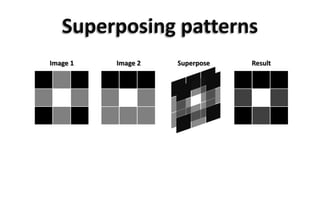
Superposing patternsImage1Image2SuperposeResult
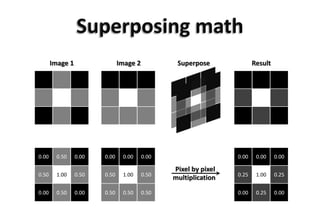
Superposing mathImage1Image2SuperposeResult 
0.00 
0.50 
0.00 
0.50 
1.00 
0.50 
0.00 
0.50 
0.00 
0.00 
0.00 
0.00 
0.25 
1.00 
0.25 
0.00 
0.25 
0.00 
0.00 
0.00 
0.00 
0.50 
1.00 
0.50 
0.50 
0.50 
0.50multiplicationPixelbypixel
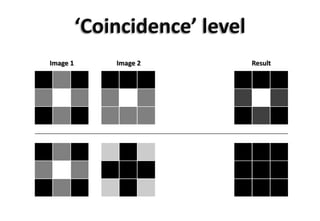
‘Coincidence’ levelImage1Image2Result
Machine Learning 
What’s the solving black box like? 
Input 
28 x 28 pixel box 
784numbers0123456789Machine Learning-Black Box - 
Probability 
0.01 
0.10 
0.07 
0.06 
0.31 
0.04 
0.03 
0.15 
0.02 
0.21
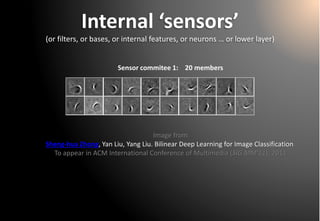
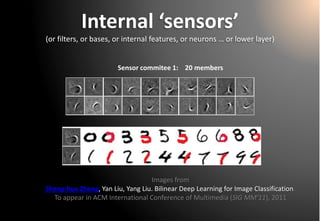
Internal ‘sensors’ 
(or filters, or bases, or internal features, or neurons … or lower layer) 
Sensor commitee1: 20 membersImage fromSheng-huaZhong, Yan Liu, Yang Liu. Bilinear Deep Learning for Image Classification. To appear in ACM International Conference of Multimedia (SIG MM'11), 2011
Internal ‘sensors’ 
(or filters, or bases, or internal features, or neurons … or lower layer) 
Sensor commitee1: 20 membersImages fromSheng-huaZhong, Yan Liu, Yang Liu. Bilinear Deep Learning for Image Classification. To appear in ACM International Conference of Multimedia (SIG MM'11), 2011
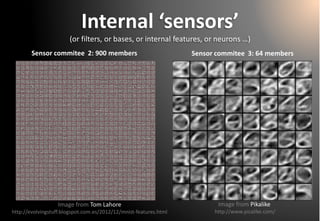
Internal ‘sensors’ 
(or filters, or bases, or internal features, or neurons …) 
Sensor commitee2: 900 members 
Sensor commitee3: 64 members 
Image from Pikalike 
http://www.picalike.com/ 
Image from Tom Lahore http://evolvingstuff.blogspot.com.es/2012/12/mnist-features.html
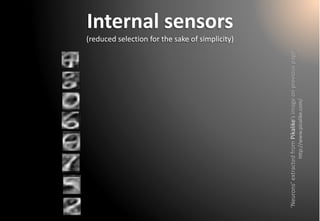
Internal sensors 
(reduced selection for the sake of simplicity) ‘Neurons’ extracted from Pikalike’simage on previous page 
http://www.picalike.com/
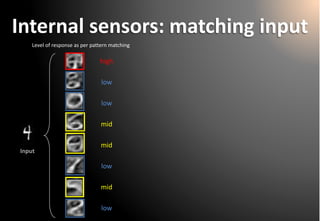
Internal sensors: matching input 
Levelof response as per patternmatching 
Input 
high 
low 
mid 
mid 
low 
mid 
low 
low
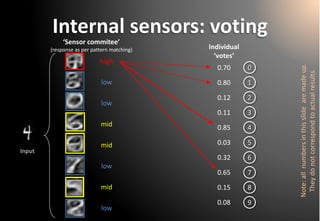
Internal sensors: voting0123456789 
‘Sensor commitee’ 
(response as per patternmatching) 
Individual ‘votes’ 
high 
low 
mid 
mid 
low 
mid 
low 
low 
0.70 
0.80 
0.12 
0.11 
0.85 
0.03 
0.32 
0.65 
0.15 
0.08 
Input 
Note: all numbersin thisslidearemadeup. Theydo notcorrespondto actual results.
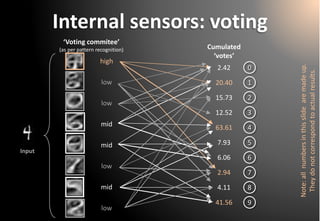
Internal sensors: voting0123456789 
‘Votingcommitee’ 
(as per patternrecognition) 
Cumulated‘votes’ 
high 
low 
mid 
mid 
low 
mid 
low 
low 
2.42 
20.40 
15.73 
12.52 
63.61 
7.93 
6.06 
2.94 
4.11 
41.56 
Input 
Note: all numbersin thisslidearemadeup. Theydo notcorrespondto actual results.
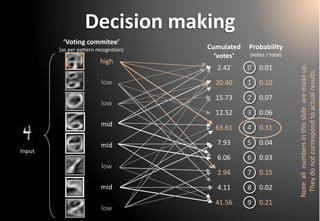
Normalizing votes (probability) 0123456789 
‘Votingcommitee’ 
(as per patternrecognition) 
Cumulated‘votes’ 
high 
low 
mid 
mid 
low 
mid 
low 
low 
2.42 
20.40 
15.73 
12.52 
63.61 
7.93 
6.06 
2.94 
4.11 
41.56 
Input 
0.01 
0.10 
0.07 
0.06 
0.31 
0.04 
0.03 
0.15 
0.02 
0.21 
Probability 
(votes / total) 
Note: all numbersin thisslidearemadeup. Theydo notcorrespondto actual results.
Decision making0123456789 
‘Votingcommitee’ 
(as per patternrecognition) 
Cumulated‘votes’ 
high 
low 
mid 
mid 
low 
mid 
low 
low 
2.42 
20.40 
15.73 
12.52 
63.61 
7.93 
6.06 
2.94 
4.11 
41.56 
Input 
0.01 
0.10 
0.07 
0.06 
0.31 
0.04 
0.03 
0.15 
0.02 
0.21 
Probability 
(votes / total) 
Note: all numbersin thisslidearemadeup. Theydo notcorrespondto actual results.
All steps in one page 
0.0 
0.9 
* 
= 
0.00.90.9 
* 
=0.8 
Σ 
1) Multiplyinput * filter, pixelper pixel 
2) Addup resultingvalues. Youget a simple real numberR 
4) Cast weighted votes on your filter’s favorite classes 
7.35 
Input 
Filter 
3) (optional–non-lineal activationfunction) SquashR withintherange(0,1) [ or (-1,1) ] 
Note: all numbersin thisslidearemadeup. Theydo notcorrespondto actual results. 
5) Normalize votes: compute class probabilities 
6) Make a decisionbased on probabilites 
0) Get a convenient set of filtersandvotingrules(a.k.a. ‘ANN training’)
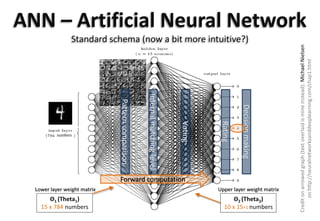
ANN –Artificial Neural Network 
Standard schema (now a bit more intuitive?) 
Θ1 (Theta1) 
15 x 784 numbers 
Θ2 (Theta2) 
10 x 15+1numbersLowerlayerweightmatrixUpperlayerweightmatrix RatingDecisionmaking Forward computation PatterncomparisonInternalmatchinglevelVoting 
numbers 
Credit on arrowed graph (text overlaid is mine instead): Michael Nielsenon http://neuralnetworksanddeeplearning.com/chap1.html
Q & A

Inside the ANN: A visual and intuitive journey to understand how artificial neural networks store knowledge and how they make decisions (no code, no math included)

  • 1.
    Inside the ANN(Artificial Neural Network) A visual and intuitive journey* to understand how it stores knowledge and how it takes decisions*no code, no math included[following BCN Python Group’s request after my presentation on Machine Learning last September 25th2014] PresentedbyXavier Arrufat BCN Python Meetup–November2014 Barcelona, November20th, 2014
  • 2.
    Questions from lastMeetup(Python BCN -september25th2014) 1.How does an ANN work? Examples? 2.You must be an engineer… a mathematicianwould never say ANNs are easy [to understand]!
  • 3.
    Real case Mailsorting by ZIP (postal) codeNY –1912U.S. Postal ServiceMt.Pleasantsortingoffice –1951TheBritishPostal Museum1960s? Photo Credit: Patrick S. McCabe, U.S. Postal ServiceRoyal Mail on Christmas–Glasgow –2010s? (TheTelegraph–picture: PA) 1990s? U.S. Postal Service
  • 4.
    Real case Mailsorting by ZIP (postal) codeRoyal Mail on Christmas –Glasgow –2010s? (TheTelegraph–picture: PA)
  • 5.
    Agenda 10 minHowhumanslearn to read 30 minHow ANNslearn to read (digits) 0 minIs there muchdifference?
  • 6.
    How humans learnto read This is letter ‘a’… A a 4 years old
  • 7.
    How humans learnto read And these are letter ‘a’ too…
  • 8.
    How humans learnto read Reading test
  • 9.
    How humans learnto read Reading test completed: ‘Paranoia’ Easy? Are these really ‘a’s?
  • 10.
    d b qp How humans learn to read Challenging letters…
  • 11.
    d b qp How humans learn to read Remark: vertical axed symmetry leads to confusion much more often
  • 12.
    Human writing atage 4 Notice: only vertical axed symmetry gets (spontaneously) generated
  • 13.
    Vision circuitry Observesymmetric ‘wiring’ (only in one plane, I infer) http://webvision.med.utah.edu/book/part-ix- psychophysics-of-vision/the-primary-visual-cortex/ http://www1.appstate.edu/~kms/classes/ psy3203/EyePhysio/VisualPathways.jpg
  • 14.
    Real case Mailsorting by ZIP (postal) codeNY –1912U.S. Postal ServiceMt.Pleasantsortingoffice –1951TheBritishPostal Museum1960s? Photo Credit: Patrick S. McCabe, U.S. Postal ServiceRoyal Mail on Christmas–Glasgow –2010s? (TheTelegraph–picture: PA) 1990s? U.S. Postal Service
  • 15.
    MNIST dataset http://yann.lecun.com/exdb/mnist/ Training set of 60,000 examples (6,000 per digit) Test set of 10,000 examples (1,000 per digit) Each character is a 28x28 pixel box => 784 numbers per character within range [0:white, background, 255:black, foreground] (N.B.: when using ANNs, normalize values to range [0,1] or [-1,1] before continuing)
  • 16.
    Machine Learning Problemdefinition –handwritten digits identification Input0123456789 Whoseclassdoesitbelong? (classificationproblem)
  • 17.
    Machine Learning Expectedsolution: probabilistic Input0123456789 Whoseclassdoesitbelong? (classificationproblem) Probability 0.01 0.10 0.07 0.06 0.31 0.04 0.03 0.15 0.02 0.21
  • 18.
    Machine Learning What’sthe solving black box like? Input 28 x 28 pixel box 784numbers0123456789Machine Learning-Black Box - Probability 0.01 0.10 0.07 0.06 0.31 0.04 0.03 0.15 0.02 0.21
  • 19.
    ANN –Artificial NeuralNetwork Standard schema (scaring, huh?) Forward computationLowerlayerweightmatrixUpperlayerweightmatrix numbers Θ1 (Theta1) 15 x 784 numbers Θ2 (Theta2) 10 x 15+1numbers Credit on directed graph (text overlaid is mine instead): Michael Nielsenon http://neuralnetworksanddeeplearning.com/chap1.html
  • 20.
  • 21.
    Cellulose acetate Replacedby PET nowadays (Polyethylene terephthalate a.k.a. ‘polyester’) Image from Unimed(http://unimed.eu.com/products/radiology- supplies/x-ray-film-cassette-with-screen-4682.html)
  • 22.
  • 23.
    Semitransparent patternsImage1Image2 0.00 0.50 0.00 0.50 1.00 0.50 0.00 0.50 0.00 0.00 0.00 0.00 0.50 1.00 0.50 0.50 0.50 0.50‘Transparency’ values(foodforthoughtto complete theanalogy: ifnegativevalues, thefilm emitslight insteadof absorbingit?)
  • 24.
  • 25.
    Superposing mathImage1Image2SuperposeResult 0.00 0.50 0.00 0.50 1.00 0.50 0.00 0.50 0.00 0.00 0.00 0.00 0.25 1.00 0.25 0.00 0.25 0.00 0.00 0.00 0.00 0.50 1.00 0.50 0.50 0.50 0.50multiplicationPixelbypixel
  • 26.
  • 27.
    Machine Learning What’sthe solving black box like? Input 28 x 28 pixel box 784numbers0123456789Machine Learning-Black Box - Probability 0.01 0.10 0.07 0.06 0.31 0.04 0.03 0.15 0.02 0.21
  • 28.
    Internal ‘sensors’ (orfilters, or bases, or internal features, or neurons … or lower layer) Sensor commitee1: 20 membersImage fromSheng-huaZhong, Yan Liu, Yang Liu. Bilinear Deep Learning for Image Classification. To appear in ACM International Conference of Multimedia (SIG MM'11), 2011
  • 29.
    Internal ‘sensors’ (orfilters, or bases, or internal features, or neurons … or lower layer) Sensor commitee1: 20 membersImages fromSheng-huaZhong, Yan Liu, Yang Liu. Bilinear Deep Learning for Image Classification. To appear in ACM International Conference of Multimedia (SIG MM'11), 2011
  • 30.
    Internal ‘sensors’ (orfilters, or bases, or internal features, or neurons …) Sensor commitee2: 900 members Sensor commitee3: 64 members Image from Pikalike http://www.picalike.com/ Image from Tom Lahore http://evolvingstuff.blogspot.com.es/2012/12/mnist-features.html
  • 31.
    Internal sensors (reducedselection for the sake of simplicity) ‘Neurons’ extracted from Pikalike’simage on previous page http://www.picalike.com/
  • 32.
    Internal sensors: matchinginput Levelof response as per patternmatching Input high low mid mid low mid low low
  • 33.
    Internal sensors: voting0123456789 ‘Sensor commitee’ (response as per patternmatching) Individual ‘votes’ high low mid mid low mid low low 0.70 0.80 0.12 0.11 0.85 0.03 0.32 0.65 0.15 0.08 Input Note: all numbersin thisslidearemadeup. Theydo notcorrespondto actual results.
  • 34.
    Internal sensors: voting0123456789 ‘Votingcommitee’ (as per patternrecognition) Cumulated‘votes’ high low mid mid low mid low low 2.42 20.40 15.73 12.52 63.61 7.93 6.06 2.94 4.11 41.56 Input Note: all numbersin thisslidearemadeup. Theydo notcorrespondto actual results.
  • 35.
    Normalizing votes (probability)0123456789 ‘Votingcommitee’ (as per patternrecognition) Cumulated‘votes’ high low mid mid low mid low low 2.42 20.40 15.73 12.52 63.61 7.93 6.06 2.94 4.11 41.56 Input 0.01 0.10 0.07 0.06 0.31 0.04 0.03 0.15 0.02 0.21 Probability (votes / total) Note: all numbersin thisslidearemadeup. Theydo notcorrespondto actual results.
  • 36.
    Decision making0123456789 ‘Votingcommitee’ (as per patternrecognition) Cumulated‘votes’ high low mid mid low mid low low 2.42 20.40 15.73 12.52 63.61 7.93 6.06 2.94 4.11 41.56 Input 0.01 0.10 0.07 0.06 0.31 0.04 0.03 0.15 0.02 0.21 Probability (votes / total) Note: all numbersin thisslidearemadeup. Theydo notcorrespondto actual results.
  • 37.
    All steps inone page 0.0 0.9 * = 0.00.90.9 * =0.8 Σ 1) Multiplyinput * filter, pixelper pixel 2) Addup resultingvalues. Youget a simple real numberR 4) Cast weighted votes on your filter’s favorite classes 7.35 Input Filter 3) (optional–non-lineal activationfunction) SquashR withintherange(0,1) [ or (-1,1) ] Note: all numbersin thisslidearemadeup. Theydo notcorrespondto actual results. 5) Normalize votes: compute class probabilities 6) Make a decisionbased on probabilites 0) Get a convenient set of filtersandvotingrules(a.k.a. ‘ANN training’)
  • 38.
    ANN –Artificial NeuralNetwork Standard schema (now a bit more intuitive?) Θ1 (Theta1) 15 x 784 numbers Θ2 (Theta2) 10 x 15+1numbersLowerlayerweightmatrixUpperlayerweightmatrix RatingDecisionmaking Forward computation PatterncomparisonInternalmatchinglevelVoting numbers Credit on arrowed graph (text overlaid is mine instead): Michael Nielsenon http://neuralnetworksanddeeplearning.com/chap1.html
  • 39.