7/22/14
1
1
--
NETWORKS,	
  KPIs	
  &	
  CASE	
  STUDIES	
  
Karen	
  Stephenson,	
  Ph.D.	
  
www.ne=ormresources.com	
  
www.drkaren.us	
  
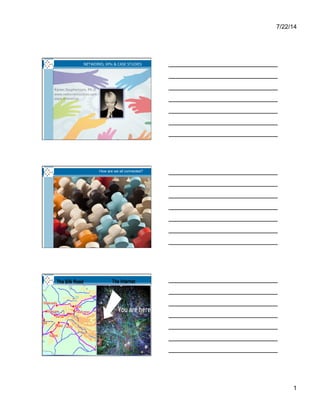
How are we all connected?
2
7/22/14
2
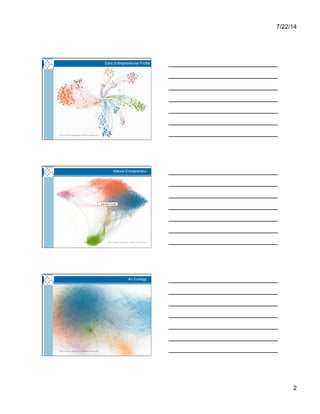
Early Entrepreneurial Profile
4
Ego centric center
2014 © Karen Stephenson; NetForm Resources
Mature Entrepreneur
5
Ego centric center
2014 © Karen Stephenson; NetForm Resources
An Ecology
6
2014 © Karen Stephenson; NetForm Resources
7/22/14
3
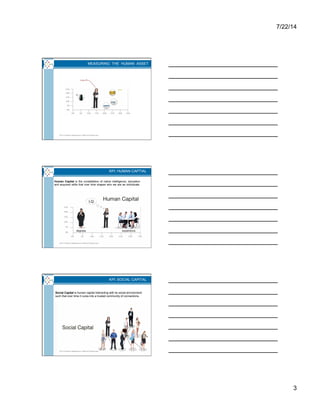
MEASURING THE HUMAN ASSET
2014 © Karen Stephenson; NetForm Resources
KPI: HUMAN CAPTIAL
Section Title (12 point Arial; color = white)Human Capital is the constellation of native intelligence, education
and acquired skills that over time shapes who we are as individuals.


Social Capital is human capital interacting with its social environment
such that over time it cures into a trusted community of connections.
Intellectual Capital
2014 © Karen Stephenson; NetForm Resources
KPI: SOCIAL CAPITAL
Section Title (12 point Arial; color = white)
Human Capital is the constellation of native intelligence, education
and acquired skills that over time shapes who we are as individuals.


Social Capital is human capital interacting with its social environment
such that over time it cures into a trusted community of connections.
Intellectual Capital
2014 © Karen Stephenson; NetForm Resources
7/22/14
4
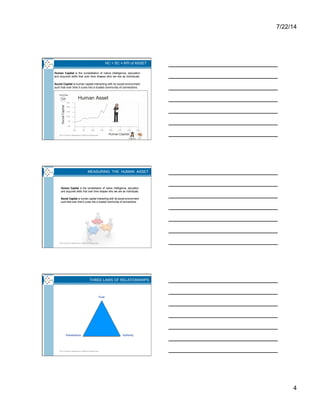
HC + SC = KPI of ASSET
Section Title (12 point Arial; color = white)Human Capital is the constellation of native intelligence, education
and acquired skills that over time shapes who we are as individuals.


Social Capital is human capital interacting with its social environment
such that over time it cures into a trusted community of connections.
Intellectual Capital
2014 © Karen Stephenson; NetForm Resources
MEASURING THE HUMAN ASSET
2014 © Karen Stephenson; NetForm Resources
Trust
Transactions Authority
THREE LAWS OF RELATIONSHIPS
2014 © Karen Stephenson; NetForm Resources
7/22/14
5
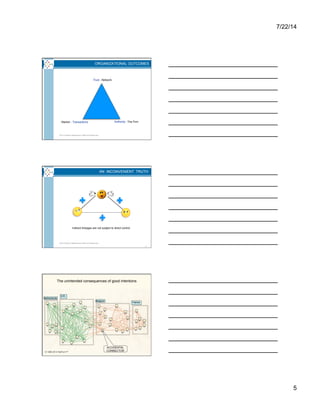
Trust
Transactions Authority
ORGANIZATIONAL OUTCOMES
Market - - The Firm
- Network
2014 © Karen Stephenson; NetForm Resources
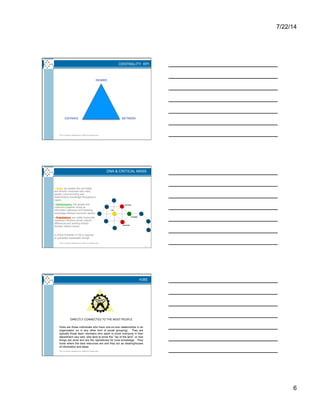
Indirect linkages are not subject to direct control
AN INCONVENIENT TRUTH
14
2014 © Karen Stephenson; NetForm Resources
CDCRenaissance
The Unintended Consequences of Good Intentions
U.K.
Netherlands
Belgium
France
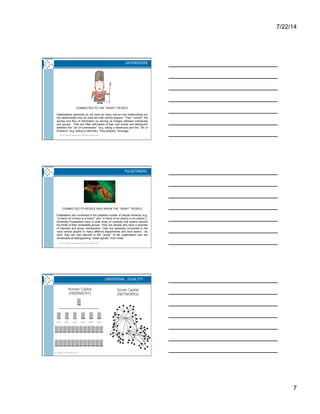
The unintended consequences of good intentions
ACCIDENTAL
CONNECTOR© 1996-2014 NetForm™
7/22/14
6
DEGREE
DISTANCE BETWEEN
CENTRALITY KPI
2014 © Karen Stephenson; NetForm Resources
DNA & CRITICAL MASS
17
•  Hubs: are people who are highly
and directly connected with many
people; communicating and
disseminating knowledge throughout a
region.
•  Gatekeepers: link people and
customers together acting as
information gateways and brokering
knowledge between economic sectors.
•  Pulsetakers: are subtle having the
maximum influence across cultural
differences and working entirely
through indirect means.
A critical threshold of 5% is required
to guarantee sustainable change.
2014 © Karen Stephenson; NetForm Resources
HUBS
DIRECTLY CONNECTED TO THE MOST PEOPLE
	

Hubs are those individuals who have one-on-one relationships in an
organization (or in any other kind of social grouping). They are
typically those team members who seem to know everyone in their
department very well, who tend to know the “lay of the land” or how
things are done and are the repositories for local knowledge. They
know where the best resources are and they act as clearinghouses
of information and ideas.
2014 © Karen Stephenson; NetForm Resources
7/22/14
7
GATEKEEPERS
CONNECTED TO THE “RIGHT” PEOPLE
Gatekeepers generally do not have as many one-on-one relationships but
the relationships they do have are with central players. They “control” the
access and flow of information by serving as bridges between individuals
and groups. They are often self-aware of their own power and distinguish
between the “sin of commission” (e.g. telling a falsehood) and the “sin of
omission” (e.g. telling a half-truth). They embody “leverage.”
2014 © Karen Stephenson; NetForm Resources
PULSETAKERS
CONNECTED TO PEOPLE WHO KNOW THE “RIGHT” PEOPLE
Pulsetakers are connected to the greatest number of people indirectly (e.g.
“a friend of a friend is a friend” and “a friend of an enemy is an enemy”).
Generally Pulsetakers have a wide array of contacts that extend beyond
the limits of their immediate groups. They are people who have a diversity
of interests and group membership. They are generally connected to the
most central players in many different departments and work teams. As
such, they are very attuned to the “pulse” of the organization and are
remarkable at distinguishing “weak signals” from noise.
2014 © Karen Stephenson; NetForm Resources
Human Capital
(HIERARCHY)
Social Capital
(NETWORKS)
© 1996-2014 NetForm™
UNIVERSAL DUALITY
7/22/14
8
Heterarchy = 3 or more distinct
organizations locked in inter -
dependent collaboration, where
each is not privileged over the
other and a shared governance
presides.
Network = 3 or more
individuals locked in mutual
reciprocal exchange,
exchange that is both
“interested’ and repetitive.
STRUCTURE TRUMPS SCALE
2014 © Karen Stephenson; NetForm Resources
Consists of at least 3 or more distinct hierarchies
each with its own raison d’être, which must must
collaborate and share governance to accomplish
a collective good more complex than any one
hierarchy can manage or achieve on its own.
DEFINITION OF HETERARCHY
2014 © Karen Stephenson; NetForm Resources
Now: Hierarchy New: Network Next: Heterarchy
THE 21ST CENTURY CHALLENGES
2014 © Karen Stephenson; NetForm Resources
7/22/14
9
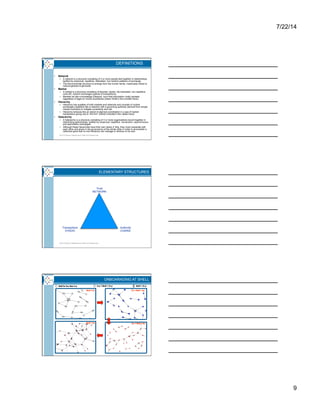
DEFINITIONS
•  Network
>  A network is a structure consisting of 3 or more people tied together in relationships
typified by reciprocal, repetitive, interested, non-random patterns of exchange.
>  The first primordial structure to emerge from the human family, inextricably linked to
cultural genesis & genocide.
•  Market
>  A market is a structure consisting of discreet, dyadic, dis-interested, non-repetitive
(one-off), random exchanges (typical of transactions).
>  Markets act like a knowledge Diaspora, such that information virally spreads
regardless of legal (or moral) boundaries (Adam Smith’s the invisible hand).
•  Hierarchy
>  Hierarchy has qualities of both markets and networks and consists of routine
exchanges (repetitive like a network) with a governing authority (derived from simple
market contracts) to mitigate uncertainty and risk.
>  Hierarchy behaves like an island of planned coordination in a sea of market
transactions giving rise to “the firm” (Alfred Chandler’s the visible hand)
•  Heterarchy
>  A heterarchy is a structure consisting of 3 or more organizations bound together in
interlocking partnerships, typified by reciprocal, repetitive, nonrandom, asynchronous
and asymmetric exchanges.
>  Although these hierarchies have their own raison d’ être, they must cooperate with
each other and share in the governance of the whole other in order to accomplish a
collective good that no one hierarchy can manage or achieve on its own.
2014 © Karen Stephenson; NetForm Resources
Trust
NETWORK
Transactions
DYADIC
Authority
CHAINS
ELEMENTARY STRUCTURES
2014 © Karen Stephenson; NetForm Resources
Shell for less than 4 yr 4 yr < Shell < 15 yr Shell > 15 yr
Shell <1yr
Shell > 4yr 2yr < Shell < 4yr
1yr < Shell < 2yr
ONBOARADING AT SHELL
7/22/14
10
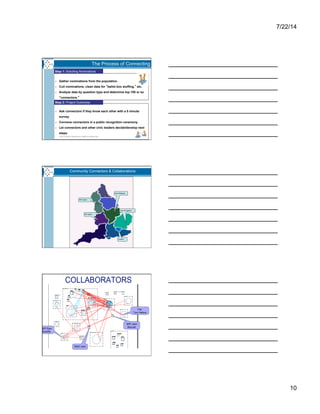
Ø  Gather nominations from the population.
Ø  Cull nominations, clean data for “ballot box stuffing,” etc.
Ø  Analyze data by question type and determine top 100 or so
“connectors.”
The Process of Connecting
Ø  Ask connectors if they know each other with a 5 minute
survey.
Ø  Convene connectors in a public recognition ceremony.
Ø  Let connectors and other civic leaders decide/develop next
steps.
	

Step 1: Soliciting Nominations
Step 2: Project Outcomes
2014 © Karen Stephenson; NetForm Resources
East	
  Midlands	
  
East	
  of	
  England	
  
London	
  
SW	
  region	
  
NW	
  region	
  
Community Connectors & Collaborations
CDCRenaissance
7/22/14
11
24
23
20
18
16
12
6
21
171814
7
919
F
P age, C.
O
M Smith C.
M
Liquori sh, C.
M
King, C.
F
Johnson, C.
M
P ain, C.
O
Hart C.
M
S pend love-Mason, G.
M
Holyoak, C.
O
Robinson C.
M
Rook, C.
O
Hal lam C.
F
S impson, C.
F
Roeb er, C.
M
S watr idge, C.
O
Tooley C.
O
Wood C.
M
S idey, C.
O
Brem ner C.
O
S .Hil l C.
O
Hack C.
F
A.Hil l, C.
F
Ack er ley, C.
M
Beaty , C.
F
Burrel l, C.
O
Cal li sC.
M
Char lish, C.
M
Ever ett , C.
M
B Smith, C.
O
Dann C.
O
F uch sC.
O
GravesC.
O
F ield C.
O
Galto n C.
O
Evan sC.
O
Dunton C.
O
DewesC.
Strategy
22
20
13
4
21
162514
8
F
P age, C.
O
M Smith C.
M
Liquori sh, C.
M
King, C.
F
Johnson, C.
M
P ain, C.
O
Hart C.
M
S pend love-Mason, G.
M
Holyoak, C.
O
Robinson C.
M
Rook, C.
O
Hal lam C.
F
S impson, C.
F
Roeb er, C.
M
S watr idge, C.
O
Tooley C.
O
Wood C.
M
S idey, C.
O
Brem ner C.
O
S .Hil l C.
O
Hack C.
F
A.Hil l, C.
F
Ack er ley, C.
M
Beaty , C.
F
Burrel l, C.
O
Cal li sC.
M
Char lish, C.
M
Ever ett , C.
M
B Smith, C.
O
Dann C.
O
F uch sC.
O
GravesC.
O
F ield C.
O
Galto n C.
O
Evan sC.
O
Dunton C.
O
DewesC.
Decision making
8
Councillors
F
P age, C.
O
M Smith C.
M
Liquori sh, C.
M
King, C.
F
Johnson, C.
M
P ain, C.
O
Hart C.
M
S pend love-Mason, G.
M
Holyoak, C.
O
Robinson C.
M
Rook, C.
O
Hal lam C.
F
S impson, C.
F
Roeb er, C.
M
S watr idge, C.
O
Tooley C.
O
Wood C.
M
S idey, C.
O
Brem ner C.
O
S .Hil l C.
O
Hack C.
F
A.Hil l, C.
F
Ack er ley, C.
M
Beaty , C.
F
Burrel l, C.
O
Cal li sC.
M
Char lish, C.
M
Ever ett , C.
M
B Smith, C.
O
Dann C.
O
F uch sC.
O
GravesC.
O
F ield C.
O
Galto n C.
O
Evan sC.
O
Dunton C.
O
DewesC.
Innovation
18
Councillors
F
P age, C.
O
M Smith C.
M
Liquori sh, C.
M
King, C.
F
Johnson, C.
M
P ain, C.
O
Hart C.
M
S pend love-Mason, G.
M
Holyoak, C.
O
Robinson C.
M
Rook, C.
O
Hal lam C.
F
S impson, C.
F
Roeb er, C.
M
S watr idge, C.
O
Tooley C.
O
Wood C.
M
S idey, C.
O
Brem ner C.
O
S .Hil l C.
O
Hack C.
F
A.Hil l, C.
F
Ack er ley, C.
M
Beaty , C.
F
Burrel l, C.
O
Cal li sC.
M
Char lish, C.
M
Ever ett , C.
M
B Smith, C.
O
Dann C.
O
F uch sC.
O
GravesC.
O
F ield C.
O
Galto n C.
O
Evan sC.
O
Dunton C.
O
DewesC.
Day to day working
Organizing Data
SOCIAL CAPITAL DEFINITIONS & DIAGNOSES
>  Leaders - potential or recognized
>  Mentor/Mentee - providers or seekers of expert advice,
professional development and coaching
>  Problem-Solvers - innovators or implementers, good team
members,
>  Rising Stars - established or having great potential,
outstanding in their fields
>  Who’s on the list that you expected to see? Confirms what you
know to be true.
>  Who’s on the list that you didn’t expect? Surprise! A truly hidden
resource, but why? How would you use these individuals in the
future?
>  Who should be on the list but isn’t. Why? How to match current
mission needs with these people to give them opportunities to
grow and to be visible?
>  Who is on the list that raises a concern for you? What actions are
possible to remedy your concern?
>  Philadelphia, Pennsylvania (2007)
>  Millennial study in Philadelphia (2008)
>  Louisville, Kentucky (2009)
>  Tucson, Arizona (2010)
>  Portland, Oregon (2011)
>  Bluegrass, Kentucky (2012)
SUMMARY of CONNECTOR PROJECTS
7/22/14
12
34
Time Line
Connector project initiated.
A methodology based on the UK studies was adapted to the US.
Nominations for connectors were solicited using local
organizations, print and televised media and social media.
4800 nominations were collected on the basis of 7 questions and
culled them to the top 101.
80% of the 101 were surveyed using 4 questions to determine if
they were connected to each other.
The Connectors were convened.
A new leadership curriculum for high school students and
professionals was developed.
A new Millennial study was launched.
Spring 2005
Fall 2005
Winter 2006
•  Dec 5, 2006
In 2007
In 2008
Modified snowball sample using 7 questions
Connectors
Census Bureau Asking your
Friend
Nomination Questions:
•  Who is innovative and brings big picture ideas to projects?
•  Who has expertise or expert knowledge to turn great ideas into reality?
•  Who has integrity, concern for the common good and the guts to help get things done?
•  Who is effective at implementing and would roll up their sleeves to see work through with you to
the end?
•  Who would you depend on to help bring together and wisely coordinate resources to meet
challenges?
•  Who in your own neighborhood or local community could you depend on to make the area the
best in the world?
•  Who would you go to for advice outside of your own race, class, social circle, gender, religion,
age group?
7/22/14
13
Connectors “connect” across 4 questions
1.  Among this list of 101, who do you
know well enough to pick up a phone
to call on to roll up his or her sleeves
and see an effort through to the end?
2.  Among this list of 101, who is in your
local community (whatever you
consider to be your community)?
3.  Among this list of 101, who do you
think has the expertise or expert
knowledge to turn great ideas into
reality?
4.  Among this list of 101, who would you
want to work with?
F
M
Acad emia
F
M
Government
F
M
No t-fo r-profit
F
M
Priv ate Sector
Mapping Philadelphia's Connectors by Gender
F
1 01
F
2 5
F
8 3
M
1 8
M
6
M
5
M
8
F
4 8
F
7 4
F
7 2
F
9 1
F
8 9
F
5 0
M
9
M
2 8
M
3 9
M
9 7
M
8 1
M
3 0
M
6 1
M
1 00
F
1 4
F
1 0
F
1 1
F
9 9
F
3 7
F
9 3
F
1 7
F
4 1
F
1 3
F
2 2
F
2 9
F
6 7
F
3 3
F
4 3
F
6 2
F
3 2F
2 1
F
4 0
F
3 8
F
5 1
F
1 9
F
9 0
F
6 6
F
4 2
F
5 6
M
6 9
M
5 5
M
4 7
M
4 4
M
2 3
M
2 7
M
2 6
M
8 2
M
7 7
M
3 5
M
9 4
M
8 5
M
2 4
M
5 9
M
7 1
M
2
M
3
M
1 5
M
6 0
M
7 8
M
6 8
M
1 2
M
8 6
M
8 4
F
6 4
F
4
F
8 7
F
3 1
F
9 6
F
1 6
F
4 9
F
6 5
M
5 7
M
7 5
M
5 4
M
7
M
6 3
M
4 6
M
5 2
M
8 8
M
3 6
M
3 4
M
7 3
M
9 2
M
8 0
M
4 5
M
5 3
M
5 8
M
9 8
M
7 6
M
2 0
M
7 9
M
9 5
M
7 0
These are the economic sectors
Not for Profit
Government
Private
Academic
F F
F
F
M
M
M
M
39
--
CASE	
  STUDIES	
  
Karen	
  Stephenson,	
  Ph.D.	
  
www.ne=ormresources.com	
  
www.drkaren.us	
  

20140714 stephenson_plenary_business_networks

  • 1.
    7/22/14 1 1 -- NETWORKS,  KPIs  &  CASE  STUDIES   Karen  Stephenson,  Ph.D.   www.ne=ormresources.com   www.drkaren.us   How are we all connected? 2
  • 2.
    7/22/14 2 Early Entrepreneurial Profile 4 Egocentric center 2014 © Karen Stephenson; NetForm Resources Mature Entrepreneur 5 Ego centric center 2014 © Karen Stephenson; NetForm Resources An Ecology 6 2014 © Karen Stephenson; NetForm Resources
  • 3.
    7/22/14 3 MEASURING THE HUMANASSET 2014 © Karen Stephenson; NetForm Resources KPI: HUMAN CAPTIAL Section Title (12 point Arial; color = white)Human Capital is the constellation of native intelligence, education and acquired skills that over time shapes who we are as individuals. Social Capital is human capital interacting with its social environment such that over time it cures into a trusted community of connections. Intellectual Capital 2014 © Karen Stephenson; NetForm Resources KPI: SOCIAL CAPITAL Section Title (12 point Arial; color = white) Human Capital is the constellation of native intelligence, education and acquired skills that over time shapes who we are as individuals. Social Capital is human capital interacting with its social environment such that over time it cures into a trusted community of connections. Intellectual Capital 2014 © Karen Stephenson; NetForm Resources
  • 4.
    7/22/14 4 HC + SC= KPI of ASSET Section Title (12 point Arial; color = white)Human Capital is the constellation of native intelligence, education and acquired skills that over time shapes who we are as individuals. Social Capital is human capital interacting with its social environment such that over time it cures into a trusted community of connections. Intellectual Capital 2014 © Karen Stephenson; NetForm Resources MEASURING THE HUMAN ASSET 2014 © Karen Stephenson; NetForm Resources Trust Transactions Authority THREE LAWS OF RELATIONSHIPS 2014 © Karen Stephenson; NetForm Resources
  • 5.
    7/22/14 5 Trust Transactions Authority ORGANIZATIONAL OUTCOMES Market- - The Firm - Network 2014 © Karen Stephenson; NetForm Resources Indirect linkages are not subject to direct control AN INCONVENIENT TRUTH 14 2014 © Karen Stephenson; NetForm Resources CDCRenaissance The Unintended Consequences of Good Intentions U.K. Netherlands Belgium France The unintended consequences of good intentions ACCIDENTAL CONNECTOR© 1996-2014 NetForm™
  • 6.
    7/22/14 6 DEGREE DISTANCE BETWEEN CENTRALITY KPI 2014© Karen Stephenson; NetForm Resources DNA & CRITICAL MASS 17 •  Hubs: are people who are highly and directly connected with many people; communicating and disseminating knowledge throughout a region. •  Gatekeepers: link people and customers together acting as information gateways and brokering knowledge between economic sectors. •  Pulsetakers: are subtle having the maximum influence across cultural differences and working entirely through indirect means. A critical threshold of 5% is required to guarantee sustainable change. 2014 © Karen Stephenson; NetForm Resources HUBS DIRECTLY CONNECTED TO THE MOST PEOPLE Hubs are those individuals who have one-on-one relationships in an organization (or in any other kind of social grouping). They are typically those team members who seem to know everyone in their department very well, who tend to know the “lay of the land” or how things are done and are the repositories for local knowledge. They know where the best resources are and they act as clearinghouses of information and ideas. 2014 © Karen Stephenson; NetForm Resources
  • 7.
    7/22/14 7 GATEKEEPERS CONNECTED TO THE“RIGHT” PEOPLE Gatekeepers generally do not have as many one-on-one relationships but the relationships they do have are with central players. They “control” the access and flow of information by serving as bridges between individuals and groups. They are often self-aware of their own power and distinguish between the “sin of commission” (e.g. telling a falsehood) and the “sin of omission” (e.g. telling a half-truth). They embody “leverage.” 2014 © Karen Stephenson; NetForm Resources PULSETAKERS CONNECTED TO PEOPLE WHO KNOW THE “RIGHT” PEOPLE Pulsetakers are connected to the greatest number of people indirectly (e.g. “a friend of a friend is a friend” and “a friend of an enemy is an enemy”). Generally Pulsetakers have a wide array of contacts that extend beyond the limits of their immediate groups. They are people who have a diversity of interests and group membership. They are generally connected to the most central players in many different departments and work teams. As such, they are very attuned to the “pulse” of the organization and are remarkable at distinguishing “weak signals” from noise. 2014 © Karen Stephenson; NetForm Resources Human Capital (HIERARCHY) Social Capital (NETWORKS) © 1996-2014 NetForm™ UNIVERSAL DUALITY
  • 8.
    7/22/14 8 Heterarchy = 3or more distinct organizations locked in inter - dependent collaboration, where each is not privileged over the other and a shared governance presides. Network = 3 or more individuals locked in mutual reciprocal exchange, exchange that is both “interested’ and repetitive. STRUCTURE TRUMPS SCALE 2014 © Karen Stephenson; NetForm Resources Consists of at least 3 or more distinct hierarchies each with its own raison d’être, which must must collaborate and share governance to accomplish a collective good more complex than any one hierarchy can manage or achieve on its own. DEFINITION OF HETERARCHY 2014 © Karen Stephenson; NetForm Resources Now: Hierarchy New: Network Next: Heterarchy THE 21ST CENTURY CHALLENGES 2014 © Karen Stephenson; NetForm Resources
  • 9.
    7/22/14 9 DEFINITIONS •  Network >  Anetwork is a structure consisting of 3 or more people tied together in relationships typified by reciprocal, repetitive, interested, non-random patterns of exchange. >  The first primordial structure to emerge from the human family, inextricably linked to cultural genesis & genocide. •  Market >  A market is a structure consisting of discreet, dyadic, dis-interested, non-repetitive (one-off), random exchanges (typical of transactions). >  Markets act like a knowledge Diaspora, such that information virally spreads regardless of legal (or moral) boundaries (Adam Smith’s the invisible hand). •  Hierarchy >  Hierarchy has qualities of both markets and networks and consists of routine exchanges (repetitive like a network) with a governing authority (derived from simple market contracts) to mitigate uncertainty and risk. >  Hierarchy behaves like an island of planned coordination in a sea of market transactions giving rise to “the firm” (Alfred Chandler’s the visible hand) •  Heterarchy >  A heterarchy is a structure consisting of 3 or more organizations bound together in interlocking partnerships, typified by reciprocal, repetitive, nonrandom, asynchronous and asymmetric exchanges. >  Although these hierarchies have their own raison d’ être, they must cooperate with each other and share in the governance of the whole other in order to accomplish a collective good that no one hierarchy can manage or achieve on its own. 2014 © Karen Stephenson; NetForm Resources Trust NETWORK Transactions DYADIC Authority CHAINS ELEMENTARY STRUCTURES 2014 © Karen Stephenson; NetForm Resources Shell for less than 4 yr 4 yr < Shell < 15 yr Shell > 15 yr Shell <1yr Shell > 4yr 2yr < Shell < 4yr 1yr < Shell < 2yr ONBOARADING AT SHELL
  • 10.
    7/22/14 10 Ø  Gather nominationsfrom the population. Ø  Cull nominations, clean data for “ballot box stuffing,” etc. Ø  Analyze data by question type and determine top 100 or so “connectors.” The Process of Connecting Ø  Ask connectors if they know each other with a 5 minute survey. Ø  Convene connectors in a public recognition ceremony. Ø  Let connectors and other civic leaders decide/develop next steps. Step 1: Soliciting Nominations Step 2: Project Outcomes 2014 © Karen Stephenson; NetForm Resources East  Midlands   East  of  England   London   SW  region   NW  region   Community Connectors & Collaborations CDCRenaissance
  • 11.
    7/22/14 11 24 23 20 18 16 12 6 21 171814 7 919 F P age, C. O MSmith C. M Liquori sh, C. M King, C. F Johnson, C. M P ain, C. O Hart C. M S pend love-Mason, G. M Holyoak, C. O Robinson C. M Rook, C. O Hal lam C. F S impson, C. F Roeb er, C. M S watr idge, C. O Tooley C. O Wood C. M S idey, C. O Brem ner C. O S .Hil l C. O Hack C. F A.Hil l, C. F Ack er ley, C. M Beaty , C. F Burrel l, C. O Cal li sC. M Char lish, C. M Ever ett , C. M B Smith, C. O Dann C. O F uch sC. O GravesC. O F ield C. O Galto n C. O Evan sC. O Dunton C. O DewesC. Strategy 22 20 13 4 21 162514 8 F P age, C. O M Smith C. M Liquori sh, C. M King, C. F Johnson, C. M P ain, C. O Hart C. M S pend love-Mason, G. M Holyoak, C. O Robinson C. M Rook, C. O Hal lam C. F S impson, C. F Roeb er, C. M S watr idge, C. O Tooley C. O Wood C. M S idey, C. O Brem ner C. O S .Hil l C. O Hack C. F A.Hil l, C. F Ack er ley, C. M Beaty , C. F Burrel l, C. O Cal li sC. M Char lish, C. M Ever ett , C. M B Smith, C. O Dann C. O F uch sC. O GravesC. O F ield C. O Galto n C. O Evan sC. O Dunton C. O DewesC. Decision making 8 Councillors F P age, C. O M Smith C. M Liquori sh, C. M King, C. F Johnson, C. M P ain, C. O Hart C. M S pend love-Mason, G. M Holyoak, C. O Robinson C. M Rook, C. O Hal lam C. F S impson, C. F Roeb er, C. M S watr idge, C. O Tooley C. O Wood C. M S idey, C. O Brem ner C. O S .Hil l C. O Hack C. F A.Hil l, C. F Ack er ley, C. M Beaty , C. F Burrel l, C. O Cal li sC. M Char lish, C. M Ever ett , C. M B Smith, C. O Dann C. O F uch sC. O GravesC. O F ield C. O Galto n C. O Evan sC. O Dunton C. O DewesC. Innovation 18 Councillors F P age, C. O M Smith C. M Liquori sh, C. M King, C. F Johnson, C. M P ain, C. O Hart C. M S pend love-Mason, G. M Holyoak, C. O Robinson C. M Rook, C. O Hal lam C. F S impson, C. F Roeb er, C. M S watr idge, C. O Tooley C. O Wood C. M S idey, C. O Brem ner C. O S .Hil l C. O Hack C. F A.Hil l, C. F Ack er ley, C. M Beaty , C. F Burrel l, C. O Cal li sC. M Char lish, C. M Ever ett , C. M B Smith, C. O Dann C. O F uch sC. O GravesC. O F ield C. O Galto n C. O Evan sC. O Dunton C. O DewesC. Day to day working Organizing Data SOCIAL CAPITAL DEFINITIONS & DIAGNOSES >  Leaders - potential or recognized >  Mentor/Mentee - providers or seekers of expert advice, professional development and coaching >  Problem-Solvers - innovators or implementers, good team members, >  Rising Stars - established or having great potential, outstanding in their fields >  Who’s on the list that you expected to see? Confirms what you know to be true. >  Who’s on the list that you didn’t expect? Surprise! A truly hidden resource, but why? How would you use these individuals in the future? >  Who should be on the list but isn’t. Why? How to match current mission needs with these people to give them opportunities to grow and to be visible? >  Who is on the list that raises a concern for you? What actions are possible to remedy your concern? >  Philadelphia, Pennsylvania (2007) >  Millennial study in Philadelphia (2008) >  Louisville, Kentucky (2009) >  Tucson, Arizona (2010) >  Portland, Oregon (2011) >  Bluegrass, Kentucky (2012) SUMMARY of CONNECTOR PROJECTS
  • 12.
    7/22/14 12 34 Time Line Connector projectinitiated. A methodology based on the UK studies was adapted to the US. Nominations for connectors were solicited using local organizations, print and televised media and social media. 4800 nominations were collected on the basis of 7 questions and culled them to the top 101. 80% of the 101 were surveyed using 4 questions to determine if they were connected to each other. The Connectors were convened. A new leadership curriculum for high school students and professionals was developed. A new Millennial study was launched. Spring 2005 Fall 2005 Winter 2006 •  Dec 5, 2006 In 2007 In 2008 Modified snowball sample using 7 questions Connectors Census Bureau Asking your Friend Nomination Questions: •  Who is innovative and brings big picture ideas to projects? •  Who has expertise or expert knowledge to turn great ideas into reality? •  Who has integrity, concern for the common good and the guts to help get things done? •  Who is effective at implementing and would roll up their sleeves to see work through with you to the end? •  Who would you depend on to help bring together and wisely coordinate resources to meet challenges? •  Who in your own neighborhood or local community could you depend on to make the area the best in the world? •  Who would you go to for advice outside of your own race, class, social circle, gender, religion, age group?
  • 13.
    7/22/14 13 Connectors “connect” across4 questions 1.  Among this list of 101, who do you know well enough to pick up a phone to call on to roll up his or her sleeves and see an effort through to the end? 2.  Among this list of 101, who is in your local community (whatever you consider to be your community)? 3.  Among this list of 101, who do you think has the expertise or expert knowledge to turn great ideas into reality? 4.  Among this list of 101, who would you want to work with? F M Acad emia F M Government F M No t-fo r-profit F M Priv ate Sector Mapping Philadelphia's Connectors by Gender F 1 01 F 2 5 F 8 3 M 1 8 M 6 M 5 M 8 F 4 8 F 7 4 F 7 2 F 9 1 F 8 9 F 5 0 M 9 M 2 8 M 3 9 M 9 7 M 8 1 M 3 0 M 6 1 M 1 00 F 1 4 F 1 0 F 1 1 F 9 9 F 3 7 F 9 3 F 1 7 F 4 1 F 1 3 F 2 2 F 2 9 F 6 7 F 3 3 F 4 3 F 6 2 F 3 2F 2 1 F 4 0 F 3 8 F 5 1 F 1 9 F 9 0 F 6 6 F 4 2 F 5 6 M 6 9 M 5 5 M 4 7 M 4 4 M 2 3 M 2 7 M 2 6 M 8 2 M 7 7 M 3 5 M 9 4 M 8 5 M 2 4 M 5 9 M 7 1 M 2 M 3 M 1 5 M 6 0 M 7 8 M 6 8 M 1 2 M 8 6 M 8 4 F 6 4 F 4 F 8 7 F 3 1 F 9 6 F 1 6 F 4 9 F 6 5 M 5 7 M 7 5 M 5 4 M 7 M 6 3 M 4 6 M 5 2 M 8 8 M 3 6 M 3 4 M 7 3 M 9 2 M 8 0 M 4 5 M 5 3 M 5 8 M 9 8 M 7 6 M 2 0 M 7 9 M 9 5 M 7 0 These are the economic sectors Not for Profit Government Private Academic F F F F M M M M 39 -- CASE  STUDIES   Karen  Stephenson,  Ph.D.   www.ne=ormresources.com   www.drkaren.us