Parks, people, planet
I n s p i r i n g
s o l u t i o n s
12-19 N o v e mb e r , 2014
• Position protected areas within goals of
economic and community wellbeing
• Achieve understanding of their vital role in
conserving biodiversity while delivering
ecosystem services
• Demonstrate how this can be achieved.
B r i d g i n g t h e g a p
i n i mp l e me n t a t i o n
• Communicate the most compelling and
inspiring solutions to global challenges
• Position protected areas in the post-2015
sustainable development agenda
• Reach new commitments and capacity across
conservation, development and business sectors
for implementation
A c h i e v i n g
s i g n i f i c a n t
o u t c o me s a n d l e g a c y
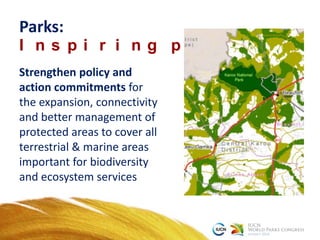
Parks:
I n s p i r i n g p l a c e s
Strengthen policy and
action commitments for
the expansion, connectivity
and better management of
protected areas to cover all
terrestrial & marine areas
important for biodiversity
and ecosystem services
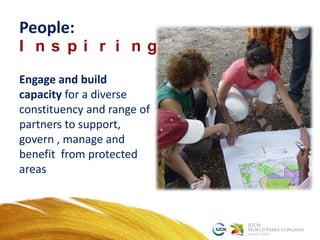
People:
I n s p i r i n g i d e a s
Engage and build
capacity for a diverse
constituency and range of
partners to support,
govern , manage and
benefit from protected
areas
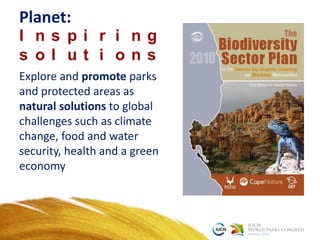
Planet:
I n s p i r i n g
s o l u t i o n s
Explore and promote parks
and protected areas as
natural solutions to global
challenges such as climate
change, food and water
security, health and a green
economy
• Aichi Targets reached
• Solutions implemented
• Capacity developed
• Policy changes
• Legacy established
Measures of success
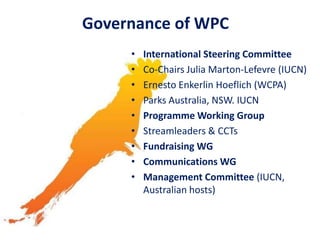
• International Steering Committee
• Co-Chairs Julia Marton-Lefevre (IUCN)
• Ernesto Enkerlin Hoeflich (WCPA)
• Parks Australia, NSW. IUCN
• Programme Working Group
• Streamleaders & CCTs
• Fundraising WG
• Communications WG
• Management Committee (IUCN,
Australian hosts)
Governance of WPC
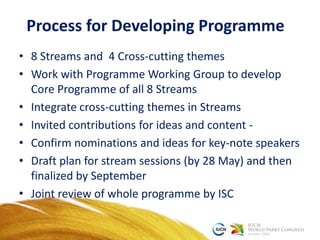
• 8 Streams and 4 Cross-cutting themes
• Work with Programme Working Group to develop
Core Programme of all 8 Streams
• Integrate cross-cutting themes in Streams
• Invited contributions for ideas and content -
• Confirm nominations and ideas for key-note speakers
• Draft plan for stream sessions (by 28 May) and then
finalized by September
• Joint review of whole programme by ISC
Process for Developing Programme
Stream 1 Conservation Goals
Representation and
numerical targets
Connectivity
Areas of importance
For Biodiversity
Effective Management
Beyond Aichi Targets
What Nature Needs?
• Protected Planet –
progress on CBD T11
• Green List
• Global Discussion of
Wildlife Trade & PAs
• Predicting
Biodiversity Outcomes
• Improving PAs as tool
to stem BD loss
• Marine targets
Stream 2 Climate Change
•Demonstrate how PAs help people &
ecosystems respond to CC.
• Explore new knowledge, BP and
tools for adaptation and decision
making
• Engage cultures, communities, and
cities that rely on natural environ-
ments for food, resources & services.
• Develop and share effective CC
communication techniques.
• Contribute to vision for an integrated
network of PA systems
• Sectors: Sessions highlight
water, conservation,
governance, local and
indigenous communities,
finance, species and
ecosystem vulnerability,
science, management,
communication, and
adaptation.
• Best Practices Guidelines
• Social media campaign
Stream3: Improving Health and Well-
being, Healthy Parks, Healthy People
•Promoting the Health of
People, Species & the Planet
•Science and Traditional
Knowledge
• Inspiring practical solutions
•Sectoral engagement: health,
insurance
•Healthy Ecosystems: invasive
alien species
•Global and regional policy
• Engagement: Health
Sector, Youth,
Thought Leaders
• Pop-‐up park
• Legacy goals (science,
practice, policy)
• BP Guidelines
• HPHP congress USA
July 2015
• Input to SDGs 2015
Stream 4: Supporting Human Life
•Food security, nutrition and
Genetic resources
• Water and watersheds
• Disaster risk reduction
• Socio-‐economic and
Ecosystem services of PAs for
Sustainable development
• Documentation, case
studies, guidelines,
capacity materials
• Develop global,
regional, and country
projects to implement
• Food security, Water
DRR in policies, plans
& management of PA
systems
• Messages to
international policy
fora: Hyogo, SDGs
• .
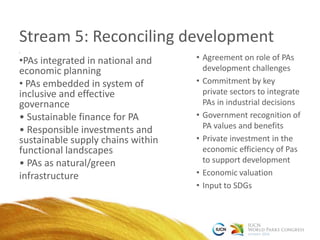
Stream 5: Reconciling development
g
•PAs integrated in national and
economic planning
• PAs embedded in system of
inclusive and effective
governance
• Sustainable finance for PA
• Responsible investments and
sustainable supply chains within
functional landscapes
• PAs as natural/green
infrastructure
• Agreement on role of PAs
development challenges
• Commitment by key
private sectors to integrate
PAs in industrial decisions
• Government recognition of
PA values and benefits
• Private investment in the
economic efficiency of Pas
to support development
• Economic valuation
• Input to SDGs
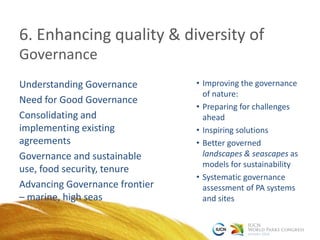
6. Enhancing quality & diversity of
Understanding Governance
Need for Good Governance
Consolidating and
implementing existing
agreements
Governance and sustainable
use, food security, tenure
Advancing Governance frontier
– marine, high seas
• Improving the governance
of nature:
• Preparing for challenges
ahead
• Inspiring solutions
• Better governed
landscapes & seascapes as
models for sustainability
• Systematic governance
assessment of PA systems
and sites
Governance
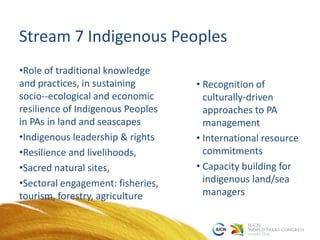
Stream 7 Indigenous Peoples
•Role of traditional knowledge
and practices, in sustaining
socio-‐ecological and economic
resilience of Indigenous Peoples
in PAs in land and seascapes
•Indigenous leadership & rights
•Resilience and livelihoods,
•Sacred natural sites,
•Sectoral engagement: fisheries,
tourism, forestry, agriculture
• Recognition of
culturally-driven
approaches to PA
management
• International resource
commitments
• Capacity building for
indigenous land/sea
managers
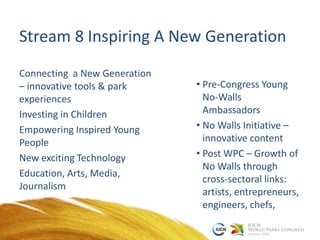
Stream 8 Inspiring A New Generation
Connecting a New Generation
– innovative tools & park
experiences
Investing in Children
Empowering Inspired Young
People
New exciting Technology
Education, Arts, Media,
Journalism
• Pre-Congress Young
No-Walls
Ambassadors
• No Walls Initiative –
innovative content
• Post WPC – Growth of
No Walls through
cross-sectoral links:
artists, entrepreneurs,
engineers, chefs,
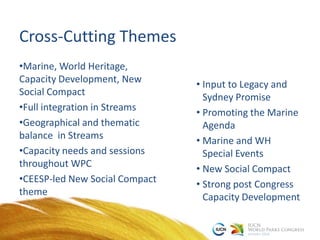
Cross-Cutting Themes
•Marine, World Heritage,
Capacity Development, New
Social Compact
•Full integration in Streams
•Geographical and thematic
balance in Streams
•Capacity needs and sessions
throughout WPC
•CEESP-led New Social Compact
theme
• Input to Legacy and
Sydney Promise
• Promoting the Marine
Agenda
• Marine and WH
Special Events
• New Social Compact
• Strong post Congress
Capacity Development
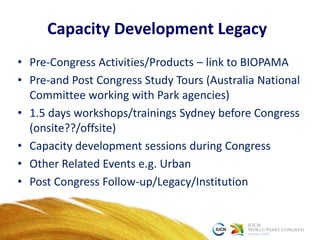
Capacity Development Legacy
• Pre-Congress Activities/Products – link to BIOPAMA
• Pre-and Post Congress Study Tours (Australia National
Committee working with Park agencies)
• 1.5 days workshops/trainings Sydney before Congress
(onsite??/offsite)
• Capacity development sessions during Congress
• Other Related Events e.g. Urban
• Post Congress Follow-up/Legacy/Institution
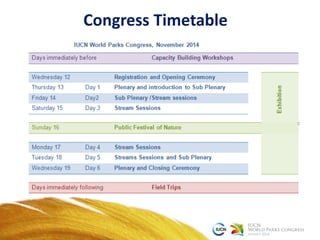
Congress Timetable
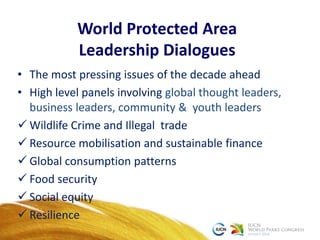
World Protected Area
Leadership Dialogues
• The most pressing issues of the decade ahead
• High level panels involving global thought leaders,
business leaders, community & youth leaders
 Wildlife Crime and Illegal trade
 Resource mobilisation and sustainable finance
 Global consumption patterns
 Food security
 Social equity
 Resilience
• Key messages from big international events into
Plenary e.g. IMPAC3
• Side events – closing date 12 May
• Side event spaces onsite – lunchtime, evening
• E- Posters
• Pavilions, Country Stands
• Parallel Events offsite
• Sponsor Participants
• Process for compilation of the elements of the
Sydney Promise (input from other international
events e.g. Europarc, APC, Pacific Conference)
Other Opportunities to Engage
The Promise of Sydney
•Transformative solutions at the level of policy,
•Engagement & PA practice for parks, people & planet
•A web-based resource of case studies embedded in
communities of practice
• A capacity-development plan of action that supports
professionalism for protected areas “managers”
• Principles for a New Social Compact for just and
equitable conservation;
• Leadership initiatives, pledges and announcements for
implementation.
Process to develop Promise
• A template for Streams to capture an ambitious
strategy for transformative action, stating a vision and
recommending an approach for the decade
• Prepared in advance and provided to participants
• A source of issues for debate and discussion
• An opportunity to propose new elements during
• workshops
• Compiled as a result of discussions and finalised at
the stream level and theme level
• Fed into sub-plenary discussions on the last day
• Presented in summary form in closing plenary
• First Call for Content – closed March 15
• Streamleaders developing content – integrating CCTs:
see www.worldparkscongress.org
• Communications key messages and communication
strategy developed – see GPAP newsletter
• Fundraising prospects and Stream needs e.g. Success
with GEF, MacArthur, Rockefeller
• Logistics and planning together with the Congress
Preparation Team
Current activities
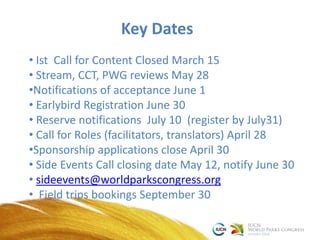
Key Dates
• Ist Call for Content Closed March 15
• Stream, CCT, PWG reviews May 28
•Notifications of acceptance June 1
• Earlybird Registration June 30
• Reserve notifications July 10 (register by July31)
• Call for Roles (facilitators, translators) April 28
•Sponsorship applications close April 30
• Side Events Call closing date May 12, notify June 30
• sideevents@worldparkscongress.org
• Field trips bookings September 30
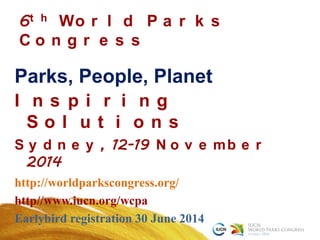
Parks, People, Planet
I n s p i r i n g
S o l u t i o n s
S y d n e y , 12-19 N o v e mb e r
2014
http://worldparkscongress.org/
http//www.iucn.org/wcpa
Earlybird registration 30 June 2014
6t h Wo r l d P a r k s
C o n g r e s s

2014 World Parks Congress information

  • 1.
    Parks, people, planet In s p i r i n g s o l u t i o n s 12-19 N o v e mb e r , 2014
  • 2.
    • Position protectedareas within goals of economic and community wellbeing • Achieve understanding of their vital role in conserving biodiversity while delivering ecosystem services • Demonstrate how this can be achieved. B r i d g i n g t h e g a p i n i mp l e me n t a t i o n
  • 3.
    • Communicate themost compelling and inspiring solutions to global challenges • Position protected areas in the post-2015 sustainable development agenda • Reach new commitments and capacity across conservation, development and business sectors for implementation A c h i e v i n g s i g n i f i c a n t o u t c o me s a n d l e g a c y
  • 4.
    Parks: I n sp i r i n g p l a c e s Strengthen policy and action commitments for the expansion, connectivity and better management of protected areas to cover all terrestrial & marine areas important for biodiversity and ecosystem services
  • 5.
    People: I n sp i r i n g i d e a s Engage and build capacity for a diverse constituency and range of partners to support, govern , manage and benefit from protected areas
  • 6.
    Planet: I n sp i r i n g s o l u t i o n s Explore and promote parks and protected areas as natural solutions to global challenges such as climate change, food and water security, health and a green economy
  • 7.
    • Aichi Targetsreached • Solutions implemented • Capacity developed • Policy changes • Legacy established Measures of success
  • 9.
    • International SteeringCommittee • Co-Chairs Julia Marton-Lefevre (IUCN) • Ernesto Enkerlin Hoeflich (WCPA) • Parks Australia, NSW. IUCN • Programme Working Group • Streamleaders & CCTs • Fundraising WG • Communications WG • Management Committee (IUCN, Australian hosts) Governance of WPC
  • 11.
    • 8 Streamsand 4 Cross-cutting themes • Work with Programme Working Group to develop Core Programme of all 8 Streams • Integrate cross-cutting themes in Streams • Invited contributions for ideas and content - • Confirm nominations and ideas for key-note speakers • Draft plan for stream sessions (by 28 May) and then finalized by September • Joint review of whole programme by ISC Process for Developing Programme
  • 12.
    Stream 1 ConservationGoals Representation and numerical targets Connectivity Areas of importance For Biodiversity Effective Management Beyond Aichi Targets What Nature Needs? • Protected Planet – progress on CBD T11 • Green List • Global Discussion of Wildlife Trade & PAs • Predicting Biodiversity Outcomes • Improving PAs as tool to stem BD loss • Marine targets
  • 13.
    Stream 2 ClimateChange •Demonstrate how PAs help people & ecosystems respond to CC. • Explore new knowledge, BP and tools for adaptation and decision making • Engage cultures, communities, and cities that rely on natural environ- ments for food, resources & services. • Develop and share effective CC communication techniques. • Contribute to vision for an integrated network of PA systems • Sectors: Sessions highlight water, conservation, governance, local and indigenous communities, finance, species and ecosystem vulnerability, science, management, communication, and adaptation. • Best Practices Guidelines • Social media campaign
  • 14.
    Stream3: Improving Healthand Well- being, Healthy Parks, Healthy People •Promoting the Health of People, Species & the Planet •Science and Traditional Knowledge • Inspiring practical solutions •Sectoral engagement: health, insurance •Healthy Ecosystems: invasive alien species •Global and regional policy • Engagement: Health Sector, Youth, Thought Leaders • Pop-‐up park • Legacy goals (science, practice, policy) • BP Guidelines • HPHP congress USA July 2015 • Input to SDGs 2015
  • 15.
    Stream 4: SupportingHuman Life •Food security, nutrition and Genetic resources • Water and watersheds • Disaster risk reduction • Socio-‐economic and Ecosystem services of PAs for Sustainable development • Documentation, case studies, guidelines, capacity materials • Develop global, regional, and country projects to implement • Food security, Water DRR in policies, plans & management of PA systems • Messages to international policy fora: Hyogo, SDGs • .
  • 16.
    Stream 5: Reconcilingdevelopment g •PAs integrated in national and economic planning • PAs embedded in system of inclusive and effective governance • Sustainable finance for PA • Responsible investments and sustainable supply chains within functional landscapes • PAs as natural/green infrastructure • Agreement on role of PAs development challenges • Commitment by key private sectors to integrate PAs in industrial decisions • Government recognition of PA values and benefits • Private investment in the economic efficiency of Pas to support development • Economic valuation • Input to SDGs
  • 17.
    6. Enhancing quality& diversity of Understanding Governance Need for Good Governance Consolidating and implementing existing agreements Governance and sustainable use, food security, tenure Advancing Governance frontier – marine, high seas • Improving the governance of nature: • Preparing for challenges ahead • Inspiring solutions • Better governed landscapes & seascapes as models for sustainability • Systematic governance assessment of PA systems and sites Governance
  • 18.
    Stream 7 IndigenousPeoples •Role of traditional knowledge and practices, in sustaining socio-‐ecological and economic resilience of Indigenous Peoples in PAs in land and seascapes •Indigenous leadership & rights •Resilience and livelihoods, •Sacred natural sites, •Sectoral engagement: fisheries, tourism, forestry, agriculture • Recognition of culturally-driven approaches to PA management • International resource commitments • Capacity building for indigenous land/sea managers
  • 19.
    Stream 8 InspiringA New Generation Connecting a New Generation – innovative tools & park experiences Investing in Children Empowering Inspired Young People New exciting Technology Education, Arts, Media, Journalism • Pre-Congress Young No-Walls Ambassadors • No Walls Initiative – innovative content • Post WPC – Growth of No Walls through cross-sectoral links: artists, entrepreneurs, engineers, chefs,
  • 20.
    Cross-Cutting Themes •Marine, WorldHeritage, Capacity Development, New Social Compact •Full integration in Streams •Geographical and thematic balance in Streams •Capacity needs and sessions throughout WPC •CEESP-led New Social Compact theme • Input to Legacy and Sydney Promise • Promoting the Marine Agenda • Marine and WH Special Events • New Social Compact • Strong post Congress Capacity Development
  • 21.
    Capacity Development Legacy •Pre-Congress Activities/Products – link to BIOPAMA • Pre-and Post Congress Study Tours (Australia National Committee working with Park agencies) • 1.5 days workshops/trainings Sydney before Congress (onsite??/offsite) • Capacity development sessions during Congress • Other Related Events e.g. Urban • Post Congress Follow-up/Legacy/Institution
  • 22.
  • 23.
    World Protected Area LeadershipDialogues • The most pressing issues of the decade ahead • High level panels involving global thought leaders, business leaders, community & youth leaders  Wildlife Crime and Illegal trade  Resource mobilisation and sustainable finance  Global consumption patterns  Food security  Social equity  Resilience
  • 24.
    • Key messagesfrom big international events into Plenary e.g. IMPAC3 • Side events – closing date 12 May • Side event spaces onsite – lunchtime, evening • E- Posters • Pavilions, Country Stands • Parallel Events offsite • Sponsor Participants • Process for compilation of the elements of the Sydney Promise (input from other international events e.g. Europarc, APC, Pacific Conference) Other Opportunities to Engage
  • 25.
    The Promise ofSydney •Transformative solutions at the level of policy, •Engagement & PA practice for parks, people & planet •A web-based resource of case studies embedded in communities of practice • A capacity-development plan of action that supports professionalism for protected areas “managers” • Principles for a New Social Compact for just and equitable conservation; • Leadership initiatives, pledges and announcements for implementation.
  • 26.
    Process to developPromise • A template for Streams to capture an ambitious strategy for transformative action, stating a vision and recommending an approach for the decade • Prepared in advance and provided to participants • A source of issues for debate and discussion • An opportunity to propose new elements during • workshops • Compiled as a result of discussions and finalised at the stream level and theme level • Fed into sub-plenary discussions on the last day • Presented in summary form in closing plenary
  • 27.
    • First Callfor Content – closed March 15 • Streamleaders developing content – integrating CCTs: see www.worldparkscongress.org • Communications key messages and communication strategy developed – see GPAP newsletter • Fundraising prospects and Stream needs e.g. Success with GEF, MacArthur, Rockefeller • Logistics and planning together with the Congress Preparation Team Current activities
  • 28.
    Key Dates • IstCall for Content Closed March 15 • Stream, CCT, PWG reviews May 28 •Notifications of acceptance June 1 • Earlybird Registration June 30 • Reserve notifications July 10 (register by July31) • Call for Roles (facilitators, translators) April 28 •Sponsorship applications close April 30 • Side Events Call closing date May 12, notify June 30 • sideevents@worldparkscongress.org • Field trips bookings September 30
  • 29.
    Parks, People, Planet In s p i r i n g S o l u t i o n s S y d n e y , 12-19 N o v e mb e r 2014 http://worldparkscongress.org/ http//www.iucn.org/wcpa Earlybird registration 30 June 2014 6t h Wo r l d P a r k s C o n g r e s s