Week 14
•  1. Influence of technology on development
of popular music in the 20th century.
•  2. Late 60s early 70s progressive rock –
‘The Dark Side’.
•  3. Case Study – The Velvet Underground.
•  4. The Punk Phenomena – 1976-79.
Technology and the creation of
subcultures
The advance of technology within music in the 20th
century has had a liberating effect – broadening
creative and listening opportunities to a mass
audience.
At the same time it has reduced the sense of any
mainstream in music – classical, popular or folk –
in which we all participate.
We can all remain within our chosen musical
subculture(s) and remain closed to everything
else. We live in a musical postmodernism where
every thing is relative and value judgements are
difficult to make.
Issues
•  Raises economic issues – technology gets
cheaper and easier to use - so new
refinements and complexities are needed to
keep selling the products.
•  Raises creative issues – people using it use
it less and less creatively – so much is
possible we use it to do only the simplest
things
Nineteenth Century Mainstream
•  Idea that before the onset of the 20th century and
the development mass culture there was more of a
sense of a mainstream style.
•  European art music – general consensus on style –
led in the 19th century by Germans – Beethoven,
Brahms to Wagner, Bruckner, etc.
•  Popular music also had a general uniformity of
style – Waltzes and other dance music,
nationalistic music, Music Hall traditions etc.
•  Technology of music widespread and fairly
uniform. Based on playing instruments live.
20th century fragmentation
•  Music technology in 20th century both develops a
mass industry and a mass market – but also
separates and allows sub-genres and subcultures
that detract from the mainstream.
•  Today the mass music industry allows us to follow
and consume only the sort of music we like – Rap,
Classical, Medieval, Thrash Metal, etc.
•  There is no mainstream – but a mosaic of
subcultures in music – of which arguably all
classical music is but one.
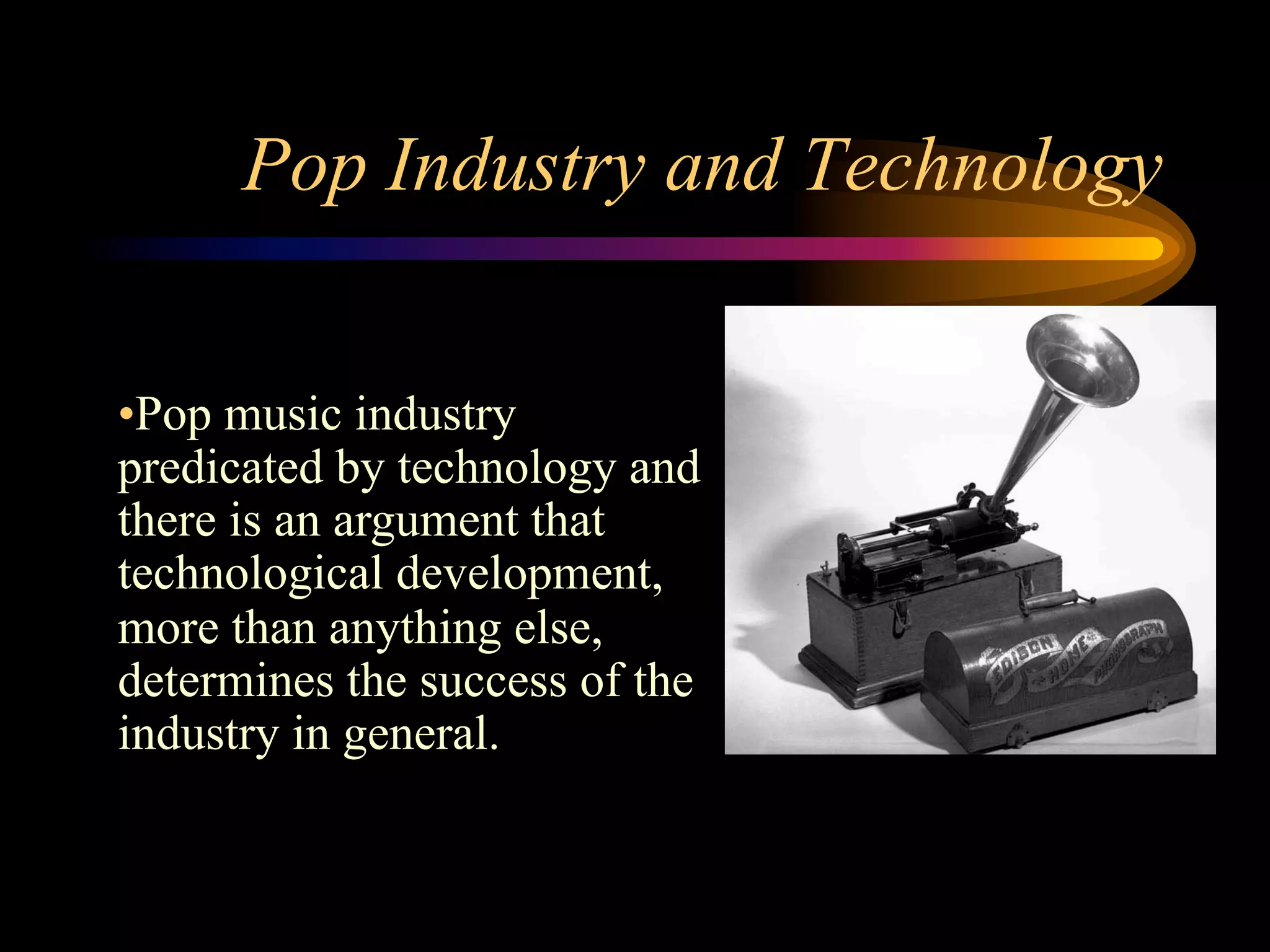
Pop Industry and Technology
• Pop music industry
predicated by technology and
there is an argument that
technological development,
more than anything else,
determines the success of the
industry in general.
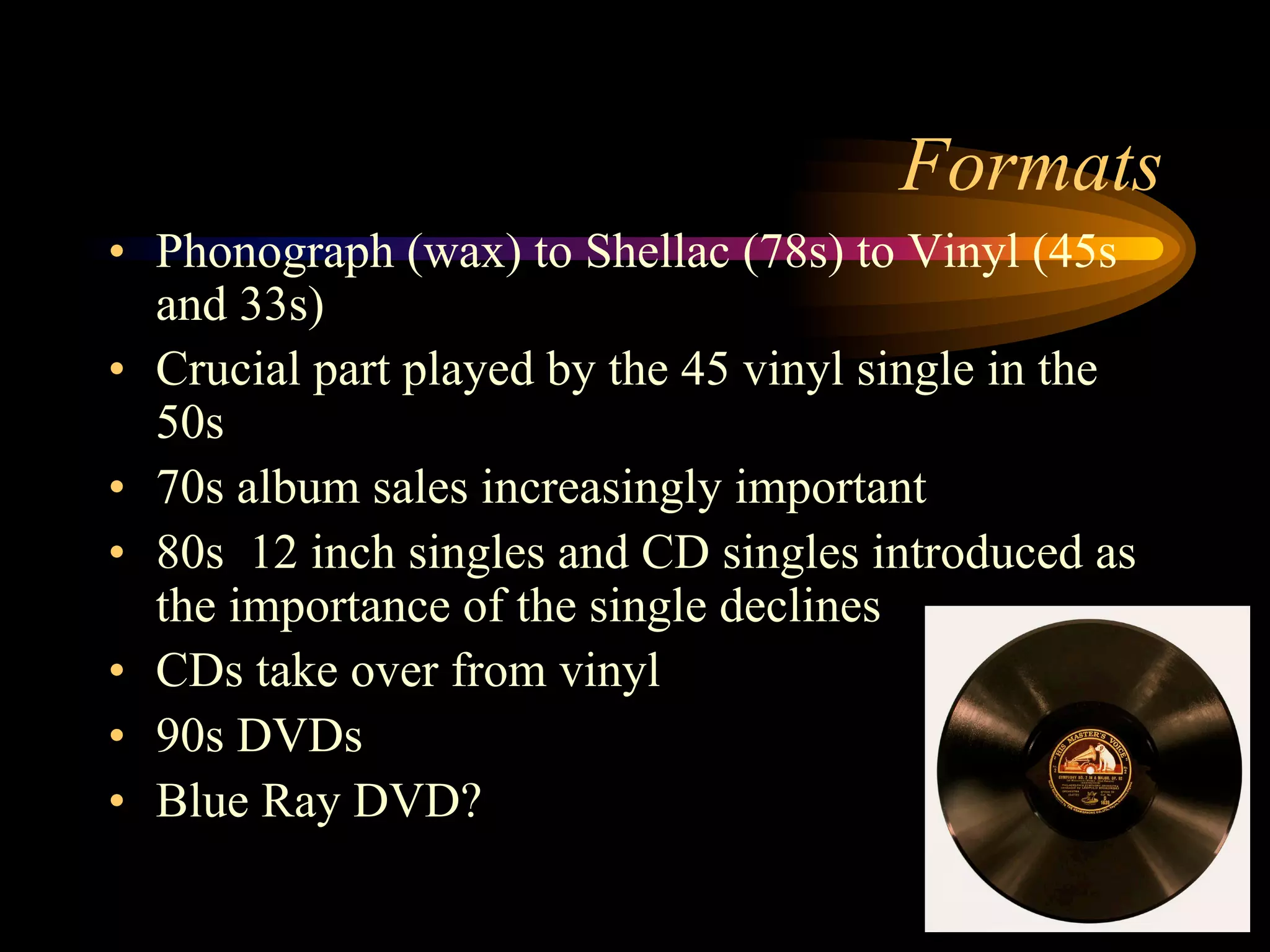
•  Phonograph (wax) to Shellac (78s) to Vinyl (45s
and 33s)
•  Crucial part played by the 45 vinyl single in the
50s
•  70s album sales increasingly important
•  80s 12 inch singles and CD singles introduced as
the importance of the single declines
•  CDs take over from vinyl
•  90s DVDs
•  Blue Ray DVD?
Formats
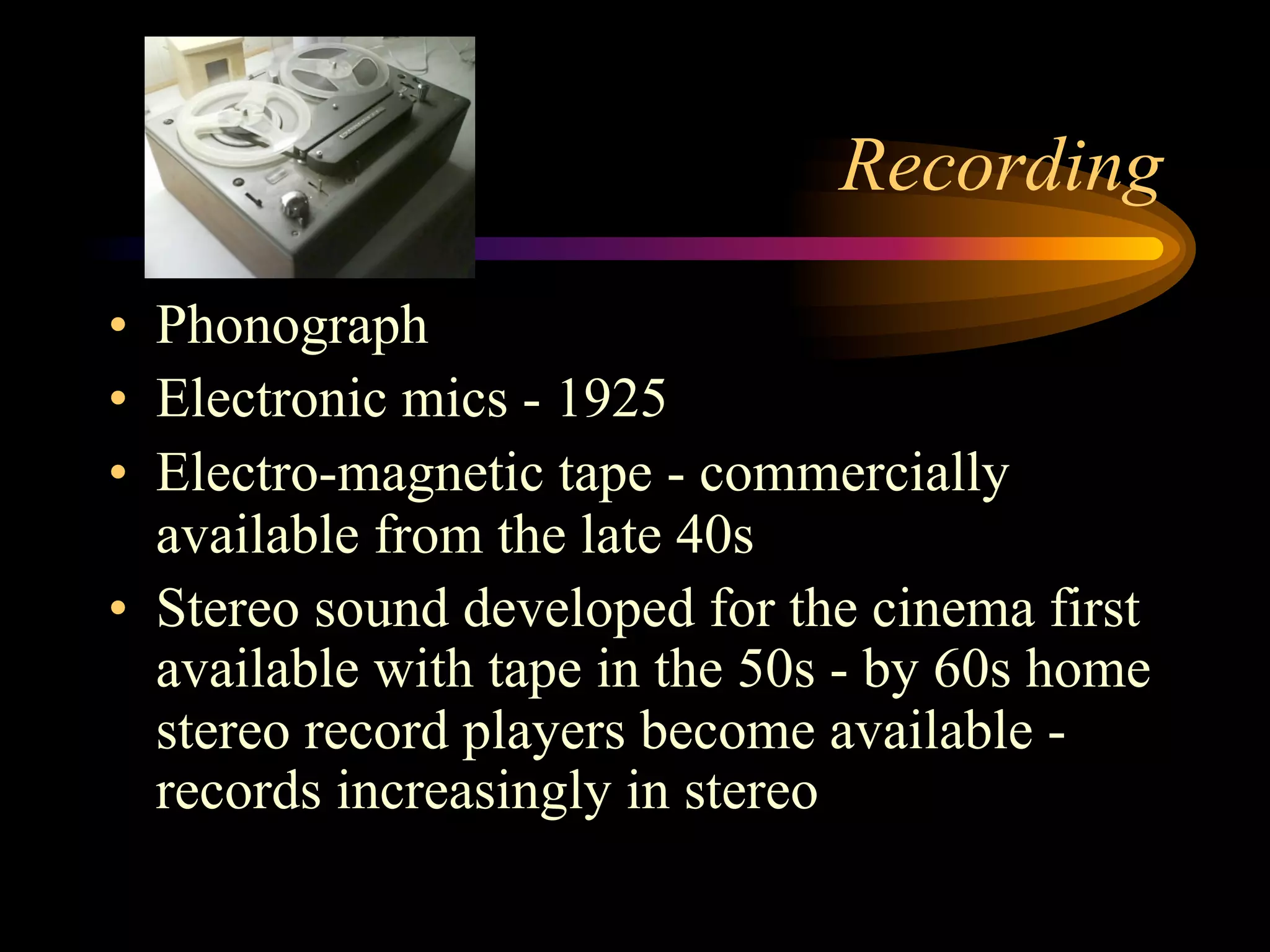
Recording
•  Phonograph
•  Electronic mics - 1925
•  Electro-magnetic tape - commercially
available from the late 40s
•  Stereo sound developed for the cinema first
available with tape in the 50s - by 60s home
stereo record players become available -
records increasingly in stereo
Cassettes and CDs
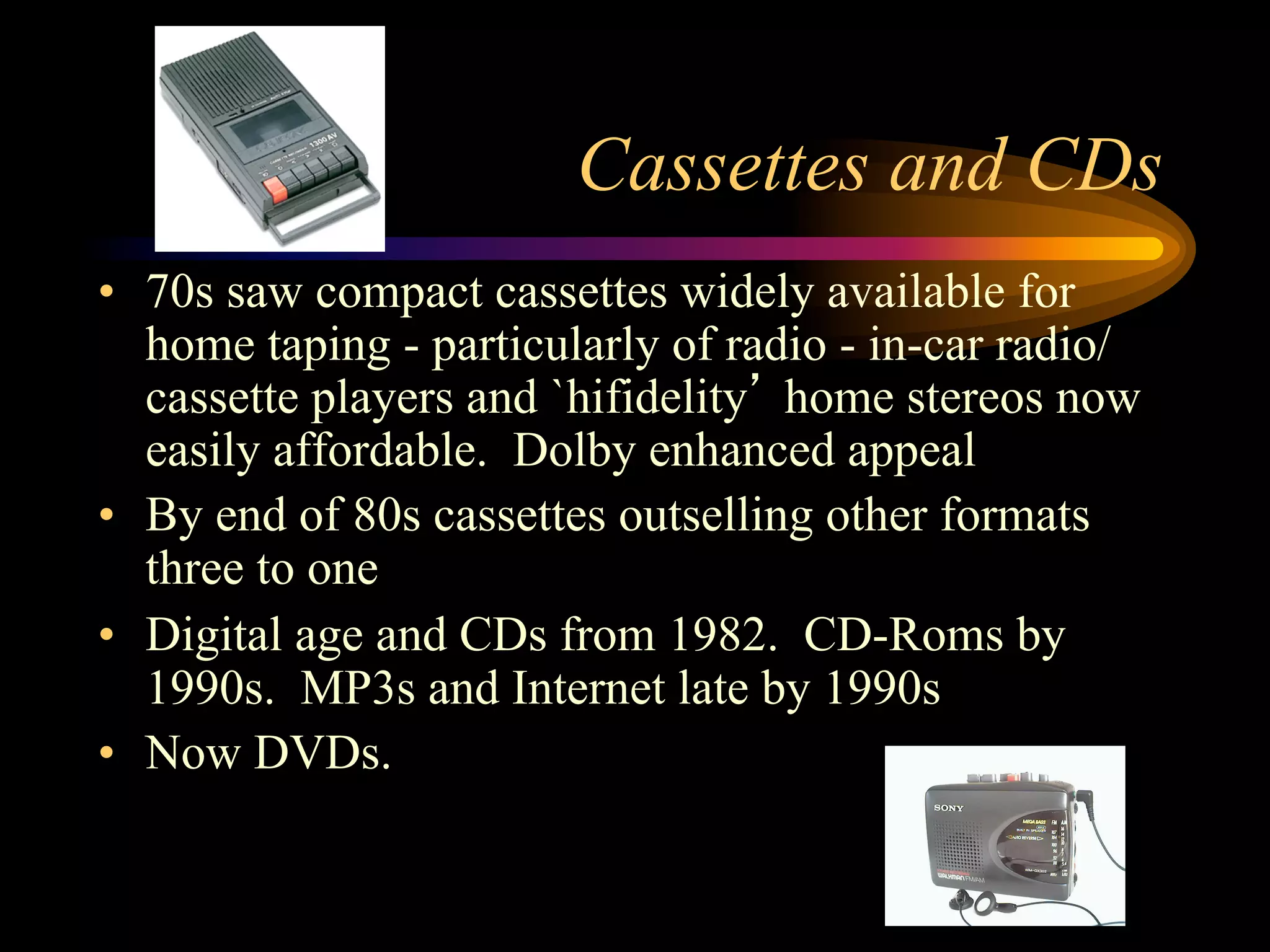
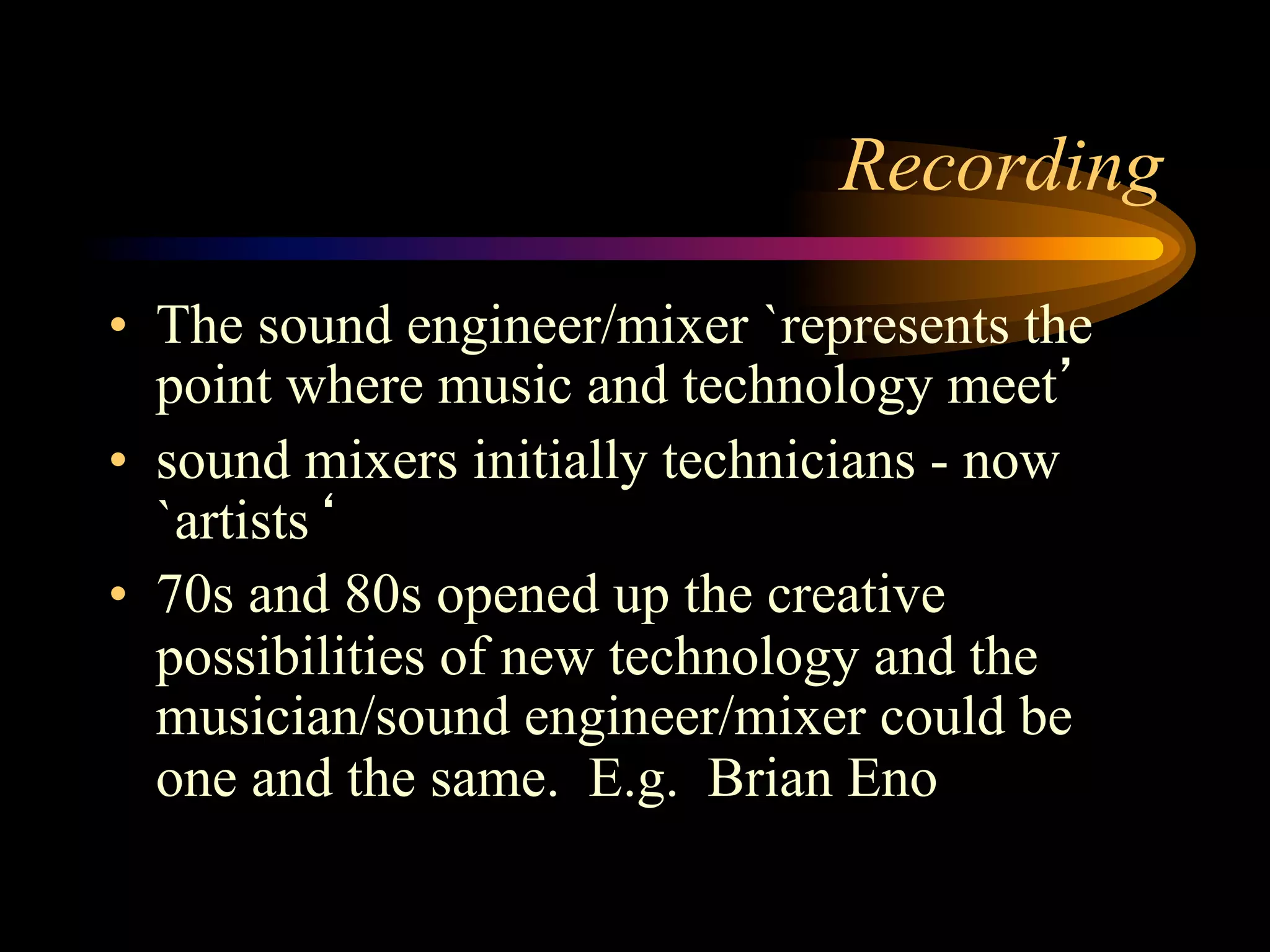
•  70s saw compact cassettes widely available for
home taping - particularly of radio - in-car radio/
cassette players and `hifidelity’ home stereos now
easily affordable. Dolby enhanced appeal
•  By end of 80s cassettes outselling other formats
three to one
•  Digital age and CDs from 1982. CD-Roms by
1990s. MP3s and Internet late by 1990s
•  Now DVDs.
Recording
•  The sound engineer/mixer `represents the
point where music and technology meet’
•  sound mixers initially technicians - now
`artists‘
•  70s and 80s opened up the creative
possibilities of new technology and the
musician/sound engineer/mixer could be
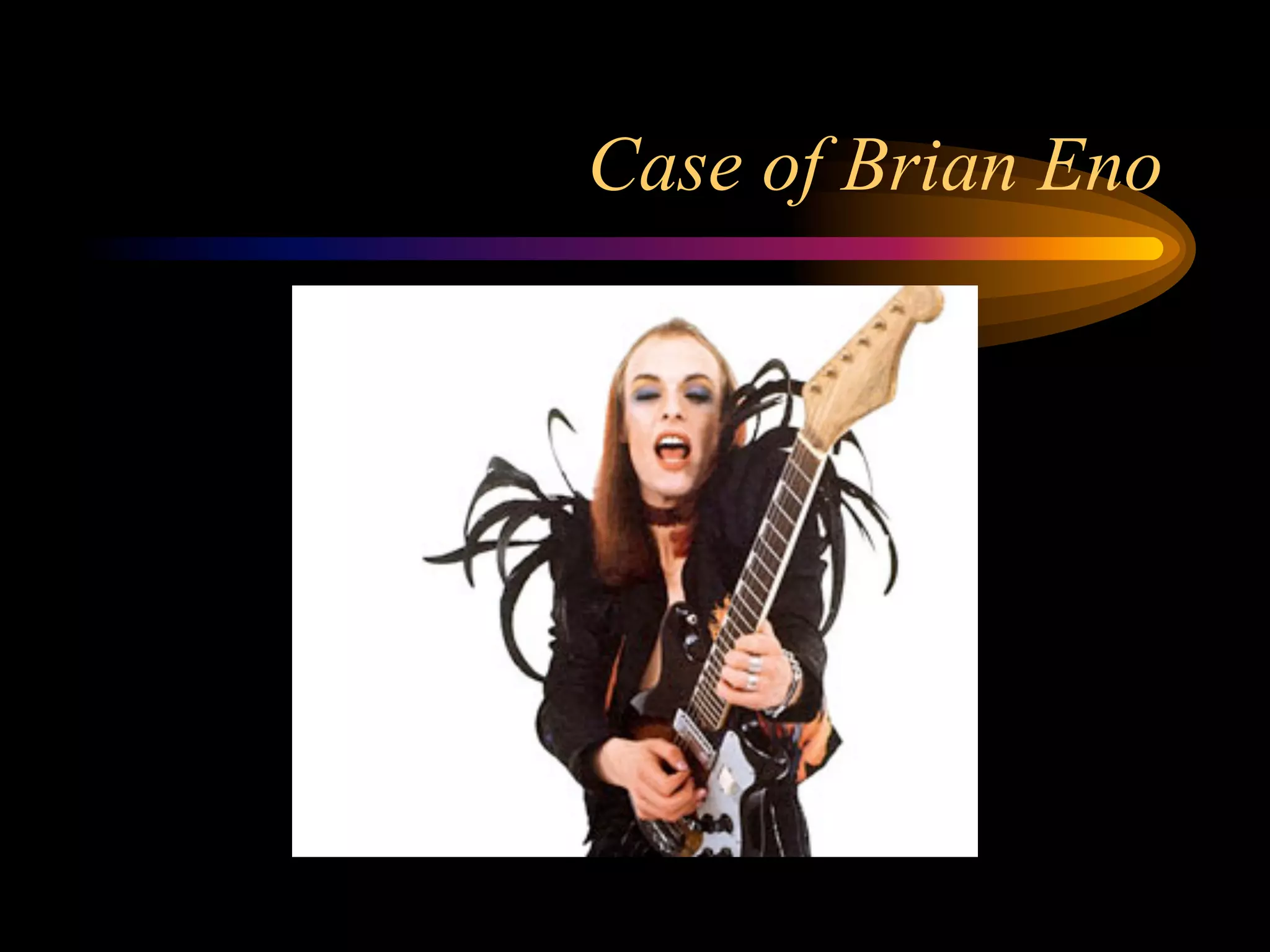
one and the same. E.g. Brian Eno
Case of Brian Eno
Consumer Playback
•  Gramophone, Radio, Reel to reel, Stereo
hifi, in-car sound systems, compact cassette
and radio, walkman, Ghetto-blaster (boom
boxes), CD players, portable digital
recorders, mini-disc players, home
computers - all have influenced the music
industry in various ways. Their sales an
important part of the overall industry. Sony
a company with interests in all areas.
Multitracking
•  Les Paul and the 2-track recording. Tape
Delay. Close mic-ing
•  Late 50s slapback delay - Sam Philips
•  Over-dubs - e.g.- Good Vibrations
•  2-track to 8-track - Sergeant Pepper and Pet
Sounds
•  32-tracks and more
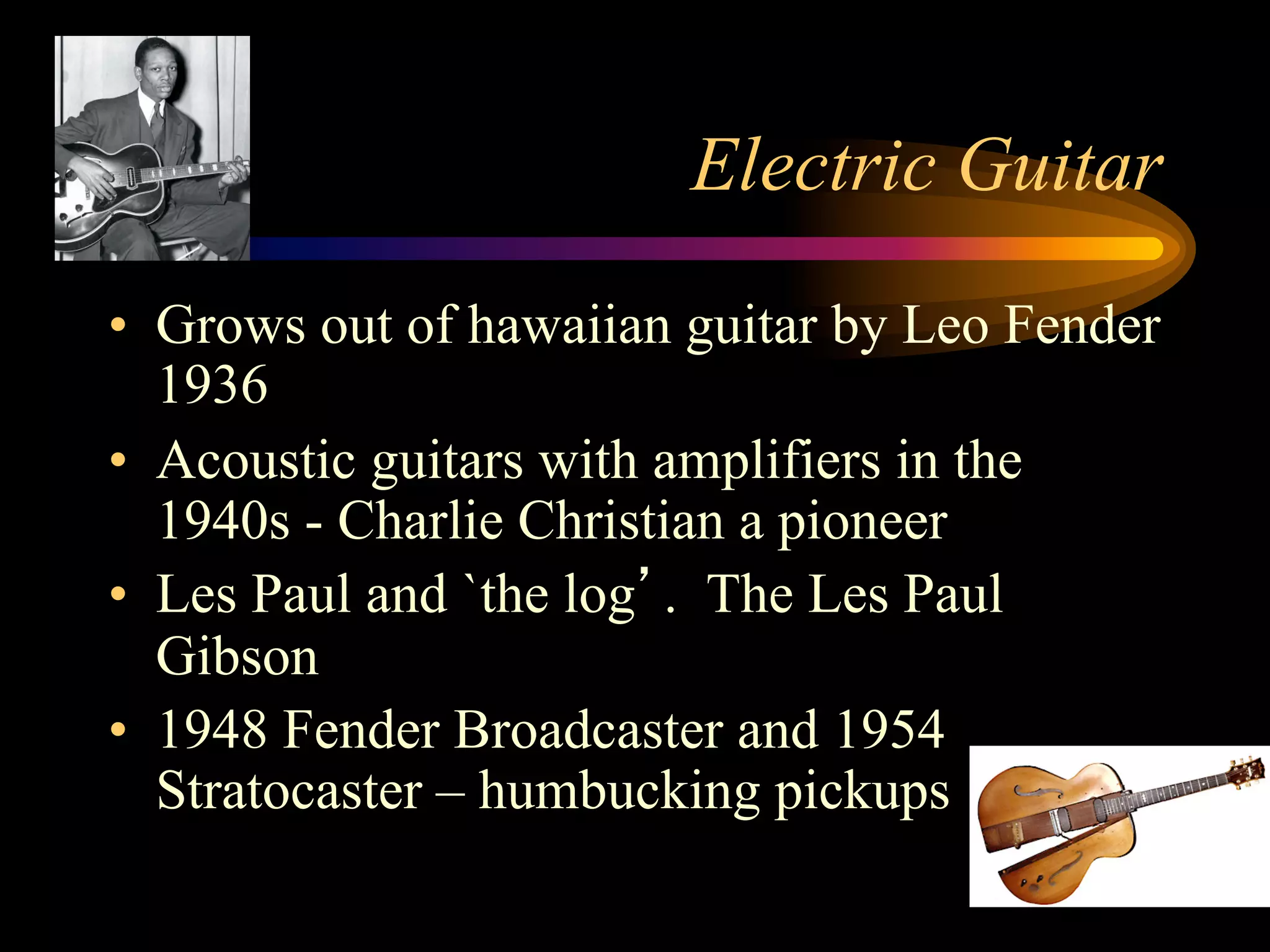
Electric Guitar
•  Grows out of hawaiian guitar by Leo Fender
1936
•  Acoustic guitars with amplifiers in the
1940s - Charlie Christian a pioneer
•  Les Paul and `the log’. The Les Paul
Gibson
•  1948 Fender Broadcaster and 1954
Stratocaster – humbucking pickups
Synths
•  Analogue (subtractive) synths from the
mid-50s
•  Commercially available from late 60s -
Here Comes the Sun - switched on Bach
(Moog IIIc)
•  1970s affordable but still monophonic
•  Kraftwerk
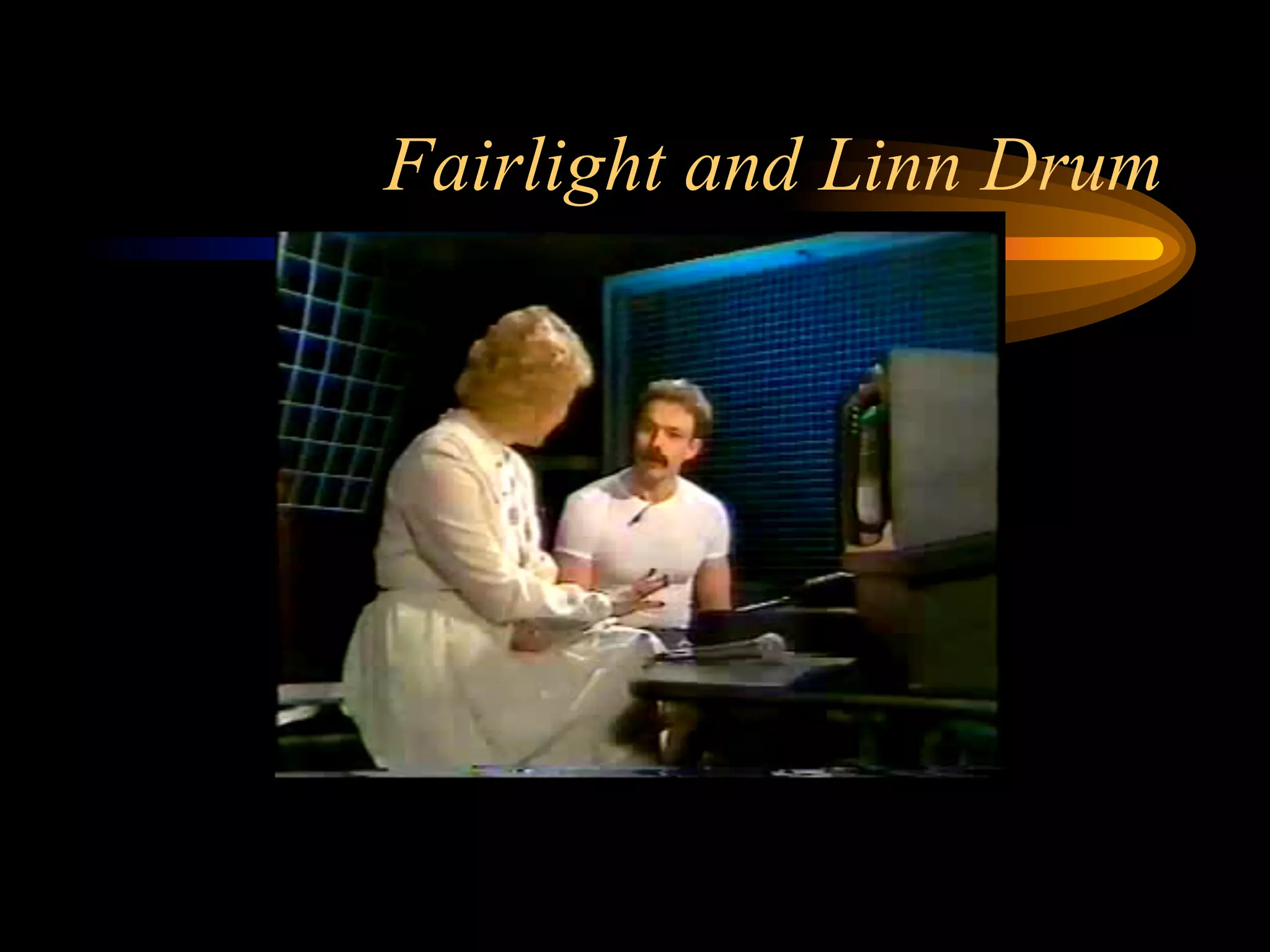
Fairlight and Linn Drum
Polyphonic Synths
•  Opened up many new possibilities
•  Kraftwerk (Autobahm first all-pop hit)
•  Other forms of synths mid 80s
•  then - MIDI - digital revolution
•  90s manufacturers trying to use digital
technology to emulate classic early synths
Sampling
•  The Australian produced the Fairlight – cost
around £50,000 but could do it all and was an
instrument that could be played
•  Buggles - Video killed the radio star 1979 -
Trevor Horn/Art of Noise
•  Sampler allowed non-instrument sounds to be
used musically - Kate Bush - Baboushka.
•  Sampling could do away with live musicians
Buggles 1979 – First MTV video
in America
Sequencing and more
•  Sequencing, sampling and multi-tracking
together on Michael Jackson’s Thriller
(1984)
•  All digital recording (DDD) Dire Straits
Brothers in Arms 1985
•  Cut and Paste audio/sampling, Fatboy
Slim’s Praise and Paul Hardcastle’s
Nineteen
Economics of Technology
•  It gets cheaper. Early Moogs £10,000 now
equivalent technology £200.
•  Early 60s multi-tracks could only be done
by pro studios – now all digital 8-track costs
around £400 with effects. Its possible to
have all the technology to do a Sergeant
Pepper for less than £1000.
Musical Marxism
•  Means of production in the hands of the
people - but now they seldom have the skills
to use it!
•  Previous generations would have filtered
out poor musicians/singers and amateur
music who would never have got to the
public - now they can and do all the time.
Talent?
•  Anyone can make a CD-quality 16-bit digital
recording - there is no talent filter but the listeners
ear. Also technology can correct anything!
Quantising and Vocoder.
•  Musicians/singers do not need to be trained - is
this good or bad?
•  Live element of performance ever diminishing.
Especially since 1980s. Miming to recorded
tracks increasingly the norm in pop industry.
New ways of making music
•  Using technology’s strengths to inspire new
developments
•  Machine-like timbre of analogue synths developed
into experimental pop that was deliberated
mechanical – e.g. Tangerine Dream
•  Software sequencers encouraged copying chunks
of music - repetitive dance music where special
effects had to maintain the interest - filters, etc
Subcultures
•  From a high in the 1960s the pop music
sales and progressively reduced – there is
no real mainstream pop culture as there was
in the 1960s.
•  Music is a global industry that is in crisis –
how to get people to pay for their music
when it is possible to get free off the
internet.
Subcultures
•  In the post modern age – everything is
relative and value judgments are not PC.
•  We consume music in a very narrow range
– each compartmentalised subcultures
knows and cares little about each other.
•  This was not the case in the 1960s – and
even less the case in the 1860s.

2014 rise of technology

  • 1.
    Week 14 •  1.Influence of technology on development of popular music in the 20th century. •  2. Late 60s early 70s progressive rock – ‘The Dark Side’. •  3. Case Study – The Velvet Underground. •  4. The Punk Phenomena – 1976-79.
  • 2.
    Technology and thecreation of subcultures The advance of technology within music in the 20th century has had a liberating effect – broadening creative and listening opportunities to a mass audience. At the same time it has reduced the sense of any mainstream in music – classical, popular or folk – in which we all participate. We can all remain within our chosen musical subculture(s) and remain closed to everything else. We live in a musical postmodernism where every thing is relative and value judgements are difficult to make.
  • 3.
    Issues •  Raises economicissues – technology gets cheaper and easier to use - so new refinements and complexities are needed to keep selling the products. •  Raises creative issues – people using it use it less and less creatively – so much is possible we use it to do only the simplest things
  • 4.
    Nineteenth Century Mainstream • Idea that before the onset of the 20th century and the development mass culture there was more of a sense of a mainstream style. •  European art music – general consensus on style – led in the 19th century by Germans – Beethoven, Brahms to Wagner, Bruckner, etc. •  Popular music also had a general uniformity of style – Waltzes and other dance music, nationalistic music, Music Hall traditions etc. •  Technology of music widespread and fairly uniform. Based on playing instruments live.
  • 5.
    20th century fragmentation • Music technology in 20th century both develops a mass industry and a mass market – but also separates and allows sub-genres and subcultures that detract from the mainstream. •  Today the mass music industry allows us to follow and consume only the sort of music we like – Rap, Classical, Medieval, Thrash Metal, etc. •  There is no mainstream – but a mosaic of subcultures in music – of which arguably all classical music is but one.
  • 6.
    Pop Industry andTechnology • Pop music industry predicated by technology and there is an argument that technological development, more than anything else, determines the success of the industry in general.
  • 7.
    •  Phonograph (wax)to Shellac (78s) to Vinyl (45s and 33s) •  Crucial part played by the 45 vinyl single in the 50s •  70s album sales increasingly important •  80s 12 inch singles and CD singles introduced as the importance of the single declines •  CDs take over from vinyl •  90s DVDs •  Blue Ray DVD? Formats
  • 8.
    Recording •  Phonograph •  Electronicmics - 1925 •  Electro-magnetic tape - commercially available from the late 40s •  Stereo sound developed for the cinema first available with tape in the 50s - by 60s home stereo record players become available - records increasingly in stereo
  • 9.
    Cassettes and CDs • 70s saw compact cassettes widely available for home taping - particularly of radio - in-car radio/ cassette players and `hifidelity’ home stereos now easily affordable. Dolby enhanced appeal •  By end of 80s cassettes outselling other formats three to one •  Digital age and CDs from 1982. CD-Roms by 1990s. MP3s and Internet late by 1990s •  Now DVDs.
  • 10.
    Recording •  The soundengineer/mixer `represents the point where music and technology meet’ •  sound mixers initially technicians - now `artists‘ •  70s and 80s opened up the creative possibilities of new technology and the musician/sound engineer/mixer could be one and the same. E.g. Brian Eno
  • 11.
  • 12.
    Consumer Playback •  Gramophone,Radio, Reel to reel, Stereo hifi, in-car sound systems, compact cassette and radio, walkman, Ghetto-blaster (boom boxes), CD players, portable digital recorders, mini-disc players, home computers - all have influenced the music industry in various ways. Their sales an important part of the overall industry. Sony a company with interests in all areas.
  • 13.
    Multitracking •  Les Pauland the 2-track recording. Tape Delay. Close mic-ing •  Late 50s slapback delay - Sam Philips •  Over-dubs - e.g.- Good Vibrations •  2-track to 8-track - Sergeant Pepper and Pet Sounds •  32-tracks and more
  • 14.
    Electric Guitar •  Growsout of hawaiian guitar by Leo Fender 1936 •  Acoustic guitars with amplifiers in the 1940s - Charlie Christian a pioneer •  Les Paul and `the log’. The Les Paul Gibson •  1948 Fender Broadcaster and 1954 Stratocaster – humbucking pickups
  • 15.
    Synths •  Analogue (subtractive)synths from the mid-50s •  Commercially available from late 60s - Here Comes the Sun - switched on Bach (Moog IIIc) •  1970s affordable but still monophonic •  Kraftwerk
  • 16.
  • 17.
    Polyphonic Synths •  Openedup many new possibilities •  Kraftwerk (Autobahm first all-pop hit) •  Other forms of synths mid 80s •  then - MIDI - digital revolution •  90s manufacturers trying to use digital technology to emulate classic early synths
  • 18.
    Sampling •  The Australianproduced the Fairlight – cost around £50,000 but could do it all and was an instrument that could be played •  Buggles - Video killed the radio star 1979 - Trevor Horn/Art of Noise •  Sampler allowed non-instrument sounds to be used musically - Kate Bush - Baboushka. •  Sampling could do away with live musicians
  • 19.
    Buggles 1979 –First MTV video in America
  • 20.
    Sequencing and more • Sequencing, sampling and multi-tracking together on Michael Jackson’s Thriller (1984) •  All digital recording (DDD) Dire Straits Brothers in Arms 1985 •  Cut and Paste audio/sampling, Fatboy Slim’s Praise and Paul Hardcastle’s Nineteen
  • 21.
    Economics of Technology • It gets cheaper. Early Moogs £10,000 now equivalent technology £200. •  Early 60s multi-tracks could only be done by pro studios – now all digital 8-track costs around £400 with effects. Its possible to have all the technology to do a Sergeant Pepper for less than £1000.
  • 22.
    Musical Marxism •  Meansof production in the hands of the people - but now they seldom have the skills to use it! •  Previous generations would have filtered out poor musicians/singers and amateur music who would never have got to the public - now they can and do all the time.
  • 23.
    Talent? •  Anyone canmake a CD-quality 16-bit digital recording - there is no talent filter but the listeners ear. Also technology can correct anything! Quantising and Vocoder. •  Musicians/singers do not need to be trained - is this good or bad? •  Live element of performance ever diminishing. Especially since 1980s. Miming to recorded tracks increasingly the norm in pop industry.
  • 24.
    New ways ofmaking music •  Using technology’s strengths to inspire new developments •  Machine-like timbre of analogue synths developed into experimental pop that was deliberated mechanical – e.g. Tangerine Dream •  Software sequencers encouraged copying chunks of music - repetitive dance music where special effects had to maintain the interest - filters, etc
  • 25.
    Subcultures •  From ahigh in the 1960s the pop music sales and progressively reduced – there is no real mainstream pop culture as there was in the 1960s. •  Music is a global industry that is in crisis – how to get people to pay for their music when it is possible to get free off the internet.
  • 26.
    Subcultures •  In thepost modern age – everything is relative and value judgments are not PC. •  We consume music in a very narrow range – each compartmentalised subcultures knows and cares little about each other. •  This was not the case in the 1960s – and even less the case in the 1860s.