
www.PVEL.com 1www.PVEL.com 1
Copyright © 2014 PV Evolution Labs. All rights reserved
www.PVEL.com 1www.PVEL.com 1www.PVEL.com 1
Click to edit Master title style
Irradiance- and
Temperature-dependent
PV Module Performance
Measurement Rajeev Singh, John Watts
2014 PV Module Performance
Modeling Workshop
May 5, 2014
www.PVEL.com 2www.PVEL.com 2
Copyright © 2014 PV Evolution Labs. All rights reserved
www.PVEL.com 2www.PVEL.com 2www.PVEL.com 2
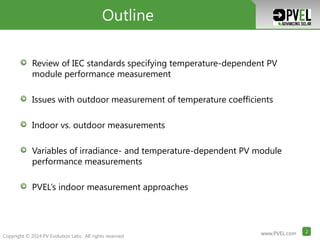
Review of IEC standards specifying temperature-dependent PV
module performance measurement
Issues with outdoor measurement of temperature coefficients
Indoor vs. outdoor measurements
Variables of irradiance- and temperature-dependent PV module
performance measurements
PVEL’s indoor measurement approaches
WHY IS THERE VARIABILITY?Outline
www.PVEL.com 3www.PVEL.com 3
Copyright © 2014 PV Evolution Labs. All rights reserved
www.PVEL.com 3www.PVEL.com 3www.PVEL.com 3
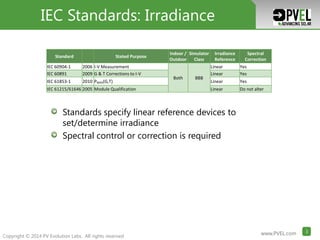
Standards specify linear reference devices to
set/determine irradiance
Spectral control or correction is required
WHY IS THERE VARIABILITY?IEC Standards: Irradiance
Standard Stated Purpose
Indoor /
Outdoor
Simulator
Class
Irradiance
Reference
Spectral
Correction
IEC 60904-1 2006 I-V Measurement
Both BBB
Linear Yes
IEC 60891 2009 G & T Corrections to I-V Linear Yes
IEC 61853-1 2010 PMAX(G,T) Linear Yes
IEC 61215/61646 2005 Module Qualification Linear Do not alter
www.PVEL.com 4www.PVEL.com 4
Copyright © 2014 PV Evolution Labs. All rights reserved
www.PVEL.com 4www.PVEL.com 4www.PVEL.com 4
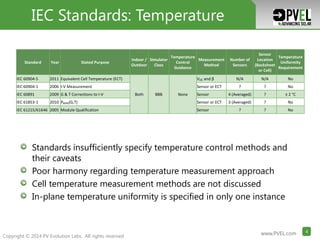
Standards insufficiently specify temperature control methods and
their caveats
Poor harmony regarding temperature measurement approach
Cell temperature measurement methods are not discussed
In-plane temperature uniformity is specified in only one instance
WHY IS THERE VARIABILITY?IEC Standards: Temperature
Standard Year Stated Purpose
Indoor /
Outdoor
Simulator
Class
Temperature
Control
Guidance
Measurement
Method
Number of
Sensors
Sensor
Location
(Backsheet
or Cell)
Temperature
Uniformity
Requirement
IEC 60904-5 2011 Equivalent Cell Temperature (ECT)
Both BBB None
VOC and β N/A N/A No
IEC 60904-1 2006 I-V Measurement Sensor or ECT ? ? No
IEC 60891 2009 G & T Corrections to I-V Sensor 4 (Averaged) ? ± 2 °C
IEC 61853-1 2010 PMAX(G,T) Sensor or ECT 3 (Averaged) ? No
IEC 61215/61646 2005 Module Qualification Sensor ? ? No
www.PVEL.com 5www.PVEL.com 5
Copyright © 2014 PV Evolution Labs. All rights reserved
www.PVEL.com 5www.PVEL.com 5www.PVEL.com 5
WHY IS THERE VARIABILITY?
Outdoor Backsheet-referenced
Temperature Coefficients Measurement
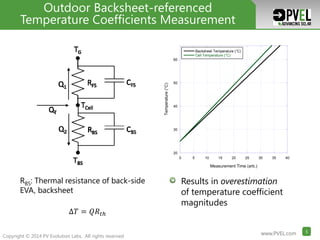
RBS: Thermal resistance of back-side
EVA, backsheet
∆𝑇 = 𝑄𝑅𝑡ℎ
20
30
40
50
60
0 5 10 15 20 25 30 35 40
Backsheet Temperature (°C)
Cell Temperature (°C)
Temperature(°C) Measurement Time (arb.)
Results in overestimation
of temperature coefficient
magnitudes
www.PVEL.com 6www.PVEL.com 6
Copyright © 2014 PV Evolution Labs. All rights reserved
www.PVEL.com 6www.PVEL.com 6www.PVEL.com 6
WHY IS THERE VARIABILITY?
Outdoor Measurement of
VOC(T) – Beta (β)
-0.9
-0.8
-0.7
-0.6
-0.5
-0.4
-0.3
-0.2
-0.1
1NoBox
2NoBox
3NoBox
4NoBox
1ThermalBox
2ThermalBox
3ThermalBox
4ThermalBox
Outdoor Measurement Results
Cell Probe
BS Probe 2
BS Probe 3
BS Probe 4
BS Probe 5
Measured(%/°C)
Trial
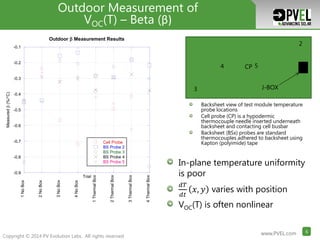
Backsheet view of test module temperature
probe locations
Cell probe (CP) is a hypodermic
thermocouple needle inserted underneath
backsheet and contacting cell busbar
Backsheet (BSx) probes are standard
thermocouples adhered to backsheet using
Kapton (polyimide) tape
CP
2
3
54
J-BOX
In-plane temperature uniformity
is poor
𝑑𝑇
𝑑𝑡
𝑥, 𝑦 varies with position
VOC(T) is often nonlinear
www.PVEL.com 7www.PVEL.com 7
Copyright © 2014 PV Evolution Labs. All rights reserved
www.PVEL.com 7www.PVEL.com 7www.PVEL.com 7
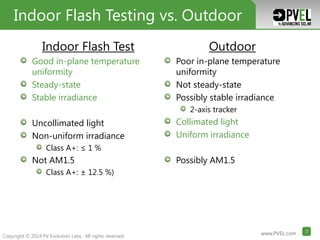
Indoor Flash Test
Good in-plane temperature
uniformity
Steady-state
Stable irradiance
Uncollimated light
Non-uniform irradiance
Class A+: ≤ 1 %
Not AM1.5
Class A+: ± 12.5 %)
WHY IS THERE VARIABILITY?Indoor Flash Testing vs. Outdoor
Outdoor
Poor in-plane temperature
uniformity
Not steady-state
Possibly stable irradiance
2-axis tracker
Collimated light
Uniform irradiance
Possibly AM1.5
www.PVEL.com 8www.PVEL.com 8
Copyright © 2014 PV Evolution Labs. All rights reserved
www.PVEL.com 8www.PVEL.com 8www.PVEL.com 8
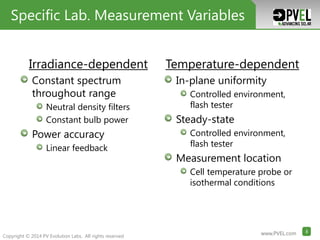
Irradiance-dependent
Constant spectrum
throughout range
Neutral density filters
Constant bulb power
Power accuracy
Linear feedback
WHY IS THERE VARIABILITY?Specific Lab. Measurement Variables
Temperature-dependent
In-plane uniformity
Controlled environment,
flash tester
Steady-state
Controlled environment,
flash tester
Measurement location
Cell temperature probe or
isothermal conditions
www.PVEL.com 9www.PVEL.com 9
Copyright © 2014 PV Evolution Labs. All rights reserved
www.PVEL.com 9www.PVEL.com 9www.PVEL.com 9
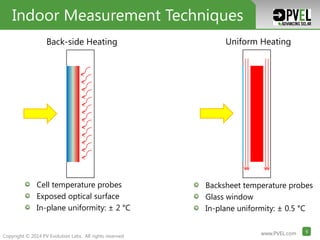
WHY IS THERE VARIABILITY?Indoor Measurement Techniques
Cell temperature probes
Exposed optical surface
In-plane uniformity: ± 2 °C
Back-side Heating Uniform Heating
Backsheet temperature probes
Glass window
In-plane uniformity: ± 0.5 °C
www.PVEL.com 10www.PVEL.com 10
Copyright © 2014 PV Evolution Labs. All rights reserved
www.PVEL.com 10www.PVEL.com 10www.PVEL.com 10
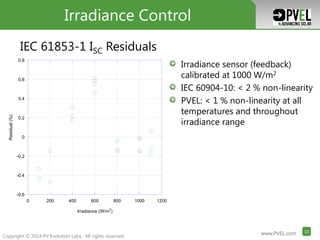
WHY IS THERE VARIABILITY?Irradiance Control
-0.6
-0.4
-0.2
0
0.2
0.4
0.6
0.8
0 200 400 600 800 1000 1200
Residual(%)
Irradiance (W/m
2
)
IEC 61853-1 ISC Residuals
Irradiance sensor (feedback)
calibrated at 1000 W/m2
IEC 60904-10: < 2 % non-linearity
PVEL: < 1 % non-linearity at all
temperatures and throughout
irradiance range
www.PVEL.com 11www.PVEL.com 11
Copyright © 2014 PV Evolution Labs. All rights reserved
www.PVEL.com 11www.PVEL.com 11www.PVEL.com 11
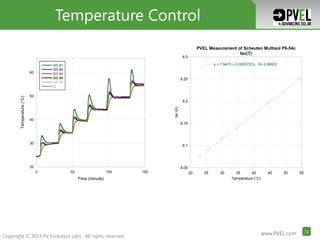
WHY IS THERE VARIABILITY?Temperature Control
8.05
8.1
8.15
8.2
8.25
8.3
20 25 30 35 40 45 50 55
PVEL Measurement of Scheuten Multisol P6-54c
Isc(T)
y = 7.9475 + 0.0055727x R= 0.99953
Isc(A)
Temperature (°C)
20
30
40
50
60
0 50 100 150
BS #1
BS #2
BS #3
BS #4
BS #5
C
Temperature(°C)
Time (minute)
www.PVEL.com 12www.PVEL.com 12
Copyright © 2014 PV Evolution Labs. All rights reserved
www.PVEL.com 12www.PVEL.com 12www.PVEL.com 12
IEC measurement standards acceptably address irradiance-
dependent measurements but do not provide adequate
treatment of temperature-dependent measurement
consideration
Outdoor measurement accuracy is difficult to achieve
PVEL has developed in-house methods to improve
temperature-dependent measurement accuracies
PVEL’s temperature coefficients measurements indicate that
datasheet coefficients are overestimated in magnitude
PVEL’s state-of-the-art measurement system will be online in
May 2014
Compare back-side heating method to isothermal chamber system
Conclusions
www.PVEL.com 13www.PVEL.com 13
Copyright © 2014 PV Evolution Labs. All rights reserved
www.PVEL.com 13www.PVEL.com 13www.PVEL.com 13
Click to edit Master title style
Rajeev@PVEL.com
John@PVEL.com
Thank You

2014 PV Performance Modeling Workshop: Irradiance- and Temperature-dependent PV Module Performance Measurement: Rajeev Singh, PV Evolution Labs

  • 1.
    www.PVEL.com 1www.PVEL.com 1 Copyright© 2014 PV Evolution Labs. All rights reserved www.PVEL.com 1www.PVEL.com 1www.PVEL.com 1 Click to edit Master title style Irradiance- and Temperature-dependent PV Module Performance Measurement Rajeev Singh, John Watts 2014 PV Module Performance Modeling Workshop May 5, 2014
  • 2.
    www.PVEL.com 2www.PVEL.com 2 Copyright© 2014 PV Evolution Labs. All rights reserved www.PVEL.com 2www.PVEL.com 2www.PVEL.com 2 Review of IEC standards specifying temperature-dependent PV module performance measurement Issues with outdoor measurement of temperature coefficients Indoor vs. outdoor measurements Variables of irradiance- and temperature-dependent PV module performance measurements PVEL’s indoor measurement approaches WHY IS THERE VARIABILITY?Outline
  • 3.
    www.PVEL.com 3www.PVEL.com 3 Copyright© 2014 PV Evolution Labs. All rights reserved www.PVEL.com 3www.PVEL.com 3www.PVEL.com 3 Standards specify linear reference devices to set/determine irradiance Spectral control or correction is required WHY IS THERE VARIABILITY?IEC Standards: Irradiance Standard Stated Purpose Indoor / Outdoor Simulator Class Irradiance Reference Spectral Correction IEC 60904-1 2006 I-V Measurement Both BBB Linear Yes IEC 60891 2009 G & T Corrections to I-V Linear Yes IEC 61853-1 2010 PMAX(G,T) Linear Yes IEC 61215/61646 2005 Module Qualification Linear Do not alter
  • 4.
    www.PVEL.com 4www.PVEL.com 4 Copyright© 2014 PV Evolution Labs. All rights reserved www.PVEL.com 4www.PVEL.com 4www.PVEL.com 4 Standards insufficiently specify temperature control methods and their caveats Poor harmony regarding temperature measurement approach Cell temperature measurement methods are not discussed In-plane temperature uniformity is specified in only one instance WHY IS THERE VARIABILITY?IEC Standards: Temperature Standard Year Stated Purpose Indoor / Outdoor Simulator Class Temperature Control Guidance Measurement Method Number of Sensors Sensor Location (Backsheet or Cell) Temperature Uniformity Requirement IEC 60904-5 2011 Equivalent Cell Temperature (ECT) Both BBB None VOC and β N/A N/A No IEC 60904-1 2006 I-V Measurement Sensor or ECT ? ? No IEC 60891 2009 G & T Corrections to I-V Sensor 4 (Averaged) ? ± 2 °C IEC 61853-1 2010 PMAX(G,T) Sensor or ECT 3 (Averaged) ? No IEC 61215/61646 2005 Module Qualification Sensor ? ? No
  • 5.
    www.PVEL.com 5www.PVEL.com 5 Copyright© 2014 PV Evolution Labs. All rights reserved www.PVEL.com 5www.PVEL.com 5www.PVEL.com 5 WHY IS THERE VARIABILITY? Outdoor Backsheet-referenced Temperature Coefficients Measurement RBS: Thermal resistance of back-side EVA, backsheet ∆𝑇 = 𝑄𝑅𝑡ℎ 20 30 40 50 60 0 5 10 15 20 25 30 35 40 Backsheet Temperature (°C) Cell Temperature (°C) Temperature(°C) Measurement Time (arb.) Results in overestimation of temperature coefficient magnitudes
  • 6.
    www.PVEL.com 6www.PVEL.com 6 Copyright© 2014 PV Evolution Labs. All rights reserved www.PVEL.com 6www.PVEL.com 6www.PVEL.com 6 WHY IS THERE VARIABILITY? Outdoor Measurement of VOC(T) – Beta (β) -0.9 -0.8 -0.7 -0.6 -0.5 -0.4 -0.3 -0.2 -0.1 1NoBox 2NoBox 3NoBox 4NoBox 1ThermalBox 2ThermalBox 3ThermalBox 4ThermalBox Outdoor Measurement Results Cell Probe BS Probe 2 BS Probe 3 BS Probe 4 BS Probe 5 Measured(%/°C) Trial Backsheet view of test module temperature probe locations Cell probe (CP) is a hypodermic thermocouple needle inserted underneath backsheet and contacting cell busbar Backsheet (BSx) probes are standard thermocouples adhered to backsheet using Kapton (polyimide) tape CP 2 3 54 J-BOX In-plane temperature uniformity is poor 𝑑𝑇 𝑑𝑡 𝑥, 𝑦 varies with position VOC(T) is often nonlinear
  • 7.
    www.PVEL.com 7www.PVEL.com 7 Copyright© 2014 PV Evolution Labs. All rights reserved www.PVEL.com 7www.PVEL.com 7www.PVEL.com 7 Indoor Flash Test Good in-plane temperature uniformity Steady-state Stable irradiance Uncollimated light Non-uniform irradiance Class A+: ≤ 1 % Not AM1.5 Class A+: ± 12.5 %) WHY IS THERE VARIABILITY?Indoor Flash Testing vs. Outdoor Outdoor Poor in-plane temperature uniformity Not steady-state Possibly stable irradiance 2-axis tracker Collimated light Uniform irradiance Possibly AM1.5
  • 8.
    www.PVEL.com 8www.PVEL.com 8 Copyright© 2014 PV Evolution Labs. All rights reserved www.PVEL.com 8www.PVEL.com 8www.PVEL.com 8 Irradiance-dependent Constant spectrum throughout range Neutral density filters Constant bulb power Power accuracy Linear feedback WHY IS THERE VARIABILITY?Specific Lab. Measurement Variables Temperature-dependent In-plane uniformity Controlled environment, flash tester Steady-state Controlled environment, flash tester Measurement location Cell temperature probe or isothermal conditions
  • 9.
    www.PVEL.com 9www.PVEL.com 9 Copyright© 2014 PV Evolution Labs. All rights reserved www.PVEL.com 9www.PVEL.com 9www.PVEL.com 9 WHY IS THERE VARIABILITY?Indoor Measurement Techniques Cell temperature probes Exposed optical surface In-plane uniformity: ± 2 °C Back-side Heating Uniform Heating Backsheet temperature probes Glass window In-plane uniformity: ± 0.5 °C
  • 10.
    www.PVEL.com 10www.PVEL.com 10 Copyright© 2014 PV Evolution Labs. All rights reserved www.PVEL.com 10www.PVEL.com 10www.PVEL.com 10 WHY IS THERE VARIABILITY?Irradiance Control -0.6 -0.4 -0.2 0 0.2 0.4 0.6 0.8 0 200 400 600 800 1000 1200 Residual(%) Irradiance (W/m 2 ) IEC 61853-1 ISC Residuals Irradiance sensor (feedback) calibrated at 1000 W/m2 IEC 60904-10: < 2 % non-linearity PVEL: < 1 % non-linearity at all temperatures and throughout irradiance range
  • 11.
    www.PVEL.com 11www.PVEL.com 11 Copyright© 2014 PV Evolution Labs. All rights reserved www.PVEL.com 11www.PVEL.com 11www.PVEL.com 11 WHY IS THERE VARIABILITY?Temperature Control 8.05 8.1 8.15 8.2 8.25 8.3 20 25 30 35 40 45 50 55 PVEL Measurement of Scheuten Multisol P6-54c Isc(T) y = 7.9475 + 0.0055727x R= 0.99953 Isc(A) Temperature (°C) 20 30 40 50 60 0 50 100 150 BS #1 BS #2 BS #3 BS #4 BS #5 C Temperature(°C) Time (minute)
  • 12.
    www.PVEL.com 12www.PVEL.com 12 Copyright© 2014 PV Evolution Labs. All rights reserved www.PVEL.com 12www.PVEL.com 12www.PVEL.com 12 IEC measurement standards acceptably address irradiance- dependent measurements but do not provide adequate treatment of temperature-dependent measurement consideration Outdoor measurement accuracy is difficult to achieve PVEL has developed in-house methods to improve temperature-dependent measurement accuracies PVEL’s temperature coefficients measurements indicate that datasheet coefficients are overestimated in magnitude PVEL’s state-of-the-art measurement system will be online in May 2014 Compare back-side heating method to isothermal chamber system Conclusions
  • 13.
    www.PVEL.com 13www.PVEL.com 13 Copyright© 2014 PV Evolution Labs. All rights reserved www.PVEL.com 13www.PVEL.com 13www.PVEL.com 13 Click to edit Master title style Rajeev@PVEL.com John@PVEL.com Thank You