Jarrar © 2012 1
Dr. Mustafa Jarrar
Sina Institute, University of Birzeit
mjarrar@birzeit.edu
www.jarrar.info
Lecture Notes
Birzeit University, Palestine
2012
Advanced Topics in Ontology Engineering
Stepwise Methodologies
Jarrar © 2012 2
Methodology
Let’s discuss from where to start, if you want to build an
ontology for:
• E-government
• E-Banking
• E-Health
• Bioinformatics
• Multilingual search engine
• …
What are the phases of the ontology development life
cycle? taking into account that ontologies might be built
collaboratively by many people.
Jarrar © 2012 3
Methodological Questions
– Which tools and techniques to use?
– Which languages should be used in which circumstances, and in
which order?
– What quality measures should we care about?
– What things can be reused?
– Which people should be assigned which tasks?
– ....
• Many Methodologies exist ! But non is good! Because each
project/application/domain is different, and the background of the
people involved are also different, etc.
• We will overview some common steps in this lecture, thus try to learn
smartly, and don’t follow these steps literally. You should have your
own methodology for each ontology.
Jarrar © 2012 4
Most methodologies propose these phases:
1- Identify Purpose and Scope
2- Building the Ontology
2.1- Ontology Capture
2.2- Ontology Coding
3- Integrating existing ontologies
4- Evaluation
5- Documentation
Jarrar © 2012 5
1- Purpose and Scope
• There is no one/ideal ontology of a certain domain
– There are always alternatives, each abstracting different things, and for
different usages.
• What should be included in the ontology (concepts and relations)
should be smartly determined, taking into account (if possible) many
application scenarios.
– Interoperability between systems.
– improve search quality.
– Communication between people and organizations (important).
…
– Future extensions should be anticipated.
Jarrar © 2012 6
• When you specify the purpose and scope, you should specify the
following:
1- What is the domain that the ontology will cover?
The notion of context, in the double articulation theory, is part of the
Purpose and Scope.
That is: the scope where the vocabulary interpretation should be valid.
For example: the scope of the legal-Person ontology is the set of all
laws, regulations, and repositories in the state.
2- What we are going to use the ontology for?
 Enough description about what application scenarios are taking into
account.
1- Purpose and Scope
Be carful with the ontology usability/reusability trade-off
Jarrar © 2012 7
2- Building the Ontology
2.1- Ontology Capture
– Identify key concepts and relationships.
– Produce clear text definitions for these concepts (i.e., glosses).
– Identify terms that refer to these concepts.
– Reach Consensus (Consensus is an indication of correctness).
 You may apply the 7 steps for building an ORM schema,
somehow!
2.2- Ontology Coding/Specification/Characterization
– Explicit representation of the “conceptualization” in some formal
language.
Jarrar © 2012 8
2.1- Ontology Capture: Scoping
• Brainstorming
– Produce all potentially relevant terms and phrases.
• Nouns form the basis for concept names
• Verbs (or verb phrases) form the basis for property and names.
This step can be semi- automated somehow, as candidate concepts and
relations can be extracted automatically from relevant documents, laws,
forms, DB schemes....
• Organize candidate concepts into groups
Group related terms together.
– Exclude some terms if not relevant (w.r.t., purpose and scope)
– Keep notes of these decisions.
– Group similar terms and potential synonyms together.
Jarrar © 2012 9
2.1- Ontology Capture: Produce Definitions
• Use suitable meta-ontology
– i.e., use modeling primitives in a consistent manner (e.g. Type,
role, entity, instance, relationship...)
• When several people are involved, each might be responsible on a
group of terms
– Semantic overlap with others must be right in the first place,
otherwise lot of redundant re-working.
• Terms: Produce definitions/glosses in a middle-out fashion
– Define a gloss for each term. This helps get deeper understanding
of the domain.
– These glosses will have to be revised later, after defining the
relationships/ subsumptions between concepts.
– This is called middle-out, rather than top-down or bottom up. – will
be discussed later.
Jarrar © 2012 10
Define Taxonomy
• Relevant terms must be organized in a taxonomic hierarchy (i.e.,
subsumptions)
– Opinions differ on whether it is more efficient to do this in a top-
down or a bottom-up fashion.
• Ensure that hierarchy is indeed a taxonomy:
– If A subsumes B, then every instance of A must also be a
subsume B (compatible with semantics of rdfs:subClassOf)
– Insuring the correctness of subsumptions needs philosophical
thinking (apply the OntoClean Methodology).
• The semantics of subsumption demands that whenever A subsumes
B, every property that holds for instances of B must also apply to
instances of A (called inheritance).
– It makes sense to attach properties to the highest class in the
hierarchy to which they apply.
Jarrar © 2012 11
Define Properties
• Determine the relevant properties for each concept. Such
properties must be essential –to describe the meaning-, or
relevant to the applications.
• While attaching properties to concepts, it is useful to
determine its range (its datatype/value, or relations with
other concepts).
Jarrar © 2012 12
Add Rules and Restrictions
• Cardinality Restrictions
• Which properties should be unique, mandatory,
disjunctions, restricted values…etc.
• Relational Characteristics
– symmetry, transitivity, inverse properties, functional values
 You must avoid the situation that the added rules are DB integrity
constraints.
 Some/all rules should be verbalized –in pseudo natural language
sentences- so to enable other people review it and give feedback.
Jarrar © 2012 13
Define Some Important Instances
• Some important instances (might) be added to the
ontology, if needed. Such entities can be:
– Country: Palestine
– Person: Arafat
– Capital: Jerusalem
•  in case of a large instances, it is more convenient to
have them separately .
- See the Entity and Address servers in Zinnar
Jarrar © 2012 14
Advantages of the Middle-out Approaches
• A bottom-up approach results in a high degree of detail
– increases overall effort
– makes it difficult to spot commonality between related concepts.
– increases risk of inconsistencies and re-work.
• Top-down allow better control of degree of detail
– risk of arbitrary high-level categories
– risk of limited stability
• Middle-out strikes is a compromise, but it allow the ontology
evolve gradually, you need to come back to some steps.
• The higher level concepts naturally arise and are thus more
likely to be stable.
Jarrar © 2012 15
Reaching Agreement: Some suggestions
 Ontologies are made to be agreed and shared, thus it is VERY
important to make sure that people agree on them.
 How to facilitate reaching agreement?
• Produce a natural language text definitions.
- Ask domain experts to review the context, glosses, verbalized rules,
and the ontology itself in a graphical/diagramatic form.
• Ensure consistency with terms already in use
– use existing thesauri and dictionaries
– avoid introducing new terms in the definitions
• Indicate relationships with other commonly used terms
– synonyms, variants, such referring to different dimensions
• Give examples
Jarrar © 2012 16
Integrating Existing Ontologies
• Check overlap with existing ontologies
• Establish formal links
– Produce mappings to existing concept definitions
– Import and extend existing ontologies
• Avoid re-inventing the wheel!
Jarrar © 2012 17
Ontology Evaluation
Several Type of evaluations:
1. Usability Evaluation: Validate whether the ontology produced
satisfies (at least) the intended applications’ requirements.
2. Syntax evaluation: Validate whether the ontology is well-formed
w.r.t the used language.
3. Logical evaluation: Validate whether the ontology has axioms
contradicting or implying each other.
4. Ontological Evaluation: Validate whether the ontology has
concepts that should be instances, sub-concepts that should be
roles, etc. (The OntoClean methodology is very good for this
evaluation)
Jarrar © 2012 18
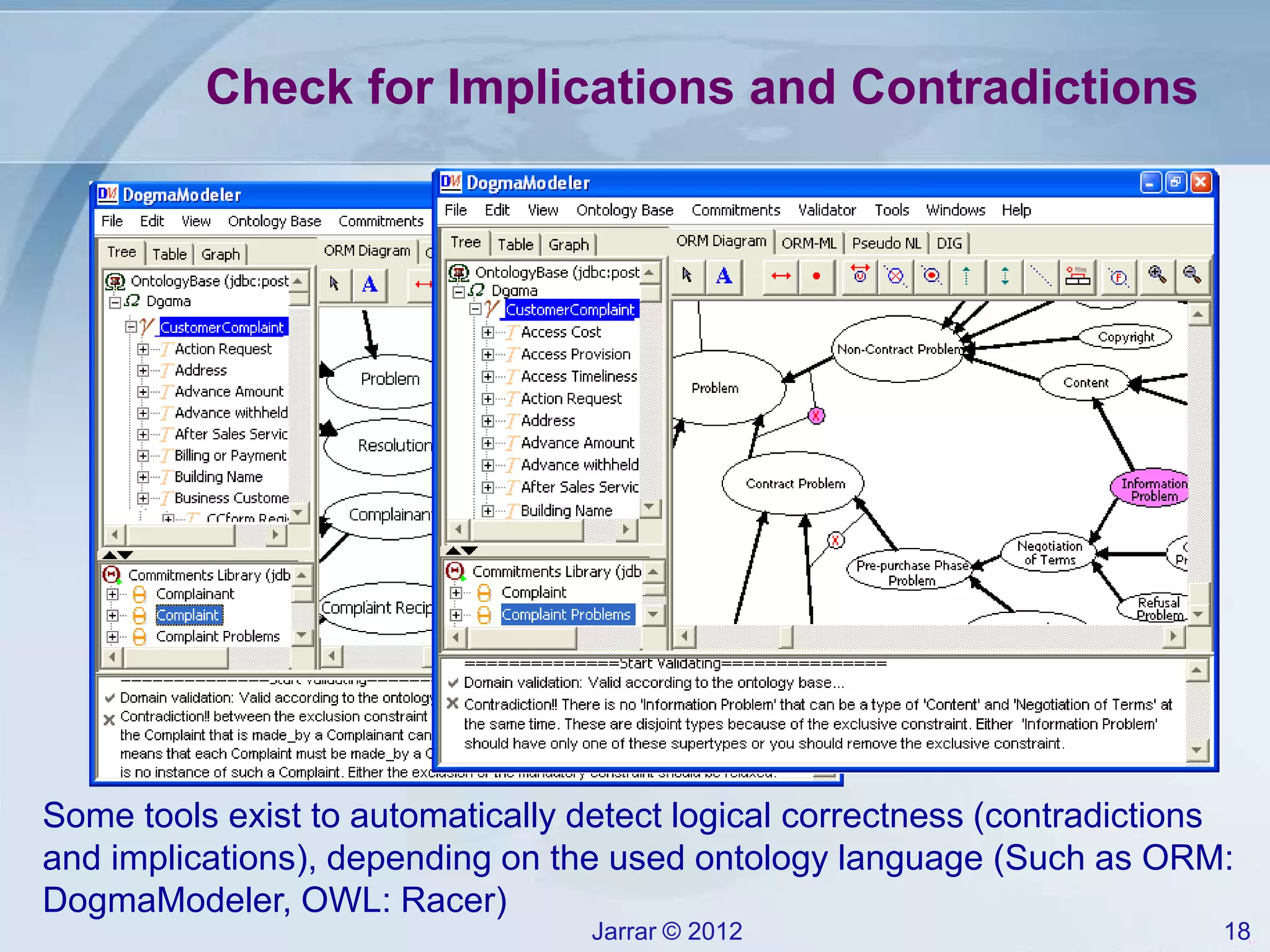
Check for Implications and Contradictions
Some tools exist to automatically detect logical correctness (contradictions
and implications), depending on the used ontology language (Such as ORM:
DogmaModeler, OWL: Racer)
Jarrar © 2012 19
Some Guidelines
Clarity: The ontology engineer should communicate effectively with
the domain experts (= ask the right questions):
– Natural language definitions.
– Give examples, alternatives, and contradictions, elicit knowledge.
– emphasize distinctions.
Coherence: The ontology should be internally consistent
– Syntactically correct.
– Logically consistent.
– Ontologically consistent.
Extensibility: modularize the ontology in a way it is easy to build, understand,
and maintain. What should be in a module?
Reusability and Usability: be innovative to tradeoff this smartly.
Jarrar © 2012 20
References
Mike Uschol: Building Ontologies: Towards a Unified Methodology.
Proceedings of Expert Systems th Annual Conference
of the British Computer Society Specialist Group on Expert Systems. 1996
http://www.imamu.edu.sa/Scientific_selections/Documents/IT/96-es96-unified-
method.pdf
Mustafa Jarrar: Towards methodological principles for ontology
engineering. PhD Thesis. Vrije Universiteit Brussel. (May 2005)
http://www.jarrar.info/phd-thesis/
Fernández López: Overview Of Methodologies For Building Ontologies.
Proceedings of the IJCAI99 Workshop on Ontologies and
ProblemSolvingMethods Lessons Learned and Future Trends CEUR
Publications.
http://citeseerx.ist.psu.edu/viewdoc/summary?doi=10.1.1.39.6002

Jarrar: Stepwise Methodologies for Developing Ontologies

  • 1.
    Jarrar © 20121 Dr. Mustafa Jarrar Sina Institute, University of Birzeit mjarrar@birzeit.edu www.jarrar.info Lecture Notes Birzeit University, Palestine 2012 Advanced Topics in Ontology Engineering Stepwise Methodologies
  • 2.
    Jarrar © 20122 Methodology Let’s discuss from where to start, if you want to build an ontology for: • E-government • E-Banking • E-Health • Bioinformatics • Multilingual search engine • … What are the phases of the ontology development life cycle? taking into account that ontologies might be built collaboratively by many people.
  • 3.
    Jarrar © 20123 Methodological Questions – Which tools and techniques to use? – Which languages should be used in which circumstances, and in which order? – What quality measures should we care about? – What things can be reused? – Which people should be assigned which tasks? – .... • Many Methodologies exist ! But non is good! Because each project/application/domain is different, and the background of the people involved are also different, etc. • We will overview some common steps in this lecture, thus try to learn smartly, and don’t follow these steps literally. You should have your own methodology for each ontology.
  • 4.
    Jarrar © 20124 Most methodologies propose these phases: 1- Identify Purpose and Scope 2- Building the Ontology 2.1- Ontology Capture 2.2- Ontology Coding 3- Integrating existing ontologies 4- Evaluation 5- Documentation
  • 5.
    Jarrar © 20125 1- Purpose and Scope • There is no one/ideal ontology of a certain domain – There are always alternatives, each abstracting different things, and for different usages. • What should be included in the ontology (concepts and relations) should be smartly determined, taking into account (if possible) many application scenarios. – Interoperability between systems. – improve search quality. – Communication between people and organizations (important). … – Future extensions should be anticipated.
  • 6.
    Jarrar © 20126 • When you specify the purpose and scope, you should specify the following: 1- What is the domain that the ontology will cover? The notion of context, in the double articulation theory, is part of the Purpose and Scope. That is: the scope where the vocabulary interpretation should be valid. For example: the scope of the legal-Person ontology is the set of all laws, regulations, and repositories in the state. 2- What we are going to use the ontology for?  Enough description about what application scenarios are taking into account. 1- Purpose and Scope Be carful with the ontology usability/reusability trade-off
  • 7.
    Jarrar © 20127 2- Building the Ontology 2.1- Ontology Capture – Identify key concepts and relationships. – Produce clear text definitions for these concepts (i.e., glosses). – Identify terms that refer to these concepts. – Reach Consensus (Consensus is an indication of correctness).  You may apply the 7 steps for building an ORM schema, somehow! 2.2- Ontology Coding/Specification/Characterization – Explicit representation of the “conceptualization” in some formal language.
  • 8.
    Jarrar © 20128 2.1- Ontology Capture: Scoping • Brainstorming – Produce all potentially relevant terms and phrases. • Nouns form the basis for concept names • Verbs (or verb phrases) form the basis for property and names. This step can be semi- automated somehow, as candidate concepts and relations can be extracted automatically from relevant documents, laws, forms, DB schemes.... • Organize candidate concepts into groups Group related terms together. – Exclude some terms if not relevant (w.r.t., purpose and scope) – Keep notes of these decisions. – Group similar terms and potential synonyms together.
  • 9.
    Jarrar © 20129 2.1- Ontology Capture: Produce Definitions • Use suitable meta-ontology – i.e., use modeling primitives in a consistent manner (e.g. Type, role, entity, instance, relationship...) • When several people are involved, each might be responsible on a group of terms – Semantic overlap with others must be right in the first place, otherwise lot of redundant re-working. • Terms: Produce definitions/glosses in a middle-out fashion – Define a gloss for each term. This helps get deeper understanding of the domain. – These glosses will have to be revised later, after defining the relationships/ subsumptions between concepts. – This is called middle-out, rather than top-down or bottom up. – will be discussed later.
  • 10.
    Jarrar © 201210 Define Taxonomy • Relevant terms must be organized in a taxonomic hierarchy (i.e., subsumptions) – Opinions differ on whether it is more efficient to do this in a top- down or a bottom-up fashion. • Ensure that hierarchy is indeed a taxonomy: – If A subsumes B, then every instance of A must also be a subsume B (compatible with semantics of rdfs:subClassOf) – Insuring the correctness of subsumptions needs philosophical thinking (apply the OntoClean Methodology). • The semantics of subsumption demands that whenever A subsumes B, every property that holds for instances of B must also apply to instances of A (called inheritance). – It makes sense to attach properties to the highest class in the hierarchy to which they apply.
  • 11.
    Jarrar © 201211 Define Properties • Determine the relevant properties for each concept. Such properties must be essential –to describe the meaning-, or relevant to the applications. • While attaching properties to concepts, it is useful to determine its range (its datatype/value, or relations with other concepts).
  • 12.
    Jarrar © 201212 Add Rules and Restrictions • Cardinality Restrictions • Which properties should be unique, mandatory, disjunctions, restricted values…etc. • Relational Characteristics – symmetry, transitivity, inverse properties, functional values  You must avoid the situation that the added rules are DB integrity constraints.  Some/all rules should be verbalized –in pseudo natural language sentences- so to enable other people review it and give feedback.
  • 13.
    Jarrar © 201213 Define Some Important Instances • Some important instances (might) be added to the ontology, if needed. Such entities can be: – Country: Palestine – Person: Arafat – Capital: Jerusalem •  in case of a large instances, it is more convenient to have them separately . - See the Entity and Address servers in Zinnar
  • 14.
    Jarrar © 201214 Advantages of the Middle-out Approaches • A bottom-up approach results in a high degree of detail – increases overall effort – makes it difficult to spot commonality between related concepts. – increases risk of inconsistencies and re-work. • Top-down allow better control of degree of detail – risk of arbitrary high-level categories – risk of limited stability • Middle-out strikes is a compromise, but it allow the ontology evolve gradually, you need to come back to some steps. • The higher level concepts naturally arise and are thus more likely to be stable.
  • 15.
    Jarrar © 201215 Reaching Agreement: Some suggestions  Ontologies are made to be agreed and shared, thus it is VERY important to make sure that people agree on them.  How to facilitate reaching agreement? • Produce a natural language text definitions. - Ask domain experts to review the context, glosses, verbalized rules, and the ontology itself in a graphical/diagramatic form. • Ensure consistency with terms already in use – use existing thesauri and dictionaries – avoid introducing new terms in the definitions • Indicate relationships with other commonly used terms – synonyms, variants, such referring to different dimensions • Give examples
  • 16.
    Jarrar © 201216 Integrating Existing Ontologies • Check overlap with existing ontologies • Establish formal links – Produce mappings to existing concept definitions – Import and extend existing ontologies • Avoid re-inventing the wheel!
  • 17.
    Jarrar © 201217 Ontology Evaluation Several Type of evaluations: 1. Usability Evaluation: Validate whether the ontology produced satisfies (at least) the intended applications’ requirements. 2. Syntax evaluation: Validate whether the ontology is well-formed w.r.t the used language. 3. Logical evaluation: Validate whether the ontology has axioms contradicting or implying each other. 4. Ontological Evaluation: Validate whether the ontology has concepts that should be instances, sub-concepts that should be roles, etc. (The OntoClean methodology is very good for this evaluation)
  • 18.
    Jarrar © 201218 Check for Implications and Contradictions Some tools exist to automatically detect logical correctness (contradictions and implications), depending on the used ontology language (Such as ORM: DogmaModeler, OWL: Racer)
  • 19.
    Jarrar © 201219 Some Guidelines Clarity: The ontology engineer should communicate effectively with the domain experts (= ask the right questions): – Natural language definitions. – Give examples, alternatives, and contradictions, elicit knowledge. – emphasize distinctions. Coherence: The ontology should be internally consistent – Syntactically correct. – Logically consistent. – Ontologically consistent. Extensibility: modularize the ontology in a way it is easy to build, understand, and maintain. What should be in a module? Reusability and Usability: be innovative to tradeoff this smartly.
  • 20.
    Jarrar © 201220 References Mike Uschol: Building Ontologies: Towards a Unified Methodology. Proceedings of Expert Systems th Annual Conference of the British Computer Society Specialist Group on Expert Systems. 1996 http://www.imamu.edu.sa/Scientific_selections/Documents/IT/96-es96-unified- method.pdf Mustafa Jarrar: Towards methodological principles for ontology engineering. PhD Thesis. Vrije Universiteit Brussel. (May 2005) http://www.jarrar.info/phd-thesis/ Fernández López: Overview Of Methodologies For Building Ontologies. Proceedings of the IJCAI99 Workshop on Ontologies and ProblemSolvingMethods Lessons Learned and Future Trends CEUR Publications. http://citeseerx.ist.psu.edu/viewdoc/summary?doi=10.1.1.39.6002