How to survive in an era of
hacktivists, cyber espionnage and
internet fraudsters ?

The need for an integrated approach
to undermine the criminal cyber architecture

                             Brussels, 21 March 2013
                             e-Shop Expo


© 2013 Luc Beirens – Federal Computer Crime Unit - Belgian Federal Judicial Police – Direction economical and financial crime
Presentation

 @LucBeirens
 Chief Commissioner
 Head of the Federal Computer Crime Unit
 Belgian Federal Judicial Police
 Direction Economical and financial crime


                   Chairman of the EU Cybercrime task force
                   representing the organization of heads of
                   national hightech crime units of the EU
Topics - overview

 An analysis of the eSociety situation
 Who is threating eSociety and how ?
  Inside threat / outside threats

 Possible damage to eGov and
  eSociety

 Which response to give to this ?
What is there to protect ?

 Your company / public image

 Your market share (even as public service)

 Your business activity / products

 Your existance as such

            Cybercrime threats © Belgian Federal Computer Crime Unit
What is there to protect ?

 Data (stored or in transmission)
    Our personal data employees / citizens / customers
    Info on the organisation (policy/functioning/financial)
    Info on your activity, product (price list, patents, source code)
 Our information infrastructure
    Internal / external systems
    Network connexions
    Storage and backup systems

 Privacy law requires measures organisational and
  technical to protect personal data
                 Cybercrime threats © Belgian Federal Computer Crime Unit
eShop
 Be recognisable to your customers
 Beware of imposters
    Use of certificates / control over domain

 Keep your customers safe
    Data
    Transactions

 Get paid for your services / products

 Don’t become unwillingly a criminal service platform

               Cybercrime threats © Belgian Federal Computer Crime Unit
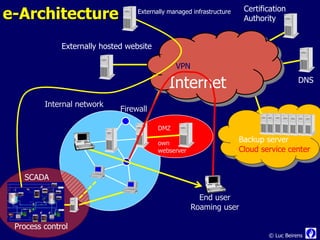
e-Architecture                     Externally managed infrastructure    Certification
                                                                        Authority


              Externally hosted website

                                                VPN

                                              Internet                                    DNS


         Internal network
                              Firewall

                                          DMZ

                                          own                          Backup server
                                          webserver                    Cloud service center


   SCADA

                                                        End user
                                                      Roaming user

 Process control
                                                                               © Luc Beirens
General trends today
 Evolution towards e-society
      replace persons by e-applications
      Interconnecting all systems (admin, industrial, control)
      Mobile systems – Cloud
      Social networks

 IP is common platform offered by many ISPs
  integrating telephony / data / VPN & all new apps
  =opportunities / Achilles tendon / scattered traces

 Poor security in legacy applications and protocols
  (userid+pw)=> identity fraud is easy

 Enduser is not yet educated to act properly
What do criminals want ?

 Become rich / powerfull
 rapidly, easily, very big ROI
 in an illegal way if needed


 Destabilaze (e-)society
 by causing troubles
First conclusions ?

 Society is thus very heavily depending on ICT
 ICT = important vulnerability of modern society
 End user = weakest link => biggest danger

 Need to
    Guarantee continuity of ICT functioning
    Availability and integrity of data

 Data is more and more in the cloud
    Accessible from all over the world
    Outside jurisdiction of your country
Who is threating us ?
   Script kiddies
   Insider ICT guy in your company
   Loosely organized criminals
   Firmly organized criminal groups
   Terrorists / hacktivists
   Foreign states / economical powers
   Nation warfare troups
What are the outside threats ?


        Cybercrime threats © Belgian Federal Computer Crime Unit
Threats in messages
on hackersites
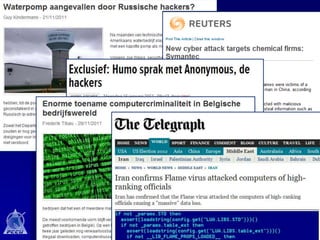
 Wiping away the websites in your state
 Infiltration in servers of the Public Treasury
  disrupting tax collection
 Infiltration in bank accounts
 Attacks on media websites
 Attacks on e-commerce websites
 Distribution of personnel data and
  credit card information

 Targetting also in the end of the year period
             Cybercrime threats © Belgian Federal Computer Crime Unit
Focus

   On   individuals
   On   webservers
   On   your organization
   On   your partner’s organization
   On   your infrastructure
   On   cyber infrastructure


              Cybercrime threats © Belgian Federal Computer Crime Unit
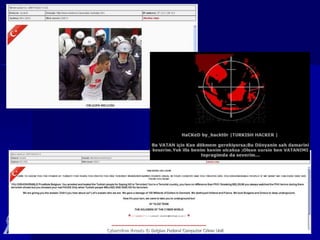
Hacking webservers
 Motives of criminal :
     Perform defacement
     Use as storage platform for illegal content (childporn)
     Use as intermediate platform for criminal activity
     Get sensitive information and do extortion (idiot tax)
     Get financial information (credit cards)
 To do :
   Updates SW, strong admin access, no pers data on srvr
   Follow up pastebin.com : a hackers drop off

                 Cybercrime threats © Belgian Federal Computer Crime Unit
Cybercrime threats © Belgian Federal Computer Crime Unit
E-Shop risks

 “Forgotten” test environments
   Use of real data
   No logging of
 Applications with debugging procedures
 Data bases with all user data on webserver
  instead of inside LAN
 User profiles unencrypted / unsalted ?
 Credit card information in profiles ?
 Use of stolen credit (new payment systems)
            Cybercrime threats © Belgian Federal Computer Crime Unit
Dossier Cybercrime - NVP PNS 2012-2015
Security : encrypted data !

 Infection of workstations and servers in
  company LAN
   Using targetted e-mails / social media messages
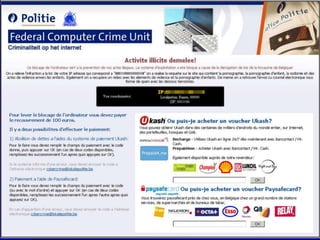
   Malicious encryption of all user data files
   Ransom to get decryption key
 From those that paid :
  some got key some didn’t
 Others had a recent off-line backup !

            Cybercrime threats © Belgian Federal Computer Crime Unit
Intrusions in your LAN
 Intrusion in your system to intercept data that allows
  to take away products from your stock
    WIFI interception from parking
    Infection by trojan (e-mail)
    (unreported) burglary in the company to place
       hardware keyloggers
       complete small computer system WIFI intercept 3G transmit
 With valid ticket go fetch cargo
 To Do :
    Encrypt WIFI transmissions
    Patch only active workstation connections

                Cybercrime threats © Belgian Federal Computer Crime Unit
Intrusion in your
trading account
   Carbon dioxide certificates trade
   Open data : contact persons of companies
   Spear phishing mail + phishing website
   Access to trading account
   Millions of € sold in few hours all over EU
     Sold far under price & immediately resold
 To do : Awareness
             Cybercrime threats © Belgian Federal Computer Crime Unit
Intrusion in your partner’s LAN

 Intrusion in LAN of foreign partner (Chinese)
  and get information
  on your business and invoices to pay
 You get mail with
   Slightly different e-mail adresses
   Change of bank account number to pay
    (Due to audit ...)
 To do : verify thouroughly any changes
  before paying
            Cybercrime threats © Belgian Federal Computer Crime Unit
Attacking infrastructure

 Remote managed infrastructures in your
  buildings
   Central heating
   Elevator
 Creating disruption of this infrastructure
  => leads to high cost
 To do : verify if this applies to you and
  your infrastructure managing company
           Cybercrime threats © Belgian Federal Computer Crime Unit
Hacking into cloud accounts
 SME’s that have all their information
  in cloud accounts
 Hacking into these account
    Taking over access control
    Sending of SOS-e-mails (Robbed money needed)
    Deleting all contact information in the account
     => preventing warning e-mails
     after getting back access to account
 To do :
    enforce strong authentication and second ways to access
     the account
    Have backups of these systems
               Cybercrime threats © Belgian Federal Computer Crime Unit
Dossier Cybercrime - NVP PNS 2012-2015
Cyber crime
against cyber infrastructure
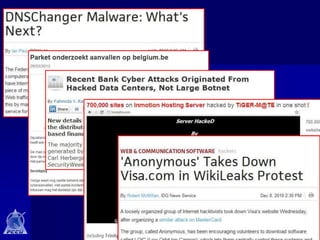
 Payment systems
   2010 Wikileaks case : “Anonymous” attack on VISA,
    Paypal, Mastercard,...


 DNS – system
  create fraudulent routing or use for DDOS
 Certification autorities (Diginotar)
 Data centers (Blocs all servers in it)

               Dossier Cybercrime - NVP PNS 2012-2015
Dossier Cybercrime - NVP PNS 2012-2015
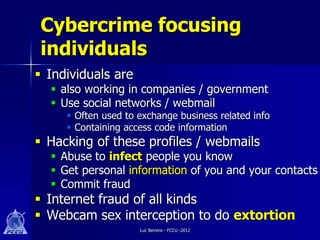
Cybercrime focusing
 individuals
 Individuals are
   also working in companies / government
   Use social networks / webmail
      Often used to exchange business related info
      Containing access code information
 Hacking of these profiles / webmails
   Abuse to infect people you know
   Get personal information of you and your contacts
   Commit fraud
 Internet fraud of all kinds
 Webcam sex interception to do extortion
                     Luc Beirens - FCCU -2012
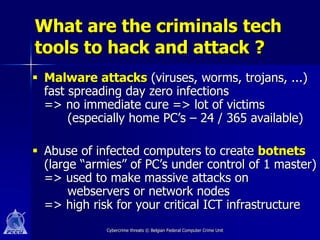
What are the criminals tech
tools to hack and attack ?
 Malware attacks (viruses, worms, trojans, ...)
  fast spreading day zero infections
  => no immediate cure => lot of victims
       (especially home PC’s – 24 / 365 available)

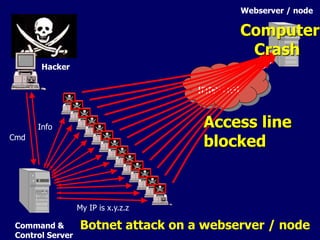
 Abuse of infected computers to create botnets
  (large “armies” of PC’s under control of 1 master)
  => used to make massive attacks on
       webservers or network nodes
  => high risk for your critical ICT infrastructure
             Cybercrime threats © Belgian Federal Computer Crime Unit
Webserver / node

                                                Computer
                                                 Crash
       Hacker

                                     Internet

      Info                            Access line
Cmd
                                      blocked


                  My IP is x.y.z.z

 Command &        Botnet attack on a webserver / node
 Control Server
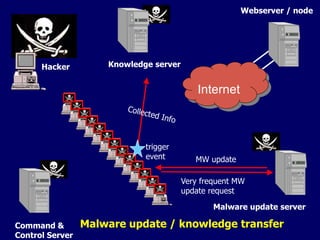
Webserver / node


      Hacker         Knowledge server


                                            Internet


                             trigger
                             event         MW update

                                        Very frequent MW
                                        update request

                                                Malware update server

Command &        Malware update / knowledge transfer
Control Server
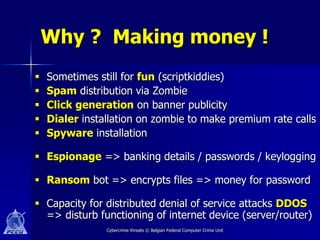
Why ? Making money !
   Sometimes still for fun (scriptkiddies)
   Spam distribution via Zombie
   Click generation on banner publicity
   Dialer installation on zombie to make premium rate calls
   Spyware installation

 Espionage => banking details / passwords / keylogging

 Ransom bot => encrypts files => money for password

 Capacity for distributed denial of service attacks DDOS
  => disturb functioning of internet device (server/router)
                Cybercrime threats © Belgian Federal Computer Crime Unit
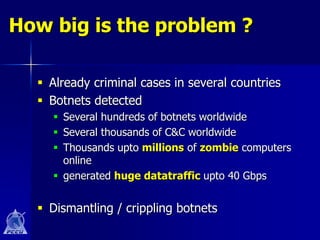
How big is the problem ?

   Already criminal cases in several countries
   Botnets detected
     Several hundreds of botnets worldwide
     Several thousands of C&C worldwide
     Thousands upto millions of zombie computers
      online
     generated huge datatraffic upto 40 Gbps


   Dismantling / crippling botnets
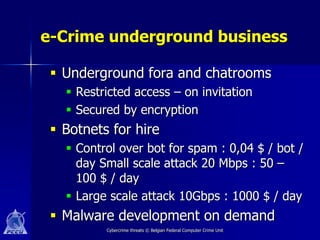
e-Crime underground business

  Underground fora and chatrooms
    Restricted access – on invitation
    Secured by encryption
  Botnets for hire
    Control over bot for spam : 0,04 $ / bot /
     day Small scale attack 20 Mbps : 50 –
     100 $ / day
    Large scale attack 10Gbps : 1000 $ / day
  Malware development on demand
          Cybercrime threats © Belgian Federal Computer Crime Unit
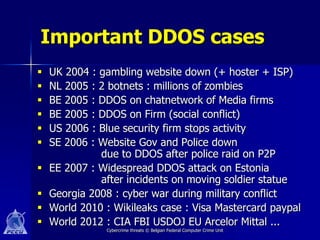
Important DDOS cases
   UK 2004 : gambling website down (+ hoster + ISP)
   NL 2005 : 2 botnets : millions of zombies
   BE 2005 : DDOS on chatnetwork of Media firms
   BE 2005 : DDOS on Firm (social conflict)
   US 2006 : Blue security firm stops activity
   SE 2006 : Website Gov and Police down
              due to DDOS after police raid on P2P
   EE 2007 : Widespread DDOS attack on Estonia
              after incidents on moving soldier statue
   Georgia 2008 : cyber war during military conflict
   World 2010 : Wikileaks case : Visa Mastercard paypal
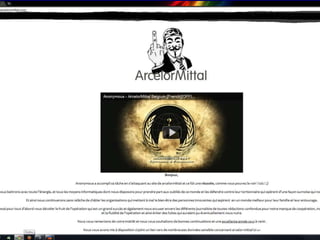
   World 2012 : CIA FBI USDOJ EU Arcelor Mittal ...
               Cybercrime threats © Belgian Federal Computer Crime Unit
Attacks on
eSociety authentication systems
using malware and botnets


        Cybercrime threats © Belgian Federal Computer Crime Unit
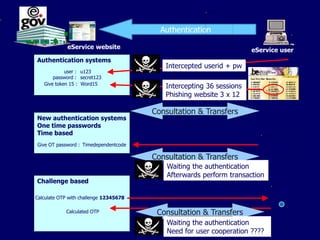
Authentication

             eService website                                         eService user
Authentication systems
                                           Intercepted userid + pw
            user : u123
       password : secret123
   Give token 15 : Word15
                                           Intercepting 36 sessions
                                           Phishing website 3 x 12

                                        Consultation & Transfers
New authentication systems
One time passwords
Time based
Give OT password : Timedependentcode

                                        Consultation & Transfers
                                            Waiting the authentication
                                            Afterwards perform transaction
Challenge based

Calculate OTP with challenge 12345678

            Calculated OTP               Consultation & Transfers
                                            Waiting the authentication
                                            Need for user cooperation ????
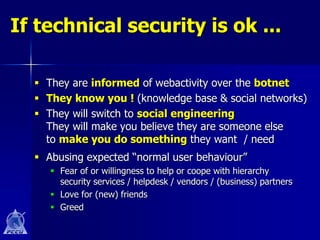
If technical security is ok ...

   They are informed of webactivity over the botnet
   They know you ! (knowledge base & social networks)
   They will switch to social engineering
    They will make you believe they are someone else
    to make you do something they want / need
   Abusing expected “normal user behaviour”
      Fear of or willingness to help or coope with hierarchy
       security services / helpdesk / vendors / (business) partners
      Love for (new) friends
      Greed
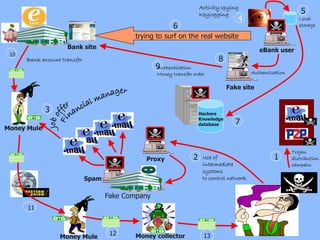
Activity spying
                                                                         Keylogging                                 5
                                                                                        4                          Local
                                                          6                                                        storage

                                             trying to surf on the real website
                     Bank site                                                                    eBank user
 10
      Bank account transfer                                                     8
                                                    9
                                                    Authentication
                                                    Money transfer order                       Authentication

                                                                                     Fake site


             3                                                           Hackers
                                                                         Knowledge
                                                                         database      7
Money Mule


                                                                                                                Trojan
                                                Proxy                2    Use of                        1       distribution
                                                                          intermediate                          campain
                                                                          systems
                              Spam                                        to control network


                                     Fake Company
      11


                                      12     Money collector              13
                  Money Mule
Latest malware developments
  Stuxnet : very complex and elaborated trojan
  Several replication vectors :
    Networks
    USB keys
  Connects to C&C botnet server
  Focused on industrial control system
    Searches for systems with this control system
    Collects information on Siemens PLC systems
    Changes process logic on infected machines
  Duqu based upon Stuxnet : spying purposes
                Cybercrime threats © Belgian Federal Computer Crime Unit
                                                                           © Luc Beirens
Biggest threat ? Criminal’s
Knowledge database
 SQL (standard query language) databases
 Several backup servers
 Content
      Keylogging (everything also userids, passwords)
      Screenshots (of all opened windows, websites,...)
      URL
      IP-addresses
 Base for reverse R&D to counter new security


               Cybercrime threats © Belgian Federal Computer Crime Unit
Cases ?

 e-Banking fraud

 Hacking of large institutions / firms
      Long time unaware of hacking
      Keylogging
      Encrypted files on PC
      Internal botnet
      Intermediate step to other networks
      Often no complaint
               Cybercrime threats © Belgian Federal Computer Crime Unit
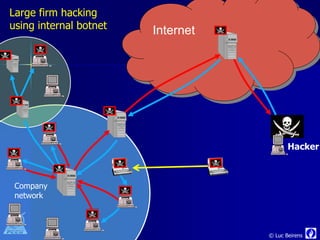
Large firm hacking
using internal botnet   Internet


                                          Hacker


 Company
 network


                                   © Luc Beirens
And the victims ?
 Who ?
   Transactional websites
   Communication networks
   ISPs and all other clients


 Reaction
   Unaware of incidents going on
   ISPs try to solve it themselves
   Nearly no complaints made – even if asked ...

 Result ? The hackers go on developing botnets
Combined threat

 What if abused by terrorists ?
  ... simultaniously with a real world attack?

 How will you handle the crisis ?
  Your telephone system is not working !


          Cybercrime threats © Belgian Federal Computer Crime Unit
Risks

 Economical disaster
   Large scale : critical infrastructure
   Small scale : enterprise


 Individual data

 Loss of trust in e-society

           Cybercrime threats © Belgian Federal Computer Crime Unit
Who investigates ICT crime ?
   Prosecutors / Examining Judges
   Specialised police forces (nat’l & Internat’l)
   Legal expert witnesses
   Specialised forensic units of consulting firms
   Associations defending commercial interests

   Security firms => vulnerabilities
   Activist groups => publish info on « truth »
                                             © Luc Beirens
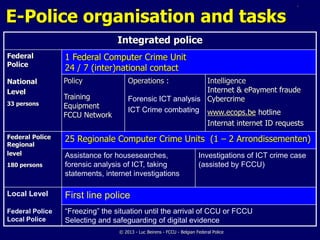
E-Police organisation and tasks
                                 Integrated police
Federal          1 Federal Computer Crime Unit
Police
                 24 / 7 (inter)national contact
National         Policy              Operations :          Intelligence
Level                                                      Internet & ePayment fraude
                 Training            Forensic ICT analysis Cybercrime
33 persons       Equipment           ICT Crime combating www.ecops.be hotline
                 FCCU Network
                                                                            Internat internet ID requests
Federal Police   25 Regionale Computer Crime Units (1 – 2 Arrondissementen)
Regional
level            Assistance for housesearches,                          Investigations of ICT crime case
180 persons      forensic analysis of ICT, taking                       (assisted by FCCU)
                 statements, internet investigations

Local Level      First line police
Federal Police   “Freezing” the situation until the arrival of CCU or FCCU
Local Police     Selecting and safeguarding of digital evidence
                                 © 2013 - Luc Beirens - FCCU - Belgian Federal Police
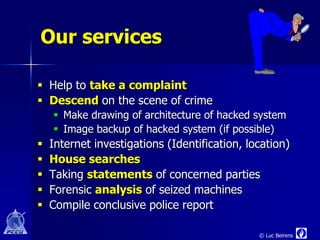
Our services

 Help to take a complaint
 Descend on the scene of crime
     Make drawing of architecture of hacked system
     Image backup of hacked system (if possible)
   Internet investigations (Identification, location)
   House searches
   Taking statements of concerned parties
   Forensic analysis of seized machines
   Compile conclusive police report

                                               © Luc Beirens
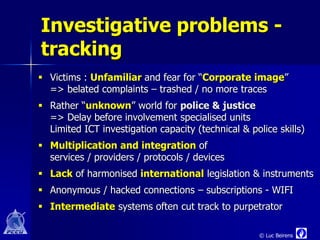
Investigative problems -
tracking
 Victims : Unfamiliar and fear for “Corporate image”
  => belated complaints – trashed / no more traces
 Rather “unknown” world for police & justice
  => Delay before involvement specialised units
  Limited ICT investigation capacity (technical & police skills)
 Multiplication and integration of
  services / providers / protocols / devices
 Lack of harmonised international legislation & instruments
 Anonymous / hacked connections – subscriptions - WIFI
 Intermediate systems often cut track to purpetrator

                                                     © Luc Beirens
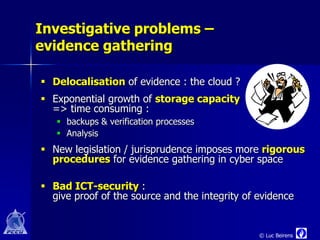
Investigative problems –
evidence gathering

 Delocalisation of evidence : the cloud ?
 Exponential growth of storage capacity
  => time consuming :
    backups & verification processes
    Analysis
 New legislation / jurisprudence imposes more rigorous
  procedures for evidence gathering in cyber space

 Bad ICT-security :
  give proof of the source and the integrity of evidence


                                                © Luc Beirens
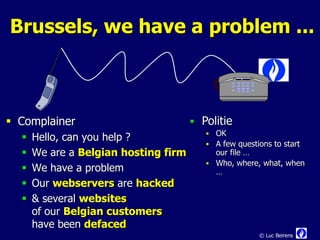
Brussels, we have a problem ...


 Complainer                           Politie
                                          OK
     Hello, can you help ?
                                          A few questions to start
     We are a Belgian hosting firm        our file …
                                          Who, where, what, when
     We have a problem                    …
     Our webservers are hacked
     & several websites
      of our Belgian customers
      have been defaced
                                                       © Luc Beirens
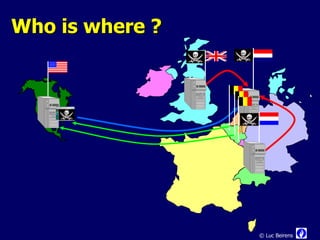
Who is where ?


                 © Luc Beirens
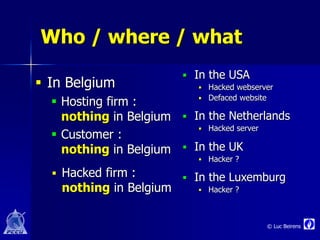
Who / where / what
                          In the USA
 In Belgium                  Hacked webserver
                               Defaced website
   Hosting firm :         

    nothing in Belgium    In the Netherlands
                              Hacked server
   Customer :
    nothing in Belgium    In the UK
                              Hacker ?
   Hacked firm :         In the Luxemburg
   nothing in Belgium         Hacker ?


                                               © Luc Beirens
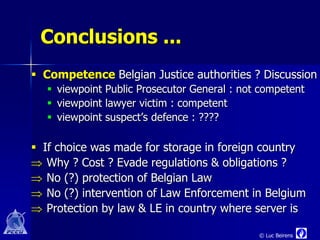
Conclusions ...
 Competence Belgian Justice authorities ? Discussion
   viewpoint Public Prosecutor General : not competent
   viewpoint lawyer victim : competent
   viewpoint suspect’s defence : ????

 If choice was made for storage in foreign country
 Why ? Cost ? Evade regulations & obligations ?
 No (?) protection of Belgian Law
 No (?) intervention of Law Enforcement in Belgium
 Protection by law & LE in country where server is

                                             © Luc Beirens
Preventive
Recommendations
 Draw up a general ICT usage directive (normal usage)
 Awareness program for management & users
  ICT security policy is part of the global security policy
 Appoint an ICT security responsible
  => control on application of ICT usage & security policy
 Keep critical systems separate from the Internet if possible !
 Use software from a trusted source
 Install recent Anti-virus and Firewall programms (laptops)
 Synchronize the system clocks regularly
 Activate and monitor log files on firewall, proxy, access
 Make & test backups & keep them safe (generations) !

                                                              © Luc Beirens
Recommendations
    for victims of ICT crime

   Disconnect from the outside world
   Take note of last internet activities & exact date and time
   Evaluate : damage more important than restart ?
      Restart most important: make full backup before restor
      Damage more important : don’t touch anything

   Safeguard all messages, log files in original state
   Inform ASAP the Federal Judicial Police
    and ask for assistance of the Federal or Regional CCU
   Force change all passwords
   Reestablish the connection only if ALL failures patched
                                                  © Luc Beirens
Where to make a
  complaint ?
 Within a police force …
    Local Police service => not specialised
     => not the right place for ICT-crime (hacking/sabotage/espionage)
     => place to make complaints on Internet fraud
    Federal judicial police (FGP) => better but …
     Regional CCU => The right place to be for ICT crime
    Federal Computer Crime Unit => 24/7 contact
     Risks on vital or crucial ICT systems => call urgently
    Illegal content (childporn, …) => www.ecops.be

 … or immediately report to a magistrate ?
    Local prosecutor (Procureur) => will send it to police
     => can decide not to prosecute
    Examining Judge => complaint with deposit of a bail
     => obligation to investigate the case
                                                         © Luc Beirens
For the sys admin
 Several layers of protection
   Internal firewalls
   Encrypted communications
   Encrypted data bases

 Check active sys admin profiles on svrs

 Log and follow up FW, IDS : IP + port + time
 Certificates should be signed by 2 CA

            Cybercrime threats © Belgian Federal Computer Crime Unit
Contact information
Federal Judicial Police
Direction for Economical and Financial crime
Federal Computer Crime Unit
Notelaarstraat 211 - 1000 Brussels – Belgium


Tel office      : +32 2 743 74 74
Fax             : +32 2 743 74 19

E-mail          : luc.beirens@fccu.be
Twitter         : @LucBeirens

                 Cybercrime threats © Belgian Federal Computer Crime Unit

20130321 Cybercrime threats on e-commerce online shops

  • 1.
    How to survivein an era of hacktivists, cyber espionnage and internet fraudsters ? The need for an integrated approach to undermine the criminal cyber architecture Brussels, 21 March 2013 e-Shop Expo © 2013 Luc Beirens – Federal Computer Crime Unit - Belgian Federal Judicial Police – Direction economical and financial crime
  • 2.
    Presentation  @LucBeirens ChiefCommissioner Head of the Federal Computer Crime Unit Belgian Federal Judicial Police Direction Economical and financial crime Chairman of the EU Cybercrime task force representing the organization of heads of national hightech crime units of the EU
  • 3.
    Topics - overview An analysis of the eSociety situation  Who is threating eSociety and how ? Inside threat / outside threats  Possible damage to eGov and eSociety  Which response to give to this ?
  • 4.
    What is thereto protect ?  Your company / public image  Your market share (even as public service)  Your business activity / products  Your existance as such Cybercrime threats © Belgian Federal Computer Crime Unit
  • 5.
    What is thereto protect ?  Data (stored or in transmission)  Our personal data employees / citizens / customers  Info on the organisation (policy/functioning/financial)  Info on your activity, product (price list, patents, source code)  Our information infrastructure  Internal / external systems  Network connexions  Storage and backup systems  Privacy law requires measures organisational and technical to protect personal data Cybercrime threats © Belgian Federal Computer Crime Unit
  • 6.
    eShop  Be recognisableto your customers  Beware of imposters  Use of certificates / control over domain  Keep your customers safe  Data  Transactions  Get paid for your services / products  Don’t become unwillingly a criminal service platform Cybercrime threats © Belgian Federal Computer Crime Unit
  • 7.
    e-Architecture Externally managed infrastructure Certification Authority Externally hosted website VPN Internet DNS Internal network Firewall DMZ own Backup server webserver Cloud service center SCADA End user Roaming user Process control © Luc Beirens
  • 8.
    General trends today Evolution towards e-society  replace persons by e-applications  Interconnecting all systems (admin, industrial, control)  Mobile systems – Cloud  Social networks  IP is common platform offered by many ISPs integrating telephony / data / VPN & all new apps =opportunities / Achilles tendon / scattered traces  Poor security in legacy applications and protocols (userid+pw)=> identity fraud is easy  Enduser is not yet educated to act properly
  • 9.
    What do criminalswant ?  Become rich / powerfull rapidly, easily, very big ROI in an illegal way if needed  Destabilaze (e-)society by causing troubles
  • 10.
    First conclusions ? Society is thus very heavily depending on ICT  ICT = important vulnerability of modern society  End user = weakest link => biggest danger  Need to  Guarantee continuity of ICT functioning  Availability and integrity of data  Data is more and more in the cloud  Accessible from all over the world  Outside jurisdiction of your country
  • 11.
    Who is threatingus ?  Script kiddies  Insider ICT guy in your company  Loosely organized criminals  Firmly organized criminal groups  Terrorists / hacktivists  Foreign states / economical powers  Nation warfare troups
  • 12.
    What are theoutside threats ? Cybercrime threats © Belgian Federal Computer Crime Unit
  • 13.
    Threats in messages onhackersites  Wiping away the websites in your state  Infiltration in servers of the Public Treasury disrupting tax collection  Infiltration in bank accounts  Attacks on media websites  Attacks on e-commerce websites  Distribution of personnel data and credit card information  Targetting also in the end of the year period Cybercrime threats © Belgian Federal Computer Crime Unit
  • 14.
    Focus  On individuals  On webservers  On your organization  On your partner’s organization  On your infrastructure  On cyber infrastructure Cybercrime threats © Belgian Federal Computer Crime Unit
  • 15.
    Hacking webservers  Motivesof criminal :  Perform defacement  Use as storage platform for illegal content (childporn)  Use as intermediate platform for criminal activity  Get sensitive information and do extortion (idiot tax)  Get financial information (credit cards)  To do :  Updates SW, strong admin access, no pers data on srvr  Follow up pastebin.com : a hackers drop off Cybercrime threats © Belgian Federal Computer Crime Unit
  • 16.
    Cybercrime threats ©Belgian Federal Computer Crime Unit
  • 18.
    E-Shop risks  “Forgotten”test environments  Use of real data  No logging of  Applications with debugging procedures  Data bases with all user data on webserver instead of inside LAN  User profiles unencrypted / unsalted ?  Credit card information in profiles ?  Use of stolen credit (new payment systems) Cybercrime threats © Belgian Federal Computer Crime Unit
  • 19.
    Dossier Cybercrime -NVP PNS 2012-2015
  • 20.
    Security : encrypteddata !  Infection of workstations and servers in company LAN  Using targetted e-mails / social media messages  Malicious encryption of all user data files  Ransom to get decryption key  From those that paid : some got key some didn’t  Others had a recent off-line backup ! Cybercrime threats © Belgian Federal Computer Crime Unit
  • 21.
    Intrusions in yourLAN  Intrusion in your system to intercept data that allows to take away products from your stock  WIFI interception from parking  Infection by trojan (e-mail)  (unreported) burglary in the company to place  hardware keyloggers  complete small computer system WIFI intercept 3G transmit  With valid ticket go fetch cargo  To Do :  Encrypt WIFI transmissions  Patch only active workstation connections Cybercrime threats © Belgian Federal Computer Crime Unit
  • 22.
    Intrusion in your tradingaccount  Carbon dioxide certificates trade  Open data : contact persons of companies  Spear phishing mail + phishing website  Access to trading account  Millions of € sold in few hours all over EU  Sold far under price & immediately resold  To do : Awareness Cybercrime threats © Belgian Federal Computer Crime Unit
  • 23.
    Intrusion in yourpartner’s LAN  Intrusion in LAN of foreign partner (Chinese) and get information on your business and invoices to pay  You get mail with  Slightly different e-mail adresses  Change of bank account number to pay (Due to audit ...)  To do : verify thouroughly any changes before paying Cybercrime threats © Belgian Federal Computer Crime Unit
  • 24.
    Attacking infrastructure  Remotemanaged infrastructures in your buildings  Central heating  Elevator  Creating disruption of this infrastructure => leads to high cost  To do : verify if this applies to you and your infrastructure managing company Cybercrime threats © Belgian Federal Computer Crime Unit
  • 25.
    Hacking into cloudaccounts  SME’s that have all their information in cloud accounts  Hacking into these account  Taking over access control  Sending of SOS-e-mails (Robbed money needed)  Deleting all contact information in the account => preventing warning e-mails after getting back access to account  To do :  enforce strong authentication and second ways to access the account  Have backups of these systems Cybercrime threats © Belgian Federal Computer Crime Unit
  • 26.
    Dossier Cybercrime -NVP PNS 2012-2015
  • 27.
    Cyber crime against cyberinfrastructure  Payment systems  2010 Wikileaks case : “Anonymous” attack on VISA, Paypal, Mastercard,...  DNS – system create fraudulent routing or use for DDOS  Certification autorities (Diginotar)  Data centers (Blocs all servers in it) Dossier Cybercrime - NVP PNS 2012-2015
  • 28.
    Dossier Cybercrime -NVP PNS 2012-2015
  • 29.
    Cybercrime focusing individuals Individuals are  also working in companies / government  Use social networks / webmail  Often used to exchange business related info  Containing access code information  Hacking of these profiles / webmails  Abuse to infect people you know  Get personal information of you and your contacts  Commit fraud  Internet fraud of all kinds  Webcam sex interception to do extortion Luc Beirens - FCCU -2012
  • 30.
    What are thecriminals tech tools to hack and attack ?  Malware attacks (viruses, worms, trojans, ...) fast spreading day zero infections => no immediate cure => lot of victims (especially home PC’s – 24 / 365 available)  Abuse of infected computers to create botnets (large “armies” of PC’s under control of 1 master) => used to make massive attacks on webservers or network nodes => high risk for your critical ICT infrastructure Cybercrime threats © Belgian Federal Computer Crime Unit
  • 31.
    Webserver / node Computer Crash Hacker Internet Info Access line Cmd blocked My IP is x.y.z.z Command & Botnet attack on a webserver / node Control Server
  • 32.
    Webserver / node Hacker Knowledge server Internet trigger event MW update Very frequent MW update request Malware update server Command & Malware update / knowledge transfer Control Server
  • 33.
    Why ? Makingmoney !  Sometimes still for fun (scriptkiddies)  Spam distribution via Zombie  Click generation on banner publicity  Dialer installation on zombie to make premium rate calls  Spyware installation  Espionage => banking details / passwords / keylogging  Ransom bot => encrypts files => money for password  Capacity for distributed denial of service attacks DDOS => disturb functioning of internet device (server/router) Cybercrime threats © Belgian Federal Computer Crime Unit
  • 34.
    How big isthe problem ?  Already criminal cases in several countries  Botnets detected  Several hundreds of botnets worldwide  Several thousands of C&C worldwide  Thousands upto millions of zombie computers online  generated huge datatraffic upto 40 Gbps  Dismantling / crippling botnets
  • 35.
    e-Crime underground business  Underground fora and chatrooms  Restricted access – on invitation  Secured by encryption  Botnets for hire  Control over bot for spam : 0,04 $ / bot / day Small scale attack 20 Mbps : 50 – 100 $ / day  Large scale attack 10Gbps : 1000 $ / day  Malware development on demand Cybercrime threats © Belgian Federal Computer Crime Unit
  • 36.
    Important DDOS cases  UK 2004 : gambling website down (+ hoster + ISP)  NL 2005 : 2 botnets : millions of zombies  BE 2005 : DDOS on chatnetwork of Media firms  BE 2005 : DDOS on Firm (social conflict)  US 2006 : Blue security firm stops activity  SE 2006 : Website Gov and Police down due to DDOS after police raid on P2P  EE 2007 : Widespread DDOS attack on Estonia after incidents on moving soldier statue  Georgia 2008 : cyber war during military conflict  World 2010 : Wikileaks case : Visa Mastercard paypal  World 2012 : CIA FBI USDOJ EU Arcelor Mittal ... Cybercrime threats © Belgian Federal Computer Crime Unit
  • 37.
    Attacks on eSociety authenticationsystems using malware and botnets Cybercrime threats © Belgian Federal Computer Crime Unit
  • 38.
    Authentication eService website eService user Authentication systems Intercepted userid + pw user : u123 password : secret123 Give token 15 : Word15 Intercepting 36 sessions Phishing website 3 x 12 Consultation & Transfers New authentication systems One time passwords Time based Give OT password : Timedependentcode Consultation & Transfers Waiting the authentication Afterwards perform transaction Challenge based Calculate OTP with challenge 12345678 Calculated OTP Consultation & Transfers Waiting the authentication Need for user cooperation ????
  • 39.
    If technical securityis ok ...  They are informed of webactivity over the botnet  They know you ! (knowledge base & social networks)  They will switch to social engineering They will make you believe they are someone else to make you do something they want / need  Abusing expected “normal user behaviour”  Fear of or willingness to help or coope with hierarchy security services / helpdesk / vendors / (business) partners  Love for (new) friends  Greed
  • 40.
    Activity spying Keylogging 5 4 Local 6 storage trying to surf on the real website Bank site eBank user 10 Bank account transfer 8 9 Authentication Money transfer order Authentication Fake site 3 Hackers Knowledge database 7 Money Mule Trojan Proxy 2 Use of 1 distribution intermediate campain systems Spam to control network Fake Company 11 12 Money collector 13 Money Mule
  • 41.
    Latest malware developments  Stuxnet : very complex and elaborated trojan  Several replication vectors :  Networks  USB keys  Connects to C&C botnet server  Focused on industrial control system  Searches for systems with this control system  Collects information on Siemens PLC systems  Changes process logic on infected machines  Duqu based upon Stuxnet : spying purposes Cybercrime threats © Belgian Federal Computer Crime Unit © Luc Beirens
  • 42.
    Biggest threat ?Criminal’s Knowledge database  SQL (standard query language) databases  Several backup servers  Content  Keylogging (everything also userids, passwords)  Screenshots (of all opened windows, websites,...)  URL  IP-addresses  Base for reverse R&D to counter new security Cybercrime threats © Belgian Federal Computer Crime Unit
  • 43.
    Cases ?  e-Bankingfraud  Hacking of large institutions / firms  Long time unaware of hacking  Keylogging  Encrypted files on PC  Internal botnet  Intermediate step to other networks  Often no complaint Cybercrime threats © Belgian Federal Computer Crime Unit
  • 44.
    Large firm hacking usinginternal botnet Internet Hacker Company network © Luc Beirens
  • 45.
    And the victims?  Who ?  Transactional websites  Communication networks  ISPs and all other clients  Reaction  Unaware of incidents going on  ISPs try to solve it themselves  Nearly no complaints made – even if asked ...  Result ? The hackers go on developing botnets
  • 46.
    Combined threat  Whatif abused by terrorists ? ... simultaniously with a real world attack?  How will you handle the crisis ? Your telephone system is not working ! Cybercrime threats © Belgian Federal Computer Crime Unit
  • 47.
    Risks  Economical disaster  Large scale : critical infrastructure  Small scale : enterprise  Individual data  Loss of trust in e-society Cybercrime threats © Belgian Federal Computer Crime Unit
  • 48.
    Who investigates ICTcrime ?  Prosecutors / Examining Judges  Specialised police forces (nat’l & Internat’l)  Legal expert witnesses  Specialised forensic units of consulting firms  Associations defending commercial interests  Security firms => vulnerabilities  Activist groups => publish info on « truth » © Luc Beirens
  • 49.
    E-Police organisation andtasks Integrated police Federal 1 Federal Computer Crime Unit Police 24 / 7 (inter)national contact National Policy Operations : Intelligence Level Internet & ePayment fraude Training Forensic ICT analysis Cybercrime 33 persons Equipment ICT Crime combating www.ecops.be hotline FCCU Network Internat internet ID requests Federal Police 25 Regionale Computer Crime Units (1 – 2 Arrondissementen) Regional level Assistance for housesearches, Investigations of ICT crime case 180 persons forensic analysis of ICT, taking (assisted by FCCU) statements, internet investigations Local Level First line police Federal Police “Freezing” the situation until the arrival of CCU or FCCU Local Police Selecting and safeguarding of digital evidence © 2013 - Luc Beirens - FCCU - Belgian Federal Police
  • 50.
    Our services  Helpto take a complaint  Descend on the scene of crime  Make drawing of architecture of hacked system  Image backup of hacked system (if possible)  Internet investigations (Identification, location)  House searches  Taking statements of concerned parties  Forensic analysis of seized machines  Compile conclusive police report © Luc Beirens
  • 51.
    Investigative problems - tracking Victims : Unfamiliar and fear for “Corporate image” => belated complaints – trashed / no more traces  Rather “unknown” world for police & justice => Delay before involvement specialised units Limited ICT investigation capacity (technical & police skills)  Multiplication and integration of services / providers / protocols / devices  Lack of harmonised international legislation & instruments  Anonymous / hacked connections – subscriptions - WIFI  Intermediate systems often cut track to purpetrator © Luc Beirens
  • 52.
    Investigative problems – evidencegathering  Delocalisation of evidence : the cloud ?  Exponential growth of storage capacity => time consuming :  backups & verification processes  Analysis  New legislation / jurisprudence imposes more rigorous procedures for evidence gathering in cyber space  Bad ICT-security : give proof of the source and the integrity of evidence © Luc Beirens
  • 53.
    Brussels, we havea problem ...  Complainer  Politie  OK  Hello, can you help ?  A few questions to start  We are a Belgian hosting firm our file …  Who, where, what, when  We have a problem …  Our webservers are hacked  & several websites of our Belgian customers have been defaced © Luc Beirens
  • 54.
    Who is where? © Luc Beirens
  • 55.
    Who / where/ what  In the USA  In Belgium  Hacked webserver Defaced website  Hosting firm :  nothing in Belgium  In the Netherlands  Hacked server  Customer : nothing in Belgium  In the UK  Hacker ?  Hacked firm :  In the Luxemburg nothing in Belgium  Hacker ? © Luc Beirens
  • 56.
    Conclusions ...  CompetenceBelgian Justice authorities ? Discussion  viewpoint Public Prosecutor General : not competent  viewpoint lawyer victim : competent  viewpoint suspect’s defence : ????  If choice was made for storage in foreign country  Why ? Cost ? Evade regulations & obligations ?  No (?) protection of Belgian Law  No (?) intervention of Law Enforcement in Belgium  Protection by law & LE in country where server is © Luc Beirens
  • 57.
    Preventive Recommendations  Draw upa general ICT usage directive (normal usage)  Awareness program for management & users ICT security policy is part of the global security policy  Appoint an ICT security responsible => control on application of ICT usage & security policy  Keep critical systems separate from the Internet if possible !  Use software from a trusted source  Install recent Anti-virus and Firewall programms (laptops)  Synchronize the system clocks regularly  Activate and monitor log files on firewall, proxy, access  Make & test backups & keep them safe (generations) ! © Luc Beirens
  • 58.
    Recommendations for victims of ICT crime  Disconnect from the outside world  Take note of last internet activities & exact date and time  Evaluate : damage more important than restart ?  Restart most important: make full backup before restor  Damage more important : don’t touch anything  Safeguard all messages, log files in original state  Inform ASAP the Federal Judicial Police and ask for assistance of the Federal or Regional CCU  Force change all passwords  Reestablish the connection only if ALL failures patched © Luc Beirens
  • 59.
    Where to makea complaint ?  Within a police force …  Local Police service => not specialised => not the right place for ICT-crime (hacking/sabotage/espionage) => place to make complaints on Internet fraud  Federal judicial police (FGP) => better but … Regional CCU => The right place to be for ICT crime  Federal Computer Crime Unit => 24/7 contact Risks on vital or crucial ICT systems => call urgently  Illegal content (childporn, …) => www.ecops.be  … or immediately report to a magistrate ?  Local prosecutor (Procureur) => will send it to police => can decide not to prosecute  Examining Judge => complaint with deposit of a bail => obligation to investigate the case © Luc Beirens
  • 60.
    For the sysadmin  Several layers of protection  Internal firewalls  Encrypted communications  Encrypted data bases  Check active sys admin profiles on svrs  Log and follow up FW, IDS : IP + port + time  Certificates should be signed by 2 CA Cybercrime threats © Belgian Federal Computer Crime Unit
  • 61.
    Contact information Federal JudicialPolice Direction for Economical and Financial crime Federal Computer Crime Unit Notelaarstraat 211 - 1000 Brussels – Belgium Tel office : +32 2 743 74 74 Fax : +32 2 743 74 19 E-mail : luc.beirens@fccu.be Twitter : @LucBeirens Cybercrime threats © Belgian Federal Computer Crime Unit