2013 Scrum Guide Changes
Edwin Dando
Consulting Manager
Agenda
We are going to cover
+ Why do this session?
+ The Scrum Guide

+ The changes
+ How they may impact you

SLIDE | 2
Why hold this event?
+ Scrum has had explosive growth throughout the world
+ US law - all Dept. of Defence software projects have to use Scrum
+ US Post has mandated Scrum everywhere in IT
+ Hire.com – 2011: 20,000 Scrum job listings, 2013: 640,000
+ Ed just back from US, met Scrum creators Ken Schwaber and Jeff Sutherland
+ We’d like to help the NZ community understand the changes and why they have
been initiated

SLIDE | 3
Why is the Scrum Guide important?
+ In 2008 Scrum was a mess

•

Scrum Alliance model failing

•

No checks and balances on what Certified Trainers taught

•

Proliferation of inaccurate interpretations of Scrum

•

Scrum started fragmenting…

•

People saying “but that’s not Scrum”… but there was no reference point

+ Ken and Jeff realised something needed to be done

SLIDE | 4
The Scrum Guide
+ Step 1: Define Scrum

•

Codify definition of Scrum: 2009 Scrum Guide

•

17 pages that covers the foundational aspects of the framework

•

Free & updated as required (versions 2009, 2011, 2013)

•

Now hosted in one place – www.scrumguides.org

+ Step 2: Ken set up Scrum.org

•
•
SLIDE | 5

Centralise all training to be consistent with Scrum Guide
All Scrum.org material simultaneously changed with 2013 Scrum Guide
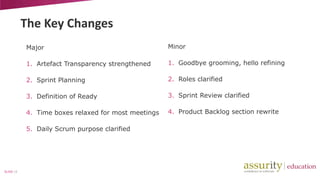
The Key Changes
Major

Minor

1. Artefact Transparency strengthened

1. Goodbye grooming, hello refining

2. Sprint Planning

2. Roles clarified

3. Definition of Ready

3. Sprint Review clarified

4. Time boxes relaxed for most meetings

4. Product Backlog section rewrite

5. Daily Scrum purpose clarified

SLIDE | 6
Major 1: Artefact Transparency strengthened
+ Explicitly states how critical it is that all artefacts are transparent

•

Product Backlog, Sprint Backlog and Increment

+ Includes specific responsibility for the Scrum Master to work with the Team & PO
to ensure all artefacts are transparent

Scrum relies on transparency. Decisions to optimize value and control risk are made
based on the perceived state of the artifacts (evidence based management) .

•
•
SLIDE | 7

When artefacts are transparent, these decisions have a sound basis.
When artefacts are incompletely transparent, these decisions can be flawed, value
may diminish and risk may increase.
5

Artefact Transparency strengthened
So what do we mean by


Transparent product backlog?



Transparent Sprint Backlog?



Transparent increment?

How transparent are your artefacts?

SLIDE | 8

MIN
Major 2: Sprint Planning is now one event
1. Sprint Planning is now one event

•

People were taking the split too literally… Sometimes you need to do the how in
order to understand the what.

•

Two topics are addressed in Sprint Planning
o

What can be done in the Sprint

o

How will the chosen work be done.

2. Explicit inclusion of the Sprint Goal
o

o
SLIDE | 9

Unifying theme that creates focus and flexibility re functionality implemented
within the Sprint
Teams need to come out of Sprint Planning with one
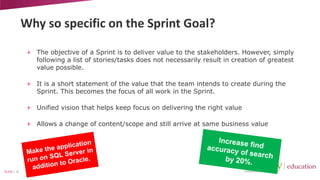
Why so specific on the Sprint Goal?
+ The objective of a Sprint is to deliver value to the stakeholders. However, simply
following a list of stories/tasks does not necessarily result in creation of greatest
value possible.
+ It is a short statement of the value that the team intends to create during the
Sprint. This becomes the focus of all work in the Sprint.
+ Unified vision that helps keep focus on delivering the right value
+ Allows a change of content/scope and still arrive at same business value

SLIDE | 10
5

Will this impact your team(s)?



SLIDE | 11

Sprint Planning one event
Sprint Goal

MIN
Major 3: Definition of Ready
+ Critical that team understand what is being asked
+ Working on unready items introduces waste. Waiting time = waste.
+ Accelerates the Sprint Planning meeting

•

Systemic in Germany got a doubling of velocity by ensuring stories were Ready

+ Explicit policy as per Definition of Done

SLIDE | 12
5

How will a DoR impact you?



Less waste (rework, waiting, assumptions)?



Better and more transparent increments?



Slightly more upfront work?



What would happen if DoR was too detailed?



SLIDE | 13

Better backlogs (particularly top)?

What is our tolerance for ambiguity?

MIN
Major 4: Time boxes relaxed
+ More explicit wording about time boxes being a maximum
+ Relaxing timebox on Sprint Planning, Review, Retrospective

•

“If Sprint less than 1 month then proportionally shorter usually shorter”

+ Why?

•

Scrum is: plan, adjust plan daily, deliver, review, reflect, adapt
o

o

SLIDE | 14

•

Ceremony length somewhat arbitrary compared to value of ceremony.

Responsibility ultimately lies with the team.

Daily Scrum still limited to 15 minutes
5

What will this mean for you?



Possibly longer meetings?



SLIDE | 15

Focus on value?

Increased trust?

MIN
Major 5: Daily Scrum
Change in wording:
1. Emphasis on the fact that it is a planning meeting focusing on the Sprint Goal,
not a status meeting
2. Emphasis on the Team, not the individual

SLIDE | 16
Daily Scrum – change 1
+ Every day, the Team should understand how it intends to work together as a selforganizing unit to accomplish the Sprint Goal

+ Input = progress towards meeting the Sprint Goal
+ Output = new or revised plan that optimizes efforts in meeting the Sprint Goal

SLIDE | 17
Daily Scrum – change 2
+ The three questions (which are only a guide) have been reformulated to
emphasize the team over the individual:

•
•

What will I do today to help the Team meet the Sprint Goal?

•

SLIDE | 18

What did I do yesterday that helped the Team meet the Sprint Goal?

Do I see any impediment that prevents me or the Team from meeting the Sprint
Goal?
Daily Scrum – change 2 (cont)
+ Example – I spend time working on something that isnt related to the Sprint Goal
+ old approach

•

“Yesterday I didn’t get this done… today I am going to… I have an impediment”

•

Now it is “yesterday I didn’t do anything to progress the team”

•

We are expecting “What??? Why not? We have an impediment!“ (not I)

+ Jeff has tried this out over the last few months and has found it helps improve the
team dynamic in a very positive way

SLIDE | 19
5

Daily Scrum
How will these changes impact you?



Less assumptions?



SLIDE | 20

More effective meeting + team?

Better plan + more transparency?

MIN
Minor 1: Goodbye grooming, hello refining
+ Refinement

•

adding detail, estimates, and order to PBIs

•

on-going process with PO and the Team

•

items can be updated at any time by the Product Owner

+ Use Definition of Ready as a guide

SLIDE | 21
Minor 2: Roles clarified
+ Team: removed “Team composition remains constant”

+ Scrum Masters service to the Team changed

•

Removed “Clearly communicating vision, goals, and Product Backlog items to the
Development Team;”

•

Added
o

o

“Helping the Scrum Team understand the need for clear and concise Product
Backlog items;”
“Ensuring the Product Owner knows how to arrange the Product Backlog to
maximize value;”

+ Scrum Masters service to the Product Owner changed

•
SLIDE | 22

Changed “Teaching and leading the Team to create high-value products;” to
“Helping the Team to create high-value products;”
Minor 3: Sprint Review – 2 key changes
1. Explicit wording about the point of the Sprint Review
2. Concept of value is reinforced
+ The Scrum Team and stakeholders collaborate about what was done in the Sprint.
+ Based on that and any changes to the Product Backlog during the Sprint,
attendees collaborate on the next things that could be done to optimize value.
+ Outcome = potentially reordered Product Backlog
+ Added ” .. not a status meeting .. ”
IT IS NOT A SHOW AND TELL OR A DEMO
SLIDE | 23
Minor 4: Product Backlog section rewrite
Key points
+ A Product Backlog is never complete.
+ Earliest version only lays out the initially known and best-understood
requirements.
+ The Product Backlog is dynamic; it constantly changes to identify what the product
needs to be appropriate, competitive, and useful.
+ As long as a product exists, its Product Backlog also exists

SLIDE | 24
Discussion

SLIDE | 25
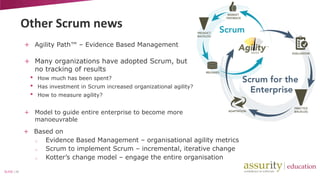
Other Scrum news
+ Agility Path™ – Evidence Based Management

+ Many organizations have adopted Scrum, but
no tracking of results

•
•
•

How much has been spent?
Has investment in Scrum increased organizational agility?
How to measure agility?

+ Model to guide entire enterprise to become more
manoeuvrable

+ Based on
o
Evidence Based Management – organisational agility metrics
o
Scrum to implement Scrum – incremental, iterative change
o
Kotter’s change model – engage the entire organisation
SLIDE | 26

2013 scrum guide changes - Edwin Dando

  • 1.
    2013 Scrum GuideChanges Edwin Dando Consulting Manager
  • 2.
    Agenda We are goingto cover + Why do this session? + The Scrum Guide + The changes + How they may impact you SLIDE | 2
  • 3.
    Why hold thisevent? + Scrum has had explosive growth throughout the world + US law - all Dept. of Defence software projects have to use Scrum + US Post has mandated Scrum everywhere in IT + Hire.com – 2011: 20,000 Scrum job listings, 2013: 640,000 + Ed just back from US, met Scrum creators Ken Schwaber and Jeff Sutherland + We’d like to help the NZ community understand the changes and why they have been initiated SLIDE | 3
  • 4.
    Why is theScrum Guide important? + In 2008 Scrum was a mess • Scrum Alliance model failing • No checks and balances on what Certified Trainers taught • Proliferation of inaccurate interpretations of Scrum • Scrum started fragmenting… • People saying “but that’s not Scrum”… but there was no reference point + Ken and Jeff realised something needed to be done SLIDE | 4
  • 5.
    The Scrum Guide +Step 1: Define Scrum • Codify definition of Scrum: 2009 Scrum Guide • 17 pages that covers the foundational aspects of the framework • Free & updated as required (versions 2009, 2011, 2013) • Now hosted in one place – www.scrumguides.org + Step 2: Ken set up Scrum.org • • SLIDE | 5 Centralise all training to be consistent with Scrum Guide All Scrum.org material simultaneously changed with 2013 Scrum Guide
  • 6.
    The Key Changes Major Minor 1.Artefact Transparency strengthened 1. Goodbye grooming, hello refining 2. Sprint Planning 2. Roles clarified 3. Definition of Ready 3. Sprint Review clarified 4. Time boxes relaxed for most meetings 4. Product Backlog section rewrite 5. Daily Scrum purpose clarified SLIDE | 6
  • 7.
    Major 1: ArtefactTransparency strengthened + Explicitly states how critical it is that all artefacts are transparent • Product Backlog, Sprint Backlog and Increment + Includes specific responsibility for the Scrum Master to work with the Team & PO to ensure all artefacts are transparent Scrum relies on transparency. Decisions to optimize value and control risk are made based on the perceived state of the artifacts (evidence based management) . • • SLIDE | 7 When artefacts are transparent, these decisions have a sound basis. When artefacts are incompletely transparent, these decisions can be flawed, value may diminish and risk may increase.
  • 8.
    5 Artefact Transparency strengthened Sowhat do we mean by  Transparent product backlog?  Transparent Sprint Backlog?  Transparent increment? How transparent are your artefacts? SLIDE | 8 MIN
  • 9.
    Major 2: SprintPlanning is now one event 1. Sprint Planning is now one event • People were taking the split too literally… Sometimes you need to do the how in order to understand the what. • Two topics are addressed in Sprint Planning o What can be done in the Sprint o How will the chosen work be done. 2. Explicit inclusion of the Sprint Goal o o SLIDE | 9 Unifying theme that creates focus and flexibility re functionality implemented within the Sprint Teams need to come out of Sprint Planning with one
  • 10.
    Why so specificon the Sprint Goal? + The objective of a Sprint is to deliver value to the stakeholders. However, simply following a list of stories/tasks does not necessarily result in creation of greatest value possible. + It is a short statement of the value that the team intends to create during the Sprint. This becomes the focus of all work in the Sprint. + Unified vision that helps keep focus on delivering the right value + Allows a change of content/scope and still arrive at same business value SLIDE | 10
  • 11.
    5 Will this impactyour team(s)?   SLIDE | 11 Sprint Planning one event Sprint Goal MIN
  • 12.
    Major 3: Definitionof Ready + Critical that team understand what is being asked + Working on unready items introduces waste. Waiting time = waste. + Accelerates the Sprint Planning meeting • Systemic in Germany got a doubling of velocity by ensuring stories were Ready + Explicit policy as per Definition of Done SLIDE | 12
  • 13.
    5 How will aDoR impact you?   Less waste (rework, waiting, assumptions)?  Better and more transparent increments?  Slightly more upfront work?  What would happen if DoR was too detailed?  SLIDE | 13 Better backlogs (particularly top)? What is our tolerance for ambiguity? MIN
  • 14.
    Major 4: Timeboxes relaxed + More explicit wording about time boxes being a maximum + Relaxing timebox on Sprint Planning, Review, Retrospective • “If Sprint less than 1 month then proportionally shorter usually shorter” + Why? • Scrum is: plan, adjust plan daily, deliver, review, reflect, adapt o o SLIDE | 14 • Ceremony length somewhat arbitrary compared to value of ceremony. Responsibility ultimately lies with the team. Daily Scrum still limited to 15 minutes
  • 15.
    5 What will thismean for you?   Possibly longer meetings?  SLIDE | 15 Focus on value? Increased trust? MIN
  • 16.
    Major 5: DailyScrum Change in wording: 1. Emphasis on the fact that it is a planning meeting focusing on the Sprint Goal, not a status meeting 2. Emphasis on the Team, not the individual SLIDE | 16
  • 17.
    Daily Scrum –change 1 + Every day, the Team should understand how it intends to work together as a selforganizing unit to accomplish the Sprint Goal + Input = progress towards meeting the Sprint Goal + Output = new or revised plan that optimizes efforts in meeting the Sprint Goal SLIDE | 17
  • 18.
    Daily Scrum –change 2 + The three questions (which are only a guide) have been reformulated to emphasize the team over the individual: • • What will I do today to help the Team meet the Sprint Goal? • SLIDE | 18 What did I do yesterday that helped the Team meet the Sprint Goal? Do I see any impediment that prevents me or the Team from meeting the Sprint Goal?
  • 19.
    Daily Scrum –change 2 (cont) + Example – I spend time working on something that isnt related to the Sprint Goal + old approach • “Yesterday I didn’t get this done… today I am going to… I have an impediment” • Now it is “yesterday I didn’t do anything to progress the team” • We are expecting “What??? Why not? We have an impediment!“ (not I) + Jeff has tried this out over the last few months and has found it helps improve the team dynamic in a very positive way SLIDE | 19
  • 20.
    5 Daily Scrum How willthese changes impact you?   Less assumptions?  SLIDE | 20 More effective meeting + team? Better plan + more transparency? MIN
  • 21.
    Minor 1: Goodbyegrooming, hello refining + Refinement • adding detail, estimates, and order to PBIs • on-going process with PO and the Team • items can be updated at any time by the Product Owner + Use Definition of Ready as a guide SLIDE | 21
  • 22.
    Minor 2: Rolesclarified + Team: removed “Team composition remains constant” + Scrum Masters service to the Team changed • Removed “Clearly communicating vision, goals, and Product Backlog items to the Development Team;” • Added o o “Helping the Scrum Team understand the need for clear and concise Product Backlog items;” “Ensuring the Product Owner knows how to arrange the Product Backlog to maximize value;” + Scrum Masters service to the Product Owner changed • SLIDE | 22 Changed “Teaching and leading the Team to create high-value products;” to “Helping the Team to create high-value products;”
  • 23.
    Minor 3: SprintReview – 2 key changes 1. Explicit wording about the point of the Sprint Review 2. Concept of value is reinforced + The Scrum Team and stakeholders collaborate about what was done in the Sprint. + Based on that and any changes to the Product Backlog during the Sprint, attendees collaborate on the next things that could be done to optimize value. + Outcome = potentially reordered Product Backlog + Added ” .. not a status meeting .. ” IT IS NOT A SHOW AND TELL OR A DEMO SLIDE | 23
  • 24.
    Minor 4: ProductBacklog section rewrite Key points + A Product Backlog is never complete. + Earliest version only lays out the initially known and best-understood requirements. + The Product Backlog is dynamic; it constantly changes to identify what the product needs to be appropriate, competitive, and useful. + As long as a product exists, its Product Backlog also exists SLIDE | 24
  • 25.
  • 26.
    Other Scrum news +Agility Path™ – Evidence Based Management + Many organizations have adopted Scrum, but no tracking of results • • • How much has been spent? Has investment in Scrum increased organizational agility? How to measure agility? + Model to guide entire enterprise to become more manoeuvrable + Based on o Evidence Based Management – organisational agility metrics o Scrum to implement Scrum – incremental, iterative change o Kotter’s change model – engage the entire organisation SLIDE | 26