


Innovation through Connectedness

                                   Professor Dr Jan Recker
                        Woolworths Chair of Retail Innovation
         Information Systems School, Queensland University of Technology
The Bad News Upfront

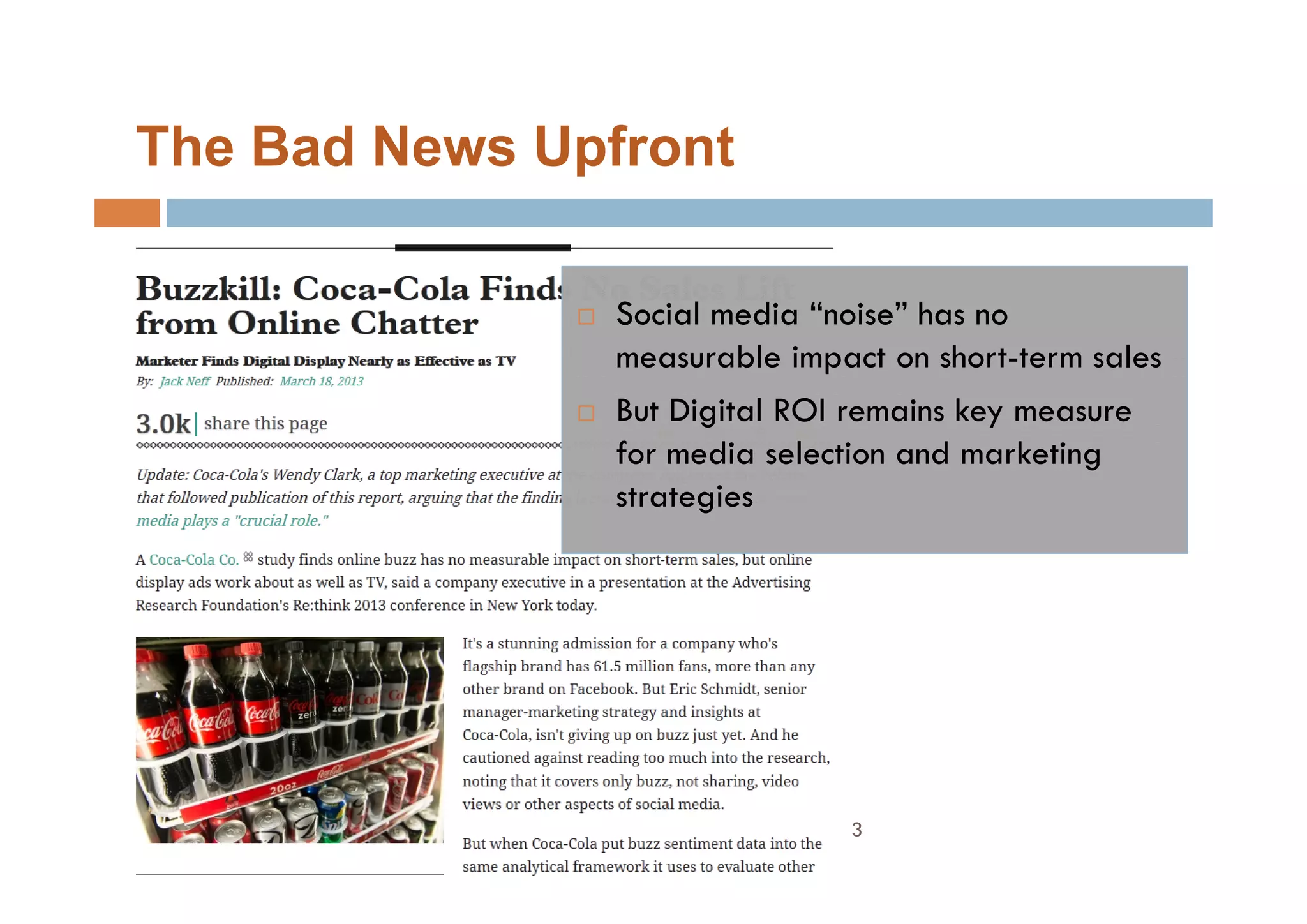
                Social media “noise” has no
                measurable impact on short term sales
                                      short-term
                But Digital ROI remains key measure
                for media selection and marketing
                strategies


                               3
But there is something to it, right?

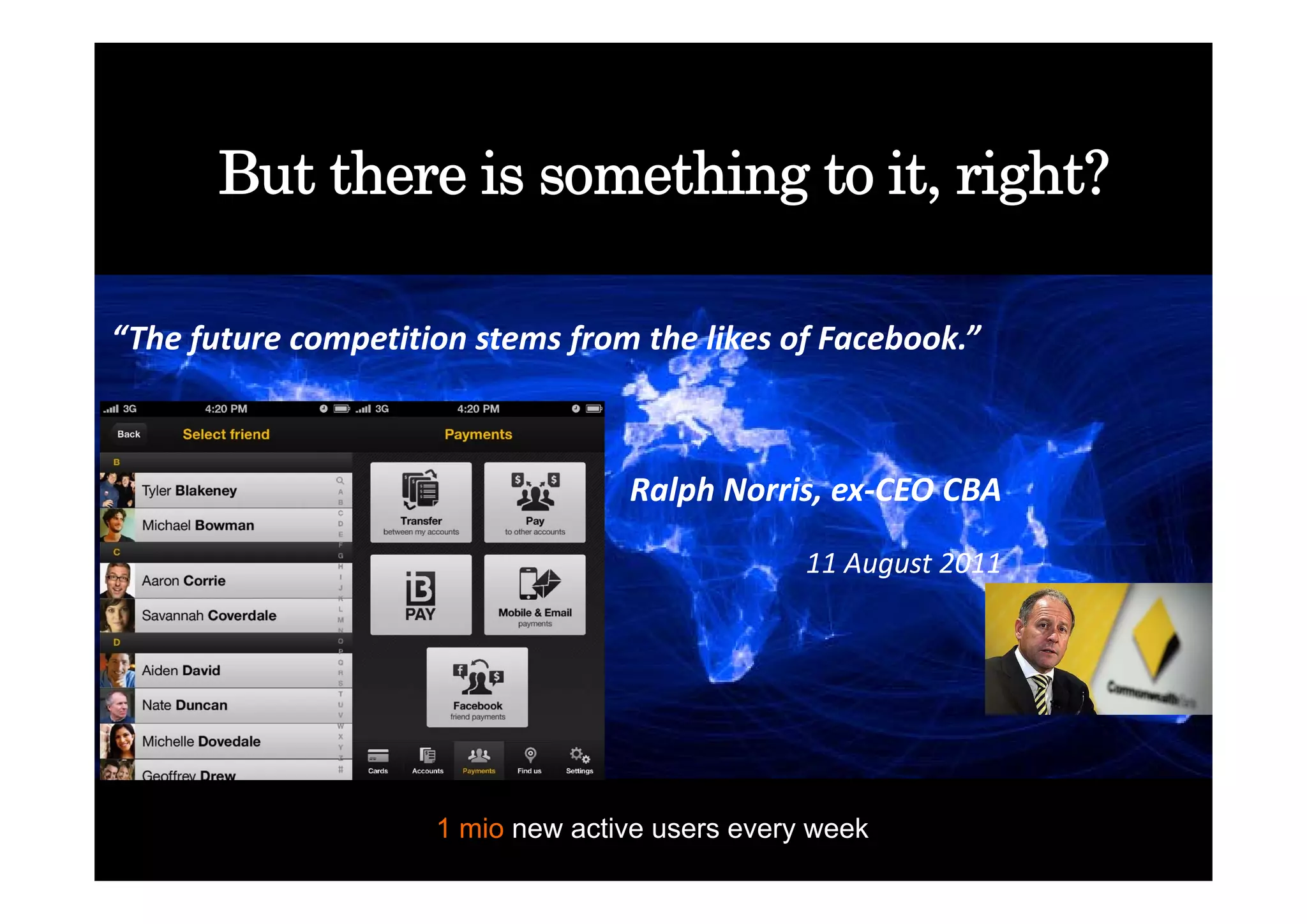
“The future competition stems from the likes of Facebook.”


                                   Ralph Norris, ex‐CEO CBA

                                                 11 August 2011
                                                 11 August 2011


                     1 mio new active users every week
Agenda
 The Innovation Affordances of Social Media:
 Can we Innovate with Social Media?
   2.35pm-3.35pm
 How to Innovate:
 Four Ways to Develop Innovations (with Social
 Media)
   4.00pm-5.00pm
 Q & A and Debate
         dD b t
   5.00pm-5.30pm
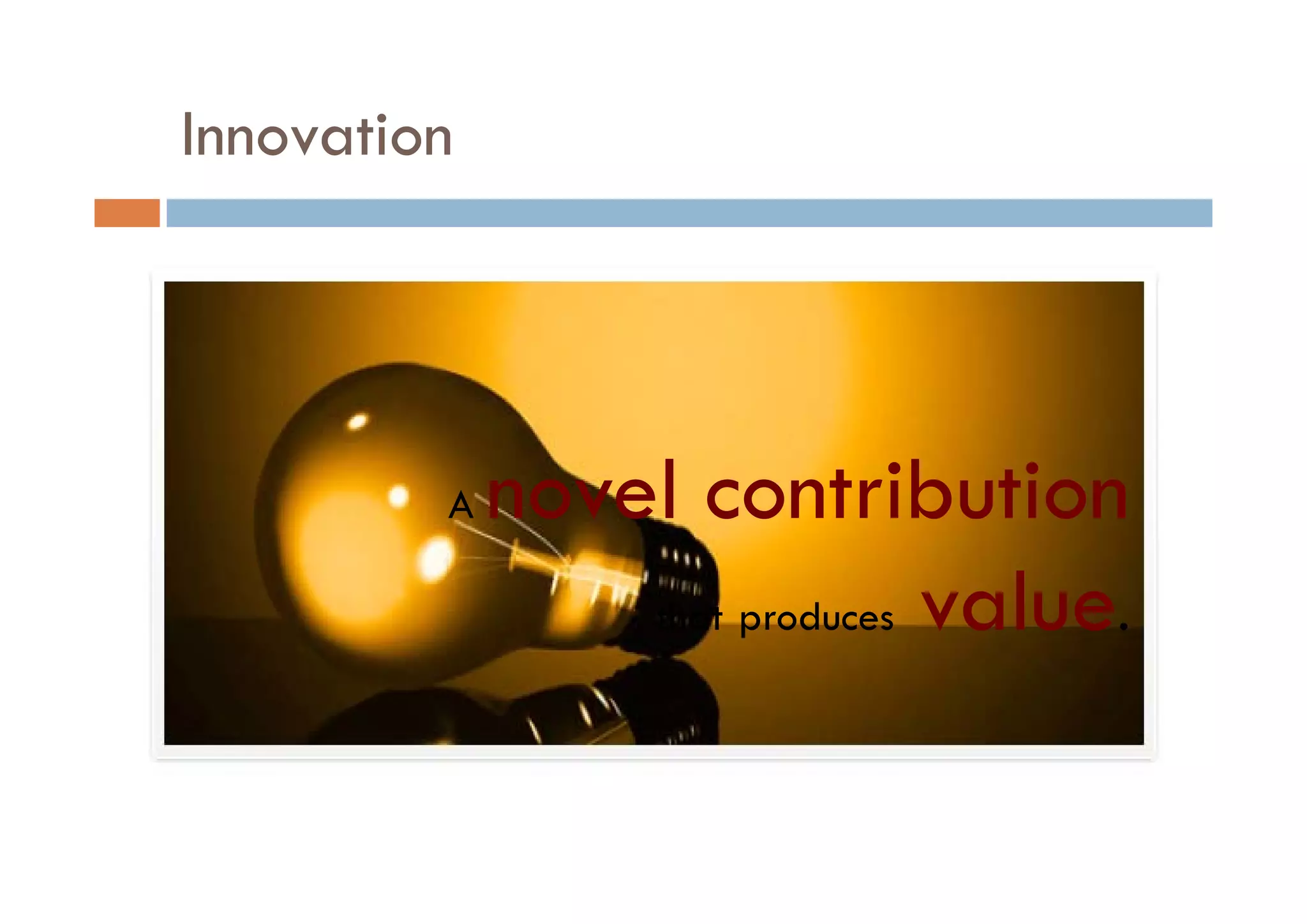
Innovation


         A   novel contribution
                 l            b
                 that produces value.
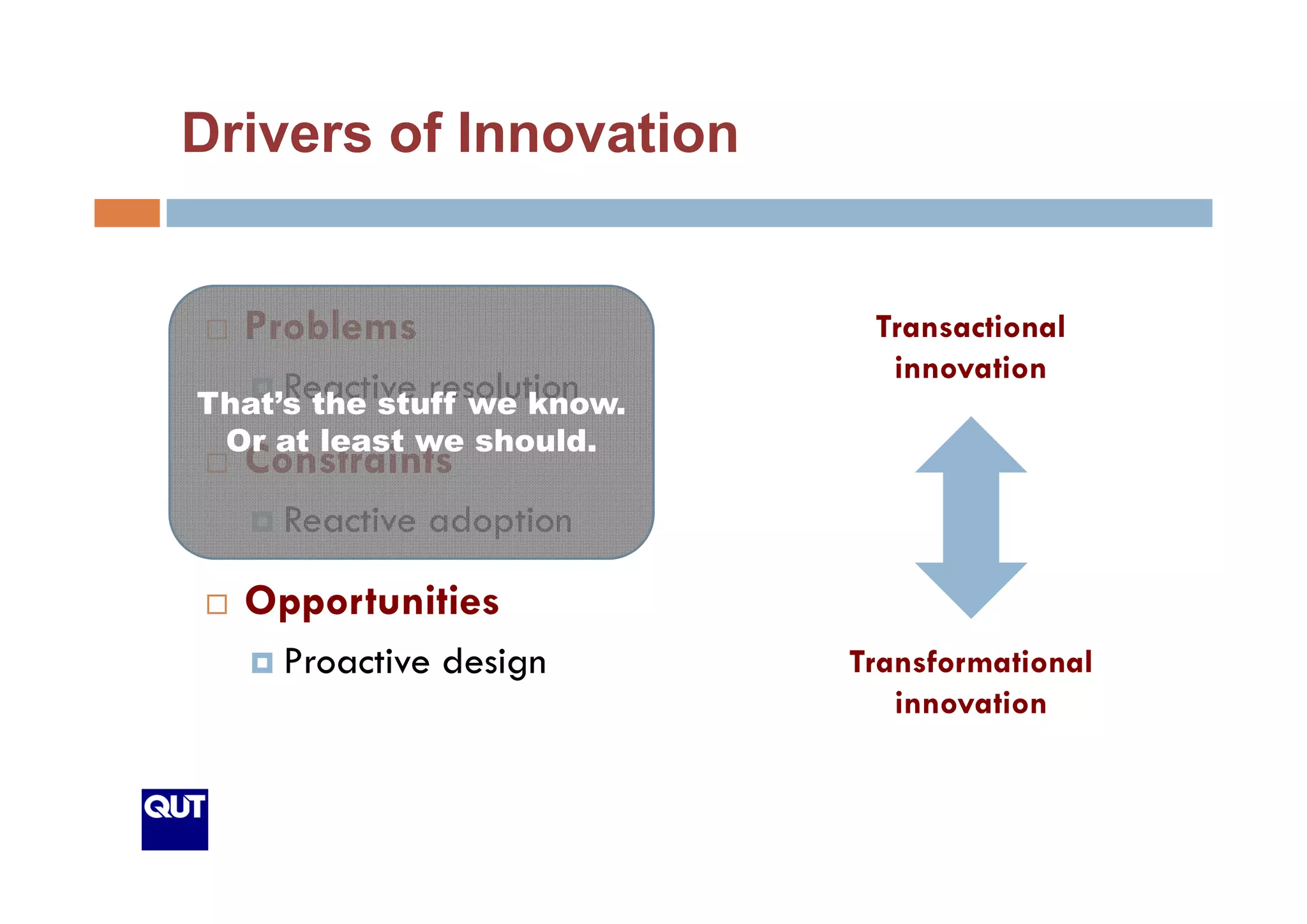
Drivers of Innovation


  Problems                   Transactional
                              innovation
                              i       i
     Reactive resolution
That’s the stuff we know.
 Or at least we should.
  Constraints
     Reactive adoption

  Opportunities
     Proactive design       Transformational
                               innovation
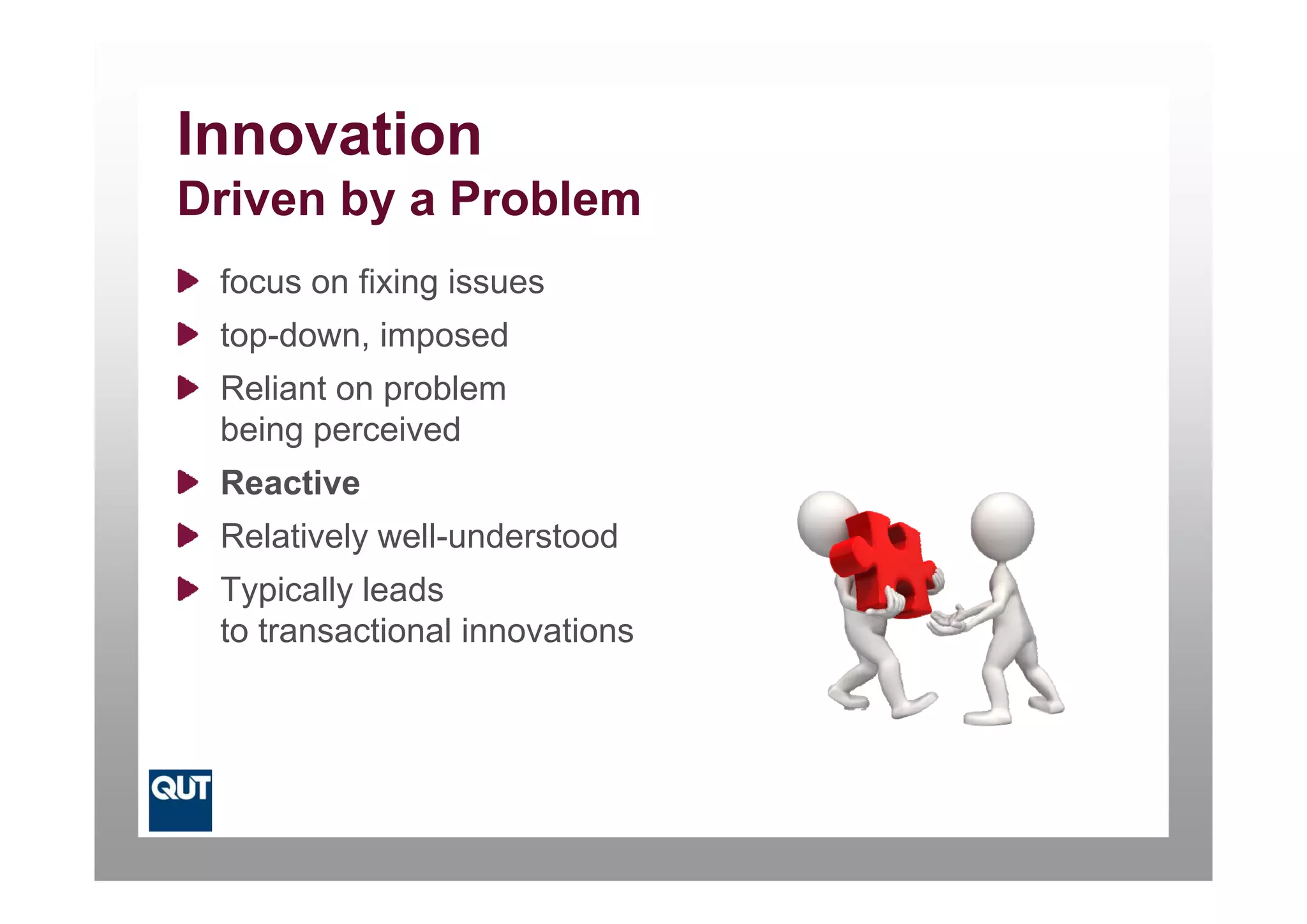
Innovation
Driven by a Problem
 focus on fixing issues
 top-down, imposed
 Reliant on problem
 being perceived
 Reactive
 Relatively well-understood
 Typically leads
 to transactional innovations
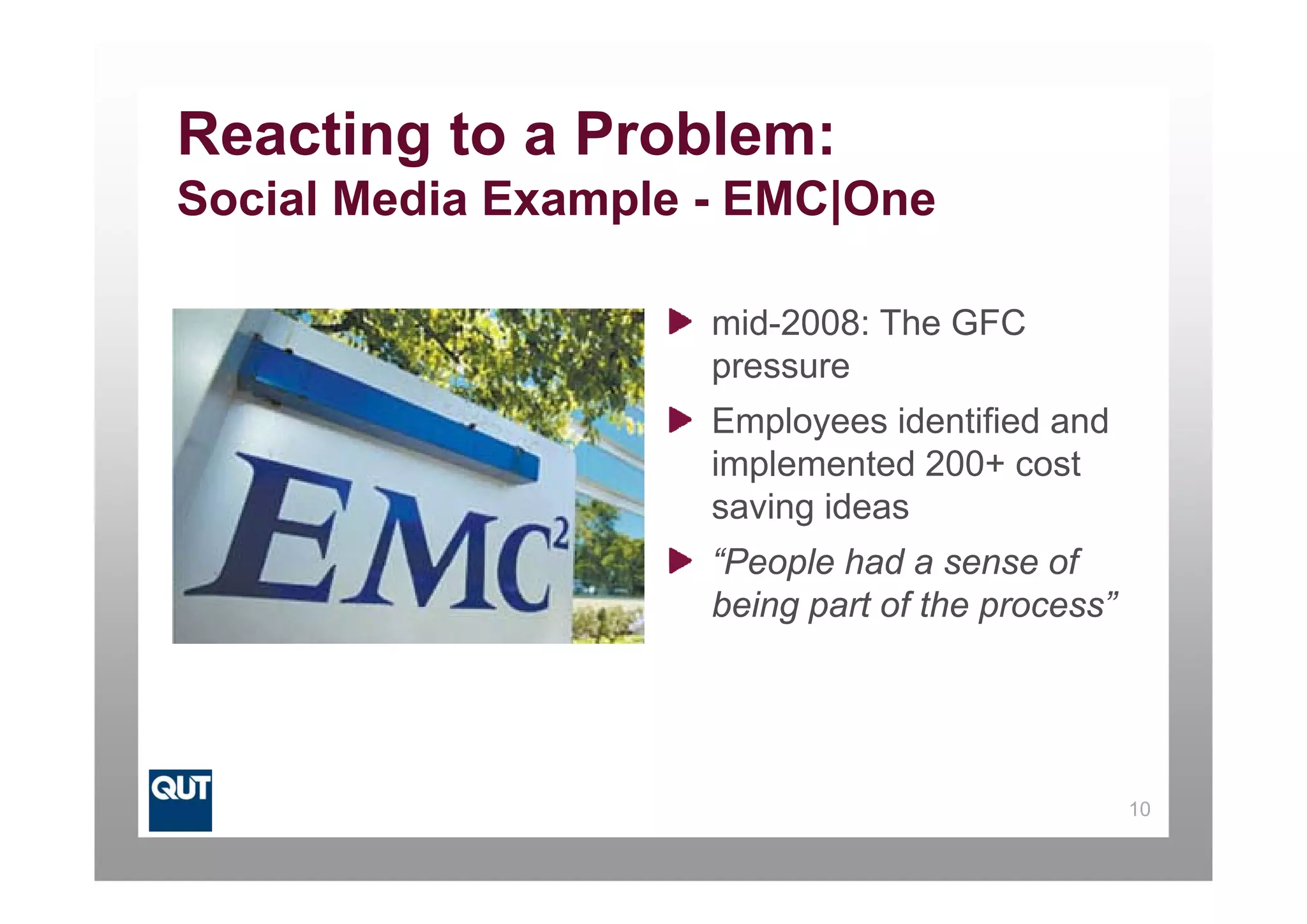
Reacting to a Problem:
Social Media Example - EMC|One

                     mid-2008: The GFC
                     pressure
                     Employees identified and
                     implemented 200+ cost
                     saving ideas
                     “People had a sense of
                      People
                     being part of the process”


                                                  10
Innovation
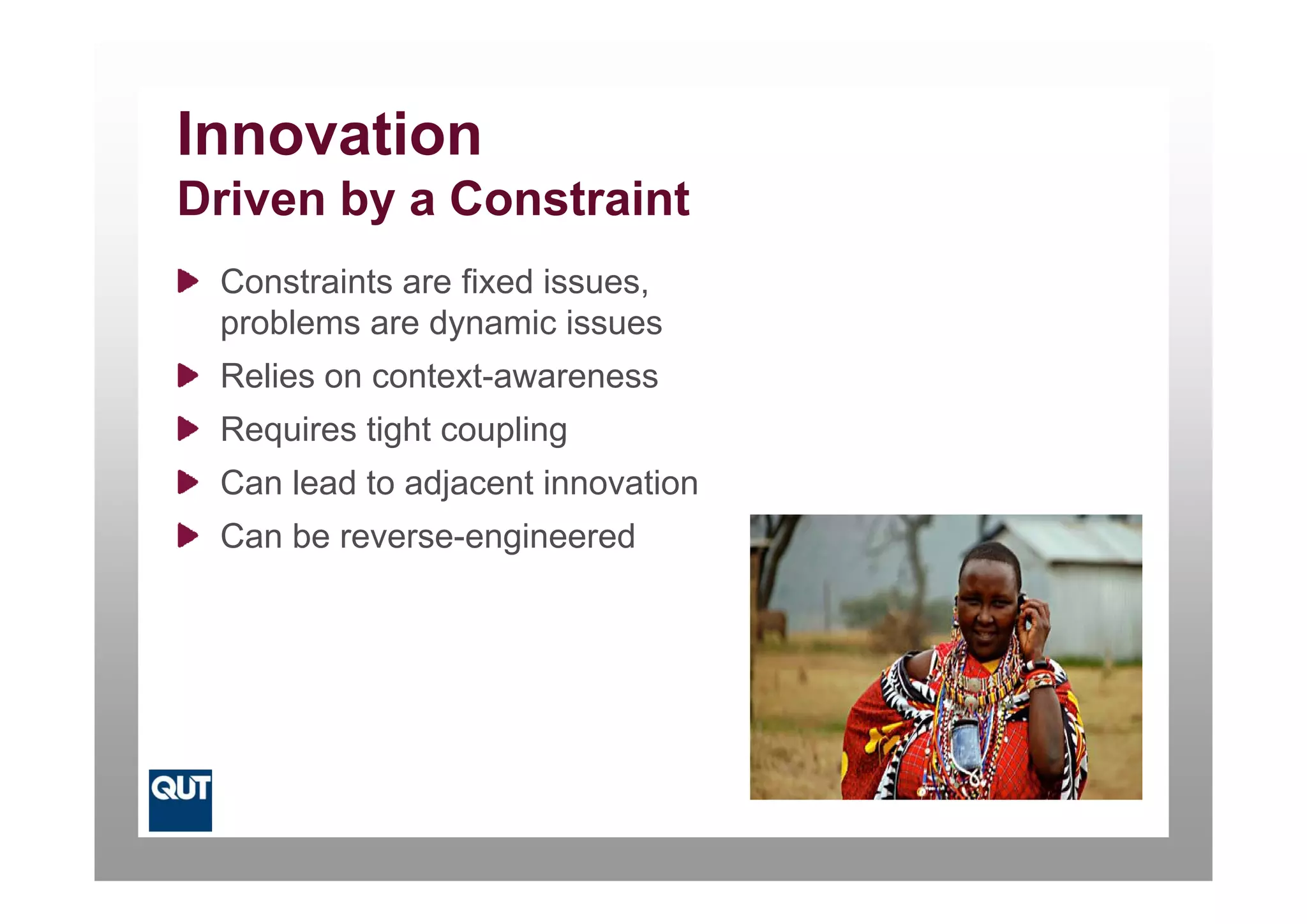
Driven by a Constraint
 Constraints are fixed issues,
 problems are dynamic issues
 Relies on context-awareness
 Requires tight coupling
 Can lead to adjacent innovation
 Can be reverse-engineered
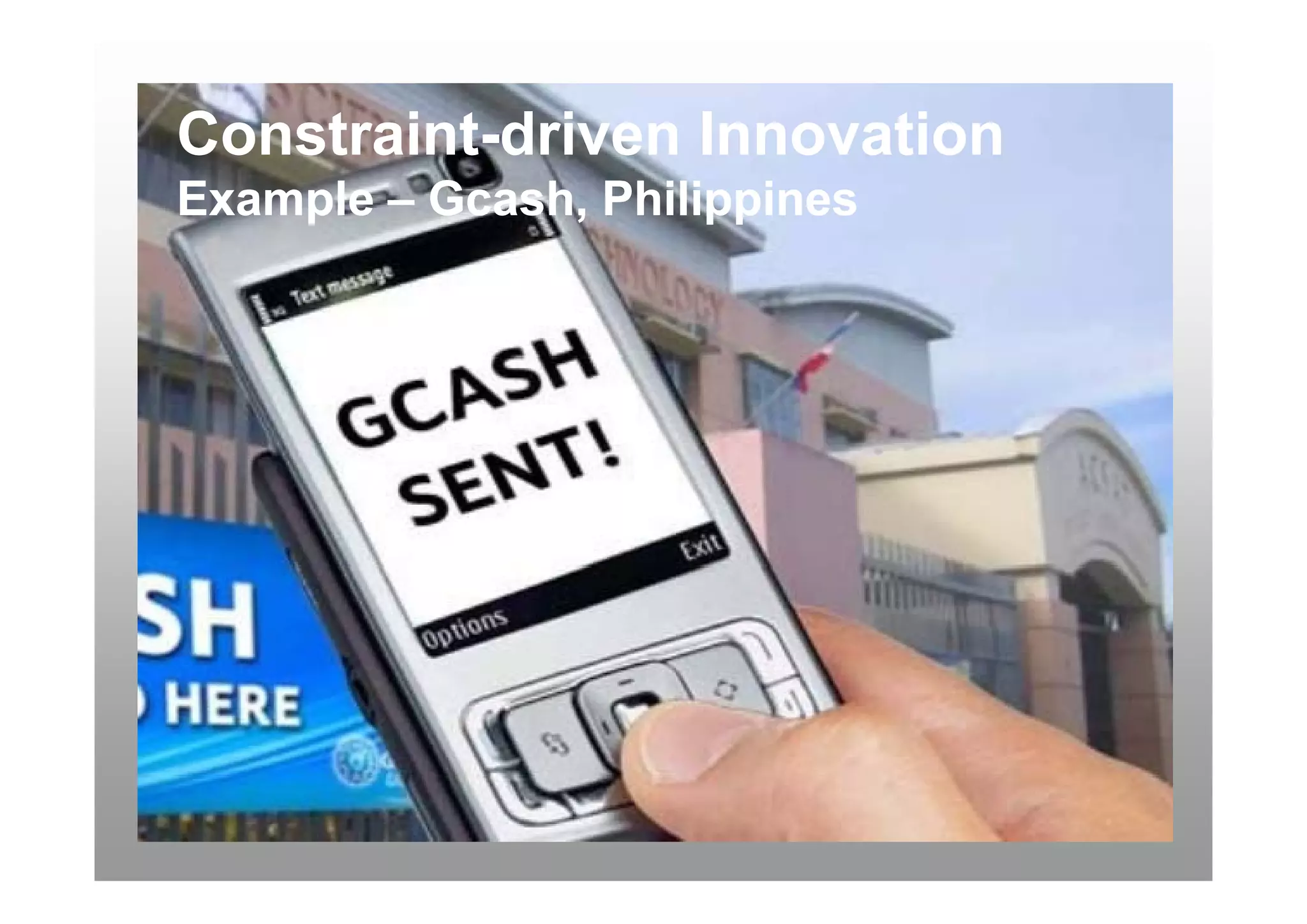
Constraint-
Constraint-driven Innovation
Example – Gcash, Philippines
          Gcash,
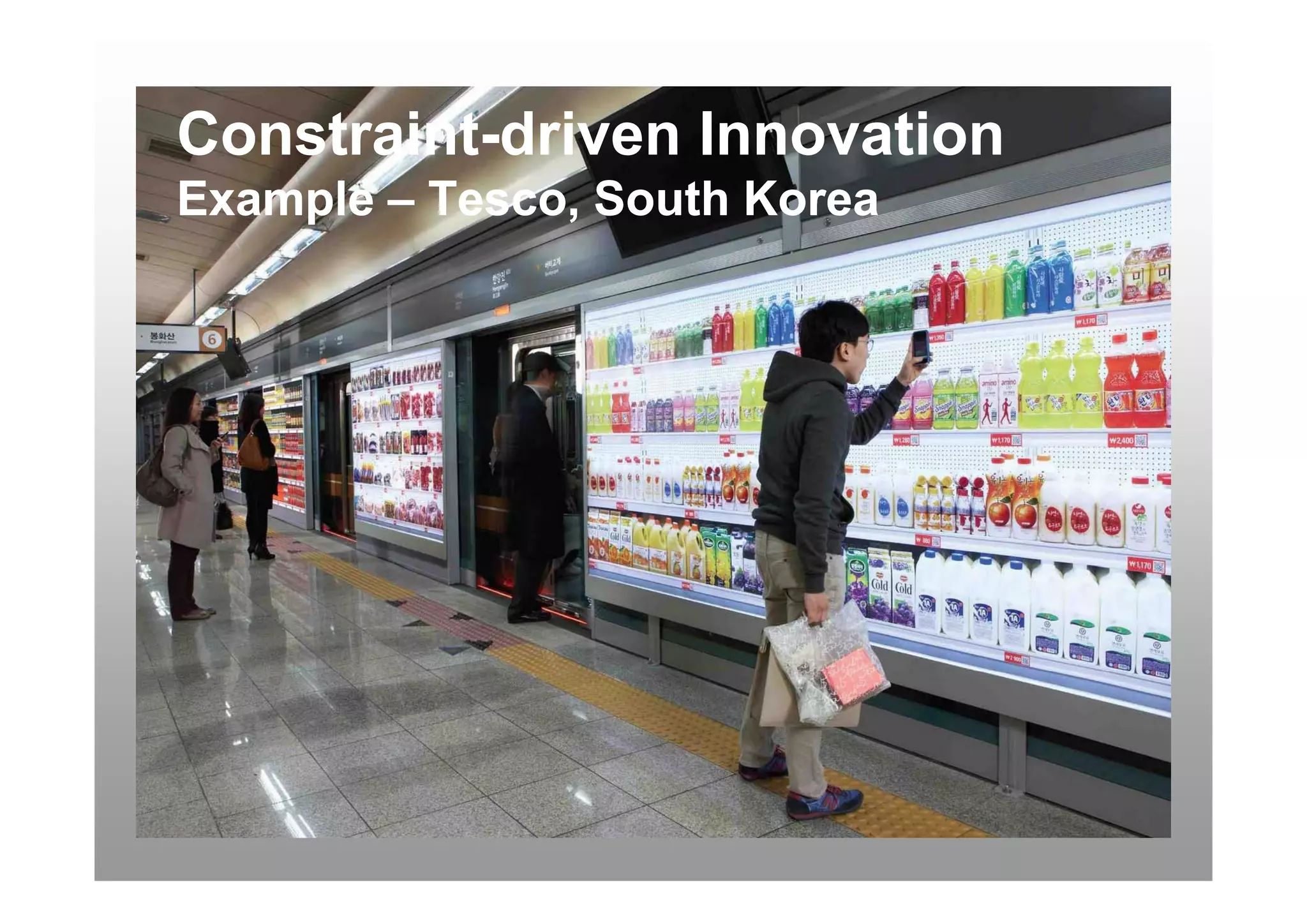
Constraint-
Constraint-driven Innovation
Example – Tesco, South Korea
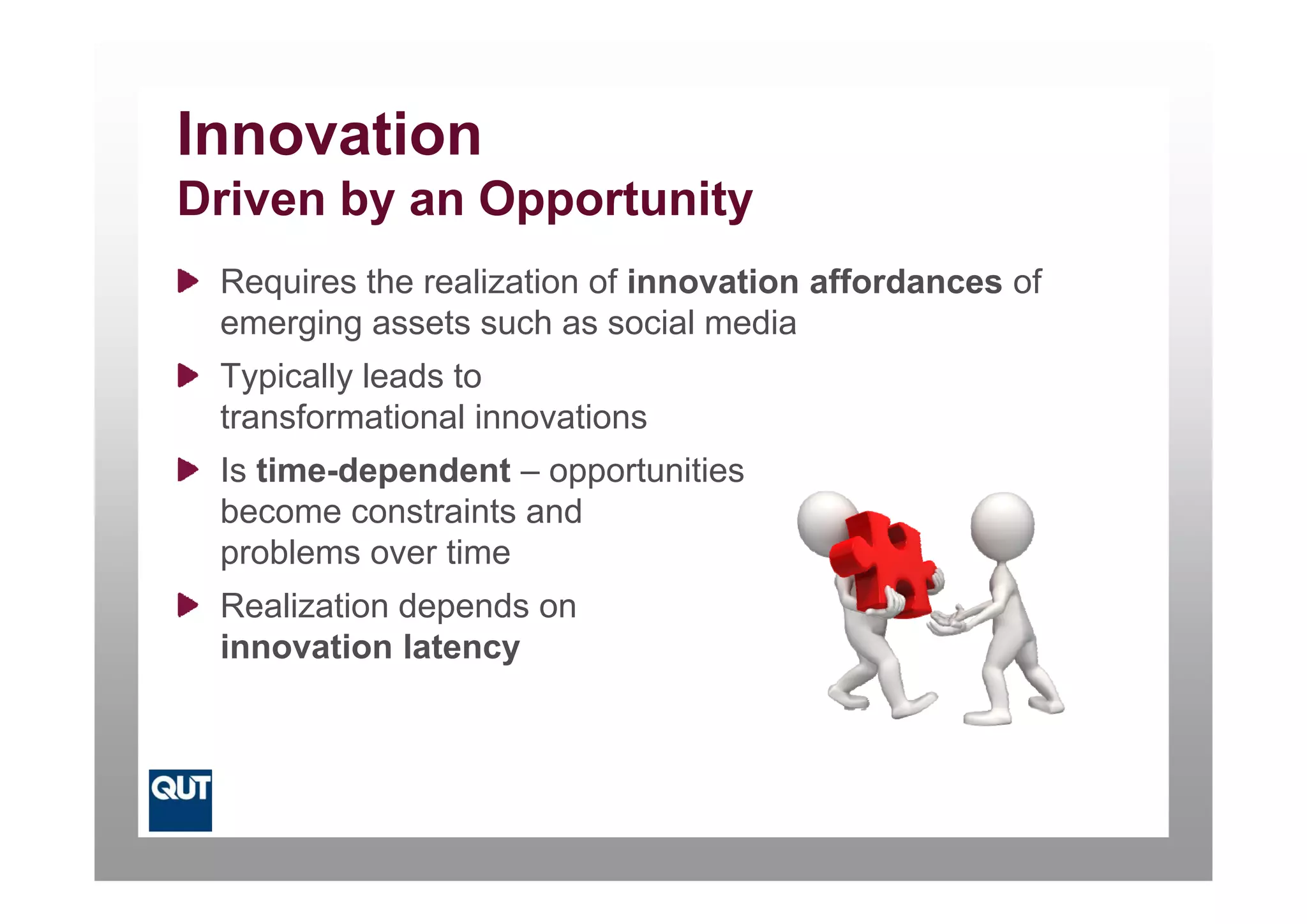
Innovation
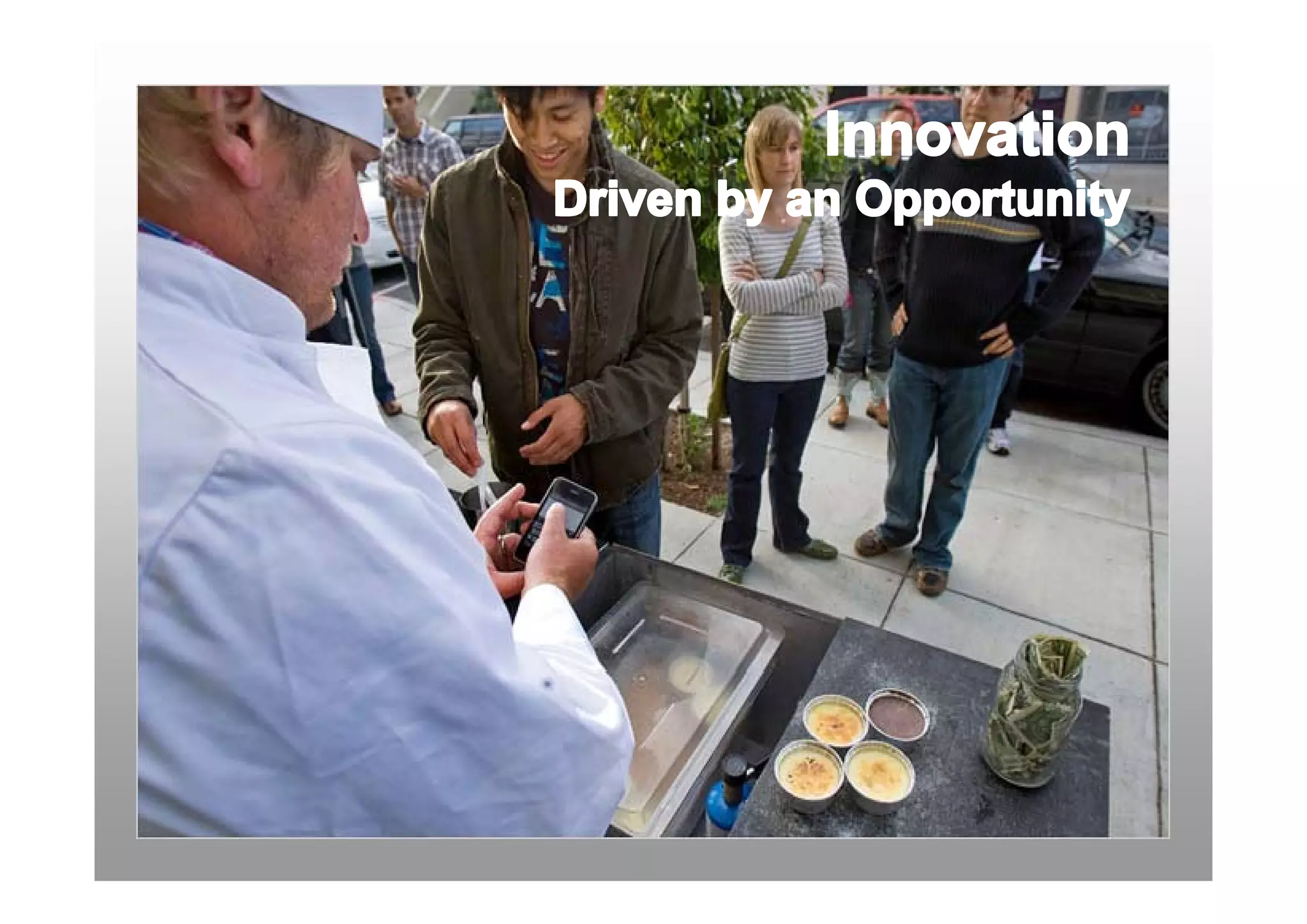
Driven by an Opportunity
 Requires the realization of innovation affordances of
 emerging assets such as social media
 Typically leads to
 transformational innovations
 Is time-dependent – opportunities
 I ti    d    d t         t iti
 become constraints and
 problems over time
 p
 Realization depends on
 innovation latency
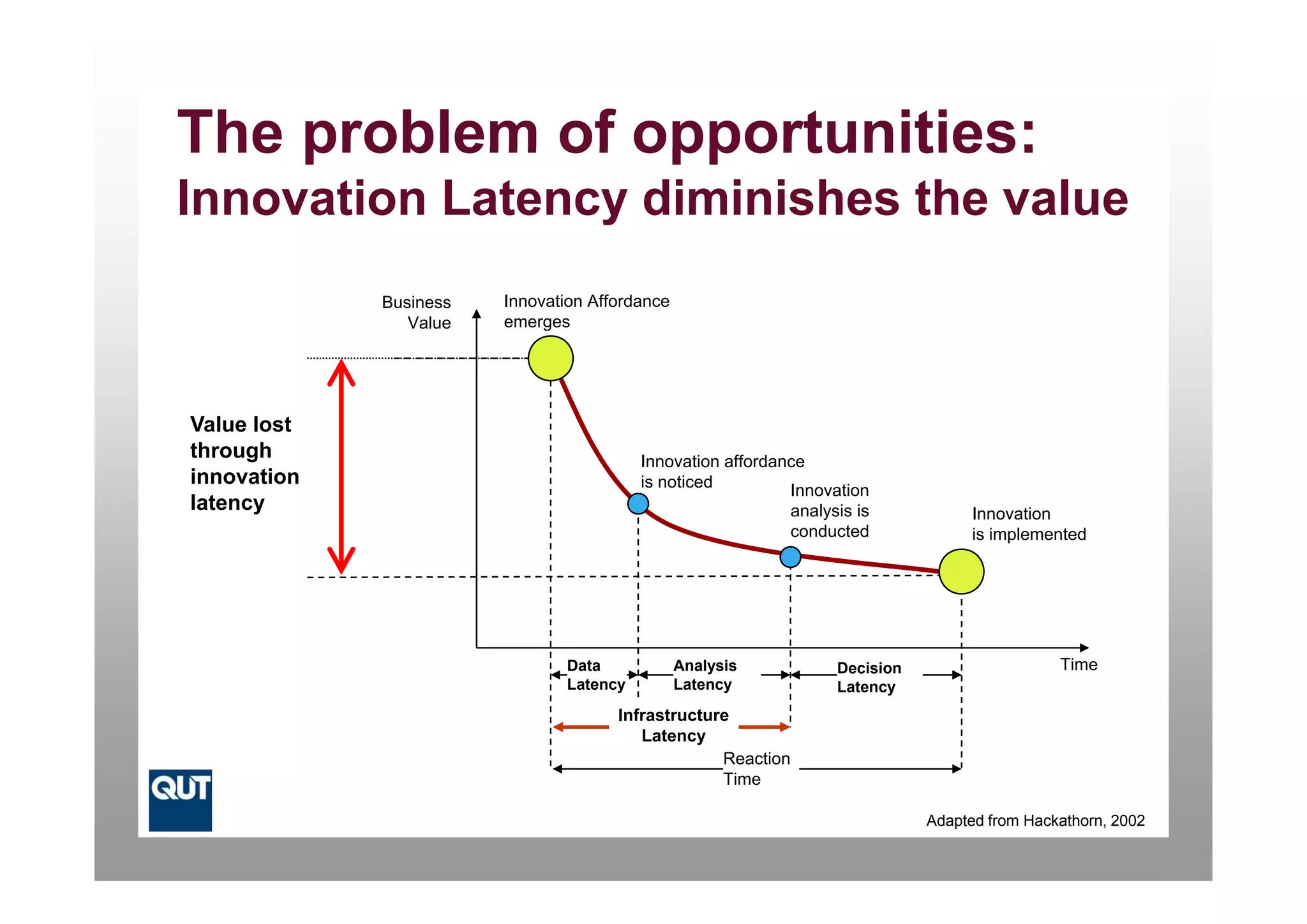
The problem of opportunities:
Innovation Latency diminishes the value
             Business   Innovation Affordance
                Value   emerges


Value lost
through
     g                                   Innovation affordance
innovation                               is noticed         Innovation
latency                                                     analysis is            Innovation
                                                            conducted              is implemented


                               Data             Analysis
                                                    y             Decision                    Time
                               Latency          Latency           Latency
                                      Infrastructure
                                         Latency
                                                   Reaction
                                                   Time

                                                                             Adapted from Hackathorn, 2002
Social Media is (still) an
         Opportunity


          But Why?
And h t
A d what are the opportunities?
             th       t iti ?
                                  18
The Fascination of Social Media
‐i
 is not the same as its Potential
         h          i         i l
 Extremely high user numbers
 Exponential growth
 High connectedness
 High speed
 Empowered user base


 What is at its base?
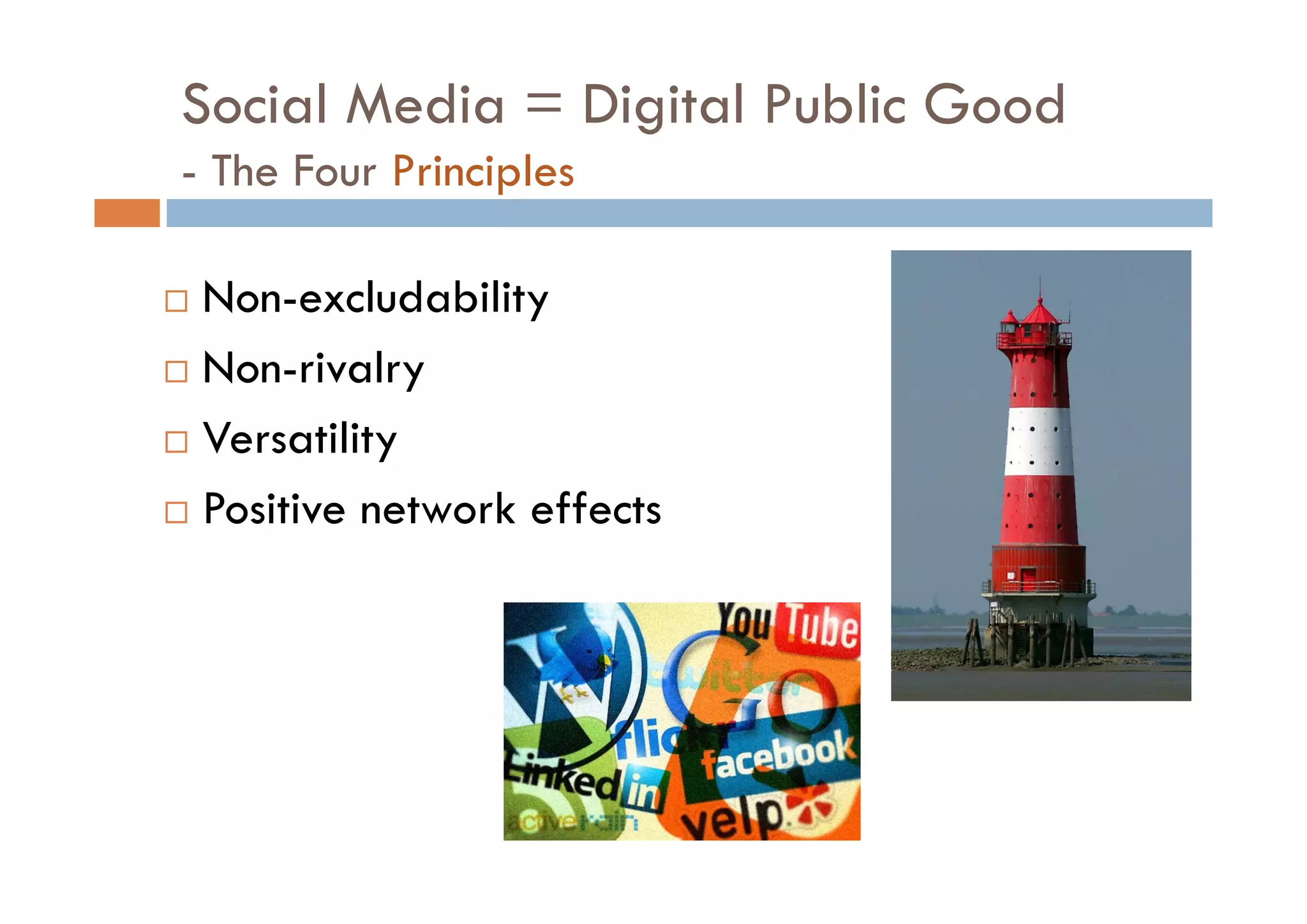
Social Media = Digital Public Good
- The Four Principles

 Non-excludability
 Non-rivalry
 N      i l
 Versatility
           y
 Positive network effects
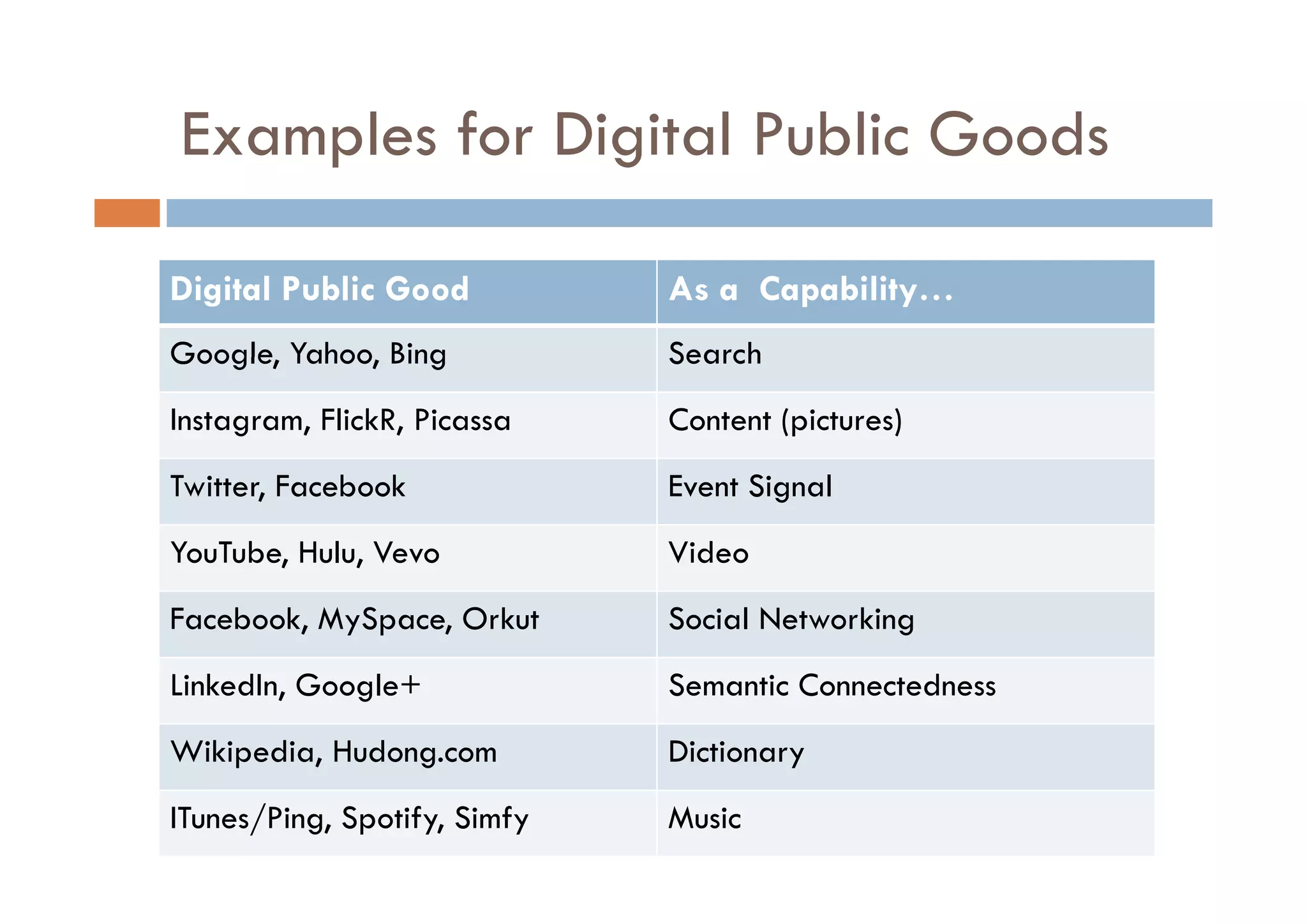
Examples for Digital Public Goods

Digital Public Good           As a Capability…
Google, Yahoo
Google Yahoo, Bing            Search
Instagram, FlickR, Picassa    Content (pictures)
Twitter, Facebook             Event Signal
YouTube, Hulu, Vevo
       ,     ,                Video
Facebook, MySpace, Orkut      Social Networking
LinkedIn, Google+             Semantic Connectedness
Wikipedia, Hudong.com         Dictionary
ITunes/Ping, Spotify, Simfy   Music
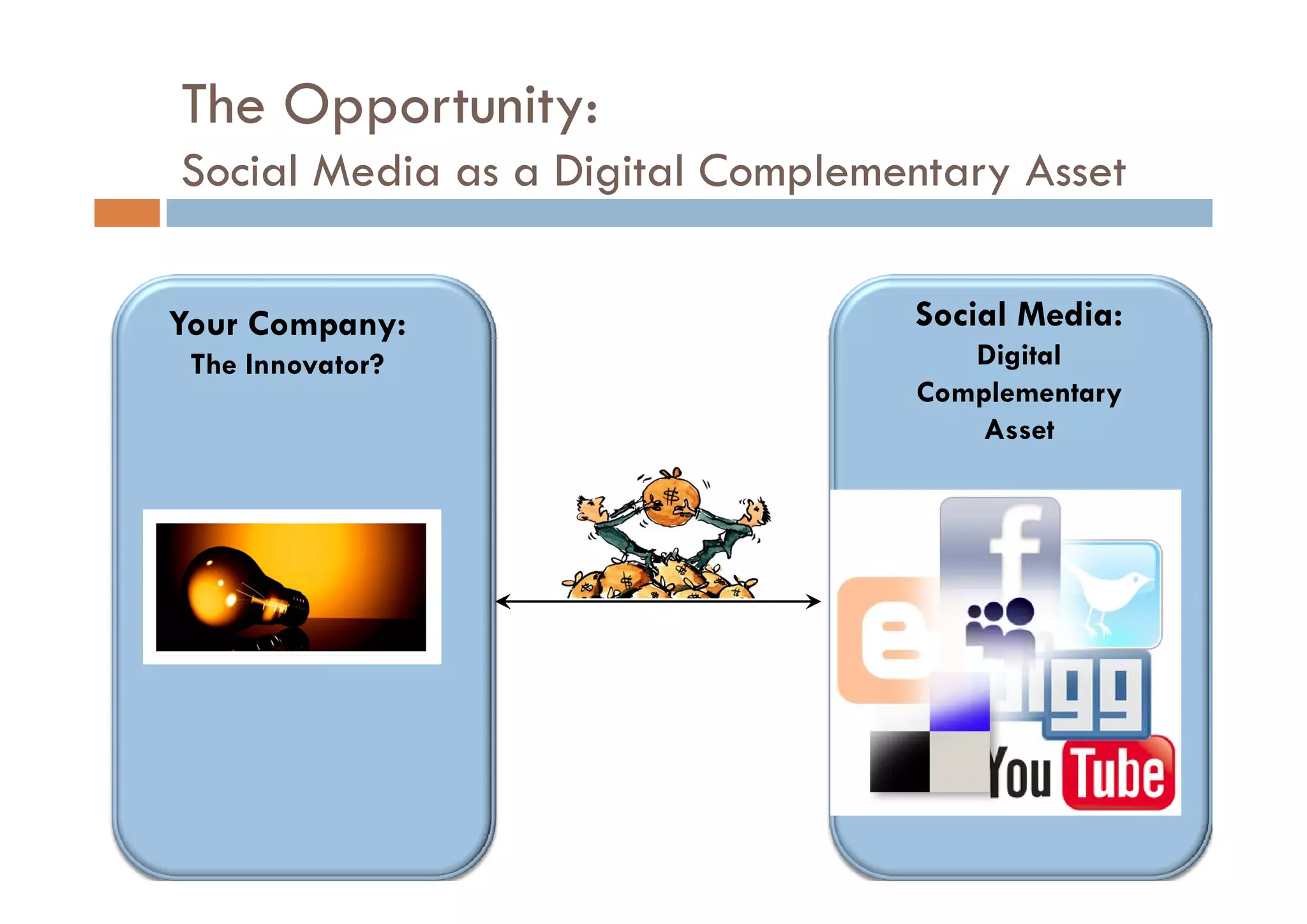
The Opportunity:
Social Media as a Digital Complementary Asset


Your Company:                     Social Media:
 The I
 Th Innovator?
          t ?                        Digital
                                  Complementary
                                      Asset
Goal: Reducing Innovation Latency
 But Capabilities d not mean I
 B tC      biliti do t        Innovation
                                    ti
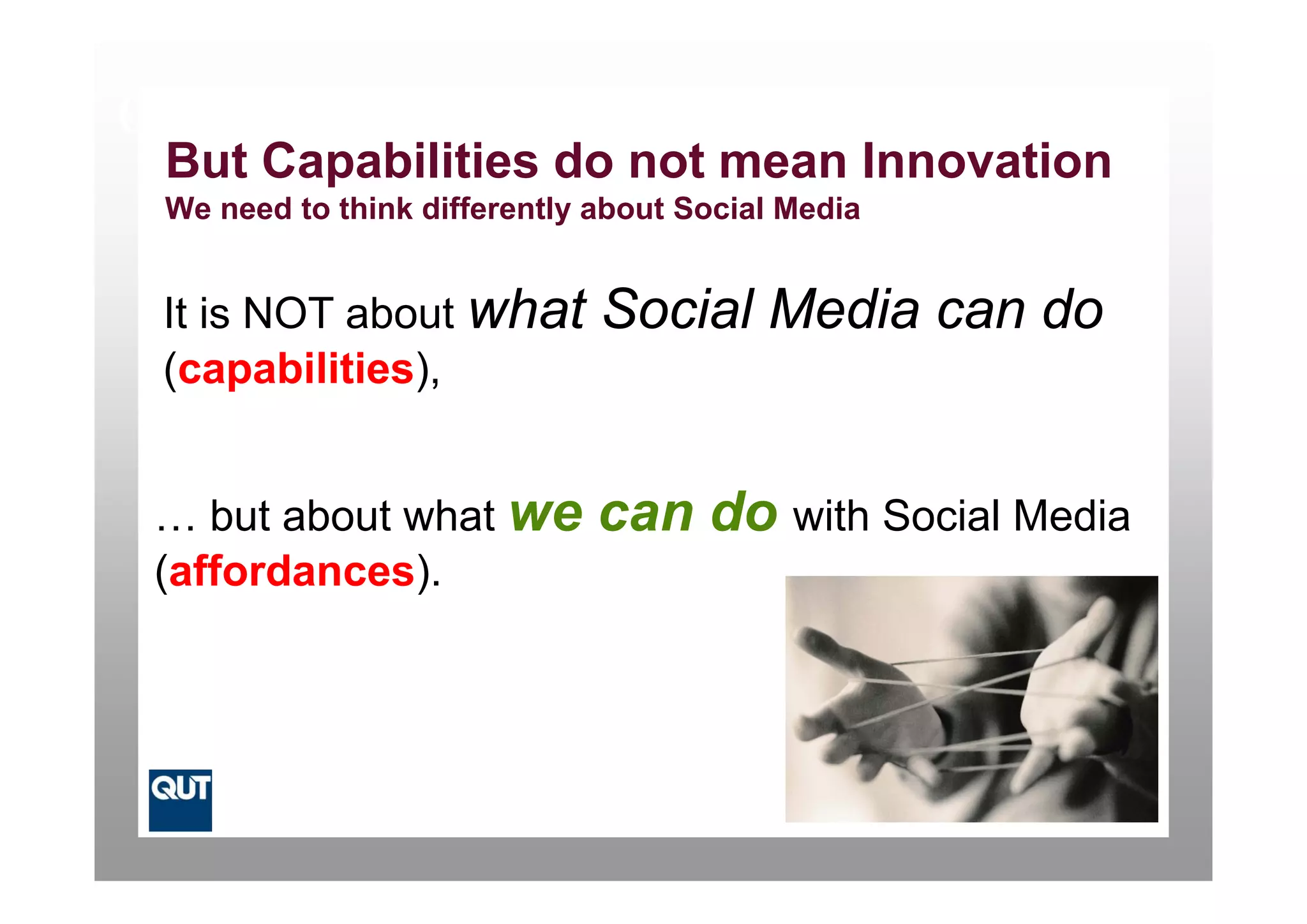
 We need to think differently about Social Media


 It is NOT about what         Social Media can do
 (capabilities),
 (      biliti )


 … but about what we          can do with Social Media
 (affordances).
 (affordances)
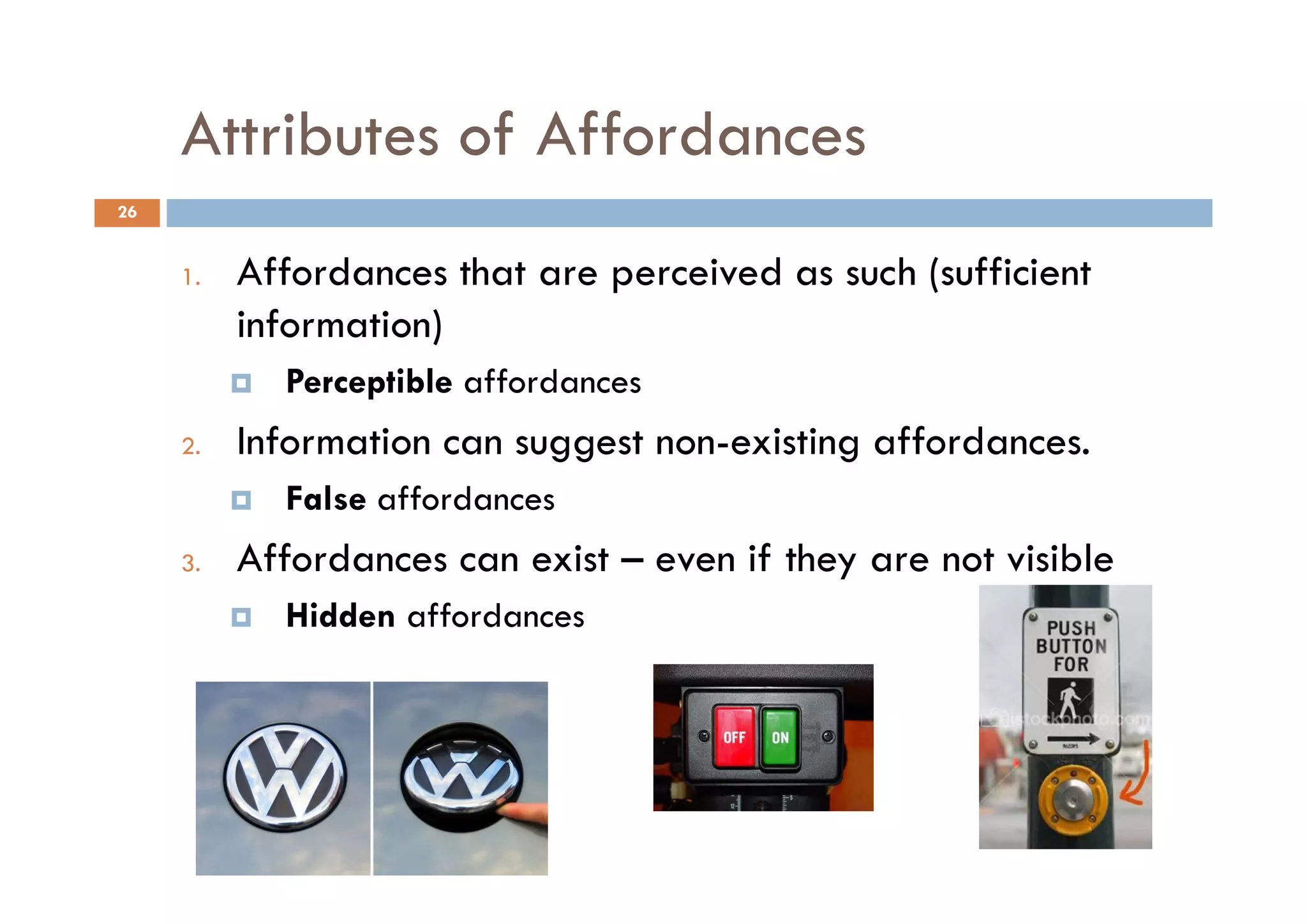
Attributes of Affordances
26


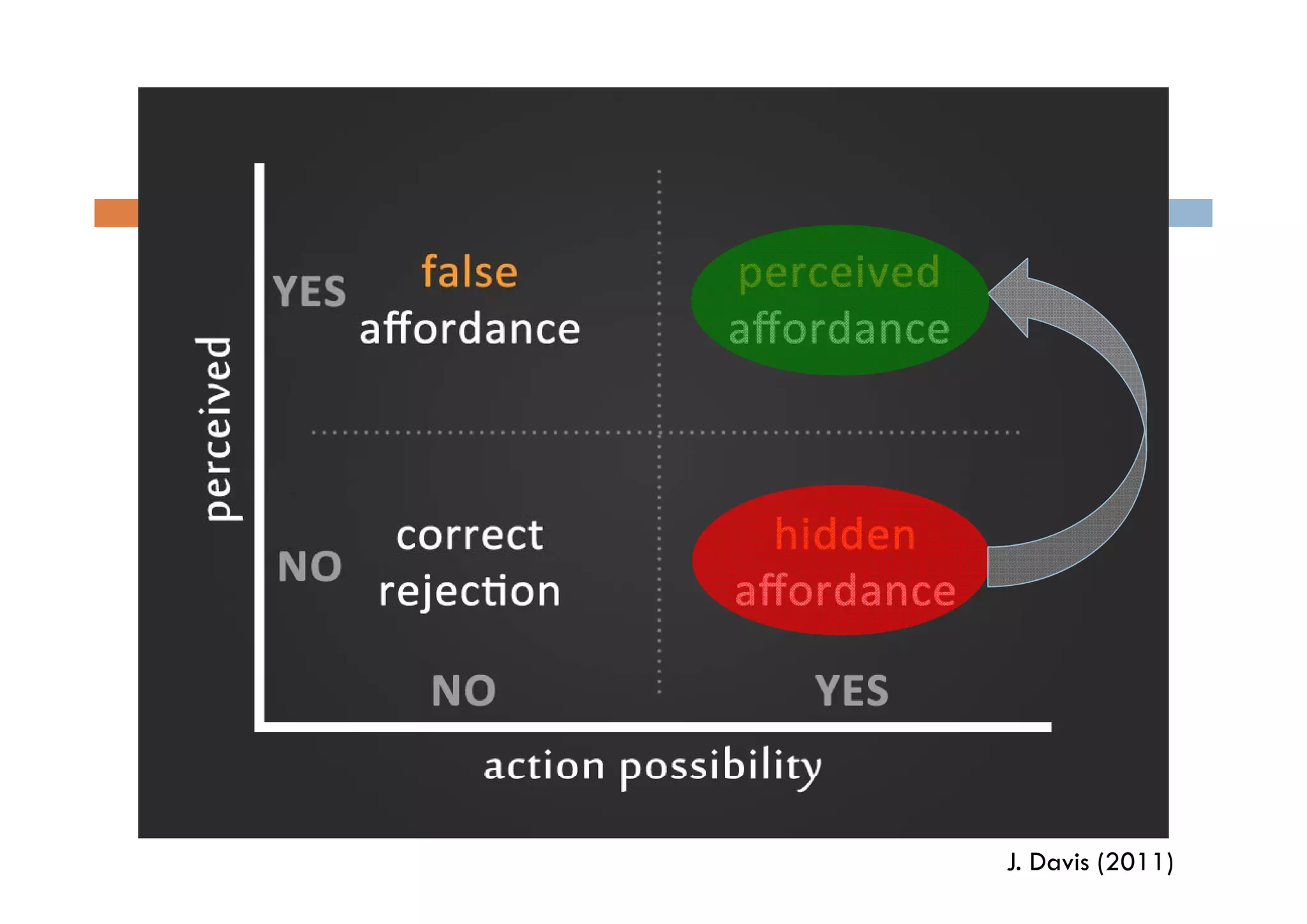
     1.   Affordances that are perceived as such (sufficient
          information)
            Perceptible affordances
     2.   Information can suggest non-existing affordances.
                            gg               g
            False affordances
     3.
     3    Affordances can exist – even if they are not visible
            Hidden affordances
J. Davis (2011)
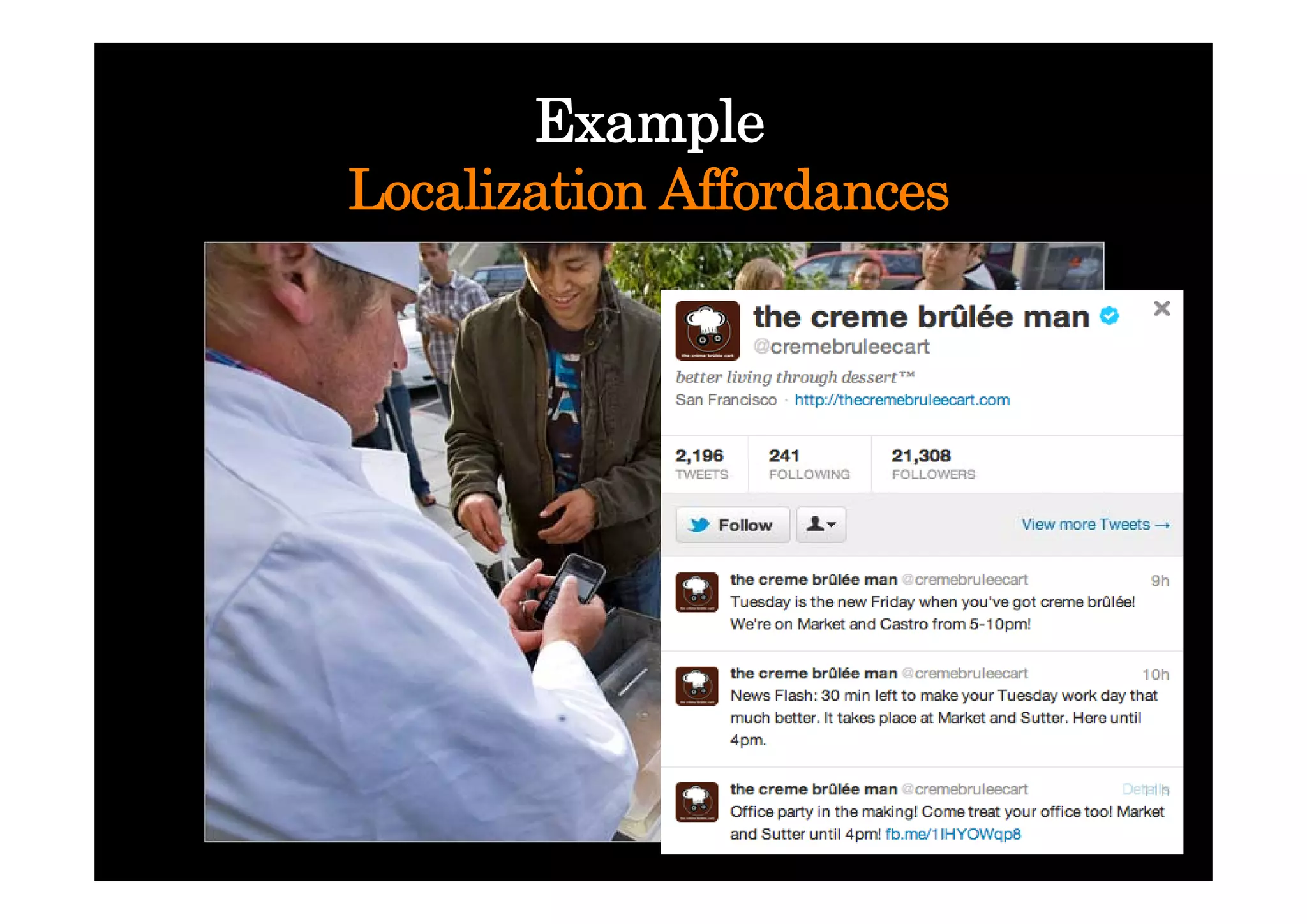
Example
           p
Localization Affordances
Example
            p
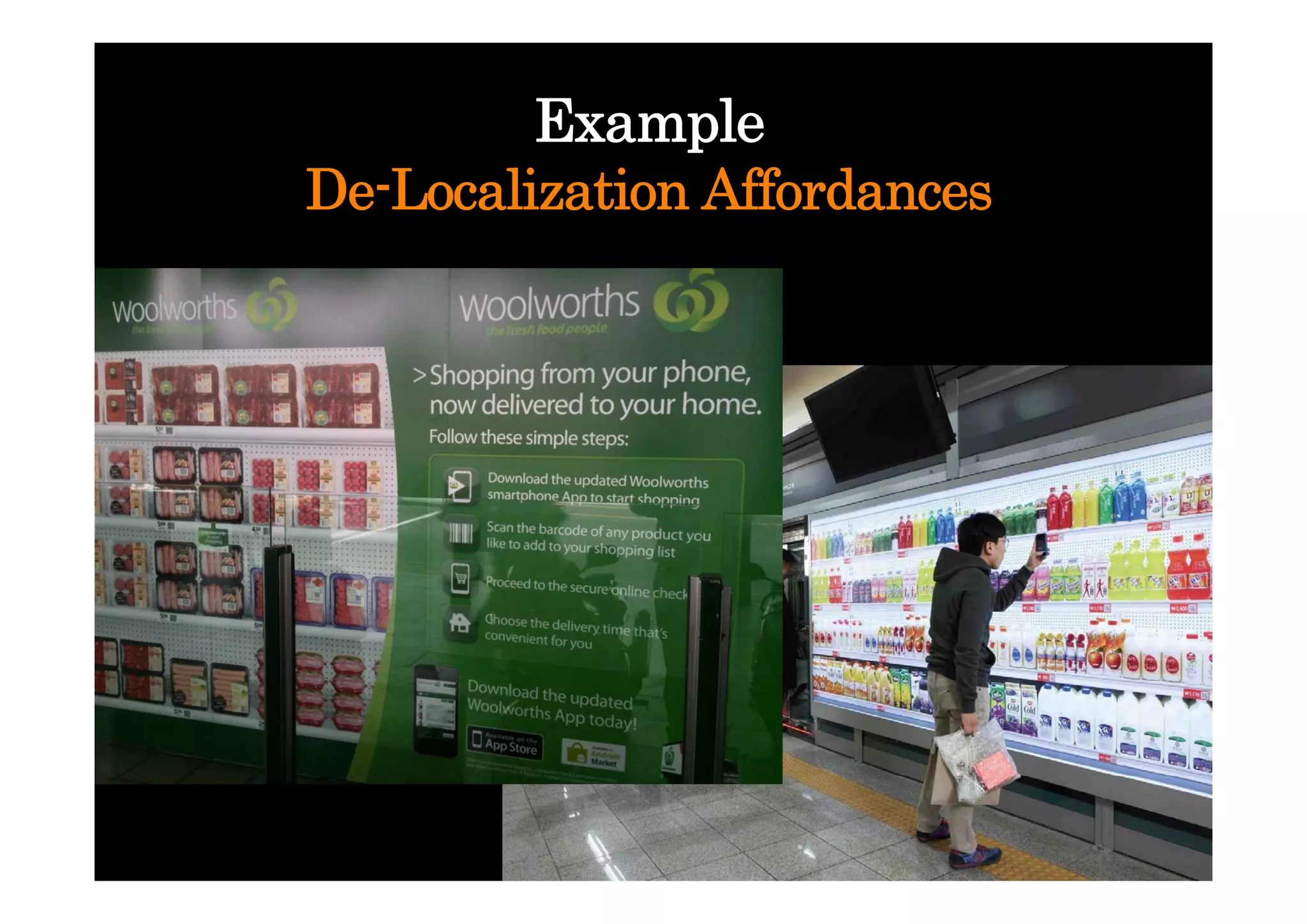
De-Localization Affordances
Example
             p
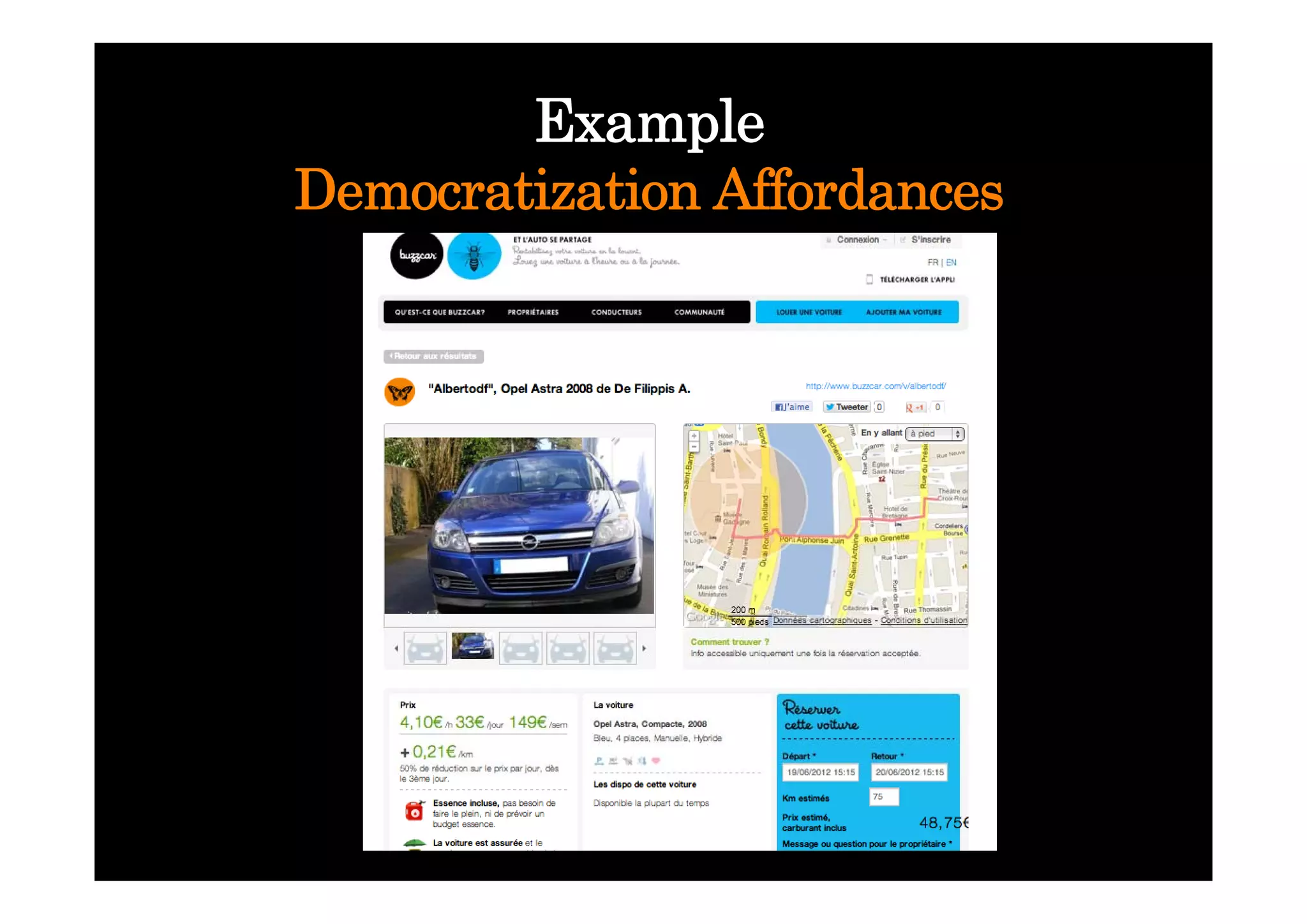
Democratization Affordances
What s
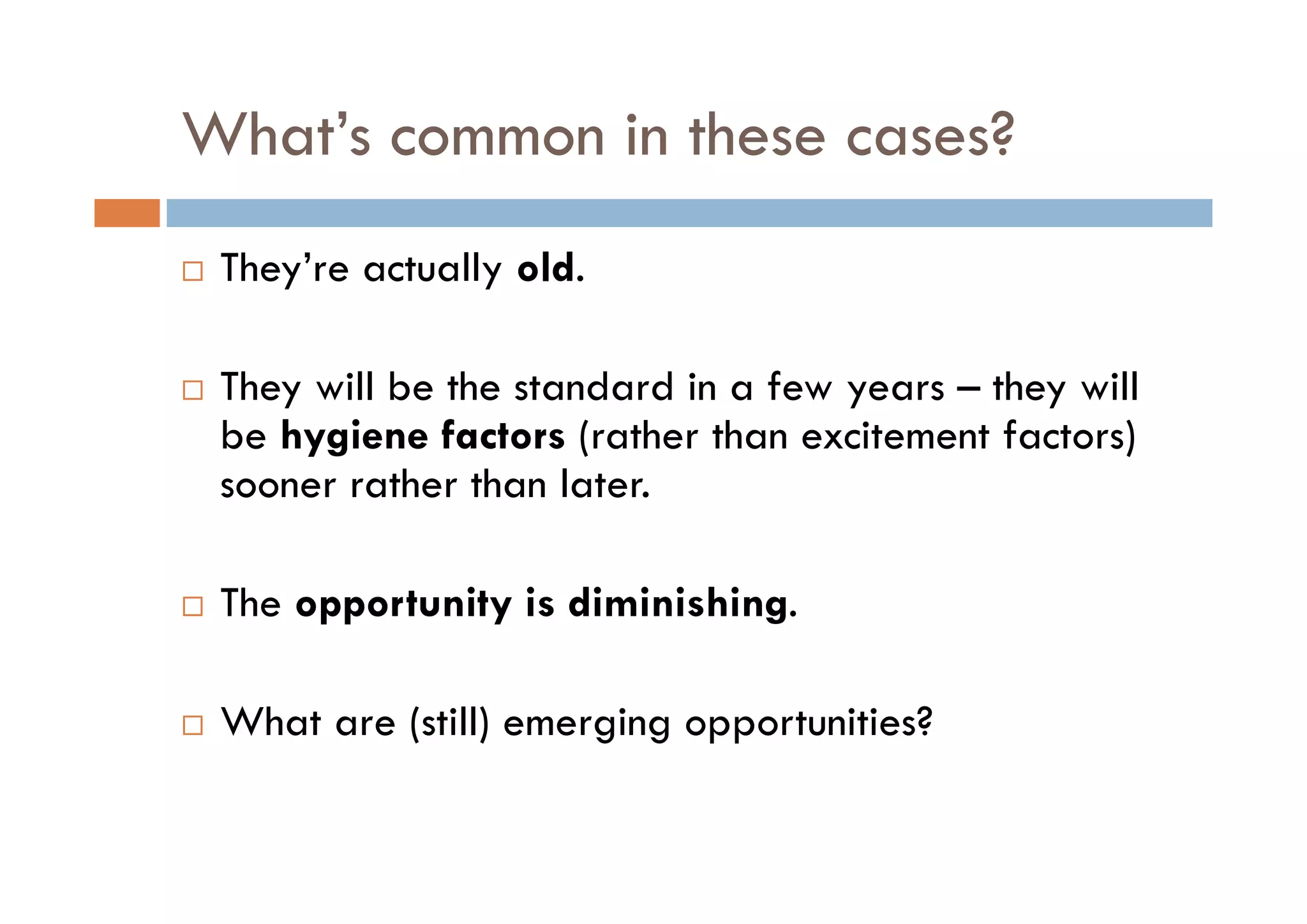
What’s common in these cases?
 They’re actually old.
                   ld

 They will be the standard in a few years – they will
 be hygiene factors (rather than excitement factors)
 sooner rather than later.

 The opportunity is diminishing.

 What are (still) emerging opportunities?
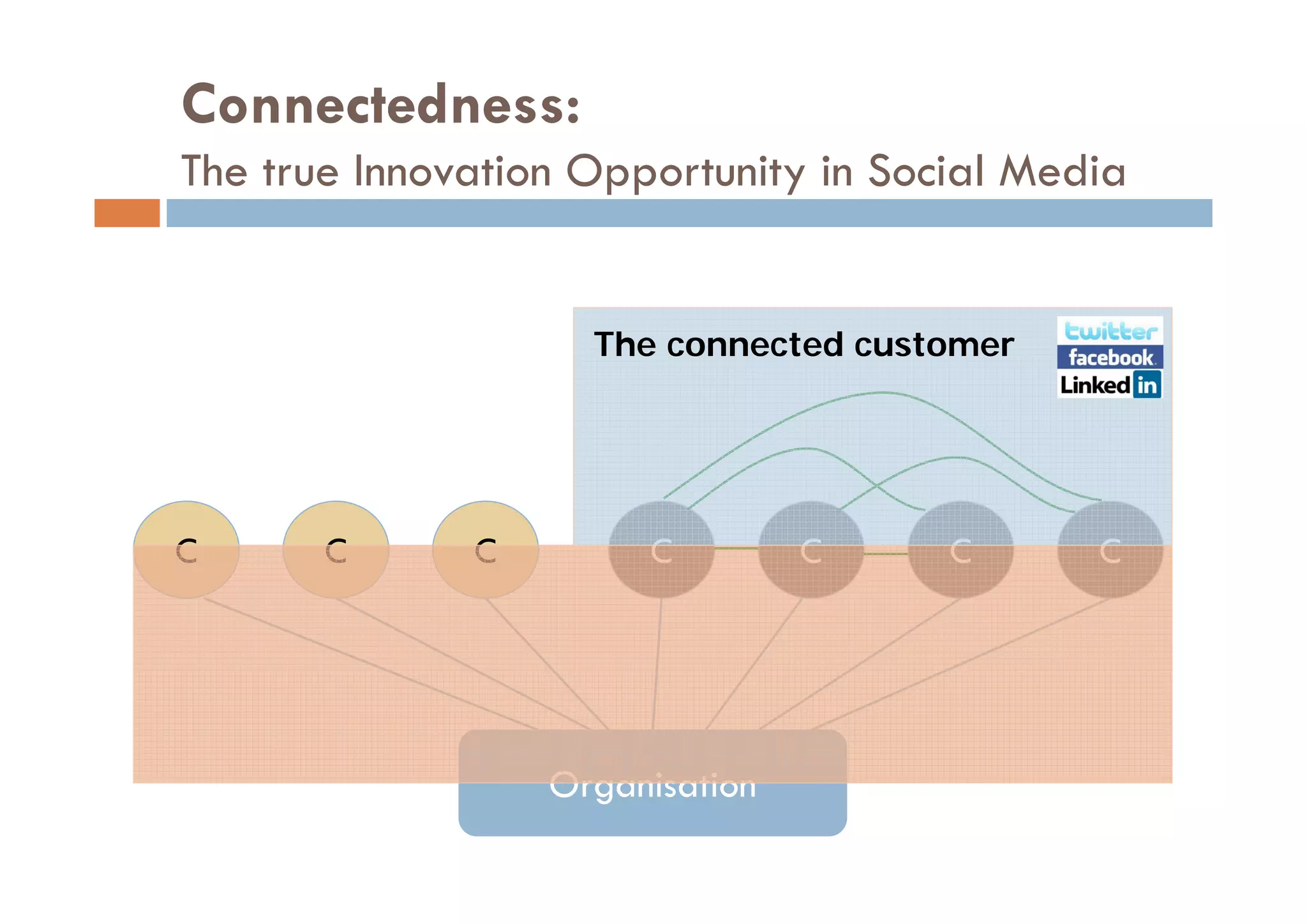
Connectedness:
The true Innovation Opportunity in Social Media


                    The connected customer


C      C      C        C         C    C      C


                  Organisation
                  O    i ti
Example
             p
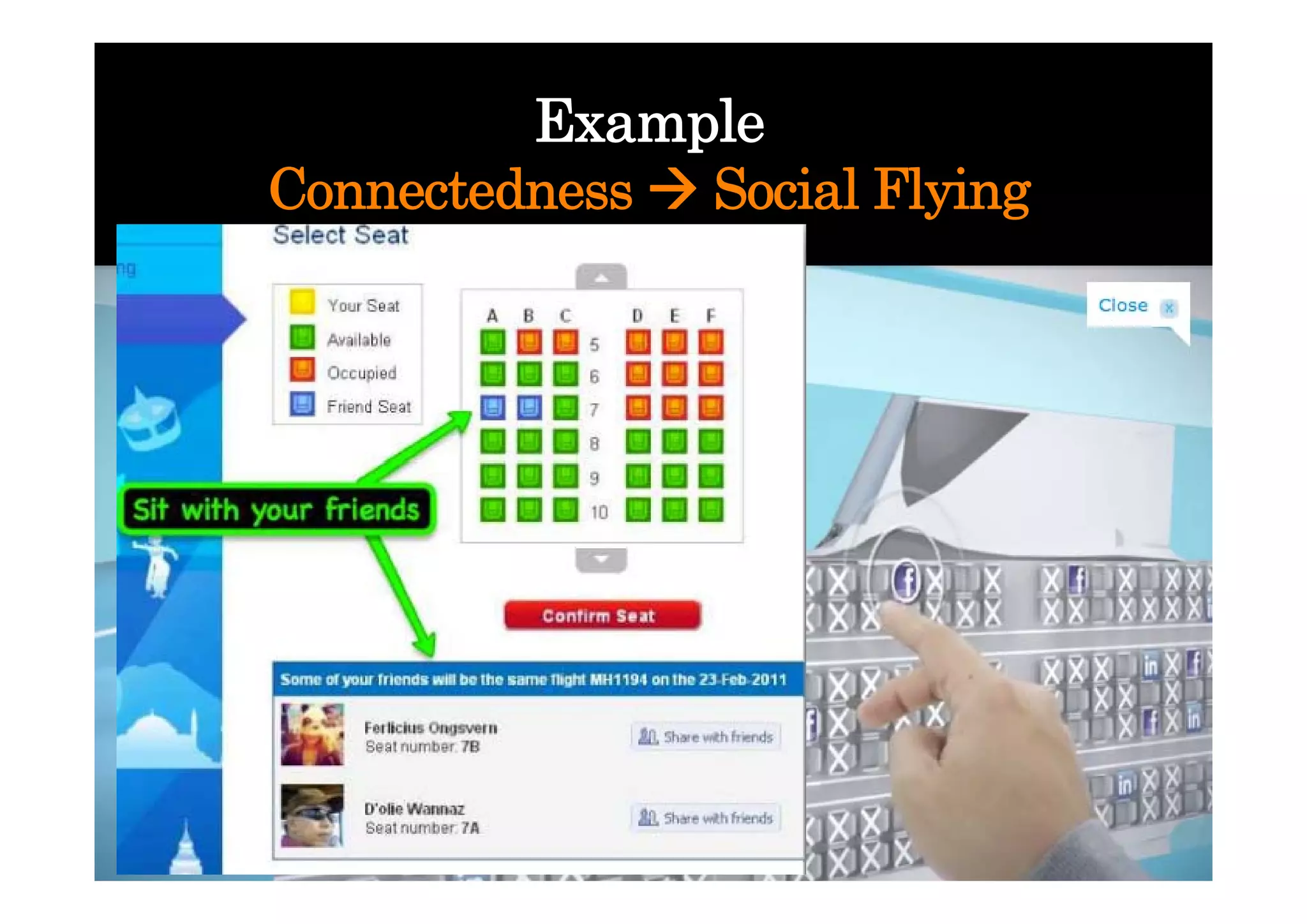
Connectedness   Social Flying
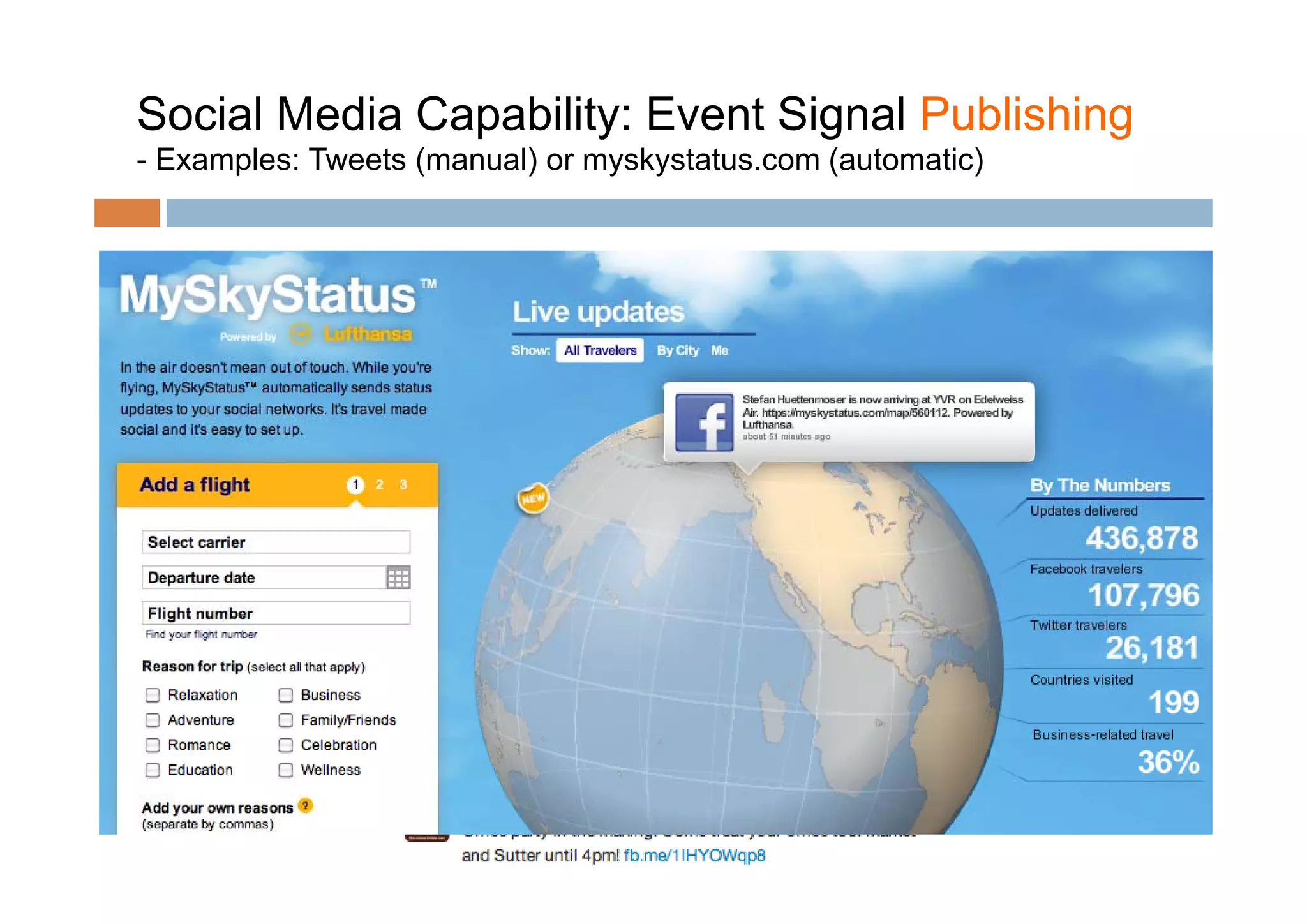
Social Media Capability: Event Signal Publishing
- Examples: Tweets (
                   (manual) or myskystatus.com (
                          )                    (automatic)
                                                         )
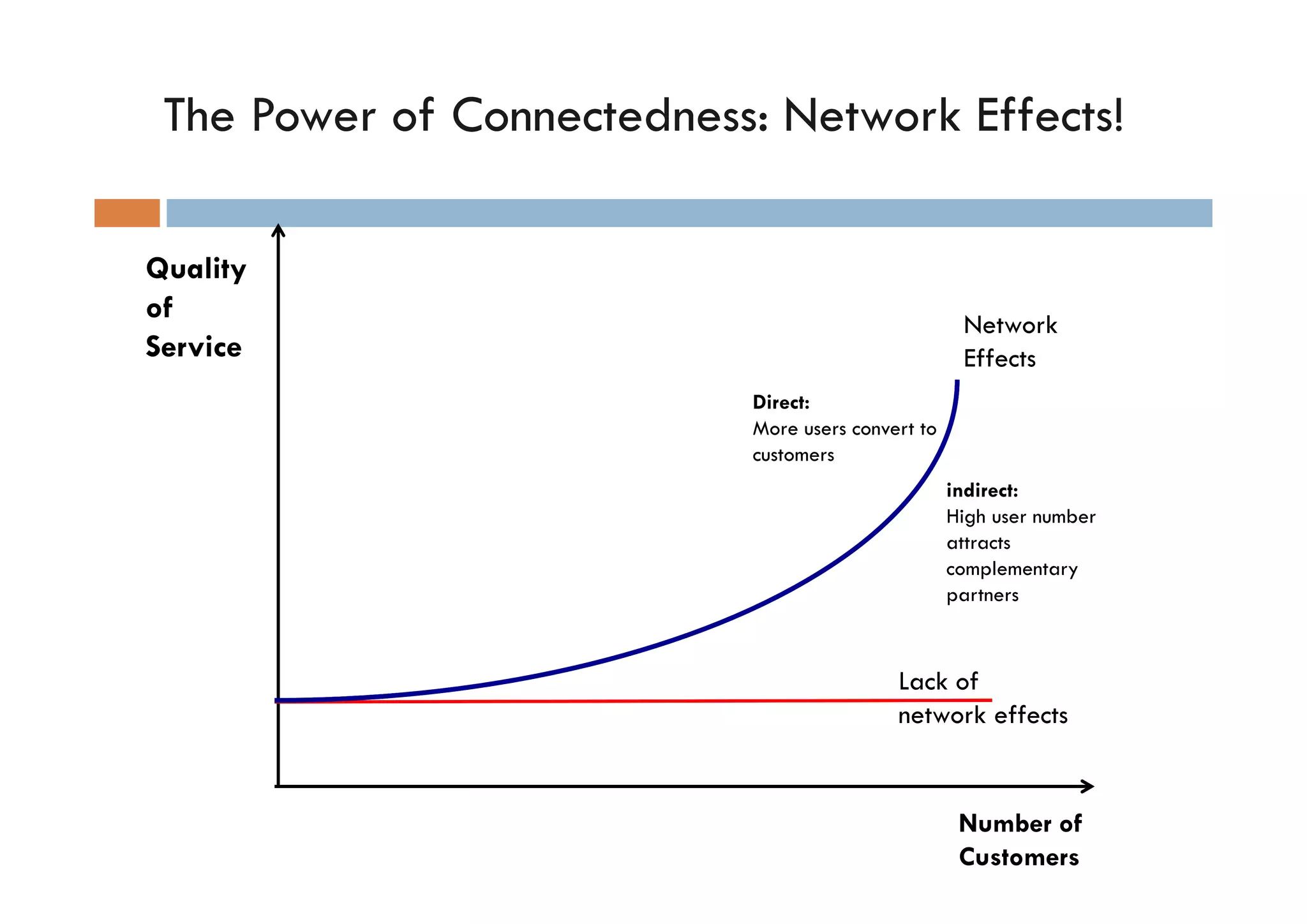
The Power of Connectedness: Network Effects!

Quality
of                                                  Network
Service                                             Effects
                           Direct:
                           More users convert to
                           customers
                                                   indirect:
                                                   High user number
                                                   attracts
                                                   complementary
                                                   partners


                                           Lack of
                                           network effects


                                                    Number of
                                                    Customers
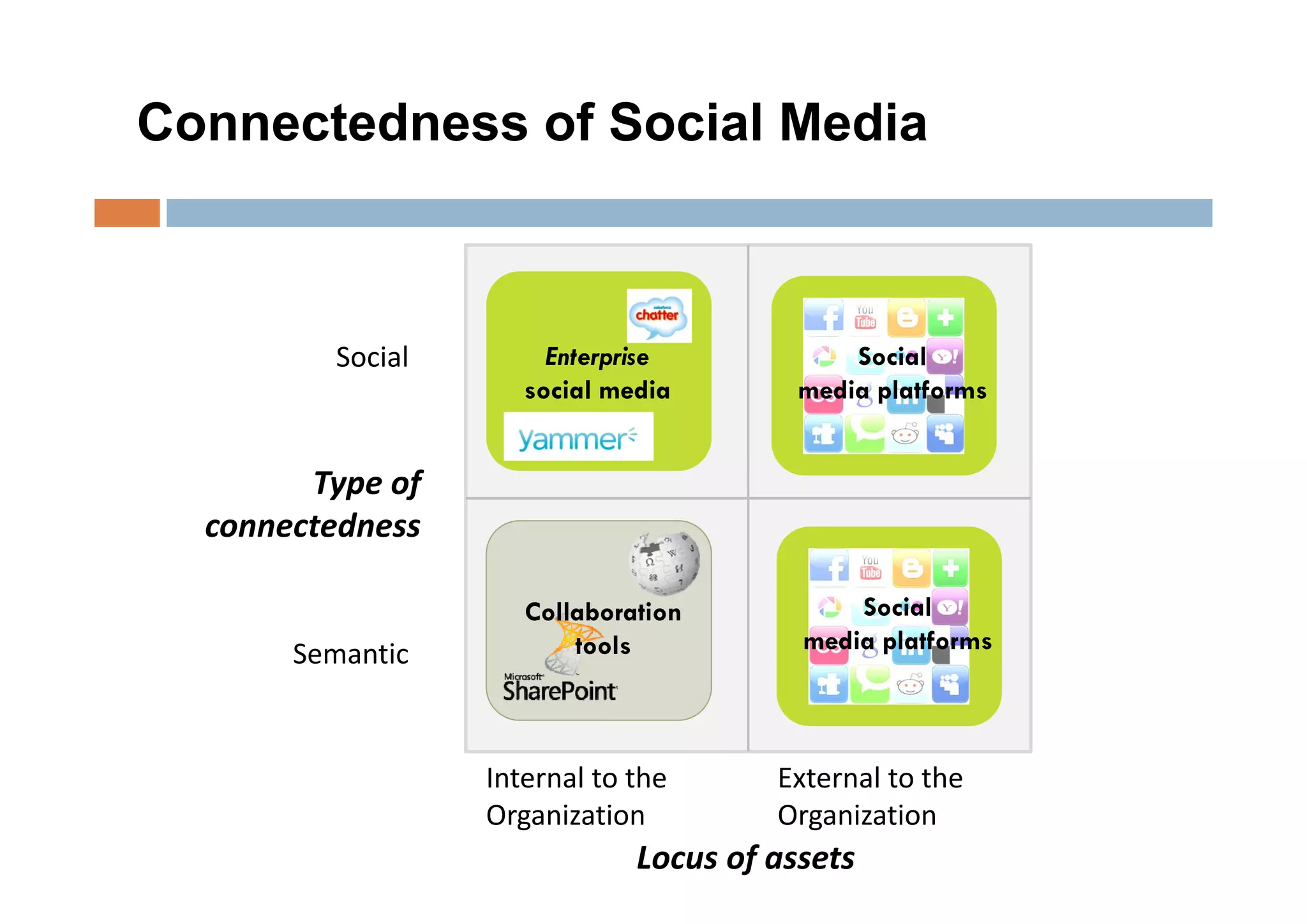
Connectedness of Social Media


          Social            ?
                         Enterprise          ? Social
                       social media        media platforms


        Type of  
  connectedness
                          ?
                       Collaboration
                                               ?Social
                           tools           media platforms
       Semantic


                    Internal to the 
                    Internal to the      External to the 
                                         External to the
                    Organization         Organization
                                Locus of assets
Three Key Innovation Opportunities
through Connectedness

 Social Connectedness


 Social Influence


 Semantic R l ti hi
 S    ti Relationships
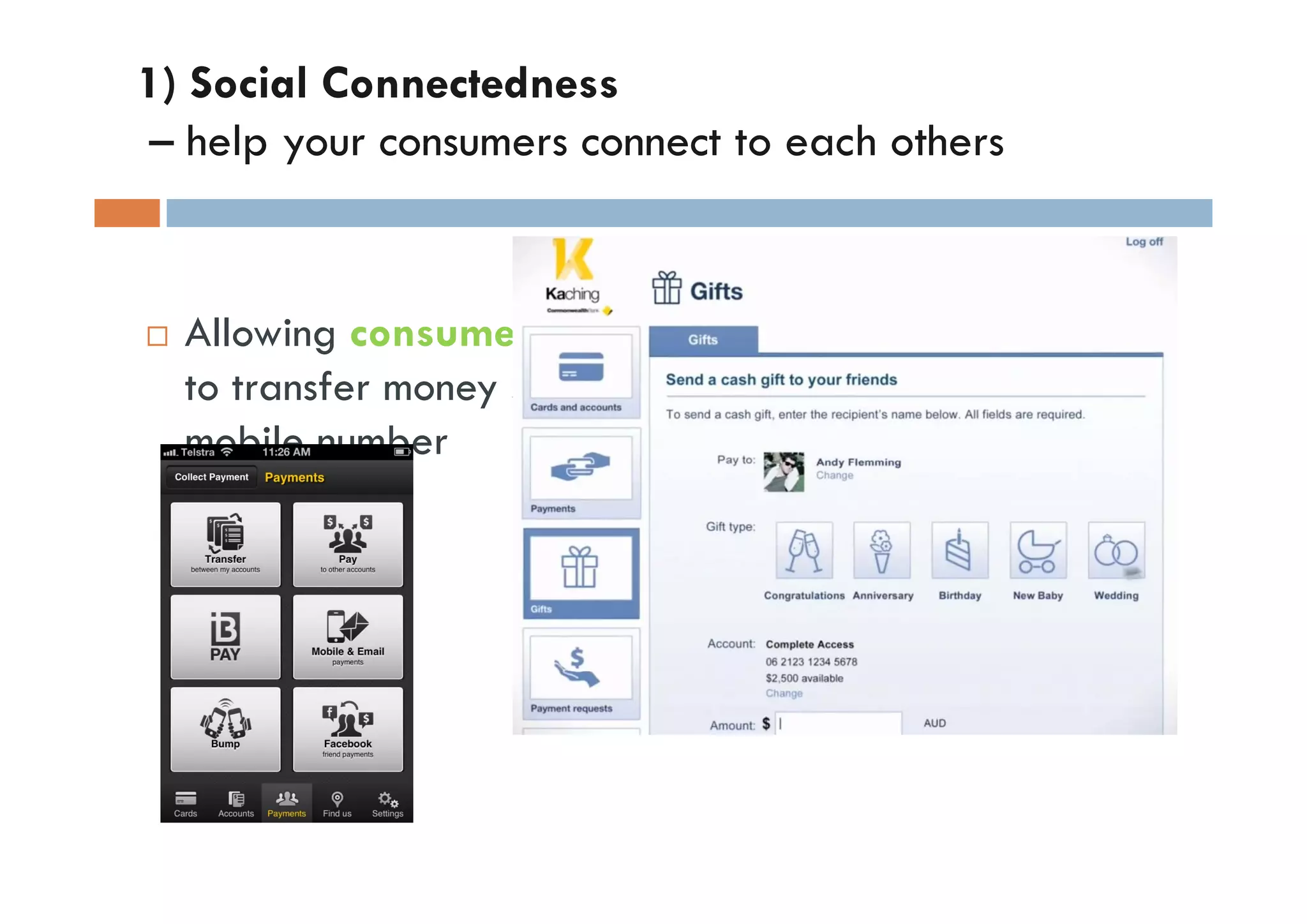
1) Social Connectedness
– help your consumers connect to each others


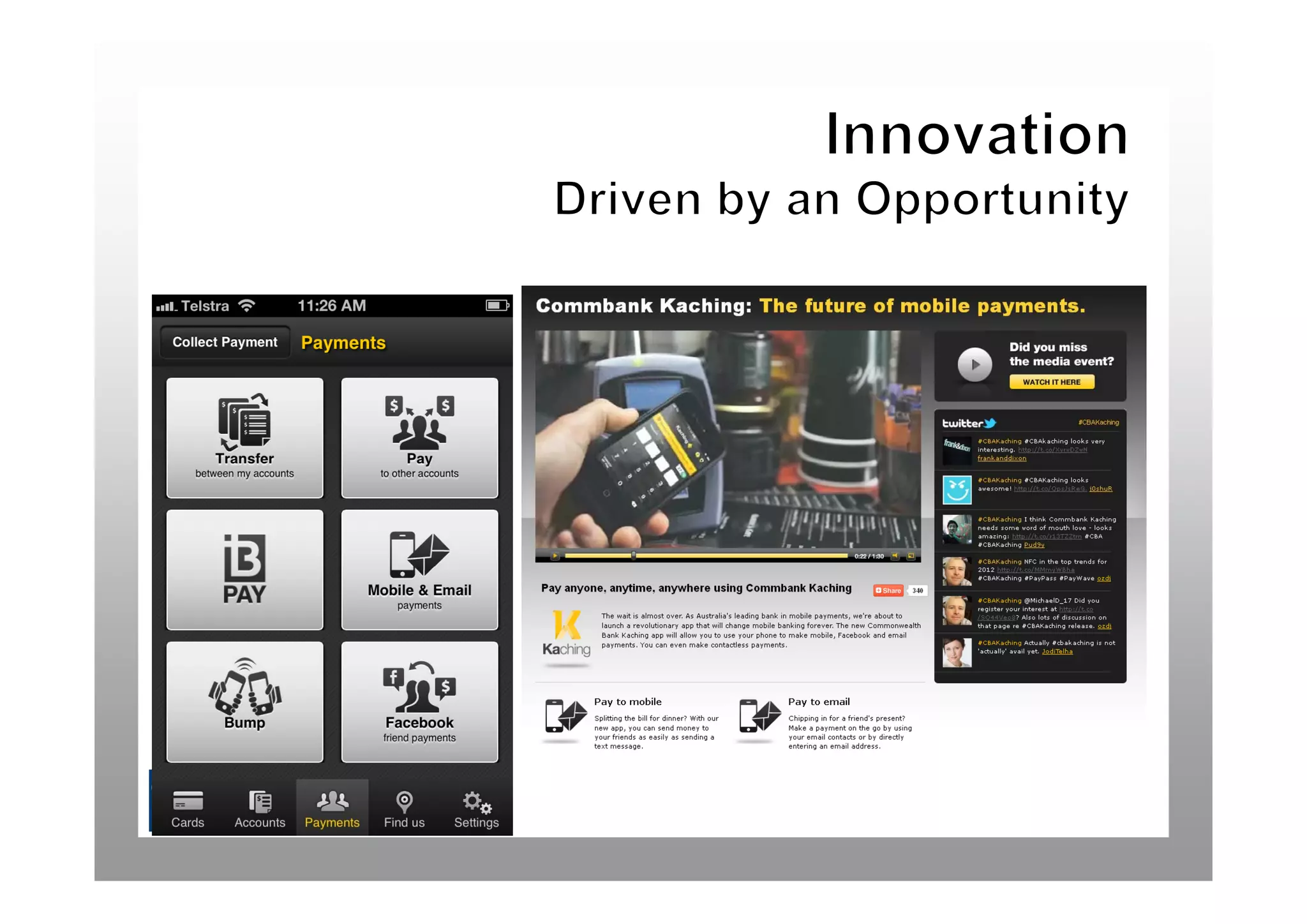
  Allowing consumers (not necessarily customers)
  to transfer money simply through email or
  mobile number
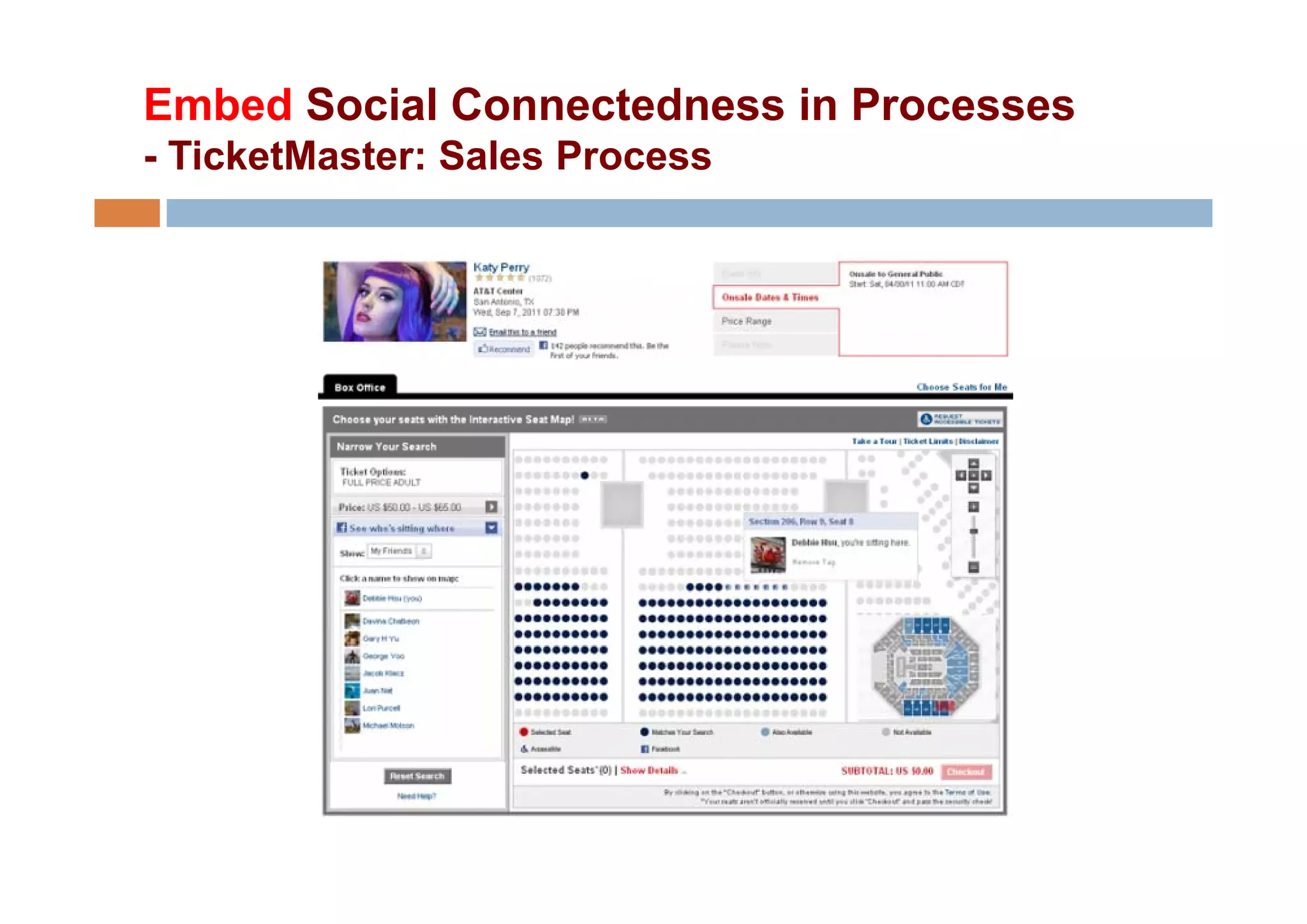
Embed Social Connectedness in Processes
- Ti k tM t
  TicketMaster: S l Process
                Sales P
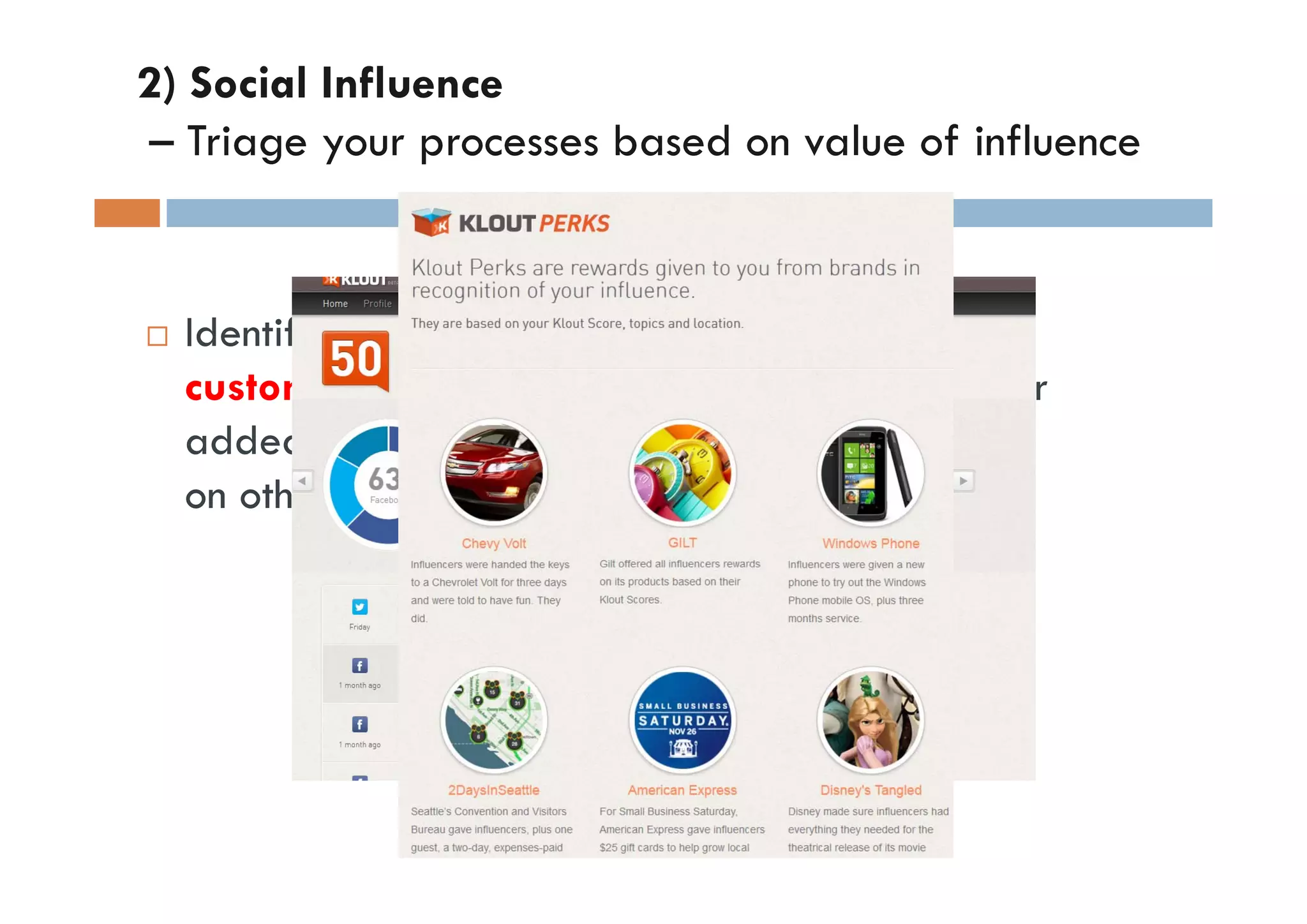
2) Social Influence
– Triage your processes based on value of influence


  Identifying users (including but not limited to
  customers) and assigning status, priority and/or
  added-value services based on their influence
  on others.
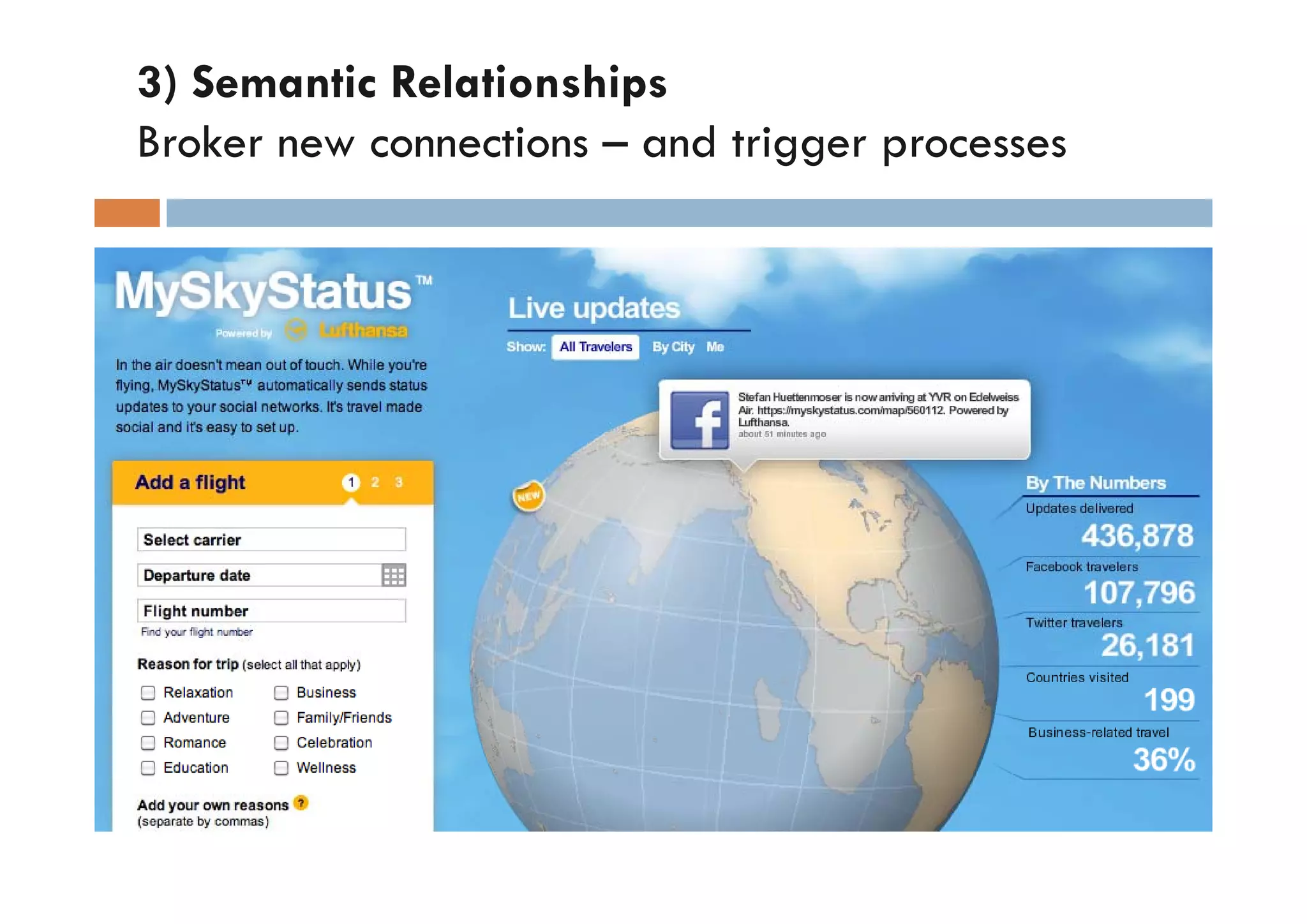
3) Semantic Relationships
Broker new connections – and trigger processes


  Identifying new connections (within and
  beyond the existing relationships) and position
  y
  your organization as a service broker in an
          g
  emerging consumer network.
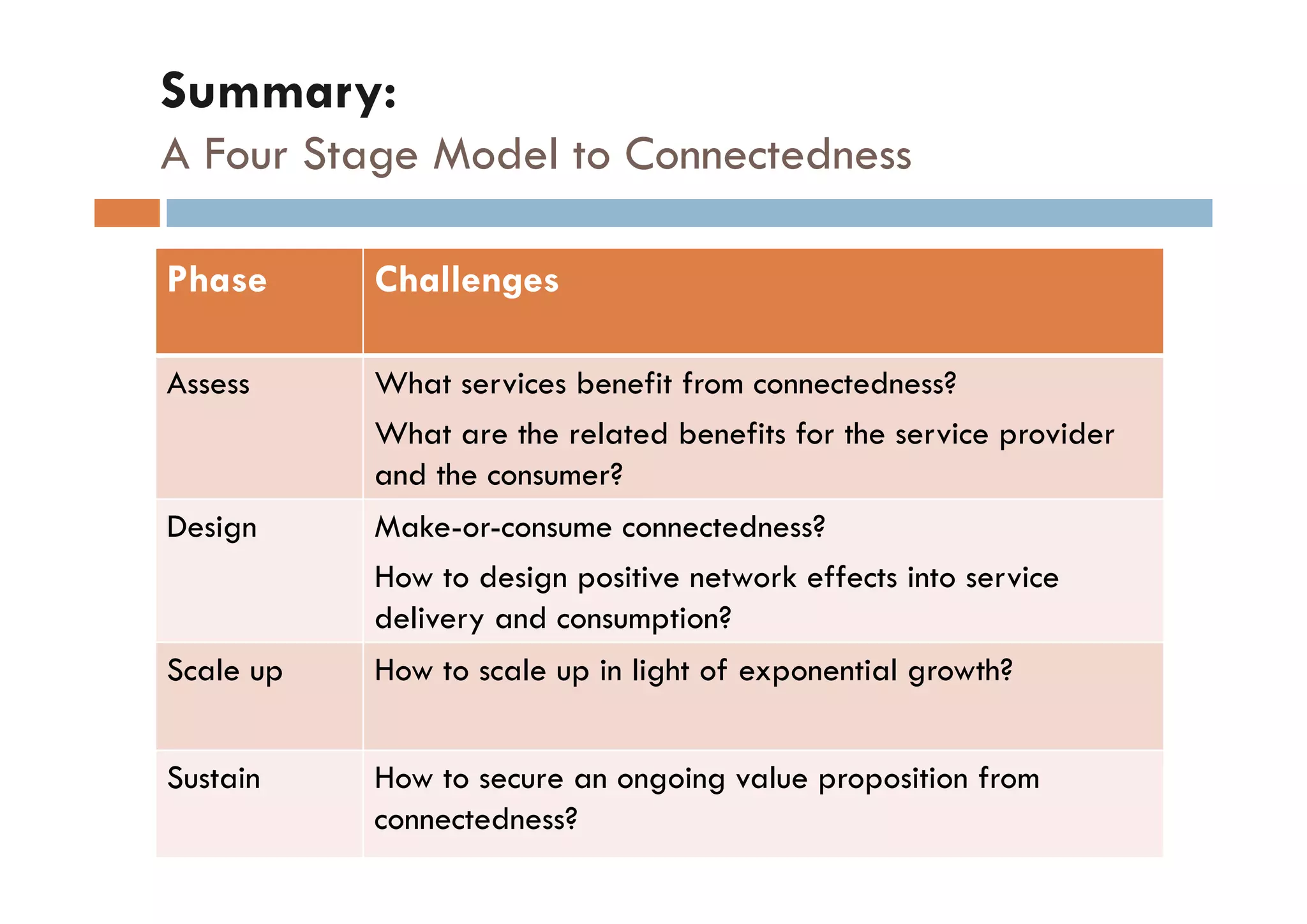
Summary:
AF
 Four St
      Stage M d l t C
            Model to Connectedness
                           t d

Phase      Challenges

Assess     What services benefit from connectedness?
           What are the related benefits for the service provider
           and the consumer?
Design     Make-or-consume connectedness?
           How d i
           H to design positive network effects into service
                             ii       k ff      i        i
           delivery and consumption?
Scale up   How to scale up in light of exponential growth?


Sustain    How to secure an ongoing value proposition from
           connectedness?
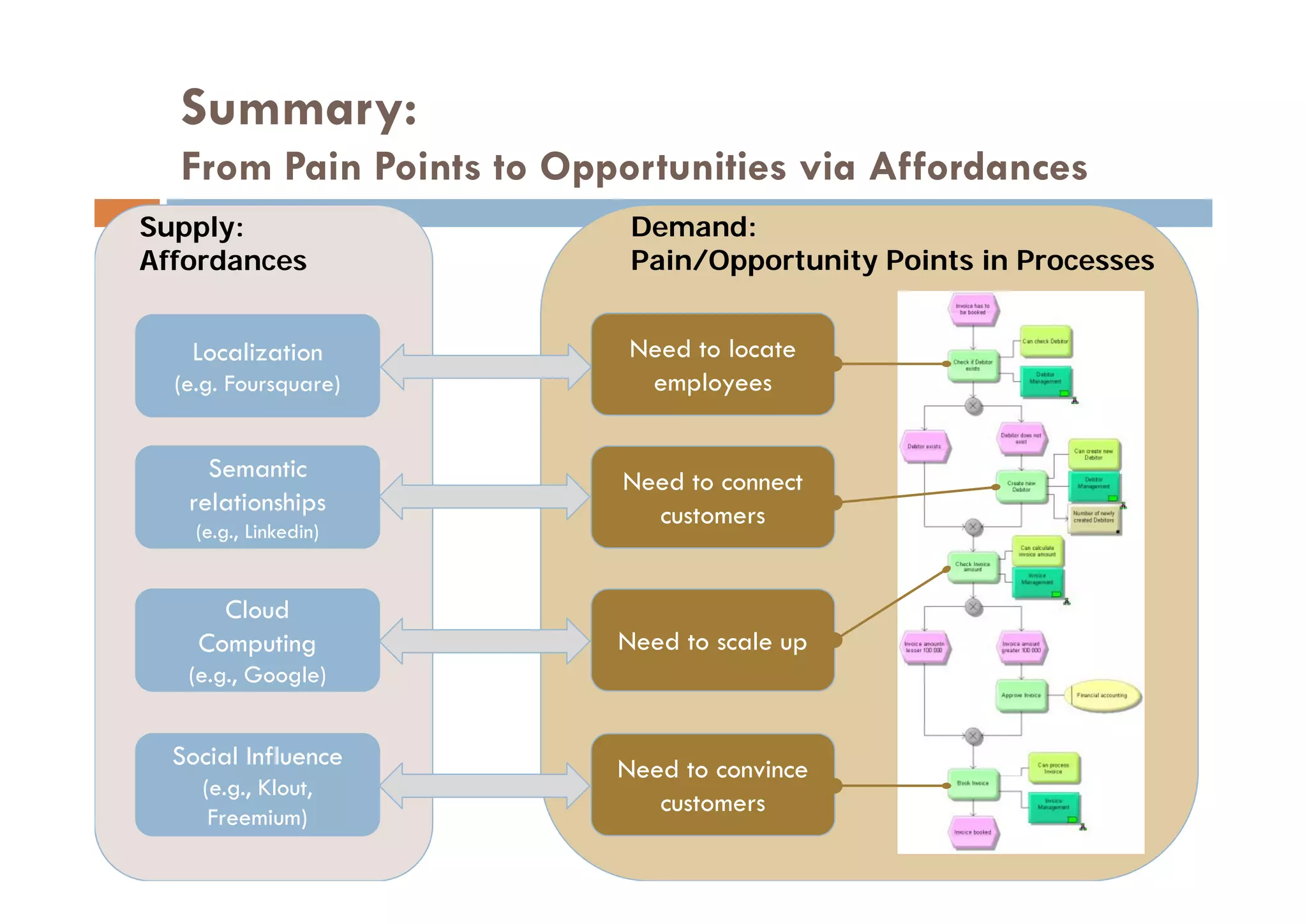
Summary:
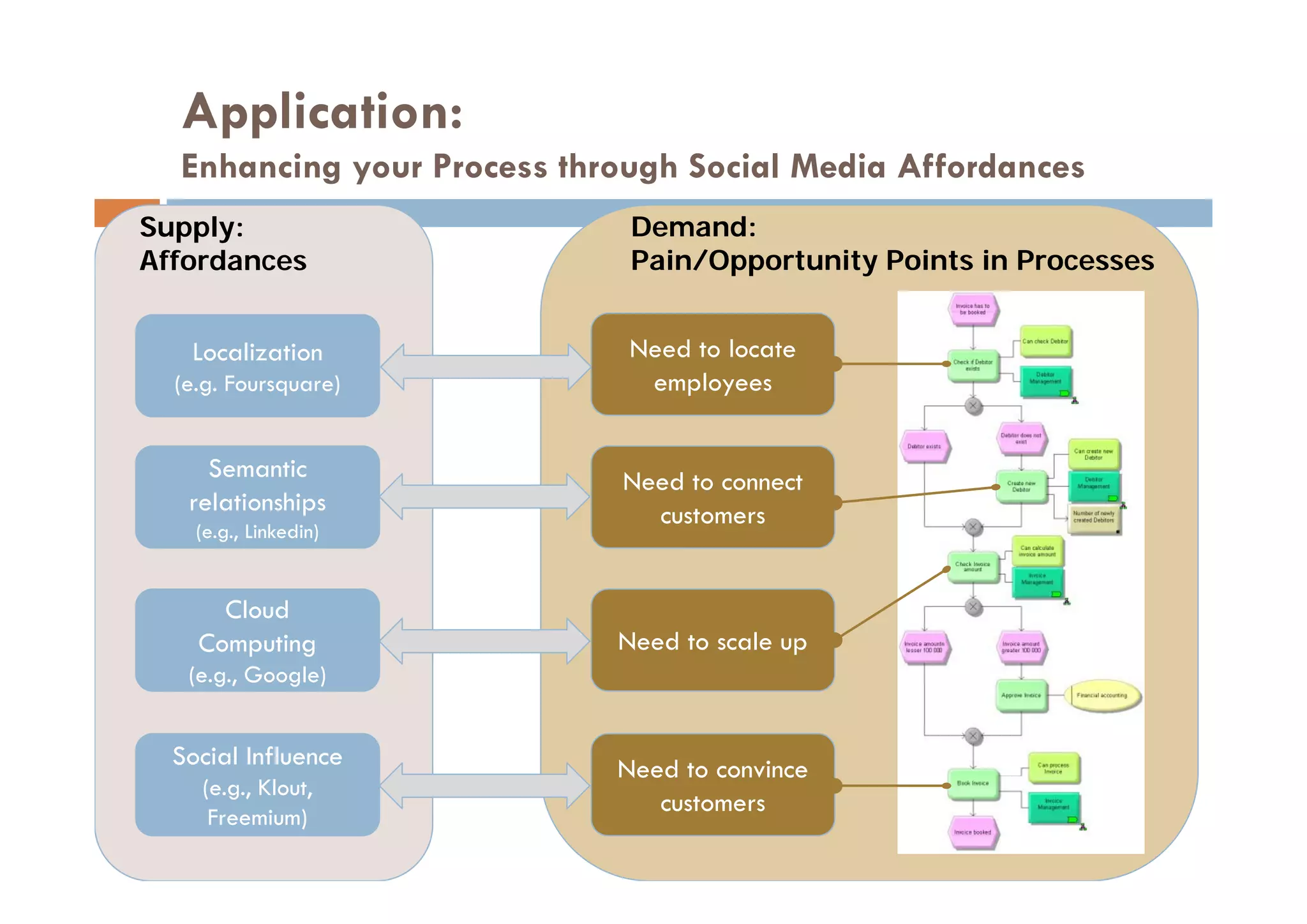
  From Pain Points to Opportunities via Affordances
Supply:                   Demand:
Affordances
Aff d                     Pain/Opportunity Points in Processes
                          P i /O    t it P i t i P


   Localization           Need to locate
  (e.g. Foursquare)        employees


     Semantic
     S       i           Need to connect
   relationships           customers
    (e.g., Linkedin)


      Cloud
    Computing            Need to scale up
   (e.g., Google)
   (      G   l )


  Social Influence       Need to convince
    (e.g., Klout,
     Freemium)
                            customers
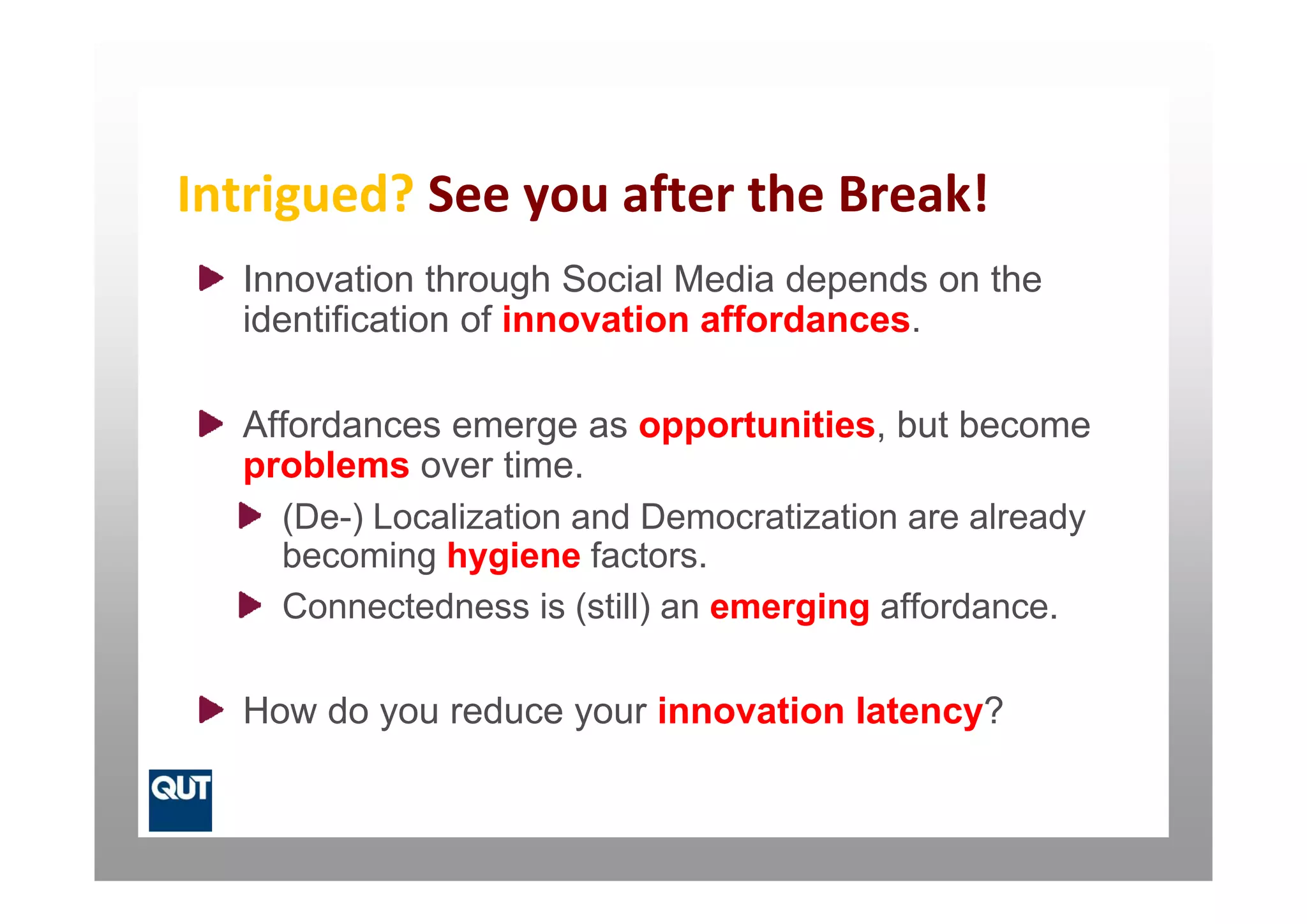
Intrigued? See you after the Break!
  Innovation through Social Media depends on the
  identification of innovation affordances.

  Affordances emerge as opportunities, but become
  problems over time
                  time.
    (De-) Localization and Democratization are already
    becoming hygiene factors.
    Connectedness is (still) an emerging affordance.

  How do you reduce your innovation latency?
Intrigued? See you after the Break!


        Find out after the break!
Innovation through Connectedness
                 g
          - Part II: How To Innovate

                                    Professor Dr Jan Recker
                         Woolworths Chair of Retail Innovation
          Information Systems School, Queensland University of Technology
Pick your Poise
     y
 We value transactions more
 than transformations…

 We are not ambitious enough…

 We don’t expect innovations…
            p

 We do not think outside the box…
                             box
What this Session is about:
Why d like change l t i
Whdodo we struggle to innovate?
We   not   change…
            t               t ?
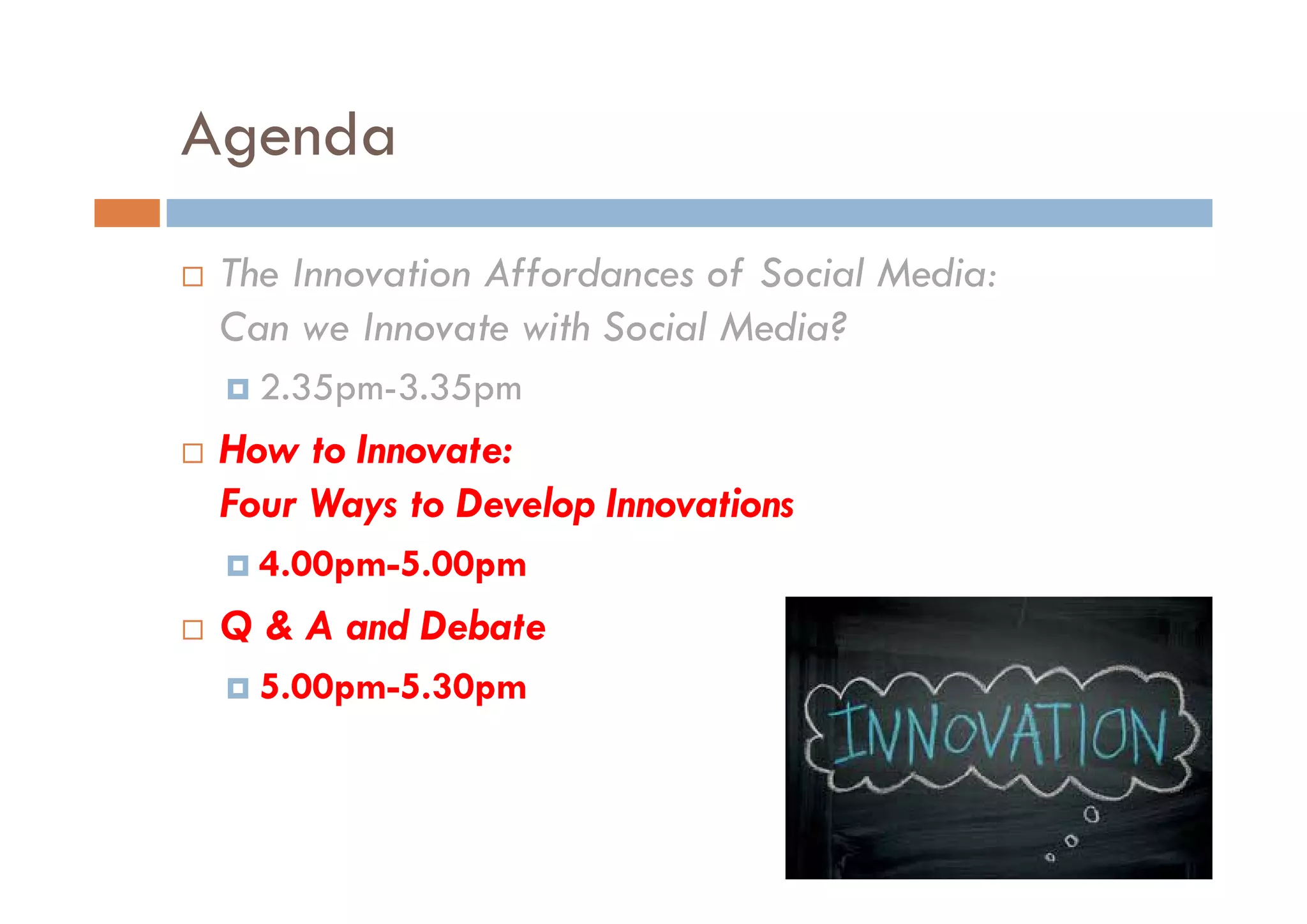
Agenda
 The Innovation Affordances of Social Media:
 Can we Innovate with Social Media?
   2.35pm-3.35pm
 How to Innovate:
 Four Ways to Develop Innovations
   4.00pm-5.00pm
   4 00pm-5 00pm
 Q & A and Debate
   5.00pm-5.30pm
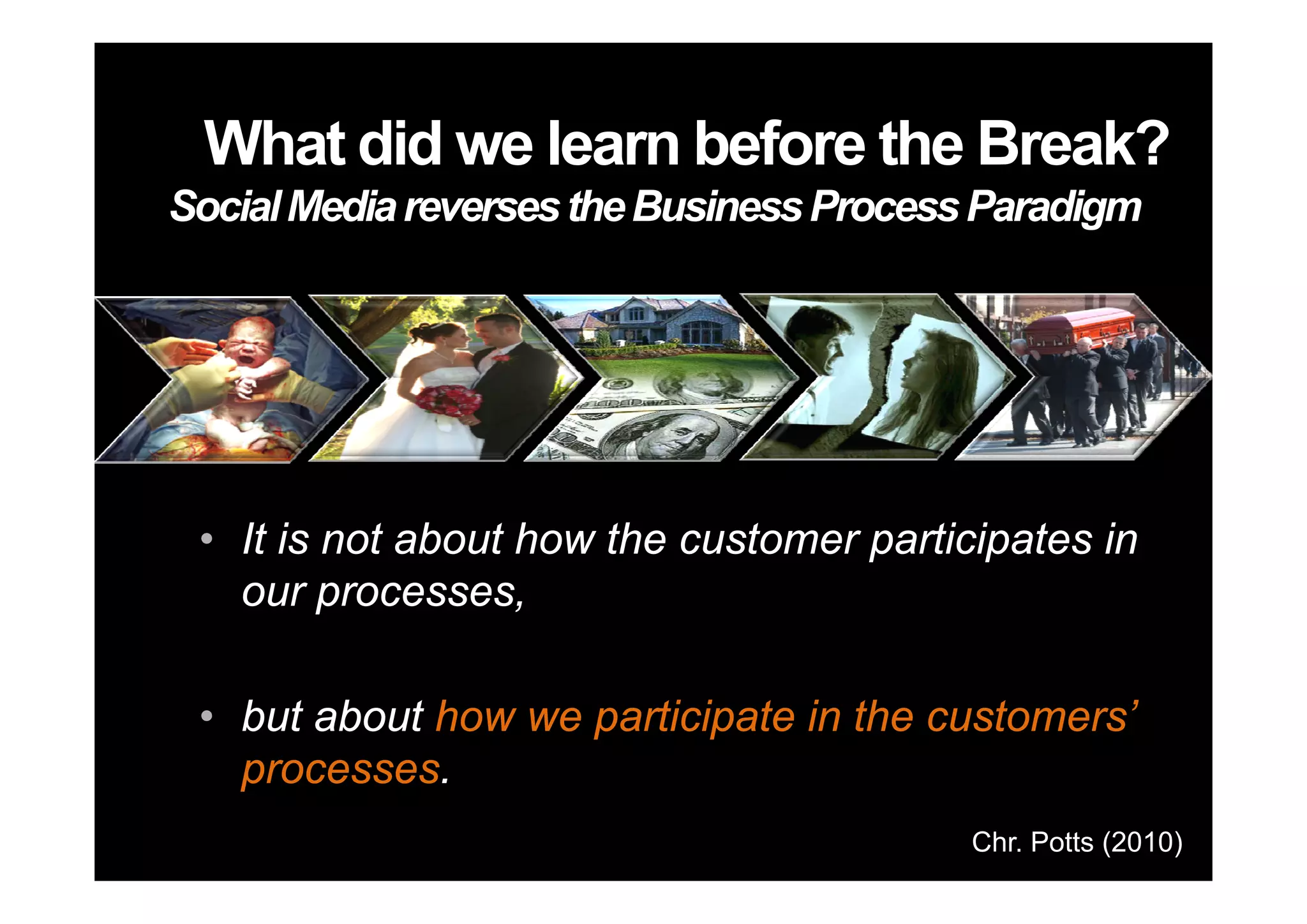
What did we learn before the Break?
Social Media reverses the Business Process Paradigm


 • It is not about how the customer participates in
   our processes,

 • but about how we participate in the customers’
   processes.
   processes
                                          Chr. Potts (2010)
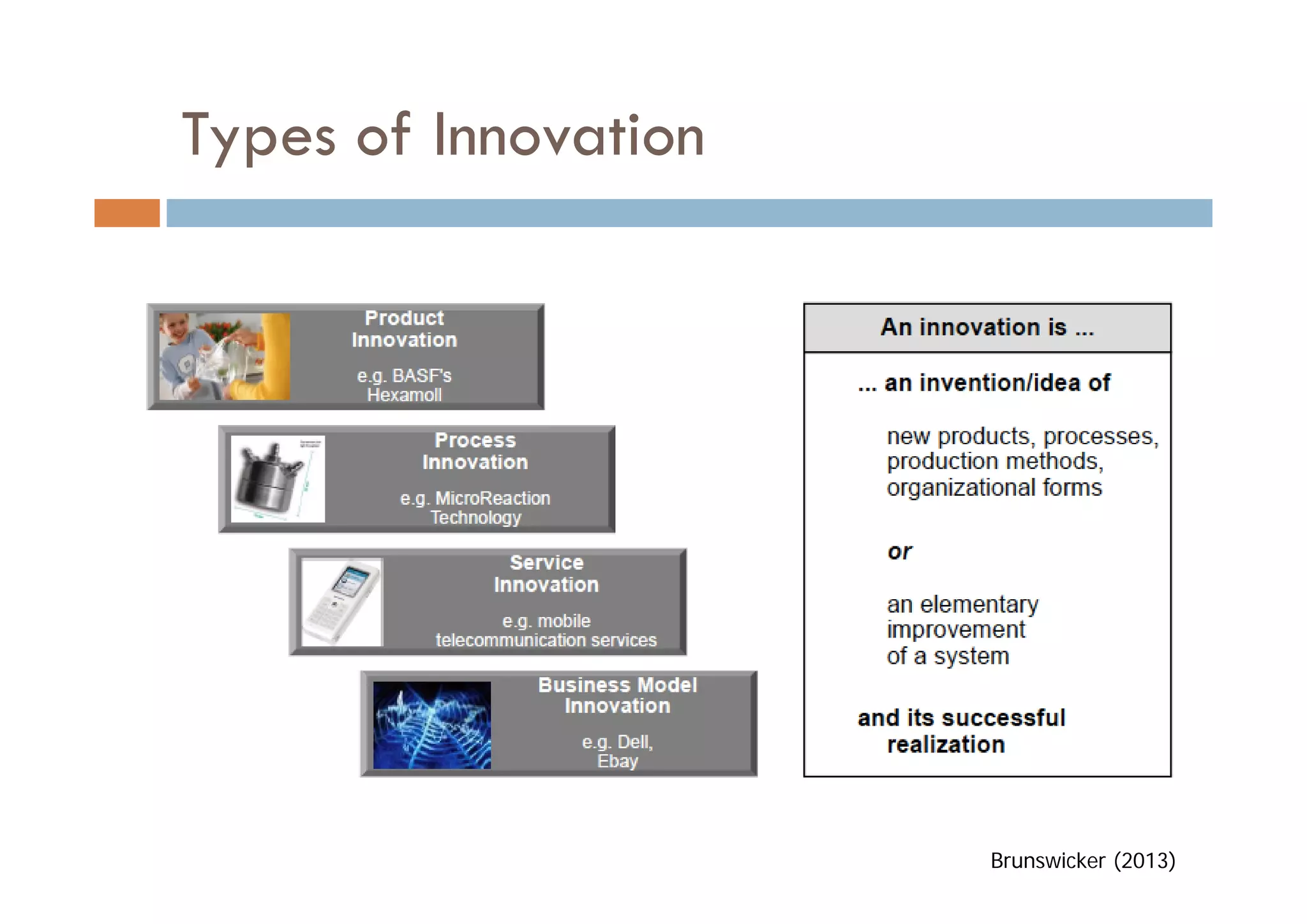
Types of Innovation


                      Brunswicker (2013)
It s
   It’s not a
question of type!
q    i     f yp !
How ambitious are you?
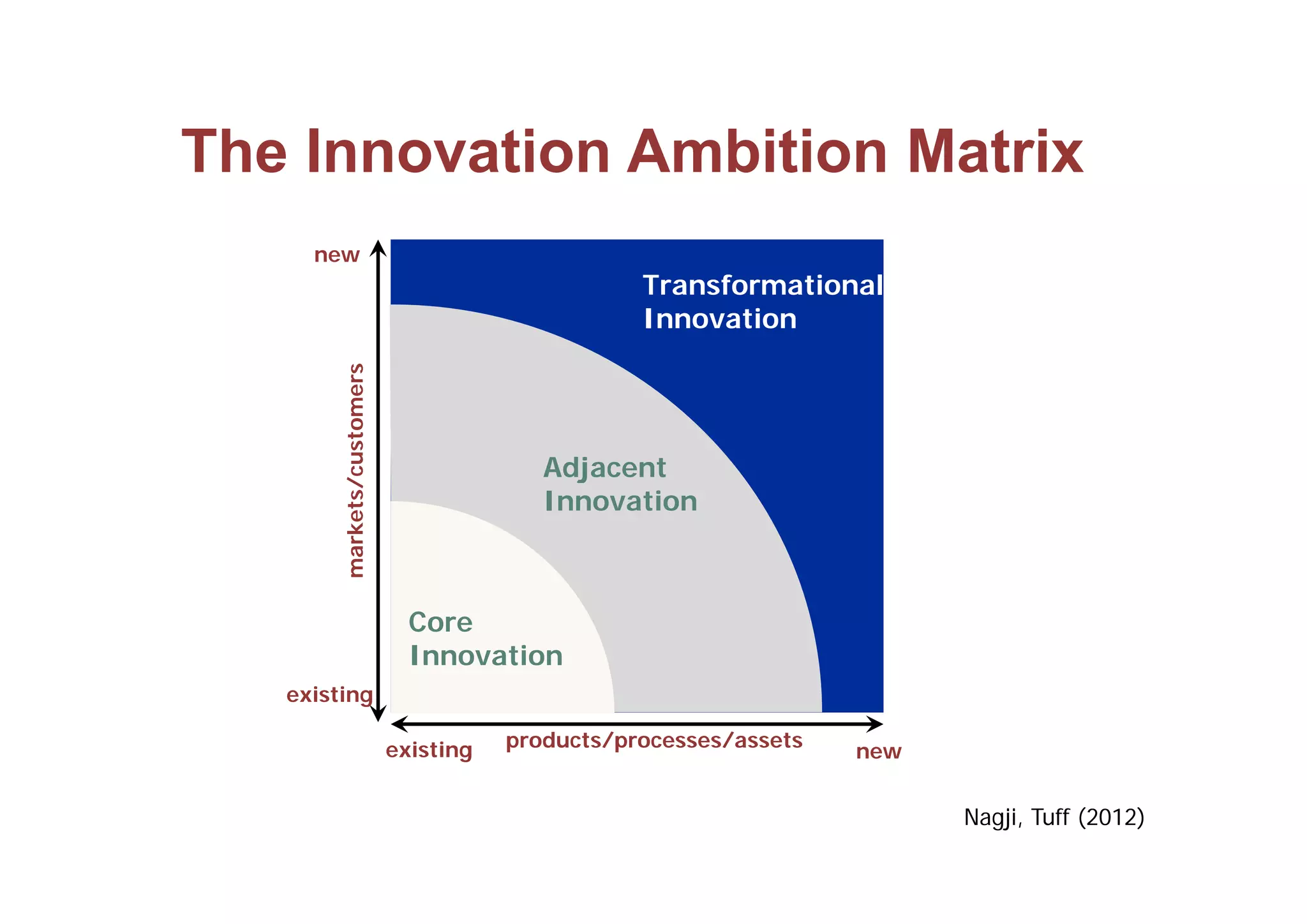
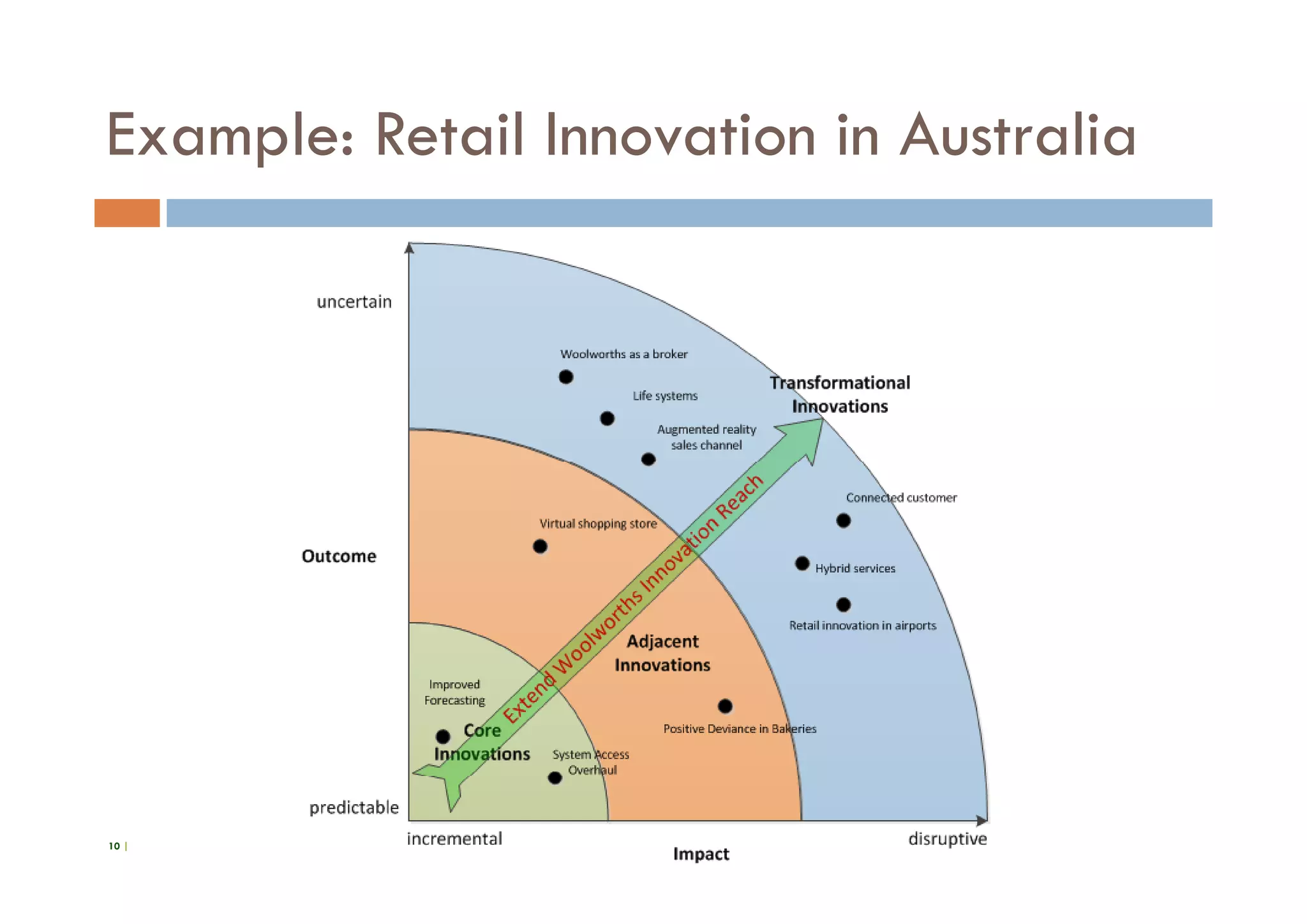
The Innovation Ambition Matrix
     new
                                                  Transformational
                                                  Innovation
                 ustomers


                                          Adjacent
        markets/cu


                                          Innovation
        m


                              Core
                              Innovation
   existing

                            existing   products/processes/assets
                                                                   new


                                                                         Nagji, Tuff (2012)
Example: Retail Innovation in Australia


10 |
How do we innovate?
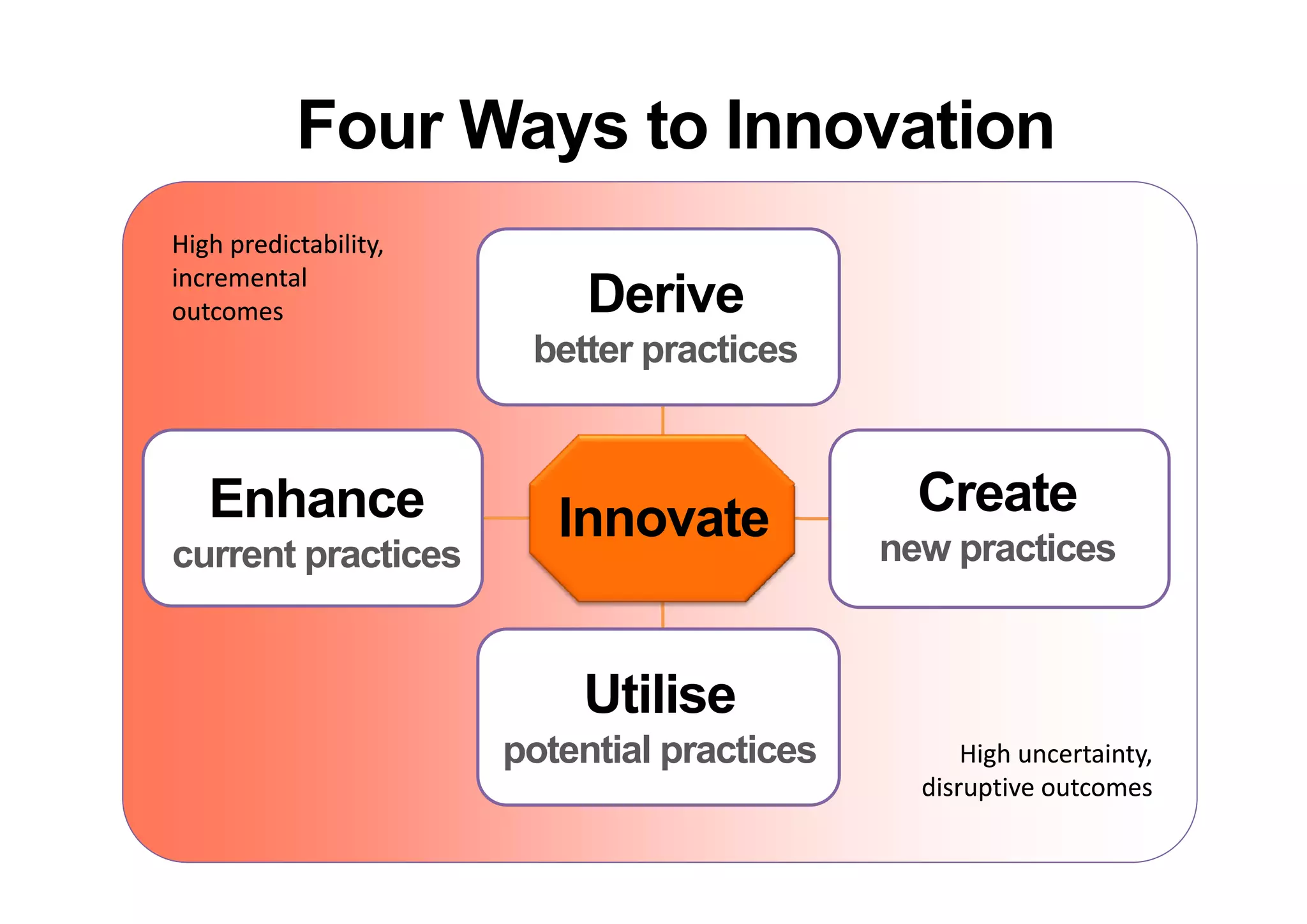
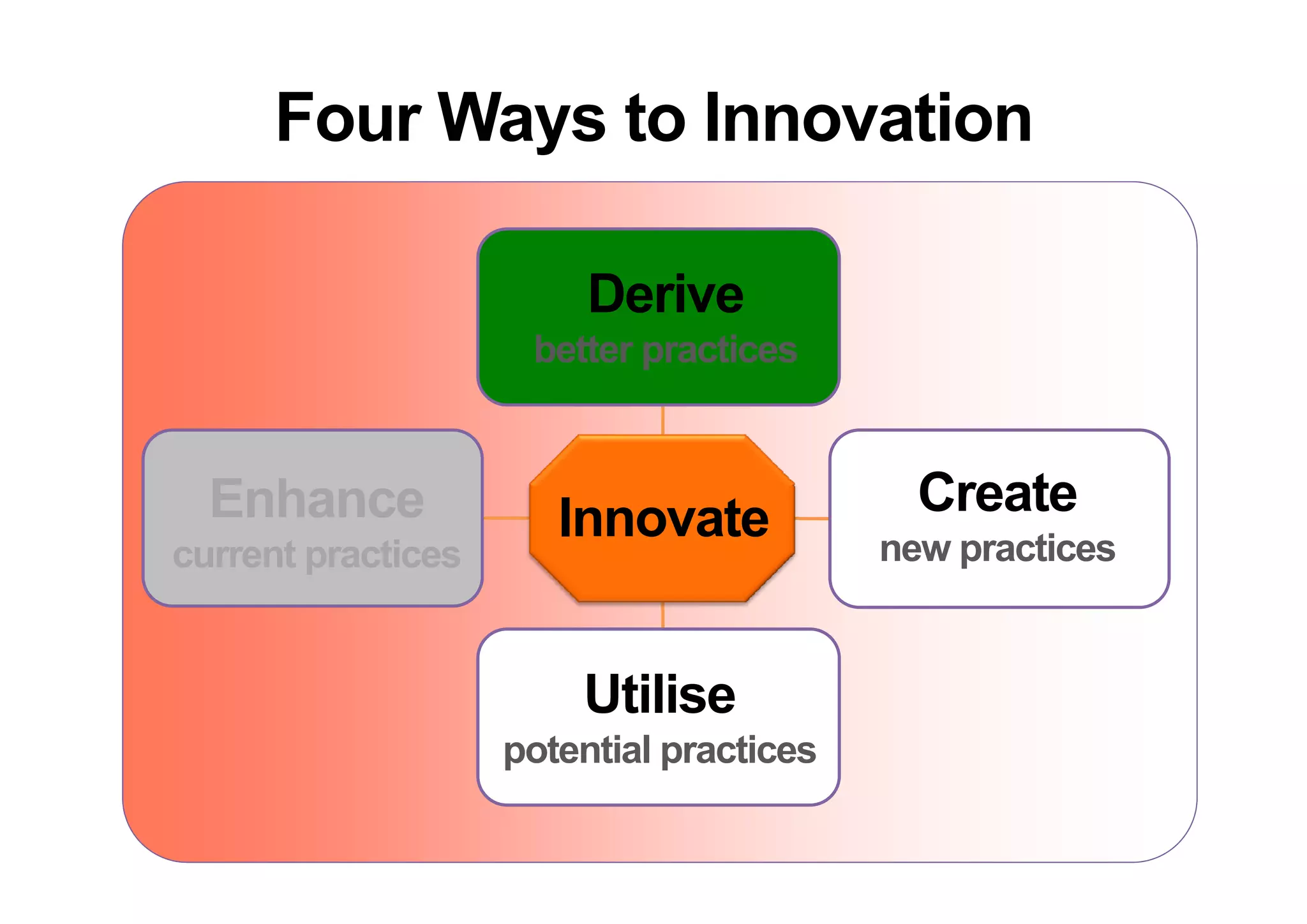
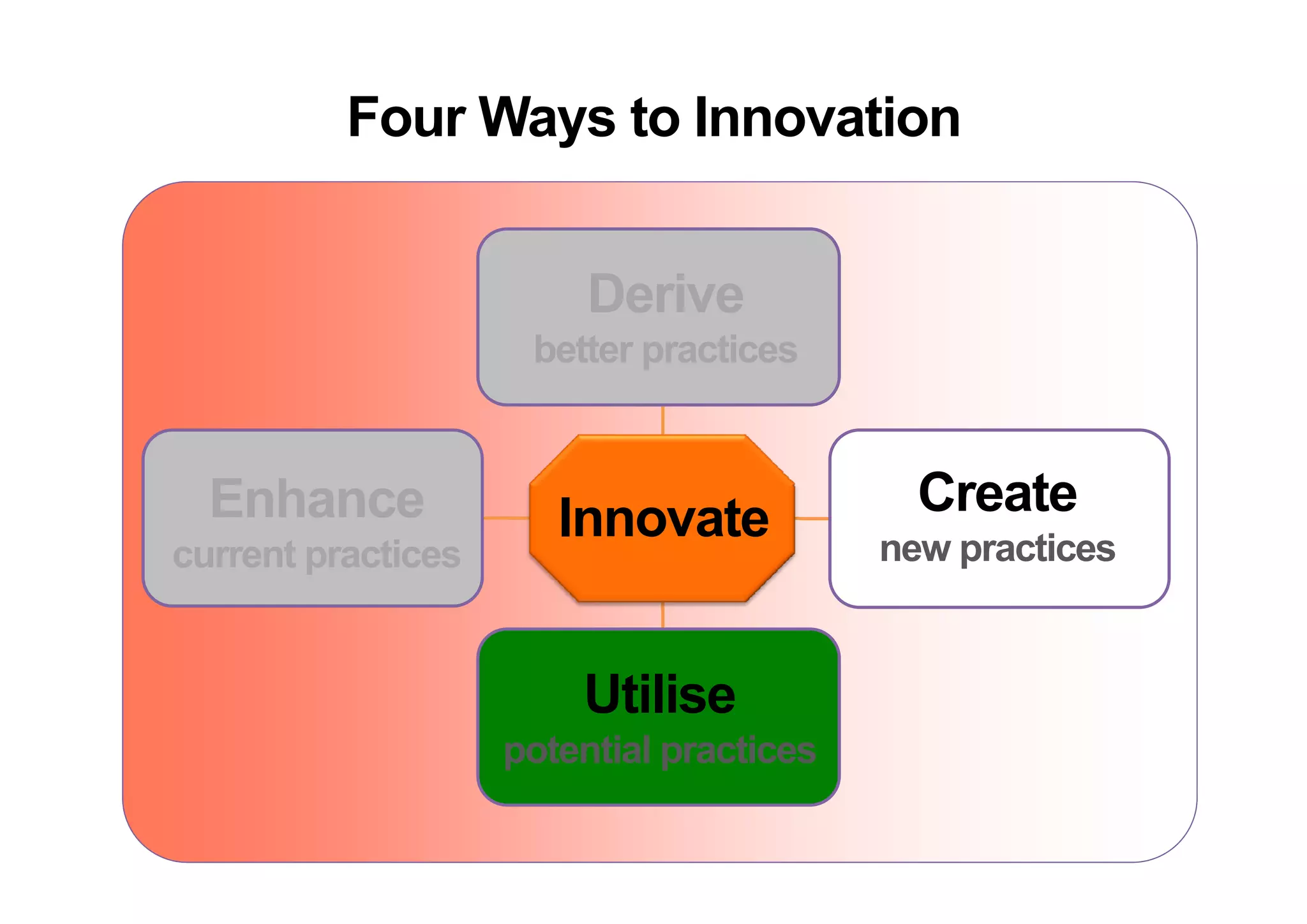
Four Ways to Innovation
High predictability, 
High predictability,
incremental 
outcomes                     Derive
                         better practices


   Enhance                 Innovate             Create
current practices                             new practices
                                                  p


                            Utilise
                        potential practices         High uncertainty, 
                                                disruptive outcomes
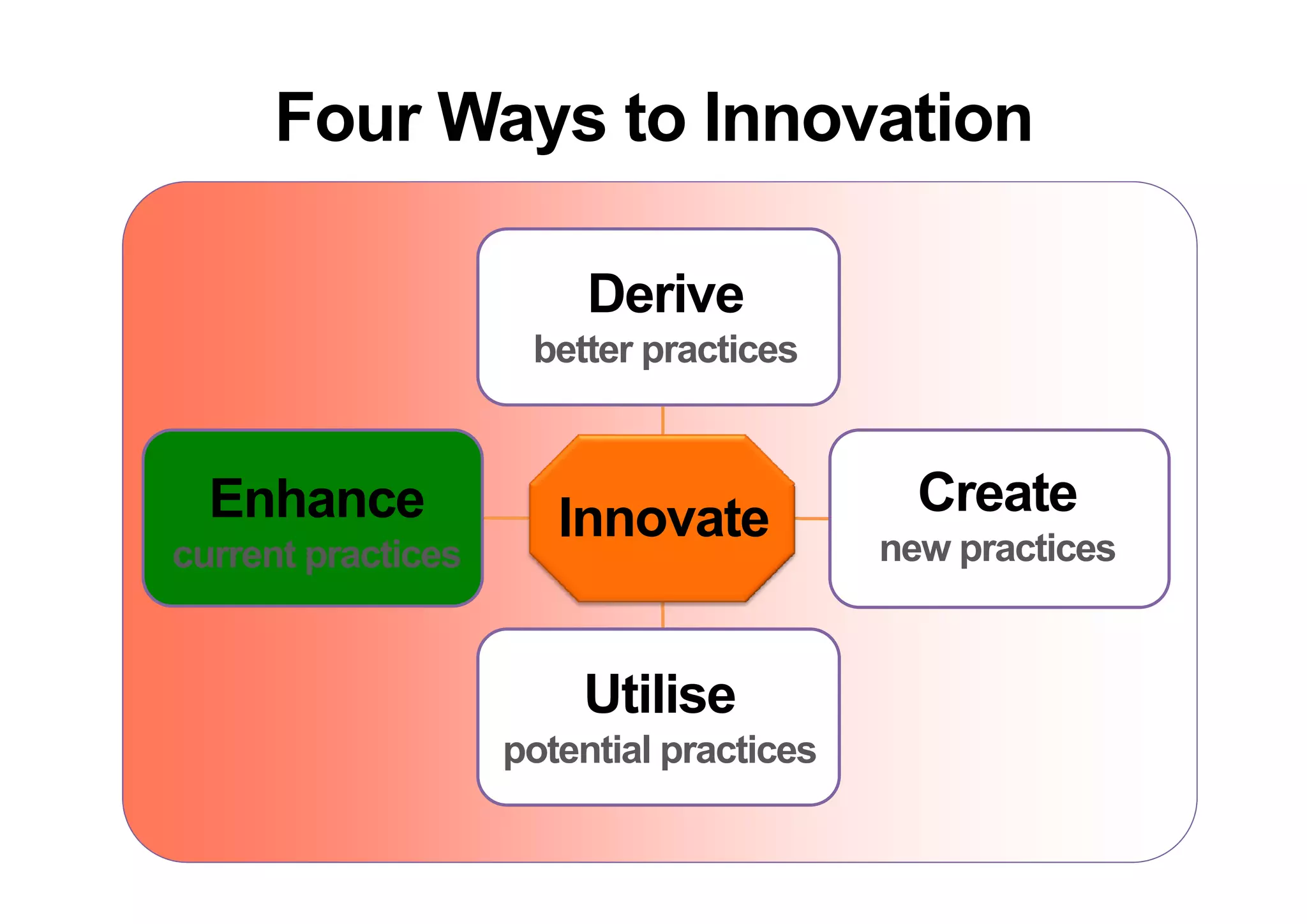
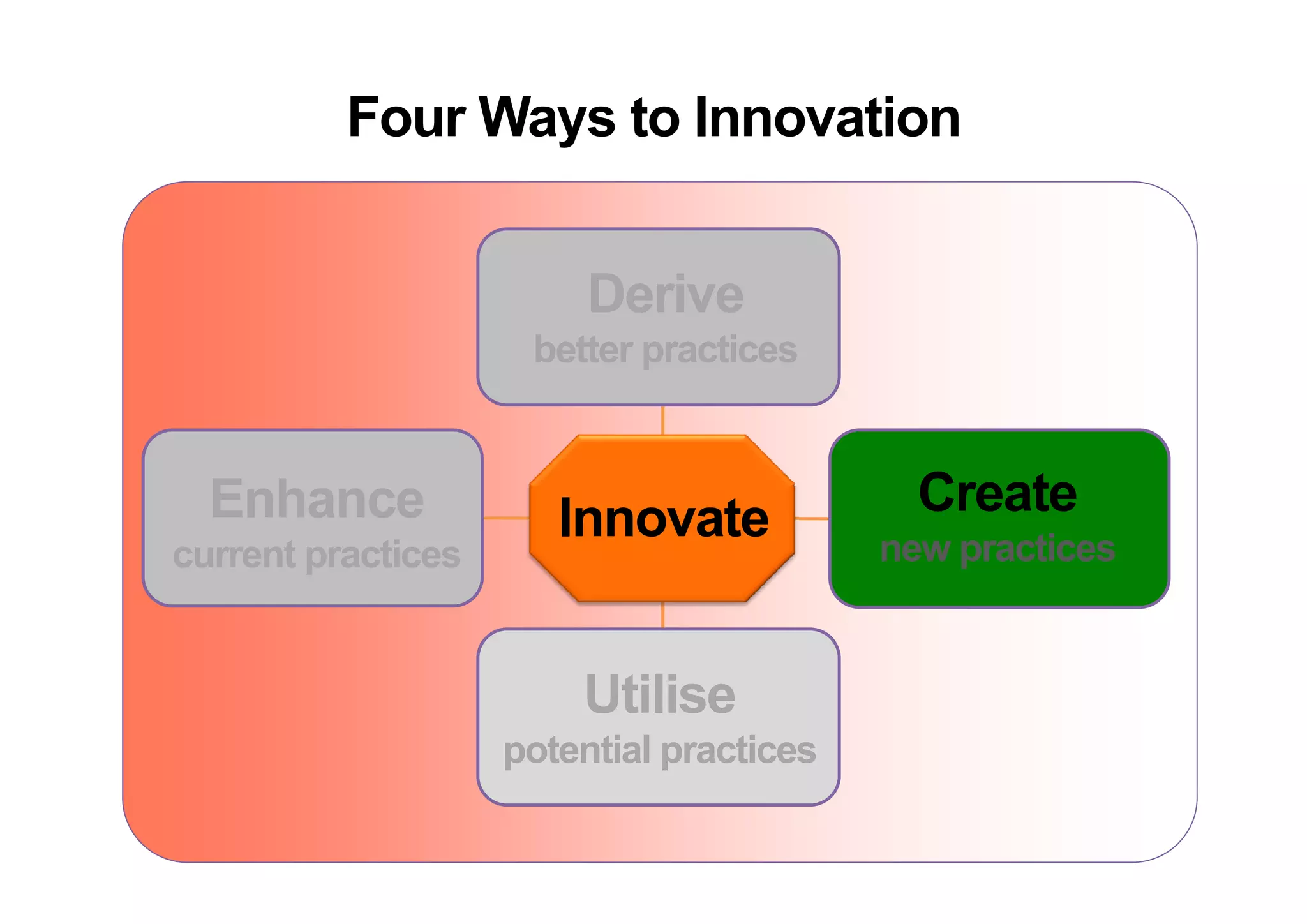
Four Ways to Innovation
            y

                         Derive
                     better practices


  Enhance              Innovate             Create
current practices                         new practices
                                              p


                        Utilise
                    potential practices
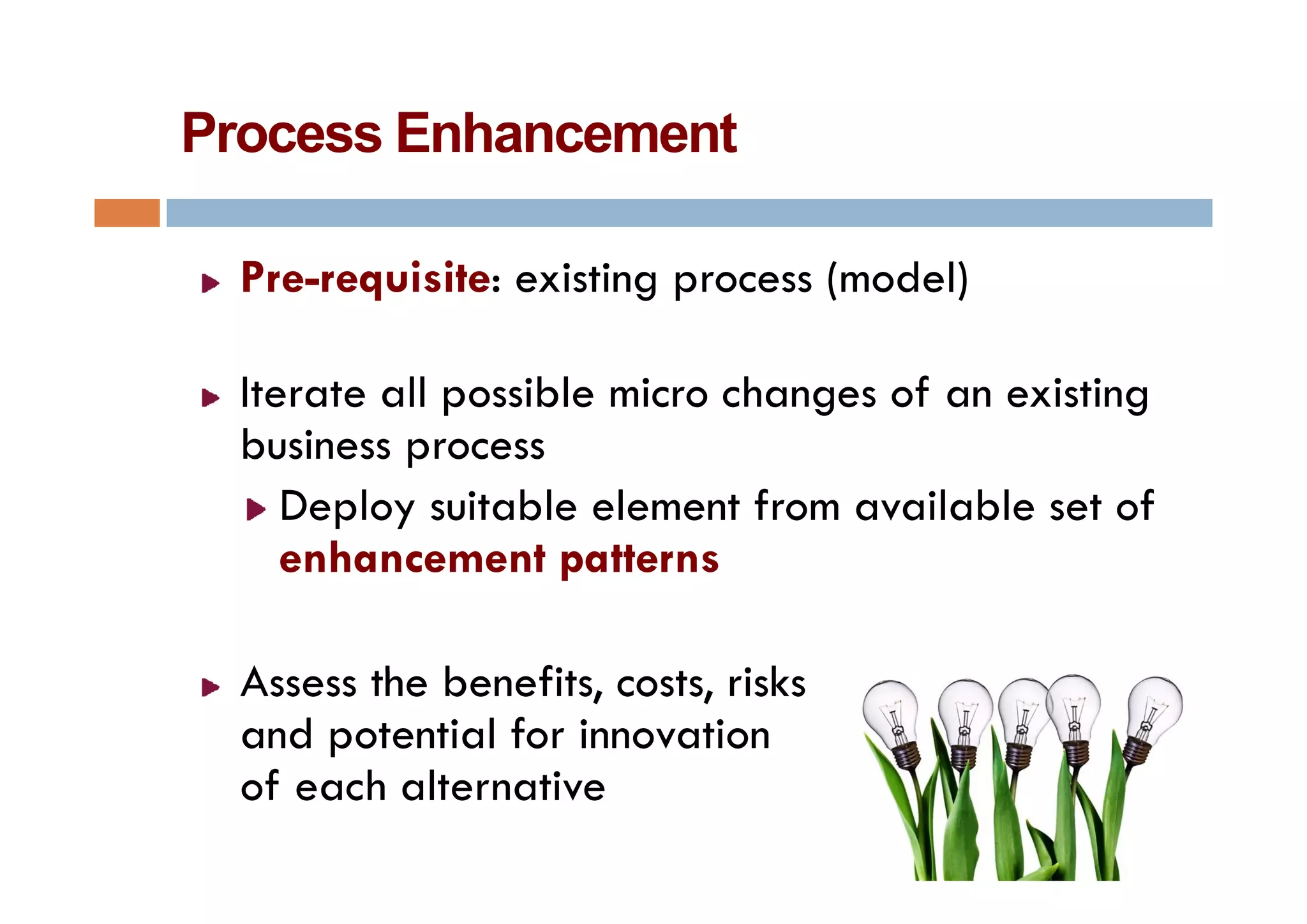
Process Enhancement

  Pre-requisite: existing process (model)

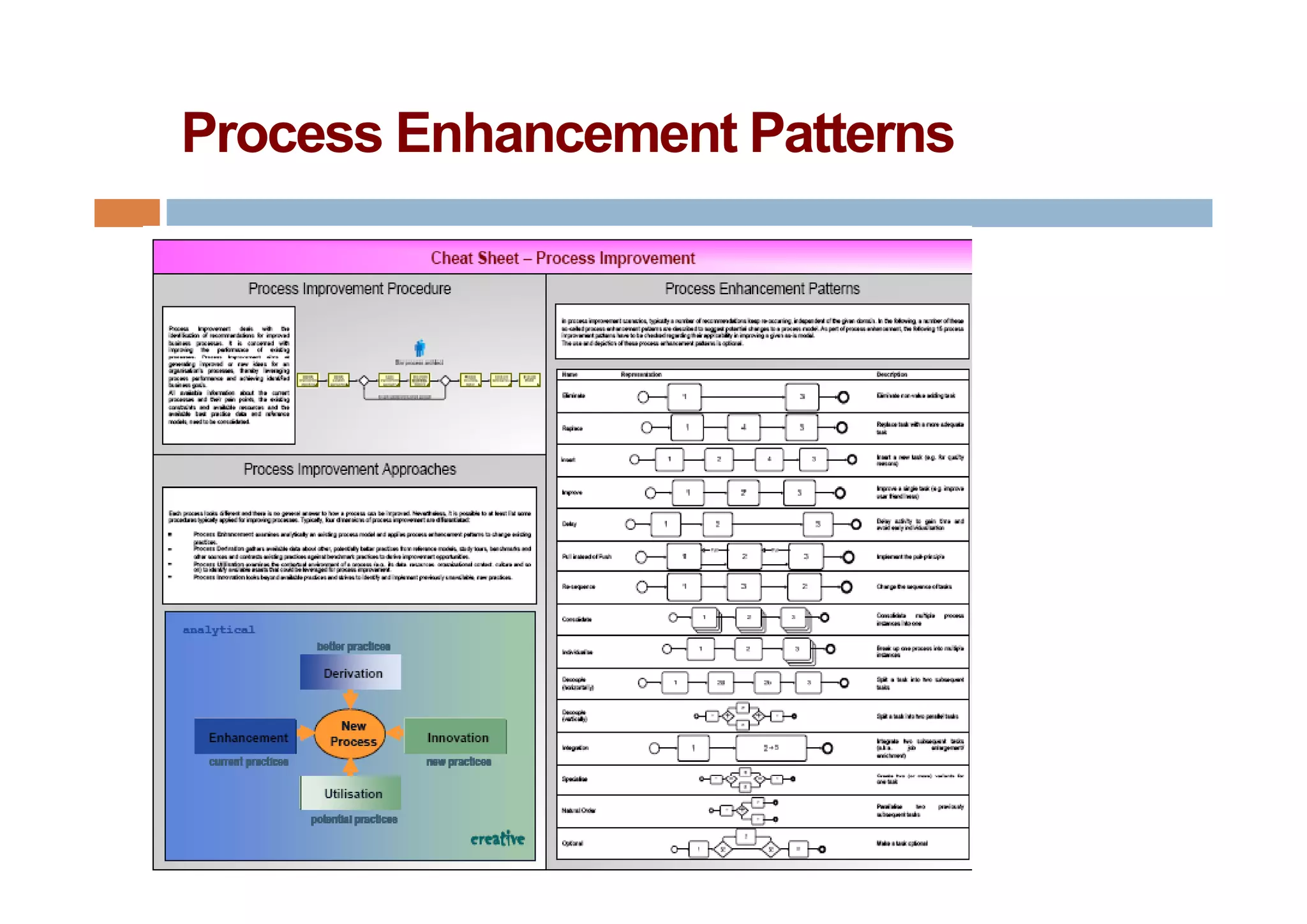
  Iterate all possible micro changes of an existing
           p
  business process
     Deploy suitable element from available set of
     enhancement patterns

  Assess th benefits, costs, risks
  A      the b fit       t ik
  and potential for innovation
  of each alternative
   f     h lt     ti
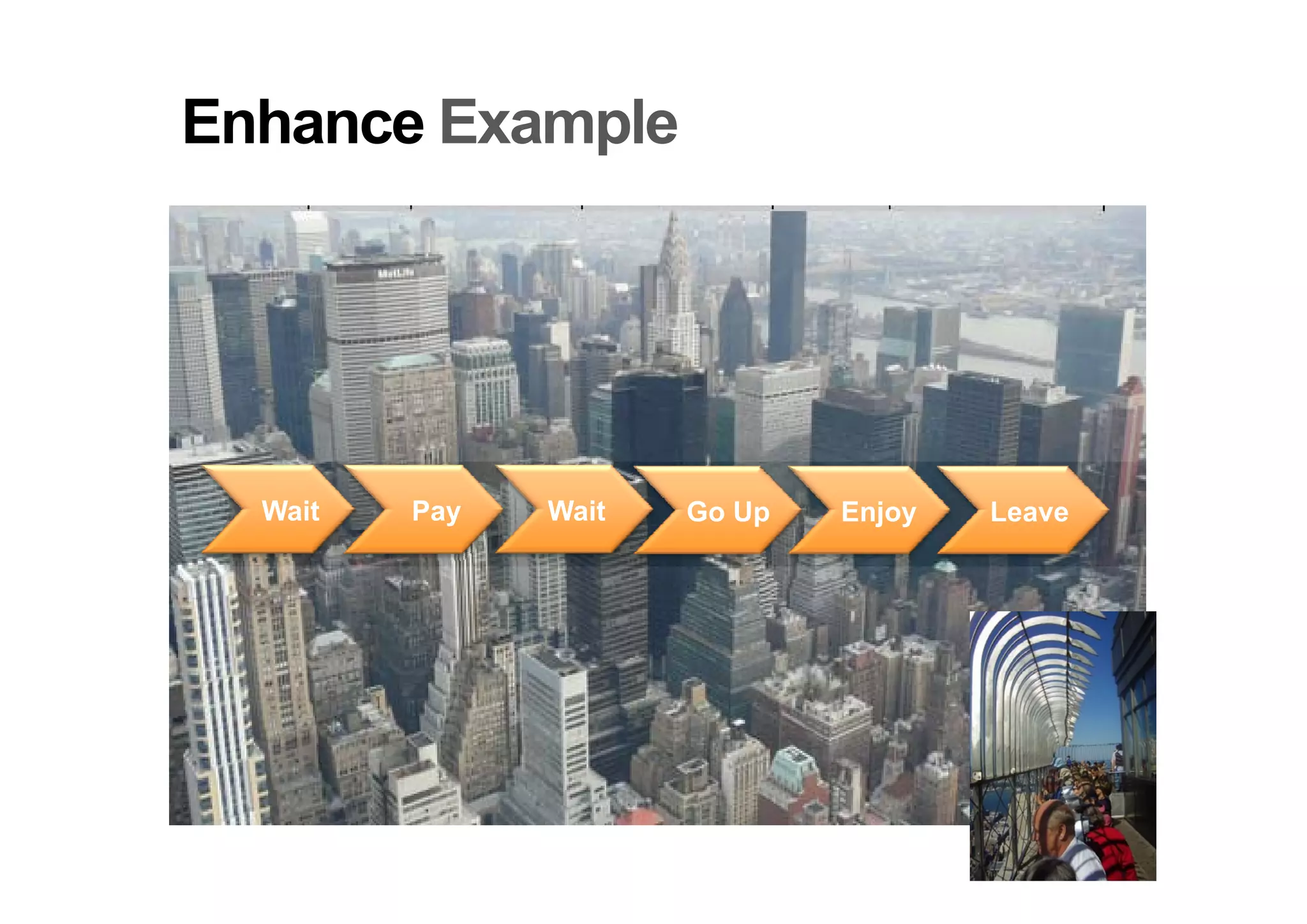
Enhance Example
            p


  Wait   Pay   Wait   Go Up   Enjoy   Leave
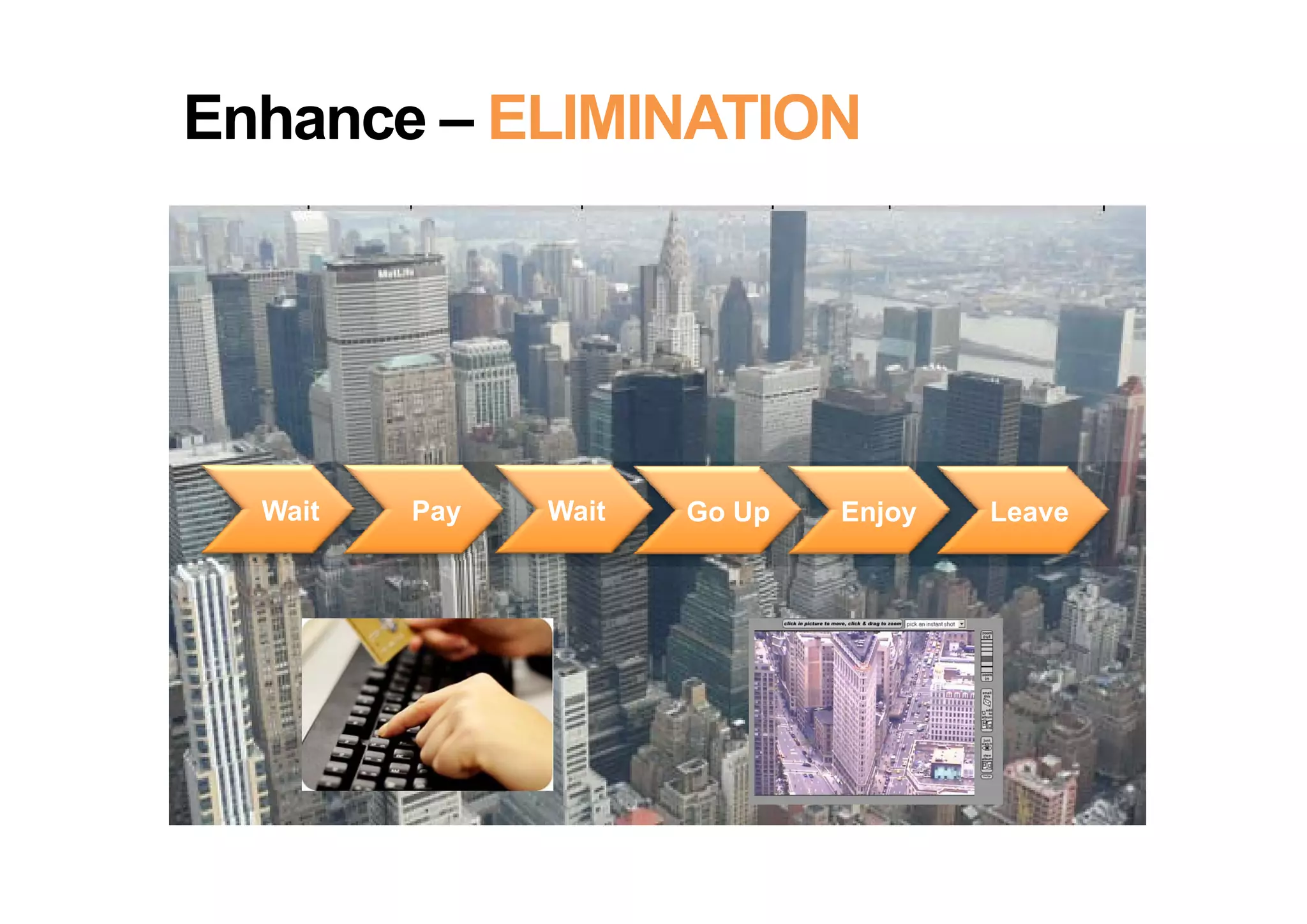
Enhance – ELIMINATION


  Wait   Pay   Wait   Go Up   Enjoy   Leave
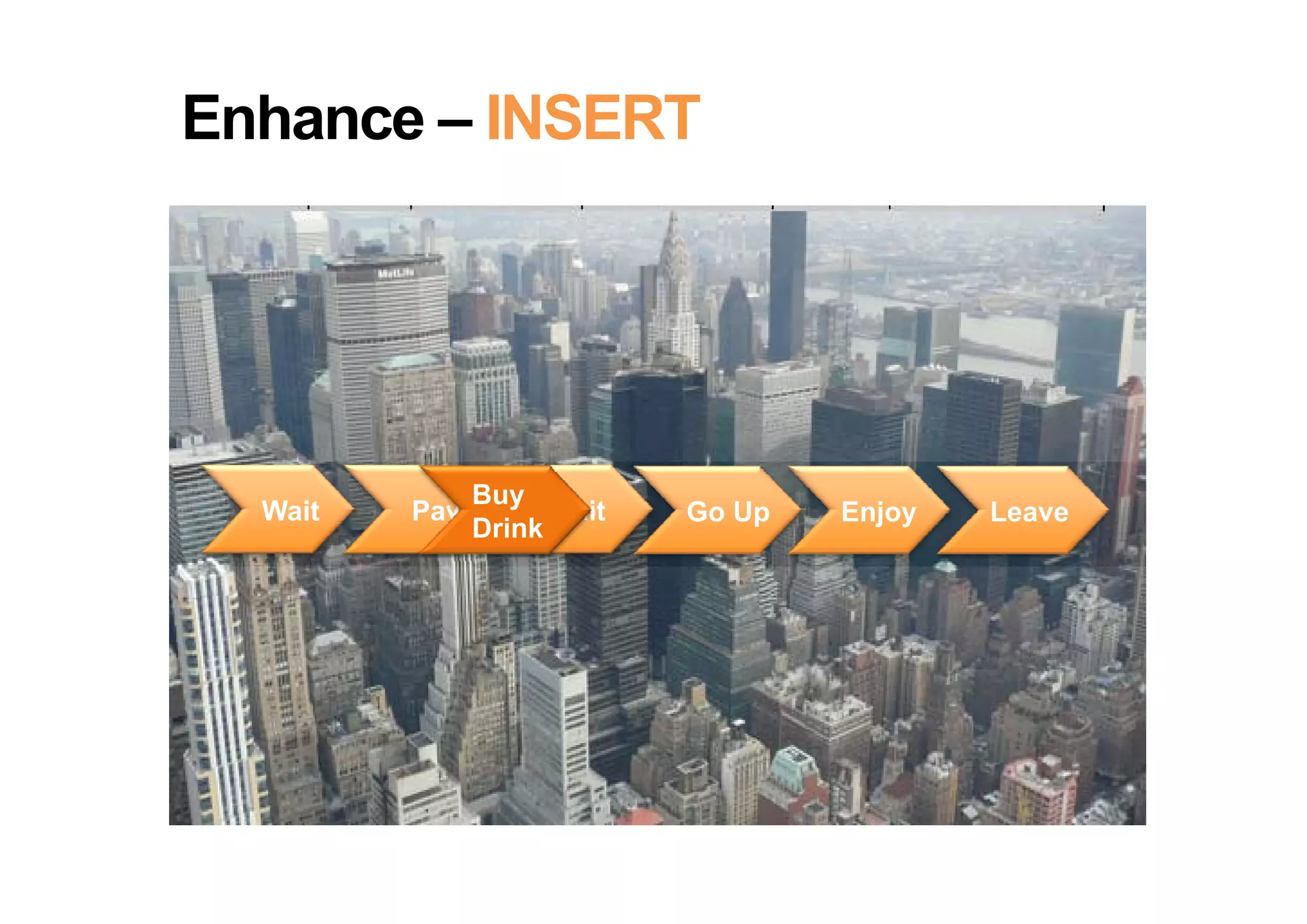
Enhance – INSERT


               Buy
  Wait   Pay         Wait   Go Up   Enjoy   Leave
               Drink
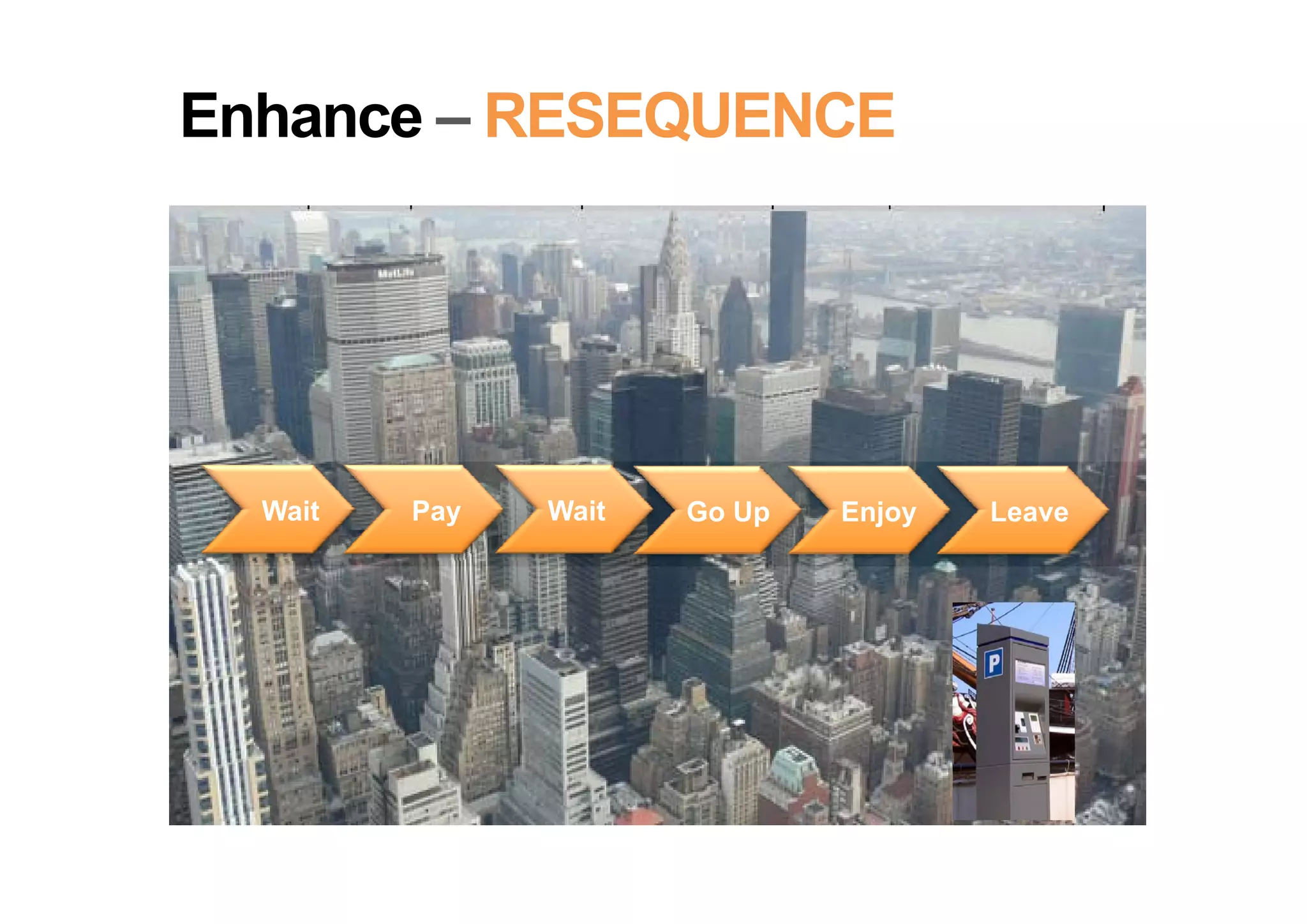
Enhance – RESEQUENCE


  Wait   Pay   Wait   Go Up   Enjoy   Leave
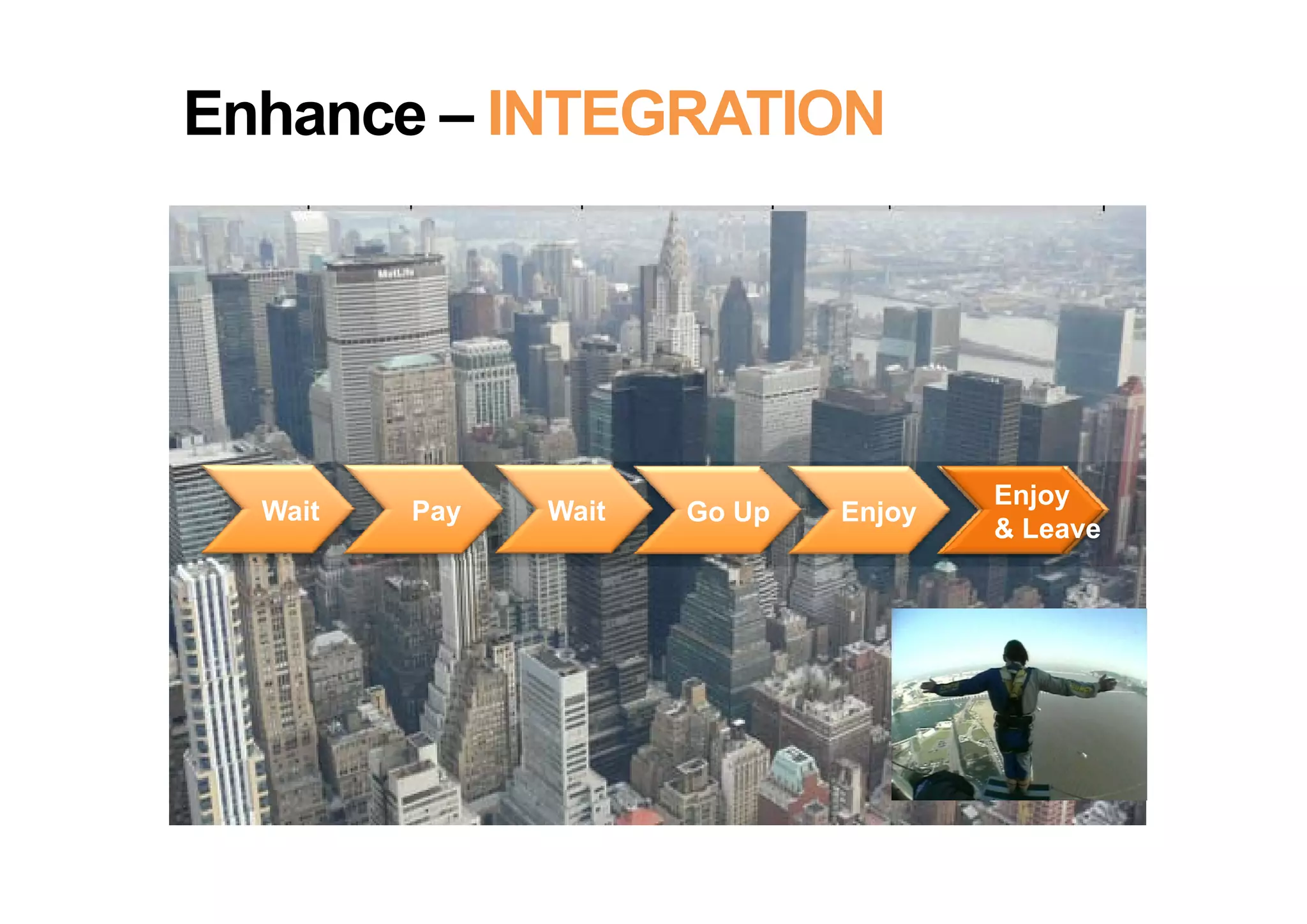
Enhance – INTEGRATION


                                      Enjoy
  Wait   Pay   Wait   Go Up   Enjoy   Leave
                                      & Leave
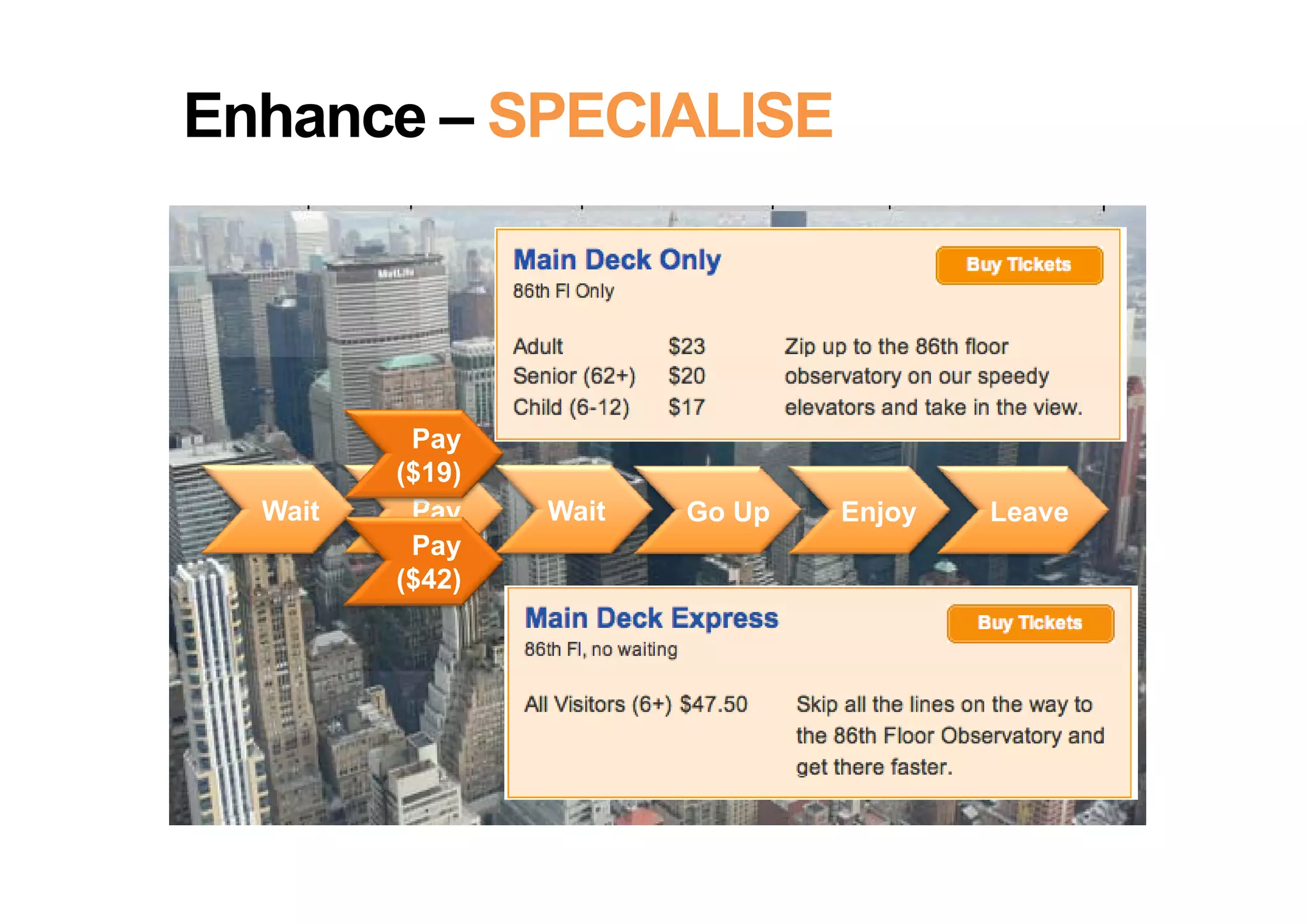
Enhance – SPECIALISE


          Pay
         ($19)
  Wait    Pay    Wait   Go Up   Enjoy   Leave
          Pay
         ($42)
Process Enhancement Patterns
Application:
  Enhancing your Process through Social Media Affordances
Supply:                      Demand:
Affordances
Aff d                        Pain/Opportunity Points in Processes
                             P i /O    t it P i t i P


   Localization              Need to locate
  (e.g. Foursquare)           employees


     Semantic
     S       i              Need to connect
   relationships              customers
    (e.g., Linkedin)


      Cloud
    Computing               Need to scale up
   (e.g., Google)
   (      G   l )


  Social Influence          Need to convince
    (e.g., Klout,
     Freemium)
                               customers
Four Ways to Innovation
            y

                         Derive
                     better practices


  Enhance              Innovate             Create
current practices                         new practices
                                              p


                        Utilise
                    potential practices
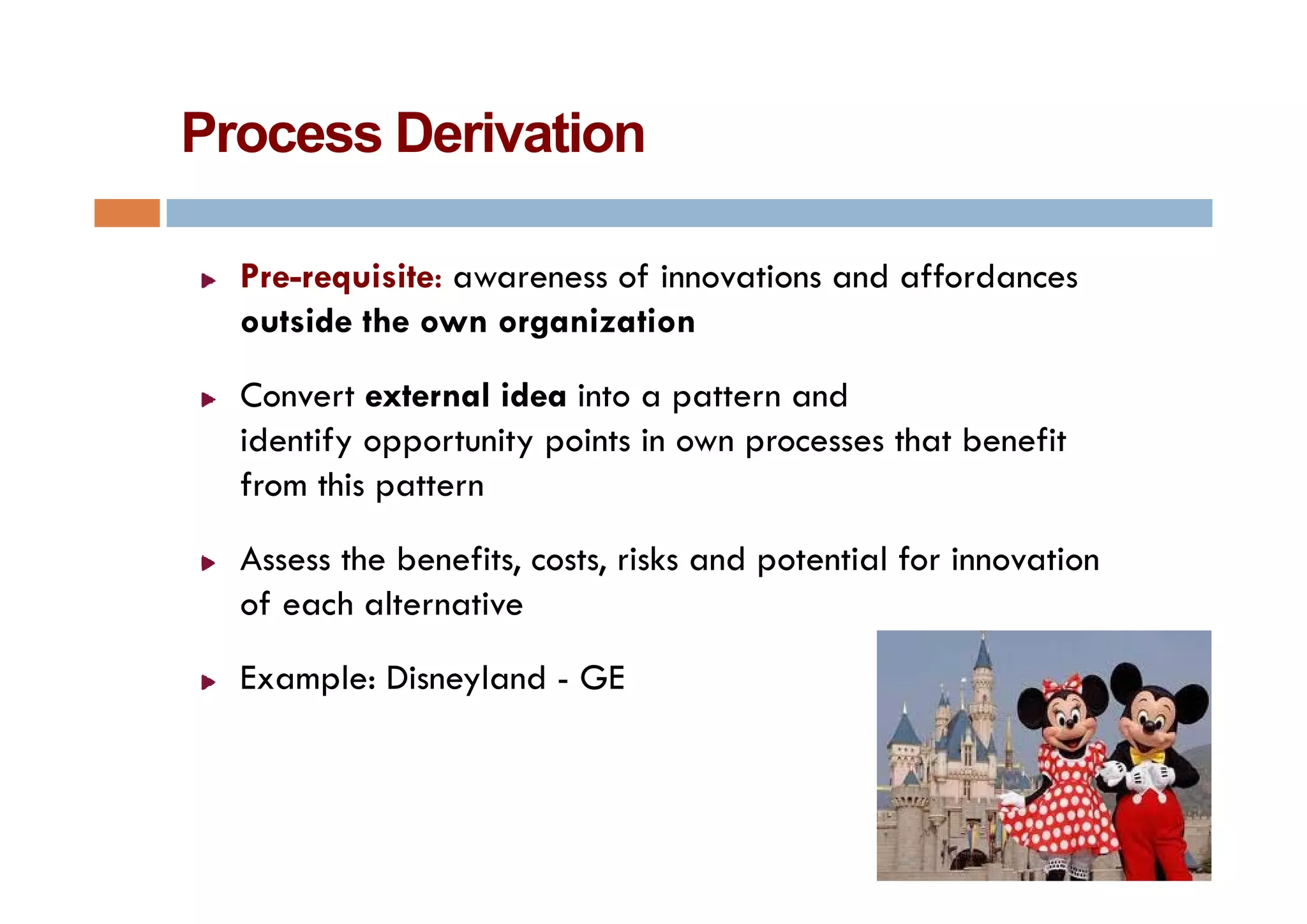
Process Derivation

  Pre-requisite: awareness of innovations and affordances
  outside the own organization
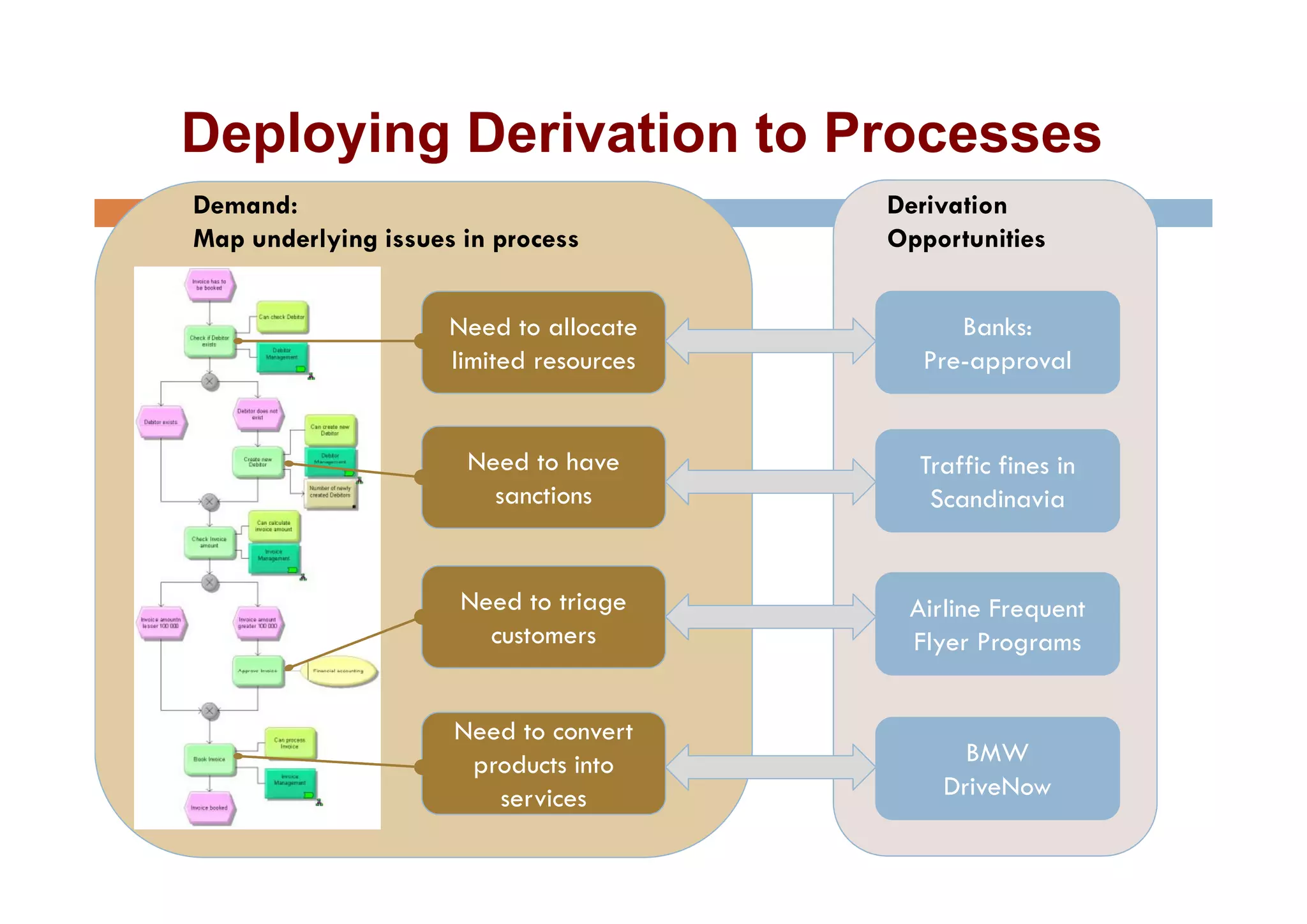
  Convert external idea into a pattern and
  identify opportunity points in own processes that benefit
  from this pattern
  Assess the benefits, costs, risks and potential for innovation
  of each alternative
  Example: Di
  E    l Disneyland - GE
               l d
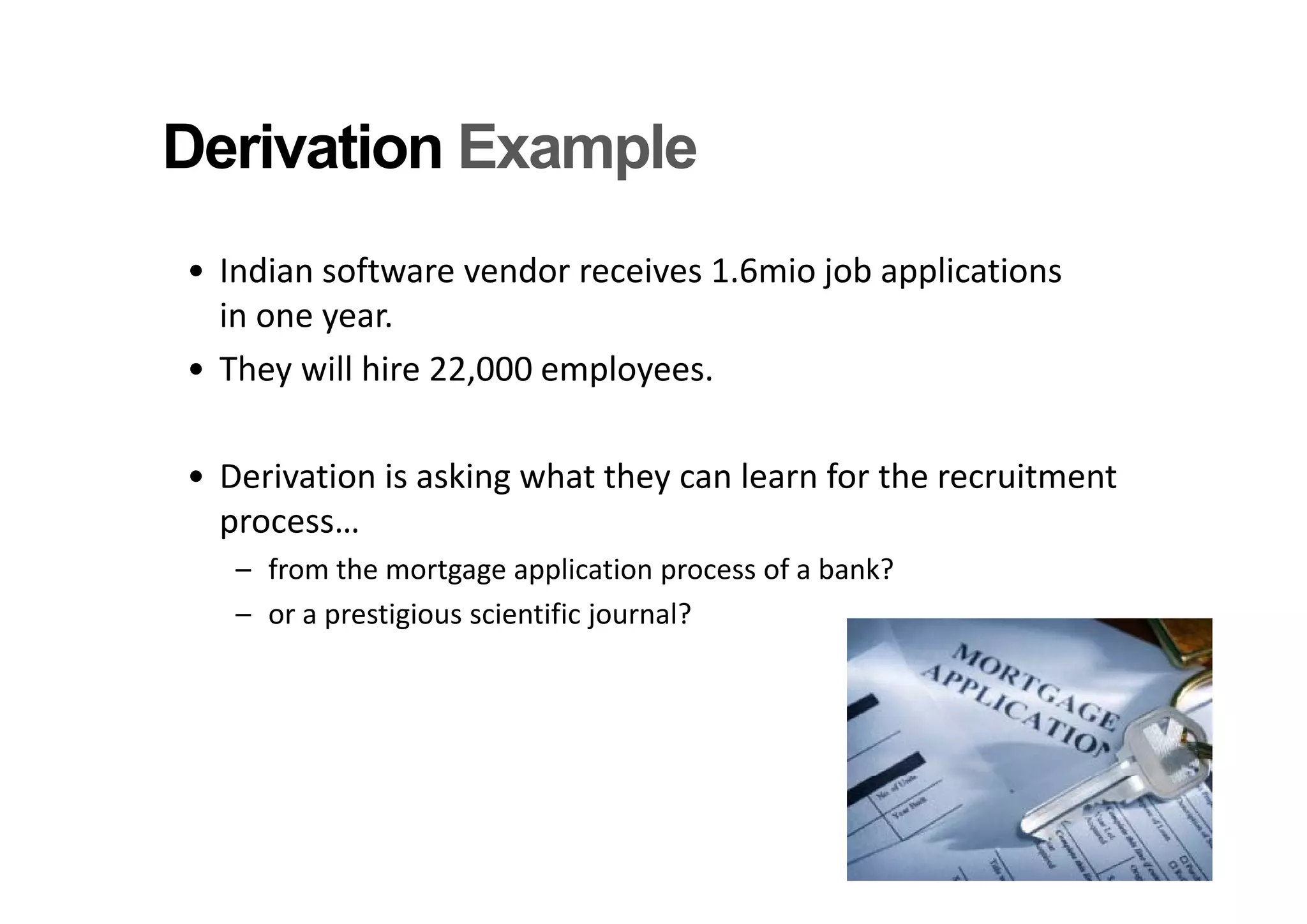
Derivation Example
• Indian software vendor receives 1.6mio job applications
  in one year.
• They will hire 22,000 employees.
   h     ill hi 22 000     l

• Derivation is asking what they can learn for the recruitment 
  process…
   – from the mortgage application process of a bank?
     from the mortgage application process of a bank?
   – or a prestigious scientific journal?
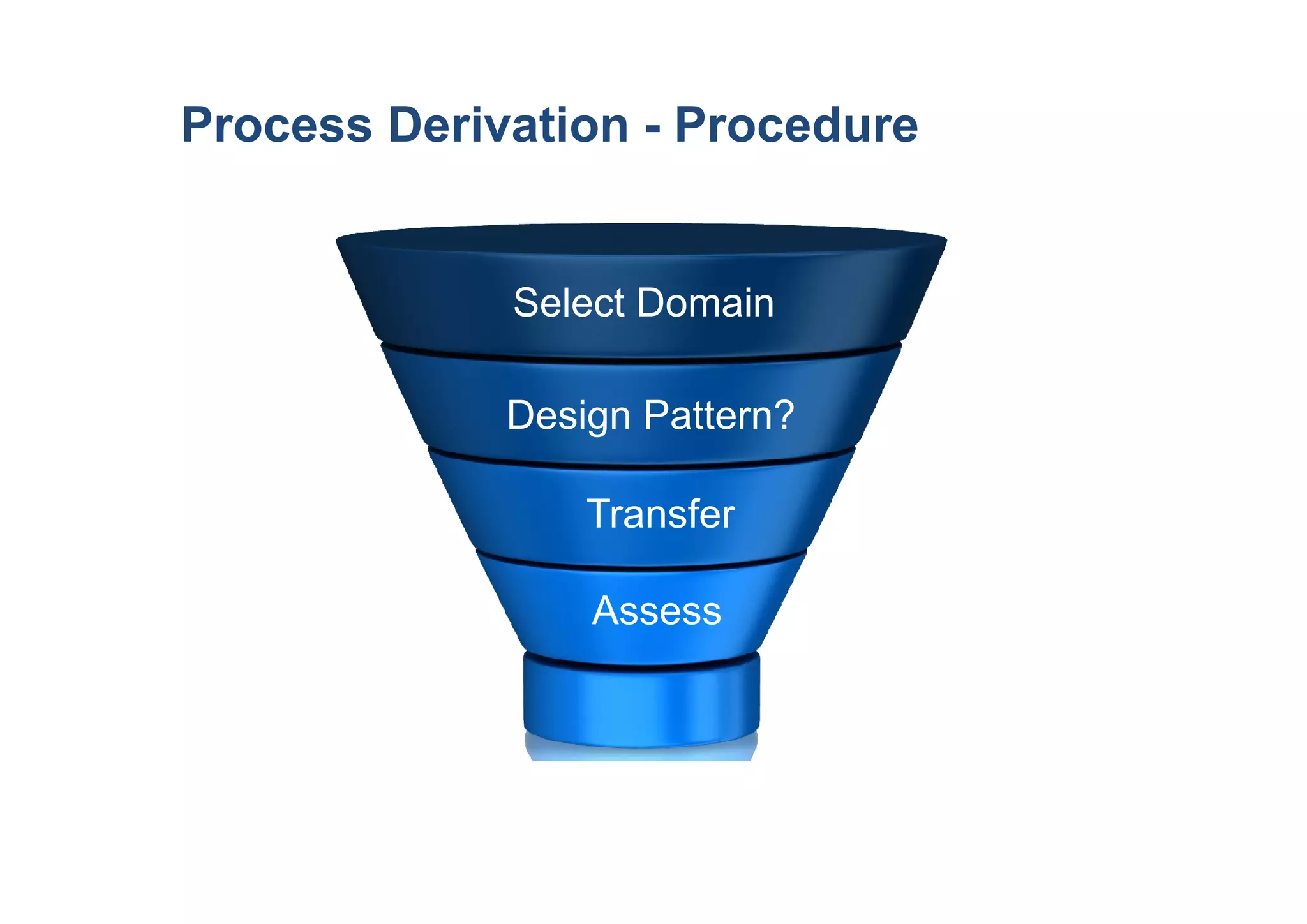
Process Derivation - Procedure


             Select Domain

             Design Pattern?

                 Transfer

                 Assess
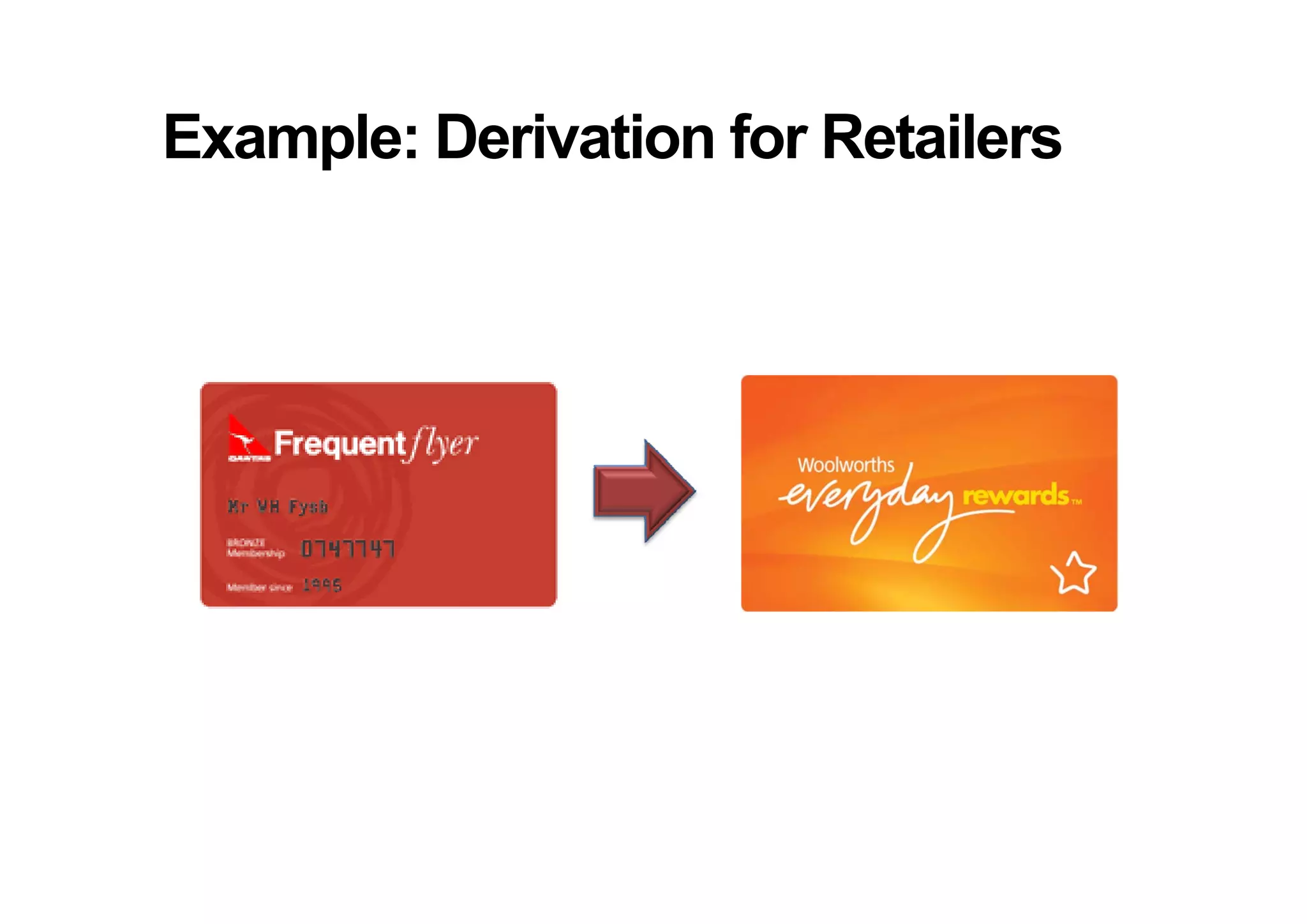
Example: Derivation for Retailers
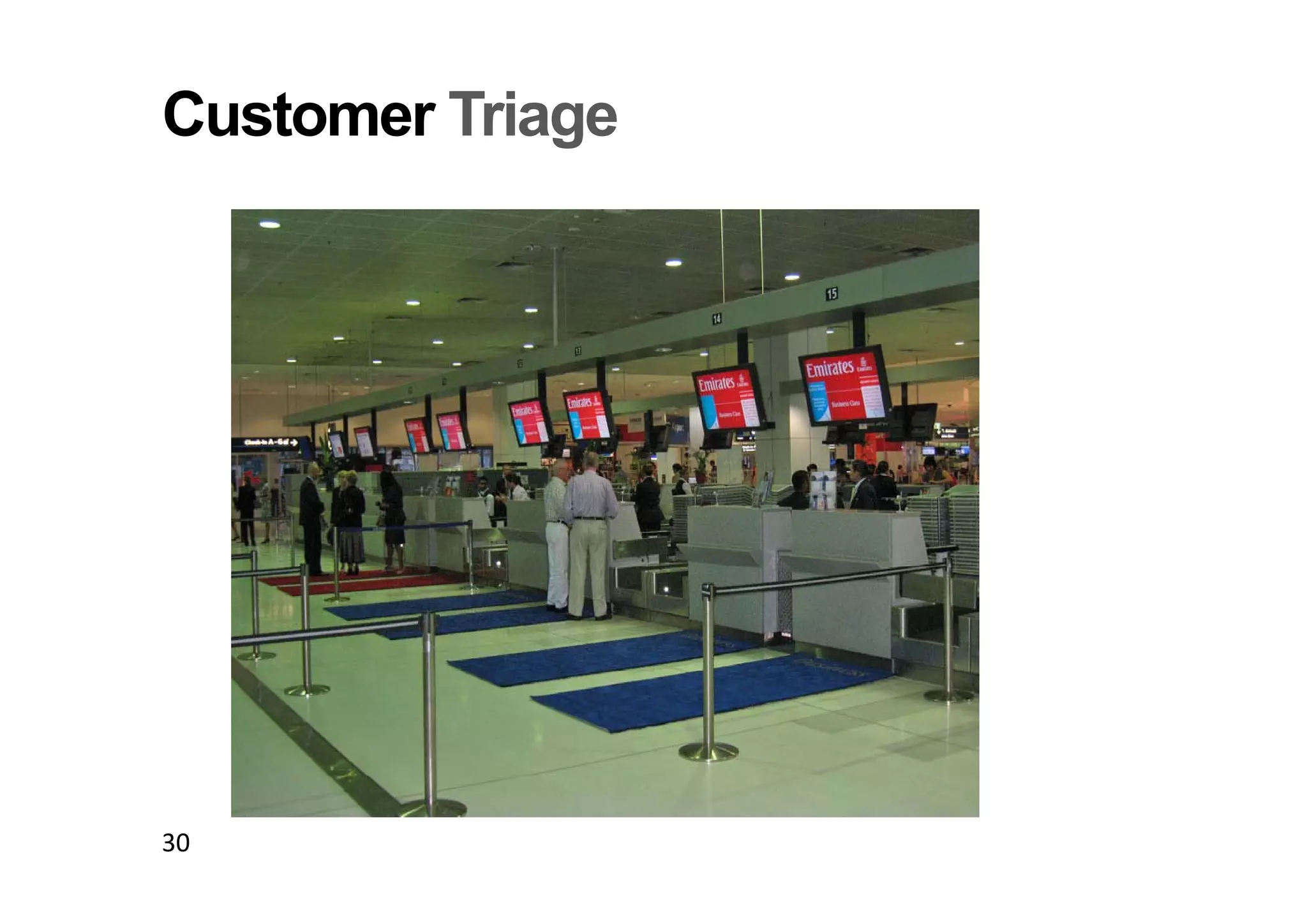
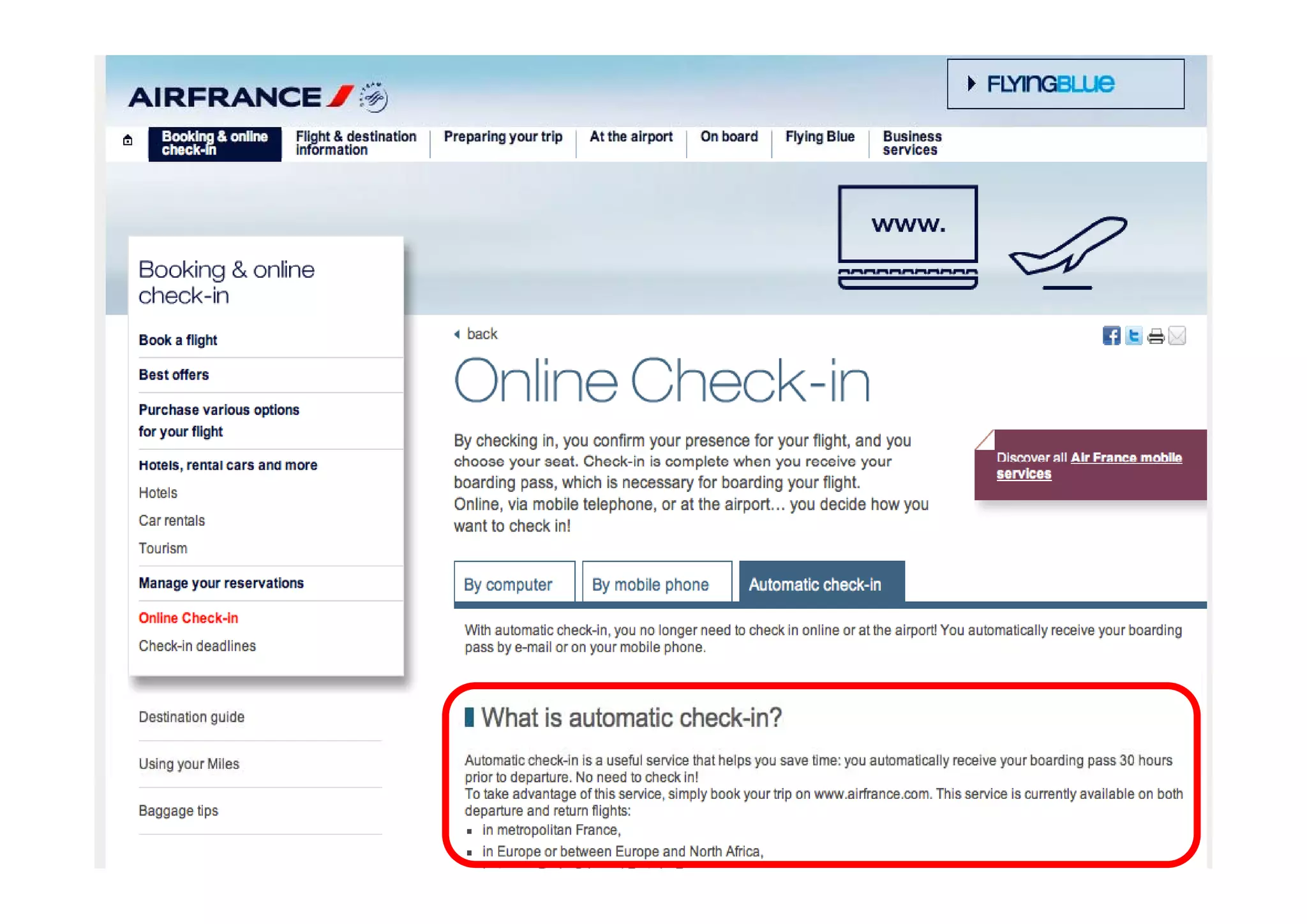
Customer Triage
             g


30
31
Deploying Derivation to Processes
Demand:                                  Derivation
Map underlying issues in process         Opportunities


                     Need to allocate         Banks:
                     limited
                     li it d resources     Pre-approval
                                           P          l


                      Need to have         Traffic fines i
                                           T ffi fi      in
                        sanctions           Scandinavia


                      Need to triage      Airline Frequent
                        customers         Flyer Programs


                     Need to convert
                      p
                      products into            BMW
                        services             DriveNow
Four Ways to Innovation
                 y


                         Derive
                     better practices


  Enhance              Innovate             Create
current practices                         new practices
                                              p


                        Utilise
                    potential practices
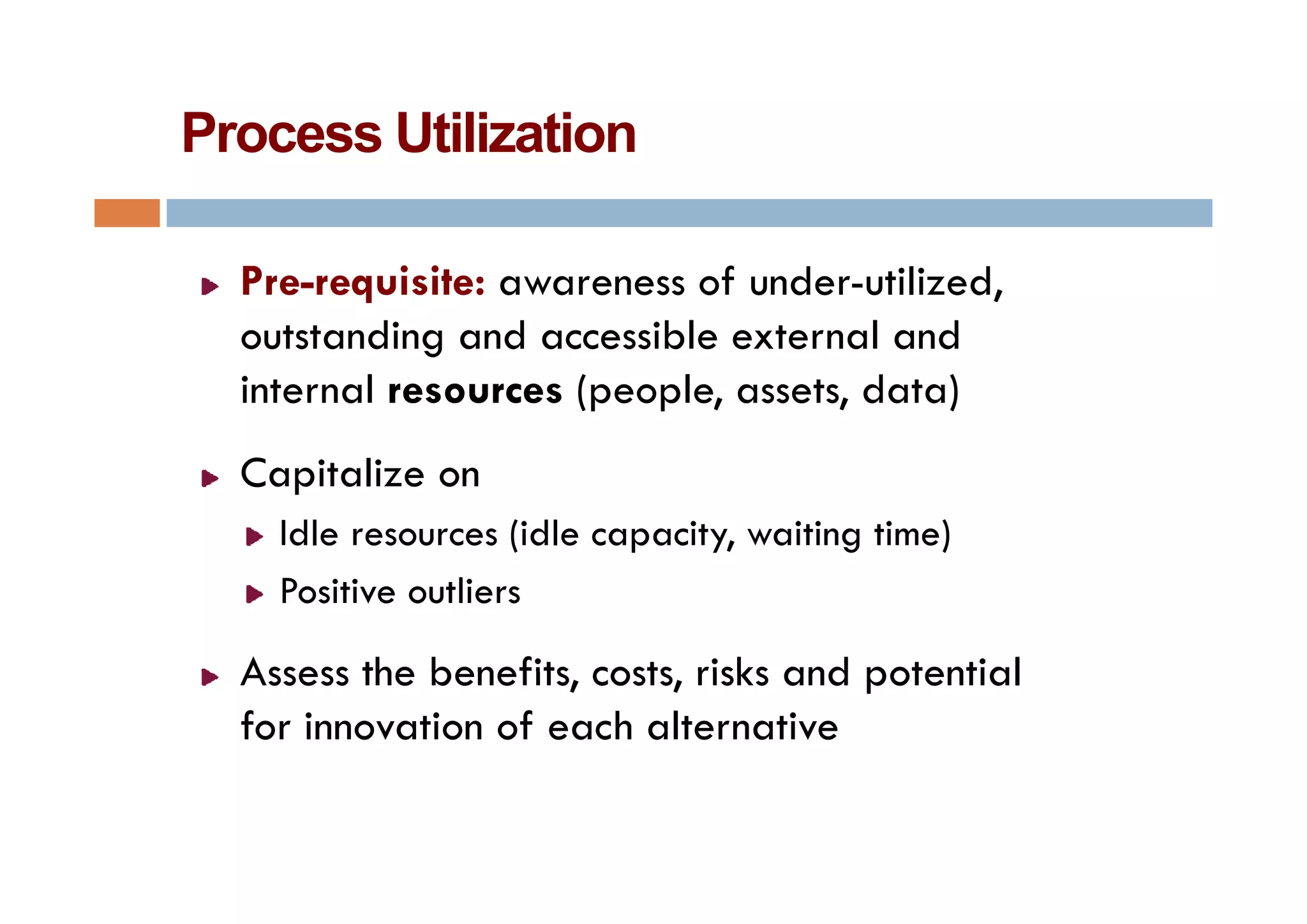
Process Utilization

  Pre-requisite: awareness of under-utilized,
  outstanding and accessible external and
             g
  internal resources (people, assets, data)
  Capitalize
  C i li on
    Idle resources (idle capacity, waiting time)
    Positive outliers

  Assess the benefits costs risks and potential
             benefits, costs,
  for innovation of each alternative
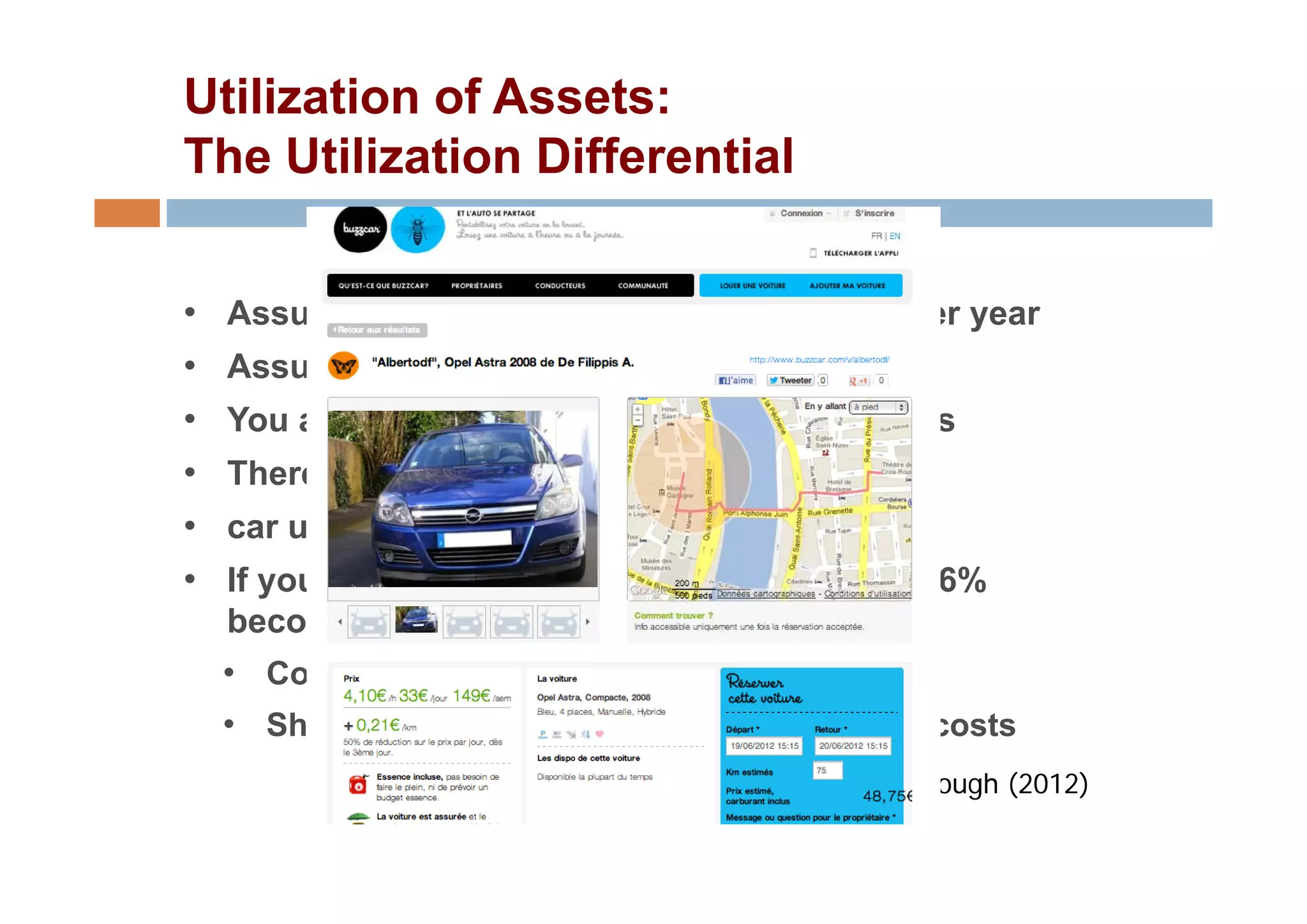
Utilization of Assets:
The Utilization Differential


•   Assume you drive 15,000 kms in your car per year
•   Assume th average speed is 50 k /h
    A      the            di      kms/hr
•   You are driving the car for roughly 300 hours
•   There are 8,760 hours in the year
    Th        8 760 h     i th
•   car utilization = 3.4%
•   If your car were a service, that untapped 96.6%
    becomes a source of value
    • Commercialization of idle time (revenue)
    • Share acquisition, operation, maintenance costs
                                        Henry Ch b
                                        H     Chesbrough (2012)
                                                       h
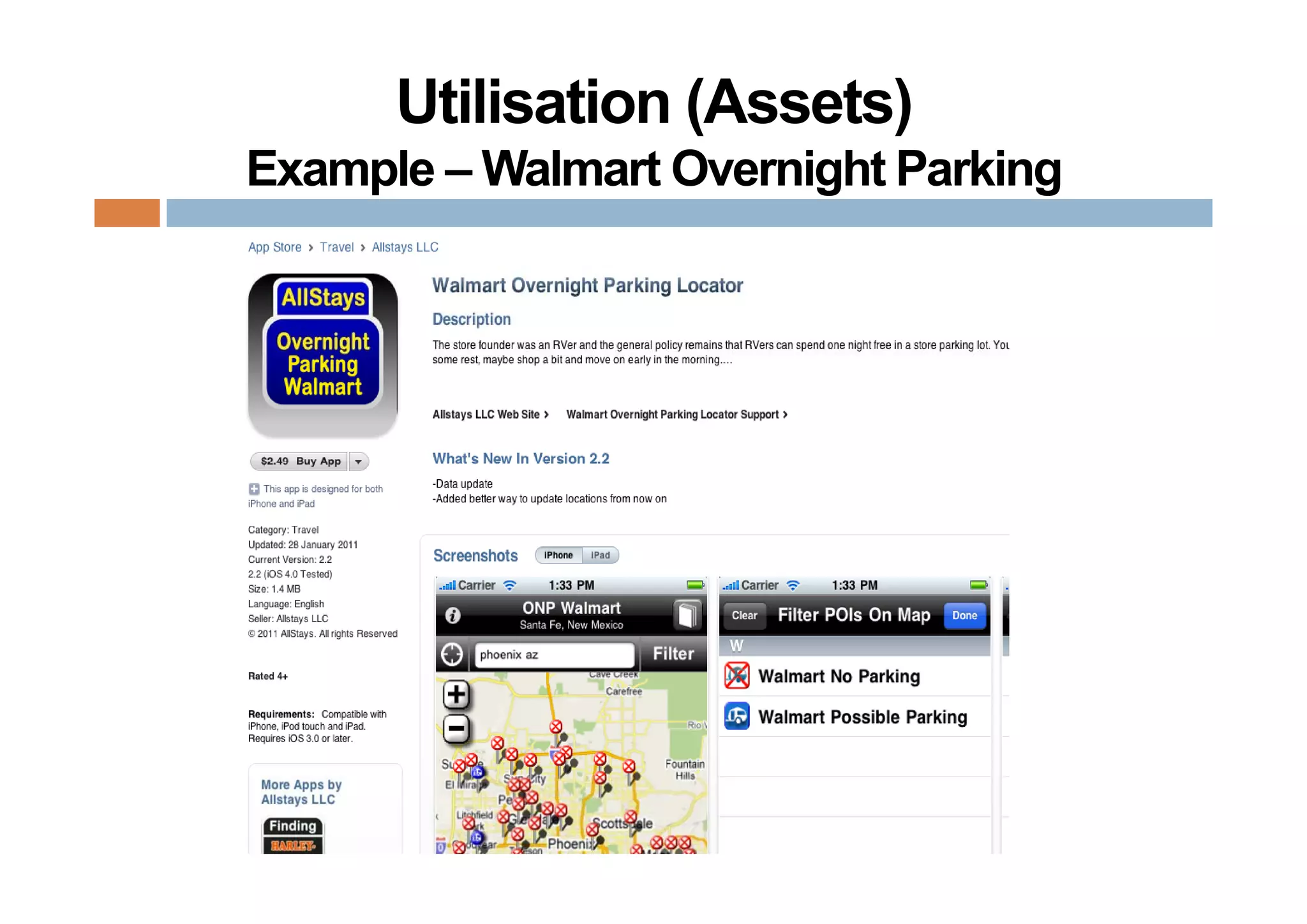
Utilisation (Assets)
Example – Walmart Overnight Parking
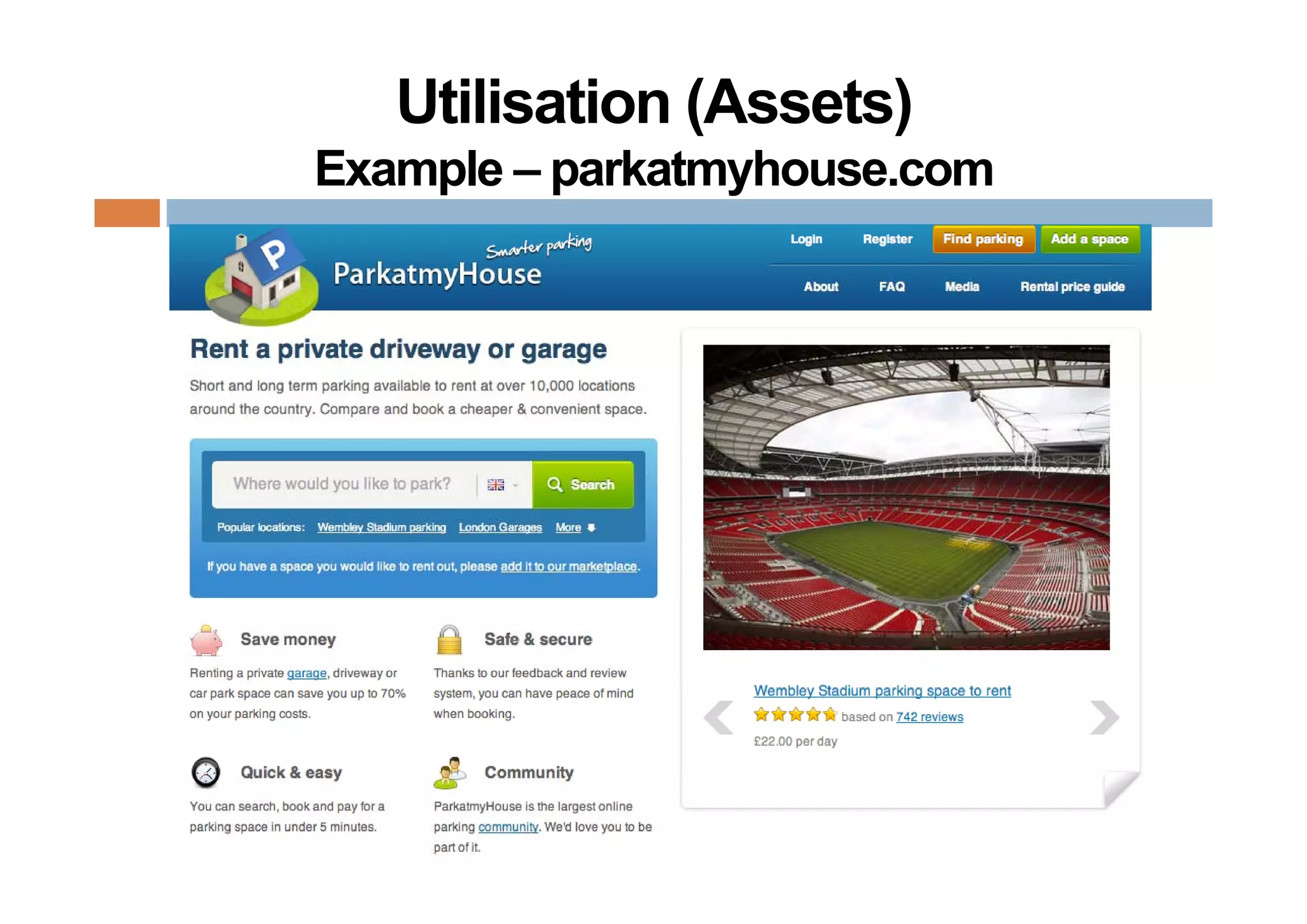
Utilisation (Assets)
Example – parkatmyhouse.com
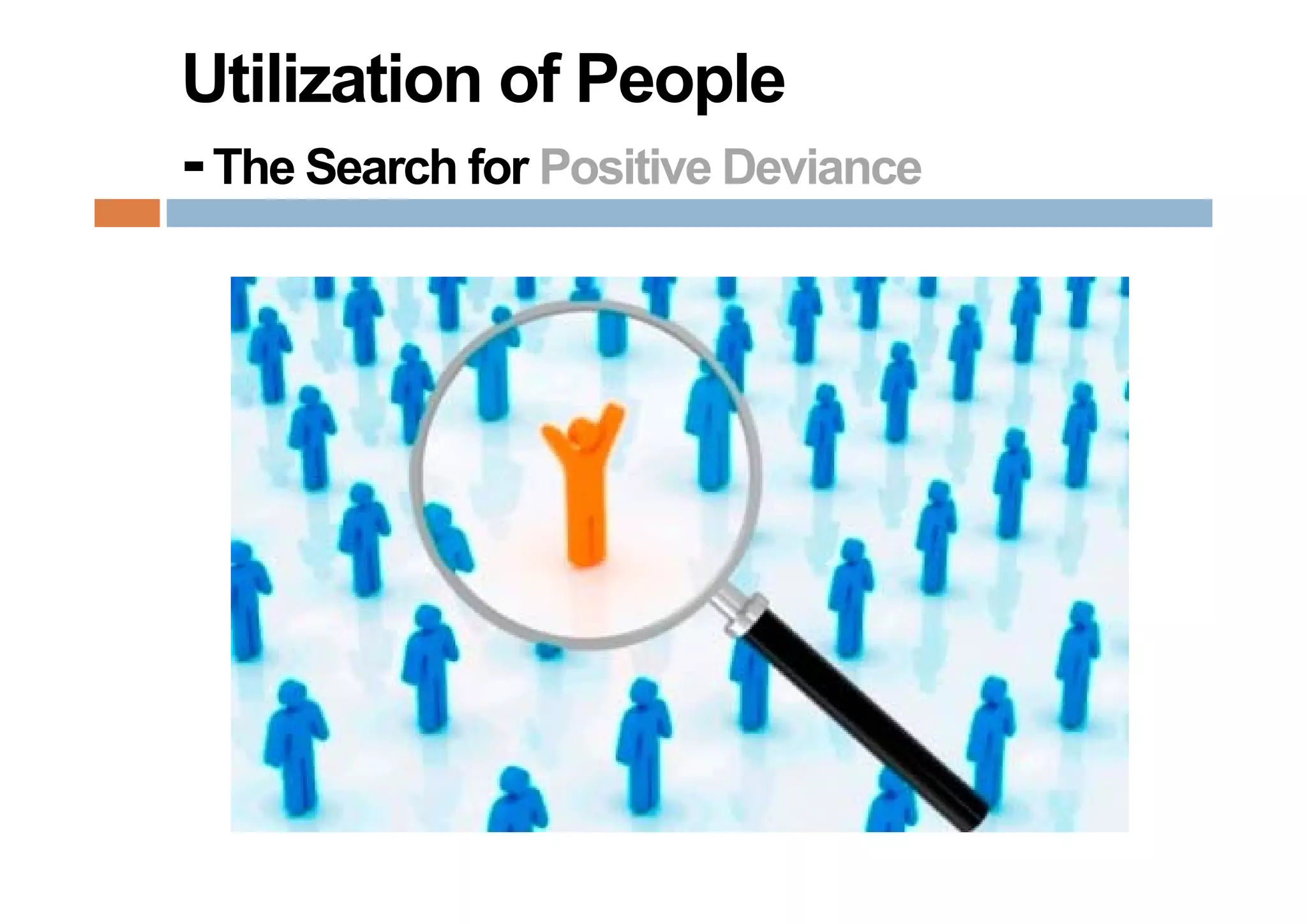
Utilization of People
- The Search for Positive Deviance
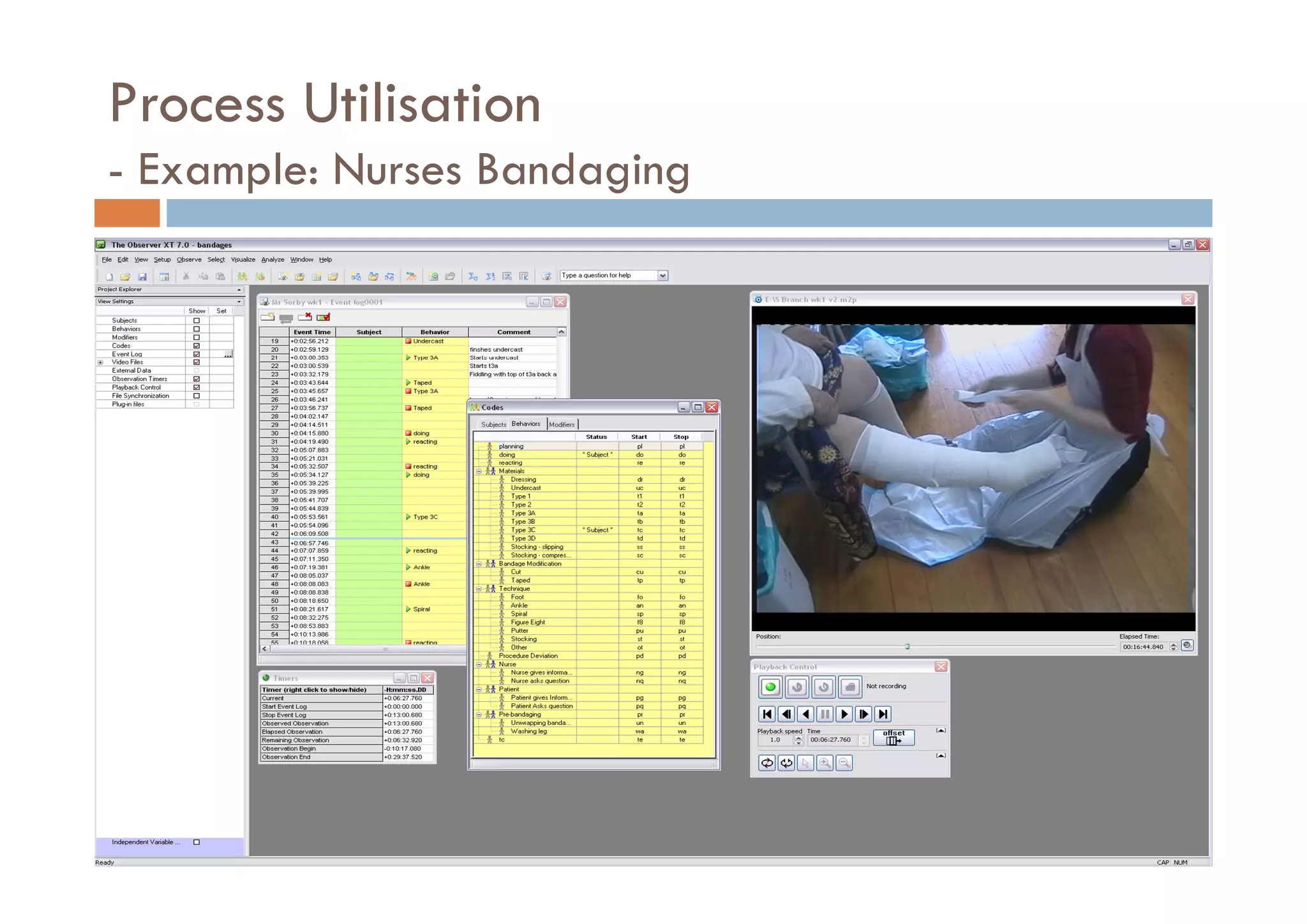
Process Utilisation
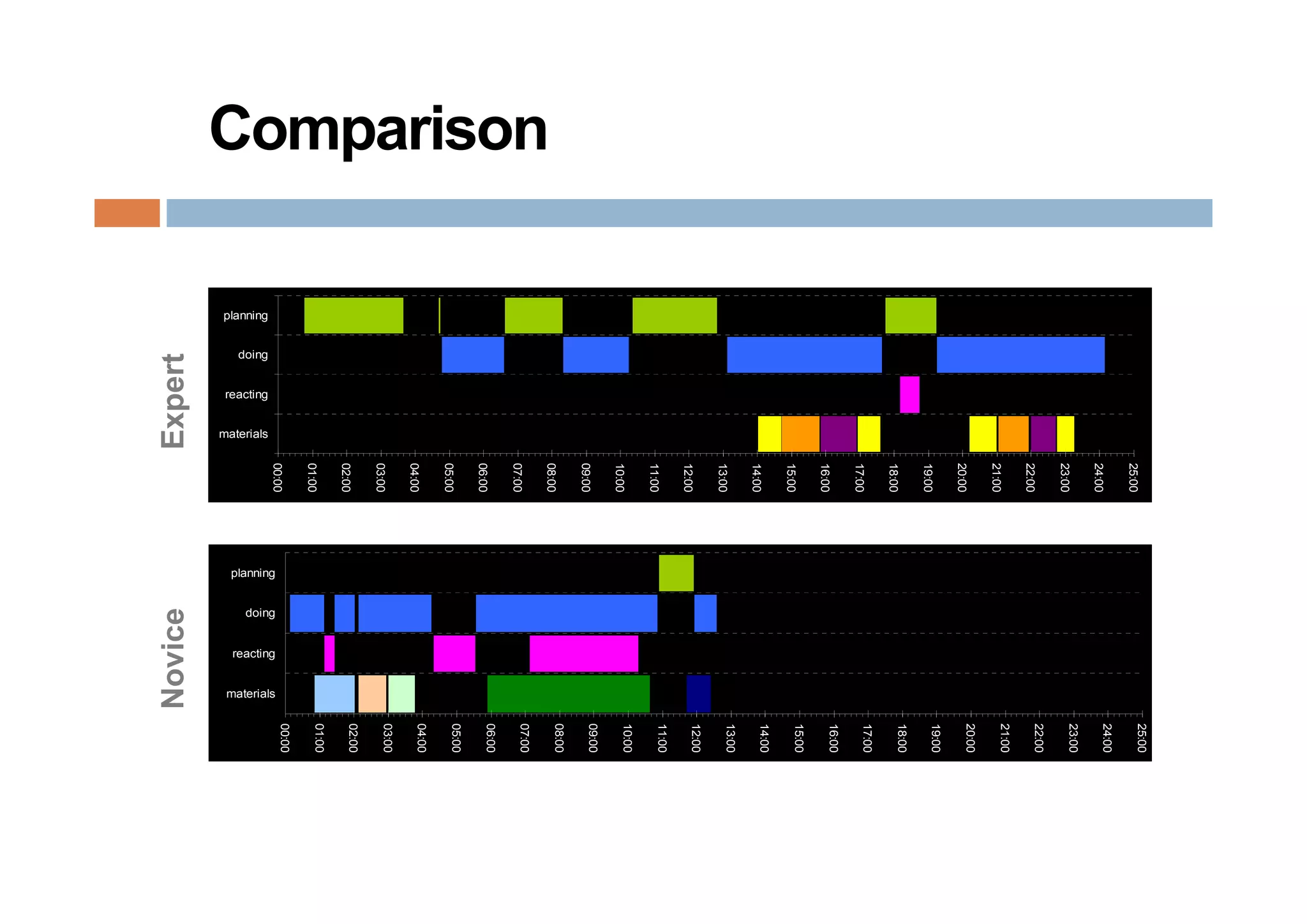
- Example: Nurses Bandaging
25:00
                                                       25:00
                                                                                                         24:00
                                                       24:00
                                                                                                         23:00
                                                       23:00
                                                                                                         22:00
                                                       22:00
                                                                                                         21:00
                                                       21:00
                                                                                                         20:00
                                                       20:00
                                                                                                         19:00
                                                       19:00
                                                                                                         18:00
                                                       18:00
                                                                                                         17:00
                                                       17:00
                                                                                                         16:00
                                                       16:00
                                                                                                         15:00
                                                       15:00
                                                                                                         14:00
                                                       14:00
                                                                                                         13:00
                                                       13:00
                                                                                                         12:00
                                                       12:00
                                                                                                         11:00
                                                       11:00
                                                                                                         10:00
                                                       10:00
                                                                                                         09:00
                                                       09:00
                                                                                                         08:00
                                                       08:00
Comparison


                                                                                                         07:00
                                                       07:00
                                                                                                         06:00
                                                       06:00
                                                                                                         05:00
                                                       05:00
                                                                                                         04:00
                                                       04:00
                                                                                                         03:00
                                                       03:00
                                                                                                         02:00
                                                       02:00
                                                                                                         01:00
                                                       01:00
                                                                                                         00:00
                                                       00:00


                                                                                             materials
                                                               planning


                                                                          doing


                                                                                  reacting
                                           materials
             planning


                        doing


                                reacting
                         Expert
                              t                                            ovice
                                                                          No
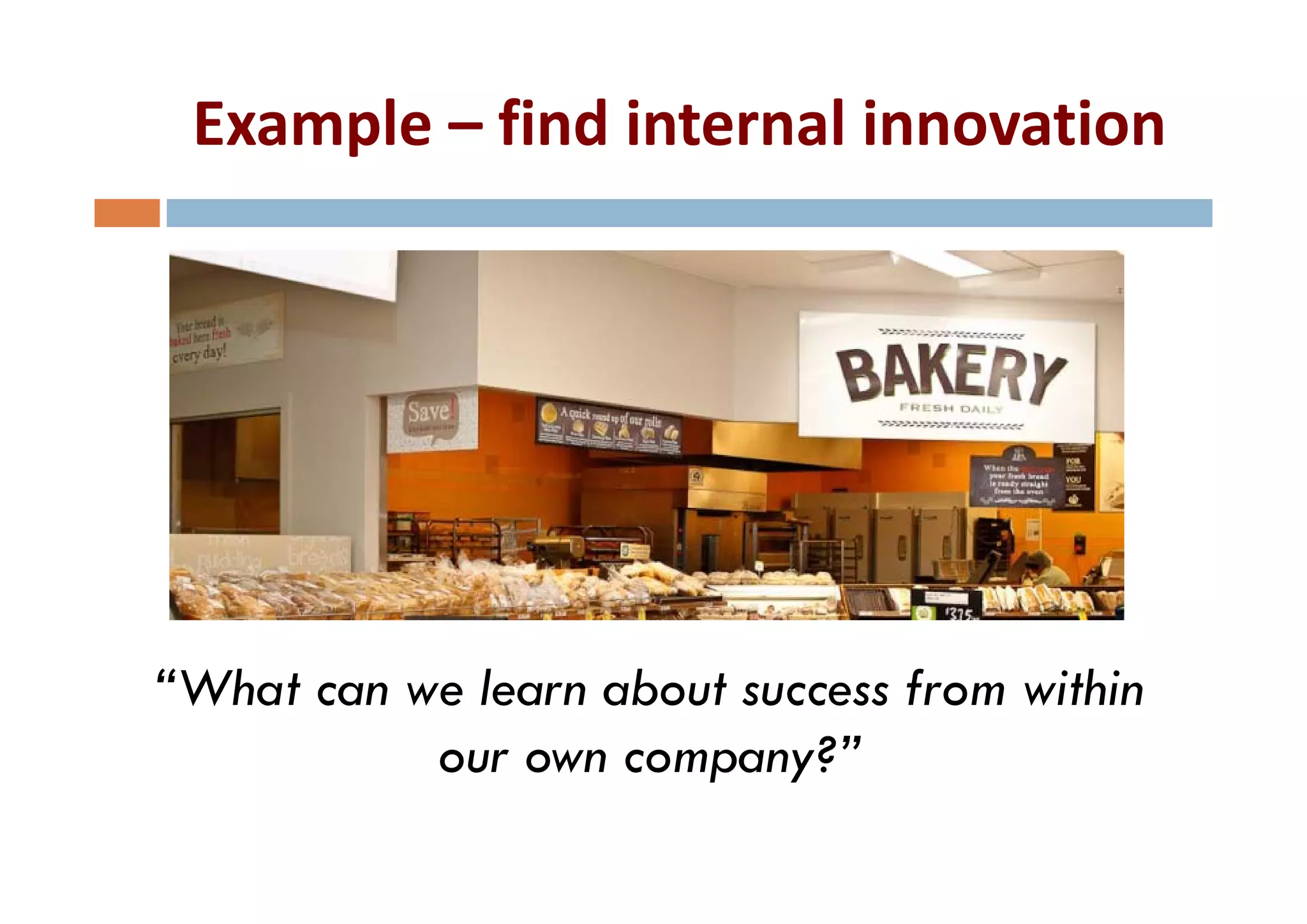
Example – find internal innovation
     p


“What
“Wh can we l
           learn about success f
                  b            from within
                                     i hi
         our own company?”
                     p y
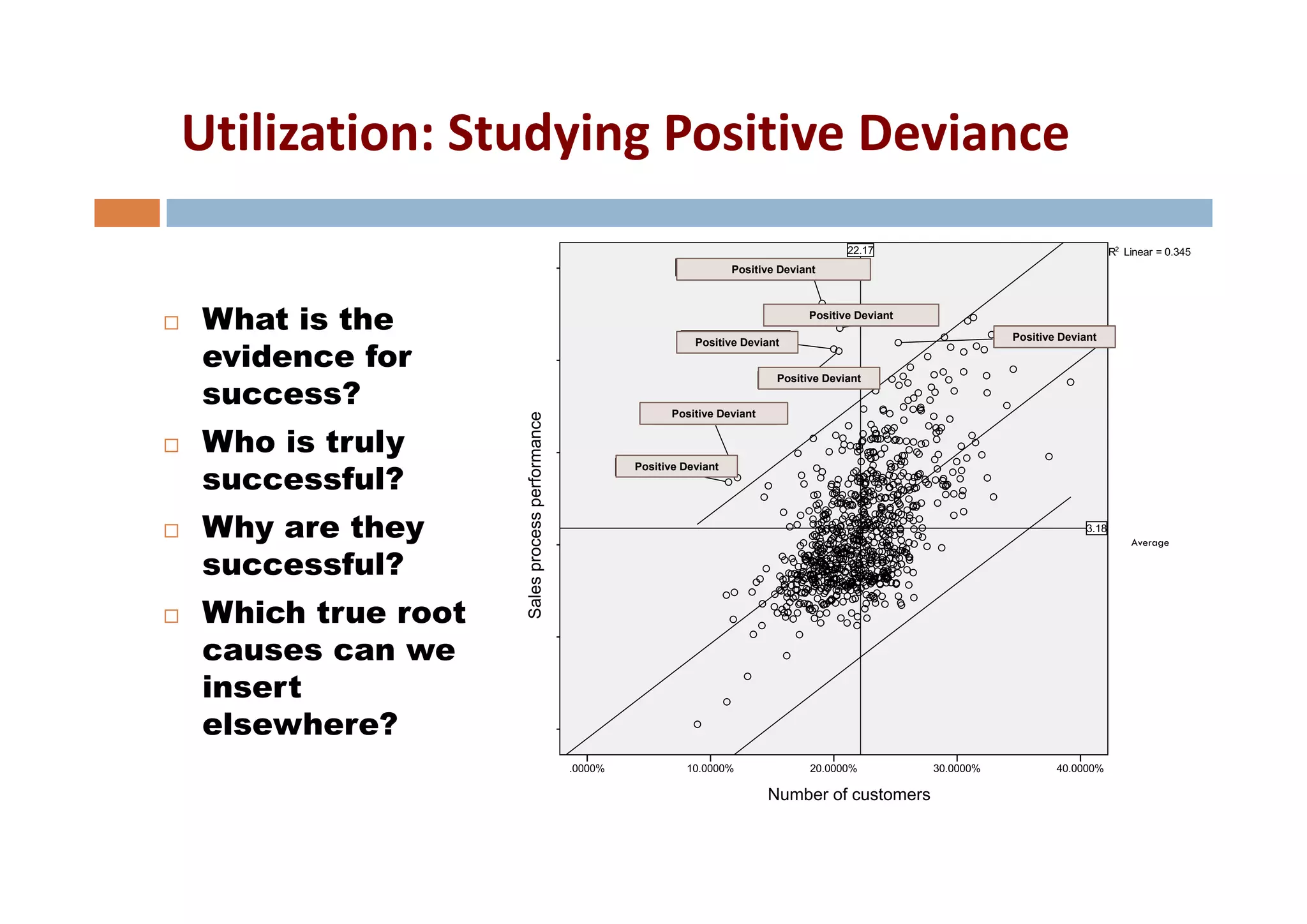
Utilization: Studying Positive Deviance
Utilization: Studying Positive Deviance

                                                                 Positive Deviant


What is the                                                                    Positive Deviant


evidence for
                                                                                                  Positive Deviant
                                                         Positive Deviant


success?
                                                                         Positive Deviant


                                                     Positive Deviant


                  Sales process performance
Who is truly
successful?
                                              Positive Deviant


Why are they                                                                                                         Average

successful?
                        p


Which true root
causes can we
insert
elsewhere?

                                                                        Number of customers
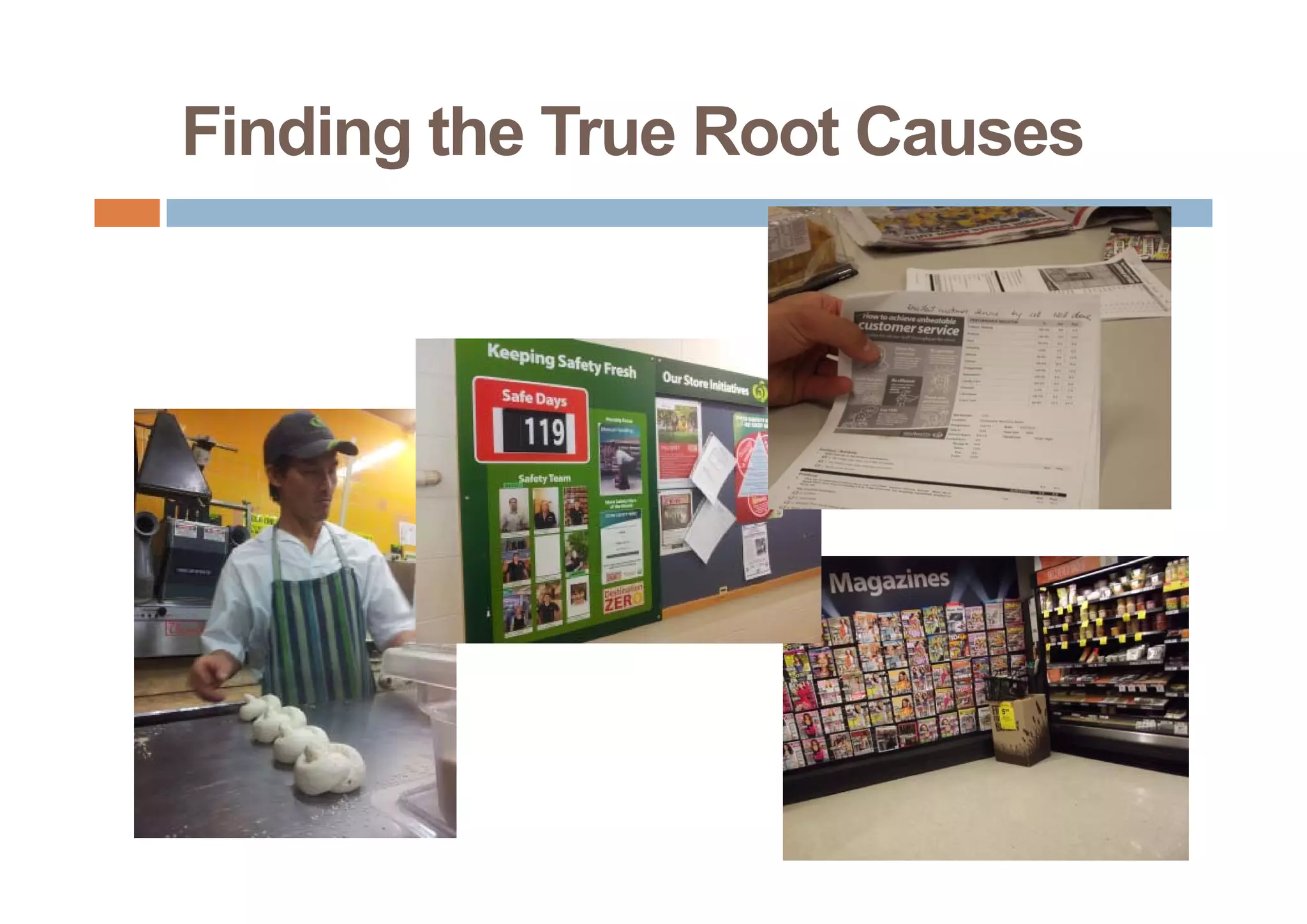
Finding the True Root Causes
Four Ways to Innovation
                 y


                         Derive
                     better practices


  Enhance              Innovate             Create
current practices                         new practices
                                              p


                        Utilise
                    potential practices
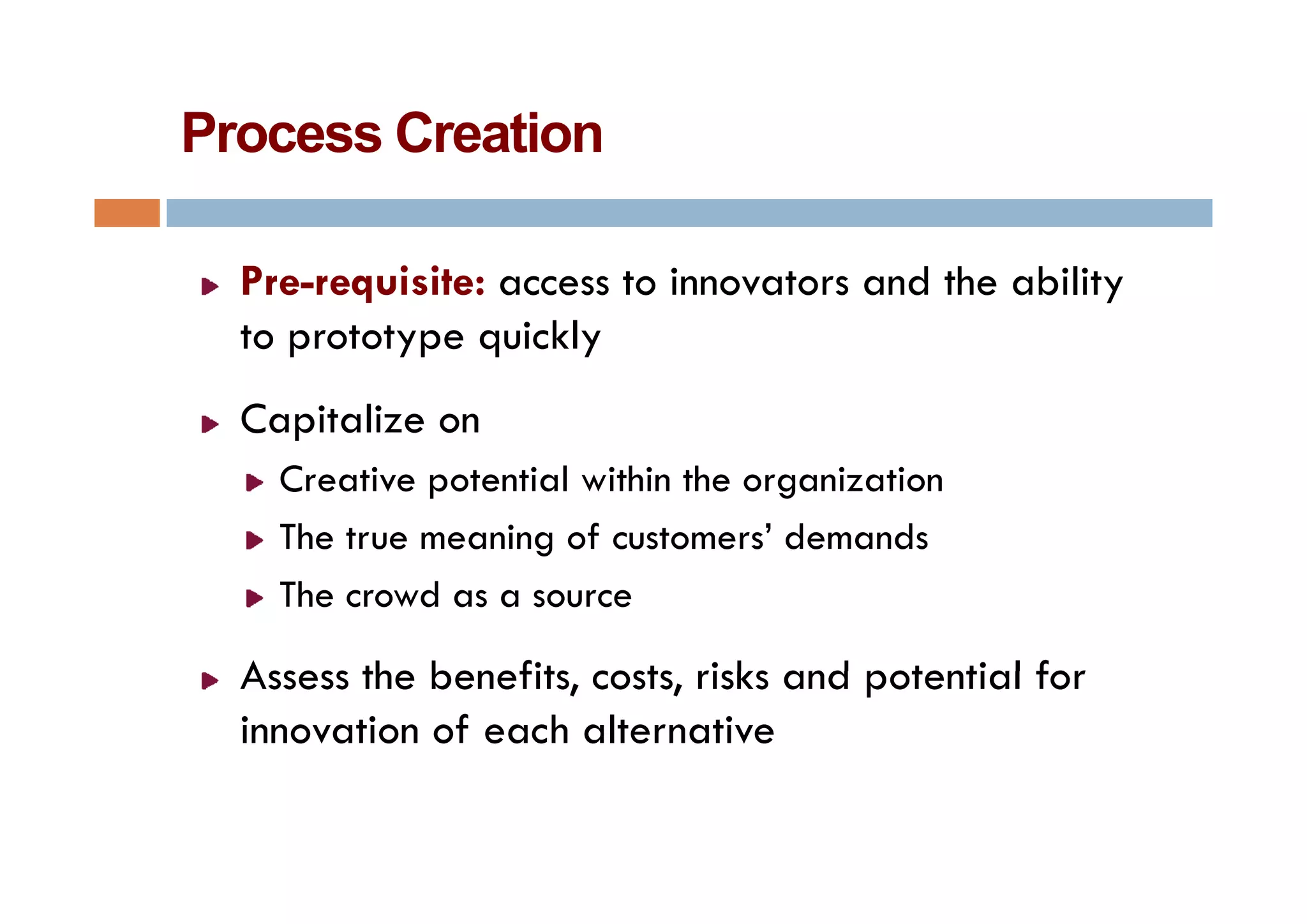
Process Creation

  Pre-requisite: access to innovators and the ability
  to prototype quickly
     p     yp q      y
  Capitalize on
    Creative potential within the organization
    The true meaning of customers’ demands
    The crowd as a source

  Assess the benefits costs risks and potential for
             benefits, costs,
  innovation of each alternative
Process Creation

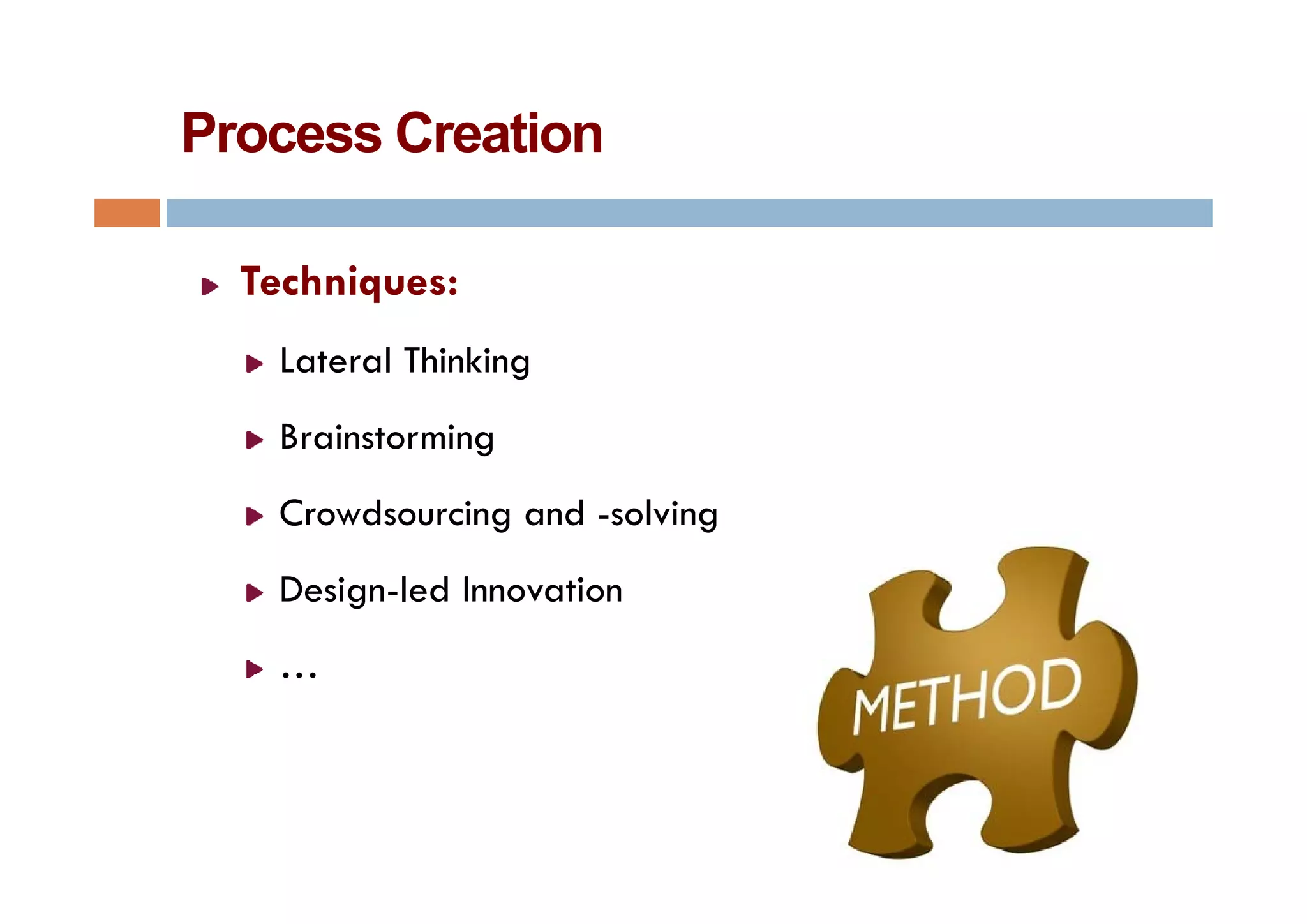
  Techniques:
   Lateral Thinking
   Brainstorming
   Crowdsourcing and -solving
   Design-led Innovation
   …
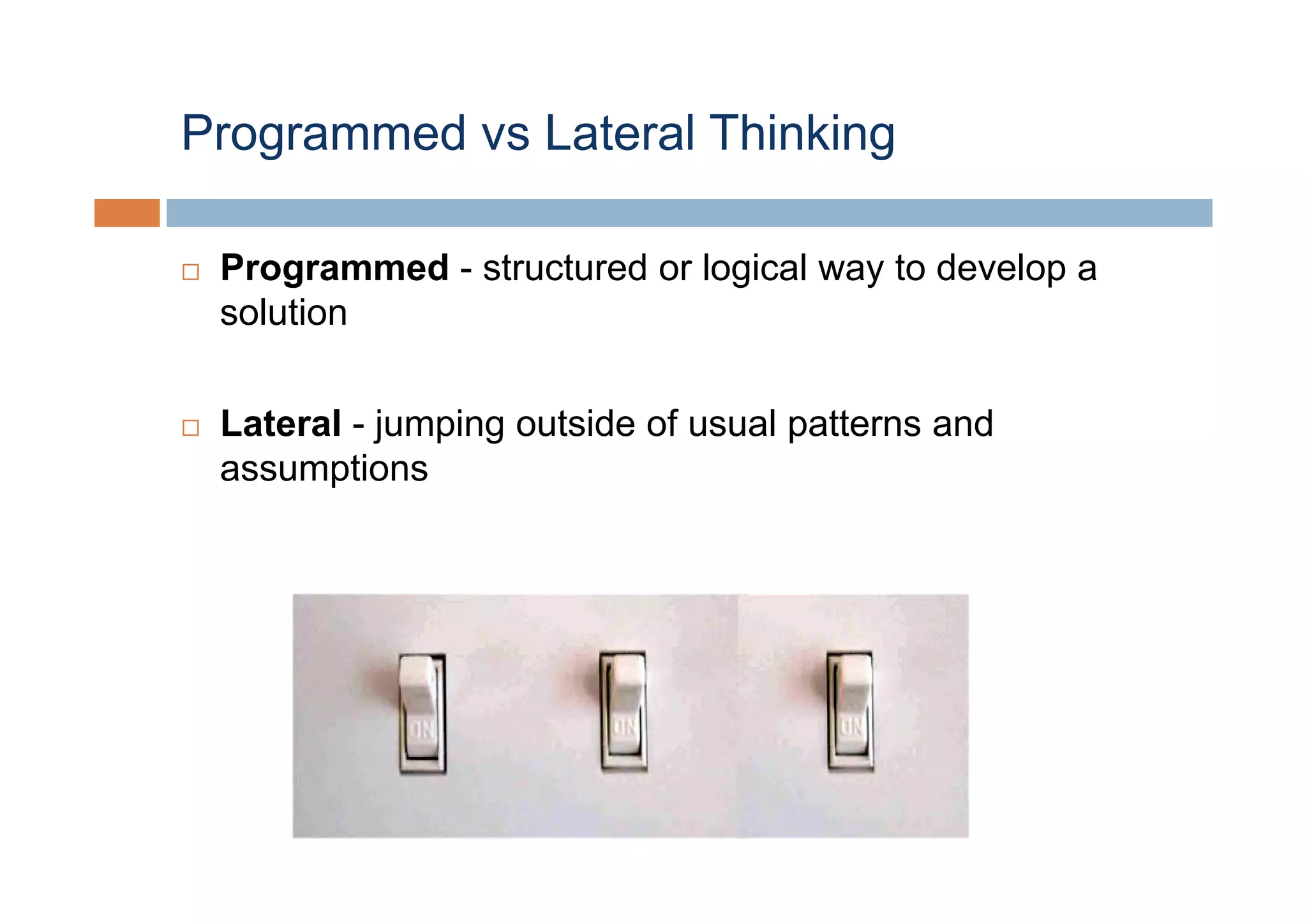
Programmed vs Lateral Thinking

 Programmed - structured or logical way to develop a
 solution

 Lateral - jumping outside of usual patterns and
 assumptions
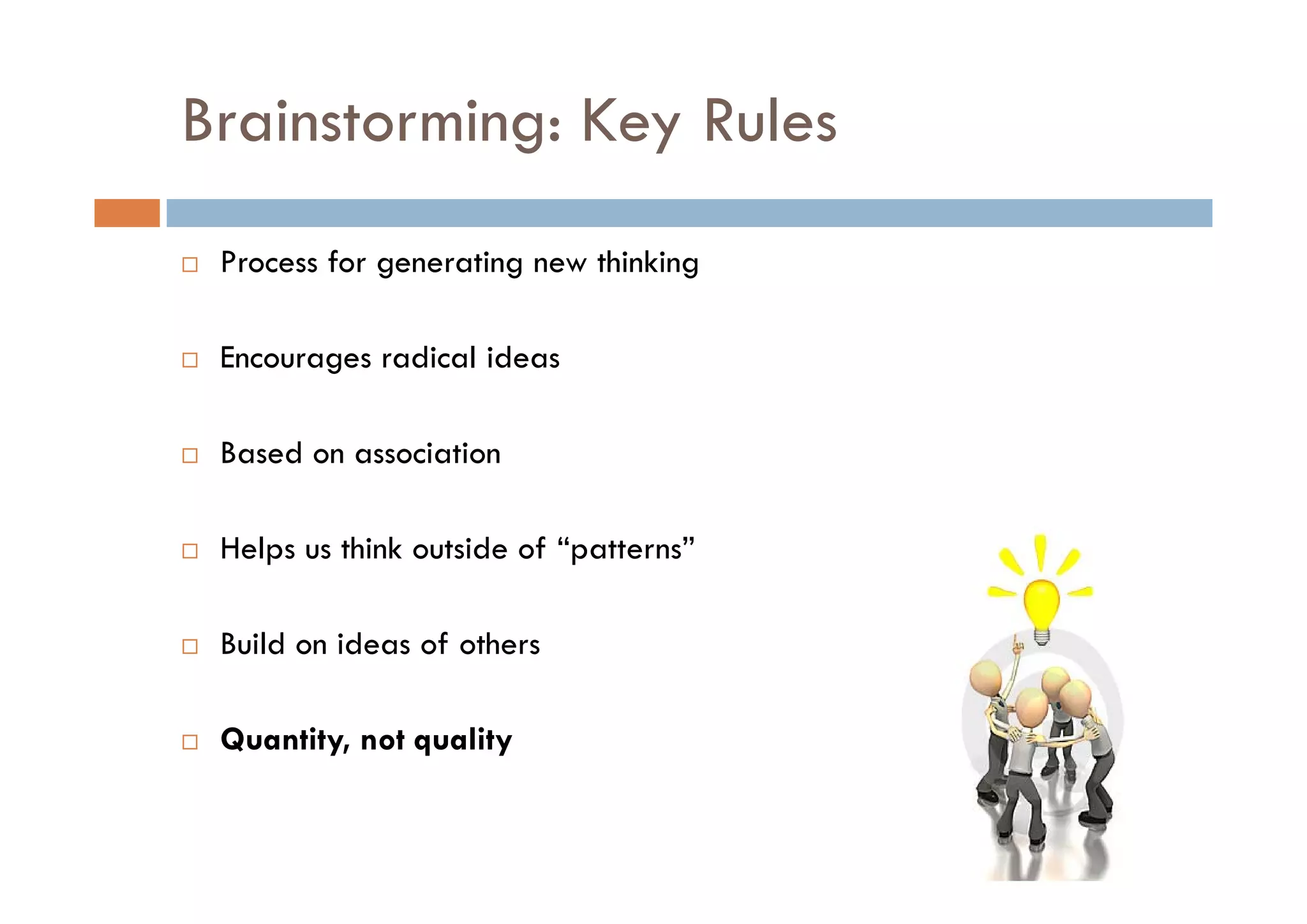
Brainstorming: Key Rules
            g y
 Process for generating new thinking
 P       f          i        hi ki

 Encourages radical ideas

 Based on association

 Helps us think outside of “patterns”

 Build on ideas of others

 Quantity, not quality
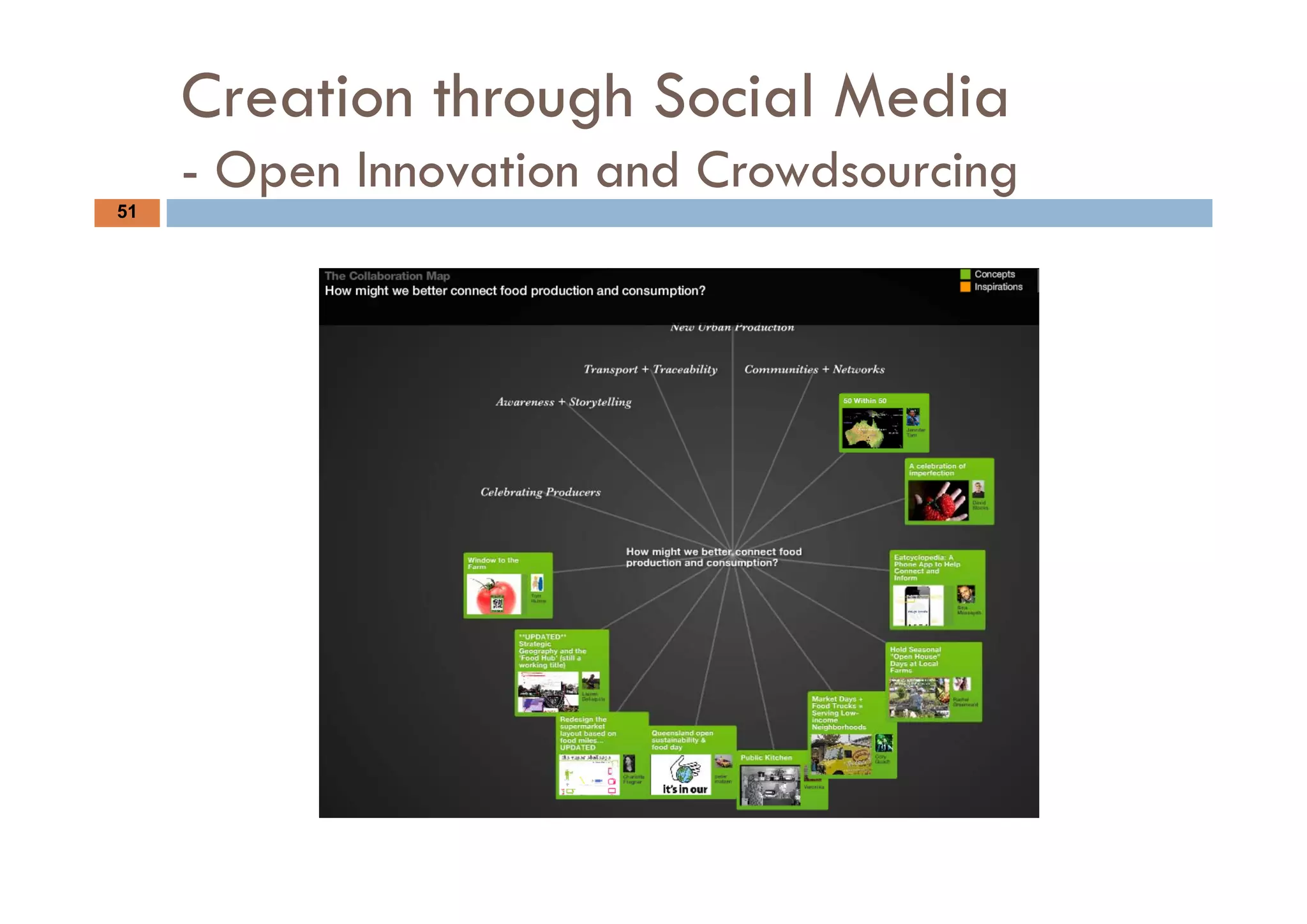
Creation through Social Media
     - Open Innovation and Crowdsourcing
51
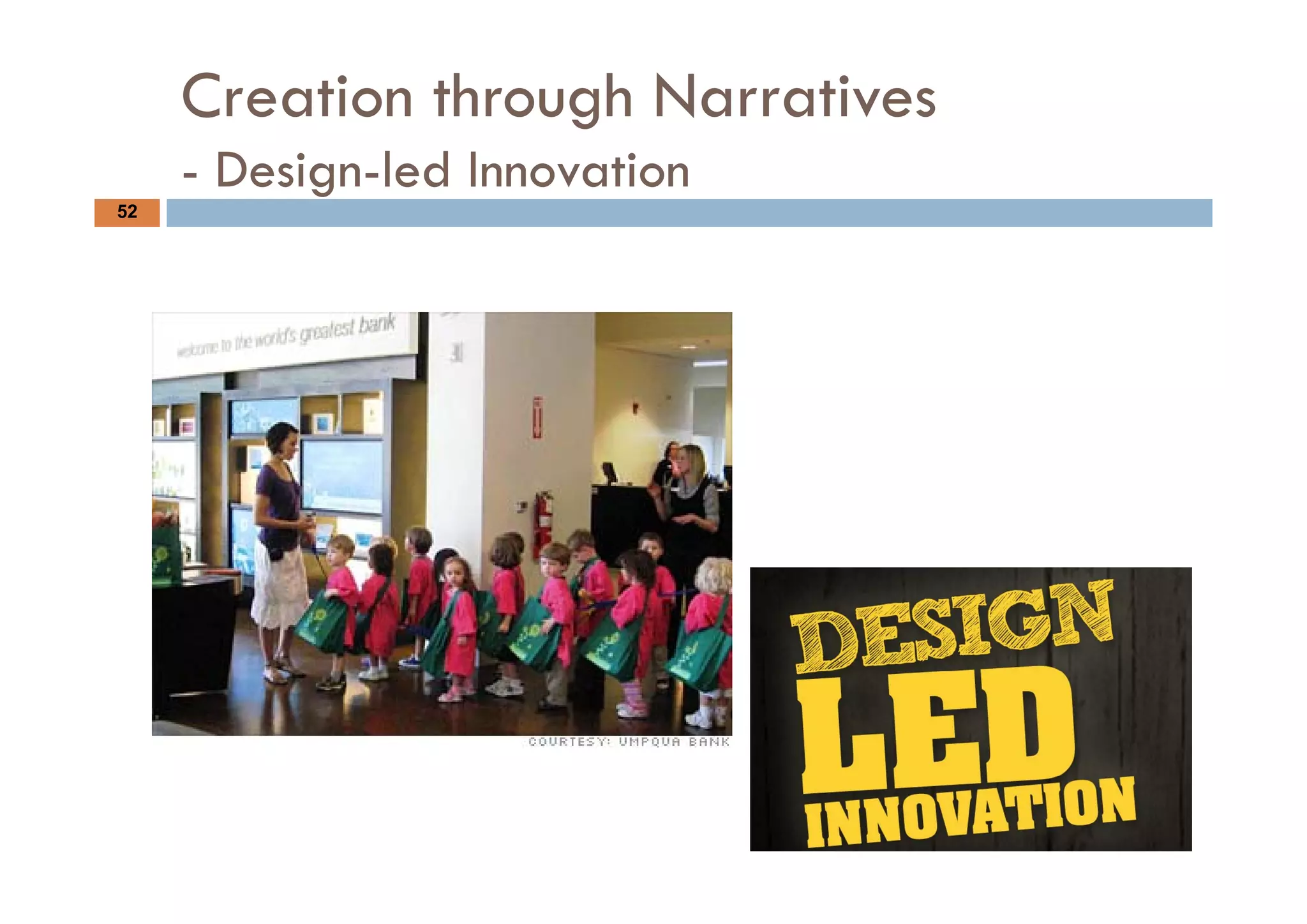
Creation through Narratives
     - Design-led Innovation
52
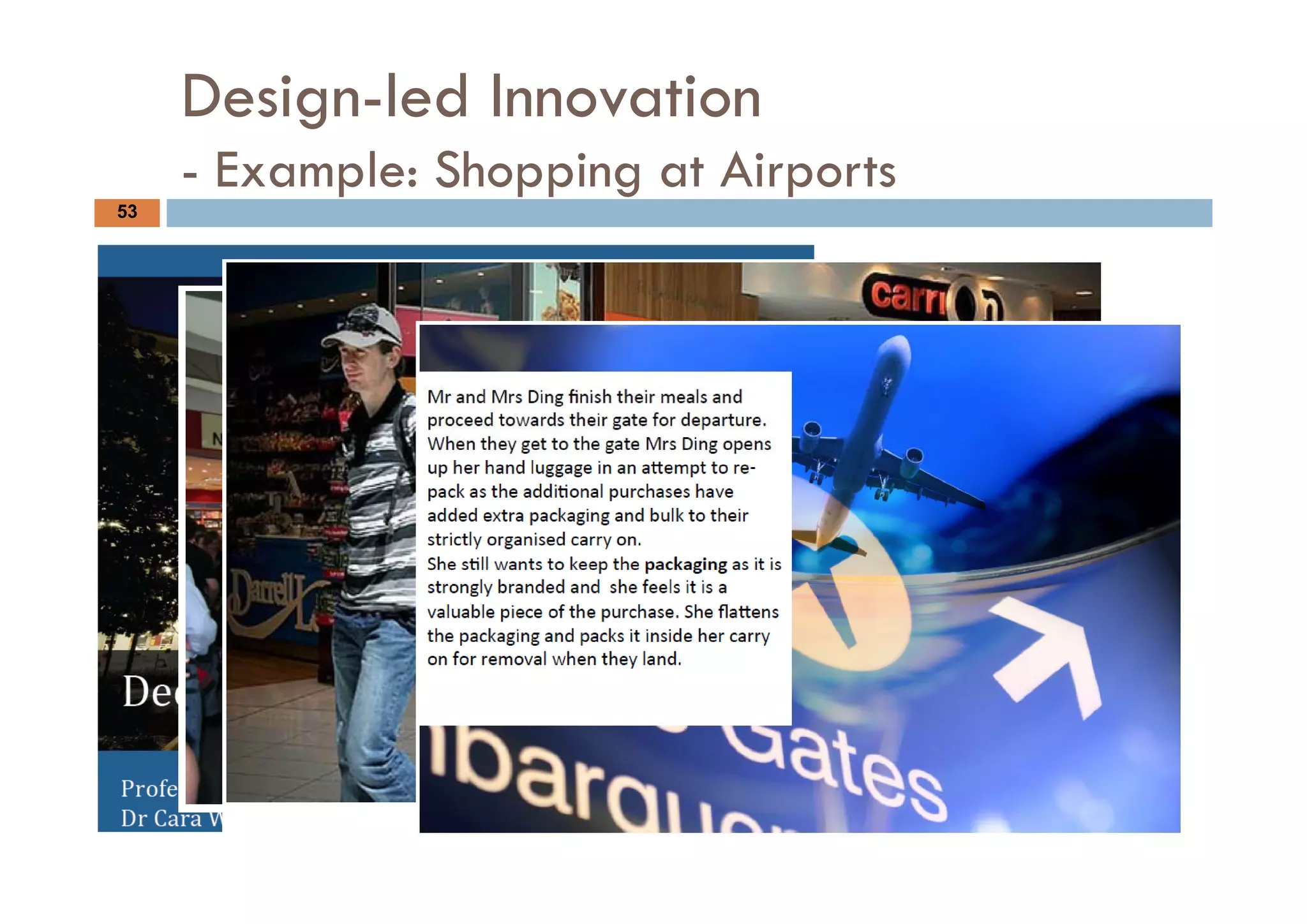
Design-led Innovation
     - Example: Shopping at Airports
53
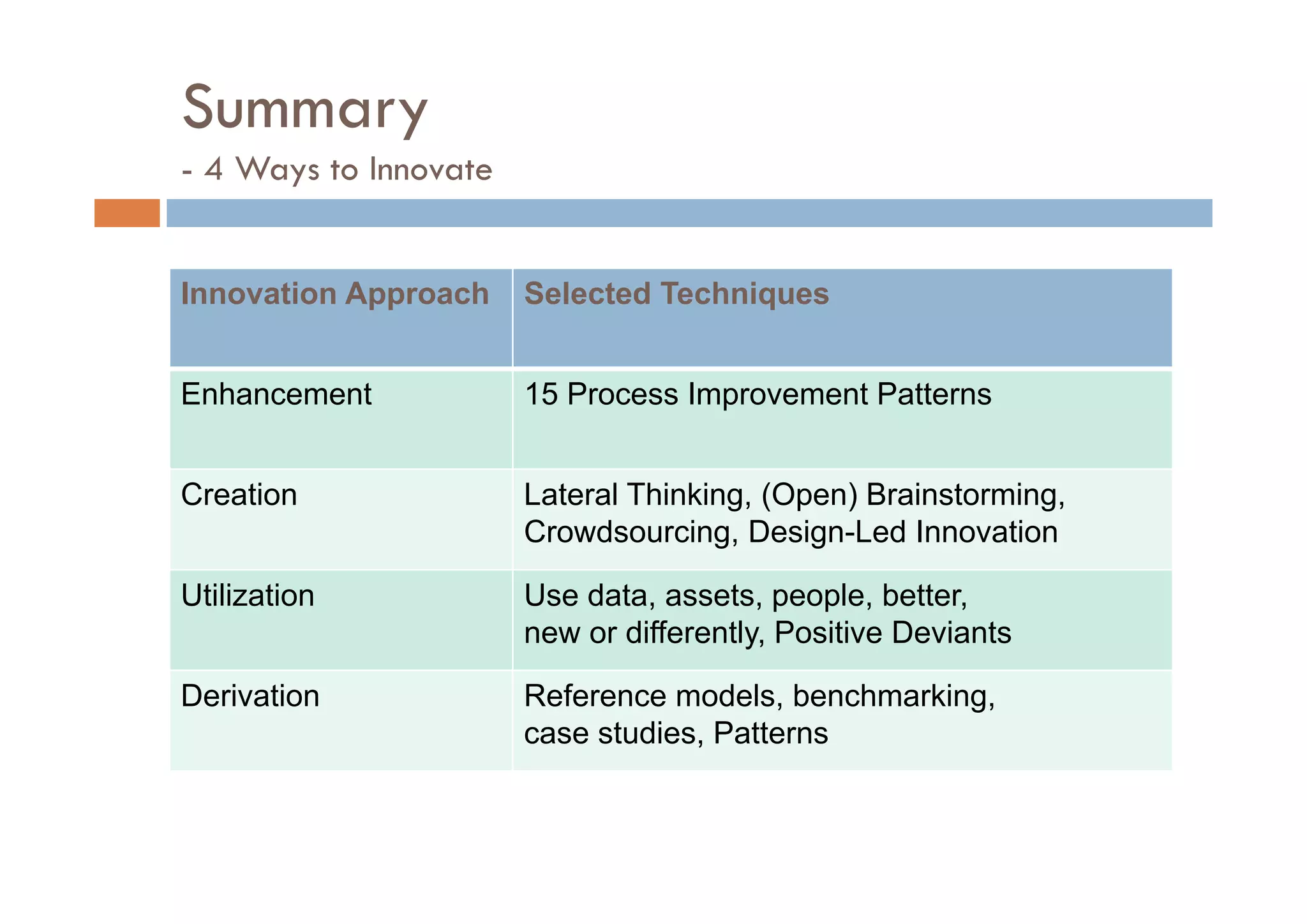
Summary
- 4 Ways to Innovate


Innovation Approach    Selected Techniques


Enhancement            15 Process Improvement Patterns


Creation               Lateral Thinking, (Open) Brainstorming,
                       Crowdsourcing, Design-Led Innovation

Utilization            Use data, assets, people, better,
                       new or differently, Positive Deviants

Derivation             Reference models, benchmarking,
                       case studies, Patterns
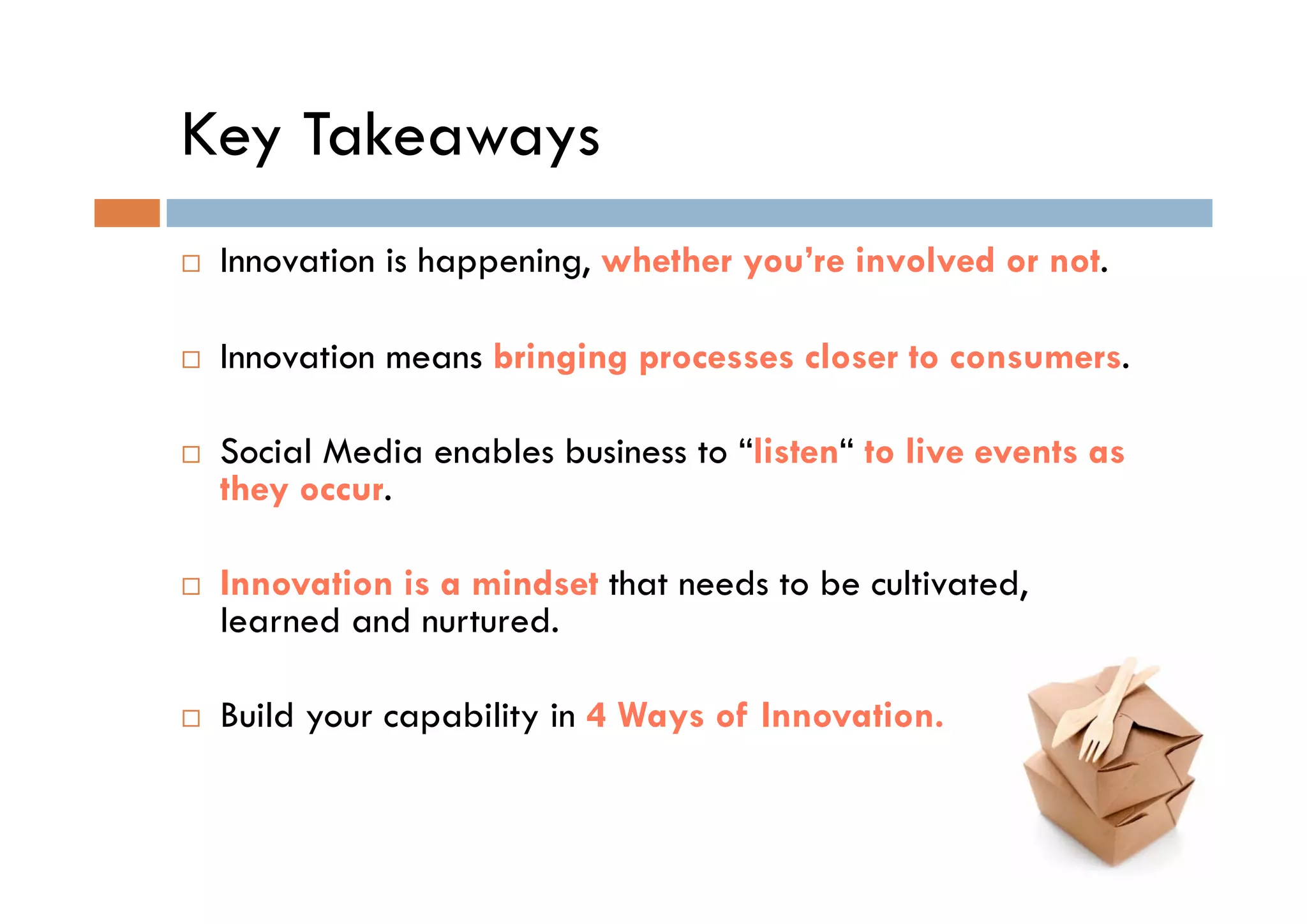
Key Takeaways
 Innovation i h
 I     ti is happening, whether you’re involved or not.
                   i     h th      ’ i     l d       t

 Innovation means bringing processes closer to consumers
                                               consumers.

 Social Media enables business to “listen“ to live events as
                                   listen
 they occur.

 Innovation is a mindset that needs to be cultivated,
 learned and nurtured.

 Build your capability in 4 Ways of Innovation.
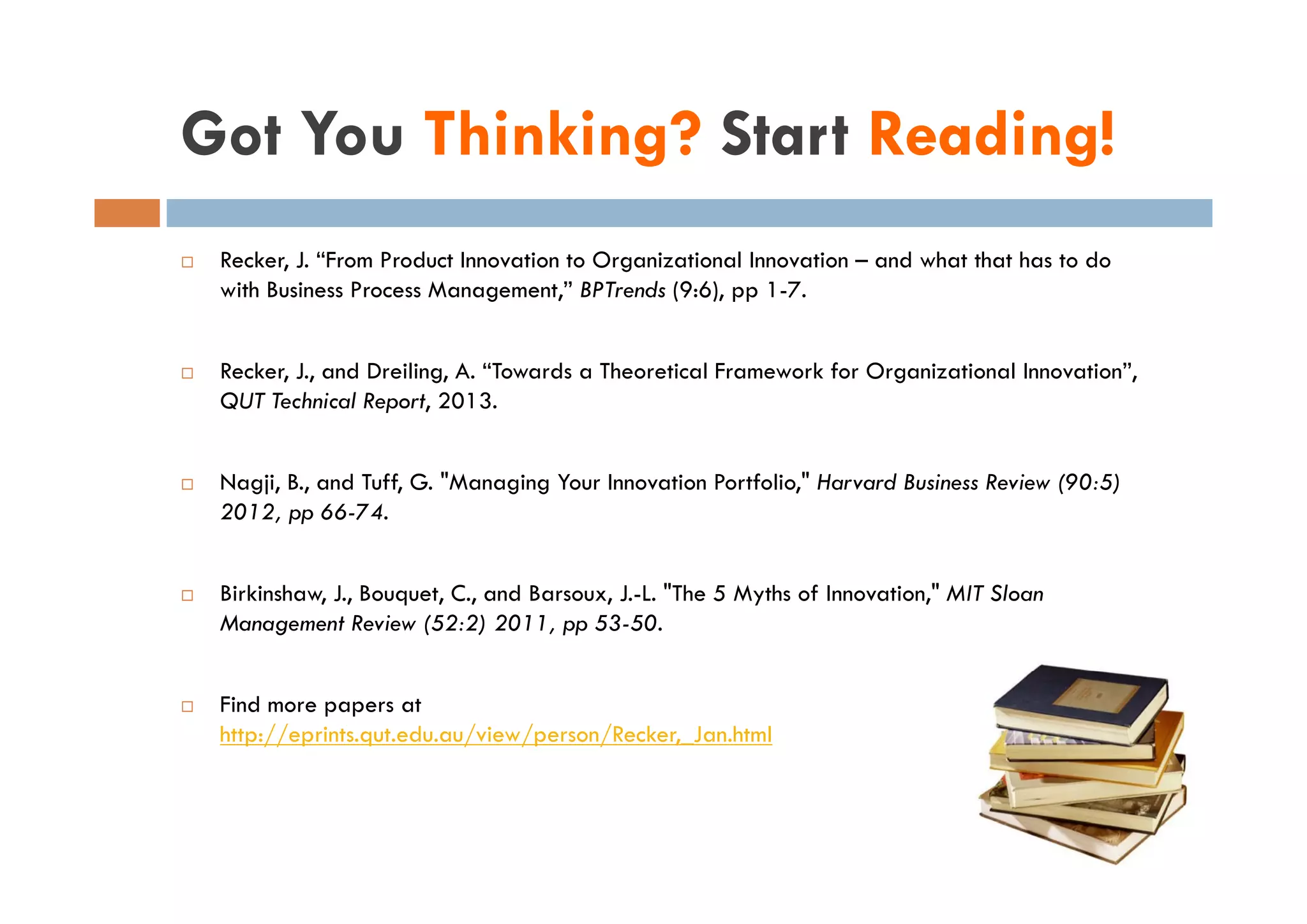
Got You Thinking? Start Reading!
 Recker, J “F
 R k J. “From Product Innovation to Organizational Innovation – and what that has to do
                  P d I              O              lI            d h h h            d
 with Business Process Management,” BPTrends (9:6), pp 1-7.


 Recker, J., and Dreiling, A. “Towards a Theoretical Framework for Organizational Innovation”,
 QUT Technical Report, 2013.


 Nagji, B., and Tuff, G. "Managing Your Innovation Portfolio," Harvard Business Review (90:5)
 2012, pp 66-74.


 Birkinshaw, J., Bouquet, C., and Barsoux, J.-L. "The 5 Myths of Innovation," MIT Sloan
 Management Review (52:2) 2011, pp 53-50.


 Find more papers at
 http://eprints.qut.edu.au/view/person/Recker,_Jan.html
Prof. Dr. Jan Recker
Woolworths Chair of Retail Innovation
Information Systems School
Queensland University of Technology

e j.recker@qut.edu.au
w www.janrecker.com
t janrecker
Panel Discussion
 What are your Questions and Views?
  How are you using social media affordances?
  Is your organization becoming connected?
  What are your challenges in
             y           g
  connectedness and
  social media?
  How do you create
  innovations?

Innovation through connectedness

  • 1.
    Innovation through Connectedness Professor Dr Jan Recker Woolworths Chair of Retail Innovation Information Systems School, Queensland University of Technology
  • 2.
    The Bad NewsUpfront Social media “noise” has no measurable impact on short term sales short-term But Digital ROI remains key measure for media selection and marketing strategies 3
  • 3.
    But there issomething to it, right? “The future competition stems from the likes of Facebook.” Ralph Norris, ex‐CEO CBA 11 August 2011 11 August 2011 1 mio new active users every week
  • 4.
    Agenda The InnovationAffordances of Social Media: Can we Innovate with Social Media? 2.35pm-3.35pm How to Innovate: Four Ways to Develop Innovations (with Social Media) 4.00pm-5.00pm Q & A and Debate dD b t 5.00pm-5.30pm
  • 5.
    Innovation A novel contribution l b that produces value.
  • 6.
    Drivers of Innovation Problems Transactional innovation i i Reactive resolution That’s the stuff we know. Or at least we should. Constraints Reactive adoption Opportunities Proactive design Transformational innovation
  • 7.
    Innovation Driven by aProblem focus on fixing issues top-down, imposed Reliant on problem being perceived Reactive Relatively well-understood Typically leads to transactional innovations
  • 8.
    Reacting to aProblem: Social Media Example - EMC|One mid-2008: The GFC pressure Employees identified and implemented 200+ cost saving ideas “People had a sense of People being part of the process” 10
  • 9.
    Innovation Driven by aConstraint Constraints are fixed issues, problems are dynamic issues Relies on context-awareness Requires tight coupling Can lead to adjacent innovation Can be reverse-engineered
  • 10.
  • 11.
  • 12.
    Innovation Driven by anOpportunity Requires the realization of innovation affordances of emerging assets such as social media Typically leads to transformational innovations Is time-dependent – opportunities I ti d d t t iti become constraints and problems over time p Realization depends on innovation latency
  • 15.
    The problem ofopportunities: Innovation Latency diminishes the value Business Innovation Affordance Value emerges Value lost through g Innovation affordance innovation is noticed Innovation latency analysis is Innovation conducted is implemented Data Analysis y Decision Time Latency Latency Latency Infrastructure Latency Reaction Time Adapted from Hackathorn, 2002
  • 16.
    Social Media is(still) an Opportunity But Why? And h t A d what are the opportunities? th t iti ? 18
  • 17.
    The Fascination of Social Media ‐i is not the same as its Potential h i i l Extremely high user numbers Exponential growth High connectedness High speed Empowered user base What is at its base?
  • 18.
    Social Media =Digital Public Good - The Four Principles Non-excludability Non-rivalry N i l Versatility y Positive network effects
  • 19.
    Examples for DigitalPublic Goods Digital Public Good As a Capability… Google, Yahoo Google Yahoo, Bing Search Instagram, FlickR, Picassa Content (pictures) Twitter, Facebook Event Signal YouTube, Hulu, Vevo , , Video Facebook, MySpace, Orkut Social Networking LinkedIn, Google+ Semantic Connectedness Wikipedia, Hudong.com Dictionary ITunes/Ping, Spotify, Simfy Music
  • 20.
    The Opportunity: Social Mediaas a Digital Complementary Asset Your Company: Social Media: The I Th Innovator? t ? Digital Complementary Asset
  • 21.
    Goal: Reducing InnovationLatency But Capabilities d not mean I B tC biliti do t Innovation ti We need to think differently about Social Media It is NOT about what Social Media can do (capabilities), ( biliti ) … but about what we can do with Social Media (affordances). (affordances)
  • 23.
    Attributes of Affordances 26 1. Affordances that are perceived as such (sufficient information) Perceptible affordances 2. Information can suggest non-existing affordances. gg g False affordances 3. 3 Affordances can exist – even if they are not visible Hidden affordances
  • 24.
  • 25.
    Example p Localization Affordances
  • 26.
    Example p De-Localization Affordances
  • 27.
    Example p Democratization Affordances
  • 28.
    What s What’s commonin these cases? They’re actually old. ld They will be the standard in a few years – they will be hygiene factors (rather than excitement factors) sooner rather than later. The opportunity is diminishing. What are (still) emerging opportunities?
  • 29.
    Connectedness: The true InnovationOpportunity in Social Media The connected customer C C C C C C C Organisation O i ti
  • 30.
    Example p Connectedness Social Flying
  • 31.
    Social Media Capability:Event Signal Publishing - Examples: Tweets ( (manual) or myskystatus.com ( ) (automatic) )
  • 32.
    The Power ofConnectedness: Network Effects! Quality of Network Service Effects Direct: More users convert to customers indirect: High user number attracts complementary partners Lack of network effects Number of Customers
  • 33.
    Connectedness of SocialMedia Social ? Enterprise ? Social social media media platforms Type of   connectedness ? Collaboration ?Social tools media platforms Semantic Internal to the  Internal to the External to the  External to the Organization Organization Locus of assets
  • 34.
    Three Key InnovationOpportunities through Connectedness Social Connectedness Social Influence Semantic R l ti hi S ti Relationships
  • 35.
    1) Social Connectedness –help your consumers connect to each others Allowing consumers (not necessarily customers) to transfer money simply through email or mobile number
  • 36.
    Embed Social Connectednessin Processes - Ti k tM t TicketMaster: S l Process Sales P
  • 37.
    2) Social Influence –Triage your processes based on value of influence Identifying users (including but not limited to customers) and assigning status, priority and/or added-value services based on their influence on others.
  • 38.
    3) Semantic Relationships Brokernew connections – and trigger processes Identifying new connections (within and beyond the existing relationships) and position y your organization as a service broker in an g emerging consumer network.
  • 39.
    Summary: AF Four St Stage M d l t C Model to Connectedness t d Phase Challenges Assess What services benefit from connectedness? What are the related benefits for the service provider and the consumer? Design Make-or-consume connectedness? How d i H to design positive network effects into service ii k ff i i delivery and consumption? Scale up How to scale up in light of exponential growth? Sustain How to secure an ongoing value proposition from connectedness?
  • 40.
    Summary: FromPain Points to Opportunities via Affordances Supply: Demand: Affordances Aff d Pain/Opportunity Points in Processes P i /O t it P i t i P Localization Need to locate (e.g. Foursquare) employees Semantic S i Need to connect relationships customers (e.g., Linkedin) Cloud Computing Need to scale up (e.g., Google) ( G l ) Social Influence Need to convince (e.g., Klout, Freemium) customers
  • 41.
    Intrigued? See you after the Break! Innovation through Social Media depends on the identification of innovation affordances. Affordances emerge as opportunities, but become problems over time time. (De-) Localization and Democratization are already becoming hygiene factors. Connectedness is (still) an emerging affordance. How do you reduce your innovation latency?
  • 42.
  • 43.
    Innovation through Connectedness g - Part II: How To Innovate Professor Dr Jan Recker Woolworths Chair of Retail Innovation Information Systems School, Queensland University of Technology
  • 44.
    Pick your Poise y We value transactions more than transformations… We are not ambitious enough… We don’t expect innovations… p We do not think outside the box… box What this Session is about: Why d like change l t i Whdodo we struggle to innovate? We not change… t t ?
  • 45.
    Agenda The InnovationAffordances of Social Media: Can we Innovate with Social Media? 2.35pm-3.35pm How to Innovate: Four Ways to Develop Innovations 4.00pm-5.00pm 4 00pm-5 00pm Q & A and Debate 5.00pm-5.30pm
  • 46.
    What did welearn before the Break? Social Media reverses the Business Process Paradigm • It is not about how the customer participates in our processes, • but about how we participate in the customers’ processes. processes Chr. Potts (2010)
  • 47.
    Types of Innovation Brunswicker (2013)
  • 48.
    It s It’s not a question of type! q i f yp !
  • 49.
  • 50.
    The Innovation AmbitionMatrix new Transformational Innovation ustomers Adjacent markets/cu Innovation m Core Innovation existing existing products/processes/assets new Nagji, Tuff (2012)
  • 51.
    Example: Retail Innovationin Australia 10 |
  • 52.
    How do weinnovate?
  • 53.
    Four Ways toInnovation High predictability,  High predictability, incremental  outcomes Derive better practices Enhance Innovate Create current practices new practices p Utilise potential practices High uncertainty,  disruptive outcomes
  • 54.
    Four Ways toInnovation y Derive better practices Enhance Innovate Create current practices new practices p Utilise potential practices
  • 55.
    Process Enhancement Pre-requisite: existing process (model) Iterate all possible micro changes of an existing p business process Deploy suitable element from available set of enhancement patterns Assess th benefits, costs, risks A the b fit t ik and potential for innovation of each alternative f h lt ti
  • 56.
    Enhance Example p Wait Pay Wait Go Up Enjoy Leave
  • 57.
    Enhance – ELIMINATION Wait Pay Wait Go Up Enjoy Leave
  • 58.
    Enhance – INSERT Buy Wait Pay Wait Go Up Enjoy Leave Drink
  • 59.
    Enhance – RESEQUENCE Wait Pay Wait Go Up Enjoy Leave
  • 60.
    Enhance – INTEGRATION Enjoy Wait Pay Wait Go Up Enjoy Leave & Leave
  • 61.
    Enhance – SPECIALISE Pay ($19) Wait Pay Wait Go Up Enjoy Leave Pay ($42)
  • 62.
  • 63.
    Application: Enhancingyour Process through Social Media Affordances Supply: Demand: Affordances Aff d Pain/Opportunity Points in Processes P i /O t it P i t i P Localization Need to locate (e.g. Foursquare) employees Semantic S i Need to connect relationships customers (e.g., Linkedin) Cloud Computing Need to scale up (e.g., Google) ( G l ) Social Influence Need to convince (e.g., Klout, Freemium) customers
  • 64.
    Four Ways toInnovation y Derive better practices Enhance Innovate Create current practices new practices p Utilise potential practices
  • 65.
    Process Derivation Pre-requisite: awareness of innovations and affordances outside the own organization Convert external idea into a pattern and identify opportunity points in own processes that benefit from this pattern Assess the benefits, costs, risks and potential for innovation of each alternative Example: Di E l Disneyland - GE l d
  • 66.
    Derivation Example • Indian software vendor receives 1.6mio job applications in one year. • They will hire 22,000 employees. h ill hi 22 000 l • Derivation is asking what they can learn for the recruitment  process… – from the mortgage application process of a bank? from the mortgage application process of a bank? – or a prestigious scientific journal?
  • 67.
    Process Derivation -Procedure Select Domain Design Pattern? Transfer Assess
  • 68.
  • 69.
  • 70.
  • 71.
    Deploying Derivation toProcesses Demand: Derivation Map underlying issues in process Opportunities Need to allocate Banks: limited li it d resources Pre-approval P l Need to have Traffic fines i T ffi fi in sanctions Scandinavia Need to triage Airline Frequent customers Flyer Programs Need to convert p products into BMW services DriveNow
  • 72.
    Four Ways toInnovation y Derive better practices Enhance Innovate Create current practices new practices p Utilise potential practices
  • 73.
    Process Utilization Pre-requisite: awareness of under-utilized, outstanding and accessible external and g internal resources (people, assets, data) Capitalize C i li on Idle resources (idle capacity, waiting time) Positive outliers Assess the benefits costs risks and potential benefits, costs, for innovation of each alternative
  • 74.
    Utilization of Assets: TheUtilization Differential • Assume you drive 15,000 kms in your car per year • Assume th average speed is 50 k /h A the di kms/hr • You are driving the car for roughly 300 hours • There are 8,760 hours in the year Th 8 760 h i th • car utilization = 3.4% • If your car were a service, that untapped 96.6% becomes a source of value • Commercialization of idle time (revenue) • Share acquisition, operation, maintenance costs Henry Ch b H Chesbrough (2012) h
  • 75.
    Utilisation (Assets) Example –Walmart Overnight Parking
  • 76.
  • 77.
    Utilization of People -The Search for Positive Deviance
  • 78.
  • 79.
    25:00 25:00 24:00 24:00 23:00 23:00 22:00 22:00 21:00 21:00 20:00 20:00 19:00 19:00 18:00 18:00 17:00 17:00 16:00 16:00 15:00 15:00 14:00 14:00 13:00 13:00 12:00 12:00 11:00 11:00 10:00 10:00 09:00 09:00 08:00 08:00 Comparison 07:00 07:00 06:00 06:00 05:00 05:00 04:00 04:00 03:00 03:00 02:00 02:00 01:00 01:00 00:00 00:00 materials planning doing reacting materials planning doing reacting Expert t ovice No
  • 80.
    Example – find internal innovation p “What “Wh can we l learn about success f b from within i hi our own company?” p y
  • 81.
    Utilization: Studying Positive Deviance Utilization: Studying PositiveDeviance Positive Deviant What is the Positive Deviant evidence for Positive Deviant Positive Deviant success? Positive Deviant Positive Deviant Sales process performance Who is truly successful? Positive Deviant Why are they Average successful? p Which true root causes can we insert elsewhere? Number of customers
  • 82.
    Finding the TrueRoot Causes
  • 83.
    Four Ways toInnovation y Derive better practices Enhance Innovate Create current practices new practices p Utilise potential practices
  • 84.
    Process Creation Pre-requisite: access to innovators and the ability to prototype quickly p yp q y Capitalize on Creative potential within the organization The true meaning of customers’ demands The crowd as a source Assess the benefits costs risks and potential for benefits, costs, innovation of each alternative
  • 85.
    Process Creation Techniques: Lateral Thinking Brainstorming Crowdsourcing and -solving Design-led Innovation …
  • 86.
    Programmed vs LateralThinking Programmed - structured or logical way to develop a solution Lateral - jumping outside of usual patterns and assumptions
  • 88.
    Brainstorming: Key Rules g y Process for generating new thinking P f i hi ki Encourages radical ideas Based on association Helps us think outside of “patterns” Build on ideas of others Quantity, not quality
  • 89.
    Creation through SocialMedia - Open Innovation and Crowdsourcing 51
  • 90.
    Creation through Narratives - Design-led Innovation 52
  • 91.
    Design-led Innovation - Example: Shopping at Airports 53
  • 92.
    Summary - 4 Waysto Innovate Innovation Approach Selected Techniques Enhancement 15 Process Improvement Patterns Creation Lateral Thinking, (Open) Brainstorming, Crowdsourcing, Design-Led Innovation Utilization Use data, assets, people, better, new or differently, Positive Deviants Derivation Reference models, benchmarking, case studies, Patterns
  • 93.
    Key Takeaways Innovationi h I ti is happening, whether you’re involved or not. i h th ’ i l d t Innovation means bringing processes closer to consumers consumers. Social Media enables business to “listen“ to live events as listen they occur. Innovation is a mindset that needs to be cultivated, learned and nurtured. Build your capability in 4 Ways of Innovation.
  • 94.
    Got You Thinking?Start Reading! Recker, J “F R k J. “From Product Innovation to Organizational Innovation – and what that has to do P d I O lI d h h h d with Business Process Management,” BPTrends (9:6), pp 1-7. Recker, J., and Dreiling, A. “Towards a Theoretical Framework for Organizational Innovation”, QUT Technical Report, 2013. Nagji, B., and Tuff, G. "Managing Your Innovation Portfolio," Harvard Business Review (90:5) 2012, pp 66-74. Birkinshaw, J., Bouquet, C., and Barsoux, J.-L. "The 5 Myths of Innovation," MIT Sloan Management Review (52:2) 2011, pp 53-50. Find more papers at http://eprints.qut.edu.au/view/person/Recker,_Jan.html
  • 95.
    Prof. Dr. JanRecker Woolworths Chair of Retail Innovation Information Systems School Queensland University of Technology e j.recker@qut.edu.au w www.janrecker.com t janrecker
  • 96.
    Panel Discussion Whatare your Questions and Views? How are you using social media affordances? Is your organization becoming connected? What are your challenges in y g connectedness and social media? How do you create innovations?