From Open Access
to Open All.
On User Rights and Freedoms
(and maybe also something else)

in science and education
(and elsewhere)

Alek Tarkowski
Centrum Cyfrowe Projekt: Polska
Creative Commons
„Open All”
•  Beyond OA in science: open scienti!c
data, open metadata, other
publications than peer-review
articles	
•  Also educational content for HE,
K-12, preschool	
•  Heritage, cultural sector content	
•  Public Sector Information, Public
Data
„Open All”
•  A policy-based approach: all publicly
funded content	
•  Good reasons to extend this
approach to other funding sources	
•  and to a generalized sharing
philosophy	
•  (policy as a key, strong tool – but at same
time lacks the personal choice aspect)
Maybe OA is enough?
•  Mature publishing model (in
particular in economic terms)	
•  20+ years of experience	
•  Precise goals – „modest” in a good
sense	
•  Still a lot of work ahead
OA is not enough?
•  If we believe in OA for scienti!c
articles, then why not believe in
openness of other types of content?	
•  If OA for scienti!c articles makes
pragmatic sense, then why won’t it
make sense for other types of
content?
OA is not enough?
•  OA has developed multiple
standards, tools, models that can be
reused in other sectors	
•  Multiple, cross-sector uses of
content (between science,
education, cultural sector, etc.)
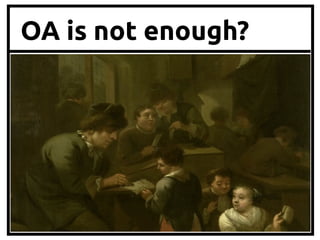
OA is not enough?
•  OA has developed multiple
standards, tools, models that can be
reused in other sectors
Public Open Content
•  „public” or „publicly funded” is the
crucial distinction, and the rationale
for openness	
•  (a de!nition for „publicly funded” is
needed, and sometimes in controversial)
Open
Educational
Resources
movement
OA + OER
•  „natural !t” – connecting element:
HE educational resources	
•  OA + OER as core of the „Open All”
concept 	
•  (with heritage being a low-hanging
fruit, and other cultural works
remaining fast impossible to open)
OER de"ned
•  „teaching, learning and research
materials in any medium, digital or
otherwise, that reside in the public
domain or have been released under
an open license that permits no-cost
access, use, adaptation and
redistribution by others with no or
limited restrictions.”
UNESCO
OER: shortest history
•  2002: MIT OpenCourseWare 	
•  2007: Cape Town Declaration	
•  2008: Coalition for Open Education
(PL)	
•  2008: Wikiwijs (NL)	
•  (2004) 2009: Khan Academy	
•  2011: Polish Open Textbooks project	
•  2012: Paris UNESCO Declaration
OER: shortest history
• An ecosystem similar to the OA
ecosystem:	
• Repositories	
• Metadata	
• Author compliance	
• Law / licensing	
• Use / reuse
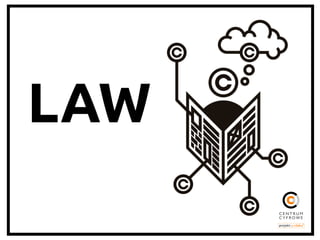
LAW
OER de"ned
•  Hewlett Foundation	
„OER are teaching, learning, and
research resources that reside in the
public domain or have been released
under an intellectual property license
that permits their free use and repurposing by others.”
OER de"ned
•  UNESCO	
„teaching, learning and research
materials in any medium, digital or
otherwise, that reside in the public
domain or have been released under
an open license that permits no-cost
access, use, adaptation and
redistribution by others with no or
limited restrictions.”
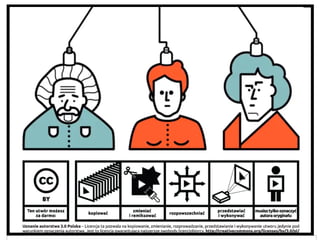
Licensing debate
•  Is crucial for OER – much more than
for OA	
•  Why CC BY?
Licensing debate
•  Is crucial for OER – much more than
for OA	
•  Why CC BY?	
•  The importance of reuse / remix in
educational practice	
•  Translation into local languages
Licensing debate
•  OA also needs this debate – for
example with regard to text/data
mining	
•  US: FASTR + executive order	
•  Terrain is muddled – con#icting
de!nitions - Traditional stronger vs.
broader debate	
•  At the same time, still low proof /
few cases of reuse
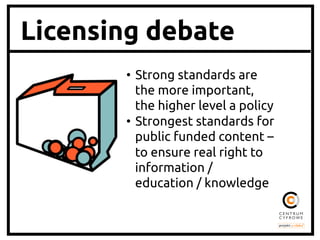
Licensing debate
•  Strong standards are
the more important,
the higher level a policy 	
•  Strongest standards for
public funded content –
to ensure real right to
information /
education / knowledge
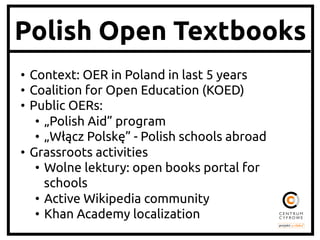
Polish Open Textbooks
•  Context: OER in Poland in last 5 years	
•  Coalition for Open Education (KOED)	
•  Public OERs:	
•  „Polish Aid” program	
•  „Włącz Polskę” - Polish schools abroad	
•  Grassroots activities	
•  Wolne lektury: open books portal for
schools	
•  Active Wikipedia community	
•  Khan Academy localization
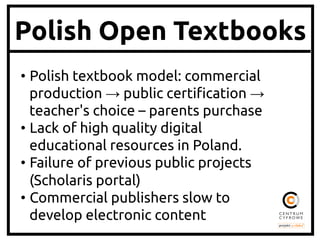
Polish Open Textbooks
•  Polish textbook model: commercial
production → public certi!cation →
teacher's choice – parents purchase	
•  Lack of high quality digital
educational resources in Poland.	
•  Failure of previous public projects
(Scholaris portal)	
•  Commercial publishers slow to
develop electronic content
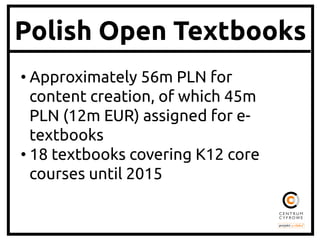
Polish Open Textbooks
• Approximately 56m PLN for
content creation, of which 45m
PLN (12m EUR) assigned for etextbooks	
• 18 textbooks covering K12 core
courses until 2015
Polish Open Textbooks
• Who is most vehemently
opposed to the project?
Open Public Resources Act
•  General model from the „Open
textbooks” project	
•  Complimentary to Public Sector
Information rules -> together would
form a general open norm for public
content	
•  Education + science + culture	
•  2013: Bill proposal
Openwashing
•  MOOC (MOPENOC)	
•  Mark Lester – how are MOOCs open:	
•  Non-selective	
•  Not tied to physical location	
•  No limitations on number of students	
•  Non full-time, no long commitment	
•  Low or no cost	

•  MFLEXIBLEOC?	
•  Why don’t MOOCs „get” openness?
Opening Up Education
•  „Thanks to Open Educational
Resources (OER), and namely
MOOCs, teachers and education
institutions can now reach thousands
of learners from all !ve continents
simultaneously, showcasing that
language is not always a barrier.”
Opening Up Education
•  helping everyone to acquire digital skills
and learning methods 	
•  supporting development and
availability of open educational
resources 	
•  connecting classrooms and deploying
digital devices and content 	
•  mobilizing all stakeholders to change the
role of digital technologies at education
institutions
Opening Up Education
•  Pragmatic approach instead of an
ideological one?	
•  (which OA already knows this very well)	
•  Educators, students don’t necessarily
care about openness – they care about
a'ordability, e(ciency, ease of use,
quality	
•  And therefore policymakers care about
this too
Opening Up Education
•  Three strategies:	
•  Raise awareness about All
Things Open	
•  Build pragmatic arguments	
•  Mythbusting
From Open Access to Open All

From Open Access to Open All

  • 1.
    From Open Access toOpen All. On User Rights and Freedoms (and maybe also something else) in science and education (and elsewhere) Alek Tarkowski Centrum Cyfrowe Projekt: Polska Creative Commons
  • 2.
    „Open All” •  BeyondOA in science: open scienti!c data, open metadata, other publications than peer-review articles •  Also educational content for HE, K-12, preschool •  Heritage, cultural sector content •  Public Sector Information, Public Data
  • 3.
    „Open All” •  Apolicy-based approach: all publicly funded content •  Good reasons to extend this approach to other funding sources •  and to a generalized sharing philosophy •  (policy as a key, strong tool – but at same time lacks the personal choice aspect)
  • 4.
    Maybe OA isenough? •  Mature publishing model (in particular in economic terms) •  20+ years of experience •  Precise goals – „modest” in a good sense •  Still a lot of work ahead
  • 5.
    OA is notenough? •  If we believe in OA for scienti!c articles, then why not believe in openness of other types of content? •  If OA for scienti!c articles makes pragmatic sense, then why won’t it make sense for other types of content?
  • 6.
    OA is notenough? •  OA has developed multiple standards, tools, models that can be reused in other sectors •  Multiple, cross-sector uses of content (between science, education, cultural sector, etc.)
  • 7.
    OA is notenough? •  OA has developed multiple standards, tools, models that can be reused in other sectors
  • 8.
    Public Open Content • „public” or „publicly funded” is the crucial distinction, and the rationale for openness •  (a de!nition for „publicly funded” is needed, and sometimes in controversial)
  • 9.
  • 10.
    OA + OER • „natural !t” – connecting element: HE educational resources •  OA + OER as core of the „Open All” concept •  (with heritage being a low-hanging fruit, and other cultural works remaining fast impossible to open)
  • 11.
    OER de"ned •  „teaching,learning and research materials in any medium, digital or otherwise, that reside in the public domain or have been released under an open license that permits no-cost access, use, adaptation and redistribution by others with no or limited restrictions.” UNESCO
  • 12.
    OER: shortest history • 2002: MIT OpenCourseWare •  2007: Cape Town Declaration •  2008: Coalition for Open Education (PL) •  2008: Wikiwijs (NL) •  (2004) 2009: Khan Academy •  2011: Polish Open Textbooks project •  2012: Paris UNESCO Declaration
  • 13.
    OER: shortest history • Anecosystem similar to the OA ecosystem: • Repositories • Metadata • Author compliance • Law / licensing • Use / reuse
  • 14.
  • 15.
    OER de"ned •  HewlettFoundation „OER are teaching, learning, and research resources that reside in the public domain or have been released under an intellectual property license that permits their free use and repurposing by others.”
  • 16.
    OER de"ned •  UNESCO „teaching,learning and research materials in any medium, digital or otherwise, that reside in the public domain or have been released under an open license that permits no-cost access, use, adaptation and redistribution by others with no or limited restrictions.”
  • 17.
    Licensing debate •  Iscrucial for OER – much more than for OA •  Why CC BY?
  • 18.
    Licensing debate •  Iscrucial for OER – much more than for OA •  Why CC BY? •  The importance of reuse / remix in educational practice •  Translation into local languages
  • 19.
    Licensing debate •  OAalso needs this debate – for example with regard to text/data mining •  US: FASTR + executive order •  Terrain is muddled – con#icting de!nitions - Traditional stronger vs. broader debate •  At the same time, still low proof / few cases of reuse
  • 20.
    Licensing debate •  Strongstandards are the more important, the higher level a policy •  Strongest standards for public funded content – to ensure real right to information / education / knowledge
  • 21.
    Polish Open Textbooks • Context: OER in Poland in last 5 years •  Coalition for Open Education (KOED) •  Public OERs: •  „Polish Aid” program •  „Włącz Polskę” - Polish schools abroad •  Grassroots activities •  Wolne lektury: open books portal for schools •  Active Wikipedia community •  Khan Academy localization
  • 22.
    Polish Open Textbooks • Polish textbook model: commercial production → public certi!cation → teacher's choice – parents purchase •  Lack of high quality digital educational resources in Poland. •  Failure of previous public projects (Scholaris portal) •  Commercial publishers slow to develop electronic content
  • 23.
    Polish Open Textbooks • Approximately56m PLN for content creation, of which 45m PLN (12m EUR) assigned for etextbooks • 18 textbooks covering K12 core courses until 2015
  • 24.
    Polish Open Textbooks • Whois most vehemently opposed to the project?
  • 25.
    Open Public ResourcesAct •  General model from the „Open textbooks” project •  Complimentary to Public Sector Information rules -> together would form a general open norm for public content •  Education + science + culture •  2013: Bill proposal
  • 26.
    Openwashing •  MOOC (MOPENOC) • Mark Lester – how are MOOCs open: •  Non-selective •  Not tied to physical location •  No limitations on number of students •  Non full-time, no long commitment •  Low or no cost •  MFLEXIBLEOC? •  Why don’t MOOCs „get” openness?
  • 27.
    Opening Up Education • „Thanks to Open Educational Resources (OER), and namely MOOCs, teachers and education institutions can now reach thousands of learners from all !ve continents simultaneously, showcasing that language is not always a barrier.”
  • 28.
    Opening Up Education • helping everyone to acquire digital skills and learning methods •  supporting development and availability of open educational resources •  connecting classrooms and deploying digital devices and content •  mobilizing all stakeholders to change the role of digital technologies at education institutions
  • 29.
    Opening Up Education • Pragmatic approach instead of an ideological one? •  (which OA already knows this very well) •  Educators, students don’t necessarily care about openness – they care about a'ordability, e(ciency, ease of use, quality •  And therefore policymakers care about this too
  • 30.
    Opening Up Education • Three strategies: •  Raise awareness about All Things Open •  Build pragmatic arguments •  Mythbusting