MONCLOA Campus of International
                                                Excellence


                   Proactive and Reactive Thermal
        Optimization Techniques to Improve Energy
                         Efficiency in Data Centers

                                                                Workshop PICATA
                                                                        Marina Zapater
                                                            José L. Ayala, José M. Moya


Marina Zapater | Workshop PICATA | 14-02-2013           1
Presentation


   ArTeCS Group
   Group of Architecture and Technology of Computing Systems
   Facultad de Informática
   Universidad Complutense de Madrid


    Laboratorio de Sistemas Integrados (LSI)
    Departamento de Ingeniería Electrónica
    ETSI Telecomunicación
    Universidad Politécnica de Madrid


Marina Zapater | Workshop PICATA | 14-02-2013   2
Data Centers


Marina Zapater | Workshop PICATA | 14-02-2013   3
Motivation

    • Power consumption in data centers
           – 1.3% world energy production in 2010
           – USA: 80 billion KWh/year in 2011 = 1.5xNYC
           – 250 billion KWh/year in 2010
    • More than 43 Million tons of CO2 / year
    • More water than paper, automotive, petrol, wood
      or plastic industry

                      Jonathan Koomey. 2011. Growth in Data center electricity use 2005 to 2010


Marina Zapater | Workshop PICATA | 14-02-2013             4
Motivation
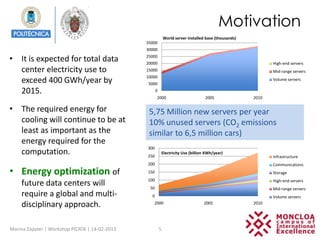
                                                              World server installed base (thousands)
                                                35000
                                                30000

• It is expected for total data                 25000
                                                20000                                                          High-end servers
  center electricity use to                     15000                                                          Mid-range servers
                                                10000
  exceed 400 GWh/year by                        5000
                                                                                                               Volume servers

  2015.                                               0
                                                      2000                            2005              2010

• The required energy for                        5,75 Million new servers per year
  cooling will continue to be at                 10% unused servers (CO2 emissions
  least as important as the                      similar to 6,5 million cars)
  energy required for the
                                                300
  computation.                                  250
                                                              Electricity Use (billion KWh/year)
                                                                                                               Infrastructure
                                                200                                                            Communications
• Energy optimization of                        150                                                            Storage
                                                100                                                            High-end servers
    future data centers will                     50                                                            Mid-range servers
    require a global and multi-                   0                                                            Volume servers
    disciplinary approach.                         2000                              2005               2010


Marina Zapater | Workshop PICATA | 14-02-2013             5
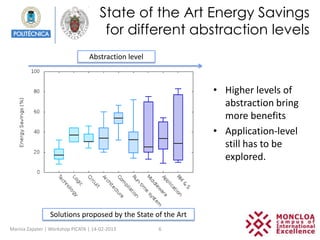
State of the Art Energy Savings
                                       for different abstraction levels
                                 Abstraction level


                                                              • Higher levels of
                                                                abstraction bring
                                                                more benefits
                                                              • Application-level
                                                                still has to be
                                                                explored.


                 Solutions proposed by the State of the Art
Marina Zapater | Workshop PICATA | 14-02-2013        6
Our perspective
                                                    Proactive and reactive
                                                         holistic approach

   • Using the knowledge about the energy demand of the
     applications, the features of the computation and
     cooling resources to apply proactive optimization
     techniques

   • Global strategy to integrate multiple information
     sources and coordinate decissions to reduce overall
     power consumption.


Marina Zapater | Workshop PICATA | 14-02-2013   7
Our perspective
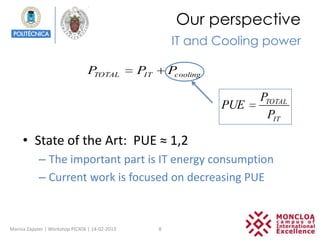
                                                          IT and Cooling power

                                PTOTAL          PIT       Pcooling

                                                                           PTOTAL
                                                                     PUE
                                                                            PIT

     • State of the Art: PUE ≈ 1,2
            – The important part is IT energy consumption
            – Current work is focused on decreasing PUE


Marina Zapater | Workshop PICATA | 14-02-2013         8
Our perspective
                                                          IT and Cooling power

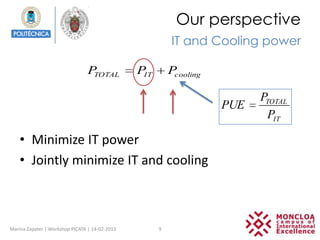
                                PTOTAL          PIT       Pcooling

                                                                           PTOTAL
                                                                     PUE
                                                                            PIT

    • Minimize IT power
    • Jointly minimize IT and cooling


Marina Zapater | Workshop PICATA | 14-02-2013         9
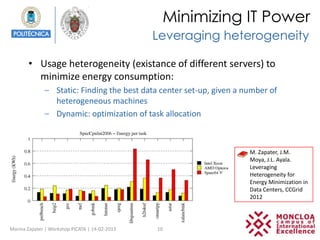
Minimizing IT Power
                                                Leveraging heterogeneity

       • Usage heterogeneity (existance of different servers) to
         minimize energy consumption:
              – Static: Finding the best data center set-up, given a number of
                heterogeneous machines
              – Dynamic: optimization of task allocation


                                                                      M. Zapater, J.M.
                                                                      Moya, J.L. Ayala.
                                                                      Leveraging
                                                                      Heterogeneity for
                                                                      Energy Minimization in
                                                                      Data Centers, CCGrid
                                                                      2012


Marina Zapater | Workshop PICATA | 14-02-2013   10
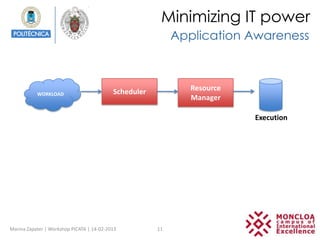
Minimizing IT power
                                                            Application Awareness


                                           Scheduler           Resource
           WORKLOAD
                                                               Manager

                                                                          Execution


Marina Zapater | Workshop PICATA | 14-02-2013          11
Heterogeneity
                                                            Application Awareness


                                           Scheduler           Resource
           WORKLOAD
                                                               Manager

                                                                             Execution


                                      Profiling and             Energy
                                      Classification          Optimization


Marina Zapater | Workshop PICATA | 14-02-2013          12
Cooling management
                                       Leakage-cooling tradeoffs at the
                                                           server level

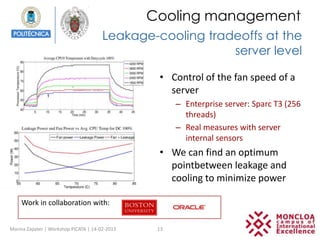
                                                 • Control of the fan speed of a
                                                   server
                                                      – Enterprise server: Sparc T3 (256
                                                        threads)
                                                      – Real measures with server
                                                        internal sensors
                                                 • We can find an optimum
                                                   pointbetween leakage and
                                                   cooling to minimize power

    Work in collaboration with:


Marina Zapater | Workshop PICATA | 14-02-2013    13
Cooling management
                                       Leakage-cooling tradeoffs at the
                                                           server level


    Work in collaboration with:


Marina Zapater | Workshop PICATA | 14-02-2013    14
Cooling & IT Joint Opt.
                                                         Work in Progress

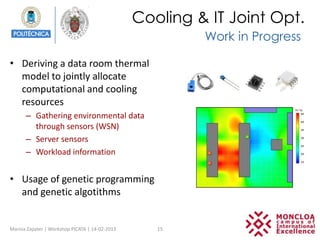
• Deriving a data room thermal
  model to jointly allocate
  computational and cooling
  resources
      – Gathering environmental data
        through sensors (WSN)
      – Server sensors
      – Workload information


• Usage of genetic programming
  and genetic algotithms


Marina Zapater | Workshop PICATA | 14-02-2013      15
Holistic aproach
                                        Proactive and reactive techniques

   • System that increases the knowledge of the data center
   • Real implementation scenario at CeSViMa
   • Power optimization in globally distributed systems

                                                                        GreenDISC Project: HW/SW
             Data Center                                                Technologies for Energy
                state                       Optimization                Efficiency in Distributed
                                                            Decission   Computing Systems.
Sensing                                                     proposal    UCM-UPM

                                                                        TEC2012-33892.
                             Datacenter                                 Spanish Ministry of Economy and
                                                                        Competitiveness


Marina Zapater | Workshop PICATA | 14-02-2013          16
Research goals
                                                     Expected impact

   • Energy and CO2 carbon footprint reduction in
     data centers
          – So far, 25% reduction in IT resource management
            optimizations
          – 10% energy reduction in fan control policies
   • Joint IT/cooling techniques are expected to
     bring much more benefits.
   • Solutions in a real environment: CeSViMa


Marina Zapater | Workshop PICATA | 14-02-2013   17
Questions?


                 Thank you for
                 your attention


                     Marina Zapater
                    marina@die.upm.es
                B105. ETSI Telecomunicación
                   Avda Complutense, 30
                   91 549 57 00 (+ 4227)
               http://greenlsi.die.upm.es
              http://artecs.dacya.ucm.es/


Marina Zapater | Workshop PICATA | 14-02-2013   18
Research results

   •     M. Zapater, J.L. Ayala, J.M. Moya, K. Vaidyanathan, K. Gross, A.K. Coskun, Leakage and Temperature Aware
         Server Control for Improving Energy Efficiency in Data Centers. To apper in: DATE’13, 2013.

   •     M. Zapater, J. L. Ayala, and J. M. Moya. “GreenDisc: a HW/SW energy optimization framework in globally
         distributed computation”, J. Bravo, D. López-de Ipiña, and F. Moya, Ed., Springer Berlin
         Heidelberg, 2012, pp. 1-8.

   •     M. Zapater, J. L. Ayala, and J. M. Moya, “Leveraging heterogeneity for energy minimization in data
         centers”, in Proceedings of the 2012 12th IEEE International Symposium on Cluster, Cloud and Grid
         Computing (CCGRID 2012), Washington, DC, USA, 2012.

   •     M. Zapater, C. Sanchez, J. L. Ayala, J. M. Moya, and J. L. Risco-Martín, “Ubiquitous green computing
         techniques for high demand applications in smart environments” Sensors, vol. 12, iss. 8, pp. 10659-
         10677, 2012

   •     M. Zapater, P. Arroba, J. M. Moya, and Z. Bankovic, “A State-of-the-Art on energy efficiency in today’s
         datacentres: researcher’s contributions and practical approaches”, UPGRADE, vol. 12, iss. 4, pp. 67-
         74, 2011.

   •     M. Zapater, J. L. Risco, J. L. Ayala, and J. M. Moya, “Combined Dynamic-Static approach for Thermal-
         Awareness in heterogeneous data centers” IWIA 2010.


Marina Zapater | Workshop PICATA | 14-02-2013               19

Proactive and reactive thermal optimization techniques to improve energy efficiency in data centers

  • 1.
    MONCLOA Campus ofInternational Excellence Proactive and Reactive Thermal Optimization Techniques to Improve Energy Efficiency in Data Centers Workshop PICATA Marina Zapater José L. Ayala, José M. Moya Marina Zapater | Workshop PICATA | 14-02-2013 1
  • 2.
    Presentation ArTeCS Group Group of Architecture and Technology of Computing Systems Facultad de Informática Universidad Complutense de Madrid Laboratorio de Sistemas Integrados (LSI) Departamento de Ingeniería Electrónica ETSI Telecomunicación Universidad Politécnica de Madrid Marina Zapater | Workshop PICATA | 14-02-2013 2
  • 3.
    Data Centers Marina Zapater| Workshop PICATA | 14-02-2013 3
  • 4.
    Motivation • Power consumption in data centers – 1.3% world energy production in 2010 – USA: 80 billion KWh/year in 2011 = 1.5xNYC – 250 billion KWh/year in 2010 • More than 43 Million tons of CO2 / year • More water than paper, automotive, petrol, wood or plastic industry Jonathan Koomey. 2011. Growth in Data center electricity use 2005 to 2010 Marina Zapater | Workshop PICATA | 14-02-2013 4
  • 5.
    Motivation World server installed base (thousands) 35000 30000 • It is expected for total data 25000 20000 High-end servers center electricity use to 15000 Mid-range servers 10000 exceed 400 GWh/year by 5000 Volume servers 2015. 0 2000 2005 2010 • The required energy for 5,75 Million new servers per year cooling will continue to be at 10% unused servers (CO2 emissions least as important as the similar to 6,5 million cars) energy required for the 300 computation. 250 Electricity Use (billion KWh/year) Infrastructure 200 Communications • Energy optimization of 150 Storage 100 High-end servers future data centers will 50 Mid-range servers require a global and multi- 0 Volume servers disciplinary approach. 2000 2005 2010 Marina Zapater | Workshop PICATA | 14-02-2013 5
  • 6.
    State of theArt Energy Savings for different abstraction levels Abstraction level • Higher levels of abstraction bring more benefits • Application-level still has to be explored. Solutions proposed by the State of the Art Marina Zapater | Workshop PICATA | 14-02-2013 6
  • 7.
    Our perspective Proactive and reactive holistic approach • Using the knowledge about the energy demand of the applications, the features of the computation and cooling resources to apply proactive optimization techniques • Global strategy to integrate multiple information sources and coordinate decissions to reduce overall power consumption. Marina Zapater | Workshop PICATA | 14-02-2013 7
  • 8.
    Our perspective IT and Cooling power PTOTAL PIT Pcooling PTOTAL PUE PIT • State of the Art: PUE ≈ 1,2 – The important part is IT energy consumption – Current work is focused on decreasing PUE Marina Zapater | Workshop PICATA | 14-02-2013 8
  • 9.
    Our perspective IT and Cooling power PTOTAL PIT Pcooling PTOTAL PUE PIT • Minimize IT power • Jointly minimize IT and cooling Marina Zapater | Workshop PICATA | 14-02-2013 9
  • 10.
    Minimizing IT Power Leveraging heterogeneity • Usage heterogeneity (existance of different servers) to minimize energy consumption: – Static: Finding the best data center set-up, given a number of heterogeneous machines – Dynamic: optimization of task allocation M. Zapater, J.M. Moya, J.L. Ayala. Leveraging Heterogeneity for Energy Minimization in Data Centers, CCGrid 2012 Marina Zapater | Workshop PICATA | 14-02-2013 10
  • 11.
    Minimizing IT power Application Awareness Scheduler Resource WORKLOAD Manager Execution Marina Zapater | Workshop PICATA | 14-02-2013 11
  • 12.
    Heterogeneity Application Awareness Scheduler Resource WORKLOAD Manager Execution Profiling and Energy Classification Optimization Marina Zapater | Workshop PICATA | 14-02-2013 12
  • 13.
    Cooling management Leakage-cooling tradeoffs at the server level • Control of the fan speed of a server – Enterprise server: Sparc T3 (256 threads) – Real measures with server internal sensors • We can find an optimum pointbetween leakage and cooling to minimize power Work in collaboration with: Marina Zapater | Workshop PICATA | 14-02-2013 13
  • 14.
    Cooling management Leakage-cooling tradeoffs at the server level Work in collaboration with: Marina Zapater | Workshop PICATA | 14-02-2013 14
  • 15.
    Cooling & ITJoint Opt. Work in Progress • Deriving a data room thermal model to jointly allocate computational and cooling resources – Gathering environmental data through sensors (WSN) – Server sensors – Workload information • Usage of genetic programming and genetic algotithms Marina Zapater | Workshop PICATA | 14-02-2013 15
  • 16.
    Holistic aproach Proactive and reactive techniques • System that increases the knowledge of the data center • Real implementation scenario at CeSViMa • Power optimization in globally distributed systems GreenDISC Project: HW/SW Data Center Technologies for Energy state Optimization Efficiency in Distributed Decission Computing Systems. Sensing proposal UCM-UPM TEC2012-33892. Datacenter Spanish Ministry of Economy and Competitiveness Marina Zapater | Workshop PICATA | 14-02-2013 16
  • 17.
    Research goals Expected impact • Energy and CO2 carbon footprint reduction in data centers – So far, 25% reduction in IT resource management optimizations – 10% energy reduction in fan control policies • Joint IT/cooling techniques are expected to bring much more benefits. • Solutions in a real environment: CeSViMa Marina Zapater | Workshop PICATA | 14-02-2013 17
  • 18.
    Questions? Thank you for your attention Marina Zapater marina@die.upm.es B105. ETSI Telecomunicación Avda Complutense, 30 91 549 57 00 (+ 4227) http://greenlsi.die.upm.es http://artecs.dacya.ucm.es/ Marina Zapater | Workshop PICATA | 14-02-2013 18
  • 19.
    Research results • M. Zapater, J.L. Ayala, J.M. Moya, K. Vaidyanathan, K. Gross, A.K. Coskun, Leakage and Temperature Aware Server Control for Improving Energy Efficiency in Data Centers. To apper in: DATE’13, 2013. • M. Zapater, J. L. Ayala, and J. M. Moya. “GreenDisc: a HW/SW energy optimization framework in globally distributed computation”, J. Bravo, D. López-de Ipiña, and F. Moya, Ed., Springer Berlin Heidelberg, 2012, pp. 1-8. • M. Zapater, J. L. Ayala, and J. M. Moya, “Leveraging heterogeneity for energy minimization in data centers”, in Proceedings of the 2012 12th IEEE International Symposium on Cluster, Cloud and Grid Computing (CCGRID 2012), Washington, DC, USA, 2012. • M. Zapater, C. Sanchez, J. L. Ayala, J. M. Moya, and J. L. Risco-Martín, “Ubiquitous green computing techniques for high demand applications in smart environments” Sensors, vol. 12, iss. 8, pp. 10659- 10677, 2012 • M. Zapater, P. Arroba, J. M. Moya, and Z. Bankovic, “A State-of-the-Art on energy efficiency in today’s datacentres: researcher’s contributions and practical approaches”, UPGRADE, vol. 12, iss. 4, pp. 67- 74, 2011. • M. Zapater, J. L. Risco, J. L. Ayala, and J. M. Moya, “Combined Dynamic-Static approach for Thermal- Awareness in heterogeneous data centers” IWIA 2010. Marina Zapater | Workshop PICATA | 14-02-2013 19