TO:                         The Board, D&A
CC:                         Scott Moeller, Director – Cass M&A Research Centre
FROM:                       Sailesh Patel, Cass M&A Consultant
SUBJECT:                    Post-Takeover M&A Recommendations

This memorandum provides actionable M&A recommendations for the Board of D&A, following the
company’s takeover by King Capital Partners. It is anticipated that these learnings will help enhance D&A’s
strategic and organisational capabilities by incorporating intelligence-based M&A deal activities.

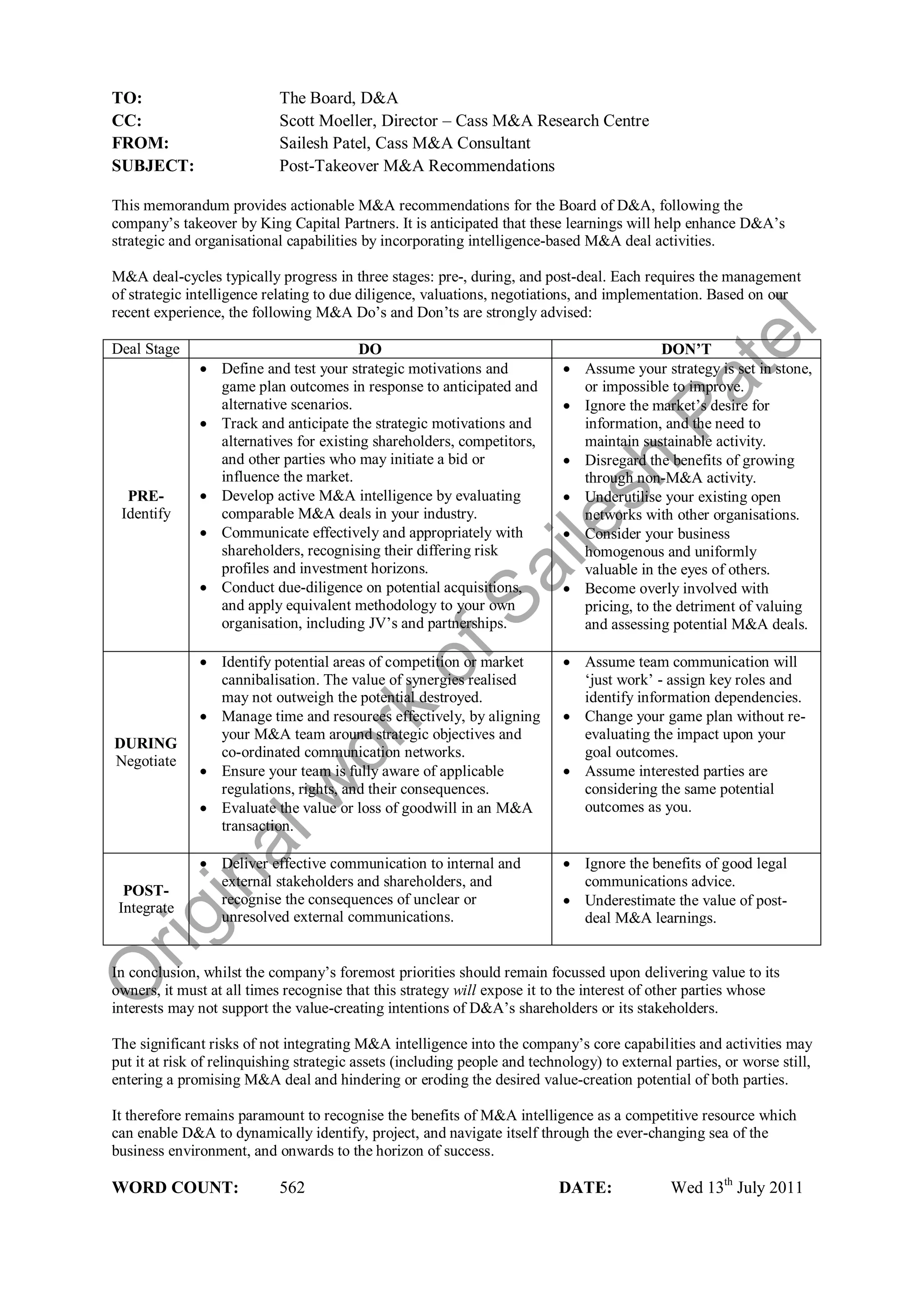
M&A deal-cycles typically progress in three stages: pre-, during, and post-deal. Each requires the management
of strategic intelligence relating to due diligence, valuations, negotiations, and implementation. Based on our
recent experience, the following M&A Do’s and Don’ts are strongly advised:


                                                                                                    el
Deal Stage                              DO                                                  DON’T
               Define and test your strategic motivations and               Assume your strategy is set in stone,


                                                                                         t
                game plan outcomes in response to anticipated and             or impossible to improve.


                                                                                      Pa
                alternative scenarios.                                       Ignore the market’s desire for
               Track and anticipate the strategic motivations and            information, and the need to
                alternatives for existing shareholders, competitors,          maintain sustainable activity.
                and other parties who may initiate a bid or                  Disregard the benefits of growing


                                                                          sh
                influence the market.                                         through non-M&A activity.
  PRE-         Develop active M&A intelligence by evaluating                Underutilise your existing open
 Identify       comparable M&A deals in your industry.                        networks with other organisations.


                                                                  ile
               Communicate effectively and appropriately with               Consider your business
                shareholders, recognising their differing risk                homogenous and uniformly
                profiles and investment horizons.                             valuable in the eyes of others.
                                                       Sa
               Conduct due-diligence on potential acquisitions,             Become overly involved with
                and apply equivalent methodology to your own                  pricing, to the detriment of valuing
                organisation, including JV’s and partnerships.                and assessing potential M&A deals.
                                             of

               Identify potential areas of competition or market            Assume team communication will
                cannibalisation. The value of synergies realised              ‘just work’ - assign key roles and
                may not outweigh the potential destroyed.                     identify information dependencies.
                          k


               Manage time and resources effectively, by aligning           Change your game plan without re-
                your M&A team around strategic objectives and                 evaluating the impact upon your
                        or


DURING
                co-ordinated communication networks.                          goal outcomes.
Negotiate
               Ensure your team is fully aware of applicable                Assume interested parties are
                       w


                regulations, rights, and their consequences.                  considering the same potential
               Evaluate the value or loss of goodwill in an M&A              outcomes as you.
                transaction.
              al


               Deliver effective communication to internal and              Ignore the benefits of good legal
       in


                external stakeholders and shareholders, and                   communications advice.
  POST-
 Integrate
                recognise the consequences of unclear or                     Underestimate the value of post-
                unresolved external communications.                           deal M&A learnings.
rig


In conclusion, whilst the company’s foremost priorities should remain focussed upon delivering value to its
O


owners, it must at all times recognise that this strategy will expose it to the interest of other parties whose
interests may not support the value-creating intentions of D&A’s shareholders or its stakeholders.

The significant risks of not integrating M&A intelligence into the company’s core capabilities and activities may
put it at risk of relinquishing strategic assets (including people and technology) to external parties, or worse still,
entering a promising M&A deal and hindering or eroding the desired value-creation potential of both parties.

It therefore remains paramount to recognise the benefits of M&A intelligence as a competitive resource which
can enable D&A to dynamically identify, project, and navigate itself through the ever-changing sea of the
business environment, and onwards to the horizon of success.

WORD COUNT:                 562                                            DATE:              Wed 13th July 2011

M&A: Pre, During, and Post-Merger recommendations

  • 1.
    TO: The Board, D&A CC: Scott Moeller, Director – Cass M&A Research Centre FROM: Sailesh Patel, Cass M&A Consultant SUBJECT: Post-Takeover M&A Recommendations This memorandum provides actionable M&A recommendations for the Board of D&A, following the company’s takeover by King Capital Partners. It is anticipated that these learnings will help enhance D&A’s strategic and organisational capabilities by incorporating intelligence-based M&A deal activities. M&A deal-cycles typically progress in three stages: pre-, during, and post-deal. Each requires the management of strategic intelligence relating to due diligence, valuations, negotiations, and implementation. Based on our recent experience, the following M&A Do’s and Don’ts are strongly advised: el Deal Stage DO DON’T  Define and test your strategic motivations and  Assume your strategy is set in stone, t game plan outcomes in response to anticipated and or impossible to improve. Pa alternative scenarios.  Ignore the market’s desire for  Track and anticipate the strategic motivations and information, and the need to alternatives for existing shareholders, competitors, maintain sustainable activity. and other parties who may initiate a bid or  Disregard the benefits of growing sh influence the market. through non-M&A activity. PRE-  Develop active M&A intelligence by evaluating  Underutilise your existing open Identify comparable M&A deals in your industry. networks with other organisations. ile  Communicate effectively and appropriately with  Consider your business shareholders, recognising their differing risk homogenous and uniformly profiles and investment horizons. valuable in the eyes of others. Sa  Conduct due-diligence on potential acquisitions,  Become overly involved with and apply equivalent methodology to your own pricing, to the detriment of valuing organisation, including JV’s and partnerships. and assessing potential M&A deals. of  Identify potential areas of competition or market  Assume team communication will cannibalisation. The value of synergies realised ‘just work’ - assign key roles and may not outweigh the potential destroyed. identify information dependencies. k  Manage time and resources effectively, by aligning  Change your game plan without re- your M&A team around strategic objectives and evaluating the impact upon your or DURING co-ordinated communication networks. goal outcomes. Negotiate  Ensure your team is fully aware of applicable  Assume interested parties are w regulations, rights, and their consequences. considering the same potential  Evaluate the value or loss of goodwill in an M&A outcomes as you. transaction. al  Deliver effective communication to internal and  Ignore the benefits of good legal in external stakeholders and shareholders, and communications advice. POST- Integrate recognise the consequences of unclear or  Underestimate the value of post- unresolved external communications. deal M&A learnings. rig In conclusion, whilst the company’s foremost priorities should remain focussed upon delivering value to its O owners, it must at all times recognise that this strategy will expose it to the interest of other parties whose interests may not support the value-creating intentions of D&A’s shareholders or its stakeholders. The significant risks of not integrating M&A intelligence into the company’s core capabilities and activities may put it at risk of relinquishing strategic assets (including people and technology) to external parties, or worse still, entering a promising M&A deal and hindering or eroding the desired value-creation potential of both parties. It therefore remains paramount to recognise the benefits of M&A intelligence as a competitive resource which can enable D&A to dynamically identify, project, and navigate itself through the ever-changing sea of the business environment, and onwards to the horizon of success. WORD COUNT: 562 DATE: Wed 13th July 2011