THOMAS ECONOMETRICS

                                          quantitative solutions
                                                for workplace issues


                          The Fair Pay Act:
                            Implications for
                                Compensation
                                          Modeling


           Silver Lake Executive Campus
           41 University Drive
           Suite 400
           Newtown, PA 18940
           P: (215) 642-0072

           www.thomasecon.com


1 | Page
Introduction

      The Fair Pay Act of 2009 amends the Civil Rights Act of 1964, and
states that the 180-day statute of limitations for filing an equal pay claim
regarding pay discrimination resets with each new discriminatory paycheck.
This Act is a direct response to the Supreme Court’s decision in Ledbetter
v. Goodyear Tire & Rubber Co., which held that the statute of limitations for
presenting an equal pay claim begins at the date on which pay was agreed
upon, not at the date of the most recent paycheck.

      From an econometric or statistical perspective, the Supreme Court’s
decision in Ledbetter required that Courts focus on changes in
compensation during the relevant class period. The Fair Pay Act, however,
shifted the focus from changes in pay to current compensation levels. This
Act requires the examination of not only compensation decisions made
during the class period, but also compensation decisions and “all other
employment practices” that affect compensation, regardless of when in the
course of the individual’s employment such practices began.

      So how exactly does one construct a model of compensation
decisions? There are two primary approaches: human capital theory and
the “direct determinants” approach.


2 | Page
Human Capital Theory

      According to human capital theory, an individual’s compensation is a
function of his or her human capital. Human capital includes such factors
as education, prior experience, and seniority. Using this approach, the
econometrician models compensation as a function of human capital
variables:

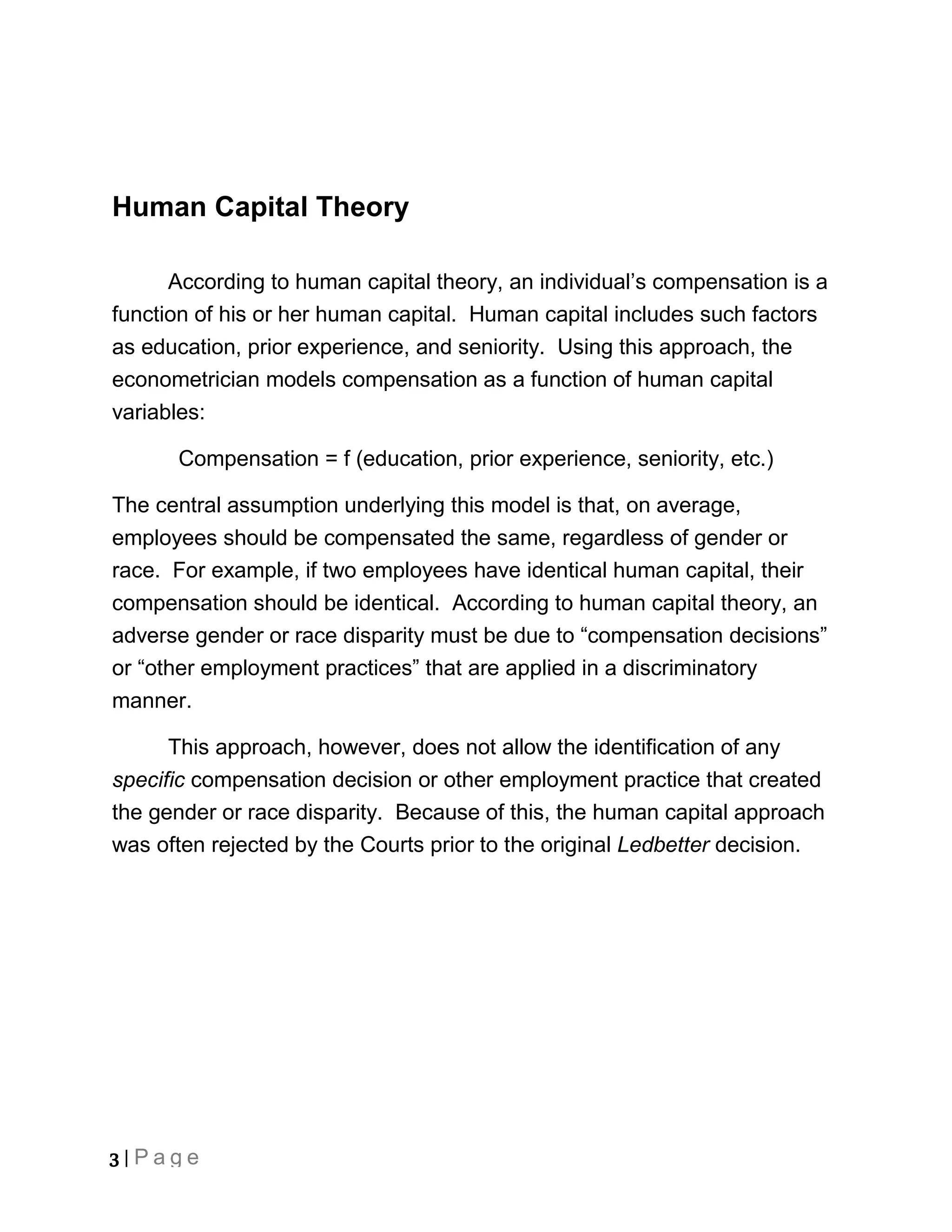
      Compensation = f (education, prior experience, seniority, etc.)

The central assumption underlying this model is that, on average,
employees should be compensated the same, regardless of gender or
race. For example, if two employees have identical human capital, their
compensation should be identical. According to human capital theory, an
adverse gender or race disparity must be due to “compensation decisions”
or “other employment practices” that are applied in a discriminatory
manner.

      This approach, however, does not allow the identification of any
specific compensation decision or other employment practice that created
the gender or race disparity. Because of this, the human capital approach
was often rejected by the Courts prior to the original Ledbetter decision.


3 | Page
”Direct Determinants” Approach


       An alternative to the human capital model is to construct a model that
includes all of the factors that directly determine compensation. Under this
approach, the econometrician includes in the model all of the factors that
directly determine compensation (the “direct determinants” of
compensation. In order to build such a model, it is critical to have a full
understanding of how compensation decisions are made. Some common
direct determinants of compensation include:

         Pay grade;

         Job title or job function;

         Demotion / red-circling of pay;

         Initial penetration in grade when hired;

         Time in grade;

         Performance ratings;

         Department or business segment.

      Theoretically, if one had access to all of the data on the direct
determinants of compensation and ran an ideal model, one would find that
compensation is perfectly predicted by these factors. No protected class
status variable would enter the model. That is, the model would show no
gender or race effects on compensation.


4 | Page
Under these conditions, could one infer that no discrimination exists?
No – discrimination may exist either as disparate impact or disparate
treatment.


Disparate Impact


       Disparate impact occurs when a neutrally applied practice
differentially affects the protected and unprotected classes. In the above
scenario, we cannot infer that no disparate impact exists. Each of the
factors (the “direct determinants”) in our model represents a compensation
decision or “other practice”. One could look at any of the factors in the
model and may be able to show that the underlying decision or other
practice had a disparate impact on the protected class.

       Statistically, one would be able to determine whether or not disparate
impact exists by simply removing one of the factors from the model and
adding in its place a variable for protected class status. The protected
class status coefficient would then measure the average effect of the
removed factor on the compensation of the protected class member. If the
model shows that protected class status is statistically and practically
significant, one can infer that the removed factor has a disparate impact.

      This would shift the burden to the employer, requiring the employer to
demonstrate that there is a valid business necessity for the use of the
factor and that no equally valid alternative factor with less impact is
available. Assuming that the employer could validate the use of such a
factor, the analytical inquiry into disparate impact may continue.


5 | Page
Consider the case of “department”. Assume that department is
deemed to be an “other factor” under the Fair Pay Act. There may be a
valid business justification for considering department in compensation
decisions, but assume that the plaintiff offers prima facie evidence that the
decisions regarding he department into which an employee is assigned
considers factors that cause disparate impact on the protected class.

      The practice being challenged as having a disparate impact would
then shift from a “direct determinant” (i.e., department) to an indirect
determinant (i.e., the factors considered in assigning an employee to a
department).


        It would seem as though if an indirect determinant has a disparate
impact on a direct determinant, and that particular direct determinant has a
disparate impact on compensation, one could infer disparate impact. That
is, if any direct determinant has a disparate impact, it would raise the
question of whether any of its indirect determinants has a disparate impact.


6 | Page
An interesting question arises if the direct determinant of
compensation does not have a disparate impact, but the indirect factor
does have a disparate impact on the direct determinant (i.e., the impact of
the indirect factor is offset by the effects of other indirect factors on the
direct factor). The decision of whether this would constitute actionable
disparate impact is one the courts must eventually resolve. In the context
of the classical theory of the disparate impact of “testing”, on could consider
the direct determinant to be the “test” and the indirect determinants to be
the components of which the test is constituted. Under that concept, the
components themselves would not be subject to challenge, unless the
“test” (i.e., the direct determinant) has a disparate impact.

       All of this, however, assumes that perfect data exists for all factors
affecting compensation decisions and all other employment decisions. In
reality, this is seldom the case; data on some factors simply may not exist,
and data for other factors may not be found in any reasonably accessible
form.

       In the case in which we infer disparate impact, the protected class
status variable will enter into the model along with all of the measurable
direct determinants of compensation. The coefficient associated with the
protected class status variable will measure the disparate impact on the
protected class as a result of all of the unmeasured determinants – both
direct and indirect – of compensation. The protected class status
coefficient expresses the “bottom line” impact of all of the determinants for
which no data exists. The effects of each of the unmeasured determinants
are not, and in fact cannot, be separated from one another. Under the
1991 Civil Rights Act, this would be an acceptable statistical analysis if and
only if data on these determinants was not available.


7 | Page
Disparate Treatment


       Disparate treatment refers to the case in which a practice is applied
differently for the protected and unprotected class members. An employee
may claim disparate treatment on an individual basis by claiming that, but
for the alleged discrimination, (s)he would have achieved a “better” value
on the direct determinant of compensation. The central question here is
whether the action at issue is an “other factor” under the Fair Pay Act.

       With respect to the question of disparate treatment on a class-wide
basis, the econometric issue is whether or not there is prima facie evidence
that similarly-situated protected and unprotected class members, on
average, do not have the same values on a direct determinant or an
indirect “other factor”, and whether or not the data support a claim of
commonality. That is, the analysis of disparate treatment is essentially the
same as it has always been, except that the outcome variable for which
disparate treatment is alleged is if the outcome on the direct determinant of
compensation.

      Little should change in the analysis of disparate treatment claims as a
result of the Fair Pay Act. The plaintiff will allege that some intentionally
discriminatory employment decision (either a direct or indirect determinant
of compensation) resulted in his or her compensation being “too low”.
However, under the Fair Pay Act, this event could occur at any time in the
employee’s career with the employer. An employee could provide
evidence that if (s)he would have scored “better” on any direct or indirect
determinant of compensation, but for the alleged intentional discrimination.
As long as that event reflects an “other employment practice”, the event
would no longer need to occur within the relevant time period.

8 | Page
For a class claim, the disparate treatment question concerns whether
similarly-situated protected and non-protected employees, on average,
have different “bottom-line determinant scores”. This could be examined
by studying compensation as a function of (a) protected class status (the
coefficient of which indicates possible disparate treatment), (b) all of the
measurable determinants of compensation, and (c) all of the factors making
protected and non-protected class members similarly situated with respect
to the unmeasured, un-measurable, omitted factors affecting
compensation. Since we are dealing with an amalgam of unmeasured, un-
measurable, and omitted factors, defining “similarly situated” may become
very complex.


Conclusion


      In conclusion, the Fair Pay Act returns the statistical analysis of
disparate impact and disparate treatment to where it was prior to the
Supreme Court’s ruling in Ledbetter. However, going forward, cases will
force the court to specify exactly what is meant by “other factors”. This, in
turn, will determine the focus of the statistical analysis performed.


9 | Page

eBbook: The Fair Pay Act and Implications For Compensation Modeling

  • 1.
    THOMAS ECONOMETRICS quantitative solutions for workplace issues The Fair Pay Act: Implications for Compensation Modeling Silver Lake Executive Campus 41 University Drive Suite 400 Newtown, PA 18940 P: (215) 642-0072 www.thomasecon.com 1 | Page
  • 2.
    Introduction The Fair Pay Act of 2009 amends the Civil Rights Act of 1964, and states that the 180-day statute of limitations for filing an equal pay claim regarding pay discrimination resets with each new discriminatory paycheck. This Act is a direct response to the Supreme Court’s decision in Ledbetter v. Goodyear Tire & Rubber Co., which held that the statute of limitations for presenting an equal pay claim begins at the date on which pay was agreed upon, not at the date of the most recent paycheck. From an econometric or statistical perspective, the Supreme Court’s decision in Ledbetter required that Courts focus on changes in compensation during the relevant class period. The Fair Pay Act, however, shifted the focus from changes in pay to current compensation levels. This Act requires the examination of not only compensation decisions made during the class period, but also compensation decisions and “all other employment practices” that affect compensation, regardless of when in the course of the individual’s employment such practices began. So how exactly does one construct a model of compensation decisions? There are two primary approaches: human capital theory and the “direct determinants” approach. 2 | Page
  • 3.
    Human Capital Theory According to human capital theory, an individual’s compensation is a function of his or her human capital. Human capital includes such factors as education, prior experience, and seniority. Using this approach, the econometrician models compensation as a function of human capital variables: Compensation = f (education, prior experience, seniority, etc.) The central assumption underlying this model is that, on average, employees should be compensated the same, regardless of gender or race. For example, if two employees have identical human capital, their compensation should be identical. According to human capital theory, an adverse gender or race disparity must be due to “compensation decisions” or “other employment practices” that are applied in a discriminatory manner. This approach, however, does not allow the identification of any specific compensation decision or other employment practice that created the gender or race disparity. Because of this, the human capital approach was often rejected by the Courts prior to the original Ledbetter decision. 3 | Page
  • 4.
    ”Direct Determinants” Approach An alternative to the human capital model is to construct a model that includes all of the factors that directly determine compensation. Under this approach, the econometrician includes in the model all of the factors that directly determine compensation (the “direct determinants” of compensation. In order to build such a model, it is critical to have a full understanding of how compensation decisions are made. Some common direct determinants of compensation include:  Pay grade;  Job title or job function;  Demotion / red-circling of pay;  Initial penetration in grade when hired;  Time in grade;  Performance ratings;  Department or business segment. Theoretically, if one had access to all of the data on the direct determinants of compensation and ran an ideal model, one would find that compensation is perfectly predicted by these factors. No protected class status variable would enter the model. That is, the model would show no gender or race effects on compensation. 4 | Page
  • 5.
    Under these conditions,could one infer that no discrimination exists? No – discrimination may exist either as disparate impact or disparate treatment. Disparate Impact Disparate impact occurs when a neutrally applied practice differentially affects the protected and unprotected classes. In the above scenario, we cannot infer that no disparate impact exists. Each of the factors (the “direct determinants”) in our model represents a compensation decision or “other practice”. One could look at any of the factors in the model and may be able to show that the underlying decision or other practice had a disparate impact on the protected class. Statistically, one would be able to determine whether or not disparate impact exists by simply removing one of the factors from the model and adding in its place a variable for protected class status. The protected class status coefficient would then measure the average effect of the removed factor on the compensation of the protected class member. If the model shows that protected class status is statistically and practically significant, one can infer that the removed factor has a disparate impact. This would shift the burden to the employer, requiring the employer to demonstrate that there is a valid business necessity for the use of the factor and that no equally valid alternative factor with less impact is available. Assuming that the employer could validate the use of such a factor, the analytical inquiry into disparate impact may continue. 5 | Page
  • 6.
    Consider the caseof “department”. Assume that department is deemed to be an “other factor” under the Fair Pay Act. There may be a valid business justification for considering department in compensation decisions, but assume that the plaintiff offers prima facie evidence that the decisions regarding he department into which an employee is assigned considers factors that cause disparate impact on the protected class. The practice being challenged as having a disparate impact would then shift from a “direct determinant” (i.e., department) to an indirect determinant (i.e., the factors considered in assigning an employee to a department). It would seem as though if an indirect determinant has a disparate impact on a direct determinant, and that particular direct determinant has a disparate impact on compensation, one could infer disparate impact. That is, if any direct determinant has a disparate impact, it would raise the question of whether any of its indirect determinants has a disparate impact. 6 | Page
  • 7.
    An interesting questionarises if the direct determinant of compensation does not have a disparate impact, but the indirect factor does have a disparate impact on the direct determinant (i.e., the impact of the indirect factor is offset by the effects of other indirect factors on the direct factor). The decision of whether this would constitute actionable disparate impact is one the courts must eventually resolve. In the context of the classical theory of the disparate impact of “testing”, on could consider the direct determinant to be the “test” and the indirect determinants to be the components of which the test is constituted. Under that concept, the components themselves would not be subject to challenge, unless the “test” (i.e., the direct determinant) has a disparate impact. All of this, however, assumes that perfect data exists for all factors affecting compensation decisions and all other employment decisions. In reality, this is seldom the case; data on some factors simply may not exist, and data for other factors may not be found in any reasonably accessible form. In the case in which we infer disparate impact, the protected class status variable will enter into the model along with all of the measurable direct determinants of compensation. The coefficient associated with the protected class status variable will measure the disparate impact on the protected class as a result of all of the unmeasured determinants – both direct and indirect – of compensation. The protected class status coefficient expresses the “bottom line” impact of all of the determinants for which no data exists. The effects of each of the unmeasured determinants are not, and in fact cannot, be separated from one another. Under the 1991 Civil Rights Act, this would be an acceptable statistical analysis if and only if data on these determinants was not available. 7 | Page
  • 8.
    Disparate Treatment Disparate treatment refers to the case in which a practice is applied differently for the protected and unprotected class members. An employee may claim disparate treatment on an individual basis by claiming that, but for the alleged discrimination, (s)he would have achieved a “better” value on the direct determinant of compensation. The central question here is whether the action at issue is an “other factor” under the Fair Pay Act. With respect to the question of disparate treatment on a class-wide basis, the econometric issue is whether or not there is prima facie evidence that similarly-situated protected and unprotected class members, on average, do not have the same values on a direct determinant or an indirect “other factor”, and whether or not the data support a claim of commonality. That is, the analysis of disparate treatment is essentially the same as it has always been, except that the outcome variable for which disparate treatment is alleged is if the outcome on the direct determinant of compensation. Little should change in the analysis of disparate treatment claims as a result of the Fair Pay Act. The plaintiff will allege that some intentionally discriminatory employment decision (either a direct or indirect determinant of compensation) resulted in his or her compensation being “too low”. However, under the Fair Pay Act, this event could occur at any time in the employee’s career with the employer. An employee could provide evidence that if (s)he would have scored “better” on any direct or indirect determinant of compensation, but for the alleged intentional discrimination. As long as that event reflects an “other employment practice”, the event would no longer need to occur within the relevant time period. 8 | Page
  • 9.
    For a classclaim, the disparate treatment question concerns whether similarly-situated protected and non-protected employees, on average, have different “bottom-line determinant scores”. This could be examined by studying compensation as a function of (a) protected class status (the coefficient of which indicates possible disparate treatment), (b) all of the measurable determinants of compensation, and (c) all of the factors making protected and non-protected class members similarly situated with respect to the unmeasured, un-measurable, omitted factors affecting compensation. Since we are dealing with an amalgam of unmeasured, un- measurable, and omitted factors, defining “similarly situated” may become very complex. Conclusion In conclusion, the Fair Pay Act returns the statistical analysis of disparate impact and disparate treatment to where it was prior to the Supreme Court’s ruling in Ledbetter. However, going forward, cases will force the court to specify exactly what is meant by “other factors”. This, in turn, will determine the focus of the statistical analysis performed. 9 | Page