1 
1 
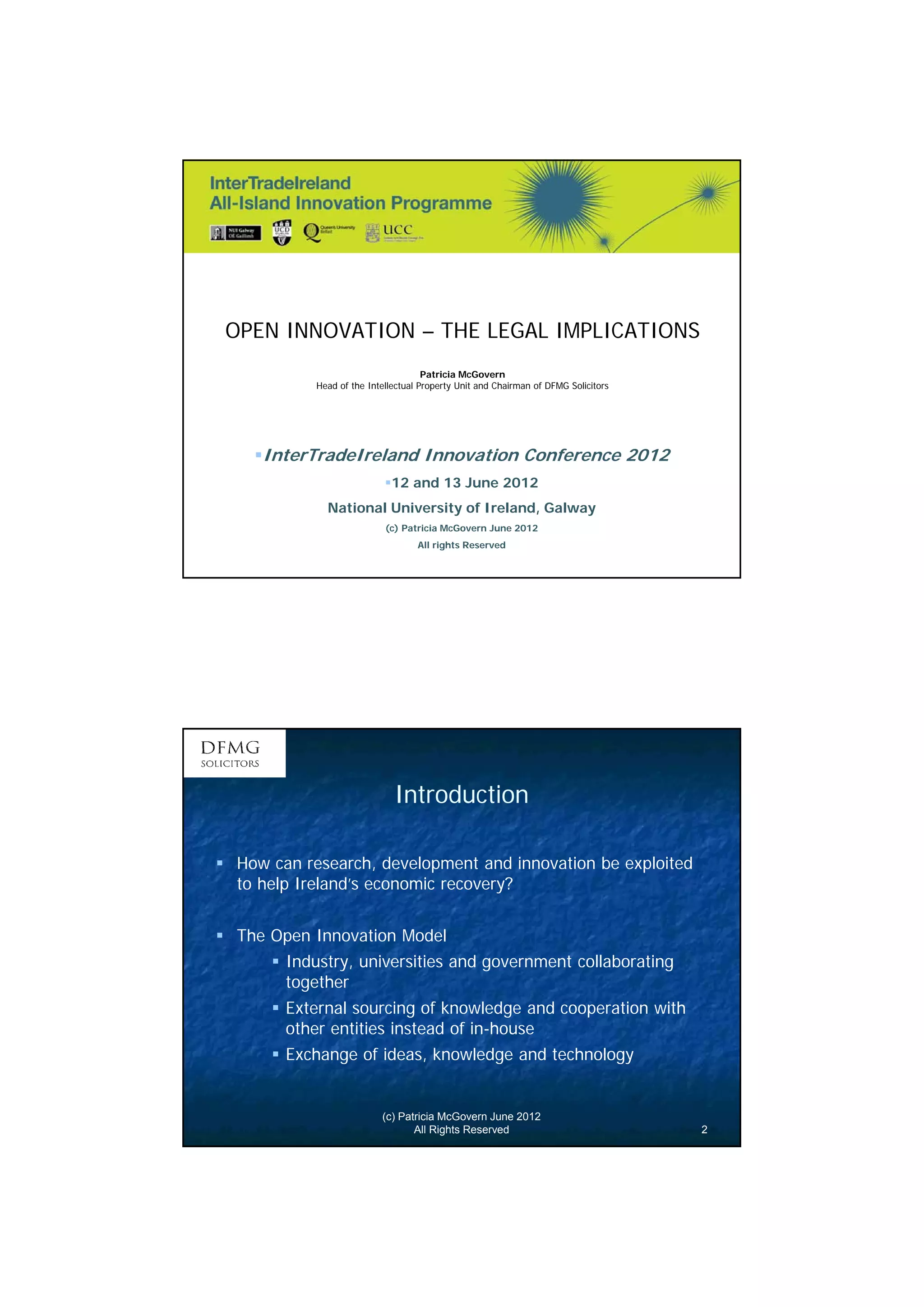
OPEN INNOVATION – THE LEGAL IMPLICATIONS 
Patricia McGovern 
Head of the Intellectual Property Unit and Chairman of DFMG Solicitors 
InterTradeIreland Innovation Conference 2012 
12 and 13 June 2012 
National University of Ireland, Galway 
(c) Patricia McGovern June 2012 
All rights Reserved 
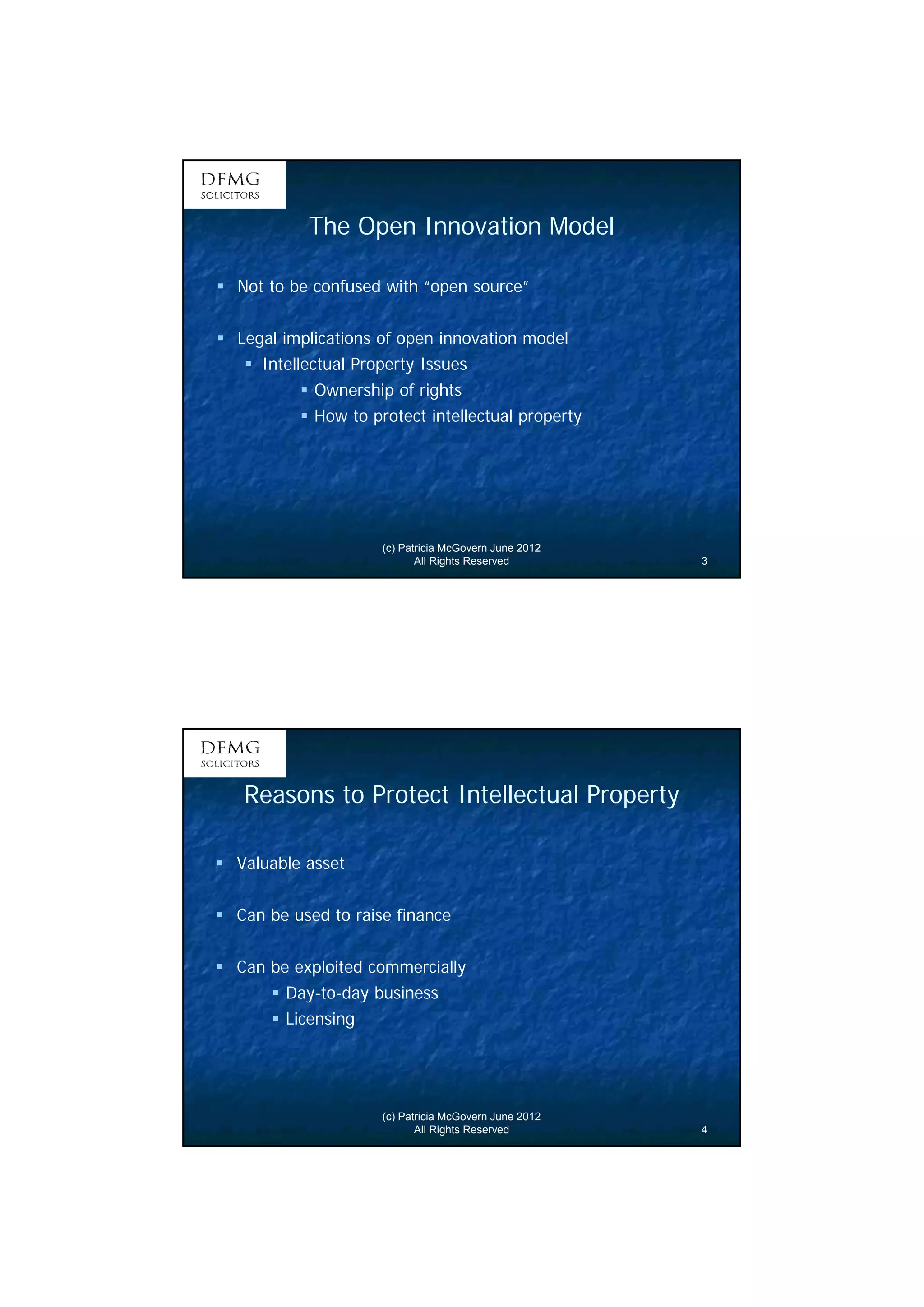
Introduction 
 How can research, development and innovation be exploited 
to help Ireland’s economic recovery? 
 The Open Innovation Model 
 Industry, universities and government collaborating 
together 
 External sourcing of knowledge and cooperation with 
other entities instead of in-house 
 Exchange of ideas, knowledge and technology 
(c) Patricia McGovern June 2012 
All Rights Reserved 2
2 
The Open Innovation Model 
 Not to be confused with “open source” 
 Legal implications of open innovation model 
 Intellectual Property Issues 
 Ownership of rights 
 How to protect intellectual property 
(c) Patricia McGovern June 2012 
All Rights Reserved 3 
Reasons to Protect Intellectual Property 
(c) Patricia McGovern June 2012 
All Rights Reserved 4 
 Valuable asset 
 Can be used to raise finance 
 Can be exploited commercially 
 Day-to-day business 
 Licensing
3 
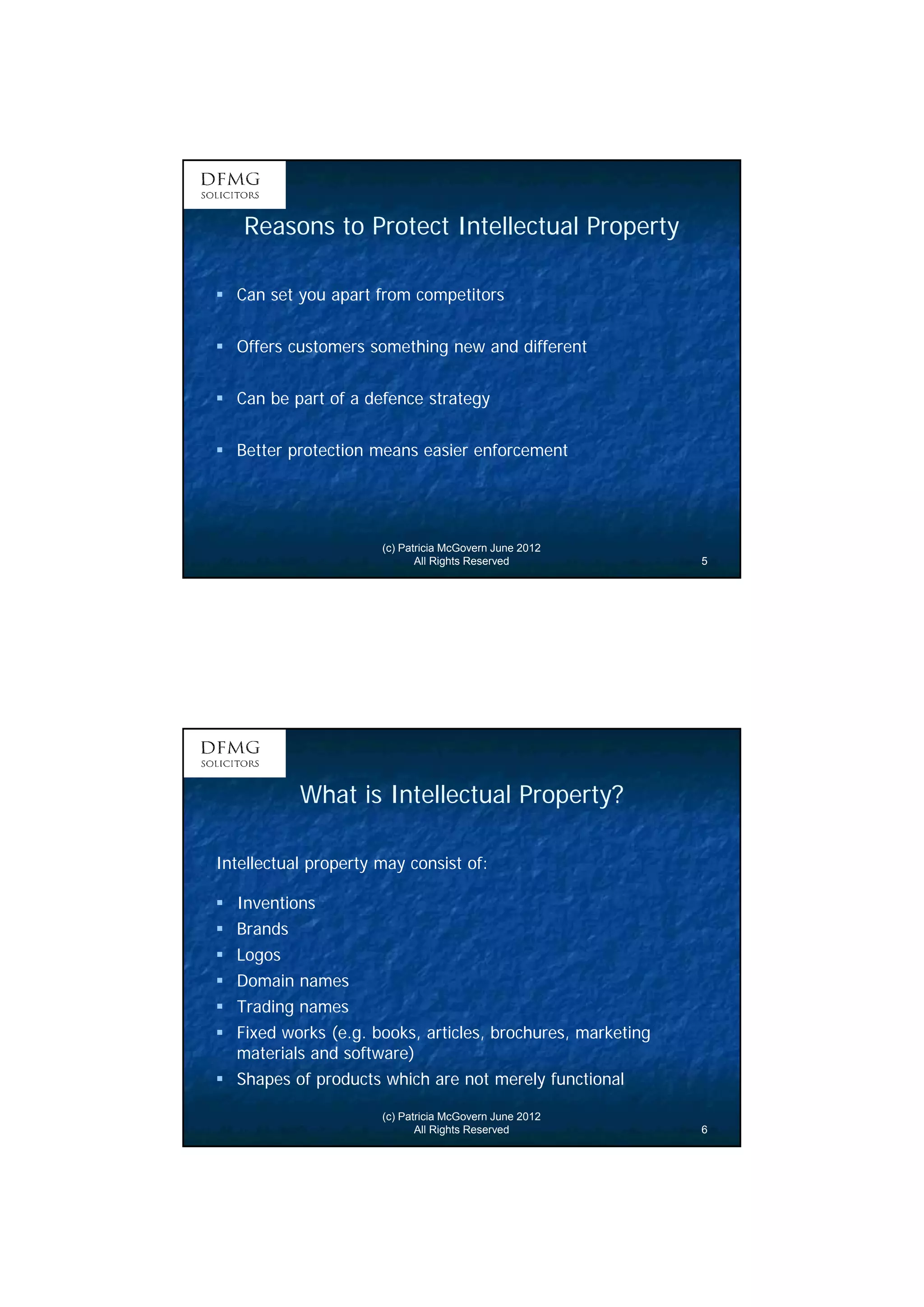
Reasons to Protect Intellectual Property 
 Can set you apart from competitors 
 Offers customers something new and different 
 Can be part of a defence strategy 
 Better protection means easier enforcement 
(c) Patricia McGovern June 2012 
All Rights Reserved 5 
What is Intellectual Property? 
Intellectual property may consist of: 
 Inventions 
 Brands 
 Logos 
 Domain names 
 Trading names 
 Fixed works (e.g. books, articles, brochures, marketing 
materials and software) 
 Shapes of products which are not merely functional 
(c) Patricia McGovern June 2012 
All Rights Reserved 6
4 
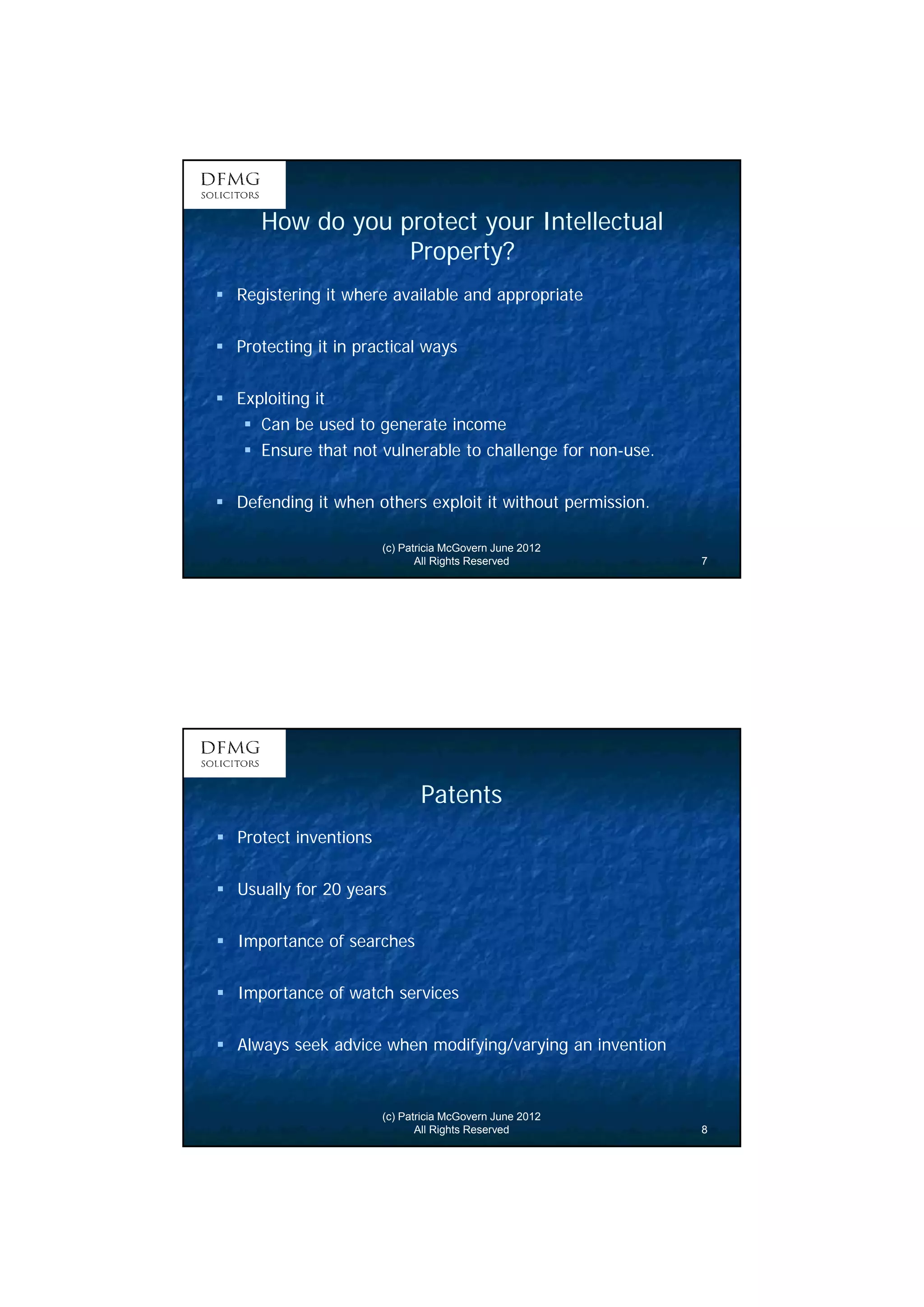
How do you protect your Intellectual 
Property? 
 Registering it where available and appropriate 
 Protecting it in practical ways 
(c) Patricia McGovern June 2012 
All Rights Reserved 7 
 Exploiting it 
 Can be used to generate income 
 Ensure that not vulnerable to challenge for non-use. 
 Defending it when others exploit it without permission. 
Patents 
(c) Patricia McGovern June 2012 
All Rights Reserved 8 
 Protect inventions 
 Usually for 20 years 
 Importance of searches 
 Importance of watch services 
 Always seek advice when modifying/varying an invention
5 
Trade Marks 
 Can be brands, logos, sounds, smells and colours 
 The way that goods and services and/or a corporate identity 
are represented 
 Must be distinctive - serves as a badge of origin 
(c) Patricia McGovern June 2012 
All Rights Reserved 9 
Trade Marks 
(c) Patricia McGovern June 2012 
All Rights Reserved 10 
 Passing Off 
 Common law protection 
 where it can be shown that a business has a reputation in 
the particular name 
 Should always register a trade mark where possible 
 Importance of searches
6 
Trade Marks 
(c) Patricia McGovern June 2012 
All Rights Reserved 11 
 Cancellation 
 using it in way it was registered? 
 Specification 
 still accurate? 
 Selling/Licensing unused marks 
Trade Marks 
(c) Patricia McGovern June 2012 
All Rights Reserved 12 
 Company Names 
 Does a company already exist with name? 
 Consider registering business name incorporating trade 
mark 
 Domain Names 
 Register trade mark as domain name
7 
Design Rights 
 Protection for the physical appearance of items. 
 Can distinguish your goods from those of competitors. 
 Can be registered and unregistered. 
 Unregistered design rights last for 3 years. 
 Registered design rights last for five years initially but can 
be renewed every five years for a maximum of 25 years. 
(c) Patricia McGovern June 2012 
All Rights Reserved 13 
Copyright 
 Protection of original literary, artistic, musical or dramatic 
works. 
(c) Patricia McGovern June 2012 
All Rights Reserved 14 
 Not a registered right 
 The copyright symbol and the date should always be placed 
on all hard copy items
8 
Territoriality 
 Protection usually territorial for patents, trade marks and 
designs 
 Important to identify countries of interest 
 Open Innovation Model seeks to use intellectual property 
rights for commercial benefit 
(c) Patricia McGovern June 2012 
All Rights Reserved 15 
Practical Ways to Protect Intellectual 
Property 
 Clear agreements with employees 
 Recordal of information in logbooks 
 Confidentiality provisions 
 Clear agreements with independent contractors 
 Keep all information secure 
(c) Patricia McGovern June 2012 
All Rights Reserved 16
9 
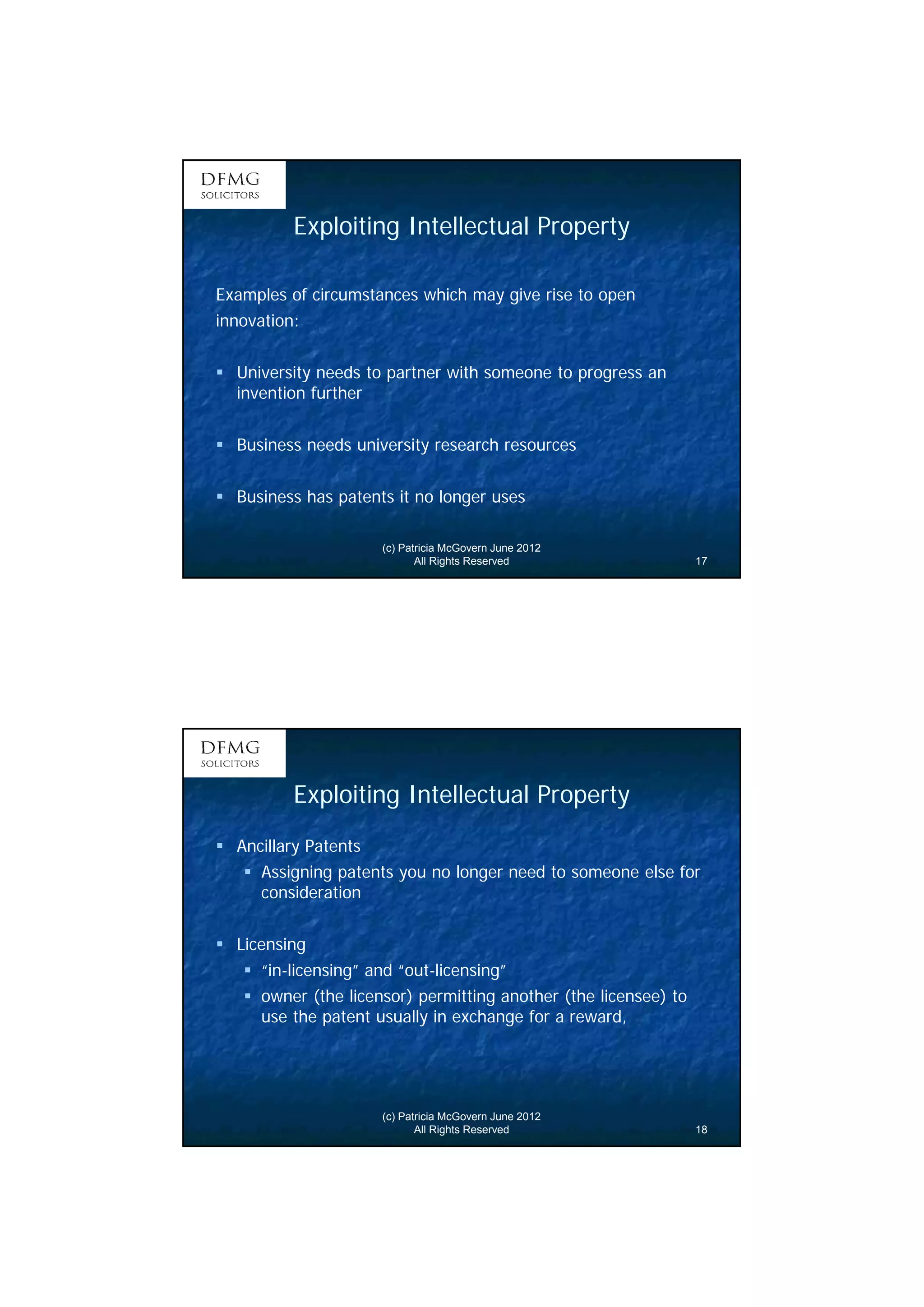
Exploiting Intellectual Property 
Examples of circumstances which may give rise to open 
innovation: 
 University needs to partner with someone to progress an 
invention further 
 Business needs university research resources 
 Business has patents it no longer uses 
(c) Patricia McGovern June 2012 
All Rights Reserved 17 
Exploiting Intellectual Property 
(c) Patricia McGovern June 2012 
All Rights Reserved 18 
 Ancillary Patents 
 Assigning patents you no longer need to someone else for 
consideration 
 Licensing 
 “in-licensing” and “out-licensing” 
 owner (the licensor) permitting another (the licensee) to 
use the patent usually in exchange for a reward,
10 
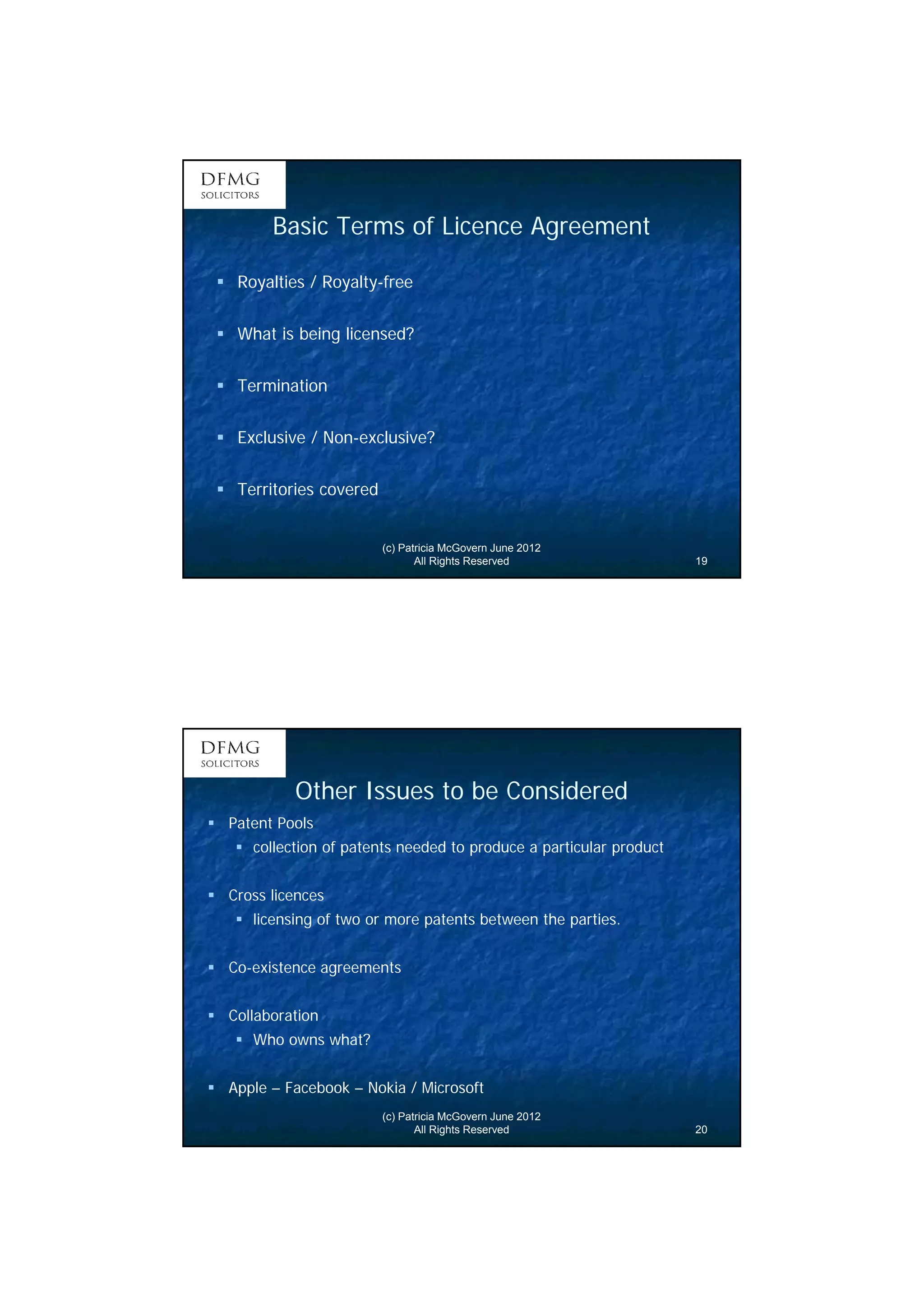
Basic Terms of Licence Agreement 
(c) Patricia McGovern June 2012 
All Rights Reserved 19 
 Royalties / Royalty-free 
 What is being licensed? 
 Termination 
 Exclusive / Non-exclusive? 
 Territories covered 
Other Issues to be Considered 
(c) Patricia McGovern June 2012 
All Rights Reserved 20 
 Patent Pools 
 collection of patents needed to produce a particular product 
 Cross licences 
 licensing of two or more patents between the parties. 
 Co-existence agreements 
 Collaboration 
 Who owns what? 
 Apple – Facebook – Nokia / Microsoft
11 
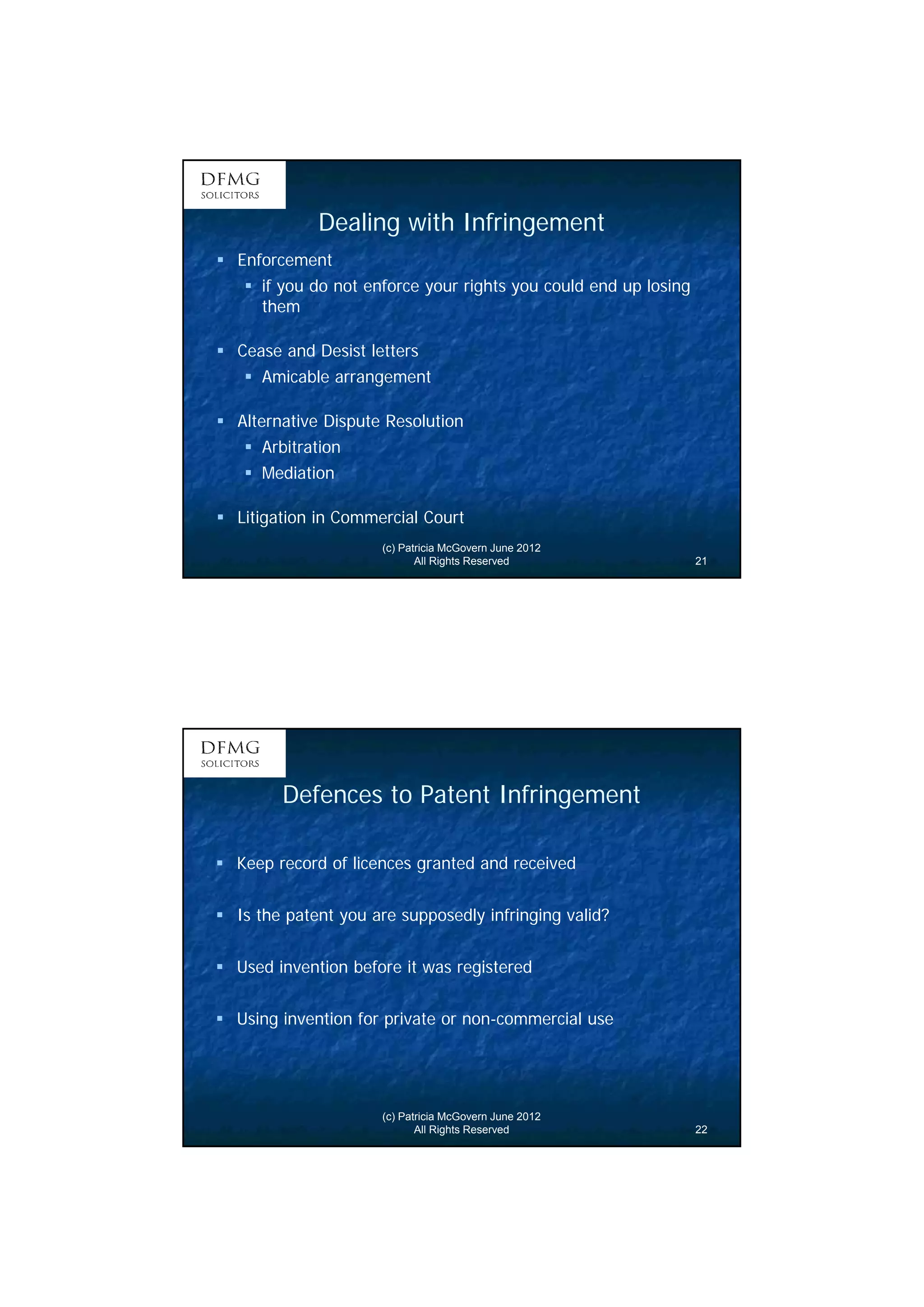
Dealing with Infringement 
(c) Patricia McGovern June 2012 
All Rights Reserved 21 
 Enforcement 
 if you do not enforce your rights you could end up losing 
them 
 Cease and Desist letters 
 Amicable arrangement 
 Alternative Dispute Resolution 
 Arbitration 
 Mediation 
 Litigation in Commercial Court 
Defences to Patent Infringement 
 Keep record of licences granted and received 
 Is the patent you are supposedly infringing valid? 
 Used invention before it was registered 
 Using invention for private or non-commercial use 
(c) Patricia McGovern June 2012 
All Rights Reserved 22
12 
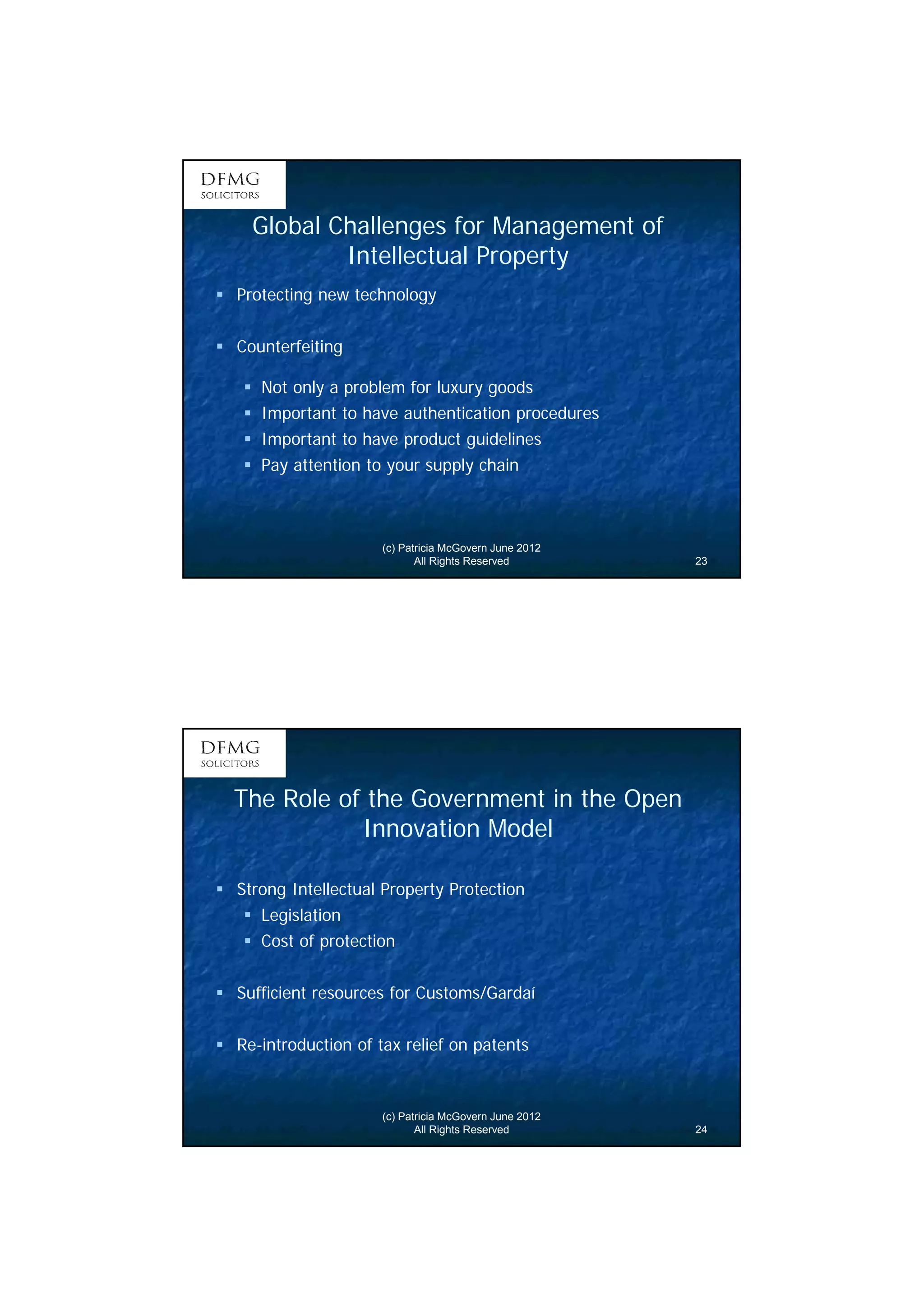
Global Challenges for Management of 
Intellectual Property 
 Protecting new technology 
(c) Patricia McGovern June 2012 
All Rights Reserved 23 
 Counterfeiting 
 Not only a problem for luxury goods 
 Important to have authentication procedures 
 Important to have product guidelines 
 Pay attention to your supply chain 
The Role of the Government in the Open 
Innovation Model 
 Strong Intellectual Property Protection 
(c) Patricia McGovern June 2012 
All Rights Reserved 24 
 Legislation 
 Cost of protection 
 Sufficient resources for Customs/Gardaí 
 Re-introduction of tax relief on patents
13 
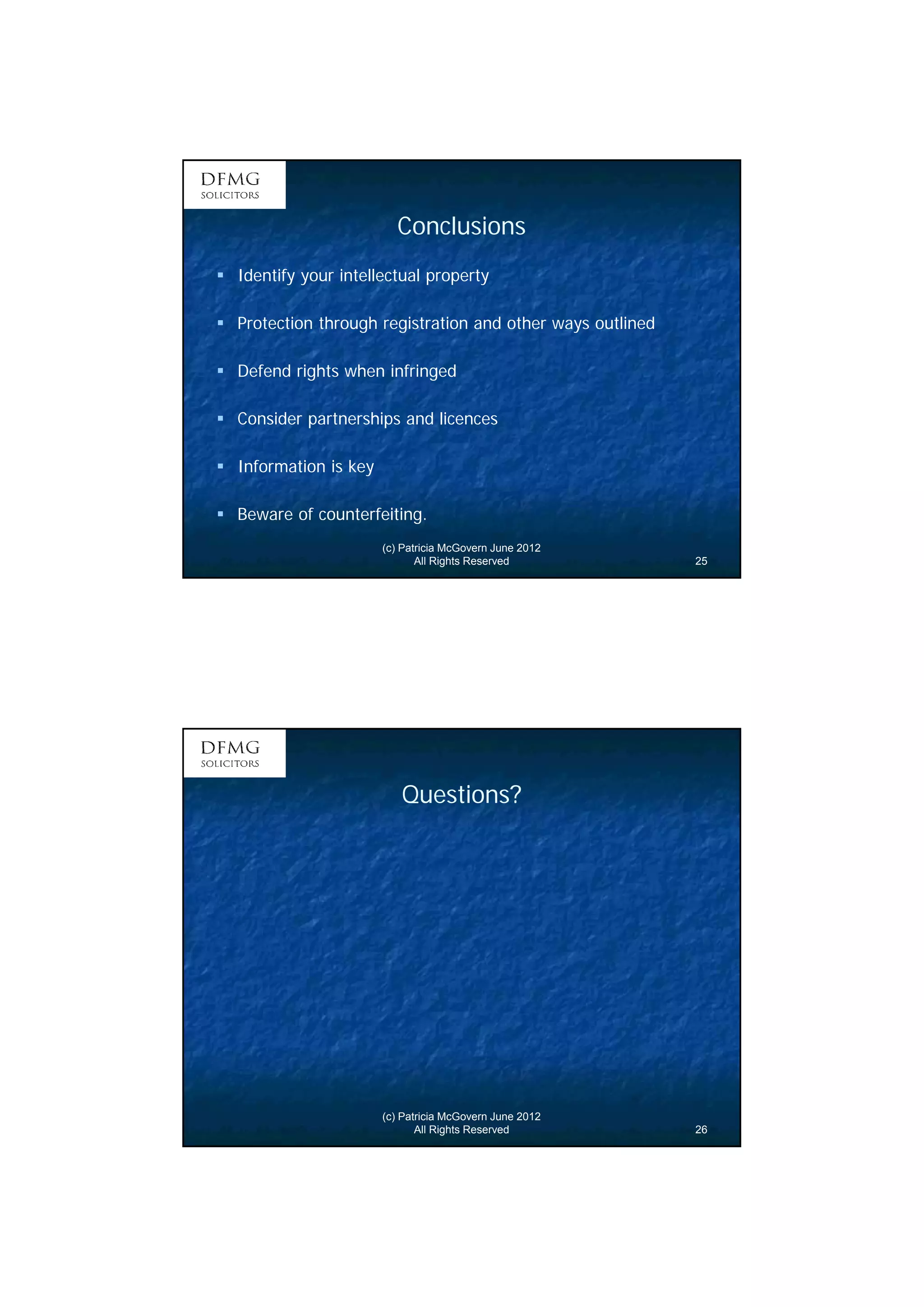
Conclusions 
 Identify your intellectual property 
 Protection through registration and other ways outlined 
 Defend rights when infringed 
 Consider partnerships and licences 
(c) Patricia McGovern June 2012 
All Rights Reserved 25 
 Information is key 
 Beware of counterfeiting. 
Questions? 
(c) Patricia McGovern June 2012 
All Rights Reserved 26
14 
Thank You 
Patricia McGovern 
DFMG Solicitors 
Embassy House 
Ballsbridge 
Dublin 4 
Ireland 
Tel: +353 (0) 1 637 6600 
Fax: +353 (0) 1 637 6601 
Email: pmcgovern@dfmgsolicitors.ie 
Website: www.dfmgsolicitors.ie 
InterTradeIreland Innovation Conference 2012 
Delivered as part of the InterTradeIreland All-Island Innovation Programme 
12 and 13 June 2012 
National University of Ireland, Galway 
(c) Patricia McGovern June 2012 
All Rights Reserved 27

2012.06.13 Open Innovation: The Legal Implications part 2

  • 1.
    1 1 OPENINNOVATION – THE LEGAL IMPLICATIONS Patricia McGovern Head of the Intellectual Property Unit and Chairman of DFMG Solicitors InterTradeIreland Innovation Conference 2012 12 and 13 June 2012 National University of Ireland, Galway (c) Patricia McGovern June 2012 All rights Reserved Introduction  How can research, development and innovation be exploited to help Ireland’s economic recovery?  The Open Innovation Model  Industry, universities and government collaborating together  External sourcing of knowledge and cooperation with other entities instead of in-house  Exchange of ideas, knowledge and technology (c) Patricia McGovern June 2012 All Rights Reserved 2
  • 2.
    2 The OpenInnovation Model  Not to be confused with “open source”  Legal implications of open innovation model  Intellectual Property Issues  Ownership of rights  How to protect intellectual property (c) Patricia McGovern June 2012 All Rights Reserved 3 Reasons to Protect Intellectual Property (c) Patricia McGovern June 2012 All Rights Reserved 4  Valuable asset  Can be used to raise finance  Can be exploited commercially  Day-to-day business  Licensing
  • 3.
    3 Reasons toProtect Intellectual Property  Can set you apart from competitors  Offers customers something new and different  Can be part of a defence strategy  Better protection means easier enforcement (c) Patricia McGovern June 2012 All Rights Reserved 5 What is Intellectual Property? Intellectual property may consist of:  Inventions  Brands  Logos  Domain names  Trading names  Fixed works (e.g. books, articles, brochures, marketing materials and software)  Shapes of products which are not merely functional (c) Patricia McGovern June 2012 All Rights Reserved 6
  • 4.
    4 How doyou protect your Intellectual Property?  Registering it where available and appropriate  Protecting it in practical ways (c) Patricia McGovern June 2012 All Rights Reserved 7  Exploiting it  Can be used to generate income  Ensure that not vulnerable to challenge for non-use.  Defending it when others exploit it without permission. Patents (c) Patricia McGovern June 2012 All Rights Reserved 8  Protect inventions  Usually for 20 years  Importance of searches  Importance of watch services  Always seek advice when modifying/varying an invention
  • 5.
    5 Trade Marks  Can be brands, logos, sounds, smells and colours  The way that goods and services and/or a corporate identity are represented  Must be distinctive - serves as a badge of origin (c) Patricia McGovern June 2012 All Rights Reserved 9 Trade Marks (c) Patricia McGovern June 2012 All Rights Reserved 10  Passing Off  Common law protection  where it can be shown that a business has a reputation in the particular name  Should always register a trade mark where possible  Importance of searches
  • 6.
    6 Trade Marks (c) Patricia McGovern June 2012 All Rights Reserved 11  Cancellation  using it in way it was registered?  Specification  still accurate?  Selling/Licensing unused marks Trade Marks (c) Patricia McGovern June 2012 All Rights Reserved 12  Company Names  Does a company already exist with name?  Consider registering business name incorporating trade mark  Domain Names  Register trade mark as domain name
  • 7.
    7 Design Rights  Protection for the physical appearance of items.  Can distinguish your goods from those of competitors.  Can be registered and unregistered.  Unregistered design rights last for 3 years.  Registered design rights last for five years initially but can be renewed every five years for a maximum of 25 years. (c) Patricia McGovern June 2012 All Rights Reserved 13 Copyright  Protection of original literary, artistic, musical or dramatic works. (c) Patricia McGovern June 2012 All Rights Reserved 14  Not a registered right  The copyright symbol and the date should always be placed on all hard copy items
  • 8.
    8 Territoriality Protection usually territorial for patents, trade marks and designs  Important to identify countries of interest  Open Innovation Model seeks to use intellectual property rights for commercial benefit (c) Patricia McGovern June 2012 All Rights Reserved 15 Practical Ways to Protect Intellectual Property  Clear agreements with employees  Recordal of information in logbooks  Confidentiality provisions  Clear agreements with independent contractors  Keep all information secure (c) Patricia McGovern June 2012 All Rights Reserved 16
  • 9.
    9 Exploiting IntellectualProperty Examples of circumstances which may give rise to open innovation:  University needs to partner with someone to progress an invention further  Business needs university research resources  Business has patents it no longer uses (c) Patricia McGovern June 2012 All Rights Reserved 17 Exploiting Intellectual Property (c) Patricia McGovern June 2012 All Rights Reserved 18  Ancillary Patents  Assigning patents you no longer need to someone else for consideration  Licensing  “in-licensing” and “out-licensing”  owner (the licensor) permitting another (the licensee) to use the patent usually in exchange for a reward,
  • 10.
    10 Basic Termsof Licence Agreement (c) Patricia McGovern June 2012 All Rights Reserved 19  Royalties / Royalty-free  What is being licensed?  Termination  Exclusive / Non-exclusive?  Territories covered Other Issues to be Considered (c) Patricia McGovern June 2012 All Rights Reserved 20  Patent Pools  collection of patents needed to produce a particular product  Cross licences  licensing of two or more patents between the parties.  Co-existence agreements  Collaboration  Who owns what?  Apple – Facebook – Nokia / Microsoft
  • 11.
    11 Dealing withInfringement (c) Patricia McGovern June 2012 All Rights Reserved 21  Enforcement  if you do not enforce your rights you could end up losing them  Cease and Desist letters  Amicable arrangement  Alternative Dispute Resolution  Arbitration  Mediation  Litigation in Commercial Court Defences to Patent Infringement  Keep record of licences granted and received  Is the patent you are supposedly infringing valid?  Used invention before it was registered  Using invention for private or non-commercial use (c) Patricia McGovern June 2012 All Rights Reserved 22
  • 12.
    12 Global Challengesfor Management of Intellectual Property  Protecting new technology (c) Patricia McGovern June 2012 All Rights Reserved 23  Counterfeiting  Not only a problem for luxury goods  Important to have authentication procedures  Important to have product guidelines  Pay attention to your supply chain The Role of the Government in the Open Innovation Model  Strong Intellectual Property Protection (c) Patricia McGovern June 2012 All Rights Reserved 24  Legislation  Cost of protection  Sufficient resources for Customs/Gardaí  Re-introduction of tax relief on patents
  • 13.
    13 Conclusions Identify your intellectual property  Protection through registration and other ways outlined  Defend rights when infringed  Consider partnerships and licences (c) Patricia McGovern June 2012 All Rights Reserved 25  Information is key  Beware of counterfeiting. Questions? (c) Patricia McGovern June 2012 All Rights Reserved 26
  • 14.
    14 Thank You Patricia McGovern DFMG Solicitors Embassy House Ballsbridge Dublin 4 Ireland Tel: +353 (0) 1 637 6600 Fax: +353 (0) 1 637 6601 Email: pmcgovern@dfmgsolicitors.ie Website: www.dfmgsolicitors.ie InterTradeIreland Innovation Conference 2012 Delivered as part of the InterTradeIreland All-Island Innovation Programme 12 and 13 June 2012 National University of Ireland, Galway (c) Patricia McGovern June 2012 All Rights Reserved 27