International Journal of Advanced Research in Engineering and Technology (IJARET), ISSN 0976 – 
6480(Print), ISSN 0976 – 6499(Online) Volume 5, Issue 6, June (2014), pp. 185-192 © IAEME 
INTERNATIONAL JOURNAL OF ADVANCED RESEARCH 
IN ENGINEERING AND TECHNOLOGY (IJARET) 
ISSN 0976 - 6480 (Print) 
ISSN 0976 - 6499 (Online) 
Volume 5, Issue 6, June (2014), pp. 185-192 
© IAEME: http://www.iaeme.com/IJARET.asp 
Journal Impact Factor (2014): 7.8273 (Calculated by GISI) 
www.jifactor.com 
IJARET 
© I A E M E 
EFFECT OF ALUMINA NANOPARTICLE ADDITION ON THE 
MECHANICAL AND WEAR BEHAVIOUR OF REINFORCED 
ACRYLONITRILE BUTADIENE STYRENE POLYMER 
Praful Kakde1, S N Paul2 
1, 2(Visveswaraya National Institute of Technology, Nagpur, India, 440010) 
185 
ABSTRACT 
Nanofillers are emerging class of fillers, which are used extensively in rubbers and plastics. 
In the present work, effect of alumina nanoparticle addition on the mechanical and wear behavior of 
reinforced acrylonitrile butadiene styrene (ABS) polymer has been investigated. Alumina 
nanoparticles were melt mixed with ABS polymer through a twin screw extruder. Tensile test results 
revealed the Young’s modulus and strength increasing with particle loading. Microscopic 
examinations revealed the presence of large plastic deformations at the micron scale in the 
nanocomposites in agreement with the good bonding of polymer matrix with filler nanoparticles. Pin 
on disk wear test revealed decreased in wear rate as compared to virgin polymer up to 29%. Thermo-gravimetric 
analysis (TGA) did not show any significant change in the thermal degradation of the 
nanocomposite as compared with the neat polymer. 
Keywords: ABS, Alumina, Crystallinity, Mechanical Properties, Polymer Nano-Composite, Wear. 
1. INTRODUCTION 
Particulate polymer nanocomposites have received significant attention during the past 
decade. They are a new class of multiphase materials containing dispersion of particles, typically in 
the range of 1–100 nm. They represent an attractive set of inorganic–organic materials provide a 
convenient macroscopic system to study basic scientific issues concerning confined and tethered 
polymers at a new scale intermediate between nano- and microscale. The incorporation of low 
volume additions (1–5 wt.-%) of highly anisotropic nanoparticles, such as layered silicates or carbon 
nanotubes, have resulted in property enhancements with respect to the neat polymer that are 
comparable with that achieved by conventional loadings (15–40 wt.-%) of traditional fillers. A 
number of experimental investigations on these materials have indicated that polymer 
nanocomposites exhibit new and improved properties that are not displayed by the individual phases
International Journal of Advanced Research in Engineering and Technology (IJARET), ISSN 0976 – 
6480(Print), ISSN 0976 – 6499(Online) Volume 5, Issue 6, June (2014), pp. 185-192 © IAEME 
or by their conventional composite counterparts. [1–7] In polymer–clay nanocomposites, the clay 
particles are about the same size as the polymer molecules themselves, which enables them to be 
intimately mixed and chemically bonded to each other.[8] The improvement in mechanical 
properties such as tensile strength, tensile modulus, [9–13] decreased thermal expansion coefficient, 
increased solvent resistance, outstanding diffusion barrier properties, [6,7,14] and flame retardant 
capability [15,16] are a few selected examples of the advantages provided by this new class of 
materials. The presence of nanoparticles generally improves the elastic modulus and does not worsen 
the rheological and processing behavior and the optical properties of the polymer matrix. As 
compared with other nanomaterial’s such as carbon nanotubes, alumina is cheaper for 
nanocomposite fabrication [17]. ABS polymer was chosen due to excellent strength, rigidity, 
toughness and possessing good chemical, stress-cracking resistance to inorganic salt solutions, 
alkalis, mineral acids. Upon incorporation of the alumina nanoparticles into the ABS polymer matrix, 
the obtained nanocomposite has potential applications in automobile, piping, electronic packaging 
and sport industries. The existing challenge in composite fabrication is to improve the wear 
resistance with the incorporation of nanoparticles with high hardness. This can be achieved by 
improving the response of the material to an applied stress which strongly depends upon the linkage 
between the filler and the polymer matrix. The interfacial interaction between the inorganic 
nanoparticle and the organic polymer matrix plays a crucial role in determining the quality and 
properties of the inorganic-organic nanocomposite. [18-20] 
Alumina nanoparticles [17, 21-24] have been used as filler, respectively, for nanocomposite 
fabrication. In this paper, the alumina nanoparticles were used as filler material dispersed in to 
polymer matrix using melt mix technique. The melt mix technique has been preferred over solvent 
method due to simple and environmentally-friendly nature of the process. The addition of the 
nanoparticles was observed to have no deleterious effect on the thermal stability as compared to the 
neat resin. 
186 
2. EXPERIMENTAL 
2.1. Materials 
The polymeric matrix used was ABS, MIF 45 grade (manufactured by the BEPL Chemical 
Company). The received polymer has a density of 1.045 gcm-3 and a viscosity of 350 centipoise (cP) 
at room temperature. Alumina (Aluminium oxide, Al2O3, Nanophase Technologies) nanoparticles 
with an average particle size (APS) of 40 nm and a specific surface area of 44 m2 g-1 were used as 
nanofiller for the nanocomposite fabrication. All the chemicals were used as received without further 
treatment. 
2.2. Nanocomposite fabrication 
Alumina nanoparticles (specific weight percentage) were dispersed into ABS polymer by 
melt mixing technique using twin screw extruder (M/s APV Baker, UK, and Model: MP19PC). In 
this process, the temperature profiles in the barrel were 200 0C, 220 0C, 230 0C, 240 0C, 250 0C from 
hopper to die. The screw L/D was 25 and screw rotation rate of 60 rpm was used. Tensile, Flexural 
and Izod impact samples (according to ASTM D-638 M91, ASTM D 790 and ASTM D 256-92 
respectively) were prepared using an injection molding machine (M/s Boolani Engineering, Mumbai) 
with a barrel temperature of 220 0C, 250 0C, 280 0C. 
2.3. Characterization 
Alumina nanoparticles filled nanocomposites were characterized by thermo-gravimetric 
analysis (TGA, PerkinElmer) from 250C to 6000C with an argon flow rate of 50 ccpm and a heating 
rate of 100C/min (VNIT, Nagpur). Thermal degradation of the nanocomposites with different 
nanoparticle loadings was studied by TGA. The mechanical properties of the fabricated
International Journal of Advanced Research in Engineering and Technology (IJARET), ISSN 0976 – 
6480(Print), ISSN 0976 – 6499(Online) Volume 5, Issue 6, June (2014), pp. 185-192 © IAEME 
nanocomposites were evaluated by tensile tests following the American Society for Testing and 
Materials (ASTM, 2005, standard D 637). An Instron 5544 testing machine was used to measure the 
tensile strength and Young’s modulus (VNIT, Nagpur). The dogbone shaped specimens were 
prepared as described in the Nanocomposite fabrication section. The specimen surfaces were 
smoothed with an abrasive sand paper (1000) and the sanding strokes were made in the direction 
parallel to the long axis of the test specimen. The specimens were conditioned for more than 4 hours 
in an ambient environment before measurement, as required by the ASTM. Five to seven specimens 
per sample were tested. Specimens that broke at some obvious fortuitous flaws or near a grip were 
discarded. A crosshead speed of 0.1 mm min-1 was used and strain (mm mm-1) was calculated by 
dividing the crosshead displacement (mm) by the gage length (mm). A scanning electron microscope 
(SEM, JEOL, VNIT, Nagpur) were utilized to examine the fracture surfaces. The SEM specimens 
were prepared by sputter coating a thin gold layer approximately 3 nm thick on a polished 
nanocomposite sample. XRD analysis was used to examine crystallographic changes and percentage 
crystallinity of resultant nanocomposite. Wear analysis were done using pin on disk tribometer 
(VNIT, Nagpur). 
187 
3. RESULTS AND DISCUSSION 
3.1. X-Ray Diffraction 
Crystallinity 
The XRD data of a composite containing variable amounts (0 - 5 wt. %) of alumina filler 
percentage is shown in Fig. 1. Two major crystalline peaks are at ca. 2 = 20°, which, are 
characteristic of the amorphous form of ABS. It was observed that the ABS component was 
amorphous while the alumina phase was, with no discernable peaks, amorphous. Crystallinity data 
obtained from X’pert software by using striping k alpha 2 methods has shown in Fig. 2. With 
addition of alumina nanoparticles, percentage crystallinity of nanocomposite initially increases to 
high value but then shows regular decrease with further addition. This may be due to the 
agglomeration of nanoparticles with increased addition of reinforcement. 
Fig. 1: XRD spectra of alumina nanoparticles filled polymer composite
International Journal of Advanced Research in Engineering and Technology (IJARET), ISSN 0976 
6480(Print), ISSN 0976 – 6499(Online) Volume 5, Issue 6, June (2014), pp. 
185-192 © IAEME 
Fig. 2: % Crystallinity as a function of alumina nanoparticle loading 
3.2. TGA 
al Thermo gravimetric analysis (TGA) of nanocomposites with 0, 1, 2, 3, 4, 5 wt. % alumina 
nanoparticles were shown in Fig. 3 
properties of ABS polymer due to the addition of alumina nanoparticles. 
3. TGA analysis has shown no effect on thermal degradation 
Fig. 3: TGA curve for pure and alumina nanoparticles filled polymer 
3.3. Mechanical properties 
The trend of variation of tensile strength and Young’s modulus of polymer nanocomposite 
with varying concentration of alumina nanoparticles is presented in Figure 
Fig.4: Plot of Young’s modulus and Stress at peak as a function of nanoparticle loading 
188 
4. 
– 
 
.
International Journal of Advanced Research in Engineering and Technology (IJARET), ISSN 0976 
6480(Print), ISSN 0976 – 6499(Online) Volume 5, Issue 6, June (2014), pp. 
(a) 
al 185-192 © IAEME 
 
Fig.5: Plot of Young’s modulus (a) and Stress at peak (b) as a function of % crystallinity 
– 
It is observed that on increasing the weight fraction of alumina nanoparticles, the tensile 
strength increases up to certain value and then it declines. The peak value of tensile strength of the 
composite, corresponds to 2 wt. % loading of alumina nanoparticles. 
nanofiller, tensile strength of the nanocomposite shows decreased in value. This is in accordance 
with the crystallinity data obtained from the XRD results. With higher particle loading agglomeration 
and formation of gas voids favors due to poor interaction with matrix polymer. The Young’s 
modulus shows steady increase in the value with increase in alumina loading due to very high 
modulus of alumina particles. 
(a) 
Fig. 6: SEM micrographs of (a) the cured pure resin and (b) ABS with 3 vol% nanoparticle 
filling (c) ABS with 5 vol% nanoparticle filling. 
The trend of variation of Young’s modulus of polymer nanocomposite with varying 
concentration of alumina nanocomposite is presented in Figure 
modulus increase with the increased addition of alumina nanoparticles. Fig. 
SEM micrographs of fracture surfaces for the neat resin, 3 wt. % 
alumina nanoparticles. Even at the micron scale, the neat resin shows a smooth fracture surface while 
the nanocomposite shows a rough fracture surface. This micro 
the matrix shear yielding or local polymer deformation between the nanoparticles rather than the 
intra-particle propagating cracks due to the difficulty in breaking the alumina nanoparticle arising 
from the high hardness as compared with the resin matrix. The SEM images (Fig. 
protruding nanoparticles also indicates that the cracks pass around the nanoparticle without 
damaging it, which was also observed in Al 
protruding nanoparticles seen on the nanocomposite surface are 
matrix polymer, indicating the presence of good adhesion between the nanoparticle and the polymer 
matrix through the chemical bonding.[26] In general, the presence of micron 
189 
(b) 
With the further addition of 
(b) (c) 
ntration 4. It was observed that the Young’s 
6 (a), (b) and (c) are 
and 5 wt. % composite with 
micro-rough structure can be attributed to 
6 
Al2O3/CaSiO3 filled epoxy nanocomposite.[25] The 
observed to be covered with the 
micron-size hard particles 
. 6(c)) showing the
International Journal of Advanced Research in Engineering and Technology (IJARET), ISSN 0976 – 
6480(Print), ISSN 0976 – 6499(Online) Volume 5, Issue 6, June (2014), pp. 185-192 © IAEME 
introduces stress concentrations, rendering the resulting composite more brittle than the matrix 
polymer itself. Also, the voids between the nanoparticle and the polymer matrix and the nanoparticle 
agglomeration result in the decrease of the tensile strength. 
190 
3.4. Wear Analysis 
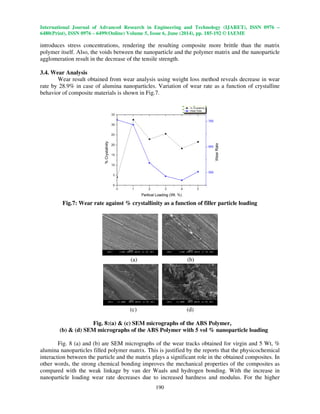
Wear result obtained from wear analysis using weight loss method reveals decrease in wear 
rate by 28.9% in case of alumina nanoparticles. Variation of wear rate as a function of crystalline 
behavior of composite materials is shown in Fig.7. 
Fig.7: Wear rate against % crystallinity as a function of filler particle loading 
(a) (b) 
(c) (d) 
Fig. 8:(a)  (c) SEM micrographs of the ABS Polymer, 
(b)  (d) SEM micrographs of the ABS Polymer with 5 vol % nanoparticle loading 
Fig. 8 (a) and (b) are SEM micrographs of the wear tracks obtained for virgin and 5 Wt, % 
alumina nanoparticles filled polymer matrix. This is justified by the reports that the physicochemical 
interaction between the particle and the matrix plays a significant role in the obtained composites. In 
other words, the strong chemical bonding improves the mechanical properties of the composites as 
compared with the weak linkage by van der Waals and hydrogen bonding. With the increase in 
nanoparticle loading wear rate decreases due to increased hardness and modulus. For the higher
International Journal of Advanced Research in Engineering and Technology (IJARET), ISSN 0976 – 
6480(Print), ISSN 0976 – 6499(Online) Volume 5, Issue 6, June (2014), pp. 185-192 © IAEME 
particle loading damage to the polymer surface observed along with slight improved wear rate. Also 
due to the agglomeration of nanoparticles, tearing of polymer surface can be observed at higher 
particle loading. 
191 
4. CONCLUSION 
Alumina nanoparticles filled ABS polymer composite have been successfully prepared using 
melt mixing method. With the addition of nanoparticles, the ABS polymer nanocomposites show 
initial increased in strength for lower particle loading but decreases further due to higher particle 
loading result in to agglomeration and gas voids. For lower particle loading formed particle/matrix 
interfacial bonding allows for a larger local plastic deformation in the matrix. The net result is a 
significant increase in both modulus and strength. The addition of the nanoparticles has no 
deleterious effect on the thermal stability of the composite. The addition of the nanoparticles has also 
shown improved wear resistance of the composite due to better chemical bounding between the 
nanofiller and polymer matrix. 
REFERENCES 
1. H. Nathani, A. Dasari and R. D. K.Misra, On the reduced susceptibility to stress whitening 
behavior of melt intercalated polybutene–clay nanocomposites during tensile straining Acta 
Mater., 2004, 52,3217–3227. 
2. R. D. K. Misra, H. Nathani and A. Dasari, The determining role of clay particles on 
mechanically induced surface damage and associated stress whitening in polybutene–clay 
Nanocomposites Mater. Sci. Eng. A, 2004, 386A, 175–185. 
3. R. Hadal, Q. Yuan, J. P. Jog and R. D. K.Misra, On stress whitening during surface 
deformation in clay-containing polymer nanocomposites A microstructural approach Mater. 
Sci. Eng. A, 2006, A418, 268–281. 
4. F. P. La Mantia, S. L. Verso and N. T. Dintcheva, VA Copolymer Based Nanocomposites 
Macromol. Mater. Eng., 2002, 287, 909–914. 
5. P. B. Messersmith and E. P. Giannelis, Synthesis and Characterization of Layered Silicate- 
Epoxy Nanocomposites Chem. Mater., 1994, 6, 1719–1725. 
6. R. J. Nussbaumer, W. R. Caseri, P. Smith and T. Tervoort, Polymer-TiO2 Nanocomposites A 
Route Towards Visually Transparent Broadband UV Filters and High Refractive Index 
Material Macromol. Mater. Eng., 2003, 288, 44–49. 
7. Kornmann X., Lindberg H., Berglund L. A., Synthesis of epoxy-clay nanocompsites Influence 
of the nature of the clay on the structure. Polymer, 42, 1303–1310 (2001). 
8. E. P. Giannelis NIST Ann. Conf. on ‘Fire research’, Gaithersburg, MD, USA, November 
1998, Paper 6242 (p. 164). 
9. M. Z. Rong, M. Q. Zhang, Y. X. Zheng, H. M. Zeng, R. Walter, K. Friedrich, Structure-property 
relationships of irradiation grafted nano-inorganic particle filled polypropylene 
composites, Polymer, 2001, 42, 167–183. 
10. C.B. Ng, B.J. Ash, L.S. Schadler, and R.W. Siegel, A Study of the Mechanical and 
Permeability Properties of Nano- and Micron-TiO2 Filled Epoxy Composites, Advanced 
Composites Letters, 10, 101-111, (2001). 
11. C.B. Ng, L.S. Schadler, and R.W. Siegel, Synthesis and Mechanical Properties of TiO2-Epoxy 
Nanocomposites, Nanostructured Materials, 12, 507-510, (1999). 
12. R. W. Siegel, S. K. Chang, B. J. Ash, J. Stone, P. M. Ajayan, R. W. Doremus and L. S. 
Shadler, On the processing of nanocrystalline and nanocomposite ceramics, Scr. Mater., 2001, 
44, 2065–2068.
International Journal of Advanced Research in Engineering and Technology (IJARET), ISSN 0976 – 
6480(Print), ISSN 0976 – 6499(Online) Volume 5, Issue 6, June (2014), pp. 185-192 © IAEME 
13. O. Okada and A. Usuki Mater, The chemistry of polymer-clay hybrids, Sci. Eng. C, 1995, 3C, 
192 
109–115. 
14. E. P. Giannelis, R. Krishnamoorti and E. Manias, Polymer-Silicate Nanocomposites Model 
Systems for Confined Polymers and Polymer Brushes, Adv. Polym. Sci., 1999, 138, 107–147. 
15. J. W. Gilman, T. Kashiwaga, J. E. T. Brown, S. Lomankin, E. P. Giannelis and E. Manias, 
Annual Conference on Fire Research Book of Abstracts, Proc. Int. SAMPE Symp., 1998, 43, 
1053–1066. 
16. J. W. Gilman, C. L. Jackson, A. B. Morgan, R. Harris, E. Manias, E. P. Giannelis, M. 
Wuthenow and D. Hilton, Flammability Properties of Polymer-Layered-Silicate 
Nanocomposites, Polypropylene and Polystyrene Nanocomposites, Chem. Mater., 2000, 12, 
1866–1873. 
17. Zhanhu Guo, Tony Pereira, Oyoung Choi, Ying Wang and H. Thomas Hahn, Surface 
functionalized alumina nanoparticle filled polymeric nanocomposites with enhanced 
mechanical properties, J. Mater. Chem., 2006, 16, 2800–2808. 
18. F. Mammeri, E. L. Bourhis, L. Rozes and C. Sanchez, Mechanical properties of hybrid 
organic–inorganic materials, J. Mater. Chem., 2005, 15, 3787. 
19. P. Judeinstein and C. Sanchez, Hybrid organic–inorganic materials a land of 
multidisciplinarity, J. Mater. Chem., 1996, 6, 511. 
20. R. Shenhar, T. B. Norsten and V. M. Rotello, Polymer-Mediated Nanoparticle Assembly 
Structural Control and Applications, Adv. Mater., 2005, 17, 657. 
21. D. J. Kim, P. H. Kang and Y. C. Nho, Characterization of mechanical properties of Al2O3 
dispersed epoxy resin cured by -ray radiationJ. Appl. Polym. Sci., 2004, 91, 1898. 
22. B. J. Ash, R. W. Siegel and L. S. Schadler, Glass-Transition Temperature Behavior of 
Alumina/PMMA Nanocomposites, J. Polym. Sci., 2004, B42, 4371. 
23. K. A. DeFriend, M. R. Wiesner and A. R. Barron, Alumina and aluminate ultrafiltration 
membranes derived from alumina nanoparticles, J. Membr. Sci., 2003, 224, 11. 
24. B. J. Ash, R. W. Siegel and L. S. Schadler, Mechanical Behavior of Alumina/Poly (methyl 
methacrylate) Nanocomposites, Macromolecules, 2004, 37, 1358 
25. B. Wetzel, F. Haupert and M. Q. Zhang, Epoxy nanocomposites with high mechanical and 
tribological performance, Compos. Sci. Technol., 2003, 63, 2055. 
26. X. Zhang and L. C. Simon, Macromol, In Situ Polymerization of Hybrid Polyethylene- 
Alumina Nanocomposites, Mater. Eng., 2005, 290, 573. 
27. Nadia Abbas Ali, Ikram Atta Al-Ajaj and Farah Tariq Mohammed Noori, “Effect of Nano 
SiO2 on Some Mechanical Properties of Biodegradable Polylactic Acid”, International Journal 
of Mechanical Engineering  Technology (IJMET), Volume 5, Issue 2, 2014, pp. 1 - 7, 
ISSN Print: 0976 – 6340, ISSN Online: 0976 – 6359. 
28. Abdul Rahman Najam Abed and Ibrahim Rahman Ibrahim, “Microstructural and Mechanical 
Characterization of 7075 Aluminum Alloy Reinforced by Alumina (Al2O3) Nanoparticle 
Dispersion”, International Journal of Mechanical Engineering  Technology (IJMET), 
Volume 4, Issue 5, 2013, pp. 286 - 294, ISSN Print: 0976 – 6340, ISSN Online: 0976 – 6359. 
29. Siddhant Datta, B.M. Nagabhushana and R. Harikrishna, “A New Nano-Ceria Reinforced 
Epoxy Polymer Composite with Improved Mechanical Properties”, International Journal of 
Advanced Research in Engineering  Technology (IJARET), Volume 3, Issue 2, 2012, 
pp. 248 - 256, ISSN Print: 0976-6480, ISSN Online: 0976-6499. 
30. S.Shankar, Dr.H.K.Shivanand and Santhosh Kumar.S, “Experimental Evaluation of Flexural 
Properties of Polymer Matrix Composites”, International Journal of Mechanical Engineering 
 Technology (IJMET), Volume 3, Issue 3, 2012, pp. 504 - 510, ISSN Print: 0976 – 6340, 
ISSN Online: 0976 – 6359.

20120140506025

  • 1.
    International Journal ofAdvanced Research in Engineering and Technology (IJARET), ISSN 0976 – 6480(Print), ISSN 0976 – 6499(Online) Volume 5, Issue 6, June (2014), pp. 185-192 © IAEME INTERNATIONAL JOURNAL OF ADVANCED RESEARCH IN ENGINEERING AND TECHNOLOGY (IJARET) ISSN 0976 - 6480 (Print) ISSN 0976 - 6499 (Online) Volume 5, Issue 6, June (2014), pp. 185-192 © IAEME: http://www.iaeme.com/IJARET.asp Journal Impact Factor (2014): 7.8273 (Calculated by GISI) www.jifactor.com IJARET © I A E M E EFFECT OF ALUMINA NANOPARTICLE ADDITION ON THE MECHANICAL AND WEAR BEHAVIOUR OF REINFORCED ACRYLONITRILE BUTADIENE STYRENE POLYMER Praful Kakde1, S N Paul2 1, 2(Visveswaraya National Institute of Technology, Nagpur, India, 440010) 185 ABSTRACT Nanofillers are emerging class of fillers, which are used extensively in rubbers and plastics. In the present work, effect of alumina nanoparticle addition on the mechanical and wear behavior of reinforced acrylonitrile butadiene styrene (ABS) polymer has been investigated. Alumina nanoparticles were melt mixed with ABS polymer through a twin screw extruder. Tensile test results revealed the Young’s modulus and strength increasing with particle loading. Microscopic examinations revealed the presence of large plastic deformations at the micron scale in the nanocomposites in agreement with the good bonding of polymer matrix with filler nanoparticles. Pin on disk wear test revealed decreased in wear rate as compared to virgin polymer up to 29%. Thermo-gravimetric analysis (TGA) did not show any significant change in the thermal degradation of the nanocomposite as compared with the neat polymer. Keywords: ABS, Alumina, Crystallinity, Mechanical Properties, Polymer Nano-Composite, Wear. 1. INTRODUCTION Particulate polymer nanocomposites have received significant attention during the past decade. They are a new class of multiphase materials containing dispersion of particles, typically in the range of 1–100 nm. They represent an attractive set of inorganic–organic materials provide a convenient macroscopic system to study basic scientific issues concerning confined and tethered polymers at a new scale intermediate between nano- and microscale. The incorporation of low volume additions (1–5 wt.-%) of highly anisotropic nanoparticles, such as layered silicates or carbon nanotubes, have resulted in property enhancements with respect to the neat polymer that are comparable with that achieved by conventional loadings (15–40 wt.-%) of traditional fillers. A number of experimental investigations on these materials have indicated that polymer nanocomposites exhibit new and improved properties that are not displayed by the individual phases
  • 2.
    International Journal ofAdvanced Research in Engineering and Technology (IJARET), ISSN 0976 – 6480(Print), ISSN 0976 – 6499(Online) Volume 5, Issue 6, June (2014), pp. 185-192 © IAEME or by their conventional composite counterparts. [1–7] In polymer–clay nanocomposites, the clay particles are about the same size as the polymer molecules themselves, which enables them to be intimately mixed and chemically bonded to each other.[8] The improvement in mechanical properties such as tensile strength, tensile modulus, [9–13] decreased thermal expansion coefficient, increased solvent resistance, outstanding diffusion barrier properties, [6,7,14] and flame retardant capability [15,16] are a few selected examples of the advantages provided by this new class of materials. The presence of nanoparticles generally improves the elastic modulus and does not worsen the rheological and processing behavior and the optical properties of the polymer matrix. As compared with other nanomaterial’s such as carbon nanotubes, alumina is cheaper for nanocomposite fabrication [17]. ABS polymer was chosen due to excellent strength, rigidity, toughness and possessing good chemical, stress-cracking resistance to inorganic salt solutions, alkalis, mineral acids. Upon incorporation of the alumina nanoparticles into the ABS polymer matrix, the obtained nanocomposite has potential applications in automobile, piping, electronic packaging and sport industries. The existing challenge in composite fabrication is to improve the wear resistance with the incorporation of nanoparticles with high hardness. This can be achieved by improving the response of the material to an applied stress which strongly depends upon the linkage between the filler and the polymer matrix. The interfacial interaction between the inorganic nanoparticle and the organic polymer matrix plays a crucial role in determining the quality and properties of the inorganic-organic nanocomposite. [18-20] Alumina nanoparticles [17, 21-24] have been used as filler, respectively, for nanocomposite fabrication. In this paper, the alumina nanoparticles were used as filler material dispersed in to polymer matrix using melt mix technique. The melt mix technique has been preferred over solvent method due to simple and environmentally-friendly nature of the process. The addition of the nanoparticles was observed to have no deleterious effect on the thermal stability as compared to the neat resin. 186 2. EXPERIMENTAL 2.1. Materials The polymeric matrix used was ABS, MIF 45 grade (manufactured by the BEPL Chemical Company). The received polymer has a density of 1.045 gcm-3 and a viscosity of 350 centipoise (cP) at room temperature. Alumina (Aluminium oxide, Al2O3, Nanophase Technologies) nanoparticles with an average particle size (APS) of 40 nm and a specific surface area of 44 m2 g-1 were used as nanofiller for the nanocomposite fabrication. All the chemicals were used as received without further treatment. 2.2. Nanocomposite fabrication Alumina nanoparticles (specific weight percentage) were dispersed into ABS polymer by melt mixing technique using twin screw extruder (M/s APV Baker, UK, and Model: MP19PC). In this process, the temperature profiles in the barrel were 200 0C, 220 0C, 230 0C, 240 0C, 250 0C from hopper to die. The screw L/D was 25 and screw rotation rate of 60 rpm was used. Tensile, Flexural and Izod impact samples (according to ASTM D-638 M91, ASTM D 790 and ASTM D 256-92 respectively) were prepared using an injection molding machine (M/s Boolani Engineering, Mumbai) with a barrel temperature of 220 0C, 250 0C, 280 0C. 2.3. Characterization Alumina nanoparticles filled nanocomposites were characterized by thermo-gravimetric analysis (TGA, PerkinElmer) from 250C to 6000C with an argon flow rate of 50 ccpm and a heating rate of 100C/min (VNIT, Nagpur). Thermal degradation of the nanocomposites with different nanoparticle loadings was studied by TGA. The mechanical properties of the fabricated
  • 3.
    International Journal ofAdvanced Research in Engineering and Technology (IJARET), ISSN 0976 – 6480(Print), ISSN 0976 – 6499(Online) Volume 5, Issue 6, June (2014), pp. 185-192 © IAEME nanocomposites were evaluated by tensile tests following the American Society for Testing and Materials (ASTM, 2005, standard D 637). An Instron 5544 testing machine was used to measure the tensile strength and Young’s modulus (VNIT, Nagpur). The dogbone shaped specimens were prepared as described in the Nanocomposite fabrication section. The specimen surfaces were smoothed with an abrasive sand paper (1000) and the sanding strokes were made in the direction parallel to the long axis of the test specimen. The specimens were conditioned for more than 4 hours in an ambient environment before measurement, as required by the ASTM. Five to seven specimens per sample were tested. Specimens that broke at some obvious fortuitous flaws or near a grip were discarded. A crosshead speed of 0.1 mm min-1 was used and strain (mm mm-1) was calculated by dividing the crosshead displacement (mm) by the gage length (mm). A scanning electron microscope (SEM, JEOL, VNIT, Nagpur) were utilized to examine the fracture surfaces. The SEM specimens were prepared by sputter coating a thin gold layer approximately 3 nm thick on a polished nanocomposite sample. XRD analysis was used to examine crystallographic changes and percentage crystallinity of resultant nanocomposite. Wear analysis were done using pin on disk tribometer (VNIT, Nagpur). 187 3. RESULTS AND DISCUSSION 3.1. X-Ray Diffraction Crystallinity The XRD data of a composite containing variable amounts (0 - 5 wt. %) of alumina filler percentage is shown in Fig. 1. Two major crystalline peaks are at ca. 2 = 20°, which, are characteristic of the amorphous form of ABS. It was observed that the ABS component was amorphous while the alumina phase was, with no discernable peaks, amorphous. Crystallinity data obtained from X’pert software by using striping k alpha 2 methods has shown in Fig. 2. With addition of alumina nanoparticles, percentage crystallinity of nanocomposite initially increases to high value but then shows regular decrease with further addition. This may be due to the agglomeration of nanoparticles with increased addition of reinforcement. Fig. 1: XRD spectra of alumina nanoparticles filled polymer composite
  • 4.
    International Journal ofAdvanced Research in Engineering and Technology (IJARET), ISSN 0976 6480(Print), ISSN 0976 – 6499(Online) Volume 5, Issue 6, June (2014), pp. 185-192 © IAEME Fig. 2: % Crystallinity as a function of alumina nanoparticle loading 3.2. TGA al Thermo gravimetric analysis (TGA) of nanocomposites with 0, 1, 2, 3, 4, 5 wt. % alumina nanoparticles were shown in Fig. 3 properties of ABS polymer due to the addition of alumina nanoparticles. 3. TGA analysis has shown no effect on thermal degradation Fig. 3: TGA curve for pure and alumina nanoparticles filled polymer 3.3. Mechanical properties The trend of variation of tensile strength and Young’s modulus of polymer nanocomposite with varying concentration of alumina nanoparticles is presented in Figure Fig.4: Plot of Young’s modulus and Stress at peak as a function of nanoparticle loading 188 4. – .
  • 5.
    International Journal ofAdvanced Research in Engineering and Technology (IJARET), ISSN 0976 6480(Print), ISSN 0976 – 6499(Online) Volume 5, Issue 6, June (2014), pp. (a) al 185-192 © IAEME Fig.5: Plot of Young’s modulus (a) and Stress at peak (b) as a function of % crystallinity – It is observed that on increasing the weight fraction of alumina nanoparticles, the tensile strength increases up to certain value and then it declines. The peak value of tensile strength of the composite, corresponds to 2 wt. % loading of alumina nanoparticles. nanofiller, tensile strength of the nanocomposite shows decreased in value. This is in accordance with the crystallinity data obtained from the XRD results. With higher particle loading agglomeration and formation of gas voids favors due to poor interaction with matrix polymer. The Young’s modulus shows steady increase in the value with increase in alumina loading due to very high modulus of alumina particles. (a) Fig. 6: SEM micrographs of (a) the cured pure resin and (b) ABS with 3 vol% nanoparticle filling (c) ABS with 5 vol% nanoparticle filling. The trend of variation of Young’s modulus of polymer nanocomposite with varying concentration of alumina nanocomposite is presented in Figure modulus increase with the increased addition of alumina nanoparticles. Fig. SEM micrographs of fracture surfaces for the neat resin, 3 wt. % alumina nanoparticles. Even at the micron scale, the neat resin shows a smooth fracture surface while the nanocomposite shows a rough fracture surface. This micro the matrix shear yielding or local polymer deformation between the nanoparticles rather than the intra-particle propagating cracks due to the difficulty in breaking the alumina nanoparticle arising from the high hardness as compared with the resin matrix. The SEM images (Fig. protruding nanoparticles also indicates that the cracks pass around the nanoparticle without damaging it, which was also observed in Al protruding nanoparticles seen on the nanocomposite surface are matrix polymer, indicating the presence of good adhesion between the nanoparticle and the polymer matrix through the chemical bonding.[26] In general, the presence of micron 189 (b) With the further addition of (b) (c) ntration 4. It was observed that the Young’s 6 (a), (b) and (c) are and 5 wt. % composite with micro-rough structure can be attributed to 6 Al2O3/CaSiO3 filled epoxy nanocomposite.[25] The observed to be covered with the micron-size hard particles . 6(c)) showing the
  • 6.
    International Journal ofAdvanced Research in Engineering and Technology (IJARET), ISSN 0976 – 6480(Print), ISSN 0976 – 6499(Online) Volume 5, Issue 6, June (2014), pp. 185-192 © IAEME introduces stress concentrations, rendering the resulting composite more brittle than the matrix polymer itself. Also, the voids between the nanoparticle and the polymer matrix and the nanoparticle agglomeration result in the decrease of the tensile strength. 190 3.4. Wear Analysis Wear result obtained from wear analysis using weight loss method reveals decrease in wear rate by 28.9% in case of alumina nanoparticles. Variation of wear rate as a function of crystalline behavior of composite materials is shown in Fig.7. Fig.7: Wear rate against % crystallinity as a function of filler particle loading (a) (b) (c) (d) Fig. 8:(a) (c) SEM micrographs of the ABS Polymer, (b) (d) SEM micrographs of the ABS Polymer with 5 vol % nanoparticle loading Fig. 8 (a) and (b) are SEM micrographs of the wear tracks obtained for virgin and 5 Wt, % alumina nanoparticles filled polymer matrix. This is justified by the reports that the physicochemical interaction between the particle and the matrix plays a significant role in the obtained composites. In other words, the strong chemical bonding improves the mechanical properties of the composites as compared with the weak linkage by van der Waals and hydrogen bonding. With the increase in nanoparticle loading wear rate decreases due to increased hardness and modulus. For the higher
  • 7.
    International Journal ofAdvanced Research in Engineering and Technology (IJARET), ISSN 0976 – 6480(Print), ISSN 0976 – 6499(Online) Volume 5, Issue 6, June (2014), pp. 185-192 © IAEME particle loading damage to the polymer surface observed along with slight improved wear rate. Also due to the agglomeration of nanoparticles, tearing of polymer surface can be observed at higher particle loading. 191 4. CONCLUSION Alumina nanoparticles filled ABS polymer composite have been successfully prepared using melt mixing method. With the addition of nanoparticles, the ABS polymer nanocomposites show initial increased in strength for lower particle loading but decreases further due to higher particle loading result in to agglomeration and gas voids. For lower particle loading formed particle/matrix interfacial bonding allows for a larger local plastic deformation in the matrix. The net result is a significant increase in both modulus and strength. The addition of the nanoparticles has no deleterious effect on the thermal stability of the composite. The addition of the nanoparticles has also shown improved wear resistance of the composite due to better chemical bounding between the nanofiller and polymer matrix. REFERENCES 1. H. Nathani, A. Dasari and R. D. K.Misra, On the reduced susceptibility to stress whitening behavior of melt intercalated polybutene–clay nanocomposites during tensile straining Acta Mater., 2004, 52,3217–3227. 2. R. D. K. Misra, H. Nathani and A. Dasari, The determining role of clay particles on mechanically induced surface damage and associated stress whitening in polybutene–clay Nanocomposites Mater. Sci. Eng. A, 2004, 386A, 175–185. 3. R. Hadal, Q. Yuan, J. P. Jog and R. D. K.Misra, On stress whitening during surface deformation in clay-containing polymer nanocomposites A microstructural approach Mater. Sci. Eng. A, 2006, A418, 268–281. 4. F. P. La Mantia, S. L. Verso and N. T. Dintcheva, VA Copolymer Based Nanocomposites Macromol. Mater. Eng., 2002, 287, 909–914. 5. P. B. Messersmith and E. P. Giannelis, Synthesis and Characterization of Layered Silicate- Epoxy Nanocomposites Chem. Mater., 1994, 6, 1719–1725. 6. R. J. Nussbaumer, W. R. Caseri, P. Smith and T. Tervoort, Polymer-TiO2 Nanocomposites A Route Towards Visually Transparent Broadband UV Filters and High Refractive Index Material Macromol. Mater. Eng., 2003, 288, 44–49. 7. Kornmann X., Lindberg H., Berglund L. A., Synthesis of epoxy-clay nanocompsites Influence of the nature of the clay on the structure. Polymer, 42, 1303–1310 (2001). 8. E. P. Giannelis NIST Ann. Conf. on ‘Fire research’, Gaithersburg, MD, USA, November 1998, Paper 6242 (p. 164). 9. M. Z. Rong, M. Q. Zhang, Y. X. Zheng, H. M. Zeng, R. Walter, K. Friedrich, Structure-property relationships of irradiation grafted nano-inorganic particle filled polypropylene composites, Polymer, 2001, 42, 167–183. 10. C.B. Ng, B.J. Ash, L.S. Schadler, and R.W. Siegel, A Study of the Mechanical and Permeability Properties of Nano- and Micron-TiO2 Filled Epoxy Composites, Advanced Composites Letters, 10, 101-111, (2001). 11. C.B. Ng, L.S. Schadler, and R.W. Siegel, Synthesis and Mechanical Properties of TiO2-Epoxy Nanocomposites, Nanostructured Materials, 12, 507-510, (1999). 12. R. W. Siegel, S. K. Chang, B. J. Ash, J. Stone, P. M. Ajayan, R. W. Doremus and L. S. Shadler, On the processing of nanocrystalline and nanocomposite ceramics, Scr. Mater., 2001, 44, 2065–2068.
  • 8.
    International Journal ofAdvanced Research in Engineering and Technology (IJARET), ISSN 0976 – 6480(Print), ISSN 0976 – 6499(Online) Volume 5, Issue 6, June (2014), pp. 185-192 © IAEME 13. O. Okada and A. Usuki Mater, The chemistry of polymer-clay hybrids, Sci. Eng. C, 1995, 3C, 192 109–115. 14. E. P. Giannelis, R. Krishnamoorti and E. Manias, Polymer-Silicate Nanocomposites Model Systems for Confined Polymers and Polymer Brushes, Adv. Polym. Sci., 1999, 138, 107–147. 15. J. W. Gilman, T. Kashiwaga, J. E. T. Brown, S. Lomankin, E. P. Giannelis and E. Manias, Annual Conference on Fire Research Book of Abstracts, Proc. Int. SAMPE Symp., 1998, 43, 1053–1066. 16. J. W. Gilman, C. L. Jackson, A. B. Morgan, R. Harris, E. Manias, E. P. Giannelis, M. Wuthenow and D. Hilton, Flammability Properties of Polymer-Layered-Silicate Nanocomposites, Polypropylene and Polystyrene Nanocomposites, Chem. Mater., 2000, 12, 1866–1873. 17. Zhanhu Guo, Tony Pereira, Oyoung Choi, Ying Wang and H. Thomas Hahn, Surface functionalized alumina nanoparticle filled polymeric nanocomposites with enhanced mechanical properties, J. Mater. Chem., 2006, 16, 2800–2808. 18. F. Mammeri, E. L. Bourhis, L. Rozes and C. Sanchez, Mechanical properties of hybrid organic–inorganic materials, J. Mater. Chem., 2005, 15, 3787. 19. P. Judeinstein and C. Sanchez, Hybrid organic–inorganic materials a land of multidisciplinarity, J. Mater. Chem., 1996, 6, 511. 20. R. Shenhar, T. B. Norsten and V. M. Rotello, Polymer-Mediated Nanoparticle Assembly Structural Control and Applications, Adv. Mater., 2005, 17, 657. 21. D. J. Kim, P. H. Kang and Y. C. Nho, Characterization of mechanical properties of Al2O3 dispersed epoxy resin cured by -ray radiationJ. Appl. Polym. Sci., 2004, 91, 1898. 22. B. J. Ash, R. W. Siegel and L. S. Schadler, Glass-Transition Temperature Behavior of Alumina/PMMA Nanocomposites, J. Polym. Sci., 2004, B42, 4371. 23. K. A. DeFriend, M. R. Wiesner and A. R. Barron, Alumina and aluminate ultrafiltration membranes derived from alumina nanoparticles, J. Membr. Sci., 2003, 224, 11. 24. B. J. Ash, R. W. Siegel and L. S. Schadler, Mechanical Behavior of Alumina/Poly (methyl methacrylate) Nanocomposites, Macromolecules, 2004, 37, 1358 25. B. Wetzel, F. Haupert and M. Q. Zhang, Epoxy nanocomposites with high mechanical and tribological performance, Compos. Sci. Technol., 2003, 63, 2055. 26. X. Zhang and L. C. Simon, Macromol, In Situ Polymerization of Hybrid Polyethylene- Alumina Nanocomposites, Mater. Eng., 2005, 290, 573. 27. Nadia Abbas Ali, Ikram Atta Al-Ajaj and Farah Tariq Mohammed Noori, “Effect of Nano SiO2 on Some Mechanical Properties of Biodegradable Polylactic Acid”, International Journal of Mechanical Engineering Technology (IJMET), Volume 5, Issue 2, 2014, pp. 1 - 7, ISSN Print: 0976 – 6340, ISSN Online: 0976 – 6359. 28. Abdul Rahman Najam Abed and Ibrahim Rahman Ibrahim, “Microstructural and Mechanical Characterization of 7075 Aluminum Alloy Reinforced by Alumina (Al2O3) Nanoparticle Dispersion”, International Journal of Mechanical Engineering Technology (IJMET), Volume 4, Issue 5, 2013, pp. 286 - 294, ISSN Print: 0976 – 6340, ISSN Online: 0976 – 6359. 29. Siddhant Datta, B.M. Nagabhushana and R. Harikrishna, “A New Nano-Ceria Reinforced Epoxy Polymer Composite with Improved Mechanical Properties”, International Journal of Advanced Research in Engineering Technology (IJARET), Volume 3, Issue 2, 2012, pp. 248 - 256, ISSN Print: 0976-6480, ISSN Online: 0976-6499. 30. S.Shankar, Dr.H.K.Shivanand and Santhosh Kumar.S, “Experimental Evaluation of Flexural Properties of Polymer Matrix Composites”, International Journal of Mechanical Engineering Technology (IJMET), Volume 3, Issue 3, 2012, pp. 504 - 510, ISSN Print: 0976 – 6340, ISSN Online: 0976 – 6359.