By
SYED IMTIYAZ AHMED
(1604-10-765-012)
Under the guidance of
MOHD MINHAJUDDIN SAIF
Asst. Professor, MED
MJCET
ABSTRACT
ABSTRACT
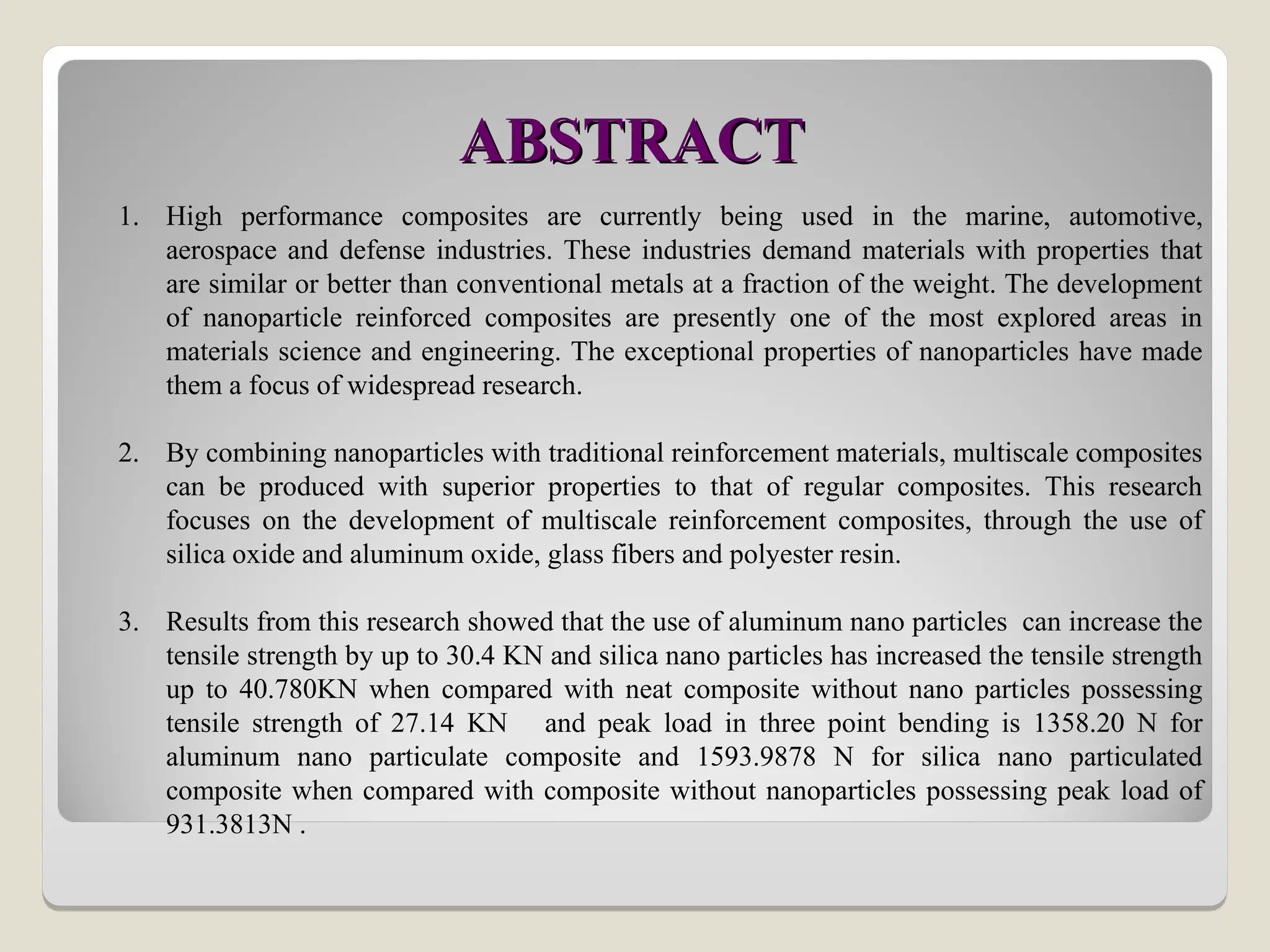
1. High performance composites are currently being used in the marine, automotive,
aerospace and defense industries. These industries demand materials with properties that
are similar or better than conventional metals at a fraction of the weight. The development
of nanoparticle reinforced composites are presently one of the most explored areas in
materials science and engineering. The exceptional properties of nanoparticles have made
them a focus of widespread research.
2. By combining nanoparticles with traditional reinforcement materials, multiscale composites
can be produced with superior properties to that of regular composites. This research
focuses on the development of multiscale reinforcement composites, through the use of
silica oxide and aluminum oxide, glass fibers and polyester resin.
3. Results from this research showed that the use of aluminum nano particles can increase the
tensile strength by up to 30.4 KN and silica nano particles has increased the tensile strength
up to 40.780KN when compared with neat composite without nano particles possessing
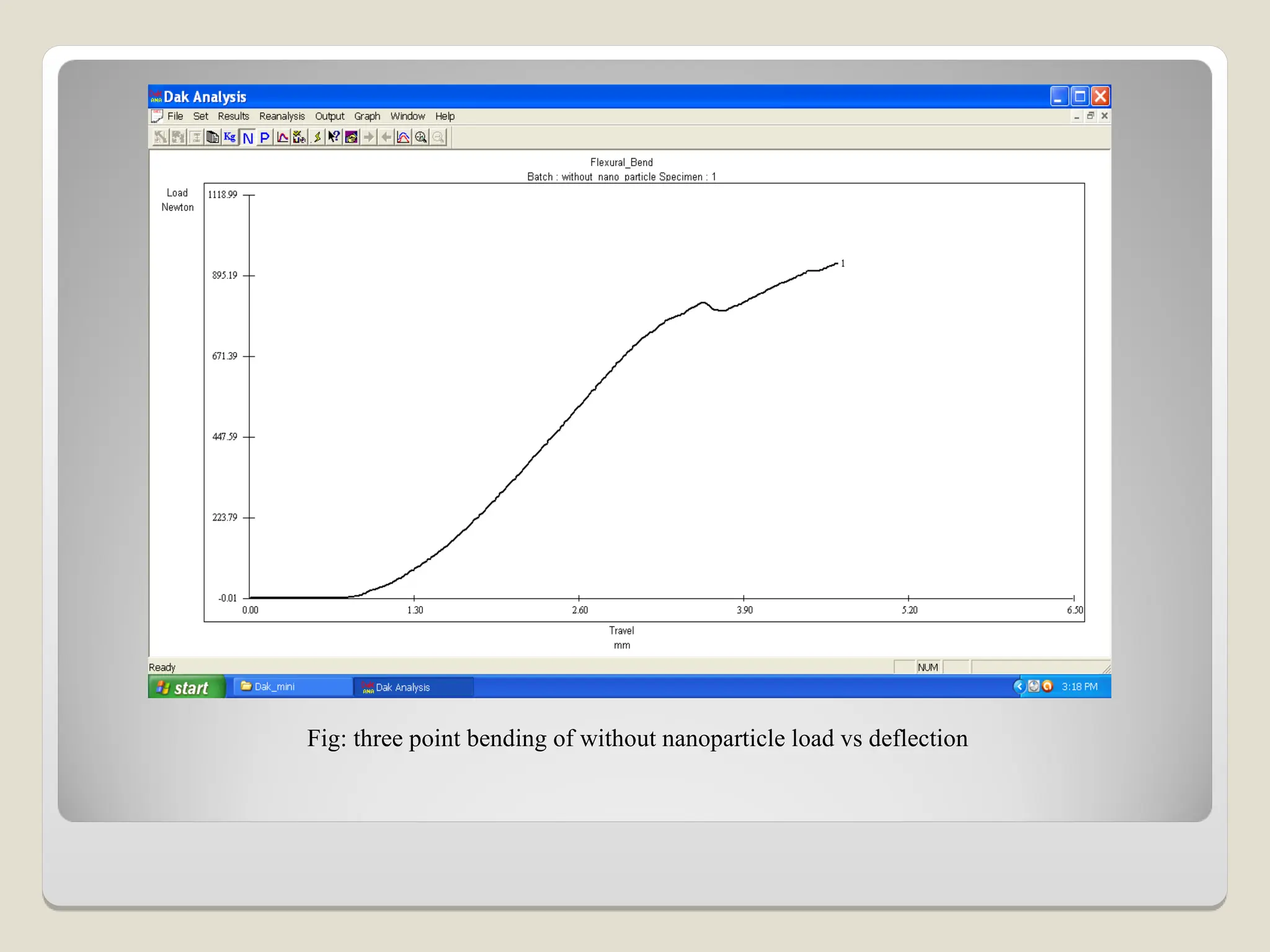
tensile strength of 27.14 KN and peak load in three point bending is 1358.20 N for
aluminum nano particulate composite and 1593.9878 N for silica nano particulated
composite when compared with composite without nanoparticles possessing peak load of
931.3813N .
INTRODUCTION
INTRODUCTION
COMPOSITE MATERIAL:
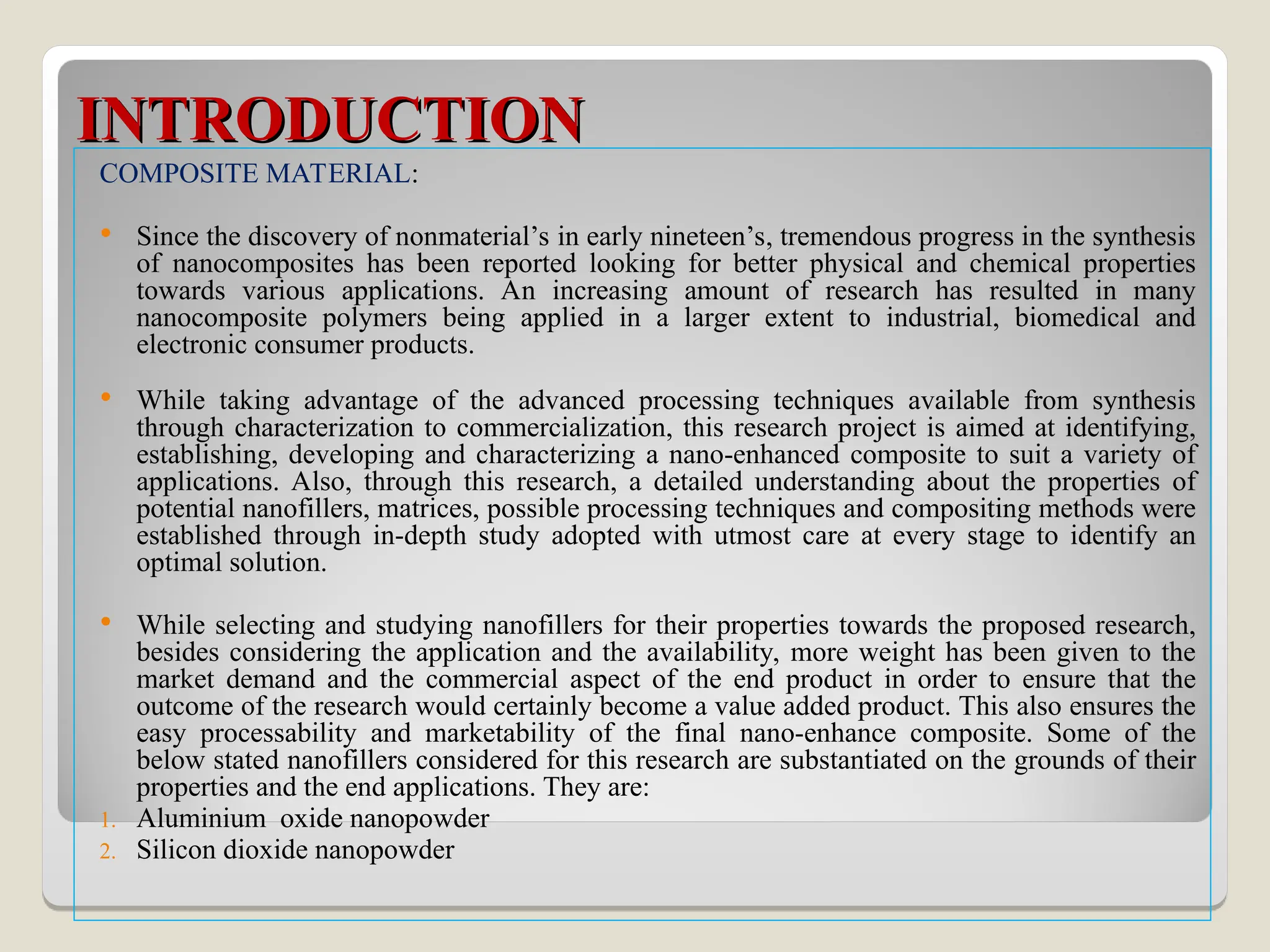
 Since the discovery of nonmaterial’s in early nineteen’s, tremendous progress in the synthesis
of nanocomposites has been reported looking for better physical and chemical properties
towards various applications. An increasing amount of research has resulted in many
nanocomposite polymers being applied in a larger extent to industrial, biomedical and
electronic consumer products.
 While taking advantage of the advanced processing techniques available from synthesis
through characterization to commercialization, this research project is aimed at identifying,
establishing, developing and characterizing a nano-enhanced composite to suit a variety of
applications. Also, through this research, a detailed understanding about the properties of
potential nanofillers, matrices, possible processing techniques and compositing methods were
established through in-depth study adopted with utmost care at every stage to identify an
optimal solution.
 While selecting and studying nanofillers for their properties towards the proposed research,
besides considering the application and the availability, more weight has been given to the
market demand and the commercial aspect of the end product in order to ensure that the
outcome of the research would certainly become a value added product. This also ensures the
easy processability and marketability of the final nano-enhance composite. Some of the
below stated nanofillers considered for this research are substantiated on the grounds of their
properties and the end applications. They are:
1. Aluminium oxide nanopowder
2. Silicon dioxide nanopowder
LITERATURE REVIEW
LITERATURE REVIEW
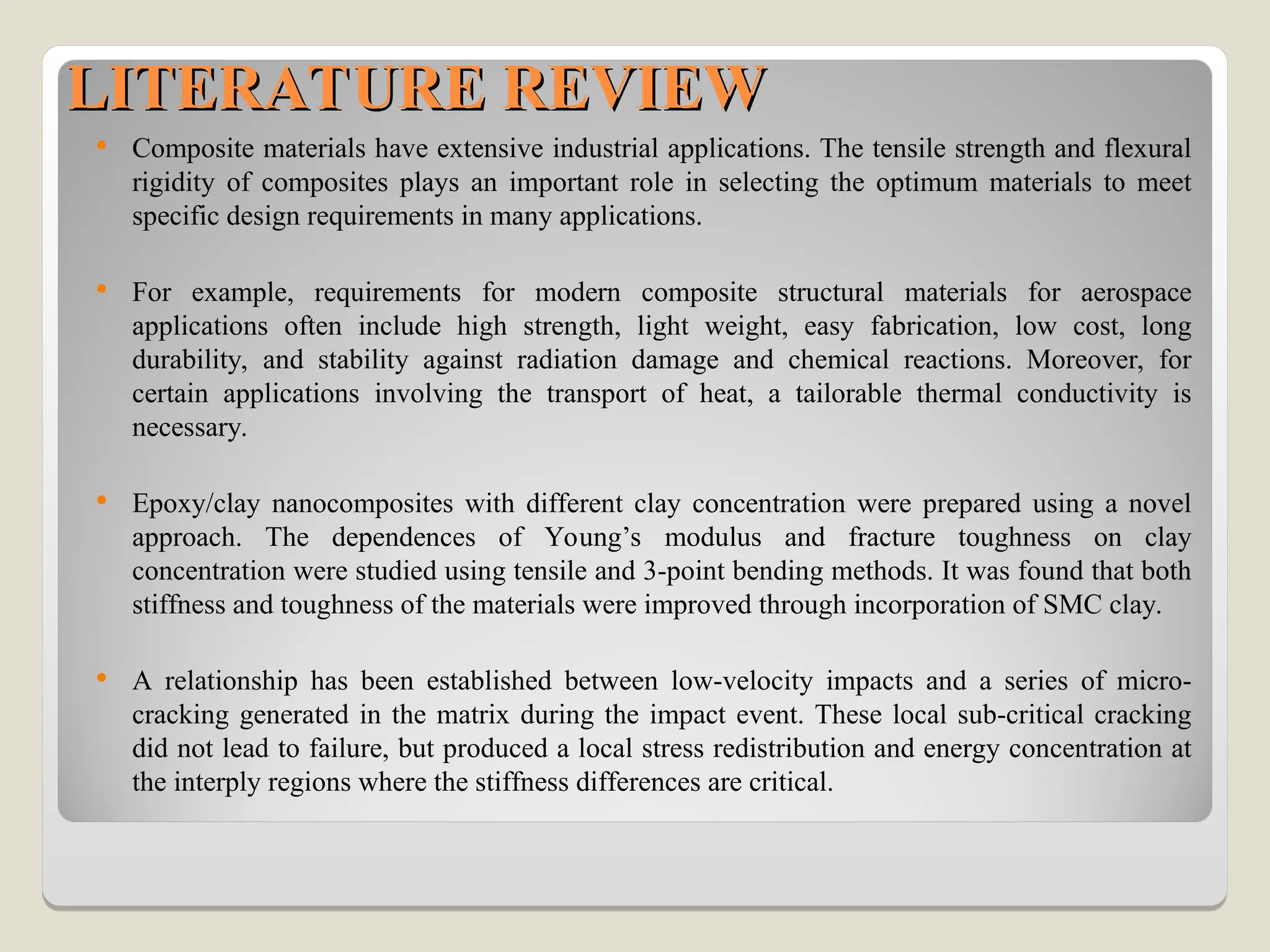
 Composite materials have extensive industrial applications. The tensile strength and flexural
rigidity of composites plays an important role in selecting the optimum materials to meet
specific design requirements in many applications.
 For example, requirements for modern composite structural materials for aerospace
applications often include high strength, light weight, easy fabrication, low cost, long
durability, and stability against radiation damage and chemical reactions. Moreover, for
certain applications involving the transport of heat, a tailorable thermal conductivity is
necessary.
 Epoxy/clay nanocomposites with different clay concentration were prepared using a novel
approach. The dependences of Young’s modulus and fracture toughness on clay
concentration were studied using tensile and 3-point bending methods. It was found that both
stiffness and toughness of the materials were improved through incorporation of SMC clay.
 A relationship has been established between low-velocity impacts and a series of micro-
cracking generated in the matrix during the impact event. These local sub-critical cracking
did not lead to failure, but produced a local stress redistribution and energy concentration at
the interply regions where the stiffness differences are critical.
METHODOLOGY
METHODOLOGY
FABRICATION :
FABRICATION :
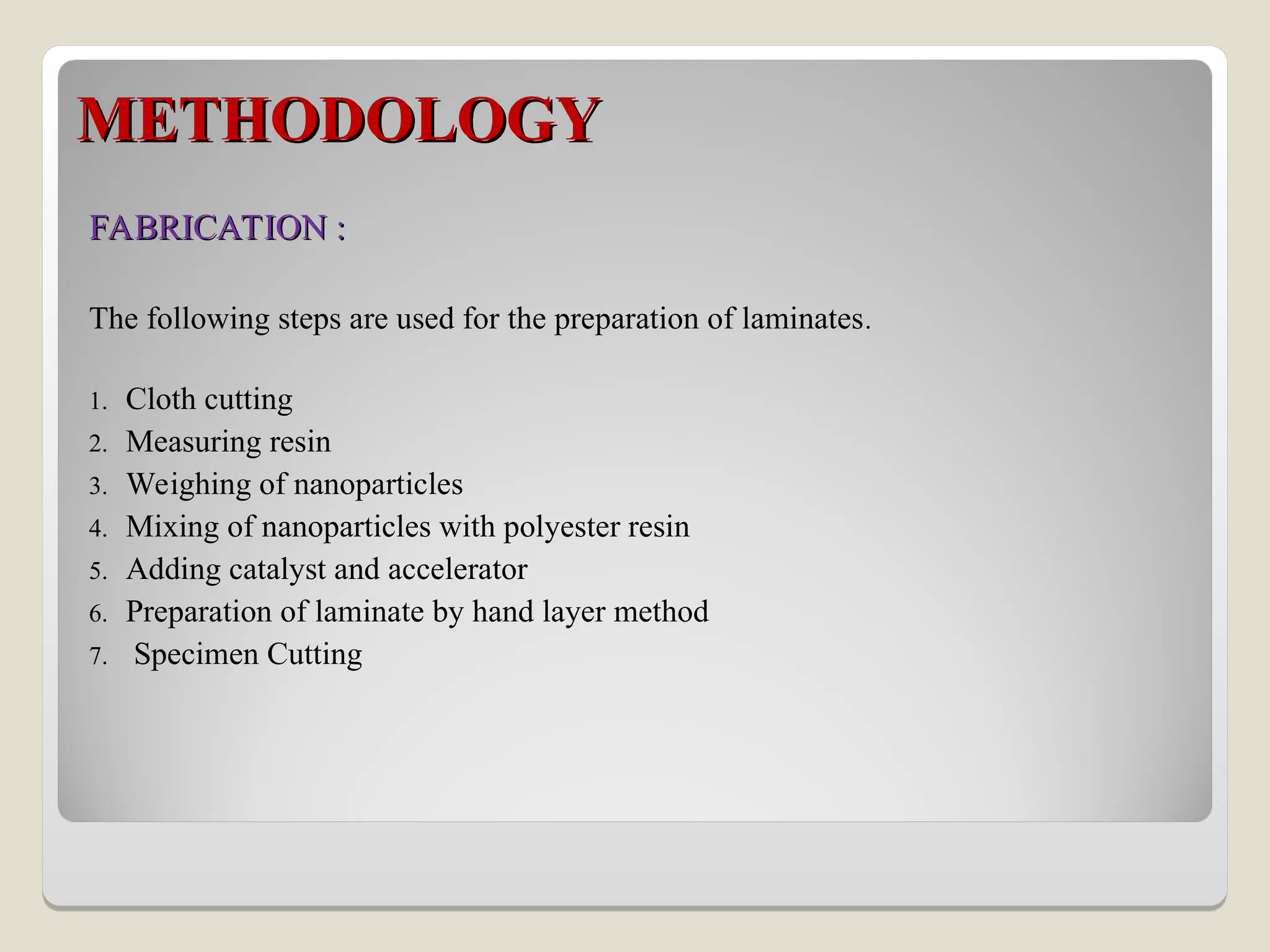
The following steps are used for the preparation of laminates.
1. Cloth cutting
2. Measuring resin
3. Weighing of nanoparticles
4. Mixing of nanoparticles with polyester resin
5. Adding catalyst and accelerator
6. Preparation of laminate by hand layer method
7. Specimen Cutting
Cloth cutting
Cloth cutting
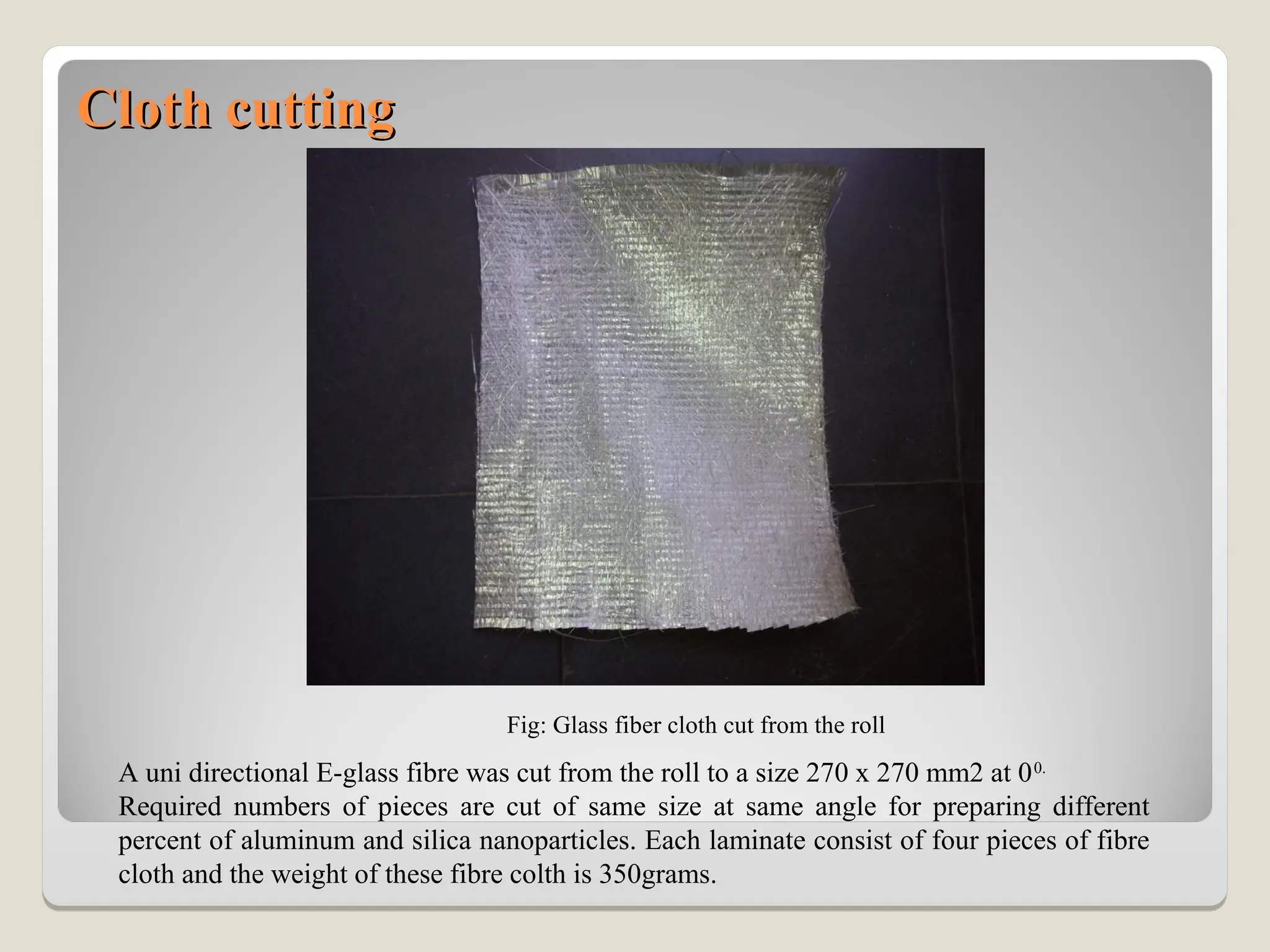
Fig: Glass fiber cloth cut from the roll
A uni directional E-glass fibre was cut from the roll to a size 270 x 270 mm2 at 00.
Required numbers of pieces are cut of same size at same angle for preparing different
percent of aluminum and silica nanoparticles. Each laminate consist of four pieces of fibre
cloth and the weight of these fibre colth is 350grams.
Measuring resin
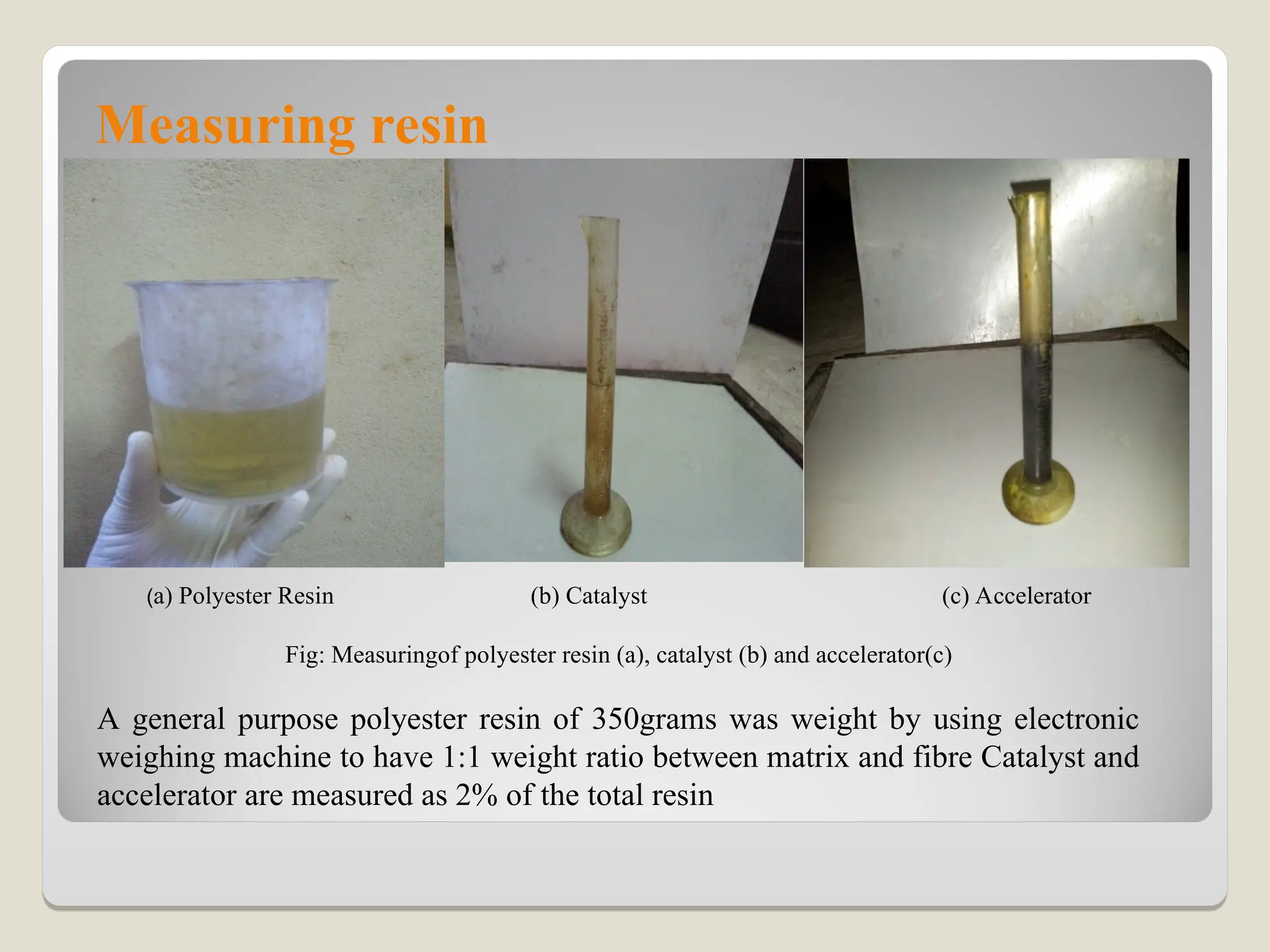
(a) Polyester Resin (b) Catalyst (c) Accelerator
Fig: Measuringof polyester resin (a), catalyst (b) and accelerator(c)
A general purpose polyester resin of 350grams was weight by using electronic
weighing machine to have 1:1 weight ratio between matrix and fibre Catalyst and
accelerator are measured as 2% of the total resin
Weighing of nanoparticles
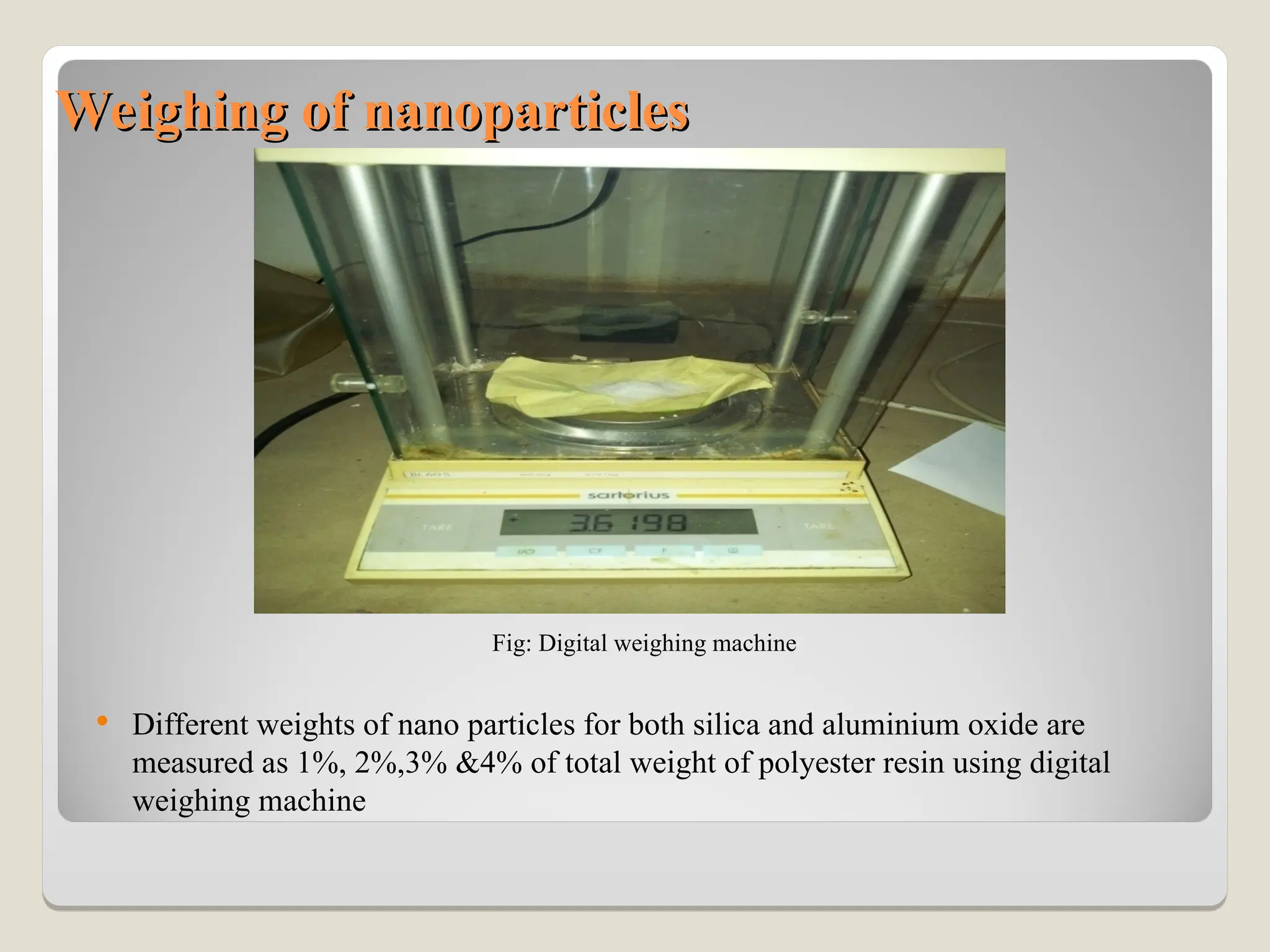
Fig: Digital weighing machine
 Different weights of nano particles for both silica and aluminium oxide are
measured as 1%, 2%,3% &4% of total weight of polyester resin using digital
weighing machine
Mixing of nanoparticles and polyester resin
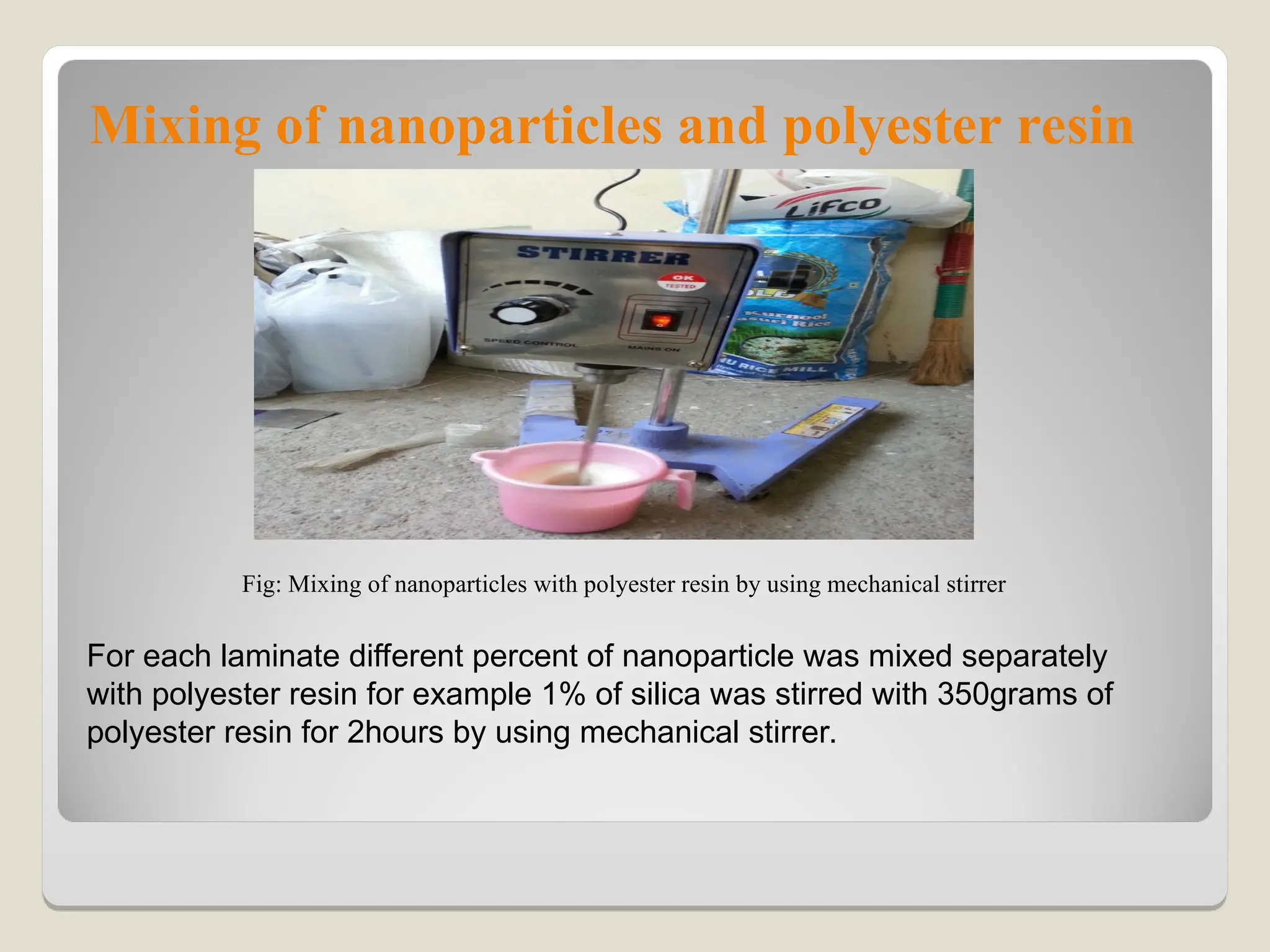
Fig: Mixing of nanoparticles with polyester resin by using mechanical stirrer
For each laminate different percent of nanoparticle was mixed separately
with polyester resin for example 1% of silica was stirred with 350grams of
polyester resin for 2hours by using mechanical stirrer.
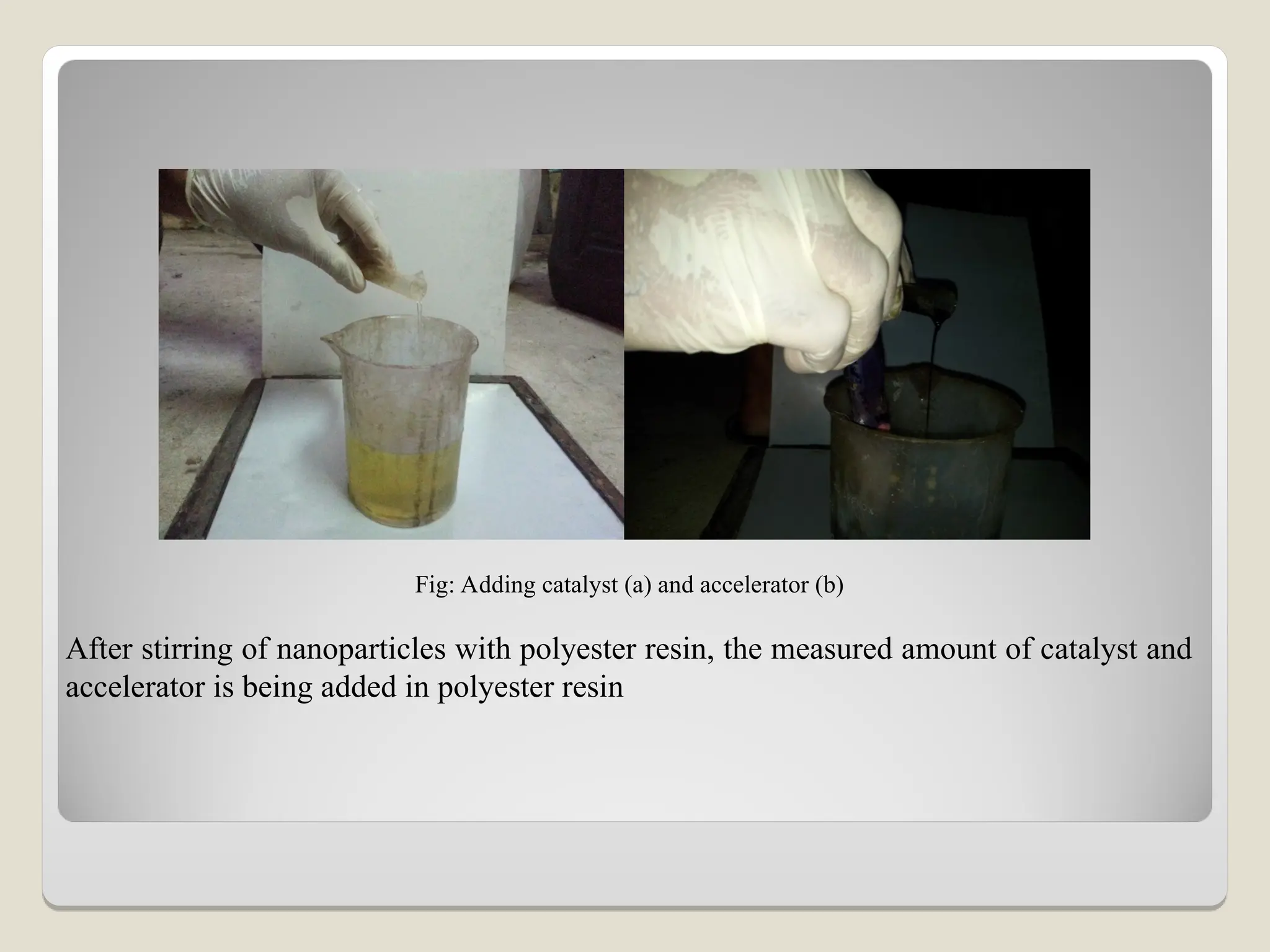
Fig: Adding catalyst (a) and accelerator (b)
After stirring of nanoparticles with polyester resin, the measured amount of catalyst and
accelerator is being added in polyester resin
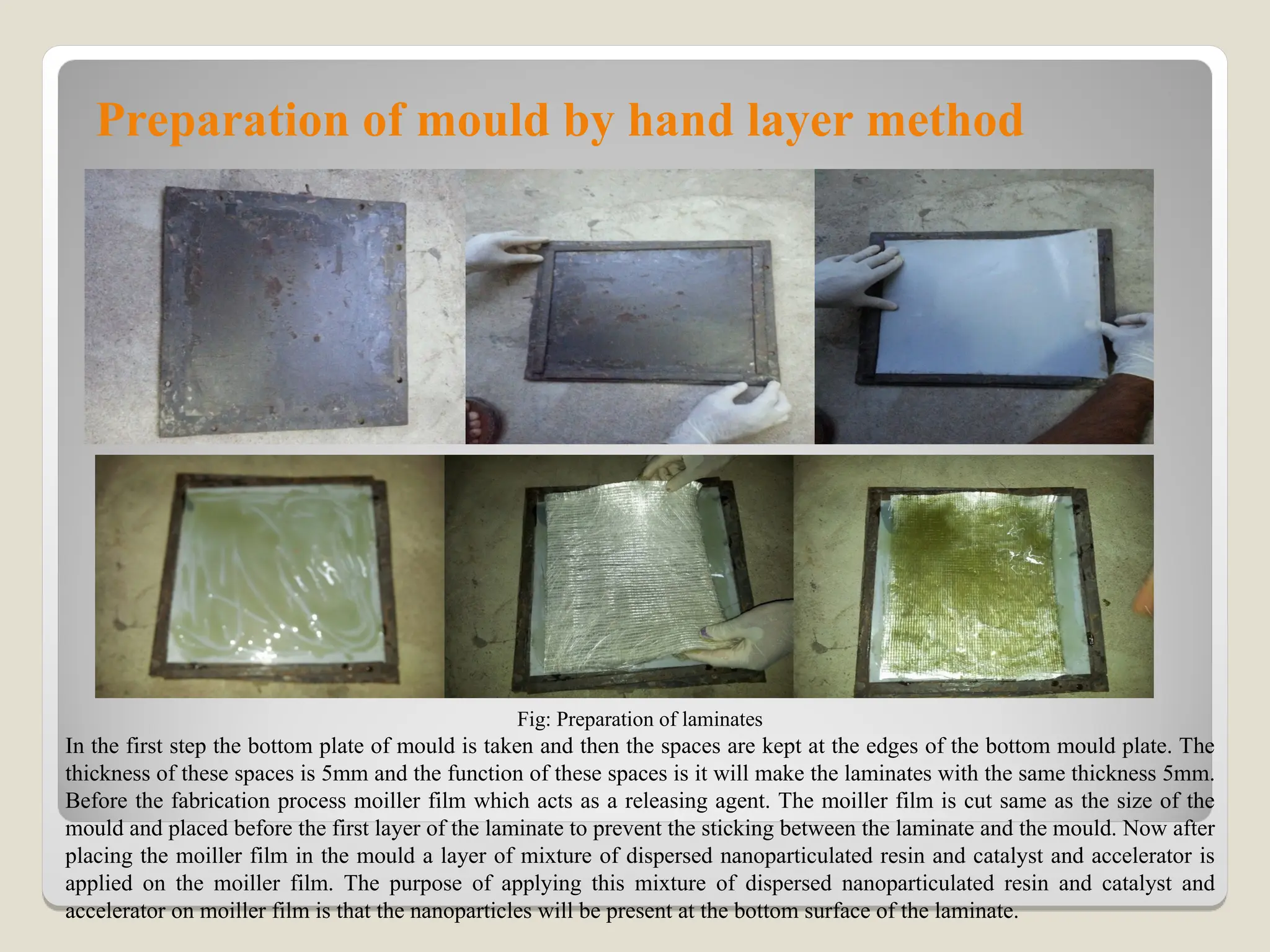
Preparation of mould by hand layer method
Fig: Preparation of laminates
In the first step the bottom plate of mould is taken and then the spaces are kept at the edges of the bottom mould plate. The
thickness of these spaces is 5mm and the function of these spaces is it will make the laminates with the same thickness 5mm.
Before the fabrication process moiller film which acts as a releasing agent. The moiller film is cut same as the size of the
mould and placed before the first layer of the laminate to prevent the sticking between the laminate and the mould. Now after
placing the moiller film in the mould a layer of mixture of dispersed nanoparticulated resin and catalyst and accelerator is
applied on the moiller film. The purpose of applying this mixture of dispersed nanoparticulated resin and catalyst and
accelerator on moiller film is that the nanoparticles will be present at the bottom surface of the laminate.
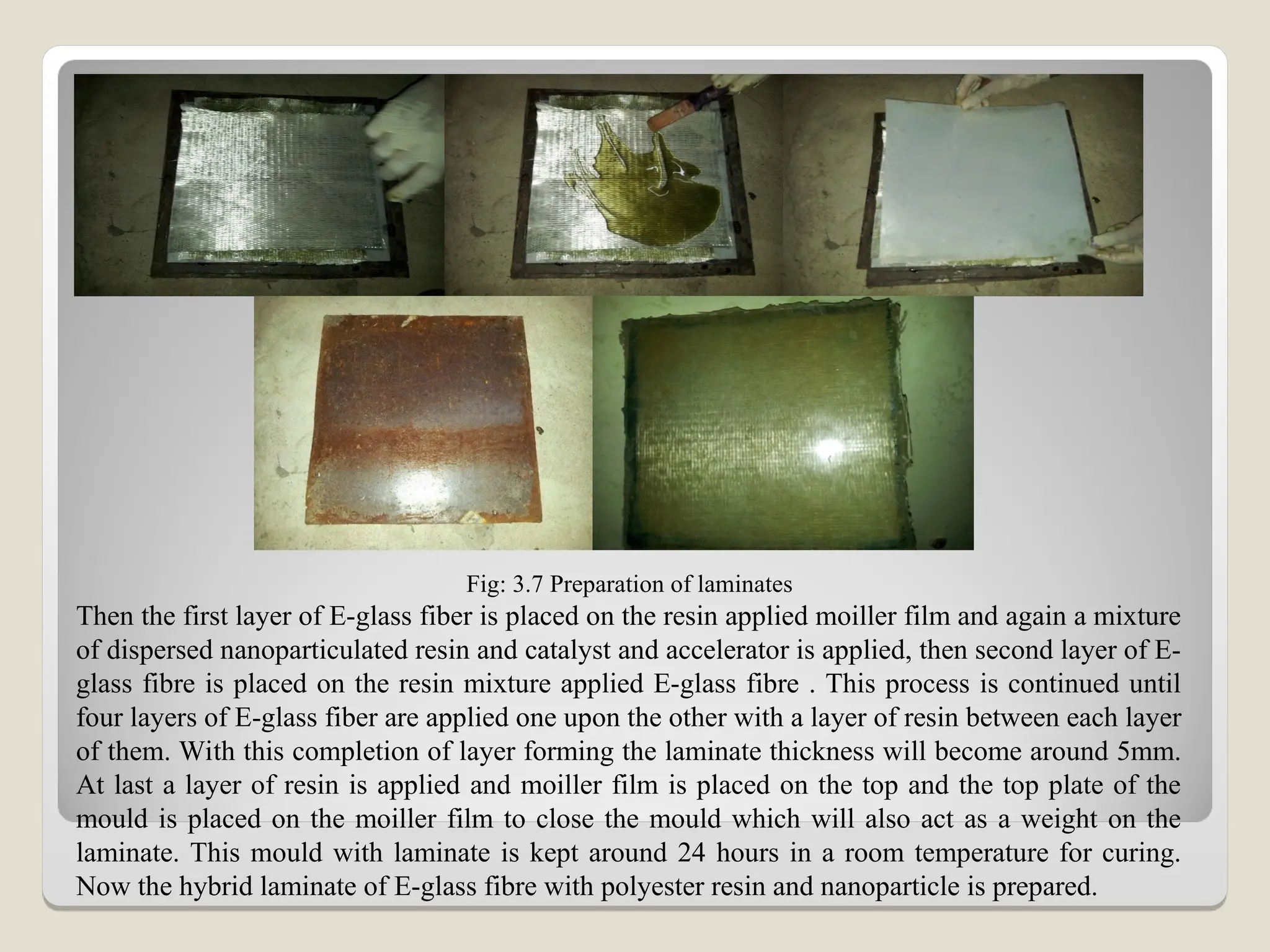
Fig: 3.7 Preparation of laminates
Then the first layer of E-glass fiber is placed on the resin applied moiller film and again a mixture
of dispersed nanoparticulated resin and catalyst and accelerator is applied, then second layer of E-
glass fibre is placed on the resin mixture applied E-glass fibre . This process is continued until
four layers of E-glass fiber are applied one upon the other with a layer of resin between each layer
of them. With this completion of layer forming the laminate thickness will become around 5mm.
At last a layer of resin is applied and moiller film is placed on the top and the top plate of the
mould is placed on the moiller film to close the mould which will also act as a weight on the
laminate. This mould with laminate is kept around 24 hours in a room temperature for curing.
Now the hybrid laminate of E-glass fibre with polyester resin and nanoparticle is prepared.
Specimen Cutting
Specimen Cutting
 Laminates which are ready after the 24 hours of curing are carefully removed from
mould and the moiller film which is attached at the bottom and top of the laminate
are peeled off. Now the laminates are grinded at the corners to smoothen the
irregularities. Now there is a need for testing of the laminates. Therefore the
laminates are cut into no of specimens of required dimensions according to the
tests to be performed. The dimensions with which the specimens were cut are
180x25x3 mm3
for tensile and 120x25x3 mm3
for flexural tests.
Fig: cutting the specimen from the laminates
TESTING
TESTING
 Following were the tests conducted on the samples obtained from the
nanoenriched polyester matrix and the laminates.
1. Tensile test as per ASTM Standards D638
2. Three point bending test as per ASTM Standards D790M
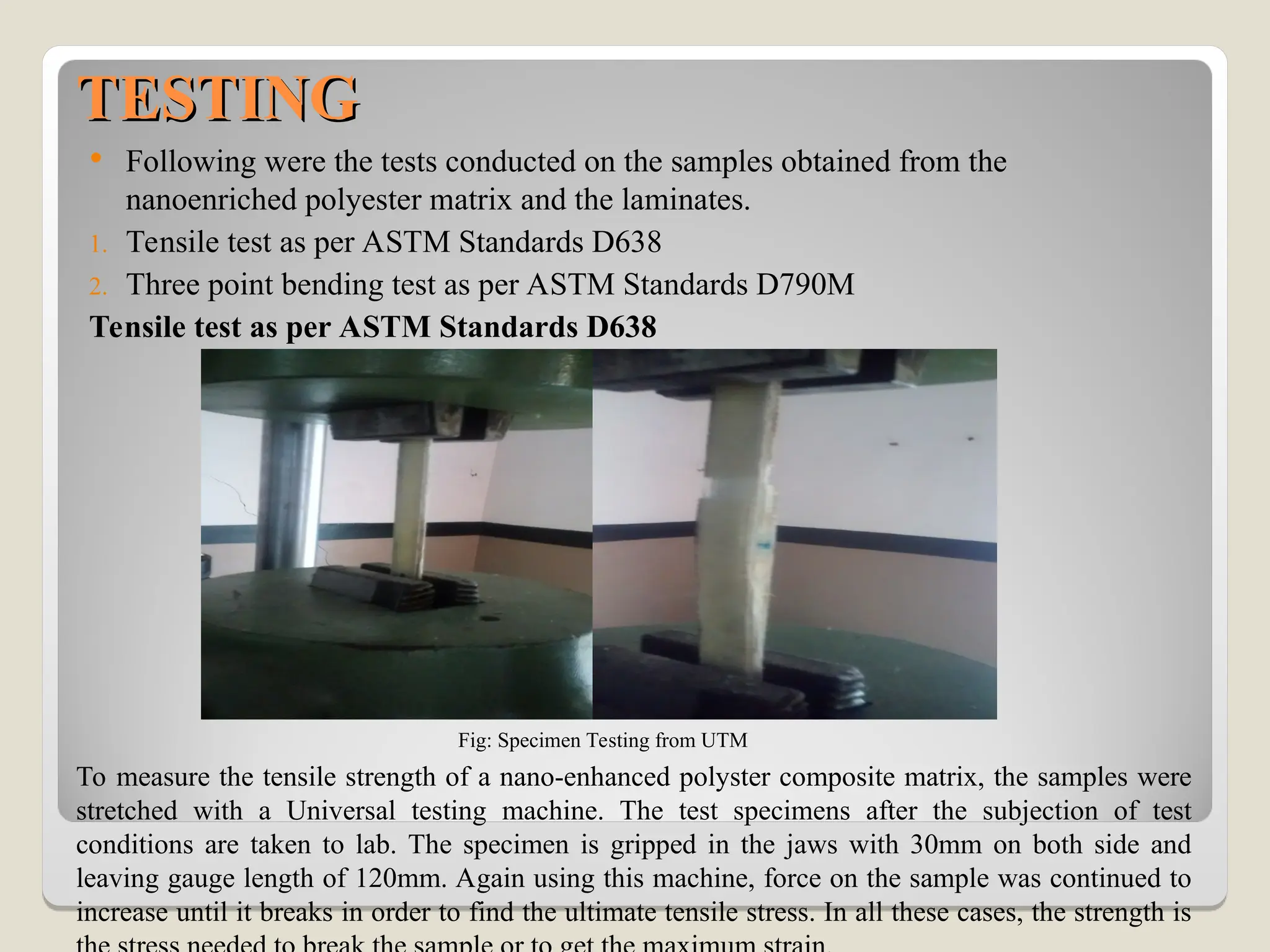
Tensile test as per ASTM Standards D638
Fig: Specimen Testing from UTM
To measure the tensile strength of a nano-enhanced polyster composite matrix, the samples were
stretched with a Universal testing machine. The test specimens after the subjection of test
conditions are taken to lab. The specimen is gripped in the jaws with 30mm on both side and
leaving gauge length of 120mm. Again using this machine, force on the sample was continued to
increase until it breaks in order to find the ultimate tensile stress. In all these cases, the strength is
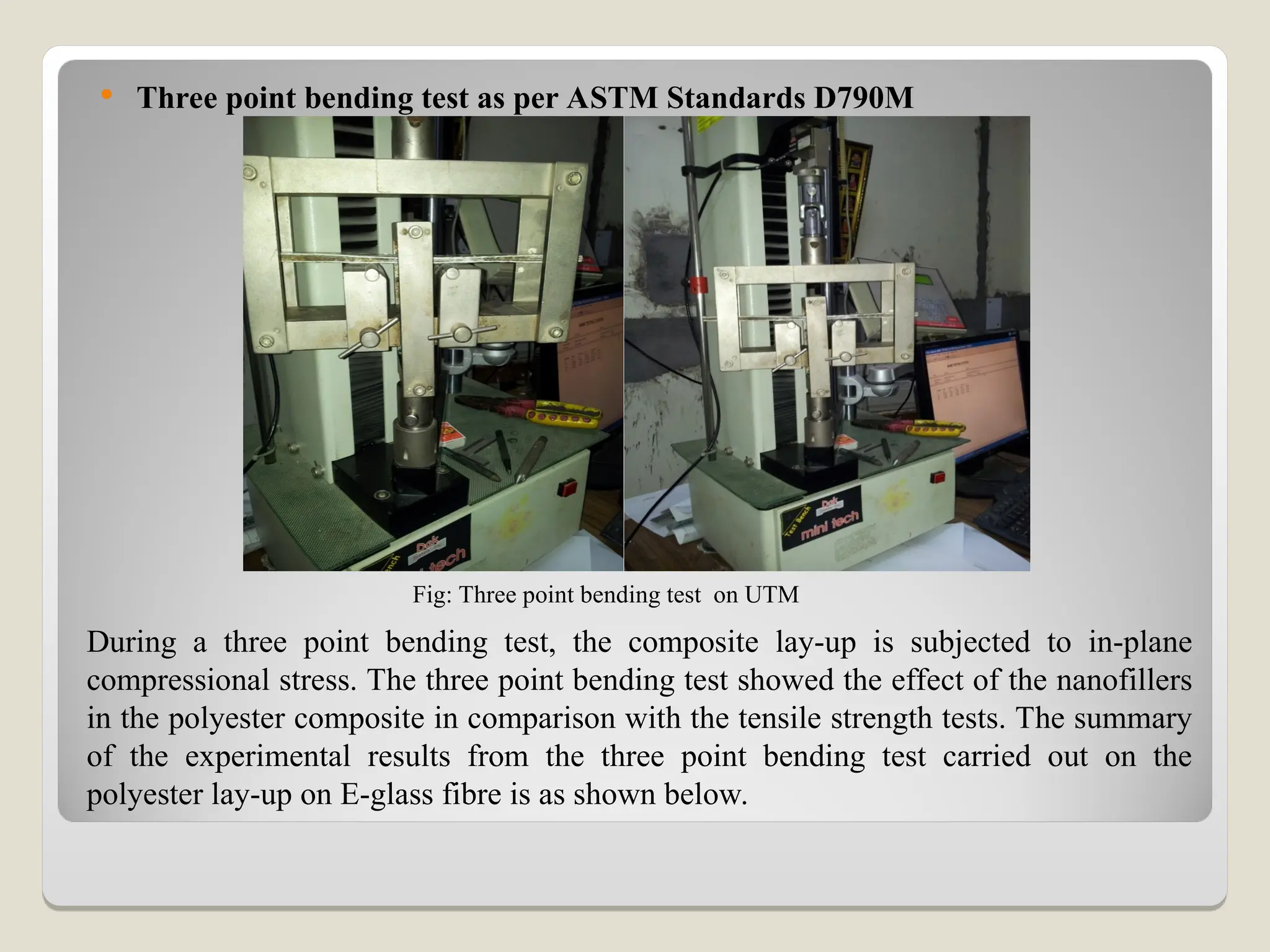
 Three point bending test as per ASTM Standards D790M
During a three point bending test, the composite lay-up is subjected to in-plane
compressional stress. The three point bending test showed the effect of the nanofillers
in the polyester composite in comparison with the tensile strength tests. The summary
of the experimental results from the three point bending test carried out on the
polyester lay-up on E-glass fibre is as shown below.
Fig: Three point bending test on UTM
Graphs on tensile test of silica and
aluminium nanoparticle
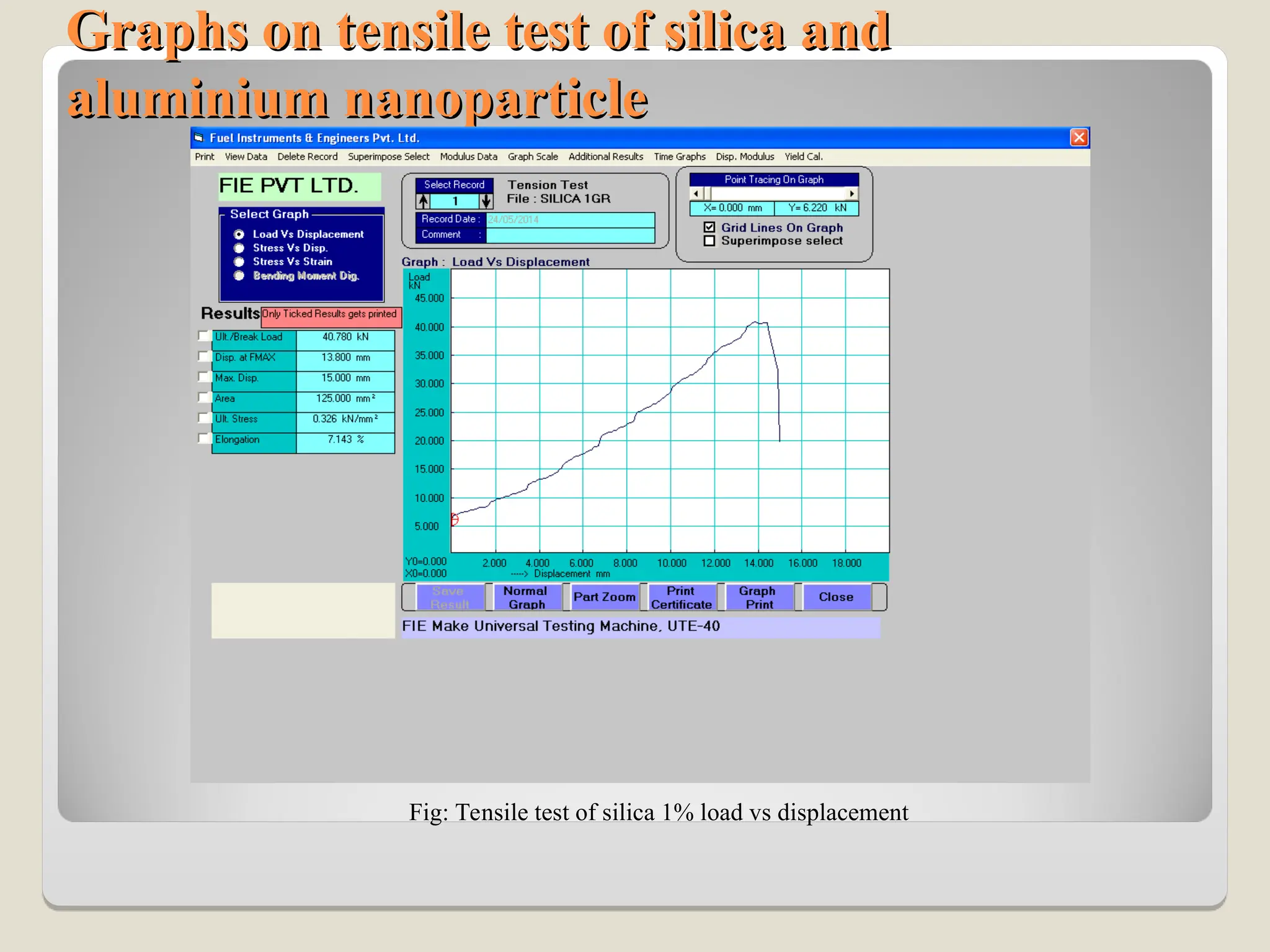
Fig: Tensile test of silica 1% load vs displacement
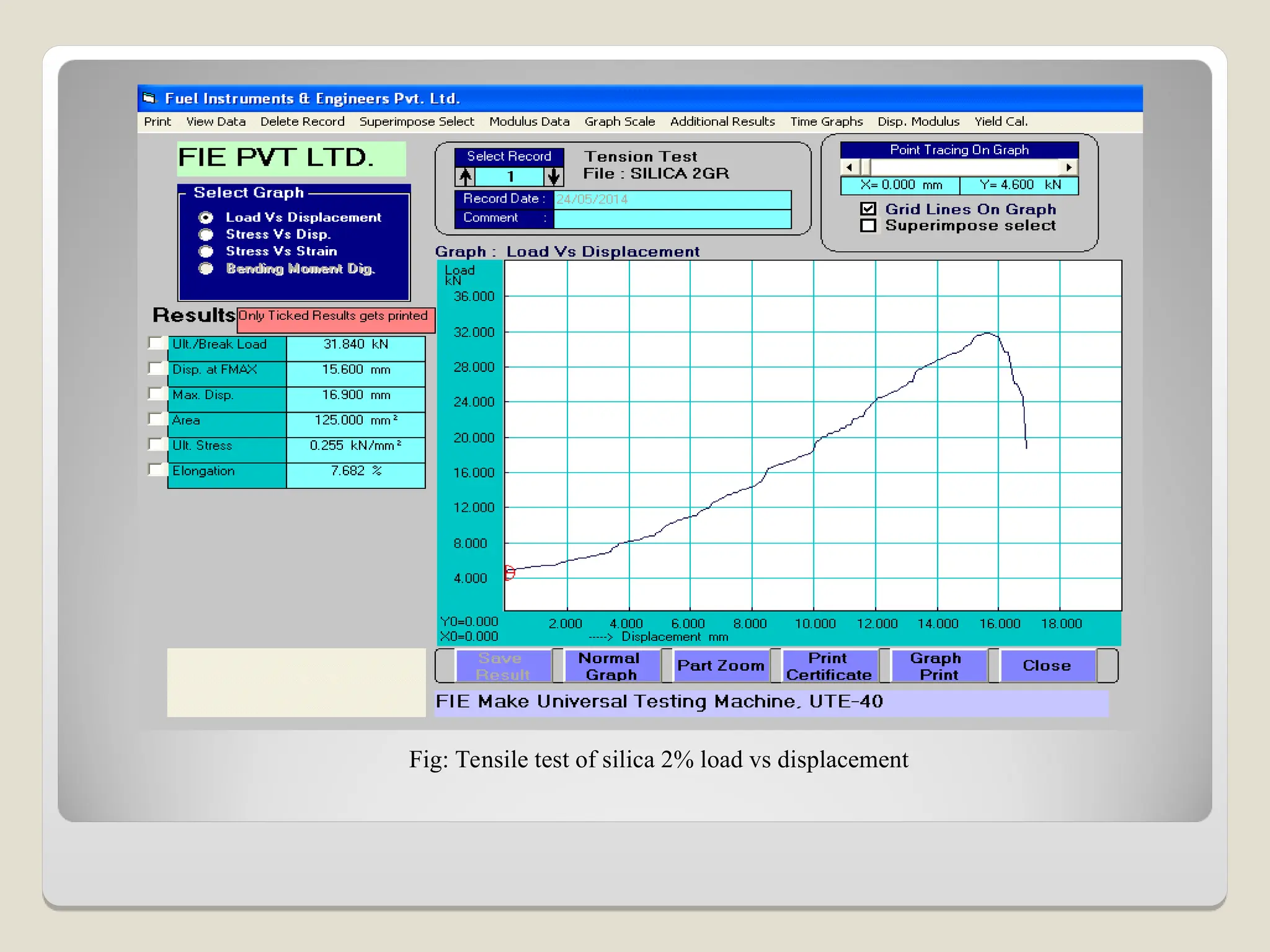
Fig: Tensile test of silica 2% load vs displacement
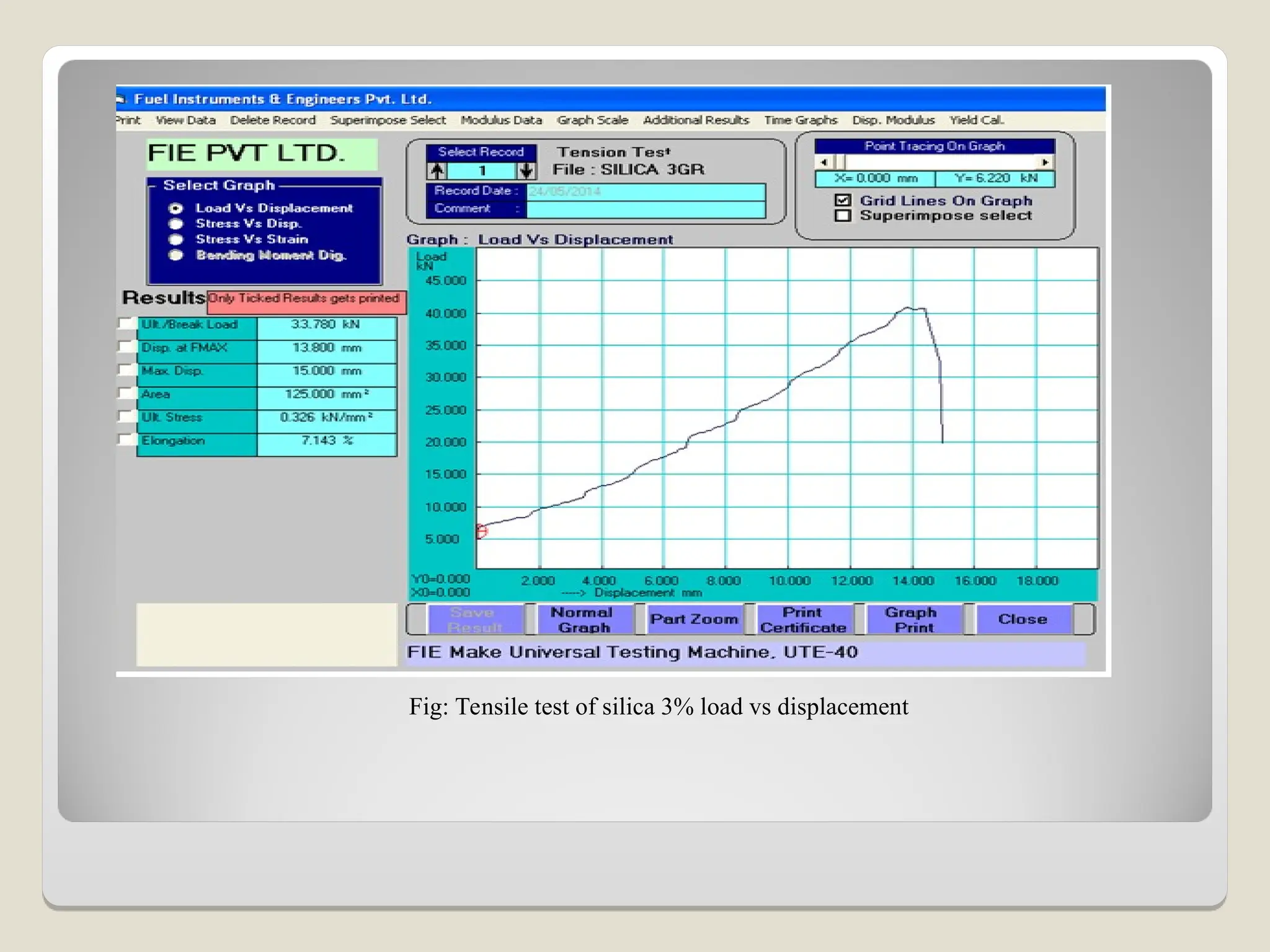
Fig: Tensile test of silica 3% load vs displacement
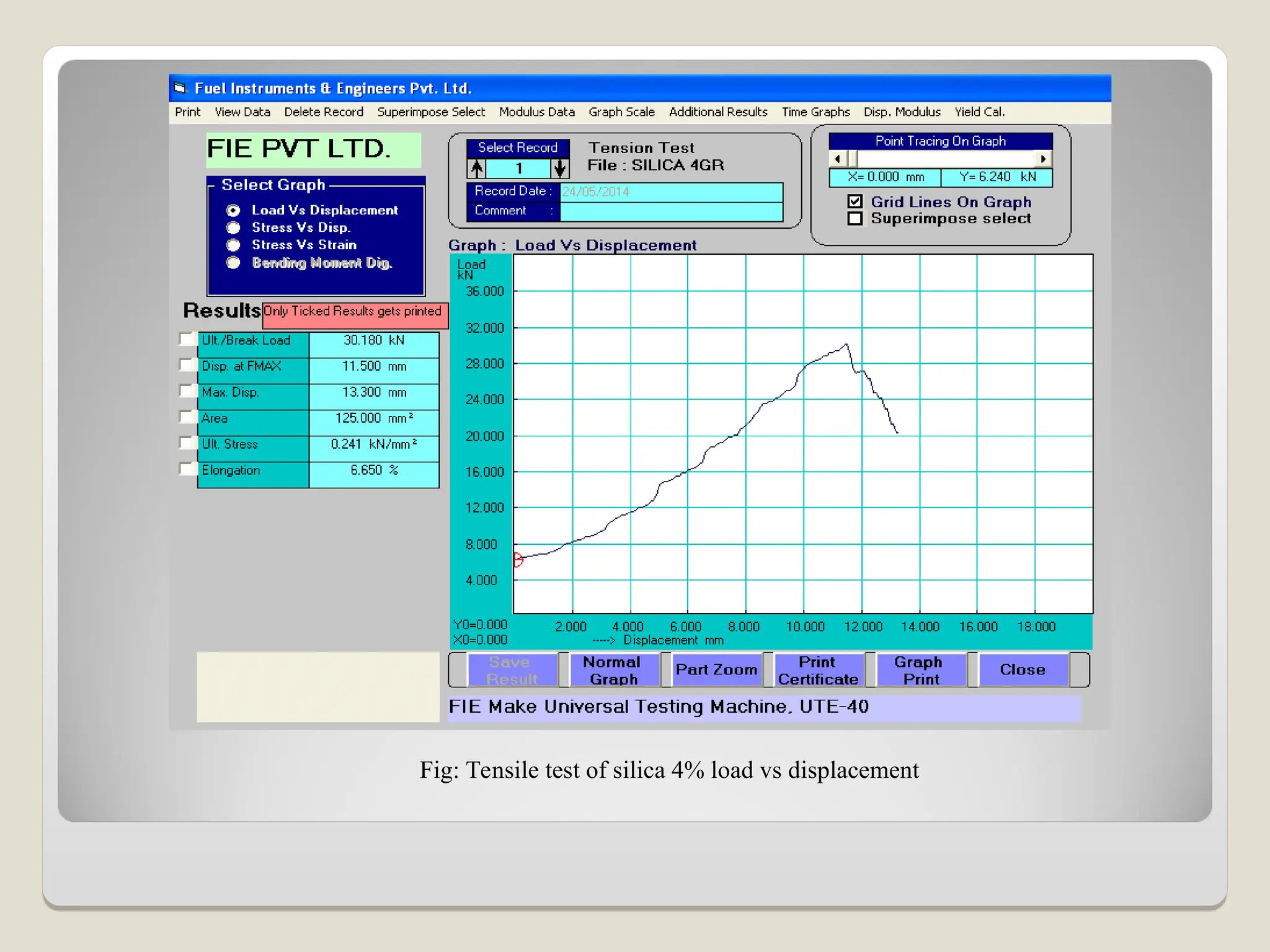
Fig: Tensile test of silica 4% load vs displacement
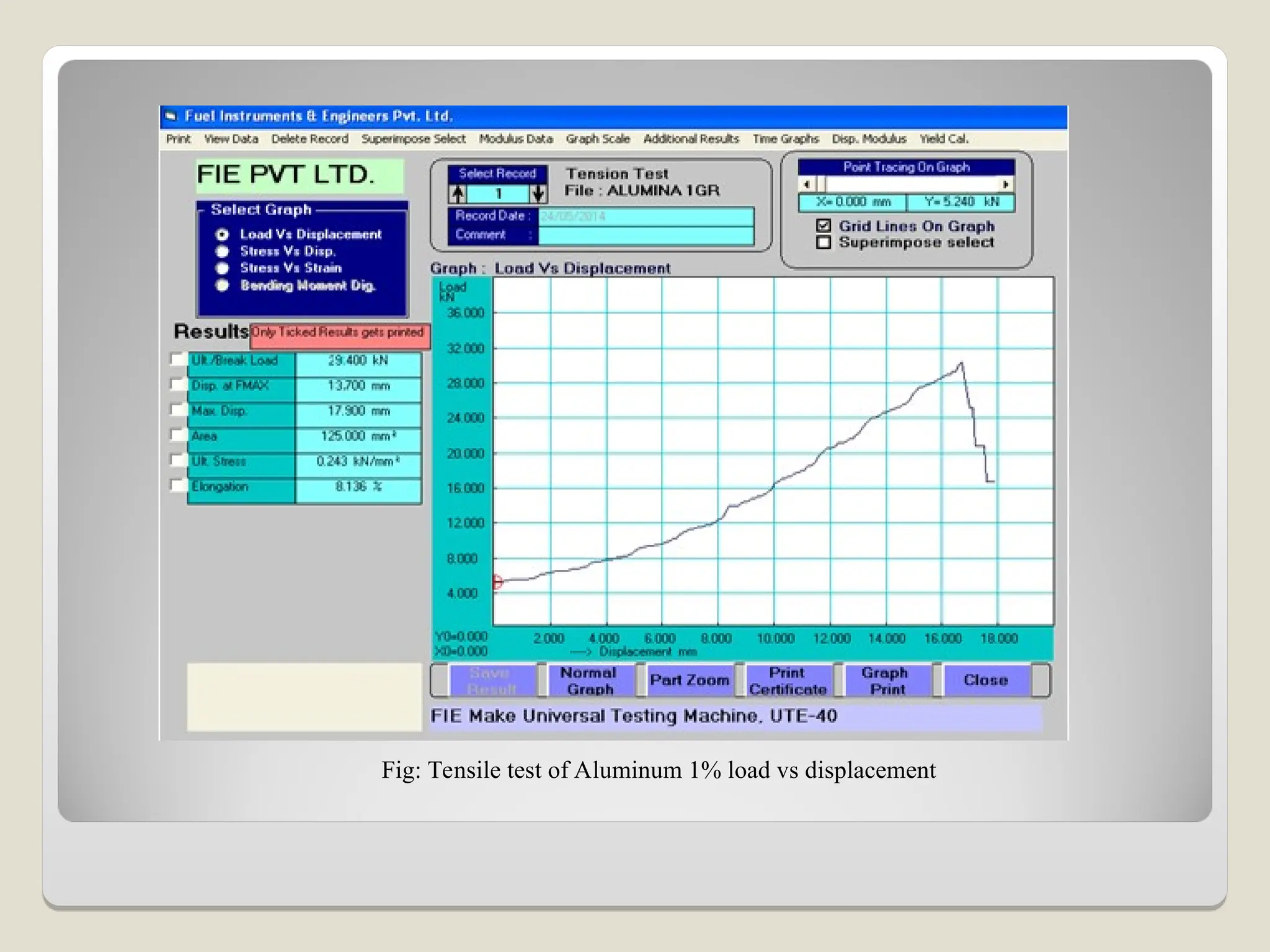
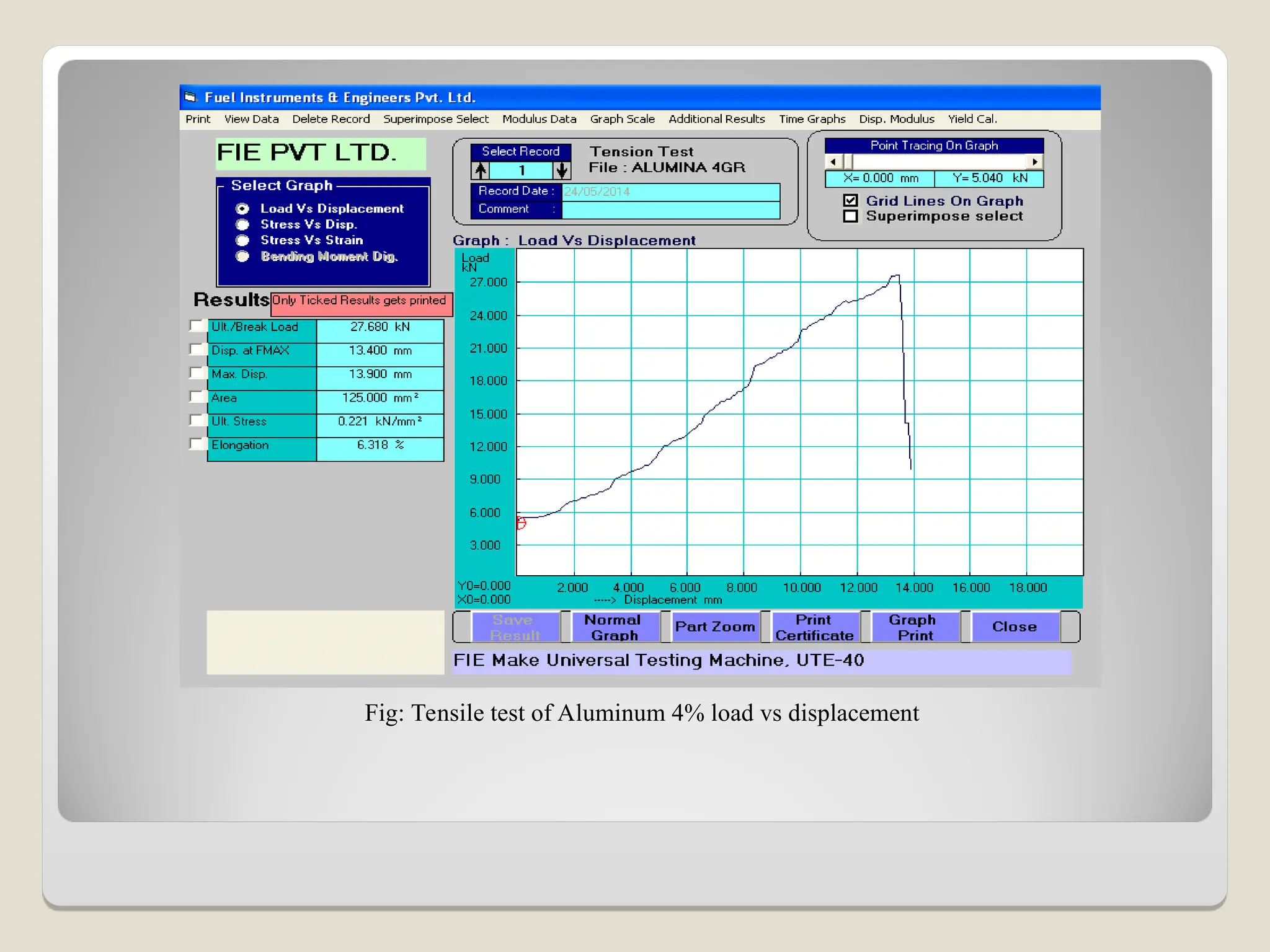
Fig: Tensile test of Aluminum 1% load vs displacement
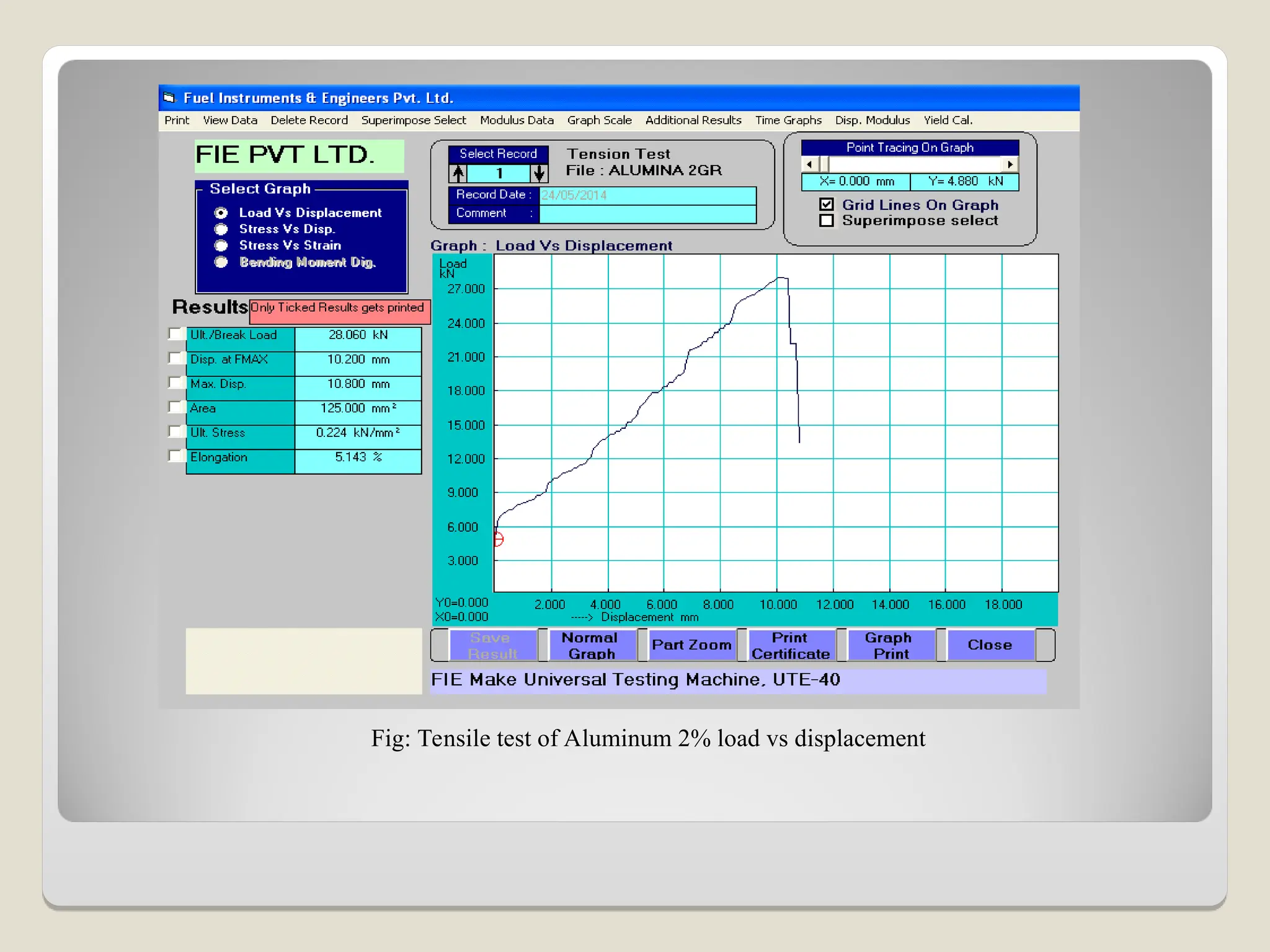
Fig: Tensile test of Aluminum 2% load vs displacement
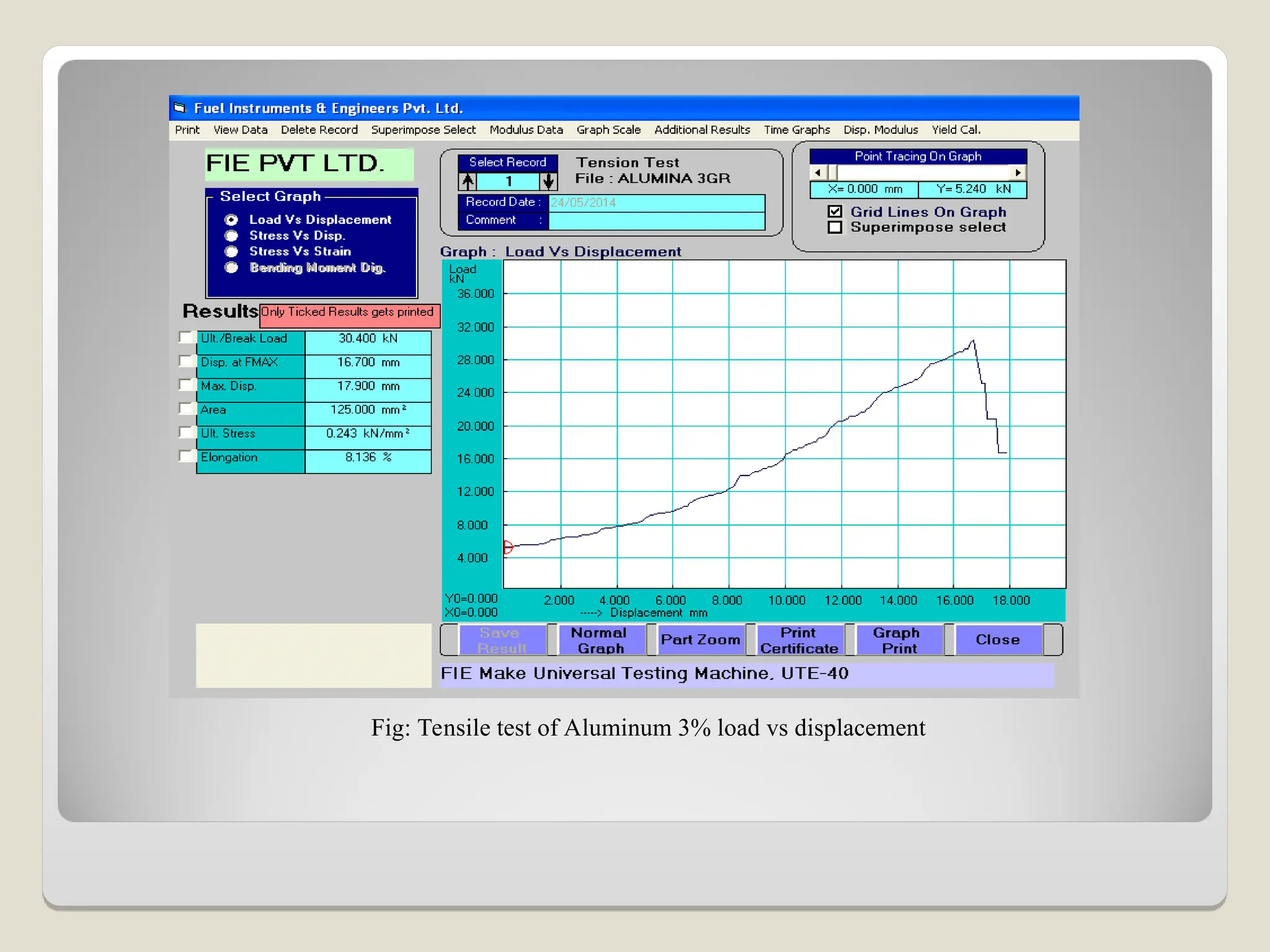
Fig: Tensile test of Aluminum 3% load vs displacement
Fig: Tensile test of Aluminum 4% load vs displacement
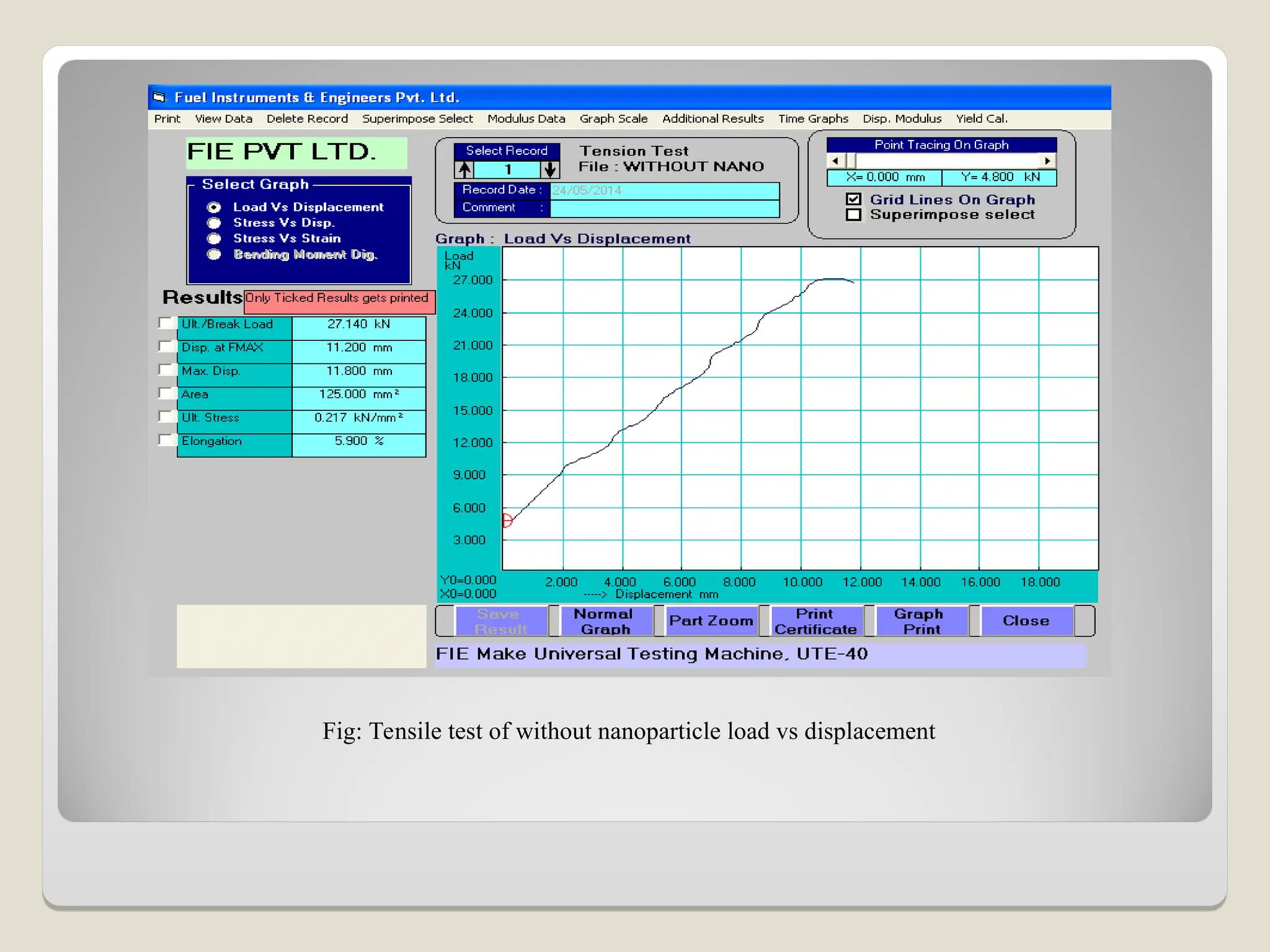
Fig: Tensile test of without nanoparticle load vs displacement
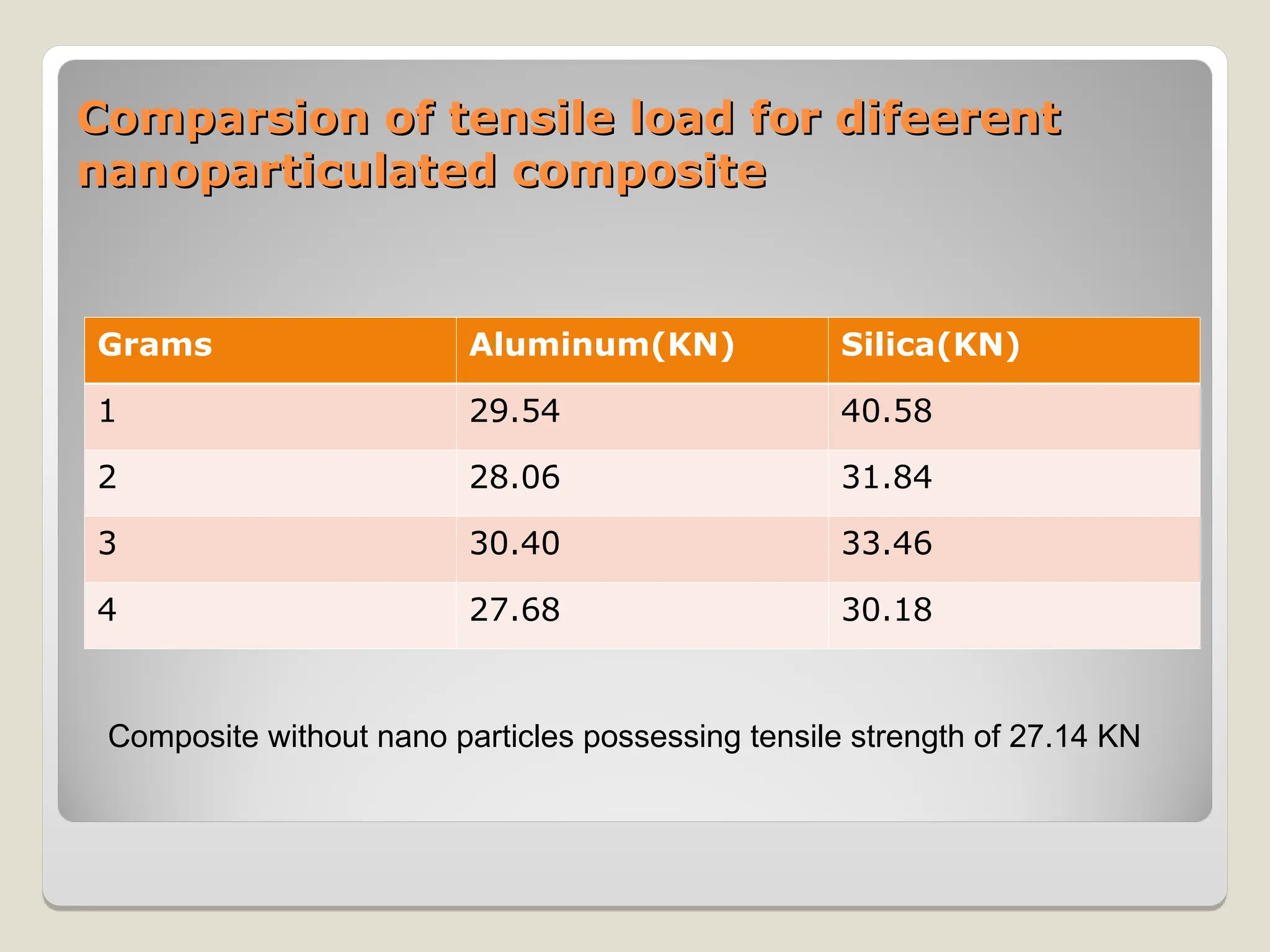
Comparsion of tensile load for difeerent
nanoparticulated composite
Grams Aluminum(KN) Silica(KN)
1 29.54 40.58
2 28.06 31.84
3 30.40 33.46
4 27.68 30.18
Composite without nano particles possessing tensile strength of 27.14 KN
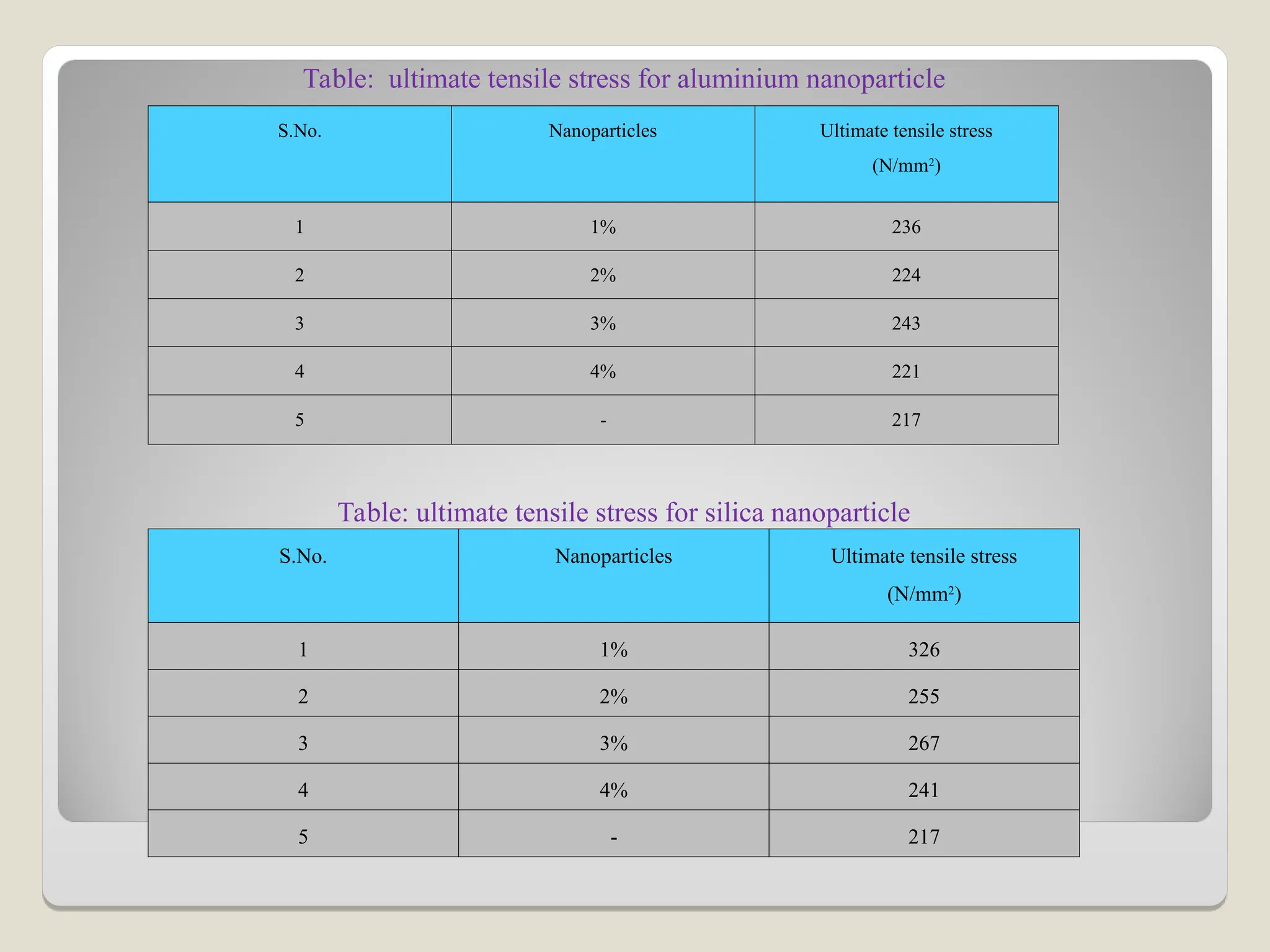
S.No. Nanoparticles Ultimate tensile stress
(N/mm2)
1 1% 236
2 2% 224
3 3% 243
4 4% 221
5 - 217
Table: ultimate tensile stress for aluminium nanoparticle
S.No. Nanoparticles Ultimate tensile stress
(N/mm2
)
1 1% 326
2 2% 255
3 3% 267
4 4% 241
5 - 217
Table: ultimate tensile stress for silica nanoparticle
Graphs on bending test of silica and aluminium
nanoparticle
nanoparticle
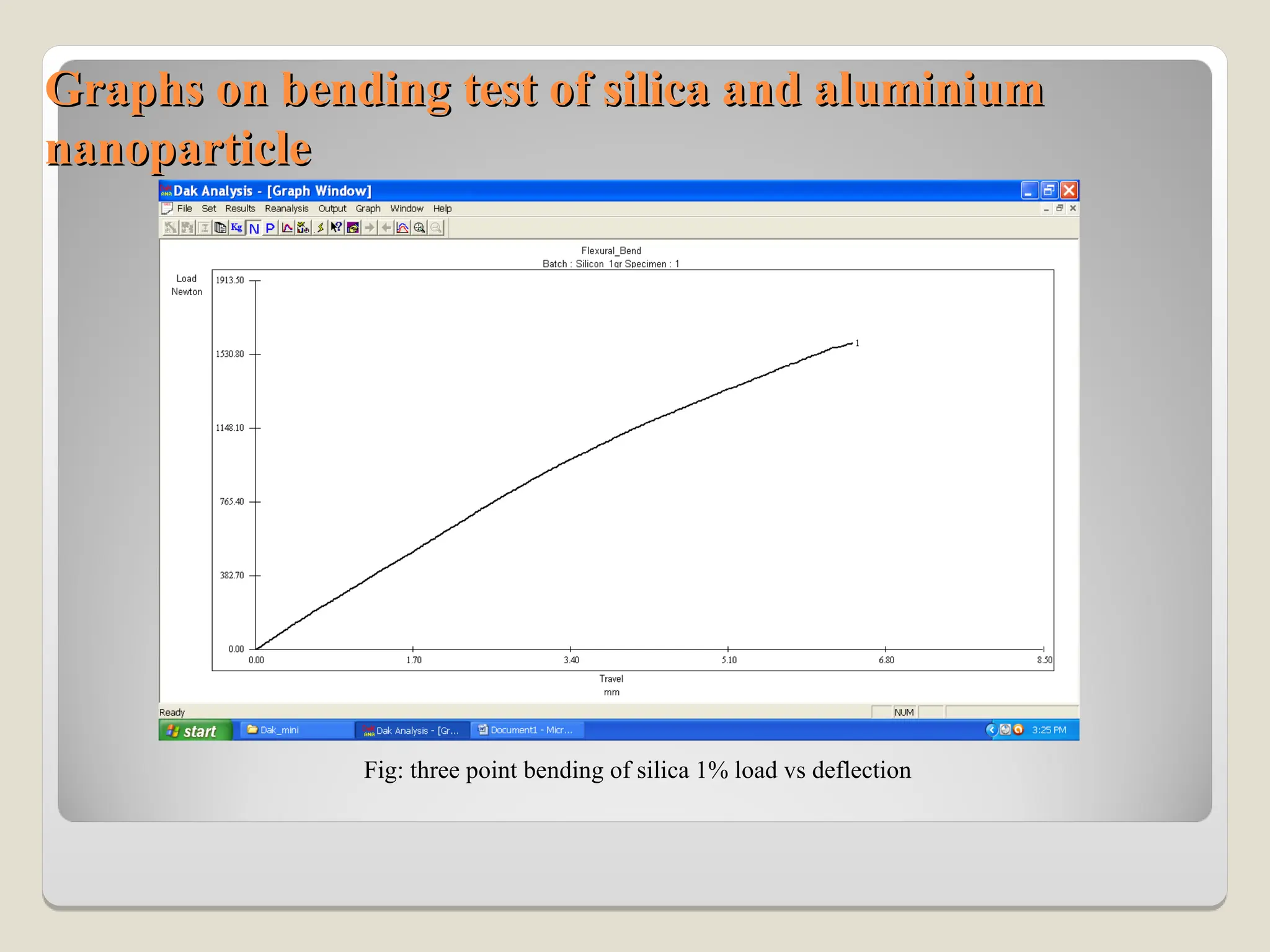
Fig: three point bending of silica 1% load vs deflection
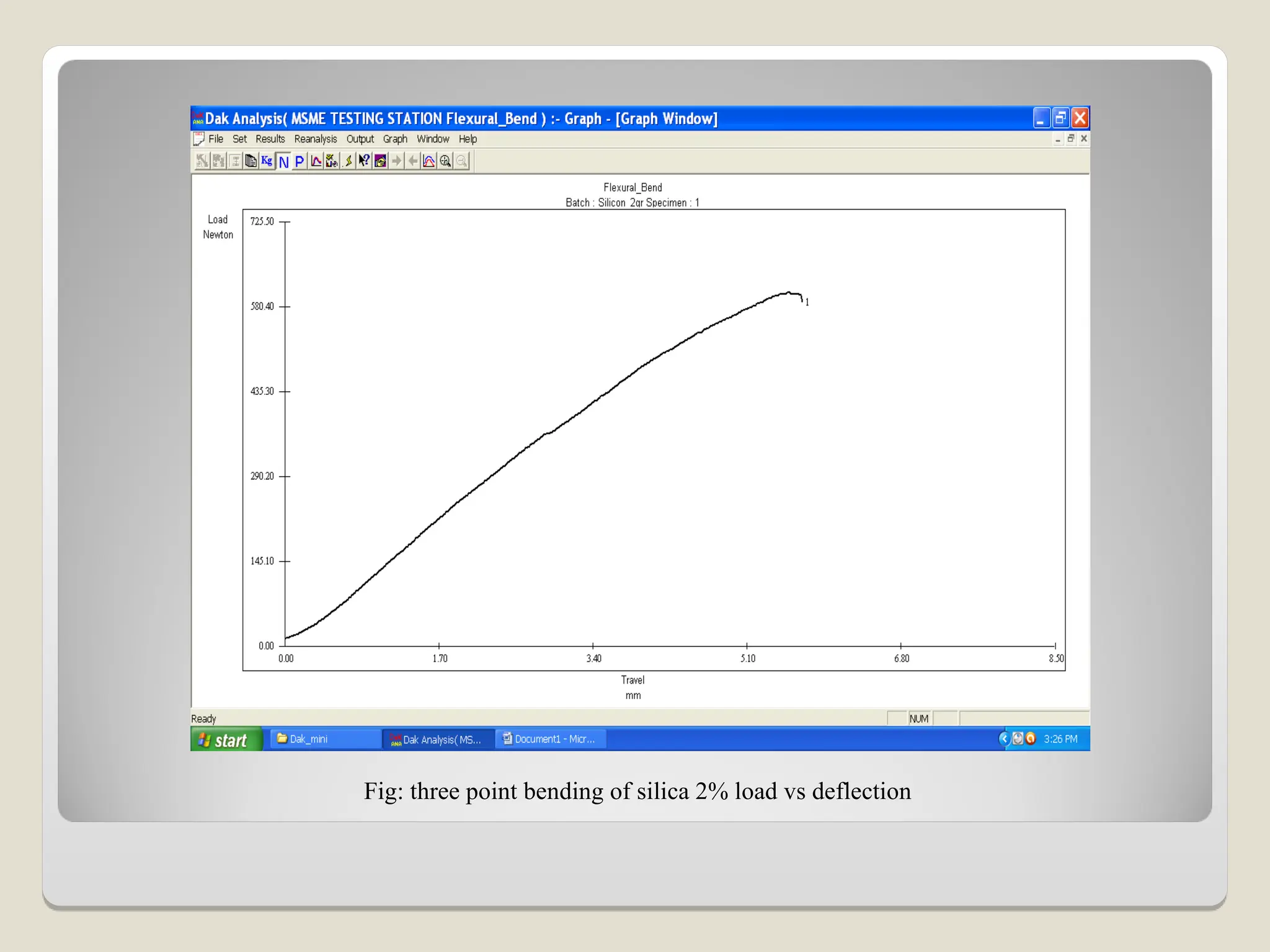
Fig: three point bending of silica 2% load vs deflection
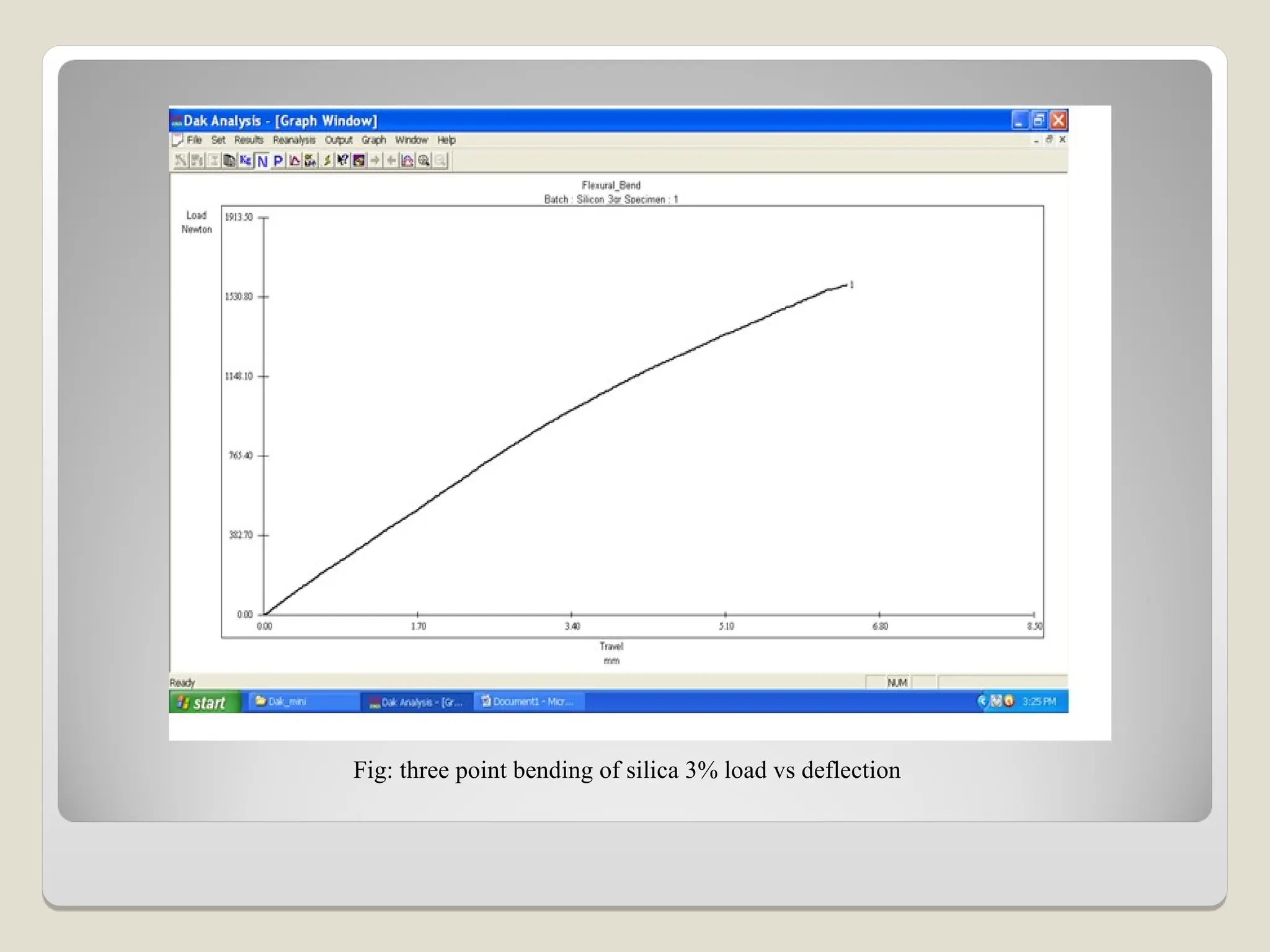
Fig: three point bending of silica 3% load vs deflection
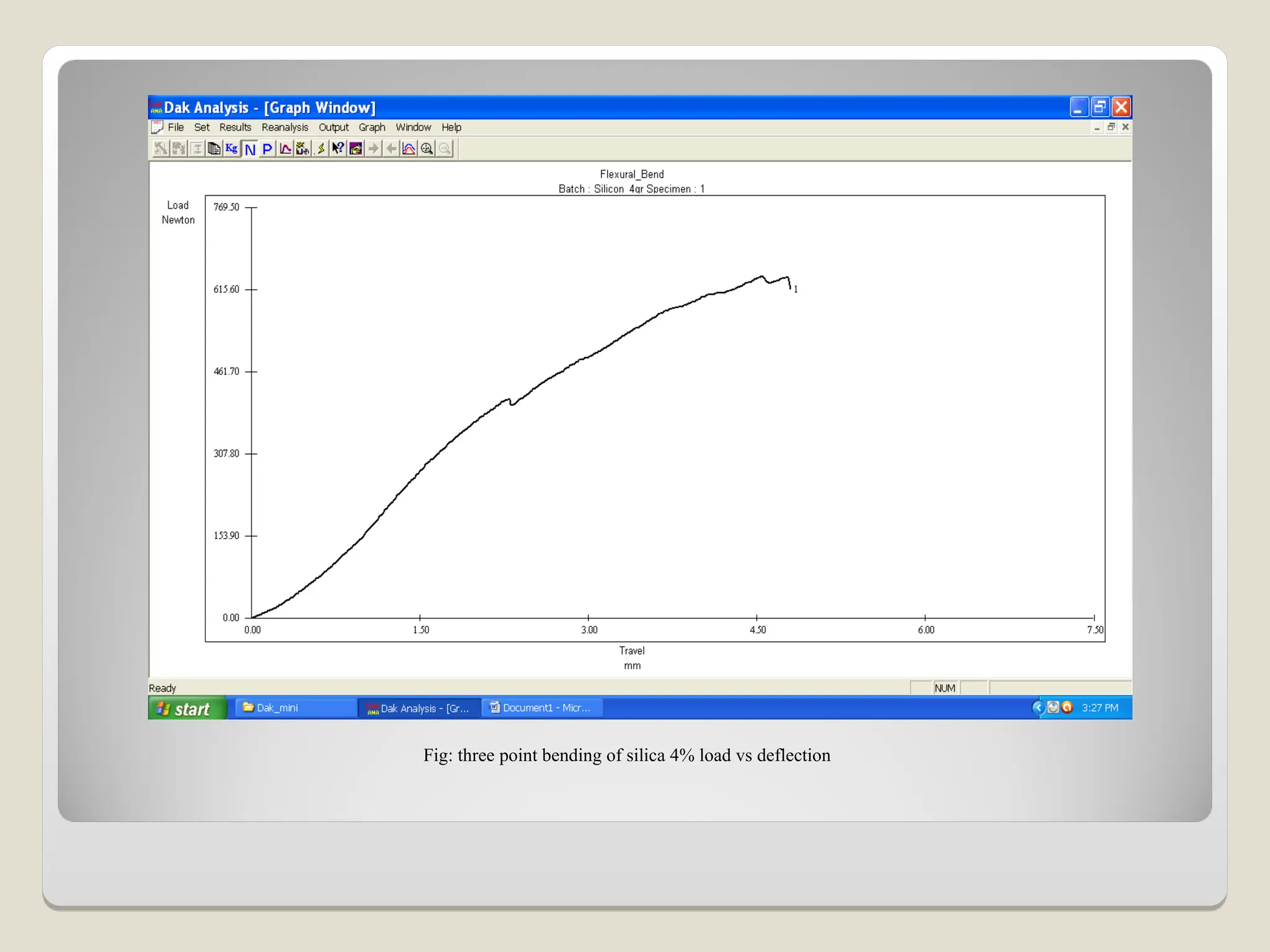
Fig: three point bending of silica 4% load vs deflection
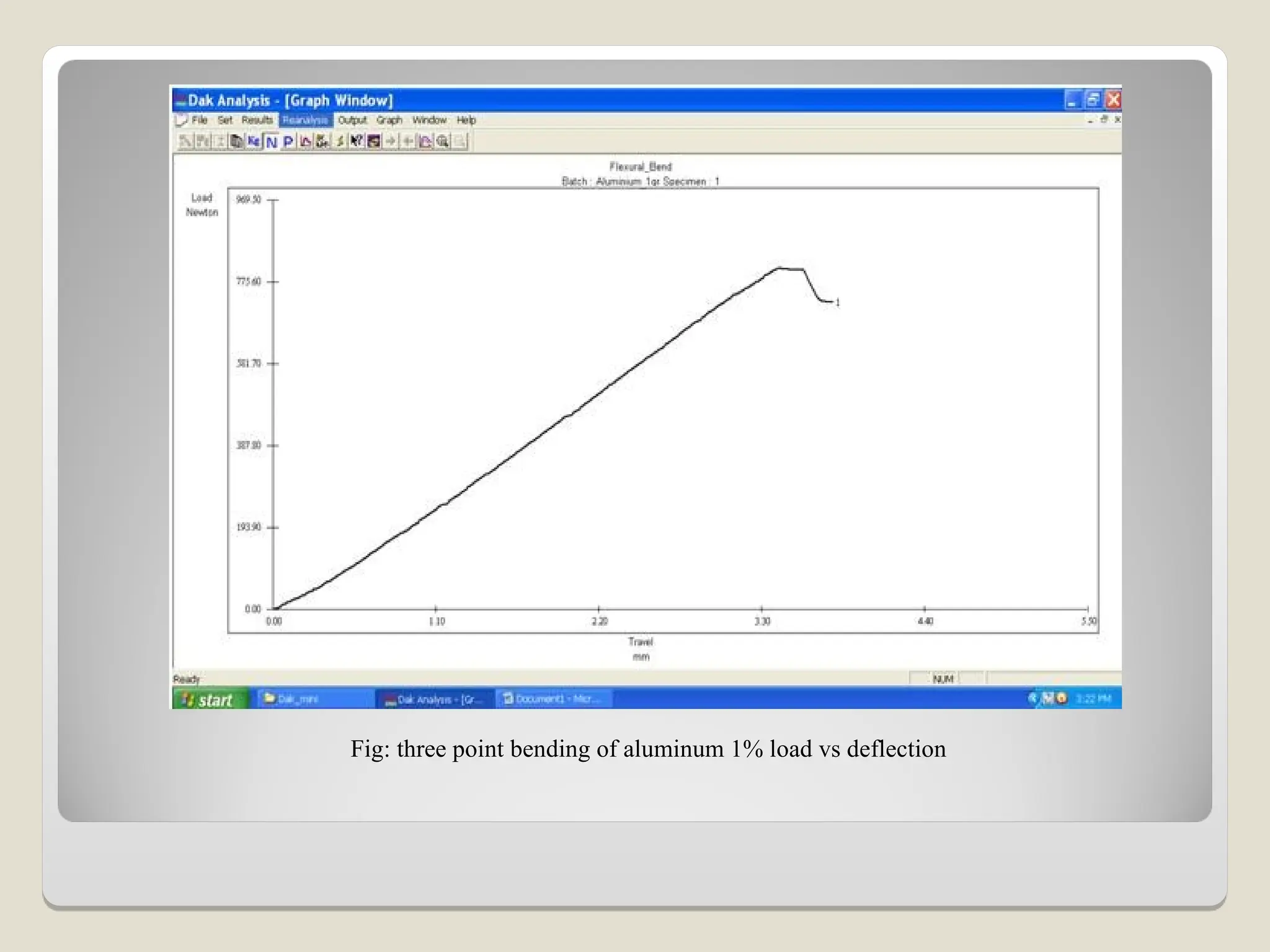
Fig: three point bending of aluminum 1% load vs deflection
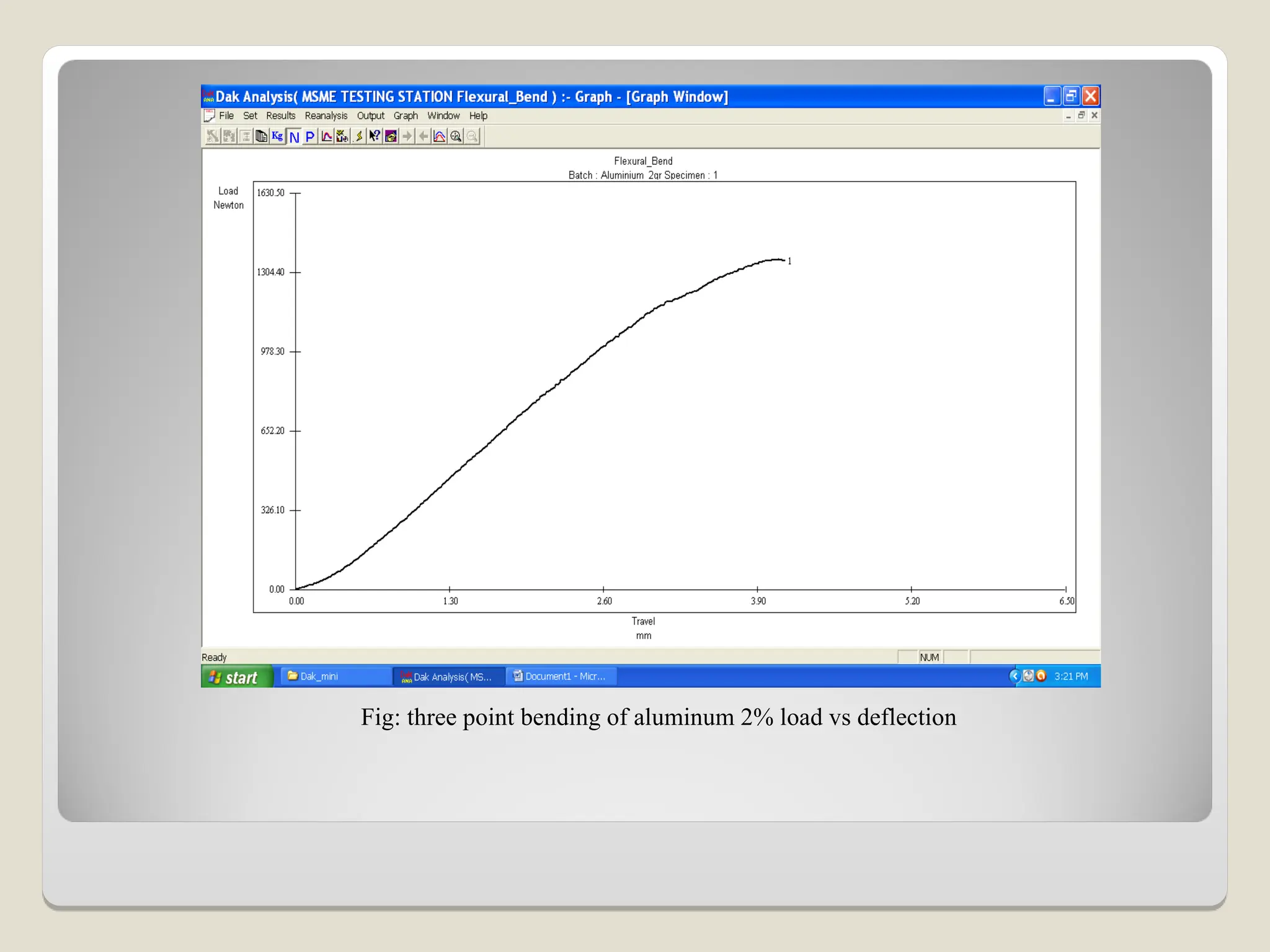
Fig: three point bending of aluminum 2% load vs deflection
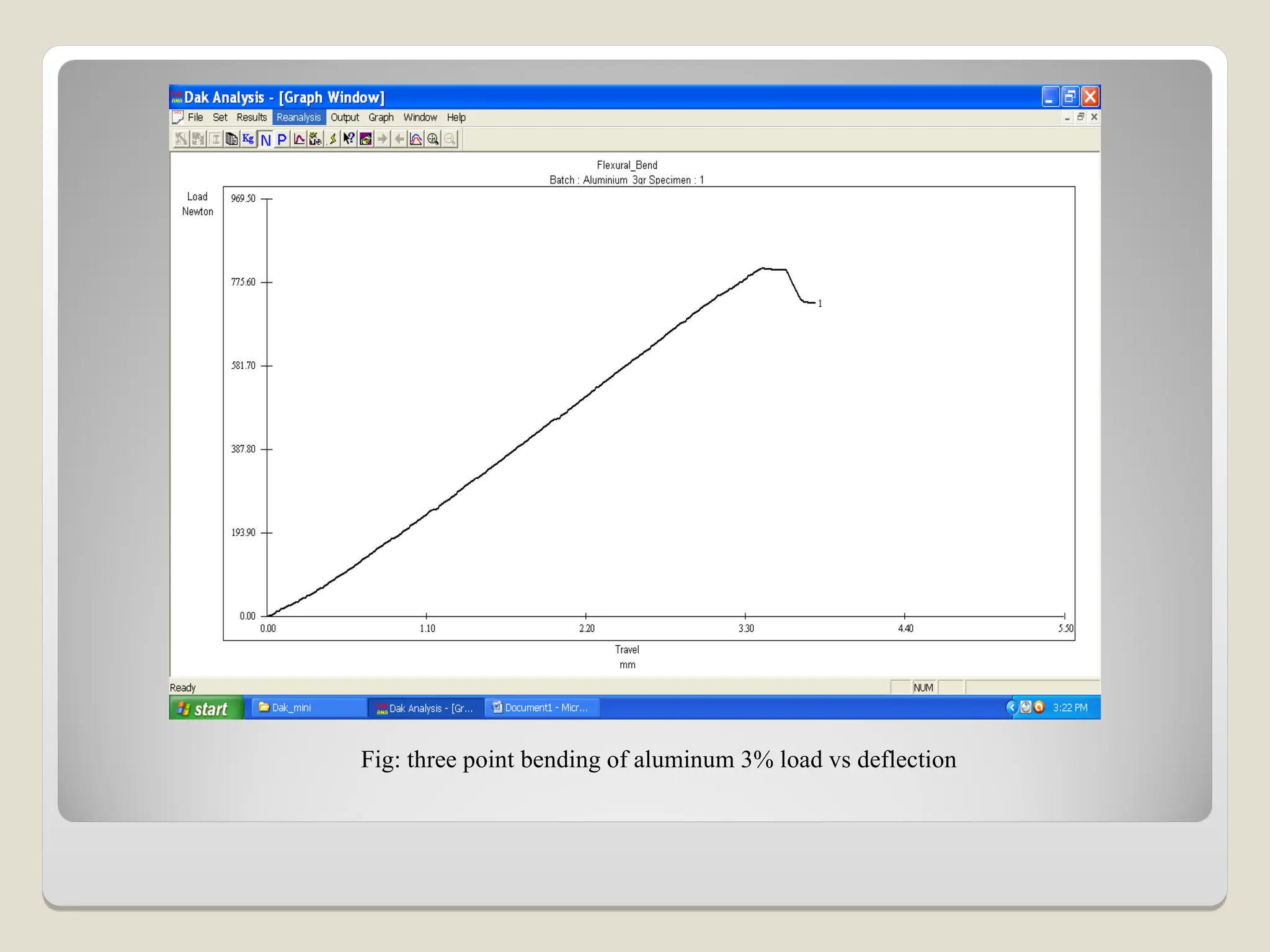
Fig: three point bending of aluminum 3% load vs deflection
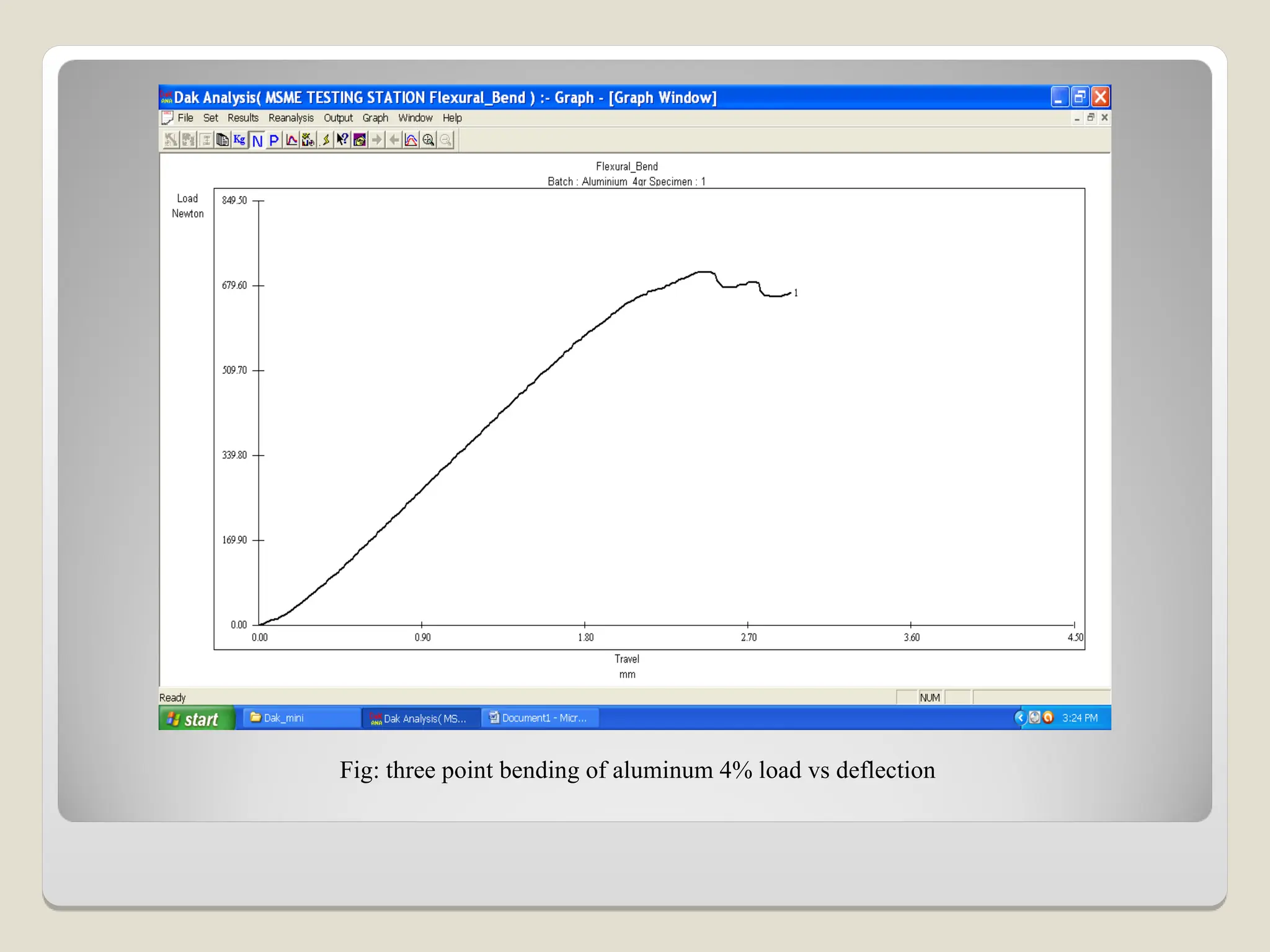
Fig: three point bending of aluminum 4% load vs deflection
Fig: three point bending of without nanoparticle load vs deflection
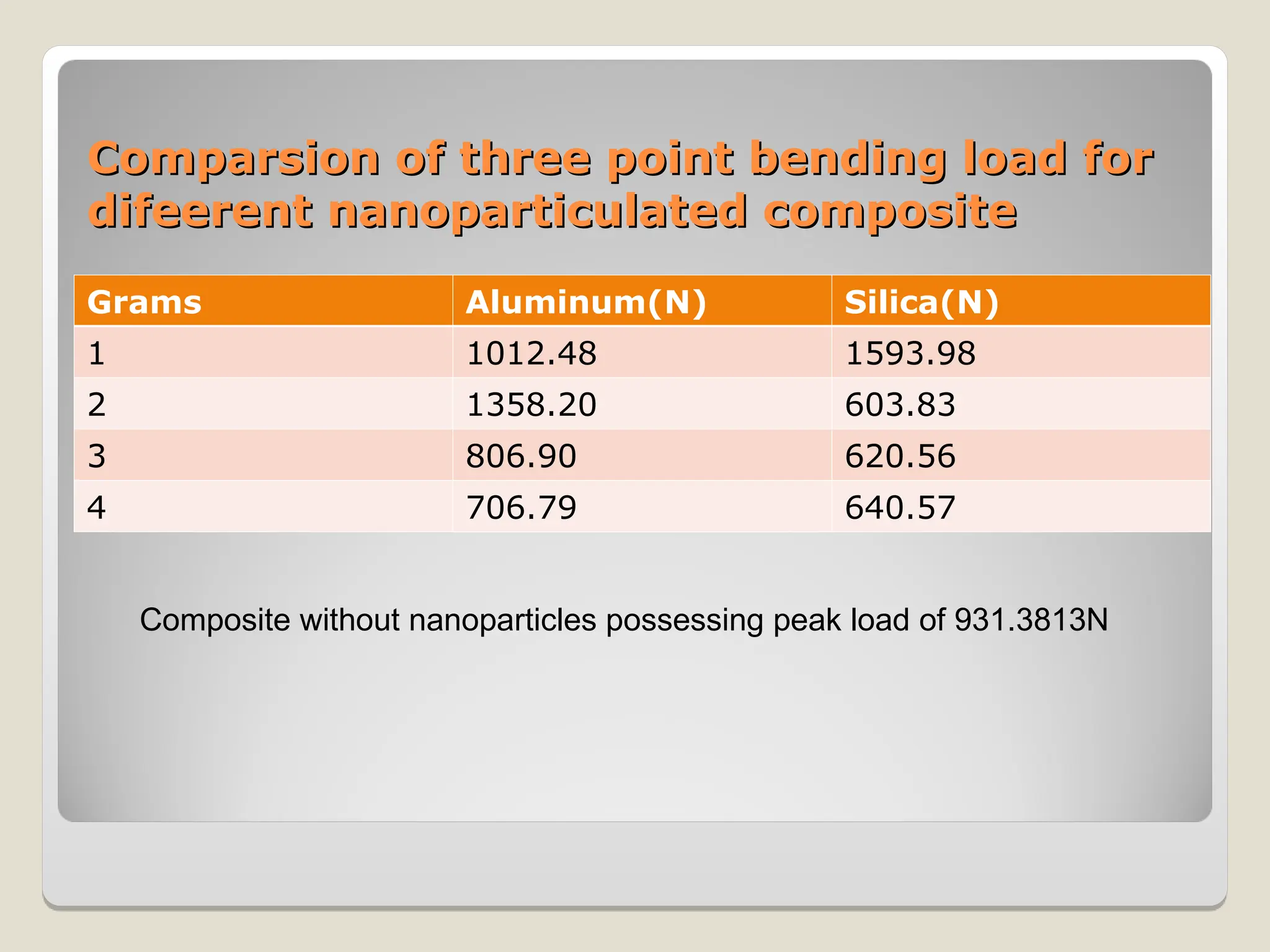
Comparsion of three point bending load for
difeerent nanoparticulated composite
Grams Aluminum(N) Silica(N)
1 1012.48 1593.98
2 1358.20 603.83
3 806.90 620.56
4 706.79 640.57
Composite without nanoparticles possessing peak load of 931.3813N
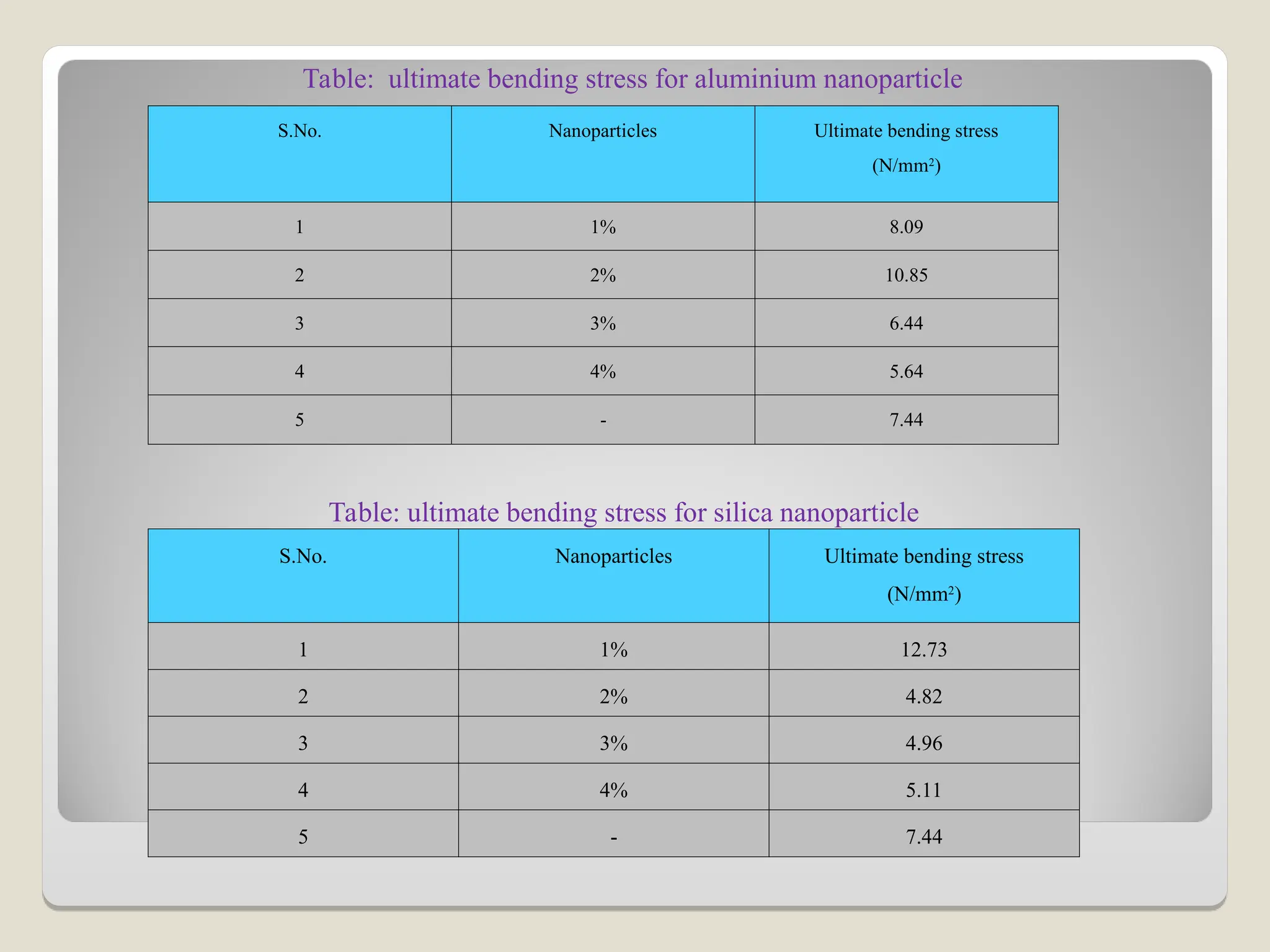
S.No. Nanoparticles Ultimate bending stress
(N/mm2)
1 1% 8.09
2 2% 10.85
3 3% 6.44
4 4% 5.64
5 - 7.44
Table: ultimate bending stress for aluminium nanoparticle
S.No. Nanoparticles Ultimate bending stress
(N/mm2
)
1 1% 12.73
2 2% 4.82
3 3% 4.96
4 4% 5.11
5 - 7.44
Table: ultimate bending stress for silica nanoparticle
Conclusions
Conclusions
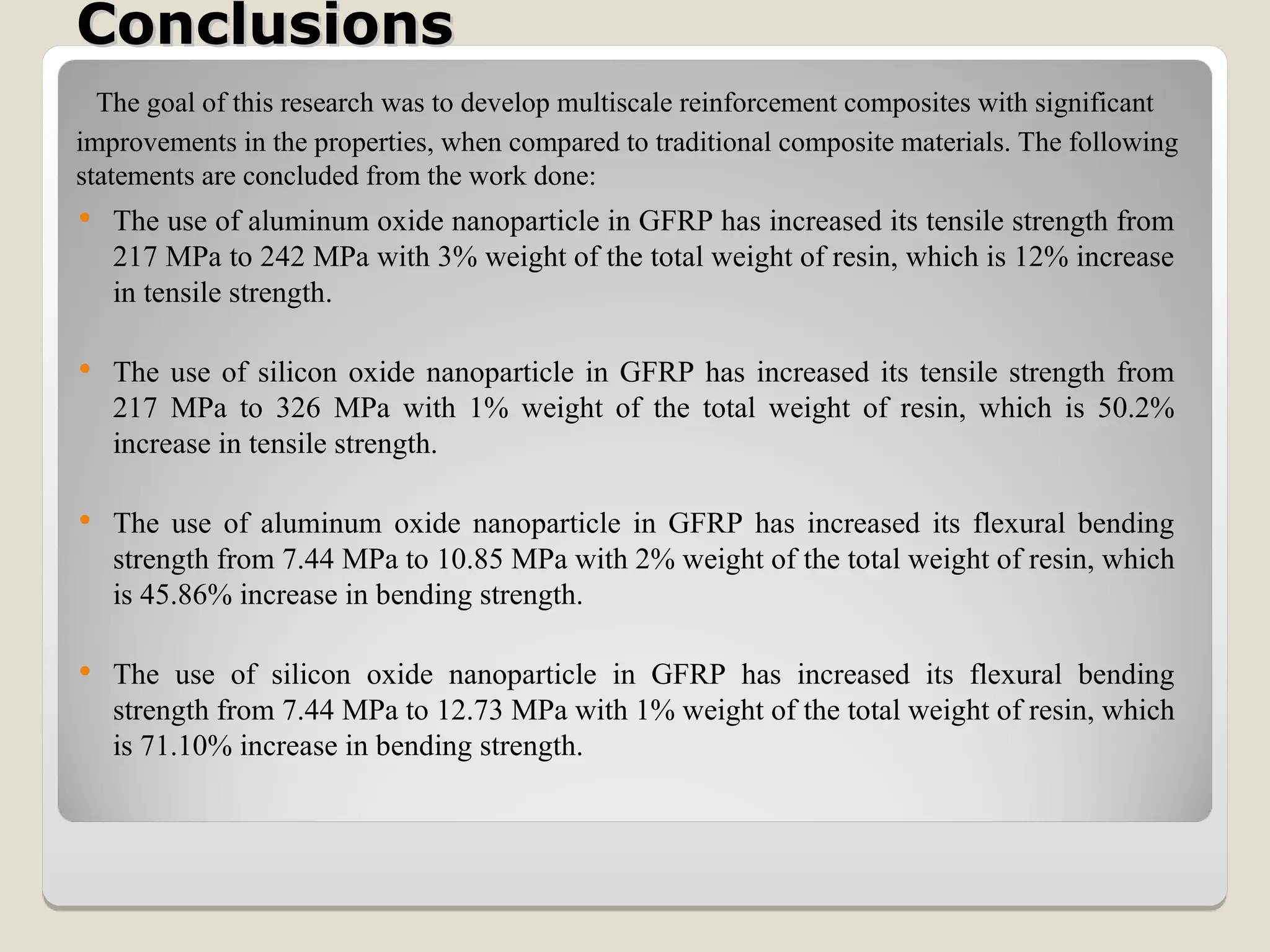
The goal of this research was to develop multiscale reinforcement composites with significant
improvements in the properties, when compared to traditional composite materials. The following
statements are concluded from the work done:
 The use of aluminum oxide nanoparticle in GFRP has increased its tensile strength from
217 MPa to 242 MPa with 3% weight of the total weight of resin, which is 12% increase
in tensile strength.
 The use of silicon oxide nanoparticle in GFRP has increased its tensile strength from
217 MPa to 326 MPa with 1% weight of the total weight of resin, which is 50.2%
increase in tensile strength.
 The use of aluminum oxide nanoparticle in GFRP has increased its flexural bending
strength from 7.44 MPa to 10.85 MPa with 2% weight of the total weight of resin, which
is 45.86% increase in bending strength.
 The use of silicon oxide nanoparticle in GFRP has increased its flexural bending
strength from 7.44 MPa to 12.73 MPa with 1% weight of the total weight of resin, which
is 71.10% increase in bending strength.
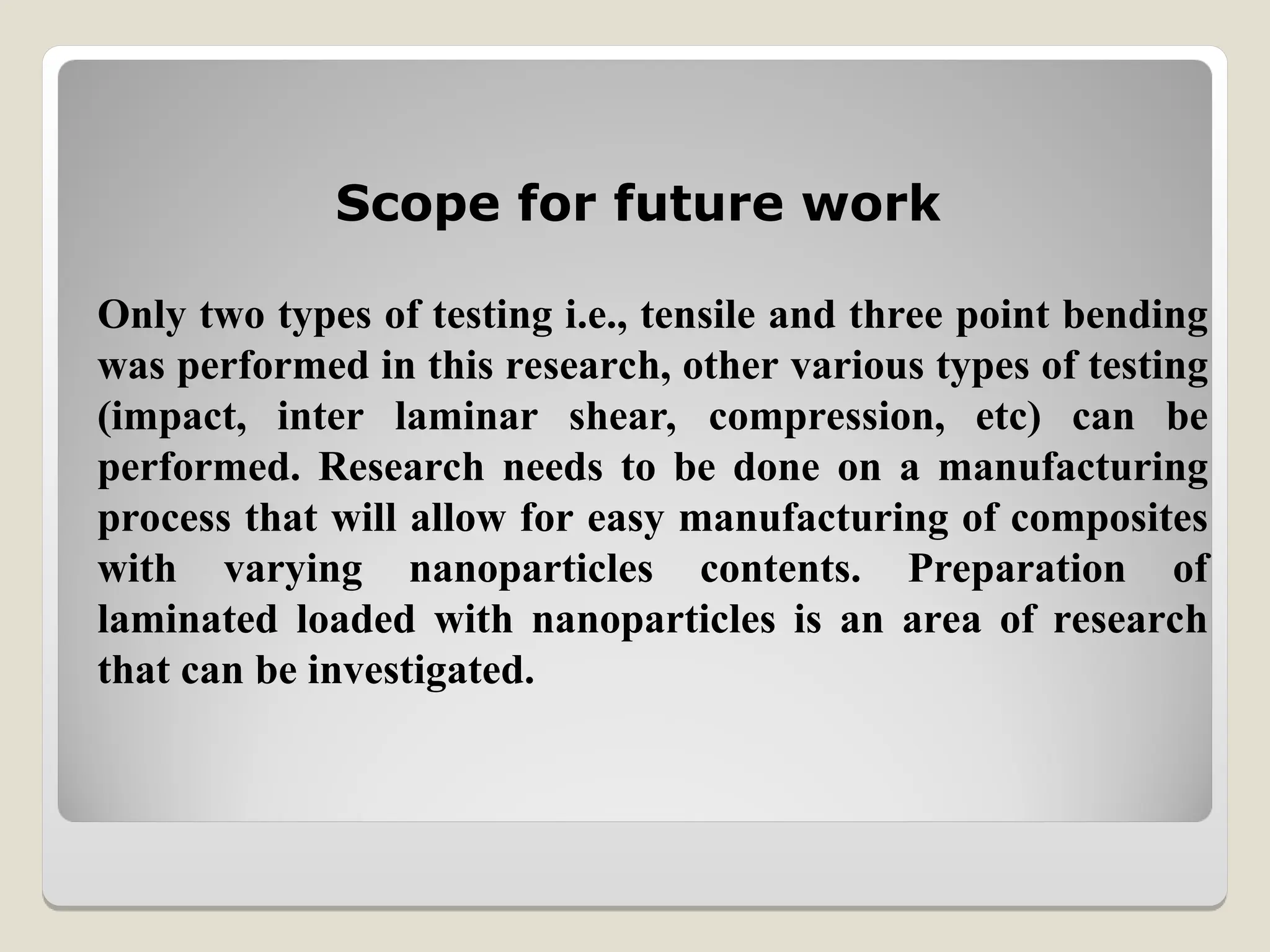
Only two types of testing i.e., tensile and three point bending
was performed in this research, other various types of testing
(impact, inter laminar shear, compression, etc) can be
performed. Research needs to be done on a manufacturing
process that will allow for easy manufacturing of composites
with varying nanoparticles contents. Preparation of
laminated loaded with nanoparticles is an area of research
that can be investigated.
Scope for future work
References
References
1. Wilkes G L, Maxwell B. Recent Advances in Polymer Science. In:
Polymer Symposium; New York; 1974. Series Vol. 46; p. 15-58.
2. Giannelis E P. Advanced Materials. 1996. Vol. 8; p. 29.
3. Carl W, John Y. Commercializing Nanotechnology. 2004. p 2-11.
4. Pietro M. Carbon Nanotubes - Overview of Properties,
Classification, Fabrication and Synthesis. Xlab Materials and
Microsystems Laboratory; The Polytechnic of Turin and the National
Institute for Physics of Matter; 2002.
5. Harry S. Carbon Nanotube Manufacturing on a Commercial Scale -
Ready for Mass-Markets. The European Coatings Journal; November
2004.
2004.
6. Morinobu E, Takuya H, Yoong K A, Hiroyuki M. Development and
Application of Carbon Nanotubes. Institute for Carbon Science and
Technology; 2006. Vol. 45; No. 6A.
Effect of gfrp on composite materials and conventional materials (1).ppt

Effect of gfrp on composite materials and conventional materials (1).ppt

  • 1.
    By SYED IMTIYAZ AHMED (1604-10-765-012) Underthe guidance of MOHD MINHAJUDDIN SAIF Asst. Professor, MED MJCET
  • 2.
    ABSTRACT ABSTRACT 1. High performancecomposites are currently being used in the marine, automotive, aerospace and defense industries. These industries demand materials with properties that are similar or better than conventional metals at a fraction of the weight. The development of nanoparticle reinforced composites are presently one of the most explored areas in materials science and engineering. The exceptional properties of nanoparticles have made them a focus of widespread research. 2. By combining nanoparticles with traditional reinforcement materials, multiscale composites can be produced with superior properties to that of regular composites. This research focuses on the development of multiscale reinforcement composites, through the use of silica oxide and aluminum oxide, glass fibers and polyester resin. 3. Results from this research showed that the use of aluminum nano particles can increase the tensile strength by up to 30.4 KN and silica nano particles has increased the tensile strength up to 40.780KN when compared with neat composite without nano particles possessing tensile strength of 27.14 KN and peak load in three point bending is 1358.20 N for aluminum nano particulate composite and 1593.9878 N for silica nano particulated composite when compared with composite without nanoparticles possessing peak load of 931.3813N .
  • 3.
    INTRODUCTION INTRODUCTION COMPOSITE MATERIAL:  Sincethe discovery of nonmaterial’s in early nineteen’s, tremendous progress in the synthesis of nanocomposites has been reported looking for better physical and chemical properties towards various applications. An increasing amount of research has resulted in many nanocomposite polymers being applied in a larger extent to industrial, biomedical and electronic consumer products.  While taking advantage of the advanced processing techniques available from synthesis through characterization to commercialization, this research project is aimed at identifying, establishing, developing and characterizing a nano-enhanced composite to suit a variety of applications. Also, through this research, a detailed understanding about the properties of potential nanofillers, matrices, possible processing techniques and compositing methods were established through in-depth study adopted with utmost care at every stage to identify an optimal solution.  While selecting and studying nanofillers for their properties towards the proposed research, besides considering the application and the availability, more weight has been given to the market demand and the commercial aspect of the end product in order to ensure that the outcome of the research would certainly become a value added product. This also ensures the easy processability and marketability of the final nano-enhance composite. Some of the below stated nanofillers considered for this research are substantiated on the grounds of their properties and the end applications. They are: 1. Aluminium oxide nanopowder 2. Silicon dioxide nanopowder
  • 4.
    LITERATURE REVIEW LITERATURE REVIEW Composite materials have extensive industrial applications. The tensile strength and flexural rigidity of composites plays an important role in selecting the optimum materials to meet specific design requirements in many applications.  For example, requirements for modern composite structural materials for aerospace applications often include high strength, light weight, easy fabrication, low cost, long durability, and stability against radiation damage and chemical reactions. Moreover, for certain applications involving the transport of heat, a tailorable thermal conductivity is necessary.  Epoxy/clay nanocomposites with different clay concentration were prepared using a novel approach. The dependences of Young’s modulus and fracture toughness on clay concentration were studied using tensile and 3-point bending methods. It was found that both stiffness and toughness of the materials were improved through incorporation of SMC clay.  A relationship has been established between low-velocity impacts and a series of micro- cracking generated in the matrix during the impact event. These local sub-critical cracking did not lead to failure, but produced a local stress redistribution and energy concentration at the interply regions where the stiffness differences are critical.
  • 5.
    METHODOLOGY METHODOLOGY FABRICATION : FABRICATION : Thefollowing steps are used for the preparation of laminates. 1. Cloth cutting 2. Measuring resin 3. Weighing of nanoparticles 4. Mixing of nanoparticles with polyester resin 5. Adding catalyst and accelerator 6. Preparation of laminate by hand layer method 7. Specimen Cutting
  • 6.
    Cloth cutting Cloth cutting Fig:Glass fiber cloth cut from the roll A uni directional E-glass fibre was cut from the roll to a size 270 x 270 mm2 at 00. Required numbers of pieces are cut of same size at same angle for preparing different percent of aluminum and silica nanoparticles. Each laminate consist of four pieces of fibre cloth and the weight of these fibre colth is 350grams.
  • 7.
    Measuring resin (a) PolyesterResin (b) Catalyst (c) Accelerator Fig: Measuringof polyester resin (a), catalyst (b) and accelerator(c) A general purpose polyester resin of 350grams was weight by using electronic weighing machine to have 1:1 weight ratio between matrix and fibre Catalyst and accelerator are measured as 2% of the total resin
  • 8.
    Weighing of nanoparticles Weighingof nanoparticles Fig: Digital weighing machine  Different weights of nano particles for both silica and aluminium oxide are measured as 1%, 2%,3% &4% of total weight of polyester resin using digital weighing machine
  • 9.
    Mixing of nanoparticlesand polyester resin Fig: Mixing of nanoparticles with polyester resin by using mechanical stirrer For each laminate different percent of nanoparticle was mixed separately with polyester resin for example 1% of silica was stirred with 350grams of polyester resin for 2hours by using mechanical stirrer.
  • 10.
    Fig: Adding catalyst(a) and accelerator (b) After stirring of nanoparticles with polyester resin, the measured amount of catalyst and accelerator is being added in polyester resin
  • 11.
    Preparation of mouldby hand layer method Fig: Preparation of laminates In the first step the bottom plate of mould is taken and then the spaces are kept at the edges of the bottom mould plate. The thickness of these spaces is 5mm and the function of these spaces is it will make the laminates with the same thickness 5mm. Before the fabrication process moiller film which acts as a releasing agent. The moiller film is cut same as the size of the mould and placed before the first layer of the laminate to prevent the sticking between the laminate and the mould. Now after placing the moiller film in the mould a layer of mixture of dispersed nanoparticulated resin and catalyst and accelerator is applied on the moiller film. The purpose of applying this mixture of dispersed nanoparticulated resin and catalyst and accelerator on moiller film is that the nanoparticles will be present at the bottom surface of the laminate.
  • 12.
    Fig: 3.7 Preparationof laminates Then the first layer of E-glass fiber is placed on the resin applied moiller film and again a mixture of dispersed nanoparticulated resin and catalyst and accelerator is applied, then second layer of E- glass fibre is placed on the resin mixture applied E-glass fibre . This process is continued until four layers of E-glass fiber are applied one upon the other with a layer of resin between each layer of them. With this completion of layer forming the laminate thickness will become around 5mm. At last a layer of resin is applied and moiller film is placed on the top and the top plate of the mould is placed on the moiller film to close the mould which will also act as a weight on the laminate. This mould with laminate is kept around 24 hours in a room temperature for curing. Now the hybrid laminate of E-glass fibre with polyester resin and nanoparticle is prepared.
  • 13.
    Specimen Cutting Specimen Cutting Laminates which are ready after the 24 hours of curing are carefully removed from mould and the moiller film which is attached at the bottom and top of the laminate are peeled off. Now the laminates are grinded at the corners to smoothen the irregularities. Now there is a need for testing of the laminates. Therefore the laminates are cut into no of specimens of required dimensions according to the tests to be performed. The dimensions with which the specimens were cut are 180x25x3 mm3 for tensile and 120x25x3 mm3 for flexural tests. Fig: cutting the specimen from the laminates
  • 14.
    TESTING TESTING  Following werethe tests conducted on the samples obtained from the nanoenriched polyester matrix and the laminates. 1. Tensile test as per ASTM Standards D638 2. Three point bending test as per ASTM Standards D790M Tensile test as per ASTM Standards D638 Fig: Specimen Testing from UTM To measure the tensile strength of a nano-enhanced polyster composite matrix, the samples were stretched with a Universal testing machine. The test specimens after the subjection of test conditions are taken to lab. The specimen is gripped in the jaws with 30mm on both side and leaving gauge length of 120mm. Again using this machine, force on the sample was continued to increase until it breaks in order to find the ultimate tensile stress. In all these cases, the strength is
  • 15.
     Three pointbending test as per ASTM Standards D790M During a three point bending test, the composite lay-up is subjected to in-plane compressional stress. The three point bending test showed the effect of the nanofillers in the polyester composite in comparison with the tensile strength tests. The summary of the experimental results from the three point bending test carried out on the polyester lay-up on E-glass fibre is as shown below. Fig: Three point bending test on UTM
  • 16.
    Graphs on tensiletest of silica and Graphs on tensile test of silica and aluminium nanoparticle aluminium nanoparticle Fig: Tensile test of silica 1% load vs displacement
  • 17.
    Fig: Tensile testof silica 2% load vs displacement
  • 18.
    Fig: Tensile testof silica 3% load vs displacement
  • 19.
    Fig: Tensile testof silica 4% load vs displacement
  • 20.
    Fig: Tensile testof Aluminum 1% load vs displacement
  • 21.
    Fig: Tensile testof Aluminum 2% load vs displacement
  • 22.
    Fig: Tensile testof Aluminum 3% load vs displacement
  • 23.
    Fig: Tensile testof Aluminum 4% load vs displacement
  • 24.
    Fig: Tensile testof without nanoparticle load vs displacement
  • 25.
    Comparsion of tensileload for difeerent Comparsion of tensile load for difeerent nanoparticulated composite nanoparticulated composite Grams Aluminum(KN) Silica(KN) 1 29.54 40.58 2 28.06 31.84 3 30.40 33.46 4 27.68 30.18 Composite without nano particles possessing tensile strength of 27.14 KN
  • 26.
    S.No. Nanoparticles Ultimatetensile stress (N/mm2) 1 1% 236 2 2% 224 3 3% 243 4 4% 221 5 - 217 Table: ultimate tensile stress for aluminium nanoparticle S.No. Nanoparticles Ultimate tensile stress (N/mm2 ) 1 1% 326 2 2% 255 3 3% 267 4 4% 241 5 - 217 Table: ultimate tensile stress for silica nanoparticle
  • 27.
    Graphs on bendingtest of silica and aluminium Graphs on bending test of silica and aluminium nanoparticle nanoparticle Fig: three point bending of silica 1% load vs deflection
  • 28.
    Fig: three pointbending of silica 2% load vs deflection
  • 29.
    Fig: three pointbending of silica 3% load vs deflection
  • 30.
    Fig: three pointbending of silica 4% load vs deflection
  • 31.
    Fig: three pointbending of aluminum 1% load vs deflection
  • 32.
    Fig: three pointbending of aluminum 2% load vs deflection
  • 33.
    Fig: three pointbending of aluminum 3% load vs deflection
  • 34.
    Fig: three pointbending of aluminum 4% load vs deflection
  • 35.
    Fig: three pointbending of without nanoparticle load vs deflection
  • 36.
    Comparsion of threepoint bending load for Comparsion of three point bending load for difeerent nanoparticulated composite difeerent nanoparticulated composite Grams Aluminum(N) Silica(N) 1 1012.48 1593.98 2 1358.20 603.83 3 806.90 620.56 4 706.79 640.57 Composite without nanoparticles possessing peak load of 931.3813N
  • 37.
    S.No. Nanoparticles Ultimatebending stress (N/mm2) 1 1% 8.09 2 2% 10.85 3 3% 6.44 4 4% 5.64 5 - 7.44 Table: ultimate bending stress for aluminium nanoparticle S.No. Nanoparticles Ultimate bending stress (N/mm2 ) 1 1% 12.73 2 2% 4.82 3 3% 4.96 4 4% 5.11 5 - 7.44 Table: ultimate bending stress for silica nanoparticle
  • 38.
    Conclusions Conclusions The goal ofthis research was to develop multiscale reinforcement composites with significant improvements in the properties, when compared to traditional composite materials. The following statements are concluded from the work done:  The use of aluminum oxide nanoparticle in GFRP has increased its tensile strength from 217 MPa to 242 MPa with 3% weight of the total weight of resin, which is 12% increase in tensile strength.  The use of silicon oxide nanoparticle in GFRP has increased its tensile strength from 217 MPa to 326 MPa with 1% weight of the total weight of resin, which is 50.2% increase in tensile strength.  The use of aluminum oxide nanoparticle in GFRP has increased its flexural bending strength from 7.44 MPa to 10.85 MPa with 2% weight of the total weight of resin, which is 45.86% increase in bending strength.  The use of silicon oxide nanoparticle in GFRP has increased its flexural bending strength from 7.44 MPa to 12.73 MPa with 1% weight of the total weight of resin, which is 71.10% increase in bending strength.
  • 39.
    Only two typesof testing i.e., tensile and three point bending was performed in this research, other various types of testing (impact, inter laminar shear, compression, etc) can be performed. Research needs to be done on a manufacturing process that will allow for easy manufacturing of composites with varying nanoparticles contents. Preparation of laminated loaded with nanoparticles is an area of research that can be investigated. Scope for future work
  • 40.
    References References 1. Wilkes GL, Maxwell B. Recent Advances in Polymer Science. In: 1. Wilkes G L, Maxwell B. Recent Advances in Polymer Science. In: Polymer Symposium; New York; 1974. Series Vol. 46; p. 15-58. Polymer Symposium; New York; 1974. Series Vol. 46; p. 15-58. 2. Giannelis E P. Advanced Materials. 1996. Vol. 8; p. 29. 2. Giannelis E P. Advanced Materials. 1996. Vol. 8; p. 29. 3. Carl W, John Y. Commercializing Nanotechnology. 2004. p 2-11. 3. Carl W, John Y. Commercializing Nanotechnology. 2004. p 2-11. 4. Pietro M. Carbon Nanotubes - Overview of Properties, 4. Pietro M. Carbon Nanotubes - Overview of Properties, Classification, Fabrication and Synthesis. Xlab Materials and Classification, Fabrication and Synthesis. Xlab Materials and Microsystems Laboratory; The Polytechnic of Turin and the National Microsystems Laboratory; The Polytechnic of Turin and the National Institute for Physics of Matter; 2002. Institute for Physics of Matter; 2002. 5. Harry S. Carbon Nanotube Manufacturing on a Commercial Scale - 5. Harry S. Carbon Nanotube Manufacturing on a Commercial Scale - Ready for Mass-Markets. The European Coatings Journal; November Ready for Mass-Markets. The European Coatings Journal; November 2004. 2004. 6. Morinobu E, Takuya H, Yoong K A, Hiroyuki M. Development and 6. Morinobu E, Takuya H, Yoong K A, Hiroyuki M. Development and Application of Carbon Nanotubes. Institute for Carbon Science and Application of Carbon Nanotubes. Institute for Carbon Science and Technology; 2006. Vol. 45; No. 6A. Technology; 2006. Vol. 45; No. 6A.