1
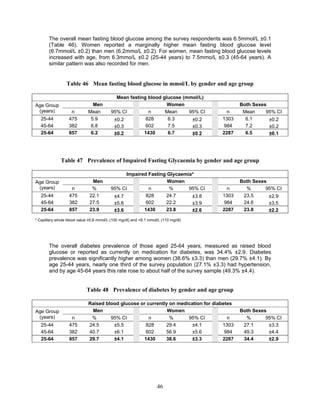
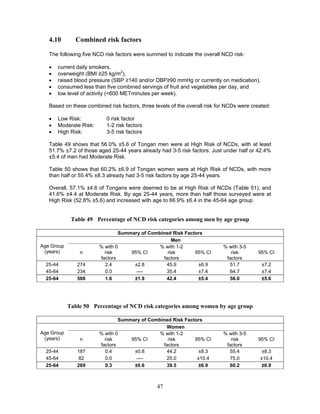
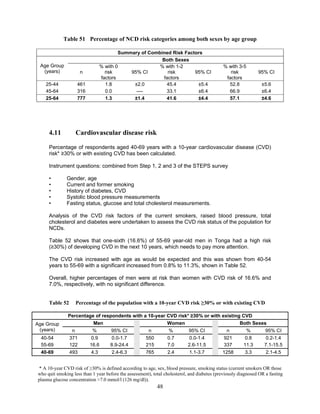
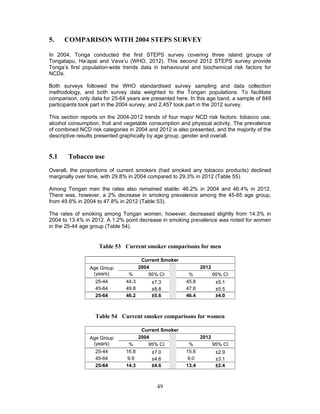
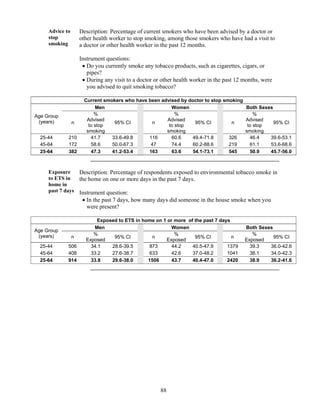
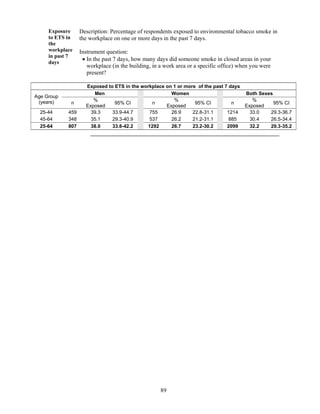
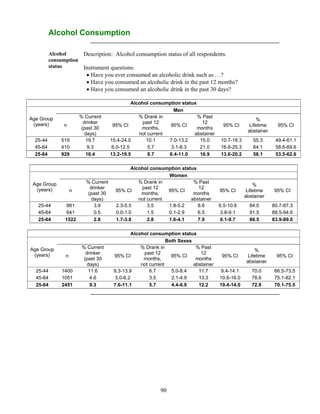
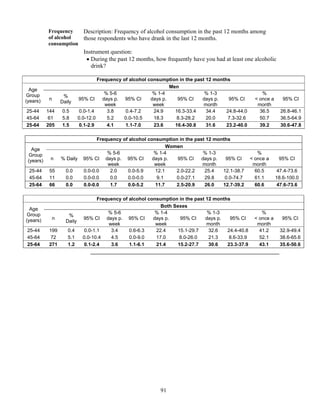
Kingdom of Tonga
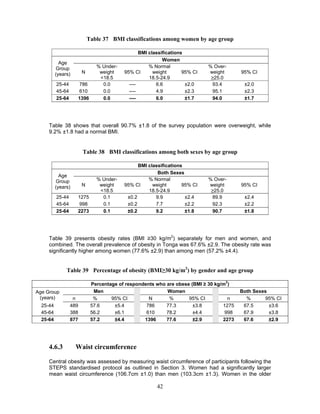
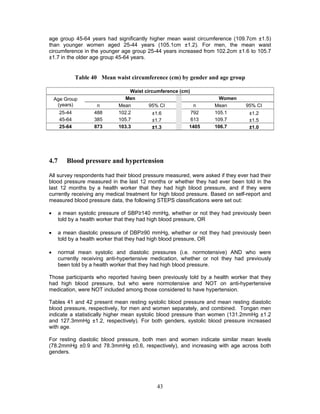
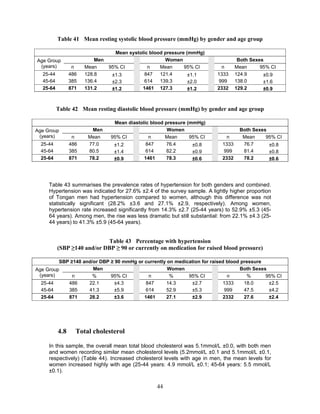
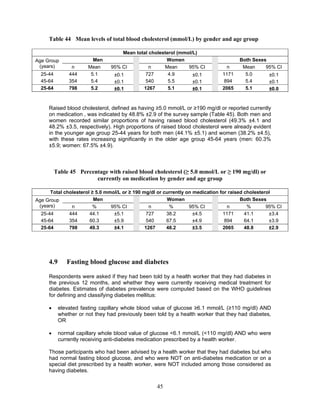
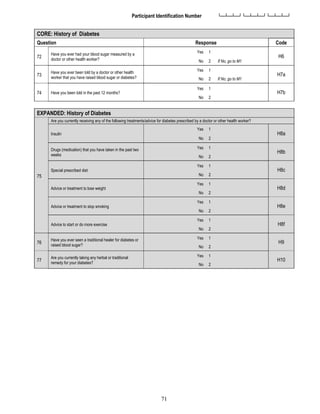
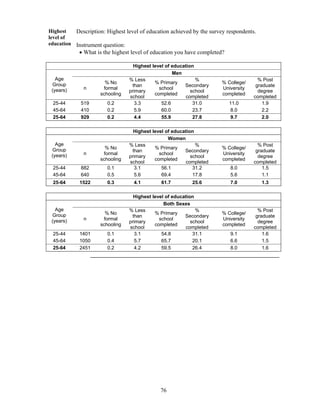
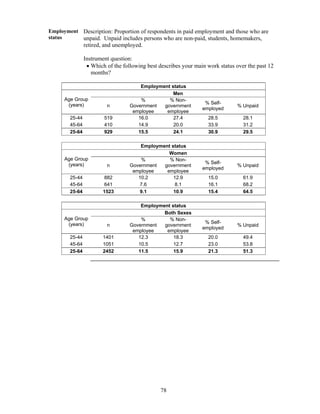
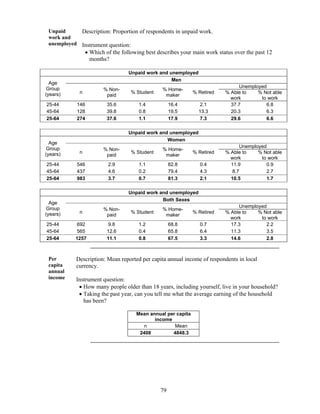
NCD Risk Factors
STEPS REPORT
(2014)
Printed in Suva, Fiji
October, 2014
2
Acknowledgements
The Kingdom of Tonga NCD Risk Factors STEPS REPORT (2014) (referred as “the Report”)
is a record of a combined effort and contribution of several organizations and many
individuals.
The Report was compiled by: Dr Cathy Latu Tekiteki (MOH, Tonga), Dr Philayrath
Phongsavan (Univ. of Sydney), Dr Li Dan (WHO, Nuku’alofa), Ms Leanne Riley, Ms Melanie
Cowan (WHO, Geneva), Ms Fusi Kaho, Dr Siale ‘Akau’ola (MOH), Mr Shalvindra Raj
(Australia) and Ms Latu Fusimalohi (MOH).
Appreciation is extended to the Hon. Minister for Health, Lord/Mr Tu’i’afitu, the Chief
Executive Officer, Dr Siale ‘Akau’ola for their leadership and support of the NCD STEPS work
in Tonga. A special thank is made to the STEPS field survey staff, including Dr Cathy Latu
Tekiteki, Ms Kalesita Fotu (Australian DFAT, Tonga), Dr Paula Vivili (Secretariat of the Pacific
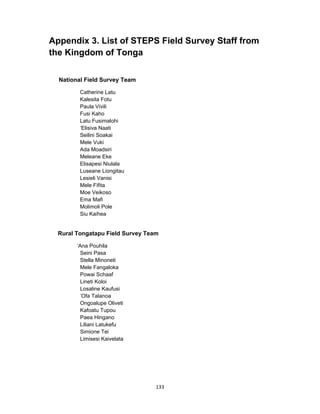
Community) and Dr Malakai Ake (MOH, Tonga) (see Appendix 3 of the Report).
Grateful acknowledgement is made to Dr Liu Yunguo (Director, Pacific Technical Support and
Representative, South Pacific, WHO, Suva) and Dr Susan P. Mercado (Director, Division of
NCD and Health through the Life-Course, WHO, Manila) for their great support.
We acknowledge the statistical support and result generation provided by Ms Melanie Cowan,
Ms Leanne Riley, Ms Regina Guthold (WHO, Geneva), Mr Shalvindra Raj, Mr Viliami
Konifelenisi Fifita, Mr ‘Ata’ata M. Finau (Department of Statistics, Tonga) and Ms Nola
Vanualailai (WHO, Suva) who made substantial contribution to the data analysis.
Ms Katalina Palu, Ms Siutaisa L. Toumoua, Mr Okalani Kalonihea (WHO, Nuku’alofa), Mr
Saula Volavola, Ms Temalesi Vakaotia-Francis, Ms Frances Loloma, Ms Mato Irava (WHO,
Suva) and Ms Poaki Totau (MOH, Tonga) provided administrative support to the finalization of
the Report.
The Tonga STEPS survey and the Report were funded by the Department of Foreign Affairs
and Trade (DFAT), Australia and WHO. The Ministry of Health, Tonga provided in-kind
contribution.
Dr Philayrath Phongsavan drafted the first version of the Report. Dr Susan P. Mercado, Dr Li
Dan, Dr Hai-Rim Shin (WHO, Manila), Dr Cherian Varghese (WHO, Suva), Mr James Rarick,
Dr Carmen Audera-Lopez (WHO, Manila), Mr Shalvindra Raj, Dr Stefan Savin (WHO Geneva)
and Ms Melanie Cowan have conducted technical reviews for the Report.
The country consultation held in Nuku’alofa, Tonga was attended by Dr Siale ‘Akau’ola, Dr
Sione Latu and Ms Fusi Kaho (MOH, Tonga), Ms Kathleen Bombell (DFAT, Australian High
Commission, Tonga), Dr Li Dan and Ms Siutaisa L. Toumoua (WHO, Nuku’alofa).
Dr Li Dan, Dr Philayrath Phongsavan and Dr Cherian Varghese are the final technical and
editorial reviewers of the Report.
WHO Nuku’alofa and Suva Offices arranged the printing, on behalf of the Ministry of Health,
Kingdom of Tonga.
3
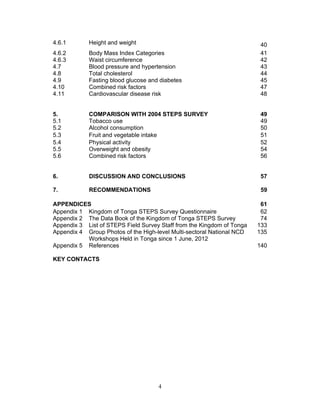
CONTENTS
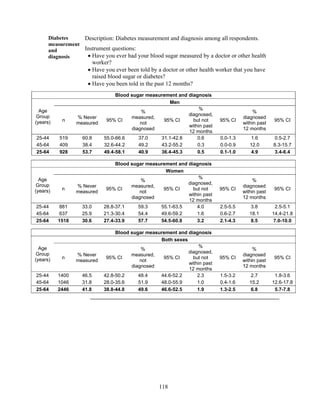
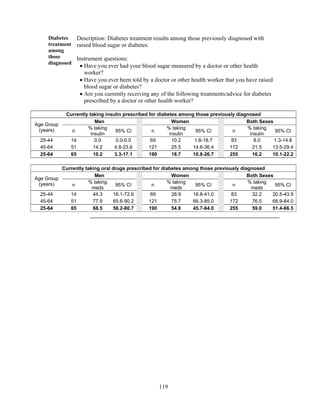
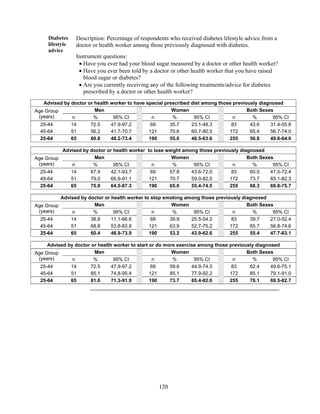
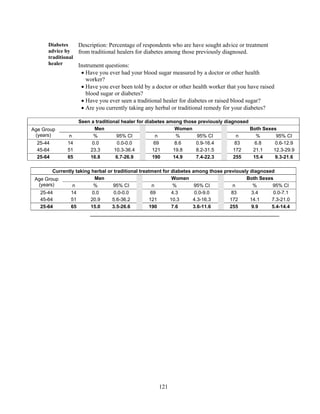
FOREWORD 8
EXECUTIVE SUMMARY 12
1. INTRODUCTION 18
1.1 The burden of NCDs in Tonga is substantial 18
1.2 Preventing and controlling NCDs in Tonga is a priority 19
1.3
1.3.1
The national context
Geography and population
19
1.3.2 Government, education and the economy 20
	
2. OBJECTIVES 20
	
3. METHODOLOGY 21
3.1 Sampling frame and sample size 21
3.2 Data collection procedures 22
3.2.1 Step 1 - Behavioural risk factors interviews 23
3.2.2 Step 2 - Physical measurements 24
3.2.3 Step 3 - Biochemical measurements 25
3.3 Data management and statistical analysis 26
4. RESULTS 26
4.1 Demographic characteristics of survey population 26
4.2 Tobacco use 27
4.3 Alcohol consumption 31
4.4 Fruit and vegetable intake 34
4.5 Physical activity 36
4.5.1 Measurements 36
4.5.2 Analysis 37
4.5.3 Levels of physical activity 37
4.6 Overweight and obesity 40
4
4.6.1 Height and weight 40
4.6.2 Body Mass Index Categories 41
4.6.3 Waist circumference 42
4.7 Blood pressure and hypertension 43
4.8 Total cholesterol 44
4.9 Fasting blood glucose and diabetes 45
4.10 Combined risk factors 47
4.11 Cardiovascular disease risk 48
5. COMPARISON WITH 2004 STEPS SURVEY 49
5.1 Tobacco use 49
5.2 Alcohol consumption 50
5.3 Fruit and vegetable intake 51
5.4 Physical activity 52
5.5 Overweight and obesity 54
5.6 Combined risk factors 56
6. DISCUSSION AND CONCLUSIONS 57
7. RECOMMENDATIONS 59
APPENDICES 61
Appendix 1 Kingdom of Tonga STEPS Survey Questionnaire 62
Appendix 2 The Data Book of the Kingdom of Tonga STEPS Survey 74
Appendix 3 List of STEPS Field Survey Staff from the Kingdom of Tonga 133
Appendix 4 Group Photos of the High-level Multi-sectoral National NCD 135
Appendix 5
Workshops Held in Tonga since 1 June, 2012
References 140
KEY CONTACTS
5
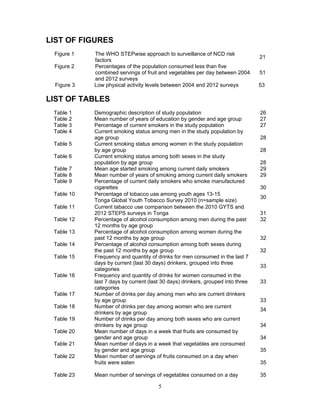
LIST OF FIGURES
Figure 1 The WHO STEPwise approach to surveillance of NCD risk
factors
21
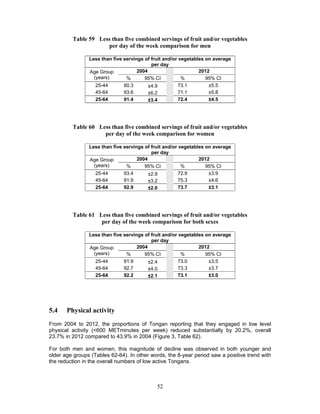
Figure 2 Percentages of the population consumed less than five
combined servings of fruit and vegetables per day between 2004
and 2012 surveys
51
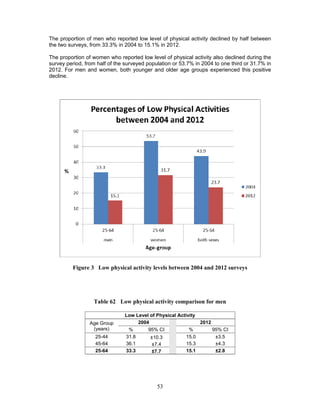
Figure 3 Low physical activity levels between 2004 and 2012 surveys 53
LIST OF TABLES
Table 1 Demographic description of study population 26
Table 2 Mean number of years of education by gender and age group 27
Table 3 Percentage of current smokers in the study population 27
Table 4 Current smoking status among men in the study population by
age group 28
Table 5 Current smoking status among women in the study population
by age group 28
Table 6 Current smoking status among both sexes in the study
population by age group 28
Table 7 Mean age started smoking among current daily smokers 29
Table 8 Mean number of years of smoking among current daily smokers 29
Table 9 Percentage of current daily smokers who smoke manufactured
cigarettes 30
Table 10 Percentage of tobacco use among youth ages 13-15
Tonga Global Youth Tobacco Survey 2010 (n=sample size)
30
Table 11 Current tabacco use comparison between the 2010 GYTS and
2012 STEPS surveys in Tonga
Table 12 Percentage of alcohol consumption among men during the past
12 months by age group
31
32
Table 13 Percentage of alcohol consumption among women during the
past 12 months by age group 32
Table 14 Percentage of alcohol consumption among both sexes during
the past 12 months by age group 32
Table 15 Frequency and quantity of drinks for men consumed in the last 7
days by current (last 30 days) drinkers, grouped into three
categories
33
Table 16 Frequency and quantity of drinks for women consumed in the
last 7 days by current (last 30 days) drinkers, grouped into three
categories
33
Table 17 Number of drinks per day among men who are current drinkers
by age group 33
Table 18 Number of drinks per day among women who are current
drinkers by age group
34
Table 19 Number of drinks per day among both sexes who are current
drinkers by age group 34
Table 20 Mean number of days in a week that fruits are consumed by
gender and age group 34
Table 21 Mean number of days in a week that vegetables are consumed
by gender and age group 35
Table 22 Mean number of servings of fruits consumed on a day when
fruits were eaten 35
Table 23 Mean number of servings of vegetables consumed on a day 35
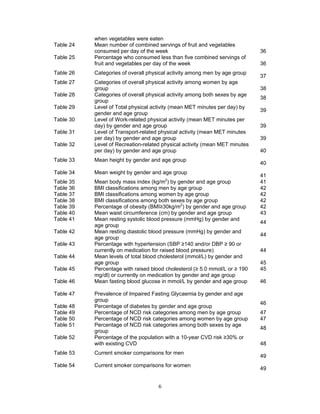
6
when vegetables were eaten
Table 24 Mean number of combined servings of fruit and vegetables
consumed per day of the week 36
Table 25 Percentage who consumed less than five combined servings of
fruit and vegetables per day of the week 36
Table 26 Categories of overall physical activity among men by age group
37
Table 27 Categories of overall physical activity among women by age
group 38
Table 28 Categories of overall physical activity among both sexes by age
group
38
Table 29 Level of Total physical activity (mean MET minutes per day) by
gender and age group
39
Table 30 Level of Work-related physical activity (mean MET minutes per
day) by gender and age group 39
Table 31 Level of Transport-related physical activity (mean MET minutes
per day) by gender and age group 39
Table 32 Level of Recreation-related physical activity (mean MET minutes
per day) by gender and age group 40
Table 33 Mean height by gender and age group
40
Table 34 Mean weight by gender and age group
41
Table 35 Mean body mass index (kg/m2
) by gender and age group 41
Table 36 BMI classifications among men by age group 42
Table 37 BMI classifications among women by age group 42
Table 38 BMI classifications among both sexes by age group 42
Table 39 Percentage of obesity (BMI≥30kg/m2
) by gender and age group 42
Table 40 Mean waist circumference (cm) by gender and age group 43
Table 41 Mean resting systolic blood pressure (mmHg) by gender and
age group
44
Table 42 Mean resting diastolic blood pressure (mmHg) by gender and
age group
44
Table 43 Percentage with hypertension (SBP ≥140 and/or DBP ≥ 90 or
currently on medication for raised blood pressure) 44
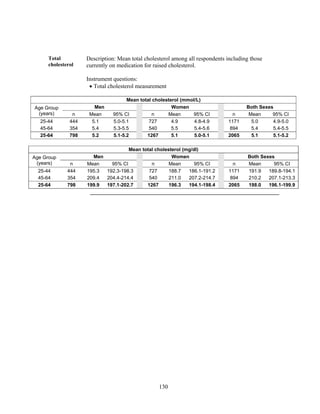
Table 44 Mean levels of total blood cholesterol (mmol/L) by gender and
age group
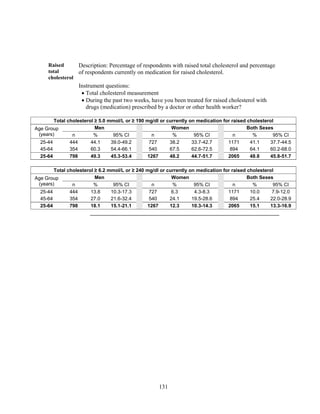
Table 45 Percentage with raised blood cholesterol (≥ 5.0 mmol/L or ≥ 190
mg/dl) or currently on medication by gender and age group
45
45
Table 46 Mean fasting blood glucose in mmol/L by gender and age group 46
Table 47 Prevalence of Impaired Fasting Glycaemia by gender and age
group
Table 48 Percentage of diabetes by gender and age group
46
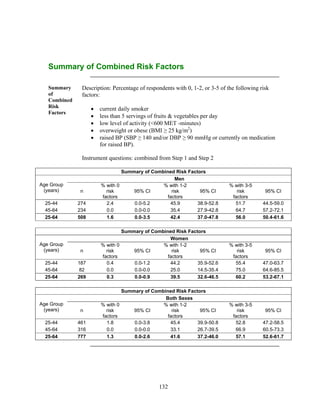
Table 49 Percentage of NCD risk categories among men by age group 47
Table 50 Percentage of NCD risk categories among women by age group 47
Table 51 Percentage of NCD risk categories among both sexes by age
group
48
Table 52 Percentage of the population with a 10-year CVD risk ≥30% or
with existing CVD 48
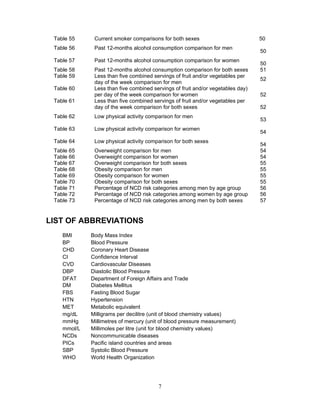
Table 53 Current smoker comparisons for men
49
Table 54 Current smoker comparisons for women
49
7
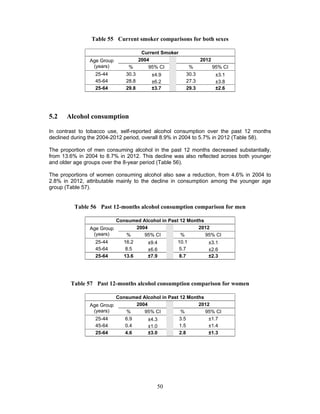
Table 55 Current smoker comparisons for both sexes 50
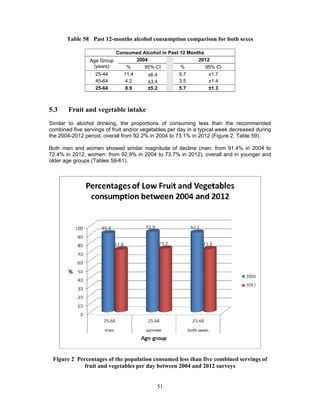
Table 56 Past 12-months alcohol consumption comparison for men
50
Table 57 Past 12-months alcohol consumption comparison for women
50
Table 58 Past 12-months alcohol consumption comparison for both sexes 51
Table 59 Less than five combined servings of fruit and/or vegetables per
day of the week comparison for men
52
Table 60 Less than five combined servings of fruit and/or vegetables day)
per day of the week comparison for women 52
Table 61 Less than five combined servings of fruit and/or vegetables per
day of the week comparison for both sexes 52
Table 62 Low physical activity comparison for men
53
Table 63 Low physical activity comparison for women
54
Table 64 Low physical activity comparison for both sexes
54
Table 65 Overweight comparison for men 54
Table 66 Overweight comparison for women 54
Table 67 Overweight comparison for both sexes 55
Table 68 Obesity comparison for men 55
Table 69 Obesity comparison for women 55
Table 70 Obesity comparison for both sexes 55
Table 71 Percentage of NCD risk categories among men by age group 56
Table 72 Percentage of NCD risk categories among women by age group 56
Table 73 Percentage of NCD risk categories among men by both sexes 57
LIST OF ABBREVIATIONS
BMI Body Mass Index
BP Blood Pressure
CHD Coronary Heart Disease
CI Confidence Interval
CVD Cardiovascular Diseases
DBP Diastolic Blood Pressure
DFAT
DM
Department of Foreign Affairs and Trade
Diabetes Mellitus
FBS Fasting Blood Sugar
HTN Hypertension
MET Metabolic equivalent
mg/dL Milligrams per decilitre (unit of blood chemistry values)
mmHg Millimetres of mercury (unit of blood pressure measurement)
mmol/L Millimoles per litre (unit for blood chemistry values)
NCDs Noncommunicable diseases
PICs Pacific island countries and areas
SBP Systolic Blood Pressure
WHO World Health Organization
8
FOREWORD
In most of the countries in the world, Noncommunicable diseases (NCDs), including
cardiovascular diseases, diabetes and cancer have become a high disease burden. In
order to address this growing problem, accurate information about the risk factors that
contribute to the development of NCDs is needed. A “risk factor” is any characteristic or
exposure that increases a person’s likelihood of developing a NCD. Risk factors of NCDs
include tobacco use, alcohol use, physical inactivity, unhealthy diet, overweight and
obesity, high blood pressure, a raised level of blood glucose or cholesterol.
To increase our capacity to undertake population risk surveillance, the Ministry of Health
and WHO undertook jointly the 2nd
-round national NCD Risk Factors STEPS Survey. The
STEPS survey has been specifically designed by WHO to assess the prevalence of the
common NCDs and risk factors in a population. The information from the survey provides
important information to develop and implement NCD plans and programs to address the
growing epidemic of NCDs. Furthermore, the survey provides a firm foundation for an
ongoing surveillance for NCDs and their various risk factors.
This report is the result of the 2nd
-round STEPS survey carried out in Tonga by 2012. It
shows still high prevalence of NCDs and their risk factors among our population and
suggests actions to: control and prevention NCDs; provide a supportive physical
environment and infrastructure, and improved health service delivery, etc.
This is the first nationwide 2nd
-round NCD STEPS survey report to be published across the
PICs. It represents a historical milestone in our efforts to address the NCD epidemic
affecting our people and marks an increased commitment by the Ministry of Health and
other governmental and nongovernment agencies to tackle the NCD challenge. The
survey results and recommendations will enable us to develop more effective health
policies and programs in primary and secondary NCD prevention and in monitoring and
evaluating our ongoing efforts in NCD prevention and control.
9
The Tonga STEPS survey involved intensive work, persistence and dedication from the
Tonga STEPS field survey team. We owe each of them our sincere appreciation. We also
wish to thank all the support staff in the Ministry of Health.
We wish to thank the WHO CLO/Tonga Office and other WHO Offices for their strong
technical guidance, excellent coordination and financial support. The financial assistance
from the Department of Foreign Affairs and Trade, Australia is also appreciated.
This report is dedicated to the hard work and commitment of all those involved from the
inception to the completion of the NCD Risk Factors STEPS survey in Tonga.
The findings and recommendations in this report will guide our actions for preventing and
controlling NCDs and improving health for all in our country.
Lord/Mr Tu’i‘afitu Dr Siale ‘Akau’ola
Minister for Health Chief Executive Officer
Ministry of Health Ministry of Health
Kingdom of Tonga Kingdom of Tonga
10
We are pleased to see the 2nd
-round Tonga NCD STEPS report has been completed.
The extremely high prevalence of NCDs in Pacific island countries and areas (PICs)
accounts for 75% of all deaths and contributes to significant long term illness and disability.
Ministers at the 9th Health Ministers' Meeting held in June, 2011 declared a NCD crisis in
the Pacific requiring urgent attention and action.
The WHO STEPwise Approach to Surveillance of NCD Risk Factors (STEPS) is the WHO
recommended surveillance tool for chronic disease risk factors and chronic disease-specific
morbidity and mortality at national level. To date, majority of countries and areas throughout
the world have utilized WHO STEPS to conduct national surveys on risk factors and
prevalence of NCDs.
Some of the key results of the STEPS survey in 2012, reported in 2014 in the Kingdom of
Tonga include the following:
• 26.7% of the population smoked tobacco daily.
• 9.3% of the population was current alcohol drinkers.
• 73.1% of the population consumed less than five combined servings of fruit and
vegetables per day.
• 23.7% of the population was with low level of physical activity.
• The prevalence of overweight in the population was 90.7%, the prevalence of obesity
was 67.6%.
• The prevalence of hypertension was 27.6%.
• The prevalence of raised blood glucose in the population was 34.4%.
• The prevalence of raised blood cholesterol in the population was 48.8%.
• 98.7% of the population was at high risk or moderate risk of NCDs.
These results clearly document that NCDs are the No. 1 disease in Tonga.
Among the 22 PICs, Tonga is the first PIC having published the 2nd
-round national NCD
STEPS Report, which marks a milestone as they have provided the scientific, national,
updated NCD data. With a specific importance, they have provided comparable data over
time, which have shown the improvements and outcome of the NCD intervention in Tonga.
11
The comparison between 2004 and 2012 STEPS surveys has shown that the improvements
in many NCD indicators in Tonga, including prevalence of current tobacco use, current
alcohol consumption, fruit and vegetable consumption, low physical activity, overweight,
obesity, combined NCD risk factors; among the above improved indicators, the prevalence
of low physical activities has been reduced from 43.9% in 2004 to 23.7% in 2012
significantly, the percentage consumed less than five servings of fruit and vegetables per
day has been decreased from 92.2% in 2004 to 73.1% in 2012 significantly. Thank for the
efforts and contribution from all the stakeholders.
The application of this “Kingdom of Tonga NCD Risk Factors STEPS REPORT (2014)”
include updating the national NCD strategy, identifying evidence-based prioritized
intervention for NCD prevention and control, providing national data of NCDs for comparison
over time and between countries, contributing the scaling up of the implementation of the
Millennium Development Goals, and conducting evaluation against the global NCD targets
and indicators among others.
Future priorities need to be given to both primary and secondary prevention activities to
prevent and control NCDs, including cardiovascular diseases, diabetes, cancer, and their
risk factors including tobacco use, harmful use of alcohol, unhealthy diet and physical
inactivity.
WHO is honoured to be a critical part of the collaborative efforts among the Tonga Ministry
of Health, Australia Department of Foreign Affairs and Trade to complete the Tonga 2nd
-
round STEPS survey and report.
WHO is proud to collaborate with the Ministry of Health in publishing this new “Kingdom of
Tonga NCD Risk Factors STEPS REPORT (2014)”, and will continue to work with health
authorities, health workers, other key stakeholders and the public to address the issues
raised in this report and achieve further improvements.
Dr Liu Yunguo Dr Li Dan
Director, Pacific Technical Support Country Liaison Officer
Representative, South Pacific for the Kingdom of Tonga
World Health Organization World Health Organization
12
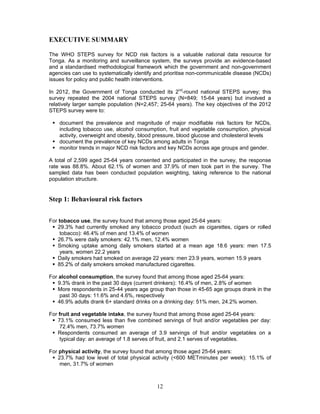
EXECUTIVE SUMMARY
The WHO STEPS survey for NCD risk factors is a valuable national data resource for
Tonga. As a monitoring and surveillance system, the surveys provide an evidence-based
and a standardised methodological framework which the government and non-government
agencies can use to systematically identify and prioritise non-communicable disease (NCDs)
issues for policy and public health interventions.
In 2012, the Government of Tonga conducted its 2nd
-round national STEPS survey; this
survey repeated the 2004 national STEPS survey (N=849; 15-64 years) but involved a
relatively larger sample population (N=2,457; 25-64 years). The key objectives of the 2012
STEPS survey were to:
 document the prevalence and magnitude of major modifiable risk factors for NCDs,
including tobacco use, alcohol consumption, fruit and vegetable consumption, physical
activity, overweight and obesity, blood pressure, blood glucose and cholesterol levels
 document the prevalence of key NCDs among adults in Tonga
 monitor trends in major NCD risk factors and key NCDs across age groups and gender.
A total of 2,599 aged 25-64 years consented and participated in the survey, the response
rate was 88.8%. About 62.1% of women and 37.9% of men took part in the survey. The
sampled data has been conducted population weighting, taking reference to the national
population structure.
Step 1: Behavioural risk factors
For tobacco use, the survey found that among those aged 25-64 years:
 29.3% had currently smoked any tobacco product (such as cigarettes, cigars or rolled
tobacco): 46.4% of men and 13.4% of women
 26.7% were daily smokers: 42.1% men, 12.4% women
 Smoking uptake among daily smokers started at a mean age 18.6 years: men 17.5
years, women 22.2 years
 Daily smokers had smoked on average 22 years: men 23.9 years, women 15.9 years
 85.2% of daily smokers smoked manufactured cigarettes.
For alcohol consumption, the survey found that among those aged 25-64 years:
 9.3% drank in the past 30 days (current drinkers): 16.4% of men, 2.8% of women
 More respondents in 25-44 years age group than those in 45-65 age groups drank in the
past 30 days: 11.6% and 4.6%, respectively
 46.9% adults drank 6+ standard drinks on a drinking day: 51% men, 24.2% women.
For fruit and vegetable intake, the survey found that among those aged 25-64 years:
 73.1% consumed less than five combined servings of fruit and/or vegetables per day:
72.4% men, 73.7% women
 Respondents consumed an average of 3.9 servings of fruit and/or vegetables on a
typical day: an average of 1.8 serves of fruit, and 2.1 serves of vegetables.
For physical activity, the survey found that among those aged 25-64 years:
 23.7% had low level of total physical activity (<600 METminutes per week): 15.1% of
men, 31.7% of women
13
 Respondents spent an average of 168.8 METminutes per day on total physical activity:
229.6 METminutes for men, 111.8 METminutes for women
 Respondents in 25-44 years age group had higher mean METminutes than those in 45-
65 years age group: 180.1 METminutes and 145.1 METminutes, respectively
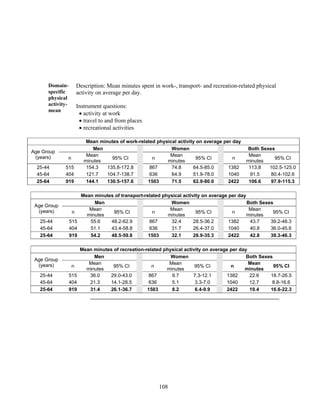
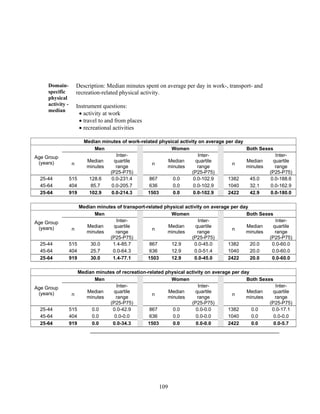
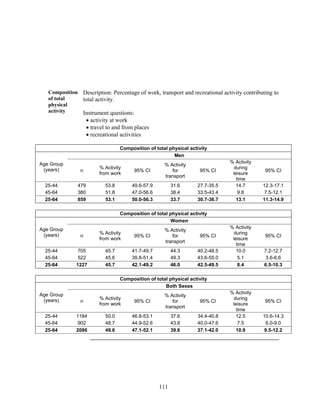
 Work-related physical activities contributed the largest portion of all total physical activity
(mean 106.6 METminutes per day), followed by transport (42.8 METminutes per day)
and recreation (19.4 METminutes per day).
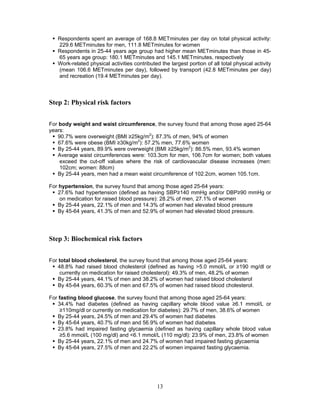
Step 2: Physical risk factors
For body weight and waist circumference, the survey found that among those aged 25-64
years:
 90.7% were overweight (BMI ≥25kg/m2
): 87.3% of men, 94% of women
 67.6% were obese (BMI ≥30kg/m2
): 57.2% men, 77.6% women
 By 25-44 years, 89.9% were overweight (BMI ≥25kg/m2
): 86.5% men, 93.4% women
 Average waist circumferences were: 103.3cm for men, 106.7cm for women; both values
exceed the cut-off values where the risk of cardiovascular disease increases (men:
102cm; women: 88cm)
 By 25-44 years, men had a mean waist circumference of 102.2cm, women 105.1cm.
For hypertension, the survey found that among those aged 25-64 years:
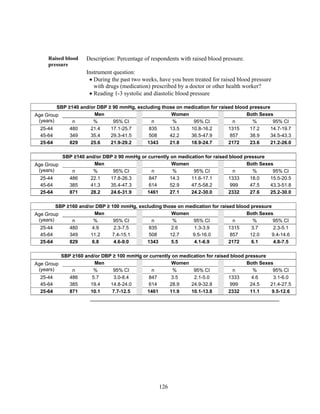
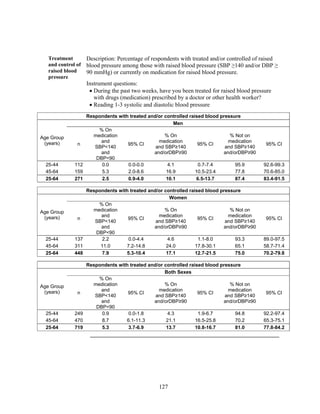
 27.6% had hypertension (defined as having SBP≥140 mmHg and/or DBP≥90 mmHg or
on medication for raised blood pressure): 28.2% of men, 27.1% of women
 By 25-44 years, 22.1% of men and 14.3% of women had elevated blood pressure
 By 45-64 years, 41.3% of men and 52.9% of women had elevated blood pressure.
Step 3: Biochemical risk factors
For total blood cholesterol, the survey found that among those aged 25-64 years:
 48.8% had raised blood cholesterol (defined as having >5.0 mmol/L or ≥190 mg/dl or
currently on medication for raised cholesterol): 49.3% of men, 48.2% of women
 By 25-44 years, 44.1% of men and 38.2% of women had raised blood cholesterol
 By 45-64 years, 60.3% of men and 67.5% of women had raised blood cholesterol.
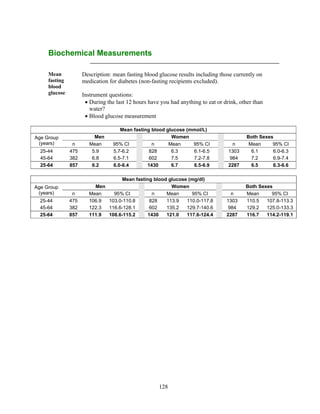
For fasting blood glucose, the survey found that among those aged 25-64 years:
 34.4% had diabetes (defined as having capillary whole blood value ≥6.1 mmol/L or
≥110mg/dl or currently on medication for diabetes): 29.7% of men, 38.6% of women
 By 25-44 years, 24.5% of men and 29.4% of women had diabetes
 By 45-64 years, 40.7% of men and 56.9% of women had diabetes
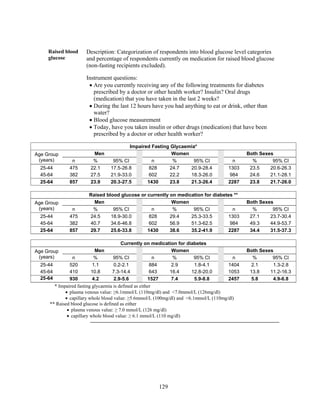
 23.8% had impaired fasting glycaemia (defined as having capillary whole blood value
≥5.6 mmol/L (100 mg/dl) and <6.1 mmol/L (110 mg/dl): 23.9% of men, 23.8% of women
 By 25-44 years, 22.1% of men and 24.7% of women had impaired fasting glycaemia
 By 45-64 years, 27.5% of men and 22.2% of women impaired fasting glycaemia.
14
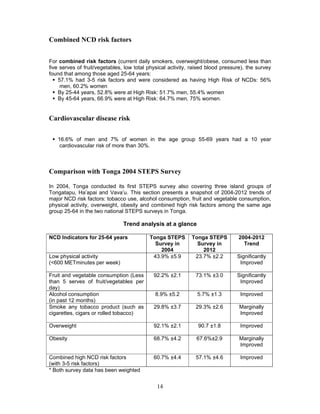
Combined NCD risk factors
For combined risk factors (current daily smokers, overweight/obese, consumed less than
five serves of fruit/vegetables, low total physical activity, raised blood pressure), the survey
found that among those aged 25-64 years:
 57.1% had 3-5 risk factors and were considered as having High Risk of NCDs: 56%
men, 60.2% women
 By 25-44 years, 52.8% were at High Risk: 51.7% men, 55.4% women
 By 45-64 years, 66.9% were at High Risk: 64.7% men, 75% women.
Cardiovascular disease risk
 16.6% of men and 7% of women in the age group 55-69 years had a 10 year
cardiovascular risk of more than 30%.
Comparison with Tonga 2004 STEPS Survey
In 2004, Tonga conducted its first STEPS survey also covering three island groups of
Tongatapu, Ha’apai and Vava’u. This section presents a snapshot of 2004-2012 trends of
major NCD risk factors: tobacco use, alcohol consumption, fruit and vegetable consumption,
physical activity, overweight, obesity and combined high risk factors among the same age
group 25-64 in the two national STEPS surveys in Tonga.
Trend analysis at a glance
NCD Indicators for 25-64 years Tonga STEPS
Survey in
2004
Tonga STEPS
Survey in
2012
2004-2012
Trend
Low physical activity
(<600 METminutes per week)
43.9% ±5.9 23.7% ±2.2 Significantly
Improved
Fruit and vegetable consumption (Less
than 5 serves of fruit/vegetables per
day)
92.2% ±2.1 73.1% ±3.0 Significantly
Improved
Alcohol consumption
(in past 12 months)
8.9% ±5.2 5.7% ±1.3 Improved
Smoke any tobacco product (such as
cigarettes, cigars or rolled tobacco)
29.8% ±3.7 29.3% ±2.6 Marginally
Improved
Overweight 92.1% ±2.1 90.7 ±1.8 Improved
Obesity 68.7% ±4.2 67.6%±2.9 Marginally
Improved
Combined high NCD risk factors
(with 3-5 risk factors)
60.7% ±4.4 57.1% ±4.6 Improved
* Both survey data has been weighted
15
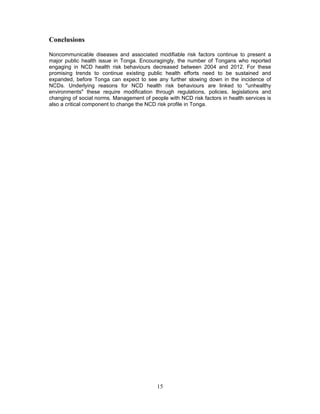
Conclusions
Noncommunicable diseases and associated modifiable risk factors continue to present a
major public health issue in Tonga. Encouragingly, the number of Tongans who reported
engaging in NCD health risk behaviours decreased between 2004 and 2012. For these
promising trends to continue existing public health efforts need to be sustained and
expanded, before Tonga can expect to see any further slowing down in the incidence of
NCDs. Underlying reasons for NCD health risk behaviours are linked to "unhealthy
environments" these require modification through regulations, policies, legislations and
changing of social norms. Management of people with NCD risk factors in health services is
also a critical component to change the NCD risk profile in Tonga.
16
Recommendations
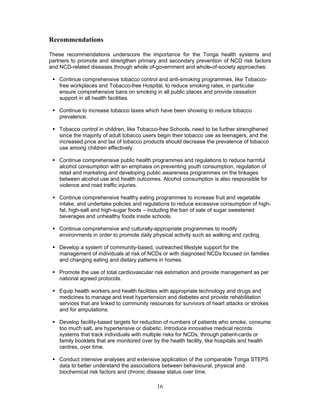
These recommendations underscore the importance for the Tonga health systems and
partners to promote and strengthen primary and secondary prevention of NCD risk factors
and NCD-related diseases through whole of-government and whole-of-society approaches:
 Continue comprehensive tobacco control and anti-smoking programmes, like Tobacco-
free workplaces and Tobacco-free Hospital, to reduce smoking rates, in particular
ensure comprehensive bans on smoking in all public places and provide cessation
support in all health facilities.
 Continue to increase tobacco taxes which have been showing to reduce tobacco
prevalence.
 Tobacco control in children, like Tobacco-free Schools, need to be further strengthened
since the majority of adult tobacco users begin their tobacco use as teenagers, and the
increased price and tax of tobacco products should decrease the prevalence of tobacco
use among children effectively.
 Continue comprehensive public health programmes and regulations to reduce harmful
alcohol consumption with an emphasis on preventing youth consumption, regulation of
retail and marketing and developing public awareness programmes on the linkages
between alcohol use and health outcomes. Alcohol consumption is also responsible for
violence and road traffic injuries.
 Continue comprehensive healthy eating programmes to increase fruit and vegetable
intake, and undertake policies and regulations to reduce excessive consumption of high-
fat, high-salt and high-sugar foods – including the ban of sale of sugar sweetened
beverages and unhealthy foods inside schools.
 Continue comprehensive and culturally-appropriate programmes to modify
environments in order to promote daily physical activity such as walking and cycling.
 Develop a system of community-based, outreached lifestyle support for the
management of individuals at risk of NCDs or with diagnosed NCDs focused on families
and changing eating and dietary patterns in homes.
 Promote the use of total cardiovascular risk estimation and provide management as per
national agreed protocols.
 Equip health workers and health facilities with appropriate technology and drugs and
medicines to manage and treat hypertension and diabetes and provide rehabilitation
services that are linked to community resources for survivors of heart attacks or strokes
and for amputations.
 Develop facility-based targets for reduction of numbers of patients who smoke, consume
too much salt, are hypertensive or diabetic. Introduce innovative medical records
systems that track individuals with multiple risks for NCDs, through patient-cards or
family booklets that are monitored over by the health facility, like hospitals and health
centres, over time.
 Conduct intensive analyses and extensive application of the comparable Tonga STEPS
data to better understand the associations between behavioural, physical and
biochemical risk factors and chronic disease status over time.
17
 Consider repeat STEPS surveys to further monitor trends at 6-8 year intervals, adding
expanded quantitative questions (e.g., salt, sugar, fat intake). These surveillance data
would provide evidence of net gains in NCD prevention and control efforts across Tonga
and over time.
18
1. INTRODUCTION
1.1 The burden of NCDs in Tonga is substantial
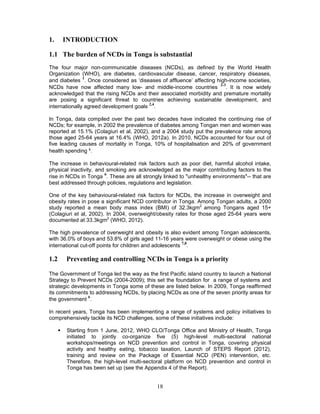
The four major non-communicable diseases (NCDs), as defined by the World Health
Organization (WHO), are diabetes, cardiovascular disease, cancer, respiratory diseases,
and diabetes 1
. Once considered as ‘diseases of affluence’ affecting high-income societies,
NCDs have now affected many low- and middle-income countries
2-3
. It is now widely
acknowledged that the rising NCDs and their associated morbidity and premature mortality
are posing a significant threat to countries achieving sustainable development, and
internationally agreed development goals 2,4
.
In Tonga, data compiled over the past two decades have indicated the continuing rise of
NCDs; for example, in 2002 the prevalence of diabetes among Tongan men and women was
reported at 15.1% (Colagiuri et al, 2002), and a 2004 study put the prevalence rate among
those aged 25-64 years at 16.4% (WHO, 2012a). In 2010, NCDs accounted for four out of
five leading causes of mortality in Tonga, 10% of hospitalisation and 20% of government
health spending 5
.
The increase in behavioural-related risk factors such as poor diet, harmful alcohol intake,
physical inactivity, and smoking are acknowledged as the major contributing factors to the
rise in NCDs in Tonga
6
. These are all strongly linked to "unhealthy environments"-- that are
best addressed through policies, regulations and legislation.
One of the key behavioural-related risk factors for NCDs, the increase in overweight and
obesity rates in pose a significant NCD contributor in Tonga. Among Tongan adults, a 2000
study reported a mean body mass index (BMI) of 32.3kgm2
among Tongans aged 15+
(Colagiuri et al, 2002). In 2004, overweight/obesity rates for those aged 25-64 years were
documented at 33.3kgm2
(WHO, 2012).
The high prevalence of overweight and obesity is also evident among Tongan adolescents,
with 36.0% of boys and 53.8% of girls aged 11-16 years were overweight or obese using the
international cut-off points for children and adolescents 7,8
.
1.2 Preventing and controlling NCDs in Tonga is a priority
The Government of Tonga led the way as the first Pacific island country to launch a National
Strategy to Prevent NCDs (2004-2009); this set the foundation for a range of systems and
strategic developments in Tonga some of these are listed below. In 2009, Tonga reaffirmed
its commitments to addressing NCDs, by placing NCDs as one of the seven priority areas for
the government
6
.
In recent years, Tonga has been implementing a range of systems and policy initiatives to
comprehensively tackle its NCD challenges, some of these initiatives include:
 Starting from 1 June, 2012, WHO CLO/Tonga Office and Ministry of Health, Tonga
initiated to jointly co-organize five (5) high-level multi-sectoral national
workshops/meetings on NCD prevention and control in Tonga, covering physical
activity and healthy eating, tobacco taxation, Launch of STEPS Report (2012),
training and review on the Package of Essential NCD (PEN) intervention, etc.
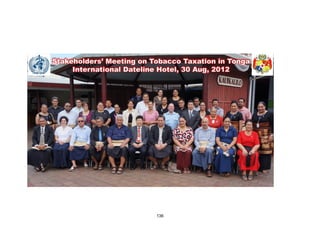
Therefore, the high-level multi-sectoral platform on NCD prevention and control in
Tonga has been set up (see the Appendix 4 of the Report).
19
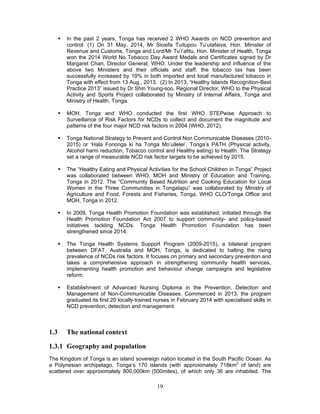
 In the past 2 years, Tonga has received 2 WHO Awards on NCD prevention and
control: (1) On 31 May, 2014, Mr Siosifa Tuitupou Tu’utafaiva, Hon. Minister of
Revenue and Customs, Tonga and Lord/Mr Tu’i’afitu, Hon. Minister of Health, Tonga
won the 2014 World No Tobacco Day Award Medals and Certificates signed by Dr
Margaret Chan, Director General, WHO. Under the leadership and influence of the
above two Ministers and their officials and staff, the tobacco tax has been
successfully increased by 19% in both imported and local manufactured tobacco in
Tonga with effect from 13 Aug., 2013. (2) In 2013, “Healthy Islands Recognition-Best
Practice 2013” issued by Dr Shin Young-soo, Regional Director, WHO to the Physical
Activity and Sports Project collaborated by Ministry of Internal Affairs, Tonga and
Ministry of Health, Tonga.
 MOH, Tonga and WHO conducted the first WHO STEPwise Approach to
Surveillance of Risk Factors for NCDs to collect and document the magnitude and
patterns of the four major NCD risk factors in 2004 (WHO, 2012).
 Tonga National Strategy to Prevent and Control Non Communicable Diseases (2010-
2015) or ‘Hala Fononga ki ha Tonga Mo’uilelei’, Tonga’s PATH (Physical activity,
Alcohol harm reduction, Tobacco control and Healthy eating) to Health. The Strategy
set a range of measurable NCD risk factor targets to be achieved by 2015.
 The “Healthy Eating and Physical Activities for the School Children in Tonga” Project
was collaborated between WHO, MOH and Ministry of Education and Training,
Tonga in 2012. The “Community Based Nutrition and Cooking Education for Local
Women in the Three Communities in Tongatapu” was collaborated by Ministry of
Agriculture and Food, Forests and Fisheries, Tonga, WHO CLO/Tonga Office and
MOH, Tonga in 2012.
 In 2009, Tonga Health Promotion Foundation was established; initiated through the
Health Promotion Foundation Act 2007 to support community- and policy-based
initiatives tackling NCDs. Tonga Health Promotion Foundation has been
strengthened since 2014.
 The Tonga Health Systems Support Program (2009-2015), a bilateral program
between DFAT, Australia and MOH, Tonga, is dedicated to halting the rising
prevalence of NCDs risk factors. It focuses on primary and secondary prevention and
takes a comprehensive approach in strengthening community health services,
implementing health promotion and behaviour change campaigns and legislative
reform.
 Establishment of Advanced Nursing Diploma in the Prevention, Detection and
Management of Non-Communicable Diseases. Commenced in 2013, the program
graduated its first 20 locally-trained nurses in February 2014 with specialised skills in
NCD prevention, detection and management.
1.3 The national context
1.3.1 Geography and population
The Kingdom of Tonga is an island sovereign nation located in the South Pacific Ocean. As
a Polynesian archipelago, Tonga’s 170 islands (with approximately 718km2
of land) are
scattered over approximately 800,000km (500miles), of which only 36 are inhabited. The
20
country consists of five main island groups: Tongatapu, Ha’apai, Vava’u, ‘Eua and Niuas.
Tongan is the official language of the island, but English is also widely spoken.
Based on the 2011 Census, two thirds of the 104,000 inhabitants live on the main island,
Tongatapu, particularly around the capital city of Nuku’alofa. Tonga has a young population
with approximately 38% of the population being under 15 years of age, and 8% aged 60
years and older. While the official data have Tongans experiencing a relatively high life
expectancy at 72.5 years of age, a recent study found that life expectancy in Tonga has
plateaued or decline; with rising NCDs and premature mortality being considered as the key
driver of this change.
1.3.2 Government, education and the economy
Tonga is a constitutional monarchy, with governance power vested in the Cabinet of
Ministers, headed by the Prime Minister. Legislative Assembly Members are elected by
popular vote. Local villages or group of villages are governed by town or district officials,
respectively.
The education is structured into primary, secondary and post-secondary. Tonga government
funds the majority of primary schools and approximately one third of secondary schools; the
rest are funded by various [religious] denominations. Tongans have an average of 10 years
of schooling, and enjoy a 99% adult literacy rate
10
.
The United Nations classifies Tonga in the medium human development category, with
Tonga's Human Development Index (HDI; the United Nations composite measure of health,
education and income) at 0.710, giving it a ranking of 95 out of 186 countries with
comparable data
10
. The HDI of East Asia and the Pacific as a region is 0.683, placing Tonga
above the regional average. However, this development gain is potentially under threat
unless Tonga reverses the rising incidence of diabetes and cardiovascular diseases.
As a small island nation Tonga has limited human and financial resources. In 2012, Tonga’s
Gross National Income (GNI) per capita stood at US$4,153
10
. The country’s economy is
agricultural-based including fishing and root crops, with very limited export base. Tonga
relies substantially on import products, and remittances from Tongans living overseas.
Tonga’s economic growth and ability to attract foreign investment is limited by high
transportation costs and fragile ecosystem and weather.
2. OBJECTIVES
The key objectives of the 2012 Tonga STEPS survey include:
 documenting the prevalence and magnitude of major modifiable risk factors for
NCDs, including tobacco use, alcohol consumption, fruit and vegetable consumption,
physical activity, overweight and obesity, blood pressure, blood glucose and
cholesterol levels;
 documenting the prevalence of key NCDs among adults in Tonga, and;
 monitoring trends in major NCD risk factors and key NCDs across age groups and
gender.
This STEPS survey will provide within-country trend data for national policy and health
promotion initiative development.
21
STEPS survey structure
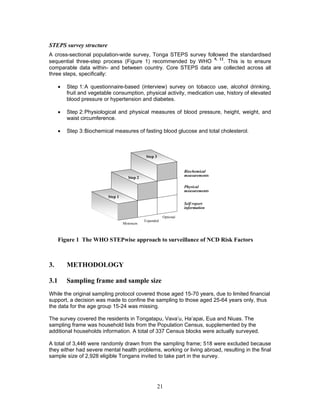
A cross-sectional population-wide survey, Tonga STEPS survey followed the standardised
sequential three-step process (Figure 1) recommended by WHO
9, 12
. This is to ensure
comparable data within- and between country. Core STEPS data are collected across all
three steps, specifically:
 Step 1:A questionnaire-based (interview) survey on tobacco use, alcohol drinking,
fruit and vegetable consumption, physical activity, medication use, history of elevated
blood pressure or hypertension and diabetes.
 Step 2:Physiological and physical measures of blood pressure, height, weight, and
waist circumference.
 Step 3:Biochemical measures of fasting blood glucose and total cholesterol.
Figure 1 The WHO STEPwise approach to surveillance of NCD Risk Factors
3. METHODOLOGY
3.1 Sampling frame and sample size
While the original sampling protocol covered those aged 15-70 years, due to limited financial
support, a decision was made to confine the sampling to those aged 25-64 years only, thus
the data for the age group 15-24 was missing.
The survey covered the residents in Tongatapu, Vava’u, Ha’apai, Eua and Niuas. The
sampling frame was household lists from the Population Census, supplemented by the
additional households information. A total of 337 Census blocks were actually surveyed.
A total of 3,446 were randomly drawn from the sampling frame; 518 were excluded because
they either had severe mental health problems, working or living abroad, resulting in the final
sample size of 2,928 eligible Tongans invited to take part in the survey.
Physical
measurements
Biochemical
measurements
Self report
information
Step 1
Step 2
Step 3
Minimum
Expanded
Optional
22
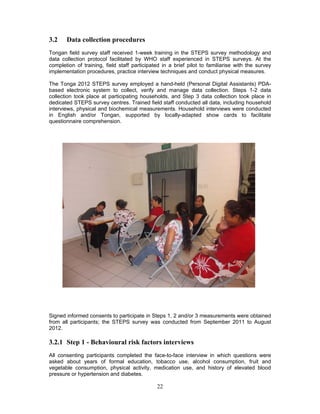
3.2 Data collection procedures
Tongan field survey staff received 1-week training in the STEPS survey methodology and
data collection protocol facilitated by WHO staff experienced in STEPS surveys. At the
completion of training, field staff participated in a brief pilot to familiarise with the survey
implementation procedures, practice interview techniques and conduct physical measures.
The Tonga 2012 STEPS survey employed a hand-held (Personal Digital Assistants) PDA-
based electronic system to collect, verify and manage data collection. Steps 1-2 data
collection took place at participating households, and Step 3 data collection took place in
dedicated STEPS survey centres. Trained field staff conducted all data, including household
interviews, physical and biochemical measurements. Household interviews were conducted
in English and/or Tongan, supported by locally-adapted show cards to facilitate
questionnaire comprehension.
Signed informed consents to participate in Steps 1, 2 and/or 3 measurements were obtained
from all participants; the STEPS survey was conducted from September 2011 to August
2012.
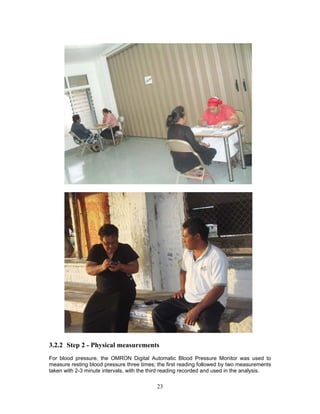
3.2.1 Step 1 - Behavioural risk factors interviews
All consenting participants completed the face-to-face interview in which questions were
asked about years of formal education, tobacco use, alcohol consumption, fruit and
vegetable consumption, physical activity, medication use, and history of elevated blood
pressure or hypertension and diabetes.
23
3.2.2 Step 2 - Physical measurements
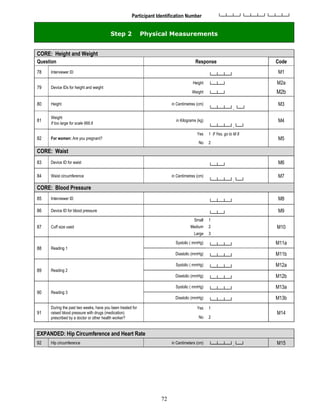
For blood pressure, the OMRON Digital Automatic Blood Pressure Monitor was used to
measure resting blood pressure three times; the first reading followed by two measurements
taken with 2-3 minute intervals, with the third reading recorded and used in the analysis.
24
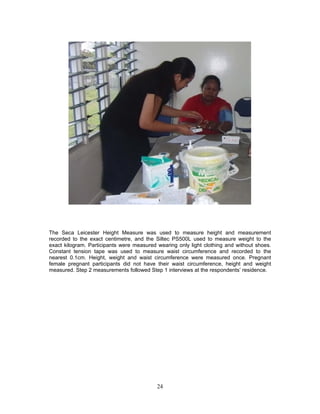
The Seca Leicester Height Measure was used to measure height and measurement
recorded to the exact centimetre, and the Siltec PS500L used to measure weight to the
exact kilogram. Participants were measured wearing only light clothing and without shoes.
Constant tension tape was used to measure waist circumference and recorded to the
nearest 0.1cm. Height, weight and waist circumference were measured once. Pregnant
female pregnant participants did not have their waist circumference, height and weight
measured. Step 2 measurements followed Step 1 interviews at the respondents’ residence.
25
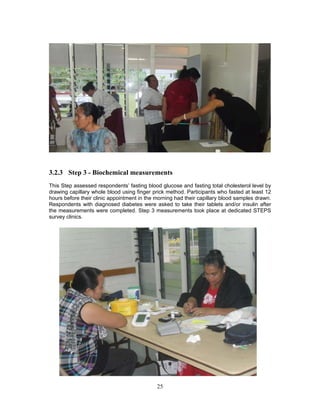
3.2.3 Step 3 - Biochemical measurements
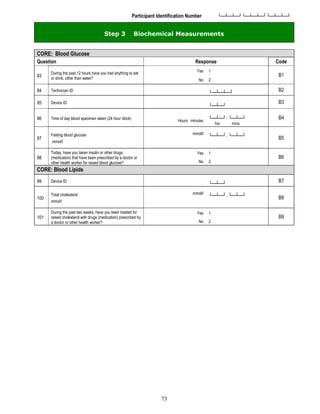
This Step assessed respondents’ fasting blood glucose and fasting total cholesterol level by
drawing capillary whole blood using finger prick method. Participants who fasted at least 12
hours before their clinic appointment in the morning had their capillary blood samples drawn.
Respondents with diagnosed diabetes were asked to take their tablets and/or insulin after
the measurements were completed. Step 3 measurements took place at dedicated STEPS
survey clinics.
26
3.3 Data management and statistical analysis
The data of this STEPS survey were entered and stored on the PDA by the country staff in
Tonga. WHO Office in Geneva conducted data cleaning and weighting and produced the
data book. Data were weighted to account for the probability of selection and these weights
were then adjusted to correct for over- or under- representation of each of the age-sex
groups included in the results. All analyses were performed using Epi Info.
Analyses for this report were descriptive, comprising of frequencies, means and cross
tabulations. Frequencies were calculated for categorical variables, and means were
computed for continuous variables. For both frequency and mean estimates, 95%
confidence intervals were reported by two 20-year age groups (25-44 years and 45-64
years) and by gender.
To examine trends over time, tobacco use, alcohol consumption, fruit and vegetable intake,
and physical activity outcomes from the Tonga STEPS 2004 were re-analysed by two 20-
year age groups to facilitate comparison with the Tonga STEPS 2012 survey. These
comparative data are presented in Section 5 of this report.
	
4.								RESULTS	
4.1 Demographic characteristics of survey population
The demographic characteristics of those who took part in the STEPS survey are presented
in this section. A total of 2,599 individuals participated (response rate of 88.8%), of these
2,490 individuals took part in Steps 1, 2 and 3; 49 took part in Step 1 only, and 60 took part
in Steps 2 and 3 only.
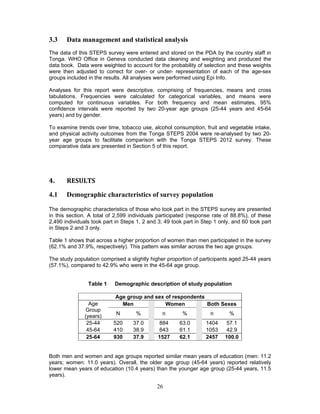
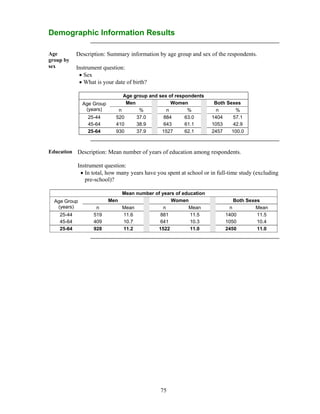
Table 1 shows that across a higher proportion of women than men participated in the survey
(62.1% and 37.9%, respectively). This pattern was similar across the two age groups.
The study population comprised a slightly higher proportion of participants aged 25-44 years
(57.1%), compared to 42.9% who were in the 45-64 age group.
Table 1 Demographic description of study population
Age group and sex of respondents
Age
Group
(years)
Men Women Both Sexes
N % n % n %
25-44 520 37.0 884 63.0 1404 57.1
45-64 410 38.9 643 61.1 1053 42.9
25-64 930 37.9 1527 62.1 2457 100.0
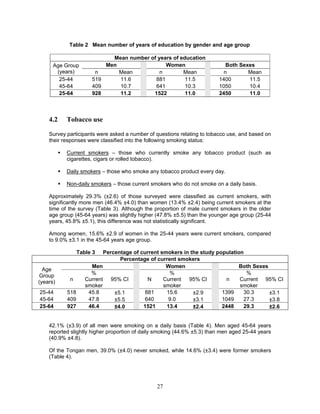
Both men and women and age groups reported similar mean years of education (men: 11.2
years; women: 11.0 years). Overall, the older age group (45-64 years) reported relatively
lower mean years of education (10.4 years) than the younger age group (25-44 years, 11.5
years).
27
Table 2 Mean number of years of education by gender and age group
Mean number of years of education
Age Group
(years)
Men Women Both Sexes
n Mean n Mean n Mean
25-44 519 11.6 881 11.5 1400 11.5
45-64 409 10.7 641 10.3 1050 10.4
25-64 928 11.2 1522 11.0 2450 11.0
4.2 Tobacco use
Survey participants were asked a number of questions relating to tobacco use, and based on
their responses were classified into the following smoking status:
 Current smokers – those who currently smoke any tobacco product (such as
cigarettes, cigars or rolled tobacco).
 Daily smokers – those who smoke any tobacco product every day.
 Non-daily smokers – those current smokers who do not smoke on a daily basis.
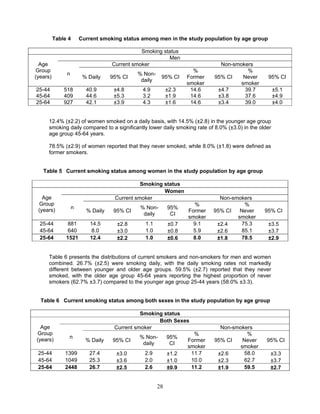
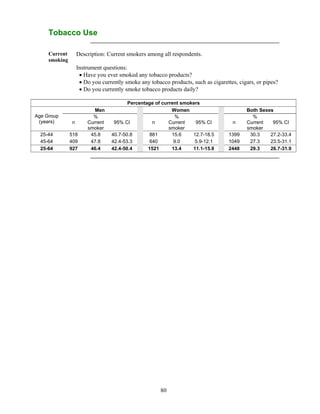
Approximately 29.3% (±2.6) of those surveyed were classified as current smokers, with
significantly more men (46.4% ±4.0) than women (13.4% ±2.4) being current smokers at the
time of the survey (Table 3). Although the proportion of male current smokers in the older
age group (45-64 years) was slightly higher (47.8% ±5.5) than the younger age group (25-44
years, 45.8% ±5.1), this difference was not statistically significant.
Among women, 15.6% ±2.9 of women in the 25-44 years were current smokers, compared
to 9.0% ±3.1 in the 45-64 years age group.
Table 3 Percentage of current smokers in the study population
Percentage of current smokers
Age
Group
(years)
Men Women Both Sexes
n
%
Current
smoker
95% CI N
%
Current
smoker
95% CI n
%
Current
smoker
95% CI
25-44 518 45.8 ±5.1 881 15.6 ±2.9 1399 30.3 ±3.1
45-64 409 47.8 ±5.5 640 9.0 ±3.1 1049 27.3 ±3.8
25-64 927 46.4 ±4.0 1521 13.4 ±2.4 2448 29.3 ±2.6
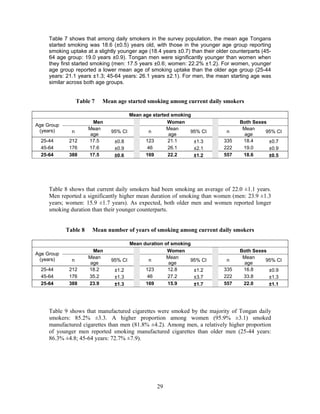
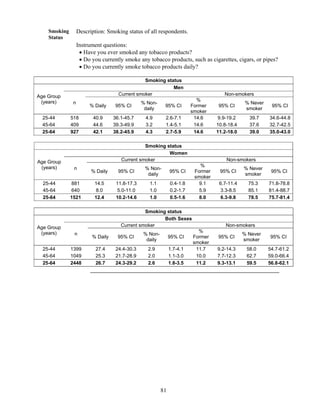
42.1% (±3.9) of all men were smoking on a daily basis (Table 4). Men aged 45-64 years
reported slightly higher proportion of daily smoking (44.6% ±5.3) than men aged 25-44 years
(40.9% ±4.8).
Of the Tongan men, 39.0% (±4.0) never smoked, while 14.6% (±3.4) were former smokers
(Table 4).
28
Table 4 Current smoking status among men in the study population by age group
Smoking status
Age
Group
(years)
Men
n
Current smoker Non-smokers
% Daily 95% CI
% Non-
daily
95% CI
%
Former
smoker
95% CI
%
Never
smoker
95% CI
25-44 518 40.9 ±4.8 4.9 ±2.3 14.6 ±4.7 39.7 ±5.1
45-64 409 44.6 ±5.3 3.2 ±1.9 14.6 ±3.8 37.6 ±4.9
25-64 927 42.1 ±3.9 4.3 ±1.6 14.6 ±3.4 39.0 ±4.0
12.4% (±2.2) of women smoked on a daily basis, with 14.5% (±2.8) in the younger age group
smoking daily compared to a significantly lower daily smoking rate of 8.0% (±3.0) in the older
age group 45-64 years.
78.5% (±2.9) of women reported that they never smoked, while 8.0% (±1.8) were defined as
former smokers.
Table 5 Current smoking status among women in the study population by age group
Smoking status
Age
Group
(years)
Women
n
Current smoker Non-smokers
% Daily 95% CI
% Non-
daily
95%
CI
%
Former
smoker
95% CI
%
Never
smoker
95% CI
25-44 881 14.5 ±2.8 1.1 ±0.7 9.1 ±2.4 75.3 ±3.5
45-64 640 8.0 ±3.0 1.0 ±0.8 5.9 ±2.6 85.1 ±3.7
25-64 1521 12.4 ±2.2 1.0 ±0.6 8.0 ±1.8 78.5 ±2.9
Table 6 presents the distributions of current smokers and non-smokers for men and women
combined. 26.7% (±2.5) were smoking daily, with the daily smoking rates not markedly
different between younger and older age groups. 59.5% (±2.7) reported that they never
smoked, with the older age group 45-64 years reporting the highest proportion of never
smokers (62.7% ±3.7) compared to the younger age group 25-44 years (58.0% ±3.3).
Table 6 Current smoking status among both sexes in the study population by age group
Smoking status
Age
Group
(years)
Both Sexes
n
Current smoker Non-smokers
% Daily 95% CI
% Non-
daily
95%
CI
%
Former
smoker
95% CI
%
Never
smoker
95% CI
25-44 1399 27.4 ±3.0 2.9 ±1.2 11.7 ±2.6 58.0 ±3.3
45-64 1049 25.3 ±3.6 2.0 ±1.0 10.0 ±2.3 62.7 ±3.7
25-64 2448 26.7 ±2.5 2.6 ±0.9 11.2 ±1.9 59.5 ±2.7
29
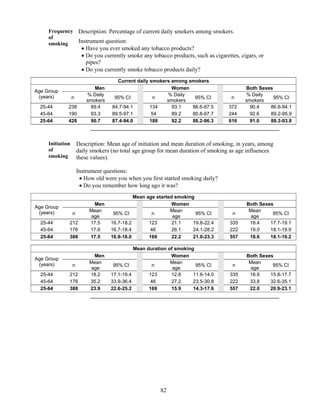
Table 7 shows that among daily smokers in the survey population, the mean age Tongans
started smoking was 18.6 (±0.5) years old, with those in the younger age group reporting
smoking uptake at a slightly younger age (18.4 years ±0.7) than their older counterparts (45-
64 age group: 19.0 years ±0.9). Tongan men were significantly younger than women when
they first started smoking (men: 17.5 years ±0.6; women: 22.2% ±1.2). For women, younger
age group reported a lower mean age of smoking uptake than the older age group (25-44
years: 21.1 years ±1.3; 45-64 years: 26.1 years ±2.1). For men, the mean starting age was
similar across both age groups.
Table 7 Mean age started smoking among current daily smokers
Mean age started smoking
Age Group
(years)
Men Women Both Sexes
n
Mean
age
95% CI n
Mean
age
95% CI n
Mean
age
95% CI
25-44 212 17.5 ±0.8 123 21.1 ±1.3 335 18.4 ±0.7
45-64 176 17.6 ±0.9 46 26.1 ±2.1 222 19.0 ±0.9
25-64 388 17.5 ±0.6 169 22.2 ±1.2 557 18.6 ±0.5
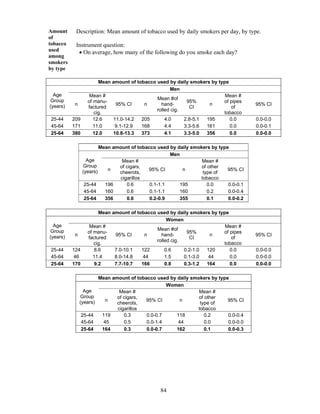
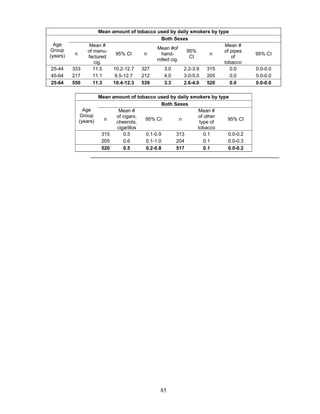
Table 8 shows that current daily smokers had been smoking an average of 22.0 ±1.1 years.
Men reported a significantly higher mean duration of smoking than women (men: 23.9 ±1.3
years; women: 15.9 ±1.7 years). As expected, both older men and women reported longer
smoking duration than their younger counterparts.
Table 8 Mean number of years of smoking among current daily smokers
Mean duration of smoking
Age Group
(years)
Men Women Both Sexes
n
Mean
age
95% CI n
Mean
age
95% CI n
Mean
age
95% CI
25-44 212 18.2 ±1.2 123 12.8 ±1.2 335 16.8 ±0.9
45-64 176 35.2 ±1.3 46 27.2 ±3.7 222 33.8 ±1.3
25-64 388 23.9 ±1.3 169 15.9 ±1.7 557 22.0 ±1.1
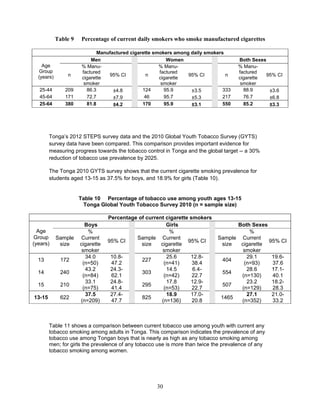
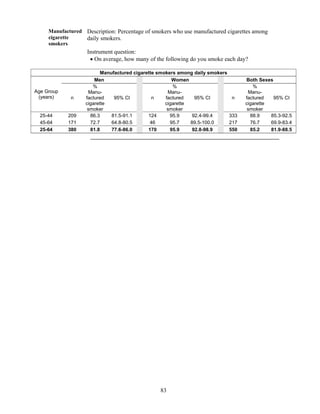
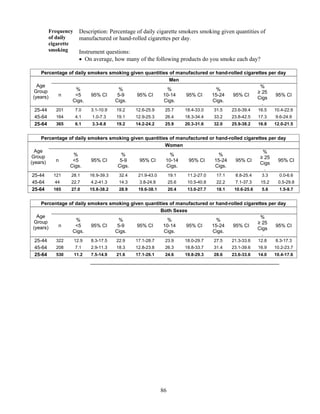
Table 9 shows that manufactured cigarettes were smoked by the majority of Tongan daily
smokers: 85.2% ±3.3. A higher proportion among women (95.9% ±3.1) smoked
manufactured cigarettes than men (81.8% ±4.2). Among men, a relatively higher proportion
of younger men reported smoking manufactured cigarettes than older men (25-44 years:
86.3% ±4.8; 45-64 years: 72.7% ±7.9).
30
Table 9 Percentage of current daily smokers who smoke manufactured cigarettes
Manufactured cigarette smokers among daily smokers
Age
Group
(years)
Men Women Both Sexes
n
% Manu-
factured
cigarette
smoker
95% CI n
% Manu-
factured
cigarette
smoker
95% CI n
% Manu-
factured
cigarette
smoker
95% CI
25-44 209 86.3 ±4.8 124 95.9 ±3.5 333 88.9 ±3.6
45-64 171 72.7 ±7.9 46 95.7 ±5.3 217 76.7 ±6.8
25-64 380 81.8 ±4.2 170 95.9 ±3.1 550 85.2 ±3.3
Tonga’s 2012 STEPS survey data and the 2010 Global Youth Tobacco Survey (GYTS)
survey data have been compared. This comparison provides important evidence for
measuring progress towards the tobacco control in Tonga and the global target -- a 30%
reduction of tobacco use prevalence by 2025.
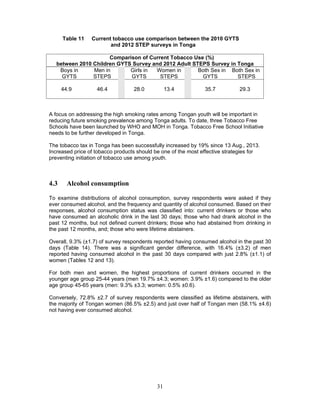
The Tonga 2010 GYTS survey shows that the current cigarette smoking prevalence for
students aged 13-15 as 37.5% for boys, and 18.9% for girls (Table 10).
Table 10 Percentage of tobacco use among youth ages 13-15
Tonga Global Youth Tobacco Survey 2010 (n = sample size)
Percentage of current cigarette smokers
Age
Group
(years)
Boys Girls Both Sexes
Sample
size
%
Current
cigarette
smoker
95% CI
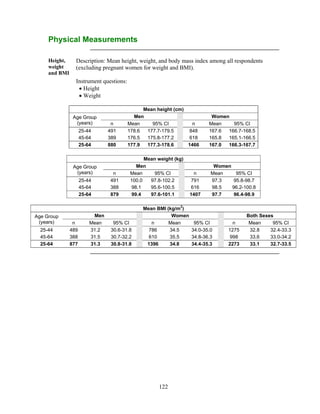
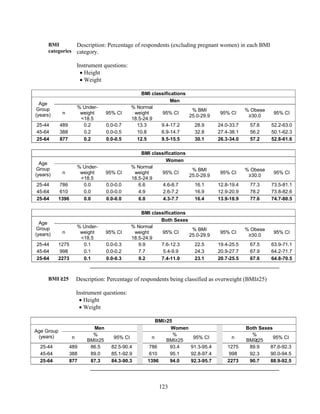
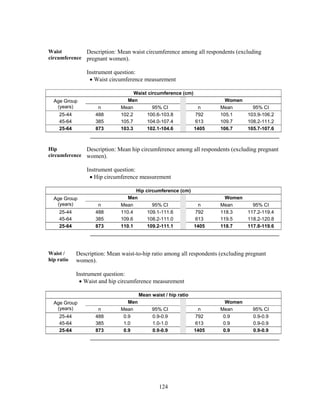
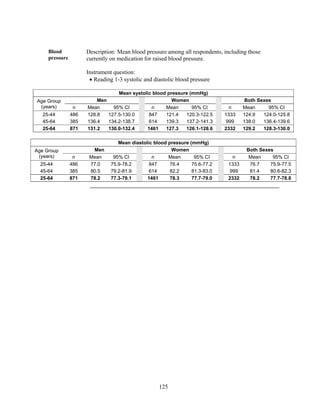
Sample
size
%
Current
cigarette
smoker
95% CI
Sample
size
%
Current
cigarette
smoker
95% CI
13 172
34.0
(n=50)
10.8-
47.2
227
25.6
(n=41)
12.8-
38.4
404
29.1
(n=93)
19.6-
37.6
14 240
43.2
(n=84)
24.3-
62.1
303
14.5
(n=42)
6.4-
22.7
554
28.6
(n=130)
17.1-
40.1
15 210
33.1
(n=75)
24.8-
41.4
295
17.8
(n=53)
12.9-
22.7
507
23.2
(n=129)
18.2-
28.3
13-15 622
37.5
(n=209)
27.4-
47.7
825
18.9
(n=136)
17.0-
20.8
1465
27.1
(n=352)
21.0-
33.2
Table 11 shows a comparison between current tobacco use among youth with current any
tobacco smoking among adults in Tonga. This comparison indicates the prevalence of any
tobacco use among Tongan boys that is nearly as high as any tobacco smoking among
men; for girls the prevalence of any tobacco use is more than twice the prevalence of any
tobacco smoking among women.
31
Table 11 Current tobacco use comparison between the 2010 GYTS
and 2012 STEP surveys in Tonga
Comparison of Current Tobacco Use (%)
between 2010 Children GYTS Survey and 2012 Adult STEPS Survey in Tonga
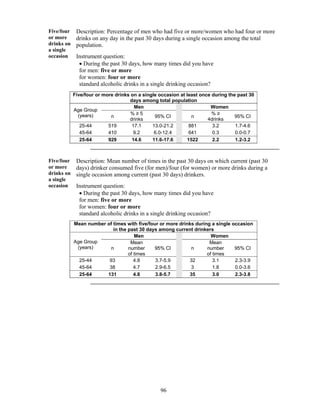
Boys in
GYTS
Men in
STEPS
Girls in
GYTS
Women in
STEPS
Both Sex in
GYTS
Both Sex in
STEPS
44.9 46.4 28.0 13.4 35.7 29.3
A focus on addressing the high smoking rates among Tongan youth will be important in
reducing future smoking prevalence among Tonga adults. To date, three Tobacco Free
Schools have been launched by WHO and MOH in Tonga. Tobacco Free School Initiative
needs to be further developed in Tonga.
The tobacco tax in Tonga has been successfully increased by 19% since 13 Aug., 2013.
Increased price of tobacco products should be one of the most effective strategies for
preventing initiation of tobacco use among youth.
4.3 Alcohol consumption
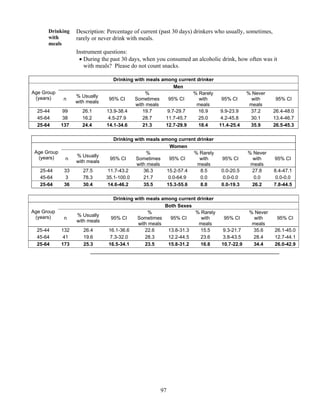
To examine distributions of alcohol consumption, survey respondents were asked if they
ever consumed alcohol, and the frequency and quantity of alcohol consumed. Based on their
responses, alcohol consumption status was classified into: current drinkers or those who
have consumed an alcoholic drink in the last 30 days; those who had drank alcohol in the
past 12 months, but not defined current drinkers; those who had abstained from drinking in
the past 12 months, and; those who were lifetime abstainers.
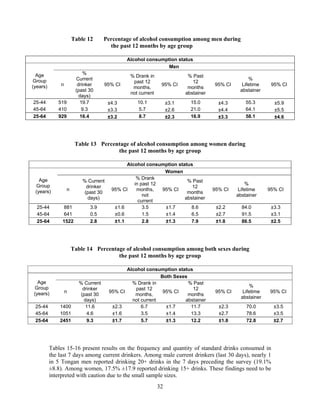
Overall, 9.3% (±1.7) of survey respondents reported having consumed alcohol in the past 30
days (Table 14). There was a significant gender difference, with 16.4% (±3.2) of men
reported having consumed alcohol in the past 30 days compared with just 2.8% (±1.1) of
women (Tables 12 and 13).
For both men and women, the highest proportions of current drinkers occurred in the
younger age group 25-44 years (men 19.7% ±4.3; women: 3.9% ±1.6) compared to the older
age group 45-65 years (men: 9.3% ±3.3; women: 0.5% ±0.6).
Conversely, 72.8% ±2.7 of survey respondents were classified as lifetime abstainers, with
the majority of Tongan women (86.5% ±2.5) and just over half of Tongan men (58.1% ±4.6)
not having ever consumed alcohol.
32
Table 12 Percentage of alcohol consumption among men during
the past 12 months by age group
Alcohol consumption status
Age
Group
(years)
Men
n
%
Current
drinker
(past 30
days)
95% CI
% Drank in
past 12
months,
not current
95% CI
% Past
12
months
abstainer
95% CI
%
Lifetime
abstainer
95% CI
25-44 519 19.7 ±4.3 10.1 ±3.1 15.0 ±4.3 55.3 ±5.9
45-64 410 9.3 ±3.3 5.7 ±2.6 21.0 ±4.4 64.1 ±5.5
25-64 929 16.4 ±3.2 8.7 ±2.3 16.9 ±3.3 58.1 ±4.6
Table 13 Percentage of alcohol consumption among women during
the past 12 months by age group
Alcohol consumption status
Age
Group
(years)
Women
n
% Current
drinker
(past 30
days)
95% CI
% Drank
in past 12
months,
not
current
95% CI
% Past
12
months
abstainer
95% CI
%
Lifetime
abstainer
95% CI
25-44 881 3.9 ±1.6 3.5 ±1.7 8.6 ±2.2 84.0 ±3.3
45-64 641 0.5 ±0.6 1.5 ±1.4 6.5 ±2.7 91.5 ±3.1
25-64 1522 2.8 ±1.1 2.8 ±1.3 7.9 ±1.8 86.5 ±2.5
Table 14 Percentage of alcohol consumption among both sexes during
the past 12 months by age group
Alcohol consumption status
Age
Group
(years)
Both Sexes
n
% Current
drinker
(past 30
days)
95% CI
% Drank in
past 12
months,
not current
95% CI
% Past
12
months
abstainer
95% CI
%
Lifetime
abstainer
95% CI
25-44 1400 11.6 ±2.3 6.7 ±1.7 11.7 ±2.3 70.0 ±3.5
45-64 1051 4.6 ±1.6 3.5 ±1.4 13.3 ±2.7 78.6 ±3.5
25-64 2451 9.3 ±1.7 5.7 ±1.3 12.2 ±1.8 72.8 ±2.7
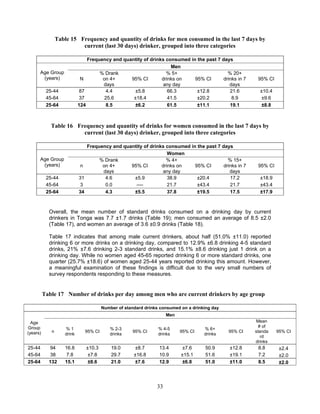
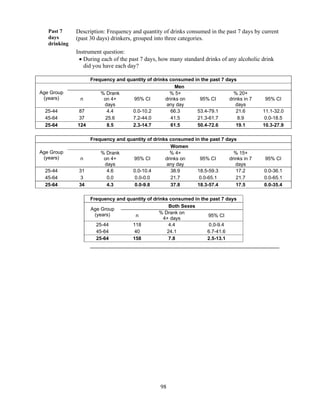
Tables 15-16 present results on the frequency and quantity of standard drinks consumed in
the last 7 days among current drinkers. Among male current drinkers (last 30 days), nearly 1
in 5 Tongan men reported drinking 20+ drinks in the 7 days preceding the survey (19.1%
±8.8). Among women, 17.5% ±17.9 reported drinking 15+ drinks. These findings need to be
interpreted with caution due to the small sample sizes.
33
Table 15 Frequency and quantity of drinks for men consumed in the last 7 days by
current (last 30 days) drinker, grouped into three categories
Frequency and quantity of drinks consumed in the past 7 days
Age Group
(years)
Men
N
% Drank
on 4+
days
95% CI
% 5+
drinks on
any day
95% CI
% 20+
drinks in 7
days
95% CI
25-44 87 4.4 ±5.8 66.3 ±12.8 21.6 ±10.4
45-64 37 25.6 ±18.4 41.5 ±20.2 8.9 ±9.6
25-64 124 8.5 ±6.2 61.5 ±11.1 19.1 ±8.8
Table 16 Frequency and quantity of drinks for women consumed in the last 7 days by
current (last 30 days) drinker, grouped into three categories
Frequency and quantity of drinks consumed in the past 7 days
Age Group
(years)
Women
n
% Drank
on 4+
days
95% CI
% 4+
drinks on
any day
95% CI
% 15+
drinks in 7
days
95% CI
25-44 31 4.6 ±5.9 38.9 ±20.4 17.2 ±18.9
45-64 3 0.0 ---- 21.7 ±43.4 21.7 ±43.4
25-64 34 4.3 ±5.5 37.8 ±19.5 17.5 ±17.9
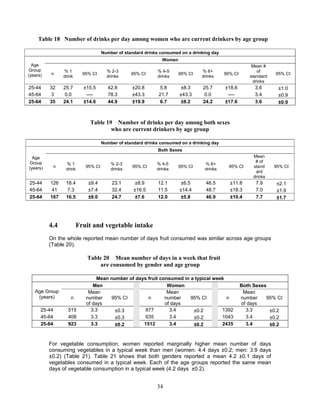
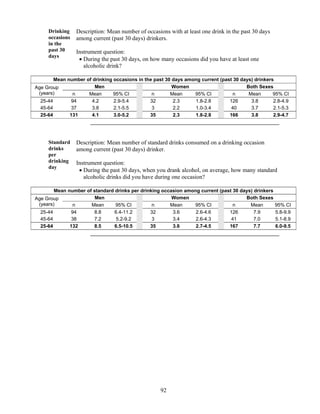
Overall, the mean number of standard drinks consumed on a drinking day by current
drinkers in Tonga was 7.7 ±1.7 drinks (Table 19); men consumed an average of 8.5 ±2.0
(Table 17), and women an average of 3.6 ±0.9 drinks (Table 18).
Table 17 indicates that among male current drinkers, about half (51.0% ±11.0) reported
drinking 6 or more drinks on a drinking day, compared to 12.9% ±6.8 drinking 4-5 standard
drinks, 21% ±7.6 drinking 2-3 standard drinks, and 15.1% ±8.6 drinking just 1 drink on a
drinking day. While no women aged 45-65 reported drinking 6 or more standard drinks, one
quarter (25.7% ±18.6) of women aged 25-44 years reported drinking this amount. However,
a meaningful examination of these findings is difficult due to the very small numbers of
survey respondents responding to these measures.
Table 17 Number of drinks per day among men who are current drinkers by age group
Number of standard drinks consumed on a drinking day
Age
Group
(years)
Men
n
% 1
drink
95% CI
% 2-3
drinks
95% CI
% 4-5
drinks
95% CI
% 6+
drinks
95% CI
Mean
# of
standa
rd
drinks
95% CI
25-44 94 16.8 ±10.3 19.0 ±8.7 13.4 ±7.6 50.9 ±12.8 8.8 ±2.4
45-64 38 7.8 ±7.8 29.7 ±16.8 10.9 ±15.1 51.6 ±19.1 7.2 ±2.0
25-64 132 15.1 ±8.6 21.0 ±7.6 12.9 ±6.8 51.0 ±11.0 8.5 ±2.0
34
Table 18 Number of drinks per day among women who are current drinkers by age group
Number of standard drinks consumed on a drinking day
Age
Group
(years)
Women
n
% 1
drink
95% CI
% 2-3
drinks
95% CI
% 4-5
drinks
95% CI
% 6+
drinks
95% CI
Mean #
of
standard
drinks
95% CI
25-44 32 25.7 ±15.5 42.8 ±20.8 5.8 ±8.3 25.7 ±18.6 3.6 ±1.0
45-64 3 0.0 ---- 78.3 ±43.3 21.7 ±43.3 0.0 ---- 3.4 ±0.9
25-64 35 24.1 ±14.6 44.9 ±19.9 6.7 ±8.2 24.2 ±17.6 3.6 ±0.9
Table 19 Number of drinks per day among both sexes
who are current drinkers by age group
Number of standard drinks consumed on a drinking day
Age
Group
(years)
Both Sexes
n
% 1
drink
95% CI
% 2-3
drinks
95% CI
% 4-5
drinks
95% CI
% 6+
drinks
95% CI
Mean
# of
stand
ard
drinks
95% CI
25-44 126 18.4 ±9.4 23.1 ±8.9 12.1 ±6.5 46.5 ±11.8 7.9 ±2.1
45-64 41 7.3 ±7.4 32.4 ±16.5 11.5 ±14.4 48.7 ±18.3 7.0 ±1.9
25-64 167 16.5 ±8.0 24.7 ±7.6 12.0 ±5.8 46.9 ±10.4 7.7 ±1.7
4.4 Fruit and vegetable intake
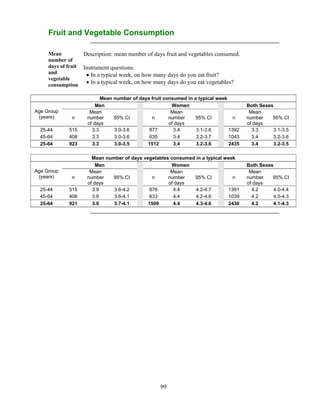
On the whole reported mean number of days fruit consumed was similar across age groups
(Table 20).
Table 20 Mean number of days in a week that fruit
are consumed by gender and age group
Mean number of days fruit consumed in a typical week
Age Group
(years)
Men Women Both Sexes
n
Mean
number
of days
95% CI n
Mean
number
of days
95% CI n
Mean
number
of days
95% CI
25-44 515 3.3 ±0.3 877 3.4 ±0.2 1392 3.3 ±0.2
45-64 408 3.3 ±0.3 635 3.4 ±0.2 1043 3.4 ±0.2
25-64 923 3.3 ±0.2 1512 3.4 ±0.2 2435 3.4 ±0.2
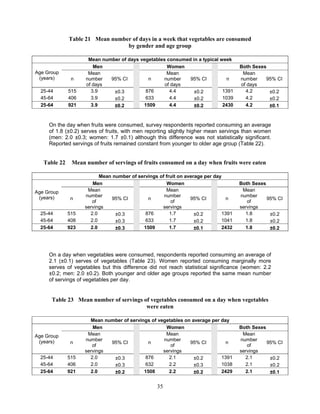
For vegetable consumption, women reported marginally higher mean number of days
consuming vegetables in a typical week than men (women: 4.4 days ±0.2; men: 3.9 days
±0.2) (Table 21). Table 21 shows that both genders reported a mean 4.2 ±0.1 days of
vegetables consumed in a typical week. Each of the age groups reported the same mean
days of vegetable consumption in a typical week (4.2 days ±0.2).
35
Table 21 Mean number of days in a week that vegetables are consumed
by gender and age group
Mean number of days vegetables consumed in a typical week
Age Group
(years)
Men Women Both Sexes
n
Mean
number
of days
95% CI n
Mean
number
of days
95% CI n
Mean
number
of days
95% CI
25-44 515 3.9 ±0.3 876 4.4 ±0.2 1391 4.2 ±0.2
45-64 406 3.9 ±0.2 633 4.4 ±0.2 1039 4.2 ±0.2
25-64 921 3.9 ±0.2 1509 4.4 ±0.2 2430 4.2 ±0.1
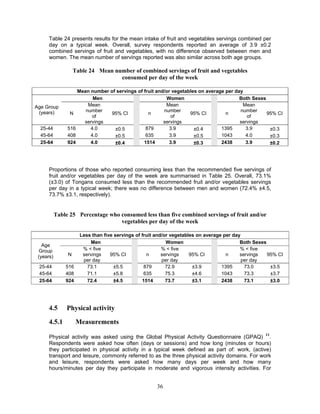
On the day when fruits were consumed, survey respondents reported consuming an average
of 1.8 (±0.2) serves of fruits, with men reporting slightly higher mean servings than women
(men: 2.0 ±0.3; women: 1.7 ±0.1) although this difference was not statistically significant.
Reported servings of fruits remained constant from younger to older age group (Table 22).
Table 22 Mean number of servings of fruits consumed on a day when fruits were eaten
Mean number of servings of fruit on average per day
Age Group
(years)
Men Women Both Sexes
n
Mean
number
of
servings
95% CI n
Mean
number
of
servings
95% CI n
Mean
number
of
servings
95% CI
25-44 515 2.0 ±0.3 876 1.7 ±0.2 1391 1.8 ±0.2
45-64 408 2.0 ±0.3 633 1.7 ±0.2 1041 1.8 ±0.2
25-64 923 2.0 ±0.3 1509 1.7 ±0.1 2432 1.8 ±0.2
On a day when vegetables were consumed, respondents reported consuming an average of
2.1 (±0.1) serves of vegetables (Table 23). Women reported consuming marginally more
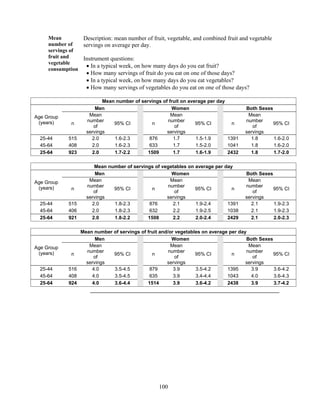
serves of vegetables but this difference did not reach statistical significance (women: 2.2
±0.2; men: 2.0 ±0.2). Both younger and older age groups reported the same mean number
of servings of vegetables per day.
Table 23 Mean number of servings of vegetables consumed on a day when vegetables
were eaten
Mean number of servings of vegetables on average per day
Age Group
(years)
Men Women Both Sexes
n
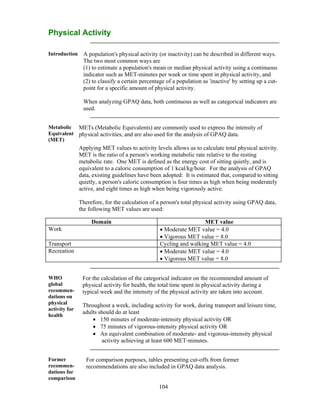
Mean
number
of
servings
95% CI n
Mean
number
of
servings
95% CI n
Mean
number
of
servings
95% CI
25-44 515 2.0 ±0.3 876 2.1 ±0.2 1391 2.1 ±0.2
45-64 406 2.0 ±0.3 632 2.2 ±0.3 1038 2.1 ±0.2
25-64 921 2.0 ±0.2 1508 2.2 ±0.2 2429 2.1 ±0.1
36
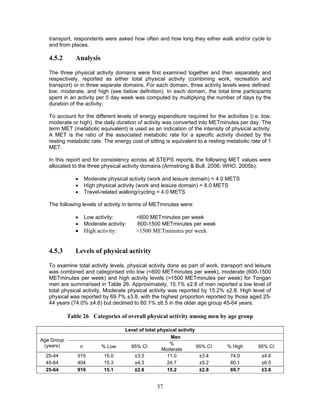
Table 24 presents results for the mean intake of fruit and vegetables servings combined per
day on a typical week. Overall, survey respondents reported an average of 3.9 ±0.2
combined servings of fruit and vegetables, with no difference observed between men and
women. The mean number of servings reported was also similar across both age groups.
Table 24 Mean number of combined servings of fruit and vegetables
consumed per day of the week
Mean number of servings of fruit and/or vegetables on average per day
Age Group
(years)
Men Women Both Sexes
N
Mean
number
of
servings
95% CI n
Mean
number
of
servings
95% CI n
Mean
number
of
servings
95% CI
25-44 516 4.0 ±0.5 879 3.9 ±0.4 1395 3.9 ±0.3
45-64 408 4.0 ±0.5 635 3.9 ±0.5 1043 4.0 ±0.3
25-64 924 4.0 ±0.4 1514 3.9 ±0.3 2438 3.9 ±0.2
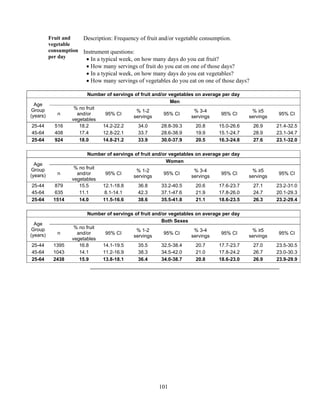
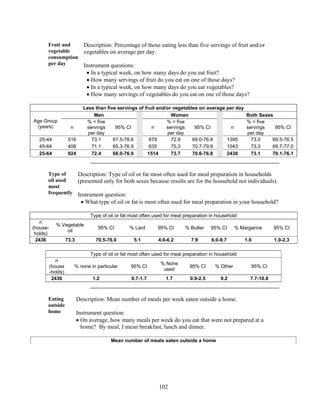
Proportions of those who reported consuming less than the recommended five servings of
fruit and/or vegetables per day of the week are summarised in Table 25. Overall, 73.1%
(±3.0) of Tongans consumed less than the recommended fruit and/or vegetables servings
per day in a typical week; there was no difference between men and women (72.4% ±4.5,
73.7% ±3.1, respectively).
Table 25 Percentage who consumed less than five combined servings of fruit and/or
vegetables per day of the week
Less than five servings of fruit and/or vegetables on average per day
Age
Group
(years)
Men Women Both Sexes
N
% < five
servings
per day
95% CI n
% < five
servings
per day
95% CI n
% < five
servings
per day
95% CI
25-44 516 73.1 ±5.5 879 72.9 ±3.9 1395 73.0 ±3.5
45-64 408 71.1 ±5.8 635 75.3 ±4.6 1043 73.3 ±3.7
25-64 924 72.4 ±4.5 1514 73.7 ±3.1 2438 73.1 ±3.0
4.5 Physical activity
4.5.1 Measurements
Physical activity was asked using the Global Physical Activity Questionnaire (GPAQ) 11
.
Respondents were asked how often (days or sessions) and how long (minutes or hours)
they participated in physical activity in a typical week defined as part of: work, (active)
transport and leisure, commonly referred to as the three physical activity domains. For work
and leisure, respondents were asked how many days per week and how many
hours/minutes per day they participate in moderate and vigorous intensity activities. For
37
transport, respondents were asked how often and how long they either walk and/or cycle to
and from places.
4.5.2 Analysis
The three physical activity domains were first examined together and then separately and
respectively, reported as either total physical activity (combining work, recreation and
transport) or in three separate domains. For each domain, three activity levels were defined:
low, moderate, and high (see below definition). In each domain, the total time participants
spent in an activity per 5 day week was computed by multiplying the number of days by the
duration of the activity.
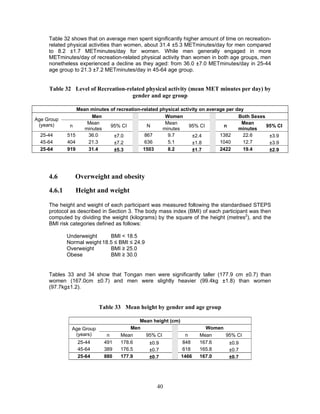
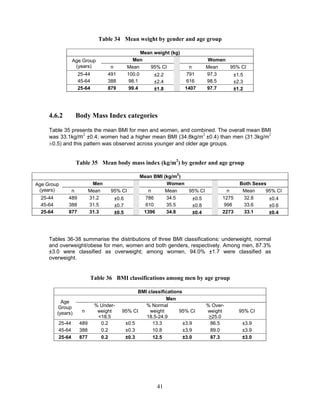
To account for the different levels of energy expenditure required for the activities (i.e. low,
moderate or high), the daily duration of activity was converted into METminutes per day. The
term MET (metabolic equivalent) is used as an indication of the intensity of physical activity.
A MET is the ratio of the associated metabolic rate for a specific activity divided by the
resting metabolic rate. The energy cost of sitting is equivalent to a resting metabolic rate of 1
MET.
In this report and for consistency across all STEPS reports, the following MET values were
allocated to the three physical activity domains (Armstrong & Bull, 2006; WHO, 2005b):
 Moderate physical activity (work and leisure domain) = 4.0 METS
 High physical activity (work and leisure domain) = 8.0 METS
 Travel-related walking/cycling = 4.0 METS
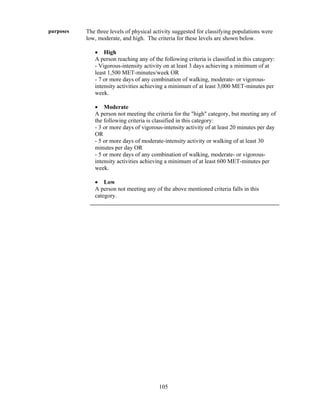
The following levels of activity in terms of METminutes were:
 Low activity: <600 METminutes per week
 Moderate activity: 600-1500 METminutes per week
 High activity: >1500 METminutes per week
4.5.3 Levels of physical activity
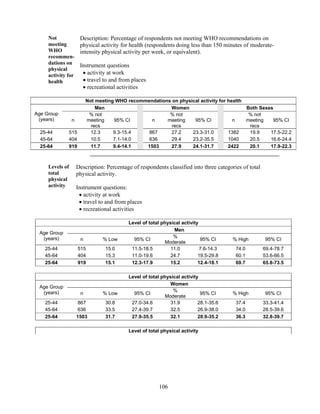
To examine total activity levels, physical activity done as part of work, transport and leisure
was combined and categorised into low (<600 METminutes per week), moderate (600-1500
METminutes per week) and high activity levels (>1500 METminutes per week) for Tongan
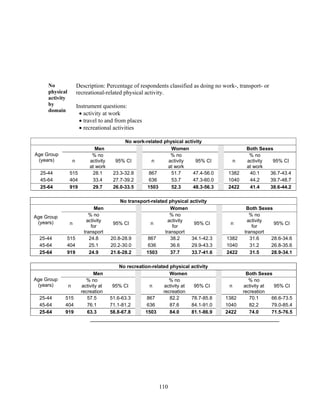
men are summarised in Table 26. Approximately, 15.1% ±2.8 of men reported a low level of
total physical activity. Moderate physical activity was reported by 15.2% ±2.8. High level of
physical was reported by 69.7% ±3.8, with the highest proportion reported by those aged 25-
44 years (74.0% ±4.6) but declined to 60.1% ±6.5 in the older age group 45-64 years.
Table 26 Categories of overall physical activity among men by age group
Level of total physical activity
Age Group
(years)
Men
n % Low 95% CI
%
Moderate
95% CI % High 95% CI
25-44 515 15.0 ±3.5 11.0 ±3.4 74.0 ±4.6
45-64 404 15.3 ±4.3 24.7 ±5.2 60.1 ±6.5
25-64 919 15.1 ±2.8 15.2 ±2.8 69.7 ±3.8
38
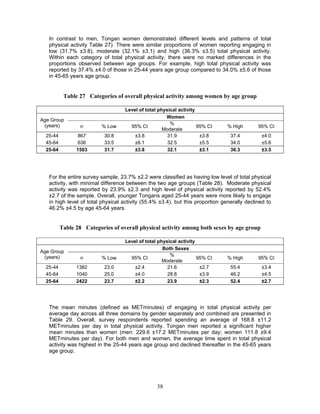
In contrast to men, Tongan women demonstrated different levels and patterns of total
physical activity Table 27). There were similar proportions of women reporting engaging in
low (31.7% ±3.8), moderate (32.1% ±3.1) and high (36.3% ±3.5) total physical activity.
Within each category of total physical activity, there were no marked differences in the
proportions observed between age groups. For example, high total physical activity was
reported by 37.4% ±4.0 of those in 25-44 years age group compared to 34.0% ±5.6 of those
in 45-65 years age group.
Table 27 Categories of overall physical activity among women by age group
Level of total physical activity
Age Group
(years)
Women
n % Low 95% CI
%
Moderate
95% CI % High 95% CI
25-44 867 30.8 ±3.8 31.9 ±3.8 37.4 ±4.0
45-64 636 33.5 ±6.1 32.5 ±5.5 34.0 ±5.6
25-64 1503 31.7 ±3.8 32.1 ±3.1 36.3 ±3.5
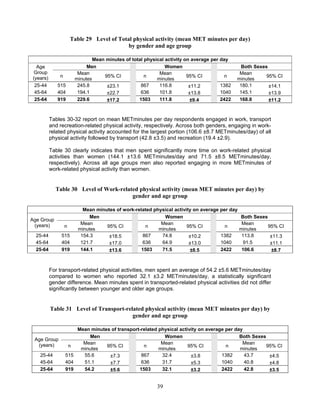
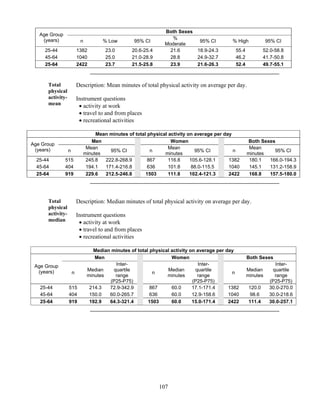
For the entire survey sample, 23.7% ±2.2 were classified as having low level of total physical
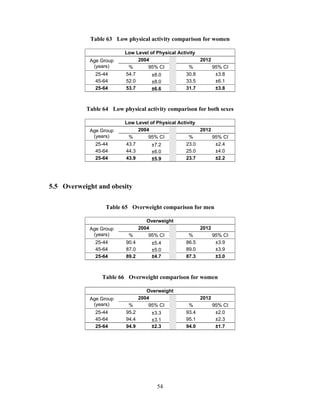
activity, with minimal difference between the two age groups (Table 28). Moderate physical
activity was reported by 23.9% ±2.3 and high level of physical activity reported by 52.4%
±2.7 of the sample. Overall, younger Tongans aged 25-44 years were more likely to engage
in high level of total physical activity (55.4% ±3.4), but this proportion generally declined to
46.2% ±4.5 by age 45-64 years.
Table 28 Categories of overall physical activity among both sexes by age group
Level of total physical activity
Age Group
(years)
Both Sexes
n % Low 95% CI
%
Moderate
95% CI % High 95% CI
25-44 1382 23.0 ±2.4 21.6 ±2.7 55.4 ±3.4
45-64 1040 25.0 ±4.0 28.8 ±3.9 46.2 ±4.5
25-64 2422 23.7 ±2.2 23.9 ±2.3 52.4 ±2.7
The mean minutes (defined as METminutes) of engaging in total physical activity per
average day across all three domains by gender separately and combined are presented in
Table 29. Overall, survey respondents reported spending an average of 168.8 ±11.2
METminutes per day in total physical activity. Tongan men reported a significant higher
mean minutes than women (men: 229.6 ±17.2 METminutes per day; women 111.8 ±9.4
METminutes per day). For both men and women, the average time spent in total physical
activity was highest in the 25-44 years age group and declined thereafter in the 45-65 years
age group.
39
Table 29 Level of Total physical activity (mean MET minutes per day)
by gender and age group
Mean minutes of total physical activity on average per day
Age
Group
(years)
Men Women Both Sexes
n
Mean
minutes
95% CI n
Mean
minutes
95% CI n
Mean
minutes
95% CI
25-44 515 245.8 ±23.1 867 116.8 ±11.2 1382 180.1 ±14.1
45-64 404 194.1 ±22.7 636 101.8 ±13.8 1040 145.1 ±13.9
25-64 919 229.6 ±17.2 1503 111.8 ±9.4 2422 168.8 ±11.2
Tables 30-32 report on mean METminutes per day respondents engaged in work, transport
and recreation-related physical activity, respectively. Across both genders, engaging in work-
related physical activity accounted for the largest portion (106.6 ±8.7 METminutes/day) of all
physical activity followed by transport (42.8 ±3.5) and recreation (19.4 ±2.9).
Table 30 clearly indicates that men spent significantly more time on work-related physical
activities than women (144.1 ±13.6 METminutes/day and 71.5 ±8.5 METminutes/day,
respectively). Across all age groups men also reported engaging in more METminutes of
work-related physical activity than women.
Table 30 Level of Work-related physical activity (mean MET minutes per day) by
gender and age group
Mean minutes of work-related physical activity on average per day
Age Group
(years)
Men Women Both Sexes
n
Mean
minutes
95% CI n
Mean
minutes
95% CI n
Mean
minutes
95% CI
25-44 515 154.3 ±18.5 867 74.8 ±10.2 1382 113.8 ±11.3
45-64 404 121.7 ±17.0 636 64.9 ±13.0 1040 91.5 ±11.1
25-64 919 144.1 ±13.6 1503 71.5 ±8.5 2422 106.6 ±8.7
For transport-related physical activities, men spent an average of 54.2 ±5.6 METminutes/day
compared to women who reported 32.1 ±3.2 METminutes/day, a statistically significant
gender difference. Mean minutes spent in transported-related physical activities did not differ
significantly between younger and older age groups.
Table 31 Level of Transport-related physical activity (mean MET minutes per day) by
gender and age group
Mean minutes of transport-related physical activity on average per day
Age Group
(years)
Men Women Both Sexes
n
Mean
minutes
95% CI n
Mean
minutes
95% CI n
Mean
minutes
95% CI
25-44 515 55.6 ±7.3 867 32.4 ±3.8 1382 43.7 ±4.5
45-64 404 51.1 ±7.7 636 31.7 ±5.3 1040 40.8 ±4.8
25-64 919 54.2 ±5.6 1503 32.1 ±3.2 2422 42.8 ±3.5
40
Table 32 shows that on average men spent significantly higher amount of time on recreation-
related physical activities than women, about 31.4 ±5.3 METminutes/day for men compared
to 8.2 ±1.7 METminutes/day for women. While men generally engaged in more
METminutes/day of recreation-related physical activity than women in both age groups, men
nonetheless experienced a decline as they aged: from 36.0 ±7.0 METminutes/day in 25-44
age group to 21.3 ±7.2 METminutes/day in 45-64 age group.
Table 32 Level of Recreation-related physical activity (mean MET minutes per day) by
gender and age group
Mean minutes of recreation-related physical activity on average per day
Age Group
(years)
Men Women Both Sexes
n
Mean
minutes
95% CI N
Mean
minutes
95% CI n
Mean
minutes
95% CI
25-44 515 36.0 ±7.0 867 9.7 ±2.4 1382 22.6 ±3.9
45-64 404 21.3 ±7.2 636 5.1 ±1.8 1040 12.7 ±3.9
25-64 919 31.4 ±5.3 1503 8.2 ±1.7 2422 19.4 ±2.9
4.6 Overweight and obesity
4.6.1 Height and weight
The height and weight of each participant was measured following the standardised STEPS
protocol as described in Section 3. The body mass index (BMI) of each participant was then
computed by dividing the weight (kilograms) by the square of the height (metres2
), and the
BMI risk categories defined as follows:
Underweight BMI < 18.5
Normal weight 18.5 ≤ BMI ≤ 24.9
Overweight BMI ≥ 25.0
Obese BMI ≥ 30.0
Tables 33 and 34 show that Tongan men were significantly taller (177.9 cm ±0.7) than
women (167.0cm ±0.7) and men were slightly heavier (99.4kg ±1.8) than women
(97.7kg±1.2).
Table 33 Mean height by gender and age group
Mean height (cm)
Age Group
(years)
Men Women
n Mean 95% CI n Mean 95% CI
25-44 491 178.6 ±0.9 848 167.6 ±0.9
45-64 389 176.5 ±0.7 618 165.8 ±0.7
25-64 880 177.9 ±0.7 1466 167.0 ±0.7
41
Table 34 Mean weight by gender and age group
Mean weight (kg)
Age Group
(years)
Men Women
n Mean 95% CI n Mean 95% CI
25-44 491 100.0 ±2.2 791 97.3 ±1.5
45-64 388 98.1 ±2.4 616 98.5 ±2.3
25-64 879 99.4 ±1.8 1407 97.7 ±1.2
4.6.2 Body Mass Index categories
Table 35 presents the mean BMI for men and women, and combined. The overall mean BMI
was 33.1kg/m2
±0.4; women had a higher mean BMI (34.8kg/m2
±0.4) than men (31.3kg/m2
±0.5) and this pattern was observed across younger and older age groups.
Table 35 Mean body mass index (kg/m2
) by gender and age group
Mean BMI (kg/m2
)
Age Group
(years)
Men Women Both Sexes
n Mean 95% CI n Mean 95% CI n Mean 95% CI
25-44 489 31.2 ±0.6 786 34.5 ±0.5 1275 32.8 ±0.4
45-64 388 31.5 ±0.7 610 35.5 ±0.8 998 33.6 ±0.6
25-64 877 31.3 ±0.5 1396 34.8 ±0.4 2273 33.1 ±0.4
Tables 36-38 summarise the distributions of three BMI classifications: underweight, normal
and overweight/obese for men, women and both genders, respectively. Among men, 87.3%
±3.0 were classified as overweight; among women, 94.0% ±1.7 were classified as
overweight.
Table 36 BMI classifications among men by age group
BMI classifications
Age
Group
(years)
Men
n
% Under-
weight
<18.5
95% CI
% Normal
weight
18.5-24.9
95% CI
% Over-
weight
≥25.0
95% CI
25-44 489 0.2 ±0.5 13.3 ±3.9 86.5 ±3.9
45-64 388 0.2 ±0.3 10.8 ±3.9 89.0 ±3.9
25-64 877 0.2 ±0.3 12.5 ±3.0 87.3 ±3.0
42
Table 37 BMI classifications among women by age group
BMI classifications
Age
Group
(years)
Women
N
% Under-
weight
<18.5
95% CI
% Normal
weight
18.5-24.9
95% CI
% Over-
weight
≥25.0
95% CI
25-44 786 0.0 ---- 6.6 ±2.0 93.4 ±2.0
45-64 610 0.0 ---- 4.9 ±2.3 95.1 ±2.3
25-64 1396 0.0 ---- 6.0 ±1.7 94.0 ±1.7
Table 38 shows that overall 90.7% ±1.8 of the survey population were overweight, while
9.2% ±1.8 had a normal BMI.
Table 38 BMI classifications among both sexes by age group
BMI classifications
Age
Group
(years)
Both Sexes
N
% Under-
weight
<18.5
95% CI
% Normal
weight
18.5-24.9
95% CI
% Over-
weight
≥25.0
95% CI
25-44 1275 0.1 ±0.2 9.9 ±2.4 89.9 ±2.4
45-64 998 0.1 ±0.2 7.7 ±2.2 92.3 ±2.2
25-64 2273 0.1 ±0.2 9.2 ±1.8 90.7 ±1.8
Table 39 presents obesity rates (BMI ≥30 kg/m2
) separately for men and women, and
combined. The overall prevalence of obesity in Tonga was 67.6% ±2.9. The obesity rate was
significantly higher among women (77.6% ±2.9) than among men (57.2% ±4.4).
Table 39 Percentage of obesity (BMI≥30 kg/m2
) by gender and age group
Percentage of respondents who are obese (BMI ≥ 30 kg/m2
)
Age Group
(years)
Men Women Both Sexes
n % 95% CI N % 95% CI n % 95% CI
25-44 489 57.6 ±5.4 786 77.3 ±3.8 1275 67.5 ±3.6
45-64 388 56.2 ±6.1 610 78.2 ±4.4 998 67.9 ±3.8
25-64 877 57.2 ±4.4 1396 77.6 ±2.9 2273 67.6 ±2.9
4.6.3 Waist circumference
Central obesity was assessed by measuring waist circumference of participants following the
STEPS standardised protocol as outlined in Section 3. Women had a significantly larger
mean waist circumference (106.7cm ±1.0) than men (103.3cm ±1.3). Women in the older
43
age group 45-64 years had significantly higher mean waist circumference (109.7cm ±1.5)
than younger women aged 25-44 years (105.1cm ±1.2). For men, the mean waist
circumference in the younger age group 25-44 years increased from 102.2cm ±1.6 to 105.7
±1.7 in the older age group 45-64 years.
Table 40 Mean waist circumference (cm) by gender and age group
Waist circumference (cm)
Age Group
(years)
Men Women
n Mean 95% CI n Mean 95% CI
25-44 488 102.2 ±1.6 792 105.1 ±1.2
45-64 385 105.7 ±1.7 613 109.7 ±1.5
25-64 873 103.3 ±1.3 1405 106.7 ±1.0
4.7 Blood pressure and hypertension
All survey respondents had their blood pressure measured, were asked if they ever had their
blood pressure measured in the last 12 months or whether they had ever been told in the
last 12 months by a health worker that they had high blood pressure, and if they were
currently receiving any medical treatment for high blood pressure. Based on self-report and
measured blood pressure data, the following STEPS classifications were set out:
 a mean systolic pressure of SBP≥140 mmHg, whether or not they had previously been
told by a health worker that they had high blood pressure, OR
 a mean diastolic pressure of DBP≥90 mmHg, whether or not they had previously been
told by a health worker that they had high blood pressure, OR
 normal mean systolic and diastolic pressures (i.e. normotensive) AND who were
currently receiving anti-hypertensive medication, whether or not they had previously
been told by a health worker that they had high blood pressure.
Those participants who reported having been previously told by a health worker that they
had high blood pressure, but who were normotensive and NOT on anti-hypertensive
medication, were NOT included among those considered to have hypertension.
Tables 41 and 42 present mean resting systolic blood pressure and mean resting diastolic
blood pressure, respectively, for men and women separately, and combined. Tongan men
indicate a statistically higher mean systolic blood pressure than women (131.2mmHg ±1.2
and 127.3mmHg ±1.2, respectively). For both genders, systolic blood pressure increased
with age.
For resting diastolic blood pressure, both men and women indicate similar mean levels
(78.2mmHg ±0.9 and 78.3mmHg ±0.6, respectively), and increasing with age across both
genders.
44
Table 41 Mean resting systolic blood pressure (mmHg) by gender and age group
Mean systolic blood pressure (mmHg)
Age Group
(years)
Men Women Both Sexes
n Mean 95% CI n Mean 95% CI n Mean 95% CI
25-44 486 128.8 ±1.3 847 121.4 ±1.1 1333 124.9 ±0.9
45-64 385 136.4 ±2.3 614 139.3 ±2.0 999 138.0 ±1.6
25-64 871 131.2 ±1.2 1461 127.3 ±1.2 2332 129.2 ±0.9
Table 42 Mean resting diastolic blood pressure (mmHg) by gender and age group
Mean diastolic blood pressure (mmHg)
Age Group
(years)
Men Women Both Sexes
n Mean 95% CI n Mean 95% CI n Mean 95% CI
25-44 486 77.0 ±1.2 847 76.4 ±0.8 1333 76.7 ±0.8
45-64 385 80.5 ±1.4 614 82.2 ±0.9 999 81.4 ±0.8
25-64 871 78.2 ±0.9 1461 78.3 ±0.6 2332 78.2 ±0.6
Table 43 summarises the prevalence rates of hypertension for both genders and combined.
Hypertension was indicated for 27.6% ±2.4 of the survey sample. A lightly higher proportion
of Tongan men had hypertension compared to women, although this difference was not
statistically significant (28.2% ±3.6 and 27.1% ±2.9, respectively). Among women,
hypertension rate increased significantly from 14.3% ±2.7 (25-44 years) to 52.9% ±5.3 (45-
64 years). Among men, the rise was less dramatic but still substantial: from 22.1% ±4.3 (25-
44 years) to 41.3% ±5.9 (45-64 years).
Table 43 Percentage with hypertension
(SBP ≥140 and/or DBP ≥ 90 or currently on medication for raised blood pressure)
SBP ≥140 and/or DBP ≥ 90 mmHg or currently on medication for raised blood pressure
Age Group
(years)
Men Women Both Sexes
n % 95% CI n % 95% CI n % 95% CI
25-44 486 22.1 ±4.3 847 14.3 ±2.7 1333 18.0 ±2.5
45-64 385 41.3 ±5.9 614 52.9 ±5.3 999 47.5 ±4.2
25-64 871 28.2 ±3.6 1461 27.1 ±2.9 2332 27.6 ±2.4
4.8 Total cholesterol
In this sample, the overall mean total blood cholesterol was 5.1mmol/L ±0.0, with both men
and women recording similar mean cholesterol levels (5.2mmol/L ±0.1 and 5.1mmol/L ±0.1,
respectively) (Table 44). Increased cholesterol levels with age in men, the mean levels for
women increased highly with age (25-44 years: 4.9 mmol/L ±0.1; 45-64 years: 5.5 mmol/L
±0.1).
45
Table 44 Mean levels of total blood cholesterol (mmol/L) by gender and age group
Mean total cholesterol (mmol/L)
Age Group
(years)
Men Women Both Sexes
n Mean 95% CI n Mean 95% CI n Mean 95% CI
25-44 444 5.1 ±0.1 727 4.9 ±0.1 1171 5.0 ±0.1
45-64 354 5.4 ±0.1 540 5.5 ±0.1 894 5.4 ±0.1
25-64 798 5.2 ±0.1 1267 5.1 ±0.1 2065 5.1 ±0.0
Raised blood cholesterol, defined as having ≥5.0 mmol/L or ≥190 mg/dl or reported currently
on medication , was indicated by 48.8% ±2.9 of the survey sample (Table 45). Both men and
women recorded similar proportions of having raised blood cholesterol (49.3% ±4.1 and
48.2% ±3.5, respectively). High proportions of raised blood cholesterol were already evident
in the younger age group 25-44 years for both men (44.1% ±5.1) and women (38.2% ±4.5),
with these rates increasing significantly in the older age group 45-64 years (men: 60.3%
±5.9; women: 67.5% ±4.9).
Table 45 Percentage with raised blood cholesterol (≥ 5.0 mmol/L or ≥ 190 mg/dl) or
currently on medication by gender and age group
Total cholesterol ≥ 5.0 mmol/L or ≥ 190 mg/dl or currently on medication for raised cholesterol
Age Group
(years)
Men Women Both Sexes
n % 95% CI n % 95% CI n % 95% CI
25-44 444 44.1 ±5.1 727 38.2 ±4.5 1171 41.1 ±3.4
45-64 354 60.3 ±5.9 540 67.5 ±4.9 894 64.1 ±3.9
25-64 798 49.3 ±4.1 1267 48.2 ±3.5 2065 48.8 ±2.9
4.9 Fasting blood glucose and diabetes
Respondents were asked if they had been told by a health worker that they had diabetes in
the previous 12 months, and whether they were currently receiving medical treatment for
diabetes. Estimates of diabetes prevalence were computed based on the WHO guidelines
for defining and classifying diabetes mellitus:
 elevated fasting capillary whole blood value of glucose ≥6.1 mmol/L (≥110 mg/dl) AND
whether or not they had previously been told by a health worker that they had diabetes,
OR
 normal capillary whole blood value of glucose <6.1 mmol/L (<110 mg/dl) AND who were
currently receiving anti-diabetes medication prescribed by a health worker.
Those participants who had been advised by a health worker that they had diabetes but who
had normal fasting blood glucose, and who were NOT on anti-diabetes medication or on a
special diet prescribed by a health worker, were NOT included among those considered as
having diabetes.
46
The overall mean fasting blood glucose among the survey respondents was 6.5mmol/L ±0.1
(Table 46). Women reported a marginally higher mean fasting blood glucose level
(6.7mmol/L ±0.2) than men (6.2mmo/L ±0.2). For women, mean fasting blood glucose levels
increased with age, from 6.3mmo/L ±0.2 (25-44 years) to 7.5mmo/L ±0.3 (45-64 years). A
similar pattern was also recorded for men.
Table 46 Mean fasting blood glucose in mmol/L by gender and age group
Mean fasting blood glucose (mmol/L)
Age Group
(years)
Men Women Both Sexes
n Mean 95% CI n Mean 95% CI n Mean 95% CI
25-44 475 5.9 ±0.2 828 6.3 ±0.2 1303 6.1 ±0.2
45-64 382 6.8 ±0.3 602 7.5 ±0.3 984 7.2 ±0.2
25-64 857 6.2 ±0.2 1430 6.7 ±0.2 2287 6.5 ±0.1
Table 47 Prevalence of Impaired Fasting Glycaemia by gender and age group
Impaired Fasting Glycaemia*
Age Group
(years)
Men Women Both Sexes
n % 95% CI n % 95% CI n % 95% CI
25-44 475 22.1 ±4.7 828 24.7 ±3.8 1303 23.5 ±2.9
45-64 382 27.5 ±5.6 602 22.2 ±3.9 984 24.6 ±3.5
25-64 857 23.9 ±3.6 1430 23.8 ±2.6 2287 23.8 ±2.2
* Capillary whole blood value ≥5.6 mmol/L (100 mg/dl) and <6.1 mmol/L (110 mg/dl)
The overall diabetes prevalence of those aged 25-64 years, measured as raised blood
glucose or reported as currently on medication for diabetes, was 34.4% ±2.9. Diabetes
prevalence was significantly higher among women (38.6% ±3.3) than men (29.7% ±4.1). By
age 25-44 years, nearly one third of the survey population (27.1% ±3.3) had hypertension,
and by age 45-64 years this rate rose to about half of the survey sample (49.3% ±4.4).
Table 48 Prevalence of diabetes by gender and age group
Raised blood glucose or currently on medication for diabetes
Age Group
(years)
Men Women Both Sexes
n % 95% CI n % 95% CI n % 95% CI
25-44 475 24.5 ±5.5 828 29.4 ±4.1 1303 27.1 ±3.3
45-64 382 40.7 ±6.1 602 56.9 ±5.6 984 49.3 ±4.4
25-64 857 29.7 ±4.1 1430 38.6 ±3.3 2287 34.4 ±2.9
47
4.10 Combined risk factors
The following five NCD risk factors were summed to indicate the overall NCD risk:
 current daily smokers,
 overweight (BMI ≥25 kg/m2
),
 raised blood pressure (SBP ≥140 and/or DBP≥90 mmHg or currently on medication),
 consumed less than five combined servings of fruit and vegetables per day, and
 low level of activity (<600 METminutes per week).
Based on these combined risk factors, three levels of the overall risk for NCDs were created:
 Low Risk: 0 risk factor
 Moderate Risk: 1-2 risk factors
 High Risk: 3-5 risk factors
Table 49 shows that 56.0% ±5.6 of Tongan men were at High Risk of NCDs, with at least
51.7% ±7.2 of those aged 25-44 years already had 3-5 risk factors. Just under half or 42.4%
±5.4 of men had Moderate Risk.
Table 50 shows that 60.2% ±6.9 of Tongan women were at High Risk of NCDs, with more
than half or 55.4% ±8.3 already had 3-5 risk factors by age 25-44 years.
Overall, 57.1% ±4.6 of Tongans were deemed to be at High Risk of NCDs (Table 51), and
41.6% ±4.4 at Moderate Risk. By age 25-44 years, more than half those surveyed were at
High Risk (52.8% ±5.6) and increased with age to 66.9% ±6.4 in the 45-64 age group.
Table 49 Percentage of NCD risk categories among men by age group
Summary of Combined Risk Factors
Age Group
(years)
Men
n
% with 0
risk
factors
95% CI
% with 1-2
risk
factors
95% CI
% with 3-5
risk
factors
95% CI
25-44 274 2.4 ±2.8 45.9 ±6.9 51.7 ±7.2
45-64 234 0.0 ---- 35.4 ±7.4 64.7 ±7.4
25-64 508 1.6 ±1.9 42.4 ±5.4 56.0 ±5.6
Table 50 Percentage of NCD risk categories among women by age group
Summary of Combined Risk Factors
Age Group
(years)
Women
n
% with 0
risk
factors
95% CI
% with 1-2
risk
factors
95% CI
% with 3-5
risk
factors
95% CI
25-44 187 0.4 ±0.8 44.2 ±8.3 55.4 ±8.3
45-64 82 0.0 ---- 25.0 ±10.4 75.0 ±10.4
25-64 269 0.3 ±0.6 39.5 ±6.9 60.2 ±6.9
48
Table 51 Percentage of NCD risk categories among both sexes by age group
Summary of Combined Risk Factors
Age Group
(years)
Both Sexes
n
% with 0
risk
factors
95% CI
% with 1-2
risk
factors
95% CI
% with 3-5
risk
factors
95% CI
25-44 461 1.8 ±2.0 45.4 ±5.4 52.8 ±5.6
45-64 316 0.0 ---- 33.1 ±6.4 66.9 ±6.4
25-64 777 1.3 ±1.4 41.6 ±4.4 57.1 ±4.6
4.11 Cardiovascular disease risk
Percentage of respondents aged 40-69 years with a 10-year cardiovascular disease (CVD)
risk* ≥30% or with existing CVD has been calculated.
Instrument questions: combined from Step 1, 2 and 3 of the STEPS survey
• Gender, age
• Current and former smoking
• History of diabetes, CVD
• Systolic blood pressure measurements
• Fasting status, glucose and total cholesterol measurements.
Analysis of the CVD risk factors of the current smokers, raised blood pressure, total
cholesterol and diabetes were undertaken to assess the CVD risk status of the population for
NCDs.
Table 52 shows that one-sixth (16.6%) of 55-69 year-old men in Tonga had a high risk
(≥30%) of developing CVD in the next 10 years, which needs to pay more attention.
The CVD risk increased with age as would be expected and this was shown from 40-54
years to 55-69 with a significant increased from 0.8% to 11.3%, shown in Table 52.
Overall, higher percentages of men were at risk than women with CVD risk of 16.6% and
7.0%, respectively, with no significant difference.
Table 52 Percentage of the population with a 10-year CVD risk ≥30% or with existing CVD
 
Percentage of respondents with a 10-year CVD risk* ≥30% or with existing CVD
Age Group
(years)
Men Women Both Sexes
n % 95% CI n % 95% CI n % 95% CI
40-54 371 0.9 0.0-1.7 550 0.7 0.0-1.4 921 0.8 0.2-1.4
55-69 122 16.6 8.9-24.4 215 7.0 2.6-11.5 337 11.3 7.1-15.5
40-69 493 4.3 2.4-6.3 765 2.4 1.1-3.7 1258 3.3 2.1-4.5


* A 10-year CVD risk of ≥30% is defined according to age, sex, blood pressure, smoking status (current smokers OR those
who quit smoking less than 1 year before the assessment), total cholesterol, and diabetes (previously diagnosed OR a fasting
plasma glucose concentration >7.0 mmol/l (126 mg/dl)).
49
5. COMPARISON WITH 2004 STEPS SURVEY
In 2004, Tonga conducted the first STEPS survey covering three island groups of
Tongatapu, Ha’apai and Vava’u (WHO, 2012). This second 2012 STEPS survey provide
Tonga’s first population-wide trends data in behavioural and biochemical risk factors for
NCDs.
Both surveys followed the WHO standardised survey sampling and data collection
methodology, and both survey data weighted to the Tongan populations. To facilitate
comparison, only data for 25-64 years are presented here. In this age band, a sample of 849
participants took part in the 2004 survey, and 2,457 took part in the 2012 survey.
This section reports on the 2004-2012 trends of four major NCD risk factors: tobacco use,
alcohol consumption, fruit and vegetable consumption and physical activity. The prevalence
of combined NCD risk categories in 2004 and 2012 is also presented, and the majority of the
descriptive results presented graphically by age group, gender and overall.
5.1 Tobacco use
Overall, the proportions of current smokers (had smoked any tobacco products) declined
marginally over time, with 29.8% in 2004 compared to 29.3% in 2012 (Table 55).
Among Tongan men the rates also remained stable: 46.2% in 2004 and 46.4% in 2012.
There was, however, a 2% decrease in smoking prevalence among the 45-65 age group,
from 49.8% in 2004 to 47.8% in 2012 (Table 53).
The rates of smoking among Tongan women, however, decreased slightly from 14.3% in
2004 to 13.4% in 2012. A 1.2% point decrease in smoking prevalence was noted for women
in the 25-44 age group (Table 54).
Table 53 Current smoker comparisons for men
Current Smoker
Age Group
(years)
2004 2012
% 95% CI % 95% CI
25-44 44.3 ±7.3 45.8 ±5.1
45-64 49.8 ±8.8 47.8 ±5.5
25-64 46.2 ±5.6 46.4 ±4.0
Table 54 Current smoker comparisons for women
Current Smoker
Age Group
(years)
2004 2012
% 95% CI % 95% CI
25-44 16.8 ±7.0 15.6 ±2.9
45-64 9.9 ±4.6 9.0 ±3.1
25-64 14.3 ±4.6 13.4 ±2.4
50
Table 55 Current smoker comparisons for both sexes
Current Smoker
Age Group
(years)
2004 2012
% 95% CI % 95% CI
25-44 30.3 ±4.9 30.3 ±3.1
45-64 28.8 ±6.2 27.3 ±3.8
25-64 29.8 ±3.7 29.3 ±2.6
5.2 Alcohol consumption
In contrast to tobacco use, self-reported alcohol consumption over the past 12 months
declined during the 2004-2012 period, overall 8.9% in 2004 to 5.7% in 2012 (Table 58).
The proportion of men consuming alcohol in the past 12 months decreased substantially,
from 13.6% in 2004 to 8.7% in 2012. This decline was also reflected across both younger
and older age groups over the 8-year period (Table 56).
The proportions of women consuming alcohol also saw a reduction, from 4.6% in 2004 to
2.8% in 2012, attributable mainly to the decline in consumption among the younger age
group (Table 57).
Table 56 Past 12-months alcohol consumption comparison for men
Consumed Alcohol in Past 12 Months
Age Group
(years)
2004 2012
% 95% CI % 95% CI
25-44 16.2 ±9.4 10.1 ±3.1
45-64 8.5 ±6.6 5.7 ±2.6
25-64 13.6 ±7.9 8.7 ±2.3
Table 57 Past 12-months alcohol consumption comparison for women
Consumed Alcohol in Past 12 Months
Age Group
(years)
2004 2012
% 95% CI % 95% CI
25-44 6.9 ±4.3 3.5 ±1.7
45-64 0.4 ±1.0 1.5 ±1.4
25-64 4.6 ±3.0 2.8 ±1.3
51
Table 58 Past 12-months alcohol consumption comparison for both sexes
Consumed Alcohol in Past 12 Months
Age Group
(years)
2004 2012
% 95% CI % 95% CI
25-44 11.4 ±6.4 6.7 ±1.7
45-64 4.2 ±3.4 3.5 ±1.4
25-64 8.9 ±5.2 5.7 ±1.3
5.3 Fruit and vegetable intake
Similar to alcohol drinking, the proportions of consuming less than the recommended
combined five servings of fruit and/or vegetables per day in a typical week decreased during
the 2004-2012 period, overall from 92.2% in 2004 to 73.1% in 2012 (Figure 2, Table 59).
Both men and women showed similar magnitude of decline (men: from 91.4% in 2004 to
72.4% in 2012; women: from 92.9% in 2004 to 73.7% in 2012), overall and in younger and
older age groups (Tables 59-61).
Figure 2 Percentages of the population consumed less than five combined servings of
fruit and vegetables per day between 2004 and 2012 surveys
52
Table 59 Less than five combined servings of fruit and/or vegetables
per day of the week comparison for men
Less than five servings of fruit and/or vegetables on average
per day
Age Group
(years)
2004 2012
% 95% CI % 95% CI
25-44 90.3 ±4.9 73.1 ±5.5
45-64 93.6 ±6.2 71.1 ±5.8
25-64 91.4 ±3.4 72.4 ±4.5
Table 60 Less than five combined servings of fruit and/or vegetables
per day of the week comparison for women
Less than five servings of fruit and/or vegetables on average
per day
Age Group
(years)
2004 2012
% 95% CI % 95% CI
25-44 93.4 ±2.9 72.9 ±3.9
45-64 91.9 ±3.2 75.3 ±4.6
25-64 92.9 ±2.0 73.7 ±3.1
Table 61 Less than five combined servings of fruit and/or vegetables
per day of the week comparison for both sexes
Less than five servings of fruit and/or vegetables on average
per day
Age Group
(years)
2004 2012
% 95% CI % 95% CI
25-44 91.9 ±2.4 73.0 ±3.5
45-64 92.7 ±4.0 73.3 ±3.7
25-64 92.2 ±2.1 73.1 ±3.0
5.4 Physical activity
From 2004 to 2012, the proportions of Tongan reporting that they engaged in low level
physical activity (<600 METminutes per week) reduced substantially by 20.2%, overall
23.7% in 2012 compared to 43.9% in 2004 (Figure 3, Table 62).
For both men and women, this magnitude of decline was observed in both younger and
older age groups (Tables 62-64). In other words, the 8-year period saw a positive trend with
the reduction in the overall numbers of low active Tongans.
53
The proportion of men who reported low level of physical activity declined by half between
the two surveys, from 33.3% in 2004 to 15.1% in 2012.
The proportion of women who reported low level of physical activity also declined during the
survey period, from half of the surveyed population or 53.7% in 2004 to one third or 31.7% in
2012. For men and women, both younger and older age groups experienced this positive
decline.
Figure 3 Low physical activity levels between 2004 and 2012 surveys
Table 62 Low physical activity comparison for men
Low Level of Physical Activity
Age Group
(years)
2004 2012
% 95% CI % 95% CI
25-44 31.8 ±10.3 15.0 ±3.5
45-64 36.1 ±7.4 15.3 ±4.3
25-64 33.3 ±7.7 15.1 ±2.8
54
Table 63 Low physical activity comparison for women
Low Level of Physical Activity
Age Group
(years)
2004 2012
% 95% CI % 95% CI
25-44 54.7 ±8.0 30.8 ±3.8
45-64 52.0 ±8.0 33.5 ±6.1
25-64 53.7 ±6.6 31.7 ±3.8
Table 64 Low physical activity comparison for both sexes
Low Level of Physical Activity
Age Group
(years)
2004 2012
% 95% CI % 95% CI
25-44 43.7 ±7.2 23.0 ±2.4
45-64 44.3 ±6.0 25.0 ±4.0
25-64 43.9 ±5.9 23.7 ±2.2
5.5 Overweight and obesity
Table 65 Overweight comparison for men
Overweight
Age Group
(years)
2004 2012
% 95% CI % 95% CI
25-44 90.4 ±5.4 86.5 ±3.9
45-64 87.0 ±5.0 89.0 ±3.9
25-64 89.2 ±4.7 87.3 ±3.0
Table 66 Overweight comparison for women
Overweight
Age Group
(years)
2004 2012
% 95% CI % 95% CI
25-44 95.2 ±3.3 93.4 ±2.0
45-64 94.4 ±3.1 95.1 ±2.3
25-64 94.9 ±2.3 94.0 ±1.7
55
Table 67 Overweight comparison for both sexes
Overweight
Age Group
(years)
2004 2012
% 95% CI % 95% CI
25-44 92.8 ±2.5 89.9 ±2.4
45-64 90.9 ±3.2 92.3 ±2.2
25-64 92.1 ±2.1 90.7 ±1.8
The 2012 survey saw a slight but non-significant decline in the proportion of people who
were overweight, overall from 92.1% in 2004 to 90.7% in 2012 (Table 67).
For women, the overall proportions of overweight remained unchanged from 2004 to 2012
(94.9% and 94.0%, respectively), while prevalence of overweight in men experienced a 1.9%
point decrease (89.2% in 2004 to 87.3% in 2012).
Table 68 Obesity comparison for men
Obese
Age Group
(years)
2004 2012
% 95% CI % 95% CI
25-44 63.5 ±9.4 57.6 ±5.4
45-64 55.3 ±10.2 56.2 ±6.1
25-64 60.7 ±8.9 57.2 ±4.4
Table 69 Obesity comparison for women
Obese
Age Group
(years)
2004 2012
% 95% CI % 95% CI
25-44 76.7 ±5.2 77.3 ±3.8
45-64 75.6 ±5.0 78.2 ±4.4
25-64 76.3 ±3.8 77.6 ±2.9
Table 70 Obesity comparison for both sexes
Obese
Age Group
(years)
2004 2012
% 95% CI % 95% CI
25-44 70.2 ±4.5 67.5 ±3.6
45-64 65.9 ±5.3 67.9 ±3.8
25-64 68.7 ±4.2 67.6 ±2.9
56
The 2012 survey saw a slight but non-significant decline in the proportion of people who
were obese, overall from 68.7% in 2004 to 67.6% in 2012 (Table 70).
For women, the overall proportions of obesity increased slightly from 2004 to 2012 (76.3%
and 77.6%, respectively), while prevalence of obesity in men experienced a 3.5% point
decrease (60.7% in 2004 to 57.2% in 2012).
5.6 Combined risk factors
The 2012 survey saw a slight but non-significant decline in the proportion of people with 3-5
risk factors (High Risk for NCDs), overall from 60.7% in 2004 to 57.1% in 2012 (Table 73).
For women, the overall proportions of High Risk remained unchanged from 2004 to 2012
(60.8% and 60.2%, respectively), while those aged 45-64 years experienced a 9.6% point
increase in the proportions of High Risk during the same period (65.4% in 2004 to 75.0% in
2012) (Table 72).
In contrast, the overall proportions of High Risk among men declined over time, from 60.5%
in 2004 to 56.0% in 2012 (Table 71).
Table 71 Percentage of NCD risk categories among men by age group
% with 3-5 risk factors
Age Group
(years)
2004 2012
% 95% CI % 95% CI
25-44 57.9 ±9.5 51.7 ±7.2
45-64 65.4 ±8.5 64.7 ±7.4
25-64 60.5 ±6.9 56.0 ±5.6
Table 72 Percentage of NCD risk categories among women by age group
% with 3-5 risk factors
Age Group
(years)
2004 2012
% 95% CI % 95% CI
25-44 58.3 ±6.3 55.4 ±8.3
45-64 65.4 ±7.5 75.0 ±10.4
25-64 60.8 ±4.1 60.2 ±6.9
57
Table 73 Percentage of NCD risk categories among both sexes by age group
% with 3-5 risk factors
Age Group
(years)
2004 2012
% 95% CI % 95% CI
25-44 58.1 ±5.8 52.8 ±5.6
45-64 65.4 ±6.6 66.9 ±6.4
25-64 60.7 ±4.4 57.1 ±4.6
6. DISCUSSION AND CONCLUSIONS
The WHO STEPS survey is a valuable national data resource for Tonga. At the population
level, it documents the magnitude of major modifiable behavioural risk factors of NCDs,
identifies who are at risk, and allows for prioritisation of public health interventions.
Interventions to address "unhealthy environments" -- through policies, regulations and
legislation are of critical importance. If repeated at regular intervals, the STEPS surveys
provide surveillance and trends data for Tonga to benchmark and evaluate progress towards
achieving agreed health and development goals.
This final section of the report reflects on key findings from the 2012 STEPS survey,
discusses the differential changes from 2004 to 2012 in four health-related behavioural risk
factors, and presents a range of recommendations to prevent and control NCDs in the
Kingdom of Tonga.
STEPS 2012 findings
Smoking remains a public health concern in Tonga, particularly among Tongan men. Just
under one half of men (42.1%) were daily smokers at the time of the survey, compared to
STEPS survey data from Cook Islands (37.5%) and American Samoa (38.1%)
13-21
. Daily
smoking is also well established among Tongan men in age 25-44 years (40.9%). These
findings highlight the need for programs to specifically target young Tongan men in an effort
to prevent experimenting and subsequently early uptake of tobacco products at an early age.
Whilst only 9.3% of Tongans are current drinkers (drank in the past 30 days), it is heavy
alcohol drinking that presents a public health challenge in Tonga. Again, Tongan men are
particular at risk with 51% consuming 6 or more standard alcoholic drinks on a drinking day,
compared to 24.2% of women. These estimates are either similar or even substantially lower
than those reported for Cook Islands (men: 89.3%, women: 70.7%) and American Samoa
(men: 49.6%, women: 33.9%; based on 5+ drinks) 13-21
. Nonetheless, the magnitude of binge
drinking in Tonga is likely to place Tongans at increased risks of NCDs and injuries, and
health promotion efforts to increase awareness of the harmful effects of heavy drinking can
contribute to reduce these rates.
The survey found that the majority of the survey population consumed less than the
recommended intake of fruit and vegetable (five or more serves of fruit and vegetables per
day). The low level of fruit and/or vegetable consumption did not differ significantly between
men and women or across age groups. Substantial structural and policy changes will be
critical to effect the Tonga food environments, and before any shift away from the tastes for
high-fat, high-sugar and high-salt products can be expected.
58
Approximately 1 in 4 Tongans do not engage in sufficient levels of physical activity to
confer health benefits. For those who are sufficiently active, time spent on physical activity
as part of work contributed the most to the overall activity level. Not surprisingly, engaging in
physical activity through work, transport or as part of leisure decrease with increasing age for
both men and women. Creating an enabling physical environment supportive of physical
activity, and complemented by health promotion activities to promote regular moderate-
intensity physical activity done as part of everyday life are necessary to produce
measureable health benefits at both individual and population level.
The current STEPS survey found high rates of overweight and obesity among Tongan
adults, with the rate being slightly higher among women (94 %) than men (87.3%). The rates
are similar to those reported for American Samoa (women: 94.4%; men: 92.7%), and Cook
Islands (women: 87.1%; men: 89.8%)
13-21
. Of concern is that these high overweight/obesity
rates already evident in the younger age group (25-44 years). Targeted programs tailored to
those most likely to benefit but also most vulnerable to experience rapid weight gain (e.g.,
young adults) can confer substantial public health gains.
Just over one quarter of the survey population was found to have elevated blood pressure.
Hypertension rates increased substantially with age across both genders, placing the older
age groups at an elevated risk of developing stroke or cardiovascular disease. Nearly half of
the survey population had raised blood cholesterol, with no significant difference in
proportions between men and women. About 1 in 4 surveyed (23.8%) were at heightened
risk of developing diabetes based on their impaired fasting glycaemia level (capillary
whole blood value ≥5.6mmol/L (100mg/dl) and <6.1mmol/L (110mg/dl). Early detection and
appropriate clinical management of these physiological and biochemical risk markers is
highly critical to prevent the progression to cardiovascular disease or diabetes.
This survey found a high prevalence of diabetes among those aged 25-64 years (overall
34.4%; men: 29.7%, women: 38.6%). Earlier STEPS surveys conducted in the Pacific
between 2002 and 2006 reported variable but also relatively high levels of diabetes rates
among people in the same age range: 47% in American Samoa, 32% in Federated States of
Micronesia (Pohnpei), 23% in Cook Islands, and 28% in Kiribati
13-21
.Further investigation of
these data may provide insights into potential reasons for the variations observed across
these Pacific island countries and over time.
Encouraging changes in behavioural risk factors over time
The comparative analysis show promising changes in the four key modifiable risk factors of
NCDs such as smoking, alcohol use, fruit and vegetable intake and physical activity. These
risk factors drive NCD rates and are considered as ‘bottlenecks’ in NCD prevention and
control (Government of Tonga, 2010). Effecting changes in these behavioural factors
through structural and lifestyle changes will be essential in order to impact the causal
pathway of NCDs.
The magnitude of change was particularly encouraging for fruit and vegetable intake and
physical activity. In 2012, significantly more Tongans reported eating more fruit and
vegetables combined compared to 2004. Significantly fewer Tongans also were engaging in
low levels of physical activity in 2012 compared to 2004. There is scope for improvement,
particularly in the areas of alcohol and smoking, for preventive and health promotion efforts
to continue to target in an attempt to reduce these rates.
Methodological considerations
59
Over- or under-estimation of tobacco use, alcohol consumption, fruit and vegetable intake,
and physical activity cannot be dismissed due to the self-report of data. Different data
collection methods used in 2004 (paper-based survey) and in 2012 (PDA-based survey) may
also impact the estimates observed. However, the STEPS questionnaire uses validated
measures, and had been tested for acceptability in the Tongan context. This included
conducting a pilot study to identify any potential measurement and logistic difficulties that
needed to be addressed before the main survey. Accordingly, STEPS field staff received
comprehensive data collection training and the STEPS questions were asked of respondents
using locally developed showcards to facilitating comprehension.
A limitation of using a cross-sectional design in STEPS surveys is that the data only provides
a snapshot of the risk factors compared to a longitudinal design where the same individuals
are monitored over time which would provide more accurate information on determinants of
behaviour changes. However, having follow-up surveys such as the repeat 2012 STEPS
survey which covered the same health behaviours using the same survey instruments and
data collection procedures, comparison of these risk factors was possible. The high
response rate achieved indicated the acceptability of STEPS survey in Tonga and is a
strength of this study.
Sustained and co-ordinated efforts critical to reverse the incidence of NCDs
The people of Tonga are at heightened risks of non-communicable diseases. About 1 in 2 of
the surveyed population was classified as being in a high-risk group (with 3-5 risk factors) for
developing cardiovascular disease. Premature morbidity and mortality associated with these
NCD risk factors will not only increase the burden on an already stretched health system but
impact negatively on social and economic development of Tonga. Sustained, diverse and
co-ordinated national actions involving health and non-health partnerships are critical to
reversing some of the highest rates of NCD risk factors in the region.
Encouragingly, the number of Tongans who reported engaging in NCD health risk
behaviours decreased between 2004 and 2012. For these promising trends to continue
existing public health efforts in Tonga need to be sustained and expanded and new
partnerships forged where necessary, before Tonga can expect to see any slowing down in
the incidence of NCDs.
7. RECOMMENDATIONS
These recommendations underscore the importance for the Tonga health systems and
partners to promote and strengthen primary and secondary prevention of NCD risk factors
and NCD-related diseases through whole of-government and whole-of-society approaches:
 Continue comprehensive tobacco control and anti-smoking programmes, like Tobacco-
free workplaces and Tobacco-free Hospital, to reduce smoking rates, in particular
ensure comprehensive bans on smoking in all public places and provide cessation
support in all health facilities.
 Continue to increase tobacco taxes which have been showing to reduce tobacco
prevalence.
 Tobacco control in children, like Tobacco-free Schools, need to be further strengthened
since the majority of adult tobacco users begin their tobacco use as teenagers, and the
60
increased price and tax of tobacco products should decrease the prevalence of tobacco
use among children effectively.
 Continue comprehensive public health programmes and regulations to reduce harmful
alcohol consumption with an emphasis on preventing youth consumption, regulation of
retail and marketing and developing public awareness programmes on the linkages
between alcohol use and health outcomes. Alcohol consumption is also responsible for
violence and road traffic injuries.
 Continue comprehensive healthy eating programmes to increase fruit and vegetable
intake, and undertake policies and regulations to reduce excessive consumption of high-
fat, high-salt and high-sugar foods – including the ban of sale of sugar sweetened
beverages and unhealthy foods inside schools.
 Continue comprehensive and culturally-appropriate programmes to modify
environments in order to promote daily physical activity such as walking and cycling.
 WHO Package of Essential NCD (PEN) Intervention Project includes CVD risk
estimation as a component. By identifying people at high risk of CVD in the next 10
years, interventions can be directed at those who need it most. The proportion of people
with total CVD risk is relatively low and the limited resources can be used for them.
Integrated risk reduction using pharmaceutical agents and counselling can be more
beneficial that individual risk factor treatment.
 Develop a system of community-based, outreached lifestyle support for the
management of individuals at risk of NCDs or with diagnosed NCDs focused on families
and changing eating and dietary patterns in homes.
 Promote the use of total cardiovascular risk estimation and provide management as per
national agreed protocols.
 Equip health workers and health facilities with appropriate technology and drugs and
medicines to manage and treat hypertension and diabetes and provide rehabilitation
services that are linked to community resources for survivors of heart attacks or strokes
and for amputations.
 Develop facility-based targets for reduction of numbers of patients who smoke, consume
too much salt, are hypertensive or diabetic. Introduce innovative medical records
systems that track individuals with multiple risks for NCDs, through patient-cards or
family booklets that are monitored over by the health facility, like hospitals and health
centres, over time.
 Conduct intensive analyses and extensive application of the comparable Tonga STEPS
data to better understand the associations between behavioural, physical and
biochemical risk factors and chronic disease status over time.
 Consider repeat STEPS surveys to further monitor trends at 6-8 year intervals, adding
expanded quantitative questions (e.g., salt, sugar, fat intake). These surveillance data
would provide evidence of net gains in NCD prevention and control efforts across Tonga
and over time.
61
APPENDICES
62
Appendix 1. Kingdom of Tonga STEPS Survey
Questionnaire
Tongan National NCD
STEPS Survey Instrument
(Core and Expanded)
The WHO STEPwise approach to chronic
disease risk factor surveillance (STEPS)
63
Participant Identification Number └─┴─┴─┘└─┴─┴─┘└─┴─┴─┘
WHO STEPS Instrument
for Chronic Disease
Risk Factor Surveillance
Tonga 2012
Survey Information
Location and Date Response Code
1 Cluster/Centre/Village ID
└─┴─┴─┘ I1
2 Cluster/Centre/Village name I2
3 Interviewer ID
└─┴─┴─┘ I3
4 Date of completion of the instrument └─┴─┘ └─┴─┘ └─┴─┴─┴─┘
dd mm year
I4
Participant Id Number └─┴─┴─┘└─┴─┴─┘└─┴─┴─┘
Consent, Interview Language and Name Response Code
5 Consent has been read and obtained
Yes 1
I5
No 2 If NO, END
6 Time of interview
(24 hour clock)
└─┴─┘: └─┴─┘
hrs mins
I7
7 Family Surname
I8
8 First Name I9
Record and file identification information (I5 to I10) separately from the completed questionnaire.
 
64
Participant Identification Number └─┴─┴─┘└─┴─┴─┘└─┴─┴─┘
Step 1 Demographic Information
CORE: Demographic Information
Question Response Code
9 Sex (Record Male / Female as observed)
Male 1
C1
Female 2
10
What is your date of birth?
Don't Know 77 77 7777
└─┴─┘ └─┴─┘ └─┴─┴─┴─┘ If known, Go to C4
dd mm year
C2
11 How old are you? Years
└─┴─┘
C3
12
In total, how many years have you spent at school or
in full-time study (excluding pre-school)?
Years
└─┴─┘
C4
EXPANDED: Demographic Information
13
What is the highest level of education you have
completed?
No formal schooling 1
C5
Less than primary school 2
Primary school completed 3
Secondary school completed 4
College/University completed 5
Post graduate degree 6
Refused 88
14 What is your ethnic background?
Tongan 1
C6
Non-Tongan 2
Refused 88
15 What is your marital status?
Never married 1
C7
Currently married 2
Separated 3
Divorced 4
Widowed 5
Cohabitating 6
Refused 88
16
Which of the following best describes your main work
status over the past 12 months?
(USE SHOWCARD)
Government employee 1
C8
Non-government employee 2
Self-employed 3
Non-paid 4
Student 5
Homemaker 6
Retired 7
Unemployed (able to work) 8
Unemployed (unable to work) 9
Refused 88
17
How many people older than 18 years, including
yourself, live in your household?
Number of people
└─┴─┘
C9
65
Participant Identification Number └─┴─┴─┘└─┴─┴─┘└─┴─┴─┘
EXPANDED: Demographic Information, Continued
Question Response Code
18
Taking the past year, can you tell me what the
average earnings of the household have been?
(RECORD ONLY ONE, NOT ALL 3)
Per week └─┴─┴─┴─┴─┴─┴─┘ Go to T1 C10a
OR per month └─┴─┴─┴─┴─┴─┴─┘ Go to T1 C10b
OR per year └─┴─┴─┴─┴─┴─┴─┘ Go to T1 C10c
Refused 88 C10d
Step 1 Behavioural Measurements
CORE: Tobacco Use
Now I am going to ask you some questions about various health behaviours. This includes things like smoking, drinking alcohol, eating fruits
and vegetables and physical activity. Let's start with tobacco.
Question Response Code
19 Have you ever smoked any tobacco products?
Yes 1
T1a
No 2 If No, go to T9a
20 Do you currently smoke any tobacco products, such
as cigarettes, cigars or pipes? (USE SHOWCARD)
Yes 1
T1
No 2 If No, go to T6
21 Do you currently smoke tobacco products daily?
Yes 1
T2
No 2 If No, go to T6
22
How old were you when you first started smoking
daily?
Age (years)
└─┴─┘ If Known, go to T5a
T3
Don’t know 77
23
Do you remember how long ago it was?
(RECORD ONLY 1, NOT ALL 3)
Don’t know 77
In Years
└─┴─┘ If Known, go to T5a
T4a
OR in Months
└─┴─┘ If Known, go to T5a
T4b
OR in Weeks
└─┴─┘
T4c
24
On average, how many of the following do you smoke
each day?
(RECORD FOR EACH TYPE, USE SHOWCARD)
Don’t Know 77
Manufactured cigarettes
└─┴─┘
T5a
Hand-rolled cigarettes
└─┴─┘
T5b
Pipes full of tobacco
└─┴─┘
T5c
Cigars, cheroots, cigarillos
└─┴─┘
T5d
Other
If Other, go to T5other,
└─┴─┘ else go to T9a
T5e
Other (please specify): └─┴─┴─┴─┴─┴─┘
Go to T9a
T5other
25
During the past 12 months, have you tried to stop
smoking?
Yes 1
X1
No 2
26
During any visit to a doctor or health care provider in
the past 12 months, were you advised to quit smoking
tobacco?
Yes 1
X2
No 2
NA/ did not visit a doctor 77
66
Participant Identification Number └─┴─┴─┘└─┴─┴─┘└─┴─┴─┘
EXPANDED: Tobacco Use
Question Response Code
27 In the past, did you ever smoke daily?
Yes 1
T6
No 2 If No, go to T9a
28 How old were you when you stopped smoking daily?
Age (years)
└─┴─┘ If Known, go to T9a
T7
Don’t Know 77
29
How long ago did you stop smoking daily?
(RECORD ONLY 1, NOT ALL 3)
Don’t Know 77
Years ago
└─┴─┘ If Known, go to T9a
T8a
OR Months ago
└─┴─┘ If Known, go to T9a
T8b
OR Weeks ago
└─┴─┘
T8c
30
During the past 7 days, on how many days did
someone in your home smoke when you were
present?
Number of days
└─┴─┘
T13
Don't know 77
31
During the past 7 days, on how many days did
someone smoke in closed areas in your workplace (in
the building, in a work area or a specific office) when
you were present?
Number of days
└─┴─┘
T14
Don't know or don't
work in a closed area 77
CORE: Alcohol Consumption
The next questions ask about the consumption of alcohol.
Question Response Code
32
Have you ever consumed an alcoholic drink such as
beer, wine, spirits, fermented cider, etc?
(USE SHOWCARD OR SHOW EXAMPLES)
Yes 1
A1a
No 2 If No, go to D1
33
Have you consumed an alcoholic drink within the past
12 months?
Yes 1
A1b
No 2 If No, go to D1
34
During the past 12 months, how frequently have you
had at least one alcoholic drink?
(READ RESPONSES, USE SHOWCARD)
Daily 1
A2
5-6 days per week 2
1-4 days per week 3
1-3 days per month 4
Less than once a month 5
35
Have you consumed an alcoholic drink within the past
30 days?
Yes 1
A3
No 2 If No, go to D1
36
During the past 30 days, on how many occasions did
you have at least one alcoholic drink?
Number
Don't know 77
└─┴─┘
A4
37
During the past 30 days, when you drank alcohol, on
average, how many standard alcoholic drinks did
you have during one drinking occasion?
(USE SHOWCARD)
Number
Don't know 77
└─┴─┘
A5
38
During the past 30 days, what was the largest number
of standard alcoholic drinks you had on a single
occasion, counting all types of alcoholic drinks
together?
Largest number
Don't Know 77
└─┴─┘
A6
39
During the past 30 days, how many times did you have
for men: five or more
for women: four or more
standard alcoholic drinks in a single drinking occasion?
Number of times
Don't Know 77
└─┴─┘
A7
67
Participant Identification Number └─┴─┴─┘└─┴─┴─┘└─┴─┴─┘
EXPANDED: Alcohol Consumption
40
During the past 30 days, when you consumed an
alcoholic drink, how often was it with meals? Please do
not count snacks.
Usually with meals 1
A8
Sometimes with meals 2
Rarely with meals 3
Never with meals 4
41
During each of the past 7 days, how many standard
alcoholic drinks did you have each day?
(USE SHOWCARD)
Don't Know 77
Monday
└─┴─┘
A9a
Tuesday
└─┴─┘
A9b
Wednesday
└─┴─┘
A9c
Thursday
└─┴─┘
A9d
Friday
└─┴─┘
A9e
Saturday
└─┴─┘
A9f
Sunday
└─┴─┘
A9g
42
During or following a drinking occasion, have you ever
blacked out or woken up somewhere you don’t know or
cannot remember how you got there?
Yes 1
X3
No
Do not remember
2
77
43
After a drinking occasion, have you ever found it hard to
remember events that occurred while you were
drinking?
Yes 1
X4
No 2
CORE: Diet
The next questions ask about the fruits and vegetables that you usually eat. I have a nutrition card here that shows you some examples of
local fruits and vegetables. Each picture represents the size of a serving. As you answer these questions please think of a typical week in the
last year.
Question Response Code
44
In a typical week, on how many days do you eat fruit?
(USE SHOWCARD)
Number of days
Don't Know 77 └─┴─┘ If Zero days, go to D3
D1
45
How many servings of fruit do you eat on one of those
days? (USE SHOWCARD)
Number of servings
Don't Know 77 └─┴─┘
D2
46
In a typical week, on how many days do you
eat vegetables? (USE SHOWCARD)
Number of days
Don't Know 77 └─┴─┘ If Zero days, go to D5
D3
47
How many servings of vegetables do you eat on one of
those days? (USE SHOWCARD)
Number of servings
Don’t know 77 └─┴─┘
D4
EXPANDED: Diet
48
What type of oil or fat is most often used for meal
preparation in your household?
(USE SHOWCARD)
(SELECT ONLY ONE)
Vegetable oil 1
D5
Lard or suet 2
Butter or ghee 3
Margarine 4
Other 5 If Other, go to D5 other
None in particular 6
None used 7
Don’t know 77
Other
└─┴─┴─┴─┴─┴─┴─┘
D5other
49
On average, how many meals per week do you eat that
were not prepared at a home? By meal, I mean
breakfast, lunch and dinner.
Number
Don’t know 77
└─┴─┘
D6
68
Participant Identification Number └─┴─┴─┘└─┴─┴─┘└─┴─┴─┘
CORE: Physical Activity
Next I am going to ask you about the time you spend doing different types of physical activity in a typical week. Please answer these questions
even if you do not consider yourself to be a physically active person.
Think first about the time you spend doing work. Think of work as the things that you have to do such as paid or unpaid work, study/training,
household chores, harvesting food/crops, fishing or hunting for food, seeking employment. In answering the following questions 'vigorous-
intensity activities' are activities that require hard physical effort and cause large increases in breathing or heart rate, 'moderate-intensity
activities' are activities that require moderate physical effort and cause small increases in breathing or heart rate.
Question Response Code
Work
50
Does your work involve vigorous-intensity activity that
causes large increases in breathing or heart rate like
[carrying or lifting heavy loads, digging or construction
work] for at least 10 minutes continuously?
(USE SHOWCARD)
Yes 1
P1
No 2 If No, go to P 4
51
In a typical week, on how many days do you do
vigorous-intensity activities as part of your work? Number of days
└─┘
P2
52
How much time do you spend doing vigorous-intensity
activities at work on a typical day? Hours : minutes └─┴─┘: └─┴─┘
hrs mins
P3
(a-b)
53
Does your work involve moderate-intensity activity, that
causes small increases in breathing or heart rate such
as brisk walking [or carrying light loads] for at least 10
minutes continuously?
(USE SHOWCARD)
Yes 1
P4
No 2 If No, go to P 7
54
In a typical week, on how many days do you do
moderate-intensity activities as part of your work?
Number of days
└─┘
P5
55
How much time do you spend doing moderate-intensity
activities at work on a typical day? Hours : minutes └─┴─┘: └─┴─┘
hrs mins
P6
(a-b)
Travel to and from places
The next questions exclude the physical activities at work that you have already mentioned.
Now I would like to ask you about the usual way you travel to and from places. For example to work, for shopping, to market, to place of
worship.
56
Do you walk or use a bicycle (pedal cycle) for at least
10 minutes continuously to get to and from places?
Yes 1
P7
No 2 If No, go to P 10
57
In a typical week, on how many days do you walk or
bicycle for at least 10 minutes continuously to get to
and from places?
Number of days
└─┘
P8
58
How much time do you spend walking or bicycling for
travel on a typical day? Hours : minutes └─┴─┘: └─┴─┘
hrs mins
P9
(a-b)
69
Participant Identification Number └─┴─┴─┘└─┴─┴─┘└─┴─┴─┘
CORE: Physical Activity, Continued
Question Response Code
Recreational activities
The next questions exclude the work and transport activities that you have already mentioned.
Now I would like to ask you about sports, fitness and recreational activities (leisure)
59
Do you do any vigorous-intensity sports, fitness or
recreational (leisure) activities that cause large
increases in breathing or heart rate like [running or
football] for at least 10 minutes continuously?
(USE SHOWCARD)
Yes 1
P10
No 2 If No, go to P 13
60
In a typical week, on how many days do you do
vigorous-intensity sports, fitness or recreational
(leisure) activities?
Number of days
└─┘
P11
61
How much time do you spend doing vigorous-intensity
sports, fitness or recreational activities on a typical day? Hours : minutes └─┴─┘: └─┴─┘
hrs mins
P12
(a-b)
62
Do you do any moderate-intensity sports, fitness or
recreational (leisure) activities that cause a small
increase in breathing or heart rate such as brisk
walking, [cycling, swimming, volleyball] for at least 10
minutes continuously?
(USE SHOWCARD)
Yes 1
P13
No 2 If No, go to P16
63
In a typical week, on how many days do you do
moderate-intensity sports, fitness or recreational
(leisure) activities?
Number of days
└─┘
P14
64
How much time do you spend doing moderate-intensity
sports, fitness or recreational (leisure) activities on a
typical day?
Hours : minutes
└─┴─┘: └─┴─┘
hrs mins
P15
(a-b)
EXPANDED: Physical Activity
Sedentary behaviour
The following question is about sitting or reclining at work, at home, getting to and from places, or with friends including time spent sitting at a
desk, sitting with friends, traveling in car, bus, train, reading, playing cards or watching television, but do not include time spent sleeping. (USE
SHOWCARD)
65
How much time do you usually spend sitting or reclining
on a typical day? Hours : minutes └─┴─┘: └─┴─┘
hrs mins
P16
(a-b)
70
Participant Identification Number └─┴─┴─┘└─┴─┴─┘└─┴─┴─┘
CORE: History of Raised Blood Pressure
Question Response Code
66
Have you ever had your blood pressure measured by a
doctor or other health worker?
Yes 1
H1
No 2 If No, go to H6
67
Have you ever been told by a doctor or other health
worker that you have raised blood pressure or
hypertension?
Yes 1
H2a
No 2 If No, go to H6
68 Have you been told in the past 12 months?
Yes 1
H2b
No 2
EXPANDED: History of Raised Blood Pressure
69
Are you currently receiving any of the following treatments/advice for high blood pressure prescribed by a doctor or other health worker?
Drugs (medication) that you have taken in the past two
weeks
Yes 1
H3a
No 2
Advice to reduce salt intake
Yes 1
H3b
No 2
Advice or treatment to lose weight
Yes 1
H3c
No 2
Advice or treatment to stop smoking
Yes 1
H3d
No 2
Advice to start or do more exercise
Yes 1
H3e
No 2
70
Have you ever seen a traditional healer for raised blood
pressure or hypertension?
Yes 1
H4
No 2
71
Are you currently taking any herbal or traditional
remedy for your raised blood pressure?
Yes 1
H5
No 2
71
Participant Identification Number └─┴─┴─┘└─┴─┴─┘└─┴─┴─┘
CORE: History of Diabetes
Question Response Code
72
Have you ever had your blood sugar measured by a
doctor or other health worker?
Yes 1
H6
No 2 If No, go to M1
73
Have you ever been told by a doctor or other health
worker that you have raised blood sugar or diabetes?
Yes 1
H7a
No 2 If No, go to M1
74 Have you been told in the past 12 months?
Yes 1
H7b
No 2
EXPANDED: History of Diabetes
75
Are you currently receiving any of the following treatments/advice for diabetes prescribed by a doctor or other health worker?
Insulin
Yes 1
H8a
No 2
Drugs (medication) that you have taken in the past two
weeks
Yes 1
H8b
No 2
Special prescribed diet
Yes 1
H8c
No 2
Advice or treatment to lose weight
Yes 1
H8d
No 2
Advice or treatment to stop smoking
Yes 1
H8e
No 2
Advice to start or do more exercise
Yes 1
H8f
No 2
76
Have you ever seen a traditional healer for diabetes or
raised blood sugar?
Yes 1
H9
No 2
77
Are you currently taking any herbal or traditional
remedy for your diabetes?
Yes 1
H10
No 2
72
Participant Identification Number └─┴─┴─┘└─┴─┴─┘└─┴─┴─┘
Step 2 Physical Measurements
CORE: Height and Weight
Question Response Code
78 Interviewer ID
└─┴─┴─┘
M1
79 Device IDs for height and weight
Height └─┴─┘ M2a
Weight └─┴─┘ M2b
80 Height in Centimetres (cm)
└─┴─┴─┘. └─┘
M3
81
Weight
If too large for scale 666.6
in Kilograms (kg)
└─┴─┴─┘.└─┘
M4
82 For women: Are you pregnant?
Yes 1 If Yes, go to M 8
M5
No 2
CORE: Waist
83 Device ID for waist
└─┴─┘
M6
84 Waist circumference in Centimetres (cm)
└─┴─┴─┘.└─┘
M7
CORE: Blood Pressure
85 Interviewer ID
└─┴─┴─┘
M8
86 Device ID for blood pressure
└─┴─┘
M9
87 Cuff size used
Small 1
M10
Medium 2
Large 3
88 Reading 1
Systolic ( mmHg)
└─┴─┴─┘ M11a
Diastolic (mmHg)
└─┴─┴─┘ M11b
89 Reading 2
Systolic ( mmHg)
└─┴─┴─┘ M12a
Diastolic (mmHg)
└─┴─┴─┘ M12b
90 Reading 3
Systolic ( mmHg)
└─┴─┴─┘ M13a
Diastolic (mmHg)
└─┴─┴─┘ M13b
91
During the past two weeks, have you been treated for
raised blood pressure with drugs (medication)
prescribed by a doctor or other health worker?
Yes 1
M14
No 2
EXPANDED: Hip Circumference and Heart Rate
92 Hip circumference in Centimeters (cm) └─┴─┴─┘.└─┘ M15
73
Participant Identification Number └─┴─┴─┘└─┴─┴─┘└─┴─┴─┘
Step 3 Biochemical Measurements
CORE: Blood Glucose
Question Response Code
93
During the past 12 hours have you had anything to eat
or drink, other than water?
Yes 1
B1
No 2
94 Technician ID └─┴─┴─┘ B2
95 Device ID
└─┴─┘
B3
96 Time of day blood specimen taken (24 hour clock) Hours : minutes
└─┴─┘: └─┴─┘
hrs mins
B4
97
Fasting blood glucose
mmol/l
mmol/l
└─┴─┘. └─┴─┘ B5
98
Today, have you taken insulin or other drugs
(medication) that have been prescribed by a doctor or
other health worker for raised blood glucose?
Yes 1
B6
No 2
CORE: Blood Lipids
99 Device ID
└─┴─┘
B7
100
Total cholesterol
mmol/l
mmol/l
└─┴─┘. └─┴─┘ B8
101
During the past two weeks, have you been treated for
raised cholesterol with drugs (medication) prescribed by
a doctor or other health worker?
Yes 1
B9
No 2
74
Appendix 2. The Data Book of the Kingdom of Tonga
STEPS Survey
WHO STEPS
Chronic Disease
Risk Factor Surveillance
DATA BOOK FOR
THE KINGDOM OF TONGA
2012
75
Demographic Information Results
Age
group by
sex
Description: Summary information by age group and sex of the respondents.
Instrument question:
 Sex
 What is your date of birth?
Age group and sex of respondents
Age Group
(years)
Men Women Both Sexes
n % n % n %
25-44 520 37.0 884 63.0 1404 57.1
45-64 410 38.9 643 61.1 1053 42.9
25-64 930 37.9 1527 62.1 2457 100.0
Education Description: Mean number of years of education among respondents.
Instrument question:
 In total, how many years have you spent at school or in full-time study (excluding
pre-school)?
Mean number of years of education
Age Group
(years)
Men Women Both Sexes
n Mean n Mean n Mean
25-44 519 11.6 881 11.5 1400 11.5
45-64 409 10.7 641 10.3 1050 10.4
25-64 928 11.2 1522 11.0 2450 11.0
76
Highest
level of
education
Description: Highest level of education achieved by the survey respondents.
Instrument question:
 What is the highest level of education you have completed?
Highest level of education
Age
Group
(years)
Men
n
% No
formal
schooling
% Less
than
primary
school
% Primary
school
completed
%
Secondary
school
completed
% College/
University
completed
% Post
graduate
degree
completed
25-44 519 0.2 3.3 52.6 31.0 11.0 1.9
45-64 410 0.2 5.9 60.0 23.7 8.0 2.2
25-64 929 0.2 4.4 55.9 27.8 9.7 2.0
Highest level of education
Age
Group
(years)
Women
n
% No
formal
schooling
% Less
than
primary
school
% Primary
school
completed
%
Secondary
school
completed
% College/
University
completed
% Post
graduate
degree
completed
25-44 882 0.1 3.1 56.1 31.2 8.0 1.5
45-64 640 0.5 5.6 69.4 17.8 5.6 1.1
25-64 1522 0.3 4.1 61.7 25.6 7.0 1.3
Highest level of education
Age
Group
(years)
Both Sexes
n
% No
formal
schooling
% Less
than
primary
school
% Primary
school
completed
%
Secondary
school
completed
% College/
University
completed
% Post
graduate
degree
completed
25-44 1401 0.1 3.1 54.8 31.1 9.1 1.6
45-64 1050 0.4 5.7 65.7 20.1 6.6 1.5
25-64 2451 0.2 4.2 59.5 26.4 8.0 1.6
77
Ethnicity Description: Summary results for the ethnicity of the respondents.
Instrument Question:
 What is your [insert relevant ethnic group/racial group/cultural subgroup/others]
background?
Ethnic group of respondents
Age Group
(years)
Both Sexes
n % Tongan % Non-Tongan
25-44 1401 98.1 1.9
45-64 1051 98.8 1.2
25-64 2452 98.4 1.6
Marital
status
Description: Marital status of survey respondents.
Instrument question:
 What is your marital status?
Marital status
Age
Group
(years)
Men
n
% Never
married
%
Currently
married
%
Separated
% Divorced
%
Widowed
%
Cohabiting
25-44 519 15.4 81.1 2.5 0.6 0.4 0.0
45-64 410 3.9 89.8 0.5 1.5 4.1 0.2
25-64 929 10.3 84.9 1.6 1.0 2.0 0.1
Marital status
Age
Group
(years)
Women
n
% Never
married
%
Currently
married
%
Separated
% Divorced
%
Widowed
%
Cohabiting
25-44 882 13.6 80.2 2.2 2.3 1.8 0.0
45-64 641 8.4 71.6 3.3 2.3 13.7 0.6
25-64 1523 11.4 76.6 2.6 2.3 6.8 0.3
Marital status
Age
Group
(years)
Both Sexes
n
% Never
married
%
Currently
married
%
Separated
% Divorced
%
Widowed
%
Cohabiting
25-44 1401 14.3 80.5 2.3 1.6 1.3 0.0
45-64 1051 6.7 78.7 2.2 2.0 10.0 0.5
25-64 2452 11.0 79.7 2.2 1.8 5.0 0.2
78
Employment
status
Description: Proportion of respondents in paid employment and those who are
unpaid. Unpaid includes persons who are non-paid, students, homemakers,
retired, and unemployed.
Instrument question:
 Which of the following best describes your main work status over the past 12
months?
Employment status
Age Group
(years)
Men
n
%
Government
employee
% Non-
government
employee
% Self-
employed
% Unpaid
25-44 519 16.0 27.4 28.5 28.1
45-64 410 14.9 20.0 33.9 31.2
25-64 929 15.5 24.1 30.9 29.5
Employment status
Age Group
(years)
Women
n
%
Government
employee
% Non-
government
employee
% Self-
employed
% Unpaid
25-44 882 10.2 12.9 15.0 61.9
45-64 641 7.6 8.1 16.1 68.2
25-64 1523 9.1 10.9 15.4 64.5
Employment status
Age Group
(years)
Both Sexes
n
%
Government
employee
% Non-
government
employee
% Self-
employed
% Unpaid
25-44 1401 12.3 18.3 20.0 49.4
45-64 1051 10.5 12.7 23.0 53.8
25-64 2452 11.5 15.9 21.3 51.3
79
Unpaid
work and
unemployed
Description: Proportion of respondents in unpaid work.
Instrument question:
 Which of the following best describes your main work status over the past 12
months?
Unpaid work and unemployed
Age
Group
(years)
Men
n
% Non-
paid
% Student
% Home-
maker
% Retired
Unemployed
% Able to
work
% Not able
to work
25-44 146 35.6 1.4 16.4 2.1 37.7 6.8
45-64 128 39.8 0.8 19.5 13.3 20.3 6.3
25-64 274 37.6 1.1 17.9 7.3 29.6 6.6
Unpaid work and unemployed
Age
Group
(years)
Women
n
% Non-
paid
% Student
% Home-
maker
% Retired
Unemployed
% Able to
work
% Not able
to work
25-44 546 2.9 1.1 82.8 0.4 11.9 0.9
45-64 437 4.6 0.2 79.4 4.3 8.7 2.7
25-64 983 3.7 0.7 81.3 2.1 10.5 1.7
Unpaid work and unemployed
Age
Group
(years)
Both Sexes
n
% Non-
paid
% Student
% Home-
maker
% Retired
Unemployed
% Able to
work
% Not able
to work
25-44 692 9.8 1.2 68.8 0.7 17.3 2.2
45-64 565 12.6 0.4 65.8 6.4 11.3 3.5
25-64 1257 11.1 0.8 67.5 3.3 14.6 2.8
Per
capita
annual
income
Description: Mean reported per capita annual income of respondents in local
currency.
Instrument question:
 How many people older than 18 years, including yourself, live in your household?
 Taking the past year, can you tell me what the average earning of the household
has been?
Mean annual per capita
income
n Mean
2408 4848.3
80
Tobacco Use
Current
smoking
Description: Current smokers among all respondents.
Instrument questions:
 Have you ever smoked any tobacco products?
 Do you currently smoke any tobacco products, such as cigarettes, cigars, or pipes?
 Do you currently smoke tobacco products daily?
Percentage of current smokers
Age Group
(years)
Men Women Both Sexes
n
%
Current
smoker
95% CI n
%
Current
smoker
95% CI n
%
Current
smoker
95% CI
25-44 518 45.8 40.7-50.8 881 15.6 12.7-18.5 1399 30.3 27.2-33.4
45-64 409 47.8 42.4-53.3 640 9.0 5.9-12.1 1049 27.3 23.5-31.1
25-64 927 46.4 42.4-50.4 1521 13.4 11.1-15.8 2448 29.3 26.7-31.9
81
Smoking
Status
Description: Smoking status of all respondents.
Instrument questions:
 Have you ever smoked any tobacco products?
 Do you currently smoke any tobacco products, such as cigarettes, cigars, or pipes?
 Do you currently smoke tobacco products daily?
Smoking status
Age Group
(years)
Men
n
Current smoker Non-smokers
% Daily 95% CI
% Non-
daily
95% CI
%
Former
smoker
95% CI
% Never
smoker
95% CI
25-44 518 40.9 36.1-45.7 4.9 2.6-7.1 14.6 9.9-19.2 39.7 34.6-44.8
45-64 409 44.6 39.3-49.9 3.2 1.4-5.1 14.6 10.8-18.4 37.6 32.7-42.5
25-64 927 42.1 38.2-45.9 4.3 2.7-5.9 14.6 11.2-18.0 39.0 35.0-43.0
Smoking status
Age Group
(years)
Women
n
Current smoker Non-smokers
% Daily 95% CI
% Non-
daily
95% CI
%
Former
smoker
95% CI
% Never
smoker
95% CI
25-44 881 14.5 11.8-17.3 1.1 0.4-1.8 9.1 6.7-11.4 75.3 71.8-78.8
45-64 640 8.0 5.0-11.0 1.0 0.2-1.7 5.9 3.3-8.5 85.1 81.4-88.7
25-64 1521 12.4 10.2-14.6 1.0 0.5-1.6 8.0 6.3-9.8 78.5 75.7-81.4
Smoking status
Age Group
(years)
Both Sexes
n
Current smoker Non-smokers
% Daily 95% CI
% Non-
daily
95% CI
%
Former
smoker
95% CI
% Never
smoker
95% CI
25-44 1399 27.4 24.4-30.3 2.9 1.7-4.1 11.7 9.2-14.3 58.0 54.7-61.2
45-64 1049 25.3 21.7-28.9 2.0 1.1-3.0 10.0 7.7-12.3 62.7 59.0-66.4
25-64 2448 26.7 24.3-29.2 2.6 1.8-3.5 11.2 9.3-13.1 59.5 56.8-62.1
82
Frequency
of
smoking
Description: Percentage of current daily smokers among smokers.
Instrument question:
 Have you ever smoked any tobacco products?
 Do you currently smoke any tobacco products, such as cigarettes, cigars, or
pipes?
 Do you currently smoke tobacco products daily?
Current daily smokers among smokers
Age Group
(years)
Men Women Both Sexes
n
% Daily
smokers
95% CI n
% Daily
smokers
95% CI n
% Daily
smokers
95% CI
25-44 238 89.4 84.7-94.1 134 93.1 88.6-97.5 372 90.4 86.6-94.1
45-64 190 93.3 89.5-97.1 54 89.2 80.8-97.7 244 92.6 89.2-95.9
25-64 428 90.7 87.4-94.0 188 92.2 88.2-96.3 616 91.0 88.3-93.8
Initiation
of
smoking
Description: Mean age of initiation and mean duration of smoking, in years, among
daily smokers (no total age group for mean duration of smoking as age influences
these values).
Instrument questions:
 How old were you when you first started smoking daily?
 Do you remember how long ago it was?
Mean age started smoking
Age Group
(years)
Men Women Both Sexes
n
Mean
age
95% CI n
Mean
age
95% CI n
Mean
age
95% CI
25-44 212 17.5 16.7-18.2 123 21.1 19.8-22.4 335 18.4 17.7-19.1
45-64 176 17.6 16.7-18.4 46 26.1 24.1-28.2 222 19.0 18.1-19.9
25-64 388 17.5 16.9-18.0 169 22.2 21.0-23.3 557 18.6 18.1-19.2
Mean duration of smoking
Age Group
(years)
Men Women Both Sexes
n
Mean
age
95% CI n
Mean
age
95% CI n
Mean
age
95% CI
25-44 212 18.2 17.1-19.4 123 12.8 11.6-14.0 335 16.8 15.8-17.7
45-64 176 35.2 33.9-36.4 46 27.2 23.5-30.8 222 33.8 32.6-35.1
25-64 388 23.9 22.6-25.2 169 15.9 14.3-17.6 557 22.0 20.9-23.1
83
Manufactured
cigarette
smokers
Description: Percentage of smokers who use manufactured cigarettes among
daily smokers.
Instrument question:
 On average, how many of the following do you smoke each day?
Manufactured cigarette smokers among daily smokers
Age Group
(years)
Men Women Both Sexes
n
%
Manu-
factured
cigarette
smoker
95% CI n
%
Manu-
factured
cigarette
smoker
95% CI n
%
Manu-
factured
cigarette
smoker
95% CI
25-44 209 86.3 81.5-91.1 124 95.9 92.4-99.4 333 88.9 85.3-92.5
45-64 171 72.7 64.8-80.5 46 95.7 89.5-100.0 217 76.7 69.9-83.4
25-64 380 81.8 77.6-86.0 170 95.9 92.8-98.9 550 85.2 81.9-88.5
84
Amount
of
tobacco
used
among
smokers
by type
Description: Mean amount of tobacco used by daily smokers per day, by type.
Instrument question:
 On average, how many of the following do you smoke each day?
Mean amount of tobacco used by daily smokers by type
Age
Group
(years)
Men
n
Mean #
of manu-
factured
cig.
95% CI n
Mean #of
hand-
rolled cig.
95%
CI
n
Mean #
of pipes
of
tobacco
95% CI
25-44 209 12.6 11.0-14.2 205 4.0 2.8-5.1 195 0.0 0.0-0.0
45-64 171 11.0 9.1-12.9 168 4.4 3.3-5.6 161 0.0 0.0-0.1
25-64 380 12.0 10.8-13.3 373 4.1 3.3-5.0 356 0.0 0.0-0.0
Mean amount of tobacco used by daily smokers by type
Age
Group
(years)
Men
n
Mean #
of cigars,
cheerots,
cigarillos
95% CI n
Mean #
of other
type of
tobacco
95% CI
25-44 196 0.6 0.1-1.1 195 0.0 0.0-0.1
45-64 160 0.6 0.1-1.1 160 0.2 0.0-0.4
25-64 356 0.6 0.2-0.9 355 0.1 0.0-0.2
Mean amount of tobacco used by daily smokers by type
Age
Group
(years)
Women
n
Mean #
of manu-
factured
cig.
95% CI n
Mean #of
hand-
rolled cig.
95%
CI
n
Mean #
of pipes
of
tobacco
95% CI
25-44 124 8.6 7.0-10.1 122 0.6 0.2-1.0 120 0.0 0.0-0.0
45-64 46 11.4 8.0-14.8 44 1.5 0.1-3.0 44 0.0 0.0-0.0
25-64 170 9.2 7.7-10.7 166 0.8 0.3-1.2 164 0.0 0.0-0.0
Mean amount of tobacco used by daily smokers by type
Age
Group
(years)
Women
n
Mean #
of cigars,
cheerots,
cigarillos
95% CI n
Mean #
of other
type of
tobacco
95% CI
25-44 119 0.3 0.0-0.7 118 0.2 0.0-0.4
45-64 45 0.5 0.0-1.4 44 0.0 0.0-0.0
25-64 164 0.3 0.0-0.7 162 0.1 0.0-0.3
85
Mean amount of tobacco used by daily smokers by type
Age
Group
(years)
Both Sexes
n
Mean #
of manu-
factured
cig.
95% CI n
Mean #of
hand-
rolled cig.
95%
CI
n
Mean #
of pipes
of
tobacco
95% CI
25-44 333 11.5 10.2-12.7 327 3.0 2.2-3.9 315 0.0 0.0-0.0
45-64 217 11.1 9.5-12.7 212 4.0 3.0-5.0 205 0.0 0.0-0.0
25-64 550 11.3 10.4-12.3 539 3.3 2.6-4.0 520 0.0 0.0-0.0
Mean amount of tobacco used by daily smokers by type
Age
Group
(years)
Both Sexes
n
Mean #
of cigars,
cheerots,
cigarillos
95% CI n
Mean #
of other
type of
tobacco
95% CI
315 0.5 0.1-0.9 313 0.1 0.0-0.2
205 0.6 0.1-1.0 204 0.1 0.0-0.3
520 0.5 0.2-0.8 517 0.1 0.0-0.2
86
Frequency
of daily
cigarette
smoking
Description: Percentage of daily cigarette smokers smoking given quantities of
manufactured or hand-rolled cigarettes per day.
Instrument questions:
 On average, how many of the following products do you smoke each day?
Percentage of daily smokers smoking given quantities of manufactured or hand-rolled cigarettes per day
Age
Group
(years)
Men
n
%
<5
Cigs.
95% CI
%
5-9
Cigs.
95% CI
%
10-14
Cigs.
95% CI
%
15-24
Cigs.
95% CI
%
≥ 25
Cigs
.
95% CI
25-44 201 7.0 3.1-10.9 19.2 12.6-25.9 25.7 18.4-33.0 31.5 23.6-39.4 16.5 10.4-22.6
45-64 164 4.1 1.0-7.3 19.1 12.9-25.3 26.4 18.3-34.4 33.2 23.8-42.5 17.3 9.6-24.9
25-64 365 6.1 3.3-8.8 19.2 14.2-24.2 25.9 20.3-31.6 32.0 25.9-38.2 16.8 12.0-21.5
Percentage of daily smokers smoking given quantities of manufactured or hand-rolled cigarettes per day
Age
Group
(years)
Women
n
%
<5
Cigs.
95% CI
%
5-9
Cigs.
95% CI
%
10-14
Cigs.
95% CI
%
15-24
Cigs.
95% CI
%
≥ 25
Cigs
.
95% CI
25-44 121 28.1 16.9-39.3 32.4 21.9-43.0 19.1 11.2-27.0 17.1 8.8-25.4 3.3 0.0-6.6
45-64 44 22.7 4.2-41.3 14.3 3.8-24.8 25.6 10.5-40.8 22.2 7.1-37.3 15.2 0.5-29.8
25-64 165 27.0 15.8-38.2 28.9 19.6-38.1 20.4 13.0-27.7 18.1 10.6-25.6 5.6 1.5-9.7
Percentage of daily smokers smoking given quantities of manufactured or hand-rolled cigarettes per day
Age
Group
(years)
Both Sexes
n
%
<5
Cigs.
95% CI
%
5-9
Cigs.
95% CI
%
10-14
Cigs.
95% CI
%
15-24
Cigs.
95% CI
%
≥ 25
Cigs
.
95% CI
25-44 322 12.9 8.3-17.5 22.9 17.1-28.7 23.9 18.0-29.7 27.5 21.3-33.6 12.8 8.3-17.3
45-64 208 7.1 2.9-11.3 18.3 12.8-23.8 26.3 18.8-33.7 31.4 23.1-39.6 16.9 10.2-23.7
25-64 530 11.2 7.5-14.9 21.6 17.1-26.1 24.6 19.8-29.3 28.6 23.6-33.6 14.0 10.4-17.6
87
Percentage
of ex daily
smokers in
the
population
Description: Percentage of ex-daily smokers among all respondents and the mean
duration, in years, since ex-daily smokers quit smoking daily.
Instrument question:
 In the past did you ever smoke daily?
 How old were you when you stopped smoking daily?
Ex-daily smokers among all respondents
Age Group
(years)
Men Women Both Sexes
n
% ex
daily
smokers
95% CI n
% ex
daily
smokers
95% CI n
% ex
daily
smokers
95% CI
25-44 518 13.5 9.0-18.0 879 3.5 2.2-4.8 1397 8.4 6.0-10.8
45-64 409 12.4 8.7-16.1 640 2.9 1.5-4.3 1049 7.4 5.4-9.3
25-64 927 13.1 9.9-16.4 1519 3.3 2.3-4.3 2446 8.1 6.4-9.7
Mean years since cessation
Age Group
(years)
Men Women Both Sexes
n
Mean
years
95% CI n
Mean
years
95% CI n
Mean
years
95% CI
25-44 41 7.2 4.5-9.9 26 6.1 3.9-8.4 67 7.0 4.9-9.0
45-64 44 15.4 10.5-20.3 18 16.4 11.8-21.0 62 15.6 11.6-19.6
25-64 85 9.7 6.9-12.5 44 9.1 6.6-11.7 129 9.6 7.4-11.8
Cessation Description: Percentage of current smokers who have tried to stop smoking during
the past 12 months.
Instrument questions:
 Do you currently smoke any tobacco products, such as cigarettes, cigars, or pipes?
 During the past 12 months, have you tried to stop smoking?
Current smokers who have tried to stop smoking
Age Group
(years)
Men Women Both Sexes
n
% Tried
to stop
smoking
95% CI n
% Tried
to stop
smoking
95% CI n
% Tried
to stop
smoking
95% CI
25-44 238 78.8 72.5-85.0 135 82.7 74.7-90.7 373 79.8 74.7-84.9
45-64 191 76.1 68.2-84.1 55 81.6 67.4-95.8 246 77.1 70.0-84.2
25-64 429 77.9 73.2-82.6 190 82.5 75.3-89.6 619 79.0 75.2-82.8
88
Advice to
stop
smoking
Description: Percentage of current smokers who have been advised by a doctor or
other health worker to stop smoking, among those smokers who have had a visit to
a doctor or other health worker in the past 12 months.
Instrument questions:
 Do you currently smoke any tobacco products, such as cigarettes, cigars, or
pipes?
 During any visit to a doctor or other health worker in the past 12 months, were
you advised to quit smoking tobacco?
Current smokers who have been advised by doctor to stop smoking
Age Group
(years)
Men Women Both Sexes
n
%
Advised
to stop
smoking
95% CI n
%
Advised
to stop
smoking
95% CI n
%
Advised
to stop
smoking
95% CI
25-44 210 41.7 33.6-49.8 116 60.6 49.4-71.8 326 46.4 39.6-53.1
45-64 172 58.6 50.0-67.3 47 74.4 60.2-88.6 219 61.1 53.6-68.6
25-64 382 47.3 41.2-53.4 163 63.6 54.1-73.1 545 50.9 45.7-56.0
Exposure
to ETS in
home in
past 7 days
Description: Percentage of respondents exposed to environmental tobacco smoke in
the home on one or more days in the past 7 days.
Instrument question:
 In the past 7 days, how many days did someone in the house smoke when you
were present?
Exposed to ETS in home on 1 or more of the past 7 days
Age Group
(years)
Men Women Both Sexes
n
%
Exposed
95% CI n
%
Exposed
95% CI n
%
Exposed
95% CI
25-44 506 34.1 28.6-39.5 873 44.2 40.5-47.9 1379 39.3 36.0-42.6
45-64 408 33.2 27.6-38.7 633 42.6 37.0-48.2 1041 38.1 34.0-42.3
25-64 914 33.8 29.6-38.0 1506 43.7 40.4-47.0 2420 38.9 36.2-41.6
89
Exposure
to ETS in
the
workplace
in past 7
days
Description: Percentage of respondents exposed to environmental tobacco smoke in
the workplace on one or more days in the past 7 days.
Instrument question:
 In the past 7 days, how many days did someone smoke in closed areas in your
workplace (in the building, in a work area or a specific office) when you were
present?
Exposed to ETS in the workplace on 1 or more of the past 7 days
Age Group
(years)
Men Women Both Sexes
n
%
Exposed
95% CI n
%
Exposed
95% CI n
%
Exposed
95% CI
25-44 459 39.3 33.9-44.7 755 26.9 22.8-31.1 1214 33.0 29.3-36.7
45-64 348 35.1 29.3-40.9 537 26.2 21.2-31.1 885 30.4 26.5-34.4
25-64 807 38.0 33.8-42.2 1292 26.7 23.2-30.2 2099 32.2 29.3-35.2
90
Alcohol Consumption
Alcohol
consumption
status
Description: Alcohol consumption status of all respondents.
Instrument questions:
 Have you ever consumed an alcoholic drink such as …?
 Have you consumed an alcoholic drink in the past 12 months?
 Have you consumed an alcoholic drink in the past 30 days?
Alcohol consumption status
Age Group
(years)
Men
n
% Current
drinker
(past 30
days)
95% CI
% Drank in
past 12
months,
not current
95% CI
% Past
12
months
abstainer
95% CI
%
Lifetime
abstainer
95% CI
25-44 519 19.7 15.4-24.0 10.1 7.0-13.2 15.0 10.7-19.3 55.3 49.4-61.1
45-64 410 9.3 6.0-12.5 5.7 3.1-8.3 21.0 16.6-25.3 64.1 58.6-69.6
25-64 929 16.4 13.2-19.5 8.7 6.4-11.0 16.9 13.6-20.2 58.1 53.5-62.6
Alcohol consumption status
Age Group
(years)
Women
n
% Current
drinker
(past 30
days)
95% CI
% Drank in
past 12
months,
not current
95% CI
% Past
12
months
abstainer
95% CI
%
Lifetime
abstainer
95% CI
25-44 881 3.9 2.3-5.5 3.5 1.8-5.2 8.6 6.5-10.8 84.0 80.7-87.3
45-64 641 0.5 0.0-1.0 1.5 0.1-2.9 6.5 3.8-9.1 91.5 88.5-94.6
25-64 1522 2.8 1.7-3.8 2.8 1.6-4.1 7.9 6.1-9.7 86.5 83.9-89.0
Alcohol consumption status
Age Group
(years)
Both Sexes
n
% Current
drinker
(past 30
days)
95% CI
% Drank in
past 12
months,
not current
95% CI
% Past
12
months
abstainer
95% CI
%
Lifetime
abstainer
95% CI
25-44 1400 11.6 9.3-13.9 6.7 5.0-8.4 11.7 9.4-14.1 70.0 66.5-73.5
45-64 1051 4.6 3.0-6.2 3.5 2.1-4.9 13.3 10.6-16.0 78.6 75.1-82.1
25-64 2451 9.3 7.6-11.1 5.7 4.4-6.9 12.2 10.4-14.0 72.8 70.1-75.5
91
Frequency
of alcohol
consumption
Description: Frequency of alcohol consumption in the past 12 months among
those respondents who have drank in the last 12 months.
Instrument question:
 During the past 12 months, how frequently have you had at least one alcoholic
drink?
Frequency of alcohol consumption in the past 12 months
Age
Group
(years)
Men
n
%
Daily
95% CI
% 5-6
days p.
week
95% CI
% 1-4
days p.
week
95% CI
% 1-3
days p.
month
95% CI
%
< once a
month
95% CI
25-44 144 0.5 0.0-1.4 3.8 0.4-7.2 24.9 16.3-33.4 34.4 24.8-44.0 36.5 26.8-46.1
45-64 61 5.8 0.0-12.0 5.2 0.0-10.5 18.3 8.3-28.2 20.0 7.3-32.6 50.7 36.5-64.9
25-64 205 1.5 0.1-2.9 4.1 1.1-7.0 23.6 16.4-30.8 31.6 23.2-40.0 39.2 30.6-47.8
Frequency of alcohol consumption in the past 12 months
Age
Group
(years)
Women
n % Daily 95% CI
% 5-6
days p.
week
95% CI
% 1-4
days p.
week
95% CI
% 1-3
days p.
month
95% CI
%
< once a
month
95% CI
25-44 55 0.0 0.0-0.0 2.0 0.0-5.9 12.1 2.0-22.2 25.4 12.1-38.7 60.5 47.4-73.6
45-64 11 0.0 0.0-0.0 0.0 0.0-0.0 9.1 0.0-27.1 29.8 0.0-74.7 61.1 18.6-100.0
25-64 66 0.0 0.0-0.0 1.7 0.0-5.2 11.7 2.5-20.9 26.0 12.7-39.2 60.6 47.6-73.6
Frequency of alcohol consumption in the past 12 months
Age
Group
(years)
Both Sexes
n
%
Daily
95% CI
% 5-6
days p.
week
95% CI
% 1-4
days p.
week
95% CI
% 1-3
days p.
month
95% CI
%
< once a
month
95% CI
25-44 199 0.4 0.0-1.1 3.4 0.6-6.3 22.4 15.1-29.7 32.6 24.4-40.8 41.2 32.9-49.4
45-64 72 5.1 0.0-10.4 4.5 0.0-9.0 17.0 8.0-26.0 21.3 8.6-33.9 52.1 38.6-65.6
25-64 271 1.2 0.1-2.4 3.6 1.1-6.1 21.4 15.2-27.7 30.6 23.3-37.9 43.1 35.6-50.6
92
Drinking
occasions
in the
past 30
days
Description: Mean number of occasions with at least one drink in the past 30 days
among current (past 30 days) drinkers.
Instrument question:
 During the past 30 days, on how many occasions did you have at least one
alcoholic drink?
Mean number of drinking occasions in the past 30 days among current (past 30 days) drinkers
Age Group
(years)
Men Women Both Sexes
n Mean 95% CI n Mean 95% CI n Mean 95% CI
25-44 94 4.2 2.9-5.4 32 2.3 1.8-2.8 126 3.8 2.8-4.9
45-64 37 3.8 2.1-5.5 3 2.2 1.0-3.4 40 3.7 2.1-5.3
25-64 131 4.1 3.0-5.2 35 2.3 1.8-2.8 166 3.8 2.9-4.7
Standard
drinks
per
drinking
day
Description: Mean number of standard drinks consumed on a drinking occasion
among current (past 30 days) drinker.
Instrument question:
 During the past 30 days, when you drank alcohol, on average, how many standard
alcoholic drinks did you have during one occasion?
Mean number of standard drinks per drinking occasion among current (past 30 days) drinkers
Age Group
(years)
Men Women Both Sexes
n Mean 95% CI n Mean 95% CI n Mean 95% CI
25-44 94 8.8 6.4-11.2 32 3.6 2.6-4.6 126 7.9 5.8-9.9
45-64 38 7.2 5.2-9.2 3 3.4 2.6-4.3 41 7.0 5.1-8.9
25-64 132 8.5 6.5-10.5 35 3.6 2.7-4.5 167 7.7 6.0-9.5
93
Average
volume
drinking
categories
among all
respondents
Description: Percentage of respondents engaging in category II and category III
drinking.
Category III is defined as drinking ≥60g of pure alcohol on average per day for
men and ≥40 g for women.
Category II is defined as drinking 40-59.9g of pure alcohol on average per day for
men and 20-39.9g for women.
A standard drink contains approximately 10g of pure alcohol.
Instrument questions:
 During the past 30 days, on how many occasions did you have at least one
alcoholic drink?
 During the past 30 days, when you drank alcohol, on average, how many
standard alcoholic drinks did you have during one occasion?
Category III drinking among all respondents
Age Group
(years)
Men Women Both Sexes
n
%
Category
III
95% CI n
%
Category
III
95% CI n
%
Category
III
95% CI
25-44 512 1.4 0.5-2.3 880 0.0 0.0-0.0 1392 0.7 0.2-1.1
45-64 409 0.3 0.0-0.7 641 0.0 0.0-0.0 1050 0.1 0.0-0.4
25-64 921 1.1 0.4-1.7 1521 0.0 0.0-0.0 2442 0.5 0.2-0.8
Category II drinking among all respondents
Age Group
(years)
Men Women Both Sexes
n
%
Category
II
95% CI n
%
Category
II
95% CI n
%
Category
II
95% CI
25-44 512 0.5 0.0-1.3 880 0.0 0.0-0.0 1392 0.3 0.0-0.6
45-64 409 0.5 0.0-1.1 641 0.0 0.0-0.0 1050 0.2 0.0-0.5
25-64 921 0.5 0.0-1.1 1521 0.0 0.0-0.0 2442 0.2 0.0-0.5
94
Average
volume
drinking
categories
among
current
(past 30
days)
drinkers
Description: Percentage of current (last 30 days) drinker engaging in category I,
category II and category III drinking.
Category III is defined as drinking ≥60g of pure alcohol on average per day for men
and ≥40 g for women.
Category II is defined as drinking 40-59.9g of pure alcohol on average per day for
men and 20-39.9g for women.
Category I is defined as drinking <40g of pure alcohol on average per day for men
and <20 for women.
A standard drink contains approximately 10g of pure alcohol.
Instrument questions:
 During the past 30 days, on how many occasions did you have at least one
alcoholic drink?
 During the past 30 days, when you drank alcohol, on average, how many
standard alcoholic drinks did you have during one occasion?
Category I, II and III drinking among current (past 30 days) drinkers
Age Group
(years)
Men
n
%
Category
III
95% CI
%
Category
II
95% CI
%
Category
I
95% CI
25-44 92 7.5 2.3-12.7 2.8 0.0-7.0 89.7 83.1-96.3
45-64 37 3.4 0.0-8.4 5.6 0.0-12.5 91.0 82.5-99.5
25-64 129 6.8 2.5-11.0 3.3 0.0-6.9 89.9 84.5-95.4
Category I, II and III drinking among current (past 30 days) drinkers
Age Group
(years)
Women
n
%
Category
III
95% CI
%
Category
II
95% CI
%
Category
I
95% CI
25-44 32 0.0 0.0-0.0 0.0 0.0-0.0 100.0 100.0-100.0
45-64 3 0.0 0.0-0.0 0.0 0.0-0.0 100.0 100.0-100.0
25-64 35 0.0 0.0-0.0 0.0 0.0-0.0 100.0 100.0-100.0
Category I, II and III drinking among current (past 30 days) drinkers
Age Group
(years)
Both Sexes
n
%
Category
III
95% CI
%
Category
II
95% CI
%
Category
I
95% CI
25-44 124 6.2 1.9-10.4 2.3 0.0-5.7 91.5 86.1-96.9
45-64 40 3.2 0.0-7.9 5.2 0.0-11.8 91.5 83.5-99.5
25-64 164 5.7 2.1-9.3 2.8 0.0-5.8 91.5 86.9-96.2
95
Largest
number
of drinks
in the
past 30
days
Description: Largest number of drinks consumed during a single occasion in the past
30 days among current (past 30 days) drinker).
Instrument question:
 During the past 30 days what was the largest number of standard alcoholic drinks
you had on a single occasion, counting all types of alcoholic drinks together?
Mean maximum number of drinks consumed on one occasion in the past 30 days
Age Group
(years)
Men Women Both Sexes
n
Mean
maximum
number
95% CI n
Mean
maximum
number
95% CI n
Mean
maximum
number
95% CI
25-44 91 12.4 9.8-15.0 31 8.1 4.4-11.7 122 11.6 9.4-13.9
45-64 37 10.2 7.0-13.3 3 5.7 2.7-8.6 40 9.9 6.9-12.9
25-64 128 12.0 9.8-14.2 34 7.9 4.5-11.3 162 11.4 9.4-13.3
96
Five/four
or more
drinks on
a single
occasion
Description: Percentage of men who had five or more/women who had four or more
drinks on any day in the past 30 days during a single occasion among the total
population.
Instrument question:
 During the past 30 days, how many times did you have
for men: five or more
for women: four or more
standard alcoholic drinks in a single drinking occasion?
Five/four or more drinks on a single occasion at least once during the past 30
days among total population
Age Group
(years)
Men Women
n
% ≥ 5
drinks
95% CI n
% ≥
4drinks
95% CI
25-44 519 17.1 13.0-21.2 881 3.2 1.7-4.6
45-64 410 9.2 6.0-12.4 641 0.3 0.0-0.7
25-64 929 14.6 11.6-17.6 1522 2.2 1.2-3.2
Five/four
or more
drinks on
a single
occasion
Description: Mean number of times in the past 30 days on which current (past 30
days) drinker consumed five (for men)/four (for women) or more drinks during a
single occasion among current (past 30 days) drinkers.
Instrument question:
 During the past 30 days, how many times did you have
for men: five or more
for women: four or more
standard alcoholic drinks in a single drinking occasion?
Mean number of times with five/four or more drinks during a single occasion
in the past 30 days among current drinkers
Age Group
(years)
Men Women
n
Mean
number
of times
95% CI n
Mean
number
of times
95% CI
25-44 93 4.8 3.7-5.9 32 3.1 2.3-3.9
45-64 38 4.7 2.9-6.5 3 1.8 0.0-3.6
25-64 131 4.8 3.8-5.7 35 3.0 2.3-3.8
97
Drinking
with
meals
Description: Percentage of current (past 30 days) drinkers who usually, sometimes,
rarely or never drink with meals.
Instrument questions:
 During the past 30 days, when you consumed an alcoholic drink, how often was it
with meals? Please do not count snacks.
Drinking with meals among current drinker
Age Group
(years)
Men
n
% Usually
with meals
95% CI
%
Sometimes
with meals
95% CI
% Rarely
with
meals
95% CI
% Never
with
meals
95% CI
25-44 99 26.1 13.9-38.4 19.7 9.7-29.7 16.9 9.9-23.9 37.2 26.4-48.0
45-64 38 16.2 4.5-27.9 28.7 11.7-45.7 25.0 4.2-45.8 30.1 13.4-46.7
25-64 137 24.4 14.1-34.6 21.3 12.7-29.9 18.4 11.4-25.4 35.9 26.5-45.3
Drinking with meals among current drinker
Age Group
(years)
Women
n
% Usually
with meals
95% CI
%
Sometimes
with meals
95% CI
% Rarely
with
meals
95% CI
% Never
with
meals
95% CI
25-44 33 27.5 11.7-43.2 36.3 15.2-57.4 8.5 0.0-20.5 27.8 8.4-47.1
45-64 3 78.3 35.1-100.0 21.7 0.0-64.9 0.0 0.0-0.0 0.0 0.0-0.0
25-64 36 30.4 14.6-46.2 35.5 15.3-55.6 8.0 0.0-19.3 26.2 7.8-44.5
Drinking with meals among current drinker
Age Group
(years)
Both Sexes
n
% Usually
with meals
95% CI
%
Sometimes
with meals
95% CI
% Rarely
with
meals
95% CI
% Never
with
meals
95% CI
25-44 132 26.4 16.1-36.6 22.6 13.8-31.3 15.5 9.3-21.7 35.6 26.1-45.0
45-64 41 19.6 7.3-32.0 28.3 12.2-44.5 23.6 3.8-43.5 28.4 12.7-44.1
25-64 173 25.3 16.5-34.1 23.5 15.8-31.2 16.8 10.7-22.9 34.4 26.0-42.9
98
Past 7
days
drinking
Description: Frequency and quantity of drinks consumed in the past 7 days by current
(past 30 days) drinkers, grouped into three categories.
Instrument question:
 During each of the past 7 days, how many standard drinks of any alcoholic drink
did you have each day?
Frequency and quantity of drinks consumed in the past 7 days
Age Group
(years)
Men
n
% Drank
on 4+
days
95% CI
% 5+
drinks on
any day
95% CI
% 20+
drinks in 7
days
95% CI
25-44 87 4.4 0.0-10.2 66.3 53.4-79.1 21.6 11.1-32.0
45-64 37 25.6 7.2-44.0 41.5 21.3-61.7 8.9 0.0-18.5
25-64 124 8.5 2.3-14.7 61.5 50.4-72.6 19.1 10.3-27.9
Frequency and quantity of drinks consumed in the past 7 days
Age Group
(years)
Women
n
% Drank
on 4+
days
95% CI
% 4+
drinks on
any day
95% CI
% 15+
drinks in 7
days
95% CI
25-44 31 4.6 0.0-10.4 38.9 18.5-59.3 17.2 0.0-36.1
45-64 3 0.0 0.0-0.0 21.7 0.0-65.1 21.7 0.0-65.1
25-64 34 4.3 0.0-9.8 37.8 18.3-57.4 17.5 0.0-35.4
Frequency and quantity of drinks consumed in the past 7 days
Age Group
(years)
Both Sexes
n
% Drank on
4+ days
95% CI
25-44 118 4.4 0.0-9.4
45-64 40 24.1 6.7-41.6
25-64 158 7.8 2.5-13.1
99
Fruit and Vegetable Consumption
Mean
number of
days of fruit
and
vegetable
consumption
Description: mean number of days fruit and vegetables consumed.
Instrument questions:
 In a typical week, on how many days do you eat fruit?
 In a typical week, on how many days do you eat vegetables?
Mean number of days fruit consumed in a typical week
Age Group
(years)
Men Women Both Sexes
n
Mean
number
of days
95% CI n
Mean
number
of days
95% CI n
Mean
number
of days
95% CI
25-44 515 3.3 3.0-3.6 877 3.4 3.1-3.6 1392 3.3 3.1-3.5
45-64 408 3.3 3.0-3.6 635 3.4 3.2-3.7 1043 3.4 3.2-3.6
25-64 923 3.3 3.0-3.5 1512 3.4 3.2-3.6 2435 3.4 3.2-3.5
Mean number of days vegetables consumed in a typical week
Age Group
(years)
Men Women Both Sexes
n
Mean
number
of days
95% CI n
Mean
number
of days
95% CI n
Mean
number
of days
95% CI
25-44 515 3.9 3.6-4.2 876 4.4 4.2-4.7 1391 4.2 4.0-4.4
45-64 406 3.9 3.6-4.1 633 4.4 4.2-4.6 1039 4.2 4.0-4.3
25-64 921 3.9 3.7-4.1 1509 4.4 4.3-4.6 2430 4.2 4.1-4.3
100
Mean
number of
servings of
fruit and
vegetable
consumption
Description: mean number of fruit, vegetable, and combined fruit and vegetable
servings on average per day.
Instrument questions:
 In a typical week, on how many days do you eat fruit?
 How many servings of fruit do you eat on one of those days?
 In a typical week, on how many days do you eat vegetables?
 How many servings of vegetables do you eat on one of those days?
Mean number of servings of fruit on average per day
Age Group
(years)
Men Women Both Sexes
n
Mean
number
of
servings
95% CI n
Mean
number
of
servings
95% CI n
Mean
number
of
servings
95% CI
25-44 515 2.0 1.6-2.3 876 1.7 1.5-1.9 1391 1.8 1.6-2.0
45-64 408 2.0 1.6-2.3 633 1.7 1.5-2.0 1041 1.8 1.6-2.0
25-64 923 2.0 1.7-2.2 1509 1.7 1.6-1.9 2432 1.8 1.7-2.0
Mean number of servings of vegetables on average per day
Age Group
(years)
Men Women Both Sexes
n
Mean
number
of
servings
95% CI n
Mean
number
of
servings
95% CI n
Mean
number
of
servings
95% CI
25-44 515 2.0 1.8-2.3 876 2.1 1.9-2.4 1391 2.1 1.9-2.3
45-64 406 2.0 1.8-2.3 632 2.2 1.9-2.5 1038 2.1 1.9-2.3
25-64 921 2.0 1.8-2.2 1508 2.2 2.0-2.4 2429 2.1 2.0-2.3
Mean number of servings of fruit and/or vegetables on average per day
Age Group
(years)
Men Women Both Sexes
n
Mean
number
of
servings
95% CI n
Mean
number
of
servings
95% CI n
Mean
number
of
servings
95% CI
25-44 516 4.0 3.5-4.5 879 3.9 3.5-4.2 1395 3.9 3.6-4.2
45-64 408 4.0 3.5-4.5 635 3.9 3.4-4.4 1043 4.0 3.6-4.3
25-64 924 4.0 3.6-4.4 1514 3.9 3.6-4.2 2438 3.9 3.7-4.2
101
Fruit and
vegetable
consumption
per day
Description: Frequency of fruit and/or vegetable consumption.
Instrument questions:
 In a typical week, on how many days do you eat fruit?
 How many servings of fruit do you eat on one of those days?
 In a typical week, on how many days do you eat vegetables?
 How many servings of vegetables do you eat on one of those days?
Number of servings of fruit and/or vegetables on average per day
Age
Group
(years)
Men
n
% no fruit
and/or
vegetables
95% CI
% 1-2
servings
95% CI
% 3-4
servings
95% CI
% ≥5
servings
95% CI
25-44 516 18.2 14.2-22.2 34.0 28.8-39.3 20.8 15.0-26.6 26.9 21.4-32.5
45-64 408 17.4 12.8-22.1 33.7 28.6-38.9 19.9 15.1-24.7 28.9 23.1-34.7
25-64 924 18.0 14.8-21.2 33.9 30.0-37.9 20.5 16.3-24.8 27.6 23.1-32.0
Number of servings of fruit and/or vegetables on average per day
Age
Group
(years)
Women
n
% no fruit
and/or
vegetables
95% CI
% 1-2
servings
95% CI
% 3-4
servings
95% CI
% ≥5
servings
95% CI
25-44 879 15.5 12.1-18.8 36.8 33.2-40.5 20.6 17.6-23.7 27.1 23.2-31.0
45-64 635 11.1 8.1-14.1 42.3 37.1-47.6 21.9 17.8-26.0 24.7 20.1-29.3
25-64 1514 14.0 11.5-16.6 38.6 35.5-41.8 21.1 18.6-23.5 26.3 23.2-29.4
Number of servings of fruit and/or vegetables on average per day
Age
Group
(years)
Both Sexes
n
% no fruit
and/or
vegetables
95% CI
% 1-2
servings
95% CI
% 3-4
servings
95% CI
% ≥5
servings
95% CI
25-44 1395 16.8 14.1-19.5 35.5 32.5-38.4 20.7 17.7-23.7 27.0 23.5-30.5
45-64 1043 14.1 11.2-16.9 38.3 34.5-42.0 21.0 17.8-24.2 26.7 23.0-30.3
25-64 2438 15.9 13.8-18.1 36.4 34.0-38.7 20.8 18.6-23.0 26.9 23.9-29.9
102
Fruit and
vegetable
consumption
per day
Description: Percentage of those eating less than five servings of fruit and/or
vegetables on average per day.
Instrument questions:
 In a typical week, on how many days do you eat fruit?
 How many servings of fruit do you eat on one of those days?
 In a typical week, on how many days do you eat vegetables?
 How many servings of vegetables do you eat on one of those days?
Less than five servings of fruit and/or vegetables on average per day
Age Group
(years)
Men Women Both Sexes
n
% < five
servings
per day
95% CI n
% < five
servings
per day
95% CI n
% < five
servings
per day
95% CI
25-44 516 73.1 67.5-78.6 879 72.9 69.0-76.8 1395 73.0 69.5-76.5
45-64 408 71.1 65.3-76.9 635 75.3 70.7-79.9 1043 73.3 69.7-77.0
25-64 924 72.4 68.0-76.9 1514 73.7 70.6-76.8 2438 73.1 70.1-76.1
Type of
oil used
most
frequently
Description: Type of oil or fat most often used for meal preparation in households
(presented only for both sexes because results are for the household not individuals).
Instrument question:
 What type of oil or fat is most often used for meal preparation in your household?
Type of oil or fat most often used for meal preparation in household
n
(house-
holds)
% Vegetable
oil
95% CI % Lard 95% CI % Butter 95% CI % Margarine 95% CI
2436 73.3 70.5-76.0 5.1 4.0-6.2 7.9 6.0-9.7 1.6 1.0-2.3
Type of oil or fat most often used for meal preparation in household
n
(house
-holds)
% none in particular 95% CI
% None
used
95% CI % Other 95% CI
2436 1.2 0.7-1.7 1.7 0.9-2.5 9.2 7.7-10.8
Eating
outside
home
Description: Mean number of meals per week eaten outside a home.
Instrument question:
 On average, how many meals per week do you eat that were not prepared at a
home? By meal, I mean breakfast, lunch and dinner.
Mean number of meals eaten outside a home
103
Age Group
(years)
Men Women Both Sexes
n mean 95% CI n mean 95% CI n mean 95% CI
25-44 516 0.9 0.7-1.1 872 0.6 0.5-0.7 1388 0.8 0.6-0.9
45-64 407 0.5 0.4-0.7 635 0.5 0.4-0.6 1042 0.5 0.4-0.6
25-64 923 0.8 0.7-1.0 1507 0.6 0.5-0.7 2430 0.7 0.6-0.8
104
Physical Activity
Introduction A population's physical activity (or inactivity) can be described in different ways.
The two most common ways are
(1) to estimate a population's mean or median physical activity using a continuous
indicator such as MET-minutes per week or time spent in physical activity, and
(2) to classify a certain percentage of a population as 'inactive' by setting up a cut-
point for a specific amount of physical activity.
When analyzing GPAQ data, both continuous as well as categorical indicators are
used.
Metabolic
Equivalent
(MET)
METs (Metabolic Equivalents) are commonly used to express the intensity of
physical activities, and are also used for the analysis of GPAQ data.
Applying MET values to activity levels allows us to calculate total physical activity.
MET is the ratio of a person's working metabolic rate relative to the resting
metabolic rate. One MET is defined as the energy cost of sitting quietly, and is
equivalent to a caloric consumption of 1 kcal/kg/hour. For the analysis of GPAQ
data, existing guidelines have been adopted: It is estimated that, compared to sitting
quietly, a person's caloric consumption is four times as high when being moderately
active, and eight times as high when being vigorously active.
Therefore, for the calculation of a person's total physical activity using GPAQ data,
the following MET values are used:
Domain MET value
Work  Moderate MET value = 4.0
 Vigorous MET value = 8.0
Transport Cycling and walking MET value = 4.0
Recreation  Moderate MET value = 4.0
 Vigorous MET value = 8.0
WHO
global
recommen-
dations on
physical
activity for
health
For the calculation of the categorical indicator on the recommended amount of
physical activity for health, the total time spent in physical activity during a
typical week and the intensity of the physical activity are taken into account.
Throughout a week, including activity for work, during transport and leisure time,
adults should do at least
 150 minutes of moderate-intensity physical activity OR
 75 minutes of vigorous-intensity physical activity OR
 An equivalent combination of moderate- and vigorous-intensity physical
activity achieving at least 600 MET-minutes.
Former
recommen-
dations for
comparison
For comparison purposes, tables presenting cut-offs from former
recommendations are also included in GPAQ data analysis.
105
purposes The three levels of physical activity suggested for classifying populations were
low, moderate, and high. The criteria for these levels are shown below.
 High
A person reaching any of the following criteria is classified in this category:
- Vigorous-intensity activity on at least 3 days achieving a minimum of at
least 1,500 MET-minutes/week OR
- 7 or more days of any combination of walking, moderate- or vigorous-
intensity activities achieving a minimum of at least 3,000 MET-minutes per
week.
 Moderate
A person not meeting the criteria for the "high" category, but meeting any of
the following criteria is classified in this category:
- 3 or more days of vigorous-intensity activity of at least 20 minutes per day
OR
- 5 or more days of moderate-intensity activity or walking of at least 30
minutes per day OR
- 5 or more days of any combination of walking, moderate- or vigorous-
intensity activities achieving a minimum of at least 600 MET-minutes per
week.
 Low
A person not meeting any of the above mentioned criteria falls in this
category.
106
Not
meeting
WHO
recommen-
dations on
physical
activity for
health
Description: Percentage of respondents not meeting WHO recommendations on
physical activity for health (respondents doing less than 150 minutes of moderate-
intensity physical activity per week, or equivalent).
Instrument questions
 activity at work
 travel to and from places
 recreational activities
Not meeting WHO recommendations on physical activity for health
Age Group
(years)
Men Women Both Sexes
n
% not
meeting
recs
95% CI n
% not
meeting
recs
95% CI n
% not
meeting
recs
95% CI
25-44 515 12.3 9.3-15.4 867 27.2 23.3-31.0 1382 19.9 17.5-22.2
45-64 404 10.5 7.1-14.0 636 29.4 23.2-35.5 1040 20.5 16.6-24.4
25-64 919 11.7 9.4-14.1 1503 27.9 24.1-31.7 2422 20.1 17.9-22.3
Levels of
total
physical
activity
Description: Percentage of respondents classified into three categories of total
physical activity.
Instrument questions:
 activity at work
 travel to and from places
 recreational activities
Level of total physical activity
Age Group
(years)
Men
n % Low 95% CI
%
Moderate
95% CI % High 95% CI
25-44 515 15.0 11.5-18.5 11.0 7.6-14.3 74.0 69.4-78.7
45-64 404 15.3 11.0-19.6 24.7 19.5-29.8 60.1 53.6-66.5
25-64 919 15.1 12.3-17.9 15.2 12.4-18.1 69.7 65.8-73.5
Level of total physical activity
Age Group
(years)
Women
n % Low 95% CI
%
Moderate
95% CI % High 95% CI
25-44 867 30.8 27.0-34.6 31.9 28.1-35.6 37.4 33.3-41.4
45-64 636 33.5 27.4-39.7 32.5 26.9-38.0 34.0 28.5-39.6
25-64 1503 31.7 27.9-35.5 32.1 28.9-35.2 36.3 32.8-39.7
Level of total physical activity
107
Age Group
(years)
Both Sexes
n % Low 95% CI
%
Moderate
95% CI % High 95% CI
25-44 1382 23.0 20.6-25.4 21.6 18.9-24.3 55.4 52.0-58.8
45-64 1040 25.0 21.0-28.9 28.8 24.9-32.7 46.2 41.7-50.8
25-64 2422 23.7 21.5-25.8 23.9 21.6-26.3 52.4 49.7-55.1
Total
physical
activity-
mean
Description: Mean minutes of total physical activity on average per day.
Instrument questions
 activity at work
 travel to and from places
 recreational activities
Mean minutes of total physical activity on average per day
Age Group
(years)
Men Women Both Sexes
n
Mean
minutes
95% CI n
Mean
minutes
95% CI n
Mean
minutes
95% CI
25-44 515 245.8 222.8-268.9 867 116.8 105.6-128.1 1382 180.1 166.0-194.3
45-64 404 194.1 171.4-216.8 636 101.8 88.0-115.5 1040 145.1 131.2-158.9
25-64 919 229.6 212.5-246.8 1503 111.8 102.4-121.3 2422 168.8 157.5-180.0
Total
physical
activity-
median
Description: Median minutes of total physical activity on average per day.
Instrument questions
 activity at work
 travel to and from places
 recreational activities
Median minutes of total physical activity on average per day
Age Group
(years)
Men Women Both Sexes
n
Median
minutes
Inter-
quartile
range
(P25-P75)
n
Median
minutes
Inter-
quartile
range
(P25-P75)
n
Median
minutes
Inter-
quartile
range
(P25-P75)
25-44 515 214.3 72.9-342.9 867 60.0 17.1-171.4 1382 120.0 30.0-270.0
45-64 404 150.0 60.0-265.7 636 60.0 12.9-158.6 1040 98.6 30.0-218.6
25-64 919 192.9 64.3-321.4 1503 60.0 15.0-171.4 2422 111.4 30.0-257.1
108
Domain-
specific
physical
activity-
mean
Description: Mean minutes spent in work-, transport- and recreation-related physical
activity on average per day.
Instrument questions:
 activity at work
 travel to and from places
 recreational activities
Mean minutes of work-related physical activity on average per day
Age Group
(years)
Men Women Both Sexes
n
Mean
minutes
95% CI n
Mean
minutes
95% CI n
Mean
minutes
95% CI
25-44 515 154.3 135.8-172.8 867 74.8 64.5-85.0 1382 113.8 102.5-125.0
45-64 404 121.7 104.7-138.7 636 64.9 51.9-78.0 1040 91.5 80.4-102.6
25-64 919 144.1 130.5-157.6 1503 71.5 62.9-80.0 2422 106.6 97.9-115.3
Mean minutes of transport-related physical activity on average per day
Age Group
(years)
Men Women Both Sexes
n
Mean
minutes
95% CI n
Mean
minutes
95% CI n
Mean
minutes
95% CI
25-44 515 55.6 48.2-62.9 867 32.4 28.5-36.2 1382 43.7 39.2-48.3
45-64 404 51.1 43.4-58.8 636 31.7 26.4-37.0 1040 40.8 36.0-45.6
25-64 919 54.2 48.5-59.8 1503 32.1 28.9-35.3 2422 42.8 39.3-46.3
Mean minutes of recreation-related physical activity on average per day
Age Group
(years)
Men Women Both Sexes
n
Mean
minutes
95% CI n
Mean
minutes
95% CI n
Mean
minutes
95% CI
25-44 515 36.0 29.0-43.0 867 9.7 7.3-12.1 1382 22.6 18.7-26.5
45-64 404 21.3 14.1-28.5 636 5.1 3.3-7.0 1040 12.7 8.8-16.6
25-64 919 31.4 26.1-36.7 1503 8.2 6.4-9.9 2422 19.4 16.6-22.3
109
Domain-
specific
physical
activity -
median
Description: Median minutes spent on average per day in work-, transport- and
recreation-related physical activity.
Instrument questions:
 activity at work
 travel to and from places
 recreational activities
Median minutes of work-related physical activity on average per day
Age Group
(years)
Men Women Both Sexes
n
Median
minutes
Inter-
quartile
range
(P25-P75)
n
Median
minutes
Inter-
quartile
range
(P25-P75)
n
Median
minutes
Inter-
quartile
range
(P25-P75)
25-44 515 128.6 0.0-231.4 867 0.0 0.0-102.9 1382 45.0 0.0-188.6
45-64 404 85.7 0.0-205.7 636 0.0 0.0-102.9 1040 32.1 0.0-162.9
25-64 919 102.9 0.0-214.3 1503 0.0 0.0-102.9 2422 42.9 0.0-180.0
Median minutes of transport-related physical activity on average per day
Age Group
(years)
Men Women Both Sexes
n
Median
minutes
Inter-
quartile
range
(P25-P75)
n
Median
minutes
Inter-
quartile
range
(P25-P75)
n
Median
minutes
Inter-
quartile
range
(P25-P75)
25-44 515 30.0 1.4-85.7 867 12.9 0.0-45.0 1382 20.0 0.0-60.0
45-64 404 25.7 0.0-64.3 636 12.9 0.0-51.4 1040 20.0 0.0-60.0
25-64 919 30.0 1.4-77.1 1503 12.9 0.0-45.0 2422 20.0 0.0-60.0
Median minutes of recreation-related physical activity on average per day
Age Group
(years)
Men Women Both Sexes
n
Median
minutes
Inter-
quartile
range
(P25-P75)
n
Median
minutes
Inter-
quartile
range
(P25-P75)
n
Median
minutes
Inter-
quartile
range
(P25-P75)
25-44 515 0.0 0.0-42.9 867 0.0 0.0-0.0 1382 0.0 0.0-17.1
45-64 404 0.0 0.0-0.0 636 0.0 0.0-0.0 1040 0.0 0.0-0.0
25-64 919 0.0 0.0-34.3 1503 0.0 0.0-0.0 2422 0.0 0.0-5.7
110
No
physical
activity
by
domain
Description: Percentage of respondents classified as doing no work-, transport- or
recreational-related physical activity.
Instrument questions:
 activity at work
 travel to and from places
 recreational activities
No work-related physical activity
Age Group
(years)
Men Women Both Sexes
n
% no
activity
at work
95% CI n
% no
activity
at work
95% CI n
% no
activity
at work
95% CI
25-44 515 28.1 23.3-32.8 867 51.7 47.4-56.0 1382 40.1 36.7-43.4
45-64 404 33.4 27.7-39.2 636 53.7 47.3-60.0 1040 44.2 39.7-48.7
25-64 919 29.7 26.0-33.5 1503 52.3 48.3-56.3 2422 41.4 38.6-44.2
No transport-related physical activity
Age Group
(years)
Men Women Both Sexes
n
% no
activity
for
transport
95% CI n
% no
activity
for
transport
95% CI n
% no
activity
for
transport
95% CI
25-44 515 24.8 20.8-28.9 867 38.2 34.1-42.3 1382 31.6 28.6-34.6
45-64 404 25.1 20.2-30.0 636 36.6 29.9-43.3 1040 31.2 26.8-35.6
25-64 919 24.9 21.6-28.2 1503 37.7 33.7-41.6 2422 31.5 28.9-34.1
No recreation-related physical activity
Age Group
(years)
Men Women Both Sexes
n
% no
activity at
recreation
95% CI n
% no
activity at
recreation
95% CI n
% no
activity at
recreation
95% CI
25-44 515 57.5 51.6-63.3 867 82.2 78.7-85.8 1382 70.1 66.6-73.5
45-64 404 76.1 71.1-81.2 636 87.6 84.1-91.0 1040 82.2 79.0-85.4
25-64 919 63.3 58.8-67.8 1503 84.0 81.1-86.9 2422 74.0 71.5-76.5
111
Composition
of total
physical
activity
Description: Percentage of work, transport and recreational activity contributing to
total activity.
Instrument questions:
 activity at work
 travel to and from places
 recreational activities
Composition of total physical activity
Age Group
(years)
Men
n
% Activity
from work
95% CI
% Activity
for
transport
95% CI
% Activity
during
leisure
time
95% CI
25-44 479 53.8 49.6-57.9 31.6 27.7-35.5 14.7 12.3-17.1
45-64 380 51.8 47.0-56.6 38.4 33.5-43.4 9.8 7.5-12.1
25-64 859 53.1 50.0-56.3 33.7 30.7-36.7 13.1 11.3-14.9
Composition of total physical activity
Age Group
(years)
Women
n
% Activity
from work
95% CI
% Activity
for
transport
95% CI
% Activity
during
leisure
time
95% CI
25-44 705 45.7 41.7-49.7 44.3 40.2-48.5 10.0 7.2-12.7
45-64 522 45.6 39.8-51.4 49.3 43.6-55.0 5.1 3.6-6.6
25-64 1227 45.7 42.1-49.2 46.0 42.5-49.5 8.4 6.5-10.3
Composition of total physical activity
Age Group
(years)
Both Sexes
n
% Activity
from work
95% CI
% Activity
for
transport
95% CI
% Activity
during
leisure
time
95% CI
25-44 1184 50.0 46.8-53.1 37.6 34.4-40.8 12.5 10.6-14.3
45-64 902 48.7 44.9-52.6 43.8 40.0-47.6 7.5 6.0-9.0
25-64 2086 49.6 47.1-52.1 39.6 37.1-42.0 10.9 9.5-12.2
112
No
vigorous
physical
activity
Description: Percentage of respondents not engaging in vigorous physical activity.
Instrument questions:
 activity at work
 recreational activities
No vigorous physical activity
Age Group
(years)
Men Women Both Sexes
n
% no
vigorous
activity
95% CI n
% no
vigorous
activity
95% CI n
% no
vigorous
activity
95% CI
25-44 515 37.1 31.8-42.4 867 84.0 80.7-87.3 1382 61.0 57.5-64.5
45-64 404 53.8 47.9-59.7 636 89.6 86.2-92.9 1040 72.8 69.0-76.6
25-64 919 42.3 38.2-46.5 1503 85.8 83.2-88.5 2422 64.8 62.2-67.4
113
Sedentary Description: Minutes spent in sedentary activities on a typical day.
Instrument question:
 sedentary behaviour
Minutes spent in sedentary activities on average per day
Age Group
(years)
Men
n
Mean
minutes
95% CI
Median
minutes
Inter-quartile
range
(P25-P75)
25-44 519 157.1 142.0-172.2 120.0 60.0-180.0
45-64 409 163.2 149.3-177.2 120.0 60.0-240.0
25-64 928 159.0 147.6-170.5 120.0 60.0-180.0
Minutes spent in sedentary activities on average per day
Age Group
(years)
Women
n
Mean
minutes
95% CI
Median
minutes
Inter-quartile
range
(P25-P75)
25-44 882 170.1 160.3-180.0 120.0 60.0-240.0
45-64 640 162.8 150.2-175.4 120.0 60.0-240.0
25-64 1522 167.7 159.4-176.1 120.0 60.0-240.0
Minutes spent in sedentary activities on average per day
Age Group
(years)
Both Sexes
n
Mean
minutes
95% CI
Median
minutes
Inter-quartile
range
(P25-P75)
25-44 1401 163.8 155.2-172.3 120.0 60.0-240.0
45-64 1049 163.0 152.9-173.1 120.0 60.0-240.0
25-64 2450 163.5 156.7-170.4 120.0 60.0-240.0
114
Blood Pressure and Diabetes History
Blood
pressure
measurement
and
diagnosis
Description: Blood pressure measurement and diagnosis among all respondents.
Instrument questions:
 Have you ever had your blood pressure measured by a doctor or other health
worker?
 Have you ever been told by a doctor or other health worker that you have
raised blood pressure or hypertension?
 Have you been told in the past 12 months?
Blood pressure measurement and diagnosis
Age
Group
(years)
Men
n
% Never
measured
95% CI
%
measured,
not
diagnosed
95% CI
%
diagnosed,
but not
within past
12 months
95% CI
%
diagnosed
within past
12 months
95% CI
25-44 519 53.5 47.6-59.4 43.2 37.3-49.0 1.1 0.0-2.4 2.2 0.5-3.8
45-64 409 33.7 28.1-39.2 53.7 47.5-59.8 1.9 0.0-3.8 10.8 7.1-14.4
25-64 928 47.2 42.8-51.7 46.5 41.9-51.0 1.4 0.3-2.4 4.9 3.3-6.5
Blood pressure measurement and diagnosis
Age
Group
(years)
Women
n
% Never
measured
95% CI
%
measured,
not
diagnosed
95% CI
%
diagnosed,
but not
within past
12 months
95% CI
%
diagnosed
within past
12 months
95% CI
25-44 881 32.6 28.9-36.3 61.6 57.7-65.5 3.3 1.9-4.7 2.5 1.4-3.6
45-64 639 20.6 16.6-24.6 56.1 52.0-60.2 3.4 1.6-5.2 19.9 16.2-23.7
25-64 1520 28.6 25.7-31.5 59.8 56.9-62.6 3.4 2.2-4.5 8.2 6.7-9.8
Blood pressure measurement and diagnosis
Age
Group
(years)
Both sexes
n
% Never
measured
95% CI
%
measured,
not
diagnosed
95% CI
%
diagnosed,
but not
within past
12 months
95% CI
%
diagnosed
within past
12 months
95% CI
25-44 1400 42.8 39.2-46.4 52.6 48.9-56.3 2.3 1.3-3.2 2.3 1.4-3.3
45-64 1048 26.7 23.3-30.2 54.9 51.4-58.5 2.7 1.4-4.0 15.6 12.9-18.4
25-64 2448 37.6 34.7-40.5 53.4 50.5-56.2 2.4 1.6-3.2 6.6 5.5-7.7
115
Blood
pressure
treatment
among
those
diagnosed
Description: raised blood pressure treatment results among those previously
diagnosed with raised blood pressure.
Instrument questions:
 Have you ever been told by a doctor or other health worker that you have raised
blood pressure or hypertension?
 Are you currently receiving any of the following treatments/advice for high blood
pressure prescribed by a doctor or other health worker?
 Drugs (medication) that you have taken in the last 2 weeks?
Currently taking blood pressure drugs prescribed by doctor or health worker among those diagnosed
Age Group
(years)
Men Women Both Sexes
n
% taking
meds
95% CI n
% taking
meds
95% CI n
% taking
meds
95% CI
25-44 17 39.5 5.6-73.4 55 19.9 8.3-31.4 72 26.7 12.0-41.5
45-64 46 75.2 61.0-89.4 139 71.0 62.0-80.0 185 72.4 64.7-80.1
25-64 63 62.3 46.9-77.7 194 53.7 44.5-63.0 257 56.6 48.6-64.6
116
Blood
pressure
lifestyle
advice
Description: Percentage of respondents who received lifestyle advice from a doctor
or health worker to treat raised blood pressure among those previously diagnosed
with raised blood pressure.
Instrument questions:
 When was your blood pressure last measured by a health professional?
 Have you ever been told by a doctor or other health worker that you have raised
blood pressure or hypertension?
 Are you currently receiving any of the following treatments/advice for high blood
pressure prescribed by a doctor or other health worker?
Advised by doctor or health worker to reduce salt intake among those previously diagnosed
Age Group
(years)
Men Women Both Sexes
n % 95% CI n % 95% CI n % 95% CI
25-44 17 67.4 35.5-99.3 55 65.8 50.6-81.1 72 66.4 51.7-81.1
45-64 46 79.1 64.8-93.5 139 81.0 73.8-88.2 185 80.4 73.8-87.0
25-64 63 74.9 60.1-89.8 194 75.9 67.8-84.0 257 75.6 68.4-82.8
Advised by doctor or health worker to lose weight among those previously diagnosed
Age Group
(years)
Men Women Both Sexes
n % 95% CI n % 95% CI n % 95% CI
25-44 17 55.9 23.1-88.7 55 66.8 52.2-81.4 72 63.0 48.3-77.7
45-64 46 84.1 71.8-96.5 139 82.4 74.9-89.8 185 82.9 76.7-89.1
25-64 63 73.9 59.2-88.7 194 77.1 69.4-84.9 257 76.1 69.1-83.0
Advised by doctor or health worker to stop smoking among those previously diagnosed
Age Group
(years)
Men Women Both Sexes
n % 95% CI n % 95% CI n % 95% CI
25-44 17 52.9 19.9-85.9 55 46.2 31.6-60.8 72 48.6 33.7-63.4
45-64 46 68.2 52.2-84.1 139 65.2 54.8-75.6 185 66.2 57.6-74.7
25-64 63 62.7 46.9-78.4 194 58.8 49.5-68.0 257 60.1 52.2-67.9
Advised by doctor or health worker to start or do more exercise among those previously diagnosed
Age Group
(years)
Men Women Both Sexes
n % 95% CI n % 95% CI n % 95% CI
25-44 17 65.3 33.2-97.3 55 75.1 60.9-89.3 72 71.7 57.2-86.1
45-64 46 81.3 67.6-95.0 139 87.9 82.2-93.5 185 85.7 79.8-91.6
25-64 63 75.5 60.8-90.2 194 83.6 77.1-90.0 257 80.9 74.3-87.4
117
Blood
pressure
advice by
a
traditional
healer
Description: Percentage of respondents who have sought advice or received
treatment from traditional healers for raised blood pressure among those previously
diagnosed with raised blood pressure.
Instrument questions:
 When was your blood pressure last measured by a health professional?
 Have you ever been told by a doctor or other health worker that you have raised
blood pressure or hypertension?
 Have you ever seen a traditional healer for raised blood pressure?
 Are you currently taking any herbal or traditional remedy for your high blood
pressure?
Seen a traditional healer among those previously diagnosed
Age Group
(years)
Men Women Both Sexes
n % 95% CI n % 95% CI n % 95% CI
25-44 17 15.2 0.0-34.5 55 8.8 1.7-16.0 72 11.1 3.1-19.1
45-64 46 24.6 10.7-38.6 139 11.1 5.5-16.7 185 15.5 9.2-21.9
25-64 63 21.3 9.6-32.9 194 10.3 5.8-14.9 257 14.0 9.0-19.0
Currently taking herbal or traditional remedy for high blood pressure among those previously diagnosed
Age Group
(years)
Men Women Both Sexes
n % 95% CI n % 95% CI n % 95% CI
25-44 17 12.3 0.0-28.1 55 14.7 3.1-26.3 72 13.9 4.5-23.2
45-64 46 16.9 5.9-27.9 139 12.7 6.5-18.8 185 14.1 8.7-19.4
25-64 63 15.2 6.0-24.4 194 13.4 7.6-19.1 257 14.0 9.2-18.8
118
Diabetes
measurement
and
diagnosis
Description: Diabetes measurement and diagnosis among all respondents.
Instrument questions:
 Have you ever had your blood sugar measured by a doctor or other health
worker?
 Have you ever been told by a doctor or other health worker that you have
raised blood sugar or diabetes?
 Have you been told in the past 12 months?
Blood sugar measurement and diagnosis
Age
Group
(years)
Men
n
% Never
measured
95% CI
%
measured,
not
diagnosed
95% CI
%
diagnosed,
but not
within past
12 months
95% CI
%
diagnosed
within past
12 months
95% CI
25-44 519 60.8 55.0-66.6 37.0 31.1-42.8 0.6 0.0-1.3 1.6 0.5-2.7
45-64 409 38.4 32.6-44.2 49.2 43.2-55.2 0.3 0.0-0.9 12.0 8.3-15.7
25-64 928 53.7 49.4-58.1 40.9 36.4-45.3 0.5 0.1-1.0 4.9 3.4-6.4
Blood sugar measurement and diagnosis
Age
Group
(years)
Women
n
% Never
measured
95% CI
%
measured,
not
diagnosed
95% CI
%
diagnosed,
but not
within past
12 months
95% CI
%
diagnosed
within past
12 months
95% CI
25-44 881 33.0 28.8-37.1 59.3 55.1-63.5 4.0 2.5-5.5 3.8 2.5-5.1
45-64 637 25.9 21.3-30.4 54.4 49.6-59.2 1.6 0.6-2.7 18.1 14.4-21.8
25-64 1518 30.6 27.4-33.9 57.7 54.5-60.8 3.2 2.1-4.3 8.5 7.0-10.0
Blood sugar measurement and diagnosis
Age
Group
(years)
Both sexes
n
% Never
measured
95% CI
%
measured,
not
diagnosed
95% CI
%
diagnosed,
but not
within past
12 months
95% CI
%
diagnosed
within past
12 months
95% CI
25-44 1400 46.5 42.8-50.2 48.4 44.6-52.2 2.3 1.5-3.2 2.7 1.8-3.6
45-64 1046 31.8 28.0-35.6 51.9 48.0-55.9 1.0 0.4-1.6 15.2 12.6-17.8
25-64 2446 41.8 38.8-44.8 49.6 46.6-52.5 1.9 1.3-2.5 6.8 5.7-7.8
119
Diabetes
treatment
among
those
diagnosed
Description: Diabetes treatment results among those previously diagnosed with
raised blood sugar or diabetes.
Instrument questions:
 Have you ever had your blood sugar measured by a doctor or other health
worker?
 Have you ever been told by a doctor or other health worker that you have raised
blood sugar or diabetes?
 Are you currently receiving any of the following treatments/advice for diabetes
prescribed by a doctor or other health worker?
Currently taking insulin prescribed for diabetes among those previously diagnosed
Age Group
(years)
Men Women Both Sexes
n
% taking
insulin
95% CI n
% taking
insulin
95% CI n
% taking
insulin
95% CI
25-44 14 0.0 0.0-0.0 69 10.2 1.8-18.7 83 8.0 1.3-14.8
45-64 51 14.2 4.8-23.6 121 25.5 14.6-36.4 172 21.5 13.5-29.4
25-64 65 10.2 3.3-17.1 190 18.7 10.8-26.7 255 16.2 10.1-22.2
Currently taking oral drugs prescribed for diabetes among those previously diagnosed
Age Group
(years)
Men Women Both Sexes
n
% taking
meds
95% CI n
% taking
meds
95% CI n
% taking
meds
95% CI
25-44 14 44.3 16.1-72.6 69 28.9 16.8-41.0 83 32.2 20.5-43.9
45-64 51 77.9 65.6-90.2 121 75.7 66.3-85.0 172 76.5 68.9-84.0
25-64 65 68.5 56.2-80.7 190 54.8 45.7-64.0 255 59.0 51.4-66.5
120
Diabetes
lifestyle
advice
Description: Percentage of respondents who received diabetes lifestyle advice from a
doctor or health worker among those previously diagnosed with diabetes.
Instrument questions:
 Have you ever had your blood sugar measured by a doctor or other health worker?
 Have you ever been told by a doctor or other health worker that you have raised
blood sugar or diabetes?
 Are you currently receiving any of the following treatments/advice for diabetes
prescribed by a doctor or other health worker?
Advised by doctor or health worker to have special prescribed diet among those previously diagnosed
Age Group
(years)
Men Women Both Sexes
n % 95% CI n % 95% CI n % 95% CI
25-44 14 72.5 47.9-97.2 69 35.7 23.1-48.3 83 43.6 31.4-55.8
45-64 51 56.2 41.7-70.7 121 70.6 60.7-80.5 172 65.4 56.7-74.0
25-64 65 60.8 48.2-73.4 190 55.0 46.5-63.6 255 56.8 49.6-64.0
Advised by doctor or health worker to lose weight among those previously diagnosed
Age Group
(years)
Men Women Both Sexes
n % 95% CI n % 95% CI n % 95% CI
25-44 14 67.9 42.1-93.7 69 57.8 43.6-72.0 83 60.0 47.5-72.4
45-64 51 79.0 66.9-91.1 121 70.7 59.0-82.5 172 73.7 65.1-82.3
25-64 65 75.9 64.5-87.3 190 65.0 55.4-74.5 255 68.3 60.8-75.7
Advised by doctor or health worker to stop smoking among those previously diagnosed
Age Group
(years)
Men Women Both Sexes
n % 95% CI n % 95% CI n % 95% CI
25-44 14 38.8 11.1-66.6 69 39.9 25.5-54.2 83 39.7 27.0-52.4
45-64 51 68.8 53.8-83.8 121 63.9 52.7-75.2 172 65.7 56.8-74.6
25-64 65 60.4 46.9-73.9 190 53.2 43.9-62.6 255 55.4 47.7-63.1
Advised by doctor or health worker to start or do more exercise among those previously diagnosed
Age Group
(years)
Men Women Both Sexes
n % 95% CI n % 95% CI n % 95% CI
25-44 14 72.5 47.9-97.2 69 59.6 44.9-74.3 83 62.4 49.6-75.1
45-64 51 85.1 74.8-95.4 121 85.1 77.9-92.2 172 85.1 79.1-91.0
25-64 65 81.6 71.3-91.9 190 73.7 65.4-82.0 255 76.1 69.5-82.7
121
Diabetes
advice by
traditional
healer
Description: Percentage of respondents who are have sought advice or treatment
from traditional healers for diabetes among those previously diagnosed.
Instrument questions:
 Have you ever had your blood sugar measured by a doctor or other health
worker?
 Have you ever been told by a doctor or other health worker that you have raised
blood sugar or diabetes?
 Have you ever seen a traditional healer for diabetes or raised blood sugar?
 Are you currently taking any herbal or traditional remedy for your diabetes?
Seen a traditional healer for diabetes among those previously diagnosed
Age Group
(years)
Men Women Both Sexes
n % 95% CI n % 95% CI n % 95% CI
25-44 14 0.0 0.0-0.0 69 8.6 0.9-16.4 83 6.8 0.6-12.9
45-64 51 23.3 10.3-36.4 121 19.8 8.2-31.5 172 21.1 12.3-29.9
25-64 65 16.8 6.7-26.9 190 14.9 7.4-22.3 255 15.4 9.3-21.6
Currently taking herbal or traditional treatment for diabetes among those previously diagnosed
Age Group
(years)
Men Women Both Sexes
n % 95% CI n % 95% CI n % 95% CI
25-44 14 0.0 0.0-0.0 69 4.3 0.0-9.0 83 3.4 0.0-7.1
45-64 51 20.9 5.6-36.2 121 10.3 4.3-16.3 172 14.1 7.3-21.0
25-64 65 15.0 3.5-26.6 190 7.6 3.6-11.6 255 9.9 5.4-14.4
122
Physical Measurements
Height,
weight
and BMI
Description: Mean height, weight, and body mass index among all respondents
(excluding pregnant women for weight and BMI).
Instrument questions:
 Height
 Weight
Mean height (cm)
Age Group
(years)
Men Women
n Mean 95% CI n Mean 95% CI
25-44 491 178.6 177.7-179.5 848 167.6 166.7-168.5
45-64 389 176.5 175.8-177.2 618 165.8 165.1-166.5
25-64 880 177.9 177.3-178.6 1466 167.0 166.3-167.7
Mean weight (kg)
Age Group
(years)
Men Women
n Mean 95% CI n Mean 95% CI
25-44 491 100.0 97.8-102.2 791 97.3 95.8-98.7
45-64 388 98.1 95.6-100.5 616 98.5 96.2-100.8
25-64 879 99.4 97.6-101.1 1407 97.7 96.4-98.9
Mean BMI (kg/m2
)
Age Group
(years)
Men Women Both Sexes
n Mean 95% CI n Mean 95% CI n Mean 95% CI
25-44 489 31.2 30.6-31.8 786 34.5 34.0-35.0 1275 32.8 32.4-33.3
45-64 388 31.5 30.7-32.2 610 35.5 34.8-36.3 998 33.6 33.0-34.2
25-64 877 31.3 30.8-31.8 1396 34.8 34.4-35.3 2273 33.1 32.7-33.5
123
BMI
categories
Description: Percentage of respondents (excluding pregnant women) in each BMI
category.
Instrument questions:
 Height
 Weight
BMI classifications
Age
Group
(years)
Men
n
% Under-
weight
<18.5
95% CI
% Normal
weight
18.5-24.9
95% CI
% BMI
25.0-29.9
95% CI
% Obese
≥30.0
95% CI
25-44 489 0.2 0.0-0.7 13.3 9.4-17.2 28.9 24.0-33.7 57.6 52.2-63.0
45-64 388 0.2 0.0-0.5 10.8 6.9-14.7 32.8 27.4-38.1 56.2 50.1-62.3
25-64 877 0.2 0.0-0.5 12.5 9.5-15.5 30.1 26.3-34.0 57.2 52.8-61.6
BMI classifications
Age
Group
(years)
Women
n
% Under-
weight
<18.5
95% CI
% Normal
weight
18.5-24.9
95% CI
% BMI
25.0-29.9
95% CI
% Obese
≥30.0
95% CI
25-44 786 0.0 0.0-0.0 6.6 4.6-8.7 16.1 12.8-19.4 77.3 73.5-81.1
45-64 610 0.0 0.0-0.0 4.9 2.6-7.2 16.9 12.9-20.9 78.2 73.8-82.6
25-64 1396 0.0 0.0-0.0 6.0 4.3-7.7 16.4 13.9-18.9 77.6 74.7-80.5
BMI classifications
Age
Group
(years)
Both Sexes
n
% Under-
weight
<18.5
95% CI
% Normal
weight
18.5-24.9
95% CI
% BMI
25.0-29.9
95% CI
% Obese
≥30.0
95% CI
25-44 1275 0.1 0.0-0.3 9.9 7.6-12.3 22.5 19.4-25.5 67.5 63.9-71.1
45-64 998 0.1 0.0-0.2 7.7 5.4-9.9 24.3 20.9-27.7 67.9 64.2-71.7
25-64 2273 0.1 0.0-0.3 9.2 7.4-11.0 23.1 20.7-25.5 67.6 64.8-70.5
BMI ≥25 Description: Percentage of respondents being classified as overweight (BMI≥25)
Instrument questions:
 Height
 Weight
BMI≥25
Age Group
(years)
Men Women Both Sexes
n
%
BMI≥25
95% CI n
%
BMI≥25
95% CI n
%
BMI≥25
95% CI
25-44 489 86.5 82.5-90.4 786 93.4 91.3-95.4 1275 89.9 87.6-92.3
45-64 388 89.0 85.1-92.9 610 95.1 92.8-97.4 998 92.3 90.0-94.5
25-64 877 87.3 84.3-90.3 1396 94.0 92.3-95.7 2273 90.7 88.9-92.5
124
Waist
circumference
Description: Mean waist circumference among all respondents (excluding
pregnant women).
Instrument question:
 Waist circumference measurement
Waist circumference (cm)
Age Group
(years)
Men Women
n Mean 95% CI n Mean 95% CI
25-44 488 102.2 100.6-103.8 792 105.1 103.9-106.2
45-64 385 105.7 104.0-107.4 613 109.7 108.2-111.2
25-64 873 103.3 102.1-104.6 1405 106.7 105.7-107.6
Hip
circumference
Description: Mean hip circumference among all respondents (excluding pregnant
women).
Instrument question:
 Hip circumference measurement
Hip circumference (cm)
Age Group
(years)
Men Women
n Mean 95% CI n Mean 95% CI
25-44 488 110.4 109.1-111.6 792 118.3 117.2-119.4
45-64 385 109.6 108.2-111.0 613 119.5 118.2-120.8
25-64 873 110.1 109.2-111.1 1405 118.7 117.8-119.6
Waist /
hip ratio
Description: Mean waist-to-hip ratio among all respondents (excluding pregnant
women).
Instrument question:
 Waist and hip circumference measurement
Mean waist / hip ratio
Age Group
(years)
Men Women
n Mean 95% CI n Mean 95% CI
25-44 488 0.9 0.9-0.9 792 0.9 0.9-0.9
45-64 385 1.0 1.0-1.0 613 0.9 0.9-0.9
25-64 873 0.9 0.9-0.9 1405 0.9 0.9-0.9
125
Blood
pressure
Description: Mean blood pressure among all respondents, including those
currently on medication for raised blood pressure.
Instrument question:
 Reading 1-3 systolic and diastolic blood pressure
Mean systolic blood pressure (mmHg)
Age Group
(years)
Men Women Both Sexes
n Mean 95% CI n Mean 95% CI n Mean 95% CI
25-44 486 128.8 127.5-130.0 847 121.4 120.3-122.5 1333 124.9 124.0-125.8
45-64 385 136.4 134.2-138.7 614 139.3 137.2-141.3 999 138.0 136.4-139.6
25-64 871 131.2 130.0-132.4 1461 127.3 126.1-128.6 2332 129.2 128.3-130.0
Mean diastolic blood pressure (mmHg)
Age Group
(years)
Men Women Both Sexes
n Mean 95% CI n Mean 95% CI n Mean 95% CI
25-44 486 77.0 75.9-78.2 847 76.4 75.6-77.2 1333 76.7 75.9-77.5
45-64 385 80.5 79.2-81.9 614 82.2 81.3-83.0 999 81.4 80.6-82.3
25-64 871 78.2 77.3-79.1 1461 78.3 77.7-79.0 2332 78.2 77.7-78.8
126
Raised blood
pressure
Description: Percentage of respondents with raised blood pressure.
Instrument question:
 During the past two weeks, have you been treated for raised blood pressure
with drugs (medication) prescribed by a doctor or other health worker?
 Reading 1-3 systolic and diastolic blood pressure
SBP ≥140 and/or DBP ≥ 90 mmHg, excluding those on medication for raised blood pressure
Age Group
(years)
Men Women Both Sexes
n % 95% CI n % 95% CI n % 95% CI
25-44 480 21.4 17.1-25.7 835 13.5 10.8-16.2 1315 17.2 14.7-19.7
45-64 349 35.4 29.3-41.5 508 42.2 36.5-47.9 857 38.9 34.5-43.3
25-64 829 25.6 21.9-29.2 1343 21.8 18.9-24.7 2172 23.6 21.2-26.0
SBP ≥140 and/or DBP ≥ 90 mmHg or currently on medication for raised blood pressure
Age Group
(years)
Men Women Both Sexes
n % 95% CI n % 95% CI n % 95% CI
25-44 486 22.1 17.8-26.3 847 14.3 11.6-17.1 1333 18.0 15.5-20.5
45-64 385 41.3 35.4-47.3 614 52.9 47.5-58.2 999 47.5 43.3-51.8
25-64 871 28.2 24.6-31.9 1461 27.1 24.2-30.0 2332 27.6 25.2-30.0
SBP ≥160 and/or DBP ≥ 100 mmHg, excluding those on medication for raised blood pressure
Age Group
(years)
Men Women Both Sexes
n % 95% CI n % 95% CI n % 95% CI
25-44 480 4.9 2.3-7.5 835 2.6 1.3-3.9 1315 3.7 2.3-5.1
45-64 349 11.2 7.4-15.1 508 12.7 9.5-16.0 857 12.0 9.4-14.6
25-64 829 6.8 4.6-9.0 1343 5.5 4.1-6.9 2172 6.1 4.8-7.5
SBP ≥160 and/or DBP ≥ 100 mmHg or currently on medication for raised blood pressure
Age Group
(years)
Men Women Both Sexes
n % 95% CI n % 95% CI n % 95% CI
25-44 486 5.7 3.0-8.4 847 3.5 2.1-5.0 1333 4.6 3.1-6.0
45-64 385 19.4 14.8-24.0 614 28.9 24.9-32.8 999 24.5 21.4-27.5
25-64 871 10.1 7.7-12.5 1461 11.9 10.1-13.8 2332 11.1 9.5-12.6
127
Treatment
and control of
raised blood
pressure
Description: Percentage of respondents with treated and/or controlled of raised
blood pressure among those with raised blood pressure (SBP ≥140 and/or DBP ≥
90 mmHg) or currently on medication for raised blood pressure.
Instrument questions:
 During the past two weeks, have you been treated for raised blood pressure
with drugs (medication) prescribed by a doctor or other health worker?
 Reading 1-3 systolic and diastolic blood pressure
Respondents with treated and/or controlled raised blood pressure
Age Group
(years)
Men
n
% On
medication
and
SBP<140
and
DBP<90
95% CI
% On
medication
and SBP≥140
and/orDBP≥90
95% CI
% Not on
medication
and SBP≥140
and/orDBP≥90
95% CI
25-44 112 0.0 0.0-0.0 4.1 0.7-7.4 95.9 92.6-99.3
45-64 159 5.3 2.0-8.6 16.9 10.5-23.4 77.8 70.6-85.0
25-64 271 2.5 0.9-4.0 10.1 6.5-13.7 87.4 83.4-91.5
Respondents with treated and/or controlled raised blood pressure
Age Group
(years)
Women
n
% On
medication
and
SBP<140
and
DBP<90
95% CI
% On
medication
and SBP≥140
and/orDBP≥90
95% CI
% Not on
medication
and SBP≥140
and/orDBP≥90
95% CI
25-44 137 2.2 0.0-4.4 4.6 1.1-8.0 93.3 89.0-97.5
45-64 311 11.0 7.2-14.8 24.0 17.8-30.1 65.1 58.7-71.4
25-64 448 7.9 5.3-10.4 17.1 12.7-21.5 75.0 70.2-79.8
Respondents with treated and/or controlled raised blood pressure
Age Group
(years)
Both Sexes
n
% On
medication
and
SBP<140
and
DBP<90
95% CI
% On
medication
and SBP≥140
and/orDBP≥90
95% CI
% Not on
medication
and SBP≥140
and/orDBP≥90
95% CI
25-44 249 0.9 0.0-1.8 4.3 1.9-6.7 94.8 92.2-97.4
45-64 470 8.7 6.1-11.3 21.1 16.5-25.8 70.2 65.3-75.1
25-64 719 5.3 3.7-6.9 13.7 10.8-16.7 81.0 77.8-84.2
128
Biochemical Measurements
Mean
fasting
blood
glucose
Description: mean fasting blood glucose results including those currently on
medication for diabetes (non-fasting recipients excluded).
Instrument questions:
 During the last 12 hours have you had anything to eat or drink, other than
water?
 Blood glucose measurement
Mean fasting blood glucose (mmol/L)
Age Group
(years)
Men Women Both Sexes
n Mean 95% CI n Mean 95% CI n Mean 95% CI
25-44 475 5.9 5.7-6.2 828 6.3 6.1-6.5 1303 6.1 6.0-6.3
45-64 382 6.8 6.5-7.1 602 7.5 7.2-7.8 984 7.2 6.9-7.4
25-64 857 6.2 6.0-6.4 1430 6.7 6.5-6.9 2287 6.5 6.3-6.6
Mean fasting blood glucose (mg/dl)
Age Group
(years)
Men Women Both Sexes
n Mean 95% CI n Mean 95% CI n Mean 95% CI
25-44 475 106.9 103.0-110.8 828 113.9 110.0-117.8 1303 110.5 107.8-113.3
45-64 382 122.3 116.6-128.1 602 135.2 129.7-140.6 984 129.2 125.0-133.3
25-64 857 111.9 108.6-115.2 1430 121.0 117.6-124.4 2287 116.7 114.2-119.1
129
Raised blood
glucose
Description: Categorization of respondents into blood glucose level categories
and percentage of respondents currently on medication for raised blood glucose
(non-fasting recipients excluded).
Instrument questions:
 Are you currently receiving any of the following treatments for diabetes
prescribed by a doctor or other health worker? Insulin? Oral drugs
(medication) that you have taken in the last 2 weeks?
 During the last 12 hours have you had anything to eat or drink, other than
water?
 Blood glucose measurement
 Today, have you taken insulin or other drugs (medication) that have been
prescribed by a doctor or other health worker?
Impaired Fasting Glycaemia*
Age Group
(years)
Men Women Both Sexes
n % 95% CI n % 95% CI n % 95% CI
25-44 475 22.1 17.5-26.8 828 24.7 20.9-28.4 1303 23.5 20.6-26.3
45-64 382 27.5 21.9-33.0 602 22.2 18.3-26.0 984 24.6 21.1-28.1
25-64 857 23.9 20.3-27.5 1430 23.8 21.3-26.4 2287 23.8 21.7-26.0
Raised blood glucose or currently on medication for diabetes **
Age Group
(years)
Men Women Both Sexes
n % 95% CI n % 95% CI n % 95% CI
25-44 475 24.5 18.9-30.0 828 29.4 25.3-33.5 1303 27.1 23.7-30.4
45-64 382 40.7 34.6-46.8 602 56.9 51.3-62.5 984 49.3 44.9-53.7
25-64 857 29.7 25.6-33.8 1430 38.6 35.2-41.9 2287 34.4 31.5-37.3
Currently on medication for diabetes
Age Group
(years)
Men Women Both Sexes
n % 95% CI n % 95% CI n % 95% CI
25-44 520 1.1 0.2-2.1 884 2.9 1.8-4.1 1404 2.1 1.3-2.8
45-64 410 10.8 7.3-14.4 643 16.4 12.8-20.0 1053 13.8 11.2-16.3
25-64 930 4.2 2.9-5.6 1527 7.4 5.9-8.8 2457 5.8 4.9-6.8
** Raised blood glucose is defined as either
 plasma venous value: ≥ 7.0 mmol/L (126 mg/dl)
 capillary whole blood value: ≥ 6.1 mmol/L (110 mg/dl)
* Impaired fasting glycaemia is defined as either
 plasma venous value: ≥6.1mmol/L (110mg/dl) and <7.0mmol/L (126mg/dl)
 capillary whole blood value: ≥5.6mmol/L (100mg/dl) and <6.1mmol/L (110mg/dl)
130
Total
cholesterol
Description: Mean total cholesterol among all respondents including those
currently on medication for raised cholesterol.
Instrument questions:
 Total cholesterol measurement
Mean total cholesterol (mmol/L)
Age Group
(years)
Men Women Both Sexes
n Mean 95% CI n Mean 95% CI n Mean 95% CI
25-44 444 5.1 5.0-5.1 727 4.9 4.8-4.9 1171 5.0 4.9-5.0
45-64 354 5.4 5.3-5.5 540 5.5 5.4-5.6 894 5.4 5.4-5.5
25-64 798 5.2 5.1-5.2 1267 5.1 5.0-5.1 2065 5.1 5.1-5.2
Mean total cholesterol (mg/dl)
Age Group
(years)
Men Women Both Sexes
n Mean 95% CI n Mean 95% CI n Mean 95% CI
25-44 444 195.3 192.3-198.3 727 188.7 186.1-191.2 1171 191.9 189.8-194.1
45-64 354 209.4 204.4-214.4 540 211.0 207.2-214.7 894 210.2 207.1-213.3
25-64 798 199.9 197.1-202.7 1267 196.3 194.1-198.4 2065 198.0 196.1-199.9
131
Raised
total
cholesterol
Description: Percentage of respondents with raised total cholesterol and percentage
of respondents currently on medication for raised cholesterol.
Instrument questions:
 Total cholesterol measurement
 During the past two weeks, have you been treated for raised cholesterol with
drugs (medication) prescribed by a doctor or other health worker?
Total cholesterol ≥ 5.0 mmol/L or ≥ 190 mg/dl or currently on medication for raised cholesterol
Age Group
(years)
Men Women Both Sexes
n % 95% CI n % 95% CI n % 95% CI
25-44 444 44.1 39.0-49.2 727 38.2 33.7-42.7 1171 41.1 37.7-44.5
45-64 354 60.3 54.4-66.1 540 67.5 62.6-72.5 894 64.1 60.2-68.0
25-64 798 49.3 45.3-53.4 1267 48.2 44.7-51.7 2065 48.8 45.8-51.7
Total cholesterol ≥ 6.2 mmol/L or ≥ 240 mg/dl or currently on medication for raised cholesterol
Age Group
(years)
Men Women Both Sexes
n % 95% CI n % 95% CI n % 95% CI
25-44 444 13.8 10.3-17.3 727 6.3 4.3-8.3 1171 10.0 7.9-12.0
45-64 354 27.0 21.6-32.4 540 24.1 19.5-28.6 894 25.4 22.0-28.9
25-64 798 18.1 15.1-21.1 1267 12.3 10.3-14.3 2065 15.1 13.3-16.9
132
Summary of Combined Risk Factors
Summary
of
Combined
Risk
Factors
Description: Percentage of respondents with 0, 1-2, or 3-5 of the following risk
factors:
 current daily smoker
 less than 5 servings of fruits & vegetables per day
 low level of activity (<600 MET -minutes)
 overweight or obese (BMI ≥ 25 kg/m2
)
 raised BP (SBP ≥ 140 and/or DBP ≥ 90 mmHg or currently on medication
for raised BP).
Instrument questions: combined from Step 1 and Step 2
Summary of Combined Risk Factors
Age Group
(years)
Men
n
% with 0
risk
factors
95% CI
% with 1-2
risk
factors
95% CI
% with 3-5
risk
factors
95% CI
25-44 274 2.4 0.0-5.2 45.9 38.9-52.8 51.7 44.5-59.0
45-64 234 0.0 0.0-0.0 35.4 27.9-42.8 64.7 57.2-72.1
25-64 508 1.6 0.0-3.5 42.4 37.0-47.8 56.0 50.4-61.6
Summary of Combined Risk Factors
Age Group
(years)
Women
n
% with 0
risk
factors
95% CI
% with 1-2
risk
factors
95% CI
% with 3-5
risk
factors
95% CI
25-44 187 0.4 0.0-1.2 44.2 35.9-52.6 55.4 47.0-63.7
45-64 82 0.0 0.0-0.0 25.0 14.5-35.4 75.0 64.6-85.5
25-64 269 0.3 0.0-0.9 39.5 32.6-46.5 60.2 53.2-67.1
Summary of Combined Risk Factors
Age Group
(years)
Both Sexes
n
% with 0
risk
factors
95% CI
% with 1-2
risk
factors
95% CI
% with 3-5
risk
factors
95% CI
25-44 461 1.8 0.0-3.8 45.4 39.9-50.8 52.8 47.2-58.5
45-64 316 0.0 0.0-0.0 33.1 26.7-39.5 66.9 60.5-73.3
25-64 777 1.3 0.0-2.6 41.6 37.2-46.0 57.1 52.6-61.7
133 
 
Appendix 3. List of STEPS Field Survey Staff from
the Kingdom of Tonga
 
National Field Survey Team
Catherine Latu
Kalesita Fotu
Paula Vivili
Fusi Kaho
Latu Fusimalohi
‘Elisiva Naati
Seilini Soakai
Mele Vuki
Ada Moadsiri
Meleane Eke
Elisapesi Niulala
Luseane Liongitau
Lesieli Vanisi
Mele Fifita
Moe Veikoso
Ema Mafi
Molimoli Pole
Siu Kaihea
Rural Tongatapu Field Survey Team
‘Ana Pouhila
Seini Pasa
Stella Minoneti
Mele Fangaloka
Powai Schaaf
Lineti Koloi
Losaline Kaufusi
‘Ofa Talanoa
Ongoalupe Oliveti
Kafoatu Tupou
Paea Hingano
Liliani Latukefu
Simione Tei
Limisesi Kaivelata
 
134 
 
Urban Tongatapu Field Survey Team
Sanitina Makaafi
Makelesi Pese
Vasitai Toli
Malanata Mata’uvave
Maumi Kengike
Kuluveti Wolfgramm
Ofa Tukuafu
Kalolaine Malolo
‘Onita Sila
Tupou Taufa
Evilingi Mahe
Sela Tuitupou
Outer Islands Field Survey Teams
VAVAU
‘Emeline Takai
Teisa 'One'one -
Sivihiva Kivalu
Tapaita Lea -
Malanata Mata'uvave
Emeline Takai
‘Ana Tautua'a
 
HA’APAI
Saane Fahamokioa
Paea Fifita
Halaevalu Tonga’onevai
Kalo Hoeft
Mele Latavao
‘EUA
Sailopa Vea
Sela Latu
Kalo Latu
Kaufo’ou Taufa
Peni
NIUATOPUTAPU
Ana Hakaumotu
135
Appendix 4: Group Photos of the High-level Multi-sectoral National NCD
Workshops Held in the Kingdom of Tonga since 1 June, 2012
136
137
138
139
140 
 
Appendix 5. References
1. World Health Organization. Preventing chronic diseases: A vital investment. WHO global
report. Geneva: World Health Organization, 2005.
2. World Health Organization. Global status report on noncommunicable diseases 2010.
Geneva: World Health Organization, 2011.
3. Murray CJ, Lopez AD. Mortality by cause for eight regions of the world: Global Burden of
Disease Study. Lancet, 349(9061):1269-1276, 1997.
4. United Nations. Political Declaration of the High-level Meeting of the General Assembly
on the Prevention and Control of Non-communicable Diseases,. A/66/L.1, 2011.
5. Ministry of Health, Tonga. Health Service Delivery Profile, Kingdom of Tonga, 2012.
Ministry of Health and World Health Organization, 2012.
6. Government of Tonga. 2nd National Millennium Development Goals Report. Status and
Progress between 1990-2010 Ministry of Finance and National Planning, 2010.
7. Smith BJ, Phongsavan P, Havea D, Halavatau V, Chey T, Members of the Health
Behaviour and Lifestyle of Pacific Youth Survey Collaborating Group, Tonga Core
Survey Team. Body mass index, physical activity and dietary behaviours among
adolescents in the Kingdom of Tonga. Public Health Nutrition, 10:137–144, 2007.
8. Cole TJ, Bellizzi MC, Flegal KM, Dietz WH. Establishing a standard definition for child
overweight and obesity worldwide: international survey. British Medical Journal, 320:
1240–1243, 2000.
9. Bonita R, de Courten M, Dwyer T, Jamrozik K, Winkelmann R. Surveillance of risk
factors for noncommunicable diseases: The WHO STEPwise approach. Summary.
Geneva:
World Health Organization, 2001.
10. UNDP. United Nations Development Program. International Human Development
Indicators. Tonga. Http://data.un.org/DocumentData.aspx?id=324, 2014.
11. Armstrong T, Bull F. Development of the World Health Organization Global Physical
Activity Questionnaire (GPAQ). Journal of Public Health, 14(2):66-70, 2006.
12. WHO. World Health Organization. Global physical activity Questionnaire (GPAQ).
Analysis Guide. World Health Organization. Access 5 June 2012.
http://www.who.int/chp/steps/ instrument/en/index.html, 2005.
13. Keke K, Phongsavan P, Li D, Bacigalupo M, et al, eds. Nauru NCD Risk Factors STEPS
Report. Suva, Fiji: Ministry of Health, Nauru and World Health Organization, 2007.
141 
 
14. Maga A, Courten M, Li D, Uele F, et al, eds. American Samoa NCD Risk Factors STEPS
Report. Suva, Fiji: Department of Health, American Samoa and World Health
Organization, 2007.
15. Nelesone T, Pryor J, Li D, Tavite S, et al, eds. Tokelau NCD Risk Factors STEPS
Report. Suva, Fiji: Department of Health, Tokelau and World Health Organization, 2007.
16. Samo M, Phongsavan P, Li D, Riley L, et al, eds. Federated States of Micronesia
(Pohnpei) NCD Risk Factors STEPS Report. Suva, Fiji: Department of Health and
Social Affairs, FSM and World Health Organization, 2008.
17. Luta T, Phongsavan P, Li D, Riley L, et al, eds. Kiribati NCD Risk Factors STEPS
Report. Suva, Fiji: Ministry of Health and Medical Services, Kiribati and World
Health Organization, 2009.
18. Laesango N, Roberts G, Li D, Paulsen J, et al, eds. Solomon Islands NCD Risk Factors
STEPS Report. Suva, Fiji: Ministry of Health and Medical Services, Solomon Islands and
World Health Organization, 2010.
19. Tairea K, Phongsavan P, Li D, Fariu R, et al, eds. Cook Islands NCD Risk Factors
STEPS Report. Suva, Fiji: Ministry of Health, Cook Islands and World Health
Organization, 2011.
20. Samo M, Roberts G, Li D, Marar J, et al, eds. Federated States of Micronesia (Chuuk)
NCD Risk Factors STEPS Report. Suva, Fiji: Department of Health and Social Affairs,
FSM and World Health Organization, 2012.
21. Palu T, Phongsavan P, Li D, Riley L, et al, eds. Kingdom of Tonga NCD Risk Factors
STEPS Report. Suva, Fiji: Ministry of Health, Tonga and World Health Organization,
2012.
KEY CONTACTS
Tonga Ministry of Health Contact:
Dr Siale ‘Akau’ola
Chief Executive Officer
Ministry of Health
P. O. Box 59
Nuku’alofa, Kingdom of Tonga
Tel: (676) 28233
Fax: (676) 24291
Email: sakauola@health.gov.to
WHO Contacts:
Dr Li Dan
World Health Organization Country Liaison Officer;
United Nations Country Security Focal Point
P.O. Box 70
Nuku’alofa, Kingdom of Tonga
Tel: (676) 25522, 23217
Fax: (676) 23938
Email: lid@wpro.who.int
Dr Cherian Varghese
Team Leader
Pacific NCD & Health through the Life-Course
Division of Pacific Technical Support/Office for the South Pacific
World Health Organization
Plaza 1, Downtown Boulevard, P. O. Box 113
Suva, Fiji
Tel: (679) 3234127
Fax: (679) 3234166
Email: varghesec@wpro.who.int
University of Sydney Contact:
Dr Philayrath Phongsavan
Prevention Research Collaboration
School of Public Health
Sydney Medical School
Charles Perkins Centre
University of Sydney NSW 2006
Sydney, Australia
Tel: (61 2) 8627 1875
Fax: (61 2) 8627 1875
Email: philayrath.phongsavan@sydney.edu.au
2012 tonga steps_report (1)

2012 tonga steps_report (1)

  • 2.
    1 Kingdom of Tonga NCDRisk Factors STEPS REPORT (2014) Printed in Suva, Fiji October, 2014
  • 3.
    2 Acknowledgements The Kingdom ofTonga NCD Risk Factors STEPS REPORT (2014) (referred as “the Report”) is a record of a combined effort and contribution of several organizations and many individuals. The Report was compiled by: Dr Cathy Latu Tekiteki (MOH, Tonga), Dr Philayrath Phongsavan (Univ. of Sydney), Dr Li Dan (WHO, Nuku’alofa), Ms Leanne Riley, Ms Melanie Cowan (WHO, Geneva), Ms Fusi Kaho, Dr Siale ‘Akau’ola (MOH), Mr Shalvindra Raj (Australia) and Ms Latu Fusimalohi (MOH). Appreciation is extended to the Hon. Minister for Health, Lord/Mr Tu’i’afitu, the Chief Executive Officer, Dr Siale ‘Akau’ola for their leadership and support of the NCD STEPS work in Tonga. A special thank is made to the STEPS field survey staff, including Dr Cathy Latu Tekiteki, Ms Kalesita Fotu (Australian DFAT, Tonga), Dr Paula Vivili (Secretariat of the Pacific Community) and Dr Malakai Ake (MOH, Tonga) (see Appendix 3 of the Report). Grateful acknowledgement is made to Dr Liu Yunguo (Director, Pacific Technical Support and Representative, South Pacific, WHO, Suva) and Dr Susan P. Mercado (Director, Division of NCD and Health through the Life-Course, WHO, Manila) for their great support. We acknowledge the statistical support and result generation provided by Ms Melanie Cowan, Ms Leanne Riley, Ms Regina Guthold (WHO, Geneva), Mr Shalvindra Raj, Mr Viliami Konifelenisi Fifita, Mr ‘Ata’ata M. Finau (Department of Statistics, Tonga) and Ms Nola Vanualailai (WHO, Suva) who made substantial contribution to the data analysis. Ms Katalina Palu, Ms Siutaisa L. Toumoua, Mr Okalani Kalonihea (WHO, Nuku’alofa), Mr Saula Volavola, Ms Temalesi Vakaotia-Francis, Ms Frances Loloma, Ms Mato Irava (WHO, Suva) and Ms Poaki Totau (MOH, Tonga) provided administrative support to the finalization of the Report. The Tonga STEPS survey and the Report were funded by the Department of Foreign Affairs and Trade (DFAT), Australia and WHO. The Ministry of Health, Tonga provided in-kind contribution. Dr Philayrath Phongsavan drafted the first version of the Report. Dr Susan P. Mercado, Dr Li Dan, Dr Hai-Rim Shin (WHO, Manila), Dr Cherian Varghese (WHO, Suva), Mr James Rarick, Dr Carmen Audera-Lopez (WHO, Manila), Mr Shalvindra Raj, Dr Stefan Savin (WHO Geneva) and Ms Melanie Cowan have conducted technical reviews for the Report. The country consultation held in Nuku’alofa, Tonga was attended by Dr Siale ‘Akau’ola, Dr Sione Latu and Ms Fusi Kaho (MOH, Tonga), Ms Kathleen Bombell (DFAT, Australian High Commission, Tonga), Dr Li Dan and Ms Siutaisa L. Toumoua (WHO, Nuku’alofa). Dr Li Dan, Dr Philayrath Phongsavan and Dr Cherian Varghese are the final technical and editorial reviewers of the Report. WHO Nuku’alofa and Suva Offices arranged the printing, on behalf of the Ministry of Health, Kingdom of Tonga.
  • 4.
    3 CONTENTS FOREWORD 8 EXECUTIVE SUMMARY12 1. INTRODUCTION 18 1.1 The burden of NCDs in Tonga is substantial 18 1.2 Preventing and controlling NCDs in Tonga is a priority 19 1.3 1.3.1 The national context Geography and population 19 1.3.2 Government, education and the economy 20 2. OBJECTIVES 20 3. METHODOLOGY 21 3.1 Sampling frame and sample size 21 3.2 Data collection procedures 22 3.2.1 Step 1 - Behavioural risk factors interviews 23 3.2.2 Step 2 - Physical measurements 24 3.2.3 Step 3 - Biochemical measurements 25 3.3 Data management and statistical analysis 26 4. RESULTS 26 4.1 Demographic characteristics of survey population 26 4.2 Tobacco use 27 4.3 Alcohol consumption 31 4.4 Fruit and vegetable intake 34 4.5 Physical activity 36 4.5.1 Measurements 36 4.5.2 Analysis 37 4.5.3 Levels of physical activity 37 4.6 Overweight and obesity 40
  • 5.
    4 4.6.1 Height andweight 40 4.6.2 Body Mass Index Categories 41 4.6.3 Waist circumference 42 4.7 Blood pressure and hypertension 43 4.8 Total cholesterol 44 4.9 Fasting blood glucose and diabetes 45 4.10 Combined risk factors 47 4.11 Cardiovascular disease risk 48 5. COMPARISON WITH 2004 STEPS SURVEY 49 5.1 Tobacco use 49 5.2 Alcohol consumption 50 5.3 Fruit and vegetable intake 51 5.4 Physical activity 52 5.5 Overweight and obesity 54 5.6 Combined risk factors 56 6. DISCUSSION AND CONCLUSIONS 57 7. RECOMMENDATIONS 59 APPENDICES 61 Appendix 1 Kingdom of Tonga STEPS Survey Questionnaire 62 Appendix 2 The Data Book of the Kingdom of Tonga STEPS Survey 74 Appendix 3 List of STEPS Field Survey Staff from the Kingdom of Tonga 133 Appendix 4 Group Photos of the High-level Multi-sectoral National NCD 135 Appendix 5 Workshops Held in Tonga since 1 June, 2012 References 140 KEY CONTACTS
  • 6.
    5 LIST OF FIGURES Figure1 The WHO STEPwise approach to surveillance of NCD risk factors 21 Figure 2 Percentages of the population consumed less than five combined servings of fruit and vegetables per day between 2004 and 2012 surveys 51 Figure 3 Low physical activity levels between 2004 and 2012 surveys 53 LIST OF TABLES Table 1 Demographic description of study population 26 Table 2 Mean number of years of education by gender and age group 27 Table 3 Percentage of current smokers in the study population 27 Table 4 Current smoking status among men in the study population by age group 28 Table 5 Current smoking status among women in the study population by age group 28 Table 6 Current smoking status among both sexes in the study population by age group 28 Table 7 Mean age started smoking among current daily smokers 29 Table 8 Mean number of years of smoking among current daily smokers 29 Table 9 Percentage of current daily smokers who smoke manufactured cigarettes 30 Table 10 Percentage of tobacco use among youth ages 13-15 Tonga Global Youth Tobacco Survey 2010 (n=sample size) 30 Table 11 Current tabacco use comparison between the 2010 GYTS and 2012 STEPS surveys in Tonga Table 12 Percentage of alcohol consumption among men during the past 12 months by age group 31 32 Table 13 Percentage of alcohol consumption among women during the past 12 months by age group 32 Table 14 Percentage of alcohol consumption among both sexes during the past 12 months by age group 32 Table 15 Frequency and quantity of drinks for men consumed in the last 7 days by current (last 30 days) drinkers, grouped into three categories 33 Table 16 Frequency and quantity of drinks for women consumed in the last 7 days by current (last 30 days) drinkers, grouped into three categories 33 Table 17 Number of drinks per day among men who are current drinkers by age group 33 Table 18 Number of drinks per day among women who are current drinkers by age group 34 Table 19 Number of drinks per day among both sexes who are current drinkers by age group 34 Table 20 Mean number of days in a week that fruits are consumed by gender and age group 34 Table 21 Mean number of days in a week that vegetables are consumed by gender and age group 35 Table 22 Mean number of servings of fruits consumed on a day when fruits were eaten 35 Table 23 Mean number of servings of vegetables consumed on a day 35
  • 7.
    6 when vegetables wereeaten Table 24 Mean number of combined servings of fruit and vegetables consumed per day of the week 36 Table 25 Percentage who consumed less than five combined servings of fruit and vegetables per day of the week 36 Table 26 Categories of overall physical activity among men by age group 37 Table 27 Categories of overall physical activity among women by age group 38 Table 28 Categories of overall physical activity among both sexes by age group 38 Table 29 Level of Total physical activity (mean MET minutes per day) by gender and age group 39 Table 30 Level of Work-related physical activity (mean MET minutes per day) by gender and age group 39 Table 31 Level of Transport-related physical activity (mean MET minutes per day) by gender and age group 39 Table 32 Level of Recreation-related physical activity (mean MET minutes per day) by gender and age group 40 Table 33 Mean height by gender and age group 40 Table 34 Mean weight by gender and age group 41 Table 35 Mean body mass index (kg/m2 ) by gender and age group 41 Table 36 BMI classifications among men by age group 42 Table 37 BMI classifications among women by age group 42 Table 38 BMI classifications among both sexes by age group 42 Table 39 Percentage of obesity (BMI≥30kg/m2 ) by gender and age group 42 Table 40 Mean waist circumference (cm) by gender and age group 43 Table 41 Mean resting systolic blood pressure (mmHg) by gender and age group 44 Table 42 Mean resting diastolic blood pressure (mmHg) by gender and age group 44 Table 43 Percentage with hypertension (SBP ≥140 and/or DBP ≥ 90 or currently on medication for raised blood pressure) 44 Table 44 Mean levels of total blood cholesterol (mmol/L) by gender and age group Table 45 Percentage with raised blood cholesterol (≥ 5.0 mmol/L or ≥ 190 mg/dl) or currently on medication by gender and age group 45 45 Table 46 Mean fasting blood glucose in mmol/L by gender and age group 46 Table 47 Prevalence of Impaired Fasting Glycaemia by gender and age group Table 48 Percentage of diabetes by gender and age group 46 Table 49 Percentage of NCD risk categories among men by age group 47 Table 50 Percentage of NCD risk categories among women by age group 47 Table 51 Percentage of NCD risk categories among both sexes by age group 48 Table 52 Percentage of the population with a 10-year CVD risk ≥30% or with existing CVD 48 Table 53 Current smoker comparisons for men 49 Table 54 Current smoker comparisons for women 49
  • 8.
    7 Table 55 Currentsmoker comparisons for both sexes 50 Table 56 Past 12-months alcohol consumption comparison for men 50 Table 57 Past 12-months alcohol consumption comparison for women 50 Table 58 Past 12-months alcohol consumption comparison for both sexes 51 Table 59 Less than five combined servings of fruit and/or vegetables per day of the week comparison for men 52 Table 60 Less than five combined servings of fruit and/or vegetables day) per day of the week comparison for women 52 Table 61 Less than five combined servings of fruit and/or vegetables per day of the week comparison for both sexes 52 Table 62 Low physical activity comparison for men 53 Table 63 Low physical activity comparison for women 54 Table 64 Low physical activity comparison for both sexes 54 Table 65 Overweight comparison for men 54 Table 66 Overweight comparison for women 54 Table 67 Overweight comparison for both sexes 55 Table 68 Obesity comparison for men 55 Table 69 Obesity comparison for women 55 Table 70 Obesity comparison for both sexes 55 Table 71 Percentage of NCD risk categories among men by age group 56 Table 72 Percentage of NCD risk categories among women by age group 56 Table 73 Percentage of NCD risk categories among men by both sexes 57 LIST OF ABBREVIATIONS BMI Body Mass Index BP Blood Pressure CHD Coronary Heart Disease CI Confidence Interval CVD Cardiovascular Diseases DBP Diastolic Blood Pressure DFAT DM Department of Foreign Affairs and Trade Diabetes Mellitus FBS Fasting Blood Sugar HTN Hypertension MET Metabolic equivalent mg/dL Milligrams per decilitre (unit of blood chemistry values) mmHg Millimetres of mercury (unit of blood pressure measurement) mmol/L Millimoles per litre (unit for blood chemistry values) NCDs Noncommunicable diseases PICs Pacific island countries and areas SBP Systolic Blood Pressure WHO World Health Organization
  • 9.
    8 FOREWORD In most ofthe countries in the world, Noncommunicable diseases (NCDs), including cardiovascular diseases, diabetes and cancer have become a high disease burden. In order to address this growing problem, accurate information about the risk factors that contribute to the development of NCDs is needed. A “risk factor” is any characteristic or exposure that increases a person’s likelihood of developing a NCD. Risk factors of NCDs include tobacco use, alcohol use, physical inactivity, unhealthy diet, overweight and obesity, high blood pressure, a raised level of blood glucose or cholesterol. To increase our capacity to undertake population risk surveillance, the Ministry of Health and WHO undertook jointly the 2nd -round national NCD Risk Factors STEPS Survey. The STEPS survey has been specifically designed by WHO to assess the prevalence of the common NCDs and risk factors in a population. The information from the survey provides important information to develop and implement NCD plans and programs to address the growing epidemic of NCDs. Furthermore, the survey provides a firm foundation for an ongoing surveillance for NCDs and their various risk factors. This report is the result of the 2nd -round STEPS survey carried out in Tonga by 2012. It shows still high prevalence of NCDs and their risk factors among our population and suggests actions to: control and prevention NCDs; provide a supportive physical environment and infrastructure, and improved health service delivery, etc. This is the first nationwide 2nd -round NCD STEPS survey report to be published across the PICs. It represents a historical milestone in our efforts to address the NCD epidemic affecting our people and marks an increased commitment by the Ministry of Health and other governmental and nongovernment agencies to tackle the NCD challenge. The survey results and recommendations will enable us to develop more effective health policies and programs in primary and secondary NCD prevention and in monitoring and evaluating our ongoing efforts in NCD prevention and control.
  • 10.
    9 The Tonga STEPSsurvey involved intensive work, persistence and dedication from the Tonga STEPS field survey team. We owe each of them our sincere appreciation. We also wish to thank all the support staff in the Ministry of Health. We wish to thank the WHO CLO/Tonga Office and other WHO Offices for their strong technical guidance, excellent coordination and financial support. The financial assistance from the Department of Foreign Affairs and Trade, Australia is also appreciated. This report is dedicated to the hard work and commitment of all those involved from the inception to the completion of the NCD Risk Factors STEPS survey in Tonga. The findings and recommendations in this report will guide our actions for preventing and controlling NCDs and improving health for all in our country. Lord/Mr Tu’i‘afitu Dr Siale ‘Akau’ola Minister for Health Chief Executive Officer Ministry of Health Ministry of Health Kingdom of Tonga Kingdom of Tonga
  • 11.
    10 We are pleasedto see the 2nd -round Tonga NCD STEPS report has been completed. The extremely high prevalence of NCDs in Pacific island countries and areas (PICs) accounts for 75% of all deaths and contributes to significant long term illness and disability. Ministers at the 9th Health Ministers' Meeting held in June, 2011 declared a NCD crisis in the Pacific requiring urgent attention and action. The WHO STEPwise Approach to Surveillance of NCD Risk Factors (STEPS) is the WHO recommended surveillance tool for chronic disease risk factors and chronic disease-specific morbidity and mortality at national level. To date, majority of countries and areas throughout the world have utilized WHO STEPS to conduct national surveys on risk factors and prevalence of NCDs. Some of the key results of the STEPS survey in 2012, reported in 2014 in the Kingdom of Tonga include the following: • 26.7% of the population smoked tobacco daily. • 9.3% of the population was current alcohol drinkers. • 73.1% of the population consumed less than five combined servings of fruit and vegetables per day. • 23.7% of the population was with low level of physical activity. • The prevalence of overweight in the population was 90.7%, the prevalence of obesity was 67.6%. • The prevalence of hypertension was 27.6%. • The prevalence of raised blood glucose in the population was 34.4%. • The prevalence of raised blood cholesterol in the population was 48.8%. • 98.7% of the population was at high risk or moderate risk of NCDs. These results clearly document that NCDs are the No. 1 disease in Tonga. Among the 22 PICs, Tonga is the first PIC having published the 2nd -round national NCD STEPS Report, which marks a milestone as they have provided the scientific, national, updated NCD data. With a specific importance, they have provided comparable data over time, which have shown the improvements and outcome of the NCD intervention in Tonga.
  • 12.
    11 The comparison between2004 and 2012 STEPS surveys has shown that the improvements in many NCD indicators in Tonga, including prevalence of current tobacco use, current alcohol consumption, fruit and vegetable consumption, low physical activity, overweight, obesity, combined NCD risk factors; among the above improved indicators, the prevalence of low physical activities has been reduced from 43.9% in 2004 to 23.7% in 2012 significantly, the percentage consumed less than five servings of fruit and vegetables per day has been decreased from 92.2% in 2004 to 73.1% in 2012 significantly. Thank for the efforts and contribution from all the stakeholders. The application of this “Kingdom of Tonga NCD Risk Factors STEPS REPORT (2014)” include updating the national NCD strategy, identifying evidence-based prioritized intervention for NCD prevention and control, providing national data of NCDs for comparison over time and between countries, contributing the scaling up of the implementation of the Millennium Development Goals, and conducting evaluation against the global NCD targets and indicators among others. Future priorities need to be given to both primary and secondary prevention activities to prevent and control NCDs, including cardiovascular diseases, diabetes, cancer, and their risk factors including tobacco use, harmful use of alcohol, unhealthy diet and physical inactivity. WHO is honoured to be a critical part of the collaborative efforts among the Tonga Ministry of Health, Australia Department of Foreign Affairs and Trade to complete the Tonga 2nd - round STEPS survey and report. WHO is proud to collaborate with the Ministry of Health in publishing this new “Kingdom of Tonga NCD Risk Factors STEPS REPORT (2014)”, and will continue to work with health authorities, health workers, other key stakeholders and the public to address the issues raised in this report and achieve further improvements. Dr Liu Yunguo Dr Li Dan Director, Pacific Technical Support Country Liaison Officer Representative, South Pacific for the Kingdom of Tonga World Health Organization World Health Organization
  • 13.
    12 EXECUTIVE SUMMARY The WHOSTEPS survey for NCD risk factors is a valuable national data resource for Tonga. As a monitoring and surveillance system, the surveys provide an evidence-based and a standardised methodological framework which the government and non-government agencies can use to systematically identify and prioritise non-communicable disease (NCDs) issues for policy and public health interventions. In 2012, the Government of Tonga conducted its 2nd -round national STEPS survey; this survey repeated the 2004 national STEPS survey (N=849; 15-64 years) but involved a relatively larger sample population (N=2,457; 25-64 years). The key objectives of the 2012 STEPS survey were to:  document the prevalence and magnitude of major modifiable risk factors for NCDs, including tobacco use, alcohol consumption, fruit and vegetable consumption, physical activity, overweight and obesity, blood pressure, blood glucose and cholesterol levels  document the prevalence of key NCDs among adults in Tonga  monitor trends in major NCD risk factors and key NCDs across age groups and gender. A total of 2,599 aged 25-64 years consented and participated in the survey, the response rate was 88.8%. About 62.1% of women and 37.9% of men took part in the survey. The sampled data has been conducted population weighting, taking reference to the national population structure. Step 1: Behavioural risk factors For tobacco use, the survey found that among those aged 25-64 years:  29.3% had currently smoked any tobacco product (such as cigarettes, cigars or rolled tobacco): 46.4% of men and 13.4% of women  26.7% were daily smokers: 42.1% men, 12.4% women  Smoking uptake among daily smokers started at a mean age 18.6 years: men 17.5 years, women 22.2 years  Daily smokers had smoked on average 22 years: men 23.9 years, women 15.9 years  85.2% of daily smokers smoked manufactured cigarettes. For alcohol consumption, the survey found that among those aged 25-64 years:  9.3% drank in the past 30 days (current drinkers): 16.4% of men, 2.8% of women  More respondents in 25-44 years age group than those in 45-65 age groups drank in the past 30 days: 11.6% and 4.6%, respectively  46.9% adults drank 6+ standard drinks on a drinking day: 51% men, 24.2% women. For fruit and vegetable intake, the survey found that among those aged 25-64 years:  73.1% consumed less than five combined servings of fruit and/or vegetables per day: 72.4% men, 73.7% women  Respondents consumed an average of 3.9 servings of fruit and/or vegetables on a typical day: an average of 1.8 serves of fruit, and 2.1 serves of vegetables. For physical activity, the survey found that among those aged 25-64 years:  23.7% had low level of total physical activity (<600 METminutes per week): 15.1% of men, 31.7% of women
  • 14.
    13  Respondents spentan average of 168.8 METminutes per day on total physical activity: 229.6 METminutes for men, 111.8 METminutes for women  Respondents in 25-44 years age group had higher mean METminutes than those in 45- 65 years age group: 180.1 METminutes and 145.1 METminutes, respectively  Work-related physical activities contributed the largest portion of all total physical activity (mean 106.6 METminutes per day), followed by transport (42.8 METminutes per day) and recreation (19.4 METminutes per day). Step 2: Physical risk factors For body weight and waist circumference, the survey found that among those aged 25-64 years:  90.7% were overweight (BMI ≥25kg/m2 ): 87.3% of men, 94% of women  67.6% were obese (BMI ≥30kg/m2 ): 57.2% men, 77.6% women  By 25-44 years, 89.9% were overweight (BMI ≥25kg/m2 ): 86.5% men, 93.4% women  Average waist circumferences were: 103.3cm for men, 106.7cm for women; both values exceed the cut-off values where the risk of cardiovascular disease increases (men: 102cm; women: 88cm)  By 25-44 years, men had a mean waist circumference of 102.2cm, women 105.1cm. For hypertension, the survey found that among those aged 25-64 years:  27.6% had hypertension (defined as having SBP≥140 mmHg and/or DBP≥90 mmHg or on medication for raised blood pressure): 28.2% of men, 27.1% of women  By 25-44 years, 22.1% of men and 14.3% of women had elevated blood pressure  By 45-64 years, 41.3% of men and 52.9% of women had elevated blood pressure. Step 3: Biochemical risk factors For total blood cholesterol, the survey found that among those aged 25-64 years:  48.8% had raised blood cholesterol (defined as having >5.0 mmol/L or ≥190 mg/dl or currently on medication for raised cholesterol): 49.3% of men, 48.2% of women  By 25-44 years, 44.1% of men and 38.2% of women had raised blood cholesterol  By 45-64 years, 60.3% of men and 67.5% of women had raised blood cholesterol. For fasting blood glucose, the survey found that among those aged 25-64 years:  34.4% had diabetes (defined as having capillary whole blood value ≥6.1 mmol/L or ≥110mg/dl or currently on medication for diabetes): 29.7% of men, 38.6% of women  By 25-44 years, 24.5% of men and 29.4% of women had diabetes  By 45-64 years, 40.7% of men and 56.9% of women had diabetes  23.8% had impaired fasting glycaemia (defined as having capillary whole blood value ≥5.6 mmol/L (100 mg/dl) and <6.1 mmol/L (110 mg/dl): 23.9% of men, 23.8% of women  By 25-44 years, 22.1% of men and 24.7% of women had impaired fasting glycaemia  By 45-64 years, 27.5% of men and 22.2% of women impaired fasting glycaemia.
  • 15.
    14 Combined NCD riskfactors For combined risk factors (current daily smokers, overweight/obese, consumed less than five serves of fruit/vegetables, low total physical activity, raised blood pressure), the survey found that among those aged 25-64 years:  57.1% had 3-5 risk factors and were considered as having High Risk of NCDs: 56% men, 60.2% women  By 25-44 years, 52.8% were at High Risk: 51.7% men, 55.4% women  By 45-64 years, 66.9% were at High Risk: 64.7% men, 75% women. Cardiovascular disease risk  16.6% of men and 7% of women in the age group 55-69 years had a 10 year cardiovascular risk of more than 30%. Comparison with Tonga 2004 STEPS Survey In 2004, Tonga conducted its first STEPS survey also covering three island groups of Tongatapu, Ha’apai and Vava’u. This section presents a snapshot of 2004-2012 trends of major NCD risk factors: tobacco use, alcohol consumption, fruit and vegetable consumption, physical activity, overweight, obesity and combined high risk factors among the same age group 25-64 in the two national STEPS surveys in Tonga. Trend analysis at a glance NCD Indicators for 25-64 years Tonga STEPS Survey in 2004 Tonga STEPS Survey in 2012 2004-2012 Trend Low physical activity (<600 METminutes per week) 43.9% ±5.9 23.7% ±2.2 Significantly Improved Fruit and vegetable consumption (Less than 5 serves of fruit/vegetables per day) 92.2% ±2.1 73.1% ±3.0 Significantly Improved Alcohol consumption (in past 12 months) 8.9% ±5.2 5.7% ±1.3 Improved Smoke any tobacco product (such as cigarettes, cigars or rolled tobacco) 29.8% ±3.7 29.3% ±2.6 Marginally Improved Overweight 92.1% ±2.1 90.7 ±1.8 Improved Obesity 68.7% ±4.2 67.6%±2.9 Marginally Improved Combined high NCD risk factors (with 3-5 risk factors) 60.7% ±4.4 57.1% ±4.6 Improved * Both survey data has been weighted
  • 16.
    15 Conclusions Noncommunicable diseases andassociated modifiable risk factors continue to present a major public health issue in Tonga. Encouragingly, the number of Tongans who reported engaging in NCD health risk behaviours decreased between 2004 and 2012. For these promising trends to continue existing public health efforts need to be sustained and expanded, before Tonga can expect to see any further slowing down in the incidence of NCDs. Underlying reasons for NCD health risk behaviours are linked to "unhealthy environments" these require modification through regulations, policies, legislations and changing of social norms. Management of people with NCD risk factors in health services is also a critical component to change the NCD risk profile in Tonga.
  • 17.
    16 Recommendations These recommendations underscorethe importance for the Tonga health systems and partners to promote and strengthen primary and secondary prevention of NCD risk factors and NCD-related diseases through whole of-government and whole-of-society approaches:  Continue comprehensive tobacco control and anti-smoking programmes, like Tobacco- free workplaces and Tobacco-free Hospital, to reduce smoking rates, in particular ensure comprehensive bans on smoking in all public places and provide cessation support in all health facilities.  Continue to increase tobacco taxes which have been showing to reduce tobacco prevalence.  Tobacco control in children, like Tobacco-free Schools, need to be further strengthened since the majority of adult tobacco users begin their tobacco use as teenagers, and the increased price and tax of tobacco products should decrease the prevalence of tobacco use among children effectively.  Continue comprehensive public health programmes and regulations to reduce harmful alcohol consumption with an emphasis on preventing youth consumption, regulation of retail and marketing and developing public awareness programmes on the linkages between alcohol use and health outcomes. Alcohol consumption is also responsible for violence and road traffic injuries.  Continue comprehensive healthy eating programmes to increase fruit and vegetable intake, and undertake policies and regulations to reduce excessive consumption of high- fat, high-salt and high-sugar foods – including the ban of sale of sugar sweetened beverages and unhealthy foods inside schools.  Continue comprehensive and culturally-appropriate programmes to modify environments in order to promote daily physical activity such as walking and cycling.  Develop a system of community-based, outreached lifestyle support for the management of individuals at risk of NCDs or with diagnosed NCDs focused on families and changing eating and dietary patterns in homes.  Promote the use of total cardiovascular risk estimation and provide management as per national agreed protocols.  Equip health workers and health facilities with appropriate technology and drugs and medicines to manage and treat hypertension and diabetes and provide rehabilitation services that are linked to community resources for survivors of heart attacks or strokes and for amputations.  Develop facility-based targets for reduction of numbers of patients who smoke, consume too much salt, are hypertensive or diabetic. Introduce innovative medical records systems that track individuals with multiple risks for NCDs, through patient-cards or family booklets that are monitored over by the health facility, like hospitals and health centres, over time.  Conduct intensive analyses and extensive application of the comparable Tonga STEPS data to better understand the associations between behavioural, physical and biochemical risk factors and chronic disease status over time.
  • 18.
    17  Consider repeatSTEPS surveys to further monitor trends at 6-8 year intervals, adding expanded quantitative questions (e.g., salt, sugar, fat intake). These surveillance data would provide evidence of net gains in NCD prevention and control efforts across Tonga and over time.
  • 19.
    18 1. INTRODUCTION 1.1 Theburden of NCDs in Tonga is substantial The four major non-communicable diseases (NCDs), as defined by the World Health Organization (WHO), are diabetes, cardiovascular disease, cancer, respiratory diseases, and diabetes 1 . Once considered as ‘diseases of affluence’ affecting high-income societies, NCDs have now affected many low- and middle-income countries 2-3 . It is now widely acknowledged that the rising NCDs and their associated morbidity and premature mortality are posing a significant threat to countries achieving sustainable development, and internationally agreed development goals 2,4 . In Tonga, data compiled over the past two decades have indicated the continuing rise of NCDs; for example, in 2002 the prevalence of diabetes among Tongan men and women was reported at 15.1% (Colagiuri et al, 2002), and a 2004 study put the prevalence rate among those aged 25-64 years at 16.4% (WHO, 2012a). In 2010, NCDs accounted for four out of five leading causes of mortality in Tonga, 10% of hospitalisation and 20% of government health spending 5 . The increase in behavioural-related risk factors such as poor diet, harmful alcohol intake, physical inactivity, and smoking are acknowledged as the major contributing factors to the rise in NCDs in Tonga 6 . These are all strongly linked to "unhealthy environments"-- that are best addressed through policies, regulations and legislation. One of the key behavioural-related risk factors for NCDs, the increase in overweight and obesity rates in pose a significant NCD contributor in Tonga. Among Tongan adults, a 2000 study reported a mean body mass index (BMI) of 32.3kgm2 among Tongans aged 15+ (Colagiuri et al, 2002). In 2004, overweight/obesity rates for those aged 25-64 years were documented at 33.3kgm2 (WHO, 2012). The high prevalence of overweight and obesity is also evident among Tongan adolescents, with 36.0% of boys and 53.8% of girls aged 11-16 years were overweight or obese using the international cut-off points for children and adolescents 7,8 . 1.2 Preventing and controlling NCDs in Tonga is a priority The Government of Tonga led the way as the first Pacific island country to launch a National Strategy to Prevent NCDs (2004-2009); this set the foundation for a range of systems and strategic developments in Tonga some of these are listed below. In 2009, Tonga reaffirmed its commitments to addressing NCDs, by placing NCDs as one of the seven priority areas for the government 6 . In recent years, Tonga has been implementing a range of systems and policy initiatives to comprehensively tackle its NCD challenges, some of these initiatives include:  Starting from 1 June, 2012, WHO CLO/Tonga Office and Ministry of Health, Tonga initiated to jointly co-organize five (5) high-level multi-sectoral national workshops/meetings on NCD prevention and control in Tonga, covering physical activity and healthy eating, tobacco taxation, Launch of STEPS Report (2012), training and review on the Package of Essential NCD (PEN) intervention, etc. Therefore, the high-level multi-sectoral platform on NCD prevention and control in Tonga has been set up (see the Appendix 4 of the Report).
  • 20.
    19  In thepast 2 years, Tonga has received 2 WHO Awards on NCD prevention and control: (1) On 31 May, 2014, Mr Siosifa Tuitupou Tu’utafaiva, Hon. Minister of Revenue and Customs, Tonga and Lord/Mr Tu’i’afitu, Hon. Minister of Health, Tonga won the 2014 World No Tobacco Day Award Medals and Certificates signed by Dr Margaret Chan, Director General, WHO. Under the leadership and influence of the above two Ministers and their officials and staff, the tobacco tax has been successfully increased by 19% in both imported and local manufactured tobacco in Tonga with effect from 13 Aug., 2013. (2) In 2013, “Healthy Islands Recognition-Best Practice 2013” issued by Dr Shin Young-soo, Regional Director, WHO to the Physical Activity and Sports Project collaborated by Ministry of Internal Affairs, Tonga and Ministry of Health, Tonga.  MOH, Tonga and WHO conducted the first WHO STEPwise Approach to Surveillance of Risk Factors for NCDs to collect and document the magnitude and patterns of the four major NCD risk factors in 2004 (WHO, 2012).  Tonga National Strategy to Prevent and Control Non Communicable Diseases (2010- 2015) or ‘Hala Fononga ki ha Tonga Mo’uilelei’, Tonga’s PATH (Physical activity, Alcohol harm reduction, Tobacco control and Healthy eating) to Health. The Strategy set a range of measurable NCD risk factor targets to be achieved by 2015.  The “Healthy Eating and Physical Activities for the School Children in Tonga” Project was collaborated between WHO, MOH and Ministry of Education and Training, Tonga in 2012. The “Community Based Nutrition and Cooking Education for Local Women in the Three Communities in Tongatapu” was collaborated by Ministry of Agriculture and Food, Forests and Fisheries, Tonga, WHO CLO/Tonga Office and MOH, Tonga in 2012.  In 2009, Tonga Health Promotion Foundation was established; initiated through the Health Promotion Foundation Act 2007 to support community- and policy-based initiatives tackling NCDs. Tonga Health Promotion Foundation has been strengthened since 2014.  The Tonga Health Systems Support Program (2009-2015), a bilateral program between DFAT, Australia and MOH, Tonga, is dedicated to halting the rising prevalence of NCDs risk factors. It focuses on primary and secondary prevention and takes a comprehensive approach in strengthening community health services, implementing health promotion and behaviour change campaigns and legislative reform.  Establishment of Advanced Nursing Diploma in the Prevention, Detection and Management of Non-Communicable Diseases. Commenced in 2013, the program graduated its first 20 locally-trained nurses in February 2014 with specialised skills in NCD prevention, detection and management. 1.3 The national context 1.3.1 Geography and population The Kingdom of Tonga is an island sovereign nation located in the South Pacific Ocean. As a Polynesian archipelago, Tonga’s 170 islands (with approximately 718km2 of land) are scattered over approximately 800,000km (500miles), of which only 36 are inhabited. The
  • 21.
    20 country consists offive main island groups: Tongatapu, Ha’apai, Vava’u, ‘Eua and Niuas. Tongan is the official language of the island, but English is also widely spoken. Based on the 2011 Census, two thirds of the 104,000 inhabitants live on the main island, Tongatapu, particularly around the capital city of Nuku’alofa. Tonga has a young population with approximately 38% of the population being under 15 years of age, and 8% aged 60 years and older. While the official data have Tongans experiencing a relatively high life expectancy at 72.5 years of age, a recent study found that life expectancy in Tonga has plateaued or decline; with rising NCDs and premature mortality being considered as the key driver of this change. 1.3.2 Government, education and the economy Tonga is a constitutional monarchy, with governance power vested in the Cabinet of Ministers, headed by the Prime Minister. Legislative Assembly Members are elected by popular vote. Local villages or group of villages are governed by town or district officials, respectively. The education is structured into primary, secondary and post-secondary. Tonga government funds the majority of primary schools and approximately one third of secondary schools; the rest are funded by various [religious] denominations. Tongans have an average of 10 years of schooling, and enjoy a 99% adult literacy rate 10 . The United Nations classifies Tonga in the medium human development category, with Tonga's Human Development Index (HDI; the United Nations composite measure of health, education and income) at 0.710, giving it a ranking of 95 out of 186 countries with comparable data 10 . The HDI of East Asia and the Pacific as a region is 0.683, placing Tonga above the regional average. However, this development gain is potentially under threat unless Tonga reverses the rising incidence of diabetes and cardiovascular diseases. As a small island nation Tonga has limited human and financial resources. In 2012, Tonga’s Gross National Income (GNI) per capita stood at US$4,153 10 . The country’s economy is agricultural-based including fishing and root crops, with very limited export base. Tonga relies substantially on import products, and remittances from Tongans living overseas. Tonga’s economic growth and ability to attract foreign investment is limited by high transportation costs and fragile ecosystem and weather. 2. OBJECTIVES The key objectives of the 2012 Tonga STEPS survey include:  documenting the prevalence and magnitude of major modifiable risk factors for NCDs, including tobacco use, alcohol consumption, fruit and vegetable consumption, physical activity, overweight and obesity, blood pressure, blood glucose and cholesterol levels;  documenting the prevalence of key NCDs among adults in Tonga, and;  monitoring trends in major NCD risk factors and key NCDs across age groups and gender. This STEPS survey will provide within-country trend data for national policy and health promotion initiative development.
  • 22.
    21 STEPS survey structure Across-sectional population-wide survey, Tonga STEPS survey followed the standardised sequential three-step process (Figure 1) recommended by WHO 9, 12 . This is to ensure comparable data within- and between country. Core STEPS data are collected across all three steps, specifically:  Step 1:A questionnaire-based (interview) survey on tobacco use, alcohol drinking, fruit and vegetable consumption, physical activity, medication use, history of elevated blood pressure or hypertension and diabetes.  Step 2:Physiological and physical measures of blood pressure, height, weight, and waist circumference.  Step 3:Biochemical measures of fasting blood glucose and total cholesterol. Figure 1 The WHO STEPwise approach to surveillance of NCD Risk Factors 3. METHODOLOGY 3.1 Sampling frame and sample size While the original sampling protocol covered those aged 15-70 years, due to limited financial support, a decision was made to confine the sampling to those aged 25-64 years only, thus the data for the age group 15-24 was missing. The survey covered the residents in Tongatapu, Vava’u, Ha’apai, Eua and Niuas. The sampling frame was household lists from the Population Census, supplemented by the additional households information. A total of 337 Census blocks were actually surveyed. A total of 3,446 were randomly drawn from the sampling frame; 518 were excluded because they either had severe mental health problems, working or living abroad, resulting in the final sample size of 2,928 eligible Tongans invited to take part in the survey. Physical measurements Biochemical measurements Self report information Step 1 Step 2 Step 3 Minimum Expanded Optional
  • 23.
    22 3.2 Data collectionprocedures Tongan field survey staff received 1-week training in the STEPS survey methodology and data collection protocol facilitated by WHO staff experienced in STEPS surveys. At the completion of training, field staff participated in a brief pilot to familiarise with the survey implementation procedures, practice interview techniques and conduct physical measures. The Tonga 2012 STEPS survey employed a hand-held (Personal Digital Assistants) PDA- based electronic system to collect, verify and manage data collection. Steps 1-2 data collection took place at participating households, and Step 3 data collection took place in dedicated STEPS survey centres. Trained field staff conducted all data, including household interviews, physical and biochemical measurements. Household interviews were conducted in English and/or Tongan, supported by locally-adapted show cards to facilitate questionnaire comprehension. Signed informed consents to participate in Steps 1, 2 and/or 3 measurements were obtained from all participants; the STEPS survey was conducted from September 2011 to August 2012. 3.2.1 Step 1 - Behavioural risk factors interviews All consenting participants completed the face-to-face interview in which questions were asked about years of formal education, tobacco use, alcohol consumption, fruit and vegetable consumption, physical activity, medication use, and history of elevated blood pressure or hypertension and diabetes.
  • 24.
    23 3.2.2 Step 2- Physical measurements For blood pressure, the OMRON Digital Automatic Blood Pressure Monitor was used to measure resting blood pressure three times; the first reading followed by two measurements taken with 2-3 minute intervals, with the third reading recorded and used in the analysis.
  • 25.
    24 The Seca LeicesterHeight Measure was used to measure height and measurement recorded to the exact centimetre, and the Siltec PS500L used to measure weight to the exact kilogram. Participants were measured wearing only light clothing and without shoes. Constant tension tape was used to measure waist circumference and recorded to the nearest 0.1cm. Height, weight and waist circumference were measured once. Pregnant female pregnant participants did not have their waist circumference, height and weight measured. Step 2 measurements followed Step 1 interviews at the respondents’ residence.
  • 26.
    25 3.2.3 Step 3- Biochemical measurements This Step assessed respondents’ fasting blood glucose and fasting total cholesterol level by drawing capillary whole blood using finger prick method. Participants who fasted at least 12 hours before their clinic appointment in the morning had their capillary blood samples drawn. Respondents with diagnosed diabetes were asked to take their tablets and/or insulin after the measurements were completed. Step 3 measurements took place at dedicated STEPS survey clinics.
  • 27.
    26 3.3 Data managementand statistical analysis The data of this STEPS survey were entered and stored on the PDA by the country staff in Tonga. WHO Office in Geneva conducted data cleaning and weighting and produced the data book. Data were weighted to account for the probability of selection and these weights were then adjusted to correct for over- or under- representation of each of the age-sex groups included in the results. All analyses were performed using Epi Info. Analyses for this report were descriptive, comprising of frequencies, means and cross tabulations. Frequencies were calculated for categorical variables, and means were computed for continuous variables. For both frequency and mean estimates, 95% confidence intervals were reported by two 20-year age groups (25-44 years and 45-64 years) and by gender. To examine trends over time, tobacco use, alcohol consumption, fruit and vegetable intake, and physical activity outcomes from the Tonga STEPS 2004 were re-analysed by two 20- year age groups to facilitate comparison with the Tonga STEPS 2012 survey. These comparative data are presented in Section 5 of this report. 4. RESULTS 4.1 Demographic characteristics of survey population The demographic characteristics of those who took part in the STEPS survey are presented in this section. A total of 2,599 individuals participated (response rate of 88.8%), of these 2,490 individuals took part in Steps 1, 2 and 3; 49 took part in Step 1 only, and 60 took part in Steps 2 and 3 only. Table 1 shows that across a higher proportion of women than men participated in the survey (62.1% and 37.9%, respectively). This pattern was similar across the two age groups. The study population comprised a slightly higher proportion of participants aged 25-44 years (57.1%), compared to 42.9% who were in the 45-64 age group. Table 1 Demographic description of study population Age group and sex of respondents Age Group (years) Men Women Both Sexes N % n % n % 25-44 520 37.0 884 63.0 1404 57.1 45-64 410 38.9 643 61.1 1053 42.9 25-64 930 37.9 1527 62.1 2457 100.0 Both men and women and age groups reported similar mean years of education (men: 11.2 years; women: 11.0 years). Overall, the older age group (45-64 years) reported relatively lower mean years of education (10.4 years) than the younger age group (25-44 years, 11.5 years).
  • 28.
    27 Table 2 Meannumber of years of education by gender and age group Mean number of years of education Age Group (years) Men Women Both Sexes n Mean n Mean n Mean 25-44 519 11.6 881 11.5 1400 11.5 45-64 409 10.7 641 10.3 1050 10.4 25-64 928 11.2 1522 11.0 2450 11.0 4.2 Tobacco use Survey participants were asked a number of questions relating to tobacco use, and based on their responses were classified into the following smoking status:  Current smokers – those who currently smoke any tobacco product (such as cigarettes, cigars or rolled tobacco).  Daily smokers – those who smoke any tobacco product every day.  Non-daily smokers – those current smokers who do not smoke on a daily basis. Approximately 29.3% (±2.6) of those surveyed were classified as current smokers, with significantly more men (46.4% ±4.0) than women (13.4% ±2.4) being current smokers at the time of the survey (Table 3). Although the proportion of male current smokers in the older age group (45-64 years) was slightly higher (47.8% ±5.5) than the younger age group (25-44 years, 45.8% ±5.1), this difference was not statistically significant. Among women, 15.6% ±2.9 of women in the 25-44 years were current smokers, compared to 9.0% ±3.1 in the 45-64 years age group. Table 3 Percentage of current smokers in the study population Percentage of current smokers Age Group (years) Men Women Both Sexes n % Current smoker 95% CI N % Current smoker 95% CI n % Current smoker 95% CI 25-44 518 45.8 ±5.1 881 15.6 ±2.9 1399 30.3 ±3.1 45-64 409 47.8 ±5.5 640 9.0 ±3.1 1049 27.3 ±3.8 25-64 927 46.4 ±4.0 1521 13.4 ±2.4 2448 29.3 ±2.6 42.1% (±3.9) of all men were smoking on a daily basis (Table 4). Men aged 45-64 years reported slightly higher proportion of daily smoking (44.6% ±5.3) than men aged 25-44 years (40.9% ±4.8). Of the Tongan men, 39.0% (±4.0) never smoked, while 14.6% (±3.4) were former smokers (Table 4).
  • 29.
    28 Table 4 Currentsmoking status among men in the study population by age group Smoking status Age Group (years) Men n Current smoker Non-smokers % Daily 95% CI % Non- daily 95% CI % Former smoker 95% CI % Never smoker 95% CI 25-44 518 40.9 ±4.8 4.9 ±2.3 14.6 ±4.7 39.7 ±5.1 45-64 409 44.6 ±5.3 3.2 ±1.9 14.6 ±3.8 37.6 ±4.9 25-64 927 42.1 ±3.9 4.3 ±1.6 14.6 ±3.4 39.0 ±4.0 12.4% (±2.2) of women smoked on a daily basis, with 14.5% (±2.8) in the younger age group smoking daily compared to a significantly lower daily smoking rate of 8.0% (±3.0) in the older age group 45-64 years. 78.5% (±2.9) of women reported that they never smoked, while 8.0% (±1.8) were defined as former smokers. Table 5 Current smoking status among women in the study population by age group Smoking status Age Group (years) Women n Current smoker Non-smokers % Daily 95% CI % Non- daily 95% CI % Former smoker 95% CI % Never smoker 95% CI 25-44 881 14.5 ±2.8 1.1 ±0.7 9.1 ±2.4 75.3 ±3.5 45-64 640 8.0 ±3.0 1.0 ±0.8 5.9 ±2.6 85.1 ±3.7 25-64 1521 12.4 ±2.2 1.0 ±0.6 8.0 ±1.8 78.5 ±2.9 Table 6 presents the distributions of current smokers and non-smokers for men and women combined. 26.7% (±2.5) were smoking daily, with the daily smoking rates not markedly different between younger and older age groups. 59.5% (±2.7) reported that they never smoked, with the older age group 45-64 years reporting the highest proportion of never smokers (62.7% ±3.7) compared to the younger age group 25-44 years (58.0% ±3.3). Table 6 Current smoking status among both sexes in the study population by age group Smoking status Age Group (years) Both Sexes n Current smoker Non-smokers % Daily 95% CI % Non- daily 95% CI % Former smoker 95% CI % Never smoker 95% CI 25-44 1399 27.4 ±3.0 2.9 ±1.2 11.7 ±2.6 58.0 ±3.3 45-64 1049 25.3 ±3.6 2.0 ±1.0 10.0 ±2.3 62.7 ±3.7 25-64 2448 26.7 ±2.5 2.6 ±0.9 11.2 ±1.9 59.5 ±2.7
  • 30.
    29 Table 7 showsthat among daily smokers in the survey population, the mean age Tongans started smoking was 18.6 (±0.5) years old, with those in the younger age group reporting smoking uptake at a slightly younger age (18.4 years ±0.7) than their older counterparts (45- 64 age group: 19.0 years ±0.9). Tongan men were significantly younger than women when they first started smoking (men: 17.5 years ±0.6; women: 22.2% ±1.2). For women, younger age group reported a lower mean age of smoking uptake than the older age group (25-44 years: 21.1 years ±1.3; 45-64 years: 26.1 years ±2.1). For men, the mean starting age was similar across both age groups. Table 7 Mean age started smoking among current daily smokers Mean age started smoking Age Group (years) Men Women Both Sexes n Mean age 95% CI n Mean age 95% CI n Mean age 95% CI 25-44 212 17.5 ±0.8 123 21.1 ±1.3 335 18.4 ±0.7 45-64 176 17.6 ±0.9 46 26.1 ±2.1 222 19.0 ±0.9 25-64 388 17.5 ±0.6 169 22.2 ±1.2 557 18.6 ±0.5 Table 8 shows that current daily smokers had been smoking an average of 22.0 ±1.1 years. Men reported a significantly higher mean duration of smoking than women (men: 23.9 ±1.3 years; women: 15.9 ±1.7 years). As expected, both older men and women reported longer smoking duration than their younger counterparts. Table 8 Mean number of years of smoking among current daily smokers Mean duration of smoking Age Group (years) Men Women Both Sexes n Mean age 95% CI n Mean age 95% CI n Mean age 95% CI 25-44 212 18.2 ±1.2 123 12.8 ±1.2 335 16.8 ±0.9 45-64 176 35.2 ±1.3 46 27.2 ±3.7 222 33.8 ±1.3 25-64 388 23.9 ±1.3 169 15.9 ±1.7 557 22.0 ±1.1 Table 9 shows that manufactured cigarettes were smoked by the majority of Tongan daily smokers: 85.2% ±3.3. A higher proportion among women (95.9% ±3.1) smoked manufactured cigarettes than men (81.8% ±4.2). Among men, a relatively higher proportion of younger men reported smoking manufactured cigarettes than older men (25-44 years: 86.3% ±4.8; 45-64 years: 72.7% ±7.9).
  • 31.
    30 Table 9 Percentageof current daily smokers who smoke manufactured cigarettes Manufactured cigarette smokers among daily smokers Age Group (years) Men Women Both Sexes n % Manu- factured cigarette smoker 95% CI n % Manu- factured cigarette smoker 95% CI n % Manu- factured cigarette smoker 95% CI 25-44 209 86.3 ±4.8 124 95.9 ±3.5 333 88.9 ±3.6 45-64 171 72.7 ±7.9 46 95.7 ±5.3 217 76.7 ±6.8 25-64 380 81.8 ±4.2 170 95.9 ±3.1 550 85.2 ±3.3 Tonga’s 2012 STEPS survey data and the 2010 Global Youth Tobacco Survey (GYTS) survey data have been compared. This comparison provides important evidence for measuring progress towards the tobacco control in Tonga and the global target -- a 30% reduction of tobacco use prevalence by 2025. The Tonga 2010 GYTS survey shows that the current cigarette smoking prevalence for students aged 13-15 as 37.5% for boys, and 18.9% for girls (Table 10). Table 10 Percentage of tobacco use among youth ages 13-15 Tonga Global Youth Tobacco Survey 2010 (n = sample size) Percentage of current cigarette smokers Age Group (years) Boys Girls Both Sexes Sample size % Current cigarette smoker 95% CI Sample size % Current cigarette smoker 95% CI Sample size % Current cigarette smoker 95% CI 13 172 34.0 (n=50) 10.8- 47.2 227 25.6 (n=41) 12.8- 38.4 404 29.1 (n=93) 19.6- 37.6 14 240 43.2 (n=84) 24.3- 62.1 303 14.5 (n=42) 6.4- 22.7 554 28.6 (n=130) 17.1- 40.1 15 210 33.1 (n=75) 24.8- 41.4 295 17.8 (n=53) 12.9- 22.7 507 23.2 (n=129) 18.2- 28.3 13-15 622 37.5 (n=209) 27.4- 47.7 825 18.9 (n=136) 17.0- 20.8 1465 27.1 (n=352) 21.0- 33.2 Table 11 shows a comparison between current tobacco use among youth with current any tobacco smoking among adults in Tonga. This comparison indicates the prevalence of any tobacco use among Tongan boys that is nearly as high as any tobacco smoking among men; for girls the prevalence of any tobacco use is more than twice the prevalence of any tobacco smoking among women.
  • 32.
    31 Table 11 Currenttobacco use comparison between the 2010 GYTS and 2012 STEP surveys in Tonga Comparison of Current Tobacco Use (%) between 2010 Children GYTS Survey and 2012 Adult STEPS Survey in Tonga Boys in GYTS Men in STEPS Girls in GYTS Women in STEPS Both Sex in GYTS Both Sex in STEPS 44.9 46.4 28.0 13.4 35.7 29.3 A focus on addressing the high smoking rates among Tongan youth will be important in reducing future smoking prevalence among Tonga adults. To date, three Tobacco Free Schools have been launched by WHO and MOH in Tonga. Tobacco Free School Initiative needs to be further developed in Tonga. The tobacco tax in Tonga has been successfully increased by 19% since 13 Aug., 2013. Increased price of tobacco products should be one of the most effective strategies for preventing initiation of tobacco use among youth. 4.3 Alcohol consumption To examine distributions of alcohol consumption, survey respondents were asked if they ever consumed alcohol, and the frequency and quantity of alcohol consumed. Based on their responses, alcohol consumption status was classified into: current drinkers or those who have consumed an alcoholic drink in the last 30 days; those who had drank alcohol in the past 12 months, but not defined current drinkers; those who had abstained from drinking in the past 12 months, and; those who were lifetime abstainers. Overall, 9.3% (±1.7) of survey respondents reported having consumed alcohol in the past 30 days (Table 14). There was a significant gender difference, with 16.4% (±3.2) of men reported having consumed alcohol in the past 30 days compared with just 2.8% (±1.1) of women (Tables 12 and 13). For both men and women, the highest proportions of current drinkers occurred in the younger age group 25-44 years (men 19.7% ±4.3; women: 3.9% ±1.6) compared to the older age group 45-65 years (men: 9.3% ±3.3; women: 0.5% ±0.6). Conversely, 72.8% ±2.7 of survey respondents were classified as lifetime abstainers, with the majority of Tongan women (86.5% ±2.5) and just over half of Tongan men (58.1% ±4.6) not having ever consumed alcohol.
  • 33.
    32 Table 12 Percentageof alcohol consumption among men during the past 12 months by age group Alcohol consumption status Age Group (years) Men n % Current drinker (past 30 days) 95% CI % Drank in past 12 months, not current 95% CI % Past 12 months abstainer 95% CI % Lifetime abstainer 95% CI 25-44 519 19.7 ±4.3 10.1 ±3.1 15.0 ±4.3 55.3 ±5.9 45-64 410 9.3 ±3.3 5.7 ±2.6 21.0 ±4.4 64.1 ±5.5 25-64 929 16.4 ±3.2 8.7 ±2.3 16.9 ±3.3 58.1 ±4.6 Table 13 Percentage of alcohol consumption among women during the past 12 months by age group Alcohol consumption status Age Group (years) Women n % Current drinker (past 30 days) 95% CI % Drank in past 12 months, not current 95% CI % Past 12 months abstainer 95% CI % Lifetime abstainer 95% CI 25-44 881 3.9 ±1.6 3.5 ±1.7 8.6 ±2.2 84.0 ±3.3 45-64 641 0.5 ±0.6 1.5 ±1.4 6.5 ±2.7 91.5 ±3.1 25-64 1522 2.8 ±1.1 2.8 ±1.3 7.9 ±1.8 86.5 ±2.5 Table 14 Percentage of alcohol consumption among both sexes during the past 12 months by age group Alcohol consumption status Age Group (years) Both Sexes n % Current drinker (past 30 days) 95% CI % Drank in past 12 months, not current 95% CI % Past 12 months abstainer 95% CI % Lifetime abstainer 95% CI 25-44 1400 11.6 ±2.3 6.7 ±1.7 11.7 ±2.3 70.0 ±3.5 45-64 1051 4.6 ±1.6 3.5 ±1.4 13.3 ±2.7 78.6 ±3.5 25-64 2451 9.3 ±1.7 5.7 ±1.3 12.2 ±1.8 72.8 ±2.7 Tables 15-16 present results on the frequency and quantity of standard drinks consumed in the last 7 days among current drinkers. Among male current drinkers (last 30 days), nearly 1 in 5 Tongan men reported drinking 20+ drinks in the 7 days preceding the survey (19.1% ±8.8). Among women, 17.5% ±17.9 reported drinking 15+ drinks. These findings need to be interpreted with caution due to the small sample sizes.
  • 34.
    33 Table 15 Frequencyand quantity of drinks for men consumed in the last 7 days by current (last 30 days) drinker, grouped into three categories Frequency and quantity of drinks consumed in the past 7 days Age Group (years) Men N % Drank on 4+ days 95% CI % 5+ drinks on any day 95% CI % 20+ drinks in 7 days 95% CI 25-44 87 4.4 ±5.8 66.3 ±12.8 21.6 ±10.4 45-64 37 25.6 ±18.4 41.5 ±20.2 8.9 ±9.6 25-64 124 8.5 ±6.2 61.5 ±11.1 19.1 ±8.8 Table 16 Frequency and quantity of drinks for women consumed in the last 7 days by current (last 30 days) drinker, grouped into three categories Frequency and quantity of drinks consumed in the past 7 days Age Group (years) Women n % Drank on 4+ days 95% CI % 4+ drinks on any day 95% CI % 15+ drinks in 7 days 95% CI 25-44 31 4.6 ±5.9 38.9 ±20.4 17.2 ±18.9 45-64 3 0.0 ---- 21.7 ±43.4 21.7 ±43.4 25-64 34 4.3 ±5.5 37.8 ±19.5 17.5 ±17.9 Overall, the mean number of standard drinks consumed on a drinking day by current drinkers in Tonga was 7.7 ±1.7 drinks (Table 19); men consumed an average of 8.5 ±2.0 (Table 17), and women an average of 3.6 ±0.9 drinks (Table 18). Table 17 indicates that among male current drinkers, about half (51.0% ±11.0) reported drinking 6 or more drinks on a drinking day, compared to 12.9% ±6.8 drinking 4-5 standard drinks, 21% ±7.6 drinking 2-3 standard drinks, and 15.1% ±8.6 drinking just 1 drink on a drinking day. While no women aged 45-65 reported drinking 6 or more standard drinks, one quarter (25.7% ±18.6) of women aged 25-44 years reported drinking this amount. However, a meaningful examination of these findings is difficult due to the very small numbers of survey respondents responding to these measures. Table 17 Number of drinks per day among men who are current drinkers by age group Number of standard drinks consumed on a drinking day Age Group (years) Men n % 1 drink 95% CI % 2-3 drinks 95% CI % 4-5 drinks 95% CI % 6+ drinks 95% CI Mean # of standa rd drinks 95% CI 25-44 94 16.8 ±10.3 19.0 ±8.7 13.4 ±7.6 50.9 ±12.8 8.8 ±2.4 45-64 38 7.8 ±7.8 29.7 ±16.8 10.9 ±15.1 51.6 ±19.1 7.2 ±2.0 25-64 132 15.1 ±8.6 21.0 ±7.6 12.9 ±6.8 51.0 ±11.0 8.5 ±2.0
  • 35.
    34 Table 18 Numberof drinks per day among women who are current drinkers by age group Number of standard drinks consumed on a drinking day Age Group (years) Women n % 1 drink 95% CI % 2-3 drinks 95% CI % 4-5 drinks 95% CI % 6+ drinks 95% CI Mean # of standard drinks 95% CI 25-44 32 25.7 ±15.5 42.8 ±20.8 5.8 ±8.3 25.7 ±18.6 3.6 ±1.0 45-64 3 0.0 ---- 78.3 ±43.3 21.7 ±43.3 0.0 ---- 3.4 ±0.9 25-64 35 24.1 ±14.6 44.9 ±19.9 6.7 ±8.2 24.2 ±17.6 3.6 ±0.9 Table 19 Number of drinks per day among both sexes who are current drinkers by age group Number of standard drinks consumed on a drinking day Age Group (years) Both Sexes n % 1 drink 95% CI % 2-3 drinks 95% CI % 4-5 drinks 95% CI % 6+ drinks 95% CI Mean # of stand ard drinks 95% CI 25-44 126 18.4 ±9.4 23.1 ±8.9 12.1 ±6.5 46.5 ±11.8 7.9 ±2.1 45-64 41 7.3 ±7.4 32.4 ±16.5 11.5 ±14.4 48.7 ±18.3 7.0 ±1.9 25-64 167 16.5 ±8.0 24.7 ±7.6 12.0 ±5.8 46.9 ±10.4 7.7 ±1.7 4.4 Fruit and vegetable intake On the whole reported mean number of days fruit consumed was similar across age groups (Table 20). Table 20 Mean number of days in a week that fruit are consumed by gender and age group Mean number of days fruit consumed in a typical week Age Group (years) Men Women Both Sexes n Mean number of days 95% CI n Mean number of days 95% CI n Mean number of days 95% CI 25-44 515 3.3 ±0.3 877 3.4 ±0.2 1392 3.3 ±0.2 45-64 408 3.3 ±0.3 635 3.4 ±0.2 1043 3.4 ±0.2 25-64 923 3.3 ±0.2 1512 3.4 ±0.2 2435 3.4 ±0.2 For vegetable consumption, women reported marginally higher mean number of days consuming vegetables in a typical week than men (women: 4.4 days ±0.2; men: 3.9 days ±0.2) (Table 21). Table 21 shows that both genders reported a mean 4.2 ±0.1 days of vegetables consumed in a typical week. Each of the age groups reported the same mean days of vegetable consumption in a typical week (4.2 days ±0.2).
  • 36.
    35 Table 21 Meannumber of days in a week that vegetables are consumed by gender and age group Mean number of days vegetables consumed in a typical week Age Group (years) Men Women Both Sexes n Mean number of days 95% CI n Mean number of days 95% CI n Mean number of days 95% CI 25-44 515 3.9 ±0.3 876 4.4 ±0.2 1391 4.2 ±0.2 45-64 406 3.9 ±0.2 633 4.4 ±0.2 1039 4.2 ±0.2 25-64 921 3.9 ±0.2 1509 4.4 ±0.2 2430 4.2 ±0.1 On the day when fruits were consumed, survey respondents reported consuming an average of 1.8 (±0.2) serves of fruits, with men reporting slightly higher mean servings than women (men: 2.0 ±0.3; women: 1.7 ±0.1) although this difference was not statistically significant. Reported servings of fruits remained constant from younger to older age group (Table 22). Table 22 Mean number of servings of fruits consumed on a day when fruits were eaten Mean number of servings of fruit on average per day Age Group (years) Men Women Both Sexes n Mean number of servings 95% CI n Mean number of servings 95% CI n Mean number of servings 95% CI 25-44 515 2.0 ±0.3 876 1.7 ±0.2 1391 1.8 ±0.2 45-64 408 2.0 ±0.3 633 1.7 ±0.2 1041 1.8 ±0.2 25-64 923 2.0 ±0.3 1509 1.7 ±0.1 2432 1.8 ±0.2 On a day when vegetables were consumed, respondents reported consuming an average of 2.1 (±0.1) serves of vegetables (Table 23). Women reported consuming marginally more serves of vegetables but this difference did not reach statistical significance (women: 2.2 ±0.2; men: 2.0 ±0.2). Both younger and older age groups reported the same mean number of servings of vegetables per day. Table 23 Mean number of servings of vegetables consumed on a day when vegetables were eaten Mean number of servings of vegetables on average per day Age Group (years) Men Women Both Sexes n Mean number of servings 95% CI n Mean number of servings 95% CI n Mean number of servings 95% CI 25-44 515 2.0 ±0.3 876 2.1 ±0.2 1391 2.1 ±0.2 45-64 406 2.0 ±0.3 632 2.2 ±0.3 1038 2.1 ±0.2 25-64 921 2.0 ±0.2 1508 2.2 ±0.2 2429 2.1 ±0.1
  • 37.
    36 Table 24 presentsresults for the mean intake of fruit and vegetables servings combined per day on a typical week. Overall, survey respondents reported an average of 3.9 ±0.2 combined servings of fruit and vegetables, with no difference observed between men and women. The mean number of servings reported was also similar across both age groups. Table 24 Mean number of combined servings of fruit and vegetables consumed per day of the week Mean number of servings of fruit and/or vegetables on average per day Age Group (years) Men Women Both Sexes N Mean number of servings 95% CI n Mean number of servings 95% CI n Mean number of servings 95% CI 25-44 516 4.0 ±0.5 879 3.9 ±0.4 1395 3.9 ±0.3 45-64 408 4.0 ±0.5 635 3.9 ±0.5 1043 4.0 ±0.3 25-64 924 4.0 ±0.4 1514 3.9 ±0.3 2438 3.9 ±0.2 Proportions of those who reported consuming less than the recommended five servings of fruit and/or vegetables per day of the week are summarised in Table 25. Overall, 73.1% (±3.0) of Tongans consumed less than the recommended fruit and/or vegetables servings per day in a typical week; there was no difference between men and women (72.4% ±4.5, 73.7% ±3.1, respectively). Table 25 Percentage who consumed less than five combined servings of fruit and/or vegetables per day of the week Less than five servings of fruit and/or vegetables on average per day Age Group (years) Men Women Both Sexes N % < five servings per day 95% CI n % < five servings per day 95% CI n % < five servings per day 95% CI 25-44 516 73.1 ±5.5 879 72.9 ±3.9 1395 73.0 ±3.5 45-64 408 71.1 ±5.8 635 75.3 ±4.6 1043 73.3 ±3.7 25-64 924 72.4 ±4.5 1514 73.7 ±3.1 2438 73.1 ±3.0 4.5 Physical activity 4.5.1 Measurements Physical activity was asked using the Global Physical Activity Questionnaire (GPAQ) 11 . Respondents were asked how often (days or sessions) and how long (minutes or hours) they participated in physical activity in a typical week defined as part of: work, (active) transport and leisure, commonly referred to as the three physical activity domains. For work and leisure, respondents were asked how many days per week and how many hours/minutes per day they participate in moderate and vigorous intensity activities. For
  • 38.
    37 transport, respondents wereasked how often and how long they either walk and/or cycle to and from places. 4.5.2 Analysis The three physical activity domains were first examined together and then separately and respectively, reported as either total physical activity (combining work, recreation and transport) or in three separate domains. For each domain, three activity levels were defined: low, moderate, and high (see below definition). In each domain, the total time participants spent in an activity per 5 day week was computed by multiplying the number of days by the duration of the activity. To account for the different levels of energy expenditure required for the activities (i.e. low, moderate or high), the daily duration of activity was converted into METminutes per day. The term MET (metabolic equivalent) is used as an indication of the intensity of physical activity. A MET is the ratio of the associated metabolic rate for a specific activity divided by the resting metabolic rate. The energy cost of sitting is equivalent to a resting metabolic rate of 1 MET. In this report and for consistency across all STEPS reports, the following MET values were allocated to the three physical activity domains (Armstrong & Bull, 2006; WHO, 2005b):  Moderate physical activity (work and leisure domain) = 4.0 METS  High physical activity (work and leisure domain) = 8.0 METS  Travel-related walking/cycling = 4.0 METS The following levels of activity in terms of METminutes were:  Low activity: <600 METminutes per week  Moderate activity: 600-1500 METminutes per week  High activity: >1500 METminutes per week 4.5.3 Levels of physical activity To examine total activity levels, physical activity done as part of work, transport and leisure was combined and categorised into low (<600 METminutes per week), moderate (600-1500 METminutes per week) and high activity levels (>1500 METminutes per week) for Tongan men are summarised in Table 26. Approximately, 15.1% ±2.8 of men reported a low level of total physical activity. Moderate physical activity was reported by 15.2% ±2.8. High level of physical was reported by 69.7% ±3.8, with the highest proportion reported by those aged 25- 44 years (74.0% ±4.6) but declined to 60.1% ±6.5 in the older age group 45-64 years. Table 26 Categories of overall physical activity among men by age group Level of total physical activity Age Group (years) Men n % Low 95% CI % Moderate 95% CI % High 95% CI 25-44 515 15.0 ±3.5 11.0 ±3.4 74.0 ±4.6 45-64 404 15.3 ±4.3 24.7 ±5.2 60.1 ±6.5 25-64 919 15.1 ±2.8 15.2 ±2.8 69.7 ±3.8
  • 39.
    38 In contrast tomen, Tongan women demonstrated different levels and patterns of total physical activity Table 27). There were similar proportions of women reporting engaging in low (31.7% ±3.8), moderate (32.1% ±3.1) and high (36.3% ±3.5) total physical activity. Within each category of total physical activity, there were no marked differences in the proportions observed between age groups. For example, high total physical activity was reported by 37.4% ±4.0 of those in 25-44 years age group compared to 34.0% ±5.6 of those in 45-65 years age group. Table 27 Categories of overall physical activity among women by age group Level of total physical activity Age Group (years) Women n % Low 95% CI % Moderate 95% CI % High 95% CI 25-44 867 30.8 ±3.8 31.9 ±3.8 37.4 ±4.0 45-64 636 33.5 ±6.1 32.5 ±5.5 34.0 ±5.6 25-64 1503 31.7 ±3.8 32.1 ±3.1 36.3 ±3.5 For the entire survey sample, 23.7% ±2.2 were classified as having low level of total physical activity, with minimal difference between the two age groups (Table 28). Moderate physical activity was reported by 23.9% ±2.3 and high level of physical activity reported by 52.4% ±2.7 of the sample. Overall, younger Tongans aged 25-44 years were more likely to engage in high level of total physical activity (55.4% ±3.4), but this proportion generally declined to 46.2% ±4.5 by age 45-64 years. Table 28 Categories of overall physical activity among both sexes by age group Level of total physical activity Age Group (years) Both Sexes n % Low 95% CI % Moderate 95% CI % High 95% CI 25-44 1382 23.0 ±2.4 21.6 ±2.7 55.4 ±3.4 45-64 1040 25.0 ±4.0 28.8 ±3.9 46.2 ±4.5 25-64 2422 23.7 ±2.2 23.9 ±2.3 52.4 ±2.7 The mean minutes (defined as METminutes) of engaging in total physical activity per average day across all three domains by gender separately and combined are presented in Table 29. Overall, survey respondents reported spending an average of 168.8 ±11.2 METminutes per day in total physical activity. Tongan men reported a significant higher mean minutes than women (men: 229.6 ±17.2 METminutes per day; women 111.8 ±9.4 METminutes per day). For both men and women, the average time spent in total physical activity was highest in the 25-44 years age group and declined thereafter in the 45-65 years age group.
  • 40.
    39 Table 29 Levelof Total physical activity (mean MET minutes per day) by gender and age group Mean minutes of total physical activity on average per day Age Group (years) Men Women Both Sexes n Mean minutes 95% CI n Mean minutes 95% CI n Mean minutes 95% CI 25-44 515 245.8 ±23.1 867 116.8 ±11.2 1382 180.1 ±14.1 45-64 404 194.1 ±22.7 636 101.8 ±13.8 1040 145.1 ±13.9 25-64 919 229.6 ±17.2 1503 111.8 ±9.4 2422 168.8 ±11.2 Tables 30-32 report on mean METminutes per day respondents engaged in work, transport and recreation-related physical activity, respectively. Across both genders, engaging in work- related physical activity accounted for the largest portion (106.6 ±8.7 METminutes/day) of all physical activity followed by transport (42.8 ±3.5) and recreation (19.4 ±2.9). Table 30 clearly indicates that men spent significantly more time on work-related physical activities than women (144.1 ±13.6 METminutes/day and 71.5 ±8.5 METminutes/day, respectively). Across all age groups men also reported engaging in more METminutes of work-related physical activity than women. Table 30 Level of Work-related physical activity (mean MET minutes per day) by gender and age group Mean minutes of work-related physical activity on average per day Age Group (years) Men Women Both Sexes n Mean minutes 95% CI n Mean minutes 95% CI n Mean minutes 95% CI 25-44 515 154.3 ±18.5 867 74.8 ±10.2 1382 113.8 ±11.3 45-64 404 121.7 ±17.0 636 64.9 ±13.0 1040 91.5 ±11.1 25-64 919 144.1 ±13.6 1503 71.5 ±8.5 2422 106.6 ±8.7 For transport-related physical activities, men spent an average of 54.2 ±5.6 METminutes/day compared to women who reported 32.1 ±3.2 METminutes/day, a statistically significant gender difference. Mean minutes spent in transported-related physical activities did not differ significantly between younger and older age groups. Table 31 Level of Transport-related physical activity (mean MET minutes per day) by gender and age group Mean minutes of transport-related physical activity on average per day Age Group (years) Men Women Both Sexes n Mean minutes 95% CI n Mean minutes 95% CI n Mean minutes 95% CI 25-44 515 55.6 ±7.3 867 32.4 ±3.8 1382 43.7 ±4.5 45-64 404 51.1 ±7.7 636 31.7 ±5.3 1040 40.8 ±4.8 25-64 919 54.2 ±5.6 1503 32.1 ±3.2 2422 42.8 ±3.5
  • 41.
    40 Table 32 showsthat on average men spent significantly higher amount of time on recreation- related physical activities than women, about 31.4 ±5.3 METminutes/day for men compared to 8.2 ±1.7 METminutes/day for women. While men generally engaged in more METminutes/day of recreation-related physical activity than women in both age groups, men nonetheless experienced a decline as they aged: from 36.0 ±7.0 METminutes/day in 25-44 age group to 21.3 ±7.2 METminutes/day in 45-64 age group. Table 32 Level of Recreation-related physical activity (mean MET minutes per day) by gender and age group Mean minutes of recreation-related physical activity on average per day Age Group (years) Men Women Both Sexes n Mean minutes 95% CI N Mean minutes 95% CI n Mean minutes 95% CI 25-44 515 36.0 ±7.0 867 9.7 ±2.4 1382 22.6 ±3.9 45-64 404 21.3 ±7.2 636 5.1 ±1.8 1040 12.7 ±3.9 25-64 919 31.4 ±5.3 1503 8.2 ±1.7 2422 19.4 ±2.9 4.6 Overweight and obesity 4.6.1 Height and weight The height and weight of each participant was measured following the standardised STEPS protocol as described in Section 3. The body mass index (BMI) of each participant was then computed by dividing the weight (kilograms) by the square of the height (metres2 ), and the BMI risk categories defined as follows: Underweight BMI < 18.5 Normal weight 18.5 ≤ BMI ≤ 24.9 Overweight BMI ≥ 25.0 Obese BMI ≥ 30.0 Tables 33 and 34 show that Tongan men were significantly taller (177.9 cm ±0.7) than women (167.0cm ±0.7) and men were slightly heavier (99.4kg ±1.8) than women (97.7kg±1.2). Table 33 Mean height by gender and age group Mean height (cm) Age Group (years) Men Women n Mean 95% CI n Mean 95% CI 25-44 491 178.6 ±0.9 848 167.6 ±0.9 45-64 389 176.5 ±0.7 618 165.8 ±0.7 25-64 880 177.9 ±0.7 1466 167.0 ±0.7
  • 42.
    41 Table 34 Meanweight by gender and age group Mean weight (kg) Age Group (years) Men Women n Mean 95% CI n Mean 95% CI 25-44 491 100.0 ±2.2 791 97.3 ±1.5 45-64 388 98.1 ±2.4 616 98.5 ±2.3 25-64 879 99.4 ±1.8 1407 97.7 ±1.2 4.6.2 Body Mass Index categories Table 35 presents the mean BMI for men and women, and combined. The overall mean BMI was 33.1kg/m2 ±0.4; women had a higher mean BMI (34.8kg/m2 ±0.4) than men (31.3kg/m2 ±0.5) and this pattern was observed across younger and older age groups. Table 35 Mean body mass index (kg/m2 ) by gender and age group Mean BMI (kg/m2 ) Age Group (years) Men Women Both Sexes n Mean 95% CI n Mean 95% CI n Mean 95% CI 25-44 489 31.2 ±0.6 786 34.5 ±0.5 1275 32.8 ±0.4 45-64 388 31.5 ±0.7 610 35.5 ±0.8 998 33.6 ±0.6 25-64 877 31.3 ±0.5 1396 34.8 ±0.4 2273 33.1 ±0.4 Tables 36-38 summarise the distributions of three BMI classifications: underweight, normal and overweight/obese for men, women and both genders, respectively. Among men, 87.3% ±3.0 were classified as overweight; among women, 94.0% ±1.7 were classified as overweight. Table 36 BMI classifications among men by age group BMI classifications Age Group (years) Men n % Under- weight <18.5 95% CI % Normal weight 18.5-24.9 95% CI % Over- weight ≥25.0 95% CI 25-44 489 0.2 ±0.5 13.3 ±3.9 86.5 ±3.9 45-64 388 0.2 ±0.3 10.8 ±3.9 89.0 ±3.9 25-64 877 0.2 ±0.3 12.5 ±3.0 87.3 ±3.0
  • 43.
    42 Table 37 BMIclassifications among women by age group BMI classifications Age Group (years) Women N % Under- weight <18.5 95% CI % Normal weight 18.5-24.9 95% CI % Over- weight ≥25.0 95% CI 25-44 786 0.0 ---- 6.6 ±2.0 93.4 ±2.0 45-64 610 0.0 ---- 4.9 ±2.3 95.1 ±2.3 25-64 1396 0.0 ---- 6.0 ±1.7 94.0 ±1.7 Table 38 shows that overall 90.7% ±1.8 of the survey population were overweight, while 9.2% ±1.8 had a normal BMI. Table 38 BMI classifications among both sexes by age group BMI classifications Age Group (years) Both Sexes N % Under- weight <18.5 95% CI % Normal weight 18.5-24.9 95% CI % Over- weight ≥25.0 95% CI 25-44 1275 0.1 ±0.2 9.9 ±2.4 89.9 ±2.4 45-64 998 0.1 ±0.2 7.7 ±2.2 92.3 ±2.2 25-64 2273 0.1 ±0.2 9.2 ±1.8 90.7 ±1.8 Table 39 presents obesity rates (BMI ≥30 kg/m2 ) separately for men and women, and combined. The overall prevalence of obesity in Tonga was 67.6% ±2.9. The obesity rate was significantly higher among women (77.6% ±2.9) than among men (57.2% ±4.4). Table 39 Percentage of obesity (BMI≥30 kg/m2 ) by gender and age group Percentage of respondents who are obese (BMI ≥ 30 kg/m2 ) Age Group (years) Men Women Both Sexes n % 95% CI N % 95% CI n % 95% CI 25-44 489 57.6 ±5.4 786 77.3 ±3.8 1275 67.5 ±3.6 45-64 388 56.2 ±6.1 610 78.2 ±4.4 998 67.9 ±3.8 25-64 877 57.2 ±4.4 1396 77.6 ±2.9 2273 67.6 ±2.9 4.6.3 Waist circumference Central obesity was assessed by measuring waist circumference of participants following the STEPS standardised protocol as outlined in Section 3. Women had a significantly larger mean waist circumference (106.7cm ±1.0) than men (103.3cm ±1.3). Women in the older
  • 44.
    43 age group 45-64years had significantly higher mean waist circumference (109.7cm ±1.5) than younger women aged 25-44 years (105.1cm ±1.2). For men, the mean waist circumference in the younger age group 25-44 years increased from 102.2cm ±1.6 to 105.7 ±1.7 in the older age group 45-64 years. Table 40 Mean waist circumference (cm) by gender and age group Waist circumference (cm) Age Group (years) Men Women n Mean 95% CI n Mean 95% CI 25-44 488 102.2 ±1.6 792 105.1 ±1.2 45-64 385 105.7 ±1.7 613 109.7 ±1.5 25-64 873 103.3 ±1.3 1405 106.7 ±1.0 4.7 Blood pressure and hypertension All survey respondents had their blood pressure measured, were asked if they ever had their blood pressure measured in the last 12 months or whether they had ever been told in the last 12 months by a health worker that they had high blood pressure, and if they were currently receiving any medical treatment for high blood pressure. Based on self-report and measured blood pressure data, the following STEPS classifications were set out:  a mean systolic pressure of SBP≥140 mmHg, whether or not they had previously been told by a health worker that they had high blood pressure, OR  a mean diastolic pressure of DBP≥90 mmHg, whether or not they had previously been told by a health worker that they had high blood pressure, OR  normal mean systolic and diastolic pressures (i.e. normotensive) AND who were currently receiving anti-hypertensive medication, whether or not they had previously been told by a health worker that they had high blood pressure. Those participants who reported having been previously told by a health worker that they had high blood pressure, but who were normotensive and NOT on anti-hypertensive medication, were NOT included among those considered to have hypertension. Tables 41 and 42 present mean resting systolic blood pressure and mean resting diastolic blood pressure, respectively, for men and women separately, and combined. Tongan men indicate a statistically higher mean systolic blood pressure than women (131.2mmHg ±1.2 and 127.3mmHg ±1.2, respectively). For both genders, systolic blood pressure increased with age. For resting diastolic blood pressure, both men and women indicate similar mean levels (78.2mmHg ±0.9 and 78.3mmHg ±0.6, respectively), and increasing with age across both genders.
  • 45.
    44 Table 41 Meanresting systolic blood pressure (mmHg) by gender and age group Mean systolic blood pressure (mmHg) Age Group (years) Men Women Both Sexes n Mean 95% CI n Mean 95% CI n Mean 95% CI 25-44 486 128.8 ±1.3 847 121.4 ±1.1 1333 124.9 ±0.9 45-64 385 136.4 ±2.3 614 139.3 ±2.0 999 138.0 ±1.6 25-64 871 131.2 ±1.2 1461 127.3 ±1.2 2332 129.2 ±0.9 Table 42 Mean resting diastolic blood pressure (mmHg) by gender and age group Mean diastolic blood pressure (mmHg) Age Group (years) Men Women Both Sexes n Mean 95% CI n Mean 95% CI n Mean 95% CI 25-44 486 77.0 ±1.2 847 76.4 ±0.8 1333 76.7 ±0.8 45-64 385 80.5 ±1.4 614 82.2 ±0.9 999 81.4 ±0.8 25-64 871 78.2 ±0.9 1461 78.3 ±0.6 2332 78.2 ±0.6 Table 43 summarises the prevalence rates of hypertension for both genders and combined. Hypertension was indicated for 27.6% ±2.4 of the survey sample. A lightly higher proportion of Tongan men had hypertension compared to women, although this difference was not statistically significant (28.2% ±3.6 and 27.1% ±2.9, respectively). Among women, hypertension rate increased significantly from 14.3% ±2.7 (25-44 years) to 52.9% ±5.3 (45- 64 years). Among men, the rise was less dramatic but still substantial: from 22.1% ±4.3 (25- 44 years) to 41.3% ±5.9 (45-64 years). Table 43 Percentage with hypertension (SBP ≥140 and/or DBP ≥ 90 or currently on medication for raised blood pressure) SBP ≥140 and/or DBP ≥ 90 mmHg or currently on medication for raised blood pressure Age Group (years) Men Women Both Sexes n % 95% CI n % 95% CI n % 95% CI 25-44 486 22.1 ±4.3 847 14.3 ±2.7 1333 18.0 ±2.5 45-64 385 41.3 ±5.9 614 52.9 ±5.3 999 47.5 ±4.2 25-64 871 28.2 ±3.6 1461 27.1 ±2.9 2332 27.6 ±2.4 4.8 Total cholesterol In this sample, the overall mean total blood cholesterol was 5.1mmol/L ±0.0, with both men and women recording similar mean cholesterol levels (5.2mmol/L ±0.1 and 5.1mmol/L ±0.1, respectively) (Table 44). Increased cholesterol levels with age in men, the mean levels for women increased highly with age (25-44 years: 4.9 mmol/L ±0.1; 45-64 years: 5.5 mmol/L ±0.1).
  • 46.
    45 Table 44 Meanlevels of total blood cholesterol (mmol/L) by gender and age group Mean total cholesterol (mmol/L) Age Group (years) Men Women Both Sexes n Mean 95% CI n Mean 95% CI n Mean 95% CI 25-44 444 5.1 ±0.1 727 4.9 ±0.1 1171 5.0 ±0.1 45-64 354 5.4 ±0.1 540 5.5 ±0.1 894 5.4 ±0.1 25-64 798 5.2 ±0.1 1267 5.1 ±0.1 2065 5.1 ±0.0 Raised blood cholesterol, defined as having ≥5.0 mmol/L or ≥190 mg/dl or reported currently on medication , was indicated by 48.8% ±2.9 of the survey sample (Table 45). Both men and women recorded similar proportions of having raised blood cholesterol (49.3% ±4.1 and 48.2% ±3.5, respectively). High proportions of raised blood cholesterol were already evident in the younger age group 25-44 years for both men (44.1% ±5.1) and women (38.2% ±4.5), with these rates increasing significantly in the older age group 45-64 years (men: 60.3% ±5.9; women: 67.5% ±4.9). Table 45 Percentage with raised blood cholesterol (≥ 5.0 mmol/L or ≥ 190 mg/dl) or currently on medication by gender and age group Total cholesterol ≥ 5.0 mmol/L or ≥ 190 mg/dl or currently on medication for raised cholesterol Age Group (years) Men Women Both Sexes n % 95% CI n % 95% CI n % 95% CI 25-44 444 44.1 ±5.1 727 38.2 ±4.5 1171 41.1 ±3.4 45-64 354 60.3 ±5.9 540 67.5 ±4.9 894 64.1 ±3.9 25-64 798 49.3 ±4.1 1267 48.2 ±3.5 2065 48.8 ±2.9 4.9 Fasting blood glucose and diabetes Respondents were asked if they had been told by a health worker that they had diabetes in the previous 12 months, and whether they were currently receiving medical treatment for diabetes. Estimates of diabetes prevalence were computed based on the WHO guidelines for defining and classifying diabetes mellitus:  elevated fasting capillary whole blood value of glucose ≥6.1 mmol/L (≥110 mg/dl) AND whether or not they had previously been told by a health worker that they had diabetes, OR  normal capillary whole blood value of glucose <6.1 mmol/L (<110 mg/dl) AND who were currently receiving anti-diabetes medication prescribed by a health worker. Those participants who had been advised by a health worker that they had diabetes but who had normal fasting blood glucose, and who were NOT on anti-diabetes medication or on a special diet prescribed by a health worker, were NOT included among those considered as having diabetes.
  • 47.
    46 The overall meanfasting blood glucose among the survey respondents was 6.5mmol/L ±0.1 (Table 46). Women reported a marginally higher mean fasting blood glucose level (6.7mmol/L ±0.2) than men (6.2mmo/L ±0.2). For women, mean fasting blood glucose levels increased with age, from 6.3mmo/L ±0.2 (25-44 years) to 7.5mmo/L ±0.3 (45-64 years). A similar pattern was also recorded for men. Table 46 Mean fasting blood glucose in mmol/L by gender and age group Mean fasting blood glucose (mmol/L) Age Group (years) Men Women Both Sexes n Mean 95% CI n Mean 95% CI n Mean 95% CI 25-44 475 5.9 ±0.2 828 6.3 ±0.2 1303 6.1 ±0.2 45-64 382 6.8 ±0.3 602 7.5 ±0.3 984 7.2 ±0.2 25-64 857 6.2 ±0.2 1430 6.7 ±0.2 2287 6.5 ±0.1 Table 47 Prevalence of Impaired Fasting Glycaemia by gender and age group Impaired Fasting Glycaemia* Age Group (years) Men Women Both Sexes n % 95% CI n % 95% CI n % 95% CI 25-44 475 22.1 ±4.7 828 24.7 ±3.8 1303 23.5 ±2.9 45-64 382 27.5 ±5.6 602 22.2 ±3.9 984 24.6 ±3.5 25-64 857 23.9 ±3.6 1430 23.8 ±2.6 2287 23.8 ±2.2 * Capillary whole blood value ≥5.6 mmol/L (100 mg/dl) and <6.1 mmol/L (110 mg/dl) The overall diabetes prevalence of those aged 25-64 years, measured as raised blood glucose or reported as currently on medication for diabetes, was 34.4% ±2.9. Diabetes prevalence was significantly higher among women (38.6% ±3.3) than men (29.7% ±4.1). By age 25-44 years, nearly one third of the survey population (27.1% ±3.3) had hypertension, and by age 45-64 years this rate rose to about half of the survey sample (49.3% ±4.4). Table 48 Prevalence of diabetes by gender and age group Raised blood glucose or currently on medication for diabetes Age Group (years) Men Women Both Sexes n % 95% CI n % 95% CI n % 95% CI 25-44 475 24.5 ±5.5 828 29.4 ±4.1 1303 27.1 ±3.3 45-64 382 40.7 ±6.1 602 56.9 ±5.6 984 49.3 ±4.4 25-64 857 29.7 ±4.1 1430 38.6 ±3.3 2287 34.4 ±2.9
  • 48.
    47 4.10 Combined riskfactors The following five NCD risk factors were summed to indicate the overall NCD risk:  current daily smokers,  overweight (BMI ≥25 kg/m2 ),  raised blood pressure (SBP ≥140 and/or DBP≥90 mmHg or currently on medication),  consumed less than five combined servings of fruit and vegetables per day, and  low level of activity (<600 METminutes per week). Based on these combined risk factors, three levels of the overall risk for NCDs were created:  Low Risk: 0 risk factor  Moderate Risk: 1-2 risk factors  High Risk: 3-5 risk factors Table 49 shows that 56.0% ±5.6 of Tongan men were at High Risk of NCDs, with at least 51.7% ±7.2 of those aged 25-44 years already had 3-5 risk factors. Just under half or 42.4% ±5.4 of men had Moderate Risk. Table 50 shows that 60.2% ±6.9 of Tongan women were at High Risk of NCDs, with more than half or 55.4% ±8.3 already had 3-5 risk factors by age 25-44 years. Overall, 57.1% ±4.6 of Tongans were deemed to be at High Risk of NCDs (Table 51), and 41.6% ±4.4 at Moderate Risk. By age 25-44 years, more than half those surveyed were at High Risk (52.8% ±5.6) and increased with age to 66.9% ±6.4 in the 45-64 age group. Table 49 Percentage of NCD risk categories among men by age group Summary of Combined Risk Factors Age Group (years) Men n % with 0 risk factors 95% CI % with 1-2 risk factors 95% CI % with 3-5 risk factors 95% CI 25-44 274 2.4 ±2.8 45.9 ±6.9 51.7 ±7.2 45-64 234 0.0 ---- 35.4 ±7.4 64.7 ±7.4 25-64 508 1.6 ±1.9 42.4 ±5.4 56.0 ±5.6 Table 50 Percentage of NCD risk categories among women by age group Summary of Combined Risk Factors Age Group (years) Women n % with 0 risk factors 95% CI % with 1-2 risk factors 95% CI % with 3-5 risk factors 95% CI 25-44 187 0.4 ±0.8 44.2 ±8.3 55.4 ±8.3 45-64 82 0.0 ---- 25.0 ±10.4 75.0 ±10.4 25-64 269 0.3 ±0.6 39.5 ±6.9 60.2 ±6.9
  • 49.
    48 Table 51 Percentageof NCD risk categories among both sexes by age group Summary of Combined Risk Factors Age Group (years) Both Sexes n % with 0 risk factors 95% CI % with 1-2 risk factors 95% CI % with 3-5 risk factors 95% CI 25-44 461 1.8 ±2.0 45.4 ±5.4 52.8 ±5.6 45-64 316 0.0 ---- 33.1 ±6.4 66.9 ±6.4 25-64 777 1.3 ±1.4 41.6 ±4.4 57.1 ±4.6 4.11 Cardiovascular disease risk Percentage of respondents aged 40-69 years with a 10-year cardiovascular disease (CVD) risk* ≥30% or with existing CVD has been calculated. Instrument questions: combined from Step 1, 2 and 3 of the STEPS survey • Gender, age • Current and former smoking • History of diabetes, CVD • Systolic blood pressure measurements • Fasting status, glucose and total cholesterol measurements. Analysis of the CVD risk factors of the current smokers, raised blood pressure, total cholesterol and diabetes were undertaken to assess the CVD risk status of the population for NCDs. Table 52 shows that one-sixth (16.6%) of 55-69 year-old men in Tonga had a high risk (≥30%) of developing CVD in the next 10 years, which needs to pay more attention. The CVD risk increased with age as would be expected and this was shown from 40-54 years to 55-69 with a significant increased from 0.8% to 11.3%, shown in Table 52. Overall, higher percentages of men were at risk than women with CVD risk of 16.6% and 7.0%, respectively, with no significant difference. Table 52 Percentage of the population with a 10-year CVD risk ≥30% or with existing CVD   Percentage of respondents with a 10-year CVD risk* ≥30% or with existing CVD Age Group (years) Men Women Both Sexes n % 95% CI n % 95% CI n % 95% CI 40-54 371 0.9 0.0-1.7 550 0.7 0.0-1.4 921 0.8 0.2-1.4 55-69 122 16.6 8.9-24.4 215 7.0 2.6-11.5 337 11.3 7.1-15.5 40-69 493 4.3 2.4-6.3 765 2.4 1.1-3.7 1258 3.3 2.1-4.5       * A 10-year CVD risk of ≥30% is defined according to age, sex, blood pressure, smoking status (current smokers OR those who quit smoking less than 1 year before the assessment), total cholesterol, and diabetes (previously diagnosed OR a fasting plasma glucose concentration >7.0 mmol/l (126 mg/dl)).
  • 50.
    49 5. COMPARISON WITH2004 STEPS SURVEY In 2004, Tonga conducted the first STEPS survey covering three island groups of Tongatapu, Ha’apai and Vava’u (WHO, 2012). This second 2012 STEPS survey provide Tonga’s first population-wide trends data in behavioural and biochemical risk factors for NCDs. Both surveys followed the WHO standardised survey sampling and data collection methodology, and both survey data weighted to the Tongan populations. To facilitate comparison, only data for 25-64 years are presented here. In this age band, a sample of 849 participants took part in the 2004 survey, and 2,457 took part in the 2012 survey. This section reports on the 2004-2012 trends of four major NCD risk factors: tobacco use, alcohol consumption, fruit and vegetable consumption and physical activity. The prevalence of combined NCD risk categories in 2004 and 2012 is also presented, and the majority of the descriptive results presented graphically by age group, gender and overall. 5.1 Tobacco use Overall, the proportions of current smokers (had smoked any tobacco products) declined marginally over time, with 29.8% in 2004 compared to 29.3% in 2012 (Table 55). Among Tongan men the rates also remained stable: 46.2% in 2004 and 46.4% in 2012. There was, however, a 2% decrease in smoking prevalence among the 45-65 age group, from 49.8% in 2004 to 47.8% in 2012 (Table 53). The rates of smoking among Tongan women, however, decreased slightly from 14.3% in 2004 to 13.4% in 2012. A 1.2% point decrease in smoking prevalence was noted for women in the 25-44 age group (Table 54). Table 53 Current smoker comparisons for men Current Smoker Age Group (years) 2004 2012 % 95% CI % 95% CI 25-44 44.3 ±7.3 45.8 ±5.1 45-64 49.8 ±8.8 47.8 ±5.5 25-64 46.2 ±5.6 46.4 ±4.0 Table 54 Current smoker comparisons for women Current Smoker Age Group (years) 2004 2012 % 95% CI % 95% CI 25-44 16.8 ±7.0 15.6 ±2.9 45-64 9.9 ±4.6 9.0 ±3.1 25-64 14.3 ±4.6 13.4 ±2.4
  • 51.
    50 Table 55 Currentsmoker comparisons for both sexes Current Smoker Age Group (years) 2004 2012 % 95% CI % 95% CI 25-44 30.3 ±4.9 30.3 ±3.1 45-64 28.8 ±6.2 27.3 ±3.8 25-64 29.8 ±3.7 29.3 ±2.6 5.2 Alcohol consumption In contrast to tobacco use, self-reported alcohol consumption over the past 12 months declined during the 2004-2012 period, overall 8.9% in 2004 to 5.7% in 2012 (Table 58). The proportion of men consuming alcohol in the past 12 months decreased substantially, from 13.6% in 2004 to 8.7% in 2012. This decline was also reflected across both younger and older age groups over the 8-year period (Table 56). The proportions of women consuming alcohol also saw a reduction, from 4.6% in 2004 to 2.8% in 2012, attributable mainly to the decline in consumption among the younger age group (Table 57). Table 56 Past 12-months alcohol consumption comparison for men Consumed Alcohol in Past 12 Months Age Group (years) 2004 2012 % 95% CI % 95% CI 25-44 16.2 ±9.4 10.1 ±3.1 45-64 8.5 ±6.6 5.7 ±2.6 25-64 13.6 ±7.9 8.7 ±2.3 Table 57 Past 12-months alcohol consumption comparison for women Consumed Alcohol in Past 12 Months Age Group (years) 2004 2012 % 95% CI % 95% CI 25-44 6.9 ±4.3 3.5 ±1.7 45-64 0.4 ±1.0 1.5 ±1.4 25-64 4.6 ±3.0 2.8 ±1.3
  • 52.
    51 Table 58 Past12-months alcohol consumption comparison for both sexes Consumed Alcohol in Past 12 Months Age Group (years) 2004 2012 % 95% CI % 95% CI 25-44 11.4 ±6.4 6.7 ±1.7 45-64 4.2 ±3.4 3.5 ±1.4 25-64 8.9 ±5.2 5.7 ±1.3 5.3 Fruit and vegetable intake Similar to alcohol drinking, the proportions of consuming less than the recommended combined five servings of fruit and/or vegetables per day in a typical week decreased during the 2004-2012 period, overall from 92.2% in 2004 to 73.1% in 2012 (Figure 2, Table 59). Both men and women showed similar magnitude of decline (men: from 91.4% in 2004 to 72.4% in 2012; women: from 92.9% in 2004 to 73.7% in 2012), overall and in younger and older age groups (Tables 59-61). Figure 2 Percentages of the population consumed less than five combined servings of fruit and vegetables per day between 2004 and 2012 surveys
  • 53.
    52 Table 59 Lessthan five combined servings of fruit and/or vegetables per day of the week comparison for men Less than five servings of fruit and/or vegetables on average per day Age Group (years) 2004 2012 % 95% CI % 95% CI 25-44 90.3 ±4.9 73.1 ±5.5 45-64 93.6 ±6.2 71.1 ±5.8 25-64 91.4 ±3.4 72.4 ±4.5 Table 60 Less than five combined servings of fruit and/or vegetables per day of the week comparison for women Less than five servings of fruit and/or vegetables on average per day Age Group (years) 2004 2012 % 95% CI % 95% CI 25-44 93.4 ±2.9 72.9 ±3.9 45-64 91.9 ±3.2 75.3 ±4.6 25-64 92.9 ±2.0 73.7 ±3.1 Table 61 Less than five combined servings of fruit and/or vegetables per day of the week comparison for both sexes Less than five servings of fruit and/or vegetables on average per day Age Group (years) 2004 2012 % 95% CI % 95% CI 25-44 91.9 ±2.4 73.0 ±3.5 45-64 92.7 ±4.0 73.3 ±3.7 25-64 92.2 ±2.1 73.1 ±3.0 5.4 Physical activity From 2004 to 2012, the proportions of Tongan reporting that they engaged in low level physical activity (<600 METminutes per week) reduced substantially by 20.2%, overall 23.7% in 2012 compared to 43.9% in 2004 (Figure 3, Table 62). For both men and women, this magnitude of decline was observed in both younger and older age groups (Tables 62-64). In other words, the 8-year period saw a positive trend with the reduction in the overall numbers of low active Tongans.
  • 54.
    53 The proportion ofmen who reported low level of physical activity declined by half between the two surveys, from 33.3% in 2004 to 15.1% in 2012. The proportion of women who reported low level of physical activity also declined during the survey period, from half of the surveyed population or 53.7% in 2004 to one third or 31.7% in 2012. For men and women, both younger and older age groups experienced this positive decline. Figure 3 Low physical activity levels between 2004 and 2012 surveys Table 62 Low physical activity comparison for men Low Level of Physical Activity Age Group (years) 2004 2012 % 95% CI % 95% CI 25-44 31.8 ±10.3 15.0 ±3.5 45-64 36.1 ±7.4 15.3 ±4.3 25-64 33.3 ±7.7 15.1 ±2.8
  • 55.
    54 Table 63 Lowphysical activity comparison for women Low Level of Physical Activity Age Group (years) 2004 2012 % 95% CI % 95% CI 25-44 54.7 ±8.0 30.8 ±3.8 45-64 52.0 ±8.0 33.5 ±6.1 25-64 53.7 ±6.6 31.7 ±3.8 Table 64 Low physical activity comparison for both sexes Low Level of Physical Activity Age Group (years) 2004 2012 % 95% CI % 95% CI 25-44 43.7 ±7.2 23.0 ±2.4 45-64 44.3 ±6.0 25.0 ±4.0 25-64 43.9 ±5.9 23.7 ±2.2 5.5 Overweight and obesity Table 65 Overweight comparison for men Overweight Age Group (years) 2004 2012 % 95% CI % 95% CI 25-44 90.4 ±5.4 86.5 ±3.9 45-64 87.0 ±5.0 89.0 ±3.9 25-64 89.2 ±4.7 87.3 ±3.0 Table 66 Overweight comparison for women Overweight Age Group (years) 2004 2012 % 95% CI % 95% CI 25-44 95.2 ±3.3 93.4 ±2.0 45-64 94.4 ±3.1 95.1 ±2.3 25-64 94.9 ±2.3 94.0 ±1.7
  • 56.
    55 Table 67 Overweightcomparison for both sexes Overweight Age Group (years) 2004 2012 % 95% CI % 95% CI 25-44 92.8 ±2.5 89.9 ±2.4 45-64 90.9 ±3.2 92.3 ±2.2 25-64 92.1 ±2.1 90.7 ±1.8 The 2012 survey saw a slight but non-significant decline in the proportion of people who were overweight, overall from 92.1% in 2004 to 90.7% in 2012 (Table 67). For women, the overall proportions of overweight remained unchanged from 2004 to 2012 (94.9% and 94.0%, respectively), while prevalence of overweight in men experienced a 1.9% point decrease (89.2% in 2004 to 87.3% in 2012). Table 68 Obesity comparison for men Obese Age Group (years) 2004 2012 % 95% CI % 95% CI 25-44 63.5 ±9.4 57.6 ±5.4 45-64 55.3 ±10.2 56.2 ±6.1 25-64 60.7 ±8.9 57.2 ±4.4 Table 69 Obesity comparison for women Obese Age Group (years) 2004 2012 % 95% CI % 95% CI 25-44 76.7 ±5.2 77.3 ±3.8 45-64 75.6 ±5.0 78.2 ±4.4 25-64 76.3 ±3.8 77.6 ±2.9 Table 70 Obesity comparison for both sexes Obese Age Group (years) 2004 2012 % 95% CI % 95% CI 25-44 70.2 ±4.5 67.5 ±3.6 45-64 65.9 ±5.3 67.9 ±3.8 25-64 68.7 ±4.2 67.6 ±2.9
  • 57.
    56 The 2012 surveysaw a slight but non-significant decline in the proportion of people who were obese, overall from 68.7% in 2004 to 67.6% in 2012 (Table 70). For women, the overall proportions of obesity increased slightly from 2004 to 2012 (76.3% and 77.6%, respectively), while prevalence of obesity in men experienced a 3.5% point decrease (60.7% in 2004 to 57.2% in 2012). 5.6 Combined risk factors The 2012 survey saw a slight but non-significant decline in the proportion of people with 3-5 risk factors (High Risk for NCDs), overall from 60.7% in 2004 to 57.1% in 2012 (Table 73). For women, the overall proportions of High Risk remained unchanged from 2004 to 2012 (60.8% and 60.2%, respectively), while those aged 45-64 years experienced a 9.6% point increase in the proportions of High Risk during the same period (65.4% in 2004 to 75.0% in 2012) (Table 72). In contrast, the overall proportions of High Risk among men declined over time, from 60.5% in 2004 to 56.0% in 2012 (Table 71). Table 71 Percentage of NCD risk categories among men by age group % with 3-5 risk factors Age Group (years) 2004 2012 % 95% CI % 95% CI 25-44 57.9 ±9.5 51.7 ±7.2 45-64 65.4 ±8.5 64.7 ±7.4 25-64 60.5 ±6.9 56.0 ±5.6 Table 72 Percentage of NCD risk categories among women by age group % with 3-5 risk factors Age Group (years) 2004 2012 % 95% CI % 95% CI 25-44 58.3 ±6.3 55.4 ±8.3 45-64 65.4 ±7.5 75.0 ±10.4 25-64 60.8 ±4.1 60.2 ±6.9
  • 58.
    57 Table 73 Percentageof NCD risk categories among both sexes by age group % with 3-5 risk factors Age Group (years) 2004 2012 % 95% CI % 95% CI 25-44 58.1 ±5.8 52.8 ±5.6 45-64 65.4 ±6.6 66.9 ±6.4 25-64 60.7 ±4.4 57.1 ±4.6 6. DISCUSSION AND CONCLUSIONS The WHO STEPS survey is a valuable national data resource for Tonga. At the population level, it documents the magnitude of major modifiable behavioural risk factors of NCDs, identifies who are at risk, and allows for prioritisation of public health interventions. Interventions to address "unhealthy environments" -- through policies, regulations and legislation are of critical importance. If repeated at regular intervals, the STEPS surveys provide surveillance and trends data for Tonga to benchmark and evaluate progress towards achieving agreed health and development goals. This final section of the report reflects on key findings from the 2012 STEPS survey, discusses the differential changes from 2004 to 2012 in four health-related behavioural risk factors, and presents a range of recommendations to prevent and control NCDs in the Kingdom of Tonga. STEPS 2012 findings Smoking remains a public health concern in Tonga, particularly among Tongan men. Just under one half of men (42.1%) were daily smokers at the time of the survey, compared to STEPS survey data from Cook Islands (37.5%) and American Samoa (38.1%) 13-21 . Daily smoking is also well established among Tongan men in age 25-44 years (40.9%). These findings highlight the need for programs to specifically target young Tongan men in an effort to prevent experimenting and subsequently early uptake of tobacco products at an early age. Whilst only 9.3% of Tongans are current drinkers (drank in the past 30 days), it is heavy alcohol drinking that presents a public health challenge in Tonga. Again, Tongan men are particular at risk with 51% consuming 6 or more standard alcoholic drinks on a drinking day, compared to 24.2% of women. These estimates are either similar or even substantially lower than those reported for Cook Islands (men: 89.3%, women: 70.7%) and American Samoa (men: 49.6%, women: 33.9%; based on 5+ drinks) 13-21 . Nonetheless, the magnitude of binge drinking in Tonga is likely to place Tongans at increased risks of NCDs and injuries, and health promotion efforts to increase awareness of the harmful effects of heavy drinking can contribute to reduce these rates. The survey found that the majority of the survey population consumed less than the recommended intake of fruit and vegetable (five or more serves of fruit and vegetables per day). The low level of fruit and/or vegetable consumption did not differ significantly between men and women or across age groups. Substantial structural and policy changes will be critical to effect the Tonga food environments, and before any shift away from the tastes for high-fat, high-sugar and high-salt products can be expected.
  • 59.
    58 Approximately 1 in4 Tongans do not engage in sufficient levels of physical activity to confer health benefits. For those who are sufficiently active, time spent on physical activity as part of work contributed the most to the overall activity level. Not surprisingly, engaging in physical activity through work, transport or as part of leisure decrease with increasing age for both men and women. Creating an enabling physical environment supportive of physical activity, and complemented by health promotion activities to promote regular moderate- intensity physical activity done as part of everyday life are necessary to produce measureable health benefits at both individual and population level. The current STEPS survey found high rates of overweight and obesity among Tongan adults, with the rate being slightly higher among women (94 %) than men (87.3%). The rates are similar to those reported for American Samoa (women: 94.4%; men: 92.7%), and Cook Islands (women: 87.1%; men: 89.8%) 13-21 . Of concern is that these high overweight/obesity rates already evident in the younger age group (25-44 years). Targeted programs tailored to those most likely to benefit but also most vulnerable to experience rapid weight gain (e.g., young adults) can confer substantial public health gains. Just over one quarter of the survey population was found to have elevated blood pressure. Hypertension rates increased substantially with age across both genders, placing the older age groups at an elevated risk of developing stroke or cardiovascular disease. Nearly half of the survey population had raised blood cholesterol, with no significant difference in proportions between men and women. About 1 in 4 surveyed (23.8%) were at heightened risk of developing diabetes based on their impaired fasting glycaemia level (capillary whole blood value ≥5.6mmol/L (100mg/dl) and <6.1mmol/L (110mg/dl). Early detection and appropriate clinical management of these physiological and biochemical risk markers is highly critical to prevent the progression to cardiovascular disease or diabetes. This survey found a high prevalence of diabetes among those aged 25-64 years (overall 34.4%; men: 29.7%, women: 38.6%). Earlier STEPS surveys conducted in the Pacific between 2002 and 2006 reported variable but also relatively high levels of diabetes rates among people in the same age range: 47% in American Samoa, 32% in Federated States of Micronesia (Pohnpei), 23% in Cook Islands, and 28% in Kiribati 13-21 .Further investigation of these data may provide insights into potential reasons for the variations observed across these Pacific island countries and over time. Encouraging changes in behavioural risk factors over time The comparative analysis show promising changes in the four key modifiable risk factors of NCDs such as smoking, alcohol use, fruit and vegetable intake and physical activity. These risk factors drive NCD rates and are considered as ‘bottlenecks’ in NCD prevention and control (Government of Tonga, 2010). Effecting changes in these behavioural factors through structural and lifestyle changes will be essential in order to impact the causal pathway of NCDs. The magnitude of change was particularly encouraging for fruit and vegetable intake and physical activity. In 2012, significantly more Tongans reported eating more fruit and vegetables combined compared to 2004. Significantly fewer Tongans also were engaging in low levels of physical activity in 2012 compared to 2004. There is scope for improvement, particularly in the areas of alcohol and smoking, for preventive and health promotion efforts to continue to target in an attempt to reduce these rates. Methodological considerations
  • 60.
    59 Over- or under-estimationof tobacco use, alcohol consumption, fruit and vegetable intake, and physical activity cannot be dismissed due to the self-report of data. Different data collection methods used in 2004 (paper-based survey) and in 2012 (PDA-based survey) may also impact the estimates observed. However, the STEPS questionnaire uses validated measures, and had been tested for acceptability in the Tongan context. This included conducting a pilot study to identify any potential measurement and logistic difficulties that needed to be addressed before the main survey. Accordingly, STEPS field staff received comprehensive data collection training and the STEPS questions were asked of respondents using locally developed showcards to facilitating comprehension. A limitation of using a cross-sectional design in STEPS surveys is that the data only provides a snapshot of the risk factors compared to a longitudinal design where the same individuals are monitored over time which would provide more accurate information on determinants of behaviour changes. However, having follow-up surveys such as the repeat 2012 STEPS survey which covered the same health behaviours using the same survey instruments and data collection procedures, comparison of these risk factors was possible. The high response rate achieved indicated the acceptability of STEPS survey in Tonga and is a strength of this study. Sustained and co-ordinated efforts critical to reverse the incidence of NCDs The people of Tonga are at heightened risks of non-communicable diseases. About 1 in 2 of the surveyed population was classified as being in a high-risk group (with 3-5 risk factors) for developing cardiovascular disease. Premature morbidity and mortality associated with these NCD risk factors will not only increase the burden on an already stretched health system but impact negatively on social and economic development of Tonga. Sustained, diverse and co-ordinated national actions involving health and non-health partnerships are critical to reversing some of the highest rates of NCD risk factors in the region. Encouragingly, the number of Tongans who reported engaging in NCD health risk behaviours decreased between 2004 and 2012. For these promising trends to continue existing public health efforts in Tonga need to be sustained and expanded and new partnerships forged where necessary, before Tonga can expect to see any slowing down in the incidence of NCDs. 7. RECOMMENDATIONS These recommendations underscore the importance for the Tonga health systems and partners to promote and strengthen primary and secondary prevention of NCD risk factors and NCD-related diseases through whole of-government and whole-of-society approaches:  Continue comprehensive tobacco control and anti-smoking programmes, like Tobacco- free workplaces and Tobacco-free Hospital, to reduce smoking rates, in particular ensure comprehensive bans on smoking in all public places and provide cessation support in all health facilities.  Continue to increase tobacco taxes which have been showing to reduce tobacco prevalence.  Tobacco control in children, like Tobacco-free Schools, need to be further strengthened since the majority of adult tobacco users begin their tobacco use as teenagers, and the
  • 61.
    60 increased price andtax of tobacco products should decrease the prevalence of tobacco use among children effectively.  Continue comprehensive public health programmes and regulations to reduce harmful alcohol consumption with an emphasis on preventing youth consumption, regulation of retail and marketing and developing public awareness programmes on the linkages between alcohol use and health outcomes. Alcohol consumption is also responsible for violence and road traffic injuries.  Continue comprehensive healthy eating programmes to increase fruit and vegetable intake, and undertake policies and regulations to reduce excessive consumption of high- fat, high-salt and high-sugar foods – including the ban of sale of sugar sweetened beverages and unhealthy foods inside schools.  Continue comprehensive and culturally-appropriate programmes to modify environments in order to promote daily physical activity such as walking and cycling.  WHO Package of Essential NCD (PEN) Intervention Project includes CVD risk estimation as a component. By identifying people at high risk of CVD in the next 10 years, interventions can be directed at those who need it most. The proportion of people with total CVD risk is relatively low and the limited resources can be used for them. Integrated risk reduction using pharmaceutical agents and counselling can be more beneficial that individual risk factor treatment.  Develop a system of community-based, outreached lifestyle support for the management of individuals at risk of NCDs or with diagnosed NCDs focused on families and changing eating and dietary patterns in homes.  Promote the use of total cardiovascular risk estimation and provide management as per national agreed protocols.  Equip health workers and health facilities with appropriate technology and drugs and medicines to manage and treat hypertension and diabetes and provide rehabilitation services that are linked to community resources for survivors of heart attacks or strokes and for amputations.  Develop facility-based targets for reduction of numbers of patients who smoke, consume too much salt, are hypertensive or diabetic. Introduce innovative medical records systems that track individuals with multiple risks for NCDs, through patient-cards or family booklets that are monitored over by the health facility, like hospitals and health centres, over time.  Conduct intensive analyses and extensive application of the comparable Tonga STEPS data to better understand the associations between behavioural, physical and biochemical risk factors and chronic disease status over time.  Consider repeat STEPS surveys to further monitor trends at 6-8 year intervals, adding expanded quantitative questions (e.g., salt, sugar, fat intake). These surveillance data would provide evidence of net gains in NCD prevention and control efforts across Tonga and over time.
  • 62.
  • 63.
    62 Appendix 1. Kingdomof Tonga STEPS Survey Questionnaire Tongan National NCD STEPS Survey Instrument (Core and Expanded) The WHO STEPwise approach to chronic disease risk factor surveillance (STEPS)
  • 64.
    63 Participant Identification Number└─┴─┴─┘└─┴─┴─┘└─┴─┴─┘ WHO STEPS Instrument for Chronic Disease Risk Factor Surveillance Tonga 2012 Survey Information Location and Date Response Code 1 Cluster/Centre/Village ID └─┴─┴─┘ I1 2 Cluster/Centre/Village name I2 3 Interviewer ID └─┴─┴─┘ I3 4 Date of completion of the instrument └─┴─┘ └─┴─┘ └─┴─┴─┴─┘ dd mm year I4 Participant Id Number └─┴─┴─┘└─┴─┴─┘└─┴─┴─┘ Consent, Interview Language and Name Response Code 5 Consent has been read and obtained Yes 1 I5 No 2 If NO, END 6 Time of interview (24 hour clock) └─┴─┘: └─┴─┘ hrs mins I7 7 Family Surname I8 8 First Name I9 Record and file identification information (I5 to I10) separately from the completed questionnaire.  
  • 65.
    64 Participant Identification Number└─┴─┴─┘└─┴─┴─┘└─┴─┴─┘ Step 1 Demographic Information CORE: Demographic Information Question Response Code 9 Sex (Record Male / Female as observed) Male 1 C1 Female 2 10 What is your date of birth? Don't Know 77 77 7777 └─┴─┘ └─┴─┘ └─┴─┴─┴─┘ If known, Go to C4 dd mm year C2 11 How old are you? Years └─┴─┘ C3 12 In total, how many years have you spent at school or in full-time study (excluding pre-school)? Years └─┴─┘ C4 EXPANDED: Demographic Information 13 What is the highest level of education you have completed? No formal schooling 1 C5 Less than primary school 2 Primary school completed 3 Secondary school completed 4 College/University completed 5 Post graduate degree 6 Refused 88 14 What is your ethnic background? Tongan 1 C6 Non-Tongan 2 Refused 88 15 What is your marital status? Never married 1 C7 Currently married 2 Separated 3 Divorced 4 Widowed 5 Cohabitating 6 Refused 88 16 Which of the following best describes your main work status over the past 12 months? (USE SHOWCARD) Government employee 1 C8 Non-government employee 2 Self-employed 3 Non-paid 4 Student 5 Homemaker 6 Retired 7 Unemployed (able to work) 8 Unemployed (unable to work) 9 Refused 88 17 How many people older than 18 years, including yourself, live in your household? Number of people └─┴─┘ C9
  • 66.
    65 Participant Identification Number└─┴─┴─┘└─┴─┴─┘└─┴─┴─┘ EXPANDED: Demographic Information, Continued Question Response Code 18 Taking the past year, can you tell me what the average earnings of the household have been? (RECORD ONLY ONE, NOT ALL 3) Per week └─┴─┴─┴─┴─┴─┴─┘ Go to T1 C10a OR per month └─┴─┴─┴─┴─┴─┴─┘ Go to T1 C10b OR per year └─┴─┴─┴─┴─┴─┴─┘ Go to T1 C10c Refused 88 C10d Step 1 Behavioural Measurements CORE: Tobacco Use Now I am going to ask you some questions about various health behaviours. This includes things like smoking, drinking alcohol, eating fruits and vegetables and physical activity. Let's start with tobacco. Question Response Code 19 Have you ever smoked any tobacco products? Yes 1 T1a No 2 If No, go to T9a 20 Do you currently smoke any tobacco products, such as cigarettes, cigars or pipes? (USE SHOWCARD) Yes 1 T1 No 2 If No, go to T6 21 Do you currently smoke tobacco products daily? Yes 1 T2 No 2 If No, go to T6 22 How old were you when you first started smoking daily? Age (years) └─┴─┘ If Known, go to T5a T3 Don’t know 77 23 Do you remember how long ago it was? (RECORD ONLY 1, NOT ALL 3) Don’t know 77 In Years └─┴─┘ If Known, go to T5a T4a OR in Months └─┴─┘ If Known, go to T5a T4b OR in Weeks └─┴─┘ T4c 24 On average, how many of the following do you smoke each day? (RECORD FOR EACH TYPE, USE SHOWCARD) Don’t Know 77 Manufactured cigarettes └─┴─┘ T5a Hand-rolled cigarettes └─┴─┘ T5b Pipes full of tobacco └─┴─┘ T5c Cigars, cheroots, cigarillos └─┴─┘ T5d Other If Other, go to T5other, └─┴─┘ else go to T9a T5e Other (please specify): └─┴─┴─┴─┴─┴─┘ Go to T9a T5other 25 During the past 12 months, have you tried to stop smoking? Yes 1 X1 No 2 26 During any visit to a doctor or health care provider in the past 12 months, were you advised to quit smoking tobacco? Yes 1 X2 No 2 NA/ did not visit a doctor 77
  • 67.
    66 Participant Identification Number└─┴─┴─┘└─┴─┴─┘└─┴─┴─┘ EXPANDED: Tobacco Use Question Response Code 27 In the past, did you ever smoke daily? Yes 1 T6 No 2 If No, go to T9a 28 How old were you when you stopped smoking daily? Age (years) └─┴─┘ If Known, go to T9a T7 Don’t Know 77 29 How long ago did you stop smoking daily? (RECORD ONLY 1, NOT ALL 3) Don’t Know 77 Years ago └─┴─┘ If Known, go to T9a T8a OR Months ago └─┴─┘ If Known, go to T9a T8b OR Weeks ago └─┴─┘ T8c 30 During the past 7 days, on how many days did someone in your home smoke when you were present? Number of days └─┴─┘ T13 Don't know 77 31 During the past 7 days, on how many days did someone smoke in closed areas in your workplace (in the building, in a work area or a specific office) when you were present? Number of days └─┴─┘ T14 Don't know or don't work in a closed area 77 CORE: Alcohol Consumption The next questions ask about the consumption of alcohol. Question Response Code 32 Have you ever consumed an alcoholic drink such as beer, wine, spirits, fermented cider, etc? (USE SHOWCARD OR SHOW EXAMPLES) Yes 1 A1a No 2 If No, go to D1 33 Have you consumed an alcoholic drink within the past 12 months? Yes 1 A1b No 2 If No, go to D1 34 During the past 12 months, how frequently have you had at least one alcoholic drink? (READ RESPONSES, USE SHOWCARD) Daily 1 A2 5-6 days per week 2 1-4 days per week 3 1-3 days per month 4 Less than once a month 5 35 Have you consumed an alcoholic drink within the past 30 days? Yes 1 A3 No 2 If No, go to D1 36 During the past 30 days, on how many occasions did you have at least one alcoholic drink? Number Don't know 77 └─┴─┘ A4 37 During the past 30 days, when you drank alcohol, on average, how many standard alcoholic drinks did you have during one drinking occasion? (USE SHOWCARD) Number Don't know 77 └─┴─┘ A5 38 During the past 30 days, what was the largest number of standard alcoholic drinks you had on a single occasion, counting all types of alcoholic drinks together? Largest number Don't Know 77 └─┴─┘ A6 39 During the past 30 days, how many times did you have for men: five or more for women: four or more standard alcoholic drinks in a single drinking occasion? Number of times Don't Know 77 └─┴─┘ A7
  • 68.
    67 Participant Identification Number└─┴─┴─┘└─┴─┴─┘└─┴─┴─┘ EXPANDED: Alcohol Consumption 40 During the past 30 days, when you consumed an alcoholic drink, how often was it with meals? Please do not count snacks. Usually with meals 1 A8 Sometimes with meals 2 Rarely with meals 3 Never with meals 4 41 During each of the past 7 days, how many standard alcoholic drinks did you have each day? (USE SHOWCARD) Don't Know 77 Monday └─┴─┘ A9a Tuesday └─┴─┘ A9b Wednesday └─┴─┘ A9c Thursday └─┴─┘ A9d Friday └─┴─┘ A9e Saturday └─┴─┘ A9f Sunday └─┴─┘ A9g 42 During or following a drinking occasion, have you ever blacked out or woken up somewhere you don’t know or cannot remember how you got there? Yes 1 X3 No Do not remember 2 77 43 After a drinking occasion, have you ever found it hard to remember events that occurred while you were drinking? Yes 1 X4 No 2 CORE: Diet The next questions ask about the fruits and vegetables that you usually eat. I have a nutrition card here that shows you some examples of local fruits and vegetables. Each picture represents the size of a serving. As you answer these questions please think of a typical week in the last year. Question Response Code 44 In a typical week, on how many days do you eat fruit? (USE SHOWCARD) Number of days Don't Know 77 └─┴─┘ If Zero days, go to D3 D1 45 How many servings of fruit do you eat on one of those days? (USE SHOWCARD) Number of servings Don't Know 77 └─┴─┘ D2 46 In a typical week, on how many days do you eat vegetables? (USE SHOWCARD) Number of days Don't Know 77 └─┴─┘ If Zero days, go to D5 D3 47 How many servings of vegetables do you eat on one of those days? (USE SHOWCARD) Number of servings Don’t know 77 └─┴─┘ D4 EXPANDED: Diet 48 What type of oil or fat is most often used for meal preparation in your household? (USE SHOWCARD) (SELECT ONLY ONE) Vegetable oil 1 D5 Lard or suet 2 Butter or ghee 3 Margarine 4 Other 5 If Other, go to D5 other None in particular 6 None used 7 Don’t know 77 Other └─┴─┴─┴─┴─┴─┴─┘ D5other 49 On average, how many meals per week do you eat that were not prepared at a home? By meal, I mean breakfast, lunch and dinner. Number Don’t know 77 └─┴─┘ D6
  • 69.
    68 Participant Identification Number└─┴─┴─┘└─┴─┴─┘└─┴─┴─┘ CORE: Physical Activity Next I am going to ask you about the time you spend doing different types of physical activity in a typical week. Please answer these questions even if you do not consider yourself to be a physically active person. Think first about the time you spend doing work. Think of work as the things that you have to do such as paid or unpaid work, study/training, household chores, harvesting food/crops, fishing or hunting for food, seeking employment. In answering the following questions 'vigorous- intensity activities' are activities that require hard physical effort and cause large increases in breathing or heart rate, 'moderate-intensity activities' are activities that require moderate physical effort and cause small increases in breathing or heart rate. Question Response Code Work 50 Does your work involve vigorous-intensity activity that causes large increases in breathing or heart rate like [carrying or lifting heavy loads, digging or construction work] for at least 10 minutes continuously? (USE SHOWCARD) Yes 1 P1 No 2 If No, go to P 4 51 In a typical week, on how many days do you do vigorous-intensity activities as part of your work? Number of days └─┘ P2 52 How much time do you spend doing vigorous-intensity activities at work on a typical day? Hours : minutes └─┴─┘: └─┴─┘ hrs mins P3 (a-b) 53 Does your work involve moderate-intensity activity, that causes small increases in breathing or heart rate such as brisk walking [or carrying light loads] for at least 10 minutes continuously? (USE SHOWCARD) Yes 1 P4 No 2 If No, go to P 7 54 In a typical week, on how many days do you do moderate-intensity activities as part of your work? Number of days └─┘ P5 55 How much time do you spend doing moderate-intensity activities at work on a typical day? Hours : minutes └─┴─┘: └─┴─┘ hrs mins P6 (a-b) Travel to and from places The next questions exclude the physical activities at work that you have already mentioned. Now I would like to ask you about the usual way you travel to and from places. For example to work, for shopping, to market, to place of worship. 56 Do you walk or use a bicycle (pedal cycle) for at least 10 minutes continuously to get to and from places? Yes 1 P7 No 2 If No, go to P 10 57 In a typical week, on how many days do you walk or bicycle for at least 10 minutes continuously to get to and from places? Number of days └─┘ P8 58 How much time do you spend walking or bicycling for travel on a typical day? Hours : minutes └─┴─┘: └─┴─┘ hrs mins P9 (a-b)
  • 70.
    69 Participant Identification Number└─┴─┴─┘└─┴─┴─┘└─┴─┴─┘ CORE: Physical Activity, Continued Question Response Code Recreational activities The next questions exclude the work and transport activities that you have already mentioned. Now I would like to ask you about sports, fitness and recreational activities (leisure) 59 Do you do any vigorous-intensity sports, fitness or recreational (leisure) activities that cause large increases in breathing or heart rate like [running or football] for at least 10 minutes continuously? (USE SHOWCARD) Yes 1 P10 No 2 If No, go to P 13 60 In a typical week, on how many days do you do vigorous-intensity sports, fitness or recreational (leisure) activities? Number of days └─┘ P11 61 How much time do you spend doing vigorous-intensity sports, fitness or recreational activities on a typical day? Hours : minutes └─┴─┘: └─┴─┘ hrs mins P12 (a-b) 62 Do you do any moderate-intensity sports, fitness or recreational (leisure) activities that cause a small increase in breathing or heart rate such as brisk walking, [cycling, swimming, volleyball] for at least 10 minutes continuously? (USE SHOWCARD) Yes 1 P13 No 2 If No, go to P16 63 In a typical week, on how many days do you do moderate-intensity sports, fitness or recreational (leisure) activities? Number of days └─┘ P14 64 How much time do you spend doing moderate-intensity sports, fitness or recreational (leisure) activities on a typical day? Hours : minutes └─┴─┘: └─┴─┘ hrs mins P15 (a-b) EXPANDED: Physical Activity Sedentary behaviour The following question is about sitting or reclining at work, at home, getting to and from places, or with friends including time spent sitting at a desk, sitting with friends, traveling in car, bus, train, reading, playing cards or watching television, but do not include time spent sleeping. (USE SHOWCARD) 65 How much time do you usually spend sitting or reclining on a typical day? Hours : minutes └─┴─┘: └─┴─┘ hrs mins P16 (a-b)
  • 71.
    70 Participant Identification Number└─┴─┴─┘└─┴─┴─┘└─┴─┴─┘ CORE: History of Raised Blood Pressure Question Response Code 66 Have you ever had your blood pressure measured by a doctor or other health worker? Yes 1 H1 No 2 If No, go to H6 67 Have you ever been told by a doctor or other health worker that you have raised blood pressure or hypertension? Yes 1 H2a No 2 If No, go to H6 68 Have you been told in the past 12 months? Yes 1 H2b No 2 EXPANDED: History of Raised Blood Pressure 69 Are you currently receiving any of the following treatments/advice for high blood pressure prescribed by a doctor or other health worker? Drugs (medication) that you have taken in the past two weeks Yes 1 H3a No 2 Advice to reduce salt intake Yes 1 H3b No 2 Advice or treatment to lose weight Yes 1 H3c No 2 Advice or treatment to stop smoking Yes 1 H3d No 2 Advice to start or do more exercise Yes 1 H3e No 2 70 Have you ever seen a traditional healer for raised blood pressure or hypertension? Yes 1 H4 No 2 71 Are you currently taking any herbal or traditional remedy for your raised blood pressure? Yes 1 H5 No 2
  • 72.
    71 Participant Identification Number└─┴─┴─┘└─┴─┴─┘└─┴─┴─┘ CORE: History of Diabetes Question Response Code 72 Have you ever had your blood sugar measured by a doctor or other health worker? Yes 1 H6 No 2 If No, go to M1 73 Have you ever been told by a doctor or other health worker that you have raised blood sugar or diabetes? Yes 1 H7a No 2 If No, go to M1 74 Have you been told in the past 12 months? Yes 1 H7b No 2 EXPANDED: History of Diabetes 75 Are you currently receiving any of the following treatments/advice for diabetes prescribed by a doctor or other health worker? Insulin Yes 1 H8a No 2 Drugs (medication) that you have taken in the past two weeks Yes 1 H8b No 2 Special prescribed diet Yes 1 H8c No 2 Advice or treatment to lose weight Yes 1 H8d No 2 Advice or treatment to stop smoking Yes 1 H8e No 2 Advice to start or do more exercise Yes 1 H8f No 2 76 Have you ever seen a traditional healer for diabetes or raised blood sugar? Yes 1 H9 No 2 77 Are you currently taking any herbal or traditional remedy for your diabetes? Yes 1 H10 No 2
  • 73.
    72 Participant Identification Number└─┴─┴─┘└─┴─┴─┘└─┴─┴─┘ Step 2 Physical Measurements CORE: Height and Weight Question Response Code 78 Interviewer ID └─┴─┴─┘ M1 79 Device IDs for height and weight Height └─┴─┘ M2a Weight └─┴─┘ M2b 80 Height in Centimetres (cm) └─┴─┴─┘. └─┘ M3 81 Weight If too large for scale 666.6 in Kilograms (kg) └─┴─┴─┘.└─┘ M4 82 For women: Are you pregnant? Yes 1 If Yes, go to M 8 M5 No 2 CORE: Waist 83 Device ID for waist └─┴─┘ M6 84 Waist circumference in Centimetres (cm) └─┴─┴─┘.└─┘ M7 CORE: Blood Pressure 85 Interviewer ID └─┴─┴─┘ M8 86 Device ID for blood pressure └─┴─┘ M9 87 Cuff size used Small 1 M10 Medium 2 Large 3 88 Reading 1 Systolic ( mmHg) └─┴─┴─┘ M11a Diastolic (mmHg) └─┴─┴─┘ M11b 89 Reading 2 Systolic ( mmHg) └─┴─┴─┘ M12a Diastolic (mmHg) └─┴─┴─┘ M12b 90 Reading 3 Systolic ( mmHg) └─┴─┴─┘ M13a Diastolic (mmHg) └─┴─┴─┘ M13b 91 During the past two weeks, have you been treated for raised blood pressure with drugs (medication) prescribed by a doctor or other health worker? Yes 1 M14 No 2 EXPANDED: Hip Circumference and Heart Rate 92 Hip circumference in Centimeters (cm) └─┴─┴─┘.└─┘ M15
  • 74.
    73 Participant Identification Number└─┴─┴─┘└─┴─┴─┘└─┴─┴─┘ Step 3 Biochemical Measurements CORE: Blood Glucose Question Response Code 93 During the past 12 hours have you had anything to eat or drink, other than water? Yes 1 B1 No 2 94 Technician ID └─┴─┴─┘ B2 95 Device ID └─┴─┘ B3 96 Time of day blood specimen taken (24 hour clock) Hours : minutes └─┴─┘: └─┴─┘ hrs mins B4 97 Fasting blood glucose mmol/l mmol/l └─┴─┘. └─┴─┘ B5 98 Today, have you taken insulin or other drugs (medication) that have been prescribed by a doctor or other health worker for raised blood glucose? Yes 1 B6 No 2 CORE: Blood Lipids 99 Device ID └─┴─┘ B7 100 Total cholesterol mmol/l mmol/l └─┴─┘. └─┴─┘ B8 101 During the past two weeks, have you been treated for raised cholesterol with drugs (medication) prescribed by a doctor or other health worker? Yes 1 B9 No 2
  • 75.
    74 Appendix 2. TheData Book of the Kingdom of Tonga STEPS Survey WHO STEPS Chronic Disease Risk Factor Surveillance DATA BOOK FOR THE KINGDOM OF TONGA 2012
  • 76.
    75 Demographic Information Results Age groupby sex Description: Summary information by age group and sex of the respondents. Instrument question:  Sex  What is your date of birth? Age group and sex of respondents Age Group (years) Men Women Both Sexes n % n % n % 25-44 520 37.0 884 63.0 1404 57.1 45-64 410 38.9 643 61.1 1053 42.9 25-64 930 37.9 1527 62.1 2457 100.0 Education Description: Mean number of years of education among respondents. Instrument question:  In total, how many years have you spent at school or in full-time study (excluding pre-school)? Mean number of years of education Age Group (years) Men Women Both Sexes n Mean n Mean n Mean 25-44 519 11.6 881 11.5 1400 11.5 45-64 409 10.7 641 10.3 1050 10.4 25-64 928 11.2 1522 11.0 2450 11.0
  • 77.
    76 Highest level of education Description: Highestlevel of education achieved by the survey respondents. Instrument question:  What is the highest level of education you have completed? Highest level of education Age Group (years) Men n % No formal schooling % Less than primary school % Primary school completed % Secondary school completed % College/ University completed % Post graduate degree completed 25-44 519 0.2 3.3 52.6 31.0 11.0 1.9 45-64 410 0.2 5.9 60.0 23.7 8.0 2.2 25-64 929 0.2 4.4 55.9 27.8 9.7 2.0 Highest level of education Age Group (years) Women n % No formal schooling % Less than primary school % Primary school completed % Secondary school completed % College/ University completed % Post graduate degree completed 25-44 882 0.1 3.1 56.1 31.2 8.0 1.5 45-64 640 0.5 5.6 69.4 17.8 5.6 1.1 25-64 1522 0.3 4.1 61.7 25.6 7.0 1.3 Highest level of education Age Group (years) Both Sexes n % No formal schooling % Less than primary school % Primary school completed % Secondary school completed % College/ University completed % Post graduate degree completed 25-44 1401 0.1 3.1 54.8 31.1 9.1 1.6 45-64 1050 0.4 5.7 65.7 20.1 6.6 1.5 25-64 2451 0.2 4.2 59.5 26.4 8.0 1.6
  • 78.
    77 Ethnicity Description: Summaryresults for the ethnicity of the respondents. Instrument Question:  What is your [insert relevant ethnic group/racial group/cultural subgroup/others] background? Ethnic group of respondents Age Group (years) Both Sexes n % Tongan % Non-Tongan 25-44 1401 98.1 1.9 45-64 1051 98.8 1.2 25-64 2452 98.4 1.6 Marital status Description: Marital status of survey respondents. Instrument question:  What is your marital status? Marital status Age Group (years) Men n % Never married % Currently married % Separated % Divorced % Widowed % Cohabiting 25-44 519 15.4 81.1 2.5 0.6 0.4 0.0 45-64 410 3.9 89.8 0.5 1.5 4.1 0.2 25-64 929 10.3 84.9 1.6 1.0 2.0 0.1 Marital status Age Group (years) Women n % Never married % Currently married % Separated % Divorced % Widowed % Cohabiting 25-44 882 13.6 80.2 2.2 2.3 1.8 0.0 45-64 641 8.4 71.6 3.3 2.3 13.7 0.6 25-64 1523 11.4 76.6 2.6 2.3 6.8 0.3 Marital status Age Group (years) Both Sexes n % Never married % Currently married % Separated % Divorced % Widowed % Cohabiting 25-44 1401 14.3 80.5 2.3 1.6 1.3 0.0 45-64 1051 6.7 78.7 2.2 2.0 10.0 0.5 25-64 2452 11.0 79.7 2.2 1.8 5.0 0.2
  • 79.
    78 Employment status Description: Proportion ofrespondents in paid employment and those who are unpaid. Unpaid includes persons who are non-paid, students, homemakers, retired, and unemployed. Instrument question:  Which of the following best describes your main work status over the past 12 months? Employment status Age Group (years) Men n % Government employee % Non- government employee % Self- employed % Unpaid 25-44 519 16.0 27.4 28.5 28.1 45-64 410 14.9 20.0 33.9 31.2 25-64 929 15.5 24.1 30.9 29.5 Employment status Age Group (years) Women n % Government employee % Non- government employee % Self- employed % Unpaid 25-44 882 10.2 12.9 15.0 61.9 45-64 641 7.6 8.1 16.1 68.2 25-64 1523 9.1 10.9 15.4 64.5 Employment status Age Group (years) Both Sexes n % Government employee % Non- government employee % Self- employed % Unpaid 25-44 1401 12.3 18.3 20.0 49.4 45-64 1051 10.5 12.7 23.0 53.8 25-64 2452 11.5 15.9 21.3 51.3
  • 80.
    79 Unpaid work and unemployed Description: Proportionof respondents in unpaid work. Instrument question:  Which of the following best describes your main work status over the past 12 months? Unpaid work and unemployed Age Group (years) Men n % Non- paid % Student % Home- maker % Retired Unemployed % Able to work % Not able to work 25-44 146 35.6 1.4 16.4 2.1 37.7 6.8 45-64 128 39.8 0.8 19.5 13.3 20.3 6.3 25-64 274 37.6 1.1 17.9 7.3 29.6 6.6 Unpaid work and unemployed Age Group (years) Women n % Non- paid % Student % Home- maker % Retired Unemployed % Able to work % Not able to work 25-44 546 2.9 1.1 82.8 0.4 11.9 0.9 45-64 437 4.6 0.2 79.4 4.3 8.7 2.7 25-64 983 3.7 0.7 81.3 2.1 10.5 1.7 Unpaid work and unemployed Age Group (years) Both Sexes n % Non- paid % Student % Home- maker % Retired Unemployed % Able to work % Not able to work 25-44 692 9.8 1.2 68.8 0.7 17.3 2.2 45-64 565 12.6 0.4 65.8 6.4 11.3 3.5 25-64 1257 11.1 0.8 67.5 3.3 14.6 2.8 Per capita annual income Description: Mean reported per capita annual income of respondents in local currency. Instrument question:  How many people older than 18 years, including yourself, live in your household?  Taking the past year, can you tell me what the average earning of the household has been? Mean annual per capita income n Mean 2408 4848.3
  • 81.
    80 Tobacco Use Current smoking Description: Currentsmokers among all respondents. Instrument questions:  Have you ever smoked any tobacco products?  Do you currently smoke any tobacco products, such as cigarettes, cigars, or pipes?  Do you currently smoke tobacco products daily? Percentage of current smokers Age Group (years) Men Women Both Sexes n % Current smoker 95% CI n % Current smoker 95% CI n % Current smoker 95% CI 25-44 518 45.8 40.7-50.8 881 15.6 12.7-18.5 1399 30.3 27.2-33.4 45-64 409 47.8 42.4-53.3 640 9.0 5.9-12.1 1049 27.3 23.5-31.1 25-64 927 46.4 42.4-50.4 1521 13.4 11.1-15.8 2448 29.3 26.7-31.9
  • 82.
    81 Smoking Status Description: Smoking statusof all respondents. Instrument questions:  Have you ever smoked any tobacco products?  Do you currently smoke any tobacco products, such as cigarettes, cigars, or pipes?  Do you currently smoke tobacco products daily? Smoking status Age Group (years) Men n Current smoker Non-smokers % Daily 95% CI % Non- daily 95% CI % Former smoker 95% CI % Never smoker 95% CI 25-44 518 40.9 36.1-45.7 4.9 2.6-7.1 14.6 9.9-19.2 39.7 34.6-44.8 45-64 409 44.6 39.3-49.9 3.2 1.4-5.1 14.6 10.8-18.4 37.6 32.7-42.5 25-64 927 42.1 38.2-45.9 4.3 2.7-5.9 14.6 11.2-18.0 39.0 35.0-43.0 Smoking status Age Group (years) Women n Current smoker Non-smokers % Daily 95% CI % Non- daily 95% CI % Former smoker 95% CI % Never smoker 95% CI 25-44 881 14.5 11.8-17.3 1.1 0.4-1.8 9.1 6.7-11.4 75.3 71.8-78.8 45-64 640 8.0 5.0-11.0 1.0 0.2-1.7 5.9 3.3-8.5 85.1 81.4-88.7 25-64 1521 12.4 10.2-14.6 1.0 0.5-1.6 8.0 6.3-9.8 78.5 75.7-81.4 Smoking status Age Group (years) Both Sexes n Current smoker Non-smokers % Daily 95% CI % Non- daily 95% CI % Former smoker 95% CI % Never smoker 95% CI 25-44 1399 27.4 24.4-30.3 2.9 1.7-4.1 11.7 9.2-14.3 58.0 54.7-61.2 45-64 1049 25.3 21.7-28.9 2.0 1.1-3.0 10.0 7.7-12.3 62.7 59.0-66.4 25-64 2448 26.7 24.3-29.2 2.6 1.8-3.5 11.2 9.3-13.1 59.5 56.8-62.1
  • 83.
    82 Frequency of smoking Description: Percentage ofcurrent daily smokers among smokers. Instrument question:  Have you ever smoked any tobacco products?  Do you currently smoke any tobacco products, such as cigarettes, cigars, or pipes?  Do you currently smoke tobacco products daily? Current daily smokers among smokers Age Group (years) Men Women Both Sexes n % Daily smokers 95% CI n % Daily smokers 95% CI n % Daily smokers 95% CI 25-44 238 89.4 84.7-94.1 134 93.1 88.6-97.5 372 90.4 86.6-94.1 45-64 190 93.3 89.5-97.1 54 89.2 80.8-97.7 244 92.6 89.2-95.9 25-64 428 90.7 87.4-94.0 188 92.2 88.2-96.3 616 91.0 88.3-93.8 Initiation of smoking Description: Mean age of initiation and mean duration of smoking, in years, among daily smokers (no total age group for mean duration of smoking as age influences these values). Instrument questions:  How old were you when you first started smoking daily?  Do you remember how long ago it was? Mean age started smoking Age Group (years) Men Women Both Sexes n Mean age 95% CI n Mean age 95% CI n Mean age 95% CI 25-44 212 17.5 16.7-18.2 123 21.1 19.8-22.4 335 18.4 17.7-19.1 45-64 176 17.6 16.7-18.4 46 26.1 24.1-28.2 222 19.0 18.1-19.9 25-64 388 17.5 16.9-18.0 169 22.2 21.0-23.3 557 18.6 18.1-19.2 Mean duration of smoking Age Group (years) Men Women Both Sexes n Mean age 95% CI n Mean age 95% CI n Mean age 95% CI 25-44 212 18.2 17.1-19.4 123 12.8 11.6-14.0 335 16.8 15.8-17.7 45-64 176 35.2 33.9-36.4 46 27.2 23.5-30.8 222 33.8 32.6-35.1 25-64 388 23.9 22.6-25.2 169 15.9 14.3-17.6 557 22.0 20.9-23.1
  • 84.
    83 Manufactured cigarette smokers Description: Percentage ofsmokers who use manufactured cigarettes among daily smokers. Instrument question:  On average, how many of the following do you smoke each day? Manufactured cigarette smokers among daily smokers Age Group (years) Men Women Both Sexes n % Manu- factured cigarette smoker 95% CI n % Manu- factured cigarette smoker 95% CI n % Manu- factured cigarette smoker 95% CI 25-44 209 86.3 81.5-91.1 124 95.9 92.4-99.4 333 88.9 85.3-92.5 45-64 171 72.7 64.8-80.5 46 95.7 89.5-100.0 217 76.7 69.9-83.4 25-64 380 81.8 77.6-86.0 170 95.9 92.8-98.9 550 85.2 81.9-88.5
  • 85.
    84 Amount of tobacco used among smokers by type Description: Meanamount of tobacco used by daily smokers per day, by type. Instrument question:  On average, how many of the following do you smoke each day? Mean amount of tobacco used by daily smokers by type Age Group (years) Men n Mean # of manu- factured cig. 95% CI n Mean #of hand- rolled cig. 95% CI n Mean # of pipes of tobacco 95% CI 25-44 209 12.6 11.0-14.2 205 4.0 2.8-5.1 195 0.0 0.0-0.0 45-64 171 11.0 9.1-12.9 168 4.4 3.3-5.6 161 0.0 0.0-0.1 25-64 380 12.0 10.8-13.3 373 4.1 3.3-5.0 356 0.0 0.0-0.0 Mean amount of tobacco used by daily smokers by type Age Group (years) Men n Mean # of cigars, cheerots, cigarillos 95% CI n Mean # of other type of tobacco 95% CI 25-44 196 0.6 0.1-1.1 195 0.0 0.0-0.1 45-64 160 0.6 0.1-1.1 160 0.2 0.0-0.4 25-64 356 0.6 0.2-0.9 355 0.1 0.0-0.2 Mean amount of tobacco used by daily smokers by type Age Group (years) Women n Mean # of manu- factured cig. 95% CI n Mean #of hand- rolled cig. 95% CI n Mean # of pipes of tobacco 95% CI 25-44 124 8.6 7.0-10.1 122 0.6 0.2-1.0 120 0.0 0.0-0.0 45-64 46 11.4 8.0-14.8 44 1.5 0.1-3.0 44 0.0 0.0-0.0 25-64 170 9.2 7.7-10.7 166 0.8 0.3-1.2 164 0.0 0.0-0.0 Mean amount of tobacco used by daily smokers by type Age Group (years) Women n Mean # of cigars, cheerots, cigarillos 95% CI n Mean # of other type of tobacco 95% CI 25-44 119 0.3 0.0-0.7 118 0.2 0.0-0.4 45-64 45 0.5 0.0-1.4 44 0.0 0.0-0.0 25-64 164 0.3 0.0-0.7 162 0.1 0.0-0.3
  • 86.
    85 Mean amount oftobacco used by daily smokers by type Age Group (years) Both Sexes n Mean # of manu- factured cig. 95% CI n Mean #of hand- rolled cig. 95% CI n Mean # of pipes of tobacco 95% CI 25-44 333 11.5 10.2-12.7 327 3.0 2.2-3.9 315 0.0 0.0-0.0 45-64 217 11.1 9.5-12.7 212 4.0 3.0-5.0 205 0.0 0.0-0.0 25-64 550 11.3 10.4-12.3 539 3.3 2.6-4.0 520 0.0 0.0-0.0 Mean amount of tobacco used by daily smokers by type Age Group (years) Both Sexes n Mean # of cigars, cheerots, cigarillos 95% CI n Mean # of other type of tobacco 95% CI 315 0.5 0.1-0.9 313 0.1 0.0-0.2 205 0.6 0.1-1.0 204 0.1 0.0-0.3 520 0.5 0.2-0.8 517 0.1 0.0-0.2
  • 87.
    86 Frequency of daily cigarette smoking Description: Percentageof daily cigarette smokers smoking given quantities of manufactured or hand-rolled cigarettes per day. Instrument questions:  On average, how many of the following products do you smoke each day? Percentage of daily smokers smoking given quantities of manufactured or hand-rolled cigarettes per day Age Group (years) Men n % <5 Cigs. 95% CI % 5-9 Cigs. 95% CI % 10-14 Cigs. 95% CI % 15-24 Cigs. 95% CI % ≥ 25 Cigs . 95% CI 25-44 201 7.0 3.1-10.9 19.2 12.6-25.9 25.7 18.4-33.0 31.5 23.6-39.4 16.5 10.4-22.6 45-64 164 4.1 1.0-7.3 19.1 12.9-25.3 26.4 18.3-34.4 33.2 23.8-42.5 17.3 9.6-24.9 25-64 365 6.1 3.3-8.8 19.2 14.2-24.2 25.9 20.3-31.6 32.0 25.9-38.2 16.8 12.0-21.5 Percentage of daily smokers smoking given quantities of manufactured or hand-rolled cigarettes per day Age Group (years) Women n % <5 Cigs. 95% CI % 5-9 Cigs. 95% CI % 10-14 Cigs. 95% CI % 15-24 Cigs. 95% CI % ≥ 25 Cigs . 95% CI 25-44 121 28.1 16.9-39.3 32.4 21.9-43.0 19.1 11.2-27.0 17.1 8.8-25.4 3.3 0.0-6.6 45-64 44 22.7 4.2-41.3 14.3 3.8-24.8 25.6 10.5-40.8 22.2 7.1-37.3 15.2 0.5-29.8 25-64 165 27.0 15.8-38.2 28.9 19.6-38.1 20.4 13.0-27.7 18.1 10.6-25.6 5.6 1.5-9.7 Percentage of daily smokers smoking given quantities of manufactured or hand-rolled cigarettes per day Age Group (years) Both Sexes n % <5 Cigs. 95% CI % 5-9 Cigs. 95% CI % 10-14 Cigs. 95% CI % 15-24 Cigs. 95% CI % ≥ 25 Cigs . 95% CI 25-44 322 12.9 8.3-17.5 22.9 17.1-28.7 23.9 18.0-29.7 27.5 21.3-33.6 12.8 8.3-17.3 45-64 208 7.1 2.9-11.3 18.3 12.8-23.8 26.3 18.8-33.7 31.4 23.1-39.6 16.9 10.2-23.7 25-64 530 11.2 7.5-14.9 21.6 17.1-26.1 24.6 19.8-29.3 28.6 23.6-33.6 14.0 10.4-17.6
  • 88.
    87 Percentage of ex daily smokersin the population Description: Percentage of ex-daily smokers among all respondents and the mean duration, in years, since ex-daily smokers quit smoking daily. Instrument question:  In the past did you ever smoke daily?  How old were you when you stopped smoking daily? Ex-daily smokers among all respondents Age Group (years) Men Women Both Sexes n % ex daily smokers 95% CI n % ex daily smokers 95% CI n % ex daily smokers 95% CI 25-44 518 13.5 9.0-18.0 879 3.5 2.2-4.8 1397 8.4 6.0-10.8 45-64 409 12.4 8.7-16.1 640 2.9 1.5-4.3 1049 7.4 5.4-9.3 25-64 927 13.1 9.9-16.4 1519 3.3 2.3-4.3 2446 8.1 6.4-9.7 Mean years since cessation Age Group (years) Men Women Both Sexes n Mean years 95% CI n Mean years 95% CI n Mean years 95% CI 25-44 41 7.2 4.5-9.9 26 6.1 3.9-8.4 67 7.0 4.9-9.0 45-64 44 15.4 10.5-20.3 18 16.4 11.8-21.0 62 15.6 11.6-19.6 25-64 85 9.7 6.9-12.5 44 9.1 6.6-11.7 129 9.6 7.4-11.8 Cessation Description: Percentage of current smokers who have tried to stop smoking during the past 12 months. Instrument questions:  Do you currently smoke any tobacco products, such as cigarettes, cigars, or pipes?  During the past 12 months, have you tried to stop smoking? Current smokers who have tried to stop smoking Age Group (years) Men Women Both Sexes n % Tried to stop smoking 95% CI n % Tried to stop smoking 95% CI n % Tried to stop smoking 95% CI 25-44 238 78.8 72.5-85.0 135 82.7 74.7-90.7 373 79.8 74.7-84.9 45-64 191 76.1 68.2-84.1 55 81.6 67.4-95.8 246 77.1 70.0-84.2 25-64 429 77.9 73.2-82.6 190 82.5 75.3-89.6 619 79.0 75.2-82.8
  • 89.
    88 Advice to stop smoking Description: Percentageof current smokers who have been advised by a doctor or other health worker to stop smoking, among those smokers who have had a visit to a doctor or other health worker in the past 12 months. Instrument questions:  Do you currently smoke any tobacco products, such as cigarettes, cigars, or pipes?  During any visit to a doctor or other health worker in the past 12 months, were you advised to quit smoking tobacco? Current smokers who have been advised by doctor to stop smoking Age Group (years) Men Women Both Sexes n % Advised to stop smoking 95% CI n % Advised to stop smoking 95% CI n % Advised to stop smoking 95% CI 25-44 210 41.7 33.6-49.8 116 60.6 49.4-71.8 326 46.4 39.6-53.1 45-64 172 58.6 50.0-67.3 47 74.4 60.2-88.6 219 61.1 53.6-68.6 25-64 382 47.3 41.2-53.4 163 63.6 54.1-73.1 545 50.9 45.7-56.0 Exposure to ETS in home in past 7 days Description: Percentage of respondents exposed to environmental tobacco smoke in the home on one or more days in the past 7 days. Instrument question:  In the past 7 days, how many days did someone in the house smoke when you were present? Exposed to ETS in home on 1 or more of the past 7 days Age Group (years) Men Women Both Sexes n % Exposed 95% CI n % Exposed 95% CI n % Exposed 95% CI 25-44 506 34.1 28.6-39.5 873 44.2 40.5-47.9 1379 39.3 36.0-42.6 45-64 408 33.2 27.6-38.7 633 42.6 37.0-48.2 1041 38.1 34.0-42.3 25-64 914 33.8 29.6-38.0 1506 43.7 40.4-47.0 2420 38.9 36.2-41.6
  • 90.
    89 Exposure to ETS in the workplace inpast 7 days Description: Percentage of respondents exposed to environmental tobacco smoke in the workplace on one or more days in the past 7 days. Instrument question:  In the past 7 days, how many days did someone smoke in closed areas in your workplace (in the building, in a work area or a specific office) when you were present? Exposed to ETS in the workplace on 1 or more of the past 7 days Age Group (years) Men Women Both Sexes n % Exposed 95% CI n % Exposed 95% CI n % Exposed 95% CI 25-44 459 39.3 33.9-44.7 755 26.9 22.8-31.1 1214 33.0 29.3-36.7 45-64 348 35.1 29.3-40.9 537 26.2 21.2-31.1 885 30.4 26.5-34.4 25-64 807 38.0 33.8-42.2 1292 26.7 23.2-30.2 2099 32.2 29.3-35.2
  • 91.
    90 Alcohol Consumption Alcohol consumption status Description: Alcoholconsumption status of all respondents. Instrument questions:  Have you ever consumed an alcoholic drink such as …?  Have you consumed an alcoholic drink in the past 12 months?  Have you consumed an alcoholic drink in the past 30 days? Alcohol consumption status Age Group (years) Men n % Current drinker (past 30 days) 95% CI % Drank in past 12 months, not current 95% CI % Past 12 months abstainer 95% CI % Lifetime abstainer 95% CI 25-44 519 19.7 15.4-24.0 10.1 7.0-13.2 15.0 10.7-19.3 55.3 49.4-61.1 45-64 410 9.3 6.0-12.5 5.7 3.1-8.3 21.0 16.6-25.3 64.1 58.6-69.6 25-64 929 16.4 13.2-19.5 8.7 6.4-11.0 16.9 13.6-20.2 58.1 53.5-62.6 Alcohol consumption status Age Group (years) Women n % Current drinker (past 30 days) 95% CI % Drank in past 12 months, not current 95% CI % Past 12 months abstainer 95% CI % Lifetime abstainer 95% CI 25-44 881 3.9 2.3-5.5 3.5 1.8-5.2 8.6 6.5-10.8 84.0 80.7-87.3 45-64 641 0.5 0.0-1.0 1.5 0.1-2.9 6.5 3.8-9.1 91.5 88.5-94.6 25-64 1522 2.8 1.7-3.8 2.8 1.6-4.1 7.9 6.1-9.7 86.5 83.9-89.0 Alcohol consumption status Age Group (years) Both Sexes n % Current drinker (past 30 days) 95% CI % Drank in past 12 months, not current 95% CI % Past 12 months abstainer 95% CI % Lifetime abstainer 95% CI 25-44 1400 11.6 9.3-13.9 6.7 5.0-8.4 11.7 9.4-14.1 70.0 66.5-73.5 45-64 1051 4.6 3.0-6.2 3.5 2.1-4.9 13.3 10.6-16.0 78.6 75.1-82.1 25-64 2451 9.3 7.6-11.1 5.7 4.4-6.9 12.2 10.4-14.0 72.8 70.1-75.5
  • 92.
    91 Frequency of alcohol consumption Description: Frequencyof alcohol consumption in the past 12 months among those respondents who have drank in the last 12 months. Instrument question:  During the past 12 months, how frequently have you had at least one alcoholic drink? Frequency of alcohol consumption in the past 12 months Age Group (years) Men n % Daily 95% CI % 5-6 days p. week 95% CI % 1-4 days p. week 95% CI % 1-3 days p. month 95% CI % < once a month 95% CI 25-44 144 0.5 0.0-1.4 3.8 0.4-7.2 24.9 16.3-33.4 34.4 24.8-44.0 36.5 26.8-46.1 45-64 61 5.8 0.0-12.0 5.2 0.0-10.5 18.3 8.3-28.2 20.0 7.3-32.6 50.7 36.5-64.9 25-64 205 1.5 0.1-2.9 4.1 1.1-7.0 23.6 16.4-30.8 31.6 23.2-40.0 39.2 30.6-47.8 Frequency of alcohol consumption in the past 12 months Age Group (years) Women n % Daily 95% CI % 5-6 days p. week 95% CI % 1-4 days p. week 95% CI % 1-3 days p. month 95% CI % < once a month 95% CI 25-44 55 0.0 0.0-0.0 2.0 0.0-5.9 12.1 2.0-22.2 25.4 12.1-38.7 60.5 47.4-73.6 45-64 11 0.0 0.0-0.0 0.0 0.0-0.0 9.1 0.0-27.1 29.8 0.0-74.7 61.1 18.6-100.0 25-64 66 0.0 0.0-0.0 1.7 0.0-5.2 11.7 2.5-20.9 26.0 12.7-39.2 60.6 47.6-73.6 Frequency of alcohol consumption in the past 12 months Age Group (years) Both Sexes n % Daily 95% CI % 5-6 days p. week 95% CI % 1-4 days p. week 95% CI % 1-3 days p. month 95% CI % < once a month 95% CI 25-44 199 0.4 0.0-1.1 3.4 0.6-6.3 22.4 15.1-29.7 32.6 24.4-40.8 41.2 32.9-49.4 45-64 72 5.1 0.0-10.4 4.5 0.0-9.0 17.0 8.0-26.0 21.3 8.6-33.9 52.1 38.6-65.6 25-64 271 1.2 0.1-2.4 3.6 1.1-6.1 21.4 15.2-27.7 30.6 23.3-37.9 43.1 35.6-50.6
  • 93.
    92 Drinking occasions in the past 30 days Description:Mean number of occasions with at least one drink in the past 30 days among current (past 30 days) drinkers. Instrument question:  During the past 30 days, on how many occasions did you have at least one alcoholic drink? Mean number of drinking occasions in the past 30 days among current (past 30 days) drinkers Age Group (years) Men Women Both Sexes n Mean 95% CI n Mean 95% CI n Mean 95% CI 25-44 94 4.2 2.9-5.4 32 2.3 1.8-2.8 126 3.8 2.8-4.9 45-64 37 3.8 2.1-5.5 3 2.2 1.0-3.4 40 3.7 2.1-5.3 25-64 131 4.1 3.0-5.2 35 2.3 1.8-2.8 166 3.8 2.9-4.7 Standard drinks per drinking day Description: Mean number of standard drinks consumed on a drinking occasion among current (past 30 days) drinker. Instrument question:  During the past 30 days, when you drank alcohol, on average, how many standard alcoholic drinks did you have during one occasion? Mean number of standard drinks per drinking occasion among current (past 30 days) drinkers Age Group (years) Men Women Both Sexes n Mean 95% CI n Mean 95% CI n Mean 95% CI 25-44 94 8.8 6.4-11.2 32 3.6 2.6-4.6 126 7.9 5.8-9.9 45-64 38 7.2 5.2-9.2 3 3.4 2.6-4.3 41 7.0 5.1-8.9 25-64 132 8.5 6.5-10.5 35 3.6 2.7-4.5 167 7.7 6.0-9.5
  • 94.
    93 Average volume drinking categories among all respondents Description: Percentageof respondents engaging in category II and category III drinking. Category III is defined as drinking ≥60g of pure alcohol on average per day for men and ≥40 g for women. Category II is defined as drinking 40-59.9g of pure alcohol on average per day for men and 20-39.9g for women. A standard drink contains approximately 10g of pure alcohol. Instrument questions:  During the past 30 days, on how many occasions did you have at least one alcoholic drink?  During the past 30 days, when you drank alcohol, on average, how many standard alcoholic drinks did you have during one occasion? Category III drinking among all respondents Age Group (years) Men Women Both Sexes n % Category III 95% CI n % Category III 95% CI n % Category III 95% CI 25-44 512 1.4 0.5-2.3 880 0.0 0.0-0.0 1392 0.7 0.2-1.1 45-64 409 0.3 0.0-0.7 641 0.0 0.0-0.0 1050 0.1 0.0-0.4 25-64 921 1.1 0.4-1.7 1521 0.0 0.0-0.0 2442 0.5 0.2-0.8 Category II drinking among all respondents Age Group (years) Men Women Both Sexes n % Category II 95% CI n % Category II 95% CI n % Category II 95% CI 25-44 512 0.5 0.0-1.3 880 0.0 0.0-0.0 1392 0.3 0.0-0.6 45-64 409 0.5 0.0-1.1 641 0.0 0.0-0.0 1050 0.2 0.0-0.5 25-64 921 0.5 0.0-1.1 1521 0.0 0.0-0.0 2442 0.2 0.0-0.5
  • 95.
    94 Average volume drinking categories among current (past 30 days) drinkers Description: Percentageof current (last 30 days) drinker engaging in category I, category II and category III drinking. Category III is defined as drinking ≥60g of pure alcohol on average per day for men and ≥40 g for women. Category II is defined as drinking 40-59.9g of pure alcohol on average per day for men and 20-39.9g for women. Category I is defined as drinking <40g of pure alcohol on average per day for men and <20 for women. A standard drink contains approximately 10g of pure alcohol. Instrument questions:  During the past 30 days, on how many occasions did you have at least one alcoholic drink?  During the past 30 days, when you drank alcohol, on average, how many standard alcoholic drinks did you have during one occasion? Category I, II and III drinking among current (past 30 days) drinkers Age Group (years) Men n % Category III 95% CI % Category II 95% CI % Category I 95% CI 25-44 92 7.5 2.3-12.7 2.8 0.0-7.0 89.7 83.1-96.3 45-64 37 3.4 0.0-8.4 5.6 0.0-12.5 91.0 82.5-99.5 25-64 129 6.8 2.5-11.0 3.3 0.0-6.9 89.9 84.5-95.4 Category I, II and III drinking among current (past 30 days) drinkers Age Group (years) Women n % Category III 95% CI % Category II 95% CI % Category I 95% CI 25-44 32 0.0 0.0-0.0 0.0 0.0-0.0 100.0 100.0-100.0 45-64 3 0.0 0.0-0.0 0.0 0.0-0.0 100.0 100.0-100.0 25-64 35 0.0 0.0-0.0 0.0 0.0-0.0 100.0 100.0-100.0 Category I, II and III drinking among current (past 30 days) drinkers Age Group (years) Both Sexes n % Category III 95% CI % Category II 95% CI % Category I 95% CI 25-44 124 6.2 1.9-10.4 2.3 0.0-5.7 91.5 86.1-96.9 45-64 40 3.2 0.0-7.9 5.2 0.0-11.8 91.5 83.5-99.5 25-64 164 5.7 2.1-9.3 2.8 0.0-5.8 91.5 86.9-96.2
  • 96.
    95 Largest number of drinks in the past30 days Description: Largest number of drinks consumed during a single occasion in the past 30 days among current (past 30 days) drinker). Instrument question:  During the past 30 days what was the largest number of standard alcoholic drinks you had on a single occasion, counting all types of alcoholic drinks together? Mean maximum number of drinks consumed on one occasion in the past 30 days Age Group (years) Men Women Both Sexes n Mean maximum number 95% CI n Mean maximum number 95% CI n Mean maximum number 95% CI 25-44 91 12.4 9.8-15.0 31 8.1 4.4-11.7 122 11.6 9.4-13.9 45-64 37 10.2 7.0-13.3 3 5.7 2.7-8.6 40 9.9 6.9-12.9 25-64 128 12.0 9.8-14.2 34 7.9 4.5-11.3 162 11.4 9.4-13.3
  • 97.
    96 Five/four or more drinks on asingle occasion Description: Percentage of men who had five or more/women who had four or more drinks on any day in the past 30 days during a single occasion among the total population. Instrument question:  During the past 30 days, how many times did you have for men: five or more for women: four or more standard alcoholic drinks in a single drinking occasion? Five/four or more drinks on a single occasion at least once during the past 30 days among total population Age Group (years) Men Women n % ≥ 5 drinks 95% CI n % ≥ 4drinks 95% CI 25-44 519 17.1 13.0-21.2 881 3.2 1.7-4.6 45-64 410 9.2 6.0-12.4 641 0.3 0.0-0.7 25-64 929 14.6 11.6-17.6 1522 2.2 1.2-3.2 Five/four or more drinks on a single occasion Description: Mean number of times in the past 30 days on which current (past 30 days) drinker consumed five (for men)/four (for women) or more drinks during a single occasion among current (past 30 days) drinkers. Instrument question:  During the past 30 days, how many times did you have for men: five or more for women: four or more standard alcoholic drinks in a single drinking occasion? Mean number of times with five/four or more drinks during a single occasion in the past 30 days among current drinkers Age Group (years) Men Women n Mean number of times 95% CI n Mean number of times 95% CI 25-44 93 4.8 3.7-5.9 32 3.1 2.3-3.9 45-64 38 4.7 2.9-6.5 3 1.8 0.0-3.6 25-64 131 4.8 3.8-5.7 35 3.0 2.3-3.8
  • 98.
    97 Drinking with meals Description: Percentage ofcurrent (past 30 days) drinkers who usually, sometimes, rarely or never drink with meals. Instrument questions:  During the past 30 days, when you consumed an alcoholic drink, how often was it with meals? Please do not count snacks. Drinking with meals among current drinker Age Group (years) Men n % Usually with meals 95% CI % Sometimes with meals 95% CI % Rarely with meals 95% CI % Never with meals 95% CI 25-44 99 26.1 13.9-38.4 19.7 9.7-29.7 16.9 9.9-23.9 37.2 26.4-48.0 45-64 38 16.2 4.5-27.9 28.7 11.7-45.7 25.0 4.2-45.8 30.1 13.4-46.7 25-64 137 24.4 14.1-34.6 21.3 12.7-29.9 18.4 11.4-25.4 35.9 26.5-45.3 Drinking with meals among current drinker Age Group (years) Women n % Usually with meals 95% CI % Sometimes with meals 95% CI % Rarely with meals 95% CI % Never with meals 95% CI 25-44 33 27.5 11.7-43.2 36.3 15.2-57.4 8.5 0.0-20.5 27.8 8.4-47.1 45-64 3 78.3 35.1-100.0 21.7 0.0-64.9 0.0 0.0-0.0 0.0 0.0-0.0 25-64 36 30.4 14.6-46.2 35.5 15.3-55.6 8.0 0.0-19.3 26.2 7.8-44.5 Drinking with meals among current drinker Age Group (years) Both Sexes n % Usually with meals 95% CI % Sometimes with meals 95% CI % Rarely with meals 95% CI % Never with meals 95% CI 25-44 132 26.4 16.1-36.6 22.6 13.8-31.3 15.5 9.3-21.7 35.6 26.1-45.0 45-64 41 19.6 7.3-32.0 28.3 12.2-44.5 23.6 3.8-43.5 28.4 12.7-44.1 25-64 173 25.3 16.5-34.1 23.5 15.8-31.2 16.8 10.7-22.9 34.4 26.0-42.9
  • 99.
    98 Past 7 days drinking Description: Frequencyand quantity of drinks consumed in the past 7 days by current (past 30 days) drinkers, grouped into three categories. Instrument question:  During each of the past 7 days, how many standard drinks of any alcoholic drink did you have each day? Frequency and quantity of drinks consumed in the past 7 days Age Group (years) Men n % Drank on 4+ days 95% CI % 5+ drinks on any day 95% CI % 20+ drinks in 7 days 95% CI 25-44 87 4.4 0.0-10.2 66.3 53.4-79.1 21.6 11.1-32.0 45-64 37 25.6 7.2-44.0 41.5 21.3-61.7 8.9 0.0-18.5 25-64 124 8.5 2.3-14.7 61.5 50.4-72.6 19.1 10.3-27.9 Frequency and quantity of drinks consumed in the past 7 days Age Group (years) Women n % Drank on 4+ days 95% CI % 4+ drinks on any day 95% CI % 15+ drinks in 7 days 95% CI 25-44 31 4.6 0.0-10.4 38.9 18.5-59.3 17.2 0.0-36.1 45-64 3 0.0 0.0-0.0 21.7 0.0-65.1 21.7 0.0-65.1 25-64 34 4.3 0.0-9.8 37.8 18.3-57.4 17.5 0.0-35.4 Frequency and quantity of drinks consumed in the past 7 days Age Group (years) Both Sexes n % Drank on 4+ days 95% CI 25-44 118 4.4 0.0-9.4 45-64 40 24.1 6.7-41.6 25-64 158 7.8 2.5-13.1
  • 100.
    99 Fruit and VegetableConsumption Mean number of days of fruit and vegetable consumption Description: mean number of days fruit and vegetables consumed. Instrument questions:  In a typical week, on how many days do you eat fruit?  In a typical week, on how many days do you eat vegetables? Mean number of days fruit consumed in a typical week Age Group (years) Men Women Both Sexes n Mean number of days 95% CI n Mean number of days 95% CI n Mean number of days 95% CI 25-44 515 3.3 3.0-3.6 877 3.4 3.1-3.6 1392 3.3 3.1-3.5 45-64 408 3.3 3.0-3.6 635 3.4 3.2-3.7 1043 3.4 3.2-3.6 25-64 923 3.3 3.0-3.5 1512 3.4 3.2-3.6 2435 3.4 3.2-3.5 Mean number of days vegetables consumed in a typical week Age Group (years) Men Women Both Sexes n Mean number of days 95% CI n Mean number of days 95% CI n Mean number of days 95% CI 25-44 515 3.9 3.6-4.2 876 4.4 4.2-4.7 1391 4.2 4.0-4.4 45-64 406 3.9 3.6-4.1 633 4.4 4.2-4.6 1039 4.2 4.0-4.3 25-64 921 3.9 3.7-4.1 1509 4.4 4.3-4.6 2430 4.2 4.1-4.3
  • 101.
    100 Mean number of servings of fruitand vegetable consumption Description: mean number of fruit, vegetable, and combined fruit and vegetable servings on average per day. Instrument questions:  In a typical week, on how many days do you eat fruit?  How many servings of fruit do you eat on one of those days?  In a typical week, on how many days do you eat vegetables?  How many servings of vegetables do you eat on one of those days? Mean number of servings of fruit on average per day Age Group (years) Men Women Both Sexes n Mean number of servings 95% CI n Mean number of servings 95% CI n Mean number of servings 95% CI 25-44 515 2.0 1.6-2.3 876 1.7 1.5-1.9 1391 1.8 1.6-2.0 45-64 408 2.0 1.6-2.3 633 1.7 1.5-2.0 1041 1.8 1.6-2.0 25-64 923 2.0 1.7-2.2 1509 1.7 1.6-1.9 2432 1.8 1.7-2.0 Mean number of servings of vegetables on average per day Age Group (years) Men Women Both Sexes n Mean number of servings 95% CI n Mean number of servings 95% CI n Mean number of servings 95% CI 25-44 515 2.0 1.8-2.3 876 2.1 1.9-2.4 1391 2.1 1.9-2.3 45-64 406 2.0 1.8-2.3 632 2.2 1.9-2.5 1038 2.1 1.9-2.3 25-64 921 2.0 1.8-2.2 1508 2.2 2.0-2.4 2429 2.1 2.0-2.3 Mean number of servings of fruit and/or vegetables on average per day Age Group (years) Men Women Both Sexes n Mean number of servings 95% CI n Mean number of servings 95% CI n Mean number of servings 95% CI 25-44 516 4.0 3.5-4.5 879 3.9 3.5-4.2 1395 3.9 3.6-4.2 45-64 408 4.0 3.5-4.5 635 3.9 3.4-4.4 1043 4.0 3.6-4.3 25-64 924 4.0 3.6-4.4 1514 3.9 3.6-4.2 2438 3.9 3.7-4.2
  • 102.
    101 Fruit and vegetable consumption per day Description:Frequency of fruit and/or vegetable consumption. Instrument questions:  In a typical week, on how many days do you eat fruit?  How many servings of fruit do you eat on one of those days?  In a typical week, on how many days do you eat vegetables?  How many servings of vegetables do you eat on one of those days? Number of servings of fruit and/or vegetables on average per day Age Group (years) Men n % no fruit and/or vegetables 95% CI % 1-2 servings 95% CI % 3-4 servings 95% CI % ≥5 servings 95% CI 25-44 516 18.2 14.2-22.2 34.0 28.8-39.3 20.8 15.0-26.6 26.9 21.4-32.5 45-64 408 17.4 12.8-22.1 33.7 28.6-38.9 19.9 15.1-24.7 28.9 23.1-34.7 25-64 924 18.0 14.8-21.2 33.9 30.0-37.9 20.5 16.3-24.8 27.6 23.1-32.0 Number of servings of fruit and/or vegetables on average per day Age Group (years) Women n % no fruit and/or vegetables 95% CI % 1-2 servings 95% CI % 3-4 servings 95% CI % ≥5 servings 95% CI 25-44 879 15.5 12.1-18.8 36.8 33.2-40.5 20.6 17.6-23.7 27.1 23.2-31.0 45-64 635 11.1 8.1-14.1 42.3 37.1-47.6 21.9 17.8-26.0 24.7 20.1-29.3 25-64 1514 14.0 11.5-16.6 38.6 35.5-41.8 21.1 18.6-23.5 26.3 23.2-29.4 Number of servings of fruit and/or vegetables on average per day Age Group (years) Both Sexes n % no fruit and/or vegetables 95% CI % 1-2 servings 95% CI % 3-4 servings 95% CI % ≥5 servings 95% CI 25-44 1395 16.8 14.1-19.5 35.5 32.5-38.4 20.7 17.7-23.7 27.0 23.5-30.5 45-64 1043 14.1 11.2-16.9 38.3 34.5-42.0 21.0 17.8-24.2 26.7 23.0-30.3 25-64 2438 15.9 13.8-18.1 36.4 34.0-38.7 20.8 18.6-23.0 26.9 23.9-29.9
  • 103.
    102 Fruit and vegetable consumption per day Description:Percentage of those eating less than five servings of fruit and/or vegetables on average per day. Instrument questions:  In a typical week, on how many days do you eat fruit?  How many servings of fruit do you eat on one of those days?  In a typical week, on how many days do you eat vegetables?  How many servings of vegetables do you eat on one of those days? Less than five servings of fruit and/or vegetables on average per day Age Group (years) Men Women Both Sexes n % < five servings per day 95% CI n % < five servings per day 95% CI n % < five servings per day 95% CI 25-44 516 73.1 67.5-78.6 879 72.9 69.0-76.8 1395 73.0 69.5-76.5 45-64 408 71.1 65.3-76.9 635 75.3 70.7-79.9 1043 73.3 69.7-77.0 25-64 924 72.4 68.0-76.9 1514 73.7 70.6-76.8 2438 73.1 70.1-76.1 Type of oil used most frequently Description: Type of oil or fat most often used for meal preparation in households (presented only for both sexes because results are for the household not individuals). Instrument question:  What type of oil or fat is most often used for meal preparation in your household? Type of oil or fat most often used for meal preparation in household n (house- holds) % Vegetable oil 95% CI % Lard 95% CI % Butter 95% CI % Margarine 95% CI 2436 73.3 70.5-76.0 5.1 4.0-6.2 7.9 6.0-9.7 1.6 1.0-2.3 Type of oil or fat most often used for meal preparation in household n (house -holds) % none in particular 95% CI % None used 95% CI % Other 95% CI 2436 1.2 0.7-1.7 1.7 0.9-2.5 9.2 7.7-10.8 Eating outside home Description: Mean number of meals per week eaten outside a home. Instrument question:  On average, how many meals per week do you eat that were not prepared at a home? By meal, I mean breakfast, lunch and dinner. Mean number of meals eaten outside a home
  • 104.
    103 Age Group (years) Men WomenBoth Sexes n mean 95% CI n mean 95% CI n mean 95% CI 25-44 516 0.9 0.7-1.1 872 0.6 0.5-0.7 1388 0.8 0.6-0.9 45-64 407 0.5 0.4-0.7 635 0.5 0.4-0.6 1042 0.5 0.4-0.6 25-64 923 0.8 0.7-1.0 1507 0.6 0.5-0.7 2430 0.7 0.6-0.8
  • 105.
    104 Physical Activity Introduction Apopulation's physical activity (or inactivity) can be described in different ways. The two most common ways are (1) to estimate a population's mean or median physical activity using a continuous indicator such as MET-minutes per week or time spent in physical activity, and (2) to classify a certain percentage of a population as 'inactive' by setting up a cut- point for a specific amount of physical activity. When analyzing GPAQ data, both continuous as well as categorical indicators are used. Metabolic Equivalent (MET) METs (Metabolic Equivalents) are commonly used to express the intensity of physical activities, and are also used for the analysis of GPAQ data. Applying MET values to activity levels allows us to calculate total physical activity. MET is the ratio of a person's working metabolic rate relative to the resting metabolic rate. One MET is defined as the energy cost of sitting quietly, and is equivalent to a caloric consumption of 1 kcal/kg/hour. For the analysis of GPAQ data, existing guidelines have been adopted: It is estimated that, compared to sitting quietly, a person's caloric consumption is four times as high when being moderately active, and eight times as high when being vigorously active. Therefore, for the calculation of a person's total physical activity using GPAQ data, the following MET values are used: Domain MET value Work  Moderate MET value = 4.0  Vigorous MET value = 8.0 Transport Cycling and walking MET value = 4.0 Recreation  Moderate MET value = 4.0  Vigorous MET value = 8.0 WHO global recommen- dations on physical activity for health For the calculation of the categorical indicator on the recommended amount of physical activity for health, the total time spent in physical activity during a typical week and the intensity of the physical activity are taken into account. Throughout a week, including activity for work, during transport and leisure time, adults should do at least  150 minutes of moderate-intensity physical activity OR  75 minutes of vigorous-intensity physical activity OR  An equivalent combination of moderate- and vigorous-intensity physical activity achieving at least 600 MET-minutes. Former recommen- dations for comparison For comparison purposes, tables presenting cut-offs from former recommendations are also included in GPAQ data analysis.
  • 106.
    105 purposes The threelevels of physical activity suggested for classifying populations were low, moderate, and high. The criteria for these levels are shown below.  High A person reaching any of the following criteria is classified in this category: - Vigorous-intensity activity on at least 3 days achieving a minimum of at least 1,500 MET-minutes/week OR - 7 or more days of any combination of walking, moderate- or vigorous- intensity activities achieving a minimum of at least 3,000 MET-minutes per week.  Moderate A person not meeting the criteria for the "high" category, but meeting any of the following criteria is classified in this category: - 3 or more days of vigorous-intensity activity of at least 20 minutes per day OR - 5 or more days of moderate-intensity activity or walking of at least 30 minutes per day OR - 5 or more days of any combination of walking, moderate- or vigorous- intensity activities achieving a minimum of at least 600 MET-minutes per week.  Low A person not meeting any of the above mentioned criteria falls in this category.
  • 107.
    106 Not meeting WHO recommen- dations on physical activity for health Description:Percentage of respondents not meeting WHO recommendations on physical activity for health (respondents doing less than 150 minutes of moderate- intensity physical activity per week, or equivalent). Instrument questions  activity at work  travel to and from places  recreational activities Not meeting WHO recommendations on physical activity for health Age Group (years) Men Women Both Sexes n % not meeting recs 95% CI n % not meeting recs 95% CI n % not meeting recs 95% CI 25-44 515 12.3 9.3-15.4 867 27.2 23.3-31.0 1382 19.9 17.5-22.2 45-64 404 10.5 7.1-14.0 636 29.4 23.2-35.5 1040 20.5 16.6-24.4 25-64 919 11.7 9.4-14.1 1503 27.9 24.1-31.7 2422 20.1 17.9-22.3 Levels of total physical activity Description: Percentage of respondents classified into three categories of total physical activity. Instrument questions:  activity at work  travel to and from places  recreational activities Level of total physical activity Age Group (years) Men n % Low 95% CI % Moderate 95% CI % High 95% CI 25-44 515 15.0 11.5-18.5 11.0 7.6-14.3 74.0 69.4-78.7 45-64 404 15.3 11.0-19.6 24.7 19.5-29.8 60.1 53.6-66.5 25-64 919 15.1 12.3-17.9 15.2 12.4-18.1 69.7 65.8-73.5 Level of total physical activity Age Group (years) Women n % Low 95% CI % Moderate 95% CI % High 95% CI 25-44 867 30.8 27.0-34.6 31.9 28.1-35.6 37.4 33.3-41.4 45-64 636 33.5 27.4-39.7 32.5 26.9-38.0 34.0 28.5-39.6 25-64 1503 31.7 27.9-35.5 32.1 28.9-35.2 36.3 32.8-39.7 Level of total physical activity
  • 108.
    107 Age Group (years) Both Sexes n% Low 95% CI % Moderate 95% CI % High 95% CI 25-44 1382 23.0 20.6-25.4 21.6 18.9-24.3 55.4 52.0-58.8 45-64 1040 25.0 21.0-28.9 28.8 24.9-32.7 46.2 41.7-50.8 25-64 2422 23.7 21.5-25.8 23.9 21.6-26.3 52.4 49.7-55.1 Total physical activity- mean Description: Mean minutes of total physical activity on average per day. Instrument questions  activity at work  travel to and from places  recreational activities Mean minutes of total physical activity on average per day Age Group (years) Men Women Both Sexes n Mean minutes 95% CI n Mean minutes 95% CI n Mean minutes 95% CI 25-44 515 245.8 222.8-268.9 867 116.8 105.6-128.1 1382 180.1 166.0-194.3 45-64 404 194.1 171.4-216.8 636 101.8 88.0-115.5 1040 145.1 131.2-158.9 25-64 919 229.6 212.5-246.8 1503 111.8 102.4-121.3 2422 168.8 157.5-180.0 Total physical activity- median Description: Median minutes of total physical activity on average per day. Instrument questions  activity at work  travel to and from places  recreational activities Median minutes of total physical activity on average per day Age Group (years) Men Women Both Sexes n Median minutes Inter- quartile range (P25-P75) n Median minutes Inter- quartile range (P25-P75) n Median minutes Inter- quartile range (P25-P75) 25-44 515 214.3 72.9-342.9 867 60.0 17.1-171.4 1382 120.0 30.0-270.0 45-64 404 150.0 60.0-265.7 636 60.0 12.9-158.6 1040 98.6 30.0-218.6 25-64 919 192.9 64.3-321.4 1503 60.0 15.0-171.4 2422 111.4 30.0-257.1
  • 109.
    108 Domain- specific physical activity- mean Description: Mean minutesspent in work-, transport- and recreation-related physical activity on average per day. Instrument questions:  activity at work  travel to and from places  recreational activities Mean minutes of work-related physical activity on average per day Age Group (years) Men Women Both Sexes n Mean minutes 95% CI n Mean minutes 95% CI n Mean minutes 95% CI 25-44 515 154.3 135.8-172.8 867 74.8 64.5-85.0 1382 113.8 102.5-125.0 45-64 404 121.7 104.7-138.7 636 64.9 51.9-78.0 1040 91.5 80.4-102.6 25-64 919 144.1 130.5-157.6 1503 71.5 62.9-80.0 2422 106.6 97.9-115.3 Mean minutes of transport-related physical activity on average per day Age Group (years) Men Women Both Sexes n Mean minutes 95% CI n Mean minutes 95% CI n Mean minutes 95% CI 25-44 515 55.6 48.2-62.9 867 32.4 28.5-36.2 1382 43.7 39.2-48.3 45-64 404 51.1 43.4-58.8 636 31.7 26.4-37.0 1040 40.8 36.0-45.6 25-64 919 54.2 48.5-59.8 1503 32.1 28.9-35.3 2422 42.8 39.3-46.3 Mean minutes of recreation-related physical activity on average per day Age Group (years) Men Women Both Sexes n Mean minutes 95% CI n Mean minutes 95% CI n Mean minutes 95% CI 25-44 515 36.0 29.0-43.0 867 9.7 7.3-12.1 1382 22.6 18.7-26.5 45-64 404 21.3 14.1-28.5 636 5.1 3.3-7.0 1040 12.7 8.8-16.6 25-64 919 31.4 26.1-36.7 1503 8.2 6.4-9.9 2422 19.4 16.6-22.3
  • 110.
    109 Domain- specific physical activity - median Description: Medianminutes spent on average per day in work-, transport- and recreation-related physical activity. Instrument questions:  activity at work  travel to and from places  recreational activities Median minutes of work-related physical activity on average per day Age Group (years) Men Women Both Sexes n Median minutes Inter- quartile range (P25-P75) n Median minutes Inter- quartile range (P25-P75) n Median minutes Inter- quartile range (P25-P75) 25-44 515 128.6 0.0-231.4 867 0.0 0.0-102.9 1382 45.0 0.0-188.6 45-64 404 85.7 0.0-205.7 636 0.0 0.0-102.9 1040 32.1 0.0-162.9 25-64 919 102.9 0.0-214.3 1503 0.0 0.0-102.9 2422 42.9 0.0-180.0 Median minutes of transport-related physical activity on average per day Age Group (years) Men Women Both Sexes n Median minutes Inter- quartile range (P25-P75) n Median minutes Inter- quartile range (P25-P75) n Median minutes Inter- quartile range (P25-P75) 25-44 515 30.0 1.4-85.7 867 12.9 0.0-45.0 1382 20.0 0.0-60.0 45-64 404 25.7 0.0-64.3 636 12.9 0.0-51.4 1040 20.0 0.0-60.0 25-64 919 30.0 1.4-77.1 1503 12.9 0.0-45.0 2422 20.0 0.0-60.0 Median minutes of recreation-related physical activity on average per day Age Group (years) Men Women Both Sexes n Median minutes Inter- quartile range (P25-P75) n Median minutes Inter- quartile range (P25-P75) n Median minutes Inter- quartile range (P25-P75) 25-44 515 0.0 0.0-42.9 867 0.0 0.0-0.0 1382 0.0 0.0-17.1 45-64 404 0.0 0.0-0.0 636 0.0 0.0-0.0 1040 0.0 0.0-0.0 25-64 919 0.0 0.0-34.3 1503 0.0 0.0-0.0 2422 0.0 0.0-5.7
  • 111.
    110 No physical activity by domain Description: Percentage ofrespondents classified as doing no work-, transport- or recreational-related physical activity. Instrument questions:  activity at work  travel to and from places  recreational activities No work-related physical activity Age Group (years) Men Women Both Sexes n % no activity at work 95% CI n % no activity at work 95% CI n % no activity at work 95% CI 25-44 515 28.1 23.3-32.8 867 51.7 47.4-56.0 1382 40.1 36.7-43.4 45-64 404 33.4 27.7-39.2 636 53.7 47.3-60.0 1040 44.2 39.7-48.7 25-64 919 29.7 26.0-33.5 1503 52.3 48.3-56.3 2422 41.4 38.6-44.2 No transport-related physical activity Age Group (years) Men Women Both Sexes n % no activity for transport 95% CI n % no activity for transport 95% CI n % no activity for transport 95% CI 25-44 515 24.8 20.8-28.9 867 38.2 34.1-42.3 1382 31.6 28.6-34.6 45-64 404 25.1 20.2-30.0 636 36.6 29.9-43.3 1040 31.2 26.8-35.6 25-64 919 24.9 21.6-28.2 1503 37.7 33.7-41.6 2422 31.5 28.9-34.1 No recreation-related physical activity Age Group (years) Men Women Both Sexes n % no activity at recreation 95% CI n % no activity at recreation 95% CI n % no activity at recreation 95% CI 25-44 515 57.5 51.6-63.3 867 82.2 78.7-85.8 1382 70.1 66.6-73.5 45-64 404 76.1 71.1-81.2 636 87.6 84.1-91.0 1040 82.2 79.0-85.4 25-64 919 63.3 58.8-67.8 1503 84.0 81.1-86.9 2422 74.0 71.5-76.5
  • 112.
    111 Composition of total physical activity Description: Percentageof work, transport and recreational activity contributing to total activity. Instrument questions:  activity at work  travel to and from places  recreational activities Composition of total physical activity Age Group (years) Men n % Activity from work 95% CI % Activity for transport 95% CI % Activity during leisure time 95% CI 25-44 479 53.8 49.6-57.9 31.6 27.7-35.5 14.7 12.3-17.1 45-64 380 51.8 47.0-56.6 38.4 33.5-43.4 9.8 7.5-12.1 25-64 859 53.1 50.0-56.3 33.7 30.7-36.7 13.1 11.3-14.9 Composition of total physical activity Age Group (years) Women n % Activity from work 95% CI % Activity for transport 95% CI % Activity during leisure time 95% CI 25-44 705 45.7 41.7-49.7 44.3 40.2-48.5 10.0 7.2-12.7 45-64 522 45.6 39.8-51.4 49.3 43.6-55.0 5.1 3.6-6.6 25-64 1227 45.7 42.1-49.2 46.0 42.5-49.5 8.4 6.5-10.3 Composition of total physical activity Age Group (years) Both Sexes n % Activity from work 95% CI % Activity for transport 95% CI % Activity during leisure time 95% CI 25-44 1184 50.0 46.8-53.1 37.6 34.4-40.8 12.5 10.6-14.3 45-64 902 48.7 44.9-52.6 43.8 40.0-47.6 7.5 6.0-9.0 25-64 2086 49.6 47.1-52.1 39.6 37.1-42.0 10.9 9.5-12.2
  • 113.
    112 No vigorous physical activity Description: Percentage ofrespondents not engaging in vigorous physical activity. Instrument questions:  activity at work  recreational activities No vigorous physical activity Age Group (years) Men Women Both Sexes n % no vigorous activity 95% CI n % no vigorous activity 95% CI n % no vigorous activity 95% CI 25-44 515 37.1 31.8-42.4 867 84.0 80.7-87.3 1382 61.0 57.5-64.5 45-64 404 53.8 47.9-59.7 636 89.6 86.2-92.9 1040 72.8 69.0-76.6 25-64 919 42.3 38.2-46.5 1503 85.8 83.2-88.5 2422 64.8 62.2-67.4
  • 114.
    113 Sedentary Description: Minutesspent in sedentary activities on a typical day. Instrument question:  sedentary behaviour Minutes spent in sedentary activities on average per day Age Group (years) Men n Mean minutes 95% CI Median minutes Inter-quartile range (P25-P75) 25-44 519 157.1 142.0-172.2 120.0 60.0-180.0 45-64 409 163.2 149.3-177.2 120.0 60.0-240.0 25-64 928 159.0 147.6-170.5 120.0 60.0-180.0 Minutes spent in sedentary activities on average per day Age Group (years) Women n Mean minutes 95% CI Median minutes Inter-quartile range (P25-P75) 25-44 882 170.1 160.3-180.0 120.0 60.0-240.0 45-64 640 162.8 150.2-175.4 120.0 60.0-240.0 25-64 1522 167.7 159.4-176.1 120.0 60.0-240.0 Minutes spent in sedentary activities on average per day Age Group (years) Both Sexes n Mean minutes 95% CI Median minutes Inter-quartile range (P25-P75) 25-44 1401 163.8 155.2-172.3 120.0 60.0-240.0 45-64 1049 163.0 152.9-173.1 120.0 60.0-240.0 25-64 2450 163.5 156.7-170.4 120.0 60.0-240.0
  • 115.
    114 Blood Pressure andDiabetes History Blood pressure measurement and diagnosis Description: Blood pressure measurement and diagnosis among all respondents. Instrument questions:  Have you ever had your blood pressure measured by a doctor or other health worker?  Have you ever been told by a doctor or other health worker that you have raised blood pressure or hypertension?  Have you been told in the past 12 months? Blood pressure measurement and diagnosis Age Group (years) Men n % Never measured 95% CI % measured, not diagnosed 95% CI % diagnosed, but not within past 12 months 95% CI % diagnosed within past 12 months 95% CI 25-44 519 53.5 47.6-59.4 43.2 37.3-49.0 1.1 0.0-2.4 2.2 0.5-3.8 45-64 409 33.7 28.1-39.2 53.7 47.5-59.8 1.9 0.0-3.8 10.8 7.1-14.4 25-64 928 47.2 42.8-51.7 46.5 41.9-51.0 1.4 0.3-2.4 4.9 3.3-6.5 Blood pressure measurement and diagnosis Age Group (years) Women n % Never measured 95% CI % measured, not diagnosed 95% CI % diagnosed, but not within past 12 months 95% CI % diagnosed within past 12 months 95% CI 25-44 881 32.6 28.9-36.3 61.6 57.7-65.5 3.3 1.9-4.7 2.5 1.4-3.6 45-64 639 20.6 16.6-24.6 56.1 52.0-60.2 3.4 1.6-5.2 19.9 16.2-23.7 25-64 1520 28.6 25.7-31.5 59.8 56.9-62.6 3.4 2.2-4.5 8.2 6.7-9.8 Blood pressure measurement and diagnosis Age Group (years) Both sexes n % Never measured 95% CI % measured, not diagnosed 95% CI % diagnosed, but not within past 12 months 95% CI % diagnosed within past 12 months 95% CI 25-44 1400 42.8 39.2-46.4 52.6 48.9-56.3 2.3 1.3-3.2 2.3 1.4-3.3 45-64 1048 26.7 23.3-30.2 54.9 51.4-58.5 2.7 1.4-4.0 15.6 12.9-18.4 25-64 2448 37.6 34.7-40.5 53.4 50.5-56.2 2.4 1.6-3.2 6.6 5.5-7.7
  • 116.
    115 Blood pressure treatment among those diagnosed Description: raised bloodpressure treatment results among those previously diagnosed with raised blood pressure. Instrument questions:  Have you ever been told by a doctor or other health worker that you have raised blood pressure or hypertension?  Are you currently receiving any of the following treatments/advice for high blood pressure prescribed by a doctor or other health worker?  Drugs (medication) that you have taken in the last 2 weeks? Currently taking blood pressure drugs prescribed by doctor or health worker among those diagnosed Age Group (years) Men Women Both Sexes n % taking meds 95% CI n % taking meds 95% CI n % taking meds 95% CI 25-44 17 39.5 5.6-73.4 55 19.9 8.3-31.4 72 26.7 12.0-41.5 45-64 46 75.2 61.0-89.4 139 71.0 62.0-80.0 185 72.4 64.7-80.1 25-64 63 62.3 46.9-77.7 194 53.7 44.5-63.0 257 56.6 48.6-64.6
  • 117.
    116 Blood pressure lifestyle advice Description: Percentage ofrespondents who received lifestyle advice from a doctor or health worker to treat raised blood pressure among those previously diagnosed with raised blood pressure. Instrument questions:  When was your blood pressure last measured by a health professional?  Have you ever been told by a doctor or other health worker that you have raised blood pressure or hypertension?  Are you currently receiving any of the following treatments/advice for high blood pressure prescribed by a doctor or other health worker? Advised by doctor or health worker to reduce salt intake among those previously diagnosed Age Group (years) Men Women Both Sexes n % 95% CI n % 95% CI n % 95% CI 25-44 17 67.4 35.5-99.3 55 65.8 50.6-81.1 72 66.4 51.7-81.1 45-64 46 79.1 64.8-93.5 139 81.0 73.8-88.2 185 80.4 73.8-87.0 25-64 63 74.9 60.1-89.8 194 75.9 67.8-84.0 257 75.6 68.4-82.8 Advised by doctor or health worker to lose weight among those previously diagnosed Age Group (years) Men Women Both Sexes n % 95% CI n % 95% CI n % 95% CI 25-44 17 55.9 23.1-88.7 55 66.8 52.2-81.4 72 63.0 48.3-77.7 45-64 46 84.1 71.8-96.5 139 82.4 74.9-89.8 185 82.9 76.7-89.1 25-64 63 73.9 59.2-88.7 194 77.1 69.4-84.9 257 76.1 69.1-83.0 Advised by doctor or health worker to stop smoking among those previously diagnosed Age Group (years) Men Women Both Sexes n % 95% CI n % 95% CI n % 95% CI 25-44 17 52.9 19.9-85.9 55 46.2 31.6-60.8 72 48.6 33.7-63.4 45-64 46 68.2 52.2-84.1 139 65.2 54.8-75.6 185 66.2 57.6-74.7 25-64 63 62.7 46.9-78.4 194 58.8 49.5-68.0 257 60.1 52.2-67.9 Advised by doctor or health worker to start or do more exercise among those previously diagnosed Age Group (years) Men Women Both Sexes n % 95% CI n % 95% CI n % 95% CI 25-44 17 65.3 33.2-97.3 55 75.1 60.9-89.3 72 71.7 57.2-86.1 45-64 46 81.3 67.6-95.0 139 87.9 82.2-93.5 185 85.7 79.8-91.6 25-64 63 75.5 60.8-90.2 194 83.6 77.1-90.0 257 80.9 74.3-87.4
  • 118.
    117 Blood pressure advice by a traditional healer Description: Percentageof respondents who have sought advice or received treatment from traditional healers for raised blood pressure among those previously diagnosed with raised blood pressure. Instrument questions:  When was your blood pressure last measured by a health professional?  Have you ever been told by a doctor or other health worker that you have raised blood pressure or hypertension?  Have you ever seen a traditional healer for raised blood pressure?  Are you currently taking any herbal or traditional remedy for your high blood pressure? Seen a traditional healer among those previously diagnosed Age Group (years) Men Women Both Sexes n % 95% CI n % 95% CI n % 95% CI 25-44 17 15.2 0.0-34.5 55 8.8 1.7-16.0 72 11.1 3.1-19.1 45-64 46 24.6 10.7-38.6 139 11.1 5.5-16.7 185 15.5 9.2-21.9 25-64 63 21.3 9.6-32.9 194 10.3 5.8-14.9 257 14.0 9.0-19.0 Currently taking herbal or traditional remedy for high blood pressure among those previously diagnosed Age Group (years) Men Women Both Sexes n % 95% CI n % 95% CI n % 95% CI 25-44 17 12.3 0.0-28.1 55 14.7 3.1-26.3 72 13.9 4.5-23.2 45-64 46 16.9 5.9-27.9 139 12.7 6.5-18.8 185 14.1 8.7-19.4 25-64 63 15.2 6.0-24.4 194 13.4 7.6-19.1 257 14.0 9.2-18.8
  • 119.
    118 Diabetes measurement and diagnosis Description: Diabetes measurementand diagnosis among all respondents. Instrument questions:  Have you ever had your blood sugar measured by a doctor or other health worker?  Have you ever been told by a doctor or other health worker that you have raised blood sugar or diabetes?  Have you been told in the past 12 months? Blood sugar measurement and diagnosis Age Group (years) Men n % Never measured 95% CI % measured, not diagnosed 95% CI % diagnosed, but not within past 12 months 95% CI % diagnosed within past 12 months 95% CI 25-44 519 60.8 55.0-66.6 37.0 31.1-42.8 0.6 0.0-1.3 1.6 0.5-2.7 45-64 409 38.4 32.6-44.2 49.2 43.2-55.2 0.3 0.0-0.9 12.0 8.3-15.7 25-64 928 53.7 49.4-58.1 40.9 36.4-45.3 0.5 0.1-1.0 4.9 3.4-6.4 Blood sugar measurement and diagnosis Age Group (years) Women n % Never measured 95% CI % measured, not diagnosed 95% CI % diagnosed, but not within past 12 months 95% CI % diagnosed within past 12 months 95% CI 25-44 881 33.0 28.8-37.1 59.3 55.1-63.5 4.0 2.5-5.5 3.8 2.5-5.1 45-64 637 25.9 21.3-30.4 54.4 49.6-59.2 1.6 0.6-2.7 18.1 14.4-21.8 25-64 1518 30.6 27.4-33.9 57.7 54.5-60.8 3.2 2.1-4.3 8.5 7.0-10.0 Blood sugar measurement and diagnosis Age Group (years) Both sexes n % Never measured 95% CI % measured, not diagnosed 95% CI % diagnosed, but not within past 12 months 95% CI % diagnosed within past 12 months 95% CI 25-44 1400 46.5 42.8-50.2 48.4 44.6-52.2 2.3 1.5-3.2 2.7 1.8-3.6 45-64 1046 31.8 28.0-35.6 51.9 48.0-55.9 1.0 0.4-1.6 15.2 12.6-17.8 25-64 2446 41.8 38.8-44.8 49.6 46.6-52.5 1.9 1.3-2.5 6.8 5.7-7.8
  • 120.
    119 Diabetes treatment among those diagnosed Description: Diabetes treatmentresults among those previously diagnosed with raised blood sugar or diabetes. Instrument questions:  Have you ever had your blood sugar measured by a doctor or other health worker?  Have you ever been told by a doctor or other health worker that you have raised blood sugar or diabetes?  Are you currently receiving any of the following treatments/advice for diabetes prescribed by a doctor or other health worker? Currently taking insulin prescribed for diabetes among those previously diagnosed Age Group (years) Men Women Both Sexes n % taking insulin 95% CI n % taking insulin 95% CI n % taking insulin 95% CI 25-44 14 0.0 0.0-0.0 69 10.2 1.8-18.7 83 8.0 1.3-14.8 45-64 51 14.2 4.8-23.6 121 25.5 14.6-36.4 172 21.5 13.5-29.4 25-64 65 10.2 3.3-17.1 190 18.7 10.8-26.7 255 16.2 10.1-22.2 Currently taking oral drugs prescribed for diabetes among those previously diagnosed Age Group (years) Men Women Both Sexes n % taking meds 95% CI n % taking meds 95% CI n % taking meds 95% CI 25-44 14 44.3 16.1-72.6 69 28.9 16.8-41.0 83 32.2 20.5-43.9 45-64 51 77.9 65.6-90.2 121 75.7 66.3-85.0 172 76.5 68.9-84.0 25-64 65 68.5 56.2-80.7 190 54.8 45.7-64.0 255 59.0 51.4-66.5
  • 121.
    120 Diabetes lifestyle advice Description: Percentage ofrespondents who received diabetes lifestyle advice from a doctor or health worker among those previously diagnosed with diabetes. Instrument questions:  Have you ever had your blood sugar measured by a doctor or other health worker?  Have you ever been told by a doctor or other health worker that you have raised blood sugar or diabetes?  Are you currently receiving any of the following treatments/advice for diabetes prescribed by a doctor or other health worker? Advised by doctor or health worker to have special prescribed diet among those previously diagnosed Age Group (years) Men Women Both Sexes n % 95% CI n % 95% CI n % 95% CI 25-44 14 72.5 47.9-97.2 69 35.7 23.1-48.3 83 43.6 31.4-55.8 45-64 51 56.2 41.7-70.7 121 70.6 60.7-80.5 172 65.4 56.7-74.0 25-64 65 60.8 48.2-73.4 190 55.0 46.5-63.6 255 56.8 49.6-64.0 Advised by doctor or health worker to lose weight among those previously diagnosed Age Group (years) Men Women Both Sexes n % 95% CI n % 95% CI n % 95% CI 25-44 14 67.9 42.1-93.7 69 57.8 43.6-72.0 83 60.0 47.5-72.4 45-64 51 79.0 66.9-91.1 121 70.7 59.0-82.5 172 73.7 65.1-82.3 25-64 65 75.9 64.5-87.3 190 65.0 55.4-74.5 255 68.3 60.8-75.7 Advised by doctor or health worker to stop smoking among those previously diagnosed Age Group (years) Men Women Both Sexes n % 95% CI n % 95% CI n % 95% CI 25-44 14 38.8 11.1-66.6 69 39.9 25.5-54.2 83 39.7 27.0-52.4 45-64 51 68.8 53.8-83.8 121 63.9 52.7-75.2 172 65.7 56.8-74.6 25-64 65 60.4 46.9-73.9 190 53.2 43.9-62.6 255 55.4 47.7-63.1 Advised by doctor or health worker to start or do more exercise among those previously diagnosed Age Group (years) Men Women Both Sexes n % 95% CI n % 95% CI n % 95% CI 25-44 14 72.5 47.9-97.2 69 59.6 44.9-74.3 83 62.4 49.6-75.1 45-64 51 85.1 74.8-95.4 121 85.1 77.9-92.2 172 85.1 79.1-91.0 25-64 65 81.6 71.3-91.9 190 73.7 65.4-82.0 255 76.1 69.5-82.7
  • 122.
    121 Diabetes advice by traditional healer Description: Percentageof respondents who are have sought advice or treatment from traditional healers for diabetes among those previously diagnosed. Instrument questions:  Have you ever had your blood sugar measured by a doctor or other health worker?  Have you ever been told by a doctor or other health worker that you have raised blood sugar or diabetes?  Have you ever seen a traditional healer for diabetes or raised blood sugar?  Are you currently taking any herbal or traditional remedy for your diabetes? Seen a traditional healer for diabetes among those previously diagnosed Age Group (years) Men Women Both Sexes n % 95% CI n % 95% CI n % 95% CI 25-44 14 0.0 0.0-0.0 69 8.6 0.9-16.4 83 6.8 0.6-12.9 45-64 51 23.3 10.3-36.4 121 19.8 8.2-31.5 172 21.1 12.3-29.9 25-64 65 16.8 6.7-26.9 190 14.9 7.4-22.3 255 15.4 9.3-21.6 Currently taking herbal or traditional treatment for diabetes among those previously diagnosed Age Group (years) Men Women Both Sexes n % 95% CI n % 95% CI n % 95% CI 25-44 14 0.0 0.0-0.0 69 4.3 0.0-9.0 83 3.4 0.0-7.1 45-64 51 20.9 5.6-36.2 121 10.3 4.3-16.3 172 14.1 7.3-21.0 25-64 65 15.0 3.5-26.6 190 7.6 3.6-11.6 255 9.9 5.4-14.4
  • 123.
    122 Physical Measurements Height, weight and BMI Description:Mean height, weight, and body mass index among all respondents (excluding pregnant women for weight and BMI). Instrument questions:  Height  Weight Mean height (cm) Age Group (years) Men Women n Mean 95% CI n Mean 95% CI 25-44 491 178.6 177.7-179.5 848 167.6 166.7-168.5 45-64 389 176.5 175.8-177.2 618 165.8 165.1-166.5 25-64 880 177.9 177.3-178.6 1466 167.0 166.3-167.7 Mean weight (kg) Age Group (years) Men Women n Mean 95% CI n Mean 95% CI 25-44 491 100.0 97.8-102.2 791 97.3 95.8-98.7 45-64 388 98.1 95.6-100.5 616 98.5 96.2-100.8 25-64 879 99.4 97.6-101.1 1407 97.7 96.4-98.9 Mean BMI (kg/m2 ) Age Group (years) Men Women Both Sexes n Mean 95% CI n Mean 95% CI n Mean 95% CI 25-44 489 31.2 30.6-31.8 786 34.5 34.0-35.0 1275 32.8 32.4-33.3 45-64 388 31.5 30.7-32.2 610 35.5 34.8-36.3 998 33.6 33.0-34.2 25-64 877 31.3 30.8-31.8 1396 34.8 34.4-35.3 2273 33.1 32.7-33.5
  • 124.
    123 BMI categories Description: Percentage ofrespondents (excluding pregnant women) in each BMI category. Instrument questions:  Height  Weight BMI classifications Age Group (years) Men n % Under- weight <18.5 95% CI % Normal weight 18.5-24.9 95% CI % BMI 25.0-29.9 95% CI % Obese ≥30.0 95% CI 25-44 489 0.2 0.0-0.7 13.3 9.4-17.2 28.9 24.0-33.7 57.6 52.2-63.0 45-64 388 0.2 0.0-0.5 10.8 6.9-14.7 32.8 27.4-38.1 56.2 50.1-62.3 25-64 877 0.2 0.0-0.5 12.5 9.5-15.5 30.1 26.3-34.0 57.2 52.8-61.6 BMI classifications Age Group (years) Women n % Under- weight <18.5 95% CI % Normal weight 18.5-24.9 95% CI % BMI 25.0-29.9 95% CI % Obese ≥30.0 95% CI 25-44 786 0.0 0.0-0.0 6.6 4.6-8.7 16.1 12.8-19.4 77.3 73.5-81.1 45-64 610 0.0 0.0-0.0 4.9 2.6-7.2 16.9 12.9-20.9 78.2 73.8-82.6 25-64 1396 0.0 0.0-0.0 6.0 4.3-7.7 16.4 13.9-18.9 77.6 74.7-80.5 BMI classifications Age Group (years) Both Sexes n % Under- weight <18.5 95% CI % Normal weight 18.5-24.9 95% CI % BMI 25.0-29.9 95% CI % Obese ≥30.0 95% CI 25-44 1275 0.1 0.0-0.3 9.9 7.6-12.3 22.5 19.4-25.5 67.5 63.9-71.1 45-64 998 0.1 0.0-0.2 7.7 5.4-9.9 24.3 20.9-27.7 67.9 64.2-71.7 25-64 2273 0.1 0.0-0.3 9.2 7.4-11.0 23.1 20.7-25.5 67.6 64.8-70.5 BMI ≥25 Description: Percentage of respondents being classified as overweight (BMI≥25) Instrument questions:  Height  Weight BMI≥25 Age Group (years) Men Women Both Sexes n % BMI≥25 95% CI n % BMI≥25 95% CI n % BMI≥25 95% CI 25-44 489 86.5 82.5-90.4 786 93.4 91.3-95.4 1275 89.9 87.6-92.3 45-64 388 89.0 85.1-92.9 610 95.1 92.8-97.4 998 92.3 90.0-94.5 25-64 877 87.3 84.3-90.3 1396 94.0 92.3-95.7 2273 90.7 88.9-92.5
  • 125.
    124 Waist circumference Description: Mean waistcircumference among all respondents (excluding pregnant women). Instrument question:  Waist circumference measurement Waist circumference (cm) Age Group (years) Men Women n Mean 95% CI n Mean 95% CI 25-44 488 102.2 100.6-103.8 792 105.1 103.9-106.2 45-64 385 105.7 104.0-107.4 613 109.7 108.2-111.2 25-64 873 103.3 102.1-104.6 1405 106.7 105.7-107.6 Hip circumference Description: Mean hip circumference among all respondents (excluding pregnant women). Instrument question:  Hip circumference measurement Hip circumference (cm) Age Group (years) Men Women n Mean 95% CI n Mean 95% CI 25-44 488 110.4 109.1-111.6 792 118.3 117.2-119.4 45-64 385 109.6 108.2-111.0 613 119.5 118.2-120.8 25-64 873 110.1 109.2-111.1 1405 118.7 117.8-119.6 Waist / hip ratio Description: Mean waist-to-hip ratio among all respondents (excluding pregnant women). Instrument question:  Waist and hip circumference measurement Mean waist / hip ratio Age Group (years) Men Women n Mean 95% CI n Mean 95% CI 25-44 488 0.9 0.9-0.9 792 0.9 0.9-0.9 45-64 385 1.0 1.0-1.0 613 0.9 0.9-0.9 25-64 873 0.9 0.9-0.9 1405 0.9 0.9-0.9
  • 126.
    125 Blood pressure Description: Mean bloodpressure among all respondents, including those currently on medication for raised blood pressure. Instrument question:  Reading 1-3 systolic and diastolic blood pressure Mean systolic blood pressure (mmHg) Age Group (years) Men Women Both Sexes n Mean 95% CI n Mean 95% CI n Mean 95% CI 25-44 486 128.8 127.5-130.0 847 121.4 120.3-122.5 1333 124.9 124.0-125.8 45-64 385 136.4 134.2-138.7 614 139.3 137.2-141.3 999 138.0 136.4-139.6 25-64 871 131.2 130.0-132.4 1461 127.3 126.1-128.6 2332 129.2 128.3-130.0 Mean diastolic blood pressure (mmHg) Age Group (years) Men Women Both Sexes n Mean 95% CI n Mean 95% CI n Mean 95% CI 25-44 486 77.0 75.9-78.2 847 76.4 75.6-77.2 1333 76.7 75.9-77.5 45-64 385 80.5 79.2-81.9 614 82.2 81.3-83.0 999 81.4 80.6-82.3 25-64 871 78.2 77.3-79.1 1461 78.3 77.7-79.0 2332 78.2 77.7-78.8
  • 127.
    126 Raised blood pressure Description: Percentageof respondents with raised blood pressure. Instrument question:  During the past two weeks, have you been treated for raised blood pressure with drugs (medication) prescribed by a doctor or other health worker?  Reading 1-3 systolic and diastolic blood pressure SBP ≥140 and/or DBP ≥ 90 mmHg, excluding those on medication for raised blood pressure Age Group (years) Men Women Both Sexes n % 95% CI n % 95% CI n % 95% CI 25-44 480 21.4 17.1-25.7 835 13.5 10.8-16.2 1315 17.2 14.7-19.7 45-64 349 35.4 29.3-41.5 508 42.2 36.5-47.9 857 38.9 34.5-43.3 25-64 829 25.6 21.9-29.2 1343 21.8 18.9-24.7 2172 23.6 21.2-26.0 SBP ≥140 and/or DBP ≥ 90 mmHg or currently on medication for raised blood pressure Age Group (years) Men Women Both Sexes n % 95% CI n % 95% CI n % 95% CI 25-44 486 22.1 17.8-26.3 847 14.3 11.6-17.1 1333 18.0 15.5-20.5 45-64 385 41.3 35.4-47.3 614 52.9 47.5-58.2 999 47.5 43.3-51.8 25-64 871 28.2 24.6-31.9 1461 27.1 24.2-30.0 2332 27.6 25.2-30.0 SBP ≥160 and/or DBP ≥ 100 mmHg, excluding those on medication for raised blood pressure Age Group (years) Men Women Both Sexes n % 95% CI n % 95% CI n % 95% CI 25-44 480 4.9 2.3-7.5 835 2.6 1.3-3.9 1315 3.7 2.3-5.1 45-64 349 11.2 7.4-15.1 508 12.7 9.5-16.0 857 12.0 9.4-14.6 25-64 829 6.8 4.6-9.0 1343 5.5 4.1-6.9 2172 6.1 4.8-7.5 SBP ≥160 and/or DBP ≥ 100 mmHg or currently on medication for raised blood pressure Age Group (years) Men Women Both Sexes n % 95% CI n % 95% CI n % 95% CI 25-44 486 5.7 3.0-8.4 847 3.5 2.1-5.0 1333 4.6 3.1-6.0 45-64 385 19.4 14.8-24.0 614 28.9 24.9-32.8 999 24.5 21.4-27.5 25-64 871 10.1 7.7-12.5 1461 11.9 10.1-13.8 2332 11.1 9.5-12.6
  • 128.
    127 Treatment and control of raisedblood pressure Description: Percentage of respondents with treated and/or controlled of raised blood pressure among those with raised blood pressure (SBP ≥140 and/or DBP ≥ 90 mmHg) or currently on medication for raised blood pressure. Instrument questions:  During the past two weeks, have you been treated for raised blood pressure with drugs (medication) prescribed by a doctor or other health worker?  Reading 1-3 systolic and diastolic blood pressure Respondents with treated and/or controlled raised blood pressure Age Group (years) Men n % On medication and SBP<140 and DBP<90 95% CI % On medication and SBP≥140 and/orDBP≥90 95% CI % Not on medication and SBP≥140 and/orDBP≥90 95% CI 25-44 112 0.0 0.0-0.0 4.1 0.7-7.4 95.9 92.6-99.3 45-64 159 5.3 2.0-8.6 16.9 10.5-23.4 77.8 70.6-85.0 25-64 271 2.5 0.9-4.0 10.1 6.5-13.7 87.4 83.4-91.5 Respondents with treated and/or controlled raised blood pressure Age Group (years) Women n % On medication and SBP<140 and DBP<90 95% CI % On medication and SBP≥140 and/orDBP≥90 95% CI % Not on medication and SBP≥140 and/orDBP≥90 95% CI 25-44 137 2.2 0.0-4.4 4.6 1.1-8.0 93.3 89.0-97.5 45-64 311 11.0 7.2-14.8 24.0 17.8-30.1 65.1 58.7-71.4 25-64 448 7.9 5.3-10.4 17.1 12.7-21.5 75.0 70.2-79.8 Respondents with treated and/or controlled raised blood pressure Age Group (years) Both Sexes n % On medication and SBP<140 and DBP<90 95% CI % On medication and SBP≥140 and/orDBP≥90 95% CI % Not on medication and SBP≥140 and/orDBP≥90 95% CI 25-44 249 0.9 0.0-1.8 4.3 1.9-6.7 94.8 92.2-97.4 45-64 470 8.7 6.1-11.3 21.1 16.5-25.8 70.2 65.3-75.1 25-64 719 5.3 3.7-6.9 13.7 10.8-16.7 81.0 77.8-84.2
  • 129.
    128 Biochemical Measurements Mean fasting blood glucose Description: meanfasting blood glucose results including those currently on medication for diabetes (non-fasting recipients excluded). Instrument questions:  During the last 12 hours have you had anything to eat or drink, other than water?  Blood glucose measurement Mean fasting blood glucose (mmol/L) Age Group (years) Men Women Both Sexes n Mean 95% CI n Mean 95% CI n Mean 95% CI 25-44 475 5.9 5.7-6.2 828 6.3 6.1-6.5 1303 6.1 6.0-6.3 45-64 382 6.8 6.5-7.1 602 7.5 7.2-7.8 984 7.2 6.9-7.4 25-64 857 6.2 6.0-6.4 1430 6.7 6.5-6.9 2287 6.5 6.3-6.6 Mean fasting blood glucose (mg/dl) Age Group (years) Men Women Both Sexes n Mean 95% CI n Mean 95% CI n Mean 95% CI 25-44 475 106.9 103.0-110.8 828 113.9 110.0-117.8 1303 110.5 107.8-113.3 45-64 382 122.3 116.6-128.1 602 135.2 129.7-140.6 984 129.2 125.0-133.3 25-64 857 111.9 108.6-115.2 1430 121.0 117.6-124.4 2287 116.7 114.2-119.1
  • 130.
    129 Raised blood glucose Description: Categorizationof respondents into blood glucose level categories and percentage of respondents currently on medication for raised blood glucose (non-fasting recipients excluded). Instrument questions:  Are you currently receiving any of the following treatments for diabetes prescribed by a doctor or other health worker? Insulin? Oral drugs (medication) that you have taken in the last 2 weeks?  During the last 12 hours have you had anything to eat or drink, other than water?  Blood glucose measurement  Today, have you taken insulin or other drugs (medication) that have been prescribed by a doctor or other health worker? Impaired Fasting Glycaemia* Age Group (years) Men Women Both Sexes n % 95% CI n % 95% CI n % 95% CI 25-44 475 22.1 17.5-26.8 828 24.7 20.9-28.4 1303 23.5 20.6-26.3 45-64 382 27.5 21.9-33.0 602 22.2 18.3-26.0 984 24.6 21.1-28.1 25-64 857 23.9 20.3-27.5 1430 23.8 21.3-26.4 2287 23.8 21.7-26.0 Raised blood glucose or currently on medication for diabetes ** Age Group (years) Men Women Both Sexes n % 95% CI n % 95% CI n % 95% CI 25-44 475 24.5 18.9-30.0 828 29.4 25.3-33.5 1303 27.1 23.7-30.4 45-64 382 40.7 34.6-46.8 602 56.9 51.3-62.5 984 49.3 44.9-53.7 25-64 857 29.7 25.6-33.8 1430 38.6 35.2-41.9 2287 34.4 31.5-37.3 Currently on medication for diabetes Age Group (years) Men Women Both Sexes n % 95% CI n % 95% CI n % 95% CI 25-44 520 1.1 0.2-2.1 884 2.9 1.8-4.1 1404 2.1 1.3-2.8 45-64 410 10.8 7.3-14.4 643 16.4 12.8-20.0 1053 13.8 11.2-16.3 25-64 930 4.2 2.9-5.6 1527 7.4 5.9-8.8 2457 5.8 4.9-6.8 ** Raised blood glucose is defined as either  plasma venous value: ≥ 7.0 mmol/L (126 mg/dl)  capillary whole blood value: ≥ 6.1 mmol/L (110 mg/dl) * Impaired fasting glycaemia is defined as either  plasma venous value: ≥6.1mmol/L (110mg/dl) and <7.0mmol/L (126mg/dl)  capillary whole blood value: ≥5.6mmol/L (100mg/dl) and <6.1mmol/L (110mg/dl)
  • 131.
    130 Total cholesterol Description: Mean totalcholesterol among all respondents including those currently on medication for raised cholesterol. Instrument questions:  Total cholesterol measurement Mean total cholesterol (mmol/L) Age Group (years) Men Women Both Sexes n Mean 95% CI n Mean 95% CI n Mean 95% CI 25-44 444 5.1 5.0-5.1 727 4.9 4.8-4.9 1171 5.0 4.9-5.0 45-64 354 5.4 5.3-5.5 540 5.5 5.4-5.6 894 5.4 5.4-5.5 25-64 798 5.2 5.1-5.2 1267 5.1 5.0-5.1 2065 5.1 5.1-5.2 Mean total cholesterol (mg/dl) Age Group (years) Men Women Both Sexes n Mean 95% CI n Mean 95% CI n Mean 95% CI 25-44 444 195.3 192.3-198.3 727 188.7 186.1-191.2 1171 191.9 189.8-194.1 45-64 354 209.4 204.4-214.4 540 211.0 207.2-214.7 894 210.2 207.1-213.3 25-64 798 199.9 197.1-202.7 1267 196.3 194.1-198.4 2065 198.0 196.1-199.9
  • 132.
    131 Raised total cholesterol Description: Percentage ofrespondents with raised total cholesterol and percentage of respondents currently on medication for raised cholesterol. Instrument questions:  Total cholesterol measurement  During the past two weeks, have you been treated for raised cholesterol with drugs (medication) prescribed by a doctor or other health worker? Total cholesterol ≥ 5.0 mmol/L or ≥ 190 mg/dl or currently on medication for raised cholesterol Age Group (years) Men Women Both Sexes n % 95% CI n % 95% CI n % 95% CI 25-44 444 44.1 39.0-49.2 727 38.2 33.7-42.7 1171 41.1 37.7-44.5 45-64 354 60.3 54.4-66.1 540 67.5 62.6-72.5 894 64.1 60.2-68.0 25-64 798 49.3 45.3-53.4 1267 48.2 44.7-51.7 2065 48.8 45.8-51.7 Total cholesterol ≥ 6.2 mmol/L or ≥ 240 mg/dl or currently on medication for raised cholesterol Age Group (years) Men Women Both Sexes n % 95% CI n % 95% CI n % 95% CI 25-44 444 13.8 10.3-17.3 727 6.3 4.3-8.3 1171 10.0 7.9-12.0 45-64 354 27.0 21.6-32.4 540 24.1 19.5-28.6 894 25.4 22.0-28.9 25-64 798 18.1 15.1-21.1 1267 12.3 10.3-14.3 2065 15.1 13.3-16.9
  • 133.
    132 Summary of CombinedRisk Factors Summary of Combined Risk Factors Description: Percentage of respondents with 0, 1-2, or 3-5 of the following risk factors:  current daily smoker  less than 5 servings of fruits & vegetables per day  low level of activity (<600 MET -minutes)  overweight or obese (BMI ≥ 25 kg/m2 )  raised BP (SBP ≥ 140 and/or DBP ≥ 90 mmHg or currently on medication for raised BP). Instrument questions: combined from Step 1 and Step 2 Summary of Combined Risk Factors Age Group (years) Men n % with 0 risk factors 95% CI % with 1-2 risk factors 95% CI % with 3-5 risk factors 95% CI 25-44 274 2.4 0.0-5.2 45.9 38.9-52.8 51.7 44.5-59.0 45-64 234 0.0 0.0-0.0 35.4 27.9-42.8 64.7 57.2-72.1 25-64 508 1.6 0.0-3.5 42.4 37.0-47.8 56.0 50.4-61.6 Summary of Combined Risk Factors Age Group (years) Women n % with 0 risk factors 95% CI % with 1-2 risk factors 95% CI % with 3-5 risk factors 95% CI 25-44 187 0.4 0.0-1.2 44.2 35.9-52.6 55.4 47.0-63.7 45-64 82 0.0 0.0-0.0 25.0 14.5-35.4 75.0 64.6-85.5 25-64 269 0.3 0.0-0.9 39.5 32.6-46.5 60.2 53.2-67.1 Summary of Combined Risk Factors Age Group (years) Both Sexes n % with 0 risk factors 95% CI % with 1-2 risk factors 95% CI % with 3-5 risk factors 95% CI 25-44 461 1.8 0.0-3.8 45.4 39.9-50.8 52.8 47.2-58.5 45-64 316 0.0 0.0-0.0 33.1 26.7-39.5 66.9 60.5-73.3 25-64 777 1.3 0.0-2.6 41.6 37.2-46.0 57.1 52.6-61.7
  • 134.
    133    Appendix 3. Listof STEPS Field Survey Staff from the Kingdom of Tonga   National Field Survey Team Catherine Latu Kalesita Fotu Paula Vivili Fusi Kaho Latu Fusimalohi ‘Elisiva Naati Seilini Soakai Mele Vuki Ada Moadsiri Meleane Eke Elisapesi Niulala Luseane Liongitau Lesieli Vanisi Mele Fifita Moe Veikoso Ema Mafi Molimoli Pole Siu Kaihea Rural Tongatapu Field Survey Team ‘Ana Pouhila Seini Pasa Stella Minoneti Mele Fangaloka Powai Schaaf Lineti Koloi Losaline Kaufusi ‘Ofa Talanoa Ongoalupe Oliveti Kafoatu Tupou Paea Hingano Liliani Latukefu Simione Tei Limisesi Kaivelata  
  • 135.
    134    Urban Tongatapu FieldSurvey Team Sanitina Makaafi Makelesi Pese Vasitai Toli Malanata Mata’uvave Maumi Kengike Kuluveti Wolfgramm Ofa Tukuafu Kalolaine Malolo ‘Onita Sila Tupou Taufa Evilingi Mahe Sela Tuitupou Outer Islands Field Survey Teams VAVAU ‘Emeline Takai Teisa 'One'one - Sivihiva Kivalu Tapaita Lea - Malanata Mata'uvave Emeline Takai ‘Ana Tautua'a   HA’APAI Saane Fahamokioa Paea Fifita Halaevalu Tonga’onevai Kalo Hoeft Mele Latavao ‘EUA Sailopa Vea Sela Latu Kalo Latu Kaufo’ou Taufa Peni NIUATOPUTAPU Ana Hakaumotu
  • 136.
    135 Appendix 4: GroupPhotos of the High-level Multi-sectoral National NCD Workshops Held in the Kingdom of Tonga since 1 June, 2012
  • 137.
  • 138.
  • 139.
  • 140.
  • 141.
    140    Appendix 5. References 1.World Health Organization. Preventing chronic diseases: A vital investment. WHO global report. Geneva: World Health Organization, 2005. 2. World Health Organization. Global status report on noncommunicable diseases 2010. Geneva: World Health Organization, 2011. 3. Murray CJ, Lopez AD. Mortality by cause for eight regions of the world: Global Burden of Disease Study. Lancet, 349(9061):1269-1276, 1997. 4. United Nations. Political Declaration of the High-level Meeting of the General Assembly on the Prevention and Control of Non-communicable Diseases,. A/66/L.1, 2011. 5. Ministry of Health, Tonga. Health Service Delivery Profile, Kingdom of Tonga, 2012. Ministry of Health and World Health Organization, 2012. 6. Government of Tonga. 2nd National Millennium Development Goals Report. Status and Progress between 1990-2010 Ministry of Finance and National Planning, 2010. 7. Smith BJ, Phongsavan P, Havea D, Halavatau V, Chey T, Members of the Health Behaviour and Lifestyle of Pacific Youth Survey Collaborating Group, Tonga Core Survey Team. Body mass index, physical activity and dietary behaviours among adolescents in the Kingdom of Tonga. Public Health Nutrition, 10:137–144, 2007. 8. Cole TJ, Bellizzi MC, Flegal KM, Dietz WH. Establishing a standard definition for child overweight and obesity worldwide: international survey. British Medical Journal, 320: 1240–1243, 2000. 9. Bonita R, de Courten M, Dwyer T, Jamrozik K, Winkelmann R. Surveillance of risk factors for noncommunicable diseases: The WHO STEPwise approach. Summary. Geneva: World Health Organization, 2001. 10. UNDP. United Nations Development Program. International Human Development Indicators. Tonga. Http://data.un.org/DocumentData.aspx?id=324, 2014. 11. Armstrong T, Bull F. Development of the World Health Organization Global Physical Activity Questionnaire (GPAQ). Journal of Public Health, 14(2):66-70, 2006. 12. WHO. World Health Organization. Global physical activity Questionnaire (GPAQ). Analysis Guide. World Health Organization. Access 5 June 2012. http://www.who.int/chp/steps/ instrument/en/index.html, 2005. 13. Keke K, Phongsavan P, Li D, Bacigalupo M, et al, eds. Nauru NCD Risk Factors STEPS Report. Suva, Fiji: Ministry of Health, Nauru and World Health Organization, 2007.
  • 142.
    141    14. Maga A,Courten M, Li D, Uele F, et al, eds. American Samoa NCD Risk Factors STEPS Report. Suva, Fiji: Department of Health, American Samoa and World Health Organization, 2007. 15. Nelesone T, Pryor J, Li D, Tavite S, et al, eds. Tokelau NCD Risk Factors STEPS Report. Suva, Fiji: Department of Health, Tokelau and World Health Organization, 2007. 16. Samo M, Phongsavan P, Li D, Riley L, et al, eds. Federated States of Micronesia (Pohnpei) NCD Risk Factors STEPS Report. Suva, Fiji: Department of Health and Social Affairs, FSM and World Health Organization, 2008. 17. Luta T, Phongsavan P, Li D, Riley L, et al, eds. Kiribati NCD Risk Factors STEPS Report. Suva, Fiji: Ministry of Health and Medical Services, Kiribati and World Health Organization, 2009. 18. Laesango N, Roberts G, Li D, Paulsen J, et al, eds. Solomon Islands NCD Risk Factors STEPS Report. Suva, Fiji: Ministry of Health and Medical Services, Solomon Islands and World Health Organization, 2010. 19. Tairea K, Phongsavan P, Li D, Fariu R, et al, eds. Cook Islands NCD Risk Factors STEPS Report. Suva, Fiji: Ministry of Health, Cook Islands and World Health Organization, 2011. 20. Samo M, Roberts G, Li D, Marar J, et al, eds. Federated States of Micronesia (Chuuk) NCD Risk Factors STEPS Report. Suva, Fiji: Department of Health and Social Affairs, FSM and World Health Organization, 2012. 21. Palu T, Phongsavan P, Li D, Riley L, et al, eds. Kingdom of Tonga NCD Risk Factors STEPS Report. Suva, Fiji: Ministry of Health, Tonga and World Health Organization, 2012.
  • 143.
    KEY CONTACTS Tonga Ministryof Health Contact: Dr Siale ‘Akau’ola Chief Executive Officer Ministry of Health P. O. Box 59 Nuku’alofa, Kingdom of Tonga Tel: (676) 28233 Fax: (676) 24291 Email: sakauola@health.gov.to WHO Contacts: Dr Li Dan World Health Organization Country Liaison Officer; United Nations Country Security Focal Point P.O. Box 70 Nuku’alofa, Kingdom of Tonga Tel: (676) 25522, 23217 Fax: (676) 23938 Email: lid@wpro.who.int Dr Cherian Varghese Team Leader Pacific NCD & Health through the Life-Course Division of Pacific Technical Support/Office for the South Pacific World Health Organization Plaza 1, Downtown Boulevard, P. O. Box 113 Suva, Fiji Tel: (679) 3234127 Fax: (679) 3234166 Email: varghesec@wpro.who.int University of Sydney Contact: Dr Philayrath Phongsavan Prevention Research Collaboration School of Public Health Sydney Medical School Charles Perkins Centre University of Sydney NSW 2006 Sydney, Australia Tel: (61 2) 8627 1875 Fax: (61 2) 8627 1875 Email: philayrath.phongsavan@sydney.edu.au