European

                                     on Health Systems and Policies


      Health in the
     European Union
           Trends and analysis


          Philipa Mladovsky, Sara Allin,
Cristina Masseria, Cristina Hernández-Quevedo,
         David McDaid, Elias Mossialos


           Observatory Studies Series No 19
Health in the European Union
The European Observatory on Health Systems and Policies supports and promotes evidence-
based health policy-making through comprehensive and rigorous analysis of health systems in
Europe. It brings together a wide range of policy-makers, academics and practitioners to analyse
trends in health reform, drawing on experience from across Europe to illuminate policy issues.
The European Observatory on Health Systems and Policies is a partnership between the World
Health Organization Regional Office for Europe, the Governments of Belgium, Finland,
Norway, Slovenia, Spain and Sweden, the Veneto Region of Italy, the European Investment
Bank, the World Bank, the London School of Economics and Political Science and the London
School of Hygiene & Tropical Medicine.
Health in the European Union
Trends and analysis


Philipa Mladovsky
Sara Allin
Cristina Masseria
Cristina Hernández-Quevedo
David McDaid
Elias Mossialos


Prepared at the request of the European Commission’s
Directorate-General for Employment, Social Affairs
and Equal Opportunities
Keywords:
HEALTH STATUS – trends
HEALTH STATUS INDICATORS
HEALTH STATUS DISPARITIES
HEALTH SURVEYS
EUROPEAN UNION


© World Health Organization 2009, on behalf of the European Observatory on Health Systems
and Policies
All rights reserved. The European Observatory on Health Systems and Policies welcomes
requests for permission to reproduce or translate its publications, in part or in full.


  Address requests about publications to: Publications, WHO Regional Office for Europe,
  Scherfigsvej 8, DK-2100 Copenhagen Ø, Denmark
  Alternatively, complete an online request form for documentation, health information,
  or for permission to quote or translate, on the Regional Office web site
  (http://www.euro.who.int/pubrequest).


The designations employed and the presentation of the material in this publication do not
imply the expression of any opinion whatsoever on the part of the European Observatory on
Health Systems and Policies concerning the legal status of any country, territory, city or area or
of its authorities, or concerning the delimitation of its frontiers or boundaries. Dotted lines on
maps represent approximate border lines for which there may not yet be full agreement.
The mention of specific companies or of certain manufacturers’ products does not imply that
they are endorsed or recommended by the European Observatory on Health Systems and
Policies in preference to others of a similar nature that are not mentioned. Errors and omissions
excepted, the names of proprietary products are distinguished by initial capital letters.
All reasonable precautions have been taken by the European Observatory on Health Systems
and Policies to verify the information contained in this publication. However, the published
material is being distributed without warranty of any kind, either express or implied. The
responsibility for the interpretation and use of the material lies with the reader. In no event shall
the European Observatory on Health Systems and Policies be liable for damages arising from its
use. The views expressed by authors, editors, or expert groups do not necessarily represent the
decisions or the stated policy of the European Observatory on Health Systems and Policies.


ISBN 978 92 890 4190 4
Printed in the United Kingdom.
Contents


Acknowledgements                                                               vii
List of tables, figures and boxes                                               ix
List of abbreviations                                                          xv
Executive summary                                                              xix


Chapter 1 Introduction                                                          1
            1.1 The social determinants of health                               1
            1.2 Methodology and structure                                       5
            1.3 Definitions of the main indicators used in the report           7


Chapter 2 Summary measures of health                                            9
            2.1 Life expectancy and infant deaths                              10
            2.2 Self-reported health                                           18
            2.3 Premature deaths and disability                                20


Chapter 3 Chronic diseases                                                     27
            3.1 Trends in heart disease and stroke (cardiovascular diseases)   29
            3.2 Trends in cancer                                               31
            3.3 Trends in diabetes                                             38
            3.4 Trends in respiratory diseases                                 40
            3.5 Trends in chronic liver disease and cirrhosis                  43


Chapter 4 Mental health                                                        45
            4.1 Trends in mental health problems                               45
vi Health in the European Union


    Chapter 5 Communicable diseases                                   51
               5.1 Trends in sexually transmitted infections          52
               5.2 Trends in tuberculosis                             57
               5.3 Trends in pneumonia and influenza                  59


    Chapter 6 Injuries and accidents                                  63
               6.1 Trends in road traffic accidents                   66
               6.2 Trends in domestic accidents                       71


    Chapter 7 Preventable risk factors                                75
               7.1 Tobacco smoking trends                             76
               7.2 Alcohol consumption trends                         81
               7.3 Diet, overweight and obesity trends                85
               7.4 Illicit drug consumption trends                    91


    Chapter 8 Socioeconomic inequalities in health and health care    99
               8.1 Trends in socioeconomic inequalities in health    100
               8.2 Inequalities in access to health care services    123


    Chapter 9 Conclusions                                            135


               References                                            137
Acknowledgements


This report was prepared by the Health Status & Living Conditions
Network of the Observatory on the Social Situation, for the DG Employment,
Social Affairs and Equal Opportunities of the European Commission. It was
written by Philipa Mladovsky, Sara Allin, Cristina Masseria, Cristina
Hernández-Quevedo, David McDaid and Elias Mossialos. Contributions were
made by Michael Adler (Royal Free and University College Medical School),
Ben Baumberg, Jasmin Blak, Farouk Iddrisu, Rachel Irwin, Tiziana Leone,
Iris Molosankwe, Caroline Rudisill, Ariel Seeley, Corinna Sorenson,
Michelle Sriwongtong and Mariam Ujeyl (London School of Economics and
Political Science). We would like to thank Champa Heidbrink for her extensive
managerial and administrative support for this project. Special thanks are
also due to Ralf Jacob, Sven Matzke, Ana Xavier, Julius Opdebeke and their
colleagues at DG Employment, Social Affairs and Equal Opportunities for
their comments on earlier drafts of the report. The authors would also like
to thank Martin McKee and Ellen Nolte, whose work is extensively cited in
several sections of the report. The views expressed are those of the authors
and do not necessarily represent those of the European Commission, the
WHO Regional Office for Europe or the European Observatory on Health
Systems and Policies.
List of tables, figures
                        and boxes


Tables

Table 2.1   Differences in DFLE at age 65 for men in 2002 by
            ECHP and Eurobarometer ranks                                  22
Table 4.1   European prevalence rates for mental disorders and
            estimated number of individuals affected annually             47
Table 5.1   Chlamydia incidence per 100 000 in selected
            European countries                                            54
Table 5.2   Gonorrhoea incidence per 100 000 in selected
            European countries                                            54
Table 5.3   Number of cases of syphilis in selected European countries    55
Table 5.4   Number of cases of HIV infection in selected
            European countries                                            55
Table 6.1   Deaths caused by home and leisure accidents
            per country in the EU, 2003–2005 or latest available
            3-year average                                                72
Table 7.1   Percentage of 15-year-olds who smoke at least
            once a week, selected European countries                      80
Table 7.2   Number of adult Europeans (16+ years) at different
            drinking levels, 2001                                         83
Table 7.3   Physical activity and sedentary behaviour during
            weekdays among young people, 2000–2001,
            selected European countries                                   92
Table 8.1   Educational differences in fair/poor self-assessed health,
            men and women aged 25–69 years (odds ratios,
            95% confidence intervals), 1980s and 1990s,
            selected European countries                                  103
x Health in the European Union


   Table 8.2     Education differences for chronic disease groups, men
                 and women aged 25–59 years and 60–79 years, selected
                 European countries (odds ratios, 95% confidence intervals)           104
   Table 8.3     Inequality and mobility indices for health limitations
                 in adults (15+ years), selected European countries                   108
   Table 8.4     Prevalence of obesity in the EU15 (odds ratios with
                 95% confidence intervals)                                            115
   Table 8.5     Horizontal inequity indices for annual probability of a doctor,
                 GP and specialist visit, 21 OECD countries, 2000                     128


   Figures

   Fig. 1.1      Social determinants of health                                          3
   Fig. 2.1      Life expectancy, 1980 and 2006                                        11
   Fig. 2.2      Life expectancy at birth, EU average and
                 selected western European countries                        colour section
   Fig. 2.3      Life expectancy at age 65, EU average and
                 selected western EU countries                              colour section
   Fig. 2.4      Female–male differences in life expectancy
                 at birth, latest available year                                       12
   Fig. 2.5      Infant deaths per 1000 live births, 1980 and 2006                     13
   Fig. 2.6      Infant deaths per 1000 live births, EU average
                 and selected western EU countries                          colour section
   Fig. 2.7      Life expectancy at birth, EU average and
                 selected CEE countries                                     colour section
   Fig. 2.8      Life expectancy at age 65, EU average
                 and selected CEE countries                                 colour section
   Fig. 2.9      Infant deaths per 1000 live births,
                 EU average and selected CEE countries                      colour section
   Fig. 2.10     Life expectancy at birth, EU average,
                 Estonia, Latvia and Lithuania                              colour section
   Fig. 2.11     Infant deaths per 1000 live births,
                 EU average, Estonia, Latvia and Lithuania                             16
   Fig. 2.12     Life expectancy at age 65, EU average, Estonia,
                 Latvia and Lithuania                                                  16
   Fig. 2.13     Life expectancy at birth, EU average, Turkey,
                 the former Yugoslav Republic of Macedonia,
                 Romania and Bulgaria                                       colour section
List of tables, figuresIntroduction xi
                                                                              and boxes


Fig. 2.14   Infant deaths per 1000 live births, EU average,
            Turkey, the former Yugoslav Republic of
            Macedonia, Romania and Bulgaria                           colour section
Fig. 2.15   Life expectancy at age 65, EU average, the former
            Yugoslav Republic of Macedonia, Romania and Bulgaria                   18
Fig. 2.16   Self-reported ill health in 10 European countries, 2000                19
Fig. 2.17   Estimates of healthy life expectancy at birth in
            Europe, 2002                                                           20
Fig. 2.18   Disability-adjusted life expectancy, EU average
            and selected EU countries, 1999–2002                      colour section
Fig. 2.19   Age-standardized death rates of treatable mortality
            in 20 European countries, 1990/1991 and 2000/2002                      24
Fig. 2.20   Age-standardized death rates of preventable mortality
            in 20 European countries, 1990/1991 and 2000/2002                      25
Fig. 3.1    Mortality rate of CVD, cancer and violence
            (injury and poisoning) in the EU, 3-year
            average (2001–2003), by gender                            colour section
Fig. 3.2    Standardized death rates due to IHD,
            per 100 000 population aged 0–65 years,
            EU average and selected countries                         colour section
Fig. 3.3    Standardized death rates attributed to
            diseases of the circulatory system per
            100 000 population aged 0–65 years,
            EU average and selected countries                         colour section
Fig. 3.4    Cancer incidence per 100 000, selected European
            countries, 1990 and 2005 or latest available year                      32
Fig. 3.5    Standardized death rates due to trachea/bronchus/
            lung cancer per 100 000 population aged
            0–65 years, EU average and selected countries             colour section
Fig. 3.6    Standardized lung cancer incidence rates per
            100 000 in selected European countries, 2000                           33
Fig. 3.7    Breast cancer incidence per 100 000, selected European
            countries, 1985 and 2005 or latest available year                      35
Fig. 3.8    Standardized death rates due to female breast
            cancer per 100 000, all ages, EU average and
            selected countries                                        colour section
Fig. 3.9    Prevalence estimates and projections of diabetes
            mellitus, selected European countries, 2007 and 2025                   40
Fig. 3.10   Standardized death rates per 100 000, all ages, for COPD
            for males and females, selected European countries                     42
xii Health in the European Union


    Fig. 3.11      Standardized death rates attributed to chronic
                   liver disease and cirrhosis per 100 000,
                   all ages, EU average and selected countries              colour section
    Fig. 4.1       Standardized death rates per 100 000, all ages,
                   for suicide and self-inflicted injury in the EU                     48
    Fig. 4.2       Standardized death rates per 100 000, all ages, from suicide
                   and self-inflicted injury for males and females, selected
                   European countries, 2006 or latest available year                   49
    Fig. 4.3       Standardized death rates per 100 000 for suicide and
                   self-inflicted injury, men aged 15 years and over: an
                   example of regional variation from the United Kingdom               49
    Fig. 5.1       Tuberculosis incidence per 100 000, EU average
                   and selected countries                                              59
    Fig. 5.2       Standardized death rates from acute respiratory infection,
                   pneumonia and influenza per 100 000 in children
                   under 5 years, EU average and selected countries                    61
    Fig. 6.1       Standardized death rates due to injury and poisoning, per
                   100 000, men of all ages, EU average and selected countries         65
    Fig. 6.2       Standardized death rates attributable to motor vehicle
                   traffic accidents, per 100 000 population aged under
                   65 years, EU average and selected countries                         67
    Fig. 6.3       Road traffic accident trends, selected European countries           68
    Fig. 7.1       Regular daily smokers in the population (%), age 15+,
                   2004 or latest available year                                       77
    Fig. 7.2       Regular daily smokers in the population (%), age 15+,
                   in selected EU15 countries                                          79
    Fig. 7.3       Recorded and unrecorded pure alcohol consumption,
                   litres per adult (aged 15+), selected European countries, 2003      82
    Fig. 7.4       Pure alcohol consumption, selected European countries,
                   1970 and 2003 or latest available year                              83
    Fig. 7.5       Obesity prevalence in selected European countries                   86
    Fig. 7.6       Percentage of obese male and female schoolchildren
                   (aged 13 and 15) in 2001–2002, in selected European
                   countries, the United States and Canada                             88
    Fig. 7.7       Prevalence of overweight children in selected European
                   countries and the United States                                     89
    Fig. 7.8       Trends in cannabis use, 1-year prevalence among young
                   adults (15–34 years), selected EU countries plus Norway             94
    Fig. 8.1       Mortality relative rates by grade of employment,
                   Whitehall study (men, 25 years of follow-up)                       109
List of tables, figuresIntroduction xiii
                                                                               and boxes


Fig. 8.2   Obesity prevalence in men and women in Spain
           by income, 2003                                                        116
Fig. 8.3   Unemployment rate in Europe, 2006                                      120
Fig. 8.4   Perceptions of proximity to hospitals: difference in
           percentage points between lowest and highest
           income quartile in the EU and Turkey, 2002                             124
Fig. 8.5   Out-of-pocket payments for health care as a
           proportion of total health spending, 2004                              125
Fig. 8.6   Horizontal inequity index for the probability of hospital
           admission in 12 European countries, 1994–1998                          131


Boxes

Box 1.1    Main indicator definitions                                                7
Box 2.1    Summary of Chapter 2                                                      9
Box 3.1    Summary of Chapter 3                                                     27
Box 4.1    Summary of Chapter 4                                                     45
Box 5.1    Summary of Chapter 5                                                     51
Box 6.1    Summary of Chapter 6                                                     63
Box 7.1    Summary of Chapter 7                                                     75
Box 8.1    Summary of Chapter 8                                                     99
List of abbreviations


ADHD         Attention deficit hyperactivity disorder
AIDS         Acquired immunodeficiency syndrome
BIRO         Best Information through Regional Outcomes
BMI          Body mass index
CC           Candidate country
CEE          Central and eastern Europe
CHD          Coronary heart disease
CI           Concentration index; confidence interval
CIS          Commonwealth of Independent States
COPD         Chronic obstructive pulmonary disease
CVD          Cardiovascular diseases
DALE         Disability-adjusted life expectancy
DFLE         Disability-free life expectancy
DG SANCO     Directorate-General for Health and Consumers,
             European Commission
DSM          Diagnostic and Statistical Manual of Mental Disorders
ECHP         European Community Household Panel (survey)
ECMT         European Conference of Ministers of Transport
EMCDDA       European Monitoring Centre on Drug and
             Drug Addiction
ESPAD        European Schools Project on Alcohol and Other Drugs
ESS          European Social Survey
ETS          Environmental tobacco smoke
xvi Health in the European Union


     EU                    European Union
     EU10                  Member States joining the EU in May 2004
     EU12                  Member States joining the EU in May 2004 and
                           January 2007
     EU15                  Member States belonging to the EU before May 2004
     EU25                  Member States belonging to the EU up to and
                           including May 2004 accession
     EU27                  Member States belonging to the EU up to and
                           including the January 2007 accession
     EUROCHIP              European Cancer Health Indicator Project
     GDP                   Gross domestic product
     GNP                   Gross national product
     GP                    General practitioner
     HBSC                  Health Behaviour in School-aged Children
     HI                    Horizontal inequity
     HIV                   Human immunodeficiency virus
     ICD                   International Classification of Diseases (WHO)
     IDU                   Intravenous drug user
     IHD                   Ischaemic heart disease
     MSM                   Men who have sex with men
     NAC                   Newly acceded country
     NCD                   Noncommunicable disease
     OECD                  Organisation for Economic Co-operation
                           and Development
     PDU                   Problem drug use
     SILC                  Survey on Income and Living Conditions
     SHARE                 Survey of Health, Ageing and Retirement in Europe
     STI                   Sexually transmitted infection
     TB                    Tuberculosis
     UNODC                 United Nations Office on Drugs and Crime
     WHO                   World Health Organization
List of country abbreviations


AT   Austria
BE   Belgium
BG   Bulgaria
CY   Cyprus
CZ   Czech Republic
DE   Germany
DK   Denmark
EE   Estonia
EL   Greece
ES   Spain
FI   Finland
FR   France
HR   Croatia
HU   Hungary
IE   Ireland
IT   Italy
LT   Lithuania
LU   Luxembourg
LV   Latvia
MK   The former Yugoslav Republic of Macedonia
MT   Malta
NL   Netherlands
NO   Norway
xviii Health in the European Union


      PL           Poland
      PT           Portugal
      RO           Romania
      SE           Sweden
      SI           Slovenia
      SK           Slovakia
      TK           Turkey
      UK           United Kingdom
Executive summary


Good health can be considered one of the most fundamental resources for
social and economic prosperity. While the goal to improve average levels
of population health is important for any government, there has been an
increasing focus on disparities at national and European levels. Improvements
have been seen over the past few decades in both health status and living
and working conditions in Europe. However, the level of heterogeneity in
characteristics of living conditions has widened tremendously in the European
Union (EU) and will continue to do so as it goes through the enlargement
process. The diversity in living conditions has translated into diversity in
patterns of health across the region. Inequalities in income, education,
housing and employment affect population health, both directly (for example,
good housing reduces risks associated with poor health) and indirectly
through psychosocial factors (such as stress). From the life course perspective,
individuals are affected by different sets of risks related to disease and illness;
certain diseases and causes of death are more likely to affect young people,
whereas the majority are associated with older ages.
Investigating differences in health status within and between European
countries provides the focus of this report. The relationship between living
conditions, socioeconomic factors and health is discussed and analysed
with the objective of stimulating a debate and policy action for creating a
healthier and more equitable society. We aim to present an overview of key
issues and not a comprehensive literature review or exhaustive analysis of the
topics involved.
xx Health in the European Union


    Summary measures of health
    Measures of health show that the health of EU populations continues to
    increase. However, there are some marked differences across countries in terms
    of life expectancy, infant mortality and avoidable mortality. Life expectancy
    at birth has increased in all countries, and women on average continue to live
    longer than men. The two most recent countries to join the EU, Bulgaria and
    Romania, lag behind EU averages in most mortality and morbidity indicators.
    A gap between the EU and two candidate countries (CCs) – Turkey and the
    former Yugoslav Republic of Macedonia – can also be seen across all measures
    of health. The third CC, Croatia, has a health profile that is more comparable
    to the central and eastern European (CEE) countries within the EU. Since
    1980, infant mortality has been reduced substantially in all countries, and
    is well under 10 deaths per 1000 live births at the time of writing in all but
    two EU countries (Romania, Bulgaria) and two CCs (Turkey and the former
    Yugoslav Republic of Macedonia).
    Self-reported health provides a useful summary measure of overall health and
    well-being beyond mortality rates. Self-reported health shows considerable
    variation across countries, even among western European countries. It is
    important to bear in mind that cultural differences both within and across
    countries may impact the validity of both national and international comparison.
    Healthy life expectancy combines estimates of self-assessed health with
    estimates of life expectancy. It appears that CEE countries, those of south-
    eastern Europe and the Baltic states have not only shorter life expectancy but
    also shorter expected lifespan in good health than western European countries.
    Finally, the level of deaths that could be avoided in the presence of timely
    and effective health care (“avoidable mortality”) has been improving in all
    countries. This implies that health services and preventive health policies have
    been effective in improving population health. At the time of writing, wide
    variations in avoidable mortality remain across countries, suggesting that there
    is room for improvement, especially in Romania, Latvia and Hungary, and also
    in the United Kingdom, Portugal and Ireland.


    Chronic diseases
    Chronic diseases constitute the main cause of death in the EU. The most
    significant chronic diseases are heart disease, cerebrovascular disease and
    cancer. The most common cardiovascular disease (CVD) is ischaemic heart
    disease (IHD), which is the leading cause of death in Europe except in Greece,
    the former Yugoslav Republic of Macedonia and Portugal, where the leading
    cause of death is stroke. There is a considerable gender gap in death rates
Executive summary xxi


from heart disease in all countries, and deaths are considerably higher in CEE
than in western Europe, especially among men. Standardized death rates for
heart disease have fallen, in some cases steeply, in the last 25 years in western
Europe, both in the north and south, as well as for men and for women.
Cancer incidence continues to rise in the EU. Lung cancer accounts for the
largest proportion of cancer deaths, although breast cancer is the leading cause
of cancer mortality among women. There are significantly higher rates of
cancer among men than women in almost all countries, although the increase
in deaths due to lung cancer among women is leading to a narrowing of the
gender gap. There are large variations across countries in terms of cancer death
rates, with the highest found in Hungary, the Czech Republic, Denmark,
Ireland and Sweden.
Additional chronic diseases of particular importance in the EU are diabetes,
respiratory diseases and liver disease. Diabetes is the fourth leading cause of
death in Europe, and an important risk factor for CVD. Type 2 diabetes,
which occurs late in life, accounts for approximately 90% of all diabetes
in high-income countries. An important concern with diabetes is the high
proportion of people who are unaware of their condition; estimates suggest
that this proportion is approximately 50%. Respiratory diseases include
chronic obstructive pulmonary disease (COPD), lung cancer and pneumonia.
These rank second in Europe (after CVDs) in terms of mortality, incidence,
prevalence and costs. Mortality rates for COPD are two to three times higher
for males than for females. Deaths rates are highest for men in the CEE and
CCs, and highest for women in Ireland and Romania. Liver diseases are mostly
attributable to alcohol consumption, and affect men in particular. The highest
death rates are seen in Hungary and Slovakia, but in western Europe the United
Kingdom and Finland have seen an increase in liver disease since the 1980s.


Mental health
Mental health is increasingly recognized by EU governments as a priority area
for health and social policy. Estimates suggest that mental health problems
account for 20% of the total burden of ill health across Europe. There are,
however, substantial gaps in our knowledge on the prevalence of mental health
disorders and steps to encourage the collection of such data would be helpful
to future European comparative analysis. It appears that CEE countries have
seen a decline in population mental health, along with increasing rates of
alcohol use disorders, violence and suicide. Data also show a trend towards
increasing absenteeism and early retirement due to mental illness (particularly
depression) across Europe for both men and women.
xxii Health in the European Union


      Communicable diseases
      In spite of the eradication of many communicable diseases, they remain a
      significant health threat. This is mainly due to the high rates of tuberculosis
      (TB) and growing rates of human immunodeficiency virus (HIV) infection
      in several Member States and bordering countries (particularly in the
      Commonwealth of Independent States (CIS)), as well as the continuing
      threat from other (mainly epidemic-prone) communicable diseases and the
      emergence of new diseases. Of increasing concern is the recent rise in sexually
      transmitted infections (STIs), HIV and TB – particularly in the Baltic states
      – the high rate of drug-resistant disease, and the coexistence of HIV and
      resistant TB. Chlamydial infection is the most commonly diagnosed STI, with
      substantial increases in western Europe since 1995. Rates of gonorrhoea and
      syphilis had either declined or disappeared in the late 1980s but data from
      many countries now show that rates have been increasing since the mid-1990s.
      In the EU, 24 184 newly diagnosed cases of HIV infection were reported
      in 2004 in 23 countries (excluding Italy and Spain), representing a rate of
      68 HIV infections per million population. Although rates of TB declined
      throughout the 20th century, TB has re-emerged in many countries. Estonia,
      Latvia, Lithuania and Romania are considered to be high-burden countries
      with high priority for TB control. Deaths under the age of 5 years from acute
      respiratory infection, pneumonia and influenza have declined considerably in
      CEE countries and the Baltic states, as well as in Portugal, in the last 30 years;
      rates have almost converged with the EU average.


      Injuries and accidents
      Injuries are the fourth most common cause of death in the EU. Two areas of
      particular importance are road traffic accidents and domestic accidents. Road
      traffic in the EU is continually increasing. However, road traffic fatalities are
      decreasing in several EU countries, including Germany, the Netherlands,
      Sweden and the United Kingdom. Policy initiatives at various levels have
      been credited for the favourable trend; however, in 2002, Poland, Slovakia,
      Latvia, Estonia and the Czech Republic experienced figures worse than those
      of 1985. A total of 75% of the people involved in crashes in the World Health
      Organization (WHO) European Region were male. This gender difference is
      especially pronounced among people aged 15–29 years. Road traffic accidents
      particularly affect young people; they are the third leading cause of death for
      individuals aged under 25 years in the WHO European Region. Poor quality
      roads, lax enforcement of speed limits and alcohol consumption all contribute
      to the high level of road traffic accidents in CEE countries.
Executive summary xxiii


An estimated 63% of all unintentional injuries occur in the home, during
sports or leisure time. The fatality rate in the EU due to home and leisure/
sport accidents is twice that of road traffic accidents, and more than 10 times
that of workplace accidents, at 22 per 100 000 inhabitants. Over half of all
home and leisure accidents occur in and around the home. Domestic accidents
are more common among the very old and very young age groups, along with
females and disadvantaged socioeconomic groups. There is great variability
in rates of domestic accidents in the EU, with especially high rates of injury
mortality in eastern Europe. This indicates that high rates of injury can be
avoided. It is difficult to obtain disaggregated figures for domestic and leisure
accidents as there are variations in data collection systems. However, 12 EU
countries are participating in the Injury Database Project which collects
hospital treatment data by type of injury. Evidence suggests that injuries are
foreseeable and can be prevented and treated, thus reducing their burden on
health and welfare systems. Housing conditions are a significant risk factor for
domestic accidents.


Preventable risk factors
The causes of the main chronic disease epidemics are well established and
well known. The most significant preventable risk factors are: tobacco use;
unhealthy diet, including excessive alcohol consumption and excessive
caloric intake; and physical inactivity. These causes are expressed through
the intermediate risk factors of raised blood pressure, raised glucose and
cholesterol levels, and overweight and obesity. Smoking is the largest cause of
avoidable death and disease in the EU, killing over 650 000 people every year.
Ireland, the United Kingdom, Norway and Iceland were the most effective in
reducing national smoking rates between 1985 and 2005, where prevalence
declined by 20–25%, whereas the least successful were Luxembourg, Romania
and Latvia. Youth smoking is a significant problem, with many countries
showing increasing rates of smoking among youths and adolescents.
Alcohol is estimated to be the third most significant cause of premature death
and ill health in the EU, ahead of overweight/obesity and second only to
smoking and high blood pressure.
Obesity, physical inactivity and unhealthy diet are of growing concern to
policy-makers in the EU. Over 50% of the adult population in the EU is
overweight or obese. Obesity prevalence has tripled in the last 20 years and, if
current trends continue, there will be an estimated 150 million obese adults
(20% of the population) and 15 million obese children and adolescents
(10% of the population) in the WHO European Region by the year 2010.
xxiv Health in the European Union


      Obesity is caused by high caloric intake and low levels of physical activity. It is
      associated with several significant causes of mortality and morbidity. Europe
      is facing growing prevalence rates of overweight children.
      Illicit drug use presents a considerable threat to physical and mental health.
      Drug use in the EU remains at an historically high but overall stabilized
      level: the popularity of cannabis may have peaked and heroin, Ecstasy and
      amphetamine use appears to be roughly stable over recent years, while recent
      data suggests an increase in cocaine use. While the situation in the Baltic
      states remains of concern, HIV incidence related to injecting drug use seems
      to have fallen, but prevalence of hepatitis C in Europe is high, with 1 million
      intravenous drug users (IDUs) infected.


      Socioeconomic inequalities in health and health care
      Reducing inequalities in health and ensuring equitable distribution of health
      services are key priorities among EU countries. Evidence from national and
      international studies show clear inequalities in mortality and health status
      across socioeconomic groups in all countries, and over time as health has
      improved, inequalities do not appear to have reduced. Income, education
      and occupational status affect risk factors (such as smoking and obesity),
      health status and mortality both directly and indirectly through psychosocial
      and environmental factors. Poverty and unemployment are significant
      contributors to inequalities, although a gradient in health is present all along
      the socioeconomic spectrum.
      Access to health care may be reduced for lower income individuals because of
      financial barriers in the form of out-of-pocket payments. In some countries
      (such as Cyprus, Bulgaria, Greece and Latvia), such payments constitute
      over 40% of total health costs. Informal payments may also compromise
      access for those who cannot afford to pay. Geographical barriers to access
      may also be significant and, in some countries, higher income individuals
      are significantly more likely to report closer proximity to hospitals. There is
      evidence of inequity in access to health services across socioeconomic groups
      in all countries, in particular with regard to specialist care and in some cases
      also general practitioner (GP) and hospital care. Some studies also find that
      lower income individuals are more likely to report an unmet need for health
      care in most countries, signalling a need for more research to identify the cause
      of the unmet needs.
Executive summary xxv


Conclusions
The picture that emerges from this review of health trends is one of significant
improvements in most countries. However, considerable challenges remain
in the context of an increasingly diverse and ageing population in Europe.
Increasing diversity challenges efforts to reduce inequalities in health, and the
ageing population underlines the need for effective policies to promote healthy
ageing, and to prevent disease and disability. Finally, it is important to note
that there are several limitations in terms of the surveys available for comparing
data between European countries. Improvements are needed in: (1) scope;
(2) comparability; (3) motivation of behaviours; and (4) accessibility.
Chapter 1
                                          Introduction


1.1     The social determinants of health
The level of heterogeneity in living conditions such as absolute and relative
income, education, employment, housing and transport continues to widen
within the European Union (EU). Changes in socioeconomic conditions
affect population health directly, as well as through psychosocial factors. While
the goal to improve average levels of population health is important for all
governments, there has also been an increasing focus on health equity both at
the national and European levels. Health equity implies the “absence of unfair
and avoidable or remediable differences in health among population or groups
defined socially, economically, demographically or geographically” (Macinko
and Starfield 2002). The focus of this report is on investigating the differences
in health status within and between European countries.
Economic growth is a major determinant of average health status in poor and
developing countries where malnutrition and infectious diseases are the main
causes of a high percentage of maternal, infant and childhood deaths. Among
poor countries, a small rise in gross national product (GNP) corresponds with
large gains in life expectancy; but as GNP increases, the relationship levels off.
In wealthy countries, absolute income has no significant effects on longevity
(Marmot 1999) but what matters is the association between relative income –
or societal status – and health.
Socioeconomic inequalities in health status are persistent in all societies; even
in the richest countries those that are better off live longer and report better
health than the poor. The social conditions in which people live and work affect
their health status and longevity and contribute to widening the gap between
socioeconomic groups. The relation between health and socioeconomic status
2 Health in the European Union


   may be bidirectional: either health status influences socioeconomic position
   (“selection”), or social context leads to illness (“causation”). Sick individuals
   are more likely to lose their jobs and remain unemployed than healthy people
   but people in poor health are also more likely to move downward than
   upward (Mackenbach et al. 2002b). It has been shown that there is a higher
   probability of lower socioeconomic groups developing health problems than
   higher socioeconomic groups, suggesting that the direction is more likely to be
   from social environment to illness and not the other way round. “Causation”
   instead of “selection” therefore seems to be the predominant explanation for
   socioeconomic inequalities in health.
   Different models have tried to synthesize the relation between socioeconomic
   status and health. Although these models may vary in degree of complexity
   and details, they are all based on the “layered” view of the causation of health
   inequalities (Mackenbach et al. 2002a). Lower socioeconomic status leads to
   ill health through a number of other factors that represent the “link” between
   socioeconomic status and health.
   Genetic predispositions have the principal role in determining why, among
   the exposed, one person is more likely to fall ill than another. However, the
   individual level of analysis may miss the social causes of diseases. Marmot
   and Wilkinson link biological and social determinants of health (Fig. 1.1);
   individual genetic predisposition, environment and lifestyle characteristics are
   all factors that affect ill health (Marmot and Wilkinson 1999). The recent
   World Health Organization (WHO) Commission on Social Determinants
   of Health highlights the complex roots of inequalities within and between
   countries as the “unequal distribution of power, income, goods, and services,
   globally and nationally, the consequent unfairness in the immediate, visible
   circumstances of people’s lives – their access to health care, schools, and
   education, their conditions of work and leisure, their homes, communities,
   towns, or cities – and their chances of leading a flourishing life” (WHO 2008).
   Looking at the social gradient in health, income, education and occupational
   status affect health and life expectancy both directly and indirectly through
   psychosocial factors. People at the lower end of the social scale are more likely
   to report ill health than those near the top, both at individual and population
   levels. A health gradient is present all along the social spectrum. Lifestyle choices
   clearly have an effect on health. However, these appear to be influenced by social
   factors. For example, in the post-war period there has been a reversal of the trend
   towards higher social classes suffering disproportionately from the “diseases of
   affluence” such as heart disease, as the risk factors for these diseases (smoking,
   alcohol, diet and inactivity) became prevalent among lower social groups.
Introduction 3


Fig. 1.1 Social determinants of health

 Social                                                  Material
 structure                                               factors
                     Work


    Social environment                   Psychological
                                                               Brain
                                                         Neuroendocrine and
                         Health behaviours
                                                          immune response


                                                         Pathophysiological
                                                         changes
                                                         Organ impairment
   Early
   life
             Genes                                                   Well-being
                                                                     Mortality
                     Culture                                         Morbidity
Source: Marmot and Wilkinson 1999.

Among the lifestyle-related sources of socioeconomic inequalities in health,
such as diet, housing, job control, physical exercise, smoking and alcohol
consumption (Mackenbach et al. 2002b), it is difficult to differentiate those
that are the result of free choices from those that are influenced by the
stratification of society. Indeed, only the latter can be considered a violation
of social justice and avoidable and, therefore, reflect unfair socioeconomic
inequality in health. Roemer has argued that unhealthy choices made by
individuals in a particular social stratum have to be regarded as a product of
that class structure as long as the individuals’ risk-taking is not greater than
the average risk-taking of the people within that stratum (Roemer 1995). A
corollary of this thesis is that the behaviour of working-class people cannot be
judged freely most of the time.
According to the life-course perspective, past social positions influence
individuals’ health status; advantages and disadvantages tend to cluster cross-
sectionally and to accumulate longitudinally (Blane 1999). On the one hand,
advantages and disadvantages in one sphere of life are likely to be associated
with similar advantages or disadvantages in other spheres of life. On the other
hand, advantages and disadvantages in one phase of life are likely to have
been preceded by similar advantages or disadvantages in other phases of life.
Therefore, “the underlying dynamic of this social process is the continuity of
social circumstances from parental social classes to social conditions during
childhood and adolescence and, eventually, to adult socioeconomic position”
(Blane 1999). Individual social experiences are undeletable – they are written
into the physiology and pathology of our body: a child raised in an affluent
4 Health in the European Union


   home is likely to succeed educationally, which will favour the entrance to
   more privileged sectors of the labour market, and increase the probability that
   she/he can live in a good-quality house and earn an income that permits a
   healthy lifestyle. On the contrary, a child from a disadvantaged home is likely
   to achieve few educational qualifications, to enter the unskilled labour market,
   to have a low-paid job in which she/he encounters risk, all contributing to a
   lower probability of leading a healthy lifestyle. Family socioeconomic status
   is strongly related to the child’s educational opportunities, which in turn
   are associated with subsequent occupation and income. Parental interest
   in the child’s education is also likely to affect educational attainment, and
   educational attainment, along with occupation, is likely to be related to health
   habits, such as smoking, exercise and dietary choices.
   Social hierarchy may also induce worries about possible incompetence and
   inadequacy, feelings of insecurity and fears of inferiority. These feelings are
   among the most powerful and recurrent sources of chronic stress and increase
   people’s vulnerability to a wide range of infections and cardiovascular diseases
   (CVDs). The proposed pathway is therefore that income distribution affects
   the quality of life, which in turn affects health (Kawachi et al. 1997).
   Many diseases, each with different established risk factors, show similar
   social patterns – this is termed the “hypothesis of generalized susceptibility”
   (Berkman and Syme 1976). Each social position has a different exposure
   probability, encountering specific patterns of health risks. Exposures may vary
   in terms of duration, amount and type (Diderichsen, Evans and Whitehead
   2001). For example, people in lower socioeconomic groups have a higher
   probability of being exposed to hazards both while at work and at home (for
   example, greater risk of toxic exposure) and they might also be more vulnerable
   and susceptible to diseases than individuals that are economically better off.
   Therefore, even if a risk factor is distributed equally across social groups, its
   impact on health may be unequally distributed, given the differences among
   social groups in their vulnerability or susceptibility to that factor.
   WHO established a Commission on Social Determinants of Health to
   address the gradient of health inequality. The contribution of Wilkinson
   and Marmot addresses 10 interlinked themes – the social gradient, stress,
   early life, social exclusion, work, unemployment, social support, addiction,
   food and transport – in order to understand the causes of health inequalities
   (Wilkinson and Marmot 2005). The final report of the Commission
   highlights the improvement of daily living conditions as one of its three
   overarching recommendations, with five specific areas of action advised.
   In relation to children, it argues for a comprehensive approach to the early
   years in life through policy coherence, commitment and leadership at
Introduction 5


international and national levels. It also requires a comprehensive package of
early childhood development and education programmes (WHO 2008). In
relation to the communities in which people live, it calls for the assurance of
access to basic goods, social cohesiveness, designs to promote good physical
and psychological well-being, and protection of the natural environment. In
relation to working conditions, it argues that the assurance of fair employment
and decent working conditions can help eradicate poverty, alleviate social
inequities, reduce exposure to physical and psychosocial hazards, and enhance
opportunities for health and well-being. In relation to social protection, it
argues that governments build systems that allow a healthy standard of living
below which nobody should fall due to circumstances beyond her/his control.
Finally, the report highlights the importance of the health care system in
improving daily living conditions. The health care system may also play a
role in explaining health inequalities. Although most research in the area of
health equity has focused on the social determinants of health, it is important
to understand the contribution of health care to not only improving health,
but also possibly reducing inequalities. Most importantly, access to health care
may not be equitable across social groups, thus exacerbating existing health
inequalities. Individuals in most need of health care may be less able to benefit
from the services available to them, whether due to financial barriers, such
as payments required, or sociocultural barriers, such as having less “voice” or
ability to navigate the system. Offering universal access to health care services
does not eliminate inequalities, as shown by most industrialized countries
that have removed financial barriers to access. However, the extent to which
improvements in health care (in terms of medical advancements) continue
to benefit more privileged social classes due to inequalities in access could
be tempered by a more active role by the health system in fighting health
inequalities. This report provides a descriptive overview of the trends in health
status, risk factors and health inequalities in Europe. In the context of increasing
diversity and ageing of the European population, it also provides a resource for
policy-makers and researchers interested in gaining an understanding of some
of the key challenges that governments face in their efforts to ensure a healthy,
productive and equitable society.


1.2      Methodology and structure
This report presents health data and public health policies in the EU, focusing
on each of the main causes of mortality and morbidity in turn. Much of
the statistical information is drawn from WHO’s Health for All database.
The analysis was conducted in 2008 and the most recent data available were
used. Where available, supplementary sources were used to report data on, in
6 Health in the European Union


   particular, health inequalities, diabetes, mental health, sexually transmitted
   infections (STIs), injuries and accidents, illicit drugs and health behaviour
   among children. The analysis mostly focuses on the last 25 years or so, from
   the time of publication. This is because in many countries, particularly in
   countries of central and eastern Europe (CEE), data from before this period
   are unavailable or may be unreliable. Comprehensive literature reviews were
   also carried out to identify supporting studies. Where there are technical
   problems with the data, for example in comparing obesity, STI or road traffic
   accident data across countries, this is highlighted, although addressing these
   problems is beyond the scope of the report. It is important to note at the
   outset that this report is not a comprehensive review of the literature in each
   subject area; rather, the aim is to identify some of the key pieces of research,
   legislation and summary reports in order to serve as a resource for future
   research and policy analysis.
   The report begins with an overview of the main indicators of population
   health, focusing on life expectancy, infant deaths, self-reported health and
   premature deaths and disability. It highlights the diversity in health status
   across Europe, attempting to identify current differences between countries,
   historical trends and possible future directions. In light of these differences
   and similarities, at the risk of oversimplification, four broad categories are
   discerned in terms of levels of health and accompanying risk factors. These
   comprise: (1) western Europe; (2) CEE EU Member States, plus Croatia;
   (3) Baltic states; and (4) the south-eastern European Member States (Bulgaria
   and Romania) and candidate countries (CCs) (the former Yugoslav Republic
   of Macedonia and Turkey). In many charts in the report only a selection of
   countries is represented due to space constraints. The country selection is
   based on data availability and geographical spread.
   The focus then turns to specific disease patterns. The disease-specific analysis
   begins with an examination of trends in chronic conditions. The chronic
   diseases covered comprise: CVDs; cancer; diabetes; respiratory diseases
   (focusing on chronic obstructive pulmonary disease (COPD) and asthma);
   chronic liver disease and cirrhosis; and mental health. Then follows an
   outline of communicable diseases in Europe, beginning with STIs, including
   HIV/AIDS (human immunodeficiency virus/acquired immunodeficiency
   syndrome). After this, trends in tuberculosis (TB), pneumonia and influenza
   are described; and next, mortality and morbidity caused by injuries and road
   traffic accidents are reported.
   The report then turns to the major underlying factors for observed patterns.
   These comprise tobacco use; unhealthy diet, including excessive alcohol
   consumption and excessive energy intake; and physical inactivity. Trends in
Introduction 7


illicit drug use are also reported. Finally, all the main causes of mortality and
morbidity are drawn together in the chapter on socioeconomic inequalities in
health and access to health care.


1.3       Definitions of the main indicators used in the report

  Box 1.1 Main indicator definitions

  Standardized death rate (SDR) or Standardized mortality rate (SMR) is
  calculated using the direct method, that is, representing what the crude rate
  would have been if the population had the same age distribution as the standard
  European population.

  Disability-adjusted life expectancy (DALE) estimates are based on the life tables
  for each country, population representative sample surveys assessing physical and
  cognitive disability and general health status, as well as detailed information on the
  epidemiology of major disabling conditions in each country.

  Disability-free life expectancy (DFLE) is the average number of years an individual
  is expected to live free of disability if current patterns of mortality and disability continue
  to apply.

  Healthy life expectancy (HALE) is the average number of years that a person can
  expect to live in "full health" by taking into account years lived in less than full health
  due to disease and/or injury.

  Incidence rate is the number of newly diagnosed cases of a disease during a given
  calendar year. The age-standardized incidence rate represents what the crude rate
  would have been if the population had the same age distribution as the standard
  European population.

  Infant mortality rate is the probability of dying between birth and exactly one year
  of age, expressed per 1000 live births. Neonatal mortality data refer to deaths during
  the first 28 days of life.

  Life expectancy at birth and ages 40, 60, 65 and 80 years is the average number
  of years that a person at that age can be expected to live, assuming that age-specific
  mortality levels remain constant.

  Prevalence rate is the cumulative number of cases of a disease (old and new cases).

  Preventable mortality refers to deaths from conditions which are responsive to
  interventions that are usually outside the direct control of the health services through
  intersectoral health policies. Estimates of preventable mortality combine three major
  causes of death: lung cancer, motor vehicle and traffic accidents, and cirrhosis.
8 Health in the European Union


     Box 1.1 cont.

     Self-reported ill health as measured by the European Community Household Panel
     (ECHP) is defined as either the percentage of people reporting being in either “bad” or
     “very bad” health, or with limitations in daily activity due to health reasons.

     Treatable mortality refers to deaths from conditions which are responsive to medical
     intervention through secondary prevention and treatment. Three of the main causes of
     treatable deaths include infant mortality, cerebrovascular disease and testicular cancer,
     although over time the conditions that are considered treatable may change.

     Note: There may be methodological difficulties associated with calculating and
     comparing many of these indicators. These are described in the main body of
     the report.
Chapter 2
                 Summary measures
                         of health


Box 2.1 Summary of Chapter 2
Section 2.1 Life expectancy and infant deaths
• Aggregate measures of health show that the health of EU populations continues
   to increase, although there are some marked differences in life expectancy, infant
   mortality and avoidable mortality across countries.
• Life expectancy has increased in all countries, from an average of 73.65 in 1980
   to 79.05 in 2006 across EU27 countries (Member States up to and including the
   January 2007 accession).
• Women on average live longer than men. The gap is as large as seven years in
   some countries, such as France, Finland and Spain.
• The two most recent countries to join the EU, Bulgaria and Romania, lag behind EU
   averages in terms of most mortality and morbidity indicators. A gap between the EU
   and two CCs, Turkey and the former Yugoslav Republic of Macedonia, is also seen
   across all summary measures of health. The third CC, Croatia, has a health profile
   that is comparable to the CEE countries within the EU.
• Since 1980, infant mortality has been reduced substantially in all countries, and is
   well under 10 deaths per 1000 live births at the time of writing in all but two EU
   countries (Romania and Bulgaria), and in two CCs (Turkey and the former Yugoslav
   Republic of Macedonia).

Section 2.2 Self-reported health
• Self-reported health shows considerable variation across countries, including among
   western European countries.
• Cultural differences both within and across countries may impact on the validity of
   both national and international comparison.
10 Health in the European Union


       Box 2.1 cont.

       Section 2.3 Premature deaths and disability
       • Healthy life expectancy combines estimates of self-assessed health with estimates
           of life expectancy. It appears that CEE countries, south-eastern Europe and the
           Baltic states have shorter life expectancy, along with a shorter expected lifespan in
           good health than countries in western Europe.
       • Levels of deaths that could be avoided in the presence of timely and effective health
           care (“avoidable mortality”) have been improving in all countries. However, wide
           variations in avoidable mortality remain across countries, suggesting that there is
           room for improvement, especially in Romania, Latvia and Hungary, but also in the
           United Kingdom, Portugal and Ireland.


     2.1       Life expectancy and infant deaths
     One of the most widely cited summary measures of population health is life
     expectancy at birth, which continues to increase over time as mortality rates
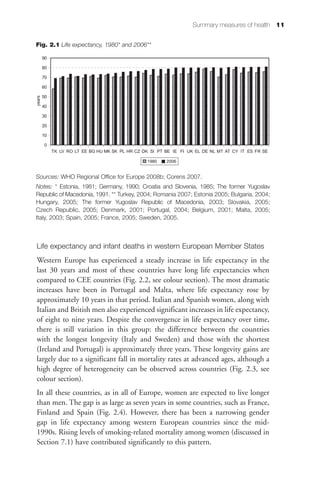
     fall. Average life expectancy in EU27 countries rose from 73.65 in 1980 to
     79.05 in 2006. However, the rate of improvement has differed across countries
     (Fig. 2.1). In January 2007 Bulgaria and Romania joined the EU as part of its
     sixth enlargement phase, bringing the number of Member States to 27. The
     process of enlargement has greatly increased the diversity in patterns of health
     across Europe and will continue to do so.
     In light of the variability between Member States, at the risk of oversimplification,
     four broad regions can be discerned in terms of levels of health and
     accompanying risk factors. These comprise: (1) western Europe (EU15
     plus Cyprus and Malta); (2) CEE countries (Croatia, the Czech Republic,
     Hungary, Poland, Slovakia and Slovenia); (3) the Baltic states (Estonia,
     Latvia and Lithuania); and (4) the four remaining south-eastern European
     newly acceded countries (NACs) and CCs (Turkey, the former Yugoslav
     Republic of Macedonia, Bulgaria and Romania). In other words, in order to
     facilitate analysis of health trends in Europe, this report does not categorize
     countries according to their EU status (EU15, EU10, EU27, NAC and
     CC). Rather, countries are grouped primarily according to their mortality
     and morbidity profile. The EU average, unless otherwise stated, includes all
     27 Member States.
Summary measures of health 11


Fig. 2.1 Life expectancy, 1980* and 2006**
years


                                          1980   2006


Sources: WHO Regional Office for Europe 2008b; Corens 2007.
Notes: * Estonia, 1981; Germany, 1990; Croatia and Slovenia, 1985; The former Yugoslav
Republic of Macedonia, 1991. ** Turkey, 2004; Romania 2007; Estonia 2005; Bulgaria, 2004;
Hungary, 2005; The former Yugoslav Republic of Macedonia, 2003; Slovakia, 2005;
Czech Republic, 2005; Denmark, 2001; Portugal, 2004; Belgium, 2001; Malta, 2005;
Italy, 2003; Spain, 2005; France, 2005; Sweden, 2005.


Life expectancy and infant deaths in western European Member States
Western Europe has experienced a steady increase in life expectancy in the
last 30 years and most of these countries have long life expectancies when
compared to CEE countries (Fig. 2.2, see colour section). The most dramatic
increases have been in Portugal and Malta, where life expectancy rose by
approximately 10 years in that period. Italian and Spanish women, along with
Italian and British men also experienced significant increases in life expectancy,
of eight to nine years. Despite the convergence in life expectancy over time,
there is still variation in this group: the difference between the countries
with the longest longevity (Italy and Sweden) and those with the shortest
(Ireland and Portugal) is approximately three years. These longevity gains are
largely due to a significant fall in mortality rates at advanced ages, although a
high degree of heterogeneity can be observed across countries (Fig. 2.3, see
colour section).
In all these countries, as in all of Europe, women are expected to live longer
than men. The gap is as large as seven years in some countries, such as France,
Finland and Spain (Fig. 2.4). However, there has been a narrowing gender
gap in life expectancy among western European countries since the mid-
1990s. Rising levels of smoking-related mortality among women (discussed in
Section 7.1) have contributed significantly to this pattern.
12 Health in the European Union


     Infant mortality has decreased in all countries because of improvements in
     living conditions and health care (Fig. 2.5), reaching low levels across the
     EU15, Malta and Cyprus in the last 30 years (Fig. 2.6, see colour section).
     Reproductive health policies, including the care for pregnant women and
     neonates, have played an important role in reducing infant deaths. In 1975,
     infant mortality was as high as 39 deaths per 1000 live births in Portugal
     and over 20 per 1000 in Greece, Italy and Austria. At the time of writing,
     infant mortality ranges between 3 deaths per 1000 live births in Finland and
     Sweden and 5 per 1000 in the United Kingdom, Malta, the Netherlands and
     Portugal. Portugal has seen its infant mortality rate reduced by over 90% since
     1970, as it progressed from the country with the highest rate in Europe to one
     among the lowest.

     Life expectancy and infant deaths in central and eastern Europe
     The former Eastern bloc countries that are now members of the EU
     experienced stagnating male mortality and only very minor improvements in
     female mortality in the 1970s and particularly the 1980s. During this time
     there was considerable variation among the CEE countries, with standardized
     death rates among Hungarian men being approximately two times higher than
     among men in Slovenia or the Czech Republic (Nolte, McKee and Gilmore
     2005). Overall, death rates among middle-aged men were approximately
     2.5 times higher in CEE countries than in western Europe (McKee, Adany
     and MacLehose 2004). Data from the 1970s and the 1980s may be unreliable


    Fig. 2.4 Female–male differences in life expectancy at birth, latest available year
    years


            MT TK UK DK SE IE   NL EL MK CY DE AT BE IT CZ PT ES SI   FI HR BG FR RO SK HU PL EE LV LT


    Sources: WHO Regional Office for Europe 2008b; Corens 2007.
Summary measures of health 13


Fig. 2.5 Infant deaths per 1000 live births, 1980* and 2006**
number of deaths


                                           1980   2006


Sources: WHO Regional Office for Europe 2008b; Corens 2007.
Notes: *Cyprus, 1990; Estonia, 1981; Germany, 1990; Lithuania, 1981; Slovakia,   1986;
Slovenia, 1984. ** Sweden, 2005; Czech Republic, 2005; France, 2005; Portugal,   2004;
Spain, 2005; Belgium, 2004; Denmark, 2004; Italy, 2003; Malta, 2005; Estonia,    2005;
Hungary, 2005; Slovakia, 2005; The former Yugoslav Republic of Macedonia,        2003;
Bulgaria, 2004; Romania, 2007; Turkey, 2004.


for some CEE countries and are not available for Croatia and Slovenia,
formerly part of Yugoslavia. Croatian data from the early 1990s also need to
be treated with caution due to the population movements during the war. By
the mid-1980s the population in Slovenia and Croatia had significantly short
life expectancy than countries in western Europe, yet a longer life expectancy
than many of their CEE counterparts.
Most countries in the former Eastern bloc experienced a mortality crisis in
the early 1990s after the fall of communism (Nolte, McKee and Gilmore
2005). In some countries, this worsening of mortality was short lived and
followed by improvements in health, which were rapid in Poland and the
Czech Republic, and delayed in Hungary (Bobak et al. 1997) (see Fig. 2.7, see
colour section). Slovenia appears to fall somewhere in between the EU and the
other CEE countries.
Today, all five central European Member States and Croatia continue to
have life expectancies below the EU average, particularly Hungary, where the
difference is approximately five years. However, in comparison to the Baltic
states and other members of the Commonwealth of Independent States (CIS),
14 Health in the European Union


     the CEE countries have made remarkable progress. Adult male mortality
     has been improving in most of the CEE countries since the early 1990s. For
     instance, while both Poland and the Russian Federation experienced increases
     in adult mortality among young adults throughout the 1980s and early 1990s,
     this rise was only temporary in Poland, where death rates have since fallen to
     approximately 30% lower than they were in 1991. In contrast, among young
     adults in the Russian Federation, mortality remains 60% higher than in 1991
     in both men and women, and among older adults (aged 35–64) mortality
     rates increased by 85% in men and 66% in women from 1991 to 1994, while
     rates have now reduced only slightly and are still 40–50% higher than they
     were in 1991 (Nolte, McKee and Gilmore 2005).
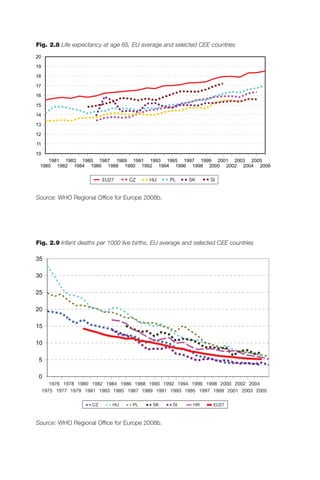
     Fig. 2.8 (see colour section) shows the life expectancy at age 65 among these
     countries, demonstrating a significant increase in longevity. The increasing
     proportion of older people in the population largely results from declining
     mortality rates among this age group. CEE countries have also seen marked
     falls in birth rates, contributing to the rapid ageing of their populations.
     In general, the sex difference in life expectancy of CEE countries is high in
     comparison to western Europe, although the Czech Republic and Croatia
     have smaller sex differences than France. The sex difference in Hungary was
     as high as 9.5 years in the mid-1990s, with the recent decline probably being
     attributable to female mortality from smoking (lung cancer) which has been
     steadily increasing since the mid-1980s, while male mortality from the same
     cause has decreased or attenuated since the mid-1990s.
     Reported presence of long-standing illness is also quite high in the CEE
     countries compared to those of western Europe, but it reveals a different
     gender effect than mortality data. In all of the CEE countries except the Czech
     Republic, women report greater prevalence of long-standing illness, reaching
     over 30% of the population in Hungary, Poland, Slovakia, Slovenia and the
     Baltic states (McKee, Adany and MacLehose 2004). Thus, it appears that when
     considering morbidity measures, surviving women fare worse than men.
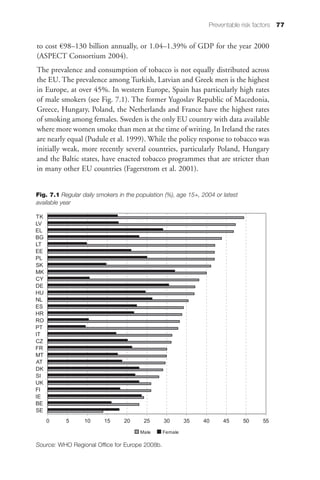
     While generally higher than the EU average, infant and child mortality rates
     in CEE countries have been falling since the 1980s and accelerated in the
     1990s (Fig. 2.9, see colour section). The Czech Republic and Slovenia are in
     fact among the countries with the lowest infant deaths per 1000 live births
     in Europe at the time of writing. This has been attributed to improvements
     in quality of health care (McKee, Adany and MacLehose 2004). The Czech
     Republic and Slovenia also have lower under-5 mortality rates than the
     EU average.
Summary measures of health 15


Life expectancy and infant deaths in the Baltic Member States
In eastern Europe, the Baltic countries (Estonia, Latvia, and Lithuania) face
the greatest health challenges. The political and economic transition in the
former communist countries was associated with a significant worsening of
population health among these nations.
From the mid-1980s the three Baltic countries experienced fluctuating life
expectancy that mirrored that of other former Soviet countries. For example,
the Russian Federation and Ukraine saw an actual decline in the Human
Development Index in the 1990s, reflecting an inability to reduce income and
human poverty (Bobak et al. 1997). From 1994 the Baltic countries showed
signs of improvement, however, so that by the year 2000 mortality among
adults had generally fallen back to the 1991 level (see Fig. 2.10, see colour
section), or in some cases even below those rates (such as among women aged
55–84 years) (Nolte, McKee and Gilmore 2005). The other former Soviet
states such as the Russian Federation, on the other hand, have once again
deteriorated (McKee, Adany and MacLehose 2004).
Recent health trends among these countries can be better understood by
disaggregating mortality figures. When comparing male and female mortality
rates, it is apparent that men have been especially vulnerable to the political
and economic instability, as they have experienced a significant deterioration
in health, probably associated with excessive alcohol consumption (McKee,
Adany and MacLehose 2004; Nolte, McKee and Gilmore 2005). Reflecting
this, the Baltic countries have the highest sex differences in life expectancy in
the EU (see Fig. 2.4, p.12).
Age-specific mortality rates provide further insight into the source of the health
gap between the Baltic countries of the EU and those of western Europe.
While childhood survival has been improving in the Baltic countries, as in
the CEE countries, the former experienced significant, short-term increases in
child mortality in the early 1990s, contributing to the drop in life expectancy
at that time. There have been improvements since the mid-1990s, however;
infant mortality in the Baltic states halved, with the greatest reductions taking
place between 1995 and 2000 (Fig. 2.11). There has also been a significant
drop in under-5 mortality since the mid-1990s, again with the greatest
improvements occurring towards the end of that decade. While the decline in
childhood mortality in Latvia and Lithuania has attenuated in recent years, in
Estonia it has continued falling. For example, in Latvia under-5 mortality only
fell from 12.36 per 1000 in 2000 to 11.33 per 1000 in 2004, while in Estonia
it fell from approximately 8.5 per 1000 in 2000 to 5.5 per 1000 in 2005 and
is lower than in Hungary and Poland at the time of writing.
16 Health in the European Union


     In the Baltic countries, as in CEE countries, there was a decline in old-age
     mortality in the late 1990s (Fig. 2.12), a few years later than in countries such
     as Poland and the Czech Republic. However, old-age mortality still remains
     significantly higher than in western European countries (Nolte, McKee and
     Gilmore 2005).


    Fig. 2.11 Infant deaths per 1000 live births, EU average, Estonia, Latvia and Lithuania
     number of deaths


    Source: WHO Regional Office for Europe 2008b.


    Fig. 2.12 Life expectancy at age 65, EU average, Estonia, Latvia and Lithuania
    years


                                      EU27      EE       LV       LT


    Source: WHO Regional Office for Europe 2008b.
Summary measures of health 17


Life expectancy and infant deaths in south-eastern Europe: Bulgaria,
Romania, Turkey and the former Yugoslav Republic of Macedonia
Life expectancy at birth in Turkey, Bulgaria and Romania has been increasing
since 1970 and more rapidly since the 1980s. However, as in most countries of
the former Soviet Union, Bulgaria and Romania experienced a mortality crisis
in the early 1990s. After the fall of communism, men in these two countries
experienced a steady deterioration in mortality and women experienced no
improvements (Nolte, McKee and Gilmore 2005). In fact, the trend in life
expectancy in these two countries is similar to that in CEE countries.
For the former Yugoslav Republic of Macedonia, reliable mortality data are
only available from 1990 onwards. Life expectancy has improved since that
time, by approximately two years for women and one year for men. In the
former Yugoslav Republic of Macedonia life expectancy is longer than in
Turkey, Bulgaria and Romania. In the last 20 years, Macedonian male life
expectancy has been longer than the average for the new Member States. The
sex difference in life expectancy, at five years, is two years lower in the former
Yugoslav Republic of Macedonia than in Bulgaria and Romania. In fact it is
amongst the lowest in Europe (see Fig. 2.4, p.12). In this the former Yugoslav
Republic of Macedonia is similar to Turkey, where the difference is lower than
in most of the EU.
Mortality rates in Turkey have been very different to the three other countries
in this region. In 1980 the average life expectancy for Turkish women was
relatively low; 60 years for women and 56 years for men against the averages of
77 and 70 years in the 27 states that constitute the EU at the time of writing.
This health disadvantage has been attributed to high levels of CVD (Onat
2001; Razum, Akgün and Tezcan 2000), and high rates of infant and child
mortality. In the 1970s and 1980s Turkey experienced a sharp increase in life
expectancy; by 2002 the gap with the EU was smaller, with a life expectancy
of 72 for women and 68 for men (see Fig. 2.13, see colour section). The early
1990s were witness to increasing rates of smoking-related cancers; however,
since then, Turkey has implemented effective, wide-ranging tobacco-control
policies, withstanding efforts by the transnational tobacco industry to subvert
this progress (Firat 1996). Overall, Turkey appears to be facing a dual health
burden of elevated levels of communicable disease (accounting for high levels of
infant and child mortality) and continually rising levels of noncommunicable
diseases (NCDs) in adulthood.
Although infant mortality has decreased in the last 30 years in all four countries,
they still lag behind both the new Member States’ average and the EU average
(Fig. 2.14, see colour section). The number of infant deaths per 1000 live
births is approximately 2 to 3 times higher in the former Yugoslav Republic of
18 Health in the European Union


     Macedonia, Bulgaria and Romania than the EU 27 average (5.25 per 1000)
     and for Turkey the gap is far larger (5 times higher). In Turkey, perinatal
     conditions were the second most common cause of death (4.5% of the total)
     in 2002 (WHO Regional Office for Europe 2005a). A study found that the
     most significant causes of death were antepartum stillbirths, prematurity and
     lethal congenital malformations. Reduction in the perinatal mortality rate in
     Turkey is likely to be possible only with the improvement of prenatal, delivery
     and postnatal care, along with prevention of prematurity (Erdem 2003). Old-
     age mortality has not improved in the former Yugoslav Republic of Macedonia
     and has improved only marginally in Romania and Bulgaria and, 10 years ago,
     began lagging behind the new Member States (Fig. 2.15).

    Fig. 2.15 Life expectancy at age 65, EU average, the former Yugoslav Republic of
    Macedonia, Romania and Bulgaria


                                      EU27   BG     RO   MK

    Source: WHO Regional Office for Europe 2008b.
    Note: Data for Turkey not available.


    2.2       Self-reported health
    There are many methods of measuring morbidity using macro-level and micro-
    level indicators. Population summary measures such as those presented earlier,
    albeit useful in estimating overall population health, may not provide insights
    into the underlying factors that potentially influence health attainment in a
    country. Employing objective health measures at a micro level, such as blood
    pressure and body mass index (BMI), is an important approach to measuring
    population health, but it is often expensive and may be subject to measurement
    error (Masseria et al. 2007). Conversely, self-assessed measures, such as general
    health and limitations in daily activities, are often more readily available.
Summary measures of health 19


Many cross-national studies have demonstrated that self-assessed indicators
are better predictors of mortality than medical records, denoting that these
measures capture other important influences on mortality beyond objective
measures (Idler and Benyamini 1997; Mackenbach et al. 2002a; Sundquist
and Johansson 1997). However, self-assessed health measures are sensitive
to variations in environmental conditions, individual expectations as well
as wording and meaning of assessment questions. Significant advances have
been made at EU level to facilitate and improve cross-country comparisons
of health status; however, improved longitudinal data are needed, along with
better international coordination of survey design and implementation. The
ECHP measures self-reported ill health, defined as either the percentage of
people reporting being in either “bad” or “very bad” health, or with limitations
in daily activity due to health reasons.
On average, central and south-eastern countries report worse self-reported
health than northern countries (Fig. 2.16). The percentage of people reporting
either “poor” or “very poor” health is approximately 21% in Portugal, and
more than 10% in Latvia, Lithuania and Slovakia, but less than 6.5% in
Ireland, the Netherlands, Sweden and the United Kingdom. It is important
to take into consideration that these may be spurious differences, since
individuals with the same health status may have different perceptions and
expectations of their conditions. The relationship between self-assessed health
and mortality is often mediated by geographic location, psychosocial factors
(such as social integration, stress), gender, age and socioeconomic position
(Masseria et al. 2007). Thus, self-reported health is not only a function of
actual health status, but also of individuals’ or population groups’ perceptions
of health. Large cultural differences both within and across countries may
impact on the validity of both national and international comparison. As a

Fig. 2.16 Self-reported ill health in 10 European countries, 2000


(%)


       IE NL SE UK FR DK BE LU AT EL CY DE FI               IT ES CZ EE SI        PL LT SK LV PT

                        Limitations in daily activities   Self-assessed health, poor

Source: European Commission 2006b.
20 Health in the European Union


     result, only part of the cross-country variation observed in self-reported health
     may reflect true health differences, such as chronic conditions or objective
     measures of health, whereas the remaining variation may be due to differences
     in reporting styles and other cultural specific factors (Jurges 2007). Indeed,
     the self-reported health status results do not appear to directly correspond to
     macro-level health indicators such as life expectancy or healthy life expectancy
     (Fig. 2.1, p.11 and Fig. 2.17). Moreover, although in each country there
     is large correlation between self-reported health status and limitations in
     daily activities (varying between 52% and 74%), still these latter results (see
     Fig. 2.16) present a completely different mapping of health status in Europe.
     Denmark, Greece and France are the countries with the lowest percentage of
     people reporting any limitations in daily activity because of health problems,
     while Latvia, Estonia and Finland are those with the highest percentage.


     2.3      Premature deaths and disability

     Healthy life expectancy and disability-adjusted life expectancy
     Measures of healthy life expectancy bring together mortality and morbidity
     experiences. Fig. 2.17 outlines the healthy life expectancy estimates for men
     and women in the EU and the CCs. These data suggest that populations
     of CEE countries, south-eastern Europe and the Baltic states have not only
     a shorter life expectancy, but also shorter expected lifespan in good health
     than countries in the west. For the EU15, the average of years spent in good


    Fig. 2.17 Estimates of healthy life expectancy at birth in Europe, 2002

                                                  Female
                                                  Male


    Source: WHO Regional Office for Europe 2008b.
Summary measures of health 21


health is approximately 70.12 years, compared to 62.70 years among the CEE
countries, south-eastern Europe and the Baltic states (Fig. 2.17).
It is important to point out that some of the reported variations in
HALE between countries are probably artefactual, due to problems with
harmonization of methods of calculation as well as differences in the concepts
of disability or health used. At the time of writing, the only harmonized
data available are those issued from the ECHP, and these have been used to
calculate DFLE for 14 European countries (EHEMU 2005). Calculating the
DFLE assists countries in determining whether their population’s additional
years of life are being spent in good health (compression of morbidity) or
ill health (expansion of morbidity) (EHEMU 2007). However, as explained
earlier, even these are unreliable and subject to different cultural perceptions
of health along with factors such as different survey participation rates. For
example, comparing the prevalence of disability at age 65–69 years from a
2002 Eurobarometer survey with the Eurostat series (ECHP) for 1995–2003,
it appears that the two surveys lead to the same prevalence of disability but
that specific national rankings vary, as shown in Table 2.1.
It appears that the rankings of Belgium, Austria and Finland remain similar,
but vary substantially for other countries, such as Italy, Spain, Ireland and
Denmark. The European Survey on Income and Living Conditions (SILC)
aims to provide harmonized data and therefore will, in the future, provide the
opportunity to calculate DFLE for the 25 European countries based on the
same methods and similar data (EHEMU 2005).
Another measure often employed in comparisons is DALE. DALE decreased
in all EU Member States between 1999 and 2001, but appears to have risen
slightly in 2002 (Fig. 2.18, see colour section). However, such changes are
relatively marginal overall and may be a result of refinements in surveying
techniques and calculating methodology.

Avoidable mortality1
Several approaches have been developed to measure the contribution of the
health system to population health improvement. One such approach makes
use of readily available cause- and age-specific mortality data and relies on
assumptions about certain causes of death that should not occur in the
presence of timely and effective medical intervention. These deaths are hence
referred to as “avoidable” or “amenable to health care”. Since the 1970s, rates
of avoidable mortality have continuously declined in almost all countries.

1 This   section summarizes and updates the research note by Allin and Mossialos (2006).
22 Health in the European Union


    Table 2.1 Differences in DFLE at age 65 for men in 2002 by ECHP and
    Eurobarometer ranks

                                                             Rank
    Country                                     ECHP                  Eurobarometer

      Italy                                       1                           5
      Belgium                                     2                           3
      Spain                                       3                           7
      Germany                                     4                          12
      Ireland                                     5                          11
      Austria                                     6                           6
      Greece                                      7                           2
      Netherlands                                 8                          10
      Sweden                                      9                           1
      Denmark                                     10                          4
      Portugal                                    11                         14
      United Kingdom                              12                          8
      France                                      13                          9
      Finland                                     14                         13

    Source: European Health Expectancy Monitoring Unit 2005.


     The concept of avoidable mortality was first developed by Rutstein and
     colleagues as a measure of quality of care in the 1970s (Rutstein et al. 1976)
     and has since been applied to many different national and international
     contexts (Charlton et al. 1983; French and Jones 2006; Holland 1986; 1988;
     1991; 1993; 1997; Westerling 1992).2 Nolte and McKee examined trends in
     avoidable mortality in Europe over the 1980s and 1990s (Nolte and McKee
     2004), in 1998 among 19 Organisation for Economic Co-operation and
     Development (OECD) countries (Nolte and McKee 2003), and also over the
     period 1997–2003 in these 19 countries (Nolte and McKee 2008). Levels and
     trends in avoidable mortality are examined by calculating age-standardized
     death rates with direct standardization to the European standard population.
     Early analyses of avoidable mortality disaggregated disease groups that could be
     considered effectively treatable or preventable by health care services (Newey

    2 Unfortunately the work of Walter Holland in producing the European Community Atlases
    of Avoidable Mortality was discontinued in 1997 with the latest available data stemming from
    1985–1989. The recent work of Ellen Nolte and Martin McKee is extremely useful; however,
    data are only available at country (and not region) level.
Summary measures of health 23


et al. 2003).3 Treatable conditions are responsive to medical intervention
through secondary prevention and treatment, and preventable conditions are
those that are responsive to interventions that are usually outside the direct
control of the health services through intersectoral health policies.4 Overall, this
research identified France, Sweden, Spain, Italy and the Netherlands as having
relatively low levels of avoidable mortality, while Romania and Bulgaria, along
with Latvia and Estonia, had the highest levels of avoidable mortality. During
the 1980s the improvements in life expectancy could be attributed largely to
reductions in avoidable mortality, and in the 1990s improvements in avoidable
mortality contributed to lengthening life expectancy in some countries
(especially Portugal and Greece) more than others (Nolte and McKee 2004).

Treatable mortality
Three of the main causes of treatable deaths include infant mortality,
cerebrovascular disease and testicular cancer. As shown in Fig. 2.19, treatable
mortality was highest in CEE countries (particularly Romania, Bulgaria and
Hungary) in both 1990/1991 and in 2000/2002. Portugal is the only EU15
country to display similarly high levels. Levels were lowest in France (women)
and Sweden (men). All countries, except Romania (men), experienced declines
in treatable mortality during the 1990s, in particular Portugal, Austria and
Finland as well as new EU Member States (in the Czech Republic, rates
declined by approximately one third). Comparatively less progress was made
in the Baltic states of Latvia and Lithuania, declining by only 0.4% and 1%
for men, respectively, and 9% and 11% for women over this time period.
The proportion of all-cause mortality from treatable diseases varies across
Europe (Nolte and McKee 2004). In 1990/1991, treatable mortality
accounted for between 13% (Netherlands) and 30% (Bulgaria) of under-75
mortality in men and 26% (Sweden) and 44% (Romania) in women. These
relative proportions changed very little over time for both men and women.

3 It is important to note the methodological difficulties associated with attributing specific
risk factors, such as diet and physical activity, to preventable conditions. More work needs to
be carried out in this area to better make the link between risky behaviours and premature,
preventable deaths.
4 Over 30 conditions are considered to be treatable – some examples are: cancer of the colon, skin,
cervix, testis and breast; diabetes mellitus; epilepsy; pneumonia; appendicitis; thyroid disease;
and measles. Three conditions are considered to be preventable: deaths from lung cancer; motor
vehicle and traffic accidents; and cirrhosis. It is important to note that over time the conditions
that are considered treatable may change and it is therefore difficult to draw conclusions about
time trends. However, cross-country comparisons are not subject to the same methodological
limitation, since at any one point in time, the same standards in terms of quality of health care
should apply to all countries.
24 Health in the European Union


    Fig. 2.19 Age-standardized death rates of treatable mortality in 20 European countries,
    1990/1991 and 2000/2002

      Treatable mortality: men                                       Treatable mortality: women

            Romania                                                        Romania
             Bulgaria                                                       Bulgaria
            Hungary                                                        Hungary
                Latvia                                                         Latvia
              Estonia                                                        Estonia
     Czech Republic                                                 Czech Republic
               Poland                                                         Poland
             Portugal                                                      Lithuania
            Lithuania                                                       Portugal
            Slovenia                                                       Slovenia
              Austria                                               United Kingdom
              Finland                                                         Ireland
               Ireland                                                       Austria
            Germany                               1990/1991                Germany                               1990/1991
     United Kingdom                               2000/2002                  Finland                             2000/2002
                  Italy                                                          Italy
                Spain                                                   Netherlands
               France                                                           Spain
         Netherlands                                                        Sweden
             Sweden                                                           France
                          0   50     100    150     200       250                        0   50     100    150      200      250
                              Deaths/100 000 population                                      Deaths/100 000 population


    Source: Newey et al. 2003.


     Therefore, it seems that much can be done to reduce overall mortality rates by
     targeting the health system – even in Sweden, which has one of the healthiest
     populations in Europe, mortality rates could be cut by a quarter through
     improved treatment of disease.

     Preventable mortality
     Estimates of preventable mortality combine three major causes of death: lung
     cancer, motor vehicle and traffic accidents, and cirrhosis. There is a substantial
     gap between rates of preventable mortality for men and women in all countries,
     with death rates among men at least twice those among women (Fig. 2.20).
     This gender gap in preventable mortality is most pronounced in the new
     Member States (CEE countries), which also show the highest absolute values,
     especially for Hungarian men. This gap reflects the much greater exposure
     to risks such as drinking and smoking among men. For women, death rates
     were again highest in Hungary, followed at some distance by Slovenia and
     Romania, as well as the United Kingdom.
     Unlike the situation with treatable causes, throughout the 1990s men
     consistently saw declines in preventable mortality, whilst women did not.
     The declines among men were most prominent in Italy, Austria, Portugal,
     Finland, the United Kingdom, the Czech Republic and Slovenia. Preventable
     mortality among women declined in some countries, particularly those in
     the Mediterranean region, and increased in Sweden and the Netherlands, all
     new Member States (except Slovenia) and Romania. By 2000/2002, levels of
Summary measures of health 25


Fig. 2.20 Age-standardized death rates of preventable mortality in 20 European countries,
1990/1991 and 2000/2002

 Preventable mortality: men                                       Preventable mortality: women
       Hungary                                                           Hungary
       Slovenia                                                         Slovenia
           Latvia                                                       Romania
         Estonia                                                 United Kingdom
Czech Republic                                                             Austria
          Poland                                                           Ireland
       Lithuania                                                         Portugal
       Romania                                                          Germany
             Italy                                               Czech Republic
          Austria                                                             Italy
        Portugal                               1990/1991                                                            1990/1991
                                                                           Poland
            Spain                              2000/2002                   France                                   2000/2002
          France                                                          Estonia
       Germany                                                              Latvia
        Bulgaria                                                        Lithuania
    Netherlands                                                          Sweden
         Finland                                                     Netherlands
United Kingdom                                                               Spain
          Ireland                                                         Finland
        Sweden                                                           Bulgaria
                     0   50    100     150       200       250                        0       20           40           60
                              Deaths/100 000                                                       Deaths/100 000


Source: Newey et al. 2003.


preventable mortality among women were lowest in Spain and Portugal, as
well as in Bulgaria.
Overall, deaths from preventable causes accounted for between 10% (Sweden)
and 21% (Italy) of all-cause mortality for men and between 4% (Bulgaria) and
11% (Hungary) for women in 1990. While for men the share remained fairly
stable over the 1990s, it increased for women in all countries except Spain and
Portugal, to over 10% in most EU15 countries in 2000/2002, with the highest
proportion in Slovenia and Hungary (13–14%).
In 2002/2003 avoidable mortality continued to represent a substantial portion
of overall mortality in European countries within the OECD countries (23%
for males, 32% for females). However, there have been improvements; on
average, there has been a 17% decline in avoidable mortality since 1997/1998
(Nolte and McKee 2008). For males, avoidable mortality constitutes between
15% of total mortality in France and 27% in the United Kingdom, and for
females it ranges from 25% in France to 36% in Greece and Portugal. Rates
of decline in avoidable mortality vary across countries, with many countries
– in particular those with high levels at the beginning of the period (Austria,
Ireland, the United Kingdom, Finland) – showing more than a 20% decline
for men and over 15% decline for women. Overall, considerable progress
could be made in reducing mortality rates further in Europe, in particular
among the countries with the poorest performance (highest rates of avoidable
mortality): Denmark, Portugal, the United Kingdom and Ireland (Nolte and
McKee 2008).
Chapter 3
                          Chronic diseases


Box 3.1 Summary of Chapter 3

• Chronic diseases constitute the main cause of death in the EU, accounting for
   77% of the total. The most important are heart disease, stroke and cancer.

Section 3.1 Trends in heart disease and stroke (cardiovascular diseases)
• CVDs are the leading cause of death in the EU. They account for 51.88 death per
   100 000 individuals in the population aged under 65 years in the EU27.
• The most common CVD is ischaemic heart disease (IHD), which was the leading
   cause of death in all EU27 and CCs, except in Greece, the former Yugoslav
   Republic of Macedonia and Portugal, where it was stroke.
• There is an enormous gender gap in death rates from heart disease in all countries.
   The mortality rate for men aged 0–64 years is 38 per 100 000, while for women it
   is just under 9 per 100 000 in the EU27.

Section 3.2 Trends in cancer
• Cancer is the second most significant cause of death in the EU. Lung cancer is by
   far the most significant, accounting for 20.2% (236 000) of cancer deaths in the
   EU25 (Member States up to and including the May 2004 accession) in 2006.
• Lung cancer accounts for the largest proportion of cancer deaths among men, at
   28.73 per 100 000 in the male population aged under 65 years in the EU27. Breast
   cancer is the leading cause of cancer mortality among women, with the EU average
   being 25.14 per 100 000 women aged under 65 years.
• There are considerable variations across countries in cancer death rates, with the
   highest in Hungary, the Czech Republic, Denmark, Ireland and Sweden.
• Between 1985 and 2000, the number of cancer deaths increased in both men
   (+12%) and women (+9%) in the EU25.
28 Health in the European Union


       Box 3.1 cont.

       • Between 1990 and 2000, overall cancer incidence rose across the EU25 by an
          average of 63 new cases per 100 000 inhabitants.

       Section 3.3–3.5 Trends in diabetes, respiratory diseases and liver disease
       • The current EU average diabetes prevalence rate is estimated to be 8.7% of the
          total population aged 20 years and over, but an estimated 50% of people with
          diabetes are unaware of their condition.
       • A total of 70–80% of people with diabetes die of heart disease or stroke, making
          diabetes an important risk factor for these diseases.
       • Type 2 diabetes accounts for approximately 90% of all diabetes in high-
          income countries.
       • Respiratory diseases (including COPD, lung cancer and pneumonia) rank second
          in Europe (after CVD) in terms of mortality, incidence, prevalence and costs.
       • Western European countries are more affected by COPD than eastern European
          countries; in 2002 the worst affected were Denmark (7% of total mortality), the
          Netherlands (5.2%) and Ireland (5%).
       • Mortality rates for COPD are two to three times higher for males than for females.
       • Liver disease is mostly attributable to alcohol consumption, and affects men in
          particular. The highest death rates are seen in Hungary and Slovakia, but in western
          Europe the United Kingdom and Finland have seen an increase since the 1980s.


     The most significant causes of the burden of disease in the WHO European
     Region are noncommunicable (or chronic) diseases (NCDs). NCDs constitute
     77% of the total; the most significant of these are heart disease, cerebrovascular
     diseases and cancer (Fig. 3.1, see colour section). In 2002, NCDs caused 86%
     of the 9.6 million deaths and 77% of the 150.3 million disability-adjusted life
     years (DALYs) in the WHO European Region (WHO Regional Office for
     Europe 2006a).
     The main risk factors to NCDs are eating habits, physical activity, smoking
     and alcohol consumption. These causes are expressed through the following
     intermediary risk factors: raised blood pressure, raised glucose levels, abnormal
     blood lipids (particularly cholesterol), and overweight and obesity. These risk
     factors (in conjunction with age and heredity) in turn explain the majority of
     variation in rates of the main chronic diseases: heart disease, stroke, chronic
     respiratory diseases, diabetes and some cancer (WHO 2005b). The risk factors
     for these causes of death are discussed in Chapter 7. Other significant causes
     of death, especially at younger ages, are injury and poisoning, discussed in
     Chapter 6.
Chronic diseases 29


3.1     Trends in heart disease and stroke
        (cardiovascular diseases)
Northern European countries – particularly Germany and the United
Kingdom – have reported exceptionally high rates of CVDs (MacKay and
Mensah 2004). Southern European countries such as Italy and France
have reported relatively low age-standardized death rates from IHD in the
last 25 years compared to the rest of Europe. The north–south gradient in
myocardial infarction and coronary death rates in western European regions
was documented by the WHO MONICA Project in the 1990s and has been
attributed in part to the Mediterranean diet.
Standardized death rates for heart disease have fallen, in some cases steeply,
in the last 25 years in western Europe, both in the north and south, for men
and for women. For example, mortality from coronary heart disease (CHD) in
England and Wales fell by 54% between 1981 and 2000 (Unal, Critchley and
Capewell 2005). In the 1960s international mortality statistics showed that
Finnish men had the highest mortality rate from IHD in the world (Vartiainen
et al. 2000). The national rate in Finland is approaching the EU average at
the time of writing. These favourable trends have been caused by falling rates
in the population of high blood pressure, cholesterol and smoking, which
countries achieved by implementing public health programmes (for example
the North Karelia Project in Finland) and improving diagnosis, prevention
and treatment of risk factors at the health service level.
CVD has been frequently highlighted as playing an important role in the
rise and subsequent decline of adult mortality in CEE countries (McKee and
Shkolnikov 2001; Meslé 2002; Zatoński and Boyle 1996). Indeed, the main
contributors to differences in health indicators between eastern and western
Europe are CVDs and injuries for people below the age of 60 years (Powles
et al. 2005). While CVD has been increasing overall in CEE countries, in
recent years CVD mortality has been decreasing in a few countries (TFMCD
2008). Thus, while the standardized death rate for IHD has halved since the
fall of communism in some CEE countries (such as the Czech Republic and
Poland) due to improvements in nutrition and health services (particularly
medication, which has contributed to narrowing the “east–west gap”) the rate
in other countries (such as Hungary and Slovakia) remains more than double
that of the EU average.
In the countries of the former Soviet Union, such as the Baltic states, the
burden of CVD accounted for almost one third of the overall burden of
disease, as measured by DALYs (Nolte, McKee and Gilmore 2005). As Fig. 3.2
shows (see colour section), deaths under 65 years of age from IHD are more
30 Health in the European Union


     than three times higher in Lithuania (73.78 deaths per 100 000 people) and
     Latvia (82.90 deaths per 100 000) than the EU average (22.85 deaths per
     100 000 people). Data for the population aged 35–74 years in the 2008 report
     by the Task Force on Major and Chronic Diseases (TFMCD) of the European
     Commission’s Directorate-General for Health and Consumers (DG SANCO)
     reveal even more stark differences, with mortality rates associated with IHD
     varying from 42.7 deaths per 100 000 in France to 327.0 deaths per 100 000
     in Latvia in 2003, equating to an almost eight times higher death rate
     (TFMCD 2008).
     In the former Soviet Union countries, in particular in the Baltic states, the
     risk of death related to IHD and diseases of the circulatory system increased
     sharply for men and women at the beginning of the 1990s, immediately after
     the end of the communist era, to start decreasing again in the mid-to-late
     1990s; however, large differences are still present between the East and the
     West. Traditional risk factors such as smoking, diets rich in saturated fats and
     low in antioxidants – in addition to alcohol (specifically binge drinking) and
     psychosocial factors – are thought to largely account for the elevated levels
     of CVD in the East compared to the West (Bobak et al. 1997; Britton and
     McKee 2000; Pomerleau et al. 2001). Of the Baltic states, Estonia is the only
     country to have shown signs of improvement; while rates of heart disease
     deaths have fluctuated in Lithuania and Latvia since 2000, the rate of deaths
     from IHD among people aged 0–64 years in Estonia has decreased from 77.46
     in 2000 to 56.92 in 2005.
     There is an enormous gender gap in age-standardized death rates from heart
     disease. For example, in 2003, 555 per 100 000 deaths among Latvian men
     were attributable to IHD in comparison to only 167 deaths per 100 000 among
     Latvian women aged 35–74 years (TFMCD 2008). In comparison, in France
     72 deaths per 100 000 were due to IHD for men, but only 16 IHD deaths
     per 100 000 for women (TFMCD 2008). The EU average for men aged
     0–64 years is 38 per 100 000, while for women it is just under 9 per 100 000.
     On average, the gap is larger in CEE countries than in western Europe. The
     “east–west gap” in mortality rates is also evident when the standardized death
     rates for diseases of the circulatory system are observed. For example, the
     mortality rate for diseases of the circulatory system is more than three times
     higher in Latvia than the EU average (Fig. 3.3, see colour section).
     As noted earlier, between the late 1980s and the late 1990s, favourable
     trends which were observed in western Europe as long ago as the early 1970s
     spread to the countries of central Europe. It is still difficult to assess the
     main determinants of such a reversal. The progress probably results from
     the combination of several factors, such as changes in diets, the growth of
Chronic diseases 31


systematic prevention and screening, the spread of new forms of treatment and
cardiac surgery (Meslé 2002). At the same time, countries of the former Soviet
Union experienced very marked fluctuations in mortality, related to the social
and economic transformation which these countries have undergone since the
fall of communism. Up to the mid-1990s, the trends were completely parallel
in all the European republics of the former Soviet Union. However, more
recently, they have begun to diverge. While the Baltic countries show signs of
improvement in mortality from heart disease, and mortality trends could soon
begin to mirror those of central European countries, the Russian Federation
and Ukraine are experiencing a fresh rise in mortality from infectious diseases,
circulatory diseases and violence (Meslé 2002).


3.2     Trends in cancer
The European Cancer Health Indicator Project 2001–2003 (EUROCHIP)
developed a list of cancer health indicators covering key cancer aspects, such
as burden, prevention, standards of care and cure rates. There were over
2 million (2 288 100) incident cases of cancer in 2006 and over 1 million
cancer deaths (1 165 500) recorded in the then 25 Member States of the EU
(Ferlay et al. 2007). Between 1990 and 2000, cancer incidence rose across all
of the 25 European countries for which data are available, by an average of
63 new cases per 100 000 inhabitants. The only country that reported falling
incidence was the United Kingdom (where it reportedly fell by 20 per 100 000
in that decade), although this is probably an artefact caused by underestimates
of cancer incidence in the early 1990s (Boyle et al. 2003). There are large
variations in rates of cancer across Europe (Fig. 3.4). In Hungary, cancer
incidence is more than 800 per 100 000 inhabitants; in the Czech Republic,
Ireland and Denmark it is over 600 per 100 000. The lowest rates of cancer
incidence are found in the former Yugoslav Republic of Macedonia, Romania
and Poland, with less than 350 per 100 000 inhabitants.
The most common forms of cancer incidence in Europe in 2006 were breast
cancer (319 900 cases; 14% of all incident cases), prostate cancer (301 500;
13.2%), colorectal cancer (297 200; 13%) and lung cancer (265 600; 11.6%)
(Ferlay et al. 2007). However, in terms of cancer mortality, lung cancer was by
far the most significant, accounting for 20.2% of deaths (236 000). Prostate
cancer was the most common form of cancer incidence in men in the EU
(301 500 cases; 24.1% of the total for men), while lung cancer was the most
common form of cancer death (171 900; 26.3% of the total for men). Among
women, breast cancer was the most common incident form (319 900 cases;
30.9% of all incident cases). Breast cancer was also the leading cause of cancer
32 Health in the European Union


    Fig. 3.4 Cancer incidence per 100 000, selected European countries, 1990 and 2005
    or latest available year


                                  1990   2005 or latest available year


    Source: WHO Regional Office for Europe 2008b.


     mortality in women in the EU in 2006 (85 300; 16.7% of total) (Ferlay et
     al. 2007).
     Between 1985 and 2000 the number of cancer deaths increased in both men
     (+12%) and women (+9%) in the EU. However, there was a 10% reduction
     in the number of deaths expected in men and 8% in women, along with an
     11% reduction in risk of cancer death in men and a 10% reduction in women.
     Hence, although cancer deaths in the EU were expected to rise from 850 194
     in 1985 to 1 033 083 in 2000, there were in fact an estimated 940 510 cancer
     deaths that year, due to the decline in risk observed since 1985 (Boyle et al.
     2003). Using population projections, if the age-specific death rates remain
     constant, the absolute number of cancer deaths in 2015 will increase to
     1 405 000. There are significantly higher rates of cancer among men than
     women in almost all countries (Fig. 3.5, see colour section), although the
     increase in deaths due to lung cancer among women is leading to a narrowing
     of the gender gap.
     Lung cancer was the most common cause of death after CVD in more than
     half the EU and CCs in 2002, making it an important public health challenge
Chronic diseases 33


for Europe. In Belgium, Croatia, the Czech Republic, France, Germany,
Greece, Hungary, Italy, Luxembourg, the Netherlands, Poland, Slovenia and
Spain lung cancer accounted for more than 5% of total mortality (WHO
Regional Office for Europe 2005b). As shown in Fig. 3.6, Hungary has the
highest rates of male lung cancer in Europe and in the world (Novotny et al.
2001), followed in western Europe by Belgium. The lowest rates for men are
observed in Sweden and Portugal. For women, the highest rates are registered
in Denmark, Hungary and the United Kingdom, while the lowest incidence
rates are found in Spain, Malta and Portugal. Age-standardized incidence rates
of lung cancer are markedly higher in the East than in the West.


Fig. 3.6 Standardized lung cancer incidence rates per 100 000, in selected European
countries, 2000


                                                       Male
                                                       Female


Source: Reproduced from Tyczynski, Bray and Parkin 2002.
Note: Lung cancer incidence data from the above-mentioned source are used in this case
because they are more complete than WHO Health for All data which lack data for Greece
and Spain.
34 Health in the European Union


     Age-standardized death rates for lung cancer among men have been steadily
     decreasing in most western European countries in the last 25 years, except in
     France, Spain and Portugal where they remained largely stable or even rose
     slightly during that period (Fig. 3.5, see colour section). The new Member
     States except for Hungary have also experienced overall decreases in male lung
     cancer deaths over the last 20 years, albeit with temporary increases in the late
     1980s and early 1990s. Of the NACs/CCs, the former Yugoslav Republic of
     Macedonia, Romania and Bulgaria reported markedly increasing lung cancer
     mortality rates for men aged 0–64 years in the last two decades, although
     these have begun to plateau in recent years. Data are unavailable for Turkey.
     Unfortunately, mortality for lung cancer among women is increasing almost
     everywhere, except in the United Kingdom and, to some extent, in Ireland and
     Denmark (Didkowska et al. 2005). The leading contributors to lung cancer
     are the number of cigarettes smoked per day, the degree of inhalation and the
     initial age at which individuals start smoking (see section 7.1 for European
     smoking trends) (Didkowska et al 2005; Tyczynski, Bray and Parkin 2002).
     The relative risk of developing lung cancer is 20–30 times higher for smokers
     than for non-smokers.
     There is a great deal of variation between the EU countries in terms of breast
     cancer incidence (Fig. 3.7). In most countries incidence is rising and in some
     cases quite dramatically; for example, Finland, Sweden, the United Kingdom
     and Poland have experienced 30% or greater increases in the last 25 years
     (Boyle 2005). It is thought that this unfavourable trend is due in part to
     increases in risk factors: decreased childbearing and breastfeeding; increased
     exogenous hormone exposure; and detrimental dietary and lifestyle changes,
     including obesity and less physical activity (Parkin and Fernandez 2006). Other
     countries, such as Italy, Germany and the Netherlands reported a stabilization
     or even slight decrease in breast cancer incidence during that time. There
     continues to be uncertainty on the causes of breast cancer; it has been argued
     that the failure to prevent the incidence from continuing to rise represents the
     failure to understand the precise mechanisms of breast carcinogenesis and the
     role of risk determinants, the alteration of which in society could lead to a
     reduced risk of developing the disease (Boyle 2005).
     Until the mid-1980s, breast cancer mortality rates were increasing or stable in
     Europe, except for Sweden, where they have been decreasing since the 1960s.
     Since then, rates have plateaued or decreased (Fig. 3.8, see colour section).
     The United Kingdom, which reported particularly high rates of breast cancer
     mortality, achieved dramatic decreases in the late 1980s and is approaching the
     EU average at the time of writing. This favourable trend has been associated
     with increased breast awareness; earlier detection, for example through the
Chronic diseases 35


Fig. 3.7 Breast cancer incidence per 100 000, selected European countries, 1985 and
2005 or latest available year


                          1985 or earliest year   2005 or latest year
                          available since 1985    available


Source: WHO Regional Office for Europe 2008b.


introduction of screening; and the delivery of the most appropriate therapy
to women with the disease (Boyle 2005; Sant et al. 2006). Other countries,
such as Slovakia and Spain also experienced declines from the mid-1980s but
did not introduce screening, highlighting the importance of improvements in
treatment (Boyle et al. 2003; Sant et al. 2006). In Finland (with high survival),
the Netherlands and Denmark, increasing mortality and incidence indicate
increasing breast cancer risk in the last 40 years, probably related to lifestyle
factors. In Estonia, continually low survival rates in the context of increasing
incidence suggest inadequate care (Sant et al. 2006).
Hungary has breast cancer mortality rates higher than the EU average; Latvia
and Estonia had low rates of breast cancer mortality but have experienced
increases and are approaching the EU average at the time of writing, while
in Poland, mortality rates have remained comparatively low and are nearly
20% lower than the European average. As well as earlier diagnosis and
36 Health in the European Union


     improved treatment, changes in levels of fertility have been proposed as
     possible explanations for the trends observed in eastern Europe (Tyczynski et
     al. 2004).
     Information on the survival of all patients after a cancer diagnosis is a
     key indicator of cancer control. The European Alcohol Policy Alliance
     EUROCARE-3 study measured survival up to five years after diagnosis for
     1.8 million adults and 24 000 children who were diagnosed with cancer
     during the period 1990–1994 and followed up to the end of 1999. The
     20 participating countries included 11 of the EU15 countries and 6 of the
     new Member States (Malta, the Czech Republic, Estonia, Poland, Slovakia
     and Slovenia). Overall, there was considerable variation in survival rates
     between countries. Survival was generally below the European average in
     the five eastern European countries, and in Denmark, England, Scotland,
     Wales, Malta and Portugal among the western European countries. For the
     United Kingdom and Denmark, melanoma of the skin, testicular cancer and
     Hodgkin’s disease were notable exceptions to this pattern. Sweden tended to
     have the highest survival rates among the five Nordic countries, and Poland
     the lowest among the five eastern European countries, whilst French and Swiss
     populations often had the highest survival rates among western European
     countries (Coleman et al. 2003).
     Among the most lethal and common cancer, lung cancer survival varied by
     more than 2-fold across Europe (Austria had the highest rate, Poland the
     lowest), but the highest 5-year survival rate for men diagnosed during the
     period 1990–1994 was still less than 15%. The patterns for women were
     similar. The poor survival rate is thought to be because most patients were
     diagnosed with metastatic disease, for which treatment of curative intent is
     rarely possible. The reported low survival rate in Denmark may be due to the
     particularly late stage at the time of diagnosis (Coleman et al. 2003).
     For breast cancer, differences in survival at five years from diagnosis were
     narrower. Survival was highest in the Nordic countries and in most southern
     and central European countries (approximately 80%), and lowest in all five
     eastern European countries (60–70%). Survival was below the European
     average in Denmark, England, Scotland and Wales. Differences in western
     Europe are likely to be due to an advanced stage of disease at diagnosis in
     the countries with lower survival rates, while in eastern Europe, differences
     in treatment are also likely to play a role. Relative survival from breast cancer
     improved steadily in all European countries in the 1980s and 1990s, but at
     different rates. Improvements were more substantial for countries in western
     Europe than in the Nordic countries and, as a result, the range of breast cancer
     survival rates between the Nordic countries and western Europe was greatly
Chronic diseases 37


reduced. There is some evidence of a more rapid improvement in survival in
the United Kingdom, with a gradual reduction of the survival deficit relative
to other western European countries. This is reflected by a fall in mortality
of some 20% among women aged 20–69 years in the 10 years up to 1997;
better treatment and mammographic screening probably both contributed
to this. Conversely, improvements in survival were less significant for eastern
European countries, and the gap between eastern and western European
countries increased (Coleman et al. 2003).
Some evidence that health care affects cancer survival is provided by analyses
of EUROCARE data. Analyses suggest that, although survival was related to
wealth (gross domestic product (GDP)), this was only up to a certain level,
after which survival continued to be related to level of health investment
(both total national expenditure on health (including public and private) and
total public expenditure on health). The study concluded that cancer survival
depends on the widespread application of effective diagnosis and treatment
modalities, but that the availability of these depends on macroeconomic
determinants, including health and public health investment. However,
analysis of the relationship between health system organization and cancer
outcome is complicated and requires more information than is available at the
time of writing (Micheli et al. 2003).
Cancer is rare in people under the age of 20 years. In European populations,
approximately 1% of all malignant neoplasms arise in patients under 20 years
of age. In the last 35 years, overall incidence increased by 1.0% per year in
children and by 1.5% in adolescents (15–19 years). Overall 5-year survival
for children in the 1990s was 64% in eastern Europe and 75% in western
European countries and it was much the same in adolescents. Survival has
improved dramatically since the 1970s in children and adolescents, more so in
the West than in the East. Differences between the two regions of Europe are
present for virtually all tumour types, and the rate of improvement in survival
is slower in the East than in the West. The explanation could lie in earlier
presentation of patients, better referral, or greater availability of complex and
expensive treatment regimens for childhood cancer cases in western Europe
(Steliarova-Foucher et al. 2004).
Information collected by the cancer registries and countries participating in
the EUROCARE-3 programme found that middle-aged patients experienced
better prognosis than elderly patients, for both sexes. Genito-urinary and
gynaecological cancer showed the highest relative excess risks. High mortality
could be due to barriers to health care access and late diagnosis (Quaglia et
al. 2007).
38 Health in the European Union


     3.3      Trends in diabetes
     Diabetes has been estimated to be the fourth leading cause of death in Europe
     (International Diabetes Federation 2004), as well as being a risk factor for
     other diseases, notably CVD (Franco et al. 2007). The INTERHEART case-
     control study estimated that 15% of heart attacks in western Europe and
     9% of heart attacks in CEE countries were due to diabetes (Yusuf et al. 2004).
     The burden is expected to increase from an estimated 7.8% of the population
     between 20 and 79 years in 2003 to 9.1% in 2025 (TFMCD 2008). On
     average, those with type 2 diabetes will die 5–10 years before those without
     diabetes (International Diabetes Federation 2004); 70–80% of people with
     diabetes die of CVD. A history of diabetes is associated with a long-term
     mortality rate that is approximately twice that of non-diabetics following acute
     myocardial infarction (Svensson et al. 2007). Diabetes is also a leading cause
     of kidney failure and neuropathy (International Diabetes Federation 2004).
     The contribution of diabetes to mortality rates is probably underestimated
     because, although people may live for years with diabetes, their deaths are
     usually recorded as being caused by heart disease or kidney failure (WHO
     2005a). Type 2 diabetes constitutes approximately 85–95% of all diabetes in
     developed countries. Type 2 diabetes has become a common and serious global
     health problem, which, for most countries, has evolved in association with
     rapid cultural and social changes, ageing populations, increasing urbanization,
     dietary changes, reduced physical activity and other unhealthy lifestyle and
     behavioural patterns (International Diabetes Federation 2004).
     An EU web portal is under development at the time of writing by the
     European Commission’s DG SANCO, called Best Information through
     Regional Outcomes (BIRO) (TFMCD 2008). BIRO commenced in 2005
     and is a 3-year project aiming to build a common European infrastructure for
     standardized information exchange in diabetes care. Unfortunately, in Europe
     at the time of writing, no national registry is available to establish the numbers
     of patients with type 1 or type 2 diabetes. It is therefore difficult to definitively
     describe diabetes trends in Europe. However, approximate estimations of
     diabetes trends may be made using data available from the following sources:
     population-based studies on small or large cohorts representative of the general
     population in a particular country; European cooperative studies obtaining
     data from diabetes centres; and sales figures for insulin and oral hypoglycaemic
     agents that allow extrapolation of the number of pharmacologically treated
     diabetic patients (Passa 2002).
     There are over 31 million people living with diabetes within the 27 EU Member
     States. The EU average prevalence rate at the time of writing is estimated to
Fig. 2.2 Life expectancy at birth, EU average and selected western European countries


                      DK      FR        DE        EL    IT    NL     PT
                      ES      SE        UK        CY    MT    EU27


Source: WHO Regional Office for Europe 2008b.


Fig. 2.3 Life expectancy at age 65, EU average and selected western EU countries


                       EU27        DK        FI        FR    EL      IT
                       MT          NL        PT        ES    SE      UK


Source: WHO Regional Office for Europe 2008b.
Fig. 2.6 Infant deaths per 1000 live births, EU average and selected western EU countries


                            FI        FR     EL    IT       NL      PT       ES
                            SE        UK     DK    CY       MT      EU27


Source: WHO Regional Office for Europe 2008b.


Fig. 2.7 Life expectancy at birth, EU average and selected CEE countries


    1972 1976 1980 1984 1988 1992 1996 2000 2004           1972 1976 1980 1984 1988 1992 1996 2000 2004
 1970 1974 1978 1982 1986 1990 1994 1998 2002           1970 1974 1978 1982 1986 1990 1994 1998 2002


                       CZ        HU        PL      SK       SI        EU27        HR


Source: WHO Regional Office for Europe 2008b.
Fig. 2.8 Life expectancy at age 65, EU average and selected CEE countries


                          EU27     CZ     HU      PL     SK      SI


Source: WHO Regional Office for Europe 2008b.


Fig. 2.9 Infant deaths per 1000 live births, EU average and selected CEE countries


     1976 1978 1980 1982 1984 1986 1988 1990 1992 1994 1996 1998 2000 2002 2004
  1975 1977 1979 1981 1983 1985 1987 1989 1991 1993 1995 1997 1999 2001 2003 2005

                     CZ      HU     PL      SK     SI      HR     EU27


Source: WHO Regional Office for Europe 2008b.
Fig. 2.10 Life expectancy at birth, EU average, Estonia, Latvia and Lithuania


    1972 1976 1980 1984 1988 1992 1996 2000 2004                1972 1976 1980 1984 1988 1992 1996 2000 2004
 1970 1974 1978 1982 1986 1990 1994 1998 2002                1970 1974 1978 1982 1986 1990 1994 1998 2002


                                     EE      LV         LT          EU27


Source: WHO Regional Office for Europe 2008b.


Fig. 2.13 Life expectancy at birth, EU average, Turkey, the former Yugoslav Republic of
Macedonia, Romania and Bulgaria


                                BG        RO       TK            MK        EU27


Source: WHO Regional Office for Europe 2008b.
Fig. 2.14 Infant deaths per 1000 live births, EU average, Turkey, the former Yugoslav
Republic of Macedonia, Romania and Bulgaria

 70

 60

 50

 40

 30

 20

 10

  0
            1977          1981          1985          1989          1993          1997          2001          2005
     1975          1979          1983          1987          1991          1995          1999          2003          2007

                                         BG           RO       TK          MK       EU27


Source: WHO Regional Office for Europe 2008b.


Fig. 2.18 Disability-adjusted life expectancy, EU average and selected EU countries,
1999–2002

74

72

70

68

66

64

62

60

58

56

54
  1999                                   2000                                   2001                                 2002

                                  EU27          DK           EL       PT          EE            RO


Source: WHO Regional Office for Europe 2008b.
Fig. 3.1 Mortality rate of CVD, cancer and violence (injury and poisoning) in the EU, 3-year
average (2001–2003), by gender
                                                                 MEN
         100%


          80%


          60%


          40%


          20%


           0%
                 1-4   5-9 10-14 15-19 20-24 25-29 30-34 35-39 40-44 45-49 50-54 55-59 60-64 65-69 70-74 75-79 80-84 85+

                                                               WOMEN
         100%


          80%


          60%


          40%


          20%


           0%
                 1-4   5-9 10-14 15-19 20-24 25-29 30-34 35-39 40-44 45-49 50-54 55-59 60-64 65-69 70-74 75-79 80-84 85+

                              Ischaemic heart disease                           Cerebrovascular diseases
                              Other forms of cardiovascular diseases            Cancer
                              Injury and poisoning                              Other diseases

Source: TFMCD 2008.
Note: TFMCD: Task Force on Major and Chronic Diseases.


Fig. 3.2 Standardized death rates due to IHD per 100 000 population aged 0–65 years,
EU average and selected countries
180

160

140

120

100

 80

 60

 40

 20

  0
   1985 1986 1987 1988 1989 1990 1991 1992 1993 1994 1995 1996 1997 1998 1999 2000 2001 2002 2003 2004 2005 2006 2007

                          EU27      CZ      EE     FI     FR     HU      IT    LV     MT      SK     SE      UK


Source: WHO Regional Office for Europe 2008b.
Fig. 3.3 Standardized death rates attributed to diseases of the circulatory system per
100 000 population aged 0–65 years, EU average and selected countries


     1985 1986 1987 1988 1989 1990 1991 1992 1993 1994 1995 1996 1997 1998 1999 2000 2001 2002 2003 2004 2005 2006 2007

                                  CZ        EE        FI     FR         DE      HU       IT
                                  LV        MT        PL     SK         SE      UK       EU27


Source: WHO Regional Office for Europe 2008b.


Fig. 3.5 Standardized death rates due to trachea/bronchus/lung cancer per 100 000
population aged 0–65 years, EU average and selected countries

80                                                          22

75
                                                            20
70

65                                                          18

60
                                                            16
55

50                                                          14

45
                                                            12
40
                                                            10
35

30                                                           8
25
                                                             6
20

15                                                           4
10
                                                             2
 5

 0                                                           0
    1986 1988 1990 1992 1994 1996 1998 2000 2002 2004              1986 1988 1990 1992 1994 1996 1998 2000 2002 2004
 1985 1987 1989 1991 1993 1995 1997 1999 2001 2003 2005          1985 1987 1989 1991 1993 1995 1997 1999 2001 2003 2005

                             CZ        EE        FI         FR          DE        HU        IT
                             LV        RO        PL         SK          SE        UK        EU27


Source: WHO Regional Office for Europe 2008b.
Fig. 3.8 Standardized death rates due to female breast cancer per 100 000, all ages,
EU average and selected countries


                             CZ        EE        FI     FR       DE       HU       IT
                             LV        PL        SK     SE       UK       EU27


Source: WHO Regional Office for Europe 2008b.


Fig. 3.11 Standardized death rates attributed to chronic liver disease and cirrhosis
per 100 000, all ages, EU average and selected countries


 1985 1986 1987 1988 1989 1990 1991 1992 1993 1994 1995 1996 1997 1998 1999 2000 2001 2002 2003 2004 2005 2006


                        CZ        EE        FI        FR        DE        HU        IT
                        LV        MT        PL        SK        SE        UK        EU27


Source: WHO Regional Office for Europe 2008b.
Chronic diseases 39


be 8.7% of the total population aged 20 years and above with indications
pointing to an increase of 10.3% in the next 20 years. Prevalence rates in
the new Member States lie at approximately 10% and beyond (International
Diabetes Federation 2008). Diabetes mainly affects the elderly population,
and the risk of developing the disease increases with age (Fagot-Campagna,
Bourdel-Marchasson and Simon 2005). However, a great concern is that
whereas type 2 diabetes has traditionally been an adult-onset disease, children
and adolescents are developing it due to increasing levels of childhood and
adolescent obesity among Caucasian and ethnic minority groups (Wiegand
et al. 2004) (see Section 7.3). For example, a United Kingdom-based study
found that 40% of children diagnosed with diabetes have type 2 diabetes
(Haines et al. 2007).
It is estimated that more than 50% are unaware of their condition. This
means that evidence compiled from national diabetes registers only is likely
to underestimate the true burden of the disease. The International Diabetes
Federation publishes an atlas of diabetes, with estimated prevalence rates that
are not age standardized combining data from registers and specific studies.
According to this, the highest rates in the EU are in Germany (11.8%) and
the lowest are in the United Kingdom (4%). CEE and Baltic countries tend
to have higher rates than those in western Europe (International Diabetes
Federation 2008).
A review of the literature in 1997 estimated the prevalence of type 2 diabetes
for the years 1995 and 2000 for seven European countries. The authors
predicted a moderate decrease in diabetes prevalence in Finland and moderate
increases in prevalence in Denmark and Spain. A very significant increase in
type 2 diabetes prevalence was predicted for the United Kingdom, Germany,
Italy and France (Amos, McCarty and Zimmet 1997). More recent studies
performed in England and Wales (Harvey, Craney and Kelly 2002; Lusignan
et al. 2005), France (Ricordeau et al. 2003), the Netherlands (Ubink-Veltmaat
et al. 2003), Norway and Germany (Hauner, Koster and Ferber 2003) confirm
that type 2 diabetes prevalence is increasing in Europe. Studies from CEE
countries are less common but one from Poland also reports an increasing
trend (Fabian et al 2005).
Estimates and projections suggest an epidemic expansion of diabetes incidence
and prevalence in Europe (Fig. 3.9). This has been calculated by applying
current age- and gender-specific prevalence rates to age and urban/rural
distribution of the populations estimated for 2025. However, since it is likely
that the age-specific prevalence rates (the prevalence at any given age) will rise
due to increasing obesity, these figures are probably underestimates.
40 Health in the European Union


     3.4     Trends in respiratory diseases
     In Europe, respiratory diseases rank second (after CVDs) in terms of mortality,
     incidence, prevalence and costs. Lung cancer, pneumonia and COPD are the
     main respiratory causes of death in western Europe, as well as in CEE countries.
     In both regions of Europe, lung cancer ranked third in 1990 (after IHD and
     cerebrovascular disease), followed by pneumonia in the fourth position, and
     COPD in positions five and eight, respectively (Loddenkemper, Gibson
     and Sibille 2004). COPD is typically underreported and underdiagnosed,
     despite being the fifth most common cause of death in England and Wales,

    Fig. 3.9 Prevalence estimates and projections of diabetes mellitus, selected European
    countries, 2007 and 2025


                                                                    2007
                                                                    2025


    Source: International Diabetes Federation 2008.
Chronic diseases 41


accounting for nearly 28 000 deaths each year (Berjon-Aparicio 2007). A sign
of the recognition of the continuing significance of lung disease in the region
is the launch of The European lung white book by the European Respiratory
Society in 2003. This is the first comprehensive survey of respiratory health
in Europe.
Overall, there is considerable variation among European countries in the age-
standardized death rates from respiratory diseases per 100 000 population.
Death rates range between 30 and 165 for the WHO European Region, with
an EU average of approximately 57 per 100 000. Ireland and the United
Kingdom are among the leading countries, with 120 and 105 deaths per
100 000, respectively, whereas other western European countries, as well as
most in central Europe, remain below the EU average. The reasons for these
discrepancies are not clear (Loddenkemper, Gibson and Sibille 2004).
This section proceeds with a discussion of COPD, as well as one other
important cause of morbidity – asthma. Data on pneumonia and influenza –
communicable diseases – are presented in the following sections. Information
on lung cancer can be found in Section 3.2.

Chronic obstructive pulmonary disease (COPD)
COPD – along with chronic bronchitis, emphysema and asthma – is a chronic
lower respiratory infection. The main cause for developing COPD is tobacco
smoking. Worldwide, chronic respiratory diseases caused over 4 million
deaths in 2005, including over 3 million deaths from COPD. This number
is predicted to increase, as COPD is still one of the main causes of mortality
in western Europe. The countries worst affected by COPD in 2002 were
Denmark (7% of total mortality), the Netherlands (5.2%) and Ireland (5%).
In Austria, Belgium, France, Italy, Spain and the United Kingdom COPD
accounted for between 3% and 5% of total mortality. Eastern and south-
eastern European countries are less affected, with the exception of Turkey,
where COPD accounted for 4.2% of deaths in the same year (WHO Regional
Office for Europe 2005b).
Mortality rates for COPD are two to three times higher for males than for
females (Fig. 3.10). According to data published by the European Respiratory
Society on 19 EU and candidate countries, the countries with the highest
age-adjusted rates for men (more than 60 deaths per 100 000) are Hungary,
Ireland and Romania, while the highest for females (more than 20 per
100 000) are Hungary, Ireland, the United Kingdom and Norway. The least
affected for men are Greece, Sweden and France; and Greece, Italy and Spain
are least affected for women (European Respiratory Society 2003).
42 Health in the European Union


    Fig. 3.10 Standardized death rates per 100 000, all ages, for COPD for males and
    females, selected European countries, 2000


    Sources: Reproduced from European Respiratory Society 2003.


     There were considerable differences in mortality trends from 1980 to 1990
     among European countries. While there has been an overall moderate decrease
     in mortality from COPD in most western European countries, including
     France, Finland, Italy and Portugal, there has been a considerable increase
     in mortality among females aged over 55 years in some northern European
     countries, such as Denmark and the United Kingdom. For example, in the
     United Kingdom the age-adjusted death rate for women rose from 155 per
     million in 1981 to 214 per million in 2004, while the death rate for men fell
     from 606 to 363 per million in the same period (Office for National Statistics
     2006). In CEE countries such as Bulgaria, Hungary and Romania there was
     a dramatic decrease in COPD during that time, although the rate in those
     countries started from a higher base (European Respiratory Society 2003).

     Asthma
     Over the last three decades the prevalence of allergic diseases and asthma has
     risen throughout the WHO European Region. Asthma is the most frequent
     chronic disease in children at the time of writing, although prevalence varies
     widely. It varies from <1% to >15% in children, while in adults, prevalence
     ranges from <5 % to >10%, with a wide range of variation of reported mortality
     rates (Loddenkemper, Gibson and Sibille 2004). Rates of asthma symptoms in
     western countries are 10 times those in eastern countries. However, a recent
Chronic diseases 43


global survey on the prevalence of asthma symptoms in children found that
in most high-prevalence countries, particularly in English-speaking countries,
the rise in the prevalence of asthma symptoms has peaked and may even have
begun to decline, although this was not the case in Germany and Finland
(Pearce et al. 2007).
Prevalence estimates in children aged 13–14 years range from under 5% in
countries such as Greece and Romania to over 30% in the United Kingdom
(Masoli et al. 2004). Part of the difference is likely to be attributable to
environmental factors. Exposure to indoor air pollutants, environmental
tobacco smoke (ETS), outdoor air pollution and suboptimal immune
responses are all believed to increase the risk of asthma attacks and to have an
adverse impact on respiratory health. The influence of many environmental
factors on the natural history of asthma and allergies is not well understood,
however, and this makes it difficult to select preventive measures (WHO
Regional Office for Europe 2005b).


3.5     Trends in chronic liver disease and cirrhosis
Cirrhosis mortality rates are related significantly to population drinking. A
recent study found that across nine European countries a 1-litre increase in
per capita consumption can on average be estimated to cause three to four
additional cirrhosis deaths per 100 000 for men and one additional death
per 100 000 for women (Ramstedt 2007). While the EU as a whole has
experienced declines in mortality from chronic liver disease and cirrhosis,
eastern European countries report a steady increase, peaking during the early
post-communist period (Fig. 3.11, see colour section). While some countries,
such as the Czech Republic, have returned to pre-transition rates, others, such
as Hungary, Romania and to some extent Slovakia experienced very large
peaks in alcohol-related liver disease mortality and continue to be particularly
badly affected. Data from the 1980s are unreliable for the Baltic states, but
since 1990 they have reported dramatic increases that are almost as sharp for
women as they are for men.
In western Europe, the United Kingdom and Finland report nearly 2-fold
increases in death rates from chronic liver disease and cirrhosis in men and
women in the last 10 years, while Italy and France have experienced a steady
decline since 1980. This could be explained by the culture of light drinking,
integrated into everyday life in the Mediterranean countries and heavier,
episodic drinking connected with weekends and celebrations in the northern
European countries (Mäkelä et al. 2006), the latter being considered to have a
particularly bad effect on health.
44 Health in the European Union


     In all countries men experience much higher rates of alcohol-related diseases
     of the liver than women, reflecting their greater consumption rate. Cirrhosis
     is the most frequently used and reported indicator of alcohol-related harm at
     the individual level. Research shows that it is a reasonably reliable indicator
     and that it usually varies with the level of alcohol consumption, although often
     with a time lag (WHO Regional Office for Europe 2001). Information on
     alcohol consumption can be found in Section 7.2.
Chapter 4
                                         Mental health


 Box 4.1 Summary of Chapter 4

 • Mental health problems account for 20% of the total burden of ill health
      across Europe.
 • Unipolar depressive disorders accounted for the highest proportion of total DALYs
      in Austria (9.8% of the total), Belgium (9.7%), Cyprus (6.9%), Denmark (8.1%),
      Finland (10.8%), France (10.3%), Ireland (8.3%), Italy (6.8%), the Netherlands
      (7.8%), Norway (8.9%), Slovenia (9.5%), Spain (5.6%) and Sweden (9.7%).
 • There are, however, substantial gaps in our knowledge on the prevalence of mental
      health disorders and steps to encourage the collection of such data would be
      helpful to future European comparative analysis.
 • CEE has seen a decline in population mental health, with increasing rates of
      alcohol-use disorders, violence and suicide.
 • Data show increasing absenteeism and early retirement due to mental illness
      (particularly depression) across Europe, for both men and women.


4.1       Trends in mental health problems
Mental health problems have been estimated to account for approximately
20% of the total burden of ill health across Europe (WHO 2004a). Unipolar
depressive disorders accounted for the highest proportion of total DALYs
in Austria (9.8% of the total), Belgium (9.7%), Cyprus (6.9%), Denmark
(8.1%), Finland (10.8%), France (10.3%), Ireland (8.3%), Italy (6.8%), the
Netherlands (7.8%), Norway (8.9%), Slovenia (9.5%), Spain (5.6%) and
Sweden (9.7%). In Finland and Sweden the most prevalent cause of death
after CVD was Alzheimer’s disease and other dementia (WHO Regional
Office for Europe 2005b). Mental health problems affect a great many people;
46 Health in the European Union


     one in four experience a significant episode of mental illness during their
     lifetime. Data from the Global Burden of Disease Study indicate that four of
     the six leading causes of years lived with disability are attributable to mental
     health problems: depression, schizophrenia, bipolar disorders and alcohol-use
     disorders (WHO 2004a). Depressive disorders are most common, making up
     nearly one third of all mental health problems. According to this study, only
     CVD contributes more to the burden of illness in Europe.
     Although there have been many epidemiological studies on the prevalence
     of mental disorders across Europe, there has been little work undertaken to
     synthesize such information at EU level. Moreover, there is little tradition
     in most EU countries, unlike the United States, of national epidemiological
     studies. Nor is there any standardization of approaches used in the conduct of
     such studies, whether carried out at national or regional levels across Europe.
     Such information is vital to the development of EU-wide policy on the
     promotion of mental well-being and preventative strategies to reduce the level
     of mental health disorders.
     One recent attempt to address this deficit was a systematic review of all
     available epidemiological studies on a variety of mental disorders affecting
     individuals aged between 18 and 65 years, conducted at a community level
     across the EU27, plus Norway, Iceland and Switzerland (Wittchen and Jacobi
     2005) (Table 4.1). The review identified 24 country-specific and 3 cross-
     national studies; one striking finding being that no population-based data
     at all were available from 12 countries (Cyprus, Estonia, Greece, Ireland,
     Latvia, Lithuania, Luxembourg, Malta, Poland, Portugal, Slovakia and
     Slovenia), representing 54.8 million inhabitants (17.5%) in the age range
     under scrutiny. The most commonly found specific 12-month diagnostic
     conditions were major depression, specific phobias and somatoform disorders.
     Six studies looked at psychotic disorders reporting a 12-month prevalence
     ranging between 0.2% and 2.6% (median 0.8%), while for 12 studies looking
     at alcohol abuse these figures ranged from 0.1% to 6.6% (median 2.4%).
     Using these data the study estimated that 82.7 million people (27% of the
     population) across Europe (including Iceland, Norway and Switzerland) are
     affected by a mental disorder during any 12-month period.
     Suicide is one of the top-10 leading causes of premature death in Europe,
     contributing an additional 2% to the overall burden of illness (WHO 2004a).
     In itself it is not a mental disorder, but as much as 90% of all suicides are
     linked to mental health problems, with key risk factors including social
     isolation and a lack of self-worth. The rate of suicide is much higher in men
     than in women and, after traffic accidents, it is the principle cause of mortality
     among males aged 15–35 years in the region.
Mental health 47


Table 4.1 European prevalence rates for mental disorders and estimated number of
individuals affected annually

  Diagnosis                             12-month               Number of EU
                                    prevalence median       individuals affected
                                      and range (%)           in any one year
                                                                  (millions)

  Alcohol dependence                   2.4 (0.1–6.6)                7.2
  Illicit substance dependence         0.5 (0.1–2.2)                2.0
  Psychotic disorders                  0.8 (0.2–2.6)                3.7
  Major depression                    6.9 (3.1–10.0)                18.4
  Bipolar disorder                     0.9 (0.2–1.1)                2.4
  Panic disorder                       1.8 (0.7–3.1)                5.3
  Agoraphobia                         1.3 (0.1–10.5)                4.0
  Social phobia                        2.3 (0.6–7.9)                6.7
  General anxiety disorder             1.7 (0.2–4.3)                5.9
  Specific phobias                    6.4 (0.8–11.1)                18.5
  Obsessive compulsive disorder        0.7 (0.1–2.3)                2.7
  Somatoform disorders                6.3 (1.1–11.0)                18.9
  Eating disorders                     0.4 (0.2–0.7)                1.2
  Any mental disorder                      27.0                     82.7

Source: Wittchen and Jacobi 2005.


Suicide rates have generally been falling in the last 30 years, as indicated in
Fig. 4.1, but there remains a marked difference in the rates found in most
of the new EU countries (Malta and Cyprus are exceptions). In the EU15,
rates have generally been falling for both men and women in most countries,
although rates at the time of writing in Ireland and Spain remain above their
1980 levels.
The five highest suicide rates per 100 000 population are still found in the new
Member States of Lithuania (28.94), Hungary (23.20), Slovenia (22.79), Latvia
(19.27) and Estonia (18.74), respectively. However, this masks the progress
made in reducing suicide in some countries: the suicide rates in Lithuania,
Estonia and Latvia have all fallen markedly from levels of 43.98, 26.01 and
24.08 deaths per 100 000 in 2002, respectively. Among the EU15, high rates
can be found in Finland (19.00), France (15.87) and Austria (13.40). The
lowest death rates are reported in Cyprus (2.39) Greece (3.05), Malta (4.23)
and Italy (5.85), but it is possible that cultural factors and reluctance to record
deaths as suicides may mean that underreporting occurs in some countries.
48 Health in the European Union


    Fig. 4.1 Standardized death rates per 100 000, all ages, for suicide and self-inflicted injury
    in the EU


                 1981 1983 1985 1987 1989 1991 1993 1995 1997 1999 2001 2003 2005
              1980 1982 1984 1986 1988 1990 1992 1994 1996 1998 2000 2002 2004 2006

                                          EU27      EU15     EU12


    Source: WHO Regional Office for Europe 2008b.


     Fig. 4.2 provides suicide rates by gender. While the rates of suicide are much
     lower for women than for men, similar patterns can be seen, with the majority
     of high rates found in new Member States. With the exception of Belarus,
     Lithuania had the highest reported suicide rates for men in the world in 2006
     at 52.7 suicides per 100 000 population. It also had the highest suicide rate for
     women, albeit much lower, at 9.3 suicides per 100 000 population.
     Age-standardized suicide rates have fallen in the majority of western European
     countries over the last 30 years, but there are some exceptions. One country
     for which the overall suicide rate appears at first glance to be low is Ireland;
     however, suicide rates have continued to rise steadily over the last 45 years,
     both before and during the current period of rapid economic growth (Lucey
     et al. 2005). Young men have been most affected by rising suicide rates in the
     country; between 1980 and 2000 alone the suicide rate for the 15–34 age
     group increased 4-fold from 6.4 to 25.3 per 100 000.
     National statistics can also mask important regional variations. One good
     example of this can be seen in the United Kingdom. As Fig. 4.3 illustrates,
     suicide rates among men aged over 15 years in Scotland are almost twice as high
     as those in England. The burden of suicide is of course further compounded
     by deliberate self-harm events which do not end in death.
Mental health 49


Fig. 4.2 Standardized death rates per 100 000, all ages, from suicide and self-inflicted
injury for males and females, selected European countries, 2006 or latest available year


                                                                                                         Male
                                                                                                         Female


      LT   HU   LV   SI   EE   PL   FI   FR   AT   CZ   SK   RO DK   BG DE      SE   IE   PT NL    ES UK   MK     IT   MT   EL   CY


Source: WHO Regional Office for Europe 2008b.


In tackling mental health problems in Europe, there are both continuing and
new challenges to face, including the consequences of rapid economic and
societal change which, as observed in CEE countries, have been accompanied
by a decline in population mental health, with increasing rates of alcohol-use
disorders, violence and suicide. Another challenge is to meet the needs of
those displaced through conflict or persecution and economic migration. As
the population ages, the incidence of both dementia and other mental health
problems, most notably depression, are likely to increase yet further.


Fig. 4.3 Standardized death rates per 100 000 for suicide and self-inflicted injury, men
aged 15 years and over: an example of regional variation from the United Kingdom

 25
                                                                                                           Northern Ireland
                                                                                                           England and Wales
                                                                                                           Scotland
 20


 15


 10


  5


  0
  1950                     1960                    1970                  1980                     1990                  2000
                                                             Year of death


Source: Reproduced from Office for National Statistics 2007.
Chapter 5
 Communicable diseases


Box 5.1 Summary of Chapter 5

• In spite of the eradication of many communicable diseases, they remain a significant
   health threat due to the high rates of TB and growing rates of HIV infection in
   several Member States and bordering countries (particularly in the CIS), as well as
   the continuing threat from other (mainly epidemic-prone) communicable diseases
   and the emergence of new diseases.

Section 5.1 Trends in sexually transmitted infections
• Of increasing concern is the recent rise in STIs, HIV and TB, particularly in the Baltic
   states; the high rate of drug-resistant disease; and the coexistence of HIV and
   resistant TB.
• Chlamydial infection is the most commonly diagnosed STI, with substantial
   increases in western Europe since 1995.
• Rates of gonorrhoea and syphilis had either declined or disappeared in the late
   1980s but many countries indicate that rates have been increasing again since the
   mid-1990s.
• In the EU, newly diagnosed cases of HIV infection are increasing and rose to
   24 184 in 2004 in 23 countries (excluding Italy and Spain), representing a rate of
   68 HIV infections per million population.

Section 5.2 Trends in tuberculosis
• Rates of TB declined throughout the 20th century, but TB has re-emerged in
   many countries.
• Estonia, Latvia, Lithuania and Romania are considered to be high-burden countries
   with high priority for TB control.
52 Health in the European Union


       Box 5.1 cont.

       Section 5.3 Trends in pneumonia and influenza
       • Deaths under five years of age from acute respiratory infection, pneumonia and
           influenza have declined considerably in CEE countries and the Baltic states,
           as well as Portugal, over the last 30 years; rates have almost converged with the
           EU average.


     Communicable diseases account for 9% of the disease burden in the WHO
     European Region measured in DALYs, a little over half of which is related to
     HIV and TB. Communicable diseases remain an important issue in the EU,
     due to the high rates of TB and growing rates of HIV infection in several
     Member States and bordering countries, particularly in the CIS; the continuing
     threat from other (mainly epidemic-prone) communicable diseases; and the
     emergence of new diseases (WHO Regional Office for Europe 2005b). In
     eastern Europe infectious diseases were effectively tackled as part of the Soviet
     model of monitoring and compulsion. However, the breakdown of control
     systems in these areas may threaten this success (Markina et al. 2000).
     Of increasing concern is the recent rise in STIs, HIV and TB, particularly
     in the Baltic states (Stern 1999). This trend has important implications for
     increasing fertility rates in the context of an ageing population. A particular
     concern is the high rate of drug-resistant disease and the coexistence of HIV
     and resistant TB, with no effective policy responses to date (Farmer et al.
     1999). Multidrug-resistant TB is of particular concern in the Baltic states
     (Estonia, Lithuania and Latvia), being more common among previously
     treated individuals and foreigners, especially those from the former Soviet
     Union (Falzon, Infuso and Aït-Belghiti 2006). Cervical cancer is relatively
     common among the new Member States, reflecting high rates of STIs;
     infrequent use of barrier contraceptives; and ineffective, mostly opportunistic
     screening (Levi et al. 2000; McKee, Adany and MacLehose 2004).


     5.1        Trends in sexually transmitted infections5
     This section focuses on presenting data on four important STIs seen in the
     EU: chlamydial and gonococcal infections, syphilis and HIV/AIDS. Other
     infections, such as genital warts and herpes are not covered but the trends
     are similar to those relevant to the diseases discussed here. Data for a limited
     selection of countries are provided, since clear trends can be seen from

    5 This   section is based on the research note by Adler (2006).
Communicable diseases 53


those selected and adequate data are not available for many countries. The
availability of data also varies across diseases in any given country, precluding
the use of one set of countries in this section. The availability of services and
surveillance/notification systems also varies between European countries and
thus affects our understanding of the epidemiology. There is no comprehensive
information and surveillance system or uniform service provision within the
EU. These differences in service provision and data capture make it difficult
and unwise to compare figures and rates related to STIs between countries
within the EU. For this reason, data are not age standardized. At best, the data
give some indication of trends within countries.
In most countries genital chlamydial infection is the most commonly diagnosed
STI, with very marked increases in western Europe (Table 5.1). This increase
reflects changing sexual behaviour and increased partner change. However,
importantly, some countries are implementing national screening programmes
and using non-invasive, more acceptable urinary-based assays, which will give
rise to increased prevalence but not necessarily incidence, even though most
experts feel that both are occurring. Even in Sweden, credited with having
the most extensive chlamydia screening in the world, incidence is rising (Low
2004). Chlamydia has declined in eastern Europe, albeit from a very high rate.
In the early-to-mid-1970s most European countries saw a peak in cases of
gonorrhoea. It is thought that the advent of HIV infection in 1980 led to
safer sex and accelerated the reduction in gonorrhoea. However, this has not
been sustained in all countries. Since the mid-1990s most western European
countries have seen an increase in gonorrhoea rates and numbers of cases
(Nicoll and Hamers 2002) (Table 5.2), causing concerns about antimicrobial
resistance (Martin 2006). Meanwhile, CEE countries and the Baltic states
have witnessed a reduction.
Syphilis was a major problem during the first half of the 20th century, but
declined dramatically with the wide-scale use and availability of penicillin in
the late 1940s and 1950s. In many EU countries it virtually disappeared in
the late 1980s and mid-1990s. It was thought that this was largely due to the
advent of HIV infections and changed sexual behaviour. However, this has not
been maintained and many EU countries have shown an increase since the
mid-1990s, particularly in men who have sex with men (MSM) (Nicoll and
Hamers 2002)(Table 5.3).
There are concerns that the reported declining number of cases of STIs in CEE
countries and the Baltic states may not reflect a true reduction in incidence,
but rather a decline in notification, as treatment is increasingly being provided
privately (Platt and McKee 2000). In fact, a survey of European STI policies
concluded that there is a lack of availability of affordable high-quality STI
54 Health in the European Union


    Table 5.1 Chlamydia incidence per 100 000 in selected European countries

                                                    Year
    Country           1995        2002    2003      2004      2005      2006    2007

    Belgium            10          10      14        16         20        20     –
    Croatia             3          3        –        19         3         5      9
    Denmark            266        303      344       404       444       456    472
    Estonia            287        302      156       201       192       190    183
    Finland            163        264      248       258       245       263    265
    Poland              8          1        5         1         1         0      –
    Sweden             155        280      304       364       376       359    518
    United Kingdom     49         146      161       175       182       190    203

    Source: WHO Regional Office for Europe 2008a.


    Table 5.2 Gonorrhoea incidence per 100 000 in selected European countries

                                                    Year
    Country           1995        2002    2003      2004      2005      2006    2007

    Czech Republic     20          9       10         9         7         11     –
    Denmark             6          4        3         8         8         8      6
    Estonia            194         39      40        36         22        21     13
    Ireland             3          6        5         7         9         10     –
    Romania            25          17      11        10         8         6      2
    Spain               0          0        0         0         0         1      1
    Sweden              3          6        7         6         8         7      7
    United Kingdom     17          43      42        37         32        32     31

    Source: WHO Regional Office for Europe 2008a.


     services, including STI treatment and condoms in these parts of Europe
     (Dehne et al. 2002).
     The high level of stigmatization attached to HIV/AIDS has created a challenge
     to the traditional name-based system of infectious disease surveillance and
     case reporting. Unlike HIV diagnosis, AIDS treatment and care precluded
     anonymity, thus AIDS case reporting was introduced in almost all European
     countries early on. However, HIV case reporting remained incomplete until
     recently in many countries. For example, Greece introduced national HIV
     case reporting only in 1999, Portugal in 2000, the Netherlands in 2002 and
Communicable diseases 55
                                                                        Introduction


Table 5.3 Number of cases of syphilis in selected European countries

                                                   Year
Country              1995        2002     2003     2004     2005       2006      2007

Denmark              42          35        79      114       117        76        93
Finland              169         128      133      109       144        128      186
Germany              1138        2275     2932     3351     3207       3146      3247
Ireland               11         276      196      336       229        102        –
Latvia               2357        679      784      584       443        483      301
Poland               1566        1165     969      860       828        933        –
Spain                202         211      245      373       516        749      264
Sweden                69         128      178      194       109        172      240

Source: WHO Regional Office for Europe 2008a.


France in 2003, while two of the most affected western European countries
– Italy and Spain – still do not have such a system in place (Matic 2006).
Table 5.4 shows the number of reported cases of HIV infection in 1995 and
for the period 2001–2006.
In the EU, 24 184 newly diagnosed cases of HIV infection were reported
in 2004 in 23 countries (excluding Italy and Spain), representing a rate of
68 HIV infections per million population. Over a third of cases (36%) were
reported among females and 13% among young people aged 15–24 years.
The highest rates were reported in Estonia and Portugal, but rates of between


Table 5.4 Number of cases of HIV infection in selected European countries

                                                    Year
Country               1995        2001     2002     2003     2004       2005     2006

Belgium                    768     966      992     1 052    1 002      1 074     995
Estonia                     11    1474      899      840      743        621      668
Germany               2 174       1 308    1 867    1 902    2 237      2 433    2 718
Poland                     539     564      574      610      656        654      750
Portugal                     –    2 383    2 474    2 243    2 785      2 612    2 162
Russian Federation         199   87 144   47 715   36 379   33 969     35 379   39 207
Sweden                     248     270      278      363      431        391      377
United Kingdom        2 843       4 152    5 919    6 902    7 211      8 431    8 925

Source: WHO Regional Office for Europe 2008a.
56 Health in the European Union


     100 and 200 new diagnoses of HIV infection per million population were
     reported by three EU countries: Latvia (141); Luxembourg (131); and the
     United Kingdom (126) (EuroHIV 2005).
     In the region WHO classifies as “eastern Europe” (mostly the countries of the
     former Soviet Union, including the Baltic states), the HIV epidemic has been
     concentrated amongst intravenous drug users (IDUs), although in 2004 the
     number of new diagnoses amongst drug users had declined. For example, in
     Latvia it declined from 665 in 2001 to 145 in 2004. In contrast, the number
     of infections in the former Soviet Union that were reported as having been
     heterosexually acquired has nearly doubled across the same period (EuroHIV
     2005). However, the slowly decreasing proportion of IDUs among all new
     HIV cases reported could be the result of changing testing patterns among
     IDUs, rather than any real decline in incidence. Furthermore, even among
     heterosexually transmitted infections in the former Soviet Union, at least 35%
     occurred in the sexual partners of HIV-positive IDUs (Matic 2006). While
     the prevalence of heroin use is estimated at less than 0.6% in most western
     European countries, it has been estimated that between 0.9% and 2.3% of
     the adult populations in Estonia, Kazakhstan, Kyrgyzstan, Latvia, the Russian
     Federation, Tajikistan and Ukraine inject heroin (UNODC 2005). The
     extremely high prevalence of injecting drug use in the area, the widespread
     sharing of injecting equipment there and the high efficacy of HIV transmission
     through such sharing made the HIV epidemic in the former Soviet Union in
     the late 1990s the fastest growing the world had yet seen (Matic 2006) (see
     section 7.4 for further information on European drug use trends).
     In central Europe the epidemic remains at a relatively low level, with only
     1585 new cases of HIV infection being reported in 2004, representing a rate
     of 8.5 per million population. A total of 30% of newly diagnosed cases were
     female, with 21% among young people (aged 15–24 years). The epidemic is
     characterized in central Europe by its heterogeneity, with various transmission
     modes predominating in different countries, for example, homosexual contact
     in Hungary, injecting drug use in Poland and heterosexual contact in Romania
     (EuroHIV 2005).
     In western Europe, 23 246 new cases of HIV infection were reported in 2004
     – a rate of 77.9 per million population. Over a third (36%) of new cases of
     HIV infection in 2004 were among females, but the proportion among young
     people (15–24 years old) was very low (10%). The predominant transmission
     mode is heterosexual contact. The number of cases in this transmission group
     nearly doubled from 2001 (5968 cases) to 2004 (11 126).
     Of the 14 countries with complete data, increases of more than 50% in
     heterosexual transmission in the period 2001–2004 were reported in four
Communicable diseases 57
                                                                   Introduction


countries, each with more than 50 cases in 2000: the United Kingdom
(from 2342 to 4369), Portugal (from 921 to 1411), Switzerland (from 276
to 433) and Sweden (from 143 to 259). The proportion of heterosexually
acquired cases of infection in individuals known to originate from countries
with generalized HIV epidemics is high in many countries, but varies across
Europe – from 22% in Portugal to 71% in Belgium and Sweden. Although
this reinforces the need to ensure that prevention and care services are adapted
to reach migrant populations in affected countries, targeting these populations
only would be by no means sufficient. The number of HIV reports among
MSM from the 14 western European countries also increased, so that by
2004 the level was 56% higher than in 2001 (3148 in 2001 to 4914 in 2004)
(EuroHIV 2005). Furthermore, the number of diagnoses of HIV infection in
people who are thought to have acquired their infection through heterosexual
intercourse in the autochthonous European population may also be rising.
For example, heterosexually transmitted infections among people born in the
United Kingdom continued to rise steadily, from 227 in 2000 to at least 498
reported in 2004 (de Souza-Thomas et al. 2005). In three countries, HIV
prevalence levels of higher than 20% among drug users have been found in at
least one city or region: 38% in Catalonia, Spain, with the highest reported
HIV prevalence in western Europe; 28% in Sardinia, Italy; and 32% in
Marseille, France (EuroHIV 2007).
The explanation for the increases in STIs are multifactorial and include
changing attitudes towards sex and sexual behaviour, as well as social and
economic factors. For example, populations are now more mobile nationally
and internationally, and structural factors are also involved, such as a failure
to provide adequate services. Despite the increase in several significant STIs
over the last 15 years, there continues to be no comprehensive information
and surveillance system or uniform service provision within the EU. Failure
to diagnose and treat STIs results in further complications and deleterious
consequences at both the individual and population levels. Potential effects of
untreated STIs include: reduced fertility; increased risk of HIV transmission;
and increased costs to the health system.


5.2     Trends in tuberculosis
In most European countries, TB morbidity among the native population has
declined dramatically in the 20th century, although notification data indicate
that the regular decline previously observed slowed down or halted in several
low-incidence countries in Europe in the 1990s, such as the Netherlands
(Broekmans et al. 2002) (Fig. 5.1).
58 Health in the European Union


     In the EU25, and in Andorra, Iceland, Israel, Norway, San Marino and
     Switzerland, 60 266 TB cases were notified in 2004, with an overall
     notification rate of 12.6 per 100 000, being highest in the Baltic states
     (44–73). Of all cases, 23% were in individuals over 64 years of age, 63% were
     in men and at least 29% were in individuals of foreign origin, reaching 40%
     or more in 16 countries. Of these, 30% were from Africa, 21% from Asia
     and 37% from CEE or former Soviet Union countries. In 2004, 81% of the
     cases had no history of anti-TB treatment (they were new cases). The overall
     notification rate in 2004 was 26% lower than in 1997. Average annual rates
     decreased between 2000 and 2004 in all the countries surveyed, except Greece,
     Ireland, Norway and the United Kingdom. In Greece, rates increased in all
     age groups, most likely as a result of improved reporting. In Norway and the
     United Kingdom, notification rates have been increasing progressively in cases
     involving individuals aged 15–44 years, most of whom were of foreign origin,
     in 2004. In most countries, trends in notifications over time differed markedly
     between nationals and non-nationals. In 16 countries with consistent data,
     between 1998 and 2004 the average annual decrease in the number of cases
     was more marked in nationals (-7.6%) than in cases of foreign origin (-0.2%),
     resulting in an increase in the proportion of cases of foreign origin from 30%
     to 40% (EuroTB 2006).
     Resurging TB in low-incidence countries can be explained by the gradually
     increasing relative and absolute importance of the importation of latent TB
     infection and TB from other countries; the emergence of groups at particularly
     high risk of TB (such as HIV-positive patients, homeless individuals,
     prisoners in certain settings and so on); and the importation of drug-resistant
     and, particularly, multidrug-resistant TB from eastern European countries
     (Broekmans et al 2002).
     Estonia, Latvia, Lithuania and Romania are considered to be high-burden
     countries and a high priority for TB prevention and control by the WHO
     Regional Office for Europe (Veen and Godinho 2006). In the region WHO
     classifies as “eastern Europe” (mostly the countries of the former Soviet
     Union), the rate of increase reached nearly 14% annually by 1995, but the
     increase appears to have halted around the year 2000, and incidence is once
     again in decline at the time of writing. The resurgence of TB in eastern
     Europe during the 1990s has been associated with (but primarily not caused
     by) relatively high rates of multidrug-resistant TB among new and previously
     treated patients (WHO 2006). Poland, Portugal, Spain, Turkey, Croatia,
     Hungary and the former Yugoslav Republic of Macedonia are considered to
     be of intermediate priority (Veen and Godinho 2006).
Communicable diseases 59
                                                                                                               Introduction


Fig. 5.1 Tuberculosis incidence per 100 000, EU average and selected countries

140


120


100


80


60


40


20


 0
      1980 1981 1982 1983 1984 1985 1986 1987 1988 1989 1990 1991 1992 1993 1994 1995 1996 1997 1998 1999 2000 2001 2002 2003 2004 2005 2006


Source: WHO Regional Office for Europe 2008b.


Almost 3% of all new TB cases that occurred in Europe in the year 2000 were
also co-infected with HIV. Approximately 28% of people living with AIDS in
the WHO European Region in 2004 were also co-infected with TB. However,
cases of dual infection are unevenly distributed through Europe. As an AIDS
indicator disease among adolescent and adult cases, the TB rate among people
living with HIV/AIDS was 24% in western Europe, 19% in central Europe
and 56% in the former Soviet Union (Veen and Godinho 2006).


5.3              Trends in pneumonia and influenza
Pneumonia and influenza present significant health challenges in the EU.
In Cyprus, Ireland, Malta, Portugal and the United Kingdom the second or
third most common cause of death was lower respiratory infection (excluding
COPD), such as influenza, pneumonia and acute bronchitis, accounting
for 6.6%, 8.5%, 7.8%, 5.7% and 10.9% of all cause of mortality, respectively,
for each of the above-mentioned countries (WHO Regional Office for
Europe 2008b).
60 Health in the European Union


     Crude mortality from pneumonia ranges from <15 to >45 per 100 000
     and its incidence ranges from <250 to >1000 per 100 000 inhabitants. The
     United Kingdom and Ireland have the highest overall mortality rates in the
     EU, while the former Yugoslav Republic of Macedonia, Greece and Hungary
     have the lowest. However, the large variation in mortality rates suggests
     that underreporting may be a problem. In addition, the age structure of
     populations in different countries may vary. The incidence of pneumonia is
     higher at the extremes of age, both in very young children and in elderly adults.
     Disaggregated by age, limited data suggest that eastern European countries
     have much higher rates of pneumonia mortality in children aged under one
     year than western European countries (European Respiratory Society 2003).
     Influenza is an important public health problem in Europe. Children are
     efficient transmitters of influenza viruses and those aged 5–9 years typically
     manifest the highest rates of infection and illness. However, severe morbidity
     and mortality are more common among elderly people and in specific high-
     risk groups (WHO 2005b). Influenza is associated with increased hospital
     admissions and excess deaths in the winter influenza season (Fleming 2000).
     Since influenza may be confused with other respiratory infections and its
     most common complication is pneumonia, the mortality of influenza is often
     expressed as excess deaths caused by pneumonia.
     Influenza outbreaks occur every year and in Europe are monitored by
     influenza surveillance networks that have cooperated and shared information
     since the mid-1980s. In 2004/2005 a total of 15 295 specimens tested positive
     for influenza virus across the 26 European countries participating in the
     surveillance network (EISS 2006).
     Recorded since the middle of the 18th century, new influenza virus subtypes
     have caused major global outbreaks at unpredictable intervals. Of these
     pandemics, the “Spanish flu” in 1918 was the most severe, causing upwards
     of an estimated 20–40 million deaths worldwide. Less severe pandemics
     occurred in 1957 and 1968 (WHO 2005b). Therefore, another important
     aspect of influenza is the threat of the emergence of potentially high-
     pathogenic novel virus subtypes capable of causing influenza pandemics, such
     as the avian influenza virus named H5N1 (WHO 2005b) and the pandemic
     (H1N1) 2009.
     WHO reports combined mortality data for acute respiratory infections,
     pneumonia and influenza in children under 5 years of age (Fig. 5.2). From this
     it is evident that CEE countries and the Baltic states, as well as Portugal, have
     made significant progress in dramatically lowering death rates from these
     diseases in the last 30 years, so that the rate for the new Member States almost
Communicable diseases 61
                                                                                                              Introduction


Fig. 5.2 Standardized death rates from acute respiratory infection, pneumonia and influenza
per 100 000 in children under 5 years, EU average and selected countries

80


70


60


50


40


30


20


10


 0
     1980 1981 1982 1983 1984 1985 1986 1987 1988 1989 1990 1991 1992 1993 1994 1995 1996 1997 1998 1999 2000 2001 2002 2003 2004 2005 2006


Source: WHO Regional Office for Europe 2008b.


converges with the EU average at the time of writing. Romania, Bulgaria and
the former Yugoslav Republic of Macedonia have also experienced falling trends
although, particularly in the first two countries, death rates from these diseases
remain incredibly high (111.67, 47.55 and 13.66 per 100 000, respectively).
Chapter 6
        Injuries and accidents


Box 6.1 Summary of Chapter 6

• In the EU, injuries have been ranked as the fourth most common cause of death,
   after cardiovascular diseases, cancer and respiratory ailments. Approximately
   251 000 injury-related deaths occur annually, with a great degree of disparities
   across Member States. Two areas of particular importance are road traffic
   accidents and domestic accidents.

Section 6.1 Trends in road traffic accidents
• There is an ever-increasing growth of road traffic in the EU. However, road
   traffic fatalities are decreasing in several EU countries, including Germany, the
   Netherlands, Sweden and the United Kingdom.
• However, in 2002 Poland, Slovakia, Latvia, Estonia and the Czech Republic
   experienced levels of road traffic accidents worse than those in 1985.
• A total of 75% of the people involved in vehicle crashes in the WHO European
   Region were male. This gender difference is especially pronounced among people
   aged 15–29 years.
• Road traffic accidents particularly affect young people; they are the third leading
   cause of death for individuals under 25 years of age in the WHO European Region.

Section 6.2 Trends in domestic accidents
• A total of 63% of all unintentional injuries occur in the home, during sports or
   leisure time.
• The fatality rate in the EU due to home and leisure/sport accidents is twice that
   of road traffic accidents, and more than 10 times that of workplace accidents, at
   22 per 100 000 inhabitants. Over half of all home and leisure accidents occur in
   and around the home.
64 Health in the European Union


       Box 6.1 cont.

       • Domestic accidents are more common in the very old and very young age groups,
          among females and in disadvantaged socioeconomic groups.
       • There is great variability in rates of domestic accidents in the EU, with especially
          high rates of injury mortality in eastern Europe. This indicates that high rates of injury
          can be avoided.


     In the WHO European Region, injuries are the leading cause of death in people
     aged 1–44 years of age. When all age groups are taken together, injuries rank
     third after CVDs and lung cancer, and in 2002 injuries caused an estimated
     800 000 deaths (8.3% of the total) (Sethi et al. 2006). The three leading
     causes of injury death in the Region were road traffic accidents, poisoning
     and self-inflicted injuries (Angermann et al. 2007; Sethi et al. 2006). Among
     all deaths and DALYs lost due to injuries, road traffic accidents accounted for
     16% of deaths and 17% of DALYs lost; self-inflicted injuries accounted for
     21% of deaths and 16% of DALYs; while poisoning caused 14% of deaths and
     10% of DALYs (Sethi et al. 2006). In total, injuries in the Region cause 9%
     of mortality and 14% of ill health.
     Within the EU, injuries have been ranked as the fourth most common cause
     of death after CVDs, cancer and respiratory ailments. Approximately 251 000
     injury-related deaths occur annually, with a great degree of disparities in
     Member States (Angermann et al 2007). Indeed, even though the EU is
     one of the safest places to live in the world, the recent enlargement has led
     to a 20% increase in recorded injuries in the region. Also of concern is the
     number of non-fatal injuries which result in hospital admission, outpatient or
     other medical treatment, consuming a substantial amount of health resources
     and resulting in a significant burden to most health and welfare systems.
     Statistics show that approximately 12% of the European population is treated
     for injuries annually (60 million in total) (EU Injury Database 2008), with
     approximately 11% of those cases (6.8 million) leading to hospitalization across
     all EU Member States. Consequently, this results in reduced productivity, as
     many people suffer from injuries that may prevent them from taking part in
     economic activities for a significant period. Many people who survive severe
     injuries suffer lifelong disabilities, which often lead to high loss of life years in
     good health, especially for young people.
     Injuries disproportionately affect males and younger people, with males in
     Europe being at a higher risk of dying from injuries compared to females.
     Fig. 6.1 shows the standardized death rates per 100 000 men in the EU.
Injuries and accidents 65


The burden of injury has been found to be greater in young and elderly
populations, but is also skewed towards those residing in the most deprived
conditions (Petridou et al. 2007). Injuries are the leading cause of death
in children aged 0–14 years, accounting for 36% of the total. In the EU,
mortality rates for children aged 1–14 years are lowest in the Nordic countries,
with Sweden reporting the lowest rate (approximately 4 per 100 000)
and highest in the Baltic countries, with Latvia reporting the highest rate
(approximately 24 per 100 000). Deprived children are 3–4 times more likely
to die from injuries; this is associated with single parenthood, low maternal
education, low maternal age at birth, poor housing, large family size and
parental drug or alcohol use (Sethi et al. 2006).
Although people over 60 years of age constitute 18.6% of the population of the
WHO European Region, they account for 28.2% of injury deaths. Estimates
indicate that 28% of the European population will be aged 65 years or more
by 2050, which implies that the injury problem and the associated costs are
likely to increase (Sethi et al. 2006). Falls are by far the most significant cause
of mortality for people over 65 years of age, accounting for 35 deaths per


Fig. 6.1 Standardized death rates due to injury and poisoning, per 100 000, men of
all ages, EU average and selected countries


Source: WHO Regional Office for Europe 2008b.
66 Health in the European Union


    100 000 population (Sethi et al. 2006). Older people are most likely to be
    injured because of various medical conditions, such as vision impairment, pace
    and imbalance, as well as frailty. These conditions and many others increase
    the severity of injuries in the elderly, which could result in longer hospital stay
    or end in a fatality. This problem requires systematic strategies and policies
    which are aligned with other services for the elderly, such as long-term care.
    Injuries accounted for 20% of the burden of disease in the former Soviet
    Union; 11% in the rest of the CEE countries; and 8% in western Europe
    (Nolte, McKee and Gilmore 2005). The Russian Federation in particular
    stands out, with death rates from injury among the highest anywhere recorded
    in the world (Chervyakov et al. 2002). If the CEE countries and Baltic states
    that are now EU Member States had childhood injury rates at the level of the
    EU average, 2000 deaths among children aged 1–14 years would have been
    prevented between 1991 and 1995 (McKee, Adany and MacLehose 2004).
    As with many of the other leading causes of mortality in Europe, injuries
    and poisoning rose sharply in CEE countries and Baltic states in the years
    following 1989.
    Latvia, Estonia and Lithuania have the highest prevalence of fatal injuries in
    Europe. Injuries have been found to be the third common cause of death in
    Lithuania, where approximately 5000 adults and 400 children and adolescents
    become involved in fatal injuries. This could be due to the low levels of
    living standards in those countries, resulting from socioeconomic and gender
    inequality. The United Kingdom seems to have the lowest injury mortality
    rate and this could be attributed to the multisectoral approach the country has
    adopted in dealing with domestic accidents and related injuries.
    One study found that if all EU Member States had matched the country
    with the lowest unintentional rate for all causes of injury combined, over
    73 000 lives could have been saved in the EU25 in a single year, notably nearly
    half (47.4%) as many unintentional injury deaths could have been avoided in
    children, over half in adults (54%), and two fifths (38%) in the elderly (Petridou
    et al. 2007).


    6.1      Trends in road traffic accidents
    Road traffic accidents constitute a large part of total mortality due to accidents.
    According to the transport-related database of the United Nations Economic
    Commission for Europe, 1.9 million road crashes resulted in non-fatal or fatal
    injury in the WHO European Region in 2001, with the overall number of
    injuries reaching 2.4 million.
Injuries and accidents 67


In the EU, passenger and freight transport by road increased by 18% and
40%, respectively, between 1990 and 2000 (WHO Regional Office for
Europe 2004). However, since the 1960s and 1970s there has been a decrease
in the number and rates of road traffic fatalities in high-income countries
in Europe, including Germany, the Netherlands, Sweden and the United
Kingdom (Fig. 6.2). In the 1990s death rates within the EU from road traffic
accidents were highest in Ireland, Spain, Greece and Portugal (McCarthy
and Blumenthal 2006). In 2002 Greece and Portugal still had much higher
mortality rates (14.04 and 17.88 per 100 000, respectively) than the EU
average (10.13 per 100 000), but mortality rates in Ireland and Spain fell
closer to the EU average (8.22 and 11.85 per 100 000, respectively). The
reductions in road traffic fatalities in high-income countries are attributed
largely to the implementation of a wide range of road safety measures,
including seat-belt use, vehicle crash protection, traffic-calming interventions
and traffic law enforcement. However, fatality rates are stagnating at the time
of writing in several countries (see Fig. 6.2) and new initiatives are therefore
needed (WHO Regional Office for Europe 2004). Furthermore, although
rates of fatality have fallen, the rates of accidents and casualties appeared to
have declined only marginally between 1970 and 2000 in western European


Fig. 6.2 Standardized death rates attributable to motor vehicle traffic accidents,
per 100 000 population aged under 65 years, EU average and selected countries


Source: WHO Regional Office for Europe 2008b.
68 Health in the European Union


     countries (Fig. 6.3) (Short 2001). Cycling and walking still have a fatality
     risk per distance travelled that is 7–9 times higher than car travel (European
     Transport Safety Council 2003).
     While mortality from road traffic accidents has been falling in western Europe,
     in the rest of the world there has been a pronounced rise in numbers and
     rates in many low-income and middle-income countries. In Europe, all the
     countries of new Members States, especially the Baltic states, experienced a
     significant – although transient – increase in deaths from injuries in the late
     1980s and early 1990s. Road traffic accidents, in addition to homicide and
     suicide, constitute a large part of this increase in deaths from injuries in the
     new Members States, in particular in Latvia and Estonia.
     Lithuania, Latvia, Portugal and Greece have the highest mortality rates due to
     road traffic accidents among people aged under 24 years. On the other hand,
     the United Kingdom, the Netherlands and Sweden have relatively high rates
     of traffic in conjunction with the fewest deaths on the roads, indicating better
     safety practices (Sethi, Racioppi and Mitis 2007).
     Using European Conference of Ministers of Transport (ECMT) transport
     statistics, one report divides the developments in the CEE countries into three
     periods since 1985. In the first period, 1985–1990, the number of fatalities
     rose in all the countries – by almost 50% in the EU10, with the smallest
     increase in Slovenia and the greatest in Estonia. It is worth noting that even
     among the then EU Member States, the number of fatalities rose in the same


    Fig. 6.3 Road traffic accident trends*, selected European countries**


    Source: Reproduced from Short 2001.
    Notes: * 1970 = 100; ** Austria, Germany, France, Iceland, Norway, Portugal, Spain,
    Switzerland, Sweden, United Kingdom.
Injuries and accidents 69


period by 7%. The second period, 1990–1995, shows a clear decrease of 12%
in the EU10 and of 18% in the EU15. Hungary and the Baltic states benefited
from the greatest decreases. The third period, 1995–2000, is likewise marked
by a general decrease (with the exception of Latvia) – a 14% decline in the
EU10 countries and a 16% decline in the EU as a whole. Thus, the EU10 and
the EU15 countries exhibit similar trends, although the CEE countries are far
more extreme. However, when considering the entire period, from 1985 to
2002, it becomes clear that while the total number of fatalities in the EU15
declined by 36%, those in the EU10 rose by 11%. In 2002 Poland, Slovakia,
Latvia, Estonia and the Czech Republic experienced figures worse than those
of 1985. In the same year, Slovenia achieved the greatest success by reducing
road fatalities by 45% (Mikulík 2004).
Poor quality roads, lax enforcement of speed limits and alcohol all contribute
to the high level of road traffic incidents in CEE countries, with alcohol also
playing a significant role in the other “external causes of death” (McKee,
Adany and MacLehose 2004). Transport volume in the CEE countries and
the CIS countries declined sharply after 1989 following economic recession
and therefore probably does not account for the sudden increase in deaths.
However, in the CEE countries, freight volume and passenger transport have
been rising again since the mid-1990s, following economic recovery (WHO
Regional Office for Europe 2004).
Approximately 75% of the people involved in crashes in the WHO European
Region are male. This gender difference is especially pronounced among people
aged 15–29 years: males represent 80% of the total number of victims in that
age group (WHO Regional Office for Europe 2004). This has been attributed
to a combination of differences in exposure and in risk-taking attitudes. Men
have greater access to motor vehicles on average than women, including those
with the highest fatality rates, such as motorbikes. Further, they are more likely
to engage in risky behaviour, such as speeding and driving under the influence
of alcohol, which increase both the likelihood of crashes and their severity
(Twisk and Stacey 2007; WHO Regional Office for Europe 2004). Research
suggests that in general males take more risks than females in many aspects
of the traffic environment; this has been found among children (Vagero and
Ostberg 1989), cyclists (Davies et al. 1997) and car drivers (DeJoy 1992).
Road traffic accidents particularly affect young people; they are the third
leading cause of death for individuals aged under 25 years in the WHO
European Region, killing 3200 children and young adults every year. While
half the children younger than 15 years killed in accidents are pedestrians,
those aged 15–24 years are more likely to die while driving (Sethi, Racioppi
and Mitis 2007). Road traffic accidents are also the main reason for youths
70 Health in the European Union


     attending hospitals. Risky behaviour, such as speeding, alcohol consumption
     and lack of safety precautions (helmets and seat-belts) has led to the high
     level of youth death and injuries related to road traffic. Inexperience is also a
     factor. All countries appear to follow Smeed’s law (Adams 1985). That is to
     say, all countries start with high accident rates per new driver, regardless of
     age, falling as drivers become more experienced. Socioeconomic factors are a
     further determinant. Many countries have steep social class gradients in child
     pedestrian injury rates, and children belonging to ethnic minorities have an
     increased risk of pedestrian injuries (WHO Regional Office for Europe 2004).
     In some European countries, elderly people are also at increased risk, with
     the age group over 60 years old accounting for a higher proportion of all
     road traffic deaths than the global average. For example, an OECD study
     found that in 1997, pedestrian fatalities among those aged 65 years and above
     accounted for 49% of all road traffic fatalities in Norway and 48.8% in the
     United Kingdom (OECD 2001). However, in the Netherlands the figure was
     only 5.5%.
     The risk of accidents varies, depending on the type of road, the traffic mix,
     the time of the day and climatic conditions, and the speed and mass of
     vehicles involved. On average, approximately 65% of road accidents occur in
     residential areas; 30% outside residential areas; and 4–5% on motorways. In
     most countries, the risk of dying in accidents occurring on motorways is two
     to three times higher than those on other roads (UNECE 1997).
     Roads near houses and schools are high-risk areas for children, and restrict
     their activity, including cycling and walking. The areas of highest risk for
     vulnerable road users such as pedestrians and cyclists are minor roads and their
     intersections with arterial roads (OECD 1999).
     Speed is an important factor in road traffic accidents. There is an exponential
     rise in risk to pedestrians with increase in traffic speed. At 30 km/h, only
     5% of pedestrians involved in road accidents are killed and most injuries
     are slight. At 40 km/h, 45% of pedestrians are killed, while in crashes at
     more than 50 km/h up to 85% of pedestrians struck by a car are killed
     (McCarthy 1999).
     There are differences in estimates of mortality and morbidity from road
     traffic accidents between WHO and other organizations such as the United
     Nations Economic Commission for Europe and the EU. These result from
     the original sources of data. WHO uses mortality and health statistics records,
     while other organizations use transport and road police authorities’ records
     (WHO Regional Office for Europe 2004). Police reports provide little
     information on health effects because their purpose is legal, not medical.
Injuries and accidents 71


In particular, systematic misinformation about mild injuries underestimates
the real burden of road accidents. The underestimate has been calculated to
be between four and five times lower than the incidence estimated through
health-based statistics. Police data on injuries also suffer from conflicting
definitions of injury severity. The information gathered on mortality suffers
from conflicting definitions; in particular, the lack of distinction between road
users. Mortality records, on the other hand, may be hampered by differences
in the classification of the cause of death, depending on the amount of time
after which death occurs following the accident (Farchi et al. 2006).
Furthermore, efforts to analyse the determinants of differences in road traffic
accidents are hampered by limited international comparability among “risk
exposure data”. There are incompatibilities among the national definitions
(road network, vehicle categories, and so on) and/or characteristics (different
uses of various transport modes in various countries, for example mopeds and
motorcycles). Consequently, the different definitions between travel surveys
and accident databases often create problems when travel surveys are used for
the purpose of road safety analyses.


6.2     Trends in domestic accidents
When addressing rates of accidents and injuries, many countries have
traditionally concentrated on road traffic and workplace accidents, but the
2007 report on injuries in Europe shows that domestic accidents are much
more prevalent than was previously estimated (the term “domestic accidents”
refers to accidents that occur in or around the home – this mainly defines
accidents not connected to traffic, vehicles or sport). The report found that
the fatality rate in the EU due to home and leisure/sport accidents is twice
that of road traffic accidents, and more than 10 times that of workplace
accidents, at 22 per 100 000 inhabitants (Angermann et al. 2007). Home
and leisure accidents account for approximately 63% of all unintentional
injuries in Europe (33% are transport related and 4% occur in the workplace)
(Angermann et al. 2007). There are huge disparities in home and leisure
accident mortality rates between EU Member States (Table 6.1), caused in
part by the varying poverty situations within and between European countries.
The Baltic states have the highest injuries and corresponding mortality, while
Ireland appears to have the lowest rate.
It is difficult to obtain disaggregated figures relating to home and leisure
accidents, as there are variations in data-collection systems, with places such
as the United Kingdom having disaggregated data on place of occurrence
of an accident, while other countries do not record the place of occurrence
72 Health in the European Union


    Table 6.1 Deaths caused by home and leisure accidents per country in the EU, 2003–
    2005 or latest available 3-year average

      Country                        Fatally injured in             Deaths per
                                     home and leisure           100 000 inhabitants
                                        accidents

      Austria                                1 723                      21
      Belgium                                2 156                      21
      Bulgaria                               1 402                      18
      Czech Republic                         3 285                      32
      Denmark                                1 748                      32
      Estonia                                 967                       72
      Finland                                2 340                      45
      France                                21 685                      35
      Germany                               12 214                      15
      Greece                                 1 623                      15
      Hungary                                4 421                      44
      Ireland                                 469                       12
      Italy                                 12 579                      22
      Latvia                                 1 654                      72
      Lithuania                              2 192                      64
      Luxembourg                              111                       25
      Malta                                    77                       19
      Netherlands                            2 406                      15
      Poland                                 9 204                      24
      Portugal                               1 431                      14
      Romania                                6 255                      29
      Slovakia                               1 097                      20
      Slovenia                                521                       26
      Spain                                  6 060                      14
      Sweden                                 2 310                      26
      United Kingdom                         9 594                      16

      EU average                           109 512                      22


    Source: Reproduced from Angermann et al. 2007.
    Note: Data for Cyprus not available.
Injuries and accidents 73


and combine figures for domestic and leisure accidents. In the EU15 Member
States, an estimated 20 million home and leisure injuries required medical
attention, and 2 million led to hospital admission, with approximately
83 000 deaths per year (Sethi et al. 2006). Over half of these injuries occurred
in or around the home (Sethi et al. 2006) but the ratio between domestic and
leisure accidents is likely to vary between countries.
Chapter 7
  Preventable risk factors


Box 7.1 Summary of Chapter 7

Section 7.1 Tobacco smoking trends

• Smoking is the largest cause of avoidable death and disease in the EU, killing over
   650 000 people every year.
• The prevalence and consumption of tobacco is not equally distributed across
   the EU. The prevalence among Turkish, Latvian and Greek men is the highest in
   Europe, at over 45%.
• Sweden is the only EU country with data available where more women now smoke
   than men.
• Youth smoking is a significant problem, with many countries showing increasing rates.

Section 7.2 Alcohol consumption trends
• Alcohol is the third most important cause of premature death and ill health in the EU,
   ahead of overweight/obesity and behind only smoking and high blood pressure.
• Despite the variations in recorded levels of consumption, there has been a
   harmonization of average alcohol consumption levels across the EU.

Section 7.3 Diet, overweight and obesity trends
• Over 50% of the adult population in the EU are overweight or obese.
• Obesity prevalence has tripled in the last two decades and, if current trends
   continue, there will be an estimated 150 million obese adults (20% of the population)
   and 15 million obese children and adolescents (10% of the population) in the WHO
   European Region by the year 2010.
• Obesity is caused by high caloric intake and low levels of physical activity. It is
   associated with several important causes of mortality and morbidity.
76 Health in the European Union


       Box 7.1 cont.

       Section 7.4 Illicit drug consumption trends
       • Drug use in the EU remains at a historically high – but overall stabilized – level:
           cannabis’s popularity may have peaked and heroin, Ecstasy and amphetamine use
           seems roughly stable over recent years, but most recent data suggests an increase
           in cocaine use.
       • As drug use is stigmatized and possession and trafficking can be prosecuted by
           law, household surveys are affected by underreporting, with high non-response
           rates among drug users. Furthermore, the most severe drug users might
           be institutionalized.
       • Although the situation in the Baltic states remains of concern, HIV incidence related
           to intravenous drug use seems to have fallen, but prevalence of hepatitis C in
           Europe is high, with 1 million injectors infected.


     The causes of the main chronic disease epidemics are well established and well
     known. The most significant preventable risk factors are:
     • tobacco use
     • unhealthy diet, including excessive alcohol consumption and excessive
       caloric intake
     • physical inactivity.
     These causes are expressed through the intermediate risk factors of raised blood
     pressure, raised glucose and cholesterol levels, and overweight and obesity. The
     major modifiable risk factors – in conjunction with the non-modifiable risk
     factors of age and heredity – explain the majority of new events related to
     heart disease, stroke, chronic respiratory diseases and some significant cancer
     (WHO 2005a). Illicit drug use is also a significant risk factor for several
     diseases, including mental illness and HIV/AIDS.


     7.1       Tobacco smoking trends
     In industrialized countries, approximately 80–90% of deaths from COPD
     and 80–85% of lung cancer deaths are attributable to tobacco smoking.
     Smokers have a 10 times greater risk of suffering from lung cancer than
     non-smokers (European Respiratory Society 2003). Tobacco use continues
     to be the single largest cause of death and disease in the EU, killing over
     650 000 people every year. Moreover, a further 13 million people suffer from
     a chronic disease caused by smoking. Tobacco use is conservatively estimated
Preventable risk factors 77


to cost €98–130 billion annually, or 1.04–1.39% of GDP for the year 2000
(ASPECT Consortium 2004).
The prevalence and consumption of tobacco is not equally distributed across
the EU. The prevalence among Turkish, Latvian and Greek men is the highest
in Europe, at over 45%. In western Europe, Spain has particularly high rates
of male smokers (see Fig. 7.1). The former Yugoslav Republic of Macedonia,
Greece, Hungary, Poland, the Netherlands and France have the highest rates
of smoking among females. Sweden is the only EU country with data available
where more women smoke than men at the time of writing. In Ireland the rates
are nearly equal (Pudule et al. 1999). While the policy response to tobacco was
initially weak, more recently several countries, particularly Poland, Hungary
and the Baltic states, have enacted tobacco programmes that are stricter than
in many other EU countries (Fagerstrom et al. 2001).


Fig. 7.1 Regular daily smokers in the population (%), age 15+, 2004 or latest
available year


Source: WHO Regional Office for Europe 2008b.
78 Health in the European Union


     Smoking habits usually spread through populations in four stages (Mackenbach
     and Kunst 2004). In stage 1, smoking is exceptional and mainly a habit of men
     in higher socioeconomic groups. In stage 2, prevalence rates peak at 50–80%;
     the difference among socioeconomic groups tends to disappear; and a gender
     lag of approximately 10–20 years is observed in smoking behaviour. In stage 3,
     prevalence among men decreases and individuals in higher socioeconomic
     groups gradually stop smoking; and women reach their peak in this stage. In
     stage 4, prevalence rates for both men and women continue decreasing and
     smoking becomes mainly a habit of lower socioeconomic classes. Different
     countries are at varying stages.
     Northern European countries are already in stage 4; both men and women in
     lower socioeconomic groups (education and income) are more likely to smoke
     (Huisman, Kunst and Mackenbach 2005). Indeed, the probability of being a
     smoker is between 2- and 3-fold higher among men and women with a low
     educational level than among those with higher educational attainment in
     Denmark, Finland and Ireland.
     On the contrary, southern European countries such as Italy, Greece and
     Portugal are still in stage 3. Greece has the highest adult smoking prevalence
     in the EU. A total of 63% of households had at least one parent who smoked
     and in 26% of homes both parents smoked. Prevalence of parents smoking
     who had preschool aged children was also high (44%), which means Greek
     children are at risk, either in terms of second-hand smoke complications or
     beginning to smoke at a young age (Vardavas et al. 2007). Education- and
     income-related inequality in smoking favours the better off among men but
     not among women; and the social gradient is larger for people in the age
     groups 25–34 years for both men and women.
     In western Europe, smoking prevalence tends to be highest in urban areas.
     Inequalities between urban and non-urban smoking can also be observed
     among individuals with low education levels and among females (Idris et
     al. 2007). All EU countries (no data for Latvia) experienced declines in the
     percentage of men smoking in the last 25 years, except Lithuania, Malta
     and Slovakia; while in Austria, Cyprus, Estonia, Finland, Germany, Greece,
     Hungary, Lithuania, Luxembourg, Malta and Spain the percentage of women
     smoking rose during this time (Joossens 2004). In Italy the smoking rate has
     remained level. In many other EU10 countries, such as Belgium, Ireland and
     Denmark, the rate has also declined in women (Fig. 7.2).
     Although the vast majority of tobacco-related death and disability occurs
     in middle-aged and older adults, smoking behaviour is most commonly
     established in childhood and adolescence. Worryingly, smoking among young
Preventable risk factors 79


Fig. 7.2 Regular daily smokers in the population (%), age 15+, in selected EU15 countries


Source: WHO Regional Office for Europe 2008b.


people is increasing in many countries, both among boys and girls, and in
western Europe and CEE countries (Table 7.1). The 2000–2001 Health
Behaviour in School-aged Children (HBSC) survey found that the percentage
of EU youths who have smoked rises significantly with age, from 15% for
11-year-olds to 40% for 13-year-olds and 62% for 15-year-olds (Currie et al.
2004). Estonia, Latvia, Lithuania and the United Kingdom had the highest
proportion of children who ever smoked across all age groups, while Greece
and Malta reported lower use among youths. Gender differences in the
prevalence of smoking among children were also noted, as rates of smoking
are substantially higher for boys than for girls among younger age groups in
most countries. However, among older age groups of children, more girls than
boys have smoked, with differences being particularly marked in Scotland and
Wales. Pierce and Gilpin (1996) found that half of all adolescent smokers will
smoke for at least 16 years.
The reasons for tobacco use among youths are vast and complex, but
predominately relate to the behaviour, attitudes and expectations of parents,
peers and broader society (Tyas and Pederson 1998). Young people are more
likely to become smokers if they have parents, older siblings and/or friends
who smoke (Eiser et al. 1989; Tyas and Pederson 1998). While parents serve
as important models of smoking behaviour, peers are particularly influential,
with peer pressure or peer bonding considered a major reason for adolescent
smoking (Engels et al. 1998). Other determinants for youth tobacco use
include cultural and religious norms; availability of tobacco products; tobacco
80 Health in the European Union


    Table 7.1 Percentage of 15-year-olds who smoke at least once a week, selected
    European countries

                                  Girls                        Boys
      Country/        1993/       1997/      2001/   1993/     1997/     2001/
      region          1994        1998       2002    1994      1998      2002

      Austria           31         36         37      29        30         26
      Belgium           18         28         23      32        28         23
      (Flemish)
      Belgium           21          –         24      23         –         22
      (French)
      Czech             12         18         31      16        22         29
      Republic
      Denmark           24         28         21      14        20         17
      England            –         33         28       –        25         21
      Estonia            6         12         18      22        24         30
      Finland           26         29         32      30        25         28
      France            25         31         27      23        28         26
      Germany           29         33         34      21        28         32
      Greece             –         19         14       –        18         14
      Hungary           19         28         26      25        36         28
      Ireland            –         25         21       –        25         20
      Italy              –          –         25       –         –         22
      Latvia            14         19         21      33        37         29
      Lithuania          4         10         18      15        24         35
      Malta              –          –         17       –         –         17
      Netherlands        –          –         24       –         –         23
      Northern          25         28          –      23        20         –
      Ireland
      Norway            21         28         27      20        23         20
      Poland            13         20         17      23        27         26
      Portugal           –         14         26       –        19         18
      Scotland          26         28         23      21        22         16
      Slovakia           5         18          –      19        28         –
      Slovenia           –          –         30       –         –         30
      Spain             27          –         32      20         –         24
      Switzerland       18         25         24      17        25         25
      Sweden            19         24         19      15        18         11
      Wales             27         29         27      18        22         16

    Source: Reproduced from Joossens 2004.
Preventable risk factors 81


control policies and strategies (such as pricing of cigarettes); and tobacco
advertising, promotion and marketing efforts (Hastings and Aitken 1995;
WHO 2000).
Second-hand or passive smoking is also dangerous, although it appears that
there is a linear dose–response relationship (European Commission 2007).
Second-hand smoke indeed has been found to be related with higher risk
of lung cancer, CVDs and childhood diseases. Non-smokers living with a
smoker, according to recent reviews, have a 20–30% greater risk of developing
lung cancer than those not exposed to smoking environments; and a 25–30%
greater risk of developing CHD. Passive smoking is particularly dangerous
for children and infants, since it is associated with a higher risk of sudden
infant death, pneumonia, bronchitis, asthma and respiratory symptoms, and
middle-ear disease. Every year exposure to ETS causes more than 79 000 adult
deaths in the EU25, of which passive smoking at work accounted for more
than 7000 deaths and the remaining toll was attributable to ETS at home
(European Commission 2007).


7.2     Alcohol consumption trends
From a public health perspective, there are two particularly important
dimensions of alcohol consumption to be aware of: how much people
drink (total consumption) and how they drink it (drinking patterns). This
change from the earlier focus exclusively on total consumption originates
from increasing evidence over the decades that both drinking patterns and
total consumption had substantial consequences for many health conditions
(Anderson and Baumberg 2006). This section therefore briefly reviews total
consumption and drinking patterns in the EU and CCs.

Total consumption
While the EU has the highest alcohol consumption in the world, the average
level of 11 litres of pure alcohol per adult per year represents a considerable
fall from a peak of 15 litres in the 1970s (Anderson and Baumberg 2006).
Within the EU there is considerable variation in alcohol consumption levels,
as shown in Fig. 7.3. Recorded consumption levels (that is, those derived
from sales/tax figures) show that Turkey has by far the lowest consumption,
but otherwise there is no strong pattern across Europe. When we take into
account unrecorded consumption, however – accounting for smuggling, home
production and cross-border shopping (Leifman 2001; Trolldall 2001) – we
find that the highest levels of consumption are nearly all in the more recently
acceded European Member States (CEE countries).
82 Health in the European Union


    Fig. 7.3 Recorded and unrecorded pure alcohol consumption, litres per adult (aged 15+),
    selected European countries, 2003


                                       Litres of pure alcohol

                                      Unrecorded        Recorded


    Sources: WHO Regional Office for Europe 2008b; Rehm et al. 2004.


     Accurate comparative data are not available regarding how this average
     consumption at population level is split among drinkers within a country.
     Nevertheless, using WHO figures it has been crudely estimated that 53 million
     Europeans (in the EU25) do not drink, while the remaining drinkers are
     split as according to the data in Table 7.2 (Anderson and Baumberg 2006).
     The same study also estimates that 5% of adult men and 1% of adult women
     are dependent on alcohol in any one year, equivalent to approximately
     23 million people.
     Despite the variations in levels of recorded consumption, it is evident that
     there has been a harmonization of average alcohol consumption levels across
     the EU (Fig. 7.4), between western and eastern Europe as well as within these
     groups of countries, so that the average national consumption levels are far
     more similar in 2003 than 1970.

     Drinking patterns
     As a term, “drinking patterns” can mean anything from what types of
     beverages people drink to where they drink (Simpura et al. 2001). This section
     focuses on the aspect of patterns that is most linked to health – heavy episodic
Preventable risk factors 83


Table 7.2 Number of adult Europeans (16+ years) at different drinking levels, 2001

                                        Definition (g/day)                          Adults
                               Men                         Women                   EU25 (m)

  Abstinent                      0                           0                         53
  Level I                     >0–40g                       >0–20g                     263
  Level II                   >40–60g                       >20–40g                     36
  Level III                    >60g                         >40g                       22

Source: Rehm et al. 2004.
Notes: g/day: Grams per day; (m): million.


Fig. 7.4 Pure alcohol consumption, selected European countries, 1970 and 2003 or latest
available year


                                                             1970
                                                             2003 or latest available year


                                       Litres per capita

Source: WHO Regional Office for Europe 2008b.
84 Health in the European Union


     consumption, often known as “binge drinking”.6 While the data comparing
     binge drinking across countries are relatively thin, there are enough data from
     elsewhere to draw a tentative picture of the situation.
     Looking first at western Europe, a Eurobarometer study (European Commission
     2003) showed that significantly fewer southern Europeans reported monthly
     binge drinking than elsewhere (24% compared to 40%), with Finland
     and Ireland reaching three times the level of Italy. Although this suggests a
     north–south divide in binge drinking, Sweden appears to contradict this – the
     level there was lower than any other country except Italy, and was less than
     two thirds the level of Portugal. A separate six-country study confirms the
     low result for Sweden, although in contrast suggests a higher level of binge
     drinking in Italy than Finland.7
     The above-mentioned Eurobarometer did not include the newer Member
     States, with more recent surveys having severe problems that make them not
     worth considering here.8 Nevertheless, it seems that binge drinking rates are
     similar in Latvia and Lithuania; they are similar for men but lower for women
     in Estonia (Helasoja et al. 2007); and are lower in Poland than in the Czech
     Republic (Bobak et al. 2004). There are also signs that the levels of binge
     drinking in eastern Europe are similar to the higher levels in western Europe.
     One study reported that binge drinking levels in the Baltic states were similar
     to those in Finland (Helasoja et al. 2007) and the limited comparable data in
     the WHO Global Status Report on Alcohol (WHO 2004b) suggests a lower
     rate among men in Spain than in eastern Europe (although not dissimilar rates
     among women).
     Finally, it is worth noting that these are studies on the absolute frequency of
     binge drinking. Other studies have looked at how likely people are to binge
     drink given that they are drinking that day – or, in other words, the frequency of
     binge drinking compared to the frequency of drinking alcohol at all (what we

    6 For a summary of other aspects of drinking patterns, including drinking with meals, beverage
    preferences and drinking frequency, see Anderson and Baumberg (2006, chapter 4).
    7 The difference relates to how “binge drinking” is measured – Italy had a greater number of
    people who reported rare binge drinking compared to Finland and Sweden, but also a greater
    number stating that they were frequent binge drinkers. It is therefore important to consider
    whether we are looking at the “average number of binge drinking occasions per month”, or
    the “percentage of people who binge drink more than a certain amount”. Other studies are
    conflicting in terms of whether Sweden really does have a particularly low level of binge drinking
    (Mäkelä et al. 2005) or whether it is the same as other Nordic countries (Mäkelä et al. 1999).
    8 The GENACIS surveys do not include many nationally representative samples in eastern
    Europe or southern Europe, while the more recent Eurobarometer does not ask about binge
    drinking, as discussed in this chapter.
Preventable risk factors 85


call here a “relative frequency”). Results show that the United Kingdom and
Ireland, along with the Nordic countries have the highest relative frequency
of binge drinking and southern European countries have the lowest, reflecting
the much higher frequency of non-binge drinking in southern Europe
(TNS Opinion & Social 2007).


7.3      Diet, overweight and obesity trends
Obesity is defined as having a BMI greater than 30, while a person with a BMI
greater than 25 is considered overweight. Individuals with a BMI of 25 and
above are at elevated risk for debilitating noncommunicable diseases: type 2
diabetes, CVD, ischaemic heart attack, dyslipidemia, metabolic syndrome
(cluster of abdominal obesity with hypertension, dyslipidemia and impaired
insulin resistance), hypertension, osteoarthritis, gallstones, narcolepsy, impaired
reproductive performance, asthma, cataracts, non-alcoholic steatohepatitis
and cancer. It has been estimated that excess weight gain accounts for 75% of
type 2 diabetes and IHD cases, 50% of hypertensive cases, 33.3% of stroke
cases, and 25% of osteoarthritis cases (WHO Regional Office for Europe
2007). The INTERHEART case-control study estimated that 63.4% of heart
attacks in western Europe and 28% of heart attacks in CEE countries were
due to abdominal obesity (Yusuf et al. 2004). In Europe, 78 000 new cases
of cancer each year are estimated to be caused by overweight (International
Obesity Task Force 2002). If current trends continue, life expectancy for males
will decrease by five years by 2050 (WHO Regional Office for Europe 2007).
The rise of obesity prevalence among children has resulted in early onset of
diseases associated with old age, such as type 2 diabetes.
The prevalence of obesity has tripled in the last 25 years and if no action
is taken there will be an estimated 150 million obese adults (20% of the
population) and 15 million obese children and adolescents (10% of the
population) in the WHO European Region by 2010 (WHO Regional
Office for Europe 2006b). Rates of obesity range between 9.5% and 27.0%
among men and reach 35.0% among women (Fig. 7.5). It is important to
highlight the difficulties in drawing comparisons across countries in terms of
obesity, due to potential differences in measurement and lack of standardized
methodology. Italy has the lowest prevalence of obesity both among men
and women. Moreover, among men, low rates of obesity can also be found
in Latvia, Estonia, Austria and Sweden. Obesity is more common among
women than men in the majority of countries. Obesity rates have increased
in all countries (International Obesity Task Force 2005). CEE countries have
experienced a dramatic increase in obesity rates in the last decade (Spritzer
2004). In Hungary, the obesity rate has doubled since 1989. Four fifths of
86 Health in the European Union


    Fig. 7.5 Obesity prevalence in selected European countries

                                 40
                                 35
     Prevalence of obesity (%)


                                 30
                                 25
                                 20
                                 15
                                 10
                                 5
                                 0
                                      IT NL FR DK SE PL BE SI LU AT EE ES IE LV LT SK FI HU UK DE CY PT CZ MT EL

                                                            Male, BMI >30    Female, BMI >30


    Source: International Obesity Task Force 2005.


     Latvian women and Czech men have a BMI greater than 25 and are therefore
     classified as overweight. Compared to the EU average, the prevalence of
     obesity, particularly among women, is significantly higher in Greece, Malta
     and Cyprus. A significant cause of obesity has been the arrival of fast food and
     the decrease in physical activity in these countries where the traditional diet is
     based on meat, fat and non-vegetables.
     Germany, the United Kingdom and Finland are particularly affected; one in
     five people in these countries are obese. In France, obesity rates rose from
     8.0% to 11.3% among men and 8.4% to 11.4% among women from 1997 to
     2002; in the Netherlands, the rate almost doubled among men from the late
     1970s to the mid-1990s; and in the United Kingdom it increased from 13.2%
     to 22.2% among men and from 16.4% to 23% among women between 1993
     and 2003.
     Obesity represents a major public health concern. A study of almost
     25 000 individuals in Turkey found that 22% of individuals were obese and
     7.2% had diabetes, while diabetes prevalence increased with BMI score, waist-
     to-hip ratio and waist girth (Satman et al. 2002). This study was one of the
     largest population-based diabetes studies ever performed and looked at both
     previously diagnosed and undiagnosed cases. In Bulgaria the 2004 National
     Nutrition Habits Survey revealed that among those aged 19–60 years, 22% of
     the males and 17% of the females were obese. For women aged 60–75 years,
     those percentages are even higher: 39% are overweight and 32% are obese.
     The figures of child and adolescent overweight and obesity are also very
     worrying. The highest percentages are observed for children in the beginning
     of the puberty – 13 years old for boys (25.6% are overweight and 6.9% are
Preventable risk factors 87


obese) and 10 years old for girls (20.5% and 4.6%, respectively). Moreover,
obesity and its related conditions are unevenly distributed in society. People
with lower income tend to consume more meat, fat and sugar; while people
with the highest education levels consume more fruit and vegetables (WHO
Regional Office for Europe 2005c).
Obesity among children is rapidly reaching an epidemic level in many
European and North American countries. Countries with the highest
percentage of overweight boys and girls (25<BMI<30) are the United States,
Malta, Canada and Wales; while the lowest percentages are observed in
Scandinavian countries and central European countries (Currie et al. 2004).
Countries with high prevalence of overweight children tend also to have high
rates of obesity (BMI>30). In fact, obesity rates are highest in Malta and the
United States, followed by Canada, England and Wales (Fig. 7.6). In contrast,
the lowest rates of obesity are observed in Lithuania, Latvia, the Netherlands,
Estonia and Poland. Everywhere, the rate of obesity is higher among boys
than among girls, but the difference between genders varies across countries.
The prevalence of childhood obesity and overweight is even larger among the
younger population: children aged 7–11 years. This reaches 30% in Malta,
Sicily, Spain, Portugal and Italy; and over 20% in England, Ireland and Cyprus
(International Obesity Task Force 2005).
Overweight children are at greater risk of becoming overweight adults with
a higher risk of CVD, diabetes, hypertension and cancer (Parsons et al.
1999). Type 2 diabetes which, until recently, was considered to be a weight-
related disease among adults, is now becoming a childhood disease in various
European countries such as the United Kingdom, Portugal and Sweden
(International Obesity Task Force 2002).
Although there are genetic predispositions, an estimated 99% of the factors
behind the significant increase in obesity rates among adults and children are
environmental. Children are more likely to become overweight if their parents
are obese and if they grow up in low-income households (International Obesity
Task Force 2002). The principal causes of obesity are increased availability and
consumption of fast food and decrease in physical activity. A balanced diet and
appropriate eating patterns reduce the risk of becoming obese. Children who
skip breakfast are more likely to consume snacks during the day and tend to
have a less nutritious diet. The high consumption of snacks, low consumption
of fruit and vegetables, and large intake of sweets and soft drinks are all leading
risk factors of childhood and adolescent obesity. Large variations are observed
across countries. Eating vegetables among young people is more common in
Belgium, France and the Netherlands; and less common in Spain, Hungary,
Estonia and Malta. Countries with the highest proportion of young people
88 Health in the European Union


    Fig. 7.6 Percentage of obese male and female schoolchildren (aged 13 and 15)
    in 2001–2002 in selected European countries, the United States and Canada

                    Malta
            United States
                 Canada
                   Spain
                   Wales
                  Greece
                     Italy
                 Portugal
                                                              Girls
                 Slovenia
                 England                                      Boys
                  Finland
                Scotland
                 Hungary
                Germany
                  Austria
                  France
                 Sweden
                  Ireland
          Czech Republic
         Belgium (French)
        Belgium (Flemish)
                Denmark
                 Estonia
                  Poland
             Netherlands
                   Latvia
                Lithuania

                             0   1   2     3      4   5   6   7       8   9   10

    Source: Reproduced from Currie et al. 2004.


     eating fruit daily are Portugal, Malta and Poland, while eating fruit is less
     common among young people in northern European countries. In terms of
     the consumption of soft drinks and sweets, variations across countries are even
     greater. In Malta, Scotland and the Netherlands over 40% of young people
     drink soft drinks and eat sweets, while in Finland and Sweden the proportion
     is less than 15% (Currie et al. 2004).
     Childhood obesity prevalence appears more alarming in southern European
     countries than in those of northern Europe. Over 30% of children aged
     7–11 years are overweight or obese in Malta, Spain, Portugal and Italy, while
     20% of the same population subset are overweight or obese in England,
Preventable risk factors 89


Ireland, Cyprus, Sweden and Greece (International Obesity Task Force 2005).
Fig. 7.7 illustrates the rising prevalence rates that create a sense of urgency in
addressing the state of childhood health in Europe.
England and Poland exhibit the sharpest rates of increase but the rest of Europe
is also facing growing prevalence rates of overweight children. Although the
United States remains the country with the highest rates of childhood obesity
and has traditionally been 10–15 years ahead of Europe in this public health
trend, England has almost caught up with the United States in percentage
prevalence of overweight children aged 5–11 years (International Obesity
Task Force 2005). Annual increases in the percentage of European children
becoming overweight were 0.6% in the 1980s, 0.8% in the early 1990s and
approximately 2.0% by the 2000s (International Obesity Task Force 2005).
It is important to note that several issues should be borne in mind when
interpreting data on BMI. Measures of weight and height are self-assessed in
the HBSC survey, and underestimation of real BMI is therefore possible due to
subjective perception of overweight, dissatisfaction with body size and feelings
of insecurity. Moreover, a large proportion of BMI data is missing, in particular
among countries with the highest proportion of obese young people, and these


Fig. 7.7 Prevalence of overweight children in selected European countries and the
United States


                  %
                  30

                  25

                  20
                                                                +
                  15

                  10
                                                           +
                   5

                   0
                    1960       1970          1980   1990       2000


                               USA                  England
                           +   Poland               France
                               Spain                Czech Republic
                               Netherlands          Germany


Source: Reproduced from International Obesity Task Force 2005.
90 Health in the European Union


     missing data are more likely to relate to children from higher socioeconomic
     groups, who are usually more physically active, consume more fruit and
     vegetables; and are more likely to feel the need to lose weight (Currie et al. 2004).

     Physical inactivity
     Although the effects of diet and physical activity on health are strongly
     correlated, physical activity can also be beneficial independently from nutrition
     and dietary habits (WHO 2004c). Physical activity reduces the risk of CVDs
     (Franco et al. 2005). It reduces blood pressure and high concentration of
     cholesterol in the blood, and reduces the risk of colon cancer and breast cancer
     among women. Moreover, physical exercise reduces the risk of depression and
     improves psychological well-being. It has recently been identified as being
     integral to healthy ageing (Nusselder et al. 2008).
     Levels of physical activity vary across the EU. On average, in 2004, 47% of
     citizens of the EU25 countries reported exercising or participating in sport at
     least one to three times a month, while 38% reported doing so at least once
     a week. Across the EU, the prevalence of individuals who report no physical
     activity within any monthly period ranges from 4% in Finland to 66% in
     Portugal. Scandinavian countries are the most physically active in Europe:
     more than 90% of Finnish and Swedish citizens reported exercising at least
     once a month. Relatively high rates of physical activity are also found in
     Denmark, Slovenia and Ireland. On the contrary, Italians, Hungarians, Greeks
     and Portuguese individuals lead a more sedentary lifestyle, with 58%, 60%,
     57% and 66% of respondents in these countries – respectively – claiming
     to never play sport or exercise (European Commission 2004). Men tend to
     exercise more often than women. Time spent exercising is inversely correlated
     with age: 60% of individuals aged 15–25 years declared that they do sport at
     least once a week; the proportion decreases to 41% among individuals aged
     25–39 years; to 34% among those aged 40–54 years; and then to only 28%
     of individuals over 55 years old. Physical activity may consist of planned and
     structural movements or competitive sports, but also routine activities such as
     household jobs, shopping and work. It is possible to distinguish four kinds of
     physical activity: leisure time, work, commuting and home.
     The HBSC study measures the number of days in which young people (11, 13
     and 15 years old) are physically active for at least one hour (the recommended
     minimum for young people (Biddle, Sallis and Cavill 1998)). On average,
     young people undertake at least one hour of moderate physical activity for
     3.86 days per week but large variations are found between boys and girls and
     across countries (Table 7.3). In all countries, boys are more physically active
     than girls. The most active countries are Ireland, the Czech Republic and
Preventable risk factors 91


England, while the less active are France, Belgium (Flemish) and Portugal.
Moreover, physical activity tends to decline with age, but in some countries
more than in others (Currie et al. 2004).
The causes of physical inactivity are varied. The amount of automobile
passenger kilometres has risen, whereas other methods of transport have
remained at low levels. The number of people who either walk or cycle to
schools or offices has dramatically decreased in the last decade. Computers
and televisions have also changed peoples’ lifestyles by encouraging more
sedentary behaviours.
The HBSC study is the main source of data for analysing trends in physical
activity, sedentary behaviours, eating habits and obesity at the international
level in young populations. However, measuring physical activity among
children is not straightforward and comparison across countries is complicated
by the role that physical activity plays at school and the amount of free
time during the school day that is dedicated to non-organized activities.
Moreover, environmental characteristics, such as patterns of travelling to
school, availability of leisure facilities and difference in climate might cause
geographical variations and different interpretations of the questions (Currie
et al. 2004).


7.4     Illicit drug consumption trends
Use of illicit drugs in Europe is of public health concern and evidence-
based drug policies at regional, national and international levels require
reliable estimates of prevalence and trends. When conducting cross-national
comparisons, methodological and data challenges are being faced. Direct
estimates of drug use are typically based on population surveys that allow
for diagnosis of “harmful use” (according to International Classification
of Diseases (ICD-10) criteria) (WHO 1992), “drug abuse” (Diagnostic
and Statistical Manual of Mental Disorders (DSM-IV) criteria) (American
Psychiatric Association 2000), or “drug dependence”. But as drug use is
stigmatized and possession and trafficking can be prosecuted by law, household
surveys are affected by underreporting, high non-response rates among drug
users, and the fact that most severe drug users might be institutionalized (for
example, in prison, involved in inpatient treatment (Kraus et al. 2003; Rehm
et al. 2005)), resulting in an underestimation. Indirect estimates – based on
police, treatment and hospital statistics, death and HIV/AIDS registers – are
able to reach the “hidden population” but have limited generalizability and
comparability (Kraus et al. 2003; Rehm et al. 2005). “Problem drug use”
(PDU) indicators can act as an approximation to diagnostic criteria and aim
92 Health in the European Union


    Table 7.3 Physical activity and sedentary behaviour during weekdays among young
    people, 2000–2001, selected European countries


                             Days PA >1 hour          TV >= 4 hours        Computer >= 3 hours
      Country/                                         weekdays                weekdays
      region
                           Boys (%) Girls (%) Boys (%) Girls (%) Boys (%) Girls (%)

      Austria                 4.50        3.87        16.8        13.2        17.07       7.27
      Belgium (Flemish)       3.40        2.83        26.4        18.3        18.60       8.83
      Belgium (French)         –           –          21.1        17.1        17.47       5.97
      Czech Republic          4.57        4.00        29.3        22.9        23.40       5.20
      Denmark                 3.93        3.63        25.5        21.1        27.93       4.63
      England                 4.63        3.83        31.3        29.7          –           –
      Estonia                 3.63        3.27        43.3        33.6        28.33       7.17
      Finland                 3.93        3.67        18.6        19.6        18.27       2.97
      France                  3.50        2.70        21.4        16.9        11.53       3.90
      Germany                 3.87        3.33        22.6        18.3        19.07       5.20
      Greece                  4.33        3.53        21.7        14.5        15.00       3.30
      Hungary                 4.03        3.37        22.0        18.8        18.63       5.73
      Ireland                 4.83        4.10        21.5        17.3          –           –
      Italy                   3.70        3.20        21.1        24.4        11.03       4.53
      Latvia                  4.07        3.43        43.1        37.1        21.77       7.90
      Lithuania               4.63        2.73        38.4        29.3        18.37       5.37
      Malta                   4.20        3.17        19.4        16.2        20.37       8.37
      Netherlands             4.17        3.93        27.0        20.4        23.50       8.93
      Poland                  4.27        3.80        34.2        24.4        24.70       8.03
      Portugal                3.80        3.00        31.5        33.9        23.20       6.57
      Scotland                4.47        3.77        31.6        29.7        32.30       13.03
      Slovenia                4.53        3.77        20.9        16.9        17.37       3.60
      Spain                   4.07        3.53        22.8        21.9        13.43       6.63
      Sweden                  4.03        3.80        18.7        17.0        27.17       7.87
      Wales                   4.37        3.70        31.1        32.3        22.70       9.97


    Source: Reproduced from Currie et al. 2004.
    Notes: PA: Physical activity; Physical activity is defined as “any activity that increases your
    heart rate and makes you get out of breath some of the time. Physical activity can be done
    in sports, school activities, playing with friends, or walking to school.”
Preventable risk factors 93


to provide estimates of more severe drug use patterns that cannot reliably
measured by surveys. PDU, according to the European Monitoring Centre
on Drug and Drug Addiction (EMCDDA) is defined as injecting drug use or
regular use of opiates, cocaine or amphetamines during a 1-year period.
An overview of the European drug situation is reported yearly in the
EMCDDA’s annual reports that cover the EU Member States and CCs
(Turkey and Croatia, plus Norway), accompanied by the Statistical Bulletin
(EMCDDA 2007b). Further information is available from the school survey
of the European schools project on alcohol and other drugs (ESPAD), the
annual World Drugs Report by the United Nations Office on Drugs and Crime
(UNODC 2008) and the EMCDDA’s national reports (EMCDDA 2003).
Drug policies and strategies in the field of public health have to take into
account that drug use is associated with a range of health and social needs that
require adequate responses. Besides having potentially severe consequences
of drug use for one’s physical health, the prevalence of psychiatric disorders
among those with (illicit) substance use disorders is high (Regier et al. 1990).
Among drug users, personality disorders range between 65% and 85%,
depression and anxiety states between 30% and 50% and psychotic disorders
at 15%, but these figures vary greatly between studies (EMCDDA 2004).
Co-morbid patients show a more severe manifestation of the disorder and
require coordinated and more intensive treatment (Gouzoulis-Mayfrank
2008). Likewise, the very young (under 15 years old) require special attention
as they frequently experience family, school and other social and psychological
problems, and are at higher risk of experiencing future drug problems
and behavioural disorders (such as attention deficit hyperactivity disorder
(ADHD), conduct disorders) that call for treatments targeted to their age
group and linked with education and social services (Cullen 2006; Gfroerer,
Wu and Penn 2002; Prinz et al. 2000).

Prevalence and trends according to the type of drugs

Cannabis
Cannabis is the most commonly used illicit drug in Europe (EMCDDA
2007b). Lifetime prevalence ranges widely from 2% to 37%, with the lowest
figures in south-eastern Europe and the highest in EU15 countries. However,
where “lifetime” prevalence may be useful to assess characteristics of users and
non-users, 1-year (7%) and 1-month prevalence (4%) better describes current
and potentially regular use. Cannabis consumption tends to be discontinued
after time, as rates decline when individuals grow older. Approximately 1% of
94 Health in the European Union


     Europeans may be “daily or almost daily” users, the vast majority being young
     males (EMCDDA 2007b; Vincente, Olszewski and Matias 2008).
     A rise in use among the young has occurred, especially in the new Member
     States (EU10), reaching roughly the rates of the rest of Europe at the time of
     writing (EMCDDA 2007a; Hibell and Andersson 2008; Moskalewicz, Allaste
     and Demetrovics 2008). Survey data suggests that cannabis use, after a distinct
     increase in the 1990s, may be approaching its peak at the time of writing,
     especially in high-prevalence EU15 countries, such as the United Kingdom,
     France, Spain and Italy. The middle- and low-prevalence countries depict a
     mixed scenario, with slight falls or still some increases of 1-year prevalence
     among younger adults (EMCDDA 2007b; Vincente, Olszewski and Matias
     2008) (Fig. 7.8).
     While not representative, treatment data provide useful information about
     characteristics of cannabis users who are mostly young, male, in education
     and living with their parents (EMCDDA 2007b). A gender convergence
     among the young has only taken place in the high-prevalence countries, but
     in the remaining countries, particularly those that are more religious (Cyprus,


    Fig. 7.8 Trends in cannabis use, 1-year prevalence among young adults (15–34 years),
    selected EU countries plus Norway

    25%


    20%


    15%


    10%


     5%


     0%
          1990 1991   1992   1993 1994 1995 1996     1997 1998   1999 2000   2001 2002   2003   2004 2005 2006

                                    Czech Republic         Spain                Slovakia
                                    Denmark                France               Finland
                                    Germany                Italy                Sweden
                                    Estonia                Hungary              UK (E&W)
                                    Greece                 Netherlands          Norway


    Source: EMCDDA 2008.
    Notes: Age range: Denmark, United Kingdom (UK) from 16; Germany, Estonia and Hungary
    from 18; France from 25 in 1992, and 18–39 in 1995; E&W: England and Wales.
Preventable risk factors 95


Lithuania, Malta, Poland), the male-to-female ratio ranges between 5:1 and 2:1
(Vincente, Olszewski and Matias 2008; Moskalewicz, Allaste and Demetrovics
2008). As far as health effects are concerned, most evidence suggests that
chronic use increases the risk for respiratory diseases and cancer; is associated
with a higher prevalence and a worse course of schizophrenia; and has
prolonged adverse effects on neuropsychological performance (Witton 2008).

Amphetamines and Ecstasy
The use of amphetamines (amphetamine and methamphetamine) and
Ecstasy-type substances (Ecstasy, MDMA, MDA, MDE) is most common in
recreational settings such as so-called raves (EMCDDA 2007b; Gowing et al.
2008). Highest rates are found in the Czech Republic, the Baltic states and
the United Kingdom. Where amphetamines are available across Europe, the
more harmful methamphetamines play a significant role only in the Czech
Republic and Slovakia (Griffiths et al. 2008); 1-year prevalence is 0.7% in
adults and 1.5% among young adults. The 1-year prevalence of Ecstasy is
almost 1% in adults and ranges between 0.3% and 12.0% in young adults
(EMCDDA 2007b).
According to the UNODC (2008), use of amphetamines, as perceived by
experts, has increased between 1992 and 2006 in the Baltic states of Latvia and
Estonia, as well as in the Czech Republic and Bulgaria. However, the increasing
use of the drug in the 1990s is slowing at the time of writing, and recent data
from the EMCDDA suggests a stabilizing or even decreasing trend. Likewise,
expert opinion in 2006 (UNOCD 2008) indicated an increase in Ecstasy
use in south-eastern European countries (Bulgaria, Turkey) and Cyprus, but
following the increases of its use since the 1990s (UNODC 2003), several EU
countries have recently shown some stabilization or even moderate decreases
among younger users, indicating a possible replacement of amphetamines and
Ecstasy by cocaine (EMCDDA 2007b).
Clients of amphetamine and Ecstasy are young individuals and a relatively high
proportion are women (EMCDDA 2007b); and Ecstasy users are usually well
educated and socially integrated. However, some users progress to problematic
use, and some even inject amphetamines. Health hazards include short-term
mood changes and impairment of short-term memory function.

Cocaine and crack cocaine
Cocaine is the second most commonly used illicit drug in the EU as a whole;
1-year prevalence is estimated at 1.3%. Data on prevalence of problem cocaine
use ranges – where available – between 0.3% and 0.6%. Increases in 1-year
prevalence among young adults have been seen in all countries providing
96 Health in the European Union


     recent survey data, suggesting a “replacement” of other stimulants in some
     western European countries, especially in Italy, the United Kingdom and
     Spain (EMCDDA 2007a; 2007b).
     Cocaine is consumed by different social groups with greatly varying patterns.
     The young, mostly male, socially integrated and well-educated users usually
     inhale it and also use other substances, such as cannabis and alcohol, in
     recreational settings. A small group of crack cocaine users is concentrated
     among highly marginalized subpopulations in cities (such as the homeless and
     sex workers), but the largest presumed group is the current or former heroin
     users that increasingly inject cocaine (EMCDDA 2007b; 2007c; Haasen et al.
     2004). Injecting bears the risk of transmitting various infections, for example,
     hepatitis C and B, as well as HIV. Cocaine-related deaths are mostly the result
     of chronic toxicity in people with pre-existing conditions and concomitant use
     of heroin, and some of the most common hazards of acute and chronic cocaine
     use are CVDs (such as arrhythmia, myocarditis), cerebrovascular disease (such
     as stroke, seizures) and psychiatric disorders (such as depression).9

     Opiates
     Prevalence of opioid use is estimated at 0.5%. However, data are often based
     on estimates from large cities (Kraus et al. 2003), or are available only from
     PDU indicators that increasingly include amphetamine, cocaine and poly-
     drug use. Current estimates of PDU prevalence range between 0.1% and
     0.8% (EMCDDA 2007b).
     Heroin use accelerated in the 1990s in all new Member States and especially
     the Baltic states (EMCDDA 2003), but has stabilized in western and central
     Europe in recent years (EMCDDA 2003; 2007b; UNODC 2008). However,
     there are sources that report an increase of heroin seizures; a rise in incidence
     based on treatment data, increased injecting of buprenorphine and illicit
     use of methadone. While injecting seems to have become less popular in
     EU15 countries, it remains the predominant mode of heroin administration
     in several of the newer Member States, with the highest rates witnessed in
     Estonia (EMCDDA 2007b).
     Opioids are the main drug leading to physical, psychological and social harm
     (Rehm et al. 2005), resulting in excess all-cause mortality. It is of concern that
     the downward trend in drug overdose death in recent years did not continue
     into 2004/2005. In Europe, 200 000 IDUs are living with HIV and 1 million
     with hepatitis C, with infections due to injection being especially high in
     prison populations. Recent data suggest that transmission of HIV among

    9   For more information, see overview in EMCDDA (2007a; 2007d).
Preventable risk factors 97


IDUs is low at the time of writing in the EU, but up-to-date data are missing
from several high-prevalence countries (Estonia, Spain, Italy, Austria). At the
end of the 1990s, dramatic increases in HIV infections – peaking around
the year 2001 – occurred in all Baltic states that had faced sharp increases in
heroin use (EMCDDA 2003). Rates of new infections related to injecting
drug use have strongly declined since the epidemic, but they are still high
compared to most other countries. Hepatitis C infections are more evenly
distributed, but also more prevalent across Member States, and hepatitis C
antibody levels were found in over 60% of IDUs in samples from 17 countries
(EMCDDA 2007b).
Opioid users seeking treatment are mostly male (75%) and relatively old
(30 years or over), having started use on average at 22 years of age. They are
regularly poly-drug users and – compared to clients entering treatment due to
other drugs – report worse social conditions, have high unemployment and
low education levels, with 10–18% being homeless (EMCDDA 2007b).
Chapter 8
                  Socioeconomic
             inequalities in health
                  and health care

Box 8.1 Summary of Chapter 8

Section 8.1 Trends in socioeconomic inequalities in health
• Reducing inequalities in health and ensuring an equitable distribution of health
   services are key priorities among EU countries.
• Evidence from national and international studies shows clear inequalities in mortality
   and health status across socioeconomic groups in all countries and over time, as
   health has improved but inequalities do not appear to have been reduced.
• Income, education and occupational status affect risk factors (such as smoking
   and obesity), health status and mortality both directly and indirectly through
   psychosocial and environmental factors.
• Poverty and unemployment are important contributors to inequalities, although a
   gradient in health is present all along the socioeconomic spectrum.
• Migrants are also subject to health inequalities in certain diseases and among
   certain groups.

Section 8.2 Inequalities in access to health services
• Access to health care may be reduced for lower income individuals because
   of financial barriers in the form of out-of-pocket payments. In some countries,
   such payments constitute over 40% of total health costs (for example in Cyprus,
   Bulgaria, Greece and Latvia). Informal payments may also compromise access for
   those who cannot afford to pay.
• Geographical barriers to access may also be important and, in some countries,
   higher income individuals are significantly more likely to report closer proximity
   to hospitals.
100 Health in the European Union


        Box 8.1 cont.

        • There is evidence of inequity in access to health services across socioeconomic
            groups in all countries and among migrants in some countries, in particular with
            regard to specialist care and in some cases also GP and hospital care.
        • Some studies also find that lower income individuals are more likely to report an
            unmet need for health care in most countries.


      8.1       Trends in socioeconomic inequalities in health
      As the populations of Europe continue to become more diverse, policy-makers
      face increasing challenges related to reducing health inequalities and improving
      equity in access to health care. The EU remains committed to achieving
      these goals, as reflected, for example, in the 2000 Lisbon European Council
      meeting’s resolution to “promote a better understanding of social exclusion
      through continued dialogue and exchanges of information and best practice,
      on the basis of commonly agreed indicators” and subsequent publication of
      the Atkinson Report (Atkinson et al. 2002), setting out recommendations for
      the development of indicators of social inclusion in the EU. There is growing
      recognition, therefore, of the importance of cross-country comparative
      research and collection of comparable indicators in order to monitor the
      progress towards these goals.
      There is growing evidence demonstrating significant inequalities in both
      health and health care use, favouring groups with socioeconomic advantage
      across Europe. Among the countries of western Europe, research suggests
      that the degree of inequality is associated with the way each society treats
      its population in terms of both income and health protection (van Doorslaer
      and Jones 2004). In particular, the association between income and health
      is a consequence of (1) the impact of health and ageing on income;
      (2) the reverse effects of income protection on health and health care use; and
      (3) the joint determination of life-cycle profiles of income and health by social
      and other factors. Socioeconomic factors, such as education, income and job
      status, have a substantial protective effect on the health of individuals and
      this effect has been quantified in the available literature at the European level
      (Hernández-Quevedo et al. 2008). This section summarizes the literature on
      socioeconomic inequalities in health and access to care.
Socioeconomic inequalities in health and health care 101


Socioeconomic inequalities in health: national analyses
Income, occupational status and education, together with behavioural and
psychosocial factors affect the distribution of morbidity within countries. This
section provides a summary of some national studies of health inequalities and
the following section reviews the results of cross-comparative research.
The Whitehall Study of civil servants in England has significantly contributed
to the evidence base on the determinants of health and health inequalities
(Asthana and Halliday 2006; Chandola et al. 2003). In Phase III of the
Whitehall Study, a clear relation between employment grade and SF-36 physical
functioning score was found for both men and women (Marmot 2005).
Recently, Chandola and colleagues draw on the Whitehall II Study to show
that physical health deteriorates more rapidly with age among men and women
from the lower occupational grades, concluding that social inequalities in self-
reported health increase in early old age. People from lower occupational grades
age faster in terms of a quicker deterioration in physical health compared with
people from higher grades (Chandola, Ferrie and Sacker 2007). This widening
gap suggests that health inequalities will become an increasingly important
public health issue, especially as the population continues to age.
Studies from other European countries show similar associations between
health and socioeconomic status. The relative risk of CHD for non-skilled
workers was found to be nearly twice that of high-level non-manual workers
(Hemmingsson and Lundberg 2005). A similar association with CHD
was shown with education in Finland (Silventoinem et al. 2005) and with
employment status and education in Northern Ireland and France (the
PRIME study) (Yarnell et al. 2005). Inequalities across occupational classes
were found in self-rated health, pain, limiting long-standing illness, physical
health functioning and circulatory diseases in Finland (Lahelma et al. 2005).
Socioeconomic inequalities in self-rated health were consistent across three
indicators of socioeconomic status (education, disposable income and income
adequacy) and three communities in southern Finland with different degrees
of “urbanness” (Nummela et al. 2007). Significant inequalities in self-rated
health across occupational groups are also found in Barcelona (Borrel et al.
2004), by income and education in Latvia and Bulgaria (Balabanova and
McKee 2002; Monden 2004), and by education (controlling for community
affluence) in Ireland (Kelleher, Friel and Gabhainn 2003). In Spain, Costa-
Font and Gil use data for 2001 and show that inequalities in self-reported
health in Spain are associated with income inequalities and regional health
care capacity (Costa-Font and Gil 2008). In Estonia, education has the
strongest effect on self-rated health, with over twice the odds of poor health for
men with less than upper secondary-level education compared to university
102 Health in the European Union


      education and four times the odds for women, although Russian nationality,
      low personal income and residence in rural areas (for men) were also significant
      (Leinsalu, Vagero and Kunst 2004b). A study from Hungary found education
      and income were not as important in explaining poor self-reported health as
      smoking and perceived control in work for men, and depression and anxiety
      for women (Kopp, Csoboth and Rethelyi 2004).

      International comparison of socioeconomic determinants of health
      International studies in socioeconomic determinants of health are helpful to
      determine the patterns of socioeconomic health inequalities in Europe. Large
      education-related inequalities in self-assessed health were observed in Austria,
      Denmark, England, Italy, the Netherlands, Norway, West Germany, Spain
      and Sweden (Table 8.1), although with variations in magnitude (Kunst et
      al. 2005). Between the 1980s and the 1990s, socioeconomic inequalities
      in self-reported general health remained, on average, stable for men but
      increased slightly for women. Increasing inequalities were observed in Italy,
      the Netherlands and Spain, but this trend was not seen in the northern
      European countries. This suggests that welfare states in the northern European
      countries had in place mechanisms to better protect people at a socioeconomic
      disadvantage from the health effects of the economic crises in the 1990s.
      However, large socioeconomic inequalities in reported health status still persist
      in all of the 10 western European countries analysed.
      Education-related inequalities in common chronic diseases were found in
      Belgium, Denmark, Finland, France, England, Italy, the Netherlands and
      Spain (Dalstra et al. 2005). Most diseases showed higher prevalence among
      people with low educational levels; only allergy was more common in the
      high-education group (Table 8.2). Large inequalities favouring the better
      educated are observed for stroke, diseases of the nervous system, diabetes
      and arthritis. No statistically significant inequality was found for cancer, or
      for kidney and skin diseases. The size of socioeconomic disparities in chronic
      diseases varied between men and women: for diabetes, hypertension and heart
      diseases, inequalities were higher among women, while for back and spinal
      cord disorders, inequality was higher among men. By comparing the working-
      age and elderly population groups, it is evident that on average education-
      related inequalities decreased when age increased. The only exceptions were
      chronic respiratory diseases, headache and migraine. Among the working-age
      group, cancer was more prevalent in the lower educated group but in old age
      the pattern reversed; among older people cancer appears to affect the better
      educated (Dalstra et al. 2005). Another comparison of 11 European countries
      found that women with higher education had a greater risk of mortality
Socioeconomic inequalities in health and health care 103


Table 8.1 Educational differences in fair/poor self-assessed health, men and women
aged 25–69 years (odds ratios, 95% confidence intervals), 1980s and 1990s, selected
European countries


                                      Men                              Women
  Country                 1980s               1990s            1980s           1990s

  Finland                   3.15                2.99            2.86             3.29
                        (2.55–3.88)         (2.44–3.66)     (2.28–3.58)      (2.60–4.18)
  Norway                    2.37                2.37            3.32             3.06
                        (1.71–3.29)         (1.70–3.30)     (2.37–4.66)      (2.22–4.23)
  Denmark                   2.93                2.30            3.10             2.84
                        (2.16–3.90)         (1.73–3.04)     (2.13–4.50)      (2.10–3.82)
  England                   3.11                3.08            2.08             2.66
                        (2.27–4.25)         (2.57–3.68)     (1.59–2.71)      (2.21–3.19)
  Netherlands               2.95                2.81            1.95             2.12
                        (2.46–3.52)         (2.39–3.30)     (1.63–2.35)      (1.81–2.49)
  West Germany              1.50                1.76            1.89             1.91
                        (1.20–1.88)         (1.44–2.14)      (1.43–2.50)     (1.50–2.44)
  Austria                   3.39                3.22            2.75             2.67
                        (2.92–3.93)         (2.79–3.71)     (2.37–3.19)      (2.31–3.07)
  Italy                     2.05                2.94            1.86             2.55
                        (1.79–2.34)         (2.54–3.40)     (1.62–2.15)      (2.20–2.95)
  Spain                     1.86                2.58            1.97             3.10
                        (1.56–2.17)         (1.81–3.67)     (1.63–2.37)      (2.18–4.41)
  Total (excl. Italy)       2.61                2.54            2.48             2.70
                        (2.41–2.83)         (2.35–2.75)     (2.28–2.69)      (2.50–2.92)

Source: Reproduced from Kunst et al. 2005.
Note: The reference category in all countries is higher educational level.


from breast cancer, something the authors termed a “reversed social gradient”
(Strand et al. 2007).
In a more recent study, Eikemo and colleagues investigate variations in
education-related health inequalities across 23 European countries, grouped
as Scandinavian, Anglo-Saxon, Bismarckian, Southern and Eastern countries
(Eikemo et al. 2008). They use self-reported general health and limiting long-
standing illness as indicators of health and the analysis is based on 2002 and
2004 European Social Survey (ESS) data. They find differences in both the
prevalence of ill health and the level of inequalities across countries. Eastern
European countries have the highest prevalence of both ill health indicators,
while southern European countries have the second highest prevalence of self-
assessed poor general health, as well as the lowest prevalence of limiting long-
standing illness. Ireland and the United Kingdom have the lowest prevalence
104 Health in the European Union


      Table 8.2 Education differences for chronic disease groups, men and women
      aged 25–59 years and 60–79 years, selected European countries* (odds ratios,
      95% confidence intervals)

       Chronic disease          Total         Men         Women          Men and       Men and
       group                                                              women         women
                                                                       (25–59 years) (60–79 years)

       Stroke                    1.64          1.70          1.56           1.89          1.53
                             (1.40–1.93)   (1.35–2.14)   (1.25–1.96)    (1.25–2.51)   (1.27–1.86)
       Diseases                  1.63          1.57          1.57           1.81          1.33
       nervous system        (1.51–1.77)   (1.40–1.77)   (1.41–1.75)    (1.64–1.99)   (1.17–1.52)
       Diabetes                  1.60          1.30          2.19           1.64          1.57
       mellitus              (1.43–1.80)   (1.11–1.51)   (1.82–2.63)    (1.38–1.94)   (1.34–1.84)
       Arthritis                 1.56          1.50          1.46           2.04          1.17
                             (1.40–1.73)   (1.27–1.77)   (1.26–1.68)    (1.76–2.36)   (1.01–1.36)
       Hypertension              1.42          1.10          1.52           1.55          1.30
                             (1.34–1.50)   (1.00–1.22)   (1.42–1.62)    (1.43–1.67)   (1.20–1.40)
       Stomach/                  1.40          1.41          1.56           1.37          1.46
       duodenum ulcer        (1.22–1.60)   (1.19–1.67)   (1.25–1.95)    (1.15–1.62)   (1.16–1.83)
       Genito-urinary            1.35         1.29         1.53             1.51          1.15
       diseases              (1.24–1.47)   (1.13–1.48) (1.36–1.72)      (1.36–1.69)   (1.00–1.31)
       Headache/                 1.35          1.18          1.29           1.28          1.62
       migraine              (1.27–1.43)   (1.06–1.32)   (1.20–1.30)    (1.20–1.37)   (1.42–1.84)
       Osteoarthritis            1.34          1.32          1.29           1.51          1.20
                             (1.21–1.49)   (1.12–1.55)   (1.12–1.48)    (1.30–1.75)   (1.03–1.38)
       Liver/                    1.26          1.10          1.30          1.31           1.19
       gall diseases         (1.08–1.46)   (0.87–1.40)   (1.07–1.58)    (1.07–1.60)   (0.95–1.49)
       Chronic respiratory       1.24          1.33          1.19           1.13          1.42
       diseases              (1.15–1.33)   (1.20–1.48)   (1.07–1.33)    (1.03–1.25)   (1.26–1.61)
       Heart diseases            1.22          1.18          1.51           1.29          1.18
                             (1.10–1.35)   (1.04–1.34)   (1.28–1.79)    (1.09–1.53)   (1.04–1.33)
       Back and spinal           1.19          1.33          1.05           1.29          0.98
       cord disorders        (1.11–1.29)   (1.19–1.49)   (0.94–1.16)    (1.18–1.41)   (0.86–1.13)
       Cancer                    1.13         0.96           1.22           1.64          0.77
                             (0.098–1.30) (0.78–1.20)    (1.02–1.46)    (1.02–1.46)   (0.64–0.93)
       Kidney diseases           1.11          1.03          1.34           1.17          1.03
                             (0.95–1.31)   (0.83–1.27)   (1.04–1.72)    (0.95–1.45)   (0.80–1.33)
       Skin diseases             0.99          0.99          0.98           0.98          1.03
                             (0.91–1.08)   (0.86–1.14)   (0.87–1.11)    (0.88–1.09)   (0.86–1.23)
       Allergy                   0.73          0.67          0.72           0.69          0.82
                             (0.66–0.81)   (0.57–0.79)   (0.63–0.82)    (0.61–0.78)   (0.68–0.99)

      Source: Dalstra et al. 2005.
      Note: *Belgium, Denmark, Finland, France, England, Italy, the Netherlands and Spain. The
      reference category is higher educational level.
Socioeconomic inequalities in health and health care 105


for both health indicators and for both sexes. With regard to inequalities,
southern European countries have the largest health inequalities, while
countries with Bismarckian welfare regimes tend to have the smallest, and
Sweden has the least inequality.
An increase in income is associated with improvements in self-assessed health
status at the individual level (Mackenbach et al. 2005). Higher household
income is associated with better health conditions for both men and women,
particularly in the middle-income range in seven European countries (Belgium,
Denmark, England, Finland, France, the Netherlands and Norway). In the
highest income group, the relationship between income and self-assessed
health is curvilinear; higher income is associated with less-than-proportional
increases in self-assessed health in all countries analysed. A curvilinear
association was also found for the lowest income groups in Belgium, Finland,
Norway and the Netherlands, where the relationship reverses, in particular
among women. However, for these four countries, net instead of gross income
was measured. If the relationship between household income and morbidity
is curvilinear, then it is likely that direct effects of material circumstances and
poverty on health status are the most important. However, if the relationship
is linear, indirect effects of income through psychosocial factors are more likely
to explain health inequalities.
Dalstra and colleagues assess the strength of various socioeconomic indicators
for predicting less-than-good health among individuals aged 60–79 years,
drawing on data from national health surveys from 10 countries (Dalstra,
Kunst and Mackenbach 2006). The results reveal substantial health disparities
according to education and income in each country. Both education and
income (with men) showed a strong independent relationship with health
status. Health differences according to home ownership were generally
somewhat smaller, except in England and the Netherlands.
Hyde and colleagues measure the associations between socioeconomic position
in childhood and in adulthood and poor self-rated health among men and
women at midlife, which are tested in four European studies from England,
France, Germany and the Netherlands (Hyde et al. 2006). The results show
that for women, there were significant associations between poor self-rated
health and low socioeconomic position in both childhood and adulthood in
England and the Netherlands; only low childhood socioeconomic position in
Germany; and neither childhood nor adulthood socioeconomic position in
France. For men, there were significant associations between poor self-rated
health and low socioeconomic position in both childhood and adulthood
in France and the Netherlands; only with adult socioeconomic position in
England; and only with childhood socioeconomic position in Germany.
106 Health in the European Union


      Hyde and colleagues conclude that in most countries, adult socioeconomic
      position showed stronger associations with self-rated health than childhood
      socioeconomic position, with variations in the strength of the associations
      across countries (Hyde et al. 2006).
      Von dem Knesebeck and colleagues examine associations between quality
      of life and multiple socioeconomic indicators among people aged 50 years
      and above in 10 European countries, and analyse whether the importance of
      the socioeconomic measures vary by age (von dem Knesebeck et al. 2007).
      The data are from the Survey of Health, Ageing and Retirement in Europe
      (SHARE) in 2004. Quality of life is associated with socioeconomic status, but
      the associations vary by country. Relatively small socioeconomic disparities in
      quality of life are seen in Switzerland, but comparatively large disparities in
      Germany. Education, income, net worth and car ownership were consistently
      related to quality of life, but the association of home ownership was less
      consistent. There was no indication that the socioeconomic inequalities in
      quality of life diminished after retirement (that is from 65+ years).
      Socioeconomic inequalities in self-reported health are found also in CEE
      countries. Education and material deprivation are important determinants
      of health status: people with higher education are less likely to report poor
      health (the odds are approximately one third of those with lower education) in
      the Russian Federation, Estonia, Lithuania, Latvia, Hungary, Poland and the
      Czech Republic (these findings are not dissimilar to the rest of Europe; Bobak
      et al. 2000). Low perceived control in work was also significantly associated
      with poor health, even after adjusting not only for age and gender but also
      for education, deprivation and inequality (Bobak et al. 2000). Studying
      trends in educational inequalities in health in Estonia, Latvia, Lithuania and
      Finland from 1994 to 2004, Helasoja and colleagues found that prevalence of
      reported health and inequalities by education are relatively stable across that
      decade (Helasoja et al. 2006). However, some improvement in general health
      is seen among the higher educated population in Estonia and Latvia, as well
      as an increase in the prevalence of reported symptoms among higher educated
      women in Estonia and Finland.
      Olsen and Dahl examine self-reported health among individuals in
      21 European countries to analyse how both individual- and country-level
      characteristics influence health (Olsen and Dahl 2007). The study is based on
      data from the ESS conducted in 2003. They present three main findings. First,
      individual-level characteristics, such as age, education, economic satisfaction,
      social network, unemployment and occupational status, are related to the
      health of individuals, both for women and men. These characteristics explain
      approximately 60% of the variation across countries. Second, societal features,
Socioeconomic inequalities in health and health care 107


such as public expenditure on health, socioeconomic development, lifestyle
and social capital (social trust), are related to subjective health and explain
40% of the variation in health across countries. Among the country-level
characteristics, socioeconomic development – measured as GDP per capita
– is strongly associated with better health, after controlling for individual-
level characteristics. Third, the eastern European countries stand out as the
countries in which individuals report the poorest health.
Hernández-Quevedo and colleagues found that long-run10 income
inequalities11 (between 1994 and 2001) in health (defined as hampered in
daily activity by any physical or mental health problem, illness or disability)
are higher than short-run inequalities in 14 countries (Table 8.3) (Hernández
Quevedo et al. 2006).12 The short- and long-run inequalities are negative in all
countries, implying that income-related inequality in ill health is pro-rich. In
other words, poorer people are more likely to be hampered to some extent in
daily activity in all 14 countries. Larger long-run inequalities are observed in
Ireland, Spain and Portugal, and smaller in Germany and Finland. Although
inequality varies widely across the years in all countries, only in Germany,
Greece and Spain is inequality in absolute terms greater at the beginning
of the reference period than at the end. The largest increase in inequalities
across time is seen in Austria, Finland and Luxembourg, while in the United
Kingdom and Germany inequality is quite stable (over the three years for
which data are available). In all countries the mobility indices are negative,
meaning income-related inequalities in ill health are larger in the long-run
than in the short-run. Downwardly mobile individuals (in terms of income)
are more likely to suffer any limitation in daily activity due to their health
status than upwardly mobile individuals.

Socioeconomic determinants of mortality
The association between socioeconomic status and mortality has received
considerable attention in Europe. Studies investigate disparities in life
expectancy across countries and regions as well as the disparities within

10 Eight waves (from 1994 to 2001) of the ECHP were used to construct a long-run measure of
health inequality (Jones and López-Nicolás 2004).
11 Health inequalities are measured by using concentration indices (short-run CIS and long-run
CIT). The concentration index (CI) is a derivation of the Gini index. If the CI equals zero there
is no inequality, while if the index is negative (positive), the poor (rich) are more likely to report
ill health and the inequality in ill health is pro-rich (pro-poor).
12 Austria (wave 2–8), Belgium (1–8), Denmark (1–8), Finland (1–8), France (1–8), Germany (1–3),
Greece (1–8), Ireland (1–8), Italy (1–8), Luxembourg (1–3), the Netherlands (1–8), Portugal (1–8),
Spain (1–8), United Kingdom (1–3).
Table 8.3 Inequality and mobility indices for health limitations in adults (15+ years), selected European countries


                      1994          1995          1996           1997          1998          1999          2000       2001    CIT     MIT

  DE                  -.090         -.076         -.089           –              –             –             –         –      -.089   -.040
  DK                  -.149         -.187         -.165          -.183        -.155          -.189         -.224      -.175   -.198   -.104
  NL                  -.064         -.112         -.108          -.103        -.104          -.125         -.113      -.092   -.114   -.120
  BE                  -.133         -.160         -.118          -.167        -.110          -.163         -.179      -.152   -.163   -.116
                                                                                                                                              108 Health in the European Union


  LU                  -.083         -.138         -.200           –              –             –             –         –      -.155   -.126
  FR                  -.129         -.139         -.146          -.146        -.141          -.159         -.155      -.168   -.166   -.110
  UK                  -.167         -.173         -.182           –              –             –             –         –      -.185   -.062
  IE                  -.153         -.193         -.237          -.250        -.278          -.273         -.275      -.269   -.299   -.240
  IT                  -.090         -.106         -.107          -.098        -.075          -.087         -.119      -.117   -.119   -.202
  EL                  -.202         -.218         -.162          -.206        -.197          -.220         -.217      -.167   -.224   -.126
  ES                  -.188         -.182         -.141          -.131        -.144          -.178         -.174      -.178   -.182   -.100
  PT                  -.112         -.163         -.194          -.188        -.187          -.172         -.161      -.182   -.190   -.122
  AT                    –           -.116         -.129          -.136        -.146          -.160         -.163      -.181   -.153   -.038
  FI                    –             –           -.067          -.093        -.114          -.108         -.108      -.114   -.108   -.061


Source: Hernández-Quevedo et al. 2006.
Notes: CIT: Long-run concentration index; MIT: mobility index.
Socioeconomic inequalities in health and health care 109


countries across population groups. In its 1995 report, WHO analysed
the contribution of individual causes of death at different ages to the life
expectancy gap between eastern and western Europe. Though there was a large
difference in infant mortality between the west and the east, only 15% of the
total difference was explained by the pattern of diseases in children under
1 year old. A total of 43% of the gap originated in the 35–64 years age group
and 23% in the age group 65 years and over (Bobak and Marmot 1996). CVD
was the main explanatory factor (54%), followed by external causes (23%) and
respiratory diseases (16%).

Socioeconomic inequalities in mortality: national analyses
Several national studies provide evidence of socioeconomic inequalities in
mortality. The Whitehall studies of British civil servants showed that English
men in the lowest employment grades had four times higher mortality rate
than those in the highest administrative grade in the age group 40–64 years
(Marmot 1999). Position in the social hierarchy was strongly correlated with
mortality risk (Fig. 8.1). Men second from the top had higher mortality than
top-grade civil servants; clerical officers had higher mortality than men above
them in the hierarchy, but lower than men in the lowest employment grades. A
social gradient in mortality that runs from the least- to the most-deprived class
was present, not only for all causes of death but also for CHD and neoplasms
(van Rossum et al. 2000).


Fig. 8.1 Mortality relative rates by grade of employment, Whitehall study (men, 25 years
of follow-up)

2.00                                                                     Administrative
                                                                         Professional/Executive
                                                                         Clerical
1.75
                                                                         Other

1.50


1.25


1.00


0.75


0.50


0.25


0.00
               40–64 years                65–69 years                70–89 years


Source: Reproduced from Marmot 1999.
110 Health in the European Union


      The relative effect of social factors may help to explain the differential impact
      of economic transformation on male and female mortality in CEE countries.
      Skrabski and colleagues show that in Hungary, education, social capital and
      religious involvement are significantly associated with middle-age mortality,
      collectively explaining 68% of the subregional variation in mortality rates
      among men and 30% among women. A protective effect of social capital has
      also been shown elsewhere (Skrabski, Kopp and Kawachi 2004). In Lithuania,
      between 1989 and 2001, education inequalities in mortality have increased,
      in particular among women, because mortality rates decreased among
      people with high education but increased among people with low education
      (Kalediene and Petrauskiene 2005).
      Disparities have also been analysed in relation to the economic transition in
      Estonia. Leinsalu and colleagues analyse disparities in mortality by education
      from 1989 to 2000 and find a steep increase during this period in overall and
      cause-specific mortality (Leinsalu, Vagero and Kunst 2003). In 2000 the gap
      in life expectancy between men aged 25 years with a university degree and
      those with low education was 13.1 years; among women, the gap was 8.6 years
      – nearly 5 years larger than in 1989. Disparities increased for deaths due to
      infectious diseases, transport accident, chronic respiratory disease and lung
      cancer, but decreased (albeit not significantly) for alcohol poisoning, suicide
      and homicide. Leinsalu and colleagues examined the change in differences
      in mortality between ethnic Estonians and Russians between 1989 and 2000
      and found that differences in ethnic life expectancy increased from 0.4 years
      to 6.1 years among men and from 0.6 years to 3.5 years among women. In
      2000, Russians had a higher mortality than Estonians in all age groups and for
      almost all selected causes of death. The largest differences are found for some
      alcohol-related causes of death, especially in 2000. The authors conclude that
      political and economic upheaval, increasing poverty, and alcohol consumption
      can be considered to be the main underlying causes of the widening ethnic
      mortality gap (Leinsalu, Vagero and Kunst 2004a).
      Inequalities in deaths relating to CVD can be seen in Denmark, Sweden,
      Norway and Hungary. Rasmussen and colleagues (2006) studied how income
      and educational level influence mortality after acute myocardial infarction in
      Denmark. The study includes patients 30–74 years old, hospitalized for the
      first time with acute myocardial infarction in Denmark in 1995–2002, and it
      shows that both educational level and income substantially and independently
      affect mortality. In Sweden the relative risks of all-cause mortality among non-
      skilled workers and skilled workers in comparison with high-level non-manual
      workers were 2.24 and 1.81, respectively; for CVD mortality the relative risks
      were 2.38 and 1.77 (Hemmingsson and Lundberg 2005). For Norway, Strand
      and Kunst used registry data for all Norwegians born in 1955–1965 and
Socioeconomic inequalities in health and health care 111


found that childhood socioeconomic status had a direct association with early
adult cardiovascular mortality in men and with suicide in women (Strand and
Kunst 2007). Childhood socioeconomic status is only indirectly associated
with other causes of death, mostly through individuals’ own educational
level. Kopp and colleagues show low education and income constitute the
most important determinant of cardiovascular mortality differences among
the middle-aged population across the 150 subregions of Hungary (Kopp,
Csoboth and Rethelyi 2004). Moreover, high weekend workload, low levels
of control at work, job insecurity (for women) and low social support at work
(for men) account for a large part of the variation in mortality rates. Kopp
and colleagues conclude that the variations in middle-aged cardiovascular
mortality rates in a rapidly changing society in CEE countries are largely
accounted for by distinct unfavourable working and other psychosocial stress
conditions (Kopp, Skrabski and Szanto 2006).
Disparities in mortality favouring individuals with higher education could be
seen in Norway between 1980 and 1990 and appear higher on average among
men (Mackenbach 2006). Inequalities favouring the better educated were
recorded for almost all causes of death except breast cancer, which was more
common among women with higher education; no inequality was found for
neoplasm between genders; nor among women for cerebrovascular disease and
external causes of disease. Among men, the largest inequalities were recorded
for respiratory diseases, lung cancer and external causes; among women,
education-related inequality was largest for IHD and CVDs, and in both cases
the level of inequality was even higher than among men.
Education-related inequalities can also be found in Slovenia and the Czech
Republic. The effect of education on mortality varies across causes of death.
Among individuals aged 25–64 years in Slovenia, the main causes of death are
injuries (Artnik, Vidmar and Premik 2004). Women with the lowest levels of
education are more likely to die from CVDs, although a reverse association is
seen for breast cancer mortality. Among men, the probability of dying from
respiratory and digestive diseases is larger for those who have not completed
primary school. On the contrary, men with higher education levels were more
likely to die of circulatory diseases. The study also shows a protective effect
of marriage. In the Czech Republic, mortality is significantly higher among
men with a low level of education but no inequality is seen among women in
the period 1988–1992 (Mackenbach et al. 1999). Inequalities favouring the
better educated are recorded for several causes of death (the largest inequality
is for respiratory diseases) except breast cancer and lung cancer, which are
more common among women with high education; no inequality was
found for external causes of disease among women. Among men, education-
related inequalities are particularly large for respiratory diseases, lung cancer,
112 Health in the European Union


      gastrointestinal diseases and external causes. Educational differences in specific
      causes of mortality are, on average, smaller among women than among men.
      One study assesses the relation between life expectancy and both average
      income and measures of income inequality in 1980 and 1990, using the
      17 Spanish regions as units of analysis (Regidor, Calle and Navarro 2003). No
      significant correlation is found between life expectancy and average household
      income for men. The association between life expectancy and average
      household income for women – adjusted for any of the measures of income
      inequality – was significant in 1980, although this association decreased or
      disappeared in 1990 after adjusting for measures of poverty. In both men and
      women, the partial correlation coefficients between life expectancy and the
      measures of relative income adjusted for average income were positive in 1980
      and negative in 1990, although neither to any significant level. This research
      adds to the current debate on the role of absolute versus relative income as a
      determinant of health.

      International comparisons of socioeconomic inequalities in mortality
      Income inequality as a determinant of health inequality is also studied in
      an international context. Higher income inequality is strongly associated
      with higher mortality among infants, and to a lesser extent with mortality
      among those aged 1–14 years in Austria, Belgium, Denmark, Finland, France,
      Germany, Italy, Luxembourg, the Netherlands, Spain, Sweden, the United
      Kingdom and other OECD countries (Lynch et al. 2001). The association
      between income inequality and mortality declines with age and becomes
      negative – although not significantly – for those aged 65 years or older. The
      correlation between income inequality and mortality is higher for men than
      for women in all age categories. Among women, income inequality is positively
      and significantly associated with chronic obstructive diseases, infectious
      diseases, and unintentional death under the age of 1 year; but is negatively
      associated with suicide and stroke. Among men, higher inequality is related
      to higher probability of homicide, infectious diseases and unintentional death
      under the age of 14 years; but is related to lower stroke mortality. The two
      most striking findings are the correlation of 0.63 (weighted for population size)
      between income inequality and lung cancer among women, and 0.21 among
      men; and correlation for homicide of 0.65 (men) and 0.66 (women) (Lynch
      et al. 2001).
      Education and occupation-related inequalities in mortality favouring those
      that are better off increased between 1981 and 1985, and between 1991
      and 1995 in Denmark, the United Kingdom (England and Wales), Norway,
      Sweden, Italy (Turin) and – in particular – among Finnish men (Mackenbach
Socioeconomic inequalities in health and health care 113


et al. 2003). The main cause of this widening gap was the proportionally
faster relative decline of mortality in the higher socioeconomic groups,
although the decrease in absolute mortality has been similar both in the lower
and upper groups.
A similar decline in cardiovascular mortality was recorded for all six countries
and in all socioeconomic groups but, again, the relative decline was greater
among the rich (Mackenbach et al. 2003). Socioeconomic disparities in
cardiovascular mortality explain almost half of the widening relative gap in
mortality in all populations except that of Italy. Changes in other causes of death
also contributed to the widening gap. In addition, the authors considered the
socioeconomic change in three further causes of mortality: neoplasms, other
diseases and injuries. The occupation gap for neoplasms between the 1980s
and 1990s increased in Sweden, the United Kingdom (England and Wales)
and Italy; for other diseases, an increase was seen in Finland and Sweden; and
for injuries, in Finland and Italy. The widening inequality in total mortality
was also caused by increasing rates of mortality in the lower socioeconomic
groups for lung cancer, breast cancer, respiratory diseases and gastrointestinal
diseases among both men and women in all countries except Italy.
Avendano and colleagues assessed the association between socioeconomic
status and IHD mortality in 10 western European populations during the
1990s (Avendano et al. 2006). They used a longitudinal study for 10 European
populations: Finland, Norway, Denmark, England and Wales (the United
Kingdom), Belgium, Switzerland, Austria, Turin (Italy), Barcelona (Spain) and
Madrid (Spain). The results show that IHD mortality is higher among those
with lower socioeconomic status than higher socioeconomic status among
men aged 30–59 years, and among women aged 30–59 and 60 years and over.
Socioeconomic disparities in IHD mortality are larger in the Scandinavian
countries and England and Wales; of moderate size in Belgium, Switzerland,
and Austria; and smaller in southern European populations among men and
younger women. For elderly women, the north–south gradient is smaller and
there is less variation between populations. No socioeconomic disparities
in IHD mortality can be seen among elderly men in southern Europe.
Socioeconomic disparities in IHD mortality were larger in northern than
in southern European populations during the 1990s. This partly reflects the
pattern of socioeconomic disparities in cardiovascular risk factors in Europe.
Population-wide strategies to reduce risk factor prevalence combined with
interventions targeted at the lower socioeconomic groups can contribute to a
reduction in IHD mortality in Europe.
Mackenbach and colleagues analysed socioeconomic inequalities in mortality
and self-assessed health in 22 European countries (Mackenbach et al. 2008).
114 Health in the European Union


      In almost all countries, death rates and poorer self-assessments of health are
      substantially higher in lower socioeconomic groups, but the magnitude of the
      inequalities between higher and lower socioeconomic groups is much larger
      in some countries than in others. Inequalities in mortality are small in some
      southern European countries and very large in the eastern European countries
      and Baltic states. The magnitude of inequalities in self-reported health also
      varied substantially among countries, but in a different pattern. The main
      determinants of the inequalities are related to occupational opportunities,
      income distribution and health-related behaviour. Inequalities in mortality
      from selected causes suggest that some variations may be attributable to
      socioeconomic differences in smoking, excessive alcohol consumption and
      access to health care.

      Socioeconomic determinants of obesity
      The previous section documents the disparities in health found across social
      groups, and this section reviews social determinants of one of the major risk
      factors for ill health: obesity.13 Obesity is strongly associated with socioeconomic
      status, in particular in wealthy countries (Cavalaars et al. 1997). Wilkinson
      (1999) suggests three factors that contribute to this relationship: (1) diets that
      conform to nutritional recommendations generally cost more; (2) the amount
      of physical exercise is influenced not only by individual choices, but also by
      the amount of leisure time, social transport policies and indoor activities
      that are not usually free; (3) among people in the lower socioeconomic groups,
      the greater tendency to eat “for comfort” may be related to higher prevalence
      of depression.
      The prevalence of obese individuals in the EU15 varies with age, education,
      socioeconomic level, marital status and smoking behaviour (Martinez et al.
      1999). The probability of being obese increases with age and peaks between
      the ages of 55 and 64 (Table 8.4). People in lower socioeconomic groups
      are more likely to be obese and a strong association between education and
      obesity is evident: people with low educational attainments are more likely
      to be obese. Single individuals are less prone to becoming obese than couples
      or widow/divorced people but this relationship is no more significant after
      standardizing for age and gender. The amount of time spent sitting down per
      week, the lack of interest in physical activity, and low levels of participation in
      sports are also strong predictors of obesity.

      13 In a study of Finland, Italy, the Netherlands, the United Kingdom and the United States the
      population-attributable risk percentage of hypertension among the obese ranges from 11% in
      Italy to 25% in the United States (Geleijnse, Kok and Grobbee 2004).
Socioeconomic inequalities in health and health care 115


Table 8.4 Prevalence of obesity in the EU15 (odds ratios with 95% confidence intervals)

                                           Crude                 Adjusted by age
                                                                   and gender
                                    OR             95% CI         OR        95% CI

  Sex (women versus men)            1.20        1.00–1.25        1.10      0.98-1.23

  Age
  15–24 (reference)                 1.00                         1.00
  25–34                             2.76        2.07–3.68        2.75      2.06–3.67
  35–44                             3.89        2.94–5.15        3.87      2.92–5.15
  45–54                             6.23        4.73–8.20        6.20      4.71–8.16
  55–64                             7.31        5.55–9.64        7.31      5.54–9.63
  65+                               5.68        4.27–7.56        5.67      4.27–7.54

  Socioeconomic level
  Middle–upper                      1.00                         1.00
  Middle                            1.05        0.87–1.21        1.04      0.86–1.27
  Middle–lower                      1.41        1.18–1.69        1.38      1.15–1.66
  Lower                             1.65        1.37–1.99        1.56      1.28–1.89

  Educational level
  Tertiary                          1.00                         1.00
  Secondary                         1.56        1.29–1.88        1.54      1.28–1.86
  Primary                           2.66        2.21–3.22        2.12      1.75–2.58

  Marital status
  Single                            1.00                         1.00
  Married                           1.95        1.70–2.24        1.13      0.97–1.31
  Widow/divorced/separated          2.23        1.49–3.32        1.07      0.87–1.32

  Smoking status
  Never (reference)                 1.00                         1.00
  Current                           0.71        0.63–0.81        0.76      0.67–0.87
  Ex (<1)                           0.73        0.48–1.10        0.82      0.54–1.24
  Ex (>1 year)                      1.41        1.20–1.66        1.19      1.01–1.40


Source: Reproduced from Martinez et al. 1999.
Notes: OR: Odds ratio; CI: Confidence interval; Ex: Ex-smoker.
116 Health in the European Union


      Costa-Font and Gil (2008) examined the existence of income-related
      inequalities in the probability of being obese as measured by BMI in Spain
      (Fig. 8.2). The situation in Spain is of particular interest given that it is
      a Mediterranean country, and accordingly certain healthy foods (related
      to the so-called ‘‘Mediterranean diet’’) are more readily available at a
      lower price than in other countries. Their findings indicate that there are
      significant income-related inequalities associated with the probability of
      being obese. Furthermore, these inequalities are explained by education
      and demographics, and the role of income (the ‘‘pure income’’ effect) is
      rather small.
      Another study focusing on the region of Catalonia in Spain evaluates the trends
      of overweight and obesity prevalence and the influence of socioeconomic
      determinants on these prevalence trends (García-Álvarez et al. 2007). For that
      purpose, García-Álvarez and colleagues used data from two Evaluations of
      Nutritional Status surveys in Catalonia for 1992–1993 and 2002–2003. They
      found that the socioeconomic and education variables exerted an influence
      on BMI and waist circumference measures of overweight and obesity rates,
      mainly on females in both surveys and on only the youngest men in the
      1992–1993 survey.
      Laaksonen and colleagues examined socioeconomic disparities in obesity
      in Finland using several different socioeconomic indicators: childhood
      socioeconomic environment, parental education, household income, material
      resources and economic satisfaction (Laaksonen, Sarlio-Lahteenkorva and
      Lahelma 2004). They draw on the Helsinki Health Study baseline surveys


      Fig. 8.2 Obesity prevalence in men and women in Spain by income, 2003

                                  25
      Prevalence of obesity (%)


                                  20

                                  15

                                  10

                                   5

                                   0
                                       1   2   3   4     5      6       7   8   9   10
                                                       Income deciles

                                                        Men    Women

      Source: Reproduced from Costa-Font and Gil 2008.
Socioeconomic inequalities in health and health care 117


in 2000 and 2001, postal surveys of middle-aged employees of the City of
Helsinki (4975 women and 1252 men, with a response rate of 68%). Results
show that, for women, all socioeconomic indicators except household income
and economic satisfaction were associated with obesity. Parental education and
poorer socioeconomic conditions in childhood remain associated with obesity
after adjusting for all indicators of current socioeconomic position. Home
ownership and economic difficulties are associated with obesity after the full
spectrum of adjustments has been carried out. The authors conclude that
obesity is clearly associated with several dimensions of socioeconomic position.

Socioeconomic determinants of smoking
Another important risk factor for health and mortality is cigarette smoking.
Education and income are strong predictors of smoking in Finland, Denmark,
Ireland, the United Kingdom, Belgium, Germany, Austria, Italy, Spain,
Portugal and Greece (Huisman, Kunst and Mackenbach 2005). Smoking is a
leading risk factor of mortality for lung cancer and, therefore, socioeconomic
differences in smoking behaviours influence inequality in lung cancer and
total mortality. The non-homogeneous development of the smoking epidemic
across countries affects the dissimilar contribution of tobacco consumption
to total mortality in the lowest socioeconomic groups. Among men the
proportion of total mortality attributed to tobacco consumption ranges from
5% in Madrid to 30% in England and Wales, and among women from -14%
in Madrid to 35% in England and Wales (Mackenbach et al. 2004).14
Another comparative study investigates time trends in smoking prevalence, as
well as the sociodemographic and psychosocial background of smoking in the
Baltic states (Estonia, Latvia and Lithuania) in comparison with Finland, from
1994 to 2002 (Helasoja et al. 2006). Differences in daily smoking according
to age, education, urbanization and psychological distress in the Baltic
countries and Finland were studied using postal surveys. Smoking increased
among Lithuanian women from 6% in 1994 to 13% in 2002, but decreased
among Estonian men and women. Smoking tends to be more common among
younger individuals, less-educated people, and those experiencing distress in
all four countries. Significantly higher odds of smoking are found for those
with low education compared to high education across all countries, for men
and women (with the exception of Lithuanian women).


14 The authors analysed education-related differences in lung cancer and total mortality in
10 populations: Belgium, Switzerland, Austria, England and Wales, Norway, Denmark, Finland,
Barcelona, Madrid and Turin. The follow-up period varies across countries but ranges from 1990
to 1997.
118 Health in the European Union


      Huisman and colleagues compare the relative role of education and income
      in smoking rates in 11 EU Member States in 1998 (Huisman, Kunst and
      Mackenbach 2005). Both education and income are related to smoking.
      After adjustment for the other socioeconomic indicators, education remains
      related to smoking in the EU, but income only remained significantly
      associated among men. Educational inequalities are larger than income-related
      inequalities among younger and middle-aged men and women. Educational
      inequalities are larger than income-related inequalities among men in all
      countries, and among women in northern European countries. For women
      from southern European countries, the magnitude of education- and income-
      related inequalities is similar.

      Socioeconomic determinants of mental health
      There is a growing body of literature documenting socioeconomic disparities
      in mental health. This section presents some of the recent national and
      international studies, going on to address the link between unemployment
      and mental health.
      Lahelma and colleagues aim to clarify the associations and pathways between
      measures of socioeconomic circumstances and common mental disorders in
      Finland by simultaneously analysing several past and present socioeconomic
      measures (Lahelma et al. 2006). The study includes middle-aged women
      and men employed by the City of Helsinki and finds that past and present
      economic difficulties are strongly associated with common mental disorders,
      whereas conventional past and present socioeconomic status measures showed
      weak or slightly reverse associations.
      Also in Finland, Harkonmaki and colleagues examine the associations of
      mental health functioning with intentions to retire early among ageing
      municipal employees (Harkonmaki et al. 2006). They base their study on
      cross-sectional survey data from the Helsinki Health Study in 2000, 2001
      and 2002. The results show that employees with the poorest mental health
      functioning are much more likely to report strong intentions to retire
      early than those with the best mental health functioning. Adjustments for
      physical health, socioeconomic status and spouse's employment status do not
      substantially affect this association.
      Relatively little is known about depression in countries that were formerly part
      of the Soviet Union, especially the Russian Federation. Bobak and colleagues
      investigate the rates and distribution of depressive symptoms in urban
      population samples in the Russian Federation, Poland and the Czech Republic,
      drawing on cross-sectional data from randomly selected men and women
Socioeconomic inequalities in health and health care 119


aged 45–64 years in Novosibirsk (Russian Federation), Krakow (Poland) and
Karvina (Czech Republic) (Bobak et al. 2006). The prevalence of depressive
symptoms is 23% in the Russian Federation, 21% in Poland and 19% in the
Czech Republic; in women the rates were 44%, 40% and 34%, respectively.
Depressive symptoms are positively associated with material deprivation and
being unmarried. The association between education and depression is inverse
in Poland and the Czech Republic but positive in the Russian Federation. The
authors conclude that the prevalence of depressive symptoms in these eastern
European urban populations is relatively high and, as in other countries, it is
associated with alcohol use and several sociodemographic factors.
In Estonia, Kull assesses the prevalence of depression and the related
sociodemographic factors among women aged 18–45 years using the Beck
Depression Inventory (Kull 2005). The study shows 3.3% of the participants
with severe depressiveness, 13.3% with moderate depressiveness and 31.7%
with mild depressiveness. A further finding suggests that lower educational level
and lower income are the most influential factors underlying depressiveness.

Unemployment and mental health
The most significant social determinants of health include unemployment,
stress and work. There is broad consensus that unemployment contributes to
a significant decline in health and well-being. Similarly, a plethora of literature
supports the strong link between stress (typically prolonged periods) and
mental and physical health problems. Work, on the other hand – while most
often associated with positive characteristics such as income, structure and
feelings of accomplishment – can also lead to stress, anxiety and other mental
and physical health problems (Artazcoz, Benach and Borrell 2005; Godin et
al. 2005). Rates of unemployment vary across the EU and the three CCs (see
Fig. 8.3). In 2006 the unemployment rate in the EU was just over 8%. The
highest rates of unemployment are found in Poland (13.8%), Slovakia (13.4%)
and Croatia (11%), though higher-than-average rates are seen in Germany,
France, Bulgaria, Spain, Turkey and Belgium. In countries with high levels
of unemployment, it is much more difficult for individuals who suffer from
physical or mental health problems to find employment. Therefore, with high
levels of competition for available jobs, it is less likely that individuals with
any limitation – particularly mental health problems that are often associated
with social stigma – will find work (Whiteside 1988).
Unemployment is associated with poor health status and increased chance of
poor mental health, social exclusion (Kessler, House and Turner 1987; Warr
1987) and suicide (Blakely, Collings and Atkinson 2003). Unemployment
may often result from both mental and physical disabilities. In Europe,
120 Health in the European Union


      Fig. 8.3 Unemployment rate in Europe, 2006

                         15
                         14
                         13
                         12
                         11
      Unemployment (%)


                         10
                          9
                          8
                          7
                          6
                          5
                          4
                          3
                          2
                          1
                                Au mb
                                C nd ds


                                C ia
                                Sw h R
                                M de pub
                                Ro a


                                G in
                                Bu ce
                                Fr ari
                                G ce


                                Sl atia
                                Po aki
                                Ire her


                                Lu rus


                                Li ed


                                Ita ven


                                EU gar
                                Po 5
                                Fi uga
                              De
                                N ma


                                U ria urg


                                Es an ngd


                                La


                                H ani


                                EU nd
                                Be 7
                                Tu ium
                                Sp ey


                                C an
                                 Sl nia
                                  yp


                                  ze


                                  re


                                  er
                                  th K
                                  et rk


                                  ni


                                  al n


                                  un a


                                  nl l


                                  ro y
                                  ov
                                  an a
                                   o
                                   st o
                                   la lan


                                   xe


                                   ly ia


                                   rk


                                   la a
                                   tv


                                   lg
                                   to ia om


                                   m


                                    rt


                                    lg
                                    n


                                    a
                                    e e


                                    1 y


                                     2


                                     e
                                     t


                                     m
                                     t


                                     a
                                     u i


                                     c


                                       nd
                                          lic


      Source: WHO Regional Office for Europe 2008b.


      approximately 25% of individuals newly relying on disability benefits
      do so due to mental conditions (Grammenos 2003). Furthermore, the
      unemployment rate of people with moderate illness or disability is twice that
      among those with no disability, while those with several illnesses or disabilities
      have three times the unemployment rate (Grammenos 2003).
      Unemployment represents just one risk factor for poor mental and physical
      health. Absolute levels of deprivation and poverty are of course fundamental to
      overall health and well-being, with inequalities in health being driven in large
      part by the substantially poorer health status of those living in deprived living
      conditions (Mackenbach and Bekker 2002).

      Migrant health inequalities15
      The 35 to 40 million foreign-born people in Europe continue to face
      difficulties in becoming a full part of the economic, cultural, social and
      political lives of their adopted societies (Papademetriou 2006). Unlike in
      North America and Australia, European countries rarely collect health data
      by ethnic group (the United Kingdom, Sweden and the Netherlands being
      exceptions). One difficulty in studying migrant health is defining the subject.
      At least five subcategories of “migrants” have been identified: students,

      15 This                 section draws on a research note by Mladovsky (2007).
Socioeconomic inequalities in health and health care 121


economic migrants, asylum seekers, irregular migrants (or undocumented
or clandestine) and displaced persons (Health Protection Agency 2006).
However, it is still unclear how long it takes for a group of people thought
of as “migrants” to begin to simply constitute a socially or culturally distinct
or ethnic group of residents (Landman and Cruickshank 2001). In addition,
different understandings of what it means to be a “migrant” exist across
Europe. Another difficulty is lack of data, and the data that are available give
rise to a complex and dynamic picture.
Measurement of migrant health and health care utilization is challenging for a
variety of technical and political reasons (Ingleby et al. 2005): medical research
favours homogenous samples, resulting in ignorance about the effectiveness
of treatments on ethnic minorities; recording ethnicity in clinical records can
be perceived as discriminatory; ethnic minorities often have low response
rates in epidemiological surveys; monitoring undocumented immigrants is
difficult; information is not validated, and thus its accuracy is unknown; and
immigrant mortality in the population may be underestimated in register-
based studies because sizeable numbers of immigrants who subsequently
leave their new homeland (the host country) fail to register this fact with the
national registration authorities.
Several techniques have been developed to counter a lack of data on migrant
health, for example linking data sets and developing algorithms to identify
individuals of ethnic origin by surname in registries.
If surveys do include migration variables, they mostly depend on a broad
“social science” definition of immigrant status, employing country of birth,
parental country of birth and length of stay in the host country as indicators to
identify this population. Conceptually, there are two main problems with this.
First, the paradigm incorporates important subcategories of individuals, such
as refugees, who may experience specific non-random patterns of health and
health care that differ to those of non-refugee immigrants. Second, the paradigm
does not capture legal status, which may affect access to and utilization of
health services, and which in turn may also affect patterns of disease in a non-
random manner (Loue and Bunce 1999). To make these indicators relevant
to health research, an understanding of the way immigration law relates to
eligibility in accessing public services is important. This may become complex
when legal criteria for the eligibility of immigration subcategories change over
time (Loue and Bunce 1999).
Reflecting these technical difficulties, and also due to political concerns, in
most European countries there are very few – if any – national or European
surveys available at the time of writing to measure the health of first- and
122 Health in the European Union


      second-generation migrants relative to the health of the native population.
      There are also generally low levels of reporting on migrant health. Exceptions
      include the Netherlands and to some extent Sweden and the United Kingdom.
      Countries such as Belgium, Spain and Germany have only very recently started
      to introduce questions on migration in health surveys. New Member States,
      reflecting their relatively low levels of immigration, hardly include indicators
      of immigration in health surveys, but this may change in the future as number
      of immigrants are increasing at the time of writing.
      A review of the literature (Mladovsky 2007) suggests that infectious diseases
      (including STIs), accidents, injuries, musculoskeletal disorders, violence and
      drug abuse all appear to disproportionately affect certain migrant groups
      compared to autochthonous European populations. These patterns are likely
      to be linked to increased exposure to risk factors, either in the country of
      origin and/or in European countries where migrants are forced to live and
      work in poor conditions.
      Migrants are not necessarily disadvantaged in all areas of health, however.
      Relatively low rates of low birth weight have long been observed in migrant
      groups in the United States and Europe. Many studies have shown that chronic
      diseases are less prevalent in some – though by no means all – migrant groups
      compared to autochthonous European (and North American) populations.
      This is known as the “healthy migrant effect”. It has been suggested that
      (self-)selective migration may play a role; such findings may also be explained
      by a difference in timing between the health benefits and the health risks of
      migration (Mackenbach et al. 2005). However, the relative advantage does
      not translate across all countries and across all migrant groups. Also, research
      suggests that the advantage may diminish over time (length of stay) or in
      subsequent generations. In short, the literature suggests that it is not useful
      to make generalizations about the health of migrants, since mortality and
      morbidity patterns vary across space, time, age, gender, disease, country of
      origin and type of migration. Disaggregating mortality and morbidity data by
      cause, and by country of origin, is crucial.
      Five explanations for the differences in health between ethnic groups have
      been identified (Ingleby et al. 2005): genetic differences, cultural differences,
      as well as differences in socioeconomic position, short-term migration history
      and ethnic identity. Some of these factors may affect health through the
      pathway of varying patterns in risk factor prevalence (smoking, inactivity,
      alcohol consumption and so on). In addition, it seems that access to and
      utilization of health services also play a role. This is discussed at the end of the
      next subsection (8.2).
Socioeconomic inequalities in health and health care 123


8.2     Inequalities in access to health care services
In light of persistent social inequalities in health, there is growing interest in
assessing the extent to which the health care system ensures equitable access to
health services. Differences in access to health services across socioeconomic
groups may exacerbate existing health inequalities. Therefore, consideration
of the extent of inequalities in accessing health care services is essential to
understanding the broader goal of health equity. The objective of this section is
to analyse to what extent equity in access to health care is achieved in Europe.
An equitable system of health care delivery appears to remain a core objective
in most EU Member States with comprehensive and universal coverage and
with proposed health system reforms that usually quote equity preservation or
improvement as an important goal (European Commission 2006a). Because
in many countries horizontal equity is being interpreted as the principle of
equal treatment for equal need, health economists have typically approached
the measurement of inequity using inequality measures (Wagstaff and van
Doorslaer 2000). In most empirical work, horizontal inequity is measured as
the degree to which utilization is still related to income, after differences in
needs across the income distribution have been appropriately standardized.
Several cross-country comparisons have adopted variants of these methods
to compare across countries in the EU (van Doorslaer, Koolman and Jones
2004), in the OECD (van Doorslaer and Masseria 2004) and in Asia (Lu et
al. 2007).
Equitable access may be compromised by geographical barriers. In some
countries, people with higher income report easier access to hospitals.
The accessibility gap in the EU15 between the highest and lowest income
quartiles is larger than 20% in Belgium, France, Italy, Portugal and the
United Kingdom; in the new Member States the difference is only less than
20% in the Czech Republic, Slovenia, Estonia, Lithuania and Latvia; and in
Hungary and Slovakia it is even larger than 30% (see Fig. 8.4). Unemployed
and retired people have on average greater difficulty in reaching hospitals
than the employed population in all European countries, but the difference
is more marked in the new Member States and the three CCs (Alber and
Kohler 2004). In terms of proximity to general practitioners (GPs), the level
of income-related inequalities is lower in all countries. The average difference
between the lowest and highest income quartiles is 2.7% in the EU15 and
11.9% in the new Member States; however, considerable heterogeneity is
observed across the EU15 countries. Individuals with lower income have
significantly easier access in Austria (17.9% difference favouring lower income
groups), but the reverse is true in Greece (14.9%), Finland (14.4%), Belgium
(13.4%) and the United Kingdom (12.3%). In the new Member States and
124 Health in the European Union


      Fig. 8.4 Perceptions of proximity to hospitals: difference in percentage points between
      lowest and highest income quartile in the EU and Turkey, 2002

                            35
                            30
      (percentage points)


                            25
           Difference


                            20
                            15
                            10
                             5
                             0


                                                 EL


                                                                  PL
                                                                 FR
                                                           BG


                                                                            RO
                                                       L
                                           ES


                                                            SI
                                                 FI


                                                                                  TK
                                                      EE


                                                                                        SK
                                                 IE

                                                DE


                                                                                    T


                                                                                         U
                                 LU


                                                                 BE

                                                                             Y
                                      SE


                                                           LV
                                       Z


                                                                   K


                                                                                   IT
                                                                 PT
                                           AT
                                 DK
                                      LT


                                                      N


                                                                                  M
                                      C


                                                                           C
                                                                 U


                                                                                        H
      Source: Reproduced from Alber and Kohler 2004. © European Foundation for the
      Improvement of Living and Working Conditions 2004. Wyattville Road, Loughlinstown,
      Dublin 18, Ireland (www.eurofound.europa.eu).
      Note: Proximity defined as having access to a hospital in less than 20 minutes.


      the three CCs, people with higher income live closer to a doctor, in particular
      in Cyprus (21.2%), Hungary (15.5%), Slovakia (14.6%) and Poland (12.9%).
      Unemployment does not seem to be related to greater difficulties in reaching
      a GP, but working people have on average easier access to a doctor than
      the retired population in almost all European countries. The gap tends to be
      larger among the new Member States but differences are significant almost
      everywhere (Alber and Kohler 2004).
      The accessibility of health services also depends on the system of financing
      in place, in particular the extent to which patients bear the responsibility for
      costs at the point of service. Patient cost sharing for public services in general
      constitutes a relatively small component of financing for health care, but the
      combination of cost sharing in the public system (that is, co-payments for
      publicly insured services) and direct payments for services by private providers
      (or for services that are not included in the public insurance benefits package)
      is substantial in many countries. In general, the levels of cost sharing have
      increased in most countries in recent years. Out-of-pocket payments for health
      services represent an average of 18% of total spending on health care in the
      EU (Fig. 8.5), although this varies widely across countries. Heavy reliance on
      household payments for health care can be found in Cyprus, Greece, Latvia
      and Bulgaria, constituting over 40% of total health expenditure. These figures
      may be underestimated in those countries where patients also pay informally,
      or “under the table”, for health care services. Such informal payments are
      especially prevalent in CEE countries (Allin, Davaki and Mossialos 2006).
      A wide body of literature documents the deleterious effects of such user
      charges on the accessibility of health services for people with lower income,
Socioeconomic inequalities in health and health care 125


Fig. 8.5 Out-of-pocket payments for health care as a proportion of total health
spending, 2004
         Cyprus
         Greece
           Latvia
        Bulgaria
       Romania
              MK
         Poland
      EU (NMS)
        Hungary
       Lithuania
        Belgium
            Spain
        Portugal
            Malta
         Estonia
             Italy
        Slovakia
          Turkey
         Finland
               EU
         Croatia
         Iceland
          Austria
            EU15
         Norway
       Denmark
        Sweden
          Ireland
       Germany
United Kingdom
Czech Republic
       Slovenia
    Netherlands
          France
   Luxembourg
                     0   10     20              30                40   50        60
                                     Out-of-pocket payments (%)


Source: WHO Regional Office for Europe 2008b.
Note: MK: The former Yugoslav Republic of Macedonia (ISO country code); NMS: New
Member States.


and on health outcomes; however, in countries that rely on prepayment
methods such as taxation and insurance to finance health care and that use
cost sharing as an attempt to reduce utilization have in place a wide range of
exemption mechanisms to protect the vulnerable populations (Mossialos and
Thomson 2003). In countries that rely more heavily on private payments to
finance health care, however, these costs are likely to be an important cause of
inequity in access.

Inequity in the use of health services
European countries finance the majority of their health services from public
sources and embrace the equity principle that health care should be allocated
according to need, and not on the basis of willingness or ability to pay for the
services. Yet, notable differences can be observed in the characteristics of each
health care system. The increasing tension between affordability and equity
has encouraged many countries to re-examine their public–private mix and
126 Health in the European Union


      implement reforms that aim to improve efficiency while maintaining equity.
      At national level, several studies have been carried out, analysing equity in
      access to the health care services by measuring the patterns of utilization across
      income and other socioeconomic groups.
      For the United Kingdom, many studies have reviewed and analysed the level of
      inequity in the use of health services (Dixon et al. 2007; Goddard and Smith
      2001; Morris, Sutton and Gravelle 2005; O’Donnell and Propper 1991;
      Propper 1998). Bago d’Uva (2005) analyses access to primary care using data
      from the British Household Panel Survey for the period 1991–2001. Analysis
      by gender shows that men and women respond differently to some factors,
      in particular to age and income. There is evidence of a positive impact of
      income on the probability of seeking primary care, and this effect is especially
      significant in the case of women. For both genders, the marginal effect of
      income on the propensity to visit a GP is greater for individuals who are less
      likely to seek primary care. Recently, a study confirmed the finding of pro-
      poor inequality in GP visits in most of the 10 European countries analysed,
      and pro-rich inequality in specialist visits in all countries, across waves (Bago
      d’Uva, Jones and van Doorslaer 2007). Portugal shows the highest long-run
      pro-rich inequity in specialist visits, while Finland presents the second highest
      level of pro-rich long-run inequity in specialist visits.
      A further study analysed the evolution of equity in access to health care in
      Spain over the period 1987–2001, a time span covering the development
      of the modern Spanish National Health System (García-Gómez and López-
      Nicólas 2007). The measures of access used were the probabilities of visiting
      a doctor, using emergency services and being hospitalized. For these three
      measures, indices of horizontal inequity were obtained, based on the Spanish
      National Health Surveys of 1987 and 2001. Findings showed that by 2001 the
      system had improved in the sense that differences in income no longer lead to
      different access patterns, given the same level of need. However, the tenure of
      private health insurance leads to differences in access, and its contribution to
      inequity has increased over time, both because insurance is more concentrated
      among the rich and also because the elasticity of utilization for the three types
      of service has increased.
      For Italy, Atella and colleagues examined access to GPs and specialists based
      both in the public and private sectors in Italy (Atella et al. 2004). Their analysis
      is based on the Multipurpose Household Survey, conducted by the Italian
      National Institute of Statistics. Their findings show that the probability of
      seeking some form of care is not influenced by income and, hence, there is no
      evidence of inequity in access to the Italian health care system, characterized
      as being a system of universal access. However, income strongly influences the
Socioeconomic inequalities in health and health care 127


mix of services: richer individuals are less likely to seek care from GPs and
more likely to seek care from specialists, in particular private specialists, while
richer individuals often opt out of the national health system.
Socioeconomic inequalities in health care use were detected in Estonia in
1999 (Habicht and Kunst 2005). Individuals living in rural areas were more
likely to visit a GP or to engage in telephone consultations but were less likely
to seek specialist care. Women used all health services, except hospital care,
more intensively than men. Education, income and economic activity were
important determinants of health use, even after controlling for health needs.
People with more favourable socioeconomic status were more likely to use all
services except hospitals. In Bulgaria, there is no income-related inequality in
the total number of doctor consultations, after adjusting for illness; the only
exceptions are worse-off women who tend to consult doctors more often. In
terms of the probability of seeking medical care, it emerges that rich people,
especially men, seek secondary-level care more often than poorer individuals.
An international study of equity in the use of health services provides
comparative estimates of equity across 21 OECD countries (van Doorslaer
and Masseria 2004). Inequity is measured using concentration indices of need-
standardized distributions for total doctor visits and separately for GP and
medical specialist visits, inpatient care and dentist visits in the 21 countries
concerned: Australia, Austria, Belgium, Canada, Denmark, Finland, France,
Germany, Greece, Hungary, Ireland, Italy, Mexico, the Netherlands, Norway,
Portugal, Spain, Sweden, Switzerland, the United Kingdom and the United
States. The study found that the probability of visiting a doctor is higher
among richer groups, after standardizing for population needs (as indicated by
positive HI (horizontal inequity)16 index values for most countries; Table 8.5).
In approximately half of the countries studied, given the same need, the rich
are more likely to see a doctor than the poor. The level of income-related
inequity in the total number of doctor visits seems to be less pro-rich than
when the probability of a doctor visit is measured. Inequity was found to be
statistically significant only in Finland, Portugal, Sweden and Austria, while
the reverse is seen in Belgium and Ireland (pro-poor).
Access to GPs appears to be relatively equitable; however, specialist services
are more concentrated among the rich (Table 8.5). The probability of
contacting a GP is fairly equitably distributed by income, with a few pro-rich


16 HI is defined as the difference between the degree of income-related inequality in actual
hospital admissions and the income-related inequality in need-expected use. HI is pro-rich and
favours those that are better off, when the horizontal inequity index – HIWV – is positive, and
pro-poor when it is negative.
128 Health in the European Union


      Table 8.5 Horizontal inequity indices for annual probability of a doctor, GP and specialist
      visit, 21 OECD countries, 2000*


                                Probability,               Probability,        Probability,
                                total visits                GP visits        specialist visits
                               HI       t value       HI          t value    HI        t value

        Australia             0.00       1.36          –            –         –           –
        Austria               0.01       1.78        -0.01        -1.08     0.04        5.44
        Belgium               0.00       0.55        0.00         -0.87     0.05        5.28
        Canada                0.02       14.72       0.02         11.48     0.04       18.75
        Denmark               0.01       1.54        0.00         -0.21     0.04        2.18
        Finland               0.00       -0.01       0.03          5.29     0.12        9.92
        France                0.01       1.15        0.01          1.25     0.05        5.96
        Germany               0.04       7.07        -0.01        -2.65     0.03        5.41
        Greece                0.01       1.85        -0.02        -3.49     0.05        6.38
        Hungary               0.01       1.11        0.00          0.35     0.04        4.92
        Ireland               0.01       1.25        0.01          0.77     0.10        4.95
        Italy                 0.01       1.33        0.01          1.70     0.09       13.08
        Mexico                0.01       3.85          –            –         –           –
        Netherlands           0.04       13.81       0.01          1.26     0.02        2.07
        Norway                0.01       2.19        0.01          1.21     0.06        3.99
        Portugal              0.01       2.15        0.02          3.51     0.13       12.19
        Spain                 0.03       6.59        -0.01        -2.39     0.06        7.43
        Sweden                0.00       0.65          –            –         –           –
        Switzerland           0.03       2.87        0.01          1.51     0.05        7.51
        United Kingdom        0.00       1.08        0.00          0.22     0.01        1.84
        United States         0.04       12.82         –            –         –           –

      Source: Adapted from van Doorslaer and Masseria 2004.
      Notes: Countries ranked by HI for doctor visits; HI indices are estimated concentration
      indices for need-standardized use; Positive (negative) index indicates pro-rich (pro-poor)
      distribution; *German GP and specialist indices for ECHP 1996.


      exceptions (Finland and Portugal). Pro-poor inequalities occur in countries in
      which the access to a medical specialist is direct (such as Greece, Spain and
      Germany, where there are no gatekeeping systems). However, on the whole,
      the likelihood of visiting a GP appears to be distributed according to need
      and is not influenced by income. The need-standardized distributions of total
      GP visits are significantly “pro-poor” in 10 countries. In only one country
      (Finland), there is pro-rich inequity (see further discussion of this result in the
Socioeconomic inequalities in health and health care 129


discussion that follows). Therefore, given that the probability of seeking GP
care is equitably distributed, most of the pro-poor distributional pattern in
mean visits must be due to pro-poor conditional use. In almost every OECD
country, the probability of seeing a GP is fairly equally distributed across
income, but once people initially visit, the poor are more likely to consult
the doctor more often. The pattern is very different for specialist visits; in
all countries, those that are better off have a significantly higher probability
of visiting a specialist. Although there are important differences between
countries in the degree to which this occurs, access to specialist services seems
to be unevenly distributed across income groups. In all countries, controlling
for need, the rich are more likely to seek specialist care than the poor, and
especially so in countries that offer options to seek private care, such as
Finland, Portugal, Ireland, Italy and Spain. Pro-rich inequity in specialist
visits was also observed in countries without such private options, and with
GP gatekeepers, such as Denmark, Norway, Sweden and – to a lesser extent
– in the Netherlands and the United Kingdom. The level of inequity is even
higher when the total number of specialist visits is measured (van Doorslaer
and Masseria 2004; van Doorslaer, Masseria and Koolman 2006). Therefore,
in this case, conditional use reinforces the pro-rich patterns induced by the
inequitable probability distribution. In virtually all countries, distributions fall
significantly in favour of the higher income groups. The only exceptions are
Norway, the Netherlands and the United Kingdom, where the HI indices are
positive but not significantly different from zero.
Recent literature confirms these trends. A study by Lostao and colleagues
examines the association between social class and health services use in three
countries with universal health coverage: France, Germany and Spain (Lostao
et al. 2007). They found that those individuals that belong to a lower social
class made fewer visits to a physician than those belonging to a higher social
class in France. The opposite occurred in Germany and Spain. Individuals of
lower social class experienced more hospital admissions than those of higher
social class in France and in Spain, while no statistically different differences
were observed in Germany. No significant differences were seen after adjusting
for need in any of the countries analysed.
Using recent data from the European SILC, Huber and colleagues analysed
unmet need for medical care by age groups and income level (Huber, Stanciole
and HealthQUEST Project Team 2008). They provided some analysis of the
proportion of respondents answering unmet need for medical examination
due to problems related to access, which could include several causes: the
person could not afford the examination; there were long waiting lists; or the
place was too far away to travel. A total of 14 European countries are included
130 Health in the European Union


      for the year 2005 by income quintiles and age groups, respectively. Evidence
      suggests that there is an association between unmet need and age and income.
      The authors find a significant variation across countries for the proportion
      of individuals that report unmet need. Countries such as Denmark and the
      Netherlands present a very small proportion of the overall population (below
      1%) perceiving an unmet need for medical examination. However, in other
      countries, such as Germany, more than 5% of the population have reported
      unmet need. Regarding the results by income quintiles, important differences
      can be seen in unmet needs across the income distribution; findings show
      that those individuals at the bottom of the income distribution scale report
      more unmet needs than the richest individuals for each country. The United
      Kingdom presents the lowest difference between the two quintiles. In terms of
      age groups, they show that there is a trend towards more pronounced access
      problems among people in the older age groups, with the exception of Sweden
      and the United Kingdom. The incidence of access problems is relatively more
      common among the younger age groups. In this crude analysis, an association
      is found between self-reported unmet need and socioeconomic indicators.
      One study on equity in inpatient care found that in most countries people
      with lower income are more likely to be admitted to hospitals in almost
      all countries and, once admitted, they also spend more nights in hospitals.
      After controlling for needs, however, there is little evidence of inequity
      (van Doorslaer and Masseria 2004). Another study, which used several
      waves of the ECHP Survey for 12 countries, found that in almost all these
      countries, the index of horizontal inequity for the probability of hospital
      admission is positive, indicating income-related inequity in favour of better-
      off individuals (Masseria, Koolman and van Doorslaer 2004). The level of
      inequity is particularly significant in Portugal, Greece, Italy, Austria and
      Ireland (Fig. 8.6). All these countries, except Austria, offer hospital physicians
      some method of practising privately alongside the public sector. Belgium is
      the only country with a negative and statistically significant index, indicating
      horizontal inequity favouring the poor.
      Various analyses have attempted to understand the drivers of income-related
      inequity in health care use (van Doorslaer and Masseria 2004). Education
      is an important socioeconomic factor that is related to both income and
      health. Indeed, differences in medical care use by level of education often
      reflect utilization patterns by income. The higher educated population –
      ceteris paribus – are more inclined to visit specialists in almost all countries.
      Differences in employment status might also affect access to medical care, for
      example by impacting on the time costs of using the health system. Again –
      ceteris paribus – not being in paid employment seems to influence the degree
Socioeconomic inequalities in health and health care 131


Fig. 8.6 Horizontal inequity index for the probability of hospital admission in 12 European
countries, 1994–1998

                            0.12
                            0.10
Horizontal inequity index


                            0.08
                            0.06
                            0.04
                            0.02
                               0
                            -0.02   BE   NL   UK   DK    FR    ES    DE     AT    IE    IT    EL     PT

                            -0.04
                            -0.06


Source: European Commission 2000.
Note: For the United Kingdom and Germany data were only available from 1994 to 1996.


    to which utilization patterns vary by income, and the contribution of this
    factor is generally negative. Individuals receiving a retirement or disability
    pension – holding everything else constant (for example, self-reported health
    and age) – have lower income levels and are less healthy than their working
    counterparts. Activity status might, therefore, operate as an (imperfect) need
    proxy. However, the difference between needed use and actual use distributions
    might be driven by the different time costs that people that are out of work
    face in comparison with their counterparts. The impact of activity status on
    inequalities varies a great deal across countries. To understand and interpret
    the contributions of education and activity status, a thorough understanding
    of health care policies, as well as labour markets and social policies, is necessary
    in each of the countries.

    Inequality in access to health care among the older population
    A number of country-specific studies have been carried out relating to
    inequalities in access to health care among older people (Allin, Masseria and
    Mossialos 2009; Fernández-Mayoralas, Rodriguez and Rojo 2000; Nelson et
    al. 2002; Santana 2000). In England, the effect of age on the use of health
    care (GP, outpatient and inpatient care) is not linear (that is, the probability of
    accessing health care does not increase with age) and the pattern varies between
    men and women (Morris, Sutton and Gravelle 2005). Men over 60 years of
    age have a higher probability of using health care (especially inpatient and
    outpatient care) than women. In Spain, retirees, pensioners and housewives
    have a higher probability of consulting a doctor than employed individuals
132 Health in the European Union


      (Fernández-Mayoralas, Rodriguez and Rojo 2000). Hospital care is mainly
      associated with population need, but it is more frequent in urban settings and
      among people with a lower level of education.
      Two studies in Europe investigate patterns of utilization across countries
      among older people. In nine European countries (Sweden, Denmark,
      Germany, the Netherlands, Switzerland, Austria, Italy, Spain and Greece) the
      average number of consultations with physicians (within the last 12 months)
      is associated with age: 82% of the people in the age category 50–52 years
      made at least one visit, but the proportion increases to 94% at the age of
      85+ years (Santos-Eggimann, Junod and Cornaz 2005). Allin and colleagues
      (2009) compare the level of inequity in physician and dental care utilization,
      focusing on adults aged 50 years or over in 12 countries (Austria, Belgium,
      France, Denmark, Greece, Germany, Italy, the Netherlands, Spain, Sweden,
      Switzerland and the United States). The data considered are those acquired
      through the SHARE survey, together with the United States Health and
      Retirement Study, both from the year 2004. The results show significant
      pro-rich inequity in the likelihood of a physician visit in half of the countries
      concerned, with the highest levels in Europe corresponding to Sweden and
      Greece. When physician visits are split into GP and specialist visits, consistent
      pro-rich inequity can be seen in specialist care, but there is little evidence of
      inequity in GP care. Further, significant pro-rich inequity in the probability
      of visiting a dentist was found for all countries considered in the study (Allin,
      Masseria and Mossialos 2009). Overall, it appears that inequity remains
      in access to care for older populations, who are the heaviest users of health
      care services.

      Inequalities in health care utilization among migrants17
      Most countries grant full equality of treatment to immigrants from non-
      EU Member States after awarding them long-term or permanent residence
      status (cross-border health care within the EU is a separate issue and is not
      specifically dealt with here). So, is access to health care still an issue? Data
      on this topic are relatively sparse, but a review of the literature (Mladovsky
      2007) suggests that migrants do experience unequal access to health care.
      One issue is that requirements for permanent status vary across Europe and
      obtaining this status can take several years (Holzmann, Koettl and Chernetsky
      2005). Second, undocumented migrants in many countries are not granted
      equality of treatment. Besides the legal barriers, migrants also face other
      specific difficulties in accessing health care. In clinical encounters, language


      17 This   section draws on a research note by Mladovsky (2007).
Socioeconomic inequalities in health and health care 133


and literacy are the most obvious cultural obstacles to providing good-quality
care. In addition to this, miscommunication and dissatisfaction stemming
from cultural differences and expectations can also contribute to suboptimal
care. Categories and concepts used by migrants to explain health problems
may differ significantly from Western understandings, as the field of medical
anthropology has long demonstrated. This suggests that there is a major role
for user involvement in the design of effective services for migrants.
A lack of knowledge about the health care system may also be a serious obstacle
to access, sometimes even despite tailored publications and orientation
services. Mistrust of service providers may be an important issue for some,
particularly undocumented migrants fearing detection. In countries with
complex registration systems for social health insurance, administration and
bureaucracy is a major barrier. Barriers to health care may result in worse
health outcomes, as is suggested by the relatively higher rate of avoidable
mortality found among migrants in some studies. Such barriers may also result
in increased consumption of more expensive emergency treatments.
Certainly, migrants are likely to face different barriers and inequalities in
different European countries. There are also difficulties involved in measuring
utilization. In addition, immigration may not always be the primary
explanatory factor for differences in health care utilization, with income
being an important confounding variable. Nevertheless, in countries with
immigrant populations, it does seem that language-adapted and culture-
sensitive programmes are needed in order to decrease inequality in access for
ethnic minority groups.
Chapter 9
                                         Conclusions


Population health has improved considerably over recent decades; however,
many challenges remain in the context of an increasingly diverse and ageing
population in Europe. This report aims to provide a resource for policy-
makers and researchers interested in gaining an understanding of some of
the key challenges that governments face in their efforts to ensure a healthy,
productive and equitable society.
Trends in chronic diseases, mental health, communicable diseases, injuries
and accidents, and preventable risk factors, such as tobacco smoking, alcohol
consumption and obesity, present a mixed picture of progress and challenges
across Europe. Throughout the life-course, individuals are exposed to various
risks, and face different threats to their health and well-being. Efforts are
needed to protect the health of children and to reduce preventable risks, such
as smoking and obesity among young people. The working-age population
also face considerable threats due to accidents and injuries, as well as mental
health problems, which in part relate to their working conditions. Also of
concern among the working-age population is reduced fertility, due to lifestyle
choices, or – of more policy concern to ministries of health – due to infertility
from STIs. Reproductive health policies are thus needed to address the rise in
infertility, as well as to prevent the spread of diseases.
The majority of diseases and deaths occur at older ages. One of the drivers
of the continuing ageing population is the reduction in old-age mortality.
Chronic disease is the leading cause of death in the EU at the time of writing,
and such diseases mostly affect older people. The challenges associated with
multiple diagnoses (or co-morbidity) are some of the most acutely felt by
the health care system. Changes in the organization and delivery of health
care will be required to address the prevalence of chronic as opposed to acute
136 Health in the European Union


      conditions. Population ageing presents particular policy challenges associated
      with reducing the dependency ratio by increasing fertility rates, in addition to
      presenting new health challenges such as Alzheimer’s disease and dementia.
      There has been considerable activity and attention paid by governments to
      increasing harmonization of health policies, with support from the European
      Commission. However, more research is needed to evaluate the existing
      policies and to assess their effectiveness, not only on the population but also
      on population subgroups, such as different age, socioeconomic and ethnic
      groups. Such an evidence base, based on cross-country learning, will help to
      identify best practice that can then be shared across Europe. Increasing diversity
      challenges efforts to reduce inequalities in health, and the ageing population
      underscores the need for effective policies to promote healthy ageing, and
      to prevent disease and disability. Continual monitoring of inequalities – in
      addition to evaluation of policies that aim to reduce inequality – is vital to
      ensure that the improvements in health are shared across populations.
References


Adams J (1985). Risk and freedom: The record of road safety regulation. Cardiff,
Transport Publishing Projects.

Adler M (2006). Are rates of sexually transmitted infections increasing in Europe?
What policy action should be taken? Brussels, European Observatory on the
Social Situation and Demography, European Commission, Directorate-
General for Employment, Social Affairs and Equal Opportunities.

Alber J, Kohler U (2004). Health and care in an enlarged Europe. Dublin,
European Foundation for the Improvement of Working and Living Conditions.

Allin S, Mossialos E (2006). Life chances lost through premature deaths and
disability: What can policies do to reduce this loss? Brussels, European Observatory
on the Social Situation and Demography, European Commission, Directorate-
General for Employment, Social Affairs and Equal Opportunities.

Allin S, Davaki K, Mossialos E (2006). Informal payments in central and eastern
Europe and the Commonwealth of Independent States. Transparency International:
Global Corruption Report 2006. London, Pluto Press.

Allin S, Masseria C, Mossialos E (2009). Measuring socioeconomic differences
in use of health care services by wealth versus by income. American Journal of
Public Health (forthcoming).

American Psychiatric Association (2000). Diagnostic and statistical manual
of mental disorders, 4th edition. Washington, DC, American Psychiatric
Association.
138 Health in the European Union


      Amos AF, McCarty DJ, Zimmet P (1997). The rising global burden of
      diabetes and its complications: Estimates and projections to the year 2010.
      Diabetic Medicine, 14(Suppl. 5):1–85.

      Anderson P, Baumberg B (2006). Alcohol in Europe: a public health perspective.
      London, Institute of Alcohol Studies.

      Angermann A et al. (2007). Injuries in the European Union. Summary 2003–
      2005. Working together to make Europe a safer place. Vienna, Kuratorium für
      Verkehrssicherheit (Austrian Road Safety Board).

      Artazcoz L, Benach J, Borrell C (2005). Social inequalities in the impact of
      flexible employment on different domains of psychosocial health. Journal of
      Epidemiology and Community Health, 59(9):761–767.

      Artnik B, Vidmar G, Premik M (2004). A study on socioeconomic determinants
      of mortality in Slovenia. Mexico City, Global Forum for Health Research,
      Forum 8.

      Asthana S, Halliday J (2006). What works in tackling health inequalities?
      Pathways, policies and practice through the lifecourse. Bristol, The Policy Press.

      ASPECT Consortium (2004). Tobacco or health in the European Union: Past,
      present and future. Brussels, European Commission, Directorate-General for
      Health and Consumer Protection.

      Atella V et al. (2004). Determinants of access to physician services in Italy:
      A latent class seemingly unrelated probit approach. Health Economics,
      13:657–668.

      Atkinson T et al. (2002). Social indicators: The EU and social inclusion. Oxford,
      Oxford University Press.

      Avendano M et al. (2006). Socioeconomic status and ischaemic heart disease
      mortality in 10 western European populations during the 1990s. Heart,
      92(4):461–467.

      Bago d’Uva T (2005). Latent class models for use of primary care: Evidence
      from a British panel. Health Economics, 14(9):873–892.

      Bago d’Uva T, Jones AM, van Doorslaer E (2007). Measurement of horizontal
      inequity in health care utilisation using European panel data. HEDG Working
      Paper, 07/17:1–28.
References 139


Balabanova DC, McKee M (2002). Self-reported health in Bulgaria: levels and
determinants. Scandinavian Journal of Public Health, 30(4):306–312.

Berjon-Aparicio S (2007). Assessing the impact of health policies on COPD.
British Journal of Community Nursing, 12(6):256–259.

Berkman LF, Syme SL (1976). Social networks, host resistance and mortality:
A nine-year follow-up of Alameda County residents. American Journal of
Epidemiology, 109:186–204.

Biddle S, Sallis J, Cavill N (1998). Policy framework for young people and
health-enhancing physical activity. In: Biddle S, Sallis J, Cavill N (eds). Young
and active? Young people and health-enhancing physical activity – evidence and
implications. London, Health Education Authority:3–16.

Blakely TA, Collings SC, Atkinson J (2003). Unemployment and suicide.
Evidence for a causal association? Journal of Epidemiology and Community
Health, 57(8):594–600.

Blane D (1999). The life course, the social gradient, and health. In: Marmot
M, Wilkinson RG (eds). Social determinants of health. Oxford, Oxford
University Press:64–80.

Bobak M, Marmot M (1996). East–West mortality divide and its potential
explanations: proposed research agenda. British Medical Journal, 312:421–425.

Bobak M et al. (1997). Political changes and trends in cardiovascular risk factor
in the Czech Republic, 1985–92. Journal of Epidemiology and Community
Health, 51:272–277.

Bobak M et al. (2000). Socioeconomic factors, material inequalities, and
perceived control in self-rated health: cross-sectional data from seven post-
communist countries. Social Science and Medicine, 51:1343–1350.

Bobak M et al. (2004). Contributions of drinking patterns to differences in
rates of alcohol-related problems between three urban populations. Journal of
Epidemiology and Community Health, 58:238–242.

Bobak M et al. (2006). Depressive symptoms in urban population samples
in Russia, Poland and the Czech Republic. British Journal of Psychiatry,
188:359–365.
140 Health in the European Union


      Borrel C et al. (2004). Social class and self-reported health status among
      men and women: what is the role of work organisation, household, material
      standards and household labour? Social Science and Medicine, 58:1869–1887.

      Boyle P (2005). Breast cancer control: signs of progress, but more work
      required. Breast, 14(6):429–438.

      Boyle P et al. (2003). Measuring progress against cancer in Europe: Has the
      15% decline targeted for 2000 come about? Annals of Oncology, 14(8):1312–
      1325.

      Britton A, McKee M (2000). The relationship between alcohol and
      cardiovascular disease in Eastern Europe: Explaining the paradox. Journal of
      Epidemiology and Community Health, 54:328–332.

      Broekmans et al. (2002). European framework for tuberculosis control and
      elimination in countries with a low incidence. European Respiratory Journal,
      19:765–775.

      Cavalaars AE et al. (1997). Differences in self-reported morbidity by
      educational level: A comparison of 11 western European countries. Journal of
      Epidemiology and Community Health, 52:219–227.

      Chandola T, Ferrie J, Sacker A (2007). Social inequalities in self-reported
      health in early old age: Follow-up of prospective cohort study. British Medical
      Journal, 334(7601):990–993.

      Chandola T et al. (2003). Social inequalities in health by individual and
      household measures of social position in a cohort of healthy people. Journal of
      Epidemiology and Community Health, 57:56–62.

      Charlton JR et al. (1983). Geographical variation in mortality from conditions
      amenable to medical intervention in England and Wales. Lancet, 1:691–696.

      Chervyakov VV et al. (2002). The changing nature of murder in Russia. Social
      Science and Medicine, 55:1713–1724.

      Coleman MP et al. (2003). EUROCARE-3 summary: Cancer survival in
      Europe at the end of the 20th century. Annals of Oncology, 14:128–149.

      Corens D (2007). Belgium: Health system review. Health Systems in Transition,
      9(2):1–171.

      Costa-Font J, Gil J (2008). What lies behind socioeconomic inequalities in
      obesity in Spain? A decomposition approach. Food Policy, 33:61–73.
References 141


Cullen B (2006). Report to Health Services Executive Regional Drug Coordinating
Office (Waterford) on recommendations for developing adolescent substance misuse
treatment services in the region. Dublin, Addiction Research Centre, Trinity College.

Currie C et al. (eds) (2004). Young people's health in context: Health behaviour
in school-aged children (HBSC) study: International report from the 2001/2002
survey. Copenhagen, WHO Regional Office for Europe, Health policy for
children and adolescents, No. 4.

Dalstra JAA, Kunst AE, Mackenbach JP (2006). A comparative appraisal of
the relationship of education, income and housing tenure with less than good
health among the elderly in Europe. Social Science and Medicine, 62(8):2046–
2060.

Dalstra JAA et al. (2005). Socioeconomic differences in the prevalence
of common chronic diseases: an overview of eight European countries.
International Journal of Epidemiology, 34(2):316–326.

Davies D et al. (1997). Attitudes to cycling: a qualitative study and
conceptual framework. Wokingham, Crowthorne Transport Research
Laboratory (Report 266).

Dehne KL et al. (2002). A survey of STI policies and programmes in Europe:
Preliminary results. Sexually Transmitted Infections, 78(5):380–384.

DeJoy DM (1992). An examination of gender differences in traffic accident
risk perception. Accident Analysis & Prevention, 24(3):237–246.

De Souza-Thomas L et al. (2005). HIV and other sexually transmitted
infections in the United Kingdom: An update 2005. Eurosurveillance,
10(51).

Diderichsen F, Evans T, Whitehead M (2001). The social basis of disparities
in health. In: Evans T et al. (eds). Challenging inequities in health: From ethics
to action. Oxford, Oxford University Press:13–23.

Didkowska J et al. (2005). Lung cancer mortality at age 35–54 in the
European Union: Ecological study of evolving tobacco epidemics. British
Medical Journal, 331:189–191.

Dixon A et al. (2007). Is the British National Health Service equitable? The
evidence on socioeconomic differences in utilisation. Journal of Health Services
Research and Policy, 12(2):104–109.
142 Health in the European Union


      EHEMU (2005). Technical report 1. Disability-free life expectancy (DFLE) in
      EU countries from 1991 to 2003 based on the European Community Household
      Panel (ECHP). Montpellier, European Health Expectancy Monitoring Unit
      (http://ec.europa.eu/health/ph_projects/2003/action1/action1_2003_08_
      en.htm#3, accessed 9 August 2008).

      EHEMU (2007). Final report – part 1: Interpreting health expectancies based
      on the European Community Household Panel (ECHP). Montpellier, European
      Health Expectancy Monitoring Unit (http://ec.europa.eu/health/ph_
      projects/2003/action1/action1_2003_08_en.htm#3, accessed 9 August 2008).

      Eikemo TA et al. (2008). Health inequalities according to educational level in
      different welfare regimes: A comparison of 23 European countries. Sociology of
      Health & Illness, 30(4):565–582.

      Eiser JR et al. (1989). Adolescent smoking: Attitudes, norms and parental
      influence. British Journal of Social Psychology, 28:193–202.

      EISS (2006). European Influenza Surveillance Scheme annual report: 2004–
      2005 influenza season. Utrecht, NIVEL.

      EMCDDA (2003). The state of the drugs problem in the acceding and candidate
      countries of the European Union. Lisbon, European Monitoring Centre for
      Drugs and Drug Addiction.

      EMCDDA (2004). Annual report 2004. Selected issue 3: Co-morbidity. Lisbon,
      European Monitoring Centre for Drugs and Drug Addiction.

      EMCDDA (2007a). Annual report 2007. Selected issue: Cocaine. Cocaine and
      crack cocaine, a growing public health issue. Lisbon, European Monitoring
      Centre for Drugs and Drug Addiction.

      EMCDDA (2007b). Annual report 2007: The state of the drugs problem in
      Europe. Lisbon, European Monitoring Centre for Drugs and Drug Addiction.

      EMCDDA (2007c). Drugs in focus. Cocaine use in Europe: Implications for
      service delivery. Lisbon, European Monitoring Centre for Drugs and Drug
      Addiction.

      EMCDDA (2007d). Treatment of problem cocaine use: A review of the literature.
      Lisbon, European Monitoring Centre for Drugs and Drug Addiction.
References 143


EMCDDA (2008). Statistical bulletin 2008 [online edition]. Lisbon, European
Monitoring Centre for Drugs and Drug Addiction (http://www.emcdda.
europa.eu/stats08, accessed September 2009).

Engels RC et al. (1998). Antecedents of smoking cessation among adolescents:
Who is motivated to change. Preventive Medicine, 27(3):348–357.

Erdem G (2003). Perinatal mortality in Turkey. Paediatric & Perinatal
Epidemiology, 17:17.

EU Injury Database (2008) [online database]. Injuries in the European
Union. Brussels, European Commission (https://webgate.ec.europa.eu/idb/
documents/Injuries_factsheet.pdf, accessed 1 June 2008).

EuroHIV (2005). HIV/AIDS surveillance in Europe: Mid-year report, No. 72
(draft). Stockholm, EuroHIV (http://www.eurohiv.org/reports/index_reports_
eng.htm, accessed 8 August 2006).

EuroHIV (2007). HIV/AIDS Surveillance in Europe: Mid-year report, No. 76.
Brussels, European Commission (http://ec.europa.eu/health/ph_information/
dissemination/echi/echi_en.htm, accessed 14 August 2008).

European Commission (2000). European Community Household Panel (ECHP):
Selected indicators from the 1994 wave. Luxembourg, Eurostat, European
Commission.

European Commission (2003). Eurobarometer 2003. Health, food and alcohol
safety. Brussels, European Commission.

European Commission (2004). The citizens of the European Union and sport.
Special Eurobarometer. Brussels, European Commission.

European Commission (2006a). Council Conclusions on common values
and principles in European Union health systems (2006/C 146/01). Official
Journal of the European Union, 22 June 2006.

European Commission (2006b). EU-SILC (Community Statistics on Income
and Living Conditions). Luxembourg, Eurostat, European Commission.

European Commission (2007). Towards a Europe free from tobacco smoke: Policy
actions at the EU level. Green Paper. Brussels, European Commission, Health
and Consumer Protection Directorate-General (COM(2007) 27 final).
144 Health in the European Union


      European Respiratory Society (2003). The European lung white book: The
      first comprehensive survey on respiratory health in Europe. Lausanne, European
      Respiratory Society.

      European Transport Safety Council (2003). Transport safety performance in
      the EU. Brussels, European Transport Safety Council, Transport Accident
      Statistics Working Party.

      EuroTB (2006). EuroTB and the national coordinators for tuberculosis surveillance
      in the WHO European Region. Surveillance of tuberculosis in Europe. Report on
      tuberculosis cases notified in 2004. Saint-Maurice, Institut de Veille Sanitaire.

      Fabian W et al. (2005). Prevalence of diabetes, antidiabetic treatment and
      chronic diabetic complications reported by general practitioners. Przegl Lek,
      62(4):201–205.

      Fagerstrom K et al. (2001). The anti-smoking climate in EU countries and
      Poland. Lung Cancer, 32:1–5.

      Fagot-Campagna A, Bourdel-Marchasson I, Simon D (2005). Burden of
      diabetes in an aging population: Prevalence, incidence, mortality, characteristics
      and quality of care. Diabetes & Metabolism, Spec. No. 2:5S35–35S52.

      Falzon D, Infuso A, Aït-Belghiti F (2006). In the European Union, TB
      patients from former Soviet countries have a high risk of multidrug resistance.
      International Journal of Tuberculosis and Lung Disease, 10(9):954–958.

      Farchi S et al. (2006). Defining a common set of indicators to monitor road
      accidents in the European Union. BMC Public Health, 6:183.

      Farmer PE et al. (1999). Recrudescent tuberculosis in the Russian Federation.
      In: Farmer PE, Reichman LB, Iseman MD (eds). The global impact of drug-
      resistant tuberculosis. Boston, MA, Harvard Medical School/ Open Society
      Institute:39–83.

      Ferlay J et al. (2007). Estimates of the cancer incidence and mortality in
      Europe in 2006. Annals of Oncology, 18(3):581–592.

      Fernández-Mayoralas G, Rodriguez V, Rojo F (2000). Health services
      accessibility among Spanish elderly. Social Science and Medicine, 50:17–26.

      Firat D (1996). Tobacco and cancer in Turkey. Journal of Environmental
      Pathology, Toxicology and Oncology, 15:155–160.
References 145


Fleming DM (2000). The contribution of influenza to combined acute
respiratory infections, hospital admissions, and death in winter. Communicable
Disease and Public Health, 3:32–38.

Franco OH et al. (2005). Effects of physical activity on life expectancy with
cardiovascular disease. Archives of Internal Medicine, 165(20):2355–2360.

Franco OH et al. (2007). Associations of diabetes mellitus with total life
expectancy and life expectancy with and without cardiovascular disease.
Archives of Internal Medicine, 167(11):1145–1151.

French KM, Jones K (2006). Impact of definition on the study of avoidable
mortality: Geographical trends in British deaths, 1981–1998, using Charlton
and Holland's definitions. Social Science and Medicine, 62(6):1443–1456.

García-Álvarez A et al. (2007). Obesity and overweight trends in Catalonia,
Spain (1992–2003): Gender and socioeconomic determinants. Public Health
and Nutrition, 10(11A):1368–1378.

García-Gómez P, López-Nicólas A (2007). Public and private health insurance
and the utilisation of health care in Spain. Equity Research on Economic
Inequality, 15:169–195.

Geleijnse JM, Kok FJ, Grobbee DE (2004). Impact of dietary and lifestyle
factors on the prevalence of hypertension in Western populations. European
Journal of Public Health, 14(3):235–239.

Gfroerer J, Wu L, Penne M (2002). Initiation of marijuana use: Trends, patterns
and implications. Rockville, MD, SAMHSA, Department of Health and
Human Services.

Goddard M, Smith P (2001). Equity of access to health care services: theory
and evidence from the UK. Social Science and Medicine, 53:1149–1162.

Godin I et al. (2005). A prospective study of cumulative job stress in relation
to mental health. BMC Public Health, 5:67.

Gouzoulis-Mayfrank E (2008). Komorbidität von Sucht und anderen
psychischen Störungen: Grundlagen und evidenzbasierte Therapie. Fortschritte
der Neurologie Psychiatrie, 76(5):263–271.

Gowing L et al. (2008). Substitution treatment of injecting opioid users for
prevention of HIV infection. Cochrane Database of Systematic Reviews (2),
CD004145.
146 Health in the European Union


      Grammenos S (2003). Illness, disability and social inclusion. Dublin, European
      Foundation for the Improvement of Living and Working Conditions.

      Griffiths P et al. (2008). Quite a lot of smoke but very limited fire – the use of
      methamphetamine in Europe. Drug and Alcohol Review, 3:236–242.

      Haasen C et al. (2004). Cocaine use in Europe – a multi-centre study. Methodology
      and prevalence estimates. European Addiction Research, 10(4):139–146.

      Habicht J, Kunst AE (2005). Social inequalities in health care services
      utilisation after eight years of health care reforms: A cross-sectional study of
      Estonia, 1999. Social Science and Medicine, 60(4):777–787.

      Haines L et al. (2007). Rising incidence of type 2 diabetes in children in the
      UK. Diabetes Care, 30(5):1097–1101.

      Harkonmaki K et al. (2006). Mental health functioning (SF-36) and intentions
      to retire early among ageing municipal employees: The Helsinki Health Study.
      Scandinavian Journal of Public Health, 34(2):190–198.

      Harvey JN, Craney L, Kelly D (2002). Estimation of the prevalence of
      diagnosed diabetes from primary care and secondary care source data:
      Comparison of record linkage with capture–recapture analysis. Journal of
      Epidemiology and Community Health, 56(1):18–23.

      Hastings GB, Aitken PP (1995). Tobacco advertising and children’s smoking:
      A review of the evidence. European Journal of Marketing, 29(11):6–17.

      Hauner H, Koster I, von Ferber L (2003). Prevalence of diabetes mellitus in
      Germany 1998–2001. Secondary data analysis of a health insurance sample
      of the AOK in Hesse/KV in Hesse. Deutsche Medizinische Wochenschrift,
      128(50):2632–2637.

      Health Protection Agency (2006). Migrant health. Infectious diseases in non-
      UK born populations in England, Wales and Northern Ireland. A baseline report.
      London, Health Protection Agency.

      Helasoja V et al. (2006). Trends in the magnitude of educational inequalities
      in health in Estonia, Latvia, Lithuania and Finland during 1994–2004. Public
      Health, 120(9):841–853.

      Helasoja V et al. (2007). The sociodemographic pattern of drinking and binge
      drinking in Estonia, Latvia, Lithuania and Finland, 1994–2002. BMC Public
      Health, 13(7):241.
References 147


Hemmingsson T, Lundberg I (2005). How far are socioeconomic differences
in coronary heart disease hospitalisation, all-cause mortality and cardiovascular
mortality among adult Swedish males attributable to negative childhood
circumstances and behaviour in adolescence? International Journal of
Epidemiology, 34(2):260–267.

Hernández-Quevedo C et al. (2006). Socioeconomic inequalities in health: A
comparative longitudinal analysis using the European Community Household
Panel. Social Science and Medicine, 63:1246–1261.

Hernández-Quevedo C, Jones AM, Rice N (2008). Persistence in health
limitations: A European comparative analysis. Journal of Health Economics,
27(6):1472–1488.

Hibell B, Andersson B (2008). Pattern of cannabis use among students in
Europe. Lisbon, European Monitoring Centre for Drugs and Drug Addiction
(EMCDDA Monograph No. 8 – A cannabis reader: Global issues and local
experiences, Monograph series 8, Volume 2).

Holland WW (1986). The "avoidable death" guide to Europe. Health Policy,
6:115–117.

Holland WW (1988). European Community atlas of "avoidable death". Oxford,
Oxford University Press (Commission of the European Communities Health
Services Research Series No. 3).

Holland WW (1991). European Community atlas of "avoidable death". Oxford,
Oxford University Press (Commission of the European Communities Health
Services Research Series No. 6).

Holland WW (1993). European Community atlas of "avoidable death". Oxford,
Oxford University Press (Commission of the European Communities Health
Services Research Series No. 9).

Holland WW (1997). European Community atlas of "avoidable death",
1985–89. Oxford, Oxford University Press.

Holzmann R, Koettl J, Chernetsky T (2005). Portability regimes of pension and
health care benefits for international migrants: An analysis of issues and good
practices. Washington, DC, World Bank (World Bank SP Discussion Papers
No. 0519).
148 Health in the European Union


      Huber M, Stanciole A, HealthQUEST Project Team (2008). Quality in and
      equality of access to health care services. Brussels, European Centre for Social
      Welfare Policy and Research and European Health Management Association.

      Huisman M, Kunst AE, Mackenbach JP (2005). Inequalities in the prevalence
      of smoking in the European Union: Comparing education and income.
      Preventive Medicine, 40:756–764.

      Hyde M et al. (2006). Comparison of the effects of low childhood
      socioeconomic position and low adulthood socioeconomic position on self-
      rated health in four European studies. Journal of Epidemiology and Community
      Health, 60(10):882–886.

      Idler E, Benyamini Y (1997). Self-rated health and mortality: A review of
      twenty-seven community studies. Journal of Health and Social Behavior,
      38:21–37.

      Idris BI et al. (2007). Higher smoking prevalence in urban compared to
      non-urban areas: Time trends in six European countries. Health & Place,
      13(3):702–712

      Ingleby D et al. (2005). The role of health in integration. In: Fonseca L,
      Malheiros J (eds). Social integration and mobility: Education, housing and
      health. IMISCOE Cluster B5 state of the art report. Lisbon, Centro de
      Estudos Geográficos:89–119.

      International Diabetes Federation (2004). Diabetes in Europe. Towards a
      European Framework for Diabetes Prevention and Care EU Workshop
      Proceedings, Dublin, 8 April 2004 (http://www.idf.org/webdata/docs/
      DiabetesWorkshopProceedingsJune2004.pdf, accessed 7 September 2006).

      International Diabetes Federation (2008) [web site]. Diabetes atlas. Brussels,
      International Diabetes Federation (http://www.eatlas.idf.org/, accessed
      9 August 2009).

      International Obesity Task Force (2002). Obesity in Europe: The case for action.
      London, International Obesity Task Force.

      International Obesity Task Force (2005). EU Platform on diet, physical
      activity and health. Brussels, International Obesity Task Force EU Platform
      Briefing Paper.
References 149


Jones AM, López-Nicolás A (2004). Measurement and explanation of
socioeconomic inequality in health with longitudinal data. Health Economics,
13(10):1015–1030.

Joossens L (2004). Effective tobacco control policies in 28 European countries.
Brussels, European Network for Smoking Prevention.

Jurges H (2007). True health vs response styles: Exploring cross-country
differences in self-reported health. Health Economics, 16:163–178.

Kalediene R, Petrauskiene J (2005). Inequalities in mortality by education and
socioeconomic transition in Lithuania: Equal opportunities? Public Health,
119(9):808–815.

Kawachi I et al. (1997). Social capital, income inequality and mortality.
American Journal of Public Health, 87:1491–1498.

Kelleher CC, Friel S, Gabhainn SN (2003). Socio-demographic predictors of
self-rated health in the Republic of Ireland: Findings from the National Survey
on Lifestyle, Attitudes and Nutrition (SLAN). Social Science and Medicine,
57(3):477–486.

Kessler RC, House JS, Turner JB (1987). Unemployment and health in a
community sample. Journal of Health and Social Behavior, 28(1):51–59.

Kopp M, Csoboth CT, Rethelyi J (2004). Psychosocial determinants of
premature health deterioration in a changing society: The case of Hungary.
Journal of Health Psychology, 9(1):99–109.

Kopp M, Skrabski A, Szanto Z (2006). Psychosocial determinants of premature
cardiovascular mortality differences within Hungary. Journal of Epidemiology
and Community Health, 60(9):782–788.

Kraus L et al. (2003). Estimating prevalence of problem drug use at national
level in countries of the European Union and Norway. Addiction, 98:471–
485.

Kull M (2005). Expressiveness in Estonian women: Prevalence and
sociodemographic correlates. Studia Psychologica, 47:81–90.

Kunst AE et al. (2005). Trends in socioeconomic inequalities in self-assessed
health in 10 European countries. International Journal of Epidemiology,
34(2):295–306.
150 Health in the European Union


      Laaksonen M, Sarlio-Lahteenkorva S, Lahelma E (2004). Multiple dimensions
      of socioeconomic position and obesity among employees: The Helsinki Health
      Study. Obesity Research, 12(11):1851–1858.

      Lahelma E et al. (2005). Occupational class inequalities across key domains
      of health: Results from the Helsinki Health Study. European Journal of Public
      Health, 15(5):504–510.

      Lahelma E et al. (2006). Multiple measures of socioeconomic circumstances
      and common mental disorders. Social Science and Medicine, 63(5):1383–1399.

      Landman J, Cruickshank JK (2001). A review of ethnicity, health and
      nutrition-related diseases in relation to migration in the United Kingdom.
      Public Health and Nutrition, 4:647–657.

      Leifman H (2001). Estimations of unrecorded alcohol consumption levels and
      trends in 14 European countries. Nordisk Alkohol- & Narkotikatidskrift [Nordic
      Studies on Alcohol and Drugs], 18(English Suppl.):54–70.

      Leinsalu M, Vagero D, Kunst AE (2003). Estonia 1989–2000: Enormous
      increase in mortality differences by education. International Journal of
      Epidemiology, 32(6):1081–1087.

      Leinsalu M, Vagero D, Kunst AE (2004a). Estonia after the collapse of
      the Soviet Union. Journal of Epidemiology and Community Health, 58(7):
      583–589.

      Leinsalu M, Vagero D, Kunst AE (2004b). Increasing ethnic differences
      in mortality in Estonia after the collapse of the Soviet Union. Journal of
      Epidemiology and Community Health, 58(7):583–589.

      Levi F et al. (2000). Cervical cancer mortality in young women in Europe:
      Patterns and trends. European Journal of Cancer, 36:2266–2271.

      Loddenkemper R, Gibson GJ, Sibille Y (2004). The burden of lung disease in
      Europe: Data from the first European White Book. Breathe, 1(1).

      Lostao L et al. (2007). Patient cost sharing and social inequalities in access to
      health care in three western European countries. Social Science and Medicine,
      65:367–376.

      Loue S, Bunce A (1999). The assessment of immigration status in health
      research. Vital and Health Statistics, 2:1–115.
References 151


Low N (2004). Current status of chlamydia screening in Europe.
Eurosurveillance, 9:10–12.

Lu JF et al. (2007). Horizontal equity in health care utilization – evidence
from three high-income Asian economies. Social Science and Medicine,
64(1):199–212.

Lucey S et al. (2005). Socioeconomic change and suicide. A time series study
from the Republic of Ireland. Crisis, 26(2)90–94.

Lusignan S et al. (2005). Trends in the prevalence and management of
diagnosed type 2 diabetes, 1994–2001 in England and Wales. BMC Family
Practice, 6(1):13.

Lynch J et al. (2001). Income inequality, the psychosocial environment, and
health: Comparisons of wealthy nations. Lancet, 358:194–200.

McCarthy D, Blumenthal D (2006). Committed to safety: Ten case studies on
reducing harm to patients. New York, Commonwealth Fund.

McCarthy M (1999). Transport and health. In: Marmot M, Wilkinson
RG (eds). Social determinants of health. Oxford, Oxford University Press:
132–154.

Macinko JA, Starfield B (2002). Annotated bibliography on equity in health,
1980–2001. International Journal of Equity in Health, 1(1):1.

MacKay J, Mensah G (2004). The atlas of heart disease and stroke. Geneva,
World Health Organization.

McKee M, Shkolnikov V (2001). Understanding the toll of premature death
among men in eastern Europe. British Medical Journal, 323:1051–1055.

McKee M, Adany R, MacLehose L (2004). Health status and trends in
candidate countries. In: McKee M, MacLehose L, Nolte E (eds). Health policy
and European enlargement. Copenhagen, WHO Regional Office for Europe
on behalf of the European Observatory on Health Systems and Policies:24–42.

Mackenbach JP (2006). Health inequalities: Europe in profile. London,
Department of Health Central Office of Information (Report commissioned
by the UK Presidency of the EU).

Mackenbach JP, Bakker MJ (eds) (2002). Reducing inequalities in health. A
European perspective. London, Routledge.
152 Health in the European Union


      Mackenbach J, Kunst AE (2004). Tackling socioeconomic inequalities in
      smoking in the European Union. Rotterdam, Department of Public Health,
      Erasmus MC, University of Rotterdam.

      Mackenbach JP et al. (1999). Socioeconomic inequalities in mortality among
      women and among men: An international study. American Journal of Public
      Health, 89(12):1800–1806.

      Mackenbach JP et al. (2002a). Self-assessed health and mortality: Could
      psychosocial factors explain the association? International Journal of Epidemiology,
      31:1162–1168.

      Mackenbach JP et al. (2002b). Socioeconomic inequalities in health in Europe:
      An overview. In: Mackenbach JP, Bakker MJ (eds). Reducing inequalities in
      health. A European perspective. London, Routledge:3–24.

      Mackenbach JP et al. (2003). Widening socioeconomic inequalities in mortality
      in six western European countries. International Journal of Epidemiology,
      32:830–837.

      Mackenbach JP et al. (2004). Inequalities in lung cancer mortality by the
      educational level in 10 European populations. European Journal of Cancer,
      40(1):126–135.

      Mackenbach JP et al. (2005). The shape of the relationship between income
      and self-assessed health: An international study. International Journal of
      Epidemiology, 34(2):286–292.

      Mackenbach JP et al. (2008). Socioeconomic inequalities in health in 22
      European countries. New England Journal of Medicine, 358(23):2468–2481.

      Mäkelä P et al. (1999). Drinking habits in the Nordic countries. Oslo, National
      Institute for Alcohol and Drug Research.

      Mäkelä, P et al. (2005). Drinking and gender differences in drinking in
      Europe: A comparison of drinking patterns in European countries. In:
      Bloomfield K et al. Gender, culture and alcohol problems: A multi-national
      study. Berlin, Institute for Medical Informatics, Biometrics & Epidemiology,
      Charité Universitätsmedizin Berlin:49–72.

      Mäkelä P et al. (2006). Drinking patterns and their gender differences in
      drinking in Europe. Alcohol and Alcoholism, 41(S1):8–18.
References 153


Markina SS et al. (2000). Diphtheria in the Russian Federation in the 1990s.
Journal of Infectious Diseases, 181(Suppl. 1):27–34.

Marmot M (1999). Introduction. In: Marmot M, Wilkinson RG (eds). Social
determinants of health. Oxford, Oxford University Press:17–43.

Marmot M (2005). Social determinants of health inequalities. Lancet,
365:1099–1104.

Marmot M, Wilkinson RG (eds) (1999). Social determinants of health. Oxford,
Oxford University Press.

Martin IM (2006). European Surveillance of Sexually Transmitted Infections
(ESSTI): The first combined antimicrobial susceptibility data for Neisseria
gonorrhoeae in Western Europe. Journal of Antimicrobial Chemotherapy,
58(3):587–593.

Martinez JA et al. (1999). Variables independently associated with self-reported
obesity in the European Union. Public Health Nutrition, 2(1a):125–133.

Masoli M et al. (2004). The global burden of asthma: executive summary of
the GINA Dissemination Committee report. Global Initiative for Asthma
(GINA) Program. Allergy, 59(5):469–478.

Masseria C, Koolman X, van Doorslaer E (2004). Income-related inequality in
the probability of a hospital admission in Europe. Antwerp, ECuity Project III
(Working Paper No. 13).

Masseria C et al. (2007). What are the methodological issues related to measuring
health and drawing comparisons across countries? Brussels, European Observatory
on the Social Situation and Demography, European Commission, Directorate-
General for Employment, Social Affairs and Equal Opportunities.

Matic S (2006). Twenty-five years of HIV/AIDS in Europe. In: Matic S,
Lazarus JV, Donoghoe MC (eds). HIV/AIDS in Europe. Moving from death
sentence to chronic disease management. Copenhagen, WHO Regional Office
for Europe:1–14.

Meslé F (2002). Mortality in eastern Europe and the former Soviet Union: Long-
term trends and recent upturns. Paper presented at IUSSP/MPIDR Workshop
“Determinants of diverging trends in mortality”, Rostock, 19–21 June 2002.

Micheli A et al. (2003). European health systems and cancer care. Annals of
Oncology, 14(Suppl. 5):41–60.
154 Health in the European Union


      Mikulík J (2004). The 6th European Transport Safety Lecture. Road safety in
      an enlarged Europe: Challenges and opportunities for the 25 EU Member States.
      Brussels, European Transport Safety Council.

      Mladovsky P (2007). Migration and health in the European Union. Brussels,
      European Observatory on the Social Situation and Demography, European
      Commission, Directorate-General for Employment, Social Affairs and Equal
      Opportunities.

      Monden CWS (2004). Socioeconomic health inequalities in Latvia: A cross-
      sectional study. Scandinavian Journal of Public Health, 32(3):217–223.

      Morris S, Sutton M, Gravelle H (2005). Inequity and inequality in the use
      of health care in England: An empirical investigation. Social Science and
      Medicine, 60:1251–1266.

      Moskalewicz J, Allaste A-A, Demetrovics Z (2008). Enlargement 2005:
      Cannabis in the new EU Member States. Lisbon, European Monitoring Centre
      for Drugs and Drug Addiction (EMCDDA Monograph No. 8 – A cannabis
      reader: Global issues and local experiences, Monograph series 8, Volume 2).

      Mossialos E, Thomson S (2003). Access to health care in the European Union:
      The impact of user charges and voluntary health insurance. In: Gulliford M,
      Morgan M (eds). Access to health care. New York, Routledge:143–173.

      Nelson T et al. (2002). Slicing the health service cake: The Islington study.
      Age and Ageing, 31:445–450.

      Newey C et al. (2003). Avoidable mortality in the enlarged European Union.
      Paris, Institut des Sciences de la Santé.

      Nicoll A, Hamers FF (2002). Are trends in HIV, gonorrhoea, and syphilis
      worsening in western Europe? British Medical Journal, 324:1324–1327.

      Nolte E, McKee M (2003). Measuring the health of nations: Analysis of
      mortality amenable to health care. British Medical Journal, 327(7424):1129.

      Nolte E, McKee M (2004). Does health care save lives? Avoidable mortality
      revisited. London, The Nuffield Trust.

      Nolte E, McKee M (2008). Measuring the health of nations: Updating an
      earlier analysis. Health Affairs, 27(1):58–71.
References 155


Nolte E, McKee M, Gilmore A (2005). Morbidity and mortality in transition
countries of Europe. In: Macura M, MacDonald A, Haug W (eds). The new
demographic regime. Population challenges and policy responses. Geneva, United
Nations Economic Commission for Europe:153–176.

Novotny T et al. (2001). Tobacco control in the former Socialist economies of
Europe and central Asia. Eurohealth, 4(6):1998–1999.

Nummela OP et al. (2007). Self-rated health and indicators of SES among the
ageing in three types of communities. Scandinavian Journal of Public Health,
35(1):39–47.

Nusselder WJ et al. (2008). The relation between non-occupational physical
activity and years lived with and without disability. Journal of Epidemiology
and Community Health, 62(9):823–828.

O’Donnell O, Propper C (1991). Equity and distribution of UK National
Health Service resources. Journal of Health Economics, 10:1–19.

OECD (1999). Safety of vulnerable road users. Paris, Organisation for
Economic Co-operation and Development.

OECD (2001). Ageing and transport. Mobility needs and safety issues. Paris,
Organisation for Economic Co-operation and Development.

Office for National Statistics (2006) [web site]. Newport, Office for National
Statistics (http://www.statistics.gov.uk/default.asp, accessed 2 September 2006).

Office for National Statistics (2007) [online database]. Newport, Office
for National Statistics (http://www.statistics.gov.uk/STATBASE/Product.
asp?vlnk=13618, accessed September 2009).

Olsen KM, Dahl S-A (2007). Health differences between European countries.
Social Science and Medicine, 64:1665–1678.

Onat A (2001). Risk factors and cardiovascular disease in Turkey. Atherosclerosis,
156:11–10.

Papademetriou DG (2006). Europe and its immigrants in the 21st century:
A new deal or a continuing dialogue of the deaf? Washington, DC, Migration
Policy Institute.

Parkin DM, Fernandez LM (2006). Use of statistics to assess the global burden
of breast cancer. Breast, 12(Suppl. 1):70–80.
156 Health in the European Union


      Parsons TJ et al. (1999). Childhood predictors of adult obesity: A systematic
      review. International Journal of Obesity and Related Metabolic Disorders,
      23(S8):S1-S107.

      Passa P (2002). Diabetes trends in Europe. Diabetes/Metabolism Research and
      Reviews, 18:3–8.

      Pearce N et al. (2007). Worldwide trends in the prevalence of asthma
      symptoms: Phase III of the International Study of Asthma and Allergies in
      Childhood (ISAAC). Thorax, 62(9):758–766.

      Petridou E et al. (2007). Unintentional injury mortality in the European
      Union: How many more lives could be saved? Scandinavian Journal of Public
      Health, 35(3):278–287

      Pierce JP, Gilpin E (1996). How long will today’s new adolescent smoker be
      addicted to cigarettes? American Journal of Public Health, 86(2):253–256.

      Platt L, McKee M (2000). Observations of the management of sexually
      transmitted diseases in the Russian Federation: A challenge of confidentiality.
      International Journal of STD and AIDS, 11:563–567.

      Pomerleau J et al. (2001). Macronutrient and food intake in the Baltic
      republics. European Journal of Clinical Nutrition, 55:200–207.

      Powles JW et al. (2005). The contribution of leading diseases and risk factors
      to excess losses of healthy life in eastern Europe: Burden of disease study. BMC
      Public Health, 5:116.

      Prinz RJ et al. (2000). The Early Alliance prevention trial: A dual design to test
      reduction of risk for conduct problems, substance abuse and school failure in
      childhood. Controlled Clinical Trials, 21:286–302.

      Propper C (1998). Who pays for and who gets health care: Equity in the finance
      and delivery of health care in the UK. London, The Nuffield Trust (Nuffield
      Occasional Paper, Health Economics Series, paper 5).

      Pudule I et al. (1999). Patterns of smoking in the Baltic Republics. Journal of
      Epidemiology and Community Health, 53:277–283.

      Quaglia A et al. (2007). A wide difference in cancer survival between
      middle aged and elderly patients in Europe. International Journal of Cancer,
      120(10):2196–2201.
References 157


Ramstedt M (2007). Population drinking and liver cirrhosis mortality: Is there
a link in eastern Europe? Addiction, 102(8):1212–1223.

Rasmussen JN et al. (2006). Mortality after acute myocardial infarction
according to income and education. Journal of Epidemiology and Community
Health, 60(4):351–356.

Razum O, Akgün S, Tezcan S (2000). Cardiovascular mortality patterns in
Turkey: What is the evidence? Sozial-und Präventivmedizin, 45:146–151.

Regidor E, Calle ME, Navarro P (2003). Trends in the association between
average income, poverty and income inequality and life expectancy in Spain.
Social Science and Medicine, 56(5):961–971.

Regier D et al. (1990). Co-morbidity of mental disorders with alcohol and
other drug abuse. Results from the Epidemiologic Catchment Area (ECA)
Study. Journal of the American Medical Association, 264:2511–2518.

Rehm J et al. (2004). Alcohol use. In: Ezzati M et al. (eds). Comparative
quantification of health risks: Global and regional burden of disease attributable
to selected major risk factors. Geneva, World Health Organization:959–1108.

Rehm J et al. (2005). Problematic drug use and drug use disorders in
EU countries and Norway: An overview of the epidemiology. European
Neuropsychopharmacology, 15:389–397.

Ricordeau P et al. (2003). The prevalence and cost of diabetes in metropolitan
France: What trends between 1998 and 2000? Diabetes & Metabolism,
29(5):497–504.

Roemer J (1995). Equality and responsibility. Boston Review, 22(2).

Rutstein DD et al. (1976). Measuring the quality of medical care. New
England Journal of Medicine, 294:582–588.

Sant M et al. (2006). Time trends of breast cancer survival in Europe
in relation to incidence and mortality. International Journal of Cancer,
119(10):2417–2422.

Santana P (2000). Ageing in Portugal: Regional iniquities in health and health
care. Social Science and Medicine, 50:1025–1036.
158 Health in the European Union


      Santos-Eggimann B, Junod J, Cornaz S (2005). Health services utilisation
      in older Europeans. In: Borsch-Supan A et al. (eds). Health, ageing and
      retirement in Europe: First results from the survey of healthy ageing and retirement
      in Europe. Mannheim, Mannheim Research Institute for the Economics of
      Ageing:131–140.

      Satman I et al. (2002). Population-based study of diabetes and risk
      characteristics in Turkey: Results of the Turkish diabetes epidemiology study
      (TURDEP). Diabetes Care, 25(9):1551–1556.

      Sethi D, Racioppi F, Mitis F (2007). Youth and road safety in Europe. Policy
      briefing. Copenhagen, WHO Regional Office for Europe.

      Sethi D et al. (2006). Injuries and violence in Europe. Why they matter and what
      can be done. Copenhagen, WHO Regional Office for Europe.

      Short J (2001). ECMT work on road safety. Presentation given at the
      international conference on “Traffic Safety – a Common Task for the
      Integrated Europe”, Budapest, 3–4 September 2001 (http://www.cemt.org/
      online/speeches/JSsafe01.pdf#search=%22traffic%20accidents%20%2B%20
      trends%20%2B%20europe%22, accessed 2 September 2006).

      Silventoinem K et al. (2005). Educational inequalities in the metabolic
      syndrome and coronary heart disease among middle-aged men and women.
      International Journal of Epidemiology, I34(2):327–334.

      Simpura J et al. (2001). European trends in drinking patterns and their
      socioeconomic background. In: Noström T (ed.). Alcohol in postwar Europe:
      Consumption, drinking patterns, consequences and policy responses in 15 European
      countries. Stockholm, National Institute of Public Health, European
      Commission:83–114.

      Skrabski A, Kopp M, Kawachi I (2004). Social capital and collective efficacy
      in Hungary: Cross-sectional associations with middle-aged female and
      male mortality rates. Journal of Epidemiology and Community Health, 58(4):
      340–345.

      Spritzer DA (2004). Obesity epidemic migrates east. Canadian Medical
      Association Journal, 171:10.
References 159


Steliarova-Foucher E et al. (2004). Geographical patterns and time trends
of cancer incidence and survival among children and adolescents in Europe
since the 1970s (the ACCIS project): An epidemiological study. Lancet,
364(9451):2097–2105.

Stern V (1999). Sentenced to die – the problem of TB in prisons in eastern
Europe and central Asia. London, International Centre for Prison Studies,
King’s College.

Strand BH, Kunst A (2007). Childhood socioeconomic position and cause-
specific mortality in early adulthood. American Journal of Epidemiology,
165(1):85–93.

Strand BH et al. (2007). The reversed social gradient: Higher breast cancer
mortality in the higher educated compared to lower educated. A comparison
of 11 European populations during the 1990s. European Journal of Cancer,
43(7):1200–1207.

Sundquist J, Johansson SE (1997). Self-reported poor health and low
educational level predictors for mortality: A population-based follow up study
of 39 156 people in Sweden. Journal of Epidemiology and Community Health,
51:35–40.

Svensson AM et al. (2007). The influence of a history of diabetes on treatment
and outcome in acute myocardial infarction, during two time periods and in
two different countries. International Journal of Cardiology, 119(3):319–325.

TFMCD (2008). Major and chronic diseases report 2007. Brussels, European
Commission (Health Information) (http://ec.europa.eu/health/ph_threats/
non_com/docs/mcd_report_exs_en.pdf, accessed 10 August 2008).

TNS Opinion & Social (2007). Attitudes towards alcohol. Special Eurobarometer.
Brussels, European Commission (Special Eurobarometer 272b/Wave 66.2).

Trolldall B (2001). Alcohol sales figures in 15 European countries:
Corrected for consumption abroad and tax-free purchases. Nordisk Alkohol-
& Narkotikatidskrift [Nordic Studies on Alcohol and Drugs], 18(English
Suppl.):71–81.

Twisk DA, Stacey C (2007). Trends in young driver risk and countermeasures
in European countries. Safety Research, 38(2):245–257.
160 Health in the European Union


      Tyas SL, Pederson LL (1998). Psychosocial factors related to adolescent
      smoking: A critical review of the literature. Tobacco Control, 7:409–420.

      Tyczynski JE, Bray F, Parkin DM (2002). Lung cancer in Europe. European
      Network of Cancer Registries (ENCR), Vol. 1. Lyon, International Agency
      for Research on Cancer.

      Tyczynski JE et al. (2004). Breast cancer mortality patterns and time trends
      in 10 new EU Member States: Mortality declining in young women but still
      increasing in the elderly. International Journal of Cancer, 112:1056–1064 .

      Ubink-Veltmaat LJ et al. (2003). Prevalence, incidence and mortality of
      type 2 diabetes mellitus revisited: A prospective population-based study
      in the Netherlands (ZODIAC-1). European Journal of Epidemiology, 18(8):
      793–800.

      Unal B, Critchley JA, Capewell S (2005). Modelling the decline in
      coronary heart disease deaths in England and Wales, 1981–2000: Comparing
      contributions from primary prevention and secondary prevention. British
      Medical Journal, 331(7517):614.

      UNECE (1997). Statistics of road traffic accidents in Europe and North America.
      Geneva, United Nations Economic Commission for Europe.

      UNODC (2003). Ecstasy and amphetamines. Global survey 2003. New York,
      United Nations.

      UNODC (2005). World drug report. Vienna, United Nations Office on Drugs
      and Crime (http://www.unodc.org/unodc/en/data-and-analysis/WDR.html,
      accessed 14 August 2009).

      UNODC (2008). 2008 World drug report. Vienna, United Nations Office on
      Drugs and Crime.

      Vagero D, Ostberg V (1989). Mortality among children and young persons in
      Sweden in relation to childhood socioeconomic group. Journal of Epidemiology
      and Community Health, 43(3):280–284.

      van Doorslaer E, Jones AM (2004). Income-related inequality in health and
      health care in the European Union. Health Economics, 13(7):605–608.

      van Doorslaer E, Masseria C (2004). Income-related inequality in the use
      of medical care in 21 OECD countries. Paris, Organisation for Economic
      Co-operation and Development.
References 161


van Doorslaer E, Koolman X, Jones A (2004). Explaining income-related
inequalities in doctor utilisation in Europe. Health Economics, 13(7):
629–647.

van Doorslaer E, Masseria C, Koolman X (2006). Inequalities in access to
medical care by income in developed countries. Canadian Medical Association
Journal, 174(2):177–183.

Van Rossum CTM et al. (2000). Employment grade differences in cause-
specific mortality. A 25-year follow-up of civil servants from the first Whitehall
study. Journal of Epidemiology and Community Health, 54:178–184.

Vardavas CI et al. (2007). Smoking habits of Greek preschool children's
parents. BMC Public Health, 14(7):112.

Vartiainen E et al. (2000). Cardiovascular risk factor changes in Finland,
1972–1997. International Journal of Epidemiology, 29:49–56.

Veen J, Godinho J (2006). HIV and TB: A critical co-infection. In: Matic S,
Lazarus JV, Donoghoe MC (eds). HIV/AIDS in Europe. Moving from death
sentence to chronic disease management. Copenhagen, WHO Regional Office
for Europe:155–170.

Vincente J, Olszewski D, Matias J (2008). Prevalence, patterns and trends of
cannabis use among adults in Europe. Lisbon, European Monitoring Centre
for Drugs and Drug Addiction (EMCDDA Monograph No. 8 – A cannabis
reader: Global issues and local experiences, Monograph series 8, Volume 2).

Von dem Knesebeck O et al. (2007). Socioeconomic position and quality of
life among older people in European countries: Results of the SHARE study.
Ageing and Society, 27(2):269–284.

Wagstaff A, van Doorslaer E (2000). Equity in health care finance and
delivery. In: Newhouse JP (ed.). Handbook of health economics. Amsterdam,
Elsevier North-Holland:1803–1862.

Warr P (1987). Work, unemployment and mental health. Oxford, Clarendon
Press.

Westerling R (1992). “Avoidable” causes of death in Sweden 1974–85. Quality
Assurance in Health Care, 4:319–328.

Whiteside N (1988). Unemployment and health: An historical perspective.
Journal of Social Policy, 17:177–194.
162 Health in the European Union


      WHO (1992). The ICD-10 classification of mental and behavioural disorders.
      Geneva, World Health Organization.

      WHO (2000). What in the world works? International Consultation on
      Tobacco and Youth, Singapore, 28–30 September 1999. Geneva, World
      Health Organization.

      WHO (2004a). Global burden of disease estimates. Geneva, World Health
      Organization.

      WHO (2004b). Global status report on alcohol 2004. Geneva, World Health
      Organization.

      WHO (2004c). Global strategy on diet, physical activity and health. Geneva,
      World Health Organization.

      WHO (2005a). Preventing chronic disease: A vital investment. Geneva, World
      Health Organization.

      WHO (2005b). Weekly Epidemiological Record, 80(33): 277–288. (http://
      www.who.int/wer, accessed 20 August 2006).

      WHO (2006). Global tuberculosis control: Surveillance, planning, financing.
      Geneva, World Health Organization.

      WHO (2008). Closing the gap in a generation. Health equity through action on
      the social determinants of health. Geneva, World Health Organization.

      WHO Regional Office for Europe (2001). Alcohol in the European Region
      – consumption, harm and policies. Copenhagen, WHO Regional Office
      for Europe.

      WHO Regional Office for Europe (2004). Preventing road traffic injury:
      A public health perspective for Europe. Copenhagen, WHO Regional Office
      for Europe.

      WHO Regional Office for Europe (2005a). Mental health action plan for
      Europe. Facing the challenges, building solutions. Copenhagen, WHO Regional
      Office for Europe.

      WHO Regional Office for Europe (2005b). Mental health: Facing the challenges,
      building solutions. Copenhagen, WHO Regional Office for Europe.

      WHO Regional Office for Europe (2005c). The European health report 2005:
      Public health action for healthier children and populations. Copenhagen, WHO
      Regional Office for Europe.
References 163


WHO Regional Office for Europe (2006a). Countrywide Integrated
Noncommunicable Diseases Intervention (CINDI) highlights 2005. Copenhagen,
WHO Regional Office for Europe.

WHO Regional Office for Europe (2006b). 10 things you need to know about
obesity. WHO European Ministerial Conference on Counteracting Obesity: Diet
and physical activity for health, Istanbul, 15–17 November 2006. Copenhagen,
WHO Regional Office for Europe.

WHO Regional Office for Europe (2007). The challenge of obesity in the WHO
European Region and the strategies for response. Copenhagen, WHO Regional
Office for Europe.

WHO Regional Office for Europe (2008a). Centralized information system
for infectious diseases (CISID) [online database]. Copenhagen, WHO Regional
Office for Europe (http://data.euro.who.int/cisid, accessed September 2008).

WHO Regional Office for Europe (2008b) [online database]. European
Health for All database (HFA-DB). Copenhagen, WHO Regional Office for
Europe (http://www.euro.who.int/hfadb, accessed September 2008).

Wiegand S et al. (2004). Type 2 diabetes and impaired glucose tolerance in
European children and adolescents with obesity – a problem that is no longer
restricted to minority groups. European Journal of Endocrinology, 151(2):
199–206.

Wilkinson R (1999). Putting the picture together: Prosperity, redistribution,
health and welfare. In: Marmot M, Wilkinson RG (eds). Social determinants
of health. Oxford, Oxford University Press:256–274.

Wilkinson R, Marmot M (2005). Social determinants of health: The solid facts.
Second edition. Copenhagen, WHO Regional Office for Europe.

Wittchen HU, Jacobi F (2005). Size and burden of mental disorders
in Europe – a critical review and appraisal of 27 studies. European
Neuropsychopharmacology, 15:357–376.

Witton J (2008). Cannabis use and physical and mental health. Lisbon,
European Monitoring Centre for Drugs and Drug Addiction (EMCDDA
Monograph No. 8 – A cannabis reader: Global issues and local experiences.
Perspectives on cannabis controversies, treatment and regulation in Europe).
164 Health in the European Union


      Yarnell J et al. (2005). Education, socioeconomic and lifestyle factors, and
      risk of coronary health diseases: The PRIME Study. International Journal of
      Epidemiology, 34(2):268–275.

      Yusuf S et al. (2004). Effect of potentially modifiable risk factors associated
      with myocardial infarction in 52 countries (the INTERHEART study): case-
      control study. Lancet, 364:937–952.

      Zatoński WA, Boyle P (1996). Health transformations in Poland after 1988.
      Journal of Epidemiology and Biostatistics, 1:183–187.
Good health is one of the most fundamental resources for social and economic prosperity.
Europe has seen improvements over the past few decades in both health status and living and
working conditions but, even so, many challenges remain. This study investigates differences
in health status within and between European countries and examines some of the challenges
faced by those seeking a healthier and more equitable society.

Within the context of the European Union, the range of living conditions has widened
tremendously in recent years and will continue to do so as the Union goes through the
enlargement process. This diversity has translated into varied patterns of health across the
region. Inequalities in income, education, housing and employment have directly or indirectly
affected public health. In addition, certain diseases and causes of death are more likely to
affect young people, whereas most are associated with older ages. All these factors need to
be taken into account, and this study addresses some of the complexities involved.

This book discusses and analyses the relationship between living conditions, socioeconomic
factors and health with the objective of framing a debate and policy action to create a healthier
and fairer society across Europe. This study will serve to stimulate focused discussion by
offering an essential overview of key issues affecting European nations and the health and
well-being of their peoples.

The authors
Philipa Mladovsky is Research Officer at the London School of Economics and Political Science and
European Observatory on Health Systems and Policies.
Sara Allin is Research Fellow at the London School of Economics and Political Science and Research
Officer at the European Observatory on Health Systems and Policies.
Cristina Masseria is Research Fellow in Health Economics at the London School of Economics and
Political Science.
Cristina Hernández-Quevedo is Research Officer at the European Observatory on Health Systems and
Policies based at the London School of Economics and Political Science.
David McDaid is Senior Research Fellow at the London School of Economics and Political Science and
European Observatory on Health Systems and Policies.
Elias Mossialos is Professor of Health Policy at the London School of Economics and Political Science,
Co-Director of the European Observatory on Health Systems and Policies and Director of LSE Health.

Health

  • 1.
    European on Health Systems and Policies Health in the European Union Trends and analysis Philipa Mladovsky, Sara Allin, Cristina Masseria, Cristina Hernández-Quevedo, David McDaid, Elias Mossialos Observatory Studies Series No 19
  • 2.
    Health in theEuropean Union
  • 3.
    The European Observatoryon Health Systems and Policies supports and promotes evidence- based health policy-making through comprehensive and rigorous analysis of health systems in Europe. It brings together a wide range of policy-makers, academics and practitioners to analyse trends in health reform, drawing on experience from across Europe to illuminate policy issues. The European Observatory on Health Systems and Policies is a partnership between the World Health Organization Regional Office for Europe, the Governments of Belgium, Finland, Norway, Slovenia, Spain and Sweden, the Veneto Region of Italy, the European Investment Bank, the World Bank, the London School of Economics and Political Science and the London School of Hygiene & Tropical Medicine.
  • 4.
    Health in theEuropean Union Trends and analysis Philipa Mladovsky Sara Allin Cristina Masseria Cristina Hernández-Quevedo David McDaid Elias Mossialos Prepared at the request of the European Commission’s Directorate-General for Employment, Social Affairs and Equal Opportunities
  • 5.
    Keywords: HEALTH STATUS –trends HEALTH STATUS INDICATORS HEALTH STATUS DISPARITIES HEALTH SURVEYS EUROPEAN UNION © World Health Organization 2009, on behalf of the European Observatory on Health Systems and Policies All rights reserved. The European Observatory on Health Systems and Policies welcomes requests for permission to reproduce or translate its publications, in part or in full. Address requests about publications to: Publications, WHO Regional Office for Europe, Scherfigsvej 8, DK-2100 Copenhagen Ø, Denmark Alternatively, complete an online request form for documentation, health information, or for permission to quote or translate, on the Regional Office web site (http://www.euro.who.int/pubrequest). The designations employed and the presentation of the material in this publication do not imply the expression of any opinion whatsoever on the part of the European Observatory on Health Systems and Policies concerning the legal status of any country, territory, city or area or of its authorities, or concerning the delimitation of its frontiers or boundaries. Dotted lines on maps represent approximate border lines for which there may not yet be full agreement. The mention of specific companies or of certain manufacturers’ products does not imply that they are endorsed or recommended by the European Observatory on Health Systems and Policies in preference to others of a similar nature that are not mentioned. Errors and omissions excepted, the names of proprietary products are distinguished by initial capital letters. All reasonable precautions have been taken by the European Observatory on Health Systems and Policies to verify the information contained in this publication. However, the published material is being distributed without warranty of any kind, either express or implied. The responsibility for the interpretation and use of the material lies with the reader. In no event shall the European Observatory on Health Systems and Policies be liable for damages arising from its use. The views expressed by authors, editors, or expert groups do not necessarily represent the decisions or the stated policy of the European Observatory on Health Systems and Policies. ISBN 978 92 890 4190 4 Printed in the United Kingdom.
  • 6.
    Contents Acknowledgements vii List of tables, figures and boxes ix List of abbreviations xv Executive summary xix Chapter 1 Introduction 1 1.1 The social determinants of health 1 1.2 Methodology and structure 5 1.3 Definitions of the main indicators used in the report 7 Chapter 2 Summary measures of health 9 2.1 Life expectancy and infant deaths 10 2.2 Self-reported health 18 2.3 Premature deaths and disability 20 Chapter 3 Chronic diseases 27 3.1 Trends in heart disease and stroke (cardiovascular diseases) 29 3.2 Trends in cancer 31 3.3 Trends in diabetes 38 3.4 Trends in respiratory diseases 40 3.5 Trends in chronic liver disease and cirrhosis 43 Chapter 4 Mental health 45 4.1 Trends in mental health problems 45
  • 7.
    vi Health inthe European Union Chapter 5 Communicable diseases 51 5.1 Trends in sexually transmitted infections 52 5.2 Trends in tuberculosis 57 5.3 Trends in pneumonia and influenza 59 Chapter 6 Injuries and accidents 63 6.1 Trends in road traffic accidents 66 6.2 Trends in domestic accidents 71 Chapter 7 Preventable risk factors 75 7.1 Tobacco smoking trends 76 7.2 Alcohol consumption trends 81 7.3 Diet, overweight and obesity trends 85 7.4 Illicit drug consumption trends 91 Chapter 8 Socioeconomic inequalities in health and health care 99 8.1 Trends in socioeconomic inequalities in health 100 8.2 Inequalities in access to health care services 123 Chapter 9 Conclusions 135 References 137
  • 8.
    Acknowledgements This report wasprepared by the Health Status & Living Conditions Network of the Observatory on the Social Situation, for the DG Employment, Social Affairs and Equal Opportunities of the European Commission. It was written by Philipa Mladovsky, Sara Allin, Cristina Masseria, Cristina Hernández-Quevedo, David McDaid and Elias Mossialos. Contributions were made by Michael Adler (Royal Free and University College Medical School), Ben Baumberg, Jasmin Blak, Farouk Iddrisu, Rachel Irwin, Tiziana Leone, Iris Molosankwe, Caroline Rudisill, Ariel Seeley, Corinna Sorenson, Michelle Sriwongtong and Mariam Ujeyl (London School of Economics and Political Science). We would like to thank Champa Heidbrink for her extensive managerial and administrative support for this project. Special thanks are also due to Ralf Jacob, Sven Matzke, Ana Xavier, Julius Opdebeke and their colleagues at DG Employment, Social Affairs and Equal Opportunities for their comments on earlier drafts of the report. The authors would also like to thank Martin McKee and Ellen Nolte, whose work is extensively cited in several sections of the report. The views expressed are those of the authors and do not necessarily represent those of the European Commission, the WHO Regional Office for Europe or the European Observatory on Health Systems and Policies.
  • 10.
    List of tables,figures and boxes Tables Table 2.1 Differences in DFLE at age 65 for men in 2002 by ECHP and Eurobarometer ranks 22 Table 4.1 European prevalence rates for mental disorders and estimated number of individuals affected annually 47 Table 5.1 Chlamydia incidence per 100 000 in selected European countries 54 Table 5.2 Gonorrhoea incidence per 100 000 in selected European countries 54 Table 5.3 Number of cases of syphilis in selected European countries 55 Table 5.4 Number of cases of HIV infection in selected European countries 55 Table 6.1 Deaths caused by home and leisure accidents per country in the EU, 2003–2005 or latest available 3-year average 72 Table 7.1 Percentage of 15-year-olds who smoke at least once a week, selected European countries 80 Table 7.2 Number of adult Europeans (16+ years) at different drinking levels, 2001 83 Table 7.3 Physical activity and sedentary behaviour during weekdays among young people, 2000–2001, selected European countries 92 Table 8.1 Educational differences in fair/poor self-assessed health, men and women aged 25–69 years (odds ratios, 95% confidence intervals), 1980s and 1990s, selected European countries 103
  • 11.
    x Health inthe European Union Table 8.2 Education differences for chronic disease groups, men and women aged 25–59 years and 60–79 years, selected European countries (odds ratios, 95% confidence intervals) 104 Table 8.3 Inequality and mobility indices for health limitations in adults (15+ years), selected European countries 108 Table 8.4 Prevalence of obesity in the EU15 (odds ratios with 95% confidence intervals) 115 Table 8.5 Horizontal inequity indices for annual probability of a doctor, GP and specialist visit, 21 OECD countries, 2000 128 Figures Fig. 1.1 Social determinants of health 3 Fig. 2.1 Life expectancy, 1980 and 2006 11 Fig. 2.2 Life expectancy at birth, EU average and selected western European countries colour section Fig. 2.3 Life expectancy at age 65, EU average and selected western EU countries colour section Fig. 2.4 Female–male differences in life expectancy at birth, latest available year 12 Fig. 2.5 Infant deaths per 1000 live births, 1980 and 2006 13 Fig. 2.6 Infant deaths per 1000 live births, EU average and selected western EU countries colour section Fig. 2.7 Life expectancy at birth, EU average and selected CEE countries colour section Fig. 2.8 Life expectancy at age 65, EU average and selected CEE countries colour section Fig. 2.9 Infant deaths per 1000 live births, EU average and selected CEE countries colour section Fig. 2.10 Life expectancy at birth, EU average, Estonia, Latvia and Lithuania colour section Fig. 2.11 Infant deaths per 1000 live births, EU average, Estonia, Latvia and Lithuania 16 Fig. 2.12 Life expectancy at age 65, EU average, Estonia, Latvia and Lithuania 16 Fig. 2.13 Life expectancy at birth, EU average, Turkey, the former Yugoslav Republic of Macedonia, Romania and Bulgaria colour section
  • 12.
    List of tables,figuresIntroduction xi and boxes Fig. 2.14 Infant deaths per 1000 live births, EU average, Turkey, the former Yugoslav Republic of Macedonia, Romania and Bulgaria colour section Fig. 2.15 Life expectancy at age 65, EU average, the former Yugoslav Republic of Macedonia, Romania and Bulgaria 18 Fig. 2.16 Self-reported ill health in 10 European countries, 2000 19 Fig. 2.17 Estimates of healthy life expectancy at birth in Europe, 2002 20 Fig. 2.18 Disability-adjusted life expectancy, EU average and selected EU countries, 1999–2002 colour section Fig. 2.19 Age-standardized death rates of treatable mortality in 20 European countries, 1990/1991 and 2000/2002 24 Fig. 2.20 Age-standardized death rates of preventable mortality in 20 European countries, 1990/1991 and 2000/2002 25 Fig. 3.1 Mortality rate of CVD, cancer and violence (injury and poisoning) in the EU, 3-year average (2001–2003), by gender colour section Fig. 3.2 Standardized death rates due to IHD, per 100 000 population aged 0–65 years, EU average and selected countries colour section Fig. 3.3 Standardized death rates attributed to diseases of the circulatory system per 100 000 population aged 0–65 years, EU average and selected countries colour section Fig. 3.4 Cancer incidence per 100 000, selected European countries, 1990 and 2005 or latest available year 32 Fig. 3.5 Standardized death rates due to trachea/bronchus/ lung cancer per 100 000 population aged 0–65 years, EU average and selected countries colour section Fig. 3.6 Standardized lung cancer incidence rates per 100 000 in selected European countries, 2000 33 Fig. 3.7 Breast cancer incidence per 100 000, selected European countries, 1985 and 2005 or latest available year 35 Fig. 3.8 Standardized death rates due to female breast cancer per 100 000, all ages, EU average and selected countries colour section Fig. 3.9 Prevalence estimates and projections of diabetes mellitus, selected European countries, 2007 and 2025 40 Fig. 3.10 Standardized death rates per 100 000, all ages, for COPD for males and females, selected European countries 42
  • 13.
    xii Health inthe European Union Fig. 3.11 Standardized death rates attributed to chronic liver disease and cirrhosis per 100 000, all ages, EU average and selected countries colour section Fig. 4.1 Standardized death rates per 100 000, all ages, for suicide and self-inflicted injury in the EU 48 Fig. 4.2 Standardized death rates per 100 000, all ages, from suicide and self-inflicted injury for males and females, selected European countries, 2006 or latest available year 49 Fig. 4.3 Standardized death rates per 100 000 for suicide and self-inflicted injury, men aged 15 years and over: an example of regional variation from the United Kingdom 49 Fig. 5.1 Tuberculosis incidence per 100 000, EU average and selected countries 59 Fig. 5.2 Standardized death rates from acute respiratory infection, pneumonia and influenza per 100 000 in children under 5 years, EU average and selected countries 61 Fig. 6.1 Standardized death rates due to injury and poisoning, per 100 000, men of all ages, EU average and selected countries 65 Fig. 6.2 Standardized death rates attributable to motor vehicle traffic accidents, per 100 000 population aged under 65 years, EU average and selected countries 67 Fig. 6.3 Road traffic accident trends, selected European countries 68 Fig. 7.1 Regular daily smokers in the population (%), age 15+, 2004 or latest available year 77 Fig. 7.2 Regular daily smokers in the population (%), age 15+, in selected EU15 countries 79 Fig. 7.3 Recorded and unrecorded pure alcohol consumption, litres per adult (aged 15+), selected European countries, 2003 82 Fig. 7.4 Pure alcohol consumption, selected European countries, 1970 and 2003 or latest available year 83 Fig. 7.5 Obesity prevalence in selected European countries 86 Fig. 7.6 Percentage of obese male and female schoolchildren (aged 13 and 15) in 2001–2002, in selected European countries, the United States and Canada 88 Fig. 7.7 Prevalence of overweight children in selected European countries and the United States 89 Fig. 7.8 Trends in cannabis use, 1-year prevalence among young adults (15–34 years), selected EU countries plus Norway 94 Fig. 8.1 Mortality relative rates by grade of employment, Whitehall study (men, 25 years of follow-up) 109
  • 14.
    List of tables,figuresIntroduction xiii and boxes Fig. 8.2 Obesity prevalence in men and women in Spain by income, 2003 116 Fig. 8.3 Unemployment rate in Europe, 2006 120 Fig. 8.4 Perceptions of proximity to hospitals: difference in percentage points between lowest and highest income quartile in the EU and Turkey, 2002 124 Fig. 8.5 Out-of-pocket payments for health care as a proportion of total health spending, 2004 125 Fig. 8.6 Horizontal inequity index for the probability of hospital admission in 12 European countries, 1994–1998 131 Boxes Box 1.1 Main indicator definitions 7 Box 2.1 Summary of Chapter 2 9 Box 3.1 Summary of Chapter 3 27 Box 4.1 Summary of Chapter 4 45 Box 5.1 Summary of Chapter 5 51 Box 6.1 Summary of Chapter 6 63 Box 7.1 Summary of Chapter 7 75 Box 8.1 Summary of Chapter 8 99
  • 16.
    List of abbreviations ADHD Attention deficit hyperactivity disorder AIDS Acquired immunodeficiency syndrome BIRO Best Information through Regional Outcomes BMI Body mass index CC Candidate country CEE Central and eastern Europe CHD Coronary heart disease CI Concentration index; confidence interval CIS Commonwealth of Independent States COPD Chronic obstructive pulmonary disease CVD Cardiovascular diseases DALE Disability-adjusted life expectancy DFLE Disability-free life expectancy DG SANCO Directorate-General for Health and Consumers, European Commission DSM Diagnostic and Statistical Manual of Mental Disorders ECHP European Community Household Panel (survey) ECMT European Conference of Ministers of Transport EMCDDA European Monitoring Centre on Drug and Drug Addiction ESPAD European Schools Project on Alcohol and Other Drugs ESS European Social Survey ETS Environmental tobacco smoke
  • 17.
    xvi Health inthe European Union EU European Union EU10 Member States joining the EU in May 2004 EU12 Member States joining the EU in May 2004 and January 2007 EU15 Member States belonging to the EU before May 2004 EU25 Member States belonging to the EU up to and including May 2004 accession EU27 Member States belonging to the EU up to and including the January 2007 accession EUROCHIP European Cancer Health Indicator Project GDP Gross domestic product GNP Gross national product GP General practitioner HBSC Health Behaviour in School-aged Children HI Horizontal inequity HIV Human immunodeficiency virus ICD International Classification of Diseases (WHO) IDU Intravenous drug user IHD Ischaemic heart disease MSM Men who have sex with men NAC Newly acceded country NCD Noncommunicable disease OECD Organisation for Economic Co-operation and Development PDU Problem drug use SILC Survey on Income and Living Conditions SHARE Survey of Health, Ageing and Retirement in Europe STI Sexually transmitted infection TB Tuberculosis UNODC United Nations Office on Drugs and Crime WHO World Health Organization
  • 18.
    List of countryabbreviations AT Austria BE Belgium BG Bulgaria CY Cyprus CZ Czech Republic DE Germany DK Denmark EE Estonia EL Greece ES Spain FI Finland FR France HR Croatia HU Hungary IE Ireland IT Italy LT Lithuania LU Luxembourg LV Latvia MK The former Yugoslav Republic of Macedonia MT Malta NL Netherlands NO Norway
  • 19.
    xviii Health inthe European Union PL Poland PT Portugal RO Romania SE Sweden SI Slovenia SK Slovakia TK Turkey UK United Kingdom
  • 20.
    Executive summary Good healthcan be considered one of the most fundamental resources for social and economic prosperity. While the goal to improve average levels of population health is important for any government, there has been an increasing focus on disparities at national and European levels. Improvements have been seen over the past few decades in both health status and living and working conditions in Europe. However, the level of heterogeneity in characteristics of living conditions has widened tremendously in the European Union (EU) and will continue to do so as it goes through the enlargement process. The diversity in living conditions has translated into diversity in patterns of health across the region. Inequalities in income, education, housing and employment affect population health, both directly (for example, good housing reduces risks associated with poor health) and indirectly through psychosocial factors (such as stress). From the life course perspective, individuals are affected by different sets of risks related to disease and illness; certain diseases and causes of death are more likely to affect young people, whereas the majority are associated with older ages. Investigating differences in health status within and between European countries provides the focus of this report. The relationship between living conditions, socioeconomic factors and health is discussed and analysed with the objective of stimulating a debate and policy action for creating a healthier and more equitable society. We aim to present an overview of key issues and not a comprehensive literature review or exhaustive analysis of the topics involved.
  • 21.
    xx Health inthe European Union Summary measures of health Measures of health show that the health of EU populations continues to increase. However, there are some marked differences across countries in terms of life expectancy, infant mortality and avoidable mortality. Life expectancy at birth has increased in all countries, and women on average continue to live longer than men. The two most recent countries to join the EU, Bulgaria and Romania, lag behind EU averages in most mortality and morbidity indicators. A gap between the EU and two candidate countries (CCs) – Turkey and the former Yugoslav Republic of Macedonia – can also be seen across all measures of health. The third CC, Croatia, has a health profile that is more comparable to the central and eastern European (CEE) countries within the EU. Since 1980, infant mortality has been reduced substantially in all countries, and is well under 10 deaths per 1000 live births at the time of writing in all but two EU countries (Romania, Bulgaria) and two CCs (Turkey and the former Yugoslav Republic of Macedonia). Self-reported health provides a useful summary measure of overall health and well-being beyond mortality rates. Self-reported health shows considerable variation across countries, even among western European countries. It is important to bear in mind that cultural differences both within and across countries may impact the validity of both national and international comparison. Healthy life expectancy combines estimates of self-assessed health with estimates of life expectancy. It appears that CEE countries, those of south- eastern Europe and the Baltic states have not only shorter life expectancy but also shorter expected lifespan in good health than western European countries. Finally, the level of deaths that could be avoided in the presence of timely and effective health care (“avoidable mortality”) has been improving in all countries. This implies that health services and preventive health policies have been effective in improving population health. At the time of writing, wide variations in avoidable mortality remain across countries, suggesting that there is room for improvement, especially in Romania, Latvia and Hungary, and also in the United Kingdom, Portugal and Ireland. Chronic diseases Chronic diseases constitute the main cause of death in the EU. The most significant chronic diseases are heart disease, cerebrovascular disease and cancer. The most common cardiovascular disease (CVD) is ischaemic heart disease (IHD), which is the leading cause of death in Europe except in Greece, the former Yugoslav Republic of Macedonia and Portugal, where the leading cause of death is stroke. There is a considerable gender gap in death rates
  • 22.
    Executive summary xxi fromheart disease in all countries, and deaths are considerably higher in CEE than in western Europe, especially among men. Standardized death rates for heart disease have fallen, in some cases steeply, in the last 25 years in western Europe, both in the north and south, as well as for men and for women. Cancer incidence continues to rise in the EU. Lung cancer accounts for the largest proportion of cancer deaths, although breast cancer is the leading cause of cancer mortality among women. There are significantly higher rates of cancer among men than women in almost all countries, although the increase in deaths due to lung cancer among women is leading to a narrowing of the gender gap. There are large variations across countries in terms of cancer death rates, with the highest found in Hungary, the Czech Republic, Denmark, Ireland and Sweden. Additional chronic diseases of particular importance in the EU are diabetes, respiratory diseases and liver disease. Diabetes is the fourth leading cause of death in Europe, and an important risk factor for CVD. Type 2 diabetes, which occurs late in life, accounts for approximately 90% of all diabetes in high-income countries. An important concern with diabetes is the high proportion of people who are unaware of their condition; estimates suggest that this proportion is approximately 50%. Respiratory diseases include chronic obstructive pulmonary disease (COPD), lung cancer and pneumonia. These rank second in Europe (after CVDs) in terms of mortality, incidence, prevalence and costs. Mortality rates for COPD are two to three times higher for males than for females. Deaths rates are highest for men in the CEE and CCs, and highest for women in Ireland and Romania. Liver diseases are mostly attributable to alcohol consumption, and affect men in particular. The highest death rates are seen in Hungary and Slovakia, but in western Europe the United Kingdom and Finland have seen an increase in liver disease since the 1980s. Mental health Mental health is increasingly recognized by EU governments as a priority area for health and social policy. Estimates suggest that mental health problems account for 20% of the total burden of ill health across Europe. There are, however, substantial gaps in our knowledge on the prevalence of mental health disorders and steps to encourage the collection of such data would be helpful to future European comparative analysis. It appears that CEE countries have seen a decline in population mental health, along with increasing rates of alcohol use disorders, violence and suicide. Data also show a trend towards increasing absenteeism and early retirement due to mental illness (particularly depression) across Europe for both men and women.
  • 23.
    xxii Health inthe European Union Communicable diseases In spite of the eradication of many communicable diseases, they remain a significant health threat. This is mainly due to the high rates of tuberculosis (TB) and growing rates of human immunodeficiency virus (HIV) infection in several Member States and bordering countries (particularly in the Commonwealth of Independent States (CIS)), as well as the continuing threat from other (mainly epidemic-prone) communicable diseases and the emergence of new diseases. Of increasing concern is the recent rise in sexually transmitted infections (STIs), HIV and TB – particularly in the Baltic states – the high rate of drug-resistant disease, and the coexistence of HIV and resistant TB. Chlamydial infection is the most commonly diagnosed STI, with substantial increases in western Europe since 1995. Rates of gonorrhoea and syphilis had either declined or disappeared in the late 1980s but data from many countries now show that rates have been increasing since the mid-1990s. In the EU, 24 184 newly diagnosed cases of HIV infection were reported in 2004 in 23 countries (excluding Italy and Spain), representing a rate of 68 HIV infections per million population. Although rates of TB declined throughout the 20th century, TB has re-emerged in many countries. Estonia, Latvia, Lithuania and Romania are considered to be high-burden countries with high priority for TB control. Deaths under the age of 5 years from acute respiratory infection, pneumonia and influenza have declined considerably in CEE countries and the Baltic states, as well as in Portugal, in the last 30 years; rates have almost converged with the EU average. Injuries and accidents Injuries are the fourth most common cause of death in the EU. Two areas of particular importance are road traffic accidents and domestic accidents. Road traffic in the EU is continually increasing. However, road traffic fatalities are decreasing in several EU countries, including Germany, the Netherlands, Sweden and the United Kingdom. Policy initiatives at various levels have been credited for the favourable trend; however, in 2002, Poland, Slovakia, Latvia, Estonia and the Czech Republic experienced figures worse than those of 1985. A total of 75% of the people involved in crashes in the World Health Organization (WHO) European Region were male. This gender difference is especially pronounced among people aged 15–29 years. Road traffic accidents particularly affect young people; they are the third leading cause of death for individuals aged under 25 years in the WHO European Region. Poor quality roads, lax enforcement of speed limits and alcohol consumption all contribute to the high level of road traffic accidents in CEE countries.
  • 24.
    Executive summary xxiii Anestimated 63% of all unintentional injuries occur in the home, during sports or leisure time. The fatality rate in the EU due to home and leisure/ sport accidents is twice that of road traffic accidents, and more than 10 times that of workplace accidents, at 22 per 100 000 inhabitants. Over half of all home and leisure accidents occur in and around the home. Domestic accidents are more common among the very old and very young age groups, along with females and disadvantaged socioeconomic groups. There is great variability in rates of domestic accidents in the EU, with especially high rates of injury mortality in eastern Europe. This indicates that high rates of injury can be avoided. It is difficult to obtain disaggregated figures for domestic and leisure accidents as there are variations in data collection systems. However, 12 EU countries are participating in the Injury Database Project which collects hospital treatment data by type of injury. Evidence suggests that injuries are foreseeable and can be prevented and treated, thus reducing their burden on health and welfare systems. Housing conditions are a significant risk factor for domestic accidents. Preventable risk factors The causes of the main chronic disease epidemics are well established and well known. The most significant preventable risk factors are: tobacco use; unhealthy diet, including excessive alcohol consumption and excessive caloric intake; and physical inactivity. These causes are expressed through the intermediate risk factors of raised blood pressure, raised glucose and cholesterol levels, and overweight and obesity. Smoking is the largest cause of avoidable death and disease in the EU, killing over 650 000 people every year. Ireland, the United Kingdom, Norway and Iceland were the most effective in reducing national smoking rates between 1985 and 2005, where prevalence declined by 20–25%, whereas the least successful were Luxembourg, Romania and Latvia. Youth smoking is a significant problem, with many countries showing increasing rates of smoking among youths and adolescents. Alcohol is estimated to be the third most significant cause of premature death and ill health in the EU, ahead of overweight/obesity and second only to smoking and high blood pressure. Obesity, physical inactivity and unhealthy diet are of growing concern to policy-makers in the EU. Over 50% of the adult population in the EU is overweight or obese. Obesity prevalence has tripled in the last 20 years and, if current trends continue, there will be an estimated 150 million obese adults (20% of the population) and 15 million obese children and adolescents (10% of the population) in the WHO European Region by the year 2010.
  • 25.
    xxiv Health inthe European Union Obesity is caused by high caloric intake and low levels of physical activity. It is associated with several significant causes of mortality and morbidity. Europe is facing growing prevalence rates of overweight children. Illicit drug use presents a considerable threat to physical and mental health. Drug use in the EU remains at an historically high but overall stabilized level: the popularity of cannabis may have peaked and heroin, Ecstasy and amphetamine use appears to be roughly stable over recent years, while recent data suggests an increase in cocaine use. While the situation in the Baltic states remains of concern, HIV incidence related to injecting drug use seems to have fallen, but prevalence of hepatitis C in Europe is high, with 1 million intravenous drug users (IDUs) infected. Socioeconomic inequalities in health and health care Reducing inequalities in health and ensuring equitable distribution of health services are key priorities among EU countries. Evidence from national and international studies show clear inequalities in mortality and health status across socioeconomic groups in all countries, and over time as health has improved, inequalities do not appear to have reduced. Income, education and occupational status affect risk factors (such as smoking and obesity), health status and mortality both directly and indirectly through psychosocial and environmental factors. Poverty and unemployment are significant contributors to inequalities, although a gradient in health is present all along the socioeconomic spectrum. Access to health care may be reduced for lower income individuals because of financial barriers in the form of out-of-pocket payments. In some countries (such as Cyprus, Bulgaria, Greece and Latvia), such payments constitute over 40% of total health costs. Informal payments may also compromise access for those who cannot afford to pay. Geographical barriers to access may also be significant and, in some countries, higher income individuals are significantly more likely to report closer proximity to hospitals. There is evidence of inequity in access to health services across socioeconomic groups in all countries, in particular with regard to specialist care and in some cases also general practitioner (GP) and hospital care. Some studies also find that lower income individuals are more likely to report an unmet need for health care in most countries, signalling a need for more research to identify the cause of the unmet needs.
  • 26.
    Executive summary xxv Conclusions Thepicture that emerges from this review of health trends is one of significant improvements in most countries. However, considerable challenges remain in the context of an increasingly diverse and ageing population in Europe. Increasing diversity challenges efforts to reduce inequalities in health, and the ageing population underlines the need for effective policies to promote healthy ageing, and to prevent disease and disability. Finally, it is important to note that there are several limitations in terms of the surveys available for comparing data between European countries. Improvements are needed in: (1) scope; (2) comparability; (3) motivation of behaviours; and (4) accessibility.
  • 28.
    Chapter 1 Introduction 1.1 The social determinants of health The level of heterogeneity in living conditions such as absolute and relative income, education, employment, housing and transport continues to widen within the European Union (EU). Changes in socioeconomic conditions affect population health directly, as well as through psychosocial factors. While the goal to improve average levels of population health is important for all governments, there has also been an increasing focus on health equity both at the national and European levels. Health equity implies the “absence of unfair and avoidable or remediable differences in health among population or groups defined socially, economically, demographically or geographically” (Macinko and Starfield 2002). The focus of this report is on investigating the differences in health status within and between European countries. Economic growth is a major determinant of average health status in poor and developing countries where malnutrition and infectious diseases are the main causes of a high percentage of maternal, infant and childhood deaths. Among poor countries, a small rise in gross national product (GNP) corresponds with large gains in life expectancy; but as GNP increases, the relationship levels off. In wealthy countries, absolute income has no significant effects on longevity (Marmot 1999) but what matters is the association between relative income – or societal status – and health. Socioeconomic inequalities in health status are persistent in all societies; even in the richest countries those that are better off live longer and report better health than the poor. The social conditions in which people live and work affect their health status and longevity and contribute to widening the gap between socioeconomic groups. The relation between health and socioeconomic status
  • 29.
    2 Health inthe European Union may be bidirectional: either health status influences socioeconomic position (“selection”), or social context leads to illness (“causation”). Sick individuals are more likely to lose their jobs and remain unemployed than healthy people but people in poor health are also more likely to move downward than upward (Mackenbach et al. 2002b). It has been shown that there is a higher probability of lower socioeconomic groups developing health problems than higher socioeconomic groups, suggesting that the direction is more likely to be from social environment to illness and not the other way round. “Causation” instead of “selection” therefore seems to be the predominant explanation for socioeconomic inequalities in health. Different models have tried to synthesize the relation between socioeconomic status and health. Although these models may vary in degree of complexity and details, they are all based on the “layered” view of the causation of health inequalities (Mackenbach et al. 2002a). Lower socioeconomic status leads to ill health through a number of other factors that represent the “link” between socioeconomic status and health. Genetic predispositions have the principal role in determining why, among the exposed, one person is more likely to fall ill than another. However, the individual level of analysis may miss the social causes of diseases. Marmot and Wilkinson link biological and social determinants of health (Fig. 1.1); individual genetic predisposition, environment and lifestyle characteristics are all factors that affect ill health (Marmot and Wilkinson 1999). The recent World Health Organization (WHO) Commission on Social Determinants of Health highlights the complex roots of inequalities within and between countries as the “unequal distribution of power, income, goods, and services, globally and nationally, the consequent unfairness in the immediate, visible circumstances of people’s lives – their access to health care, schools, and education, their conditions of work and leisure, their homes, communities, towns, or cities – and their chances of leading a flourishing life” (WHO 2008). Looking at the social gradient in health, income, education and occupational status affect health and life expectancy both directly and indirectly through psychosocial factors. People at the lower end of the social scale are more likely to report ill health than those near the top, both at individual and population levels. A health gradient is present all along the social spectrum. Lifestyle choices clearly have an effect on health. However, these appear to be influenced by social factors. For example, in the post-war period there has been a reversal of the trend towards higher social classes suffering disproportionately from the “diseases of affluence” such as heart disease, as the risk factors for these diseases (smoking, alcohol, diet and inactivity) became prevalent among lower social groups.
  • 30.
    Introduction 3 Fig. 1.1Social determinants of health Social Material structure factors Work Social environment Psychological Brain Neuroendocrine and Health behaviours immune response Pathophysiological changes Organ impairment Early life Genes Well-being Mortality Culture Morbidity Source: Marmot and Wilkinson 1999. Among the lifestyle-related sources of socioeconomic inequalities in health, such as diet, housing, job control, physical exercise, smoking and alcohol consumption (Mackenbach et al. 2002b), it is difficult to differentiate those that are the result of free choices from those that are influenced by the stratification of society. Indeed, only the latter can be considered a violation of social justice and avoidable and, therefore, reflect unfair socioeconomic inequality in health. Roemer has argued that unhealthy choices made by individuals in a particular social stratum have to be regarded as a product of that class structure as long as the individuals’ risk-taking is not greater than the average risk-taking of the people within that stratum (Roemer 1995). A corollary of this thesis is that the behaviour of working-class people cannot be judged freely most of the time. According to the life-course perspective, past social positions influence individuals’ health status; advantages and disadvantages tend to cluster cross- sectionally and to accumulate longitudinally (Blane 1999). On the one hand, advantages and disadvantages in one sphere of life are likely to be associated with similar advantages or disadvantages in other spheres of life. On the other hand, advantages and disadvantages in one phase of life are likely to have been preceded by similar advantages or disadvantages in other phases of life. Therefore, “the underlying dynamic of this social process is the continuity of social circumstances from parental social classes to social conditions during childhood and adolescence and, eventually, to adult socioeconomic position” (Blane 1999). Individual social experiences are undeletable – they are written into the physiology and pathology of our body: a child raised in an affluent
  • 31.
    4 Health inthe European Union home is likely to succeed educationally, which will favour the entrance to more privileged sectors of the labour market, and increase the probability that she/he can live in a good-quality house and earn an income that permits a healthy lifestyle. On the contrary, a child from a disadvantaged home is likely to achieve few educational qualifications, to enter the unskilled labour market, to have a low-paid job in which she/he encounters risk, all contributing to a lower probability of leading a healthy lifestyle. Family socioeconomic status is strongly related to the child’s educational opportunities, which in turn are associated with subsequent occupation and income. Parental interest in the child’s education is also likely to affect educational attainment, and educational attainment, along with occupation, is likely to be related to health habits, such as smoking, exercise and dietary choices. Social hierarchy may also induce worries about possible incompetence and inadequacy, feelings of insecurity and fears of inferiority. These feelings are among the most powerful and recurrent sources of chronic stress and increase people’s vulnerability to a wide range of infections and cardiovascular diseases (CVDs). The proposed pathway is therefore that income distribution affects the quality of life, which in turn affects health (Kawachi et al. 1997). Many diseases, each with different established risk factors, show similar social patterns – this is termed the “hypothesis of generalized susceptibility” (Berkman and Syme 1976). Each social position has a different exposure probability, encountering specific patterns of health risks. Exposures may vary in terms of duration, amount and type (Diderichsen, Evans and Whitehead 2001). For example, people in lower socioeconomic groups have a higher probability of being exposed to hazards both while at work and at home (for example, greater risk of toxic exposure) and they might also be more vulnerable and susceptible to diseases than individuals that are economically better off. Therefore, even if a risk factor is distributed equally across social groups, its impact on health may be unequally distributed, given the differences among social groups in their vulnerability or susceptibility to that factor. WHO established a Commission on Social Determinants of Health to address the gradient of health inequality. The contribution of Wilkinson and Marmot addresses 10 interlinked themes – the social gradient, stress, early life, social exclusion, work, unemployment, social support, addiction, food and transport – in order to understand the causes of health inequalities (Wilkinson and Marmot 2005). The final report of the Commission highlights the improvement of daily living conditions as one of its three overarching recommendations, with five specific areas of action advised. In relation to children, it argues for a comprehensive approach to the early years in life through policy coherence, commitment and leadership at
  • 32.
    Introduction 5 international andnational levels. It also requires a comprehensive package of early childhood development and education programmes (WHO 2008). In relation to the communities in which people live, it calls for the assurance of access to basic goods, social cohesiveness, designs to promote good physical and psychological well-being, and protection of the natural environment. In relation to working conditions, it argues that the assurance of fair employment and decent working conditions can help eradicate poverty, alleviate social inequities, reduce exposure to physical and psychosocial hazards, and enhance opportunities for health and well-being. In relation to social protection, it argues that governments build systems that allow a healthy standard of living below which nobody should fall due to circumstances beyond her/his control. Finally, the report highlights the importance of the health care system in improving daily living conditions. The health care system may also play a role in explaining health inequalities. Although most research in the area of health equity has focused on the social determinants of health, it is important to understand the contribution of health care to not only improving health, but also possibly reducing inequalities. Most importantly, access to health care may not be equitable across social groups, thus exacerbating existing health inequalities. Individuals in most need of health care may be less able to benefit from the services available to them, whether due to financial barriers, such as payments required, or sociocultural barriers, such as having less “voice” or ability to navigate the system. Offering universal access to health care services does not eliminate inequalities, as shown by most industrialized countries that have removed financial barriers to access. However, the extent to which improvements in health care (in terms of medical advancements) continue to benefit more privileged social classes due to inequalities in access could be tempered by a more active role by the health system in fighting health inequalities. This report provides a descriptive overview of the trends in health status, risk factors and health inequalities in Europe. In the context of increasing diversity and ageing of the European population, it also provides a resource for policy-makers and researchers interested in gaining an understanding of some of the key challenges that governments face in their efforts to ensure a healthy, productive and equitable society. 1.2 Methodology and structure This report presents health data and public health policies in the EU, focusing on each of the main causes of mortality and morbidity in turn. Much of the statistical information is drawn from WHO’s Health for All database. The analysis was conducted in 2008 and the most recent data available were used. Where available, supplementary sources were used to report data on, in
  • 33.
    6 Health inthe European Union particular, health inequalities, diabetes, mental health, sexually transmitted infections (STIs), injuries and accidents, illicit drugs and health behaviour among children. The analysis mostly focuses on the last 25 years or so, from the time of publication. This is because in many countries, particularly in countries of central and eastern Europe (CEE), data from before this period are unavailable or may be unreliable. Comprehensive literature reviews were also carried out to identify supporting studies. Where there are technical problems with the data, for example in comparing obesity, STI or road traffic accident data across countries, this is highlighted, although addressing these problems is beyond the scope of the report. It is important to note at the outset that this report is not a comprehensive review of the literature in each subject area; rather, the aim is to identify some of the key pieces of research, legislation and summary reports in order to serve as a resource for future research and policy analysis. The report begins with an overview of the main indicators of population health, focusing on life expectancy, infant deaths, self-reported health and premature deaths and disability. It highlights the diversity in health status across Europe, attempting to identify current differences between countries, historical trends and possible future directions. In light of these differences and similarities, at the risk of oversimplification, four broad categories are discerned in terms of levels of health and accompanying risk factors. These comprise: (1) western Europe; (2) CEE EU Member States, plus Croatia; (3) Baltic states; and (4) the south-eastern European Member States (Bulgaria and Romania) and candidate countries (CCs) (the former Yugoslav Republic of Macedonia and Turkey). In many charts in the report only a selection of countries is represented due to space constraints. The country selection is based on data availability and geographical spread. The focus then turns to specific disease patterns. The disease-specific analysis begins with an examination of trends in chronic conditions. The chronic diseases covered comprise: CVDs; cancer; diabetes; respiratory diseases (focusing on chronic obstructive pulmonary disease (COPD) and asthma); chronic liver disease and cirrhosis; and mental health. Then follows an outline of communicable diseases in Europe, beginning with STIs, including HIV/AIDS (human immunodeficiency virus/acquired immunodeficiency syndrome). After this, trends in tuberculosis (TB), pneumonia and influenza are described; and next, mortality and morbidity caused by injuries and road traffic accidents are reported. The report then turns to the major underlying factors for observed patterns. These comprise tobacco use; unhealthy diet, including excessive alcohol consumption and excessive energy intake; and physical inactivity. Trends in
  • 34.
    Introduction 7 illicit druguse are also reported. Finally, all the main causes of mortality and morbidity are drawn together in the chapter on socioeconomic inequalities in health and access to health care. 1.3 Definitions of the main indicators used in the report Box 1.1 Main indicator definitions Standardized death rate (SDR) or Standardized mortality rate (SMR) is calculated using the direct method, that is, representing what the crude rate would have been if the population had the same age distribution as the standard European population. Disability-adjusted life expectancy (DALE) estimates are based on the life tables for each country, population representative sample surveys assessing physical and cognitive disability and general health status, as well as detailed information on the epidemiology of major disabling conditions in each country. Disability-free life expectancy (DFLE) is the average number of years an individual is expected to live free of disability if current patterns of mortality and disability continue to apply. Healthy life expectancy (HALE) is the average number of years that a person can expect to live in "full health" by taking into account years lived in less than full health due to disease and/or injury. Incidence rate is the number of newly diagnosed cases of a disease during a given calendar year. The age-standardized incidence rate represents what the crude rate would have been if the population had the same age distribution as the standard European population. Infant mortality rate is the probability of dying between birth and exactly one year of age, expressed per 1000 live births. Neonatal mortality data refer to deaths during the first 28 days of life. Life expectancy at birth and ages 40, 60, 65 and 80 years is the average number of years that a person at that age can be expected to live, assuming that age-specific mortality levels remain constant. Prevalence rate is the cumulative number of cases of a disease (old and new cases). Preventable mortality refers to deaths from conditions which are responsive to interventions that are usually outside the direct control of the health services through intersectoral health policies. Estimates of preventable mortality combine three major causes of death: lung cancer, motor vehicle and traffic accidents, and cirrhosis.
  • 35.
    8 Health inthe European Union Box 1.1 cont. Self-reported ill health as measured by the European Community Household Panel (ECHP) is defined as either the percentage of people reporting being in either “bad” or “very bad” health, or with limitations in daily activity due to health reasons. Treatable mortality refers to deaths from conditions which are responsive to medical intervention through secondary prevention and treatment. Three of the main causes of treatable deaths include infant mortality, cerebrovascular disease and testicular cancer, although over time the conditions that are considered treatable may change. Note: There may be methodological difficulties associated with calculating and comparing many of these indicators. These are described in the main body of the report.
  • 36.
    Chapter 2 Summary measures of health Box 2.1 Summary of Chapter 2 Section 2.1 Life expectancy and infant deaths • Aggregate measures of health show that the health of EU populations continues to increase, although there are some marked differences in life expectancy, infant mortality and avoidable mortality across countries. • Life expectancy has increased in all countries, from an average of 73.65 in 1980 to 79.05 in 2006 across EU27 countries (Member States up to and including the January 2007 accession). • Women on average live longer than men. The gap is as large as seven years in some countries, such as France, Finland and Spain. • The two most recent countries to join the EU, Bulgaria and Romania, lag behind EU averages in terms of most mortality and morbidity indicators. A gap between the EU and two CCs, Turkey and the former Yugoslav Republic of Macedonia, is also seen across all summary measures of health. The third CC, Croatia, has a health profile that is comparable to the CEE countries within the EU. • Since 1980, infant mortality has been reduced substantially in all countries, and is well under 10 deaths per 1000 live births at the time of writing in all but two EU countries (Romania and Bulgaria), and in two CCs (Turkey and the former Yugoslav Republic of Macedonia). Section 2.2 Self-reported health • Self-reported health shows considerable variation across countries, including among western European countries. • Cultural differences both within and across countries may impact on the validity of both national and international comparison.
  • 37.
    10 Health inthe European Union Box 2.1 cont. Section 2.3 Premature deaths and disability • Healthy life expectancy combines estimates of self-assessed health with estimates of life expectancy. It appears that CEE countries, south-eastern Europe and the Baltic states have shorter life expectancy, along with a shorter expected lifespan in good health than countries in western Europe. • Levels of deaths that could be avoided in the presence of timely and effective health care (“avoidable mortality”) have been improving in all countries. However, wide variations in avoidable mortality remain across countries, suggesting that there is room for improvement, especially in Romania, Latvia and Hungary, but also in the United Kingdom, Portugal and Ireland. 2.1 Life expectancy and infant deaths One of the most widely cited summary measures of population health is life expectancy at birth, which continues to increase over time as mortality rates fall. Average life expectancy in EU27 countries rose from 73.65 in 1980 to 79.05 in 2006. However, the rate of improvement has differed across countries (Fig. 2.1). In January 2007 Bulgaria and Romania joined the EU as part of its sixth enlargement phase, bringing the number of Member States to 27. The process of enlargement has greatly increased the diversity in patterns of health across Europe and will continue to do so. In light of the variability between Member States, at the risk of oversimplification, four broad regions can be discerned in terms of levels of health and accompanying risk factors. These comprise: (1) western Europe (EU15 plus Cyprus and Malta); (2) CEE countries (Croatia, the Czech Republic, Hungary, Poland, Slovakia and Slovenia); (3) the Baltic states (Estonia, Latvia and Lithuania); and (4) the four remaining south-eastern European newly acceded countries (NACs) and CCs (Turkey, the former Yugoslav Republic of Macedonia, Bulgaria and Romania). In other words, in order to facilitate analysis of health trends in Europe, this report does not categorize countries according to their EU status (EU15, EU10, EU27, NAC and CC). Rather, countries are grouped primarily according to their mortality and morbidity profile. The EU average, unless otherwise stated, includes all 27 Member States.
  • 38.
    Summary measures ofhealth 11 Fig. 2.1 Life expectancy, 1980* and 2006** years 1980 2006 Sources: WHO Regional Office for Europe 2008b; Corens 2007. Notes: * Estonia, 1981; Germany, 1990; Croatia and Slovenia, 1985; The former Yugoslav Republic of Macedonia, 1991. ** Turkey, 2004; Romania 2007; Estonia 2005; Bulgaria, 2004; Hungary, 2005; The former Yugoslav Republic of Macedonia, 2003; Slovakia, 2005; Czech Republic, 2005; Denmark, 2001; Portugal, 2004; Belgium, 2001; Malta, 2005; Italy, 2003; Spain, 2005; France, 2005; Sweden, 2005. Life expectancy and infant deaths in western European Member States Western Europe has experienced a steady increase in life expectancy in the last 30 years and most of these countries have long life expectancies when compared to CEE countries (Fig. 2.2, see colour section). The most dramatic increases have been in Portugal and Malta, where life expectancy rose by approximately 10 years in that period. Italian and Spanish women, along with Italian and British men also experienced significant increases in life expectancy, of eight to nine years. Despite the convergence in life expectancy over time, there is still variation in this group: the difference between the countries with the longest longevity (Italy and Sweden) and those with the shortest (Ireland and Portugal) is approximately three years. These longevity gains are largely due to a significant fall in mortality rates at advanced ages, although a high degree of heterogeneity can be observed across countries (Fig. 2.3, see colour section). In all these countries, as in all of Europe, women are expected to live longer than men. The gap is as large as seven years in some countries, such as France, Finland and Spain (Fig. 2.4). However, there has been a narrowing gender gap in life expectancy among western European countries since the mid- 1990s. Rising levels of smoking-related mortality among women (discussed in Section 7.1) have contributed significantly to this pattern.
  • 39.
    12 Health inthe European Union Infant mortality has decreased in all countries because of improvements in living conditions and health care (Fig. 2.5), reaching low levels across the EU15, Malta and Cyprus in the last 30 years (Fig. 2.6, see colour section). Reproductive health policies, including the care for pregnant women and neonates, have played an important role in reducing infant deaths. In 1975, infant mortality was as high as 39 deaths per 1000 live births in Portugal and over 20 per 1000 in Greece, Italy and Austria. At the time of writing, infant mortality ranges between 3 deaths per 1000 live births in Finland and Sweden and 5 per 1000 in the United Kingdom, Malta, the Netherlands and Portugal. Portugal has seen its infant mortality rate reduced by over 90% since 1970, as it progressed from the country with the highest rate in Europe to one among the lowest. Life expectancy and infant deaths in central and eastern Europe The former Eastern bloc countries that are now members of the EU experienced stagnating male mortality and only very minor improvements in female mortality in the 1970s and particularly the 1980s. During this time there was considerable variation among the CEE countries, with standardized death rates among Hungarian men being approximately two times higher than among men in Slovenia or the Czech Republic (Nolte, McKee and Gilmore 2005). Overall, death rates among middle-aged men were approximately 2.5 times higher in CEE countries than in western Europe (McKee, Adany and MacLehose 2004). Data from the 1970s and the 1980s may be unreliable Fig. 2.4 Female–male differences in life expectancy at birth, latest available year years MT TK UK DK SE IE NL EL MK CY DE AT BE IT CZ PT ES SI FI HR BG FR RO SK HU PL EE LV LT Sources: WHO Regional Office for Europe 2008b; Corens 2007.
  • 40.
    Summary measures ofhealth 13 Fig. 2.5 Infant deaths per 1000 live births, 1980* and 2006** number of deaths 1980 2006 Sources: WHO Regional Office for Europe 2008b; Corens 2007. Notes: *Cyprus, 1990; Estonia, 1981; Germany, 1990; Lithuania, 1981; Slovakia, 1986; Slovenia, 1984. ** Sweden, 2005; Czech Republic, 2005; France, 2005; Portugal, 2004; Spain, 2005; Belgium, 2004; Denmark, 2004; Italy, 2003; Malta, 2005; Estonia, 2005; Hungary, 2005; Slovakia, 2005; The former Yugoslav Republic of Macedonia, 2003; Bulgaria, 2004; Romania, 2007; Turkey, 2004. for some CEE countries and are not available for Croatia and Slovenia, formerly part of Yugoslavia. Croatian data from the early 1990s also need to be treated with caution due to the population movements during the war. By the mid-1980s the population in Slovenia and Croatia had significantly short life expectancy than countries in western Europe, yet a longer life expectancy than many of their CEE counterparts. Most countries in the former Eastern bloc experienced a mortality crisis in the early 1990s after the fall of communism (Nolte, McKee and Gilmore 2005). In some countries, this worsening of mortality was short lived and followed by improvements in health, which were rapid in Poland and the Czech Republic, and delayed in Hungary (Bobak et al. 1997) (see Fig. 2.7, see colour section). Slovenia appears to fall somewhere in between the EU and the other CEE countries. Today, all five central European Member States and Croatia continue to have life expectancies below the EU average, particularly Hungary, where the difference is approximately five years. However, in comparison to the Baltic states and other members of the Commonwealth of Independent States (CIS),
  • 41.
    14 Health inthe European Union the CEE countries have made remarkable progress. Adult male mortality has been improving in most of the CEE countries since the early 1990s. For instance, while both Poland and the Russian Federation experienced increases in adult mortality among young adults throughout the 1980s and early 1990s, this rise was only temporary in Poland, where death rates have since fallen to approximately 30% lower than they were in 1991. In contrast, among young adults in the Russian Federation, mortality remains 60% higher than in 1991 in both men and women, and among older adults (aged 35–64) mortality rates increased by 85% in men and 66% in women from 1991 to 1994, while rates have now reduced only slightly and are still 40–50% higher than they were in 1991 (Nolte, McKee and Gilmore 2005). Fig. 2.8 (see colour section) shows the life expectancy at age 65 among these countries, demonstrating a significant increase in longevity. The increasing proportion of older people in the population largely results from declining mortality rates among this age group. CEE countries have also seen marked falls in birth rates, contributing to the rapid ageing of their populations. In general, the sex difference in life expectancy of CEE countries is high in comparison to western Europe, although the Czech Republic and Croatia have smaller sex differences than France. The sex difference in Hungary was as high as 9.5 years in the mid-1990s, with the recent decline probably being attributable to female mortality from smoking (lung cancer) which has been steadily increasing since the mid-1980s, while male mortality from the same cause has decreased or attenuated since the mid-1990s. Reported presence of long-standing illness is also quite high in the CEE countries compared to those of western Europe, but it reveals a different gender effect than mortality data. In all of the CEE countries except the Czech Republic, women report greater prevalence of long-standing illness, reaching over 30% of the population in Hungary, Poland, Slovakia, Slovenia and the Baltic states (McKee, Adany and MacLehose 2004). Thus, it appears that when considering morbidity measures, surviving women fare worse than men. While generally higher than the EU average, infant and child mortality rates in CEE countries have been falling since the 1980s and accelerated in the 1990s (Fig. 2.9, see colour section). The Czech Republic and Slovenia are in fact among the countries with the lowest infant deaths per 1000 live births in Europe at the time of writing. This has been attributed to improvements in quality of health care (McKee, Adany and MacLehose 2004). The Czech Republic and Slovenia also have lower under-5 mortality rates than the EU average.
  • 42.
    Summary measures ofhealth 15 Life expectancy and infant deaths in the Baltic Member States In eastern Europe, the Baltic countries (Estonia, Latvia, and Lithuania) face the greatest health challenges. The political and economic transition in the former communist countries was associated with a significant worsening of population health among these nations. From the mid-1980s the three Baltic countries experienced fluctuating life expectancy that mirrored that of other former Soviet countries. For example, the Russian Federation and Ukraine saw an actual decline in the Human Development Index in the 1990s, reflecting an inability to reduce income and human poverty (Bobak et al. 1997). From 1994 the Baltic countries showed signs of improvement, however, so that by the year 2000 mortality among adults had generally fallen back to the 1991 level (see Fig. 2.10, see colour section), or in some cases even below those rates (such as among women aged 55–84 years) (Nolte, McKee and Gilmore 2005). The other former Soviet states such as the Russian Federation, on the other hand, have once again deteriorated (McKee, Adany and MacLehose 2004). Recent health trends among these countries can be better understood by disaggregating mortality figures. When comparing male and female mortality rates, it is apparent that men have been especially vulnerable to the political and economic instability, as they have experienced a significant deterioration in health, probably associated with excessive alcohol consumption (McKee, Adany and MacLehose 2004; Nolte, McKee and Gilmore 2005). Reflecting this, the Baltic countries have the highest sex differences in life expectancy in the EU (see Fig. 2.4, p.12). Age-specific mortality rates provide further insight into the source of the health gap between the Baltic countries of the EU and those of western Europe. While childhood survival has been improving in the Baltic countries, as in the CEE countries, the former experienced significant, short-term increases in child mortality in the early 1990s, contributing to the drop in life expectancy at that time. There have been improvements since the mid-1990s, however; infant mortality in the Baltic states halved, with the greatest reductions taking place between 1995 and 2000 (Fig. 2.11). There has also been a significant drop in under-5 mortality since the mid-1990s, again with the greatest improvements occurring towards the end of that decade. While the decline in childhood mortality in Latvia and Lithuania has attenuated in recent years, in Estonia it has continued falling. For example, in Latvia under-5 mortality only fell from 12.36 per 1000 in 2000 to 11.33 per 1000 in 2004, while in Estonia it fell from approximately 8.5 per 1000 in 2000 to 5.5 per 1000 in 2005 and is lower than in Hungary and Poland at the time of writing.
  • 43.
    16 Health inthe European Union In the Baltic countries, as in CEE countries, there was a decline in old-age mortality in the late 1990s (Fig. 2.12), a few years later than in countries such as Poland and the Czech Republic. However, old-age mortality still remains significantly higher than in western European countries (Nolte, McKee and Gilmore 2005). Fig. 2.11 Infant deaths per 1000 live births, EU average, Estonia, Latvia and Lithuania number of deaths Source: WHO Regional Office for Europe 2008b. Fig. 2.12 Life expectancy at age 65, EU average, Estonia, Latvia and Lithuania years EU27 EE LV LT Source: WHO Regional Office for Europe 2008b.
  • 44.
    Summary measures ofhealth 17 Life expectancy and infant deaths in south-eastern Europe: Bulgaria, Romania, Turkey and the former Yugoslav Republic of Macedonia Life expectancy at birth in Turkey, Bulgaria and Romania has been increasing since 1970 and more rapidly since the 1980s. However, as in most countries of the former Soviet Union, Bulgaria and Romania experienced a mortality crisis in the early 1990s. After the fall of communism, men in these two countries experienced a steady deterioration in mortality and women experienced no improvements (Nolte, McKee and Gilmore 2005). In fact, the trend in life expectancy in these two countries is similar to that in CEE countries. For the former Yugoslav Republic of Macedonia, reliable mortality data are only available from 1990 onwards. Life expectancy has improved since that time, by approximately two years for women and one year for men. In the former Yugoslav Republic of Macedonia life expectancy is longer than in Turkey, Bulgaria and Romania. In the last 20 years, Macedonian male life expectancy has been longer than the average for the new Member States. The sex difference in life expectancy, at five years, is two years lower in the former Yugoslav Republic of Macedonia than in Bulgaria and Romania. In fact it is amongst the lowest in Europe (see Fig. 2.4, p.12). In this the former Yugoslav Republic of Macedonia is similar to Turkey, where the difference is lower than in most of the EU. Mortality rates in Turkey have been very different to the three other countries in this region. In 1980 the average life expectancy for Turkish women was relatively low; 60 years for women and 56 years for men against the averages of 77 and 70 years in the 27 states that constitute the EU at the time of writing. This health disadvantage has been attributed to high levels of CVD (Onat 2001; Razum, Akgün and Tezcan 2000), and high rates of infant and child mortality. In the 1970s and 1980s Turkey experienced a sharp increase in life expectancy; by 2002 the gap with the EU was smaller, with a life expectancy of 72 for women and 68 for men (see Fig. 2.13, see colour section). The early 1990s were witness to increasing rates of smoking-related cancers; however, since then, Turkey has implemented effective, wide-ranging tobacco-control policies, withstanding efforts by the transnational tobacco industry to subvert this progress (Firat 1996). Overall, Turkey appears to be facing a dual health burden of elevated levels of communicable disease (accounting for high levels of infant and child mortality) and continually rising levels of noncommunicable diseases (NCDs) in adulthood. Although infant mortality has decreased in the last 30 years in all four countries, they still lag behind both the new Member States’ average and the EU average (Fig. 2.14, see colour section). The number of infant deaths per 1000 live births is approximately 2 to 3 times higher in the former Yugoslav Republic of
  • 45.
    18 Health inthe European Union Macedonia, Bulgaria and Romania than the EU 27 average (5.25 per 1000) and for Turkey the gap is far larger (5 times higher). In Turkey, perinatal conditions were the second most common cause of death (4.5% of the total) in 2002 (WHO Regional Office for Europe 2005a). A study found that the most significant causes of death were antepartum stillbirths, prematurity and lethal congenital malformations. Reduction in the perinatal mortality rate in Turkey is likely to be possible only with the improvement of prenatal, delivery and postnatal care, along with prevention of prematurity (Erdem 2003). Old- age mortality has not improved in the former Yugoslav Republic of Macedonia and has improved only marginally in Romania and Bulgaria and, 10 years ago, began lagging behind the new Member States (Fig. 2.15). Fig. 2.15 Life expectancy at age 65, EU average, the former Yugoslav Republic of Macedonia, Romania and Bulgaria EU27 BG RO MK Source: WHO Regional Office for Europe 2008b. Note: Data for Turkey not available. 2.2 Self-reported health There are many methods of measuring morbidity using macro-level and micro- level indicators. Population summary measures such as those presented earlier, albeit useful in estimating overall population health, may not provide insights into the underlying factors that potentially influence health attainment in a country. Employing objective health measures at a micro level, such as blood pressure and body mass index (BMI), is an important approach to measuring population health, but it is often expensive and may be subject to measurement error (Masseria et al. 2007). Conversely, self-assessed measures, such as general health and limitations in daily activities, are often more readily available.
  • 46.
    Summary measures ofhealth 19 Many cross-national studies have demonstrated that self-assessed indicators are better predictors of mortality than medical records, denoting that these measures capture other important influences on mortality beyond objective measures (Idler and Benyamini 1997; Mackenbach et al. 2002a; Sundquist and Johansson 1997). However, self-assessed health measures are sensitive to variations in environmental conditions, individual expectations as well as wording and meaning of assessment questions. Significant advances have been made at EU level to facilitate and improve cross-country comparisons of health status; however, improved longitudinal data are needed, along with better international coordination of survey design and implementation. The ECHP measures self-reported ill health, defined as either the percentage of people reporting being in either “bad” or “very bad” health, or with limitations in daily activity due to health reasons. On average, central and south-eastern countries report worse self-reported health than northern countries (Fig. 2.16). The percentage of people reporting either “poor” or “very poor” health is approximately 21% in Portugal, and more than 10% in Latvia, Lithuania and Slovakia, but less than 6.5% in Ireland, the Netherlands, Sweden and the United Kingdom. It is important to take into consideration that these may be spurious differences, since individuals with the same health status may have different perceptions and expectations of their conditions. The relationship between self-assessed health and mortality is often mediated by geographic location, psychosocial factors (such as social integration, stress), gender, age and socioeconomic position (Masseria et al. 2007). Thus, self-reported health is not only a function of actual health status, but also of individuals’ or population groups’ perceptions of health. Large cultural differences both within and across countries may impact on the validity of both national and international comparison. As a Fig. 2.16 Self-reported ill health in 10 European countries, 2000 (%) IE NL SE UK FR DK BE LU AT EL CY DE FI IT ES CZ EE SI PL LT SK LV PT Limitations in daily activities Self-assessed health, poor Source: European Commission 2006b.
  • 47.
    20 Health inthe European Union result, only part of the cross-country variation observed in self-reported health may reflect true health differences, such as chronic conditions or objective measures of health, whereas the remaining variation may be due to differences in reporting styles and other cultural specific factors (Jurges 2007). Indeed, the self-reported health status results do not appear to directly correspond to macro-level health indicators such as life expectancy or healthy life expectancy (Fig. 2.1, p.11 and Fig. 2.17). Moreover, although in each country there is large correlation between self-reported health status and limitations in daily activities (varying between 52% and 74%), still these latter results (see Fig. 2.16) present a completely different mapping of health status in Europe. Denmark, Greece and France are the countries with the lowest percentage of people reporting any limitations in daily activity because of health problems, while Latvia, Estonia and Finland are those with the highest percentage. 2.3 Premature deaths and disability Healthy life expectancy and disability-adjusted life expectancy Measures of healthy life expectancy bring together mortality and morbidity experiences. Fig. 2.17 outlines the healthy life expectancy estimates for men and women in the EU and the CCs. These data suggest that populations of CEE countries, south-eastern Europe and the Baltic states have not only a shorter life expectancy, but also shorter expected lifespan in good health than countries in the west. For the EU15, the average of years spent in good Fig. 2.17 Estimates of healthy life expectancy at birth in Europe, 2002 Female Male Source: WHO Regional Office for Europe 2008b.
  • 48.
    Summary measures ofhealth 21 health is approximately 70.12 years, compared to 62.70 years among the CEE countries, south-eastern Europe and the Baltic states (Fig. 2.17). It is important to point out that some of the reported variations in HALE between countries are probably artefactual, due to problems with harmonization of methods of calculation as well as differences in the concepts of disability or health used. At the time of writing, the only harmonized data available are those issued from the ECHP, and these have been used to calculate DFLE for 14 European countries (EHEMU 2005). Calculating the DFLE assists countries in determining whether their population’s additional years of life are being spent in good health (compression of morbidity) or ill health (expansion of morbidity) (EHEMU 2007). However, as explained earlier, even these are unreliable and subject to different cultural perceptions of health along with factors such as different survey participation rates. For example, comparing the prevalence of disability at age 65–69 years from a 2002 Eurobarometer survey with the Eurostat series (ECHP) for 1995–2003, it appears that the two surveys lead to the same prevalence of disability but that specific national rankings vary, as shown in Table 2.1. It appears that the rankings of Belgium, Austria and Finland remain similar, but vary substantially for other countries, such as Italy, Spain, Ireland and Denmark. The European Survey on Income and Living Conditions (SILC) aims to provide harmonized data and therefore will, in the future, provide the opportunity to calculate DFLE for the 25 European countries based on the same methods and similar data (EHEMU 2005). Another measure often employed in comparisons is DALE. DALE decreased in all EU Member States between 1999 and 2001, but appears to have risen slightly in 2002 (Fig. 2.18, see colour section). However, such changes are relatively marginal overall and may be a result of refinements in surveying techniques and calculating methodology. Avoidable mortality1 Several approaches have been developed to measure the contribution of the health system to population health improvement. One such approach makes use of readily available cause- and age-specific mortality data and relies on assumptions about certain causes of death that should not occur in the presence of timely and effective medical intervention. These deaths are hence referred to as “avoidable” or “amenable to health care”. Since the 1970s, rates of avoidable mortality have continuously declined in almost all countries. 1 This section summarizes and updates the research note by Allin and Mossialos (2006).
  • 49.
    22 Health inthe European Union Table 2.1 Differences in DFLE at age 65 for men in 2002 by ECHP and Eurobarometer ranks Rank Country ECHP Eurobarometer Italy 1 5 Belgium 2 3 Spain 3 7 Germany 4 12 Ireland 5 11 Austria 6 6 Greece 7 2 Netherlands 8 10 Sweden 9 1 Denmark 10 4 Portugal 11 14 United Kingdom 12 8 France 13 9 Finland 14 13 Source: European Health Expectancy Monitoring Unit 2005. The concept of avoidable mortality was first developed by Rutstein and colleagues as a measure of quality of care in the 1970s (Rutstein et al. 1976) and has since been applied to many different national and international contexts (Charlton et al. 1983; French and Jones 2006; Holland 1986; 1988; 1991; 1993; 1997; Westerling 1992).2 Nolte and McKee examined trends in avoidable mortality in Europe over the 1980s and 1990s (Nolte and McKee 2004), in 1998 among 19 Organisation for Economic Co-operation and Development (OECD) countries (Nolte and McKee 2003), and also over the period 1997–2003 in these 19 countries (Nolte and McKee 2008). Levels and trends in avoidable mortality are examined by calculating age-standardized death rates with direct standardization to the European standard population. Early analyses of avoidable mortality disaggregated disease groups that could be considered effectively treatable or preventable by health care services (Newey 2 Unfortunately the work of Walter Holland in producing the European Community Atlases of Avoidable Mortality was discontinued in 1997 with the latest available data stemming from 1985–1989. The recent work of Ellen Nolte and Martin McKee is extremely useful; however, data are only available at country (and not region) level.
  • 50.
    Summary measures ofhealth 23 et al. 2003).3 Treatable conditions are responsive to medical intervention through secondary prevention and treatment, and preventable conditions are those that are responsive to interventions that are usually outside the direct control of the health services through intersectoral health policies.4 Overall, this research identified France, Sweden, Spain, Italy and the Netherlands as having relatively low levels of avoidable mortality, while Romania and Bulgaria, along with Latvia and Estonia, had the highest levels of avoidable mortality. During the 1980s the improvements in life expectancy could be attributed largely to reductions in avoidable mortality, and in the 1990s improvements in avoidable mortality contributed to lengthening life expectancy in some countries (especially Portugal and Greece) more than others (Nolte and McKee 2004). Treatable mortality Three of the main causes of treatable deaths include infant mortality, cerebrovascular disease and testicular cancer. As shown in Fig. 2.19, treatable mortality was highest in CEE countries (particularly Romania, Bulgaria and Hungary) in both 1990/1991 and in 2000/2002. Portugal is the only EU15 country to display similarly high levels. Levels were lowest in France (women) and Sweden (men). All countries, except Romania (men), experienced declines in treatable mortality during the 1990s, in particular Portugal, Austria and Finland as well as new EU Member States (in the Czech Republic, rates declined by approximately one third). Comparatively less progress was made in the Baltic states of Latvia and Lithuania, declining by only 0.4% and 1% for men, respectively, and 9% and 11% for women over this time period. The proportion of all-cause mortality from treatable diseases varies across Europe (Nolte and McKee 2004). In 1990/1991, treatable mortality accounted for between 13% (Netherlands) and 30% (Bulgaria) of under-75 mortality in men and 26% (Sweden) and 44% (Romania) in women. These relative proportions changed very little over time for both men and women. 3 It is important to note the methodological difficulties associated with attributing specific risk factors, such as diet and physical activity, to preventable conditions. More work needs to be carried out in this area to better make the link between risky behaviours and premature, preventable deaths. 4 Over 30 conditions are considered to be treatable – some examples are: cancer of the colon, skin, cervix, testis and breast; diabetes mellitus; epilepsy; pneumonia; appendicitis; thyroid disease; and measles. Three conditions are considered to be preventable: deaths from lung cancer; motor vehicle and traffic accidents; and cirrhosis. It is important to note that over time the conditions that are considered treatable may change and it is therefore difficult to draw conclusions about time trends. However, cross-country comparisons are not subject to the same methodological limitation, since at any one point in time, the same standards in terms of quality of health care should apply to all countries.
  • 51.
    24 Health inthe European Union Fig. 2.19 Age-standardized death rates of treatable mortality in 20 European countries, 1990/1991 and 2000/2002 Treatable mortality: men Treatable mortality: women Romania Romania Bulgaria Bulgaria Hungary Hungary Latvia Latvia Estonia Estonia Czech Republic Czech Republic Poland Poland Portugal Lithuania Lithuania Portugal Slovenia Slovenia Austria United Kingdom Finland Ireland Ireland Austria Germany 1990/1991 Germany 1990/1991 United Kingdom 2000/2002 Finland 2000/2002 Italy Italy Spain Netherlands France Spain Netherlands Sweden Sweden France 0 50 100 150 200 250 0 50 100 150 200 250 Deaths/100 000 population Deaths/100 000 population Source: Newey et al. 2003. Therefore, it seems that much can be done to reduce overall mortality rates by targeting the health system – even in Sweden, which has one of the healthiest populations in Europe, mortality rates could be cut by a quarter through improved treatment of disease. Preventable mortality Estimates of preventable mortality combine three major causes of death: lung cancer, motor vehicle and traffic accidents, and cirrhosis. There is a substantial gap between rates of preventable mortality for men and women in all countries, with death rates among men at least twice those among women (Fig. 2.20). This gender gap in preventable mortality is most pronounced in the new Member States (CEE countries), which also show the highest absolute values, especially for Hungarian men. This gap reflects the much greater exposure to risks such as drinking and smoking among men. For women, death rates were again highest in Hungary, followed at some distance by Slovenia and Romania, as well as the United Kingdom. Unlike the situation with treatable causes, throughout the 1990s men consistently saw declines in preventable mortality, whilst women did not. The declines among men were most prominent in Italy, Austria, Portugal, Finland, the United Kingdom, the Czech Republic and Slovenia. Preventable mortality among women declined in some countries, particularly those in the Mediterranean region, and increased in Sweden and the Netherlands, all new Member States (except Slovenia) and Romania. By 2000/2002, levels of
  • 52.
    Summary measures ofhealth 25 Fig. 2.20 Age-standardized death rates of preventable mortality in 20 European countries, 1990/1991 and 2000/2002 Preventable mortality: men Preventable mortality: women Hungary Hungary Slovenia Slovenia Latvia Romania Estonia United Kingdom Czech Republic Austria Poland Ireland Lithuania Portugal Romania Germany Italy Czech Republic Austria Italy Portugal 1990/1991 1990/1991 Poland Spain 2000/2002 France 2000/2002 France Estonia Germany Latvia Bulgaria Lithuania Netherlands Sweden Finland Netherlands United Kingdom Spain Ireland Finland Sweden Bulgaria 0 50 100 150 200 250 0 20 40 60 Deaths/100 000 Deaths/100 000 Source: Newey et al. 2003. preventable mortality among women were lowest in Spain and Portugal, as well as in Bulgaria. Overall, deaths from preventable causes accounted for between 10% (Sweden) and 21% (Italy) of all-cause mortality for men and between 4% (Bulgaria) and 11% (Hungary) for women in 1990. While for men the share remained fairly stable over the 1990s, it increased for women in all countries except Spain and Portugal, to over 10% in most EU15 countries in 2000/2002, with the highest proportion in Slovenia and Hungary (13–14%). In 2002/2003 avoidable mortality continued to represent a substantial portion of overall mortality in European countries within the OECD countries (23% for males, 32% for females). However, there have been improvements; on average, there has been a 17% decline in avoidable mortality since 1997/1998 (Nolte and McKee 2008). For males, avoidable mortality constitutes between 15% of total mortality in France and 27% in the United Kingdom, and for females it ranges from 25% in France to 36% in Greece and Portugal. Rates of decline in avoidable mortality vary across countries, with many countries – in particular those with high levels at the beginning of the period (Austria, Ireland, the United Kingdom, Finland) – showing more than a 20% decline for men and over 15% decline for women. Overall, considerable progress could be made in reducing mortality rates further in Europe, in particular among the countries with the poorest performance (highest rates of avoidable mortality): Denmark, Portugal, the United Kingdom and Ireland (Nolte and McKee 2008).
  • 54.
    Chapter 3 Chronic diseases Box 3.1 Summary of Chapter 3 • Chronic diseases constitute the main cause of death in the EU, accounting for 77% of the total. The most important are heart disease, stroke and cancer. Section 3.1 Trends in heart disease and stroke (cardiovascular diseases) • CVDs are the leading cause of death in the EU. They account for 51.88 death per 100 000 individuals in the population aged under 65 years in the EU27. • The most common CVD is ischaemic heart disease (IHD), which was the leading cause of death in all EU27 and CCs, except in Greece, the former Yugoslav Republic of Macedonia and Portugal, where it was stroke. • There is an enormous gender gap in death rates from heart disease in all countries. The mortality rate for men aged 0–64 years is 38 per 100 000, while for women it is just under 9 per 100 000 in the EU27. Section 3.2 Trends in cancer • Cancer is the second most significant cause of death in the EU. Lung cancer is by far the most significant, accounting for 20.2% (236 000) of cancer deaths in the EU25 (Member States up to and including the May 2004 accession) in 2006. • Lung cancer accounts for the largest proportion of cancer deaths among men, at 28.73 per 100 000 in the male population aged under 65 years in the EU27. Breast cancer is the leading cause of cancer mortality among women, with the EU average being 25.14 per 100 000 women aged under 65 years. • There are considerable variations across countries in cancer death rates, with the highest in Hungary, the Czech Republic, Denmark, Ireland and Sweden. • Between 1985 and 2000, the number of cancer deaths increased in both men (+12%) and women (+9%) in the EU25.
  • 55.
    28 Health inthe European Union Box 3.1 cont. • Between 1990 and 2000, overall cancer incidence rose across the EU25 by an average of 63 new cases per 100 000 inhabitants. Section 3.3–3.5 Trends in diabetes, respiratory diseases and liver disease • The current EU average diabetes prevalence rate is estimated to be 8.7% of the total population aged 20 years and over, but an estimated 50% of people with diabetes are unaware of their condition. • A total of 70–80% of people with diabetes die of heart disease or stroke, making diabetes an important risk factor for these diseases. • Type 2 diabetes accounts for approximately 90% of all diabetes in high- income countries. • Respiratory diseases (including COPD, lung cancer and pneumonia) rank second in Europe (after CVD) in terms of mortality, incidence, prevalence and costs. • Western European countries are more affected by COPD than eastern European countries; in 2002 the worst affected were Denmark (7% of total mortality), the Netherlands (5.2%) and Ireland (5%). • Mortality rates for COPD are two to three times higher for males than for females. • Liver disease is mostly attributable to alcohol consumption, and affects men in particular. The highest death rates are seen in Hungary and Slovakia, but in western Europe the United Kingdom and Finland have seen an increase since the 1980s. The most significant causes of the burden of disease in the WHO European Region are noncommunicable (or chronic) diseases (NCDs). NCDs constitute 77% of the total; the most significant of these are heart disease, cerebrovascular diseases and cancer (Fig. 3.1, see colour section). In 2002, NCDs caused 86% of the 9.6 million deaths and 77% of the 150.3 million disability-adjusted life years (DALYs) in the WHO European Region (WHO Regional Office for Europe 2006a). The main risk factors to NCDs are eating habits, physical activity, smoking and alcohol consumption. These causes are expressed through the following intermediary risk factors: raised blood pressure, raised glucose levels, abnormal blood lipids (particularly cholesterol), and overweight and obesity. These risk factors (in conjunction with age and heredity) in turn explain the majority of variation in rates of the main chronic diseases: heart disease, stroke, chronic respiratory diseases, diabetes and some cancer (WHO 2005b). The risk factors for these causes of death are discussed in Chapter 7. Other significant causes of death, especially at younger ages, are injury and poisoning, discussed in Chapter 6.
  • 56.
    Chronic diseases 29 3.1 Trends in heart disease and stroke (cardiovascular diseases) Northern European countries – particularly Germany and the United Kingdom – have reported exceptionally high rates of CVDs (MacKay and Mensah 2004). Southern European countries such as Italy and France have reported relatively low age-standardized death rates from IHD in the last 25 years compared to the rest of Europe. The north–south gradient in myocardial infarction and coronary death rates in western European regions was documented by the WHO MONICA Project in the 1990s and has been attributed in part to the Mediterranean diet. Standardized death rates for heart disease have fallen, in some cases steeply, in the last 25 years in western Europe, both in the north and south, for men and for women. For example, mortality from coronary heart disease (CHD) in England and Wales fell by 54% between 1981 and 2000 (Unal, Critchley and Capewell 2005). In the 1960s international mortality statistics showed that Finnish men had the highest mortality rate from IHD in the world (Vartiainen et al. 2000). The national rate in Finland is approaching the EU average at the time of writing. These favourable trends have been caused by falling rates in the population of high blood pressure, cholesterol and smoking, which countries achieved by implementing public health programmes (for example the North Karelia Project in Finland) and improving diagnosis, prevention and treatment of risk factors at the health service level. CVD has been frequently highlighted as playing an important role in the rise and subsequent decline of adult mortality in CEE countries (McKee and Shkolnikov 2001; Meslé 2002; Zatoński and Boyle 1996). Indeed, the main contributors to differences in health indicators between eastern and western Europe are CVDs and injuries for people below the age of 60 years (Powles et al. 2005). While CVD has been increasing overall in CEE countries, in recent years CVD mortality has been decreasing in a few countries (TFMCD 2008). Thus, while the standardized death rate for IHD has halved since the fall of communism in some CEE countries (such as the Czech Republic and Poland) due to improvements in nutrition and health services (particularly medication, which has contributed to narrowing the “east–west gap”) the rate in other countries (such as Hungary and Slovakia) remains more than double that of the EU average. In the countries of the former Soviet Union, such as the Baltic states, the burden of CVD accounted for almost one third of the overall burden of disease, as measured by DALYs (Nolte, McKee and Gilmore 2005). As Fig. 3.2 shows (see colour section), deaths under 65 years of age from IHD are more
  • 57.
    30 Health inthe European Union than three times higher in Lithuania (73.78 deaths per 100 000 people) and Latvia (82.90 deaths per 100 000) than the EU average (22.85 deaths per 100 000 people). Data for the population aged 35–74 years in the 2008 report by the Task Force on Major and Chronic Diseases (TFMCD) of the European Commission’s Directorate-General for Health and Consumers (DG SANCO) reveal even more stark differences, with mortality rates associated with IHD varying from 42.7 deaths per 100 000 in France to 327.0 deaths per 100 000 in Latvia in 2003, equating to an almost eight times higher death rate (TFMCD 2008). In the former Soviet Union countries, in particular in the Baltic states, the risk of death related to IHD and diseases of the circulatory system increased sharply for men and women at the beginning of the 1990s, immediately after the end of the communist era, to start decreasing again in the mid-to-late 1990s; however, large differences are still present between the East and the West. Traditional risk factors such as smoking, diets rich in saturated fats and low in antioxidants – in addition to alcohol (specifically binge drinking) and psychosocial factors – are thought to largely account for the elevated levels of CVD in the East compared to the West (Bobak et al. 1997; Britton and McKee 2000; Pomerleau et al. 2001). Of the Baltic states, Estonia is the only country to have shown signs of improvement; while rates of heart disease deaths have fluctuated in Lithuania and Latvia since 2000, the rate of deaths from IHD among people aged 0–64 years in Estonia has decreased from 77.46 in 2000 to 56.92 in 2005. There is an enormous gender gap in age-standardized death rates from heart disease. For example, in 2003, 555 per 100 000 deaths among Latvian men were attributable to IHD in comparison to only 167 deaths per 100 000 among Latvian women aged 35–74 years (TFMCD 2008). In comparison, in France 72 deaths per 100 000 were due to IHD for men, but only 16 IHD deaths per 100 000 for women (TFMCD 2008). The EU average for men aged 0–64 years is 38 per 100 000, while for women it is just under 9 per 100 000. On average, the gap is larger in CEE countries than in western Europe. The “east–west gap” in mortality rates is also evident when the standardized death rates for diseases of the circulatory system are observed. For example, the mortality rate for diseases of the circulatory system is more than three times higher in Latvia than the EU average (Fig. 3.3, see colour section). As noted earlier, between the late 1980s and the late 1990s, favourable trends which were observed in western Europe as long ago as the early 1970s spread to the countries of central Europe. It is still difficult to assess the main determinants of such a reversal. The progress probably results from the combination of several factors, such as changes in diets, the growth of
  • 58.
    Chronic diseases 31 systematicprevention and screening, the spread of new forms of treatment and cardiac surgery (Meslé 2002). At the same time, countries of the former Soviet Union experienced very marked fluctuations in mortality, related to the social and economic transformation which these countries have undergone since the fall of communism. Up to the mid-1990s, the trends were completely parallel in all the European republics of the former Soviet Union. However, more recently, they have begun to diverge. While the Baltic countries show signs of improvement in mortality from heart disease, and mortality trends could soon begin to mirror those of central European countries, the Russian Federation and Ukraine are experiencing a fresh rise in mortality from infectious diseases, circulatory diseases and violence (Meslé 2002). 3.2 Trends in cancer The European Cancer Health Indicator Project 2001–2003 (EUROCHIP) developed a list of cancer health indicators covering key cancer aspects, such as burden, prevention, standards of care and cure rates. There were over 2 million (2 288 100) incident cases of cancer in 2006 and over 1 million cancer deaths (1 165 500) recorded in the then 25 Member States of the EU (Ferlay et al. 2007). Between 1990 and 2000, cancer incidence rose across all of the 25 European countries for which data are available, by an average of 63 new cases per 100 000 inhabitants. The only country that reported falling incidence was the United Kingdom (where it reportedly fell by 20 per 100 000 in that decade), although this is probably an artefact caused by underestimates of cancer incidence in the early 1990s (Boyle et al. 2003). There are large variations in rates of cancer across Europe (Fig. 3.4). In Hungary, cancer incidence is more than 800 per 100 000 inhabitants; in the Czech Republic, Ireland and Denmark it is over 600 per 100 000. The lowest rates of cancer incidence are found in the former Yugoslav Republic of Macedonia, Romania and Poland, with less than 350 per 100 000 inhabitants. The most common forms of cancer incidence in Europe in 2006 were breast cancer (319 900 cases; 14% of all incident cases), prostate cancer (301 500; 13.2%), colorectal cancer (297 200; 13%) and lung cancer (265 600; 11.6%) (Ferlay et al. 2007). However, in terms of cancer mortality, lung cancer was by far the most significant, accounting for 20.2% of deaths (236 000). Prostate cancer was the most common form of cancer incidence in men in the EU (301 500 cases; 24.1% of the total for men), while lung cancer was the most common form of cancer death (171 900; 26.3% of the total for men). Among women, breast cancer was the most common incident form (319 900 cases; 30.9% of all incident cases). Breast cancer was also the leading cause of cancer
  • 59.
    32 Health inthe European Union Fig. 3.4 Cancer incidence per 100 000, selected European countries, 1990 and 2005 or latest available year 1990 2005 or latest available year Source: WHO Regional Office for Europe 2008b. mortality in women in the EU in 2006 (85 300; 16.7% of total) (Ferlay et al. 2007). Between 1985 and 2000 the number of cancer deaths increased in both men (+12%) and women (+9%) in the EU. However, there was a 10% reduction in the number of deaths expected in men and 8% in women, along with an 11% reduction in risk of cancer death in men and a 10% reduction in women. Hence, although cancer deaths in the EU were expected to rise from 850 194 in 1985 to 1 033 083 in 2000, there were in fact an estimated 940 510 cancer deaths that year, due to the decline in risk observed since 1985 (Boyle et al. 2003). Using population projections, if the age-specific death rates remain constant, the absolute number of cancer deaths in 2015 will increase to 1 405 000. There are significantly higher rates of cancer among men than women in almost all countries (Fig. 3.5, see colour section), although the increase in deaths due to lung cancer among women is leading to a narrowing of the gender gap. Lung cancer was the most common cause of death after CVD in more than half the EU and CCs in 2002, making it an important public health challenge
  • 60.
    Chronic diseases 33 forEurope. In Belgium, Croatia, the Czech Republic, France, Germany, Greece, Hungary, Italy, Luxembourg, the Netherlands, Poland, Slovenia and Spain lung cancer accounted for more than 5% of total mortality (WHO Regional Office for Europe 2005b). As shown in Fig. 3.6, Hungary has the highest rates of male lung cancer in Europe and in the world (Novotny et al. 2001), followed in western Europe by Belgium. The lowest rates for men are observed in Sweden and Portugal. For women, the highest rates are registered in Denmark, Hungary and the United Kingdom, while the lowest incidence rates are found in Spain, Malta and Portugal. Age-standardized incidence rates of lung cancer are markedly higher in the East than in the West. Fig. 3.6 Standardized lung cancer incidence rates per 100 000, in selected European countries, 2000 Male Female Source: Reproduced from Tyczynski, Bray and Parkin 2002. Note: Lung cancer incidence data from the above-mentioned source are used in this case because they are more complete than WHO Health for All data which lack data for Greece and Spain.
  • 61.
    34 Health inthe European Union Age-standardized death rates for lung cancer among men have been steadily decreasing in most western European countries in the last 25 years, except in France, Spain and Portugal where they remained largely stable or even rose slightly during that period (Fig. 3.5, see colour section). The new Member States except for Hungary have also experienced overall decreases in male lung cancer deaths over the last 20 years, albeit with temporary increases in the late 1980s and early 1990s. Of the NACs/CCs, the former Yugoslav Republic of Macedonia, Romania and Bulgaria reported markedly increasing lung cancer mortality rates for men aged 0–64 years in the last two decades, although these have begun to plateau in recent years. Data are unavailable for Turkey. Unfortunately, mortality for lung cancer among women is increasing almost everywhere, except in the United Kingdom and, to some extent, in Ireland and Denmark (Didkowska et al. 2005). The leading contributors to lung cancer are the number of cigarettes smoked per day, the degree of inhalation and the initial age at which individuals start smoking (see section 7.1 for European smoking trends) (Didkowska et al 2005; Tyczynski, Bray and Parkin 2002). The relative risk of developing lung cancer is 20–30 times higher for smokers than for non-smokers. There is a great deal of variation between the EU countries in terms of breast cancer incidence (Fig. 3.7). In most countries incidence is rising and in some cases quite dramatically; for example, Finland, Sweden, the United Kingdom and Poland have experienced 30% or greater increases in the last 25 years (Boyle 2005). It is thought that this unfavourable trend is due in part to increases in risk factors: decreased childbearing and breastfeeding; increased exogenous hormone exposure; and detrimental dietary and lifestyle changes, including obesity and less physical activity (Parkin and Fernandez 2006). Other countries, such as Italy, Germany and the Netherlands reported a stabilization or even slight decrease in breast cancer incidence during that time. There continues to be uncertainty on the causes of breast cancer; it has been argued that the failure to prevent the incidence from continuing to rise represents the failure to understand the precise mechanisms of breast carcinogenesis and the role of risk determinants, the alteration of which in society could lead to a reduced risk of developing the disease (Boyle 2005). Until the mid-1980s, breast cancer mortality rates were increasing or stable in Europe, except for Sweden, where they have been decreasing since the 1960s. Since then, rates have plateaued or decreased (Fig. 3.8, see colour section). The United Kingdom, which reported particularly high rates of breast cancer mortality, achieved dramatic decreases in the late 1980s and is approaching the EU average at the time of writing. This favourable trend has been associated with increased breast awareness; earlier detection, for example through the
  • 62.
    Chronic diseases 35 Fig.3.7 Breast cancer incidence per 100 000, selected European countries, 1985 and 2005 or latest available year 1985 or earliest year 2005 or latest year available since 1985 available Source: WHO Regional Office for Europe 2008b. introduction of screening; and the delivery of the most appropriate therapy to women with the disease (Boyle 2005; Sant et al. 2006). Other countries, such as Slovakia and Spain also experienced declines from the mid-1980s but did not introduce screening, highlighting the importance of improvements in treatment (Boyle et al. 2003; Sant et al. 2006). In Finland (with high survival), the Netherlands and Denmark, increasing mortality and incidence indicate increasing breast cancer risk in the last 40 years, probably related to lifestyle factors. In Estonia, continually low survival rates in the context of increasing incidence suggest inadequate care (Sant et al. 2006). Hungary has breast cancer mortality rates higher than the EU average; Latvia and Estonia had low rates of breast cancer mortality but have experienced increases and are approaching the EU average at the time of writing, while in Poland, mortality rates have remained comparatively low and are nearly 20% lower than the European average. As well as earlier diagnosis and
  • 63.
    36 Health inthe European Union improved treatment, changes in levels of fertility have been proposed as possible explanations for the trends observed in eastern Europe (Tyczynski et al. 2004). Information on the survival of all patients after a cancer diagnosis is a key indicator of cancer control. The European Alcohol Policy Alliance EUROCARE-3 study measured survival up to five years after diagnosis for 1.8 million adults and 24 000 children who were diagnosed with cancer during the period 1990–1994 and followed up to the end of 1999. The 20 participating countries included 11 of the EU15 countries and 6 of the new Member States (Malta, the Czech Republic, Estonia, Poland, Slovakia and Slovenia). Overall, there was considerable variation in survival rates between countries. Survival was generally below the European average in the five eastern European countries, and in Denmark, England, Scotland, Wales, Malta and Portugal among the western European countries. For the United Kingdom and Denmark, melanoma of the skin, testicular cancer and Hodgkin’s disease were notable exceptions to this pattern. Sweden tended to have the highest survival rates among the five Nordic countries, and Poland the lowest among the five eastern European countries, whilst French and Swiss populations often had the highest survival rates among western European countries (Coleman et al. 2003). Among the most lethal and common cancer, lung cancer survival varied by more than 2-fold across Europe (Austria had the highest rate, Poland the lowest), but the highest 5-year survival rate for men diagnosed during the period 1990–1994 was still less than 15%. The patterns for women were similar. The poor survival rate is thought to be because most patients were diagnosed with metastatic disease, for which treatment of curative intent is rarely possible. The reported low survival rate in Denmark may be due to the particularly late stage at the time of diagnosis (Coleman et al. 2003). For breast cancer, differences in survival at five years from diagnosis were narrower. Survival was highest in the Nordic countries and in most southern and central European countries (approximately 80%), and lowest in all five eastern European countries (60–70%). Survival was below the European average in Denmark, England, Scotland and Wales. Differences in western Europe are likely to be due to an advanced stage of disease at diagnosis in the countries with lower survival rates, while in eastern Europe, differences in treatment are also likely to play a role. Relative survival from breast cancer improved steadily in all European countries in the 1980s and 1990s, but at different rates. Improvements were more substantial for countries in western Europe than in the Nordic countries and, as a result, the range of breast cancer survival rates between the Nordic countries and western Europe was greatly
  • 64.
    Chronic diseases 37 reduced.There is some evidence of a more rapid improvement in survival in the United Kingdom, with a gradual reduction of the survival deficit relative to other western European countries. This is reflected by a fall in mortality of some 20% among women aged 20–69 years in the 10 years up to 1997; better treatment and mammographic screening probably both contributed to this. Conversely, improvements in survival were less significant for eastern European countries, and the gap between eastern and western European countries increased (Coleman et al. 2003). Some evidence that health care affects cancer survival is provided by analyses of EUROCARE data. Analyses suggest that, although survival was related to wealth (gross domestic product (GDP)), this was only up to a certain level, after which survival continued to be related to level of health investment (both total national expenditure on health (including public and private) and total public expenditure on health). The study concluded that cancer survival depends on the widespread application of effective diagnosis and treatment modalities, but that the availability of these depends on macroeconomic determinants, including health and public health investment. However, analysis of the relationship between health system organization and cancer outcome is complicated and requires more information than is available at the time of writing (Micheli et al. 2003). Cancer is rare in people under the age of 20 years. In European populations, approximately 1% of all malignant neoplasms arise in patients under 20 years of age. In the last 35 years, overall incidence increased by 1.0% per year in children and by 1.5% in adolescents (15–19 years). Overall 5-year survival for children in the 1990s was 64% in eastern Europe and 75% in western European countries and it was much the same in adolescents. Survival has improved dramatically since the 1970s in children and adolescents, more so in the West than in the East. Differences between the two regions of Europe are present for virtually all tumour types, and the rate of improvement in survival is slower in the East than in the West. The explanation could lie in earlier presentation of patients, better referral, or greater availability of complex and expensive treatment regimens for childhood cancer cases in western Europe (Steliarova-Foucher et al. 2004). Information collected by the cancer registries and countries participating in the EUROCARE-3 programme found that middle-aged patients experienced better prognosis than elderly patients, for both sexes. Genito-urinary and gynaecological cancer showed the highest relative excess risks. High mortality could be due to barriers to health care access and late diagnosis (Quaglia et al. 2007).
  • 65.
    38 Health inthe European Union 3.3 Trends in diabetes Diabetes has been estimated to be the fourth leading cause of death in Europe (International Diabetes Federation 2004), as well as being a risk factor for other diseases, notably CVD (Franco et al. 2007). The INTERHEART case- control study estimated that 15% of heart attacks in western Europe and 9% of heart attacks in CEE countries were due to diabetes (Yusuf et al. 2004). The burden is expected to increase from an estimated 7.8% of the population between 20 and 79 years in 2003 to 9.1% in 2025 (TFMCD 2008). On average, those with type 2 diabetes will die 5–10 years before those without diabetes (International Diabetes Federation 2004); 70–80% of people with diabetes die of CVD. A history of diabetes is associated with a long-term mortality rate that is approximately twice that of non-diabetics following acute myocardial infarction (Svensson et al. 2007). Diabetes is also a leading cause of kidney failure and neuropathy (International Diabetes Federation 2004). The contribution of diabetes to mortality rates is probably underestimated because, although people may live for years with diabetes, their deaths are usually recorded as being caused by heart disease or kidney failure (WHO 2005a). Type 2 diabetes constitutes approximately 85–95% of all diabetes in developed countries. Type 2 diabetes has become a common and serious global health problem, which, for most countries, has evolved in association with rapid cultural and social changes, ageing populations, increasing urbanization, dietary changes, reduced physical activity and other unhealthy lifestyle and behavioural patterns (International Diabetes Federation 2004). An EU web portal is under development at the time of writing by the European Commission’s DG SANCO, called Best Information through Regional Outcomes (BIRO) (TFMCD 2008). BIRO commenced in 2005 and is a 3-year project aiming to build a common European infrastructure for standardized information exchange in diabetes care. Unfortunately, in Europe at the time of writing, no national registry is available to establish the numbers of patients with type 1 or type 2 diabetes. It is therefore difficult to definitively describe diabetes trends in Europe. However, approximate estimations of diabetes trends may be made using data available from the following sources: population-based studies on small or large cohorts representative of the general population in a particular country; European cooperative studies obtaining data from diabetes centres; and sales figures for insulin and oral hypoglycaemic agents that allow extrapolation of the number of pharmacologically treated diabetic patients (Passa 2002). There are over 31 million people living with diabetes within the 27 EU Member States. The EU average prevalence rate at the time of writing is estimated to
  • 66.
    Fig. 2.2 Lifeexpectancy at birth, EU average and selected western European countries DK FR DE EL IT NL PT ES SE UK CY MT EU27 Source: WHO Regional Office for Europe 2008b. Fig. 2.3 Life expectancy at age 65, EU average and selected western EU countries EU27 DK FI FR EL IT MT NL PT ES SE UK Source: WHO Regional Office for Europe 2008b.
  • 67.
    Fig. 2.6 Infantdeaths per 1000 live births, EU average and selected western EU countries FI FR EL IT NL PT ES SE UK DK CY MT EU27 Source: WHO Regional Office for Europe 2008b. Fig. 2.7 Life expectancy at birth, EU average and selected CEE countries 1972 1976 1980 1984 1988 1992 1996 2000 2004 1972 1976 1980 1984 1988 1992 1996 2000 2004 1970 1974 1978 1982 1986 1990 1994 1998 2002 1970 1974 1978 1982 1986 1990 1994 1998 2002 CZ HU PL SK SI EU27 HR Source: WHO Regional Office for Europe 2008b.
  • 68.
    Fig. 2.8 Lifeexpectancy at age 65, EU average and selected CEE countries EU27 CZ HU PL SK SI Source: WHO Regional Office for Europe 2008b. Fig. 2.9 Infant deaths per 1000 live births, EU average and selected CEE countries 1976 1978 1980 1982 1984 1986 1988 1990 1992 1994 1996 1998 2000 2002 2004 1975 1977 1979 1981 1983 1985 1987 1989 1991 1993 1995 1997 1999 2001 2003 2005 CZ HU PL SK SI HR EU27 Source: WHO Regional Office for Europe 2008b.
  • 69.
    Fig. 2.10 Lifeexpectancy at birth, EU average, Estonia, Latvia and Lithuania 1972 1976 1980 1984 1988 1992 1996 2000 2004 1972 1976 1980 1984 1988 1992 1996 2000 2004 1970 1974 1978 1982 1986 1990 1994 1998 2002 1970 1974 1978 1982 1986 1990 1994 1998 2002 EE LV LT EU27 Source: WHO Regional Office for Europe 2008b. Fig. 2.13 Life expectancy at birth, EU average, Turkey, the former Yugoslav Republic of Macedonia, Romania and Bulgaria BG RO TK MK EU27 Source: WHO Regional Office for Europe 2008b.
  • 70.
    Fig. 2.14 Infantdeaths per 1000 live births, EU average, Turkey, the former Yugoslav Republic of Macedonia, Romania and Bulgaria 70 60 50 40 30 20 10 0 1977 1981 1985 1989 1993 1997 2001 2005 1975 1979 1983 1987 1991 1995 1999 2003 2007 BG RO TK MK EU27 Source: WHO Regional Office for Europe 2008b. Fig. 2.18 Disability-adjusted life expectancy, EU average and selected EU countries, 1999–2002 74 72 70 68 66 64 62 60 58 56 54 1999 2000 2001 2002 EU27 DK EL PT EE RO Source: WHO Regional Office for Europe 2008b.
  • 71.
    Fig. 3.1 Mortalityrate of CVD, cancer and violence (injury and poisoning) in the EU, 3-year average (2001–2003), by gender MEN 100% 80% 60% 40% 20% 0% 1-4 5-9 10-14 15-19 20-24 25-29 30-34 35-39 40-44 45-49 50-54 55-59 60-64 65-69 70-74 75-79 80-84 85+ WOMEN 100% 80% 60% 40% 20% 0% 1-4 5-9 10-14 15-19 20-24 25-29 30-34 35-39 40-44 45-49 50-54 55-59 60-64 65-69 70-74 75-79 80-84 85+ Ischaemic heart disease Cerebrovascular diseases Other forms of cardiovascular diseases Cancer Injury and poisoning Other diseases Source: TFMCD 2008. Note: TFMCD: Task Force on Major and Chronic Diseases. Fig. 3.2 Standardized death rates due to IHD per 100 000 population aged 0–65 years, EU average and selected countries 180 160 140 120 100 80 60 40 20 0 1985 1986 1987 1988 1989 1990 1991 1992 1993 1994 1995 1996 1997 1998 1999 2000 2001 2002 2003 2004 2005 2006 2007 EU27 CZ EE FI FR HU IT LV MT SK SE UK Source: WHO Regional Office for Europe 2008b.
  • 72.
    Fig. 3.3 Standardizeddeath rates attributed to diseases of the circulatory system per 100 000 population aged 0–65 years, EU average and selected countries 1985 1986 1987 1988 1989 1990 1991 1992 1993 1994 1995 1996 1997 1998 1999 2000 2001 2002 2003 2004 2005 2006 2007 CZ EE FI FR DE HU IT LV MT PL SK SE UK EU27 Source: WHO Regional Office for Europe 2008b. Fig. 3.5 Standardized death rates due to trachea/bronchus/lung cancer per 100 000 population aged 0–65 years, EU average and selected countries 80 22 75 20 70 65 18 60 16 55 50 14 45 12 40 10 35 30 8 25 6 20 15 4 10 2 5 0 0 1986 1988 1990 1992 1994 1996 1998 2000 2002 2004 1986 1988 1990 1992 1994 1996 1998 2000 2002 2004 1985 1987 1989 1991 1993 1995 1997 1999 2001 2003 2005 1985 1987 1989 1991 1993 1995 1997 1999 2001 2003 2005 CZ EE FI FR DE HU IT LV RO PL SK SE UK EU27 Source: WHO Regional Office for Europe 2008b.
  • 73.
    Fig. 3.8 Standardizeddeath rates due to female breast cancer per 100 000, all ages, EU average and selected countries CZ EE FI FR DE HU IT LV PL SK SE UK EU27 Source: WHO Regional Office for Europe 2008b. Fig. 3.11 Standardized death rates attributed to chronic liver disease and cirrhosis per 100 000, all ages, EU average and selected countries 1985 1986 1987 1988 1989 1990 1991 1992 1993 1994 1995 1996 1997 1998 1999 2000 2001 2002 2003 2004 2005 2006 CZ EE FI FR DE HU IT LV MT PL SK SE UK EU27 Source: WHO Regional Office for Europe 2008b.
  • 74.
    Chronic diseases 39 be8.7% of the total population aged 20 years and above with indications pointing to an increase of 10.3% in the next 20 years. Prevalence rates in the new Member States lie at approximately 10% and beyond (International Diabetes Federation 2008). Diabetes mainly affects the elderly population, and the risk of developing the disease increases with age (Fagot-Campagna, Bourdel-Marchasson and Simon 2005). However, a great concern is that whereas type 2 diabetes has traditionally been an adult-onset disease, children and adolescents are developing it due to increasing levels of childhood and adolescent obesity among Caucasian and ethnic minority groups (Wiegand et al. 2004) (see Section 7.3). For example, a United Kingdom-based study found that 40% of children diagnosed with diabetes have type 2 diabetes (Haines et al. 2007). It is estimated that more than 50% are unaware of their condition. This means that evidence compiled from national diabetes registers only is likely to underestimate the true burden of the disease. The International Diabetes Federation publishes an atlas of diabetes, with estimated prevalence rates that are not age standardized combining data from registers and specific studies. According to this, the highest rates in the EU are in Germany (11.8%) and the lowest are in the United Kingdom (4%). CEE and Baltic countries tend to have higher rates than those in western Europe (International Diabetes Federation 2008). A review of the literature in 1997 estimated the prevalence of type 2 diabetes for the years 1995 and 2000 for seven European countries. The authors predicted a moderate decrease in diabetes prevalence in Finland and moderate increases in prevalence in Denmark and Spain. A very significant increase in type 2 diabetes prevalence was predicted for the United Kingdom, Germany, Italy and France (Amos, McCarty and Zimmet 1997). More recent studies performed in England and Wales (Harvey, Craney and Kelly 2002; Lusignan et al. 2005), France (Ricordeau et al. 2003), the Netherlands (Ubink-Veltmaat et al. 2003), Norway and Germany (Hauner, Koster and Ferber 2003) confirm that type 2 diabetes prevalence is increasing in Europe. Studies from CEE countries are less common but one from Poland also reports an increasing trend (Fabian et al 2005). Estimates and projections suggest an epidemic expansion of diabetes incidence and prevalence in Europe (Fig. 3.9). This has been calculated by applying current age- and gender-specific prevalence rates to age and urban/rural distribution of the populations estimated for 2025. However, since it is likely that the age-specific prevalence rates (the prevalence at any given age) will rise due to increasing obesity, these figures are probably underestimates.
  • 75.
    40 Health inthe European Union 3.4 Trends in respiratory diseases In Europe, respiratory diseases rank second (after CVDs) in terms of mortality, incidence, prevalence and costs. Lung cancer, pneumonia and COPD are the main respiratory causes of death in western Europe, as well as in CEE countries. In both regions of Europe, lung cancer ranked third in 1990 (after IHD and cerebrovascular disease), followed by pneumonia in the fourth position, and COPD in positions five and eight, respectively (Loddenkemper, Gibson and Sibille 2004). COPD is typically underreported and underdiagnosed, despite being the fifth most common cause of death in England and Wales, Fig. 3.9 Prevalence estimates and projections of diabetes mellitus, selected European countries, 2007 and 2025 2007 2025 Source: International Diabetes Federation 2008.
  • 76.
    Chronic diseases 41 accountingfor nearly 28 000 deaths each year (Berjon-Aparicio 2007). A sign of the recognition of the continuing significance of lung disease in the region is the launch of The European lung white book by the European Respiratory Society in 2003. This is the first comprehensive survey of respiratory health in Europe. Overall, there is considerable variation among European countries in the age- standardized death rates from respiratory diseases per 100 000 population. Death rates range between 30 and 165 for the WHO European Region, with an EU average of approximately 57 per 100 000. Ireland and the United Kingdom are among the leading countries, with 120 and 105 deaths per 100 000, respectively, whereas other western European countries, as well as most in central Europe, remain below the EU average. The reasons for these discrepancies are not clear (Loddenkemper, Gibson and Sibille 2004). This section proceeds with a discussion of COPD, as well as one other important cause of morbidity – asthma. Data on pneumonia and influenza – communicable diseases – are presented in the following sections. Information on lung cancer can be found in Section 3.2. Chronic obstructive pulmonary disease (COPD) COPD – along with chronic bronchitis, emphysema and asthma – is a chronic lower respiratory infection. The main cause for developing COPD is tobacco smoking. Worldwide, chronic respiratory diseases caused over 4 million deaths in 2005, including over 3 million deaths from COPD. This number is predicted to increase, as COPD is still one of the main causes of mortality in western Europe. The countries worst affected by COPD in 2002 were Denmark (7% of total mortality), the Netherlands (5.2%) and Ireland (5%). In Austria, Belgium, France, Italy, Spain and the United Kingdom COPD accounted for between 3% and 5% of total mortality. Eastern and south- eastern European countries are less affected, with the exception of Turkey, where COPD accounted for 4.2% of deaths in the same year (WHO Regional Office for Europe 2005b). Mortality rates for COPD are two to three times higher for males than for females (Fig. 3.10). According to data published by the European Respiratory Society on 19 EU and candidate countries, the countries with the highest age-adjusted rates for men (more than 60 deaths per 100 000) are Hungary, Ireland and Romania, while the highest for females (more than 20 per 100 000) are Hungary, Ireland, the United Kingdom and Norway. The least affected for men are Greece, Sweden and France; and Greece, Italy and Spain are least affected for women (European Respiratory Society 2003).
  • 77.
    42 Health inthe European Union Fig. 3.10 Standardized death rates per 100 000, all ages, for COPD for males and females, selected European countries, 2000 Sources: Reproduced from European Respiratory Society 2003. There were considerable differences in mortality trends from 1980 to 1990 among European countries. While there has been an overall moderate decrease in mortality from COPD in most western European countries, including France, Finland, Italy and Portugal, there has been a considerable increase in mortality among females aged over 55 years in some northern European countries, such as Denmark and the United Kingdom. For example, in the United Kingdom the age-adjusted death rate for women rose from 155 per million in 1981 to 214 per million in 2004, while the death rate for men fell from 606 to 363 per million in the same period (Office for National Statistics 2006). In CEE countries such as Bulgaria, Hungary and Romania there was a dramatic decrease in COPD during that time, although the rate in those countries started from a higher base (European Respiratory Society 2003). Asthma Over the last three decades the prevalence of allergic diseases and asthma has risen throughout the WHO European Region. Asthma is the most frequent chronic disease in children at the time of writing, although prevalence varies widely. It varies from <1% to >15% in children, while in adults, prevalence ranges from <5 % to >10%, with a wide range of variation of reported mortality rates (Loddenkemper, Gibson and Sibille 2004). Rates of asthma symptoms in western countries are 10 times those in eastern countries. However, a recent
  • 78.
    Chronic diseases 43 globalsurvey on the prevalence of asthma symptoms in children found that in most high-prevalence countries, particularly in English-speaking countries, the rise in the prevalence of asthma symptoms has peaked and may even have begun to decline, although this was not the case in Germany and Finland (Pearce et al. 2007). Prevalence estimates in children aged 13–14 years range from under 5% in countries such as Greece and Romania to over 30% in the United Kingdom (Masoli et al. 2004). Part of the difference is likely to be attributable to environmental factors. Exposure to indoor air pollutants, environmental tobacco smoke (ETS), outdoor air pollution and suboptimal immune responses are all believed to increase the risk of asthma attacks and to have an adverse impact on respiratory health. The influence of many environmental factors on the natural history of asthma and allergies is not well understood, however, and this makes it difficult to select preventive measures (WHO Regional Office for Europe 2005b). 3.5 Trends in chronic liver disease and cirrhosis Cirrhosis mortality rates are related significantly to population drinking. A recent study found that across nine European countries a 1-litre increase in per capita consumption can on average be estimated to cause three to four additional cirrhosis deaths per 100 000 for men and one additional death per 100 000 for women (Ramstedt 2007). While the EU as a whole has experienced declines in mortality from chronic liver disease and cirrhosis, eastern European countries report a steady increase, peaking during the early post-communist period (Fig. 3.11, see colour section). While some countries, such as the Czech Republic, have returned to pre-transition rates, others, such as Hungary, Romania and to some extent Slovakia experienced very large peaks in alcohol-related liver disease mortality and continue to be particularly badly affected. Data from the 1980s are unreliable for the Baltic states, but since 1990 they have reported dramatic increases that are almost as sharp for women as they are for men. In western Europe, the United Kingdom and Finland report nearly 2-fold increases in death rates from chronic liver disease and cirrhosis in men and women in the last 10 years, while Italy and France have experienced a steady decline since 1980. This could be explained by the culture of light drinking, integrated into everyday life in the Mediterranean countries and heavier, episodic drinking connected with weekends and celebrations in the northern European countries (Mäkelä et al. 2006), the latter being considered to have a particularly bad effect on health.
  • 79.
    44 Health inthe European Union In all countries men experience much higher rates of alcohol-related diseases of the liver than women, reflecting their greater consumption rate. Cirrhosis is the most frequently used and reported indicator of alcohol-related harm at the individual level. Research shows that it is a reasonably reliable indicator and that it usually varies with the level of alcohol consumption, although often with a time lag (WHO Regional Office for Europe 2001). Information on alcohol consumption can be found in Section 7.2.
  • 80.
    Chapter 4 Mental health Box 4.1 Summary of Chapter 4 • Mental health problems account for 20% of the total burden of ill health across Europe. • Unipolar depressive disorders accounted for the highest proportion of total DALYs in Austria (9.8% of the total), Belgium (9.7%), Cyprus (6.9%), Denmark (8.1%), Finland (10.8%), France (10.3%), Ireland (8.3%), Italy (6.8%), the Netherlands (7.8%), Norway (8.9%), Slovenia (9.5%), Spain (5.6%) and Sweden (9.7%). • There are, however, substantial gaps in our knowledge on the prevalence of mental health disorders and steps to encourage the collection of such data would be helpful to future European comparative analysis. • CEE has seen a decline in population mental health, with increasing rates of alcohol-use disorders, violence and suicide. • Data show increasing absenteeism and early retirement due to mental illness (particularly depression) across Europe, for both men and women. 4.1 Trends in mental health problems Mental health problems have been estimated to account for approximately 20% of the total burden of ill health across Europe (WHO 2004a). Unipolar depressive disorders accounted for the highest proportion of total DALYs in Austria (9.8% of the total), Belgium (9.7%), Cyprus (6.9%), Denmark (8.1%), Finland (10.8%), France (10.3%), Ireland (8.3%), Italy (6.8%), the Netherlands (7.8%), Norway (8.9%), Slovenia (9.5%), Spain (5.6%) and Sweden (9.7%). In Finland and Sweden the most prevalent cause of death after CVD was Alzheimer’s disease and other dementia (WHO Regional Office for Europe 2005b). Mental health problems affect a great many people;
  • 81.
    46 Health inthe European Union one in four experience a significant episode of mental illness during their lifetime. Data from the Global Burden of Disease Study indicate that four of the six leading causes of years lived with disability are attributable to mental health problems: depression, schizophrenia, bipolar disorders and alcohol-use disorders (WHO 2004a). Depressive disorders are most common, making up nearly one third of all mental health problems. According to this study, only CVD contributes more to the burden of illness in Europe. Although there have been many epidemiological studies on the prevalence of mental disorders across Europe, there has been little work undertaken to synthesize such information at EU level. Moreover, there is little tradition in most EU countries, unlike the United States, of national epidemiological studies. Nor is there any standardization of approaches used in the conduct of such studies, whether carried out at national or regional levels across Europe. Such information is vital to the development of EU-wide policy on the promotion of mental well-being and preventative strategies to reduce the level of mental health disorders. One recent attempt to address this deficit was a systematic review of all available epidemiological studies on a variety of mental disorders affecting individuals aged between 18 and 65 years, conducted at a community level across the EU27, plus Norway, Iceland and Switzerland (Wittchen and Jacobi 2005) (Table 4.1). The review identified 24 country-specific and 3 cross- national studies; one striking finding being that no population-based data at all were available from 12 countries (Cyprus, Estonia, Greece, Ireland, Latvia, Lithuania, Luxembourg, Malta, Poland, Portugal, Slovakia and Slovenia), representing 54.8 million inhabitants (17.5%) in the age range under scrutiny. The most commonly found specific 12-month diagnostic conditions were major depression, specific phobias and somatoform disorders. Six studies looked at psychotic disorders reporting a 12-month prevalence ranging between 0.2% and 2.6% (median 0.8%), while for 12 studies looking at alcohol abuse these figures ranged from 0.1% to 6.6% (median 2.4%). Using these data the study estimated that 82.7 million people (27% of the population) across Europe (including Iceland, Norway and Switzerland) are affected by a mental disorder during any 12-month period. Suicide is one of the top-10 leading causes of premature death in Europe, contributing an additional 2% to the overall burden of illness (WHO 2004a). In itself it is not a mental disorder, but as much as 90% of all suicides are linked to mental health problems, with key risk factors including social isolation and a lack of self-worth. The rate of suicide is much higher in men than in women and, after traffic accidents, it is the principle cause of mortality among males aged 15–35 years in the region.
  • 82.
    Mental health 47 Table4.1 European prevalence rates for mental disorders and estimated number of individuals affected annually Diagnosis 12-month Number of EU prevalence median individuals affected and range (%) in any one year (millions) Alcohol dependence 2.4 (0.1–6.6) 7.2 Illicit substance dependence 0.5 (0.1–2.2) 2.0 Psychotic disorders 0.8 (0.2–2.6) 3.7 Major depression 6.9 (3.1–10.0) 18.4 Bipolar disorder 0.9 (0.2–1.1) 2.4 Panic disorder 1.8 (0.7–3.1) 5.3 Agoraphobia 1.3 (0.1–10.5) 4.0 Social phobia 2.3 (0.6–7.9) 6.7 General anxiety disorder 1.7 (0.2–4.3) 5.9 Specific phobias 6.4 (0.8–11.1) 18.5 Obsessive compulsive disorder 0.7 (0.1–2.3) 2.7 Somatoform disorders 6.3 (1.1–11.0) 18.9 Eating disorders 0.4 (0.2–0.7) 1.2 Any mental disorder 27.0 82.7 Source: Wittchen and Jacobi 2005. Suicide rates have generally been falling in the last 30 years, as indicated in Fig. 4.1, but there remains a marked difference in the rates found in most of the new EU countries (Malta and Cyprus are exceptions). In the EU15, rates have generally been falling for both men and women in most countries, although rates at the time of writing in Ireland and Spain remain above their 1980 levels. The five highest suicide rates per 100 000 population are still found in the new Member States of Lithuania (28.94), Hungary (23.20), Slovenia (22.79), Latvia (19.27) and Estonia (18.74), respectively. However, this masks the progress made in reducing suicide in some countries: the suicide rates in Lithuania, Estonia and Latvia have all fallen markedly from levels of 43.98, 26.01 and 24.08 deaths per 100 000 in 2002, respectively. Among the EU15, high rates can be found in Finland (19.00), France (15.87) and Austria (13.40). The lowest death rates are reported in Cyprus (2.39) Greece (3.05), Malta (4.23) and Italy (5.85), but it is possible that cultural factors and reluctance to record deaths as suicides may mean that underreporting occurs in some countries.
  • 83.
    48 Health inthe European Union Fig. 4.1 Standardized death rates per 100 000, all ages, for suicide and self-inflicted injury in the EU 1981 1983 1985 1987 1989 1991 1993 1995 1997 1999 2001 2003 2005 1980 1982 1984 1986 1988 1990 1992 1994 1996 1998 2000 2002 2004 2006 EU27 EU15 EU12 Source: WHO Regional Office for Europe 2008b. Fig. 4.2 provides suicide rates by gender. While the rates of suicide are much lower for women than for men, similar patterns can be seen, with the majority of high rates found in new Member States. With the exception of Belarus, Lithuania had the highest reported suicide rates for men in the world in 2006 at 52.7 suicides per 100 000 population. It also had the highest suicide rate for women, albeit much lower, at 9.3 suicides per 100 000 population. Age-standardized suicide rates have fallen in the majority of western European countries over the last 30 years, but there are some exceptions. One country for which the overall suicide rate appears at first glance to be low is Ireland; however, suicide rates have continued to rise steadily over the last 45 years, both before and during the current period of rapid economic growth (Lucey et al. 2005). Young men have been most affected by rising suicide rates in the country; between 1980 and 2000 alone the suicide rate for the 15–34 age group increased 4-fold from 6.4 to 25.3 per 100 000. National statistics can also mask important regional variations. One good example of this can be seen in the United Kingdom. As Fig. 4.3 illustrates, suicide rates among men aged over 15 years in Scotland are almost twice as high as those in England. The burden of suicide is of course further compounded by deliberate self-harm events which do not end in death.
  • 84.
    Mental health 49 Fig.4.2 Standardized death rates per 100 000, all ages, from suicide and self-inflicted injury for males and females, selected European countries, 2006 or latest available year Male Female LT HU LV SI EE PL FI FR AT CZ SK RO DK BG DE SE IE PT NL ES UK MK IT MT EL CY Source: WHO Regional Office for Europe 2008b. In tackling mental health problems in Europe, there are both continuing and new challenges to face, including the consequences of rapid economic and societal change which, as observed in CEE countries, have been accompanied by a decline in population mental health, with increasing rates of alcohol-use disorders, violence and suicide. Another challenge is to meet the needs of those displaced through conflict or persecution and economic migration. As the population ages, the incidence of both dementia and other mental health problems, most notably depression, are likely to increase yet further. Fig. 4.3 Standardized death rates per 100 000 for suicide and self-inflicted injury, men aged 15 years and over: an example of regional variation from the United Kingdom 25 Northern Ireland England and Wales Scotland 20 15 10 5 0 1950 1960 1970 1980 1990 2000 Year of death Source: Reproduced from Office for National Statistics 2007.
  • 86.
    Chapter 5 Communicablediseases Box 5.1 Summary of Chapter 5 • In spite of the eradication of many communicable diseases, they remain a significant health threat due to the high rates of TB and growing rates of HIV infection in several Member States and bordering countries (particularly in the CIS), as well as the continuing threat from other (mainly epidemic-prone) communicable diseases and the emergence of new diseases. Section 5.1 Trends in sexually transmitted infections • Of increasing concern is the recent rise in STIs, HIV and TB, particularly in the Baltic states; the high rate of drug-resistant disease; and the coexistence of HIV and resistant TB. • Chlamydial infection is the most commonly diagnosed STI, with substantial increases in western Europe since 1995. • Rates of gonorrhoea and syphilis had either declined or disappeared in the late 1980s but many countries indicate that rates have been increasing again since the mid-1990s. • In the EU, newly diagnosed cases of HIV infection are increasing and rose to 24 184 in 2004 in 23 countries (excluding Italy and Spain), representing a rate of 68 HIV infections per million population. Section 5.2 Trends in tuberculosis • Rates of TB declined throughout the 20th century, but TB has re-emerged in many countries. • Estonia, Latvia, Lithuania and Romania are considered to be high-burden countries with high priority for TB control.
  • 87.
    52 Health inthe European Union Box 5.1 cont. Section 5.3 Trends in pneumonia and influenza • Deaths under five years of age from acute respiratory infection, pneumonia and influenza have declined considerably in CEE countries and the Baltic states, as well as Portugal, over the last 30 years; rates have almost converged with the EU average. Communicable diseases account for 9% of the disease burden in the WHO European Region measured in DALYs, a little over half of which is related to HIV and TB. Communicable diseases remain an important issue in the EU, due to the high rates of TB and growing rates of HIV infection in several Member States and bordering countries, particularly in the CIS; the continuing threat from other (mainly epidemic-prone) communicable diseases; and the emergence of new diseases (WHO Regional Office for Europe 2005b). In eastern Europe infectious diseases were effectively tackled as part of the Soviet model of monitoring and compulsion. However, the breakdown of control systems in these areas may threaten this success (Markina et al. 2000). Of increasing concern is the recent rise in STIs, HIV and TB, particularly in the Baltic states (Stern 1999). This trend has important implications for increasing fertility rates in the context of an ageing population. A particular concern is the high rate of drug-resistant disease and the coexistence of HIV and resistant TB, with no effective policy responses to date (Farmer et al. 1999). Multidrug-resistant TB is of particular concern in the Baltic states (Estonia, Lithuania and Latvia), being more common among previously treated individuals and foreigners, especially those from the former Soviet Union (Falzon, Infuso and Aït-Belghiti 2006). Cervical cancer is relatively common among the new Member States, reflecting high rates of STIs; infrequent use of barrier contraceptives; and ineffective, mostly opportunistic screening (Levi et al. 2000; McKee, Adany and MacLehose 2004). 5.1 Trends in sexually transmitted infections5 This section focuses on presenting data on four important STIs seen in the EU: chlamydial and gonococcal infections, syphilis and HIV/AIDS. Other infections, such as genital warts and herpes are not covered but the trends are similar to those relevant to the diseases discussed here. Data for a limited selection of countries are provided, since clear trends can be seen from 5 This section is based on the research note by Adler (2006).
  • 88.
    Communicable diseases 53 thoseselected and adequate data are not available for many countries. The availability of data also varies across diseases in any given country, precluding the use of one set of countries in this section. The availability of services and surveillance/notification systems also varies between European countries and thus affects our understanding of the epidemiology. There is no comprehensive information and surveillance system or uniform service provision within the EU. These differences in service provision and data capture make it difficult and unwise to compare figures and rates related to STIs between countries within the EU. For this reason, data are not age standardized. At best, the data give some indication of trends within countries. In most countries genital chlamydial infection is the most commonly diagnosed STI, with very marked increases in western Europe (Table 5.1). This increase reflects changing sexual behaviour and increased partner change. However, importantly, some countries are implementing national screening programmes and using non-invasive, more acceptable urinary-based assays, which will give rise to increased prevalence but not necessarily incidence, even though most experts feel that both are occurring. Even in Sweden, credited with having the most extensive chlamydia screening in the world, incidence is rising (Low 2004). Chlamydia has declined in eastern Europe, albeit from a very high rate. In the early-to-mid-1970s most European countries saw a peak in cases of gonorrhoea. It is thought that the advent of HIV infection in 1980 led to safer sex and accelerated the reduction in gonorrhoea. However, this has not been sustained in all countries. Since the mid-1990s most western European countries have seen an increase in gonorrhoea rates and numbers of cases (Nicoll and Hamers 2002) (Table 5.2), causing concerns about antimicrobial resistance (Martin 2006). Meanwhile, CEE countries and the Baltic states have witnessed a reduction. Syphilis was a major problem during the first half of the 20th century, but declined dramatically with the wide-scale use and availability of penicillin in the late 1940s and 1950s. In many EU countries it virtually disappeared in the late 1980s and mid-1990s. It was thought that this was largely due to the advent of HIV infections and changed sexual behaviour. However, this has not been maintained and many EU countries have shown an increase since the mid-1990s, particularly in men who have sex with men (MSM) (Nicoll and Hamers 2002)(Table 5.3). There are concerns that the reported declining number of cases of STIs in CEE countries and the Baltic states may not reflect a true reduction in incidence, but rather a decline in notification, as treatment is increasingly being provided privately (Platt and McKee 2000). In fact, a survey of European STI policies concluded that there is a lack of availability of affordable high-quality STI
  • 89.
    54 Health inthe European Union Table 5.1 Chlamydia incidence per 100 000 in selected European countries Year Country 1995 2002 2003 2004 2005 2006 2007 Belgium 10 10 14 16 20 20 – Croatia 3 3 – 19 3 5 9 Denmark 266 303 344 404 444 456 472 Estonia 287 302 156 201 192 190 183 Finland 163 264 248 258 245 263 265 Poland 8 1 5 1 1 0 – Sweden 155 280 304 364 376 359 518 United Kingdom 49 146 161 175 182 190 203 Source: WHO Regional Office for Europe 2008a. Table 5.2 Gonorrhoea incidence per 100 000 in selected European countries Year Country 1995 2002 2003 2004 2005 2006 2007 Czech Republic 20 9 10 9 7 11 – Denmark 6 4 3 8 8 8 6 Estonia 194 39 40 36 22 21 13 Ireland 3 6 5 7 9 10 – Romania 25 17 11 10 8 6 2 Spain 0 0 0 0 0 1 1 Sweden 3 6 7 6 8 7 7 United Kingdom 17 43 42 37 32 32 31 Source: WHO Regional Office for Europe 2008a. services, including STI treatment and condoms in these parts of Europe (Dehne et al. 2002). The high level of stigmatization attached to HIV/AIDS has created a challenge to the traditional name-based system of infectious disease surveillance and case reporting. Unlike HIV diagnosis, AIDS treatment and care precluded anonymity, thus AIDS case reporting was introduced in almost all European countries early on. However, HIV case reporting remained incomplete until recently in many countries. For example, Greece introduced national HIV case reporting only in 1999, Portugal in 2000, the Netherlands in 2002 and
  • 90.
    Communicable diseases 55 Introduction Table 5.3 Number of cases of syphilis in selected European countries Year Country 1995 2002 2003 2004 2005 2006 2007 Denmark 42 35 79 114 117 76 93 Finland 169 128 133 109 144 128 186 Germany 1138 2275 2932 3351 3207 3146 3247 Ireland 11 276 196 336 229 102 – Latvia 2357 679 784 584 443 483 301 Poland 1566 1165 969 860 828 933 – Spain 202 211 245 373 516 749 264 Sweden 69 128 178 194 109 172 240 Source: WHO Regional Office for Europe 2008a. France in 2003, while two of the most affected western European countries – Italy and Spain – still do not have such a system in place (Matic 2006). Table 5.4 shows the number of reported cases of HIV infection in 1995 and for the period 2001–2006. In the EU, 24 184 newly diagnosed cases of HIV infection were reported in 2004 in 23 countries (excluding Italy and Spain), representing a rate of 68 HIV infections per million population. Over a third of cases (36%) were reported among females and 13% among young people aged 15–24 years. The highest rates were reported in Estonia and Portugal, but rates of between Table 5.4 Number of cases of HIV infection in selected European countries Year Country 1995 2001 2002 2003 2004 2005 2006 Belgium 768 966 992 1 052 1 002 1 074 995 Estonia 11 1474 899 840 743 621 668 Germany 2 174 1 308 1 867 1 902 2 237 2 433 2 718 Poland 539 564 574 610 656 654 750 Portugal – 2 383 2 474 2 243 2 785 2 612 2 162 Russian Federation 199 87 144 47 715 36 379 33 969 35 379 39 207 Sweden 248 270 278 363 431 391 377 United Kingdom 2 843 4 152 5 919 6 902 7 211 8 431 8 925 Source: WHO Regional Office for Europe 2008a.
  • 91.
    56 Health inthe European Union 100 and 200 new diagnoses of HIV infection per million population were reported by three EU countries: Latvia (141); Luxembourg (131); and the United Kingdom (126) (EuroHIV 2005). In the region WHO classifies as “eastern Europe” (mostly the countries of the former Soviet Union, including the Baltic states), the HIV epidemic has been concentrated amongst intravenous drug users (IDUs), although in 2004 the number of new diagnoses amongst drug users had declined. For example, in Latvia it declined from 665 in 2001 to 145 in 2004. In contrast, the number of infections in the former Soviet Union that were reported as having been heterosexually acquired has nearly doubled across the same period (EuroHIV 2005). However, the slowly decreasing proportion of IDUs among all new HIV cases reported could be the result of changing testing patterns among IDUs, rather than any real decline in incidence. Furthermore, even among heterosexually transmitted infections in the former Soviet Union, at least 35% occurred in the sexual partners of HIV-positive IDUs (Matic 2006). While the prevalence of heroin use is estimated at less than 0.6% in most western European countries, it has been estimated that between 0.9% and 2.3% of the adult populations in Estonia, Kazakhstan, Kyrgyzstan, Latvia, the Russian Federation, Tajikistan and Ukraine inject heroin (UNODC 2005). The extremely high prevalence of injecting drug use in the area, the widespread sharing of injecting equipment there and the high efficacy of HIV transmission through such sharing made the HIV epidemic in the former Soviet Union in the late 1990s the fastest growing the world had yet seen (Matic 2006) (see section 7.4 for further information on European drug use trends). In central Europe the epidemic remains at a relatively low level, with only 1585 new cases of HIV infection being reported in 2004, representing a rate of 8.5 per million population. A total of 30% of newly diagnosed cases were female, with 21% among young people (aged 15–24 years). The epidemic is characterized in central Europe by its heterogeneity, with various transmission modes predominating in different countries, for example, homosexual contact in Hungary, injecting drug use in Poland and heterosexual contact in Romania (EuroHIV 2005). In western Europe, 23 246 new cases of HIV infection were reported in 2004 – a rate of 77.9 per million population. Over a third (36%) of new cases of HIV infection in 2004 were among females, but the proportion among young people (15–24 years old) was very low (10%). The predominant transmission mode is heterosexual contact. The number of cases in this transmission group nearly doubled from 2001 (5968 cases) to 2004 (11 126). Of the 14 countries with complete data, increases of more than 50% in heterosexual transmission in the period 2001–2004 were reported in four
  • 92.
    Communicable diseases 57 Introduction countries, each with more than 50 cases in 2000: the United Kingdom (from 2342 to 4369), Portugal (from 921 to 1411), Switzerland (from 276 to 433) and Sweden (from 143 to 259). The proportion of heterosexually acquired cases of infection in individuals known to originate from countries with generalized HIV epidemics is high in many countries, but varies across Europe – from 22% in Portugal to 71% in Belgium and Sweden. Although this reinforces the need to ensure that prevention and care services are adapted to reach migrant populations in affected countries, targeting these populations only would be by no means sufficient. The number of HIV reports among MSM from the 14 western European countries also increased, so that by 2004 the level was 56% higher than in 2001 (3148 in 2001 to 4914 in 2004) (EuroHIV 2005). Furthermore, the number of diagnoses of HIV infection in people who are thought to have acquired their infection through heterosexual intercourse in the autochthonous European population may also be rising. For example, heterosexually transmitted infections among people born in the United Kingdom continued to rise steadily, from 227 in 2000 to at least 498 reported in 2004 (de Souza-Thomas et al. 2005). In three countries, HIV prevalence levels of higher than 20% among drug users have been found in at least one city or region: 38% in Catalonia, Spain, with the highest reported HIV prevalence in western Europe; 28% in Sardinia, Italy; and 32% in Marseille, France (EuroHIV 2007). The explanation for the increases in STIs are multifactorial and include changing attitudes towards sex and sexual behaviour, as well as social and economic factors. For example, populations are now more mobile nationally and internationally, and structural factors are also involved, such as a failure to provide adequate services. Despite the increase in several significant STIs over the last 15 years, there continues to be no comprehensive information and surveillance system or uniform service provision within the EU. Failure to diagnose and treat STIs results in further complications and deleterious consequences at both the individual and population levels. Potential effects of untreated STIs include: reduced fertility; increased risk of HIV transmission; and increased costs to the health system. 5.2 Trends in tuberculosis In most European countries, TB morbidity among the native population has declined dramatically in the 20th century, although notification data indicate that the regular decline previously observed slowed down or halted in several low-incidence countries in Europe in the 1990s, such as the Netherlands (Broekmans et al. 2002) (Fig. 5.1).
  • 93.
    58 Health inthe European Union In the EU25, and in Andorra, Iceland, Israel, Norway, San Marino and Switzerland, 60 266 TB cases were notified in 2004, with an overall notification rate of 12.6 per 100 000, being highest in the Baltic states (44–73). Of all cases, 23% were in individuals over 64 years of age, 63% were in men and at least 29% were in individuals of foreign origin, reaching 40% or more in 16 countries. Of these, 30% were from Africa, 21% from Asia and 37% from CEE or former Soviet Union countries. In 2004, 81% of the cases had no history of anti-TB treatment (they were new cases). The overall notification rate in 2004 was 26% lower than in 1997. Average annual rates decreased between 2000 and 2004 in all the countries surveyed, except Greece, Ireland, Norway and the United Kingdom. In Greece, rates increased in all age groups, most likely as a result of improved reporting. In Norway and the United Kingdom, notification rates have been increasing progressively in cases involving individuals aged 15–44 years, most of whom were of foreign origin, in 2004. In most countries, trends in notifications over time differed markedly between nationals and non-nationals. In 16 countries with consistent data, between 1998 and 2004 the average annual decrease in the number of cases was more marked in nationals (-7.6%) than in cases of foreign origin (-0.2%), resulting in an increase in the proportion of cases of foreign origin from 30% to 40% (EuroTB 2006). Resurging TB in low-incidence countries can be explained by the gradually increasing relative and absolute importance of the importation of latent TB infection and TB from other countries; the emergence of groups at particularly high risk of TB (such as HIV-positive patients, homeless individuals, prisoners in certain settings and so on); and the importation of drug-resistant and, particularly, multidrug-resistant TB from eastern European countries (Broekmans et al 2002). Estonia, Latvia, Lithuania and Romania are considered to be high-burden countries and a high priority for TB prevention and control by the WHO Regional Office for Europe (Veen and Godinho 2006). In the region WHO classifies as “eastern Europe” (mostly the countries of the former Soviet Union), the rate of increase reached nearly 14% annually by 1995, but the increase appears to have halted around the year 2000, and incidence is once again in decline at the time of writing. The resurgence of TB in eastern Europe during the 1990s has been associated with (but primarily not caused by) relatively high rates of multidrug-resistant TB among new and previously treated patients (WHO 2006). Poland, Portugal, Spain, Turkey, Croatia, Hungary and the former Yugoslav Republic of Macedonia are considered to be of intermediate priority (Veen and Godinho 2006).
  • 94.
    Communicable diseases 59 Introduction Fig. 5.1 Tuberculosis incidence per 100 000, EU average and selected countries 140 120 100 80 60 40 20 0 1980 1981 1982 1983 1984 1985 1986 1987 1988 1989 1990 1991 1992 1993 1994 1995 1996 1997 1998 1999 2000 2001 2002 2003 2004 2005 2006 Source: WHO Regional Office for Europe 2008b. Almost 3% of all new TB cases that occurred in Europe in the year 2000 were also co-infected with HIV. Approximately 28% of people living with AIDS in the WHO European Region in 2004 were also co-infected with TB. However, cases of dual infection are unevenly distributed through Europe. As an AIDS indicator disease among adolescent and adult cases, the TB rate among people living with HIV/AIDS was 24% in western Europe, 19% in central Europe and 56% in the former Soviet Union (Veen and Godinho 2006). 5.3 Trends in pneumonia and influenza Pneumonia and influenza present significant health challenges in the EU. In Cyprus, Ireland, Malta, Portugal and the United Kingdom the second or third most common cause of death was lower respiratory infection (excluding COPD), such as influenza, pneumonia and acute bronchitis, accounting for 6.6%, 8.5%, 7.8%, 5.7% and 10.9% of all cause of mortality, respectively, for each of the above-mentioned countries (WHO Regional Office for Europe 2008b).
  • 95.
    60 Health inthe European Union Crude mortality from pneumonia ranges from <15 to >45 per 100 000 and its incidence ranges from <250 to >1000 per 100 000 inhabitants. The United Kingdom and Ireland have the highest overall mortality rates in the EU, while the former Yugoslav Republic of Macedonia, Greece and Hungary have the lowest. However, the large variation in mortality rates suggests that underreporting may be a problem. In addition, the age structure of populations in different countries may vary. The incidence of pneumonia is higher at the extremes of age, both in very young children and in elderly adults. Disaggregated by age, limited data suggest that eastern European countries have much higher rates of pneumonia mortality in children aged under one year than western European countries (European Respiratory Society 2003). Influenza is an important public health problem in Europe. Children are efficient transmitters of influenza viruses and those aged 5–9 years typically manifest the highest rates of infection and illness. However, severe morbidity and mortality are more common among elderly people and in specific high- risk groups (WHO 2005b). Influenza is associated with increased hospital admissions and excess deaths in the winter influenza season (Fleming 2000). Since influenza may be confused with other respiratory infections and its most common complication is pneumonia, the mortality of influenza is often expressed as excess deaths caused by pneumonia. Influenza outbreaks occur every year and in Europe are monitored by influenza surveillance networks that have cooperated and shared information since the mid-1980s. In 2004/2005 a total of 15 295 specimens tested positive for influenza virus across the 26 European countries participating in the surveillance network (EISS 2006). Recorded since the middle of the 18th century, new influenza virus subtypes have caused major global outbreaks at unpredictable intervals. Of these pandemics, the “Spanish flu” in 1918 was the most severe, causing upwards of an estimated 20–40 million deaths worldwide. Less severe pandemics occurred in 1957 and 1968 (WHO 2005b). Therefore, another important aspect of influenza is the threat of the emergence of potentially high- pathogenic novel virus subtypes capable of causing influenza pandemics, such as the avian influenza virus named H5N1 (WHO 2005b) and the pandemic (H1N1) 2009. WHO reports combined mortality data for acute respiratory infections, pneumonia and influenza in children under 5 years of age (Fig. 5.2). From this it is evident that CEE countries and the Baltic states, as well as Portugal, have made significant progress in dramatically lowering death rates from these diseases in the last 30 years, so that the rate for the new Member States almost
  • 96.
    Communicable diseases 61 Introduction Fig. 5.2 Standardized death rates from acute respiratory infection, pneumonia and influenza per 100 000 in children under 5 years, EU average and selected countries 80 70 60 50 40 30 20 10 0 1980 1981 1982 1983 1984 1985 1986 1987 1988 1989 1990 1991 1992 1993 1994 1995 1996 1997 1998 1999 2000 2001 2002 2003 2004 2005 2006 Source: WHO Regional Office for Europe 2008b. converges with the EU average at the time of writing. Romania, Bulgaria and the former Yugoslav Republic of Macedonia have also experienced falling trends although, particularly in the first two countries, death rates from these diseases remain incredibly high (111.67, 47.55 and 13.66 per 100 000, respectively).
  • 98.
    Chapter 6 Injuries and accidents Box 6.1 Summary of Chapter 6 • In the EU, injuries have been ranked as the fourth most common cause of death, after cardiovascular diseases, cancer and respiratory ailments. Approximately 251 000 injury-related deaths occur annually, with a great degree of disparities across Member States. Two areas of particular importance are road traffic accidents and domestic accidents. Section 6.1 Trends in road traffic accidents • There is an ever-increasing growth of road traffic in the EU. However, road traffic fatalities are decreasing in several EU countries, including Germany, the Netherlands, Sweden and the United Kingdom. • However, in 2002 Poland, Slovakia, Latvia, Estonia and the Czech Republic experienced levels of road traffic accidents worse than those in 1985. • A total of 75% of the people involved in vehicle crashes in the WHO European Region were male. This gender difference is especially pronounced among people aged 15–29 years. • Road traffic accidents particularly affect young people; they are the third leading cause of death for individuals under 25 years of age in the WHO European Region. Section 6.2 Trends in domestic accidents • A total of 63% of all unintentional injuries occur in the home, during sports or leisure time. • The fatality rate in the EU due to home and leisure/sport accidents is twice that of road traffic accidents, and more than 10 times that of workplace accidents, at 22 per 100 000 inhabitants. Over half of all home and leisure accidents occur in and around the home.
  • 99.
    64 Health inthe European Union Box 6.1 cont. • Domestic accidents are more common in the very old and very young age groups, among females and in disadvantaged socioeconomic groups. • There is great variability in rates of domestic accidents in the EU, with especially high rates of injury mortality in eastern Europe. This indicates that high rates of injury can be avoided. In the WHO European Region, injuries are the leading cause of death in people aged 1–44 years of age. When all age groups are taken together, injuries rank third after CVDs and lung cancer, and in 2002 injuries caused an estimated 800 000 deaths (8.3% of the total) (Sethi et al. 2006). The three leading causes of injury death in the Region were road traffic accidents, poisoning and self-inflicted injuries (Angermann et al. 2007; Sethi et al. 2006). Among all deaths and DALYs lost due to injuries, road traffic accidents accounted for 16% of deaths and 17% of DALYs lost; self-inflicted injuries accounted for 21% of deaths and 16% of DALYs; while poisoning caused 14% of deaths and 10% of DALYs (Sethi et al. 2006). In total, injuries in the Region cause 9% of mortality and 14% of ill health. Within the EU, injuries have been ranked as the fourth most common cause of death after CVDs, cancer and respiratory ailments. Approximately 251 000 injury-related deaths occur annually, with a great degree of disparities in Member States (Angermann et al 2007). Indeed, even though the EU is one of the safest places to live in the world, the recent enlargement has led to a 20% increase in recorded injuries in the region. Also of concern is the number of non-fatal injuries which result in hospital admission, outpatient or other medical treatment, consuming a substantial amount of health resources and resulting in a significant burden to most health and welfare systems. Statistics show that approximately 12% of the European population is treated for injuries annually (60 million in total) (EU Injury Database 2008), with approximately 11% of those cases (6.8 million) leading to hospitalization across all EU Member States. Consequently, this results in reduced productivity, as many people suffer from injuries that may prevent them from taking part in economic activities for a significant period. Many people who survive severe injuries suffer lifelong disabilities, which often lead to high loss of life years in good health, especially for young people. Injuries disproportionately affect males and younger people, with males in Europe being at a higher risk of dying from injuries compared to females. Fig. 6.1 shows the standardized death rates per 100 000 men in the EU.
  • 100.
    Injuries and accidents65 The burden of injury has been found to be greater in young and elderly populations, but is also skewed towards those residing in the most deprived conditions (Petridou et al. 2007). Injuries are the leading cause of death in children aged 0–14 years, accounting for 36% of the total. In the EU, mortality rates for children aged 1–14 years are lowest in the Nordic countries, with Sweden reporting the lowest rate (approximately 4 per 100 000) and highest in the Baltic countries, with Latvia reporting the highest rate (approximately 24 per 100 000). Deprived children are 3–4 times more likely to die from injuries; this is associated with single parenthood, low maternal education, low maternal age at birth, poor housing, large family size and parental drug or alcohol use (Sethi et al. 2006). Although people over 60 years of age constitute 18.6% of the population of the WHO European Region, they account for 28.2% of injury deaths. Estimates indicate that 28% of the European population will be aged 65 years or more by 2050, which implies that the injury problem and the associated costs are likely to increase (Sethi et al. 2006). Falls are by far the most significant cause of mortality for people over 65 years of age, accounting for 35 deaths per Fig. 6.1 Standardized death rates due to injury and poisoning, per 100 000, men of all ages, EU average and selected countries Source: WHO Regional Office for Europe 2008b.
  • 101.
    66 Health inthe European Union 100 000 population (Sethi et al. 2006). Older people are most likely to be injured because of various medical conditions, such as vision impairment, pace and imbalance, as well as frailty. These conditions and many others increase the severity of injuries in the elderly, which could result in longer hospital stay or end in a fatality. This problem requires systematic strategies and policies which are aligned with other services for the elderly, such as long-term care. Injuries accounted for 20% of the burden of disease in the former Soviet Union; 11% in the rest of the CEE countries; and 8% in western Europe (Nolte, McKee and Gilmore 2005). The Russian Federation in particular stands out, with death rates from injury among the highest anywhere recorded in the world (Chervyakov et al. 2002). If the CEE countries and Baltic states that are now EU Member States had childhood injury rates at the level of the EU average, 2000 deaths among children aged 1–14 years would have been prevented between 1991 and 1995 (McKee, Adany and MacLehose 2004). As with many of the other leading causes of mortality in Europe, injuries and poisoning rose sharply in CEE countries and Baltic states in the years following 1989. Latvia, Estonia and Lithuania have the highest prevalence of fatal injuries in Europe. Injuries have been found to be the third common cause of death in Lithuania, where approximately 5000 adults and 400 children and adolescents become involved in fatal injuries. This could be due to the low levels of living standards in those countries, resulting from socioeconomic and gender inequality. The United Kingdom seems to have the lowest injury mortality rate and this could be attributed to the multisectoral approach the country has adopted in dealing with domestic accidents and related injuries. One study found that if all EU Member States had matched the country with the lowest unintentional rate for all causes of injury combined, over 73 000 lives could have been saved in the EU25 in a single year, notably nearly half (47.4%) as many unintentional injury deaths could have been avoided in children, over half in adults (54%), and two fifths (38%) in the elderly (Petridou et al. 2007). 6.1 Trends in road traffic accidents Road traffic accidents constitute a large part of total mortality due to accidents. According to the transport-related database of the United Nations Economic Commission for Europe, 1.9 million road crashes resulted in non-fatal or fatal injury in the WHO European Region in 2001, with the overall number of injuries reaching 2.4 million.
  • 102.
    Injuries and accidents67 In the EU, passenger and freight transport by road increased by 18% and 40%, respectively, between 1990 and 2000 (WHO Regional Office for Europe 2004). However, since the 1960s and 1970s there has been a decrease in the number and rates of road traffic fatalities in high-income countries in Europe, including Germany, the Netherlands, Sweden and the United Kingdom (Fig. 6.2). In the 1990s death rates within the EU from road traffic accidents were highest in Ireland, Spain, Greece and Portugal (McCarthy and Blumenthal 2006). In 2002 Greece and Portugal still had much higher mortality rates (14.04 and 17.88 per 100 000, respectively) than the EU average (10.13 per 100 000), but mortality rates in Ireland and Spain fell closer to the EU average (8.22 and 11.85 per 100 000, respectively). The reductions in road traffic fatalities in high-income countries are attributed largely to the implementation of a wide range of road safety measures, including seat-belt use, vehicle crash protection, traffic-calming interventions and traffic law enforcement. However, fatality rates are stagnating at the time of writing in several countries (see Fig. 6.2) and new initiatives are therefore needed (WHO Regional Office for Europe 2004). Furthermore, although rates of fatality have fallen, the rates of accidents and casualties appeared to have declined only marginally between 1970 and 2000 in western European Fig. 6.2 Standardized death rates attributable to motor vehicle traffic accidents, per 100 000 population aged under 65 years, EU average and selected countries Source: WHO Regional Office for Europe 2008b.
  • 103.
    68 Health inthe European Union countries (Fig. 6.3) (Short 2001). Cycling and walking still have a fatality risk per distance travelled that is 7–9 times higher than car travel (European Transport Safety Council 2003). While mortality from road traffic accidents has been falling in western Europe, in the rest of the world there has been a pronounced rise in numbers and rates in many low-income and middle-income countries. In Europe, all the countries of new Members States, especially the Baltic states, experienced a significant – although transient – increase in deaths from injuries in the late 1980s and early 1990s. Road traffic accidents, in addition to homicide and suicide, constitute a large part of this increase in deaths from injuries in the new Members States, in particular in Latvia and Estonia. Lithuania, Latvia, Portugal and Greece have the highest mortality rates due to road traffic accidents among people aged under 24 years. On the other hand, the United Kingdom, the Netherlands and Sweden have relatively high rates of traffic in conjunction with the fewest deaths on the roads, indicating better safety practices (Sethi, Racioppi and Mitis 2007). Using European Conference of Ministers of Transport (ECMT) transport statistics, one report divides the developments in the CEE countries into three periods since 1985. In the first period, 1985–1990, the number of fatalities rose in all the countries – by almost 50% in the EU10, with the smallest increase in Slovenia and the greatest in Estonia. It is worth noting that even among the then EU Member States, the number of fatalities rose in the same Fig. 6.3 Road traffic accident trends*, selected European countries** Source: Reproduced from Short 2001. Notes: * 1970 = 100; ** Austria, Germany, France, Iceland, Norway, Portugal, Spain, Switzerland, Sweden, United Kingdom.
  • 104.
    Injuries and accidents69 period by 7%. The second period, 1990–1995, shows a clear decrease of 12% in the EU10 and of 18% in the EU15. Hungary and the Baltic states benefited from the greatest decreases. The third period, 1995–2000, is likewise marked by a general decrease (with the exception of Latvia) – a 14% decline in the EU10 countries and a 16% decline in the EU as a whole. Thus, the EU10 and the EU15 countries exhibit similar trends, although the CEE countries are far more extreme. However, when considering the entire period, from 1985 to 2002, it becomes clear that while the total number of fatalities in the EU15 declined by 36%, those in the EU10 rose by 11%. In 2002 Poland, Slovakia, Latvia, Estonia and the Czech Republic experienced figures worse than those of 1985. In the same year, Slovenia achieved the greatest success by reducing road fatalities by 45% (Mikulík 2004). Poor quality roads, lax enforcement of speed limits and alcohol all contribute to the high level of road traffic incidents in CEE countries, with alcohol also playing a significant role in the other “external causes of death” (McKee, Adany and MacLehose 2004). Transport volume in the CEE countries and the CIS countries declined sharply after 1989 following economic recession and therefore probably does not account for the sudden increase in deaths. However, in the CEE countries, freight volume and passenger transport have been rising again since the mid-1990s, following economic recovery (WHO Regional Office for Europe 2004). Approximately 75% of the people involved in crashes in the WHO European Region are male. This gender difference is especially pronounced among people aged 15–29 years: males represent 80% of the total number of victims in that age group (WHO Regional Office for Europe 2004). This has been attributed to a combination of differences in exposure and in risk-taking attitudes. Men have greater access to motor vehicles on average than women, including those with the highest fatality rates, such as motorbikes. Further, they are more likely to engage in risky behaviour, such as speeding and driving under the influence of alcohol, which increase both the likelihood of crashes and their severity (Twisk and Stacey 2007; WHO Regional Office for Europe 2004). Research suggests that in general males take more risks than females in many aspects of the traffic environment; this has been found among children (Vagero and Ostberg 1989), cyclists (Davies et al. 1997) and car drivers (DeJoy 1992). Road traffic accidents particularly affect young people; they are the third leading cause of death for individuals aged under 25 years in the WHO European Region, killing 3200 children and young adults every year. While half the children younger than 15 years killed in accidents are pedestrians, those aged 15–24 years are more likely to die while driving (Sethi, Racioppi and Mitis 2007). Road traffic accidents are also the main reason for youths
  • 105.
    70 Health inthe European Union attending hospitals. Risky behaviour, such as speeding, alcohol consumption and lack of safety precautions (helmets and seat-belts) has led to the high level of youth death and injuries related to road traffic. Inexperience is also a factor. All countries appear to follow Smeed’s law (Adams 1985). That is to say, all countries start with high accident rates per new driver, regardless of age, falling as drivers become more experienced. Socioeconomic factors are a further determinant. Many countries have steep social class gradients in child pedestrian injury rates, and children belonging to ethnic minorities have an increased risk of pedestrian injuries (WHO Regional Office for Europe 2004). In some European countries, elderly people are also at increased risk, with the age group over 60 years old accounting for a higher proportion of all road traffic deaths than the global average. For example, an OECD study found that in 1997, pedestrian fatalities among those aged 65 years and above accounted for 49% of all road traffic fatalities in Norway and 48.8% in the United Kingdom (OECD 2001). However, in the Netherlands the figure was only 5.5%. The risk of accidents varies, depending on the type of road, the traffic mix, the time of the day and climatic conditions, and the speed and mass of vehicles involved. On average, approximately 65% of road accidents occur in residential areas; 30% outside residential areas; and 4–5% on motorways. In most countries, the risk of dying in accidents occurring on motorways is two to three times higher than those on other roads (UNECE 1997). Roads near houses and schools are high-risk areas for children, and restrict their activity, including cycling and walking. The areas of highest risk for vulnerable road users such as pedestrians and cyclists are minor roads and their intersections with arterial roads (OECD 1999). Speed is an important factor in road traffic accidents. There is an exponential rise in risk to pedestrians with increase in traffic speed. At 30 km/h, only 5% of pedestrians involved in road accidents are killed and most injuries are slight. At 40 km/h, 45% of pedestrians are killed, while in crashes at more than 50 km/h up to 85% of pedestrians struck by a car are killed (McCarthy 1999). There are differences in estimates of mortality and morbidity from road traffic accidents between WHO and other organizations such as the United Nations Economic Commission for Europe and the EU. These result from the original sources of data. WHO uses mortality and health statistics records, while other organizations use transport and road police authorities’ records (WHO Regional Office for Europe 2004). Police reports provide little information on health effects because their purpose is legal, not medical.
  • 106.
    Injuries and accidents71 In particular, systematic misinformation about mild injuries underestimates the real burden of road accidents. The underestimate has been calculated to be between four and five times lower than the incidence estimated through health-based statistics. Police data on injuries also suffer from conflicting definitions of injury severity. The information gathered on mortality suffers from conflicting definitions; in particular, the lack of distinction between road users. Mortality records, on the other hand, may be hampered by differences in the classification of the cause of death, depending on the amount of time after which death occurs following the accident (Farchi et al. 2006). Furthermore, efforts to analyse the determinants of differences in road traffic accidents are hampered by limited international comparability among “risk exposure data”. There are incompatibilities among the national definitions (road network, vehicle categories, and so on) and/or characteristics (different uses of various transport modes in various countries, for example mopeds and motorcycles). Consequently, the different definitions between travel surveys and accident databases often create problems when travel surveys are used for the purpose of road safety analyses. 6.2 Trends in domestic accidents When addressing rates of accidents and injuries, many countries have traditionally concentrated on road traffic and workplace accidents, but the 2007 report on injuries in Europe shows that domestic accidents are much more prevalent than was previously estimated (the term “domestic accidents” refers to accidents that occur in or around the home – this mainly defines accidents not connected to traffic, vehicles or sport). The report found that the fatality rate in the EU due to home and leisure/sport accidents is twice that of road traffic accidents, and more than 10 times that of workplace accidents, at 22 per 100 000 inhabitants (Angermann et al. 2007). Home and leisure accidents account for approximately 63% of all unintentional injuries in Europe (33% are transport related and 4% occur in the workplace) (Angermann et al. 2007). There are huge disparities in home and leisure accident mortality rates between EU Member States (Table 6.1), caused in part by the varying poverty situations within and between European countries. The Baltic states have the highest injuries and corresponding mortality, while Ireland appears to have the lowest rate. It is difficult to obtain disaggregated figures relating to home and leisure accidents, as there are variations in data-collection systems, with places such as the United Kingdom having disaggregated data on place of occurrence of an accident, while other countries do not record the place of occurrence
  • 107.
    72 Health inthe European Union Table 6.1 Deaths caused by home and leisure accidents per country in the EU, 2003– 2005 or latest available 3-year average Country Fatally injured in Deaths per home and leisure 100 000 inhabitants accidents Austria 1 723 21 Belgium 2 156 21 Bulgaria 1 402 18 Czech Republic 3 285 32 Denmark 1 748 32 Estonia 967 72 Finland 2 340 45 France 21 685 35 Germany 12 214 15 Greece 1 623 15 Hungary 4 421 44 Ireland 469 12 Italy 12 579 22 Latvia 1 654 72 Lithuania 2 192 64 Luxembourg 111 25 Malta 77 19 Netherlands 2 406 15 Poland 9 204 24 Portugal 1 431 14 Romania 6 255 29 Slovakia 1 097 20 Slovenia 521 26 Spain 6 060 14 Sweden 2 310 26 United Kingdom 9 594 16 EU average 109 512 22 Source: Reproduced from Angermann et al. 2007. Note: Data for Cyprus not available.
  • 108.
    Injuries and accidents73 and combine figures for domestic and leisure accidents. In the EU15 Member States, an estimated 20 million home and leisure injuries required medical attention, and 2 million led to hospital admission, with approximately 83 000 deaths per year (Sethi et al. 2006). Over half of these injuries occurred in or around the home (Sethi et al. 2006) but the ratio between domestic and leisure accidents is likely to vary between countries.
  • 110.
    Chapter 7 Preventable risk factors Box 7.1 Summary of Chapter 7 Section 7.1 Tobacco smoking trends • Smoking is the largest cause of avoidable death and disease in the EU, killing over 650 000 people every year. • The prevalence and consumption of tobacco is not equally distributed across the EU. The prevalence among Turkish, Latvian and Greek men is the highest in Europe, at over 45%. • Sweden is the only EU country with data available where more women now smoke than men. • Youth smoking is a significant problem, with many countries showing increasing rates. Section 7.2 Alcohol consumption trends • Alcohol is the third most important cause of premature death and ill health in the EU, ahead of overweight/obesity and behind only smoking and high blood pressure. • Despite the variations in recorded levels of consumption, there has been a harmonization of average alcohol consumption levels across the EU. Section 7.3 Diet, overweight and obesity trends • Over 50% of the adult population in the EU are overweight or obese. • Obesity prevalence has tripled in the last two decades and, if current trends continue, there will be an estimated 150 million obese adults (20% of the population) and 15 million obese children and adolescents (10% of the population) in the WHO European Region by the year 2010. • Obesity is caused by high caloric intake and low levels of physical activity. It is associated with several important causes of mortality and morbidity.
  • 111.
    76 Health inthe European Union Box 7.1 cont. Section 7.4 Illicit drug consumption trends • Drug use in the EU remains at a historically high – but overall stabilized – level: cannabis’s popularity may have peaked and heroin, Ecstasy and amphetamine use seems roughly stable over recent years, but most recent data suggests an increase in cocaine use. • As drug use is stigmatized and possession and trafficking can be prosecuted by law, household surveys are affected by underreporting, with high non-response rates among drug users. Furthermore, the most severe drug users might be institutionalized. • Although the situation in the Baltic states remains of concern, HIV incidence related to intravenous drug use seems to have fallen, but prevalence of hepatitis C in Europe is high, with 1 million injectors infected. The causes of the main chronic disease epidemics are well established and well known. The most significant preventable risk factors are: • tobacco use • unhealthy diet, including excessive alcohol consumption and excessive caloric intake • physical inactivity. These causes are expressed through the intermediate risk factors of raised blood pressure, raised glucose and cholesterol levels, and overweight and obesity. The major modifiable risk factors – in conjunction with the non-modifiable risk factors of age and heredity – explain the majority of new events related to heart disease, stroke, chronic respiratory diseases and some significant cancer (WHO 2005a). Illicit drug use is also a significant risk factor for several diseases, including mental illness and HIV/AIDS. 7.1 Tobacco smoking trends In industrialized countries, approximately 80–90% of deaths from COPD and 80–85% of lung cancer deaths are attributable to tobacco smoking. Smokers have a 10 times greater risk of suffering from lung cancer than non-smokers (European Respiratory Society 2003). Tobacco use continues to be the single largest cause of death and disease in the EU, killing over 650 000 people every year. Moreover, a further 13 million people suffer from a chronic disease caused by smoking. Tobacco use is conservatively estimated
  • 112.
    Preventable risk factors77 to cost €98–130 billion annually, or 1.04–1.39% of GDP for the year 2000 (ASPECT Consortium 2004). The prevalence and consumption of tobacco is not equally distributed across the EU. The prevalence among Turkish, Latvian and Greek men is the highest in Europe, at over 45%. In western Europe, Spain has particularly high rates of male smokers (see Fig. 7.1). The former Yugoslav Republic of Macedonia, Greece, Hungary, Poland, the Netherlands and France have the highest rates of smoking among females. Sweden is the only EU country with data available where more women smoke than men at the time of writing. In Ireland the rates are nearly equal (Pudule et al. 1999). While the policy response to tobacco was initially weak, more recently several countries, particularly Poland, Hungary and the Baltic states, have enacted tobacco programmes that are stricter than in many other EU countries (Fagerstrom et al. 2001). Fig. 7.1 Regular daily smokers in the population (%), age 15+, 2004 or latest available year Source: WHO Regional Office for Europe 2008b.
  • 113.
    78 Health inthe European Union Smoking habits usually spread through populations in four stages (Mackenbach and Kunst 2004). In stage 1, smoking is exceptional and mainly a habit of men in higher socioeconomic groups. In stage 2, prevalence rates peak at 50–80%; the difference among socioeconomic groups tends to disappear; and a gender lag of approximately 10–20 years is observed in smoking behaviour. In stage 3, prevalence among men decreases and individuals in higher socioeconomic groups gradually stop smoking; and women reach their peak in this stage. In stage 4, prevalence rates for both men and women continue decreasing and smoking becomes mainly a habit of lower socioeconomic classes. Different countries are at varying stages. Northern European countries are already in stage 4; both men and women in lower socioeconomic groups (education and income) are more likely to smoke (Huisman, Kunst and Mackenbach 2005). Indeed, the probability of being a smoker is between 2- and 3-fold higher among men and women with a low educational level than among those with higher educational attainment in Denmark, Finland and Ireland. On the contrary, southern European countries such as Italy, Greece and Portugal are still in stage 3. Greece has the highest adult smoking prevalence in the EU. A total of 63% of households had at least one parent who smoked and in 26% of homes both parents smoked. Prevalence of parents smoking who had preschool aged children was also high (44%), which means Greek children are at risk, either in terms of second-hand smoke complications or beginning to smoke at a young age (Vardavas et al. 2007). Education- and income-related inequality in smoking favours the better off among men but not among women; and the social gradient is larger for people in the age groups 25–34 years for both men and women. In western Europe, smoking prevalence tends to be highest in urban areas. Inequalities between urban and non-urban smoking can also be observed among individuals with low education levels and among females (Idris et al. 2007). All EU countries (no data for Latvia) experienced declines in the percentage of men smoking in the last 25 years, except Lithuania, Malta and Slovakia; while in Austria, Cyprus, Estonia, Finland, Germany, Greece, Hungary, Lithuania, Luxembourg, Malta and Spain the percentage of women smoking rose during this time (Joossens 2004). In Italy the smoking rate has remained level. In many other EU10 countries, such as Belgium, Ireland and Denmark, the rate has also declined in women (Fig. 7.2). Although the vast majority of tobacco-related death and disability occurs in middle-aged and older adults, smoking behaviour is most commonly established in childhood and adolescence. Worryingly, smoking among young
  • 114.
    Preventable risk factors79 Fig. 7.2 Regular daily smokers in the population (%), age 15+, in selected EU15 countries Source: WHO Regional Office for Europe 2008b. people is increasing in many countries, both among boys and girls, and in western Europe and CEE countries (Table 7.1). The 2000–2001 Health Behaviour in School-aged Children (HBSC) survey found that the percentage of EU youths who have smoked rises significantly with age, from 15% for 11-year-olds to 40% for 13-year-olds and 62% for 15-year-olds (Currie et al. 2004). Estonia, Latvia, Lithuania and the United Kingdom had the highest proportion of children who ever smoked across all age groups, while Greece and Malta reported lower use among youths. Gender differences in the prevalence of smoking among children were also noted, as rates of smoking are substantially higher for boys than for girls among younger age groups in most countries. However, among older age groups of children, more girls than boys have smoked, with differences being particularly marked in Scotland and Wales. Pierce and Gilpin (1996) found that half of all adolescent smokers will smoke for at least 16 years. The reasons for tobacco use among youths are vast and complex, but predominately relate to the behaviour, attitudes and expectations of parents, peers and broader society (Tyas and Pederson 1998). Young people are more likely to become smokers if they have parents, older siblings and/or friends who smoke (Eiser et al. 1989; Tyas and Pederson 1998). While parents serve as important models of smoking behaviour, peers are particularly influential, with peer pressure or peer bonding considered a major reason for adolescent smoking (Engels et al. 1998). Other determinants for youth tobacco use include cultural and religious norms; availability of tobacco products; tobacco
  • 115.
    80 Health inthe European Union Table 7.1 Percentage of 15-year-olds who smoke at least once a week, selected European countries Girls Boys Country/ 1993/ 1997/ 2001/ 1993/ 1997/ 2001/ region 1994 1998 2002 1994 1998 2002 Austria 31 36 37 29 30 26 Belgium 18 28 23 32 28 23 (Flemish) Belgium 21 – 24 23 – 22 (French) Czech 12 18 31 16 22 29 Republic Denmark 24 28 21 14 20 17 England – 33 28 – 25 21 Estonia 6 12 18 22 24 30 Finland 26 29 32 30 25 28 France 25 31 27 23 28 26 Germany 29 33 34 21 28 32 Greece – 19 14 – 18 14 Hungary 19 28 26 25 36 28 Ireland – 25 21 – 25 20 Italy – – 25 – – 22 Latvia 14 19 21 33 37 29 Lithuania 4 10 18 15 24 35 Malta – – 17 – – 17 Netherlands – – 24 – – 23 Northern 25 28 – 23 20 – Ireland Norway 21 28 27 20 23 20 Poland 13 20 17 23 27 26 Portugal – 14 26 – 19 18 Scotland 26 28 23 21 22 16 Slovakia 5 18 – 19 28 – Slovenia – – 30 – – 30 Spain 27 – 32 20 – 24 Switzerland 18 25 24 17 25 25 Sweden 19 24 19 15 18 11 Wales 27 29 27 18 22 16 Source: Reproduced from Joossens 2004.
  • 116.
    Preventable risk factors81 control policies and strategies (such as pricing of cigarettes); and tobacco advertising, promotion and marketing efforts (Hastings and Aitken 1995; WHO 2000). Second-hand or passive smoking is also dangerous, although it appears that there is a linear dose–response relationship (European Commission 2007). Second-hand smoke indeed has been found to be related with higher risk of lung cancer, CVDs and childhood diseases. Non-smokers living with a smoker, according to recent reviews, have a 20–30% greater risk of developing lung cancer than those not exposed to smoking environments; and a 25–30% greater risk of developing CHD. Passive smoking is particularly dangerous for children and infants, since it is associated with a higher risk of sudden infant death, pneumonia, bronchitis, asthma and respiratory symptoms, and middle-ear disease. Every year exposure to ETS causes more than 79 000 adult deaths in the EU25, of which passive smoking at work accounted for more than 7000 deaths and the remaining toll was attributable to ETS at home (European Commission 2007). 7.2 Alcohol consumption trends From a public health perspective, there are two particularly important dimensions of alcohol consumption to be aware of: how much people drink (total consumption) and how they drink it (drinking patterns). This change from the earlier focus exclusively on total consumption originates from increasing evidence over the decades that both drinking patterns and total consumption had substantial consequences for many health conditions (Anderson and Baumberg 2006). This section therefore briefly reviews total consumption and drinking patterns in the EU and CCs. Total consumption While the EU has the highest alcohol consumption in the world, the average level of 11 litres of pure alcohol per adult per year represents a considerable fall from a peak of 15 litres in the 1970s (Anderson and Baumberg 2006). Within the EU there is considerable variation in alcohol consumption levels, as shown in Fig. 7.3. Recorded consumption levels (that is, those derived from sales/tax figures) show that Turkey has by far the lowest consumption, but otherwise there is no strong pattern across Europe. When we take into account unrecorded consumption, however – accounting for smuggling, home production and cross-border shopping (Leifman 2001; Trolldall 2001) – we find that the highest levels of consumption are nearly all in the more recently acceded European Member States (CEE countries).
  • 117.
    82 Health inthe European Union Fig. 7.3 Recorded and unrecorded pure alcohol consumption, litres per adult (aged 15+), selected European countries, 2003 Litres of pure alcohol Unrecorded Recorded Sources: WHO Regional Office for Europe 2008b; Rehm et al. 2004. Accurate comparative data are not available regarding how this average consumption at population level is split among drinkers within a country. Nevertheless, using WHO figures it has been crudely estimated that 53 million Europeans (in the EU25) do not drink, while the remaining drinkers are split as according to the data in Table 7.2 (Anderson and Baumberg 2006). The same study also estimates that 5% of adult men and 1% of adult women are dependent on alcohol in any one year, equivalent to approximately 23 million people. Despite the variations in levels of recorded consumption, it is evident that there has been a harmonization of average alcohol consumption levels across the EU (Fig. 7.4), between western and eastern Europe as well as within these groups of countries, so that the average national consumption levels are far more similar in 2003 than 1970. Drinking patterns As a term, “drinking patterns” can mean anything from what types of beverages people drink to where they drink (Simpura et al. 2001). This section focuses on the aspect of patterns that is most linked to health – heavy episodic
  • 118.
    Preventable risk factors83 Table 7.2 Number of adult Europeans (16+ years) at different drinking levels, 2001 Definition (g/day) Adults Men Women EU25 (m) Abstinent 0 0 53 Level I >0–40g >0–20g 263 Level II >40–60g >20–40g 36 Level III >60g >40g 22 Source: Rehm et al. 2004. Notes: g/day: Grams per day; (m): million. Fig. 7.4 Pure alcohol consumption, selected European countries, 1970 and 2003 or latest available year 1970 2003 or latest available year Litres per capita Source: WHO Regional Office for Europe 2008b.
  • 119.
    84 Health inthe European Union consumption, often known as “binge drinking”.6 While the data comparing binge drinking across countries are relatively thin, there are enough data from elsewhere to draw a tentative picture of the situation. Looking first at western Europe, a Eurobarometer study (European Commission 2003) showed that significantly fewer southern Europeans reported monthly binge drinking than elsewhere (24% compared to 40%), with Finland and Ireland reaching three times the level of Italy. Although this suggests a north–south divide in binge drinking, Sweden appears to contradict this – the level there was lower than any other country except Italy, and was less than two thirds the level of Portugal. A separate six-country study confirms the low result for Sweden, although in contrast suggests a higher level of binge drinking in Italy than Finland.7 The above-mentioned Eurobarometer did not include the newer Member States, with more recent surveys having severe problems that make them not worth considering here.8 Nevertheless, it seems that binge drinking rates are similar in Latvia and Lithuania; they are similar for men but lower for women in Estonia (Helasoja et al. 2007); and are lower in Poland than in the Czech Republic (Bobak et al. 2004). There are also signs that the levels of binge drinking in eastern Europe are similar to the higher levels in western Europe. One study reported that binge drinking levels in the Baltic states were similar to those in Finland (Helasoja et al. 2007) and the limited comparable data in the WHO Global Status Report on Alcohol (WHO 2004b) suggests a lower rate among men in Spain than in eastern Europe (although not dissimilar rates among women). Finally, it is worth noting that these are studies on the absolute frequency of binge drinking. Other studies have looked at how likely people are to binge drink given that they are drinking that day – or, in other words, the frequency of binge drinking compared to the frequency of drinking alcohol at all (what we 6 For a summary of other aspects of drinking patterns, including drinking with meals, beverage preferences and drinking frequency, see Anderson and Baumberg (2006, chapter 4). 7 The difference relates to how “binge drinking” is measured – Italy had a greater number of people who reported rare binge drinking compared to Finland and Sweden, but also a greater number stating that they were frequent binge drinkers. It is therefore important to consider whether we are looking at the “average number of binge drinking occasions per month”, or the “percentage of people who binge drink more than a certain amount”. Other studies are conflicting in terms of whether Sweden really does have a particularly low level of binge drinking (Mäkelä et al. 2005) or whether it is the same as other Nordic countries (Mäkelä et al. 1999). 8 The GENACIS surveys do not include many nationally representative samples in eastern Europe or southern Europe, while the more recent Eurobarometer does not ask about binge drinking, as discussed in this chapter.
  • 120.
    Preventable risk factors85 call here a “relative frequency”). Results show that the United Kingdom and Ireland, along with the Nordic countries have the highest relative frequency of binge drinking and southern European countries have the lowest, reflecting the much higher frequency of non-binge drinking in southern Europe (TNS Opinion & Social 2007). 7.3 Diet, overweight and obesity trends Obesity is defined as having a BMI greater than 30, while a person with a BMI greater than 25 is considered overweight. Individuals with a BMI of 25 and above are at elevated risk for debilitating noncommunicable diseases: type 2 diabetes, CVD, ischaemic heart attack, dyslipidemia, metabolic syndrome (cluster of abdominal obesity with hypertension, dyslipidemia and impaired insulin resistance), hypertension, osteoarthritis, gallstones, narcolepsy, impaired reproductive performance, asthma, cataracts, non-alcoholic steatohepatitis and cancer. It has been estimated that excess weight gain accounts for 75% of type 2 diabetes and IHD cases, 50% of hypertensive cases, 33.3% of stroke cases, and 25% of osteoarthritis cases (WHO Regional Office for Europe 2007). The INTERHEART case-control study estimated that 63.4% of heart attacks in western Europe and 28% of heart attacks in CEE countries were due to abdominal obesity (Yusuf et al. 2004). In Europe, 78 000 new cases of cancer each year are estimated to be caused by overweight (International Obesity Task Force 2002). If current trends continue, life expectancy for males will decrease by five years by 2050 (WHO Regional Office for Europe 2007). The rise of obesity prevalence among children has resulted in early onset of diseases associated with old age, such as type 2 diabetes. The prevalence of obesity has tripled in the last 25 years and if no action is taken there will be an estimated 150 million obese adults (20% of the population) and 15 million obese children and adolescents (10% of the population) in the WHO European Region by 2010 (WHO Regional Office for Europe 2006b). Rates of obesity range between 9.5% and 27.0% among men and reach 35.0% among women (Fig. 7.5). It is important to highlight the difficulties in drawing comparisons across countries in terms of obesity, due to potential differences in measurement and lack of standardized methodology. Italy has the lowest prevalence of obesity both among men and women. Moreover, among men, low rates of obesity can also be found in Latvia, Estonia, Austria and Sweden. Obesity is more common among women than men in the majority of countries. Obesity rates have increased in all countries (International Obesity Task Force 2005). CEE countries have experienced a dramatic increase in obesity rates in the last decade (Spritzer 2004). In Hungary, the obesity rate has doubled since 1989. Four fifths of
  • 121.
    86 Health inthe European Union Fig. 7.5 Obesity prevalence in selected European countries 40 35 Prevalence of obesity (%) 30 25 20 15 10 5 0 IT NL FR DK SE PL BE SI LU AT EE ES IE LV LT SK FI HU UK DE CY PT CZ MT EL Male, BMI >30 Female, BMI >30 Source: International Obesity Task Force 2005. Latvian women and Czech men have a BMI greater than 25 and are therefore classified as overweight. Compared to the EU average, the prevalence of obesity, particularly among women, is significantly higher in Greece, Malta and Cyprus. A significant cause of obesity has been the arrival of fast food and the decrease in physical activity in these countries where the traditional diet is based on meat, fat and non-vegetables. Germany, the United Kingdom and Finland are particularly affected; one in five people in these countries are obese. In France, obesity rates rose from 8.0% to 11.3% among men and 8.4% to 11.4% among women from 1997 to 2002; in the Netherlands, the rate almost doubled among men from the late 1970s to the mid-1990s; and in the United Kingdom it increased from 13.2% to 22.2% among men and from 16.4% to 23% among women between 1993 and 2003. Obesity represents a major public health concern. A study of almost 25 000 individuals in Turkey found that 22% of individuals were obese and 7.2% had diabetes, while diabetes prevalence increased with BMI score, waist- to-hip ratio and waist girth (Satman et al. 2002). This study was one of the largest population-based diabetes studies ever performed and looked at both previously diagnosed and undiagnosed cases. In Bulgaria the 2004 National Nutrition Habits Survey revealed that among those aged 19–60 years, 22% of the males and 17% of the females were obese. For women aged 60–75 years, those percentages are even higher: 39% are overweight and 32% are obese. The figures of child and adolescent overweight and obesity are also very worrying. The highest percentages are observed for children in the beginning of the puberty – 13 years old for boys (25.6% are overweight and 6.9% are
  • 122.
    Preventable risk factors87 obese) and 10 years old for girls (20.5% and 4.6%, respectively). Moreover, obesity and its related conditions are unevenly distributed in society. People with lower income tend to consume more meat, fat and sugar; while people with the highest education levels consume more fruit and vegetables (WHO Regional Office for Europe 2005c). Obesity among children is rapidly reaching an epidemic level in many European and North American countries. Countries with the highest percentage of overweight boys and girls (25<BMI<30) are the United States, Malta, Canada and Wales; while the lowest percentages are observed in Scandinavian countries and central European countries (Currie et al. 2004). Countries with high prevalence of overweight children tend also to have high rates of obesity (BMI>30). In fact, obesity rates are highest in Malta and the United States, followed by Canada, England and Wales (Fig. 7.6). In contrast, the lowest rates of obesity are observed in Lithuania, Latvia, the Netherlands, Estonia and Poland. Everywhere, the rate of obesity is higher among boys than among girls, but the difference between genders varies across countries. The prevalence of childhood obesity and overweight is even larger among the younger population: children aged 7–11 years. This reaches 30% in Malta, Sicily, Spain, Portugal and Italy; and over 20% in England, Ireland and Cyprus (International Obesity Task Force 2005). Overweight children are at greater risk of becoming overweight adults with a higher risk of CVD, diabetes, hypertension and cancer (Parsons et al. 1999). Type 2 diabetes which, until recently, was considered to be a weight- related disease among adults, is now becoming a childhood disease in various European countries such as the United Kingdom, Portugal and Sweden (International Obesity Task Force 2002). Although there are genetic predispositions, an estimated 99% of the factors behind the significant increase in obesity rates among adults and children are environmental. Children are more likely to become overweight if their parents are obese and if they grow up in low-income households (International Obesity Task Force 2002). The principal causes of obesity are increased availability and consumption of fast food and decrease in physical activity. A balanced diet and appropriate eating patterns reduce the risk of becoming obese. Children who skip breakfast are more likely to consume snacks during the day and tend to have a less nutritious diet. The high consumption of snacks, low consumption of fruit and vegetables, and large intake of sweets and soft drinks are all leading risk factors of childhood and adolescent obesity. Large variations are observed across countries. Eating vegetables among young people is more common in Belgium, France and the Netherlands; and less common in Spain, Hungary, Estonia and Malta. Countries with the highest proportion of young people
  • 123.
    88 Health inthe European Union Fig. 7.6 Percentage of obese male and female schoolchildren (aged 13 and 15) in 2001–2002 in selected European countries, the United States and Canada Malta United States Canada Spain Wales Greece Italy Portugal Girls Slovenia England Boys Finland Scotland Hungary Germany Austria France Sweden Ireland Czech Republic Belgium (French) Belgium (Flemish) Denmark Estonia Poland Netherlands Latvia Lithuania 0 1 2 3 4 5 6 7 8 9 10 Source: Reproduced from Currie et al. 2004. eating fruit daily are Portugal, Malta and Poland, while eating fruit is less common among young people in northern European countries. In terms of the consumption of soft drinks and sweets, variations across countries are even greater. In Malta, Scotland and the Netherlands over 40% of young people drink soft drinks and eat sweets, while in Finland and Sweden the proportion is less than 15% (Currie et al. 2004). Childhood obesity prevalence appears more alarming in southern European countries than in those of northern Europe. Over 30% of children aged 7–11 years are overweight or obese in Malta, Spain, Portugal and Italy, while 20% of the same population subset are overweight or obese in England,
  • 124.
    Preventable risk factors89 Ireland, Cyprus, Sweden and Greece (International Obesity Task Force 2005). Fig. 7.7 illustrates the rising prevalence rates that create a sense of urgency in addressing the state of childhood health in Europe. England and Poland exhibit the sharpest rates of increase but the rest of Europe is also facing growing prevalence rates of overweight children. Although the United States remains the country with the highest rates of childhood obesity and has traditionally been 10–15 years ahead of Europe in this public health trend, England has almost caught up with the United States in percentage prevalence of overweight children aged 5–11 years (International Obesity Task Force 2005). Annual increases in the percentage of European children becoming overweight were 0.6% in the 1980s, 0.8% in the early 1990s and approximately 2.0% by the 2000s (International Obesity Task Force 2005). It is important to note that several issues should be borne in mind when interpreting data on BMI. Measures of weight and height are self-assessed in the HBSC survey, and underestimation of real BMI is therefore possible due to subjective perception of overweight, dissatisfaction with body size and feelings of insecurity. Moreover, a large proportion of BMI data is missing, in particular among countries with the highest proportion of obese young people, and these Fig. 7.7 Prevalence of overweight children in selected European countries and the United States % 30 25 20 + 15 10 + 5 0 1960 1970 1980 1990 2000 USA England + Poland France Spain Czech Republic Netherlands Germany Source: Reproduced from International Obesity Task Force 2005.
  • 125.
    90 Health inthe European Union missing data are more likely to relate to children from higher socioeconomic groups, who are usually more physically active, consume more fruit and vegetables; and are more likely to feel the need to lose weight (Currie et al. 2004). Physical inactivity Although the effects of diet and physical activity on health are strongly correlated, physical activity can also be beneficial independently from nutrition and dietary habits (WHO 2004c). Physical activity reduces the risk of CVDs (Franco et al. 2005). It reduces blood pressure and high concentration of cholesterol in the blood, and reduces the risk of colon cancer and breast cancer among women. Moreover, physical exercise reduces the risk of depression and improves psychological well-being. It has recently been identified as being integral to healthy ageing (Nusselder et al. 2008). Levels of physical activity vary across the EU. On average, in 2004, 47% of citizens of the EU25 countries reported exercising or participating in sport at least one to three times a month, while 38% reported doing so at least once a week. Across the EU, the prevalence of individuals who report no physical activity within any monthly period ranges from 4% in Finland to 66% in Portugal. Scandinavian countries are the most physically active in Europe: more than 90% of Finnish and Swedish citizens reported exercising at least once a month. Relatively high rates of physical activity are also found in Denmark, Slovenia and Ireland. On the contrary, Italians, Hungarians, Greeks and Portuguese individuals lead a more sedentary lifestyle, with 58%, 60%, 57% and 66% of respondents in these countries – respectively – claiming to never play sport or exercise (European Commission 2004). Men tend to exercise more often than women. Time spent exercising is inversely correlated with age: 60% of individuals aged 15–25 years declared that they do sport at least once a week; the proportion decreases to 41% among individuals aged 25–39 years; to 34% among those aged 40–54 years; and then to only 28% of individuals over 55 years old. Physical activity may consist of planned and structural movements or competitive sports, but also routine activities such as household jobs, shopping and work. It is possible to distinguish four kinds of physical activity: leisure time, work, commuting and home. The HBSC study measures the number of days in which young people (11, 13 and 15 years old) are physically active for at least one hour (the recommended minimum for young people (Biddle, Sallis and Cavill 1998)). On average, young people undertake at least one hour of moderate physical activity for 3.86 days per week but large variations are found between boys and girls and across countries (Table 7.3). In all countries, boys are more physically active than girls. The most active countries are Ireland, the Czech Republic and
  • 126.
    Preventable risk factors91 England, while the less active are France, Belgium (Flemish) and Portugal. Moreover, physical activity tends to decline with age, but in some countries more than in others (Currie et al. 2004). The causes of physical inactivity are varied. The amount of automobile passenger kilometres has risen, whereas other methods of transport have remained at low levels. The number of people who either walk or cycle to schools or offices has dramatically decreased in the last decade. Computers and televisions have also changed peoples’ lifestyles by encouraging more sedentary behaviours. The HBSC study is the main source of data for analysing trends in physical activity, sedentary behaviours, eating habits and obesity at the international level in young populations. However, measuring physical activity among children is not straightforward and comparison across countries is complicated by the role that physical activity plays at school and the amount of free time during the school day that is dedicated to non-organized activities. Moreover, environmental characteristics, such as patterns of travelling to school, availability of leisure facilities and difference in climate might cause geographical variations and different interpretations of the questions (Currie et al. 2004). 7.4 Illicit drug consumption trends Use of illicit drugs in Europe is of public health concern and evidence- based drug policies at regional, national and international levels require reliable estimates of prevalence and trends. When conducting cross-national comparisons, methodological and data challenges are being faced. Direct estimates of drug use are typically based on population surveys that allow for diagnosis of “harmful use” (according to International Classification of Diseases (ICD-10) criteria) (WHO 1992), “drug abuse” (Diagnostic and Statistical Manual of Mental Disorders (DSM-IV) criteria) (American Psychiatric Association 2000), or “drug dependence”. But as drug use is stigmatized and possession and trafficking can be prosecuted by law, household surveys are affected by underreporting, high non-response rates among drug users, and the fact that most severe drug users might be institutionalized (for example, in prison, involved in inpatient treatment (Kraus et al. 2003; Rehm et al. 2005)), resulting in an underestimation. Indirect estimates – based on police, treatment and hospital statistics, death and HIV/AIDS registers – are able to reach the “hidden population” but have limited generalizability and comparability (Kraus et al. 2003; Rehm et al. 2005). “Problem drug use” (PDU) indicators can act as an approximation to diagnostic criteria and aim
  • 127.
    92 Health inthe European Union Table 7.3 Physical activity and sedentary behaviour during weekdays among young people, 2000–2001, selected European countries Days PA >1 hour TV >= 4 hours Computer >= 3 hours Country/ weekdays weekdays region Boys (%) Girls (%) Boys (%) Girls (%) Boys (%) Girls (%) Austria 4.50 3.87 16.8 13.2 17.07 7.27 Belgium (Flemish) 3.40 2.83 26.4 18.3 18.60 8.83 Belgium (French) – – 21.1 17.1 17.47 5.97 Czech Republic 4.57 4.00 29.3 22.9 23.40 5.20 Denmark 3.93 3.63 25.5 21.1 27.93 4.63 England 4.63 3.83 31.3 29.7 – – Estonia 3.63 3.27 43.3 33.6 28.33 7.17 Finland 3.93 3.67 18.6 19.6 18.27 2.97 France 3.50 2.70 21.4 16.9 11.53 3.90 Germany 3.87 3.33 22.6 18.3 19.07 5.20 Greece 4.33 3.53 21.7 14.5 15.00 3.30 Hungary 4.03 3.37 22.0 18.8 18.63 5.73 Ireland 4.83 4.10 21.5 17.3 – – Italy 3.70 3.20 21.1 24.4 11.03 4.53 Latvia 4.07 3.43 43.1 37.1 21.77 7.90 Lithuania 4.63 2.73 38.4 29.3 18.37 5.37 Malta 4.20 3.17 19.4 16.2 20.37 8.37 Netherlands 4.17 3.93 27.0 20.4 23.50 8.93 Poland 4.27 3.80 34.2 24.4 24.70 8.03 Portugal 3.80 3.00 31.5 33.9 23.20 6.57 Scotland 4.47 3.77 31.6 29.7 32.30 13.03 Slovenia 4.53 3.77 20.9 16.9 17.37 3.60 Spain 4.07 3.53 22.8 21.9 13.43 6.63 Sweden 4.03 3.80 18.7 17.0 27.17 7.87 Wales 4.37 3.70 31.1 32.3 22.70 9.97 Source: Reproduced from Currie et al. 2004. Notes: PA: Physical activity; Physical activity is defined as “any activity that increases your heart rate and makes you get out of breath some of the time. Physical activity can be done in sports, school activities, playing with friends, or walking to school.”
  • 128.
    Preventable risk factors93 to provide estimates of more severe drug use patterns that cannot reliably measured by surveys. PDU, according to the European Monitoring Centre on Drug and Drug Addiction (EMCDDA) is defined as injecting drug use or regular use of opiates, cocaine or amphetamines during a 1-year period. An overview of the European drug situation is reported yearly in the EMCDDA’s annual reports that cover the EU Member States and CCs (Turkey and Croatia, plus Norway), accompanied by the Statistical Bulletin (EMCDDA 2007b). Further information is available from the school survey of the European schools project on alcohol and other drugs (ESPAD), the annual World Drugs Report by the United Nations Office on Drugs and Crime (UNODC 2008) and the EMCDDA’s national reports (EMCDDA 2003). Drug policies and strategies in the field of public health have to take into account that drug use is associated with a range of health and social needs that require adequate responses. Besides having potentially severe consequences of drug use for one’s physical health, the prevalence of psychiatric disorders among those with (illicit) substance use disorders is high (Regier et al. 1990). Among drug users, personality disorders range between 65% and 85%, depression and anxiety states between 30% and 50% and psychotic disorders at 15%, but these figures vary greatly between studies (EMCDDA 2004). Co-morbid patients show a more severe manifestation of the disorder and require coordinated and more intensive treatment (Gouzoulis-Mayfrank 2008). Likewise, the very young (under 15 years old) require special attention as they frequently experience family, school and other social and psychological problems, and are at higher risk of experiencing future drug problems and behavioural disorders (such as attention deficit hyperactivity disorder (ADHD), conduct disorders) that call for treatments targeted to their age group and linked with education and social services (Cullen 2006; Gfroerer, Wu and Penn 2002; Prinz et al. 2000). Prevalence and trends according to the type of drugs Cannabis Cannabis is the most commonly used illicit drug in Europe (EMCDDA 2007b). Lifetime prevalence ranges widely from 2% to 37%, with the lowest figures in south-eastern Europe and the highest in EU15 countries. However, where “lifetime” prevalence may be useful to assess characteristics of users and non-users, 1-year (7%) and 1-month prevalence (4%) better describes current and potentially regular use. Cannabis consumption tends to be discontinued after time, as rates decline when individuals grow older. Approximately 1% of
  • 129.
    94 Health inthe European Union Europeans may be “daily or almost daily” users, the vast majority being young males (EMCDDA 2007b; Vincente, Olszewski and Matias 2008). A rise in use among the young has occurred, especially in the new Member States (EU10), reaching roughly the rates of the rest of Europe at the time of writing (EMCDDA 2007a; Hibell and Andersson 2008; Moskalewicz, Allaste and Demetrovics 2008). Survey data suggests that cannabis use, after a distinct increase in the 1990s, may be approaching its peak at the time of writing, especially in high-prevalence EU15 countries, such as the United Kingdom, France, Spain and Italy. The middle- and low-prevalence countries depict a mixed scenario, with slight falls or still some increases of 1-year prevalence among younger adults (EMCDDA 2007b; Vincente, Olszewski and Matias 2008) (Fig. 7.8). While not representative, treatment data provide useful information about characteristics of cannabis users who are mostly young, male, in education and living with their parents (EMCDDA 2007b). A gender convergence among the young has only taken place in the high-prevalence countries, but in the remaining countries, particularly those that are more religious (Cyprus, Fig. 7.8 Trends in cannabis use, 1-year prevalence among young adults (15–34 years), selected EU countries plus Norway 25% 20% 15% 10% 5% 0% 1990 1991 1992 1993 1994 1995 1996 1997 1998 1999 2000 2001 2002 2003 2004 2005 2006 Czech Republic Spain Slovakia Denmark France Finland Germany Italy Sweden Estonia Hungary UK (E&W) Greece Netherlands Norway Source: EMCDDA 2008. Notes: Age range: Denmark, United Kingdom (UK) from 16; Germany, Estonia and Hungary from 18; France from 25 in 1992, and 18–39 in 1995; E&W: England and Wales.
  • 130.
    Preventable risk factors95 Lithuania, Malta, Poland), the male-to-female ratio ranges between 5:1 and 2:1 (Vincente, Olszewski and Matias 2008; Moskalewicz, Allaste and Demetrovics 2008). As far as health effects are concerned, most evidence suggests that chronic use increases the risk for respiratory diseases and cancer; is associated with a higher prevalence and a worse course of schizophrenia; and has prolonged adverse effects on neuropsychological performance (Witton 2008). Amphetamines and Ecstasy The use of amphetamines (amphetamine and methamphetamine) and Ecstasy-type substances (Ecstasy, MDMA, MDA, MDE) is most common in recreational settings such as so-called raves (EMCDDA 2007b; Gowing et al. 2008). Highest rates are found in the Czech Republic, the Baltic states and the United Kingdom. Where amphetamines are available across Europe, the more harmful methamphetamines play a significant role only in the Czech Republic and Slovakia (Griffiths et al. 2008); 1-year prevalence is 0.7% in adults and 1.5% among young adults. The 1-year prevalence of Ecstasy is almost 1% in adults and ranges between 0.3% and 12.0% in young adults (EMCDDA 2007b). According to the UNODC (2008), use of amphetamines, as perceived by experts, has increased between 1992 and 2006 in the Baltic states of Latvia and Estonia, as well as in the Czech Republic and Bulgaria. However, the increasing use of the drug in the 1990s is slowing at the time of writing, and recent data from the EMCDDA suggests a stabilizing or even decreasing trend. Likewise, expert opinion in 2006 (UNOCD 2008) indicated an increase in Ecstasy use in south-eastern European countries (Bulgaria, Turkey) and Cyprus, but following the increases of its use since the 1990s (UNODC 2003), several EU countries have recently shown some stabilization or even moderate decreases among younger users, indicating a possible replacement of amphetamines and Ecstasy by cocaine (EMCDDA 2007b). Clients of amphetamine and Ecstasy are young individuals and a relatively high proportion are women (EMCDDA 2007b); and Ecstasy users are usually well educated and socially integrated. However, some users progress to problematic use, and some even inject amphetamines. Health hazards include short-term mood changes and impairment of short-term memory function. Cocaine and crack cocaine Cocaine is the second most commonly used illicit drug in the EU as a whole; 1-year prevalence is estimated at 1.3%. Data on prevalence of problem cocaine use ranges – where available – between 0.3% and 0.6%. Increases in 1-year prevalence among young adults have been seen in all countries providing
  • 131.
    96 Health inthe European Union recent survey data, suggesting a “replacement” of other stimulants in some western European countries, especially in Italy, the United Kingdom and Spain (EMCDDA 2007a; 2007b). Cocaine is consumed by different social groups with greatly varying patterns. The young, mostly male, socially integrated and well-educated users usually inhale it and also use other substances, such as cannabis and alcohol, in recreational settings. A small group of crack cocaine users is concentrated among highly marginalized subpopulations in cities (such as the homeless and sex workers), but the largest presumed group is the current or former heroin users that increasingly inject cocaine (EMCDDA 2007b; 2007c; Haasen et al. 2004). Injecting bears the risk of transmitting various infections, for example, hepatitis C and B, as well as HIV. Cocaine-related deaths are mostly the result of chronic toxicity in people with pre-existing conditions and concomitant use of heroin, and some of the most common hazards of acute and chronic cocaine use are CVDs (such as arrhythmia, myocarditis), cerebrovascular disease (such as stroke, seizures) and psychiatric disorders (such as depression).9 Opiates Prevalence of opioid use is estimated at 0.5%. However, data are often based on estimates from large cities (Kraus et al. 2003), or are available only from PDU indicators that increasingly include amphetamine, cocaine and poly- drug use. Current estimates of PDU prevalence range between 0.1% and 0.8% (EMCDDA 2007b). Heroin use accelerated in the 1990s in all new Member States and especially the Baltic states (EMCDDA 2003), but has stabilized in western and central Europe in recent years (EMCDDA 2003; 2007b; UNODC 2008). However, there are sources that report an increase of heroin seizures; a rise in incidence based on treatment data, increased injecting of buprenorphine and illicit use of methadone. While injecting seems to have become less popular in EU15 countries, it remains the predominant mode of heroin administration in several of the newer Member States, with the highest rates witnessed in Estonia (EMCDDA 2007b). Opioids are the main drug leading to physical, psychological and social harm (Rehm et al. 2005), resulting in excess all-cause mortality. It is of concern that the downward trend in drug overdose death in recent years did not continue into 2004/2005. In Europe, 200 000 IDUs are living with HIV and 1 million with hepatitis C, with infections due to injection being especially high in prison populations. Recent data suggest that transmission of HIV among 9 For more information, see overview in EMCDDA (2007a; 2007d).
  • 132.
    Preventable risk factors97 IDUs is low at the time of writing in the EU, but up-to-date data are missing from several high-prevalence countries (Estonia, Spain, Italy, Austria). At the end of the 1990s, dramatic increases in HIV infections – peaking around the year 2001 – occurred in all Baltic states that had faced sharp increases in heroin use (EMCDDA 2003). Rates of new infections related to injecting drug use have strongly declined since the epidemic, but they are still high compared to most other countries. Hepatitis C infections are more evenly distributed, but also more prevalent across Member States, and hepatitis C antibody levels were found in over 60% of IDUs in samples from 17 countries (EMCDDA 2007b). Opioid users seeking treatment are mostly male (75%) and relatively old (30 years or over), having started use on average at 22 years of age. They are regularly poly-drug users and – compared to clients entering treatment due to other drugs – report worse social conditions, have high unemployment and low education levels, with 10–18% being homeless (EMCDDA 2007b).
  • 134.
    Chapter 8 Socioeconomic inequalities in health and health care Box 8.1 Summary of Chapter 8 Section 8.1 Trends in socioeconomic inequalities in health • Reducing inequalities in health and ensuring an equitable distribution of health services are key priorities among EU countries. • Evidence from national and international studies shows clear inequalities in mortality and health status across socioeconomic groups in all countries and over time, as health has improved but inequalities do not appear to have been reduced. • Income, education and occupational status affect risk factors (such as smoking and obesity), health status and mortality both directly and indirectly through psychosocial and environmental factors. • Poverty and unemployment are important contributors to inequalities, although a gradient in health is present all along the socioeconomic spectrum. • Migrants are also subject to health inequalities in certain diseases and among certain groups. Section 8.2 Inequalities in access to health services • Access to health care may be reduced for lower income individuals because of financial barriers in the form of out-of-pocket payments. In some countries, such payments constitute over 40% of total health costs (for example in Cyprus, Bulgaria, Greece and Latvia). Informal payments may also compromise access for those who cannot afford to pay. • Geographical barriers to access may also be important and, in some countries, higher income individuals are significantly more likely to report closer proximity to hospitals.
  • 135.
    100 Health inthe European Union Box 8.1 cont. • There is evidence of inequity in access to health services across socioeconomic groups in all countries and among migrants in some countries, in particular with regard to specialist care and in some cases also GP and hospital care. • Some studies also find that lower income individuals are more likely to report an unmet need for health care in most countries. 8.1 Trends in socioeconomic inequalities in health As the populations of Europe continue to become more diverse, policy-makers face increasing challenges related to reducing health inequalities and improving equity in access to health care. The EU remains committed to achieving these goals, as reflected, for example, in the 2000 Lisbon European Council meeting’s resolution to “promote a better understanding of social exclusion through continued dialogue and exchanges of information and best practice, on the basis of commonly agreed indicators” and subsequent publication of the Atkinson Report (Atkinson et al. 2002), setting out recommendations for the development of indicators of social inclusion in the EU. There is growing recognition, therefore, of the importance of cross-country comparative research and collection of comparable indicators in order to monitor the progress towards these goals. There is growing evidence demonstrating significant inequalities in both health and health care use, favouring groups with socioeconomic advantage across Europe. Among the countries of western Europe, research suggests that the degree of inequality is associated with the way each society treats its population in terms of both income and health protection (van Doorslaer and Jones 2004). In particular, the association between income and health is a consequence of (1) the impact of health and ageing on income; (2) the reverse effects of income protection on health and health care use; and (3) the joint determination of life-cycle profiles of income and health by social and other factors. Socioeconomic factors, such as education, income and job status, have a substantial protective effect on the health of individuals and this effect has been quantified in the available literature at the European level (Hernández-Quevedo et al. 2008). This section summarizes the literature on socioeconomic inequalities in health and access to care.
  • 136.
    Socioeconomic inequalities inhealth and health care 101 Socioeconomic inequalities in health: national analyses Income, occupational status and education, together with behavioural and psychosocial factors affect the distribution of morbidity within countries. This section provides a summary of some national studies of health inequalities and the following section reviews the results of cross-comparative research. The Whitehall Study of civil servants in England has significantly contributed to the evidence base on the determinants of health and health inequalities (Asthana and Halliday 2006; Chandola et al. 2003). In Phase III of the Whitehall Study, a clear relation between employment grade and SF-36 physical functioning score was found for both men and women (Marmot 2005). Recently, Chandola and colleagues draw on the Whitehall II Study to show that physical health deteriorates more rapidly with age among men and women from the lower occupational grades, concluding that social inequalities in self- reported health increase in early old age. People from lower occupational grades age faster in terms of a quicker deterioration in physical health compared with people from higher grades (Chandola, Ferrie and Sacker 2007). This widening gap suggests that health inequalities will become an increasingly important public health issue, especially as the population continues to age. Studies from other European countries show similar associations between health and socioeconomic status. The relative risk of CHD for non-skilled workers was found to be nearly twice that of high-level non-manual workers (Hemmingsson and Lundberg 2005). A similar association with CHD was shown with education in Finland (Silventoinem et al. 2005) and with employment status and education in Northern Ireland and France (the PRIME study) (Yarnell et al. 2005). Inequalities across occupational classes were found in self-rated health, pain, limiting long-standing illness, physical health functioning and circulatory diseases in Finland (Lahelma et al. 2005). Socioeconomic inequalities in self-rated health were consistent across three indicators of socioeconomic status (education, disposable income and income adequacy) and three communities in southern Finland with different degrees of “urbanness” (Nummela et al. 2007). Significant inequalities in self-rated health across occupational groups are also found in Barcelona (Borrel et al. 2004), by income and education in Latvia and Bulgaria (Balabanova and McKee 2002; Monden 2004), and by education (controlling for community affluence) in Ireland (Kelleher, Friel and Gabhainn 2003). In Spain, Costa- Font and Gil use data for 2001 and show that inequalities in self-reported health in Spain are associated with income inequalities and regional health care capacity (Costa-Font and Gil 2008). In Estonia, education has the strongest effect on self-rated health, with over twice the odds of poor health for men with less than upper secondary-level education compared to university
  • 137.
    102 Health inthe European Union education and four times the odds for women, although Russian nationality, low personal income and residence in rural areas (for men) were also significant (Leinsalu, Vagero and Kunst 2004b). A study from Hungary found education and income were not as important in explaining poor self-reported health as smoking and perceived control in work for men, and depression and anxiety for women (Kopp, Csoboth and Rethelyi 2004). International comparison of socioeconomic determinants of health International studies in socioeconomic determinants of health are helpful to determine the patterns of socioeconomic health inequalities in Europe. Large education-related inequalities in self-assessed health were observed in Austria, Denmark, England, Italy, the Netherlands, Norway, West Germany, Spain and Sweden (Table 8.1), although with variations in magnitude (Kunst et al. 2005). Between the 1980s and the 1990s, socioeconomic inequalities in self-reported general health remained, on average, stable for men but increased slightly for women. Increasing inequalities were observed in Italy, the Netherlands and Spain, but this trend was not seen in the northern European countries. This suggests that welfare states in the northern European countries had in place mechanisms to better protect people at a socioeconomic disadvantage from the health effects of the economic crises in the 1990s. However, large socioeconomic inequalities in reported health status still persist in all of the 10 western European countries analysed. Education-related inequalities in common chronic diseases were found in Belgium, Denmark, Finland, France, England, Italy, the Netherlands and Spain (Dalstra et al. 2005). Most diseases showed higher prevalence among people with low educational levels; only allergy was more common in the high-education group (Table 8.2). Large inequalities favouring the better educated are observed for stroke, diseases of the nervous system, diabetes and arthritis. No statistically significant inequality was found for cancer, or for kidney and skin diseases. The size of socioeconomic disparities in chronic diseases varied between men and women: for diabetes, hypertension and heart diseases, inequalities were higher among women, while for back and spinal cord disorders, inequality was higher among men. By comparing the working- age and elderly population groups, it is evident that on average education- related inequalities decreased when age increased. The only exceptions were chronic respiratory diseases, headache and migraine. Among the working-age group, cancer was more prevalent in the lower educated group but in old age the pattern reversed; among older people cancer appears to affect the better educated (Dalstra et al. 2005). Another comparison of 11 European countries found that women with higher education had a greater risk of mortality
  • 138.
    Socioeconomic inequalities inhealth and health care 103 Table 8.1 Educational differences in fair/poor self-assessed health, men and women aged 25–69 years (odds ratios, 95% confidence intervals), 1980s and 1990s, selected European countries Men Women Country 1980s 1990s 1980s 1990s Finland 3.15 2.99 2.86 3.29 (2.55–3.88) (2.44–3.66) (2.28–3.58) (2.60–4.18) Norway 2.37 2.37 3.32 3.06 (1.71–3.29) (1.70–3.30) (2.37–4.66) (2.22–4.23) Denmark 2.93 2.30 3.10 2.84 (2.16–3.90) (1.73–3.04) (2.13–4.50) (2.10–3.82) England 3.11 3.08 2.08 2.66 (2.27–4.25) (2.57–3.68) (1.59–2.71) (2.21–3.19) Netherlands 2.95 2.81 1.95 2.12 (2.46–3.52) (2.39–3.30) (1.63–2.35) (1.81–2.49) West Germany 1.50 1.76 1.89 1.91 (1.20–1.88) (1.44–2.14) (1.43–2.50) (1.50–2.44) Austria 3.39 3.22 2.75 2.67 (2.92–3.93) (2.79–3.71) (2.37–3.19) (2.31–3.07) Italy 2.05 2.94 1.86 2.55 (1.79–2.34) (2.54–3.40) (1.62–2.15) (2.20–2.95) Spain 1.86 2.58 1.97 3.10 (1.56–2.17) (1.81–3.67) (1.63–2.37) (2.18–4.41) Total (excl. Italy) 2.61 2.54 2.48 2.70 (2.41–2.83) (2.35–2.75) (2.28–2.69) (2.50–2.92) Source: Reproduced from Kunst et al. 2005. Note: The reference category in all countries is higher educational level. from breast cancer, something the authors termed a “reversed social gradient” (Strand et al. 2007). In a more recent study, Eikemo and colleagues investigate variations in education-related health inequalities across 23 European countries, grouped as Scandinavian, Anglo-Saxon, Bismarckian, Southern and Eastern countries (Eikemo et al. 2008). They use self-reported general health and limiting long- standing illness as indicators of health and the analysis is based on 2002 and 2004 European Social Survey (ESS) data. They find differences in both the prevalence of ill health and the level of inequalities across countries. Eastern European countries have the highest prevalence of both ill health indicators, while southern European countries have the second highest prevalence of self- assessed poor general health, as well as the lowest prevalence of limiting long- standing illness. Ireland and the United Kingdom have the lowest prevalence
  • 139.
    104 Health inthe European Union Table 8.2 Education differences for chronic disease groups, men and women aged 25–59 years and 60–79 years, selected European countries* (odds ratios, 95% confidence intervals) Chronic disease Total Men Women Men and Men and group women women (25–59 years) (60–79 years) Stroke 1.64 1.70 1.56 1.89 1.53 (1.40–1.93) (1.35–2.14) (1.25–1.96) (1.25–2.51) (1.27–1.86) Diseases 1.63 1.57 1.57 1.81 1.33 nervous system (1.51–1.77) (1.40–1.77) (1.41–1.75) (1.64–1.99) (1.17–1.52) Diabetes 1.60 1.30 2.19 1.64 1.57 mellitus (1.43–1.80) (1.11–1.51) (1.82–2.63) (1.38–1.94) (1.34–1.84) Arthritis 1.56 1.50 1.46 2.04 1.17 (1.40–1.73) (1.27–1.77) (1.26–1.68) (1.76–2.36) (1.01–1.36) Hypertension 1.42 1.10 1.52 1.55 1.30 (1.34–1.50) (1.00–1.22) (1.42–1.62) (1.43–1.67) (1.20–1.40) Stomach/ 1.40 1.41 1.56 1.37 1.46 duodenum ulcer (1.22–1.60) (1.19–1.67) (1.25–1.95) (1.15–1.62) (1.16–1.83) Genito-urinary 1.35 1.29 1.53 1.51 1.15 diseases (1.24–1.47) (1.13–1.48) (1.36–1.72) (1.36–1.69) (1.00–1.31) Headache/ 1.35 1.18 1.29 1.28 1.62 migraine (1.27–1.43) (1.06–1.32) (1.20–1.30) (1.20–1.37) (1.42–1.84) Osteoarthritis 1.34 1.32 1.29 1.51 1.20 (1.21–1.49) (1.12–1.55) (1.12–1.48) (1.30–1.75) (1.03–1.38) Liver/ 1.26 1.10 1.30 1.31 1.19 gall diseases (1.08–1.46) (0.87–1.40) (1.07–1.58) (1.07–1.60) (0.95–1.49) Chronic respiratory 1.24 1.33 1.19 1.13 1.42 diseases (1.15–1.33) (1.20–1.48) (1.07–1.33) (1.03–1.25) (1.26–1.61) Heart diseases 1.22 1.18 1.51 1.29 1.18 (1.10–1.35) (1.04–1.34) (1.28–1.79) (1.09–1.53) (1.04–1.33) Back and spinal 1.19 1.33 1.05 1.29 0.98 cord disorders (1.11–1.29) (1.19–1.49) (0.94–1.16) (1.18–1.41) (0.86–1.13) Cancer 1.13 0.96 1.22 1.64 0.77 (0.098–1.30) (0.78–1.20) (1.02–1.46) (1.02–1.46) (0.64–0.93) Kidney diseases 1.11 1.03 1.34 1.17 1.03 (0.95–1.31) (0.83–1.27) (1.04–1.72) (0.95–1.45) (0.80–1.33) Skin diseases 0.99 0.99 0.98 0.98 1.03 (0.91–1.08) (0.86–1.14) (0.87–1.11) (0.88–1.09) (0.86–1.23) Allergy 0.73 0.67 0.72 0.69 0.82 (0.66–0.81) (0.57–0.79) (0.63–0.82) (0.61–0.78) (0.68–0.99) Source: Dalstra et al. 2005. Note: *Belgium, Denmark, Finland, France, England, Italy, the Netherlands and Spain. The reference category is higher educational level.
  • 140.
    Socioeconomic inequalities inhealth and health care 105 for both health indicators and for both sexes. With regard to inequalities, southern European countries have the largest health inequalities, while countries with Bismarckian welfare regimes tend to have the smallest, and Sweden has the least inequality. An increase in income is associated with improvements in self-assessed health status at the individual level (Mackenbach et al. 2005). Higher household income is associated with better health conditions for both men and women, particularly in the middle-income range in seven European countries (Belgium, Denmark, England, Finland, France, the Netherlands and Norway). In the highest income group, the relationship between income and self-assessed health is curvilinear; higher income is associated with less-than-proportional increases in self-assessed health in all countries analysed. A curvilinear association was also found for the lowest income groups in Belgium, Finland, Norway and the Netherlands, where the relationship reverses, in particular among women. However, for these four countries, net instead of gross income was measured. If the relationship between household income and morbidity is curvilinear, then it is likely that direct effects of material circumstances and poverty on health status are the most important. However, if the relationship is linear, indirect effects of income through psychosocial factors are more likely to explain health inequalities. Dalstra and colleagues assess the strength of various socioeconomic indicators for predicting less-than-good health among individuals aged 60–79 years, drawing on data from national health surveys from 10 countries (Dalstra, Kunst and Mackenbach 2006). The results reveal substantial health disparities according to education and income in each country. Both education and income (with men) showed a strong independent relationship with health status. Health differences according to home ownership were generally somewhat smaller, except in England and the Netherlands. Hyde and colleagues measure the associations between socioeconomic position in childhood and in adulthood and poor self-rated health among men and women at midlife, which are tested in four European studies from England, France, Germany and the Netherlands (Hyde et al. 2006). The results show that for women, there were significant associations between poor self-rated health and low socioeconomic position in both childhood and adulthood in England and the Netherlands; only low childhood socioeconomic position in Germany; and neither childhood nor adulthood socioeconomic position in France. For men, there were significant associations between poor self-rated health and low socioeconomic position in both childhood and adulthood in France and the Netherlands; only with adult socioeconomic position in England; and only with childhood socioeconomic position in Germany.
  • 141.
    106 Health inthe European Union Hyde and colleagues conclude that in most countries, adult socioeconomic position showed stronger associations with self-rated health than childhood socioeconomic position, with variations in the strength of the associations across countries (Hyde et al. 2006). Von dem Knesebeck and colleagues examine associations between quality of life and multiple socioeconomic indicators among people aged 50 years and above in 10 European countries, and analyse whether the importance of the socioeconomic measures vary by age (von dem Knesebeck et al. 2007). The data are from the Survey of Health, Ageing and Retirement in Europe (SHARE) in 2004. Quality of life is associated with socioeconomic status, but the associations vary by country. Relatively small socioeconomic disparities in quality of life are seen in Switzerland, but comparatively large disparities in Germany. Education, income, net worth and car ownership were consistently related to quality of life, but the association of home ownership was less consistent. There was no indication that the socioeconomic inequalities in quality of life diminished after retirement (that is from 65+ years). Socioeconomic inequalities in self-reported health are found also in CEE countries. Education and material deprivation are important determinants of health status: people with higher education are less likely to report poor health (the odds are approximately one third of those with lower education) in the Russian Federation, Estonia, Lithuania, Latvia, Hungary, Poland and the Czech Republic (these findings are not dissimilar to the rest of Europe; Bobak et al. 2000). Low perceived control in work was also significantly associated with poor health, even after adjusting not only for age and gender but also for education, deprivation and inequality (Bobak et al. 2000). Studying trends in educational inequalities in health in Estonia, Latvia, Lithuania and Finland from 1994 to 2004, Helasoja and colleagues found that prevalence of reported health and inequalities by education are relatively stable across that decade (Helasoja et al. 2006). However, some improvement in general health is seen among the higher educated population in Estonia and Latvia, as well as an increase in the prevalence of reported symptoms among higher educated women in Estonia and Finland. Olsen and Dahl examine self-reported health among individuals in 21 European countries to analyse how both individual- and country-level characteristics influence health (Olsen and Dahl 2007). The study is based on data from the ESS conducted in 2003. They present three main findings. First, individual-level characteristics, such as age, education, economic satisfaction, social network, unemployment and occupational status, are related to the health of individuals, both for women and men. These characteristics explain approximately 60% of the variation across countries. Second, societal features,
  • 142.
    Socioeconomic inequalities inhealth and health care 107 such as public expenditure on health, socioeconomic development, lifestyle and social capital (social trust), are related to subjective health and explain 40% of the variation in health across countries. Among the country-level characteristics, socioeconomic development – measured as GDP per capita – is strongly associated with better health, after controlling for individual- level characteristics. Third, the eastern European countries stand out as the countries in which individuals report the poorest health. Hernández-Quevedo and colleagues found that long-run10 income inequalities11 (between 1994 and 2001) in health (defined as hampered in daily activity by any physical or mental health problem, illness or disability) are higher than short-run inequalities in 14 countries (Table 8.3) (Hernández Quevedo et al. 2006).12 The short- and long-run inequalities are negative in all countries, implying that income-related inequality in ill health is pro-rich. In other words, poorer people are more likely to be hampered to some extent in daily activity in all 14 countries. Larger long-run inequalities are observed in Ireland, Spain and Portugal, and smaller in Germany and Finland. Although inequality varies widely across the years in all countries, only in Germany, Greece and Spain is inequality in absolute terms greater at the beginning of the reference period than at the end. The largest increase in inequalities across time is seen in Austria, Finland and Luxembourg, while in the United Kingdom and Germany inequality is quite stable (over the three years for which data are available). In all countries the mobility indices are negative, meaning income-related inequalities in ill health are larger in the long-run than in the short-run. Downwardly mobile individuals (in terms of income) are more likely to suffer any limitation in daily activity due to their health status than upwardly mobile individuals. Socioeconomic determinants of mortality The association between socioeconomic status and mortality has received considerable attention in Europe. Studies investigate disparities in life expectancy across countries and regions as well as the disparities within 10 Eight waves (from 1994 to 2001) of the ECHP were used to construct a long-run measure of health inequality (Jones and López-Nicolás 2004). 11 Health inequalities are measured by using concentration indices (short-run CIS and long-run CIT). The concentration index (CI) is a derivation of the Gini index. If the CI equals zero there is no inequality, while if the index is negative (positive), the poor (rich) are more likely to report ill health and the inequality in ill health is pro-rich (pro-poor). 12 Austria (wave 2–8), Belgium (1–8), Denmark (1–8), Finland (1–8), France (1–8), Germany (1–3), Greece (1–8), Ireland (1–8), Italy (1–8), Luxembourg (1–3), the Netherlands (1–8), Portugal (1–8), Spain (1–8), United Kingdom (1–3).
  • 143.
    Table 8.3 Inequalityand mobility indices for health limitations in adults (15+ years), selected European countries 1994 1995 1996 1997 1998 1999 2000 2001 CIT MIT DE -.090 -.076 -.089 – – – – – -.089 -.040 DK -.149 -.187 -.165 -.183 -.155 -.189 -.224 -.175 -.198 -.104 NL -.064 -.112 -.108 -.103 -.104 -.125 -.113 -.092 -.114 -.120 BE -.133 -.160 -.118 -.167 -.110 -.163 -.179 -.152 -.163 -.116 108 Health in the European Union LU -.083 -.138 -.200 – – – – – -.155 -.126 FR -.129 -.139 -.146 -.146 -.141 -.159 -.155 -.168 -.166 -.110 UK -.167 -.173 -.182 – – – – – -.185 -.062 IE -.153 -.193 -.237 -.250 -.278 -.273 -.275 -.269 -.299 -.240 IT -.090 -.106 -.107 -.098 -.075 -.087 -.119 -.117 -.119 -.202 EL -.202 -.218 -.162 -.206 -.197 -.220 -.217 -.167 -.224 -.126 ES -.188 -.182 -.141 -.131 -.144 -.178 -.174 -.178 -.182 -.100 PT -.112 -.163 -.194 -.188 -.187 -.172 -.161 -.182 -.190 -.122 AT – -.116 -.129 -.136 -.146 -.160 -.163 -.181 -.153 -.038 FI – – -.067 -.093 -.114 -.108 -.108 -.114 -.108 -.061 Source: Hernández-Quevedo et al. 2006. Notes: CIT: Long-run concentration index; MIT: mobility index.
  • 144.
    Socioeconomic inequalities inhealth and health care 109 countries across population groups. In its 1995 report, WHO analysed the contribution of individual causes of death at different ages to the life expectancy gap between eastern and western Europe. Though there was a large difference in infant mortality between the west and the east, only 15% of the total difference was explained by the pattern of diseases in children under 1 year old. A total of 43% of the gap originated in the 35–64 years age group and 23% in the age group 65 years and over (Bobak and Marmot 1996). CVD was the main explanatory factor (54%), followed by external causes (23%) and respiratory diseases (16%). Socioeconomic inequalities in mortality: national analyses Several national studies provide evidence of socioeconomic inequalities in mortality. The Whitehall studies of British civil servants showed that English men in the lowest employment grades had four times higher mortality rate than those in the highest administrative grade in the age group 40–64 years (Marmot 1999). Position in the social hierarchy was strongly correlated with mortality risk (Fig. 8.1). Men second from the top had higher mortality than top-grade civil servants; clerical officers had higher mortality than men above them in the hierarchy, but lower than men in the lowest employment grades. A social gradient in mortality that runs from the least- to the most-deprived class was present, not only for all causes of death but also for CHD and neoplasms (van Rossum et al. 2000). Fig. 8.1 Mortality relative rates by grade of employment, Whitehall study (men, 25 years of follow-up) 2.00 Administrative Professional/Executive Clerical 1.75 Other 1.50 1.25 1.00 0.75 0.50 0.25 0.00 40–64 years 65–69 years 70–89 years Source: Reproduced from Marmot 1999.
  • 145.
    110 Health inthe European Union The relative effect of social factors may help to explain the differential impact of economic transformation on male and female mortality in CEE countries. Skrabski and colleagues show that in Hungary, education, social capital and religious involvement are significantly associated with middle-age mortality, collectively explaining 68% of the subregional variation in mortality rates among men and 30% among women. A protective effect of social capital has also been shown elsewhere (Skrabski, Kopp and Kawachi 2004). In Lithuania, between 1989 and 2001, education inequalities in mortality have increased, in particular among women, because mortality rates decreased among people with high education but increased among people with low education (Kalediene and Petrauskiene 2005). Disparities have also been analysed in relation to the economic transition in Estonia. Leinsalu and colleagues analyse disparities in mortality by education from 1989 to 2000 and find a steep increase during this period in overall and cause-specific mortality (Leinsalu, Vagero and Kunst 2003). In 2000 the gap in life expectancy between men aged 25 years with a university degree and those with low education was 13.1 years; among women, the gap was 8.6 years – nearly 5 years larger than in 1989. Disparities increased for deaths due to infectious diseases, transport accident, chronic respiratory disease and lung cancer, but decreased (albeit not significantly) for alcohol poisoning, suicide and homicide. Leinsalu and colleagues examined the change in differences in mortality between ethnic Estonians and Russians between 1989 and 2000 and found that differences in ethnic life expectancy increased from 0.4 years to 6.1 years among men and from 0.6 years to 3.5 years among women. In 2000, Russians had a higher mortality than Estonians in all age groups and for almost all selected causes of death. The largest differences are found for some alcohol-related causes of death, especially in 2000. The authors conclude that political and economic upheaval, increasing poverty, and alcohol consumption can be considered to be the main underlying causes of the widening ethnic mortality gap (Leinsalu, Vagero and Kunst 2004a). Inequalities in deaths relating to CVD can be seen in Denmark, Sweden, Norway and Hungary. Rasmussen and colleagues (2006) studied how income and educational level influence mortality after acute myocardial infarction in Denmark. The study includes patients 30–74 years old, hospitalized for the first time with acute myocardial infarction in Denmark in 1995–2002, and it shows that both educational level and income substantially and independently affect mortality. In Sweden the relative risks of all-cause mortality among non- skilled workers and skilled workers in comparison with high-level non-manual workers were 2.24 and 1.81, respectively; for CVD mortality the relative risks were 2.38 and 1.77 (Hemmingsson and Lundberg 2005). For Norway, Strand and Kunst used registry data for all Norwegians born in 1955–1965 and
  • 146.
    Socioeconomic inequalities inhealth and health care 111 found that childhood socioeconomic status had a direct association with early adult cardiovascular mortality in men and with suicide in women (Strand and Kunst 2007). Childhood socioeconomic status is only indirectly associated with other causes of death, mostly through individuals’ own educational level. Kopp and colleagues show low education and income constitute the most important determinant of cardiovascular mortality differences among the middle-aged population across the 150 subregions of Hungary (Kopp, Csoboth and Rethelyi 2004). Moreover, high weekend workload, low levels of control at work, job insecurity (for women) and low social support at work (for men) account for a large part of the variation in mortality rates. Kopp and colleagues conclude that the variations in middle-aged cardiovascular mortality rates in a rapidly changing society in CEE countries are largely accounted for by distinct unfavourable working and other psychosocial stress conditions (Kopp, Skrabski and Szanto 2006). Disparities in mortality favouring individuals with higher education could be seen in Norway between 1980 and 1990 and appear higher on average among men (Mackenbach 2006). Inequalities favouring the better educated were recorded for almost all causes of death except breast cancer, which was more common among women with higher education; no inequality was found for neoplasm between genders; nor among women for cerebrovascular disease and external causes of disease. Among men, the largest inequalities were recorded for respiratory diseases, lung cancer and external causes; among women, education-related inequality was largest for IHD and CVDs, and in both cases the level of inequality was even higher than among men. Education-related inequalities can also be found in Slovenia and the Czech Republic. The effect of education on mortality varies across causes of death. Among individuals aged 25–64 years in Slovenia, the main causes of death are injuries (Artnik, Vidmar and Premik 2004). Women with the lowest levels of education are more likely to die from CVDs, although a reverse association is seen for breast cancer mortality. Among men, the probability of dying from respiratory and digestive diseases is larger for those who have not completed primary school. On the contrary, men with higher education levels were more likely to die of circulatory diseases. The study also shows a protective effect of marriage. In the Czech Republic, mortality is significantly higher among men with a low level of education but no inequality is seen among women in the period 1988–1992 (Mackenbach et al. 1999). Inequalities favouring the better educated are recorded for several causes of death (the largest inequality is for respiratory diseases) except breast cancer and lung cancer, which are more common among women with high education; no inequality was found for external causes of disease among women. Among men, education- related inequalities are particularly large for respiratory diseases, lung cancer,
  • 147.
    112 Health inthe European Union gastrointestinal diseases and external causes. Educational differences in specific causes of mortality are, on average, smaller among women than among men. One study assesses the relation between life expectancy and both average income and measures of income inequality in 1980 and 1990, using the 17 Spanish regions as units of analysis (Regidor, Calle and Navarro 2003). No significant correlation is found between life expectancy and average household income for men. The association between life expectancy and average household income for women – adjusted for any of the measures of income inequality – was significant in 1980, although this association decreased or disappeared in 1990 after adjusting for measures of poverty. In both men and women, the partial correlation coefficients between life expectancy and the measures of relative income adjusted for average income were positive in 1980 and negative in 1990, although neither to any significant level. This research adds to the current debate on the role of absolute versus relative income as a determinant of health. International comparisons of socioeconomic inequalities in mortality Income inequality as a determinant of health inequality is also studied in an international context. Higher income inequality is strongly associated with higher mortality among infants, and to a lesser extent with mortality among those aged 1–14 years in Austria, Belgium, Denmark, Finland, France, Germany, Italy, Luxembourg, the Netherlands, Spain, Sweden, the United Kingdom and other OECD countries (Lynch et al. 2001). The association between income inequality and mortality declines with age and becomes negative – although not significantly – for those aged 65 years or older. The correlation between income inequality and mortality is higher for men than for women in all age categories. Among women, income inequality is positively and significantly associated with chronic obstructive diseases, infectious diseases, and unintentional death under the age of 1 year; but is negatively associated with suicide and stroke. Among men, higher inequality is related to higher probability of homicide, infectious diseases and unintentional death under the age of 14 years; but is related to lower stroke mortality. The two most striking findings are the correlation of 0.63 (weighted for population size) between income inequality and lung cancer among women, and 0.21 among men; and correlation for homicide of 0.65 (men) and 0.66 (women) (Lynch et al. 2001). Education and occupation-related inequalities in mortality favouring those that are better off increased between 1981 and 1985, and between 1991 and 1995 in Denmark, the United Kingdom (England and Wales), Norway, Sweden, Italy (Turin) and – in particular – among Finnish men (Mackenbach
  • 148.
    Socioeconomic inequalities inhealth and health care 113 et al. 2003). The main cause of this widening gap was the proportionally faster relative decline of mortality in the higher socioeconomic groups, although the decrease in absolute mortality has been similar both in the lower and upper groups. A similar decline in cardiovascular mortality was recorded for all six countries and in all socioeconomic groups but, again, the relative decline was greater among the rich (Mackenbach et al. 2003). Socioeconomic disparities in cardiovascular mortality explain almost half of the widening relative gap in mortality in all populations except that of Italy. Changes in other causes of death also contributed to the widening gap. In addition, the authors considered the socioeconomic change in three further causes of mortality: neoplasms, other diseases and injuries. The occupation gap for neoplasms between the 1980s and 1990s increased in Sweden, the United Kingdom (England and Wales) and Italy; for other diseases, an increase was seen in Finland and Sweden; and for injuries, in Finland and Italy. The widening inequality in total mortality was also caused by increasing rates of mortality in the lower socioeconomic groups for lung cancer, breast cancer, respiratory diseases and gastrointestinal diseases among both men and women in all countries except Italy. Avendano and colleagues assessed the association between socioeconomic status and IHD mortality in 10 western European populations during the 1990s (Avendano et al. 2006). They used a longitudinal study for 10 European populations: Finland, Norway, Denmark, England and Wales (the United Kingdom), Belgium, Switzerland, Austria, Turin (Italy), Barcelona (Spain) and Madrid (Spain). The results show that IHD mortality is higher among those with lower socioeconomic status than higher socioeconomic status among men aged 30–59 years, and among women aged 30–59 and 60 years and over. Socioeconomic disparities in IHD mortality are larger in the Scandinavian countries and England and Wales; of moderate size in Belgium, Switzerland, and Austria; and smaller in southern European populations among men and younger women. For elderly women, the north–south gradient is smaller and there is less variation between populations. No socioeconomic disparities in IHD mortality can be seen among elderly men in southern Europe. Socioeconomic disparities in IHD mortality were larger in northern than in southern European populations during the 1990s. This partly reflects the pattern of socioeconomic disparities in cardiovascular risk factors in Europe. Population-wide strategies to reduce risk factor prevalence combined with interventions targeted at the lower socioeconomic groups can contribute to a reduction in IHD mortality in Europe. Mackenbach and colleagues analysed socioeconomic inequalities in mortality and self-assessed health in 22 European countries (Mackenbach et al. 2008).
  • 149.
    114 Health inthe European Union In almost all countries, death rates and poorer self-assessments of health are substantially higher in lower socioeconomic groups, but the magnitude of the inequalities between higher and lower socioeconomic groups is much larger in some countries than in others. Inequalities in mortality are small in some southern European countries and very large in the eastern European countries and Baltic states. The magnitude of inequalities in self-reported health also varied substantially among countries, but in a different pattern. The main determinants of the inequalities are related to occupational opportunities, income distribution and health-related behaviour. Inequalities in mortality from selected causes suggest that some variations may be attributable to socioeconomic differences in smoking, excessive alcohol consumption and access to health care. Socioeconomic determinants of obesity The previous section documents the disparities in health found across social groups, and this section reviews social determinants of one of the major risk factors for ill health: obesity.13 Obesity is strongly associated with socioeconomic status, in particular in wealthy countries (Cavalaars et al. 1997). Wilkinson (1999) suggests three factors that contribute to this relationship: (1) diets that conform to nutritional recommendations generally cost more; (2) the amount of physical exercise is influenced not only by individual choices, but also by the amount of leisure time, social transport policies and indoor activities that are not usually free; (3) among people in the lower socioeconomic groups, the greater tendency to eat “for comfort” may be related to higher prevalence of depression. The prevalence of obese individuals in the EU15 varies with age, education, socioeconomic level, marital status and smoking behaviour (Martinez et al. 1999). The probability of being obese increases with age and peaks between the ages of 55 and 64 (Table 8.4). People in lower socioeconomic groups are more likely to be obese and a strong association between education and obesity is evident: people with low educational attainments are more likely to be obese. Single individuals are less prone to becoming obese than couples or widow/divorced people but this relationship is no more significant after standardizing for age and gender. The amount of time spent sitting down per week, the lack of interest in physical activity, and low levels of participation in sports are also strong predictors of obesity. 13 In a study of Finland, Italy, the Netherlands, the United Kingdom and the United States the population-attributable risk percentage of hypertension among the obese ranges from 11% in Italy to 25% in the United States (Geleijnse, Kok and Grobbee 2004).
  • 150.
    Socioeconomic inequalities inhealth and health care 115 Table 8.4 Prevalence of obesity in the EU15 (odds ratios with 95% confidence intervals) Crude Adjusted by age and gender OR 95% CI OR 95% CI Sex (women versus men) 1.20 1.00–1.25 1.10 0.98-1.23 Age 15–24 (reference) 1.00 1.00 25–34 2.76 2.07–3.68 2.75 2.06–3.67 35–44 3.89 2.94–5.15 3.87 2.92–5.15 45–54 6.23 4.73–8.20 6.20 4.71–8.16 55–64 7.31 5.55–9.64 7.31 5.54–9.63 65+ 5.68 4.27–7.56 5.67 4.27–7.54 Socioeconomic level Middle–upper 1.00 1.00 Middle 1.05 0.87–1.21 1.04 0.86–1.27 Middle–lower 1.41 1.18–1.69 1.38 1.15–1.66 Lower 1.65 1.37–1.99 1.56 1.28–1.89 Educational level Tertiary 1.00 1.00 Secondary 1.56 1.29–1.88 1.54 1.28–1.86 Primary 2.66 2.21–3.22 2.12 1.75–2.58 Marital status Single 1.00 1.00 Married 1.95 1.70–2.24 1.13 0.97–1.31 Widow/divorced/separated 2.23 1.49–3.32 1.07 0.87–1.32 Smoking status Never (reference) 1.00 1.00 Current 0.71 0.63–0.81 0.76 0.67–0.87 Ex (<1) 0.73 0.48–1.10 0.82 0.54–1.24 Ex (>1 year) 1.41 1.20–1.66 1.19 1.01–1.40 Source: Reproduced from Martinez et al. 1999. Notes: OR: Odds ratio; CI: Confidence interval; Ex: Ex-smoker.
  • 151.
    116 Health inthe European Union Costa-Font and Gil (2008) examined the existence of income-related inequalities in the probability of being obese as measured by BMI in Spain (Fig. 8.2). The situation in Spain is of particular interest given that it is a Mediterranean country, and accordingly certain healthy foods (related to the so-called ‘‘Mediterranean diet’’) are more readily available at a lower price than in other countries. Their findings indicate that there are significant income-related inequalities associated with the probability of being obese. Furthermore, these inequalities are explained by education and demographics, and the role of income (the ‘‘pure income’’ effect) is rather small. Another study focusing on the region of Catalonia in Spain evaluates the trends of overweight and obesity prevalence and the influence of socioeconomic determinants on these prevalence trends (García-Álvarez et al. 2007). For that purpose, García-Álvarez and colleagues used data from two Evaluations of Nutritional Status surveys in Catalonia for 1992–1993 and 2002–2003. They found that the socioeconomic and education variables exerted an influence on BMI and waist circumference measures of overweight and obesity rates, mainly on females in both surveys and on only the youngest men in the 1992–1993 survey. Laaksonen and colleagues examined socioeconomic disparities in obesity in Finland using several different socioeconomic indicators: childhood socioeconomic environment, parental education, household income, material resources and economic satisfaction (Laaksonen, Sarlio-Lahteenkorva and Lahelma 2004). They draw on the Helsinki Health Study baseline surveys Fig. 8.2 Obesity prevalence in men and women in Spain by income, 2003 25 Prevalence of obesity (%) 20 15 10 5 0 1 2 3 4 5 6 7 8 9 10 Income deciles Men Women Source: Reproduced from Costa-Font and Gil 2008.
  • 152.
    Socioeconomic inequalities inhealth and health care 117 in 2000 and 2001, postal surveys of middle-aged employees of the City of Helsinki (4975 women and 1252 men, with a response rate of 68%). Results show that, for women, all socioeconomic indicators except household income and economic satisfaction were associated with obesity. Parental education and poorer socioeconomic conditions in childhood remain associated with obesity after adjusting for all indicators of current socioeconomic position. Home ownership and economic difficulties are associated with obesity after the full spectrum of adjustments has been carried out. The authors conclude that obesity is clearly associated with several dimensions of socioeconomic position. Socioeconomic determinants of smoking Another important risk factor for health and mortality is cigarette smoking. Education and income are strong predictors of smoking in Finland, Denmark, Ireland, the United Kingdom, Belgium, Germany, Austria, Italy, Spain, Portugal and Greece (Huisman, Kunst and Mackenbach 2005). Smoking is a leading risk factor of mortality for lung cancer and, therefore, socioeconomic differences in smoking behaviours influence inequality in lung cancer and total mortality. The non-homogeneous development of the smoking epidemic across countries affects the dissimilar contribution of tobacco consumption to total mortality in the lowest socioeconomic groups. Among men the proportion of total mortality attributed to tobacco consumption ranges from 5% in Madrid to 30% in England and Wales, and among women from -14% in Madrid to 35% in England and Wales (Mackenbach et al. 2004).14 Another comparative study investigates time trends in smoking prevalence, as well as the sociodemographic and psychosocial background of smoking in the Baltic states (Estonia, Latvia and Lithuania) in comparison with Finland, from 1994 to 2002 (Helasoja et al. 2006). Differences in daily smoking according to age, education, urbanization and psychological distress in the Baltic countries and Finland were studied using postal surveys. Smoking increased among Lithuanian women from 6% in 1994 to 13% in 2002, but decreased among Estonian men and women. Smoking tends to be more common among younger individuals, less-educated people, and those experiencing distress in all four countries. Significantly higher odds of smoking are found for those with low education compared to high education across all countries, for men and women (with the exception of Lithuanian women). 14 The authors analysed education-related differences in lung cancer and total mortality in 10 populations: Belgium, Switzerland, Austria, England and Wales, Norway, Denmark, Finland, Barcelona, Madrid and Turin. The follow-up period varies across countries but ranges from 1990 to 1997.
  • 153.
    118 Health inthe European Union Huisman and colleagues compare the relative role of education and income in smoking rates in 11 EU Member States in 1998 (Huisman, Kunst and Mackenbach 2005). Both education and income are related to smoking. After adjustment for the other socioeconomic indicators, education remains related to smoking in the EU, but income only remained significantly associated among men. Educational inequalities are larger than income-related inequalities among younger and middle-aged men and women. Educational inequalities are larger than income-related inequalities among men in all countries, and among women in northern European countries. For women from southern European countries, the magnitude of education- and income- related inequalities is similar. Socioeconomic determinants of mental health There is a growing body of literature documenting socioeconomic disparities in mental health. This section presents some of the recent national and international studies, going on to address the link between unemployment and mental health. Lahelma and colleagues aim to clarify the associations and pathways between measures of socioeconomic circumstances and common mental disorders in Finland by simultaneously analysing several past and present socioeconomic measures (Lahelma et al. 2006). The study includes middle-aged women and men employed by the City of Helsinki and finds that past and present economic difficulties are strongly associated with common mental disorders, whereas conventional past and present socioeconomic status measures showed weak or slightly reverse associations. Also in Finland, Harkonmaki and colleagues examine the associations of mental health functioning with intentions to retire early among ageing municipal employees (Harkonmaki et al. 2006). They base their study on cross-sectional survey data from the Helsinki Health Study in 2000, 2001 and 2002. The results show that employees with the poorest mental health functioning are much more likely to report strong intentions to retire early than those with the best mental health functioning. Adjustments for physical health, socioeconomic status and spouse's employment status do not substantially affect this association. Relatively little is known about depression in countries that were formerly part of the Soviet Union, especially the Russian Federation. Bobak and colleagues investigate the rates and distribution of depressive symptoms in urban population samples in the Russian Federation, Poland and the Czech Republic, drawing on cross-sectional data from randomly selected men and women
  • 154.
    Socioeconomic inequalities inhealth and health care 119 aged 45–64 years in Novosibirsk (Russian Federation), Krakow (Poland) and Karvina (Czech Republic) (Bobak et al. 2006). The prevalence of depressive symptoms is 23% in the Russian Federation, 21% in Poland and 19% in the Czech Republic; in women the rates were 44%, 40% and 34%, respectively. Depressive symptoms are positively associated with material deprivation and being unmarried. The association between education and depression is inverse in Poland and the Czech Republic but positive in the Russian Federation. The authors conclude that the prevalence of depressive symptoms in these eastern European urban populations is relatively high and, as in other countries, it is associated with alcohol use and several sociodemographic factors. In Estonia, Kull assesses the prevalence of depression and the related sociodemographic factors among women aged 18–45 years using the Beck Depression Inventory (Kull 2005). The study shows 3.3% of the participants with severe depressiveness, 13.3% with moderate depressiveness and 31.7% with mild depressiveness. A further finding suggests that lower educational level and lower income are the most influential factors underlying depressiveness. Unemployment and mental health The most significant social determinants of health include unemployment, stress and work. There is broad consensus that unemployment contributes to a significant decline in health and well-being. Similarly, a plethora of literature supports the strong link between stress (typically prolonged periods) and mental and physical health problems. Work, on the other hand – while most often associated with positive characteristics such as income, structure and feelings of accomplishment – can also lead to stress, anxiety and other mental and physical health problems (Artazcoz, Benach and Borrell 2005; Godin et al. 2005). Rates of unemployment vary across the EU and the three CCs (see Fig. 8.3). In 2006 the unemployment rate in the EU was just over 8%. The highest rates of unemployment are found in Poland (13.8%), Slovakia (13.4%) and Croatia (11%), though higher-than-average rates are seen in Germany, France, Bulgaria, Spain, Turkey and Belgium. In countries with high levels of unemployment, it is much more difficult for individuals who suffer from physical or mental health problems to find employment. Therefore, with high levels of competition for available jobs, it is less likely that individuals with any limitation – particularly mental health problems that are often associated with social stigma – will find work (Whiteside 1988). Unemployment is associated with poor health status and increased chance of poor mental health, social exclusion (Kessler, House and Turner 1987; Warr 1987) and suicide (Blakely, Collings and Atkinson 2003). Unemployment may often result from both mental and physical disabilities. In Europe,
  • 155.
    120 Health inthe European Union Fig. 8.3 Unemployment rate in Europe, 2006 15 14 13 12 11 Unemployment (%) 10 9 8 7 6 5 4 3 2 1 Au mb C nd ds C ia Sw h R M de pub Ro a G in Bu ce Fr ari G ce Sl atia Po aki Ire her Lu rus Li ed Ita ven EU gar Po 5 Fi uga De N ma U ria urg Es an ngd La H ani EU nd Be 7 Tu ium Sp ey C an Sl nia yp ze re er th K et rk ni al n un a nl l ro y ov an a o st o la lan xe ly ia rk la a tv lg to ia om m rt lg n a e e 1 y 2 e t m t a u i c nd lic Source: WHO Regional Office for Europe 2008b. approximately 25% of individuals newly relying on disability benefits do so due to mental conditions (Grammenos 2003). Furthermore, the unemployment rate of people with moderate illness or disability is twice that among those with no disability, while those with several illnesses or disabilities have three times the unemployment rate (Grammenos 2003). Unemployment represents just one risk factor for poor mental and physical health. Absolute levels of deprivation and poverty are of course fundamental to overall health and well-being, with inequalities in health being driven in large part by the substantially poorer health status of those living in deprived living conditions (Mackenbach and Bekker 2002). Migrant health inequalities15 The 35 to 40 million foreign-born people in Europe continue to face difficulties in becoming a full part of the economic, cultural, social and political lives of their adopted societies (Papademetriou 2006). Unlike in North America and Australia, European countries rarely collect health data by ethnic group (the United Kingdom, Sweden and the Netherlands being exceptions). One difficulty in studying migrant health is defining the subject. At least five subcategories of “migrants” have been identified: students, 15 This section draws on a research note by Mladovsky (2007).
  • 156.
    Socioeconomic inequalities inhealth and health care 121 economic migrants, asylum seekers, irregular migrants (or undocumented or clandestine) and displaced persons (Health Protection Agency 2006). However, it is still unclear how long it takes for a group of people thought of as “migrants” to begin to simply constitute a socially or culturally distinct or ethnic group of residents (Landman and Cruickshank 2001). In addition, different understandings of what it means to be a “migrant” exist across Europe. Another difficulty is lack of data, and the data that are available give rise to a complex and dynamic picture. Measurement of migrant health and health care utilization is challenging for a variety of technical and political reasons (Ingleby et al. 2005): medical research favours homogenous samples, resulting in ignorance about the effectiveness of treatments on ethnic minorities; recording ethnicity in clinical records can be perceived as discriminatory; ethnic minorities often have low response rates in epidemiological surveys; monitoring undocumented immigrants is difficult; information is not validated, and thus its accuracy is unknown; and immigrant mortality in the population may be underestimated in register- based studies because sizeable numbers of immigrants who subsequently leave their new homeland (the host country) fail to register this fact with the national registration authorities. Several techniques have been developed to counter a lack of data on migrant health, for example linking data sets and developing algorithms to identify individuals of ethnic origin by surname in registries. If surveys do include migration variables, they mostly depend on a broad “social science” definition of immigrant status, employing country of birth, parental country of birth and length of stay in the host country as indicators to identify this population. Conceptually, there are two main problems with this. First, the paradigm incorporates important subcategories of individuals, such as refugees, who may experience specific non-random patterns of health and health care that differ to those of non-refugee immigrants. Second, the paradigm does not capture legal status, which may affect access to and utilization of health services, and which in turn may also affect patterns of disease in a non- random manner (Loue and Bunce 1999). To make these indicators relevant to health research, an understanding of the way immigration law relates to eligibility in accessing public services is important. This may become complex when legal criteria for the eligibility of immigration subcategories change over time (Loue and Bunce 1999). Reflecting these technical difficulties, and also due to political concerns, in most European countries there are very few – if any – national or European surveys available at the time of writing to measure the health of first- and
  • 157.
    122 Health inthe European Union second-generation migrants relative to the health of the native population. There are also generally low levels of reporting on migrant health. Exceptions include the Netherlands and to some extent Sweden and the United Kingdom. Countries such as Belgium, Spain and Germany have only very recently started to introduce questions on migration in health surveys. New Member States, reflecting their relatively low levels of immigration, hardly include indicators of immigration in health surveys, but this may change in the future as number of immigrants are increasing at the time of writing. A review of the literature (Mladovsky 2007) suggests that infectious diseases (including STIs), accidents, injuries, musculoskeletal disorders, violence and drug abuse all appear to disproportionately affect certain migrant groups compared to autochthonous European populations. These patterns are likely to be linked to increased exposure to risk factors, either in the country of origin and/or in European countries where migrants are forced to live and work in poor conditions. Migrants are not necessarily disadvantaged in all areas of health, however. Relatively low rates of low birth weight have long been observed in migrant groups in the United States and Europe. Many studies have shown that chronic diseases are less prevalent in some – though by no means all – migrant groups compared to autochthonous European (and North American) populations. This is known as the “healthy migrant effect”. It has been suggested that (self-)selective migration may play a role; such findings may also be explained by a difference in timing between the health benefits and the health risks of migration (Mackenbach et al. 2005). However, the relative advantage does not translate across all countries and across all migrant groups. Also, research suggests that the advantage may diminish over time (length of stay) or in subsequent generations. In short, the literature suggests that it is not useful to make generalizations about the health of migrants, since mortality and morbidity patterns vary across space, time, age, gender, disease, country of origin and type of migration. Disaggregating mortality and morbidity data by cause, and by country of origin, is crucial. Five explanations for the differences in health between ethnic groups have been identified (Ingleby et al. 2005): genetic differences, cultural differences, as well as differences in socioeconomic position, short-term migration history and ethnic identity. Some of these factors may affect health through the pathway of varying patterns in risk factor prevalence (smoking, inactivity, alcohol consumption and so on). In addition, it seems that access to and utilization of health services also play a role. This is discussed at the end of the next subsection (8.2).
  • 158.
    Socioeconomic inequalities inhealth and health care 123 8.2 Inequalities in access to health care services In light of persistent social inequalities in health, there is growing interest in assessing the extent to which the health care system ensures equitable access to health services. Differences in access to health services across socioeconomic groups may exacerbate existing health inequalities. Therefore, consideration of the extent of inequalities in accessing health care services is essential to understanding the broader goal of health equity. The objective of this section is to analyse to what extent equity in access to health care is achieved in Europe. An equitable system of health care delivery appears to remain a core objective in most EU Member States with comprehensive and universal coverage and with proposed health system reforms that usually quote equity preservation or improvement as an important goal (European Commission 2006a). Because in many countries horizontal equity is being interpreted as the principle of equal treatment for equal need, health economists have typically approached the measurement of inequity using inequality measures (Wagstaff and van Doorslaer 2000). In most empirical work, horizontal inequity is measured as the degree to which utilization is still related to income, after differences in needs across the income distribution have been appropriately standardized. Several cross-country comparisons have adopted variants of these methods to compare across countries in the EU (van Doorslaer, Koolman and Jones 2004), in the OECD (van Doorslaer and Masseria 2004) and in Asia (Lu et al. 2007). Equitable access may be compromised by geographical barriers. In some countries, people with higher income report easier access to hospitals. The accessibility gap in the EU15 between the highest and lowest income quartiles is larger than 20% in Belgium, France, Italy, Portugal and the United Kingdom; in the new Member States the difference is only less than 20% in the Czech Republic, Slovenia, Estonia, Lithuania and Latvia; and in Hungary and Slovakia it is even larger than 30% (see Fig. 8.4). Unemployed and retired people have on average greater difficulty in reaching hospitals than the employed population in all European countries, but the difference is more marked in the new Member States and the three CCs (Alber and Kohler 2004). In terms of proximity to general practitioners (GPs), the level of income-related inequalities is lower in all countries. The average difference between the lowest and highest income quartiles is 2.7% in the EU15 and 11.9% in the new Member States; however, considerable heterogeneity is observed across the EU15 countries. Individuals with lower income have significantly easier access in Austria (17.9% difference favouring lower income groups), but the reverse is true in Greece (14.9%), Finland (14.4%), Belgium (13.4%) and the United Kingdom (12.3%). In the new Member States and
  • 159.
    124 Health inthe European Union Fig. 8.4 Perceptions of proximity to hospitals: difference in percentage points between lowest and highest income quartile in the EU and Turkey, 2002 35 30 (percentage points) 25 Difference 20 15 10 5 0 EL PL FR BG RO L ES SI FI TK EE SK IE DE T U LU BE Y SE LV Z K IT PT AT DK LT N M C C U H Source: Reproduced from Alber and Kohler 2004. © European Foundation for the Improvement of Living and Working Conditions 2004. Wyattville Road, Loughlinstown, Dublin 18, Ireland (www.eurofound.europa.eu). Note: Proximity defined as having access to a hospital in less than 20 minutes. the three CCs, people with higher income live closer to a doctor, in particular in Cyprus (21.2%), Hungary (15.5%), Slovakia (14.6%) and Poland (12.9%). Unemployment does not seem to be related to greater difficulties in reaching a GP, but working people have on average easier access to a doctor than the retired population in almost all European countries. The gap tends to be larger among the new Member States but differences are significant almost everywhere (Alber and Kohler 2004). The accessibility of health services also depends on the system of financing in place, in particular the extent to which patients bear the responsibility for costs at the point of service. Patient cost sharing for public services in general constitutes a relatively small component of financing for health care, but the combination of cost sharing in the public system (that is, co-payments for publicly insured services) and direct payments for services by private providers (or for services that are not included in the public insurance benefits package) is substantial in many countries. In general, the levels of cost sharing have increased in most countries in recent years. Out-of-pocket payments for health services represent an average of 18% of total spending on health care in the EU (Fig. 8.5), although this varies widely across countries. Heavy reliance on household payments for health care can be found in Cyprus, Greece, Latvia and Bulgaria, constituting over 40% of total health expenditure. These figures may be underestimated in those countries where patients also pay informally, or “under the table”, for health care services. Such informal payments are especially prevalent in CEE countries (Allin, Davaki and Mossialos 2006). A wide body of literature documents the deleterious effects of such user charges on the accessibility of health services for people with lower income,
  • 160.
    Socioeconomic inequalities inhealth and health care 125 Fig. 8.5 Out-of-pocket payments for health care as a proportion of total health spending, 2004 Cyprus Greece Latvia Bulgaria Romania MK Poland EU (NMS) Hungary Lithuania Belgium Spain Portugal Malta Estonia Italy Slovakia Turkey Finland EU Croatia Iceland Austria EU15 Norway Denmark Sweden Ireland Germany United Kingdom Czech Republic Slovenia Netherlands France Luxembourg 0 10 20 30 40 50 60 Out-of-pocket payments (%) Source: WHO Regional Office for Europe 2008b. Note: MK: The former Yugoslav Republic of Macedonia (ISO country code); NMS: New Member States. and on health outcomes; however, in countries that rely on prepayment methods such as taxation and insurance to finance health care and that use cost sharing as an attempt to reduce utilization have in place a wide range of exemption mechanisms to protect the vulnerable populations (Mossialos and Thomson 2003). In countries that rely more heavily on private payments to finance health care, however, these costs are likely to be an important cause of inequity in access. Inequity in the use of health services European countries finance the majority of their health services from public sources and embrace the equity principle that health care should be allocated according to need, and not on the basis of willingness or ability to pay for the services. Yet, notable differences can be observed in the characteristics of each health care system. The increasing tension between affordability and equity has encouraged many countries to re-examine their public–private mix and
  • 161.
    126 Health inthe European Union implement reforms that aim to improve efficiency while maintaining equity. At national level, several studies have been carried out, analysing equity in access to the health care services by measuring the patterns of utilization across income and other socioeconomic groups. For the United Kingdom, many studies have reviewed and analysed the level of inequity in the use of health services (Dixon et al. 2007; Goddard and Smith 2001; Morris, Sutton and Gravelle 2005; O’Donnell and Propper 1991; Propper 1998). Bago d’Uva (2005) analyses access to primary care using data from the British Household Panel Survey for the period 1991–2001. Analysis by gender shows that men and women respond differently to some factors, in particular to age and income. There is evidence of a positive impact of income on the probability of seeking primary care, and this effect is especially significant in the case of women. For both genders, the marginal effect of income on the propensity to visit a GP is greater for individuals who are less likely to seek primary care. Recently, a study confirmed the finding of pro- poor inequality in GP visits in most of the 10 European countries analysed, and pro-rich inequality in specialist visits in all countries, across waves (Bago d’Uva, Jones and van Doorslaer 2007). Portugal shows the highest long-run pro-rich inequity in specialist visits, while Finland presents the second highest level of pro-rich long-run inequity in specialist visits. A further study analysed the evolution of equity in access to health care in Spain over the period 1987–2001, a time span covering the development of the modern Spanish National Health System (García-Gómez and López- Nicólas 2007). The measures of access used were the probabilities of visiting a doctor, using emergency services and being hospitalized. For these three measures, indices of horizontal inequity were obtained, based on the Spanish National Health Surveys of 1987 and 2001. Findings showed that by 2001 the system had improved in the sense that differences in income no longer lead to different access patterns, given the same level of need. However, the tenure of private health insurance leads to differences in access, and its contribution to inequity has increased over time, both because insurance is more concentrated among the rich and also because the elasticity of utilization for the three types of service has increased. For Italy, Atella and colleagues examined access to GPs and specialists based both in the public and private sectors in Italy (Atella et al. 2004). Their analysis is based on the Multipurpose Household Survey, conducted by the Italian National Institute of Statistics. Their findings show that the probability of seeking some form of care is not influenced by income and, hence, there is no evidence of inequity in access to the Italian health care system, characterized as being a system of universal access. However, income strongly influences the
  • 162.
    Socioeconomic inequalities inhealth and health care 127 mix of services: richer individuals are less likely to seek care from GPs and more likely to seek care from specialists, in particular private specialists, while richer individuals often opt out of the national health system. Socioeconomic inequalities in health care use were detected in Estonia in 1999 (Habicht and Kunst 2005). Individuals living in rural areas were more likely to visit a GP or to engage in telephone consultations but were less likely to seek specialist care. Women used all health services, except hospital care, more intensively than men. Education, income and economic activity were important determinants of health use, even after controlling for health needs. People with more favourable socioeconomic status were more likely to use all services except hospitals. In Bulgaria, there is no income-related inequality in the total number of doctor consultations, after adjusting for illness; the only exceptions are worse-off women who tend to consult doctors more often. In terms of the probability of seeking medical care, it emerges that rich people, especially men, seek secondary-level care more often than poorer individuals. An international study of equity in the use of health services provides comparative estimates of equity across 21 OECD countries (van Doorslaer and Masseria 2004). Inequity is measured using concentration indices of need- standardized distributions for total doctor visits and separately for GP and medical specialist visits, inpatient care and dentist visits in the 21 countries concerned: Australia, Austria, Belgium, Canada, Denmark, Finland, France, Germany, Greece, Hungary, Ireland, Italy, Mexico, the Netherlands, Norway, Portugal, Spain, Sweden, Switzerland, the United Kingdom and the United States. The study found that the probability of visiting a doctor is higher among richer groups, after standardizing for population needs (as indicated by positive HI (horizontal inequity)16 index values for most countries; Table 8.5). In approximately half of the countries studied, given the same need, the rich are more likely to see a doctor than the poor. The level of income-related inequity in the total number of doctor visits seems to be less pro-rich than when the probability of a doctor visit is measured. Inequity was found to be statistically significant only in Finland, Portugal, Sweden and Austria, while the reverse is seen in Belgium and Ireland (pro-poor). Access to GPs appears to be relatively equitable; however, specialist services are more concentrated among the rich (Table 8.5). The probability of contacting a GP is fairly equitably distributed by income, with a few pro-rich 16 HI is defined as the difference between the degree of income-related inequality in actual hospital admissions and the income-related inequality in need-expected use. HI is pro-rich and favours those that are better off, when the horizontal inequity index – HIWV – is positive, and pro-poor when it is negative.
  • 163.
    128 Health inthe European Union Table 8.5 Horizontal inequity indices for annual probability of a doctor, GP and specialist visit, 21 OECD countries, 2000* Probability, Probability, Probability, total visits GP visits specialist visits HI t value HI t value HI t value Australia 0.00 1.36 – – – – Austria 0.01 1.78 -0.01 -1.08 0.04 5.44 Belgium 0.00 0.55 0.00 -0.87 0.05 5.28 Canada 0.02 14.72 0.02 11.48 0.04 18.75 Denmark 0.01 1.54 0.00 -0.21 0.04 2.18 Finland 0.00 -0.01 0.03 5.29 0.12 9.92 France 0.01 1.15 0.01 1.25 0.05 5.96 Germany 0.04 7.07 -0.01 -2.65 0.03 5.41 Greece 0.01 1.85 -0.02 -3.49 0.05 6.38 Hungary 0.01 1.11 0.00 0.35 0.04 4.92 Ireland 0.01 1.25 0.01 0.77 0.10 4.95 Italy 0.01 1.33 0.01 1.70 0.09 13.08 Mexico 0.01 3.85 – – – – Netherlands 0.04 13.81 0.01 1.26 0.02 2.07 Norway 0.01 2.19 0.01 1.21 0.06 3.99 Portugal 0.01 2.15 0.02 3.51 0.13 12.19 Spain 0.03 6.59 -0.01 -2.39 0.06 7.43 Sweden 0.00 0.65 – – – – Switzerland 0.03 2.87 0.01 1.51 0.05 7.51 United Kingdom 0.00 1.08 0.00 0.22 0.01 1.84 United States 0.04 12.82 – – – – Source: Adapted from van Doorslaer and Masseria 2004. Notes: Countries ranked by HI for doctor visits; HI indices are estimated concentration indices for need-standardized use; Positive (negative) index indicates pro-rich (pro-poor) distribution; *German GP and specialist indices for ECHP 1996. exceptions (Finland and Portugal). Pro-poor inequalities occur in countries in which the access to a medical specialist is direct (such as Greece, Spain and Germany, where there are no gatekeeping systems). However, on the whole, the likelihood of visiting a GP appears to be distributed according to need and is not influenced by income. The need-standardized distributions of total GP visits are significantly “pro-poor” in 10 countries. In only one country (Finland), there is pro-rich inequity (see further discussion of this result in the
  • 164.
    Socioeconomic inequalities inhealth and health care 129 discussion that follows). Therefore, given that the probability of seeking GP care is equitably distributed, most of the pro-poor distributional pattern in mean visits must be due to pro-poor conditional use. In almost every OECD country, the probability of seeing a GP is fairly equally distributed across income, but once people initially visit, the poor are more likely to consult the doctor more often. The pattern is very different for specialist visits; in all countries, those that are better off have a significantly higher probability of visiting a specialist. Although there are important differences between countries in the degree to which this occurs, access to specialist services seems to be unevenly distributed across income groups. In all countries, controlling for need, the rich are more likely to seek specialist care than the poor, and especially so in countries that offer options to seek private care, such as Finland, Portugal, Ireland, Italy and Spain. Pro-rich inequity in specialist visits was also observed in countries without such private options, and with GP gatekeepers, such as Denmark, Norway, Sweden and – to a lesser extent – in the Netherlands and the United Kingdom. The level of inequity is even higher when the total number of specialist visits is measured (van Doorslaer and Masseria 2004; van Doorslaer, Masseria and Koolman 2006). Therefore, in this case, conditional use reinforces the pro-rich patterns induced by the inequitable probability distribution. In virtually all countries, distributions fall significantly in favour of the higher income groups. The only exceptions are Norway, the Netherlands and the United Kingdom, where the HI indices are positive but not significantly different from zero. Recent literature confirms these trends. A study by Lostao and colleagues examines the association between social class and health services use in three countries with universal health coverage: France, Germany and Spain (Lostao et al. 2007). They found that those individuals that belong to a lower social class made fewer visits to a physician than those belonging to a higher social class in France. The opposite occurred in Germany and Spain. Individuals of lower social class experienced more hospital admissions than those of higher social class in France and in Spain, while no statistically different differences were observed in Germany. No significant differences were seen after adjusting for need in any of the countries analysed. Using recent data from the European SILC, Huber and colleagues analysed unmet need for medical care by age groups and income level (Huber, Stanciole and HealthQUEST Project Team 2008). They provided some analysis of the proportion of respondents answering unmet need for medical examination due to problems related to access, which could include several causes: the person could not afford the examination; there were long waiting lists; or the place was too far away to travel. A total of 14 European countries are included
  • 165.
    130 Health inthe European Union for the year 2005 by income quintiles and age groups, respectively. Evidence suggests that there is an association between unmet need and age and income. The authors find a significant variation across countries for the proportion of individuals that report unmet need. Countries such as Denmark and the Netherlands present a very small proportion of the overall population (below 1%) perceiving an unmet need for medical examination. However, in other countries, such as Germany, more than 5% of the population have reported unmet need. Regarding the results by income quintiles, important differences can be seen in unmet needs across the income distribution; findings show that those individuals at the bottom of the income distribution scale report more unmet needs than the richest individuals for each country. The United Kingdom presents the lowest difference between the two quintiles. In terms of age groups, they show that there is a trend towards more pronounced access problems among people in the older age groups, with the exception of Sweden and the United Kingdom. The incidence of access problems is relatively more common among the younger age groups. In this crude analysis, an association is found between self-reported unmet need and socioeconomic indicators. One study on equity in inpatient care found that in most countries people with lower income are more likely to be admitted to hospitals in almost all countries and, once admitted, they also spend more nights in hospitals. After controlling for needs, however, there is little evidence of inequity (van Doorslaer and Masseria 2004). Another study, which used several waves of the ECHP Survey for 12 countries, found that in almost all these countries, the index of horizontal inequity for the probability of hospital admission is positive, indicating income-related inequity in favour of better- off individuals (Masseria, Koolman and van Doorslaer 2004). The level of inequity is particularly significant in Portugal, Greece, Italy, Austria and Ireland (Fig. 8.6). All these countries, except Austria, offer hospital physicians some method of practising privately alongside the public sector. Belgium is the only country with a negative and statistically significant index, indicating horizontal inequity favouring the poor. Various analyses have attempted to understand the drivers of income-related inequity in health care use (van Doorslaer and Masseria 2004). Education is an important socioeconomic factor that is related to both income and health. Indeed, differences in medical care use by level of education often reflect utilization patterns by income. The higher educated population – ceteris paribus – are more inclined to visit specialists in almost all countries. Differences in employment status might also affect access to medical care, for example by impacting on the time costs of using the health system. Again – ceteris paribus – not being in paid employment seems to influence the degree
  • 166.
    Socioeconomic inequalities inhealth and health care 131 Fig. 8.6 Horizontal inequity index for the probability of hospital admission in 12 European countries, 1994–1998 0.12 0.10 Horizontal inequity index 0.08 0.06 0.04 0.02 0 -0.02 BE NL UK DK FR ES DE AT IE IT EL PT -0.04 -0.06 Source: European Commission 2000. Note: For the United Kingdom and Germany data were only available from 1994 to 1996. to which utilization patterns vary by income, and the contribution of this factor is generally negative. Individuals receiving a retirement or disability pension – holding everything else constant (for example, self-reported health and age) – have lower income levels and are less healthy than their working counterparts. Activity status might, therefore, operate as an (imperfect) need proxy. However, the difference between needed use and actual use distributions might be driven by the different time costs that people that are out of work face in comparison with their counterparts. The impact of activity status on inequalities varies a great deal across countries. To understand and interpret the contributions of education and activity status, a thorough understanding of health care policies, as well as labour markets and social policies, is necessary in each of the countries. Inequality in access to health care among the older population A number of country-specific studies have been carried out relating to inequalities in access to health care among older people (Allin, Masseria and Mossialos 2009; Fernández-Mayoralas, Rodriguez and Rojo 2000; Nelson et al. 2002; Santana 2000). In England, the effect of age on the use of health care (GP, outpatient and inpatient care) is not linear (that is, the probability of accessing health care does not increase with age) and the pattern varies between men and women (Morris, Sutton and Gravelle 2005). Men over 60 years of age have a higher probability of using health care (especially inpatient and outpatient care) than women. In Spain, retirees, pensioners and housewives have a higher probability of consulting a doctor than employed individuals
  • 167.
    132 Health inthe European Union (Fernández-Mayoralas, Rodriguez and Rojo 2000). Hospital care is mainly associated with population need, but it is more frequent in urban settings and among people with a lower level of education. Two studies in Europe investigate patterns of utilization across countries among older people. In nine European countries (Sweden, Denmark, Germany, the Netherlands, Switzerland, Austria, Italy, Spain and Greece) the average number of consultations with physicians (within the last 12 months) is associated with age: 82% of the people in the age category 50–52 years made at least one visit, but the proportion increases to 94% at the age of 85+ years (Santos-Eggimann, Junod and Cornaz 2005). Allin and colleagues (2009) compare the level of inequity in physician and dental care utilization, focusing on adults aged 50 years or over in 12 countries (Austria, Belgium, France, Denmark, Greece, Germany, Italy, the Netherlands, Spain, Sweden, Switzerland and the United States). The data considered are those acquired through the SHARE survey, together with the United States Health and Retirement Study, both from the year 2004. The results show significant pro-rich inequity in the likelihood of a physician visit in half of the countries concerned, with the highest levels in Europe corresponding to Sweden and Greece. When physician visits are split into GP and specialist visits, consistent pro-rich inequity can be seen in specialist care, but there is little evidence of inequity in GP care. Further, significant pro-rich inequity in the probability of visiting a dentist was found for all countries considered in the study (Allin, Masseria and Mossialos 2009). Overall, it appears that inequity remains in access to care for older populations, who are the heaviest users of health care services. Inequalities in health care utilization among migrants17 Most countries grant full equality of treatment to immigrants from non- EU Member States after awarding them long-term or permanent residence status (cross-border health care within the EU is a separate issue and is not specifically dealt with here). So, is access to health care still an issue? Data on this topic are relatively sparse, but a review of the literature (Mladovsky 2007) suggests that migrants do experience unequal access to health care. One issue is that requirements for permanent status vary across Europe and obtaining this status can take several years (Holzmann, Koettl and Chernetsky 2005). Second, undocumented migrants in many countries are not granted equality of treatment. Besides the legal barriers, migrants also face other specific difficulties in accessing health care. In clinical encounters, language 17 This section draws on a research note by Mladovsky (2007).
  • 168.
    Socioeconomic inequalities inhealth and health care 133 and literacy are the most obvious cultural obstacles to providing good-quality care. In addition to this, miscommunication and dissatisfaction stemming from cultural differences and expectations can also contribute to suboptimal care. Categories and concepts used by migrants to explain health problems may differ significantly from Western understandings, as the field of medical anthropology has long demonstrated. This suggests that there is a major role for user involvement in the design of effective services for migrants. A lack of knowledge about the health care system may also be a serious obstacle to access, sometimes even despite tailored publications and orientation services. Mistrust of service providers may be an important issue for some, particularly undocumented migrants fearing detection. In countries with complex registration systems for social health insurance, administration and bureaucracy is a major barrier. Barriers to health care may result in worse health outcomes, as is suggested by the relatively higher rate of avoidable mortality found among migrants in some studies. Such barriers may also result in increased consumption of more expensive emergency treatments. Certainly, migrants are likely to face different barriers and inequalities in different European countries. There are also difficulties involved in measuring utilization. In addition, immigration may not always be the primary explanatory factor for differences in health care utilization, with income being an important confounding variable. Nevertheless, in countries with immigrant populations, it does seem that language-adapted and culture- sensitive programmes are needed in order to decrease inequality in access for ethnic minority groups.
  • 170.
    Chapter 9 Conclusions Population health has improved considerably over recent decades; however, many challenges remain in the context of an increasingly diverse and ageing population in Europe. This report aims to provide a resource for policy- makers and researchers interested in gaining an understanding of some of the key challenges that governments face in their efforts to ensure a healthy, productive and equitable society. Trends in chronic diseases, mental health, communicable diseases, injuries and accidents, and preventable risk factors, such as tobacco smoking, alcohol consumption and obesity, present a mixed picture of progress and challenges across Europe. Throughout the life-course, individuals are exposed to various risks, and face different threats to their health and well-being. Efforts are needed to protect the health of children and to reduce preventable risks, such as smoking and obesity among young people. The working-age population also face considerable threats due to accidents and injuries, as well as mental health problems, which in part relate to their working conditions. Also of concern among the working-age population is reduced fertility, due to lifestyle choices, or – of more policy concern to ministries of health – due to infertility from STIs. Reproductive health policies are thus needed to address the rise in infertility, as well as to prevent the spread of diseases. The majority of diseases and deaths occur at older ages. One of the drivers of the continuing ageing population is the reduction in old-age mortality. Chronic disease is the leading cause of death in the EU at the time of writing, and such diseases mostly affect older people. The challenges associated with multiple diagnoses (or co-morbidity) are some of the most acutely felt by the health care system. Changes in the organization and delivery of health care will be required to address the prevalence of chronic as opposed to acute
  • 171.
    136 Health inthe European Union conditions. Population ageing presents particular policy challenges associated with reducing the dependency ratio by increasing fertility rates, in addition to presenting new health challenges such as Alzheimer’s disease and dementia. There has been considerable activity and attention paid by governments to increasing harmonization of health policies, with support from the European Commission. However, more research is needed to evaluate the existing policies and to assess their effectiveness, not only on the population but also on population subgroups, such as different age, socioeconomic and ethnic groups. Such an evidence base, based on cross-country learning, will help to identify best practice that can then be shared across Europe. Increasing diversity challenges efforts to reduce inequalities in health, and the ageing population underscores the need for effective policies to promote healthy ageing, and to prevent disease and disability. Continual monitoring of inequalities – in addition to evaluation of policies that aim to reduce inequality – is vital to ensure that the improvements in health are shared across populations.
  • 172.
    References Adams J (1985).Risk and freedom: The record of road safety regulation. Cardiff, Transport Publishing Projects. Adler M (2006). Are rates of sexually transmitted infections increasing in Europe? What policy action should be taken? Brussels, European Observatory on the Social Situation and Demography, European Commission, Directorate- General for Employment, Social Affairs and Equal Opportunities. Alber J, Kohler U (2004). Health and care in an enlarged Europe. Dublin, European Foundation for the Improvement of Working and Living Conditions. Allin S, Mossialos E (2006). Life chances lost through premature deaths and disability: What can policies do to reduce this loss? Brussels, European Observatory on the Social Situation and Demography, European Commission, Directorate- General for Employment, Social Affairs and Equal Opportunities. Allin S, Davaki K, Mossialos E (2006). Informal payments in central and eastern Europe and the Commonwealth of Independent States. Transparency International: Global Corruption Report 2006. London, Pluto Press. Allin S, Masseria C, Mossialos E (2009). Measuring socioeconomic differences in use of health care services by wealth versus by income. American Journal of Public Health (forthcoming). American Psychiatric Association (2000). Diagnostic and statistical manual of mental disorders, 4th edition. Washington, DC, American Psychiatric Association.
  • 173.
    138 Health inthe European Union Amos AF, McCarty DJ, Zimmet P (1997). The rising global burden of diabetes and its complications: Estimates and projections to the year 2010. Diabetic Medicine, 14(Suppl. 5):1–85. Anderson P, Baumberg B (2006). Alcohol in Europe: a public health perspective. London, Institute of Alcohol Studies. Angermann A et al. (2007). Injuries in the European Union. Summary 2003– 2005. Working together to make Europe a safer place. Vienna, Kuratorium für Verkehrssicherheit (Austrian Road Safety Board). Artazcoz L, Benach J, Borrell C (2005). Social inequalities in the impact of flexible employment on different domains of psychosocial health. Journal of Epidemiology and Community Health, 59(9):761–767. Artnik B, Vidmar G, Premik M (2004). A study on socioeconomic determinants of mortality in Slovenia. Mexico City, Global Forum for Health Research, Forum 8. Asthana S, Halliday J (2006). What works in tackling health inequalities? Pathways, policies and practice through the lifecourse. Bristol, The Policy Press. ASPECT Consortium (2004). Tobacco or health in the European Union: Past, present and future. Brussels, European Commission, Directorate-General for Health and Consumer Protection. Atella V et al. (2004). Determinants of access to physician services in Italy: A latent class seemingly unrelated probit approach. Health Economics, 13:657–668. Atkinson T et al. (2002). Social indicators: The EU and social inclusion. Oxford, Oxford University Press. Avendano M et al. (2006). Socioeconomic status and ischaemic heart disease mortality in 10 western European populations during the 1990s. Heart, 92(4):461–467. Bago d’Uva T (2005). Latent class models for use of primary care: Evidence from a British panel. Health Economics, 14(9):873–892. Bago d’Uva T, Jones AM, van Doorslaer E (2007). Measurement of horizontal inequity in health care utilisation using European panel data. HEDG Working Paper, 07/17:1–28.
  • 174.
    References 139 Balabanova DC,McKee M (2002). Self-reported health in Bulgaria: levels and determinants. Scandinavian Journal of Public Health, 30(4):306–312. Berjon-Aparicio S (2007). Assessing the impact of health policies on COPD. British Journal of Community Nursing, 12(6):256–259. Berkman LF, Syme SL (1976). Social networks, host resistance and mortality: A nine-year follow-up of Alameda County residents. American Journal of Epidemiology, 109:186–204. Biddle S, Sallis J, Cavill N (1998). Policy framework for young people and health-enhancing physical activity. In: Biddle S, Sallis J, Cavill N (eds). Young and active? Young people and health-enhancing physical activity – evidence and implications. London, Health Education Authority:3–16. Blakely TA, Collings SC, Atkinson J (2003). Unemployment and suicide. Evidence for a causal association? Journal of Epidemiology and Community Health, 57(8):594–600. Blane D (1999). The life course, the social gradient, and health. In: Marmot M, Wilkinson RG (eds). Social determinants of health. Oxford, Oxford University Press:64–80. Bobak M, Marmot M (1996). East–West mortality divide and its potential explanations: proposed research agenda. British Medical Journal, 312:421–425. Bobak M et al. (1997). Political changes and trends in cardiovascular risk factor in the Czech Republic, 1985–92. Journal of Epidemiology and Community Health, 51:272–277. Bobak M et al. (2000). Socioeconomic factors, material inequalities, and perceived control in self-rated health: cross-sectional data from seven post- communist countries. Social Science and Medicine, 51:1343–1350. Bobak M et al. (2004). Contributions of drinking patterns to differences in rates of alcohol-related problems between three urban populations. Journal of Epidemiology and Community Health, 58:238–242. Bobak M et al. (2006). Depressive symptoms in urban population samples in Russia, Poland and the Czech Republic. British Journal of Psychiatry, 188:359–365.
  • 175.
    140 Health inthe European Union Borrel C et al. (2004). Social class and self-reported health status among men and women: what is the role of work organisation, household, material standards and household labour? Social Science and Medicine, 58:1869–1887. Boyle P (2005). Breast cancer control: signs of progress, but more work required. Breast, 14(6):429–438. Boyle P et al. (2003). Measuring progress against cancer in Europe: Has the 15% decline targeted for 2000 come about? Annals of Oncology, 14(8):1312– 1325. Britton A, McKee M (2000). The relationship between alcohol and cardiovascular disease in Eastern Europe: Explaining the paradox. Journal of Epidemiology and Community Health, 54:328–332. Broekmans et al. (2002). European framework for tuberculosis control and elimination in countries with a low incidence. European Respiratory Journal, 19:765–775. Cavalaars AE et al. (1997). Differences in self-reported morbidity by educational level: A comparison of 11 western European countries. Journal of Epidemiology and Community Health, 52:219–227. Chandola T, Ferrie J, Sacker A (2007). Social inequalities in self-reported health in early old age: Follow-up of prospective cohort study. British Medical Journal, 334(7601):990–993. Chandola T et al. (2003). Social inequalities in health by individual and household measures of social position in a cohort of healthy people. Journal of Epidemiology and Community Health, 57:56–62. Charlton JR et al. (1983). Geographical variation in mortality from conditions amenable to medical intervention in England and Wales. Lancet, 1:691–696. Chervyakov VV et al. (2002). The changing nature of murder in Russia. Social Science and Medicine, 55:1713–1724. Coleman MP et al. (2003). EUROCARE-3 summary: Cancer survival in Europe at the end of the 20th century. Annals of Oncology, 14:128–149. Corens D (2007). Belgium: Health system review. Health Systems in Transition, 9(2):1–171. Costa-Font J, Gil J (2008). What lies behind socioeconomic inequalities in obesity in Spain? A decomposition approach. Food Policy, 33:61–73.
  • 176.
    References 141 Cullen B(2006). Report to Health Services Executive Regional Drug Coordinating Office (Waterford) on recommendations for developing adolescent substance misuse treatment services in the region. Dublin, Addiction Research Centre, Trinity College. Currie C et al. (eds) (2004). Young people's health in context: Health behaviour in school-aged children (HBSC) study: International report from the 2001/2002 survey. Copenhagen, WHO Regional Office for Europe, Health policy for children and adolescents, No. 4. Dalstra JAA, Kunst AE, Mackenbach JP (2006). A comparative appraisal of the relationship of education, income and housing tenure with less than good health among the elderly in Europe. Social Science and Medicine, 62(8):2046– 2060. Dalstra JAA et al. (2005). Socioeconomic differences in the prevalence of common chronic diseases: an overview of eight European countries. International Journal of Epidemiology, 34(2):316–326. Davies D et al. (1997). Attitudes to cycling: a qualitative study and conceptual framework. Wokingham, Crowthorne Transport Research Laboratory (Report 266). Dehne KL et al. (2002). A survey of STI policies and programmes in Europe: Preliminary results. Sexually Transmitted Infections, 78(5):380–384. DeJoy DM (1992). An examination of gender differences in traffic accident risk perception. Accident Analysis & Prevention, 24(3):237–246. De Souza-Thomas L et al. (2005). HIV and other sexually transmitted infections in the United Kingdom: An update 2005. Eurosurveillance, 10(51). Diderichsen F, Evans T, Whitehead M (2001). The social basis of disparities in health. In: Evans T et al. (eds). Challenging inequities in health: From ethics to action. Oxford, Oxford University Press:13–23. Didkowska J et al. (2005). Lung cancer mortality at age 35–54 in the European Union: Ecological study of evolving tobacco epidemics. British Medical Journal, 331:189–191. Dixon A et al. (2007). Is the British National Health Service equitable? The evidence on socioeconomic differences in utilisation. Journal of Health Services Research and Policy, 12(2):104–109.
  • 177.
    142 Health inthe European Union EHEMU (2005). Technical report 1. Disability-free life expectancy (DFLE) in EU countries from 1991 to 2003 based on the European Community Household Panel (ECHP). Montpellier, European Health Expectancy Monitoring Unit (http://ec.europa.eu/health/ph_projects/2003/action1/action1_2003_08_ en.htm#3, accessed 9 August 2008). EHEMU (2007). Final report – part 1: Interpreting health expectancies based on the European Community Household Panel (ECHP). Montpellier, European Health Expectancy Monitoring Unit (http://ec.europa.eu/health/ph_ projects/2003/action1/action1_2003_08_en.htm#3, accessed 9 August 2008). Eikemo TA et al. (2008). Health inequalities according to educational level in different welfare regimes: A comparison of 23 European countries. Sociology of Health & Illness, 30(4):565–582. Eiser JR et al. (1989). Adolescent smoking: Attitudes, norms and parental influence. British Journal of Social Psychology, 28:193–202. EISS (2006). European Influenza Surveillance Scheme annual report: 2004– 2005 influenza season. Utrecht, NIVEL. EMCDDA (2003). The state of the drugs problem in the acceding and candidate countries of the European Union. Lisbon, European Monitoring Centre for Drugs and Drug Addiction. EMCDDA (2004). Annual report 2004. Selected issue 3: Co-morbidity. Lisbon, European Monitoring Centre for Drugs and Drug Addiction. EMCDDA (2007a). Annual report 2007. Selected issue: Cocaine. Cocaine and crack cocaine, a growing public health issue. Lisbon, European Monitoring Centre for Drugs and Drug Addiction. EMCDDA (2007b). Annual report 2007: The state of the drugs problem in Europe. Lisbon, European Monitoring Centre for Drugs and Drug Addiction. EMCDDA (2007c). Drugs in focus. Cocaine use in Europe: Implications for service delivery. Lisbon, European Monitoring Centre for Drugs and Drug Addiction. EMCDDA (2007d). Treatment of problem cocaine use: A review of the literature. Lisbon, European Monitoring Centre for Drugs and Drug Addiction.
  • 178.
    References 143 EMCDDA (2008).Statistical bulletin 2008 [online edition]. Lisbon, European Monitoring Centre for Drugs and Drug Addiction (http://www.emcdda. europa.eu/stats08, accessed September 2009). Engels RC et al. (1998). Antecedents of smoking cessation among adolescents: Who is motivated to change. Preventive Medicine, 27(3):348–357. Erdem G (2003). Perinatal mortality in Turkey. Paediatric & Perinatal Epidemiology, 17:17. EU Injury Database (2008) [online database]. Injuries in the European Union. Brussels, European Commission (https://webgate.ec.europa.eu/idb/ documents/Injuries_factsheet.pdf, accessed 1 June 2008). EuroHIV (2005). HIV/AIDS surveillance in Europe: Mid-year report, No. 72 (draft). Stockholm, EuroHIV (http://www.eurohiv.org/reports/index_reports_ eng.htm, accessed 8 August 2006). EuroHIV (2007). HIV/AIDS Surveillance in Europe: Mid-year report, No. 76. Brussels, European Commission (http://ec.europa.eu/health/ph_information/ dissemination/echi/echi_en.htm, accessed 14 August 2008). European Commission (2000). European Community Household Panel (ECHP): Selected indicators from the 1994 wave. Luxembourg, Eurostat, European Commission. European Commission (2003). Eurobarometer 2003. Health, food and alcohol safety. Brussels, European Commission. European Commission (2004). The citizens of the European Union and sport. Special Eurobarometer. Brussels, European Commission. European Commission (2006a). Council Conclusions on common values and principles in European Union health systems (2006/C 146/01). Official Journal of the European Union, 22 June 2006. European Commission (2006b). EU-SILC (Community Statistics on Income and Living Conditions). Luxembourg, Eurostat, European Commission. European Commission (2007). Towards a Europe free from tobacco smoke: Policy actions at the EU level. Green Paper. Brussels, European Commission, Health and Consumer Protection Directorate-General (COM(2007) 27 final).
  • 179.
    144 Health inthe European Union European Respiratory Society (2003). The European lung white book: The first comprehensive survey on respiratory health in Europe. Lausanne, European Respiratory Society. European Transport Safety Council (2003). Transport safety performance in the EU. Brussels, European Transport Safety Council, Transport Accident Statistics Working Party. EuroTB (2006). EuroTB and the national coordinators for tuberculosis surveillance in the WHO European Region. Surveillance of tuberculosis in Europe. Report on tuberculosis cases notified in 2004. Saint-Maurice, Institut de Veille Sanitaire. Fabian W et al. (2005). Prevalence of diabetes, antidiabetic treatment and chronic diabetic complications reported by general practitioners. Przegl Lek, 62(4):201–205. Fagerstrom K et al. (2001). The anti-smoking climate in EU countries and Poland. Lung Cancer, 32:1–5. Fagot-Campagna A, Bourdel-Marchasson I, Simon D (2005). Burden of diabetes in an aging population: Prevalence, incidence, mortality, characteristics and quality of care. Diabetes & Metabolism, Spec. No. 2:5S35–35S52. Falzon D, Infuso A, Aït-Belghiti F (2006). In the European Union, TB patients from former Soviet countries have a high risk of multidrug resistance. International Journal of Tuberculosis and Lung Disease, 10(9):954–958. Farchi S et al. (2006). Defining a common set of indicators to monitor road accidents in the European Union. BMC Public Health, 6:183. Farmer PE et al. (1999). Recrudescent tuberculosis in the Russian Federation. In: Farmer PE, Reichman LB, Iseman MD (eds). The global impact of drug- resistant tuberculosis. Boston, MA, Harvard Medical School/ Open Society Institute:39–83. Ferlay J et al. (2007). Estimates of the cancer incidence and mortality in Europe in 2006. Annals of Oncology, 18(3):581–592. Fernández-Mayoralas G, Rodriguez V, Rojo F (2000). Health services accessibility among Spanish elderly. Social Science and Medicine, 50:17–26. Firat D (1996). Tobacco and cancer in Turkey. Journal of Environmental Pathology, Toxicology and Oncology, 15:155–160.
  • 180.
    References 145 Fleming DM(2000). The contribution of influenza to combined acute respiratory infections, hospital admissions, and death in winter. Communicable Disease and Public Health, 3:32–38. Franco OH et al. (2005). Effects of physical activity on life expectancy with cardiovascular disease. Archives of Internal Medicine, 165(20):2355–2360. Franco OH et al. (2007). Associations of diabetes mellitus with total life expectancy and life expectancy with and without cardiovascular disease. Archives of Internal Medicine, 167(11):1145–1151. French KM, Jones K (2006). Impact of definition on the study of avoidable mortality: Geographical trends in British deaths, 1981–1998, using Charlton and Holland's definitions. Social Science and Medicine, 62(6):1443–1456. García-Álvarez A et al. (2007). Obesity and overweight trends in Catalonia, Spain (1992–2003): Gender and socioeconomic determinants. Public Health and Nutrition, 10(11A):1368–1378. García-Gómez P, López-Nicólas A (2007). Public and private health insurance and the utilisation of health care in Spain. Equity Research on Economic Inequality, 15:169–195. Geleijnse JM, Kok FJ, Grobbee DE (2004). Impact of dietary and lifestyle factors on the prevalence of hypertension in Western populations. European Journal of Public Health, 14(3):235–239. Gfroerer J, Wu L, Penne M (2002). Initiation of marijuana use: Trends, patterns and implications. Rockville, MD, SAMHSA, Department of Health and Human Services. Goddard M, Smith P (2001). Equity of access to health care services: theory and evidence from the UK. Social Science and Medicine, 53:1149–1162. Godin I et al. (2005). A prospective study of cumulative job stress in relation to mental health. BMC Public Health, 5:67. Gouzoulis-Mayfrank E (2008). Komorbidität von Sucht und anderen psychischen Störungen: Grundlagen und evidenzbasierte Therapie. Fortschritte der Neurologie Psychiatrie, 76(5):263–271. Gowing L et al. (2008). Substitution treatment of injecting opioid users for prevention of HIV infection. Cochrane Database of Systematic Reviews (2), CD004145.
  • 181.
    146 Health inthe European Union Grammenos S (2003). Illness, disability and social inclusion. Dublin, European Foundation for the Improvement of Living and Working Conditions. Griffiths P et al. (2008). Quite a lot of smoke but very limited fire – the use of methamphetamine in Europe. Drug and Alcohol Review, 3:236–242. Haasen C et al. (2004). Cocaine use in Europe – a multi-centre study. Methodology and prevalence estimates. European Addiction Research, 10(4):139–146. Habicht J, Kunst AE (2005). Social inequalities in health care services utilisation after eight years of health care reforms: A cross-sectional study of Estonia, 1999. Social Science and Medicine, 60(4):777–787. Haines L et al. (2007). Rising incidence of type 2 diabetes in children in the UK. Diabetes Care, 30(5):1097–1101. Harkonmaki K et al. (2006). Mental health functioning (SF-36) and intentions to retire early among ageing municipal employees: The Helsinki Health Study. Scandinavian Journal of Public Health, 34(2):190–198. Harvey JN, Craney L, Kelly D (2002). Estimation of the prevalence of diagnosed diabetes from primary care and secondary care source data: Comparison of record linkage with capture–recapture analysis. Journal of Epidemiology and Community Health, 56(1):18–23. Hastings GB, Aitken PP (1995). Tobacco advertising and children’s smoking: A review of the evidence. European Journal of Marketing, 29(11):6–17. Hauner H, Koster I, von Ferber L (2003). Prevalence of diabetes mellitus in Germany 1998–2001. Secondary data analysis of a health insurance sample of the AOK in Hesse/KV in Hesse. Deutsche Medizinische Wochenschrift, 128(50):2632–2637. Health Protection Agency (2006). Migrant health. Infectious diseases in non- UK born populations in England, Wales and Northern Ireland. A baseline report. London, Health Protection Agency. Helasoja V et al. (2006). Trends in the magnitude of educational inequalities in health in Estonia, Latvia, Lithuania and Finland during 1994–2004. Public Health, 120(9):841–853. Helasoja V et al. (2007). The sociodemographic pattern of drinking and binge drinking in Estonia, Latvia, Lithuania and Finland, 1994–2002. BMC Public Health, 13(7):241.
  • 182.
    References 147 Hemmingsson T,Lundberg I (2005). How far are socioeconomic differences in coronary heart disease hospitalisation, all-cause mortality and cardiovascular mortality among adult Swedish males attributable to negative childhood circumstances and behaviour in adolescence? International Journal of Epidemiology, 34(2):260–267. Hernández-Quevedo C et al. (2006). Socioeconomic inequalities in health: A comparative longitudinal analysis using the European Community Household Panel. Social Science and Medicine, 63:1246–1261. Hernández-Quevedo C, Jones AM, Rice N (2008). Persistence in health limitations: A European comparative analysis. Journal of Health Economics, 27(6):1472–1488. Hibell B, Andersson B (2008). Pattern of cannabis use among students in Europe. Lisbon, European Monitoring Centre for Drugs and Drug Addiction (EMCDDA Monograph No. 8 – A cannabis reader: Global issues and local experiences, Monograph series 8, Volume 2). Holland WW (1986). The "avoidable death" guide to Europe. Health Policy, 6:115–117. Holland WW (1988). European Community atlas of "avoidable death". Oxford, Oxford University Press (Commission of the European Communities Health Services Research Series No. 3). Holland WW (1991). European Community atlas of "avoidable death". Oxford, Oxford University Press (Commission of the European Communities Health Services Research Series No. 6). Holland WW (1993). European Community atlas of "avoidable death". Oxford, Oxford University Press (Commission of the European Communities Health Services Research Series No. 9). Holland WW (1997). European Community atlas of "avoidable death", 1985–89. Oxford, Oxford University Press. Holzmann R, Koettl J, Chernetsky T (2005). Portability regimes of pension and health care benefits for international migrants: An analysis of issues and good practices. Washington, DC, World Bank (World Bank SP Discussion Papers No. 0519).
  • 183.
    148 Health inthe European Union Huber M, Stanciole A, HealthQUEST Project Team (2008). Quality in and equality of access to health care services. Brussels, European Centre for Social Welfare Policy and Research and European Health Management Association. Huisman M, Kunst AE, Mackenbach JP (2005). Inequalities in the prevalence of smoking in the European Union: Comparing education and income. Preventive Medicine, 40:756–764. Hyde M et al. (2006). Comparison of the effects of low childhood socioeconomic position and low adulthood socioeconomic position on self- rated health in four European studies. Journal of Epidemiology and Community Health, 60(10):882–886. Idler E, Benyamini Y (1997). Self-rated health and mortality: A review of twenty-seven community studies. Journal of Health and Social Behavior, 38:21–37. Idris BI et al. (2007). Higher smoking prevalence in urban compared to non-urban areas: Time trends in six European countries. Health & Place, 13(3):702–712 Ingleby D et al. (2005). The role of health in integration. In: Fonseca L, Malheiros J (eds). Social integration and mobility: Education, housing and health. IMISCOE Cluster B5 state of the art report. Lisbon, Centro de Estudos Geográficos:89–119. International Diabetes Federation (2004). Diabetes in Europe. Towards a European Framework for Diabetes Prevention and Care EU Workshop Proceedings, Dublin, 8 April 2004 (http://www.idf.org/webdata/docs/ DiabetesWorkshopProceedingsJune2004.pdf, accessed 7 September 2006). International Diabetes Federation (2008) [web site]. Diabetes atlas. Brussels, International Diabetes Federation (http://www.eatlas.idf.org/, accessed 9 August 2009). International Obesity Task Force (2002). Obesity in Europe: The case for action. London, International Obesity Task Force. International Obesity Task Force (2005). EU Platform on diet, physical activity and health. Brussels, International Obesity Task Force EU Platform Briefing Paper.
  • 184.
    References 149 Jones AM,López-Nicolás A (2004). Measurement and explanation of socioeconomic inequality in health with longitudinal data. Health Economics, 13(10):1015–1030. Joossens L (2004). Effective tobacco control policies in 28 European countries. Brussels, European Network for Smoking Prevention. Jurges H (2007). True health vs response styles: Exploring cross-country differences in self-reported health. Health Economics, 16:163–178. Kalediene R, Petrauskiene J (2005). Inequalities in mortality by education and socioeconomic transition in Lithuania: Equal opportunities? Public Health, 119(9):808–815. Kawachi I et al. (1997). Social capital, income inequality and mortality. American Journal of Public Health, 87:1491–1498. Kelleher CC, Friel S, Gabhainn SN (2003). Socio-demographic predictors of self-rated health in the Republic of Ireland: Findings from the National Survey on Lifestyle, Attitudes and Nutrition (SLAN). Social Science and Medicine, 57(3):477–486. Kessler RC, House JS, Turner JB (1987). Unemployment and health in a community sample. Journal of Health and Social Behavior, 28(1):51–59. Kopp M, Csoboth CT, Rethelyi J (2004). Psychosocial determinants of premature health deterioration in a changing society: The case of Hungary. Journal of Health Psychology, 9(1):99–109. Kopp M, Skrabski A, Szanto Z (2006). Psychosocial determinants of premature cardiovascular mortality differences within Hungary. Journal of Epidemiology and Community Health, 60(9):782–788. Kraus L et al. (2003). Estimating prevalence of problem drug use at national level in countries of the European Union and Norway. Addiction, 98:471– 485. Kull M (2005). Expressiveness in Estonian women: Prevalence and sociodemographic correlates. Studia Psychologica, 47:81–90. Kunst AE et al. (2005). Trends in socioeconomic inequalities in self-assessed health in 10 European countries. International Journal of Epidemiology, 34(2):295–306.
  • 185.
    150 Health inthe European Union Laaksonen M, Sarlio-Lahteenkorva S, Lahelma E (2004). Multiple dimensions of socioeconomic position and obesity among employees: The Helsinki Health Study. Obesity Research, 12(11):1851–1858. Lahelma E et al. (2005). Occupational class inequalities across key domains of health: Results from the Helsinki Health Study. European Journal of Public Health, 15(5):504–510. Lahelma E et al. (2006). Multiple measures of socioeconomic circumstances and common mental disorders. Social Science and Medicine, 63(5):1383–1399. Landman J, Cruickshank JK (2001). A review of ethnicity, health and nutrition-related diseases in relation to migration in the United Kingdom. Public Health and Nutrition, 4:647–657. Leifman H (2001). Estimations of unrecorded alcohol consumption levels and trends in 14 European countries. Nordisk Alkohol- & Narkotikatidskrift [Nordic Studies on Alcohol and Drugs], 18(English Suppl.):54–70. Leinsalu M, Vagero D, Kunst AE (2003). Estonia 1989–2000: Enormous increase in mortality differences by education. International Journal of Epidemiology, 32(6):1081–1087. Leinsalu M, Vagero D, Kunst AE (2004a). Estonia after the collapse of the Soviet Union. Journal of Epidemiology and Community Health, 58(7): 583–589. Leinsalu M, Vagero D, Kunst AE (2004b). Increasing ethnic differences in mortality in Estonia after the collapse of the Soviet Union. Journal of Epidemiology and Community Health, 58(7):583–589. Levi F et al. (2000). Cervical cancer mortality in young women in Europe: Patterns and trends. European Journal of Cancer, 36:2266–2271. Loddenkemper R, Gibson GJ, Sibille Y (2004). The burden of lung disease in Europe: Data from the first European White Book. Breathe, 1(1). Lostao L et al. (2007). Patient cost sharing and social inequalities in access to health care in three western European countries. Social Science and Medicine, 65:367–376. Loue S, Bunce A (1999). The assessment of immigration status in health research. Vital and Health Statistics, 2:1–115.
  • 186.
    References 151 Low N(2004). Current status of chlamydia screening in Europe. Eurosurveillance, 9:10–12. Lu JF et al. (2007). Horizontal equity in health care utilization – evidence from three high-income Asian economies. Social Science and Medicine, 64(1):199–212. Lucey S et al. (2005). Socioeconomic change and suicide. A time series study from the Republic of Ireland. Crisis, 26(2)90–94. Lusignan S et al. (2005). Trends in the prevalence and management of diagnosed type 2 diabetes, 1994–2001 in England and Wales. BMC Family Practice, 6(1):13. Lynch J et al. (2001). Income inequality, the psychosocial environment, and health: Comparisons of wealthy nations. Lancet, 358:194–200. McCarthy D, Blumenthal D (2006). Committed to safety: Ten case studies on reducing harm to patients. New York, Commonwealth Fund. McCarthy M (1999). Transport and health. In: Marmot M, Wilkinson RG (eds). Social determinants of health. Oxford, Oxford University Press: 132–154. Macinko JA, Starfield B (2002). Annotated bibliography on equity in health, 1980–2001. International Journal of Equity in Health, 1(1):1. MacKay J, Mensah G (2004). The atlas of heart disease and stroke. Geneva, World Health Organization. McKee M, Shkolnikov V (2001). Understanding the toll of premature death among men in eastern Europe. British Medical Journal, 323:1051–1055. McKee M, Adany R, MacLehose L (2004). Health status and trends in candidate countries. In: McKee M, MacLehose L, Nolte E (eds). Health policy and European enlargement. Copenhagen, WHO Regional Office for Europe on behalf of the European Observatory on Health Systems and Policies:24–42. Mackenbach JP (2006). Health inequalities: Europe in profile. London, Department of Health Central Office of Information (Report commissioned by the UK Presidency of the EU). Mackenbach JP, Bakker MJ (eds) (2002). Reducing inequalities in health. A European perspective. London, Routledge.
  • 187.
    152 Health inthe European Union Mackenbach J, Kunst AE (2004). Tackling socioeconomic inequalities in smoking in the European Union. Rotterdam, Department of Public Health, Erasmus MC, University of Rotterdam. Mackenbach JP et al. (1999). Socioeconomic inequalities in mortality among women and among men: An international study. American Journal of Public Health, 89(12):1800–1806. Mackenbach JP et al. (2002a). Self-assessed health and mortality: Could psychosocial factors explain the association? International Journal of Epidemiology, 31:1162–1168. Mackenbach JP et al. (2002b). Socioeconomic inequalities in health in Europe: An overview. In: Mackenbach JP, Bakker MJ (eds). Reducing inequalities in health. A European perspective. London, Routledge:3–24. Mackenbach JP et al. (2003). Widening socioeconomic inequalities in mortality in six western European countries. International Journal of Epidemiology, 32:830–837. Mackenbach JP et al. (2004). Inequalities in lung cancer mortality by the educational level in 10 European populations. European Journal of Cancer, 40(1):126–135. Mackenbach JP et al. (2005). The shape of the relationship between income and self-assessed health: An international study. International Journal of Epidemiology, 34(2):286–292. Mackenbach JP et al. (2008). Socioeconomic inequalities in health in 22 European countries. New England Journal of Medicine, 358(23):2468–2481. Mäkelä P et al. (1999). Drinking habits in the Nordic countries. Oslo, National Institute for Alcohol and Drug Research. Mäkelä, P et al. (2005). Drinking and gender differences in drinking in Europe: A comparison of drinking patterns in European countries. In: Bloomfield K et al. Gender, culture and alcohol problems: A multi-national study. Berlin, Institute for Medical Informatics, Biometrics & Epidemiology, Charité Universitätsmedizin Berlin:49–72. Mäkelä P et al. (2006). Drinking patterns and their gender differences in drinking in Europe. Alcohol and Alcoholism, 41(S1):8–18.
  • 188.
    References 153 Markina SSet al. (2000). Diphtheria in the Russian Federation in the 1990s. Journal of Infectious Diseases, 181(Suppl. 1):27–34. Marmot M (1999). Introduction. In: Marmot M, Wilkinson RG (eds). Social determinants of health. Oxford, Oxford University Press:17–43. Marmot M (2005). Social determinants of health inequalities. Lancet, 365:1099–1104. Marmot M, Wilkinson RG (eds) (1999). Social determinants of health. Oxford, Oxford University Press. Martin IM (2006). European Surveillance of Sexually Transmitted Infections (ESSTI): The first combined antimicrobial susceptibility data for Neisseria gonorrhoeae in Western Europe. Journal of Antimicrobial Chemotherapy, 58(3):587–593. Martinez JA et al. (1999). Variables independently associated with self-reported obesity in the European Union. Public Health Nutrition, 2(1a):125–133. Masoli M et al. (2004). The global burden of asthma: executive summary of the GINA Dissemination Committee report. Global Initiative for Asthma (GINA) Program. Allergy, 59(5):469–478. Masseria C, Koolman X, van Doorslaer E (2004). Income-related inequality in the probability of a hospital admission in Europe. Antwerp, ECuity Project III (Working Paper No. 13). Masseria C et al. (2007). What are the methodological issues related to measuring health and drawing comparisons across countries? Brussels, European Observatory on the Social Situation and Demography, European Commission, Directorate- General for Employment, Social Affairs and Equal Opportunities. Matic S (2006). Twenty-five years of HIV/AIDS in Europe. In: Matic S, Lazarus JV, Donoghoe MC (eds). HIV/AIDS in Europe. Moving from death sentence to chronic disease management. Copenhagen, WHO Regional Office for Europe:1–14. Meslé F (2002). Mortality in eastern Europe and the former Soviet Union: Long- term trends and recent upturns. Paper presented at IUSSP/MPIDR Workshop “Determinants of diverging trends in mortality”, Rostock, 19–21 June 2002. Micheli A et al. (2003). European health systems and cancer care. Annals of Oncology, 14(Suppl. 5):41–60.
  • 189.
    154 Health inthe European Union Mikulík J (2004). The 6th European Transport Safety Lecture. Road safety in an enlarged Europe: Challenges and opportunities for the 25 EU Member States. Brussels, European Transport Safety Council. Mladovsky P (2007). Migration and health in the European Union. Brussels, European Observatory on the Social Situation and Demography, European Commission, Directorate-General for Employment, Social Affairs and Equal Opportunities. Monden CWS (2004). Socioeconomic health inequalities in Latvia: A cross- sectional study. Scandinavian Journal of Public Health, 32(3):217–223. Morris S, Sutton M, Gravelle H (2005). Inequity and inequality in the use of health care in England: An empirical investigation. Social Science and Medicine, 60:1251–1266. Moskalewicz J, Allaste A-A, Demetrovics Z (2008). Enlargement 2005: Cannabis in the new EU Member States. Lisbon, European Monitoring Centre for Drugs and Drug Addiction (EMCDDA Monograph No. 8 – A cannabis reader: Global issues and local experiences, Monograph series 8, Volume 2). Mossialos E, Thomson S (2003). Access to health care in the European Union: The impact of user charges and voluntary health insurance. In: Gulliford M, Morgan M (eds). Access to health care. New York, Routledge:143–173. Nelson T et al. (2002). Slicing the health service cake: The Islington study. Age and Ageing, 31:445–450. Newey C et al. (2003). Avoidable mortality in the enlarged European Union. Paris, Institut des Sciences de la Santé. Nicoll A, Hamers FF (2002). Are trends in HIV, gonorrhoea, and syphilis worsening in western Europe? British Medical Journal, 324:1324–1327. Nolte E, McKee M (2003). Measuring the health of nations: Analysis of mortality amenable to health care. British Medical Journal, 327(7424):1129. Nolte E, McKee M (2004). Does health care save lives? Avoidable mortality revisited. London, The Nuffield Trust. Nolte E, McKee M (2008). Measuring the health of nations: Updating an earlier analysis. Health Affairs, 27(1):58–71.
  • 190.
    References 155 Nolte E,McKee M, Gilmore A (2005). Morbidity and mortality in transition countries of Europe. In: Macura M, MacDonald A, Haug W (eds). The new demographic regime. Population challenges and policy responses. Geneva, United Nations Economic Commission for Europe:153–176. Novotny T et al. (2001). Tobacco control in the former Socialist economies of Europe and central Asia. Eurohealth, 4(6):1998–1999. Nummela OP et al. (2007). Self-rated health and indicators of SES among the ageing in three types of communities. Scandinavian Journal of Public Health, 35(1):39–47. Nusselder WJ et al. (2008). The relation between non-occupational physical activity and years lived with and without disability. Journal of Epidemiology and Community Health, 62(9):823–828. O’Donnell O, Propper C (1991). Equity and distribution of UK National Health Service resources. Journal of Health Economics, 10:1–19. OECD (1999). Safety of vulnerable road users. Paris, Organisation for Economic Co-operation and Development. OECD (2001). Ageing and transport. Mobility needs and safety issues. Paris, Organisation for Economic Co-operation and Development. Office for National Statistics (2006) [web site]. Newport, Office for National Statistics (http://www.statistics.gov.uk/default.asp, accessed 2 September 2006). Office for National Statistics (2007) [online database]. Newport, Office for National Statistics (http://www.statistics.gov.uk/STATBASE/Product. asp?vlnk=13618, accessed September 2009). Olsen KM, Dahl S-A (2007). Health differences between European countries. Social Science and Medicine, 64:1665–1678. Onat A (2001). Risk factors and cardiovascular disease in Turkey. Atherosclerosis, 156:11–10. Papademetriou DG (2006). Europe and its immigrants in the 21st century: A new deal or a continuing dialogue of the deaf? Washington, DC, Migration Policy Institute. Parkin DM, Fernandez LM (2006). Use of statistics to assess the global burden of breast cancer. Breast, 12(Suppl. 1):70–80.
  • 191.
    156 Health inthe European Union Parsons TJ et al. (1999). Childhood predictors of adult obesity: A systematic review. International Journal of Obesity and Related Metabolic Disorders, 23(S8):S1-S107. Passa P (2002). Diabetes trends in Europe. Diabetes/Metabolism Research and Reviews, 18:3–8. Pearce N et al. (2007). Worldwide trends in the prevalence of asthma symptoms: Phase III of the International Study of Asthma and Allergies in Childhood (ISAAC). Thorax, 62(9):758–766. Petridou E et al. (2007). Unintentional injury mortality in the European Union: How many more lives could be saved? Scandinavian Journal of Public Health, 35(3):278–287 Pierce JP, Gilpin E (1996). How long will today’s new adolescent smoker be addicted to cigarettes? American Journal of Public Health, 86(2):253–256. Platt L, McKee M (2000). Observations of the management of sexually transmitted diseases in the Russian Federation: A challenge of confidentiality. International Journal of STD and AIDS, 11:563–567. Pomerleau J et al. (2001). Macronutrient and food intake in the Baltic republics. European Journal of Clinical Nutrition, 55:200–207. Powles JW et al. (2005). The contribution of leading diseases and risk factors to excess losses of healthy life in eastern Europe: Burden of disease study. BMC Public Health, 5:116. Prinz RJ et al. (2000). The Early Alliance prevention trial: A dual design to test reduction of risk for conduct problems, substance abuse and school failure in childhood. Controlled Clinical Trials, 21:286–302. Propper C (1998). Who pays for and who gets health care: Equity in the finance and delivery of health care in the UK. London, The Nuffield Trust (Nuffield Occasional Paper, Health Economics Series, paper 5). Pudule I et al. (1999). Patterns of smoking in the Baltic Republics. Journal of Epidemiology and Community Health, 53:277–283. Quaglia A et al. (2007). A wide difference in cancer survival between middle aged and elderly patients in Europe. International Journal of Cancer, 120(10):2196–2201.
  • 192.
    References 157 Ramstedt M(2007). Population drinking and liver cirrhosis mortality: Is there a link in eastern Europe? Addiction, 102(8):1212–1223. Rasmussen JN et al. (2006). Mortality after acute myocardial infarction according to income and education. Journal of Epidemiology and Community Health, 60(4):351–356. Razum O, Akgün S, Tezcan S (2000). Cardiovascular mortality patterns in Turkey: What is the evidence? Sozial-und Präventivmedizin, 45:146–151. Regidor E, Calle ME, Navarro P (2003). Trends in the association between average income, poverty and income inequality and life expectancy in Spain. Social Science and Medicine, 56(5):961–971. Regier D et al. (1990). Co-morbidity of mental disorders with alcohol and other drug abuse. Results from the Epidemiologic Catchment Area (ECA) Study. Journal of the American Medical Association, 264:2511–2518. Rehm J et al. (2004). Alcohol use. In: Ezzati M et al. (eds). Comparative quantification of health risks: Global and regional burden of disease attributable to selected major risk factors. Geneva, World Health Organization:959–1108. Rehm J et al. (2005). Problematic drug use and drug use disorders in EU countries and Norway: An overview of the epidemiology. European Neuropsychopharmacology, 15:389–397. Ricordeau P et al. (2003). The prevalence and cost of diabetes in metropolitan France: What trends between 1998 and 2000? Diabetes & Metabolism, 29(5):497–504. Roemer J (1995). Equality and responsibility. Boston Review, 22(2). Rutstein DD et al. (1976). Measuring the quality of medical care. New England Journal of Medicine, 294:582–588. Sant M et al. (2006). Time trends of breast cancer survival in Europe in relation to incidence and mortality. International Journal of Cancer, 119(10):2417–2422. Santana P (2000). Ageing in Portugal: Regional iniquities in health and health care. Social Science and Medicine, 50:1025–1036.
  • 193.
    158 Health inthe European Union Santos-Eggimann B, Junod J, Cornaz S (2005). Health services utilisation in older Europeans. In: Borsch-Supan A et al. (eds). Health, ageing and retirement in Europe: First results from the survey of healthy ageing and retirement in Europe. Mannheim, Mannheim Research Institute for the Economics of Ageing:131–140. Satman I et al. (2002). Population-based study of diabetes and risk characteristics in Turkey: Results of the Turkish diabetes epidemiology study (TURDEP). Diabetes Care, 25(9):1551–1556. Sethi D, Racioppi F, Mitis F (2007). Youth and road safety in Europe. Policy briefing. Copenhagen, WHO Regional Office for Europe. Sethi D et al. (2006). Injuries and violence in Europe. Why they matter and what can be done. Copenhagen, WHO Regional Office for Europe. Short J (2001). ECMT work on road safety. Presentation given at the international conference on “Traffic Safety – a Common Task for the Integrated Europe”, Budapest, 3–4 September 2001 (http://www.cemt.org/ online/speeches/JSsafe01.pdf#search=%22traffic%20accidents%20%2B%20 trends%20%2B%20europe%22, accessed 2 September 2006). Silventoinem K et al. (2005). Educational inequalities in the metabolic syndrome and coronary heart disease among middle-aged men and women. International Journal of Epidemiology, I34(2):327–334. Simpura J et al. (2001). European trends in drinking patterns and their socioeconomic background. In: Noström T (ed.). Alcohol in postwar Europe: Consumption, drinking patterns, consequences and policy responses in 15 European countries. Stockholm, National Institute of Public Health, European Commission:83–114. Skrabski A, Kopp M, Kawachi I (2004). Social capital and collective efficacy in Hungary: Cross-sectional associations with middle-aged female and male mortality rates. Journal of Epidemiology and Community Health, 58(4): 340–345. Spritzer DA (2004). Obesity epidemic migrates east. Canadian Medical Association Journal, 171:10.
  • 194.
    References 159 Steliarova-Foucher Eet al. (2004). Geographical patterns and time trends of cancer incidence and survival among children and adolescents in Europe since the 1970s (the ACCIS project): An epidemiological study. Lancet, 364(9451):2097–2105. Stern V (1999). Sentenced to die – the problem of TB in prisons in eastern Europe and central Asia. London, International Centre for Prison Studies, King’s College. Strand BH, Kunst A (2007). Childhood socioeconomic position and cause- specific mortality in early adulthood. American Journal of Epidemiology, 165(1):85–93. Strand BH et al. (2007). The reversed social gradient: Higher breast cancer mortality in the higher educated compared to lower educated. A comparison of 11 European populations during the 1990s. European Journal of Cancer, 43(7):1200–1207. Sundquist J, Johansson SE (1997). Self-reported poor health and low educational level predictors for mortality: A population-based follow up study of 39 156 people in Sweden. Journal of Epidemiology and Community Health, 51:35–40. Svensson AM et al. (2007). The influence of a history of diabetes on treatment and outcome in acute myocardial infarction, during two time periods and in two different countries. International Journal of Cardiology, 119(3):319–325. TFMCD (2008). Major and chronic diseases report 2007. Brussels, European Commission (Health Information) (http://ec.europa.eu/health/ph_threats/ non_com/docs/mcd_report_exs_en.pdf, accessed 10 August 2008). TNS Opinion & Social (2007). Attitudes towards alcohol. Special Eurobarometer. Brussels, European Commission (Special Eurobarometer 272b/Wave 66.2). Trolldall B (2001). Alcohol sales figures in 15 European countries: Corrected for consumption abroad and tax-free purchases. Nordisk Alkohol- & Narkotikatidskrift [Nordic Studies on Alcohol and Drugs], 18(English Suppl.):71–81. Twisk DA, Stacey C (2007). Trends in young driver risk and countermeasures in European countries. Safety Research, 38(2):245–257.
  • 195.
    160 Health inthe European Union Tyas SL, Pederson LL (1998). Psychosocial factors related to adolescent smoking: A critical review of the literature. Tobacco Control, 7:409–420. Tyczynski JE, Bray F, Parkin DM (2002). Lung cancer in Europe. European Network of Cancer Registries (ENCR), Vol. 1. Lyon, International Agency for Research on Cancer. Tyczynski JE et al. (2004). Breast cancer mortality patterns and time trends in 10 new EU Member States: Mortality declining in young women but still increasing in the elderly. International Journal of Cancer, 112:1056–1064 . Ubink-Veltmaat LJ et al. (2003). Prevalence, incidence and mortality of type 2 diabetes mellitus revisited: A prospective population-based study in the Netherlands (ZODIAC-1). European Journal of Epidemiology, 18(8): 793–800. Unal B, Critchley JA, Capewell S (2005). Modelling the decline in coronary heart disease deaths in England and Wales, 1981–2000: Comparing contributions from primary prevention and secondary prevention. British Medical Journal, 331(7517):614. UNECE (1997). Statistics of road traffic accidents in Europe and North America. Geneva, United Nations Economic Commission for Europe. UNODC (2003). Ecstasy and amphetamines. Global survey 2003. New York, United Nations. UNODC (2005). World drug report. Vienna, United Nations Office on Drugs and Crime (http://www.unodc.org/unodc/en/data-and-analysis/WDR.html, accessed 14 August 2009). UNODC (2008). 2008 World drug report. Vienna, United Nations Office on Drugs and Crime. Vagero D, Ostberg V (1989). Mortality among children and young persons in Sweden in relation to childhood socioeconomic group. Journal of Epidemiology and Community Health, 43(3):280–284. van Doorslaer E, Jones AM (2004). Income-related inequality in health and health care in the European Union. Health Economics, 13(7):605–608. van Doorslaer E, Masseria C (2004). Income-related inequality in the use of medical care in 21 OECD countries. Paris, Organisation for Economic Co-operation and Development.
  • 196.
    References 161 van DoorslaerE, Koolman X, Jones A (2004). Explaining income-related inequalities in doctor utilisation in Europe. Health Economics, 13(7): 629–647. van Doorslaer E, Masseria C, Koolman X (2006). Inequalities in access to medical care by income in developed countries. Canadian Medical Association Journal, 174(2):177–183. Van Rossum CTM et al. (2000). Employment grade differences in cause- specific mortality. A 25-year follow-up of civil servants from the first Whitehall study. Journal of Epidemiology and Community Health, 54:178–184. Vardavas CI et al. (2007). Smoking habits of Greek preschool children's parents. BMC Public Health, 14(7):112. Vartiainen E et al. (2000). Cardiovascular risk factor changes in Finland, 1972–1997. International Journal of Epidemiology, 29:49–56. Veen J, Godinho J (2006). HIV and TB: A critical co-infection. In: Matic S, Lazarus JV, Donoghoe MC (eds). HIV/AIDS in Europe. Moving from death sentence to chronic disease management. Copenhagen, WHO Regional Office for Europe:155–170. Vincente J, Olszewski D, Matias J (2008). Prevalence, patterns and trends of cannabis use among adults in Europe. Lisbon, European Monitoring Centre for Drugs and Drug Addiction (EMCDDA Monograph No. 8 – A cannabis reader: Global issues and local experiences, Monograph series 8, Volume 2). Von dem Knesebeck O et al. (2007). Socioeconomic position and quality of life among older people in European countries: Results of the SHARE study. Ageing and Society, 27(2):269–284. Wagstaff A, van Doorslaer E (2000). Equity in health care finance and delivery. In: Newhouse JP (ed.). Handbook of health economics. Amsterdam, Elsevier North-Holland:1803–1862. Warr P (1987). Work, unemployment and mental health. Oxford, Clarendon Press. Westerling R (1992). “Avoidable” causes of death in Sweden 1974–85. Quality Assurance in Health Care, 4:319–328. Whiteside N (1988). Unemployment and health: An historical perspective. Journal of Social Policy, 17:177–194.
  • 197.
    162 Health inthe European Union WHO (1992). The ICD-10 classification of mental and behavioural disorders. Geneva, World Health Organization. WHO (2000). What in the world works? International Consultation on Tobacco and Youth, Singapore, 28–30 September 1999. Geneva, World Health Organization. WHO (2004a). Global burden of disease estimates. Geneva, World Health Organization. WHO (2004b). Global status report on alcohol 2004. Geneva, World Health Organization. WHO (2004c). Global strategy on diet, physical activity and health. Geneva, World Health Organization. WHO (2005a). Preventing chronic disease: A vital investment. Geneva, World Health Organization. WHO (2005b). Weekly Epidemiological Record, 80(33): 277–288. (http:// www.who.int/wer, accessed 20 August 2006). WHO (2006). Global tuberculosis control: Surveillance, planning, financing. Geneva, World Health Organization. WHO (2008). Closing the gap in a generation. Health equity through action on the social determinants of health. Geneva, World Health Organization. WHO Regional Office for Europe (2001). Alcohol in the European Region – consumption, harm and policies. Copenhagen, WHO Regional Office for Europe. WHO Regional Office for Europe (2004). Preventing road traffic injury: A public health perspective for Europe. Copenhagen, WHO Regional Office for Europe. WHO Regional Office for Europe (2005a). Mental health action plan for Europe. Facing the challenges, building solutions. Copenhagen, WHO Regional Office for Europe. WHO Regional Office for Europe (2005b). Mental health: Facing the challenges, building solutions. Copenhagen, WHO Regional Office for Europe. WHO Regional Office for Europe (2005c). The European health report 2005: Public health action for healthier children and populations. Copenhagen, WHO Regional Office for Europe.
  • 198.
    References 163 WHO RegionalOffice for Europe (2006a). Countrywide Integrated Noncommunicable Diseases Intervention (CINDI) highlights 2005. Copenhagen, WHO Regional Office for Europe. WHO Regional Office for Europe (2006b). 10 things you need to know about obesity. WHO European Ministerial Conference on Counteracting Obesity: Diet and physical activity for health, Istanbul, 15–17 November 2006. Copenhagen, WHO Regional Office for Europe. WHO Regional Office for Europe (2007). The challenge of obesity in the WHO European Region and the strategies for response. Copenhagen, WHO Regional Office for Europe. WHO Regional Office for Europe (2008a). Centralized information system for infectious diseases (CISID) [online database]. Copenhagen, WHO Regional Office for Europe (http://data.euro.who.int/cisid, accessed September 2008). WHO Regional Office for Europe (2008b) [online database]. European Health for All database (HFA-DB). Copenhagen, WHO Regional Office for Europe (http://www.euro.who.int/hfadb, accessed September 2008). Wiegand S et al. (2004). Type 2 diabetes and impaired glucose tolerance in European children and adolescents with obesity – a problem that is no longer restricted to minority groups. European Journal of Endocrinology, 151(2): 199–206. Wilkinson R (1999). Putting the picture together: Prosperity, redistribution, health and welfare. In: Marmot M, Wilkinson RG (eds). Social determinants of health. Oxford, Oxford University Press:256–274. Wilkinson R, Marmot M (2005). Social determinants of health: The solid facts. Second edition. Copenhagen, WHO Regional Office for Europe. Wittchen HU, Jacobi F (2005). Size and burden of mental disorders in Europe – a critical review and appraisal of 27 studies. European Neuropsychopharmacology, 15:357–376. Witton J (2008). Cannabis use and physical and mental health. Lisbon, European Monitoring Centre for Drugs and Drug Addiction (EMCDDA Monograph No. 8 – A cannabis reader: Global issues and local experiences. Perspectives on cannabis controversies, treatment and regulation in Europe).
  • 199.
    164 Health inthe European Union Yarnell J et al. (2005). Education, socioeconomic and lifestyle factors, and risk of coronary health diseases: The PRIME Study. International Journal of Epidemiology, 34(2):268–275. Yusuf S et al. (2004). Effect of potentially modifiable risk factors associated with myocardial infarction in 52 countries (the INTERHEART study): case- control study. Lancet, 364:937–952. Zatoński WA, Boyle P (1996). Health transformations in Poland after 1988. Journal of Epidemiology and Biostatistics, 1:183–187.
  • 200.
    Good health isone of the most fundamental resources for social and economic prosperity. Europe has seen improvements over the past few decades in both health status and living and working conditions but, even so, many challenges remain. This study investigates differences in health status within and between European countries and examines some of the challenges faced by those seeking a healthier and more equitable society. Within the context of the European Union, the range of living conditions has widened tremendously in recent years and will continue to do so as the Union goes through the enlargement process. This diversity has translated into varied patterns of health across the region. Inequalities in income, education, housing and employment have directly or indirectly affected public health. In addition, certain diseases and causes of death are more likely to affect young people, whereas most are associated with older ages. All these factors need to be taken into account, and this study addresses some of the complexities involved. This book discusses and analyses the relationship between living conditions, socioeconomic factors and health with the objective of framing a debate and policy action to create a healthier and fairer society across Europe. This study will serve to stimulate focused discussion by offering an essential overview of key issues affecting European nations and the health and well-being of their peoples. The authors Philipa Mladovsky is Research Officer at the London School of Economics and Political Science and European Observatory on Health Systems and Policies. Sara Allin is Research Fellow at the London School of Economics and Political Science and Research Officer at the European Observatory on Health Systems and Policies. Cristina Masseria is Research Fellow in Health Economics at the London School of Economics and Political Science. Cristina Hernández-Quevedo is Research Officer at the European Observatory on Health Systems and Policies based at the London School of Economics and Political Science. David McDaid is Senior Research Fellow at the London School of Economics and Political Science and European Observatory on Health Systems and Policies. Elias Mossialos is Professor of Health Policy at the London School of Economics and Political Science, Co-Director of the European Observatory on Health Systems and Policies and Director of LSE Health.