MBA 439 : INDIVIDUAL PROJECT
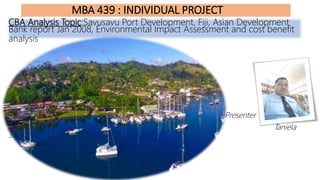
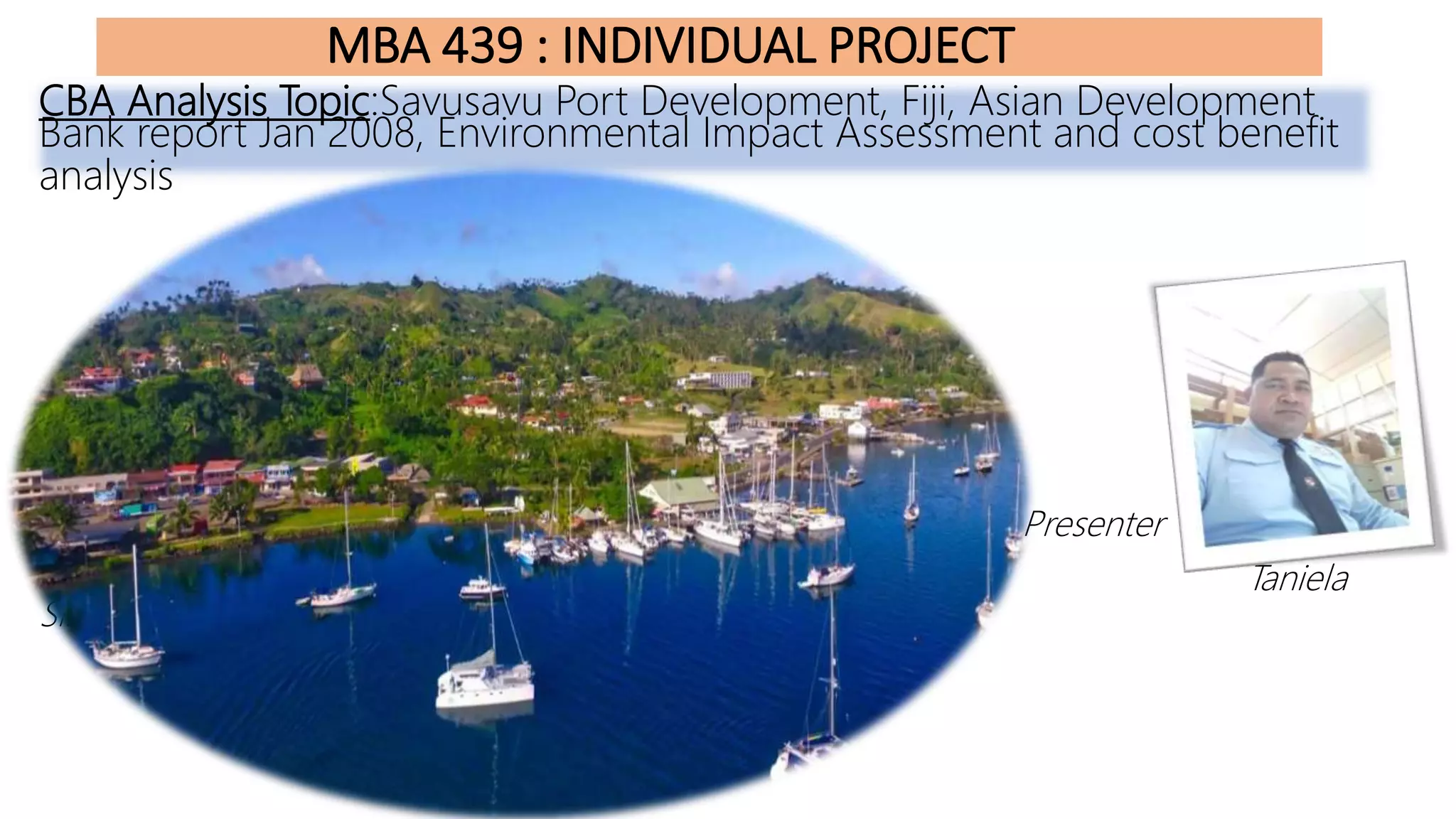
CBA Analysis Topic:Savusavu Port Development, Fiji, Asian Development
Bank report Jan 2008, Environmental Impact Assessment and cost benefit
analysis
Presenter
Taniela
Sila(S97004499)
• Project Site
• Objectives of Study
• Case Summary
• ROI Project Goals
• Project contribution to ROI
• Project Stages
• Case Study Analysis
• Conclusion
• Recommendation
• Reference
2
PRESENTATION OUTLINE
3
Project Area
6km
PROJECT SITE
OBJECTIVE OF STUDY
To present EIA
results of the
proposed
Savusavu Port
Development
Project
Support
development
objectives of the
government
4
1. Development Objective
• - Govt Regional Development
- Past Reports recommend site as
ideal
-ROI(ADB Report 2005)
- Investors Preference
2.Need Assessment
• -Agri growth in Vanua Levu cannot be
sustained
-High shipping costs
-Need for containerized shipping
5
Stakeholders
• Asian Development Bank - Funding of Project
• Ministry of Agriculture, Sugar and Land Resettlement- Project Owner
• Savusavu Community
CASE SUMMARY
6
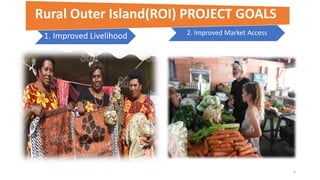
2. Improved Market Access1. Improved Livelihood
Rural Outer Island(ROI) PROJECT GOALS
7
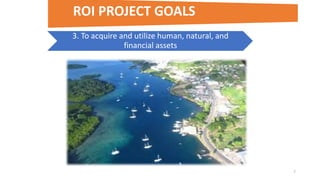
3. To acquire and utilize human, natural, and
financial assets
ROI PROJECT GOALS
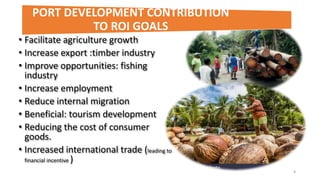
• Facilitate agriculture growth
• Increase export :timber industry
• Improve opportunities: fishing
industry
• Increase employment
• Reduce internal migration
• Beneficial: tourism development
• Reducing the cost of consumer
goods.
• Increased international trade (leading to
financial incentive )
8
PORT DEVELOPMENT CONTRIBUTION
TO ROI GOALS
9
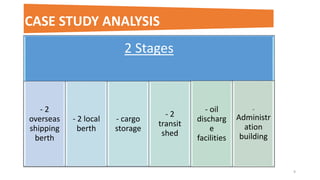
2 Stages
- 2
overseas
shipping
berth
- 2 local
berth
- cargo
storage
- 2
transit
shed
- oil
discharg
e
facilities
-
Administr
ation
building
CASE STUDY ANALYSIS
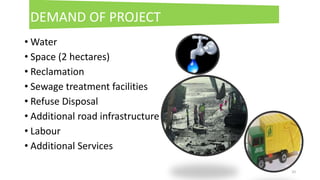
• Water
• Space (2 hectares)
• Reclamation
• Sewage treatment facilities
• Refuse Disposal
• Additional road infrastructure
• Labour
• Additional Services
10
DEMAND OF PROJECT
11
12
Environmental impacts and mitigation
Measures
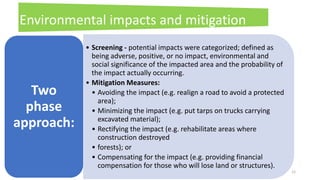
• Screening - potential impacts were categorized; defined as
being adverse, positive, or no impact, environmental and
social significance of the impacted area and the probability of
the impact actually occurring.
• Mitigation Measures:
• Avoiding the impact (e.g. realign a road to avoid a protected
area);
• Minimizing the impact (e.g. put tarps on trucks carrying
excavated material);
• Rectifying the impact (e.g. rehabilitate areas where
construction destroyed
• forests); or
• Compensating for the impact (e.g. providing financial
compensation for those who will lose land or structures).
Two
phase
approach:
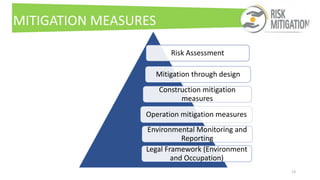
Risk Assessment
Mitigation through design
Construction mitigation
measures
Operation mitigation measures
Environmental Monitoring and
Reporting
Legal Framework (Environment
and Occupation)
13
MITIGATION MEASURES
14
Economic Assessment
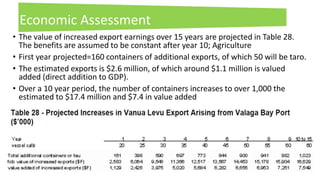
• The value of increased export earnings over 15 years are projected in Table 28.
The benefits are assumed to be constant after year 10; Agriculture
• First year projected=160 containers of additional exports, of which 50 will be taro.
• The estimated exports is $2.6 million, of which around $1.1 million is valued
added (direct addition to GDP).
• Over a 10 year period, the number of containers increases to over 1,000 the
estimated to $17.4 million and $7.4 in value added
15
Public Consultation
16
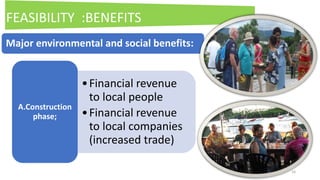
•Financial revenue
to local people
•Financial revenue
to local companies
(increased trade)
A.Construction
phase;
Major environmental and social benefits:
FEASIBILITY :BENEFITS
17
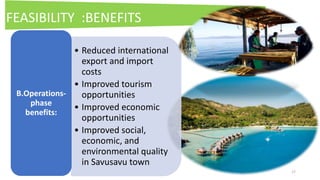
• Reduced international
export and import
costs
• Improved tourism
opportunities
• Improved economic
opportunities
• Improved social,
economic, and
environmental quality
in Savusavu town
B.Operations-
phase
benefits:
FEASIBILITY :BENEFITS
18
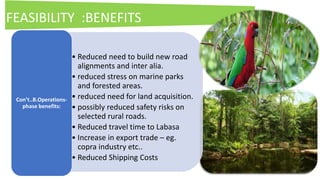
• Reduced need to build new road
alignments and inter alia.
• reduced stress on marine parks
and forested areas.
• reduced need for land acquisition.
• possibly reduced safety risks on
selected rural roads.
• Reduced travel time to Labasa
• Increase in export trade – eg.
copra industry etc..
• Reduced Shipping Costs
Con’t..B.Operations-
phase benefits:
FEASIBILITY :BENEFITS
19
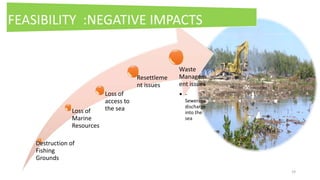
Destruction of
Fishing
Grounds
Loss of
Marine
Resources
Loss of
access to
the sea
Resettleme
nt issues
Waste
Managem
ent issues
• -
Sewerage
discharge
into the
sea
FEASIBILITY :NEGATIVE IMPACTS
No reliable
geotechnical
information
for the site
Ownership of
site not clear
Cost estimate
of materials
could change
with changes
in world
market prices
Chosen site(
out of 3
options)
based on cost
20
PROJECT RISKS
21
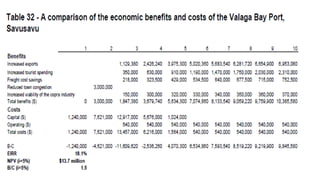
COST BENEFIT ANALYSIS (10 YR Projection)
• Benefits =$10,385, 580
• Cost =$540,000
3.EIRR(economic internal rate if return) =18.1%
4.ENPV(Economic Net Present Value) (5%interest) =$13.7 million
5.B/C (5%interest) = 1.5
Refer table 32
VIABILITY OF PROJECT
22
23
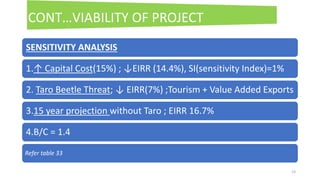
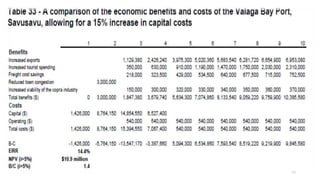
SENSITIVITY ANALYSIS
1.↑ Capital Cost(15%) ; ↓EIRR (14.4%), SI(sensitivity Index)=1%
2. Taro Beetle Threat; ↓ EIRR(7%) ;Tourism + Value Added Exports
3.15 year projection without Taro ; EIRR 16.7%
4.B/C = 1.4
Refer table 33
CONT…VIABILITY OF PROJECT
24
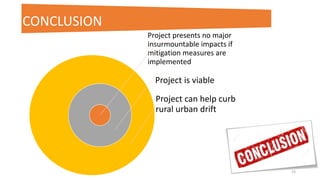
Project presents no major
insurmountable impacts if
mitigation measures are
implemented
Project is viable
Project can help curb
rural urban drift
25
CONCLUSION
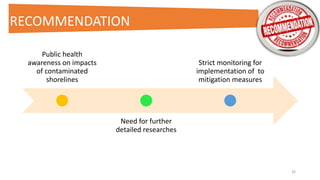
Public health
awareness on impacts
of contaminated
shorelines
Need for further
detailed researches
Strict monitoring for
implementation of to
mitigation measures
26
RECOMMENDATION
• Bank, A. D. (2008). Environmental Impact Assessment (EIA) Savusavu Port Development
Government of Fiji.
• Layton, A. P., Robinson, T., & Tucker, I. B. (2016). Economics For Today. Sydney: Cengage Learning
Australia Pty Limited.
27
REFERENCE
28

MBA439:Savusavu port CBA

  • 1.
    MBA 439 :INDIVIDUAL PROJECT CBA Analysis Topic:Savusavu Port Development, Fiji, Asian Development Bank report Jan 2008, Environmental Impact Assessment and cost benefit analysis Presenter Taniela Sila(S97004499)
  • 2.
    • Project Site •Objectives of Study • Case Summary • ROI Project Goals • Project contribution to ROI • Project Stages • Case Study Analysis • Conclusion • Recommendation • Reference 2 PRESENTATION OUTLINE
  • 3.
  • 4.
    OBJECTIVE OF STUDY Topresent EIA results of the proposed Savusavu Port Development Project Support development objectives of the government 4
  • 5.
    1. Development Objective •- Govt Regional Development - Past Reports recommend site as ideal -ROI(ADB Report 2005) - Investors Preference 2.Need Assessment • -Agri growth in Vanua Levu cannot be sustained -High shipping costs -Need for containerized shipping 5 Stakeholders • Asian Development Bank - Funding of Project • Ministry of Agriculture, Sugar and Land Resettlement- Project Owner • Savusavu Community CASE SUMMARY
  • 6.
    6 2. Improved MarketAccess1. Improved Livelihood Rural Outer Island(ROI) PROJECT GOALS
  • 7.
    7 3. To acquireand utilize human, natural, and financial assets ROI PROJECT GOALS
  • 8.
    • Facilitate agriculturegrowth • Increase export :timber industry • Improve opportunities: fishing industry • Increase employment • Reduce internal migration • Beneficial: tourism development • Reducing the cost of consumer goods. • Increased international trade (leading to financial incentive ) 8 PORT DEVELOPMENT CONTRIBUTION TO ROI GOALS
  • 9.
    9 2 Stages - 2 overseas shipping berth -2 local berth - cargo storage - 2 transit shed - oil discharg e facilities - Administr ation building CASE STUDY ANALYSIS
  • 10.
    • Water • Space(2 hectares) • Reclamation • Sewage treatment facilities • Refuse Disposal • Additional road infrastructure • Labour • Additional Services 10 DEMAND OF PROJECT
  • 11.
  • 12.
    12 Environmental impacts andmitigation Measures • Screening - potential impacts were categorized; defined as being adverse, positive, or no impact, environmental and social significance of the impacted area and the probability of the impact actually occurring. • Mitigation Measures: • Avoiding the impact (e.g. realign a road to avoid a protected area); • Minimizing the impact (e.g. put tarps on trucks carrying excavated material); • Rectifying the impact (e.g. rehabilitate areas where construction destroyed • forests); or • Compensating for the impact (e.g. providing financial compensation for those who will lose land or structures). Two phase approach:
  • 13.
    Risk Assessment Mitigation throughdesign Construction mitigation measures Operation mitigation measures Environmental Monitoring and Reporting Legal Framework (Environment and Occupation) 13 MITIGATION MEASURES
  • 14.
    14 Economic Assessment • Thevalue of increased export earnings over 15 years are projected in Table 28. The benefits are assumed to be constant after year 10; Agriculture • First year projected=160 containers of additional exports, of which 50 will be taro. • The estimated exports is $2.6 million, of which around $1.1 million is valued added (direct addition to GDP). • Over a 10 year period, the number of containers increases to over 1,000 the estimated to $17.4 million and $7.4 in value added
  • 15.
  • 16.
    16 •Financial revenue to localpeople •Financial revenue to local companies (increased trade) A.Construction phase; Major environmental and social benefits: FEASIBILITY :BENEFITS
  • 17.
    17 • Reduced international exportand import costs • Improved tourism opportunities • Improved economic opportunities • Improved social, economic, and environmental quality in Savusavu town B.Operations- phase benefits: FEASIBILITY :BENEFITS
  • 18.
    18 • Reduced needto build new road alignments and inter alia. • reduced stress on marine parks and forested areas. • reduced need for land acquisition. • possibly reduced safety risks on selected rural roads. • Reduced travel time to Labasa • Increase in export trade – eg. copra industry etc.. • Reduced Shipping Costs Con’t..B.Operations- phase benefits: FEASIBILITY :BENEFITS
  • 19.
    19 Destruction of Fishing Grounds Loss of Marine Resources Lossof access to the sea Resettleme nt issues Waste Managem ent issues • - Sewerage discharge into the sea FEASIBILITY :NEGATIVE IMPACTS
  • 20.
    No reliable geotechnical information for thesite Ownership of site not clear Cost estimate of materials could change with changes in world market prices Chosen site( out of 3 options) based on cost 20 PROJECT RISKS
  • 21.
    21 COST BENEFIT ANALYSIS(10 YR Projection) • Benefits =$10,385, 580 • Cost =$540,000 3.EIRR(economic internal rate if return) =18.1% 4.ENPV(Economic Net Present Value) (5%interest) =$13.7 million 5.B/C (5%interest) = 1.5 Refer table 32 VIABILITY OF PROJECT
  • 22.
  • 23.
    23 SENSITIVITY ANALYSIS 1.↑ CapitalCost(15%) ; ↓EIRR (14.4%), SI(sensitivity Index)=1% 2. Taro Beetle Threat; ↓ EIRR(7%) ;Tourism + Value Added Exports 3.15 year projection without Taro ; EIRR 16.7% 4.B/C = 1.4 Refer table 33 CONT…VIABILITY OF PROJECT
  • 24.
  • 25.
    Project presents nomajor insurmountable impacts if mitigation measures are implemented Project is viable Project can help curb rural urban drift 25 CONCLUSION
  • 26.
    Public health awareness onimpacts of contaminated shorelines Need for further detailed researches Strict monitoring for implementation of to mitigation measures 26 RECOMMENDATION
  • 27.
    • Bank, A.D. (2008). Environmental Impact Assessment (EIA) Savusavu Port Development Government of Fiji. • Layton, A. P., Robinson, T., & Tucker, I. B. (2016). Economics For Today. Sydney: Cengage Learning Australia Pty Limited. 27 REFERENCE
  • 28.

Editor's Notes

  • #4 Some existing developments are timber mill, copra mill Chosen site has along list of significant social and environmental benefits
  • #6 Project is the manifestation of a wider Govt Initiative ADB – Borrower to fund TA to support the project Ministry of Agriculture needs to prepare a comprehensive plan to develop the project Currently the cost of transhipment within Fiji, from Vanua Levu to Suva, is almost equivalent to the cost of freight to New Zealand or Australia from Suva. Savusavu Port (Valaga Bay) development is part of the broader Rural and Outer Islands Project of Fiji (“the ROI Project”). Government's objectives of balanced regional development and distribution of economic opportunities to all parts of the Fiji Islands. Existing Government Wharf in Savusavu Town wasn’t considered based on previous studies ROI Final Report (ADB November 2005a
  • #7 1.People meaning those in the rural areas and outer island and those around project area 2. Increased opportunity for market access
  • #8 1.People meaning those in the rural areas and outer island and those around project area 2. Increased opportunity for market access
  • #11 Water- May need additional storage facilities eg reservoir
  • #20 Resettlement issues of graves and villages.The question of responsibility on : Purchasing of land Resettlement of villages Resttlement of graves People are closely woven to their surroundings - Uprooting people is a serious issue Waste management – Present high faecal contamination along shore line
  • #21 The largest risk item in any port development is the condition and strength parameters of the ground and foundations. Risks allowance of 20% of cost estimate The cost estimate has been prepared using the most recent and most applicable rates available, from New Zealand and from Fiji. These rates are considered to be appropriate for 2006
  • #22 Sensitivity Index needs to be higher than 2.0 or higher before viability is considered sensitive. Value adding only on ginger and coconut cream
  • #26 Business houses and villages on site supported the project development Villages not in support are not located at the site but are traditional I Qoliqoli owners - No major insurmountable environmental impacts with construction and operation assuming that recommended mitigation measures are implemented