The Double Edge Sword
of the
Social Network

Carol A Spencer

Digital & Social Media Manager
County of Morris, NJ

NJ GMIS
April 25, 2012
We’re social.
We’re mobile.
We network.
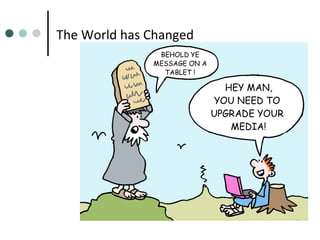
The World has Changed
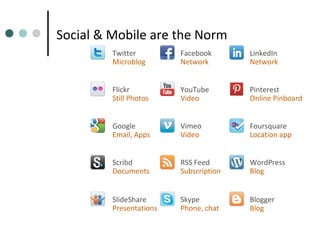
Social & Mobile are the Norm
Twitter
Microblog

Facebook
Network

LinkedIn
Network

Flickr
Still Photos

YouTube
Video

Pinterest
Online Pinboard

Google
Email, Apps

Vimeo
Video

Foursquare
Location app

Scribd
Documents

RSS Feed
Subscription

WordPress
Blog

SlideShare
Presentations

Skype
Phone, chat

Blogger
Blog
General Challenges






Going where no man has gone before.
The speed of government.
Too much noise. Too many products.
Bleeding edge: Is anyone using it?
Legal hurdles




Terms of Service Agreements
Credit Cards / Purchasing
Policies:

• What others can say on your sites
• What you can say and how to say it on your own sites
• What your representatives can / should say on other sites





Copyright Infringement

Employees





Regulating workplace use
Job descriptions – extra pay?
Training: tools, terms, tone
Regulating outside use / first amendment
Organization Challenges







1

1

Budget Cycle and Lack of Resources
Changing Organizational Culture
Ensuring the Quality of Data
Increasing Public Interest and Engagement
Balancing Autonomy and Control
Accountability and Responsibility

An Open Government Implementation Model: Moving to Increased Public Engagement
Gwanhoo Lee, Associate Professor, Kogod School of Business, The American University
Young Hoon Kwak, Associate Professor, School of Business, The George Washington University
IBM Center for The Business of Government (BusinessofGovernment.org); 2011
Budget Cycle and Lack of Resources




Mobile technologies develop very quickly
Procurement process is too long
 From

the time a solution is identified, to budget,
to approval, to implementation: could be 18
months.






Bid process
Vendor understanding of government
procurement
Credit card requirement
Changing Organizational Culture








Command and control environment
Hierarchical, top down, organization
Decision paths; Decision times
Information silos
The sum of the parts
Management use (or lack thereof)
Ensuring the Quality of Data










Social media is about trust
Data must be accurate, timely
Data must add value, be useful
Data must not be confidential; must be
sharable
Data must be consistent across multiple
channels
Processes must exist to identify sharable
data, collection and publication responsible
parties
Increasing Public Interest and Engagement









Social media is about trust
Data must be accurate, timely
Data must add value, be useful
Data must not be confidential; must be
sharable
Data must be consistent across multiple
channels
Processes must exist to identify sharable
data, collection and publication responsible
parties
Balancing Autonomy and Control








It doesn’t have to be the wild west
Play nice in the sandbox
Enforce your commenting policies, politely
Monitor, monitor, monitor
Be human, admit mistakes
Explain things in plain English, not
government speak
Accountability and Responsibility



With open public comment and multiple
employees speaking on behalf of an agency,
guidelines are important.
 Messaging

needs to be consistent
 Tone needs to be consistent
 Coordination of responses is a must
 Consistency in the applicability of policy is a
must
Technology Challenges





1

1

Improving IT Infrastructure
Enhancing Privacy and Information Security
Integrating Tools and Applications
Updating Policies and Rules

An Open Government Implementation Model: Moving to Increased Public Engagement
Gwanhoo Lee, Associate Professor, Kogod School of Business, The American University
Young Hoon Kwak, Associate Professor, School of Business, The George Washington University
IBM Center for The Business of Government (BusinessofGovernment.org); 2011
Improving IT Infrastructure
Enhancing Privacy and Information Security





Social media bandwidth issues: video hosting?
24 X 7 expectation
Emergency preparation: bandwidth, demand
Security issues with employee access
 Hacking,

spyware



Denial of Service (DoS) attacks, malware,

Privacy issues
 HIPPA,

emails, OPRA, FOIA
Integrating Tools and Applications




Initial cost of training and tool acquisition
Subsequent tool acquisition
 Does

is work with what we already have?
 Will it work with future tools?
 Will the company be in business in 5 years? 2
years?


Mobile versions
 Can

we integrate existing data streams into a
mobile presence?
Updating Policies and Rules



Inconsistency of application Terms of Use
with government requirements
 Liability

issues
 Subject to the laws of other states



Contractual or procurement laws
Review for consistency and compliance with
court hearings, legislative changes, and
Federal requirements.
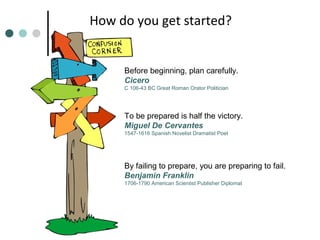
How do you get started?

Before beginning, plan carefully.
Cicero
C 106-43 BC Great Roman Orator Politician

To be prepared is half the victory.
Miguel De Cervantes
1547-1616 Spanish Novelist Dramatist Poet

By failing to prepare, you are preparing to fail.
Benjamin Franklin
1706-1790 American Scientist Publisher Diplomat
Develop, Draw & Write a Plan


Discuss & Decide
 Where

the information will originate
 Who may speak for your agency
 Which applications you will use
 Who will be responsible for the applications
 What will be the process, the flow
 What your policies will include
 Employee use; Content; Commenting
 How social media will be marketed
 How you will engage visitors
Is it worth the work?
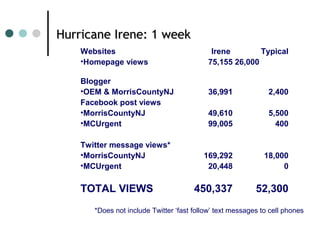
Hurricane Irene: 1 week
Websites
•Homepage views
Blogger
•OEM & MorrisCountyNJ
Facebook post views
•MorrisCountyNJ
•MCUrgent
Twitter message views*
•MorrisCountyNJ
•MCUrgent

TOTAL VIEWS

Irene
Typical
75,155 26,000

36,991

2,400

49,610
99,005

5,500
400

169,292
20,448

18,000
0

450,337

52,300

*Does not include Twitter ‘fast follow’ text messages to cell phones
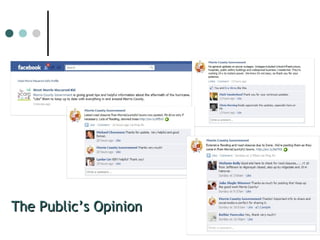
The Public’s Opinion
Contact Information
Morris County NJ
Website MorrisCountyNJ.gov
Twitter Twitter.com/MorrisCountyNJ
Facebook Facebook.com/MorrisCountyNJ
YouTube YouTube.com/MorrisCountyNJ
Flickr Flickr.com/MorrisCountyNJ
Email CSpencer@co.Morris.NJ.US

National Association of Government Webmasters
Website NAGW.org
Twitter Twitter.com/NAGW
Facebook Facebook.com/NAGW.org
GovLoop Govloop.com/group/NAGW
Email Treasurer@NAGW.org
Employee Use of
Social Networks

Social Media Policy of Victoria, Australia, Department of Justice
http://www.youtube.com/watch?v=Ws3Bd3QINsk
Guidance from NLRB Reports



National Labor Relations Board report August 18, 2011:
http://mynlrb.nlrb.gov/link/document.aspx/09031d458056e743








Policies should not be too broad
Specific examples of prohibited behavior should be
included
Employee rights must be protected
Terms like “appropriate” and “professional” must be
defined
Mere complaints are not typically protected
Protected speech includes wages, working conditions
(Section 7 rights)
Guidance from NLRB Reports



NLRB report January 25, 2012 Summarizes 14 cases

http://mynlrb.nlrb.gov/link/document.aspx/09031d45807d6567
http://www.nlrb.gov/news/acting-general-counsel-issuessecond-social-media-report



Reiterated 2 main points






Employer policies should not be so sweeping that they prohibit
the kinds of activity protected by federal labor law, such as the
discussion of wages or working conditions among employees.
An employee’s comments on social media are generally not
protected if they are mere gripes not made in relation to group
activity among employees.

No Appeals Court rulings on NLRB decisions
Guidance from NLRB Reports




NLRB reports provide guidance.
From the NLRB website
http://www.nlrb.gov/faq/nlrb#t1n382




“The NLRB does not have jurisdiction over federal, state or
local government workers, with the exception of
employees of the U.S. Postal Service. The Federal Labor
Relations Authority has jurisdiction over federal
employees. The organizing and collective bargaining rights
of state and local employees are determined by state
laws enforced by individual state agencies.”

Be very careful when restricting social media use at
work
Labor Issues



From the NLRB website

http://www.nlrb.gov/faq/nlrb#t1n382
 “The NLRB does not have jurisdiction over federal, state or
local government workers, with the exception of employees
of the U.S. Postal Service. The Federal Labor Relations
Authority has jurisdiction over federal employees. The
organizing and collective bargaining rights of state and local
employees are determined by state laws enforced
by individual state agencies.”


NJ Employer-Employee Relations Act
http://www.state.nj.us/perc/statute.pdf
Government Actions



Gloucester County Adopts Use Policy




Bay Head lists their 10 criteria for a policy




Controversial: It restricts employees from posting photos of
the “county’s premises, properties [or] activities” on private
social sites.
NJSLOM March 2012 Article
http://www.njslom.org/magazine/2012-03/pg-28.html

NASCIO.org achieves Terms of Use modifications for
states


Facebook (1/5/2011), YouTube (1/17/2012)
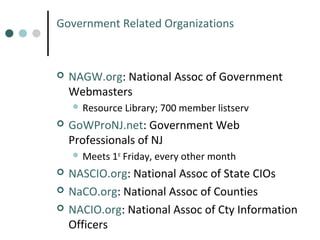
Government Related Organizations



NAGW.org: National Assoc of Government
Webmasters
 Resource



Library; 700 member listserv

GoWProNJ.net: Government Web
Professionals of NJ
 Meets 1st Friday,





every other month

NASCIO.org: National Assoc of State CIOs
NaCO.org: National Assoc of Counties
NACIO.org: National Assoc of Cty Information
Officers
The Double Edge Sword
of the
Social Network

Carol A Spencer

Digital & Social Media Manager
County of Morris, NJ

NJ GMIS
April 25, 2012

2012: NJ GMIS: The Double Edge Sword of the Social Network

  • 1.
    The Double EdgeSword of the Social Network Carol A Spencer Digital & Social Media Manager County of Morris, NJ NJ GMIS April 25, 2012
  • 2.
  • 3.
  • 4.
    Social & Mobileare the Norm Twitter Microblog Facebook Network LinkedIn Network Flickr Still Photos YouTube Video Pinterest Online Pinboard Google Email, Apps Vimeo Video Foursquare Location app Scribd Documents RSS Feed Subscription WordPress Blog SlideShare Presentations Skype Phone, chat Blogger Blog
  • 5.
    General Challenges      Going whereno man has gone before. The speed of government. Too much noise. Too many products. Bleeding edge: Is anyone using it? Legal hurdles    Terms of Service Agreements Credit Cards / Purchasing Policies: • What others can say on your sites • What you can say and how to say it on your own sites • What your representatives can / should say on other sites   Copyright Infringement Employees     Regulating workplace use Job descriptions – extra pay? Training: tools, terms, tone Regulating outside use / first amendment
  • 6.
    Organization Challenges       1 1 Budget Cycleand Lack of Resources Changing Organizational Culture Ensuring the Quality of Data Increasing Public Interest and Engagement Balancing Autonomy and Control Accountability and Responsibility An Open Government Implementation Model: Moving to Increased Public Engagement Gwanhoo Lee, Associate Professor, Kogod School of Business, The American University Young Hoon Kwak, Associate Professor, School of Business, The George Washington University IBM Center for The Business of Government (BusinessofGovernment.org); 2011
  • 7.
    Budget Cycle andLack of Resources   Mobile technologies develop very quickly Procurement process is too long  From the time a solution is identified, to budget, to approval, to implementation: could be 18 months.    Bid process Vendor understanding of government procurement Credit card requirement
  • 8.
    Changing Organizational Culture       Commandand control environment Hierarchical, top down, organization Decision paths; Decision times Information silos The sum of the parts Management use (or lack thereof)
  • 9.
    Ensuring the Qualityof Data       Social media is about trust Data must be accurate, timely Data must add value, be useful Data must not be confidential; must be sharable Data must be consistent across multiple channels Processes must exist to identify sharable data, collection and publication responsible parties
  • 10.
    Increasing Public Interestand Engagement       Social media is about trust Data must be accurate, timely Data must add value, be useful Data must not be confidential; must be sharable Data must be consistent across multiple channels Processes must exist to identify sharable data, collection and publication responsible parties
  • 11.
    Balancing Autonomy andControl       It doesn’t have to be the wild west Play nice in the sandbox Enforce your commenting policies, politely Monitor, monitor, monitor Be human, admit mistakes Explain things in plain English, not government speak
  • 12.
    Accountability and Responsibility  Withopen public comment and multiple employees speaking on behalf of an agency, guidelines are important.  Messaging needs to be consistent  Tone needs to be consistent  Coordination of responses is a must  Consistency in the applicability of policy is a must
  • 13.
    Technology Challenges     1 1 Improving ITInfrastructure Enhancing Privacy and Information Security Integrating Tools and Applications Updating Policies and Rules An Open Government Implementation Model: Moving to Increased Public Engagement Gwanhoo Lee, Associate Professor, Kogod School of Business, The American University Young Hoon Kwak, Associate Professor, School of Business, The George Washington University IBM Center for The Business of Government (BusinessofGovernment.org); 2011
  • 14.
    Improving IT Infrastructure EnhancingPrivacy and Information Security     Social media bandwidth issues: video hosting? 24 X 7 expectation Emergency preparation: bandwidth, demand Security issues with employee access  Hacking, spyware  Denial of Service (DoS) attacks, malware, Privacy issues  HIPPA, emails, OPRA, FOIA
  • 15.
    Integrating Tools andApplications   Initial cost of training and tool acquisition Subsequent tool acquisition  Does is work with what we already have?  Will it work with future tools?  Will the company be in business in 5 years? 2 years?  Mobile versions  Can we integrate existing data streams into a mobile presence?
  • 16.
    Updating Policies andRules  Inconsistency of application Terms of Use with government requirements  Liability issues  Subject to the laws of other states   Contractual or procurement laws Review for consistency and compliance with court hearings, legislative changes, and Federal requirements.
  • 17.
    How do youget started? Before beginning, plan carefully. Cicero C 106-43 BC Great Roman Orator Politician To be prepared is half the victory. Miguel De Cervantes 1547-1616 Spanish Novelist Dramatist Poet By failing to prepare, you are preparing to fail. Benjamin Franklin 1706-1790 American Scientist Publisher Diplomat
  • 18.
    Develop, Draw &Write a Plan  Discuss & Decide  Where the information will originate  Who may speak for your agency  Which applications you will use  Who will be responsible for the applications  What will be the process, the flow  What your policies will include  Employee use; Content; Commenting  How social media will be marketed  How you will engage visitors
  • 19.
    Is it worththe work?
  • 20.
    Hurricane Irene: 1week Websites •Homepage views Blogger •OEM & MorrisCountyNJ Facebook post views •MorrisCountyNJ •MCUrgent Twitter message views* •MorrisCountyNJ •MCUrgent TOTAL VIEWS Irene Typical 75,155 26,000 36,991 2,400 49,610 99,005 5,500 400 169,292 20,448 18,000 0 450,337 52,300 *Does not include Twitter ‘fast follow’ text messages to cell phones
  • 21.
  • 22.
    Contact Information Morris CountyNJ Website MorrisCountyNJ.gov Twitter Twitter.com/MorrisCountyNJ Facebook Facebook.com/MorrisCountyNJ YouTube YouTube.com/MorrisCountyNJ Flickr Flickr.com/MorrisCountyNJ Email CSpencer@co.Morris.NJ.US National Association of Government Webmasters Website NAGW.org Twitter Twitter.com/NAGW Facebook Facebook.com/NAGW.org GovLoop Govloop.com/group/NAGW Email Treasurer@NAGW.org
  • 23.
    Employee Use of SocialNetworks Social Media Policy of Victoria, Australia, Department of Justice http://www.youtube.com/watch?v=Ws3Bd3QINsk
  • 24.
    Guidance from NLRBReports  National Labor Relations Board report August 18, 2011: http://mynlrb.nlrb.gov/link/document.aspx/09031d458056e743       Policies should not be too broad Specific examples of prohibited behavior should be included Employee rights must be protected Terms like “appropriate” and “professional” must be defined Mere complaints are not typically protected Protected speech includes wages, working conditions (Section 7 rights)
  • 25.
    Guidance from NLRBReports  NLRB report January 25, 2012 Summarizes 14 cases http://mynlrb.nlrb.gov/link/document.aspx/09031d45807d6567 http://www.nlrb.gov/news/acting-general-counsel-issuessecond-social-media-report  Reiterated 2 main points    Employer policies should not be so sweeping that they prohibit the kinds of activity protected by federal labor law, such as the discussion of wages or working conditions among employees. An employee’s comments on social media are generally not protected if they are mere gripes not made in relation to group activity among employees. No Appeals Court rulings on NLRB decisions
  • 26.
    Guidance from NLRBReports   NLRB reports provide guidance. From the NLRB website http://www.nlrb.gov/faq/nlrb#t1n382   “The NLRB does not have jurisdiction over federal, state or local government workers, with the exception of employees of the U.S. Postal Service. The Federal Labor Relations Authority has jurisdiction over federal employees. The organizing and collective bargaining rights of state and local employees are determined by state laws enforced by individual state agencies.” Be very careful when restricting social media use at work
  • 27.
    Labor Issues  From theNLRB website http://www.nlrb.gov/faq/nlrb#t1n382  “The NLRB does not have jurisdiction over federal, state or local government workers, with the exception of employees of the U.S. Postal Service. The Federal Labor Relations Authority has jurisdiction over federal employees. The organizing and collective bargaining rights of state and local employees are determined by state laws enforced by individual state agencies.”  NJ Employer-Employee Relations Act http://www.state.nj.us/perc/statute.pdf
  • 28.
    Government Actions  Gloucester CountyAdopts Use Policy   Bay Head lists their 10 criteria for a policy   Controversial: It restricts employees from posting photos of the “county’s premises, properties [or] activities” on private social sites. NJSLOM March 2012 Article http://www.njslom.org/magazine/2012-03/pg-28.html NASCIO.org achieves Terms of Use modifications for states  Facebook (1/5/2011), YouTube (1/17/2012)
  • 29.
    Government Related Organizations  NAGW.org:National Assoc of Government Webmasters  Resource  Library; 700 member listserv GoWProNJ.net: Government Web Professionals of NJ  Meets 1st Friday,    every other month NASCIO.org: National Assoc of State CIOs NaCO.org: National Assoc of Counties NACIO.org: National Assoc of Cty Information Officers
  • 30.
    The Double EdgeSword of the Social Network Carol A Spencer Digital & Social Media Manager County of Morris, NJ NJ GMIS April 25, 2012

Editor's Notes

  • #7 http://www.businessofgovernment.org/sites/default/files/An%20Open%20Government%20Implementation%20Model.pdf
  • #8 http://www.nytimes.com/2012/04/22/us/smart-muni-app-for-san-francisco-transit-goes-unused.html?_r=1
  • #22 Add Twitter comment from ThePyroLives about commute home.
  • #24 http://www.youtube.com/watch?v=Ws3Bd3QINsk Social Media Policy of Victoria, Australia, Department of Justice
  • #29 An employee is thus barred from taking photos of their children or grandchildren at a County park or at the County library.