Emergency Communications &
Sustainability
Lauren Skowronski, Sustainable Jersey
Carol Spencer, StormZero LLC
Kelly Boyd, NJOEM
@SJ_Program | #sustainablejersey | #NJEPA
Earth Day
What is Sustainability?
Sustainable Jersey:
A Framework for Action
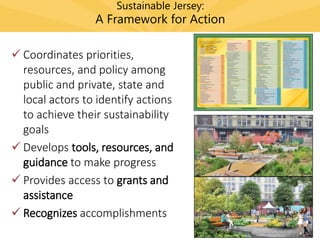
 Coordinates priorities,
resources, and policy among
public and private, state and
local actors to identify actions
to achieve their sustainability
goals
 Develops tools, resources, and
guidance to make progress
 Provides access to grants and
assistance
 Recognizes accomplishments
Grassroots Meets Top-Down:
Actions & Task Forces
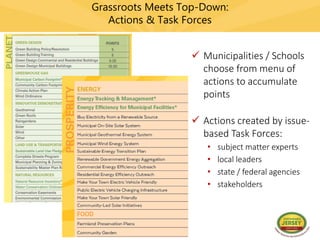
 Municipalities / Schools
choose from menu of
actions to accumulate
points
 Actions created by issue-
based Task Forces:
• subject matter experts
• local leaders
• state / federal agencies
• stakeholders
Program Participants
(Updated 3/20/2018)
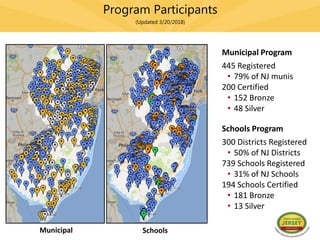
Municipal Program
445 Registered
• 79% of NJ munis
200 Certified
• 152 Bronze
• 48 Silver
Schools Program
300 Districts Registered
• 50% of NJ Districts
739 Schools Registered
• 31% of NJ Schools
194 Schools Certified
• 181 Bronze
• 13 Silver
Municipal Schools
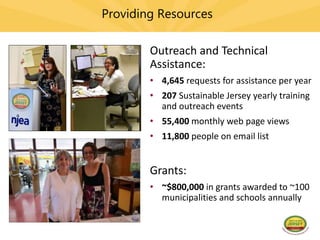
Providing Resources
Outreach and Technical
Assistance:
• 4,645 requests for assistance per year
• 207 Sustainable Jersey yearly training
and outreach events
• 55,400 monthly web page views
• 11,800 people on email list
Grants:
• ~$800,000 in grants awarded to ~100
municipalities and schools annually
Regional Hubs
• Atlantic-Cape May
• Bergen
• Camden-Burlington-
Gloucester
• Essex
• Hunterdon
• Mercer
• Middlesex
• Monmouth
• Somerset
 Network of Leaders
 Trainings & Social Events
 Joint Projects
 Peer to Peer Mentoring
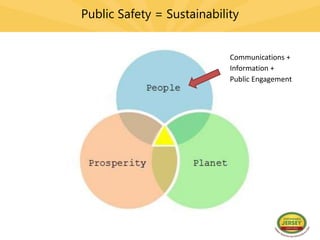
Public Safety = Sustainability
Communications +
Information +
Public Engagement
Municipal Communications in 2012
Municipal Websites:
• 70% included EMS info
Social Media:
• 18% on Facebook
• 14% Twitter
@SJ_Program | #sustainablejersey | #NJEPA
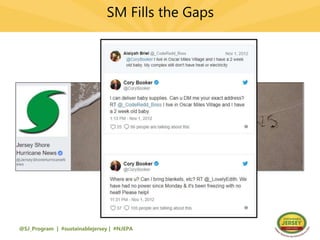
SM Fills the Gaps
@SJ_Program | #sustainablejersey | #NJEPA
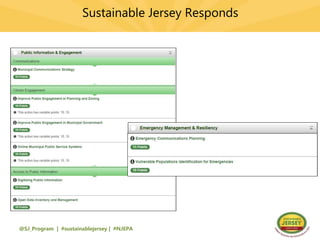
Sustainable Jersey Responds
@SJ_Program | #sustainablejersey | #NJEPA
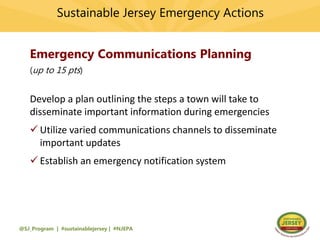
Sustainable Jersey Emergency Actions
@SJ_Program | #sustainablejersey | #NJEPA
Emergency Communications Planning
(up to 15 pts)
Develop a plan outlining the steps a town will take to
disseminate important information during emergencies
 Utilize varied communications channels to disseminate
important updates
 Establish an emergency notification system
Sustainable Jersey Emergency Actions (con’t)
@SJ_Program | #sustainablejersey | #NJEPA
Vulnerable Populations Identification for
Emergencies (10 pts)
Create of a plan to identify the vulnerable populations and
stakeholders who can help get info out during emergencies
 Promote “Register Ready”
 Keep a list of community stakeholders to connect to at risk
& vulnerable pops
 Use alternative communication formats within public
announcements
Communication Strategies
During Emergencies
NJEPA 2018 – Atlantic City NJ May 2, 2018
Fostering
Digital Communication Consistency
The Changed Nature of
Emergency Communication
The story will be told.
The question is:
who will tell the story?
“[Social media] is a significant force in public
opinion and the spread of information, and if it
is ignored can become a liability to your
organization. The general population now
expects real time news with updates throughout
an event.”
The Impacts and Opportunities of Social Media on Mass Notification; Everbridge2012
NJEPA 2018 – Atlantic City NJ May 2, 2018
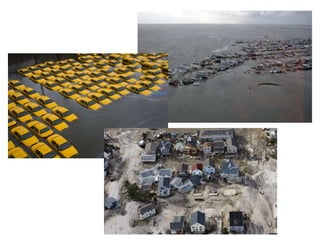
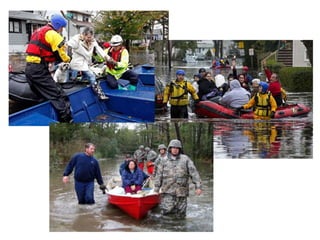
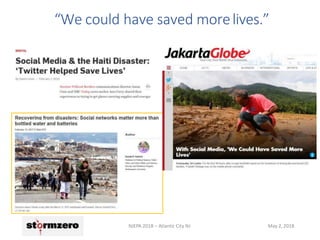
“We could have saved morelives.”
NJEPA 2018 – Atlantic City NJ May 2, 2018
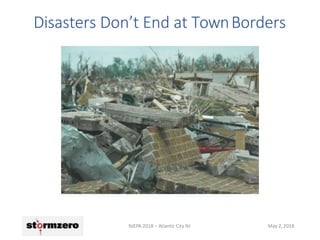
Disasters Don’t End at TownBorders
NJEPA 2018 – Atlantic City NJ May 2, 2018
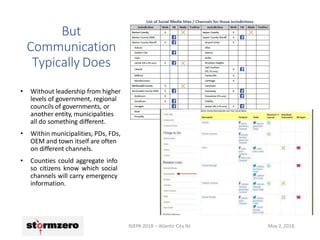
But
Communication
Typically Does
• Without leadership from higher
levels of government, regional
councils of governments, or
another entity, municipalities
all do something different.
• Within municipalities, PDs, FDs,
OEM and town itself are often
on different channels.
• Counties could aggregate info
so citizens know which social
channels will carry emergency
information.
NJEPA 2018 – Atlantic City NJ May 2, 2018
• The Plan: Nuts and Bolts
• Preparing a Digital Communication Plan
• Using Demographics to Determine Channels
• Policy Development
• Plan Elements
• Exercising the Plan
• Sustainable Jersey Communication Actions
• Emergency Communication Planning
• Examples
• Benefits of Completing these Actions
NJEPA 2018 – Atlantic City NJ May 2, 2018
What We’ll Discuss Today
Preparing A Digital CommunicationPlan
NJEPA 2018 – Atlantic City NJ May 2, 2018
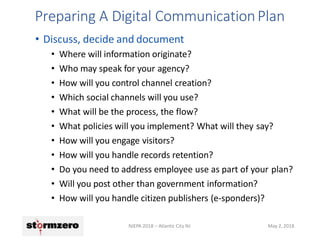
• Discuss, decide and document
• Where will information originate?
• Who may speak for your agency?
• How will you control channel creation?
• Which social channels will you use?
• What will be the process, the flow?
• What policies will you implement? What will they say?
• How will you engage visitors?
• How will you handle records retention?
• Do you need to address employee use as part of your plan?
• Will you post other than government information?
• How will you handle citizen publishers (e-sponders)?
Demographics Determine Channels
NJEPA 2018 – Atlantic City NJ May 2, 2018
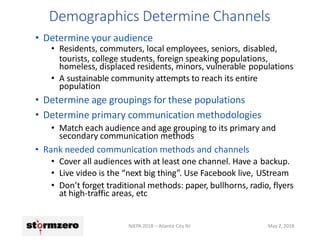
• Determine your audience
• Residents, commuters, local employees, seniors, disabled,
tourists, college students, foreign speaking populations,
homeless, displaced residents, minors, vulnerable populations
• A sustainable community attempts to reach its entire
population
• Determine age groupings for these populations
• Determine primary communication methodologies
• Match each audience and age grouping to its primary and
secondary communication methods
• Rank needed communication methods and channels
• Cover all audiences with at least one channel. Have a backup.
• Live video is the “next big thing”. Use Facebook live, UStream
• Don’t forget traditional methods: paper, bullhorns, radio, flyers
at high-traffic areas, etc
Policy Development
NJEPA 2018 – Atlantic City NJ May 2, 2018
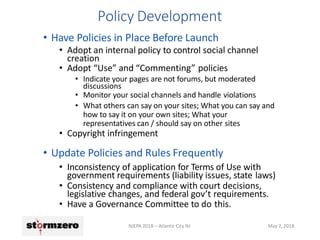
• Have Policies in Place Before Launch
• Adopt an internal policy to control social channel
creation
• Adopt “Use” and “Commenting” policies
• Indicate your pages are not forums, but moderated
discussions
• Monitor your social channels and handle violations
• What others can say on your sites; What you can say and
how to say it on your own sites; What your
representatives can / should say on other sites
• Copyright infringement
• Update Policies and Rules Frequently
• Inconsistency of application for Terms of Use with
government requirements (liability issues, state laws)
• Consistency and compliance with court decisions,
legislative changes, and federal gov’t requirements.
• Have a Governance Committee to do this.
Digital Communication Plan Elements
NJEPA 2018 – Atlantic City NJ May 2, 2018
• Governing Body Approval
• Authorities: foundational legal citations
• References: government policies that apply (HIPAA, etc)
• Purpose: to define and provide guidance
• Responsible Parties: people, organizations, contact info
• Governance Committee: town manager, PIOs, CIOs
• Physical Facility: should be located in the EOC
• Personnel: advanced trained employees and volunteers
• Process for an Anticipated Event: SOP and workflow
• Process for an Unanticipated Event: SOP and workflow
• Vulnerable Populations: identify and disseminate
• Policies: purchasing, TOU, channel creation, commenting
Embracing the Whole Community Approach
NJEPA 2018 – Atlantic City NJ May 2, 2018
• People feel invested, empowered in a community-based
effort.
• People want to help. The “whole community approach”
provides a structure where they can do so.
• Giving people something to do calms them during an event.
• FEMA recognizes and recommends the “whole community
approach”
• “We fully recognize that a government-centric approach to emergency
management is not enough to meet the challenges posed by a
catastrophic incident.”
• “When the community is engaged in an authentic dialogue, it becomes
empowered to identify its needs and the existing resources that may be
used to address them. ”
• “Engaging the whole community and empowering local action will better
position stakeholders to plan for and meet the actual needs of a
community and strengthen the local capacity to deal with the
consequences of all threats and hazards.”
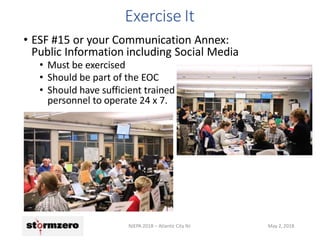
Exercise It
• ESF #15 or your Communication Annex:
Public Information including Social Media
• Must be exercised
• Should be part of the EOC
• Should have sufficient trained
personnel to operate 24 x 7.
NJEPA 2018 – Atlantic City NJ May 2, 2018
Market It
NJEPA 2018 – Atlantic City NJ May 2, 2018
• Start out slow. Build momentum before an event.
• Consider
• Press releases, church bulletins, flyers
• Speaking engagements for local civic groups
• Local buy and sell newspapers or websites
• Local community social channels, apps like NextDoor
• Official government e-newsletters
• Facebook or Google advertising
• Cross-marketing with other Twitter, FB, Instagram or G+ channels
• Create a YouTube video about your plan
• Run a couple of Facebook live events focused on vulnerable
populations, where to find info, registering for alerts, etc.
• Get friends to write about your site(s) on social media
• Act as if you have thousands of followers even if you don’t
Add value and they will come!
Collaborative
Communication Plans
NJEPA 2018 – Atlantic City NJ May 2, 2018
It never makes sense to reinvent the wheel, especially over
and over and over again by 565 different jurisdictions, all
of whom need to get information to their constituencies
efficiently and effectively in an emergency or disaster.
Sustainable Jersey Actions
Emergency Management and Resiliency
Certification Requirements
NJEPA 2018 – Atlantic City NJ May 2, 2018
• A section explaining declared versus non-declared
emergencies and a list of the various types of non-
emergency, non-routine operations to which this plan
will apply, including road closures, water shut offs,
water quality issues, boil water advisories, parades,
festivals, and special events requiring high security.
• Directives and methodologies for communicating those
directives during declared and nondeclared
emergencies to key municipal staff, stakeholders and
special facility liaisons as identified in the municipal
EOP. Directives should be written in a boilerplate
fashion so that they will be readily available in an
emergency.
Plan Requirements: Step 1
NJEPA 2018 – Atlantic City NJ May 2, 2018
• Methodologies for communicating essential information,
alerts, and updates to the general public during declared
and non-declared emergencies should be carried out via the
following communication channels:
• The municipal website
• Social media channels, including Facebook & Twitter
• Print newspapers and/or online sites
• Direct notices to the public including email lists, text messaging,
reverse 9-1-1, Next Door or other similar community boards.
Indirect notices like electronic sign boards, bulletin boards, flyers
• WOM through organizations like school boards, churches,
chambers of commerce, libraries, civic associations, faith
based organizations and others.
• Established routing systems for emergency vehicles with
loudspeakers
Plan Requirements: Step 1
NJEPA 2018 – Atlantic City NJ May 2, 2018
STEP 2
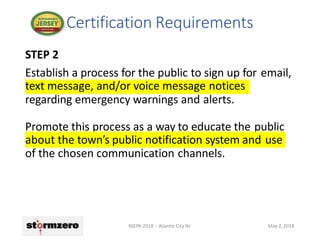
Establish a process for the public to sign up for email,
text message, and/or voice message notices
regarding emergency warnings and alerts.
Promote this process as a way to educate the public
about the town’s public notification system and use
of the chosen communication channels.
Certification Requirements
NJEPA 2018 – Atlantic City NJ May 2, 2018
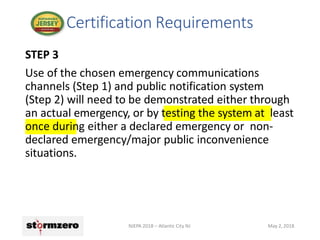
STEP 3
Use of the chosen emergency communications
channels (Step 1) and public notification system
(Step 2) will need to be demonstrated either through
an actual emergency, or by testing the system at least
once during either a declared emergency or non-
declared emergency/major public inconvenience
situations.
Certification Requirements
NJEPA 2018 – Atlantic City NJ May 2, 2018
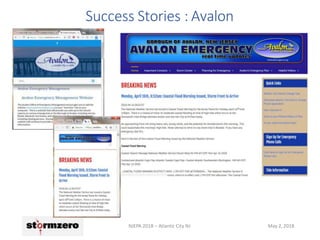
Success Stories : Avalon
NJEPA 2018 – Atlantic City NJ May 2, 2018
Success Stories : Ridgefield ParkVillage
NJEPA 2018 – Atlantic City NJ May 2, 2018
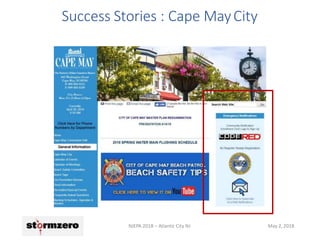
Success Stories : Cape MayCity
NJEPA 2018 – Atlantic City NJ May 2, 2018
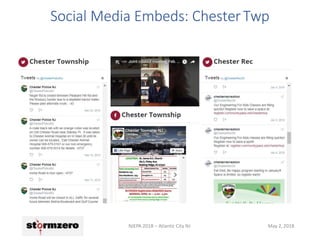
Social Media Embeds: ChesterTwp
NJEPA 2018 – Atlantic City NJ May 2, 2018
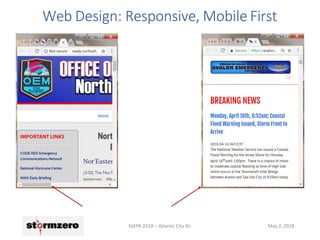
Web Design: Responsive, Mobile First
NJEPA 2018 – Atlantic City NJ May 2, 2018
• Disasters do not end at municipal boundaries. We
must all broaden our thoughts, plans and actions.
• Counties should play a leadership role in collaborative
communication efforts.
• Volunteers and volunteer civic organizations must be
included on the front-end in planning and exercises.
• Whole community planning and cross-jurisdictional
communication are essential to successful
preparedness, response and recovery efforts.
• The story will be told. Will yours be one of chaos or
competent coordination?
NJEPA 2018 – Atlantic City NJ May 2, 2018
Points to Remember
Presented by:
Kelly Boyd, Access & Functional Needs Planner
NJ Office of Emergency Management
 During emergencies, this group is often defined
as:
any individual, group, or community
whose circumstances create barriers to
obtaining or understanding information, or
the ability to react as the general population.
Circumstances that may create barriers
include, but are not limited to age; physical,
mental, emotional, or cognitive status;
culture; ethnicity; religion; language;
citizenship; geography; or socioeconomic
status.
 As a supplement to, and in support of, a municipality’s EOP, this
action seeks to ensure that municipalities reach all vulnerable
individuals with necessary information during emergencies.
 This includes taking advantage of available resources, such as
“Register Ready-NJ’s Special Needs Registry for Disasters,” to
identify and keep track of residents with disabilities and other
access or functional needs; and utilize alternative communication
methods and community stakeholders to get important warnings
and updates to others who are at-risk.
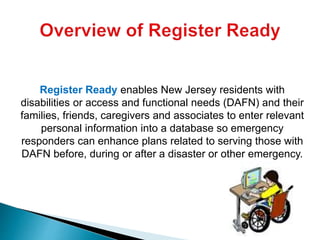
Register Ready enables New Jersey residents with
disabilities or access and functional needs (DAFN) and their
families, friends, caregivers and associates to enter relevant
personal information into a database so emergency
responders can enhance plans related to serving those with
DAFN before, during or after a disaster or other emergency.
 Register Ready is a free, voluntary and confidential web-
based program designed to identify the needs of people
who have disabilities or access and functional needs
and may have difficulty getting to safety during an
emergency.
 The information collected is not available to the public. It is
held securely and only used for emergency response and
planning.
People with disabilities or access and functional
needs (or their caregivers) are encouraged to
register by:
◦ going to www.registerready.nj.gov
◦ calling New Jersey’s toll-free 2-1-1 telephone service.
 Operators will register callers, offer free translation, and
provide TTY services for those with hearing impairments.
 The State AFN Planner has access to the registry
and can grant access.
 Each County has an AFN Coordinator who can
access the registry.
◦ This person can give permission to other county
employees to assist with registry matters.
Those who have access can search the registry
and export data. Data can be used to create lists
for:
◦ Reverse 911 alerts
◦ Emergency managers or CERT members to use
to call or go door-to-door to warn residents of
serious events or to conduct wellness checks
◦ Conducting follow up assessments/surveys
 Evacuation purposes
 Helping those with DAFN make personal
preparedness plans
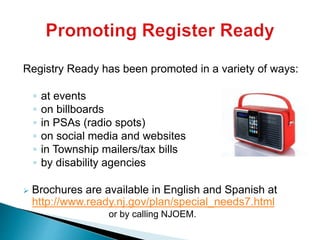
Registry Ready has been promoted in a variety of ways:
◦ at events
◦ on billboards
◦ in PSAs (radio spots)
◦ on social media and websites
◦ in Township mailers/tax bills
◦ by disability agencies
 Brochures are available in English and Spanish at
http://www.ready.nj.gov/plan/special_needs7.html
or by calling NJOEM.
Brochures can be given out by:
◦ utility companies
◦ staff handling school/Kindergarten registration
◦ hospital admissions staff
◦ Meals on Wheels staff and volunteers
Some counties and municipalities have also
implemented another type of DAFN registry to aide law
enforcement and emergency services personnel when
responding to 911 calls.
Monmouth County Special Needs Registry
◦ voluntary database open to all citizens with disabilities who
reside, attend school or are employed in Monmouth County
◦ helps police officers and emergency services personnel
better assist registrants with DAFN in the event of an
emergency by providing first responders with vital
information regarding the registrant’s disability, emergency
contact information, a physical description and a current
photograph of the registrant
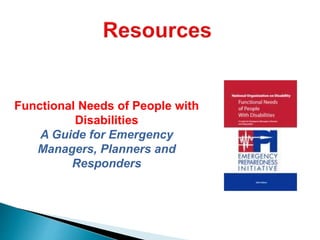
Functional Needs of People with
Disabilities
A Guide for Emergency
Managers, Planners and
Responders
In the Guide are steps that emergency managers,
first responders and community partners should
consider in ensuring that the needs and situations of
people with disabilities and access and functional
needs are taken into account in all phases of
emergency management.
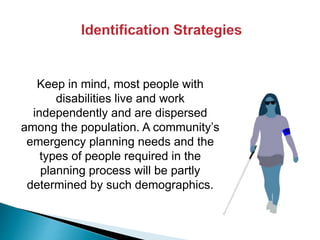
Keep in mind, most people with
disabilities live and work
independently and are dispersed
among the population. A community’s
emergency planning needs and the
types of people required in the
planning process will be partly
determined by such demographics.
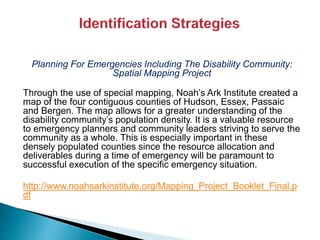
Planning For Emergencies Including The Disability Community:
Spatial Mapping Project
Through the use of special mapping, Noah’s Ark Institute created a
map of the four contiguous counties of Hudson, Essex, Passaic
and Bergen. The map allows for a greater understanding of the
disability community’s population density. It is a valuable resource
to emergency planners and community leaders striving to serve the
community as a whole. This is especially important in these
densely populated counties since the resource allocation and
deliverables during a time of emergency will be paramount to
successful execution of the specific emergency situation.
http://www.noahsarkinstitute.org/Mapping_Project_Booklet_Final.p
df
Be sure to work with institutional and industry-
specific groups that are not typically considered
emergency service resources but that can
offer valuable and timely support to
emergency professionals.
The Vulnerable Populations Identification for Emergencies
recommends working with:
 Your local Office of Emergency Management.
◦ The Emergency Management Coordinator or Deputy Emergency Management
Coordinator should take the lead on this action.
 Your municipal planner can assist in defining community demographics
with regards to vulnerable populations.
◦ This person should be assisted by public safety, municipal or County Social
Services and Health representatives.
 The municipal or County social media professional should be involved
to handle digital communication channel implementation and/or
updates.
 Your Public Information Officer, Business Administrator, and/or the
Police Public Information Officer should assist in correlating
demographics to communications methodologies.
 Municipal health officers, directors of Social Services, and faith based
organizations are also key to disseminating emergency warnings and
updates to vulnerable individuals throughout the community.
 Other important stakeholders include:
◦ Local disability agencies and Centers for Independent Living
◦ Major State Agencies (NJOEM, NJDHS OEM, DCF and DOH)
◦ Managers of hospitals, nursing homes, homeless shelters, etc.
◦ Faith based and civic leaders with networks within the
community
 Working with CERT or MRC members.
 Working with Girl or Boy Scouts.
 Engaging visiting nurse and home health aide
agencies.
 Updating archives.
◦ Checking death records.
 Emergency managers view DAFN registries from
varying perspectives. Concerns include:
 managing high consumer expectations
 an increased sense of confidence about being able to
track individuals who require specific assistance in their
communities during adverse conditions
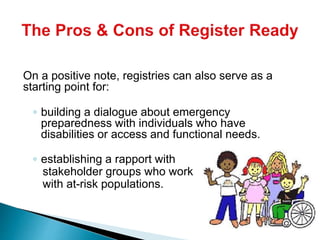
On a positive note, registries can also serve as a
starting point for:
◦ building a dialogue about emergency
preparedness with individuals who have
disabilities or access and functional needs.
◦ establishing a rapport with
stakeholder groups who work
with at-risk populations.
Registries are a great tool to help emergency
managers enhance services to community
members, but they are just part of the picture.
 Planning, emphasis on personal preparedness, and
the engagement of stakeholder groups that work with
disabilities or access and functional needs populations
are all essential tasks when it comes to addressing the
needs of vulnerable populations.
Questions or Comments?
• Lauren Skowronski, Program Director for Community
Engagement, Sustainable Jersey
– skowronl@tcnj.edu, (609) 771-3129
– Find SJ actions: sustainablejersey.com
• Carol Spencer, Digital & Communications Consultant,
Stormzero LLC
– carol@stormzero.com, 973-637-0483
• Kelly Boyd, Access & Functional Needs Planner, NJOEM
– lppboydk@gw.njsp.org, (609) 963-6971
Find this presentation: www.slideshare.net/ChazNJ
@SJ_Program | #sustainablejersey | #NJEPA

2018 NJEPA Emergency Communications & Sustainability

  • 1.
    Emergency Communications & Sustainability LaurenSkowronski, Sustainable Jersey Carol Spencer, StormZero LLC Kelly Boyd, NJOEM @SJ_Program | #sustainablejersey | #NJEPA
  • 2.
    Earth Day What isSustainability?
  • 3.
    Sustainable Jersey: A Frameworkfor Action  Coordinates priorities, resources, and policy among public and private, state and local actors to identify actions to achieve their sustainability goals  Develops tools, resources, and guidance to make progress  Provides access to grants and assistance  Recognizes accomplishments
  • 4.
    Grassroots Meets Top-Down: Actions& Task Forces  Municipalities / Schools choose from menu of actions to accumulate points  Actions created by issue- based Task Forces: • subject matter experts • local leaders • state / federal agencies • stakeholders
  • 5.
    Program Participants (Updated 3/20/2018) MunicipalProgram 445 Registered • 79% of NJ munis 200 Certified • 152 Bronze • 48 Silver Schools Program 300 Districts Registered • 50% of NJ Districts 739 Schools Registered • 31% of NJ Schools 194 Schools Certified • 181 Bronze • 13 Silver Municipal Schools
  • 6.
    Providing Resources Outreach andTechnical Assistance: • 4,645 requests for assistance per year • 207 Sustainable Jersey yearly training and outreach events • 55,400 monthly web page views • 11,800 people on email list Grants: • ~$800,000 in grants awarded to ~100 municipalities and schools annually
  • 7.
    Regional Hubs • Atlantic-CapeMay • Bergen • Camden-Burlington- Gloucester • Essex • Hunterdon • Mercer • Middlesex • Monmouth • Somerset  Network of Leaders  Trainings & Social Events  Joint Projects  Peer to Peer Mentoring
  • 10.
    Public Safety =Sustainability Communications + Information + Public Engagement
  • 11.
    Municipal Communications in2012 Municipal Websites: • 70% included EMS info Social Media: • 18% on Facebook • 14% Twitter @SJ_Program | #sustainablejersey | #NJEPA
  • 12.
    SM Fills theGaps @SJ_Program | #sustainablejersey | #NJEPA
  • 13.
    Sustainable Jersey Responds @SJ_Program| #sustainablejersey | #NJEPA
  • 14.
    Sustainable Jersey EmergencyActions @SJ_Program | #sustainablejersey | #NJEPA Emergency Communications Planning (up to 15 pts) Develop a plan outlining the steps a town will take to disseminate important information during emergencies  Utilize varied communications channels to disseminate important updates  Establish an emergency notification system
  • 15.
    Sustainable Jersey EmergencyActions (con’t) @SJ_Program | #sustainablejersey | #NJEPA Vulnerable Populations Identification for Emergencies (10 pts) Create of a plan to identify the vulnerable populations and stakeholders who can help get info out during emergencies  Promote “Register Ready”  Keep a list of community stakeholders to connect to at risk & vulnerable pops  Use alternative communication formats within public announcements
  • 16.
    Communication Strategies During Emergencies NJEPA2018 – Atlantic City NJ May 2, 2018 Fostering Digital Communication Consistency
  • 17.
    The Changed Natureof Emergency Communication The story will be told. The question is: who will tell the story? “[Social media] is a significant force in public opinion and the spread of information, and if it is ignored can become a liability to your organization. The general population now expects real time news with updates throughout an event.” The Impacts and Opportunities of Social Media on Mass Notification; Everbridge2012 NJEPA 2018 – Atlantic City NJ May 2, 2018
  • 18.
    “We could havesaved morelives.” NJEPA 2018 – Atlantic City NJ May 2, 2018
  • 19.
    Disasters Don’t Endat TownBorders NJEPA 2018 – Atlantic City NJ May 2, 2018
  • 20.
    But Communication Typically Does • Withoutleadership from higher levels of government, regional councils of governments, or another entity, municipalities all do something different. • Within municipalities, PDs, FDs, OEM and town itself are often on different channels. • Counties could aggregate info so citizens know which social channels will carry emergency information. NJEPA 2018 – Atlantic City NJ May 2, 2018
  • 21.
    • The Plan:Nuts and Bolts • Preparing a Digital Communication Plan • Using Demographics to Determine Channels • Policy Development • Plan Elements • Exercising the Plan • Sustainable Jersey Communication Actions • Emergency Communication Planning • Examples • Benefits of Completing these Actions NJEPA 2018 – Atlantic City NJ May 2, 2018 What We’ll Discuss Today
  • 22.
    Preparing A DigitalCommunicationPlan NJEPA 2018 – Atlantic City NJ May 2, 2018 • Discuss, decide and document • Where will information originate? • Who may speak for your agency? • How will you control channel creation? • Which social channels will you use? • What will be the process, the flow? • What policies will you implement? What will they say? • How will you engage visitors? • How will you handle records retention? • Do you need to address employee use as part of your plan? • Will you post other than government information? • How will you handle citizen publishers (e-sponders)?
  • 23.
    Demographics Determine Channels NJEPA2018 – Atlantic City NJ May 2, 2018 • Determine your audience • Residents, commuters, local employees, seniors, disabled, tourists, college students, foreign speaking populations, homeless, displaced residents, minors, vulnerable populations • A sustainable community attempts to reach its entire population • Determine age groupings for these populations • Determine primary communication methodologies • Match each audience and age grouping to its primary and secondary communication methods • Rank needed communication methods and channels • Cover all audiences with at least one channel. Have a backup. • Live video is the “next big thing”. Use Facebook live, UStream • Don’t forget traditional methods: paper, bullhorns, radio, flyers at high-traffic areas, etc
  • 24.
    Policy Development NJEPA 2018– Atlantic City NJ May 2, 2018 • Have Policies in Place Before Launch • Adopt an internal policy to control social channel creation • Adopt “Use” and “Commenting” policies • Indicate your pages are not forums, but moderated discussions • Monitor your social channels and handle violations • What others can say on your sites; What you can say and how to say it on your own sites; What your representatives can / should say on other sites • Copyright infringement • Update Policies and Rules Frequently • Inconsistency of application for Terms of Use with government requirements (liability issues, state laws) • Consistency and compliance with court decisions, legislative changes, and federal gov’t requirements. • Have a Governance Committee to do this.
  • 25.
    Digital Communication PlanElements NJEPA 2018 – Atlantic City NJ May 2, 2018 • Governing Body Approval • Authorities: foundational legal citations • References: government policies that apply (HIPAA, etc) • Purpose: to define and provide guidance • Responsible Parties: people, organizations, contact info • Governance Committee: town manager, PIOs, CIOs • Physical Facility: should be located in the EOC • Personnel: advanced trained employees and volunteers • Process for an Anticipated Event: SOP and workflow • Process for an Unanticipated Event: SOP and workflow • Vulnerable Populations: identify and disseminate • Policies: purchasing, TOU, channel creation, commenting
  • 26.
    Embracing the WholeCommunity Approach NJEPA 2018 – Atlantic City NJ May 2, 2018 • People feel invested, empowered in a community-based effort. • People want to help. The “whole community approach” provides a structure where they can do so. • Giving people something to do calms them during an event. • FEMA recognizes and recommends the “whole community approach” • “We fully recognize that a government-centric approach to emergency management is not enough to meet the challenges posed by a catastrophic incident.” • “When the community is engaged in an authentic dialogue, it becomes empowered to identify its needs and the existing resources that may be used to address them. ” • “Engaging the whole community and empowering local action will better position stakeholders to plan for and meet the actual needs of a community and strengthen the local capacity to deal with the consequences of all threats and hazards.”
  • 27.
    Exercise It • ESF#15 or your Communication Annex: Public Information including Social Media • Must be exercised • Should be part of the EOC • Should have sufficient trained personnel to operate 24 x 7. NJEPA 2018 – Atlantic City NJ May 2, 2018
  • 28.
    Market It NJEPA 2018– Atlantic City NJ May 2, 2018 • Start out slow. Build momentum before an event. • Consider • Press releases, church bulletins, flyers • Speaking engagements for local civic groups • Local buy and sell newspapers or websites • Local community social channels, apps like NextDoor • Official government e-newsletters • Facebook or Google advertising • Cross-marketing with other Twitter, FB, Instagram or G+ channels • Create a YouTube video about your plan • Run a couple of Facebook live events focused on vulnerable populations, where to find info, registering for alerts, etc. • Get friends to write about your site(s) on social media • Act as if you have thousands of followers even if you don’t Add value and they will come!
  • 29.
    Collaborative Communication Plans NJEPA 2018– Atlantic City NJ May 2, 2018 It never makes sense to reinvent the wheel, especially over and over and over again by 565 different jurisdictions, all of whom need to get information to their constituencies efficiently and effectively in an emergency or disaster.
  • 30.
    Sustainable Jersey Actions EmergencyManagement and Resiliency Certification Requirements NJEPA 2018 – Atlantic City NJ May 2, 2018
  • 31.
    • A sectionexplaining declared versus non-declared emergencies and a list of the various types of non- emergency, non-routine operations to which this plan will apply, including road closures, water shut offs, water quality issues, boil water advisories, parades, festivals, and special events requiring high security. • Directives and methodologies for communicating those directives during declared and nondeclared emergencies to key municipal staff, stakeholders and special facility liaisons as identified in the municipal EOP. Directives should be written in a boilerplate fashion so that they will be readily available in an emergency. Plan Requirements: Step 1 NJEPA 2018 – Atlantic City NJ May 2, 2018
  • 32.
    • Methodologies forcommunicating essential information, alerts, and updates to the general public during declared and non-declared emergencies should be carried out via the following communication channels: • The municipal website • Social media channels, including Facebook & Twitter • Print newspapers and/or online sites • Direct notices to the public including email lists, text messaging, reverse 9-1-1, Next Door or other similar community boards. Indirect notices like electronic sign boards, bulletin boards, flyers • WOM through organizations like school boards, churches, chambers of commerce, libraries, civic associations, faith based organizations and others. • Established routing systems for emergency vehicles with loudspeakers Plan Requirements: Step 1 NJEPA 2018 – Atlantic City NJ May 2, 2018
  • 33.
    STEP 2 Establish aprocess for the public to sign up for email, text message, and/or voice message notices regarding emergency warnings and alerts. Promote this process as a way to educate the public about the town’s public notification system and use of the chosen communication channels. Certification Requirements NJEPA 2018 – Atlantic City NJ May 2, 2018
  • 34.
    STEP 3 Use ofthe chosen emergency communications channels (Step 1) and public notification system (Step 2) will need to be demonstrated either through an actual emergency, or by testing the system at least once during either a declared emergency or non- declared emergency/major public inconvenience situations. Certification Requirements NJEPA 2018 – Atlantic City NJ May 2, 2018
  • 35.
    Success Stories :Avalon NJEPA 2018 – Atlantic City NJ May 2, 2018
  • 36.
    Success Stories :Ridgefield ParkVillage NJEPA 2018 – Atlantic City NJ May 2, 2018
  • 37.
    Success Stories :Cape MayCity NJEPA 2018 – Atlantic City NJ May 2, 2018
  • 38.
    Social Media Embeds:ChesterTwp NJEPA 2018 – Atlantic City NJ May 2, 2018
  • 39.
    Web Design: Responsive,Mobile First NJEPA 2018 – Atlantic City NJ May 2, 2018
  • 40.
    • Disasters donot end at municipal boundaries. We must all broaden our thoughts, plans and actions. • Counties should play a leadership role in collaborative communication efforts. • Volunteers and volunteer civic organizations must be included on the front-end in planning and exercises. • Whole community planning and cross-jurisdictional communication are essential to successful preparedness, response and recovery efforts. • The story will be told. Will yours be one of chaos or competent coordination? NJEPA 2018 – Atlantic City NJ May 2, 2018 Points to Remember
  • 41.
    Presented by: Kelly Boyd,Access & Functional Needs Planner NJ Office of Emergency Management
  • 42.
     During emergencies,this group is often defined as: any individual, group, or community whose circumstances create barriers to obtaining or understanding information, or the ability to react as the general population. Circumstances that may create barriers include, but are not limited to age; physical, mental, emotional, or cognitive status; culture; ethnicity; religion; language; citizenship; geography; or socioeconomic status.
  • 43.
     As asupplement to, and in support of, a municipality’s EOP, this action seeks to ensure that municipalities reach all vulnerable individuals with necessary information during emergencies.  This includes taking advantage of available resources, such as “Register Ready-NJ’s Special Needs Registry for Disasters,” to identify and keep track of residents with disabilities and other access or functional needs; and utilize alternative communication methods and community stakeholders to get important warnings and updates to others who are at-risk.
  • 44.
    Register Ready enablesNew Jersey residents with disabilities or access and functional needs (DAFN) and their families, friends, caregivers and associates to enter relevant personal information into a database so emergency responders can enhance plans related to serving those with DAFN before, during or after a disaster or other emergency.
  • 45.
     Register Readyis a free, voluntary and confidential web- based program designed to identify the needs of people who have disabilities or access and functional needs and may have difficulty getting to safety during an emergency.  The information collected is not available to the public. It is held securely and only used for emergency response and planning.
  • 46.
    People with disabilitiesor access and functional needs (or their caregivers) are encouraged to register by: ◦ going to www.registerready.nj.gov ◦ calling New Jersey’s toll-free 2-1-1 telephone service.  Operators will register callers, offer free translation, and provide TTY services for those with hearing impairments.
  • 47.
     The StateAFN Planner has access to the registry and can grant access.  Each County has an AFN Coordinator who can access the registry. ◦ This person can give permission to other county employees to assist with registry matters.
  • 48.
    Those who haveaccess can search the registry and export data. Data can be used to create lists for: ◦ Reverse 911 alerts ◦ Emergency managers or CERT members to use to call or go door-to-door to warn residents of serious events or to conduct wellness checks ◦ Conducting follow up assessments/surveys
  • 49.
     Evacuation purposes Helping those with DAFN make personal preparedness plans
  • 50.
    Registry Ready hasbeen promoted in a variety of ways: ◦ at events ◦ on billboards ◦ in PSAs (radio spots) ◦ on social media and websites ◦ in Township mailers/tax bills ◦ by disability agencies  Brochures are available in English and Spanish at http://www.ready.nj.gov/plan/special_needs7.html or by calling NJOEM.
  • 51.
    Brochures can begiven out by: ◦ utility companies ◦ staff handling school/Kindergarten registration ◦ hospital admissions staff ◦ Meals on Wheels staff and volunteers
  • 52.
    Some counties andmunicipalities have also implemented another type of DAFN registry to aide law enforcement and emergency services personnel when responding to 911 calls.
  • 53.
    Monmouth County SpecialNeeds Registry ◦ voluntary database open to all citizens with disabilities who reside, attend school or are employed in Monmouth County ◦ helps police officers and emergency services personnel better assist registrants with DAFN in the event of an emergency by providing first responders with vital information regarding the registrant’s disability, emergency contact information, a physical description and a current photograph of the registrant
  • 54.
    Functional Needs ofPeople with Disabilities A Guide for Emergency Managers, Planners and Responders
  • 55.
    In the Guideare steps that emergency managers, first responders and community partners should consider in ensuring that the needs and situations of people with disabilities and access and functional needs are taken into account in all phases of emergency management.
  • 56.
    Keep in mind,most people with disabilities live and work independently and are dispersed among the population. A community’s emergency planning needs and the types of people required in the planning process will be partly determined by such demographics.
  • 57.
    Planning For EmergenciesIncluding The Disability Community: Spatial Mapping Project Through the use of special mapping, Noah’s Ark Institute created a map of the four contiguous counties of Hudson, Essex, Passaic and Bergen. The map allows for a greater understanding of the disability community’s population density. It is a valuable resource to emergency planners and community leaders striving to serve the community as a whole. This is especially important in these densely populated counties since the resource allocation and deliverables during a time of emergency will be paramount to successful execution of the specific emergency situation. http://www.noahsarkinstitute.org/Mapping_Project_Booklet_Final.p df
  • 58.
    Be sure towork with institutional and industry- specific groups that are not typically considered emergency service resources but that can offer valuable and timely support to emergency professionals.
  • 59.
    The Vulnerable PopulationsIdentification for Emergencies recommends working with:  Your local Office of Emergency Management. ◦ The Emergency Management Coordinator or Deputy Emergency Management Coordinator should take the lead on this action.  Your municipal planner can assist in defining community demographics with regards to vulnerable populations. ◦ This person should be assisted by public safety, municipal or County Social Services and Health representatives.  The municipal or County social media professional should be involved to handle digital communication channel implementation and/or updates.  Your Public Information Officer, Business Administrator, and/or the Police Public Information Officer should assist in correlating demographics to communications methodologies.  Municipal health officers, directors of Social Services, and faith based organizations are also key to disseminating emergency warnings and updates to vulnerable individuals throughout the community.
  • 60.
     Other importantstakeholders include: ◦ Local disability agencies and Centers for Independent Living ◦ Major State Agencies (NJOEM, NJDHS OEM, DCF and DOH) ◦ Managers of hospitals, nursing homes, homeless shelters, etc. ◦ Faith based and civic leaders with networks within the community
  • 61.
     Working withCERT or MRC members.  Working with Girl or Boy Scouts.  Engaging visiting nurse and home health aide agencies.  Updating archives. ◦ Checking death records.
  • 62.
     Emergency managersview DAFN registries from varying perspectives. Concerns include:  managing high consumer expectations  an increased sense of confidence about being able to track individuals who require specific assistance in their communities during adverse conditions
  • 63.
    On a positivenote, registries can also serve as a starting point for: ◦ building a dialogue about emergency preparedness with individuals who have disabilities or access and functional needs. ◦ establishing a rapport with stakeholder groups who work with at-risk populations.
  • 64.
    Registries are agreat tool to help emergency managers enhance services to community members, but they are just part of the picture.  Planning, emphasis on personal preparedness, and the engagement of stakeholder groups that work with disabilities or access and functional needs populations are all essential tasks when it comes to addressing the needs of vulnerable populations.
  • 65.
    Questions or Comments? •Lauren Skowronski, Program Director for Community Engagement, Sustainable Jersey – skowronl@tcnj.edu, (609) 771-3129 – Find SJ actions: sustainablejersey.com • Carol Spencer, Digital & Communications Consultant, Stormzero LLC – carol@stormzero.com, 973-637-0483 • Kelly Boyd, Access & Functional Needs Planner, NJOEM – lppboydk@gw.njsp.org, (609) 963-6971 Find this presentation: www.slideshare.net/ChazNJ @SJ_Program | #sustainablejersey | #NJEPA

Editor's Notes

  • #4 So, as I sure, most , if not all of your know is the strength of the Sustainable Jersey program is that is provides a Framework or Backbone, as Chris referred, to support communities and schools interested in addressing the sustainability issues. Working with a multitude of organizations we identify what can be done at the local level and help communities and schools do it through guidance, technical assistance, and resources, and then we recognize you for doing it. The recognition part is important not as end in itself, but as a means to garner support to do more. Through our website you can find out what all the certified towns and schools are doing and use this information to help make things happen. For, to overcome objections when someone is telling your it can’t be done or to rouse your mayor’s or superintendents competitive spirit and enlist their support.
  • #6 The model seems to be working. The Sustainable Jersey network is stronger than ever. Since the program’s start in 2009, 79% of NJ towns (across all 21 counties) are registered and working on sustainability programs. 89% of NJ’s population live in these communities. Relative to the municipal program, our goals are: To keep certified communities engaged. This year for example we had 69 towns whose certifications have been expiring and the year before 62. In the past we have been able to achieve 95% recertification rate and we hope to meet or exceed that rate this year. To help existing participants achieve certification for the first time. This year we have 30 new towns pursing certification To get new towns to register for the program Relative to the schools program, our goal is to keep up with the pace of new registrants and provide high quality support.
  • #7 This slide includes some metrics I though might interest you. Mention people in the picture Relative to the mailing list, we encourage you to open our bi-weekly ebasts, they are choc-full of opportunities to help your towns and schools succeed – training, technical assistance, and grants.
  • #8 We started regional hubs a few years ago and they have proven to be a great resource for fueling the movement . The number of hubs has been growing and we hope to add a few new ones each year. To learn more about the hubs and other resources to support local sustainability initiatives attend the Need Help? Breakout session that will be facilitated by Lauren Skowronski, our hub master.
  • #55 NOD EPI