2012 Florida Youth
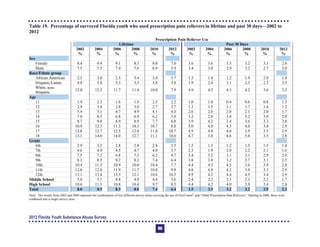
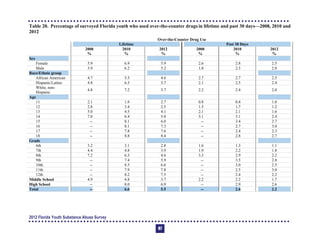
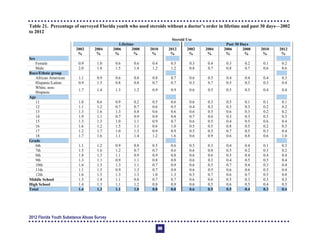
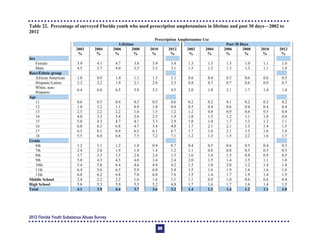
Substance Abuse Survey
State Report

Executive Office

of the Governor
2012 Florida
Youth Substance
Abuse Survey
©2013 Florida Department of Children & Families
2012 Florida Youth 

Substance Abuse 

Survey

January 2013
Florida Department
of Education
Prepared by:
Rothenbach Research and Consulting, LLC,
in consultation with the Florida Department of Children &
Families Substance Abuse & Mental Health Program Office
FLORIDA ALCOHOL & DRUG ABUSE ASSOCIATION, INC.
This survey was funded by a Substance Abuse Prevention and Treatment
Block Grant to the State of Florida.
Acknowledgements
The thirteenth annual administration of the Florida Youth Survey was completed in the spring of 2012. The Florida
Departments of Children and Families, Health, Education, and Juvenile Justice worked together to ensure the
success of this project.
We were extremely fortunate to have more than 70,000 students from 746 schools complete the Florida Youth
Substance Abuse Survey (FYSAS). We are grateful to the remarkable young people who joined this survey effort, and
would like to thank their parents for allowing them to participate. The information obtained as a result of their
honesty has proven to be invaluable. This knowledge will lead and guide our efforts to ensure that Florida’s
students, their parents, and their communities receive the tools they need to prevent alcohol, tobacco, or other drug
use and related problem behaviors, as well as establishing effective substance abuse treatment services.
We are grateful and appreciate those school district and school building administrators and their staff who provided
access to students. Clearly, their commitment to the well-being of students was demonstrated in their enthusiasm,
promptness, and dependability in completing the survey. We also greatly appreciate the school survey coordinators
and County Health Department Tobacco Prevention Coordinators for being instrumental in handling the
administrative details of the survey. Their hard work and dedication was critical in ensuring that the survey was
administered in a precise and efficient manner.
A great deal of thanks is owed to the outstanding leadership of this survey effort: Governor Rick Scott; Gerard
Robinson, Commissioner of Education; Florida Surgeon General, H. Frank Farmer, Jr., MD, PhD, FACP; David E.
Wilkins, Secretary of Children and Families. It is their tireless commitment to science-based research that made this
effort possible. We look forward to constructing a genuine picture of substance abuse among adolescents including
why they use, how to prevent this use, and the best methods of intervention.
Special thanks to Rothenbach Research and Consulting, LLC, for their outstanding work compiling this report
through exemplary professional data analysis. Their vision and expertise has brought a level of performance for
which we are exceedingly fortunate. We also recognize the efforts of ICF International, Inc., for their effective
oversight of the survey administration, data collection, and dataset preparation.
Each representative of the many agencies involved brought their knowledge and expertise to bear toward the success
of this effort. We are very pleased at the level of cooperation and sharing of information, time, funds, and effort.
2012 Florida Youth Survey Workgroup Members
Department of Children and Families 

Substance Abuse Program Office

Stephenie W. Colston	 Kim Munt
Director of Substance Abuse & Mental Health	 Prevention Team Research Coordinator
Program Office
Linda B. Loy
Darran Duchene 	 Research Associate, Florida
Chief of Substance Abuse Services	 Youth Substance Abuse Survey
Hal Johnson
Managing Epidemiologist
Department of Education
Joseph Davis Brooks Rumenik
Chief, Family and Community Outreach Director, Office of Safe Schools
Antionette Meeks, Program Specialist, Penny Detscher
Coordinated School Health Program Director, Office of Healthy Schools
Skip Forsyth
Program Specialist
Homeless Education Program
Department of Health
Meredith Jagger
Florida Youth Survey Coordinator 	 Gregg Smith
Program Administrator, Division of Health Access
Youjie Huang 	 and Tobacco
Chronic Disease Epidemiologist, Bureau of
Epidemiology	 Carol Vickers, Nursing Consultant
Coordinated School Health Partnership
Lauren Porter, Program Evaluator
Bureau of Tobacco Free Florida
Department of Juvenile Justice
Nathan Epps
Government Operations Consultant III
Office of the Attorney General
Meena Harris
Gang and Prevention Program Coordinator
EXECUTIVE SUMMARY 

T
he Florida Legislature’s 1999 Drug Control Summit recommended the establishment of a multi-agency-directed,
county-level, statewide substance abuse survey. The Florida Youth Substance Abuse Survey (FYSAS) is
undertaken annually based on that recommendation. In 2012, four state agencies—the Departments of Children
and Families, Health, Education, and Juvenile Justice—under the leadership of the Governor’s Office of Drug Control,
collaborated to administer the Florida Youth Tobacco Survey and the FYSAS. This high level of interagency
collaboration is significant, and has become known as the “Florida Model” for other states to follow in planning and
implementing their own surveys.
The FYSAS, the focus of this report, was administered to 70,859 students in grades 6 through 12 in the spring of 2012.
Across Florida, 417 middle schools and 329 high schools supported the FYSAS by providing access to their students. The
results of this survey effort supply a valuable source of information to help reduce and prevent the use of alcohol,
tobacco and other drugs by school-aged youth.
More than Drug Use Prevalence Rates
The FYSAS is based on the Communities That CareYouth Survey, developed from the nationally recognized work of Dr.
J. David Hawkins and Dr. Richard F. Catalano. Dr. Hawkins and Dr. Catalano are experts in identifying risk factors
related to alcohol, tobacco, other drug (ATOD) use and delinquent behavior—and in identifying protective factors that
guard against these behaviors. By administering the FYSAS, Florida can determine the levels of risk and protective
factors faced by its youth and correlate those levels to ATOD use rates. Thus, those factors that contribute to or protect
against drug use can be more accurately identified. A complete explanation of risk and protective factors is provided in
the body of this report.
Key Survey Results
Strengths to Build on
	 Participation was very strong at the school level, with only 40 schools out of 786 refusing to participate. Student
participation within surveyed schools was also impressive (80.3% in middle school and 76.1% in high schools).
This high level of participation generated a highly-representative statewide sample.
	 Among high school students, past-30-day prevalence rates for inhalants, club drugs, hallucinogens (LSD, PCP, or
mushrooms), and prescription amphetamines are 2% or less.
	 Among high school students, past-30-day prevalence rates for cocaine or crack cocaine, methamphetamine, 

heroin, and steroids are 1% or less.

	 Among the survey’s 11 measures of past-30-day ATOD use for which long-term trend data are available, all but
marijuana have shown reductions in prevalence of use from 2002 to 2012.
	 The percentage of Florida students using alcohol continues to decline. Between 2004 and 2012, past-30-day use
declined 8.0 percentage points among middle school students and 8.1 percentage points among high school
students.
	 Between 2006 and 2012, the prevalence of binge drinking declined 3.7 percentage points among middle school
students and 6.6 percentage points among high school students.
	 Florida students have reported notable reductions in past-30-day cigarette since 2002: 4.4 percentage points

among middle school students and 5.3 percentage points among high school students. 

2012 Florida Youth Substance Abuse Survey
	 Florida students reported a higher rate of marijuana use in 2010 compared to 2008. Data from the 2012 survey
show a reversal of this pattern, with middle school and high school past-30-day prevalence rates declining 1.5
and 0.1 percentage points, respectively.
	 Between 2004 and 2012, the past-30-day prevalence rate for inhalant use declined 2.8 percentage points among
middle school students and 0.8 percentage points among high school students.
	 Despite concerns about the possible spread of prescription drug abuse among Florida youth, past-30-day use of
any illicit drug other than marijuana dropped from 10.1% in 2002 to 8.2% in 2012.
	 Substantially fewer Florida students are initiating the use of cigarettes and alcohol at a young age. For example,
the number of high school students reporting early initiation of cigarette use (age 13 or younger) decreased from
31.4% in 2002 to 14.5% in 2012. Early initiation of regular alcohol use decreased from 7.3% in 2002 to 5.0% in
2012.
	 Compared to other ethnic groups, African American students reported low rates of past-30-day alcohol (17.4%),
cigarette (2.9%), and marijuana (10.1%) use, binge drinking (7.1%), and a low rate of using any illicit drug other
than marijuana in the past 30 days (6.7%).
	 Hispanic/Latino students reported past-30-day prevalence rates that were higher than African American students
but lower than White, non-Hispanic students for past-30-day alcohol (25.5%), cigarette (5.2%) and marijuana
(11.3%) use, and binge drinking (12.3%).
	 A majority of respondents reported that smoking one or more packs of cigarettes per day (68.3%) poses a “great
risk” of harm. Also, 50.9% reported that the regular use of marijuana poses “great risk” of harm, but this rate is
down from a high of 60.9% in 2004.
	 The percentage of students who believe it would be either “wrong” or “very wrong” to use cigarettes is 85.6%,
followed by marijuana (76.6%) and drinking alcohol regularly (70.4%). Disapproval of other illicit drug use
(“LSD, cocaine, amphetamines or another illegal drug”) was even higher, at 95.2%.
	 Relatively few students reported that they would be seen as “cool” by their peers if they smoked marijuana
(15.1%), drank alcohol regularly (11.4%) or smoked cigarettes (5.4%).
	 Florida students reported higher rates of protection for several factors. Among high school students, 61%
reported an elevated level of protection for Community Rewards for Prosocial Involvement, School Opportunities
for Prosocial Involvement and School Rewards for Prosocial Involvement. 59% reported an elevated level of
protection for and Religiosity. Among middle school students, 59% reported an elevated level of protection for
Family Opportunities for Prosocial Involvement.
	 Florida students reported low rates of risk for a number of factors. For example, 19% of middle school and 37%
of high school students reported an elevated level of risk for Parental Attitudes Favorable toward ATOD Use,
29% of middle school and 30% of high school students reported an elevated level of risk for Early Initiation of
Drug Use, and 23% of middle school and 34% of high school students reported an elevated level of risk for
Perceived Availability of Handguns.
	 Between 2002 and 2012, the number of students reporting an elevated level of protection for School Rewards for
Prosocial Involvement increased eight percentage points in middle school and 11 percentage points in high
school. Over this time period, high school students also reported an increase of six percentage points for School
Opportunities for Prosocial Involvement.
	 Several of the risk factor scales that are most proximately linked to ATOD use show impressive long-term
reductions (2002 to 2012). For example, the number of students reporting an elevated level of risk for Early
Initiation of Drug Use declined 20 percentage points among middle school students and 13 percentage points
among high school students, and the number reporting elevated risk for Favorable Attitudes toward ATOD Use
declined 13 percentage points among middle school students and four percentage points among high school
2012 Florida Youth Substance Abuse Survey
students. Perceived Availability of Drugs also declined 10 percentage points among middle schools students and
13 percentage points among high school students.
	 Among all surveyed students, 1.8% reported Attempting to Steal a Vehicle and 0.8% reported Taking a Handgun
to School.
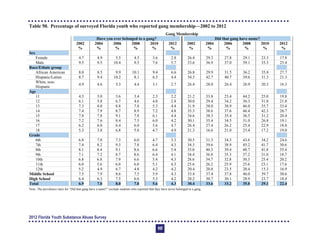
	 The prevalence rates for gang membership peaked in 2006, with 8.0% reporting having belonged to a gang. The
rate reported in 2012, 4.3%, is the lowest level of gang membership in the history of the FYSAS.
Opportunities for Improvement
	 Alcohol continues to be the most commonly used drug among Florida students. Across all seven surveyed grades,
47.3% reported lifetime use and 24.6% reported past-30-day use.
	 Nearly one in eight (11.3%) Florida high school students reported one or more occasions of binge drinking
(defined as the consumption of five or more drinks in a row) in the last two weeks. Also, 25.2% of high school
students reported consuming five or more drinks per day on the days they drank in the past 30 days.
	 After alcohol, students reported marijuana (23.2% lifetime and 12.4% past-30-day) and cigarettes (21.3% lifetime
and 6.6% past-30-day) as the most commonly used drugs.
	 As they did in 2010, middle school students reported a higher rate for past-30-day marijuana use (4.2%) than for
past-30-day cigarette use (2.7%). Among high school students, past-30-day marijuana use (18.5%) was notably
higher than cigarette use (9.6%).
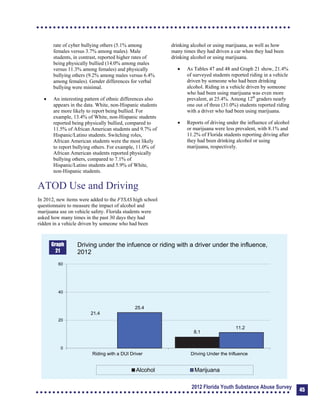
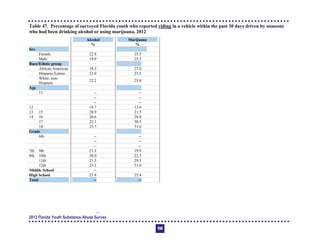
	 Among high school students, 21.4% reported riding in a vehicle driven by someone who had been drinking 

alcohol. Riding in a vehicle driven by someone who had been using marijuana was even more prevalent, at

25.4%.

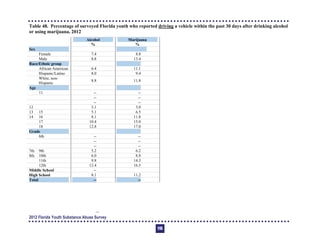
	 Among high school students, 8.1% and 11.2% reported driving when they had been drinking alcohol or using
marijuana, respectively.
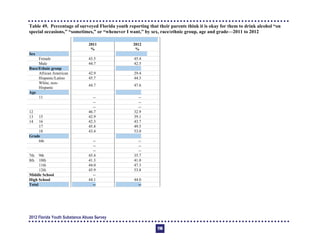
	 Among high school students, 44.0% reported that their parents think it’s okay for them to drink alcohol “on 

special occasions,” “sometimes,” or “whenever I want.”

	 New survey items measuring the use of synthetic marijuana were added in 2011. In 2011, only 3.3% of high
school students reported using synthetic marijuana in the past 30 days; however, between 2011 and 2012, both
lifetime and past-30-day rates increased 1.1 and 1.0 percentage points, respectively.
	 Past-30-day prevalence rates for the inappropriate use of prescription pain relievers (2.3%), over-the-counter
drugs (2.2%) and depressants (1.6%) are higher than for all other illicit drugs, except marijuana and inhalants.
	 Compared to other ethnic groups, White, non-Hispanic students reported higher rates of past-30-day alcohol
(27.6%), cigarette (9.1%) and marijuana (13.8%) use, and binge drinking (12.8%).
	 Among Florida high school students, 11.9% reported Getting Suspended and 11.2% reported Being Drunk or
High at School on at least one occasion within the past 12 months.
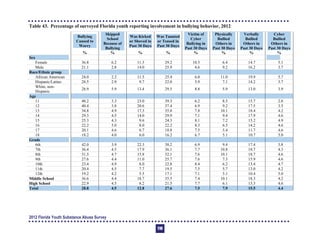
	 Students in the middle school grade levels were the most likely to report having been physically bullied within
the past 30 days (18.7%) and socially bullied within the past 30 days (35.5%). Cyber bullying within the past 30
days was reported by 7.4% of middle school students and 7.7% of high school students.
	 Florida students reported lower rates of protection for several scales. For example, 50% of middle school students
reported an elevated level of protection for School Opportunities for Prosocial Involvement and Religiosity.
2012 Florida Youth Substance Abuse Survey
Among high school students, the lowest protective factor scores were Family Rewards for Prosocial Involvement
(54%) and Religiosity (55%).
	 Florida students reported higher rates of risk for several factors. For example, 59% of middle school students and
62% of high school students reported an elevated level of risk for Transitions and Mobility, 48% of middle
school students and 46% of high school students reported an elevated level of risk for Lack of Commitment to
School, and 43% of middle school students and 53% of high school students reported an elevated level of risk for
Low Perceived Risks of Drug Use.
	 From 2002 to 2012, the prevalence rate for Religiosity declined two percentage points among middle school
students and four points among high school students. This was the largest long-term reduction among protective
factors. Middle school students also reported a two-point decline in Community Rewards for Prosocial
Involvement.
	 Only a few risk factor scales show meaningful increases between 2002 and 2012. Among high school students,
Low Perceived Risks of Drug Use increased eight percentage points, Peer Rewards for Antisocial Behavior
increased four percentage points and Community Disorganization increased three percentage points.
These key findings illustrate the complexity of drug use and antisocial behavior among Florida’s youth and the possible
factors that may contribute to these activities. While some of the findings compare favorably to the national findings,
Florida youth are still reporting drug use and delinquent behavior that will negatively affect their lives and our society.
The FYSAS data will enable Florida’s planners at the local, regional and state levels to learn which risk and protective
factors to target for their prevention, intervention and treatment programs.
2012 Florida Youth Substance Abuse Survey


Table of Contents 

SECTION 1: METHODOLOGY......................................................................................................................................1

THE SURVEY.....................................................................................................................................................................1

QUESTIONNAIRES .............................................................................................................................................................1

SAMPLING.........................................................................................................................................................................2

PARTICIPATION RATES .....................................................................................................................................................2

WEIGHTING ......................................................................................................................................................................3

SURVEY ADMINISTRATION ...............................................................................................................................................3

SURVEY VALIDATION.......................................................................................................................................................4

CONFIDENCE INTERVALS..................................................................................................................................................4

DEMOGRAPHIC PROFILE OF SURVEYED YOUTH................................................................................................................5

SECTION 2: ALCOHOL, TOBACCO AND OTHER DRUG USE ..............................................................................7

KEY ATOD FINDINGS ......................................................................................................................................................9

SUBGROUP ANALYSES....................................................................................................................................................11

ALCOHOL .......................................................................................................................................................................11

CIGARETTES ...................................................................................................................................................................12

MARIJUANA OR HASHISH ...............................................................................................................................................13

INHALANTS.....................................................................................................................................................................14

CLUB DRUGS ..................................................................................................................................................................15

OTHER ILLICIT DRUGS....................................................................................................................................................15

DRUG COMBINATION RATES ..........................................................................................................................................17

SECTION 3: OTHER ANTISOCIAL BEHAVIORS....................................................................................................21

CARRYING A HANDGUN..................................................................................................................................................21

SELLING DRUGS .............................................................................................................................................................21

ATTEMPTING TO STEAL A VEHICLE ................................................................................................................................21

BEING ARRESTED ...........................................................................................................................................................22

TAKING A HANDGUN TO SCHOOL ...................................................................................................................................22

GETTING SUSPENDED .....................................................................................................................................................22

2012 Florida Youth Substance Abuse Survey


ATTACKING SOMEONE WITH INTENT TO HARM ..............................................................................................................23

BEING DRUNK OR HIGH AT SCHOOL ...............................................................................................................................23

SECTION 4: RISK AND PROTECTIVE FACTORS ..................................................................................................25

THE SOCIAL DEVELOPMENT STRATEGY .........................................................................................................................25

MEASUREMENT ..............................................................................................................................................................26

PREVENTION PLANNING WITH RISK AND PROTECTIVE FACTOR DATA............................................................................27

PROTECTIVE FACTORS—DETAILED RESULTS.................................................................................................................31

RISK FACTORS— DETAILED RESULTS............................................................................................................................33

SECTION 5: SPECIAL TOPICS....................................................................................................................................39

EARLY INITIATION OF ATOD USE..................................................................................................................................39

PERCEIVED RISK OF HARM .............................................................................................................................................40

PERSONAL DISAPPROVAL ...............................................................................................................................................41

PEER APPROVAL .............................................................................................................................................................42

PARENTAL DISAPPROVAL OF ALCOHOL USE ..................................................................................................................43

EXTRACURRICULAR ACTIVITIES.....................................................................................................................................43

BULLYING BEHAVIOR.....................................................................................................................................................44

ATOD USE AND DRIVING ..............................................................................................................................................45

GANG MEMBERSHIP .......................................................................................................................................................46

APPENDIX A: COUNTY-LEVEL RESULTS ..............................................................................................................47

CONFIDENCE INTERVALS ................................................................................................................................................47

APPENDIX B: DETAILED TABLES ............................................................................................................................67

APPENDIX C: THE SOCIAL DEVELOPMENT STRATEGY................................................................................129

APPENDIX D: REFERENCES.....................................................................................................................................131

2012 Florida Youth Substance Abuse Survey
Section 1: Methodology
Section 1
Methodology
T
he survey effort was sponsored by the Florida
Department of Children and Families (DCF), and
directed by a multi-agency workgroup consisting
of the Departments of Education, Health, and Juvenile
Justice. The participation of local schools across the state
of Florida was critical to the success of this project. This
report was prepared by Rothenbach Research and
Consulting, LLC. The survey data were collected in
February and March of 2012. An electronic version of
this report as well as previous FYSAS reports can be
accessed at this website:
www.dcf.state.fl.us/mentalhealth/publications/fysas.
The 2012 survey represents the thirteenth data-collection
wave of the project. The FYSAS was previously
administered to Florida students in December and
January of 2000, in March and April of 2001-2010, and
in February and March of 2011. Detailed findings for
these 12 survey efforts can be found in the annual FYSAS
reports. While the questionnaire has been updated over
this period, these changes were designed to maintain
methodological consistency across survey years. As a
result, the present report includes both current survey
results and comparisons with previous waves of the
FYSAS.
The Survey
The Communities That Care Youth Survey served as the
basis for the 2012 FYSAS. The Communities That Care
Youth Survey is based on the work of Dr. J. David
Hawkins and Dr. Richard F. Catalano. It was developed
to provide scientifically sound information to state-level
and community-level prevention planners and policy
makers. It assesses the current prevalence of problem
behaviors such as alcohol, tobacco and other drug
(ATOD) use and other delinquent behaviors in the
surveyed population. The survey also measures the
degree to which risk and protective factors exist in the
community, family, school, and peer and individual
environments. This information is essential to support
needs assessment, prevention planning, and intervention
planning at the state and local levels. Risk and protective
factors are characteristics of the community, family,
school and peer environments, as well as individual
characteristics of the students themselves, that are known
to predict drug use, delinquency and gang involvement
(Hawkins, Catalano & Miller, 1992).
The Communities That Care Youth Survey was
developed from research funded by the Center for
Substance Abuse Prevention of the U.S. Department of
Health and Human Services. This student survey
measures the following items:
	 the prevalence and frequency of drug use,
	 the prevalence and frequency of other antisocial
behaviors, and
	 the degree to which risk and protective factors
exist that can predict ATOD use, delinquency,
gang involvement and other problem behaviors in
adolescents.
When the survey was originally developed, data were
collected in five states: Kansas, Maine, Oregon, South
Carolina and Washington. Over 72,000 students
participated in these statewide surveys, and analysis of
the collected data contributed to the development of the
survey. Three articles (Pollard, Hawkins & Arthur, 1999;
Arthur, Hawkins, Pollard, Catalano & Baglioni, 2002;
Glaser, Van Horn, Arthur, Hawkins & Catalano, 2005)
describe the Communities That Care Youth Survey, its
uses and its ongoing development.
National normative data for the Communities That Care
Youth Survey come from a more recent set of survey
efforts. These surveys, which were conducted in 2000,
2001 and 2002, include responses from 280,000 students
in grades 6 through 12. (See Section 4 for additional
information.)
Questionnaires
In 2008, two versions of the questionnaire were
administered to Florida students. High school students
received a questionnaire identical to the one used in the
2006 FYSAS. Middle school students received a
2012 Florida Youth Substance Abuse Survey 1
shortened version of the questionnaire. This new
questionnaire made it easier for students with weaker
reading skills to complete the survey within a standard
classroom period. As a result, eight risk factor scales and
four protective factor scales deemed less-critical for
prevention planning were no longer included in middle
school FYSAS data. Also, several ATOD items with very
low prevalence rates were either removed or aggregated.
For the 2010 FYSAS, the length of middle school
questionnaire was further reduced. Eleven items that
provided limited value to state-level and county-level
prevention planning efforts were removed. These
included questions about adults in student's
neighborhoods, questions about antisocial behavior
among siblings and other family members, and questions
about peer antisocial behavior. These changes resulted in
a more compact set of six protective factors and 15 risk
factors.
Also in 2010, the high school questionnaire received an
extensive update. This year, high school students
received the same questionnaire as Florida middle school
students, with the addition of items addressing bullying
behavior, gang activity in schools and alcohol use.
Results for these new items are presented in Tables 50 to
56. The new, shorter high school questionnaire eased the
survey administration burden in classrooms and boosted
completion rates.
In 2011, the FYSAS middle school questionnaire was
unchanged. The high school questionnaire added two
items addressing the use of synthetic marijuana, an item
assessing parental disapproval of youth alcohol use, and
an item addressing peer approval of gang membership.
For 2012, the FYSAS middle school questionnaire
remained unchanged. The high school questionnaire
added four items addressing ATOD use and vehicle
safety and one item addressing the risk associated with
prescription drug abuse. A block of items addressing
bullying location were removed.
Sampling
The goal of the 2012 FYSAS was to produce both state-
level statistical estimates that are representative of
individual grades, and county-level statistical estimates
that are representative of middle school (grades 6-8) and
high school (grades 9-12) grade aggregates. To
accomplish this, a stratified, two-stage cluster sample of
students attending public middle schools and high
schools in Florida was used.
The sample was stratified by county. In the first selection
stage, separate groups of middle schools (grades 6-8) and
high schools (grades 9-12) were randomly selected
within each of the 66 Florida counties that participated in
the survey. (Osceola County did not participate.) All
public middle and high schools were included in the
sampling frame for each county, with the exception of
adult education, correctional or special education
schools. The probability of selection for each school was
proportional to the size of the school’s enrollment.
Accordingly, larger schools had a higher chance of being
selected than smaller schools. Using this methodology,
440 middle schools and 346 high schools were selected
to participate.
For the second sampling stage, survey coordinators were
instructed on how to randomly select classrooms to
fulfill the survey quota for each school. Because special
education and ESOL (English for speakers of other
languages) classes could not be used in the survey, they
were not included in the classroom selection list for each
school.
This sample design, which is similar to the one used in
the 2000, 2002, 2004, 2006, 2008 and 2010 FYSAS, is
different from the design used in the 2001, 2003, 2005,
2007, 2009 and 2011 FYSAS. In odd-numbered years, the
goal of the survey is to produce results that are
representative at the state level only, but not at the
county level. Consequently, sample sizes were much
smaller in those years (8,281 in 2001, 7,983 in 2003,
8,501 in 2005, 8,434 in 2007, 11,166 in 2009 and 11,491
in 2011). In this report, historical results are only
presented for even-numbered years, starting with the
2002 FYSAS. This is done because statistical estimates
from these larger samples are more accurate than
estimates produced by the smaller samples from odd-
numbered years. Historical data from 2000 were omitted
because that year’s survey was administered in the fall
semester rather than the spring.
Participation Rates
Participation rates were calculated separately for both
schools and students as a ratio of the number
participating divided by the number selected. A
combined participation rate consists of the two separate
school and student participation rates multiplied by each
other.
Middle School:
School Participation: 417 / 440 = 94.8%
Student Participation: 38,742 / 48,264 = 80.3%
2
2012 Florida Youth Substance Abuse Survey
Overall Participation: 76.1%
High School:
School Participation: 329 / 346 = 95.1%
Student Participation: 36,154 / 47,516 = 76.1%
Overall Participation: 72.4%
Participation was strong at the school level, with only 40
schools out of 786 refusing to participate. Student
participation within surveyed schools was also
impressive. This level of participation builds upon the
FYSAS track record of obtaining highly-representative
statewide student samples. It is also a testament to the
outstanding work performed by the survey planners and
coordinators who support FYSAS administration at the
county and school levels.
Weighting
Before analysis, a set of statistical weights was applied to
the 2012 FYSAS dataset. The application of the weights
served three purposes:
	 First, weighting compensates for certain elements
of the sample design—such as the sampling of
students in clusters—so that the sample selection
probability for each student was equal.
	 Second, weighting adjusts for nonresponse at
both the school and classroom levels.
	 Third, weighting adjusts the distribution of the
sample across grade levels, gender groups and
counties to match the distribution across the full
population of Florida public school students.
Through this process, responses from the grades,
gender groups and counties that were
underrepresented relative to the population are
given more weight in the data analysis, while
responses from the grades, gender groups and
counties that were overrepresented are given less
weight. This creates a sample that proportionately
matches student enrollments across grade, gender
and county. The step, called post-stratification, is
important because variations in participation
across grade levels are common with statewide,
school-based survey projects like the FYSAS.
Post-stratification makes the sample more
representative of the population, and improves
the comparability of samples over time.
A number of factors were involved in the calculation of
the weights. Students were asked to provide their grade
and gender. If grade was left blank, and age was known,
the grade was imputed based on the most likely age for
that grade. Where the grade was still missing, the grade
was imputed by sorting students by their survey
booklet’s serial number and assigning the student to the
grade of the previous student who had been assigned a
grade. State totals for grade and gender categories were
obtained from the Florida Department of Education.
The weight of a respondent was the product of eight
adjustments:
W 1 = Inverse of the probability of selection of the school
and level.
W 2 = Adjustment for school nonresponse. This was
obtained after dividing the schools into enrollment
groups and adjusting for the number of schools in each
group refusing.
W 3 = Sampling interval. This was obtained by dividing
the enrollment by the target sample for the school.
W 4 = Adjustment for class nonresponse (entire class not
responding). If n classes were selected in the school and
k participated in the survey, W 4 = (n/k).
W 5 = Adjustment for the number of different surveys
administered.
W 6 = Adjustment to class size. This was the number of
students enrolled in a class divided by the number of
students completing the survey.
W7 = Adjustment for post-stratification.
W8 = Adjustment for trimming (setting weights greater
than twice the median for LEA /level to twice the median
and adjusting to obtain the same totals.). W8 is the sum of
the uncapped weights divided by the sum of the capped
weights.
Weight = W1 x W2 x W3 x W4 x W5 x W6 x W7 x W8
Survey Administration
Survey plans called for participation of 6th
through 12th
graders in the state of Florida. Survey administration
procedures were the same as those used in previous
waves of the FYSAS and were standardized throughout
the state. Each teacher received an appropriate number of
surveys and survey collection envelopes. Teachers
reviewed the instructions with their students and asked
them to complete the survey. Students had 50 minutes to
complete the surveys.
2012 Florida Youth Substance Abuse Survey 3
A passive consent procedure was used by most school
districts for this survey administration. That is, students
were given the consent notification and were asked to
give it to their parents. It was then up to the parents to
notify the school if they did not want their child to
participate in the survey.
Students were asked to complete the survey, but were
also told that they could skip any question that they were
not comfortable answering. Additionally, both the
teacher and the written instructions on the front of the
survey form assured students that participation in the
survey was voluntary, and that the answers students gave
would be anonymous and confidential.
There were no known irregularities in survey
administration. All aspects of the survey protocol
appeared to be appropriately implemented, including all
protections of student confidentiality.
Please note that administration for the 2012 FYSAS took
place in February and March. While this date range
matches the administration period of the 2011 survey,
data collection for the 2002-2010 FYSAS was conducted
in March and April. This change was necessary in order
to support the state’s standardized testing schedule.
FYSAS data users should consider this change when
comparing 2011 and 2012 results with earlier findings.
Due to the earlier administration period, student
behaviors and attitudes that are positively correlated with
age, such as ATOD use, are likely to have slightly lower
prevalence rates.
Survey Validation
A total yield of 74,896 students participated in the 2012
FYSAS. Of these, 275 students were removed for being
sampled out of level. Data for the remaining 74,621
students were subjected to five response validation
testing strategies. The first two strategies eliminated
students who appeared to exaggerate their drug use and
other antisocial behavior. The third strategy eliminated
students who reported use of a fictitious drug. The fourth
strategy eliminated the surveys of students who
repeatedly reported logically inconsistent patterns of
drug use. The fifth strategy eliminated students who
answered less than 25% of the questions on the survey.
In the first strategy, surveys from students who reported
a combined average of four or more daily uses for illicit
drugs other than marijuana were eliminated from the
survey dataset. This strategy removes surveys that are
not taken seriously.
The second strategy supplements the drug use
exaggeration test by examining the frequency of five
other antisocial behaviors: Attacking Someone with
Intent to Harm, Attempting to Steal a Vehicle, Being
Arrested, Getting Suspended and Taking a Handgun to
School. Respondents who reported an unrealistically high
frequency of these behaviors—more than 120 instances
within the past year—were removed from the analysis.
In the third strategy, students were asked if they had used
a fictitious drug, Derbisol, in the past 30 days or in their
lifetimes. If students reported the use of Derbisol for
either of these time periods, their surveys were not
included in the analysis of the findings.
The fourth strategy was used to detect logical
inconsistencies among responses to the drug-related
questions. Students were identified as inconsistent
responders in the following circumstances only: (1) if
they were inconsistent on two or more of the following
four drugs: alcohol, cigarettes, smokeless tobacco and
marijuana; or (2) if they were inconsistent on two or
more of the remaining drugs. An example of an
inconsistent response would be if a student reported that
he or she had used alcohol three to five times in the past
30 days but had never used alcohol in his or her lifetime.
For the fifth strategy, students who answered less than
25% of the questions on the survey were removed from
the analysis. This test is used to identify students who did
not take the survey seriously or were incapable of fully
participating.
Florida students were cooperative and produced a high
percentage of valid surveys. All but 3,762 students (5.0%
of 74,621) completed valid surveys. Of the 3,762 surveys
identified and eliminated by one or more of the five
strategies described above, 1,639 exaggerated drug use
(strategy 1), 845 exaggerated other antisocial behavior
(strategy 2), 2,521 reported the use of the fictitious drug
(strategy 3), 1,642 responded in a logically inconsistent
way (strategy 4) and 516 answered fewer than 25% of
the questions on the survey (strategy 5). The elimination
total produced by these five strategies equals more than
3,762 because a number of respondents were identified
by more than one strategy.
Confidence Intervals
The maximum 95% confidence intervals for grade-level
estimates range from a low of ±1.2 percentage points for
the 6th
, 7th
, and 8th
grade subsamples, to a high of ±1.7
percentage points for the 12th
grade subsample. For the
middle school and high school subsamples confidence
intervals are ±0.7 and ±0.8 percentage points,
4
2012 Florida Youth Substance Abuse Survey
respectively. Estimates for the overall sample have
confidence intervals of ±0.5 percentage points.
Confidence intervals are larger for demographic groups
with smaller sample sizes, such as African American
students.
Note that these confidence intervals are for prevalence
rates of 50%. For less prevalent behaviors, such as heroin
use and taking a handgun to school, the confidence
interval narrows substantially. Also note that the
variance estimates used for these confidence interval
calculations include a design effect of 2.0 to adjust for
the complex design of the 2011 FYSAS sample. A finite
population adjustment was not included in the
confidence interval formula.
Demographic Profile of
Surveyed Youth
The survey measures a variety of demographic
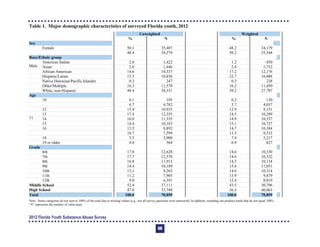
characteristics. The first two data columns of Table 1
describe the demographic profile of the sample before
weights were applied.
Middle school students constituted more than one half of
the unweighted sample (52.4%). A slightly higher
percentage of the respondents were female (50.1%
female versus 48.4% male). Slightly more than one third
of surveyed students identified themselves as White,
non-Hispanic (48.4%), followed by Hispanic/Latino
(15.3%) and African American (14.6%). The rest of the
ethnic breakdown ranges from 0.3% for Native
Hawaiian/Pacific Islander to 16.3% for students who
indicated Other/Multiple ethnic backgrounds.
Throughout this report, data are reported only on the
three largest ethnic groups: White, non-Hispanic, African
American and Hispanic/Latino, as the sample sizes for
the other ethnic categories were insufficient to generate
reliable estimates.
The second set of data columns in Table 1 presents the
demographic profile information after the weighting
formula has been applied. Note that the distribution
across grades is now correctly balanced and matches the
population parameters provided by the Florida
Department of Education (43.5% middle school and
56.5% high school).
2012 Florida Youth Substance Abuse Survey 5
Section 2: Alcohol, Tobacco and Other Drug Use
Section 2
Alcohol, Tobacco and Other Drug Use
A
lcohol, tobacco and other drug (ATOD) use is
measured by a set of 29 items. While most of
these items are identical to those used in the
previous waves of the survey, several key changes have
been made as the FYSAS questionnaires have been
updated over time.
Starting in 2001, the survey included items measuring:
(a) the use of so-called “club drugs” such as Ecstasy,
GHB, ketamine and Rohypnol, (b) the use of
hallucinogenic mushrooms, and (c) the use of
amphetamines, including Ritalin®
and Adderall®
, without
a doctor’s orders. In addition, the use of marijuana and
the use of hashish were combined into a single item, and
the use of “LSD and other psychedelics” was reworded
to read “LSD or PCP.” Also starting in 2001, a
parenthetical mentioning the street names “ice” and
“crystal meth” was added to the methamphetamine item.
In 2002, the prescription drug Xanax®
was added to the
list of examples given in the “depressants and downers”
item, and the “other narcotics” item was replaced by a
new question measuring the use of “prescription pain
relievers” without a doctor’s orders.
Three changes were made to the ATOD section in 2002:
(a) a new item measuring the use of OxyContin®
without
a doctor’s orders, (b) the prescription drug Xanax®
was
added to the list of examples given in the “depressants
and downers” question, and (c) the “other narcotics” item
was replaced by a new question measuring the use of
“prescription pain relievers” without a doctor’s orders.
On the 2006 questionnaire, OxyContin®
was removed as
an individual item and added to the list of examples
included in the prescription pain reliever item. Also, the
question for GHB was changed to include a more up-to­
date set of slang or street names for the drug.
In 2008, the questionnaire administered to high school
students remained unchanged, but the ATOD section of
the middle school questionnaire reduced the number of
items by asking broader categories of ATOD use rather
than only asking about individual drugs. The updated
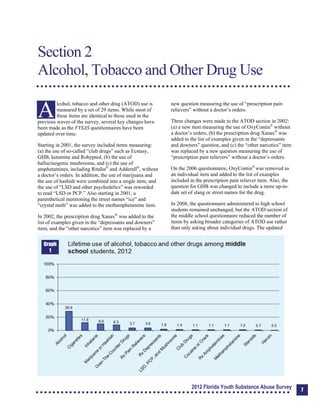
Graph
1
2012 Florida Youth Substance Abuse Survey 7
middle school questionnaire also introduced an important
new category of ATOD use to the FYSAS. A description
of these changes is below:
	 Items for smokeless tobacco were removed.
	 Items for the club drugs Ecstasy, GHB, ketamine
and Rohypnol were replaced by single items that
ask about the use of “club drugs such as Ecstasy,
Rohypnol, GHB or ketamine.”
	 Items for LSD/PCP and hallucinogenic
mushroom use were combined into a pair of
single items that ask about all three drugs.
	 Items for cocaine and crack cocaine use were
combined into a pair of single items that ask
about both drugs.
	 Items that measure the use of over-the-counter
drugs in order to get high were added.
For 2010, the ATOD prevalence section of the middle
school questionnaire remained unchanged. The high
school questionnaire, however, adopted all of the middle
school ATOD prevalence items. As a result, this year’s
middle school and high school FYSAS questionnaires
employ the same 29-item ATOD prevalence
measurement section. In addition to facilitating
comparisons between middle school and high school
ATOD results, these changes improve completion rates
Graph
2
by shortening the length of the high school questionnaire.
In 2011, two items measuring the use of synthetic
marijuana were added to the high school questionnaire.
The middle school questionnaire remained unchanged.
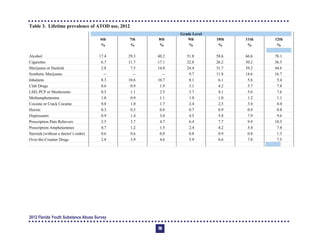
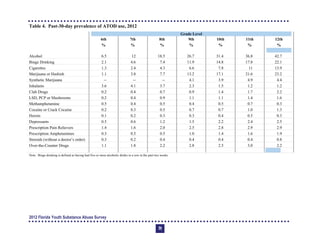
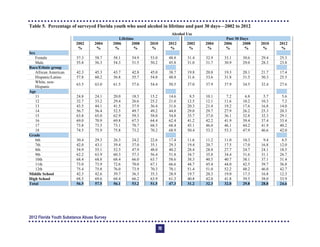
Tables 3 through 27 in Appendix A show the use of
ATODs by students in Florida In addition to results from
this year’s survey, data are also presented for the 2002,
2004, 2006, 2008 and 2010 FYSAS. There are two ways
in which data that depict student involvement in ATOD
use are provided.
First, prevalence rates are used to illustrate the
percentage of students who reported using a drug at least
once in a specified time period. These results are
presented for both lifetime and past-30-day prevalence-
of-use periods. Lifetime prevalence of use (whether the
student has ever used the drug) is a good measure of
student experimentation. Past-30-day prevalence of use
(whether the student has used the drug within the last
month) is a good measure of current use. Prevalence-of­
use rates are also presented for five combinations of licit
and illicit drugs. Trend data for these combination
measures start in 2002 because new ATOD items were
added between 2000 and 2002. In addition to the
standard lifetime and past-30-day prevalence rates for
alcohol use, binge drinking behavior (defined as a report
of five or more drinks in a row within the past two
weeks) is also measured.
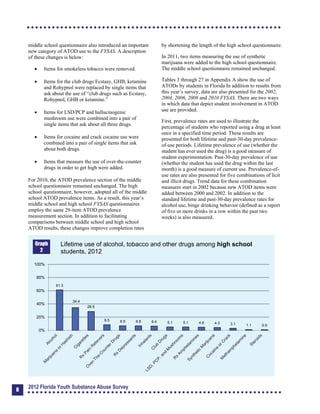
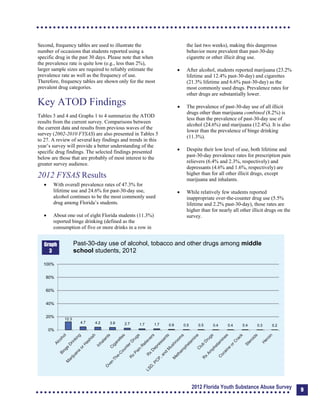
Lifetime use of alcohol, tobacco and other drugs among high school
students, 2012
100%
80%
60%
40%
20%
0%
61.3
34.4
28.5
8.5 6.9 6.8 6.4 5.1 5.1 4.8 4.3 3.1 1.1 0.9
8
2012 Florida Youth Substance Abuse Survey
Second, frequency tables are used to illustrate the
number of occasions that students reported using a
specific drug in the past 30 days. Please note that when
the prevalence rate is quite low (e.g., less than 2%),
larger sample sizes are required to reliably estimate the
prevalence rate as well as the frequency of use.
Therefore, frequency tables are shown only for the most
prevalent drug categories.
Key ATOD Findings
Tables 3 and 4 and Graphs 1 to 4 summarize the ATOD
results from the current survey. Comparisons between
the current data and results from previous waves of the
survey (2002-2010 FYSAS) are also presented in Tables 5
to 27. A review of several key findings and trends in this
year’s survey will provide a better understanding of the
specific drug findings. The selected findings presented
below are those that are probably of most interest to the
greater survey audience.
2012 FYSAS Results
	 With overall prevalence rates of 47.3% for
lifetime use and 24.6% for past-30-day use,
alcohol continues to be the most commonly used
drug among Florida’s students.
	 About one out of eight Florida students (11.3%)
reported binge drinking (defined as the
consumption of five or more drinks in a row in
Graph
3
100%
80%
60%
40%
20%
0%
the last two weeks), making this dangerous
behavior more prevalent than past-30-day
cigarette or other illicit drug use.
	 After alcohol, students reported marijuana (23.2%
lifetime and 12.4% past-30-day) and cigarettes
(21.3% lifetime and 6.6% past-30-day) as the
most commonly used drugs. Prevalence rates for
other drugs are substantially lower.
	 The prevalence of past-30-day use of all illicit
drugs other than marijuana combined (8.2%) is
less than the prevalence of past-30-day use of
alcohol (24.6%) and marijuana (12.4%). It is also
lower than the prevalence of binge drinking
(11.3%).
	 Despite their low level of use, both lifetime and
past-30-day prevalence rates for prescription pain
relievers (6.4% and 2.3%, respectively) and
depressants (4.6% and 1.6%, respectively) are
higher than for all other illicit drugs, except
marijuana and inhalants.
	 While relatively few students reported
inappropriate over-the-counter drug use (5.5%
lifetime and 2.2% past-30-day), those rates are
higher than for nearly all other illicit drugs on the
survey.
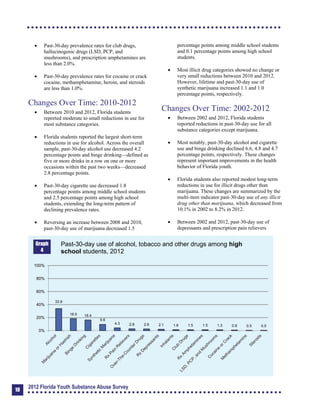
Past-30-day use of alcohol, tobacco and other drugs among middle
school students, 2012
12.3
4.7 4.2 3.8 2.7 1.7 1.7 0.8 0.5 0.5 0.4 0.4 0.4 0.3 0.2
2012 Florida Youth Substance Abuse Survey 9
	 Past-30-day prevalence rates for club drugs,
hallucinogenic drugs (LSD, PCP, and
mushrooms), and prescription amphetamines are
less than 2.0%.
	 Past-30-day prevalence rates for cocaine or crack
cocaine, methamphetamine, heroin, and steroids
are less than 1.0%.
Changes Over Time: 2010-2012
	 Between 2010 and 2012, Florida students
reported moderate to small reductions in use for
most substance categories.
	 Florida students reported the largest short-term
reductions in use for alcohol. Across the overall
sample, past-30-day alcohol use decreased 4.2
percentage points and binge drinking—defined as
five or more drinks in a row on one or more
occasions within the past two weeks—decreased
2.8 percentage points.
	 Past-30-day cigarette use decreased 1.8
percentage points among middle school students
and 2.5 percentage points among high school
students, extending the long-term pattern of
declining prevalence rates.
	 Reversing an increase between 2008 and 2010,
past-30-day use of marijuana decreased 1.5
Graph
4
percentage points among middle school students
and 0.1 percentage points among high school
students.
	 Most illicit drug categories showed no change or
very small reductions between 2010 and 2012.
However, lifetime and past-30-day use of
synthetic marijuana increased 1.1 and 1.0
percentage points, respectively.
Changes Over Time: 2002-2012
	 Between 2002 and 2012, Florida students
reported reductions in past-30-day use for all
substance categories except marijuana.
	 Most notably, past-30-day alcohol and cigarette
use and binge drinking declined 6.6, 4.8 and 4.7
percentage points, respectively. These changes
represent important improvements in the health
behavior of Florida youth.
	 Florida students also reported modest long-term
reductions in use for illicit drugs other than
marijuana. These changes are summarized by the
multi-item indicator past-30-day use of any illicit
drug other than marijuana, which decreased from
10.1% in 2002 to 8.2% in 2012.
	 Between 2002 and 2012, past-30-day use of

depressants and prescription pain relievers 

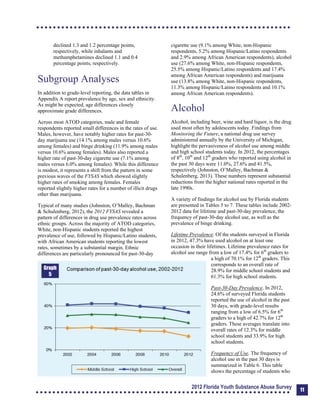
Past-30-day use of alcohol, tobacco and other drugs among high
school students, 2012
100%
80%
60%
40%
20%
0%
33.9
18.5 16.4
9.6
4.3 2.8 2.6 2.1 1.6 1.5 1.5 1.3 0.9 0.5 0.5
10
2012 Florida Youth Substance Abuse Survey
declined 1.3 and 1.2 percentage points,
respectively, while inhalants and
methamphetamines declined 1.1 and 0.4
percentage points, respectively.
Subgroup Analyses
In addition to grade-level reporting, the data tables in
Appendix A report prevalence by age, sex and ethnicity.
As might be expected, age differences closely
approximate grade differences.
Across most ATOD categories, male and female
respondents reported small differences in the rates of use.
Males, however, have notably higher rates for past-30­
day marijuana use (14.1% among males versus 10.6%
among females) and binge drinking (11.9% among males
versus 10.6% among females). Males also reported a
higher rate of past-30-day cigarette use (7.1% among
males versus 6.0% among females). While this difference
is modest, it represents a shift from the pattern in some
previous waves of the FYSAS which showed slightly
higher rates of smoking among females. Females
reported slightly higher rates for a number of illicit drugs
other than marijuana.
Typical of many studies (Johnston, O’Malley, Bachman
& Schulenberg, 2012), the 2012 FYSAS revealed a
pattern of differences in drug use prevalence rates across
ethnic groups. Across the majority of ATOD categories,
White, non-Hispanic students reported the highest
prevalence of use, followed by Hispanic/Latino students,
with African American students reporting the lowest
rates, sometimes by a substantial margin. Ethnic
differences are particularly pronounced for past-30-day
Graph
5
cigarette use (9.1% among White, non-Hispanic
respondents, 5.2% among Hispanic/Latino respondents
and 2.9% among African American respondents), alcohol
use (27.6% among White, non-Hispanic respondents,
25.5% among Hispanic/Latino respondents and 17.4%
among African American respondents) and marijuana
use (13.8% among White, non-Hispanic respondents,
11.3% among Hispanic/Latino respondents and 10.1%
among African American respondents).
Alcohol
Alcohol, including beer, wine and hard liquor, is the drug
used most often by adolescents today. Findings from
Monitoring the Future, a national drug use survey
administered annually by the University of Michigan,
highlight the pervasiveness of alcohol use among middle
and high school students today. In 2012, the percentages
of 8th
, 10th
and 12th
graders who reported using alcohol in
the past 30 days were 11.0%, 27.6% and 41.5%,
respectively (Johnston, O’Malley, Bachman &
Schulenberg, 2013). These numbers represent substantial
reductions from the higher national rates reported in the
late 1990s.
A variety of findings for alcohol use by Florida students
are presented in Tables 5 to 7. These tables include 2002­
2012 data for lifetime and past-30-day prevalence, the
frequency of past-30-day alcohol use, as well as the
prevalence of binge drinking.
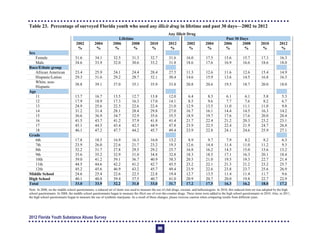
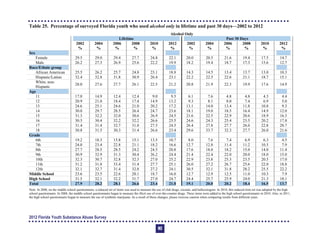
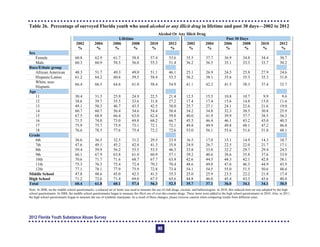
Lifetime Prevalence. Of the students surveyed in Florida
in 2012, 47.3% have used alcohol on at least one
occasion in their lifetimes. Lifetime prevalence rates for
alcohol use range from a low of 17.4% for 6th
graders to
a high of 70.1% for 12th
graders. This
corresponds to an overall rate of
28.9% for middle school students and
61.3% for high school students.
Past-30-Day Prevalence. In 2012,
24.6% of surveyed Florida students
reported the use of alcohol in the past
30 days, with grade-level results
ranging from a low of 6.5% for 6th
graders to a high of 42.7% for 12th
graders. These averages translate into
overall rates of 12.3% for middle
school students and 33.9% for high
school students.
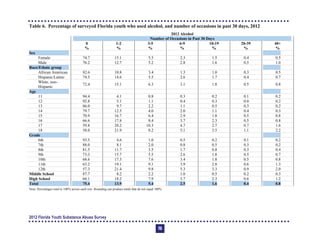
Frequency of Use. The frequency of
alcohol use in the past 30 days is
summarized in Table 6. This table
shows the percentage of students who
2012 Florida Youth Substance Abuse Survey 11
reported using alcohol on a specific number of occasions
in the past 30 days. Note that for this table, the number of
occasions of use has been aggregated into seven
categories: 0 occasions, 1-2 occasions, 3-5 occasions, 6-9
occasions, 10-19 occasions, 20-39 occasions and 40 or
more occasions. For instance, 18.2% of high school
students indicated that they had used alcohol 1-2 times in
the past month.
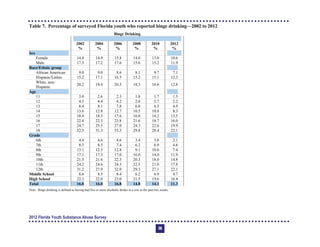
Binge Drinking. Findings on binge drinking (defined as
consuming five or more drinks in a row within the past
two weeks) are likely to be among the most important
findings related to alcohol use. As Table 7 shows, 11.3%
of Florida students reported binge drinking. The
prevalence rate for binge drinking ranges from a low of
2.1% for 6th
graders to a high of 22.1% for 12th
graders,
with averages of 4.7% for middle school students and
16.4% for high school students.
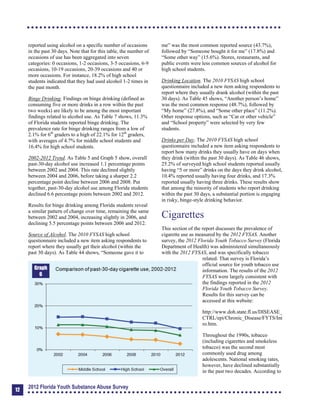
2002-2012 Trend. As Table 5 and Graph 5 show, overall
past-30-day alcohol use increased 1.1 percentage points
between 2002 and 2004. This rate declined slightly
between 2004 and 2006, before taking a sharper 2.2
percentage point decline between 2006 and 2008. Put
together, past-30-day alcohol use among Florida students
declined 6.6 percentage points between 2002 and 2012.
Results for binge drinking among Florida students reveal
a similar pattern of change over time, remaining the same
between 2002 and 2004, increasing slightly in 2006, and
declining 5.5 percentage points between 2006 and 2012.
Source of Alcohol. The 2010 FYSAS high school
questionnaire included a new item asking respondents to
report where they usually get their alcohol (within the
past 30 days). As Table 44 shows, “Someone gave it to
Graph
6
2012 Florida Youth Substance Abuse Survey
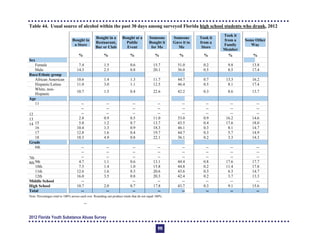
me” was the most common reported source (43.7%),
followed by “Someone bought it for me” (17.8%) and
“Some other way” (15.6%). Stores, restaurants, and
public events were less common sources of alcohol for
high school students.
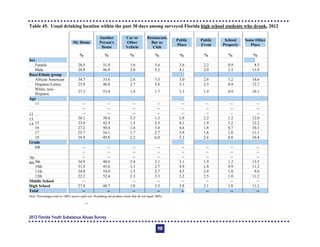
Drinking Location. The 2010 FYSAS high school
questionnaire included a new item asking respondents to
report where they usually drank alcohol (within the past
30 days). As Table 45 shows, “Another person’s home”
was the most common response (48.7%), followed by
“My home” (27.8%), and “Some other place” (11.2%).
Other response options, such as “Car or other vehicle”
and “School property” were selected by very few
students.
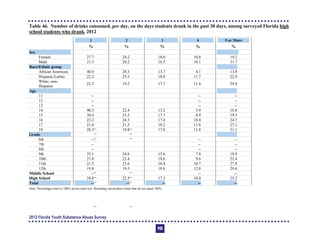
Drinks per Day. The 2010 FYSAS high school
questionnaire included a new item asking respondents to
report how many drinks they usually have on days when
they drink (within the past 30 days). As Table 46 shows,
25.2% of surveyed high school students reported usually
having “5 or more” drinks on the days they drink alcohol,
10.4% reported usually having four drinks, and 17.3%
reported usually having three drinks. These results show
that among the minority of students who report drinking
within the past 30 days, a substantial portion is engaging
in risky, binge-style drinking behavior.
Cigarettes
This section of the report discusses the prevalence of
cigarette use as measured by the 2012 FYSAS. Another
survey, the 2012 Florida Youth Tobacco Survey (Florida
Department of Health) was administered simultaneously
with the 2012 FYSAS, and was specifically tobacco
related. That survey is Florida’s
official source for youth tobacco use
information. The results of the 2012
FYSAS were largely consistent with
the findings reported in the 2012
Florida Youth Tobacco Survey.
Results for this survey can be
accessed at this website:
http://www.doh.state.fl.us/DISEASE_
CTRL/epi/Chronic_Disease/FYTS/Int
ro.htm.
Throughout the 1990s, tobacco
(including cigarettes and smokeless
tobacco) was the second most
commonly used drug among
adolescents. National smoking rates,
however, have declined substantially
in the past two decades. According to
12
data from the Monitoring the Future study, between 1991
and 2012 past-30-day cigarette use declined from 14.3%
to 4.9% among 8th
graders, from 20.8% to 10.8% among
10th
graders, and from 28.3% to 17.1% among 12th
graders (Johnston et al., 2013).
A variety of findings for cigarette use by Florida students
is presented in Table 8 and Graph 6. These include 2002­
2012 data for lifetime and past-30-day prevalence of
cigarette use.
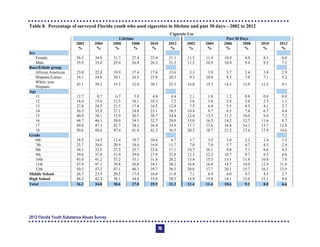
Lifetime Prevalence. Of the students surveyed in Florida
in 2012, 21.3% have smoked cigarettes on at least one
occasion in their lifetimes. Lifetime prevalence rates for
cigarette use range from a low of 6.7% for 6th
graders to
a high of 36.5% for 12th
graders. This corresponds to an
overall rate of 11.8% for middle school students and
28.5% for high school students.
Past-30-Day Prevalence. In 2012, 6.6% of surveyed
Florida students reported smoking cigarettes in the past
30 days, with grade-level results ranging from a low of
1.3% for 6th
graders to a high of 13.9% for 12th
graders.
These averages translate into overall scores of 2.7% for
middle school students and 9.6% for high school
students.
2002-2012 Trend. As Graph 6 shows, the past-30-day
prevalence rate for cigarettes remained unchanged
between 2002 and 2004, suggesting that the impressive
reductions recorded at the beginning of the decade had
played out. However, the next two survey waves
extended the downward trend from the beginning of the
decade, with the past-30-day prevalence rate dropping
from 11.4% in 2004 to 9.1% in 2008. Between 2008 and
2012, past-30-day use dropped another 2.5 percentage
Graph
7
points.
Marijuana or Hashish
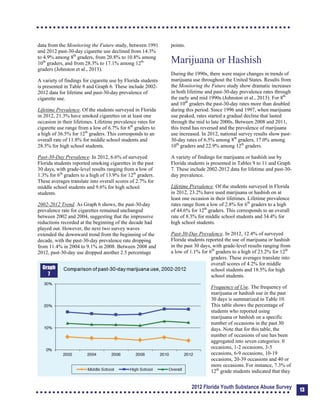
During the 1990s, there were major changes in trends of
marijuana use throughout the United States. Results from
the Monitoring the Future study show dramatic increases
in both lifetime and past-30-day prevalence rates through
the early and mid 1990s (Johnston et al., 2013). For 8th
and 10th
graders the past-30-day rates more than doubled
during this period. Since 1996 and 1997, when marijuana
use peaked, rates started a gradual decline that lasted
through the mid to late 2000s. Between 2008 and 2011,
this trend has reversed and the prevalence of marijuana
use increased. In 2012, national survey results show past-
30-day rates of 6.5% among 8th
graders, 17.0% among
10th
graders and 22.9% among 12th
graders.
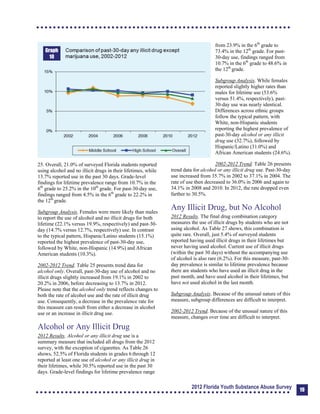
A variety of findings for marijuana or hashish use by
Florida students is presented in Tables 9 to 11 and Graph
7. These include 2002-2012 data for lifetime and past-30­
day prevalence.
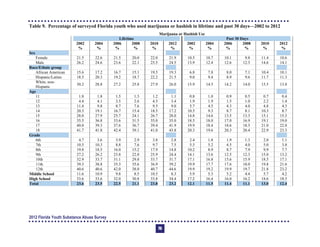
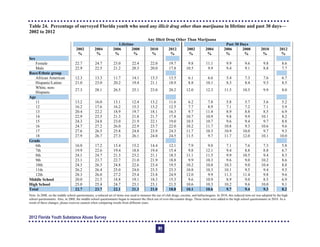
Lifetime Prevalence. Of the students surveyed in Florida
in 2012, 23.2% have used marijuana or hashish on at
least one occasion in their lifetimes. Lifetime prevalence
rates range from a low of 2.8% for 6th
graders to a high
of 44.6% for 12th
graders. This corresponds to an overall
rate of 8.3% for middle school students and 34.4% for
high school students.
Past-30-Day Prevalence. In 2012, 12.4% of surveyed
Florida students reported the use of marijuana or hashish
in the past 30 days, with grade-level results ranging from
a low of 1.1% for 6th
graders to a high of 23.2% for 12th
graders. These averages translate into
overall scores of 4.2% for middle
school students and 18.5% for high
school students.
Frequency of Use. The frequency of
marijuana or hashish use in the past
30 days is summarized in Table 10.
This table shows the percentage of
students who reported using
marijuana or hashish on a specific
number of occasions in the past 30
days. Note that for this table, the
number of occasions of use has been
aggregated into seven categories: 0
occasions, 1-2 occasions, 3-5
occasions, 6-9 occasions, 10-19
occasions, 20-39 occasions and 40 or
more occasions. For instance, 7.3% of
12th
grade students indicated that they
2012 Florida Youth Substance Abuse Survey 13
had used marijuana or hashish 1-2 times in the past
month.
2002-2012 Trend. As Graph 7 and Table 9 show, past-
30-day marijuana or hashish use across the overall
sample declined 0.6 percentage points from 2002 to
2004. Between 2004 and 2008, past-30-day marijuana or
hashish prevalence showed relatively little change, with
past-30-day use declining 0.9 percentage points among
middle school students and 0.2 percentage points among
high school students. Between 2008 and 2012, past-30­
day use of marijuana decreased 0.2 percentage points
among middle school students and increased 1.3
percentage points among high school students.
Synthetic Marijuana. Blends of herbs and synthetic
chemical compounds designed to produce a marijuana-
like high have become more popular in recent years.
Often marketed as “herbal incense” under brand names
like “K2” and “Spice,” synthetic marijuana can be
purchased legally in many states. While little is known
about the risks associated with synthetic marijuana, the
medical community has issued warnings about health and
behavior problems associated with its use.
As Table 11 shows, 13.0% of Florida high school
students reported using synthetic marijuana on at least
one occasion in their lifetimes. Lifetime prevalence rates
range from a low of 9.7% among 9th
graders to a high of
16.7% among 12th
graders. High school students reported
a past-30-day prevalence rate of 4.3%, with a low of
4.1% among 9th
graders and a high of 4.9% among 11th
graders.
The lifetime prevalence rate among high school students
for synthetic marijuana use increased from 11.9% in
Graph
8
2012 Florida Youth Substance Abuse Survey
2011 to 13.0% in 2012. The past-30-day prevalence rate
increased from 3.3% in 2011 to 4.3% in 2012.
Inhalants
After alcohol, tobacco and marijuana, the most
commonly used drug among Florida students is
inhalants. Inhalant use is measured by the survey
question, “On how many occasions (if any) have you
used inhalants (whippets, butane, paint thinner, or glue to
sniff, etc.)?” Inhalant use is more prevalent with younger
students, perhaps because it is often the easiest drug for
them to obtain. The negative consequences of inhalant
use can be substantial; one of them being that it is
associated with the use of other illicit drugs later in life.
According to national results from the Monitoring the
Future study (Johnston et al., 2013), the prevalence rate
of past-30-day inhalant use in 2012 was 2.7% among 8th
graders, 1.4% among 10th
graders and 0.9% among 12th
graders.
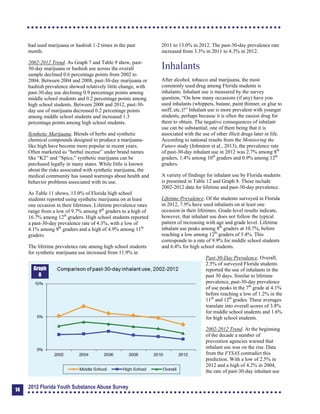
A variety of findings for inhalant use by Florida students
is presented in Table 12 and Graph 8. These include
2002-2012 data for lifetime and past-30-day prevalence.
Lifetime Prevalence. Of the students surveyed in Florida
in 2012, 7.9% have used inhalants on at least one
occasion in their lifetimes. Grade-level results indicate,
however, that inhalant use does not follow the typical
pattern of increasing with age and grade level. Lifetime
inhalant use peaks among 8th
graders at 10.7%, before
reaching a low among 12th
graders of 5.4%. This
corresponds to a rate of 9.9% for middle school students
and 6.4% for high school students.
Past-30-Day Prevalence. Overall,
2.5% of surveyed Florida students
reported the use of inhalants in the
past 30 days. Similar to lifetime
prevalence, past-30-day prevalence
of use peaks in the 7th
grade at 4.1%
before reaching a low of 1.2% in the
11th
and 12th
grades. These averages
translate into overall scores of 3.8%
for middle school students and 1.6%
for high school students.
2002-2012 Trend. At the beginning
of the decade a number of
prevention agencies warned that
inhalant use was on the rise. Data
from the FYSAS contradict this
prediction. With a low of 2.5% in
2012 and a high of 4.2% in 2004,
the rate of past-30-day inhalant use
14
for the overall sample of Florida students has declined
slightly over time.
Club Drugs
Club drugs are a broad category of illicit substances that
are classified together because their use began at dance
clubs and “raves,” not because they are of a similar
chemical class (like amphetamines). Their use, however,
has expanded beyond these settings.
For 2012 both the middle school and high school FYSAS
questionnaires include two items that ask students about
“club drugs such as Ecstasy, Rohypnol, GHB, or
ketamine.”
Ecstasy (also known as MDMA), a form of
methamphetamine, has both stimulant and hallucinogenic
effects. GHB (gamma-hydroxybutyrate) is generally an
odorless, colorless liquid that is taken orally. When
combined with alcohol, it can be used to induce
unconsciousness and has been involved in sexual
assaults. It also has been used to enhance bodybuilding.
Ketamine, also known as “Special K,” is a tranquilizer
most often used by veterinarians. However, its
hallucinatory effects, which are similar to those of LSD
and PCP, have made it another drug of choice at dance
clubs and raves. Rohypnol, also known as “roofies” and
“the date rape drug,” is a sedative in the same family as
Valium®
, and is the trade name for flunitrazepam. It is as
much as 10 times more potent than Valium®
. Rohypnol
is often taken with other drugs in an effort to either
enhance their effects or buffer the withdrawal symptoms.
Findings for lifetime and past-30-day club drug use by
Florida students are presented in Table 13. Since the
current format of the club drug survey items was
introduced in 2008 on the middle school questionnaire
and in 2010 on the high school questionnaire, data are
not available for trend analysis.
Lifetime Prevalence. Of the students surveyed in Florida
in 2012, 3.4% have used club drugs on at least one
occasion in their lifetimes. Lifetime prevalence rates
range from a low of 0.6% for 6th
graders to a high of
7.8% for 12th
graders. This corresponds to an overall rate
of 1.1% for middle school students and 5.1% for high
school students.
Past-30-Day Prevalence. In 2012, just 1.1% of surveyed
Florida students reported the use of club drugs in the past
30 days.
Other Illicit Drugs
The 2012 FYSAS also measured the prevalence of use of
a variety of other illicit drugs among Florida students.
This includes student use of the following: LSD, PCP or
hallucinogenic mushrooms; cocaine or crack cocaine;
methamphetamine; depressants; heroin; prescription pain
relievers; illicit use of over-the-counter drugs; steroids;
and amphetamines. Results for these substance categories
are presented in Tables 14 through 22.
As is typical of adolescent populations, the prevalence-
of-use rates reported by Florida students for these other
illicit drugs are much lower than the rates for alcohol,
tobacco, marijuana and inhalants, and tend to be
concentrated in the upper grades.
LSD, PCP or Hallucinogenic
Mushrooms
Table 14 summarizes the lifetime and past-30-day
prevalence rates of LSD, PCP or hallucinogenic
mushroom use among Florida students. Since the current
format of the LSD, PCP or hallucinogenic mushroom
survey items was introduced in 2008 on the middle
school questionnaire and in 2010 on the high school
questionnaire, data are not available for trend analysis.
Lifetime Prevalence. Of the students surveyed in Florida
in 2012, 3.5% have used LSD, PCP or hallucinogenic
mushrooms on at least one occasion in their lifetimes.
Lifetime prevalence rates range from a low of 0.5% for
6th
graders to a high of 7.6% for 12th
graders. This
corresponds to an overall rate of 1.4% for middle school
students and 5.1% for high school students.
Past-30-Day Prevalence. In 2012, just 1.0% of surveyed
Florida students reported the use of LSD, PCP or
hallucinogenic mushrooms in the past 30 days.
Cocaine or Crack Cocaine
Table 15 summarizes the lifetime and past-30-day
prevalence rates of cocaine or crack cocaine use among
Florida students. Since the current format of the cocaine
or crack cocaine survey items was introduced in 2008 on
the middle school questionnaire and in 2010 on the high
school questionnaire, data are not available for trend
analysis.
2012 Florida Youth Substance Abuse Survey 15
Lifetime Prevalence. Of the students surveyed in Florida
in 2012, 2.3% have used cocaine or crack cocaine on at
least one occasion in their lifetimes. Lifetime prevalence
rates range from a low of 0.8% for 6th
graders to a high
of 4.4% for 12th
graders. This corresponds to an overall
rate of 1.1% for middle school students and 3.1% for
high school students.
Past-30-Day Prevalence. In 2012, just 0.7% of surveyed
Florida students reported the use of cocaine or crack
cocaine in the past 30 days.
Methamphetamine
Table 16 summarizes the lifetime and past-30-day
prevalence rates of methamphetamine use.
Lifetime Prevalence. Of the students surveyed in Florida
in 2012, 1.0% used methamphetamines on at least one
occasion in their lifetimes.
Past-30-Day Prevalence. In 2012, just 0.5% of surveyed
Florida students reported the use of methamphetamines
in the past 30 days.
2002-2012 Trend. Both lifetime and past-30-day
prevalence rates for methamphetamine use decreased
between 2002 and 2012 (1.7 and 0.4 percentage-point
reductions, respectively). For both measures the
reduction was concentrated among high school
respondents.
Depressants
The use of depressants was measured by asking: “On
how many occasions (if any) have you used depressants
or ‘downers’ like quaaludes, Xanax®
, barbiturates or
tranquilizers, in your lifetime?” and “… in the past 30
days?” Table 17 summarizes the lifetime and past-30-day
prevalence rates of depressant use.
Lifetime Prevalence. Of the students surveyed in Florida
in 2012, 4.6% have used depressants on at least one
occasion in their lifetimes. Lifetime prevalence rates
range from a low of 0.9% for 6th
graders to a high of
9.6% for 12th
graders. This corresponds to an overall rate
of 1.8% for middle school students and 6.8% for high
school students.
Past-30-Day Prevalence. In 2012, 1.6% of surveyed
Florida students reported the use of depressants in the
past 30 days.
2002-2012 Trend. Past-30-day depressant use showed
almost no change between 2002 and 2004. However,
between 2004 and 2012, the prevalence rate among
Florida high school students dropped from 3.9% to 2.1%.
Heroin
Heroin use in a school population is extremely rare.
Nationally, no lifetime prevalence rate for heroin has
exceeded 2.4% in the 8th
, 10th
or 12th
grades in the past
two decades (Johnston et al., 2013). Very low prevalence
rates for heroin use among adolescents have also been
observed in Florida. Table 18 summarizes the lifetime
and past-30-day prevalence rates for heroin use.
Lifetime Prevalence. Of the students surveyed in Florida
in 2012, 0.7% have used heroin on at least one occasion
in their lifetimes.
Past-30-Day Prevalence. In 2012, just 0.3% of surveyed
Florida students reported the use of heroin in the past 30
days.
2002-2012 Trend. Given the extremely low prevalence
rates associated with heroin use by Florida students,
analyses that attempt to precisely specify or quantify
changes over time are subject to error. With this caveat in
place, it should be noted that the overall trend is one of
fewer Florida students reporting heroin use since 2002.
Prescription Pain Relievers
The use of prescription pain relievers was measured by
asking: “On how many occasions (if any) have you used
prescription pain relievers such as OxyContin®
,Vicodin®
or Darvocet®
, without a doctor’s orders, in your
lifetime?” and “… in the past 30 days?”
Table 19 summarizes the lifetime and past-30-day
prevalence rates for this question.
Lifetime Prevalence. Of the students surveyed in Florida
in 2012, 6.4% have used prescription pain relievers on at
least one occasion in their lifetimes. Lifetime prevalence
rates range from a low of 2.5% for 6th
graders to a high
of 10.5% for 12th
graders. This corresponds to an overall
rate of 3.6% for middle school students and 8.5% for
high school students.
Past-30-Day Prevalence. In 2012, 2.3% of surveyed
Florida students reported the use of prescription pain
relievers in the past 30 days.
2002-2012 Trend. The rates from the 2012 survey are
similar to results from 2002 to 2010. It should be noted,
however, that comparisons to past results are problematic
because separate survey items were used to measure
OxyContin®
and “other prescription pain reliever” use in
2002 and 2004. Results from these separate items are
combined in Table 19.
16
2012 Florida Youth Substance Abuse Survey
Illicit Use of Over-The-Counter
Drugs
The illicit use of over-the-counter (OTC) drugs was
measured by asking: “On how many occasions (if any)
have you used drugs that can be purchased from a store
without a prescription—such as cold and cough
medication—in order to get high in your lifetime?” and
“… in the past 30 days?”
Table 20 summarizes the lifetime and past-30-day
prevalence rates for this question. Since OTC drug use
was introduced in 2008 on the middle school
questionnaire and in 2010 on the high school
questionnaire, data are not available for trend analysis.
Lifetime Prevalence. Of the students surveyed in Florida
in 2012, 5.5% have used OTC drugs on at least one
occasion in their lifetimes. Lifetime prevalence rates
range from a low of 2.8% for 6th
graders to a high of
7.8% for 11th
graders. This corresponds to an overall rate
of 3.7% for middle school students and 6.9% for high
school students.
Past-30-Day Prevalence. In 2012, 2.2% of surveyed
Florida students reported the use of OTC drugs in the
past 30 days.
Steroids
The use of steroids was measured on the 2012 FYSAS
with the questions: “On how many occasions (if any) did
you use steroids without a doctor’s orders in your
lifetime?” and “… in the past 30 days?” Table 21
summarizes the lifetime and past-30-day prevalence rates
for steroids.
Lifetime Prevalence. Of the students surveyed in Florida
in 2012, 0.8% used steroids on at least one occasion in
their lifetimes.
Past-30-Day Prevalence. In 2012, just 0.4% of surveyed
Florida students reported the use of steroids in the past
30 days.
2002-2012 Trend. Given the extremely low prevalence
rates associated with steroid use among Florida students,
analyses that attempt to precisely specify or quantify
changes over time are subject to error. Nevertheless, the
overall pattern shows reductions in use between 2002
and 2012.
Prescription Amphetamines
The use of prescription amphetamines is measured on the
FYSAS with the questions: “On how many occasions (if
any) did you use amphetamines (including Ritalin®
,
Adderall®
, etc.) without a doctor’s orders in your
lifetime?” and “… in the past 30 days?” Table 22
summarizes the lifetime and past-30-day prevalence rates
for prescription amphetamines.
Lifetime Prevalence. Of the students surveyed in Florida
in 2012, 3.2% have used prescription amphetamines on
at least one occasion in their lifetimes. Lifetime
prevalence rates range from a low of 0.7% for 6th
graders
to a high of 7.8% for 12th
graders. This corresponds to an
overall rate of 1.1% for middle school students and 4.8%
for high school students.
Past-30-Day Prevalence. In 2012, 1.0% of surveyed
Florida students reported the use of prescription
amphetamines in the past 30 days.
2002-2012 Trend. Both the lifetime and past-30-day rates
for prescription amphetamines have shown relatively
little change between 2002 and 2012.
Drug Combination Rates
Prevalence-of-use rates for combinations of drugs
provide a helpful summary of drug use behavior. Tables
23 to 27 and Graphs 9 and 10 provide lifetime and past-
30-day prevalence rates for the use of one or more drugs
from a set of illicit drugs. This includes the illicit use of
prescription drugs and over-the-counter drugs. Illicit
drugs are substances that are illegal for adults to use, so
they include all drugs on the survey except alcohol and
cigarettes. Five types of drug combination rates are
presented here:
Any illicit drug – Use of at least one illicit drug
Any illicit drug other than marijuana – Use of at least
one illicit drug other than marijuana
Alcohol only – The use of alcohol and no illicit drugs
Alcohol or any illicit drug – Use of alcohol or at least
one illicit drug
Any illicit drug but no alcohol – Use of at least one
illicit drug, without any use of alcohol
While changes to the FYSAS ATOD item set have been
designed to promote comparability across survey waves,
these changes should be considered when interpreting the
trend results for these drug combination rates. These
questionnaire changes are summarized at the beginning
of Section 2.
2012 Florida Youth Substance Abuse Survey 17
Graph
9
Any Illicit Drug
2012 Results. As Table 23 shows, 31.7% of surveyed
Florida students in grades 6 through 12 reported at least
one use of any illicit drug in their lifetimes, while 17.2%
reported use in the past 30 days. Grade-level findings for
lifetime prevalence ranged from 13.2% in the 6th
grade to
49.4% in the 12th
grade. For past-30-day use, findings
ranged from 6.3% in the 6th
grade to 26.9% in the 12th
grade.
Subgroup Analysis. Males and females reported nearly
identical rates for lifetime use (31.8% and 31.6%,
respectively). For past-30-day use, male students
reported a slightly higher rate (18.0% versus 16.3%,
respectively). Ethnic group differences reflect those
found throughout these data. White, non-Hispanic
students reported the highest prevalence of past-30-day
any illicit drug use (18.0%), followed by Hispanic/Latino
(16.3%) and African American students (14.9%).
2002-2012 Trend. Changes in any illicit drug use over
time are presented in Table 23 and Graph 9. Between
2002 and 2008 the overall lifetime prevalence of any
illicit drug use declined from 33.0% to 31.0%, before
rising back to 33.0% in 2010 and declining to 31.7% in
2012. For past-30-day use, the most notable change over
time is the increase from 16.2% in 2008 to 18.0% in
2010. It should be noted that the majority of this increase
was due to the rise in marijuana use.
Any Illicit Drug Other
than Marijuana
The purpose of this drug
combination rate is to provide
prevention planners with an overall
indicator of so-called “hard” drug
use (Johnston et al., 2012).
2012 Results. As shown in Table
24, 18.8% of surveyed Florida
students reported at least one use of
any illicit drug other than
marijuana in their lifetimes, while
8.2% reported use in the past 30
days. Grade-level findings for
lifetime prevalence ranged from
12.1% in the 6th
grade to 24.9% in
the 12th
grade. For past-30-day use,
findings ranged from 5.8% in the 6th
grade to 9.6% in the 12th
grade. Past-30-day use of any
illicit drug other than marijuana is highest in the middle
grades due to inhalant use.
These data provide the opportunity to compare total
“hard” drug use to the prevalence rates of more
commonly used drugs. The prevalence of past-30-day
use of all illicit drugs other than marijuana combined
(8.2%) is less than the prevalence of past-30-day use of
alcohol (24.6%) and marijuana (12.4%), as well as the
prevalence of binge drinking (11.3%).
Subgroup Analysis. With marijuana use removed,
differences between the sexes shift somewhat. Females
have a slightly higher rate than males of both lifetime
(19.7% versus 17.8%, respectively) and past-30-day
(8.6% versus 7.7%, respectively) use. In contrast to the
typical pattern, Hispanic/Latino students reported the
highest prevalence of past-30-day use (8.5%), followed
closely by White, non-Hispanic (8.0%) and African
American students (6.7%).
2002-2012 Trend. Table 24 and Graph 10 present trend
data for any illicit drug other than marijuana. Lifetime
prevalence of use has declined slightly from 22.7% in
2002 and 23.7% in 2004 to 18.8% in 2012. Prevalence of
use in the past 30 days shows a similar pattern, dropping
slightly from 10.1% in 2002 and 10.6% in 2004 to 8.2%
in 2012.
Alcohol Only
2012 Results. Results for alcohol only—which counts
respondents who reported the use of alcohol and also
reported using no illicit drugs—are presented in Table
18
2012 Florida Youth Substance Abuse Survey
Graph
10
25. Overall, 21.0% of surveyed Florida students reported
using alcohol and no illicit drugs in their lifetimes, while
13.7% reported use in the past 30 days. Grade-level
findings for lifetime prevalence range from 10.7% in the
6th
grade to 25.2% in the 10th
grade. For past-30-day use,
findings ranged from 4.5% in the 6th
grade to 22.2% in
the 12th
grade.
Subgroup Analysis. Females were more likely than males
to report the use of alcohol and no illicit drugs for both
lifetime (22.1% versus 19.9%, respectively) and past-30­
day (14.7% versus 12.7%, respectively) use. In contrast
to the typical pattern, Hispanic/Latino students (15.1%)
reported the highest prevalence of past-30-day use,
followed by White, non-Hispanic (14.9%) and African
American students (10.3%).
2002-2012 Trend. Table 25 presents trend data for
alcohol only. Overall, past-30-day use of alcohol and no
illicit drugs slightly increased from 19.1% in 2002 to
20.2% in 2006, before decreasing to 13.7% in 2012.
Please note that the alcohol only trend reflects changes to
both the rate of alcohol use and the rate of illicit drug
use. Consequently, a decrease in the prevalence rate for
this measure can result from either a decrease in alcohol
use or an increase in illicit drug use.
Alcohol or Any Illicit Drug
2012 Results. Alcohol or any illicit drug use is a
summary measure that included all drugs from the 2012
survey, with the exception of cigarettes. As Table 26
shows, 52.5% of Florida students in grades 6 through 12
reported at least one use of alcohol or any illicit drug in
their lifetimes, while 30.5% reported use in the past 30
days. Grade-level findings for lifetime prevalence range
from 23.9% in the 6th
grade to
73.4% in the 12th
grade. For past-
30-day use, findings ranged from
10.7% in the 6th
grade to 48.6% in
the 12th
grade.
Subgroup Analysis. While females
reported slightly higher rates than
males for lifetime use (53.6%
versus 51.4%, respectively), past-
30-day use was nearly identical.
Differences across ethnic groups
follow the typical pattern, with
White, non-Hispanic students
reporting the highest prevalence of
past-30-day alcohol or any illicit
drug use (32.7%), followed by
Hispanic/Latino (31.0%) and
African American students (24.6%).
2002-2012 Trend. Table 26 presents
trend data for alcohol or any illicit drug use. Past-30-day
use increased from 35.7% in 2002 to 37.1% in 2004. The
rate of use then decreased to 36.0% in 2006 and again to
34.1% in 2008 and 2010. In 2012, the rate dropped even
farther to 30.5%.
Any Illicit Drug, but No Alcohol
2012 Results. The final drug combination category
measures the use of illicit drugs by students who are not
using alcohol. As Table 27 shows, this combination is
quite rare. Overall, just 5.4% of surveyed students
reported having used illicit drugs in their lifetimes but
never having used alcohol. Current use of illicit drugs
(within the past 30 days) without the accompanying use
of alcohol is also rare (6.2%). For this measure, past-30­
day prevalence is similar to lifetime prevalence because
there are students who have used an illicit drug in the
past month, and have used alcohol in their lifetimes, but
have not used alcohol in the last month.
Subgroup Analysis. Because of the unusual nature of this
measure, subgroup differences are difficult to interpret.
2002-2012 Trend. Because of the unusual nature of this
measure, changes over time are difficult to interpret.
2012 Florida Youth Substance Abuse Survey 19
Section 3: Other Antisocial Behaviors
Section 3
Other Antisocial Behaviors
T
he 2012 FYSAS also measures a series of eight
other problem or antisocial behaviors—that is,
behaviors that run counter to established norms
of good behavior. Note that information on antisocial
behavior is collected only for a prevalence period of the
past 12 months. The survey measured the following
antisocial behaviors:
 Carrying a Handgun
 Selling Drugs
 Attempting to Steal a Vehicle
 Being Arrested
 Taking a Handgun to School
 Getting Suspended
 Attacking Someone with Intent to Harm
 Being Drunk or High at School
Each question is specifically described below. Note that
for all eight questions, possible responses include: Never,
1 or 2 times, 3 to 5 times, 6 to 9 times, 10 to 19 times and
20+ times. Tables 28-31 provide the prevalence rates of
all of the delinquent behaviors by sex, ethnic group, age
and grade.
Carrying a Handgun
This behavior is surveyed by the question, “How many
times in the past year (12 months) have you carried a
handgun?”
In 2012, 4.4% of surveyed students reported having
carried a handgun in the past year. Over time, rates for
this measure range from a low of 3.7% in 2002 to a high
of 5.2% in 2006 (see Table 28). White, non-Hispanic
students reported the highest rate (4.7%), followed by
African American students (4.3%) and Hispanic/Latino
students (3.5%). Males (6.9%) reported a higher rate of
this behavior than females (1.8%). Sixth grade students
reported the lowest rate of carrying a handgun (3.0%),
while all other grade levels reported rates between 4.0%
and 5.9%.
Selling Drugs
Selling drugs is surveyed by the question, “How many
times in the past year (12 months) have you sold illegal
drugs?” Note that the question asks about, but does not
define or specify, “illegal drugs.”
In 2012, 5.0% of surveyed students reported having sold
illegal drugs in the past year. This rate is significantly
lower than the 6.3% reported in 2010 (see Table 28). The
prevalence rate for this behavior generally increases with
age and grade. As can be seen on Table 28, 2.2% of
middle school students reported selling illegal drugs
compared to 7.1% of high school students. There was a
distinct difference in rates of participation in this
behavior between males and females (7.1% versus 2.8%,
respectively).
Following the typical ATOD pattern, White, non-
Hispanic students reporting the highest rate (5.6%),
followed by Hispanic/Latino students (4.7%) and African
American students (4.3%).
Attempting to Steal a
Vehicle
Vehicle theft is surveyed by the question, “How many
times in the past year (12 months) have you stolen or
tried to steal a motor vehicle such as a car or
motorcycle?”
2012 Florida Youth Substance Abuse Survey 21
Graph
11
In 2012, 1.8% of surveyed students reported having
stolen or attempted to steal a motor vehicle in the past
year. Over time, the prevalence of this behavior ranges
from a high of 3.1% in 2004 to a low of 1.8% in 2012
(see Table 29). Across grades, reports of this behavior
range from a low of 0.9% among 6th
graders to a high of
2.2% among 11th
graders. African American students
reported the highest rates for attempting to steal a motor
vehicle (2.2%), followed by Hispanic/Latino (1.6%) and
White, non-Hispanic (1.4%) students. Males (2.3%)
reported a higher rate of involvement compared to
females (1.2%).
Being Arrested
Student experience with being arrested is surveyed by
the question, “How many times in the past year (12
months) have you been arrested?” Note that the question
does not define “arrested.” Rather, it is left to the
respondent to define. Some young people may define any
contact with police as an arrest, while others may only
consider an official arrest as justifying a positive answer
to this question.
In 2012, 3.4% of surveyed students reported having been
arrested in the past year. Over time, the prevalence of
this behavior ranges from a high of 5.8% in 2004 to a
low of 3.4% in 2012 (see Table 29). Males (4.2%)
reported a higher rate of involvement compared to
females (2.4%). African American students reported the
highest arrest rate (4.7%), followed by Hispanic/Latino
(3.1%) and White, non-Hispanic (2.8%) students. Across
grade levels, rates range from a low of 1.2% among 6th
graders to a high of 4.4% among 9th
graders.
Taking a Handgun to
School
This behavior is surveyed by the question, “How many
times in the past year (12 months) have you taken a
handgun to school?”
In 2012, 0.8% of surveyed students reported having
taken a handgun to school in the past year (see Table 30).
Because the rate of involvement with this behavior is so
low, comparisons over time and across the sexes and
ethnic groups are unreliable.
Getting Suspended
Suspension is surveyed by the question, “How many
times in the past year (12 months) have you been
suspended from school?” Note that the question does not
define “suspension.” Rather, it is left to the individual
respondent to define. It should also be noted that school
suspension rates are difficult to interpret because school
suspension policies vary substantially from district to
district. Therefore, these rates should be interpreted with
caution. However, differences by grade, age, sex and
ethnic group are often interesting, as changes in these
rates are revealed over time.
22
2012 Florida Youth Substance Abuse Survey
In 2012, 11.9% of surveyed students reported having
been suspended in the past year. Over time, rates for this
measure range from a high of 16.1% in 2006 to a low of
11.9% in 2012 (see Table 30).
Across grades, suspension rates peak in grades 7, 8, and
9 (14.0%, 14.6%, and 14.1%, respectively) before
reaching a low of 8.4% in the 12th
grade. Findings for the
sexes differed substantially, with 15.2% of male
respondents reporting having been suspended compared
to 8.6% of female respondents. There were also wide
disparities in suspension rates across ethnic groups.
Suspension rates were highest among surveyed African
American students (20.6%), compared to
Hispanic/Latino (11.2%) and White, non-Hispanic
(8.7%) students.
Attacking Someone with
Intent to Harm
The question “How many times in the past year (12
months) have you attacked someone with the idea of
seriously hurting them?” was asked in the survey. The
question does not ask specifically about the use of a
weapon. Therefore, occurrences of physical fighting with
or without weapons are captured with this question.
In 2012, 7.9% of surveyed students reported having
attacked someone with the intent to harm in the past
year. In other years rates range from a high of 13.3% in
2006 to a low of 7.9% in 2012 (see Table 31).
Differences across grade levels are not large, with rates
ranging from a low of 6.1% among 6th
graders to a high
of 9.5% among 8th
graders. Males were more likely to
report attacking someone than females (9.2% versus
6.6%, respectively). It should be noted that the difference
between gender groups has become smaller over time,
primarily because the rate reported by male students has
notably declined since 2002 while the rate reported by
female students has declined more slowly.
There were also variations among the ethnic groups, with
African American students reporting the highest
prevalence for this behavior (12.0%), followed by
Hispanic/Latino (6.6%) and White, non-Hispanic (6.0%)
students.
Being Drunk or High at
School
Having been drunk or high at school is surveyed by the
question, “How many times in the past year (12 months)
have you been drunk or high at school?”
In 2012, 11.2% of surveyed students reported having
been drunk or high at school in the past year. In other
years, the rates range from a high of 13.0% in 2006 to a
low of 11.2% in 2012 (see Table 30).
Reflecting the typical pattern of ATOD prevalence
across grades, reports of drinking or drug use at school
increase as students get older. Specifically, 5.4% of
middle school students indicated having been drunk or
high at school compared to 15.5% of high school
students. The difference between the sexes was modest
(12.1% for males and 10.2% for females), as were the
variations across ethnic groups. White, non-Hispanic
students had the highest rate at 11.8%, followed by
Hispanic/Latino (11.1%) and African American students
(9.4%).
2012 Florida Youth Substance Abuse Survey 23
Section 4: Risk and Protective Factors
Section 4
Risk and Protective Factors
J
ust as smoking is a risk factor for heart disease and
getting regular exercise is a protective factor for
heart disease and other health problems, there are
factors that can help protect youth from, or put them at
risk for, drug use and other problem behaviors.
Protective factors, also known as “assets,” are
conditions that buffer children and youth from exposure
to risk by either reducing the impact of the risks or
changing the way that young people respond to risks.
Risk factors are conditions that increase the likelihood
of a young person becoming involved in drug use,
delinquency, school dropout and/or violence. For
example, children living in families with poor parental
monitoring are more likely to become involved in these
problems.
Research during the past 30 years supports the view that
delinquency; alcohol, tobacco and other drug use; school
achievement; and other important outcomes in
adolescence are associated with specific risk and
protective factors in the student’s community, school and
family environments, as well as with characteristics of
the individual (Hawkins, Catalano & Miller, 1992). In
fact, these risk and protective factors have been shown to
be more important in understanding these behaviors than
ethnicity, income or family structure (Blum et al., 2000).
There is a substantial amount of research showing that
adolescents’ exposure to a greater number of risk factors
is associated with more drug use and delinquency. There
is also evidence that exposure to a number of protective
factors is associated with lower prevalence of these
problem behaviors (Bry, McKeon & Pandina, 1982;
Newcomb, Maddahian & Skager, 1987; Newcomb &
Felix-Ortiz, 1992; Newcomb, 1995; Pollard et al., 1999).
The Social Development
Strategy
The Social Development Strategy (Hawkins, Catalano &
Associates, 1992) organizes these risk and protective
factors into a framework that families, schools and
communities can use to help children develop healthy
behaviors. This strategy, which is graphically depicted in
Appendix B, shows how three broad categories of
protective factors—healthy beliefs and clear standards,
bonding, and individual characteristics—work together
to promote positive youth development and healthy
behaviors (Hawkins, Arthur & Catalano, 1995). The
Social Development Strategy begins with a goal of
healthy behaviors for all children and youth. In order for
young people to develop healthy behaviors, adults must
communicate healthy beliefs and clear standards for
behavior to young people (Catalano & Hawkins, 1996).
Bonding (an attached, committed relationship) between a
child and an adult who communicates healthy beliefs and
clear standards motivates the child to follow healthy
beliefs and clear standards. A child who forges a bond
with an adult is less likely to threaten the relationship by
violating the beliefs and standards held by the adult.
Research has identified three conditions for bonding
(Catalano & Hawkins, 1996):
	 First, children need developmentally appropriate
opportunities for meaningful involvement with a
positive social group (community, family, school,
etc.) or individual.
	 Second, children need the emotional, cognitive,
social and behavioral skills to successfully take
advantage of opportunities.
	 Third, children must be recognized for their
involvement. Recognition sets up a reinforcing cycle
in which children continue to look for opportunities
and learn skills and, therefore, receive recognition.
Certain characteristics that some children come into the
world with (positive social orientation, resilient
temperament and high intelligence) can also help protect
children from risk. For children who do not have the
protective advantages of these characteristics, in order to
build strong bonds to family, school and community, it is
even more important for community members to:
	 make extra efforts to provide opportunities for
involvement
2012 Florida Youth Substance Abuse Survey 25
	 teach the social, emotional, and cognitive skills
needed to be successful
	 recognize children’s efforts as well as their
successes
The developmental process outlined in this model has
important implications for prevention planning.
Programs that seek to change the attitudes young people
hold about the pros and cons of ATOD use, for example,
may produce an immediate reduction in the prevalence
of problem behaviors. The effectiveness of these efforts
will be limited, however, by the risk and protective
factors that underlie the acquisition of healthy beliefs and
clear standards. If young people have weak bonds to
prosocial groups and strong bonds to antisocial groups,
they will be less receptive to drug abuse prevention
messages.
An alternative prevention strategy might involve
targeting the risk and protective factors that operate at an
earlier point in the developmental process. While
programs and policies that increase the opportunities for
prosocial involvement in the family, at school and in the
community may not yield an immediate reduction in the
rates of ATOD use, they will encourage young people to
form attachments to sources of positive social influence,
thereby building the foundation for healthy behavioral
choices in the future.
Measurement
The 2012 FYSAS assesses 15 risk factors and six
protective factors across four domains: Community
Domain, Family Domain, School Domain, and Peer and
Individual Domain. Each factor is measured by a set of
survey items called a scale.
As noted in Section 1 of this report, this more compact
version of the risk and protective factor model was first
used with the 2008 middle school FYSAS. In this model,
the following 12 risk and protective factor scales, which
were deemed less critical for prevention planning, have
been removed from the survey:
	 Community Opportunities for Prosocial Involvement
	 Family Attachment
	 Social Skills
	 Belief in the Moral Order
	 Low Neighborhood Attachment
	 Laws and Norms Favorable to Handguns
	 Family History of Antisocial Behavior
	 Parental Attitudes Favorable toward Antisocial
Behavior
	 Rebelliousness
	 Friends’ Delinquent Behavior
	 Friends’ Use of Drugs
	 Sensation Seeking
For each risk and protective factor scale a threshold is set
above which respondents are considered to have a high
level of risk or protection and below which they are
considered to have a low level of risk or protection. For
each scale, the number of students with high levels of
risk or protection can be counted. This approach allows
risk and protective factor data to be reported in the same
way as ATOD data: as prevalence rates.
Under this system, a score of 60 for the protective factor
School Rewards for Prosocial Involvement would
indicate that 60% of surveyed students reported a high
level of protection for this protective factor, while 40%
reported a low level of protection. Risk factor scales are
scored in the same way. For example, a score of 55 for
the risk factor Low Perceived Risks of Drug Use would
indicate that 55% of surveyed students reported a high
level of risk for this risk factor, while 45% reported a
low level of risk.
Risk and protective factor scale prevalence rates for the
overall sample of Florida students, as well as middle
school and high school subsamples, are presented in
Tables 54 and 55 and Graphs 12 to 15. For trend
comparison purposes, risk and protective factor results
from the 2002 to 2012 FYSAS are presented in Tables 58
to 61.
Calculation of Risk and Protective
Factor Thresholds
The high-risk and high-protection thresholds used to
calculate the risk and protective factor prevalence rates
were calculated using a method recommended by Arthur
et al. (2007). For risk factor scales, the high-risk
threshold is the normative median—that is the scale’s
median value in the Communities That Care normative
database—plus .15 times the mean absolute deviation (a
measure of central tendency similar to the standard
deviation). In other words, risk factor thresholds are set
slightly above the normative median. For protective
factor scales, the high-protection threshold is the
normative median minus .15 times the mean absolute
deviation. In other words, protective factor thresholds are
set slightly below the normative median.
26
2012 Florida Youth Substance Abuse Survey
It is also important to note that risk and protection
thresholds are calculated separately for each grade level.
For most risk factors, this means that older students must
report a higher level of risk before crossing the scoring
threshold and being designated as at risk. For most
protective factors, this means that older students must
report a lower level of protection before crossing the
scoring threshold and being designated as protected.
Normative Comparisons for Risk
and Protective Factor Prevalence
Rates
Florida prevention planners can gain additional insight
by comparing the state's results to the national risk and
protective factor norms from the Communities That Care
normative database. These national risk and protective
factor norms are presented in Tables 56 and 57.
The risk factor scale Early Initiation of Drug Use
provides an example. As shown in Table 44, 30% of the
overall sample of Florida students reported scale scores
above the high-risk threshold. In other words, 30% of
surveyed Florida students are at risk due to early
experimentation with drugs. Table 46 shows that across
the national Communities That Care normative sample,
43% of survey students are at risk due to early
experimentation with drugs. Florida’s score of 30% is 13
percentage points below the normative score.
Normative Data
The Communities That Care normative database contains
survey responses from over 280,000 students in grades 6
through 12. It was compiled by combining the results of
selected Communities That Care Youth Survey efforts
that were completed in 2000, 2001 and 2002. To enhance
representativeness, statistical weights were applied to
adjust the sample to exactly match the population of U.S.
public school students on four key demographic
variables: ethnicity, sex, socioeconomic status and
urbanicity. Information on the U.S. public school student
population was obtained from the Common Core of Data
program at the U.S. Department of Education’s National
Center for Education Statistics.
Prevention Planning with
Risk and Protective Factor
Data
The analysis of risk and protective factors is the most
powerful tool available for understanding what promotes
both positive and negative adolescent behavior and for
helping design successful prevention programs for young
people. To promote positive development and prevent
problem behavior, it is necessary to address the factors
that predict these outcomes. By measuring these risk and
protective factors, specific factors that are elevated can
be prioritized in the community. This process also helps
in selecting tested-effective prevention programming
shown to address those elevated factors and consequently
provide the greatest likelihood for success.
Risk and Protective Factor
Prioritization
In general, a prevention strategy that focuses on a
relatively narrow set of developmental factors can be
more effective than a strategy that spreads resources
across a broad set of factors. Risk and protective factor
data from the FYSAS can provide critical guidance in this
prioritization process. That is, prevention planners can
use the information gathered by the survey to identify
youth development areas where programs, policies and
practices are likely to have the greatest positive impact.
Comparisons Across Risk and Protective Factors
Start the prioritization process by identifying the
protective factor scales with the lowest percentage of
protected students and the risk factor scales with the
highest percentage of at risk students. It may also be
helpful to identify scales with particularly high
percentages of protected students or low percentages of
at risk students. These areas represent strengths that
prevention planners in Florida may wish to build on. In
addition, it is also important to compare the rates of risk
and protection reported by Florida students to the rates
reported by students in the national normative sample.
Lowest Protective Factor Scales:
	 Of the middle school students surveyed in Florida in
2012, 50% reported an elevated level of protection
for the protective factor scales School Opportunities
for Prosocial Involvement and Religiosity. In the
national normative sample, 57% reported an
elevated level of protection for School Opportunities
for Prosocial Involvement and 56% reported an
elevated level for Religiosity, a difference of seven
and six percentage points, respectively. This means
that compared to students from across the country
who have participated in the survey, Florida middle
school students have fewer chances to participate in
extracurricular activities. Also, they are less likely to
benefit from relationships with prosocial adults and
peers, opportunities for prosocial activities, and the
2012 Florida Youth Substance Abuse Survey 27
teaching of prosocial values that are often part of
religious involvement.
	 High school students reported lower levels of
protection for two family domain protective factor
scales. Of the high school students surveyed in
Florida in 2012, 54% reported an elevated level of
protection for the protective factor scale Family
Rewards for Prosocial Involvement and 56%
reported an elevated level of protection for Family
Opportunities for Prosocial Involvement. In the
national normative sample, scores are 55% and 54%
for these two scales, placing Florida high school
students one percentage point lower and two
percentage points higher, respectively. Students with
lower scores on the Family Rewards for Prosocial
Involvement scale are less likely to receive praise
and support from their parents when they

accomplish something positive. This lack of
feedback, in turn, may weaken the parent-child bond
and inhibit the ability of parents to transfer prosocial
values to their children. Low scores on the Family
Opportunities for Prosocial Involvement scale
indicate that activities that promote family
attachment—such as family recreation and
involvement in family decisions—are less available
to students.
Highest Risk Factor Scales:
	 Of the combined sample of middle school and high
school students surveyed in Florida in 2012, 61%
reported an elevated level of risk for the risk factor
scale Transitions and Mobility. In the national
normative sample, 47% reported an elevated level of
risk, a difference of 14 percentage points. This
means that compared to students from across the
country who have participated in the survey, Florida
students are more likely to have changed homes or
schools on one or more occasions.
	 Of the high school students surveyed in Florida in
2012, 53% reported an elevated level of risk for the
risk factor scale Low Perceived Risks of Drug Use.
In the national normative sample, 46% reported an
elevated level of risk, a difference of seven
percentage points. Students with high scores on the
Low Perceived Risks of Drug Use scale believe that
alcohol, cigarette and marijuana use pose only a low
to moderate risk. When young people perceive the
risk of drug use to be low they are more likely to
experiment with these substances. In many
communities, beliefs about the risks associated with
ATOD use are a leading indicator of future usage
patterns.
	 Of the middle school students surveyed in Florida in
2012, 48% reported an elevated level of risk for the
risk factor scale Lack of Commitment to School. In
the national normative sample, 47% reported an
elevated level of risk, a difference of one percentage
point. Students with high scores on the Lack of
Commitment to School have negative feelings about
school and are less likely to report that school work
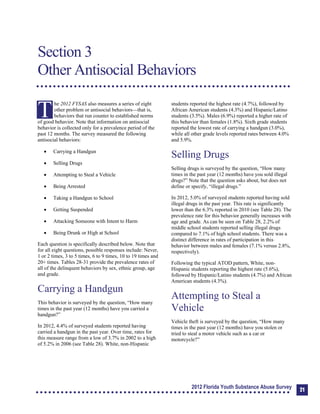
is meaningful or important for their future. Young
people who have lost this commitment to school are
at higher risk for a variety of problem behaviors.
Highest Protective Factor Scales:
	 Of the high school students surveyed in Florida in
2012, 61% reported an elevated level of protection
for the protective factor scale Community Rewards
for Prosocial Involvement. In the national normative
sample, 63% reported an elevated level of
protection, a difference of two percentage points.
Students who report high scores on this scale receive
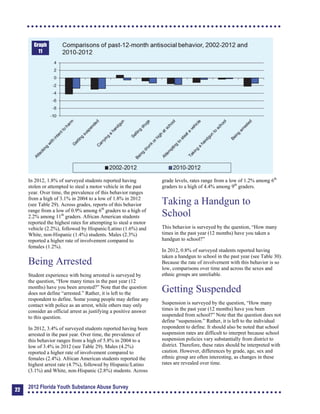
encouragement and praise from neighbors and other
members of their communities. With this type of
support, young people may be more likely to accept
the guidance available from the positive role models
in their communities.
	 High school students reported high levels of
protection in the school domain. Of the high school
students surveyed in Florida in 2012, 61% reported
an elevated level of protection for the protective
factor scales School Opportunities for Prosocial
Involvement and School Rewards for Prosocial
Involvement. In the national normative sample,
scores are 60% and 58% for these two scales,
placing Florida high school students one and three
percentage points higher, respectively. Students with
high scores on the School Opportunities for
Prosocial Involvement scale have greater
opportunities to interact closely with teachers, get
involved with special projects and activities in the
classroom, and participate in sports, clubs and other
school activities outside of the classroom. The bonds
with teachers and prosocial peers created by these
activities help to protect students from engaging in
behaviors that violate socially accepted standards.
High scores on the School Rewards for Prosocial
Involvement scale indicate that students receive
praise and encouragement when they work hard and
do well in school. This positive feedback, in turn,
may strengthen the bonds students form with
teachers, coaches and prosocial peers.
	 Of the middle school students surveyed in Florida in
2012, 59% reported an elevated level of protection
for the protective factor scale Family Opportunities
28
2012 Florida Youth Substance Abuse Survey
for Prosocial Involvement and 55% reported an
elevated level of protection for the protective factor
scale Family Rewards for Prosocial Involvement. In
the national normative sample, scores are 59% and
54% for these two scales, placing Florida middle
school students with a matching score on the
opportunities scale and one percentage point higher
than the national sample on the rewards scale. High
scores on the Family Opportunities for Prosocial
Involvement scale indicate that activities that
promote family attachment—such as family
recreation and involvement in family decisions—are
available to students. These prosocial activities
reinforce family bonds and cause students to more
easily adopt the norms projected by their families.
Students who reported high scores on the Family
Rewards for Prosocial Involvement scale are more
likely to receive praise and support from their
parents when they accomplish something positive.
This positive feedback, in turn, may strengthen the
parent-child bond and support the ability of parents

to transfer prosocial values to their children.
Lowest Risk Factor Scales:
	 Of the middle school students surveyed in Florida in
2012, 19% reported an elevated level of risk for the
risk factor scale Parental Attitudes Favorable
toward ATOD Use. In the national normative
sample, 23% reported an elevated level of risk, a
difference of four percentage points. Students with
low scores on this scale have parents who
strenuously disapprove of youth ATOD use.
Parental attitude is one of the strongest predictors of
youth ATOD use.
	 Of the middle school students surveyed in Florida in
2012, 23% reported an elevated level of risk for the
risk factor scale Perceived Availability of Handguns.
In the national normative sample, 25% reported an
elevated level of risk, a difference of two percentage
points. Students with low scores on this scale
believe that police are likely to catch young people
who carry handguns. When young people believe
that the laws and norms concerning firearms are
strictly enforced, they are less likely to engage in
dangerous behavior.
	 Of the high school students surveyed in Florida in
2012, 30% reported an elevated level of risk for the
risk factor scale Early Initiation of Drug Use. In the
national normative sample, 46% reported an
elevated level of risk, a difference of 16 percentage
points. This means that compared to students from
across the country who have participated in the
survey, Florida students are more likely to avoid or
postpone initiation of alcohol, cigarette and
marijuana use. Young people who experiment with
drug use at an earlier age are more likely to engage
in frequent use and extend their usage to more
dangerous drugs, and are less likely to discontinue
use as they enter adulthood.
	 Of the high school students surveyed in Florida in
2012, 32% reported an elevated level of risk for the
risk factor scale Perceived Availability of Drugs. In
the national normative sample, 45% reported an
elevated level of risk, a difference of 13 percentage
points. This means that compared to students from
across the country who have participated in the
survey, Florida students find it more difficult of get
alcohol, tobacco, and other drugs.
Changes in Risk and Protection
Graphs 12 to 15 and Tables 58 to 61 compare the risk
and protective factor scale scores reported by students in
the 2002 to 2012 FYSAS. These trends can help Florida
prevention planners identify areas where improvements
are being made and where problems are intensifying.
They also support the findings presented in the previous
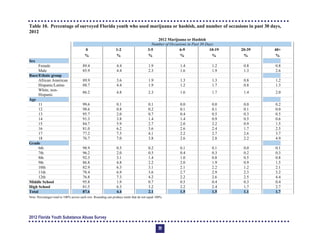
subsection by showing the association between changes
over time and highest and lowest levels of risk and
protection.
Risk Factor Changes:
	 The bottom data rows in Tables 60 and 61 show the
average risk factor prevalence rate for each wave of
the FYSAS. Among middle school students, the
average risk factor prevalence rate was constant at
45% between 2002 and 2006. This average rate
dropped to 43% in the 2008 and 2010 surveys, and
then dropped four more points in the 2012 survey.
Among high school students, the average risk factor
rate shows no clear pattern of long-term change.
Between 2010 and 2012, however, the average risk
factor prevalence rate declined three percentage
points.
Several scales related to ATOD use show meaningful
long-term reductions in the prevalence of high risk.
	 Among surveyed middle school students, the
number of students reporting a high level of risk for
Early Initiation of Drug Use declined 20 percentage
points between 2002 and 2012. High school students
reported a decline of 13 percentage points for this
scale.
2012 Florida Youth Substance Abuse Survey 29
	 Between 2002 and 2012, the number of students
reporting a high level of risk for Favorable Attitudes
toward ATOD Use declined 13 percentage points
among middle school students and four percentage
points among high school students.
	 Among high school students, Perceived Availability
of Drugs declined 13 percentage points between
2002 and 2012. Middle school students reported a
decline of 10 percentage points.
Only a few risk factor scales show meaningful long-term
increases over time.
	 Between 2002 and 2012, the number of students
reporting a high level of risk for Peer Rewards for
Antisocial Behavior increased four percentage points
among high school students.
	 Between 2002 and 2012, the number of students
reporting a high level of risk for Community
Disorganization increased three percentage points
among high school students, but only one percentage
point among middle school students.
	 Among surveyed high school students, the number
of students reporting a high level of risk for Low
Perceived Risks of Drug Use increased eight
percentage points between 2002 and 2012.
Between 2010 and 2012 there were several noteworthy
reductions in the prevalence of high risk across the 15
individual risk factor scales. No risk factor scales
increased in the past year, with the exception of Low
Perceived Risks of Drug Use among high school
students, which increased 4 percentage points.
	 Among middle school students, a number of risk
factor related to ATOD use declined by five or more
percentage points. These include Laws and Norms
Favorable to Drug Use, Perceived Availability of
Drugs, Favorable Attitudes toward ATOD Use, and
Early Initiation of Drug Use.
	 Lack of Commitment to School decreased six
percentage points among middle school students and
five points among high school students.
	 Among Florida high school students, the number of
students reporting a high level of risk for Perceived
Availability of Drugs and Perceived Availability of
Handguns declined five and four percentage points,
respectively.
Protective Factor Changes:
Unlike the average level of risk reported by Florida
students, which has shown reductions over time among
both middle school and high school students, most
protective factor scale scores have remained relatively
stable.
	 The bottom data rows in Tables 58 and 59 show the
average protective factor prevalence rate for each
wave of the FYSAS. Among middle school students,
the average protective factor prevalence rate has
ranged between 49% and 53% across the 2002-2012
waves of the survey. Between 2010 and 2012 the
average middle school protective factor rate
increased three percentage points. Among high
school students, the average protective factor
prevalence rate has ranged between 57% and 59%,
increasing one percentage point since 2010.
Only several protective factors show clear patterns of
long-term change.
	 Between 2002 and 2012, the number of high school
students reporting a high level of protection for
School Rewards for Prosocial Involvement and
School Opportunities for Prosocial Involvement
increased 11 and six percentage points, respectively.
	 Between 2002 and 2012, the number of students
reporting a high level of protection for Religiosity
decreased two percentage points among middle
school students and decreased four points among
high school students.
Between 2010 and 2012, only two protective factor
scales showed a clear change.
	 Family Rewards for Prosocial Involvement and
School Rewards for Prosocial Involvement increased
five and seven percentage points, respectively,
among middle school students.
30
2012 Florida Youth Substance Abuse Survey
Protective Factors—
Detailed Results
Protective factors are characteristics that are known to
decrease the likelihood that a student will engage in
problem behaviors. For example, strong positive
attachment or bonding to parents reduces the risk of an
adolescent engaging in problem behaviors.
The FYSAS measures a variety of protective factors
across four major domains: Community Domain, Family
Domain, School Domain, and Peer and Individual
Domain. For each domain, a variety of protective factors
are assessed. Below, each protective factor is described
and the results for Florida schools are reported.
Protective factor scale prevalence rates are reported in
Tables 54, 58 and 59.
Community Domain
Community Rewards for Prosocial Involvement
(5 Items)
Young people experience bonding as feeling valued and
being seen as an asset. Students who feel recognized and
rewarded by their community are less likely to engage in
negative behaviors, because that recognition helps
increase a student’s self-esteem and the feeling of
bondedness to that community. Community Rewards for
Prosocial Involvement is surveyed by such items as
“There are people in my neighborhood who are proud of
me when I do something well.”
	 In 2012, 57% of surveyed students reported an
elevated level of protection for Community Rewards
Graph
12
for Prosocial Involvement. Middle school and high
school students reported rates of 52% and 61%,
respectively.
	 In the national normative sample, 60% reported an
elevated level of protection, a difference of three
percentage points.
	 Between 2002 and 2012, the prevalence rate for this
scale decreased two percentage points among middle
school students and one point among high school
students.
Family Domain
Family Opportunities for Prosocial Involvement
(3 Items)
When students have the opportunity to make meaningful
contributions to their families, they feel closer to their
family members and are less likely to get involved in
risky behaviors. These opportunities for involvement
reinforce family bonds and cause students to more easily
adopt the norms projected by their families. For instance,
children whose parents have high expectations for their
school success and achievement are less likely to drop
out of school. This protective factor is surveyed by such
items as “My parents ask me what I think before most
family decisions affecting me are made.”
	 In 2012, 57% of surveyed students reported an
elevated level of protection for Family Opportunities
for Prosocial Involvement. Middle school and high
school students reported rates of 59% and 56%,
respectively.
	 In the national normative sample, 56% reported an
Changes in protective factor prevalence rates, 2002-2012
Community Rewards for Prosocial Involvement
Family Opportunities for Prosocial Involvement
Family Rewards for Prosocial Involvement
School Opportunities for Prosocial Involvement
School Rewards for Prosocial Involvement
Religiosity
-2
8
2
2
2
-2
-4
11
6
0
1
-1
-12 -8 -4 0 4 8 12
High School Middle School
2012 Florida Youth Substance Abuse Survey 31
elevated level of protection, a difference of one
percentage point.
	 Prevalence rates for this scale declined from 2002 to
2006 (high school) and 2008 (middle school), before
increasing through 2012.
Family Rewards for Prosocial Involvement (4 Items)
When family members reward their children for positive
participation in activities, it further strengthens the bonds
the children feel to their families, and helps promote
clear standards for behavior. This protective factor is
measured by such survey items as “How often do your
parents tell you they’re proud of you for something
you’ve done?”
	 In 2012, 54% of surveyed students reported an
elevated level of protection for Family Rewards for
Prosocial Involvement. Middle school and high
school students reported rates of 55% and 54%,
respectively.
	 In the national normative sample, 55% reported an
elevated level of protection, a difference of one
percentage point.
	 Among middle school students, prevalence rates for
this scale declined from 2002 to 2008, before
increasing through 2012. Among high school
students there is no clear pattern of change.
School Domain
School Opportunities for Prosocial Involvement
(5 Items)
Giving students opportunities to participate in important
activities at school helps to create a feeling of personal
investment in their school. This results in greater
bonding and adoption of the school’s standards of
behavior, reducing the likelihood that they will become
involved in problem behaviors. This protective factor is
measured by survey items such as “In my school,
students have lots of chances to help decide things like
class activities and rules.”
	 In 2012, 57% of surveyed students reported an
elevated level of protection for School Opportunities
for Prosocial Involvement. Middle school and high
school students reported rates of 50% and 61%,
respectively.
	 In the national normative sample, 59% reported an
elevated level of protection, a difference of two
percentage points.
	 Among middle school students, the prevalence rate
declined in 2004 before increasing through 2012.
Among high school students, prevalence rates for
this scale increased six percentage points from 2002
to 2012.
School Rewards for Prosocial Involvement (4 Items)
Making students feel appreciated and rewarded for their
involvement at school further strengthens school
bonding, and helps to reduce the likelihood of their
involvement in drug use and other problem behaviors.
This protective factor is measured by such statements as
“The school lets my parents know when I have done
something well.”
	 In 2012, 57% of surveyed students reported an
elevated level of protection for School Rewards for
Prosocial Involvement. Middle school and high
school students reported rates of 52% and 61%,
respectively.
	 In the national normative sample, 55% reported an
elevated level of protection, a difference of two
percentage points.
	 Between 2002 and 2012, prevalence rates for this
scale increased eight percentage points and 11
percentage points, respectively, for middle school
and high school students.
Peer and Individual Domain
Religiosity (1 Item)
Religious institutions can help students develop firm
prosocial beliefs. Students who have preconceived ideas
about certain activities are less vulnerable to becoming
involved with antisocial behaviors because they have
already adopted a social norm against those activities.
Religiosity is measured by the question “How often do
you attend religious services or activities?”
	 In 2012, 55% of surveyed students reported an
elevated level of protection for Religiosity. Middle
school and high school students reported rates of
50% and 59%, respectively.
	 In the national normative sample, 59% reported an
elevated level of protection, a difference of four
percentage points.
	 Among both middle school and high school
students, prevalence rates for this scale have
decreased two and four percentage points,
respectively, from 2002 to 2012.
32
2012 Florida Youth Substance Abuse Survey
Risk Factors—
Detailed Results
Risk factors are characteristics in the community’s,
family’s, school’s and individual’s environments that are
known to increase the likelihood that a student will
engage in one or more problem behaviors. For example,
a risk factor in the community’s environment is the
existence of laws and norms favorable to drug use, which
can affect the likelihood that an adolescent will try
alcohol, tobacco or other drugs. In communities where
there is acceptance or tolerance of drug use, students are
more likely to engage in alcohol, tobacco and other drug
use.
The 2012 FYSAS measures a variety of risk factors
across four major domains. Below, each of the risk
factors in the Community, Family, School, and Peer and
Individual Domains is described, and the results for
Florida schools are reported in Tables 55, 60 and 61.
Community Domain
Community Disorganization (5 Items)
The Community Disorganization scale pertains to
students’ feelings and perceptions regarding their
communities and other external attributes. It is based on
students’ responses to five items, four of which indicate
a neighborhood in disarray (e.g., the existence of graffiti,
abandoned buildings, fighting and drug selling). The fifth
item is “I feel safe in my neighborhood.”
	 In 2012, 48% of surveyed students reported an
elevated level of risk for Community
Disorganization. Middle school and high school
students reported rates of 47% and 48%,
respectively.
	 In the national normative sample, 47% reported an
elevated level of risk, a difference of one percentage
point.
	 Among high school students, prevalence rates for
this scale have increased three percentage points
between 2002 and 2012. Among middle school
students the rate increased five percentage points
through 2010, before dropping four points in 2012.
Transitions and Mobility (4 Items)
Even normal school transitions are associated with an
increase in problem behaviors. When children move
from elementary school to middle school or from middle
school to high school, significant increases in the rates of
drug use, school dropout and antisocial behavior may
occur. This is thought to occur because by making a
transition to a new environment, students no longer have
the bonds they had in their old environment.
Consequently, students may be less likely to become
attached to their schools and neighborhoods, and do not
develop the bonds that protect them from involvement in
problem behaviors.
The Transitions and Mobility scale on the survey
measures how often the student has changed homes or
schools in the past year and since kindergarten. This risk
factor is measured with items such as “How many times
Changes in Community Domain risk factor prevalence rates,
2002-2012
Community Disorganization
Transitions and Mobility
Laws and Norms Favorable to Drug Use
Perceived Availability of Drugs
Perceived Availability of Handguns
-14 -10 -6 -2 2 6 10 14
Graph
13
-1
-10
-8
-2
1
-8
-13
-2
-2
3
High School Middle School
2012 Florida Youth Substance Abuse Survey 33
have you changed schools (including changing from
elementary to middle and middle to high school) since
kindergarten?” and “How many times have you changed
homes since kindergarten?”
	 In 2012, 61% of surveyed students reported an
elevated level of risk for Transitions and Mobility.
Middle school and high school students reported
rates of 59% and 62%, respectively.
	 In the national normative sample, 47% reported an
elevated level of risk, a difference of 14 percentage
points.
	 Among both middle school and high school
students, prevalence rates for this scale increased in
2004 before declining again through 2012.
Laws and Norms Favorable to Drug Use (5 Items)
Students’ perceptions of the rules and regulations
concerning alcohol, tobacco and other drug use that exist
in their neighborhoods are also associated with problem
behaviors in adolescence. Community norms—the
attitudes and policies a community holds in relation to
drug use and other antisocial behaviors—are
communicated in a variety of ways: through laws and
written policies, through informal social practices and
through the expectations parents and other members of
the community have of young people. When laws and
community standards are favorable toward drug use,
violence and/or other crime, or even when they are just
unclear, young people are more likely to engage in
negative behaviors (Bracht and Kingsbury, 1990).
An example of conflicting messages about drug use can
be found in the acceptance of alcohol use as a social
activity within the community. Drinking at music
festivals and street fairs stands in contrast to the zero-
tolerance messages that schools and parents may be
promoting. These conflicting and ambiguous messages
are problematic in that they do not have the positive
impact on preventing alcohol and other drug use that a
clear, consistent, community-level, anti-drug message
can have.
This risk factor is measured by six items on the survey,
such as “How wrong would most adults in your
neighborhood think it was for kids your age to drink
alcohol?” and “If a kid smoked marijuana in your
neighborhood, would he or she be caught by the police?”
	 In 2012, 36% of surveyed students reported an
elevated level of risk for Laws and Norms Favorable
to Drug Use. Middle school and high school
students reported rates of 38% and 35%,
respectively.
	 In the national normative sample, 42% reported an
elevated level of risk, a difference of six percentage
points.
	 From 2002 to 2012, prevalence rates for this scale
decreased eight percentage points among middle
school students, but only two percentage points
among high school students.
Perceived Availability of Drugs
(4 Items)
The perceived availability of drugs, alcohol and
handguns in a community is directly related to the
prevalence of delinquent behaviors. In schools where
children believe that drugs are more available, a higher
rate of drug use occurs.
The Perceived Availability of Drugs scale on the survey
is designed to assess students’ feelings about how easily
they can get alcohol, tobacco and other drugs. Elevation
of this risk factor scale may indicate the need to make
alcohol, tobacco and other drugs more difficult for
students to acquire. For instance, a number of policy
changes have been shown to reduce the availability of
alcohol and cigarettes. Minimum-age requirements,
taxation and responsible beverage service have all been
shown to affect the perception of availability of alcohol.
This risk factor is measured by four items on the survey,
such as “If you wanted to get some marijuana, how easy
would it be for you to get some?”
	 In 2012, 36% of surveyed students reported an
elevated level of risk for Perceived Availability of
Drugs. Middle school and high school students
reported rates of 40% and 32%, respectively.
	 In the national normative sample, 45% reported an
elevated level of risk, a difference of nine percentage
points.
	 Between 2002 and 2012, prevalence rates for this
scale decreased 10 percentage points among middle
school students and 13 percentage points among
high school students.
Perceived Availability of Handguns
(1 Item)
If students believe that it would be difficult to get a
handgun, they are less likely to become involved with
the unauthorized and unsupervised use of firearms.
Perceived Availability of Handguns is measured by the
question “If you wanted to get a handgun, how easy
would it be for you to get one?”
34
2012 Florida Youth Substance Abuse Survey
	 In 2012, 30% of surveyed students reported an
elevated level of risk for Perceived Availability of
Handguns. Middle school and high school students
reported rates of 23% and 34%, respectively.
	 In the national normative sample, 34% reported an
elevated level of risk, a difference of four percentage
points.
	 Among middle school students, prevalence rates for
this scale increased between 2002 and 2008, before
declining again through 2012. Among high school
students, rates remained fairly constant between
2002 and 2008, before declining through 2012.
Family Domain
Poor Family Management (9 Items)
The risk factor scale Poor Family Management measures
two components of family life: “poor family
supervision,” which is defined as parents failing to
supervise and monitor their children, and “poor family
discipline,” which is defined as parents failing to
communicate clear expectations for behavior and giving
excessively severe, harsh or inconsistent punishment.
Children who experience poor family supervision and
poor family discipline are at higher risk of developing
problems with drug use, delinquency, violence and
school dropout.
Sample items used to survey Poor Family Management
include “Would your parents know if you did not come
home on time?” and “My family has clear rules about
alcohol and drug use.”
	 In 2012, 42% of surveyed students reported an
elevated level of risk for Poor Family Management.
Middle school and high school students reported
rates of 43% and 41%, respectively.
	 In the national normative sample, 45% reported an
elevated level of risk, a difference of three
percentage points.
	 Since 2002, prevalence rates for this scale decreased
eight percentage points among both middle school
and high school students.
Family Conflict (3 Items)
Bonding between family members, especially between
children and their parents or guardians, is a key
component in the development of positive social norms.
High levels of family conflict interfere with the
development of these bonds, and increase the likelihood
that young people will engage in illegal drug use and
other forms of delinquent behavior.
Family Conflict is measured by four items on the survey,
such as “People in my family often insult or yell at each
other.”
	 In 2012, 37% of surveyed students reported an
elevated level of risk for Poor Family Management.
Middle school and high school students reported
rates of 38% and 35%, respectively.
	 In the national normative sample, 39% reported an
elevated level of risk, a difference of two percentage
points.
	 Among middle school students, prevalence rates for
this scale decreased four percentage points from
2002 to 2012. Among high school students, rates
decreased two percentage points.
Parental Attitudes Favorable toward ATOD Use
(3 Items)
Students’ perceptions of their parents’ opinions about
alcohol, tobacco and other drug use are an important risk
factor. In families where parents use illegal drugs, are
heavy users of alcohol or are tolerant of use by their
children, children are more likely to become drug users
in adolescence. Parental Attitudes Favorable toward
ATOD Use is measured by survey items such as “How
wrong do your parents feel it would be for you to smoke
marijuana?”
	 In 2012, 30% of surveyed students reported an
elevated level of risk for Parental Attitudes
Favorable toward ATOD Use. Middle school and
high school students reported rates of 19% and 37%,
respectively.
	 In the national normative sample, 32% reported an
elevated level of risk, a difference of two percentage
points.
	 Among both middle school and high school
students, rates for this risk factor increased slightly
from 2002 to 2004, and then declined through 2012.
2012 Florida Youth Substance Abuse Survey 35
School Domain
Poor Academic Performance (2 Items)
Beginning in the late elementary grades, poor academic
performance increases the risk of drug use, delinquency,
violence and school dropout. Children fail for many
reasons, but it appears that the experience of failure
increases the risk of these problem behaviors.
Poor Academic Performance—students’ feelings about
their performance at school—is measured with two
questions on the survey: “Putting them all together, what
were your grades like last year?” and “Are your school
grades better than the grades of most students in your
class?” Elevated findings for this risk factor scale
suggest that students believe that they have lower grades
than would be expected, and they perceive they have
below-average grades, compared to their peers.
	 In 2012, 42% of surveyed students reported an
elevated level of risk for Poor Academic
Performance. Middle school and high school
students reported rates of 41% and 44%,
respectively.
	 In the national normative sample, 47% reported an
elevated level of risk, a difference of five percentage
points.
	 From 2002 to 2012 the prevalence rate declined six
percentage points among middle school students,
while remaining relatively stable among high school
students.
Lack of Commitment to School (9 Items)
Nine items on the survey assess Lack of Commitment to
School—a student’s general feelings about his or her
schooling. Survey items include “How important do you
think the things you are learning in school are going to
be for your later life?” and “Now, thinking back over the
past year in school, how often did you enjoy being in
school?” Elevated findings for this risk factor scale
suggest that students feel less attached to, or connected
with, their classes and school environments. Lack of
commitment to school means the child has ceased to see
the role of student as a positive one. Young people who
have lost this commitment to school are at higher risk for
a variety of problem behaviors.
	 In 2012, 47% of surveyed students reported an
elevated level of risk for Lack of Commitment to
School. Middle school and high school students
reported rates of 48% and 46%, respectively.
	 In the national normative sample, 46% reported an
elevated level of risk, a difference of one percentage
point.
	 Among middle school students, prevalence rates for
this scale remained relatively stable from 2002 to
2010, before declining six percentage points in
Graph
14
Changes in Family Domain and School Domain risk factor
prevalence rates, 2002-2012
Poor Family Management
Family Conflict
Parental Attitudes Favorable toward ATOD Use
Poor Academic Performance
Lack of Commitment to School
-6
-6
-4
-4
-7
-2
-2
-1
-2
-8
-15 -10 -5 0 5 10 15
High School Middle School
36
2012 Florida Youth Substance Abuse Survey
2012. Among high school students, rates remained
stable relatively stable from 2000 to 2008, before
increasing four percentage points in 2010, and then
decreasing five points in 2012.
Peer and Individual Domain
Peer Rewards for Antisocial Behavior (4 Items)
Students’ perceptions of their peer groups’ social norms
are also an important predictor of involvement in
problem behavior. Any indication that students feel that
they get positive feedback from their peers if they use
alcohol, tobacco or other drugs, or if they get involved in
delinquent behaviors, is important to note and
understand. When young people believe that their peer
groups are involved in antisocial behaviors, they are
more likely to become involved in antisocial behaviors
themselves. This risk factor is measured by items such as
“What are the chances you would be seen as cool if you
smoked marijuana?”
	 In 2012, 42% of surveyed students reported an
elevated level of risk for Peer Rewards for
Antisocial Behavior. Middle school and high school
students reported rates of 41% and 43%,
respectively.
	 In the national normative sample, 43% reported an
elevated level of risk, a difference of one percentage
point.
	 Among middle school students, prevalence rates for
this scale have been in either 41% or 42% in all
years except 2010, which was 46%. Among high
school students, the rate increased four percentage
points between 2002 and 2012.
Favorable Attitudes toward Antisocial Behavior
(5 Items)
During the elementary school years, children usually
express anticrime and prosocial attitudes and have
difficulty imagining why people commit crimes or drop
out of school. However, in middle school, as others they
know participate in such activities, their attitudes often
shift toward greater acceptance of these behaviors. This
acceptance places them at higher risk for these antisocial
behaviors.
These attitudes are measured on the survey by items like
“How wrong do you think it is for someone your age to
pick a fight with someone?”
	 In 2012, 39% of surveyed students reported an
elevated level of risk for Favorable Attitudes toward
Antisocial Behavior. Middle school and high school
students reported rates of 41% and 38%,
respectively.
	 In the national normative sample, 43% reported an
elevated level of risk, a difference of four percentage
points.
	 From 2002 to 2006, prevalence rates for this scale
increased four percentage points among middle
school students and five percentage points among
high school students. From 2006 to 2012, rates
decreased 11 percentage points among middle
school students and 10 percentage points among
high school students.
Graph
15
2012 Florida Youth Substance Abuse Survey 37
Favorable Attitudes toward ATOD Use (4 Items)
During the elementary school years, children usually
express anti-drug attitudes and have difficulty imagining
why people use drugs. However, in middle school, as
others they know participate in such activities, their
attitudes often shift toward greater acceptance of these
behaviors. This acceptance places them at higher risk.
This risk factor scale, Favorable Attitudes toward ATOD
Use, assesses risk by asking young people how wrong
they think it is for someone their age to use drugs.
Survey items used to measure this risk factor include
“How wrong do you think it is for someone your age to
drink beer, wine or hard liquor (for example, vodka,
whiskey or gin) regularly?” An elevated score for this
risk factor scale can indicate that students see little
wrong with using drugs.
	 In 2012, 37% of surveyed students reported an
elevated level of risk for Favorable Attitudes toward
ATOD Use. Middle school and high school students
reported rates of 34% and 39%, respectively.
	 In the national normative sample, 42% reported an
elevated level of risk, a difference of five percentage
points.
	 Since 2002, the prevalence rate for this scale
decreased 13 percentage points among middle
school students and four percentage points among
high school students.
Low Perceived Risks of Drug Use (4 Items)
The perception of harm from drug use is related to both
experimentation and regular use. The less harm that an
adolescent perceives as the result of drug use, the more
likely it is that he or she will use drugs. Low Perceived
Risks of Drug Use is measured with four survey items,
such as “How much do you think people risk harming
themselves if they try marijuana once or twice?” An
elevated score can indicate that students are not aware of,
or do not comprehend, the possible harm resulting from
drug use.
	 In 2012, 49% of surveyed students reported an
elevated level of risk for Low Perceived Risks of
Drug Use. Middle school and high school students
reported rates of 43% and 53%, respectively.
	 In the national normative sample, 43% reported an
elevated level of risk, a difference of six percentage
points.
	 From 2002 to 2008, the prevalence rate for this scale
decreased six percentage points among middle
school students, while remaining relatively stable
among high school students. In 2010, the rates for
middle school students increased three percentage
points and then dropped one percentage point in
2012. Among high school students, however, rates
increased five percentage points in 2010 and
increased eight more points in 2012.
Early Initiation of Drug Use (4 Items)
The initiation of alcohol, tobacco or other drug use at an
early age is linked to a number of negative outcomes.
The earlier that experimentation with drugs begins, the
more likely it is that experimentation will become
consistent, regular use. Early initiation may lead to the
use of a greater range of drugs, as well as other problem
behaviors. This scale is measured by survey items that
ask when drug use began.
	 In 2012, 30% of surveyed students reported an
elevated level of risk for Early Initiation of Drug
Use. Middle school and high school students
reported rates of 29% and 30%, respectively.
	 In the national normative sample, 43% reported an
elevated level of risk, a difference of 13 percentage
points.
	 Since 2002, prevalence rates for this scale decreased
20 percentage points among middle school students
and 13 percentage points among high school
students.
38
2012 Florida Youth Substance Abuse Survey
Section 5: Special Topics
Section 5
Special Topics
S
everal analyses were conducted to investigate
ATOD results. These include early initiation of
ATOD use and attitudes toward ATOD use
(perceived risk of harm, personal disapproval, and peer
approval).
Early Initiation of ATOD
Use
Students were asked to report on when they began using
alcohol, cigarettes and marijuana. Age of onset for these
drugs is of special importance, since they are often
precursors to the use of harder drugs, such as
methamphetamine and cocaine. The question related to
cigarettes is “How old were you when you first smoked a
cigarette, even just a puff?” The question about
marijuana is “How old were you when you first smoked
marijuana?” Two questions about alcohol were asked,
one asking when the student first “had more than a sip or
two of beer, wine or hard liquor (for example, vodka,
whiskey or gin)” and one asking the student when he or
she “began drinking alcoholic beverages regularly, that
is, at least once or twice a month.”
Tables 33 and 34 and Graph 16 present the percentage of
high school students, age 14 years or older, who started
using alcohol, cigarettes or marijuana at age 13 or
younger. This percentage is the early initiation rate.
	 As in past FYSAS efforts, the highest rate of early
initiation was reported for “more than a sip or
two” of alcohol (25.4%), followed by cigarette
use (14.5%), marijuana use (11.7%) and drinking
at least once a month (5.0%).
	 Early initiation is one of the best measures on the
survey for illustrating the reduction in youth
ATOD use that has occurred in Florida. As Graph
16 shows, the percentage of early initiators
declined from 2002 to 2012 for all four
Graph
16
Reductions in early ATOD initiation rates among Florida high school
students, 2002-2012 and 2010-2012
5.0
0.0
-5.0
-10.0
-15.0
-20.0
-25.0
-30.0
0.4
-1.7 -2.3
-0.8 -1.7
-2.6
-12.3
-16.9
More than a sip of alcohol	 Drinking at least once a Cigarettes Marijuana
month
2002-2012 2010-2012
2012 Florida Youth Substance Abuse Survey 39
categories. Most notably, early initiation of
cigarette use declined from 31.4% in 2002 to
14.5% in 2012, and early initiation for “more
than a sip or two” of alcohol declined from
37.7% in 2002 to 25.4% in 2012.
	 There were small changes in early initiation
between 2010 and 2012, with rates decreasing
slightly for “more than a sip or two” of alcohol
(1.7 percentage points) and cigarettes (2.6
percentage points) and increasing slightly for
marijuana (0.4 percentage points).
	 White, non-Hispanic students reported the
highest rate of early initiation for cigarettes and
marijuana. Hispanic/Latino students reported the
highest early initiation rate for both categories of
alcohol use.
	 Compared to female students, more male students
reported early initiation of ATOD use. For
example, 13.8% of male students reported early
marijuana use compared to 9.5% of female
students.
Perceived Risk of Harm
Perception of risk is an important determinant in the
decision-making process young people go through when
deciding whether or not to use alcohol, tobacco or other
drugs. Evidence suggests that the perceptions of the risks
Graph
17
Changes in perceptions of great risk of harm, 2002-2012 and 2010-
2012
10
8
6
4
2
0
-2
-4
-6
-8
-10
and benefits associated with drug use sometimes serve as
a leading indicator of future drug use patterns in a
community (Bachman, Johnston, O’Malley &
Humphrey, 1986). Tables 35 through 37 and Graph 17
present the percentage of surveyed Florida students
assigning “great risk” of harm to five drug use behaviors:
near daily use of alcohol, smoking one or more packs of
cigarettes per day, regular use of marijuana, trying
marijuana once or twice, and, newly added to the 2012
high school questionnaire, taking a prescription drug
without a doctor’s orders. Five key findings emerge from
these data:
	 The percentage of students who assigned “great
risk” of harm to smoking one or more packs of
cigarettes per day was 68.3%, followed by
regular use of marijuana (50.9%), near daily use
of alcohol (41.6%) and trying marijuana once or
twice (27.6%). Among high school students,
68.6% associate a great risk with unauthorized
use of prescription drugs.
	 Perceptions of harm associated with daily use of
alcohol (45.2% in middle school and 38.8% in
high school) and regular cigarette use (67.6% in
middle school and 68.7% in high school) are
fairly consistent across grade levels. In contrast,
perceptions of harm associated with marijuana
use decline as students get older. For example,
65.6% of middle school students reported a great
risk of harm associated with regular marijuana
3.1
4.6
1.8
-1.0 -2.4
-1.3
-3.2
-7.2
One or more alcoholic Smoke a pack or more per Smoke marijuana regularly Try marijuana once or
drinks per day day twice
2002-2012 2010-2012
40
2012 Florida Youth Substance Abuse Survey
Graph
17
use, compared to 39.6% of high school students.
	 Male students are less likely than female students
to report high perceived risk of harm. In
particular, 37.4% of male students reported that
daily use of alcohol poses a great risk of harm
compared to 46.0% of female students, and
46.5% of male students reported that regular
marijuana use poses a great risk of harm
compared to 55.4% of female students.
	 Perceptions of harm are positively associated
with lower rates of ATOD use. This relationship
suggests that the ethnic group with the lowest
percentage of students reporting great risk should
also report the highest rate of use. Data in Tables
35 and 36 reveal several contradictions to this
expected pattern. Despite reporting the highest
rate of past-30-day cigarette use, a higher
percentage of White, non-Hispanic students
(70.8%) believe that daily use of cigarettes poses
a great risk than either Hispanic/Latino (66.4%)
or African American (62.5%) students. Similarly,
African American students reported the lowest
rate of past-30-day marijuana use while
simultaneously perceiving the lowest level of
risk, 46.3%, compared to 51.7% for White, non-
Hispanic students and 51.8% for Hispanic/Latino
students. In other words, perception of risk does
not directly explain ethnic differences in ATOD
use.
	 The perception of risk associated with alcohol use
declined slightly between 2002 and 2004, before
increasing to a high of 42.6% in 2010. The
percentage of students reporting a great risk of
harm associated with cigarette use increased from
63.7% in 2002 to 67.6% in 2008 and 68.2% in
2012. For regular marijuana use, however, the
perception of risk has declined 10 percentage
points since 2004, with the majority of that
decline occurring from 2008 to 2010. Perception
of risk associated with trying marijuana also
declined from 2008 to 2012.
Personal Disapproval
In addition to perceptions of risk, personal approval or
disapproval of drugs has been linked to the prevalence of
ATOD use (Bachman, Johnston & O’Malley, 1996).
Personal disapproval was measured by asking students
how wrong it would be for someone their age to drink
alcohol regularly, smoke cigarettes, smoke marijuana, or
use other illicit drugs (“LSD, cocaine, amphetamines or
another illegal drug”). The rates presented in Tables 38
and 39 and Graph 18 represent the percentages of
students who thought it would be “wrong” or “very
wrong” to use each drug.
Graph
18
2012 Florida Youth Substance Abuse Survey 41




The percentage of students who disapprove of
other illicit drug use was 95.2%, followed by
smoking cigarettes (85.6%), smoking marijuana
(76.6%), and drinking alcohol regularly (70.4%).
While disapproval of other illicit drug use
remains above the 90% level for all grades, the
other three categories show substantial reductions
as students get older. In particular, the percentage
of students who disapprove of regular alcohol use
declines from a high of 93.2% among 6th
graders
to a low of 49.2% among 12th
graders.
Male and female students reported similar rates
of disapproval for cigarette, marijuana, and other
illicit drug use. For marijuana, female students
reported a higher rate of disapproval (78.9%)
than male students (74.3%).
In contrast to perceptions of harm, ethnic
differences in disapproval rates more closely
follow ATOD prevalence patterns. As would be
predicted from their higher rates of ATOD use,
White, non-Hispanic students reported the lowest
level of disapproval for all categories except
other illicit drugs. Disapproval was 0.1
percentage points lower among Hispanic/Latino
students in this category. The largest differences
appear for cigarette use (82.0% of White, non-
Hispanic students, 87.9% of Hispanic/Latino
students and 91.0% of African American students
reported the behavior as either “wrong” or “very
wrong”) and regular alcohol use (67.5% of
White, non-Hispanic students, 70.8% of
Hispanic/Latino students and 75.8% of African
American students reported the behavior as either
“wrong” or “very wrong”).
	 For alcohol use, disapproval declined between
2002 and 2004, before rising to a high of 70.4%
in 2012. While disapproval of marijuana use
showed little change between 2002 and 2008, it
has declined 3.6 percentage points since 2008.
Disapproval of cigarette smoking has increased
from 77.9% of students in 2002 to 85.6% in
2012.
Peer Approval
In addition to students’ own attitudes, social norms—the
written and unwritten rules and expectations about what
constitutes desirable behavior—shape drug use choices.
Since drug-related attitudes and behaviors are often
acquired through peer group interactions, expectations of
how one’s peer group might react have an especially
strong impact on whether or not young people choose to
use drugs. The data presented in Tables 40 and 41 and
Graph 19 show the percentage of students who said that
there is a “pretty good” or “very good” chance that they
would be seen as cool if they smoked cigarettes, drank
alcohol regularly or smoked marijuana.
Graph
19
Changes in peer approval of substance use, 2002-2012 and 2010-
2012
6
4
2
0
-2
-4
-6
-8
3.4
1.2
-0.2
-1.1 -0.3
-1.6
Smoked cigarettes Drank alcohol regularly Smoked marijuana
2002-2012 2010-2012
42
2012 Florida Youth Substance Abuse Survey
	 Relatively few of the surveyed Florida students
reported that drug use would be seen as cool.
Only 15.1% of students felt that smoking
marijuana would be seen as cool, 11.4% felt that
drinking alcohol would be seen as cool, and 5.4%
felt that smoking cigarettes would be seen as
cool.
	 All three peer approval rates reveal a different
pattern across grade levels. For smoking
cigarettes, rates are low across all grade levels,
but peak slightly among 7th
and 8th
grade
students. Peer approval of marijuana, while lower
among 6th
and 7th
graders, ranges between 15.7%
and 19.9% among older students. Peer approval
of alcohol use increases steadily from 4.4%
among 6th
graders to 16.2% among 12th
graders.
	 Differences in perceptions of peer approval
between male and female students are small for
cigarettes and marijuana. For alcohol, 13.3% of
female students reported that regular use would
be seen as cool compared to 9.6% of male
students.
	 The pattern of peer approval across ethnic groups
varies for alcohol, cigarettes and marijuana.
White, non-Hispanic students (12.7%) are more
likely than either Hispanic/Latino (10.5%) or
African American (9.3%) students to describe
regular alcohol use as cool. For marijuana,
African American students (16.3%) reported the
highest rate of peer approval, followed by White,
non-Hispanic (15.1%) and Hispanic/Latino
(13.9%) students. All three ethnic groups
reported similar peer approval rates for smoking
cigarettes.
	 The peer approval rate for smoking cigarettes
shows relatively little change over time. Peer
approval for regular alcohol use increased from
10.2% in 2002 to 11.4% in 2012. Peer approval
for marijuana use was nearly unchanged between
2002 and 2008, before increasing 4.1 percentage
points in 2010 and dropping 0.3 percentage
points in 2012.
Parental Disapproval of
Alcohol Use
Starting in 2011, a new item addressing parental
disapproval of alcohol use was added to the high school
questionnaire. (Additional data on parental attitudes
toward ATOD use are presented in the risk and
protective factor section of this report.)
 As Table 49 shows, 44.0% of surveyed high
school students reported that their parents think
it’s okay for them to drink alcohol “on special
occasions,” “sometimes,” or “whenever I want.”
A nearly identical rate was reported in 2011.
Extracurricular Activities
In 2006 a new item set was added to the FYSAS
questionnaire that measures participation in five
extracurricular activities: school sports, organized sports
outside of school, school band, school clubs, and
community clubs. Results from the 2012 survey for these
items are presented in Table 42. Participation in these
activities help students build stronger ties to their school
and community. Through these connections students are
also more likely to develop attachments to prosocial
peers and to positive adult role models. Since these
bonds encourage students to engage in developmentally
positive activity, they serve as a buffer against ATOD
use and other antisocial behaviors. Florida students
recorded the highest rate of participation in sports-related
activities, with 38.7% reporting participation in school
sports and 34.6% reporting participation in organized
sports outside of school. Participation rates were lower
for school clubs (27.9%), community clubs (12.7%) and
school band (11.5%).
	 The pattern of participation across grade levels
differs with each activity. Participation in school
sports peaks in the 9th
and 10th
grades, at 42.7%
and 42.4%, respectively. Participation in sports
outside of school decreases from 46.8% among
6th
graders to 22.1% among 12th
graders. School
band participation also decreases from 17.0%
among 6th
graders to a high of 7.4% among 11th
graders. In contrast, school club participation
increases from 20.5% among 6th
graders and
20.1% among 8th
graders to 42.3% among 12th
graders. Community club participation increases
more modestly as students enter higher grade
levels.
	 There are notable gender differences in
extracurricular activity, but they differ across
categories. Male students reported higher
participation in school sports (42.2% among
males versus 35.0% among females) and
organized sports outside of school (38.1% among
males versus 31.0% among females). In contrast,
female students reported higher participation in
school clubs (36.6% among females versus
2012 Florida Youth Substance Abuse Survey 43
19.6% among males) and community clubs
(16.7% among females versus 8.9% among
males). Participation in school band was equally
balanced.
	 Analysis by ethnic group also reveals some
interesting patterns. African American students
reported a higher rate of participation in school
sports (47.3%) compared to White, non-Hispanic
(37.4%) and Hispanic/Latino (36.2%) students. In
contrast, White, non-Hispanic students reported a
higher rate of participation in organized sports
outside of school (37.5%) compared to African
American (29.9%) and Hispanic/Latino (32.6%)
students. White, non-Hispanic students also
reported a higher rate of participation in school
clubs (31.0%) compared to African American
(22.1%) and Hispanic/Latino (25.4%) students.
Bullying Behavior
In 2008 a new item set was added to the FYSAS middle
school questionnaire that assesses student involvement
with bullying. The new items include (1) worry or fear
due to bullying, (2) skipping school because of being
bullied, (3) being physically bullied (kicking, shoving,
stealing, etc.), (4) being verbally bullied (taunting,
teasing, name-calling, etc.), (5) being cyber bullied
(mean emails, mean text messages, etc.), (6) physically
bullying others, (7) verbally bullying others, and (8)
cyber bullying others. In 2010, these items were added to
Graph
20 Bullying-related behaviors, 2012
60
40
20
0
28.8
4.5
12.8
27.6
7.5
7.9
15.5
4.4
Bullying Skipped Physically Teased or

Caused School Bullied in Excluded in

Worry or Because of Past 30 DaysPast 30 Days

Fear Bullying
the high school questionnaire as well.
	 As Table 43 and Graph 20 show, 28.8% of
surveyed students reported that bullying causes
them to be “somewhat” or “a whole lot” worried
or fearful, and 4.5% reported skipping school
because of bullying.
	 Among surveyed students, 12.8% reported
experiencing “somewhat” or “a whole lot” of
physical bullying in the past 30 days, 27.6%
experienced verbal bullying, and 7.5%
experienced cyber bullying.
	 Switching roles, 7.9% physically bullied others,
15.5% verbally bullied others, and 4.4% cyber
bullied others.
	 For most bullying indicators, prevalence rates
decrease substantially as students get older. For
example, 38.2% of 6th
graders report having been
verbally bullied in the past 30 days, compared to
17.1% of 12th
graders. Please note that cyber
bullying and skipping school do not follow this
same pattern.
	 The data reveal an interesting pattern of gender
differences. Female students reported a higher
rate of worry or fear due to bullying (36.8%
among females versus 21.1% among males), a
higher rate of being cyber bullied (10.5% among
females versus 4.6% among males), and a higher
Cyber Bullied Physically Teased or Cyber Bullied
in Past 30 Bullied Excluded Others in
Days Others in Others in Past 30 Days
Past 30 DaysPast 30 Days
44
2012 Florida Youth Substance Abuse Survey
rate of cyber bullying others (5.1% among
females versus 3.7% among males). Male
students, in contrast, reported higher rates of
being physically bullied (14.0% among males
versus 11.3% among females) and physically
bullying others (9.2% among males versus 6.4%
among females). Gender differences for verbal
bullying were minimal.
	 An interesting pattern of ethnic differences also
appears in the data. White, non-Hispanic students
are more likely to report being bullied. For
example, 13.4% of White, non-Hispanic students
reported being physically bullied, compared to
11.5% of African American students and 9.7% of
Hispanic/Latino students. Switching roles,
African American students were the most likely
to report bullying others. For example, 11.0% of
African American students reported physically
bullying others, compared to 7.1% of
Hispanic/Latino students and 5.9% of White,
non-Hispanic students.
ATOD Use and Driving
In 2012, new items were added to the FYSAS high school
questionnaire to measure the impact of alcohol and
marijuana use on vehicle safety. Florida students were
asked how many times in the past 30 days they had
ridden in a vehicle driven by someone who had been
Graph
21
60
40
20
0
drinking alcohol or using marijuana, as well as how
many times they had driven a car when they had been
drinking alcohol or using marijuana.
	 As Tables 47 and 48 and Graph 21 show, 21.4%
of surveyed students reported riding in a vehicle
driven by someone who had been drinking
alcohol. Riding in a vehicle driven by someone
who had been using marijuana was even more
prevalent, at 25.4%. Among 12th
graders nearly
one out of three (31.0%) students reported riding
with a driver who had been using marijuana.
	 Reports of driving under the influence of alcohol
or marijuana were less prevalent, with 8.1% and
11.2% of Florida students reporting driving after
they had been drinking alcohol or using
marijuana, respectively.
Driving under the infuence or riding with a driver under the influence,
2012
21.4
25.4
8.1
11.2
Riding with a DUI Driver	 Driving Under the Influence
Alcohol Marijuana
2012 Florida Youth Substance Abuse Survey 45
Gang Membership
Survey results on gang membership, the reasons why
students join gangs, and gang activity at school are
presented in Tables 50 through 53.
	 In 2012, 4.3% of surveyed students reported that
they have belonged to a gang. Among students
who have belonged to a gang, 22.4% reported
that their gang has a name. High school students
were also asked if they are current gang
members, with just 2.1% responding “yes.”
	 Male students are more likely to report gang
membership. In 2012, 5.7% of male students
reported having belonged to a gang compared to
2.8% of female students.
	 There is also a clear pattern of ethnic differences
in reports of gang membership. In 2012, 6.6% of
African American students reported having
belonged to a gang compared to 4.4% of
Hispanic/Latino students and 2.7% of White,
non-Hispanic students.
	 Prevalence rates for gang membership peaked in
2006, with 8.0% reporting having belonged to a
gang and 33.2% reporting that their gang had a
name (though it should be noted that slightly
higher percentages of students reported being in a
gang with a name in 2004 and 2008). The rates
reported in 2012 show the lowest level of gang
membership in the history of the FYSAS.
In 2010, new items were added to the FYSAS high school
questionnaire to assess the reasons why students choose
to join gangs and the level of gang activity at school. The
first item set asks high school students why they joined a
gang. Response options include: (1) for fun and
excitement, (2) for protection, (3) friend or relative in the
gang, (4) forced to join, (5) to get respect, (6) for money,
(7) to fit in better and (8) for other reasons.
	 Among Florida high school students who have
belonged to a gang, the four most prevalent
reasons for joining a gang include: for other
reasons (11.7%), for fun and excitement (9.8%),
because of a friend or relative (8.8%), and for
protection (7.2%).
The second item set asks high school students if they
have witnessed, within the past year, gang members at
their school (1) get into fights, (2) steal things or rob
people, (3) damage or destroy property, (4) sell drugs or
(5) carry weapons.
	 As Table 53 shows, fighting (36.7%) is the most
frequently observed high school gang activity,
followed by selling drugs (30.5%), vandalism
(24.8%), stealing (23.3%) and carrying weapons
(15.8%).
Also, in 2011, one item assessing peer approval of gang
membership was added to the high school questionnaire
(see Table 41). In 2012, 5.6% of high school students
said that there is a “pretty good” or “very good” chance
that they would be seen as cool if they belonged to a
gang. This represents a 2.9 percentage point reduction
from the rate reported in 2011.
46
2012 Florida Youth Substance Abuse Survey
Appendix A: County-Level Results
Appendix A
County-Level Results
T
he sample for the 2012 FYSAS was designed to
be representative at both the county and
statewide level. While detailed results for 66 of
67 Florida counties will be made available in separate
reports (Osceola County did not participate), a brief
overview of the county-level results is presented here.
Sample sizes, prevalence rates for ATOD use and other
delinquent behaviors, and average risk and protective
factor scale scores for each county are presented in
Tables C1-C8. In addition, Maps 1-10 add a new
dimension to the analysis by presenting the geographic
distribution of past-30-day alcohol, cigarette and
marijuana use and average risk and protective scores.
As illustrated in Table C1, the sample sizes for some
counties are too small to adequately represent the student
population. These shortfalls are particularly problematic
when participation within a county is unbalanced across
grade levels. This can cause some counties to have
notably younger or older samples, which in turn makes
comparisons of survey results across counties less
meaningful. Please note that in counties with very small
student enrollments, obtaining a representative sample is
difficult because survey participation was split between
the FYSAS and the Florida Youth Tobacco Survey.
Before analysis, a set of statistical weights was applied to
each county-level dataset. These weights, which were
developed using a formula similar to the statewide
weighting formula, adjust for sample design effects,
school and classroom non-response, and grade level and
gender post-stratification.
Confidence Intervals
As with the statewide sample, confidence intervals for
county-level estimates are calculated with a design effect
of 2.0. With total participation of 2,209 students,
Broward County had one of the largest and most
representative samples. Statistical estimates for Broward
County have maximum confidence intervals of just ±4.0
percentage points for middle school students and ±4.3
percentage points for high school students.
More typical of the majority of counties, statistical
estimates for Martin County have maximum confidence
intervals of ±5.6 percentage points for both middle
school and high school students.
2012 Florida Youth Substance Abuse Survey 47
Map 1. Prevalence of middle school 

past-30-day alcohol use by county, 2012 

FYSAS

Collier
Broward
Palm Beach
HendryLee
GladesCharlotte
Martin
Pasco
Polk
Hardee
DeSoto
Highlands
Miami-
Dade
Monroe
Sarasota
Manatee
Hillsborough
Pinellas
St.
Lucie
Indian
River
Osceola
Brevard
Orange
Lake
Volusia
Hernando
Citrus
Sumter
Marion
Flagler
St.
Johns
Duval
Nassau
Putnam
Clay
Levy
Alachua
Union
Baker
Colum
bia
Hamilton
Seminole
Bradford
Dixie
Suwannee
Lafayette
Taylor
Madison
Jefferson
Leon
Wakulla
Gadsden
Liberty
FranklinGulf
Calhoun
Jackson
W
ashington
Holmes
Walton
O
kaloosa
Santa
Rosa
Escambia
Bay
G
ilchrist
Okeechobee
M.S. Past-30-Day Alcohol Use
Did not participate in
survey
Level 1
Less than or equal to
11.9%
Level 2 12.0% – 13.9%
Level 3 14.0% - 15.9%
Level 4 16.0% - 18.9%
Level 5
Greater than or equal
to 19.0%
48
2012 Florida Youth Substance Abuse Survey
Map 2. Prevalence of high school past-

30-day alcohol use by county, 2012 

FYSAS

Collier
Broward
Palm Beach
HendryLee
GladesCharlotte
Martin
Pasco
Polk
Hardee
DeSoto
Highlands
Miami-
Dade
Monroe
Sarasota
Manatee
Hillsborough
Pinellas
St.
Lucie
Indian
River
Osceola
Brevard
Orange
Lake
Volusia
Hernando
Citrus
Sumter
Marion
Flagler
St.
Johns
Duval
Nassau
Putnam
Clay
Levy
Alachua
Union
Baker
Colum
bia
Hamilton
Seminole
Bradford
Dixie
Suwannee
Lafayette
Taylor
Madison
Jefferson
Leon
Wakulla
Gadsden
Liberty
FranklinGulf
Calhoun
Jackson
W
ashington
Holmes
Walton
O
kaloosaSanta
Rosa
Escambia
Bay
G
ilchrist
Okeechobee
H.S. Past-30-Day Alcohol Use
Did not participate in
survey
Level 1
Less than or equal to
31.9%
Level 2 32.0% – 33.9%
Level 3 34.0% - 35.9%
Level 4 36.0% - 37.9%
Level 5
Greater than or equal
to 38.0%
2012 Florida Youth Substance Abuse Survey 49
Map 3. Prevalence of middle school
past-30-day cigarette use by county,
2012 FYSAS
Collier
Broward
Palm Beach
HendryLee
GladesCharlotte
Martin
Pasco
Polk
Hardee
DeSoto
Highlands
Miami-
Dade
Monroe
Sarasota
ManateeHillsborough
Pinellas
St.
Lucie
Indian
River
Osceola
Brevard
Orange
Lake
Volusia
Hernando
Citrus
Sumter
Marion
Flagler
St.
Johns
Duval
Nassau
Putnam
Clay
Levy
Alachua
Union
Baker
Colum
bia
Hamilton
Seminole
Bradford
Dixie
Suwannee
Lafayette
Taylor
Madison
Jefferson
Leon
Wakulla
Gadsden
Liberty
FranklinGulf
Calhoun
JacksonW
ashington
Holmes
Walton
O
kaloosa
Santa
Rosa
Escambia
Bay
G
ilchrist
Okeechobee
M.S. Past-30-Day Cigarette Use
Did not participate in
survey
Level 1
Less than or equal to
2.4%
Level 2 2.5% – 3.9%
Level 3 4.0% - 5.4%
Level 4 5.5% - 6.9%
Level 5
Greater than or equal
to 7.0%
50
2012 Florida Youth Substance Abuse Survey
Map 4. Prevalence of high school past-

30-day cigarette use by county, 2012 

FYSAS

Collier
Broward
Palm Beach
HendryLee
GladesCharlotte
Martin
Pasco
Polk
Hardee
DeSoto
Highlands
Miami-
Dade
Monroe
Sarasota
Manatee
Hillsborough
Pinellas
St.
Lucie
Indian
River
Osceola
Brevard
Orange
Lake
Volusia
Hernando
Citrus
Sumter
Marion
Flagler
St.
Johns
Duval
Nassau
Putnam
Clay
Levy
Alachua
Union
Baker
Colum
bia
Hamilton
Seminole
Bradford
Dixie
Suwannee
Lafayette
Taylor
Madison
Jefferson
Leon
Wakulla
Gadsden
Liberty
FranklinGulfCalhoun
Jackson
W
ashington
Holmes
Walton
O
kaloosa
Santa
Rosa
Escambia
Bay
G
ilchrist
Okeechobee
H.S. Past-30-Day Cigarette Use
Did not participate in
survey
Level 1
Less than or equal to
9.9%
Level 2 10.0% – 11.9%
Level 3 12.0% - 13.9%
Level 4 14.0% - 16.9%
Level 5
Greater than or equal
to 17.0%
2012 Florida Youth Substance Abuse Survey 51
Map 5. Prevalence of middle school
past-30-day marijuana use by county,
2012 FYSAS
Collier
Broward
Palm Beach
HendryLee
GladesCharlotte
Martin
Pasco
Polk
Hardee
DeSoto
Highlands
Miami-
Dade
Monroe
Sarasota
ManateeHillsborough
Pinellas
St.
Lucie
Indian
River
Osceola
Brevard
Orange
Lake
Volusia
Hernando
Citrus
Sumter
Marion
Flagler
St.
Johns
Duval
Nassau
Putnam
Clay
Levy
Alachua
Union
Baker
Colum
bia
Hamilton
Seminole
Bradford
Dixie
Suwannee
Lafayette
Taylor
Madison
Jefferson
Leon
Wakulla
Gadsden
Liberty
FranklinGulf
Calhoun
JacksonW
ashington
Holmes
Walton
O
kaloosa
Santa
Rosa
Escambia
Bay
G
ilchrist
Okeechobee
M.S. Past-30-Day Marijuana Use
Did not participate in
survey
Level 1
Less than or equal to
3.9%
Level 2 4.0% – 4.9%
Level 3 5.0% - 5.9%
Level 4 6.0% - 6.9%
Level 5
Greater than or equal
to 7.0%
52
2012 Florida Youth Substance Abuse Survey
Map 6. Prevalence of high school past-

30-day marijuana use by county, 2012 

FYSAS

Collier
Broward
Palm Beach
HendryLee
GladesCharlotte
Martin
Pasco
Polk
Hardee
DeSoto
Highlands
Miami-
Dade
Monroe
Sarasota
Manatee
Hillsborough
Pinellas
St.
Lucie
Indian
River
Osceola
Brevard
Orange
Lake
Volusia
Hernando
Citrus
Sumter
Marion
Flagler
St.
Johns
Duval
Nassau
Putnam
Clay
Levy
Alachua
Union
Baker
Colum
bia
Hamilton
Seminole
Bradford
Dixie
Suwannee
Lafayette
Taylor
Madison
Jefferson
Leon
Wakulla
Gadsden
Liberty
FranklinGulfCalhoun
Jackson
W
ashington
Holmes
Walton
O
kaloosa
Santa
Rosa
Escambia
Bay
G
ilchrist
Okeechobee
H.S. Past-30-Day Marijuana Use
Did not participate in
survey
Level 1
Less than or equal to
14.4%
Level 2 14.5% – 16.4%
Level 3 16.5% - 18.4%
Level 4 18.5% - 20.9%
Level 5
Greater than or equal
to 21.0%
2012 Florida Youth Substance Abuse Survey 53
Map 7. Average level of middle school
protection by county, 2012 FYSAS
Collier
Broward
Palm Beach
HendryLee
GladesCharlotte
Martin
Pasco
Polk
Hardee
DeSoto
Highlands
Miami-
Dade
Monroe
Sarasota
Manatee
Hillsborough
Pinellas
St.
Lucie
Indian
River
Osceola
Brevard
Orange
Lake
Volusia
Hernando
Citrus
Sumter
Marion
Flagler
St.
Johns
Duval
Nassau
Putnam
Clay
Levy
Alachua
Union
Baker
Colum
bia
Hamilton
Seminole
Bradford
Dixie
Suwannee
Lafayette
Taylor
Madison
Jefferson
Leon
Wakulla
Gadsden
Liberty
FranklinGulf
Calhoun
Jackson
W
ashington
Holmes
Walton
O
kaloosa
Santa
Rosa
Escambia
Bay
G
ilchrist
Okeechobee
M.S. Average Prevalence of
Protection
Did not participate in
survey
Level 1
Less than or equal to
51%
Level 2 52% - 54%
Level 3 55% - 56%
Level 4
Greater than or equal
to 57%
54
2012 Florida Youth Substance Abuse Survey
Map 8. Average level of high school
protection by county, 2012 FYSAS
Collier
Broward
Palm Beach
HendryLee
GladesCharlotte
Martin
Pasco
Polk
Hardee
DeSoto
Highlands
Miami-
Dade
Monroe
Sarasota
Manatee
Hillsborough
Pinellas
St.
Lucie
Indian
River
Osceola
Brevard
Orange
Lake
Volusia
Hernando
Citrus
Sumter
Marion
Flagler
St.
Johns
Duval
Nassau
Putnam
Clay
Levy
Alachua
Union
Baker
Colum
bia
Hamilton
Seminole
Bradford
Dixie
Suwannee
Lafayette
Taylor
Madison
Jefferson
Leon
Wakulla
Gadsden
Liberty
FranklinGulf
Calhoun
Jackson
W
ashington
Holmes
Walton
O
kaloosa
Santa
Rosa
Escambia
Bay
G
ilchrist
Okeechobee
H.S. Average Prevalence of
Protection
Did not participate in
survey
Level 1
Less than or equal to
56%
Level 2 57% - 59%
Level 3 60% - 62%
Level 4
Greater than or equal
to 63%
2012 Florida Youth Substance Abuse Survey 55
Map 9. Average level of middle school
risk by county, 2012 FYSAS
Collier
Broward
Palm Beach
HendryLee
GladesCharlotte
Martin
Pasco
Polk
Hardee
DeSoto
Highlands
Miami-
Dade
Monroe
Sarasota
Manatee
Hillsborough
Pinellas
St.
Lucie
Indian
River
Osceola
Brevard
Orange
Lake
Volusia
Hernando
Citrus
Sumter
Marion
Flagler
St.
Johns
Duval
Nassau
Putnam
Clay
Levy
Alachua
Union
Baker
Colum
bia
Hamilton
Seminole
Bradford
Dixie
Suwannee
Lafayette
Taylor
Madison
Jefferson
Leon
Wakulla
Gadsden
Liberty
FranklinGulf
Calhoun
Jackson
W
ashington
Holmes
Walton
O
kaloosa
Santa
Rosa
Escambia
Bay
G
ilchrist
Okeechobee
M.S. Average Prevalence of Risk
Did not participate in
survey
Level 1
Less than or equal to
38%
Level 2 39% - 40%
Level 3 41% - 43%
Level 4
Greater than or equal
to 44%
56
2012 Florida Youth Substance Abuse Survey
Map 10. Average level of high school
risk by county, 2012 FYSAS
Collier
Broward
Palm Beach
HendryLee
GladesCharlotte
Martin
Pasco
Polk
Hardee
DeSoto
Highlands
Miami-
Dade
Monroe
Sarasota
Manatee
Hillsborough
Pinellas
St.
Lucie
Indian
River
Osceola
Brevard
Orange
Lake
Volusia
Hernando
Citrus
Sumter
Marion
Flagler
St.
Johns
Duval
Nassau
Putnam
Clay
Levy
Alachua
Union
Baker
Colum
bia
Hamilton
Seminole
Bradford
Dixie
Suwannee
Lafayette
Taylor
Madison
Jefferson
Leon
Wakulla
Gadsden
Liberty
FranklinGulf
Calhoun
Jackson
W
ashington
Holmes
Walton
O
kaloosa
Santa
Rosa
Escambia
Bay
G
ilchrist
Okeechobee
H.S. Average Prevalence of Risk
Did not participate in
survey
Level 1
Less than or equal to
40%
Level 2 41% - 42%
Level 3 43% - 44%
Level 4
Greater than or equal
to 45%
2012 Florida Youth Substance Abuse Survey 57
Table C1. Number of students in 2012 sample, by county
County
Alachua
6th
211
7th
264
8th
319
9th
297
10th
301
11th
235
12th
206
Total
1833
Baker 159 113 113 78 97 87 87 734
Bay 440 407 400 240 181 179 152 1999
Bradford 91 102 85 67 68 57 50 520
Brevard 281 217 172 148 166 175 69 1228
Broward 390 372 406 287 290 300 164 2209
Calhoun** 77 70 64 54 30 84 33 412
Charlotte 154 183 121 119 127 104 90 898
Citrus 96 171 174 131 109 101 105 887
Clay 405 411 390 195 174 153 182 1910
Collier 201 179 168 175 198 162 121 1204
Columbia 178 194 165 149 137 91 62 976
DeSoto 141 134 141 115 103 103 75 812
Dixie** 62 60 65 55 50 44 23 359
Duval 416 322 363 435 257 221 207 2221
Escambia 345 427 284 226 245 234 165 1926
Flagler 186 159 157 130 178 79 85 974
Franklin** 40 36 39 24 26 18 21 204
Gadsden** 24 24 27 7 62 1 11 156
Gilchrist 80 71 87 81 73 55 54 501
Glades** 58 55 40 28 17 21 13 232
Gulf** 0 66 67 62 48 59 55 357
Hamilton** 47 38 50 42 36 28 14 255
Hardee 167 132 127 142 18 6 6 598
Hendry 134 176 175 178 146 136 83 1028
Hernando 199 235 186 206 190 128 86 1230
Highlands 161 177 171 115 116 84 56 880
Hillsborough 387 358 274 194 259 174 177 1823
Holmes 109 101 93 84 76 87 60 610
Indian River 234 251 213 215 188 157 141 1399
Jackson 215 195 183 124 131 134 112 1094
Jefferson** 34 28 26 19 21 14 9 151
Lafayette** 39 27 38 22 30 17 4 177
Lake 286 224 222 205 195 112 121 1365
County
Lee
6th
410
7th
340
8th
469
9th
236
10th
225
11th
170
12th
144
Total
1994
Leon 218 174 159 223 121 172 125 1192
Levy 149 137 129 97 120 81 82 795
Liberty** 23 37 40 35 36 29 24 224
Madison** 80 71 70 69 35 34 16 375
Manatee 229 283 264 301 258 241 140 1716
Marion 223 233 245 196 124 127 129 1277
Martin 152 186 199 199 150 106 105 1097
Miami-Dade 377 506 385 469 378 291 274 2680
Monroe 115 160 154 129 139 121 100 918
Nassau 116 143 110 74 101 53 51 648
Okaloosa 315 197 137 208 222 141 151 1371
Okeechobee 125 113 134 203 124 102 115 916
Orange 331 330 235 242 188 233 186 1745
Osceola* 0 0 0 0 0 0 0 0
Palm Beach 211 351 252 329 346 241 192 1922
Pasco 372 323 320 225 210 162 158 1770
Pinellas 275 240 224 147 136 129 98 1249
Polk 334 310 398 350 253 244 172 2061
Putnam 200 177 144 14 16 25 18 594
Saint Johns 212 181 227 234 182 164 139 1339
Saint Lucie 244 189 288 187 137 120 93 1258
Santa Rosa 305 308 335 123 136 121 103 1431
Sarasota 267 261 191 168 183 198 134 1402
Seminole 222 213 268 187 254 221 156 1521
Sumter 140 151 144 130 114 92 76 847
Suwannee 108 158 135 81 93 71 79 725
Taylor 84 67 80 84 54 58 46 473
Union** 74 72 53 65 58 48 33 403
Volusia 286 283 209 156 184 169 130 1417
Wakulla 148 148 81 104 88 80 56 705
Walton 134 133 121 169 170 145 123 995
Washington 102 116 108 106 85 76 44 637
* No schools from Osceola County participated in the 2012 survey.

** Because of the small size of the sample relative to student enrollments, survey results reported for these counties are subject to a greater level of sampling error. 

2012 Florida Youth Substance Abuse Survey
58
Table C2. Past-30-day prevalence of alcohol, binge drinking, cigarettes, marijuana and inhalants, among middle school
students, by county
County
Alachua
Alcohol
8.4
Binge
Drinking
2.6
Cigarettes
1.5
Marijuana
3.9
Inhalants
2.8
Baker 15.4 7.1 5.4 5.0 5.0
Bay 11.0 4.3 5.8 5.9 4.6
Bradford 20.1 8.4 6.0 6.2 3.1
Brevard 11.3 4.0 3.4 4.3 3.9
Broward 11.2 4.4 2.1 3.7 3.6
Calhoun** 18.3 9.7 6.8 5.5 3.9
Charlotte 13.3 5.0 5.3 8.4 4.2
Citrus 17.4 6.6 7.7 7.0 3.7
Clay 10.4 3.4 2.9 4.8 2.9
Collier 14.8 6.3 3.2 5.0 4.7
Columbia 14.3 7.3 5.4 6.5 3.3
DeSoto 18.0 8.7 3.6 5.0 5.4
Dixie** 12.8 3.8 4.1 3.6 3.2
Duval 12.6 6.2 3.1 5.1 4.7
Escambia 10.7 3.1 3.4 2.9 3.5
Flagler 15.2 7.2 3.5 6.5 5.4
Franklin** 22.8 5.8 5.6 5.3 7.9
Gadsden** 16.0 6.6 9.5 3.2 3.7
Gilchrist 15.5 6.0 6.4 6.2 0.7
Glades** 22.9 11.2 9.6 12.3 3.9
Gulf** 22.1 13.5 11.1 10.7 3.0
Hamilton** 15.2 2.8 5.6 3.2 5.1
Hardee 15.7 10.0 5.4 7.2 3.7
Hendry 17.9 8.4 3.7 6.2 6.1
Hernando 12.4 3.6 2.9 4.5 5.0
Highlands 15.4 6.5 5.9 5.4 3.4
Hillsborough 12.8 4.6 1.9 4.5 5.1
Holmes 16.5 6.8 5.2 3.1 3.5
Indian River 12.8 3.8 2.0 5.0 2.6
Jackson 16.9 8.3 8.4 2.4 2.8
Jefferson** 9.4 4.7 1.1 0.0 6.4
Lafayette** 15.4 5.8 2.8 4.0 10.6
Lake 11.2 3.5 3.7 4.6 3.0
County
Lee
Alcohol
13.4
Binge
Drinking
5.1
Cigarettes
2.7
Marijuana
3.0
Inhalants
3.4
Leon 9.3 4.4 3.5 4.6 3.4
Levy 17.0 8.2 5.7 4.6 3.6
Liberty** 12.3 2.6 6.4 4.5 3.6
Madison** 12.6 4.7 4.0 4.2 4.0
Manatee 9.9 4.7 1.5 4.7 3.2
Marion
12.2 5.2 4.1 4.7 4.4
Martin
12.9 6.7 2.9 5.0 3.5
Miami-Dade 12.5 4.1 1.5 3.0 3.3
Monroe 13.8 4.9 2.1 4.2 3.4
Nassau 21.7 7.2 4.5 5.0 6.2
Okaloosa
9.8 3.6 3.4 2.0 3.4
Okeechobee 22.1 13.2 4.5 5.1 4.5
Orange 10.8 5.2 1.3 4.5 3.7
Osceola* -- -- -- -- --
Palm Beach 11.9 4.2 2.1 2.7 3.5
Pasco
13.8 5.6 4.2 5.0 2.4
Pinellas
11.4 2.4 1.9 5.1 4.0
Polk
14.3 6.4 4.1 5.2 3.0
Putnam
17.5 9.2 7.6 7.6 3.4
Saint Johns 10.4 3.6 2.3 3.0 4.9
Saint Lucie 15.5 6.3 2.8 5.2 5.9
Santa Rosa 9.3 3.1 2.5 1.8 4.3
Sarasota 10.8 3.2 2.2 4.7 4.7
Seminole 10.9 3.3 1.4 2.9 4.6
Sumter
13.7 6.6 4.4 3.3 3.5
Suwannee
19.2 8.3 7.0 7.2 3.1
Taylor 17.4 6.1 5.8 6.7 3.7
Union**
18.2 8.3 6.8 7.2 3.7
Volusia 13.7 4.8 4.5 4.8 2.8
Wakulla 18.2 8.9 6.1 10.1 6.4
Walton
13.9 6.3 5.7 4.8 4.0
Washington
19.1 8.1 7.2 6.0 5.7
* No schools from Osceola County participated in the 2012 survey.

** Because of the small size of the sample relative to student enrollments, survey results reported for these counties are subject to a greater level of sampling error. 

2012 Florida Youth Substance Abuse Survey
59
Table C3. Past-30-day prevalence of alcohol, binge drinking, cigarettes, marijuana and inhalants, among high school students,
by county
County
Alachua
Alcohol
30.3
Binge
Drinking
14.1
Cigarettes
6.3
Marijuana
16.2
Inhalants
0.2
Baker 25.8 13.5 12.8 11.0 1.1
Bay 33.4 17.2 15.1 20.0 2.6
Bradford 34.3 19.1 13.1 17.7 1.5
Brevard 36.4 15.8 7.9 19.4 0.7
Broward 31.3 16.8 5.3 19.0 2.1
Calhoun** 33.1 18.8 16.5 13.0 1.0
Charlotte 35.6 19.7 17.9 22.0 1.9
Citrus 38.0 21.2 17.9 19.3 2.6
Clay 35.2 18.7 12.1 19.8 1.8
Collier 36.4 17.7 10.9 17.5 1.4
Columbia 33.7 18.2 12.8 14.7 2.3
DeSoto 37.1 17.9 11.8 15.6 1.0
Dixie** 32.3 20.8 12.7 10.5 1.3
Duval 30.2 13.2 7.3 16.5 0.9
Escambia 33.0 16.5 12.3 14.5 2.8
Flagler 37.5 16.9 13.4 21.9 1.6
Franklin** 52.3 34.7 21.5 34.9 1.2
Gadsden** 36.3 29.0 8.5 37.2 0.5
Gilchrist 41.6 23.1 20.4 19.9 1.5
Glades** 25.0 19.4 23.1 19.8 1.1
Gulf** 36.5 17.8 17.6 25.1 0.4
Hamilton** 27.6 10.1 10.0 13.1 1.4
Hardee 36.9 22.0 24.2 16.2 0.9
Hendry 29.8 17.9 8.7 15.5 3.3
Hernando 32.2 15.7 12.1 19.2 1.0
Highlands 40.8 22.8 15.9 15.6 2.4
Hillsborough 28.0 14.1 8.1 18.2 1.4
Holmes 29.5 16.8 14.0 11.0 0.9
Indian River 35.7 16.9 13.1 19.5 1.3
Jackson 37.0 18.1 18.2 14.4 2.2
Jefferson** 33.0 13.7 9.8 16.2 2.1
Lafayette** 37.4 24.4 20.6 14.1 3.1
Lake 37.2 17.0 13.3 22.1 0.9
County
Lee
Alcohol
34.6
Binge
Drinking
15.1
Cigarettes
11.3
Marijuana
20.9
Inhalants
2.1
Leon 34.5 16.8 10.4 20.9 1.8
Levy 35.6 19.1 10.9 17.4 2.3
Liberty** 34.1 20.0 12.1 12.1 5.2
Madison** 24.5 14.8 7.0 9.1 2.8
Manatee 30.7 16.3 10.0 14.0 1.2
Marion
35.7 15.6 12.6 17.7 1.7
Martin
37.9 16.9 9.9 21.1 0.6
Miami-Dade 38.0 18.3 8.0 17.8 1.6
Monroe 45.7 26.5 13.7 31.3 2.0
Nassau 35.1 18.2 8.2 9.8 1.7
Okaloosa
30.1 15.0 11.8 14.7 1.4
Okeechobee 40.3 23.0 17.1 17.9 1.8
Orange 32.2 14.6 7.8 17.7 2.4
Osceola* -- -- -- -- --
Palm Beach 38.0 18.1 8.6 20.6 1.3
Pasco
32.6 13.5 9.7 16.9 1.5
Pinellas
30.1 11.5 9.3 18.2 0.7
Polk
33.8 15.3 12.9 15.8 2.0
Putnam
43.6 26.9 16.7 27.4 1.8
Saint Johns 36.9 18.3 11.2 19.4 1.1
Saint Lucie 31.8 11.5 6.9 16.7 1.1
Santa Rosa 36.2 19.8 12.4 16.0 1.7
Sarasota 38.0 21.0 14.3 20.5 0.9
Seminole 31.7 15.2 10.4 19.5 1.5
Sumter
36.5 18.1 11.9 14.6 1.5
Suwannee
37.1 20.5 17.3 18.4 3.5
Taylor 37.0 20.3 13.0 10.7 0.9
Union**
38.7 23.7 16.4 17.8 2.7
Volusia 35.3 15.7 14.0 20.3 1.6
Wakulla 44.9 22.7 15.8 27.9 0.8
Walton
37.8 21.8 16.4 21.6 1.9
Washington
42.5 21.5 19.5 17.6 1.4
* No schools from Osceola County participated in the 2012 survey.

** Because of the small size of the sample relative to student enrollments, survey results reported for these counties are subject to a greater level of sampling error. 

2012 Florida Youth Substance Abuse Survey
60
Table C4. Past-30-day prevalence of prescription pain relievers, depressants, over-the-counter drugs, any illicit drug except
marijuana, and alcohol or any illicit drug, among middle school students, by county
County
Alachua
Prescription
Pain
Relievers
1.6
Depressants
1.0
Over-The-
Counter
Drugs
1.2
Any Illicit
Drug
Except
Marijuana
5.7
Alcohol
or Any
Illicit
Drug
13.7
Baker 1.4 0.3 1.8 7.6 18.7
Bay 2.0 1.0 1.9 8.3 16.7
Bradford 1.8 1.0 1.7 6.7 23.2
Brevard 1.7 1.5 1.8 6.8 15.9
Broward 1.2 0.5 2.0 6.4 16.0
Calhoun** 1.4 1.5 1.0 6.5 23.9
Charlotte 1.7 1.3 1.2 7.0 18.7
Citrus 1.9 1.1 1.6 7.7 22.5
Clay 1.1 0.5 1.5 5.6 15.2
Collier 3.7 0.8 1.2 8.5 19.9
Columbia 2.1 0.8 1.7 7.3 18.7
DeSoto 1.0 0.4 1.7 7.9 22.9
Dixie** 0.8 0.0 0.7 3.8 15.5
Duval 2.1 0.7 2.0 8.3 17.9
Escambia 1.2 0.7 1.6 6.3 15.2
Flagler 2.3 0.9 2.0 9.6 20.4
Franklin** 1.8 0.0 5.2 16.7 33.4
Gadsden** 5.8 0.0 3.8 8.7 21.3
Gilchrist 2.0 0.7 1.8 5.5 18.5
Glades** 8.2 2.2 3.7 13.2 30.5
Gulf** 4.0 2.5 5.5 14.2 28.0
Hamilton** 2.1 0.9 3.3 9.6 20.9
Hardee 1.7 0.5 3.0 8.2 20.4
Hendry 2.9 0.6 2.5 9.6 23.8
Hernando 1.5 0.3 1.4 7.0 18.3
Highlands 2.2 1.0 1.9 7.1 19.6
Hillsborough 1.6 1.3 1.5 7.5 18.6
Holmes 0.7 1.3 1.4 5.6 19.8
Indian River 1.4 1.0 1.1 5.4 17.6
Jackson 1.4 0.8 1.6 7.0 21.0
Jefferson** 0.0 0.0 2.1 8.4 16.6
Lafayette** 2.3 1.1 2.0 13.8 24.4
Lake 2.2 0.4 1.9 7.0 16.2
County
Lee
Prescription
Pain
Relievers
2.2
Depressants
0.6
Over-The-
Counter
Drugs
2.0
Any Illicit
Drug
Except
Marijuana
7.3
Alcohol
or Any
Illicit
Drug
17.6
Leon 1.4 0.9 1.3 6.1 14.6
Levy 1.0 0.9 3.0 6.2 21.2
Liberty** 1.9 0.0 0.0 6.2 16.6
Madison** 2.0 0.6 1.6 6.9 18.4
Manatee 1.1 0.6 1.2 6.1 15.3
Marion
2.2 0.6 2.2 7.5 16.5
Martin
1.0 0.2 1.2 5.9 17.6
Miami-Dade 1.5 0.7 1.3 6.4 17.4
Monroe 2.9 1.4 2.4 7.3 18.7
Nassau 2.3 0.4 4.1 11.1 29.7
Okaloosa
1.9 0.9 1.2 6.0 13.0
Okeechobee 1.4 1.5 2.3 7.2 25.9
Orange 2.3 1.0 2.1 6.8 15.9
Osceola* -- -- -- -- --
Palm Beach 1.6 0.2 1.1 6.6 17.2
Pasco
1.9 0.6 1.9 5.9 17.3
Pinellas
0.7 0.8 1.2 6.1 16.9
Polk
1.8 1.4 2.3 7.0 19.2
Putnam
2.8 1.4 3.3 9.3 23.2
Saint Johns 1.1 0.9 1.3 7.3 14.7
Saint Lucie 1.6 1.0 2.0 10.6 22.0
Santa Rosa 1.0 0.8 2.3 6.8 13.6
Sarasota 1.1 0.3 1.7 8.1 17.3
Seminole 2.2 0.1 1.7 8.4 17.8
Sumter
2.0 1.5 1.3 6.6 16.4
Suwannee
2.3 2.1 2.4 7.1 22.2
Taylor 2.2 1.4 0.9 8.8 22.1
Union**
2.2 1.6 0.3 7.1 23.2
Volusia 1.1 0.3 2.1 6.3 19.1
Wakulla 3.3 1.5 2.8 11.4 25.9
Walton
1.3 0.6 1.6 6.8 16.9
Washington
1.7 1.4 2.0 8.6 23.3
* No schools from Osceola County participated in the 2012 survey.

** Because of the small size of the sample relative to student enrollments, survey results reported for these counties are subject to a greater level of sampling error. 

2012 Florida Youth Substance Abuse Survey
61
Table C5. Past-30-day prevalence of prescription pain relievers, depressants, over-the-counter drugs, any illicit drug except
marijuana, and alcohol or any illicit drug, among high school students, by county
County
Alachua
Prescription
Pain
Relievers
2.2
Depressants
2.1
Over-The-
Counter
Drugs
2.9
Any Illicit
Drug
Except
Marijuana
7.7
Alcohol
or Any
Illicit
Drug
37.9
Baker 2.8 3.2 3.4 7.5 30.5
Bay 4.0 4.7 2.7 11.4 39.7
Bradford 4.3 1.0 2.0 7.7 42.8
Brevard 1.7 1.2 2.8 9.5 41.9
Broward 2.2 1.5 2.6 7.7 38.9
Calhoun** 4.2 4.6 4.0 10.0 35.8
Charlotte 4.3 4.4 4.6 11.1 42.9
Citrus 5.1 2.9 3.3 11.8 45.5
Clay 3.3 2.5 1.7 9.1 42.7
Collier 3.1 1.7 3.3 8.2 41.1
Columbia 4.9 3.4 4.4 10.6 39.7
DeSoto 3.3 1.6 2.5 8.8 41.2
Dixie** 1.1 1.6 1.3 3.5 35.2
Duval 3.7 2.1 3.5 9.5 37.3
Escambia 3.9 3.9 2.8 13.1 40.1
Flagler 5.3 2.5 3.9 10.6 43.6
Franklin** 6.2 6.8 3.5 12.1 60.6
Gadsden** 0.0 0.0 0.5 0.9 43.1
Gilchrist 4.6 2.8 3.9 10.6 46.9
Glades** 4.0 4.1 3.2 6.3 32.0
Gulf** 3.6 2.1 3.3 9.1 45.1
Hamilton** 5.5 0.7 3.1 9.2 35.0
Hardee 0.2 0.2 12.6 18.6 47.2
Hendry 3.6 2.1 3.4 11.4 34.8
Hernando 2.3 1.7 1.6 7.0 37.9
Highlands 2.9 2.7 3.7 10.5 43.6
Hillsborough 3.3 2.8 3.7 10.3 36.6
Holmes 2.2 3.3 1.9 6.6 32.6
Indian River 2.3 0.9 2.0 6.9 41.7
Jackson 6.4 3.9 6.3 14.6 42.3
Jefferson** 1.1 0.0 1.1 6.6 34.6
Lafayette** 5.9 3.6 1.3 6.7 39.3
Lake 3.7 1.7 2.8 9.1 42.8
County
Lee
Prescription
Pain
Relievers
3.6
Depressants
3.1
Over-The-
Counter
Drugs
3.7
Any Illicit
Drug
Except
Marijuana
11.2
Alcohol
or Any
Illicit
Drug
42.5
Leon 2.5 1.4 2.7 9.2 40.5
Levy 3.9 2.3 3.1 8.3 43.1
Liberty** 2.1 2.5 0.0 7.4 38.7
Madison** 0.9 2.6 0.6 7.3 28.1
Manatee 1.4 1.5 1.5 5.3 34.6
Marion
2.8 1.7 4.4 9.4 42.4
Martin
2.0 2.6 1.9 6.9 42.4
Miami-Dade 2.3 2.1 1.8 9.8 43.4
Monroe 3.9 6.6 3.7 14.6 53.6
Nassau 2.3 2.3 2.2 8.4 40.0
Okaloosa
3.5 2.8 3.0 11.1 36.2
Okeechobee 2.9 1.9 1.9 8.4 45.0
Orange 3.5 1.2 3.2 9.4 39.7
Osceola* -- -- -- -- --
Palm Beach 2.2 2.2 2.1 8.4 43.7
Pasco
2.8 2.4 2.5 9.0 38.8
Pinellas
1.2 1.0 1.2 4.9 37.1
Polk
3.7 2.8 2.1 9.7 40.0
Putnam
5.9 3.6 10.0 12.7 49.0
Saint Johns 4.1 4.2 2.0 11.8 42.1
Saint Lucie 2.2 0.4 2.1 7.4 38.4
Santa Rosa 4.5 3.6 3.2 10.5 41.2
Sarasota 1.5 1.9 1.5 7.0 43.3
Seminole 2.3 2.6 2.2 9.4 37.8
Sumter
3.8 1.8 3.3 10.4 41.5
Suwannee
2.8 1.6 2.8 12.2 44.5
Taylor 4.7 2.4 3.3 10.4 41.1
Union**
6.4 3.2 3.3 11.6 44.8
Volusia 2.6 2.5 2.9 9.7 41.4
Wakulla 3.3 3.2 1.7 11.3 49.1
Walton
5.7 3.9 4.6 13.1 42.8
Washington
3.7 3.8 1.9 9.7 47.3
* No schools from Osceola County participated in the 2012 survey.

** Because of the small size of the sample relative to student enrollments, survey results reported for these counties are subject to a greater level of sampling error. 

2012 Florida Youth Substance Abuse Survey
62
Table C6. Prevalence of selected delinquent behaviors, by county
County
Alachua
Attacked
to Harm
7.3
Been
Arrested
2.5
Drunk/High
at School
11.0
Sold
Drugs
4.3
Stole
Vehicle
1.4
Baker 8.1 2.7 7.8 5.3 1.0
Bay 7.4 3.4 13.3 5.5 1.4
Bradford 11.0 3.1 12.5 6.1 1.6
Brevard 6.8 2.0 11.7 5.4 1.3
Broward 7.6 3.5 10.8 4.1 1.9
Calhoun** 7.9 3.9 10.2 3.5 1.8
Charlotte 8.3 4.4 13.1 6.5 3.5
Citrus 7.9 3.9 13.7 5.1 1.2
Clay 9.1 3.4 13.3 6.7 1.6
Collier 6.7 3.5 10.4 5.8 1.9
Columbia 9.3 4.1 11.8 5.7 2.4
DeSoto 7.9 3.8 10.1 5.0 1.7
Dixie** 5.8 2.0 10.7 2.0 1.8
Duval 11.1 4.9 12.8 5.5 2.4
Escambia 9.0 4.4 9.1 4.5 2.1
Flagler 9.8 3.1 14.7 7.1 1.6
Franklin** 10.2 3.1 13.8 7.7 1.4
Gadsden** 23.4 14.0 24.6 19.3 14.8
Gilchrist 7.0 3.4 13.4 7.3 2.3
Glades** 10.2 7.5 9.2 5.7 3.9
Gulf** 6.1 2.0 16.7 5.3 0.3
Hamilton** 8.1 2.7 7.8 2.2 1.0
Hardee 6.9 2.7 11.2 6.8 1.3
Hendry 9.0 4.9 10.0 5.7 1.7
Hernando 7.7 3.0 10.7 4.7 0.6
Highlands 9.2 5.0 11.3 5.9 1.7
Hillsborough 9.7 3.4 10.7 5.1 2.0
Holmes 6.6 3.1 10.2 2.3 1.5
Indian River 7.2 3.7 9.3 5.2 2.2
Jackson 10.6 2.9 12.2 5.2 1.9
Jefferson** 11.8 2.8 10.8 6.9 5.2
Lafayette** 5.4 3.0 8.0 3.9 0.0
Lake 8.1 4.4 12.2 5.0 2.0
County
Lee
Attacked
to Harm
8.6
Been
Arrested
3.3
Drunk/High
at School
11.3
Sold
Drugs
5.7
Stole
Vehicle
1.6
Leon 7.7 3.5 11.5 5.6 1.4
Levy 8.8 3.5 12.1 5.1 2.4
Liberty** 8.1 1.8 10.1 4.5 2.5
Madison** 7.1 3.6 7.9 2.0 1.5
Manatee 6.6 3.1 8.9 4.1 1.2
Marion
7.7 3.5 11.3 5.1 1.1
Martin
6.2 2.3 11.5 5.3 1.1
Miami-Dade 6.4 2.3 10.0 3.9 1.7
Monroe 6.9 2.2 17.1 8.1 2.0
Nassau 6.3 2.3 8.4 4.2 0.4
Okaloosa
5.1 2.9 8.4 4.8 1.6
Okeechobee 12.0 4.3 12.6 5.4 2.3
Orange 7.8 3.0 11.0 5.2 1.7
Osceola* -- -- -- -- --
Palm Beach 7.4 4.0 10.8 4.3 1.4
Pasco
7.0 3.1 11.4 4.4 1.7
Pinellas
6.3 2.3 10.6 5.0 1.8
Polk
8.0 4.7 11.6 4.5 1.4
Putnam
9.7 3.7 14.0 6.6 4.2
Saint Johns 5.0 2.7 10.9 6.0 1.4
Saint Lucie 11.0 4.2 12.1 6.0 2.5
Santa Rosa 7.3 3.0 11.5 5.8 1.7
Sarasota 8.2 2.5 10.8 5.1 2.1
Seminole 8.7 3.8 11.9 5.9 1.4
Sumter
7.8 4.2 11.4 5.4 2.4
Suwannee
7.2 1.7 13.2 6.4 1.2
Taylor 9.0 2.3 9.8 2.0 1.3
Union**
9.4 1.5 12.0 6.2 1.9
Volusia 9.4 4.0 15.1 6.1 1.8
Wakulla 7.7 3.4 15.0 7.6 2.0
Walton
7.8 3.0 13.4 6.0 2.2
Washington
8.9 2.9 12.3 5.1 1.2
* No schools from Osceola County participated in the 2012 survey.

** Because of the small size of the sample relative to student enrollments, survey results reported for these counties are subject to a greater level of sampling error. 

2012 Florida Youth Substance Abuse Survey
63
Table C7. Average risk and protective factor prevalence rates among middle school students, by county
County
Alachua
Average
Protection
55
Average
Risk
37
Baker 55 43
Bay 57 40
Bradford 56 45
Brevard 54 38
Broward 54 38
Calhoun** 62 43
Charlotte 46 43
Citrus 55 40
Clay 55 38
Collier 52 39
Columbia 57 39
DeSoto 47 43
Dixie** 59 42
Duval 48 42
Escambia 55 39
Flagler 48 44
Franklin** 59 49
Gadsden** 51 41
Gilchrist 57 42
Glades** 56 46
Gulf** 57 53
Hamilton** 57 43
Hardee 50 42
Hendry 49 45
Hernando 51 40
Highlands 55 39
Hillsborough 54 38
Holmes 57 39
Indian River 52 40
Jackson 58 40
Jefferson** 59 39
Lafayette** 65 38
Lake 52 42
County
Lee
Average
Protection
52
Average
Risk
41
Leon 58 37
Levy 59 41
Liberty** 55 44
Madison** 56 39
Manatee 54 39
Marion 51 41
Martin 53 37
Miami-Dade 52 38
Monroe 53 40
Nassau 58 42
Okaloosa 57 38
Okeechobee 52 47
Orange 53 38
Osceola* -- --
Palm Beach 54 39
Pasco 55 37
Pinellas 56 36
Polk 50 41
Putnam 50 44
Saint Johns 60 36
Saint Lucie 46 45
Santa Rosa 54 36
Sarasota 52 39
Seminole 54 37
Sumter 55 40
Suwannee 54 43
Taylor 55 41
Union** 60 37
Volusia 48 41
Wakulla 54 44
Walton 60 39
Washington 55 45
* No schools from Osceola County participated in the 2012 survey.

** Because of the small size of the sample relative to student enrollments, survey results reported for these counties are subject to a greater level of sampling error. 

2012 Florida Youth Substance Abuse Survey
64
Table C8. Average risk and protective factor prevalence rates among high school students, by county
County
Alachua
Average
Protection
59
Average
Risk
41
Baker 63 38
Bay 59 42
Bradford 59 43
Brevard 64 42
Broward 57 40
Calhoun** 63 42
Charlotte 55 45
Citrus 57 46
Clay 64 43
Collier 57 44
Columbia 61 43
DeSoto 57 40
Dixie** 61 45
Duval 58 42
Escambia 59 42
Flagler 56 45
Franklin** 53 52
Gadsden** 61 46
Gilchrist 62 47
Glades** 52 41
Gulf** 66 43
Hamilton** 60 43
Hardee 56 41
Hendry 55 42
Hernando 55 44
Highlands 60 43
Hillsborough 58 42
Holmes 66 38
Indian River 60 44
Jackson 62 41
Jefferson** 55 42
Lafayette** 74 38
Lake 61 43
County
Lee
Average
Protection
57
Average
Risk
43
Leon 63 39
Levy 59 44
Liberty** 62 43
Madison** 51 39
Manatee 59 40
Marion 61 44
Martin 61 42
Miami-Dade 57 40
Monroe 55 47
Nassau 65 40
Okaloosa 63 39
Okeechobee 55 47
Orange 60 39
Osceola* -- --
Palm Beach 60 41
Pasco 60 41
Pinellas 63 37
Polk 58 41
Putnam 47 52
Saint Johns 63 41
Saint Lucie 57 43
Santa Rosa 62 40
Sarasota 58 45
Seminole 61 40
Sumter 62 42
Suwannee 59 45
Taylor 62 40
Union** 63 42
Volusia 55 45
Wakulla 57 46
Walton 63 44
Washington 61 44
* No schools from Osceola County participated in the 2012 survey.

** Because of the small size of the sample relative to student enrollments, survey results reported for these counties are subject to a greater level of sampling error. 

2012 Florida Youth Substance Abuse Survey
65
Appendix B: Detailed Tables
Appendix B
Detailed Tables
2012 Florida Youth Substance Abuse Survey 67
Table 1. Major demographic characteristics of surveyed Florida youth, 2012 

Unweighted Weighted
% N % N
Sex
Female 50.1 35,487 48.2 34,179
Male
48.4 34,279 50.2 35,544
Race/Ethnic group
American Indian 2.0 1,422 1.2 850
Asian 2.0 1,446 2.4 1,732
African American 14.6 10,337 17.2 12,176
Hispanic/Latino 15.3 10,858 22.7 16,088
Native Hawaiian/Pacific Islander 0.3 247 0.3 238
Other/Multiple 16.3 11,570 16.2 11,450
White, non-Hispanic 48.4 34,331 39.2 27,787
Age
10 0.1 105 0.2 130
11
6.7 4,782 5.7 4,037
12 15.4 10,933 12.9 9,151
13 17.4 12,355 14.5 10,289
14 16.0 11,335 14.9 10,537
15 14.4 10,183 15.1 10,727
16 12.5 8,892 14.7 10,384
17
10.7 7,599 13.5 9,533
18 5.5 3,900 7.4 5,217
19 or older 0.8 564 0.9 627
Grade
6th 17.8 12,628 14.6 10,330
7th 17.7 12,570 14.6 10,332
8th 16.8 11,913 14.3 10,134
9th 14.4 10,189 15.6 11,051
10th 13.1 9,263 14.6 10,314
11th 11.2 7,905 13.9 9,879
12th 9.0 6,391 12.4 8,819
Middle School 52.4 37,111 43.5 30,796
High School 47.6 33,748 56.5 40,063
Total 100.0 70,859 100.0 70,859
Note: Some categories do not sum to 100% of the total due to missing values (e.g., not all survey questions were answered). In addition, rounding can produce totals that do not equal 100%.
“N” represents the number of valid cases.
2012 Florida Youth Substance Abuse Survey
68
Table 2. Demographic characteristics of historical samples—2002 to 2012
2002 2004 2006 2008 2010 2012
N % N % N % N % N % N %
Sex
Female 32,534 51.7 31,076 51.5 27,252 47.6 43,913 48.0 35,119 48.2 34,179 48.2
Male 28,411 45.1 27,126 45.0 28,304 49.4 45,413 49.6 36,540 50.2 35,544 50.2
Race/Ethnic group
African American 12,100 19.2 11,358 18.8 9,572 16.7 16,647 18.2 12,829 17.7 12,176 17.2
Hispanic/Latino 11,786 18.7 12,820 21.2 11,336 19.8 20,767 22.7 16,990 23.5 16,088 22.7
White, non-
Hispanic
27,644 43.9 25,443 42.2 26,239 45.8 37,000 40.4 29,034 40.1 27,787 39.2
Age
11 2,342 3.7 2,367 3.9 1,951 3.4 3,294 3.6 2,655 3.6 4,037 5.7
12 8,767 13.9 7,778 12.9 6,872 12.0 10,971 12.0 8,828 12.1 9,151 12.9
13 9,552 15.2 9,144 15.2 8,377 14.6 13,299 14.5 10,495 14.4 10,289 14.5
14 9,835 15.6 9,586 15.9 8,781 15.3 14,098 15.4 10,640 14.6 10,537 14.9
15 10,912 17.3 10,397 17.2 9,914 17.3 14,339 15.7 11,346 15.6 10,727 15.1
16 8,763 13.9 8,675 14.4 8,861 15.5 13,913 15.2 11,220 15.4 10,384 14.7
17 7,251 11.5 7,468 12.4 7,453 13.0 12,824 14.0 10,069 13.8 9,533 13.5
18 4,531 7.2 4,214 7.0 4,270 7.5 7,552 8.3 6,339 8.7 5,217 7.4
Grade
6th 9,751 15.5 8,939 14.8 7,818 13.7 13,265 14.5 10,458 14.4 10,330 14.6
7th 9,700 15.4 9,082 15.0 8,435 14.7 13,552 14.8 10,655 14.6 10,332 14.6
8th 9,319 14.8 8,885 14.7 8,377 14.6 12,869 14.1 10,428 14.3 10,134 14.3
9th 11,932 19.0 11,137 18.5 9,884 17.3 14,738 16.1 11,566 15.9 11,051 15.6
10th 8,302 13.2 8,391 13.9 8,545 14.9 13,593 14.9 10,486 14.4 10,314 14.6
11th 7,211 11.5 7,197 11.9 7,491 13.1 12,297 13.4 10,131 13.9 9,879 13.9
12th 6,163 9.8 6,283 10.4 6,343 11.1 11,157 12.2 9,072 12.5 8,819 12.4
Middle School 28,771 45.7 26,906 44.6 24,630 43.0 39,686 43.4 31,541 43.3 30,796 43.5
High School 33,608 53.4 33,008 54.7 32,263 56.3 51,785 56.6 41,256 56.7 40,063 56.5
Total 62,934 100.0 60,345 100.0 57,274 100.0 91,471 100.0 72,797 100.0 70,859 100.0
Note: Demographic results represent samples after sample weights have been applied.
2012 Florida Youth Substance Abuse Survey
69
Table 3. Lifetime prevalence of ATOD use, 2012 

Grade Level
6th 7th 8th 9th 10th 11th 12th
% % % % % % %
Alcohol 17.4 29.3 40.2 51.8 58.6 66.6 70.1
Cigarettes 6.7 11.7 17.1 22.8 26.2 30.2 36.5
Marijuana or Hashish 2.8 7.5 14.8 24.4 31.7 39.2 44.6
Synthetic Marijuana -­ -­ -­ 9.7 11.8 14.6 16.7
Inhalants 8.3 10.6 10.7 8.1 6.1 5.6 5.4
Club Drugs 0.6 0.9 1.9 3.1 4.2 5.7 7.8
LSD, PCP or Mushrooms 0.5 1.1 2.5 3.7 4.1 5.6 7.6
Methamphetamine 1.0 0.9 1.1 1.0 1.0 1.2 1.1
Cocaine or Crack Cocaine 0.8 1.0 1.7 2.4 2.5 3.4 4.4
Heroin 0.3 0.5 0.8 0.7 0.9 0.9 0.8
Depressants 0.9 1.4 3.0 4.5 5.8 7.9 9.6
Prescription Pain Relievers 2.5 3.7 4.7 6.4 7.7 9.9 10.5
Prescription Amphetamines 0.7 1.2 1.5 2.4 4.2 5.4 7.8
Steroids (without a doctor’s order) 0.6 0.6 0.8 0.8 0.9 0.8 1.3
Over-the-Counter Drugs 2.8 3.9 4.6 5.9 6.6 7.8 7.5
2012 Florida Youth Substance Abuse Survey
70
71.
Table 4. Past-30-day prevalence of ATOD use, 2012 

Grade Level
6th 7th 8th 9th 10th 11th 12th
% % % % % % %
Alcohol 6.5 12 18.5 26.7 31.4 36.8 42.7
Binge Drinking 2.1 4.6 7.4 11.9 14.8 17.8 22.1
Cigarettes 1.3 2.4 4.3 6.6 7.8 11 13.9
Marijuana or Hashish 1.1 3.8 7.7 13.2 17.1 21.6 23.2
Synthetic Marijuana -­ -­ -­ 4.1 3.9 4.9 4.4
Inhalants 3.6 4.1 3.7 2.3 1.5 1.2 1.2
Club Drugs 0.2 0.4 0.7 0.9 1.4 1.7 2.2
LSD, PCP or Mushrooms 0.2 0.4 0.9 1.1 1.1 1.4 1.6
Methamphetamine 0.5 0.4 0.5 0.4 0.5 0.7 0.3
Cocaine or Crack Cocaine 0.2 0.3 0.5 0.7 0.7 1.0 1.3
Heroin 0.1 0.2 0.3 0.3 0.4 0.5 0.3
Depressants 0.5 0.6 1.2 1.5 2.2 2.4 2.5
Prescription Pain Relievers 1.4 1.6 2.0 2.5 2.8 2.9 2.9
Prescription Amphetamines 0.3 0.5 0.5 1.0 1.4 1.6 1.9
Steroids (without a doctor’s order) 0.3 0.2 0.4 0.4 0.4 0.4 0.8
Over-the-Counter Drugs 1.1 1.8 2.2 2.8 2.5 3.0 2.2
Note: Binge drinking is defined as having had five or more alcoholic drinks in a row in the past two weeks.
2012 Florida Youth Substance Abuse Survey
71
Table 5. Percentage of surveyed Florida youth who used alcohol in lifetime and past 30 days—2002 to 2012
Alcohol Use
Lifetime Past 30 Days
2002
%
2004
%
2006
%
2008
%
2010
%
2012
%
2002
%
2004
%
2006
%
2008
%
2010
%
2012
%
Sex
Female 57.3 58.7 58.1 54.9 53.0 48.8 31.4 32.9 33.1 30.6 29.4 25.3
Male 55.8 56.3 54.3 51.5 50.2 45.8 31.0 31.7 30.9 29.0 28.3 23.8
Race/Ethnic group
African American 42.3 45.3 43.7 42.8 45.0 38.7 19.8 20.8 19.3 20.1 21.7 17.4
Hispanic/Latino 57.8 60.2 56.8 55.7 54.0 48.8 31.6 33.6 31.8 31.5 30.3 25.5
White, non-
Hispanic
63.5 63.0 61.5 57.6 54.4 50.5 37.0 37.9 37.9 34.5 32.4 27.6
Age
11 24.8 24.1 20.0 18.3 15.2 14.6 8.5 10.1 7.2 6.8 5.7 5.6
12 32.7 33.2 29.4 26.6 25.2 21.0 12.5 12.1 11.6 10.2 10.3 7.2
13 43.5 44.1 41.5 37.9 36.4 31.6 20.3 21.4 19.2 17.6 16.8 14.0
14 56.7 56.4 52.5 49.7 49.2 44.8 29.0 29.7 27.9 26.2 25.3 20.3
15 63.8 65.0 62.9 59.3 58.0 54.8 35.7 37.0 36.1 32.8 32.3 29.1
16 69.0 70.9 69.8 67.3 64.4 62.4 41.2 42.2 41.9 39.4 37.4 33.4
17 73.8 73.5 73.1 70.7 68.5 68.4 45.1 46.0 46.1 44.2 41.9 40.2
18 74.5 75.9 75.8 73.2 70.2 68.9 50.4 53.2 53.3 47.9 46.6 42.0
Grade
6th 30.4 29.3 26.3 24.2 22.6 17.4 11.6 11.2 11.0 10.3 9.4 6.5
7th 42.0 43.1 39.4 37.0 35.1 29.3 19.4 20.7 17.5 17.0 16.8 12.0
8th 54.9 55.1 52.3 47.9 48.0 40.2 28.4 28.8 27.7 24.7 24.1 18.5
9th 62.2 63.9 60.3 57.3 56.4 51.8 34.7 35.8 34.4 31.6 31.1 26.7
10th 68.4 68.8 68.4 66.0 63.7 58.6 38.3 40.5 40.7 38.1 37.1 31.4
11th 73.0 73.9 72.6 70.0 67.1 66.6 44.7 45.4 44.0 42.5 39.7 36.8
12th 75.4 75.8 76.0 73.9 70.3 70.1 51.4 51.0 52.2 48.2 46.0 42.7
Middle School 42.3 42.6 39.7 36.3 35.3 28.9 19.7 20.3 19.0 17.3 16.8 12.3
High School 68.5 69.6 68.4 66.2 63.9 61.3 40.8 42.0 41.8 39.5 38.0 33.9
Total 56.5 57.5 56.1 53.2 51.5 47.3 31.2 32.3 32.0 29.8 28.8 24.6
2012 Florida Youth Substance Abuse Survey
72
Table 6. Percentage of surveyed Florida youth who used alcohol, and number of occasions in past 30 days, 2012
2012 Alcohol
Number of Occasions in Past 30 Days
0
%
1-2
%
3-5
%
6-9
%
10-19
%
20-39
%
40+
%
Sex
Female 74.7 15.1 5.5 2.3 1.5 0.4 0.5
Male 76.2 12.7 5.2 2.8 1.6 0.5 1.0
Race/Ethnic group
African American 82.6 10.8 3.4 1.3 1.0 0.3 0.5
Hispanic/Latino 74.5 14.6 5.5 2.6 1.7 0.4 0.7
White, non-
Hispanic
72.4 15.1 6.3 3.1 1.8 0.5 0.8
Age
11 94.4 4.1 0.8 0.3 0.2 0.1 0.2
12 92.8 5.1 1.1 0.4 0.3 0.0 0.2
13 86.0 9.7 2.2 1.1 0.5 0.3 0.2
14 79.7 12.5 4.0 2.0 1.1 0.4 0.3
15 70.9 16.7 6.4 2.9 1.8 0.5 0.8
16 66.6 17.8 8.4 3.7 2.3 0.5 0.8
17 59.8 20.2 10.3 4.7 2.7 0.7 1.6
18 58.0 21.9 8.2 5.1 3.5 1.1 2.2
Grade
6th 93.5 4.6 1.0 0.5 0.2 0.1 0.2
7th 88.0 8.1 2.0 0.8 0.5 0.3 0.2
8th 81.5 11.7 3.5 1.7 0.8 0.3 0.4
9th 73.3 15.7 5.5 2.6 1.8 0.5 0.7
10th 68.6 17.3 7.6 3.4 1.8 0.5 0.8
11th 63.2 19.1 9.1 3.9 2.8 0.6 1.3
12th 57.3 21.4 9.8 5.3 3.3 0.9 2.0
Middle School 87.7 8.2 2.2 1.0 0.5 0.2 0.3
High School 66.1 18.2 7.9 3.7 2.3 0.6 1.2
Total 75.4 13.9 5.4 2.5 1.6 0.4 0.8
Note: Percentages total to 100% across each row. Rounding can produce totals that do not equal 100%.
2012 Florida Youth Substance Abuse Survey
73
Table 7. Percentage of surveyed Florida youth who reported binge drinking—2002 to 2012
Binge Drinking
2002 2004 2006 2008 2010 2012
% % % % % %
Sex
Female 14.8 14.9 15.8 14.0 13.0 10.6
Male 17.5 17.2 17.6 15.6 15.2 11.9
Race/Ethnic group
African American 9.0 9.0 8.6 8.1 9.7 7.1
Hispanic/Latino 15.2 17.1 16.5 15.2 15.1 12.3
White, non-
Hispanic
20.2 19.4 20.5 18.3 16.6 12.8
Age
11 3.0 2.6 2.3 1.8 1.7 1.5
12 4.3 4.4 4.2 2.8 3.7 2.2
13 8.4 8.1 7.8 6.0 6.5 4.9
14 13.6 12.8 12.7 10.5 10.8 8.3
15 18.4 18.3 17.6 16.0 14.2 13.5
16 22.4 22.5 23.8 21.6 18.7 16.0
17 24.7 25.5 27.0 24.3 22.6 19.9
18 32.5 31.3 33.3 29.8 28.4 22.1
Grade
6th 4.4 4.6 4.6 3.4 3.8 2.1
7th 8.3 8.5 7.4 6.2 6.9 4.6
8th 13.1 12.5 12.8 9.1 10.0 7.4
9th 17.1 17.3 17.0 16.0 14.0 11.9
10th 21.5 21.6 22.3 20.3 18.0 14.8
11th 24.2 24.6 24.3 22.5 21.0 17.8
12th 31.2 27.9 32.0 29.3 27.1 22.1
Middle School 8.6 8.5 8.4 6.2 6.9 4.7
High School 22.3 22.0 23.0 21.5 19.6 16.4
Total 16.0 16.0 16.8 14.8 14.1 11.3
Note: Binge drinking is defined as having had five or more alcoholic drinks in a row in the past two weeks.
2012 Florida Youth Substance Abuse Survey
74
Table 8. Percentage of surveyed Florida youth who used cigarettes in lifetime and past 30 days—2002 to 2012
Cigarette Use
Lifetime Past 30 Days
2002
%
2004
%
2006
%
2008
%
2010
%
2012
%
2002
%
2004
%
2006
%
2008
%
2010
%
2012
%
Sex
Female 36.5 34.9 31.7 27.4 25.4 21.1 11.5 11.9 10.9 8.8 8.1 6.0
Male 35.9 33.0 29.4 26.4 26.5 21.5 11.2 10.9 10.4 9.4 9.5 7.1
Race/Ethnic group
African American 23.0 22.8 19.9 17.4 17.6 13.6 3.3 3.9 3.7 3.4 3.8 2.9
Hispanic/Latino 34.1 34.6 30.1 26.5 25.8 20.3 9.3 10.0 8.3 7.0 7.1 5.2
White, non-
Hispanic
43.1 39.2 35.3 32.0 30.7 25.3 16.0 15.7 14.3 12.9 12.5 9.1
Age
11 12.7 8.7 6.7 5.8 4.8 4.4 2.1 1.8 1.2 0.8 0.8 0.9
12 18.0 15.6 12.5 10.1 10.3 7.2 3.6 3.8 2.8 2.0 2.5 1.1
13 27.8 24.5 21.5 17.4 16.5 12.9 7.3 6.4 5.5 4.5 4.1 2.7
14 36.3 32.9 27.1 24.8 23.1 18.3 10.4 9.7 8.5 7.4 6.7 4.4
15 40.9 38.1 33.9 30.5 28.7 24.4 12.4 13.3 11.5 10.0 9.4 7.2
16 44.7 44.1 39.0 34.5 32.7 28.0 15.0 16.5 14.2 12.7 11.6 8.7
17 49.0 47.3 42.7 38.2 36.9 33.9 17.7 17.6 16.8 14.1 13.7 12.8
18 50.6 48.6 47.4 41.4 41.3 36.5 20.3 18.7 21.2 17.6 17.9 14.6
Grade
6th 18.5 14.5 12.4 10.7 10.4 6.7 3.7 3.5 3.0 2.2 2.4 1.3
7th 25.7 24.6 20.9 18.0 16.8 11.7 7.0 7.0 5.7 4.7 4.5 2.4
8th 36.1 32.5 27.5 23.7 22.6 17.1 10.7 10.1 9.0 7.1 6.6 4.3
9th 39.6 37.0 31.9 29.0 27.9 22.8 12.3 12.3 10.7 9.7 9.3 6.6
10th 43.0 41.2 37.2 33.1 31.8 26.2 13.4 15.3 13.1 11.8 10.8 7.8
11th 47.9 47.1 39.8 36.8 34.1 30.2 16.8 16.8 14.7 14.0 12.9 11.0
12th 50.3 47.2 47.1 40.3 39.7 36.5 20.0 17.7 20.1 15.7 16.3 13.9
Middle School 26.7 23.9 20.5 17.4 16.6 11.8 7.1 6.9 6.0 4.7 4.5 2.7
High School 44.2 42.2 38.1 34.4 33.0 28.5 14.9 15.0 14.1 12.6 12.1 9.6
Total 36.2 34.0 30.6 27.0 25.9 21.3 11.4 11.4 10.6 9.1 8.8 6.6
2012 Florida Youth Substance Abuse Survey
75
Table 9. Percentage of surveyed Florida youth who used marijuana or hashish in lifetime and past 30 days—2002 to 2012
Marijuana or Hashish Use
Lifetime Past 30 Days
2002
%
2004
%
2006
%
2008
%
2010
%
2012
%
2002
%
2004
%
2006
%
2008
%
2010
%
2012
%
Sex
Female 21.5 22.6 21.5 20.0 22.0 21.9 10.5 10.7 10.1 9.8 11.4 10.6
Male 26.2 24.6 23.6 22.1 25.5 24.5 13.9 12.4 12.6 12.3 14.6 14.1
Race/Ethnic group
African American 15.6 17.2 16.7 15.1 19.5 19.3 6.8 7.8 8.0 7.1 10.4 10.1
Hispanic/Latino 18.5 20.3 19.2 18.7 22.2 21.5 9.0 9.4 8.9 9.6 11.7 11.3
White, non-
Hispanic
30.2 28.8 27.2 25.8 27.9 26.0 15.9 14.5 14.2 14.0 15.5 13.8
Age
11 1.8 1.8 1.5 1.3 1.2 1.1 0.8 1.0 0.9 0.5 0.7 0.4
12 4.4 4.1 3.5 2.6 4.5 3.4 1.9 1.9 1.5 1.0 2.2 1.4
13 11.4 9.8 8.7 7.6 9.5 9.0 5.7 4.5 4.3 4.0 4.8 4.3
14 20.3 19.1 16.7 15.4 18.5 17.2 10.5 9.3 8.7 8.1 10.3 8.7
15 28.0 27.9 25.7 24.1 26.7 28.0 14.8 14.6 13.5 13.3 15.1 15.3
16 35.5 36.8 33.6 31.5 35.0 35.0 18.5 18.0 17.0 16.9 19.1 19.0
17 40.0 39.3 37.6 36.7 39.4 41.9 19.9 18.4 18.6 18.5 21.0 22.8
18 41.7 41.8 42.4 39.1 41.0 43.8 20.3 19.6 20.3 20.4 22.9 23.3
Grade
6th 4.7 3.6 3.9 2.9 3.8 2.8 2.4 1.8 1.9 1.3 2.0 1.1
7th 10.5 10.3 8.8 7.6 9.7 7.5 5.3 5.2 4.5 4.0 5.0 3.8
8th 19.8 18.5 16.0 15.2 17.9 14.8 10.2 8.9 8.7 7.9 9.9 7.7
9th 27.2 26.2 23.8 22.0 25.9 24.4 14.1 13.6 12.5 12.3 15.0 13.2
10th 32.9 33.7 31.1 29.8 33.7 31.7 17.1 16.8 15.6 15.9 18.5 17.1
11th 39.3 38.8 35.3 35.6 36.9 39.2 19.9 17.7 17.6 18.0 19.8 21.6
12th 40.6 40.6 42.0 38.0 40.7 44.6 19.9 19.2 19.9 19.7 21.8 23.2
Middle School 11.6 10.9 9.8 8.5 10.5 8.3 5.9 5.3 5.2 4.4 5.7 4.2
High School 33.6 33.6 32.0 30.8 33.8 34.4 17.2 16.4 16.0 16.2 18.6 18.5
Total 23.6 23.5 22.5 21.1 23.8 23.2 12.1 11.5 11.4 11.1 13.0 12.4
2012 Florida Youth Substance Abuse Survey
76
2012
Table 10. Percentage of surveyed Florida youth who used marijuana or hashish, and number of occasions in past 30 days,
2012 Marijuana or Hashish
Number of Occasions in Past 30 Days
0
%
1-2
%
3-5
%
6-9
%
10-19
%
20-39
%
40+
%
Sex
Female 89.4 4.4 1.9 1.4 1.2 0.8 0.8
Male 85.9 4.4 2.3 1.6 1.9 1.3 2.6
Race/Ethnic group
African American 89.9 3.6 1.9 1.3 1.3 0.8 1.2
Hispanic/Latino 88.7 4.4 1.9 1.2 1.7 0.8 1.3
White, non-
Hispanic
86.2 4.8 2.3 1.6 1.7 1.4 2.0
Age
11 99.6 0.1 0.1 0.0 0.0 0.0 0.2
12 98.6 0.8 0.2 0.1 0.1 0.1 0.0
13 95.7 2.0 0.7 0.4 0.5 0.3 0.5
14 91.3 3.8 1.4 1.4 0.9 0.5 0.6
15 84.7 5.9 2.7 2.0 2.2 0.9 1.5
16 81.0 6.2 3.6 2.6 2.4 1.7 2.5
17 77.2 7.5 4.1 2.2 2.7 2.6 3.7
18 76.7 7.0 3.8 2.6 2.8 2.2 4.9
Grade
6th 98.9 0.5 0.2 0.1 0.1 0.0 0.1
7th 96.2 2.0 0.5 0.4 0.3 0.2 0.3
8th 92.3 3.1 1.4 1.0 0.8 0.5 0.8
9th 86.8 4.8 2.2 2.0 1.9 0.9 1.5
10th 82.9 6.3 3.1 2.1 2.2 1.2 2.1
11th 78.4 6.9 3.6 2.7 2.9 2.3 3.2
12th 76.8 7.3 4.2 2.2 2.6 2.5 4.4
Middle School 95.8 1.9 0.7 0.5 0.4 0.3 0.4
High School 81.5 6.3 3.2 2.2 2.4 1.7 2.7
Total 87.6 4.4 2.1 1.5 1.5 1.1 1.7
Note: Percentages total to 100% across each row. Rounding can produce totals that do not equal 100%.
2012 Florida Youth Substance Abuse Survey
77
Table 11. Percentage of surveyed Florida youth who used synthetic marijuana in lifetime and past 30 days—2011 to 2012
Synthetic marijuana use
Lifetime Past 30 Days
2011
%
2012
%
2011
%
2012
%
Sex
Female 10.3 10.9 2.2 3.3
Male 13.5 15.2 4.4 5.3
Race/Ethnic group
African American 5.3 5.7 1.9 2.2
Hispanic/Latino 9.1 9.1 2.3 3.8
White, non-
Hispanic
15.7 17.5 4.3 5.3
Age
11 -­ -­ -­ -­
12
-­ -­ -­ -­
13
-­ -­ -­ -­
14
5.1 7.5 2.0 2.7
15 10.4 9.9 2.2 4.0
16 11.0 13.5 3.3 4.3
17 13.3 15.6 3.4 5.1
18 19.1 16.9 6.0 4.5
Grade
6th -­ -­ -­ -­
7th
-­ -­ -­ -­
8th
-­ -­ -­ -­
9th 8.4 9.7 2.3 4.1
10th 10.5 11.8 3.0 3.9
11th 12.7 14.6 3.3 4.9
12th 16.6 16.7 4.9 4.4
Middle School -­
-­
-­ -­
High School 11.9 13.0 3.3 4.3
Total -- -- -- --
2012 Florida Youth Substance Abuse Survey
78
Table 12. Percentage of surveyed Florida youth who used inhalants in lifetime and past 30 days—2002 to 2012
Inhalant Use
Lifetime Past 30 Days
2002
%
2004
%
2006
%
2008
%
2010
%
2012
%
2002
%
2004
%
2006
%
2008
%
2010
%
2012
%
Sex
Female 11.8 13.4 13.4 12.9 11.0 8.9 3.8 4.6 4.4 4.1 3.6 3.0
Male 11.6 12.2 10.9 10.0 8.9 6.8 3.5 3.7 3.4 2.8 2.8 2.0
Race/Ethnic group
African American 6.2 7.8 7.2 8.8 7.6 6.0 2.2 2.7 2.9 3.6 3.1 2.4
Hispanic/Latino 10.7 12.2 11.3 11.4 11.0 8.0 3.9 4.3 3.6 3.4 3.8 2.6
White, non-
Hispanic
13.6 14.8 13.9 12.0 9.8 7.9 3.8 4.5 4.2 3.1 2.6 2.1
Age
11 9.4 12.8 10.5 9.7 10.3 7.9 3.5 5.2 4.5 4.4 4.8 2.9
12 12.3 13.9 13.2 11.9 11.4 9.0 4.8 6.5 5.2 4.9 4.6 3.9
13 14.3 16.4 14.6 13.7 13.0 10.8 5.5 7.0 6.0 5.2 5.2 4.0
14 13.7 15.8 14.1 13.8 13.2 9.5 4.8 5.3 5.1 4.8 4.3 3.4
15 11.5 12.2 12.2 11.4 9.9 7.8 2.9 3.5 3.4 2.8 2.8 1.8
16 9.5 10.8 11.8 10.4 7.9 6.1 1.9 2.6 2.9 2.4 2.1 1.5
17 9.8 9.5 10.1 9.4 6.8 5.5 2.4 1.6 2.4 1.8 1.5 1.3
18 8.3 8.7 7.6 8.4 6.7 5.4 1.6 1.5 1.4 1.6 1.2 1.1
Grade
6th 11.3 13.0 12.2 11.5 10.8 8.3 4.5 6.0 5.1 5.2 5.0 3.6
7th 14.4 16.7 14.8 12.9 13.7 10.6 5.8 7.5 6.2 5.2 5.1 4.1
8th 15.0 17.2 14.3 15.1 13.1 10.7 5.2 6.2 5.3 5.2 4.3 3.7
9th 10.9 12.1 12.6 11.4 10.1 8.1 3.2 3.3 3.8 2.9 3.0 2.3
10th 9.7 11.6 11.6 10.6 8.4 6.1 1.7 2.4 2.8 2.4 2.4 1.5
11th 9.6 9.0 10.2 9.4 6.9 5.6 2.0 1.7 2.3 1.5 1.3 1.2
12th 9.0 8.6 8.8 8.6 6.1 5.4 2.0 1.5 1.7 1.9 1.2 1.2
Middle School 13.6 15.7 13.8 13.2 12.5 9.9 5.1 6.6 5.5 5.2 4.8 3.8
High School 10.0 10.6 11.0 10.1 8.0 6.4 2.3 2.4 2.8 2.2 2.0 1.6
Total 11.6 12.9 12.2 11.4 10.0 7.9 3.6 4.2 3.9 3.5 3.2 2.5
2012 Florida Youth Substance Abuse Survey
79
Table 13. Percentage of surveyed Florida youth who used club drugs in lifetime and past 30 days—2008, 2010 and 2012
Club Drug Use
Lifetime Past 30 Days
2008
%
2010
%
2012
%
2008
%
2010
%
2012
%
Sex
Female 1.4 3.5 3.2 0.5 1.1 0.9
Male 1.8 3.9 3.5 0.7 1.4 1.2
Race/Ethnic group
African American 1.1 1.8 1.3 0.5 0.8 0.4
Hispanic/Latino 2.0 4.0 3.6 0.8 1.4 1.2
White, non-
Hispanic
1.6 4.4 3.8 0.5 1.3 1.1
Age
11 0.2 0.3 0.3 0.1 0.1 0.1
12 0.6 0.7 0.5 0.3 0.3 0.3
13 1.3 1.7 1.0 0.4 0.6 0.3
14 2.6 2.8 2.3 1.0 0.9 0.7
15 -­ 4.1 3.3 -­ 1.5 1.1
16 -­ 5.8 5.1 -­ 2.0 1.6
17 -­ 5.3 6.7 -­ 1.7 1.9
18 -­ 7.0 7.6 -­ 2.0 2.3
Grade
6th 0.6 0.8 0.6 0.3 0.3 0.2
7th 1.5 1.8 0.9 0.6 0.7 0.4
8th 2.7 2.6 1.9 0.9 0.9 0.7
9th -­ 4.2 3.1 -­ 1.5 0.9
10th -­ 5.1 4.2 -­ 1.7 1.4
11th -­ 5.7 5.7 -­ 1.9 1.7
12th -­ 6.2 7.8 -­ 1.8 2.2
Middle School 1.6 1.7 1.1 0.6 0.6 0.4
High School -­ 5.2 5.1 -­ 1.7 1.5
Total -- 3.7 3.4 -- 1.3 1.1
Note: Prior to 2008, individual survey questions were used to ask about the use of Ecstasy, Rohypnol, GHB, and ketamine. These multiple items were replaced with a combined “club drugs” item on the
middle school questionnaire in 2009, and on the high school questionnaire in 2010. Please refer to the tables from the 2009 FYSAS for results from the Ecstasy, Rohypnol, GHB, and ketamine questions.
2012 Florida Youth Substance Abuse Survey
80
Table 14. Percentage of surveyed Florida youth who used LSD, PCP or hallucinogenic mushrooms in lifetime and past 30
days—2008, 2010 and 2012
LSD, PCP or Hallucinogenic Mushroom Use
Lifetime Past 30 Days
2008
%
2010
%
2012
%
2008
%
2010
%
2012
%
Sex
Female 1.1 3.2 2.8 0.3 0.9 0.7
Male 1.9 4.7 4.3 0.8 1.3 1.2
Race/Ethnic group
African American 0.8 1.3 1.0 0.4 0.6 0.4
Hispanic/Latino 1.2 3.4 2.9 0.4 1.1 1.0
White, non-
Hispanic
1.9 5.3 4.5 0.6 1.4 1.1
Age
11 0.2 0.4 0.5 0.0 0.0 0.2
12 0.5 1.0 0.7 0.2 0.4 0.3
13 1.6 1.8 1.1 0.5 0.8 0.4
14 2.3 3.1 2.6 0.9 1.0 0.8
15 -­ 4.1 3.9 -­ 1.3 1.1
16 -­ 5.5 4.8 -­ 1.4 1.3
17 -­ 6.1 6.7 -­ 1.3 1.4
18 -­ 6.8 7.4 -­ 1.9 1.6
Grade
6th 0.6 0.8 0.5 0.2 0.4 0.2
7th 1.3 1.9 1.1 0.5 0.8 0.4
8th 2.6 3.0 2.5 1.0 0.9 0.9
9th -­ 4.3 3.7 -­ 1.4 1.1
10th -­ 5.1 4.1 -­ 1.5 1.1
11th -­ 5.9 5.6 -­ 1.2 1.4
12th -­ 6.8 7.6 -­ 1.8 1.6
Middle School 1.5 1.9 1.4 0.6 0.7 0.5
High School -­ 5.4 5.1 -­ 1.4 1.3
Total -- 3.9 3.5 -- 1.1 1.0
Note: Prior to 2008, individual survey questions were used to ask about the use of LSD or PCP, and the use of hallucinogenic mushrooms. These multiple items were replaced with the combined “LSD,
PCP or hallucinogenic mushroom” item on the middle school questionnaire in 2009, and on the high school questionnaire in 2010. Please refer to the tables from the 2009 FYSAS for results from the
LSD or PCP question and the hallucinogenic mushrooms question.
2012 Florida Youth Substance Abuse Survey
81
Table 15. Percentage of surveyed Florida youth who used cocaine or crack cocaine in lifetime and past 30 days—2008, 2010
and 2012
Cocaine or Crack Cocaine Use
Lifetime Past 30 Days
2008
%
2010
%
2012
%
2008
%
2010
%
2012
%
Sex
Female 1.7 2.7 1.9 0.5 0.8 0.5
Male 1.9 3.1 2.6 0.7 0.9 0.8
Race/Ethnic group
African American 1.1 1.2 0.8 0.6 0.7 0.3
Hispanic/Latino 2.6 3.7 2.6 0.8 1.2 0.6
White, non-
Hispanic
1.7 3.2 2.5 0.5 0.7 0.7
Age
11 0.3 0.7 0.5 0.0 0.3 0.1
12 1.0 1.0 0.8 0.3 0.4 0.3
13 2.0 1.7 1.1 0.6 0.7 0.2
14 2.5 2.3 1.8 0.8 0.8 0.6
15 -­ 2.4 2.3 -­ 0.7 0.7
16 -­ 4.0 3.1 -­ 1.1 0.9
17 -­ 4.5 3.5 -­ 1.1 0.9
18 -­ 5.4 4.7 -­ 1.1 1.4
Grade
6th 1.0 1.1 0.8 0.3 0.5 0.2
7th 1.8 1.8 1.0 0.6 0.8 0.3
8th 2.7 2.4 1.7 0.9 0.8 0.5
9th -­ 2.6 2.4 -­ 0.8 0.7
10th -­ 3.3 2.5 -­ 0.9 0.7
11th -­ 4.5 3.4 -­ 1.1 1.0
12th -­ 4.9 4.4 -­ 1.0 1.3
Middle School 1.8 1.8 1.1 0.6 0.7 0.4
High School -­ 3.8 3.1 -­ 0.9 0.9
Total -- 2.9 2.3 -- 0.8 0.7
Note: Prior to 2008, individual survey questions were used to ask about the use of cocaine and crack cocaine. These multiple items were replaced with a combined “cocaine or crack cocaine” item on the
middle school questionnaire in 2009, and on the high school questionnaire in 2010. Please refer to the tables from the 2009 FYSAS for results from the cocaine question and the crack cocaine question.
2012 Florida Youth Substance Abuse Survey
82
Table 16. Percentage of surveyed Florida youth who used methamphetamine in lifetime and past 30 days—2002 to 2012
Methamphetamine Use
Lifetime Past 30 Days
2002
%
2004
%
2006
%
2008
%
2010
%
2012
%
2002
%
2004
%
2006
%
2008
%
2010
%
2012
%
Sex
Female 2.6 2.7 2.0 1.3 1.2 0.9 0.7 0.9 0.6 0.4 0.4 0.4
Male 2.9 2.4 2.1 1.4 1.3 1.1 1.2 0.9 0.7 0.6 0.6 0.5
Race/Ethnic group
African American 1.3 1.5 0.8 0.9 1.0 0.8 0.5 0.9 0.4 0.6 0.6 0.5
Hispanic/Latino 1.9 2.5 1.9 1.6 1.5 1.1 0.7 1.0 0.7 0.6 0.7 0.5
White, non-
Hispanic
3.4 2.7 2.5 1.4 1.2 1.0 1.0 0.7 0.7 0.4 0.4 0.4
Age
11 1.2 0.7 0.9 0.5 0.6 0.6 0.8 0.2 0.5 0.4 0.2 0.4
12 1.7 1.6 1.0 0.8 0.9 0.9 0.8 0.8 0.5 0.5 0.5 0.5
13 2.0 2.3 2.2 1.2 1.3 0.9 0.9 1.1 0.9 0.5 0.7 0.3
14 2.6 2.8 2.1 1.6 1.4 1.2 0.9 1.0 0.9 0.7 0.4 0.6
15 3.3 2.9 2.0 1.3 1.4 0.9 0.9 0.9 0.5 0.4 0.5 0.4
16 2.9 2.7 2.6 1.6 1.3 1.4 0.8 0.7 0.5 0.6 0.4 0.7
17 3.4 3.2 2.3 1.6 1.1 0.9 0.8 0.8 0.6 0.5 0.5 0.3
18 3.6 2.7 2.1 1.7 1.5 1.1 1.0 0.7 0.5 0.6 0.8 0.5
Grade
6th 2.0 1.2 1.3 0.8 1.0 1.0 1.1 0.7 0.7 0.5 0.5 0.5
7th 1.8 2.8 2.1 1.2 1.4 0.9 0.9 1.5 1.0 0.6 0.7 0.4
8th 3.1 3.0 2.5 1.4 1.5 1.1 1.0 0.9 0.9 0.6 0.5 0.5
9th 2.7 2.7 2.2 1.7 1.4 1.0 0.8 0.8 0.6 0.5 0.5 0.4
10th 3.2 3.0 2.2 1.6 1.3 1.0 0.8 0.8 0.5 0.4 0.4 0.5
11th 3.0 2.7 1.8 1.3 0.9 1.2 0.7 0.6 0.3 0.5 0.4 0.7
12th 3.5 2.5 2.4 1.4 1.4 1.1 0.9 0.6 0.7 0.5 0.7 0.3
Middle School 2.3 2.4 2.0 1.2 1.3 1.0 1.0 1.0 0.9 0.6 0.6 0.5
High School 3.0 2.7 2.1 1.5 1.3 1.1 0.8 0.7 0.5 0.5 0.5 0.5
Total 2.7 2.6 2.1 1.4 1.3 1.0 0.9 0.9 0.7 0.5 0.5 0.5
2012 Florida Youth Substance Abuse Survey
83
Table 17. Percentage of surveyed Florida youth who used depressants in lifetime and past 30 days—2002 to 2012
Depressant Use
Lifetime Past 30 Days
2002
%
2004
%
2006
%
2008
%
2010
%
2012
%
2002
%
2004
%
2006
%
2008
%
2010
%
2012
%
Sex
Female 7.2 8.1 7.4 6.5 6.5 5.2 2.8 3.2 2.8 2.4 2.3 1.6
Male 6.6 6.0 5.7 5.4 5.2 4.1 3.0 2.2 2.1 2.0 1.7 1.5
Race/Ethnic group
African American 0.8 1.1 0.9 1.4 1.6 1.1 0.3 0.4 0.4 0.6 0.8 0.4
Hispanic/Latino 4.6 5.3 4.4 4.0 5.0 4.3 1.4 1.8 1.5 1.1 1.6 1.5
White, non-
Hispanic
10.9 10.8 9.6 9.3 8.2 6.2 4.6 4.2 3.6 3.4 2.8 2.1
Age
11 0.6 0.4 0.9 0.6 0.8 0.6 0.1 0.2 0.3 0.2 0.1 0.2
12 1.3 1.4 1.2 1.3 1.6 1.0 0.4 0.6 0.3 0.4 0.6 0.6
13 3.1 2.7 2.7 2.2 2.6 1.8 1.3 1.0 1.3 0.9 1.1 0.6
14 5.4 5.0 4.9 4.2 4.6 3.2 2.2 2.0 1.7 1.8 1.8 1.2
15 8.2 8.9 6.9 6.8 5.9 4.8 3.7 3.6 3.0 2.3 2.2 1.9
16 10.2 10.8 9.7 8.4 8.6 7.0 4.2 4.5 3.7 3.2 3.1 2.4
17 13.2 12.5 11.2 10.6 9.2 9.0 5.4 4.4 4.0 3.4 2.7 2.6
18 11.9 13.4 11.8 11.3 10.4 8.6 4.5 4.4 4.3 4.0 3.0 2.4
Grade
6th 1.4 1.1 1.1 1.2 1.1 0.9 0.4 0.5 0.3 0.4 0.5 0.5
7th 2.9 2.9 2.6 2.0 2.9 1.4 1.1 1.0 1.2 0.8 1.1 0.6
8th 5.1 5.0 4.9 4.1 4.3 3.0 2.2 2.1 2.1 1.8 1.6 1.2
9th 7.4 8.0 6.7 6.3 6.0 4.5 3.2 3.3 2.7 2.3 2.4 1.5
10th 10.3 10.4 9.0 8.2 7.9 5.8 4.5 4.4 3.4 3.0 2.8 2.2
11th 12.6 12.2 10.1 10.1 9.7 7.9 5.1 4.2 3.5 3.1 3.0 2.4
12th 12.7 12.7 12.0 11.0 9.5 9.6 5.0 4.3 4.3 3.1 2.8 2.5
Middle School 3.1 3.0 2.9 2.4 2.8 1.8 1.2 1.2 1.2 1.0 1.1 0.8
High School 10.2 10.4 9.1 8.7 8.2 6.8 4.2 3.9 3.4 3.0 2.7 2.1
Total 7.0 7.1 6.5 6.0 5.8 4.6 2.9 2.8 2.5 2.1 2.0 1.6
2012 Florida Youth Substance Abuse Survey
84
Table 18. Percentage of surveyed Florida youth who used heroin in lifetime and past 30 days—2002 to 2012
Heroin Use
Lifetime Past 30 Days
2002
%
2004
%
2006
%
2008
%
2010
%
2012
%
2002
%
2004
%
2006
%
2008
%
2010
%
2012
%
Sex
Female 1.0 1.0 1.1 0.8 1.0 0.5 0.2 0.3 0.3 0.2 0.3 0.2
Male 1.5 1.1 1.0 1.1 1.1 0.8 0.5 0.4 0.5 0.5 0.4 0.4
Race/Ethnic group
African American 0.7 0.5 0.5 0.3 0.7 0.5 0.3 0.3 0.3 0.3 0.3 0.3
Hispanic/Latino 1.0 1.3 1.0 1.0 1.1 0.5 0.2 0.4 0.4 0.3 0.4 0.3
White, non-
Hispanic
1.3 1.0 1.2 1.2 1.1 0.8 0.4 0.3 0.4 0.3 0.3 0.3
Age
11 0.5 0.5 0.3 0.2 0.5 0.3 0.1 0.3 0.2 0.1 0.1 0.1
12 0.6 0.6 0.4 0.5 0.6 0.3 0.2 0.2 0.2 0.2 0.2 0.1
13 0.9 1.2 1.1 1.0 1.0 0.6 0.3 0.3 0.3 0.5 0.4 0.2
14 1.4 1.4 1.1 1.0 1.0 0.8 0.5 0.5 0.3 0.4 0.3 0.3
15 1.3 1.0 1.1 1.1 0.9 0.6 0.3 0.3 0.5 0.3 0.3 0.3
16 1.3 1.1 1.5 1.1 1.4 1.0 0.6 0.3 0.6 0.4 0.5 0.4
17 1.6 1.1 1.2 1.0 1.0 0.8 0.6 0.3 0.3 0.2 0.3 0.4
18 1.3 0.6 1.0 0.9 1.4 0.8 0.2 0.3 0.4 0.3 0.4 0.4
Grade
6th 0.8 0.5 0.5 0.5 0.6 0.3 0.2 0.2 0.2 0.3 0.2 0.1
7th 0.8 1.4 1.0 0.9 1.0 0.5 0.2 0.4 0.3 0.4 0.5 0.2
8th 1.5 1.4 1.3 1.1 1.1 0.8 0.5 0.4 0.5 0.4 0.3 0.3
9th 1.2 1.0 1.2 1.3 1.0 0.7 0.3 0.4 0.6 0.5 0.3 0.3
10th 1.3 1.1 1.2 1.0 1.1 0.9 0.6 0.4 0.5 0.2 0.4 0.4
11th 1.3 0.8 1.1 0.7 1.2 0.9 0.4 0.1 0.3 0.3 0.4 0.5
12th 1.5 0.9 1.1 0.9 1.2 0.8 0.4 0.3 0.4 0.2 0.4 0.3
Middle School 1.0 1.1 0.9 0.8 0.9 0.5 0.3 0.4 0.3 0.4 0.3 0.2
High School 1.3 1.0 1.2 1.0 1.1 0.8 0.4 0.3 0.4 0.3 0.4 0.4
Total 1.2 1.0 1.1 0.9 1.0 0.7 0.4 0.3 0.4 0.3 0.4 0.3
2012 Florida Youth Substance Abuse Survey
85
2012
Table 19. Percentage of surveyed Florida youth who used prescription pain relievers in lifetime and past 30 days—2002 to
Prescription Pain Reliever Use
Lifetime Past 30 Days
2002
%
2004
%
2006
%
2008
%
2010
%
2012
%
2002
%
2004
%
2006
%
2008
%
2010
%
2012
%
Sex
Female 8.4 9.4 9.1 8.3 8.0 7.0 3.6 3.6 3.5 3.2 3.1 2.6
Male 7.5 7.5 7.4 7.6 6.9 5.9 3.4 3.0 2.9 3.2 2.7 2.0
Race/Ethnic group
African American 2.5 3.0 2.5 3.4 3.4 3.7 1.3 1.4 1.2 1.9 2.0 1.8
Hispanic/Latino 4.8 5.8 5.3 5.3 5.8 5.8 1.9 2.4 2.1 2.3 2.3 2.5
White, non-
Hispanic
12.0 12.3 11.7 11.4 10.0 7.9 4.9 4.5 4.3 4.2 3.6 2.3
Age
11 1.9 2.3 1.6 1.9 2.5 2.2 1.0 1.0 0.4 0.6 0.8 1.3
12 2.9 3.4 2.8 3.0 2.7 2.7 1.3 1.5 1.1 1.7 1.4 1.2
13 5.4 5.1 4.7 4.9 4.1 4.0 2.6 2.0 2.0 2.1 2.0 1.7
14 7.0 6.3 6.8 6.9 6.2 5.0 3.2 2.8 3.0 3.2 3.0 2.0
15 8.7 9.8 8.9 8.9 7.7 6.8 3.9 4.2 3.4 3.6 3.3 2.8
16 10.9 12.3 11.3 10.3 10.7 8.8 5.0 4.8 4.5 4.0 3.8 2.9
17 12.8 12.7 12.5 12.0 11.0 10.7 4.9 4.8 4.6 3.9 3.5 2.9
18 13.1 14.0 14.0 12.7 11.1 10.0 4.7 3.8 4.6 5.0 3.5 2.8
Grade
6th 2.9 3.2 2.8 2.8 2.8 2.5 1.5 1.5 1.2 1.5 1.5 1.4
7th 4.6 4.9 4.5 4.7 4.0 3.7 2.3 1.9 2.0 2.2 2.1 1.6
8th 7.5 7.2 6.8 7.3 6.2 4.7 3.4 3.2 3.1 3.1 2.9 2.0
9th 8.2 8.5 8.2 8.2 7.4 6.4 3.8 3.8 3.2 3.7 3.1 2.5
10th 10.4 11.5 10.9 10.0 10.4 7.7 4.4 4.3 4.3 3.6 3.9 2.8
11th 12.6 12.8 11.9 11.7 10.8 9.9 4.8 4.8 4.2 3.9 3.3 2.9
12th 13.1 13.4 13.3 12.1 10.6 10.5 4.9 4.2 4.4 4.5 3.4 2.9
Middle School 5.0 5.1 4.8 4.9 4.4 3.6 2.4 2.2 2.1 2.3 2.2 1.7
High School 10.6 11.1 10.8 10.4 9.7 8.5 4.4 4.2 4.0 3.9 3.4 2.8
Total 8.0 8.5 8.3 8.0 7.4 6.4 3.5 3.3 3.2 3.2 2.9 2.3
Note: The results from 2002 and 2004 represent the combination of two different survey items covering the use of OxyContin®
and “Other Prescription Pain Relievers.” Starting in 2006, these were
combined into a single survey item.
2012 Florida Youth Substance Abuse Survey
86
2012
Table 20. Percentage of surveyed Florida youth who used over-the-counter drugs in lifetime and past 30 days—2008, 2010 and
Over-the-Counter Drug Use
Lifetime Past 30 Days
2008
%
2010
%
2012
%
2008
%
2010
%
2012
%
Sex
Female 5.9 6.9 5.9 2.6 2.8 2.5
Male 3.9 6.2 5.2 1.8 2.3 2.0
Race/Ethnic group
African American 4.7 5.5 4.6 2.7 2.7 2.5
Hispanic/Latino 4.8 6.3 5.7 2.1 2.5 2.4
White, non-
Hispanic
4.8 7.2 5.7 2.2 2.4 2.0
Age
11 2.1 1.9 2.7 0.8 0.4 1.0
12 2.8 3.4 2.5 1.5 1.7 1.2
13 5.0 4.5 4.1 2.1 2.1 1.6
14 7.0 6.4 5.0 3.1 3.1 2.4
15 -­ 8.1 6.0 -­ 3.4 2.7
16 -­ 8.1 7.3 -­ 2.7 3.0
17 -­ 7.8 7.6 -­ 2.4 2.3
18 -­ 8.8 8.4 -­ 2.8 2.7
Grade
6th 3.2 3.1 2.8 1.6 1.3 1.1
7th 4.4 4.8 3.9 1.9 2.2 1.8
8th 7.2 6.3 4.6 3.3 2.9 2.2
9th -­ 7.4 5.9 -­ 3.5 2.8
10th -­ 8.5 6.6 -­ 3.0 2.5
11th -­ 7.9 7.8 -­ 2.5 3.0
12th -­ 8.2 7.5 -­ 2.4 2.2
Middle School 4.9 4.8 3.7 2.2 2.2 1.7
High School -­ 8.0 6.9 -­ 2.9 2.6
Total -- 6.6 5.5 -- 2.6 2.2
2012 Florida Youth Substance Abuse Survey
87
Table 21. Percentage of surveyed Florida youth who used steroids without a doctor’s order in lifetime and past 30 days—2002
to 2012
Steroid Use
Lifetime Past 30 Days
2002
%
2004
%
2006
%
2008
%
2010
%
2012
%
2002
%
2004
%
2006
%
2008
%
2010
%
2012
%
Sex
Female 0.9 1.0 0.6 0.6 0.4 0.5 0.3 0.4 0.3 0.2 0.1 0.2
Male 2.0 1.8 1.5 1.4 1.2 1.2 0.8 0.7 0.8 0.7 0.6 0.6
Race/Ethnic group
African American 1.1 0.9 0.6 0.8 0.8 0.7 0.6 0.5 0.4 0.4 0.4 0.3
Hispanic/Latino 0.9 1.5 0.8 0.8 0.7 0.7 0.3 0.7 0.5 0.3 0.3 0.4
White, non-
Hispanic
1.7 1.4 1.3 1.2 0.9 0.9 0.6 0.5 0.5 0.5 0.4 0.4
Age
11 1.0 0.6 0.9 0.2 0.5 0.6 0.6 0.3 0.5 0.1 0.1 0.1
12 1.1 1.2 0.7 0.7 0.6 0.5 0.4 0.3 0.3 0.3 0.2 0.2
13 1.3 1.6 1.3 0.8 0.6 0.6 0.6 0.5 0.6 0.3 0.2 0.2
14 1.9 1.1 0.7 0.9 0.9 0.8 0.7 0.6 0.3 0.3 0.3 0.3
15 1.3 1.3 1.0 1.1 0.9 0.7 0.6 0.5 0.4 0.5 0.6 0.4
16 1.6 1.2 1.5 1.1 0.6 1.0 0.5 0.5 0.8 0.5 0.2 0.5
17 1.2 1.7 1.0 1.3 0.9 0.9 0.5 0.5 0.7 0.5 0.3 0.4
18 1.7 1.6 1.1 1.4 1.2 1.6 0.6 0.9 0.6 0.8 0.6 1.0
Grade
6th 1.1 1.2 0.9 0.8 0.5 0.6 0.5 0.3 0.4 0.4 0.1 0.3
7th 1.5 1.6 1.2 0.7 0.7 0.6 0.6 0.8 0.5 0.2 0.3 0.2
8th 1.8 1.3 1.1 0.9 0.9 0.8 0.6 0.6 0.5 0.4 0.4 0.4
9th 1.3 1.1 0.9 1.1 0.8 0.8 0.6 0.3 0.4 0.5 0.5 0.4
10th 1.6 1.3 1.3 1.1 0.7 0.9 0.6 0.5 0.7 0.4 0.3 0.4
11th 1.1 1.5 0.9 1.3 0.7 0.8 0.6 0.5 0.6 0.6 0.3 0.4
12th 1.6 1.5 1.3 1.3 1.0 1.3 0.5 0.7 0.6 0.7 0.5 0.8
Middle School 1.5 1.4 1.1 0.8 0.7 0.7 0.6 0.6 0.5 0.3 0.3 0.3
High School 1.4 1.3 1.1 1.2 0.8 0.9 0.6 0.5 0.6 0.5 0.4 0.5
Total 1.4 1.3 1.1 1.0 0.8 0.8 0.6 0.5 0.5 0.4 0.3 0.4
2012 Florida Youth Substance Abuse Survey
88
2012
Table 22. Percentage of surveyed Florida youth who used prescription amphetamines in lifetime and past 30 days—2002 to
Prescription Amphetamine Use
Lifetime Past 30 Days
2002
%
2004
%
2006
%
2008
%
2010
%
2012
%
2002
%
2004
%
2006
%
2008
%
2010
%
2012
%
Sex
Female 3.9 4.1 4.7 3.8 3.9 3.4 1.3 1.3 1.5 1.0 1.1 1.0
Male 4.5 3.7 4.0 3.5 3.3 3.1 1.5 1.3 1.3 1.3 1.1 1.0
Race/Ethnic group
African American 1.0 0.9 1.4 1.1 1.3 1.1 0.6 0.4 0.5 0.6 0.6 0.5
Hispanic/Latino 2.2 2.2 1.9 2.1 2.6 2.3 0.8 0.7 0.7 0.6 0.9 0.7
White, non-
Hispanic
6.4 6.0 6.5 5.8 5.3 4.5 2.0 1.8 2.1 1.7 1.4 1.4
Age
11 0.6 0.5 0.4 0.5 0.5 0.6 0.2 0.2 0.1 0.2 0.2 0.2
12 1.0 1.2 1.1 0.9 1.0 0.8 0.5 0.4 0.6 0.4 0.4 0.4
13 2.5 2.2 2.2 1.6 1.5 1.2 1.2 0.8 0.9 0.6 0.5 0.4
14 4.0 3.3 3.4 2.6 2.5 1.9 1.8 1.5 1.2 1.1 1.0 0.8
15 5.0 4.3 4.7 4.1 3.3 2.9 1.8 1.4 1.7 1.3 1.2 1.1
16 6.0 6.2 6.8 4.7 5.4 4.8 1.7 2.1 2.1 1.5 1.4 1.5
17 6.5 6.1 6.9 6.3 6.1 6.7 1.7 1.6 2.1 1.5 1.6 1.8
18 5.5 6.0 6.6 7.5 7.2 7.1 1.2 1.3 1.5 2.2 1.6 1.7
Grade
6th 1.2 1.1 1.2 1.0 0.9 0.7 0.4 0.5 0.6 0.5 0.4 0.3
7th 2.4 2.0 1.9 1.4 1.4 1.2 1.1 0.8 0.8 0.5 0.5 0.5
8th 3.7 3.3 3.5 2.4 2.4 1.5 1.6 1.4 1.5 0.8 0.9 0.5
9th 5.0 4.3 4.5 4.0 3.4 2.4 2.0 1.5 1.4 1.5 1.1 1.0
10th 5.4 5.8 6.4 4.6 4.9 4.2 1.5 1.8 2.0 1.2 1.4 1.4
11th 6.4 5.6 6.5 5.9 6.0 5.4 1.5 1.6 1.9 1.6 1.6 1.6
12th 6.0 6.2 6.8 7.0 6.8 7.8 1.5 1.4 1.7 1.9 1.4 1.9
Middle School 2.4 2.2 2.2 1.6 1.6 1.1 1.1 0.9 1.0 0.6 0.6 0.4
High School 5.6 5.3 5.9 5.3 5.2 4.8 1.7 1.6 1.7 1.6 1.4 1.5
Total 4.1 3.9 4.4 3.7 3.6 3.2 1.4 1.3 1.4 1.2 1.1 1.0
2012 Florida Youth Substance Abuse Survey
89
Table 23. Percentage of surveyed Florida youth who used any illicit drug in lifetime and past 30 days—2002 to 2012
Any Illicit Drug
Lifetime Past 30 Days
2002
%
2004
%
2006
%
2008
%
2010
%
2012
%
2002
%
2004
%
2006
%
2008
%
2010
%
2012
%
Sex
Female 31.6 34.1 32.5 31.3 32.7 31.6 16.0 17.5 15.6 15.7 17.3 16.3
Male 34.6 33.9 32.0 30.6 33.2 31.8 18.6 17.6 16.9 16.6 18.6 18.0
Race/Ethnic group
African American 23.4 25.9 24.1 24.4 28.4 27.5 11.3 12.6 11.6 12.6 15.4 14.9
Hispanic/Latino 29.3 31.6 29.2 28.7 32.1 30.4 14.6 15.9 13.6 14.5 16.8 16.3
White, non-
Hispanic
38.8 39.1 37.0 35.1 35.9 33.8 20.8 20.6 19.5 18.7 20.0 18.0
Age
11 13.7 16.7 13.5 12.7 13.8 12.0 6.4 8.3 6.1 6.1 5.8 5.3
12 17.9 18.9 17.3 16.3 17.0 14.1 8.5 9.6 7.7 7.6 8.2 6.7
13 24.9 25.6 22.3 22.6 22.4 21.0 12.9 13.5 11.0 11.1 11.0 9.8
14 31.2 31.4 28.1 28.4 29.8 27.0 16.7 16.1 14.4 14.5 16.3 14.2
15 36.6 36.9 34.7 32.9 35.6 35.5 18.9 19.7 17.6 17.6 20.0 20.4
16 41.5 43.7 41.2 37.9 41.8 41.4 21.7 22.4 21.2 20.3 23.2 23.1
17 45.1 44.5 43.4 42.3 44.9 47.8 23.9 22.5 22.4 21.9 24.7 26.8
18 46.1 47.2 47.7 44.2 45.7 49.4 23.9 22.8 24.1 24.6 25.9 27.1
Grade
6th 17.8 18.5 16.9 16.3 16.0 13.2 8.9 9.7 7.9 8.2 8.2 6.3
7th 23.9 26.0 22.6 21.7 23.2 19.3 12.6 14.4 11.4 11.0 11.2 9.3
8th 32.2 31.7 27.8 29.5 29.2 25.7 16.8 16.2 14.5 15.0 15.6 13.2
9th 35.6 35.2 32.9 31.0 34.8 32.8 18.3 18.5 17.1 16.3 20.1 18.4
10th 39.0 41.2 39.1 36.7 40.9 38.3 20.5 21.0 19.5 19.3 22.7 21.4
11th 44.5 44.6 42.2 41.2 42.7 45.5 23.2 22.1 21.3 21.2 23.2 25.7
12th 45.2 45.6 46.9 43.2 45.7 49.4 23.9 22.6 23.8 23.7 25.6 26.9
Middle School 24.6 25.4 22.6 22.5 22.8 19.4 12.7 13.5 11.4 11.4 11.7 9.6
High School 40.1 40.8 39.4 37.5 40.7 41.0 20.9 20.7 20.0 19.8 22.7 22.9
Total 33.0 33.9 32.2 31.0 33.0 31.7 17.2 17.5 16.3 16.2 18.0 17.2
Note: In 2008, on the middle school questionnaire, a reduced set of items was used to measure the use of club drugs, cocaine, and hallucinogens. In 2010, this reduced item set was adopted by the high
school questionnaire. In 2008, the middle school questionnaire began to measure the illicit use of over-the-counter drugs. These items were added to the high school questionnaire in 2010. Also, in 2011,
the high school questionnaire began to measure the use of synthetic marijuana. As a result of these changes, please exercise caution when comparing results from different years.
2012 Florida Youth Substance Abuse Survey
90
Table 24. Percentage of surveyed Florida youth who used any illicit drug other than marijuana in lifetime and past 30 days—
2002 to 2012
Any Illicit Drug Other Than Marijuana
Lifetime Past 30 Days
2002
%
2004
%
2006
%
2008
%
2010
%
2012
%
2002
%
2004
%
2006
%
2008
%
2010
%
2012
%
Sex
Female 22.7 24.7 23.0 22.4 22.0 19.7 9.8 11.1 9.9 9.6 9.8 8.6
Male 22.9 22.5 21.2 20.3 20.0 17.8 10.5 9.9 9.4 9.1 8.8 7.7
Race/Ethnic group
African American 12.3 13.3 11.7 14.1 15.3 13.5 6.1 6.6 5.4 7.3 7.6 6.7
Hispanic/Latino 21.0 23.0 20.2 19.4 21.1 18.9 8.8 10.1 8.3 8.4 9.3 8.5
White, non-
Hispanic
27.3 28.1 26.5 25.1 23.0 20.2 12.0 12.3 11.5 10.5 9.9 8.0
Age
11 13.2 16.0 13.1 12.4 13.2 11.6 6.2 7.8 5.8 5.7 5.6 5.2
12 16.2 17.6 16.2 15.3 15.2 12.5 7.7 8.9 7.1 7.2 7.1 5.9
13 20.4 22.2 18.9 19.7 18.1 16.3 9.7 11.4 8.9 8.8 8.5 6.9
14 22.9 23.5 21.3 21.8 21.7 17.8 10.7 10.9 9.8 9.9 10.1 8.2
15 24.3 24.8 23.0 21.9 22.1 19.0 10.5 10.7 9.6 9.4 9.7 8.8
16 24.7 27.2 26.0 22.9 23.7 22.0 10.2 11.7 10.8 9.3 10.6 9.6
17 27.6 26.5 25.8 24.8 23.9 24.3 11.7 10.3 10.9 10.0 9.7 9.3
18 27.9 26.7 27.3 26.1 24.0 24.5 11.5 9.7 11.7 12.0 10.1 10.0
Grade
6th 16.0 17.2 15.4 15.2 14.4 12.1 7.9 9.0 7.1 7.6 7.3 5.8
7th 19.9 22.6 19.4 18.8 19.4 15.4 9.8 12.1 9.4 8.8 8.8 6.7
8th 24.1 24.7 21.3 23.2 21.1 18.3 11.1 11.5 9.9 10.5 9.4 8.3
9th 23.1 23.7 22.7 21.0 21.9 18.8 9.9 10.3 9.6 9.0 10.2 8.6
10th 24.3 26.3 24.8 22.6 23.4 19.5 10.2 10.8 10.3 9.0 10.4 8.8
11th 26.2 26.4 25.0 24.0 23.5 23.3 10.8 10.3 10.1 9.5 9.4 9.5
12th 28.3 26.0 27.2 25.4 23.8 24.9 12.0 9.9 11.3 11.4 9.8 9.6
Middle School 20.0 21.5 18.8 19.1 18.3 15.3 9.6 10.9 8.9 9.0 8.5 6.9
High School 25.0 25.4 24.7 23.1 23.1 21.5 10.6 10.3 10.2 9.6 10.0 9.1
Total 22.7 23.7 22.1 21.3 21.0 18.8 10.1 10.6 9.7 9.4 9.3 8.2
Note: In 2008, on the middle school questionnaire, a reduced set of items was used to measure the use of club drugs, cocaine, and hallucinogens. In 2010, this reduced item set was adopted by the high
school questionnaire. Also, in 2008, the middle school questionnaire began to measure the illicit use of over-the-counter drugs. These items were added to the high school questionnaire in 2010. As a
result of these changes, please exercise caution when comparing results from different years.
2012 Florida Youth Substance Abuse Survey
91
Table 25. Percentage of surveyed Florida youth who used alcohol only in lifetime and past 30 days—2002 to 2012
Alcohol Only
Lifetime Past 30 Days
2002
%
2004
%
2006
%
2008
%
2010
%
2012
%
2002
%
2004
%
2006
%
2008
%
2010
%
2012
%
Sex
Female 29.5 29.0 29.4 27.7 24.8 22.1 20.0 20.5 21.6 19.4 17.5 14.7
Male 26.2 27.3 26.9 25.6 22.2 19.9 18.2 19.4 18.7 17.3 15.6 12.7
Race/Ethnic group
African American 25.5 26.2 25.7 24.8 23.1 18.8 14.3 14.5 13.4 13.7 13.0 10.3
Hispanic/Latino 32.4 32.8 31.8 30.9 26.4 23.1 22.2 22.5 22.6 21.1 18.7 15.1
White, non-
Hispanic
28.0 27.6 27.7 26.1 22.5 21.2 20.8 21.9 22.3 19.9 17.6 14.9
Age
11 17.0 14.9 12.4 12.4 9.0 9.5 6.1 7.6 4.8 4.8 4.3 4.4
12 20.9 21.0 18.4 17.4 14.9 13.2 9.3 8.1 8.0 7.4 6.9 5.0
13 24.6 25.1 24.6 21.0 20.2 17.2 13.1 14.0 13.4 11.8 10.8 9.3
14 30.0 29.7 28.5 26.4 24.7 23.6 18.1 19.0 18.5 16.4 14.9 12.0
15 31.3 32.2 32.0 30.6 26.9 24.5 21.6 22.5 22.9 20.6 18.9 16.3
16 30.5 30.4 32.2 32.2 26.6 25.5 24.6 24.3 25.4 23.5 20.2 17.8
17 31.4 31.4 32.7 31.0 27.5 24.5 26.4 27.8 27.7 26.6 22.8 20.7
18 30.8 31.5 30.3 31.4 26.6 23.4 29.6 33.7 32.3 27.7 26.0 21.6
Grade
6th 19.2 18.3 15.8 15.1 13.5 10.7 8.0 7.6 7.4 6.9 6.3 4.5
7th 24.0 23.4 22.8 21.1 18.2 16.6 12.7 12.8 11.4 11.2 10.5 7.9
8th 27.7 28.5 28.5 24.2 24.5 20.8 17.6 18.0 18.2 15.0 14.0 11.4
9th 30.9 32.9 31.3 30.4 26.2 24.4 21.4 22.4 22.0 20.0 18.0 15.0
10th 32.3 30.7 32.8 32.3 27.0 25.2 22.9 23.8 25.3 23.5 20.5 17.0
11th 31.2 31.8 33.4 31.4 27.7 25.1 26.0 27.2 26.7 25.6 22.0 18.8
12th 32.1 32.7 31.4 32.8 27.2 24.1 30.5 32.1 31.8 28.2 25.5 22.2
Middle School 23.6 23.5 22.6 20.1 18.7 16.0 12.7 12.9 12.5 11.0 10.3 7.9
High School 31.5 32.1 32.2 31.7 27.0 24.7 24.4 25.7 25.9 24.0 21.3 18.1
Total 27.9 28.2 28.1 26.6 23.4 21.0 19.1 20.0 20.2 18.4 16.5 13.7
Note: In 2008, on the middle school questionnaire, a reduced set of items was used to measure the use of club drugs, cocaine, and hallucinogens. In 2010, this reduced item set was adopted by the high
school questionnaire. In 2008, the middle school questionnaire began to measure the illicit use of over-the-counter drugs. These items were added to the high school questionnaire in 2010. Also, in 2011,
the high school questionnaire began to measure the use of synthetic marijuana. As a result of these changes, please exercise caution when comparing results from different years.
2012 Florida Youth Substance Abuse Survey
92
Table 26. Percentage of surveyed Florida youth who used alcohol or any illicit drug in lifetime and past 30 days—2002 to 2012
Alcohol Or Any Illicit Drug
Lifetime Past 30 Days
2002
%
2004
%
2006
%
2008
%
2010
%
2012
%
2002
%
2004
%
2006
%
2008
%
2010
%
2012
%
Sex
Female 60.8 62.9 61.7 58.8 57.4 53.6 35.5 37.7 36.9 34.8 34.4 30.7
Male 60.3 60.9 58.5 56.0 55.3 51.4 36.2 36.5 35.1 33.3 33.7 30.2
Race/Ethnic group
African American 48.3 51.7 49.3 49.0 51.1 46.1 25.1 26.9 24.5 25.8 27.9 24.6
Hispanic/Latino 61.2 64.2 60.6 59.5 58.4 53.3 36.2 38.1 35.6 35.3 35.3 31.0
White, non-
Hispanic
66.4 66.5 64.6 61.0 58.4 54.9 41.1 42.2 41.5 38.3 37.4 32.7
Age
11 30.4 31.3 25.9 24.9 22.5 21.4 12.5 15.5 10.8 10.7 9.9 9.6
12 38.6 39.7 35.5 33.6 31.8 27.2 17.4 17.4 15.6 14.8 15.0 11.6
13 49.1 50.3 46.7 43.5 42.5 38.0 25.7 27.1 24.1 22.6 21.6 19.0
14 60.7 60.7 56.4 54.6 54.4 50.4 34.2 34.8 32.3 30.5 30.8 25.9
15 67.5 68.9 66.4 63.0 62.4 59.8 40.0 41.9 39.9 37.7 38.5 36.3
16 71.5 74.0 73.0 69.8 68.2 66.7 45.5 46.4 46.1 43.2 43.0 40.3
17 75.9 75.7 75.9 73.1 72.1 72.1 49.8 49.9 49.8 48.1 47.2 46.8
18 76.6 78.5 77.6 75.4 72.2 72.6 53.0 56.1 55.6 51.6 51.0 48.1
Grade
6th 36.6 36.5 32.5 31.2 29.5 23.9 16.5 17.0 15.1 14.9 14.3 10.7
7th 47.6 49.1 45.2 42.8 41.3 35.8 24.9 26.7 22.5 22.0 21.7 17.1
8th 59.4 59.9 56.2 53.5 53.5 46.3 33.8 33.8 32.2 29.7 29.4 24.5
9th 66.1 67.9 63.8 61.0 60.9 57.1 39.2 40.6 38.6 35.8 37.6 33.0
10th 70.6 71.7 71.6 68.7 67.7 63.4 42.6 44.5 44.3 42.1 42.8 38.1
11th 75.3 76.3 75.4 72.4 70.3 70.4 48.6 49.0 47.6 46.3 44.9 43.9
12th 77.1 78.1 77.9 75.9 72.8 73.4 54.1 54.5 55.0 51.5 50.6 48.6
Middle School 47.8 48.6 45.0 42.5 41.5 35.3 25.0 25.9 23.5 22.2 21.8 17.4
High School 71.2 72.6 71.4 69.0 67.5 65.6 44.8 46.0 45.4 43.3 43.6 40.4
Total 60.4 61.8 60.1 57.4 56.3 52.5 35.7 37.1 36.0 34.1 34.1 30.5
Note: In 2008, on the middle school questionnaire, a reduced set of items was used to measure the use of club drugs, cocaine, and hallucinogens. In 2010, this reduced item set was adopted by the high
school questionnaire. In 2008, the middle school questionnaire began to measure the illicit use of over-the-counter drugs. These items were added to the high school questionnaire in 2010. Also, in 2011,
the high school questionnaire began to measure the use of synthetic marijuana. As a result of these changes, please exercise caution when comparing results from different years.
2012 Florida Youth Substance Abuse Survey
93
2012
Table 27. Percentage of surveyed Florida youth who used any illicit drug, but no alcohol in lifetime and past 30 days—2002 to
Any Illicit Drug, but No Alcohol
Lifetime Past 30 Days
2002
%
2004
%
2006
%
2008
%
2010
%
2012
%
2002
%
2004
%
2006
%
2008
%
2010
%
2012
%
Sex
Female 3.9 4.4 3.8 4.1 4.5 5.0 4.3 5.1 4.0 4.5 5.4 5.7
Male 4.9 5.0 4.6 4.8 5.3 5.8 5.6 5.1 4.6 4.7 5.8 6.7
Race/Ethnic group
African American 6.4 6.8 6.0 6.5 6.4 7.7 5.6 6.4 5.5 6.2 6.5 7.7
Hispanic/Latino 4.0 4.3 4.3 4.0 4.5 4.7 5.0 4.7 4.3 4.1 5.3 5.8
White, non-
Hispanic
3.3 3.7 3.3 3.6 4.1 4.5 4.5 4.5 3.8 4.0 5.2 5.3
Age
11 5.7 7.5 5.9 6.9 7.4 6.8 4.1 5.5 3.5 4.1 4.3 4.2
12 6.2 6.7 6.4 7.1 6.7 6.4 5.1 5.5 4.2 4.9 4.9 4.6
13 6.0 6.5 5.5 5.9 6.3 6.6 5.7 6.0 5.1 5.2 5.1 5.1
14 4.4 4.8 4.2 5.1 5.2 5.8 5.6 5.3 4.8 4.5 5.9 6.0
15 4.1 4.3 3.8 4.1 4.5 5.3 4.6 5.2 4.1 5.2 6.5 7.5
16 3.0 3.4 3.6 2.9 4.0 4.5 4.6 4.5 4.6 4.1 5.9 7.1
17 2.5 2.6 3.1 2.6 3.9 4.0 4.9 4.1 4.0 4.1 5.8 7.0
18 2.2 2.9 2.1 2.4 2.4 4.1 2.8 3.3 2.8 3.9 4.8 6.6
Grade
6th 6.5 7.6 6.6 7.2 7.0 6.5 5.1 6.0 4.2 5.0 5.2 4.3
7th 6.0 6.2 6.0 5.9 6.3 6.6 5.9 6.3 5.2 5.3 5.1 5.4
8th 5.0 5.1 4.2 5.7 5.7 6.4 5.9 5.3 4.7 5.2 5.6 6.2
9th 4.1 4.4 3.8 4.1 4.6 5.4 4.8 5.1 4.5 4.5 6.8 6.7
10th 2.7 3.3 3.5 3.0 4.2 5.0 4.4 4.3 3.9 4.4 5.9 7.0
11th 2.6 2.6 3.0 2.5 3.5 4.1 4.2 3.8 3.8 4.2 5.5 7.5
12th 1.9 2.6 2.2 2.1 2.8 3.5 2.9 3.9 3.3 3.5 5.0 6.2
Middle School 5.8 6.3 5.5 6.3 6.3 6.5 5.6 5.9 4.8 5.1 5.3 5.3
High School 3.0 3.4 3.2 3.0 3.8 4.6 4.3 4.4 4.0 4.2 5.9 6.8
Total 4.3 4.7 4.2 4.4 4.9 5.4 4.9 5.0 4.3 4.6 5.6 6.2
Note: In 2008, on the middle school questionnaire, a reduced set of items was used to measure the use of club drugs, cocaine, and hallucinogens. In 2010, this reduced item set was adopted by the high
school questionnaire. In 2008, the middle school questionnaire began to measure the illicit use of over-the-counter drugs. These items were added to the high school questionnaire in 2010. Also, in 2011,
the high school questionnaire began to measure the use of synthetic marijuana. As a result of these changes, please exercise caution when comparing results from different years.
2012 Florida Youth Substance Abuse Survey
94
Table 28. Percentage of surveyed Florida youth who reported engaging in delinquent behavior in past 12 months: carrying a
handgun and selling drugs—2002 to 2012
Delinquent Behavior
Carrying a Handgun Selling Drugs
2002
%
2004
%
2006
%
2008
%
2010
%
2012
%
2002
%
2004
%
2006
%
2008
%
2010
%
2012
%
Sex
Female 1.3 1.5 2.1 2.1 1.9 1.8 3.5 3.7 3.5 3.2 3.8 2.8
Male 6.6 6.8 8.2 8.0 7.8 6.9 8.7 8.0 8.1 7.8 8.7 7.1
Race/Ethnic group
African American 4.1 4.4 6.0 6.2 6.1 4.3 4.1 5.2 5.7 5.2 5.5 4.3
Hispanic/Latino 3.2 3.9 5.2 4.4 4.7 3.5 3.9 4.6 4.8 4.5 6.1 4.7
White, non-
Hispanic
3.5 3.7 4.7 4.7 4.5 4.7 7.3 6.5 6.3 6.4 6.9 5.6
Age
11 1.1 1.9 2.4 1.9 2.6 2.5 0.8 0.6 0.4 0.2 0.2 0.2
12 2.3 2.3 3.1 2.4 3.2 3.1 1.1 0.8 0.9 0.7 1.1 0.9
13 3.1 3.5 4.5 4.0 3.9 4.3 2.8 2.0 2.5 2.1 2.7 2.2
14 3.7 4.2 4.9 5.2 5.5 5.0 5.3 4.8 4.7 4.6 5.6 4.2
15 4.3 4.2 5.6 6.1 5.1 4.5 7.6 7.8 6.5 6.8 8.0 6.1
16 4.9 4.7 6.5 5.8 5.8 4.6 8.3 9.2 9.1 8.2 9.4 7.6
17 3.6 4.9 5.4 5.5 4.7 4.9 9.1 8.4 8.8 8.6 9.1 8.7
18 4.2 3.5 6.4 6.6 6.2 4.7 8.6 7.5 8.8 8.8 9.0 7.3
Grade
6th 2.5 2.4 3.8 2.7 3.4 3.0 1.4 0.9 1.2 0.8 1.3 0.6
7th 3.1 4.0 4.4 4.5 4.8 4.0 2.8 2.4 2.8 2.6 3.0 2.0
8th 4.0 4.4 5.3 5.6 5.5 5.9 5.1 5.0 4.6 4.6 5.4 4.2
9th 4.4 4.1 5.8 6.0 5.1 4.5 7.4 7.2 6.4 6.7 7.7 5.8
10th 4.2 4.6 5.7 5.3 5.0 4.2 7.6 8.7 7.8 7.4 9.4 6.7
11th 3.7 4.2 5.0 5.1 5.0 4.5 8.9 7.9 8.7 8.4 8.8 7.7
12th 4.1 3.8 5.9 5.8 5.1 4.6 8.4 7.6 8.7 8.2 8.3 8.4
Middle School 3.2 3.6 4.6 4.3 4.6 4.3 3.1 2.8 2.9 2.7 3.3 2.2
High School 4.1 4.2 5.6 5.6 5.1 4.5 8.0 7.8 7.8 7.6 8.5 7.1
Total 3.7 3.9 5.2 5.0 4.9 4.4 5.8 5.6 5.8 5.5 6.3 5.0
2012 Florida Youth Substance Abuse Survey
95
Table 29. Percentage of surveyed Florida youth who reported engaging in delinquent behavior in past 12 months: attempting
to steal a vehicle and being arrested—2002 to 2012
Delinquent Behavior
Attempting to Steal a Vehicle Being Arrested
2002
%
2004
%
2006
%
2008
%
2010
%
2012
%
2002
%
2004
%
2006
%
2008
%
2010
%
2012
%
Sex
Female 1.9 2.0 2.1 1.7 1.4 1.2 3.8 4.0 4.0 3.3 3.4 2.4
Male 4.3 4.3 3.9 3.3 3.1 2.3 7.7 7.9 7.0 6.4 6.2 4.2
Race/Ethnic group
African American 3.2 3.8 3.5 3.1 2.9 2.2 6.1 6.9 7.1 7.1 6.9 4.7
Hispanic/Latino 2.8 3.4 3.1 2.4 2.6 1.6 4.9 5.6 4.6 4.0 4.8 3.1
White, non-
Hispanic
2.7 2.6 2.7 2.2 1.6 1.4 5.2 5.2 5.2 4.4 3.9 2.8
Age
11 1.2 0.8 1.0 0.4 0.6 0.5 1.6 1.3 0.8 0.5 0.6 0.5
12 1.4 1.6 1.2 1.3 1.1 1.0 2.6 2.6 1.9 1.6 1.7 1.2
13 2.5 2.6 2.6 1.9 1.9 1.4 4.8 4.3 4.1 3.5 3.8 2.5
14 3.9 3.8 3.1 3.4 2.8 1.6 5.8 6.3 5.9 5.8 5.4 3.8
15 3.9 3.9 3.9 2.9 2.8 2.3 6.8 7.9 6.8 6.4 5.7 4.3
16 3.3 3.8 4.1 3.3 2.4 2.2 6.9 8.3 7.6 6.6 6.0 4.5
17 2.9 3.5 2.9 2.3 2.2 2.4 6.6 5.8 5.8 5.5 5.8 4.2
18 2.3 1.6 2.9 2.1 2.3 1.3 5.8 4.4 6.6 5.2 5.2 3.5
Grade
6th 1.6 1.9 1.6 1.5 1.4 0.9 2.9 3.3 2.7 2.3 2.4 1.2
7th 2.7 2.6 2.7 2.5 2.1 1.4 5.4 4.9 4.5 4.5 4.5 2.6
8th 3.8 3.8 3.3 3.2 2.6 2.0 6.2 6.3 6.2 5.2 5.4 3.8
9th 3.9 4.2 3.8 3.2 2.9 2.1 6.6 7.6 6.6 6.7 5.2 4.4
10th 2.8 3.4 3.7 2.6 2.5 1.9 5.9 7.3 6.5 5.5 5.6 3.9
11th 2.7 2.9 2.7 2.2 2.1 2.2 6.2 5.8 5.7 5.4 5.3 4.1
12th 2.9 2.2 2.9 2.2 1.9 1.8 5.7 3.9 5.9 4.6 5.0 3.4
Middle School 2.7 2.8 2.6 2.4 2.1 1.4 4.9 4.9 4.5 4.0 4.1 2.5
High School 3.2 3.3 3.3 2.6 2.4 2.0 6.2 6.5 6.2 5.6 5.3 4.0
Total 3.0 3.1 3.0 2.5 2.2 1.8 5.6 5.8 5.5 4.9 4.8 3.4
2012 Florida Youth Substance Abuse Survey
96
Table 30. Percentage of surveyed Florida youth who reported engaging in delinquent behavior in past 12 months: taking a
handgun to school and getting suspended—2002 to 2012
Delinquent Behavior
Taking A Handgun To School Getting Suspended
2002
%
2004
%
2006
%
2008
%
2010
%
2012
%
2002
%
2004
%
2006
%
2008
%
2010
%
2012
%
Sex
Female 0.5 0.3 0.6 0.4 0.4 0.4 10.9 11.7 12.0 11.5 10.7 8.6
Male 1.7 1.6 1.7 1.5 1.6 1.1 19.4 19.6 20.0 18.9 18.7 15.2
Race/Ethnic group
African American 1.3 1.5 1.8 1.7 1.8 1.0 24.5 24.6 26.3 26.1 25.2 20.6
Hispanic/Latino 0.9 1.0 1.1 0.8 1.1 0.6 14.8 15.0 16.6 14.4 14.1 11.2
White, non-
Hispanic
0.9 0.6 0.8 0.7 0.6 0.6 11.2 12.1 12.3 11.1 11.0 8.7
Age
11 0.4 0.6 0.7 0.2 0.2 0.2 8.0 8.0 7.7 8.6 8.2 8.0
12 0.5 0.5 0.4 0.5 0.6 0.3 11.2 11.9 12.0 10.9 11.1 9.8
13 1.0 0.9 1.0 0.6 0.6 0.6 17.0 17.1 17.4 16.0 15.6 13.6
14 1.1 0.8 1.1 1.1 1.0 0.9 16.8 17.7 19.0 18.4 18.4 14.4
15 1.0 1.2 1.0 1.3 1.0 0.8 16.6 17.8 18.0 17.8 16.1 13.0
16 1.2 0.9 1.5 1.1 1.1 0.9 15.2 16.7 17.2 16.8 15.4 11.4
17 1.2 1.3 1.4 1.1 1.4 0.9 13.9 13.0 14.2 13.5 13.4 11.3
18 1.1 0.4 1.4 1.0 1.3 0.8 12.7 11.2 13.4 12.1 12.3 9.8
Grade
6th 0.8 0.6 0.8 0.6 0.6 0.3 12.9 13.2 13.7 12.9 12.6 10.7
7th 1.0 0.8 1.0 1.0 0.9 0.6 17.5 18.5 18.2 16.9 17.0 14.0
8th 1.0 1.0 1.1 1.0 1.0 1.1 16.6 18.7 19.4 18.8 18.9 14.6
9th 1.0 1.1 1.3 1.3 1.1 0.8 16.8 16.7 18.4 17.4 16.1 14.1
10th 1.1 1.1 1.0 0.8 1.0 0.9 13.6 15.4 15.2 15.3 13.9 10.7
11th 1.1 1.0 1.4 1.1 1.2 0.8 12.7 13.1 13.2 13.6 12.5 10.4
12th 1.5 0.7 1.5 1.1 1.2 0.9 12.1 9.9 12.6 10.5 11.2 8.4
Middle School 0.9 0.8 0.9 0.8 0.8 0.7 15.7 16.9 17.3 16.2 16.2 13.1
High School 1.1 1.0 1.3 1.1 1.1 0.8 14.3 14.3 15.2 14.4 13.6 11.1
Total 1.1 0.9 1.1 1.0 1.0 0.8 14.9 15.5 16.1 15.2 14.7 11.9
2012 Florida Youth Substance Abuse Survey
97
Table 31. Percentage of surveyed Florida youth who reported engaging in delinquent behavior in past 12 months: attacking
someone with intent to harm and being drunk or high at school—2002 to 2012
Delinquent Behavior
Attacking Someone With Intent To Harm Being Drunk Or High At School
2002
%
2004
%
2006
%
2008
%
2010
%
2012
%
2002
%
2004
%
2006
%
2008
%
2010
%
2012
%
Sex
Female 9.5 10.3 10.5 9.9 8.9 6.6 11.1 12.2 12.5 10.9 11.8 10.2
Male 15.3 15.5 16.1 13.7 12.3 9.2 14.6 13.5 13.5 12.3 14.0 12.1
Race/Ethnic group
African American 15.1 16.4 17.2 17.4 16.6 12.0 7.5 8.1 8.6 8.4 10.9 9.4
Hispanic/Latino 10.1 12.0 12.0 10.0 9.4 6.6 10.8 11.8 11.4 10.9 12.6 11.1
White, non-
Hispanic
10.8 10.8 11.3 9.7 8.2 6.0 15.9 15.4 15.4 13.5 14.0 11.8
Age
11 5.5 6.6 7.4 6.2 6.0 4.3 1.4 1.8 2.3 1.1 1.5 1.3
12 8.6 9.9 10.2 8.8 8.8 6.8 3.2 3.4 2.9 2.8 3.7 2.6
13 11.9 13.7 13.3 11.3 10.4 8.2 7.5 6.8 7.0 6.1 7.0 5.4
14 13.7 14.1 14.4 13.2 12.1 9.0 12.6 11.3 10.8 10.5 11.9 10.1
15 15.4 14.6 14.8 14.2 11.7 9.5 16.4 16.5 14.8 13.9 15.3 13.8
16 13.6 13.7 14.8 13.2 10.9 8.6 17.5 19.5 18.9 16.5 18.1 16.8
17 11.0 12.3 12.3 11.0 10.6 6.5 18.9 17.6 19.6 17.0 17.8 17.8
18 9.5 8.4 12.3 10.4 9.8 7.4 16.3 17.7 19.3 17.9 19.7 17.1
Grade
6th 8.8 10.0 10.2 9.3 8.9 6.1 3.4 3.2 3.4 2.9 3.6 2.2
7th 11.8 13.7 13.9 11.6 11.4 8.3 7.0 7.3 6.6 6.6 7.1 5.2
8th 14.0 15.0 15.3 13.3 11.9 9.5 12.5 11.2 11.2 10.2 11.4 8.8
9th 15.2 14.3 14.3 14.6 11.6 9.4 15.7 15.5 14.4 13.4 15.2 12.8
10th 12.0 13.6 14.0 12.5 10.7 8.0 16.3 18.0 17.2 15.7 17.7 15.5
11th 11.5 11.0 12.4 11.2 10.0 7.1 18.5 17.4 18.5 16.3 17.5 17.2
12th 9.3 8.9 11.5 9.4 9.1 6.5 17.1 17.6 19.4 17.3 18.0 17.0
Middle School 11.5 13.0 13.3 11.4 10.8 8.0 7.6 7.4 7.3 6.6 7.4 5.4
High School 12.5 12.4 13.2 12.1 10.5 7.8 16.7 17.0 17.1 15.5 17.0 15.5
Total 12.1 12.7 13.3 11.8 10.6 7.9 12.7 12.8 13.0 11.6 12.9 11.2
2012 Florida Youth Substance Abuse Survey
98
Table 32. Percentage of surveyed Florida youth who reported gambling and arguing about gambling in past 12 months—2004
to 2012
Gambling Arguing about Gambling
2004
%
2006
%
2008
%
2010
%
2012
%
2004
%
2006
%
2008
%
2010
%
2012
%
Sex
Female 46.6 44.7 44.7 42.1 38.0 11.9 11.6 11.5 9.8 8.7
Male 67.7 67.3 65.6 62.2 59.0 20.2 20.4 19.7 17.5 14.9
Race/Ethnic group
African American 59.7 59.0 58.7 54.3 51.9 21.2 21.9 21.2 18.7 16.3
Hispanic/Latino 53.6 52.6 51.4 50.6 45.5 14.4 15.7 14.3 13.2 10.8
White, non-
Hispanic
56.6 56.6 55.2 51.8 48.0 13.5 14.0 13.5 11.4 10.1
Age
11 48.4 47.1 49.1 46.2 44.5 15.7 15.2 14.8 12.7 11.4
12 52.7 52.5 53.1 52.1 49.3 17.1 16.3 14.9 14.5 13.2
13 57.5 58.0 58.5 57.1 53.9 18.4 17.2 18.1 16.6 14.6
14 60.7 59.0 59.7 56.0 53.8 17.8 18.9 18.3 15.9 14.2
15 58.8 59.0 57.2 55.1 50.3 15.5 16.9 17.1 13.2 12.1
16 56.6 57.3 54.6 51.3 47.3 13.6 15.9 14.6 12.9 9.6
17 52.7 52.7 50.8 47.3 42.7 13.0 13.2 12.6 11.6 9.0
18 53.4 54.2 52.6 47.0 41.8 11.9 12.0 12.7 10.5 8.6
Grade
6th 52.1 51.7 53.0 50.4 46.8 17.9 17.1 16.3 15.3 12.9
7th 57.1 57.1 57.4 56.8 53.6 18.3 17.8 17.7 16.9 15.2
8th 60.4 59.5 60.6 57.1 54.6 17.2 18.2 18.1 15.5 13.9
9th 59.7 59.8 57.6 55.3 51.8 16.1 16.9 17.6 13.7 12.9
10th 56.5 56.6 55.2 52.0 47.1 14.3 16.0 14.3 12.4 10.4
11th 52.3 53.4 51.2 47.7 44.8 12.8 13.1 13.2 11.9 9.1
12th 53.7 52.4 50.8 45.7 40.7 11.3 12.5 11.5 9.8 7.8
Middle School 56.6 56.2 57.0 54.8 51.7 17.8 17.7 17.4 15.9 14.0
High School 56.1 56.0 54.0 50.5 46.4 14.0 14.9 14.4 12.1 10.2
Total 56.3 56.1 55.3 52.4 48.7 15.7 16.1 15.7 13.7 11.8
Note: Questions about gambling were not included in the 2000 and 2002 surveys.
2012 Florida Youth Substance Abuse Survey
99
Table 33. Percentage of surveyed Florida high school students who started using alcohol at age 13 or younger—2002 to 2012
Early ATOD Use
More Than A Sip Of Alcohol Drinking At Least Once A Month
2002 2004 2006 2008 2010 2012 2002 2004 2006 2008 2010 2012
Sex
Female 36.1 34.2 32.9 31.0 25.3 23.9 7.0 7.1 6.4 5.5 5.3 4.6
Male 39.5 40.3 36.8 33.9 29.0 26.8 7.6 7.2 6.7 6.4 6.4 5.4
Race/Ethnic group
African American 33.0 32.6 31.3 28.8 24.1 23.3 5.7 6.3 5.2 4.9 5.1 4.5
Hispanic/Latino 39.5 39.2 37.6 32.9 29.1 26.2 7.3 7.6 7.0 5.9 7.2 5.3
White, non-
Hispanic
37.7 36.7 34.3 32.0 26.2 24.2 7.6 6.6 6.5 5.9 5.3 4.8
Age
11 -­ -­ -­ -­ -­ -­ -­ -­ -­ -­ -­ -­
12 -­ -­ -­ -­ -­ -­ -­ -­ -­ -­ -­ -­
13 -­ -­ -­ -­ -­ -­ -­ -­ -­ -­ -­ -­
14 52.1 50.3 46.7 44.9 37.8 35.1 10.8 10.2 9.9 9.8 9.0 7.0
15 44.5 42.2 40.1 37.6 32.1 29.3 8.1 9.0 7.3 7.0 6.5 5.9
16 36.1 35.2 34.5 31.5 27.2 24.4 7.7 6.8 6.8 5.9 6.0 4.8
17 31.5 32.6 30.1 28.3 23.6 21.8 6.0 5.6 5.6 4.8 5.2 4.0
18 28.5 26.3 26.9 25.7 20.6 19.0 5.0 3.7 4.6 4.0 4.0 4.2
Grade
6th -­ -­ -­ -­ -­ -­ -­ -­ -­ -­ -­ -­
7th -­ -­ -­ -­ -­ -­ -­ -­ -­ -­ -­ -­
8th -­ -­ -­ -­ -­ -­ -­ -­ -­ -­ -­ -­
9th 46.2 44.8 42.8 39.4 33.8 32.8 9.4 9.9 8.8 8.5 7.8 7.1
10th 35.6 36.6 35.0 32.7 28.0 25.1 7.1 6.9 6.7 5.7 6.4 4.9
11th 33.0 32.2 30.4 29.1 24.2 22.6 6.3 5.7 5.3 4.5 4.7 4.0
12th 29.7 28.2 28.2 26.0 20.9 19.5 4.9 4.0 4.8 4.4 4.0 3.9
Middle School -­ -­ -­ -­ -­ -­ -­ -­ -­ -­ -­ -­
High School 37.7 36.8 35.0 32.3 27.1 25.4 7.3 7.1 6.7 5.9 5.8 5.0
Total -- -- -- -- -- -- -- -- -- -- -- --
2012 Florida Youth Substance Abuse Survey
100
Table 34. Percentage of surveyed Florida high school students who started using cigarettes or marijuana at age 13 or
younger—2002 to 2012
Early ATOD Use
Cigarettes Marijuana
2002 2004 2006 2008 2010 2012 2002 2004 2006 2008 2010 2012
Sex
Female 31.3 28.0 23.7 19.6 15.9 13.7 11.1 11.2 10.4 8.8 8.5 9.5
Male 31.4 29.6 24.1 20.3 18.3 15.3 16.2 16.1 14.4 12.4 13.9 13.8
Race/Ethnic group
African American 21.4 21.2 18.1 14.5 12.9 10.1 9.4 10.5 9.0 8.1 10.1 10.3
Hispanic/Latino 27.8 28.1 23.0 18.2 16.7 13.4 9.8 11.5 11.1 8.1 10.8 10.8
White, non-
Hispanic
36.2 31.3 26.3 22.3 18.7 16.2 15.9 15.0 13.7 12.3 11.9 12.0
Age
11 -­ -­ -­ -­ -­ -­ -­ -­ -­ -­ -­ -­
12 -­ -­ -­ -­ -­ -­ -­ -­ -­ -­ -­ -­
13 -­ -­ -­ -­ -­ -­ -­ -­ -­ -­ -­ -­
14 33.0 27.3 23.5 20.5 16.3 14.6 14.8 11.9 12.2 10.9 12.7 12.1
15 32.8 29.2 24.1 20.5 18.0 14.5 15.0 14.2 12.2 11.2 12.2 12.5
16 32.1 30.3 25.0 19.7 17.5 13.6 14.0 14.6 13.1 10.7 11.7 11.3
17 31.2 28.2 22.3 20.4 16.8 15.3 12.4 12.6 11.9 10.0 10.3 11.4
18 27.0 25.5 23.7 18.4 15.2 14.3 9.9 11.7 12.6 10.4 9.6 10.7
Grade
6th -­ -­ -­ -­ -­ -­ -­ -­ -­ -­ -­ -­
7th -­ -­ -­ -­ -­ -­ -­ -­ -­ -­ -­ -­
8th -­ -­ -­ -­ -­ -­ -­ -­ -­ -­ -­ -­
9th 33.3 30.4 25.7 21.3 18.9 15.7 15.6 14.7 13.5 11.7 13.7 13.4
10th 31.6 29.5 24.3 19.8 17.6 13.5 13.4 14.7 12.7 10.9 11.7 11.7
11th 30.9 27.7 21.8 20.1 16.4 14.2 12.4 12.1 11.0 9.9 9.8 11.0
12th 27.9 26.0 23.3 18.2 15.0 14.4 10.5 11.3 12.3 9.7 9.4 10.3
Middle School -­ -­ -­ -­ -­ -­ -­ -­ -­ -­ -­ -­
High School 31.4 28.7 23.9 19.9 17.1 14.5 13.4 13.5 12.5 10.6 11.3 11.7
Total -- -- -- -- -- -- -- -- -- -- -- --
2012 Florida Youth Substance Abuse Survey
101
Table 35. Percentage of surveyed Florida youth who perceive great risk of harm in using alcohol or tobacco—2002 to 2012
Perceive Great Risk Of Harm If:
Drink One Or More Alcoholic Drinks Nearly Every Day Smoke A Pack Or More Of Cigarettes Per Day
2002
%
2004
%
2006
%
2008
%
2010
%
2012
%
2002
%
2004
%
2006
%
2008
%
2010
%
2012
%
Sex
Female 42.9 42.0 44.5 46.2 46.9 46.0 65.4 67.2 68.7 70.6 69.2 69.7
Male 33.4 34.0 35.8 37.6 38.4 37.4 61.9 62.7 63.7 64.7 64.0 67.0
Race/Ethnic group
African American 43.1 43.0 44.5 45.6 44.7 43.0 60.3 62.9 62.6 64.7 63.4 62.5
Hispanic/Latino 40.6 40.2 43.2 44.7 43.6 43.7 62.0 63.2 64.8 65.1 63.5 66.4
White, non-
Hispanic
34.8 34.0 36.5 37.6 39.8 38.5 65.7 66.5 67.4 69.7 69.1 70.8
Age
11 45.4 45.2 48.6 50.1 54.1 50.1 64.9 68.6 71.9 73.5 72.9 70.9
12 40.7 41.7 45.1 46.4 45.9 47.8 62.5 64.9 67.6 70.2 68.5 69.1
13 37.1 38.5 40.4 43.0 42.4 44.8 60.4 63.0 64.3 66.7 66.3 68.5
14 36.6 35.6 37.6 40.0 41.6 39.9 63.0 63.9 64.4 67.2 66.5 66.7
15 37.6 36.3 37.6 40.5 42.0 38.3 63.7 65.1 65.1 65.9 66.6 67.8
16 38.3 38.6 40.3 40.6 41.8 39.1 65.7 65.1 66.6 67.5 66.5 69.2
17 40.0 37.6 39.8 41.2 41.1 39.1 67.2 67.4 67.4 68.7 66.1 68.4
18 37.5 38.8 38.1 39.5 40.9 37.5 65.3 65.4 66.2 66.2 63.7 67.3
Grade
6th 40.2 41.4 44.4 46.0 46.2 47.4 60.6 63.5 66.4 68.2 67.1 66.9
7th 38.1 39.3 41.2 42.6 43.1 44.7 61.3 62.7 64.1 65.6 65.6 68.3
8th 35.2 35.4 36.4 41.0 40.5 43.6 62.2 63.6 63.1 67.4 67.0 67.8
9th 38.1 36.5 38.3 39.8 42.3 36.7 63.0 65.2 66.2 66.5 65.9 66.4
10th 39.5 38.3 40.1 40.7 42.1 40.5 67.4 65.9 66.9 68.0 67.3 69.7
11th 38.9 37.5 41.2 42.6 42.0 38.4 67.6 67.0 68.0 69.2 67.5 69.5
12th 40.1 40.3 39.2 40.4 41.7 39.8 66.8 68.3 67.7 68.6 65.1 69.6
Middle School 37.9 38.7 40.6 43.2 43.2 45.2 61.3 63.2 64.5 67.0 66.6 67.6
High School 39.0 37.9 39.6 40.8 42.1 38.8 65.8 66.3 67.1 68.0 66.5 68.7
Total 38.5 38.2 40.0 41.9 42.6 41.6 63.7 64.9 66.0 67.6 66.5 68.3
2012 Florida Youth Substance Abuse Survey
102
Table 36. Percentage of surveyed Florida youth who perceive great risk of harm in smoking marijuana—2002 to 2012
Perceive Great Risk Of Harm If:
Smoke Marijuana Regularly Try Marijuana Once Or Twice
2002
%
2004
%
2006
%
2008
%
2010
%
2012
%
2002
%
2004
%
2006
%
2008
%
2010
%
2012
%
Sex
Female 62.6 64.0 64.6 63.8 59.0 55.4 31.6 33.8 34.4 34.3 30.8 29.1
Male 53.2 57.4 56.5 56.0 49.4 46.5 28.0 30.4 30.9 30.8 27.2 26.0
Race/Ethnic group
African American 54.8 55.3 54.7 55.0 50.9 46.3 32.7 33.3 32.9 33.6 30.2 27.1
Hispanic/Latino 61.0 64.1 62.5 62.3 55.8 51.8 34.1 36.7 37.0 35.7 31.4 29.8
White, non-
Hispanic
57.2 60.5 60.5 59.6 53.4 51.7 25.8 28.0 29.2 29.0 25.9 25.4
Age
11 76.9 79.6 79.9 81.9 80.3 75.7 46.2 52.6 52.3 51.8 51.5 46.5
12 73.4 76.7 78.1 77.7 73.8 72.1 42.8 47.5 48.3 48.7 44.6 43.0
13 68.7 70.9 70.8 72.1 66.7 65.2 37.9 41.1 42.9 42.5 37.8 36.5
14 61.1 63.2 63.4 64.4 57.9 53.6 30.0 33.5 33.6 34.3 30.5 28.2
15 53.0 56.5 55.9 55.7 50.3 43.5 23.9 25.8 27.3 27.5 24.3 21.5
16 48.3 51.5 52.0 49.1 44.0 38.3 22.9 24.2 24.6 23.4 20.0 19.0
17 46.3 49.5 48.4 46.9 39.5 33.7 22.1 22.4 23.5 22.7 19.8 17.0
18 43.6 47.6 48.0 44.2 38.7 35.1 22.1 22.7 22.1 22.1 19.5 16.7
Grade
6th 71.6 74.3 74.7 75.5 72.7 70.6 42.9 47.2 48.5 47.9 46.2 43.7
7th 69.7 71.6 71.8 71.9 67.5 67.0 38.2 43.0 43.5 44.5 39.0 38.4
8th 61.7 64.9 64.3 66.1 60.1 59.3 32.0 35.3 35.6 35.1 32.1 33.0
9th 53.8 57.8 58.7 58.4 51.2 46.0 24.3 26.8 29.1 28.5 24.6 22.2
10th 51.2 53.3 52.9 50.3 45.3 42.0 24.3 24.7 24.0 23.9 20.7 20.8
11th 46.7 50.8 50.5 48.0 40.6 35.5 21.7 23.1 24.7 23.5 19.4 17.9
12th 45.8 48.8 48.3 45.5 39.2 33.5 22.8 21.8 22.3 22.2 19.6 15.9
Middle School 67.7 70.2 70.1 71.2 66.7 65.6 37.8 41.8 42.3 42.6 39.1 38.4
High School 50.2 53.4 53.2 51.0 44.5 39.6 23.5 24.5 25.4 24.7 21.2 19.4
Total 58.1 60.9 60.4 59.8 54.1 50.9 30.0 32.2 32.6 32.5 28.9 27.6
2012 Florida Youth Substance Abuse Survey
103
Table 37. Percentage of surveyed Florida youth who perceive great risk of harm in taking a prescription drug without a
doctor’s orders, 2012

Perceive Great Risk Of Harm If:
Rx Drug without a Doctor’s Orders
2012
%
Sex
Female 71.9
Male
65.5
Race/Ethnic group
African American 67.4
Hispanic/Latino 67.3
White, non-
Hispanic
69.7
Age
11 -­
12
-­
13
-­
14
70.3
15 69.5
16 68.2
17 68.4
18 66.6
Grade
6th -­
7th -­
8th -­
9th 67.7
10th 69.8
11th 68.2
12th 68.6
Middle School -­
High School 68.6
Total --
2012 Florida Youth Substance Abuse Survey
104
Table 38. Percentage of surveyed Florida youth who think it would be wrong for someone their age to drink alcohol regularly
or smoke cigarettes—2002 to 2012
Think It Would Be Wrong For Someone Their Age To:
Drink Alcohol Regularly Smoke Cigarettes
2002
%
2004
%
2006
%
2008
%
2010
%
2012
%
2002
%
2004
%
2006
%
2008
%
2010
%
2012
%
Sex
Female 67.9 63.0 64.0 65.7 67.1 70.5 78.3 77.7 79.3 80.7 82.1 86.1
Male 64.6 62.7 63.3 65.4 66.4 70.3 77.4 78.1 78.2 80.3 80.9 85.1
Race/Ethnic group
African American 75.6 71.4 72.9 72.3 71.7 75.8 88.0 87.3 87.3 88.1 87.6 91.0
Hispanic/Latino 69.1 62.9 65.4 65.9 66.6 70.8 80.1 79.0 81.7 83.0 83.5 87.9
White, non-
Hispanic
60.0 57.9 58.0 61.0 63.4 67.5 71.6 72.6 73.6 75.0 76.8 82.0
Age
11 92.4 91.8 93.2 93.6 93.8 94.1 96.0 96.2 97.4 97.1 97.3 97.7
12 87.9 86.1 87.8 89.5 89.4 92.1 92.7 92.2 93.7 95.5 94.6 96.1
13 78.8 76.9 78.3 80.5 80.4 84.4 86.3 87.3 88.3 90.3 89.3 93.2
14 68.9 65.3 67.5 70.0 71.0 74.8 80.7 81.1 82.8 85.4 85.6 89.1
15 59.9 56.5 57.0 61.3 62.3 64.8 75.9 75.7 77.7 80.3 81.0 85.1
16 54.7 49.8 51.6 53.9 55.3 58.6 71.2 70.7 72.8 74.7 77.4 81.8
17 50.2 45.0 48.2 48.0 50.7 51.3 64.9 66.2 67.0 69.2 72.3 74.6
18 46.5 42.8 43.3 44.6 49.7 49.2 56.8 56.5 56.3 58.0 62.2 67.2
Grade
6th 88.4 87.7 89.0 89.4 90.6 93.2 93.1 93.2 94.1 94.8 94.8 96.8
7th 80.3 77.8 79.3 81.2 80.3 86.8 87.1 87.0 88.6 90.8 89.1 94.0
8th 69.7 67.3 68.8 72.7 73.4 78.0 80.8 81.7 83.2 85.9 86.3 89.9
9th 61.4 57.6 58.4 62.2 62.9 66.5 76.4 76.2 77.9 80.7 82.0 85.9
10th 56.2 51.6 52.8 55.5 55.9 61.5 73.0 72.7 74.4 76.4 77.7 83.2
11th 51.1 45.9 50.2 49.9 52.4 54.2 65.9 67.1 69.7 70.8 73.2 77.9
12th 46.1 43.1 43.2 43.6 49.1 49.2 58.3 60.1 58.9 60.5 65.1 69.2
Middle School 79.6 77.6 78.8 81.2 81.4 86.1 87.1 87.3 88.5 90.5 90.1 93.6
High School 55.1 50.8 52.0 53.5 55.5 58.3 70.0 70.2 71.3 72.9 75.0 79.5
Total 66.4 62.8 63.6 65.4 66.7 70.4 77.9 77.9 78.8 80.5 81.5 85.6
2012 Florida Youth Substance Abuse Survey
105
Table 39. Percentage of surveyed Florida youth who think it would be wrong for someone their age to smoke marijuana or
use other illicit drugs—2002 to 2012
Think It Would Be Wrong For Someone Their Age To:
Smoke Marijuana Use Other Illicit Drugs
2002
%
2004
%
2006
%
2008
%
2010
%
2012
%
2002
%
2004
%
2006
%
2008
%
2010
%
2012
%
Sex
Female 82.5 82.0 82.3 82.2 79.4 78.9 95.5 95.6 95.7 95.6 95.4 96.0
Male 76.9 78.5 78.5 78.4 74.2 74.3 93.7 94.3 94.4 94.2 93.4 94.4
Race/Ethnic group
African American 84.6 82.1 82.4 82.1 78.4 77.1 97.0 96.6 96.4 96.5 95.9 96.1
Hispanic/Latino 85.3 84.5 84.3 84.1 79.5 79.8 95.6 95.3 95.6 95.2 93.9 94.9
White, non-
Hispanic
74.9 76.7 77.3 76.8 73.9 74.6 93.5 94.2 94.3 94.3 94.1 95.0
Age
11 98.1 98.6 98.9 98.6 98.4 98.0 98.6 99.0 99.4 99.0 99.3 98.9
12 95.9 95.8 96.4 97.3 95.2 95.6 98.4 97.9 98.6 98.5 97.6 98.3
13 89.5 90.4 91.1 91.6 88.4 89.3 96.6 96.3 96.7 96.9 96.2 96.9
14 82.4 83.4 84.0 84.1 80.4 80.4 95.4 95.2 95.5 95.1 94.7 95.7
15 74.9 75.7 76.2 77.1 72.2 71.3 93.9 94.7 94.0 94.0 93.5 94.4
16 70.3 70.5 72.0 71.5 67.5 65.7 92.4 93.1 93.8 93.5 92.8 93.3
17 68.4 68.3 69.5 67.9 64.4 60.4 92.2 93.0 93.0 92.8 92.4 93.0
18 65.1 66.2 66.3 64.9 62.9 58.2 91.0 92.6 92.8 92.8 92.5 92.3
Grade
6th 95.8 96.2 96.0 96.7 95.6 96.8 98.1 97.9 98.3 98.2 97.9 98.6
7th 90.4 90.2 91.3 91.9 88.6 90.9 96.9 96.4 96.8 96.9 96.0 97.2
8th 82.5 84.2 84.6 84.7 81.2 83.2 95.1 95.5 95.1 95.2 94.8 95.6
9th 75.9 76.6 77.7 78.0 73.4 73.4 94.2 94.6 94.5 94.0 93.6 95.1
10th 71.9 72.1 73.3 72.9 67.8 68.3 93.2 93.3 93.7 93.8 93.2 93.4
11th 68.5 69.5 71.2 69.2 65.5 62.4 92.0 93.6 93.8 93.0 92.6 93.7
12th 66.2 67.4 66.3 65.6 63.4 58.4 91.0 92.7 92.6 92.7 92.4 92.1
Middle School 89.7 90.2 90.5 91.1 88.5 90.3 96.7 96.6 96.7 96.8 96.2 97.1
High School 71.5 72.1 72.8 71.9 67.8 66.1 92.9 93.7 93.8 93.5 93.0 93.6
Total 79.9 80.3 80.4 80.2 76.8 76.6 94.6 95.0 95.0 94.9 94.4 95.2
2012 Florida Youth Substance Abuse Survey
106
Table 40. Percentage of surveyed Florida youth who reported good chances of being seen as cool if they smoked cigarettes or
drank alcohol regularly—2002 to 2012
Good Chance Of Being Seen As Cool If:
Smoked Cigarettes Drank Alcohol Regularly
2002
%
2004
%
2006
%
2008
%
2010
%
2012
%
2002
%
2004
%
2006
%
2008
%
2010
%
2012
%
Sex
Female 5.5 6.0 5.8 5.7 6.8 5.9 10.1 12.2 13.8 12.5 14.3 13.3
Male 5.6 5.5 6.1 6.0 6.2 4.9 10.3 10.3 12.5 11.5 11.8 9.6
Race/Ethnic group
African American 3.6 4.8 5.5 5.5 6.4 5.0 6.3 8.5 9.5 9.0 11.8 9.3
Hispanic/Latino 5.3 5.7 5.7 5.6 6.8 5.2 7.2 8.7 10.8 9.6 11.2 10.5
White, non-
Hispanic
6.1 6.3 6.1 5.9 6.3 5.4 13.4 14.2 16.0 14.8 14.7 12.7
Age
11 5.4 4.9 4.6 5.0 5.9 4.0 4.9 4.2 4.5 4.9 5.9 3.4
12 6.8 6.2 5.6 5.0 6.4 5.8 6.6 6.0 6.2 5.9 7.4 6.1
13 7.6 7.6 7.3 6.9 7.3 5.9 8.7 9.1 9.3 8.7 8.9 8.5
14 6.9 7.1 7.3 6.2 7.4 5.9 10.2 11.2 12.3 10.7 12.1 11.2
15 4.7 5.7 5.9 5.6 6.7 4.8 11.5 12.9 14.8 13.0 14.6 11.9
16 4.1 4.9 5.2 6.0 6.5 6.1 12.4 14.8 16.6 15.2 16.2 15.9
17 3.4 3.9 5.0 5.3 5.0 5.0 12.1 14.5 17.7 15.9 16.9 15.7
18 3.9 3.9 4.4 5.2 6.4 4.3 12.5 13.2 17.2 16.9 17.4 15.1
Grade
6th 6.7 5.9 6.1 5.1 6.0 4.6 6.1 5.5 6.4 5.7 6.5 4.4
7th 7.6 7.5 6.8 6.8 7.7 5.9 8.4 9.0 8.4 8.3 9.6 8.1
8th 7.7 7.4 7.2 6.7 7.3 6.7 10.8 10.5 11.2 10.5 11.2 10.4
9th 4.5 5.9 6.3 5.7 7.0 5.2 10.5 12.4 14.7 12.9 13.8 11.7
10th 3.9 5.0 4.9 5.9 6.4 5.3 12.6 14.8 16.0 14.3 16.8 14.2
11th 3.6 3.8 5.2 5.3 5.5 5.7 11.7 14.2 17.8 16.2 16.5 15.7
12th 3.9 3.9 4.6 5.2 5.6 4.4 12.9 14.2 18.3 17.0 17.3 16.2
Middle School 7.3 6.9 6.7 6.2 7.0 5.7 8.4 8.3 8.8 8.1 9.1 7.6
High School 4.0 4.8 5.3 5.6 6.2 5.2 11.7 13.7 16.4 14.9 16.0 14.3
Total 5.6 5.8 6.0 5.8 6.5 5.4 10.2 11.3 13.1 12.0 13.0 11.4
2012 Florida Youth Substance Abuse Survey
107
Table 41. Percentage of surveyed Florida youth who reported good chances of being seen as cool if they smoked marijuana or
belonged to a gang—2002 to 2012
Good Chance Of Being Seen As Cool If:
Smoked Marijuana Belonged to a Gang
2002
%
2004
%
2006
%
2008
%
2010
%
2012
%
2011
%
2012
%
Sex
Female 10.9 11.4 11.4 11.1 15.6 16.4 7.6 5.4
Male 12.4 11.6 11.6 11.5 15.0 13.8 9.4 5.9
Race/Ethnic group
African American 10.3 12.3 12.9 12.6 17.9 16.3 15.2 9.2
Hispanic/Latino 9.3 10.4 10.2 9.4 14.2 13.9 8.5 5.8
White, non-
Hispanic
13.0 12.3 11.8 11.7 15.2 15.1 5.5 3.8
Age
11 5.8 3.9 4.2 5.2 6.0 4.2 -­ -­
12 7.5 6.8 6.1 5.7 8.1 8.0 -­ -­
13 11.9 10.5 10.4 9.7 12.5 12.3 -­ -­
14 13.5 12.7 11.9 11.9 16.2 15.9 8.8 7.0
15 14.1 14.0 13.4 13.1 18.3 18.0 10.2 6.0
16 13.0 14.1 14.2 13.7 18.6 19.7 8.2 6.0
17 11.6 12.7 13.0 13.2 17.9 19.6 7.9 4.7
18 10.0 10.5 11.5 12.1 17.6 16.9 6.9 4.1
Grade
6th 7.6 5.7 6.4 5.8 7.3 5.5 -­ -­
7th 11.1 10.4 9.3 9.4 12.0 11.4 -­ -­
8th 14.1 12.9 11.8 12.6 16.3 15.7 -­ -­
9th 13.6 13.6 13.5 12.5 17.9 17.5 9.8 7.2
10th 12.5 14.4 13.7 13.7 19.5 18.6 10.2 5.9
11th 11.7 12.9 13.0 13.2 17.4 19.9 7.0 5.0
12th 10.5 10.4 12.2 12.2 17.3 17.8 6.5 4.1
Middle School 10.9 9.7 9.2 9.2 11.9 10.8 -­ -­
High School 12.4 13.0 13.2 12.9 18.0 18.4 8.5 5.6
Total 11.7 11.5 11.5 11.3 15.4 15.1 -- --
Note: The question on gang membership, which was first added to the 2011 survey, is only included in the high school questionnaire.
2012 Florida Youth Substance Abuse Survey
108
Table 42. Percentage of surveyed Florida youth reporting participation in extracurricular activities, 2012
School Sports
%
Organized Sports
Outside of School
%
School Band
%
School Club(s)
%
Community Club(s)
%
Sex
Female 35.0 31.0 11.6 36.6 16.7
Male 42.2 38.1 11.4 19.6 8.9
Race/Ethnic group
African American 47.3 29.9 9.4 22.1 12.5
Hispanic/Latino 36.2 32.6 9.3 25.4 10.8
White, non-
Hispanic
37.4 37.5 12.9 31.0 13.6
Age
11 32.1 47.0 19.0 23.6 10.9
12 34.3 48.2 17.5 21.3 10.2
13 37.3 44.1 16.0 21.5 11.0
14 39.8 39.0 10.9 23.1 11.1
15 41.8 31.0 9.0 27.4 12.1
16 42.8 25.3 8.0 33.5 14.7
17 38.8 23.9 7.2 37.1 15.7
18 37.4 21.8 7.3 38.7 17.1
Grade
6th 35.2 46.8 17.0 20.5 10.2
7th 35.8 45.7 16.7 20.1 10.5
8th 37.7 42.7 13.9 22.6 11.0
9th 42.7 32.4 8.6 24.5 11.2
10th 42.4 27.3 8.0 31.5 14.2
11th 40.0 23.4 7.4 36.1 14.8
12th 36.3 22.1 8.0 42.3 18.3
Middle School 36.2 45.1 15.9 21.1 10.6
High School 40.5 26.6 8.0 33.1 14.4
Total 38.7 34.6 11.5 27.9 12.7
2012 Florida Youth Substance Abuse Survey
109
Table 43. Percentage of surveyed Florida youth reporting involvement in bullying behavior, 2012
Bullying
Caused to
Worry
%
Skipped
School
Because of
Bullying
%
Was Kicked
or Shoved in
Past 30 Days
%
Was Taunted
or Teased in
Past 30 Days
%
Victim of
Cyber
Bullying in
Past 30 Days
%
Physically
Bullied
Others in
Past 30 Days
%
Verbally
Bullied
Others in
Past 30 Days
%
Cyber
Bullied
Others in
Past 30 Days
%
Sex
Female 36.8 6.2 11.3 29.2 10.5 6.4 14.7 5.1
Male 21.1 2.8 14.0 25.9 4.6 9.2 16.2 3.7
Race/Ethnic group
African American 24.0 2.2 11.5 25.4 6.0 11.0 19.9 5.7
Hispanic/Latino 28.5 2.9 9.7 22.0 5.9 7.1 14.2 3.7
White, non-
Hispanic
28.9 5.9 13.4 29.5 8.8 5.9 13.0 3.9
Age
11 48.2 3.3 23.0 39.3 6.2 8.5 15.7 2.8
12 40.4 3.8 20.6 37.4 6.9 9.2 17.5 3.5
13 34.8 4.9 17.3 35.0 7.8 10.1 18.4 4.2
14 29.3 4.5 14.0 29.9 7.1 9.4 17.9 4.6
15 25.3 4.3 9.6 24.3 8.1 7.2 15.2 4.9
16 22.2 5.0 8.0 22.2 8.3 6.5 14.2 4.6
17 20.1 4.6 6.7 18.8 7.5 5.4 11.7 4.6
18 18.2 4.0 6.0 16.2 6.7 5.1 10.7 5.0
Grade
6th 42.0 3.9 22.3 38.2 6.9 9.4 17.4 3.8
7th 36.4 4.5 17.9 36.1 7.7 10.8 18.7 4.3
8th 31.3 4.7 15.8 32.1 7.6 10.1 18.7 4.6
9th 27.6 4.4 11.0 25.7 7.6 7.3 15.9 4.6
10th 23.4 4.9 8.0 22.8 8.4 6.2 13.4 4.7
11th 20.4 4.5 7.7 19.5 7.5 5.7 13.0 4.2
12th 19.2 4.2 5.5 17.1 7.1 5.1 10.4 5.0
Middle School 36.6 4.4 18.7 35.5 7.4 10.1 18.3 4.2
High School 22.9 4.5 8.2 21.5 7.7 6.1 13.3 4.6
Total 28.8 4.5 12.8 27.6 7.5 7.9 15.5 4.4
2012 Florida Youth Substance Abuse Survey
110
Table 44. Usual source of alcohol within the past 30 days among surveyed Florida high school students who drank, 2012
Bought in
a Store
%
Bought in a
Restaurant,
Bar or Club
%
Bought at a
Public
Event
%
Someone
Bought it
for Me
%
Someone
Gave it to
Me
%
Took it
from a
Store
%
Took it
from a
Family
Member
%
Some Other
Way
%
Sex
Female 7.4 1.5 0.6 15.7 51.0 0.2 9.8 13.8
Male 14.3 2.5 0.8 20.1 36.0 0.5 8.5 17.4
Race/Ethnic group
African American 10.6 1.4 1.3 11.7 44.7 0.7 13.3 16.2
Hispanic/Latino 11.0 3.0 1.1 12.5 46.4 0.5 8.1 17.4
White, non-
Hispanic
10.7 1.5 0.4 22.6 42.2 0.3 8.6 13.7
Age
11 -­ -­ -­ -­ -­ -­ -­ -­
12
-­ -­ -­ -­ -­ -­ -­ -­
13
-­ -­ -­ -­ -­ -­ -­ -­
14
2.8 0.9 0.5 11.0 53.0 0.9 16.2 14.6
15 5.0 1.2 0.7 13.7 43.5 0.4 17.6 18.0
16 10.4 1.3 0.9 18.3 46.1 0.3 8.1 14.7
17 12.8 1.6 0.4 19.7 44.7 0.3 5.7 14.9
18 18.3 4.9 0.8 22.1 36.1 0.2 3.3 14.3
Grade
6th -­ -­ -­ -­ -­ -­ -­ -­
7th
-­ -­ -­ -­ -­ -­ -­ -­
8th
-­ -­ -­ -­ -­ -­ -­ -­
9th 4.7 1.1 0.6 13.1 44.4 0.8 17.6 17.7
10th 7.5 1.4 1.0 15.8 44.8 0.2 11.4 17.8
11th 12.6 1.6 0.3 20.6 43.6 0.3 6.3 14.7
12th 16.0 3.5 0.8 20.3 42.4 0.2 3.7 13.3
Middle School -­
-­
-­ -­ -­ -­ -­ -­
High School 10.7 2.0 0.7 17.8 43.7 0.3 9.1 15.6
Total -- -- -- -- -- -- -- --
Note: Percentages total to 100% across each row. Rounding can produce totals that do not equal 100%.
2012 Florida Youth Substance Abuse Survey
111
Table 45. Usual drinking location within the past 30 days among surveyed Florida high school students who drank, 2012
My Home
%
Another
Person's
Home
%
Car or
Other
Vehicle
%
Restaurant,
Bar or
Club
%
Public
Place
%
Public
Event
%
School
Property
%
Some Other
Place
%
Sex
Female 28.5 51.0 1.6 3.6 3.6 2.2 0.9 8.5
Male 26.8 46.8 2.0 3.3 4.1 2.0 1.2 13.9
Race/Ethnic group
African American 34.7 33.6 2.8 7.5 3.0 2.6 1.2 14.6
Hispanic/Latino 23.8 46.8 2.7 5.6 5.1 2.3 0.9 12.7
White, non-
Hispanic
27.3 53.4 1.4 1.7 3.3 1.9 0.9 10.1
Age
11 -­ -­ -­ -­ -­ -­ -­ -­
12
-­ -­ -­ -­ -­ -­ -­ -­
13
-­ -­ -­ -­ -­ -­ -­ -­
14
38.1 38.8 3.5 1.3 2.9 2.2 1.2 12.0
15 33.0 42.9 1.3 3.3 4.1 1.9 1.2 12.2
16 27.2 50.4 1.6 3.4 4.6 1.8 0.7 10.3
17 23.7 54.1 1.7 2.7 3.9 1.8 1.0 11.1
18 24.9 49.8 2.2 6.0 3.2 2.6 0.8 10.4
Grade
6th -­ -­ -­ -­ -­ -­ -­ -­
7th
-­ -­ -­ -­ -­ -­ -­ -­
8th
-­ -­ -­ -­ -­ -­ -­ -­
9th 34.8 40.0 2.4 3.1 3.1 1.9 1.2 13.5
10th 31.5 45.8 1.1 2.7 4.9 1.8 0.9 11.2
11th 24.8 54.0 1.5 2.7 4.5 2.0 1.0 9.6
12th 22.2 52.4 2.3 5.3 3.2 2.5 1.0 11.2
Middle School -­
-­
-­ -­ -­ -­ -­ -­
High School 27.8 48.7 1.8 3.5 3.9 2.1 1.0 11.2
Total -- -- -- -- -- -- -- --
Note: Percentages total to 100% across each row. Rounding can produce totals that do not equal 100%.
2012 Florida Youth Substance Abuse Survey
112
Table 46. Number of drinks consumed, per day, on the days students drank in the past 30 days, among surveyed Florida high
school students who drank, 2012
1
%
2
%
3
%
4
%
5 or More
%
Sex
Female 27.7 24.2 18.0 10.8 19.2
Male 21.5 20.2 16.5 10.1 31.7
Race/Ethnic group
African American 40.0 28.3 13.7 4.1 13.8
Hispanic/Latino 22.2 25.3 18.8 11.7 22.0
White, non-
Hispanic
22.3 19.2 17.7 11.4 29.4
Age
11 -­
-­ -­
-­ -­
12 -­
-­ -­
-­ -­
13 -­
-­ -­
-­ -­
14 40.5 22.4 13.2 5.9 18.0
15 30.4 23.5 17.7 8.9 19.5
16 23.2 24.3 17.4 10.4 24.7
17 21.4 21.5 18.2 11.8 27.1
18 20.3 19.8 17.0 11.8 31.1
Grade
6th -­
-­ -­
-­ -­
7th -­
-­ -­
-­ -­
8th -­
-­ -­
-­ -­
9th 33.1 24.6 15.6 7.8 18.9
10th 27.0 22.4 18.6 9.6 22.4
11th 21.5 23.6 16.4 10.7 27.9
12th 19.8 19.3 18.6 12.8 29.6
Middle School -­
-­ -­
-­ -­
High School 24.8 22.3 17.3 10.4 25.2
Total -- -- -- -- --
Note: Percentages total to 100% across each row. Rounding can produce totals that do not equal 100%.
2012 Florida Youth Substance Abuse Survey
113
Table 47. Percentage of surveyed Florida youth who reported riding in a vehicle within the past 30 days driven by someone 

who had been drinking alcohol or using marijuana, 2012 

Alcohol Marijuana
% %
Sex
Female 22.8 25.5
Male 19.9 25.3
Race/Ethnic group
African American 18.3 27.0
Hispanic/Latino 22.0 23.5
White, non-
Hispanic
22.2 25.0
Age
11 -­ -­
12
-­ -­
13
-­ -­
14
18.7 13.0
15 20.9 21.5
16 20.6 26.0
17 22.1 30.5
18 23.7 31.6
Grade
6th -­ -­
7th
-­ -­
8th
-­ -­
9th 21.3 19.9
10th 20.0 22.5
11th 21.3 29.5
12th 23.1 31.0
Middle School -­
-­
High School 21.4 25.4
Total -- --
2012 Florida Youth Substance Abuse Survey
114
Table 48. Percentage of surveyed Florida youth who reported driving a vehicle within the past 30 days after drinking alcohol
or using marijuana, 2012 

Alcohol Marijuana
% %
Sex
Female 7.4 8.8
Male 8.8 13.4
Race/Ethnic group
African American 6.4 11.1
Hispanic/Latino 8.0 9.4
White, non-
Hispanic
8.8 11.8
Age
11 -­ -­
12
-­ -­
13
-­ -­
14
3.1 3.0
15 5.1 6.5
16 8.1 11.8
17 10.4 15.0
18 12.8 17.0
Grade
6th -­ -­
7th
-­ -­
8th
-­ -­
9th 5.2 6.2
10th 6.0 8.8
11th 9.8 14.3
12th 12.4 16.5
Middle School -­
-­
High School 8.1 11.2
Total -- --
2012 Florida Youth Substance Abuse Survey
115
Table 49. Percentage of surveyed Florida youth reporting that their parents think it is okay for them to drink alcohol “on 

special occasions,” “sometimes,” or “whenever I want,” by sex, race/ethnic group, age and grade—2011 to 2012 

2011
%
2012
%
Sex
Female 43.5 45.4
Male 44.7 42.5
Race/Ethnic group
African American 42.9 29.4
Hispanic/Latino 45.7 44.3
White, non-
Hispanic
44.7 47.6
Age
11 -­ -­
12
-­ -­
13
-­ -­
14
46.7 32.9
15 42.9 39.1
16 42.3 43.7
17 45.8 49.5
18 43.4 53.0
Grade
6th -­ -­
7th
-­ -­
8th
-­ -­
9th 45.4 35.7
10th 41.3 41.0
11th 44.0 47.3
12th 45.9 53.8
Middle School -­
-­
High School 44.1 44.0
Total -- --
2012 Florida Youth Substance Abuse Survey
116
Table 50. Percentage of surveyed Florida youth who reported gang membership—2002 to 2012
Gang Membership
Have you ever belonged to a gang? Did that gang have name?
2002
%
2004
%
2006
%
2008
%
2010
%
2012
%
2002
%
2004
%
2006
%
2008
%
2010
%
2012
%
Sex
Female 4.7 4.9 5.5 4.5 3.6 2.8 26.4 29.3 27.8 29.1 23.3 17.8
Male 9.5 9.5 10.4 9.5 7.6 5.7 33.6 36.9 37.0 39.1 33.3 25.4
Race/Ethnic group
African American 8.0 8.5 9.9 10.1 9.4 6.6 26.8 29.9 31.5 36.2 35.8 27.7
Hispanic/Latino 8.7 9.4 10.2 8.1 6.5 4.4 34.3 42.7 40.7 39.6 31.3 21.3
White, non-
Hispanic
4.9 4.6 5.3 4.4 3.1 2.7 26.4 28.0 26.4 26.9 20.2 16.3
Age
11 4.3 5.0 3.6 3.4 2.3 2.2 21.2 33.8 23.4 44.2 25.0 19.8
12 6.1 5.8 6.7 4.6 4.0 2.8 30.0 29.4 34.2 36.3 31.8 21.8
13 7.3 8.0 8.8 7.8 5.3 4.4 31.9 38.0 38.9 46.0 35.7 33.4
14 7.4 7.9 8.7 8.9 7.2 4.8 35.3 38.6 37.6 46.4 42.3 26.7
15 7.8 7.8 9.1 7.8 6.1 4.4 34.6 38.3 35.4 36.5 31.2 20.4
16 7.2 7.6 8.4 7.5 6.0 4.2 30.1 35.4 34.5 31.0 26.8 19.1
17 6.2 6.0 6.4 6.0 5.6 4.7 26.4 27.4 26.2 25.4 22.9 18.8
18 5.3 3.8 6.8 5.8 4.7 4.9 21.3 16.6 21.0 23.4 17.2 19.0
Grade
6th 6.8 7.0 7.3 6.0 4.7 3.3 30.5 31.3 34.3 43.6 34.2 24.6
7th 7.4 8.2 9.3 7.8 6.4 4.3 34.3 39.6 38.9 45.2 41.7 30.6
8th 8.1 8.4 9.1 8.6 6.6 5.4 35.0 40.3 39.4 48.7 41.8 35.4
9th 7.1 7.2 8.7 8.6 6.4 4.1 34.4 36.8 35.3 37.2 31.0 18.7
10th 6.8 6.8 7.9 6.6 5.4 4.3 28.6 34.7 32.8 30.3 25.4 20.2
11th 6.0 5.6 6.0 6.0 5.1 4.3 25.6 26.2 25.9 25.6 23.1 17.6
12th 5.2 4.9 6.7 4.8 4.2 4.2 20.4 20.8 23.5 20.4 15.3 16.9
Middle School 7.5 7.9 8.6 7.5 5.9 4.3 33.4 37.4 37.8 46.0 39.7 30.6
High School 6.4 6.3 7.5 6.6 5.3 4.2 28.2 30.7 30.1 28.9 23.7 18.4
Total 6.9 7.0 8.0 7.0 5.6 4.3 30.4 33.6 33.2 35.0 29.1 22.4
Note: The prevalence rates for “Did that gang have a name?” exclude students who reported that they have never belonged to a gang.
2012 Florida Youth Substance Abuse Survey
117
Table 51. Percentage of surveyed Florida youth who reported gang membership—2011 to 2012 

Gang Membership

Are you a gang member now?
2011
%
2012
%
Sex
Female 1.6 1.4
Male 3.9 2.8
Race/Ethnic group
African American 5.6 3.4
Hispanic/Latino 2.7 1.7
White, non-
Hispanic
1.7 1.6
Age
11 -­ -­
12
-­ -­
13
-­ -­
14
2.6 1.1
15 2.3 1.8
16 2.9 2.3
17 2.9 2.3
18 2.7 2.2
Grade
6th -­ -­
7th
-­ -­
8th
-­ -­
9th 2.8 2.0
10th 2.7 2.2
11th 2.6 2.3
12th 2.9 2.0
Middle School -­
-­
High School 2.7 2.1
Total -- --
2012 Florida Youth Substance Abuse Survey
118
Table 52. Reasons for joining a gang, among Florida high school students who have belonged to a gang, 2012
Fun and
Excitement
%
Protection
%
Friend or
Relative in
Gang
%
Forced to
Join
%
To Get
Respect
%
Money
%
To Fit in
Better
%
Other
Reasons
%
Sex
Female 8.7 6.1 6.7 2.1 4.5 3.5 2.0 11.1
Male 10.5 7.8 9.9 1.9 8.4 8.8 3.2 12.2
Race/Ethnic group
African American 11.1 6.1 7.2 1.3 6.1 5.8 2.3 12.2
Hispanic/Latino 8.4 8.7 11.9 2.9 8.0 8.3 2.3 11.8
White, non-
Hispanic
9.3 6.7 7.0 2.0 6.3 6.4 3.1 10.2
Age
11 -­ -­ -­ -­ -­ -­ -­ -­
12
-­ -­ -­ -­ -­ -­ -­ -­
13
-­ -­ -­ -­ -­ -­ -­ -­
14
8.8 7.3 5.5 1.5 5.5 3.7 2.4 7.5
15 9.8 6.0 7.4 1.7 6.2 5.3 2.6 11.9
16 10.3 7.1 9.3 1.9 6.4 6.7 3.1 11.0
17 8.2 6.8 9.2 1.9 7.0 7.3 1.7 13.2
18 11.0 9.7 11.8 3.1 9.4 10.1 4.6 10.7
Grade
6th -­ -­ -­ -­ -­ -­ -­ -­
7th
-­ -­ -­ -­ -­ -­ -­ -­
8th
-­ -­ -­ -­ -­ -­ -­ -­
9th 9.8 6.9 7.8 2.3 7.3 5.8 2.7 12.1
10th 11.0 6.6 9.2 1.2 5.6 6.3 2.3 12.2
11th 9.8 7.9 9.9 1.2 7.5 7.9 3.1 10.6
12th 8.6 7.2 8.5 3.1 7.7 7.7 2.8 11.8
Middle School -­
-­
-­ -­ -­ -­ -­ -­
High School 9.8 7.2 8.8 2.0 7.0 6.8 2.7 11.7
Total -- -- -- -- -- -- -- --
2012 Florida Youth Substance Abuse Survey
119
Table 53. Percentage of surveyed Florida youth who reported having seen delinquent behavior among gang members at
school this school year, 2012
Fighting Stealing or Robbing
Vandalism
(Including Graffiti)
Selling Drugs Carrying Weapons
Sex
Female 38.2 21.6 23.8 29.1 14.0
Male 35.2 24.8 25.7 31.8 17.5
Race/Ethnic group
African American 34.7 24.1 21.9 26.0 15.3
Hispanic/Latino 35.7 25.0 24.6 32.4 14.1
White, non-
Hispanic
36.3 20.4 24.5 29.9 15.5
Age
11 -­
-­ -­ -­ -­
12 -­
-­ -­ -­ -­
13 -­
-­ -­ -­ -­
14 36.1 19.1 20.3 25.7 14.1
15 38.6 22.7 24.2 30.8 15.8
16 38.3 24.5 26.8 32.7 16.5
17 35.2 23.6 24.8 30.4 15.7
18 33.2 23.5 25.3 29.2 15.1
Grade
6th -­
-­ -­ -­ -­
7th -­
-­ -­ -­ -­
8th -­
-­ -­ -­ -­
9th 37.5 21.5 22.2 28.5 15.9
10th 38.5 24.5 26.4 32.3 16.3
11th 36.7 24.9 26.2 31.9 16.4
12th 33.6 22.2 24.7 29.3 14.6
Middle School -­
-­ -­ -­ -­
High School 36.7 23.3 24.8 30.5 15.8
Total -- -- -- -- --
2012 Florida Youth Substance Abuse Survey
120
Table 54. Percentage of Florida youth with elevated protective factor scale scores, 2012
Overall
Note: Because risk is associated with negative behavioral outcomes, it is better to have lower risk factor scale scores, not higher. Conversely, because protective factors are associated with better student
behavioral outcomes, it is better to have protective factor scale scores with high values.
Middle School High School
Community Domain
52 61
50 59
Protective Factor Average 53 59 56
Community Rewards for Prosocial Involvement 57
Family Domain
Family Opportunities for Prosocial Involvement 59 56 57
Family Rewards for Prosocial Involvement 55 54 54
School Domain
School Opportunities for Prosocial Involvement 50 61 57
School Rewards for Prosocial Involvement 52 61 57
Peer and Individual Domain
Religiosity 55
2012 Florida Youth Substance Abuse Survey
121
Table 55. Percentage of Florida youth with elevated risk factor scale scores, 2012
Middle School High School Overall
Community Domain
Community Disorganization 47 48 48
Transitions and Mobility 59 62 61
Laws and Norms Favorable to Drug Use 38 35 36
Perceived Availability of Drugs 40 32 36
Perceived Availability of Handguns 23 34 30
Family Domain
Poor Family Management 43 41 42
Family Conflict 38 35 37
Parental Attitudes Favorable toward ATOD Use 19 37 30
School Domain
Poor Academic Performance 41 44 42
Lack of Commitment to School 48 46 47
Peer and Individual Domain
Peer Rewards for Antisocial Behavior 41 43 42
Favorable Attitudes toward Antisocial Behavior 41 38 39
Favorable Attitudes toward ATOD Use 34 39 37
Low Perceived Risks of Drug Use 43 53 49
Early Initiation of Drug Use 29 30 30
Risk Factor Average 39 41 40
Note: Because risk is associated with negative behavioral outcomes, it is better to have lower risk factor scale scores, not higher. Conversely, because protective factors are associated with better student
behavioral outcomes, it is better to have protective factor scale scores with high values.
2012 Florida Youth Substance Abuse Survey
122
Table 56. Percentage of youth from the national normative sample with elevated protective factor scale scores
Overall 

Community Domain 

Community Rewards for Prosocial Involvement 60
Family Domain
Family Opportunities for Prosocial Involvement 59 54 56

Family Rewards for Prosocial Involvement 
 54 55 55
School Domain
School Opportunities for Prosocial Involvement 57 60 59

School Rewards for Prosocial Involvement
 53 58 55
Peer and Individual Domain
Religiosity 59
Protective Factor Average
Note: Because risk is associated with negative behavioral outcomes, it is better to have lower risk factor scale scores, not higher. Conversely, because protective factors are associated with better student
behavioral outcomes, it is better to have protective factor scale scores with high values.
Middle School High School
56 63
56 62
56 59 57
2012 Florida Youth Substance Abuse Survey
123
Table 57. Percentage of youth from the national normative sample with elevated risk factor scale scores
Middle School High School Overall
Community Domain
Community Disorganization 47 47 47
Transitions and Mobility 47 46 47
Laws and Norms Favorable to Drug Use 42 42 42
Perceived Availability of Drugs 45 45 45
Perceived Availability of Handguns 25 42 34
Family Domain
Poor Family Management 44 45 45
Family Conflict 42 37 39
Parental Attitudes Favorable toward ATOD Use 23 41 32
School Domain
Poor Academic Performance 45 48 47
Lack of Commitment to School 47 46 46
Peer and Individual Domain
Peer Rewards for Antisocial Behavior 40 46 43
Favorable Attitudes toward Antisocial Behavior 40 46 43
Favorable Attitudes toward ATOD Use 39 45 42
Low Perceived Risks of Drug Use 40 46 43
Early Initiation of Drug Use 41 46 43
Risk Factor Average 40 45 43
Note: Because risk is associated with negative behavioral outcomes, it is better to have lower risk factor scale scores, not higher. Conversely, because protective factors are associated with better student
behavioral outcomes, it is better to have protective factor scale scores with high values.
2012 Florida Youth Substance Abuse Survey
124
Table 58. Percentage of Florida middle school students with elevated protective factor scale scores—2002 to 2012
2002 2004 2006 2008 2010 2012
Community Domain
Community Rewards for Prosocial Involvement 54 51 50 51 51 52
Family Domain
Family Opportunities for Prosocial Involvement 57 55 54 53 56 59
Family Rewards for Prosocial Involvement 53 51 49 49 50 55
School Domain
School Opportunities for Prosocial Involvement 48 44 44 45 47 50
School Rewards for Prosocial Involvement 44 41 42 43 45 52
Peer and Individual Domain
Religiosity 52 55 53 52 51 50
Protective Factor Average 51 50 49 49 50 53
Note: Because risk is associated with negative behavioral outcomes, it is better to have lower risk factor scale scores, not higher. Conversely, because protective factors are associated with better student
behavioral outcomes, it is better to have protective factor scale scores with high values.
2012 Florida Youth Substance Abuse Survey
125
Table 59. Percentage of Florida high school students with elevated protective factor scale scores—2002 to 2012
2002 2004 2006 2008 2010 2012
Community Domain
Community Rewards for Prosocial Involvement 62 61 62 61 61 61
Family Domain
Family Opportunities for Prosocial Involvement 55 53 52 53 55 56
Family Rewards for Prosocial Involvement 54 54 52 54 53 54
School Domain
School Opportunities for Prosocial Involvement 55 57 58 59 60 61
School Rewards for Prosocial Involvement 50 54 55 56 59 61
Peer and Individual Domain
Religiosity 63 62 61 61 60 59
Protective Factor Average 57 57 57 57 58 59
Note: Because risk is associated with negative behavioral outcomes, it is better to have lower risk factor scale scores, not higher. Conversely, because protective factors are associated with better student
behavioral outcomes, it is better to have protective factor scale scores with high values.
2012 Florida Youth Substance Abuse Survey
126
Table 60. Percentage of Florida middle school students with elevated risk factor scale scores—2002 to 2012
2002 2004 2006 2008 2010 2012
Community Domain
Community Disorganization 46 47 47 48 51 47
Transitions and Mobility 61 63 62 61 61 59
Laws and Norms Favorable to Drug Use 46 45 44 44 44 38
Perceived Availability of Drugs 50 48 46 49 48 40
Perceived Availability of Handguns 24 25 26 27 25 23
Family Domain
Poor Family Management 51 52 52 49 48 43
Family Conflict 42 44 44 43 42 38
Parental Attitudes Favorable toward ATOD Use 23 24 23 22 22 19
School Domain
Poor Academic Performance 47 47 47 45 43 41
Lack of Commitment to School 54 55 55 55 54 48
Peer and Individual Domain
Peer Rewards for Antisocial Behavior 42 42 41 42 46 41
Favorable Attitudes toward Antisocial Behavior 48 52 52 48 47 41
Favorable Attitudes toward ATOD Use 47 47 45 40 41 34
Low Perceived Risks of Drug Use 47 44 43 41 44 43
Early Initiation of Drug Use 49 47 43 37 35 29
Risk Factor Average 45 45 45 43 43 39
Note: Because risk is associated with negative behavioral outcomes, it is better to have lower risk factor scale scores, not higher. Conversely, because protective factors are associated with better student
behavioral outcomes, it is better to have protective factor scale scores with high values.
2012 Florida Youth Substance Abuse Survey
127
Table 61. Percentage of Florida high school students with elevated risk factor scale scores—2002 to 2012
2002 2004 2006 2008 2010 2012
Community Domain
Community Disorganization 45 46 46 49 50 48
Transitions and Mobility 64 67 65 64 63 62
Laws and Norms Favorable to Drug Use 37 37 36 35 38 35
Perceived Availability of Drugs 45 43 42 40 37 32
Perceived Availability of Handguns 42 41 43 41 38 34
Family Domain
Poor Family Management 49 50 51 49 46 41
Family Conflict 37 37 37 37 37 35
Parental Attitudes Favorable toward ATOD Use 38 40 39 38 38 37
School Domain
Poor Academic Performance 46 47 46 44 46 44
Lack of Commitment to School 48 49 49 47 51 46
Peer and Individual Domain
Peer Rewards for Antisocial Behavior 39 43 44 42 47 43
Favorable Attitudes toward Antisocial Behavior 43 47 48 47 41 38
Favorable Attitudes toward ATOD Use 43 43 42 40 40 39
Low Perceived Risks of Drug Use 45 44 43 44 49 53
Early Initiation of Drug Use 43 42 39 35 33 30
Risk Factor Average 44 45 45 43 44 41
Note: Because risk is associated with negative behavioral outcomes, it is better to have lower risk factor scale scores, not higher. Conversely, because protective factors are associated with better student
behavioral outcomes, it is better to have protective factor scale scores with high values.
2012 Florida Youth Substance Abuse Survey
128
Appendix C: The Social Development Strategy
Appendix C
The Social Development Strategy
2012 Florida Youth Substance Abuse Survey 129
Appendix D: References
Appendix D 

References 

Arthur, M. W., Briney, J. S., Hawkins, J. D., Abbott, R. D., Brooke-Weiss, B. L. & Catalano, R. F. (2007). Measuring
risk and protection in communities using the Communities That Care Youth Survey. Evaluation and Program
Planning, 30, 197-211.
Arthur, M. W., Hawkins, J. D., Pollard, J. A., Catalano, R. F. & Baglioni, A. J. (2002). Measuring risk and protective
factors for substance use, delinquency, and other adolescent problem behaviors: The Communities That Care Youth
Survey. Evaluation Review, 26, 575-601.
Bachman, J. G., Johnston, L. D., O’Malley, P. M. & Humphrey, R. H. (1986). Changes in marijuana use linked to
changes in perceived risks and disapproval. (Monitoring the Future Occasional Paper No. 19.) Ann Arbor, MI:
Institute for Social Research.
Bachman, J. G., Johnston, L. D. & O’Malley, P. M. (1996). The Monitoring the Future project after twenty-two years:
Design and procedures. (Monitoring the Future Occasional Paper No. 38.) Ann Arbor, MI: Institute for Social
Research.
Blum, R. W., Beuhring, T., Shew, M. L., Bearinger, L. H., Sieving, R. E. & Resnick, M. D. (2000). The effects of
race/ethnicity, income, and family structure on adolescent risk behaviors. American Journal of Public Health, 90,
1879-1884.
Bracht, N. & Kingsbury, L. (1990). Community organization principles in health promotion: A five-state model. In N.
Bracht (Ed.), Health promotion at the community level (pp. 66-88). Beverly Hills, CA: Sage.
Bry, B. H., McKeon, P. & Pandina, R. J. (1982). Extent of drug use as a function of number of risk factors. Journal of
Abnormal Psychology, 91, 273-279.
Catalano, R. F. & Hawkins, J. D. (1996). The social development model: A theory of antisocial behavior. In J. D.
Hawkins (Ed.), Delinquency and crime: Current theories (pp. 149-197). New York, NY: Cambridge University
Press.
Glaser, R. R., Van Horn, M. L., Arthur, M. W., Hawkins, J. D. & Catalano, R. F. (2005). Measurement properties of the
communities that care youth survey across demographic groups. Journal of Quantitative Criminology, 21, 73-102.
Hawkins, J. D., Arthur, M. W. & Catalano, R. F. (1995). Preventing substance abuse. In M. Tonry & D. Farrington
(Eds.), Building a safer society: Strategic approaches to crime prevention (Vol. 19, pp. 343-427, Crime and justice:
A review of research). Chicago, IL: University of Chicago Press.
Hawkins, J. D., Catalano, R. F. & Associates. (1992). Communities that care: Action for drug abuse prevention (1st
ed.).
San Francisco: Jossey-Bass.
Hawkins, J. D., Catalano, R. F. & Miller, J. Y. (1992). Risk and protective factors for alcohol and other drug problems in
adolescence and early adulthood: Implications for substance abuse prevention. Psychological Bulletin, 112, 64-105.
Johnston, L. D., O’Malley, P. M., Bachman, J. G. & Schulenberg, J. E. (2012). Monitoring the Future national survey
results on drug use, 1975-2011. Volume I: Secondary school students. Ann Arbor: Institute for Social Research, the
University of Michigan, 760 pp.
Johnston, L. D., O’Malley, P. M., Bachman, J. G. & Schulenberg, J. E. (2013). Monitoring the Future national results on
adolescent drug use: Overview of key findings, 2012. Ann Arbor: Institute for Social Research, the University of
Michigan, 83 pp.
2012 Florida Youth Substance Abuse Survey 131
Newcomb, M. D. (1995). Identifying high-risk youth: Prevalence and patterns of adolescent drug abuse. In E. Rahdert &
D. Czechowicz (Eds.), Adolescent drug abuse: Clinical assessment and therapeutic interventions (NIDA Research
Monograph, 156). Washington, DC: U.S. Department of Health and Human Services.
Newcomb, M. D. & Felix-Ortiz, M. (1992). Multiple protective and risk factors for drug use and abuse: Cross-sectional
and prospective findings. Journal of Personality and Social Psychology, 51, 564-577.
Newcomb, M. D., Maddahian, E. & Skager, R. (1987). Substance abuse and psychosocial risk factors among teenagers:
Associations with sex, age, ethnicity, and type of school. American Journal of Drug and Alcohol Abuse, 13, 413­
433.
Pollard, J. A., Hawkins, J. D. & Arthur, M. W. (1999). Risk and protection: Are both necessary to understand diverse
behavioral outcomes in adolescence? Social Work Research, 23, 145-158.
132
2012 Florida Youth Substance Abuse Survey

2012 fysas statereportfinal

  • 1.
    2012 Florida Youth SubstanceAbuse Survey State Report Executive Office of the Governor
  • 3.
  • 4.
    ©2013 Florida Departmentof Children & Families
  • 5.
    2012 Florida Youth Substance Abuse Survey January 2013 Florida Department of Education Prepared by: Rothenbach Research and Consulting, LLC, in consultation with the Florida Department of Children & Families Substance Abuse & Mental Health Program Office FLORIDA ALCOHOL & DRUG ABUSE ASSOCIATION, INC. This survey was funded by a Substance Abuse Prevention and Treatment Block Grant to the State of Florida.
  • 6.
    Acknowledgements The thirteenth annualadministration of the Florida Youth Survey was completed in the spring of 2012. The Florida Departments of Children and Families, Health, Education, and Juvenile Justice worked together to ensure the success of this project. We were extremely fortunate to have more than 70,000 students from 746 schools complete the Florida Youth Substance Abuse Survey (FYSAS). We are grateful to the remarkable young people who joined this survey effort, and would like to thank their parents for allowing them to participate. The information obtained as a result of their honesty has proven to be invaluable. This knowledge will lead and guide our efforts to ensure that Florida’s students, their parents, and their communities receive the tools they need to prevent alcohol, tobacco, or other drug use and related problem behaviors, as well as establishing effective substance abuse treatment services. We are grateful and appreciate those school district and school building administrators and their staff who provided access to students. Clearly, their commitment to the well-being of students was demonstrated in their enthusiasm, promptness, and dependability in completing the survey. We also greatly appreciate the school survey coordinators and County Health Department Tobacco Prevention Coordinators for being instrumental in handling the administrative details of the survey. Their hard work and dedication was critical in ensuring that the survey was administered in a precise and efficient manner. A great deal of thanks is owed to the outstanding leadership of this survey effort: Governor Rick Scott; Gerard Robinson, Commissioner of Education; Florida Surgeon General, H. Frank Farmer, Jr., MD, PhD, FACP; David E. Wilkins, Secretary of Children and Families. It is their tireless commitment to science-based research that made this effort possible. We look forward to constructing a genuine picture of substance abuse among adolescents including why they use, how to prevent this use, and the best methods of intervention. Special thanks to Rothenbach Research and Consulting, LLC, for their outstanding work compiling this report through exemplary professional data analysis. Their vision and expertise has brought a level of performance for which we are exceedingly fortunate. We also recognize the efforts of ICF International, Inc., for their effective oversight of the survey administration, data collection, and dataset preparation. Each representative of the many agencies involved brought their knowledge and expertise to bear toward the success of this effort. We are very pleased at the level of cooperation and sharing of information, time, funds, and effort.
  • 7.
    2012 Florida YouthSurvey Workgroup Members Department of Children and Families Substance Abuse Program Office Stephenie W. Colston Kim Munt Director of Substance Abuse & Mental Health Prevention Team Research Coordinator Program Office Linda B. Loy Darran Duchene Research Associate, Florida Chief of Substance Abuse Services Youth Substance Abuse Survey Hal Johnson Managing Epidemiologist Department of Education Joseph Davis Brooks Rumenik Chief, Family and Community Outreach Director, Office of Safe Schools Antionette Meeks, Program Specialist, Penny Detscher Coordinated School Health Program Director, Office of Healthy Schools Skip Forsyth Program Specialist Homeless Education Program Department of Health Meredith Jagger Florida Youth Survey Coordinator Gregg Smith Program Administrator, Division of Health Access Youjie Huang and Tobacco Chronic Disease Epidemiologist, Bureau of Epidemiology Carol Vickers, Nursing Consultant Coordinated School Health Partnership Lauren Porter, Program Evaluator Bureau of Tobacco Free Florida Department of Juvenile Justice Nathan Epps Government Operations Consultant III Office of the Attorney General Meena Harris Gang and Prevention Program Coordinator
  • 9.
    EXECUTIVE SUMMARY T heFlorida Legislature’s 1999 Drug Control Summit recommended the establishment of a multi-agency-directed, county-level, statewide substance abuse survey. The Florida Youth Substance Abuse Survey (FYSAS) is undertaken annually based on that recommendation. In 2012, four state agencies—the Departments of Children and Families, Health, Education, and Juvenile Justice—under the leadership of the Governor’s Office of Drug Control, collaborated to administer the Florida Youth Tobacco Survey and the FYSAS. This high level of interagency collaboration is significant, and has become known as the “Florida Model” for other states to follow in planning and implementing their own surveys. The FYSAS, the focus of this report, was administered to 70,859 students in grades 6 through 12 in the spring of 2012. Across Florida, 417 middle schools and 329 high schools supported the FYSAS by providing access to their students. The results of this survey effort supply a valuable source of information to help reduce and prevent the use of alcohol, tobacco and other drugs by school-aged youth. More than Drug Use Prevalence Rates The FYSAS is based on the Communities That CareYouth Survey, developed from the nationally recognized work of Dr. J. David Hawkins and Dr. Richard F. Catalano. Dr. Hawkins and Dr. Catalano are experts in identifying risk factors related to alcohol, tobacco, other drug (ATOD) use and delinquent behavior—and in identifying protective factors that guard against these behaviors. By administering the FYSAS, Florida can determine the levels of risk and protective factors faced by its youth and correlate those levels to ATOD use rates. Thus, those factors that contribute to or protect against drug use can be more accurately identified. A complete explanation of risk and protective factors is provided in the body of this report. Key Survey Results Strengths to Build on  Participation was very strong at the school level, with only 40 schools out of 786 refusing to participate. Student participation within surveyed schools was also impressive (80.3% in middle school and 76.1% in high schools). This high level of participation generated a highly-representative statewide sample.  Among high school students, past-30-day prevalence rates for inhalants, club drugs, hallucinogens (LSD, PCP, or mushrooms), and prescription amphetamines are 2% or less.  Among high school students, past-30-day prevalence rates for cocaine or crack cocaine, methamphetamine, heroin, and steroids are 1% or less.  Among the survey’s 11 measures of past-30-day ATOD use for which long-term trend data are available, all but marijuana have shown reductions in prevalence of use from 2002 to 2012.  The percentage of Florida students using alcohol continues to decline. Between 2004 and 2012, past-30-day use declined 8.0 percentage points among middle school students and 8.1 percentage points among high school students.  Between 2006 and 2012, the prevalence of binge drinking declined 3.7 percentage points among middle school students and 6.6 percentage points among high school students.  Florida students have reported notable reductions in past-30-day cigarette since 2002: 4.4 percentage points among middle school students and 5.3 percentage points among high school students. 2012 Florida Youth Substance Abuse Survey
  • 10.
     Florida studentsreported a higher rate of marijuana use in 2010 compared to 2008. Data from the 2012 survey show a reversal of this pattern, with middle school and high school past-30-day prevalence rates declining 1.5 and 0.1 percentage points, respectively.  Between 2004 and 2012, the past-30-day prevalence rate for inhalant use declined 2.8 percentage points among middle school students and 0.8 percentage points among high school students.  Despite concerns about the possible spread of prescription drug abuse among Florida youth, past-30-day use of any illicit drug other than marijuana dropped from 10.1% in 2002 to 8.2% in 2012.  Substantially fewer Florida students are initiating the use of cigarettes and alcohol at a young age. For example, the number of high school students reporting early initiation of cigarette use (age 13 or younger) decreased from 31.4% in 2002 to 14.5% in 2012. Early initiation of regular alcohol use decreased from 7.3% in 2002 to 5.0% in 2012.  Compared to other ethnic groups, African American students reported low rates of past-30-day alcohol (17.4%), cigarette (2.9%), and marijuana (10.1%) use, binge drinking (7.1%), and a low rate of using any illicit drug other than marijuana in the past 30 days (6.7%).  Hispanic/Latino students reported past-30-day prevalence rates that were higher than African American students but lower than White, non-Hispanic students for past-30-day alcohol (25.5%), cigarette (5.2%) and marijuana (11.3%) use, and binge drinking (12.3%).  A majority of respondents reported that smoking one or more packs of cigarettes per day (68.3%) poses a “great risk” of harm. Also, 50.9% reported that the regular use of marijuana poses “great risk” of harm, but this rate is down from a high of 60.9% in 2004.  The percentage of students who believe it would be either “wrong” or “very wrong” to use cigarettes is 85.6%, followed by marijuana (76.6%) and drinking alcohol regularly (70.4%). Disapproval of other illicit drug use (“LSD, cocaine, amphetamines or another illegal drug”) was even higher, at 95.2%.  Relatively few students reported that they would be seen as “cool” by their peers if they smoked marijuana (15.1%), drank alcohol regularly (11.4%) or smoked cigarettes (5.4%).  Florida students reported higher rates of protection for several factors. Among high school students, 61% reported an elevated level of protection for Community Rewards for Prosocial Involvement, School Opportunities for Prosocial Involvement and School Rewards for Prosocial Involvement. 59% reported an elevated level of protection for and Religiosity. Among middle school students, 59% reported an elevated level of protection for Family Opportunities for Prosocial Involvement.  Florida students reported low rates of risk for a number of factors. For example, 19% of middle school and 37% of high school students reported an elevated level of risk for Parental Attitudes Favorable toward ATOD Use, 29% of middle school and 30% of high school students reported an elevated level of risk for Early Initiation of Drug Use, and 23% of middle school and 34% of high school students reported an elevated level of risk for Perceived Availability of Handguns.  Between 2002 and 2012, the number of students reporting an elevated level of protection for School Rewards for Prosocial Involvement increased eight percentage points in middle school and 11 percentage points in high school. Over this time period, high school students also reported an increase of six percentage points for School Opportunities for Prosocial Involvement.  Several of the risk factor scales that are most proximately linked to ATOD use show impressive long-term reductions (2002 to 2012). For example, the number of students reporting an elevated level of risk for Early Initiation of Drug Use declined 20 percentage points among middle school students and 13 percentage points among high school students, and the number reporting elevated risk for Favorable Attitudes toward ATOD Use declined 13 percentage points among middle school students and four percentage points among high school 2012 Florida Youth Substance Abuse Survey
  • 11.
    students. Perceived Availabilityof Drugs also declined 10 percentage points among middle schools students and 13 percentage points among high school students.  Among all surveyed students, 1.8% reported Attempting to Steal a Vehicle and 0.8% reported Taking a Handgun to School.  The prevalence rates for gang membership peaked in 2006, with 8.0% reporting having belonged to a gang. The rate reported in 2012, 4.3%, is the lowest level of gang membership in the history of the FYSAS. Opportunities for Improvement  Alcohol continues to be the most commonly used drug among Florida students. Across all seven surveyed grades, 47.3% reported lifetime use and 24.6% reported past-30-day use.  Nearly one in eight (11.3%) Florida high school students reported one or more occasions of binge drinking (defined as the consumption of five or more drinks in a row) in the last two weeks. Also, 25.2% of high school students reported consuming five or more drinks per day on the days they drank in the past 30 days.  After alcohol, students reported marijuana (23.2% lifetime and 12.4% past-30-day) and cigarettes (21.3% lifetime and 6.6% past-30-day) as the most commonly used drugs.  As they did in 2010, middle school students reported a higher rate for past-30-day marijuana use (4.2%) than for past-30-day cigarette use (2.7%). Among high school students, past-30-day marijuana use (18.5%) was notably higher than cigarette use (9.6%).  Among high school students, 21.4% reported riding in a vehicle driven by someone who had been drinking alcohol. Riding in a vehicle driven by someone who had been using marijuana was even more prevalent, at 25.4%.  Among high school students, 8.1% and 11.2% reported driving when they had been drinking alcohol or using marijuana, respectively.  Among high school students, 44.0% reported that their parents think it’s okay for them to drink alcohol “on special occasions,” “sometimes,” or “whenever I want.”  New survey items measuring the use of synthetic marijuana were added in 2011. In 2011, only 3.3% of high school students reported using synthetic marijuana in the past 30 days; however, between 2011 and 2012, both lifetime and past-30-day rates increased 1.1 and 1.0 percentage points, respectively.  Past-30-day prevalence rates for the inappropriate use of prescription pain relievers (2.3%), over-the-counter drugs (2.2%) and depressants (1.6%) are higher than for all other illicit drugs, except marijuana and inhalants.  Compared to other ethnic groups, White, non-Hispanic students reported higher rates of past-30-day alcohol (27.6%), cigarette (9.1%) and marijuana (13.8%) use, and binge drinking (12.8%).  Among Florida high school students, 11.9% reported Getting Suspended and 11.2% reported Being Drunk or High at School on at least one occasion within the past 12 months.  Students in the middle school grade levels were the most likely to report having been physically bullied within the past 30 days (18.7%) and socially bullied within the past 30 days (35.5%). Cyber bullying within the past 30 days was reported by 7.4% of middle school students and 7.7% of high school students.  Florida students reported lower rates of protection for several scales. For example, 50% of middle school students reported an elevated level of protection for School Opportunities for Prosocial Involvement and Religiosity. 2012 Florida Youth Substance Abuse Survey
  • 12.
    Among high schoolstudents, the lowest protective factor scores were Family Rewards for Prosocial Involvement (54%) and Religiosity (55%).  Florida students reported higher rates of risk for several factors. For example, 59% of middle school students and 62% of high school students reported an elevated level of risk for Transitions and Mobility, 48% of middle school students and 46% of high school students reported an elevated level of risk for Lack of Commitment to School, and 43% of middle school students and 53% of high school students reported an elevated level of risk for Low Perceived Risks of Drug Use.  From 2002 to 2012, the prevalence rate for Religiosity declined two percentage points among middle school students and four points among high school students. This was the largest long-term reduction among protective factors. Middle school students also reported a two-point decline in Community Rewards for Prosocial Involvement.  Only a few risk factor scales show meaningful increases between 2002 and 2012. Among high school students, Low Perceived Risks of Drug Use increased eight percentage points, Peer Rewards for Antisocial Behavior increased four percentage points and Community Disorganization increased three percentage points. These key findings illustrate the complexity of drug use and antisocial behavior among Florida’s youth and the possible factors that may contribute to these activities. While some of the findings compare favorably to the national findings, Florida youth are still reporting drug use and delinquent behavior that will negatively affect their lives and our society. The FYSAS data will enable Florida’s planners at the local, regional and state levels to learn which risk and protective factors to target for their prevention, intervention and treatment programs. 2012 Florida Youth Substance Abuse Survey
  • 13.
                                                          Table of Contents SECTION 1: METHODOLOGY......................................................................................................................................1 THE SURVEY.....................................................................................................................................................................1 QUESTIONNAIRES .............................................................................................................................................................1 SAMPLING.........................................................................................................................................................................2 PARTICIPATION RATES .....................................................................................................................................................2 WEIGHTING ......................................................................................................................................................................3 SURVEY ADMINISTRATION ...............................................................................................................................................3 SURVEY VALIDATION.......................................................................................................................................................4 CONFIDENCE INTERVALS..................................................................................................................................................4 DEMOGRAPHIC PROFILE OF SURVEYED YOUTH................................................................................................................5 SECTION 2: ALCOHOL, TOBACCO AND OTHER DRUG USE ..............................................................................7 KEY ATOD FINDINGS ......................................................................................................................................................9 SUBGROUP ANALYSES....................................................................................................................................................11 ALCOHOL .......................................................................................................................................................................11 CIGARETTES ...................................................................................................................................................................12 MARIJUANA OR HASHISH ...............................................................................................................................................13 INHALANTS.....................................................................................................................................................................14 CLUB DRUGS ..................................................................................................................................................................15 OTHER ILLICIT DRUGS....................................................................................................................................................15 DRUG COMBINATION RATES ..........................................................................................................................................17 SECTION 3: OTHER ANTISOCIAL BEHAVIORS....................................................................................................21 CARRYING A HANDGUN..................................................................................................................................................21 SELLING DRUGS .............................................................................................................................................................21 ATTEMPTING TO STEAL A VEHICLE ................................................................................................................................21 BEING ARRESTED ...........................................................................................................................................................22 TAKING A HANDGUN TO SCHOOL ...................................................................................................................................22 GETTING SUSPENDED .....................................................................................................................................................22 2012 Florida Youth Substance Abuse Survey
  • 14.
                                                  ATTACKING SOMEONE WITHINTENT TO HARM ..............................................................................................................23 BEING DRUNK OR HIGH AT SCHOOL ...............................................................................................................................23 SECTION 4: RISK AND PROTECTIVE FACTORS ..................................................................................................25 THE SOCIAL DEVELOPMENT STRATEGY .........................................................................................................................25 MEASUREMENT ..............................................................................................................................................................26 PREVENTION PLANNING WITH RISK AND PROTECTIVE FACTOR DATA............................................................................27 PROTECTIVE FACTORS—DETAILED RESULTS.................................................................................................................31 RISK FACTORS— DETAILED RESULTS............................................................................................................................33 SECTION 5: SPECIAL TOPICS....................................................................................................................................39 EARLY INITIATION OF ATOD USE..................................................................................................................................39 PERCEIVED RISK OF HARM .............................................................................................................................................40 PERSONAL DISAPPROVAL ...............................................................................................................................................41 PEER APPROVAL .............................................................................................................................................................42 PARENTAL DISAPPROVAL OF ALCOHOL USE ..................................................................................................................43 EXTRACURRICULAR ACTIVITIES.....................................................................................................................................43 BULLYING BEHAVIOR.....................................................................................................................................................44 ATOD USE AND DRIVING ..............................................................................................................................................45 GANG MEMBERSHIP .......................................................................................................................................................46 APPENDIX A: COUNTY-LEVEL RESULTS ..............................................................................................................47 CONFIDENCE INTERVALS ................................................................................................................................................47 APPENDIX B: DETAILED TABLES ............................................................................................................................67 APPENDIX C: THE SOCIAL DEVELOPMENT STRATEGY................................................................................129 APPENDIX D: REFERENCES.....................................................................................................................................131 2012 Florida Youth Substance Abuse Survey
  • 15.
    Section 1: Methodology Section1 Methodology T he survey effort was sponsored by the Florida Department of Children and Families (DCF), and directed by a multi-agency workgroup consisting of the Departments of Education, Health, and Juvenile Justice. The participation of local schools across the state of Florida was critical to the success of this project. This report was prepared by Rothenbach Research and Consulting, LLC. The survey data were collected in February and March of 2012. An electronic version of this report as well as previous FYSAS reports can be accessed at this website: www.dcf.state.fl.us/mentalhealth/publications/fysas. The 2012 survey represents the thirteenth data-collection wave of the project. The FYSAS was previously administered to Florida students in December and January of 2000, in March and April of 2001-2010, and in February and March of 2011. Detailed findings for these 12 survey efforts can be found in the annual FYSAS reports. While the questionnaire has been updated over this period, these changes were designed to maintain methodological consistency across survey years. As a result, the present report includes both current survey results and comparisons with previous waves of the FYSAS. The Survey The Communities That Care Youth Survey served as the basis for the 2012 FYSAS. The Communities That Care Youth Survey is based on the work of Dr. J. David Hawkins and Dr. Richard F. Catalano. It was developed to provide scientifically sound information to state-level and community-level prevention planners and policy makers. It assesses the current prevalence of problem behaviors such as alcohol, tobacco and other drug (ATOD) use and other delinquent behaviors in the surveyed population. The survey also measures the degree to which risk and protective factors exist in the community, family, school, and peer and individual environments. This information is essential to support needs assessment, prevention planning, and intervention planning at the state and local levels. Risk and protective factors are characteristics of the community, family, school and peer environments, as well as individual characteristics of the students themselves, that are known to predict drug use, delinquency and gang involvement (Hawkins, Catalano & Miller, 1992). The Communities That Care Youth Survey was developed from research funded by the Center for Substance Abuse Prevention of the U.S. Department of Health and Human Services. This student survey measures the following items:  the prevalence and frequency of drug use,  the prevalence and frequency of other antisocial behaviors, and  the degree to which risk and protective factors exist that can predict ATOD use, delinquency, gang involvement and other problem behaviors in adolescents. When the survey was originally developed, data were collected in five states: Kansas, Maine, Oregon, South Carolina and Washington. Over 72,000 students participated in these statewide surveys, and analysis of the collected data contributed to the development of the survey. Three articles (Pollard, Hawkins & Arthur, 1999; Arthur, Hawkins, Pollard, Catalano & Baglioni, 2002; Glaser, Van Horn, Arthur, Hawkins & Catalano, 2005) describe the Communities That Care Youth Survey, its uses and its ongoing development. National normative data for the Communities That Care Youth Survey come from a more recent set of survey efforts. These surveys, which were conducted in 2000, 2001 and 2002, include responses from 280,000 students in grades 6 through 12. (See Section 4 for additional information.) Questionnaires In 2008, two versions of the questionnaire were administered to Florida students. High school students received a questionnaire identical to the one used in the 2006 FYSAS. Middle school students received a 2012 Florida Youth Substance Abuse Survey 1
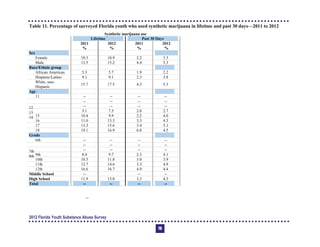
  • 16.
    shortened version ofthe questionnaire. This new questionnaire made it easier for students with weaker reading skills to complete the survey within a standard classroom period. As a result, eight risk factor scales and four protective factor scales deemed less-critical for prevention planning were no longer included in middle school FYSAS data. Also, several ATOD items with very low prevalence rates were either removed or aggregated. For the 2010 FYSAS, the length of middle school questionnaire was further reduced. Eleven items that provided limited value to state-level and county-level prevention planning efforts were removed. These included questions about adults in student's neighborhoods, questions about antisocial behavior among siblings and other family members, and questions about peer antisocial behavior. These changes resulted in a more compact set of six protective factors and 15 risk factors. Also in 2010, the high school questionnaire received an extensive update. This year, high school students received the same questionnaire as Florida middle school students, with the addition of items addressing bullying behavior, gang activity in schools and alcohol use. Results for these new items are presented in Tables 50 to 56. The new, shorter high school questionnaire eased the survey administration burden in classrooms and boosted completion rates. In 2011, the FYSAS middle school questionnaire was unchanged. The high school questionnaire added two items addressing the use of synthetic marijuana, an item assessing parental disapproval of youth alcohol use, and an item addressing peer approval of gang membership. For 2012, the FYSAS middle school questionnaire remained unchanged. The high school questionnaire added four items addressing ATOD use and vehicle safety and one item addressing the risk associated with prescription drug abuse. A block of items addressing bullying location were removed. Sampling The goal of the 2012 FYSAS was to produce both state- level statistical estimates that are representative of individual grades, and county-level statistical estimates that are representative of middle school (grades 6-8) and high school (grades 9-12) grade aggregates. To accomplish this, a stratified, two-stage cluster sample of students attending public middle schools and high schools in Florida was used. The sample was stratified by county. In the first selection stage, separate groups of middle schools (grades 6-8) and high schools (grades 9-12) were randomly selected within each of the 66 Florida counties that participated in the survey. (Osceola County did not participate.) All public middle and high schools were included in the sampling frame for each county, with the exception of adult education, correctional or special education schools. The probability of selection for each school was proportional to the size of the school’s enrollment. Accordingly, larger schools had a higher chance of being selected than smaller schools. Using this methodology, 440 middle schools and 346 high schools were selected to participate. For the second sampling stage, survey coordinators were instructed on how to randomly select classrooms to fulfill the survey quota for each school. Because special education and ESOL (English for speakers of other languages) classes could not be used in the survey, they were not included in the classroom selection list for each school. This sample design, which is similar to the one used in the 2000, 2002, 2004, 2006, 2008 and 2010 FYSAS, is different from the design used in the 2001, 2003, 2005, 2007, 2009 and 2011 FYSAS. In odd-numbered years, the goal of the survey is to produce results that are representative at the state level only, but not at the county level. Consequently, sample sizes were much smaller in those years (8,281 in 2001, 7,983 in 2003, 8,501 in 2005, 8,434 in 2007, 11,166 in 2009 and 11,491 in 2011). In this report, historical results are only presented for even-numbered years, starting with the 2002 FYSAS. This is done because statistical estimates from these larger samples are more accurate than estimates produced by the smaller samples from odd- numbered years. Historical data from 2000 were omitted because that year’s survey was administered in the fall semester rather than the spring. Participation Rates Participation rates were calculated separately for both schools and students as a ratio of the number participating divided by the number selected. A combined participation rate consists of the two separate school and student participation rates multiplied by each other. Middle School: School Participation: 417 / 440 = 94.8% Student Participation: 38,742 / 48,264 = 80.3% 2 2012 Florida Youth Substance Abuse Survey
  • 17.
    Overall Participation: 76.1% HighSchool: School Participation: 329 / 346 = 95.1% Student Participation: 36,154 / 47,516 = 76.1% Overall Participation: 72.4% Participation was strong at the school level, with only 40 schools out of 786 refusing to participate. Student participation within surveyed schools was also impressive. This level of participation builds upon the FYSAS track record of obtaining highly-representative statewide student samples. It is also a testament to the outstanding work performed by the survey planners and coordinators who support FYSAS administration at the county and school levels. Weighting Before analysis, a set of statistical weights was applied to the 2012 FYSAS dataset. The application of the weights served three purposes:  First, weighting compensates for certain elements of the sample design—such as the sampling of students in clusters—so that the sample selection probability for each student was equal.  Second, weighting adjusts for nonresponse at both the school and classroom levels.  Third, weighting adjusts the distribution of the sample across grade levels, gender groups and counties to match the distribution across the full population of Florida public school students. Through this process, responses from the grades, gender groups and counties that were underrepresented relative to the population are given more weight in the data analysis, while responses from the grades, gender groups and counties that were overrepresented are given less weight. This creates a sample that proportionately matches student enrollments across grade, gender and county. The step, called post-stratification, is important because variations in participation across grade levels are common with statewide, school-based survey projects like the FYSAS. Post-stratification makes the sample more representative of the population, and improves the comparability of samples over time. A number of factors were involved in the calculation of the weights. Students were asked to provide their grade and gender. If grade was left blank, and age was known, the grade was imputed based on the most likely age for that grade. Where the grade was still missing, the grade was imputed by sorting students by their survey booklet’s serial number and assigning the student to the grade of the previous student who had been assigned a grade. State totals for grade and gender categories were obtained from the Florida Department of Education. The weight of a respondent was the product of eight adjustments: W 1 = Inverse of the probability of selection of the school and level. W 2 = Adjustment for school nonresponse. This was obtained after dividing the schools into enrollment groups and adjusting for the number of schools in each group refusing. W 3 = Sampling interval. This was obtained by dividing the enrollment by the target sample for the school. W 4 = Adjustment for class nonresponse (entire class not responding). If n classes were selected in the school and k participated in the survey, W 4 = (n/k). W 5 = Adjustment for the number of different surveys administered. W 6 = Adjustment to class size. This was the number of students enrolled in a class divided by the number of students completing the survey. W7 = Adjustment for post-stratification. W8 = Adjustment for trimming (setting weights greater than twice the median for LEA /level to twice the median and adjusting to obtain the same totals.). W8 is the sum of the uncapped weights divided by the sum of the capped weights. Weight = W1 x W2 x W3 x W4 x W5 x W6 x W7 x W8 Survey Administration Survey plans called for participation of 6th through 12th graders in the state of Florida. Survey administration procedures were the same as those used in previous waves of the FYSAS and were standardized throughout the state. Each teacher received an appropriate number of surveys and survey collection envelopes. Teachers reviewed the instructions with their students and asked them to complete the survey. Students had 50 minutes to complete the surveys. 2012 Florida Youth Substance Abuse Survey 3
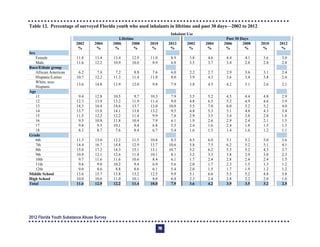
  • 18.
    A passive consentprocedure was used by most school districts for this survey administration. That is, students were given the consent notification and were asked to give it to their parents. It was then up to the parents to notify the school if they did not want their child to participate in the survey. Students were asked to complete the survey, but were also told that they could skip any question that they were not comfortable answering. Additionally, both the teacher and the written instructions on the front of the survey form assured students that participation in the survey was voluntary, and that the answers students gave would be anonymous and confidential. There were no known irregularities in survey administration. All aspects of the survey protocol appeared to be appropriately implemented, including all protections of student confidentiality. Please note that administration for the 2012 FYSAS took place in February and March. While this date range matches the administration period of the 2011 survey, data collection for the 2002-2010 FYSAS was conducted in March and April. This change was necessary in order to support the state’s standardized testing schedule. FYSAS data users should consider this change when comparing 2011 and 2012 results with earlier findings. Due to the earlier administration period, student behaviors and attitudes that are positively correlated with age, such as ATOD use, are likely to have slightly lower prevalence rates. Survey Validation A total yield of 74,896 students participated in the 2012 FYSAS. Of these, 275 students were removed for being sampled out of level. Data for the remaining 74,621 students were subjected to five response validation testing strategies. The first two strategies eliminated students who appeared to exaggerate their drug use and other antisocial behavior. The third strategy eliminated students who reported use of a fictitious drug. The fourth strategy eliminated the surveys of students who repeatedly reported logically inconsistent patterns of drug use. The fifth strategy eliminated students who answered less than 25% of the questions on the survey. In the first strategy, surveys from students who reported a combined average of four or more daily uses for illicit drugs other than marijuana were eliminated from the survey dataset. This strategy removes surveys that are not taken seriously. The second strategy supplements the drug use exaggeration test by examining the frequency of five other antisocial behaviors: Attacking Someone with Intent to Harm, Attempting to Steal a Vehicle, Being Arrested, Getting Suspended and Taking a Handgun to School. Respondents who reported an unrealistically high frequency of these behaviors—more than 120 instances within the past year—were removed from the analysis. In the third strategy, students were asked if they had used a fictitious drug, Derbisol, in the past 30 days or in their lifetimes. If students reported the use of Derbisol for either of these time periods, their surveys were not included in the analysis of the findings. The fourth strategy was used to detect logical inconsistencies among responses to the drug-related questions. Students were identified as inconsistent responders in the following circumstances only: (1) if they were inconsistent on two or more of the following four drugs: alcohol, cigarettes, smokeless tobacco and marijuana; or (2) if they were inconsistent on two or more of the remaining drugs. An example of an inconsistent response would be if a student reported that he or she had used alcohol three to five times in the past 30 days but had never used alcohol in his or her lifetime. For the fifth strategy, students who answered less than 25% of the questions on the survey were removed from the analysis. This test is used to identify students who did not take the survey seriously or were incapable of fully participating. Florida students were cooperative and produced a high percentage of valid surveys. All but 3,762 students (5.0% of 74,621) completed valid surveys. Of the 3,762 surveys identified and eliminated by one or more of the five strategies described above, 1,639 exaggerated drug use (strategy 1), 845 exaggerated other antisocial behavior (strategy 2), 2,521 reported the use of the fictitious drug (strategy 3), 1,642 responded in a logically inconsistent way (strategy 4) and 516 answered fewer than 25% of the questions on the survey (strategy 5). The elimination total produced by these five strategies equals more than 3,762 because a number of respondents were identified by more than one strategy. Confidence Intervals The maximum 95% confidence intervals for grade-level estimates range from a low of ±1.2 percentage points for the 6th , 7th , and 8th grade subsamples, to a high of ±1.7 percentage points for the 12th grade subsample. For the middle school and high school subsamples confidence intervals are ±0.7 and ±0.8 percentage points, 4 2012 Florida Youth Substance Abuse Survey
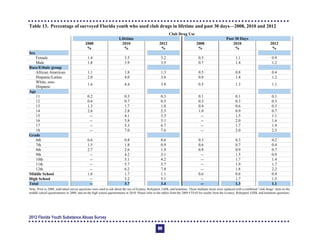
  • 19.
    respectively. Estimates forthe overall sample have confidence intervals of ±0.5 percentage points. Confidence intervals are larger for demographic groups with smaller sample sizes, such as African American students. Note that these confidence intervals are for prevalence rates of 50%. For less prevalent behaviors, such as heroin use and taking a handgun to school, the confidence interval narrows substantially. Also note that the variance estimates used for these confidence interval calculations include a design effect of 2.0 to adjust for the complex design of the 2011 FYSAS sample. A finite population adjustment was not included in the confidence interval formula. Demographic Profile of Surveyed Youth The survey measures a variety of demographic characteristics. The first two data columns of Table 1 describe the demographic profile of the sample before weights were applied. Middle school students constituted more than one half of the unweighted sample (52.4%). A slightly higher percentage of the respondents were female (50.1% female versus 48.4% male). Slightly more than one third of surveyed students identified themselves as White, non-Hispanic (48.4%), followed by Hispanic/Latino (15.3%) and African American (14.6%). The rest of the ethnic breakdown ranges from 0.3% for Native Hawaiian/Pacific Islander to 16.3% for students who indicated Other/Multiple ethnic backgrounds. Throughout this report, data are reported only on the three largest ethnic groups: White, non-Hispanic, African American and Hispanic/Latino, as the sample sizes for the other ethnic categories were insufficient to generate reliable estimates. The second set of data columns in Table 1 presents the demographic profile information after the weighting formula has been applied. Note that the distribution across grades is now correctly balanced and matches the population parameters provided by the Florida Department of Education (43.5% middle school and 56.5% high school). 2012 Florida Youth Substance Abuse Survey 5
  • 21.
    Section 2: Alcohol,Tobacco and Other Drug Use Section 2 Alcohol, Tobacco and Other Drug Use A lcohol, tobacco and other drug (ATOD) use is measured by a set of 29 items. While most of these items are identical to those used in the previous waves of the survey, several key changes have been made as the FYSAS questionnaires have been updated over time. Starting in 2001, the survey included items measuring: (a) the use of so-called “club drugs” such as Ecstasy, GHB, ketamine and Rohypnol, (b) the use of hallucinogenic mushrooms, and (c) the use of amphetamines, including Ritalin® and Adderall® , without a doctor’s orders. In addition, the use of marijuana and the use of hashish were combined into a single item, and the use of “LSD and other psychedelics” was reworded to read “LSD or PCP.” Also starting in 2001, a parenthetical mentioning the street names “ice” and “crystal meth” was added to the methamphetamine item. In 2002, the prescription drug Xanax® was added to the list of examples given in the “depressants and downers” item, and the “other narcotics” item was replaced by a new question measuring the use of “prescription pain relievers” without a doctor’s orders. Three changes were made to the ATOD section in 2002: (a) a new item measuring the use of OxyContin® without a doctor’s orders, (b) the prescription drug Xanax® was added to the list of examples given in the “depressants and downers” question, and (c) the “other narcotics” item was replaced by a new question measuring the use of “prescription pain relievers” without a doctor’s orders. On the 2006 questionnaire, OxyContin® was removed as an individual item and added to the list of examples included in the prescription pain reliever item. Also, the question for GHB was changed to include a more up-to­ date set of slang or street names for the drug. In 2008, the questionnaire administered to high school students remained unchanged, but the ATOD section of the middle school questionnaire reduced the number of items by asking broader categories of ATOD use rather than only asking about individual drugs. The updated Graph 1 2012 Florida Youth Substance Abuse Survey 7
  • 22.
    middle school questionnairealso introduced an important new category of ATOD use to the FYSAS. A description of these changes is below:  Items for smokeless tobacco were removed.  Items for the club drugs Ecstasy, GHB, ketamine and Rohypnol were replaced by single items that ask about the use of “club drugs such as Ecstasy, Rohypnol, GHB or ketamine.”  Items for LSD/PCP and hallucinogenic mushroom use were combined into a pair of single items that ask about all three drugs.  Items for cocaine and crack cocaine use were combined into a pair of single items that ask about both drugs.  Items that measure the use of over-the-counter drugs in order to get high were added. For 2010, the ATOD prevalence section of the middle school questionnaire remained unchanged. The high school questionnaire, however, adopted all of the middle school ATOD prevalence items. As a result, this year’s middle school and high school FYSAS questionnaires employ the same 29-item ATOD prevalence measurement section. In addition to facilitating comparisons between middle school and high school ATOD results, these changes improve completion rates Graph 2 by shortening the length of the high school questionnaire. In 2011, two items measuring the use of synthetic marijuana were added to the high school questionnaire. The middle school questionnaire remained unchanged. Tables 3 through 27 in Appendix A show the use of ATODs by students in Florida In addition to results from this year’s survey, data are also presented for the 2002, 2004, 2006, 2008 and 2010 FYSAS. There are two ways in which data that depict student involvement in ATOD use are provided. First, prevalence rates are used to illustrate the percentage of students who reported using a drug at least once in a specified time period. These results are presented for both lifetime and past-30-day prevalence- of-use periods. Lifetime prevalence of use (whether the student has ever used the drug) is a good measure of student experimentation. Past-30-day prevalence of use (whether the student has used the drug within the last month) is a good measure of current use. Prevalence-of­ use rates are also presented for five combinations of licit and illicit drugs. Trend data for these combination measures start in 2002 because new ATOD items were added between 2000 and 2002. In addition to the standard lifetime and past-30-day prevalence rates for alcohol use, binge drinking behavior (defined as a report of five or more drinks in a row within the past two weeks) is also measured. Lifetime use of alcohol, tobacco and other drugs among high school students, 2012 100% 80% 60% 40% 20% 0% 61.3 34.4 28.5 8.5 6.9 6.8 6.4 5.1 5.1 4.8 4.3 3.1 1.1 0.9 8 2012 Florida Youth Substance Abuse Survey
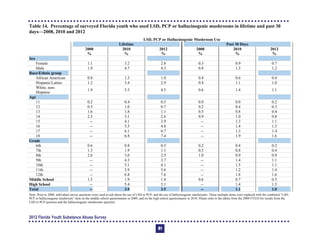
  • 23.
    Second, frequency tablesare used to illustrate the number of occasions that students reported using a specific drug in the past 30 days. Please note that when the prevalence rate is quite low (e.g., less than 2%), larger sample sizes are required to reliably estimate the prevalence rate as well as the frequency of use. Therefore, frequency tables are shown only for the most prevalent drug categories. Key ATOD Findings Tables 3 and 4 and Graphs 1 to 4 summarize the ATOD results from the current survey. Comparisons between the current data and results from previous waves of the survey (2002-2010 FYSAS) are also presented in Tables 5 to 27. A review of several key findings and trends in this year’s survey will provide a better understanding of the specific drug findings. The selected findings presented below are those that are probably of most interest to the greater survey audience. 2012 FYSAS Results  With overall prevalence rates of 47.3% for lifetime use and 24.6% for past-30-day use, alcohol continues to be the most commonly used drug among Florida’s students.  About one out of eight Florida students (11.3%) reported binge drinking (defined as the consumption of five or more drinks in a row in Graph 3 100% 80% 60% 40% 20% 0% the last two weeks), making this dangerous behavior more prevalent than past-30-day cigarette or other illicit drug use.  After alcohol, students reported marijuana (23.2% lifetime and 12.4% past-30-day) and cigarettes (21.3% lifetime and 6.6% past-30-day) as the most commonly used drugs. Prevalence rates for other drugs are substantially lower.  The prevalence of past-30-day use of all illicit drugs other than marijuana combined (8.2%) is less than the prevalence of past-30-day use of alcohol (24.6%) and marijuana (12.4%). It is also lower than the prevalence of binge drinking (11.3%).  Despite their low level of use, both lifetime and past-30-day prevalence rates for prescription pain relievers (6.4% and 2.3%, respectively) and depressants (4.6% and 1.6%, respectively) are higher than for all other illicit drugs, except marijuana and inhalants.  While relatively few students reported inappropriate over-the-counter drug use (5.5% lifetime and 2.2% past-30-day), those rates are higher than for nearly all other illicit drugs on the survey. Past-30-day use of alcohol, tobacco and other drugs among middle school students, 2012 12.3 4.7 4.2 3.8 2.7 1.7 1.7 0.8 0.5 0.5 0.4 0.4 0.4 0.3 0.2 2012 Florida Youth Substance Abuse Survey 9
  • 24.
     Past-30-day prevalencerates for club drugs, hallucinogenic drugs (LSD, PCP, and mushrooms), and prescription amphetamines are less than 2.0%.  Past-30-day prevalence rates for cocaine or crack cocaine, methamphetamine, heroin, and steroids are less than 1.0%. Changes Over Time: 2010-2012  Between 2010 and 2012, Florida students reported moderate to small reductions in use for most substance categories.  Florida students reported the largest short-term reductions in use for alcohol. Across the overall sample, past-30-day alcohol use decreased 4.2 percentage points and binge drinking—defined as five or more drinks in a row on one or more occasions within the past two weeks—decreased 2.8 percentage points.  Past-30-day cigarette use decreased 1.8 percentage points among middle school students and 2.5 percentage points among high school students, extending the long-term pattern of declining prevalence rates.  Reversing an increase between 2008 and 2010, past-30-day use of marijuana decreased 1.5 Graph 4 percentage points among middle school students and 0.1 percentage points among high school students.  Most illicit drug categories showed no change or very small reductions between 2010 and 2012. However, lifetime and past-30-day use of synthetic marijuana increased 1.1 and 1.0 percentage points, respectively. Changes Over Time: 2002-2012  Between 2002 and 2012, Florida students reported reductions in past-30-day use for all substance categories except marijuana.  Most notably, past-30-day alcohol and cigarette use and binge drinking declined 6.6, 4.8 and 4.7 percentage points, respectively. These changes represent important improvements in the health behavior of Florida youth.  Florida students also reported modest long-term reductions in use for illicit drugs other than marijuana. These changes are summarized by the multi-item indicator past-30-day use of any illicit drug other than marijuana, which decreased from 10.1% in 2002 to 8.2% in 2012.  Between 2002 and 2012, past-30-day use of depressants and prescription pain relievers Past-30-day use of alcohol, tobacco and other drugs among high school students, 2012 100% 80% 60% 40% 20% 0% 33.9 18.5 16.4 9.6 4.3 2.8 2.6 2.1 1.6 1.5 1.5 1.3 0.9 0.5 0.5 10 2012 Florida Youth Substance Abuse Survey
  • 25.
    declined 1.3 and1.2 percentage points, respectively, while inhalants and methamphetamines declined 1.1 and 0.4 percentage points, respectively. Subgroup Analyses In addition to grade-level reporting, the data tables in Appendix A report prevalence by age, sex and ethnicity. As might be expected, age differences closely approximate grade differences. Across most ATOD categories, male and female respondents reported small differences in the rates of use. Males, however, have notably higher rates for past-30­ day marijuana use (14.1% among males versus 10.6% among females) and binge drinking (11.9% among males versus 10.6% among females). Males also reported a higher rate of past-30-day cigarette use (7.1% among males versus 6.0% among females). While this difference is modest, it represents a shift from the pattern in some previous waves of the FYSAS which showed slightly higher rates of smoking among females. Females reported slightly higher rates for a number of illicit drugs other than marijuana. Typical of many studies (Johnston, O’Malley, Bachman & Schulenberg, 2012), the 2012 FYSAS revealed a pattern of differences in drug use prevalence rates across ethnic groups. Across the majority of ATOD categories, White, non-Hispanic students reported the highest prevalence of use, followed by Hispanic/Latino students, with African American students reporting the lowest rates, sometimes by a substantial margin. Ethnic differences are particularly pronounced for past-30-day Graph 5 cigarette use (9.1% among White, non-Hispanic respondents, 5.2% among Hispanic/Latino respondents and 2.9% among African American respondents), alcohol use (27.6% among White, non-Hispanic respondents, 25.5% among Hispanic/Latino respondents and 17.4% among African American respondents) and marijuana use (13.8% among White, non-Hispanic respondents, 11.3% among Hispanic/Latino respondents and 10.1% among African American respondents). Alcohol Alcohol, including beer, wine and hard liquor, is the drug used most often by adolescents today. Findings from Monitoring the Future, a national drug use survey administered annually by the University of Michigan, highlight the pervasiveness of alcohol use among middle and high school students today. In 2012, the percentages of 8th , 10th and 12th graders who reported using alcohol in the past 30 days were 11.0%, 27.6% and 41.5%, respectively (Johnston, O’Malley, Bachman & Schulenberg, 2013). These numbers represent substantial reductions from the higher national rates reported in the late 1990s. A variety of findings for alcohol use by Florida students are presented in Tables 5 to 7. These tables include 2002­ 2012 data for lifetime and past-30-day prevalence, the frequency of past-30-day alcohol use, as well as the prevalence of binge drinking. Lifetime Prevalence. Of the students surveyed in Florida in 2012, 47.3% have used alcohol on at least one occasion in their lifetimes. Lifetime prevalence rates for alcohol use range from a low of 17.4% for 6th graders to a high of 70.1% for 12th graders. This corresponds to an overall rate of 28.9% for middle school students and 61.3% for high school students. Past-30-Day Prevalence. In 2012, 24.6% of surveyed Florida students reported the use of alcohol in the past 30 days, with grade-level results ranging from a low of 6.5% for 6th graders to a high of 42.7% for 12th graders. These averages translate into overall rates of 12.3% for middle school students and 33.9% for high school students. Frequency of Use. The frequency of alcohol use in the past 30 days is summarized in Table 6. This table shows the percentage of students who 2012 Florida Youth Substance Abuse Survey 11
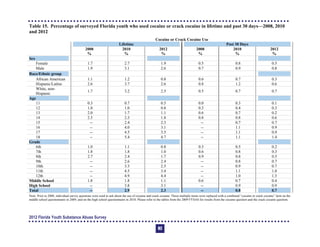
  • 26.
    reported using alcoholon a specific number of occasions in the past 30 days. Note that for this table, the number of occasions of use has been aggregated into seven categories: 0 occasions, 1-2 occasions, 3-5 occasions, 6-9 occasions, 10-19 occasions, 20-39 occasions and 40 or more occasions. For instance, 18.2% of high school students indicated that they had used alcohol 1-2 times in the past month. Binge Drinking. Findings on binge drinking (defined as consuming five or more drinks in a row within the past two weeks) are likely to be among the most important findings related to alcohol use. As Table 7 shows, 11.3% of Florida students reported binge drinking. The prevalence rate for binge drinking ranges from a low of 2.1% for 6th graders to a high of 22.1% for 12th graders, with averages of 4.7% for middle school students and 16.4% for high school students. 2002-2012 Trend. As Table 5 and Graph 5 show, overall past-30-day alcohol use increased 1.1 percentage points between 2002 and 2004. This rate declined slightly between 2004 and 2006, before taking a sharper 2.2 percentage point decline between 2006 and 2008. Put together, past-30-day alcohol use among Florida students declined 6.6 percentage points between 2002 and 2012. Results for binge drinking among Florida students reveal a similar pattern of change over time, remaining the same between 2002 and 2004, increasing slightly in 2006, and declining 5.5 percentage points between 2006 and 2012. Source of Alcohol. The 2010 FYSAS high school questionnaire included a new item asking respondents to report where they usually get their alcohol (within the past 30 days). As Table 44 shows, “Someone gave it to Graph 6 2012 Florida Youth Substance Abuse Survey me” was the most common reported source (43.7%), followed by “Someone bought it for me” (17.8%) and “Some other way” (15.6%). Stores, restaurants, and public events were less common sources of alcohol for high school students. Drinking Location. The 2010 FYSAS high school questionnaire included a new item asking respondents to report where they usually drank alcohol (within the past 30 days). As Table 45 shows, “Another person’s home” was the most common response (48.7%), followed by “My home” (27.8%), and “Some other place” (11.2%). Other response options, such as “Car or other vehicle” and “School property” were selected by very few students. Drinks per Day. The 2010 FYSAS high school questionnaire included a new item asking respondents to report how many drinks they usually have on days when they drink (within the past 30 days). As Table 46 shows, 25.2% of surveyed high school students reported usually having “5 or more” drinks on the days they drink alcohol, 10.4% reported usually having four drinks, and 17.3% reported usually having three drinks. These results show that among the minority of students who report drinking within the past 30 days, a substantial portion is engaging in risky, binge-style drinking behavior. Cigarettes This section of the report discusses the prevalence of cigarette use as measured by the 2012 FYSAS. Another survey, the 2012 Florida Youth Tobacco Survey (Florida Department of Health) was administered simultaneously with the 2012 FYSAS, and was specifically tobacco related. That survey is Florida’s official source for youth tobacco use information. The results of the 2012 FYSAS were largely consistent with the findings reported in the 2012 Florida Youth Tobacco Survey. Results for this survey can be accessed at this website: http://www.doh.state.fl.us/DISEASE_ CTRL/epi/Chronic_Disease/FYTS/Int ro.htm. Throughout the 1990s, tobacco (including cigarettes and smokeless tobacco) was the second most commonly used drug among adolescents. National smoking rates, however, have declined substantially in the past two decades. According to 12
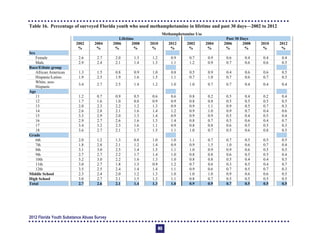
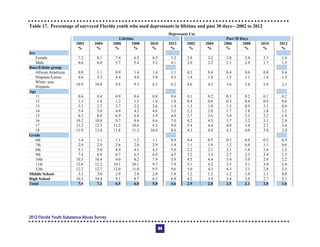
  • 27.
    data from theMonitoring the Future study, between 1991 and 2012 past-30-day cigarette use declined from 14.3% to 4.9% among 8th graders, from 20.8% to 10.8% among 10th graders, and from 28.3% to 17.1% among 12th graders (Johnston et al., 2013). A variety of findings for cigarette use by Florida students is presented in Table 8 and Graph 6. These include 2002­ 2012 data for lifetime and past-30-day prevalence of cigarette use. Lifetime Prevalence. Of the students surveyed in Florida in 2012, 21.3% have smoked cigarettes on at least one occasion in their lifetimes. Lifetime prevalence rates for cigarette use range from a low of 6.7% for 6th graders to a high of 36.5% for 12th graders. This corresponds to an overall rate of 11.8% for middle school students and 28.5% for high school students. Past-30-Day Prevalence. In 2012, 6.6% of surveyed Florida students reported smoking cigarettes in the past 30 days, with grade-level results ranging from a low of 1.3% for 6th graders to a high of 13.9% for 12th graders. These averages translate into overall scores of 2.7% for middle school students and 9.6% for high school students. 2002-2012 Trend. As Graph 6 shows, the past-30-day prevalence rate for cigarettes remained unchanged between 2002 and 2004, suggesting that the impressive reductions recorded at the beginning of the decade had played out. However, the next two survey waves extended the downward trend from the beginning of the decade, with the past-30-day prevalence rate dropping from 11.4% in 2004 to 9.1% in 2008. Between 2008 and 2012, past-30-day use dropped another 2.5 percentage Graph 7 points. Marijuana or Hashish During the 1990s, there were major changes in trends of marijuana use throughout the United States. Results from the Monitoring the Future study show dramatic increases in both lifetime and past-30-day prevalence rates through the early and mid 1990s (Johnston et al., 2013). For 8th and 10th graders the past-30-day rates more than doubled during this period. Since 1996 and 1997, when marijuana use peaked, rates started a gradual decline that lasted through the mid to late 2000s. Between 2008 and 2011, this trend has reversed and the prevalence of marijuana use increased. In 2012, national survey results show past- 30-day rates of 6.5% among 8th graders, 17.0% among 10th graders and 22.9% among 12th graders. A variety of findings for marijuana or hashish use by Florida students is presented in Tables 9 to 11 and Graph 7. These include 2002-2012 data for lifetime and past-30­ day prevalence. Lifetime Prevalence. Of the students surveyed in Florida in 2012, 23.2% have used marijuana or hashish on at least one occasion in their lifetimes. Lifetime prevalence rates range from a low of 2.8% for 6th graders to a high of 44.6% for 12th graders. This corresponds to an overall rate of 8.3% for middle school students and 34.4% for high school students. Past-30-Day Prevalence. In 2012, 12.4% of surveyed Florida students reported the use of marijuana or hashish in the past 30 days, with grade-level results ranging from a low of 1.1% for 6th graders to a high of 23.2% for 12th graders. These averages translate into overall scores of 4.2% for middle school students and 18.5% for high school students. Frequency of Use. The frequency of marijuana or hashish use in the past 30 days is summarized in Table 10. This table shows the percentage of students who reported using marijuana or hashish on a specific number of occasions in the past 30 days. Note that for this table, the number of occasions of use has been aggregated into seven categories: 0 occasions, 1-2 occasions, 3-5 occasions, 6-9 occasions, 10-19 occasions, 20-39 occasions and 40 or more occasions. For instance, 7.3% of 12th grade students indicated that they 2012 Florida Youth Substance Abuse Survey 13
  • 28.
    had used marijuanaor hashish 1-2 times in the past month. 2002-2012 Trend. As Graph 7 and Table 9 show, past- 30-day marijuana or hashish use across the overall sample declined 0.6 percentage points from 2002 to 2004. Between 2004 and 2008, past-30-day marijuana or hashish prevalence showed relatively little change, with past-30-day use declining 0.9 percentage points among middle school students and 0.2 percentage points among high school students. Between 2008 and 2012, past-30­ day use of marijuana decreased 0.2 percentage points among middle school students and increased 1.3 percentage points among high school students. Synthetic Marijuana. Blends of herbs and synthetic chemical compounds designed to produce a marijuana- like high have become more popular in recent years. Often marketed as “herbal incense” under brand names like “K2” and “Spice,” synthetic marijuana can be purchased legally in many states. While little is known about the risks associated with synthetic marijuana, the medical community has issued warnings about health and behavior problems associated with its use. As Table 11 shows, 13.0% of Florida high school students reported using synthetic marijuana on at least one occasion in their lifetimes. Lifetime prevalence rates range from a low of 9.7% among 9th graders to a high of 16.7% among 12th graders. High school students reported a past-30-day prevalence rate of 4.3%, with a low of 4.1% among 9th graders and a high of 4.9% among 11th graders. The lifetime prevalence rate among high school students for synthetic marijuana use increased from 11.9% in Graph 8 2012 Florida Youth Substance Abuse Survey 2011 to 13.0% in 2012. The past-30-day prevalence rate increased from 3.3% in 2011 to 4.3% in 2012. Inhalants After alcohol, tobacco and marijuana, the most commonly used drug among Florida students is inhalants. Inhalant use is measured by the survey question, “On how many occasions (if any) have you used inhalants (whippets, butane, paint thinner, or glue to sniff, etc.)?” Inhalant use is more prevalent with younger students, perhaps because it is often the easiest drug for them to obtain. The negative consequences of inhalant use can be substantial; one of them being that it is associated with the use of other illicit drugs later in life. According to national results from the Monitoring the Future study (Johnston et al., 2013), the prevalence rate of past-30-day inhalant use in 2012 was 2.7% among 8th graders, 1.4% among 10th graders and 0.9% among 12th graders. A variety of findings for inhalant use by Florida students is presented in Table 12 and Graph 8. These include 2002-2012 data for lifetime and past-30-day prevalence. Lifetime Prevalence. Of the students surveyed in Florida in 2012, 7.9% have used inhalants on at least one occasion in their lifetimes. Grade-level results indicate, however, that inhalant use does not follow the typical pattern of increasing with age and grade level. Lifetime inhalant use peaks among 8th graders at 10.7%, before reaching a low among 12th graders of 5.4%. This corresponds to a rate of 9.9% for middle school students and 6.4% for high school students. Past-30-Day Prevalence. Overall, 2.5% of surveyed Florida students reported the use of inhalants in the past 30 days. Similar to lifetime prevalence, past-30-day prevalence of use peaks in the 7th grade at 4.1% before reaching a low of 1.2% in the 11th and 12th grades. These averages translate into overall scores of 3.8% for middle school students and 1.6% for high school students. 2002-2012 Trend. At the beginning of the decade a number of prevention agencies warned that inhalant use was on the rise. Data from the FYSAS contradict this prediction. With a low of 2.5% in 2012 and a high of 4.2% in 2004, the rate of past-30-day inhalant use 14
  • 29.
    for the overallsample of Florida students has declined slightly over time. Club Drugs Club drugs are a broad category of illicit substances that are classified together because their use began at dance clubs and “raves,” not because they are of a similar chemical class (like amphetamines). Their use, however, has expanded beyond these settings. For 2012 both the middle school and high school FYSAS questionnaires include two items that ask students about “club drugs such as Ecstasy, Rohypnol, GHB, or ketamine.” Ecstasy (also known as MDMA), a form of methamphetamine, has both stimulant and hallucinogenic effects. GHB (gamma-hydroxybutyrate) is generally an odorless, colorless liquid that is taken orally. When combined with alcohol, it can be used to induce unconsciousness and has been involved in sexual assaults. It also has been used to enhance bodybuilding. Ketamine, also known as “Special K,” is a tranquilizer most often used by veterinarians. However, its hallucinatory effects, which are similar to those of LSD and PCP, have made it another drug of choice at dance clubs and raves. Rohypnol, also known as “roofies” and “the date rape drug,” is a sedative in the same family as Valium® , and is the trade name for flunitrazepam. It is as much as 10 times more potent than Valium® . Rohypnol is often taken with other drugs in an effort to either enhance their effects or buffer the withdrawal symptoms. Findings for lifetime and past-30-day club drug use by Florida students are presented in Table 13. Since the current format of the club drug survey items was introduced in 2008 on the middle school questionnaire and in 2010 on the high school questionnaire, data are not available for trend analysis. Lifetime Prevalence. Of the students surveyed in Florida in 2012, 3.4% have used club drugs on at least one occasion in their lifetimes. Lifetime prevalence rates range from a low of 0.6% for 6th graders to a high of 7.8% for 12th graders. This corresponds to an overall rate of 1.1% for middle school students and 5.1% for high school students. Past-30-Day Prevalence. In 2012, just 1.1% of surveyed Florida students reported the use of club drugs in the past 30 days. Other Illicit Drugs The 2012 FYSAS also measured the prevalence of use of a variety of other illicit drugs among Florida students. This includes student use of the following: LSD, PCP or hallucinogenic mushrooms; cocaine or crack cocaine; methamphetamine; depressants; heroin; prescription pain relievers; illicit use of over-the-counter drugs; steroids; and amphetamines. Results for these substance categories are presented in Tables 14 through 22. As is typical of adolescent populations, the prevalence- of-use rates reported by Florida students for these other illicit drugs are much lower than the rates for alcohol, tobacco, marijuana and inhalants, and tend to be concentrated in the upper grades. LSD, PCP or Hallucinogenic Mushrooms Table 14 summarizes the lifetime and past-30-day prevalence rates of LSD, PCP or hallucinogenic mushroom use among Florida students. Since the current format of the LSD, PCP or hallucinogenic mushroom survey items was introduced in 2008 on the middle school questionnaire and in 2010 on the high school questionnaire, data are not available for trend analysis. Lifetime Prevalence. Of the students surveyed in Florida in 2012, 3.5% have used LSD, PCP or hallucinogenic mushrooms on at least one occasion in their lifetimes. Lifetime prevalence rates range from a low of 0.5% for 6th graders to a high of 7.6% for 12th graders. This corresponds to an overall rate of 1.4% for middle school students and 5.1% for high school students. Past-30-Day Prevalence. In 2012, just 1.0% of surveyed Florida students reported the use of LSD, PCP or hallucinogenic mushrooms in the past 30 days. Cocaine or Crack Cocaine Table 15 summarizes the lifetime and past-30-day prevalence rates of cocaine or crack cocaine use among Florida students. Since the current format of the cocaine or crack cocaine survey items was introduced in 2008 on the middle school questionnaire and in 2010 on the high school questionnaire, data are not available for trend analysis. 2012 Florida Youth Substance Abuse Survey 15
  • 30.
    Lifetime Prevalence. Ofthe students surveyed in Florida in 2012, 2.3% have used cocaine or crack cocaine on at least one occasion in their lifetimes. Lifetime prevalence rates range from a low of 0.8% for 6th graders to a high of 4.4% for 12th graders. This corresponds to an overall rate of 1.1% for middle school students and 3.1% for high school students. Past-30-Day Prevalence. In 2012, just 0.7% of surveyed Florida students reported the use of cocaine or crack cocaine in the past 30 days. Methamphetamine Table 16 summarizes the lifetime and past-30-day prevalence rates of methamphetamine use. Lifetime Prevalence. Of the students surveyed in Florida in 2012, 1.0% used methamphetamines on at least one occasion in their lifetimes. Past-30-Day Prevalence. In 2012, just 0.5% of surveyed Florida students reported the use of methamphetamines in the past 30 days. 2002-2012 Trend. Both lifetime and past-30-day prevalence rates for methamphetamine use decreased between 2002 and 2012 (1.7 and 0.4 percentage-point reductions, respectively). For both measures the reduction was concentrated among high school respondents. Depressants The use of depressants was measured by asking: “On how many occasions (if any) have you used depressants or ‘downers’ like quaaludes, Xanax® , barbiturates or tranquilizers, in your lifetime?” and “… in the past 30 days?” Table 17 summarizes the lifetime and past-30-day prevalence rates of depressant use. Lifetime Prevalence. Of the students surveyed in Florida in 2012, 4.6% have used depressants on at least one occasion in their lifetimes. Lifetime prevalence rates range from a low of 0.9% for 6th graders to a high of 9.6% for 12th graders. This corresponds to an overall rate of 1.8% for middle school students and 6.8% for high school students. Past-30-Day Prevalence. In 2012, 1.6% of surveyed Florida students reported the use of depressants in the past 30 days. 2002-2012 Trend. Past-30-day depressant use showed almost no change between 2002 and 2004. However, between 2004 and 2012, the prevalence rate among Florida high school students dropped from 3.9% to 2.1%. Heroin Heroin use in a school population is extremely rare. Nationally, no lifetime prevalence rate for heroin has exceeded 2.4% in the 8th , 10th or 12th grades in the past two decades (Johnston et al., 2013). Very low prevalence rates for heroin use among adolescents have also been observed in Florida. Table 18 summarizes the lifetime and past-30-day prevalence rates for heroin use. Lifetime Prevalence. Of the students surveyed in Florida in 2012, 0.7% have used heroin on at least one occasion in their lifetimes. Past-30-Day Prevalence. In 2012, just 0.3% of surveyed Florida students reported the use of heroin in the past 30 days. 2002-2012 Trend. Given the extremely low prevalence rates associated with heroin use by Florida students, analyses that attempt to precisely specify or quantify changes over time are subject to error. With this caveat in place, it should be noted that the overall trend is one of fewer Florida students reporting heroin use since 2002. Prescription Pain Relievers The use of prescription pain relievers was measured by asking: “On how many occasions (if any) have you used prescription pain relievers such as OxyContin® ,Vicodin® or Darvocet® , without a doctor’s orders, in your lifetime?” and “… in the past 30 days?” Table 19 summarizes the lifetime and past-30-day prevalence rates for this question. Lifetime Prevalence. Of the students surveyed in Florida in 2012, 6.4% have used prescription pain relievers on at least one occasion in their lifetimes. Lifetime prevalence rates range from a low of 2.5% for 6th graders to a high of 10.5% for 12th graders. This corresponds to an overall rate of 3.6% for middle school students and 8.5% for high school students. Past-30-Day Prevalence. In 2012, 2.3% of surveyed Florida students reported the use of prescription pain relievers in the past 30 days. 2002-2012 Trend. The rates from the 2012 survey are similar to results from 2002 to 2010. It should be noted, however, that comparisons to past results are problematic because separate survey items were used to measure OxyContin® and “other prescription pain reliever” use in 2002 and 2004. Results from these separate items are combined in Table 19. 16 2012 Florida Youth Substance Abuse Survey
  • 31.
    Illicit Use ofOver-The-Counter Drugs The illicit use of over-the-counter (OTC) drugs was measured by asking: “On how many occasions (if any) have you used drugs that can be purchased from a store without a prescription—such as cold and cough medication—in order to get high in your lifetime?” and “… in the past 30 days?” Table 20 summarizes the lifetime and past-30-day prevalence rates for this question. Since OTC drug use was introduced in 2008 on the middle school questionnaire and in 2010 on the high school questionnaire, data are not available for trend analysis. Lifetime Prevalence. Of the students surveyed in Florida in 2012, 5.5% have used OTC drugs on at least one occasion in their lifetimes. Lifetime prevalence rates range from a low of 2.8% for 6th graders to a high of 7.8% for 11th graders. This corresponds to an overall rate of 3.7% for middle school students and 6.9% for high school students. Past-30-Day Prevalence. In 2012, 2.2% of surveyed Florida students reported the use of OTC drugs in the past 30 days. Steroids The use of steroids was measured on the 2012 FYSAS with the questions: “On how many occasions (if any) did you use steroids without a doctor’s orders in your lifetime?” and “… in the past 30 days?” Table 21 summarizes the lifetime and past-30-day prevalence rates for steroids. Lifetime Prevalence. Of the students surveyed in Florida in 2012, 0.8% used steroids on at least one occasion in their lifetimes. Past-30-Day Prevalence. In 2012, just 0.4% of surveyed Florida students reported the use of steroids in the past 30 days. 2002-2012 Trend. Given the extremely low prevalence rates associated with steroid use among Florida students, analyses that attempt to precisely specify or quantify changes over time are subject to error. Nevertheless, the overall pattern shows reductions in use between 2002 and 2012. Prescription Amphetamines The use of prescription amphetamines is measured on the FYSAS with the questions: “On how many occasions (if any) did you use amphetamines (including Ritalin® , Adderall® , etc.) without a doctor’s orders in your lifetime?” and “… in the past 30 days?” Table 22 summarizes the lifetime and past-30-day prevalence rates for prescription amphetamines. Lifetime Prevalence. Of the students surveyed in Florida in 2012, 3.2% have used prescription amphetamines on at least one occasion in their lifetimes. Lifetime prevalence rates range from a low of 0.7% for 6th graders to a high of 7.8% for 12th graders. This corresponds to an overall rate of 1.1% for middle school students and 4.8% for high school students. Past-30-Day Prevalence. In 2012, 1.0% of surveyed Florida students reported the use of prescription amphetamines in the past 30 days. 2002-2012 Trend. Both the lifetime and past-30-day rates for prescription amphetamines have shown relatively little change between 2002 and 2012. Drug Combination Rates Prevalence-of-use rates for combinations of drugs provide a helpful summary of drug use behavior. Tables 23 to 27 and Graphs 9 and 10 provide lifetime and past- 30-day prevalence rates for the use of one or more drugs from a set of illicit drugs. This includes the illicit use of prescription drugs and over-the-counter drugs. Illicit drugs are substances that are illegal for adults to use, so they include all drugs on the survey except alcohol and cigarettes. Five types of drug combination rates are presented here: Any illicit drug – Use of at least one illicit drug Any illicit drug other than marijuana – Use of at least one illicit drug other than marijuana Alcohol only – The use of alcohol and no illicit drugs Alcohol or any illicit drug – Use of alcohol or at least one illicit drug Any illicit drug but no alcohol – Use of at least one illicit drug, without any use of alcohol While changes to the FYSAS ATOD item set have been designed to promote comparability across survey waves, these changes should be considered when interpreting the trend results for these drug combination rates. These questionnaire changes are summarized at the beginning of Section 2. 2012 Florida Youth Substance Abuse Survey 17
  • 32.
    Graph 9 Any Illicit Drug 2012Results. As Table 23 shows, 31.7% of surveyed Florida students in grades 6 through 12 reported at least one use of any illicit drug in their lifetimes, while 17.2% reported use in the past 30 days. Grade-level findings for lifetime prevalence ranged from 13.2% in the 6th grade to 49.4% in the 12th grade. For past-30-day use, findings ranged from 6.3% in the 6th grade to 26.9% in the 12th grade. Subgroup Analysis. Males and females reported nearly identical rates for lifetime use (31.8% and 31.6%, respectively). For past-30-day use, male students reported a slightly higher rate (18.0% versus 16.3%, respectively). Ethnic group differences reflect those found throughout these data. White, non-Hispanic students reported the highest prevalence of past-30-day any illicit drug use (18.0%), followed by Hispanic/Latino (16.3%) and African American students (14.9%). 2002-2012 Trend. Changes in any illicit drug use over time are presented in Table 23 and Graph 9. Between 2002 and 2008 the overall lifetime prevalence of any illicit drug use declined from 33.0% to 31.0%, before rising back to 33.0% in 2010 and declining to 31.7% in 2012. For past-30-day use, the most notable change over time is the increase from 16.2% in 2008 to 18.0% in 2010. It should be noted that the majority of this increase was due to the rise in marijuana use. Any Illicit Drug Other than Marijuana The purpose of this drug combination rate is to provide prevention planners with an overall indicator of so-called “hard” drug use (Johnston et al., 2012). 2012 Results. As shown in Table 24, 18.8% of surveyed Florida students reported at least one use of any illicit drug other than marijuana in their lifetimes, while 8.2% reported use in the past 30 days. Grade-level findings for lifetime prevalence ranged from 12.1% in the 6th grade to 24.9% in the 12th grade. For past-30-day use, findings ranged from 5.8% in the 6th grade to 9.6% in the 12th grade. Past-30-day use of any illicit drug other than marijuana is highest in the middle grades due to inhalant use. These data provide the opportunity to compare total “hard” drug use to the prevalence rates of more commonly used drugs. The prevalence of past-30-day use of all illicit drugs other than marijuana combined (8.2%) is less than the prevalence of past-30-day use of alcohol (24.6%) and marijuana (12.4%), as well as the prevalence of binge drinking (11.3%). Subgroup Analysis. With marijuana use removed, differences between the sexes shift somewhat. Females have a slightly higher rate than males of both lifetime (19.7% versus 17.8%, respectively) and past-30-day (8.6% versus 7.7%, respectively) use. In contrast to the typical pattern, Hispanic/Latino students reported the highest prevalence of past-30-day use (8.5%), followed closely by White, non-Hispanic (8.0%) and African American students (6.7%). 2002-2012 Trend. Table 24 and Graph 10 present trend data for any illicit drug other than marijuana. Lifetime prevalence of use has declined slightly from 22.7% in 2002 and 23.7% in 2004 to 18.8% in 2012. Prevalence of use in the past 30 days shows a similar pattern, dropping slightly from 10.1% in 2002 and 10.6% in 2004 to 8.2% in 2012. Alcohol Only 2012 Results. Results for alcohol only—which counts respondents who reported the use of alcohol and also reported using no illicit drugs—are presented in Table 18 2012 Florida Youth Substance Abuse Survey
  • 33.
    Graph 10 25. Overall, 21.0%of surveyed Florida students reported using alcohol and no illicit drugs in their lifetimes, while 13.7% reported use in the past 30 days. Grade-level findings for lifetime prevalence range from 10.7% in the 6th grade to 25.2% in the 10th grade. For past-30-day use, findings ranged from 4.5% in the 6th grade to 22.2% in the 12th grade. Subgroup Analysis. Females were more likely than males to report the use of alcohol and no illicit drugs for both lifetime (22.1% versus 19.9%, respectively) and past-30­ day (14.7% versus 12.7%, respectively) use. In contrast to the typical pattern, Hispanic/Latino students (15.1%) reported the highest prevalence of past-30-day use, followed by White, non-Hispanic (14.9%) and African American students (10.3%). 2002-2012 Trend. Table 25 presents trend data for alcohol only. Overall, past-30-day use of alcohol and no illicit drugs slightly increased from 19.1% in 2002 to 20.2% in 2006, before decreasing to 13.7% in 2012. Please note that the alcohol only trend reflects changes to both the rate of alcohol use and the rate of illicit drug use. Consequently, a decrease in the prevalence rate for this measure can result from either a decrease in alcohol use or an increase in illicit drug use. Alcohol or Any Illicit Drug 2012 Results. Alcohol or any illicit drug use is a summary measure that included all drugs from the 2012 survey, with the exception of cigarettes. As Table 26 shows, 52.5% of Florida students in grades 6 through 12 reported at least one use of alcohol or any illicit drug in their lifetimes, while 30.5% reported use in the past 30 days. Grade-level findings for lifetime prevalence range from 23.9% in the 6th grade to 73.4% in the 12th grade. For past- 30-day use, findings ranged from 10.7% in the 6th grade to 48.6% in the 12th grade. Subgroup Analysis. While females reported slightly higher rates than males for lifetime use (53.6% versus 51.4%, respectively), past- 30-day use was nearly identical. Differences across ethnic groups follow the typical pattern, with White, non-Hispanic students reporting the highest prevalence of past-30-day alcohol or any illicit drug use (32.7%), followed by Hispanic/Latino (31.0%) and African American students (24.6%). 2002-2012 Trend. Table 26 presents trend data for alcohol or any illicit drug use. Past-30-day use increased from 35.7% in 2002 to 37.1% in 2004. The rate of use then decreased to 36.0% in 2006 and again to 34.1% in 2008 and 2010. In 2012, the rate dropped even farther to 30.5%. Any Illicit Drug, but No Alcohol 2012 Results. The final drug combination category measures the use of illicit drugs by students who are not using alcohol. As Table 27 shows, this combination is quite rare. Overall, just 5.4% of surveyed students reported having used illicit drugs in their lifetimes but never having used alcohol. Current use of illicit drugs (within the past 30 days) without the accompanying use of alcohol is also rare (6.2%). For this measure, past-30­ day prevalence is similar to lifetime prevalence because there are students who have used an illicit drug in the past month, and have used alcohol in their lifetimes, but have not used alcohol in the last month. Subgroup Analysis. Because of the unusual nature of this measure, subgroup differences are difficult to interpret. 2002-2012 Trend. Because of the unusual nature of this measure, changes over time are difficult to interpret. 2012 Florida Youth Substance Abuse Survey 19
  • 35.
    Section 3: OtherAntisocial Behaviors Section 3 Other Antisocial Behaviors T he 2012 FYSAS also measures a series of eight other problem or antisocial behaviors—that is, behaviors that run counter to established norms of good behavior. Note that information on antisocial behavior is collected only for a prevalence period of the past 12 months. The survey measured the following antisocial behaviors:  Carrying a Handgun  Selling Drugs  Attempting to Steal a Vehicle  Being Arrested  Taking a Handgun to School  Getting Suspended  Attacking Someone with Intent to Harm  Being Drunk or High at School Each question is specifically described below. Note that for all eight questions, possible responses include: Never, 1 or 2 times, 3 to 5 times, 6 to 9 times, 10 to 19 times and 20+ times. Tables 28-31 provide the prevalence rates of all of the delinquent behaviors by sex, ethnic group, age and grade. Carrying a Handgun This behavior is surveyed by the question, “How many times in the past year (12 months) have you carried a handgun?” In 2012, 4.4% of surveyed students reported having carried a handgun in the past year. Over time, rates for this measure range from a low of 3.7% in 2002 to a high of 5.2% in 2006 (see Table 28). White, non-Hispanic students reported the highest rate (4.7%), followed by African American students (4.3%) and Hispanic/Latino students (3.5%). Males (6.9%) reported a higher rate of this behavior than females (1.8%). Sixth grade students reported the lowest rate of carrying a handgun (3.0%), while all other grade levels reported rates between 4.0% and 5.9%. Selling Drugs Selling drugs is surveyed by the question, “How many times in the past year (12 months) have you sold illegal drugs?” Note that the question asks about, but does not define or specify, “illegal drugs.” In 2012, 5.0% of surveyed students reported having sold illegal drugs in the past year. This rate is significantly lower than the 6.3% reported in 2010 (see Table 28). The prevalence rate for this behavior generally increases with age and grade. As can be seen on Table 28, 2.2% of middle school students reported selling illegal drugs compared to 7.1% of high school students. There was a distinct difference in rates of participation in this behavior between males and females (7.1% versus 2.8%, respectively). Following the typical ATOD pattern, White, non- Hispanic students reporting the highest rate (5.6%), followed by Hispanic/Latino students (4.7%) and African American students (4.3%). Attempting to Steal a Vehicle Vehicle theft is surveyed by the question, “How many times in the past year (12 months) have you stolen or tried to steal a motor vehicle such as a car or motorcycle?” 2012 Florida Youth Substance Abuse Survey 21
  • 36.
    Graph 11 In 2012, 1.8%of surveyed students reported having stolen or attempted to steal a motor vehicle in the past year. Over time, the prevalence of this behavior ranges from a high of 3.1% in 2004 to a low of 1.8% in 2012 (see Table 29). Across grades, reports of this behavior range from a low of 0.9% among 6th graders to a high of 2.2% among 11th graders. African American students reported the highest rates for attempting to steal a motor vehicle (2.2%), followed by Hispanic/Latino (1.6%) and White, non-Hispanic (1.4%) students. Males (2.3%) reported a higher rate of involvement compared to females (1.2%). Being Arrested Student experience with being arrested is surveyed by the question, “How many times in the past year (12 months) have you been arrested?” Note that the question does not define “arrested.” Rather, it is left to the respondent to define. Some young people may define any contact with police as an arrest, while others may only consider an official arrest as justifying a positive answer to this question. In 2012, 3.4% of surveyed students reported having been arrested in the past year. Over time, the prevalence of this behavior ranges from a high of 5.8% in 2004 to a low of 3.4% in 2012 (see Table 29). Males (4.2%) reported a higher rate of involvement compared to females (2.4%). African American students reported the highest arrest rate (4.7%), followed by Hispanic/Latino (3.1%) and White, non-Hispanic (2.8%) students. Across grade levels, rates range from a low of 1.2% among 6th graders to a high of 4.4% among 9th graders. Taking a Handgun to School This behavior is surveyed by the question, “How many times in the past year (12 months) have you taken a handgun to school?” In 2012, 0.8% of surveyed students reported having taken a handgun to school in the past year (see Table 30). Because the rate of involvement with this behavior is so low, comparisons over time and across the sexes and ethnic groups are unreliable. Getting Suspended Suspension is surveyed by the question, “How many times in the past year (12 months) have you been suspended from school?” Note that the question does not define “suspension.” Rather, it is left to the individual respondent to define. It should also be noted that school suspension rates are difficult to interpret because school suspension policies vary substantially from district to district. Therefore, these rates should be interpreted with caution. However, differences by grade, age, sex and ethnic group are often interesting, as changes in these rates are revealed over time. 22 2012 Florida Youth Substance Abuse Survey
  • 37.
    In 2012, 11.9%of surveyed students reported having been suspended in the past year. Over time, rates for this measure range from a high of 16.1% in 2006 to a low of 11.9% in 2012 (see Table 30). Across grades, suspension rates peak in grades 7, 8, and 9 (14.0%, 14.6%, and 14.1%, respectively) before reaching a low of 8.4% in the 12th grade. Findings for the sexes differed substantially, with 15.2% of male respondents reporting having been suspended compared to 8.6% of female respondents. There were also wide disparities in suspension rates across ethnic groups. Suspension rates were highest among surveyed African American students (20.6%), compared to Hispanic/Latino (11.2%) and White, non-Hispanic (8.7%) students. Attacking Someone with Intent to Harm The question “How many times in the past year (12 months) have you attacked someone with the idea of seriously hurting them?” was asked in the survey. The question does not ask specifically about the use of a weapon. Therefore, occurrences of physical fighting with or without weapons are captured with this question. In 2012, 7.9% of surveyed students reported having attacked someone with the intent to harm in the past year. In other years rates range from a high of 13.3% in 2006 to a low of 7.9% in 2012 (see Table 31). Differences across grade levels are not large, with rates ranging from a low of 6.1% among 6th graders to a high of 9.5% among 8th graders. Males were more likely to report attacking someone than females (9.2% versus 6.6%, respectively). It should be noted that the difference between gender groups has become smaller over time, primarily because the rate reported by male students has notably declined since 2002 while the rate reported by female students has declined more slowly. There were also variations among the ethnic groups, with African American students reporting the highest prevalence for this behavior (12.0%), followed by Hispanic/Latino (6.6%) and White, non-Hispanic (6.0%) students. Being Drunk or High at School Having been drunk or high at school is surveyed by the question, “How many times in the past year (12 months) have you been drunk or high at school?” In 2012, 11.2% of surveyed students reported having been drunk or high at school in the past year. In other years, the rates range from a high of 13.0% in 2006 to a low of 11.2% in 2012 (see Table 30). Reflecting the typical pattern of ATOD prevalence across grades, reports of drinking or drug use at school increase as students get older. Specifically, 5.4% of middle school students indicated having been drunk or high at school compared to 15.5% of high school students. The difference between the sexes was modest (12.1% for males and 10.2% for females), as were the variations across ethnic groups. White, non-Hispanic students had the highest rate at 11.8%, followed by Hispanic/Latino (11.1%) and African American students (9.4%). 2012 Florida Youth Substance Abuse Survey 23
  • 39.
    Section 4: Riskand Protective Factors Section 4 Risk and Protective Factors J ust as smoking is a risk factor for heart disease and getting regular exercise is a protective factor for heart disease and other health problems, there are factors that can help protect youth from, or put them at risk for, drug use and other problem behaviors. Protective factors, also known as “assets,” are conditions that buffer children and youth from exposure to risk by either reducing the impact of the risks or changing the way that young people respond to risks. Risk factors are conditions that increase the likelihood of a young person becoming involved in drug use, delinquency, school dropout and/or violence. For example, children living in families with poor parental monitoring are more likely to become involved in these problems. Research during the past 30 years supports the view that delinquency; alcohol, tobacco and other drug use; school achievement; and other important outcomes in adolescence are associated with specific risk and protective factors in the student’s community, school and family environments, as well as with characteristics of the individual (Hawkins, Catalano & Miller, 1992). In fact, these risk and protective factors have been shown to be more important in understanding these behaviors than ethnicity, income or family structure (Blum et al., 2000). There is a substantial amount of research showing that adolescents’ exposure to a greater number of risk factors is associated with more drug use and delinquency. There is also evidence that exposure to a number of protective factors is associated with lower prevalence of these problem behaviors (Bry, McKeon & Pandina, 1982; Newcomb, Maddahian & Skager, 1987; Newcomb & Felix-Ortiz, 1992; Newcomb, 1995; Pollard et al., 1999). The Social Development Strategy The Social Development Strategy (Hawkins, Catalano & Associates, 1992) organizes these risk and protective factors into a framework that families, schools and communities can use to help children develop healthy behaviors. This strategy, which is graphically depicted in Appendix B, shows how three broad categories of protective factors—healthy beliefs and clear standards, bonding, and individual characteristics—work together to promote positive youth development and healthy behaviors (Hawkins, Arthur & Catalano, 1995). The Social Development Strategy begins with a goal of healthy behaviors for all children and youth. In order for young people to develop healthy behaviors, adults must communicate healthy beliefs and clear standards for behavior to young people (Catalano & Hawkins, 1996). Bonding (an attached, committed relationship) between a child and an adult who communicates healthy beliefs and clear standards motivates the child to follow healthy beliefs and clear standards. A child who forges a bond with an adult is less likely to threaten the relationship by violating the beliefs and standards held by the adult. Research has identified three conditions for bonding (Catalano & Hawkins, 1996):  First, children need developmentally appropriate opportunities for meaningful involvement with a positive social group (community, family, school, etc.) or individual.  Second, children need the emotional, cognitive, social and behavioral skills to successfully take advantage of opportunities.  Third, children must be recognized for their involvement. Recognition sets up a reinforcing cycle in which children continue to look for opportunities and learn skills and, therefore, receive recognition. Certain characteristics that some children come into the world with (positive social orientation, resilient temperament and high intelligence) can also help protect children from risk. For children who do not have the protective advantages of these characteristics, in order to build strong bonds to family, school and community, it is even more important for community members to:  make extra efforts to provide opportunities for involvement 2012 Florida Youth Substance Abuse Survey 25
  • 40.
     teach thesocial, emotional, and cognitive skills needed to be successful  recognize children’s efforts as well as their successes The developmental process outlined in this model has important implications for prevention planning. Programs that seek to change the attitudes young people hold about the pros and cons of ATOD use, for example, may produce an immediate reduction in the prevalence of problem behaviors. The effectiveness of these efforts will be limited, however, by the risk and protective factors that underlie the acquisition of healthy beliefs and clear standards. If young people have weak bonds to prosocial groups and strong bonds to antisocial groups, they will be less receptive to drug abuse prevention messages. An alternative prevention strategy might involve targeting the risk and protective factors that operate at an earlier point in the developmental process. While programs and policies that increase the opportunities for prosocial involvement in the family, at school and in the community may not yield an immediate reduction in the rates of ATOD use, they will encourage young people to form attachments to sources of positive social influence, thereby building the foundation for healthy behavioral choices in the future. Measurement The 2012 FYSAS assesses 15 risk factors and six protective factors across four domains: Community Domain, Family Domain, School Domain, and Peer and Individual Domain. Each factor is measured by a set of survey items called a scale. As noted in Section 1 of this report, this more compact version of the risk and protective factor model was first used with the 2008 middle school FYSAS. In this model, the following 12 risk and protective factor scales, which were deemed less critical for prevention planning, have been removed from the survey:  Community Opportunities for Prosocial Involvement  Family Attachment  Social Skills  Belief in the Moral Order  Low Neighborhood Attachment  Laws and Norms Favorable to Handguns  Family History of Antisocial Behavior  Parental Attitudes Favorable toward Antisocial Behavior  Rebelliousness  Friends’ Delinquent Behavior  Friends’ Use of Drugs  Sensation Seeking For each risk and protective factor scale a threshold is set above which respondents are considered to have a high level of risk or protection and below which they are considered to have a low level of risk or protection. For each scale, the number of students with high levels of risk or protection can be counted. This approach allows risk and protective factor data to be reported in the same way as ATOD data: as prevalence rates. Under this system, a score of 60 for the protective factor School Rewards for Prosocial Involvement would indicate that 60% of surveyed students reported a high level of protection for this protective factor, while 40% reported a low level of protection. Risk factor scales are scored in the same way. For example, a score of 55 for the risk factor Low Perceived Risks of Drug Use would indicate that 55% of surveyed students reported a high level of risk for this risk factor, while 45% reported a low level of risk. Risk and protective factor scale prevalence rates for the overall sample of Florida students, as well as middle school and high school subsamples, are presented in Tables 54 and 55 and Graphs 12 to 15. For trend comparison purposes, risk and protective factor results from the 2002 to 2012 FYSAS are presented in Tables 58 to 61. Calculation of Risk and Protective Factor Thresholds The high-risk and high-protection thresholds used to calculate the risk and protective factor prevalence rates were calculated using a method recommended by Arthur et al. (2007). For risk factor scales, the high-risk threshold is the normative median—that is the scale’s median value in the Communities That Care normative database—plus .15 times the mean absolute deviation (a measure of central tendency similar to the standard deviation). In other words, risk factor thresholds are set slightly above the normative median. For protective factor scales, the high-protection threshold is the normative median minus .15 times the mean absolute deviation. In other words, protective factor thresholds are set slightly below the normative median. 26 2012 Florida Youth Substance Abuse Survey
  • 41.
    It is alsoimportant to note that risk and protection thresholds are calculated separately for each grade level. For most risk factors, this means that older students must report a higher level of risk before crossing the scoring threshold and being designated as at risk. For most protective factors, this means that older students must report a lower level of protection before crossing the scoring threshold and being designated as protected. Normative Comparisons for Risk and Protective Factor Prevalence Rates Florida prevention planners can gain additional insight by comparing the state's results to the national risk and protective factor norms from the Communities That Care normative database. These national risk and protective factor norms are presented in Tables 56 and 57. The risk factor scale Early Initiation of Drug Use provides an example. As shown in Table 44, 30% of the overall sample of Florida students reported scale scores above the high-risk threshold. In other words, 30% of surveyed Florida students are at risk due to early experimentation with drugs. Table 46 shows that across the national Communities That Care normative sample, 43% of survey students are at risk due to early experimentation with drugs. Florida’s score of 30% is 13 percentage points below the normative score. Normative Data The Communities That Care normative database contains survey responses from over 280,000 students in grades 6 through 12. It was compiled by combining the results of selected Communities That Care Youth Survey efforts that were completed in 2000, 2001 and 2002. To enhance representativeness, statistical weights were applied to adjust the sample to exactly match the population of U.S. public school students on four key demographic variables: ethnicity, sex, socioeconomic status and urbanicity. Information on the U.S. public school student population was obtained from the Common Core of Data program at the U.S. Department of Education’s National Center for Education Statistics. Prevention Planning with Risk and Protective Factor Data The analysis of risk and protective factors is the most powerful tool available for understanding what promotes both positive and negative adolescent behavior and for helping design successful prevention programs for young people. To promote positive development and prevent problem behavior, it is necessary to address the factors that predict these outcomes. By measuring these risk and protective factors, specific factors that are elevated can be prioritized in the community. This process also helps in selecting tested-effective prevention programming shown to address those elevated factors and consequently provide the greatest likelihood for success. Risk and Protective Factor Prioritization In general, a prevention strategy that focuses on a relatively narrow set of developmental factors can be more effective than a strategy that spreads resources across a broad set of factors. Risk and protective factor data from the FYSAS can provide critical guidance in this prioritization process. That is, prevention planners can use the information gathered by the survey to identify youth development areas where programs, policies and practices are likely to have the greatest positive impact. Comparisons Across Risk and Protective Factors Start the prioritization process by identifying the protective factor scales with the lowest percentage of protected students and the risk factor scales with the highest percentage of at risk students. It may also be helpful to identify scales with particularly high percentages of protected students or low percentages of at risk students. These areas represent strengths that prevention planners in Florida may wish to build on. In addition, it is also important to compare the rates of risk and protection reported by Florida students to the rates reported by students in the national normative sample. Lowest Protective Factor Scales:  Of the middle school students surveyed in Florida in 2012, 50% reported an elevated level of protection for the protective factor scales School Opportunities for Prosocial Involvement and Religiosity. In the national normative sample, 57% reported an elevated level of protection for School Opportunities for Prosocial Involvement and 56% reported an elevated level for Religiosity, a difference of seven and six percentage points, respectively. This means that compared to students from across the country who have participated in the survey, Florida middle school students have fewer chances to participate in extracurricular activities. Also, they are less likely to benefit from relationships with prosocial adults and peers, opportunities for prosocial activities, and the 2012 Florida Youth Substance Abuse Survey 27
  • 42.
    teaching of prosocialvalues that are often part of religious involvement.  High school students reported lower levels of protection for two family domain protective factor scales. Of the high school students surveyed in Florida in 2012, 54% reported an elevated level of protection for the protective factor scale Family Rewards for Prosocial Involvement and 56% reported an elevated level of protection for Family Opportunities for Prosocial Involvement. In the national normative sample, scores are 55% and 54% for these two scales, placing Florida high school students one percentage point lower and two percentage points higher, respectively. Students with lower scores on the Family Rewards for Prosocial Involvement scale are less likely to receive praise and support from their parents when they accomplish something positive. This lack of feedback, in turn, may weaken the parent-child bond and inhibit the ability of parents to transfer prosocial values to their children. Low scores on the Family Opportunities for Prosocial Involvement scale indicate that activities that promote family attachment—such as family recreation and involvement in family decisions—are less available to students. Highest Risk Factor Scales:  Of the combined sample of middle school and high school students surveyed in Florida in 2012, 61% reported an elevated level of risk for the risk factor scale Transitions and Mobility. In the national normative sample, 47% reported an elevated level of risk, a difference of 14 percentage points. This means that compared to students from across the country who have participated in the survey, Florida students are more likely to have changed homes or schools on one or more occasions.  Of the high school students surveyed in Florida in 2012, 53% reported an elevated level of risk for the risk factor scale Low Perceived Risks of Drug Use. In the national normative sample, 46% reported an elevated level of risk, a difference of seven percentage points. Students with high scores on the Low Perceived Risks of Drug Use scale believe that alcohol, cigarette and marijuana use pose only a low to moderate risk. When young people perceive the risk of drug use to be low they are more likely to experiment with these substances. In many communities, beliefs about the risks associated with ATOD use are a leading indicator of future usage patterns.  Of the middle school students surveyed in Florida in 2012, 48% reported an elevated level of risk for the risk factor scale Lack of Commitment to School. In the national normative sample, 47% reported an elevated level of risk, a difference of one percentage point. Students with high scores on the Lack of Commitment to School have negative feelings about school and are less likely to report that school work is meaningful or important for their future. Young people who have lost this commitment to school are at higher risk for a variety of problem behaviors. Highest Protective Factor Scales:  Of the high school students surveyed in Florida in 2012, 61% reported an elevated level of protection for the protective factor scale Community Rewards for Prosocial Involvement. In the national normative sample, 63% reported an elevated level of protection, a difference of two percentage points. Students who report high scores on this scale receive encouragement and praise from neighbors and other members of their communities. With this type of support, young people may be more likely to accept the guidance available from the positive role models in their communities.  High school students reported high levels of protection in the school domain. Of the high school students surveyed in Florida in 2012, 61% reported an elevated level of protection for the protective factor scales School Opportunities for Prosocial Involvement and School Rewards for Prosocial Involvement. In the national normative sample, scores are 60% and 58% for these two scales, placing Florida high school students one and three percentage points higher, respectively. Students with high scores on the School Opportunities for Prosocial Involvement scale have greater opportunities to interact closely with teachers, get involved with special projects and activities in the classroom, and participate in sports, clubs and other school activities outside of the classroom. The bonds with teachers and prosocial peers created by these activities help to protect students from engaging in behaviors that violate socially accepted standards. High scores on the School Rewards for Prosocial Involvement scale indicate that students receive praise and encouragement when they work hard and do well in school. This positive feedback, in turn, may strengthen the bonds students form with teachers, coaches and prosocial peers.  Of the middle school students surveyed in Florida in 2012, 59% reported an elevated level of protection for the protective factor scale Family Opportunities 28 2012 Florida Youth Substance Abuse Survey
  • 43.
    for Prosocial Involvementand 55% reported an elevated level of protection for the protective factor scale Family Rewards for Prosocial Involvement. In the national normative sample, scores are 59% and 54% for these two scales, placing Florida middle school students with a matching score on the opportunities scale and one percentage point higher than the national sample on the rewards scale. High scores on the Family Opportunities for Prosocial Involvement scale indicate that activities that promote family attachment—such as family recreation and involvement in family decisions—are available to students. These prosocial activities reinforce family bonds and cause students to more easily adopt the norms projected by their families. Students who reported high scores on the Family Rewards for Prosocial Involvement scale are more likely to receive praise and support from their parents when they accomplish something positive. This positive feedback, in turn, may strengthen the parent-child bond and support the ability of parents to transfer prosocial values to their children. Lowest Risk Factor Scales:  Of the middle school students surveyed in Florida in 2012, 19% reported an elevated level of risk for the risk factor scale Parental Attitudes Favorable toward ATOD Use. In the national normative sample, 23% reported an elevated level of risk, a difference of four percentage points. Students with low scores on this scale have parents who strenuously disapprove of youth ATOD use. Parental attitude is one of the strongest predictors of youth ATOD use.  Of the middle school students surveyed in Florida in 2012, 23% reported an elevated level of risk for the risk factor scale Perceived Availability of Handguns. In the national normative sample, 25% reported an elevated level of risk, a difference of two percentage points. Students with low scores on this scale believe that police are likely to catch young people who carry handguns. When young people believe that the laws and norms concerning firearms are strictly enforced, they are less likely to engage in dangerous behavior.  Of the high school students surveyed in Florida in 2012, 30% reported an elevated level of risk for the risk factor scale Early Initiation of Drug Use. In the national normative sample, 46% reported an elevated level of risk, a difference of 16 percentage points. This means that compared to students from across the country who have participated in the survey, Florida students are more likely to avoid or postpone initiation of alcohol, cigarette and marijuana use. Young people who experiment with drug use at an earlier age are more likely to engage in frequent use and extend their usage to more dangerous drugs, and are less likely to discontinue use as they enter adulthood.  Of the high school students surveyed in Florida in 2012, 32% reported an elevated level of risk for the risk factor scale Perceived Availability of Drugs. In the national normative sample, 45% reported an elevated level of risk, a difference of 13 percentage points. This means that compared to students from across the country who have participated in the survey, Florida students find it more difficult of get alcohol, tobacco, and other drugs. Changes in Risk and Protection Graphs 12 to 15 and Tables 58 to 61 compare the risk and protective factor scale scores reported by students in the 2002 to 2012 FYSAS. These trends can help Florida prevention planners identify areas where improvements are being made and where problems are intensifying. They also support the findings presented in the previous subsection by showing the association between changes over time and highest and lowest levels of risk and protection. Risk Factor Changes:  The bottom data rows in Tables 60 and 61 show the average risk factor prevalence rate for each wave of the FYSAS. Among middle school students, the average risk factor prevalence rate was constant at 45% between 2002 and 2006. This average rate dropped to 43% in the 2008 and 2010 surveys, and then dropped four more points in the 2012 survey. Among high school students, the average risk factor rate shows no clear pattern of long-term change. Between 2010 and 2012, however, the average risk factor prevalence rate declined three percentage points. Several scales related to ATOD use show meaningful long-term reductions in the prevalence of high risk.  Among surveyed middle school students, the number of students reporting a high level of risk for Early Initiation of Drug Use declined 20 percentage points between 2002 and 2012. High school students reported a decline of 13 percentage points for this scale. 2012 Florida Youth Substance Abuse Survey 29
  • 44.
     Between 2002and 2012, the number of students reporting a high level of risk for Favorable Attitudes toward ATOD Use declined 13 percentage points among middle school students and four percentage points among high school students.  Among high school students, Perceived Availability of Drugs declined 13 percentage points between 2002 and 2012. Middle school students reported a decline of 10 percentage points. Only a few risk factor scales show meaningful long-term increases over time.  Between 2002 and 2012, the number of students reporting a high level of risk for Peer Rewards for Antisocial Behavior increased four percentage points among high school students.  Between 2002 and 2012, the number of students reporting a high level of risk for Community Disorganization increased three percentage points among high school students, but only one percentage point among middle school students.  Among surveyed high school students, the number of students reporting a high level of risk for Low Perceived Risks of Drug Use increased eight percentage points between 2002 and 2012. Between 2010 and 2012 there were several noteworthy reductions in the prevalence of high risk across the 15 individual risk factor scales. No risk factor scales increased in the past year, with the exception of Low Perceived Risks of Drug Use among high school students, which increased 4 percentage points.  Among middle school students, a number of risk factor related to ATOD use declined by five or more percentage points. These include Laws and Norms Favorable to Drug Use, Perceived Availability of Drugs, Favorable Attitudes toward ATOD Use, and Early Initiation of Drug Use.  Lack of Commitment to School decreased six percentage points among middle school students and five points among high school students.  Among Florida high school students, the number of students reporting a high level of risk for Perceived Availability of Drugs and Perceived Availability of Handguns declined five and four percentage points, respectively. Protective Factor Changes: Unlike the average level of risk reported by Florida students, which has shown reductions over time among both middle school and high school students, most protective factor scale scores have remained relatively stable.  The bottom data rows in Tables 58 and 59 show the average protective factor prevalence rate for each wave of the FYSAS. Among middle school students, the average protective factor prevalence rate has ranged between 49% and 53% across the 2002-2012 waves of the survey. Between 2010 and 2012 the average middle school protective factor rate increased three percentage points. Among high school students, the average protective factor prevalence rate has ranged between 57% and 59%, increasing one percentage point since 2010. Only several protective factors show clear patterns of long-term change.  Between 2002 and 2012, the number of high school students reporting a high level of protection for School Rewards for Prosocial Involvement and School Opportunities for Prosocial Involvement increased 11 and six percentage points, respectively.  Between 2002 and 2012, the number of students reporting a high level of protection for Religiosity decreased two percentage points among middle school students and decreased four points among high school students. Between 2010 and 2012, only two protective factor scales showed a clear change.  Family Rewards for Prosocial Involvement and School Rewards for Prosocial Involvement increased five and seven percentage points, respectively, among middle school students. 30 2012 Florida Youth Substance Abuse Survey
  • 45.
    Protective Factors— Detailed Results Protectivefactors are characteristics that are known to decrease the likelihood that a student will engage in problem behaviors. For example, strong positive attachment or bonding to parents reduces the risk of an adolescent engaging in problem behaviors. The FYSAS measures a variety of protective factors across four major domains: Community Domain, Family Domain, School Domain, and Peer and Individual Domain. For each domain, a variety of protective factors are assessed. Below, each protective factor is described and the results for Florida schools are reported. Protective factor scale prevalence rates are reported in Tables 54, 58 and 59. Community Domain Community Rewards for Prosocial Involvement (5 Items) Young people experience bonding as feeling valued and being seen as an asset. Students who feel recognized and rewarded by their community are less likely to engage in negative behaviors, because that recognition helps increase a student’s self-esteem and the feeling of bondedness to that community. Community Rewards for Prosocial Involvement is surveyed by such items as “There are people in my neighborhood who are proud of me when I do something well.”  In 2012, 57% of surveyed students reported an elevated level of protection for Community Rewards Graph 12 for Prosocial Involvement. Middle school and high school students reported rates of 52% and 61%, respectively.  In the national normative sample, 60% reported an elevated level of protection, a difference of three percentage points.  Between 2002 and 2012, the prevalence rate for this scale decreased two percentage points among middle school students and one point among high school students. Family Domain Family Opportunities for Prosocial Involvement (3 Items) When students have the opportunity to make meaningful contributions to their families, they feel closer to their family members and are less likely to get involved in risky behaviors. These opportunities for involvement reinforce family bonds and cause students to more easily adopt the norms projected by their families. For instance, children whose parents have high expectations for their school success and achievement are less likely to drop out of school. This protective factor is surveyed by such items as “My parents ask me what I think before most family decisions affecting me are made.”  In 2012, 57% of surveyed students reported an elevated level of protection for Family Opportunities for Prosocial Involvement. Middle school and high school students reported rates of 59% and 56%, respectively.  In the national normative sample, 56% reported an Changes in protective factor prevalence rates, 2002-2012 Community Rewards for Prosocial Involvement Family Opportunities for Prosocial Involvement Family Rewards for Prosocial Involvement School Opportunities for Prosocial Involvement School Rewards for Prosocial Involvement Religiosity -2 8 2 2 2 -2 -4 11 6 0 1 -1 -12 -8 -4 0 4 8 12 High School Middle School 2012 Florida Youth Substance Abuse Survey 31
  • 46.
    elevated level ofprotection, a difference of one percentage point.  Prevalence rates for this scale declined from 2002 to 2006 (high school) and 2008 (middle school), before increasing through 2012. Family Rewards for Prosocial Involvement (4 Items) When family members reward their children for positive participation in activities, it further strengthens the bonds the children feel to their families, and helps promote clear standards for behavior. This protective factor is measured by such survey items as “How often do your parents tell you they’re proud of you for something you’ve done?”  In 2012, 54% of surveyed students reported an elevated level of protection for Family Rewards for Prosocial Involvement. Middle school and high school students reported rates of 55% and 54%, respectively.  In the national normative sample, 55% reported an elevated level of protection, a difference of one percentage point.  Among middle school students, prevalence rates for this scale declined from 2002 to 2008, before increasing through 2012. Among high school students there is no clear pattern of change. School Domain School Opportunities for Prosocial Involvement (5 Items) Giving students opportunities to participate in important activities at school helps to create a feeling of personal investment in their school. This results in greater bonding and adoption of the school’s standards of behavior, reducing the likelihood that they will become involved in problem behaviors. This protective factor is measured by survey items such as “In my school, students have lots of chances to help decide things like class activities and rules.”  In 2012, 57% of surveyed students reported an elevated level of protection for School Opportunities for Prosocial Involvement. Middle school and high school students reported rates of 50% and 61%, respectively.  In the national normative sample, 59% reported an elevated level of protection, a difference of two percentage points.  Among middle school students, the prevalence rate declined in 2004 before increasing through 2012. Among high school students, prevalence rates for this scale increased six percentage points from 2002 to 2012. School Rewards for Prosocial Involvement (4 Items) Making students feel appreciated and rewarded for their involvement at school further strengthens school bonding, and helps to reduce the likelihood of their involvement in drug use and other problem behaviors. This protective factor is measured by such statements as “The school lets my parents know when I have done something well.”  In 2012, 57% of surveyed students reported an elevated level of protection for School Rewards for Prosocial Involvement. Middle school and high school students reported rates of 52% and 61%, respectively.  In the national normative sample, 55% reported an elevated level of protection, a difference of two percentage points.  Between 2002 and 2012, prevalence rates for this scale increased eight percentage points and 11 percentage points, respectively, for middle school and high school students. Peer and Individual Domain Religiosity (1 Item) Religious institutions can help students develop firm prosocial beliefs. Students who have preconceived ideas about certain activities are less vulnerable to becoming involved with antisocial behaviors because they have already adopted a social norm against those activities. Religiosity is measured by the question “How often do you attend religious services or activities?”  In 2012, 55% of surveyed students reported an elevated level of protection for Religiosity. Middle school and high school students reported rates of 50% and 59%, respectively.  In the national normative sample, 59% reported an elevated level of protection, a difference of four percentage points.  Among both middle school and high school students, prevalence rates for this scale have decreased two and four percentage points, respectively, from 2002 to 2012. 32 2012 Florida Youth Substance Abuse Survey
  • 47.
    Risk Factors— Detailed Results Riskfactors are characteristics in the community’s, family’s, school’s and individual’s environments that are known to increase the likelihood that a student will engage in one or more problem behaviors. For example, a risk factor in the community’s environment is the existence of laws and norms favorable to drug use, which can affect the likelihood that an adolescent will try alcohol, tobacco or other drugs. In communities where there is acceptance or tolerance of drug use, students are more likely to engage in alcohol, tobacco and other drug use. The 2012 FYSAS measures a variety of risk factors across four major domains. Below, each of the risk factors in the Community, Family, School, and Peer and Individual Domains is described, and the results for Florida schools are reported in Tables 55, 60 and 61. Community Domain Community Disorganization (5 Items) The Community Disorganization scale pertains to students’ feelings and perceptions regarding their communities and other external attributes. It is based on students’ responses to five items, four of which indicate a neighborhood in disarray (e.g., the existence of graffiti, abandoned buildings, fighting and drug selling). The fifth item is “I feel safe in my neighborhood.”  In 2012, 48% of surveyed students reported an elevated level of risk for Community Disorganization. Middle school and high school students reported rates of 47% and 48%, respectively.  In the national normative sample, 47% reported an elevated level of risk, a difference of one percentage point.  Among high school students, prevalence rates for this scale have increased three percentage points between 2002 and 2012. Among middle school students the rate increased five percentage points through 2010, before dropping four points in 2012. Transitions and Mobility (4 Items) Even normal school transitions are associated with an increase in problem behaviors. When children move from elementary school to middle school or from middle school to high school, significant increases in the rates of drug use, school dropout and antisocial behavior may occur. This is thought to occur because by making a transition to a new environment, students no longer have the bonds they had in their old environment. Consequently, students may be less likely to become attached to their schools and neighborhoods, and do not develop the bonds that protect them from involvement in problem behaviors. The Transitions and Mobility scale on the survey measures how often the student has changed homes or schools in the past year and since kindergarten. This risk factor is measured with items such as “How many times Changes in Community Domain risk factor prevalence rates, 2002-2012 Community Disorganization Transitions and Mobility Laws and Norms Favorable to Drug Use Perceived Availability of Drugs Perceived Availability of Handguns -14 -10 -6 -2 2 6 10 14 Graph 13 -1 -10 -8 -2 1 -8 -13 -2 -2 3 High School Middle School 2012 Florida Youth Substance Abuse Survey 33
  • 48.
    have you changedschools (including changing from elementary to middle and middle to high school) since kindergarten?” and “How many times have you changed homes since kindergarten?”  In 2012, 61% of surveyed students reported an elevated level of risk for Transitions and Mobility. Middle school and high school students reported rates of 59% and 62%, respectively.  In the national normative sample, 47% reported an elevated level of risk, a difference of 14 percentage points.  Among both middle school and high school students, prevalence rates for this scale increased in 2004 before declining again through 2012. Laws and Norms Favorable to Drug Use (5 Items) Students’ perceptions of the rules and regulations concerning alcohol, tobacco and other drug use that exist in their neighborhoods are also associated with problem behaviors in adolescence. Community norms—the attitudes and policies a community holds in relation to drug use and other antisocial behaviors—are communicated in a variety of ways: through laws and written policies, through informal social practices and through the expectations parents and other members of the community have of young people. When laws and community standards are favorable toward drug use, violence and/or other crime, or even when they are just unclear, young people are more likely to engage in negative behaviors (Bracht and Kingsbury, 1990). An example of conflicting messages about drug use can be found in the acceptance of alcohol use as a social activity within the community. Drinking at music festivals and street fairs stands in contrast to the zero- tolerance messages that schools and parents may be promoting. These conflicting and ambiguous messages are problematic in that they do not have the positive impact on preventing alcohol and other drug use that a clear, consistent, community-level, anti-drug message can have. This risk factor is measured by six items on the survey, such as “How wrong would most adults in your neighborhood think it was for kids your age to drink alcohol?” and “If a kid smoked marijuana in your neighborhood, would he or she be caught by the police?”  In 2012, 36% of surveyed students reported an elevated level of risk for Laws and Norms Favorable to Drug Use. Middle school and high school students reported rates of 38% and 35%, respectively.  In the national normative sample, 42% reported an elevated level of risk, a difference of six percentage points.  From 2002 to 2012, prevalence rates for this scale decreased eight percentage points among middle school students, but only two percentage points among high school students. Perceived Availability of Drugs (4 Items) The perceived availability of drugs, alcohol and handguns in a community is directly related to the prevalence of delinquent behaviors. In schools where children believe that drugs are more available, a higher rate of drug use occurs. The Perceived Availability of Drugs scale on the survey is designed to assess students’ feelings about how easily they can get alcohol, tobacco and other drugs. Elevation of this risk factor scale may indicate the need to make alcohol, tobacco and other drugs more difficult for students to acquire. For instance, a number of policy changes have been shown to reduce the availability of alcohol and cigarettes. Minimum-age requirements, taxation and responsible beverage service have all been shown to affect the perception of availability of alcohol. This risk factor is measured by four items on the survey, such as “If you wanted to get some marijuana, how easy would it be for you to get some?”  In 2012, 36% of surveyed students reported an elevated level of risk for Perceived Availability of Drugs. Middle school and high school students reported rates of 40% and 32%, respectively.  In the national normative sample, 45% reported an elevated level of risk, a difference of nine percentage points.  Between 2002 and 2012, prevalence rates for this scale decreased 10 percentage points among middle school students and 13 percentage points among high school students. Perceived Availability of Handguns (1 Item) If students believe that it would be difficult to get a handgun, they are less likely to become involved with the unauthorized and unsupervised use of firearms. Perceived Availability of Handguns is measured by the question “If you wanted to get a handgun, how easy would it be for you to get one?” 34 2012 Florida Youth Substance Abuse Survey
  • 49.
     In 2012,30% of surveyed students reported an elevated level of risk for Perceived Availability of Handguns. Middle school and high school students reported rates of 23% and 34%, respectively.  In the national normative sample, 34% reported an elevated level of risk, a difference of four percentage points.  Among middle school students, prevalence rates for this scale increased between 2002 and 2008, before declining again through 2012. Among high school students, rates remained fairly constant between 2002 and 2008, before declining through 2012. Family Domain Poor Family Management (9 Items) The risk factor scale Poor Family Management measures two components of family life: “poor family supervision,” which is defined as parents failing to supervise and monitor their children, and “poor family discipline,” which is defined as parents failing to communicate clear expectations for behavior and giving excessively severe, harsh or inconsistent punishment. Children who experience poor family supervision and poor family discipline are at higher risk of developing problems with drug use, delinquency, violence and school dropout. Sample items used to survey Poor Family Management include “Would your parents know if you did not come home on time?” and “My family has clear rules about alcohol and drug use.”  In 2012, 42% of surveyed students reported an elevated level of risk for Poor Family Management. Middle school and high school students reported rates of 43% and 41%, respectively.  In the national normative sample, 45% reported an elevated level of risk, a difference of three percentage points.  Since 2002, prevalence rates for this scale decreased eight percentage points among both middle school and high school students. Family Conflict (3 Items) Bonding between family members, especially between children and their parents or guardians, is a key component in the development of positive social norms. High levels of family conflict interfere with the development of these bonds, and increase the likelihood that young people will engage in illegal drug use and other forms of delinquent behavior. Family Conflict is measured by four items on the survey, such as “People in my family often insult or yell at each other.”  In 2012, 37% of surveyed students reported an elevated level of risk for Poor Family Management. Middle school and high school students reported rates of 38% and 35%, respectively.  In the national normative sample, 39% reported an elevated level of risk, a difference of two percentage points.  Among middle school students, prevalence rates for this scale decreased four percentage points from 2002 to 2012. Among high school students, rates decreased two percentage points. Parental Attitudes Favorable toward ATOD Use (3 Items) Students’ perceptions of their parents’ opinions about alcohol, tobacco and other drug use are an important risk factor. In families where parents use illegal drugs, are heavy users of alcohol or are tolerant of use by their children, children are more likely to become drug users in adolescence. Parental Attitudes Favorable toward ATOD Use is measured by survey items such as “How wrong do your parents feel it would be for you to smoke marijuana?”  In 2012, 30% of surveyed students reported an elevated level of risk for Parental Attitudes Favorable toward ATOD Use. Middle school and high school students reported rates of 19% and 37%, respectively.  In the national normative sample, 32% reported an elevated level of risk, a difference of two percentage points.  Among both middle school and high school students, rates for this risk factor increased slightly from 2002 to 2004, and then declined through 2012. 2012 Florida Youth Substance Abuse Survey 35
  • 50.
    School Domain Poor AcademicPerformance (2 Items) Beginning in the late elementary grades, poor academic performance increases the risk of drug use, delinquency, violence and school dropout. Children fail for many reasons, but it appears that the experience of failure increases the risk of these problem behaviors. Poor Academic Performance—students’ feelings about their performance at school—is measured with two questions on the survey: “Putting them all together, what were your grades like last year?” and “Are your school grades better than the grades of most students in your class?” Elevated findings for this risk factor scale suggest that students believe that they have lower grades than would be expected, and they perceive they have below-average grades, compared to their peers.  In 2012, 42% of surveyed students reported an elevated level of risk for Poor Academic Performance. Middle school and high school students reported rates of 41% and 44%, respectively.  In the national normative sample, 47% reported an elevated level of risk, a difference of five percentage points.  From 2002 to 2012 the prevalence rate declined six percentage points among middle school students, while remaining relatively stable among high school students. Lack of Commitment to School (9 Items) Nine items on the survey assess Lack of Commitment to School—a student’s general feelings about his or her schooling. Survey items include “How important do you think the things you are learning in school are going to be for your later life?” and “Now, thinking back over the past year in school, how often did you enjoy being in school?” Elevated findings for this risk factor scale suggest that students feel less attached to, or connected with, their classes and school environments. Lack of commitment to school means the child has ceased to see the role of student as a positive one. Young people who have lost this commitment to school are at higher risk for a variety of problem behaviors.  In 2012, 47% of surveyed students reported an elevated level of risk for Lack of Commitment to School. Middle school and high school students reported rates of 48% and 46%, respectively.  In the national normative sample, 46% reported an elevated level of risk, a difference of one percentage point.  Among middle school students, prevalence rates for this scale remained relatively stable from 2002 to 2010, before declining six percentage points in Graph 14 Changes in Family Domain and School Domain risk factor prevalence rates, 2002-2012 Poor Family Management Family Conflict Parental Attitudes Favorable toward ATOD Use Poor Academic Performance Lack of Commitment to School -6 -6 -4 -4 -7 -2 -2 -1 -2 -8 -15 -10 -5 0 5 10 15 High School Middle School 36 2012 Florida Youth Substance Abuse Survey
  • 51.
    2012. Among highschool students, rates remained stable relatively stable from 2000 to 2008, before increasing four percentage points in 2010, and then decreasing five points in 2012. Peer and Individual Domain Peer Rewards for Antisocial Behavior (4 Items) Students’ perceptions of their peer groups’ social norms are also an important predictor of involvement in problem behavior. Any indication that students feel that they get positive feedback from their peers if they use alcohol, tobacco or other drugs, or if they get involved in delinquent behaviors, is important to note and understand. When young people believe that their peer groups are involved in antisocial behaviors, they are more likely to become involved in antisocial behaviors themselves. This risk factor is measured by items such as “What are the chances you would be seen as cool if you smoked marijuana?”  In 2012, 42% of surveyed students reported an elevated level of risk for Peer Rewards for Antisocial Behavior. Middle school and high school students reported rates of 41% and 43%, respectively.  In the national normative sample, 43% reported an elevated level of risk, a difference of one percentage point.  Among middle school students, prevalence rates for this scale have been in either 41% or 42% in all years except 2010, which was 46%. Among high school students, the rate increased four percentage points between 2002 and 2012. Favorable Attitudes toward Antisocial Behavior (5 Items) During the elementary school years, children usually express anticrime and prosocial attitudes and have difficulty imagining why people commit crimes or drop out of school. However, in middle school, as others they know participate in such activities, their attitudes often shift toward greater acceptance of these behaviors. This acceptance places them at higher risk for these antisocial behaviors. These attitudes are measured on the survey by items like “How wrong do you think it is for someone your age to pick a fight with someone?”  In 2012, 39% of surveyed students reported an elevated level of risk for Favorable Attitudes toward Antisocial Behavior. Middle school and high school students reported rates of 41% and 38%, respectively.  In the national normative sample, 43% reported an elevated level of risk, a difference of four percentage points.  From 2002 to 2006, prevalence rates for this scale increased four percentage points among middle school students and five percentage points among high school students. From 2006 to 2012, rates decreased 11 percentage points among middle school students and 10 percentage points among high school students. Graph 15 2012 Florida Youth Substance Abuse Survey 37
  • 52.
    Favorable Attitudes towardATOD Use (4 Items) During the elementary school years, children usually express anti-drug attitudes and have difficulty imagining why people use drugs. However, in middle school, as others they know participate in such activities, their attitudes often shift toward greater acceptance of these behaviors. This acceptance places them at higher risk. This risk factor scale, Favorable Attitudes toward ATOD Use, assesses risk by asking young people how wrong they think it is for someone their age to use drugs. Survey items used to measure this risk factor include “How wrong do you think it is for someone your age to drink beer, wine or hard liquor (for example, vodka, whiskey or gin) regularly?” An elevated score for this risk factor scale can indicate that students see little wrong with using drugs.  In 2012, 37% of surveyed students reported an elevated level of risk for Favorable Attitudes toward ATOD Use. Middle school and high school students reported rates of 34% and 39%, respectively.  In the national normative sample, 42% reported an elevated level of risk, a difference of five percentage points.  Since 2002, the prevalence rate for this scale decreased 13 percentage points among middle school students and four percentage points among high school students. Low Perceived Risks of Drug Use (4 Items) The perception of harm from drug use is related to both experimentation and regular use. The less harm that an adolescent perceives as the result of drug use, the more likely it is that he or she will use drugs. Low Perceived Risks of Drug Use is measured with four survey items, such as “How much do you think people risk harming themselves if they try marijuana once or twice?” An elevated score can indicate that students are not aware of, or do not comprehend, the possible harm resulting from drug use.  In 2012, 49% of surveyed students reported an elevated level of risk for Low Perceived Risks of Drug Use. Middle school and high school students reported rates of 43% and 53%, respectively.  In the national normative sample, 43% reported an elevated level of risk, a difference of six percentage points.  From 2002 to 2008, the prevalence rate for this scale decreased six percentage points among middle school students, while remaining relatively stable among high school students. In 2010, the rates for middle school students increased three percentage points and then dropped one percentage point in 2012. Among high school students, however, rates increased five percentage points in 2010 and increased eight more points in 2012. Early Initiation of Drug Use (4 Items) The initiation of alcohol, tobacco or other drug use at an early age is linked to a number of negative outcomes. The earlier that experimentation with drugs begins, the more likely it is that experimentation will become consistent, regular use. Early initiation may lead to the use of a greater range of drugs, as well as other problem behaviors. This scale is measured by survey items that ask when drug use began.  In 2012, 30% of surveyed students reported an elevated level of risk for Early Initiation of Drug Use. Middle school and high school students reported rates of 29% and 30%, respectively.  In the national normative sample, 43% reported an elevated level of risk, a difference of 13 percentage points.  Since 2002, prevalence rates for this scale decreased 20 percentage points among middle school students and 13 percentage points among high school students. 38 2012 Florida Youth Substance Abuse Survey
  • 53.
    Section 5: SpecialTopics Section 5 Special Topics S everal analyses were conducted to investigate ATOD results. These include early initiation of ATOD use and attitudes toward ATOD use (perceived risk of harm, personal disapproval, and peer approval). Early Initiation of ATOD Use Students were asked to report on when they began using alcohol, cigarettes and marijuana. Age of onset for these drugs is of special importance, since they are often precursors to the use of harder drugs, such as methamphetamine and cocaine. The question related to cigarettes is “How old were you when you first smoked a cigarette, even just a puff?” The question about marijuana is “How old were you when you first smoked marijuana?” Two questions about alcohol were asked, one asking when the student first “had more than a sip or two of beer, wine or hard liquor (for example, vodka, whiskey or gin)” and one asking the student when he or she “began drinking alcoholic beverages regularly, that is, at least once or twice a month.” Tables 33 and 34 and Graph 16 present the percentage of high school students, age 14 years or older, who started using alcohol, cigarettes or marijuana at age 13 or younger. This percentage is the early initiation rate.  As in past FYSAS efforts, the highest rate of early initiation was reported for “more than a sip or two” of alcohol (25.4%), followed by cigarette use (14.5%), marijuana use (11.7%) and drinking at least once a month (5.0%).  Early initiation is one of the best measures on the survey for illustrating the reduction in youth ATOD use that has occurred in Florida. As Graph 16 shows, the percentage of early initiators declined from 2002 to 2012 for all four Graph 16 Reductions in early ATOD initiation rates among Florida high school students, 2002-2012 and 2010-2012 5.0 0.0 -5.0 -10.0 -15.0 -20.0 -25.0 -30.0 0.4 -1.7 -2.3 -0.8 -1.7 -2.6 -12.3 -16.9 More than a sip of alcohol Drinking at least once a Cigarettes Marijuana month 2002-2012 2010-2012 2012 Florida Youth Substance Abuse Survey 39
  • 54.
    categories. Most notably,early initiation of cigarette use declined from 31.4% in 2002 to 14.5% in 2012, and early initiation for “more than a sip or two” of alcohol declined from 37.7% in 2002 to 25.4% in 2012.  There were small changes in early initiation between 2010 and 2012, with rates decreasing slightly for “more than a sip or two” of alcohol (1.7 percentage points) and cigarettes (2.6 percentage points) and increasing slightly for marijuana (0.4 percentage points).  White, non-Hispanic students reported the highest rate of early initiation for cigarettes and marijuana. Hispanic/Latino students reported the highest early initiation rate for both categories of alcohol use.  Compared to female students, more male students reported early initiation of ATOD use. For example, 13.8% of male students reported early marijuana use compared to 9.5% of female students. Perceived Risk of Harm Perception of risk is an important determinant in the decision-making process young people go through when deciding whether or not to use alcohol, tobacco or other drugs. Evidence suggests that the perceptions of the risks Graph 17 Changes in perceptions of great risk of harm, 2002-2012 and 2010- 2012 10 8 6 4 2 0 -2 -4 -6 -8 -10 and benefits associated with drug use sometimes serve as a leading indicator of future drug use patterns in a community (Bachman, Johnston, O’Malley & Humphrey, 1986). Tables 35 through 37 and Graph 17 present the percentage of surveyed Florida students assigning “great risk” of harm to five drug use behaviors: near daily use of alcohol, smoking one or more packs of cigarettes per day, regular use of marijuana, trying marijuana once or twice, and, newly added to the 2012 high school questionnaire, taking a prescription drug without a doctor’s orders. Five key findings emerge from these data:  The percentage of students who assigned “great risk” of harm to smoking one or more packs of cigarettes per day was 68.3%, followed by regular use of marijuana (50.9%), near daily use of alcohol (41.6%) and trying marijuana once or twice (27.6%). Among high school students, 68.6% associate a great risk with unauthorized use of prescription drugs.  Perceptions of harm associated with daily use of alcohol (45.2% in middle school and 38.8% in high school) and regular cigarette use (67.6% in middle school and 68.7% in high school) are fairly consistent across grade levels. In contrast, perceptions of harm associated with marijuana use decline as students get older. For example, 65.6% of middle school students reported a great risk of harm associated with regular marijuana 3.1 4.6 1.8 -1.0 -2.4 -1.3 -3.2 -7.2 One or more alcoholic Smoke a pack or more per Smoke marijuana regularly Try marijuana once or drinks per day day twice 2002-2012 2010-2012 40 2012 Florida Youth Substance Abuse Survey
  • 55.
    Graph 17 use, compared to39.6% of high school students.  Male students are less likely than female students to report high perceived risk of harm. In particular, 37.4% of male students reported that daily use of alcohol poses a great risk of harm compared to 46.0% of female students, and 46.5% of male students reported that regular marijuana use poses a great risk of harm compared to 55.4% of female students.  Perceptions of harm are positively associated with lower rates of ATOD use. This relationship suggests that the ethnic group with the lowest percentage of students reporting great risk should also report the highest rate of use. Data in Tables 35 and 36 reveal several contradictions to this expected pattern. Despite reporting the highest rate of past-30-day cigarette use, a higher percentage of White, non-Hispanic students (70.8%) believe that daily use of cigarettes poses a great risk than either Hispanic/Latino (66.4%) or African American (62.5%) students. Similarly, African American students reported the lowest rate of past-30-day marijuana use while simultaneously perceiving the lowest level of risk, 46.3%, compared to 51.7% for White, non- Hispanic students and 51.8% for Hispanic/Latino students. In other words, perception of risk does not directly explain ethnic differences in ATOD use.  The perception of risk associated with alcohol use declined slightly between 2002 and 2004, before increasing to a high of 42.6% in 2010. The percentage of students reporting a great risk of harm associated with cigarette use increased from 63.7% in 2002 to 67.6% in 2008 and 68.2% in 2012. For regular marijuana use, however, the perception of risk has declined 10 percentage points since 2004, with the majority of that decline occurring from 2008 to 2010. Perception of risk associated with trying marijuana also declined from 2008 to 2012. Personal Disapproval In addition to perceptions of risk, personal approval or disapproval of drugs has been linked to the prevalence of ATOD use (Bachman, Johnston & O’Malley, 1996). Personal disapproval was measured by asking students how wrong it would be for someone their age to drink alcohol regularly, smoke cigarettes, smoke marijuana, or use other illicit drugs (“LSD, cocaine, amphetamines or another illegal drug”). The rates presented in Tables 38 and 39 and Graph 18 represent the percentages of students who thought it would be “wrong” or “very wrong” to use each drug. Graph 18 2012 Florida Youth Substance Abuse Survey 41
  • 56.
        The percentage ofstudents who disapprove of other illicit drug use was 95.2%, followed by smoking cigarettes (85.6%), smoking marijuana (76.6%), and drinking alcohol regularly (70.4%). While disapproval of other illicit drug use remains above the 90% level for all grades, the other three categories show substantial reductions as students get older. In particular, the percentage of students who disapprove of regular alcohol use declines from a high of 93.2% among 6th graders to a low of 49.2% among 12th graders. Male and female students reported similar rates of disapproval for cigarette, marijuana, and other illicit drug use. For marijuana, female students reported a higher rate of disapproval (78.9%) than male students (74.3%). In contrast to perceptions of harm, ethnic differences in disapproval rates more closely follow ATOD prevalence patterns. As would be predicted from their higher rates of ATOD use, White, non-Hispanic students reported the lowest level of disapproval for all categories except other illicit drugs. Disapproval was 0.1 percentage points lower among Hispanic/Latino students in this category. The largest differences appear for cigarette use (82.0% of White, non- Hispanic students, 87.9% of Hispanic/Latino students and 91.0% of African American students reported the behavior as either “wrong” or “very wrong”) and regular alcohol use (67.5% of White, non-Hispanic students, 70.8% of Hispanic/Latino students and 75.8% of African American students reported the behavior as either “wrong” or “very wrong”).  For alcohol use, disapproval declined between 2002 and 2004, before rising to a high of 70.4% in 2012. While disapproval of marijuana use showed little change between 2002 and 2008, it has declined 3.6 percentage points since 2008. Disapproval of cigarette smoking has increased from 77.9% of students in 2002 to 85.6% in 2012. Peer Approval In addition to students’ own attitudes, social norms—the written and unwritten rules and expectations about what constitutes desirable behavior—shape drug use choices. Since drug-related attitudes and behaviors are often acquired through peer group interactions, expectations of how one’s peer group might react have an especially strong impact on whether or not young people choose to use drugs. The data presented in Tables 40 and 41 and Graph 19 show the percentage of students who said that there is a “pretty good” or “very good” chance that they would be seen as cool if they smoked cigarettes, drank alcohol regularly or smoked marijuana. Graph 19 Changes in peer approval of substance use, 2002-2012 and 2010- 2012 6 4 2 0 -2 -4 -6 -8 3.4 1.2 -0.2 -1.1 -0.3 -1.6 Smoked cigarettes Drank alcohol regularly Smoked marijuana 2002-2012 2010-2012 42 2012 Florida Youth Substance Abuse Survey
  • 57.
     Relatively fewof the surveyed Florida students reported that drug use would be seen as cool. Only 15.1% of students felt that smoking marijuana would be seen as cool, 11.4% felt that drinking alcohol would be seen as cool, and 5.4% felt that smoking cigarettes would be seen as cool.  All three peer approval rates reveal a different pattern across grade levels. For smoking cigarettes, rates are low across all grade levels, but peak slightly among 7th and 8th grade students. Peer approval of marijuana, while lower among 6th and 7th graders, ranges between 15.7% and 19.9% among older students. Peer approval of alcohol use increases steadily from 4.4% among 6th graders to 16.2% among 12th graders.  Differences in perceptions of peer approval between male and female students are small for cigarettes and marijuana. For alcohol, 13.3% of female students reported that regular use would be seen as cool compared to 9.6% of male students.  The pattern of peer approval across ethnic groups varies for alcohol, cigarettes and marijuana. White, non-Hispanic students (12.7%) are more likely than either Hispanic/Latino (10.5%) or African American (9.3%) students to describe regular alcohol use as cool. For marijuana, African American students (16.3%) reported the highest rate of peer approval, followed by White, non-Hispanic (15.1%) and Hispanic/Latino (13.9%) students. All three ethnic groups reported similar peer approval rates for smoking cigarettes.  The peer approval rate for smoking cigarettes shows relatively little change over time. Peer approval for regular alcohol use increased from 10.2% in 2002 to 11.4% in 2012. Peer approval for marijuana use was nearly unchanged between 2002 and 2008, before increasing 4.1 percentage points in 2010 and dropping 0.3 percentage points in 2012. Parental Disapproval of Alcohol Use Starting in 2011, a new item addressing parental disapproval of alcohol use was added to the high school questionnaire. (Additional data on parental attitudes toward ATOD use are presented in the risk and protective factor section of this report.)  As Table 49 shows, 44.0% of surveyed high school students reported that their parents think it’s okay for them to drink alcohol “on special occasions,” “sometimes,” or “whenever I want.” A nearly identical rate was reported in 2011. Extracurricular Activities In 2006 a new item set was added to the FYSAS questionnaire that measures participation in five extracurricular activities: school sports, organized sports outside of school, school band, school clubs, and community clubs. Results from the 2012 survey for these items are presented in Table 42. Participation in these activities help students build stronger ties to their school and community. Through these connections students are also more likely to develop attachments to prosocial peers and to positive adult role models. Since these bonds encourage students to engage in developmentally positive activity, they serve as a buffer against ATOD use and other antisocial behaviors. Florida students recorded the highest rate of participation in sports-related activities, with 38.7% reporting participation in school sports and 34.6% reporting participation in organized sports outside of school. Participation rates were lower for school clubs (27.9%), community clubs (12.7%) and school band (11.5%).  The pattern of participation across grade levels differs with each activity. Participation in school sports peaks in the 9th and 10th grades, at 42.7% and 42.4%, respectively. Participation in sports outside of school decreases from 46.8% among 6th graders to 22.1% among 12th graders. School band participation also decreases from 17.0% among 6th graders to a high of 7.4% among 11th graders. In contrast, school club participation increases from 20.5% among 6th graders and 20.1% among 8th graders to 42.3% among 12th graders. Community club participation increases more modestly as students enter higher grade levels.  There are notable gender differences in extracurricular activity, but they differ across categories. Male students reported higher participation in school sports (42.2% among males versus 35.0% among females) and organized sports outside of school (38.1% among males versus 31.0% among females). In contrast, female students reported higher participation in school clubs (36.6% among females versus 2012 Florida Youth Substance Abuse Survey 43
  • 58.
    19.6% among males)and community clubs (16.7% among females versus 8.9% among males). Participation in school band was equally balanced.  Analysis by ethnic group also reveals some interesting patterns. African American students reported a higher rate of participation in school sports (47.3%) compared to White, non-Hispanic (37.4%) and Hispanic/Latino (36.2%) students. In contrast, White, non-Hispanic students reported a higher rate of participation in organized sports outside of school (37.5%) compared to African American (29.9%) and Hispanic/Latino (32.6%) students. White, non-Hispanic students also reported a higher rate of participation in school clubs (31.0%) compared to African American (22.1%) and Hispanic/Latino (25.4%) students. Bullying Behavior In 2008 a new item set was added to the FYSAS middle school questionnaire that assesses student involvement with bullying. The new items include (1) worry or fear due to bullying, (2) skipping school because of being bullied, (3) being physically bullied (kicking, shoving, stealing, etc.), (4) being verbally bullied (taunting, teasing, name-calling, etc.), (5) being cyber bullied (mean emails, mean text messages, etc.), (6) physically bullying others, (7) verbally bullying others, and (8) cyber bullying others. In 2010, these items were added to Graph 20 Bullying-related behaviors, 2012 60 40 20 0 28.8 4.5 12.8 27.6 7.5 7.9 15.5 4.4 Bullying Skipped Physically Teased or Caused School Bullied in Excluded in Worry or Because of Past 30 DaysPast 30 Days Fear Bullying the high school questionnaire as well.  As Table 43 and Graph 20 show, 28.8% of surveyed students reported that bullying causes them to be “somewhat” or “a whole lot” worried or fearful, and 4.5% reported skipping school because of bullying.  Among surveyed students, 12.8% reported experiencing “somewhat” or “a whole lot” of physical bullying in the past 30 days, 27.6% experienced verbal bullying, and 7.5% experienced cyber bullying.  Switching roles, 7.9% physically bullied others, 15.5% verbally bullied others, and 4.4% cyber bullied others.  For most bullying indicators, prevalence rates decrease substantially as students get older. For example, 38.2% of 6th graders report having been verbally bullied in the past 30 days, compared to 17.1% of 12th graders. Please note that cyber bullying and skipping school do not follow this same pattern.  The data reveal an interesting pattern of gender differences. Female students reported a higher rate of worry or fear due to bullying (36.8% among females versus 21.1% among males), a higher rate of being cyber bullied (10.5% among females versus 4.6% among males), and a higher Cyber Bullied Physically Teased or Cyber Bullied in Past 30 Bullied Excluded Others in Days Others in Others in Past 30 Days Past 30 DaysPast 30 Days 44 2012 Florida Youth Substance Abuse Survey
  • 59.
    rate of cyberbullying others (5.1% among females versus 3.7% among males). Male students, in contrast, reported higher rates of being physically bullied (14.0% among males versus 11.3% among females) and physically bullying others (9.2% among males versus 6.4% among females). Gender differences for verbal bullying were minimal.  An interesting pattern of ethnic differences also appears in the data. White, non-Hispanic students are more likely to report being bullied. For example, 13.4% of White, non-Hispanic students reported being physically bullied, compared to 11.5% of African American students and 9.7% of Hispanic/Latino students. Switching roles, African American students were the most likely to report bullying others. For example, 11.0% of African American students reported physically bullying others, compared to 7.1% of Hispanic/Latino students and 5.9% of White, non-Hispanic students. ATOD Use and Driving In 2012, new items were added to the FYSAS high school questionnaire to measure the impact of alcohol and marijuana use on vehicle safety. Florida students were asked how many times in the past 30 days they had ridden in a vehicle driven by someone who had been Graph 21 60 40 20 0 drinking alcohol or using marijuana, as well as how many times they had driven a car when they had been drinking alcohol or using marijuana.  As Tables 47 and 48 and Graph 21 show, 21.4% of surveyed students reported riding in a vehicle driven by someone who had been drinking alcohol. Riding in a vehicle driven by someone who had been using marijuana was even more prevalent, at 25.4%. Among 12th graders nearly one out of three (31.0%) students reported riding with a driver who had been using marijuana.  Reports of driving under the influence of alcohol or marijuana were less prevalent, with 8.1% and 11.2% of Florida students reporting driving after they had been drinking alcohol or using marijuana, respectively. Driving under the infuence or riding with a driver under the influence, 2012 21.4 25.4 8.1 11.2 Riding with a DUI Driver Driving Under the Influence Alcohol Marijuana 2012 Florida Youth Substance Abuse Survey 45
  • 60.
    Gang Membership Survey resultson gang membership, the reasons why students join gangs, and gang activity at school are presented in Tables 50 through 53.  In 2012, 4.3% of surveyed students reported that they have belonged to a gang. Among students who have belonged to a gang, 22.4% reported that their gang has a name. High school students were also asked if they are current gang members, with just 2.1% responding “yes.”  Male students are more likely to report gang membership. In 2012, 5.7% of male students reported having belonged to a gang compared to 2.8% of female students.  There is also a clear pattern of ethnic differences in reports of gang membership. In 2012, 6.6% of African American students reported having belonged to a gang compared to 4.4% of Hispanic/Latino students and 2.7% of White, non-Hispanic students.  Prevalence rates for gang membership peaked in 2006, with 8.0% reporting having belonged to a gang and 33.2% reporting that their gang had a name (though it should be noted that slightly higher percentages of students reported being in a gang with a name in 2004 and 2008). The rates reported in 2012 show the lowest level of gang membership in the history of the FYSAS. In 2010, new items were added to the FYSAS high school questionnaire to assess the reasons why students choose to join gangs and the level of gang activity at school. The first item set asks high school students why they joined a gang. Response options include: (1) for fun and excitement, (2) for protection, (3) friend or relative in the gang, (4) forced to join, (5) to get respect, (6) for money, (7) to fit in better and (8) for other reasons.  Among Florida high school students who have belonged to a gang, the four most prevalent reasons for joining a gang include: for other reasons (11.7%), for fun and excitement (9.8%), because of a friend or relative (8.8%), and for protection (7.2%). The second item set asks high school students if they have witnessed, within the past year, gang members at their school (1) get into fights, (2) steal things or rob people, (3) damage or destroy property, (4) sell drugs or (5) carry weapons.  As Table 53 shows, fighting (36.7%) is the most frequently observed high school gang activity, followed by selling drugs (30.5%), vandalism (24.8%), stealing (23.3%) and carrying weapons (15.8%). Also, in 2011, one item assessing peer approval of gang membership was added to the high school questionnaire (see Table 41). In 2012, 5.6% of high school students said that there is a “pretty good” or “very good” chance that they would be seen as cool if they belonged to a gang. This represents a 2.9 percentage point reduction from the rate reported in 2011. 46 2012 Florida Youth Substance Abuse Survey
  • 61.
    Appendix A: County-LevelResults Appendix A County-Level Results T he sample for the 2012 FYSAS was designed to be representative at both the county and statewide level. While detailed results for 66 of 67 Florida counties will be made available in separate reports (Osceola County did not participate), a brief overview of the county-level results is presented here. Sample sizes, prevalence rates for ATOD use and other delinquent behaviors, and average risk and protective factor scale scores for each county are presented in Tables C1-C8. In addition, Maps 1-10 add a new dimension to the analysis by presenting the geographic distribution of past-30-day alcohol, cigarette and marijuana use and average risk and protective scores. As illustrated in Table C1, the sample sizes for some counties are too small to adequately represent the student population. These shortfalls are particularly problematic when participation within a county is unbalanced across grade levels. This can cause some counties to have notably younger or older samples, which in turn makes comparisons of survey results across counties less meaningful. Please note that in counties with very small student enrollments, obtaining a representative sample is difficult because survey participation was split between the FYSAS and the Florida Youth Tobacco Survey. Before analysis, a set of statistical weights was applied to each county-level dataset. These weights, which were developed using a formula similar to the statewide weighting formula, adjust for sample design effects, school and classroom non-response, and grade level and gender post-stratification. Confidence Intervals As with the statewide sample, confidence intervals for county-level estimates are calculated with a design effect of 2.0. With total participation of 2,209 students, Broward County had one of the largest and most representative samples. Statistical estimates for Broward County have maximum confidence intervals of just ±4.0 percentage points for middle school students and ±4.3 percentage points for high school students. More typical of the majority of counties, statistical estimates for Martin County have maximum confidence intervals of ±5.6 percentage points for both middle school and high school students. 2012 Florida Youth Substance Abuse Survey 47
  • 62.
    Map 1. Prevalenceof middle school past-30-day alcohol use by county, 2012 FYSAS Collier Broward Palm Beach HendryLee GladesCharlotte Martin Pasco Polk Hardee DeSoto Highlands Miami- Dade Monroe Sarasota Manatee Hillsborough Pinellas St. Lucie Indian River Osceola Brevard Orange Lake Volusia Hernando Citrus Sumter Marion Flagler St. Johns Duval Nassau Putnam Clay Levy Alachua Union Baker Colum bia Hamilton Seminole Bradford Dixie Suwannee Lafayette Taylor Madison Jefferson Leon Wakulla Gadsden Liberty FranklinGulf Calhoun Jackson W ashington Holmes Walton O kaloosa Santa Rosa Escambia Bay G ilchrist Okeechobee M.S. Past-30-Day Alcohol Use Did not participate in survey Level 1 Less than or equal to 11.9% Level 2 12.0% – 13.9% Level 3 14.0% - 15.9% Level 4 16.0% - 18.9% Level 5 Greater than or equal to 19.0% 48 2012 Florida Youth Substance Abuse Survey
  • 63.
    Map 2. Prevalenceof high school past- 30-day alcohol use by county, 2012 FYSAS Collier Broward Palm Beach HendryLee GladesCharlotte Martin Pasco Polk Hardee DeSoto Highlands Miami- Dade Monroe Sarasota Manatee Hillsborough Pinellas St. Lucie Indian River Osceola Brevard Orange Lake Volusia Hernando Citrus Sumter Marion Flagler St. Johns Duval Nassau Putnam Clay Levy Alachua Union Baker Colum bia Hamilton Seminole Bradford Dixie Suwannee Lafayette Taylor Madison Jefferson Leon Wakulla Gadsden Liberty FranklinGulf Calhoun Jackson W ashington Holmes Walton O kaloosaSanta Rosa Escambia Bay G ilchrist Okeechobee H.S. Past-30-Day Alcohol Use Did not participate in survey Level 1 Less than or equal to 31.9% Level 2 32.0% – 33.9% Level 3 34.0% - 35.9% Level 4 36.0% - 37.9% Level 5 Greater than or equal to 38.0% 2012 Florida Youth Substance Abuse Survey 49
  • 64.
    Map 3. Prevalenceof middle school past-30-day cigarette use by county, 2012 FYSAS Collier Broward Palm Beach HendryLee GladesCharlotte Martin Pasco Polk Hardee DeSoto Highlands Miami- Dade Monroe Sarasota ManateeHillsborough Pinellas St. Lucie Indian River Osceola Brevard Orange Lake Volusia Hernando Citrus Sumter Marion Flagler St. Johns Duval Nassau Putnam Clay Levy Alachua Union Baker Colum bia Hamilton Seminole Bradford Dixie Suwannee Lafayette Taylor Madison Jefferson Leon Wakulla Gadsden Liberty FranklinGulf Calhoun JacksonW ashington Holmes Walton O kaloosa Santa Rosa Escambia Bay G ilchrist Okeechobee M.S. Past-30-Day Cigarette Use Did not participate in survey Level 1 Less than or equal to 2.4% Level 2 2.5% – 3.9% Level 3 4.0% - 5.4% Level 4 5.5% - 6.9% Level 5 Greater than or equal to 7.0% 50 2012 Florida Youth Substance Abuse Survey
  • 65.
    Map 4. Prevalenceof high school past- 30-day cigarette use by county, 2012 FYSAS Collier Broward Palm Beach HendryLee GladesCharlotte Martin Pasco Polk Hardee DeSoto Highlands Miami- Dade Monroe Sarasota Manatee Hillsborough Pinellas St. Lucie Indian River Osceola Brevard Orange Lake Volusia Hernando Citrus Sumter Marion Flagler St. Johns Duval Nassau Putnam Clay Levy Alachua Union Baker Colum bia Hamilton Seminole Bradford Dixie Suwannee Lafayette Taylor Madison Jefferson Leon Wakulla Gadsden Liberty FranklinGulfCalhoun Jackson W ashington Holmes Walton O kaloosa Santa Rosa Escambia Bay G ilchrist Okeechobee H.S. Past-30-Day Cigarette Use Did not participate in survey Level 1 Less than or equal to 9.9% Level 2 10.0% – 11.9% Level 3 12.0% - 13.9% Level 4 14.0% - 16.9% Level 5 Greater than or equal to 17.0% 2012 Florida Youth Substance Abuse Survey 51
  • 66.
    Map 5. Prevalenceof middle school past-30-day marijuana use by county, 2012 FYSAS Collier Broward Palm Beach HendryLee GladesCharlotte Martin Pasco Polk Hardee DeSoto Highlands Miami- Dade Monroe Sarasota ManateeHillsborough Pinellas St. Lucie Indian River Osceola Brevard Orange Lake Volusia Hernando Citrus Sumter Marion Flagler St. Johns Duval Nassau Putnam Clay Levy Alachua Union Baker Colum bia Hamilton Seminole Bradford Dixie Suwannee Lafayette Taylor Madison Jefferson Leon Wakulla Gadsden Liberty FranklinGulf Calhoun JacksonW ashington Holmes Walton O kaloosa Santa Rosa Escambia Bay G ilchrist Okeechobee M.S. Past-30-Day Marijuana Use Did not participate in survey Level 1 Less than or equal to 3.9% Level 2 4.0% – 4.9% Level 3 5.0% - 5.9% Level 4 6.0% - 6.9% Level 5 Greater than or equal to 7.0% 52 2012 Florida Youth Substance Abuse Survey
  • 67.
    Map 6. Prevalenceof high school past- 30-day marijuana use by county, 2012 FYSAS Collier Broward Palm Beach HendryLee GladesCharlotte Martin Pasco Polk Hardee DeSoto Highlands Miami- Dade Monroe Sarasota Manatee Hillsborough Pinellas St. Lucie Indian River Osceola Brevard Orange Lake Volusia Hernando Citrus Sumter Marion Flagler St. Johns Duval Nassau Putnam Clay Levy Alachua Union Baker Colum bia Hamilton Seminole Bradford Dixie Suwannee Lafayette Taylor Madison Jefferson Leon Wakulla Gadsden Liberty FranklinGulfCalhoun Jackson W ashington Holmes Walton O kaloosa Santa Rosa Escambia Bay G ilchrist Okeechobee H.S. Past-30-Day Marijuana Use Did not participate in survey Level 1 Less than or equal to 14.4% Level 2 14.5% – 16.4% Level 3 16.5% - 18.4% Level 4 18.5% - 20.9% Level 5 Greater than or equal to 21.0% 2012 Florida Youth Substance Abuse Survey 53
  • 68.
    Map 7. Averagelevel of middle school protection by county, 2012 FYSAS Collier Broward Palm Beach HendryLee GladesCharlotte Martin Pasco Polk Hardee DeSoto Highlands Miami- Dade Monroe Sarasota Manatee Hillsborough Pinellas St. Lucie Indian River Osceola Brevard Orange Lake Volusia Hernando Citrus Sumter Marion Flagler St. Johns Duval Nassau Putnam Clay Levy Alachua Union Baker Colum bia Hamilton Seminole Bradford Dixie Suwannee Lafayette Taylor Madison Jefferson Leon Wakulla Gadsden Liberty FranklinGulf Calhoun Jackson W ashington Holmes Walton O kaloosa Santa Rosa Escambia Bay G ilchrist Okeechobee M.S. Average Prevalence of Protection Did not participate in survey Level 1 Less than or equal to 51% Level 2 52% - 54% Level 3 55% - 56% Level 4 Greater than or equal to 57% 54 2012 Florida Youth Substance Abuse Survey
  • 69.
    Map 8. Averagelevel of high school protection by county, 2012 FYSAS Collier Broward Palm Beach HendryLee GladesCharlotte Martin Pasco Polk Hardee DeSoto Highlands Miami- Dade Monroe Sarasota Manatee Hillsborough Pinellas St. Lucie Indian River Osceola Brevard Orange Lake Volusia Hernando Citrus Sumter Marion Flagler St. Johns Duval Nassau Putnam Clay Levy Alachua Union Baker Colum bia Hamilton Seminole Bradford Dixie Suwannee Lafayette Taylor Madison Jefferson Leon Wakulla Gadsden Liberty FranklinGulf Calhoun Jackson W ashington Holmes Walton O kaloosa Santa Rosa Escambia Bay G ilchrist Okeechobee H.S. Average Prevalence of Protection Did not participate in survey Level 1 Less than or equal to 56% Level 2 57% - 59% Level 3 60% - 62% Level 4 Greater than or equal to 63% 2012 Florida Youth Substance Abuse Survey 55
  • 70.
    Map 9. Averagelevel of middle school risk by county, 2012 FYSAS Collier Broward Palm Beach HendryLee GladesCharlotte Martin Pasco Polk Hardee DeSoto Highlands Miami- Dade Monroe Sarasota Manatee Hillsborough Pinellas St. Lucie Indian River Osceola Brevard Orange Lake Volusia Hernando Citrus Sumter Marion Flagler St. Johns Duval Nassau Putnam Clay Levy Alachua Union Baker Colum bia Hamilton Seminole Bradford Dixie Suwannee Lafayette Taylor Madison Jefferson Leon Wakulla Gadsden Liberty FranklinGulf Calhoun Jackson W ashington Holmes Walton O kaloosa Santa Rosa Escambia Bay G ilchrist Okeechobee M.S. Average Prevalence of Risk Did not participate in survey Level 1 Less than or equal to 38% Level 2 39% - 40% Level 3 41% - 43% Level 4 Greater than or equal to 44% 56 2012 Florida Youth Substance Abuse Survey
  • 71.
    Map 10. Averagelevel of high school risk by county, 2012 FYSAS Collier Broward Palm Beach HendryLee GladesCharlotte Martin Pasco Polk Hardee DeSoto Highlands Miami- Dade Monroe Sarasota Manatee Hillsborough Pinellas St. Lucie Indian River Osceola Brevard Orange Lake Volusia Hernando Citrus Sumter Marion Flagler St. Johns Duval Nassau Putnam Clay Levy Alachua Union Baker Colum bia Hamilton Seminole Bradford Dixie Suwannee Lafayette Taylor Madison Jefferson Leon Wakulla Gadsden Liberty FranklinGulf Calhoun Jackson W ashington Holmes Walton O kaloosa Santa Rosa Escambia Bay G ilchrist Okeechobee H.S. Average Prevalence of Risk Did not participate in survey Level 1 Less than or equal to 40% Level 2 41% - 42% Level 3 43% - 44% Level 4 Greater than or equal to 45% 2012 Florida Youth Substance Abuse Survey 57
  • 72.
    Table C1. Numberof students in 2012 sample, by county County Alachua 6th 211 7th 264 8th 319 9th 297 10th 301 11th 235 12th 206 Total 1833 Baker 159 113 113 78 97 87 87 734 Bay 440 407 400 240 181 179 152 1999 Bradford 91 102 85 67 68 57 50 520 Brevard 281 217 172 148 166 175 69 1228 Broward 390 372 406 287 290 300 164 2209 Calhoun** 77 70 64 54 30 84 33 412 Charlotte 154 183 121 119 127 104 90 898 Citrus 96 171 174 131 109 101 105 887 Clay 405 411 390 195 174 153 182 1910 Collier 201 179 168 175 198 162 121 1204 Columbia 178 194 165 149 137 91 62 976 DeSoto 141 134 141 115 103 103 75 812 Dixie** 62 60 65 55 50 44 23 359 Duval 416 322 363 435 257 221 207 2221 Escambia 345 427 284 226 245 234 165 1926 Flagler 186 159 157 130 178 79 85 974 Franklin** 40 36 39 24 26 18 21 204 Gadsden** 24 24 27 7 62 1 11 156 Gilchrist 80 71 87 81 73 55 54 501 Glades** 58 55 40 28 17 21 13 232 Gulf** 0 66 67 62 48 59 55 357 Hamilton** 47 38 50 42 36 28 14 255 Hardee 167 132 127 142 18 6 6 598 Hendry 134 176 175 178 146 136 83 1028 Hernando 199 235 186 206 190 128 86 1230 Highlands 161 177 171 115 116 84 56 880 Hillsborough 387 358 274 194 259 174 177 1823 Holmes 109 101 93 84 76 87 60 610 Indian River 234 251 213 215 188 157 141 1399 Jackson 215 195 183 124 131 134 112 1094 Jefferson** 34 28 26 19 21 14 9 151 Lafayette** 39 27 38 22 30 17 4 177 Lake 286 224 222 205 195 112 121 1365 County Lee 6th 410 7th 340 8th 469 9th 236 10th 225 11th 170 12th 144 Total 1994 Leon 218 174 159 223 121 172 125 1192 Levy 149 137 129 97 120 81 82 795 Liberty** 23 37 40 35 36 29 24 224 Madison** 80 71 70 69 35 34 16 375 Manatee 229 283 264 301 258 241 140 1716 Marion 223 233 245 196 124 127 129 1277 Martin 152 186 199 199 150 106 105 1097 Miami-Dade 377 506 385 469 378 291 274 2680 Monroe 115 160 154 129 139 121 100 918 Nassau 116 143 110 74 101 53 51 648 Okaloosa 315 197 137 208 222 141 151 1371 Okeechobee 125 113 134 203 124 102 115 916 Orange 331 330 235 242 188 233 186 1745 Osceola* 0 0 0 0 0 0 0 0 Palm Beach 211 351 252 329 346 241 192 1922 Pasco 372 323 320 225 210 162 158 1770 Pinellas 275 240 224 147 136 129 98 1249 Polk 334 310 398 350 253 244 172 2061 Putnam 200 177 144 14 16 25 18 594 Saint Johns 212 181 227 234 182 164 139 1339 Saint Lucie 244 189 288 187 137 120 93 1258 Santa Rosa 305 308 335 123 136 121 103 1431 Sarasota 267 261 191 168 183 198 134 1402 Seminole 222 213 268 187 254 221 156 1521 Sumter 140 151 144 130 114 92 76 847 Suwannee 108 158 135 81 93 71 79 725 Taylor 84 67 80 84 54 58 46 473 Union** 74 72 53 65 58 48 33 403 Volusia 286 283 209 156 184 169 130 1417 Wakulla 148 148 81 104 88 80 56 705 Walton 134 133 121 169 170 145 123 995 Washington 102 116 108 106 85 76 44 637 * No schools from Osceola County participated in the 2012 survey. ** Because of the small size of the sample relative to student enrollments, survey results reported for these counties are subject to a greater level of sampling error. 2012 Florida Youth Substance Abuse Survey 58
  • 73.
    Table C2. Past-30-dayprevalence of alcohol, binge drinking, cigarettes, marijuana and inhalants, among middle school students, by county County Alachua Alcohol 8.4 Binge Drinking 2.6 Cigarettes 1.5 Marijuana 3.9 Inhalants 2.8 Baker 15.4 7.1 5.4 5.0 5.0 Bay 11.0 4.3 5.8 5.9 4.6 Bradford 20.1 8.4 6.0 6.2 3.1 Brevard 11.3 4.0 3.4 4.3 3.9 Broward 11.2 4.4 2.1 3.7 3.6 Calhoun** 18.3 9.7 6.8 5.5 3.9 Charlotte 13.3 5.0 5.3 8.4 4.2 Citrus 17.4 6.6 7.7 7.0 3.7 Clay 10.4 3.4 2.9 4.8 2.9 Collier 14.8 6.3 3.2 5.0 4.7 Columbia 14.3 7.3 5.4 6.5 3.3 DeSoto 18.0 8.7 3.6 5.0 5.4 Dixie** 12.8 3.8 4.1 3.6 3.2 Duval 12.6 6.2 3.1 5.1 4.7 Escambia 10.7 3.1 3.4 2.9 3.5 Flagler 15.2 7.2 3.5 6.5 5.4 Franklin** 22.8 5.8 5.6 5.3 7.9 Gadsden** 16.0 6.6 9.5 3.2 3.7 Gilchrist 15.5 6.0 6.4 6.2 0.7 Glades** 22.9 11.2 9.6 12.3 3.9 Gulf** 22.1 13.5 11.1 10.7 3.0 Hamilton** 15.2 2.8 5.6 3.2 5.1 Hardee 15.7 10.0 5.4 7.2 3.7 Hendry 17.9 8.4 3.7 6.2 6.1 Hernando 12.4 3.6 2.9 4.5 5.0 Highlands 15.4 6.5 5.9 5.4 3.4 Hillsborough 12.8 4.6 1.9 4.5 5.1 Holmes 16.5 6.8 5.2 3.1 3.5 Indian River 12.8 3.8 2.0 5.0 2.6 Jackson 16.9 8.3 8.4 2.4 2.8 Jefferson** 9.4 4.7 1.1 0.0 6.4 Lafayette** 15.4 5.8 2.8 4.0 10.6 Lake 11.2 3.5 3.7 4.6 3.0 County Lee Alcohol 13.4 Binge Drinking 5.1 Cigarettes 2.7 Marijuana 3.0 Inhalants 3.4 Leon 9.3 4.4 3.5 4.6 3.4 Levy 17.0 8.2 5.7 4.6 3.6 Liberty** 12.3 2.6 6.4 4.5 3.6 Madison** 12.6 4.7 4.0 4.2 4.0 Manatee 9.9 4.7 1.5 4.7 3.2 Marion 12.2 5.2 4.1 4.7 4.4 Martin 12.9 6.7 2.9 5.0 3.5 Miami-Dade 12.5 4.1 1.5 3.0 3.3 Monroe 13.8 4.9 2.1 4.2 3.4 Nassau 21.7 7.2 4.5 5.0 6.2 Okaloosa 9.8 3.6 3.4 2.0 3.4 Okeechobee 22.1 13.2 4.5 5.1 4.5 Orange 10.8 5.2 1.3 4.5 3.7 Osceola* -- -- -- -- -- Palm Beach 11.9 4.2 2.1 2.7 3.5 Pasco 13.8 5.6 4.2 5.0 2.4 Pinellas 11.4 2.4 1.9 5.1 4.0 Polk 14.3 6.4 4.1 5.2 3.0 Putnam 17.5 9.2 7.6 7.6 3.4 Saint Johns 10.4 3.6 2.3 3.0 4.9 Saint Lucie 15.5 6.3 2.8 5.2 5.9 Santa Rosa 9.3 3.1 2.5 1.8 4.3 Sarasota 10.8 3.2 2.2 4.7 4.7 Seminole 10.9 3.3 1.4 2.9 4.6 Sumter 13.7 6.6 4.4 3.3 3.5 Suwannee 19.2 8.3 7.0 7.2 3.1 Taylor 17.4 6.1 5.8 6.7 3.7 Union** 18.2 8.3 6.8 7.2 3.7 Volusia 13.7 4.8 4.5 4.8 2.8 Wakulla 18.2 8.9 6.1 10.1 6.4 Walton 13.9 6.3 5.7 4.8 4.0 Washington 19.1 8.1 7.2 6.0 5.7 * No schools from Osceola County participated in the 2012 survey. ** Because of the small size of the sample relative to student enrollments, survey results reported for these counties are subject to a greater level of sampling error. 2012 Florida Youth Substance Abuse Survey 59
  • 74.
    Table C3. Past-30-dayprevalence of alcohol, binge drinking, cigarettes, marijuana and inhalants, among high school students, by county County Alachua Alcohol 30.3 Binge Drinking 14.1 Cigarettes 6.3 Marijuana 16.2 Inhalants 0.2 Baker 25.8 13.5 12.8 11.0 1.1 Bay 33.4 17.2 15.1 20.0 2.6 Bradford 34.3 19.1 13.1 17.7 1.5 Brevard 36.4 15.8 7.9 19.4 0.7 Broward 31.3 16.8 5.3 19.0 2.1 Calhoun** 33.1 18.8 16.5 13.0 1.0 Charlotte 35.6 19.7 17.9 22.0 1.9 Citrus 38.0 21.2 17.9 19.3 2.6 Clay 35.2 18.7 12.1 19.8 1.8 Collier 36.4 17.7 10.9 17.5 1.4 Columbia 33.7 18.2 12.8 14.7 2.3 DeSoto 37.1 17.9 11.8 15.6 1.0 Dixie** 32.3 20.8 12.7 10.5 1.3 Duval 30.2 13.2 7.3 16.5 0.9 Escambia 33.0 16.5 12.3 14.5 2.8 Flagler 37.5 16.9 13.4 21.9 1.6 Franklin** 52.3 34.7 21.5 34.9 1.2 Gadsden** 36.3 29.0 8.5 37.2 0.5 Gilchrist 41.6 23.1 20.4 19.9 1.5 Glades** 25.0 19.4 23.1 19.8 1.1 Gulf** 36.5 17.8 17.6 25.1 0.4 Hamilton** 27.6 10.1 10.0 13.1 1.4 Hardee 36.9 22.0 24.2 16.2 0.9 Hendry 29.8 17.9 8.7 15.5 3.3 Hernando 32.2 15.7 12.1 19.2 1.0 Highlands 40.8 22.8 15.9 15.6 2.4 Hillsborough 28.0 14.1 8.1 18.2 1.4 Holmes 29.5 16.8 14.0 11.0 0.9 Indian River 35.7 16.9 13.1 19.5 1.3 Jackson 37.0 18.1 18.2 14.4 2.2 Jefferson** 33.0 13.7 9.8 16.2 2.1 Lafayette** 37.4 24.4 20.6 14.1 3.1 Lake 37.2 17.0 13.3 22.1 0.9 County Lee Alcohol 34.6 Binge Drinking 15.1 Cigarettes 11.3 Marijuana 20.9 Inhalants 2.1 Leon 34.5 16.8 10.4 20.9 1.8 Levy 35.6 19.1 10.9 17.4 2.3 Liberty** 34.1 20.0 12.1 12.1 5.2 Madison** 24.5 14.8 7.0 9.1 2.8 Manatee 30.7 16.3 10.0 14.0 1.2 Marion 35.7 15.6 12.6 17.7 1.7 Martin 37.9 16.9 9.9 21.1 0.6 Miami-Dade 38.0 18.3 8.0 17.8 1.6 Monroe 45.7 26.5 13.7 31.3 2.0 Nassau 35.1 18.2 8.2 9.8 1.7 Okaloosa 30.1 15.0 11.8 14.7 1.4 Okeechobee 40.3 23.0 17.1 17.9 1.8 Orange 32.2 14.6 7.8 17.7 2.4 Osceola* -- -- -- -- -- Palm Beach 38.0 18.1 8.6 20.6 1.3 Pasco 32.6 13.5 9.7 16.9 1.5 Pinellas 30.1 11.5 9.3 18.2 0.7 Polk 33.8 15.3 12.9 15.8 2.0 Putnam 43.6 26.9 16.7 27.4 1.8 Saint Johns 36.9 18.3 11.2 19.4 1.1 Saint Lucie 31.8 11.5 6.9 16.7 1.1 Santa Rosa 36.2 19.8 12.4 16.0 1.7 Sarasota 38.0 21.0 14.3 20.5 0.9 Seminole 31.7 15.2 10.4 19.5 1.5 Sumter 36.5 18.1 11.9 14.6 1.5 Suwannee 37.1 20.5 17.3 18.4 3.5 Taylor 37.0 20.3 13.0 10.7 0.9 Union** 38.7 23.7 16.4 17.8 2.7 Volusia 35.3 15.7 14.0 20.3 1.6 Wakulla 44.9 22.7 15.8 27.9 0.8 Walton 37.8 21.8 16.4 21.6 1.9 Washington 42.5 21.5 19.5 17.6 1.4 * No schools from Osceola County participated in the 2012 survey. ** Because of the small size of the sample relative to student enrollments, survey results reported for these counties are subject to a greater level of sampling error. 2012 Florida Youth Substance Abuse Survey 60
  • 75.
    Table C4. Past-30-dayprevalence of prescription pain relievers, depressants, over-the-counter drugs, any illicit drug except marijuana, and alcohol or any illicit drug, among middle school students, by county County Alachua Prescription Pain Relievers 1.6 Depressants 1.0 Over-The- Counter Drugs 1.2 Any Illicit Drug Except Marijuana 5.7 Alcohol or Any Illicit Drug 13.7 Baker 1.4 0.3 1.8 7.6 18.7 Bay 2.0 1.0 1.9 8.3 16.7 Bradford 1.8 1.0 1.7 6.7 23.2 Brevard 1.7 1.5 1.8 6.8 15.9 Broward 1.2 0.5 2.0 6.4 16.0 Calhoun** 1.4 1.5 1.0 6.5 23.9 Charlotte 1.7 1.3 1.2 7.0 18.7 Citrus 1.9 1.1 1.6 7.7 22.5 Clay 1.1 0.5 1.5 5.6 15.2 Collier 3.7 0.8 1.2 8.5 19.9 Columbia 2.1 0.8 1.7 7.3 18.7 DeSoto 1.0 0.4 1.7 7.9 22.9 Dixie** 0.8 0.0 0.7 3.8 15.5 Duval 2.1 0.7 2.0 8.3 17.9 Escambia 1.2 0.7 1.6 6.3 15.2 Flagler 2.3 0.9 2.0 9.6 20.4 Franklin** 1.8 0.0 5.2 16.7 33.4 Gadsden** 5.8 0.0 3.8 8.7 21.3 Gilchrist 2.0 0.7 1.8 5.5 18.5 Glades** 8.2 2.2 3.7 13.2 30.5 Gulf** 4.0 2.5 5.5 14.2 28.0 Hamilton** 2.1 0.9 3.3 9.6 20.9 Hardee 1.7 0.5 3.0 8.2 20.4 Hendry 2.9 0.6 2.5 9.6 23.8 Hernando 1.5 0.3 1.4 7.0 18.3 Highlands 2.2 1.0 1.9 7.1 19.6 Hillsborough 1.6 1.3 1.5 7.5 18.6 Holmes 0.7 1.3 1.4 5.6 19.8 Indian River 1.4 1.0 1.1 5.4 17.6 Jackson 1.4 0.8 1.6 7.0 21.0 Jefferson** 0.0 0.0 2.1 8.4 16.6 Lafayette** 2.3 1.1 2.0 13.8 24.4 Lake 2.2 0.4 1.9 7.0 16.2 County Lee Prescription Pain Relievers 2.2 Depressants 0.6 Over-The- Counter Drugs 2.0 Any Illicit Drug Except Marijuana 7.3 Alcohol or Any Illicit Drug 17.6 Leon 1.4 0.9 1.3 6.1 14.6 Levy 1.0 0.9 3.0 6.2 21.2 Liberty** 1.9 0.0 0.0 6.2 16.6 Madison** 2.0 0.6 1.6 6.9 18.4 Manatee 1.1 0.6 1.2 6.1 15.3 Marion 2.2 0.6 2.2 7.5 16.5 Martin 1.0 0.2 1.2 5.9 17.6 Miami-Dade 1.5 0.7 1.3 6.4 17.4 Monroe 2.9 1.4 2.4 7.3 18.7 Nassau 2.3 0.4 4.1 11.1 29.7 Okaloosa 1.9 0.9 1.2 6.0 13.0 Okeechobee 1.4 1.5 2.3 7.2 25.9 Orange 2.3 1.0 2.1 6.8 15.9 Osceola* -- -- -- -- -- Palm Beach 1.6 0.2 1.1 6.6 17.2 Pasco 1.9 0.6 1.9 5.9 17.3 Pinellas 0.7 0.8 1.2 6.1 16.9 Polk 1.8 1.4 2.3 7.0 19.2 Putnam 2.8 1.4 3.3 9.3 23.2 Saint Johns 1.1 0.9 1.3 7.3 14.7 Saint Lucie 1.6 1.0 2.0 10.6 22.0 Santa Rosa 1.0 0.8 2.3 6.8 13.6 Sarasota 1.1 0.3 1.7 8.1 17.3 Seminole 2.2 0.1 1.7 8.4 17.8 Sumter 2.0 1.5 1.3 6.6 16.4 Suwannee 2.3 2.1 2.4 7.1 22.2 Taylor 2.2 1.4 0.9 8.8 22.1 Union** 2.2 1.6 0.3 7.1 23.2 Volusia 1.1 0.3 2.1 6.3 19.1 Wakulla 3.3 1.5 2.8 11.4 25.9 Walton 1.3 0.6 1.6 6.8 16.9 Washington 1.7 1.4 2.0 8.6 23.3 * No schools from Osceola County participated in the 2012 survey. ** Because of the small size of the sample relative to student enrollments, survey results reported for these counties are subject to a greater level of sampling error. 2012 Florida Youth Substance Abuse Survey 61
  • 76.
    Table C5. Past-30-dayprevalence of prescription pain relievers, depressants, over-the-counter drugs, any illicit drug except marijuana, and alcohol or any illicit drug, among high school students, by county County Alachua Prescription Pain Relievers 2.2 Depressants 2.1 Over-The- Counter Drugs 2.9 Any Illicit Drug Except Marijuana 7.7 Alcohol or Any Illicit Drug 37.9 Baker 2.8 3.2 3.4 7.5 30.5 Bay 4.0 4.7 2.7 11.4 39.7 Bradford 4.3 1.0 2.0 7.7 42.8 Brevard 1.7 1.2 2.8 9.5 41.9 Broward 2.2 1.5 2.6 7.7 38.9 Calhoun** 4.2 4.6 4.0 10.0 35.8 Charlotte 4.3 4.4 4.6 11.1 42.9 Citrus 5.1 2.9 3.3 11.8 45.5 Clay 3.3 2.5 1.7 9.1 42.7 Collier 3.1 1.7 3.3 8.2 41.1 Columbia 4.9 3.4 4.4 10.6 39.7 DeSoto 3.3 1.6 2.5 8.8 41.2 Dixie** 1.1 1.6 1.3 3.5 35.2 Duval 3.7 2.1 3.5 9.5 37.3 Escambia 3.9 3.9 2.8 13.1 40.1 Flagler 5.3 2.5 3.9 10.6 43.6 Franklin** 6.2 6.8 3.5 12.1 60.6 Gadsden** 0.0 0.0 0.5 0.9 43.1 Gilchrist 4.6 2.8 3.9 10.6 46.9 Glades** 4.0 4.1 3.2 6.3 32.0 Gulf** 3.6 2.1 3.3 9.1 45.1 Hamilton** 5.5 0.7 3.1 9.2 35.0 Hardee 0.2 0.2 12.6 18.6 47.2 Hendry 3.6 2.1 3.4 11.4 34.8 Hernando 2.3 1.7 1.6 7.0 37.9 Highlands 2.9 2.7 3.7 10.5 43.6 Hillsborough 3.3 2.8 3.7 10.3 36.6 Holmes 2.2 3.3 1.9 6.6 32.6 Indian River 2.3 0.9 2.0 6.9 41.7 Jackson 6.4 3.9 6.3 14.6 42.3 Jefferson** 1.1 0.0 1.1 6.6 34.6 Lafayette** 5.9 3.6 1.3 6.7 39.3 Lake 3.7 1.7 2.8 9.1 42.8 County Lee Prescription Pain Relievers 3.6 Depressants 3.1 Over-The- Counter Drugs 3.7 Any Illicit Drug Except Marijuana 11.2 Alcohol or Any Illicit Drug 42.5 Leon 2.5 1.4 2.7 9.2 40.5 Levy 3.9 2.3 3.1 8.3 43.1 Liberty** 2.1 2.5 0.0 7.4 38.7 Madison** 0.9 2.6 0.6 7.3 28.1 Manatee 1.4 1.5 1.5 5.3 34.6 Marion 2.8 1.7 4.4 9.4 42.4 Martin 2.0 2.6 1.9 6.9 42.4 Miami-Dade 2.3 2.1 1.8 9.8 43.4 Monroe 3.9 6.6 3.7 14.6 53.6 Nassau 2.3 2.3 2.2 8.4 40.0 Okaloosa 3.5 2.8 3.0 11.1 36.2 Okeechobee 2.9 1.9 1.9 8.4 45.0 Orange 3.5 1.2 3.2 9.4 39.7 Osceola* -- -- -- -- -- Palm Beach 2.2 2.2 2.1 8.4 43.7 Pasco 2.8 2.4 2.5 9.0 38.8 Pinellas 1.2 1.0 1.2 4.9 37.1 Polk 3.7 2.8 2.1 9.7 40.0 Putnam 5.9 3.6 10.0 12.7 49.0 Saint Johns 4.1 4.2 2.0 11.8 42.1 Saint Lucie 2.2 0.4 2.1 7.4 38.4 Santa Rosa 4.5 3.6 3.2 10.5 41.2 Sarasota 1.5 1.9 1.5 7.0 43.3 Seminole 2.3 2.6 2.2 9.4 37.8 Sumter 3.8 1.8 3.3 10.4 41.5 Suwannee 2.8 1.6 2.8 12.2 44.5 Taylor 4.7 2.4 3.3 10.4 41.1 Union** 6.4 3.2 3.3 11.6 44.8 Volusia 2.6 2.5 2.9 9.7 41.4 Wakulla 3.3 3.2 1.7 11.3 49.1 Walton 5.7 3.9 4.6 13.1 42.8 Washington 3.7 3.8 1.9 9.7 47.3 * No schools from Osceola County participated in the 2012 survey. ** Because of the small size of the sample relative to student enrollments, survey results reported for these counties are subject to a greater level of sampling error. 2012 Florida Youth Substance Abuse Survey 62
  • 77.
    Table C6. Prevalenceof selected delinquent behaviors, by county County Alachua Attacked to Harm 7.3 Been Arrested 2.5 Drunk/High at School 11.0 Sold Drugs 4.3 Stole Vehicle 1.4 Baker 8.1 2.7 7.8 5.3 1.0 Bay 7.4 3.4 13.3 5.5 1.4 Bradford 11.0 3.1 12.5 6.1 1.6 Brevard 6.8 2.0 11.7 5.4 1.3 Broward 7.6 3.5 10.8 4.1 1.9 Calhoun** 7.9 3.9 10.2 3.5 1.8 Charlotte 8.3 4.4 13.1 6.5 3.5 Citrus 7.9 3.9 13.7 5.1 1.2 Clay 9.1 3.4 13.3 6.7 1.6 Collier 6.7 3.5 10.4 5.8 1.9 Columbia 9.3 4.1 11.8 5.7 2.4 DeSoto 7.9 3.8 10.1 5.0 1.7 Dixie** 5.8 2.0 10.7 2.0 1.8 Duval 11.1 4.9 12.8 5.5 2.4 Escambia 9.0 4.4 9.1 4.5 2.1 Flagler 9.8 3.1 14.7 7.1 1.6 Franklin** 10.2 3.1 13.8 7.7 1.4 Gadsden** 23.4 14.0 24.6 19.3 14.8 Gilchrist 7.0 3.4 13.4 7.3 2.3 Glades** 10.2 7.5 9.2 5.7 3.9 Gulf** 6.1 2.0 16.7 5.3 0.3 Hamilton** 8.1 2.7 7.8 2.2 1.0 Hardee 6.9 2.7 11.2 6.8 1.3 Hendry 9.0 4.9 10.0 5.7 1.7 Hernando 7.7 3.0 10.7 4.7 0.6 Highlands 9.2 5.0 11.3 5.9 1.7 Hillsborough 9.7 3.4 10.7 5.1 2.0 Holmes 6.6 3.1 10.2 2.3 1.5 Indian River 7.2 3.7 9.3 5.2 2.2 Jackson 10.6 2.9 12.2 5.2 1.9 Jefferson** 11.8 2.8 10.8 6.9 5.2 Lafayette** 5.4 3.0 8.0 3.9 0.0 Lake 8.1 4.4 12.2 5.0 2.0 County Lee Attacked to Harm 8.6 Been Arrested 3.3 Drunk/High at School 11.3 Sold Drugs 5.7 Stole Vehicle 1.6 Leon 7.7 3.5 11.5 5.6 1.4 Levy 8.8 3.5 12.1 5.1 2.4 Liberty** 8.1 1.8 10.1 4.5 2.5 Madison** 7.1 3.6 7.9 2.0 1.5 Manatee 6.6 3.1 8.9 4.1 1.2 Marion 7.7 3.5 11.3 5.1 1.1 Martin 6.2 2.3 11.5 5.3 1.1 Miami-Dade 6.4 2.3 10.0 3.9 1.7 Monroe 6.9 2.2 17.1 8.1 2.0 Nassau 6.3 2.3 8.4 4.2 0.4 Okaloosa 5.1 2.9 8.4 4.8 1.6 Okeechobee 12.0 4.3 12.6 5.4 2.3 Orange 7.8 3.0 11.0 5.2 1.7 Osceola* -- -- -- -- -- Palm Beach 7.4 4.0 10.8 4.3 1.4 Pasco 7.0 3.1 11.4 4.4 1.7 Pinellas 6.3 2.3 10.6 5.0 1.8 Polk 8.0 4.7 11.6 4.5 1.4 Putnam 9.7 3.7 14.0 6.6 4.2 Saint Johns 5.0 2.7 10.9 6.0 1.4 Saint Lucie 11.0 4.2 12.1 6.0 2.5 Santa Rosa 7.3 3.0 11.5 5.8 1.7 Sarasota 8.2 2.5 10.8 5.1 2.1 Seminole 8.7 3.8 11.9 5.9 1.4 Sumter 7.8 4.2 11.4 5.4 2.4 Suwannee 7.2 1.7 13.2 6.4 1.2 Taylor 9.0 2.3 9.8 2.0 1.3 Union** 9.4 1.5 12.0 6.2 1.9 Volusia 9.4 4.0 15.1 6.1 1.8 Wakulla 7.7 3.4 15.0 7.6 2.0 Walton 7.8 3.0 13.4 6.0 2.2 Washington 8.9 2.9 12.3 5.1 1.2 * No schools from Osceola County participated in the 2012 survey. ** Because of the small size of the sample relative to student enrollments, survey results reported for these counties are subject to a greater level of sampling error. 2012 Florida Youth Substance Abuse Survey 63
  • 78.
    Table C7. Averagerisk and protective factor prevalence rates among middle school students, by county County Alachua Average Protection 55 Average Risk 37 Baker 55 43 Bay 57 40 Bradford 56 45 Brevard 54 38 Broward 54 38 Calhoun** 62 43 Charlotte 46 43 Citrus 55 40 Clay 55 38 Collier 52 39 Columbia 57 39 DeSoto 47 43 Dixie** 59 42 Duval 48 42 Escambia 55 39 Flagler 48 44 Franklin** 59 49 Gadsden** 51 41 Gilchrist 57 42 Glades** 56 46 Gulf** 57 53 Hamilton** 57 43 Hardee 50 42 Hendry 49 45 Hernando 51 40 Highlands 55 39 Hillsborough 54 38 Holmes 57 39 Indian River 52 40 Jackson 58 40 Jefferson** 59 39 Lafayette** 65 38 Lake 52 42 County Lee Average Protection 52 Average Risk 41 Leon 58 37 Levy 59 41 Liberty** 55 44 Madison** 56 39 Manatee 54 39 Marion 51 41 Martin 53 37 Miami-Dade 52 38 Monroe 53 40 Nassau 58 42 Okaloosa 57 38 Okeechobee 52 47 Orange 53 38 Osceola* -- -- Palm Beach 54 39 Pasco 55 37 Pinellas 56 36 Polk 50 41 Putnam 50 44 Saint Johns 60 36 Saint Lucie 46 45 Santa Rosa 54 36 Sarasota 52 39 Seminole 54 37 Sumter 55 40 Suwannee 54 43 Taylor 55 41 Union** 60 37 Volusia 48 41 Wakulla 54 44 Walton 60 39 Washington 55 45 * No schools from Osceola County participated in the 2012 survey. ** Because of the small size of the sample relative to student enrollments, survey results reported for these counties are subject to a greater level of sampling error. 2012 Florida Youth Substance Abuse Survey 64
  • 79.
    Table C8. Averagerisk and protective factor prevalence rates among high school students, by county County Alachua Average Protection 59 Average Risk 41 Baker 63 38 Bay 59 42 Bradford 59 43 Brevard 64 42 Broward 57 40 Calhoun** 63 42 Charlotte 55 45 Citrus 57 46 Clay 64 43 Collier 57 44 Columbia 61 43 DeSoto 57 40 Dixie** 61 45 Duval 58 42 Escambia 59 42 Flagler 56 45 Franklin** 53 52 Gadsden** 61 46 Gilchrist 62 47 Glades** 52 41 Gulf** 66 43 Hamilton** 60 43 Hardee 56 41 Hendry 55 42 Hernando 55 44 Highlands 60 43 Hillsborough 58 42 Holmes 66 38 Indian River 60 44 Jackson 62 41 Jefferson** 55 42 Lafayette** 74 38 Lake 61 43 County Lee Average Protection 57 Average Risk 43 Leon 63 39 Levy 59 44 Liberty** 62 43 Madison** 51 39 Manatee 59 40 Marion 61 44 Martin 61 42 Miami-Dade 57 40 Monroe 55 47 Nassau 65 40 Okaloosa 63 39 Okeechobee 55 47 Orange 60 39 Osceola* -- -- Palm Beach 60 41 Pasco 60 41 Pinellas 63 37 Polk 58 41 Putnam 47 52 Saint Johns 63 41 Saint Lucie 57 43 Santa Rosa 62 40 Sarasota 58 45 Seminole 61 40 Sumter 62 42 Suwannee 59 45 Taylor 62 40 Union** 63 42 Volusia 55 45 Wakulla 57 46 Walton 63 44 Washington 61 44 * No schools from Osceola County participated in the 2012 survey. ** Because of the small size of the sample relative to student enrollments, survey results reported for these counties are subject to a greater level of sampling error. 2012 Florida Youth Substance Abuse Survey 65
  • 81.
    Appendix B: DetailedTables Appendix B Detailed Tables 2012 Florida Youth Substance Abuse Survey 67
  • 82.
    Table 1. Majordemographic characteristics of surveyed Florida youth, 2012 Unweighted Weighted % N % N Sex Female 50.1 35,487 48.2 34,179 Male 48.4 34,279 50.2 35,544 Race/Ethnic group American Indian 2.0 1,422 1.2 850 Asian 2.0 1,446 2.4 1,732 African American 14.6 10,337 17.2 12,176 Hispanic/Latino 15.3 10,858 22.7 16,088 Native Hawaiian/Pacific Islander 0.3 247 0.3 238 Other/Multiple 16.3 11,570 16.2 11,450 White, non-Hispanic 48.4 34,331 39.2 27,787 Age 10 0.1 105 0.2 130 11 6.7 4,782 5.7 4,037 12 15.4 10,933 12.9 9,151 13 17.4 12,355 14.5 10,289 14 16.0 11,335 14.9 10,537 15 14.4 10,183 15.1 10,727 16 12.5 8,892 14.7 10,384 17 10.7 7,599 13.5 9,533 18 5.5 3,900 7.4 5,217 19 or older 0.8 564 0.9 627 Grade 6th 17.8 12,628 14.6 10,330 7th 17.7 12,570 14.6 10,332 8th 16.8 11,913 14.3 10,134 9th 14.4 10,189 15.6 11,051 10th 13.1 9,263 14.6 10,314 11th 11.2 7,905 13.9 9,879 12th 9.0 6,391 12.4 8,819 Middle School 52.4 37,111 43.5 30,796 High School 47.6 33,748 56.5 40,063 Total 100.0 70,859 100.0 70,859 Note: Some categories do not sum to 100% of the total due to missing values (e.g., not all survey questions were answered). In addition, rounding can produce totals that do not equal 100%. “N” represents the number of valid cases. 2012 Florida Youth Substance Abuse Survey 68
  • 83.
    Table 2. Demographiccharacteristics of historical samples—2002 to 2012 2002 2004 2006 2008 2010 2012 N % N % N % N % N % N % Sex Female 32,534 51.7 31,076 51.5 27,252 47.6 43,913 48.0 35,119 48.2 34,179 48.2 Male 28,411 45.1 27,126 45.0 28,304 49.4 45,413 49.6 36,540 50.2 35,544 50.2 Race/Ethnic group African American 12,100 19.2 11,358 18.8 9,572 16.7 16,647 18.2 12,829 17.7 12,176 17.2 Hispanic/Latino 11,786 18.7 12,820 21.2 11,336 19.8 20,767 22.7 16,990 23.5 16,088 22.7 White, non- Hispanic 27,644 43.9 25,443 42.2 26,239 45.8 37,000 40.4 29,034 40.1 27,787 39.2 Age 11 2,342 3.7 2,367 3.9 1,951 3.4 3,294 3.6 2,655 3.6 4,037 5.7 12 8,767 13.9 7,778 12.9 6,872 12.0 10,971 12.0 8,828 12.1 9,151 12.9 13 9,552 15.2 9,144 15.2 8,377 14.6 13,299 14.5 10,495 14.4 10,289 14.5 14 9,835 15.6 9,586 15.9 8,781 15.3 14,098 15.4 10,640 14.6 10,537 14.9 15 10,912 17.3 10,397 17.2 9,914 17.3 14,339 15.7 11,346 15.6 10,727 15.1 16 8,763 13.9 8,675 14.4 8,861 15.5 13,913 15.2 11,220 15.4 10,384 14.7 17 7,251 11.5 7,468 12.4 7,453 13.0 12,824 14.0 10,069 13.8 9,533 13.5 18 4,531 7.2 4,214 7.0 4,270 7.5 7,552 8.3 6,339 8.7 5,217 7.4 Grade 6th 9,751 15.5 8,939 14.8 7,818 13.7 13,265 14.5 10,458 14.4 10,330 14.6 7th 9,700 15.4 9,082 15.0 8,435 14.7 13,552 14.8 10,655 14.6 10,332 14.6 8th 9,319 14.8 8,885 14.7 8,377 14.6 12,869 14.1 10,428 14.3 10,134 14.3 9th 11,932 19.0 11,137 18.5 9,884 17.3 14,738 16.1 11,566 15.9 11,051 15.6 10th 8,302 13.2 8,391 13.9 8,545 14.9 13,593 14.9 10,486 14.4 10,314 14.6 11th 7,211 11.5 7,197 11.9 7,491 13.1 12,297 13.4 10,131 13.9 9,879 13.9 12th 6,163 9.8 6,283 10.4 6,343 11.1 11,157 12.2 9,072 12.5 8,819 12.4 Middle School 28,771 45.7 26,906 44.6 24,630 43.0 39,686 43.4 31,541 43.3 30,796 43.5 High School 33,608 53.4 33,008 54.7 32,263 56.3 51,785 56.6 41,256 56.7 40,063 56.5 Total 62,934 100.0 60,345 100.0 57,274 100.0 91,471 100.0 72,797 100.0 70,859 100.0 Note: Demographic results represent samples after sample weights have been applied. 2012 Florida Youth Substance Abuse Survey 69
  • 84.
    Table 3. Lifetimeprevalence of ATOD use, 2012 Grade Level 6th 7th 8th 9th 10th 11th 12th % % % % % % % Alcohol 17.4 29.3 40.2 51.8 58.6 66.6 70.1 Cigarettes 6.7 11.7 17.1 22.8 26.2 30.2 36.5 Marijuana or Hashish 2.8 7.5 14.8 24.4 31.7 39.2 44.6 Synthetic Marijuana -­ -­ -­ 9.7 11.8 14.6 16.7 Inhalants 8.3 10.6 10.7 8.1 6.1 5.6 5.4 Club Drugs 0.6 0.9 1.9 3.1 4.2 5.7 7.8 LSD, PCP or Mushrooms 0.5 1.1 2.5 3.7 4.1 5.6 7.6 Methamphetamine 1.0 0.9 1.1 1.0 1.0 1.2 1.1 Cocaine or Crack Cocaine 0.8 1.0 1.7 2.4 2.5 3.4 4.4 Heroin 0.3 0.5 0.8 0.7 0.9 0.9 0.8 Depressants 0.9 1.4 3.0 4.5 5.8 7.9 9.6 Prescription Pain Relievers 2.5 3.7 4.7 6.4 7.7 9.9 10.5 Prescription Amphetamines 0.7 1.2 1.5 2.4 4.2 5.4 7.8 Steroids (without a doctor’s order) 0.6 0.6 0.8 0.8 0.9 0.8 1.3 Over-the-Counter Drugs 2.8 3.9 4.6 5.9 6.6 7.8 7.5 2012 Florida Youth Substance Abuse Survey 70
  • 85.
    71. Table 4. Past-30-dayprevalence of ATOD use, 2012 Grade Level 6th 7th 8th 9th 10th 11th 12th % % % % % % % Alcohol 6.5 12 18.5 26.7 31.4 36.8 42.7 Binge Drinking 2.1 4.6 7.4 11.9 14.8 17.8 22.1 Cigarettes 1.3 2.4 4.3 6.6 7.8 11 13.9 Marijuana or Hashish 1.1 3.8 7.7 13.2 17.1 21.6 23.2 Synthetic Marijuana -­ -­ -­ 4.1 3.9 4.9 4.4 Inhalants 3.6 4.1 3.7 2.3 1.5 1.2 1.2 Club Drugs 0.2 0.4 0.7 0.9 1.4 1.7 2.2 LSD, PCP or Mushrooms 0.2 0.4 0.9 1.1 1.1 1.4 1.6 Methamphetamine 0.5 0.4 0.5 0.4 0.5 0.7 0.3 Cocaine or Crack Cocaine 0.2 0.3 0.5 0.7 0.7 1.0 1.3 Heroin 0.1 0.2 0.3 0.3 0.4 0.5 0.3 Depressants 0.5 0.6 1.2 1.5 2.2 2.4 2.5 Prescription Pain Relievers 1.4 1.6 2.0 2.5 2.8 2.9 2.9 Prescription Amphetamines 0.3 0.5 0.5 1.0 1.4 1.6 1.9 Steroids (without a doctor’s order) 0.3 0.2 0.4 0.4 0.4 0.4 0.8 Over-the-Counter Drugs 1.1 1.8 2.2 2.8 2.5 3.0 2.2 Note: Binge drinking is defined as having had five or more alcoholic drinks in a row in the past two weeks. 2012 Florida Youth Substance Abuse Survey 71
  • 86.
    Table 5. Percentageof surveyed Florida youth who used alcohol in lifetime and past 30 days—2002 to 2012 Alcohol Use Lifetime Past 30 Days 2002 % 2004 % 2006 % 2008 % 2010 % 2012 % 2002 % 2004 % 2006 % 2008 % 2010 % 2012 % Sex Female 57.3 58.7 58.1 54.9 53.0 48.8 31.4 32.9 33.1 30.6 29.4 25.3 Male 55.8 56.3 54.3 51.5 50.2 45.8 31.0 31.7 30.9 29.0 28.3 23.8 Race/Ethnic group African American 42.3 45.3 43.7 42.8 45.0 38.7 19.8 20.8 19.3 20.1 21.7 17.4 Hispanic/Latino 57.8 60.2 56.8 55.7 54.0 48.8 31.6 33.6 31.8 31.5 30.3 25.5 White, non- Hispanic 63.5 63.0 61.5 57.6 54.4 50.5 37.0 37.9 37.9 34.5 32.4 27.6 Age 11 24.8 24.1 20.0 18.3 15.2 14.6 8.5 10.1 7.2 6.8 5.7 5.6 12 32.7 33.2 29.4 26.6 25.2 21.0 12.5 12.1 11.6 10.2 10.3 7.2 13 43.5 44.1 41.5 37.9 36.4 31.6 20.3 21.4 19.2 17.6 16.8 14.0 14 56.7 56.4 52.5 49.7 49.2 44.8 29.0 29.7 27.9 26.2 25.3 20.3 15 63.8 65.0 62.9 59.3 58.0 54.8 35.7 37.0 36.1 32.8 32.3 29.1 16 69.0 70.9 69.8 67.3 64.4 62.4 41.2 42.2 41.9 39.4 37.4 33.4 17 73.8 73.5 73.1 70.7 68.5 68.4 45.1 46.0 46.1 44.2 41.9 40.2 18 74.5 75.9 75.8 73.2 70.2 68.9 50.4 53.2 53.3 47.9 46.6 42.0 Grade 6th 30.4 29.3 26.3 24.2 22.6 17.4 11.6 11.2 11.0 10.3 9.4 6.5 7th 42.0 43.1 39.4 37.0 35.1 29.3 19.4 20.7 17.5 17.0 16.8 12.0 8th 54.9 55.1 52.3 47.9 48.0 40.2 28.4 28.8 27.7 24.7 24.1 18.5 9th 62.2 63.9 60.3 57.3 56.4 51.8 34.7 35.8 34.4 31.6 31.1 26.7 10th 68.4 68.8 68.4 66.0 63.7 58.6 38.3 40.5 40.7 38.1 37.1 31.4 11th 73.0 73.9 72.6 70.0 67.1 66.6 44.7 45.4 44.0 42.5 39.7 36.8 12th 75.4 75.8 76.0 73.9 70.3 70.1 51.4 51.0 52.2 48.2 46.0 42.7 Middle School 42.3 42.6 39.7 36.3 35.3 28.9 19.7 20.3 19.0 17.3 16.8 12.3 High School 68.5 69.6 68.4 66.2 63.9 61.3 40.8 42.0 41.8 39.5 38.0 33.9 Total 56.5 57.5 56.1 53.2 51.5 47.3 31.2 32.3 32.0 29.8 28.8 24.6 2012 Florida Youth Substance Abuse Survey 72
  • 87.
    Table 6. Percentageof surveyed Florida youth who used alcohol, and number of occasions in past 30 days, 2012 2012 Alcohol Number of Occasions in Past 30 Days 0 % 1-2 % 3-5 % 6-9 % 10-19 % 20-39 % 40+ % Sex Female 74.7 15.1 5.5 2.3 1.5 0.4 0.5 Male 76.2 12.7 5.2 2.8 1.6 0.5 1.0 Race/Ethnic group African American 82.6 10.8 3.4 1.3 1.0 0.3 0.5 Hispanic/Latino 74.5 14.6 5.5 2.6 1.7 0.4 0.7 White, non- Hispanic 72.4 15.1 6.3 3.1 1.8 0.5 0.8 Age 11 94.4 4.1 0.8 0.3 0.2 0.1 0.2 12 92.8 5.1 1.1 0.4 0.3 0.0 0.2 13 86.0 9.7 2.2 1.1 0.5 0.3 0.2 14 79.7 12.5 4.0 2.0 1.1 0.4 0.3 15 70.9 16.7 6.4 2.9 1.8 0.5 0.8 16 66.6 17.8 8.4 3.7 2.3 0.5 0.8 17 59.8 20.2 10.3 4.7 2.7 0.7 1.6 18 58.0 21.9 8.2 5.1 3.5 1.1 2.2 Grade 6th 93.5 4.6 1.0 0.5 0.2 0.1 0.2 7th 88.0 8.1 2.0 0.8 0.5 0.3 0.2 8th 81.5 11.7 3.5 1.7 0.8 0.3 0.4 9th 73.3 15.7 5.5 2.6 1.8 0.5 0.7 10th 68.6 17.3 7.6 3.4 1.8 0.5 0.8 11th 63.2 19.1 9.1 3.9 2.8 0.6 1.3 12th 57.3 21.4 9.8 5.3 3.3 0.9 2.0 Middle School 87.7 8.2 2.2 1.0 0.5 0.2 0.3 High School 66.1 18.2 7.9 3.7 2.3 0.6 1.2 Total 75.4 13.9 5.4 2.5 1.6 0.4 0.8 Note: Percentages total to 100% across each row. Rounding can produce totals that do not equal 100%. 2012 Florida Youth Substance Abuse Survey 73
  • 88.
    Table 7. Percentageof surveyed Florida youth who reported binge drinking—2002 to 2012 Binge Drinking 2002 2004 2006 2008 2010 2012 % % % % % % Sex Female 14.8 14.9 15.8 14.0 13.0 10.6 Male 17.5 17.2 17.6 15.6 15.2 11.9 Race/Ethnic group African American 9.0 9.0 8.6 8.1 9.7 7.1 Hispanic/Latino 15.2 17.1 16.5 15.2 15.1 12.3 White, non- Hispanic 20.2 19.4 20.5 18.3 16.6 12.8 Age 11 3.0 2.6 2.3 1.8 1.7 1.5 12 4.3 4.4 4.2 2.8 3.7 2.2 13 8.4 8.1 7.8 6.0 6.5 4.9 14 13.6 12.8 12.7 10.5 10.8 8.3 15 18.4 18.3 17.6 16.0 14.2 13.5 16 22.4 22.5 23.8 21.6 18.7 16.0 17 24.7 25.5 27.0 24.3 22.6 19.9 18 32.5 31.3 33.3 29.8 28.4 22.1 Grade 6th 4.4 4.6 4.6 3.4 3.8 2.1 7th 8.3 8.5 7.4 6.2 6.9 4.6 8th 13.1 12.5 12.8 9.1 10.0 7.4 9th 17.1 17.3 17.0 16.0 14.0 11.9 10th 21.5 21.6 22.3 20.3 18.0 14.8 11th 24.2 24.6 24.3 22.5 21.0 17.8 12th 31.2 27.9 32.0 29.3 27.1 22.1 Middle School 8.6 8.5 8.4 6.2 6.9 4.7 High School 22.3 22.0 23.0 21.5 19.6 16.4 Total 16.0 16.0 16.8 14.8 14.1 11.3 Note: Binge drinking is defined as having had five or more alcoholic drinks in a row in the past two weeks. 2012 Florida Youth Substance Abuse Survey 74
  • 89.
    Table 8. Percentageof surveyed Florida youth who used cigarettes in lifetime and past 30 days—2002 to 2012 Cigarette Use Lifetime Past 30 Days 2002 % 2004 % 2006 % 2008 % 2010 % 2012 % 2002 % 2004 % 2006 % 2008 % 2010 % 2012 % Sex Female 36.5 34.9 31.7 27.4 25.4 21.1 11.5 11.9 10.9 8.8 8.1 6.0 Male 35.9 33.0 29.4 26.4 26.5 21.5 11.2 10.9 10.4 9.4 9.5 7.1 Race/Ethnic group African American 23.0 22.8 19.9 17.4 17.6 13.6 3.3 3.9 3.7 3.4 3.8 2.9 Hispanic/Latino 34.1 34.6 30.1 26.5 25.8 20.3 9.3 10.0 8.3 7.0 7.1 5.2 White, non- Hispanic 43.1 39.2 35.3 32.0 30.7 25.3 16.0 15.7 14.3 12.9 12.5 9.1 Age 11 12.7 8.7 6.7 5.8 4.8 4.4 2.1 1.8 1.2 0.8 0.8 0.9 12 18.0 15.6 12.5 10.1 10.3 7.2 3.6 3.8 2.8 2.0 2.5 1.1 13 27.8 24.5 21.5 17.4 16.5 12.9 7.3 6.4 5.5 4.5 4.1 2.7 14 36.3 32.9 27.1 24.8 23.1 18.3 10.4 9.7 8.5 7.4 6.7 4.4 15 40.9 38.1 33.9 30.5 28.7 24.4 12.4 13.3 11.5 10.0 9.4 7.2 16 44.7 44.1 39.0 34.5 32.7 28.0 15.0 16.5 14.2 12.7 11.6 8.7 17 49.0 47.3 42.7 38.2 36.9 33.9 17.7 17.6 16.8 14.1 13.7 12.8 18 50.6 48.6 47.4 41.4 41.3 36.5 20.3 18.7 21.2 17.6 17.9 14.6 Grade 6th 18.5 14.5 12.4 10.7 10.4 6.7 3.7 3.5 3.0 2.2 2.4 1.3 7th 25.7 24.6 20.9 18.0 16.8 11.7 7.0 7.0 5.7 4.7 4.5 2.4 8th 36.1 32.5 27.5 23.7 22.6 17.1 10.7 10.1 9.0 7.1 6.6 4.3 9th 39.6 37.0 31.9 29.0 27.9 22.8 12.3 12.3 10.7 9.7 9.3 6.6 10th 43.0 41.2 37.2 33.1 31.8 26.2 13.4 15.3 13.1 11.8 10.8 7.8 11th 47.9 47.1 39.8 36.8 34.1 30.2 16.8 16.8 14.7 14.0 12.9 11.0 12th 50.3 47.2 47.1 40.3 39.7 36.5 20.0 17.7 20.1 15.7 16.3 13.9 Middle School 26.7 23.9 20.5 17.4 16.6 11.8 7.1 6.9 6.0 4.7 4.5 2.7 High School 44.2 42.2 38.1 34.4 33.0 28.5 14.9 15.0 14.1 12.6 12.1 9.6 Total 36.2 34.0 30.6 27.0 25.9 21.3 11.4 11.4 10.6 9.1 8.8 6.6 2012 Florida Youth Substance Abuse Survey 75
  • 90.
    Table 9. Percentageof surveyed Florida youth who used marijuana or hashish in lifetime and past 30 days—2002 to 2012 Marijuana or Hashish Use Lifetime Past 30 Days 2002 % 2004 % 2006 % 2008 % 2010 % 2012 % 2002 % 2004 % 2006 % 2008 % 2010 % 2012 % Sex Female 21.5 22.6 21.5 20.0 22.0 21.9 10.5 10.7 10.1 9.8 11.4 10.6 Male 26.2 24.6 23.6 22.1 25.5 24.5 13.9 12.4 12.6 12.3 14.6 14.1 Race/Ethnic group African American 15.6 17.2 16.7 15.1 19.5 19.3 6.8 7.8 8.0 7.1 10.4 10.1 Hispanic/Latino 18.5 20.3 19.2 18.7 22.2 21.5 9.0 9.4 8.9 9.6 11.7 11.3 White, non- Hispanic 30.2 28.8 27.2 25.8 27.9 26.0 15.9 14.5 14.2 14.0 15.5 13.8 Age 11 1.8 1.8 1.5 1.3 1.2 1.1 0.8 1.0 0.9 0.5 0.7 0.4 12 4.4 4.1 3.5 2.6 4.5 3.4 1.9 1.9 1.5 1.0 2.2 1.4 13 11.4 9.8 8.7 7.6 9.5 9.0 5.7 4.5 4.3 4.0 4.8 4.3 14 20.3 19.1 16.7 15.4 18.5 17.2 10.5 9.3 8.7 8.1 10.3 8.7 15 28.0 27.9 25.7 24.1 26.7 28.0 14.8 14.6 13.5 13.3 15.1 15.3 16 35.5 36.8 33.6 31.5 35.0 35.0 18.5 18.0 17.0 16.9 19.1 19.0 17 40.0 39.3 37.6 36.7 39.4 41.9 19.9 18.4 18.6 18.5 21.0 22.8 18 41.7 41.8 42.4 39.1 41.0 43.8 20.3 19.6 20.3 20.4 22.9 23.3 Grade 6th 4.7 3.6 3.9 2.9 3.8 2.8 2.4 1.8 1.9 1.3 2.0 1.1 7th 10.5 10.3 8.8 7.6 9.7 7.5 5.3 5.2 4.5 4.0 5.0 3.8 8th 19.8 18.5 16.0 15.2 17.9 14.8 10.2 8.9 8.7 7.9 9.9 7.7 9th 27.2 26.2 23.8 22.0 25.9 24.4 14.1 13.6 12.5 12.3 15.0 13.2 10th 32.9 33.7 31.1 29.8 33.7 31.7 17.1 16.8 15.6 15.9 18.5 17.1 11th 39.3 38.8 35.3 35.6 36.9 39.2 19.9 17.7 17.6 18.0 19.8 21.6 12th 40.6 40.6 42.0 38.0 40.7 44.6 19.9 19.2 19.9 19.7 21.8 23.2 Middle School 11.6 10.9 9.8 8.5 10.5 8.3 5.9 5.3 5.2 4.4 5.7 4.2 High School 33.6 33.6 32.0 30.8 33.8 34.4 17.2 16.4 16.0 16.2 18.6 18.5 Total 23.6 23.5 22.5 21.1 23.8 23.2 12.1 11.5 11.4 11.1 13.0 12.4 2012 Florida Youth Substance Abuse Survey 76
  • 91.
    2012 Table 10. Percentageof surveyed Florida youth who used marijuana or hashish, and number of occasions in past 30 days, 2012 Marijuana or Hashish Number of Occasions in Past 30 Days 0 % 1-2 % 3-5 % 6-9 % 10-19 % 20-39 % 40+ % Sex Female 89.4 4.4 1.9 1.4 1.2 0.8 0.8 Male 85.9 4.4 2.3 1.6 1.9 1.3 2.6 Race/Ethnic group African American 89.9 3.6 1.9 1.3 1.3 0.8 1.2 Hispanic/Latino 88.7 4.4 1.9 1.2 1.7 0.8 1.3 White, non- Hispanic 86.2 4.8 2.3 1.6 1.7 1.4 2.0 Age 11 99.6 0.1 0.1 0.0 0.0 0.0 0.2 12 98.6 0.8 0.2 0.1 0.1 0.1 0.0 13 95.7 2.0 0.7 0.4 0.5 0.3 0.5 14 91.3 3.8 1.4 1.4 0.9 0.5 0.6 15 84.7 5.9 2.7 2.0 2.2 0.9 1.5 16 81.0 6.2 3.6 2.6 2.4 1.7 2.5 17 77.2 7.5 4.1 2.2 2.7 2.6 3.7 18 76.7 7.0 3.8 2.6 2.8 2.2 4.9 Grade 6th 98.9 0.5 0.2 0.1 0.1 0.0 0.1 7th 96.2 2.0 0.5 0.4 0.3 0.2 0.3 8th 92.3 3.1 1.4 1.0 0.8 0.5 0.8 9th 86.8 4.8 2.2 2.0 1.9 0.9 1.5 10th 82.9 6.3 3.1 2.1 2.2 1.2 2.1 11th 78.4 6.9 3.6 2.7 2.9 2.3 3.2 12th 76.8 7.3 4.2 2.2 2.6 2.5 4.4 Middle School 95.8 1.9 0.7 0.5 0.4 0.3 0.4 High School 81.5 6.3 3.2 2.2 2.4 1.7 2.7 Total 87.6 4.4 2.1 1.5 1.5 1.1 1.7 Note: Percentages total to 100% across each row. Rounding can produce totals that do not equal 100%. 2012 Florida Youth Substance Abuse Survey 77
  • 92.
    Table 11. Percentageof surveyed Florida youth who used synthetic marijuana in lifetime and past 30 days—2011 to 2012 Synthetic marijuana use Lifetime Past 30 Days 2011 % 2012 % 2011 % 2012 % Sex Female 10.3 10.9 2.2 3.3 Male 13.5 15.2 4.4 5.3 Race/Ethnic group African American 5.3 5.7 1.9 2.2 Hispanic/Latino 9.1 9.1 2.3 3.8 White, non- Hispanic 15.7 17.5 4.3 5.3 Age 11 -­ -­ -­ -­ 12 -­ -­ -­ -­ 13 -­ -­ -­ -­ 14 5.1 7.5 2.0 2.7 15 10.4 9.9 2.2 4.0 16 11.0 13.5 3.3 4.3 17 13.3 15.6 3.4 5.1 18 19.1 16.9 6.0 4.5 Grade 6th -­ -­ -­ -­ 7th -­ -­ -­ -­ 8th -­ -­ -­ -­ 9th 8.4 9.7 2.3 4.1 10th 10.5 11.8 3.0 3.9 11th 12.7 14.6 3.3 4.9 12th 16.6 16.7 4.9 4.4 Middle School -­ -­ -­ -­ High School 11.9 13.0 3.3 4.3 Total -- -- -- -- 2012 Florida Youth Substance Abuse Survey 78
  • 93.
    Table 12. Percentageof surveyed Florida youth who used inhalants in lifetime and past 30 days—2002 to 2012 Inhalant Use Lifetime Past 30 Days 2002 % 2004 % 2006 % 2008 % 2010 % 2012 % 2002 % 2004 % 2006 % 2008 % 2010 % 2012 % Sex Female 11.8 13.4 13.4 12.9 11.0 8.9 3.8 4.6 4.4 4.1 3.6 3.0 Male 11.6 12.2 10.9 10.0 8.9 6.8 3.5 3.7 3.4 2.8 2.8 2.0 Race/Ethnic group African American 6.2 7.8 7.2 8.8 7.6 6.0 2.2 2.7 2.9 3.6 3.1 2.4 Hispanic/Latino 10.7 12.2 11.3 11.4 11.0 8.0 3.9 4.3 3.6 3.4 3.8 2.6 White, non- Hispanic 13.6 14.8 13.9 12.0 9.8 7.9 3.8 4.5 4.2 3.1 2.6 2.1 Age 11 9.4 12.8 10.5 9.7 10.3 7.9 3.5 5.2 4.5 4.4 4.8 2.9 12 12.3 13.9 13.2 11.9 11.4 9.0 4.8 6.5 5.2 4.9 4.6 3.9 13 14.3 16.4 14.6 13.7 13.0 10.8 5.5 7.0 6.0 5.2 5.2 4.0 14 13.7 15.8 14.1 13.8 13.2 9.5 4.8 5.3 5.1 4.8 4.3 3.4 15 11.5 12.2 12.2 11.4 9.9 7.8 2.9 3.5 3.4 2.8 2.8 1.8 16 9.5 10.8 11.8 10.4 7.9 6.1 1.9 2.6 2.9 2.4 2.1 1.5 17 9.8 9.5 10.1 9.4 6.8 5.5 2.4 1.6 2.4 1.8 1.5 1.3 18 8.3 8.7 7.6 8.4 6.7 5.4 1.6 1.5 1.4 1.6 1.2 1.1 Grade 6th 11.3 13.0 12.2 11.5 10.8 8.3 4.5 6.0 5.1 5.2 5.0 3.6 7th 14.4 16.7 14.8 12.9 13.7 10.6 5.8 7.5 6.2 5.2 5.1 4.1 8th 15.0 17.2 14.3 15.1 13.1 10.7 5.2 6.2 5.3 5.2 4.3 3.7 9th 10.9 12.1 12.6 11.4 10.1 8.1 3.2 3.3 3.8 2.9 3.0 2.3 10th 9.7 11.6 11.6 10.6 8.4 6.1 1.7 2.4 2.8 2.4 2.4 1.5 11th 9.6 9.0 10.2 9.4 6.9 5.6 2.0 1.7 2.3 1.5 1.3 1.2 12th 9.0 8.6 8.8 8.6 6.1 5.4 2.0 1.5 1.7 1.9 1.2 1.2 Middle School 13.6 15.7 13.8 13.2 12.5 9.9 5.1 6.6 5.5 5.2 4.8 3.8 High School 10.0 10.6 11.0 10.1 8.0 6.4 2.3 2.4 2.8 2.2 2.0 1.6 Total 11.6 12.9 12.2 11.4 10.0 7.9 3.6 4.2 3.9 3.5 3.2 2.5 2012 Florida Youth Substance Abuse Survey 79
  • 94.
    Table 13. Percentageof surveyed Florida youth who used club drugs in lifetime and past 30 days—2008, 2010 and 2012 Club Drug Use Lifetime Past 30 Days 2008 % 2010 % 2012 % 2008 % 2010 % 2012 % Sex Female 1.4 3.5 3.2 0.5 1.1 0.9 Male 1.8 3.9 3.5 0.7 1.4 1.2 Race/Ethnic group African American 1.1 1.8 1.3 0.5 0.8 0.4 Hispanic/Latino 2.0 4.0 3.6 0.8 1.4 1.2 White, non- Hispanic 1.6 4.4 3.8 0.5 1.3 1.1 Age 11 0.2 0.3 0.3 0.1 0.1 0.1 12 0.6 0.7 0.5 0.3 0.3 0.3 13 1.3 1.7 1.0 0.4 0.6 0.3 14 2.6 2.8 2.3 1.0 0.9 0.7 15 -­ 4.1 3.3 -­ 1.5 1.1 16 -­ 5.8 5.1 -­ 2.0 1.6 17 -­ 5.3 6.7 -­ 1.7 1.9 18 -­ 7.0 7.6 -­ 2.0 2.3 Grade 6th 0.6 0.8 0.6 0.3 0.3 0.2 7th 1.5 1.8 0.9 0.6 0.7 0.4 8th 2.7 2.6 1.9 0.9 0.9 0.7 9th -­ 4.2 3.1 -­ 1.5 0.9 10th -­ 5.1 4.2 -­ 1.7 1.4 11th -­ 5.7 5.7 -­ 1.9 1.7 12th -­ 6.2 7.8 -­ 1.8 2.2 Middle School 1.6 1.7 1.1 0.6 0.6 0.4 High School -­ 5.2 5.1 -­ 1.7 1.5 Total -- 3.7 3.4 -- 1.3 1.1 Note: Prior to 2008, individual survey questions were used to ask about the use of Ecstasy, Rohypnol, GHB, and ketamine. These multiple items were replaced with a combined “club drugs” item on the middle school questionnaire in 2009, and on the high school questionnaire in 2010. Please refer to the tables from the 2009 FYSAS for results from the Ecstasy, Rohypnol, GHB, and ketamine questions. 2012 Florida Youth Substance Abuse Survey 80
  • 95.
    Table 14. Percentageof surveyed Florida youth who used LSD, PCP or hallucinogenic mushrooms in lifetime and past 30 days—2008, 2010 and 2012 LSD, PCP or Hallucinogenic Mushroom Use Lifetime Past 30 Days 2008 % 2010 % 2012 % 2008 % 2010 % 2012 % Sex Female 1.1 3.2 2.8 0.3 0.9 0.7 Male 1.9 4.7 4.3 0.8 1.3 1.2 Race/Ethnic group African American 0.8 1.3 1.0 0.4 0.6 0.4 Hispanic/Latino 1.2 3.4 2.9 0.4 1.1 1.0 White, non- Hispanic 1.9 5.3 4.5 0.6 1.4 1.1 Age 11 0.2 0.4 0.5 0.0 0.0 0.2 12 0.5 1.0 0.7 0.2 0.4 0.3 13 1.6 1.8 1.1 0.5 0.8 0.4 14 2.3 3.1 2.6 0.9 1.0 0.8 15 -­ 4.1 3.9 -­ 1.3 1.1 16 -­ 5.5 4.8 -­ 1.4 1.3 17 -­ 6.1 6.7 -­ 1.3 1.4 18 -­ 6.8 7.4 -­ 1.9 1.6 Grade 6th 0.6 0.8 0.5 0.2 0.4 0.2 7th 1.3 1.9 1.1 0.5 0.8 0.4 8th 2.6 3.0 2.5 1.0 0.9 0.9 9th -­ 4.3 3.7 -­ 1.4 1.1 10th -­ 5.1 4.1 -­ 1.5 1.1 11th -­ 5.9 5.6 -­ 1.2 1.4 12th -­ 6.8 7.6 -­ 1.8 1.6 Middle School 1.5 1.9 1.4 0.6 0.7 0.5 High School -­ 5.4 5.1 -­ 1.4 1.3 Total -- 3.9 3.5 -- 1.1 1.0 Note: Prior to 2008, individual survey questions were used to ask about the use of LSD or PCP, and the use of hallucinogenic mushrooms. These multiple items were replaced with the combined “LSD, PCP or hallucinogenic mushroom” item on the middle school questionnaire in 2009, and on the high school questionnaire in 2010. Please refer to the tables from the 2009 FYSAS for results from the LSD or PCP question and the hallucinogenic mushrooms question. 2012 Florida Youth Substance Abuse Survey 81
  • 96.
    Table 15. Percentageof surveyed Florida youth who used cocaine or crack cocaine in lifetime and past 30 days—2008, 2010 and 2012 Cocaine or Crack Cocaine Use Lifetime Past 30 Days 2008 % 2010 % 2012 % 2008 % 2010 % 2012 % Sex Female 1.7 2.7 1.9 0.5 0.8 0.5 Male 1.9 3.1 2.6 0.7 0.9 0.8 Race/Ethnic group African American 1.1 1.2 0.8 0.6 0.7 0.3 Hispanic/Latino 2.6 3.7 2.6 0.8 1.2 0.6 White, non- Hispanic 1.7 3.2 2.5 0.5 0.7 0.7 Age 11 0.3 0.7 0.5 0.0 0.3 0.1 12 1.0 1.0 0.8 0.3 0.4 0.3 13 2.0 1.7 1.1 0.6 0.7 0.2 14 2.5 2.3 1.8 0.8 0.8 0.6 15 -­ 2.4 2.3 -­ 0.7 0.7 16 -­ 4.0 3.1 -­ 1.1 0.9 17 -­ 4.5 3.5 -­ 1.1 0.9 18 -­ 5.4 4.7 -­ 1.1 1.4 Grade 6th 1.0 1.1 0.8 0.3 0.5 0.2 7th 1.8 1.8 1.0 0.6 0.8 0.3 8th 2.7 2.4 1.7 0.9 0.8 0.5 9th -­ 2.6 2.4 -­ 0.8 0.7 10th -­ 3.3 2.5 -­ 0.9 0.7 11th -­ 4.5 3.4 -­ 1.1 1.0 12th -­ 4.9 4.4 -­ 1.0 1.3 Middle School 1.8 1.8 1.1 0.6 0.7 0.4 High School -­ 3.8 3.1 -­ 0.9 0.9 Total -- 2.9 2.3 -- 0.8 0.7 Note: Prior to 2008, individual survey questions were used to ask about the use of cocaine and crack cocaine. These multiple items were replaced with a combined “cocaine or crack cocaine” item on the middle school questionnaire in 2009, and on the high school questionnaire in 2010. Please refer to the tables from the 2009 FYSAS for results from the cocaine question and the crack cocaine question. 2012 Florida Youth Substance Abuse Survey 82
  • 97.
    Table 16. Percentageof surveyed Florida youth who used methamphetamine in lifetime and past 30 days—2002 to 2012 Methamphetamine Use Lifetime Past 30 Days 2002 % 2004 % 2006 % 2008 % 2010 % 2012 % 2002 % 2004 % 2006 % 2008 % 2010 % 2012 % Sex Female 2.6 2.7 2.0 1.3 1.2 0.9 0.7 0.9 0.6 0.4 0.4 0.4 Male 2.9 2.4 2.1 1.4 1.3 1.1 1.2 0.9 0.7 0.6 0.6 0.5 Race/Ethnic group African American 1.3 1.5 0.8 0.9 1.0 0.8 0.5 0.9 0.4 0.6 0.6 0.5 Hispanic/Latino 1.9 2.5 1.9 1.6 1.5 1.1 0.7 1.0 0.7 0.6 0.7 0.5 White, non- Hispanic 3.4 2.7 2.5 1.4 1.2 1.0 1.0 0.7 0.7 0.4 0.4 0.4 Age 11 1.2 0.7 0.9 0.5 0.6 0.6 0.8 0.2 0.5 0.4 0.2 0.4 12 1.7 1.6 1.0 0.8 0.9 0.9 0.8 0.8 0.5 0.5 0.5 0.5 13 2.0 2.3 2.2 1.2 1.3 0.9 0.9 1.1 0.9 0.5 0.7 0.3 14 2.6 2.8 2.1 1.6 1.4 1.2 0.9 1.0 0.9 0.7 0.4 0.6 15 3.3 2.9 2.0 1.3 1.4 0.9 0.9 0.9 0.5 0.4 0.5 0.4 16 2.9 2.7 2.6 1.6 1.3 1.4 0.8 0.7 0.5 0.6 0.4 0.7 17 3.4 3.2 2.3 1.6 1.1 0.9 0.8 0.8 0.6 0.5 0.5 0.3 18 3.6 2.7 2.1 1.7 1.5 1.1 1.0 0.7 0.5 0.6 0.8 0.5 Grade 6th 2.0 1.2 1.3 0.8 1.0 1.0 1.1 0.7 0.7 0.5 0.5 0.5 7th 1.8 2.8 2.1 1.2 1.4 0.9 0.9 1.5 1.0 0.6 0.7 0.4 8th 3.1 3.0 2.5 1.4 1.5 1.1 1.0 0.9 0.9 0.6 0.5 0.5 9th 2.7 2.7 2.2 1.7 1.4 1.0 0.8 0.8 0.6 0.5 0.5 0.4 10th 3.2 3.0 2.2 1.6 1.3 1.0 0.8 0.8 0.5 0.4 0.4 0.5 11th 3.0 2.7 1.8 1.3 0.9 1.2 0.7 0.6 0.3 0.5 0.4 0.7 12th 3.5 2.5 2.4 1.4 1.4 1.1 0.9 0.6 0.7 0.5 0.7 0.3 Middle School 2.3 2.4 2.0 1.2 1.3 1.0 1.0 1.0 0.9 0.6 0.6 0.5 High School 3.0 2.7 2.1 1.5 1.3 1.1 0.8 0.7 0.5 0.5 0.5 0.5 Total 2.7 2.6 2.1 1.4 1.3 1.0 0.9 0.9 0.7 0.5 0.5 0.5 2012 Florida Youth Substance Abuse Survey 83
  • 98.
    Table 17. Percentageof surveyed Florida youth who used depressants in lifetime and past 30 days—2002 to 2012 Depressant Use Lifetime Past 30 Days 2002 % 2004 % 2006 % 2008 % 2010 % 2012 % 2002 % 2004 % 2006 % 2008 % 2010 % 2012 % Sex Female 7.2 8.1 7.4 6.5 6.5 5.2 2.8 3.2 2.8 2.4 2.3 1.6 Male 6.6 6.0 5.7 5.4 5.2 4.1 3.0 2.2 2.1 2.0 1.7 1.5 Race/Ethnic group African American 0.8 1.1 0.9 1.4 1.6 1.1 0.3 0.4 0.4 0.6 0.8 0.4 Hispanic/Latino 4.6 5.3 4.4 4.0 5.0 4.3 1.4 1.8 1.5 1.1 1.6 1.5 White, non- Hispanic 10.9 10.8 9.6 9.3 8.2 6.2 4.6 4.2 3.6 3.4 2.8 2.1 Age 11 0.6 0.4 0.9 0.6 0.8 0.6 0.1 0.2 0.3 0.2 0.1 0.2 12 1.3 1.4 1.2 1.3 1.6 1.0 0.4 0.6 0.3 0.4 0.6 0.6 13 3.1 2.7 2.7 2.2 2.6 1.8 1.3 1.0 1.3 0.9 1.1 0.6 14 5.4 5.0 4.9 4.2 4.6 3.2 2.2 2.0 1.7 1.8 1.8 1.2 15 8.2 8.9 6.9 6.8 5.9 4.8 3.7 3.6 3.0 2.3 2.2 1.9 16 10.2 10.8 9.7 8.4 8.6 7.0 4.2 4.5 3.7 3.2 3.1 2.4 17 13.2 12.5 11.2 10.6 9.2 9.0 5.4 4.4 4.0 3.4 2.7 2.6 18 11.9 13.4 11.8 11.3 10.4 8.6 4.5 4.4 4.3 4.0 3.0 2.4 Grade 6th 1.4 1.1 1.1 1.2 1.1 0.9 0.4 0.5 0.3 0.4 0.5 0.5 7th 2.9 2.9 2.6 2.0 2.9 1.4 1.1 1.0 1.2 0.8 1.1 0.6 8th 5.1 5.0 4.9 4.1 4.3 3.0 2.2 2.1 2.1 1.8 1.6 1.2 9th 7.4 8.0 6.7 6.3 6.0 4.5 3.2 3.3 2.7 2.3 2.4 1.5 10th 10.3 10.4 9.0 8.2 7.9 5.8 4.5 4.4 3.4 3.0 2.8 2.2 11th 12.6 12.2 10.1 10.1 9.7 7.9 5.1 4.2 3.5 3.1 3.0 2.4 12th 12.7 12.7 12.0 11.0 9.5 9.6 5.0 4.3 4.3 3.1 2.8 2.5 Middle School 3.1 3.0 2.9 2.4 2.8 1.8 1.2 1.2 1.2 1.0 1.1 0.8 High School 10.2 10.4 9.1 8.7 8.2 6.8 4.2 3.9 3.4 3.0 2.7 2.1 Total 7.0 7.1 6.5 6.0 5.8 4.6 2.9 2.8 2.5 2.1 2.0 1.6 2012 Florida Youth Substance Abuse Survey 84
  • 99.
    Table 18. Percentageof surveyed Florida youth who used heroin in lifetime and past 30 days—2002 to 2012 Heroin Use Lifetime Past 30 Days 2002 % 2004 % 2006 % 2008 % 2010 % 2012 % 2002 % 2004 % 2006 % 2008 % 2010 % 2012 % Sex Female 1.0 1.0 1.1 0.8 1.0 0.5 0.2 0.3 0.3 0.2 0.3 0.2 Male 1.5 1.1 1.0 1.1 1.1 0.8 0.5 0.4 0.5 0.5 0.4 0.4 Race/Ethnic group African American 0.7 0.5 0.5 0.3 0.7 0.5 0.3 0.3 0.3 0.3 0.3 0.3 Hispanic/Latino 1.0 1.3 1.0 1.0 1.1 0.5 0.2 0.4 0.4 0.3 0.4 0.3 White, non- Hispanic 1.3 1.0 1.2 1.2 1.1 0.8 0.4 0.3 0.4 0.3 0.3 0.3 Age 11 0.5 0.5 0.3 0.2 0.5 0.3 0.1 0.3 0.2 0.1 0.1 0.1 12 0.6 0.6 0.4 0.5 0.6 0.3 0.2 0.2 0.2 0.2 0.2 0.1 13 0.9 1.2 1.1 1.0 1.0 0.6 0.3 0.3 0.3 0.5 0.4 0.2 14 1.4 1.4 1.1 1.0 1.0 0.8 0.5 0.5 0.3 0.4 0.3 0.3 15 1.3 1.0 1.1 1.1 0.9 0.6 0.3 0.3 0.5 0.3 0.3 0.3 16 1.3 1.1 1.5 1.1 1.4 1.0 0.6 0.3 0.6 0.4 0.5 0.4 17 1.6 1.1 1.2 1.0 1.0 0.8 0.6 0.3 0.3 0.2 0.3 0.4 18 1.3 0.6 1.0 0.9 1.4 0.8 0.2 0.3 0.4 0.3 0.4 0.4 Grade 6th 0.8 0.5 0.5 0.5 0.6 0.3 0.2 0.2 0.2 0.3 0.2 0.1 7th 0.8 1.4 1.0 0.9 1.0 0.5 0.2 0.4 0.3 0.4 0.5 0.2 8th 1.5 1.4 1.3 1.1 1.1 0.8 0.5 0.4 0.5 0.4 0.3 0.3 9th 1.2 1.0 1.2 1.3 1.0 0.7 0.3 0.4 0.6 0.5 0.3 0.3 10th 1.3 1.1 1.2 1.0 1.1 0.9 0.6 0.4 0.5 0.2 0.4 0.4 11th 1.3 0.8 1.1 0.7 1.2 0.9 0.4 0.1 0.3 0.3 0.4 0.5 12th 1.5 0.9 1.1 0.9 1.2 0.8 0.4 0.3 0.4 0.2 0.4 0.3 Middle School 1.0 1.1 0.9 0.8 0.9 0.5 0.3 0.4 0.3 0.4 0.3 0.2 High School 1.3 1.0 1.2 1.0 1.1 0.8 0.4 0.3 0.4 0.3 0.4 0.4 Total 1.2 1.0 1.1 0.9 1.0 0.7 0.4 0.3 0.4 0.3 0.4 0.3 2012 Florida Youth Substance Abuse Survey 85
  • 100.
    2012 Table 19. Percentageof surveyed Florida youth who used prescription pain relievers in lifetime and past 30 days—2002 to Prescription Pain Reliever Use Lifetime Past 30 Days 2002 % 2004 % 2006 % 2008 % 2010 % 2012 % 2002 % 2004 % 2006 % 2008 % 2010 % 2012 % Sex Female 8.4 9.4 9.1 8.3 8.0 7.0 3.6 3.6 3.5 3.2 3.1 2.6 Male 7.5 7.5 7.4 7.6 6.9 5.9 3.4 3.0 2.9 3.2 2.7 2.0 Race/Ethnic group African American 2.5 3.0 2.5 3.4 3.4 3.7 1.3 1.4 1.2 1.9 2.0 1.8 Hispanic/Latino 4.8 5.8 5.3 5.3 5.8 5.8 1.9 2.4 2.1 2.3 2.3 2.5 White, non- Hispanic 12.0 12.3 11.7 11.4 10.0 7.9 4.9 4.5 4.3 4.2 3.6 2.3 Age 11 1.9 2.3 1.6 1.9 2.5 2.2 1.0 1.0 0.4 0.6 0.8 1.3 12 2.9 3.4 2.8 3.0 2.7 2.7 1.3 1.5 1.1 1.7 1.4 1.2 13 5.4 5.1 4.7 4.9 4.1 4.0 2.6 2.0 2.0 2.1 2.0 1.7 14 7.0 6.3 6.8 6.9 6.2 5.0 3.2 2.8 3.0 3.2 3.0 2.0 15 8.7 9.8 8.9 8.9 7.7 6.8 3.9 4.2 3.4 3.6 3.3 2.8 16 10.9 12.3 11.3 10.3 10.7 8.8 5.0 4.8 4.5 4.0 3.8 2.9 17 12.8 12.7 12.5 12.0 11.0 10.7 4.9 4.8 4.6 3.9 3.5 2.9 18 13.1 14.0 14.0 12.7 11.1 10.0 4.7 3.8 4.6 5.0 3.5 2.8 Grade 6th 2.9 3.2 2.8 2.8 2.8 2.5 1.5 1.5 1.2 1.5 1.5 1.4 7th 4.6 4.9 4.5 4.7 4.0 3.7 2.3 1.9 2.0 2.2 2.1 1.6 8th 7.5 7.2 6.8 7.3 6.2 4.7 3.4 3.2 3.1 3.1 2.9 2.0 9th 8.2 8.5 8.2 8.2 7.4 6.4 3.8 3.8 3.2 3.7 3.1 2.5 10th 10.4 11.5 10.9 10.0 10.4 7.7 4.4 4.3 4.3 3.6 3.9 2.8 11th 12.6 12.8 11.9 11.7 10.8 9.9 4.8 4.8 4.2 3.9 3.3 2.9 12th 13.1 13.4 13.3 12.1 10.6 10.5 4.9 4.2 4.4 4.5 3.4 2.9 Middle School 5.0 5.1 4.8 4.9 4.4 3.6 2.4 2.2 2.1 2.3 2.2 1.7 High School 10.6 11.1 10.8 10.4 9.7 8.5 4.4 4.2 4.0 3.9 3.4 2.8 Total 8.0 8.5 8.3 8.0 7.4 6.4 3.5 3.3 3.2 3.2 2.9 2.3 Note: The results from 2002 and 2004 represent the combination of two different survey items covering the use of OxyContin® and “Other Prescription Pain Relievers.” Starting in 2006, these were combined into a single survey item. 2012 Florida Youth Substance Abuse Survey 86
  • 101.
    2012 Table 20. Percentageof surveyed Florida youth who used over-the-counter drugs in lifetime and past 30 days—2008, 2010 and Over-the-Counter Drug Use Lifetime Past 30 Days 2008 % 2010 % 2012 % 2008 % 2010 % 2012 % Sex Female 5.9 6.9 5.9 2.6 2.8 2.5 Male 3.9 6.2 5.2 1.8 2.3 2.0 Race/Ethnic group African American 4.7 5.5 4.6 2.7 2.7 2.5 Hispanic/Latino 4.8 6.3 5.7 2.1 2.5 2.4 White, non- Hispanic 4.8 7.2 5.7 2.2 2.4 2.0 Age 11 2.1 1.9 2.7 0.8 0.4 1.0 12 2.8 3.4 2.5 1.5 1.7 1.2 13 5.0 4.5 4.1 2.1 2.1 1.6 14 7.0 6.4 5.0 3.1 3.1 2.4 15 -­ 8.1 6.0 -­ 3.4 2.7 16 -­ 8.1 7.3 -­ 2.7 3.0 17 -­ 7.8 7.6 -­ 2.4 2.3 18 -­ 8.8 8.4 -­ 2.8 2.7 Grade 6th 3.2 3.1 2.8 1.6 1.3 1.1 7th 4.4 4.8 3.9 1.9 2.2 1.8 8th 7.2 6.3 4.6 3.3 2.9 2.2 9th -­ 7.4 5.9 -­ 3.5 2.8 10th -­ 8.5 6.6 -­ 3.0 2.5 11th -­ 7.9 7.8 -­ 2.5 3.0 12th -­ 8.2 7.5 -­ 2.4 2.2 Middle School 4.9 4.8 3.7 2.2 2.2 1.7 High School -­ 8.0 6.9 -­ 2.9 2.6 Total -- 6.6 5.5 -- 2.6 2.2 2012 Florida Youth Substance Abuse Survey 87
  • 102.
    Table 21. Percentageof surveyed Florida youth who used steroids without a doctor’s order in lifetime and past 30 days—2002 to 2012 Steroid Use Lifetime Past 30 Days 2002 % 2004 % 2006 % 2008 % 2010 % 2012 % 2002 % 2004 % 2006 % 2008 % 2010 % 2012 % Sex Female 0.9 1.0 0.6 0.6 0.4 0.5 0.3 0.4 0.3 0.2 0.1 0.2 Male 2.0 1.8 1.5 1.4 1.2 1.2 0.8 0.7 0.8 0.7 0.6 0.6 Race/Ethnic group African American 1.1 0.9 0.6 0.8 0.8 0.7 0.6 0.5 0.4 0.4 0.4 0.3 Hispanic/Latino 0.9 1.5 0.8 0.8 0.7 0.7 0.3 0.7 0.5 0.3 0.3 0.4 White, non- Hispanic 1.7 1.4 1.3 1.2 0.9 0.9 0.6 0.5 0.5 0.5 0.4 0.4 Age 11 1.0 0.6 0.9 0.2 0.5 0.6 0.6 0.3 0.5 0.1 0.1 0.1 12 1.1 1.2 0.7 0.7 0.6 0.5 0.4 0.3 0.3 0.3 0.2 0.2 13 1.3 1.6 1.3 0.8 0.6 0.6 0.6 0.5 0.6 0.3 0.2 0.2 14 1.9 1.1 0.7 0.9 0.9 0.8 0.7 0.6 0.3 0.3 0.3 0.3 15 1.3 1.3 1.0 1.1 0.9 0.7 0.6 0.5 0.4 0.5 0.6 0.4 16 1.6 1.2 1.5 1.1 0.6 1.0 0.5 0.5 0.8 0.5 0.2 0.5 17 1.2 1.7 1.0 1.3 0.9 0.9 0.5 0.5 0.7 0.5 0.3 0.4 18 1.7 1.6 1.1 1.4 1.2 1.6 0.6 0.9 0.6 0.8 0.6 1.0 Grade 6th 1.1 1.2 0.9 0.8 0.5 0.6 0.5 0.3 0.4 0.4 0.1 0.3 7th 1.5 1.6 1.2 0.7 0.7 0.6 0.6 0.8 0.5 0.2 0.3 0.2 8th 1.8 1.3 1.1 0.9 0.9 0.8 0.6 0.6 0.5 0.4 0.4 0.4 9th 1.3 1.1 0.9 1.1 0.8 0.8 0.6 0.3 0.4 0.5 0.5 0.4 10th 1.6 1.3 1.3 1.1 0.7 0.9 0.6 0.5 0.7 0.4 0.3 0.4 11th 1.1 1.5 0.9 1.3 0.7 0.8 0.6 0.5 0.6 0.6 0.3 0.4 12th 1.6 1.5 1.3 1.3 1.0 1.3 0.5 0.7 0.6 0.7 0.5 0.8 Middle School 1.5 1.4 1.1 0.8 0.7 0.7 0.6 0.6 0.5 0.3 0.3 0.3 High School 1.4 1.3 1.1 1.2 0.8 0.9 0.6 0.5 0.6 0.5 0.4 0.5 Total 1.4 1.3 1.1 1.0 0.8 0.8 0.6 0.5 0.5 0.4 0.3 0.4 2012 Florida Youth Substance Abuse Survey 88
  • 103.
    2012 Table 22. Percentageof surveyed Florida youth who used prescription amphetamines in lifetime and past 30 days—2002 to Prescription Amphetamine Use Lifetime Past 30 Days 2002 % 2004 % 2006 % 2008 % 2010 % 2012 % 2002 % 2004 % 2006 % 2008 % 2010 % 2012 % Sex Female 3.9 4.1 4.7 3.8 3.9 3.4 1.3 1.3 1.5 1.0 1.1 1.0 Male 4.5 3.7 4.0 3.5 3.3 3.1 1.5 1.3 1.3 1.3 1.1 1.0 Race/Ethnic group African American 1.0 0.9 1.4 1.1 1.3 1.1 0.6 0.4 0.5 0.6 0.6 0.5 Hispanic/Latino 2.2 2.2 1.9 2.1 2.6 2.3 0.8 0.7 0.7 0.6 0.9 0.7 White, non- Hispanic 6.4 6.0 6.5 5.8 5.3 4.5 2.0 1.8 2.1 1.7 1.4 1.4 Age 11 0.6 0.5 0.4 0.5 0.5 0.6 0.2 0.2 0.1 0.2 0.2 0.2 12 1.0 1.2 1.1 0.9 1.0 0.8 0.5 0.4 0.6 0.4 0.4 0.4 13 2.5 2.2 2.2 1.6 1.5 1.2 1.2 0.8 0.9 0.6 0.5 0.4 14 4.0 3.3 3.4 2.6 2.5 1.9 1.8 1.5 1.2 1.1 1.0 0.8 15 5.0 4.3 4.7 4.1 3.3 2.9 1.8 1.4 1.7 1.3 1.2 1.1 16 6.0 6.2 6.8 4.7 5.4 4.8 1.7 2.1 2.1 1.5 1.4 1.5 17 6.5 6.1 6.9 6.3 6.1 6.7 1.7 1.6 2.1 1.5 1.6 1.8 18 5.5 6.0 6.6 7.5 7.2 7.1 1.2 1.3 1.5 2.2 1.6 1.7 Grade 6th 1.2 1.1 1.2 1.0 0.9 0.7 0.4 0.5 0.6 0.5 0.4 0.3 7th 2.4 2.0 1.9 1.4 1.4 1.2 1.1 0.8 0.8 0.5 0.5 0.5 8th 3.7 3.3 3.5 2.4 2.4 1.5 1.6 1.4 1.5 0.8 0.9 0.5 9th 5.0 4.3 4.5 4.0 3.4 2.4 2.0 1.5 1.4 1.5 1.1 1.0 10th 5.4 5.8 6.4 4.6 4.9 4.2 1.5 1.8 2.0 1.2 1.4 1.4 11th 6.4 5.6 6.5 5.9 6.0 5.4 1.5 1.6 1.9 1.6 1.6 1.6 12th 6.0 6.2 6.8 7.0 6.8 7.8 1.5 1.4 1.7 1.9 1.4 1.9 Middle School 2.4 2.2 2.2 1.6 1.6 1.1 1.1 0.9 1.0 0.6 0.6 0.4 High School 5.6 5.3 5.9 5.3 5.2 4.8 1.7 1.6 1.7 1.6 1.4 1.5 Total 4.1 3.9 4.4 3.7 3.6 3.2 1.4 1.3 1.4 1.2 1.1 1.0 2012 Florida Youth Substance Abuse Survey 89
  • 104.
    Table 23. Percentageof surveyed Florida youth who used any illicit drug in lifetime and past 30 days—2002 to 2012 Any Illicit Drug Lifetime Past 30 Days 2002 % 2004 % 2006 % 2008 % 2010 % 2012 % 2002 % 2004 % 2006 % 2008 % 2010 % 2012 % Sex Female 31.6 34.1 32.5 31.3 32.7 31.6 16.0 17.5 15.6 15.7 17.3 16.3 Male 34.6 33.9 32.0 30.6 33.2 31.8 18.6 17.6 16.9 16.6 18.6 18.0 Race/Ethnic group African American 23.4 25.9 24.1 24.4 28.4 27.5 11.3 12.6 11.6 12.6 15.4 14.9 Hispanic/Latino 29.3 31.6 29.2 28.7 32.1 30.4 14.6 15.9 13.6 14.5 16.8 16.3 White, non- Hispanic 38.8 39.1 37.0 35.1 35.9 33.8 20.8 20.6 19.5 18.7 20.0 18.0 Age 11 13.7 16.7 13.5 12.7 13.8 12.0 6.4 8.3 6.1 6.1 5.8 5.3 12 17.9 18.9 17.3 16.3 17.0 14.1 8.5 9.6 7.7 7.6 8.2 6.7 13 24.9 25.6 22.3 22.6 22.4 21.0 12.9 13.5 11.0 11.1 11.0 9.8 14 31.2 31.4 28.1 28.4 29.8 27.0 16.7 16.1 14.4 14.5 16.3 14.2 15 36.6 36.9 34.7 32.9 35.6 35.5 18.9 19.7 17.6 17.6 20.0 20.4 16 41.5 43.7 41.2 37.9 41.8 41.4 21.7 22.4 21.2 20.3 23.2 23.1 17 45.1 44.5 43.4 42.3 44.9 47.8 23.9 22.5 22.4 21.9 24.7 26.8 18 46.1 47.2 47.7 44.2 45.7 49.4 23.9 22.8 24.1 24.6 25.9 27.1 Grade 6th 17.8 18.5 16.9 16.3 16.0 13.2 8.9 9.7 7.9 8.2 8.2 6.3 7th 23.9 26.0 22.6 21.7 23.2 19.3 12.6 14.4 11.4 11.0 11.2 9.3 8th 32.2 31.7 27.8 29.5 29.2 25.7 16.8 16.2 14.5 15.0 15.6 13.2 9th 35.6 35.2 32.9 31.0 34.8 32.8 18.3 18.5 17.1 16.3 20.1 18.4 10th 39.0 41.2 39.1 36.7 40.9 38.3 20.5 21.0 19.5 19.3 22.7 21.4 11th 44.5 44.6 42.2 41.2 42.7 45.5 23.2 22.1 21.3 21.2 23.2 25.7 12th 45.2 45.6 46.9 43.2 45.7 49.4 23.9 22.6 23.8 23.7 25.6 26.9 Middle School 24.6 25.4 22.6 22.5 22.8 19.4 12.7 13.5 11.4 11.4 11.7 9.6 High School 40.1 40.8 39.4 37.5 40.7 41.0 20.9 20.7 20.0 19.8 22.7 22.9 Total 33.0 33.9 32.2 31.0 33.0 31.7 17.2 17.5 16.3 16.2 18.0 17.2 Note: In 2008, on the middle school questionnaire, a reduced set of items was used to measure the use of club drugs, cocaine, and hallucinogens. In 2010, this reduced item set was adopted by the high school questionnaire. In 2008, the middle school questionnaire began to measure the illicit use of over-the-counter drugs. These items were added to the high school questionnaire in 2010. Also, in 2011, the high school questionnaire began to measure the use of synthetic marijuana. As a result of these changes, please exercise caution when comparing results from different years. 2012 Florida Youth Substance Abuse Survey 90
  • 105.
    Table 24. Percentageof surveyed Florida youth who used any illicit drug other than marijuana in lifetime and past 30 days— 2002 to 2012 Any Illicit Drug Other Than Marijuana Lifetime Past 30 Days 2002 % 2004 % 2006 % 2008 % 2010 % 2012 % 2002 % 2004 % 2006 % 2008 % 2010 % 2012 % Sex Female 22.7 24.7 23.0 22.4 22.0 19.7 9.8 11.1 9.9 9.6 9.8 8.6 Male 22.9 22.5 21.2 20.3 20.0 17.8 10.5 9.9 9.4 9.1 8.8 7.7 Race/Ethnic group African American 12.3 13.3 11.7 14.1 15.3 13.5 6.1 6.6 5.4 7.3 7.6 6.7 Hispanic/Latino 21.0 23.0 20.2 19.4 21.1 18.9 8.8 10.1 8.3 8.4 9.3 8.5 White, non- Hispanic 27.3 28.1 26.5 25.1 23.0 20.2 12.0 12.3 11.5 10.5 9.9 8.0 Age 11 13.2 16.0 13.1 12.4 13.2 11.6 6.2 7.8 5.8 5.7 5.6 5.2 12 16.2 17.6 16.2 15.3 15.2 12.5 7.7 8.9 7.1 7.2 7.1 5.9 13 20.4 22.2 18.9 19.7 18.1 16.3 9.7 11.4 8.9 8.8 8.5 6.9 14 22.9 23.5 21.3 21.8 21.7 17.8 10.7 10.9 9.8 9.9 10.1 8.2 15 24.3 24.8 23.0 21.9 22.1 19.0 10.5 10.7 9.6 9.4 9.7 8.8 16 24.7 27.2 26.0 22.9 23.7 22.0 10.2 11.7 10.8 9.3 10.6 9.6 17 27.6 26.5 25.8 24.8 23.9 24.3 11.7 10.3 10.9 10.0 9.7 9.3 18 27.9 26.7 27.3 26.1 24.0 24.5 11.5 9.7 11.7 12.0 10.1 10.0 Grade 6th 16.0 17.2 15.4 15.2 14.4 12.1 7.9 9.0 7.1 7.6 7.3 5.8 7th 19.9 22.6 19.4 18.8 19.4 15.4 9.8 12.1 9.4 8.8 8.8 6.7 8th 24.1 24.7 21.3 23.2 21.1 18.3 11.1 11.5 9.9 10.5 9.4 8.3 9th 23.1 23.7 22.7 21.0 21.9 18.8 9.9 10.3 9.6 9.0 10.2 8.6 10th 24.3 26.3 24.8 22.6 23.4 19.5 10.2 10.8 10.3 9.0 10.4 8.8 11th 26.2 26.4 25.0 24.0 23.5 23.3 10.8 10.3 10.1 9.5 9.4 9.5 12th 28.3 26.0 27.2 25.4 23.8 24.9 12.0 9.9 11.3 11.4 9.8 9.6 Middle School 20.0 21.5 18.8 19.1 18.3 15.3 9.6 10.9 8.9 9.0 8.5 6.9 High School 25.0 25.4 24.7 23.1 23.1 21.5 10.6 10.3 10.2 9.6 10.0 9.1 Total 22.7 23.7 22.1 21.3 21.0 18.8 10.1 10.6 9.7 9.4 9.3 8.2 Note: In 2008, on the middle school questionnaire, a reduced set of items was used to measure the use of club drugs, cocaine, and hallucinogens. In 2010, this reduced item set was adopted by the high school questionnaire. Also, in 2008, the middle school questionnaire began to measure the illicit use of over-the-counter drugs. These items were added to the high school questionnaire in 2010. As a result of these changes, please exercise caution when comparing results from different years. 2012 Florida Youth Substance Abuse Survey 91
  • 106.
    Table 25. Percentageof surveyed Florida youth who used alcohol only in lifetime and past 30 days—2002 to 2012 Alcohol Only Lifetime Past 30 Days 2002 % 2004 % 2006 % 2008 % 2010 % 2012 % 2002 % 2004 % 2006 % 2008 % 2010 % 2012 % Sex Female 29.5 29.0 29.4 27.7 24.8 22.1 20.0 20.5 21.6 19.4 17.5 14.7 Male 26.2 27.3 26.9 25.6 22.2 19.9 18.2 19.4 18.7 17.3 15.6 12.7 Race/Ethnic group African American 25.5 26.2 25.7 24.8 23.1 18.8 14.3 14.5 13.4 13.7 13.0 10.3 Hispanic/Latino 32.4 32.8 31.8 30.9 26.4 23.1 22.2 22.5 22.6 21.1 18.7 15.1 White, non- Hispanic 28.0 27.6 27.7 26.1 22.5 21.2 20.8 21.9 22.3 19.9 17.6 14.9 Age 11 17.0 14.9 12.4 12.4 9.0 9.5 6.1 7.6 4.8 4.8 4.3 4.4 12 20.9 21.0 18.4 17.4 14.9 13.2 9.3 8.1 8.0 7.4 6.9 5.0 13 24.6 25.1 24.6 21.0 20.2 17.2 13.1 14.0 13.4 11.8 10.8 9.3 14 30.0 29.7 28.5 26.4 24.7 23.6 18.1 19.0 18.5 16.4 14.9 12.0 15 31.3 32.2 32.0 30.6 26.9 24.5 21.6 22.5 22.9 20.6 18.9 16.3 16 30.5 30.4 32.2 32.2 26.6 25.5 24.6 24.3 25.4 23.5 20.2 17.8 17 31.4 31.4 32.7 31.0 27.5 24.5 26.4 27.8 27.7 26.6 22.8 20.7 18 30.8 31.5 30.3 31.4 26.6 23.4 29.6 33.7 32.3 27.7 26.0 21.6 Grade 6th 19.2 18.3 15.8 15.1 13.5 10.7 8.0 7.6 7.4 6.9 6.3 4.5 7th 24.0 23.4 22.8 21.1 18.2 16.6 12.7 12.8 11.4 11.2 10.5 7.9 8th 27.7 28.5 28.5 24.2 24.5 20.8 17.6 18.0 18.2 15.0 14.0 11.4 9th 30.9 32.9 31.3 30.4 26.2 24.4 21.4 22.4 22.0 20.0 18.0 15.0 10th 32.3 30.7 32.8 32.3 27.0 25.2 22.9 23.8 25.3 23.5 20.5 17.0 11th 31.2 31.8 33.4 31.4 27.7 25.1 26.0 27.2 26.7 25.6 22.0 18.8 12th 32.1 32.7 31.4 32.8 27.2 24.1 30.5 32.1 31.8 28.2 25.5 22.2 Middle School 23.6 23.5 22.6 20.1 18.7 16.0 12.7 12.9 12.5 11.0 10.3 7.9 High School 31.5 32.1 32.2 31.7 27.0 24.7 24.4 25.7 25.9 24.0 21.3 18.1 Total 27.9 28.2 28.1 26.6 23.4 21.0 19.1 20.0 20.2 18.4 16.5 13.7 Note: In 2008, on the middle school questionnaire, a reduced set of items was used to measure the use of club drugs, cocaine, and hallucinogens. In 2010, this reduced item set was adopted by the high school questionnaire. In 2008, the middle school questionnaire began to measure the illicit use of over-the-counter drugs. These items were added to the high school questionnaire in 2010. Also, in 2011, the high school questionnaire began to measure the use of synthetic marijuana. As a result of these changes, please exercise caution when comparing results from different years. 2012 Florida Youth Substance Abuse Survey 92
  • 107.
    Table 26. Percentageof surveyed Florida youth who used alcohol or any illicit drug in lifetime and past 30 days—2002 to 2012 Alcohol Or Any Illicit Drug Lifetime Past 30 Days 2002 % 2004 % 2006 % 2008 % 2010 % 2012 % 2002 % 2004 % 2006 % 2008 % 2010 % 2012 % Sex Female 60.8 62.9 61.7 58.8 57.4 53.6 35.5 37.7 36.9 34.8 34.4 30.7 Male 60.3 60.9 58.5 56.0 55.3 51.4 36.2 36.5 35.1 33.3 33.7 30.2 Race/Ethnic group African American 48.3 51.7 49.3 49.0 51.1 46.1 25.1 26.9 24.5 25.8 27.9 24.6 Hispanic/Latino 61.2 64.2 60.6 59.5 58.4 53.3 36.2 38.1 35.6 35.3 35.3 31.0 White, non- Hispanic 66.4 66.5 64.6 61.0 58.4 54.9 41.1 42.2 41.5 38.3 37.4 32.7 Age 11 30.4 31.3 25.9 24.9 22.5 21.4 12.5 15.5 10.8 10.7 9.9 9.6 12 38.6 39.7 35.5 33.6 31.8 27.2 17.4 17.4 15.6 14.8 15.0 11.6 13 49.1 50.3 46.7 43.5 42.5 38.0 25.7 27.1 24.1 22.6 21.6 19.0 14 60.7 60.7 56.4 54.6 54.4 50.4 34.2 34.8 32.3 30.5 30.8 25.9 15 67.5 68.9 66.4 63.0 62.4 59.8 40.0 41.9 39.9 37.7 38.5 36.3 16 71.5 74.0 73.0 69.8 68.2 66.7 45.5 46.4 46.1 43.2 43.0 40.3 17 75.9 75.7 75.9 73.1 72.1 72.1 49.8 49.9 49.8 48.1 47.2 46.8 18 76.6 78.5 77.6 75.4 72.2 72.6 53.0 56.1 55.6 51.6 51.0 48.1 Grade 6th 36.6 36.5 32.5 31.2 29.5 23.9 16.5 17.0 15.1 14.9 14.3 10.7 7th 47.6 49.1 45.2 42.8 41.3 35.8 24.9 26.7 22.5 22.0 21.7 17.1 8th 59.4 59.9 56.2 53.5 53.5 46.3 33.8 33.8 32.2 29.7 29.4 24.5 9th 66.1 67.9 63.8 61.0 60.9 57.1 39.2 40.6 38.6 35.8 37.6 33.0 10th 70.6 71.7 71.6 68.7 67.7 63.4 42.6 44.5 44.3 42.1 42.8 38.1 11th 75.3 76.3 75.4 72.4 70.3 70.4 48.6 49.0 47.6 46.3 44.9 43.9 12th 77.1 78.1 77.9 75.9 72.8 73.4 54.1 54.5 55.0 51.5 50.6 48.6 Middle School 47.8 48.6 45.0 42.5 41.5 35.3 25.0 25.9 23.5 22.2 21.8 17.4 High School 71.2 72.6 71.4 69.0 67.5 65.6 44.8 46.0 45.4 43.3 43.6 40.4 Total 60.4 61.8 60.1 57.4 56.3 52.5 35.7 37.1 36.0 34.1 34.1 30.5 Note: In 2008, on the middle school questionnaire, a reduced set of items was used to measure the use of club drugs, cocaine, and hallucinogens. In 2010, this reduced item set was adopted by the high school questionnaire. In 2008, the middle school questionnaire began to measure the illicit use of over-the-counter drugs. These items were added to the high school questionnaire in 2010. Also, in 2011, the high school questionnaire began to measure the use of synthetic marijuana. As a result of these changes, please exercise caution when comparing results from different years. 2012 Florida Youth Substance Abuse Survey 93
  • 108.
    2012 Table 27. Percentageof surveyed Florida youth who used any illicit drug, but no alcohol in lifetime and past 30 days—2002 to Any Illicit Drug, but No Alcohol Lifetime Past 30 Days 2002 % 2004 % 2006 % 2008 % 2010 % 2012 % 2002 % 2004 % 2006 % 2008 % 2010 % 2012 % Sex Female 3.9 4.4 3.8 4.1 4.5 5.0 4.3 5.1 4.0 4.5 5.4 5.7 Male 4.9 5.0 4.6 4.8 5.3 5.8 5.6 5.1 4.6 4.7 5.8 6.7 Race/Ethnic group African American 6.4 6.8 6.0 6.5 6.4 7.7 5.6 6.4 5.5 6.2 6.5 7.7 Hispanic/Latino 4.0 4.3 4.3 4.0 4.5 4.7 5.0 4.7 4.3 4.1 5.3 5.8 White, non- Hispanic 3.3 3.7 3.3 3.6 4.1 4.5 4.5 4.5 3.8 4.0 5.2 5.3 Age 11 5.7 7.5 5.9 6.9 7.4 6.8 4.1 5.5 3.5 4.1 4.3 4.2 12 6.2 6.7 6.4 7.1 6.7 6.4 5.1 5.5 4.2 4.9 4.9 4.6 13 6.0 6.5 5.5 5.9 6.3 6.6 5.7 6.0 5.1 5.2 5.1 5.1 14 4.4 4.8 4.2 5.1 5.2 5.8 5.6 5.3 4.8 4.5 5.9 6.0 15 4.1 4.3 3.8 4.1 4.5 5.3 4.6 5.2 4.1 5.2 6.5 7.5 16 3.0 3.4 3.6 2.9 4.0 4.5 4.6 4.5 4.6 4.1 5.9 7.1 17 2.5 2.6 3.1 2.6 3.9 4.0 4.9 4.1 4.0 4.1 5.8 7.0 18 2.2 2.9 2.1 2.4 2.4 4.1 2.8 3.3 2.8 3.9 4.8 6.6 Grade 6th 6.5 7.6 6.6 7.2 7.0 6.5 5.1 6.0 4.2 5.0 5.2 4.3 7th 6.0 6.2 6.0 5.9 6.3 6.6 5.9 6.3 5.2 5.3 5.1 5.4 8th 5.0 5.1 4.2 5.7 5.7 6.4 5.9 5.3 4.7 5.2 5.6 6.2 9th 4.1 4.4 3.8 4.1 4.6 5.4 4.8 5.1 4.5 4.5 6.8 6.7 10th 2.7 3.3 3.5 3.0 4.2 5.0 4.4 4.3 3.9 4.4 5.9 7.0 11th 2.6 2.6 3.0 2.5 3.5 4.1 4.2 3.8 3.8 4.2 5.5 7.5 12th 1.9 2.6 2.2 2.1 2.8 3.5 2.9 3.9 3.3 3.5 5.0 6.2 Middle School 5.8 6.3 5.5 6.3 6.3 6.5 5.6 5.9 4.8 5.1 5.3 5.3 High School 3.0 3.4 3.2 3.0 3.8 4.6 4.3 4.4 4.0 4.2 5.9 6.8 Total 4.3 4.7 4.2 4.4 4.9 5.4 4.9 5.0 4.3 4.6 5.6 6.2 Note: In 2008, on the middle school questionnaire, a reduced set of items was used to measure the use of club drugs, cocaine, and hallucinogens. In 2010, this reduced item set was adopted by the high school questionnaire. In 2008, the middle school questionnaire began to measure the illicit use of over-the-counter drugs. These items were added to the high school questionnaire in 2010. Also, in 2011, the high school questionnaire began to measure the use of synthetic marijuana. As a result of these changes, please exercise caution when comparing results from different years. 2012 Florida Youth Substance Abuse Survey 94
  • 109.
    Table 28. Percentageof surveyed Florida youth who reported engaging in delinquent behavior in past 12 months: carrying a handgun and selling drugs—2002 to 2012 Delinquent Behavior Carrying a Handgun Selling Drugs 2002 % 2004 % 2006 % 2008 % 2010 % 2012 % 2002 % 2004 % 2006 % 2008 % 2010 % 2012 % Sex Female 1.3 1.5 2.1 2.1 1.9 1.8 3.5 3.7 3.5 3.2 3.8 2.8 Male 6.6 6.8 8.2 8.0 7.8 6.9 8.7 8.0 8.1 7.8 8.7 7.1 Race/Ethnic group African American 4.1 4.4 6.0 6.2 6.1 4.3 4.1 5.2 5.7 5.2 5.5 4.3 Hispanic/Latino 3.2 3.9 5.2 4.4 4.7 3.5 3.9 4.6 4.8 4.5 6.1 4.7 White, non- Hispanic 3.5 3.7 4.7 4.7 4.5 4.7 7.3 6.5 6.3 6.4 6.9 5.6 Age 11 1.1 1.9 2.4 1.9 2.6 2.5 0.8 0.6 0.4 0.2 0.2 0.2 12 2.3 2.3 3.1 2.4 3.2 3.1 1.1 0.8 0.9 0.7 1.1 0.9 13 3.1 3.5 4.5 4.0 3.9 4.3 2.8 2.0 2.5 2.1 2.7 2.2 14 3.7 4.2 4.9 5.2 5.5 5.0 5.3 4.8 4.7 4.6 5.6 4.2 15 4.3 4.2 5.6 6.1 5.1 4.5 7.6 7.8 6.5 6.8 8.0 6.1 16 4.9 4.7 6.5 5.8 5.8 4.6 8.3 9.2 9.1 8.2 9.4 7.6 17 3.6 4.9 5.4 5.5 4.7 4.9 9.1 8.4 8.8 8.6 9.1 8.7 18 4.2 3.5 6.4 6.6 6.2 4.7 8.6 7.5 8.8 8.8 9.0 7.3 Grade 6th 2.5 2.4 3.8 2.7 3.4 3.0 1.4 0.9 1.2 0.8 1.3 0.6 7th 3.1 4.0 4.4 4.5 4.8 4.0 2.8 2.4 2.8 2.6 3.0 2.0 8th 4.0 4.4 5.3 5.6 5.5 5.9 5.1 5.0 4.6 4.6 5.4 4.2 9th 4.4 4.1 5.8 6.0 5.1 4.5 7.4 7.2 6.4 6.7 7.7 5.8 10th 4.2 4.6 5.7 5.3 5.0 4.2 7.6 8.7 7.8 7.4 9.4 6.7 11th 3.7 4.2 5.0 5.1 5.0 4.5 8.9 7.9 8.7 8.4 8.8 7.7 12th 4.1 3.8 5.9 5.8 5.1 4.6 8.4 7.6 8.7 8.2 8.3 8.4 Middle School 3.2 3.6 4.6 4.3 4.6 4.3 3.1 2.8 2.9 2.7 3.3 2.2 High School 4.1 4.2 5.6 5.6 5.1 4.5 8.0 7.8 7.8 7.6 8.5 7.1 Total 3.7 3.9 5.2 5.0 4.9 4.4 5.8 5.6 5.8 5.5 6.3 5.0 2012 Florida Youth Substance Abuse Survey 95
  • 110.
    Table 29. Percentageof surveyed Florida youth who reported engaging in delinquent behavior in past 12 months: attempting to steal a vehicle and being arrested—2002 to 2012 Delinquent Behavior Attempting to Steal a Vehicle Being Arrested 2002 % 2004 % 2006 % 2008 % 2010 % 2012 % 2002 % 2004 % 2006 % 2008 % 2010 % 2012 % Sex Female 1.9 2.0 2.1 1.7 1.4 1.2 3.8 4.0 4.0 3.3 3.4 2.4 Male 4.3 4.3 3.9 3.3 3.1 2.3 7.7 7.9 7.0 6.4 6.2 4.2 Race/Ethnic group African American 3.2 3.8 3.5 3.1 2.9 2.2 6.1 6.9 7.1 7.1 6.9 4.7 Hispanic/Latino 2.8 3.4 3.1 2.4 2.6 1.6 4.9 5.6 4.6 4.0 4.8 3.1 White, non- Hispanic 2.7 2.6 2.7 2.2 1.6 1.4 5.2 5.2 5.2 4.4 3.9 2.8 Age 11 1.2 0.8 1.0 0.4 0.6 0.5 1.6 1.3 0.8 0.5 0.6 0.5 12 1.4 1.6 1.2 1.3 1.1 1.0 2.6 2.6 1.9 1.6 1.7 1.2 13 2.5 2.6 2.6 1.9 1.9 1.4 4.8 4.3 4.1 3.5 3.8 2.5 14 3.9 3.8 3.1 3.4 2.8 1.6 5.8 6.3 5.9 5.8 5.4 3.8 15 3.9 3.9 3.9 2.9 2.8 2.3 6.8 7.9 6.8 6.4 5.7 4.3 16 3.3 3.8 4.1 3.3 2.4 2.2 6.9 8.3 7.6 6.6 6.0 4.5 17 2.9 3.5 2.9 2.3 2.2 2.4 6.6 5.8 5.8 5.5 5.8 4.2 18 2.3 1.6 2.9 2.1 2.3 1.3 5.8 4.4 6.6 5.2 5.2 3.5 Grade 6th 1.6 1.9 1.6 1.5 1.4 0.9 2.9 3.3 2.7 2.3 2.4 1.2 7th 2.7 2.6 2.7 2.5 2.1 1.4 5.4 4.9 4.5 4.5 4.5 2.6 8th 3.8 3.8 3.3 3.2 2.6 2.0 6.2 6.3 6.2 5.2 5.4 3.8 9th 3.9 4.2 3.8 3.2 2.9 2.1 6.6 7.6 6.6 6.7 5.2 4.4 10th 2.8 3.4 3.7 2.6 2.5 1.9 5.9 7.3 6.5 5.5 5.6 3.9 11th 2.7 2.9 2.7 2.2 2.1 2.2 6.2 5.8 5.7 5.4 5.3 4.1 12th 2.9 2.2 2.9 2.2 1.9 1.8 5.7 3.9 5.9 4.6 5.0 3.4 Middle School 2.7 2.8 2.6 2.4 2.1 1.4 4.9 4.9 4.5 4.0 4.1 2.5 High School 3.2 3.3 3.3 2.6 2.4 2.0 6.2 6.5 6.2 5.6 5.3 4.0 Total 3.0 3.1 3.0 2.5 2.2 1.8 5.6 5.8 5.5 4.9 4.8 3.4 2012 Florida Youth Substance Abuse Survey 96
  • 111.
    Table 30. Percentageof surveyed Florida youth who reported engaging in delinquent behavior in past 12 months: taking a handgun to school and getting suspended—2002 to 2012 Delinquent Behavior Taking A Handgun To School Getting Suspended 2002 % 2004 % 2006 % 2008 % 2010 % 2012 % 2002 % 2004 % 2006 % 2008 % 2010 % 2012 % Sex Female 0.5 0.3 0.6 0.4 0.4 0.4 10.9 11.7 12.0 11.5 10.7 8.6 Male 1.7 1.6 1.7 1.5 1.6 1.1 19.4 19.6 20.0 18.9 18.7 15.2 Race/Ethnic group African American 1.3 1.5 1.8 1.7 1.8 1.0 24.5 24.6 26.3 26.1 25.2 20.6 Hispanic/Latino 0.9 1.0 1.1 0.8 1.1 0.6 14.8 15.0 16.6 14.4 14.1 11.2 White, non- Hispanic 0.9 0.6 0.8 0.7 0.6 0.6 11.2 12.1 12.3 11.1 11.0 8.7 Age 11 0.4 0.6 0.7 0.2 0.2 0.2 8.0 8.0 7.7 8.6 8.2 8.0 12 0.5 0.5 0.4 0.5 0.6 0.3 11.2 11.9 12.0 10.9 11.1 9.8 13 1.0 0.9 1.0 0.6 0.6 0.6 17.0 17.1 17.4 16.0 15.6 13.6 14 1.1 0.8 1.1 1.1 1.0 0.9 16.8 17.7 19.0 18.4 18.4 14.4 15 1.0 1.2 1.0 1.3 1.0 0.8 16.6 17.8 18.0 17.8 16.1 13.0 16 1.2 0.9 1.5 1.1 1.1 0.9 15.2 16.7 17.2 16.8 15.4 11.4 17 1.2 1.3 1.4 1.1 1.4 0.9 13.9 13.0 14.2 13.5 13.4 11.3 18 1.1 0.4 1.4 1.0 1.3 0.8 12.7 11.2 13.4 12.1 12.3 9.8 Grade 6th 0.8 0.6 0.8 0.6 0.6 0.3 12.9 13.2 13.7 12.9 12.6 10.7 7th 1.0 0.8 1.0 1.0 0.9 0.6 17.5 18.5 18.2 16.9 17.0 14.0 8th 1.0 1.0 1.1 1.0 1.0 1.1 16.6 18.7 19.4 18.8 18.9 14.6 9th 1.0 1.1 1.3 1.3 1.1 0.8 16.8 16.7 18.4 17.4 16.1 14.1 10th 1.1 1.1 1.0 0.8 1.0 0.9 13.6 15.4 15.2 15.3 13.9 10.7 11th 1.1 1.0 1.4 1.1 1.2 0.8 12.7 13.1 13.2 13.6 12.5 10.4 12th 1.5 0.7 1.5 1.1 1.2 0.9 12.1 9.9 12.6 10.5 11.2 8.4 Middle School 0.9 0.8 0.9 0.8 0.8 0.7 15.7 16.9 17.3 16.2 16.2 13.1 High School 1.1 1.0 1.3 1.1 1.1 0.8 14.3 14.3 15.2 14.4 13.6 11.1 Total 1.1 0.9 1.1 1.0 1.0 0.8 14.9 15.5 16.1 15.2 14.7 11.9 2012 Florida Youth Substance Abuse Survey 97
  • 112.
    Table 31. Percentageof surveyed Florida youth who reported engaging in delinquent behavior in past 12 months: attacking someone with intent to harm and being drunk or high at school—2002 to 2012 Delinquent Behavior Attacking Someone With Intent To Harm Being Drunk Or High At School 2002 % 2004 % 2006 % 2008 % 2010 % 2012 % 2002 % 2004 % 2006 % 2008 % 2010 % 2012 % Sex Female 9.5 10.3 10.5 9.9 8.9 6.6 11.1 12.2 12.5 10.9 11.8 10.2 Male 15.3 15.5 16.1 13.7 12.3 9.2 14.6 13.5 13.5 12.3 14.0 12.1 Race/Ethnic group African American 15.1 16.4 17.2 17.4 16.6 12.0 7.5 8.1 8.6 8.4 10.9 9.4 Hispanic/Latino 10.1 12.0 12.0 10.0 9.4 6.6 10.8 11.8 11.4 10.9 12.6 11.1 White, non- Hispanic 10.8 10.8 11.3 9.7 8.2 6.0 15.9 15.4 15.4 13.5 14.0 11.8 Age 11 5.5 6.6 7.4 6.2 6.0 4.3 1.4 1.8 2.3 1.1 1.5 1.3 12 8.6 9.9 10.2 8.8 8.8 6.8 3.2 3.4 2.9 2.8 3.7 2.6 13 11.9 13.7 13.3 11.3 10.4 8.2 7.5 6.8 7.0 6.1 7.0 5.4 14 13.7 14.1 14.4 13.2 12.1 9.0 12.6 11.3 10.8 10.5 11.9 10.1 15 15.4 14.6 14.8 14.2 11.7 9.5 16.4 16.5 14.8 13.9 15.3 13.8 16 13.6 13.7 14.8 13.2 10.9 8.6 17.5 19.5 18.9 16.5 18.1 16.8 17 11.0 12.3 12.3 11.0 10.6 6.5 18.9 17.6 19.6 17.0 17.8 17.8 18 9.5 8.4 12.3 10.4 9.8 7.4 16.3 17.7 19.3 17.9 19.7 17.1 Grade 6th 8.8 10.0 10.2 9.3 8.9 6.1 3.4 3.2 3.4 2.9 3.6 2.2 7th 11.8 13.7 13.9 11.6 11.4 8.3 7.0 7.3 6.6 6.6 7.1 5.2 8th 14.0 15.0 15.3 13.3 11.9 9.5 12.5 11.2 11.2 10.2 11.4 8.8 9th 15.2 14.3 14.3 14.6 11.6 9.4 15.7 15.5 14.4 13.4 15.2 12.8 10th 12.0 13.6 14.0 12.5 10.7 8.0 16.3 18.0 17.2 15.7 17.7 15.5 11th 11.5 11.0 12.4 11.2 10.0 7.1 18.5 17.4 18.5 16.3 17.5 17.2 12th 9.3 8.9 11.5 9.4 9.1 6.5 17.1 17.6 19.4 17.3 18.0 17.0 Middle School 11.5 13.0 13.3 11.4 10.8 8.0 7.6 7.4 7.3 6.6 7.4 5.4 High School 12.5 12.4 13.2 12.1 10.5 7.8 16.7 17.0 17.1 15.5 17.0 15.5 Total 12.1 12.7 13.3 11.8 10.6 7.9 12.7 12.8 13.0 11.6 12.9 11.2 2012 Florida Youth Substance Abuse Survey 98
  • 113.
    Table 32. Percentageof surveyed Florida youth who reported gambling and arguing about gambling in past 12 months—2004 to 2012 Gambling Arguing about Gambling 2004 % 2006 % 2008 % 2010 % 2012 % 2004 % 2006 % 2008 % 2010 % 2012 % Sex Female 46.6 44.7 44.7 42.1 38.0 11.9 11.6 11.5 9.8 8.7 Male 67.7 67.3 65.6 62.2 59.0 20.2 20.4 19.7 17.5 14.9 Race/Ethnic group African American 59.7 59.0 58.7 54.3 51.9 21.2 21.9 21.2 18.7 16.3 Hispanic/Latino 53.6 52.6 51.4 50.6 45.5 14.4 15.7 14.3 13.2 10.8 White, non- Hispanic 56.6 56.6 55.2 51.8 48.0 13.5 14.0 13.5 11.4 10.1 Age 11 48.4 47.1 49.1 46.2 44.5 15.7 15.2 14.8 12.7 11.4 12 52.7 52.5 53.1 52.1 49.3 17.1 16.3 14.9 14.5 13.2 13 57.5 58.0 58.5 57.1 53.9 18.4 17.2 18.1 16.6 14.6 14 60.7 59.0 59.7 56.0 53.8 17.8 18.9 18.3 15.9 14.2 15 58.8 59.0 57.2 55.1 50.3 15.5 16.9 17.1 13.2 12.1 16 56.6 57.3 54.6 51.3 47.3 13.6 15.9 14.6 12.9 9.6 17 52.7 52.7 50.8 47.3 42.7 13.0 13.2 12.6 11.6 9.0 18 53.4 54.2 52.6 47.0 41.8 11.9 12.0 12.7 10.5 8.6 Grade 6th 52.1 51.7 53.0 50.4 46.8 17.9 17.1 16.3 15.3 12.9 7th 57.1 57.1 57.4 56.8 53.6 18.3 17.8 17.7 16.9 15.2 8th 60.4 59.5 60.6 57.1 54.6 17.2 18.2 18.1 15.5 13.9 9th 59.7 59.8 57.6 55.3 51.8 16.1 16.9 17.6 13.7 12.9 10th 56.5 56.6 55.2 52.0 47.1 14.3 16.0 14.3 12.4 10.4 11th 52.3 53.4 51.2 47.7 44.8 12.8 13.1 13.2 11.9 9.1 12th 53.7 52.4 50.8 45.7 40.7 11.3 12.5 11.5 9.8 7.8 Middle School 56.6 56.2 57.0 54.8 51.7 17.8 17.7 17.4 15.9 14.0 High School 56.1 56.0 54.0 50.5 46.4 14.0 14.9 14.4 12.1 10.2 Total 56.3 56.1 55.3 52.4 48.7 15.7 16.1 15.7 13.7 11.8 Note: Questions about gambling were not included in the 2000 and 2002 surveys. 2012 Florida Youth Substance Abuse Survey 99
  • 114.
    Table 33. Percentageof surveyed Florida high school students who started using alcohol at age 13 or younger—2002 to 2012 Early ATOD Use More Than A Sip Of Alcohol Drinking At Least Once A Month 2002 2004 2006 2008 2010 2012 2002 2004 2006 2008 2010 2012 Sex Female 36.1 34.2 32.9 31.0 25.3 23.9 7.0 7.1 6.4 5.5 5.3 4.6 Male 39.5 40.3 36.8 33.9 29.0 26.8 7.6 7.2 6.7 6.4 6.4 5.4 Race/Ethnic group African American 33.0 32.6 31.3 28.8 24.1 23.3 5.7 6.3 5.2 4.9 5.1 4.5 Hispanic/Latino 39.5 39.2 37.6 32.9 29.1 26.2 7.3 7.6 7.0 5.9 7.2 5.3 White, non- Hispanic 37.7 36.7 34.3 32.0 26.2 24.2 7.6 6.6 6.5 5.9 5.3 4.8 Age 11 -­ -­ -­ -­ -­ -­ -­ -­ -­ -­ -­ -­ 12 -­ -­ -­ -­ -­ -­ -­ -­ -­ -­ -­ -­ 13 -­ -­ -­ -­ -­ -­ -­ -­ -­ -­ -­ -­ 14 52.1 50.3 46.7 44.9 37.8 35.1 10.8 10.2 9.9 9.8 9.0 7.0 15 44.5 42.2 40.1 37.6 32.1 29.3 8.1 9.0 7.3 7.0 6.5 5.9 16 36.1 35.2 34.5 31.5 27.2 24.4 7.7 6.8 6.8 5.9 6.0 4.8 17 31.5 32.6 30.1 28.3 23.6 21.8 6.0 5.6 5.6 4.8 5.2 4.0 18 28.5 26.3 26.9 25.7 20.6 19.0 5.0 3.7 4.6 4.0 4.0 4.2 Grade 6th -­ -­ -­ -­ -­ -­ -­ -­ -­ -­ -­ -­ 7th -­ -­ -­ -­ -­ -­ -­ -­ -­ -­ -­ -­ 8th -­ -­ -­ -­ -­ -­ -­ -­ -­ -­ -­ -­ 9th 46.2 44.8 42.8 39.4 33.8 32.8 9.4 9.9 8.8 8.5 7.8 7.1 10th 35.6 36.6 35.0 32.7 28.0 25.1 7.1 6.9 6.7 5.7 6.4 4.9 11th 33.0 32.2 30.4 29.1 24.2 22.6 6.3 5.7 5.3 4.5 4.7 4.0 12th 29.7 28.2 28.2 26.0 20.9 19.5 4.9 4.0 4.8 4.4 4.0 3.9 Middle School -­ -­ -­ -­ -­ -­ -­ -­ -­ -­ -­ -­ High School 37.7 36.8 35.0 32.3 27.1 25.4 7.3 7.1 6.7 5.9 5.8 5.0 Total -- -- -- -- -- -- -- -- -- -- -- -- 2012 Florida Youth Substance Abuse Survey 100
  • 115.
    Table 34. Percentageof surveyed Florida high school students who started using cigarettes or marijuana at age 13 or younger—2002 to 2012 Early ATOD Use Cigarettes Marijuana 2002 2004 2006 2008 2010 2012 2002 2004 2006 2008 2010 2012 Sex Female 31.3 28.0 23.7 19.6 15.9 13.7 11.1 11.2 10.4 8.8 8.5 9.5 Male 31.4 29.6 24.1 20.3 18.3 15.3 16.2 16.1 14.4 12.4 13.9 13.8 Race/Ethnic group African American 21.4 21.2 18.1 14.5 12.9 10.1 9.4 10.5 9.0 8.1 10.1 10.3 Hispanic/Latino 27.8 28.1 23.0 18.2 16.7 13.4 9.8 11.5 11.1 8.1 10.8 10.8 White, non- Hispanic 36.2 31.3 26.3 22.3 18.7 16.2 15.9 15.0 13.7 12.3 11.9 12.0 Age 11 -­ -­ -­ -­ -­ -­ -­ -­ -­ -­ -­ -­ 12 -­ -­ -­ -­ -­ -­ -­ -­ -­ -­ -­ -­ 13 -­ -­ -­ -­ -­ -­ -­ -­ -­ -­ -­ -­ 14 33.0 27.3 23.5 20.5 16.3 14.6 14.8 11.9 12.2 10.9 12.7 12.1 15 32.8 29.2 24.1 20.5 18.0 14.5 15.0 14.2 12.2 11.2 12.2 12.5 16 32.1 30.3 25.0 19.7 17.5 13.6 14.0 14.6 13.1 10.7 11.7 11.3 17 31.2 28.2 22.3 20.4 16.8 15.3 12.4 12.6 11.9 10.0 10.3 11.4 18 27.0 25.5 23.7 18.4 15.2 14.3 9.9 11.7 12.6 10.4 9.6 10.7 Grade 6th -­ -­ -­ -­ -­ -­ -­ -­ -­ -­ -­ -­ 7th -­ -­ -­ -­ -­ -­ -­ -­ -­ -­ -­ -­ 8th -­ -­ -­ -­ -­ -­ -­ -­ -­ -­ -­ -­ 9th 33.3 30.4 25.7 21.3 18.9 15.7 15.6 14.7 13.5 11.7 13.7 13.4 10th 31.6 29.5 24.3 19.8 17.6 13.5 13.4 14.7 12.7 10.9 11.7 11.7 11th 30.9 27.7 21.8 20.1 16.4 14.2 12.4 12.1 11.0 9.9 9.8 11.0 12th 27.9 26.0 23.3 18.2 15.0 14.4 10.5 11.3 12.3 9.7 9.4 10.3 Middle School -­ -­ -­ -­ -­ -­ -­ -­ -­ -­ -­ -­ High School 31.4 28.7 23.9 19.9 17.1 14.5 13.4 13.5 12.5 10.6 11.3 11.7 Total -- -- -- -- -- -- -- -- -- -- -- -- 2012 Florida Youth Substance Abuse Survey 101
  • 116.
    Table 35. Percentageof surveyed Florida youth who perceive great risk of harm in using alcohol or tobacco—2002 to 2012 Perceive Great Risk Of Harm If: Drink One Or More Alcoholic Drinks Nearly Every Day Smoke A Pack Or More Of Cigarettes Per Day 2002 % 2004 % 2006 % 2008 % 2010 % 2012 % 2002 % 2004 % 2006 % 2008 % 2010 % 2012 % Sex Female 42.9 42.0 44.5 46.2 46.9 46.0 65.4 67.2 68.7 70.6 69.2 69.7 Male 33.4 34.0 35.8 37.6 38.4 37.4 61.9 62.7 63.7 64.7 64.0 67.0 Race/Ethnic group African American 43.1 43.0 44.5 45.6 44.7 43.0 60.3 62.9 62.6 64.7 63.4 62.5 Hispanic/Latino 40.6 40.2 43.2 44.7 43.6 43.7 62.0 63.2 64.8 65.1 63.5 66.4 White, non- Hispanic 34.8 34.0 36.5 37.6 39.8 38.5 65.7 66.5 67.4 69.7 69.1 70.8 Age 11 45.4 45.2 48.6 50.1 54.1 50.1 64.9 68.6 71.9 73.5 72.9 70.9 12 40.7 41.7 45.1 46.4 45.9 47.8 62.5 64.9 67.6 70.2 68.5 69.1 13 37.1 38.5 40.4 43.0 42.4 44.8 60.4 63.0 64.3 66.7 66.3 68.5 14 36.6 35.6 37.6 40.0 41.6 39.9 63.0 63.9 64.4 67.2 66.5 66.7 15 37.6 36.3 37.6 40.5 42.0 38.3 63.7 65.1 65.1 65.9 66.6 67.8 16 38.3 38.6 40.3 40.6 41.8 39.1 65.7 65.1 66.6 67.5 66.5 69.2 17 40.0 37.6 39.8 41.2 41.1 39.1 67.2 67.4 67.4 68.7 66.1 68.4 18 37.5 38.8 38.1 39.5 40.9 37.5 65.3 65.4 66.2 66.2 63.7 67.3 Grade 6th 40.2 41.4 44.4 46.0 46.2 47.4 60.6 63.5 66.4 68.2 67.1 66.9 7th 38.1 39.3 41.2 42.6 43.1 44.7 61.3 62.7 64.1 65.6 65.6 68.3 8th 35.2 35.4 36.4 41.0 40.5 43.6 62.2 63.6 63.1 67.4 67.0 67.8 9th 38.1 36.5 38.3 39.8 42.3 36.7 63.0 65.2 66.2 66.5 65.9 66.4 10th 39.5 38.3 40.1 40.7 42.1 40.5 67.4 65.9 66.9 68.0 67.3 69.7 11th 38.9 37.5 41.2 42.6 42.0 38.4 67.6 67.0 68.0 69.2 67.5 69.5 12th 40.1 40.3 39.2 40.4 41.7 39.8 66.8 68.3 67.7 68.6 65.1 69.6 Middle School 37.9 38.7 40.6 43.2 43.2 45.2 61.3 63.2 64.5 67.0 66.6 67.6 High School 39.0 37.9 39.6 40.8 42.1 38.8 65.8 66.3 67.1 68.0 66.5 68.7 Total 38.5 38.2 40.0 41.9 42.6 41.6 63.7 64.9 66.0 67.6 66.5 68.3 2012 Florida Youth Substance Abuse Survey 102
  • 117.
    Table 36. Percentageof surveyed Florida youth who perceive great risk of harm in smoking marijuana—2002 to 2012 Perceive Great Risk Of Harm If: Smoke Marijuana Regularly Try Marijuana Once Or Twice 2002 % 2004 % 2006 % 2008 % 2010 % 2012 % 2002 % 2004 % 2006 % 2008 % 2010 % 2012 % Sex Female 62.6 64.0 64.6 63.8 59.0 55.4 31.6 33.8 34.4 34.3 30.8 29.1 Male 53.2 57.4 56.5 56.0 49.4 46.5 28.0 30.4 30.9 30.8 27.2 26.0 Race/Ethnic group African American 54.8 55.3 54.7 55.0 50.9 46.3 32.7 33.3 32.9 33.6 30.2 27.1 Hispanic/Latino 61.0 64.1 62.5 62.3 55.8 51.8 34.1 36.7 37.0 35.7 31.4 29.8 White, non- Hispanic 57.2 60.5 60.5 59.6 53.4 51.7 25.8 28.0 29.2 29.0 25.9 25.4 Age 11 76.9 79.6 79.9 81.9 80.3 75.7 46.2 52.6 52.3 51.8 51.5 46.5 12 73.4 76.7 78.1 77.7 73.8 72.1 42.8 47.5 48.3 48.7 44.6 43.0 13 68.7 70.9 70.8 72.1 66.7 65.2 37.9 41.1 42.9 42.5 37.8 36.5 14 61.1 63.2 63.4 64.4 57.9 53.6 30.0 33.5 33.6 34.3 30.5 28.2 15 53.0 56.5 55.9 55.7 50.3 43.5 23.9 25.8 27.3 27.5 24.3 21.5 16 48.3 51.5 52.0 49.1 44.0 38.3 22.9 24.2 24.6 23.4 20.0 19.0 17 46.3 49.5 48.4 46.9 39.5 33.7 22.1 22.4 23.5 22.7 19.8 17.0 18 43.6 47.6 48.0 44.2 38.7 35.1 22.1 22.7 22.1 22.1 19.5 16.7 Grade 6th 71.6 74.3 74.7 75.5 72.7 70.6 42.9 47.2 48.5 47.9 46.2 43.7 7th 69.7 71.6 71.8 71.9 67.5 67.0 38.2 43.0 43.5 44.5 39.0 38.4 8th 61.7 64.9 64.3 66.1 60.1 59.3 32.0 35.3 35.6 35.1 32.1 33.0 9th 53.8 57.8 58.7 58.4 51.2 46.0 24.3 26.8 29.1 28.5 24.6 22.2 10th 51.2 53.3 52.9 50.3 45.3 42.0 24.3 24.7 24.0 23.9 20.7 20.8 11th 46.7 50.8 50.5 48.0 40.6 35.5 21.7 23.1 24.7 23.5 19.4 17.9 12th 45.8 48.8 48.3 45.5 39.2 33.5 22.8 21.8 22.3 22.2 19.6 15.9 Middle School 67.7 70.2 70.1 71.2 66.7 65.6 37.8 41.8 42.3 42.6 39.1 38.4 High School 50.2 53.4 53.2 51.0 44.5 39.6 23.5 24.5 25.4 24.7 21.2 19.4 Total 58.1 60.9 60.4 59.8 54.1 50.9 30.0 32.2 32.6 32.5 28.9 27.6 2012 Florida Youth Substance Abuse Survey 103
  • 118.
    Table 37. Percentageof surveyed Florida youth who perceive great risk of harm in taking a prescription drug without a doctor’s orders, 2012 Perceive Great Risk Of Harm If: Rx Drug without a Doctor’s Orders 2012 % Sex Female 71.9 Male 65.5 Race/Ethnic group African American 67.4 Hispanic/Latino 67.3 White, non- Hispanic 69.7 Age 11 -­ 12 -­ 13 -­ 14 70.3 15 69.5 16 68.2 17 68.4 18 66.6 Grade 6th -­ 7th -­ 8th -­ 9th 67.7 10th 69.8 11th 68.2 12th 68.6 Middle School -­ High School 68.6 Total -- 2012 Florida Youth Substance Abuse Survey 104
  • 119.
    Table 38. Percentageof surveyed Florida youth who think it would be wrong for someone their age to drink alcohol regularly or smoke cigarettes—2002 to 2012 Think It Would Be Wrong For Someone Their Age To: Drink Alcohol Regularly Smoke Cigarettes 2002 % 2004 % 2006 % 2008 % 2010 % 2012 % 2002 % 2004 % 2006 % 2008 % 2010 % 2012 % Sex Female 67.9 63.0 64.0 65.7 67.1 70.5 78.3 77.7 79.3 80.7 82.1 86.1 Male 64.6 62.7 63.3 65.4 66.4 70.3 77.4 78.1 78.2 80.3 80.9 85.1 Race/Ethnic group African American 75.6 71.4 72.9 72.3 71.7 75.8 88.0 87.3 87.3 88.1 87.6 91.0 Hispanic/Latino 69.1 62.9 65.4 65.9 66.6 70.8 80.1 79.0 81.7 83.0 83.5 87.9 White, non- Hispanic 60.0 57.9 58.0 61.0 63.4 67.5 71.6 72.6 73.6 75.0 76.8 82.0 Age 11 92.4 91.8 93.2 93.6 93.8 94.1 96.0 96.2 97.4 97.1 97.3 97.7 12 87.9 86.1 87.8 89.5 89.4 92.1 92.7 92.2 93.7 95.5 94.6 96.1 13 78.8 76.9 78.3 80.5 80.4 84.4 86.3 87.3 88.3 90.3 89.3 93.2 14 68.9 65.3 67.5 70.0 71.0 74.8 80.7 81.1 82.8 85.4 85.6 89.1 15 59.9 56.5 57.0 61.3 62.3 64.8 75.9 75.7 77.7 80.3 81.0 85.1 16 54.7 49.8 51.6 53.9 55.3 58.6 71.2 70.7 72.8 74.7 77.4 81.8 17 50.2 45.0 48.2 48.0 50.7 51.3 64.9 66.2 67.0 69.2 72.3 74.6 18 46.5 42.8 43.3 44.6 49.7 49.2 56.8 56.5 56.3 58.0 62.2 67.2 Grade 6th 88.4 87.7 89.0 89.4 90.6 93.2 93.1 93.2 94.1 94.8 94.8 96.8 7th 80.3 77.8 79.3 81.2 80.3 86.8 87.1 87.0 88.6 90.8 89.1 94.0 8th 69.7 67.3 68.8 72.7 73.4 78.0 80.8 81.7 83.2 85.9 86.3 89.9 9th 61.4 57.6 58.4 62.2 62.9 66.5 76.4 76.2 77.9 80.7 82.0 85.9 10th 56.2 51.6 52.8 55.5 55.9 61.5 73.0 72.7 74.4 76.4 77.7 83.2 11th 51.1 45.9 50.2 49.9 52.4 54.2 65.9 67.1 69.7 70.8 73.2 77.9 12th 46.1 43.1 43.2 43.6 49.1 49.2 58.3 60.1 58.9 60.5 65.1 69.2 Middle School 79.6 77.6 78.8 81.2 81.4 86.1 87.1 87.3 88.5 90.5 90.1 93.6 High School 55.1 50.8 52.0 53.5 55.5 58.3 70.0 70.2 71.3 72.9 75.0 79.5 Total 66.4 62.8 63.6 65.4 66.7 70.4 77.9 77.9 78.8 80.5 81.5 85.6 2012 Florida Youth Substance Abuse Survey 105
  • 120.
    Table 39. Percentageof surveyed Florida youth who think it would be wrong for someone their age to smoke marijuana or use other illicit drugs—2002 to 2012 Think It Would Be Wrong For Someone Their Age To: Smoke Marijuana Use Other Illicit Drugs 2002 % 2004 % 2006 % 2008 % 2010 % 2012 % 2002 % 2004 % 2006 % 2008 % 2010 % 2012 % Sex Female 82.5 82.0 82.3 82.2 79.4 78.9 95.5 95.6 95.7 95.6 95.4 96.0 Male 76.9 78.5 78.5 78.4 74.2 74.3 93.7 94.3 94.4 94.2 93.4 94.4 Race/Ethnic group African American 84.6 82.1 82.4 82.1 78.4 77.1 97.0 96.6 96.4 96.5 95.9 96.1 Hispanic/Latino 85.3 84.5 84.3 84.1 79.5 79.8 95.6 95.3 95.6 95.2 93.9 94.9 White, non- Hispanic 74.9 76.7 77.3 76.8 73.9 74.6 93.5 94.2 94.3 94.3 94.1 95.0 Age 11 98.1 98.6 98.9 98.6 98.4 98.0 98.6 99.0 99.4 99.0 99.3 98.9 12 95.9 95.8 96.4 97.3 95.2 95.6 98.4 97.9 98.6 98.5 97.6 98.3 13 89.5 90.4 91.1 91.6 88.4 89.3 96.6 96.3 96.7 96.9 96.2 96.9 14 82.4 83.4 84.0 84.1 80.4 80.4 95.4 95.2 95.5 95.1 94.7 95.7 15 74.9 75.7 76.2 77.1 72.2 71.3 93.9 94.7 94.0 94.0 93.5 94.4 16 70.3 70.5 72.0 71.5 67.5 65.7 92.4 93.1 93.8 93.5 92.8 93.3 17 68.4 68.3 69.5 67.9 64.4 60.4 92.2 93.0 93.0 92.8 92.4 93.0 18 65.1 66.2 66.3 64.9 62.9 58.2 91.0 92.6 92.8 92.8 92.5 92.3 Grade 6th 95.8 96.2 96.0 96.7 95.6 96.8 98.1 97.9 98.3 98.2 97.9 98.6 7th 90.4 90.2 91.3 91.9 88.6 90.9 96.9 96.4 96.8 96.9 96.0 97.2 8th 82.5 84.2 84.6 84.7 81.2 83.2 95.1 95.5 95.1 95.2 94.8 95.6 9th 75.9 76.6 77.7 78.0 73.4 73.4 94.2 94.6 94.5 94.0 93.6 95.1 10th 71.9 72.1 73.3 72.9 67.8 68.3 93.2 93.3 93.7 93.8 93.2 93.4 11th 68.5 69.5 71.2 69.2 65.5 62.4 92.0 93.6 93.8 93.0 92.6 93.7 12th 66.2 67.4 66.3 65.6 63.4 58.4 91.0 92.7 92.6 92.7 92.4 92.1 Middle School 89.7 90.2 90.5 91.1 88.5 90.3 96.7 96.6 96.7 96.8 96.2 97.1 High School 71.5 72.1 72.8 71.9 67.8 66.1 92.9 93.7 93.8 93.5 93.0 93.6 Total 79.9 80.3 80.4 80.2 76.8 76.6 94.6 95.0 95.0 94.9 94.4 95.2 2012 Florida Youth Substance Abuse Survey 106
  • 121.
    Table 40. Percentageof surveyed Florida youth who reported good chances of being seen as cool if they smoked cigarettes or drank alcohol regularly—2002 to 2012 Good Chance Of Being Seen As Cool If: Smoked Cigarettes Drank Alcohol Regularly 2002 % 2004 % 2006 % 2008 % 2010 % 2012 % 2002 % 2004 % 2006 % 2008 % 2010 % 2012 % Sex Female 5.5 6.0 5.8 5.7 6.8 5.9 10.1 12.2 13.8 12.5 14.3 13.3 Male 5.6 5.5 6.1 6.0 6.2 4.9 10.3 10.3 12.5 11.5 11.8 9.6 Race/Ethnic group African American 3.6 4.8 5.5 5.5 6.4 5.0 6.3 8.5 9.5 9.0 11.8 9.3 Hispanic/Latino 5.3 5.7 5.7 5.6 6.8 5.2 7.2 8.7 10.8 9.6 11.2 10.5 White, non- Hispanic 6.1 6.3 6.1 5.9 6.3 5.4 13.4 14.2 16.0 14.8 14.7 12.7 Age 11 5.4 4.9 4.6 5.0 5.9 4.0 4.9 4.2 4.5 4.9 5.9 3.4 12 6.8 6.2 5.6 5.0 6.4 5.8 6.6 6.0 6.2 5.9 7.4 6.1 13 7.6 7.6 7.3 6.9 7.3 5.9 8.7 9.1 9.3 8.7 8.9 8.5 14 6.9 7.1 7.3 6.2 7.4 5.9 10.2 11.2 12.3 10.7 12.1 11.2 15 4.7 5.7 5.9 5.6 6.7 4.8 11.5 12.9 14.8 13.0 14.6 11.9 16 4.1 4.9 5.2 6.0 6.5 6.1 12.4 14.8 16.6 15.2 16.2 15.9 17 3.4 3.9 5.0 5.3 5.0 5.0 12.1 14.5 17.7 15.9 16.9 15.7 18 3.9 3.9 4.4 5.2 6.4 4.3 12.5 13.2 17.2 16.9 17.4 15.1 Grade 6th 6.7 5.9 6.1 5.1 6.0 4.6 6.1 5.5 6.4 5.7 6.5 4.4 7th 7.6 7.5 6.8 6.8 7.7 5.9 8.4 9.0 8.4 8.3 9.6 8.1 8th 7.7 7.4 7.2 6.7 7.3 6.7 10.8 10.5 11.2 10.5 11.2 10.4 9th 4.5 5.9 6.3 5.7 7.0 5.2 10.5 12.4 14.7 12.9 13.8 11.7 10th 3.9 5.0 4.9 5.9 6.4 5.3 12.6 14.8 16.0 14.3 16.8 14.2 11th 3.6 3.8 5.2 5.3 5.5 5.7 11.7 14.2 17.8 16.2 16.5 15.7 12th 3.9 3.9 4.6 5.2 5.6 4.4 12.9 14.2 18.3 17.0 17.3 16.2 Middle School 7.3 6.9 6.7 6.2 7.0 5.7 8.4 8.3 8.8 8.1 9.1 7.6 High School 4.0 4.8 5.3 5.6 6.2 5.2 11.7 13.7 16.4 14.9 16.0 14.3 Total 5.6 5.8 6.0 5.8 6.5 5.4 10.2 11.3 13.1 12.0 13.0 11.4 2012 Florida Youth Substance Abuse Survey 107
  • 122.
    Table 41. Percentageof surveyed Florida youth who reported good chances of being seen as cool if they smoked marijuana or belonged to a gang—2002 to 2012 Good Chance Of Being Seen As Cool If: Smoked Marijuana Belonged to a Gang 2002 % 2004 % 2006 % 2008 % 2010 % 2012 % 2011 % 2012 % Sex Female 10.9 11.4 11.4 11.1 15.6 16.4 7.6 5.4 Male 12.4 11.6 11.6 11.5 15.0 13.8 9.4 5.9 Race/Ethnic group African American 10.3 12.3 12.9 12.6 17.9 16.3 15.2 9.2 Hispanic/Latino 9.3 10.4 10.2 9.4 14.2 13.9 8.5 5.8 White, non- Hispanic 13.0 12.3 11.8 11.7 15.2 15.1 5.5 3.8 Age 11 5.8 3.9 4.2 5.2 6.0 4.2 -­ -­ 12 7.5 6.8 6.1 5.7 8.1 8.0 -­ -­ 13 11.9 10.5 10.4 9.7 12.5 12.3 -­ -­ 14 13.5 12.7 11.9 11.9 16.2 15.9 8.8 7.0 15 14.1 14.0 13.4 13.1 18.3 18.0 10.2 6.0 16 13.0 14.1 14.2 13.7 18.6 19.7 8.2 6.0 17 11.6 12.7 13.0 13.2 17.9 19.6 7.9 4.7 18 10.0 10.5 11.5 12.1 17.6 16.9 6.9 4.1 Grade 6th 7.6 5.7 6.4 5.8 7.3 5.5 -­ -­ 7th 11.1 10.4 9.3 9.4 12.0 11.4 -­ -­ 8th 14.1 12.9 11.8 12.6 16.3 15.7 -­ -­ 9th 13.6 13.6 13.5 12.5 17.9 17.5 9.8 7.2 10th 12.5 14.4 13.7 13.7 19.5 18.6 10.2 5.9 11th 11.7 12.9 13.0 13.2 17.4 19.9 7.0 5.0 12th 10.5 10.4 12.2 12.2 17.3 17.8 6.5 4.1 Middle School 10.9 9.7 9.2 9.2 11.9 10.8 -­ -­ High School 12.4 13.0 13.2 12.9 18.0 18.4 8.5 5.6 Total 11.7 11.5 11.5 11.3 15.4 15.1 -- -- Note: The question on gang membership, which was first added to the 2011 survey, is only included in the high school questionnaire. 2012 Florida Youth Substance Abuse Survey 108
  • 123.
    Table 42. Percentageof surveyed Florida youth reporting participation in extracurricular activities, 2012 School Sports % Organized Sports Outside of School % School Band % School Club(s) % Community Club(s) % Sex Female 35.0 31.0 11.6 36.6 16.7 Male 42.2 38.1 11.4 19.6 8.9 Race/Ethnic group African American 47.3 29.9 9.4 22.1 12.5 Hispanic/Latino 36.2 32.6 9.3 25.4 10.8 White, non- Hispanic 37.4 37.5 12.9 31.0 13.6 Age 11 32.1 47.0 19.0 23.6 10.9 12 34.3 48.2 17.5 21.3 10.2 13 37.3 44.1 16.0 21.5 11.0 14 39.8 39.0 10.9 23.1 11.1 15 41.8 31.0 9.0 27.4 12.1 16 42.8 25.3 8.0 33.5 14.7 17 38.8 23.9 7.2 37.1 15.7 18 37.4 21.8 7.3 38.7 17.1 Grade 6th 35.2 46.8 17.0 20.5 10.2 7th 35.8 45.7 16.7 20.1 10.5 8th 37.7 42.7 13.9 22.6 11.0 9th 42.7 32.4 8.6 24.5 11.2 10th 42.4 27.3 8.0 31.5 14.2 11th 40.0 23.4 7.4 36.1 14.8 12th 36.3 22.1 8.0 42.3 18.3 Middle School 36.2 45.1 15.9 21.1 10.6 High School 40.5 26.6 8.0 33.1 14.4 Total 38.7 34.6 11.5 27.9 12.7 2012 Florida Youth Substance Abuse Survey 109
  • 124.
    Table 43. Percentageof surveyed Florida youth reporting involvement in bullying behavior, 2012 Bullying Caused to Worry % Skipped School Because of Bullying % Was Kicked or Shoved in Past 30 Days % Was Taunted or Teased in Past 30 Days % Victim of Cyber Bullying in Past 30 Days % Physically Bullied Others in Past 30 Days % Verbally Bullied Others in Past 30 Days % Cyber Bullied Others in Past 30 Days % Sex Female 36.8 6.2 11.3 29.2 10.5 6.4 14.7 5.1 Male 21.1 2.8 14.0 25.9 4.6 9.2 16.2 3.7 Race/Ethnic group African American 24.0 2.2 11.5 25.4 6.0 11.0 19.9 5.7 Hispanic/Latino 28.5 2.9 9.7 22.0 5.9 7.1 14.2 3.7 White, non- Hispanic 28.9 5.9 13.4 29.5 8.8 5.9 13.0 3.9 Age 11 48.2 3.3 23.0 39.3 6.2 8.5 15.7 2.8 12 40.4 3.8 20.6 37.4 6.9 9.2 17.5 3.5 13 34.8 4.9 17.3 35.0 7.8 10.1 18.4 4.2 14 29.3 4.5 14.0 29.9 7.1 9.4 17.9 4.6 15 25.3 4.3 9.6 24.3 8.1 7.2 15.2 4.9 16 22.2 5.0 8.0 22.2 8.3 6.5 14.2 4.6 17 20.1 4.6 6.7 18.8 7.5 5.4 11.7 4.6 18 18.2 4.0 6.0 16.2 6.7 5.1 10.7 5.0 Grade 6th 42.0 3.9 22.3 38.2 6.9 9.4 17.4 3.8 7th 36.4 4.5 17.9 36.1 7.7 10.8 18.7 4.3 8th 31.3 4.7 15.8 32.1 7.6 10.1 18.7 4.6 9th 27.6 4.4 11.0 25.7 7.6 7.3 15.9 4.6 10th 23.4 4.9 8.0 22.8 8.4 6.2 13.4 4.7 11th 20.4 4.5 7.7 19.5 7.5 5.7 13.0 4.2 12th 19.2 4.2 5.5 17.1 7.1 5.1 10.4 5.0 Middle School 36.6 4.4 18.7 35.5 7.4 10.1 18.3 4.2 High School 22.9 4.5 8.2 21.5 7.7 6.1 13.3 4.6 Total 28.8 4.5 12.8 27.6 7.5 7.9 15.5 4.4 2012 Florida Youth Substance Abuse Survey 110
  • 125.
    Table 44. Usualsource of alcohol within the past 30 days among surveyed Florida high school students who drank, 2012 Bought in a Store % Bought in a Restaurant, Bar or Club % Bought at a Public Event % Someone Bought it for Me % Someone Gave it to Me % Took it from a Store % Took it from a Family Member % Some Other Way % Sex Female 7.4 1.5 0.6 15.7 51.0 0.2 9.8 13.8 Male 14.3 2.5 0.8 20.1 36.0 0.5 8.5 17.4 Race/Ethnic group African American 10.6 1.4 1.3 11.7 44.7 0.7 13.3 16.2 Hispanic/Latino 11.0 3.0 1.1 12.5 46.4 0.5 8.1 17.4 White, non- Hispanic 10.7 1.5 0.4 22.6 42.2 0.3 8.6 13.7 Age 11 -­ -­ -­ -­ -­ -­ -­ -­ 12 -­ -­ -­ -­ -­ -­ -­ -­ 13 -­ -­ -­ -­ -­ -­ -­ -­ 14 2.8 0.9 0.5 11.0 53.0 0.9 16.2 14.6 15 5.0 1.2 0.7 13.7 43.5 0.4 17.6 18.0 16 10.4 1.3 0.9 18.3 46.1 0.3 8.1 14.7 17 12.8 1.6 0.4 19.7 44.7 0.3 5.7 14.9 18 18.3 4.9 0.8 22.1 36.1 0.2 3.3 14.3 Grade 6th -­ -­ -­ -­ -­ -­ -­ -­ 7th -­ -­ -­ -­ -­ -­ -­ -­ 8th -­ -­ -­ -­ -­ -­ -­ -­ 9th 4.7 1.1 0.6 13.1 44.4 0.8 17.6 17.7 10th 7.5 1.4 1.0 15.8 44.8 0.2 11.4 17.8 11th 12.6 1.6 0.3 20.6 43.6 0.3 6.3 14.7 12th 16.0 3.5 0.8 20.3 42.4 0.2 3.7 13.3 Middle School -­ -­ -­ -­ -­ -­ -­ -­ High School 10.7 2.0 0.7 17.8 43.7 0.3 9.1 15.6 Total -- -- -- -- -- -- -- -- Note: Percentages total to 100% across each row. Rounding can produce totals that do not equal 100%. 2012 Florida Youth Substance Abuse Survey 111
  • 126.
    Table 45. Usualdrinking location within the past 30 days among surveyed Florida high school students who drank, 2012 My Home % Another Person's Home % Car or Other Vehicle % Restaurant, Bar or Club % Public Place % Public Event % School Property % Some Other Place % Sex Female 28.5 51.0 1.6 3.6 3.6 2.2 0.9 8.5 Male 26.8 46.8 2.0 3.3 4.1 2.0 1.2 13.9 Race/Ethnic group African American 34.7 33.6 2.8 7.5 3.0 2.6 1.2 14.6 Hispanic/Latino 23.8 46.8 2.7 5.6 5.1 2.3 0.9 12.7 White, non- Hispanic 27.3 53.4 1.4 1.7 3.3 1.9 0.9 10.1 Age 11 -­ -­ -­ -­ -­ -­ -­ -­ 12 -­ -­ -­ -­ -­ -­ -­ -­ 13 -­ -­ -­ -­ -­ -­ -­ -­ 14 38.1 38.8 3.5 1.3 2.9 2.2 1.2 12.0 15 33.0 42.9 1.3 3.3 4.1 1.9 1.2 12.2 16 27.2 50.4 1.6 3.4 4.6 1.8 0.7 10.3 17 23.7 54.1 1.7 2.7 3.9 1.8 1.0 11.1 18 24.9 49.8 2.2 6.0 3.2 2.6 0.8 10.4 Grade 6th -­ -­ -­ -­ -­ -­ -­ -­ 7th -­ -­ -­ -­ -­ -­ -­ -­ 8th -­ -­ -­ -­ -­ -­ -­ -­ 9th 34.8 40.0 2.4 3.1 3.1 1.9 1.2 13.5 10th 31.5 45.8 1.1 2.7 4.9 1.8 0.9 11.2 11th 24.8 54.0 1.5 2.7 4.5 2.0 1.0 9.6 12th 22.2 52.4 2.3 5.3 3.2 2.5 1.0 11.2 Middle School -­ -­ -­ -­ -­ -­ -­ -­ High School 27.8 48.7 1.8 3.5 3.9 2.1 1.0 11.2 Total -- -- -- -- -- -- -- -- Note: Percentages total to 100% across each row. Rounding can produce totals that do not equal 100%. 2012 Florida Youth Substance Abuse Survey 112
  • 127.
    Table 46. Numberof drinks consumed, per day, on the days students drank in the past 30 days, among surveyed Florida high school students who drank, 2012 1 % 2 % 3 % 4 % 5 or More % Sex Female 27.7 24.2 18.0 10.8 19.2 Male 21.5 20.2 16.5 10.1 31.7 Race/Ethnic group African American 40.0 28.3 13.7 4.1 13.8 Hispanic/Latino 22.2 25.3 18.8 11.7 22.0 White, non- Hispanic 22.3 19.2 17.7 11.4 29.4 Age 11 -­ -­ -­ -­ -­ 12 -­ -­ -­ -­ -­ 13 -­ -­ -­ -­ -­ 14 40.5 22.4 13.2 5.9 18.0 15 30.4 23.5 17.7 8.9 19.5 16 23.2 24.3 17.4 10.4 24.7 17 21.4 21.5 18.2 11.8 27.1 18 20.3 19.8 17.0 11.8 31.1 Grade 6th -­ -­ -­ -­ -­ 7th -­ -­ -­ -­ -­ 8th -­ -­ -­ -­ -­ 9th 33.1 24.6 15.6 7.8 18.9 10th 27.0 22.4 18.6 9.6 22.4 11th 21.5 23.6 16.4 10.7 27.9 12th 19.8 19.3 18.6 12.8 29.6 Middle School -­ -­ -­ -­ -­ High School 24.8 22.3 17.3 10.4 25.2 Total -- -- -- -- -- Note: Percentages total to 100% across each row. Rounding can produce totals that do not equal 100%. 2012 Florida Youth Substance Abuse Survey 113
  • 128.
    Table 47. Percentageof surveyed Florida youth who reported riding in a vehicle within the past 30 days driven by someone who had been drinking alcohol or using marijuana, 2012 Alcohol Marijuana % % Sex Female 22.8 25.5 Male 19.9 25.3 Race/Ethnic group African American 18.3 27.0 Hispanic/Latino 22.0 23.5 White, non- Hispanic 22.2 25.0 Age 11 -­ -­ 12 -­ -­ 13 -­ -­ 14 18.7 13.0 15 20.9 21.5 16 20.6 26.0 17 22.1 30.5 18 23.7 31.6 Grade 6th -­ -­ 7th -­ -­ 8th -­ -­ 9th 21.3 19.9 10th 20.0 22.5 11th 21.3 29.5 12th 23.1 31.0 Middle School -­ -­ High School 21.4 25.4 Total -- -- 2012 Florida Youth Substance Abuse Survey 114
  • 129.
    Table 48. Percentageof surveyed Florida youth who reported driving a vehicle within the past 30 days after drinking alcohol or using marijuana, 2012 Alcohol Marijuana % % Sex Female 7.4 8.8 Male 8.8 13.4 Race/Ethnic group African American 6.4 11.1 Hispanic/Latino 8.0 9.4 White, non- Hispanic 8.8 11.8 Age 11 -­ -­ 12 -­ -­ 13 -­ -­ 14 3.1 3.0 15 5.1 6.5 16 8.1 11.8 17 10.4 15.0 18 12.8 17.0 Grade 6th -­ -­ 7th -­ -­ 8th -­ -­ 9th 5.2 6.2 10th 6.0 8.8 11th 9.8 14.3 12th 12.4 16.5 Middle School -­ -­ High School 8.1 11.2 Total -- -- 2012 Florida Youth Substance Abuse Survey 115
  • 130.
    Table 49. Percentageof surveyed Florida youth reporting that their parents think it is okay for them to drink alcohol “on special occasions,” “sometimes,” or “whenever I want,” by sex, race/ethnic group, age and grade—2011 to 2012 2011 % 2012 % Sex Female 43.5 45.4 Male 44.7 42.5 Race/Ethnic group African American 42.9 29.4 Hispanic/Latino 45.7 44.3 White, non- Hispanic 44.7 47.6 Age 11 -­ -­ 12 -­ -­ 13 -­ -­ 14 46.7 32.9 15 42.9 39.1 16 42.3 43.7 17 45.8 49.5 18 43.4 53.0 Grade 6th -­ -­ 7th -­ -­ 8th -­ -­ 9th 45.4 35.7 10th 41.3 41.0 11th 44.0 47.3 12th 45.9 53.8 Middle School -­ -­ High School 44.1 44.0 Total -- -- 2012 Florida Youth Substance Abuse Survey 116
  • 131.
    Table 50. Percentageof surveyed Florida youth who reported gang membership—2002 to 2012 Gang Membership Have you ever belonged to a gang? Did that gang have name? 2002 % 2004 % 2006 % 2008 % 2010 % 2012 % 2002 % 2004 % 2006 % 2008 % 2010 % 2012 % Sex Female 4.7 4.9 5.5 4.5 3.6 2.8 26.4 29.3 27.8 29.1 23.3 17.8 Male 9.5 9.5 10.4 9.5 7.6 5.7 33.6 36.9 37.0 39.1 33.3 25.4 Race/Ethnic group African American 8.0 8.5 9.9 10.1 9.4 6.6 26.8 29.9 31.5 36.2 35.8 27.7 Hispanic/Latino 8.7 9.4 10.2 8.1 6.5 4.4 34.3 42.7 40.7 39.6 31.3 21.3 White, non- Hispanic 4.9 4.6 5.3 4.4 3.1 2.7 26.4 28.0 26.4 26.9 20.2 16.3 Age 11 4.3 5.0 3.6 3.4 2.3 2.2 21.2 33.8 23.4 44.2 25.0 19.8 12 6.1 5.8 6.7 4.6 4.0 2.8 30.0 29.4 34.2 36.3 31.8 21.8 13 7.3 8.0 8.8 7.8 5.3 4.4 31.9 38.0 38.9 46.0 35.7 33.4 14 7.4 7.9 8.7 8.9 7.2 4.8 35.3 38.6 37.6 46.4 42.3 26.7 15 7.8 7.8 9.1 7.8 6.1 4.4 34.6 38.3 35.4 36.5 31.2 20.4 16 7.2 7.6 8.4 7.5 6.0 4.2 30.1 35.4 34.5 31.0 26.8 19.1 17 6.2 6.0 6.4 6.0 5.6 4.7 26.4 27.4 26.2 25.4 22.9 18.8 18 5.3 3.8 6.8 5.8 4.7 4.9 21.3 16.6 21.0 23.4 17.2 19.0 Grade 6th 6.8 7.0 7.3 6.0 4.7 3.3 30.5 31.3 34.3 43.6 34.2 24.6 7th 7.4 8.2 9.3 7.8 6.4 4.3 34.3 39.6 38.9 45.2 41.7 30.6 8th 8.1 8.4 9.1 8.6 6.6 5.4 35.0 40.3 39.4 48.7 41.8 35.4 9th 7.1 7.2 8.7 8.6 6.4 4.1 34.4 36.8 35.3 37.2 31.0 18.7 10th 6.8 6.8 7.9 6.6 5.4 4.3 28.6 34.7 32.8 30.3 25.4 20.2 11th 6.0 5.6 6.0 6.0 5.1 4.3 25.6 26.2 25.9 25.6 23.1 17.6 12th 5.2 4.9 6.7 4.8 4.2 4.2 20.4 20.8 23.5 20.4 15.3 16.9 Middle School 7.5 7.9 8.6 7.5 5.9 4.3 33.4 37.4 37.8 46.0 39.7 30.6 High School 6.4 6.3 7.5 6.6 5.3 4.2 28.2 30.7 30.1 28.9 23.7 18.4 Total 6.9 7.0 8.0 7.0 5.6 4.3 30.4 33.6 33.2 35.0 29.1 22.4 Note: The prevalence rates for “Did that gang have a name?” exclude students who reported that they have never belonged to a gang. 2012 Florida Youth Substance Abuse Survey 117
  • 132.
    Table 51. Percentageof surveyed Florida youth who reported gang membership—2011 to 2012 Gang Membership Are you a gang member now? 2011 % 2012 % Sex Female 1.6 1.4 Male 3.9 2.8 Race/Ethnic group African American 5.6 3.4 Hispanic/Latino 2.7 1.7 White, non- Hispanic 1.7 1.6 Age 11 -­ -­ 12 -­ -­ 13 -­ -­ 14 2.6 1.1 15 2.3 1.8 16 2.9 2.3 17 2.9 2.3 18 2.7 2.2 Grade 6th -­ -­ 7th -­ -­ 8th -­ -­ 9th 2.8 2.0 10th 2.7 2.2 11th 2.6 2.3 12th 2.9 2.0 Middle School -­ -­ High School 2.7 2.1 Total -- -- 2012 Florida Youth Substance Abuse Survey 118
  • 133.
    Table 52. Reasonsfor joining a gang, among Florida high school students who have belonged to a gang, 2012 Fun and Excitement % Protection % Friend or Relative in Gang % Forced to Join % To Get Respect % Money % To Fit in Better % Other Reasons % Sex Female 8.7 6.1 6.7 2.1 4.5 3.5 2.0 11.1 Male 10.5 7.8 9.9 1.9 8.4 8.8 3.2 12.2 Race/Ethnic group African American 11.1 6.1 7.2 1.3 6.1 5.8 2.3 12.2 Hispanic/Latino 8.4 8.7 11.9 2.9 8.0 8.3 2.3 11.8 White, non- Hispanic 9.3 6.7 7.0 2.0 6.3 6.4 3.1 10.2 Age 11 -­ -­ -­ -­ -­ -­ -­ -­ 12 -­ -­ -­ -­ -­ -­ -­ -­ 13 -­ -­ -­ -­ -­ -­ -­ -­ 14 8.8 7.3 5.5 1.5 5.5 3.7 2.4 7.5 15 9.8 6.0 7.4 1.7 6.2 5.3 2.6 11.9 16 10.3 7.1 9.3 1.9 6.4 6.7 3.1 11.0 17 8.2 6.8 9.2 1.9 7.0 7.3 1.7 13.2 18 11.0 9.7 11.8 3.1 9.4 10.1 4.6 10.7 Grade 6th -­ -­ -­ -­ -­ -­ -­ -­ 7th -­ -­ -­ -­ -­ -­ -­ -­ 8th -­ -­ -­ -­ -­ -­ -­ -­ 9th 9.8 6.9 7.8 2.3 7.3 5.8 2.7 12.1 10th 11.0 6.6 9.2 1.2 5.6 6.3 2.3 12.2 11th 9.8 7.9 9.9 1.2 7.5 7.9 3.1 10.6 12th 8.6 7.2 8.5 3.1 7.7 7.7 2.8 11.8 Middle School -­ -­ -­ -­ -­ -­ -­ -­ High School 9.8 7.2 8.8 2.0 7.0 6.8 2.7 11.7 Total -- -- -- -- -- -- -- -- 2012 Florida Youth Substance Abuse Survey 119
  • 134.
    Table 53. Percentageof surveyed Florida youth who reported having seen delinquent behavior among gang members at school this school year, 2012 Fighting Stealing or Robbing Vandalism (Including Graffiti) Selling Drugs Carrying Weapons Sex Female 38.2 21.6 23.8 29.1 14.0 Male 35.2 24.8 25.7 31.8 17.5 Race/Ethnic group African American 34.7 24.1 21.9 26.0 15.3 Hispanic/Latino 35.7 25.0 24.6 32.4 14.1 White, non- Hispanic 36.3 20.4 24.5 29.9 15.5 Age 11 -­ -­ -­ -­ -­ 12 -­ -­ -­ -­ -­ 13 -­ -­ -­ -­ -­ 14 36.1 19.1 20.3 25.7 14.1 15 38.6 22.7 24.2 30.8 15.8 16 38.3 24.5 26.8 32.7 16.5 17 35.2 23.6 24.8 30.4 15.7 18 33.2 23.5 25.3 29.2 15.1 Grade 6th -­ -­ -­ -­ -­ 7th -­ -­ -­ -­ -­ 8th -­ -­ -­ -­ -­ 9th 37.5 21.5 22.2 28.5 15.9 10th 38.5 24.5 26.4 32.3 16.3 11th 36.7 24.9 26.2 31.9 16.4 12th 33.6 22.2 24.7 29.3 14.6 Middle School -­ -­ -­ -­ -­ High School 36.7 23.3 24.8 30.5 15.8 Total -- -- -- -- -- 2012 Florida Youth Substance Abuse Survey 120
  • 135.
    Table 54. Percentageof Florida youth with elevated protective factor scale scores, 2012 Overall Note: Because risk is associated with negative behavioral outcomes, it is better to have lower risk factor scale scores, not higher. Conversely, because protective factors are associated with better student behavioral outcomes, it is better to have protective factor scale scores with high values. Middle School High School Community Domain 52 61 50 59 Protective Factor Average 53 59 56 Community Rewards for Prosocial Involvement 57 Family Domain Family Opportunities for Prosocial Involvement 59 56 57 Family Rewards for Prosocial Involvement 55 54 54 School Domain School Opportunities for Prosocial Involvement 50 61 57 School Rewards for Prosocial Involvement 52 61 57 Peer and Individual Domain Religiosity 55 2012 Florida Youth Substance Abuse Survey 121
  • 136.
    Table 55. Percentageof Florida youth with elevated risk factor scale scores, 2012 Middle School High School Overall Community Domain Community Disorganization 47 48 48 Transitions and Mobility 59 62 61 Laws and Norms Favorable to Drug Use 38 35 36 Perceived Availability of Drugs 40 32 36 Perceived Availability of Handguns 23 34 30 Family Domain Poor Family Management 43 41 42 Family Conflict 38 35 37 Parental Attitudes Favorable toward ATOD Use 19 37 30 School Domain Poor Academic Performance 41 44 42 Lack of Commitment to School 48 46 47 Peer and Individual Domain Peer Rewards for Antisocial Behavior 41 43 42 Favorable Attitudes toward Antisocial Behavior 41 38 39 Favorable Attitudes toward ATOD Use 34 39 37 Low Perceived Risks of Drug Use 43 53 49 Early Initiation of Drug Use 29 30 30 Risk Factor Average 39 41 40 Note: Because risk is associated with negative behavioral outcomes, it is better to have lower risk factor scale scores, not higher. Conversely, because protective factors are associated with better student behavioral outcomes, it is better to have protective factor scale scores with high values. 2012 Florida Youth Substance Abuse Survey 122
  • 137.
    Table 56. Percentageof youth from the national normative sample with elevated protective factor scale scores Overall Community Domain Community Rewards for Prosocial Involvement 60 Family Domain Family Opportunities for Prosocial Involvement 59 54 56 Family Rewards for Prosocial Involvement 54 55 55 School Domain School Opportunities for Prosocial Involvement 57 60 59 School Rewards for Prosocial Involvement 53 58 55 Peer and Individual Domain Religiosity 59 Protective Factor Average Note: Because risk is associated with negative behavioral outcomes, it is better to have lower risk factor scale scores, not higher. Conversely, because protective factors are associated with better student behavioral outcomes, it is better to have protective factor scale scores with high values. Middle School High School 56 63 56 62 56 59 57 2012 Florida Youth Substance Abuse Survey 123
  • 138.
    Table 57. Percentageof youth from the national normative sample with elevated risk factor scale scores Middle School High School Overall Community Domain Community Disorganization 47 47 47 Transitions and Mobility 47 46 47 Laws and Norms Favorable to Drug Use 42 42 42 Perceived Availability of Drugs 45 45 45 Perceived Availability of Handguns 25 42 34 Family Domain Poor Family Management 44 45 45 Family Conflict 42 37 39 Parental Attitudes Favorable toward ATOD Use 23 41 32 School Domain Poor Academic Performance 45 48 47 Lack of Commitment to School 47 46 46 Peer and Individual Domain Peer Rewards for Antisocial Behavior 40 46 43 Favorable Attitudes toward Antisocial Behavior 40 46 43 Favorable Attitudes toward ATOD Use 39 45 42 Low Perceived Risks of Drug Use 40 46 43 Early Initiation of Drug Use 41 46 43 Risk Factor Average 40 45 43 Note: Because risk is associated with negative behavioral outcomes, it is better to have lower risk factor scale scores, not higher. Conversely, because protective factors are associated with better student behavioral outcomes, it is better to have protective factor scale scores with high values. 2012 Florida Youth Substance Abuse Survey 124
  • 139.
    Table 58. Percentageof Florida middle school students with elevated protective factor scale scores—2002 to 2012 2002 2004 2006 2008 2010 2012 Community Domain Community Rewards for Prosocial Involvement 54 51 50 51 51 52 Family Domain Family Opportunities for Prosocial Involvement 57 55 54 53 56 59 Family Rewards for Prosocial Involvement 53 51 49 49 50 55 School Domain School Opportunities for Prosocial Involvement 48 44 44 45 47 50 School Rewards for Prosocial Involvement 44 41 42 43 45 52 Peer and Individual Domain Religiosity 52 55 53 52 51 50 Protective Factor Average 51 50 49 49 50 53 Note: Because risk is associated with negative behavioral outcomes, it is better to have lower risk factor scale scores, not higher. Conversely, because protective factors are associated with better student behavioral outcomes, it is better to have protective factor scale scores with high values. 2012 Florida Youth Substance Abuse Survey 125
  • 140.
    Table 59. Percentageof Florida high school students with elevated protective factor scale scores—2002 to 2012 2002 2004 2006 2008 2010 2012 Community Domain Community Rewards for Prosocial Involvement 62 61 62 61 61 61 Family Domain Family Opportunities for Prosocial Involvement 55 53 52 53 55 56 Family Rewards for Prosocial Involvement 54 54 52 54 53 54 School Domain School Opportunities for Prosocial Involvement 55 57 58 59 60 61 School Rewards for Prosocial Involvement 50 54 55 56 59 61 Peer and Individual Domain Religiosity 63 62 61 61 60 59 Protective Factor Average 57 57 57 57 58 59 Note: Because risk is associated with negative behavioral outcomes, it is better to have lower risk factor scale scores, not higher. Conversely, because protective factors are associated with better student behavioral outcomes, it is better to have protective factor scale scores with high values. 2012 Florida Youth Substance Abuse Survey 126
  • 141.
    Table 60. Percentageof Florida middle school students with elevated risk factor scale scores—2002 to 2012 2002 2004 2006 2008 2010 2012 Community Domain Community Disorganization 46 47 47 48 51 47 Transitions and Mobility 61 63 62 61 61 59 Laws and Norms Favorable to Drug Use 46 45 44 44 44 38 Perceived Availability of Drugs 50 48 46 49 48 40 Perceived Availability of Handguns 24 25 26 27 25 23 Family Domain Poor Family Management 51 52 52 49 48 43 Family Conflict 42 44 44 43 42 38 Parental Attitudes Favorable toward ATOD Use 23 24 23 22 22 19 School Domain Poor Academic Performance 47 47 47 45 43 41 Lack of Commitment to School 54 55 55 55 54 48 Peer and Individual Domain Peer Rewards for Antisocial Behavior 42 42 41 42 46 41 Favorable Attitudes toward Antisocial Behavior 48 52 52 48 47 41 Favorable Attitudes toward ATOD Use 47 47 45 40 41 34 Low Perceived Risks of Drug Use 47 44 43 41 44 43 Early Initiation of Drug Use 49 47 43 37 35 29 Risk Factor Average 45 45 45 43 43 39 Note: Because risk is associated with negative behavioral outcomes, it is better to have lower risk factor scale scores, not higher. Conversely, because protective factors are associated with better student behavioral outcomes, it is better to have protective factor scale scores with high values. 2012 Florida Youth Substance Abuse Survey 127
  • 142.
    Table 61. Percentageof Florida high school students with elevated risk factor scale scores—2002 to 2012 2002 2004 2006 2008 2010 2012 Community Domain Community Disorganization 45 46 46 49 50 48 Transitions and Mobility 64 67 65 64 63 62 Laws and Norms Favorable to Drug Use 37 37 36 35 38 35 Perceived Availability of Drugs 45 43 42 40 37 32 Perceived Availability of Handguns 42 41 43 41 38 34 Family Domain Poor Family Management 49 50 51 49 46 41 Family Conflict 37 37 37 37 37 35 Parental Attitudes Favorable toward ATOD Use 38 40 39 38 38 37 School Domain Poor Academic Performance 46 47 46 44 46 44 Lack of Commitment to School 48 49 49 47 51 46 Peer and Individual Domain Peer Rewards for Antisocial Behavior 39 43 44 42 47 43 Favorable Attitudes toward Antisocial Behavior 43 47 48 47 41 38 Favorable Attitudes toward ATOD Use 43 43 42 40 40 39 Low Perceived Risks of Drug Use 45 44 43 44 49 53 Early Initiation of Drug Use 43 42 39 35 33 30 Risk Factor Average 44 45 45 43 44 41 Note: Because risk is associated with negative behavioral outcomes, it is better to have lower risk factor scale scores, not higher. Conversely, because protective factors are associated with better student behavioral outcomes, it is better to have protective factor scale scores with high values. 2012 Florida Youth Substance Abuse Survey 128
  • 143.
    Appendix C: TheSocial Development Strategy Appendix C The Social Development Strategy 2012 Florida Youth Substance Abuse Survey 129
  • 145.
    Appendix D: References AppendixD References Arthur, M. W., Briney, J. S., Hawkins, J. D., Abbott, R. D., Brooke-Weiss, B. L. & Catalano, R. F. (2007). Measuring risk and protection in communities using the Communities That Care Youth Survey. Evaluation and Program Planning, 30, 197-211. Arthur, M. W., Hawkins, J. D., Pollard, J. A., Catalano, R. F. & Baglioni, A. J. (2002). Measuring risk and protective factors for substance use, delinquency, and other adolescent problem behaviors: The Communities That Care Youth Survey. Evaluation Review, 26, 575-601. Bachman, J. G., Johnston, L. D., O’Malley, P. M. & Humphrey, R. H. (1986). Changes in marijuana use linked to changes in perceived risks and disapproval. (Monitoring the Future Occasional Paper No. 19.) Ann Arbor, MI: Institute for Social Research. Bachman, J. G., Johnston, L. D. & O’Malley, P. M. (1996). The Monitoring the Future project after twenty-two years: Design and procedures. (Monitoring the Future Occasional Paper No. 38.) Ann Arbor, MI: Institute for Social Research. Blum, R. W., Beuhring, T., Shew, M. L., Bearinger, L. H., Sieving, R. E. & Resnick, M. D. (2000). The effects of race/ethnicity, income, and family structure on adolescent risk behaviors. American Journal of Public Health, 90, 1879-1884. Bracht, N. & Kingsbury, L. (1990). Community organization principles in health promotion: A five-state model. In N. Bracht (Ed.), Health promotion at the community level (pp. 66-88). Beverly Hills, CA: Sage. Bry, B. H., McKeon, P. & Pandina, R. J. (1982). Extent of drug use as a function of number of risk factors. Journal of Abnormal Psychology, 91, 273-279. Catalano, R. F. & Hawkins, J. D. (1996). The social development model: A theory of antisocial behavior. In J. D. Hawkins (Ed.), Delinquency and crime: Current theories (pp. 149-197). New York, NY: Cambridge University Press. Glaser, R. R., Van Horn, M. L., Arthur, M. W., Hawkins, J. D. & Catalano, R. F. (2005). Measurement properties of the communities that care youth survey across demographic groups. Journal of Quantitative Criminology, 21, 73-102. Hawkins, J. D., Arthur, M. W. & Catalano, R. F. (1995). Preventing substance abuse. In M. Tonry & D. Farrington (Eds.), Building a safer society: Strategic approaches to crime prevention (Vol. 19, pp. 343-427, Crime and justice: A review of research). Chicago, IL: University of Chicago Press. Hawkins, J. D., Catalano, R. F. & Associates. (1992). Communities that care: Action for drug abuse prevention (1st ed.). San Francisco: Jossey-Bass. Hawkins, J. D., Catalano, R. F. & Miller, J. Y. (1992). Risk and protective factors for alcohol and other drug problems in adolescence and early adulthood: Implications for substance abuse prevention. Psychological Bulletin, 112, 64-105. Johnston, L. D., O’Malley, P. M., Bachman, J. G. & Schulenberg, J. E. (2012). Monitoring the Future national survey results on drug use, 1975-2011. Volume I: Secondary school students. Ann Arbor: Institute for Social Research, the University of Michigan, 760 pp. Johnston, L. D., O’Malley, P. M., Bachman, J. G. & Schulenberg, J. E. (2013). Monitoring the Future national results on adolescent drug use: Overview of key findings, 2012. Ann Arbor: Institute for Social Research, the University of Michigan, 83 pp. 2012 Florida Youth Substance Abuse Survey 131
  • 146.
    Newcomb, M. D.(1995). Identifying high-risk youth: Prevalence and patterns of adolescent drug abuse. In E. Rahdert & D. Czechowicz (Eds.), Adolescent drug abuse: Clinical assessment and therapeutic interventions (NIDA Research Monograph, 156). Washington, DC: U.S. Department of Health and Human Services. Newcomb, M. D. & Felix-Ortiz, M. (1992). Multiple protective and risk factors for drug use and abuse: Cross-sectional and prospective findings. Journal of Personality and Social Psychology, 51, 564-577. Newcomb, M. D., Maddahian, E. & Skager, R. (1987). Substance abuse and psychosocial risk factors among teenagers: Associations with sex, age, ethnicity, and type of school. American Journal of Drug and Alcohol Abuse, 13, 413­ 433. Pollard, J. A., Hawkins, J. D. & Arthur, M. W. (1999). Risk and protection: Are both necessary to understand diverse behavioral outcomes in adolescence? Social Work Research, 23, 145-158. 132 2012 Florida Youth Substance Abuse Survey