Substance use in Boricua Youth Study
participants residing in NYC area vs
those out of area
Cole Howie, NIDA
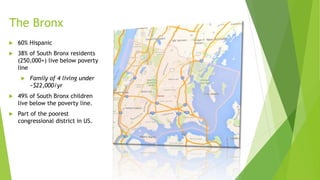
The Bronx
 60% Hispanic
 38% of South Bronx residents
(250,000+) live below poverty
line
 Family of 4 living under
~$22,000/yr
 49% of South Bronx children
live below the poverty line.
 Part of the poorest
congressional district in US.
Alcohol and Substance Use Influences
 Economic problems and poverty during childhood are related to
greater likelihoods for smoking, while poverty alone is
significantly associated with heavy drinking and marijuana
usage (Lee, McClernon, Kollins 2013).
 Living in a neighborhood with low SES, high disorder, or
perceptions of disorder leads to higher odds of engaging in
tobacco, marijuana, or alcohol use (Karriker-Jaffe, 2013; Wilson, Syme, Boyce, et al
2005).
 Peer engagement in tobacco, alcohol, and marijuana usage is
related to personal alcohol and substance use (Barnow, Schultz, Lucht, et al
2004; Garnier, Stein 2002; Kobus 2003; Ferguson, Meehan 2001).
Substance Use Among Hispanics
 In terms of ethnic divisions, Hispanics have the highest risks of
early initiation of drinking (Child Trends Databank 2015).
 Puerto Ricans had the highest overall lifetime and past-year
prevalence rates of psychiatric and substance disorders among
Latino subethnic groups (Alegria 2007; Alegria 2008).
Research Questions
 In a sample of Puerto Rican youth originally recruited from the
South Bronx, are there differences in substance use between those
who stayed in the area and those who moved out of area?
 If so, are these differences accounted for by involvement with
deviant peers?
Boricua Youth Study
 Epidemiological study of mental disorders and their correlates
 South Bronx (NY) and San Juan (PR)
 House eligible if at least 1 child and 1 caretaker of Puerto Rican
descent
 Longitudinal (Waves 1-3: 2000-2004)
 Sample size: 1138 youth
 W4 ongoing: 71% of initial participants complete
Measures
 Only SB participants
 Few completed OOA interviews for PR cases
 Interested in those living in disadvantaged neighborhood (SB)
vs leaving
 PR represents sample of metro area
 Participant location: Local participants are defined as those
living in a two-hour commute radius; all others, OOA
Measures
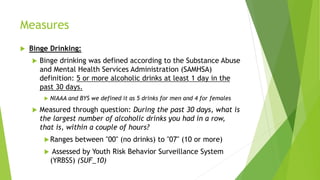
 Binge Drinking:
 Binge drinking was defined according to the Substance Abuse
and Mental Health Services Administration (SAMHSA)
definition: 5 or more alcoholic drinks at least 1 day in the
past 30 days.
 NIAAA and BYS we defined it as 5 drinks for men and 4 for females
 Measured through question: During the past 30 days, what is
the largest number of alcoholic drinks you had in a row,
that is, within a couple of hours?
Ranges between "00" (no drinks) to "07" (10 or more)
 Assessed by Youth Risk Behavior Surveillance System
(YRBSS) (SUF_10)
Measures
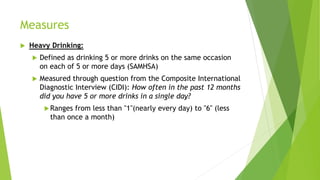
 Heavy Drinking:
 Defined as drinking 5 or more drinks on the same occasion
on each of 5 or more days (SAMHSA)
 Measured through question from the Composite International
Diagnostic Interview (CIDI): How often in the past 12 months
did you have 5 or more drinks in a single day?
Ranges from less than "1"(nearly every day) to "6" (less
than once a month)
Measures
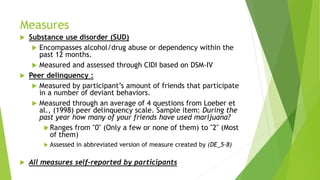
 Substance use disorder (SUD)
 Encompasses alcohol/drug abuse or dependency within the
past 12 months.
 Measured and assessed through CIDI based on DSM-IV
 Peer delinquency :
 Measured by participant’s amount of friends that participate
in a number of deviant behaviors.
 Measured through an average of 4 questions from Loeber et
al., (1998) peer delinquency scale. Sample item: During the
past year how many of your friends have used marijuana?
Ranges from "0" (Only a few or none of them) to "2" (Most
of them)
 Assessed in abbreviated version of measure created by (DE_5-8)
 All measures self-reported by participants
Data Analysis
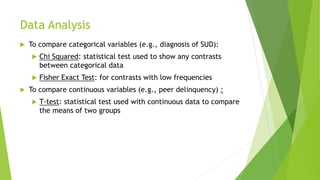
 To compare categorical variables (e.g., diagnosis of SUD):
 Chi Squared: statistical test used to show any contrasts
between categorical data
 Fisher Exact Test: for contrasts with low frequencies
 To compare continuous variables (e.g., peer delinquency) :
 T-test: statistical test used with continuous data to compare
the means of two groups
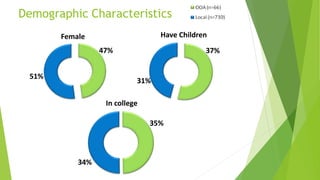
Demographic Characteristics
47%
51%
Female
37%
31%
Have Children
35%
34%
In college
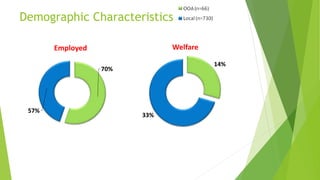
Demographic Characteristics
70%
57%
Employed
14%
33%
Welfare
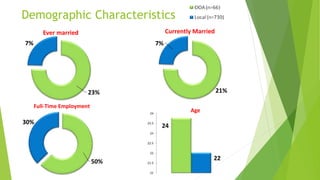
Demographic Characteristics
50%
30%
Full-Time Employment
23%
7%
Ever married
21%
7%
Currently Married
24
22
21
21.5
22
22.5
23
23.5
24
Age
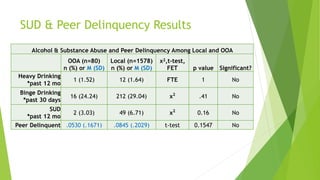
SUD & Peer Delinquency Results
Alcohol & Substance Abuse and Peer Delinquency Among Local and OOA
OOA (n=80)
n (%) or M (SD)
Local (n=1578)
n (%) or M (SD)
χ2,t-test,
FET p value Significant?
Heavy Drinking
*past 12 mo
1 (1.52) 12 (1.64) FTE 1 No
Binge Drinking
*past 30 days
16 (24.24) 212 (29.04) χ2
.41 No
SUD
*past 12 mo
2 (3.03) 49 (6.71) χ2
0.16 No
Peer Delinquent .0530 (.1671) .0845 (.2029) t-test 0.1547 No
Summary
 Significant differences in:
 Age, marital status, employment, and welfare support
 Speaks to OOA stability
 No differences in the two groups in terms of substance use/SUD
or number of delinquent peers
Discussion
 Young adults whose families receive welfare support had lower
chances of remaining drug-free until young adulthood (Wu, de Saxe
Zerden 2016).
 Marriage is associated with a lower likelihood in criminal
behavior, regardless of the quality of one’s marriage (Sampson, Laub,
Wimer 2006).
 Possibility: More employed OOA, more disposable income for
alcohol/drugs
Limitations
 Local participants are not only Bronx residents – includes all in
a two hour commute radius (all of NYC, parts of NJ, etc.)
 Assumptions that OOA participants moved to a better quality
neighborhood than those living locally
 Low prevalence in observations reduces ability to detect
differences
 Limited OOA participants
 Self-reported measures by participants
Going Forward
 Continue OOA interviews
 Specific questions about time in the Bronx and current
neighborhood
 In contrast with current questioning about longest two
neighborhoods
Bibliography
 Lee CT, McClernon FJ, Kollins SH, et al (2013). Childhood economic strains in predicting substance use in emerging
adulthood: mediation effects of youth self-control and parenting practices. J Pediatr Psychol. In press.
 Karriker-Jaffe KJ (2013). Neighborhood socioeconomic status and substance use by U.S. Adults. Drug and Alcohol
Dependence 133, 212–221.
 Wilson N, Syme SL, Boyce W, Battistich VA, Selvin S. Adolescent and alcohol, tobacco, and marijuana use: the
influence of neighborhood disorder and hope. Am J Health Promot. 2005; 20:11–19.
 Barnow S, Schultz G, Lucht M et al. Do alcohol expectancies and peer delinquency/substance use mediate the
relationship between impulsivity and drinking behaviour in adolescence? Alcohol Alcohol 2004; 39:213–19.
 Garnier HE, Stein JA. An 18-year model of family and peer effects on adolescent drug use and delinquency. Journal of
Youth & Adolescence. 2002;31(1):45–56.
 Kobus, K. (2003), Peers and adolescent smoking. Addiction, 98: 37–55. doi: 10.1046/j.1360-0443.98.s1.4.x
 Ferguson CJ, Meehan DC. With friends like these…: peer delinquency influences across age cohorts on smoking,
alcohol and illegal substance use. Eur Psychiatry. 2011;26(1):6–12. doi: 10.1016/j.eurpsy.2010.09.002.
 Child Trends Databank. (2015). Binge drinking. Available at: http://www.childtrends.org/?indicators=binge-drinking
 Alegria M, Canino G, Shrout PE, Woo M, Duan N, Vila D, Torres M, Chen CN, Meng XL. Prevalence of mental illness in
immigrant and non-immigrant US Latino groups. Am J Psychiatry. 2008;165(3):359–369.
 Alegria M., Mulvaney-Day N., Torres M., Polo A., Cao Z., Canino G. (2007). Prevalence of psychiatric disorders across
Latino subgroups in the United States. Am. J. Public Health 97, 68–75. 10.2105/ajph.2006.087205
 Tucker et al., 2013 J.S. Tucker, M.S. Pollard, K. de la Haye, D.P. Kennedy, H.D. Green Jr. Neighborhood characteristics
and the initiation of marijuana use and binge drinking. Drug Alcohol Depend., 128 (2013), pp. 83–89
 Sampson Robert J, Laub John H, Wimer Christopher. Does Marriage Reduce Crime? A Counterfactual Approach to
within-individual Causal Effects. Criminology. 2006;44:465–508.

ColeNIDA_7

  • 1.
    Substance use inBoricua Youth Study participants residing in NYC area vs those out of area Cole Howie, NIDA
  • 2.
    The Bronx  60%Hispanic  38% of South Bronx residents (250,000+) live below poverty line  Family of 4 living under ~$22,000/yr  49% of South Bronx children live below the poverty line.  Part of the poorest congressional district in US.
  • 3.
    Alcohol and SubstanceUse Influences  Economic problems and poverty during childhood are related to greater likelihoods for smoking, while poverty alone is significantly associated with heavy drinking and marijuana usage (Lee, McClernon, Kollins 2013).  Living in a neighborhood with low SES, high disorder, or perceptions of disorder leads to higher odds of engaging in tobacco, marijuana, or alcohol use (Karriker-Jaffe, 2013; Wilson, Syme, Boyce, et al 2005).  Peer engagement in tobacco, alcohol, and marijuana usage is related to personal alcohol and substance use (Barnow, Schultz, Lucht, et al 2004; Garnier, Stein 2002; Kobus 2003; Ferguson, Meehan 2001).
  • 4.
    Substance Use AmongHispanics  In terms of ethnic divisions, Hispanics have the highest risks of early initiation of drinking (Child Trends Databank 2015).  Puerto Ricans had the highest overall lifetime and past-year prevalence rates of psychiatric and substance disorders among Latino subethnic groups (Alegria 2007; Alegria 2008).
  • 5.
    Research Questions  Ina sample of Puerto Rican youth originally recruited from the South Bronx, are there differences in substance use between those who stayed in the area and those who moved out of area?  If so, are these differences accounted for by involvement with deviant peers?
  • 6.
    Boricua Youth Study Epidemiological study of mental disorders and their correlates  South Bronx (NY) and San Juan (PR)  House eligible if at least 1 child and 1 caretaker of Puerto Rican descent  Longitudinal (Waves 1-3: 2000-2004)  Sample size: 1138 youth  W4 ongoing: 71% of initial participants complete
  • 7.
    Measures  Only SBparticipants  Few completed OOA interviews for PR cases  Interested in those living in disadvantaged neighborhood (SB) vs leaving  PR represents sample of metro area  Participant location: Local participants are defined as those living in a two-hour commute radius; all others, OOA
  • 8.
    Measures  Binge Drinking: Binge drinking was defined according to the Substance Abuse and Mental Health Services Administration (SAMHSA) definition: 5 or more alcoholic drinks at least 1 day in the past 30 days.  NIAAA and BYS we defined it as 5 drinks for men and 4 for females  Measured through question: During the past 30 days, what is the largest number of alcoholic drinks you had in a row, that is, within a couple of hours? Ranges between "00" (no drinks) to "07" (10 or more)  Assessed by Youth Risk Behavior Surveillance System (YRBSS) (SUF_10)
  • 9.
    Measures  Heavy Drinking: Defined as drinking 5 or more drinks on the same occasion on each of 5 or more days (SAMHSA)  Measured through question from the Composite International Diagnostic Interview (CIDI): How often in the past 12 months did you have 5 or more drinks in a single day? Ranges from less than "1"(nearly every day) to "6" (less than once a month)
  • 10.
    Measures  Substance usedisorder (SUD)  Encompasses alcohol/drug abuse or dependency within the past 12 months.  Measured and assessed through CIDI based on DSM-IV  Peer delinquency :  Measured by participant’s amount of friends that participate in a number of deviant behaviors.  Measured through an average of 4 questions from Loeber et al., (1998) peer delinquency scale. Sample item: During the past year how many of your friends have used marijuana? Ranges from "0" (Only a few or none of them) to "2" (Most of them)  Assessed in abbreviated version of measure created by (DE_5-8)  All measures self-reported by participants
  • 11.
    Data Analysis  Tocompare categorical variables (e.g., diagnosis of SUD):  Chi Squared: statistical test used to show any contrasts between categorical data  Fisher Exact Test: for contrasts with low frequencies  To compare continuous variables (e.g., peer delinquency) :  T-test: statistical test used with continuous data to compare the means of two groups
  • 12.
  • 13.
  • 14.
    Demographic Characteristics 50% 30% Full-Time Employment 23% 7% Evermarried 21% 7% Currently Married 24 22 21 21.5 22 22.5 23 23.5 24 Age
  • 15.
    SUD & PeerDelinquency Results Alcohol & Substance Abuse and Peer Delinquency Among Local and OOA OOA (n=80) n (%) or M (SD) Local (n=1578) n (%) or M (SD) χ2,t-test, FET p value Significant? Heavy Drinking *past 12 mo 1 (1.52) 12 (1.64) FTE 1 No Binge Drinking *past 30 days 16 (24.24) 212 (29.04) χ2 .41 No SUD *past 12 mo 2 (3.03) 49 (6.71) χ2 0.16 No Peer Delinquent .0530 (.1671) .0845 (.2029) t-test 0.1547 No
  • 16.
    Summary  Significant differencesin:  Age, marital status, employment, and welfare support  Speaks to OOA stability  No differences in the two groups in terms of substance use/SUD or number of delinquent peers
  • 17.
    Discussion  Young adultswhose families receive welfare support had lower chances of remaining drug-free until young adulthood (Wu, de Saxe Zerden 2016).  Marriage is associated with a lower likelihood in criminal behavior, regardless of the quality of one’s marriage (Sampson, Laub, Wimer 2006).  Possibility: More employed OOA, more disposable income for alcohol/drugs
  • 18.
    Limitations  Local participantsare not only Bronx residents – includes all in a two hour commute radius (all of NYC, parts of NJ, etc.)  Assumptions that OOA participants moved to a better quality neighborhood than those living locally  Low prevalence in observations reduces ability to detect differences  Limited OOA participants  Self-reported measures by participants
  • 19.
    Going Forward  ContinueOOA interviews  Specific questions about time in the Bronx and current neighborhood  In contrast with current questioning about longest two neighborhoods
  • 20.
    Bibliography  Lee CT,McClernon FJ, Kollins SH, et al (2013). Childhood economic strains in predicting substance use in emerging adulthood: mediation effects of youth self-control and parenting practices. J Pediatr Psychol. In press.  Karriker-Jaffe KJ (2013). Neighborhood socioeconomic status and substance use by U.S. Adults. Drug and Alcohol Dependence 133, 212–221.  Wilson N, Syme SL, Boyce W, Battistich VA, Selvin S. Adolescent and alcohol, tobacco, and marijuana use: the influence of neighborhood disorder and hope. Am J Health Promot. 2005; 20:11–19.  Barnow S, Schultz G, Lucht M et al. Do alcohol expectancies and peer delinquency/substance use mediate the relationship between impulsivity and drinking behaviour in adolescence? Alcohol Alcohol 2004; 39:213–19.  Garnier HE, Stein JA. An 18-year model of family and peer effects on adolescent drug use and delinquency. Journal of Youth & Adolescence. 2002;31(1):45–56.  Kobus, K. (2003), Peers and adolescent smoking. Addiction, 98: 37–55. doi: 10.1046/j.1360-0443.98.s1.4.x  Ferguson CJ, Meehan DC. With friends like these…: peer delinquency influences across age cohorts on smoking, alcohol and illegal substance use. Eur Psychiatry. 2011;26(1):6–12. doi: 10.1016/j.eurpsy.2010.09.002.  Child Trends Databank. (2015). Binge drinking. Available at: http://www.childtrends.org/?indicators=binge-drinking  Alegria M, Canino G, Shrout PE, Woo M, Duan N, Vila D, Torres M, Chen CN, Meng XL. Prevalence of mental illness in immigrant and non-immigrant US Latino groups. Am J Psychiatry. 2008;165(3):359–369.  Alegria M., Mulvaney-Day N., Torres M., Polo A., Cao Z., Canino G. (2007). Prevalence of psychiatric disorders across Latino subgroups in the United States. Am. J. Public Health 97, 68–75. 10.2105/ajph.2006.087205  Tucker et al., 2013 J.S. Tucker, M.S. Pollard, K. de la Haye, D.P. Kennedy, H.D. Green Jr. Neighborhood characteristics and the initiation of marijuana use and binge drinking. Drug Alcohol Depend., 128 (2013), pp. 83–89  Sampson Robert J, Laub John H, Wimer Christopher. Does Marriage Reduce Crime? A Counterfactual Approach to within-individual Causal Effects. Criminology. 2006;44:465–508.