Least developed countries 
A decade of growth, but challenges remain 
ITU contributed two major reports* to the Fourth United Nations 
Conference on the Least Developed Countries (UNLDC-IV), held in 
Istanbul, Turkey, on 9–13 May 2011. One of these reports, “ICT 
and Telecommunications in Least Developed Countries: Review 
of progress made during the decade 2000–2010”, presents pro-jects 
and actions that ITU has undertaken to help least developed 
countries (LDCs) join the knowledge economy through the de-ployment 
and use of information and communication technolo-gies 
(ICT). 
The other report, “The Role of ICT in Advancing Growth in Least 
Developed Countries: Trends, Challenges and Opportunities”, on 
which this article is largely based, examines some of the emerg-ing 
trends and current challenges faced by LDCs on their road to 
poverty alleviation. It considers changes in the political, econom-ic 
and social environment of LDCs, their concerns regarding ac-cess 
to fi nancial resources, the infrastructural obstacles they face 
— in particular those in the telecommunication sector — and 
the additional risks that arise as a result of climate change and 
natural disasters. Climate change is a critical factor, given that 
eleven of the LDCs are also small island developing States. These 
islands are particularly vulnerable to natural disasters, and have 
a limited capacity to respond and recover. 
UNLDC-IV coincided with a critical point in the achievement 
of the Millennium Development Goals, with only fi ve more years 
to meet the targets set for 2015. The ITU reports highlight the 
important catalytic role that ITU plays in increasing connectivity 
in LDCs, and provide case study evidence showing how some of 
these countries have indeed managed to use connectivity suc-cessfully 
to enhance socio-economic development. 
* Both reports were prepared by the Programme for Least 
Developed Countries, Countries in Special Need, Emergency 
Telecommunications and Climate Change Adaptation Division 
within the ITU Telecommunication Development Bureau. 
The team was led by Cosmas Zavazava. 
UN Photo/Evan Schneider 
Opening ceremony of the Fourth United Nations Conference on 
the Least Developed Countries, Istanbul, Turkey 
16 ITU News  6 | 2011  July | August 2011
Special support for vulnerable countries 
As a way of providing special support to its most vulnerable 
members, the United Nations General Assembly in 1971 created 
the category of “Least Developed Country” to cover low-income 
economies that face severe structural impediments to growth. 
Since then, 50 countries have been categorized as LDCs, but 
only three have ever graduated to developing country status: 
Botswana in 1994, Cape Verde in 2007 and Maldives in 2011 
(see article on Maldives on pages 22–26). As part of socio-eco-nomic 
progress, joining the knowledge economy is a key factor in 
moving up the development ladder. 
To foster growth and sustainable development, LDCs get 
special support in the areas of trade and offi cial development 
assistance — including development fi nancing and technical 
cooperation. But the process of graduation from LDC status has 
proved challenging. 
Of the 48 LDCs today (see map), 33 are in Africa, 13 in Asia 
and the Pacifi c, one in the Americas (Haiti) and one in the Arab 
States region (Yemen). About 12 per cent of the world’s popula-tion 
(855 million people) live in LDCs. 
ITU’s passionate commitment to the world’s least developed 
countries dates back to 1971 when this category was established. 
And since the Third United Nations Conference on the Least 
Developed Countries in 2001, ITU World Telecommunication 
Development Conferences and ITU Plenipotentiary Conferences 
have adopted specifi c resolutions in favour of LDCs, landlocked 
developing countries and small island developing States. 
Through its Special Programme for Least Developed 
Countries, the ITU Telecommunication Development Bureau 
(BDT) has undertaken diverse activities and provided concen-trated 
assistance to LDCs to help them develop infrastructure, 
improve rural telecommunications, introduce new technologies 
and services, and build human capacity. 
Criteria for LDC status 
The criteria for categorizing a country as an LDC have 
been refi ned over time. Every three years, the Committee for 
Development Policy (CDP), a subsidiary body of the United 
Nations Economic and Social Council (ECOSOC), reviews the 
socio-economic conditions of all low-income economies to deter-mine 
whether a country should be added to — or recommended 
for graduation from — the LDC category. During its most recent 
review (in 2009), CDP used the following three criteria to identify 
LDCs and to determine eligibility for graduation: 
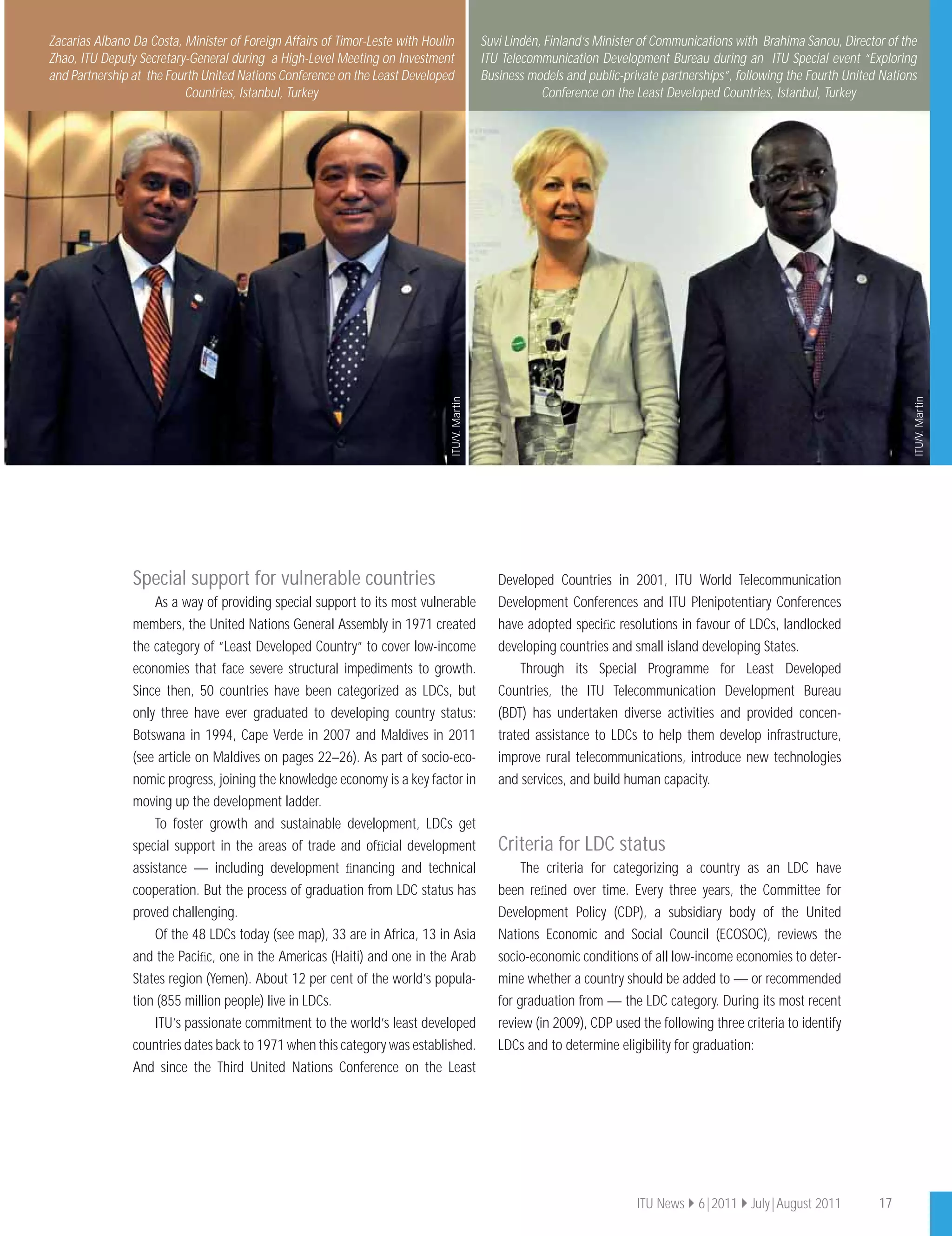
Zacarias Albano Da Costa, Minister of Foreign Affairs of Timor-Leste with Houlin 
Zhao, ITU Deputy Secretary-General during a High-Level Meeting on Investment 
and Partnership at the Fourth United Nations Conference on the Least Developed 
Countries, Istanbul, Turkey 
Suvi Lindén, Finland’s Minister of Communications with Brahima Sanou, Director of the 
ITU Telecommunication Development Bureau during an ITU Special event “Exploring 
Business models and public-private partnerships”, following the Fourth United Nations 
Conference on the Least Developed Countries, Istanbul, Turkey 
ITU/V. Martin 
ITU/V. Martin 
ITU News  6 | 2011  July | August 2011 17
 Low income: a three-year average estimate of gross national 
income per capita (less than USD 905 for inclusion, more 
than USD 1086 for graduation). 
 Human capital: a composite Human Assets Index based on 
such indicators as: nutrition (percentage of population un-dernourished); 
health (mortality rate for children aged fi ve 
years or less); education (gross secondary school enrolment 
ratio); and adult literacy rate. 
 Economic vulnerability: a composite Economic Vulnerability 
Index based on such indicators as: population size; remote-ness; 
merchandise export concentration; share of agriculture, 
forestry and fi sheries in gross domestic product; homeless-ness 
owing to natural disasters; instability of agricultural 
production; and instability of exports of goods and services. 
Based on these criteria, CDP recommended adding Equatorial 
Guinea to the list of countries eligible for graduation. ECOSOC 
endorsed that recommendation in July 2009, but the General 
Assembly did not confi rm it. Samoa was also to be added to that 
list. But taking account of the economic and fi nancial crisis in 
2008 and the Pacifi c Ocean tsunami that devastated that coun-try 
in September 2009, the General Assembly deferred Samoa’s 
graduation from LDC status for an additional three years, to 
1 January 2014. Meanwhile, following a similar, postponement 
because of the Indian Ocean tsunami of 2004, the Maldives grad-uated 
in January 2011. 
By design, the thresholds for graduation are set higher than 
those for inclusion. This is to ensure that only countries that are 
able to maintain improved economic performance are considered 
for graduation. 
Countries can decline the opportunity of being added to the 
LDC list, but their approval is not sought with regard to gradu-ating 
from LDC status. Only Ghana, Papua New Guinea and 
Zimbabwe have ever refused to accept the CDP’s recommenda-tion 
for inclusion in the LDC list, asserting that the analysis of 
their particular socio-economic conditions did not refl ect reality. 
The 48 least developed 
countries as of January 2011 
Africa 
 Angola 
 Benin 
 Burkina Faso 
 Burundi 
 Central African Republic 
 Chad 
 Comoros 
 Democratic Republic of the 
Congo 
 Djibouti 
 Equatorial Guinea 
 Eritrea 
 Ethiopia 
 Gambia 
 Guinea 
 Guinea Bissau 
 Lesotho 
 Liberia 
 Madagascar 
 Malawi 
 Mali 
 Mauritania 
 Mozambique 
 Niger 
 Rwanda 
 Sao Tome and Principe 
 Senegal 
 Sierra Leone 
 Somalia 
 Sudan 
 Tanzania 
 Togo 
 Uganda 
 Zambia Asia and the Pacifi c 
 Afghanistan 
 Bangladesh 
 Bhutan 
 Cambodia 
 Kiribati 
 Lao People’s Democratic 
Republic 
 Myanmar 
 Nepal (Republic of) 
 Samoa 
 Solomon Islands 
 Timor-Leste 
 Tuvalu 
 Vanuatu 
Americas 
 Haiti Arab States 
 Yemen (Rep. of) 
18 ITU News  6 | 2011  July | August 2011
Source: ITU, based on data from UN-OHRLLS (United Nations Offi ce of the High Representative for the Least Developed 
Countries, Landlocked Developing Countries and Small Island Developing States) (www.unohrlls.org/en/ldc/related/62/). 
The map is from the United Nations Cartographic Section (Map No. 4170, Rev.10, May 2010). 
The next triennial review of the LDC list will take place in 
2012. In preparation for this, CDP took another look at the cri-teria 
and indicators for identifying LDCs at a meeting in March 
2011. While confi rming the reliability of the current criteria, CDP 
has proposed refi nements to the indicators, in particular to better 
refl ect the structural vulnerability of countries to climate change. 
Moving out of the vulnerable category 
Unsurprisingly, countries recommended for graduation are 
often reluctant to be removed from the list of LDCs, because of 
the potential economic effects of the end of preferential treat-ment. 
To facilitate the graduation process, CDP gives States a 
three-year grace period (from the time they are fi rst recommend-ed 
for graduation) to coordinate with their development and 
trade partners regarding the phasing out of preferential treat-ment 
and special support. 
Key fi ndings on the ICT front 
Fixed and mobile telephony 
There are signs of an upturn in the growth of ICT in LDCs over 
the period 2000–2010. Mobile communications have emerged 
as a key technology to bridge the digital divide, and as a means 
to open up access to governmental, health and environmental 
information. 
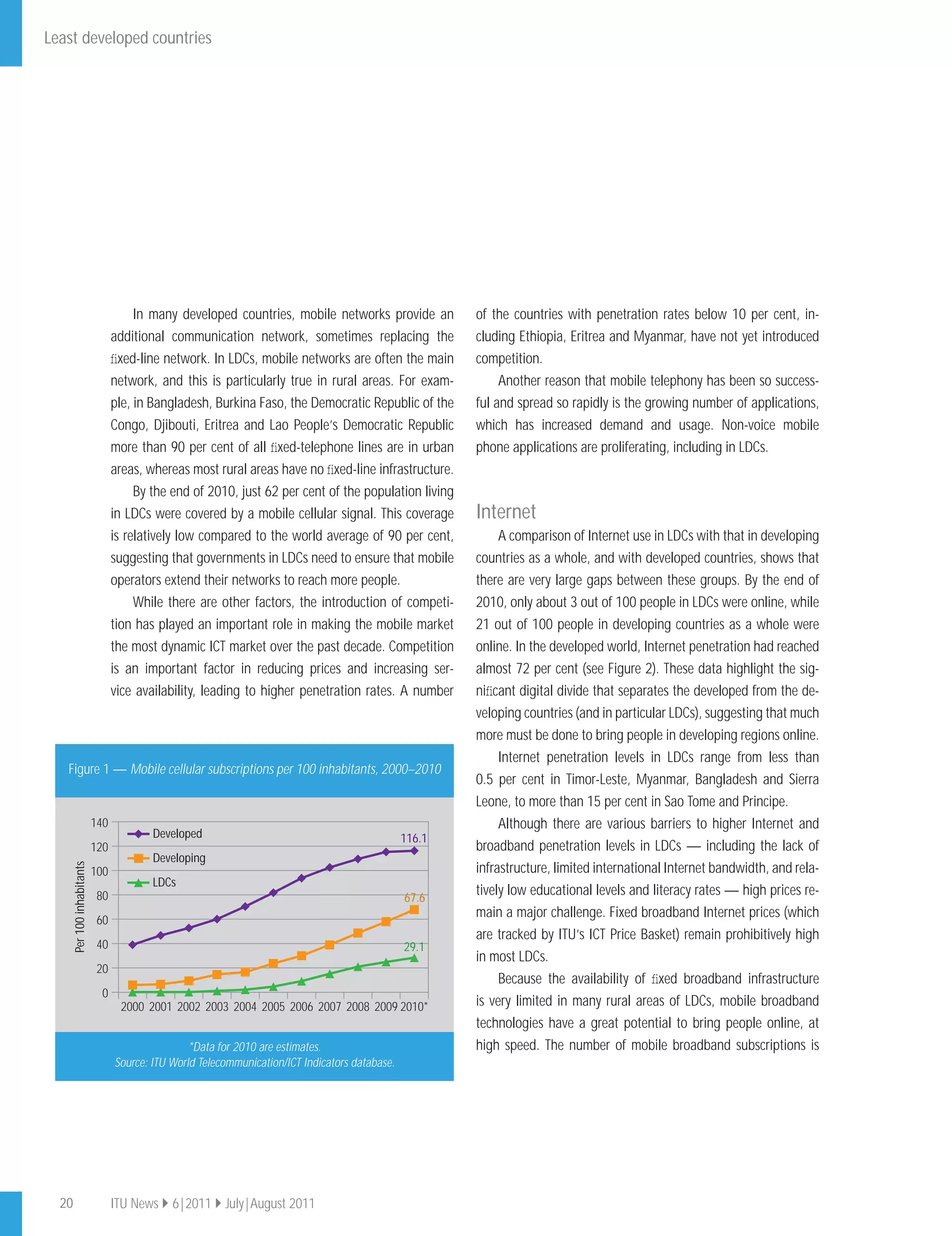
In least developed countries, the mobile penetration rate was 
an estimated 29 per cent, at the end of 2010, according to ITU 
estimates, suggesting that mobile telephony has been able to at 
least partially tackle the infrastructure barrier and bring commu-nication 
networks to the previously unconnected (see Figure 1). 
In stark contrast, LDCs have an extremely low penetration rate 
for fi xed telephone (slightly more than one per cent at the end 
of 2010). 
ITU News  6 | 2011  July | August 2011 19
Least developed countries 
In many developed countries, mobile networks provide an 
additional communication network, sometimes replacing the 
fi xed-line network. In LDCs, mobile networks are often the main 
network, and this is particularly true in rural areas. For exam-ple, 
in Bangladesh, Burkina Faso, the Democratic Republic of the 
Congo, Djibouti, Eritrea and Lao People’s Democratic Republic 
more than 90 per cent of all fi xed-telephone lines are in urban 
areas, whereas most rural areas have no fi xed-line infrastructure. 
By the end of 2010, just 62 per cent of the population living 
in LDCs were covered by a mobile cellular signal. This coverage 
is relatively low compared to the world average of 90 per cent, 
suggesting that governments in LDCs need to ensure that mobile 
operators extend their networks to reach more people. 
While there are other factors, the introduction of competi-tion 
has played an important role in making the mobile market 
the most dynamic ICT market over the past decade. Competition 
is an important factor in reducing prices and increasing ser-vice 
availability, leading to higher penetration rates. A number 
of the countries with penetration rates below 10 per cent, in-cluding 
Ethiopia, Eritrea and Myanmar, have not yet introduced 
competition. 
Another reason that mobile telephony has been so success-ful 
and spread so rapidly is the growing number of applications, 
which has increased demand and usage. Non-voice mobile 
phone applications are proliferating, including in LDCs. 
Internet 
A comparison of Internet use in LDCs with that in developing 
countries as a whole, and with developed countries, shows that 
there are very large gaps between these groups. By the end of 
2010, only about 3 out of 100 people in LDCs were online, while 
21 out of 100 people in developing countries as a whole were 
online. In the developed world, Internet penetration had reached 
almost 72 per cent (see Figure 2). These data highlight the sig-nifi 
cant digital divide that separates the developed from the de-veloping 
countries (and in particular LDCs), suggesting that much 
more must be done to bring people in developing regions online. 
Internet penetration levels in LDCs range from less than 
0.5 per cent in Timor-Leste, Myanmar, Bangladesh and Sierra 
Leone, to more than 15 per cent in Sao Tome and Principe. 
Although there are various barriers to higher Internet and 
broadband penetration levels in LDCs — including the lack of 
infrastructure, limited international Internet bandwidth, and rela-tively 
low educational levels and literacy rates — high prices re-main 
a major challenge. Fixed broadband Internet prices (which 
are tracked by ITU’s ICT Price Basket) remain prohibitively high 
in most LDCs. 
Because the availability of fi xed broadband infrastructure 
is very limited in many rural areas of LDCs, mobile broadband 
technologies have a great potential to bring people online, at 
high speed. The number of mobile broadband subscriptions is 
Figure 1 — Mobile cellular subscriptions per 100 inhabitants, 2000–2010 
Developed 116.1 
Developing 
LDCs 
67.6 
2000 2001 2002 2003 2004 2005 2006 2007 2008 2009 2010* 
140 
120 
80 
60 
40 
20 
0 
Per 100 inhabitants 
100 
29.1 
*Data for 2010 are estimates. 
Source: ITU World Telecommunication/ICT Indicators database. 
20 ITU News  6 | 2011  July | August 2011
Developed 71.6 
Developing 
LDCs 
21.1 
growing fast across the world, and has actually overtaken the 
number of fi xed broadband subscriptions, but remains limited in 
LDCs, with only 0.5 per 100 inhabitants. In the developed world, 
mobile broadband subscriptions reached more than 50 per cent 
penetration by the end of 2010. 
One reason for the low mobile broadband uptake in LDCs 
is that by mid-2010 only 13 of these countries were offering 
3G services commercially. Since then, several LDCs, including 
Senegal and Burkina Faso, have either launched services or have 
announced plans to allocate 3G licences in the near future. The 
introduction of mobile broadband services is not only expected 
to address infrastructure challenges, but also to bring down fi xed 
broadband prices, as it will introduce inter-modal competition 
into the broadband market. 
ITU’s commitments in the 
Istanbul Programme of Action 
for LDCs for 2011–2020 
In order to help countries better exploit ICT to drive de-velopment, 
ITU made fi ve key commitments to the Fourth 
United Nations Conference on the Least Developed Countries. 
These commitments have been incorporated into the Istanbul 
Programme of Action for LDCs 2011–2020. In brief, they cover: 
 actions to increase the average phone density in LDCs to 
25 lines per 100 inhabitants and the number of Internet con-nections 
to 15 per 100 inhabitants by 2020; 
 a comprehensive capacity building and digital inclusion 
programme; 
 strategies to help LDCs maximize the selection and use of 
appropriate new technologies, such as broadband, digital 
broadcasting and next-generation networks; 
 assistance in dealing with cybersecurity issues, and strate-gies 
to build trust and confi dence in ICT networks; 
 assistance in creating and maintaining a propitious environ-ment 
for LDC development through an enabling policy and 
regulatory environment. 
“The challenge of creating digital opportunities in least de-veloped 
countries — including small island developing States 
and countries with special needs — remains. Achieving this goal 
will require reinforced efforts on the part of ITU to coordinate 
with all Member States, the private sector and development part-ners, 
so that, working in consonance to pool resources and mus-ter 
partnerships, we can support LDCs in making the best use of 
the technological promise of ICT to promote economic growth,” 
said Brahima Sanou, Director of the ITU Telecommunication 
Development Bureau. 
2000 2001 2002 2003 2004 2005 2006 2007 2008 2009 2010* 
Per 100 inhabitants 
80 
70 
60 
50 
40 
30 
20 
10 
0 
3.0 
Figure 2 — Internet users per 100 inhabitants, 2000–2010 
*Data for 2010 are estimates. 
Source: ITU World Telecommunication/ICT Indicators database. 
Least developed countries 
ITU News  6 | 2011  July | August 2011 21

201106 16

  • 1.
    Least developed countries A decade of growth, but challenges remain ITU contributed two major reports* to the Fourth United Nations Conference on the Least Developed Countries (UNLDC-IV), held in Istanbul, Turkey, on 9–13 May 2011. One of these reports, “ICT and Telecommunications in Least Developed Countries: Review of progress made during the decade 2000–2010”, presents pro-jects and actions that ITU has undertaken to help least developed countries (LDCs) join the knowledge economy through the de-ployment and use of information and communication technolo-gies (ICT). The other report, “The Role of ICT in Advancing Growth in Least Developed Countries: Trends, Challenges and Opportunities”, on which this article is largely based, examines some of the emerg-ing trends and current challenges faced by LDCs on their road to poverty alleviation. It considers changes in the political, econom-ic and social environment of LDCs, their concerns regarding ac-cess to fi nancial resources, the infrastructural obstacles they face — in particular those in the telecommunication sector — and the additional risks that arise as a result of climate change and natural disasters. Climate change is a critical factor, given that eleven of the LDCs are also small island developing States. These islands are particularly vulnerable to natural disasters, and have a limited capacity to respond and recover. UNLDC-IV coincided with a critical point in the achievement of the Millennium Development Goals, with only fi ve more years to meet the targets set for 2015. The ITU reports highlight the important catalytic role that ITU plays in increasing connectivity in LDCs, and provide case study evidence showing how some of these countries have indeed managed to use connectivity suc-cessfully to enhance socio-economic development. * Both reports were prepared by the Programme for Least Developed Countries, Countries in Special Need, Emergency Telecommunications and Climate Change Adaptation Division within the ITU Telecommunication Development Bureau. The team was led by Cosmas Zavazava. UN Photo/Evan Schneider Opening ceremony of the Fourth United Nations Conference on the Least Developed Countries, Istanbul, Turkey 16 ITU News  6 | 2011  July | August 2011
  • 2.
    Special support forvulnerable countries As a way of providing special support to its most vulnerable members, the United Nations General Assembly in 1971 created the category of “Least Developed Country” to cover low-income economies that face severe structural impediments to growth. Since then, 50 countries have been categorized as LDCs, but only three have ever graduated to developing country status: Botswana in 1994, Cape Verde in 2007 and Maldives in 2011 (see article on Maldives on pages 22–26). As part of socio-eco-nomic progress, joining the knowledge economy is a key factor in moving up the development ladder. To foster growth and sustainable development, LDCs get special support in the areas of trade and offi cial development assistance — including development fi nancing and technical cooperation. But the process of graduation from LDC status has proved challenging. Of the 48 LDCs today (see map), 33 are in Africa, 13 in Asia and the Pacifi c, one in the Americas (Haiti) and one in the Arab States region (Yemen). About 12 per cent of the world’s popula-tion (855 million people) live in LDCs. ITU’s passionate commitment to the world’s least developed countries dates back to 1971 when this category was established. And since the Third United Nations Conference on the Least Developed Countries in 2001, ITU World Telecommunication Development Conferences and ITU Plenipotentiary Conferences have adopted specifi c resolutions in favour of LDCs, landlocked developing countries and small island developing States. Through its Special Programme for Least Developed Countries, the ITU Telecommunication Development Bureau (BDT) has undertaken diverse activities and provided concen-trated assistance to LDCs to help them develop infrastructure, improve rural telecommunications, introduce new technologies and services, and build human capacity. Criteria for LDC status The criteria for categorizing a country as an LDC have been refi ned over time. Every three years, the Committee for Development Policy (CDP), a subsidiary body of the United Nations Economic and Social Council (ECOSOC), reviews the socio-economic conditions of all low-income economies to deter-mine whether a country should be added to — or recommended for graduation from — the LDC category. During its most recent review (in 2009), CDP used the following three criteria to identify LDCs and to determine eligibility for graduation: Zacarias Albano Da Costa, Minister of Foreign Affairs of Timor-Leste with Houlin Zhao, ITU Deputy Secretary-General during a High-Level Meeting on Investment and Partnership at the Fourth United Nations Conference on the Least Developed Countries, Istanbul, Turkey Suvi Lindén, Finland’s Minister of Communications with Brahima Sanou, Director of the ITU Telecommunication Development Bureau during an ITU Special event “Exploring Business models and public-private partnerships”, following the Fourth United Nations Conference on the Least Developed Countries, Istanbul, Turkey ITU/V. Martin ITU/V. Martin ITU News  6 | 2011  July | August 2011 17
  • 3.
     Low income:a three-year average estimate of gross national income per capita (less than USD 905 for inclusion, more than USD 1086 for graduation).  Human capital: a composite Human Assets Index based on such indicators as: nutrition (percentage of population un-dernourished); health (mortality rate for children aged fi ve years or less); education (gross secondary school enrolment ratio); and adult literacy rate.  Economic vulnerability: a composite Economic Vulnerability Index based on such indicators as: population size; remote-ness; merchandise export concentration; share of agriculture, forestry and fi sheries in gross domestic product; homeless-ness owing to natural disasters; instability of agricultural production; and instability of exports of goods and services. Based on these criteria, CDP recommended adding Equatorial Guinea to the list of countries eligible for graduation. ECOSOC endorsed that recommendation in July 2009, but the General Assembly did not confi rm it. Samoa was also to be added to that list. But taking account of the economic and fi nancial crisis in 2008 and the Pacifi c Ocean tsunami that devastated that coun-try in September 2009, the General Assembly deferred Samoa’s graduation from LDC status for an additional three years, to 1 January 2014. Meanwhile, following a similar, postponement because of the Indian Ocean tsunami of 2004, the Maldives grad-uated in January 2011. By design, the thresholds for graduation are set higher than those for inclusion. This is to ensure that only countries that are able to maintain improved economic performance are considered for graduation. Countries can decline the opportunity of being added to the LDC list, but their approval is not sought with regard to gradu-ating from LDC status. Only Ghana, Papua New Guinea and Zimbabwe have ever refused to accept the CDP’s recommenda-tion for inclusion in the LDC list, asserting that the analysis of their particular socio-economic conditions did not refl ect reality. The 48 least developed countries as of January 2011 Africa  Angola  Benin  Burkina Faso  Burundi  Central African Republic  Chad  Comoros  Democratic Republic of the Congo  Djibouti  Equatorial Guinea  Eritrea  Ethiopia  Gambia  Guinea  Guinea Bissau  Lesotho  Liberia  Madagascar  Malawi  Mali  Mauritania  Mozambique  Niger  Rwanda  Sao Tome and Principe  Senegal  Sierra Leone  Somalia  Sudan  Tanzania  Togo  Uganda  Zambia Asia and the Pacifi c  Afghanistan  Bangladesh  Bhutan  Cambodia  Kiribati  Lao People’s Democratic Republic  Myanmar  Nepal (Republic of)  Samoa  Solomon Islands  Timor-Leste  Tuvalu  Vanuatu Americas  Haiti Arab States  Yemen (Rep. of) 18 ITU News  6 | 2011  July | August 2011
  • 4.
    Source: ITU, basedon data from UN-OHRLLS (United Nations Offi ce of the High Representative for the Least Developed Countries, Landlocked Developing Countries and Small Island Developing States) (www.unohrlls.org/en/ldc/related/62/). The map is from the United Nations Cartographic Section (Map No. 4170, Rev.10, May 2010). The next triennial review of the LDC list will take place in 2012. In preparation for this, CDP took another look at the cri-teria and indicators for identifying LDCs at a meeting in March 2011. While confi rming the reliability of the current criteria, CDP has proposed refi nements to the indicators, in particular to better refl ect the structural vulnerability of countries to climate change. Moving out of the vulnerable category Unsurprisingly, countries recommended for graduation are often reluctant to be removed from the list of LDCs, because of the potential economic effects of the end of preferential treat-ment. To facilitate the graduation process, CDP gives States a three-year grace period (from the time they are fi rst recommend-ed for graduation) to coordinate with their development and trade partners regarding the phasing out of preferential treat-ment and special support. Key fi ndings on the ICT front Fixed and mobile telephony There are signs of an upturn in the growth of ICT in LDCs over the period 2000–2010. Mobile communications have emerged as a key technology to bridge the digital divide, and as a means to open up access to governmental, health and environmental information. In least developed countries, the mobile penetration rate was an estimated 29 per cent, at the end of 2010, according to ITU estimates, suggesting that mobile telephony has been able to at least partially tackle the infrastructure barrier and bring commu-nication networks to the previously unconnected (see Figure 1). In stark contrast, LDCs have an extremely low penetration rate for fi xed telephone (slightly more than one per cent at the end of 2010). ITU News  6 | 2011  July | August 2011 19
  • 5.
    Least developed countries In many developed countries, mobile networks provide an additional communication network, sometimes replacing the fi xed-line network. In LDCs, mobile networks are often the main network, and this is particularly true in rural areas. For exam-ple, in Bangladesh, Burkina Faso, the Democratic Republic of the Congo, Djibouti, Eritrea and Lao People’s Democratic Republic more than 90 per cent of all fi xed-telephone lines are in urban areas, whereas most rural areas have no fi xed-line infrastructure. By the end of 2010, just 62 per cent of the population living in LDCs were covered by a mobile cellular signal. This coverage is relatively low compared to the world average of 90 per cent, suggesting that governments in LDCs need to ensure that mobile operators extend their networks to reach more people. While there are other factors, the introduction of competi-tion has played an important role in making the mobile market the most dynamic ICT market over the past decade. Competition is an important factor in reducing prices and increasing ser-vice availability, leading to higher penetration rates. A number of the countries with penetration rates below 10 per cent, in-cluding Ethiopia, Eritrea and Myanmar, have not yet introduced competition. Another reason that mobile telephony has been so success-ful and spread so rapidly is the growing number of applications, which has increased demand and usage. Non-voice mobile phone applications are proliferating, including in LDCs. Internet A comparison of Internet use in LDCs with that in developing countries as a whole, and with developed countries, shows that there are very large gaps between these groups. By the end of 2010, only about 3 out of 100 people in LDCs were online, while 21 out of 100 people in developing countries as a whole were online. In the developed world, Internet penetration had reached almost 72 per cent (see Figure 2). These data highlight the sig-nifi cant digital divide that separates the developed from the de-veloping countries (and in particular LDCs), suggesting that much more must be done to bring people in developing regions online. Internet penetration levels in LDCs range from less than 0.5 per cent in Timor-Leste, Myanmar, Bangladesh and Sierra Leone, to more than 15 per cent in Sao Tome and Principe. Although there are various barriers to higher Internet and broadband penetration levels in LDCs — including the lack of infrastructure, limited international Internet bandwidth, and rela-tively low educational levels and literacy rates — high prices re-main a major challenge. Fixed broadband Internet prices (which are tracked by ITU’s ICT Price Basket) remain prohibitively high in most LDCs. Because the availability of fi xed broadband infrastructure is very limited in many rural areas of LDCs, mobile broadband technologies have a great potential to bring people online, at high speed. The number of mobile broadband subscriptions is Figure 1 — Mobile cellular subscriptions per 100 inhabitants, 2000–2010 Developed 116.1 Developing LDCs 67.6 2000 2001 2002 2003 2004 2005 2006 2007 2008 2009 2010* 140 120 80 60 40 20 0 Per 100 inhabitants 100 29.1 *Data for 2010 are estimates. Source: ITU World Telecommunication/ICT Indicators database. 20 ITU News  6 | 2011  July | August 2011
  • 6.
    Developed 71.6 Developing LDCs 21.1 growing fast across the world, and has actually overtaken the number of fi xed broadband subscriptions, but remains limited in LDCs, with only 0.5 per 100 inhabitants. In the developed world, mobile broadband subscriptions reached more than 50 per cent penetration by the end of 2010. One reason for the low mobile broadband uptake in LDCs is that by mid-2010 only 13 of these countries were offering 3G services commercially. Since then, several LDCs, including Senegal and Burkina Faso, have either launched services or have announced plans to allocate 3G licences in the near future. The introduction of mobile broadband services is not only expected to address infrastructure challenges, but also to bring down fi xed broadband prices, as it will introduce inter-modal competition into the broadband market. ITU’s commitments in the Istanbul Programme of Action for LDCs for 2011–2020 In order to help countries better exploit ICT to drive de-velopment, ITU made fi ve key commitments to the Fourth United Nations Conference on the Least Developed Countries. These commitments have been incorporated into the Istanbul Programme of Action for LDCs 2011–2020. In brief, they cover:  actions to increase the average phone density in LDCs to 25 lines per 100 inhabitants and the number of Internet con-nections to 15 per 100 inhabitants by 2020;  a comprehensive capacity building and digital inclusion programme;  strategies to help LDCs maximize the selection and use of appropriate new technologies, such as broadband, digital broadcasting and next-generation networks;  assistance in dealing with cybersecurity issues, and strate-gies to build trust and confi dence in ICT networks;  assistance in creating and maintaining a propitious environ-ment for LDC development through an enabling policy and regulatory environment. “The challenge of creating digital opportunities in least de-veloped countries — including small island developing States and countries with special needs — remains. Achieving this goal will require reinforced efforts on the part of ITU to coordinate with all Member States, the private sector and development part-ners, so that, working in consonance to pool resources and mus-ter partnerships, we can support LDCs in making the best use of the technological promise of ICT to promote economic growth,” said Brahima Sanou, Director of the ITU Telecommunication Development Bureau. 2000 2001 2002 2003 2004 2005 2006 2007 2008 2009 2010* Per 100 inhabitants 80 70 60 50 40 30 20 10 0 3.0 Figure 2 — Internet users per 100 inhabitants, 2000–2010 *Data for 2010 are estimates. Source: ITU World Telecommunication/ICT Indicators database. Least developed countries ITU News  6 | 2011  July | August 2011 21