African Youth Report 2009 
Expanding opportunities for and with Young people in Africa 
Economic Commission for Africa
ECA/ACGS/HSD/AYR/ 2009 
African Youth Report 2009 
Expanding opportunities for and with Young people in Africa 
Economic Commission for Africa
Ordering information 
To order copies of African Youth Report 2009: Expanding opportunities for and with 
Young people in Africa by the Economic Commission for Africa, please contact: 
Publications 
Economic Commission for Africa 
P.O. Box 3001 
Addis Ababa, Ethiopia 
Tel: +251 11 544-9900 
Fax: +251 11 551-4416 
E-mail: ecainfo@uneca.org 
Web: www.uneca.org 
© United Nations Economic Commission for Africa, 2009 
Addis Ababa, Ethiopia 
All rights reserved 
First printing June 2009 
Material in this publication may be freely quoted or reprinted. Acknowledgement is requested, together with 
a copy of the publication. 
Edited, designed and printed by the ECA Publications and Conference Management Section (PCMS). 
Cover photos: UNECA/Antonio Fiorente
Contents 
Acronyms................................................................................................................................... v 
Foreword.................................................................................................................................... vii 
Acknowledgements............................................................................................................... ix 
Summary....................................................................................................................................1 
A. Introduction...................................................................................................................7 
B. Characterizing youth in Africa..............................................................................11 
C. The school-to-work transition: Why is it failing so many young 
people in Africa?..........................................................................................................17 
D. Promoting the health of young people in Africa and tackling 
HIV and AIDS in a more holistic way..................................................................51 
E. The contribution of young Africans to the political and 
policymaking process................................................................................................79 
F. Way forward: the regional and global perspective.....................................107 
African Youth Report 2009 Expanding opportunities for and with Young people in Africa iii
Acronyms 
AIDS Acquired Immune Deficiency Syndrome 
ALMP Active Labour Market Policies and Programme 
APRM African Peer Review Mechanism 
ECA United Nations Economic Commission for Africa 
HIV Human Immunodeficiency Virus 
ILO International Labour Organization 
IMF International Monetary Fund 
MDGs Millennium Development Goals 
NEPAD New Partnership for Africa’s Development 
OECD Organisation for Economic Cooperation 
and Development 
PRSP Poverty Reduction Strategy Papers 
UNAIDS United Nations Joint Programme on HIV and AIDS 
UNDP United Nations Development Programme 
UNESCO United Nations Educational, Scientific and Cultural 
Organization 
UNFPA United Nations Population Fund 
UNICEF United Nations Children’s Fund 
African Youth Report 2009 Expanding opportunities for and with Young people in Africa v
Foreword 
African governments and their partners have become increasingly cognizant 
of the centrality of youth and youth issues to the continent’s development 
agenda, including the task of meeting the Millennium Development Goals. 
Young people are not just beneficiaries of policy interventions, but are also key 
stakeholders and contributors to developing sound policies and implementing 
effective programmes. 
This increased awareness was amply manifested through the adoption 
in 2006 of the African Youth Charter by African Union heads of State and 
government at the Fifth African Development Forum on “Youth and leadership 
in the twenty-first century”. The Forum was jointly organized by the Economic 
Commission for Africa and the African Union Commission. The Charter 
provides the continent with a framework to develop and implement more 
tangible youth policies and programmes. Thirteen countries have formally 
ratified the Charter, a number very close to the 15 ratifications required to 
bring the Charter into force. All member States should intensify efforts to ratify 
the document and advance to the next stage of developing and implementing 
appropriate national policies, plans and programmes. 
Several States are already making good progress in developing appropriate 
policies and allocating more resources to the concerns of their young people. 
Young people are also participating increasingly in political and decision-making 
processes, and in helping to raise the profile of youth issues. Nonetheless, 
there are challenges that continue to require the urgent attention of African 
governments and their development partners. Young Africans continue to 
face formidable hurdles such as accessing quality education, finding decent 
jobs and maintaining good health, particularly given their vulnerability to HIV 
and AIDS. In all these areas, young women especially face heightened barriers 
and vulnerabilities across the continent. 
All stakeholders both in Africa and among its partners, have a role to play 
in scaling-up efforts to tackle these challenges, especially by improving 
implementation through capacity-building and increasing the allocation of 
African Youth Report 2009 Expanding opportunities for and with Young people in Africa vii
viii Expanding opportunities for and with Young people in Africa 
resources to this crucial area of development. ECA’s African Youth Report 
2009 on the theme “Expanding opportunities for and with young people in 
Africa” will help to increase awareness of the dynamism of Africa’s youth and 
promote better understanding of their concerns. This report also contributes 
to the continent’s youth development agenda by undertaking an analysis of the 
major problems and providing recommendations to enable African member 
States to tackle them. 
Ultimately, a coordinated approach by the United Nations system, the African 
Union, development partners, civil society, academia and, most importantly, 
young people themselves, will ensure the fulfilment of the various global and 
regional commitments such as those espoused in the African Youth Charter. 
Abdoulie Janneh 
United Nations Under-Secretary-General and 
Executive Secretary of the 
Economic Commission for Africa
Acknowledgements 
This report was prepared under the general leadership of Thokozile Ruzvidzo, 
Officer-in-Charge of the African Centre for Gender and Social Development 
(ACGS) of the United Nations Economic Commission for Africa (ECA). The 
report team was led by Sher Verick of ACGS. Max Jarrett of the Information 
and Communication Service of ECA provided invaluable comments and 
suggestions. Gladys Mutangadura contributed to the finalization of the report. 
The Publications and Conference Management Section of ECA performed 
excellent work in editing, laying out and printing of the report. 
Special gratitude goes to the consultants who provided technical inputs 
including Richard Curtain (Melbourne, Australia); Richard Mabala (Tamasha, 
United Republic of Tanzania); and Susan Njoki (Nairobi, Kenya). 
The report also greatly benefited from contributions and comments from: 
Patience Stephens and her team at the United Nations Programme on 
Youth; Hopolang Phororo of the (ILO) Regional Office for Africa; Julie Larsen, 
consultant; Yohannes Mezgebe of the Ethiopian Youth Corps; Dabesaki Mac- 
Ikemenjima of Development Partnership International, and the various young 
people and representatives of youth organizations that contributed to the 
external peer review of the report. 
African Youth Report 2009 Expanding opportunities for and with Young people in Africa ix
Summary 
This inaugural African Youth Report provides an in-depth perspective on 
youth issues in Africa. It builds on recent African initiatives, in particular the 
Fifth African Development Forum on “Youth and leadership in the twenty-first 
century” which was organized by the United Nations Economic Commission 
for Africa (ECA) and the Africa Union together with other partners. The 
resulting Consensus Statement, adopted by a wide range of stakeholders, 
calls on African governments, partners and young people to take action that 
will promote not only youth development, but broader economic and social 
development, and hence, progress towards the Millennium Development 
Goals (MDGs). 
In this context, the report serves to highlight the importance of popularizing, 
ratifying and implementing the African Youth Charter, which is the regional 
framework for youth development. Overall, the main contribution of this report 
is to provide a comprehensive and up-to-date analysis of the current status 
and trends in selected key economic and social development dimensions 
relevant to youth, namely, education, employment, health, and participation 
in political and decision-making processes. The report also reviews policy 
initiatives in these areas, highlighting best practices, and proposes clear 
recommendations for all stakeholders. 
Education and employment 
In order to find a decent job in a globalized world, young people need to develop 
a range of skills and knowledge that are typically gained through formal 
education and training. However, though enrolments in primary education 
have improved considerably, most young people in Africa face major barriers 
to achieving this goal, particularly in terms of accessing post-primary schooling. 
Even those young people lucky enough to stay on at school are not developing 
skills that are demanded by employers across the continent. As a result of 
this situation and the overall failure of most African economies to create jobs 
for a growing population, young people continue to be marginalized in African 
labour markets. Subsequently they have few opportunities to find decent 
formal employment that will lift them and their families out of poverty. 
African Youth Report 2009 Expanding opportunities for and with Young people in Africa 1
2 Expanding opportunities for and with Young people in Africa 
In response to the challenge of creating jobs for their increasing population, 
African governments are implementing various policies and schemes 
to promote employment opportunities for young people, including skills 
training and entrepreneurship funds. Even if properly designed, however, the 
implementation of these interventions is constrained by cost and the lack of 
capacity among governments to evaluate the impact of policies. To create 
more decent jobs for young people, African governments, in partnership with 
bilateral, regional and international organizations, should: 
• Develop macroeconomic, sectoral and investment policies and an 
enabling business environment to promote sustained economic 
growth that results in employment creation, which subsequently 
benefits young people 
• Broaden education policies and strategies to improve access to and 
the quality of post-primary education, particularly for young girls 
• Intervene early during formal schooling to ensure that young 
people are gaining knowledge and skills that match the demands 
of the labour market through such initiatives as dual education 
programmes and entrepreneurship training 
• Support the development of internship and apprenticeship 
programmes, in consultation with the private sector 
• Encourage the participation and representation of the private 
sector in universities, aiding these institutions in the development 
of curricula that match the requirements of employers 
• Embed youth employment issues in all national policies, including 
poverty reduction strategies and national development plans, and 
develop associated action plans matched by resources to ensure 
these policies are implemented 
• Use labour market policies and programmes including training, 
public works programmes and entrepreneurship funds to target 
vulnerable youth such as those in post-conflict situations, young 
women and youth with disabilities 
• Establish youth enterprise centres that provide training and 
assistance to young people, including helping them to develop 
bankable business plans. These centres should be located in both 
urban and rural areas, providing a safe place to young women and 
out-of-school youth
African Youth Report 2009 3 
• Support the development of youth business associations, especially 
for young women, to provide forums to exchange information, 
undertake training and develop mentoring programmes 
• Collect labour force statistics disaggregated by age and along other 
dimensions (gender, disability status, etc.) and undertake rigorous 
monitoring and evaluation of interventions. 
Finally, it is important to note that the promotion of decent work for young 
people in Africa goes beyond creating more jobs, and must also look at the 
quality of jobs. For this reason, governments also need to adopt national 
legislation that supports this goal, as advocated by ILO. 
Health and HIV and AIDS 
Young Africans continue to battle with a range of health burdens including 
nutritional deficiencies, disabilities, diseases such as malaria and bilharzia, 
violence and, HIV and AIDS. Figures on HIV prevalence reveal that young 
people, especially young women, are more vulnerable to acquiring the virus. 
However, as argued by this report, this vulnerability cannot be explained by 
the sexual behaviour of young people alone. Even poverty is not a sufficient 
explanation for the variations in HIV prevalence witnessed on the continent. 
Rather, inequalities in gender and age are key factors in increasing the 
vulnerability of young people to HIV and AIDS. Behind the vulnerability of young 
women in Africa are issues of nutritional deficiencies and the impact of other 
diseases; sexual abuse and exploitation; early marriage; and migration and 
urbanization. 
This report stresses that a more holistic approach is needed in dealing with 
young people’s health. Key recommendations relate to action in the following 
areas: 
• Efforts to address the underlying causes of poor health among 
young Africans and tackle vulnerabilities, not just the behavioural 
explanations for the HIV and AIDS epidemic among young people, 
including protecting young women 
• Development of broader, youth-friendly health services and more 
holistic health strategies for young Africans 
• Improvement of education and the capacity of young people so they 
can make informed decisions
4 Expanding opportunities for and with Young people in Africa 
• Promotion of participation by young people and the establishment 
of youth centres and effective peer education programmes, which 
would improve access to information on health issues for young 
Africans 
• Action to collect and report on disaggregated health data by gender 
and age. 
Participation by young people in political and decision-making 
processes 
African governments are increasingly involving young people in political and 
decision-making processes, as reflected in the establishment of national youth 
councils, youth parliaments and youth representation in national parliaments, 
and consultation with young people during the preparation of poverty reduction 
strategies and policies. Despite these efforts, the participation of young 
Africans is often not effective. Moreover, this involvement is often confined to 
an urban elite, marginalizing certain groups of young people such as younger 
adolescents, young women, poorer young people and those in rural and remote 
areas. Overall, the main barriers to youth participation in African countries are 
the lack of opportunities for young people to gain an entry point in political and 
decision-making processes, and the lack of capacity on the side of both young 
people and governments to develop such a participatory approach. 
In order to increase effective participation by young people, this report 
recommends that: 
• African governments should provide opportunities for young 
people to participate at all levels including through youth quotas in 
parliaments, or the active encouragement of young people to stand 
for parliament, and the allocation of positions in village councils, 
local administrations and working committees at the regional level 
• Governments should also ensure that young people receive 
information about policy options available to policymakers and 
involve youth in the implementation, monitoring and evaluation of 
policies 
• Policymakers should develop guidelines or protocols for conducting 
consultations with young people which are available to all 
stakeholders 
• Youth organizations should establish a joint autonomous body to 
represent them at the national level, and ensure that it has broad 
representation based on age, gender and geography
African Youth Report 2009 5 
• Young people and government officials should have access to 
training on how to collect reliable and representative data and how 
to conduct the consultation process 
• Young people should become involved in scrutinizing the 
government’s budget process at the local and national level 
• Regional and international organizations such as the African Union 
and the United Nations should increase the participation of young 
Africans in processes and meetings 
• The World Bank and the United Nations system should contribute 
to the establishment of a continental fund to support training in 
governance processes, with particular support to the Open Budget 
Initiative. 
The way forward 
African governments have responded to these challenges in education, 
employment, health and participation by developing specific policies and 
interventions. However, to fully understand the progress so far, identify the 
gaps in youth policy-making and chart a viable way forward, it is necessary to 
consider all these issues within the overall framework of regional and global 
responses to youth issues. 
In this regard, the World Programme of Action for Youth and the African 
Youth Charter are comprehensive frameworks within which African countries 
can develop national youth policies and interventions to tackle specific areas 
affecting young people, including those highlighted in this report. Despite 
these efforts to promote youth development and youth participation in the 
development agenda, many barriers remain, particularly with respect to 
implementation. To overcome the main constraints to effective youth policy-making, 
African countries, with support from development partners, should 
aim to: 
(a) Ratify the African Youth Charter 
(b) Align national youth policies with the African Youth Charter and the 
World Programme of Action for Youth 
(c) Develop action plans and allocate sufficient resources to ensure 
policies are operationalized
6 Expanding opportunities for and with Young people in Africa 
(d) Involve young people in a meaningful way in all stages of policy-making, 
and not just with respect to youth policies, but also in terms 
of developing poverty reduction strategies and national development 
plans 
(e) Undertake further research on youth development issues and collect 
and analyse disaggregated data through the national statistical 
offices. 
One cross-cutting issue that emerges in this report is the need for young 
Africans to participate in all areas, and not only in political and decision-making 
processes, as discussed in section E. Overall, they also need to have better 
access to information and opportunities to make informed decisions about 
their lives. A strategy for achieving this goal is to set up youth centres at the 
district level that would provide: 
(a) Information and training on youth entrepreneurship and employment 
(b) Youth-friendly health services and more holistic health strategies 
(c) Information in government policies and commitments, including the 
budgetary process 
(d) Training in functional literacy and self-development 
(e) Recreation programmes 
(f) Safe places for young people, especially young women. 
Though African governments should set up these centres, they should be 
autonomous organizations, with support and input also coming from civil 
society, faith-based organizations, the private sector and development 
partners. 
Overall, governments and partners need to be more aware of gender issues 
and how they affect young people, and, ensure that they are adequately 
mainstreamed into policies and programmes. Ultimately, as long as 
interventions remain gender-blind, the specific challenges facing girls and 
young women in such areas as vulnerability to HIV and AIDS and difficulties in 
finding decent jobs will persist.
A. Introduction 
As often stated, Africa is the youngest region, with young people aged between 
15 and 24 accounting for around 20 per cent of the population, while in most 
African countries, those aged under 25 represent over 60 per cent of the 
population. These large numbers of young people are evident in cities and 
rural areas across the continent. Despite their numerical majority, many 
young Africans face considerable hurdles to participating in the economic, 
social and political spheres as a result of inadequate access to education 
and training, poor health and vulnerability to HIV and AIDS, the lack of decent 
jobs, susceptibility to being caught up in conflict and violence, and insufficient 
representation in decision-making processes, to name only a few factors. 
In response, African governments and regional and international partners have 
begun to recognize the centrality of youth issues in the development agenda. 
At the same time, there is also a growing awareness that African young 
people do not just constitute a problem to be rectified or a set of beneficiaries 
of government interventions, but are also part of the solution, not just for 
themselves but also for African countries as a whole. This acknowledgement 
of the positive role of youth is best exemplified by two recent initiatives on the 
continent, namely, the Fifth African Development Forum and the African Youth 
Charter. 
The Forum which focused on “Youth and leadership in the twenty-first 
century”, was held in November 2006 and organized by ECA and the African 
Union together with other United Nations agencies, the African Development 
Bank and the International Organization of Francophonie. It was a milestone 
event in terms of putting youth issues firmly at the centre of the mainstream 
development agenda in Africa, particularly for the United Nations system. The 
main outcome of the Forum, the Consensus Statement, highlights key actions 
to be taken by governments and development partners in strengthening youth 
capacity and promoting youth participation and empowerment, along with the 
ratification and operationalization of the African Youth Charter. 
The African Youth Charter, which was adopted at the seventh ordinary session 
of the Assembly of Heads of State and Government of the African Union, held in 
African Youth Report 2009 Expanding opportunities for and with Young people in Africa 7
8 Expanding opportunities for and with Young people in Africa 
Banjul, the Gambia, in July 2006, provides clear recommendations for member 
States and partners to accelerate youth development and participation in 
Africa. Since its official launch at the Fifth African Development Forum thirteen 
countries have formally ratified the charter. This is two countries short of 
the 15 ratifications required to bring the Charter into force. Most of the 
ratifications were obtained in 2008, which was declared the “Year of African 
Youth” by African Union member States. Thus there is still a long way to go 
to get more countries to ratify this document and to align national policies, 
programmes and plans to it. 
Beyond these regional initiatives, the World Programme of Action for Youth 
provides a global framework within which countries can develop youth policies 
and strategies in 15 priority areas: education, employment, hunger and 
poverty, health, environment, drug abuse, juvenile delinquency, leisure-time 
activities, girls and young women, participation, globalization, information 
and communications technology, HIV and AIDS, youth and conflict, and 
intergenerational issues. 
The recognition of youth issues at the global level has also been reflected 
in a number of important documents. The flagship publication of the United 
Nations Programme on Youth, the biennial World Youth Report, is an in-depth 
look at youth issues as framed by the World Programme of Action for Youth. 
The most recent report released in 2007, looks at a wide range of issues 
relevant to different regions, including a chapter on Africa. The World Bank’s 
World Development Report 2007 also focused on youth issues. Together, 
these reports provide a comprehensive global overview of key youth issues 
and policies designed to tackle the challenges experienced by young people 
around the world. Both documents are important references for the issues 
discussed in this report. 
The purpose of this inaugural African Youth Report is to provide a more 
comprehensive and up-to-date perspective on youth issues in Africa, building 
on the Fifth African Development Forum and the African Youth Charter. 
The report summarizes the current situation and trends in terms of youth 
development in Africa, providing a more analytical view on key issues, namely, 
education, employment, health and participation, while also highlighting recent 
initiatives on the continent. Owing to data constraints, this report focuses only 
on these issues, which are arguably the fundamental economic and social 
dimensions that determine the well-being of a young African. 
These dimensions are also interrelated, so that deficiencies in one area 
limit the capabilities of young people in another. For instance, acquiring the 
necessary skills and qualifications is a crucial step in enabling Africa’s young
African Youth Report 2009 9 
people to make the transition from formal schooling to the labour market. 
Once in the labour market, their health status will have an impact on their 
ability to be productive and earn a decent wage because, if they fall sick or 
become disabled, they will typically find themselves without any employment. 
Once incapacitated and without a job, young people often also suffer difficulties 
in accessing health services, thus creating a vicious cycle of poverty and poor 
health. 
The remainder of the report consists of firstly, a chapter on defining and 
characterizing youth, in addition to outlining the arguments for focusing 
on youth-specific development indicators. This is followed by chapters on 
education and employment, health, especially HIV and AIDS, and participation 
in political and decision-making processes. Finally, the report reviews recent 
regional initiatives to promote youth development and presents a way forward 
to enable stakeholders to accelerate progress.
B. Characterizing 
youth in Africa 
1. Introduction 
Before turning to the main youth issues addressed by this report, this section 
reviews the definition of youth, the need for youth development indicators 
and the overall characteristics of the young population in terms of size and 
projected trends over the coming decades. 
2. Defining youth 
According to the United Nations, young people are defined as individuals aged 
between 15 and 24. While this is the definition largely used in this report, it is 
important to recognize the limitations of such a categorization. 
Firstly, the transition from childhood to adulthood, the defining process of 
being a youth, can occur at different ages and over different periods depending 
on the economic, social, cultural and political context. For example, in poorer 
countries, after a few years of schooling, children enter the labour market and 
marry. These are key life transitions. 
In recognition of the age range where life transitions take place, the African 
Union has adopted a broader definition of youth that encompasses individuals 
aged between 15 and 35. However, since most data are disaggregated only 
for the age group 15-24, except in the case of demographic data, it is difficult 
to extend the analysis in this report using such a definition. 
In addition to the age dimension, it is also crucial to recognize that young people 
by no means form a homogenous group in terms of their opportunities and 
outcomes in society. In this respect, they do not just differ across countries 
and regions, but also by such traits as gender, urban/rural status, and 
disability status. This heterogeneity is starkly evident in Africa. For example, 
young females in sub-Saharan Africa are much more vulnerable to HIV and 
AIDS than young males. Young Africans with disabilities face discrimination 
African Youth Report 2009 Expanding opportunities for and with Young people in Africa 11
12 Expanding opportunities for and with Young people in Africa 
and considerable hurdles in accessing education, health services and the 
labour market. They face two levels of discrimination, based on youth and on 
disability. 
Where possible, this report discusses the gender dimension to most issues. 
However, the general lack of disaggregated data limits the analysis of other 
youth subgroups. 
3. Youth development indicators 
Since their adoption at the Millennium Summit in 2000, the MDGs have helped 
galvanize governments, the United Nations system, donors and civil society 
around a comprehensive economic and social development framework. The 
eight goals cover various dimensions including poverty, access to education 
and health. By design, the Goals do not directly address all the specific concerns 
of youth. In the original set of Goals, only Target 16 under Goal 8 (Develop 
a global partnership for development) directly relates to youth in terms of 
developing and implementing strategies for decent and productive work for 
youth. This target is measured using the unemployment rate of young people 
aged 15-24, also disaggregated by gender. 
Encouragingly, following considerable consultations, the Inter-Agency and 
Expert Group on MDG Indicators has updated the goals.1 In the renewed 
structure, Target 16 has been moved to Goal 1, Target 1B; – “Achieve full 
and productive employment and decent work for all, including women and 
young people” – in recognition of the central role of employment generation 
for women and young people in tackling poverty. 
In addition to this direct mention of young people in the Goals, it is crucial 
to recognize that achieving all of them would require tackling young people’s 
needs and having them involved in development efforts. For example, halving 
the proportion of people whose income is less than one dollar a day (Goal 1, 
Target 1A) would require progress in terms of reducing the poverty levels of 
young people. This is especially relevant in Africa, where young people make 
up a significant proportion of the population and are also more likely to suffer 
from income poverty than prime-age adults (United Nations 2005). This point 
highlights the need to have data disaggregated by age so as to understand 
the underlying trends and identify where progress is being made and the 
effectiveness of interventions. 
1 See http://mdgs.un.org/unsd/mdg/Default.aspx.
African Youth Report 2009 13 
Goals 2 to 6 also refer to youth indirectly.2 Goal 2 (achieving universal primary 
education) indirectly relates to youth because both children and young people 
benefit from increased access to primary school. A similar argument can 
be made for Goal 3 in terms of reducing gender disparities in primary and 
secondary education. With respect to Goal 4 (reducing child mortality), young 
people are implicated because adolescent pregnancies increase the risk of 
child mortality. Likewise, Goal 5 refers to maternal mortality, which is higher 
among adolescents. 
As argued by this report, Goal 6 (combating HIV/AIDS, malaria and other 
diseases) is pertinent to the situation of youth, especially in Africa. In the 
case of HIV and AIDS, young people, particularly young females, are more 
susceptible to acquiring HIV and AIDS because of their vulnerability and 
poverty. Indeed, Target 6A (halting and reversing the spread of HIV and AIDS), 
is being monitored using the indicator of HIV prevalence among the population 
aged 15-24, in recognition of the vulnerability of young people to the disease. 
Goal 7 (ensuring environmental sustainability) also does not specifically relate 
to young people. Nonetheless, achieving sustainable development will require 
the involvement of young people, as recognized at the World Summit on 
Sustainable Development in 2002. 
In spite of this youth coverage within the Goals, they fail to address a number of 
barriers to the challenges facing young people, especially in the African context 
(for example, access to post-primary education). Ultimately, to accelerate 
progress on youth development in Africa, governments and partners need 
to be able to monitor and evaluate targeted interventions. However, this in 
turn requires the development of statistics that go beyond the current MDG 
indicators. As noted in the report of the Secretary-General on “Goals and 
targets for monitoring the progress of youth in the global economy”. 
“The existence of concrete benchmarks in the form of specific goals and time-bound 
targets may facilitate shaping and clarifying the youth development 
agenda at both the national and international levels, and provide better 
opportunities to assess national progress.” (United Nations 2007: 2). 
At its sixtieth session, the General Assembly adopted a resolution (60/2) 
requesting the Secretariat, in collaboration with United Nations programmes 
and agencies, to establish a set of youth development indicators.3 
2 See Ad Hoc Working Group for Youth and the MDGs (2005). 
3 See the United Nations Programme on Youth for details of action taken in response to resolu-tion 
60/2 (www.un.org/youth).
14 Expanding opportunities for and with Young people in Africa 
4. Africa – the youngest region 
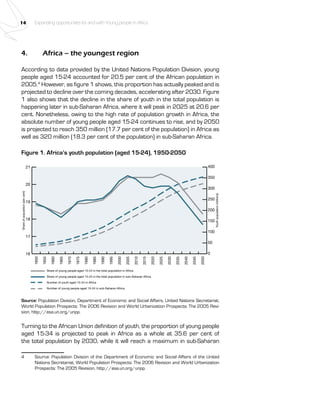
According to data provided by the United Nations Population Division, young 
people aged 15-24 accounted for 20.5 per cent of the African population in 
2005.4 However, as figure 1 shows, this proportion has actually peaked and is 
projected to decline over the coming decades, accelerating after 2030. Figure 
1 also shows that the decline in the share of youth in the total population is 
happening later in sub-Saharan Africa, where it will peak in 2025 at 20.6 per 
cent. Nonetheless, owing to the high rate of population growth in Africa, the 
absolute number of young people aged 15-24 continues to rise, and by 2050 
is projected to reach 350 million (17.7 per cent of the population) in Africa as 
well as 320 million (18.3 per cent of the population) in sub-Saharan Africa. 
Figure 1. Africa’s youth population (aged 15-24), 1950-2050 
400 
350 
300 
250 
200 
150 
100 
50 
0 
21 
20 
19 
18 
17 
16 
1950 
1955 
1960 
1965 
1970 
1975 
1980 
1985 
1990 
1995 
2000 
2005 
2010 
2015 
2020 
2025 
2030 
2035 
2040 
2045 
2050 
Share of young people aged 15-24 in the total population in Africa 
Share of young people aged 15-24 in the total population in sub-Saharan Africa 
Number of youth aged 15-24 in Africa 
Number of young people aged 15-24 in sub-Saharan Africa 
Share of population (per cent) 
Youth population (millions) 
Source: Population Division, Department of Economic and Social Affairs, United Nations Secretariat, 
World Population Prospects: The 2006 Revision and World Urbanization Prospects: The 2005 Revi-sion, 
http://esa.un.org/unpp. 
Turning to the African Union definition of youth, the proportion of young people 
aged 15-34 is projected to peak in Africa as a whole at 35.6 per cent of 
the total population by 2030, while it will reach a maximum in sub-Saharan 
4 Source: Population Division of the Department of Economic and Social Affairs of the United 
Nations Secretariat, World Population Prospects: The 2006 Revision and World Urbanization 
Prospects: The 2005 Revision, http://esa.un.org/unpp.
African Youth Report 2009 15 
Africa in 2035 (36.4 per cent). 5 In contrast, the proportion of children aged 
5-14 is declining, having peaked in 1990 at 27.3 per cent of the population. 
Projections indicate that the population in Africa is clearly ageing, with the 
shares of prime-age adults and the elderly continuing to rise. 
As expected, these regional trends mask considerable heterogeneity at the 
subregional level. The populations of North and Southern Africa are projected 
to age faster, with the share of young people aged 15-24 projected to fall to 
13.9 and 16.5 per cent of the population by 2050 respectively. In comparison, 
the youth populations in East, Central and West Africa are still increasing as a 
proportion and in absolute terms. The divergence among the subregions is a 
recent phenomenon and will accelerate rapidly after 2010, particularly in the 
case of North Africa. 
This demographic picture has a number of implications for policymakers: 
• Firstly, despite the projected decline in the proportion of youth over 
the coming years, youth populations are still increasing in absolute 
numbers, and as a result youth issues remain salient for African 
governments and international partners 
• Secondly, as a consequence of the demographic transition, larger 
cohorts of young people are entering adulthood, which suggests 
that more attention should be devoted to the hurdles they face 
during this period, such as those of developing job-oriented skills 
and acquiring qualifications (post-primary education), finding a 
decent job and foundling a family. 
5 As a result of data limitations, the youth share here is for the group 15-34, not 15-35, which 
is the African Union definition of youth.
16 Expanding opportunities for and with Young people in Africa 
References 
Ad Hoc Working Group for Youth and the MDGs (2005). Youth and 
the Millennium Development Goals: Challenges and Opportunities for 
Implementation. Final Report of the Ad Hoc Working Group for Youth and the 
MDGs, April 2005. 
United Nations (2005). World Youth Report 2005, Young People Today, and 
in 2015. United Nations, New York. 
United Nations (2007). Report of the Secretary-General: Goals and targets for 
monitoring the progress of youth in the global economy. A/62/61/Add.1.
C. The school-to-work transition: 
Why is it failing so many 
young people in Africa? 
1. Introduction 
The most crucial stage for accumulating human capital in the form of general 
knowledge is during school. After finishing formal education, young people 
should be able to accomplish a successful transition from school to work 
with the skills and knowledge they have acquired. More specific skills can then 
be developed through training and experience on the job. This process is an 
integral step towards promoting economic growth, poverty reduction and 
prosperity in Africa. 
However, more often than not Africa’s young people face bleak prospects in 
the labour market, ending up unemployed if they can afford to remain in such 
a situation, or underemployed and stuck in poorly paid jobs in the informal 
economy. The youth unemployment rate stands at around 20 per cent 
in Africa. What is not captured by this statistic, however, is the degree of 
underemployment and working poverty that young Africans typically endure. 
These are in fact greater challenges in Africa than unemployment itself. 
This section considers these issues by summarizing the linkages between 
education and employment; analysing the situation of young Africans in terms 
of both education and employment; and examining how governments and 
development partners can respond to this challenge in African countries. 
This last aspect focuses more on interventions to support young people in the 
labour market once they have left formal education. 
While this report is not the first to analyse these issues, it provides an overview 
of the issues, the most up-to-date data and a discussion on policy options 
for governments.6 Though enrolments in primary education have improved 
considerably, most young people in Africa cannot access post-primary schooling, 
which is essential to make a successful transition from formal schooling to 
workplace. Consequently, young people continue to be marginalized in the 
labour market, facing few opportunities to find decent formal employment that 
will lift them out of poverty. In response, African countries are implementing 
6 See also United Nations (2007b) and World Bank (2006). 
African Youth Report 2009 Expanding opportunities for and with Young people in Africa 17
18 Expanding opportunities for and with Young people in Africa 
various policies and schemes to promote employment opportunities for young 
people, including skills training and entrepreneurship funds. However, their 
efforts are restricted by the cost and lack of capacity among governments to 
evaluate the impact of such policies. 
2. Why human capital is important for economic and 
social development 
Economists have long used human capital as a concept that embodies the 
abilities, skills and knowledge embodied in a person.7 The key premise in 
the standard economic approach to human capital is that education is an 
investment that leads to higher wages, reflecting the increased levels of 
productivity resulting from human capital accumulation. These private returns 
on education constitute incentives for families to invest in their children’s 
education, while the social benefits of education (the impact on economic 
development) provide a rationale for public investment in the formal education 
sector.8 The role of human capital or education in economic development has 
thus been a prominent theme, particularly since the emergence of endogenous 
growth models. 
Education is, however, not just about improving wages as it also goes to 
the very heart of development. As stated by Nobel Laureate Amartya Sen 
in his capabilities approach, the importance of human capital is far greater 
than the standard economic conceptualization, which restricts the value to 
its instrumental role in increasing productivity, earnings and output. Sen’s 
concept of “human capabilities” is broader and recognizes that the acquisition 
of skills and knowledge has other direct benefits for the well-being and freedom 
of individuals (Sen 2000). Ultimately, being educated is necessary if young 
people are to live the lives they value. 
3. The education and employment situation facing 
Africa’s youth 
This section summarizes the current situation facing Africa’s youth in terms 
of both education and employment opportunities. 
7 The modelling of human capital in a more rigorous framework was pioneered by the studies of 
Mincer (1958), Schultz (1961) and Becker (1964), which formalized the analysis of demand 
for education by individuals and their subsequent supply of skills in the labour market. 
8 Social returns to education can be higher than the private returns when externalities arise due 
to technological progress or other social benefits that are generated, such as lower crime and 
better health (Krueger and Lindahl 2001).
African Youth Report 2009 19 
(a) Education 
As a consequence of concerted efforts by governments and partners, there 
has been a considerable improvement in access to primary education and 
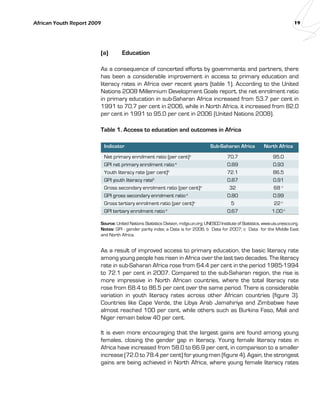
literacy rates in Africa over recent years (table 1). According to the United 
Nations 2008 Millennium Development Goals report, the net enrolment ratio 
in primary education in sub-Saharan Africa increased from 53.7 per cent in 
1991 to 70.7 per cent in 2006, while in North Africa, it increased from 82.0 
per cent in 1991 to 95.0 per cent in 2006 (United Nations 2008). 
Table 1. Access to education and outcomes in Africa 
Indicator Sub-Saharan Africa North Africa 
Net primary enrolment ratio (per cent)a 70.7 95.0 
GPI net primary enrolment ratio a 0.89 0.93 
Youth literacy rate (per cent)b 72.1 86.5 
GPI youth literacy rateb 0.87 0.91 
Gross secondary enrolment ratio (per cent)a 32 68 c 
GPI gross secondary enrolment ratio a 0.80 0.99 
Gross tertiary enrolment ratio (per cent)a 5 22 c 
GPI tertiary enrolment ratio a 0.67 1.00 c 
Source: United Nations Statistics Division, mdgs.un.org; UNESCO Institute of Statistics, www.uis.unesco.org. 
Notes: GPI - gender parity index; a Data is for 2006; b Data for 2007; c Data for the Middle East 
and North Africa. 
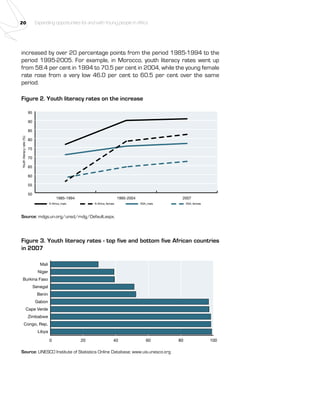
As a result of improved access to primary education, the basic literacy rate 
among young people has risen in Africa over the last two decades. The literacy 
rate in sub-Saharan Africa rose from 64.4 per cent in the period 1985-1994 
to 72.1 per cent in 2007. Compared to the sub-Saharan region, the rise is 
more impressive in North African countries, where the total literacy rate 
rose from 68.4 to 86.5 per cent over the same period. There is considerable 
variation in youth literacy rates across other African countries (figure 3). 
Countries like Cape Verde, the Libya Arab Jamahiriya and Zimbabwe have 
almost reached 100 per cent, while others such as Burkina Faso, Mali and 
Niger remain below 40 per cent. 
It is even more encouraging that the largest gains are found among young 
females, closing the gender gap in literacy. Young female literacy rates in 
Africa have increased from 58.0 to 66.9 per cent, in comparison to a smaller 
increase (72.0 to 78.4 per cent) for young men (figure 4). Again, the strongest 
gains are being achieved in North Africa, where young female literacy rates
20 Expanding opportunities for and with Young people in Africa 
increased by over 20 percentage points from the period 1985-1994 to the 
period 1995-2005. For example, in Morocco, youth literacy rates went up 
from 58.4 per cent in 1994 to 70.5 per cent in 2004, while the young female 
rate rose from a very low 46.0 per cent to 60.5 per cent over the same 
period. 
Figure 2. Youth literacy rates on the increase 
Youth literacy rate (%) 
95 
90 
85 
80 
75 
70 
65 
60 
55 
50 
1985-1994 1995-2004 2007 
N Africa_male N Africa_female SSA_male SSA_female 
Source: mdgs.un.org/unsd/mdg/Default.aspx. 
Figure 3. Youth literacy rates - top five and bottom five African countries 
in 2007 
0 20 40 60 80 100 
Mali 
Niger 
Burkina Faso 
Senegal 
Benin 
Gabon 
Cape Verde 
Zimbabwe 
Congo, Rep. 
Libya 
Source: UNESCO Institute of Statistics Online Database; www.uis.unesco.org
African Youth Report 2009 21 
(b) More needs to be done at post-primary levels of education 
While primary education is the starting point for developing a basic level of 
human capital, it does not on its own provide young people with the skills to 
compete in the African or global labour market. In order to be competitive 
and have a chance of finding a decent job, African young people increasingly 
need to acquire knowledge and skills through higher levels of education and 
training. 
In this respect, access to higher levels of education continues to be inadequate 
in Africa, and particularly south of the Sahara. The latest data from UNESCO 
clearly illustrate this point: the gross enrolment ratio in secondary education 
in sub-Saharan Africa increased from only 25 per cent in 2000 to 32 per cent 
in 2005 (table 1). A similar picture is evident in the tertiary gross enrolment 
ratio for sub-Saharan Africa, which lags behind other areas by a considerable 
margin and remains at around 5.0 per cent. 
In comparison, North Africa has made considerable progress, increasing 
enrolment in secondary and tertiary education. Countries like Algeria and 
Morocco have increased secondary gross enrolment ratios by around eight 
percentage points between 2002 and 2005 (from 75 to 83 per cent and 
from 41 to 49 per cent respectively). Over the same period, the gross tertiary 
enrolment ratio in Tunisia increased from 23 to 30 per cent.9 
(c) Progress towards gender parity in higher levels of education 
Besides the message that access to higher levels of education remains too 
low in Africa, the latest figures also reveal that access to secondary education 
for young girls is not improving vis-à-vis the situation for boys. Indeed, progress 
towards gender parity in sub-Saharan Africa has deteriorated at the secondary 
level in recent years. The gender parity index for secondary enrolment rate 
decreased from 0.82 in 1999 to 0.80 in 2006 (United Nations 2008). 
Even fewer sub-Saharan African countries are making progress towards 
gender parity in tertiary education. In many countries, a considerable gender 
gap still persists in the courses chosen by women to study. For most countries 
for which data are available, women constitute less than a third of science-related 
students but over two thirds in humanities, arts, education, social 
sciences, business, law, services and health and welfare. This choice increases 
the difficulties faced by women in finding a decent job in the formal economy 
once they have left tertiary education. 
9 UNESCO Institute of Statistics online database.
22 Expanding opportunities for and with Young people in Africa 
African policymakers and international partners clearly need to accelerate 
their efforts in improving access to higher levels of education for young women. 
Without the opportunity to acquire a high-quality education and develop skills 
demanded by employers, young African women will continue to be marginalized 
in the labour market. 
4. Employment situation of young Africans 
Young people who have acquired the skills and knowledge that allow them 
to fully participate in society, should be able to look forward to finding a job, 
gaining work experience and gradually building up a career. However, as 
available data show, young Africans more often than not experience bleak 
prospects in the labour market, ending up unemployed if they can afford it, or 
underemployed and stuck in poorly paid jobs in the informal economy. This is 
not surprising given the hurdles young people must overcome to gain a high-quality 
education. 
(a) The overall labour market status of African youth 
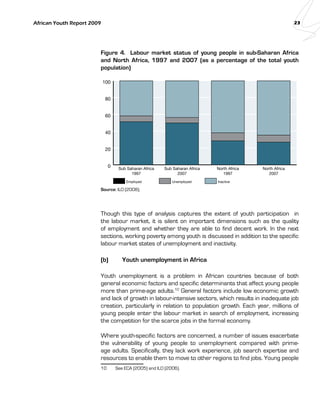
As outlined in figure 4, there are some clear differences in the labour market 
status of young people in sub-Saharan Africa and North Africa. An individual can 
be classified as employed, unemployed (that is, actively seeking employment) 
or inactive (out of the labour force). Owing to a lack of data, it is not possible 
to analyse the trends in terms of informal versus formal employment of young 
Africans. Nonetheless, on the basis of the data gathered on these three types 
of status, the following generalizations can be made: 
• Young people are more likely to be employed in sub-Saharan Africa 
than in North Africa, though the numbers of employed have fallen 
in both areas 
• Young people are less likely to be unemployed in sub-Saharan Africa, 
though the number of unemployed has fallen faster in North Africa 
in recent years. 
• Most young North Africans are out of the labour force (inactive) 
because of enrolment in education, cultural attitudes regarding 
women in the workplace, and the fact that young people are 
discouraged from finding a job. Young people in sub-Saharan Africa 
have fewer means to support themselves in such a situation.
African Youth Report 2009 23 
Figure 4. Labour market status of young people in sub-Saharan Africa 
and North Africa, 1997 and 2007 (as a percentage of the total youth 
population) 
100 
80 
60 
40 
20 
0 
Employed Unemployed Inactive 
North Africa 
2007 
North Africa 
1997 
Sub Saharan Africa 
2007 
Sub Saharan Africa 
1997 
Source: ILO (2008). 
Though this type of analysis captures the extent of youth participation in 
the labour market, it is silent on important dimensions such as the quality 
of employment and whether they are able to find decent work. In the next 
sections, working poverty among youth is discussed in addition to the specific 
labour market states of unemployment and inactivity. 
(b) Youth unemployment in Africa 
Youth unemployment is a problem in African countries because of both 
general economic factors and specific determinants that affect young people 
more than prime-age adults.10 General factors include low economic growth 
and lack of growth in labour-intensive sectors, which results in inadequate job 
creation, particularly in relation to population growth. Each year, millions of 
young people enter the labour market in search of employment, increasing 
the competition for the scarce jobs in the formal economy. 
Where youth-specific factors are concerned, a number of issues exacerbate 
the vulnerability of young people to unemployment compared with prime-age 
adults. Specifically, they lack work experience, job search expertise and 
resources to enable them to move to other regions to find jobs. Young people 
10 See ECA (2005) and ILO (2006).
24 Expanding opportunities for and with Young people in Africa 
are more likely to change jobs voluntarily and to be terminated than prime-age 
adults. At the same time, the denominator of the unemployment rate is lower 
for young people than for adults because many young people are inactive (ILO 
2006; ECA 2005). 
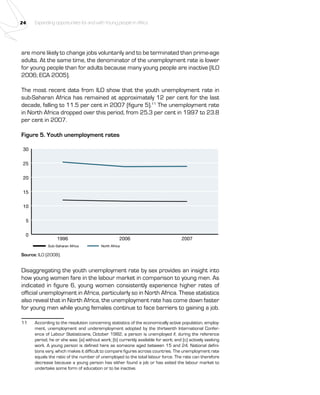
The most recent data from ILO show that the youth unemployment rate in 
sub-Saharan Africa has remained at approximately 12 per cent for the last 
decade, falling to 11.5 per cent in 2007 (figure 5).11 The unemployment rate 
in North Africa dropped over this period, from 25.3 per cent in 1997 to 23.8 
per cent in 2007. 
Figure 5. Youth unemployment rates 
30 
25 
20 
15 
10 
5 
0 
1996 2006 2007 
Sub-Saharan Africa North Africa 
Source: ILO (2008). 
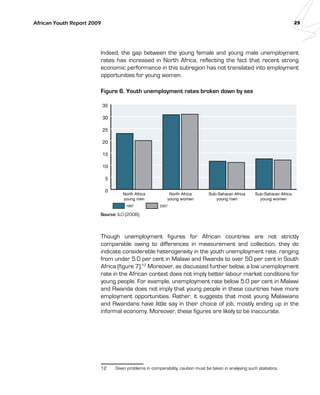
Disaggregating the youth unemployment rate by sex provides an insight into 
how young women fare in the labour market in comparison to young men. As 
indicated in figure 6, young women consistently experience higher rates of 
official unemployment in Africa, particularly so in North Africa. These statistics 
also reveal that in North Africa, the unemployment rate has come down faster 
for young men while young females continue to face barriers to gaining a job. 
11 According to the resolution concerning statistics of the economically active population, employ-ment, 
unemployment and underemployment adopted by the thirteenth International Confer-ence 
of Labour Statisticians, October 1982, a person is unemployed if, during the reference 
period, he or she was: (a) without work; (b) currently available for work; and (c) actively seeking 
work. A young person is defined here as someone aged between 15 and 24. National defini-tions 
vary, which makes it difficult to compare figures across countries. The unemployment rate 
equals the ratio of the number of unemployed to the total labour force. The rate can therefore 
decrease because a young person has either found a job or has exited the labour market to 
undertake some form of education or to be inactive.
African Youth Report 2009 25 
Indeed, the gap between the young female and young male unemployment 
rates has increased in North Africa, reflecting the fact that recent strong 
economic performance in this subregion has not translated into employment 
opportunities for young women. 
Figure 6. Youth unemployment rates broken down by sex 
35 
30 
25 
20 
15 
10 
5 
0 
1997 2007 
Sub-Saharan Africa 
young women 
Sub-Saharan Africa 
young men 
North Africa 
young women 
North Africa 
young men 
Source: ILO (2008). 
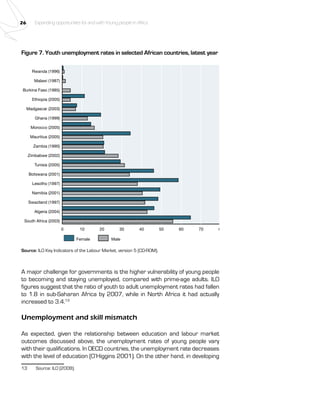
Though unemployment figures for African countries are not strictly 
comparable owing to differences in measurement and collection, they do 
indicate considerable heterogeneity in the youth unemployment rate, ranging 
from under 5.0 per cent in Malawi and Rwanda to over 50 per cent in South 
Africa (figure 7).12 Moreover, as discussed further below, a low unemployment 
rate in the African context does not imply better labour market conditions for 
young people. For example, unemployment rate below 5.0 per cent in Malawi 
and Rwanda does not imply that young people in these countries have more 
employment opportunities. Rather, it suggests that most young Malawians 
and Rwandans have little say in their choice of job, mostly ending up in the 
informal economy. Moreover, these figures are likely to be inaccurate. 
12 Given problems in comparability, caution must be taken in analysing such statistics.
26 Expanding opportunities for and with Young people in Africa 
Figure 7. Youth unemployment rates in selected African countries, latest year 
0 10 20 30 40 50 60 70 80 
Female Male 
Rwanda (1996) 
Malawi (1987) 
Burkina Faso (1985) 
Ethiopia (2005) 
Madgascar (2003) 
Ghana (1999) 
Morocco (2005) 
Mauritius (2005) 
Zambia (1990) 
Zimbabwe (2002) 
Tunisia (2005) 
Botswana (2001) 
Lesotho (1997) 
Namibia (2001) 
Swaziland (1997) 
Algeria (2004) 
South Africa (2003) 
Source: ILO Key Indicators of the Labour Market, version 5 (CD-ROM). 
A major challenge for governments is the higher vulnerability of young people 
to becoming and staying unemployed, compared with prime-age adults. ILO 
figures suggest that the ratio of youth to adult unemployment rates had fallen 
to 1.8 in sub-Saharan Africa by 2007, while in North Africa it had actually 
increased to 3.4.13 
Unemployment and skill mismatch 
As expected, given the relationship between education and labour market 
outcomes discussed above, the unemployment rates of young people vary 
with their qualifications. In OECD countries, the unemployment rate decreases 
with the level of education (O’Higgins 2001). On the other hand, in developing 
13 Source: ILO (2008).
African Youth Report 2009 27 
regions like Africa it has been argued that the better-educated experience 
higher unemployment rates. This has been called the “educated youth 
hypothesis” (Leibbrandt and Mlatsheni 2004). The premise is that young 
people from more privileged backgrounds focus their job search on better-paid 
public-sector positions, and are, as a consequence, willing to “queue” for 
such jobs and remain unemployed. The more properly educated do not have 
the financial means or support to endure unemployment, and therefore seek 
work in lower-paid, poorer-quality jobs in the informal economy. 
A consequence of structural adjustment policies and other economic reforms 
is that there are few employment opportunities in the African public sector. At 
the same time, educated young people often do not have appropriate skills for 
other forms of formal-sector employment in industry or service activities. This 
situation is known as a “skill mismatch”, referring to the lack of congruence 
between the skills acquired by a young person and what employers demand. 
For example, according to figures for 1999 and 2000 presented in Boateng 
and Ofori-Sarpong (2001), there was an excess supply of Ghanaian graduates 
in arts/social sciences and agriculture, while there was a shortage of young 
people with degrees in administration/management, medical/health sciences 
and engineering/technical subjects. This skill mismatch resulted in graduate 
unemployment. 
Information technology is one skill area that is now essential to enable 
young people to gain a foothold in the labour market in both the developed 
and developing countries. This has been driven by skill-biased technological 
change and globalization. As reported in Boateng (2004), the proportion of 
job vacancies in Ghana not requiring skills in information technology decreased 
from 99 per cent in 1981 to around 55 per cent in 2003. Therefore, in order 
to have the skills demanded by employers, young Ghanaians must develop 
some proficiency in computers and associated technologies. 
(c) The rural-urban divide for young people in African labour markets 
In rural areas of African countries, most young people are employed in the 
agricultural sector either as wage labourers or in self-employment, while 
opportunities in the non-agricultural sector, especially in formal employment, 
are limited. The disparity can be large: for example, in Zambia, the urban youth 
unemployment rate has reached 54 per cent compared with the rural rate 
of 10 per cent. Rural youth unemployment is a specific challenge in some 
African countries such as Kenya, Mozambique and Sao Tome and Principe 
(Leibbrandt and Mlatsheni 2004).
28 Expanding opportunities for and with Young people in Africa 
However, these figures on unemployment disguise the problem of 
underemployment, which is much more prevalent in rural regions as a 
consequence of poorer job opportunities. Young people in these areas are 
not able to remain without work for long periods and often migrate to urban 
centres or internationally in search of employment. 
(d) Other employment dimensions are a better reflection of the 
situation African young people face in the labour market 
While the measured rate of unemployment does provide a partial insight into 
the difficulties African young people experience in finding a job, it does not 
reveal the full story. In order to provide a more accurate picture of the situation 
this section focuses on three other indicators: the labour force participation 
rate, the inactivity rate and the working poverty rate. 
Labour force participation of African youth 
In sub-Saharan Africa, the labour force participation rate of youth has fallen 
marginally over the last decade from 58.3 per cent in 1997 to an estimated 
56.3 per cent in 2007.14,15 This probably reflects slightly increased enrolments 
of young people in education, who are then classified as being outside the 
labour market. The overall high rate in sub-Saharan Africa captures the fact 
that most young people have to work to survive and support their families 
rather than stay in formal education. In the sub-Saharan countries, labour 
force participation rates for young women (51.0 per cent) are lower than 
that for men (61.5 per cent) (ILO 2008). This indicator, however, does not 
include the unpaid home-based work undertaken by young women across the 
continent. 
In comparison, the labour force participation rate for young people in North 
Africa fell from a much lower starting position of 38.2 per cent in 1997 to 
35.3 per cent in 2007, most likely as a result of increased enrolment rates. 
In North African countries, young women have much lower labour force 
participation rates than young men because of traditional attitudes about 
women in the public domain: 46.1 per cent for young men versus 24.3 per 
cent for young women in 2007.16 
14 The youth labour force participation rate is defined as the number of young people aged 15-24 
in the labour force as a percentage of the working-age population. To be classified as participat-ing 
in the labour force, a young person has to be either engaged in a job or looking for work 
(unemployed). 
15 ILO (2008). 
16 ILO (2008).
African Youth Report 2009 29 
Inactivity of youth 
The dimension of the labour market not captured by the labour force 
participation rate is the inactivity rate, which is defined as the proportion of 
the working-age population (in this case aged 15-24) who are not in the labour 
force. Young people can remain outside the labour market for a variety of 
reasons such as education, childbearing and childcare, illness or disability, 
or because they are discouraged from participating at all (see ILO (2006) 
for more details). Consequently, some components such as education can be 
considered voluntary while others are more involuntary (illness and disability), 
and hence it is important to consider these various factors when analysing 
this indicator of inactivity. 
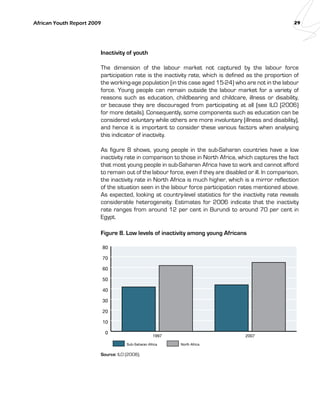
As figure 8 shows, young people in the sub-Saharan countries have a low 
inactivity rate in comparison to those in North Africa, which captures the fact 
that most young people in sub-Saharan Africa have to work and cannot afford 
to remain out of the labour force, even if they are disabled or ill. In comparison, 
the inactivity rate in North Africa is much higher, which is a mirror reflection 
of the situation seen in the labour force participation rates mentioned above. 
As expected, looking at country-level statistics for the inactivity rate reveals 
considerable heterogeneity. Estimates for 2006 indicate that the inactivity 
rate ranges from around 12 per cent in Burundi to around 70 per cent in 
Egypt. 
Figure 8. Low levels of inactivity among young Africans 
80 
70 
60 
50 
40 
30 
20 
10 
0 
1997 2007 
Sub-Saharan Africa North Africa 
Source: ILO (2008).
30 Expanding opportunities for and with Young people in Africa 
Young people often working poor 
Besides the dimension form of participation in employment, it is important to 
consider whether young Africans are receiving a decent wage for the work they 
do. In this respect, one of the greatest challenges facing African countries is the 
pervasiveness of working poverty, where an individual is working but nonetheless 
falls below the poverty line. Working poverty is a common feature of the labour 
market in Africa because most jobs are located in the informal economy (ILO 
2006). 
According to ILO (2006), in 2005 approximately 45 million young people in sub- 
Saharan Africa were working but nonetheless living below the poverty line of US 
$1 per day. The working poverty rate for young people in sub-Saharan Africa has 
diminished only marginally over the last decade, from 59.0 per cent in 1995 to 
57.7 per cent in 2005. In comparison, the youth working-poverty rate in North 
Africa (together with the Middle East) has been below 4.0 per cent over the 
same period. The working poverty rate using poverty line of the US $2 per day 
reveals that there has been little improvement over the past decade for Africa’s 
youth. 
5. How to respond to the youth employment challenge 
in Africa 
The trends presented above indicate that youth unemployment and 
underemployment remain one of the most persistent and urgent development 
challenges for African countries. Though there has been some progress in North 
Africa, the situation of young females in that region has not improved. Apart from 
unemployment, African young people continue to face severe hurdles in gaining 
decent employment that would help them and their families escape poverty. 
Failure to address the high levels of youth unemployment, underemployment 
and working poverty results in significant economic losses to each country as a 
whole and the social exclusion of young people. This situation has also contributed 
to the exodus of Africa’s brightest and best young people to European and other 
developed countries. Others have been desperate enough to risk their lives in 
their efforts to reach Europe (ECA 2005). 
High unemployment also affects political stability. On the one hand, conflict 
reduces economic growth by discouraging investment, disrupting trade 
and hindering agricultural activity, and hence affects employment. Lack of 
employment, on the other hand, ignites and drives conflict through disaffected, 
unemployed persons (Fosu and Collier 2005).
African Youth Report 2009 31 
Economists and governments have for many decades recognized that 
employment creation requires sustained economic growth (ECA 2005). In 
this respect, African governments need to enhance the conditions for the 
creation of jobs in the economy, which involves improving the infrastructure, 
encouraging trade and regional integration, promoting investment and 
enterprise development, transforming the economy to higher value-added 
sectors that create jobs, and maintaining macroeconomic stability to ensure 
that these endeavours are sustained. However, it has increasingly been 
recognized that strong economic growth will not necessarily lead to the 
creation of jobs if it results from the expansion of capital-intensive sectors 
such as mining, which create enclave economies, a situation facing many 
resource-rich African countries. 
Overall, the response to these challenges has to be coherent and integrated, 
addressing both macroeconomic and microeconomic issues and other issues 
pertinent to different sectoral ministries in the government (ministries of 
youth, education, etc.). More specifically, there are two parts to an overall 
strategy, which will be discussed in more detail below: 
(a) Policies that promote employment generation for young people 
by mainstreaming youth issues in all areas of government policies, 
including macroeconomic policies, sectoral investment policies and 
national development policies such as poverty reduction strategies; 
(b) Specific interventions targeting young people, including education, 
training, entrepreneurship and other policies. 
In addition, the associated issues of data collection and analysis and monitoring 
and evaluation are discussed. These are key to developing effective policy 
interventions. 
(a) Youth employment mainstreamed into national development 
frameworks and policies 
At the September 2004 Extraordinary Summit of the African Union Heads 
of State and Government on Employment and Poverty Reduction, African 
leaders acknowledged in the Ouagadougou Declaration that employment 
should be placed at the centre of development policies and programmes in 
Africa. In particular, governments need to embed issues of youth employment 
in poverty reduction strategies and national development plans, matched by 
commensurate resources.
32 Expanding opportunities for and with Young people in Africa 
Youth employment issues in poverty reduction strategies 
Initiated by the World Bank and IMF in 1999, poverty reduction strategy papers 
(PRSPs) have been developed by African countries to provide a strategy for 
poverty reduction, linking public policy, donor support and development goals, 
including the MDGs. PRSPs provide the operational basis for these countries 
to access concessional loans from the World Bank and IMF and to receive 
debt relief under the auspices of the two institutions. To recognize broader 
policy initiatives developed by countries, the term “poverty reduction strategy” 
is typically used. Section E considers the issue of youth participation in PRSPs 
in more detail. 
ECA (2005) reviewed to what extent countries’ PRSPs addressed youth 
employment as an issue, and found that out of 21 PRSPs, only 11 have at 
least one core section analysing youth employment. Seventeen countries had 
specifically targeted employment creation for young people, mainly through 
training, education and the development of the private sector. 
Given that a number of African countries have either developed or revised 
PRSPs in recent years, it is informative to look at whether these policy 
documents are devoting more attention to issues of youth employment 
compared with the findings of ECA (2005). Reviewing poverty reduction 
strategies developed since January 2005 reveals that countries are indeed 
focusing more on youth employment. Out of 17 such strategies, 15 dedicate 
a core section to youth employment in the analysis and highlight it as a priority 
in the strategy an increase from 52.4 per cent as reported in ECA (2005) 
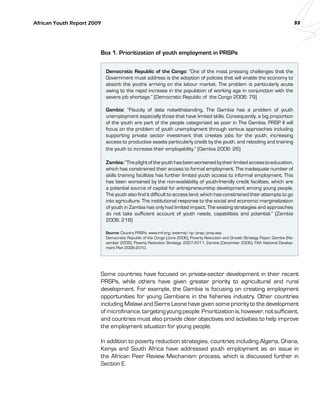
to 88.2 per cent. Some examples of the prioritization of youth employment 
PRSPs in Africa countries are listed in box 1.
African Youth Report 2009 33 
Box 1. Prioritization of youth employment in PRSPs 
Democratic Republic of the Congo: “One of the most pressing challenges that the 
Government must address is the adoption of policies that will enable the economy to 
absorb the youths arriving on the labour market. The problem is particularly acute 
owing to the rapid increase in the population of working age in conjunction with the 
severe job shortage.” (Democratic Republic of the Congo 2006: 79) 
Gambia: “Paucity of data notwithstanding, The Gambia has a problem of youth 
unemployment especially those that have limited skills. Consequently, a big proportion 
of the youth are part of the people categorized as poor in The Gambia. PRSP II will 
focus on the problem of youth unemployment through various approaches including 
supporting private sector investment that creates jobs for the youth, increasing 
access to productive assets particularly credit by the youth, and retooling and training 
the youth to increase their employability.” (Gambia 2006: 26) 
Zambia: “The plight of the youth has been worsened by their limited access to education, 
which has constrained their access to formal employment. The inadequate number of 
skills training facilities has further limited youth access to informal employment. This 
has been worsened by the non-availability of youth-friendly credit facilities, which are 
a potential source of capital for entrepreneurship development among young people. 
The youth also find it difficult to access land, which has constrained their attempts to go 
into agriculture. The institutional response to the social and economic marginalization 
of youth in Zambia has only had limited impact. The existing strategies and approaches 
do not take sufficient account of youth needs, capabilities and potential.” (Zambia 
2006: 218) 
Source: Country PRSPs, www.imf.org/external/np/prsp/prsp.asp. 
Democratic Republic of the Congo (June 2006), Poverty Reduction and Growth Strategy Paper; Gambia (No-vember 
2006), Poverty Reduction Strategy: 2007-2011; Zambia (December 2006), Fifth National Develop-ment 
Plan 2006-2010. 
Some countries have focused on private-sector development in their recent 
PRSPs, while others have given greater priority to agricultural and rural 
development. For example, the Gambia is focusing on creating employment 
opportunities for young Gambians in the fisheries industry. Other countries 
including Malawi and Sierra Leone have given some priority to the development 
of microfinance, targeting young people. Prioritization is, however, not sufficient, 
and countries must also provide clear objectives and activities to help improve 
the employment situation for young people. 
In addition to poverty reduction strategies, countries including Algeria, Ghana, 
Kenya and South Africa have addressed youth employment as an issue in 
the African Peer Review Mechanism process, which is discussed further in 
Section E.
34 Expanding opportunities for and with Young people in Africa 
Youth employment mainstreamed in macroeconomic and sectoral policies 
Beyond these approaches, it is being increasingly recognized that the goals of 
employment generation can also be addressed through the main instruments 
of government economic policy: monetary, fiscal and exchange rate policies. 
The focus of these policies in African countries, however, has been on 
macroeconomic stabilization as imposed through structural adjustment and 
as a consequence of conditionalities of debt relief. Many commentators are 
arguing that governments need to shift from targeting inflation to targeting 
developmental targets, such as employment (see, for example, Heintz and 
Pollin 2008). 
In addition, governments can embed employment objectives in other policy 
areas such as foreign investment and to support for the development sectors 
that have a high employment-generating potential. For example, by providing 
the right policy mix and an enabling environment, African countries could 
promote trade and foreign investment, which would create jobs in sectors 
that demand skills being acquired by young people. This would in turn require 
that they are able to access education and training, which would promote the 
accumulation of these specific skills. 
Ultimately, without a strongly growing economy, other inventions, such as 
those discussed below, could never create enough employment opportunities 
to accommodate the millions of young people entering the labour market 
across Africa every year. Nonetheless, these interventions are important in 
addressing in particular the employability of young Africans and the needs of 
specific groups of young people. 
(b) Improving formal education to ensure young people are prepared 
for the labour market 
As already outlined in this section, the main phase during which a young person 
can develop relevant knowledge and skills is formal schooling. In the words of 
Bechterman et al. (2004), “… earlier interventions at the schooling stage are 
likely to be more effective than trying to remedy education failures through 
youth training” p.34). Similarly, OECD (2002) stresses that the literature 
finds that “the biggest pay-off for disadvantaged youths [comes] from early 
and sustained interventions…. Such interventions should begin [even] before 
children enter the compulsory schooling system, and they should be followed 
by intensive efforts to boost their performance in primary and secondary 
schooling and reduce drop-out rates.” (OECD 2002:31).
African Youth Report 2009 35 
Although these findings are based on OECD studies, the implication is that 
the overriding priority for African governments should be formal education 
covering all levels. In this regard, while considerable efforts have been made by 
all stakeholders in increasing access to primary education, major challenges 
remain, particularly in terms of preparing young people for the labour market. 
Some of the main policy issues for the formal education sector in Africa are 
persisting barriers to accessing post-primary schooling, low-quality education, 
poor retention rates, financing and skill mismatch. 
In particular, there is still much to be done in Africa in improving the transition 
from primary to secondary school. Consequently, African policymakers should 
expand their focus from primary education alone to a broader approach 
that encompasses secondary schooling so as to ensure that pupils stay on 
to higher levels. As has already been stated although primary education is 
an essential starting point, young people in developing countries need more 
advanced and specific skills to provide them with the capacity to work in a 
more globalized world. 
This will involve reducing the costs of education, which includes abolishing 
school fees and ensuring that uniforms and other supplementary costs are 
affordable or free. Other measures to increase incentives on the demand 
side consist of providing free meals and payments to poor families for school 
attendance, as in the PROGRESA programme in Mexico. To facilitate girls’ 
education, Leibbrandt and Mlatsheni (2004) state that African governments 
need to improve parental involvement in school administration. Another 
suggestion is to develop female role models, which can be provided by having 
enough female teachers in the education system. 
On the supply side, investment in infrastructure, textbooks, learning materials, 
IT equipment and, above all, teachers is essential to improve access to 
and the quality of education. Proximity to schools continues to be a major 
constraint for pupils in poorer, rural regions and thus governments need to 
expand the number of schools in such areas. Perhaps the biggest constraint 
on the continent is the supply of teachers, especially in the light of efforts to 
achieve universal primary education within the framework of the Millennium 
Development Goals (specifically Goal 2). For example, according to Nilsson 
(2003), Africa will need 3 million extra teachers to meet this goal by 2015, 
assuming that the teacher-pupil ratios remain at current levels. HIV and 
AIDS have made this challenge that much more difficult for Southern African 
countries. 
To attract more teachers, African governments need to offer more training 
courses alongside improvements in pay and working conditions so that the
36 Expanding opportunities for and with Young people in Africa 
profession attracts and retains the best-trained teachers, which is currently a 
major problem in rural areas. Another approach is to use teaching assistants 
to supplement the number of staff in schools, as in Ghana. In this case, young 
people are being given the chance to work as such assistants, thus also 
helping tackle youth unemployment. 
One approach to tackle the problem of skill mismatch is to combine formal 
education with work-based training. As discussed in O’Higgins (2001), this 
combination can either be sequential, where training follows the completion of 
school, or it can be undertaken concurrently, as in Austria, Denmark, Germany 
and Switzerland. 
It has been argued that the dual system is successful in assisting young people 
make the transition from school to work. However, there are also problems 
with the rigidities imposed by the scheme, as it forces young people into a 
specific career path early on, which may later prove to be inappropriate for 
the person or in terms of employers’ demands (Ryan 2001). Nevertheless, 
the dual system has potential in developing countries, as illustrated in Box 2, 
which presents the case of such an approach in Egypt. 
Box 2. The Mubarak-Kohl initiative in Egypt 
The Egyptian leader Hosni Mubarak and the then German Chancellor Helmut Kohl 
agreed on an initiative to cooperate in the implementation of a dual vocational 
education system in Egypt based on the German model. This project was established 
in 1991 with the aim of bringing together the public and private sectors to provide 
training for young people. 
By including employers and enterprises, training focuses on vocational and technical 
skills demanded by the Egyptian labour market. In the scheme, students spend two 
days a week at school and four days with an enterprise for practical training. The 
duration of the whole programme is three years. Representatives of the Egyptian 
private sector, the Ministry of Education and experts from Germany jointly developed 
the theoretical and practical curricula. 
During the period 1995-2002, the project expanded to cover most regions in Egypt, 
both rural and urban, and some 20 cities. Overall, the initiative is considered in Egypt 
to be a great success. The dual vocational programme has been established in 28 
occupations in 24 governorates and in 45 technical secondary schools. Altogether, 
16,000 young people have been trained in 1,600 companies. 
Source: www.gtz.de.
African Youth Report 2009 37 
Governments should also encourage the participation and representation of 
the private sector in universities, aiding these institutions in the development of 
curricula that match the requirements of employers. For example, as is done 
in a number of African countries, key representatives of the private sector 
should sit on the boards of tertiary institutions to help guide the development of 
appropriate curricula. 
Beyond formal education, African governments should also look at developing 
informal education and training that targets out-of-school children and young 
people. Training for such young people also requires providing life skills and self-development 
programmes, with a focus on functional literacy. These types of 
programme are addressed below. 
(c) Active labour market policies and programmes 
Apart from measures to improve formal education in Africa, governments 
also have to consider the use of interventions to support young Africans once 
they have left school and are struggling in the labour market to find decent 
employment. Specifically, African policymakers need to look at how shorter-term 
policy initiatives can be utilized to improve the employability of young people and 
increase the demand for their labour, while also tackling the functioning of the 
labour market. These types of policy are known as active labour market policies 
(ALMPs), referring to the requirement that individuals receiving assistance have 
to actively undertake some activity such as training.17 
The focus of this subsection is on ALMPs and their relevance for the situation 
facing young Africans. The main issues are whether such interventions are 
effective in the African context and whether their significant costs can be 
justified. 
Types of ALMPs 
ALMPs can be classified into four types (see Kluve (2006)), which are 
summarized in table 2. 
17 This stands in contrast to passive labour market policies such as unemployment benefits, which 
are transfer payments awarded in return efforts to find a job, and are typically absent in most 
African countries.
38 Expanding opportunities for and with Young people in Africa 
Table 2. Types of active labour market policies for young people 
Type of ALMP Generic examples African examples 
Policies to improve the 
Classroom training, on-the- 
employability of young people 
job training, work 
experience, internships, 
entrepreneurship training 
Internship programme 
in Ghana 
Policies to create employment 
opportunities for young people 
Wage subsidies, public 
works programmes, 
employment funds and 
microcredit schemes 
Public works 
programme in Senegal; 
youth employment/ 
entrepreneurship 
funds in Algeria, Kenya, 
Mali, Senegal, South 
Africa and the United 
Republic of Tanzania; 
training voucher 
programmes in Kenya 
and South Africa 
Policies to improve the 
functioning of the labour 
market for young people 
Job search assistance, 
counselling, vocational 
guidance 
Information services 
and youth advisory 
centres in South Africa 
Policies to protect the rights of 
young workers 
Minimum wage, anti-discrimination 
legislation, 
employment protection 
Minimum wage in 
Kenya 
Source: Kluve (2006), Rother (2006); African examples are ECA’s own. 
(d) Selected examples of ALMPs in African countries 
(i) Policies to promote self-employment and entrepreneurship: 
Youth employment funds in Kenya and South Africa 
This category of ALMPs encompasses measures that are implemented to 
assist young people to establish their own businesses. This type of intervention 
has some potential in Africa, where self-employment could be an important 
generator of jobs and ultimately economic growth, especially in the context 
of inadequate employment opportunities in the formal (public and private) 
sector. While it is often argued that young people lack the experience and 
skills to become entrepreneurs, they are also capable of developing innovative 
and creative ideas. 
However, budding young entrepreneurs face considerable barriers and 
obstacles to establishing a successful business. To overcome these
African Youth Report 2009 39 
challenges, they require help with training, mentor support, access to credit 
and office facilities, as well as support when expanding a business and 
developing networks (O’Higgins 2001). Getting finance for a start-up business 
is a particular hurdle for young entrepreneurs, since they have no collateral or 
banking history or credit rating. A culture of entrepreneurship is often absent, 
and governments need to promote this path as a respectable and beneficial 
option for its young people, particularly for groups that have faced societal and 
cultural barriers to becoming entrepreneurs, such as young women. 
To overcome these challenges, a number of African countries have established 
funds to support youth entrepreneurship, including Algeria, Botswana, Kenya, 
Malawi, Mali, Nigeria, Senegal, South Africa, Uganda, the United Republic of 
Tanzania and Zambia. 
Recognizing the enormous challenge of youth unemployment and 
underemployment, the Government of South Africa created the Umsobomvu 
Youth Fund in January 2001, with the objective of promoting entrepreneurship, 
job creation, skills development and skills transfer among South Africans 
between the ages of 18 and 35.18 This encompasses a comprehensive range 
of services, including in addition to micro-credit and financing for small- and 
medium-sized enterprises, information databases, career counselling, youth 
advisory centres and the provision of business development services to 
existing young entrepreneurs through a voucher system. 
The Fund has provided loan finance targeting small- and medium-sized 
enterprises, micro-enterprises and cooperatives. In the financial year 
2006/07, the Fund issued 21,383 loans (up from 6,600 in the previous 
year), with a value of 175.5 million rand, which funded 5,796 enterprises, and, 
most importantly, led to the creation of 8,103 jobs.19 
At the same time, the Fund’s Business Development Services Division has 
assisted young people in developing entrepreneurship skills through the 
Business Consultancy Services Voucher Programme, an electronic voucher 
scheme allowing young South Africans to access such services as business 
planning and Web-based marketing through accredited service providers. 
In the financial year 2006/07, 9,470 vouchers were issued, helping 2,318 
enterprises and creating 8,410 jobs. 
More recently, the Kenyan government set up the Youth Enterprise 
Development Fund in 2006 to address youth unemployment and 
18 See www.youthportal.org.za. 
19 See the Fund‘s annual report for 2007, available from www.youthportal.org.za/ur/UYFAnnual 
Report 2007. p.4..
40 Expanding opportunities for and with Young people in Africa 
underemployment. The Fund was officially launched in February 2007 by 
President Kibaki. Disbursement operates through two channels through 
financial intermediaries such as microfinance institutions, and directly to 
young people through parliamentary constituencies.20 
By 31 May 2007, around 696,200,000 shillings had been disbursed to 
financial intermediaries. It is encouraging that 7,289 out of 7,885 young 
people who benefited from these funds were young women (92.4 per cent). 
In addition, 1,799 youth groups received a total of 72,689,214 shillings 
through the constituency scheme. Young people have also been offered 
entrepreneurship training. However, despite the proclaimed success of this 
initiative, such an intervention can address only a small proportion of young 
people needing support in gaining decent employment. Some 500,000 young 
people enter the labour market in Kenya every year. 
While these achievements appear to be positive, without a rigorous evaluation 
of such schemes it is impossible to take view on their long-term impact and 
cost-effectiveness. Such an evaluation will require conducting a comparison 
between young people who did and did not receive support from the government 
in terms of their successes in establishing and running businesses. This is a 
long-term and complex process that all governments need to undertake in 
order to understand the effectiveness of these programmes. 
(ii) Public works programmes in Senegal 
One type of ALMP that has been implemented in a number of African 
countries is the public works programme. Though the main objective of 
such programmes is usually to provide some sort of safety net, they can 
potentially assist unemployed young people to gain experience and help them 
remain attached to the labour market. Public works programmes that aim 
to provide short-term employment at low wages for workers who lack skills 
are particularly relevant for young people. The programme usually involves 
labour-intensive projects such as road construction, maintenance, irrigation 
infrastructure, reforestation and soil conservation. The overriding constraints 
in implementing public work programmes in Africa are (Subbarao 2003): 
• Capacity to provide funds for the project 
• Selection of the participants 
• Monitoring of the project. 
20 See: www.youthfund.go.ke.
African Youth Report 2009 41 
One example of this approach in Africa is a public works programme 
established in Senegal. With the assistance of the World Bank and the African 
Development Bank, the Senegalese Government set up a US$ 33 million public 
works programme in 1989 that targeted the growing number of unemployed 
young people (Sarr 2000). The main objectives of the programme, which 
was administered by the Agence pour l’Execution de Travaux d’Intérêt Public 
contre le Sous-emploi, were to provide short-term employment to these young 
people through labour-intensive public works projects such as construction, 
rehabilitation and maintenance of public services, and provision of essential 
services. The work was subcontracted out to small and medium-sized 
enterprises. 
During the first phase of the programme, around 80,000 jobs were created for 
young people in 416 projects in small-scale enterprises. Overall, the Agency has 
implemented 3,226 projects, resulting in the creation of 350,000 temporary 
jobs annually. More importantly, the projects also led to the establishment of 
6,000 permanent jobs, an outcome that is not usually the overriding aim of a 
public works programme. The main criticisms of the programme were that it 
was largely implemented in urban areas, and therefore did nothing to address 
the rural-urban employment divide, and that there was no training for young 
participants. 
(iii) Skills training in Kenya 
As argued in this report, young people in Africa are more likely than not to 
finish school without the set of skills demanded by employers. Governments 
can provide public-funded training or financial support for private provision 
to remedy this problem which can focus on either general training or more 
specific vocational skills. The Jua Kali Voucher programme of Kenya is an 
innovative approach to facilitating the provision of training for young people 
through a voucher system. 
Under the auspices of the Kenya Micro and Small Enterprise Training and 
Technology Project the Jua Kali Voucher Programme was established in 
1997 (Adams (1997); Godfrey (2003)). Jua Kali means “under the hot sun” 
in Swahili, reflecting the nature of the work in the segment of the labour force 
targeted by this programme. The objective of the voucher scheme is to enable 
recipients to purchase training in an open market where there is competition 
between public and private providers. This approach should improve the quality 
of training and bring down the costs, while at the same time ensuring a better 
match between the participant and the training course.
42 Expanding opportunities for and with Young people in Africa 
The voucher programme targeted established enterprises and employees in 
order to identify businesses that have the most potential to grow and generate 
employment. This rule was relaxed for women who were also eligible as start-up 
entrepreneurs, helping to encourage their participation in the scheme. 
During the period 1997-2001, some 37,666 vouchers were issued to 
entrepreneurs and employees in micro and small businesses. Participants paid 
only 10 per cent of the cost of the voucher, while the Government subsidized 
the remaining 90 per cent. Master craftsmen were the major providers of 
training, responding to demand from their clients. While the voucher scheme 
did not focus entirely on youth, the majority of those trained were young and 
disadvantaged. 
Though the voucher programme has not been subject to a rigorous empirical 
evaluation, it is generally thought to have been a success. There is evidence 
that both enterprises and employees benefited from the programme in terms 
of job creation, productivity and business profits. However, the programme 
was complex and costly to establish, and it has proved difficult to phase out 
the subsidization of the vouchers. 
(e) How effective are ALMPs? 
While a few African countries have implemented a range of ALMPs to help 
promote youth employment, it is crucial to analyse whether they are effective 
in terms of their impact on outcomes for young people and whether these 
policies are cost-effective. This, however, requires monitoring and evaluation 
of the intervention, which is usually absent. 
A review of the findings of more general studies provides a rather disappointing 
conclusion on the effectiveness of ALMPs. As Kluve (2006) concluded, “Young 
people appear to be particularly hard to assist. It is not clear if it follows from 
this disappointing result that youth programmes should be abolished, or 
rather that such programmes should be re-designed. It might also be the 
case that active labour market policies are not at all the appropriate policy 
for this group, and public policy should therefore focus on measures that 
prevent the very young from becoming disadvantaged … in the first place.” 
(Kluve 2006: 28). 
As reported in Martin (2000), “one of the most disappointing conclusions 
from the evaluation literature is that almost all evaluations show that special 
measures are not effective for disadvantaged youth”. (Martin 2000: 95). In 
fact, meta-analysis of a range of interventions in OECD and non-OECD countries
African Youth Report 2009 43 
reveals that ALMPs targeted at youth perform significantly worse than those 
targeting adults (Kluve 2006). 
More recently, the World Bank undertook an analysis of interventions targeting 
youth employment and found that, in sub-Saharan Africa (see Rother (2006), 
Bechterman et al. (2007)): 
(a) ALMPs are not often used by governments in the sub-Saharan 
countries, while the programmes that are implemented largely rely on 
external funding 
(b) There is a lack of systematic evaluation of the impact of specific 
interventions, failing to identify the independent effect of the 
programme 
(c) The absence of cost-benefit analysis renders it difficult to assess 
the efficiency and effectiveness of programmes. In the programmes 
reviewed by these studies, only 2 of 29 initiatives benefited from a 
cost-benefit analysis. 
Even if these interventions were cost-effective, African countries face the 
challenge of funding such programmes, which are very costly. The figures 
available for OECD countries indicate the potential costs of such programmes. 
The largest spender on ALMPs is Sweden, where the cost of the measures 
amounted to 2.1 per cent of gross domestic product in 1997, followed by 
Denmark with 1.8 per cent. The Netherlands and Ireland allocated 1.7 per cent 
of gross domestic product to ALMP measures, which was also well above the 
OECD average of just over 0.8 per cent. Though there are generally no data 
available for most African countries, figures indicate that two North African 
countries, Algeria and Tunisia, spend over 1.0 per cent of gross domestic 
product on ALMPs (Auer et al. 2004). 
Africa already invests around 3.3 per cent of gross domestic product in 
education, and therefore, given the fiscal constraints faced by governments, 
they are not in a position to allocate significant funding for ALMPs to such an 
extent that it reaches the levels found in OECD. The challenge is therefore to 
develop ALMPs that are simple to implement and cost-effective in the African 
setting. Overall, ALMPs can target only a small percentage of young people 
in African countries because of cost and capacity constraints. It will probably 
be more effective if ALMPs are used to target specific vulnerable groups such 
as young women, young people with disabilities and young people in rural or 
remote areas and conflict or post-conflict zones.
44 Expanding opportunities for and with Young people in Africa 
6. Role of development partners 
In addition to the interventions undertaken at the national level, regional and 
global development partners have firmly put youth employment issues at the 
heart of their agenda. In this respect, youth employment is clearly addressed 
in the African Youth Charter and the World Programme of Action for Youth, 
two frameworks that are discussed in detail later in this report. Overall, there 
are a number of United Nations resolutions on youth employment, including: 
• Economic and Social Council resolution 2006/15 on promoting 
youth employment (July 2006) 
• United Nations General Assembly resolution on policies and 
programmes involving youth (October 2005) 
• General Assembly resolution 59/148 on the tenth anniversary of 
the World Programme of Action for Youth (2004) 
• General Assembly resolution 58/133 on policies and programmes 
involving youth (January 2004) 
• General Assembly resolution 57/165 on promoting youth 
employment (December 2002) 
• General Assembly resolution 54/120 on policies and programmes 
involving youth 
• General Assembly resolution 62/162 on policies and programmes 
involving youth: youth in the global economy – promoting youth 
participation in social and economic development (contains the 
supplement to the World Programm of Action for Youth (2007)) 
Additionally, the United Nations Secretary-General regularly reports on youth 
employment.21 
Global development partners have also coordinated their efforts to support 
countries through the Youth Employment Network, which is a partnership 
between the United Nations, ILO and the World Bank.22 The Network’s High- 
Level Panel proposed recommendations in four areas: employability, equal 
opportunities, entrepreneurship and employment creation. 
Nineteen countries have volunteered to take on the role of lead countries for the 
Network to share experience and lead the way in formulating action plans on youth 
21 See www.un.org/esa/socdev/unyin/library.htm#resolutions. 
22 See http://www.ilo.org/public/english/employment/strat/yen/object/index.htm.
African Youth Report 2009 45 
employment. These include the following African countries: Democratic Republic 
of the Congo, Egypt, Mali, Namibia, Nigeria, Rwanda, Senegal and Uganda. In 
addition, 39 countries have submitted action plans on youth employment or 
progress reports, including six African countries, namely Algeria, Burkina Faso, 
Kenya, Senegal, Uganda the United Republic of Tanzania.23 
The Youth Employment Network for West Africa, which is based in Dakar, 
Senegal, is particularly active in raising awareness and supporting West African 
countries in mainstreaming youth employment as both a political and a security 
issue, along with building capacity at both the national and regional levels and 
engaging the private sector.24 
Further mandates stemming from General Assembly resolutions have 
encouraged countries to prepare national action plans on youth employment 
with assistance from the ILO, the United Nations Secretariat and the World 
Bank, as well as other United Nations specialized agencies, and with the 
participation of young people.25 
7. Summary of policy recommendations 
African governments need to develop integrated and coherent approaches to 
address youth employment issues, rather than treating them in isolation. This 
will involve considering both macroeconomic and microeconomic interventions 
across sectors along the lines of the following recommendations. African 
governments should: 
Develop macroeconomic, sectoral and investment • policies and an 
enabling business environment to promote sustained economic 
growth that results in employment creation, which subsequently 
benefits young people 
• Broaden education policies and strategies to improve access to and 
the quality of post-primary education, particularly for young girls 
• Intervene early during formal schooling to ensure that young people 
are gaining knowledge and skills that match the demands of the labour 
market through such initiatives as dual education programmes and 
entrepreneurship training 
• Support the development of internship and apprenticeship 
programmes in consultation with the private sector 
23 See the Secretary-General’s report entitled “Global analysis and evaluation of national action 
plans on youth employment” (A/60/133 and Corr.1). 
24 See http://www.ilo.org/public/english/employment/strat/yen/. 
25 United Nations (2007a).
46 Expanding opportunities for and with Young people in Africa 
• Encourage the participation and representation of the private sector 
in universities, aiding these institutions in the development of curricula 
that match the requirements of employers 
• Embed youth employment issues in all national policies, including 
poverty reduction strategies and national development plans, and 
develop associated action plans matched by resources to ensure 
these policies are implemented 
• Use labour market policies and programmes, including training, public 
works programmes and entrepreneurship funds, to target vulnerable 
young people such as those in post-conflict situations, young women 
and young people with disabilities 
• Establish youth enterprise centres that provide training and assistance 
to young people, including helping them develop bankable business 
plans. These centres should be located in both urban and rural areas, 
providing a safe place to young women, and should target out-of-school 
youth 
• Support the development of youth business associations, especially for 
young women, to provide forums to exchange information, undertake 
training and develop mentoring programmes. 
Collect labour force statistics disaggregated by age and along other 
dimensions (gender, disability status, etc.), and undertake rigorous monitoring 
and evaluation of interventions. 
Finally, it is important to note that the promotion of decent work for young 
people in Africa should go beyond creating more jobs. It must also look at 
the quality of jobs. For this reason, governments need to also adopt national 
legislation that supports this goal.
African Youth Report 2009 47 
References 
Adams, A.V. (1997). Assessment of the Jua Kali Pilot Voucher Program. www. 
worldbank.org.education/economicsed/finance/demand/case/kenya/ 
juakali.htm 
Auer, P., Elfendioglu, Ü, and J. Leschke (2004). Active Labour Market Policies 
around the World: Coping with the Consequences of Globalization. ILO, 
Geneva. 
Bechterman, G., Olivas, K. and A. Dar (2004). “Impact of active labor market 
programs: new evidence from evaluations with particular attention to 
developing and transition countries.” World Bank Social Protection Discussion 
Paper, No. 0402. 
Bechterman, G., Godfrey, M., Puerto, S., Rother, F. and A. Stavreska (2007). 
“A review of interventions to support young workers: findings of the youth 
employment inventory,” World Bank Social Protection Discussion Paper, No. 
0715. 
Becker, G. (1964). Human Capital. National Bureau of Economic Research, 
New York. 
Boateng, K. (2004). “Youth and ICT skills in African labour markets, with 
particular reference to Ghana.” Paper presented at the 3rd Annual Conference 
of the African Youth Foundation, 17-19 June, Frankfurt, Germany. 
Boateng, K. and E. Ofori-Saprong (2001). “An analytical study of the labour 
market for graduates in Ghana.” Ghana National Council for Tertiary Education 
(NCTE)/World Bank Education and Training Project Report, Accra, October. 
Fosu, A.K. and P. Collier (eds.) (2005). Post-Conflict Economies in Africa. 
Palgrave Macmillan. New York. 
Godfrey, M. (2003). “Youth employment policy in developing and transition 
countries – prevention as well as cure.” World Bank Social Protection 
Discussion Paper, No. 0320. 
Heintz, J. and R. Pollin (2008). “Targeting employment expansion, economic 
growth and development in sub-Saharan Africa: Outlines of an alternative 
economic program for the region.” Paper prepared for ECA.
48 Expanding opportunities for and with Young people in Africa 
International Labour Organization (ILO) (2006). Global Employment Trends for 
Youth. ILO, Geneva. 
International Labour Organization (ILO) (2008). Global Employment Trends for 
Youth – October 2008. ILO, Geneva. 
Kluve, J. (2006). “The effectiveness of European active labour market policy”, 
IZA Discussion Paper No.2018. 
Krueger, A.B. and M. Lindahl (2001). “Education for growth: why and for 
whom?” Journal of Economic Literature, Vol.39, No.4, pp.1101-1136. 
Leibbrandt, M. and C. Mlatsheni (2004). “Youth in Sub-Saharan labour 
markets.” African Development and Poverty Reduction: The Macro-Micro 
Linkage Forum Paper 2004. 
Martin, J.P. (2000). “What works among active labour market policies: 
evidence from OECD countries’ experiences.” OECD Economic Studies, No.30, 
2000/I. 
Mincer, J. (1958). “Investment in human capital and personal income 
distribution.” Journal of Political Economy, Vol.66, pp.281-302. 
Nilsson, P. (2003). “Education for all: teacher demand and supply in Africa.” 
Education International Working Paper, No.12. 
O’Higgins, N. (2001). Youth Unemployment and Employment Policy. ILO, 
Geneva. 
Organization for Economic Cooperation and Development (OECD) (2002). 
OECD Employment Outlook 2002. OECD, Paris. 
Rother, F. (2006). “Interventions to support young workers in sub-Saharan 
Africa: a regional report for the Youth Employment Inventory.” World Bank, 
Washington, D.C. 
Ryan, P. (2001). “The school-to-work transition: a cross-national perspective.” 
Journal of Economic Literature, Vol.39, No.1, pp.34-92. 
Sarr, M. (2000). “Youth employment in Africa: the Senegalese experience.” 
Background Paper No.3, UNO-ILO-World Bank Meeting on Youth Employment, 
New York, 25 August 2000.
African Youth Report 2009 49 
Schultz, T.W. (1961). “Investment in human capital.” American Economic 
Review, Vol.51, pp.1-17. 
Sen, A. (2000). Development as Freedom. Oxford University Press, Oxford. 
Subbarao, K. (2003). “Systemic shocks and social protection: role and 
effectiveness of public works programs.” World Bank Social Protection 
Discussion Paper No. 0302. 
United Nations (2007a). Review of National Action Plans on Youth Employment: 
Putting Commitment into Action. United Nations, New York. 
United Nations (2007b). The World Youth Report - Young People’s Transition 
to Adulthood: Progress and Challenges. United Nations, New York. 
United Nations (2008). The Millennium Development Goals Report 2008. 
United Nations, New York. 
United Nations Economic Commission for Africa (ECA) (2005). Economic 
Report on 2005: Meeting the Challenges of Unemployment and Poverty in 
Africa. Addis Ababa. 
World Bank (2006). World Development Report 2007: Development and the 
Next Generation. World Bank, Washington, D.C.
D. Promoting the health of young 
people in Africa and tackling HIV and 
AIDS in a more holistic way 
1. Introduction 
A major tenet of this section is that health is often considered only in biomedical 
terms forgetting the broad definition which was enshrined in the Declaration 
issued at the end of the 1978 International Conference on Primary Health 
Care held in Alma-Ata: “The Conference strongly reaffirms that health, which 
is a state of complete physical, mental and social well-being, and not merely 
the absence of disease or infirmity, is a fundamental human right and that 
the attainment of the highest possible level of health is a most important 
worldwide social goal whose realization requires the action of many other 
social and economic sectors in addition to the health sector.”26 
This is an important point because many of the health problems facing young 
people are in fact caused by a failure to address the broader definition and 
context of health. Adolescence and youth should be a time of reduced disease 
burden, but in Africa, largely but not exclusively because of HIV/AIDS, that is 
not the case. In addition, a very large number of young Africans are particularly 
vulnerable because of their living and working conditions. 
The health situation of young Africans is strongly influenced by the environment 
in which they grow into adulthood, including levels of poverty and deprivation 
which have also influenced their health status as they enter into adolescence – 
for example, the stunting caused by malnutrition when they were small children. 
These levels are further exacerbated by the violence and exploitation which 
often characterises their environment. The environment also includes the 
cultural environment, which in many cases is protective and health supporting 
– but in others threatens their health, such as female genital mutilation. 
Within this context, the susceptibility of young people to different diseases 
varies, depending on their biological and non-biological vulnerability. The main 
theme of this section is that this vulnerability is a major factor in explaining 
the higher HIV prevalence rates among young people in sub-Saharan Africa, 
particularly in the case of young women. Another aspect of this situation is the 
26 www.who.int/hpr/NPH/docs/declaration_almaata.pdf. 
African Youth Report 2009 Expanding opportunities for and with Young people in Africa 51
52 Expanding opportunities for and with Young people in Africa 
higher susceptibility of young pregnant women to acquiring malaria, which in 
turn interacts with HIV. 
As discussed later, recognizing this complex interrelation between biological 
and non-biological factors has particular consequences for youth-friendly 
health services, which are often stigmatized and underutilized because of their 
exclusive link to sexual and reproductive health. In other words, in order to make 
a significant difference in the lives of young people, it is necessary to address the 
underlying and basic causes of lack of health. 
2. The health situation of young Africans 
Though the lack of disaggregated data makes it difficult to get a true picture 
of the health situation of young Africans (apart from sexual and reproductive 
health and HIV and AIDS), this report also considers other issues including 
disability, nutritional deficiencies, mental illness, unhealthy behaviour, violence, 
road accidents and HIV and AIDS, which is the focus of the section. 
As figure 9 shows, the top five killers of young men aged 15-29 in sub-Saharan 
Africa according to WHO are:27 HIV and AIDS (34.4 per cent of all deaths in 
2002), tuberculosis (10.9 per cent), violence (10.5 per cent), other unintentional 
injuries (7.5 per cent) and war (6.7 per cent). The main cause of death among 
young women is also HIV and AIDS, but it accounts for over 53 per cent of 
deaths, followed by maternal conditions (16.7 per cent), tuberculosis (4.5 per 
cent), STDs excluding HIV and AIDS (1.7 per cent) and malaria (1.5 per cent). 
These figures indicate that young men and women in Africa are vulnerable to 
a range of diseases and injuries, mostly caused directly or indirectly by human 
behaviour and activity. 
(a) Disability 
It is estimated that around 10 per cent of the world’s population has some form 
of disability. Eighty per cent of that population lives in low-income countries (WHO 
2005). In contrast, the official census statistics for many African countries 
present a much lower proportion of people with disabilities (1-3 per cent), 
although this is attributed to problems of data collection rather than a lower 
number of people with disabilities. Many disabilities are also poverty related, 
for example, as a result of poor or inaccessible health services, injuries and 
malnutrition (ECA 2008). 
27 The WHO AFRO region includes all sub-Saharan countries, excluding Eritrea and Somalia, to-gether 
with Algeria; see www.afro.who.int/home/countryprofiles.html.
African Youth Report 2009 53 
Figure 9. The top five killers of young women and men aged 15-29 in Africa 
(percentage of deaths) 
0 10 20 30 40 50 60 
Malaria 
STDs excluding 
HIV 
Tuberculosis 
Maternal 
conditions 
HIV/AIDS 
0 5 10 15 20 25 30 35 
War 
Other injuries 
Violence 
Tuberculosis 
HIV/AIDS 
Young women (15-29) Young men (15-29) 
Source: WHO Revised Global Burden of Disease 2002 Estimates; Countries from the WHO-AFRO 
region – see www.afro.who.int/home/countryprofiles.html. The AFRO region includes all sub-Saharan 
countries, excluding Eritrea and Somalia, together with Algeria. 
It can be assumed that young people will have a lower disability prevalence rate 
than the elderly who develop disabilities in old age as a consequence of illness 
and the ageing process. Nonetheless, in Africa many children enter youth with 
existing disabilities. Moreover, conflict (and the aftermath of conflict, such as 
injuries caused by landmines and unexploded ordnance), the most hazardous 
forms of child labour in mines and plantations, and disabilities related to 
childbearing, such as vesicovaginal fistula), all contribute significantly to the 
increased prevalence of disabilities among young people in African countries. 
Though data are scarce, available evidence indicates that having a disability 
reduces access to education and training. For example, Filmer (2005) finds 
that in a sample of 11 developing countries, including Burundi and Mozambique, 
young people with disabilities are less likely to start school and stay on to 
higher levels of education. Consequently, the disabled have fewer chances of 
getting a decent job, especially in the formal economy (Hoogeveen 2005, WHO 
2005). Some estimates indicate that in developing countries, fewer than 20 
per cent of people with disabilities have a job in the formal sector (Handicap 
International 2006). Those without any form of employment are often forced 
to beg for a living. At the same time, the disabled have poorer access to health, 
rehabilitation and support services. All these factors contribute to the higher 
rates of poverty evident among people with disabilities and in the households 
they head.
54 Expanding opportunities for and with Young people in Africa 
It can also be assumed that if the statistics do not even recognize the extent 
of the problem, the specific needs of young people with disabilities are not 
being met, despite the best efforts of organizations working with people with 
disabilities to raise awareness on their concerns. 
(b) Nutritional deficiencies 
Adolescence is a time of very rapid physical growth. Nutrition at this time is 
particularly important and the lack of adequate nutrition and micronutrients 
has a great impact. For example, the iron needs of adolescents are increased 
by growth, development and menstruation, but are hampered by malaria, 
hookworm and schistosomiasis (bilharzia), which affect young people 
disproportionately (Senderowitz 1995). This is even more so in the case of 
girls who become pregnant while still adolescents. 
Cordeiro et al. (2005) found that “stunting is highly prevalent among 
adolescents, younger adolescents tend to be more undernourished than 
older adolescents, and contrary to expectations, that boys are almost twice as 
undernourished as girls”. Preliminary results of a study on adolescent health 
and nutrition in the United Republic of Tanzania indicates that about 19 per 
cent of adolescents in a large rural area of the United Republic of Tanzania 
are undernourished, a level that is consistent with those in other parts of 
sub-Saharan Africa. As with other studies on adolescent growth, “boys were 
found to be almost twice as malnourished as girls (64 per cent versus 36 
per cent).”28 This indicates that despite the general health inequalities faced 
by young women on the continent, there are health issues that need to be 
addressed to improve the well-being of young men. 
(c) Mental illness 
Mental health among adolescents and young people is another issue that 
has not received sufficient attention, except, perhaps, in relation to substance 
abuse. This is despite the prevalence of mental illnesses among young people. 
On World Mental Health Day in 2003, stated that up to 20 per cent children 
and adolescents have a mental disorder.29 In areas of Africa ravaged by conflict 
and HIV and AIDS, the percentages are likely to be higher, but unfortunately 
there are very few large-scale programmes that address this issue or studies 
that investigate it. Most of the young people at best have access to small-scale 
psychosocial programmes, which often cannot cope with the level of 
trauma that they have had to face or with the numbers needing psychosocial 
support. This is not to underestimate the role played by traditional systems of 
28 Www.medicalnewstoday.com/articles/48189.php. 
29 See www.scienceinafrica.co.za/2003/october/wmhd1.htm.
African Youth Report 2009 55 
psychosocial support, but these systems are also overwhelmed by the scale 
and depth of traumas caused by conflict and HIV. 
(d) Unhealthy behaviours 
Many other health problems often start during adolescence but their effects 
are often felt late into life, including different forms of substance abuse (tobacco, 
alcohol and drugs). Today, there are many programmes that address drug 
abuse but few address alcohol abuse as it is often viewed as just another 
example of young men and women behaving badly. The fact that some of the 
youth become alcoholics at an early age is hardly recognized. 
Thus, as noted by Odejide (2006), young people in Africa have become a 
high-risk group for alcohol consumption. However, more research needs to 
be done into why young people turn so easily to alcohol. Very often, the only 
recreational space for young people is the bar, and they are strongly targeted 
by alcohol advertising in ways that would not be allowed in other countries. 
(e) Violence 
In Africa, children and young people are particularly vulnerable to becoming 
involved in armed conflict as child and adolescent soldiers. The effects of 
participating in war and being the victim of abuse are immeasurable, especially 
on the health and development of these young people, many of whom have 
been abducted against their will. However, it should also be noted that many 
young people join armies or militias because there is nothing else for them to 
do, and because being a soldier is often much safer than remaining a civilian. 
Violence is often the only way these young people can gain a livelihood or even 
recognition. 
Furthermore, in times of civil unrest, young people are particularly vulnerable 
because they are the first to go on to the streets to brave bullets from the 
police or the army. They are also the first to be rounded up. Young people also 
make up a large proportion of refugees and internally displaced people.30 
Conflict is only one aspect of violence committed by and against young people. 
Girls in particular are victims of multiple forms of gender-based violence, 
including female genital mutilation, the worst forms of child labour, and sexual 
exploitation, all of which can lead to disability, morbidity and mortality (UNFPA 
2005). 
30 For a detailed analysis of adolescents in conflict and refugee situations, see “Untapped poten-tial: 
adolescents affected by armed conflict”, Women’s Commission for Refugee Women and 
Children”, New York, 2000.
56 Expanding opportunities for and with Young people in Africa 
(f) Road accidents 
According to a WHO report on “Youth and road safety”, road accidents are 
one of the leading causes of death for young people under the age of 25 in 
Africa, accounting for around 105,000 deaths annually (WHO 2007). In fact, 
Africa has the highest mortality rates resulting from traffic accidents, which 
are largely due to the poor standards of roads and vehicles. These accidents 
also injure thousands more, and the consequences are devastating for young 
people and their families. 
(g) Maternal deaths 
Girls in sub-Saharan Africa have the highest rates of early marriage and 
early motherhood, as well as the highest mortality rates for young mothers 
and their babies. Young teenagers in the sub-Saharan countries are more 
vulnerable to becoming pregnant. The adolescent fertility rate in sub-Saharan 
Africa reached 144.2 births per 1,000 women aged 15-19 in 2000. While 
this had fallen to 131.8 by 2005, the rate still represents a large percentage 
of young women who are prematurely removed from the education system 
and labour market because of early motherhood. They also face the risk of 
dying during childbirth. 
The prevalence of teenage pregnancies varies across African countries. As 
in figure 10 shows, the percentage of young women aged 15-19 who have 
already commenced childbearing ranges from under 10 per cent in Egypt, 
Morocco and Rwanda to over 35 per cent in Chad, Mali and Mozambique. 
Adolescent marriage leads to higher maternal mortality. In Cameroon, Ethiopia 
and, Nigeria maternal mortality among women aged under 16 was found to 
be six times higher than for women aged 20-24 (WHO 1996). Morbidity is 
even higher. For every woman who dies in childbirth, 30 more suffer injuries, 
infections and disabilities that usually go untreated. Some of the injuries, such 
as obstetric fistula, ruptures in the birth canal and pelvic inflammatory disease, 
are lifelong (Forum on Marriage and Rights of Women and Girls 2003).
African Youth Report 2009 57 
Figure 10. Childbearing in selected African countries-top five and bottom 
five countries 
0 5 10 15 20 25 30 35 40 45 
Rwanda (2005) 
Morocco (2003/4) 
Egypt (2005) 
Ghana (2003) 
Eritrea (2002) 
Madagascar (2003/4) 
Malawi (2004) 
Chad (2004) 
Mali (2001) 
Mozambique (2003) 
% of young women (15-19) who have begun childbearing 
Source: Demographic and health surveys, various years; www.measuredhs.com; selected countries 
and selected years. 
Early pregnancies are also linked to higher abortion rates, and 40 per cent 
of abortions are performed under unsafe conditions. A review of 13 studies 
in seven sub-Saharan countries shows that adolescents between the ages of 
11 and 19 account for 39 to 72 per cent of all abortion-related complications 
(Senderowitz 1995). In a Ugandan study, almost 60 per cent of abortion-related 
deaths were among adolescents (United Nations 2003). 
3. HIV and AIDS and young people in Africa 
Considerable attention has rightly been given to the HIV and AIDS epidemic 
in Africa. Important recent contributions to this area include the UNAIDS 
2008 report (UNAIDS 2008) and the report of the Commission on HIV/AIDS 
and Governance in Africa, “Securing Our future” (CHGA 2008). The report 
addresses in particular a number of the issues dealt with below in terms of 
the vulnerability of young people to HIV and AIDS. 
In sub-Saharan Africa, young people, particularly young women, are more 
vulnerable to HIV than prime-age adults. The Joint United Nations Programme 
on HIV/AIDS estimates that in 2007, 3.2 per cent of young women in sub- 
Saharan Africa had the HIV virus, compared to 1.1 per cent of young men 
(UNAIDS 2008). This heightened vulnerability among young females is found 
throughout the sub-Saharan countries but it is most pronounced in Southern 
Africa, where HIV is three times as prevalent among young women as among 
young men in high-prevalence countries.
58 Expanding opportunities for and with Young people in Africa 
A look at a sample of sub-Saharan countries confirms this higher vulnerability 
for young females. Figure 11 shows that the prevalence rate for young men 
in this group varies from 0.5 per cent in Ethiopia to 5.8 per cent in Swaziland, 
while for young women, the rate ranges from 1.5 per cent in Ethiopia to 22.6 
per cent in Swaziland. Moreover, as the overall HIV prevalence rate increases, 
the difference between the rates for young women and young men becomes 
larger. 
Despite the high prevalence of HIV and AIDS in sub-Saharan Africa, awareness 
of the illness among young people remains inadequate, especially among 
young women. Data from demographic and health surveys in 24 sub-Saharan 
African countries show that only 24 per cent of young females and 31 per cent 
of young males have a comprehensive knowledge of HIV and AIDS. Looking at 
selected countries from this sample, Rwanda is the only country where more 
than half of both young men and women are well-informed (figure 12). The 
other countries all report a knowledge level below 50 per cent. Chad and Mali 
have the lowest rankings, with levels below 20 per cent. Most countries exhibit 
a much lower level of knowledge among young women, though in Madagascar 
and the United Republic of Tanzania the situation is reversed. 
A similar lack of knowledge is also reflected in the use of condoms by young 
people who had recently had higher-risk sexual intercourse, that is, intercourse 
with a non-marital, non-cohabiting partner. Aggregate figures based again on 
data from demographic and health surveys reveal that in 24 countries, only 
28 per cent of young women and 43 per cent of young men used a condom 
in such a situation. Figure 13 lists the top five and bottom five countries in this 
sample of 24 sub-Saharan countries. According to the surveys, only in Burkina 
Faso did young peopled use condoms in more than half the cases. In most 
countries, young women use them less than men.
African Youth Report 2009 59 
Figure 11. HIV prevalence rates in selected countries 
0 5 10 15 20 25 30 35 40 45 
Young women Young men 
Swaziland 
Bostwana 
South Africa 
Zambia 
Namibia 
Mozambique 
Malawi 
Cameroon 
Gabon 
Uganda 
Ethiopia 
HIV prevalence rate (%) 
Source: UNAIDS (2008). 
Figure 12. Knowledge of HIV and AIDS remains inadequate, selected 
countries 
0 10 20 30 40 50 60 
Women Men 
Chad (2004) 
Mali (2001) 
Nigeria (2003) 
Sengeal (2005) 
Madagascar (2003/4) 
Ethiopia (2005) 
Malawi (2004) 
Zambia (2001/2) 
Kenya (2003) 
Tanzania (2004) 
Rwanda (2005) 
Youth with comprehensive knowledge (%) 
Source: Demographic and health surveys, various years; www.measuredhs.com. 
Note: Comprehensive knowledge means knowing that consistent use of condoms during sexual in-tercourse 
and having just one uninfected faithful partner can reduce the chances of getting HIV and 
AIDS.
60 Expanding opportunities for and with Young people in Africa 
Figure 13. Use of condoms in high-risk situations is too low, selected 
countries 
0 10 20 30 40 50 60 70 80 
Women Men 
Madagascar (2003/4) 
Mali (2001) 
Chad (2004) 
Nigeria (2003) 
Kenya (2003) 
Sengeal (2005) 
Tanzania (2004) 
Uganda (2000/1) 
Cameroon (2004) 
Burkina Faso (2003) 
% of youth who used a condom 
Source: Demographic and health surveys, various years; www.measuredhs.com. 
Note: High-risk sex is defined as having intercourse with a non-marital, non-cohabiting partner. 
Fortunately, there has been some progress since 2001 in reducing HIV prevalence 
among young people aged 15-24.31 For example, HIV prevalence among young 
pregnant women in Kenya has declined by more than 25 per cent in both urban 
and rural areas. Declines of similar magnitude are also evident in urban areas 
in Côte d’Ivoire, Malawi and Zimbabwe, and in rural areas in Botswana (UNAIDS 
2007). 
Recognizing the tremendous tragedy witnessed in sub-Saharan Africa, 
governments and international partners have placed considerable emphasis 
on HIV and AIDS and young people. While initially most of the focus of these 
interventions was on behavioural factors, more attention has gradually been given 
to other biological and socio-economic factors that drive HIV prevalence among 
young people and the complex relationship between them, including gender 
(Bates et al. 2004). As this report underscores, the HIV and AIDS epidemic is not 
just about behaviour but also about the vulnerability of youth, particularly young 
women. 
In this context, Stillwaggon (2006) argues as follows: “The question ‘why does a 
person contract HIV?’ gives rise to an answer about an individual and to policies 
that address individual-level, generally behavioural variables. It is a very different 
question to ask: Why do nearly 40 per cent of the adult population in one country 
31 In 2001, the United Nations Declaration of Commitment on HIV/AIDS set a goal of reducing 
HIV prevalence by 25 per cent in young people by 2005.
African Youth Report 2009 61 
and only one per cent in another country contract HIV? An established literature 
in public health and a century of clinical practice demonstrate that persons with 
nutritional deficiencies, with parasitic diseases, whose general health is poor, 
who have little access to health care services, or who are otherwise economically 
disadvantaged, have greater susceptibility to infectious diseases, whether they 
are transmitted sexually or by food, water, air or other means.” (Stillwaggon 
2006: 158). 
In this subsection, these different factors that drive HIV prevalence in young 
people in Africa, including both biological and non-biological factors, are discussed 
to provide a comprehensive analysis of this priority issue. These various factors 
are displayed in figure 14. 
(a) Biological factors 
The common sexual explanation for increased infection among girls is that they 
are more biologically vulnerable because their bodies are not fully developed, and 
that their genitals are liable to bruise or tear during sexual activity, especially if 
that activity is forced.32 Adolescent girls are also more vulnerable because their 
health status is low thus suppressing their immune systems. 
Interactions with other diseases 
To understand the susceptibility of young Africans to acquiring HIV, it is crucial to 
consider the interaction between the virus and other diseases such as malaria, 
tuberculosis and schistosomiasis. This is reflected in figure 14 by the arrows 
connecting the factors with HIV prevalence. It is also important to note that the 
relationship can run in both directions. For example, according to studies cited 
in Bates et al. (2004), up to 70 per cent of HIV-positive sub-Saharan Africans 
are co-infected with mycobacterium tuberculosis. There is also growing evidence 
that HIV infection can reduce immunity against malaria in pregnant women, 
particularly during the first pregnancy, which typically occurs during adolescence 
(Brabin and Brabin 2005). 
This is also pointed out by Stillwaggon (2006) who shows how malaria, helminths, 
parasites and malnutrition all depress the immune system to the point where 
the likelihood of being infected from sexual intercourse is significantly increased. 
At the same time, malaria and anaemia cause greater viral shedding, thereby 
putting babies and sexual partners more at risk. Thus, malaria control, vitamin 
supplementation and adolescent nutritional support are key elements of HIV 
prevention. 
32 See references cited in Bates et al. (2004).
62 Expanding opportunities for and with Young people in Africa 
Figure 14. Potential biological and non-biological determinants of HIV and 
AIDS prevalence amongst young people in Africa 
Biological 
Non-biological 
HIV and AIDS prevalence 
in young people 
• Interactions with 
other diseases 
(malaria, TB, genital 
schistosomiasis) 
• Genital immaturity 
• Genetic influences 
• Poverty, inequality 
• Poor nutrition 
• Gender, sexual abuse 
• Livelihoods 
• Knowledge and behaviour 
• Environment (location, 
migration) 
• Institutional factors 
Source: Based on Bates et al. (2004) and Mabala (2006). 
As should be expected, compromising the immune system makes individuals 
more susceptible to other sexually transmitted infections, which in turn makes 
them more susceptible to HIV. There is evidence that such diseases as genital 
ulceration, gonorrhoea and other infections like chlamydia and trichomonas 
also increase the infectiousness of HIV-positive people and the susceptibility of 
HIV-negative individuals to acquiring the virus (Royce et al. 1997). 
Another example given by Stillwaggon (2006) relates to genital schistosomiasis. 
This is a form of bilharzia which affects the genital tract, causing lesions similar 
to those caused by sexually transmitted infections in the vulva and vagina. It 
makes young girls particularly susceptible to HIV infection and, once infected, 
they are more likely to infect their partners because of high viral shedding. 
The species of schistosomiasis most associated with genital infection is most 
common in sub-Saharan Africa and is not found in many other parts of the 
world. It is so common that in one area of the United Republic of Tanzania, 37 
per cent of women and girls over 15 were found to have schistosomiasis in 
the lower reproductive tract.
African Youth Report 2009 63 
(b) Non-biological factors 
One reason why the HIV epidemic has not been dealt with effectively is because 
insufficient attention has been paid to environmental factors. The eminent 
biologist Louis Pasteur, who contributed so much to the science of microbes, 
was very clear about the context of his work when he stated that “the microbe 
is nothing, the terrain is everything.”33 
If that is the case, the question arises (in terms of HIV and AIDS strategies and 
plans) of how far policies have addressed both the physical (susceptibility) and 
the social (vulnerability) terrain. In particular, there is a strong link between 
poverty and disease in general, too often in a vicious cycle as poverty leaves 
people susceptible to disease, which subsequently leaves individuals and their 
families in a more precarious economic situation. This is no where more 
evident than in the case of HIV and AIDS among young Africans. This is well 
expressed in Malawi’s Poverty Reduction Strategy Paper of 2002: 
“There are clear links between HIV/AIDS and poverty … People living in the 
state of serious and worsening poverty are more vulnerable to HIV infection 
due to a number of factors. Firstly, they have poor access to health care 
facilities, both because they cannot afford to pay for quality care and that the 
general free health services are inadequately resourced as a result of the 
overall national poverty. This poor access to health care means that the people 
are in poor general health enhancing risk of HIV infection and progression of 
AIDS.” (Government of Malawi 2002: 86). 
At the same time, poverty renders individuals, especially young women, 
vulnerable to exploitation and sexual abuse, which in turn puts them at risk of 
acquiring HIV and AIDS (Bates et al. 2004). This issue is further tackled below 
in the context of gender as a factor driving HIV and AIDS prevalence in African 
countries. 
(i) Inequalities – economic, gender and age 
While poverty is an important factor, it cannot on its own account for the 
vulnerability of young Africans, especially young women, to HIV and AIDS. In 
particular, there are several major forms of inequalities based on economic, 
gender and age dimensions that are important in understanding the nature of 
the HIV and AIDS epidemic in Africa. 
33 Quoted in Stillwaggon (2006:5).
64 Expanding opportunities for and with Young people in Africa 
(ii) Economic inequality 
An investigation of available data indicates that there is a strong relationship 
between HIV prevalence among young people and income equality. Figure 
15 illustrates such a positive relationship between the HIV prevalence rate 
among young women and the degree of inequality measured by the Gini 
coefficient,34 which is evidence that HIV is more prevalent in countries with 
a higher level of inequality.35 While this evidence does not reveal the precise 
mechanism whereby inequality is related to higher HIV prevalence, it does 
provide an indication of what policymakers and international partners should 
be addressing in a comprehensive, integrated approach to combating HIV and 
AIDS. 
In contrast, there is less evidence that HIV prevalence rates among young 
women and men in sub-Saharan Africa are correlated with behavioural 
dimensions such as median age at first sexual intercourse, the percentage 
of those who have had sexual intercourse before the age of 15, and the 
percentage of young men who had multiple partners in the previous year, as 
figure 16 shows.36 
34 The Gini index measures the extent to which the distribution of income among individuals or 
households within an economy deviates from a perfectly equal distribution. It measures the 
area between the Lorenz curve and the hypothetical line of absolute equality expressed as a 
percentage of the maximum area under the line. A Gini index of zero represents perfect equal-ity, 
while a Gini index of 100 represents perfect inequality. 
35 The same holds for the relationship with prevalence among young men. 
36 There is also a weak relationship between the prevalence rate for young women and the per-centage 
of young women with multiple partners in the previous year.
African Youth Report 2009 65 
Figure 15. Relationship between income inequality and HIV prevalence 
among young women aged 15-24 in selected African countries 
CAR 
Niger 
0 10 20 30 
HIV prevalence (female aged 15-24) 
Gini 
80 
70 
60 
50 
40 
30 
20 
ZamZbimiababwe 
Tanzania 
Swaziland 
South Africa 
Rwanda 
Namibia 
Mozambique 
Malawi 
Lesotho 
Ethiopia 
Botswana 
Uganda 
Ghana 
Source: World Bank World Development Indicators online database. The data are for the latest year 
available.
66 Expanding opportunities for and with Young people in Africa 
Figure 16. Correlation between having multiple partners and HIV prevalence 
amongst young women aged 15-24, selected African countries 
Congo, 
Rep. 
0 10 20 30 40 50 
16 
14 
12 
10 
8 
6 
4 
2 
0 
HIV prevalence (females aged 15-24) 
% of men aged 15-24 with multiple partners, last year 
Young female HIV prevalence rate (%) 
Zimbabwe 
Namibia Zambia 
Malawi 
Mozambique 
Kenya 
Nigeria 
Cote 
d’Ivoire 
Uganda 
Rwanda 
Ghana Mali Burkina 
Faso 
Madagascar 
Benin 
Togo 
Tanzania 
Cameroon 
Source: World Bank World Development Indicators online database and demographic and health 
survey, www.measuredhs.com. 
(iii) Gender inequality 
The second inequality that is an important factor in understanding HIV 
prevalence in African countries is gender inequality (Bates et al. 2004). This 
is expressed in many ways, but is reflected mainly in women’s economic 
dependence on men. For example, inside marriage, wives often have little or 
no decision-making power, including in sexual relations. Even if a woman knows 
her husband is engaging in risky extramarital sexual relationships, she is often 
unable to take any action. 
Outside marriage, many women are forced to engage in transactional sex in 
order to survive, either because of minimal (and often differential) wages, or 
as part of their access to resources or livelihoods (again largely because of a 
paucity of employment opportunities for women). Men also take advantage of 
their positions of authority (as teachers, employers, house owners, guardians, 
service providers, etc) to force women into sex.
African Youth Report 2009 67 
(iv) The intersection of age inequality and gender 
As already argued in this chapter, HIV and AIDS are very gender-specific 
and age-specific in sub-Saharan Africa. In fact, sub-Saharan Africa is the 
only region where HIV infection rates are higher among women than men. 
Subsequently, girls lie at the intersection between gender and generation, 
being doubly vulnerable because they are female and because they are young. 
Bruce and Joyce (2006) summed it up thus: “Wherever the HIV epidemic 
begins … it is inexorably heading towards the poorest, youngest and least 
powerful segment of society – composed of individuals with limited social and 
economic assets – unable to avoid, mitigate the effects of, or leave unsafe 
relationships … Hundreds and millions of girls and young women living in the 
path of HIV have had no or limited benefit from schooling, feel unsafe in their 
communities, face a significant risk of sexual coercion and – having few or 
no assets or livelihood prospects – have been compelled to exchange sex 
(inside and outside of marriage) for money, gifts, food and shelter. These girls, 
whose conditions and images are increasingly evoked in policy circles, are 
only on the edges, at best, of current HIV protection, care and support, and 
treatment programmes.” (Bruce and Joyce, 2006: 1). 
(v) Sexualization and sexual abuse 
Girls are the victims of current social constructions of sexuality. As soon as 
she reaches puberty, a girl is regarded as a sexual human being to be either 
protected or exploited or both. In many families, she is expected to get married 
and shift to another family even if she does not want to. Increasingly, especially 
in urban areas, she is expected to contribute to the family income though she 
has no skills and no employment. 
High unemployment and the absence of adequate social protection schemes 
force many (particularly girls and young women) to engage in informal-sector 
activities as a survival strategy. This includes the strong possibility of having to 
resort to risky survival strategies such as sex for cash in order to supplement 
the household income (Barnett and Whiteside 2002). In this context, 
both marriage and sexual liaisons are often seen as household livelihood 
strategies. 
One major contributing factor to HIV and AIDS is the epidemic of sexual 
abuse.37 Sexual abuse is endemic, especially in urban areas, and even more 
so in conflict zones, as it is used as a weapon of war, or war has been used as 
an excuse for such violence. In South Africa it is estimated that below age 15, 
37 See Bates et al. (2004), Mabala (2006) and UNFPA (2005) for more details.
68 Expanding opportunities for and with Young people in Africa 
sexual abuse is taking over from mother-to-child-transmission as the major 
reason for HIV prevalence (Mabala 2006). 
(vi) Adolescent marriage and pregnancy 
Marital vulnerability to HIV is only one of many health hazards related to 
marriage and childbearing at an early age. As noted above, adolescent girls 
in sub-Saharan Africa marry earlier and have children earlier than in other 
regions, and this contributes directly to HIV transmission, bearing in mind 
that anaemia and general low health status are major contributing factors to 
susceptibility to infection. The burden of sexual and reproductive ill health, in 
particular those emanating from pregnancy, maternal mortality and morbidity 
and gender-based violence, is central to HIV infection. This is quite apart 
from the other vulnerabilities caused by early sexual initiation and marriage. 
For example, a study in Rwanda confirms that the younger the age of sexual 
intercourse and first pregnancy (as in the case of married girls), the higher 
the incidence of HIV infection (UNFPA 2002). 
Given the general assumption that HIV transmission is exacerbated by 
promiscuous behaviour, it is important to emphasize that the majority of girls 
become sexually active inside marriage and that a large proportion of these 
infections occur inside marriage. According to UNFPA (2005), approximately 
60 to 80 per cent of HIV-positive women in sub-Saharan Africa have been 
infected by their husbands (their sole partners), while more than 80 per cent 
of new HIV infections in women occur in marriage or long-term relationships 
with primary partners. Research carried out in Ndola in Zambia and Kisumu 
in Kenya found that HIV prevalence among adolescent wives was much higher 
than among sexually active unmarried adolescents (Ajayi 2004). 
(vii) Migration and urbanization 
Recently, much attention has been given to cross-border migration, in 
particular the movement of young men trying to leave the country by legal or 
illegal means, as well as, increasingly, the trafficking of young women. There 
is also considerable movement of young people within a country, mainly rural 
– to – urban migration, as a result of lack of economic opportunities, conflict 
and desertification.38 
This large-scale migration to urban areas in Africa has created conditions that 
encourage the spread of many different diseases, including HIV. In general, 
young migrants move into the poorest areas of town, which lack healthy 
38 See ECA (2006) for more details on migration in Africa.
African Youth Report 2009 69 
conditions and whose infrastructure encourages the spread of disease. For 
example, research in South Africa shows clearly that HIV spreads most rapidly 
in the informal and unplanned areas of town (Marais 2005). 
Furthermore, in poor urban communities where children are more vulnerable 
to sexual exploitation, sexual initiation occurs at a very young age. For example, 
in a survey of 1,600 children and adolescents in four poor urban communities 
in Lusaka, over a quarter of children aged 10 said they had already had sex, and 
the figure rose to 60 per cent among 14 – year – olds (Jackson 2002). 
Migrant populations are also more likely to be socially marginalized with 
restricted access to economic assets, information and services. In particular, 
migrant girls are young and very isolated. Socially isolated girls are six times 
more likely to be subjected to forced sex than socially connected girls (Hallman 
and Diere 2005). Poor urban girls aged 14-19 are much more likely than 
poor rural girls of the same age to report their first sexual experience as non-consensual 
(56 per cent versus 37 per cent) (Hallman 2004). Migrant girls 
are also very vulnerable to exploitative working conditions. 
(viii) Orphans and street children 
“HIV is not a monster … what I see is hunger. I’m 14 – my siblings are crying for 
food, so I sell my body. I use condoms sometimes; otherwise, it’s raw sex. I need 
to buy mealie meal and relish for the children. Yes, I know I’ll die. But my brothers 
and sisters are crying.” (Human Rights Watch 2002) 
UNICEF (2008) estimates that there were 11.4 million AIDS orphans (aged 
0-17) in sub-Saharan Africa in 2007. The adolescent orphans are often 
expected to become (officially or unofficially) heads of households and look 
after their younger siblings. In such situations, they are often forced to seek 
exploitative work and/or migrate in order to find ways of supporting themselves 
and their families (de Waal et al. 2004). 
Research in Zambia showed that orphan girls or girls lacking parental care 
were much more likely to be abused than other girls (Human Rights Watch 
2002). Similarly, “the rapid assessment of the situation of orphans in Botswana” 
tells a story of orphan suicides, destitute children eking out a living on rubbish 
dump, and a growing number of child-headed households. In a context of 
intense social and economic pressures, orphans are increasingly reported 
to be mistreated and abused by care-givers, deprived of their inheritances by 
opportunist relatives and neighbours, forced to drop out of school to perform 
domestic labour or bring home wages, pressured into entering commercial 
sex work, and vulnerable to sexual abuse (Rajaraman 2001).
70 Expanding opportunities for and with Young people in Africa 
Research on social exclusion in selected African countries reveal that street 
children are vulnerable to acquiring HIV and AIDS (ECA, forthcoming). This has 
been recognized as a problem but remains largely undocumented. Despite 
their vulnerability, street children are largely unaware of HIV and AIDS and the 
strategies to prevent acquiring the disease. 
Population Council research in Ethiopia and Kenya also found that orphaned 
girls are almost three times more likely than non-orphaned girls to have traded 
sex for money, goods or favours (6 per cent versus 15 per cent) (Hallman 
2004). 
4. Strategies and recommendations for improving the 
health status of young Africans 
The literature is full of different strategies and recommendations concerning 
youth health. The conventional models, particularly with regard to sexual and 
reproductive health and HIV and AIDS, stress the importance of behaviour 
change as encapsulated by the famous ABC formula (Abstain, Be faithful, use 
a Condom). 
Behaviour change programmes also target other health issues, such as 
substance abuse. However, it is clear from the evidence set out in this section 
that emphasis on individual behaviour change is not the overall solution to the 
major issues of youth health. Given the chance, adolescents and youth can be 
the most constructive contributors to their own health and the health of their 
communities, not just recipients of behavioural messages. 
Therefore, health interventions targeting young people need to be 
comprehensive, integrated and youth-friendly. They must address both 
biological and non-biological factors driving youth susceptibility to HIV and 
AIDS in a format that is appropriate and non-threatening. Recommendations 
in five areas for action are presented at the end of this section. 
(a) Addressing the underlying causes of HIV susceptibility among 
young people and protecting the vulnerable 
As has been stressed in this report, HIV and AIDS strategies have tended 
to focus on prevention messages rather than addressing the underlying 
causes of the vulnerability of young Africans, particularly young women. In this 
respect, the significant funding available for HIV prevention should also be 
used to address the causes of vulnerability to HIV and other aspects of poor 
health among young people. This would include addressing the interaction
African Youth Report 2009 71 
with other diseases, namely malaria and sexually transmitted infections, and 
the epidemic of gender-based violence against young women, including child 
marriage, female genital mutilation, sexual harassment and abuse. 
Young people must be involved in this process. They must be allowed to speak 
out on such issues as gender-based violence. 
This report underscores the importance of protecting the health of young 
people, particularly adolescent girls and young women. Young men are also 
at the mercy of conflict situations and increasing violence, particularly in 
urban areas. Protection should therefore, be recognized as a key element in 
prevention programmes built on the participation of young people. This issue 
is addressed below. 
Overall, governments together with bilateral, regional and international 
partners need to develop comprehensive, integrated approaches to tackling 
HIV and AIDS amongst the young people of Africa. They must address the 
biological and non-biological factors and the interrelation between them, as 
they are also country-specific and relevant. 
(b) Youth-friendly health services and more holistic health strategies 
To achieve this goal will require a more youth-friendly approach, since most 
health services in Africa, particularly sexual and reproductive health services, 
are not youth friendly (Brabin and Brabin 2005). For example, within maternal 
and child health services, the special needs of adolescent girls are not given 
much attention, despite the fact that adolescent girls are most susceptible to 
morbidity and mortality. One example of a youth-friendly approach is the South 
African National Adolescent-Friendly Clinic Initiative (box 3).
72 Expanding opportunities for and with Young people in Africa 
Box 3. The South African National Adolescent-Friendly Clinic Initiative 
The National Adolescent-Friendly Clinic Initiative was launched in South Africa in 
1999 to provide guidance to the public health service sector as well as support in 
improving the quality of care and its ability to respond to adolescent health needs. 
The main objective of the programme is to make health services more accessible 
and appropriate to adolescents, part of a larger public health strategy that includes 
LoveLife, a multidimensional sexual and reproductive health initiative. 
The Initiative is based on four fundamental principles: 
• Adolescents are entitled to a full range of reproductive health services 
• Adolescents have sexual and reproductive health rights. An adolescent must 
be seen as an individual in terms of his or her needs 
• Gender is an important consideration because of gender inequities 
• A holistic approach is needed which recognizes an adolescent’s physical, 
mental and social well-being. 
Source: Brabin and Brabin (2005), 
This was well summed up in the Consensus Statement, adopted at the Fifth 
African Development Forum which recommended that: 
• Ministries of youth should work together with ministries of health 
and national AIDS councils to develop a comprehensive multisectoral 
approach to health problems, recognizing the socio-economic 
determinants of youth health, in particular sexual and reproductive 
health and rights, and HIV/AIDS 
• “Priority” should be given to providing youth-friendly health services 
and health information that is accessible to all youth, particularly 
young mothers and those living in rural areas. These services need 
to be well funded with young people actively involved in planning, 
implementation and evaluation through youth leadership, networks 
(committees) and peer education besides other community outreach 
programmes 
(c) Education and capacity development 
As outlined in section C, access to primary education across Africa has increased, 
but at the same time young people still do not have access to information and 
the skills they require to make informed decisions to live healthy lives. To address 
this situation, young people in a meeting of the Commission on HIV/AIDS and 
Governance in Africa recommended that sex education should be placed in the
African Youth Report 2009 73 
curriculum with a life skills approach, which requires proper training of teachers 
and allocation of sufficient resources. 
Similarly, the Fifth African Development Forum Consensus Statement stressed 
that “governments should enhance and develop proper health and life-planning 
skills programmes as part of in-school and out-of-school training curricula as 
well as training programmes to improve the capacity of teachers and young 
people in this area”. Ultimately, young people need to be empowered to make 
informed decisions about their health. 
(d) Participation, youth centres and peer education 
A youth focus to health strategies therefore depends on youth participation, 
an issue revisited in Section E. Unless young people participate in national and 
local AIDS councils, health committees and the like, their concerns are likely 
to be marginalized. However, the issue is not just representation on different 
committees, but rather that of giving young people opportunities to participate 
actively in developing and implementing their own programmes. 
A good illustration of this is peer education, which has played a major role in the 
response to HIV, as well as sexual and reproductive health awareness in general. 
The main challenges to peer education are whether young people are involved in 
establishing such programmes and whether they have the necessary skills to be 
peer educators. Moreover, the “volunteer” model on which most peer education 
programmes are based on does not encourage meaningful participation, as 
young people, with no resources, are expected to devote themselves fully to 
carrying out the programmes. As a result, many young people are forced to 
drop out of peer education schemes. 
What is needed is to recognize that peer education can be an income-generating 
activity in its own right, or, at the very least, an entry point into income generation. 
This requires giving adequate training to the peer educators themselves, and 
it should be backed by a support and incentive structure that enables them 
to create their own livelihoods. This recommendation does not apply only to 
peer education on sexual and reproductive health and HIV and AIDS, but also 
to other areas such as health messages on safe water and sanitation and the 
importance of attending school. 
There is also a need to look again at the involvement of more disadvantaged young 
people, who are often regarded as the “targets” of other people’s participation 
rather than integral participants in their own right. The aim of participatory 
programmes with young people should be to ensure that the more disadvantaged 
young also become peer educators rather than just recipients of the education
74 Expanding opportunities for and with Young people in Africa 
from others. This has already been done in some programmes, for example 
with children living on the street or young sex workers, but it still needs to be 
incorporated into all programmes working with young people. 
(e) Better, disaggregated data on the health status of Africa’s youth 
As argued at the beginning of this section, there is very little focus on the specific 
health issues of youth. Furthermore, issues of health have not been sufficiently 
examined with a youth focus. This requires better data to accurately reflect on 
the health status of Africa’s youth. Although there has been some improvement 
in the disaggregation of data, as seen in the demographic and health surveys 
that are disaggregated by age and gender, more needs to be done so that such 
data on all health issues are available across the continent. 
5. Conclusion 
Young Africans continue to battle with a range of health burdens, including 
nutritional deficiencies, disabilities, diseases such as malaria and bilharzia, 
violence and HIV and AIDS. Figures on HIV prevalence reveal that young people, 
especially young women, are more vulnerable to acquiring the virus. However, as 
this report argues, this vulnerability cannot be explained by the sexual behaviour 
of young people alone. Even poverty is not a sufficient explanation for the variation 
in HIV prevalence witnessed on the continent. Rather, inequalities in gender and 
age are key factors in increasing the vulnerability of young people to HIV and 
AIDS. Behind the susceptibility of young women in Africa are issues of nutritional 
deficiencies and the impact of other diseases on their susceptibility, sexual abuse 
and exploitation, early marriage and migration and urbanization. 
In order to tackle these challenges, governments and development partners 
need to: 
• Address the underlying causes of HIV susceptibility among young 
people and protect the vulnerable, especially young women 
• Promote youth-friendly health services and more holistic health 
strategies 
• Improve education, dissemination of relevant information and capacity 
so that young people can make informed decisions about their health 
• Promote participation, youth centres and peer education 
• Collect and report disaggregated data by gender and age.
African Youth Report 2009 75 
References 
Ajayi, A. (2004). Early Marriage and HIV. Population Council Paper presented 
to the “Workshop on Preventing HIV Infection in Girls and Young Women”, 
Nairobi, Kenya. 
de Waal, A., Tumushabe, J., Mamdani, M., and B. Kilama (2004). Changing 
Vulnerability to Crisis in Tanzania: Implications for Children and UNICEF 
Activities. UNICEF, Dar-es-Salaam, the United Republic of Tanzania. 
Bates, I., Fenton, C., Gruber, J., Lalloo, D., Lara, A.M., Squire, S.B., Theobald, S., 
Thomson, R., and R. Tolhurst (2004). Vulnerability to malaria, tuberculosis, and 
HIV/AIDS infection and disease. Part 1: “Determinants operating at individual 
and household level.” The Lancet, Vol.4, May 2004, pp.267-277. 
Brabin, L. and B.J. Brabin (2005). HIV, malaria and beyond: Reducing the 
disease burden of female adolescents. Malaria Journal, Vol.4, No.2, pp.1-7. 
Bruce, Judith, Nicole Kabeland, Erica Chong, Monica Grant and Amy Joyce 
2006. The girls left behind: The failed reach of current schooling, child health, 
youth-serving and livelihoods programmes for girls living in the path of HIV. 
Policy papers. Population Council, New York. 
Commission for HIV/AIDS and Governance (CHGA) (2008) Securing Our 
Future, Report of the Commission for HIV/AIDS and Governance, An Initiative 
of the Secretary-General of the United Nations, ECA, Addis Ababa. 
Cordeiro L.S., Lamstein S., Mahmud Z., and F.J. Levinson (2005). Adolescent 
malnutrition in developing countries: A close look at the problem and at two 
national experiences. Developments in International Nutrition. Late 2005-Early 
2006; Vol. 31, pp. 6-13. 
Filmer, D. (2005). Disability, poverty and schooling in developing countries: 
results from 11 household surveys. World Bank Social Protection Discussion 
Paper Series, No. 0539. 
Forum on Marriage and the Rights of Women and Girls (in collaboration 
with IPPF) (2003). Early Marriage and Poverty: Exploring links for policy and 
programme development. London, 2003. 
Government of Malawi (2002). Malawi Poverty Reduction Strategy Paper, 
Lilongwe.
76 Expanding opportunities for and with Young people in Africa 
Hallman, K. (2004). Socioeconomic disadvantage and unsafe sexual behaviours 
of young women and men in South Africa. Policy Research Division Working 
Paper No 190, New York Population Council. 
Hallman, K. and J. Diere (2005). Social isolation and economic vulnerability: 
Adolescent HIV and pregnancy risk factors in South Africa. Poster presentation 
at the Annual Meeting of the Population Association of America, Boston, MA. 
Handicap International (2006). Good Practices for the Economic Inclusion of 
People with Disabilities in Developing Countries: Funding Mechanisms for Self- 
Employment. Handicap International. 
Hoogeveen, J.G. (2005). Poverty and disability in Uganda. Journal of African 
Economies, 14(4), 603-631. 
Human Rights Watch (2002). Suffering in silence: The links between human 
rights abuses and HIV transmission to girls in Zambia. Human Rights Watch, 
New York. 
Jackson, H. (2002). Adolescence a Time that Matters. UNICEF, New York in 
AIDS Africa Continent in Crisis: Helen Jackson Safaids, Harare 2002. 
Mabala, R. (2006). From HIV prevention to HIV protection: Addressing the 
vulnerability of girls and young women in urban areas. Environment and 
Urbanization, International Institute for Environment and Development (IIED). 
Vol. 18 (2). 
Marais, H. (2005). Buckling the Impact of AIDS in South Africa. University of 
Pretoria, Pretoria. 
Odejide, O.A. (2006). Alcohol Policies in Africa. African Journal of Drug and 
Alcohol Studies, Vol.5, No.1. 
Rajaraman, D. (2001). The future of the nation: HIV/AIDS and orphans in 
Botswana. Unpublished paper. 
Royce, R.A., Sena, A., Cates, W. Jr., and M.S. Cohen (1997). Sexual transmission 
of HIV. New England Journal of Medicine, Vol. 336, pp. 1072-1078. 
Senderowitz, J. (1995). Adolescent Health: Reassessing the Passage to 
Adulthood. World Bank Discussion Papers, No. 272. Washington, DC.
African Youth Report 2009 77 
Stillwaggon, E. (2006). AIDS and the Ecology of Poverty. Oxford University Press, 
Oxford. 
Joint United Nations Programme on HIV/AIDS (UNAIDS) (2008). 2008 Report 
on the Global AIDS Epidemic, UNAIDS, Geneva. 
Joint United Nations Programme on HIV/AIDS (UNAIDS) and World Health 
Organization (WHO) (2007). Sub-Saharan Africa: AIDS epidemic update – 
Regional Summary. UNAIDS, Geneva. 
United Nations Population Fund (UNFPA) (2002). State of the World Population: 
People, poverty and responsibilities. UNFPA, New York. 
United Nations Population Fund (UNFPA) (2005). State of the World Population 
2005: The Promise of Equality: Gender Equity, Reproductive Health and the 
Millennium Development Goals. UNFPA, New York. 
United Nations (2003). World Youth Report 2003: the Global Situation of Young 
People. United Nations, New York. 
United Nations Economic Commission for Africa (ECA) (2006). International 
Migration and Development: Implications for Africa. ECA, Addis Ababa. 
United Nations Economic Commission for Africa (ECA) (2008). Economic Report 
on Africa 2008: Africa and the Monterrey Consensus. ECA, Addis Ababa. 
United Nations Economic Commission for Africa (ECA) (forthcoming). Developing 
supplementary targets and indicators to strengthen social inclusion, gender 
equality and health promotion in the Millennium Development Goals. ECA, Addis 
Ababa. 
United Nations Children’s Fund (UNICEF) (2008). The State of Africa’s Children 
2008: Child Survival. UNICEF, New York. 
World Health Organization (WHO) (1996). Early Sex, Early Motherhood, Facing 
the Challenge. WHO Safe Motherhood Newsletter, Issue 22, No. 3. 
World Health Organization (WHO) (2005). Disability, including prevention, 
management and rehabilitation. Report by the Secretariat, 58 World Health 
Assembly A58/12. 
World Health Organization (WHO) (2007). Youth and Road Safety. WHO, 
Geneva.
E. The contribution of young Africans to 
the political and policymaking process 
1. Introduction 
Young people in Africa, owing to their large numbers, account for a large 
proportion of those living in poverty. However, they are often excluded from 
the political and policy making processes that could enable them to escape 
poverty. Large-scale poverty reduction can be achieved only through effective 
State structures, since governments are more likely to be responsive to the 
poor if they operate in open and transparent ways. This brings to mind Nobel 
Prize winner Amartya Sen’s claim that famines do not occur in societies where 
there is a free press. The press exposes the problem and puts pressure on 
the government and on the international community to act (Sen 1981). 
For a state to be effective, citizens, and particularly young people, need 
the opportunity and the capacity to participate in the governance process. 
According to a report prepared by the New Partnership for Africa’s 
Development (NEPAD), a programme of the African Union, Africa’s 
development “is impossible in the absence of true democracy, respect for 
human rights, peace and good governance”.39 This statement makes it clear 
that true democracy implies more than merely holding elections in a free and 
fair manner. The State also has to foster civil liberties that allow individuals 
and associations to express their views without fear of retribution. True 
democracy also requires that government structures be responsible and 
accountable (Diamond 2005). 
An essential element in good governance is citizen participation. “Popular 
participation in policymaking and decisions on resource allocation from the 
grass roots to the national level” is required to produce real poverty reduction 
in Africa (Anyang’ Nyong’o 2001:8). “Elections, by themselves, are not enough. 
A democratic political culture involves deeper participation at local levels, less 
concentration of political power at the centre, institutionalization of the rule of 
law and respect for human rights, including social rights.” (Anyang’ Nyong’o 
2001:6). 
39 www.nepad.org/2005/files/documents/3.pdf. – NEPAD is a programme of the African 
Union. 
African Youth Report 2009 Expanding opportunities for and with Young people in Africa 79
80 Expanding opportunities for and with Young people in Africa 
Good governance and good policies do have a big impact on the prospects 
for growth and reducing poverty in African countries. Evidence shows a close 
relationship between governance and growth, but it is far more relevant for 
understanding the cause of a country’s poor economic performance than it 
is in helping to explain why a country’s economy is performing well. Countries 
with lower scores for their standard of governance and policymaking are 
more likely to experience poor economic performance. The data also show 
that countries experiencing good economic growth rates score higher on 
voice and accountability ratings (World Bank 2008:12). 
This section first presents an argument in favour of political participation 
as a means to achieving government accountability and lifting a country’s 
reputation for good governance. It then proceeds to describe existing forms 
of representation of young people in Africa such as national youth councils, 
youth parliaments and regional youth-based advocacy groups and notes 
their limitations as vehicles for effective participation. A major feature of the 
chapter is an up-to-date analysis of the extent to which young people have 
been consulted in the formulation of PRSPs. Also presented is evidence of 
whether young people are identified in PRSPs as a group in poverty, and the 
coverage of youth issues in the PRSP action plans. The chapter concludes 
with a discussion of barriers to the participation of young people, some best-practice 
examples where young people were involved in political structures and 
policymaking and where the efforts were successful; and recommendations 
for government on how to involve young people better in their governance 
structures and processes. 
2. The importance of participation 
(a) Why is political participation important? 
It is possible to argue that the participation of citizens in their own governance 
is the cornerstone of democracy and hence a moral imperative (Roberts 
2004). However, another more pragmatic argument is that participation is 
a better way of delivering effective policy outcomes, especially in relation to 
complex issues with a number of stakeholders, which is pertinent to youth 
issues. The resolution of these complex policy problems cannot be achieved 
through top-down decisions taken in isolation from the people involved. No easy 
solutions are available from a simple debate over the issues. Repeated forms 
of consultation under clearly specified ground rules are required. Participation 
in formulating policy options, providing feedback on the preferred option and 
being part of the implementation process are all essential elements.
African Youth Report 2009 81 
(b) Participation as integral to accountable government 
Being a key part of participation in political and decision-making processes, 
accountability on the part of governments has two aspects: 
• Internal accountability refers to checks and balances that need to 
exist within the State. In particular, dedicated agencies within the 
government need the authority and will to scrutinize the behaviour 
of other State agencies, publish their findings and, if need be, punish 
unlawful actions (Rakner et al. 2007) 
• External accountability refers to a society’s opportunity to scrutinize 
and debate what government does. Key external players that agitate 
for accountability are independent mass media, civic associations 
and, not least, individual citizens, including young people 
Citizen participation involves much more than merely being informed about 
government decisions or consulted beforehand by public officials. It also 
requires that both citizens and policymakers have the necessary skills to 
participate in a meaningful way. These include the ability to marshal relevant 
information, identify the key issues, develop and debate the merits and pitfalls 
of different policy options, receive feedback on reasons for the government’s 
preferred option, and ways of being part of implementing and evaluating the 
outcomes. It also includes the right and opportunity on the part of citizens to 
access appropriate information, to propose and debate different policy options 
on the basis of knowledge of the benefits and risks for each option, and to be 
consulted about which option is to be preferred. This form of engagement 
with policymakers requires not only the opportunity but also the capacity to 
analyse the available information and to articulate an informed opinion. This 
often requires access to resources. 
(c) Why young people’s participation is important 
The participation of young people in the political and policy process is a crucial 
element in making governments more responsive and effective in reducing 
poverty. The specific involvement of young people is justified on several 
grounds: 
• Young people now account for a large share of the working-age 
population, as pointed out in section B. 
• More young people are educated today than in previous generations 
(see section C). They also have higher expectations about what the 
governments should be doing to lift their living standards. Young
82 Expanding opportunities for and with Young people in Africa 
people in developing countries, through their access to education, 
urban living and the media, are more exposed to the images and 
values of globalization. The result is the forging of dual identities 
during their formative years. One identity is based on a worldwide 
culture of practices, styles and beliefs about freedom of choice and 
the right of individuals to participate in decisions that affect them. 
The other identity is based on local family and community traditions. 
In Africa, Asia and Latin America, attitude surveys show that strong 
majorities, regardless of age, believe that their culture is superior 
and are concerned about protecting their way of life. These two 
identities, with their divergent sets of values, often produce attitudes 
that support, in different settings, either opposing identity (Curtain 
2006). 
In contrast to the expectations of young people regarding their right to have a 
say in decisions that affect their lives, governments operate with a high degree 
of secrecy about what they are doing, often in contradiction to the values 
promoted by schools, universities and the international media. This secrecy 
leads to widespread distrust of public officials (Stiglitz 1999). Genuine forms 
of participation and representation require reliable and well-managed flows 
of information between the key stakeholders. However, the capacity of civil-society 
actors to represent poor groups has often been undermined by the 
failure of governments to provide them with the type and level of information 
they need to engage fully with the policy process (Tembo 2005). 
Lack of transparency in how governments develop and implement policy 
makes it possible for civil servants to avoid responsibility for their actions or 
failure to act. It also provides the opportunity for special interests to have 
greater influence. Government secrecy makes it much easier for corruption 
to flourish (Stiglitz 1999). Control of information can be used by public officials 
to manipulate the media or to deny the public basic information about policy 
decisions that have gone wrong. Faced with this secrecy and distrust, ordinary 
citizens are predisposed to reject forms of active involvement in the public 
sphere because they get the strong message that it is not worth the effort. 
This leaves the political process open to manipulation by organized special 
interests (Stiglitz 1999). 
Youth participation, like citizen participation in general, also involves more than 
governments relying on mechanisms such as national youth councils to present 
the views of young people. Governments and civil servants prefer to deal with 
established bodies that nominally represent particular groups of citizens in 
easily managed structured forums. These networks are well established and, 
in most cases, entail low transaction costs for policymakers. However, these
African Youth Report 2009 83 
bodies are not likely to be representative, often being composed of members 
of a small, closed, usually urban elite, who exclude females and young males 
not in their immediate age group and those in the rural areas. In many cases, 
national youth organizations are dominated by older, more educated males in 
their late twenties to early thirties (or sometimes older). 
Direct participation by civil society in the political process requires that 
governments create opportunities to engage with policymakers. For example, 
in Zambia, after a faltering start, a civil-society initiative, the Civil Society for 
Poverty Reduction, worked out how to play a central role in PRSP consultations 
and to provide feedback on the first draft of the strategy. Moreover, the main 
findings in their alternative PRSP were included in the official document 
(Tembo 2005). 
(d) Why the political participation of young people is crucial for good 
governance 
The case for participation by young people is similar to the one based on 
good governance. Opportunities to participate in decisions that allocate public 
goods increase the chances that the allocation will favour that group’s needs. 
Evidence of this comes from India, where in village councils that are headed 
by females (a third of such positions are reserved for women in some areas), 
more investments in improving drinking water are approved (Chattopadhyay 
and Duflo 2004). 
Young people need to have opportunities for direct forms of political 
participation because the risks to the government, and indeed the State, of 
not doing so, are high. This is especially so, in countries where the economy 
is weak and governance is less than effective. Research shows that one 
important factor associated with political violence and internal social conflict 
is the proportion of young people in the adult population (Sommers 2006). 
Where young people are prominent in the adult population and the economy 
is weak and governance poor, the country is more likely to experience an 
outbreak of rioting and internal armed conflict. Countries with youth cohorts 
aged 15-24 who make up at least 35 per cent of the adult population run a 
high risk of internal armed conflict after taking into account a range of factors 
such as the country’s level of development and the extent of democracy (Urdal 
2006). 
The fact that young people are prone to political violence may be due to several 
overlapping factors. The larger the size of the youth cohort, the fewer the 
opportunities for young people in a weak economy (Urdal 2007). One reason 
is likely to be the lack of alternative income opportunities, especially for the less
84 Expanding opportunities for and with Young people in Africa 
educated young people who join rebel forces to secure a source of income 
(Collier 2007:20). Also important in explaining the connection between young 
people and political violence is their lack of opportunity to participate politically. 
Where large youth groups seeking recognition are excluded from political 
participation in a State that is neither fully autocratic nor fully democratic, 
young people may engage in violent conflict behaviour to force democratic 
reform. Similarly, terrorist organizations are more likely to mobilize when large 
educated youth cohorts are barred from social mobility by autocratic and 
patriarchal forms of governance (Urdal 2007). 
3. Are young Africans consulted by governments? 
Given the importance of participation as argued above, it is important to 
review the extent to which African governments consult young people in 
political and decision-making processes. This subsection considers national 
youth councils, youth parliaments, regional youth-based advocacy groups and, 
more specifically, how young people are consulted in the PRSP process. 
(a) National youth councils 
National youth councils are a common vehicle for youth participation in many 
African countries. They are consultative bodies that differ widely in how they 
are structured from country to country. Some are established through an act 
of parliament and include members appointed by government, while others are 
autonomous bodies set up by non-governmental organizations, with members 
nominated by the organizations they represent. The youth councils in Nigeria 
and South Africa mentioned below are examples of the latter structure. 
The National Youth Council of Nigeria was established in 1964 and now has 
230 registered youth organizations as members. The South African Youth 
Council was established in 1997 as “an autonomous, non-partisan and 
representative body of youth in civil society”, whose member organizations 
include political youth organizations and single-issue-based organizations.40 
Other examples are the Zambian National Youth Council and the Namibian 
Youth Council (Okojie 2006). 
Many of these organizations have been actively seeking opportunities for 
young people to be involved in policy development, but evidence that they 
have been successful is hard to find. For example, the South African Youth 
Council held a youth policy conference in June 2005. The theme was “A 
40 http://www.sayc.org.za
African Youth Report 2009 85 
better future in our lifetime!” and it brought together some 1,200 delegates 
from youth organizations, development agencies, municipal youth offices and 
government departments as well as international guests. The conference 
focused on the youth situation in South Africa and assessed the impact of 
policies and programmes formulated by government and non-State actors on 
young people. However, there is no follow-up report on the Council’s website 
providing details of the outcomes of the conference deliberations or what 
further activities have been undertaken. 
It is important to note that problems often do arise for governments, United 
Nations agencies and international donors when there is no formal mechanism 
for representing young people. The absence of a peak youth body means 
governments are much less likely to consult with youth-based organizations. 
The lack of a clear focal point also makes it much harder for international 
organisations that work with young people to readily identify reputable partners 
with whom they can work with. 
There are a number of examples of participatory practices in Africa involving 
young people. These include the formulation and implementation of national 
youth policies, youth parliaments, youth councils, regional and subregional 
youth networks, and involvement in conferences and initiatives at national and 
regional levels organised by ECA, the African Union and NEPAD. However, 
these forms of participation are often limited to single events and involve little 
or no follow-through in terms of responses from governments. 
(b) Youth parliaments 
Several nationally and regionally based youth parliaments have been set up in 
Africa but they appear to have been largely one-off events with little evidence 
of ongoing activities. The African Youth Parliament met in March 2003 in 
Nairobi, and was attended by young people from some 45 countries. They 
developed individual and collective action plans focused on the themes of 
developing youth-based enterprises, improving the environment, fostering 
African culture and identity, HIV and AIDS prevention, resolving armed conflict 
and promoting human rights. 
The Mano River Union Youth Parliament is a subregional network of young 
peace builders, students, journalists, development practitioners and human 
rights activists in Guinea, Liberia and Sierra Leone. It was formed to engage 
young people more in the peace-building process by advocating peace, human 
rights and development opportunities for young men and women and their 
communities (Okojie 2006).
86 Expanding opportunities for and with Young people in Africa 
The Youth Parliament of the South African Development Community was 
convened twice (in 2002 and in 2003) by the Community’s youth movement 
in South Africa, providing an opportunity for young leaders and activists to 
meet and establish links, networks and alliances. In South Africa, a National 
Youth Parliament took place as a two-day event in June 2006 under the 
auspices of the Parliament of South Africa. Major themes discussed included 
young people and economic participation, education and health. More than 
250 participants took part, made up of 10 youth representatives from each 
province and 27 participants from national structures such as the National 
Youth Commission, the South African Youth Council and the South African 
Student Union (South African Parliament 2006). 
Young people can also be represented as a special group in a country’s national 
parliament. Uganda’s revised 1995 constitution, for example, introduced a 
quota system where a certain number of seats were reserved in the national 
parliament for district representatives, women, persons with disabilities, 
young people and workers. Of the 304 seats in Uganda’s parliament for the 
period 2001-2006, five seats were reserved for “youth” (Tamale 2003). 
(c) Regional youth-based advocacy groups 
A number of regional youth networks have been established in Africa, though 
it is often not clear who they represent and how their numbers are selected. 
The lack of updated information on their websites suggests that, though they 
have made some effort to get going, they have limited capacity to maintain 
momentum for continuous activities. 
The African Regional Youth Initiative was formed in December 2003 and 
claims to work with over 400 youth and community-based organizations 
across Africa. It addresses development issues outlined in the United Nations 
Millennium Development Goals, namely poverty and hunger, HIV and AIDS and 
malaria, primary education, gender equity, child mortality, maternal health 
and environmental sustainability. The work of the Initiative is based on action 
plans developed by over 20 country and regional teams. In 2005, the Initiative 
organized a consultation process which developed practical action plans to 
encourage the participation of young people in decision-making processes on 
key issues identified in the World Programme of Action (Okojie 2006). 
The West African Youth Network, established in 2001, has a secretariat 
in Freetown, Sierra Leone, and has members and focal points in 11 West 
African countries. The Network “seeks to serve as an advocacy mechanism 
and public policy voice for the cause of young people in West Africa as well as
African Youth Report 2009 87 
to empower young people to get involved in practical projects geared towards 
peacebuilding, human rights, conflict resolution, good governance and HIV/ 
AIDS Prevention”.41 
Recent Network activities include a forum held in the Niger which brought 
together 40 youth leaders and 10 members of parliament. Papers were 
presented on various topics related to NEPAD and its African Peer Review 
Mechanism (APRM), human rights, good governance, youth employment and 
participation. The forum was organized with support from the country office of 
the United Nations Development Programme and the World Bank. 
Another youth-based regional advocacy organization is the African Movement 
of Working Children and Youth. It represents working children and young 
people from grass-roots groups in 18 African countries. The African Youth 
Forum for Peace is an initiative of the Cameroon Youth and Students Forum 
for Peace intended to establish a permanent network of youth leaders across 
Africa. It also focuses on ways to involve young people in efforts to achieve the 
MDGs in African communities. 
Other organizations include the Pan African Youth Leadership Network and 
the European Union-African Union Youth Network. 
In contrast to these informal networks, the Pan African Youth Union was 
created in Windhoek in 2003 as a renewal of the Pan African Youth Movement, 
which was established in 1962 in Conakry, Guinea, as part of the struggle for 
African liberation. The Union’s structure consists of a congress that meets 
every four years, an Executive Committee which meets annually and a General 
Secretariat that is convened biannually. The Union is officially recognized by 
the African Union and is currently being revitalized to better meet the needs of 
youth development in the future. It is focusing on implementing the provisions 
of the ratified African Youth Charter. 
(d) Evidence of efforts by governments to consult young Africans in 
the PRSP process 
The mere existence of these youth-based organizations shows that young 
people, through their representatives, are seeking greater opportunities 
to participate in the political and policy process. What is the evidence that 
governments in Africa are responding to their calls for opportunities to 
participate? PRSPs are a readily available source of information about whether 
young people in Africa are contributing to the development of key policy. 
41 www.waynyouth.org/Newsletters/No.1-April-2005.pdf.
88 Expanding opportunities for and with Young people in Africa 
Analysis of the content of these documents reveals whether young people 
have been consulted in the development of the poverty reduction strategy, 
whether young people are identified as a group in poverty, and whether they 
are given specific attention in PRSP action plans. 
Consultation is expected to be a key step in the process of developing poverty 
reduction strategies. The World Bank and IMF want the strategies to be 
owned not just by the governments but also by other major stakeholders 
in each country. They view the process as a major advance over their past 
practice where they relied on elite discussions that resulted in often private 
agreements. However, an early review of the PRSP process in nine countries, 
three of which are in Africa, found evidence of a lack of appropriate institutional 
frameworks to encourage participation. This has affected the involvement of 
women, children, young people, indigenous groups and rural communities 
(Sanchez and Cash 2003). 
By the end of 2007, 28 African countries42 had completed PRSPs several 
countries have completed a second Paper (only their more recent strategy 
is included in the survey). All PRSPs referred to the consultations undertaken 
as part of the process of formulation. A search of every document was made 
to check for explicit reference to the inclusion of “youth” or “young people” in 
the consultation process. The results of the search revealed that only 12 of 
the 28 current PRSPs explicitly mentioned that youth or young people had 
been included in the consultation process (table 3). This is not to claim that 
the other countries did not include young people in the consultation process, 
although it is likely that they were not represented as a specific group. 
Table 3. Mention of youth or young people as a group consulted as part of 
the PRSP process, as reported in PRSPs completed by December 2007 
Yes No Total 
Number of PRSPs 12 16 28 
Percentage 42.9 57.1 100.0 
In Zambia, for example, discussions were held in each community with three 
different groups – men, women and young people - to identify their various 
needs through tools such as sequence ranking, seasonality calendars, and 
focus group discussions (Mutwale 2006). 
42 Benin, Burkina Faso, Burundi, Cameroon, Cape Verde, Central African Republic, Chad, Demo-cratic 
Republic of the Congo, Ethiopia, Gambia, Ghana, Guinea, Kenya, Lesotho, Madagascar, 
Malawi, Mali, Mauritania, Mozambique, Niger, Nigeria, Rwanda, Sao Tome and Principe, Sen-egal, 
Sierra Leone, Uganda, the United Republic of Tanzania and Zambia.
African Youth Report 2009 89 
More recent PRSPs completed in the period 2004-­2007 
are no more likely to 
include young people in the consultation process. This is despite the fact that 
youth issues have had a more prominent focus in the work of international 
agencies since 2000. The World Bank developed a Child and Youth Strategy 
in 2003 and has, since then, held a number of international and national 
consultations on youth-related issues. This culminated in the publication in late 
2006 of its World Development Report on young people. ILO has also taken 
the lead in promoting the Youth Employment Network. The United Nations 
Population Fund (UNFPA) and the United Nations Children’s Fund (UNICEF) 
have also been active in highlighting the need to invest more in young people. 
However, as noted below, despite the low level of involvement of young people, 
more recent PRSPs do give more attention to youth issues in their action 
plans. 
It is important to understand the general context in which African governments 
work in relation to voice and accountability. Voice refers to the capacity of 
citizens, including those with least access to resources and capacity, to 
express views and to demand action from their government. Accountability 
refers to the capacity and will of those in power to respond to issues raised 
by citizens. Government accountability requires checks and balances to work 
in the form of free and fair elections, legal processes, institutional oversight 
bodies and media exposure (Neil et al. 2007). 
(e) The value of youth participation in PRSPs 
Direct citizen consultation and participation in policymaking processes, such 
as formulating a national poverty reduction strategy, entails considerable 
extra effort and cost on the part of civil servants. Do governments think it is 
worth the effort? 
In compiling its poverty reduction strategy, the Government of Lesotho believed 
that the effort was worth the cost. The consultation process, coordinated by 
the Ministry of Finance and Development Planning, involved the use of 300 
trained facilitators who worked in teams and reached even the remotest 
parts of the country. They made a special effort to include vulnerable groups in 
the consultation process. At the end of the consultations, 200 village reports 
were compiled, analysed and aggregated by the facilitators who arrived at the 
community and national priorities to form the basis for the strategy. 
“From this point of view, this strategy paper is not simply another Government 
planning document, but rather it is a real expression of deeply held concerns 
and visions of the nation, particularly of those who are so often on the margins 
of society.” (Lesotho 2006: 1).
90 Expanding opportunities for and with Young people in Africa 
Increasingly, external assessments of government effectiveness, such as the 
African Peer Review Mechanism process, are highlighting the costs of government 
policy failures and inaction. Policymakers, both government-appointed ministers 
and civil servants, are being made accountable for poor policy design or deficient 
implementation. External scrutiny will make policymakers see the value of putting 
more upfront effort into tapping a range of views as a way of lowering the risk 
of getting it wrong. The pragmatic case in favour of more citizen participation in 
the policy process is that it saves time and avoids costs associated with a major 
policy failure. 
(f) Identifying young people in poverty 
Did the consultation or lack of it result in a decision on whether young people were 
identified as a group in poverty? Most PRSPs acknowledge that young people 
are a group experiencing poverty. Nine out of ten PRSPs make at least some 
reference to young people in their analysis of the nature and extent of poverty 
in their country (table 4). However, the degree of attention on young people in 
this analysis can vary from a major focus to a minor focus, a reference to young 
people only as one of several groups, or make no mention of young people at 
all.43 
Table 4. Youth or young people identified as a group in poverty in completed 
PRSPs (ending 2007) 
Major 
group 
Minor 
group 
One of several 
groups only 
No mention Total 
Number 7 7 11 3 28 
Percentage 25.0 25.0 39.3 10.7 100 
Table 4 shows that a quarter of the completed PRSPs identify young people as a 
major group experiencing poverty. A further quarter identifies young people as a 
minor group in poverty. Two in five merely refer to young people as one of several 
groups experiencing poverty. However, 10 per cent of PRSPs do not mention 
young people as such a group at all. 
The PRSPs that mentioned consulting young people as a group are more likely 
to go on to identify them as a major group in poverty. Over a third (36 per cent) 
of PRSPs that consulted young people as a group identified them as a major 
group in poverty. The most recent PRSPs (2005 to 2007) are much more likely 
to identify youth as a group in poverty. This is similar to the results for youth 
employment as a priority in PRSPs discussed in section C. 
43 The key search terms used were: youth, young people and adolescents.
African Youth Report 2009 91 
(g) Young people in PRSP action plans 
How prominent are young people at the business end of the PRSPs? Does 
consulting with young people and identifying them as a group in poverty result 
in concrete actions being planned in the PRSPs? 
The answer is mixed. Overall, 8 out of 10 PRSPs mention young people in their 
action plans. However, only 12 poverty reduction strategies address youth 
issues as a key goal.44 Another 12 action plans give youth issues a minor 
focus (table 5). Over 1 in 10 action plans fail to refer to youth issues. 
Table 5. Proportion of completed PRSPs (ending 2007) with a focus on 
young people in their action plans (number and per cent) 
Major focus in a 
key goal 
Minor focus in 
a key goal 
No mention at all Total 
Number 12 12 4 28 
Percentage 42.9 42.9 14.2 100 
It is encouraging to note that the focus on youth issues in PRSP action plans 
has improved over time. Up to the end of 2004, only one in three PRSPs had 
a major focus on youth as one of the key goals in their action plans. However, 
between 2005 and 2007, over half the poverty reduction strategies (9 out 
of 17 PRSPs) gave major prominence to issues facing young people. Of those 
PRSPs that had a major focus on young people as a key goal, 9 out of 12 were 
from the most recent generation of PRSPs (2005 to 2007). 
Consultation with young people as a group is also more likely to be associated 
with a greater focus on young people in PRSP action plans. Of the PRSPs 
that mentioned consulting with young people, half had a major focus on young 
people in their poverty reduction strategies. However, lack of consultation did 
not mean that a major focus on young people would not be reflected in the 
action plans, as nearly 4 of 10 PRSPs that did not consult young people still 
had a major focus on young people. 
(h) Nature of PRSP focus on young people 
Most poverty reduction strategies that have a major focus on young people 
concentrate on employment promotion, skills training and HIV and AIDS 
prevention. 
44 These countries involved are: Burkina Faso, Ghana, Kenya, Lesotho, Madagascar, Malawi, Mo-zambique, 
Rwanda, Senegal, Sierra Leone, the United Republic of Tanzania and Zambia.
92 Expanding opportunities for and with Young people in Africa 
(i) Zambia 
Zambia’s poverty reduction strategy has a separate section on youth and 
child development, with a commitment to developing national programmes 
for children and young people through comprehensive and multisectoral plans 
for integrating young people as partners in development (Zambia 2006). One 
element of the 11-point strategy for child and youth development is the Child 
and Youth Participation and Leadership Programme (Zambia 2006:221). 
This programme has two objectives. 
The first is “to promote the participation of female and male children including 
youths in national development”. The proposed ways of doing this are: (a) to 
provide an enabling environment that develops the potential and desire of 
children and young people to participate in matters that affect them; (b) to 
strengthen inter-ministerial cooperation on issues relating to children and 
young people by mainstreaming participation by children and young people, and 
to increase budget allocations to programmes relating to children and young 
people in line ministries; (c) to strengthen networking between government 
and young people’s civil society organizations; and (d) to reintroduce non-military 
national service for young people (Zambia 2006:221). 
The second objective is to “promote the virtues of hard work, national pride 
and good citizenship among children and youth”. 
Five proposed ways to do this are: (a) national youth excellence awards; (b) 
promoting a positive attitude towards community service among children and 
young people, and the use of volunteers; (c) engaging youth in non-military 
national service; (d) promoting and strengthening institutions engaged in 
leadership and Outward Bound courses for children and young people; and 
(e) encouraging camps and exchange programmes for children and young 
people ( Zambia 2006:221). 
(ii) Senegal 
Senegal’s poverty reduction strategy notes that for “young people and 
adolescents, the Government will strive to improve living conditions and 
promote social and economic integration”. Four sets of priority actions aimed 
at reducing their vulnerability are proposed. 
• To “protect young people and adolescents from sexually transmitted 
diseases and AIDS and reproductive health problems through an 
increase in the number of adolescent counselling centres”
African Youth Report 2009 93 
• The Government is to strengthen the programmes for “social 
and economic inclusion of young people through decentralization 
and increasing the resources of the National Action Fund for 
Employment, the National Youth Promotion Fund and the National 
Youth Employment Agency” 
• Resources are to be directed to “combat drug and tobacco use 
by developing programmes to care for young drug addicts and 
providing adequate training to young people that can lead to job-holding.” 
• Priority will be given to developing social safety net programmes for 
young workers such as street vendors, shoe shiners, restaurant 
workers and craftworkers. 
(iii) Madagascar 
Only three poverty reduction strategies mention policies in relation to young 
people that seek to promote their level of participation in society. Madagascar’s 
strategy declares that: 
“Madagascar will reach the Millennium Development Goal of halving the 
illiteracy rate of adolescent adults from its level in 1990 to 2015. Reducing 
illiteracy will also play a catalyst role to promote self-fulfilment of rural young 
people, to develop entrepreneurship spirit and to encourage personal risk and 
initiative-taking” (Government of Madagascar, 2007:10). 
Another key challenge set out in the Madagascar strategy is the need to 
“develop capacities and mindsets of young people through sports and civic 
participation”, while the “participation of young people in youth associations, 
sports programmes and community organizations will contribute to smoother 
job entry, job stability and civic responsibility”. The Government will continue 
to encourage the activities of Boy Scouts and Girl Scouts as they “make 
[an] important contribution to social development”. Also important are the 
faith-based youth organizations that “teach young people values and social 
service”. As part of its strategy of becoming a learning nation, Madagascar 
aims to create learning networks throughout the country to improve public 
problem-solving and sharing, and develop mechanisms for citizen training and 
participation in the governance of their local, regional and national communities. 
A specific priority activity is to “promote learning and engagement of youth in 
public problem-solving”. (Government of Madagascar, 2007:10).
94 Expanding opportunities for and with Young people in Africa 
(iv) Tanzania 
The United Republic of Tanzania’s poverty reduction strategy, under 
“governance and accountability”, seeks to ensure that its “structures and 
systems of governance as well as the rule of law are democratic, participatory, 
representative, accountable and inclusive”. An operational target is to ensure 
that “representative, inclusive (poor and vulnerable groups) and accountable 
governance institutions are operating at all levels”. One strategy is to 
strengthen local level governance institutions (for example, by ensuring that 
all community meetings are held as scheduled), and to increase participation 
by and representation of all, including the most vulnerable, in the design, 
implementation and monitoring of policies. Youth is one area of collaboration 
identified, together with gender and children (Government of the United 
Republic of Tanzania, 2005:30). 
(i) Youth consultations in the APRM 
In addition to participating in the PRSP process, young people should also be 
included in other processes, including the APRM (box 4). 
Box 4. Youth participation in the APRM process 
The mandate of the APRM is to ensure that the policies and practices of participating 
States conform to the agreed political, economic and corporate governance values, 
codes and standards contained in the Declaration on Democracy, Political, Economic 
and Corporate Governance adopted by the African Union. The APRM is the mutually 
agreed instrument for self-monitoring by the participating member governments. By 
May 2008, the following 29 countries had signed the Memorandum of Understanding 
acceding to the APRM: Algeria, Angola, Benin, Burkina Faso, Cameroon, Djibouti, Egypt, 
Ethiopia, Gabon, Ghana, Congo, Kenya, Lesotho, Mali, Malawi, Mauritania, Mauritius, 
Mozambique, Nigeria, Rwanda, Sao Tome and Principe, Senegal, Sierra Leone, 
South Africa, Sudan, Togo, Uganda, the United Republic of Tanzania and Zambia. 
Five countries – Algeria, Ghana, Kenya, Rwanda and South Africa - have reached 
the fifth and final stage, which consists of publicizing their country review report and 
programme of action. 
Part of the APRM process involves consultations with civil society and young people 
during the self-assessment process. For example, according to the APRM reports for 
Algeria, Ghana, Kenya and South Africa, young people are identified as key stakeholders 
in the process. In the case of Ghana, for instance, youth organizations were specifically 
targeted to be part of the focus groups. 
Source: http://www.uneca.org/aprm/CountriesStatus.asp.
African Youth Report 2009 95 
4. Barriers to youth participation 
Despite the benefits of participation and the various entry points for youth 
participation, barriers are still evident in most African countries. They include 
the lack of opportunities to participate, and the lack of skills, tools and resources 
available to both governments and young people. Attention has already been 
given to the lack of opportunities that exist for young people, which prevent them 
from participating in ways that are more than tokenistic or largely symbolic. 
This is confirmed by the World Bank Governance Indicators, which rank 212 
countries on voice and accountability.45 The voice and accountability indicator 
measures the extent to which a country’s citizens are able to participate in 
selecting their government, as well as freedom of expression, freedom of 
association and free media. The voice and accountability indicator is based on 
18 data sources, most of which are from non-commercial, non-government 
sources, such as independent surveys of the general population. 
The highest-ranked large African countries in terms of voice and accountability 
are South Africa, Ghana, Mali, Madagascar and Mozambique, while the 
lowest-ranked nations are the Sudan, the Democratic Republic of the Congo, 
Zimbabwe, Côte d’Ivoire and Angola. 
The second barrier is the lack of skills, tools and resources necessary to carry 
out an effective consultation process. This applies to both governments and 
young people. Some governments acknowledge their own limited ability to 
conduct a thorough consultative process in formulating their poverty reduction 
strategies. Mali’s PRSP (adopted May 2002) noted that “participation and 
dialogue are not yet widely established as a systematic practice and method 
for managing public affairs”. The document also noted that the PRSP 
participatory process “has not been well enough targeted to permit sustained 
dialogue with the poor sections of the population, a social category that is not 
sufficiently organized”. The PRSP notes, however, that “a major effort will be 
made to improve this process”. (Government of Mali, 2002:9). 
Mauritania’s PRSP is also open about the limitations of its participation 
process, such as the “ad hoc nature” of the participation, and the inadequate 
participation by women, the private sector, non-governmental organizations, 
communities and young people. The PRSP also notes the lack of user 
satisfaction surveys or participatory evaluations for the services provided. Two 
reasons given for these deficiencies are weak organizational capacities, and 
the limited budget allocated to the participatory process (Mauritania, 2006: 
para. 232). 
45 See http://info.worldbank.org/governance/wgi2007/.
96 Expanding opportunities for and with Young people in Africa 
In relation to the lack of skills, tools and resources needed by young people to 
participate in a real way, what is often missing is the knowledge of a range of 
techniques to collect information and the skills to deploy these techniques. For 
example, the capacity and resources to carry out a national needs assessment 
and situation analysis is an important requirement for engaging substantially 
in a dialogue. It also requires the skill to work both at the grass-roots and 
national levels as facilitators. 
In Ethiopia, for example, the Ministry of Youth, Sports and Culture, with the 
support of the United States Agency for International Development and external 
consultants, used a youth-led participatory learning and action methodology to 
make it easier for young people to communicate with each other and with 
policymakers about their sexual and reproductive health needs (Attawell 
2004:iii). This participatory process of consulting young people enabled them 
to prioritize issues and to develop a national youth-focused action plan. The 
methodology also gave policymakers direct and meaningful information about 
the experiences of young people in relation to their access to and the quality 
of sexual and reproductive health services. 
5. Best-practice examples of participation by young people 
(a) Participation by young people in Morocco 
The Government of Morocco, supported by UNICEF, used a participative 
approach to develop a programme which focuses on vulnerable children and 
young people in rural communities. Participative processes were used to tap 
local ideas on how best to meet the needs of children in particular. The process 
was called “participative diagnosis” of local conditions. This involved using 
separate focus group discussions with children and young men and women to 
analyse the problems, identify possible solutions and work out where to start 
in terms of priorities. This approach to local planning in terms of both process 
and structures was adopted by the Government’s National Initiative for 
Human Development as its model for implementing its programme to reduce 
poverty in rural areas. Morocco’s new Prime Minister, speaking in Parliament 
in October 2007 noted that the Government, using participative processes, 
was able to support the customs of local communities where the protection of 
children was concerned by incorporating them into the programme design. 
Another example is the Young People in Action project, which started in 2006 
on the initiative of UNICEF and UNFPA. The project was seeking ways to make 
it possible for young people to express their concerns and priorities freely,
African Youth Report 2009 97 
to build a clear vision of their future and to set a strategy to translate this 
vision into action. Initial research looked into how young people perceived their 
degree of participation in the family, school, political parties, trade unions 
and associations. The results of this research were used to develop a plan to 
promote more opportunities for young people to participate. 
Consequently, two ideas were proposed: to make use of podcasting, and to 
undertake public intergenerational debates in four regions with local decision 
makers and representatives of the central administration. As a result of 
this initiative, “reflection workshops” that involved key young people and 
government officials from the ministries for youth and education and the local 
administration were organized. The aim of these workshops was to develop a 
vision for the development of young people in Morocco. 
The Children’s Parliament, started in 1999, offers an opportunity for children 
and young people in various age groups to come together and engage 
in structured exchanges of views and debate on a permanent basis. The 
Parliament also aims to reinforce the importance of the rights of the child 
among future generations, and to provide greater visibility for the rights of the 
child among decision makers and public opinion. 
(b) Participation by young people in Egypt 
An Egyptian Youth Consultative Group was formed at the request of 26 
youth organizations to provide input into the draft of the Egyptian National 
Action Plan on Youth Employment. Following a workshop organised by youth 
organizations, the Government accepted a recommendation that the process 
of developing the Plan should involve young people participation. Consequently, 
the Youth Consultative Group was given three positions on the National Action 
Plan Steering Committee that included the key stakeholders. The Group also 
conducted a survey of unemployed young people and produced a documentary 
on the issue of youth employment. 
(c) Gaining access to key government information 
Access to budget information is a major hurdle that civil-society organizations 
face in understanding how well government spends public funds. Budget 
groups have played a vital role in expanding, interpreting and disseminating 
budget information to enable broader civil society and other actors to conduct 
better analysis and advocacy. This is particularly relevant to the role of young 
people being advocated in this report.
98 Expanding opportunities for and with Young people in Africa 
The Open Budget Index measures to what extent countries operate a 
transparent and accountable budget process for their citizens. Open budgets 
can help to combat corruption and ensure that basic services are directed 
towards improving people’s lives.46 Seventeen African countries47 are included 
in the Open Budget Index, which is based on 91 questions contained in a 
2005 survey. South Africa tops the category of providing extensive budgetary 
information to its citizens, along with France, New Zealand, Slovenia, the United 
Kingdom and United States. Botswana is rated at the second level of providing 
significant budgetary information to its citizens, while Kenya is at the third 
level of providing some information about the budget. Four African countries 
- Algeria, Cameroon, Uganda and Zambia - are rated as providing minimal 
information. Six African countries are in the lowest category of providing scant 
or no information. These countries are Angola, Burkina Faso, Chad, Egypt, 
Morocco and Nigeria. 
Examples of good practice in relation to budget analysis and monitoring 
come from South Africa and Uganda. The Budget Information Service was 
set up in 1995 by the Institute for Democracy in South Africa to monitor 
inclusion and democracy in post-apartheid government policies. The Service 
has undertaken detailed analysis in various areas of budgeting such as AIDS, 
children, education, local government and women. It has also supported 
budget groups in a number of other countries in sub-Saharan Africa. 
The Uganda Debt Network known in the late 1990s for its campaign on 
debt relief, has evolved into a non-governmental organization that conducts 
extensive budget analysis, advocacy and anti-corruption activities. It is well 
known for its outspoken attitude, and has built a strong reputation for linking 
local budget monitoring activities with national policies. The Network uses 
community radio programmes to reach a broad, non-literate audience in 
rural areas. It has also produced inserts that were placed inside a national 
newspaper and distributed to over 40,000 readers. 
The Network has sought to tackle corruption and inefficiency by training 
community-based monitors to check the quality of local service delivery, with 
a particular focus on local infrastructure projects. The culmination of the 
community monitoring process is an annual “district dialogue”, where the 
monitors present the results of their work to district authorities and demand 
a response. Collating information at the local level enables the Network to 
discuss problems with officials from different levels of government. It also 
46 See www.openbudgetindex.org. 
47 Algeria, Angola, Botswana, Burkina Faso, Cameroon, Chad, Egypt, Ghana, Kenya, Malawi, Mo-rocco, 
Namibia, Nigeria, South Africa, Uganda, the United Republic of Tanzania and Zambia. 
Globally, 59 countries were surveyed.
African Youth Report 2009 99 
generates unique data that can support the Network’s work on national 
budget issues. 
In Zambia, civil-society actors are encouraged to conduct independent 
monitoring of poverty-reducing activities with funding from the Government 
and donors. These organizations usually discuss their reports at public 
forums. A number of civil-society organizations such as Civil Society for Poverty 
Reduction and the Catholic Commission for Justice Development and Peace 
have already began tracking poverty reduction expenditure under the PRSP at 
the grass-roots level by involving the communities themselves. 
Participation by civil society in the budget process has been enhanced by 
the introduction of the civil society organizations component of the Revenue 
Institutions Zambia - Enhanced Support project at the end of 2002. Its aim is 
to assist elements of civil society in Zambia such as the business community 
workers and the poor to contribute to the debate on public finances with funding 
from the United Kingdom Department for International Development. Civil 
society has had some successes with its engagement with the Government 
over the content of the budget, with a greater emphasis on poverty included 
in the budget since 1998 (Tembo 2005). 
(d) Youth-led monitoring and evaluation 
Another important form of best-practice participation for young people is 
their involvement in monitoring and evaluation. UNESCO’s Cycle of Women 
project in India, Nepal and Pakistan is aimed at out-of-school adolescent girls 
and comprises literacy and basic education, skills training, health and legal 
education, vocational training and microfinance. Four local youth organizations 
have been commissioned to monitor and evaluate the complexities of 
“empowerment” processes used in the project and play an active role as 
partners in this initiative. By using the innovative approach of peer-group 
monitoring and evaluation, the aim is to gain a better understanding of the real 
needs and aspirations of out-of-school adolescent girls, while at the same time 
strengthening the skills and expertise of youth non-governmental organizations 
active in the field. Drawing on this experience, UNESCO is currently developing 
policy guidelines on peer group monitoring and evaluation, as well as a youth-specific 
toolkit to help youth organizations willing to apply this approach in their 
communities.
100 Expanding opportunities for and with Young people in Africa 
6. Recommendations 
The above analysis of the situation as to participation by young people 
in political and policy-making processes in Africa prompts the following 
recommendations48: 
(a) Improve political participation 
• Governments should accept that simple and irregular forms 
of consultation are not sufficient to provide the opportunity for 
young people (and other citizens) to participate in the governance 
process 
• Governments should provide opportunities for young people to 
participate at all levels of government 
• This can be done by ensuring that they gain seats in the national 
parliament through reserved seats (like in Uganda), or through 
actively encouraging young people to stand for Parliament. Working 
committees at the regional level in the, local administration and at 
the village council level need to allocate positions to young people. 
(b) Increase access to information 
• Governments should provide citizens with prior information about 
possible policy options to enable those likely to be affected by the 
policy decision to assess the strengths and weaknesses of each 
option. 
• Citizens also need to be informed of the reasons why the government 
has adopted a particular option. Participation also involves being 
consulted over the implementation process and having the chance 
to be involved in the monitoring and evaluation process 
• Governments should establish an agreed protocol or set of guidelines 
for conducting consultations. These should include a commitment 
by the government to provide background information on the issue 
and adequate details about the possible policy options, outlining 
proposed ground rules for conducting consultations. The protocol 
should also include a requirement for civil servants to explain their 
reasons for adopting a particular option 
• Civil servants should also be required to inform those consulted 
on how the information they provided was used in assessing the 
strengths and weaknesses of the different options. 
48 See UNDESA (2006).
African Youth Report 2009 101 
(c) Strengthening umbrella youth organizations 
• Youth-based organizations should set up a peak council to represent 
them at the national level. This will give governments, United Nations 
agencies and international donors the opportunity to consult 
organizations representing the interests of young people 
• The members of this peak body should not only represent the 
constituent organizations, but also be chosen by ballot on the basis 
of sex and age. The peak body should therefore have positions 
designated for girls and women, and for young (age 10-14), middle 
(age 15-17) and older (age 18-20) adolescents, as well as young 
people in their twenties and beyond. 
(d) Building the capacity of governments and policymakers 
• Young people and civil servants should have access to training 
on: (a) how to collect reliable and representative data; (b) how to 
conduct a consultation process according to a set of agreed ground 
rules, and (c) how to facilitate group interactions in such a way that 
constructive outcomes result. 
(e) Participation in the budget process 
• Participation in the budget process is at the core of the business of 
government. However, this process requires not only transparency 
on the part of government in how a budget is constituted, but 
also financial skills on the part of those not in the government to 
understand the budget process. Particular attention should be 
given by governments to providing the opportunity and means for 
citizens, and especially young people, to regularly scrutinize the 
budget at the national, regional and local levels. 
(f) The role of development partners 
• International agencies such as the World Bank and UNDP should 
give more substance to their advocacy on the need for better 
voice and accountability mechanisms as a key element in making 
governance more effective. This should be done by establishing a 
continental fund to support training in participation in governance 
processes.
102 Expanding opportunities for and with Young people in Africa 
• Particular focus should be given to supporting the Open Budget 
Initiative. One way to do this in relation to young people is to provide 
resources to enable senior high- school and university students 
to apply their training in economics and applied statistics to the 
scrutiny of their government’s budget. 
• Regional and international organizations (the African Union, the 
United Nations system, etc.) should increase the representation of 
young people at all meetings.
African Youth Report 2009 103 
References 
Anyang’ Nyong’ (2001). Governance and Poverty Reduction in Africa. African 
Development Bank. Economic research paper No. 68. 
Attawell, K. (2004). Going to Scale in Ethiopia: Mobilizing Youth Participation in 
a National HIV/AIDS Programme, July. Social & Scientific Systems, Inc./The 
Synergy Project, Washington, D.C. 
Chattopadhyay, R., and E. Duflo (2004). “Women as policy makers: Evidence 
from a randomized policy experiment in India.” Econometrica, Vol. 72, No. 5 
(September), pp.1409–1443. 
Collier, P. (2007). The conflict trap in The Bottom Billion: Why the poorest 
countries are failing and what can be done about it. Oxford University Press, 
New York. 
Curtain, R. (2006). For Poor Countries’ Youth, Dashed Hopes Signal Danger 
Ahead. Current History, December. 
Diamond, L. (2005). Empowering the poor: What does democracy have to 
do with it? In Narayan, D. (ed.) (2005). Measuring Empowerment: Cross- 
Disciplinary Perspectives. World Bank, Washington D.C. 
Government of Madagascar (2007). Madagascar Action Plan 2007–2012. 
Government of Mali (2002). Poverty Reduction Strategy Paper: Final, 29 
May. 
Mutwale, I. (2006). Influencing poverty reduction strategies and national 
development plans – a Zambian civil society experience. Presented at a 
SARPN Workshop on PRSP, 20-21 November. 
Neil, T., Foresti, M. and A. Hudson (2007). Evaluation of Citizens’ Voice 
and Accountability: Review of the Literature and Donor Approaches. DFID, 
London, www.odi.org.uk/pppg/politics_and_governance/publications/ 
mf_evaluation_voice_litreview.pdf 
Okojie, C. (2006). Youth participation in decision-making in sub-Saharan Africa. 
Department of Economics and Statistics, University of Benin, Benin City, 
Nigeria. Paper presented at the Youth in Development Expert Group Meeting 
for Africa, Addis Ababa, Ethiopia, 27-29 June, Revised August 2006.
104 Expanding opportunities for and with Young people in Africa 
Rakner, L., Rocha Menocal, A. and V. Fritz (2007). Democratisation’s Third 
Wave and the Challenges of Democratic Deepening: Assessing International 
Democracy Assistance and Lessons Learned. Overseas Development Institute, 
London. 
Sanchez, D. and K. Cash (2003). Reducing poverty or repeating mistakes? A 
civil society critique of Poverty Reduction Strategy Papers. Church of Sweden 
Aid, Diakonia, Save the Children Sweden, and The Swedish Jubilee Network. 
Sen, A. (1981). Poverty and Famines: An Essay on Entitlement and Deprivation, 
Clarendon Press, Oxford. 
Sommers, M. (2006). Youth and Conflict: A Brief Review of Available Literature. 
USAID, May. 
Stiglitz, J. (1999). On liberty, the Right to Know and Public Discourse: the 
Role of Transparency in Public Life. Oxford Amnesty Lecture, Oxford, United 
Kingdom, January 27. 
Tamale, S. (2003). Introducing Quotas in Africa: Discourse and Legal Reform 
in Uganda. A paper presented at the International Institute for Democracy 
and Electoral Assistance (IDEA), Electoral Institute of Southern Africa (EISA), 
Southern African Development Community (SADC), Parliamentary Forum 
Conference The Implementation of Quotas: African Experiences. Pretoria, 
South Africa, 11–12 November. 
Tembo, F. (ed.) (2005). “Poverty Reduction: are the strategies working? 
Towards mutual responsibility and accountability: can the new poverty 
reduction strategies engage the poor?” World Vision, United Kingdom. 
Thompson, L. (ed.) (2007). Participatory Governance? Citizens and the State 
in South Africa. African Centre for Citizenship and Democracy, University of 
the Western Cape, South Africa. 
United Nations Department of Economic and Social Affairs (UNDESA) (2006). 
Guide to Implementation of the World Programme of Action for Youth. United 
Nations, New York. 
United Republic of Tanzania (2005). National Strategy for Growth and 
Reduction of Poverty. 
Urdal, H., (2006). A clash of generations? Youth bulges and political violence. 
International Studies Quarterly, Vol.50, pp.607–629.
African Youth Report 2009 105 
Urdal, H. (2007). “The Demographics of Political Violence: Youth Bulges, 
Insecurity and Conflict”, in Brainard, L. and D. Chollet (eds.) (2007) Too Poor 
for Peace? Global Poverty, Conflict and Security in the 21st Century. Brookings 
Institution Press, Washington D.C. 
World Bank (2008). African Development Indicators 2007. Washington, DC. 
Zambia (2006). Fifth National Development Plan 2006-2010. Lusaka
F. Way forward: the regional 
and global perspective 
1. Introduction 
The preceding sections have summarized the latest trends and challenges 
facing young people in Africa in the areas of education, employment, health 
and participation in political and decision-making processes. Clearly, despite 
some progress in certain areas such as access to primary education, 
considerable efforts are still required to improve the situation facing youth 
in Africa, especially with respect to opportunities in post-primary education, 
finding a decent job, reducing their vulnerability to HIV and AIDS and giving 
them effective opportunities to shape policy development. 
This section considers the role of the African Youth Charter, the regional 
framework developed by the African Union and the World Programme of 
Action on Youth, all of which provide a framework for States to develop and 
implement more effective national youth policies. 
2. Regional commitments: the African Youth Charter 
and the Fifth African Development Forum 
The Fifth African Development Forum culminated in a Consensus Statement 
representing the views of various stakeholders who attended this key event 
in 2006, including young people and their organizations, ministers of youth, 
heads of State, artists, experts and the media, with wide representation 
from the United Nations System. The Consensus Statement calls on all 
stakeholders to enhance their efforts for the youth of Africa, including the role 
of young people themselves, in the areas of strengthening youth capacity and 
promoting youth participation and empowerment, along with the ratification 
and operationalization of the African Youth Charter. 
The Charter addresses a range of key issues affecting young people. 
These include employment, sustainable livelihoods, education, health, youth 
participation, national youth policy, peace and security, law enforcement, youth 
in the diaspora and youth with disabilities. The Charter calls on States to ensure 
the freedom of movement and expression of young people and protection 
African Youth Report 2009 Expanding opportunities for and with Young people in Africa 107
108 Expanding opportunities for and with Young people in Africa 
of their private lives and property. It calls on governments to guarantee 
participation by young people in parliament and other national decision-making 
bodies. It also requests them to facilitate the establishment or strengthening 
of national, regional and continental platforms for youth participation. 
The signature of the Charter is a step that governments can take relatively 
quickly. However, ratification is a more lengthy and onerous procedure, which 
typically requires the approval of Parliament. As a consequence, countries 
have been quick to sign the Charter but have delayed in ratifying it. A joint 
ECA and African Union survey of experts from African States reveals that the 
main reason for not ratifying the Charter is political, in terms of how long the 
procedure takes to get through Parliament amid lengthy consultations.49 
Since its adoption in July 2006, many African countries have signed the Charter 
and 13 have ratified it (see table 6). This is very close to the 15 ratifications 
required to bring it into force. This has been a great achievement, particularly 
on the part of the African Union Commission. Further ratification among the 
other African States is important, while ultimately the most challenging task 
will be to convert this regional document into more effective national policies, 
programmes and plans to promote youth development in Africa. 
3. World Programme of Action on Youth and United 
Nations support for young people in Africa 
Beyond these national and regional initiatives, the United Nations World 
Programme of Action for Youth provides a global framework within which 
countries can develop youth policies and strategies based on 15 priority 
areas, as already mentioned. It is therefore of clear relevance for the youth 
agenda in Africa 
49 Nine out of thirteen ministries of youth affairs listed this factor as the main reason (rather than 
the issue of capacity) for not ratifying the Charter.
African Youth Report 2009 109 
Table 6. Signature and ratification of the African Youth Charter 
No. Country Date of Signature 
Date of 
ratification 
1 Benin 27/04/2007 
2 Burkina Faso 25/03/2008 17/09/2008 
3 Burundi 10/11/2006 
4 Central African Republic 17/06/2008 
5 Chad 22/10/2007 
6 Côte d’Ivoire 15/02/2008 
7 Congo 14/01/2008 
8 Democratic Republic of the 
Congo 
29/06/2008 
9 Djibouti -a 28/08/2008 
10 Egypt 16/10/2008 
11 Ethiopia 28/12/2007 
12 Equatorial Guinea 02/02/2009 
13 Gabon -a 17/07/2007 
14 Gambia, 29/01/2008 
15 Ghana 15/01/2008 
16 Guinea-Bissau 17/06/2008 31/07/2008 
17 Guinea 08/04/2008 
18 Kenya 28/06/2008 
19 Libya Arab Jamahiriya 10/01/2008 26/11/08 
20 Liberia 18/06/2008 
21 Madagascar 
22 Mali 25/10/2006 21/08/2007 
23 Mozambique 25/10/2007 29/07/2008 
24 Mauritius -a 08/02/2008 
25 Namibia 16/05/2008 17/07/2008 
26 Nigeria 02/07/2007 
27 Niger 16/10/2007 07/07/2008 
28 Rwanda 29/06/2007 07/08/2007 
29 Senegal 09/10/2007 
30 Sierra Leone 17/06/2008 
31 Sudan 30/06/2008 
32 United Republic of Tanzania 13/11/2008 
33 Togo 20/11/2006 28/01/2009 
34 Tunisia 31/03/2008 
35 Uganda -a 06/08/2008 
36 Zambia 10/04/2008 
Source: African Union website, www.africa-union.org/root/au/Documents/Treaties/List/Youth 
Charter.pdf.status as of 02/03/2009 
a/ These countries did not sign the Charter before ratifying it;
110 Expanding opportunities for and with Young people in Africa 
The United Nations Programme on Youth has produced a publication entitled 
“Making commitments matter: a toolkit”, offering a range of criteria for 
evaluating the effectiveness of national youth policies.50 The toolkit offers the 
means for young people to assess their country’s progress in the 15 major 
areas of focus of the World Programme of Action then to work out priorities 
for addressing the goals and finally to initiate action at the national level. 
The “Guide to the implementation of the World Programme of Action for 
Youth”, also prepared by the United Nations Programme on Youth, focuses 
on what governments can do to achieve the objectives enshrined in the World 
Programme of Action. It acknowledges a need for a new impetus to be given 
to the design and implementation of youth policies and programmes.51 
In addition to the United Nations Programme on Youth, a range of agencies 
within the United Nations system focus on youth issues in the African context, 
including the ECA, and other agencies through their regional bureaux and 
country offices, including UNFPA, UNICEF, UNIFEM, ILO, and UNDP. The overall 
contribution of the United Nations system is summarized in a recent report, 
“Growing together: youth and the Work of the United Nations” (UNDESA 
2008). 
4. The way forward: Moving from resolutions to action 
Overall, the World Programme of Action for Youth and, more importantly, 
the African Youth Charter, are comprehensive frameworks which African 
countries can use to develop national youth policies and interventions to 
tackle specific areas affecting young people. Despite these efforts at the 
national, regional and global levels to promote youth development and youth 
participation in the development agenda, many barriers remain, particularly 
with respect to implementation. 
To overcome the main constraints to effective policymaking in relation to 
youth, African countries, together with support from development partners, 
should aim to: 
• Ratify the African Youth Charter 
• Align national youth policies with the African Youth Charter and the 
World Programme of Action for Youth 
• Develop action plans and allocate sufficient resources to ensure 
policies are operationalized 
50 http://www.un.org/esa/socdev/unyin/documents/toolkit.pdf. 
51 http://www.un.org/esa/socdev/unyin/wpayguide.htm.
African Youth Report 2009 111 
• Involve young people in a meaningful way in all stages of policymaking, 
and not just with respect to youth policies, but also in terms of 
developing poverty reduction strategies and national development 
plans 
• Undertake further research on youth development issues and 
collect and analyse disaggregated data through their national 
statistical offices. 
One cross-cutting issue that emerges in this report is the need for young 
Africans to participate in all areas, and not only in political and decision-making 
processes, as discussed in section E, with better access to information and 
opportunities to make decisions about their lives. A strategy for achieving 
this goal is to set up youth centres at the district level that would serve the 
purpose of providing: 
• Information and training on youth entrepreneurship and employment 
(section C) 
• Youth-friendly health services and more holistic health strategies 
(section D) 
• Information on government policies and commitments, including 
the budgetary process (section E) 
• Training in functional literacy and self-development 
• Recreation programmes 
• Safe places for young people, especially young women. 
Though these centres should be set up by African governments, they should 
be autonomous organizations, with support and input also coming from 
civil society, faith-based organizations, the private sector and development 
partners. 
Overall, governments and partners need to be more aware of gender issues 
and how they affect young people, and subsequently ensure that they are 
adequately mainstreamed into policies and programmes. Ultimately, as long 
as interventions remain gender-blind, the specific challenges facing girls and 
young women in such areas as vulnerability to HIV and AIDS and difficulties in 
finding decent jobs will persist.
112 Expanding opportunities for and with Young people in Africa 
References 
United Nations Department of Economic and Social Affairs (UNDESA) (2008). 
“Growing Together: Youth and the Work of the United Nations.” United Nations, 
New York.
Africanyouthreport 09

Africanyouthreport 09

  • 1.
    African Youth Report2009 Expanding opportunities for and with Young people in Africa Economic Commission for Africa
  • 3.
    ECA/ACGS/HSD/AYR/ 2009 AfricanYouth Report 2009 Expanding opportunities for and with Young people in Africa Economic Commission for Africa
  • 4.
    Ordering information Toorder copies of African Youth Report 2009: Expanding opportunities for and with Young people in Africa by the Economic Commission for Africa, please contact: Publications Economic Commission for Africa P.O. Box 3001 Addis Ababa, Ethiopia Tel: +251 11 544-9900 Fax: +251 11 551-4416 E-mail: ecainfo@uneca.org Web: www.uneca.org © United Nations Economic Commission for Africa, 2009 Addis Ababa, Ethiopia All rights reserved First printing June 2009 Material in this publication may be freely quoted or reprinted. Acknowledgement is requested, together with a copy of the publication. Edited, designed and printed by the ECA Publications and Conference Management Section (PCMS). Cover photos: UNECA/Antonio Fiorente
  • 5.
    Contents Acronyms................................................................................................................................... v Foreword.................................................................................................................................... vii Acknowledgements............................................................................................................... ix Summary....................................................................................................................................1 A. Introduction...................................................................................................................7 B. Characterizing youth in Africa..............................................................................11 C. The school-to-work transition: Why is it failing so many young people in Africa?..........................................................................................................17 D. Promoting the health of young people in Africa and tackling HIV and AIDS in a more holistic way..................................................................51 E. The contribution of young Africans to the political and policymaking process................................................................................................79 F. Way forward: the regional and global perspective.....................................107 African Youth Report 2009 Expanding opportunities for and with Young people in Africa iii
  • 7.
    Acronyms AIDS AcquiredImmune Deficiency Syndrome ALMP Active Labour Market Policies and Programme APRM African Peer Review Mechanism ECA United Nations Economic Commission for Africa HIV Human Immunodeficiency Virus ILO International Labour Organization IMF International Monetary Fund MDGs Millennium Development Goals NEPAD New Partnership for Africa’s Development OECD Organisation for Economic Cooperation and Development PRSP Poverty Reduction Strategy Papers UNAIDS United Nations Joint Programme on HIV and AIDS UNDP United Nations Development Programme UNESCO United Nations Educational, Scientific and Cultural Organization UNFPA United Nations Population Fund UNICEF United Nations Children’s Fund African Youth Report 2009 Expanding opportunities for and with Young people in Africa v
  • 9.
    Foreword African governmentsand their partners have become increasingly cognizant of the centrality of youth and youth issues to the continent’s development agenda, including the task of meeting the Millennium Development Goals. Young people are not just beneficiaries of policy interventions, but are also key stakeholders and contributors to developing sound policies and implementing effective programmes. This increased awareness was amply manifested through the adoption in 2006 of the African Youth Charter by African Union heads of State and government at the Fifth African Development Forum on “Youth and leadership in the twenty-first century”. The Forum was jointly organized by the Economic Commission for Africa and the African Union Commission. The Charter provides the continent with a framework to develop and implement more tangible youth policies and programmes. Thirteen countries have formally ratified the Charter, a number very close to the 15 ratifications required to bring the Charter into force. All member States should intensify efforts to ratify the document and advance to the next stage of developing and implementing appropriate national policies, plans and programmes. Several States are already making good progress in developing appropriate policies and allocating more resources to the concerns of their young people. Young people are also participating increasingly in political and decision-making processes, and in helping to raise the profile of youth issues. Nonetheless, there are challenges that continue to require the urgent attention of African governments and their development partners. Young Africans continue to face formidable hurdles such as accessing quality education, finding decent jobs and maintaining good health, particularly given their vulnerability to HIV and AIDS. In all these areas, young women especially face heightened barriers and vulnerabilities across the continent. All stakeholders both in Africa and among its partners, have a role to play in scaling-up efforts to tackle these challenges, especially by improving implementation through capacity-building and increasing the allocation of African Youth Report 2009 Expanding opportunities for and with Young people in Africa vii
  • 10.
    viii Expanding opportunitiesfor and with Young people in Africa resources to this crucial area of development. ECA’s African Youth Report 2009 on the theme “Expanding opportunities for and with young people in Africa” will help to increase awareness of the dynamism of Africa’s youth and promote better understanding of their concerns. This report also contributes to the continent’s youth development agenda by undertaking an analysis of the major problems and providing recommendations to enable African member States to tackle them. Ultimately, a coordinated approach by the United Nations system, the African Union, development partners, civil society, academia and, most importantly, young people themselves, will ensure the fulfilment of the various global and regional commitments such as those espoused in the African Youth Charter. Abdoulie Janneh United Nations Under-Secretary-General and Executive Secretary of the Economic Commission for Africa
  • 11.
    Acknowledgements This reportwas prepared under the general leadership of Thokozile Ruzvidzo, Officer-in-Charge of the African Centre for Gender and Social Development (ACGS) of the United Nations Economic Commission for Africa (ECA). The report team was led by Sher Verick of ACGS. Max Jarrett of the Information and Communication Service of ECA provided invaluable comments and suggestions. Gladys Mutangadura contributed to the finalization of the report. The Publications and Conference Management Section of ECA performed excellent work in editing, laying out and printing of the report. Special gratitude goes to the consultants who provided technical inputs including Richard Curtain (Melbourne, Australia); Richard Mabala (Tamasha, United Republic of Tanzania); and Susan Njoki (Nairobi, Kenya). The report also greatly benefited from contributions and comments from: Patience Stephens and her team at the United Nations Programme on Youth; Hopolang Phororo of the (ILO) Regional Office for Africa; Julie Larsen, consultant; Yohannes Mezgebe of the Ethiopian Youth Corps; Dabesaki Mac- Ikemenjima of Development Partnership International, and the various young people and representatives of youth organizations that contributed to the external peer review of the report. African Youth Report 2009 Expanding opportunities for and with Young people in Africa ix
  • 13.
    Summary This inauguralAfrican Youth Report provides an in-depth perspective on youth issues in Africa. It builds on recent African initiatives, in particular the Fifth African Development Forum on “Youth and leadership in the twenty-first century” which was organized by the United Nations Economic Commission for Africa (ECA) and the Africa Union together with other partners. The resulting Consensus Statement, adopted by a wide range of stakeholders, calls on African governments, partners and young people to take action that will promote not only youth development, but broader economic and social development, and hence, progress towards the Millennium Development Goals (MDGs). In this context, the report serves to highlight the importance of popularizing, ratifying and implementing the African Youth Charter, which is the regional framework for youth development. Overall, the main contribution of this report is to provide a comprehensive and up-to-date analysis of the current status and trends in selected key economic and social development dimensions relevant to youth, namely, education, employment, health, and participation in political and decision-making processes. The report also reviews policy initiatives in these areas, highlighting best practices, and proposes clear recommendations for all stakeholders. Education and employment In order to find a decent job in a globalized world, young people need to develop a range of skills and knowledge that are typically gained through formal education and training. However, though enrolments in primary education have improved considerably, most young people in Africa face major barriers to achieving this goal, particularly in terms of accessing post-primary schooling. Even those young people lucky enough to stay on at school are not developing skills that are demanded by employers across the continent. As a result of this situation and the overall failure of most African economies to create jobs for a growing population, young people continue to be marginalized in African labour markets. Subsequently they have few opportunities to find decent formal employment that will lift them and their families out of poverty. African Youth Report 2009 Expanding opportunities for and with Young people in Africa 1
  • 14.
    2 Expanding opportunitiesfor and with Young people in Africa In response to the challenge of creating jobs for their increasing population, African governments are implementing various policies and schemes to promote employment opportunities for young people, including skills training and entrepreneurship funds. Even if properly designed, however, the implementation of these interventions is constrained by cost and the lack of capacity among governments to evaluate the impact of policies. To create more decent jobs for young people, African governments, in partnership with bilateral, regional and international organizations, should: • Develop macroeconomic, sectoral and investment policies and an enabling business environment to promote sustained economic growth that results in employment creation, which subsequently benefits young people • Broaden education policies and strategies to improve access to and the quality of post-primary education, particularly for young girls • Intervene early during formal schooling to ensure that young people are gaining knowledge and skills that match the demands of the labour market through such initiatives as dual education programmes and entrepreneurship training • Support the development of internship and apprenticeship programmes, in consultation with the private sector • Encourage the participation and representation of the private sector in universities, aiding these institutions in the development of curricula that match the requirements of employers • Embed youth employment issues in all national policies, including poverty reduction strategies and national development plans, and develop associated action plans matched by resources to ensure these policies are implemented • Use labour market policies and programmes including training, public works programmes and entrepreneurship funds to target vulnerable youth such as those in post-conflict situations, young women and youth with disabilities • Establish youth enterprise centres that provide training and assistance to young people, including helping them to develop bankable business plans. These centres should be located in both urban and rural areas, providing a safe place to young women and out-of-school youth
  • 15.
    African Youth Report2009 3 • Support the development of youth business associations, especially for young women, to provide forums to exchange information, undertake training and develop mentoring programmes • Collect labour force statistics disaggregated by age and along other dimensions (gender, disability status, etc.) and undertake rigorous monitoring and evaluation of interventions. Finally, it is important to note that the promotion of decent work for young people in Africa goes beyond creating more jobs, and must also look at the quality of jobs. For this reason, governments also need to adopt national legislation that supports this goal, as advocated by ILO. Health and HIV and AIDS Young Africans continue to battle with a range of health burdens including nutritional deficiencies, disabilities, diseases such as malaria and bilharzia, violence and, HIV and AIDS. Figures on HIV prevalence reveal that young people, especially young women, are more vulnerable to acquiring the virus. However, as argued by this report, this vulnerability cannot be explained by the sexual behaviour of young people alone. Even poverty is not a sufficient explanation for the variations in HIV prevalence witnessed on the continent. Rather, inequalities in gender and age are key factors in increasing the vulnerability of young people to HIV and AIDS. Behind the vulnerability of young women in Africa are issues of nutritional deficiencies and the impact of other diseases; sexual abuse and exploitation; early marriage; and migration and urbanization. This report stresses that a more holistic approach is needed in dealing with young people’s health. Key recommendations relate to action in the following areas: • Efforts to address the underlying causes of poor health among young Africans and tackle vulnerabilities, not just the behavioural explanations for the HIV and AIDS epidemic among young people, including protecting young women • Development of broader, youth-friendly health services and more holistic health strategies for young Africans • Improvement of education and the capacity of young people so they can make informed decisions
  • 16.
    4 Expanding opportunitiesfor and with Young people in Africa • Promotion of participation by young people and the establishment of youth centres and effective peer education programmes, which would improve access to information on health issues for young Africans • Action to collect and report on disaggregated health data by gender and age. Participation by young people in political and decision-making processes African governments are increasingly involving young people in political and decision-making processes, as reflected in the establishment of national youth councils, youth parliaments and youth representation in national parliaments, and consultation with young people during the preparation of poverty reduction strategies and policies. Despite these efforts, the participation of young Africans is often not effective. Moreover, this involvement is often confined to an urban elite, marginalizing certain groups of young people such as younger adolescents, young women, poorer young people and those in rural and remote areas. Overall, the main barriers to youth participation in African countries are the lack of opportunities for young people to gain an entry point in political and decision-making processes, and the lack of capacity on the side of both young people and governments to develop such a participatory approach. In order to increase effective participation by young people, this report recommends that: • African governments should provide opportunities for young people to participate at all levels including through youth quotas in parliaments, or the active encouragement of young people to stand for parliament, and the allocation of positions in village councils, local administrations and working committees at the regional level • Governments should also ensure that young people receive information about policy options available to policymakers and involve youth in the implementation, monitoring and evaluation of policies • Policymakers should develop guidelines or protocols for conducting consultations with young people which are available to all stakeholders • Youth organizations should establish a joint autonomous body to represent them at the national level, and ensure that it has broad representation based on age, gender and geography
  • 17.
    African Youth Report2009 5 • Young people and government officials should have access to training on how to collect reliable and representative data and how to conduct the consultation process • Young people should become involved in scrutinizing the government’s budget process at the local and national level • Regional and international organizations such as the African Union and the United Nations should increase the participation of young Africans in processes and meetings • The World Bank and the United Nations system should contribute to the establishment of a continental fund to support training in governance processes, with particular support to the Open Budget Initiative. The way forward African governments have responded to these challenges in education, employment, health and participation by developing specific policies and interventions. However, to fully understand the progress so far, identify the gaps in youth policy-making and chart a viable way forward, it is necessary to consider all these issues within the overall framework of regional and global responses to youth issues. In this regard, the World Programme of Action for Youth and the African Youth Charter are comprehensive frameworks within which African countries can develop national youth policies and interventions to tackle specific areas affecting young people, including those highlighted in this report. Despite these efforts to promote youth development and youth participation in the development agenda, many barriers remain, particularly with respect to implementation. To overcome the main constraints to effective youth policy-making, African countries, with support from development partners, should aim to: (a) Ratify the African Youth Charter (b) Align national youth policies with the African Youth Charter and the World Programme of Action for Youth (c) Develop action plans and allocate sufficient resources to ensure policies are operationalized
  • 18.
    6 Expanding opportunitiesfor and with Young people in Africa (d) Involve young people in a meaningful way in all stages of policy-making, and not just with respect to youth policies, but also in terms of developing poverty reduction strategies and national development plans (e) Undertake further research on youth development issues and collect and analyse disaggregated data through the national statistical offices. One cross-cutting issue that emerges in this report is the need for young Africans to participate in all areas, and not only in political and decision-making processes, as discussed in section E. Overall, they also need to have better access to information and opportunities to make informed decisions about their lives. A strategy for achieving this goal is to set up youth centres at the district level that would provide: (a) Information and training on youth entrepreneurship and employment (b) Youth-friendly health services and more holistic health strategies (c) Information in government policies and commitments, including the budgetary process (d) Training in functional literacy and self-development (e) Recreation programmes (f) Safe places for young people, especially young women. Though African governments should set up these centres, they should be autonomous organizations, with support and input also coming from civil society, faith-based organizations, the private sector and development partners. Overall, governments and partners need to be more aware of gender issues and how they affect young people, and, ensure that they are adequately mainstreamed into policies and programmes. Ultimately, as long as interventions remain gender-blind, the specific challenges facing girls and young women in such areas as vulnerability to HIV and AIDS and difficulties in finding decent jobs will persist.
  • 19.
    A. Introduction Asoften stated, Africa is the youngest region, with young people aged between 15 and 24 accounting for around 20 per cent of the population, while in most African countries, those aged under 25 represent over 60 per cent of the population. These large numbers of young people are evident in cities and rural areas across the continent. Despite their numerical majority, many young Africans face considerable hurdles to participating in the economic, social and political spheres as a result of inadequate access to education and training, poor health and vulnerability to HIV and AIDS, the lack of decent jobs, susceptibility to being caught up in conflict and violence, and insufficient representation in decision-making processes, to name only a few factors. In response, African governments and regional and international partners have begun to recognize the centrality of youth issues in the development agenda. At the same time, there is also a growing awareness that African young people do not just constitute a problem to be rectified or a set of beneficiaries of government interventions, but are also part of the solution, not just for themselves but also for African countries as a whole. This acknowledgement of the positive role of youth is best exemplified by two recent initiatives on the continent, namely, the Fifth African Development Forum and the African Youth Charter. The Forum which focused on “Youth and leadership in the twenty-first century”, was held in November 2006 and organized by ECA and the African Union together with other United Nations agencies, the African Development Bank and the International Organization of Francophonie. It was a milestone event in terms of putting youth issues firmly at the centre of the mainstream development agenda in Africa, particularly for the United Nations system. The main outcome of the Forum, the Consensus Statement, highlights key actions to be taken by governments and development partners in strengthening youth capacity and promoting youth participation and empowerment, along with the ratification and operationalization of the African Youth Charter. The African Youth Charter, which was adopted at the seventh ordinary session of the Assembly of Heads of State and Government of the African Union, held in African Youth Report 2009 Expanding opportunities for and with Young people in Africa 7
  • 20.
    8 Expanding opportunitiesfor and with Young people in Africa Banjul, the Gambia, in July 2006, provides clear recommendations for member States and partners to accelerate youth development and participation in Africa. Since its official launch at the Fifth African Development Forum thirteen countries have formally ratified the charter. This is two countries short of the 15 ratifications required to bring the Charter into force. Most of the ratifications were obtained in 2008, which was declared the “Year of African Youth” by African Union member States. Thus there is still a long way to go to get more countries to ratify this document and to align national policies, programmes and plans to it. Beyond these regional initiatives, the World Programme of Action for Youth provides a global framework within which countries can develop youth policies and strategies in 15 priority areas: education, employment, hunger and poverty, health, environment, drug abuse, juvenile delinquency, leisure-time activities, girls and young women, participation, globalization, information and communications technology, HIV and AIDS, youth and conflict, and intergenerational issues. The recognition of youth issues at the global level has also been reflected in a number of important documents. The flagship publication of the United Nations Programme on Youth, the biennial World Youth Report, is an in-depth look at youth issues as framed by the World Programme of Action for Youth. The most recent report released in 2007, looks at a wide range of issues relevant to different regions, including a chapter on Africa. The World Bank’s World Development Report 2007 also focused on youth issues. Together, these reports provide a comprehensive global overview of key youth issues and policies designed to tackle the challenges experienced by young people around the world. Both documents are important references for the issues discussed in this report. The purpose of this inaugural African Youth Report is to provide a more comprehensive and up-to-date perspective on youth issues in Africa, building on the Fifth African Development Forum and the African Youth Charter. The report summarizes the current situation and trends in terms of youth development in Africa, providing a more analytical view on key issues, namely, education, employment, health and participation, while also highlighting recent initiatives on the continent. Owing to data constraints, this report focuses only on these issues, which are arguably the fundamental economic and social dimensions that determine the well-being of a young African. These dimensions are also interrelated, so that deficiencies in one area limit the capabilities of young people in another. For instance, acquiring the necessary skills and qualifications is a crucial step in enabling Africa’s young
  • 21.
    African Youth Report2009 9 people to make the transition from formal schooling to the labour market. Once in the labour market, their health status will have an impact on their ability to be productive and earn a decent wage because, if they fall sick or become disabled, they will typically find themselves without any employment. Once incapacitated and without a job, young people often also suffer difficulties in accessing health services, thus creating a vicious cycle of poverty and poor health. The remainder of the report consists of firstly, a chapter on defining and characterizing youth, in addition to outlining the arguments for focusing on youth-specific development indicators. This is followed by chapters on education and employment, health, especially HIV and AIDS, and participation in political and decision-making processes. Finally, the report reviews recent regional initiatives to promote youth development and presents a way forward to enable stakeholders to accelerate progress.
  • 23.
    B. Characterizing youthin Africa 1. Introduction Before turning to the main youth issues addressed by this report, this section reviews the definition of youth, the need for youth development indicators and the overall characteristics of the young population in terms of size and projected trends over the coming decades. 2. Defining youth According to the United Nations, young people are defined as individuals aged between 15 and 24. While this is the definition largely used in this report, it is important to recognize the limitations of such a categorization. Firstly, the transition from childhood to adulthood, the defining process of being a youth, can occur at different ages and over different periods depending on the economic, social, cultural and political context. For example, in poorer countries, after a few years of schooling, children enter the labour market and marry. These are key life transitions. In recognition of the age range where life transitions take place, the African Union has adopted a broader definition of youth that encompasses individuals aged between 15 and 35. However, since most data are disaggregated only for the age group 15-24, except in the case of demographic data, it is difficult to extend the analysis in this report using such a definition. In addition to the age dimension, it is also crucial to recognize that young people by no means form a homogenous group in terms of their opportunities and outcomes in society. In this respect, they do not just differ across countries and regions, but also by such traits as gender, urban/rural status, and disability status. This heterogeneity is starkly evident in Africa. For example, young females in sub-Saharan Africa are much more vulnerable to HIV and AIDS than young males. Young Africans with disabilities face discrimination African Youth Report 2009 Expanding opportunities for and with Young people in Africa 11
  • 24.
    12 Expanding opportunitiesfor and with Young people in Africa and considerable hurdles in accessing education, health services and the labour market. They face two levels of discrimination, based on youth and on disability. Where possible, this report discusses the gender dimension to most issues. However, the general lack of disaggregated data limits the analysis of other youth subgroups. 3. Youth development indicators Since their adoption at the Millennium Summit in 2000, the MDGs have helped galvanize governments, the United Nations system, donors and civil society around a comprehensive economic and social development framework. The eight goals cover various dimensions including poverty, access to education and health. By design, the Goals do not directly address all the specific concerns of youth. In the original set of Goals, only Target 16 under Goal 8 (Develop a global partnership for development) directly relates to youth in terms of developing and implementing strategies for decent and productive work for youth. This target is measured using the unemployment rate of young people aged 15-24, also disaggregated by gender. Encouragingly, following considerable consultations, the Inter-Agency and Expert Group on MDG Indicators has updated the goals.1 In the renewed structure, Target 16 has been moved to Goal 1, Target 1B; – “Achieve full and productive employment and decent work for all, including women and young people” – in recognition of the central role of employment generation for women and young people in tackling poverty. In addition to this direct mention of young people in the Goals, it is crucial to recognize that achieving all of them would require tackling young people’s needs and having them involved in development efforts. For example, halving the proportion of people whose income is less than one dollar a day (Goal 1, Target 1A) would require progress in terms of reducing the poverty levels of young people. This is especially relevant in Africa, where young people make up a significant proportion of the population and are also more likely to suffer from income poverty than prime-age adults (United Nations 2005). This point highlights the need to have data disaggregated by age so as to understand the underlying trends and identify where progress is being made and the effectiveness of interventions. 1 See http://mdgs.un.org/unsd/mdg/Default.aspx.
  • 25.
    African Youth Report2009 13 Goals 2 to 6 also refer to youth indirectly.2 Goal 2 (achieving universal primary education) indirectly relates to youth because both children and young people benefit from increased access to primary school. A similar argument can be made for Goal 3 in terms of reducing gender disparities in primary and secondary education. With respect to Goal 4 (reducing child mortality), young people are implicated because adolescent pregnancies increase the risk of child mortality. Likewise, Goal 5 refers to maternal mortality, which is higher among adolescents. As argued by this report, Goal 6 (combating HIV/AIDS, malaria and other diseases) is pertinent to the situation of youth, especially in Africa. In the case of HIV and AIDS, young people, particularly young females, are more susceptible to acquiring HIV and AIDS because of their vulnerability and poverty. Indeed, Target 6A (halting and reversing the spread of HIV and AIDS), is being monitored using the indicator of HIV prevalence among the population aged 15-24, in recognition of the vulnerability of young people to the disease. Goal 7 (ensuring environmental sustainability) also does not specifically relate to young people. Nonetheless, achieving sustainable development will require the involvement of young people, as recognized at the World Summit on Sustainable Development in 2002. In spite of this youth coverage within the Goals, they fail to address a number of barriers to the challenges facing young people, especially in the African context (for example, access to post-primary education). Ultimately, to accelerate progress on youth development in Africa, governments and partners need to be able to monitor and evaluate targeted interventions. However, this in turn requires the development of statistics that go beyond the current MDG indicators. As noted in the report of the Secretary-General on “Goals and targets for monitoring the progress of youth in the global economy”. “The existence of concrete benchmarks in the form of specific goals and time-bound targets may facilitate shaping and clarifying the youth development agenda at both the national and international levels, and provide better opportunities to assess national progress.” (United Nations 2007: 2). At its sixtieth session, the General Assembly adopted a resolution (60/2) requesting the Secretariat, in collaboration with United Nations programmes and agencies, to establish a set of youth development indicators.3 2 See Ad Hoc Working Group for Youth and the MDGs (2005). 3 See the United Nations Programme on Youth for details of action taken in response to resolu-tion 60/2 (www.un.org/youth).
  • 26.
    14 Expanding opportunitiesfor and with Young people in Africa 4. Africa – the youngest region According to data provided by the United Nations Population Division, young people aged 15-24 accounted for 20.5 per cent of the African population in 2005.4 However, as figure 1 shows, this proportion has actually peaked and is projected to decline over the coming decades, accelerating after 2030. Figure 1 also shows that the decline in the share of youth in the total population is happening later in sub-Saharan Africa, where it will peak in 2025 at 20.6 per cent. Nonetheless, owing to the high rate of population growth in Africa, the absolute number of young people aged 15-24 continues to rise, and by 2050 is projected to reach 350 million (17.7 per cent of the population) in Africa as well as 320 million (18.3 per cent of the population) in sub-Saharan Africa. Figure 1. Africa’s youth population (aged 15-24), 1950-2050 400 350 300 250 200 150 100 50 0 21 20 19 18 17 16 1950 1955 1960 1965 1970 1975 1980 1985 1990 1995 2000 2005 2010 2015 2020 2025 2030 2035 2040 2045 2050 Share of young people aged 15-24 in the total population in Africa Share of young people aged 15-24 in the total population in sub-Saharan Africa Number of youth aged 15-24 in Africa Number of young people aged 15-24 in sub-Saharan Africa Share of population (per cent) Youth population (millions) Source: Population Division, Department of Economic and Social Affairs, United Nations Secretariat, World Population Prospects: The 2006 Revision and World Urbanization Prospects: The 2005 Revi-sion, http://esa.un.org/unpp. Turning to the African Union definition of youth, the proportion of young people aged 15-34 is projected to peak in Africa as a whole at 35.6 per cent of the total population by 2030, while it will reach a maximum in sub-Saharan 4 Source: Population Division of the Department of Economic and Social Affairs of the United Nations Secretariat, World Population Prospects: The 2006 Revision and World Urbanization Prospects: The 2005 Revision, http://esa.un.org/unpp.
  • 27.
    African Youth Report2009 15 Africa in 2035 (36.4 per cent). 5 In contrast, the proportion of children aged 5-14 is declining, having peaked in 1990 at 27.3 per cent of the population. Projections indicate that the population in Africa is clearly ageing, with the shares of prime-age adults and the elderly continuing to rise. As expected, these regional trends mask considerable heterogeneity at the subregional level. The populations of North and Southern Africa are projected to age faster, with the share of young people aged 15-24 projected to fall to 13.9 and 16.5 per cent of the population by 2050 respectively. In comparison, the youth populations in East, Central and West Africa are still increasing as a proportion and in absolute terms. The divergence among the subregions is a recent phenomenon and will accelerate rapidly after 2010, particularly in the case of North Africa. This demographic picture has a number of implications for policymakers: • Firstly, despite the projected decline in the proportion of youth over the coming years, youth populations are still increasing in absolute numbers, and as a result youth issues remain salient for African governments and international partners • Secondly, as a consequence of the demographic transition, larger cohorts of young people are entering adulthood, which suggests that more attention should be devoted to the hurdles they face during this period, such as those of developing job-oriented skills and acquiring qualifications (post-primary education), finding a decent job and foundling a family. 5 As a result of data limitations, the youth share here is for the group 15-34, not 15-35, which is the African Union definition of youth.
  • 28.
    16 Expanding opportunitiesfor and with Young people in Africa References Ad Hoc Working Group for Youth and the MDGs (2005). Youth and the Millennium Development Goals: Challenges and Opportunities for Implementation. Final Report of the Ad Hoc Working Group for Youth and the MDGs, April 2005. United Nations (2005). World Youth Report 2005, Young People Today, and in 2015. United Nations, New York. United Nations (2007). Report of the Secretary-General: Goals and targets for monitoring the progress of youth in the global economy. A/62/61/Add.1.
  • 29.
    C. The school-to-worktransition: Why is it failing so many young people in Africa? 1. Introduction The most crucial stage for accumulating human capital in the form of general knowledge is during school. After finishing formal education, young people should be able to accomplish a successful transition from school to work with the skills and knowledge they have acquired. More specific skills can then be developed through training and experience on the job. This process is an integral step towards promoting economic growth, poverty reduction and prosperity in Africa. However, more often than not Africa’s young people face bleak prospects in the labour market, ending up unemployed if they can afford to remain in such a situation, or underemployed and stuck in poorly paid jobs in the informal economy. The youth unemployment rate stands at around 20 per cent in Africa. What is not captured by this statistic, however, is the degree of underemployment and working poverty that young Africans typically endure. These are in fact greater challenges in Africa than unemployment itself. This section considers these issues by summarizing the linkages between education and employment; analysing the situation of young Africans in terms of both education and employment; and examining how governments and development partners can respond to this challenge in African countries. This last aspect focuses more on interventions to support young people in the labour market once they have left formal education. While this report is not the first to analyse these issues, it provides an overview of the issues, the most up-to-date data and a discussion on policy options for governments.6 Though enrolments in primary education have improved considerably, most young people in Africa cannot access post-primary schooling, which is essential to make a successful transition from formal schooling to workplace. Consequently, young people continue to be marginalized in the labour market, facing few opportunities to find decent formal employment that will lift them out of poverty. In response, African countries are implementing 6 See also United Nations (2007b) and World Bank (2006). African Youth Report 2009 Expanding opportunities for and with Young people in Africa 17
  • 30.
    18 Expanding opportunitiesfor and with Young people in Africa various policies and schemes to promote employment opportunities for young people, including skills training and entrepreneurship funds. However, their efforts are restricted by the cost and lack of capacity among governments to evaluate the impact of such policies. 2. Why human capital is important for economic and social development Economists have long used human capital as a concept that embodies the abilities, skills and knowledge embodied in a person.7 The key premise in the standard economic approach to human capital is that education is an investment that leads to higher wages, reflecting the increased levels of productivity resulting from human capital accumulation. These private returns on education constitute incentives for families to invest in their children’s education, while the social benefits of education (the impact on economic development) provide a rationale for public investment in the formal education sector.8 The role of human capital or education in economic development has thus been a prominent theme, particularly since the emergence of endogenous growth models. Education is, however, not just about improving wages as it also goes to the very heart of development. As stated by Nobel Laureate Amartya Sen in his capabilities approach, the importance of human capital is far greater than the standard economic conceptualization, which restricts the value to its instrumental role in increasing productivity, earnings and output. Sen’s concept of “human capabilities” is broader and recognizes that the acquisition of skills and knowledge has other direct benefits for the well-being and freedom of individuals (Sen 2000). Ultimately, being educated is necessary if young people are to live the lives they value. 3. The education and employment situation facing Africa’s youth This section summarizes the current situation facing Africa’s youth in terms of both education and employment opportunities. 7 The modelling of human capital in a more rigorous framework was pioneered by the studies of Mincer (1958), Schultz (1961) and Becker (1964), which formalized the analysis of demand for education by individuals and their subsequent supply of skills in the labour market. 8 Social returns to education can be higher than the private returns when externalities arise due to technological progress or other social benefits that are generated, such as lower crime and better health (Krueger and Lindahl 2001).
  • 31.
    African Youth Report2009 19 (a) Education As a consequence of concerted efforts by governments and partners, there has been a considerable improvement in access to primary education and literacy rates in Africa over recent years (table 1). According to the United Nations 2008 Millennium Development Goals report, the net enrolment ratio in primary education in sub-Saharan Africa increased from 53.7 per cent in 1991 to 70.7 per cent in 2006, while in North Africa, it increased from 82.0 per cent in 1991 to 95.0 per cent in 2006 (United Nations 2008). Table 1. Access to education and outcomes in Africa Indicator Sub-Saharan Africa North Africa Net primary enrolment ratio (per cent)a 70.7 95.0 GPI net primary enrolment ratio a 0.89 0.93 Youth literacy rate (per cent)b 72.1 86.5 GPI youth literacy rateb 0.87 0.91 Gross secondary enrolment ratio (per cent)a 32 68 c GPI gross secondary enrolment ratio a 0.80 0.99 Gross tertiary enrolment ratio (per cent)a 5 22 c GPI tertiary enrolment ratio a 0.67 1.00 c Source: United Nations Statistics Division, mdgs.un.org; UNESCO Institute of Statistics, www.uis.unesco.org. Notes: GPI - gender parity index; a Data is for 2006; b Data for 2007; c Data for the Middle East and North Africa. As a result of improved access to primary education, the basic literacy rate among young people has risen in Africa over the last two decades. The literacy rate in sub-Saharan Africa rose from 64.4 per cent in the period 1985-1994 to 72.1 per cent in 2007. Compared to the sub-Saharan region, the rise is more impressive in North African countries, where the total literacy rate rose from 68.4 to 86.5 per cent over the same period. There is considerable variation in youth literacy rates across other African countries (figure 3). Countries like Cape Verde, the Libya Arab Jamahiriya and Zimbabwe have almost reached 100 per cent, while others such as Burkina Faso, Mali and Niger remain below 40 per cent. It is even more encouraging that the largest gains are found among young females, closing the gender gap in literacy. Young female literacy rates in Africa have increased from 58.0 to 66.9 per cent, in comparison to a smaller increase (72.0 to 78.4 per cent) for young men (figure 4). Again, the strongest gains are being achieved in North Africa, where young female literacy rates
  • 32.
    20 Expanding opportunitiesfor and with Young people in Africa increased by over 20 percentage points from the period 1985-1994 to the period 1995-2005. For example, in Morocco, youth literacy rates went up from 58.4 per cent in 1994 to 70.5 per cent in 2004, while the young female rate rose from a very low 46.0 per cent to 60.5 per cent over the same period. Figure 2. Youth literacy rates on the increase Youth literacy rate (%) 95 90 85 80 75 70 65 60 55 50 1985-1994 1995-2004 2007 N Africa_male N Africa_female SSA_male SSA_female Source: mdgs.un.org/unsd/mdg/Default.aspx. Figure 3. Youth literacy rates - top five and bottom five African countries in 2007 0 20 40 60 80 100 Mali Niger Burkina Faso Senegal Benin Gabon Cape Verde Zimbabwe Congo, Rep. Libya Source: UNESCO Institute of Statistics Online Database; www.uis.unesco.org
  • 33.
    African Youth Report2009 21 (b) More needs to be done at post-primary levels of education While primary education is the starting point for developing a basic level of human capital, it does not on its own provide young people with the skills to compete in the African or global labour market. In order to be competitive and have a chance of finding a decent job, African young people increasingly need to acquire knowledge and skills through higher levels of education and training. In this respect, access to higher levels of education continues to be inadequate in Africa, and particularly south of the Sahara. The latest data from UNESCO clearly illustrate this point: the gross enrolment ratio in secondary education in sub-Saharan Africa increased from only 25 per cent in 2000 to 32 per cent in 2005 (table 1). A similar picture is evident in the tertiary gross enrolment ratio for sub-Saharan Africa, which lags behind other areas by a considerable margin and remains at around 5.0 per cent. In comparison, North Africa has made considerable progress, increasing enrolment in secondary and tertiary education. Countries like Algeria and Morocco have increased secondary gross enrolment ratios by around eight percentage points between 2002 and 2005 (from 75 to 83 per cent and from 41 to 49 per cent respectively). Over the same period, the gross tertiary enrolment ratio in Tunisia increased from 23 to 30 per cent.9 (c) Progress towards gender parity in higher levels of education Besides the message that access to higher levels of education remains too low in Africa, the latest figures also reveal that access to secondary education for young girls is not improving vis-à-vis the situation for boys. Indeed, progress towards gender parity in sub-Saharan Africa has deteriorated at the secondary level in recent years. The gender parity index for secondary enrolment rate decreased from 0.82 in 1999 to 0.80 in 2006 (United Nations 2008). Even fewer sub-Saharan African countries are making progress towards gender parity in tertiary education. In many countries, a considerable gender gap still persists in the courses chosen by women to study. For most countries for which data are available, women constitute less than a third of science-related students but over two thirds in humanities, arts, education, social sciences, business, law, services and health and welfare. This choice increases the difficulties faced by women in finding a decent job in the formal economy once they have left tertiary education. 9 UNESCO Institute of Statistics online database.
  • 34.
    22 Expanding opportunitiesfor and with Young people in Africa African policymakers and international partners clearly need to accelerate their efforts in improving access to higher levels of education for young women. Without the opportunity to acquire a high-quality education and develop skills demanded by employers, young African women will continue to be marginalized in the labour market. 4. Employment situation of young Africans Young people who have acquired the skills and knowledge that allow them to fully participate in society, should be able to look forward to finding a job, gaining work experience and gradually building up a career. However, as available data show, young Africans more often than not experience bleak prospects in the labour market, ending up unemployed if they can afford it, or underemployed and stuck in poorly paid jobs in the informal economy. This is not surprising given the hurdles young people must overcome to gain a high-quality education. (a) The overall labour market status of African youth As outlined in figure 4, there are some clear differences in the labour market status of young people in sub-Saharan Africa and North Africa. An individual can be classified as employed, unemployed (that is, actively seeking employment) or inactive (out of the labour force). Owing to a lack of data, it is not possible to analyse the trends in terms of informal versus formal employment of young Africans. Nonetheless, on the basis of the data gathered on these three types of status, the following generalizations can be made: • Young people are more likely to be employed in sub-Saharan Africa than in North Africa, though the numbers of employed have fallen in both areas • Young people are less likely to be unemployed in sub-Saharan Africa, though the number of unemployed has fallen faster in North Africa in recent years. • Most young North Africans are out of the labour force (inactive) because of enrolment in education, cultural attitudes regarding women in the workplace, and the fact that young people are discouraged from finding a job. Young people in sub-Saharan Africa have fewer means to support themselves in such a situation.
  • 35.
    African Youth Report2009 23 Figure 4. Labour market status of young people in sub-Saharan Africa and North Africa, 1997 and 2007 (as a percentage of the total youth population) 100 80 60 40 20 0 Employed Unemployed Inactive North Africa 2007 North Africa 1997 Sub Saharan Africa 2007 Sub Saharan Africa 1997 Source: ILO (2008). Though this type of analysis captures the extent of youth participation in the labour market, it is silent on important dimensions such as the quality of employment and whether they are able to find decent work. In the next sections, working poverty among youth is discussed in addition to the specific labour market states of unemployment and inactivity. (b) Youth unemployment in Africa Youth unemployment is a problem in African countries because of both general economic factors and specific determinants that affect young people more than prime-age adults.10 General factors include low economic growth and lack of growth in labour-intensive sectors, which results in inadequate job creation, particularly in relation to population growth. Each year, millions of young people enter the labour market in search of employment, increasing the competition for the scarce jobs in the formal economy. Where youth-specific factors are concerned, a number of issues exacerbate the vulnerability of young people to unemployment compared with prime-age adults. Specifically, they lack work experience, job search expertise and resources to enable them to move to other regions to find jobs. Young people 10 See ECA (2005) and ILO (2006).
  • 36.
    24 Expanding opportunitiesfor and with Young people in Africa are more likely to change jobs voluntarily and to be terminated than prime-age adults. At the same time, the denominator of the unemployment rate is lower for young people than for adults because many young people are inactive (ILO 2006; ECA 2005). The most recent data from ILO show that the youth unemployment rate in sub-Saharan Africa has remained at approximately 12 per cent for the last decade, falling to 11.5 per cent in 2007 (figure 5).11 The unemployment rate in North Africa dropped over this period, from 25.3 per cent in 1997 to 23.8 per cent in 2007. Figure 5. Youth unemployment rates 30 25 20 15 10 5 0 1996 2006 2007 Sub-Saharan Africa North Africa Source: ILO (2008). Disaggregating the youth unemployment rate by sex provides an insight into how young women fare in the labour market in comparison to young men. As indicated in figure 6, young women consistently experience higher rates of official unemployment in Africa, particularly so in North Africa. These statistics also reveal that in North Africa, the unemployment rate has come down faster for young men while young females continue to face barriers to gaining a job. 11 According to the resolution concerning statistics of the economically active population, employ-ment, unemployment and underemployment adopted by the thirteenth International Confer-ence of Labour Statisticians, October 1982, a person is unemployed if, during the reference period, he or she was: (a) without work; (b) currently available for work; and (c) actively seeking work. A young person is defined here as someone aged between 15 and 24. National defini-tions vary, which makes it difficult to compare figures across countries. The unemployment rate equals the ratio of the number of unemployed to the total labour force. The rate can therefore decrease because a young person has either found a job or has exited the labour market to undertake some form of education or to be inactive.
  • 37.
    African Youth Report2009 25 Indeed, the gap between the young female and young male unemployment rates has increased in North Africa, reflecting the fact that recent strong economic performance in this subregion has not translated into employment opportunities for young women. Figure 6. Youth unemployment rates broken down by sex 35 30 25 20 15 10 5 0 1997 2007 Sub-Saharan Africa young women Sub-Saharan Africa young men North Africa young women North Africa young men Source: ILO (2008). Though unemployment figures for African countries are not strictly comparable owing to differences in measurement and collection, they do indicate considerable heterogeneity in the youth unemployment rate, ranging from under 5.0 per cent in Malawi and Rwanda to over 50 per cent in South Africa (figure 7).12 Moreover, as discussed further below, a low unemployment rate in the African context does not imply better labour market conditions for young people. For example, unemployment rate below 5.0 per cent in Malawi and Rwanda does not imply that young people in these countries have more employment opportunities. Rather, it suggests that most young Malawians and Rwandans have little say in their choice of job, mostly ending up in the informal economy. Moreover, these figures are likely to be inaccurate. 12 Given problems in comparability, caution must be taken in analysing such statistics.
  • 38.
    26 Expanding opportunitiesfor and with Young people in Africa Figure 7. Youth unemployment rates in selected African countries, latest year 0 10 20 30 40 50 60 70 80 Female Male Rwanda (1996) Malawi (1987) Burkina Faso (1985) Ethiopia (2005) Madgascar (2003) Ghana (1999) Morocco (2005) Mauritius (2005) Zambia (1990) Zimbabwe (2002) Tunisia (2005) Botswana (2001) Lesotho (1997) Namibia (2001) Swaziland (1997) Algeria (2004) South Africa (2003) Source: ILO Key Indicators of the Labour Market, version 5 (CD-ROM). A major challenge for governments is the higher vulnerability of young people to becoming and staying unemployed, compared with prime-age adults. ILO figures suggest that the ratio of youth to adult unemployment rates had fallen to 1.8 in sub-Saharan Africa by 2007, while in North Africa it had actually increased to 3.4.13 Unemployment and skill mismatch As expected, given the relationship between education and labour market outcomes discussed above, the unemployment rates of young people vary with their qualifications. In OECD countries, the unemployment rate decreases with the level of education (O’Higgins 2001). On the other hand, in developing 13 Source: ILO (2008).
  • 39.
    African Youth Report2009 27 regions like Africa it has been argued that the better-educated experience higher unemployment rates. This has been called the “educated youth hypothesis” (Leibbrandt and Mlatsheni 2004). The premise is that young people from more privileged backgrounds focus their job search on better-paid public-sector positions, and are, as a consequence, willing to “queue” for such jobs and remain unemployed. The more properly educated do not have the financial means or support to endure unemployment, and therefore seek work in lower-paid, poorer-quality jobs in the informal economy. A consequence of structural adjustment policies and other economic reforms is that there are few employment opportunities in the African public sector. At the same time, educated young people often do not have appropriate skills for other forms of formal-sector employment in industry or service activities. This situation is known as a “skill mismatch”, referring to the lack of congruence between the skills acquired by a young person and what employers demand. For example, according to figures for 1999 and 2000 presented in Boateng and Ofori-Sarpong (2001), there was an excess supply of Ghanaian graduates in arts/social sciences and agriculture, while there was a shortage of young people with degrees in administration/management, medical/health sciences and engineering/technical subjects. This skill mismatch resulted in graduate unemployment. Information technology is one skill area that is now essential to enable young people to gain a foothold in the labour market in both the developed and developing countries. This has been driven by skill-biased technological change and globalization. As reported in Boateng (2004), the proportion of job vacancies in Ghana not requiring skills in information technology decreased from 99 per cent in 1981 to around 55 per cent in 2003. Therefore, in order to have the skills demanded by employers, young Ghanaians must develop some proficiency in computers and associated technologies. (c) The rural-urban divide for young people in African labour markets In rural areas of African countries, most young people are employed in the agricultural sector either as wage labourers or in self-employment, while opportunities in the non-agricultural sector, especially in formal employment, are limited. The disparity can be large: for example, in Zambia, the urban youth unemployment rate has reached 54 per cent compared with the rural rate of 10 per cent. Rural youth unemployment is a specific challenge in some African countries such as Kenya, Mozambique and Sao Tome and Principe (Leibbrandt and Mlatsheni 2004).
  • 40.
    28 Expanding opportunitiesfor and with Young people in Africa However, these figures on unemployment disguise the problem of underemployment, which is much more prevalent in rural regions as a consequence of poorer job opportunities. Young people in these areas are not able to remain without work for long periods and often migrate to urban centres or internationally in search of employment. (d) Other employment dimensions are a better reflection of the situation African young people face in the labour market While the measured rate of unemployment does provide a partial insight into the difficulties African young people experience in finding a job, it does not reveal the full story. In order to provide a more accurate picture of the situation this section focuses on three other indicators: the labour force participation rate, the inactivity rate and the working poverty rate. Labour force participation of African youth In sub-Saharan Africa, the labour force participation rate of youth has fallen marginally over the last decade from 58.3 per cent in 1997 to an estimated 56.3 per cent in 2007.14,15 This probably reflects slightly increased enrolments of young people in education, who are then classified as being outside the labour market. The overall high rate in sub-Saharan Africa captures the fact that most young people have to work to survive and support their families rather than stay in formal education. In the sub-Saharan countries, labour force participation rates for young women (51.0 per cent) are lower than that for men (61.5 per cent) (ILO 2008). This indicator, however, does not include the unpaid home-based work undertaken by young women across the continent. In comparison, the labour force participation rate for young people in North Africa fell from a much lower starting position of 38.2 per cent in 1997 to 35.3 per cent in 2007, most likely as a result of increased enrolment rates. In North African countries, young women have much lower labour force participation rates than young men because of traditional attitudes about women in the public domain: 46.1 per cent for young men versus 24.3 per cent for young women in 2007.16 14 The youth labour force participation rate is defined as the number of young people aged 15-24 in the labour force as a percentage of the working-age population. To be classified as participat-ing in the labour force, a young person has to be either engaged in a job or looking for work (unemployed). 15 ILO (2008). 16 ILO (2008).
  • 41.
    African Youth Report2009 29 Inactivity of youth The dimension of the labour market not captured by the labour force participation rate is the inactivity rate, which is defined as the proportion of the working-age population (in this case aged 15-24) who are not in the labour force. Young people can remain outside the labour market for a variety of reasons such as education, childbearing and childcare, illness or disability, or because they are discouraged from participating at all (see ILO (2006) for more details). Consequently, some components such as education can be considered voluntary while others are more involuntary (illness and disability), and hence it is important to consider these various factors when analysing this indicator of inactivity. As figure 8 shows, young people in the sub-Saharan countries have a low inactivity rate in comparison to those in North Africa, which captures the fact that most young people in sub-Saharan Africa have to work and cannot afford to remain out of the labour force, even if they are disabled or ill. In comparison, the inactivity rate in North Africa is much higher, which is a mirror reflection of the situation seen in the labour force participation rates mentioned above. As expected, looking at country-level statistics for the inactivity rate reveals considerable heterogeneity. Estimates for 2006 indicate that the inactivity rate ranges from around 12 per cent in Burundi to around 70 per cent in Egypt. Figure 8. Low levels of inactivity among young Africans 80 70 60 50 40 30 20 10 0 1997 2007 Sub-Saharan Africa North Africa Source: ILO (2008).
  • 42.
    30 Expanding opportunitiesfor and with Young people in Africa Young people often working poor Besides the dimension form of participation in employment, it is important to consider whether young Africans are receiving a decent wage for the work they do. In this respect, one of the greatest challenges facing African countries is the pervasiveness of working poverty, where an individual is working but nonetheless falls below the poverty line. Working poverty is a common feature of the labour market in Africa because most jobs are located in the informal economy (ILO 2006). According to ILO (2006), in 2005 approximately 45 million young people in sub- Saharan Africa were working but nonetheless living below the poverty line of US $1 per day. The working poverty rate for young people in sub-Saharan Africa has diminished only marginally over the last decade, from 59.0 per cent in 1995 to 57.7 per cent in 2005. In comparison, the youth working-poverty rate in North Africa (together with the Middle East) has been below 4.0 per cent over the same period. The working poverty rate using poverty line of the US $2 per day reveals that there has been little improvement over the past decade for Africa’s youth. 5. How to respond to the youth employment challenge in Africa The trends presented above indicate that youth unemployment and underemployment remain one of the most persistent and urgent development challenges for African countries. Though there has been some progress in North Africa, the situation of young females in that region has not improved. Apart from unemployment, African young people continue to face severe hurdles in gaining decent employment that would help them and their families escape poverty. Failure to address the high levels of youth unemployment, underemployment and working poverty results in significant economic losses to each country as a whole and the social exclusion of young people. This situation has also contributed to the exodus of Africa’s brightest and best young people to European and other developed countries. Others have been desperate enough to risk their lives in their efforts to reach Europe (ECA 2005). High unemployment also affects political stability. On the one hand, conflict reduces economic growth by discouraging investment, disrupting trade and hindering agricultural activity, and hence affects employment. Lack of employment, on the other hand, ignites and drives conflict through disaffected, unemployed persons (Fosu and Collier 2005).
  • 43.
    African Youth Report2009 31 Economists and governments have for many decades recognized that employment creation requires sustained economic growth (ECA 2005). In this respect, African governments need to enhance the conditions for the creation of jobs in the economy, which involves improving the infrastructure, encouraging trade and regional integration, promoting investment and enterprise development, transforming the economy to higher value-added sectors that create jobs, and maintaining macroeconomic stability to ensure that these endeavours are sustained. However, it has increasingly been recognized that strong economic growth will not necessarily lead to the creation of jobs if it results from the expansion of capital-intensive sectors such as mining, which create enclave economies, a situation facing many resource-rich African countries. Overall, the response to these challenges has to be coherent and integrated, addressing both macroeconomic and microeconomic issues and other issues pertinent to different sectoral ministries in the government (ministries of youth, education, etc.). More specifically, there are two parts to an overall strategy, which will be discussed in more detail below: (a) Policies that promote employment generation for young people by mainstreaming youth issues in all areas of government policies, including macroeconomic policies, sectoral investment policies and national development policies such as poverty reduction strategies; (b) Specific interventions targeting young people, including education, training, entrepreneurship and other policies. In addition, the associated issues of data collection and analysis and monitoring and evaluation are discussed. These are key to developing effective policy interventions. (a) Youth employment mainstreamed into national development frameworks and policies At the September 2004 Extraordinary Summit of the African Union Heads of State and Government on Employment and Poverty Reduction, African leaders acknowledged in the Ouagadougou Declaration that employment should be placed at the centre of development policies and programmes in Africa. In particular, governments need to embed issues of youth employment in poverty reduction strategies and national development plans, matched by commensurate resources.
  • 44.
    32 Expanding opportunitiesfor and with Young people in Africa Youth employment issues in poverty reduction strategies Initiated by the World Bank and IMF in 1999, poverty reduction strategy papers (PRSPs) have been developed by African countries to provide a strategy for poverty reduction, linking public policy, donor support and development goals, including the MDGs. PRSPs provide the operational basis for these countries to access concessional loans from the World Bank and IMF and to receive debt relief under the auspices of the two institutions. To recognize broader policy initiatives developed by countries, the term “poverty reduction strategy” is typically used. Section E considers the issue of youth participation in PRSPs in more detail. ECA (2005) reviewed to what extent countries’ PRSPs addressed youth employment as an issue, and found that out of 21 PRSPs, only 11 have at least one core section analysing youth employment. Seventeen countries had specifically targeted employment creation for young people, mainly through training, education and the development of the private sector. Given that a number of African countries have either developed or revised PRSPs in recent years, it is informative to look at whether these policy documents are devoting more attention to issues of youth employment compared with the findings of ECA (2005). Reviewing poverty reduction strategies developed since January 2005 reveals that countries are indeed focusing more on youth employment. Out of 17 such strategies, 15 dedicate a core section to youth employment in the analysis and highlight it as a priority in the strategy an increase from 52.4 per cent as reported in ECA (2005) to 88.2 per cent. Some examples of the prioritization of youth employment PRSPs in Africa countries are listed in box 1.
  • 45.
    African Youth Report2009 33 Box 1. Prioritization of youth employment in PRSPs Democratic Republic of the Congo: “One of the most pressing challenges that the Government must address is the adoption of policies that will enable the economy to absorb the youths arriving on the labour market. The problem is particularly acute owing to the rapid increase in the population of working age in conjunction with the severe job shortage.” (Democratic Republic of the Congo 2006: 79) Gambia: “Paucity of data notwithstanding, The Gambia has a problem of youth unemployment especially those that have limited skills. Consequently, a big proportion of the youth are part of the people categorized as poor in The Gambia. PRSP II will focus on the problem of youth unemployment through various approaches including supporting private sector investment that creates jobs for the youth, increasing access to productive assets particularly credit by the youth, and retooling and training the youth to increase their employability.” (Gambia 2006: 26) Zambia: “The plight of the youth has been worsened by their limited access to education, which has constrained their access to formal employment. The inadequate number of skills training facilities has further limited youth access to informal employment. This has been worsened by the non-availability of youth-friendly credit facilities, which are a potential source of capital for entrepreneurship development among young people. The youth also find it difficult to access land, which has constrained their attempts to go into agriculture. The institutional response to the social and economic marginalization of youth in Zambia has only had limited impact. The existing strategies and approaches do not take sufficient account of youth needs, capabilities and potential.” (Zambia 2006: 218) Source: Country PRSPs, www.imf.org/external/np/prsp/prsp.asp. Democratic Republic of the Congo (June 2006), Poverty Reduction and Growth Strategy Paper; Gambia (No-vember 2006), Poverty Reduction Strategy: 2007-2011; Zambia (December 2006), Fifth National Develop-ment Plan 2006-2010. Some countries have focused on private-sector development in their recent PRSPs, while others have given greater priority to agricultural and rural development. For example, the Gambia is focusing on creating employment opportunities for young Gambians in the fisheries industry. Other countries including Malawi and Sierra Leone have given some priority to the development of microfinance, targeting young people. Prioritization is, however, not sufficient, and countries must also provide clear objectives and activities to help improve the employment situation for young people. In addition to poverty reduction strategies, countries including Algeria, Ghana, Kenya and South Africa have addressed youth employment as an issue in the African Peer Review Mechanism process, which is discussed further in Section E.
  • 46.
    34 Expanding opportunitiesfor and with Young people in Africa Youth employment mainstreamed in macroeconomic and sectoral policies Beyond these approaches, it is being increasingly recognized that the goals of employment generation can also be addressed through the main instruments of government economic policy: monetary, fiscal and exchange rate policies. The focus of these policies in African countries, however, has been on macroeconomic stabilization as imposed through structural adjustment and as a consequence of conditionalities of debt relief. Many commentators are arguing that governments need to shift from targeting inflation to targeting developmental targets, such as employment (see, for example, Heintz and Pollin 2008). In addition, governments can embed employment objectives in other policy areas such as foreign investment and to support for the development sectors that have a high employment-generating potential. For example, by providing the right policy mix and an enabling environment, African countries could promote trade and foreign investment, which would create jobs in sectors that demand skills being acquired by young people. This would in turn require that they are able to access education and training, which would promote the accumulation of these specific skills. Ultimately, without a strongly growing economy, other inventions, such as those discussed below, could never create enough employment opportunities to accommodate the millions of young people entering the labour market across Africa every year. Nonetheless, these interventions are important in addressing in particular the employability of young Africans and the needs of specific groups of young people. (b) Improving formal education to ensure young people are prepared for the labour market As already outlined in this section, the main phase during which a young person can develop relevant knowledge and skills is formal schooling. In the words of Bechterman et al. (2004), “… earlier interventions at the schooling stage are likely to be more effective than trying to remedy education failures through youth training” p.34). Similarly, OECD (2002) stresses that the literature finds that “the biggest pay-off for disadvantaged youths [comes] from early and sustained interventions…. Such interventions should begin [even] before children enter the compulsory schooling system, and they should be followed by intensive efforts to boost their performance in primary and secondary schooling and reduce drop-out rates.” (OECD 2002:31).
  • 47.
    African Youth Report2009 35 Although these findings are based on OECD studies, the implication is that the overriding priority for African governments should be formal education covering all levels. In this regard, while considerable efforts have been made by all stakeholders in increasing access to primary education, major challenges remain, particularly in terms of preparing young people for the labour market. Some of the main policy issues for the formal education sector in Africa are persisting barriers to accessing post-primary schooling, low-quality education, poor retention rates, financing and skill mismatch. In particular, there is still much to be done in Africa in improving the transition from primary to secondary school. Consequently, African policymakers should expand their focus from primary education alone to a broader approach that encompasses secondary schooling so as to ensure that pupils stay on to higher levels. As has already been stated although primary education is an essential starting point, young people in developing countries need more advanced and specific skills to provide them with the capacity to work in a more globalized world. This will involve reducing the costs of education, which includes abolishing school fees and ensuring that uniforms and other supplementary costs are affordable or free. Other measures to increase incentives on the demand side consist of providing free meals and payments to poor families for school attendance, as in the PROGRESA programme in Mexico. To facilitate girls’ education, Leibbrandt and Mlatsheni (2004) state that African governments need to improve parental involvement in school administration. Another suggestion is to develop female role models, which can be provided by having enough female teachers in the education system. On the supply side, investment in infrastructure, textbooks, learning materials, IT equipment and, above all, teachers is essential to improve access to and the quality of education. Proximity to schools continues to be a major constraint for pupils in poorer, rural regions and thus governments need to expand the number of schools in such areas. Perhaps the biggest constraint on the continent is the supply of teachers, especially in the light of efforts to achieve universal primary education within the framework of the Millennium Development Goals (specifically Goal 2). For example, according to Nilsson (2003), Africa will need 3 million extra teachers to meet this goal by 2015, assuming that the teacher-pupil ratios remain at current levels. HIV and AIDS have made this challenge that much more difficult for Southern African countries. To attract more teachers, African governments need to offer more training courses alongside improvements in pay and working conditions so that the
  • 48.
    36 Expanding opportunitiesfor and with Young people in Africa profession attracts and retains the best-trained teachers, which is currently a major problem in rural areas. Another approach is to use teaching assistants to supplement the number of staff in schools, as in Ghana. In this case, young people are being given the chance to work as such assistants, thus also helping tackle youth unemployment. One approach to tackle the problem of skill mismatch is to combine formal education with work-based training. As discussed in O’Higgins (2001), this combination can either be sequential, where training follows the completion of school, or it can be undertaken concurrently, as in Austria, Denmark, Germany and Switzerland. It has been argued that the dual system is successful in assisting young people make the transition from school to work. However, there are also problems with the rigidities imposed by the scheme, as it forces young people into a specific career path early on, which may later prove to be inappropriate for the person or in terms of employers’ demands (Ryan 2001). Nevertheless, the dual system has potential in developing countries, as illustrated in Box 2, which presents the case of such an approach in Egypt. Box 2. The Mubarak-Kohl initiative in Egypt The Egyptian leader Hosni Mubarak and the then German Chancellor Helmut Kohl agreed on an initiative to cooperate in the implementation of a dual vocational education system in Egypt based on the German model. This project was established in 1991 with the aim of bringing together the public and private sectors to provide training for young people. By including employers and enterprises, training focuses on vocational and technical skills demanded by the Egyptian labour market. In the scheme, students spend two days a week at school and four days with an enterprise for practical training. The duration of the whole programme is three years. Representatives of the Egyptian private sector, the Ministry of Education and experts from Germany jointly developed the theoretical and practical curricula. During the period 1995-2002, the project expanded to cover most regions in Egypt, both rural and urban, and some 20 cities. Overall, the initiative is considered in Egypt to be a great success. The dual vocational programme has been established in 28 occupations in 24 governorates and in 45 technical secondary schools. Altogether, 16,000 young people have been trained in 1,600 companies. Source: www.gtz.de.
  • 49.
    African Youth Report2009 37 Governments should also encourage the participation and representation of the private sector in universities, aiding these institutions in the development of curricula that match the requirements of employers. For example, as is done in a number of African countries, key representatives of the private sector should sit on the boards of tertiary institutions to help guide the development of appropriate curricula. Beyond formal education, African governments should also look at developing informal education and training that targets out-of-school children and young people. Training for such young people also requires providing life skills and self-development programmes, with a focus on functional literacy. These types of programme are addressed below. (c) Active labour market policies and programmes Apart from measures to improve formal education in Africa, governments also have to consider the use of interventions to support young Africans once they have left school and are struggling in the labour market to find decent employment. Specifically, African policymakers need to look at how shorter-term policy initiatives can be utilized to improve the employability of young people and increase the demand for their labour, while also tackling the functioning of the labour market. These types of policy are known as active labour market policies (ALMPs), referring to the requirement that individuals receiving assistance have to actively undertake some activity such as training.17 The focus of this subsection is on ALMPs and their relevance for the situation facing young Africans. The main issues are whether such interventions are effective in the African context and whether their significant costs can be justified. Types of ALMPs ALMPs can be classified into four types (see Kluve (2006)), which are summarized in table 2. 17 This stands in contrast to passive labour market policies such as unemployment benefits, which are transfer payments awarded in return efforts to find a job, and are typically absent in most African countries.
  • 50.
    38 Expanding opportunitiesfor and with Young people in Africa Table 2. Types of active labour market policies for young people Type of ALMP Generic examples African examples Policies to improve the Classroom training, on-the- employability of young people job training, work experience, internships, entrepreneurship training Internship programme in Ghana Policies to create employment opportunities for young people Wage subsidies, public works programmes, employment funds and microcredit schemes Public works programme in Senegal; youth employment/ entrepreneurship funds in Algeria, Kenya, Mali, Senegal, South Africa and the United Republic of Tanzania; training voucher programmes in Kenya and South Africa Policies to improve the functioning of the labour market for young people Job search assistance, counselling, vocational guidance Information services and youth advisory centres in South Africa Policies to protect the rights of young workers Minimum wage, anti-discrimination legislation, employment protection Minimum wage in Kenya Source: Kluve (2006), Rother (2006); African examples are ECA’s own. (d) Selected examples of ALMPs in African countries (i) Policies to promote self-employment and entrepreneurship: Youth employment funds in Kenya and South Africa This category of ALMPs encompasses measures that are implemented to assist young people to establish their own businesses. This type of intervention has some potential in Africa, where self-employment could be an important generator of jobs and ultimately economic growth, especially in the context of inadequate employment opportunities in the formal (public and private) sector. While it is often argued that young people lack the experience and skills to become entrepreneurs, they are also capable of developing innovative and creative ideas. However, budding young entrepreneurs face considerable barriers and obstacles to establishing a successful business. To overcome these
  • 51.
    African Youth Report2009 39 challenges, they require help with training, mentor support, access to credit and office facilities, as well as support when expanding a business and developing networks (O’Higgins 2001). Getting finance for a start-up business is a particular hurdle for young entrepreneurs, since they have no collateral or banking history or credit rating. A culture of entrepreneurship is often absent, and governments need to promote this path as a respectable and beneficial option for its young people, particularly for groups that have faced societal and cultural barriers to becoming entrepreneurs, such as young women. To overcome these challenges, a number of African countries have established funds to support youth entrepreneurship, including Algeria, Botswana, Kenya, Malawi, Mali, Nigeria, Senegal, South Africa, Uganda, the United Republic of Tanzania and Zambia. Recognizing the enormous challenge of youth unemployment and underemployment, the Government of South Africa created the Umsobomvu Youth Fund in January 2001, with the objective of promoting entrepreneurship, job creation, skills development and skills transfer among South Africans between the ages of 18 and 35.18 This encompasses a comprehensive range of services, including in addition to micro-credit and financing for small- and medium-sized enterprises, information databases, career counselling, youth advisory centres and the provision of business development services to existing young entrepreneurs through a voucher system. The Fund has provided loan finance targeting small- and medium-sized enterprises, micro-enterprises and cooperatives. In the financial year 2006/07, the Fund issued 21,383 loans (up from 6,600 in the previous year), with a value of 175.5 million rand, which funded 5,796 enterprises, and, most importantly, led to the creation of 8,103 jobs.19 At the same time, the Fund’s Business Development Services Division has assisted young people in developing entrepreneurship skills through the Business Consultancy Services Voucher Programme, an electronic voucher scheme allowing young South Africans to access such services as business planning and Web-based marketing through accredited service providers. In the financial year 2006/07, 9,470 vouchers were issued, helping 2,318 enterprises and creating 8,410 jobs. More recently, the Kenyan government set up the Youth Enterprise Development Fund in 2006 to address youth unemployment and 18 See www.youthportal.org.za. 19 See the Fund‘s annual report for 2007, available from www.youthportal.org.za/ur/UYFAnnual Report 2007. p.4..
  • 52.
    40 Expanding opportunitiesfor and with Young people in Africa underemployment. The Fund was officially launched in February 2007 by President Kibaki. Disbursement operates through two channels through financial intermediaries such as microfinance institutions, and directly to young people through parliamentary constituencies.20 By 31 May 2007, around 696,200,000 shillings had been disbursed to financial intermediaries. It is encouraging that 7,289 out of 7,885 young people who benefited from these funds were young women (92.4 per cent). In addition, 1,799 youth groups received a total of 72,689,214 shillings through the constituency scheme. Young people have also been offered entrepreneurship training. However, despite the proclaimed success of this initiative, such an intervention can address only a small proportion of young people needing support in gaining decent employment. Some 500,000 young people enter the labour market in Kenya every year. While these achievements appear to be positive, without a rigorous evaluation of such schemes it is impossible to take view on their long-term impact and cost-effectiveness. Such an evaluation will require conducting a comparison between young people who did and did not receive support from the government in terms of their successes in establishing and running businesses. This is a long-term and complex process that all governments need to undertake in order to understand the effectiveness of these programmes. (ii) Public works programmes in Senegal One type of ALMP that has been implemented in a number of African countries is the public works programme. Though the main objective of such programmes is usually to provide some sort of safety net, they can potentially assist unemployed young people to gain experience and help them remain attached to the labour market. Public works programmes that aim to provide short-term employment at low wages for workers who lack skills are particularly relevant for young people. The programme usually involves labour-intensive projects such as road construction, maintenance, irrigation infrastructure, reforestation and soil conservation. The overriding constraints in implementing public work programmes in Africa are (Subbarao 2003): • Capacity to provide funds for the project • Selection of the participants • Monitoring of the project. 20 See: www.youthfund.go.ke.
  • 53.
    African Youth Report2009 41 One example of this approach in Africa is a public works programme established in Senegal. With the assistance of the World Bank and the African Development Bank, the Senegalese Government set up a US$ 33 million public works programme in 1989 that targeted the growing number of unemployed young people (Sarr 2000). The main objectives of the programme, which was administered by the Agence pour l’Execution de Travaux d’Intérêt Public contre le Sous-emploi, were to provide short-term employment to these young people through labour-intensive public works projects such as construction, rehabilitation and maintenance of public services, and provision of essential services. The work was subcontracted out to small and medium-sized enterprises. During the first phase of the programme, around 80,000 jobs were created for young people in 416 projects in small-scale enterprises. Overall, the Agency has implemented 3,226 projects, resulting in the creation of 350,000 temporary jobs annually. More importantly, the projects also led to the establishment of 6,000 permanent jobs, an outcome that is not usually the overriding aim of a public works programme. The main criticisms of the programme were that it was largely implemented in urban areas, and therefore did nothing to address the rural-urban employment divide, and that there was no training for young participants. (iii) Skills training in Kenya As argued in this report, young people in Africa are more likely than not to finish school without the set of skills demanded by employers. Governments can provide public-funded training or financial support for private provision to remedy this problem which can focus on either general training or more specific vocational skills. The Jua Kali Voucher programme of Kenya is an innovative approach to facilitating the provision of training for young people through a voucher system. Under the auspices of the Kenya Micro and Small Enterprise Training and Technology Project the Jua Kali Voucher Programme was established in 1997 (Adams (1997); Godfrey (2003)). Jua Kali means “under the hot sun” in Swahili, reflecting the nature of the work in the segment of the labour force targeted by this programme. The objective of the voucher scheme is to enable recipients to purchase training in an open market where there is competition between public and private providers. This approach should improve the quality of training and bring down the costs, while at the same time ensuring a better match between the participant and the training course.
  • 54.
    42 Expanding opportunitiesfor and with Young people in Africa The voucher programme targeted established enterprises and employees in order to identify businesses that have the most potential to grow and generate employment. This rule was relaxed for women who were also eligible as start-up entrepreneurs, helping to encourage their participation in the scheme. During the period 1997-2001, some 37,666 vouchers were issued to entrepreneurs and employees in micro and small businesses. Participants paid only 10 per cent of the cost of the voucher, while the Government subsidized the remaining 90 per cent. Master craftsmen were the major providers of training, responding to demand from their clients. While the voucher scheme did not focus entirely on youth, the majority of those trained were young and disadvantaged. Though the voucher programme has not been subject to a rigorous empirical evaluation, it is generally thought to have been a success. There is evidence that both enterprises and employees benefited from the programme in terms of job creation, productivity and business profits. However, the programme was complex and costly to establish, and it has proved difficult to phase out the subsidization of the vouchers. (e) How effective are ALMPs? While a few African countries have implemented a range of ALMPs to help promote youth employment, it is crucial to analyse whether they are effective in terms of their impact on outcomes for young people and whether these policies are cost-effective. This, however, requires monitoring and evaluation of the intervention, which is usually absent. A review of the findings of more general studies provides a rather disappointing conclusion on the effectiveness of ALMPs. As Kluve (2006) concluded, “Young people appear to be particularly hard to assist. It is not clear if it follows from this disappointing result that youth programmes should be abolished, or rather that such programmes should be re-designed. It might also be the case that active labour market policies are not at all the appropriate policy for this group, and public policy should therefore focus on measures that prevent the very young from becoming disadvantaged … in the first place.” (Kluve 2006: 28). As reported in Martin (2000), “one of the most disappointing conclusions from the evaluation literature is that almost all evaluations show that special measures are not effective for disadvantaged youth”. (Martin 2000: 95). In fact, meta-analysis of a range of interventions in OECD and non-OECD countries
  • 55.
    African Youth Report2009 43 reveals that ALMPs targeted at youth perform significantly worse than those targeting adults (Kluve 2006). More recently, the World Bank undertook an analysis of interventions targeting youth employment and found that, in sub-Saharan Africa (see Rother (2006), Bechterman et al. (2007)): (a) ALMPs are not often used by governments in the sub-Saharan countries, while the programmes that are implemented largely rely on external funding (b) There is a lack of systematic evaluation of the impact of specific interventions, failing to identify the independent effect of the programme (c) The absence of cost-benefit analysis renders it difficult to assess the efficiency and effectiveness of programmes. In the programmes reviewed by these studies, only 2 of 29 initiatives benefited from a cost-benefit analysis. Even if these interventions were cost-effective, African countries face the challenge of funding such programmes, which are very costly. The figures available for OECD countries indicate the potential costs of such programmes. The largest spender on ALMPs is Sweden, where the cost of the measures amounted to 2.1 per cent of gross domestic product in 1997, followed by Denmark with 1.8 per cent. The Netherlands and Ireland allocated 1.7 per cent of gross domestic product to ALMP measures, which was also well above the OECD average of just over 0.8 per cent. Though there are generally no data available for most African countries, figures indicate that two North African countries, Algeria and Tunisia, spend over 1.0 per cent of gross domestic product on ALMPs (Auer et al. 2004). Africa already invests around 3.3 per cent of gross domestic product in education, and therefore, given the fiscal constraints faced by governments, they are not in a position to allocate significant funding for ALMPs to such an extent that it reaches the levels found in OECD. The challenge is therefore to develop ALMPs that are simple to implement and cost-effective in the African setting. Overall, ALMPs can target only a small percentage of young people in African countries because of cost and capacity constraints. It will probably be more effective if ALMPs are used to target specific vulnerable groups such as young women, young people with disabilities and young people in rural or remote areas and conflict or post-conflict zones.
  • 56.
    44 Expanding opportunitiesfor and with Young people in Africa 6. Role of development partners In addition to the interventions undertaken at the national level, regional and global development partners have firmly put youth employment issues at the heart of their agenda. In this respect, youth employment is clearly addressed in the African Youth Charter and the World Programme of Action for Youth, two frameworks that are discussed in detail later in this report. Overall, there are a number of United Nations resolutions on youth employment, including: • Economic and Social Council resolution 2006/15 on promoting youth employment (July 2006) • United Nations General Assembly resolution on policies and programmes involving youth (October 2005) • General Assembly resolution 59/148 on the tenth anniversary of the World Programme of Action for Youth (2004) • General Assembly resolution 58/133 on policies and programmes involving youth (January 2004) • General Assembly resolution 57/165 on promoting youth employment (December 2002) • General Assembly resolution 54/120 on policies and programmes involving youth • General Assembly resolution 62/162 on policies and programmes involving youth: youth in the global economy – promoting youth participation in social and economic development (contains the supplement to the World Programm of Action for Youth (2007)) Additionally, the United Nations Secretary-General regularly reports on youth employment.21 Global development partners have also coordinated their efforts to support countries through the Youth Employment Network, which is a partnership between the United Nations, ILO and the World Bank.22 The Network’s High- Level Panel proposed recommendations in four areas: employability, equal opportunities, entrepreneurship and employment creation. Nineteen countries have volunteered to take on the role of lead countries for the Network to share experience and lead the way in formulating action plans on youth 21 See www.un.org/esa/socdev/unyin/library.htm#resolutions. 22 See http://www.ilo.org/public/english/employment/strat/yen/object/index.htm.
  • 57.
    African Youth Report2009 45 employment. These include the following African countries: Democratic Republic of the Congo, Egypt, Mali, Namibia, Nigeria, Rwanda, Senegal and Uganda. In addition, 39 countries have submitted action plans on youth employment or progress reports, including six African countries, namely Algeria, Burkina Faso, Kenya, Senegal, Uganda the United Republic of Tanzania.23 The Youth Employment Network for West Africa, which is based in Dakar, Senegal, is particularly active in raising awareness and supporting West African countries in mainstreaming youth employment as both a political and a security issue, along with building capacity at both the national and regional levels and engaging the private sector.24 Further mandates stemming from General Assembly resolutions have encouraged countries to prepare national action plans on youth employment with assistance from the ILO, the United Nations Secretariat and the World Bank, as well as other United Nations specialized agencies, and with the participation of young people.25 7. Summary of policy recommendations African governments need to develop integrated and coherent approaches to address youth employment issues, rather than treating them in isolation. This will involve considering both macroeconomic and microeconomic interventions across sectors along the lines of the following recommendations. African governments should: Develop macroeconomic, sectoral and investment • policies and an enabling business environment to promote sustained economic growth that results in employment creation, which subsequently benefits young people • Broaden education policies and strategies to improve access to and the quality of post-primary education, particularly for young girls • Intervene early during formal schooling to ensure that young people are gaining knowledge and skills that match the demands of the labour market through such initiatives as dual education programmes and entrepreneurship training • Support the development of internship and apprenticeship programmes in consultation with the private sector 23 See the Secretary-General’s report entitled “Global analysis and evaluation of national action plans on youth employment” (A/60/133 and Corr.1). 24 See http://www.ilo.org/public/english/employment/strat/yen/. 25 United Nations (2007a).
  • 58.
    46 Expanding opportunitiesfor and with Young people in Africa • Encourage the participation and representation of the private sector in universities, aiding these institutions in the development of curricula that match the requirements of employers • Embed youth employment issues in all national policies, including poverty reduction strategies and national development plans, and develop associated action plans matched by resources to ensure these policies are implemented • Use labour market policies and programmes, including training, public works programmes and entrepreneurship funds, to target vulnerable young people such as those in post-conflict situations, young women and young people with disabilities • Establish youth enterprise centres that provide training and assistance to young people, including helping them develop bankable business plans. These centres should be located in both urban and rural areas, providing a safe place to young women, and should target out-of-school youth • Support the development of youth business associations, especially for young women, to provide forums to exchange information, undertake training and develop mentoring programmes. Collect labour force statistics disaggregated by age and along other dimensions (gender, disability status, etc.), and undertake rigorous monitoring and evaluation of interventions. Finally, it is important to note that the promotion of decent work for young people in Africa should go beyond creating more jobs. It must also look at the quality of jobs. For this reason, governments need to also adopt national legislation that supports this goal.
  • 59.
    African Youth Report2009 47 References Adams, A.V. (1997). Assessment of the Jua Kali Pilot Voucher Program. www. worldbank.org.education/economicsed/finance/demand/case/kenya/ juakali.htm Auer, P., Elfendioglu, Ü, and J. Leschke (2004). Active Labour Market Policies around the World: Coping with the Consequences of Globalization. ILO, Geneva. Bechterman, G., Olivas, K. and A. Dar (2004). “Impact of active labor market programs: new evidence from evaluations with particular attention to developing and transition countries.” World Bank Social Protection Discussion Paper, No. 0402. Bechterman, G., Godfrey, M., Puerto, S., Rother, F. and A. Stavreska (2007). “A review of interventions to support young workers: findings of the youth employment inventory,” World Bank Social Protection Discussion Paper, No. 0715. Becker, G. (1964). Human Capital. National Bureau of Economic Research, New York. Boateng, K. (2004). “Youth and ICT skills in African labour markets, with particular reference to Ghana.” Paper presented at the 3rd Annual Conference of the African Youth Foundation, 17-19 June, Frankfurt, Germany. Boateng, K. and E. Ofori-Saprong (2001). “An analytical study of the labour market for graduates in Ghana.” Ghana National Council for Tertiary Education (NCTE)/World Bank Education and Training Project Report, Accra, October. Fosu, A.K. and P. Collier (eds.) (2005). Post-Conflict Economies in Africa. Palgrave Macmillan. New York. Godfrey, M. (2003). “Youth employment policy in developing and transition countries – prevention as well as cure.” World Bank Social Protection Discussion Paper, No. 0320. Heintz, J. and R. Pollin (2008). “Targeting employment expansion, economic growth and development in sub-Saharan Africa: Outlines of an alternative economic program for the region.” Paper prepared for ECA.
  • 60.
    48 Expanding opportunitiesfor and with Young people in Africa International Labour Organization (ILO) (2006). Global Employment Trends for Youth. ILO, Geneva. International Labour Organization (ILO) (2008). Global Employment Trends for Youth – October 2008. ILO, Geneva. Kluve, J. (2006). “The effectiveness of European active labour market policy”, IZA Discussion Paper No.2018. Krueger, A.B. and M. Lindahl (2001). “Education for growth: why and for whom?” Journal of Economic Literature, Vol.39, No.4, pp.1101-1136. Leibbrandt, M. and C. Mlatsheni (2004). “Youth in Sub-Saharan labour markets.” African Development and Poverty Reduction: The Macro-Micro Linkage Forum Paper 2004. Martin, J.P. (2000). “What works among active labour market policies: evidence from OECD countries’ experiences.” OECD Economic Studies, No.30, 2000/I. Mincer, J. (1958). “Investment in human capital and personal income distribution.” Journal of Political Economy, Vol.66, pp.281-302. Nilsson, P. (2003). “Education for all: teacher demand and supply in Africa.” Education International Working Paper, No.12. O’Higgins, N. (2001). Youth Unemployment and Employment Policy. ILO, Geneva. Organization for Economic Cooperation and Development (OECD) (2002). OECD Employment Outlook 2002. OECD, Paris. Rother, F. (2006). “Interventions to support young workers in sub-Saharan Africa: a regional report for the Youth Employment Inventory.” World Bank, Washington, D.C. Ryan, P. (2001). “The school-to-work transition: a cross-national perspective.” Journal of Economic Literature, Vol.39, No.1, pp.34-92. Sarr, M. (2000). “Youth employment in Africa: the Senegalese experience.” Background Paper No.3, UNO-ILO-World Bank Meeting on Youth Employment, New York, 25 August 2000.
  • 61.
    African Youth Report2009 49 Schultz, T.W. (1961). “Investment in human capital.” American Economic Review, Vol.51, pp.1-17. Sen, A. (2000). Development as Freedom. Oxford University Press, Oxford. Subbarao, K. (2003). “Systemic shocks and social protection: role and effectiveness of public works programs.” World Bank Social Protection Discussion Paper No. 0302. United Nations (2007a). Review of National Action Plans on Youth Employment: Putting Commitment into Action. United Nations, New York. United Nations (2007b). The World Youth Report - Young People’s Transition to Adulthood: Progress and Challenges. United Nations, New York. United Nations (2008). The Millennium Development Goals Report 2008. United Nations, New York. United Nations Economic Commission for Africa (ECA) (2005). Economic Report on 2005: Meeting the Challenges of Unemployment and Poverty in Africa. Addis Ababa. World Bank (2006). World Development Report 2007: Development and the Next Generation. World Bank, Washington, D.C.
  • 63.
    D. Promoting thehealth of young people in Africa and tackling HIV and AIDS in a more holistic way 1. Introduction A major tenet of this section is that health is often considered only in biomedical terms forgetting the broad definition which was enshrined in the Declaration issued at the end of the 1978 International Conference on Primary Health Care held in Alma-Ata: “The Conference strongly reaffirms that health, which is a state of complete physical, mental and social well-being, and not merely the absence of disease or infirmity, is a fundamental human right and that the attainment of the highest possible level of health is a most important worldwide social goal whose realization requires the action of many other social and economic sectors in addition to the health sector.”26 This is an important point because many of the health problems facing young people are in fact caused by a failure to address the broader definition and context of health. Adolescence and youth should be a time of reduced disease burden, but in Africa, largely but not exclusively because of HIV/AIDS, that is not the case. In addition, a very large number of young Africans are particularly vulnerable because of their living and working conditions. The health situation of young Africans is strongly influenced by the environment in which they grow into adulthood, including levels of poverty and deprivation which have also influenced their health status as they enter into adolescence – for example, the stunting caused by malnutrition when they were small children. These levels are further exacerbated by the violence and exploitation which often characterises their environment. The environment also includes the cultural environment, which in many cases is protective and health supporting – but in others threatens their health, such as female genital mutilation. Within this context, the susceptibility of young people to different diseases varies, depending on their biological and non-biological vulnerability. The main theme of this section is that this vulnerability is a major factor in explaining the higher HIV prevalence rates among young people in sub-Saharan Africa, particularly in the case of young women. Another aspect of this situation is the 26 www.who.int/hpr/NPH/docs/declaration_almaata.pdf. African Youth Report 2009 Expanding opportunities for and with Young people in Africa 51
  • 64.
    52 Expanding opportunitiesfor and with Young people in Africa higher susceptibility of young pregnant women to acquiring malaria, which in turn interacts with HIV. As discussed later, recognizing this complex interrelation between biological and non-biological factors has particular consequences for youth-friendly health services, which are often stigmatized and underutilized because of their exclusive link to sexual and reproductive health. In other words, in order to make a significant difference in the lives of young people, it is necessary to address the underlying and basic causes of lack of health. 2. The health situation of young Africans Though the lack of disaggregated data makes it difficult to get a true picture of the health situation of young Africans (apart from sexual and reproductive health and HIV and AIDS), this report also considers other issues including disability, nutritional deficiencies, mental illness, unhealthy behaviour, violence, road accidents and HIV and AIDS, which is the focus of the section. As figure 9 shows, the top five killers of young men aged 15-29 in sub-Saharan Africa according to WHO are:27 HIV and AIDS (34.4 per cent of all deaths in 2002), tuberculosis (10.9 per cent), violence (10.5 per cent), other unintentional injuries (7.5 per cent) and war (6.7 per cent). The main cause of death among young women is also HIV and AIDS, but it accounts for over 53 per cent of deaths, followed by maternal conditions (16.7 per cent), tuberculosis (4.5 per cent), STDs excluding HIV and AIDS (1.7 per cent) and malaria (1.5 per cent). These figures indicate that young men and women in Africa are vulnerable to a range of diseases and injuries, mostly caused directly or indirectly by human behaviour and activity. (a) Disability It is estimated that around 10 per cent of the world’s population has some form of disability. Eighty per cent of that population lives in low-income countries (WHO 2005). In contrast, the official census statistics for many African countries present a much lower proportion of people with disabilities (1-3 per cent), although this is attributed to problems of data collection rather than a lower number of people with disabilities. Many disabilities are also poverty related, for example, as a result of poor or inaccessible health services, injuries and malnutrition (ECA 2008). 27 The WHO AFRO region includes all sub-Saharan countries, excluding Eritrea and Somalia, to-gether with Algeria; see www.afro.who.int/home/countryprofiles.html.
  • 65.
    African Youth Report2009 53 Figure 9. The top five killers of young women and men aged 15-29 in Africa (percentage of deaths) 0 10 20 30 40 50 60 Malaria STDs excluding HIV Tuberculosis Maternal conditions HIV/AIDS 0 5 10 15 20 25 30 35 War Other injuries Violence Tuberculosis HIV/AIDS Young women (15-29) Young men (15-29) Source: WHO Revised Global Burden of Disease 2002 Estimates; Countries from the WHO-AFRO region – see www.afro.who.int/home/countryprofiles.html. The AFRO region includes all sub-Saharan countries, excluding Eritrea and Somalia, together with Algeria. It can be assumed that young people will have a lower disability prevalence rate than the elderly who develop disabilities in old age as a consequence of illness and the ageing process. Nonetheless, in Africa many children enter youth with existing disabilities. Moreover, conflict (and the aftermath of conflict, such as injuries caused by landmines and unexploded ordnance), the most hazardous forms of child labour in mines and plantations, and disabilities related to childbearing, such as vesicovaginal fistula), all contribute significantly to the increased prevalence of disabilities among young people in African countries. Though data are scarce, available evidence indicates that having a disability reduces access to education and training. For example, Filmer (2005) finds that in a sample of 11 developing countries, including Burundi and Mozambique, young people with disabilities are less likely to start school and stay on to higher levels of education. Consequently, the disabled have fewer chances of getting a decent job, especially in the formal economy (Hoogeveen 2005, WHO 2005). Some estimates indicate that in developing countries, fewer than 20 per cent of people with disabilities have a job in the formal sector (Handicap International 2006). Those without any form of employment are often forced to beg for a living. At the same time, the disabled have poorer access to health, rehabilitation and support services. All these factors contribute to the higher rates of poverty evident among people with disabilities and in the households they head.
  • 66.
    54 Expanding opportunitiesfor and with Young people in Africa It can also be assumed that if the statistics do not even recognize the extent of the problem, the specific needs of young people with disabilities are not being met, despite the best efforts of organizations working with people with disabilities to raise awareness on their concerns. (b) Nutritional deficiencies Adolescence is a time of very rapid physical growth. Nutrition at this time is particularly important and the lack of adequate nutrition and micronutrients has a great impact. For example, the iron needs of adolescents are increased by growth, development and menstruation, but are hampered by malaria, hookworm and schistosomiasis (bilharzia), which affect young people disproportionately (Senderowitz 1995). This is even more so in the case of girls who become pregnant while still adolescents. Cordeiro et al. (2005) found that “stunting is highly prevalent among adolescents, younger adolescents tend to be more undernourished than older adolescents, and contrary to expectations, that boys are almost twice as undernourished as girls”. Preliminary results of a study on adolescent health and nutrition in the United Republic of Tanzania indicates that about 19 per cent of adolescents in a large rural area of the United Republic of Tanzania are undernourished, a level that is consistent with those in other parts of sub-Saharan Africa. As with other studies on adolescent growth, “boys were found to be almost twice as malnourished as girls (64 per cent versus 36 per cent).”28 This indicates that despite the general health inequalities faced by young women on the continent, there are health issues that need to be addressed to improve the well-being of young men. (c) Mental illness Mental health among adolescents and young people is another issue that has not received sufficient attention, except, perhaps, in relation to substance abuse. This is despite the prevalence of mental illnesses among young people. On World Mental Health Day in 2003, stated that up to 20 per cent children and adolescents have a mental disorder.29 In areas of Africa ravaged by conflict and HIV and AIDS, the percentages are likely to be higher, but unfortunately there are very few large-scale programmes that address this issue or studies that investigate it. Most of the young people at best have access to small-scale psychosocial programmes, which often cannot cope with the level of trauma that they have had to face or with the numbers needing psychosocial support. This is not to underestimate the role played by traditional systems of 28 Www.medicalnewstoday.com/articles/48189.php. 29 See www.scienceinafrica.co.za/2003/october/wmhd1.htm.
  • 67.
    African Youth Report2009 55 psychosocial support, but these systems are also overwhelmed by the scale and depth of traumas caused by conflict and HIV. (d) Unhealthy behaviours Many other health problems often start during adolescence but their effects are often felt late into life, including different forms of substance abuse (tobacco, alcohol and drugs). Today, there are many programmes that address drug abuse but few address alcohol abuse as it is often viewed as just another example of young men and women behaving badly. The fact that some of the youth become alcoholics at an early age is hardly recognized. Thus, as noted by Odejide (2006), young people in Africa have become a high-risk group for alcohol consumption. However, more research needs to be done into why young people turn so easily to alcohol. Very often, the only recreational space for young people is the bar, and they are strongly targeted by alcohol advertising in ways that would not be allowed in other countries. (e) Violence In Africa, children and young people are particularly vulnerable to becoming involved in armed conflict as child and adolescent soldiers. The effects of participating in war and being the victim of abuse are immeasurable, especially on the health and development of these young people, many of whom have been abducted against their will. However, it should also be noted that many young people join armies or militias because there is nothing else for them to do, and because being a soldier is often much safer than remaining a civilian. Violence is often the only way these young people can gain a livelihood or even recognition. Furthermore, in times of civil unrest, young people are particularly vulnerable because they are the first to go on to the streets to brave bullets from the police or the army. They are also the first to be rounded up. Young people also make up a large proportion of refugees and internally displaced people.30 Conflict is only one aspect of violence committed by and against young people. Girls in particular are victims of multiple forms of gender-based violence, including female genital mutilation, the worst forms of child labour, and sexual exploitation, all of which can lead to disability, morbidity and mortality (UNFPA 2005). 30 For a detailed analysis of adolescents in conflict and refugee situations, see “Untapped poten-tial: adolescents affected by armed conflict”, Women’s Commission for Refugee Women and Children”, New York, 2000.
  • 68.
    56 Expanding opportunitiesfor and with Young people in Africa (f) Road accidents According to a WHO report on “Youth and road safety”, road accidents are one of the leading causes of death for young people under the age of 25 in Africa, accounting for around 105,000 deaths annually (WHO 2007). In fact, Africa has the highest mortality rates resulting from traffic accidents, which are largely due to the poor standards of roads and vehicles. These accidents also injure thousands more, and the consequences are devastating for young people and their families. (g) Maternal deaths Girls in sub-Saharan Africa have the highest rates of early marriage and early motherhood, as well as the highest mortality rates for young mothers and their babies. Young teenagers in the sub-Saharan countries are more vulnerable to becoming pregnant. The adolescent fertility rate in sub-Saharan Africa reached 144.2 births per 1,000 women aged 15-19 in 2000. While this had fallen to 131.8 by 2005, the rate still represents a large percentage of young women who are prematurely removed from the education system and labour market because of early motherhood. They also face the risk of dying during childbirth. The prevalence of teenage pregnancies varies across African countries. As in figure 10 shows, the percentage of young women aged 15-19 who have already commenced childbearing ranges from under 10 per cent in Egypt, Morocco and Rwanda to over 35 per cent in Chad, Mali and Mozambique. Adolescent marriage leads to higher maternal mortality. In Cameroon, Ethiopia and, Nigeria maternal mortality among women aged under 16 was found to be six times higher than for women aged 20-24 (WHO 1996). Morbidity is even higher. For every woman who dies in childbirth, 30 more suffer injuries, infections and disabilities that usually go untreated. Some of the injuries, such as obstetric fistula, ruptures in the birth canal and pelvic inflammatory disease, are lifelong (Forum on Marriage and Rights of Women and Girls 2003).
  • 69.
    African Youth Report2009 57 Figure 10. Childbearing in selected African countries-top five and bottom five countries 0 5 10 15 20 25 30 35 40 45 Rwanda (2005) Morocco (2003/4) Egypt (2005) Ghana (2003) Eritrea (2002) Madagascar (2003/4) Malawi (2004) Chad (2004) Mali (2001) Mozambique (2003) % of young women (15-19) who have begun childbearing Source: Demographic and health surveys, various years; www.measuredhs.com; selected countries and selected years. Early pregnancies are also linked to higher abortion rates, and 40 per cent of abortions are performed under unsafe conditions. A review of 13 studies in seven sub-Saharan countries shows that adolescents between the ages of 11 and 19 account for 39 to 72 per cent of all abortion-related complications (Senderowitz 1995). In a Ugandan study, almost 60 per cent of abortion-related deaths were among adolescents (United Nations 2003). 3. HIV and AIDS and young people in Africa Considerable attention has rightly been given to the HIV and AIDS epidemic in Africa. Important recent contributions to this area include the UNAIDS 2008 report (UNAIDS 2008) and the report of the Commission on HIV/AIDS and Governance in Africa, “Securing Our future” (CHGA 2008). The report addresses in particular a number of the issues dealt with below in terms of the vulnerability of young people to HIV and AIDS. In sub-Saharan Africa, young people, particularly young women, are more vulnerable to HIV than prime-age adults. The Joint United Nations Programme on HIV/AIDS estimates that in 2007, 3.2 per cent of young women in sub- Saharan Africa had the HIV virus, compared to 1.1 per cent of young men (UNAIDS 2008). This heightened vulnerability among young females is found throughout the sub-Saharan countries but it is most pronounced in Southern Africa, where HIV is three times as prevalent among young women as among young men in high-prevalence countries.
  • 70.
    58 Expanding opportunitiesfor and with Young people in Africa A look at a sample of sub-Saharan countries confirms this higher vulnerability for young females. Figure 11 shows that the prevalence rate for young men in this group varies from 0.5 per cent in Ethiopia to 5.8 per cent in Swaziland, while for young women, the rate ranges from 1.5 per cent in Ethiopia to 22.6 per cent in Swaziland. Moreover, as the overall HIV prevalence rate increases, the difference between the rates for young women and young men becomes larger. Despite the high prevalence of HIV and AIDS in sub-Saharan Africa, awareness of the illness among young people remains inadequate, especially among young women. Data from demographic and health surveys in 24 sub-Saharan African countries show that only 24 per cent of young females and 31 per cent of young males have a comprehensive knowledge of HIV and AIDS. Looking at selected countries from this sample, Rwanda is the only country where more than half of both young men and women are well-informed (figure 12). The other countries all report a knowledge level below 50 per cent. Chad and Mali have the lowest rankings, with levels below 20 per cent. Most countries exhibit a much lower level of knowledge among young women, though in Madagascar and the United Republic of Tanzania the situation is reversed. A similar lack of knowledge is also reflected in the use of condoms by young people who had recently had higher-risk sexual intercourse, that is, intercourse with a non-marital, non-cohabiting partner. Aggregate figures based again on data from demographic and health surveys reveal that in 24 countries, only 28 per cent of young women and 43 per cent of young men used a condom in such a situation. Figure 13 lists the top five and bottom five countries in this sample of 24 sub-Saharan countries. According to the surveys, only in Burkina Faso did young peopled use condoms in more than half the cases. In most countries, young women use them less than men.
  • 71.
    African Youth Report2009 59 Figure 11. HIV prevalence rates in selected countries 0 5 10 15 20 25 30 35 40 45 Young women Young men Swaziland Bostwana South Africa Zambia Namibia Mozambique Malawi Cameroon Gabon Uganda Ethiopia HIV prevalence rate (%) Source: UNAIDS (2008). Figure 12. Knowledge of HIV and AIDS remains inadequate, selected countries 0 10 20 30 40 50 60 Women Men Chad (2004) Mali (2001) Nigeria (2003) Sengeal (2005) Madagascar (2003/4) Ethiopia (2005) Malawi (2004) Zambia (2001/2) Kenya (2003) Tanzania (2004) Rwanda (2005) Youth with comprehensive knowledge (%) Source: Demographic and health surveys, various years; www.measuredhs.com. Note: Comprehensive knowledge means knowing that consistent use of condoms during sexual in-tercourse and having just one uninfected faithful partner can reduce the chances of getting HIV and AIDS.
  • 72.
    60 Expanding opportunitiesfor and with Young people in Africa Figure 13. Use of condoms in high-risk situations is too low, selected countries 0 10 20 30 40 50 60 70 80 Women Men Madagascar (2003/4) Mali (2001) Chad (2004) Nigeria (2003) Kenya (2003) Sengeal (2005) Tanzania (2004) Uganda (2000/1) Cameroon (2004) Burkina Faso (2003) % of youth who used a condom Source: Demographic and health surveys, various years; www.measuredhs.com. Note: High-risk sex is defined as having intercourse with a non-marital, non-cohabiting partner. Fortunately, there has been some progress since 2001 in reducing HIV prevalence among young people aged 15-24.31 For example, HIV prevalence among young pregnant women in Kenya has declined by more than 25 per cent in both urban and rural areas. Declines of similar magnitude are also evident in urban areas in Côte d’Ivoire, Malawi and Zimbabwe, and in rural areas in Botswana (UNAIDS 2007). Recognizing the tremendous tragedy witnessed in sub-Saharan Africa, governments and international partners have placed considerable emphasis on HIV and AIDS and young people. While initially most of the focus of these interventions was on behavioural factors, more attention has gradually been given to other biological and socio-economic factors that drive HIV prevalence among young people and the complex relationship between them, including gender (Bates et al. 2004). As this report underscores, the HIV and AIDS epidemic is not just about behaviour but also about the vulnerability of youth, particularly young women. In this context, Stillwaggon (2006) argues as follows: “The question ‘why does a person contract HIV?’ gives rise to an answer about an individual and to policies that address individual-level, generally behavioural variables. It is a very different question to ask: Why do nearly 40 per cent of the adult population in one country 31 In 2001, the United Nations Declaration of Commitment on HIV/AIDS set a goal of reducing HIV prevalence by 25 per cent in young people by 2005.
  • 73.
    African Youth Report2009 61 and only one per cent in another country contract HIV? An established literature in public health and a century of clinical practice demonstrate that persons with nutritional deficiencies, with parasitic diseases, whose general health is poor, who have little access to health care services, or who are otherwise economically disadvantaged, have greater susceptibility to infectious diseases, whether they are transmitted sexually or by food, water, air or other means.” (Stillwaggon 2006: 158). In this subsection, these different factors that drive HIV prevalence in young people in Africa, including both biological and non-biological factors, are discussed to provide a comprehensive analysis of this priority issue. These various factors are displayed in figure 14. (a) Biological factors The common sexual explanation for increased infection among girls is that they are more biologically vulnerable because their bodies are not fully developed, and that their genitals are liable to bruise or tear during sexual activity, especially if that activity is forced.32 Adolescent girls are also more vulnerable because their health status is low thus suppressing their immune systems. Interactions with other diseases To understand the susceptibility of young Africans to acquiring HIV, it is crucial to consider the interaction between the virus and other diseases such as malaria, tuberculosis and schistosomiasis. This is reflected in figure 14 by the arrows connecting the factors with HIV prevalence. It is also important to note that the relationship can run in both directions. For example, according to studies cited in Bates et al. (2004), up to 70 per cent of HIV-positive sub-Saharan Africans are co-infected with mycobacterium tuberculosis. There is also growing evidence that HIV infection can reduce immunity against malaria in pregnant women, particularly during the first pregnancy, which typically occurs during adolescence (Brabin and Brabin 2005). This is also pointed out by Stillwaggon (2006) who shows how malaria, helminths, parasites and malnutrition all depress the immune system to the point where the likelihood of being infected from sexual intercourse is significantly increased. At the same time, malaria and anaemia cause greater viral shedding, thereby putting babies and sexual partners more at risk. Thus, malaria control, vitamin supplementation and adolescent nutritional support are key elements of HIV prevention. 32 See references cited in Bates et al. (2004).
  • 74.
    62 Expanding opportunitiesfor and with Young people in Africa Figure 14. Potential biological and non-biological determinants of HIV and AIDS prevalence amongst young people in Africa Biological Non-biological HIV and AIDS prevalence in young people • Interactions with other diseases (malaria, TB, genital schistosomiasis) • Genital immaturity • Genetic influences • Poverty, inequality • Poor nutrition • Gender, sexual abuse • Livelihoods • Knowledge and behaviour • Environment (location, migration) • Institutional factors Source: Based on Bates et al. (2004) and Mabala (2006). As should be expected, compromising the immune system makes individuals more susceptible to other sexually transmitted infections, which in turn makes them more susceptible to HIV. There is evidence that such diseases as genital ulceration, gonorrhoea and other infections like chlamydia and trichomonas also increase the infectiousness of HIV-positive people and the susceptibility of HIV-negative individuals to acquiring the virus (Royce et al. 1997). Another example given by Stillwaggon (2006) relates to genital schistosomiasis. This is a form of bilharzia which affects the genital tract, causing lesions similar to those caused by sexually transmitted infections in the vulva and vagina. It makes young girls particularly susceptible to HIV infection and, once infected, they are more likely to infect their partners because of high viral shedding. The species of schistosomiasis most associated with genital infection is most common in sub-Saharan Africa and is not found in many other parts of the world. It is so common that in one area of the United Republic of Tanzania, 37 per cent of women and girls over 15 were found to have schistosomiasis in the lower reproductive tract.
  • 75.
    African Youth Report2009 63 (b) Non-biological factors One reason why the HIV epidemic has not been dealt with effectively is because insufficient attention has been paid to environmental factors. The eminent biologist Louis Pasteur, who contributed so much to the science of microbes, was very clear about the context of his work when he stated that “the microbe is nothing, the terrain is everything.”33 If that is the case, the question arises (in terms of HIV and AIDS strategies and plans) of how far policies have addressed both the physical (susceptibility) and the social (vulnerability) terrain. In particular, there is a strong link between poverty and disease in general, too often in a vicious cycle as poverty leaves people susceptible to disease, which subsequently leaves individuals and their families in a more precarious economic situation. This is no where more evident than in the case of HIV and AIDS among young Africans. This is well expressed in Malawi’s Poverty Reduction Strategy Paper of 2002: “There are clear links between HIV/AIDS and poverty … People living in the state of serious and worsening poverty are more vulnerable to HIV infection due to a number of factors. Firstly, they have poor access to health care facilities, both because they cannot afford to pay for quality care and that the general free health services are inadequately resourced as a result of the overall national poverty. This poor access to health care means that the people are in poor general health enhancing risk of HIV infection and progression of AIDS.” (Government of Malawi 2002: 86). At the same time, poverty renders individuals, especially young women, vulnerable to exploitation and sexual abuse, which in turn puts them at risk of acquiring HIV and AIDS (Bates et al. 2004). This issue is further tackled below in the context of gender as a factor driving HIV and AIDS prevalence in African countries. (i) Inequalities – economic, gender and age While poverty is an important factor, it cannot on its own account for the vulnerability of young Africans, especially young women, to HIV and AIDS. In particular, there are several major forms of inequalities based on economic, gender and age dimensions that are important in understanding the nature of the HIV and AIDS epidemic in Africa. 33 Quoted in Stillwaggon (2006:5).
  • 76.
    64 Expanding opportunitiesfor and with Young people in Africa (ii) Economic inequality An investigation of available data indicates that there is a strong relationship between HIV prevalence among young people and income equality. Figure 15 illustrates such a positive relationship between the HIV prevalence rate among young women and the degree of inequality measured by the Gini coefficient,34 which is evidence that HIV is more prevalent in countries with a higher level of inequality.35 While this evidence does not reveal the precise mechanism whereby inequality is related to higher HIV prevalence, it does provide an indication of what policymakers and international partners should be addressing in a comprehensive, integrated approach to combating HIV and AIDS. In contrast, there is less evidence that HIV prevalence rates among young women and men in sub-Saharan Africa are correlated with behavioural dimensions such as median age at first sexual intercourse, the percentage of those who have had sexual intercourse before the age of 15, and the percentage of young men who had multiple partners in the previous year, as figure 16 shows.36 34 The Gini index measures the extent to which the distribution of income among individuals or households within an economy deviates from a perfectly equal distribution. It measures the area between the Lorenz curve and the hypothetical line of absolute equality expressed as a percentage of the maximum area under the line. A Gini index of zero represents perfect equal-ity, while a Gini index of 100 represents perfect inequality. 35 The same holds for the relationship with prevalence among young men. 36 There is also a weak relationship between the prevalence rate for young women and the per-centage of young women with multiple partners in the previous year.
  • 77.
    African Youth Report2009 65 Figure 15. Relationship between income inequality and HIV prevalence among young women aged 15-24 in selected African countries CAR Niger 0 10 20 30 HIV prevalence (female aged 15-24) Gini 80 70 60 50 40 30 20 ZamZbimiababwe Tanzania Swaziland South Africa Rwanda Namibia Mozambique Malawi Lesotho Ethiopia Botswana Uganda Ghana Source: World Bank World Development Indicators online database. The data are for the latest year available.
  • 78.
    66 Expanding opportunitiesfor and with Young people in Africa Figure 16. Correlation between having multiple partners and HIV prevalence amongst young women aged 15-24, selected African countries Congo, Rep. 0 10 20 30 40 50 16 14 12 10 8 6 4 2 0 HIV prevalence (females aged 15-24) % of men aged 15-24 with multiple partners, last year Young female HIV prevalence rate (%) Zimbabwe Namibia Zambia Malawi Mozambique Kenya Nigeria Cote d’Ivoire Uganda Rwanda Ghana Mali Burkina Faso Madagascar Benin Togo Tanzania Cameroon Source: World Bank World Development Indicators online database and demographic and health survey, www.measuredhs.com. (iii) Gender inequality The second inequality that is an important factor in understanding HIV prevalence in African countries is gender inequality (Bates et al. 2004). This is expressed in many ways, but is reflected mainly in women’s economic dependence on men. For example, inside marriage, wives often have little or no decision-making power, including in sexual relations. Even if a woman knows her husband is engaging in risky extramarital sexual relationships, she is often unable to take any action. Outside marriage, many women are forced to engage in transactional sex in order to survive, either because of minimal (and often differential) wages, or as part of their access to resources or livelihoods (again largely because of a paucity of employment opportunities for women). Men also take advantage of their positions of authority (as teachers, employers, house owners, guardians, service providers, etc) to force women into sex.
  • 79.
    African Youth Report2009 67 (iv) The intersection of age inequality and gender As already argued in this chapter, HIV and AIDS are very gender-specific and age-specific in sub-Saharan Africa. In fact, sub-Saharan Africa is the only region where HIV infection rates are higher among women than men. Subsequently, girls lie at the intersection between gender and generation, being doubly vulnerable because they are female and because they are young. Bruce and Joyce (2006) summed it up thus: “Wherever the HIV epidemic begins … it is inexorably heading towards the poorest, youngest and least powerful segment of society – composed of individuals with limited social and economic assets – unable to avoid, mitigate the effects of, or leave unsafe relationships … Hundreds and millions of girls and young women living in the path of HIV have had no or limited benefit from schooling, feel unsafe in their communities, face a significant risk of sexual coercion and – having few or no assets or livelihood prospects – have been compelled to exchange sex (inside and outside of marriage) for money, gifts, food and shelter. These girls, whose conditions and images are increasingly evoked in policy circles, are only on the edges, at best, of current HIV protection, care and support, and treatment programmes.” (Bruce and Joyce, 2006: 1). (v) Sexualization and sexual abuse Girls are the victims of current social constructions of sexuality. As soon as she reaches puberty, a girl is regarded as a sexual human being to be either protected or exploited or both. In many families, she is expected to get married and shift to another family even if she does not want to. Increasingly, especially in urban areas, she is expected to contribute to the family income though she has no skills and no employment. High unemployment and the absence of adequate social protection schemes force many (particularly girls and young women) to engage in informal-sector activities as a survival strategy. This includes the strong possibility of having to resort to risky survival strategies such as sex for cash in order to supplement the household income (Barnett and Whiteside 2002). In this context, both marriage and sexual liaisons are often seen as household livelihood strategies. One major contributing factor to HIV and AIDS is the epidemic of sexual abuse.37 Sexual abuse is endemic, especially in urban areas, and even more so in conflict zones, as it is used as a weapon of war, or war has been used as an excuse for such violence. In South Africa it is estimated that below age 15, 37 See Bates et al. (2004), Mabala (2006) and UNFPA (2005) for more details.
  • 80.
    68 Expanding opportunitiesfor and with Young people in Africa sexual abuse is taking over from mother-to-child-transmission as the major reason for HIV prevalence (Mabala 2006). (vi) Adolescent marriage and pregnancy Marital vulnerability to HIV is only one of many health hazards related to marriage and childbearing at an early age. As noted above, adolescent girls in sub-Saharan Africa marry earlier and have children earlier than in other regions, and this contributes directly to HIV transmission, bearing in mind that anaemia and general low health status are major contributing factors to susceptibility to infection. The burden of sexual and reproductive ill health, in particular those emanating from pregnancy, maternal mortality and morbidity and gender-based violence, is central to HIV infection. This is quite apart from the other vulnerabilities caused by early sexual initiation and marriage. For example, a study in Rwanda confirms that the younger the age of sexual intercourse and first pregnancy (as in the case of married girls), the higher the incidence of HIV infection (UNFPA 2002). Given the general assumption that HIV transmission is exacerbated by promiscuous behaviour, it is important to emphasize that the majority of girls become sexually active inside marriage and that a large proportion of these infections occur inside marriage. According to UNFPA (2005), approximately 60 to 80 per cent of HIV-positive women in sub-Saharan Africa have been infected by their husbands (their sole partners), while more than 80 per cent of new HIV infections in women occur in marriage or long-term relationships with primary partners. Research carried out in Ndola in Zambia and Kisumu in Kenya found that HIV prevalence among adolescent wives was much higher than among sexually active unmarried adolescents (Ajayi 2004). (vii) Migration and urbanization Recently, much attention has been given to cross-border migration, in particular the movement of young men trying to leave the country by legal or illegal means, as well as, increasingly, the trafficking of young women. There is also considerable movement of young people within a country, mainly rural – to – urban migration, as a result of lack of economic opportunities, conflict and desertification.38 This large-scale migration to urban areas in Africa has created conditions that encourage the spread of many different diseases, including HIV. In general, young migrants move into the poorest areas of town, which lack healthy 38 See ECA (2006) for more details on migration in Africa.
  • 81.
    African Youth Report2009 69 conditions and whose infrastructure encourages the spread of disease. For example, research in South Africa shows clearly that HIV spreads most rapidly in the informal and unplanned areas of town (Marais 2005). Furthermore, in poor urban communities where children are more vulnerable to sexual exploitation, sexual initiation occurs at a very young age. For example, in a survey of 1,600 children and adolescents in four poor urban communities in Lusaka, over a quarter of children aged 10 said they had already had sex, and the figure rose to 60 per cent among 14 – year – olds (Jackson 2002). Migrant populations are also more likely to be socially marginalized with restricted access to economic assets, information and services. In particular, migrant girls are young and very isolated. Socially isolated girls are six times more likely to be subjected to forced sex than socially connected girls (Hallman and Diere 2005). Poor urban girls aged 14-19 are much more likely than poor rural girls of the same age to report their first sexual experience as non-consensual (56 per cent versus 37 per cent) (Hallman 2004). Migrant girls are also very vulnerable to exploitative working conditions. (viii) Orphans and street children “HIV is not a monster … what I see is hunger. I’m 14 – my siblings are crying for food, so I sell my body. I use condoms sometimes; otherwise, it’s raw sex. I need to buy mealie meal and relish for the children. Yes, I know I’ll die. But my brothers and sisters are crying.” (Human Rights Watch 2002) UNICEF (2008) estimates that there were 11.4 million AIDS orphans (aged 0-17) in sub-Saharan Africa in 2007. The adolescent orphans are often expected to become (officially or unofficially) heads of households and look after their younger siblings. In such situations, they are often forced to seek exploitative work and/or migrate in order to find ways of supporting themselves and their families (de Waal et al. 2004). Research in Zambia showed that orphan girls or girls lacking parental care were much more likely to be abused than other girls (Human Rights Watch 2002). Similarly, “the rapid assessment of the situation of orphans in Botswana” tells a story of orphan suicides, destitute children eking out a living on rubbish dump, and a growing number of child-headed households. In a context of intense social and economic pressures, orphans are increasingly reported to be mistreated and abused by care-givers, deprived of their inheritances by opportunist relatives and neighbours, forced to drop out of school to perform domestic labour or bring home wages, pressured into entering commercial sex work, and vulnerable to sexual abuse (Rajaraman 2001).
  • 82.
    70 Expanding opportunitiesfor and with Young people in Africa Research on social exclusion in selected African countries reveal that street children are vulnerable to acquiring HIV and AIDS (ECA, forthcoming). This has been recognized as a problem but remains largely undocumented. Despite their vulnerability, street children are largely unaware of HIV and AIDS and the strategies to prevent acquiring the disease. Population Council research in Ethiopia and Kenya also found that orphaned girls are almost three times more likely than non-orphaned girls to have traded sex for money, goods or favours (6 per cent versus 15 per cent) (Hallman 2004). 4. Strategies and recommendations for improving the health status of young Africans The literature is full of different strategies and recommendations concerning youth health. The conventional models, particularly with regard to sexual and reproductive health and HIV and AIDS, stress the importance of behaviour change as encapsulated by the famous ABC formula (Abstain, Be faithful, use a Condom). Behaviour change programmes also target other health issues, such as substance abuse. However, it is clear from the evidence set out in this section that emphasis on individual behaviour change is not the overall solution to the major issues of youth health. Given the chance, adolescents and youth can be the most constructive contributors to their own health and the health of their communities, not just recipients of behavioural messages. Therefore, health interventions targeting young people need to be comprehensive, integrated and youth-friendly. They must address both biological and non-biological factors driving youth susceptibility to HIV and AIDS in a format that is appropriate and non-threatening. Recommendations in five areas for action are presented at the end of this section. (a) Addressing the underlying causes of HIV susceptibility among young people and protecting the vulnerable As has been stressed in this report, HIV and AIDS strategies have tended to focus on prevention messages rather than addressing the underlying causes of the vulnerability of young Africans, particularly young women. In this respect, the significant funding available for HIV prevention should also be used to address the causes of vulnerability to HIV and other aspects of poor health among young people. This would include addressing the interaction
  • 83.
    African Youth Report2009 71 with other diseases, namely malaria and sexually transmitted infections, and the epidemic of gender-based violence against young women, including child marriage, female genital mutilation, sexual harassment and abuse. Young people must be involved in this process. They must be allowed to speak out on such issues as gender-based violence. This report underscores the importance of protecting the health of young people, particularly adolescent girls and young women. Young men are also at the mercy of conflict situations and increasing violence, particularly in urban areas. Protection should therefore, be recognized as a key element in prevention programmes built on the participation of young people. This issue is addressed below. Overall, governments together with bilateral, regional and international partners need to develop comprehensive, integrated approaches to tackling HIV and AIDS amongst the young people of Africa. They must address the biological and non-biological factors and the interrelation between them, as they are also country-specific and relevant. (b) Youth-friendly health services and more holistic health strategies To achieve this goal will require a more youth-friendly approach, since most health services in Africa, particularly sexual and reproductive health services, are not youth friendly (Brabin and Brabin 2005). For example, within maternal and child health services, the special needs of adolescent girls are not given much attention, despite the fact that adolescent girls are most susceptible to morbidity and mortality. One example of a youth-friendly approach is the South African National Adolescent-Friendly Clinic Initiative (box 3).
  • 84.
    72 Expanding opportunitiesfor and with Young people in Africa Box 3. The South African National Adolescent-Friendly Clinic Initiative The National Adolescent-Friendly Clinic Initiative was launched in South Africa in 1999 to provide guidance to the public health service sector as well as support in improving the quality of care and its ability to respond to adolescent health needs. The main objective of the programme is to make health services more accessible and appropriate to adolescents, part of a larger public health strategy that includes LoveLife, a multidimensional sexual and reproductive health initiative. The Initiative is based on four fundamental principles: • Adolescents are entitled to a full range of reproductive health services • Adolescents have sexual and reproductive health rights. An adolescent must be seen as an individual in terms of his or her needs • Gender is an important consideration because of gender inequities • A holistic approach is needed which recognizes an adolescent’s physical, mental and social well-being. Source: Brabin and Brabin (2005), This was well summed up in the Consensus Statement, adopted at the Fifth African Development Forum which recommended that: • Ministries of youth should work together with ministries of health and national AIDS councils to develop a comprehensive multisectoral approach to health problems, recognizing the socio-economic determinants of youth health, in particular sexual and reproductive health and rights, and HIV/AIDS • “Priority” should be given to providing youth-friendly health services and health information that is accessible to all youth, particularly young mothers and those living in rural areas. These services need to be well funded with young people actively involved in planning, implementation and evaluation through youth leadership, networks (committees) and peer education besides other community outreach programmes (c) Education and capacity development As outlined in section C, access to primary education across Africa has increased, but at the same time young people still do not have access to information and the skills they require to make informed decisions to live healthy lives. To address this situation, young people in a meeting of the Commission on HIV/AIDS and Governance in Africa recommended that sex education should be placed in the
  • 85.
    African Youth Report2009 73 curriculum with a life skills approach, which requires proper training of teachers and allocation of sufficient resources. Similarly, the Fifth African Development Forum Consensus Statement stressed that “governments should enhance and develop proper health and life-planning skills programmes as part of in-school and out-of-school training curricula as well as training programmes to improve the capacity of teachers and young people in this area”. Ultimately, young people need to be empowered to make informed decisions about their health. (d) Participation, youth centres and peer education A youth focus to health strategies therefore depends on youth participation, an issue revisited in Section E. Unless young people participate in national and local AIDS councils, health committees and the like, their concerns are likely to be marginalized. However, the issue is not just representation on different committees, but rather that of giving young people opportunities to participate actively in developing and implementing their own programmes. A good illustration of this is peer education, which has played a major role in the response to HIV, as well as sexual and reproductive health awareness in general. The main challenges to peer education are whether young people are involved in establishing such programmes and whether they have the necessary skills to be peer educators. Moreover, the “volunteer” model on which most peer education programmes are based on does not encourage meaningful participation, as young people, with no resources, are expected to devote themselves fully to carrying out the programmes. As a result, many young people are forced to drop out of peer education schemes. What is needed is to recognize that peer education can be an income-generating activity in its own right, or, at the very least, an entry point into income generation. This requires giving adequate training to the peer educators themselves, and it should be backed by a support and incentive structure that enables them to create their own livelihoods. This recommendation does not apply only to peer education on sexual and reproductive health and HIV and AIDS, but also to other areas such as health messages on safe water and sanitation and the importance of attending school. There is also a need to look again at the involvement of more disadvantaged young people, who are often regarded as the “targets” of other people’s participation rather than integral participants in their own right. The aim of participatory programmes with young people should be to ensure that the more disadvantaged young also become peer educators rather than just recipients of the education
  • 86.
    74 Expanding opportunitiesfor and with Young people in Africa from others. This has already been done in some programmes, for example with children living on the street or young sex workers, but it still needs to be incorporated into all programmes working with young people. (e) Better, disaggregated data on the health status of Africa’s youth As argued at the beginning of this section, there is very little focus on the specific health issues of youth. Furthermore, issues of health have not been sufficiently examined with a youth focus. This requires better data to accurately reflect on the health status of Africa’s youth. Although there has been some improvement in the disaggregation of data, as seen in the demographic and health surveys that are disaggregated by age and gender, more needs to be done so that such data on all health issues are available across the continent. 5. Conclusion Young Africans continue to battle with a range of health burdens, including nutritional deficiencies, disabilities, diseases such as malaria and bilharzia, violence and HIV and AIDS. Figures on HIV prevalence reveal that young people, especially young women, are more vulnerable to acquiring the virus. However, as this report argues, this vulnerability cannot be explained by the sexual behaviour of young people alone. Even poverty is not a sufficient explanation for the variation in HIV prevalence witnessed on the continent. Rather, inequalities in gender and age are key factors in increasing the vulnerability of young people to HIV and AIDS. Behind the susceptibility of young women in Africa are issues of nutritional deficiencies and the impact of other diseases on their susceptibility, sexual abuse and exploitation, early marriage and migration and urbanization. In order to tackle these challenges, governments and development partners need to: • Address the underlying causes of HIV susceptibility among young people and protect the vulnerable, especially young women • Promote youth-friendly health services and more holistic health strategies • Improve education, dissemination of relevant information and capacity so that young people can make informed decisions about their health • Promote participation, youth centres and peer education • Collect and report disaggregated data by gender and age.
  • 87.
    African Youth Report2009 75 References Ajayi, A. (2004). Early Marriage and HIV. Population Council Paper presented to the “Workshop on Preventing HIV Infection in Girls and Young Women”, Nairobi, Kenya. de Waal, A., Tumushabe, J., Mamdani, M., and B. Kilama (2004). Changing Vulnerability to Crisis in Tanzania: Implications for Children and UNICEF Activities. UNICEF, Dar-es-Salaam, the United Republic of Tanzania. Bates, I., Fenton, C., Gruber, J., Lalloo, D., Lara, A.M., Squire, S.B., Theobald, S., Thomson, R., and R. Tolhurst (2004). Vulnerability to malaria, tuberculosis, and HIV/AIDS infection and disease. Part 1: “Determinants operating at individual and household level.” The Lancet, Vol.4, May 2004, pp.267-277. Brabin, L. and B.J. Brabin (2005). HIV, malaria and beyond: Reducing the disease burden of female adolescents. Malaria Journal, Vol.4, No.2, pp.1-7. Bruce, Judith, Nicole Kabeland, Erica Chong, Monica Grant and Amy Joyce 2006. The girls left behind: The failed reach of current schooling, child health, youth-serving and livelihoods programmes for girls living in the path of HIV. Policy papers. Population Council, New York. Commission for HIV/AIDS and Governance (CHGA) (2008) Securing Our Future, Report of the Commission for HIV/AIDS and Governance, An Initiative of the Secretary-General of the United Nations, ECA, Addis Ababa. Cordeiro L.S., Lamstein S., Mahmud Z., and F.J. Levinson (2005). Adolescent malnutrition in developing countries: A close look at the problem and at two national experiences. Developments in International Nutrition. Late 2005-Early 2006; Vol. 31, pp. 6-13. Filmer, D. (2005). Disability, poverty and schooling in developing countries: results from 11 household surveys. World Bank Social Protection Discussion Paper Series, No. 0539. Forum on Marriage and the Rights of Women and Girls (in collaboration with IPPF) (2003). Early Marriage and Poverty: Exploring links for policy and programme development. London, 2003. Government of Malawi (2002). Malawi Poverty Reduction Strategy Paper, Lilongwe.
  • 88.
    76 Expanding opportunitiesfor and with Young people in Africa Hallman, K. (2004). Socioeconomic disadvantage and unsafe sexual behaviours of young women and men in South Africa. Policy Research Division Working Paper No 190, New York Population Council. Hallman, K. and J. Diere (2005). Social isolation and economic vulnerability: Adolescent HIV and pregnancy risk factors in South Africa. Poster presentation at the Annual Meeting of the Population Association of America, Boston, MA. Handicap International (2006). Good Practices for the Economic Inclusion of People with Disabilities in Developing Countries: Funding Mechanisms for Self- Employment. Handicap International. Hoogeveen, J.G. (2005). Poverty and disability in Uganda. Journal of African Economies, 14(4), 603-631. Human Rights Watch (2002). Suffering in silence: The links between human rights abuses and HIV transmission to girls in Zambia. Human Rights Watch, New York. Jackson, H. (2002). Adolescence a Time that Matters. UNICEF, New York in AIDS Africa Continent in Crisis: Helen Jackson Safaids, Harare 2002. Mabala, R. (2006). From HIV prevention to HIV protection: Addressing the vulnerability of girls and young women in urban areas. Environment and Urbanization, International Institute for Environment and Development (IIED). Vol. 18 (2). Marais, H. (2005). Buckling the Impact of AIDS in South Africa. University of Pretoria, Pretoria. Odejide, O.A. (2006). Alcohol Policies in Africa. African Journal of Drug and Alcohol Studies, Vol.5, No.1. Rajaraman, D. (2001). The future of the nation: HIV/AIDS and orphans in Botswana. Unpublished paper. Royce, R.A., Sena, A., Cates, W. Jr., and M.S. Cohen (1997). Sexual transmission of HIV. New England Journal of Medicine, Vol. 336, pp. 1072-1078. Senderowitz, J. (1995). Adolescent Health: Reassessing the Passage to Adulthood. World Bank Discussion Papers, No. 272. Washington, DC.
  • 89.
    African Youth Report2009 77 Stillwaggon, E. (2006). AIDS and the Ecology of Poverty. Oxford University Press, Oxford. Joint United Nations Programme on HIV/AIDS (UNAIDS) (2008). 2008 Report on the Global AIDS Epidemic, UNAIDS, Geneva. Joint United Nations Programme on HIV/AIDS (UNAIDS) and World Health Organization (WHO) (2007). Sub-Saharan Africa: AIDS epidemic update – Regional Summary. UNAIDS, Geneva. United Nations Population Fund (UNFPA) (2002). State of the World Population: People, poverty and responsibilities. UNFPA, New York. United Nations Population Fund (UNFPA) (2005). State of the World Population 2005: The Promise of Equality: Gender Equity, Reproductive Health and the Millennium Development Goals. UNFPA, New York. United Nations (2003). World Youth Report 2003: the Global Situation of Young People. United Nations, New York. United Nations Economic Commission for Africa (ECA) (2006). International Migration and Development: Implications for Africa. ECA, Addis Ababa. United Nations Economic Commission for Africa (ECA) (2008). Economic Report on Africa 2008: Africa and the Monterrey Consensus. ECA, Addis Ababa. United Nations Economic Commission for Africa (ECA) (forthcoming). Developing supplementary targets and indicators to strengthen social inclusion, gender equality and health promotion in the Millennium Development Goals. ECA, Addis Ababa. United Nations Children’s Fund (UNICEF) (2008). The State of Africa’s Children 2008: Child Survival. UNICEF, New York. World Health Organization (WHO) (1996). Early Sex, Early Motherhood, Facing the Challenge. WHO Safe Motherhood Newsletter, Issue 22, No. 3. World Health Organization (WHO) (2005). Disability, including prevention, management and rehabilitation. Report by the Secretariat, 58 World Health Assembly A58/12. World Health Organization (WHO) (2007). Youth and Road Safety. WHO, Geneva.
  • 91.
    E. The contributionof young Africans to the political and policymaking process 1. Introduction Young people in Africa, owing to their large numbers, account for a large proportion of those living in poverty. However, they are often excluded from the political and policy making processes that could enable them to escape poverty. Large-scale poverty reduction can be achieved only through effective State structures, since governments are more likely to be responsive to the poor if they operate in open and transparent ways. This brings to mind Nobel Prize winner Amartya Sen’s claim that famines do not occur in societies where there is a free press. The press exposes the problem and puts pressure on the government and on the international community to act (Sen 1981). For a state to be effective, citizens, and particularly young people, need the opportunity and the capacity to participate in the governance process. According to a report prepared by the New Partnership for Africa’s Development (NEPAD), a programme of the African Union, Africa’s development “is impossible in the absence of true democracy, respect for human rights, peace and good governance”.39 This statement makes it clear that true democracy implies more than merely holding elections in a free and fair manner. The State also has to foster civil liberties that allow individuals and associations to express their views without fear of retribution. True democracy also requires that government structures be responsible and accountable (Diamond 2005). An essential element in good governance is citizen participation. “Popular participation in policymaking and decisions on resource allocation from the grass roots to the national level” is required to produce real poverty reduction in Africa (Anyang’ Nyong’o 2001:8). “Elections, by themselves, are not enough. A democratic political culture involves deeper participation at local levels, less concentration of political power at the centre, institutionalization of the rule of law and respect for human rights, including social rights.” (Anyang’ Nyong’o 2001:6). 39 www.nepad.org/2005/files/documents/3.pdf. – NEPAD is a programme of the African Union. African Youth Report 2009 Expanding opportunities for and with Young people in Africa 79
  • 92.
    80 Expanding opportunitiesfor and with Young people in Africa Good governance and good policies do have a big impact on the prospects for growth and reducing poverty in African countries. Evidence shows a close relationship between governance and growth, but it is far more relevant for understanding the cause of a country’s poor economic performance than it is in helping to explain why a country’s economy is performing well. Countries with lower scores for their standard of governance and policymaking are more likely to experience poor economic performance. The data also show that countries experiencing good economic growth rates score higher on voice and accountability ratings (World Bank 2008:12). This section first presents an argument in favour of political participation as a means to achieving government accountability and lifting a country’s reputation for good governance. It then proceeds to describe existing forms of representation of young people in Africa such as national youth councils, youth parliaments and regional youth-based advocacy groups and notes their limitations as vehicles for effective participation. A major feature of the chapter is an up-to-date analysis of the extent to which young people have been consulted in the formulation of PRSPs. Also presented is evidence of whether young people are identified in PRSPs as a group in poverty, and the coverage of youth issues in the PRSP action plans. The chapter concludes with a discussion of barriers to the participation of young people, some best-practice examples where young people were involved in political structures and policymaking and where the efforts were successful; and recommendations for government on how to involve young people better in their governance structures and processes. 2. The importance of participation (a) Why is political participation important? It is possible to argue that the participation of citizens in their own governance is the cornerstone of democracy and hence a moral imperative (Roberts 2004). However, another more pragmatic argument is that participation is a better way of delivering effective policy outcomes, especially in relation to complex issues with a number of stakeholders, which is pertinent to youth issues. The resolution of these complex policy problems cannot be achieved through top-down decisions taken in isolation from the people involved. No easy solutions are available from a simple debate over the issues. Repeated forms of consultation under clearly specified ground rules are required. Participation in formulating policy options, providing feedback on the preferred option and being part of the implementation process are all essential elements.
  • 93.
    African Youth Report2009 81 (b) Participation as integral to accountable government Being a key part of participation in political and decision-making processes, accountability on the part of governments has two aspects: • Internal accountability refers to checks and balances that need to exist within the State. In particular, dedicated agencies within the government need the authority and will to scrutinize the behaviour of other State agencies, publish their findings and, if need be, punish unlawful actions (Rakner et al. 2007) • External accountability refers to a society’s opportunity to scrutinize and debate what government does. Key external players that agitate for accountability are independent mass media, civic associations and, not least, individual citizens, including young people Citizen participation involves much more than merely being informed about government decisions or consulted beforehand by public officials. It also requires that both citizens and policymakers have the necessary skills to participate in a meaningful way. These include the ability to marshal relevant information, identify the key issues, develop and debate the merits and pitfalls of different policy options, receive feedback on reasons for the government’s preferred option, and ways of being part of implementing and evaluating the outcomes. It also includes the right and opportunity on the part of citizens to access appropriate information, to propose and debate different policy options on the basis of knowledge of the benefits and risks for each option, and to be consulted about which option is to be preferred. This form of engagement with policymakers requires not only the opportunity but also the capacity to analyse the available information and to articulate an informed opinion. This often requires access to resources. (c) Why young people’s participation is important The participation of young people in the political and policy process is a crucial element in making governments more responsive and effective in reducing poverty. The specific involvement of young people is justified on several grounds: • Young people now account for a large share of the working-age population, as pointed out in section B. • More young people are educated today than in previous generations (see section C). They also have higher expectations about what the governments should be doing to lift their living standards. Young
  • 94.
    82 Expanding opportunitiesfor and with Young people in Africa people in developing countries, through their access to education, urban living and the media, are more exposed to the images and values of globalization. The result is the forging of dual identities during their formative years. One identity is based on a worldwide culture of practices, styles and beliefs about freedom of choice and the right of individuals to participate in decisions that affect them. The other identity is based on local family and community traditions. In Africa, Asia and Latin America, attitude surveys show that strong majorities, regardless of age, believe that their culture is superior and are concerned about protecting their way of life. These two identities, with their divergent sets of values, often produce attitudes that support, in different settings, either opposing identity (Curtain 2006). In contrast to the expectations of young people regarding their right to have a say in decisions that affect their lives, governments operate with a high degree of secrecy about what they are doing, often in contradiction to the values promoted by schools, universities and the international media. This secrecy leads to widespread distrust of public officials (Stiglitz 1999). Genuine forms of participation and representation require reliable and well-managed flows of information between the key stakeholders. However, the capacity of civil-society actors to represent poor groups has often been undermined by the failure of governments to provide them with the type and level of information they need to engage fully with the policy process (Tembo 2005). Lack of transparency in how governments develop and implement policy makes it possible for civil servants to avoid responsibility for their actions or failure to act. It also provides the opportunity for special interests to have greater influence. Government secrecy makes it much easier for corruption to flourish (Stiglitz 1999). Control of information can be used by public officials to manipulate the media or to deny the public basic information about policy decisions that have gone wrong. Faced with this secrecy and distrust, ordinary citizens are predisposed to reject forms of active involvement in the public sphere because they get the strong message that it is not worth the effort. This leaves the political process open to manipulation by organized special interests (Stiglitz 1999). Youth participation, like citizen participation in general, also involves more than governments relying on mechanisms such as national youth councils to present the views of young people. Governments and civil servants prefer to deal with established bodies that nominally represent particular groups of citizens in easily managed structured forums. These networks are well established and, in most cases, entail low transaction costs for policymakers. However, these
  • 95.
    African Youth Report2009 83 bodies are not likely to be representative, often being composed of members of a small, closed, usually urban elite, who exclude females and young males not in their immediate age group and those in the rural areas. In many cases, national youth organizations are dominated by older, more educated males in their late twenties to early thirties (or sometimes older). Direct participation by civil society in the political process requires that governments create opportunities to engage with policymakers. For example, in Zambia, after a faltering start, a civil-society initiative, the Civil Society for Poverty Reduction, worked out how to play a central role in PRSP consultations and to provide feedback on the first draft of the strategy. Moreover, the main findings in their alternative PRSP were included in the official document (Tembo 2005). (d) Why the political participation of young people is crucial for good governance The case for participation by young people is similar to the one based on good governance. Opportunities to participate in decisions that allocate public goods increase the chances that the allocation will favour that group’s needs. Evidence of this comes from India, where in village councils that are headed by females (a third of such positions are reserved for women in some areas), more investments in improving drinking water are approved (Chattopadhyay and Duflo 2004). Young people need to have opportunities for direct forms of political participation because the risks to the government, and indeed the State, of not doing so, are high. This is especially so, in countries where the economy is weak and governance is less than effective. Research shows that one important factor associated with political violence and internal social conflict is the proportion of young people in the adult population (Sommers 2006). Where young people are prominent in the adult population and the economy is weak and governance poor, the country is more likely to experience an outbreak of rioting and internal armed conflict. Countries with youth cohorts aged 15-24 who make up at least 35 per cent of the adult population run a high risk of internal armed conflict after taking into account a range of factors such as the country’s level of development and the extent of democracy (Urdal 2006). The fact that young people are prone to political violence may be due to several overlapping factors. The larger the size of the youth cohort, the fewer the opportunities for young people in a weak economy (Urdal 2007). One reason is likely to be the lack of alternative income opportunities, especially for the less
  • 96.
    84 Expanding opportunitiesfor and with Young people in Africa educated young people who join rebel forces to secure a source of income (Collier 2007:20). Also important in explaining the connection between young people and political violence is their lack of opportunity to participate politically. Where large youth groups seeking recognition are excluded from political participation in a State that is neither fully autocratic nor fully democratic, young people may engage in violent conflict behaviour to force democratic reform. Similarly, terrorist organizations are more likely to mobilize when large educated youth cohorts are barred from social mobility by autocratic and patriarchal forms of governance (Urdal 2007). 3. Are young Africans consulted by governments? Given the importance of participation as argued above, it is important to review the extent to which African governments consult young people in political and decision-making processes. This subsection considers national youth councils, youth parliaments, regional youth-based advocacy groups and, more specifically, how young people are consulted in the PRSP process. (a) National youth councils National youth councils are a common vehicle for youth participation in many African countries. They are consultative bodies that differ widely in how they are structured from country to country. Some are established through an act of parliament and include members appointed by government, while others are autonomous bodies set up by non-governmental organizations, with members nominated by the organizations they represent. The youth councils in Nigeria and South Africa mentioned below are examples of the latter structure. The National Youth Council of Nigeria was established in 1964 and now has 230 registered youth organizations as members. The South African Youth Council was established in 1997 as “an autonomous, non-partisan and representative body of youth in civil society”, whose member organizations include political youth organizations and single-issue-based organizations.40 Other examples are the Zambian National Youth Council and the Namibian Youth Council (Okojie 2006). Many of these organizations have been actively seeking opportunities for young people to be involved in policy development, but evidence that they have been successful is hard to find. For example, the South African Youth Council held a youth policy conference in June 2005. The theme was “A 40 http://www.sayc.org.za
  • 97.
    African Youth Report2009 85 better future in our lifetime!” and it brought together some 1,200 delegates from youth organizations, development agencies, municipal youth offices and government departments as well as international guests. The conference focused on the youth situation in South Africa and assessed the impact of policies and programmes formulated by government and non-State actors on young people. However, there is no follow-up report on the Council’s website providing details of the outcomes of the conference deliberations or what further activities have been undertaken. It is important to note that problems often do arise for governments, United Nations agencies and international donors when there is no formal mechanism for representing young people. The absence of a peak youth body means governments are much less likely to consult with youth-based organizations. The lack of a clear focal point also makes it much harder for international organisations that work with young people to readily identify reputable partners with whom they can work with. There are a number of examples of participatory practices in Africa involving young people. These include the formulation and implementation of national youth policies, youth parliaments, youth councils, regional and subregional youth networks, and involvement in conferences and initiatives at national and regional levels organised by ECA, the African Union and NEPAD. However, these forms of participation are often limited to single events and involve little or no follow-through in terms of responses from governments. (b) Youth parliaments Several nationally and regionally based youth parliaments have been set up in Africa but they appear to have been largely one-off events with little evidence of ongoing activities. The African Youth Parliament met in March 2003 in Nairobi, and was attended by young people from some 45 countries. They developed individual and collective action plans focused on the themes of developing youth-based enterprises, improving the environment, fostering African culture and identity, HIV and AIDS prevention, resolving armed conflict and promoting human rights. The Mano River Union Youth Parliament is a subregional network of young peace builders, students, journalists, development practitioners and human rights activists in Guinea, Liberia and Sierra Leone. It was formed to engage young people more in the peace-building process by advocating peace, human rights and development opportunities for young men and women and their communities (Okojie 2006).
  • 98.
    86 Expanding opportunitiesfor and with Young people in Africa The Youth Parliament of the South African Development Community was convened twice (in 2002 and in 2003) by the Community’s youth movement in South Africa, providing an opportunity for young leaders and activists to meet and establish links, networks and alliances. In South Africa, a National Youth Parliament took place as a two-day event in June 2006 under the auspices of the Parliament of South Africa. Major themes discussed included young people and economic participation, education and health. More than 250 participants took part, made up of 10 youth representatives from each province and 27 participants from national structures such as the National Youth Commission, the South African Youth Council and the South African Student Union (South African Parliament 2006). Young people can also be represented as a special group in a country’s national parliament. Uganda’s revised 1995 constitution, for example, introduced a quota system where a certain number of seats were reserved in the national parliament for district representatives, women, persons with disabilities, young people and workers. Of the 304 seats in Uganda’s parliament for the period 2001-2006, five seats were reserved for “youth” (Tamale 2003). (c) Regional youth-based advocacy groups A number of regional youth networks have been established in Africa, though it is often not clear who they represent and how their numbers are selected. The lack of updated information on their websites suggests that, though they have made some effort to get going, they have limited capacity to maintain momentum for continuous activities. The African Regional Youth Initiative was formed in December 2003 and claims to work with over 400 youth and community-based organizations across Africa. It addresses development issues outlined in the United Nations Millennium Development Goals, namely poverty and hunger, HIV and AIDS and malaria, primary education, gender equity, child mortality, maternal health and environmental sustainability. The work of the Initiative is based on action plans developed by over 20 country and regional teams. In 2005, the Initiative organized a consultation process which developed practical action plans to encourage the participation of young people in decision-making processes on key issues identified in the World Programme of Action (Okojie 2006). The West African Youth Network, established in 2001, has a secretariat in Freetown, Sierra Leone, and has members and focal points in 11 West African countries. The Network “seeks to serve as an advocacy mechanism and public policy voice for the cause of young people in West Africa as well as
  • 99.
    African Youth Report2009 87 to empower young people to get involved in practical projects geared towards peacebuilding, human rights, conflict resolution, good governance and HIV/ AIDS Prevention”.41 Recent Network activities include a forum held in the Niger which brought together 40 youth leaders and 10 members of parliament. Papers were presented on various topics related to NEPAD and its African Peer Review Mechanism (APRM), human rights, good governance, youth employment and participation. The forum was organized with support from the country office of the United Nations Development Programme and the World Bank. Another youth-based regional advocacy organization is the African Movement of Working Children and Youth. It represents working children and young people from grass-roots groups in 18 African countries. The African Youth Forum for Peace is an initiative of the Cameroon Youth and Students Forum for Peace intended to establish a permanent network of youth leaders across Africa. It also focuses on ways to involve young people in efforts to achieve the MDGs in African communities. Other organizations include the Pan African Youth Leadership Network and the European Union-African Union Youth Network. In contrast to these informal networks, the Pan African Youth Union was created in Windhoek in 2003 as a renewal of the Pan African Youth Movement, which was established in 1962 in Conakry, Guinea, as part of the struggle for African liberation. The Union’s structure consists of a congress that meets every four years, an Executive Committee which meets annually and a General Secretariat that is convened biannually. The Union is officially recognized by the African Union and is currently being revitalized to better meet the needs of youth development in the future. It is focusing on implementing the provisions of the ratified African Youth Charter. (d) Evidence of efforts by governments to consult young Africans in the PRSP process The mere existence of these youth-based organizations shows that young people, through their representatives, are seeking greater opportunities to participate in the political and policy process. What is the evidence that governments in Africa are responding to their calls for opportunities to participate? PRSPs are a readily available source of information about whether young people in Africa are contributing to the development of key policy. 41 www.waynyouth.org/Newsletters/No.1-April-2005.pdf.
  • 100.
    88 Expanding opportunitiesfor and with Young people in Africa Analysis of the content of these documents reveals whether young people have been consulted in the development of the poverty reduction strategy, whether young people are identified as a group in poverty, and whether they are given specific attention in PRSP action plans. Consultation is expected to be a key step in the process of developing poverty reduction strategies. The World Bank and IMF want the strategies to be owned not just by the governments but also by other major stakeholders in each country. They view the process as a major advance over their past practice where they relied on elite discussions that resulted in often private agreements. However, an early review of the PRSP process in nine countries, three of which are in Africa, found evidence of a lack of appropriate institutional frameworks to encourage participation. This has affected the involvement of women, children, young people, indigenous groups and rural communities (Sanchez and Cash 2003). By the end of 2007, 28 African countries42 had completed PRSPs several countries have completed a second Paper (only their more recent strategy is included in the survey). All PRSPs referred to the consultations undertaken as part of the process of formulation. A search of every document was made to check for explicit reference to the inclusion of “youth” or “young people” in the consultation process. The results of the search revealed that only 12 of the 28 current PRSPs explicitly mentioned that youth or young people had been included in the consultation process (table 3). This is not to claim that the other countries did not include young people in the consultation process, although it is likely that they were not represented as a specific group. Table 3. Mention of youth or young people as a group consulted as part of the PRSP process, as reported in PRSPs completed by December 2007 Yes No Total Number of PRSPs 12 16 28 Percentage 42.9 57.1 100.0 In Zambia, for example, discussions were held in each community with three different groups – men, women and young people - to identify their various needs through tools such as sequence ranking, seasonality calendars, and focus group discussions (Mutwale 2006). 42 Benin, Burkina Faso, Burundi, Cameroon, Cape Verde, Central African Republic, Chad, Demo-cratic Republic of the Congo, Ethiopia, Gambia, Ghana, Guinea, Kenya, Lesotho, Madagascar, Malawi, Mali, Mauritania, Mozambique, Niger, Nigeria, Rwanda, Sao Tome and Principe, Sen-egal, Sierra Leone, Uganda, the United Republic of Tanzania and Zambia.
  • 101.
    African Youth Report2009 89 More recent PRSPs completed in the period 2004-­2007 are no more likely to include young people in the consultation process. This is despite the fact that youth issues have had a more prominent focus in the work of international agencies since 2000. The World Bank developed a Child and Youth Strategy in 2003 and has, since then, held a number of international and national consultations on youth-related issues. This culminated in the publication in late 2006 of its World Development Report on young people. ILO has also taken the lead in promoting the Youth Employment Network. The United Nations Population Fund (UNFPA) and the United Nations Children’s Fund (UNICEF) have also been active in highlighting the need to invest more in young people. However, as noted below, despite the low level of involvement of young people, more recent PRSPs do give more attention to youth issues in their action plans. It is important to understand the general context in which African governments work in relation to voice and accountability. Voice refers to the capacity of citizens, including those with least access to resources and capacity, to express views and to demand action from their government. Accountability refers to the capacity and will of those in power to respond to issues raised by citizens. Government accountability requires checks and balances to work in the form of free and fair elections, legal processes, institutional oversight bodies and media exposure (Neil et al. 2007). (e) The value of youth participation in PRSPs Direct citizen consultation and participation in policymaking processes, such as formulating a national poverty reduction strategy, entails considerable extra effort and cost on the part of civil servants. Do governments think it is worth the effort? In compiling its poverty reduction strategy, the Government of Lesotho believed that the effort was worth the cost. The consultation process, coordinated by the Ministry of Finance and Development Planning, involved the use of 300 trained facilitators who worked in teams and reached even the remotest parts of the country. They made a special effort to include vulnerable groups in the consultation process. At the end of the consultations, 200 village reports were compiled, analysed and aggregated by the facilitators who arrived at the community and national priorities to form the basis for the strategy. “From this point of view, this strategy paper is not simply another Government planning document, but rather it is a real expression of deeply held concerns and visions of the nation, particularly of those who are so often on the margins of society.” (Lesotho 2006: 1).
  • 102.
    90 Expanding opportunitiesfor and with Young people in Africa Increasingly, external assessments of government effectiveness, such as the African Peer Review Mechanism process, are highlighting the costs of government policy failures and inaction. Policymakers, both government-appointed ministers and civil servants, are being made accountable for poor policy design or deficient implementation. External scrutiny will make policymakers see the value of putting more upfront effort into tapping a range of views as a way of lowering the risk of getting it wrong. The pragmatic case in favour of more citizen participation in the policy process is that it saves time and avoids costs associated with a major policy failure. (f) Identifying young people in poverty Did the consultation or lack of it result in a decision on whether young people were identified as a group in poverty? Most PRSPs acknowledge that young people are a group experiencing poverty. Nine out of ten PRSPs make at least some reference to young people in their analysis of the nature and extent of poverty in their country (table 4). However, the degree of attention on young people in this analysis can vary from a major focus to a minor focus, a reference to young people only as one of several groups, or make no mention of young people at all.43 Table 4. Youth or young people identified as a group in poverty in completed PRSPs (ending 2007) Major group Minor group One of several groups only No mention Total Number 7 7 11 3 28 Percentage 25.0 25.0 39.3 10.7 100 Table 4 shows that a quarter of the completed PRSPs identify young people as a major group experiencing poverty. A further quarter identifies young people as a minor group in poverty. Two in five merely refer to young people as one of several groups experiencing poverty. However, 10 per cent of PRSPs do not mention young people as such a group at all. The PRSPs that mentioned consulting young people as a group are more likely to go on to identify them as a major group in poverty. Over a third (36 per cent) of PRSPs that consulted young people as a group identified them as a major group in poverty. The most recent PRSPs (2005 to 2007) are much more likely to identify youth as a group in poverty. This is similar to the results for youth employment as a priority in PRSPs discussed in section C. 43 The key search terms used were: youth, young people and adolescents.
  • 103.
    African Youth Report2009 91 (g) Young people in PRSP action plans How prominent are young people at the business end of the PRSPs? Does consulting with young people and identifying them as a group in poverty result in concrete actions being planned in the PRSPs? The answer is mixed. Overall, 8 out of 10 PRSPs mention young people in their action plans. However, only 12 poverty reduction strategies address youth issues as a key goal.44 Another 12 action plans give youth issues a minor focus (table 5). Over 1 in 10 action plans fail to refer to youth issues. Table 5. Proportion of completed PRSPs (ending 2007) with a focus on young people in their action plans (number and per cent) Major focus in a key goal Minor focus in a key goal No mention at all Total Number 12 12 4 28 Percentage 42.9 42.9 14.2 100 It is encouraging to note that the focus on youth issues in PRSP action plans has improved over time. Up to the end of 2004, only one in three PRSPs had a major focus on youth as one of the key goals in their action plans. However, between 2005 and 2007, over half the poverty reduction strategies (9 out of 17 PRSPs) gave major prominence to issues facing young people. Of those PRSPs that had a major focus on young people as a key goal, 9 out of 12 were from the most recent generation of PRSPs (2005 to 2007). Consultation with young people as a group is also more likely to be associated with a greater focus on young people in PRSP action plans. Of the PRSPs that mentioned consulting with young people, half had a major focus on young people in their poverty reduction strategies. However, lack of consultation did not mean that a major focus on young people would not be reflected in the action plans, as nearly 4 of 10 PRSPs that did not consult young people still had a major focus on young people. (h) Nature of PRSP focus on young people Most poverty reduction strategies that have a major focus on young people concentrate on employment promotion, skills training and HIV and AIDS prevention. 44 These countries involved are: Burkina Faso, Ghana, Kenya, Lesotho, Madagascar, Malawi, Mo-zambique, Rwanda, Senegal, Sierra Leone, the United Republic of Tanzania and Zambia.
  • 104.
    92 Expanding opportunitiesfor and with Young people in Africa (i) Zambia Zambia’s poverty reduction strategy has a separate section on youth and child development, with a commitment to developing national programmes for children and young people through comprehensive and multisectoral plans for integrating young people as partners in development (Zambia 2006). One element of the 11-point strategy for child and youth development is the Child and Youth Participation and Leadership Programme (Zambia 2006:221). This programme has two objectives. The first is “to promote the participation of female and male children including youths in national development”. The proposed ways of doing this are: (a) to provide an enabling environment that develops the potential and desire of children and young people to participate in matters that affect them; (b) to strengthen inter-ministerial cooperation on issues relating to children and young people by mainstreaming participation by children and young people, and to increase budget allocations to programmes relating to children and young people in line ministries; (c) to strengthen networking between government and young people’s civil society organizations; and (d) to reintroduce non-military national service for young people (Zambia 2006:221). The second objective is to “promote the virtues of hard work, national pride and good citizenship among children and youth”. Five proposed ways to do this are: (a) national youth excellence awards; (b) promoting a positive attitude towards community service among children and young people, and the use of volunteers; (c) engaging youth in non-military national service; (d) promoting and strengthening institutions engaged in leadership and Outward Bound courses for children and young people; and (e) encouraging camps and exchange programmes for children and young people ( Zambia 2006:221). (ii) Senegal Senegal’s poverty reduction strategy notes that for “young people and adolescents, the Government will strive to improve living conditions and promote social and economic integration”. Four sets of priority actions aimed at reducing their vulnerability are proposed. • To “protect young people and adolescents from sexually transmitted diseases and AIDS and reproductive health problems through an increase in the number of adolescent counselling centres”
  • 105.
    African Youth Report2009 93 • The Government is to strengthen the programmes for “social and economic inclusion of young people through decentralization and increasing the resources of the National Action Fund for Employment, the National Youth Promotion Fund and the National Youth Employment Agency” • Resources are to be directed to “combat drug and tobacco use by developing programmes to care for young drug addicts and providing adequate training to young people that can lead to job-holding.” • Priority will be given to developing social safety net programmes for young workers such as street vendors, shoe shiners, restaurant workers and craftworkers. (iii) Madagascar Only three poverty reduction strategies mention policies in relation to young people that seek to promote their level of participation in society. Madagascar’s strategy declares that: “Madagascar will reach the Millennium Development Goal of halving the illiteracy rate of adolescent adults from its level in 1990 to 2015. Reducing illiteracy will also play a catalyst role to promote self-fulfilment of rural young people, to develop entrepreneurship spirit and to encourage personal risk and initiative-taking” (Government of Madagascar, 2007:10). Another key challenge set out in the Madagascar strategy is the need to “develop capacities and mindsets of young people through sports and civic participation”, while the “participation of young people in youth associations, sports programmes and community organizations will contribute to smoother job entry, job stability and civic responsibility”. The Government will continue to encourage the activities of Boy Scouts and Girl Scouts as they “make [an] important contribution to social development”. Also important are the faith-based youth organizations that “teach young people values and social service”. As part of its strategy of becoming a learning nation, Madagascar aims to create learning networks throughout the country to improve public problem-solving and sharing, and develop mechanisms for citizen training and participation in the governance of their local, regional and national communities. A specific priority activity is to “promote learning and engagement of youth in public problem-solving”. (Government of Madagascar, 2007:10).
  • 106.
    94 Expanding opportunitiesfor and with Young people in Africa (iv) Tanzania The United Republic of Tanzania’s poverty reduction strategy, under “governance and accountability”, seeks to ensure that its “structures and systems of governance as well as the rule of law are democratic, participatory, representative, accountable and inclusive”. An operational target is to ensure that “representative, inclusive (poor and vulnerable groups) and accountable governance institutions are operating at all levels”. One strategy is to strengthen local level governance institutions (for example, by ensuring that all community meetings are held as scheduled), and to increase participation by and representation of all, including the most vulnerable, in the design, implementation and monitoring of policies. Youth is one area of collaboration identified, together with gender and children (Government of the United Republic of Tanzania, 2005:30). (i) Youth consultations in the APRM In addition to participating in the PRSP process, young people should also be included in other processes, including the APRM (box 4). Box 4. Youth participation in the APRM process The mandate of the APRM is to ensure that the policies and practices of participating States conform to the agreed political, economic and corporate governance values, codes and standards contained in the Declaration on Democracy, Political, Economic and Corporate Governance adopted by the African Union. The APRM is the mutually agreed instrument for self-monitoring by the participating member governments. By May 2008, the following 29 countries had signed the Memorandum of Understanding acceding to the APRM: Algeria, Angola, Benin, Burkina Faso, Cameroon, Djibouti, Egypt, Ethiopia, Gabon, Ghana, Congo, Kenya, Lesotho, Mali, Malawi, Mauritania, Mauritius, Mozambique, Nigeria, Rwanda, Sao Tome and Principe, Senegal, Sierra Leone, South Africa, Sudan, Togo, Uganda, the United Republic of Tanzania and Zambia. Five countries – Algeria, Ghana, Kenya, Rwanda and South Africa - have reached the fifth and final stage, which consists of publicizing their country review report and programme of action. Part of the APRM process involves consultations with civil society and young people during the self-assessment process. For example, according to the APRM reports for Algeria, Ghana, Kenya and South Africa, young people are identified as key stakeholders in the process. In the case of Ghana, for instance, youth organizations were specifically targeted to be part of the focus groups. Source: http://www.uneca.org/aprm/CountriesStatus.asp.
  • 107.
    African Youth Report2009 95 4. Barriers to youth participation Despite the benefits of participation and the various entry points for youth participation, barriers are still evident in most African countries. They include the lack of opportunities to participate, and the lack of skills, tools and resources available to both governments and young people. Attention has already been given to the lack of opportunities that exist for young people, which prevent them from participating in ways that are more than tokenistic or largely symbolic. This is confirmed by the World Bank Governance Indicators, which rank 212 countries on voice and accountability.45 The voice and accountability indicator measures the extent to which a country’s citizens are able to participate in selecting their government, as well as freedom of expression, freedom of association and free media. The voice and accountability indicator is based on 18 data sources, most of which are from non-commercial, non-government sources, such as independent surveys of the general population. The highest-ranked large African countries in terms of voice and accountability are South Africa, Ghana, Mali, Madagascar and Mozambique, while the lowest-ranked nations are the Sudan, the Democratic Republic of the Congo, Zimbabwe, Côte d’Ivoire and Angola. The second barrier is the lack of skills, tools and resources necessary to carry out an effective consultation process. This applies to both governments and young people. Some governments acknowledge their own limited ability to conduct a thorough consultative process in formulating their poverty reduction strategies. Mali’s PRSP (adopted May 2002) noted that “participation and dialogue are not yet widely established as a systematic practice and method for managing public affairs”. The document also noted that the PRSP participatory process “has not been well enough targeted to permit sustained dialogue with the poor sections of the population, a social category that is not sufficiently organized”. The PRSP notes, however, that “a major effort will be made to improve this process”. (Government of Mali, 2002:9). Mauritania’s PRSP is also open about the limitations of its participation process, such as the “ad hoc nature” of the participation, and the inadequate participation by women, the private sector, non-governmental organizations, communities and young people. The PRSP also notes the lack of user satisfaction surveys or participatory evaluations for the services provided. Two reasons given for these deficiencies are weak organizational capacities, and the limited budget allocated to the participatory process (Mauritania, 2006: para. 232). 45 See http://info.worldbank.org/governance/wgi2007/.
  • 108.
    96 Expanding opportunitiesfor and with Young people in Africa In relation to the lack of skills, tools and resources needed by young people to participate in a real way, what is often missing is the knowledge of a range of techniques to collect information and the skills to deploy these techniques. For example, the capacity and resources to carry out a national needs assessment and situation analysis is an important requirement for engaging substantially in a dialogue. It also requires the skill to work both at the grass-roots and national levels as facilitators. In Ethiopia, for example, the Ministry of Youth, Sports and Culture, with the support of the United States Agency for International Development and external consultants, used a youth-led participatory learning and action methodology to make it easier for young people to communicate with each other and with policymakers about their sexual and reproductive health needs (Attawell 2004:iii). This participatory process of consulting young people enabled them to prioritize issues and to develop a national youth-focused action plan. The methodology also gave policymakers direct and meaningful information about the experiences of young people in relation to their access to and the quality of sexual and reproductive health services. 5. Best-practice examples of participation by young people (a) Participation by young people in Morocco The Government of Morocco, supported by UNICEF, used a participative approach to develop a programme which focuses on vulnerable children and young people in rural communities. Participative processes were used to tap local ideas on how best to meet the needs of children in particular. The process was called “participative diagnosis” of local conditions. This involved using separate focus group discussions with children and young men and women to analyse the problems, identify possible solutions and work out where to start in terms of priorities. This approach to local planning in terms of both process and structures was adopted by the Government’s National Initiative for Human Development as its model for implementing its programme to reduce poverty in rural areas. Morocco’s new Prime Minister, speaking in Parliament in October 2007 noted that the Government, using participative processes, was able to support the customs of local communities where the protection of children was concerned by incorporating them into the programme design. Another example is the Young People in Action project, which started in 2006 on the initiative of UNICEF and UNFPA. The project was seeking ways to make it possible for young people to express their concerns and priorities freely,
  • 109.
    African Youth Report2009 97 to build a clear vision of their future and to set a strategy to translate this vision into action. Initial research looked into how young people perceived their degree of participation in the family, school, political parties, trade unions and associations. The results of this research were used to develop a plan to promote more opportunities for young people to participate. Consequently, two ideas were proposed: to make use of podcasting, and to undertake public intergenerational debates in four regions with local decision makers and representatives of the central administration. As a result of this initiative, “reflection workshops” that involved key young people and government officials from the ministries for youth and education and the local administration were organized. The aim of these workshops was to develop a vision for the development of young people in Morocco. The Children’s Parliament, started in 1999, offers an opportunity for children and young people in various age groups to come together and engage in structured exchanges of views and debate on a permanent basis. The Parliament also aims to reinforce the importance of the rights of the child among future generations, and to provide greater visibility for the rights of the child among decision makers and public opinion. (b) Participation by young people in Egypt An Egyptian Youth Consultative Group was formed at the request of 26 youth organizations to provide input into the draft of the Egyptian National Action Plan on Youth Employment. Following a workshop organised by youth organizations, the Government accepted a recommendation that the process of developing the Plan should involve young people participation. Consequently, the Youth Consultative Group was given three positions on the National Action Plan Steering Committee that included the key stakeholders. The Group also conducted a survey of unemployed young people and produced a documentary on the issue of youth employment. (c) Gaining access to key government information Access to budget information is a major hurdle that civil-society organizations face in understanding how well government spends public funds. Budget groups have played a vital role in expanding, interpreting and disseminating budget information to enable broader civil society and other actors to conduct better analysis and advocacy. This is particularly relevant to the role of young people being advocated in this report.
  • 110.
    98 Expanding opportunitiesfor and with Young people in Africa The Open Budget Index measures to what extent countries operate a transparent and accountable budget process for their citizens. Open budgets can help to combat corruption and ensure that basic services are directed towards improving people’s lives.46 Seventeen African countries47 are included in the Open Budget Index, which is based on 91 questions contained in a 2005 survey. South Africa tops the category of providing extensive budgetary information to its citizens, along with France, New Zealand, Slovenia, the United Kingdom and United States. Botswana is rated at the second level of providing significant budgetary information to its citizens, while Kenya is at the third level of providing some information about the budget. Four African countries - Algeria, Cameroon, Uganda and Zambia - are rated as providing minimal information. Six African countries are in the lowest category of providing scant or no information. These countries are Angola, Burkina Faso, Chad, Egypt, Morocco and Nigeria. Examples of good practice in relation to budget analysis and monitoring come from South Africa and Uganda. The Budget Information Service was set up in 1995 by the Institute for Democracy in South Africa to monitor inclusion and democracy in post-apartheid government policies. The Service has undertaken detailed analysis in various areas of budgeting such as AIDS, children, education, local government and women. It has also supported budget groups in a number of other countries in sub-Saharan Africa. The Uganda Debt Network known in the late 1990s for its campaign on debt relief, has evolved into a non-governmental organization that conducts extensive budget analysis, advocacy and anti-corruption activities. It is well known for its outspoken attitude, and has built a strong reputation for linking local budget monitoring activities with national policies. The Network uses community radio programmes to reach a broad, non-literate audience in rural areas. It has also produced inserts that were placed inside a national newspaper and distributed to over 40,000 readers. The Network has sought to tackle corruption and inefficiency by training community-based monitors to check the quality of local service delivery, with a particular focus on local infrastructure projects. The culmination of the community monitoring process is an annual “district dialogue”, where the monitors present the results of their work to district authorities and demand a response. Collating information at the local level enables the Network to discuss problems with officials from different levels of government. It also 46 See www.openbudgetindex.org. 47 Algeria, Angola, Botswana, Burkina Faso, Cameroon, Chad, Egypt, Ghana, Kenya, Malawi, Mo-rocco, Namibia, Nigeria, South Africa, Uganda, the United Republic of Tanzania and Zambia. Globally, 59 countries were surveyed.
  • 111.
    African Youth Report2009 99 generates unique data that can support the Network’s work on national budget issues. In Zambia, civil-society actors are encouraged to conduct independent monitoring of poverty-reducing activities with funding from the Government and donors. These organizations usually discuss their reports at public forums. A number of civil-society organizations such as Civil Society for Poverty Reduction and the Catholic Commission for Justice Development and Peace have already began tracking poverty reduction expenditure under the PRSP at the grass-roots level by involving the communities themselves. Participation by civil society in the budget process has been enhanced by the introduction of the civil society organizations component of the Revenue Institutions Zambia - Enhanced Support project at the end of 2002. Its aim is to assist elements of civil society in Zambia such as the business community workers and the poor to contribute to the debate on public finances with funding from the United Kingdom Department for International Development. Civil society has had some successes with its engagement with the Government over the content of the budget, with a greater emphasis on poverty included in the budget since 1998 (Tembo 2005). (d) Youth-led monitoring and evaluation Another important form of best-practice participation for young people is their involvement in monitoring and evaluation. UNESCO’s Cycle of Women project in India, Nepal and Pakistan is aimed at out-of-school adolescent girls and comprises literacy and basic education, skills training, health and legal education, vocational training and microfinance. Four local youth organizations have been commissioned to monitor and evaluate the complexities of “empowerment” processes used in the project and play an active role as partners in this initiative. By using the innovative approach of peer-group monitoring and evaluation, the aim is to gain a better understanding of the real needs and aspirations of out-of-school adolescent girls, while at the same time strengthening the skills and expertise of youth non-governmental organizations active in the field. Drawing on this experience, UNESCO is currently developing policy guidelines on peer group monitoring and evaluation, as well as a youth-specific toolkit to help youth organizations willing to apply this approach in their communities.
  • 112.
    100 Expanding opportunitiesfor and with Young people in Africa 6. Recommendations The above analysis of the situation as to participation by young people in political and policy-making processes in Africa prompts the following recommendations48: (a) Improve political participation • Governments should accept that simple and irregular forms of consultation are not sufficient to provide the opportunity for young people (and other citizens) to participate in the governance process • Governments should provide opportunities for young people to participate at all levels of government • This can be done by ensuring that they gain seats in the national parliament through reserved seats (like in Uganda), or through actively encouraging young people to stand for Parliament. Working committees at the regional level in the, local administration and at the village council level need to allocate positions to young people. (b) Increase access to information • Governments should provide citizens with prior information about possible policy options to enable those likely to be affected by the policy decision to assess the strengths and weaknesses of each option. • Citizens also need to be informed of the reasons why the government has adopted a particular option. Participation also involves being consulted over the implementation process and having the chance to be involved in the monitoring and evaluation process • Governments should establish an agreed protocol or set of guidelines for conducting consultations. These should include a commitment by the government to provide background information on the issue and adequate details about the possible policy options, outlining proposed ground rules for conducting consultations. The protocol should also include a requirement for civil servants to explain their reasons for adopting a particular option • Civil servants should also be required to inform those consulted on how the information they provided was used in assessing the strengths and weaknesses of the different options. 48 See UNDESA (2006).
  • 113.
    African Youth Report2009 101 (c) Strengthening umbrella youth organizations • Youth-based organizations should set up a peak council to represent them at the national level. This will give governments, United Nations agencies and international donors the opportunity to consult organizations representing the interests of young people • The members of this peak body should not only represent the constituent organizations, but also be chosen by ballot on the basis of sex and age. The peak body should therefore have positions designated for girls and women, and for young (age 10-14), middle (age 15-17) and older (age 18-20) adolescents, as well as young people in their twenties and beyond. (d) Building the capacity of governments and policymakers • Young people and civil servants should have access to training on: (a) how to collect reliable and representative data; (b) how to conduct a consultation process according to a set of agreed ground rules, and (c) how to facilitate group interactions in such a way that constructive outcomes result. (e) Participation in the budget process • Participation in the budget process is at the core of the business of government. However, this process requires not only transparency on the part of government in how a budget is constituted, but also financial skills on the part of those not in the government to understand the budget process. Particular attention should be given by governments to providing the opportunity and means for citizens, and especially young people, to regularly scrutinize the budget at the national, regional and local levels. (f) The role of development partners • International agencies such as the World Bank and UNDP should give more substance to their advocacy on the need for better voice and accountability mechanisms as a key element in making governance more effective. This should be done by establishing a continental fund to support training in participation in governance processes.
  • 114.
    102 Expanding opportunitiesfor and with Young people in Africa • Particular focus should be given to supporting the Open Budget Initiative. One way to do this in relation to young people is to provide resources to enable senior high- school and university students to apply their training in economics and applied statistics to the scrutiny of their government’s budget. • Regional and international organizations (the African Union, the United Nations system, etc.) should increase the representation of young people at all meetings.
  • 115.
    African Youth Report2009 103 References Anyang’ Nyong’ (2001). Governance and Poverty Reduction in Africa. African Development Bank. Economic research paper No. 68. Attawell, K. (2004). Going to Scale in Ethiopia: Mobilizing Youth Participation in a National HIV/AIDS Programme, July. Social & Scientific Systems, Inc./The Synergy Project, Washington, D.C. Chattopadhyay, R., and E. Duflo (2004). “Women as policy makers: Evidence from a randomized policy experiment in India.” Econometrica, Vol. 72, No. 5 (September), pp.1409–1443. Collier, P. (2007). The conflict trap in The Bottom Billion: Why the poorest countries are failing and what can be done about it. Oxford University Press, New York. Curtain, R. (2006). For Poor Countries’ Youth, Dashed Hopes Signal Danger Ahead. Current History, December. Diamond, L. (2005). Empowering the poor: What does democracy have to do with it? In Narayan, D. (ed.) (2005). Measuring Empowerment: Cross- Disciplinary Perspectives. World Bank, Washington D.C. Government of Madagascar (2007). Madagascar Action Plan 2007–2012. Government of Mali (2002). Poverty Reduction Strategy Paper: Final, 29 May. Mutwale, I. (2006). Influencing poverty reduction strategies and national development plans – a Zambian civil society experience. Presented at a SARPN Workshop on PRSP, 20-21 November. Neil, T., Foresti, M. and A. Hudson (2007). Evaluation of Citizens’ Voice and Accountability: Review of the Literature and Donor Approaches. DFID, London, www.odi.org.uk/pppg/politics_and_governance/publications/ mf_evaluation_voice_litreview.pdf Okojie, C. (2006). Youth participation in decision-making in sub-Saharan Africa. Department of Economics and Statistics, University of Benin, Benin City, Nigeria. Paper presented at the Youth in Development Expert Group Meeting for Africa, Addis Ababa, Ethiopia, 27-29 June, Revised August 2006.
  • 116.
    104 Expanding opportunitiesfor and with Young people in Africa Rakner, L., Rocha Menocal, A. and V. Fritz (2007). Democratisation’s Third Wave and the Challenges of Democratic Deepening: Assessing International Democracy Assistance and Lessons Learned. Overseas Development Institute, London. Sanchez, D. and K. Cash (2003). Reducing poverty or repeating mistakes? A civil society critique of Poverty Reduction Strategy Papers. Church of Sweden Aid, Diakonia, Save the Children Sweden, and The Swedish Jubilee Network. Sen, A. (1981). Poverty and Famines: An Essay on Entitlement and Deprivation, Clarendon Press, Oxford. Sommers, M. (2006). Youth and Conflict: A Brief Review of Available Literature. USAID, May. Stiglitz, J. (1999). On liberty, the Right to Know and Public Discourse: the Role of Transparency in Public Life. Oxford Amnesty Lecture, Oxford, United Kingdom, January 27. Tamale, S. (2003). Introducing Quotas in Africa: Discourse and Legal Reform in Uganda. A paper presented at the International Institute for Democracy and Electoral Assistance (IDEA), Electoral Institute of Southern Africa (EISA), Southern African Development Community (SADC), Parliamentary Forum Conference The Implementation of Quotas: African Experiences. Pretoria, South Africa, 11–12 November. Tembo, F. (ed.) (2005). “Poverty Reduction: are the strategies working? Towards mutual responsibility and accountability: can the new poverty reduction strategies engage the poor?” World Vision, United Kingdom. Thompson, L. (ed.) (2007). Participatory Governance? Citizens and the State in South Africa. African Centre for Citizenship and Democracy, University of the Western Cape, South Africa. United Nations Department of Economic and Social Affairs (UNDESA) (2006). Guide to Implementation of the World Programme of Action for Youth. United Nations, New York. United Republic of Tanzania (2005). National Strategy for Growth and Reduction of Poverty. Urdal, H., (2006). A clash of generations? Youth bulges and political violence. International Studies Quarterly, Vol.50, pp.607–629.
  • 117.
    African Youth Report2009 105 Urdal, H. (2007). “The Demographics of Political Violence: Youth Bulges, Insecurity and Conflict”, in Brainard, L. and D. Chollet (eds.) (2007) Too Poor for Peace? Global Poverty, Conflict and Security in the 21st Century. Brookings Institution Press, Washington D.C. World Bank (2008). African Development Indicators 2007. Washington, DC. Zambia (2006). Fifth National Development Plan 2006-2010. Lusaka
  • 119.
    F. Way forward:the regional and global perspective 1. Introduction The preceding sections have summarized the latest trends and challenges facing young people in Africa in the areas of education, employment, health and participation in political and decision-making processes. Clearly, despite some progress in certain areas such as access to primary education, considerable efforts are still required to improve the situation facing youth in Africa, especially with respect to opportunities in post-primary education, finding a decent job, reducing their vulnerability to HIV and AIDS and giving them effective opportunities to shape policy development. This section considers the role of the African Youth Charter, the regional framework developed by the African Union and the World Programme of Action on Youth, all of which provide a framework for States to develop and implement more effective national youth policies. 2. Regional commitments: the African Youth Charter and the Fifth African Development Forum The Fifth African Development Forum culminated in a Consensus Statement representing the views of various stakeholders who attended this key event in 2006, including young people and their organizations, ministers of youth, heads of State, artists, experts and the media, with wide representation from the United Nations System. The Consensus Statement calls on all stakeholders to enhance their efforts for the youth of Africa, including the role of young people themselves, in the areas of strengthening youth capacity and promoting youth participation and empowerment, along with the ratification and operationalization of the African Youth Charter. The Charter addresses a range of key issues affecting young people. These include employment, sustainable livelihoods, education, health, youth participation, national youth policy, peace and security, law enforcement, youth in the diaspora and youth with disabilities. The Charter calls on States to ensure the freedom of movement and expression of young people and protection African Youth Report 2009 Expanding opportunities for and with Young people in Africa 107
  • 120.
    108 Expanding opportunitiesfor and with Young people in Africa of their private lives and property. It calls on governments to guarantee participation by young people in parliament and other national decision-making bodies. It also requests them to facilitate the establishment or strengthening of national, regional and continental platforms for youth participation. The signature of the Charter is a step that governments can take relatively quickly. However, ratification is a more lengthy and onerous procedure, which typically requires the approval of Parliament. As a consequence, countries have been quick to sign the Charter but have delayed in ratifying it. A joint ECA and African Union survey of experts from African States reveals that the main reason for not ratifying the Charter is political, in terms of how long the procedure takes to get through Parliament amid lengthy consultations.49 Since its adoption in July 2006, many African countries have signed the Charter and 13 have ratified it (see table 6). This is very close to the 15 ratifications required to bring it into force. This has been a great achievement, particularly on the part of the African Union Commission. Further ratification among the other African States is important, while ultimately the most challenging task will be to convert this regional document into more effective national policies, programmes and plans to promote youth development in Africa. 3. World Programme of Action on Youth and United Nations support for young people in Africa Beyond these national and regional initiatives, the United Nations World Programme of Action for Youth provides a global framework within which countries can develop youth policies and strategies based on 15 priority areas, as already mentioned. It is therefore of clear relevance for the youth agenda in Africa 49 Nine out of thirteen ministries of youth affairs listed this factor as the main reason (rather than the issue of capacity) for not ratifying the Charter.
  • 121.
    African Youth Report2009 109 Table 6. Signature and ratification of the African Youth Charter No. Country Date of Signature Date of ratification 1 Benin 27/04/2007 2 Burkina Faso 25/03/2008 17/09/2008 3 Burundi 10/11/2006 4 Central African Republic 17/06/2008 5 Chad 22/10/2007 6 Côte d’Ivoire 15/02/2008 7 Congo 14/01/2008 8 Democratic Republic of the Congo 29/06/2008 9 Djibouti -a 28/08/2008 10 Egypt 16/10/2008 11 Ethiopia 28/12/2007 12 Equatorial Guinea 02/02/2009 13 Gabon -a 17/07/2007 14 Gambia, 29/01/2008 15 Ghana 15/01/2008 16 Guinea-Bissau 17/06/2008 31/07/2008 17 Guinea 08/04/2008 18 Kenya 28/06/2008 19 Libya Arab Jamahiriya 10/01/2008 26/11/08 20 Liberia 18/06/2008 21 Madagascar 22 Mali 25/10/2006 21/08/2007 23 Mozambique 25/10/2007 29/07/2008 24 Mauritius -a 08/02/2008 25 Namibia 16/05/2008 17/07/2008 26 Nigeria 02/07/2007 27 Niger 16/10/2007 07/07/2008 28 Rwanda 29/06/2007 07/08/2007 29 Senegal 09/10/2007 30 Sierra Leone 17/06/2008 31 Sudan 30/06/2008 32 United Republic of Tanzania 13/11/2008 33 Togo 20/11/2006 28/01/2009 34 Tunisia 31/03/2008 35 Uganda -a 06/08/2008 36 Zambia 10/04/2008 Source: African Union website, www.africa-union.org/root/au/Documents/Treaties/List/Youth Charter.pdf.status as of 02/03/2009 a/ These countries did not sign the Charter before ratifying it;
  • 122.
    110 Expanding opportunitiesfor and with Young people in Africa The United Nations Programme on Youth has produced a publication entitled “Making commitments matter: a toolkit”, offering a range of criteria for evaluating the effectiveness of national youth policies.50 The toolkit offers the means for young people to assess their country’s progress in the 15 major areas of focus of the World Programme of Action then to work out priorities for addressing the goals and finally to initiate action at the national level. The “Guide to the implementation of the World Programme of Action for Youth”, also prepared by the United Nations Programme on Youth, focuses on what governments can do to achieve the objectives enshrined in the World Programme of Action. It acknowledges a need for a new impetus to be given to the design and implementation of youth policies and programmes.51 In addition to the United Nations Programme on Youth, a range of agencies within the United Nations system focus on youth issues in the African context, including the ECA, and other agencies through their regional bureaux and country offices, including UNFPA, UNICEF, UNIFEM, ILO, and UNDP. The overall contribution of the United Nations system is summarized in a recent report, “Growing together: youth and the Work of the United Nations” (UNDESA 2008). 4. The way forward: Moving from resolutions to action Overall, the World Programme of Action for Youth and, more importantly, the African Youth Charter, are comprehensive frameworks which African countries can use to develop national youth policies and interventions to tackle specific areas affecting young people. Despite these efforts at the national, regional and global levels to promote youth development and youth participation in the development agenda, many barriers remain, particularly with respect to implementation. To overcome the main constraints to effective policymaking in relation to youth, African countries, together with support from development partners, should aim to: • Ratify the African Youth Charter • Align national youth policies with the African Youth Charter and the World Programme of Action for Youth • Develop action plans and allocate sufficient resources to ensure policies are operationalized 50 http://www.un.org/esa/socdev/unyin/documents/toolkit.pdf. 51 http://www.un.org/esa/socdev/unyin/wpayguide.htm.
  • 123.
    African Youth Report2009 111 • Involve young people in a meaningful way in all stages of policymaking, and not just with respect to youth policies, but also in terms of developing poverty reduction strategies and national development plans • Undertake further research on youth development issues and collect and analyse disaggregated data through their national statistical offices. One cross-cutting issue that emerges in this report is the need for young Africans to participate in all areas, and not only in political and decision-making processes, as discussed in section E, with better access to information and opportunities to make decisions about their lives. A strategy for achieving this goal is to set up youth centres at the district level that would serve the purpose of providing: • Information and training on youth entrepreneurship and employment (section C) • Youth-friendly health services and more holistic health strategies (section D) • Information on government policies and commitments, including the budgetary process (section E) • Training in functional literacy and self-development • Recreation programmes • Safe places for young people, especially young women. Though these centres should be set up by African governments, they should be autonomous organizations, with support and input also coming from civil society, faith-based organizations, the private sector and development partners. Overall, governments and partners need to be more aware of gender issues and how they affect young people, and subsequently ensure that they are adequately mainstreamed into policies and programmes. Ultimately, as long as interventions remain gender-blind, the specific challenges facing girls and young women in such areas as vulnerability to HIV and AIDS and difficulties in finding decent jobs will persist.
  • 124.
    112 Expanding opportunitiesfor and with Young people in Africa References United Nations Department of Economic and Social Affairs (UNDESA) (2008). “Growing Together: Youth and the Work of the United Nations.” United Nations, New York.