EVERYBODY POLYGLOT!
(Cross-Language RPC with Erlang)


   ErlangDC · December 2011


       Rusty Klophaus - @rustyio
          Basho Technologies
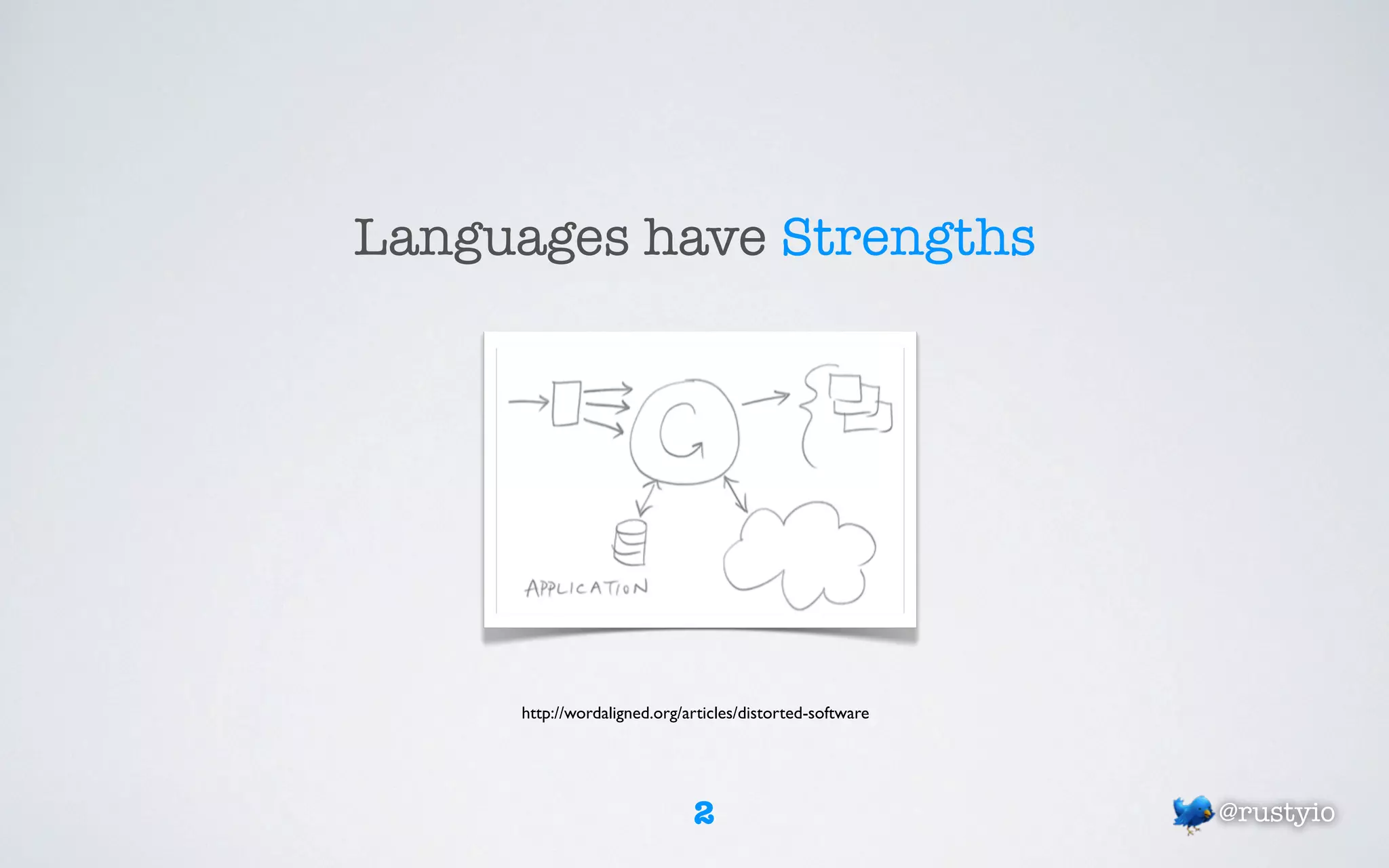
Languages have Strengths


     http://wordaligned.org/articles/distorted-software


                             2                            @rustyio
Connections are Hard
            Serialization
      Versioning & Upgrades
      Data Type Mismatches
Speed, Bottlenecks & Back-Pressure
        Inadequate Tooling
        Context Switching


                3                    @rustyio
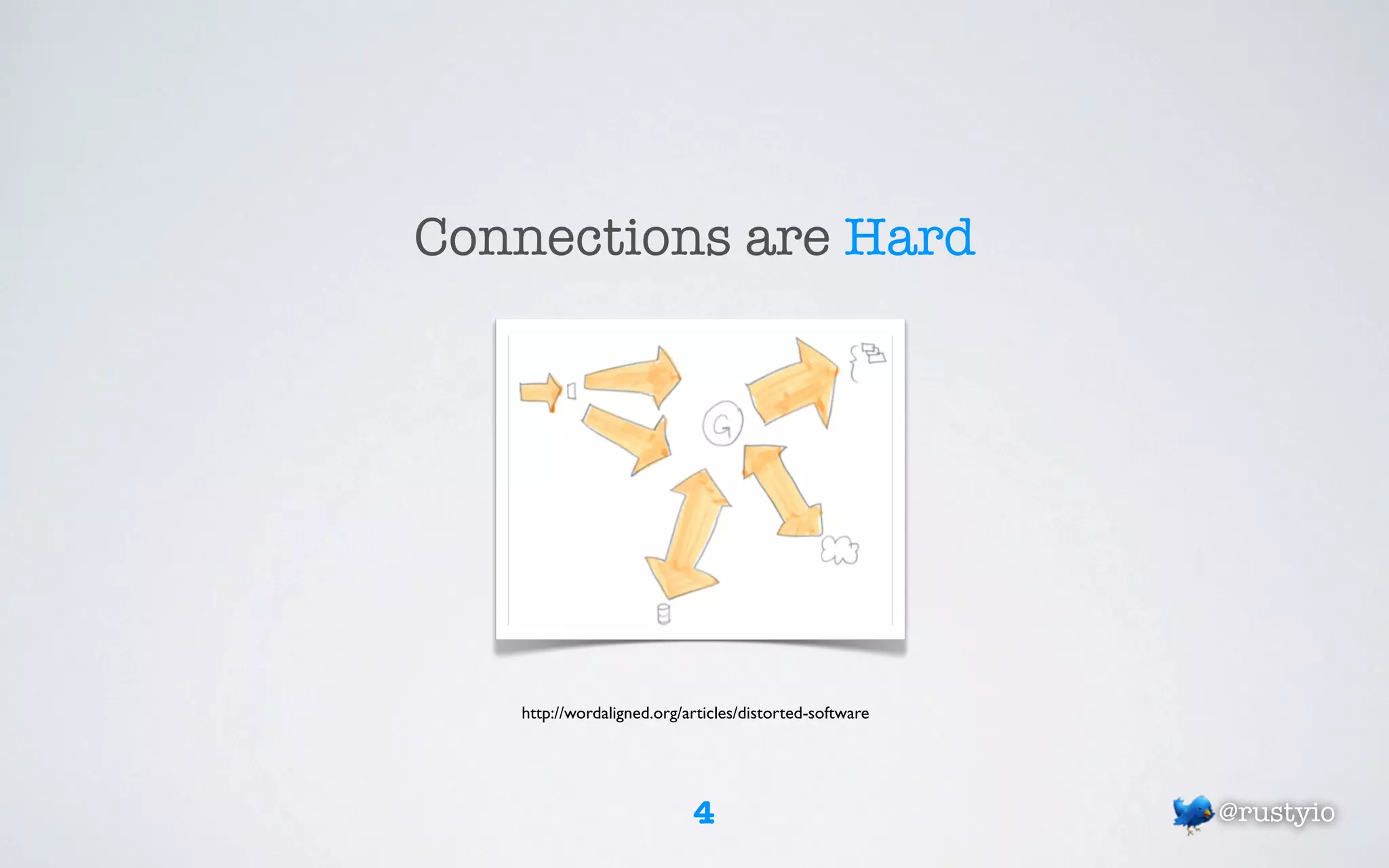
Connections are Hard


   http://wordaligned.org/articles/distorted-software


                           4                            @rustyio
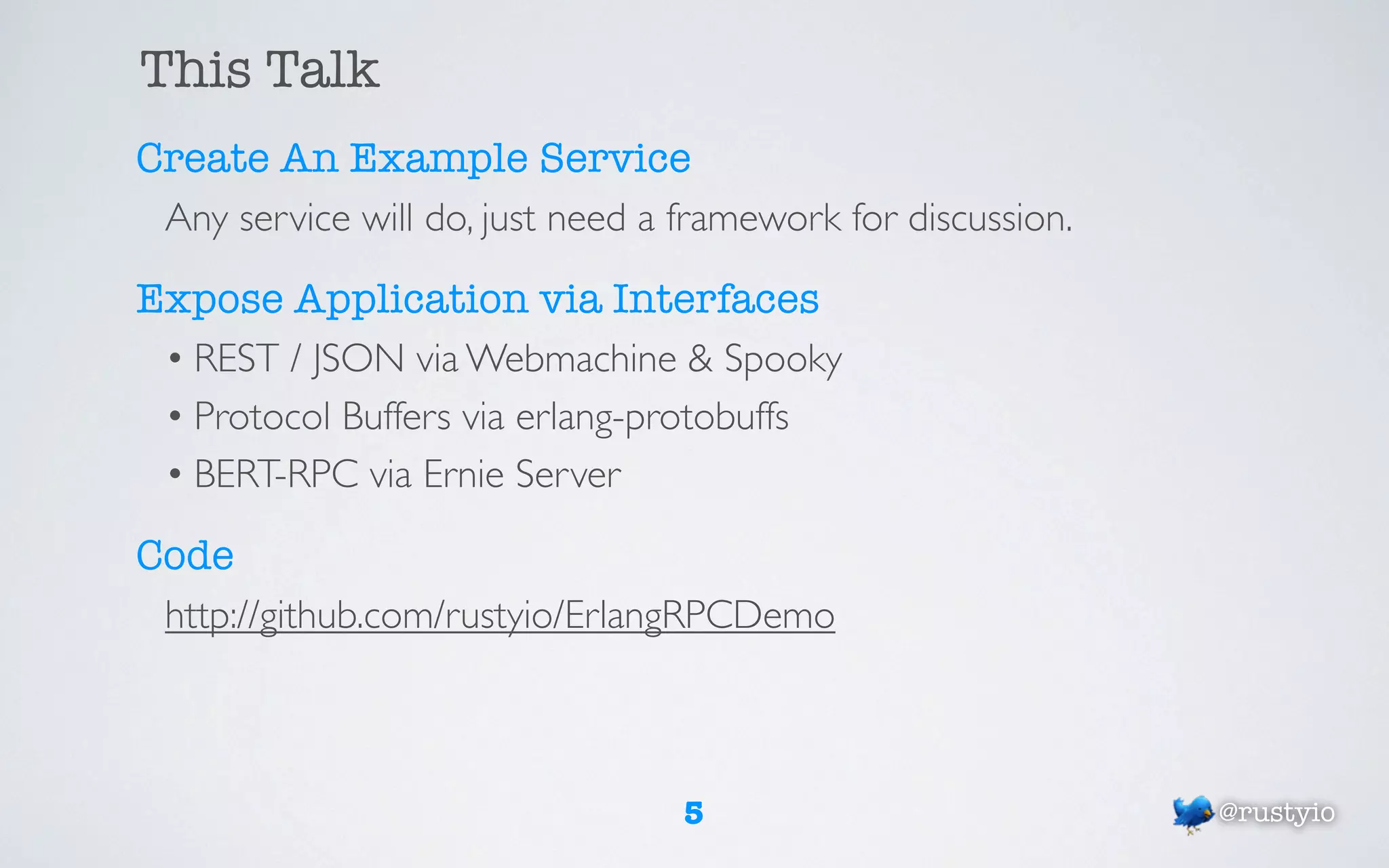
This Talk
Create An Example Service
 Any service will do, just need a framework for discussion.

Expose Application via Interfaces
 • REST / JSON via Webmachine & Spooky
 • Protocol Buffers via erlang-protobuffs
 • BERT-RPC via Ernie Server

Code
 http://github.com/rustyio/ErlangRPCDemo


                                  5                           @rustyio
This Talk
Our Application: A Sequence Server
 Erlang service that returns a sequence of numbers.

    1   sequence(N) ->
    2       List1 = lists:seq(1, N),
    3       List2 = [list_to_binary(integer_to_list(X)) || X <- List1],
    4       {ok, List2};
    5
    6   %% sequence(2).
    7   {ok, [<<"1">>, <<"2">>]}.
    8
    9   %% sequence(5).
   10   {ok, [<<"1">>, <<"2">>, <<"3">>, <<"4">>, <<"5">>]}.
   11
   12   %% sequence(50000).
   13   {ok, [<<"1">>, <<"2">>, <<"3">>, <<"4">>, ...]}.


                                     6                                    @rustyio
Overview
     REST?
Protocol Buffers?
  BERT-RPC?


        7           @rustyio
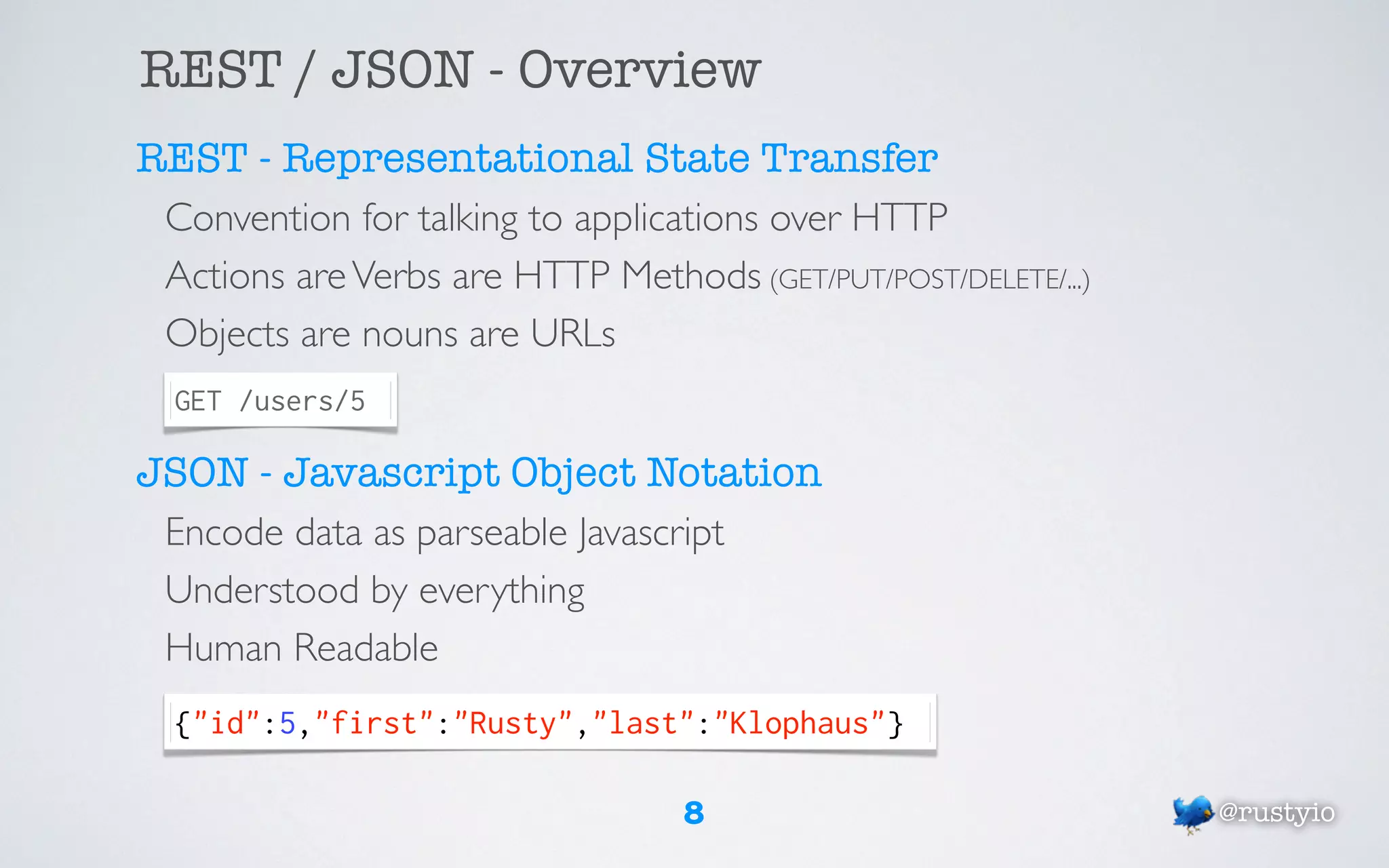
REST / JSON - Overview
REST - Representational State Transfer
 Convention for talking to applications over HTTP
 Actions are Verbs are HTTP Methods (GET/PUT/POST/DELETE/...)
 Objects are nouns are URLs
  GET /users/5

JSON - Javascript Object Notation
 Encode data as parseable Javascript
 Understood by everything
 Human Readable
  {"id":5,"first":"Rusty","last":"Klophaus"}

                                  8                             @rustyio
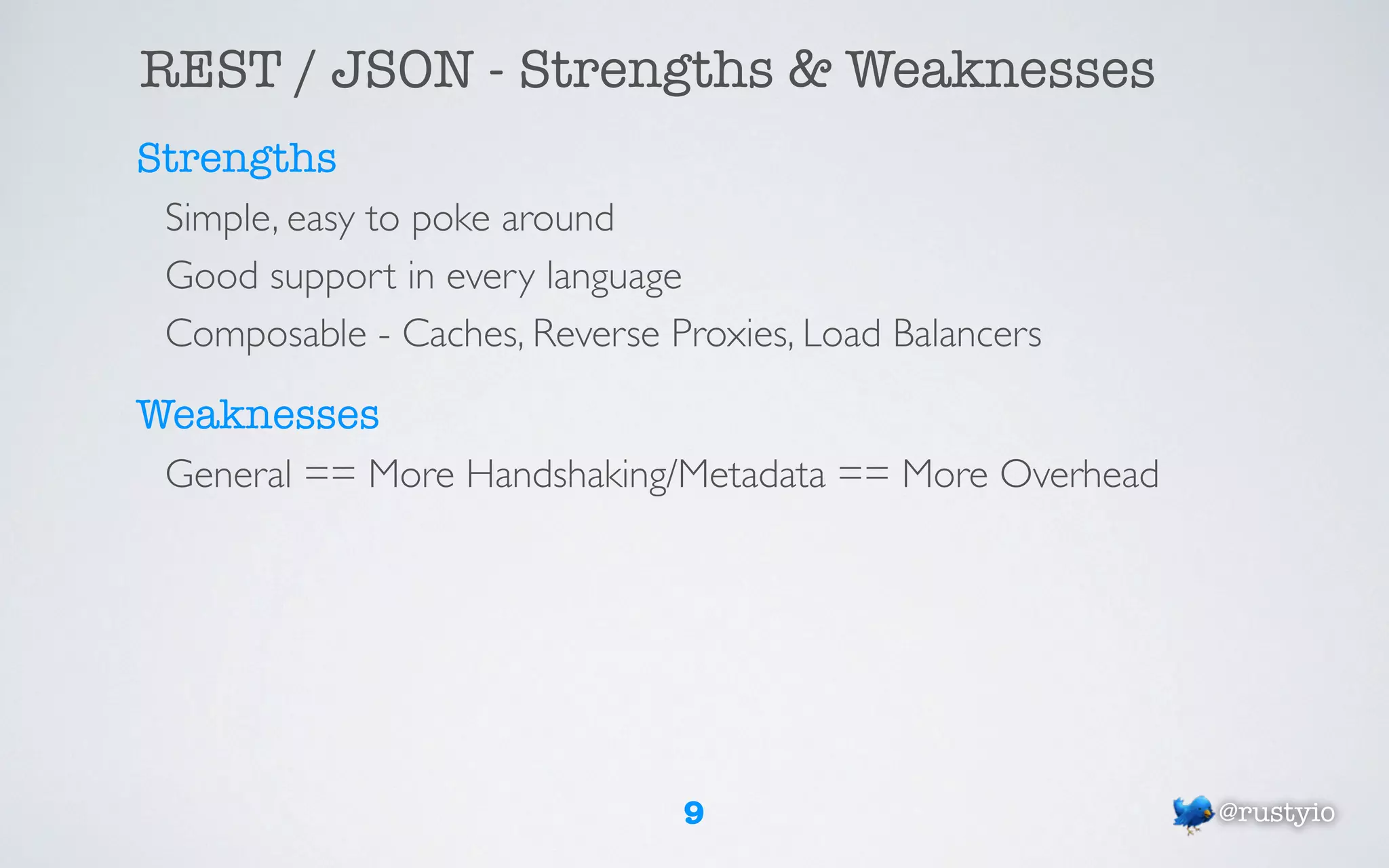
REST / JSON - Strengths & Weaknesses
Strengths
 Simple, easy to poke around
 Good support in every language
 Composable - Caches, Reverse Proxies, Load Balancers

Weaknesses
 General == More Handshaking/Metadata == More Overhead


                                9                        @rustyio
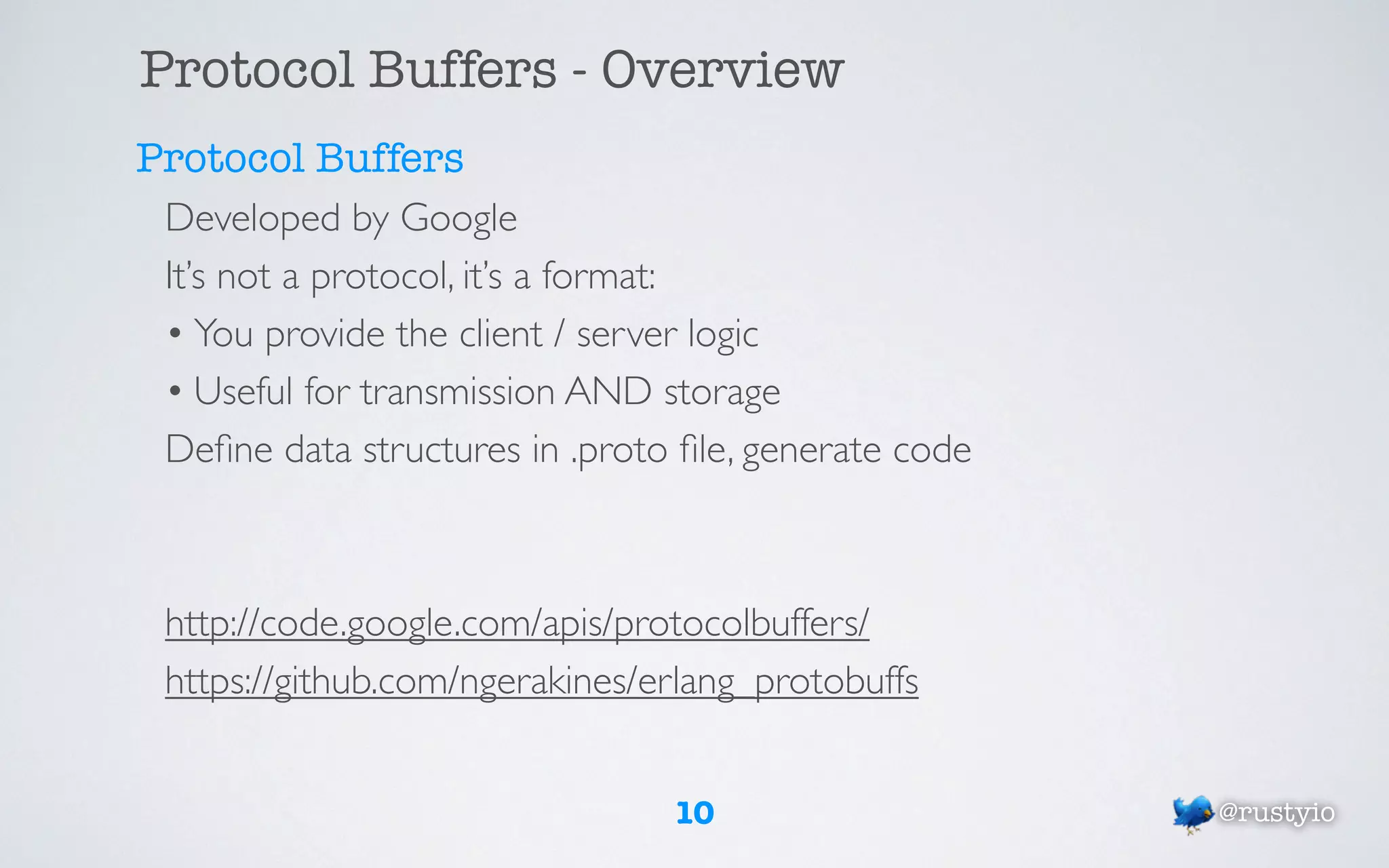
Protocol Buffers - Overview
Protocol Buffers
 Developed by Google
 It’s not a protocol, it’s a format:
 • You provide the client / server logic
 • Useful for transmission AND storage
 Define data structures in .proto file, generate code


 http://code.google.com/apis/protocolbuffers/
 https://github.com/ngerakines/erlang_protobuffs


                                10                    @rustyio
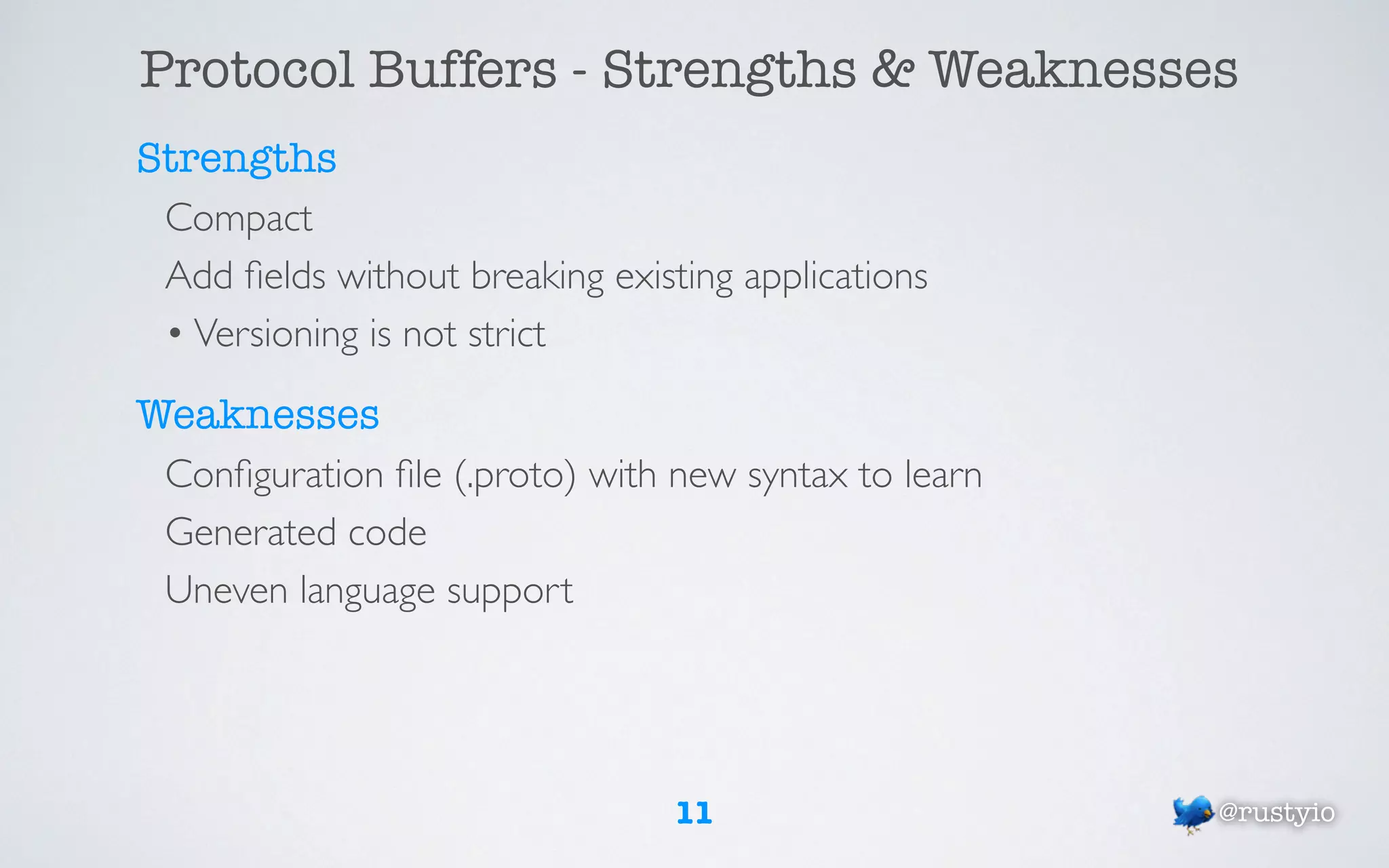
Protocol Buffers - Strengths & Weaknesses
Strengths
 Compact
 Add fields without breaking existing applications
 • Versioning is not strict

Weaknesses
 Configuration file (.proto) with new syntax to learn
 Generated code
 Uneven language support


                                 11                   @rustyio
BERT-RPC - Overview
BERT-RPC
 Developed by GitHub (Tom Preston-Werner)
 BERT = Binary Erlang Term
 • Encoding mimics native Erlang serialization
 http://bert-rpc.org
 https://github.com/mojombo/ernie

     1   % Request
     2   {call, ernie_sequence, sequence, [3]}
     3
     4   % Response
     5   {response, {ok, [<<"1">>, <<"2">>, <<"3">>]}}


                                   12                    @rustyio
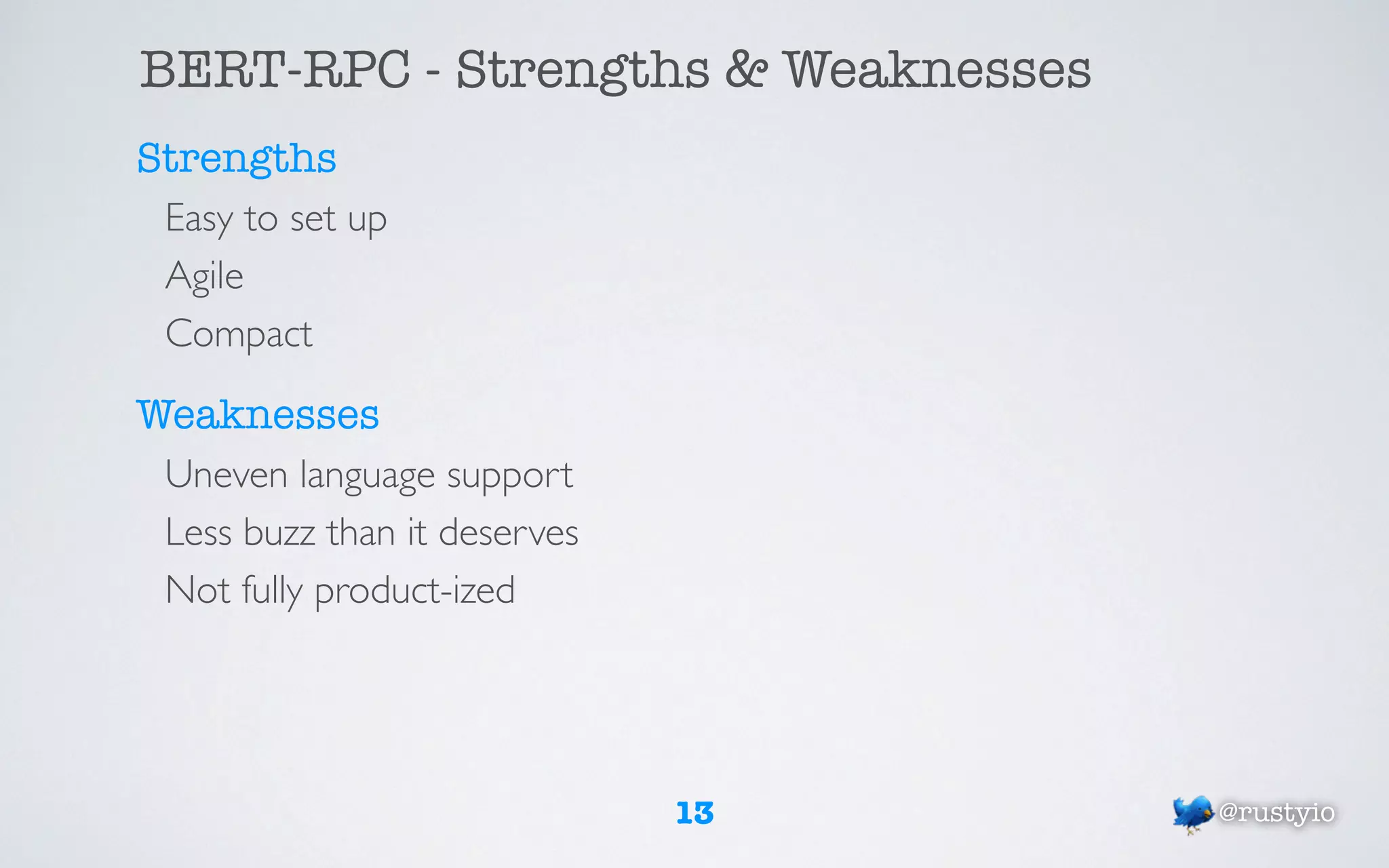
BERT-RPC - Strengths & Weaknesses
Strengths
 Easy to set up
 Agile
 Compact

Weaknesses
 Uneven language support
 Less buzz than it deserves
 Not fully product-ized


                              13    @rustyio
Requests & Responses
What does the chatter look like?


               14                  @rustyio
REST / JSON - Request & Response
Request
 GET /sequence/3 HTTP/1.1
 User-Agent: curl/7.21.4 (universal-apple-darwin11.0) libcurl/7.21.4
 OpenSSL/0.9.8r zlib/1.2.5
 Host: localhost:8001
 Accept: */*


Response
 HTTP/1.1 200 OK
 Server: MochiWeb/1.1 WebMachine/1.9.0 (someone had painted it blue)
 Date: Wed, 23 Nov 2011 22:09:13 GMT
 Content-Type: application/json
 Content-Length: 21

 ["1","2","3"]
                                 15                                @rustyio
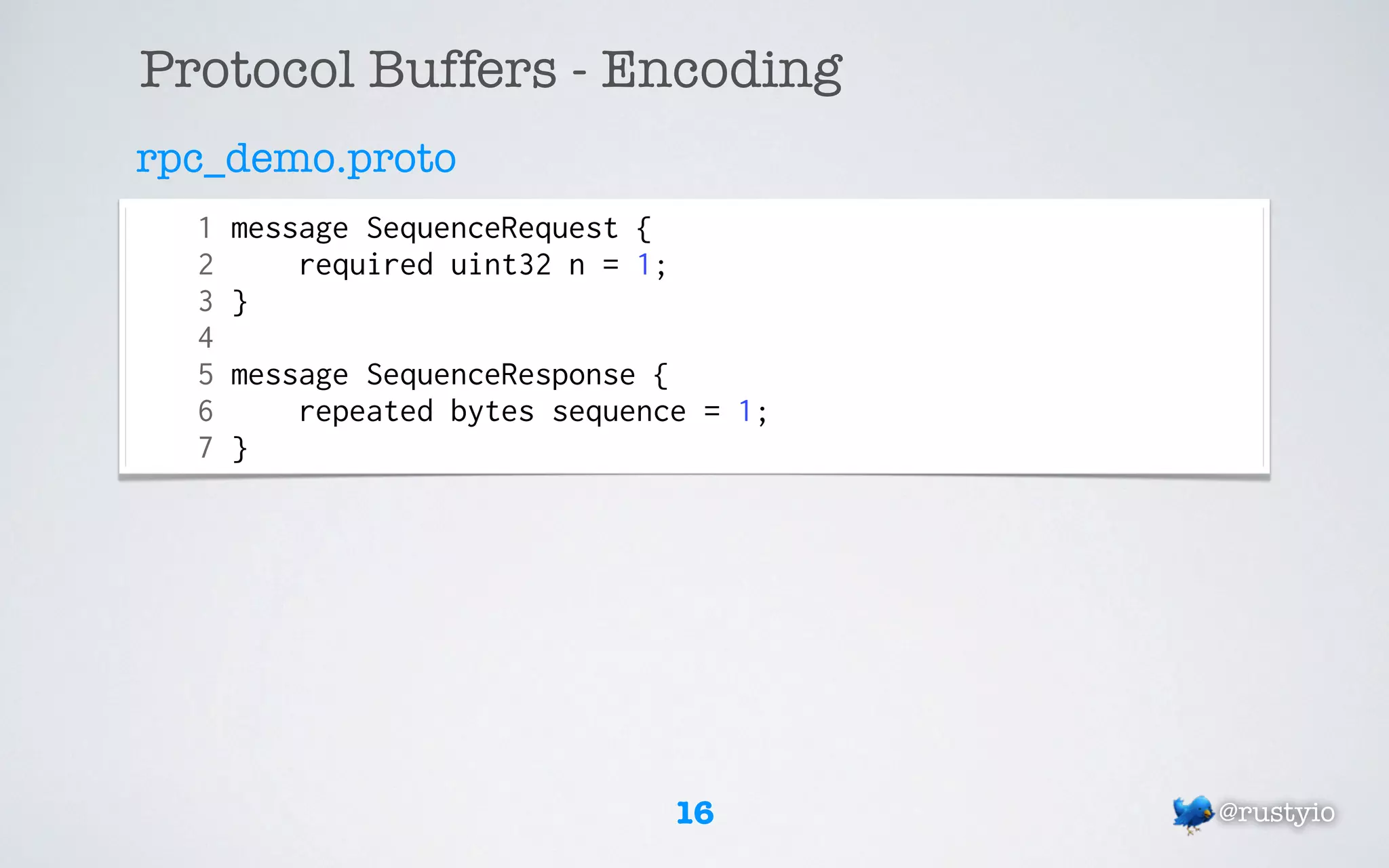
Protocol Buffers - Encoding
rpc_demo.proto
  1   message SequenceRequest {
  2       required uint32 n = 1;
  3   }
  4
  5   message SequenceResponse {
  6       repeated bytes sequence = 1;
  7   }


                                   16    @rustyio
Protocol Buffers - RPC
Request
   1 rpc_demo_pb:encode({sequencerequest, 3}).
   2 <<8,3>>


Response
   1 rpc_demo_pb:encode({sequenceresponse, [<<"1">>, <<"2">>, <<"3">>]}).
   2 <<10,1,49,10,1,50,10,1,51>>


                                   17                                  @rustyio
BERT-RPC - Encoding
1   term_to_binary([<<"1">>,<<"2">>,<<"3">>]).
2   <<131,108,0,0,0,3,109,0,0,0,1,49,109,0,0,0,1,50,109,0,0,0,1,51,106>>
3
4
5   bert:encode([<<"1">>,<<"2">>,<<"3">>]).
6   <<131,108,0,0,0,3,109,0,0,0,1,49,109,0,0,0,1,50,109,0,0,0,1,51,106>>


                                  18                                @rustyio
BERT-RPC - Encoding
 1   term_to_binary([<<"1">>,<<"2">>,<<"3">>]).
 2   <<131,108,0,0,0,3,109,0,0,0,1,49,109,0,0,0,1,50,109,0,0,0,1,51,106>>
 3
 4
 5   bert:encode([<<"1">>,<<"2">>,<<"3">>]).
 6   <<131,108,0,0,0,3,109,0,0,0,1,49,109,0,0,0,1,50,109,0,0,0,1,51,106>>
 7      |   |        | |          | |
 8      |   |        | |          | + Ascii value for '1'
 9      |   |        | |          + Length of string (1)
10      |   |        | + Next term is a string
11      |   |        + Length of list (3)
12      |   + Next term is a list
13      + Start of Erlang term


                                   19                                @rustyio
BERT-RPC - RPC
Request
   1 bert:encode({call, ernie_sequence, sequence, [5]}).

   3 <<131,104,4,100,0,4,99,97,108,108,100,0,14,101,114,110,
   4   105,101,95,115,101,113,117,101,110,99,101,100,0,8,115,
   5   101,113,117,101,110,99,101,107,0,1,5>>


Response
   1 bert:encode({reply,{ok,[<<"1">>,<<"2">>,<<"3">>,<<"4">>,<<"5">>]}}).
   2
   3 <<131,104,2,100,0,5,114,101,112,108,121,104,2,100,0,2,111,
   4   107,108,0,0,0,5,109,0,0,0,1,49,109,0,0,0,1,50,109,0,0,0,
   5   1,51,109,0,0,0,1,52,109,0,0,0,1,53,106>>


                                   20                                  @rustyio
Show me the Client Code!


           21              @rustyio
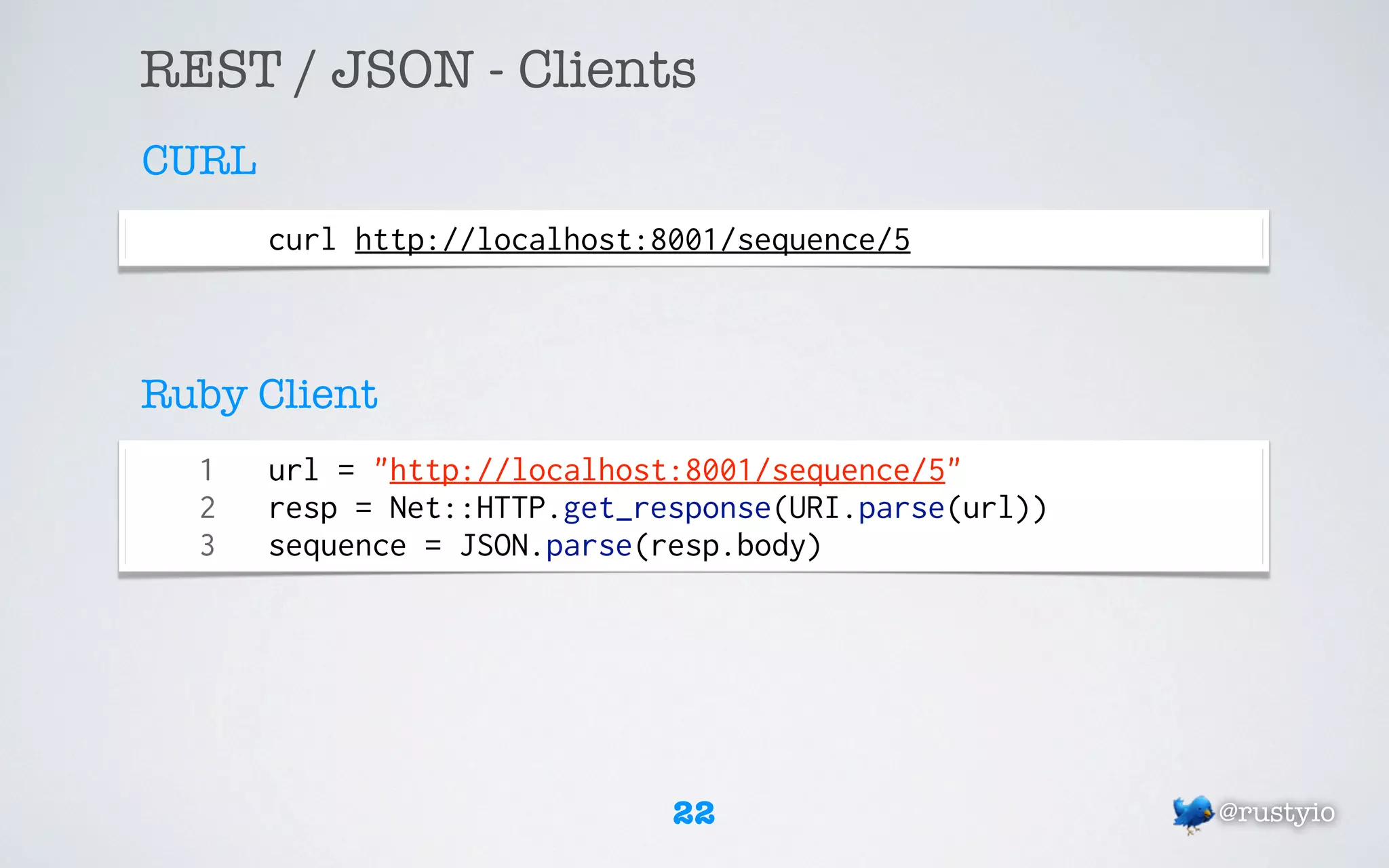
REST / JSON - Clients
CURL
       curl http://localhost:8001/sequence/5


Ruby Client
  1    url = "http://localhost:8001/sequence/5"
  2    resp = Net::HTTP.get_response(URI.parse(url))
  3    sequence = JSON.parse(resp.body)


                              22                       @rustyio
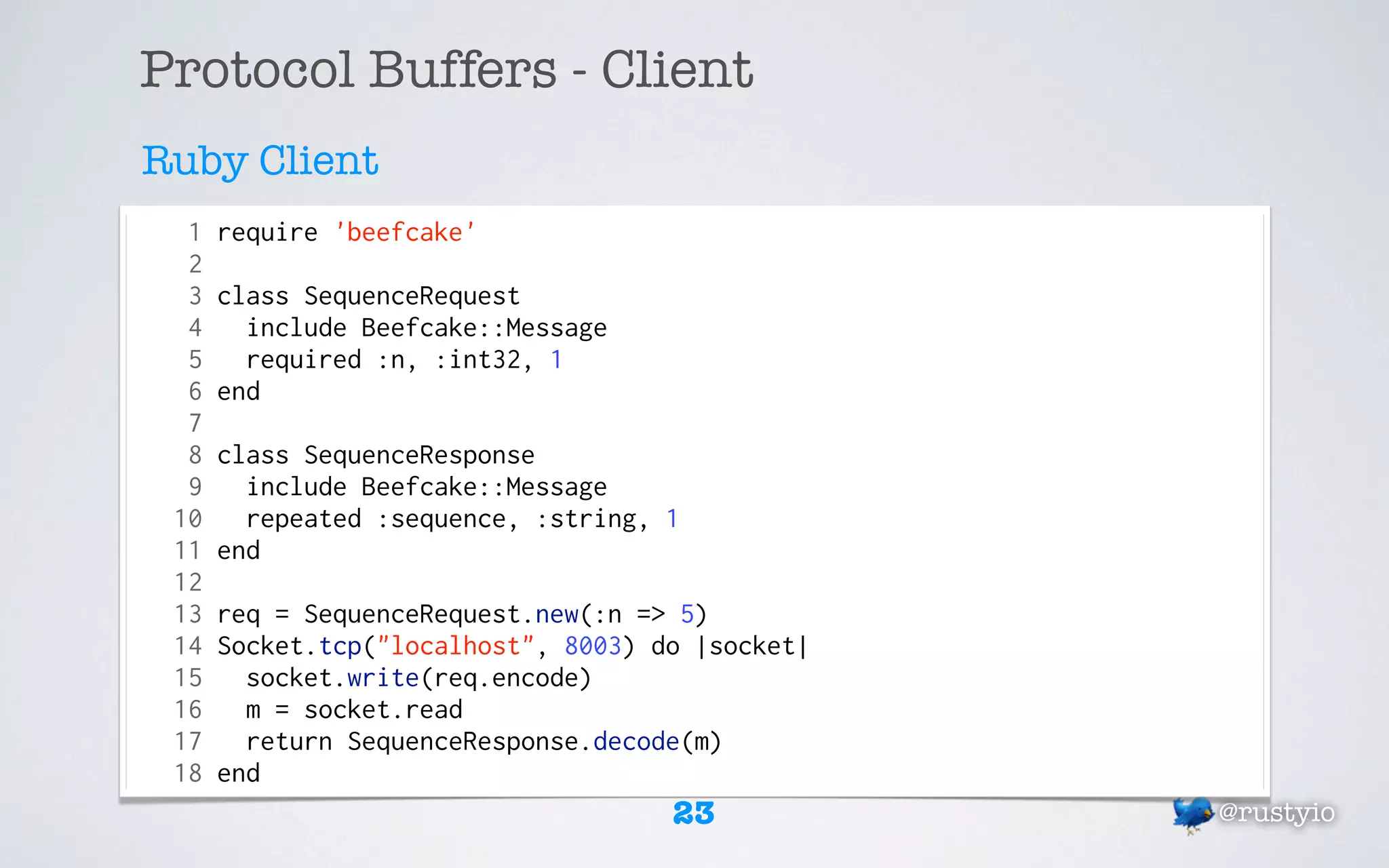
Protocol Buffers - Client
Ruby Client
  1   require 'beefcake'
  2
  3   class SequenceRequest
  4     include Beefcake::Message
  5     required :n, :int32, 1
  6   end
  7
  8   class SequenceResponse
  9     include Beefcake::Message
 10     repeated :sequence, :string, 1
 11   end
 12
 13   req = SequenceRequest.new(:n => 5)
 14   Socket.tcp("localhost", 8003) do |socket|
 15     socket.write(req.encode)
 16     m = socket.read
 17     return SequenceResponse.decode(m)
 18   end
                                     23           @rustyio
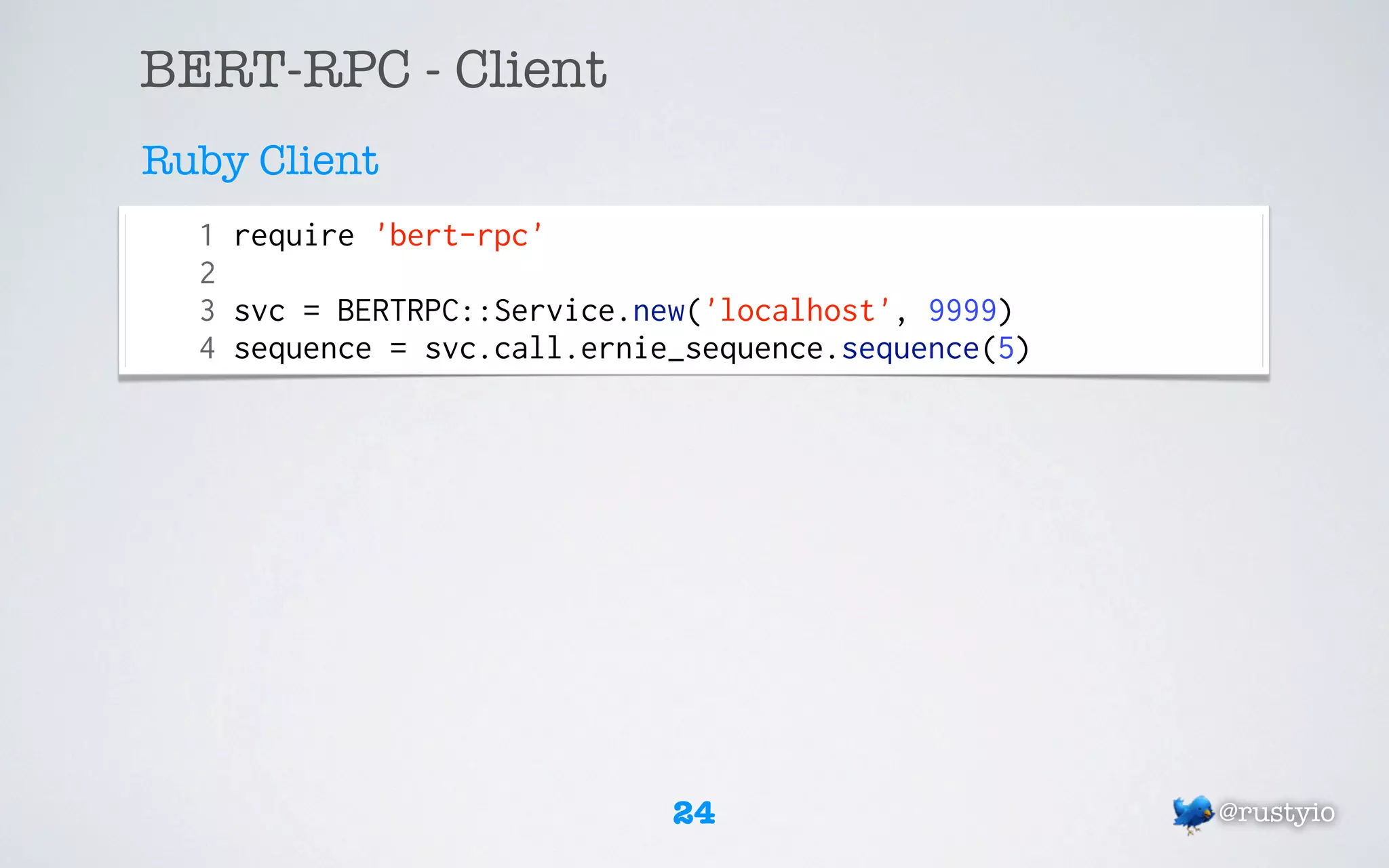
BERT-RPC - Client
Ruby Client
  1 require 'bert-rpc'
  2
  3 svc = BERTRPC::Service.new('localhost', 9999)
  4 sequence = svc.call.ernie_sequence.sequence(5)


                             24                      @rustyio
Show me the Server Code!


           25              @rustyio
REST / JSON - Server
Spooky Server
   1   -module(spooky_sequence).
   2   -behaviour(spooky).
   3   -export([init/1, get/2]).
   4
   5   init([])->
   6       [{port, 8002}].
   7
   8   get(_Req, ["sequence", Num])->
   9       case sequence:sequence(Num) of
  10            {ok, List} ->
  11                {200, mochijson2:encode(List)};
  12            {error, Error} ->
  13                {500, io_lib:format("~w", [Error])}
  14       end;
  15   get(_Req, _)->
  16       {400, "Usage: /sequence/:Num:"}.


                                    26                    @rustyio
REST / JSON - Server
Webmachine Server
   1   -module(webmachine_sequence).
   2   -export([init/1, content_types_provided/2, to_json/2]).
   3   -include_lib("webmachine/include/webmachine.hrl").
   4
   5   -record(ctx, { list }).
   6
   7   init([]) ->
   8       {ok, #ctx {}}.
   9
  10   content_types_provided(RD, Ctx) ->
  11       Types = [{"application/json", to_json}],
  12       {Types, RD, Ctx}.
  13
  14   to_json(RD, Ctx) ->
  15       {ok, List} = sequence:sequence(N),
  16       Body = mochijson2:encode(List),
  17       {Body, RD, Ctx}.
                                   27                            @rustyio
Protocol Buffers - Server
Erlang Server
   1   %% Erlang RPC Demo
                                                                                       57   handle_info({tcp, _Sock, _Data}, State) ->
   2   %% Copyright (c) 2011 Rusty Klophaus (@rustyio)
                                                                                       58       %% req =/= undefined: received a new request while another was in
   3   %% See MIT-LICENSE for licensing information.
                                                                                       59       %% progress -> Error
   4
                                                                                       60       lager:error("Received a new PB socket request"
   5   -module(protobuff_server).
                                                                                       61                   " while another was in progress"),
   6   -behaviour(gen_server).
                                                                                       62       {stop, normal, State};
   7
                                                                                       63
   8   -export([
                                                                                       64   handle_info(_, State) -> % Ignore any late replies from gen_servers/messages from fsms
   9            start_link/0,
                                                                                       65       {noreply, State}.
  10            set_socket/2,
                                                                                       66
  11            init/1,
                                                                                       67   terminate(_Reason, _State) ->
  12            handle_call/3,
                                                                                       68       ok.
  13            handle_cast/2,
                                                                                       69
  14            handle_info/2,
                                                                                       70   code_change(_OldVsn, State, _Extra) -> {ok, State}.
  15            terminate/2,
                                                                                       71
  16            code_change/3,
                                                                                       72   %% ===================================================================
  17            encode/1,
                                                                                       73   %% Handle PB Messages
  18            decode/1]).
                                                                                       74   %% ===================================================================
  19
                                                                                       75
  20   -record(state, { sock }).
                                                                                       76   process_message(#sequencerequest { n = N }, State) ->
  21
                                                                                       77       case sequence:sequence(N) of
  22   -include("rpc_demo_pb.hrl").
                                                                                       78            {ok, List} ->
  23
                                                                                       79                Resp = #sequenceresponse { sequence = List },
  24   %% ===================================================================
                                                                                       80                send_msg(Resp, State);
  25   %% Public API
                                                                                       81            {error, Reason} ->
  26   %% ===================================================================
                                                                                       82                Msg = io_lib:format("~w", [Reason]),
  27
                                                                                       83                Resp = #sequenceerror { message=Msg },
  28   start_link() ->
                                                                                       84                send_msg(Resp, State)
  29       gen_server:start_link(?MODULE, [], []).
                                                                                       85       end.
  30
                                                                                       86
  31   set_socket(Pid, Socket) ->
                                                                                       87   %% Send a message to the client
  32       gen_server:call(Pid, {set_socket, Socket}).
                                                                                       88   send_msg(Msg, State) ->
  33
                                                                                       89       Pkt = encode(Msg),
  34   init([]) ->
                                                                                       90       gen_tcp:send(State#state.sock, Pkt),
  35       {ok, #state{}}.
                                                                                       91       State.
  36
                                                                                       92
  37   handle_call({set_socket, Socket}, _From, State) ->
                                                                                       93   encode(Msg) ->
  38       inet:setopts(Socket, [{active, once}, {packet, 4}, {header, 1}]),
                                                                                       94       MsgType = element(1, Msg),
  39       {reply, ok, State#state{sock = Socket}}.
                                                                                       95       [msg_code(Msg) | rpc_demo_pb:iolist(MsgType, Msg)].
  40
                                                                                       96
  41   handle_cast(_Msg, State) ->
                                                                                       97   decode([MsgCode|MsgData]) ->
  42       {noreply, State}.
                                                                                       98       MsgType = msg_type(MsgCode),
  43
                                                                                       99       rpc_demo_pb:decode(MsgType, MsgData).
  44   handle_info({tcp_closed, Socket}, State=#state{sock=Socket}) ->
                                                                                      100
  45       {stop, normal, State};
                                                                                      101   msg_code(#sequencerequest {}) -> 1;
  46   handle_info({tcp_error, Socket, _Reason}, State=#state{sock=Socket}) ->
                                                                                      102   msg_code(#sequenceresponse {}) -> 2;
  47       {stop, normal, State};
                                                                                      103   msg_code(#sequenceerror {})    -> 3;
  48   handle_info({tcp, _Sock, MsgData}, State=#state{sock=Socket}) ->
                                                                                      104   msg_code(Other) ->
  49       Msg = decode(MsgData),
                                                                                      105       throw({unknown_pb_type, Other}).
  50       case process_message(Msg, State) of
                                                                                      106
  51            {pause, NewState} ->
                                                                                      107   msg_type(1) -> sequencerequest;
  52                ok;
                                                                                      108   msg_type(2) -> sequenceresponse;
  53            NewState ->
                                                                                      109   msg_type(3) -> sequenceerror;
  54                inet:setopts(Socket, [{active, once}])
                                                                                      110   msg_type(Other) ->
  55       end,
                                                                                      111       throw({unknown_pb_code, Other}).
  56       {noreply, NewState};


                                                                                 28                                                                                                  @rustyio
BERT-RPC - Server
Ernie Server - Erlang BERT-RPC Server
  1 %% FILE: ernie.config
  2 [
  3     {module, ernie_sequence},
  4     {type, native},
  5     {codepaths, []}
  6 ].

  1 -module(ernie_sequence).
  2 -export([sequence/1]).
  3
  4 sequence(N) ->
  5     sequence:sequence(N).


                                29      @rustyio
Benchmarks
How fast is it?


      30          @rustyio
Benchmarks
Disclaimers
 Benchmarking is hard
 The shape of your data matters (size and complexity)
 Speed is not the only objective


                                31                      @rustyio
Benchmarks:
Encoding Speed


      32         @rustyio
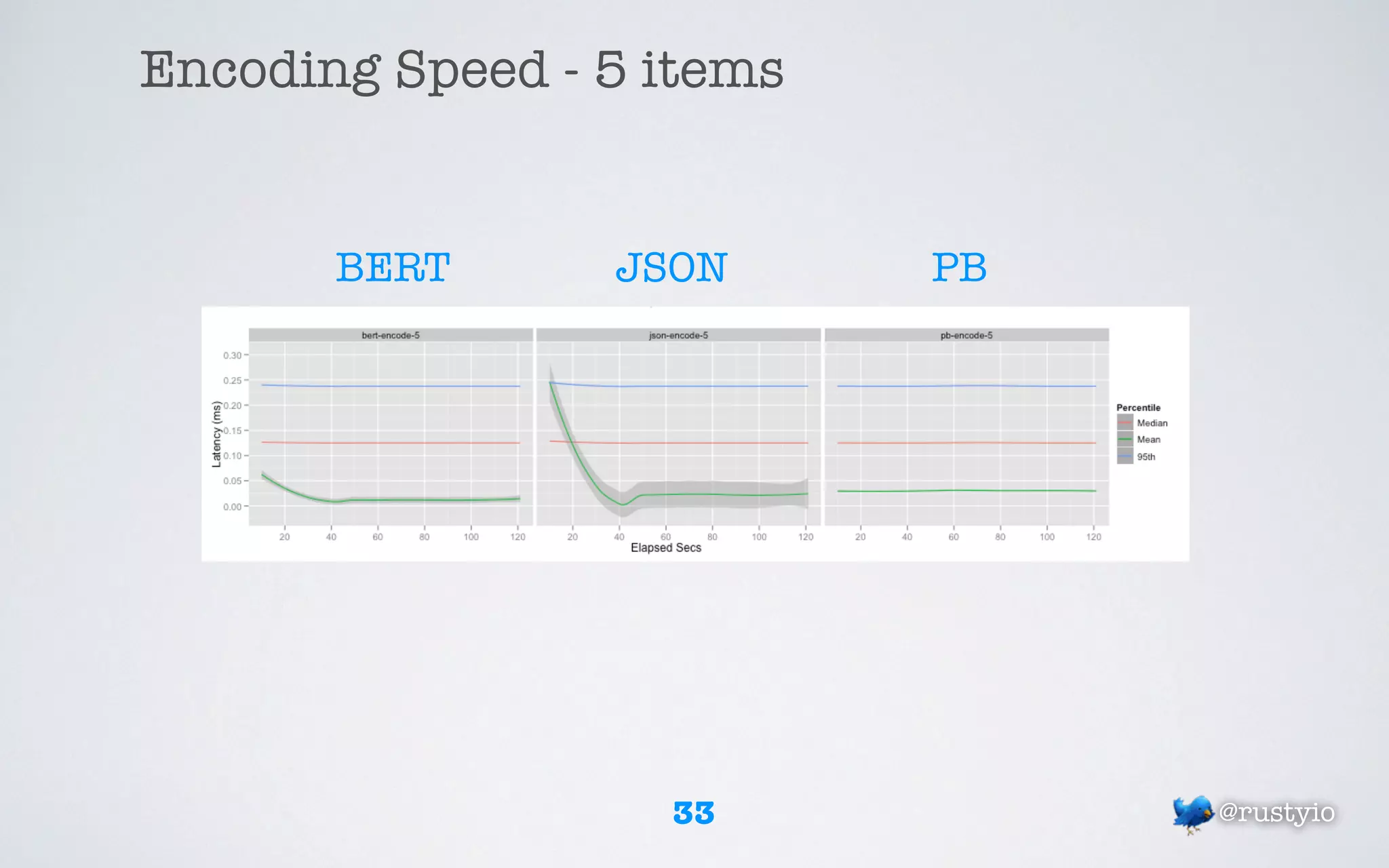
Encoding Speed - 5 items


       BERT      JSON      PB


                   33           @rustyio
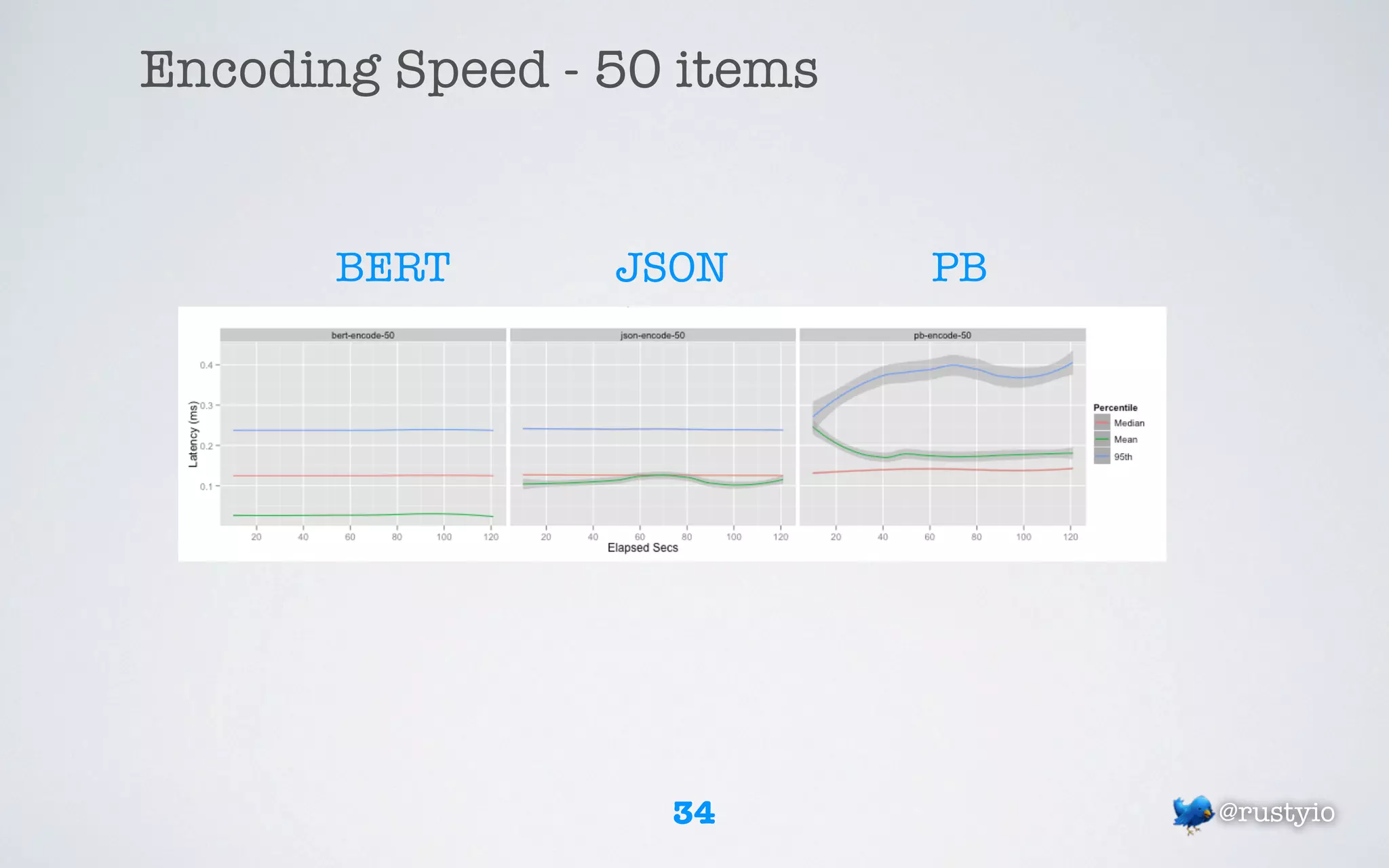
Encoding Speed - 50 items


       BERT      JSON       PB


                   34            @rustyio
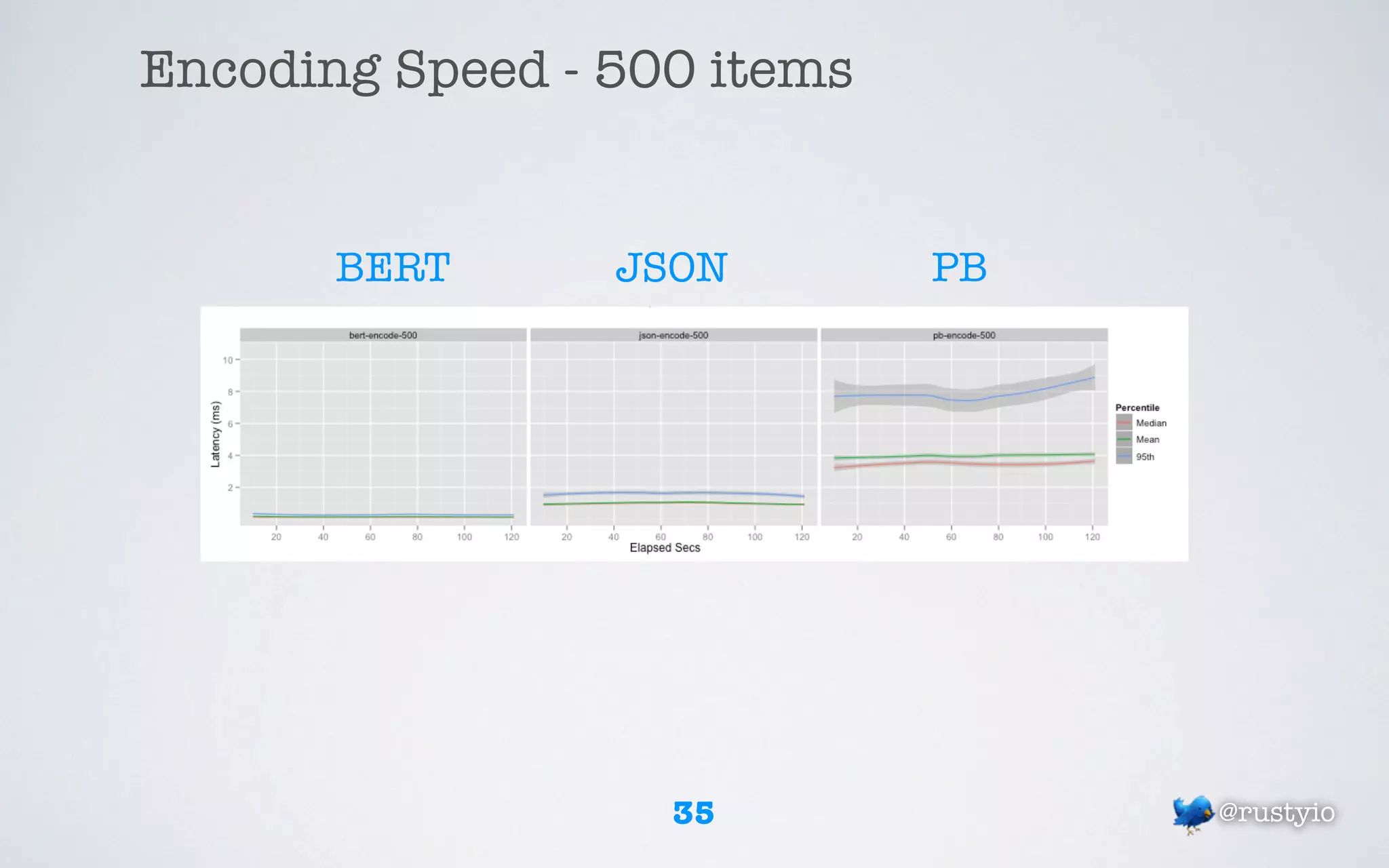
Encoding Speed - 500 items


       BERT      JSON        PB


                   35             @rustyio
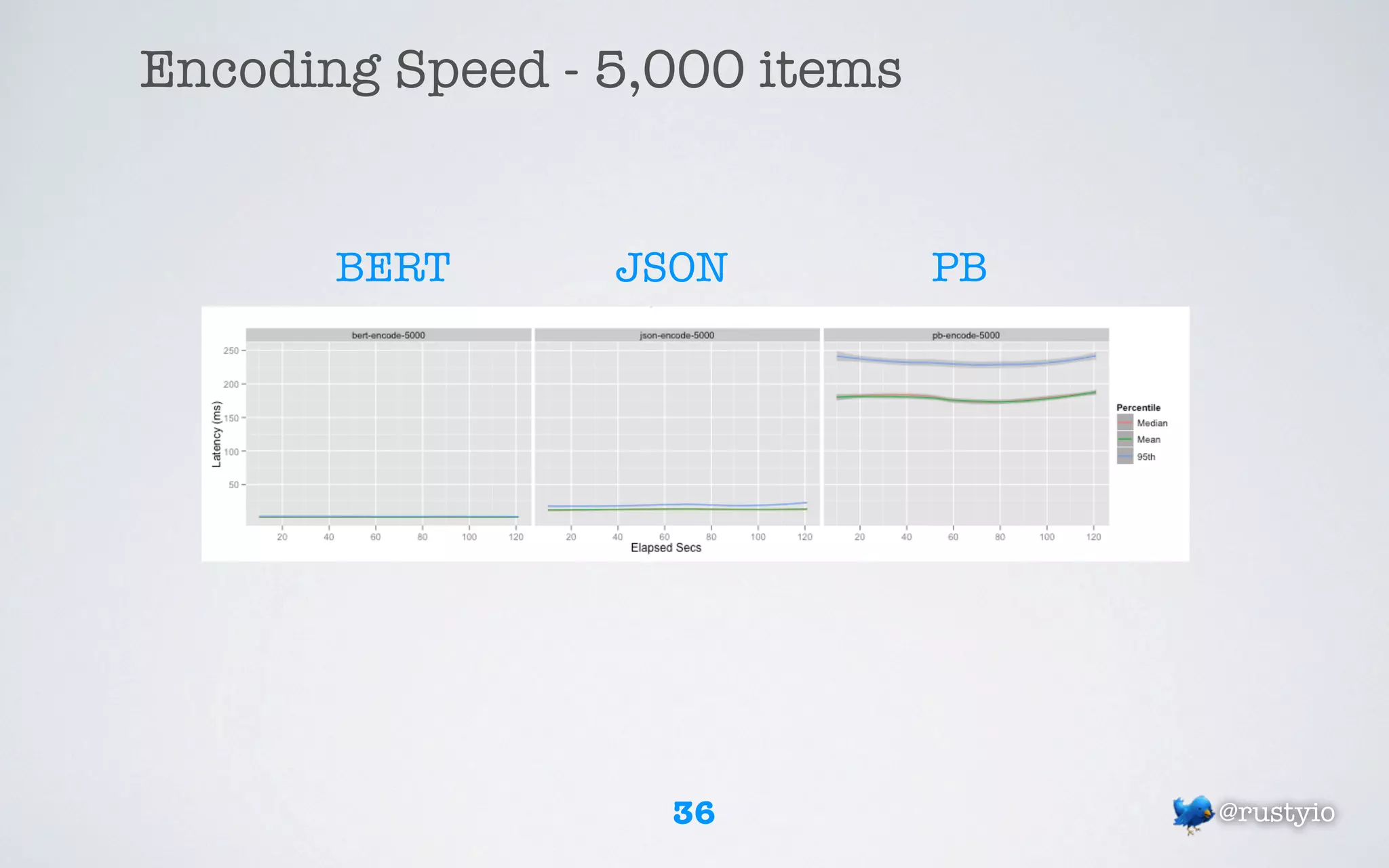
Encoding Speed - 5,000 items


       BERT      JSON          PB


                   36               @rustyio
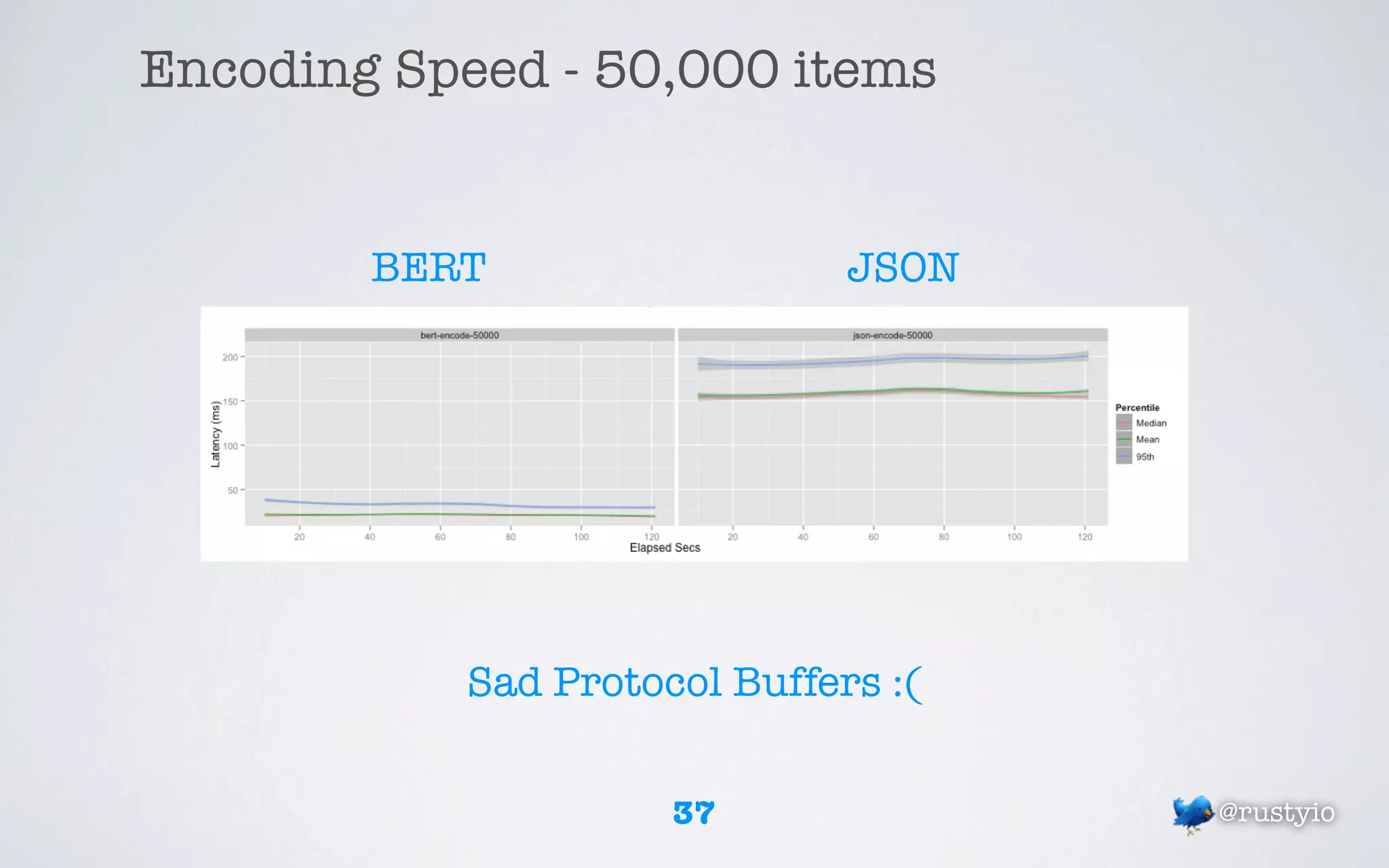
Encoding Speed - 50,000 items


        BERT                  JSON


           Sad Protocol Buffers :(


                     37              @rustyio
Encoding Speed - Ruby


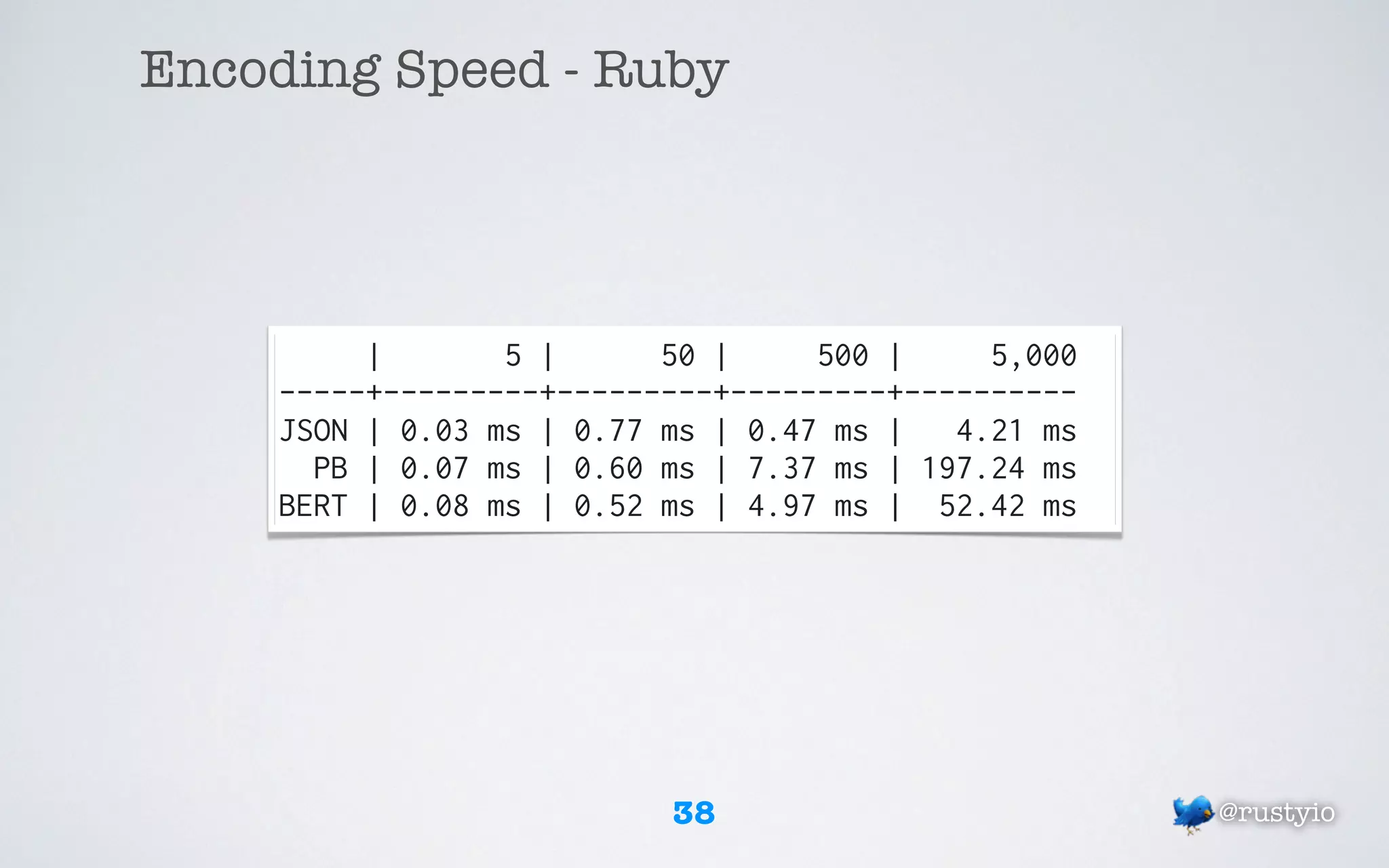
         |       5 |      50 |     500 |     5,000
    -----+---------+---------+---------+----------
    JSON | 0.03 ms | 0.77 ms | 0.47 ms |   4.21 ms
      PB | 0.07 ms | 0.60 ms | 7.37 ms | 197.24 ms
    BERT | 0.08 ms | 0.52 ms | 4.97 ms | 52.42 ms


                          38                         @rustyio
Encoding Speed
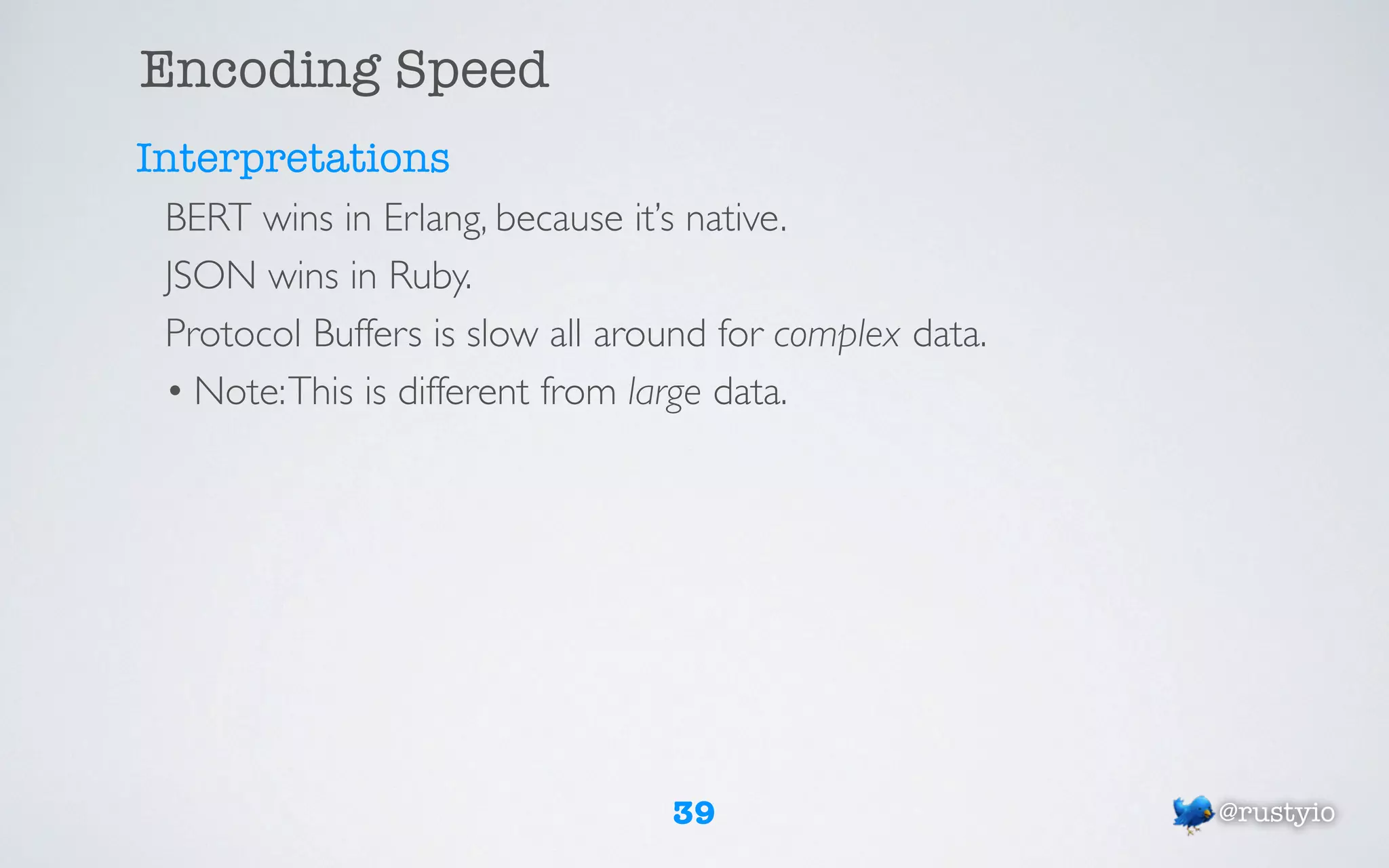
Interpretations
 BERT wins in Erlang, because it’s native.
 JSON wins in Ruby.
 Protocol Buffers is slow all around for complex data.
 • Note: This is different from large data.


                                  39                     @rustyio
Benchmarks:
                     Single Hop


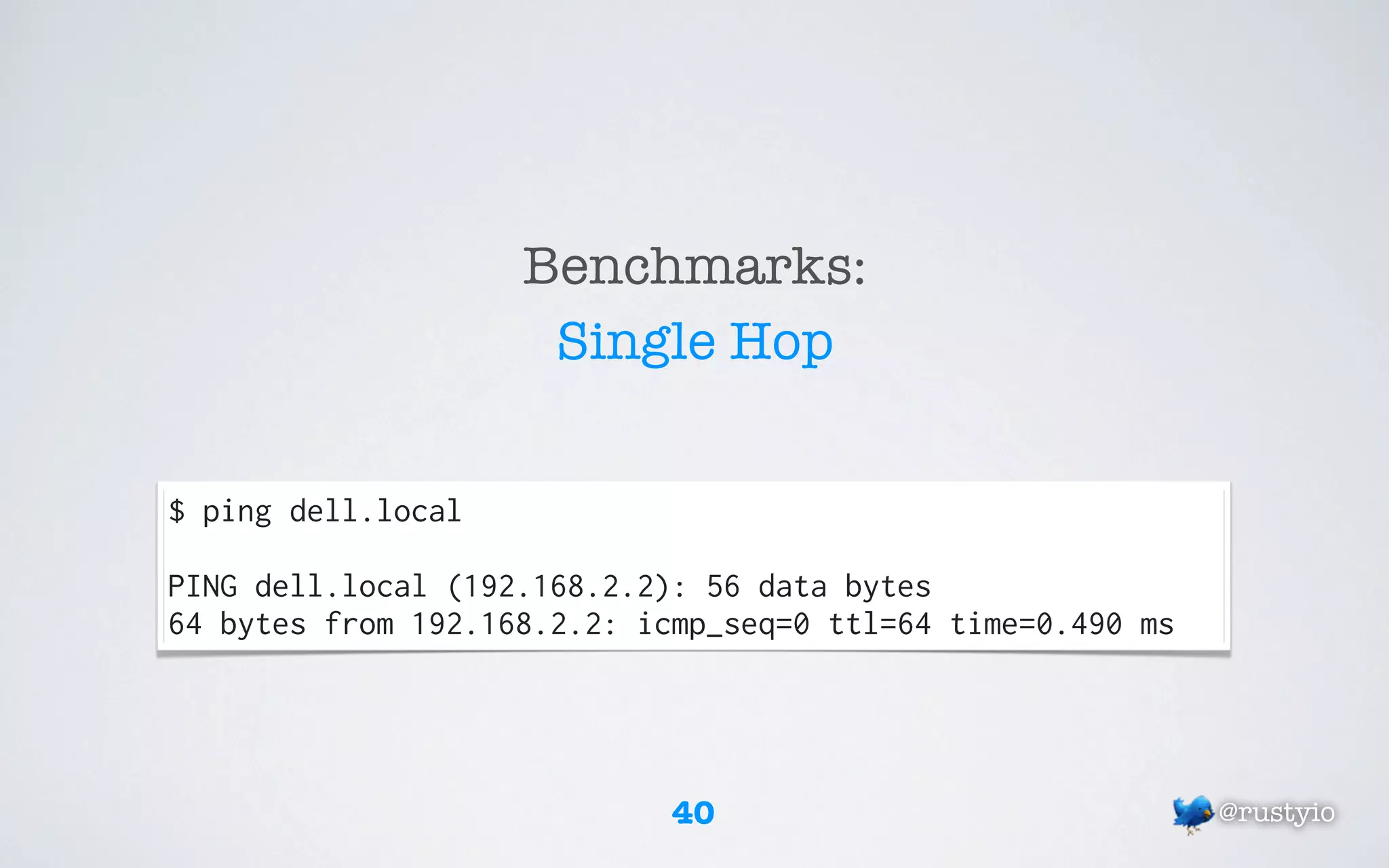
$ ping dell.local

PING dell.local (192.168.2.2): 56 data bytes
64 bytes from 192.168.2.2: icmp_seq=0 ttl=64 time=0.490 ms


                             40                              @rustyio
Benchmarks
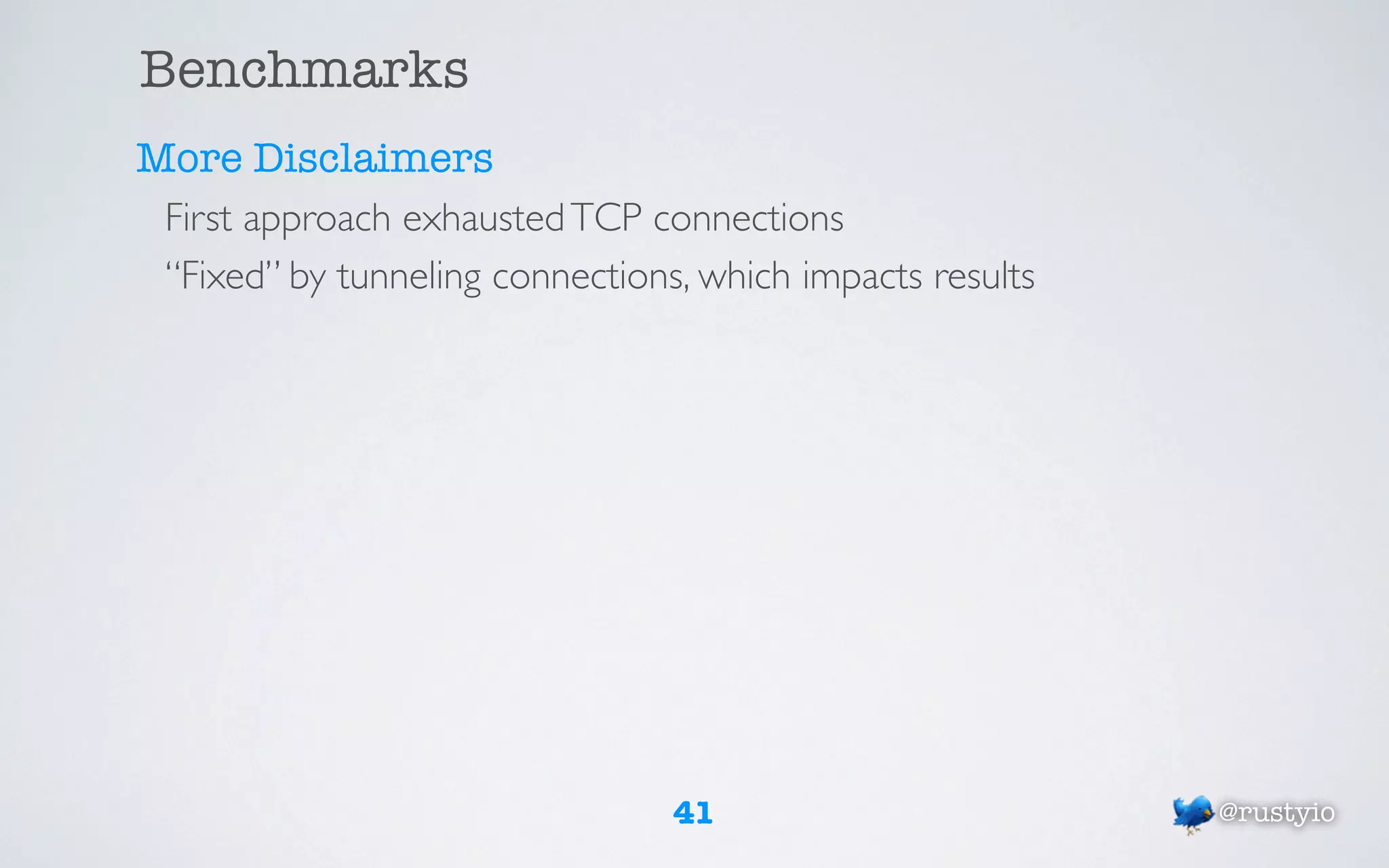
More Disclaimers
 First approach exhausted TCP connections
 “Fixed” by tunneling connections, which impacts results


                                 41                        @rustyio
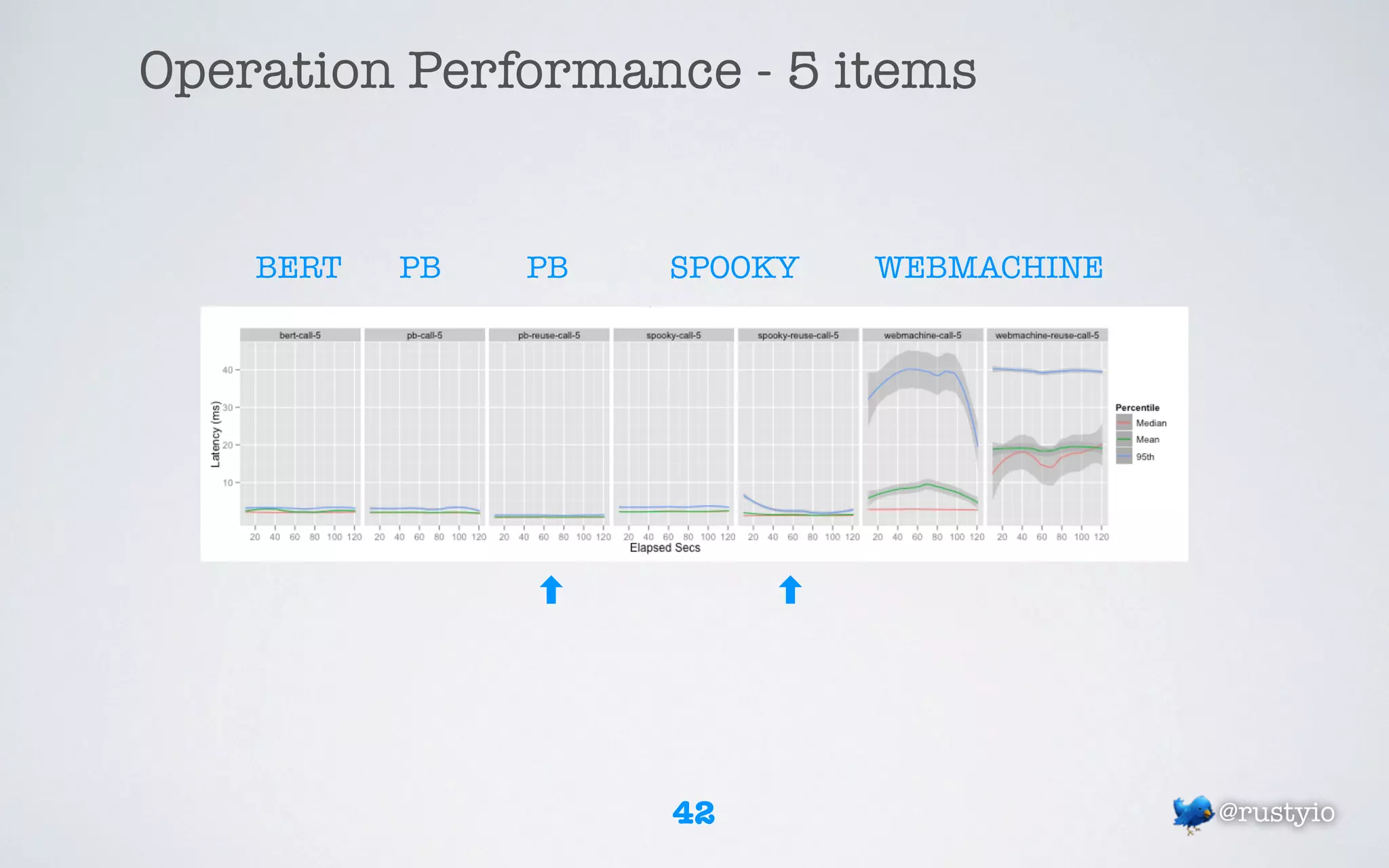
Operation Performance - 5 items


    BERT   PB   PB   SPOOKY   WEBMACHINE


                     42                    @rustyio
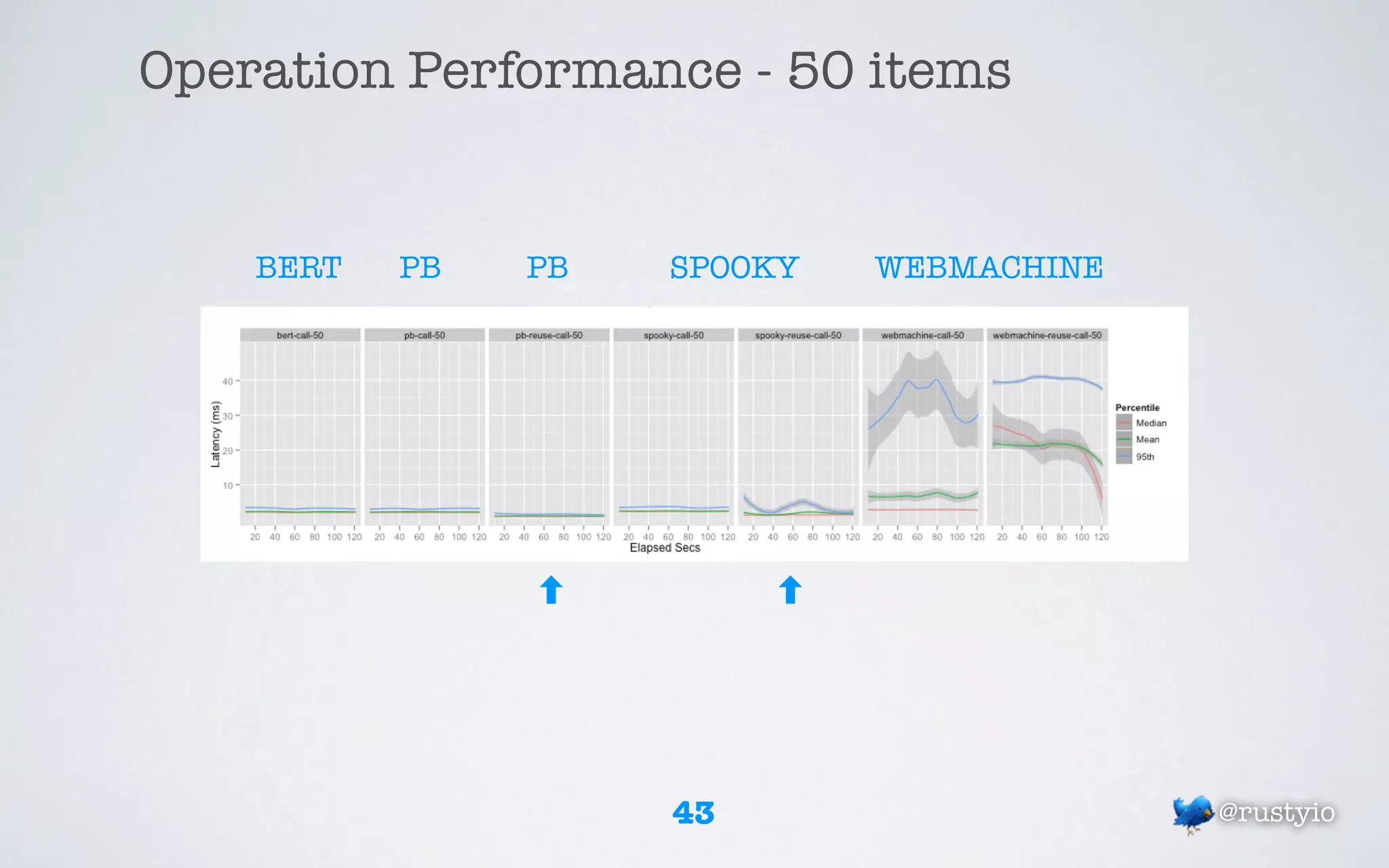
Operation Performance - 50 items


    BERT   PB   PB   SPOOKY   WEBMACHINE


                     43                    @rustyio
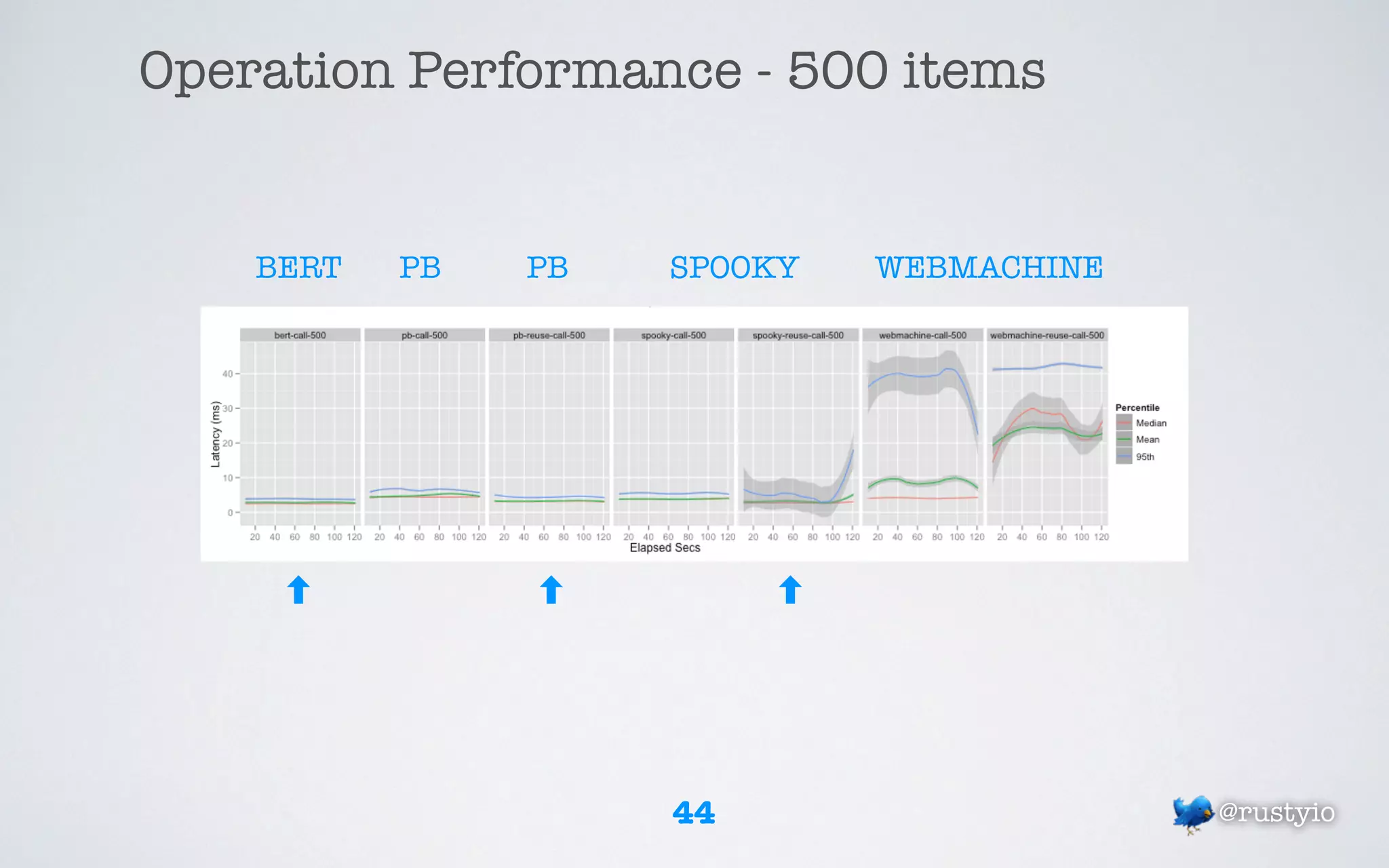
Operation Performance - 500 items


    BERT   PB   PB   SPOOKY   WEBMACHINE


                     44                    @rustyio
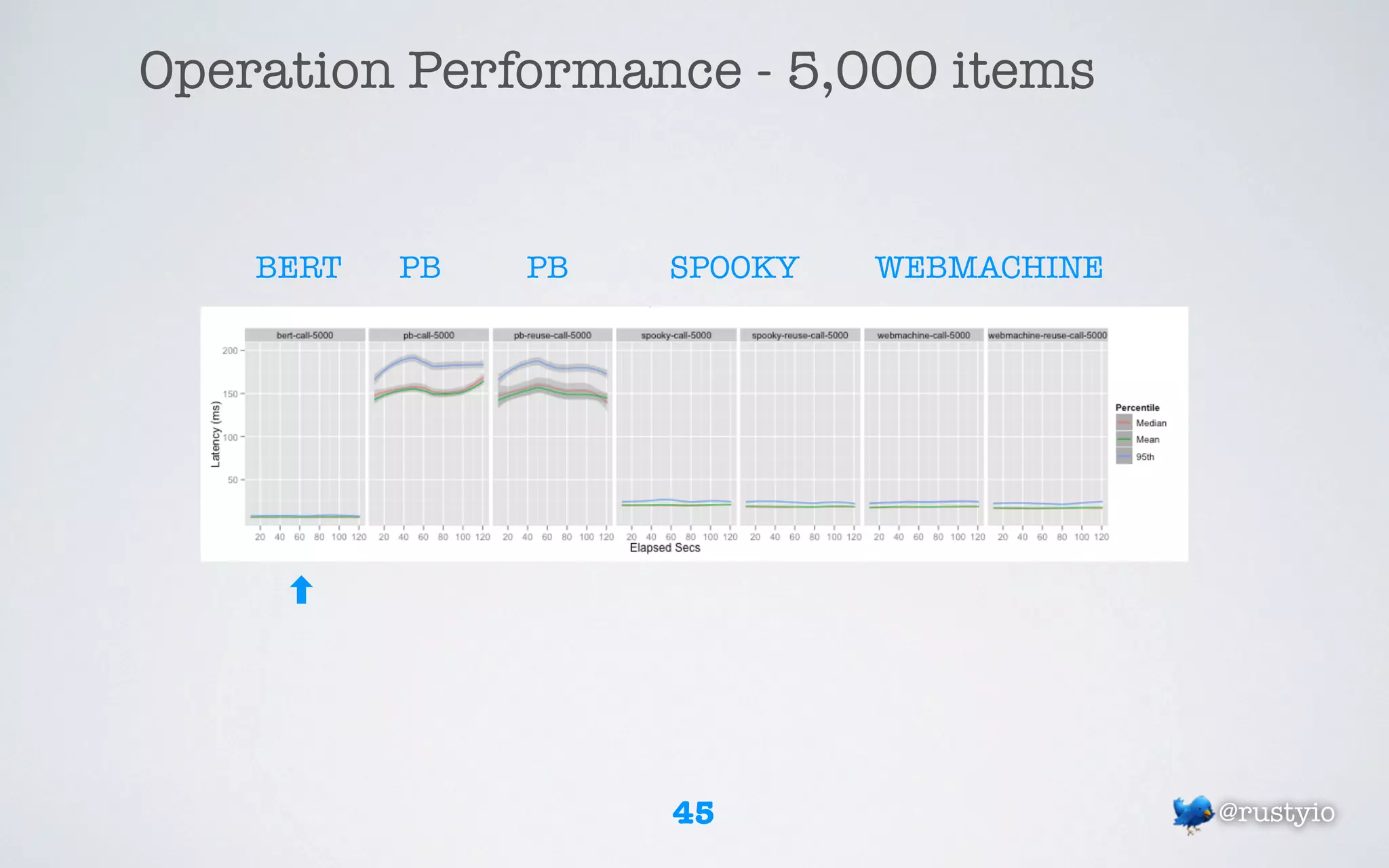
Operation Performance - 5,000 items


    BERT   PB   PB   SPOOKY   WEBMACHINE


                     45                    @rustyio
Encoding Speed
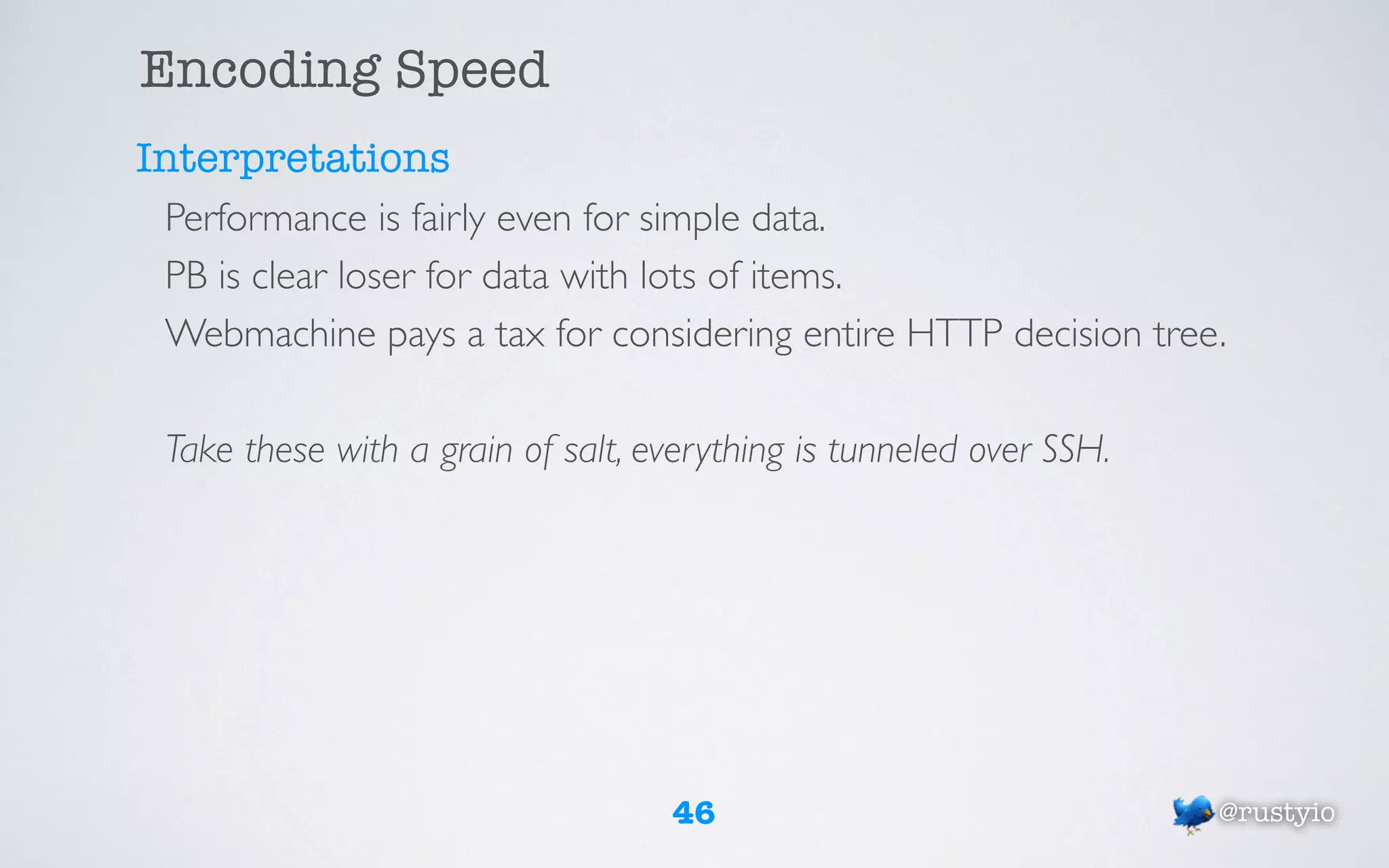
Interpretations
 Performance is fairly even for simple data.
 PB is clear loser for data with lots of items.
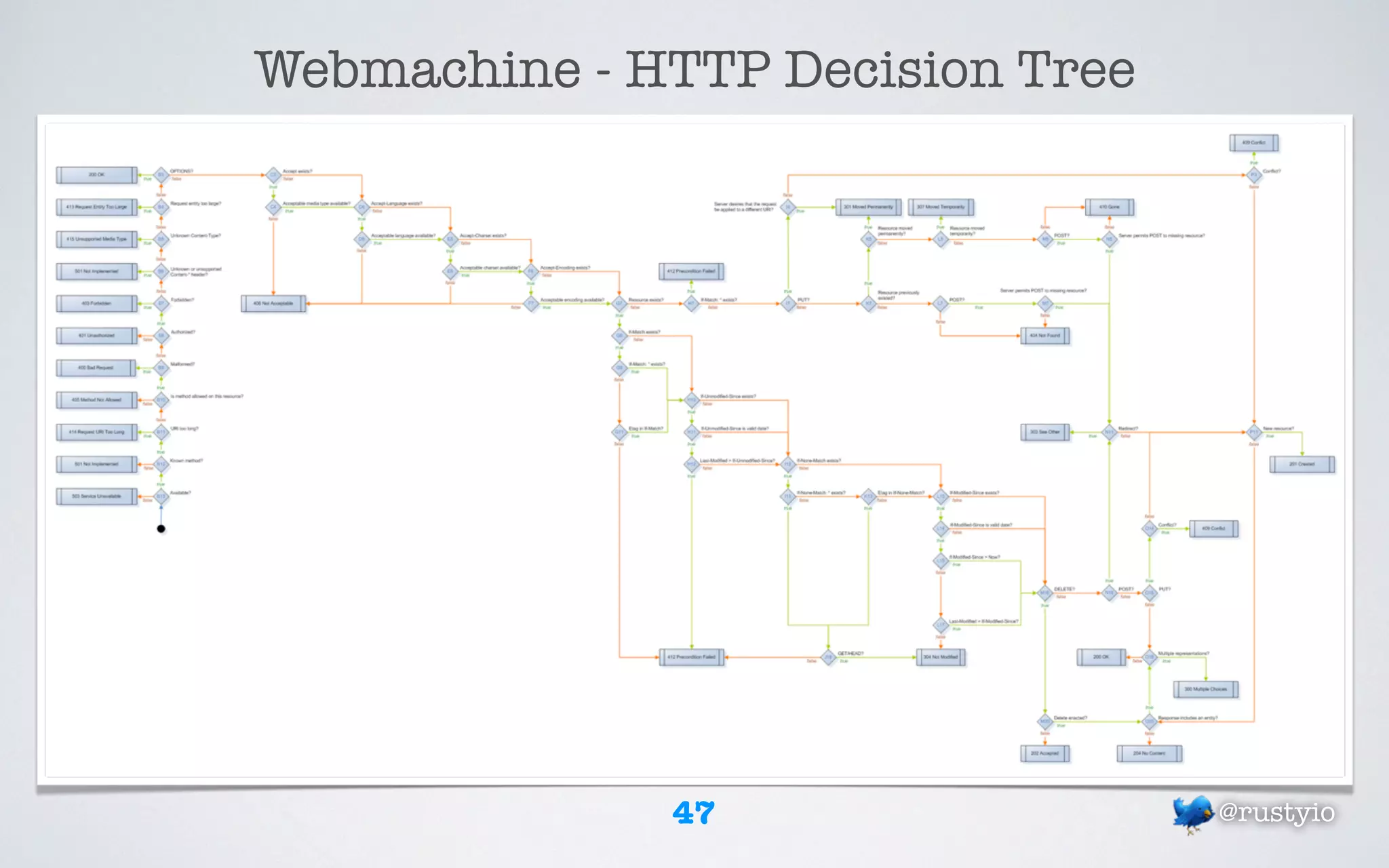
 Webmachine pays a tax for considering entire HTTP decision tree.

 Take these with a grain of salt, everything is tunneled over SSH.


                                   46                                @rustyio
Webmachine - HTTP Decision Tree


              47                  @rustyio
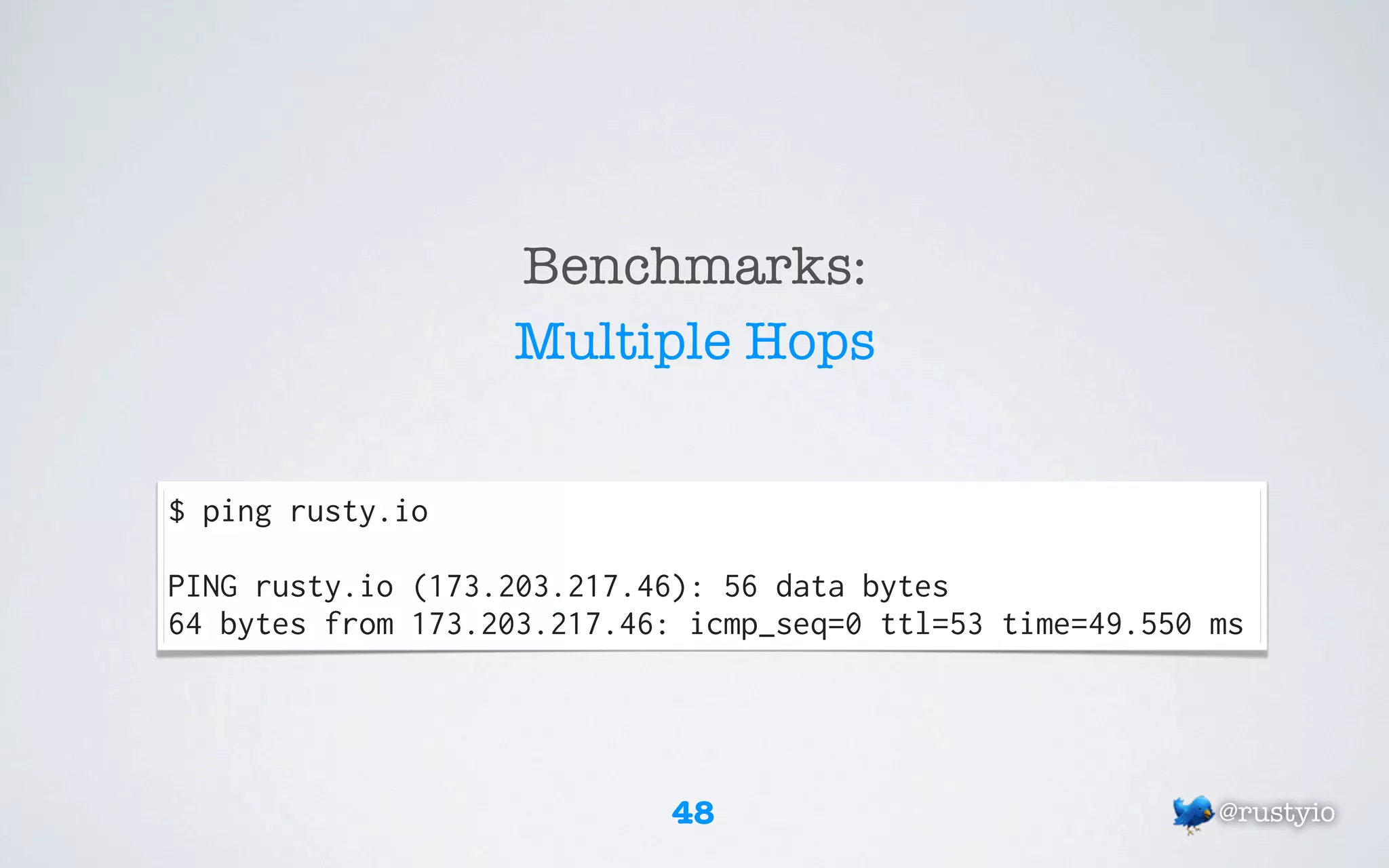
Benchmarks:
                   Multiple Hops


$ ping rusty.io

PING rusty.io (173.203.217.46): 56 data bytes
64 bytes from 173.203.217.46: icmp_seq=0 ttl=53 time=49.550 ms


                             48                             @rustyio
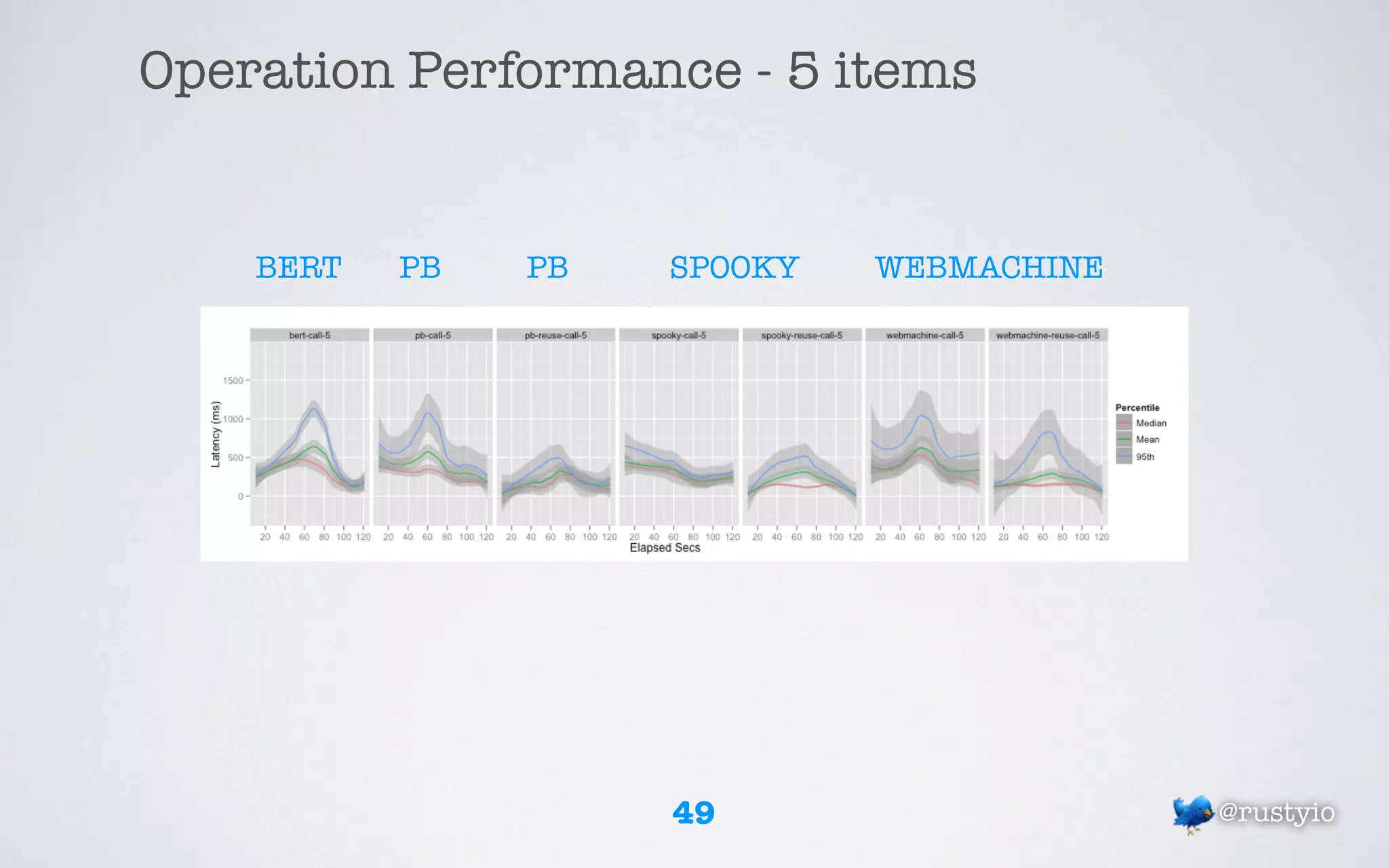
Operation Performance - 5 items


    BERT   PB   PB   SPOOKY   WEBMACHINE


                     49                    @rustyio
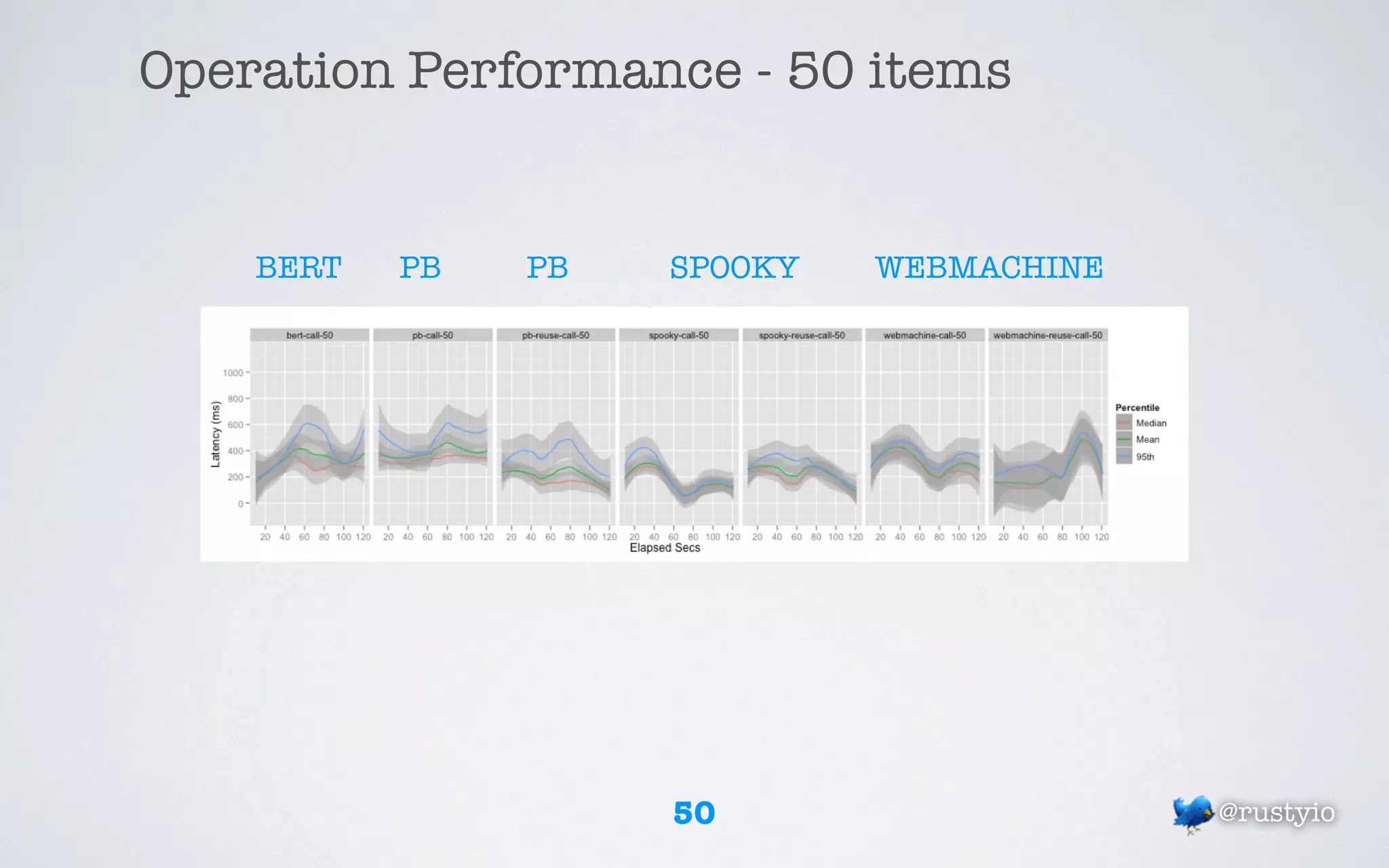
Operation Performance - 50 items


    BERT   PB   PB   SPOOKY   WEBMACHINE


                     50                    @rustyio
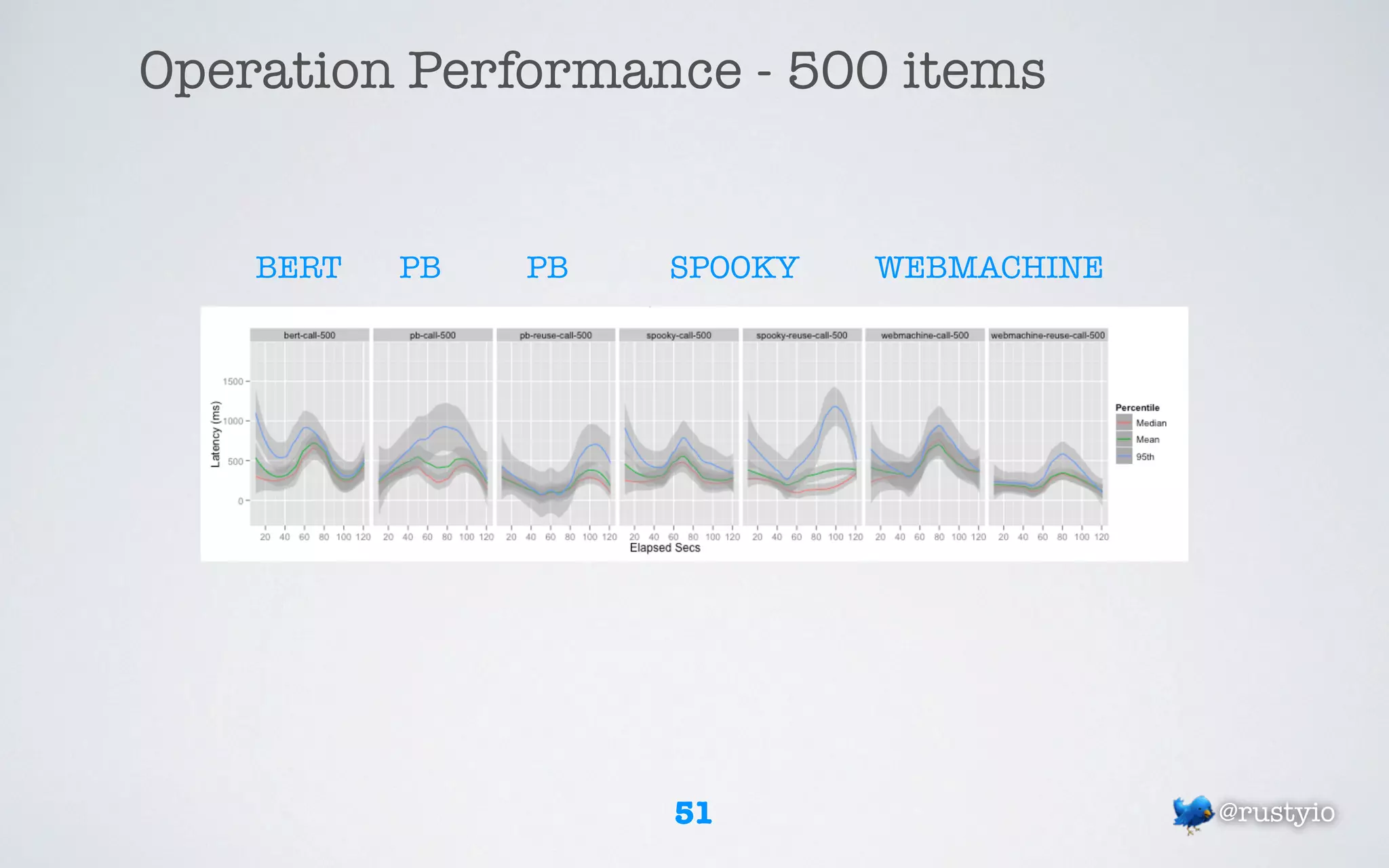
Operation Performance - 500 items


    BERT   PB   PB   SPOOKY   WEBMACHINE


                     51                    @rustyio
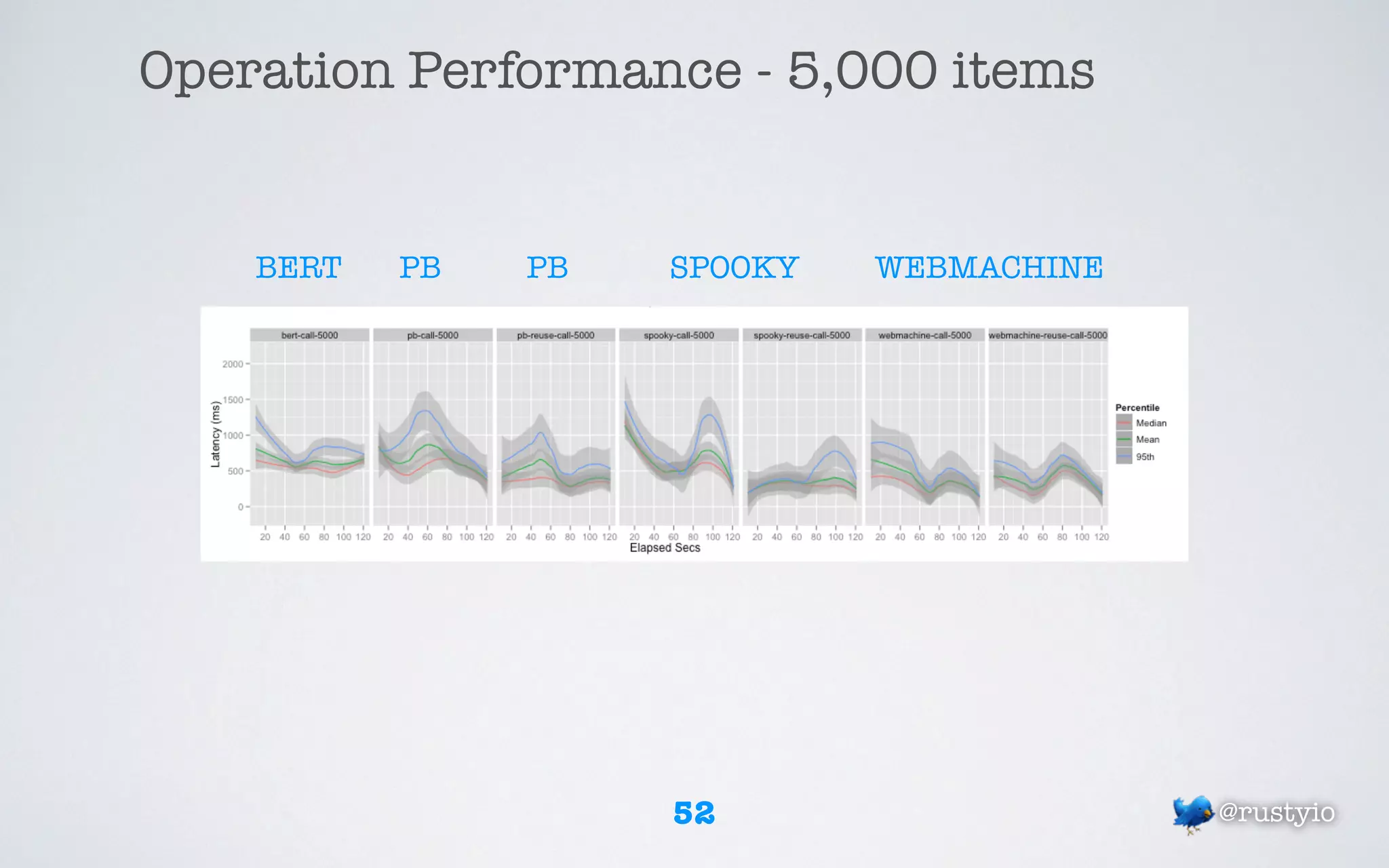
Operation Performance - 5,000 items


    BERT   PB   PB   SPOOKY   WEBMACHINE


                     52                    @rustyio
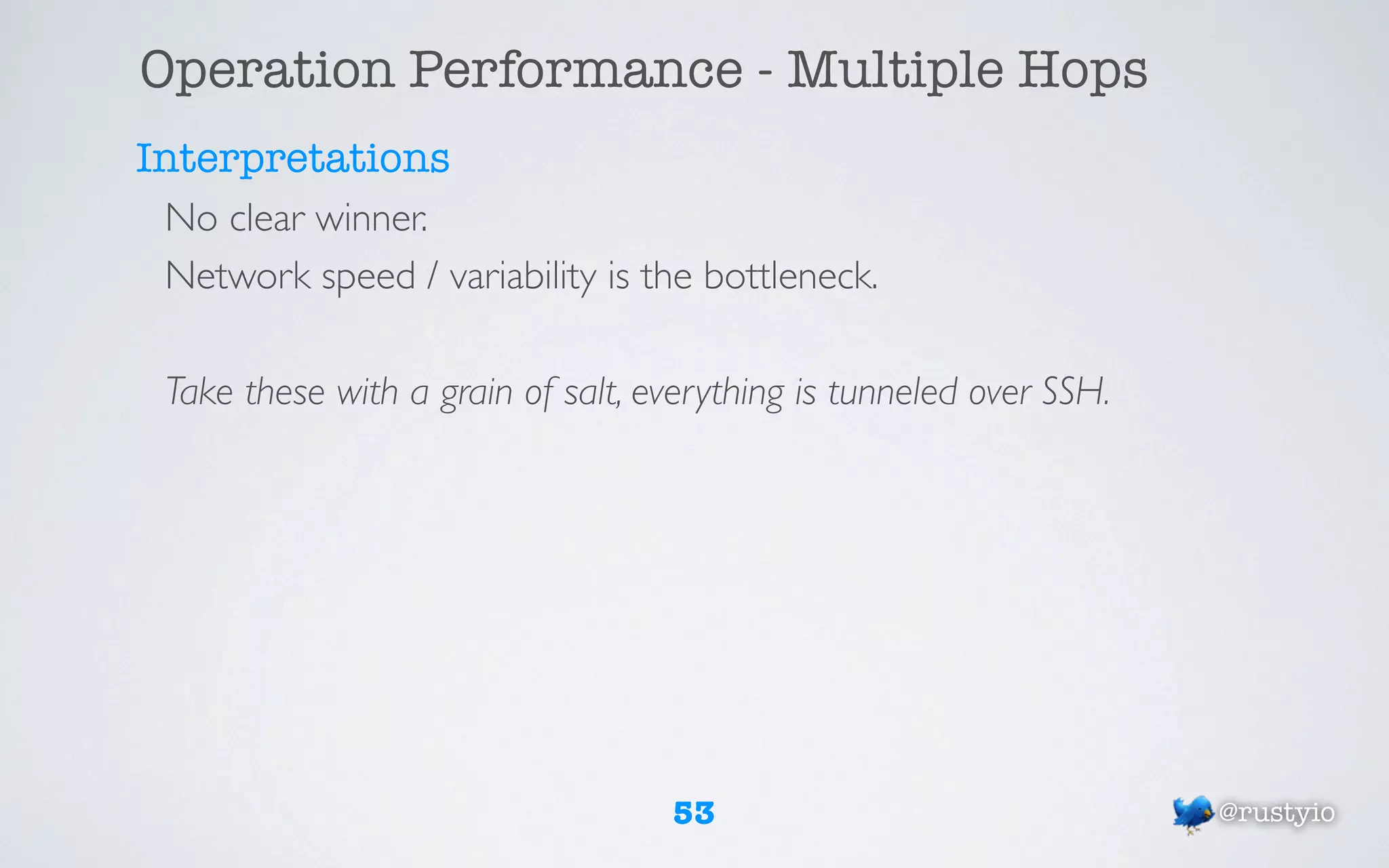
Operation Performance - Multiple Hops
Interpretations
 No clear winner.
 Network speed / variability is the bottleneck.

 Take these with a grain of salt, everything is tunneled over SSH.


                                   53                                @rustyio
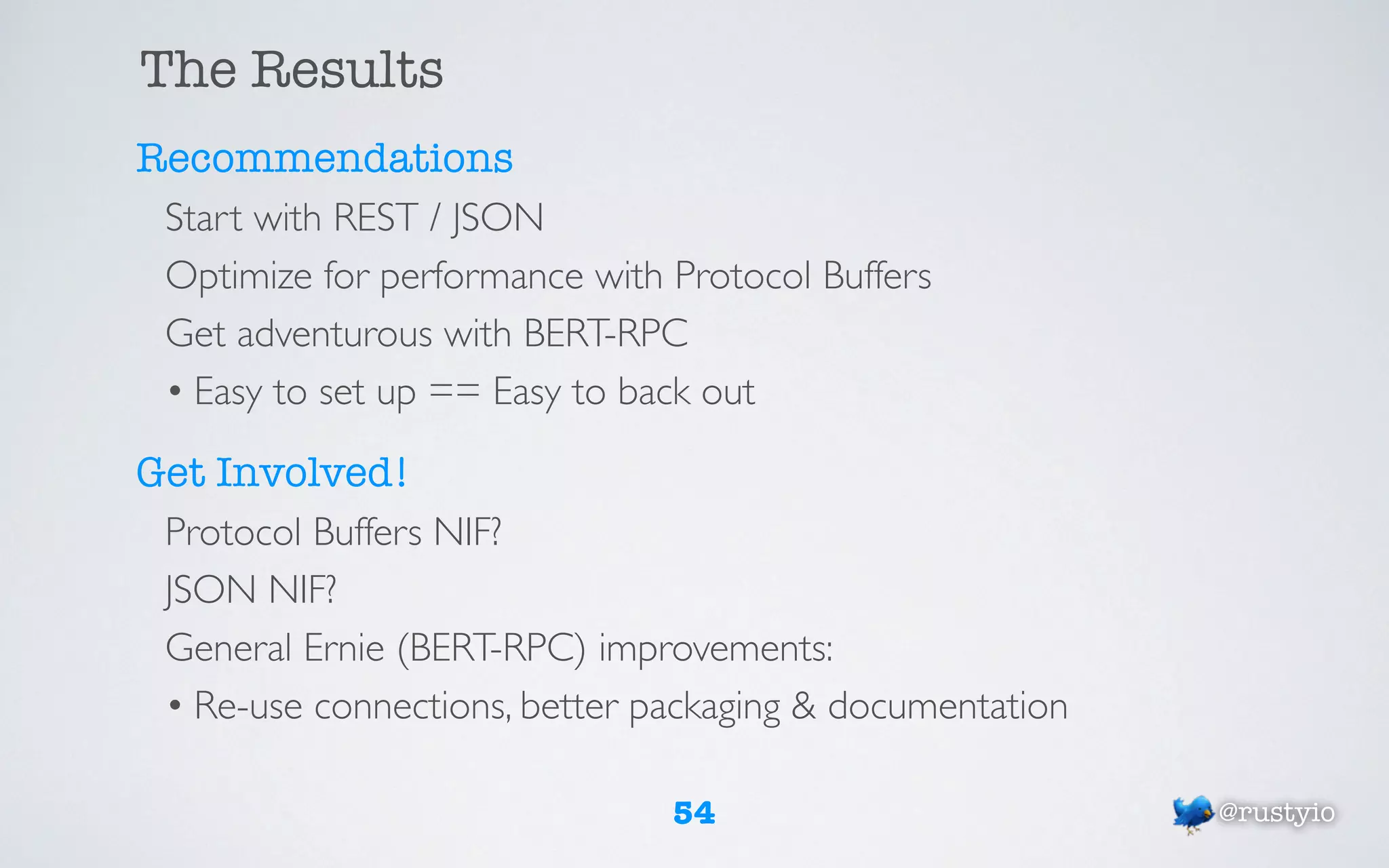
The Results
Recommendations
 Start with REST / JSON
 Optimize for performance with Protocol Buffers
 Get adventurous with BERT-RPC
 • Easy to set up == Easy to back out

Get Involved!
 Protocol Buffers NIF?
 JSON NIF?
 General Ernie (BERT-RPC) improvements:
 • Re-use connections, better packaging & documentation

                               54                         @rustyio
Honorable Mentions
Other RPC Frameworks:
  Thrift - http://thrift.apache.org/ (Originally Facebook)
  Avro - http://avro.apache.org/docs/current/
  XML-RPC
  CORBA - http://www.erlang.org/doc/man/corba.html
  UBF - http://www.sics.se/~joe/ubf/site/home.html
  MsgPack - http://msgpack.org/
  Etch - http://incubator.apache.org/projects/etch.html
  ASN.1 - http://en.wikipedia.org/wiki/Abstract_Syntax_Notation_One

Erlang <-> Other Code:
  Erlang "ports" - integration via stdin/stdout.
  Bifs - Extend Erlang with new functions.

"Fake" Erlang Nodes:
  JInterface (it is... not great)
  C Nodes - http://www.erlang.org/doc/tutorial/cnode.html

                                                             55       @rustyio
Related Talks
• Anton Lavrik - Piqi-RPC: exposing Erlang services via JSON, XML and Google
  Protocol Buffers over HTTP
  http://www.erlang-factory.com/conference/SFBay2011/speakers/AntonLavrik
• Tom Preston-Werner - BERT is to Erlang as JSON is to JavaScript
  http://www.erlang-factory.com/conference/ErlangUserConference2009/speakers/
  TomPrestonWerner
• Todd Lipcon - Thrift Avro/Erlang Bindings
  http://www.erlang-factory.com/conference/SFBay2010/speakers/toddlipcon
• Cliff Moon - Building Polyglot Distributed Systems with Jinterface
  http://www.erlang-factory.com/conference/SFBay2011/speakers/CliffMoon
• Kresten Krab Thorup - Erjang - A JVM-based Erlang VM
  http://www.erlang-factory.com/conference/SFBay2010/speakers/
  KrestenKrabThorup
• Yurii Rashkovskii - Beam.JS: Erlang meets JavaScript
  http://www.erlang-factory.com/conference/SFBay2011/speakers/YuriiRashkovskii

                                      56                                        @rustyio
Thanks!
Questions?


    57       @rustyio

Everybody Polyglot! - Cross-Language RPC with Erlang

  • 1.
    EVERYBODY POLYGLOT! (Cross-Language RPCwith Erlang) ErlangDC · December 2011 Rusty Klophaus - @rustyio Basho Technologies
  • 2.
    Languages have Strengths http://wordaligned.org/articles/distorted-software 2 @rustyio
  • 3.
    Connections are Hard Serialization Versioning & Upgrades Data Type Mismatches Speed, Bottlenecks & Back-Pressure Inadequate Tooling Context Switching 3 @rustyio
  • 4.
    Connections are Hard http://wordaligned.org/articles/distorted-software 4 @rustyio
  • 5.
    This Talk Create AnExample Service Any service will do, just need a framework for discussion. Expose Application via Interfaces • REST / JSON via Webmachine & Spooky • Protocol Buffers via erlang-protobuffs • BERT-RPC via Ernie Server Code http://github.com/rustyio/ErlangRPCDemo 5 @rustyio
  • 6.
    This Talk Our Application:A Sequence Server Erlang service that returns a sequence of numbers. 1 sequence(N) -> 2 List1 = lists:seq(1, N), 3 List2 = [list_to_binary(integer_to_list(X)) || X <- List1], 4 {ok, List2}; 5 6 %% sequence(2). 7 {ok, [<<"1">>, <<"2">>]}. 8 9 %% sequence(5). 10 {ok, [<<"1">>, <<"2">>, <<"3">>, <<"4">>, <<"5">>]}. 11 12 %% sequence(50000). 13 {ok, [<<"1">>, <<"2">>, <<"3">>, <<"4">>, ...]}. 6 @rustyio
  • 7.
    Overview REST? Protocol Buffers? BERT-RPC? 7 @rustyio
  • 8.
    REST / JSON- Overview REST - Representational State Transfer Convention for talking to applications over HTTP Actions are Verbs are HTTP Methods (GET/PUT/POST/DELETE/...) Objects are nouns are URLs GET /users/5 JSON - Javascript Object Notation Encode data as parseable Javascript Understood by everything Human Readable {"id":5,"first":"Rusty","last":"Klophaus"} 8 @rustyio
  • 9.
    REST / JSON- Strengths & Weaknesses Strengths Simple, easy to poke around Good support in every language Composable - Caches, Reverse Proxies, Load Balancers Weaknesses General == More Handshaking/Metadata == More Overhead 9 @rustyio
  • 10.
    Protocol Buffers -Overview Protocol Buffers Developed by Google It’s not a protocol, it’s a format: • You provide the client / server logic • Useful for transmission AND storage Define data structures in .proto file, generate code http://code.google.com/apis/protocolbuffers/ https://github.com/ngerakines/erlang_protobuffs 10 @rustyio
  • 11.
    Protocol Buffers -Strengths & Weaknesses Strengths Compact Add fields without breaking existing applications • Versioning is not strict Weaknesses Configuration file (.proto) with new syntax to learn Generated code Uneven language support 11 @rustyio
  • 12.
    BERT-RPC - Overview BERT-RPC Developed by GitHub (Tom Preston-Werner) BERT = Binary Erlang Term • Encoding mimics native Erlang serialization http://bert-rpc.org https://github.com/mojombo/ernie 1 % Request 2 {call, ernie_sequence, sequence, [3]} 3 4 % Response 5 {response, {ok, [<<"1">>, <<"2">>, <<"3">>]}} 12 @rustyio
  • 13.
    BERT-RPC - Strengths& Weaknesses Strengths Easy to set up Agile Compact Weaknesses Uneven language support Less buzz than it deserves Not fully product-ized 13 @rustyio
  • 14.
    Requests & Responses Whatdoes the chatter look like? 14 @rustyio
  • 15.
    REST / JSON- Request & Response Request GET /sequence/3 HTTP/1.1 User-Agent: curl/7.21.4 (universal-apple-darwin11.0) libcurl/7.21.4 OpenSSL/0.9.8r zlib/1.2.5 Host: localhost:8001 Accept: */* Response HTTP/1.1 200 OK Server: MochiWeb/1.1 WebMachine/1.9.0 (someone had painted it blue) Date: Wed, 23 Nov 2011 22:09:13 GMT Content-Type: application/json Content-Length: 21 ["1","2","3"] 15 @rustyio
  • 16.
    Protocol Buffers -Encoding rpc_demo.proto 1 message SequenceRequest { 2 required uint32 n = 1; 3 } 4 5 message SequenceResponse { 6 repeated bytes sequence = 1; 7 } 16 @rustyio
  • 17.
    Protocol Buffers -RPC Request 1 rpc_demo_pb:encode({sequencerequest, 3}). 2 <<8,3>> Response 1 rpc_demo_pb:encode({sequenceresponse, [<<"1">>, <<"2">>, <<"3">>]}). 2 <<10,1,49,10,1,50,10,1,51>> 17 @rustyio
  • 18.
    BERT-RPC - Encoding 1 term_to_binary([<<"1">>,<<"2">>,<<"3">>]). 2 <<131,108,0,0,0,3,109,0,0,0,1,49,109,0,0,0,1,50,109,0,0,0,1,51,106>> 3 4 5 bert:encode([<<"1">>,<<"2">>,<<"3">>]). 6 <<131,108,0,0,0,3,109,0,0,0,1,49,109,0,0,0,1,50,109,0,0,0,1,51,106>> 18 @rustyio
  • 19.
    BERT-RPC - Encoding 1 term_to_binary([<<"1">>,<<"2">>,<<"3">>]). 2 <<131,108,0,0,0,3,109,0,0,0,1,49,109,0,0,0,1,50,109,0,0,0,1,51,106>> 3 4 5 bert:encode([<<"1">>,<<"2">>,<<"3">>]). 6 <<131,108,0,0,0,3,109,0,0,0,1,49,109,0,0,0,1,50,109,0,0,0,1,51,106>> 7 | | | | | | 8 | | | | | + Ascii value for '1' 9 | | | | + Length of string (1) 10 | | | + Next term is a string 11 | | + Length of list (3) 12 | + Next term is a list 13 + Start of Erlang term 19 @rustyio
  • 20.
    BERT-RPC - RPC Request 1 bert:encode({call, ernie_sequence, sequence, [5]}). 3 <<131,104,4,100,0,4,99,97,108,108,100,0,14,101,114,110, 4 105,101,95,115,101,113,117,101,110,99,101,100,0,8,115, 5 101,113,117,101,110,99,101,107,0,1,5>> Response 1 bert:encode({reply,{ok,[<<"1">>,<<"2">>,<<"3">>,<<"4">>,<<"5">>]}}). 2 3 <<131,104,2,100,0,5,114,101,112,108,121,104,2,100,0,2,111, 4 107,108,0,0,0,5,109,0,0,0,1,49,109,0,0,0,1,50,109,0,0,0, 5 1,51,109,0,0,0,1,52,109,0,0,0,1,53,106>> 20 @rustyio
  • 21.
    Show me theClient Code! 21 @rustyio
  • 22.
    REST / JSON- Clients CURL curl http://localhost:8001/sequence/5 Ruby Client 1 url = "http://localhost:8001/sequence/5" 2 resp = Net::HTTP.get_response(URI.parse(url)) 3 sequence = JSON.parse(resp.body) 22 @rustyio
  • 23.
    Protocol Buffers -Client Ruby Client 1 require 'beefcake' 2 3 class SequenceRequest 4 include Beefcake::Message 5 required :n, :int32, 1 6 end 7 8 class SequenceResponse 9 include Beefcake::Message 10 repeated :sequence, :string, 1 11 end 12 13 req = SequenceRequest.new(:n => 5) 14 Socket.tcp("localhost", 8003) do |socket| 15 socket.write(req.encode) 16 m = socket.read 17 return SequenceResponse.decode(m) 18 end 23 @rustyio
  • 24.
    BERT-RPC - Client RubyClient 1 require 'bert-rpc' 2 3 svc = BERTRPC::Service.new('localhost', 9999) 4 sequence = svc.call.ernie_sequence.sequence(5) 24 @rustyio
  • 25.
    Show me theServer Code! 25 @rustyio
  • 26.
    REST / JSON- Server Spooky Server 1 -module(spooky_sequence). 2 -behaviour(spooky). 3 -export([init/1, get/2]). 4 5 init([])-> 6 [{port, 8002}]. 7 8 get(_Req, ["sequence", Num])-> 9 case sequence:sequence(Num) of 10 {ok, List} -> 11 {200, mochijson2:encode(List)}; 12 {error, Error} -> 13 {500, io_lib:format("~w", [Error])} 14 end; 15 get(_Req, _)-> 16 {400, "Usage: /sequence/:Num:"}. 26 @rustyio
  • 27.
    REST / JSON- Server Webmachine Server 1 -module(webmachine_sequence). 2 -export([init/1, content_types_provided/2, to_json/2]). 3 -include_lib("webmachine/include/webmachine.hrl"). 4 5 -record(ctx, { list }). 6 7 init([]) -> 8 {ok, #ctx {}}. 9 10 content_types_provided(RD, Ctx) -> 11 Types = [{"application/json", to_json}], 12 {Types, RD, Ctx}. 13 14 to_json(RD, Ctx) -> 15 {ok, List} = sequence:sequence(N), 16 Body = mochijson2:encode(List), 17 {Body, RD, Ctx}. 27 @rustyio
  • 28.
    Protocol Buffers -Server Erlang Server 1 %% Erlang RPC Demo 57 handle_info({tcp, _Sock, _Data}, State) -> 2 %% Copyright (c) 2011 Rusty Klophaus (@rustyio) 58 %% req =/= undefined: received a new request while another was in 3 %% See MIT-LICENSE for licensing information. 59 %% progress -> Error 4 60 lager:error("Received a new PB socket request" 5 -module(protobuff_server). 61 " while another was in progress"), 6 -behaviour(gen_server). 62 {stop, normal, State}; 7 63 8 -export([ 64 handle_info(_, State) -> % Ignore any late replies from gen_servers/messages from fsms 9 start_link/0, 65 {noreply, State}. 10 set_socket/2, 66 11 init/1, 67 terminate(_Reason, _State) -> 12 handle_call/3, 68 ok. 13 handle_cast/2, 69 14 handle_info/2, 70 code_change(_OldVsn, State, _Extra) -> {ok, State}. 15 terminate/2, 71 16 code_change/3, 72 %% =================================================================== 17 encode/1, 73 %% Handle PB Messages 18 decode/1]). 74 %% =================================================================== 19 75 20 -record(state, { sock }). 76 process_message(#sequencerequest { n = N }, State) -> 21 77 case sequence:sequence(N) of 22 -include("rpc_demo_pb.hrl"). 78 {ok, List} -> 23 79 Resp = #sequenceresponse { sequence = List }, 24 %% =================================================================== 80 send_msg(Resp, State); 25 %% Public API 81 {error, Reason} -> 26 %% =================================================================== 82 Msg = io_lib:format("~w", [Reason]), 27 83 Resp = #sequenceerror { message=Msg }, 28 start_link() -> 84 send_msg(Resp, State) 29 gen_server:start_link(?MODULE, [], []). 85 end. 30 86 31 set_socket(Pid, Socket) -> 87 %% Send a message to the client 32 gen_server:call(Pid, {set_socket, Socket}). 88 send_msg(Msg, State) -> 33 89 Pkt = encode(Msg), 34 init([]) -> 90 gen_tcp:send(State#state.sock, Pkt), 35 {ok, #state{}}. 91 State. 36 92 37 handle_call({set_socket, Socket}, _From, State) -> 93 encode(Msg) -> 38 inet:setopts(Socket, [{active, once}, {packet, 4}, {header, 1}]), 94 MsgType = element(1, Msg), 39 {reply, ok, State#state{sock = Socket}}. 95 [msg_code(Msg) | rpc_demo_pb:iolist(MsgType, Msg)]. 40 96 41 handle_cast(_Msg, State) -> 97 decode([MsgCode|MsgData]) -> 42 {noreply, State}. 98 MsgType = msg_type(MsgCode), 43 99 rpc_demo_pb:decode(MsgType, MsgData). 44 handle_info({tcp_closed, Socket}, State=#state{sock=Socket}) -> 100 45 {stop, normal, State}; 101 msg_code(#sequencerequest {}) -> 1; 46 handle_info({tcp_error, Socket, _Reason}, State=#state{sock=Socket}) -> 102 msg_code(#sequenceresponse {}) -> 2; 47 {stop, normal, State}; 103 msg_code(#sequenceerror {}) -> 3; 48 handle_info({tcp, _Sock, MsgData}, State=#state{sock=Socket}) -> 104 msg_code(Other) -> 49 Msg = decode(MsgData), 105 throw({unknown_pb_type, Other}). 50 case process_message(Msg, State) of 106 51 {pause, NewState} -> 107 msg_type(1) -> sequencerequest; 52 ok; 108 msg_type(2) -> sequenceresponse; 53 NewState -> 109 msg_type(3) -> sequenceerror; 54 inet:setopts(Socket, [{active, once}]) 110 msg_type(Other) -> 55 end, 111 throw({unknown_pb_code, Other}). 56 {noreply, NewState}; 28 @rustyio
  • 29.
    BERT-RPC - Server ErnieServer - Erlang BERT-RPC Server 1 %% FILE: ernie.config 2 [ 3 {module, ernie_sequence}, 4 {type, native}, 5 {codepaths, []} 6 ]. 1 -module(ernie_sequence). 2 -export([sequence/1]). 3 4 sequence(N) -> 5 sequence:sequence(N). 29 @rustyio
  • 30.
    Benchmarks How fast isit? 30 @rustyio
  • 31.
    Benchmarks Disclaimers Benchmarking ishard The shape of your data matters (size and complexity) Speed is not the only objective 31 @rustyio
  • 32.
  • 33.
    Encoding Speed -5 items BERT JSON PB 33 @rustyio
  • 34.
    Encoding Speed -50 items BERT JSON PB 34 @rustyio
  • 35.
    Encoding Speed -500 items BERT JSON PB 35 @rustyio
  • 36.
    Encoding Speed -5,000 items BERT JSON PB 36 @rustyio
  • 37.
    Encoding Speed -50,000 items BERT JSON Sad Protocol Buffers :( 37 @rustyio
  • 38.
    Encoding Speed -Ruby | 5 | 50 | 500 | 5,000 -----+---------+---------+---------+---------- JSON | 0.03 ms | 0.77 ms | 0.47 ms | 4.21 ms PB | 0.07 ms | 0.60 ms | 7.37 ms | 197.24 ms BERT | 0.08 ms | 0.52 ms | 4.97 ms | 52.42 ms 38 @rustyio
  • 39.
    Encoding Speed Interpretations BERTwins in Erlang, because it’s native. JSON wins in Ruby. Protocol Buffers is slow all around for complex data. • Note: This is different from large data. 39 @rustyio
  • 40.
    Benchmarks: Single Hop $ ping dell.local PING dell.local (192.168.2.2): 56 data bytes 64 bytes from 192.168.2.2: icmp_seq=0 ttl=64 time=0.490 ms 40 @rustyio
  • 41.
    Benchmarks More Disclaimers Firstapproach exhausted TCP connections “Fixed” by tunneling connections, which impacts results 41 @rustyio
  • 42.
    Operation Performance -5 items BERT PB PB SPOOKY WEBMACHINE 42 @rustyio
  • 43.
    Operation Performance -50 items BERT PB PB SPOOKY WEBMACHINE 43 @rustyio
  • 44.
    Operation Performance -500 items BERT PB PB SPOOKY WEBMACHINE 44 @rustyio
  • 45.
    Operation Performance -5,000 items BERT PB PB SPOOKY WEBMACHINE 45 @rustyio
  • 46.
    Encoding Speed Interpretations Performanceis fairly even for simple data. PB is clear loser for data with lots of items. Webmachine pays a tax for considering entire HTTP decision tree. Take these with a grain of salt, everything is tunneled over SSH. 46 @rustyio
  • 47.
    Webmachine - HTTPDecision Tree 47 @rustyio
  • 48.
    Benchmarks: Multiple Hops $ ping rusty.io PING rusty.io (173.203.217.46): 56 data bytes 64 bytes from 173.203.217.46: icmp_seq=0 ttl=53 time=49.550 ms 48 @rustyio
  • 49.
    Operation Performance -5 items BERT PB PB SPOOKY WEBMACHINE 49 @rustyio
  • 50.
    Operation Performance -50 items BERT PB PB SPOOKY WEBMACHINE 50 @rustyio
  • 51.
    Operation Performance -500 items BERT PB PB SPOOKY WEBMACHINE 51 @rustyio
  • 52.
    Operation Performance -5,000 items BERT PB PB SPOOKY WEBMACHINE 52 @rustyio
  • 53.
    Operation Performance -Multiple Hops Interpretations No clear winner. Network speed / variability is the bottleneck. Take these with a grain of salt, everything is tunneled over SSH. 53 @rustyio
  • 54.
    The Results Recommendations Startwith REST / JSON Optimize for performance with Protocol Buffers Get adventurous with BERT-RPC • Easy to set up == Easy to back out Get Involved! Protocol Buffers NIF? JSON NIF? General Ernie (BERT-RPC) improvements: • Re-use connections, better packaging & documentation 54 @rustyio
  • 55.
    Honorable Mentions Other RPCFrameworks: Thrift - http://thrift.apache.org/ (Originally Facebook) Avro - http://avro.apache.org/docs/current/ XML-RPC CORBA - http://www.erlang.org/doc/man/corba.html UBF - http://www.sics.se/~joe/ubf/site/home.html MsgPack - http://msgpack.org/ Etch - http://incubator.apache.org/projects/etch.html ASN.1 - http://en.wikipedia.org/wiki/Abstract_Syntax_Notation_One Erlang <-> Other Code: Erlang "ports" - integration via stdin/stdout. Bifs - Extend Erlang with new functions. "Fake" Erlang Nodes: JInterface (it is... not great) C Nodes - http://www.erlang.org/doc/tutorial/cnode.html 55 @rustyio
  • 56.
    Related Talks • AntonLavrik - Piqi-RPC: exposing Erlang services via JSON, XML and Google Protocol Buffers over HTTP http://www.erlang-factory.com/conference/SFBay2011/speakers/AntonLavrik • Tom Preston-Werner - BERT is to Erlang as JSON is to JavaScript http://www.erlang-factory.com/conference/ErlangUserConference2009/speakers/ TomPrestonWerner • Todd Lipcon - Thrift Avro/Erlang Bindings http://www.erlang-factory.com/conference/SFBay2010/speakers/toddlipcon • Cliff Moon - Building Polyglot Distributed Systems with Jinterface http://www.erlang-factory.com/conference/SFBay2011/speakers/CliffMoon • Kresten Krab Thorup - Erjang - A JVM-based Erlang VM http://www.erlang-factory.com/conference/SFBay2010/speakers/ KrestenKrabThorup • Yurii Rashkovskii - Beam.JS: Erlang meets JavaScript http://www.erlang-factory.com/conference/SFBay2011/speakers/YuriiRashkovskii 56 @rustyio
  • 57.