SAVE MORE LIVES WITH
THE LATEST SCIENCE
Committed to saving lives through research, training, and education                                                      2010
BETTER PRACTICES SAVE MORE LIVES
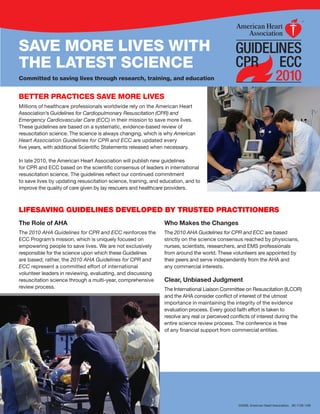
Millions of healthcare professionals worldwide rely on the American Heart
Association’s Guidelines for Cardiopulmonary Resuscitation (CPR) and
Emergency Cardiovascular Care (ECC) in their mission to save more lives.
These guidelines are based on a systematic, evidence-based review of
resuscitation science. The science is always changing, which is why American
Heart Association Guidelines for CPR and ECC are updated every
five years, with additional Scientific Statements released when necessary.

In late 2010, the American Heart Association will publish new guidelines
for CPR and ECC based on the scientific consensus of leaders in international
resuscitation science. The guidelines reflect our continued commitment
to save lives by updating resuscitation science, training, and education, and to
improve the quality of care given by lay rescuers and healthcare providers.


LIFESAVING GUIDELINES DEVELOPED BY TRUSTED PRACTITIONERS
The Role of AHA                                                 Who Makes the Changes
The 2010 AHA Guidelines for CPR and ECC reinforces the          The 2010 AHA Guidelines for CPR and ECC are based
ECC Program’s mission, which is uniquely focused on             strictly on the science consensus reached by physicians,
empowering people to save lives. We are not exclusively         nurses, scientists, researchers, and EMS professionals
responsible for the science upon which these Guidelines         from around the world. These volunteers are appointed by
are based; rather, the 2010 AHA Guidelines for CPR and          their peers and serve independently from the AHA and
ECC represent a committed effort of international               any commercial interests.
volunteer leaders in reviewing, evaluating, and discussing
resuscitation science through a multi-year, comprehensive       Clear, Unbiased Judgment
review process.                                                 The International Liaison Committee on Resuscitation (ILCOR)
                                                                and the AHA consider conflict of interest of the utmost
                                                                importance in maintaining the integrity of the evidence
                                                                evaluation process. Every good faith effort is taken to
                                                                resolve any real or perceived conflicts of interest during the
                                                                entire science review process. The conference is free
                                                                of any financial support from commercial entities.


                                                                                                 ©2009, American Heart Association. 80-1100 1/09
THE 2010 GUIDELINES PROCESS


Key Points of the 2010 Guidelines Process                                   Inviting Feedback – Preliminary Guidelines
• Evidence-based                                                            Based on the ILCOR 2010 Consensus, the American Heart
• Thorough, detailed, collaborative and unbiased                            Association will develop its 2010 AHA Guidelines for CPR and ECC.
• International in scope
• Involve actual practitioners who will base treatment on                   From Consensus to Guidelines
  new guidelines                                                            The 2010 Consensus Conference deals exclusively with evaluating
• Continually improving process                                             and interpreting peer-reviewed, published scientific evidence in
• Include many opportunities for input over a long period of time.          order to achieve a consensus on resuscitation science. The American
                                                                            Heart Association will then create new CPR and ECC Guidelines
Planning                                                                    and practitioner recommendations from the international consensus
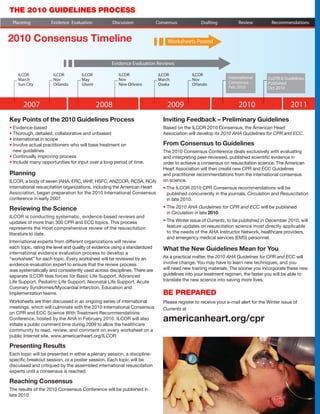
ILCOR, a body of seven (AHA, ERC, IAHF, HSFC, ANZCOR, RCSA, RCA)            on science.
international resuscitation organizations, including the American Heart     • The ILCOR 2010 CPR Consensus recommendations will be
Association, began preparation for the 2010 International Consensus           published concurrently in the journals, Circulation and Resuscitation
conference in early 2007.                                                     in late 2010.

Reviewing the Science                                                       • The 2010 AHA Guidelines for CPR and ECC will be published
                                                                              in Circulation in late 2010.
ILCOR is conducting systematic, evidence-based reviews and
updates of more than 300 CPR and ECC topics. This process                   • The Winter issue of Currents, to be published in December 2010, will
represents the most comprehensive review of the resuscitation                 feature updates on resuscitation science most directly applicable
literature to date.                                                           to the needs of the AHA Instructor Network, healthcare providers,
                                                                              and emergency medical services (EMS) personnel.
International experts from different organizations will review
each topic, rating the level and quality of evidence using a standardized   What the New Guidelines Mean for You
international evidence evaluation process to develop a
“worksheet” for each topic. Every worksheet will be reviewed by an          As a practical matter, the 2010 AHA Guidelines for CPR and ECC will
evidence-evaluation expert to ensure that the review process                involve change. You may have to learn new techniques, and you
was systematically and consistently used across disciplines. There are      will need new training materials. The sooner you incorporate these new
separate ILCOR task forces for Basic Life Support, Advanced                 guidelines into your treatment regimen, the faster you will be able to
Life Support, Pediatric Life Support, Neonatal Life Support, Acute          translate the new science into saving more lives.
Coronary Syndromes/Myocardial Infarction, Education and
Implementation teams.                                                       BE PREPARED
Worksheets are then discussed in an ongoing series of international         Please register to receive your e-mail alert for the Winter issue of
meetings, which will culminate with the 2010 International Consensus        Currents at
on CPR and ECC Science With Treatment Recommendations
Conference, hosted by the AHA in February 2010. ILCOR will also
initiate a public comment time during 2009 to allow the healthcare
                                                                            americanheart.org/cpr
community to read, review, and comment on every worksheet on a
public Internet site, www.americanheart.org/ILCOR

Presenting Results
Each topic will be presented in either a plenary session, a discipline-
specific breakout session, or a poster session. Each topic will be
discussed and critiqued by the assembled international resuscitation
experts until a consensus is reached.

Reaching Consensus
The results of the 2010 Consensus Conference will be published in
late 2010.

2010 AHA Guidelines for CPR & Emergency Cardiovascular Care

  • 1.
    SAVE MORE LIVESWITH THE LATEST SCIENCE Committed to saving lives through research, training, and education 2010 BETTER PRACTICES SAVE MORE LIVES Millions of healthcare professionals worldwide rely on the American Heart Association’s Guidelines for Cardiopulmonary Resuscitation (CPR) and Emergency Cardiovascular Care (ECC) in their mission to save more lives. These guidelines are based on a systematic, evidence-based review of resuscitation science. The science is always changing, which is why American Heart Association Guidelines for CPR and ECC are updated every five years, with additional Scientific Statements released when necessary. In late 2010, the American Heart Association will publish new guidelines for CPR and ECC based on the scientific consensus of leaders in international resuscitation science. The guidelines reflect our continued commitment to save lives by updating resuscitation science, training, and education, and to improve the quality of care given by lay rescuers and healthcare providers. LIFESAVING GUIDELINES DEVELOPED BY TRUSTED PRACTITIONERS The Role of AHA Who Makes the Changes The 2010 AHA Guidelines for CPR and ECC reinforces the The 2010 AHA Guidelines for CPR and ECC are based ECC Program’s mission, which is uniquely focused on strictly on the science consensus reached by physicians, empowering people to save lives. We are not exclusively nurses, scientists, researchers, and EMS professionals responsible for the science upon which these Guidelines from around the world. These volunteers are appointed by are based; rather, the 2010 AHA Guidelines for CPR and their peers and serve independently from the AHA and ECC represent a committed effort of international any commercial interests. volunteer leaders in reviewing, evaluating, and discussing resuscitation science through a multi-year, comprehensive Clear, Unbiased Judgment review process. The International Liaison Committee on Resuscitation (ILCOR) and the AHA consider conflict of interest of the utmost importance in maintaining the integrity of the evidence evaluation process. Every good faith effort is taken to resolve any real or perceived conflicts of interest during the entire science review process. The conference is free of any financial support from commercial entities. ©2009, American Heart Association. 80-1100 1/09
  • 2.
    THE 2010 GUIDELINESPROCESS Key Points of the 2010 Guidelines Process Inviting Feedback – Preliminary Guidelines • Evidence-based Based on the ILCOR 2010 Consensus, the American Heart • Thorough, detailed, collaborative and unbiased Association will develop its 2010 AHA Guidelines for CPR and ECC. • International in scope • Involve actual practitioners who will base treatment on From Consensus to Guidelines new guidelines The 2010 Consensus Conference deals exclusively with evaluating • Continually improving process and interpreting peer-reviewed, published scientific evidence in • Include many opportunities for input over a long period of time. order to achieve a consensus on resuscitation science. The American Heart Association will then create new CPR and ECC Guidelines Planning and practitioner recommendations from the international consensus ILCOR, a body of seven (AHA, ERC, IAHF, HSFC, ANZCOR, RCSA, RCA) on science. international resuscitation organizations, including the American Heart • The ILCOR 2010 CPR Consensus recommendations will be Association, began preparation for the 2010 International Consensus published concurrently in the journals, Circulation and Resuscitation conference in early 2007. in late 2010. Reviewing the Science • The 2010 AHA Guidelines for CPR and ECC will be published in Circulation in late 2010. ILCOR is conducting systematic, evidence-based reviews and updates of more than 300 CPR and ECC topics. This process • The Winter issue of Currents, to be published in December 2010, will represents the most comprehensive review of the resuscitation feature updates on resuscitation science most directly applicable literature to date. to the needs of the AHA Instructor Network, healthcare providers, and emergency medical services (EMS) personnel. International experts from different organizations will review each topic, rating the level and quality of evidence using a standardized What the New Guidelines Mean for You international evidence evaluation process to develop a “worksheet” for each topic. Every worksheet will be reviewed by an As a practical matter, the 2010 AHA Guidelines for CPR and ECC will evidence-evaluation expert to ensure that the review process involve change. You may have to learn new techniques, and you was systematically and consistently used across disciplines. There are will need new training materials. The sooner you incorporate these new separate ILCOR task forces for Basic Life Support, Advanced guidelines into your treatment regimen, the faster you will be able to Life Support, Pediatric Life Support, Neonatal Life Support, Acute translate the new science into saving more lives. Coronary Syndromes/Myocardial Infarction, Education and Implementation teams. BE PREPARED Worksheets are then discussed in an ongoing series of international Please register to receive your e-mail alert for the Winter issue of meetings, which will culminate with the 2010 International Consensus Currents at on CPR and ECC Science With Treatment Recommendations Conference, hosted by the AHA in February 2010. ILCOR will also initiate a public comment time during 2009 to allow the healthcare americanheart.org/cpr community to read, review, and comment on every worksheet on a public Internet site, www.americanheart.org/ILCOR Presenting Results Each topic will be presented in either a plenary session, a discipline- specific breakout session, or a poster session. Each topic will be discussed and critiqued by the assembled international resuscitation experts until a consensus is reached. Reaching Consensus The results of the 2010 Consensus Conference will be published in late 2010.