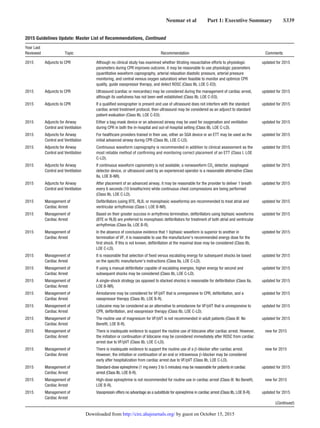
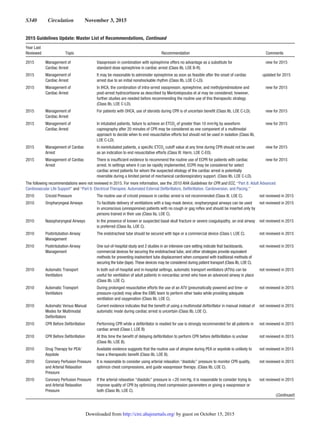
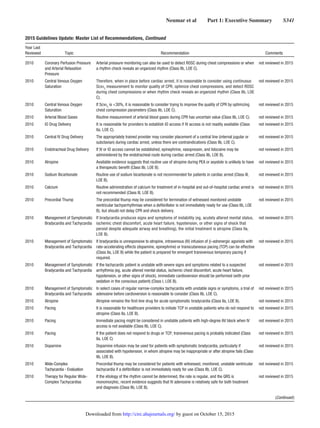
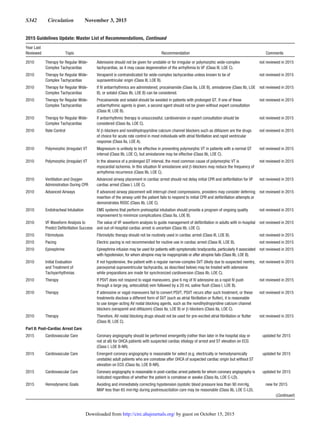
2015 AHA Guidelines
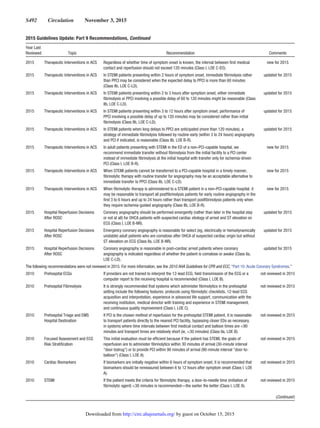
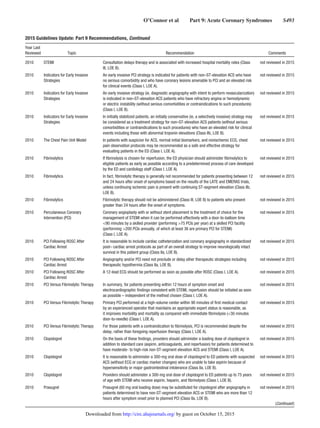
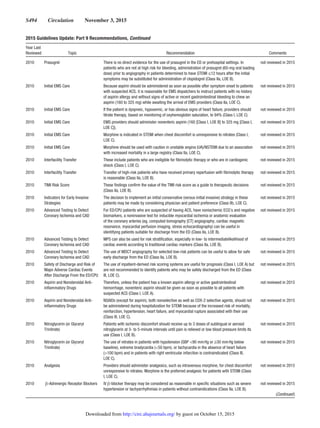
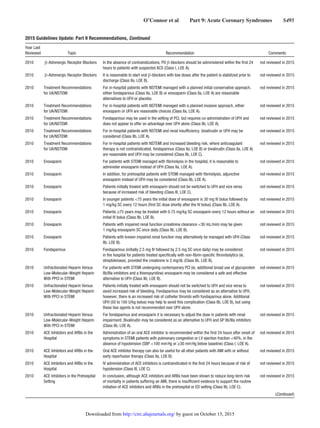
update for CPR and ECC
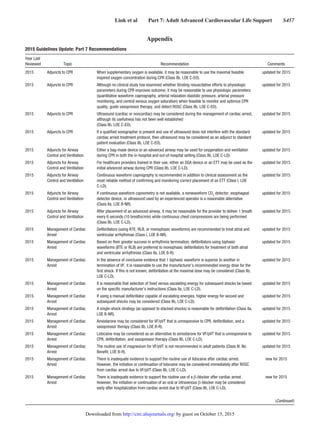
Circulation
Volume 132 ◼ Number 18 ◼ Supplement 2
November 3, 2015
2015AmericanHeartAssociationGuidelinesUpdateforCardiopulmonary
ResuscitationandEmergencyCardiovascularCare
Part 1: Executive Summary: 2015 American Heart Association Guidelines Update for Cardiopulmonary
Resuscitation and Emergency Cardiovascular Care
Robert W. Neumar, Chair; Michael Shuster; Clifton W. Callaway; Lana M. Gent; Dianne L. Atkins;
Farhan Bhanji; Steven C. Brooks; Allan R. de Caen; Michael W. Donnino; Jose Maria E. Ferrer;
Monica E. Kleinman; Steven L. Kronick; Eric J. Lavonas; Mark S. Link; Mary E. Mancini;
Laurie J. Morrison; Robert E. O’Connor; Ricardo A. Samson; Steven M. Schexnayder;
Eunice M. Singletary; Elizabeth H. Sinz; Andrew H. Travers; Myra H. Wyckoff; Mary Fran Hazinski
Part 2: Evidence Evaluation and Management of Conflicts of Interest: 2015 American Heart Association
Guidelines Update for Cardiopulmonary Resuscitation and Emergency Cardiovascular Care
Laurie J. Morrison, Chair; Lana M. Gent; Eddy Lang; Mark E. Nunnally; Melissa J. Parker;
Clifton W. Callaway; Vinay M. Nadkarni; Antonio R. Fernandez; John E. Billi;
Jonathan R. Egan; Russell E. Griffin; Michael Shuster; Mary Fran Hazinski
Part 3: Ethical Issues: 2015 American Heart Association Guidelines Update for Cardiopulmonary Resuscitation
and Emergency Cardiovascular Care
Mary E. Mancini, Chair; Douglas S. Diekema; Theresa A. Hoadley; Kelly D. Kadlec;
Marygrace H. Leveille; Jane E. McGowan; Michele M. Munkwitz; Ashish R. Panchal;
Michael R. Sayre; Elizabeth H. Sinz
Part 4: Systems of Care and Continuous Quality Improvement: 2015 American Heart Association Guidelines
Update for Cardiopulmonary Resuscitation and Emergency Cardiovascular Care
Steven L. Kronick, Chair; Michael C. Kurz; Steve Lin; Dana P. Edelson; Robert A. Berg;
John E. Billi; Jose G. Cabanas; David C. Cone; Deborah B. Diercks; James (Jim) Foster;
Reylon A. Meeks; Andrew H. Travers; Michelle Welsford
Part 5: Adult Basic Life Support and Cardiopulmonary Resuscitation Quality: 2015 American Heart
Association Guidelines Update for Cardiopulmonary Resuscitation and Emergency Cardiovascular Care
Monica E. Kleinman, Chair; Erin E. Brennan; Zachary D. Goldberger; Robert A. Swor;
Mark Terry; Bentley J. Bobrow; Raúl J. Gazmuri; Andrew H. Travers; Thomas Rea
Part 6: Alternative Techniques and Ancillary Devices for Cardiopulmonary Resuscitation: 2015 American
Heart Association Guidelines Update for Cardiopulmonary Resuscitation and Emergency Cardiovascular Care
Steven C. Brooks, Chair; Monique L. Anderson; Eric Bruder; Mohamud R. Daya; Alan Gaffney;
Charles W. Otto; Adam J. Singer; Ravi R. Thiagarajan; Andrew H. Travers
Part 7: Adult Advanced Cardiovascular Life Support: 2015 American Heart Association Guidelines Update for
Cardiopulmonary Resuscitation and Emergency Cardiovascular Care
Mark S. Link, Chair; Lauren C. Berkow; Peter J. Kudenchuk; Henry R. Halperin; Erik P. Hess;
Vivek K. Moitra; Robert W. Neumar; Brian J. O’Neil; James H. Paxton; Scott M. Silvers;
Roger D. White; Demetris Yannopoulos; Michael W. Donnino
Part 8: Post–Cardiac Arrest Care: 2015 American Heart Association Guidelines Update for
Cardiopulmonary Resuscitation and Emergency Cardiovascular Care
Clifton W. Callaway, Chair; Michael W. Donnino; Ericka L. Fink; Romergryko G. Geocadin;
Eyal Golan; Karl B. Kern; Marion Leary; William J. Meurer; Mary Ann Peberdy;
Trevonne M. Thompson; Janice L. Zimmerman
Part 9: Acute Coronary Syndromes: 2015 American Heart Association Guidelines Update for
Cardiopulmonary Resuscitation and Emergency Cardiovascular Care
Robert E. O’Connor, Chair; Abdulaziz S. Al Ali; William J. Brady; Chris A. Ghaemmaghami;
Venu Menon; Michelle Welsford; Michael Shuster
Part 10: Special Circumstances of Resuscitation: 2015 American Heart Association Guidelines
Update for Cardiopulmonary Resuscitation and Emergency Cardiovascular Care
Eric J. Lavonas, Chair; Ian R. Drennan; Andrea Gabrielli; Alan C. Heffner;
Christopher O. Hoyte; Aaron M. Orkin; Kelly N. Sawyer; Michael W. Donnino
Part 11: Pediatric Basic Life Support and Cardiopulmonary Resuscitation Quality: 2015 American Heart
Association Guidelines Update for Cardiopulmonary Resuscitation and Emergency Cardiovascular Care
Dianne L. Atkins, Chair; Stuart Berger; Jonathan P. Duff; John C. Gonzales; Elizabeth A. Hunt;
Benny L. Joyner; Peter A. Meaney; Dana E. Niles; Ricardo A. Samson; Stephen M. Schexnayder
Part 12: Pediatric Advanced Life Support: 2015 American Heart Association Guidelines Update for
Cardiopulmonary Resuscitation and Emergency Cardiovascular Care
Allan R. de Caen, Chair; Marc D. Berg; Leon Chameides; Cheryl K. Gooden;
Robert W. Hickey; Halden F. Scott; Robert M. Sutton; Janice A. Tijssen; Alexis Topjian;
Élise W. van der Jagt; Stephen M. Schexnayder; Ricardo A. Samson
Part 13: Neonatal Resuscitation: 2015 American Heart Association Guidelines Update for
Cardiopulmonary Resuscitation and Emergency Cardiovascular Care
Myra H. Wyckoff, Chair; Khalid Aziz; Marilyn B. Escobedo; Vishal S. Kapadia;
John Kattwinkel; Jeffrey M. Perlman; Wendy M. Simon; Gary M. Weiner; Jeanette G. Zaichkin
Part 14: Education: 2015 American Heart Association Guidelines Update for Cardiopulmonary
Resuscitation and Emergency Cardiovascular Care
Farhan Bhanji, Chair; Aaron J. Donoghue; Margaret S. Wolff; Gustavo E. Flores;
Louis P. Halamek; Jeffrey M. Berman; Elizabeth H. Sinz; Adam Cheng
2015 American Heart Association and American Red Cross Guidelines
Update for FirstAid
Part 15: First Aid: 2015 American Heart Association and American Red Cross Guidelines Update for First Aid
Eunice M. Singletary, Chair; Nathan P. Charlton; Jonathan L. Epstein; Jeffrey D. Ferguson;
Jan L. Jensen; Andrew I. MacPherson; Jeffrey L. Pellegrino; William “Will” R. Smith;
Janel M. Swain; Luis F. Lojero-Wheatley; David A. Zideman
S315
Introduction
Publication of the 2015 American Heart Association (AHA)
Guidelines Update for Cardiopulmonary Resuscitation (CPR)
and Emergency Cardiovascular Care (ECC) marks 49 years
since the first CPR guidelines were published in 1966 by an
Ad Hoc Committee on Cardiopulmonary Resuscitation estab-
lished by the National Academy of Sciences of the National
Research Council.1
Since that time, periodic revisions to the
Guidelines have been published by the AHA in 1974,2
1980,3
1986,4
1992,5
2000,6
2005,7
2010,8
and now 2015. The 2010
AHA Guidelines for CPR and ECC provided a comprehensive
review of evidence-based recommendations for resuscitation,
ECC, and first aid. The 2015 AHA Guidelines Update for CPR
and ECC focuses on topics with significant new science or
ongoing controversy, and so serves as an update to the 2010
AHA Guidelines for CPR and ECC rather than a complete
revision of the Guidelines.
The purpose of this Executive Summary is to provide an
overview of the new or revised recommendations contained in
the 2015 Guidelines Update. This document does not contain
extensive reference citations; the reader is referred to Parts 3
through 9 for more detailed review of the scientific evidence
and the recommendations on which they are based.
There have been several changes to the organization of
the 2015 Guidelines Update compared with 2010. “Part 4:
Systems of Care and Continuous Quality Improvement” is
an important new Part that focuses on the integrated struc-
tures and processes that are necessary to create systems of
care for both in-hospital and out-of-hospital resuscitation
capable of measuring and improving quality and patient out-
comes. This Part replaces the “CPR Overview” Part of the
2010 Guidelines.
Another new Part of the 2015 Guidelines Update is “Part
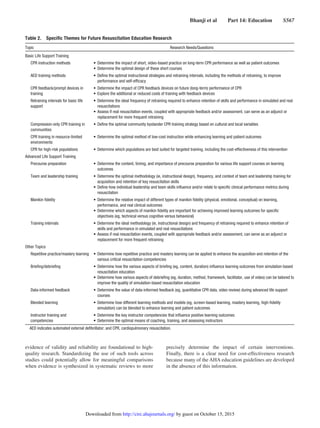
14: Education,” which focuses on evidence-based recommen-
dations to facilitate widespread, consistent, efficient and effec-
tive implementation of the AHA Guidelines for CPR and ECC
into practice. These recommendations will target resuscitation
education of both lay rescuers and healthcare providers. This
Part replaces the 2010 Part titled “Education, Implementation,
and Teams.” The 2015 Guidelines Update does not include a
separate Part on adult stroke because the content would rep-
licate that already offered in the most recent AHA/American
Stroke Association guidelines for the management of acute
stroke.9,10
Finally, the 2015 Guidelines Update marks the begin-
ning of a new era for the AHA Guidelines for CPR and ECC,
because the Guidelines will transition from a 5-year cycle of
periodic revisions and updates to a Web-based format that is
continuously updated. The first release of the Web-based inte-
grated Guidelines, now available online at ECCguidelines.
heart.org is based on the comprehensive 2010 Guidelines
plus the 2015 Guidelines Update. Moving forward, these
Guidelines will be updated by using a continuous evidence
evaluation process to facilitate more rapid translation of new
scientific discoveries into daily patient care.
Creation of practice guidelines is only 1 link in the chain
of knowledge translation that starts with laboratory and clini-
cal science and culminates in improved patient outcomes. The
AHA ECC Committee has set an impact goal of doubling
bystander CPR rates and doubling cardiac arrest survival by
2020. Much work will be needed across the entire spectrum of
knowledge translation to reach this important goal.
Evidence Review and Guidelines
Development Process
The process used to generate the 2015 AHA Guidelines
Update for CPR and ECC was significantly different from the
process used in prior releases of the Guidelines, and marks
the planned transition from a 5-year cycle of evidence review
to a continuous evidence evaluation process. The AHA con-
tinues to partner with the International Liaison Committee
on Resuscitation (ILCOR) in the evidence review process.
However, for 2015, ILCOR prioritized topics for systematic
review based on clinical significance and availability of new
© 2015 American Heart Association, Inc.
Circulation is available at http://circ.ahajournals.org DOI: 10.1161/CIR.0000000000000252
The American Heart Association requests that this document be cited as follows: Neumar RW, Shuster M, Callaway CW, Gent LM, Atkins DL, Bhanji
F, Brooks SC, de Caen AR, Donnino MW, Ferrer JME, Kleinman ME, Kronick SL, Lavonas EJ, Link MS, Mancini ME, Morrison LJ, O’Connor RE,
Sampson RA, Schexnayder SM, Singletary EM, Sinz EH, Travers AH, Wyckoff MH, Hazinski MF. Part 1: executive summary: 2015 American Heart
Association Guidelines Update for Cardiopulmonary Resuscitation and Emergency Cardiovascular Care. Circulation. 2015;132(suppl 2):S315–S367.
(Circulation. 2015;132[suppl 2]:S315–S367. DOI: 10.1161/CIR.0000000000000252.)
Part 1: Executive Summary
2015 American Heart Association Guidelines Update for Cardiopulmonary
Resuscitation and Emergency Cardiovascular Care
Robert W. Neumar, Chair; Michael Shuster; Clifton W. Callaway; Lana M. Gent; Dianne L. Atkins;
Farhan Bhanji; Steven C. Brooks; Allan R. de Caen; Michael W. Donnino; Jose Maria E. Ferrer;
Monica E. Kleinman; Steven L. Kronick; Eric J. Lavonas; Mark S. Link; Mary E. Mancini;
Laurie J. Morrison; Robert E. O’Connor; Ricardo A. Samson; Steven M. Schexnayder;
Eunice M. Singletary; Elizabeth H. Sinz; Andrew H. Travers; Myra H. Wyckoff; Mary Fran Hazinski
by guest on October 15, 2015http://circ.ahajournals.org/Downloaded from
S316  Circulation  November 3, 2015
evidence. Each priority topic was defined as a question in
PICO (population, intervention, comparator, outcome) format.
Many of the topics reviewed in 2010 did not have new pub-
lished evidence or controversial aspects, so they were not rere-
viewed in 2015. In 2015, 165 PICO questions were addressed
by systematic reviews, whereas in 2010, 274 PICO questions
were addressed by evidence evaluation. In addition, ILCOR
adopted the Grading of Recommendations Assessment,
Development, and Evaluation (GRADE) process for evidence
evaluation and expanded the opportunity for public comment.
The output of the GRADE process was used to generate the
2015 International Consensus on CPR and ECC Science With
Treatment Recommendations (CoSTR).11,12
The recommendations of the ILCOR 2015 CoSTR
were used to inform the recommendations in the 2015 AHA
Guidelines Update for CPR and ECC. The wording of these
recommendations is based on the AHA classification system
for evidentiary review (see “Part 2: Evidence Evaluation and
Management of Conflicts of Interest”).
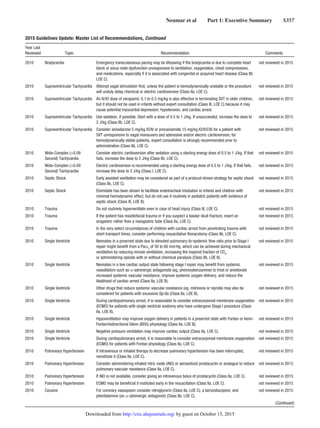
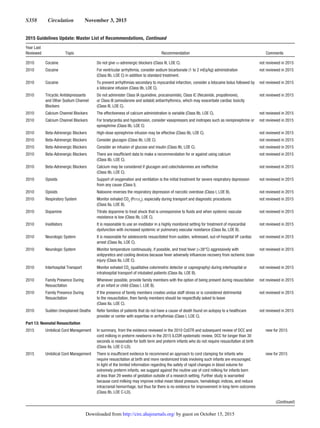
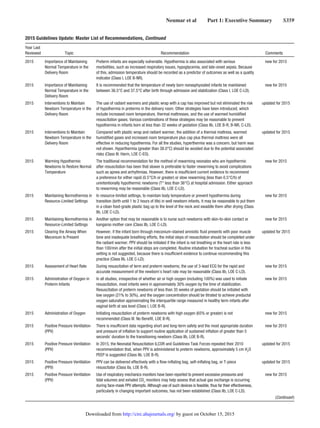
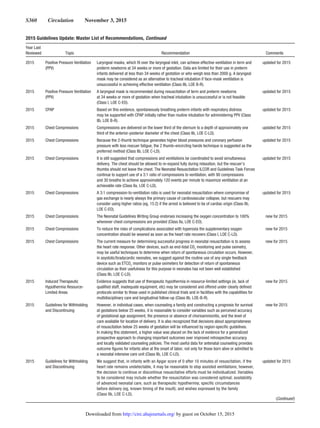
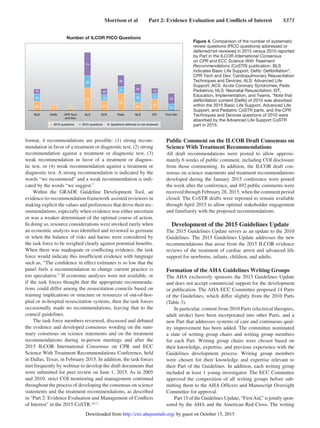
The 2015 AHA Guidelines Update for CPR and ECC con-
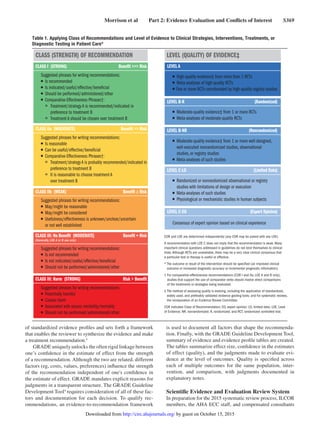
tains 315 classified recommendations. There are 78 Class I rec-
ommendations (25%), 217 Class II recommendations (68%), and
20 Class III recommendations (7%). Overall, 3 (1%) are based
on Level of Evidence (LOE)A, 50 (15%) are based on LOE B-R
(randomized studies), 46 (15%) are based on LOE B-NR (non-
randomized studies), 145 (46%) are based on LOE C-LD (lim-
ited data), and 73 (23%) are based on LOE C-EO (consensus of
expert opinion). These results highlight the persistent knowledge
gap in resuscitation science that needs to be addressed through
expanded research initiatives and funding opportunities.
As noted above, the transition from a 5-year cycle to a
continuous evidence evaluation and Guidelines update process
will be initiated by the 2015 online publication of the AHA
Integrated Guidelines for CPR and ECC at ECCguidelines.
heart.org. The initial content will be a compilation of the 2010
Guidelines and the 2015 Guidelines Update. In the future, the
Scientific Evidence Evaluation and Review System (SEERS)
Web-based resource will also be periodically updated with
results of the ILCOR continuous evidence evaluation process
at www.ilcor.org/seers.
Part 3: Ethical Issues
As resuscitation practice evolves, ethical considerations must
also evolve. Managing the multiple decisions associated with
resuscitation is challenging from many perspectives, espe-
cially when healthcare providers are dealing with the ethics
surrounding decisions to provide or withhold emergency car-
diovascular interventions.
Ethical issues surrounding resuscitation are complex and
vary across settings (in or out of hospital), providers (basic or
advanced), patient population (neonatal, pediatric, or adult),
and whether to start or when to terminate CPR. Although the
ethical principles involved have not changed dramatically
since the 2010 Guidelines were published, the data that inform
many ethical discussions have been updated through the evi-
dence review process. The 2015 ILCOR evidence review pro-
cess and resultant 2015 Guidelines Update include several
recommendations that have implications for ethical decision
making in these challenging areas.
Significant New and Updated Recommendations
That May Inform Ethical Decisions
•	 The use of extracorporeal CPR (ECPR) for cardiac arrest
•	 Intra-arrest prognostic factors for infants, children, and
adults
•	 Prognostication for newborns, infants, children, and
adults after cardiac arrest
•	 Function of transplanted organs recovered after cardiac
arrest
New resuscitation strategies, such as ECPR, have made the
decisiontodiscontinuecardiacarrestmeasuresmorecomplicated
(see “Part 6: Alternative Techniques and Ancillary Devices for
Cardiopulmonary Resuscitation” and “Part 7: Adult Advanced
Cardiovascular Life Support”). Understanding the appropriate
use, implications, and likely benefits related to such new treat-
ments will have an impact on decision making. There is new
information regarding prognostication for newborns, infants,
children, and adults with cardiac arrest and/or after cardiac
arrest (see “Part 13: Neonatal Resuscitation,” “Part 12: Pediatric
Advanced Life Support,” and “Part 8: Post–Cardiac Arrest
Care”). The increased use of targeted temperature management
has led to new challenges for predicting neurologic outcomes in
comatose post–cardiac arrest patients, and the latest data about
the accuracy of particular tests and studies should be used to
guide decisions about goals of care and limiting interventions.
With new information about the success rate for trans-
planted organs obtained from victims of cardiac arrest, there is
ongoing discussion about the ethical implications around organ
donation in an emergency setting. Some of the different view-
points on important ethical concerns are summarized in “Part 3:
Ethical Issues.” There is also an enhanced awareness that
although children and adolescents cannot make legally bind-
ing decisions, information should be shared with them to the
extent possible, using appropriate language and information for
their level of development. Finally, the phrase “limitations of
care” has been changed to “limitations of interventions,” and
there is increasing availability of the Physician Orders for Life-
Sustaining Treatment (POLST) form, a new method of legally
identifying people who wish to have specific limits on interven-
tions at the end of life, both in and out of healthcare facilities.
Part 4: Systems of Care and
Continuous Quality Improvement
Almost all aspects of resuscitation, from recognition of cardio-
pulmonary compromise, through cardiac arrest and resuscita-
tion and post–cardiac arrest care, to the return to productive
life, can be discussed in terms of a system or systems of care.
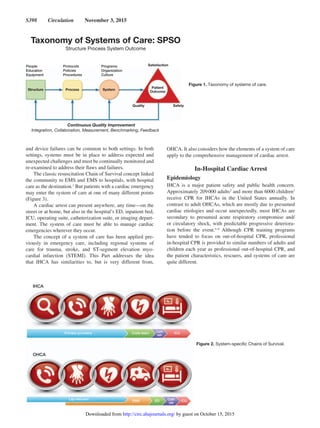
Systems of care consist of multiple working parts that are
interdependent, each having an effect on every other aspect of
the care within that system. To bring about any improvement,
providers must recognize the interdependency of the various
parts of the system. There is also increasing recognition that
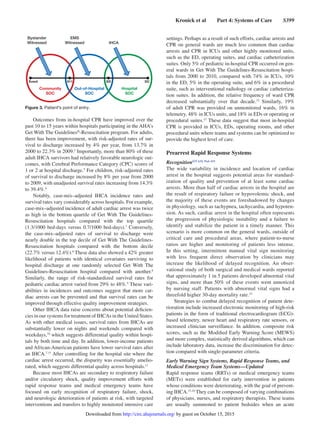
out-of-hospital cardiac arrest (OHCA) and in-hospital cardiac
arrest (IHCA) systems of care must function differently. “Part
4: Systems of Care and Continuous Quality Improvement”
in this 2015 Guidelines Update makes a clear distinction
between the two systems, noting that OHCA frequently is the
result of an unexpected event with a reactive element, whereas
by guest on October 15, 2015http://circ.ahajournals.org/Downloaded from
Neumar et al   Part 1: Executive Summary   S317
the focus on IHCA is shifting from reactive resuscitation to
prevention. New Chains of Survival are suggested for in-
hospital and out-of-hospital systems of care, with relatively
recent in-hospital focus on prevention of arrests. Additional
emphasis should be on continuous quality improvement by
identifying the problem that is limiting survival, and then by
setting goals, measuring progress toward those goals, creating
accountability, and having a method to effect change in order
to improve outcomes.
This new Part of the AHA Guidelines for CPR and ECC
summarizes the evidence reviewed in 2015 with a focus on
the systems of care for both IHCA and OHCA, and it lays
the framework for future efforts to improve these systems of
care. A universal taxonomy of systems of care is proposed for
stakeholders. There are evidence-based recommendations on
how to improve these systems.
Significant New and Updated Recommendations
In a randomized trial, social media was used by dispatch-
ers to notify nearby potential rescuers of a possible cardiac
arrest. Although few patients ultimately received CPR from
volunteers dispatched by the notification system, there was a
higher rate of bystander-initiated CPR (62% versus 48% in
the control group).13
Given the low risk of harm and the poten-
tial benefit of such notifications, municipalities could consider
incorporating these technologies into their OHCA system of
care. It may be reasonable for communities to incorporate,
where available, social media technologies that summon res-
cuers who are willing and able to perform CPR and are in
close proximity to a suspected victim of OHCA (Class IIb,
LOE B-R).
Specialized cardiac arrest centers can provide comprehen-
sive care to patients after resuscitation from cardiac arrest.
These specialized centers have been proposed, and new evi-
dence suggests that a regionalized approach to OHCA resus-
citation may be considered that includes the use of cardiac
resuscitation centers.
A variety of early warning scores are available to help
identify adult and pediatric patients at risk for deterioration.
Medical emergency teams or rapid response teams have been
developed to help respond to patients who are deteriorating.
Use of scoring systems to identify these patients and creation
of teams to respond to those scores or other indicators of
deterioration may be considered, particularly on general care
wards for adults and for children with high-risk illnesses, and
may help reduce the incidence of cardiac arrest.
Evidence regarding the use of public access defibrillation
was reviewed, and the use of automated external defibril-
lators (AEDs) by laypersons continues to improve survival
from OHCA. We continue to recommend implementation
of public access defibrillation programs for treatment of
patients with OHCA in communities who have persons at
risk for cardiac arrest.
Knowledge Gaps
•	 What is the optimal model for rapid response teams in
the prevention of IHCA, and is there evidence that rapid
response teams improve outcomes?
•	 What are the most effective methods for increasing
bystander CPR for OHCA?
•	 What is the best composition for a team that responds
to IHCA, and what is the most appropriate training for
that team?
Part 5: Adult Basic Life Support and
Cardiopulmonary Resuscitation Quality
New Developments in Basic Life Support Science
Since 2010
The 2010 Guidelines were most notable for the reorientation
of the universal sequence from A-B-C (Airway, Breathing,
Compressions) to C-A-B (Compressions,Airway, Breathing) to
minimize time to initiation of chest compressions. Since 2010,
the importance of high-quality chest compressions has been
reemphasized, and targets for compression rate and depth have
been further refined by relevant evidence. For the untrained lay
rescuer, dispatchers play a key role in the recognition of abnor-
mal breathing or agonal gasps as signs of cardiac arrest, with
recommendations for chest compression–only CPR.
This section presents the updated recommendations for
the 2015 adult basic life support (BLS) guidelines for lay res-
cuers and healthcare providers. Key changes and continued
points of emphasis in this 2015 Guidelines Update include the
following: The crucial links in the adult Chain of Survival for
OHCA are unchanged from 2010; however, there is increased
emphasis on the rapid identification of potential cardiac arrest
by dispatchers, with immediate provision of CPR instructions
to the caller. These Guidelines take into consideration the ubiq-
uitous presence of mobile phones that can allow the rescuer to
activate the emergency response system without leaving the
victim’s side. For healthcare providers, these recommenda-
tions allow flexibility for activation of the emergency response
to better match the provider’s clinical setting. More data are
available indicating that high-quality CPR improves survival
from cardiac arrest. Components of high-quality CPR include
•	 Ensuring chest compressions of adequate rate
•	 Ensuring chest compressions of adequate depth
•	 Allowing full chest recoil between compressions
•	 Minimizing interruptions in chest compressions
•	 Avoiding excessive ventilation
Recommendations are made for a simultaneous, choreo-
graphed approach to performance of chest compressions,
airway management, rescue breathing, rhythm detection, and
shock delivery (if indicated) by an integrated team of highly
trained rescuers in applicable settings.
Significant New and Updated Recommendations
Many studies have documented that the most common errors of
resuscitation are inadequate compression rate and depth; both
errors may reduce survival. New to this 2015 Guidelines Update
are upper limits of recommended compression rate based on pre-
liminary data suggesting that excessive rate may be associated
with lower rate of return of spontaneous circulation (ROSC). In
addition, an upper limit of compression depth is introduced
by guest on October 15, 2015http://circ.ahajournals.org/Downloaded from
S318  Circulation  November 3, 2015
based on a report associating increased non–life-threatening
injuries with excessive compression depth.
•	 In adult victims of cardiac arrest, it is reasonable for
rescuers to perform chest compressions at a rate of 100
to 120/min (Class IIa, LOE C-LD). The addition of an
upper limit of compression rate is the result of 1 large
registry study associating extremely rapid compression
rates with inadequate compression depth.
•	 During manual CPR, rescuers should perform chest
compressions at a depth of at least 2 inches or 5 cm for
an average adult, while avoiding excessive chest com-
pression depths (greater than 2.4 inches [6 cm]) (Class
I, LOE C-LD). The addition of an upper limit of com-
pression depth followed review of 1 publication suggest-
ing potential harm from excessive chest compression
depth (greater than 6 cm, or 2.4 inches). Compression
depth may be difficult to judge without use of feedback
devices, and identification of upper limits of compres-
sion depth may be challenging.
•	 In adult cardiac arrest, total preshock and postshock
pauses in chest compressions should be as short as pos-
sible (Class I, LOE C-LD) because shorter pauses can
be associated with greater shock success, ROSC, and, in
some studies, higher survival to hospital discharge. The
need to reduce such pauses has received greater empha-
sis in this 2015 Guidelines Update.
•	 In adult cardiac arrest with an unprotected airway, it may
be reasonable to perform CPR with the goal of a chest
compression fraction as high as possible, with a target of
at least 60% (Class IIb, LOE C-LD). The addition of this
target compression fraction to the 2015 Guidelines Update
is intended to limit interruptions in compressions and to
maximize coronary perfusion and blood flow during CPR.
•	 For patients with known or suspected opioid addic-
tion who have a definite pulse but no normal breathing
or only gasping (ie, a respiratory arrest), in addition to
providing standard BLS care, it is reasonable for appro-
priately trained BLS providers to administer intramus-
cular or intranasal naloxone (Class IIa, LOE C-LD). It is
reasonable to provide opioid overdose response educa-
tion with or without naloxone distribution to persons at
risk for opioid overdose in any setting (Class IIa, LOE
C-LD). For more information, see “Part 10: Special
Circumstances of Resuscitation.”
•	 For witnessed OHCA with a shockable rhythm, it may
be reasonable for emergency medical service (EMS)
systems with priority-based, multi-tiered response to
delay positive-pressure ventilation by using a strategy
of up to 3 cycles of 200 continuous compressions with
passive oxygen insufflation and airway adjuncts (Class
IIb, LOE C-LD).
•	 We do not recommend the routine use of passive ven-
tilation techniques during conventional CPR for adults,
because the usefulness/effectiveness of these techniques
is unknown (Class IIb, LOE C-EO). However, in EMS
systems that use bundles of care involving continuous
chest compressions, the use of passive ventilation tech-
niques may be considered as part of that bundle (Class
IIb, LOE C-LD).
•	 It is recommended that emergency dispatchers deter-
mine if a patient is unconscious with abnormal breathing
after acquiring the requisite information to determine the
location of the event (Class I, LOE C-LD).
•	 If the patient is unconscious with abnormal or absent
breathing, it is reasonable for the emergency dispatcher
to assume that the patient is in cardiac arrest (Class IIa,
LOE C-LD).
•	 Dispatchers should be educated to identify unconscious-
ness with abnormal and agonal gasps across a range of clin-
ical presentations and descriptions (Class I, LOE C-LD).
•	 We recommend that dispatchers should provide chest
compression–only CPR instructions to callers for adults
with suspected OHCA (Class I, LOE C-LD).
•	 It is reasonable for healthcare providers to provide chest
compressionsandventilationforalladultpatientsincardiac
arrest, from either a cardiac or a noncardiac cause (Class
IIb, LOE C-LD). When the victim has an advanced airway
in place during CPR, rescuers no longer deliver cycles of
30 compressions and 2 breaths (ie, they no longer interrupt
compressions to deliver 2 breaths). Instead, it may be rea-
sonable for the provider to deliver 1 breath every 6 seconds
(10 breaths per minute) while continuous chest compres-
sions are being performed (Class IIb, LOE C-LD). When
the victim has an advanced airway in place during CPR,
it may be reasonable for the provider to deliver 1 breath
every 6 seconds (10 breaths per minute) while continuous
chest compressions are being performed (Class IIb, LOE
C-LD). This simple rate, rather than a range of breaths per
minute, should be easier to learn, remember, and perform.
•	 There is insufficient evidence to recommend the use of
artifact-filtering algorithms for analysis of electrocardio-
graphic (ECG) rhythm during CPR. Their use may be con-
sidered as part of a research program or if an EMS system
has already incorporated ECG artifact-filtering algorithms
in its resuscitation protocols (Class IIb, LOE C-EO).
•	 It may be reasonable to use audiovisual feedback devices
during CPR for real-time optimization of CPR perfor-
mance (Class IIb, LOE B-R).
•	 For victims with suspected spinal injury, rescuers should
initially use manual spinal motion restriction (eg, plac-
ing 1 hand on either side of the patient’s head to hold it
still) rather than immobilization devices, because use of
immobilization devices by lay rescuers may be harmful
(Class III: Harm, LOE C-LD).
Knowledge Gaps
•	 The optimal method for ensuring adequate depth of
chest compressions during manual CPR
•	 The duration of chest compressions after which venti-
lation should be incorporated when using Hands-Only
CPR
•	 The optimal chest compression fraction
•	 Optimal use of CPR feedback devices to increase patient
survival
Part 6: Alternative Techniques and Ancillary
Devices for Cardiopulmonary Resuscitation
High-quality conventional CPR (manual chest compressions
with rescue breaths) generates about 25% to 33% of normal
cardiac output and oxygen delivery. A variety of alternatives
by guest on October 15, 2015http://circ.ahajournals.org/Downloaded from
Neumar et al   Part 1: Executive Summary   S319
and adjuncts to conventional CPR have been developed with
the aim of enhancing coronary and cerebral perfusion during
resuscitation from cardiac arrest. Since the 2010 Guidelines
were published, a number of clinical trials have provided
new data regarding the effectiveness of these alternatives.
Compared with conventional CPR, many of these techniques
and devices require specialized equipment and training. Some
have been tested in only highly selected subgroups of cardiac
arrest patients; this selection must be noted when rescuers or
healthcare systems consider implementation of the devices.
Significant New and Updated Recommendations
•	 The Resuscitation Outcomes Consortium (ROC)
Prehospital Resuscitation Impedance Valve and Early
Versus Delayed Analysis (PRIMED) study (n=8718)14
failed to demonstrate improved outcomes with the use of
an impedance threshold device (ITD) as an adjunct to con-
ventional CPR when compared with use of a sham device.
This negative high-quality study prompted a Class III: No
Benefit recommendation regarding routine use of the ITD.
•	 One large randomized controlled trial evaluated the use of
active compression-decompression CPR plus an ITD.15
The
writing group found interpretation of the true clinical effect
of active compression-decompression CPR plus an ITD
challenging because of wide confidence intervals around
the effect estimate and also because of methodological con-
cerns. The finding of improved neurologically intact sur-
vival in the study, however, supported a recommendation
that this combination may be a reasonable alternative with
available equipment and properly trained providers.
•	 Three randomized clinical trials comparing the use of
mechanical chest compression devices with conventional
CPR have been published since the 2010 Guidelines.
None of these studies demonstrated superiority of
mechanical chest compressions over conventional CPR.
Manual chest compressions remain the standard of care
for the treatment of cardiac arrest, but mechanical chest
compression devices may be a reasonable alternative
for use by properly trained personnel. The use of the
mechanical chest compression devices may be consid-
ered in specific settings where the delivery of high-quality
manual compressions may be challenging or dangerous
for the provider (eg, prolonged CPR during hypothermic
cardiac arrest, CPR in a moving ambulance, CPR in the
angiography suite, CPR during preparation for ECPR),
provided that rescuers strictly limit interruptions in CPR
during deployment and removal of the device (Class IIb,
LOE C-EO).
•	 Although several observational studies have been pub-
lished documenting the use of ECPR, no randomized
controlled trials have evaluated the effect of this therapy
on survival.
Knowledge Gaps
•	 Are mechanical chest compression devices superior to
manual chest compressions in special situations such
as a moving ambulance, prolonged CPR, or procedures
such as coronary angiography?
•	 What is the impact of implementing ECPR as part of the
system of care for OHCA?
Part 7: Adult Advanced
Cardiovascular Life Support
The major changes in the 2015 advanced cardiovascular life
support (ACLS) guidelines include recommendations regard-
ing prognostication during CPR based on end-tidal carbon
dioxide measurements, use of vasopressin during resuscita-
tion, timing of epinephrine administration stratified by shock-
able or nonshockable rhythms, and the possibility of bundling
steroids, vasopressin, and epinephrine administration for
treatment of IHCA. In addition, vasopressin has been removed
from the pulseless arrest algorithm. Recommendations regard-
ing physiologic monitoring of CPR were reviewed, although
there is little new evidence.
Significant New and Updated Recommendations
•	 Based on new data, the recommendation for use of
the maximal feasible inspired oxygen during CPR
was strengthened. This recommendation applies only
while CPR is ongoing and does not apply to care after
ROSC.
•	 The new 2015 Guidelines Update continues to state
that physiologic monitoring during CPR may be use-
ful, but there has yet to be a clinical trial demonstrating
that goal-directed CPR based on physiologic parameters
improves outcomes.
•	 Recommendations for ultrasound use during cardiac
arrest are largely unchanged, except for the explicit pro-
viso that the use of ultrasound should not interfere with
provision of high-quality CPR and conventional ACLS
therapy.
•	 Continuous waveform capnography remained a Class I
recommendation for confirming placement of an endo-
tracheal tube. Ultrasound was added as an additional
method for confirmation of endotracheal tube placement.
•	 The defibrillation strategies addressed by the 2015
ILCOR review resulted in minimal changes in defibrilla-
tion recommendations.
•	 The Class of Recommendation for use of standard dose
epinephrine (1 mg every 3 to 5 minutes) was unchanged
but reinforced by a single new prospective randomized
clinical trial demonstrating improved ROSC and survival
to hospital admission that was inadequately powered to
measure impact on long-term outcomes.
•	 Vasopressin was removed from the ACLS Cardiac Arrest
Algorithm as a vasopressor therapy in recognition of
equivalence of effect with other available interventions
(eg, epinephrine). This modification valued the simplic-
ity of approach toward cardiac arrest when 2 therapies
were found to be equivalent.
•	 The recommendations for timing of epinephrine admin-
istration were updated and stratified based on the initial
presenting rhythm, recognizing the potential difference in
pathophysiologic disease. For those with a nonshockable
rhythm, it may be reasonable to administer epinephrine
as soon as feasible. For those with a shockable rhythm,
there is insufficient evidence to make a recommendation
by guest on October 15, 2015http://circ.ahajournals.org/Downloaded from
S320  Circulation  November 3, 2015
about the optimal timing of epinephrine administration,
because defibrillation is a major focus of resuscitation.
•	 The use of steroids in cardiac arrest is controversial. In
OHCA, administration of steroids did not improve sur-
vival to hospital discharge in 2 studies, and routine use
is of uncertain benefit. The data regarding the use of
steroids for IHCA were more vexing. In 2 randomized
controlled trials led by the same investigators, a phar-
macologic bundle that included methylprednisolone,
vasopressin, and epinephrine administered during car-
diac arrest followed by hydrocortisone given after ROSC
improved survival. Whether the improved survival was a
result of the bundle or of the steroid therapy alone could
not be assessed. As a result of this study, in IHCA, the
combination of intra-arrest vasopressin, epinephrine,
and methylprednisolone and postarrest hydrocortisone
as described by Mentzelopoulos et al16
may be consid-
ered; however, further studies are needed before the rou-
tine use of this therapeutic strategy can be recommended
(Class IIb, LOE C-LD).
•	 Prognostication during CPR was also a very active topic.
There were reasonably good data indicating that low
partial pressure of end-tidal carbon dioxide (Petco2
) in
intubated patients after 20 minutes of CPR is strongly
associated with failure of resuscitation. Importantly, this
parameter should not be used in isolation and should not
be used in nonintubated patients.
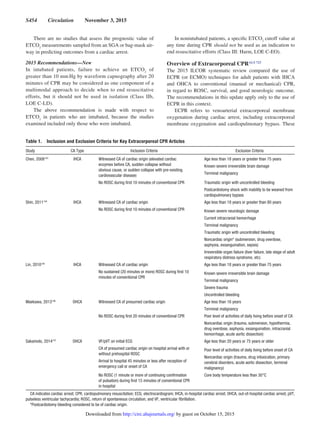
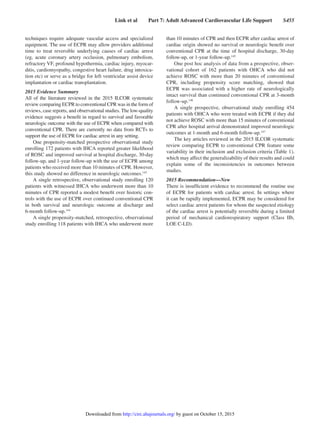
•	 ECPR, also known as venoarterial extracorporeal mem-
brane oxygenation, may be considered as an alternative
to conventional CPR for select patients with refractory
cardiac arrest when the suspected etiology of the cardiac
arrest is potentially reversible during a limited period of
mechanical cardiorespiratory support.
Knowledge Gaps
•	 More knowledge is needed about the impact on survival
and neurologic outcome when physiologic targets and
ultrasound are used to guide resuscitation during cardiac
arrest.
•	 The dose-response curve for defibrillation of shockable
rhythms is unknown, and the initial shock energy, subse-
quent shock energies, and maximum shock energies for
each waveform are unknown.
•	 More information is needed to identify the ideal current
delivery to the myocardium that will result in defibril-
lation, and the optimal way to deliver it. The selected
energy is a poor comparator for assessing different wave-
forms, because impedance compensation and subtleties
in waveform shape result in a different transmyocardial
current among devices at any given selected energy.
•	 Is a hands-on defibrillation strategy with ongoing chest
compressions superior to current hands-off strategies
with pauses for defibrillation?
•	 What is the dose-response effect of epinephrine during
cardiac arrest?
•	 The efficacy of bundled treatments, such as epineph-
rine, vasopressin, and steroids, should be evaluated, and
further studies are warranted as to whether the bundle
with synergistic effects or a single agent is related to any
observed treatment effect.
•	 There are no randomized trials for any antiarrhythmic
drug as a second-line agent for refractory ventricular
fibrillation/pulseless ventricular tachycardia, and there
are no trials evaluating the initiation or continuation of
antiarrhythmics in the post–cardiac arrest period.
•	 Controlled clinical trials are needed to assess the clini-
cal benefits of ECPR versus traditional CPR for patients
with refractory cardiac arrest and to determine which
populations would most benefit.
When ROSC is not rapidly achieved after cardiac arrest,
several options exist to provide prolonged circulatory support.
These options include mechanical CPR devices, and use of
endovascular ventricular assist devices, intra-aortic balloon
counterpulsation, and ECPR have all been described. The role
of these modalities, alone or in combination, is not well under-
stood. (For additional information, see “Part 6: Alternative
Techniques and Ancillary Devices for Cardiopulmonary
Resuscitation.”)
Part 8: Post–Cardiac Arrest Care
Post–cardiac arrest care research has advanced significantly
over the past decade. Multiple studies and trials detail the het-
erogeneity of patients and the spectrum of pathophysiology
after cardiac arrest. Post–cardiac arrest care should be titrated
based on arrest etiology, comorbid disease, and illness severity.
Thus, the 2015 Guidelines Update integrates available data to
help experienced clinicians make the complex set of therapeutic
decisions required for these patients. The central principles of
postarrest care are (1) to identify and treat the underlying etiol-
ogy of the cardiac arrest, (2) to mitigate ischemia-reperfusion
injury and prevent secondary organ injury, and (3) to make
accurate estimates of prognosis to guide the clinical team and to
inform the family when selecting goals of continued care.
New Developments
Early coronary angiography and coronary intervention are
recommended for patients with ST elevation as well as for
patients without ST elevation, when an acute coronary event
is suspected. The decision to perform coronary angiography
should not include consideration of neurologic status, because
of the unreliability of early prognostic signs. Targeted temper-
ature management is still recommended for at least 24 hours
in comatose patients after cardiac arrest, but clinicians may
choose a target temperature from the wider range of 32°C to
36°C. Estimating the prognosis of patients after cardiac arrest
is best accomplished by using multiple modalities of testing:
clinical examination, neurophysiological testing, and imaging.
Significant New and Updated Recommendations
One of the most common causes of cardiac arrest outside of
the hospital is acute coronary occlusion. Quickly identifying
and treating this cause is associated with better survival and
better functional recovery. Therefore, coronary angiography
should be performed emergently (rather than later in the hos-
pital stay or not at all) for OHCA patients with suspected car-
diac etiology of arrest and ST elevation on ECG. Emergency
coronary angiography is reasonable for select (eg, electrically
or hemodynamically unstable) adults who are without ST
by guest on October 15, 2015http://circ.ahajournals.org/Downloaded from
Neumar et al   Part 1: Executive Summary   S321
elevation on ECG but are comatose after OHCA of suspected
cardiac origin. Emergency coronary angiography is also rea-
sonable for post–cardiac arrest patients for whom coronary
angiography is indicated, regardless of whether the patient is
comatose or awake.
•	 A high-quality randomized controlled trial did not
identify any superiority of targeted temperature man-
agement at 36°C compared with management at 33°C.
Excellent outcomes are possible when patients are
actively managed at either temperature. All comatose
(ie, lack of meaningful response to verbal commands)
adult patients with ROSC after cardiac arrest should
have targeted temperature management, with provid-
ers selecting and maintaining a constant temperature
between 32°C and 36°C for at least 24 hours after
achieving target temperature. It is also reasonable to
actively prevent fever in comatose patients after tar-
geted temperature management.
•	 Multiple randomized controlled trials tested prehospital
infusion of cold intravenous fluids to initiate hypother-
mia after OHCA. The absence of any benefit and the
presence of some complications in these trials led to a
recommendation against the routine prehospital cooling
of patients after ROSC by using rapid infusion of cold
saline. However, this recommendation does not preclude
the use of cold intravenous fluids in more controlled or
more selected settings and did not address other methods
of inducing hypothermia.
•	 Specific management of patients during postresuscitation
intensive care includes avoiding and immediately correct-
ing hypotension and hypoxemia. It is reasonable to use
the highest available oxygen concentration until the arte-
rial oxyhemoglobin saturation or the partial pressure of
arterial oxygen can be measured. However, the benefits
of any specific target ranges for blood pressure, ventilator
management, or glucose management are uncertain.
•	 Multiple studies examined methods to determine prog-
nosis in patients after cardiac arrest, and the use of mul-
tiple modalities of testing is recommended. The earliest
time to prognosticate a poor neurologic outcome by
using clinical examination in patients not treated with
targeted temperature management is 72 hours after
ROSC, but this time can be even longer after cardiac
arrest if the residual effect of sedation or paralysis is sus-
pected to confound the clinical examination. In patients
treated with targeted temperature management, where
sedation or paralysis could confound clinical examina-
tion, it is reasonable to wait until 72 hours after return to
normothermia.
•	 Useful clinical findings that are associated with poor
neurologic outcome include
–– The absence of pupillary reflex to light at ≥72 hours
after cardiac arrest
–– The presence of status myoclonus during the first 72
hours after cardiac arrest
–– The absence of the N20 somatosensory evoked poten-
tial cortical wave 24 to 72 hours after cardiac arrest or
after rewarming
–– The presence of a marked reduction of the gray-white
ratio on brain computed tomography obtained within
2 hours after cardiac arrest
–– Extensive restriction of diffusion on brain magnetic
resonance imaging at 2 to 6 days after cardiac arrest
–– Persistent absence of electroencephalographic reactiv-
ity to external stimuli at 72 hours after cardiac arrest
–– Persistent burst suppression or intractable status
­epilepticus on electroencephalogram after rewarming
–– Note: Absent motor movements, extensor posturing
or myoclonus should not be used alone for predicting
outcome.
•	 All patients who are resuscitated from cardiac arrest
but who subsequently progress to death or brain death
should be evaluated as potential organ donors. Patients
who do not have ROSC after resuscitation efforts also
may be considered candidates as kidney or liver donors
in settings where programs exist.
Knowledge Gaps
•	 Which post–cardiac arrest patients without ST eleva-
tion are most likely to benefit from early coronary
angiography?
•	 What are the optimal goals for blood pressure, ventila-
tion, and oxygenation in specific groups of post–cardiac
arrest patients?
•	 What are the optimal duration, timing, and methods for
targeted temperature management?
•	 Will particular subgroups of patients benefit from man-
agement at specific temperatures?
•	 What strategies can be used to prevent or treat post–
cardiac arrest cerebral edema and malignant electroen-
cephalographic patterns (seizures, status myoclonus)?
•	 What is the most reliable strategy for prognostication of
futility in comatose post–cardiac arrest survivors?
Part 9: Acute Coronary Syndromes
The 2015 Guidelines Update newly limits recommendations
for the evaluation and management of acute coronary syndromes
(ACS) to the care rendered during the prehospital and emergency
department phases of care only, and specifically does not address
management of patients after emergency department disposition.
Within this scope, several important components of care can be
classified as diagnostic interventions in ACS, therapeutic inter-
ventions in ACS, reperfusion decisions in ST-segment elevation
myocardial infarction (STEMI), and hospital reperfusion deci-
sions after ROSC. Diagnosis is focused on ECG acquisition and
interpretation and the rapid identification of patients with chest
pain who are safe for discharge from the emergency depart-
ment. Therapeutic interventions focus on prehospital adenosine
diphosphate receptor antagonists in STEMI, prehospital antico-
agulation, and the use of supplementary oxygen. Reperfusion
decisions include when and where to use fibrinolysis versus
percutaneous coronary intervention (PCI) and when post-ROSC
patients may benefit from having access to PCI.
Significant New and Updated Recommendations
A well-organized approach to STEMI care still requires inte-
gration of community, EMS, physician, and hospital resources
in a bundled STEMI system of care. Two studies published
since the 2010 evidence review confirm the importance of
by guest on October 15, 2015http://circ.ahajournals.org/Downloaded from
S322  Circulation  November 3, 2015
acquiring a 12-lead ECG for patients with possible ACS as
early as possible in the prehospital setting. These studies reaf-
firmed previous recommendations that when STEMI is diag-
nosed in the prehospital setting, prearrival notification of the
hospital and/or prehospital activation of the catheterization
laboratory should occur without delay. These updated recom-
mendations place new emphasis on obtaining a prehospital
ECG and on both the necessity for and the timing of receiving
hospital notification.
•	 A prehospital 12-lead ECG should be acquired early for
patients with possible ACS (Class I, LOE B-NR).
•	 Prehospital notification of the hospital (if fibrinolysis is
the likely reperfusion strategy) and/or prehospital activa-
tion of the catheterization laboratory should occur for all
patients with a recognized STEMI on prehospital ECG
(Class I, LOE B-NR).
Because the rate of false-negative results of 12-lead ECGs
may be unacceptably high, a computer reading of the ECG
should not be a sole means to diagnose STEMI, but may be
used in conjunction with physician or trained provider inter-
pretation. New studies examining the accuracy of ECG inter-
pretation by trained nonphysicians have prompted a revision
of the recommendation to explicitly permit trained nonphysi-
cians to interpret ECGs for the presence of STEMI.
•	 We recommend that computer-assisted ECG interpreta-
tion may be used in conjunction with physician or trained
provider interpretation to recognize STEMI (Class IIb,
LOE C-LD).
•	 While transmission of the prehospital ECG to the ED
physician may improve the positive predictive value
(PPV) and therapeutic decision making regarding adult
patients with suspected STEMI, if transmission is not
performed, it may be reasonable for trained nonphysi-
cian ECG interpretation to be used as the basis for deci-
sion making, including activation of the catheterization
laboratory, administration of fibrinolysis, and selection
of destination hospital. (Class IIa, LOE B-NR).
High-sensitivity cardiac troponin is now widely available.
The 2015 CoSTR review examined whether a negative tropo-
nin test could reliably exclude a diagnosis of ACS in patients
who did not have signs of STEMI on ECG. For emergency
department patients with a presenting complaint consistent
with ACS, high-sensitivity cardiac troponin T (hs-cTnT) and
cardiac troponin I (cTnI) measured at 0 and 2 hours should not
be interpreted in isolation (without performing clinical risk
stratification) to exclude the diagnosis of ACS. In contrast,
high-sensitivity cardiac troponin I (hs-cTnI), cTnI, or cardiac
troponin T (cTnT) may be used in conjunction with a number
of clinical scoring systems to identify patients at low risk for
30-day major adverse cardiac events (MACE) who may be
safely discharged from the emergency department.
•	 We recommend that hs-cTnI measurements that are
less than the 99th percentile, measured at 0 and 2
hours, may be used together with low risk stratification
(Thrombolysis in Myocardial Infarction [TIMI] score
of 0 or 1) to predict a less-than-1% chance of 30-day
MACE (Class IIa, LOE B-NR).
•	 We recommend that negative cTnI or cTnT measure-
ments at 0 and between 3 and 6 hours may be used
together with very low risk stratification (Vancouver
score of 0 or North American Chest Pain score of 0 and
age less than 50 years) to predict a less-than-1% chance
of 30-day MACE (Class IIa, LOE B-NR).
New recommendations have been made regarding sev-
eral therapeutic interventions in ACS. New data from a case-
control study that compared heparin and aspirin administered
in the prehospital to the hospital setting found blood flow
rates to be higher in infarct-related arteries when heparin and
aspirin are administered in the prehospital setting. Because of
the logistical difficulties in introducing heparin to EMS sys-
tems that do not currently use this drug and the limitations in
interpreting data from a single study, initiation of adenosine
diphosphate (ADP) inhibition may be reasonable in either the
prehospital or the hospital setting in patients with suspected
STEMI who intend to undergo primary PCI.
•	 We recommend that EMS systems that do not cur-
rently administer heparin to suspected STEMI
patients not add this treatment, whereas those that
do administer it may continue their current practice
(Class IIb, LOE B-NR).
•	 In suspected STEMI patients for whom there is a planned
primary PCI reperfusion strategy, administration of
unfractionated heparin can occur either in the prehospi-
tal or the in-hospital setting (Class IIb, LOE B-NR).
Supplementary oxygen has been routinely administered to
patients with suspected ACS for years. Despite this tradition,
the usefulness of supplementary oxygen therapy has not been
established in normoxemic patients.
•	 The usefulness of supplementary oxygen therapy has not
been established in normoxic patients. In the prehospital,
emergency department, and hospital settings, the with-
holding of supplementary oxygen therapy in normox-
emic patients with suspected or confirmed ACS may be
considered (Class IIb, LOE C-LD).
Timely restoration of blood flow to ischemic myocar-
dium in acute STEMI remains the highest treatment priority.
While the Class of Recommendation regarding reperfu-
sion strategies remains unchanged from 2010, the choice
between fibrinolysis and PCI has been reexamined to focus
on clinical circumstances, system capabilities, and timing,
and the recommendations have been updated accordingly.
The anticipated time to PCI has been newly examined in
2015, and new time-dependent recommendations regarding
the most effective reperfusion strategy are made. In STEMI
patients, when long delays to primary PCI are anticipated
(more than 120 minutes), a strategy of immediate fibrino-
lysis followed by routine early angiography (within 3 to 24
hours) and PCI, if indicated, is reasonable. It is acknowl-
edged that fibrinolysis becomes significantly less effective
at more than 6 hours after symptom onset, and thus a longer
delay to primary PCI is acceptable in patients at more than
6 hours after symptom onset. To facilitate ideal treatment,
systems of care must factor information about hospital
by guest on October 15, 2015http://circ.ahajournals.org/Downloaded from
Neumar et al   Part 1: Executive Summary   S323
capabilities into EMS destination decisions and interfaculty
transfers.
•	 In adult patients presenting with STEMI in the emer-
gency department (ED) of a non–PCI-capable hospital,
we recommend immediate transfer without fibrinolysis
from the initial facility to a PCI center instead of imme-
diate fibrinolysis at the initial hospital with transfer only
for ischemia-driven PCI (Class I, LOE B-R).
•	 When STEMI patients cannot be transferred to a PCI-
capable hospital in a timely manner, fibrinolytic therapy
with routine transfer for angiography may be an accept-
able alternative to immediate transfer to primary PCI
(Class IIb, LOE C-LD).
•	 When fibrinolytic therapy is administered to STEMI
patients in a non–PCI-capable hospital, it may be rea-
sonable to transport all postfibrinolysis patients for early
routine angiography in the first 3 to 6 hours and up to 24
hours rather than transport postfibrinolysis patients only
when they require ischemia-guided angiography (Class
IIb, LOE B-R).
Knowledge Gaps
•	 More knowledge is needed about the optimal diagnostic
approach for patients with serial troponin levels lower
than the 99th percentile who are identified as being at
moderate or high risk based on clinical scoring rules.
•	 The role of a single troponin measurement in identifying
patients who are safe for discharge from the emergency
department is currently evolving.
•	 The time from symptom onset to first medical contact is
highly variable. An ideal reperfusion strategy consider-
ing the contribution of this variability in time to presen-
tation has yet to be determined.
Part 10: Special Circumstances of Resuscitation
“Part 10: Special Circumstances of Resuscitation” presents
new guidelines for the prevention and management of resus-
citation emergencies related to opioid toxicity, and for the
role of intravenous lipid emulsion (ILE) therapy for treat-
ment of cardiac arrest due to drug overdose. Updated guide-
lines for the management of cardiac arrest occurring during
the second half of pregnancy, cardiac arrest caused by pul-
monary embolism, and cardiac arrest occurring during PCI
are included.
Significant New and Updated Recommendations
•	 The 2010 Guidelines included a Class I recommendation
to perform bag-mask–assisted ventilation and administer
naloxone for patients with known or suspected opioid
overdose who have respiratory depression but are not in
cardiac arrest. Since that time, significant experience has
accumulated to show that naloxone can be administered
with apparent safety and effectiveness in the first aid and
BLS settings. Accordingly, the 2015 Guidelines Update
contains new recommendations for naloxone administra-
tion by non–healthcare providers, with recommendations
for simplified training. A new algorithm for management
of unresponsive victims with suspected opioid overdose
is provided.
•	 Administration of ILE for the treatment of local anes-
thetic systemic toxicity (LAST), particularly from bupi-
vacaine, is supported by extensive animal research and
human case reports. In the 2015 Guidelines Update, this
science was reviewed and a weak recommendation sup-
porting use of ILE for treatment of LAST was reaffirmed.
Since 2010, animal studies and human case reports have
been published that examined the use of ILE for patients
with other forms of drug toxicity, with mixed results.
The 2015 Guidelines Update contains a new recommen-
dation that ILE may be considered in patients with car-
diac arrest due to drug toxicity other than LAST who are
failing standard resuscitative measures.
•	 Relief of aortocaval compression has long been rec-
ognized as an essential component of resuscitation for
women who develop cardiac arrest in the latter half
of pregnancy, and this remains an important area of
emphasis in the Guidelines. In the 2010 Guidelines,
relief of aortocaval compression with manual left uter-
ine displacement was a Class IIb recommendation.
Although no cardiac arrest outcome studies have been
published that compared left uterine displacement to
other strategies to relieve aortocaval compression dur-
ing CPR, the critical importance of high-quality CPR
has been further supported. Because alternative strate-
gies to relieve aortocaval compression (eg, lateral tilt)
do not seem to be compatible with delivery of high-
quality CPR, the recommendation to perform left uter-
ine displacement during CPR was strengthened. If the
fundus height is at or above the level of the umbilicus,
manual left uterine displacement can be beneficial in
relieving aortocaval compression during chest com-
pressions (Class IIa, LOE C-LD).
•	 In addition to providing the opportunity for separate
resuscitation of a potentially viable fetus, perimortem
cesarean delivery (PMCD) provides the ultimate relief
of aortocaval compression and may improve maternal
resuscitation outcomes. The 2010 Guidelines included
a Class IIb recommendation to consider performing
PMCD at 4 to 5 minutes after the onset of maternal car-
diac arrest without ROSC. The 2015 Guidelines Update
expands on these recommendations. In situations such
as nonsurvivable maternal trauma or prolonged maternal
pulselessness, in which maternal resuscitative efforts are
obviously futile, there is no reason to delay performing
PMCD (Class I, LOE C-LD). PMCD should be con-
sidered at 4 minutes after the onset of maternal cardiac
arrest or resuscitative efforts (for the unwitnessed arrest)
if there is no ROSC (Class IIa, LOE C-EO). The com-
plexity and need for clinical judgment in this decision
making is explicitly acknowledged.
Knowledge Gaps
•	 Although the recommendation to consider PMCD after 4
minutes of unsuccessful maternal resuscitation attempts
has been promulgated since 1986, it is based on sci-
entific rationale rather than experimental evidence or
by guest on October 15, 2015http://circ.ahajournals.org/Downloaded from
S324  Circulation  November 3, 2015
critical analysis of prospectively collected data. A recent
systematic review found that early time to PMCD (less
than 10 minutes) was associated with improved survival
of the mother but not of the child, and PMCD within
4 to 5 minutes may not be achievable in most settings.
Although clinical trials are not feasible, large registry
studies may be able to support evidence-based decision
making in timing of PMCD to improve both maternal
and neonatal outcomes.
•	 Since the first animal studies were published in 1998,
a large body of literature has developed that describes
the use of ILE in resuscitation from poisoning and drug
toxicity. Although the experimental studies and human
anecdotal reports are consistently positive for treat-
ment of LAST from bupivacaine, more variable results
are reported for treatment of LAST from other agents,
and results achieved after ILE administration for other
toxicants are mixed. Administration of ILE alters the
effectiveness of epinephrine and vasopressin in animal
resuscitation studies, may increase the absorption of
lipophilic medications from the gastrointestinal tract,
and sometimes interferes with the operation of veno-
arterial extracorporeal membrane oxygenation circuits.
Further research is needed to determine the role of ILE
in the management of cardiac arrest and refractory shock
due to poisoning.
Part 11: Pediatric Basic Life Support and
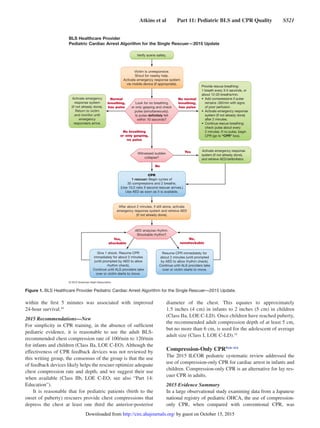
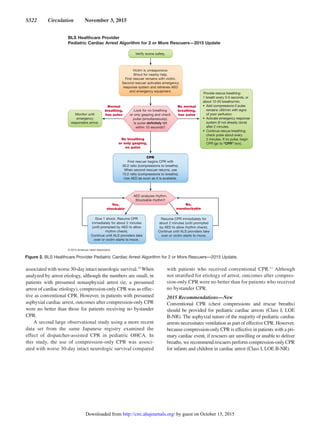
Cardiopulmonary Resuscitation Quality
The 2015 Guidelines Update for pediatric BLS concentrated
on modifications in the algorithms for lone- and 2-rescuer
CPR, initial actions of rescuers, and CPR quality process
measures. Algorithms for 1- and 2-person healthcare provider
CPR have been separated to better guide rescuers through the
initial stages of resuscitation. In an era where handheld cel-
lular telephones with speakers are common, this technology
can allow a single rescuer to activate the emergency response
system while beginning CPR. Healthcare providers should
perform an assessment of breathing and pulse check simul-
taneously, to minimize delays in starting CPR if the child is
unresponsive with no breathing or only gasping.
Significant New and Updated Recommendations
The 3 major CPR process characteristics that were evaluated
included C-A-B (Compressions, Airway, Breathing) versus
A-B-C (Airway, Breathing, Compressions), compression-only
CPR, and compression depth and rate. No major changes were
made for the 2015 Guidelines Update; however, new concepts
in CPR delivery were examined for children.
•	 Because of the limited amount and quality of the data,
it may be reasonable to maintain the sequence from the
2010 Guidelines by initiating CPR with C-A-B over
A-B-C (Class IIb, LOE C-EO). There are no pediatric
human studies to evaluate C-A-B versus A-B-C, but
manikin studies do demonstrate a shorter time to first
chest compression. This recommendation was made to
simplify training, provide consistency for teaching res-
cuers of adults and children, and hopefully increase the
number of victims who receive bystander CPR.
•	 Compression depth of at least one third of the anterior-
posterior diameter, approximately 1.5 inches (4 cm) for
infants and approximately 2 inches (5 cm) for children,
was affirmed (Updated). The Class of Recommendation
was downgraded from Class I to Class IIa, primarily
based on the rigor of the evidence evaluation. There are
limited clinical data on the effect of compression depth
on resuscitation outcomes, but 2 clinical studies suggest
that compression depth is also associated with survival.
•	 Compression rate was not reviewed because of insuffi-
cient evidence, and we recommend that rescuers use the
adult rate of 100 to 120/min (Updated).
•	 The asphyxial nature of the majority of pediatric cardiac
arrests necessitates ventilation as part of effective CPR,
and 2 large database studies documented worse 30-day
outcomes with compression-only CPR compared with
conventional CPR. For this reason, conventional CPR
(chest compressions and rescue breaths) is a Class I
recommendation (LOE B-NR) for children. However,
because compression-only CPR is effective in patients
with a primary cardiac event, if rescuers are unwilling or
unable to deliver breaths, we recommend rescuers per-
form compression-only CPR for infants and children in
cardiac arrest (Class I, LOE B-NR). Conventional CPR
(chest compressions and rescue breaths) is a Class I rec-
ommendation (LOE B-NR).
Knowledge Gaps
•	 Much of the data supporting pediatric BLS is primarily
extrapolated from studies in adults. Multicenter pediatric
studies from both in-hospital and out-of-hospital arrest
are needed to optimize outcomes for children.
•	 More knowledge is needed about the optimal sequence,
feedback techniques and devices, and effect of different
surfaces on CPR delivery in children.
Part 12: Pediatric Advanced Life Support
Significant New and Updated Recommendations
The following are the most important changes and reinforce-
ments to recommendations made in the 2010 Guidelines:
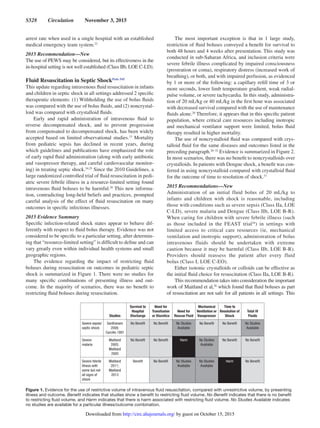
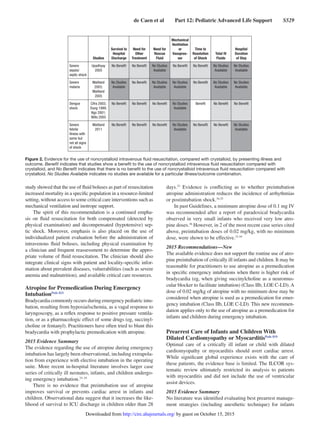
•	 There is new evidence that when treating pediatric septic
shock in specific settings, the use of restricted volume of
isotonic crystalloid leads to improved survival, contrast-
ing with the long-standing belief that all patients benefit
from aggressive volume resuscitation. New guidelines
suggest a cautious approach to fluid resuscitation, with
frequent patient reassessment, to better tailor fluid ther-
apy and supportive care to children with febrile illness.
•	 New literature suggests limited survival benefit to the
routine use of atropine as a premedication for emergency
tracheal intubation of non-neonates, and that any benefit
in preventing arrhythmias is controversial. Recent litera-
ture also provides new evidence suggesting there is no
minimum dose required for atropine use.
•	 Children in cardiac arrest may benefit from the titration
of CPR to blood pressure targets, but this strategy is sug-
gested only if they already have invasive blood pressure
monitoring in place.
by guest on October 15, 2015http://circ.ahajournals.org/Downloaded from
Neumar et al   Part 1: Executive Summary   S325
•	 New evidence suggests that either amiodarone or lido-
caine is acceptable for treatment of shock-refractory
pediatric ventricular fibrillation and pulseless ventricular
tachycardia.
•	 Recent literature supports the need to avoid fever
when caring for children remaining unconscious after
OHCA.
•	 The writing group reviewed a newly published multi-
center clinical trial of targeted temperature management
that demonstrated that a period of either 2 days of mod-
erate therapeutic hypothermia (32° to 34° C) or the strict
maintenance of normothermia (36° to 37.5° C) were
equally beneficial. As a result, the writing group feels
either of these approaches is appropriate for infants and
children remaining comatose after OHCA.
•	 Hemodynamic instability after cardiac arrest should be
treated actively with fluids and/or inotropes/vasopressors
to maintain systolic blood pressure greater than the fifth
percentile for age. Continuous arterial pressure monitor-
ing should be used when the appropriate resources are
available.
Knowledge Gaps
•	 What clinical or physiologic parameters reflect high-
quality pediatric CPR and improve outcome in chil-
dren? Do devices to monitor these parameters improve
survival?
•	 What is the role of targeted temperature management in
the care of children who remain unconscious after in-
hospital cardiac arrest?
•	 Does a postarrest bundle of care with specific targets for
temperature, oxygenation and ventilation, and hemody-
namic parameters improve outcomes after pediatric car-
diac arrest?
•	 Does a combination of intra-arrest factors reliably pre-
dict successful resuscitation in children with either
OHCA or IHCA?
Part 13: Neonatal Resuscitation
“Part 13: Neonatal Resuscitation” presents new guidelines for
resuscitation of primarily newly born infants transitioning from
intrauterine to extrauterine life. The recommendations are also
applicable to neonates who have completed newborn transition
and require resuscitation during the first weeks after birth.
Much of the neonatal resuscitation guidelines remains
unchanged from 2010, but there is increasing focus on umbili-
cal cord management, maintaining a normal temperature after
birth, accurate determination of heart rate, optimizing oxygen
use during resuscitation, and de-emphasis of routine suctioning
for meconium in nonvigorous newborns. The etiology of neo-
natal arrest is almost always asphyxia, and therefore, establish-
ing effective ventilation remains the most critical step.
Significant New and Updated Recommendations
Umbilical cord management: The 2015 Guidelines Update
includes for the first time recommendations regarding umbili-
cal cord management. Until recently, it was common prac-
tice to clamp the umbilical cord immediately after birth to
facilitate rapid transfer of the baby to the pediatric provider
for stabilization. A significant issue with the available evi-
dence is that the published studies enrolled very few babies
who were considered to need resuscitation.
•	 There is evidence, primarily in babies who do not require
resuscitation, that delayed cord clamping is associated
with less intraventricular hemorrhage, higher blood pres-
sure and blood volume, less need for transfusion after
birth, and less necrotizing enterocolitis. Delayed cord
clamping conferred no benefit on mortality or severe
intraventricular hemorrhage. The only negative conse-
quence seems to be a slightly increased level of bilirubin,
associated with more need for phototherapy.17,18
•	 Delayed cord clamping for longer than 30 seconds is
reasonable for both term and preterm infants who do
not require resuscitation at birth (Class IIa, LOE C-LD).
There is still insufficient evidence to recommend an
approach to cord clamping or cord “milking” for babies
who require resuscitation at birth.
Assessment of heart rate: Immediately after birth, assess-
ment of the newborn’s heart rate is used to evaluate the effec-
tiveness of spontaneous respiratory effort and determine the
need for subsequent interventions. An increase in the new-
born’s heart rate is considered the most sensitive indicator of a
successful response to resuscitation interventions. Therefore,
identifying a rapid, reliable, and accurate method to measure
the newborn’s heart rate is critically important.
•	 Available evidence comparing clinical assessment with
ECG in the delivery room and simultaneous pulse oxim-
etry and ECG heart rate determination found that clinical
assessment was both unreliable and inaccurate.
•	 ECG (3-lead) displayed a reliable heart rate faster than
pulse oximetry. Pulse oximetry tended to underestimate
the newborn’s heart rate and would have led to poten-
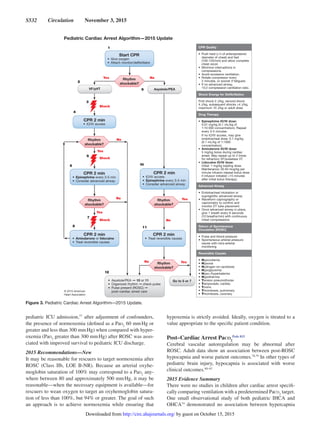
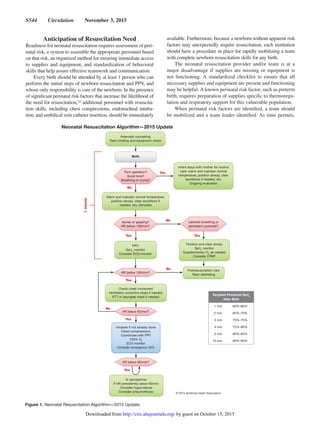
tially unnecessary interventions.17,18
•	 During resuscitation of term and preterm newborns, the
use of 3-lead ECG for the rapid and accurate measure-
ment of the newborn’s heart rate may be reasonable
(Class IIb, LOE C-LD).
Maintaining normal temperature of the newborn after
birth: It is recommended that the temperature of newly born
nonasphyxiated infants be maintained between 36.5°C and
37.5°C after birth through admission and stabilization (Class
I, LOE C-LD).15
There is new evidence supporting a variety
of interventions that may be used alone or in combination to
reduce hypothermia. Temperature must be monitored to avoid
hyperthermia as well.
Management of the meconium stained infant: For more
than a decade, vigorous infants born through meconium stained
amniotic fluid have been treated no differently than if they had
been born through clear fluid. However, there remained a long
standing practice to intubate and suction infants born through
meconium stained amniotic fluid who have poor muscle tone
and inadequate breathing efforts at birth.
•	 Routine intubation for tracheal suction in this setting is not
suggested because there is insufficient evidence to continue
recommending this practice (Class IIb, LOE C-LD).17,18
by guest on October 15, 2015http://circ.ahajournals.org/Downloaded from
S326  Circulation  November 3, 2015
•	 In making this suggested change, greater value has been
placed on harm avoidance (delays in providing positive-
pressure ventilation, potential harm of the procedure)
over the unknown benefit of the intervention of routine
trachea intubation and suctioning.
Oxygen use for preterm infants in the delivery room: Since
the release of the 2010 Guidelines, additional randomized tri-
als have been published that examine the use of oxygen dur-
ing resuscitation and stabilization of preterm newborns. These
additional publications have allowed an increase from Class
IIb to a Class I recommendation.
•	 Meta-analysis of the randomized trials that compared
initiating resuscitation of preterm newborns (less than 35
weeks of gestation) with high oxygen (65% or greater)
versus low oxygen (21%–30%) showed no improvement
in survival or morbidity to hospital discharge with the
use of high oxygen.17,18
•	 Resuscitation of preterm newborns of less than 35 weeks
of gestation should be initiated with low oxygen (21%–
30%), and the oxygen concentration should be titrated
to achieve preductal oxygen saturation approximating
the interquartile range measured in healthy term infants
after vaginal birth at sea level (Class I, LOE B-R). This
recommendation reflects a preference for not exposing
preterm newborns to additional oxygen without data
demonstrating a proven benefit for important outcomes.
Oxygen use during neonatal cardiac compressions: The evi-
dence for optimal oxygen use during neonatal cardiac compres-
sions was not reviewed for the 2010 Guidelines. Unfortunately,
there are no clinical studies to inform the neonatal guidelines,
but the available animal evidence demonstrated no obvious
advantage of 100% oxygen over air. However, by the time
resuscitation of a newborn includes cardiac compressions, the
steps of trying to improve the heart rate via effective ventilation
with low concentrations of oxygen should have already been
tried. Thus, the 2015 Guidelines Task Force thought it was rea-
sonable to increase the supplementary oxygen concentration
during cardiac compressions and then subsequently wean the
oxygen as soon as the heart rate recovers (see “Part 13: Neonatal
Resuscitation” in this 2015 Guidelines Update).
Structure of educational programs to teach neonatal resus-
citation: Currently, neonatal resuscitation training that includes
simulation and debriefing is recommended at 2-year intervals.
•	 Studies that examined how frequently healthcare provid-
ers or healthcare students should train showed no dif-
ferences in patient outcomes, but demonstrated some
advantages in psychomotor performance, knowledge,
and confidence when focused task training occurred
every 6 months or more frequently.17,18
•	 It is therefore suggested that neonatal resuscitation task
training occur more frequently than the current 2-year
interval (Class IIb, LOE B-R, LOE C-EO, LOE C-LD).15
Knowledge Gaps
Umbilical cord management for newborns needing resuscita-
tion: As noted previously, the risks and benefits of delayed
cord clamping for newborns who need resuscitation after
birth remains unknown because such infants have thus far
been excluded from the majority of trials. Concern remains
that delay in establishing ventilation may be harmful. Further
study is strongly endorsed.
•	 Some studies have suggested that cord milking might
accomplish goals similar to delayed cord clamping.17,18
Cord milking is rapid and can be accomplished within
15 seconds, before resuscitation might ordinarily be ini-
tiated. However, there is insufficient evidence of either
the safety or utility of cord milking in babies requiring
resuscitation.
•	 The effect of delayed cord clamping or cord milking on
initial heart rate and oxygen saturations is also unknown.
New normal ranges may need to be determined.
•	 The risks and benefits of inflating the lungs to establish
breathing before clamping of the umbilical cord needs
to be explored.
Utility of a sustained inflation during the initial breaths
after birth: Several recent animal studies suggested that a
longer sustained inflation may be beneficial for establishing
functional residual capacity during transition from fluid-filled
to air-filled lungs after birth. Some clinicians have suggested
applying this technique for transition of human newborns.
•	 It was the consensus of the 2015 CoSTR and the 2015
Guidelines Task Force that there was inadequate study of
the benefits and risks to recommend sustained inflation at
this time. Further study using carefully designed proto-
cols was endorsed (see “Part 13: Neonatal Resuscitation”
in this 2015 Guidelines Update and Perlman et al17,18
).
Determination of heart rate: Neonatal resuscitation suc-
cess has classically been determined by detecting an increase
in heart rate through auscultation. Heart rate also determines
the need for changing interventions and escalating care.
However, recent evidence demonstrates that auscultation of
heart rate is inaccurate, and pulse oximetry takes several min-
utes to achieve a signal and also may be inaccurate during the
early minutes after birth. Use of ECG in the delivery room has
been suggested as a possible alternative.
•	 Although data suggest that the ECG provides a more
accurate heart rate in the first 3 minutes of life, there
are no available data to determine how outcomes would
change by acting (or not acting) on the information.
•	 Some transient bradycardia may be normal and be
reflective of timing of cord clamping. More studies are
needed.
•	 The human factors issues associated with introducing
ECG leads in the delivery room are unknown.
•	 In addition, improved technologies for rapid application
of ECG are needed.
Part 14: Education
There remains strikingly low survival rates for both OHCA
and IHCA despite scientific advances in the care of cardiac
arrest victims. The Formula for Survival suggests that cardiac
by guest on October 15, 2015http://circ.ahajournals.org/Downloaded from
Neumar et al   Part 1: Executive Summary   S327
arrest survival is influenced by high-quality science, educa-
tion of lay providers and healthcare professionals, and a well-
functioning Chain of Survival.19
Considerable opportunities
exist for education to close the gap between actual and desired
performance of lay providers and healthcare teams. For lay
providers, this includes proficient CPR and AED skills and the
self-efficacy to use them, along with immediate support such
as dispatch-guided CPR. For healthcare providers, the goals
remain to recognize and respond to patients at risk of cardiac
arrest, deliver high-quality CPR whenever CPR is required,
and improve the entire resuscitation process through improved
teamwork. Additionally, there needs to be a feedback loop
focused on continuous quality improvement that can help the
system improve as well as identify needs for targeted learning/
performance improvement. Optimizing the knowledge trans-
lation of what is known from the science of resuscitation to
the victim’s bedside is a key step to potentially saving many
more lives.
Evidence-based instructional design is essential to
improve training of providers and ultimately improve resus-
citation performance and patient outcomes. The quality of
rescuer performance depends on learners integrating, retain-
ing, and applying the cognitive, behavioral, and psychomotor
skills required to successfully perform resuscitation. “Part 14:
Education” provides an overview of the educational principles
that the AHA has implemented to maximize learning from its
educational programs. It is important to note that the system-
atic reviews from which the Guidelines were derived assigned
a hierarchy of outcomes for educational studies that consid-
ered patient-related outcomes as “critical” and outcomes in
educational settings as “important.”
Significant New and Updated Recommendations
The key recommendations based on the systematic reviews
include the following:
•	 The use of high-fidelity manikins for ALS training can
be beneficial in programs that have the infrastructure,
trained personnel, and resources to maintain the pro-
gram. Standard manikins continue to be an appropriate
choice for organizations that do not have this capacity.
Use of a CPR feedback device is recommended to learn
the psychomotor skill of CPR. Devices that provide feedback
on performance are preferred to devices that provide only
prompts (such as a metronome). Instructors are not accurate at
assessment of CPR quality by visual inspection, so an adjunc-
tive tool is necessary to provide accurate guidance to learn-
ers developing these critical psychomotor skills. Improved
manikins that better reflect patient characteristics may prove
important for future training. Use of CPR quality feedback
devices during CPR is reviewed in “Part 5: Adult Basic Life
Support and CPR Quality.”
•	 Two-year retraining cycles are not optimal. More fre-
quent training of BLS and advanced life support skills
may be helpful for providers likely to encounter a victim
of cardiac arrest.
•	 Although prior CPR training is not required for potential
rescuers to initiate CPR, training helps people learn the
skills and develop the self-efficacy to provide CPR when
necessary. BLS skills seem to be learned as well through
self-instruction (video or computer based) with hands-
on practice as with traditional instructor-led courses. The
opportunity to train many more individuals to provide
CPR while reducing the cost and resources required for
training is important when considering the vast popula-
tion of potential rescuers that should be trained.
•	 To reduce the time to defibrillation for cardiac arrest
victims, the use of an AED should not be limited to
trained individuals only (although training is still rec-
ommended). A combination of self-instruction and
instructor-led teaching with hands-on training can be
considered as an alternative to traditional instructor-led
courses for lay providers.
•	 Precourse preparation, including review of appropri-
ate content information, online/precourse testing, and/
or practice of pertinent technical skills, may optimize
learning from advanced life support courses.
•	 Given very small risk for harm and the potential benefit
of team and leadership training, the inclusion of team and
leadership training as part of ALS training is reasonable.
•	 Communities may consider training bystanders in com-
pression-only CPR for adult OHCA as an alternative to
training in conventional CPR.
Knowledge Gaps
•	 Research on resuscitation education needs higher-qual-
ity studies that address important educational ques-
tions. Outcomes from educational studies should focus
on patient outcomes (where feasible), performance in
the clinical environment, or at least long-term retention
of psychomotor and behavioral skills in the simulated
resuscitation environment. Too much of the current
focus of educational research is on the immediate end-
of-course performance, which may not be representative
of participants’ performance when they are faced with
a resuscitation event months or years later. Assessment
tools that have been empirically studied for evidence of
validity and reliability are foundational to high-quality
research. Standardizing the use of such tools across stud-
ies could potentially allow for meaningful comparisons
when analyzing evidence in systematic reviews to more
precisely determine the impact of certain interventions.
Cost-effectiveness research is needed because many
of the AHA education guidelines are developed in the
absence of this information.
•	 The ideal methodology (ie, instructional design) and fre-
quency of training required to enhance retention of skills
and performance in simulated and actual resuscitations
needs to be determined.
Part 15: First Aid
“Part 15: First Aid” reaffirms the definition of first aid as the
helping behaviors and initial care provided for an acute ill-
ness or injury. The provision of first aid has been expanded
to include any person, from layperson to professional health-
care provider, in a setting where first aid is needed. Goals and
by guest on October 15, 2015http://circ.ahajournals.org/Downloaded from
S328  Circulation  November 3, 2015
competencies are now provided to give guidance and perspec-
tive beyond specific skills. While a basic tenet of first aid is the
delivery of care using minimal or no equipment, it is increas-
ingly recognized that in some cases first aid providers may
have access to various adjuncts, such as commercial tourni-
quets, glucometers, epinephrine autoinjectors, or oxygen. The
use of any such equipment mandates training, practice, and, in
some cases, medical or regulatory oversight related to use and
maintenance of that equipment.
Although there is a growing body of observational stud-
ies performed in the first aid setting, most recommendations
set forth in “Part 15: First Aid” continue to be extrapolated
from prehospital- and hospital-based studies. One important
new development relates to the ability of a first aid provider
to recognize the signs and symptoms of acute stroke. “Part
15: First Aid” describes the various stroke assessment systems
that are available to first aid providers, and lists their sensitivi-
ties and specificities in identifying stroke based on included
components. This new recommendation for use of a stroke
assessment system complements previous recommendations
for early stroke management by improving the recognition
of stroke signs and symptoms at the first step of emergency
care—first aid—thus potentially reducing the interval from
symptom onset to definitive care.
Significant New and Updated Recommendations
•	 Evidence shows that the early recognition of stroke by
using a stroke assessment system decreases the interval
between the time of stroke onset and arrival at a hos-
pital and definitive treatment. More than 94% of lay
providers trained in a stroke assessment system are able
to recognize signs and symptoms of a stroke, and this
ability persists at 3 months after training. The use of a
stroke assessment system by first aid providers is rec-
ommended (Class I, LOE B-NR). Compared to stroke
assessment systems without glucose measurement,
assessment systems that include glucose measurement
have similar sensitivity but higher specificity for recog-
nition of stroke.
•	 Hypoglycemia is a condition that is commonly encoun-
tered by first aid providers. Severe hypoglycemia, which
may present with loss of consciousness or seizures,
typically requires management by EMS providers. If a
person with diabetes reports low blood sugar or exhib-
its signs or symptoms of mild hypoglycemia and is able
to follow simple commands and swallow, oral glucose
should be given to attempt to resolve the hypoglycemia.
Glucose tablets, if available, should be used to reverse
hypoglycemia in a patient who is able to take these
orally (Class I, LOE B-R). If glucose tablets are not
available, other specifically evaluated forms of sucrose-
and fructose-containing foods, liquids, and candy can be
effective as an alternative to glucose tablets for reversal
of mild symptomatic hypoglycemia.
•	 The first aid management of an open chest wound was
evaluated for the 2015 ILCOR Consensus Conference.
The improper use of an occlusive dressing or device
with potential subsequent development of unrecog-
nized tension pneumothorax is of great concern. There
are no human studies comparing the application of
an occlusive dressing to a nonocclusive dressing, and
only a single animal study showed benefit to use of a
nonocclusive dressing. As a result of the lack of evi-
dence for use of an occlusive dressing and the risk of
unrecognized tension pneumothorax, we recommend
against the application of an occlusive dressing or
device by first aid providers for an individual with an
open chest wound.
•	 First aid providers often encounter individuals with a
concussion (minor traumatic brain injury). The myriad of
signs and symptoms of concussion can make recognition
of this injury a challenge. Although a simple validated
single-stage concussion scoring system could possibly
help first aid providers in the recognition of concussion,
there is no evidence to support the use of such a scor-
ing system. There are sport concussion assessment tools
for use by healthcare professionals that require a 2-stage
assessment, before competition and after concussion,
but these are not appropriate as a single assessment tool
for first aid providers. Therefore, it is recommended that
a healthcare provider evaluate as soon as possible any
person with a head injury that has resulted in a change
in level of consciousness, who has progressive develop-
ment of signs or symptoms of a concussion or traumatic
brain injury, or who is otherwise a cause for concern to
the first aid provider.
•	 Dental avulsion can result in permanent loss of a
tooth. Immediate reimplantation of the avulsed tooth is
thought by the dental community to afford the greatest
chance of tooth survival. First aid providers may not
be able to reimplant an avulsed tooth because of lack
of training, skill, or personal protective equipment, or
they may be reluctant to perform a painful procedure.
The storage of an avulsed tooth in a variety of solu-
tions (compared with saliva or milk) has been shown to
prolong viability of dental cells by 30 to 120 minutes.
In situations that do not allow for immediate reimplan-
tation, the temporary storage of an avulsed tooth in one
of these solutions may afford time until the tooth can
be reimplanted.
•	 Evidence shows that education in first aid can increase
survival rates, improve recognition of acute illness,
and resolve symptomatology. We recommend that first
aid education be universally available (Class I, LOE
C-EO).
•	 Past Guidelines recommended that first aid provid-
ers assist the person with symptoms of anaphylaxis to
administer that person’s epinephrine.20
Evidence sup-
ports the need for a second dose of epinephrine for acute
anaphylaxis in persons not responding to a first dose.
When a person with anaphylaxis does not respond to the
initial dose and arrival of advanced care will exceed 5 to
10 minutes, a repeat dose may be considered (Class IIb,
LOE C-LD).
•	 There is no evidence of any benefit from routine admin-
istration of supplementary oxygen by first aid provid-
ers. Limited evidence shows benefit from use of oxygen
for decompression sickness in the first aid setting. The
use of supplementary oxygen by first aid providers with
specific training (eg, a diving first aid oxygen course) is
by guest on October 15, 2015http://circ.ahajournals.org/Downloaded from
Neumar et al   Part 1: Executive Summary   S329
reasonable for cases of decompression sickness. Limited
evidence suggests that supplementary oxygen may be
effective for relief of dyspnea in advanced lung cancer
patients with dyspnea and associated hypoxia, but not
for similar patients without hypoxia.
•	 Newer-generation hemostatic agent–impregnated dress-
ings have been shown to cause fewer complications and
adverse effects and are effective in providing hemosta-
sis in up to 90% of subjects in case series. First aid pro-
viders may consider use of hemostatic dressings when
standard bleeding control (with direct pressure) is not
effective.
•	 The use of cervical collars as a component of spinal
motion restriction for blunt trauma was reviewed for
the 2015 ILCOR consensus. No evidence was identi-
fied that showed a decrease in neurologic injury with
use of a cervical collar. Evidence demonstrates adverse
effects from use of a cervical collar, such as increased
intracranial pressure and potential airway compromise.
The ILCOR First Aid Task Force also expressed concern
that proper technique for application of a cervical collar
in high-risk individuals requires significant training and
practice to be performed correctly and is not considered
a standard first aid skill. Because of these concerns, and
with a growing body of evidence demonstrating harmful
effects and no good evidence showing clear benefit, we
recommend against routine application of cervical col-
lars by first aid providers.
Knowledge Gaps
•	 Control of severe bleeding is a topic that has gained
public interest and importance with recent domestic
terrorist attacks. The ideal order for the technique of
bleeding control by first aid providers for severe bleed-
ing of an extremity is not clear—ie, direct pressure →
tourniquet → additional (double) tourniquet; direct
pressure → hemostatic dressing → tourniquet. It is
also unclear how tourniquets compare with hemostatic
dressings (or double tourniquet) for control of bleeding
in extremity wounds.
•	 First aid providers may have difficulty recognizing
potentially life-threatening conditions. The devel-
opment and validation of highly sensitive assess-
ment systems or scales (such as for stroke) and other
educational techniques may help first aid providers
recognize these entities so that they can provide rapid,
appropriate care. Conditions that may benefit from
development of such assessment educational systems
include anaphylaxis, hypoglycemia, chest pain of car-
diac origin, high-risk cervical spine injury, concus-
sion, poisoning or overdose, abnormal versus normal
breathing, and shock.
•	 How should a first aid provider care for a person with a
potential spinal injury while awaiting arrival of EMS? Is
there a benefit to manual cervical spinal stabilization by
a first aid provider, and, if so, which technique is best? If
verbal instructions to not move are given to a conscious/
responsive person with trauma and possible spine injury,
are they effective or useful?
Summary
The 2015 AHA Guidelines Update for CPR and ECC incor-
porated the evidence from the systematic reviews com-
pleted as part of the 2015 International Consensus on CPR
and ECC Science With Treatment Recommendations. This
2015 Guidelines Update marks the transition from periodic
review and publication of new science-based recommenda-
tions to a more continuous process of evidence evaluation
and guideline optimization designed to more rapidly trans-
late new science into resuscitation practice that will save
more lives. The Appendix to this Part contains a list of all
recommendations published in the 2015 Guidelines Update
and, in addition, lists the recommendations from the 2010
Guidelines. The 2015 recommendations were made consis-
tent with the new AHA Classification System for describ-
ing the risk-benefit ratio for each Class and the Levels of
Evidence supporting them. (Please see Figure 1 in “Part
2: Evidence Evaluation and Management of Conflicts of
Interest.”)
Survival from both IHCA and OHCA has increased
over the past decade, but there is still tremendous poten-
tial for improvement. It is clear that successful resuscita-
tion depends on coordinated systems of care that start with
prompt rescuer actions, require delivery of high-quality
CPR, and continue through optimized ACLS and post–car-
diac arrest care. Systems that monitor and report quality-
of-care metrics and patient-centered outcomes will have the
greatest opportunity through quality improvement to save
the most lives.
by guest on October 15, 2015http://circ.ahajournals.org/Downloaded from
S330  Circulation  November 3, 2015
Part 1: Executive Summary: 2015 Guidelines Update Writing Group Disclosures
Writing Group
Member Employment Research Grant
Other
Research
Support
Speakers’
Bureau/
Honoraria
Expert
Witness
Ownership
Interest
Consultant/
Advisory
Board Other
Robert W.
Neumar
University of Michigan NIH† None None None None None None
Dianne L. Atkins University of Iowa None None None None None None None
Farhan Bhanji McGill University None None None None None None None
Steven C. Brooks Queen’s University Heart and Stroke
Foundation of
Canada†; CIHR†;
NIH†
None None None None None South Eastern
Ontario
Academic
Medical
Association†
Clifton W.
Callaway
University of
Pittsburgh
None None None None None None None
Allan R. de Caen University of Alberta;
Stollery Children’s
Hospital
None None None None None None None
Monica E.
Kleinman
Children’s Hospital Boston None None None None None None None
Steven L. Kronick University of Michigan None None None None None None None
Eric J. Lavonas Rocky Mountain
Poison  Drug Center
None None None None None None None
Mark S. Link Tufts Medical Center None None None None None None None
Mary E. Mancini University of Texas at
Arlington
None None None None None None None
Laurie J. Morrison University of Toronto NIH†; CIHR†;
HSFC†
None None None None None None
Robert E. O’Connor University of Virginia None None None None None None None
Eunice M.
Singletary
University of Virginia None None None None None American
Red Cross
Scientific
Advisory
Board*
None
Myra H. Wyckoff UT Southwestern None None None None None None None
Staff
Jose Maria
E. Ferrer
American Heart
Association
None None None None None None None
Lana M. Gent American Heart
Association
None None None None None None None
Consultants
Michael W.
Donnino
Beth Israel Deaconess
Med Center
None None None None None American
Heart
Association†
None
Mary Fran
Hazinski
Vanderbilt University None None None None None American
Heart
Association†
None
Ricardo A.
Samson
University of Arizona None None None None None American
Heart
Association†
None
Steven M.
Schexnayder
University of Arkansas;
Arkansas Children’s
Hospital
None None None None None American
Heart
Association†
None
Michael Shuster Mineral Springs Hospital
Emergency Medicine
None None None None None American
Heart
Association†
None
Disclosures
(Continued )
by guest on October 15, 2015http://circ.ahajournals.org/Downloaded from
Neumar et al   Part 1: Executive Summary   S331
Elizabeth H. Sinz Pennsylvania State
University College of
Medicine
None None None None None American
Heart
Association†
None
Andrew H.
Travers
Emergency Health
Services, Nova Scotia
None None None None None American
Heart
Association†
None
This table represents the relationships of writing group members that may be perceived as actual or reasonably perceived conflicts of interest as reported on the
Disclosure Questionnaire, which all members of the writing group are required to complete and submit. A relationship is considered to be “significant” if (a) the person
receives $10 000 or more during any 12-month period, or 5% or more of the person’s gross income; or (b) the person owns 5% or more of the voting stock or share of
the entity, or owns $10 000 or more of the fair market value of the entity. A relationship is considered to be “modest” if it is less than “significant” under the preceding
definition.
*Modest.
†Significant.
Part 1: Executive Summary: 2015 Guidelines Update Writing Group Disclosures, Continued
Writing Group
Member Employment Research Grant
Other
Research
Support
Speakers’
Bureau/
Honoraria
Expert
Witness
Ownership
Interest
Consultant/
Advisory
Board Other
Appendix
2015 Guidelines Update: Master List of Recommendations
Year Last
Reviewed Topic Recommendation Comments
Part 3: Ethical Issues
2015 The Use of Extracorporeal
CPR in OHCA
There is insufficient evidence to recommend the routine use of ECPR for patients with cardiac
arrest. In settings where it can be rapidly implemented, ECPR may be considered for select
patients for whom the suspected etiology of the cardiac arrest is potentially reversible during a
limited period of mechanical cardiorespiratory support (Class IIb, LOE C-LD).
new for 2015
2015 Intra-arrest Prognostic
Factors for Cardiac Arrest in
Infants and Children
Multiple variables should be used when attempting to prognosticate outcomes during cardiac
arrest (Class I, LOE C-LD).
new for 2015
2015 The Use of a Prognostic Score
in the Delivery Room for
Preterm Infants
However, in individual cases, when counseling a family and constructing a prognosis for survival
at gestations below 25 weeks, it is reasonable to consider variables such as perceived accuracy
of gestational age assignment, the presence or absence of chorioamnionitis, and the level of
care available for location of delivery. It is also recognized that decisions about appropriateness
of resuscitation below 25 weeks of gestation will be influenced by region-specific guidelines.
In making this statement, a higher value was placed on the lack of evidence for a generalized
prospective approach to changing important outcomes over improved retrospective accuracy
and locally validated counseling policies. The most useful data for antenatal counseling provides
outcome figures for infants alive at the onset of labor, not only for those born alive or admitted to
a neonatal intensive care unit (Class IIb, LOE C-LD)
new for 2015
2015 Terminating Resuscitative
Efforts in Term Infants
We suggest that, in infants with an Apgar score of 0 after 10 minutes of resuscitation, if the heart
rate remains undetectable, it may be reasonable to stop assisted ventilations; however, the decision
to continue or discontinue resuscitative efforts must be individualized. Variables to be considered
may include whether the resuscitation was considered optimal; availability of advanced neonatal
care, such as therapeutic hypothermia; specific circumstances before delivery (eg, known timing of
the insult); and wishes expressed by the family (Class IIb, LOE C-LD)
updated for 2015
2015 The Use of ECPR in IHCA There is insufficient evidence to recommend the routine use of ECPR for patients with cardiac
arrest. In settings where it can be rapidly implemented, ECPR may be considered for select
cardiac arrest patients for whom the suspected etiology of the cardiac arrest is potentially
reversible during a limited period of mechanical cardiorespiratory support. (Class IIb, LOE C-LD).
new for 2015
2015 The Use of ECPR in IHCA ECPR may be considered for pediatric patients with cardiac diagnoses who have IHCA in settings
with existing ECMO protocols, expertise, and equipment (Class IIb, LOE C-LD).
new for 2015
2015 Terminating Cardiac Arrest
Resuscitative Efforts in
Pediatric IHCA
Multiple variables should be used when attempting to prognosticate outcomes during cardiac
arrest (Class I, LOE C-LD).
new for 2015
2015 Prognostication
During CPR
In intubated patients, failure to achieve an ETCO2
of greater than 10 mm Hg by waveform capnography
after 20 minutes of CPR may be considered as one component of a multimodal approach to decide when
to end resuscitative efforts but should not be used in isolation (Class IIb, LOE C-LD).
new for 2015
(Continued )
by guest on October 15, 2015http://circ.ahajournals.org/Downloaded from
S332  Circulation  November 3, 2015
2015 Guidelines Update: Master List of Recommendations, Continued
Year Last
Reviewed Topic Recommendation Comments
2015 Prognostication During CPR In nonintubated patients, a specific ETCO2
cutoff value at any time during CPR should not be used
as an indication to end resuscitative efforts (Class III: Harm, LOE C-EO).
new for 2015
2015 Predictive Factors After
Cardiac Arrest in Pediatric
Patients
EEGs performed within the first 7 days after pediatric cardiac arrest may be considered in
prognosticating neurologic outcome at the time of hospital discharge (Class IIb, LOE C-LD) but
should not be used as the sole criterion.
new for 2015
2015 Predictive Factors After
Cardiac Arrest in Pediatric
Patients
The reliability of any 1 variable for prognostication in children after cardiac arrest has not been
established. Practitioners should consider multiple factors when predicting outcomes in infants
and children who achieve ROSC after cardiac arrest (Class I, LOE C-LD).
new for 2015
2015 Timing of Prognostication in
Post–Cardiac Arrest Adults
The earliest time for prognostication in patients treated with TTM using clinical examination
where sedation or paralysis could be a confounder may be 72 hours after return to normothermia
(Class IIb, LOE C-EO).
updated for 2015
2015 Timing of Prognostication in
Post–Cardiac Arrest Adults
We recommend the earliest time to prognosticate a poor neurologic outcome in patients not
treated with TTM using clinical examination is 72 hours after cardiac arrest (Class I, LOE B-NR).
updated for 2015
2015 Timing of Prognostication in
Post–Cardiac Arrest Adults
This time can be even longer after cardiac arrest if the residual effect of sedation or paralysis
confounds the clinical examination (Class IIa, LOE C-LD).
new for 2015
2015 Prognostic Testing in Adult
Patients After Cardiac Arrest:
Clinical Exam Findings
In comatose patients who are not treated with TTM, the absence of pupillary reflex to light at
72 hours or more after cardiac arrest is a reasonable exam finding with which to predict poor
neurologic outcome (FPR, 0%; 95% CI, 0%–8%; Class IIa, LOE B-NR).
new for 2015
2015 Prognostic Testing in Adult
Patients After Cardiac Arrest:
Clinical Exam Findings
In comatose patients who are treated with TTM, the absence of pupillary reflex to light at 72
hours or more after cardiac arrest is useful to predict poor neurologic outcome (FPR, 0%; 95% CI,
0%–3%; Class I, LOE B-NR).
new for 2015
2015 Prognostic Testing in Adult
Patients After Cardiac Arrest:
Clinical Exam Findings
We recommend that, given their high FPRs, the findings of either absent motor movements or
extensor posturing should not be used alone for predicting a poor neurologic outcome (FPR, 10%;
95% CI, 7%–15% to FPR, 15%; 95% CI, 5%–31%; Class III: Harm, LOE B-NR).
new for 2015
2015 Prognostic Testing in Adult
Patients After Cardiac Arrest:
Clinical Exam Findings
The motor examination may be a reasonable means to identify the population who need further
prognostic testing to predict poor outcome (Class IIb, LOE B-NR).
new for 2015
2015 Prognostic Testing in Adult
Patients After Cardiac Arrest:
Clinical Exam Findings
We recommend that the presence of myoclonus, which is distinct from status myoclonus, should
not be used to predict poor neurologic outcomes because of the high FPR (FPR, 5%; 95% CI,
3%–8% to FPR, 11%; 95% CI, 3%–26%; Class III: Harm, LOE B-NR).
new for 2015
2015 Prognostic Testing in Adult
Patients After Cardiac Arrest:
Clinical Exam Findings
In combination with other diagnostic tests at 72 or more hours after cardiac arrest, the presence
of status myoclonus during the first 72 hours after cardiac arrest is a reasonable finding to help
predict poor neurologic outcomes (FPR, 0%; 95% CI, 0%–4%; Class IIa, LOE B-NR).
new for 2015
2015 Prognostic Testing in Adult
Patients After Cardiac Arrest:
EEG
In comatose post–cardiac arrest patients who are treated with TTM, it may be reasonable to
consider persistent absence of EEG reactivity to external stimuli at 72 hours after cardiac arrest,
and persistent burst suppression on EEG after rewarming, to predict a poor outcome (FPR, 0%;
95% CI, 0%–3%; Class IIb, LOE B-NR).
updated for 2015
2015 Prognostic Testing in Adult
Patients After Cardiac Arrest:
EEG
Intractable and persistent (more than 72 hours) status epilepticus in the absence of EEG reactivity
to external stimuli may be reasonable to predict poor outcome (Class IIb, LOE B-NR).
updated for 2015
2015 Prognostic Testing in Adult
Patients After Cardiac Arrest:
EEG
In comatose post–cardiac arrest patients who are not treated with TTM, it may be reasonable
to consider the presence of burst suppression on EEG at 72 hours or more after cardiac arrest,
in combination with other predictors, to predict a poor neurologic outcome (FPR, 0%; 95% CI,
0%–11%; Class IIb, LOE B-NR).
updated for 2015
2015 Prognostic Testing in Adult
Patients After Cardiac Arrest:
Evoked Potentials
In patients who are comatose after resuscitation from cardiac arrest regardless of treatment with TTM, it
is reasonable to consider bilateral absence of the N20 SSEP wave 24 to 72 hours after cardiac arrest or
after rewarming a predictor of poor outcome (FPR, 1%; 95% CI, 0%–3%; Class IIa, LOE B-NR).
updated for 2015
2015 Prognostic Testing in Adult
Patients After Cardiac Arrest:
Imaging Tests
In patients who are comatose after resuscitation from cardiac arrest and not treated with TTM, it may
be reasonable to use the presence of a marked reduction of the grey white ratio (GWR) on brain CT
obtained within 2 hours after cardiac arrest to predict poor outcome (Class IIb, LOE B-NR).
new for 2015
2015 Prognostic Testing in Adult
Patients After Cardiac Arrest:
Imaging Tests
It may be reasonable to consider extensive restriction of diffusion on brain MRI at 2 to 6 days
after cardiac arrest in combination with other established predictors to predict a poor neurologic
outcome (Class IIb, LOE B-NR).
new for 2015
2015 Prognostic Testing in Adult
Patients After Cardiac Arrest:
Blood Markers
Given the possibility of high FPRs, blood levels of NSE and S-100B should not be used alone to
predict a poor neurologic outcome (Class III: Harm, LOE C-LD).
updated for 2015
(Continued )
by guest on October 15, 2015http://circ.ahajournals.org/Downloaded from
Neumar et al   Part 1: Executive Summary   S333
2015 Guidelines Update: Master List of Recommendations, Continued
Year Last
Reviewed Topic Recommendation Comments
2015 Prognostic Testing in Adult
Patients After Cardiac Arrest:
Blood Markers
When performed with other prognostic tests at 72 hours or more after cardiac arrest, it may be
reasonable to consider high serum values of NSE at 48 to 72 hours after cardiac arrest to support
the prognosis of a poor neurologic outcome (Class IIb, LOE B-NR), especially if repeated sampling
reveals persistently high values (Class IIb, LOE C-LD).
updated for 2015
2015 Ethics of Organ and Tissue
Donation
We recommend that all patients who are resuscitated from cardiac arrest but who subsequently
progress to death or brain death be evaluated for organ donation (Class I, LOE B-NR).
updated for 2015
2015 Ethics of Organ and Tissue
Donation
Patients who do not have ROSC after resuscitation efforts and who would otherwise have
termination of efforts may be considered candidates for kidney or liver donation in settings where
programs exist (Class IIb, LOE B-NR).
new for 2015
The following recommendations were not reviewed in 2015. For more information, see the 2010 AHA Guidelines for CPR and ECC, “Part 3: Ethics.”
2010 Principle of Futility Conditions such as irreversible brain damage or brain death cannot be reliably assessed or
predicted at the time of cardiac arrest. Withholding resuscitation and the discontinuation of life-
sustaining treatment during or after resuscitation are ethically equivalent. In situations where the
prognosis is uncertain, a trial of treatment may be initiated while further information is gathered
to help determine the likelihood of survival, the patient’s preferences, and the expected clinical
course (Class IIb, LOE C).
not reviewed in 2015
2010 Terminating Resuscitative
Efforts in a BLS Out-of-
Hospital System
It is recommended that regional or local EMS authorities use the BLS termination rule to develop
protocols for the termination of resuscitative efforts by BLS providers for adult victims of cardiac arrest
in areas where advanced life support is not available or may be significantly delayed (Class I, LOE A).
not reviewed in 2015
2010 Terminating Resuscitative
Efforts in a BLS Out-of-
Hospital System
The reliability and validity of this rule is uncertain if modified (Class IIb, LOE A). not reviewed in 2015
2010 Terminating Resuscitative
Efforts in an ALS Out-of-
Hospital System
An ALS termination of resuscitation rule was derived from a diverse population of rural and
urban EMS settings. This rule recommends considering terminating resuscitation when ALL of
the following criteria apply before moving to the ambulance for transport: (1) arrest was not
witnessed; (2) no bystander CPR was provided; (3) no ROSC after full ALS care in the field; and
(4) no AED shocks were delivered. This rule has been retrospectively externally validated for adult
patients in several regions in the US, Canada, and Europe, and it is reasonable to employ this rule
in all ALS services (Class IIa, LOE B).
not reviewed in 2015
2010 Terminating Resuscitative
Efforts in a Combined BLS
and ALS Out-of-Hospital
System
In a tiered ALS- and BLS-provider system, the use of a universal rule can avoid confusion at the
scene of a cardiac arrest without compromising diagnostic accuracy. The BLS rule is reasonable
to use in these services (Class IIa, LOE B).
not reviewed in 2015
2010 Providing Emotional Support
to the Family During
Resuscitative Efforts in
Cardiac Arrest
In the absence of data documenting harm and in light of data suggesting that it may be helpful,
offering select family members the opportunity to be present during a resuscitation is reasonable
and desirable (assuming that the patient, if an adult, has not raised a prior objection) (Class IIa,
LOE C for adults and Class I, LOE B for pediatric patients).
not reviewed in 2015
2010 Providing Emotional Support
to the Family During
Resuscitative Efforts in
Cardiac Arrest
In the absence of data documenting harm and in light of data suggesting that it may be helpful,
offering select family members the opportunity to be present during a resuscitation is reasonable
and desirable (assuming that the patient, if an adult, has not raised a prior objection) (Class IIa,
LOE C for adults and Class I, LOE B for pediatric patients).
not reviewed in 2015
2010 Ethics of Organ and Tissue
Donation
It is reasonable to suggest that all communities should optimize retrieval of tissue and organ
donations in brain dead post–cardiac arrest patients (in-hospital) and those pronounced dead in
the out-of-hospital setting (Class IIa, LOE B).
not reviewed in 2015
2010 Ethics of Organ and
Tissue Donation
Medical directors of EMS agencies, emergency departments (EDs), and critical care units (CCUs)
should develop protocols and implementation plans with the regional organ and tissue donation
program to optimize donation following a cardiac arrest death (Class I, LOE C)
not reviewed in 2015
2010 Criteria for Not Starting CPR
in Newly Born Infant IHCA
There are prescribed recommendations to guide the initiation of resuscitative efforts in newly born
infants. When gestational age, birth weight, or congenital anomalies are associated with almost certain
early death and when unacceptably high morbidity is likely among the rare survivors, resuscitation is not
indicated. Examples may include extreme prematurity (gestational age 23 weeks or birth weight 400 g,
anencephaly, and some major chromosomal abnormalities such as trisomy 13 (Class IIb, LOE C).
not reviewed in 2015
2010 Criteria for Not Starting CPR
in Newly Born Infant IHCA
In conditions associated with uncertain prognosis where survival is borderline, the morbidity rate
is relatively high, and the anticipated burden to the child is high, parental desires concerning
initiation of resuscitation should be supported (Class IIb, LOE C).
not reviewed in 2015
(Continued )
by guest on October 15, 2015http://circ.ahajournals.org/Downloaded from
S334  Circulation  November 3, 2015
Part 4: Systems of Care and Continuous Quality Improvement
2015 Prearrest Rapid Response
Systems
For adult patients, RRT or MET systems can be effective in reducing the incidence of cardiac
arrest, particularly in general care wards (Class IIa, LOE C-LD).
updated for 2015
2015 Prearrest Rapid Response
Systems
Pediatric MET/RRT systems may be considered in facilities where children with high-risk illnesses
are cared for on general in-patient units (Class IIb, LOE C-LD).
updated for 2015
2015 Prearrest Rapid Response
Systems
The use of EWSS may be considered for adults and children (Class IIb, LOE C-LD). updated for 2015
2015 Debriefing It is reasonable for in-hospital systems of care to implement performance-focused debriefing of
rescuers after IHCA in both adults and children (Class IIa, LOE C-LD).
updated for 2015
2015 Public-Access Defibrillation It is recommended that PAD programs for patients with OHCA be implemented in communities at
risk for cardiac arrest (Class I, LOE C-LD).
updated for 2015
2015 Dispatcher Recognition
of Cardiac Arrest
It is recommended that emergency dispatchers determine if a patient is unconscious with
abnormal breathing after acquiring the requisite information to determine the location of the event
(Class I, LOE C-LD).
updated for 2015
2015 Dispatcher Recognition
of Cardiac Arrest
If the patient is unconscious with abnormal or absent breathing, it is reasonable for the
emergency dispatcher to assume that the patient is in cardiac arrest (Class IIa, LOE C-LD).
updated for 2015
2015 Dispatcher Recognition of
Cardiac Arrest
Dispatchers should be educated to identify unconsciousness with abnormal and agonal gasps
across a range of clinical presentations and descriptions (Class I, LOE C-LD).
updated for 2015
2015 Dispatcher Instruction
in CPR
We recommend that dispatchers should provide chest compression–only CPR instructions to
callers for adults with suspected OHCA (Class I, LOE C-LD).
updated for 2015
2015 Use of Social Media to
Summon Rescuers
Given the low risk of harm and the potential benefit of such notifications, it may be reasonable for
communities to incorporate, where available, social media technologies that summon rescuers
who are willing and able to perform CPR and are in close proximity to a suspected victim of OHCA
(Class IIb, LOE B-R).
updated for 2015
2015 Transport to Specialized
Cardiac Arrest Centers
A regionalized approach to OHCA resuscitation that includes the use of cardiac resuscitation
centers may be considered (Class IIb, LOE C-LD).
updated for 2015
2015 Immediate Recognition and
Activation of the Emergency
Response System
It is recommended that emergency dispatchers determine if a patient is unresponsive with
abnormal breathing after acquiring the requisite information to determine the location of the event
(Class I, LOE C-LD).
updated for 2015
2015 Immediate Recognition and
Activation of the Emergency
Response System
If the patient is unresponsive with abnormal or absent breathing, it is reasonable for the
emergency dispatcher to assume that the patient is in cardiac arrest (Class IIa, LOE C-LD).
updated for 2015
2015 Immediate Recognition and
Activation of the Emergency
Response System
Dispatchers should be educated to identify unresponsiveness with abnormal breathing and agonal
gasps across a range of clinical presentations and descriptions (Class I, LOE C-LD).
updated for 2015
2015 Early CPR Similar to the 2010 Guidelines, it may be reasonable for rescuers to initiate CPR with chest
compressions (Class IIb, LOE C-LD).
updated for 2015
2015 Untrained Lay Rescuer Untrained lay rescuers should provide compression-only CPR, with or without dispatcher
assistance (Class I, LOE C-LD).
updated for 2015
2015 Untrained Lay Rescuer The rescuer should continue compression-only CPR until the arrival of an AED or rescuers with
additional training (Class I, LOE C-LD).
updated for 2015
2015 Trained Lay Rescuer All lay rescuers should, at a minimum, provide chest compressions for victims of cardiac arrest
(Class I, LOE C-LD). In addition, if the trained lay rescuer is able to perform rescue breaths, he or
she should add rescue breaths in a ratio of 30 compressions to 2 breaths.
updated for 2015
2015 Trained Lay Rescuer The rescuer should continue CPR until an AED arrives and is ready for use or EMS providers take
over care of the victim (Class I, LOE C-LD).
updated for 2015
2015 Healthcare Provider It is reasonable for healthcare providers to provide chest compressions and ventilation for all adult
patients in cardiac arrest, from either a cardiac or noncardiac cause (Class IIa, LOE C-LD).
updated for 2015
2015 Delayed Ventilation For witnessed OHCA with a shockable rhythm, it may be reasonable for EMS systems with
priority-based, multitiered response to delay positive-pressure ventilation by using a strategy
of up to 3 cycles of 200 continuous compressions with passive oxygen insufflation and airway
adjuncts (Class IIb, LOE C-LD).
new for 2015
2015 Recognition of Arrest Dispatchers should instruct rescuers to provide CPR if the victim is unresponsive with no normal
breathing, even when the victim demonstrates occasional gasps (Class I, LOE C-LD).
updated for 2015
(Continued )
2015 Guidelines Update: Master List of Recommendations, Continued
Year Last
Reviewed Topic Recommendation Comments
by guest on October 15, 2015http://circ.ahajournals.org/Downloaded from
Neumar et al   Part 1: Executive Summary   S335
2015 Suspected Opioid-Related
Life-Threatening Emergency
For a patient with known or suspected opioid overdose who has a definite pulse but no normal
breathing or only gasping (ie, a respiratory arrest), in addition to providing standard BLS care, it
is reasonable for appropriately trained BLS healthcare providers to administer intramuscular or
intranasal naloxone (Class IIa, LOE C-LD).
new for 2015
2015 Suspected Opioid-Related
Life-Threatening Emergency
For patients in cardiac arrest, medication administration is ineffective without concomitant chest
compressions for drug delivery to the tissues, so naloxone administration may be considered after
initiation of CPR if there is high suspicion for opiate overdose (Class IIb, LOE C-EO).
new for 2015
2015 Suspected Opioid-Related
Life-Threatening Emergency
It is reasonable to provide opioid overdose response education with or without naloxone
distribution to persons at risk for opioid overdose in any setting (Class IIa, LOE C-LD).
new for 2015
2015 Hand Position During
Compressions
Consistent with the 2010 Guidelines, it is reasonable to position hands for chest compressions on
the lower half of the sternum in adults with cardiac arrest. (Class IIa, LOE C-LD).
updated for 2015
2015 Chest Compression Rate In adult victims of cardiac arrest, it is reasonable for rescuers to perform chest compressions at a
rate of 100/min to 120/min (Class IIa, LOE C-LD).
updated for 2015
2015 Chest Compression Depth During manual CPR, rescuers should perform chest compressions to a depth of at least 2 inches
or 5 cm for an average adult, while avoiding excessive chest compression depths (greater than
2.4 inches or 6 cm) (Class I, LOE C-LD).
updated for 2015
2015 Chest Wall Recoil It is reasonable for rescuers to avoid leaning on the chest between compressions to allow full
chest wall recoil for adults in cardiac arrest (Class IIa, LOE C-LD).
updated for 2015
2015 Minimizing Interruptions in
Chest Compressions
In adult cardiac arrest, total preshock and postshock pauses in chest compressions should be as
short as possible (Class I, LOE C-LD).
updated for 2015
2015 Minimizing Interruptions in
Chest Compressions
For adults in cardiac arrest receiving CPR without an advanced airway, it is reasonable to pause
compressions for less than 10 seconds to deliver 2 breaths (Class IIa, LOE C-LD).
updated for 2015
2015 Minimizing Interruptions in
Chest Compressions
In adult cardiac arrest with an unprotected airway, it may be reasonable to perform CPR with the
goal of a chest compression fraction as high as possible, with a target of at least 60% (Class IIb,
LOE C-LD).
new for 2015
2015 Compression-to-Ventilation
Ratio
Consistent with the 2010 Guidelines, it is reasonable for rescuers to provide a compression-to-
ventilation ratio of 30:2 for adults in cardiac arrest (Class IIa, LOE C-LD).
updated for 2015
2015 Layperson—Compression-
Only CPR Versus Conventional
CPR
Dispatchers should instruct untrained lay rescuers to provide compression-only CPR for adults
with sudden cardiac arrest (Class I, LOE B-R).
updated for 2015
2015 Layperson—Compression-
Only CPR Versus Conventional
CPR
Compression-only CPR is a reasonable alternative to conventional CPR in the adult cardiac arrest
patient (Class IIa, LOE C-LD).
updated for 2015
2015 Layperson—Compression-
Only CPR Versus Conventional
CPR
For trained rescuers, ventilation may be considered in addition to chest compressions for the
adult in cardiac arrest (Class IIb, LOE C-LD).
updated for 2015
2015 Open the Airway: Lay Rescuer For victims with suspected spinal injury, rescuers should initially use manual spinal motion
restriction (eg, placing 1 hand on either side of the patient’s head to hold it still) rather than
immobilization devices, because use of immobilization devices by lay rescuers may be harmful
(Class III: Harm, LOE C-LD).
updated for 2015
2015 Bag-Mask Ventilation As long as the patient does not have an advanced airway in place, the rescuers should deliver
cycles of 30 compressions and 2 breaths during CPR. The rescuer delivers breaths during
pauses in compressions and delivers each breath over approximately 1 second (Class IIa, LOE
C-LD).
updated for 2015
2015 Ventilation With an Advanced
Airway
When the victim has an advanced airway in place during CPR, rescuers no longer deliver cycles
of 30 compressions and 2 breaths (ie, they no longer interrupt compressions to deliver 2 breaths).
Instead, it may be reasonable for the provider to deliver 1 breath every 6 seconds (10 breaths per
minute) while continuous chest compressions are being performed (Class IIb, LOE C-LD).
updated for 2015
2015 Passive Oxygen Versus
Positive-Pressure Oxygen
During CPR
We do not recommend the routine use of passive ventilation techniques during conventional CPR
for adults, because the usefulness/effectiveness of these techniques is unknown (Class IIb, LOE
C-EO).
new for 2015
2015 Passive Oxygen Versus
Positive-Pressure Oxygen
During CPR
However, in EMS systems that use bundles of care involving continuous chest compressions, the
use of passive ventilation techniques may be considered as part of that bundle (Class IIb, LOE
C-LD).
new for 2015
2015 CPR Before Defibrillation For witnessed adult cardiac arrest when an AED is immediately available, it is reasonable that the
defibrillator be used as soon as possible (Class IIa, LOE C-LD).
updated for 2015
(Continued )
2015 Guidelines Update: Master List of Recommendations, Continued
Year Last
Reviewed Topic Recommendation Comments
by guest on October 15, 2015http://circ.ahajournals.org/Downloaded from
S336  Circulation  November 3, 2015
2015 CPR Before Defibrillation For adults with unmonitored cardiac arrest or for whom an AED is not immediately available, it is
reasonable that CPR be initiated while the defibrillator equipment is being retrieved and applied and
that defibrillation, if indicated, be attempted as soon as the device is ready for use (Class IIa, LOE B-R).
updated for 2015
2015 Analysis of Rhythm During
Compressions
There is insufficient evidence to recommend the use of artifact-filtering algorithms for analysis of
ECG rhythm during CPR. Their use may be considered as part of a research program or if an EMS
system has already incorporated ECG artifact-filtering algorithms in its resuscitation protocols
(Class IIb, LOE C-EO).
new for 2015
2015 Timing of Rhythm Check It may be reasonable to immediately resume chest compressions after shock delivery for adults in
cardiac arrest in any setting (Class IIb, LOE C-LD).
updated for 2015
2015 Chest Compression Feedback It may be reasonable to use audiovisual feedback devices during CPR for real-time optimization of
CPR performance (Class IIb, LOE B-R).
updated for 2015
The following recommendations were not reviewed in 2015. For more information, see the 2010 AHA Guidelines for CPR and ECC, “Part 5: Adult Basic Life Support”
and “Part 6: Electrical Therapies: Automated External Defibrillators, Defibrillation, Cardioversion, and Pacing.”
2010 Activating the Emergency
Response System
The EMS system quality improvement process, including review of the quality of dispatcher CPR
instructions provided to specific callers, is considered an important component of a high-quality
lifesaving program (Class IIa, LOE B).
not reviewed in 2015
2010 Pulse Check The healthcare provider should take no more than 10 seconds to check for a pulse and, if the
rescuer does not definitely feel a pulse within that time period, the rescuer should start chest
compressions (Class IIa, LOE C).
not reviewed in 2015
2010 Chest Compressions Effective chest compressions are essential for providing blood flow during CPR. For this reason all
patients in cardiac arrest should receive chest compressions (Class I, LOE B).
not reviewed in 2015
2010 Rescue Breaths Deliver each rescue breath over 1 second (Class IIa, LOE C). not reviewed in 2015
2010 Rescue Breaths Give a sufficient tidal volume to produce visible chest rise (Class IIa, LOE C). not reviewed in 2015
2010 Early Defibrillation
With an AED
When 2 or more rescuers are present, one rescuer should begin chest compressions while
a second rescuer activates the emergency response system and gets the AED (or a manual
defibrillator in most hospitals) (Class IIa, LOE C).
not reviewed in 2015
2010 Recognition of Arrest The rescuer should treat the victim who has occasional gasps as if he or she is not breathing
(Class I, LOE C).
not reviewed in 2015
2010 Technique: Chest
Compressions
The rescuer should place the heel of one hand on the center (middle) of the victim’s chest (which
is the lower half of the sternum) and the heel of the other hand on top of the first so that the
hands are overlapped and parallel (Class IIa, LOE B).
not reviewed in 2015
2010 Technique: Chest
Compressions
Because of the difficulty in providing effective chest compressions while moving the patient during CPR,
the resuscitation should generally be conducted where the patient is found (Class IIa, LOE C).
not reviewed in 2015
2010 Compression-Ventilation Ratio Once an advanced airway is in place, 2 rescuers no longer need to pause chest compressions for
ventilations. Instead, the compressing rescuer should give continuous chest compressions at a
rate of at least 100 per minute without pauses for ventilation (Class IIa, LOE B).
not reviewed in 2015
2010 Open the Airway: Lay Rescuer The trained lay rescuer who feels confident that he or she can perform both compressions and
ventilations should open the airway using a head tilt–chin lift maneuver (Class IIa, LOE B).
not reviewed in 2015
2010 Open the Airway: Healthcare
Provider
Although the head tilt–chin lift technique was developed using unconscious, paralyzed adult
volunteers and has not been studied in victims with cardiac arrest, clinical and radiographic
evidence and a case series have shown it to be effective (Class IIa, LOE B).
not reviewed in 2015
2010 Open the Airway: Healthcare
Provider
If healthcare providers suspect a cervical spine injury, they should open the airway using a jaw
thrust without head extension (Class IIb, LOE C).
not reviewed in 2015
2010 Open the Airway: Healthcare
Provider
Because maintaining a patent airway and providing adequate ventilation are priorities in CPR (Class I,
LOE C), use the head tilt–chin lift maneuver if the jaw thrust does not adequately open the airway.
not reviewed in 2015
2010 Rescue Breathing Deliver each rescue breath over 1 second (Class IIa, LOE C). not reviewed in 2015
2010 Rescue Breathing Give a sufficient tidal volume to produce visible chest rise (Class IIa, LOE C). not reviewed in 2015
2010 Rescue Breathing During adult CPR, tidal volumes of approximately 500 to 600 mL (6 to 7 mL/kg) should suffice
(Class IIa, LOE B).
not reviewed in 2015
2010 Rescue Breathing Rescuers should avoid excessive ventilation (too many breaths or too large a volume) during CPR
(Class III, LOE B).
not reviewed in 2015
2010 Mouth-to-Mouth Rescue
Breathing
Give 1 breath over 1 second, take a “regular” (not a deep) breath, and give a second rescue
breath over 1 second (Class IIb, LOE C).
not reviewed in 2015
(Continued )
2015 Guidelines Update: Master List of Recommendations, Continued
Year Last
Reviewed Topic Recommendation Comments
by guest on October 15, 2015http://circ.ahajournals.org/Downloaded from
Neumar et al   Part 1: Executive Summary   S337
2010 Mouth-to-Mouth Rescue
Breathing
If an adult victim with spontaneous circulation (ie, strong and easily palpable pulses) requires
support of ventilation, the healthcare provider should give rescue breaths at a rate of about 1
breath every 5 to 6 seconds, or about 10 to 12 breaths per minute (Class IIb, LOE C).
not reviewed in 2015
2010 Mouth-to-Nose and
Mouth-to-Stoma Ventilation
Mouth-to-nose ventilation is recommended if ventilation through the victim’s mouth is impossible
(eg, the mouth is seriously injured), the mouth cannot be opened, the victim is in water, or a
mouth-to-mouth seal is difficult to achieve (Class IIa, LOE C).
not reviewed in 2015
2010 Mouth-to-Nose and
Mouth-to-Stoma Ventilation
A reasonable alternative is to create a tight seal over the stoma with a round, pediatric face mask
(Class IIb, LOE C).
not reviewed in 2015
2010 Bag-Mask Ventilation The rescuer should use an adult (1 to 2 L) bag to deliver approximately 600 mL tidal volume
for adult victims. This amount is usually sufficient to produce visible chest rise and maintain
oxygenation and normocarbia in apneic patients (Class IIa, LOE C).
not reviewed in 2015
2010 Bag-Mask Ventilation The rescuer delivers ventilations during pauses in compressions and delivers each breath over 1
second (Class IIa, LOE C).
not reviewed in 2015
2010 Mouth-to-Nose and Mouth-
to-Stoma Ventilation
Ventilation with a bag through these devices provides an acceptable alternative to bag-mask
ventilation for well-trained healthcare providers who have sufficient experience to use the devices
for airway management during cardiac arrest (Class IIa, LOE B).
not reviewed in 2015
2010 Cricoid Pressure The routine use of cricoid pressure in adult cardiac arrest is not recommended (Class III, LOE B). not reviewed in 2015
2010 AED Defibrillation Rapid defibrillation is the treatment of choice for VF of short duration, such as for victims of
witnessed out-of-hospital cardiac arrest or for hospitalized patients whose heart rhythm is
monitored (Class I, LOE A).
not reviewed in 2015
2010 AED Defibrillation There is insufficient evidence to recommend for or against delaying defibrillation to provide a period
of CPR for patients in VF/pulseless VT out-of-hospital cardiac arrest. In settings with lay rescuer AED
programs (AED onsite and available) and for in-hospital environments, or if the EMS rescuer witnesses
the collapse, the rescuer should use the defibrillator as soon as it is available (Class IIa, LOE C).
not reviewed in 2015
2010 Recovery Position The position should be stable, near a true lateral position, with the head dependent and with no
pressure on the chest to impair breathing (Class IIa, LOE C).
not reviewed in 2015
2010 Acute Coronary Syndromes If the patient has not taken aspirin and has no history of aspirin allergy and no evidence of recent
gastrointestinal bleeding, EMS providers should give the patient nonenteric aspirin (160 to 325
mg) to chew (Class I, LOE C).
not reviewed in 2015
2010 Acute Coronary Syndromes Although it is reasonable to consider the early administration of nitroglycerin in select hemodynamically
stable patients, insufficient evidence exists to support or refute the routine administration of
nitroglycerin in the ED or prehospital setting in patients with a suspected ACS (Class IIb, LOE B).
not reviewed in 2015
2010 Stroke Patients at high risk for stroke, their family members, and BLS providers should learn to recognize
the signs and symptoms of stroke and to call EMS as soon as any signs of stroke are present
(Class I, LOE C).
not reviewed in 2015
2010 Stroke EMS dispatchers should be trained to suspect stroke and rapidly dispatch emergency responders.
EMS personnel should be able to perform an out-of-hospital stroke assessment (Class I, LOE B),
establish the time of symptom onset when possible, provide cardiopulmonary support, and notify
the receiving hospital that a patient with possible stroke is being transported.
not reviewed in 2015
2010 Stroke EMS systems should have protocols that address triaging the patient when possible directly to a
stroke center (Class I, LOE B).
not reviewed in 2015
2010 Stroke Both out-of-hospital and in-hospital medical personnel should administer supplementary oxygen
to hypoxemic (ie, oxygen saturation 94%) stroke patients (Class I, LOE C) or those with unknown
oxygen saturation.
not reviewed in 2015
2010 Stroke Unless the patient is hypotensive (systolic blood pressure 90 mm Hg), prehospital intervention
for blood pressure is not recommended (Class III, LOE C).
not reviewed in 2015
2010 Drowning Mouth-to-mouth ventilation in the water may be helpful when administered by a trained rescuer
(Class IIb, LOE C).
not reviewed in 2015
Part 6: Alternative Techniques and Ancillary Devices for Cardiopulmonary Resuscitation
2015 Devices to Support
Circulation: Impedance
Threshold Device
The routine use of the ITD as an adjunct during conventional CPR is not recommended (Class III:
No Benefit, LOE A).
new for 2015
2015 Devices to Support Circulation:
Active Compression-
Decompression CPR and
Impedance Threshold Device
The existing evidence, primarily from 1 large RCT of low quality, does not support the routine use
of ACD-CPR+ITD as an alternative to conventional CPR. The combination may be a reasonable
alternative in settings with available equipment and properly trained personnel (Class IIb, LOE
C-LD).
new for 2015
(Continued )
2015 Guidelines Update: Master List of Recommendations, Continued
Year Last
Reviewed Topic Recommendation Comments
by guest on October 15, 2015http://circ.ahajournals.org/Downloaded from
S338  Circulation  November 3, 2015
2015 Devices to Support
Circulation: Mechanical Chest
Compression Devices: Piston
Device
The evidence does not demonstrate a benefit with the use of mechanical piston devices for chest
compressions versus manual chest compressions in patients with cardiac arrest. Manual chest
compressions remain the standard of care for the treatment of cardiac arrest, but mechanical
chest compressions using a piston device may be a reasonable alternative for use by properly
trained personnel (Class IIb, LOE B-R).
new for 2015
2015 Devices to Support
Circulation: Mechanical Chest
Compression Devices: Piston
Device
The use of piston devices for CPR may be considered in specific settings where the delivery of high-
quality manual compressions may be challenging or dangerous for the provider (eg, prolonged CPR
during hypothermic cardiac arrest, CPR in a moving ambulance, CPR in the angiography suite, CPR
during preparation for extracorporeal CPR [ECPR]), provided that rescuers strictly limit interruptions in
CPR during deployment and removal of the device (Class IIb, LOE C-EO).
new for 2015
2015 Devices to Support
Circulation: Load-Distributing
Band Devices
The evidence does not demonstrate a benefit with the use of LDB-CPR for chest compressions
versus manual chest compressions in patients with cardiac arrest. Manual chest compressions
remain the standard of care for the treatment of cardiac arrest, but LDB-CPR may be a reasonable
alternative for use by properly trained personnel (Class IIb, LOE B-R).
new for 2015
2015 Devices to Support
Circulation: Load-Distributing
Band Devices
The use of LDB-CPR may be considered in specific settings where the delivery of high-quality
manual compressions may be challenging or dangerous for the provider (eg, prolonged CPR
during hypothermic cardiac arrest, CPR in a moving ambulance, CPR in the angiography suite,
CPR during preparation for ECPR), provided that rescuers strictly limit interruptions in CPR during
deployment and removal of the devices (Class IIb, LOE E).
new for 2015
2015 Extracorporeal Techniques
and Invasive Perfusion
Devices: Extracorporeal CPR
There is insufficient evidence to recommend the routine use of ECPR for patients with cardiac arrest. It
may be considered for select patients for whom the suspected etiology of the cardiac arrest is potentially
reversible during a limited period of mechanical cardiorespiratory support (Class IIb, LOE C-LD).
new for 2015
The following recommendations were not reviewed in 2015. For more information, see the 2010 AHA Guidelines for CPR and ECC, “Part 7: CPR Techniques and Devices.”
2010 Open-Chest CPR Open-chest CPR can be useful if cardiac arrest develops during surgery when the chest or abdomen
is already open, or in the early postoperative period after cardiothoracic surgery (Class IIa, LOE C).
not reviewed in 2015
2010 Open-Chest CPR A resuscitative thoracotomy to facilitate open-chest CPR may be considered in very select
circumstances of adults and children with out-of-hospital cardiac arrest from penetrating trauma
with short transport times to a trauma facility (Class IIb, LOE C).
not reviewed in 2015
2010 Interposed Abdominal
Compression CPR
IAC-CPR may be considered during in-hospital resuscitation when sufficient personnel trained in
its use are available (Class IIb, LOE B).
not reviewed in 2015
2010 “Cough” CPR “Cough” CPR may be considered in settings such as the cardiac catheterization laboratory for
conscious, supine, and monitored patients if the patient can be instructed and coached to cough
forcefully every 1 to 3 seconds during the initial seconds of an arrhythmic cardiac arrest. It should
not delay definitive treatment (Class IIb, LOE C).
not reviewed in 2015
2010 Prone CPR When the patient cannot be placed in the supine position, it may be reasonable for rescuers to
provide CPR with the patient in the prone position, particularly in hospitalized patients with an
advanced airway in place (Class IIb, LOE C).
not reviewed in 2015
2010 Precordial Thump The precordial thump should not be used for unwitnessed out-of-hospital cardiac arrest (Class III,
LOE C).
not reviewed in 2015
2010 Precordial Thump The precordial thump may be considered for patients with witnessed, monitored, unstable
ventricular tachycardia including pulseless VT if a defibrillator is not immediately ready for use
(Class IIb, LOE C), but it should not delay CPR and shock delivery.
not reviewed in 2015
2010 Automatic Transport
Ventilators
During prolonged resuscitation efforts, the use of an ATV (pneumatically powered and time- or
pressure-cycled) may provide ventilation and oxygenation similar to that possible with the use
of a manual resuscitation bag, while allowing the Emergency Medical Services (EMS) team to
perform other tasks (Class IIb, LOE C).
not reviewed in 2015
2010 Manually Triggered, Oxygen-
Powered, Flow-Limited
Resuscitators
Manually triggered, oxygen-powered, flow-limited resuscitators may be considered for the
management of patients who do not have an advanced airway in place and for whom a mask is
being used for ventilation during CPR (Class IIb, LOE C).
not reviewed in 2015
2010 Manually Triggered, Oxygen-
Powered, Flow-Limited
Resuscitators
Rescuers should avoid using the automatic mode of the oxygen-powered, flow-limited resuscitator
during CPR because it may generate high positive end-expiratory pressure (PEEP) that may impede
venous return during chest compressions and compromise forward blood flow (Class III, LOE C).
not reviewed in 2015
2010 Active Compression-
Decompression CPR
There is insufficient evidence to recommend for or against the routine use of ACD-CPR. ACD-CPR
may be considered for use when providers are adequately trained and monitored (Class IIb, LOE B).
not reviewed in 2015
Part 8: Adult Advanced Cardiovascular Life Support
2015 Adjuncts to CPR When supplementary oxygen is available, it may be reasonable to use the maximal feasible
inspired oxygen concentration during CPR (Class IIb, LOE C-EO).
updated for 2015
(Continued )
2015 Guidelines Update: Master List of Recommendations, Continued
Year Last
Reviewed Topic Recommendation Comments
by guest on October 15, 2015http://circ.ahajournals.org/Downloaded from
Neumar et al   Part 1: Executive Summary   S339
2015 Adjuncts to CPR Although no clinical study has examined whether titrating resuscitative efforts to physiologic
parameters during CPR improves outcome, it may be reasonable to use physiologic parameters
(quantitative waveform capnography, arterial relaxation diastolic pressure, arterial pressure
monitoring, and central venous oxygen saturation) when feasible to monitor and optimize CPR
quality, guide vasopressor therapy, and detect ROSC (Class IIb, LOE C-EO).
updated for 2015
2015 Adjuncts to CPR Ultrasound (cardiac or noncardiac) may be considered during the management of cardiac arrest,
although its usefulness has not been well established (Class IIb, LOE C-EO).
updated for 2015
2015 Adjuncts to CPR If a qualified sonographer is present and use of ultrasound does not interfere with the standard
cardiac arrest treatment protocol, then ultrasound may be considered as an adjunct to standard
patient evaluation (Class IIb, LOE C-EO).
updated for 2015
2015 Adjuncts for Airway
Control and Ventilation
Either a bag-mask device or an advanced airway may be used for oxygenation and ventilation
during CPR in both the in-hospital and out-of-hospital setting (Class IIb, LOE C-LD).
updated for 2015
2015 Adjuncts for Airway
Control and Ventilation
For healthcare providers trained in their use, either an SGA device or an ETT may be used as the
initial advanced airway during CPR (Class IIb, LOE C-LD).
updated for 2015
2015 Adjuncts for Airway
Control and Ventilation
Continuous waveform capnography is recommended in addition to clinical assessment as the
most reliable method of confirming and monitoring correct placement of an ETT (Class I, LOE
C-LD).
updated for 2015
2015 Adjuncts for Airway
Control and Ventilation
If continuous waveform capnometry is not available, a nonwaveform CO2
detector, esophageal
detector device, or ultrasound used by an experienced operator is a reasonable alternative (Class
IIa, LOE B-NR).
updated for 2015
2015 Adjuncts for Airway
Control and Ventilation
After placement of an advanced airway, it may be reasonable for the provider to deliver 1 breath
every 6 seconds (10 breaths/min) while continuous chest compressions are being performed
(Class IIb, LOE C-LD).
updated for 2015
2015 Management of
Cardiac Arrest
Defibrillators (using BTE, RLB, or monophasic waveforms) are recommended to treat atrial and
ventricular arrhythmias (Class I, LOE B-NR).
updated for 2015
2015 Management of
Cardiac Arrest
Based on their greater success in arrhythmia termination, defibrillators using biphasic waveforms
(BTE or RLB) are preferred to monophasic defibrillators for treatment of both atrial and ventricular
arrhythmias (Class IIa, LOE B-R).
updated for 2015
2015 Management of
Cardiac Arrest
In the absence of conclusive evidence that 1 biphasic waveform is superior to another in
termination of VF, it is reasonable to use the manufacturer’s recommended energy dose for the
first shock. If this is not known, defibrillation at the maximal dose may be considered (Class IIb,
LOE C-LD).
updated for 2015
2015 Management of
Cardiac Arrest
It is reasonable that selection of fixed versus escalating energy for subsequent shocks be based
on the specific manufacturer’s instructions (Class IIa, LOE C-LD).
updated for 2015
2015 Management of
Cardiac Arrest
If using a manual defibrillator capable of escalating energies, higher energy for second and
subsequent shocks may be considered (Class IIb, LOE C-LD).
updated for 2015
2015 Management of
Cardiac Arrest
A single-shock strategy (as opposed to stacked shocks) is reasonable for defibrillation (Class IIa,
LOE B-NR).
updated for 2015
2015 Management of
Cardiac Arrest
Amiodarone may be considered for VF/pVT that is unresponsive to CPR, defibrillation, and a
vasopressor therapy (Class IIb, LOE B-R).
updated for 2015
2015 Management of
Cardiac Arrest
Lidocaine may be considered as an alternative to amiodarone for VF/pVT that is unresponsive to
CPR, defibrillation, and vasopressor therapy (Class IIb, LOE C-LD).
updated for 2015
2015 Management of
Cardiac Arrest
The routine use of magnesium for VF/pVT is not recommended in adult patients (Class III: No
Benefit, LOE B-R).
updated for 2015
2015 Management of
Cardiac Arrest
There is inadequate evidence to support the routine use of lidocaine after cardiac arrest. However,
the initiation or continuation of lidocaine may be considered immediately after ROSC from cardiac
arrest due to VF/pVT (Class IIb, LOE C-LD).
new for 2015
2015 Management of
Cardiac Arrest
There is inadequate evidence to support the routine use of a β-blocker after cardiac arrest.
However, the initiation or continuation of an oral or intravenous β-blocker may be considered
early after hospitalization from cardiac arrest due to VF/pVT (Class IIb, LOE C-LD).
new for 2015
2015 Management of
Cardiac Arrest
Standard-dose epinephrine (1 mg every 3 to 5 minutes) may be reasonable for patients in cardiac
arrest (Class IIb, LOE B-R).
updated for 2015
2015 Management of
Cardiac Arrest
High-dose epinephrine is not recommended for routine use in cardiac arrest (Class III: No Benefit,
LOE B-R).
new for 2015
2015 Management of
Cardiac Arrest
Vasopressin offers no advantage as a substitute for epinephrine in cardiac arrest (Class IIb, LOE B-R). updated for 2015
(Continued )
2015 Guidelines Update: Master List of Recommendations, Continued
Year Last
Reviewed Topic Recommendation Comments
by guest on October 15, 2015http://circ.ahajournals.org/Downloaded from
S340  Circulation  November 3, 2015
2015 Management of
Cardiac Arrest
Vasopressin in combination with epinephrine offers no advantage as a substitute for
standard-dose epinephrine in cardiac arrest (Class IIb, LOE B-R).
new for 2015
2015 Management of
Cardiac Arrest
It may be reasonable to administer epinephrine as soon as feasible after the onset of cardiac
arrest due to an initial nonshockable rhythm (Class IIb, LOE C-LD).
updated for 2015
2015 Management of
Cardiac Arrest
In IHCA, the combination of intra-arrest vasopressin, epinephrine, and methylprednisolone and
post-arrest hydrocortisone as described by Mentzelopoulos et al may be considered; however,
further studies are needed before recommending the routine use of this therapeutic strategy
(Class IIb, LOE C-LD).
new for 2015
2015 Management of
Cardiac Arrest
For patients with OHCA, use of steroids during CPR is of uncertain benefit (Class IIb, LOE C-LD). new for 2015
2015 Management of
Cardiac Arrest
In intubated patients, failure to achieve an ETCO2
of greater than 10 mm Hg by waveform
capnography after 20 minutes of CPR may be considered as one component of a multimodal
approach to decide when to end resuscitative efforts but should not be used in isolation (Class IIb,
LOE C-LD).
new for 2015
2015 Management of Cardiac
Arrest
In nonintubated patients, a specific ETCO2
cutoff value at any time during CPR should not be used
as an indication to end resuscitative efforts (Class III: Harm, LOE C-EO).
new for 2015
2015 Management of Cardiac
Arrest
There is insufficient evidence to recommend the routine use of ECPR for patients with cardiac
arrest. In settings where it can be rapidly implemented, ECPR may be considered for select
cardiac arrest patients for whom the suspected etiology of the cardiac arrest is potentially
reversible during a limited period of mechanical cardiorespiratory support. (Class IIb, LOE C-LD).
new for 2015
The following recommendations were not reviewed in 2015. For more information, see the 2010 AHA Guidelines for CPR and ECC, “Part 8: Adult Advanced
Cardiovascular Life Support” and “Part 6: Electrical Therapies: Automated External Defibrillators, Defibrillation, Cardioversion, and Pacing.”
2010 Cricoid Pressure The routine use of cricoid pressure in cardiac arrest is not recommended (Class III, LOE C). not reviewed in 2015
2010 Oropharyngeal Airways To facilitate delivery of ventilations with a bag-mask device, oropharyngeal airways can be used
in unconscious (unresponsive) patients with no cough or gag reflex and should be inserted only by
persons trained in their use (Class IIa, LOE C).
not reviewed in 2015
2010 Nasopharyngeal Airways In the presence of known or suspected basal skull fracture or severe coagulopathy, an oral airway
is preferred (Class IIa, LOE C).
not reviewed in 2015
2010 Postintubation Airway
Management
The endotracheal tube should be secured with tape or a commercial device (Class I, LOE C). not reviewed in 2015
2010 Postintubation Airway
Management
One out-of-hospital study and 2 studies in an intensive care setting indicate that backboards,
commercial devices for securing the endotracheal tube, and other strategies provide equivalent
methods for preventing inadvertent tube displacement when compared with traditional methods of
securing the tube (tape). These devices may be considered during patient transport (Class IIb, LOE C).
not reviewed in 2015
2010 Automatic Transport
Ventilators
In both out-of-hospital and in-hospital settings, automatic transport ventilators (ATVs) can be
useful for ventilation of adult patients in noncardiac arrest who have an advanced airway in place
(Class IIb, LOE C).
not reviewed in 2015
2010 Automatic Transport
Ventilators
During prolonged resuscitative efforts the use of an ATV (pneumatically powered and time- or
pressure-cycled) may allow the EMS team to perform other tasks while providing adequate
ventilation and oxygenation (Class IIb, LOE C).
not reviewed in 2015
2010 Automatic Versus Manual
Modes for Multimodal
Defibrillators
Current evidence indicates that the benefit of using a multimodal defibrillator in manual instead of
automatic mode during cardiac arrest is uncertain (Class IIb, LOE C).
not reviewed in 2015
2010 CPR Before Defibrillation Performing CPR while a defibrillator is readied for use is strongly recommended for all patients in
cardiac arrest (Class I, LOE B)
not reviewed in 2015
2010 CPR Before Defibrillation At this time the benefit of delaying defibrillation to perform CPR before defibrillation is unclear
(Class IIb, LOE B).
not reviewed in 2015
2010 Drug Therapy for PEA/
Asystole
Available evidence suggests that the routine use of atropine during PEA or asystole is unlikely to
have a therapeutic benefit (Class IIb, LOE B).
not reviewed in 2015
2010 Coronary Perfusion Pressure
and Arterial Relaxation
Pressure
It is reasonable to consider using arterial relaxation “diastolic” pressure to monitor CPR quality,
optimize chest compressions, and guide vasopressor therapy. (Class IIb, LOE C).
not reviewed in 2015
2010 Coronary Perfusion Pressure
and Arterial Relaxation
Pressure
If the arterial relaxation “diastolic” pressure is 20 mm Hg, it is reasonable to consider trying to
improve quality of CPR by optimizing chest compression parameters or giving a vasopressor or
both (Class IIb, LOE C).
not reviewed in 2015
(Continued )
2015 Guidelines Update: Master List of Recommendations, Continued
Year Last
Reviewed Topic Recommendation Comments
by guest on October 15, 2015http://circ.ahajournals.org/Downloaded from
Neumar et al   Part 1: Executive Summary   S341
2010 Coronary Perfusion Pressure
and Arterial Relaxation
Pressure
Arterial pressure monitoring can also be used to detect ROSC during chest compressions or when
a rhythm check reveals an organized rhythm (Class IIb, LOE C).
not reviewed in 2015
2010 Central Venous Oxygen
Saturation
Therefore, when in place before cardiac arrest, it is reasonable to consider using continuous
Scvo2
measurement to monitor quality of CPR, optimize chest compressions, and detect ROSC
during chest compressions or when rhythm check reveals an organized rhythm (Class IIb, LOE
C).
not reviewed in 2015
2010 Central Venous Oxygen
Saturation
If Scvo2
is 30%, it is reasonable to consider trying to improve the quality of CPR by optimizing
chest compression parameters (Class IIb, LOE C).
not reviewed in 2015
2010 Arterial Blood Gases Routine measurement of arterial blood gases during CPR has uncertain value (Class IIb, LOE C). not reviewed in 2015
2010 IO Drug Delivery It is reasonable for providers to establish IO access if IV access is not readily available (Class
IIa, LOE C).
not reviewed in 2015
2010 Central IV Drug Delivery The appropriately trained provider may consider placement of a central line (internal jugular or
subclavian) during cardiac arrest, unless there are contraindications (Class IIb, LOE C).
not reviewed in 2015
2010 Endotracheal Drug Delivery If IV or IO access cannot be established, epinephrine, vasopressin, and lidocaine may be
administered by the endotracheal route during cardiac arrest (Class IIb, LOE B).
not reviewed in 2015
2010 Atropine Available evidence suggests that routine use of atropine during PEA or asystole is unlikely to have
a therapeutic benefit (Class IIb, LOE B).
not reviewed in 2015
2010 Sodium Bicarbonate Routine use of sodium bicarbonate is not recommended for patients in cardiac arrest (Class III,
LOE B).
not reviewed in 2015
2010 Calcium Routine administration of calcium for treatment of in-hospital and out-of-hospital cardiac arrest is
not recommended (Class III, LOE B).
not reviewed in 2015
2010 Precordial Thump The precordial thump may be considered for termination of witnessed monitored unstable
ventricular tachyarrhythmias when a defibrillator is not immediately ready for use (Class IIb, LOE
B), but should not delay CPR and shock delivery.
not reviewed in 2015
2010 Management of Symptomatic
Bradycardia and Tachycardia
If bradycardia produces signs and symptoms of instability (eg, acutely altered mental status,
ischemic chest discomfort, acute heart failure, hypotension, or other signs of shock that
persist despite adequate airway and breathing), the initial treatment is atropine (Class IIa,
LOE B).
not reviewed in 2015
2010 Management of Symptomatic
Bradycardia and Tachycardia
If bradycardia is unresponsive to atropine, intravenous (IV) infusion of β-adrenergic agonists with
rate-accelerating effects (dopamine, epinephrine) or transcutaneous pacing (TCP) can be effective
(Class IIa, LOE B) while the patient is prepared for emergent transvenous temporary pacing if
required.
not reviewed in 2015
2010 Management of Symptomatic
Bradycardia and Tachycardia
If the tachycardic patient is unstable with severe signs and symptoms related to a suspected
arrhythmia (eg, acute altered mental status, ischemic chest discomfort, acute heart failure,
hypotension, or other signs of shock), immediate cardioversion should be performed (with prior
sedation in the conscious patient) (Class I, LOE B).
not reviewed in 2015
2010 Management of Symptomatic
Bradycardia and Tachycardia
In select cases of regular narrow-complex tachycardia with unstable signs or symptoms, a trial of
adenosine before cardioversion is reasonable to consider (Class IIb, LOE C).
not reviewed in 2015
2010 Atropine Atropine remains the first-line drug for acute symptomatic bradycardia (Class IIa, LOE B). not reviewed in 2015
2010 Pacing It is reasonable for healthcare providers to initiate TCP in unstable patients who do not respond to
atropine (Class IIa, LOE B).
not reviewed in 2015
2010 Pacing Immediate pacing might be considered in unstable patients with high-degree AV block when IV
access is not available (Class IIb, LOE C).
not reviewed in 2015
2010 Pacing If the patient does not respond to drugs or TCP, transvenous pacing is probably indicated (Class
IIa, LOE C)
not reviewed in 2015
2010 Dopamine Dopamine infusion may be used for patients with symptomatic bradycardia, particularly if
associated with hypotension, in whom atropine may be inappropriate or after atropine fails (Class
IIb, LOE B).
not reviewed in 2015
2010 Wide-Complex
Tachycardia - Evaluation
Precordial thump may be considered for patients with witnessed, monitored, unstable ventricular
tachycardia if a defibrillator is not immediately ready for use (Class IIb, LOE C).
not reviewed in 2015
2010 Therapy for Regular Wide-
Complex Tachycardias
If the etiology of the rhythm cannot be determined, the rate is regular, and the QRS is
monomorphic, recent evidence suggests that IV adenosine is relatively safe for both treatment
and diagnosis (Class IIb, LOE B).
not reviewed in 2015
(Continued )
2015 Guidelines Update: Master List of Recommendations, Continued
Year Last
Reviewed Topic Recommendation Comments
by guest on October 15, 2015http://circ.ahajournals.org/Downloaded from
S342  Circulation  November 3, 2015
2010 Therapy for Regular Wide-
Complex Tachycardias
Adenosine should not be given for unstable or for irregular or polymorphic wide-complex
tachycardias, as it may cause degeneration of the arrhythmia to VF (Class III, LOE C).
not reviewed in 2015
2010 Therapy for Regular Wide-
Complex Tachycardias
Verapamil is contraindicated for wide-complex tachycardias unless known to be of
supraventricular origin (Class III, LOE B).
not reviewed in 2015
2010 Therapy for Regular Wide-
Complex Tachycardias
If IV antiarrhythmics are administered, procainamide (Class IIa, LOE B), amiodarone (Class IIb, LOE
B), or sotalol (Class IIb, LOE B) can be considered.
not reviewed in 2015
2010 Therapy for Regular Wide-
Complex Tachycardias
Procainamide and sotalol should be avoided in patients with prolonged QT. If one of these
antiarrhythmic agents is given, a second agent should not be given without expert consultation
(Class III, LOE B).
not reviewed in 2015
2010 Therapy for Regular Wide-
Complex Tachycardias
If antiarrhythmic therapy is unsuccessful, cardioversion or expert consultation should be
considered (Class IIa, LOE C).
not reviewed in 2015
2010 Rate Control IV β-blockers and nondihydropyridine calcium channel blockers such as diltiazem are the drugs
of choice for acute rate control in most individuals with atrial fibrillation and rapid ventricular
response (Class IIa, LOE A).
not reviewed in 2015
2010 Polymorphic (Irregular) VT Magnesium is unlikely to be effective in preventing polymorphic VT in patients with a normal QT
interval (Class IIb, LOE C), but amiodarone may be effective (Class IIb, LOE C).
not reviewed in 2015
2010 Polymorphic (Irregular) VT In the absence of a prolonged QT interval, the most common cause of polymorphic VT is
myocardial ischemia. In this situation IV amiodarone and β-blockers may reduce the frequency of
arrhythmia recurrence (Class IIb, LOE C).
not reviewed in 2015
2010 Ventilation and Oxygen
Administration During CPR
Advanced airway placement in cardiac arrest should not delay initial CPR and defibrillation for VF
cardiac arrest (Class I, LOE C).
not reviewed in 2015
2010 Advanced Airways If advanced airway placement will interrupt chest compressions, providers may consider deferring
insertion of the airway until the patient fails to respond to initial CPR and defibrillation attempts or
demonstrates ROSC (Class IIb, LOE C).
not reviewed in 2015
2010 Endotracheal Intubation EMS systems that perform prehospital intubation should provide a program of ongoing quality
improvement to minimize complications (Class IIa, LOE B).
not reviewed in 2015
2010 VF Waveform Analysis to
Predict Defibrillation Success
The value of VF waveform analysis to guide management of defibrillation in adults with in-hospital
and out-of-hospital cardiac arrest is uncertain (Class IIb, LOE C).
not reviewed in 2015
2010 Fibrinolysis Fibrinolytic therapy should not be routinely used in cardiac arrest (Class III, LOE B). not reviewed in 2015
2010 Pacing Electric pacing is not recommended for routine use in cardiac arrest (Class III, LOE B). not reviewed in 2015
2010 Epinephrine Epinephrine infusion may be used for patients with symptomatic bradycardia, particularly if associated
with hypotension, for whom atropine may be inappropriate or after atropine fails (Class IIb, LOE B).
not reviewed in 2015
2010 Initial Evaluation
and Treatment of
Tachyarrhythmias
If not hypotensive, the patient with a regular narrow-complex SVT (likely due to suspected reentry,
paroxysmal supraventricular tachycardia, as described below) may be treated with adenosine
while preparations are made for synchronized cardioversion (Class IIb, LOE C).
not reviewed in 2015
2010 Therapy If PSVT does not respond to vagal maneuvers, give 6 mg of IV adenosine as a rapid IV push
through a large (eg, antecubital) vein followed by a 20 mL saline flush (Class I, LOE B).
not reviewed in 2015
2010 Therapy If adenosine or vagal maneuvers fail to convert PSVT, PSVT recurs after such treatment, or these
treatments disclose a different form of SVT (such as atrial fibrillation or flutter), it is reasonable
to use longer-acting AV nodal blocking agents, such as the nondihydropyridine calcium channel
blockers (verapamil and diltiazem) (Class IIa, LOE B) or β-blockers (Class IIa, LOE C).
not reviewed in 2015
2010 Therapy Therefore, AV nodal blocking drugs should not be used for pre-excited atrial fibrillation or flutter
(Class III, LOE C).
not reviewed in 2015
Part 8: Post–Cardiac Arrest Care
2015 Cardiovascular Care Coronary angiography should be performed emergently (rather than later in the hospital stay or
not at all) for OHCA patients with suspected cardiac etiology of arrest and ST elevation on ECG
(Class I, LOE B-NR).
updated for 2015
2015 Cardiovascular Care Emergent coronary angiography is reasonable for select (e.g. electrically or hemodynamically
unstable) adult patients who are comatose after OHCA of suspected cardiac origin but without ST
elevation on ECG (Class IIa, LOE B-NR).
updated for 2015
2015 Cardiovascular Care Coronary angiography is reasonable in post–cardiac arrest patients for whom coronary angiography is
indicated regardless of whether the patient is comatose or awake (Class IIa, LOE C-LD).
updated for 2015
2015 Hemodynamic Goals Avoiding and immediately correcting hypotension (systolic blood pressure less than 90 mm Hg,
MAP less than 65 mm Hg) during postresuscitation care may be reasonable (Class IIb, LOE C-LD).
new for 2015
(Continued )
2015 Guidelines Update: Master List of Recommendations, Continued
Year Last
Reviewed Topic Recommendation Comments
by guest on October 15, 2015http://circ.ahajournals.org/Downloaded from
Neumar et al   Part 1: Executive Summary   S343
2015 Targeted Temperature
Management
We recommend that comatose (ie, lack of meaningful response to verbal commands) adult
patients with ROSC after cardiac arrest have TTM (Class I, LOE B-R for VF/pVT OHCA; Class I, LOE
C-EO for non-VF/pVT (ie, “non-shockable”) and in-hospital cardiac arrest).
updated for 2015
2015 Targeted Temperature
Management
We recommend selecting and maintaining a constant temperature between 32ºC and 36ºC during
TTM (Class I, LOE B-R).
updated for 2015
2015 Targeted Temperature
Management
It is reasonable that TTM be maintained for at least 24 hours after achieving target temperature
(Class IIa, LOE C-EO).
updated for 2015
2015 Targeted Temperature
Management
We recommend against the routine prehospital cooling of patients after ROSC with rapid infusion
of cold intravenous fluids (Class III: No Benefit, LOE A).
new for 2015
2015 Targeted Temperature
Management
It may be reasonable to actively prevent fever in comatose patients after TTM (Class IIb, LOE
C-LD).
new for 2015
2015 Other Neurologic Care An EEG for the diagnosis of seizure should be promptly performed and interpreted, and then should be
monitored frequently or continuously in comatose patients after ROSC (Class I, LOE C-LD).
updated for 2015
2015 Other Neurologic Care The same anticonvulsant regimens for the treatment of status epilepticus caused by other
etiologies may be considered after cardiac arrest (Class IIb, LOE C-LD).
updated for 2015
2015 Respiratory Care Maintaining the Paco2
within a normal physiological range, taking into account any temperature
correction, may be reasonable (Class IIb, LOE B-NR).
updated for 2015
2015 Respiratory Care To avoid hypoxia in adults with ROSC after cardiac arrest, it is reasonable to use the highest
available oxygen concentration until the arterial oxyhemoglobin saturation or the partial pressure
of arterial oxygen can be measured (Class IIa, LOE C-EO).
new for 2015
2015 Respiratory Care When resources are available to titrate the Fio2
and to monitor oxyhemoglobin saturation,
it is reasonable to decrease the Fio2
when oxyhemoglobin saturation is 100%, provided the
oxyhemoglobin saturation can be maintained at 94% or greater (Class IIa, LOE C-LD).
updated for 2015
2015 Other Critical Care
Interventions
The benefit of any specific target range of glucose management is uncertain in adults with ROSC
after cardiac arrest (Class IIb, LOE B-R).
updated for 2015
2015 Prognostication
of Outcome
The earliest time for prognostication using clinical examination in patients treated with TTM, where
sedation or paralysis could be a confounder. May be 72 hours after normothermia (Class IIb, LOE C-EO).
updated for 2015
2015 Other Critical Care
Interventions
We recommend the earliest time to prognosticate a poor neurologic outcome using clinical
examination in patients not treated with TTM is 72 hours after cardiac arrest (Class I, LOE B-NR).
new for 2015
2015 Other Critical Care
Interventions
This time until prognostication can be even longer than 72 hours after cardiac arrest if the
residual effect of sedation or paralysis confounds the clinical examination (Class IIa, LOE C-LD).
new for 2015
2015 Other Critical Care
Interventions
In comatose patients who are not treated with TTM, the absence of pupillary reflex to light at
72 hours or more after cardiac arrest is a reasonable exam finding with which to predict poor
neurologic outcome (FPR, 0%; 95% CI, 0%–8%; Class IIa, LOE B-NR).
new for 2015
2015 Other Critical Care
Interventions
In comatose patients who are treated with TTM, the absence of pupillary reflex to light at 72
hours or more after cardiac arrest is useful to predict poor neurologic outcome (FPR, 1%; 95% CI,
0%–3%; Class I, LOE B-NR).
new for 2015
2015 Other Critical Care
Interventions
We recommend that, given their unacceptable FPRs, the findings of either absent motor movements
or extensor posturing should not be used alone for predicting a poor neurologic outcome (FPR, 10%;
95% CI, 7%–15% to FPR, 15%; 95% CI, 5%–31%; Class III: Harm, LOE B-NR).
new for 2015
2015 Other Critical Care
Interventions
The motor examination may be a reasonable means to identify the population who need further
prognostic testing to predict poor outcome (Class IIb, LOE B-NR).
new for 2015
2015 Other Critical Care
Interventions
We recommend that the presence of myoclonus, which is distinct from status myoclonus, should
not be used to predict poor neurologic outcomes because of the high FPR (FPR, 5%; 95% CI,
3%–8% to FPR, 11%; 95% CI, 3%–26%; Class III: Harm, LOE B-NR).
updated for 2015
2015 Other Critical Care
Interventions
In combination with other diagnostic tests at 72 or more hours after cardiac arrest, the presence
of status myoclonus during the first 72 hours after cardiac arrest is a reasonable finding to help
predict poor neurologic outcomes (FPR, 0%; 95% CI, 0%–4%; Class IIa, LOE B-NR).
new for 2015
2015 Other Critical Care
Interventions
In comatose post–cardiac arrest patients who are treated with TTM, it may be reasonable to
consider persistent absence of EEG reactivity to external stimuli at 72 hours after cardiac arrest,
and persistent burst suppression on EEG after rewarming, to predict a poor outcome (FPR, 0%;
95% CI, 0%–3%; Class IIb, LOE B-NR).
updated for 2015
2015 Other Critical Care
Interventions
Intractable and persistent (more than 72 hours) status epilepticus in the absence of EEG reactivity
to external stimuli may be reasonable to predict poor outcome (Class IIb, LOE B-NR).
updated for 2015
(Continued )
2015 Guidelines Update: Master List of Recommendations, Continued
Year Last
Reviewed Topic Recommendation Comments
by guest on October 15, 2015http://circ.ahajournals.org/Downloaded from
S344  Circulation  November 3, 2015
2015 Other Critical Care
Interventions
In comatose post–cardiac arrest patients who are not treated with TTM, it may be reasonable
to consider the presence of burst suppression on EEG at 72 hours or more after cardiac arrest,
in combination with other predictors, to predict a poor neurologic outcome (FPR, 1%; 95% CI,
0%–11%; Class IIb, LOE B-NR).
updated for 2015
2015 Other Critical Care
Interventions
In patients who are comatose after resuscitation from cardiac arrest regardless of treatment with TTM, it
is reasonable to consider bilateral absence of the N20 SSEP wave 24 to 72 hours after cardiac arrest or
after rewarming a predictor of poor outcome (FPR, 1%; 95% CI, 0%–3%; Class IIa, LOE B-NR).
updated for 2015
2015 Other Critical Care
Interventions
In patients who are comatose after resuscitation from cardiac arrest and not treated with TTM, it
may be reasonable to use the presence of a marked reduction of the GWR on brain CT obtained
within 2 hours after cardiac arrest to predict poor outcome (Class IIb, LOE B-NR).
new for 2015
2015 Other Critical Care
Interventions
It may be reasonable to consider extensive restriction of diffusion on brain MRI at 2 to 6 days
after cardiac arrest in combination with other established predictors to predict a poor neurologic
outcome (Class IIb, LOE B-NR).
new for 2015
2015 Other Critical Care
Interventions
Given the possibility of high FPRs, blood levels of NSE and S-100B should not be used alone to
predict a poor neurologic outcome (Class III: Harm, LOE C-LD).
updated for 2015
2015 Other Critical Care
Interventions
When performed with other prognostic tests at 72 hours or more after cardiac arrest, it may be
reasonable to consider high serum values of NSE at 48 to 72 hours after cardiac arrest to support
the prognosis of a poor neurologic outcome (Class IIb, LOE B-NR), especially if repeated sampling
reveals persistently high values (Class IIb, LOE C-LD).
updated for 2015
2015 Other Critical Care
Interventions
We recommend that all patients who are resuscitated from cardiac arrest but who subsequently
progress to death or brain death be evaluated for organ donation (Class I, LOE B-NR).
updated for 2015
2015 Other Critical Care
Interventions
Patients who do not have ROSC after resuscitation efforts and who would otherwise have
termination of efforts may be considered candidates for kidney or liver donation in settings where
programs exist (Class IIb, LOE B-NR).
new for 2015
The following recommendations were not reviewed in 2015. For more information, see the 2010 AHA Guidelines for CPR and ECC, “Part 9: Post–Cardiac Arrest Care”
2010 Systems of Care for
Improving Post–Cardiac
Arrest Outcomes
A comprehensive, structured, multidisciplinary system of care should be implemented in a
consistent manner for the treatment of post–cardiac arrest patients (Class I, LOE B).
not reviewed in 2015
2010 Treatment of Pulmonary
Embolism After CPR
In post–cardiac arrest patients with arrest due to presumed or known pulmonary embolism,
fibrinolytics may be considered (Class IIb, LOE C).
not reviewed in 2015
2010 Sedation After Cardiac Arrest It is reasonable to consider the titrated use of sedation and analgesia in critically ill patients who
require mechanical ventilation or shivering suppression during induced hypothermia after cardiac
arrest (Class IIb, LOE C).
not reviewed in 2015
2010 Cardiovascular System A 12-lead ECG should be obtained as soon as possible after ROSC to determine whether acute ST
elevation is present (Class I, LOE B).
not reviewed in 2015
2010 Neuroprotective Drugs The routine use of coenzyme Q10 in patients treated with hypothermia is uncertain (Class IIb, LOE B). not reviewed in 2015
2010 Evoked Potentials Bilateral absence of the N20 cortical response to median nerve stimulation after 24 hours predicts
poor outcome in comatose cardiac arrest survivors not treated with therapeutic hypothermia
(Class IIa, LOE A).
not reviewed in 2015
Part 9: Acute Coronary Syndromes
2015 Diagnostic Interventions in
ACS
Prehospital 12-lead ECG should be acquired early for patients with possible ACS (Class I, LOE
B-NR).
new for 2015
2015 Diagnostic Interventions in
ACS
Prehospital notification of the receiving hospital (if fibrinolysis is the likely reperfusion strategy)
and/or prehospital activation of the catheterization laboratory should occur for all patients with a
recognized STEMI on prehospital ECG (Class I, LOE B-NR).
updated for 2015
2015 Diagnostic Interventions in
ACS
Because of high false-negative rates, we recommend that computer-assisted ECG interpretation
not be used as a sole means to diagnose STEMI (Class III: Harm, LOE B-NR).
new for 2015
2015 Diagnostic Interventions in
ACS
We recommend that computer-assisted ECG interpretation may be used in conjunction with
physician or trained provider interpretation to recognize STEMI (Class IIb, LOE C-LD).
updated for 2015
2015 Diagnostic Interventions in
ACS
While transmission of the prehospital ECG to the ED physician may improve PPV and therapeutic
decision-making regarding adult patients with suspected STEMI, if transmission is not performed,
it may be reasonable for trained non-physician ECG interpretation to be used as the basis
for decision-making, including activation of the catheterization laboratory, administration of
fibrinolysis, and selection of destination hospital. (Class IIa, LOE B-NR).
new for 2015
2015 Diagnostic Interventions in
ACS
We recommend against using hs-cTnT and cTnI alone measured at 0 and 2 hours (without
performing clinical risk stratification) to exclude the diagnosis of ACS (Class III: Harm, LOE B-NR).
new for 2015
(Continued )
2015 Guidelines Update: Master List of Recommendations, Continued
Year Last
Reviewed Topic Recommendation Comments
by guest on October 15, 2015http://circ.ahajournals.org/Downloaded from
Neumar et al   Part 1: Executive Summary   S345
2015 Diagnostic Interventions in
ACS
We recommend that hs-cTnI measurements that are less than the 99th percentile, measured at
0 and 2 hours, may be used together with low-risk stratification (TIMI score of 0 or 1) to predict a
less than 1% chance of 30-day MACE (Class IIa, LOE B-NR,).
new for 2015
2015 Diagnostic Interventions in
ACS
We recommend that negative cTnI or cTnT measurements at 0 and between 3 and 6 hours may be used
together with very low-risk stratification (Vancouver score of 0 or North American Chest Pain score of 0
and age less than 50 years) to predict a less than 1% chance of 30-day MACE (Class IIa, LOE B-NR).
new for 2015
2015 Therapeutic Interventions
in ACS
In patients with suspected STEMI intending to undergo primary PCI, initiation of ADP inhibition
may be reasonable in either the prehospital or in-hospital setting (Class IIb, LOE C-LD).
new for 2015
2015 Therapeutic Interventions
in ACS
We recommend that EMS systems that do not currently administer heparin to suspected STEMI
patients do not add this treatment, whereas those that do administer it may continue their current
practice (Class IIb, LOE B-NR).
new for 2015
2015 Therapeutic Interventions
in ACS
In suspected STEMI patients for whom there is a planned primary PCI reperfusion strategy,
administration of unfractionated heparin (UFH) can occur either in the prehospital or in-hospital
setting (Class IIb, LOE B-NR).
new for 2015
2015 Therapeutic Interventions
in ACS
It may be reasonable to consider the prehospital administration of UFH in STEMI patients or the
prehospital administration of bivalirudin in STEMI patients who are at increased risk of bleeding
(Class IIb, LOE B-R)
new for 2015
2015 Therapeutic Interventions
in ACS
In systems in which UFH is currently administered in the prehospital setting for patients with
suspected STEMI who are being transferred for PPCI, it is reasonable to consider prehospital
administration of enoxaparin as an alternative to UFH (Class IIa, LOE B-R).
updated for 2015
2015 Therapeutic Interventions
in ACS
The usefulness of supplementary oxygen therapy has not been established in normoxic patients.
In the prehospital, ED, and hospital settings, the withholding of supplementary oxygen therapy
in normoxic patients with suspected or confirmed acute coronary syndrome may be considered
(Class IIb, LOE C-LD).
updated for 2015
2015 Therapeutic Interventions
in ACS
Where prehospital fibrinolysis is available as part of a STEMI system of care, and in-hospital
fibrinolysis is the alternative treatment strategy, it is reasonable to administer prehospital
fibrinolysis when transport times are more than 30 minutes (Class IIa, LOE B-R).
updated for 2015
2015 Therapeutic Interventions
in ACS
Where prehospital fibrinolysis is available as part of the STEMI system of care and direct transport
to a PCI center is available, prehospital triage and transport directly to a PCI center may be
preferred because of the small relative decrease in the incidence of intracranial hemorrhage
without evidence of mortality benefit to either therapy (Class IIb, LOE B-R).
new for 2015
2015 Therapeutic Interventions
in ACS
In the treatment of patients with suspected STEMI, the combined application of fibrinolytic therapy
followed by immediate PCI (as contrasted with immediate PCI alone) is not recommended. (Class
III: Harm, LOE B-R).
new for 2015
2015 Therapeutic Interventions
in ACS
If fibrinolytic therapy is provided, immediate transfer to a PCI center for cardiac angiography
within 3 to 24 hours may be considered (Class IIb, LOE C-LD).
new for 2015
2015 Therapeutic Interventions
in ACS
Regardless of whether time of symptom onset is known, the interval between first medical
contact and reperfusion should not exceed 120 minutes (Class I, LOE C-EO).
new for 2015
2015 Therapeutic Interventions
in ACS
In STEMI patients presenting within 2 hours of symptom onset, immediate fibrinolysis rather than PPCI
may be considered when the expected delay to PPCI is more than 60 minutes (Class IIb, LOE C-LD).
updated for 2015
2015 Therapeutic Interventions
in ACS
In STEMI patients presenting within 2 to 3 hours after symptom onset, either immediate fibrinolysis or
PPCI involving a possible delay of 60 to 120 minutes might be reasonable (Class IIb, LOE C-LD).
updated for 2015
2015 Therapeutic Interventions
in ACS
In STEMI patients presenting within 3 to 12 hours after symptom onset, performance of PPCI
involving a possible delay of up to 120 minutes may be considered rather than initial fibrinolysis
(Class IIb, LOE C-LD).
updated for 2015
2015 Therapeutic Interventions
in ACS
In STEMI patients when long delays to PPCI are anticipated (more than 120 minutes), a strategy
of immediate fibrinolysis followed by routine early (within 3 to 24 hours) angiography and PCI if
indicated, is reasonable (Class IIb, LOE B-R).
updated for 2015
2015 Therapeutic Interventions
in ACS
In adult patients presenting with STEMI in the ED of a non–PCI-capable hospital, we recommend
immediate transfer without fibrinolysis from the initial facility to a PCI center instead of immediate
fibrinolysis at the initial hospital with transfer only for ischemia-driven PCI (Class I, LOE B-R).
new for 2015
2015 Therapeutic Interventions
in ACS
When STEMI patients cannot be transferred to a PCI-capable hospital in a timely manner,
fibrinolytic therapy with routine transfer for angiography may be an acceptable alternative to
immediate transfer to PPCI (Class IIb, LOE C-LD).
new for 2015
2015 Therapeutic Interventions
in ACS
When fibrinolytic therapy is administered to a STEMI patient in a non–PCI-capable hospital, it
may be reasonable to transport all postfibrinolysis patients for early routine angiography in the
first 3 to 6 hours and up to 24 hours rather than transport postfibrinolysis patients only when they
require ischemia-guided angiography (Class IIb, LOE B-R).
new for 2015
(Continued )
2015 Guidelines Update: Master List of Recommendations, Continued
Year Last
Reviewed Topic Recommendation Comments
by guest on October 15, 2015http://circ.ahajournals.org/Downloaded from
S346  Circulation  November 3, 2015
2015 Hospital Reperfusion
Decisions After ROSC
Coronary angiography should be performed emergently (rather than later in the hospital stay or
not at all) for OHCA patients with suspected cardiac etiology of arrest and ST elevation on ECG
(Class I, LOE B-NR).
updated for 2015
2015 Hospital Reperfusion
Decisions After ROSC
Emergency coronary angiography is reasonable for select (e.g. electrically or hemodynamically
instable) adult patients who are comatose after OHCA of suspected cardiac origin but without ST
elevation on ECG (Class IIa, LOE B-NR).
updated for 2015
2015 Hospital Reperfusion
Decisions After ROSC
Coronary angiography is reasonable in post–cardiac arrest patients where coronary angiography
is indicated regardless of whether the patient is comatose or awake (Class IIa, LOE C-LD).
updated for 2015
2010 Prehospital ECGs If providers are not trained to interpret the 12-lead ECG, field transmission of the ECG or a
computer report to the receiving hospital is recommended (Class I, LOE B).
not reviewed in 2015
The following recommendations were not reviewed in 2015. For more information, see the 2010 AHA Guidelines for CPR and ECC, “Part 10: Acute Coronary Syndromes.”
2010 Prehospital Fibrinolysis It is strongly recommended that systems which administer fibrinolytics in the prehospital setting
include the following features: protocols using fibrinolytic checklists, 12-lead ECG acquisition and
interpretation, experience in advanced life support, communication with the receiving institution,
medical director with training and experience in STEMI management, and continuous quality
improvement (Class I, LOE C).
not reviewed in 2015
2010 Prehospital Triage and EMS
Hospital Destination
If PCI is the chosen method of reperfusion for the prehospital STEMI patient, it is reasonable
to transport patients directly to the nearest PCI facility, bypassing closer EDs as necessary, in
systems where time intervals between first medical contact and balloon times are 90 minutes
and transport times are relatively short (ie, 30 minutes) (Class IIa, LOE B).
not reviewed in 2015
2010 Focused Assessment and
ECG Risk Stratification
This initial evaluation must be efficient because if the patient has STEMI, the goals of reperfusion
are to administer fibrinolytics within 30 minutes of arrival (30-minute interval “door-to-drug”) or to
provide PCI within 90 minutes of arrival (90-minute interval “door-to-balloon”) (Class I, LOE A).
not reviewed in 2015
2010 Cardiac Biomarkers If biomarkers are initially negative within 6 hours of symptom onset, it is recommended that
biomarkers should be remeasured between 6 to 12 hours after symptom onset (Class I, LOE A).
not reviewed in 2015
2010 STEMI If the patient meets the criteria for fibrinolytic therapy, a door-to-needle time (initiation of
fibrinolytic agent) 30 minutes is recommended—the earlier the better (Class I, LOE A).
not reviewed in 2015
2010 STEMI Consultation delays therapy and is associated with increased hospital mortality rates
(Class III, LOE B).
not reviewed in 2015
2010 Indicators for Early Invasive
Strategies
An early invasive PCI strategy is indicated for patients with non–ST-elevation ACS who have no
serious comorbidity and who have coronary lesions amenable to PCI and an elevated risk for
clinical events (Class I, LOE A).
not reviewed in 2015
2010 Indicators for Early Invasive
Strategies
An early invasive strategy (ie, diagnostic angiography with intent to perform revascularization)
is indicated in non–ST-elevation ACS patients who have refractory angina or hemodynamic or
electric instability (without serious comorbidities or contraindications to such procedures) (Class
I, LOE B).
not reviewed in 2015
2010 Indicators for Early Invasive
Strategies
In initially stabilized patients, an initially conservative (ie, a selectively invasive) strategy may
be considered as a treatment strategy for non–ST-elevation ACS patients (without serious
comorbidities or contraindications to such procedures) who have an elevated risk for clinical
events including those with abnormal troponin elevations (Class IIb, LOE B).
not reviewed in 2015
2010 The Chest Pain Unit Model In patients with suspicion for ACS, normal initial biomarkers, and nonischemic ECG, chest pain
observation protocols may be recommended as a safe and effective strategy for evaluating
patients in the ED (Class I, LOE A).
not reviewed in 2015
2010 Fibrinolytics If fibrinolysis is chosen for reperfusion, the ED physician should administer fibrinolytics to eligible
patients as early as possible according to a predetermined process of care developed by the ED
and cardiology staff (Class I, LOE A).
not reviewed in 2015
2010 Fibrinolytics In fact, fibrinolytic therapy is generally not recommended for patients presenting between 12 and
24 hours after onset of symptoms based on the results of the LATE and EMERAS trials, unless
continuing ischemic pain is present with continuing ST-segment elevation (Class IIb, LOE B).
not reviewed in 2015
2010 Fibrinolytics Fibrinolytic therapy should not be administered (Class III, LOE B) to patients who present greater
than 24 hours after the onset of symptoms.
not reviewed in 2015
2010 Percutaneous Coronary
Intervention (PCI)
Coronary angioplasty with or without stent placement is the treatment of choice for the
management of STEMI when it can be performed effectively with a door-to-balloon time 90
minutes by a skilled provider (performing 75 PCIs per year) at a skilled PCI facility (performing
200 PCIs annually, of which at least 36 are primary PCI for STEMI) (Class I, LOE A).
not reviewed in 2015
(Continued )
2015 Guidelines Update: Master List of Recommendations, Continued
Year Last
Reviewed Topic Recommendation Comments
by guest on October 15, 2015http://circ.ahajournals.org/Downloaded from
Neumar et al   Part 1: Executive Summary   S347
2010 PCI Following ROSC After
Cardiac Arrest
It is reasonable to include cardiac catheterization and coronary angiography in standardized post–
cardiac arrest protocols as part of an overall strategy to improve neurologically intact survival in
this patient group (Class IIa, LOE B)
not reviewed in 2015
2010 PCI Following ROSC After
Cardiac Arrest
Angiography and/or PCI need not preclude or delay other therapeutic strategies including
therapeutic hypothermia (Class IIa, LOE B).
not reviewed in 2015
2010 PCI Following ROSC After
Cardiac Arrest
A 12-lead ECG should be performed as soon as possible after ROSC (Class I, LOE A). not reviewed in 2015
2010 PCI Versus Fibrinolytic
Therapy
In summary, for patients presenting within 12 hours of symptom onset and electrocardiographic
findings consistent with STEMI, reperfusion should be initiated as soon as possible – independent
of the method chosen (Class I, LOE A).
not reviewed in 2015
2010 PCI Versus Fibrinolytic
Therapy
Primary PCI performed at a high-volume center within 90 minutes of first medical contact by an
experienced operator that maintains an appropriate expert status is reasonable, as it improves
morbidity and mortality as compared with immediate fibrinolysis (30 minutes door-to-needle)
(Class I, LOE A).
not reviewed in 2015
2010 PCI Versus Fibrinolytic
Therapy
For those patients with a contraindication to fibrinolysis, PCI is recommended despite the delay,
rather than foregoing reperfusion therapy (Class I, LOE A).
not reviewed in 2015
2010 Clopidogrel On the basis of these findings, providers should administer a loading dose of clopidogrel in
addition to standard care (aspirin, anticoagulants, and reperfusion) for patients determined to
have moderate- to high-risk non-ST-segment elevation ACS and STEMl (Class I, LOE A).
not reviewed in 2015
2010 Clopidogrel It is reasonable to administer a 300-mg oral dose of clopidogrel to ED patients with suspected
ACS (without ECG or cardiac marker changes) who are unable to take aspirin because of
hypersensitivity or major gastrointestinal intolerance (Class IIa, LOE B).
not reviewed in 2015
2010 Clopidogrel Providers should administer a 300-mg oral dose of clopidogrel to ED patients up to 75 years of
age with STEMI who receive aspirin, heparin, and fibrinolysis (Class I, LOE B).
not reviewed in 2015
2010 Prasugrel Prasugrel (60 mg oral loading dose) may be substituted for clopidogrel after angiography in
patients determined to have non-ST-segment elevation ACS or STEMI who are more than 12
hours after symptom onset prior to planned PCI (Class IIa, LOE B).
not reviewed in 2015
2010 Prasugrel There is no direct evidence for the use of prasugrel in the ED or prehospital settings. In patients
who are not at high risk for bleeding, administration of prasugrel (60-mg oral loading dose) prior
to angiography in patients determined to have STEMI ≤12 hours after the initial symptoms may be
substituted for administration of clopidogrel (Class IIa, LOE B).
not reviewed in 2015
2010 Initial EMS Care Because aspirin should be administered as soon as possible after symptom onset to patients with
suspected ACS, it is reasonable for EMS dispatchers to instruct patients with no history of aspirin
allergy and without signs of active or recent gastrointestinal bleeding to chew an aspirin (160 to
325 mg) while awaiting the arrival of EMS providers (Class IIa, LOE C).
not reviewed in 2015
2010 Initial EMS Care If the patient is dyspneic, hypoxemic, or has obvious signs of heart failure, providers should titrate
therapy, based on monitoring of oxyhemoglobin saturation, to 94% (Class I, LOE C).
not reviewed in 2015
2010 Initial EMS Care EMS providers should administer nonenteric aspirin (160 [Class I, LOE B] to 325 mg [Class I, LOE C]). not reviewed in 2015
2010 Initial EMS Care Morphine is indicated in STEMI when chest discomfort is unresponsive to nitrates (Class I, LOE C); not reviewed in 2015
2010 Initial EMS Care Morphine should be used with caution in unstable angina (UA)/NSTEMI due to an association with
increased mortality in a large registry (Class IIa, LOE C).
not reviewed in 2015
2010 Interfacility Transfer These include patients who are ineligible for fibrinolytic therapy or who are in cardiogenic shock
(Class I, LOE C).
not reviewed in 2015
2010 Interfacility Transfer Transfer of high-risk patients who have received primary reperfusion with fibrinolytic therapy is
reasonable (Class IIa, LOE B).
not reviewed in 2015
2010 TIMI Risk Score These findings confirm the value of the TIMI risk score as a guide to therapeutic decisions (Class
IIa, LOE B).
not reviewed in 2015
2010 Indicators for Early Invasive
Strategies
The decision to implement an initial conservative (versus initial invasive) strategy in these patients
may be made by considering physician and patient preference (Class IIb, LOE C).
not reviewed in 2015
2010 Advanced Testing to Detect
Coronary Ischemia and CAD
For ED/CPU patients who are suspected of having ACS, have nonischemic ECG’s and negative
biomarkers, a noninvasive test for inducible myocardial ischemia or anatomic evaluation of the
coronary arteries (eg, computed tomography [CT] angiography, cardiac magnetic resonance,
myocardial perfusion imaging, stress echocardiography) can be useful in identifying patients
suitable for discharge from the ED (Class IIa, LOE B).
not reviewed in 2015
2010 Advanced Testing to Detect
Coronary Ischemia and CAD
MPS can also be used for risk stratification, especially in low- to intermediate likelihood of cardiac
events according to traditional cardiac markers (Class IIa, LOE B).
not reviewed in 2015
(Continued )
2015 Guidelines Update: Master List of Recommendations, Continued
Year Last
Reviewed Topic Recommendation Comments
by guest on October 15, 2015http://circ.ahajournals.org/Downloaded from
S348  Circulation  November 3, 2015
2010 Advanced Testing to Detect
Coronary Ischemia and CAD
The use of MDCT angiography for selected low-risk patients can be useful to allow for safe early
discharge from the ED (Class IIa, LOE B).
not reviewed in 2015
2010 Safety of Discharge and Risk
of Major Adverse Cardiac
Events After Discharge From
the ED/CPU
The use of inpatient-derived risk scoring systems are useful for prognosis (Class I, LOE A) but are
not recommended to identify patients who may be safely discharged from the ED (Class III, LOE C).
not reviewed in 2015
2010 Aspirin and Nonsteroidal Anti-
inflammatory Drugs
Therefore, unless the patient has a known aspirin allergy or active gastrointestinal hemorrhage,
nonenteric aspirin should be given as soon as possible to all patients with suspected ACS (Class
I, LOE A).
not reviewed in 2015
2010 Aspirin and Nonsteroidal Anti-
inflammatory Drugs
NSAIDs (except for aspirin), both nonselective as well as COX-2 selective agents, should not
be administered during hospitalization for STEMI because of the increased risk of mortality,
reinfarction, hypertension, heart failure, and myocardial rupture associated with their use (Class
III, LOE C).
not reviewed in 2015
2010 Nitroglycerin (or Glyceryl
Trinitrate)
Patients with ischemic discomfort should receive up to 3 doses of sublingual or aerosol
nitroglycerin at 3- to 5-minute intervals until pain is relieved or low blood pressure limits its use
(Class I, LOE B).
not reviewed in 2015
2010 Nitroglycerin (or Glyceryl
Trinitrate)
The use of nitrates in patients with hypotension (SBP 90 mm Hg or ≥30 mm Hg below baseline),
extreme bradycardia (50 bpm), or tachycardia in the absence of heart failure (100 bpm) and in
patients with right ventricular infarction is contraindicated (Class III, LOE C).
not reviewed in 2015
2010 Analgesia Providers should administer analgesics, such as intravenous morphine, for chest discomfort unres­
ponsive to nitrates. Morphine is the preferred analgesic for patients with STEMI (Class I, LOE C).
not reviewed in 2015
2010 β-Adrenergic Receptor
Blockers
IV β-blocker therapy may be considered as reasonable in specific situations such as severe
hypertension or tachyarrhythmias in patients without contraindications (Class IIa, LOE B).
not reviewed in 2015
2010 β-Adrenergic Receptor
Blockers
In the absence of contraindications, PO β-blockers should be administered within the first 24
hours to patients with suspected ACS (Class I, LOE A).
not reviewed in 2015
2010 β-Adrenergic Receptor
Blockers
It is reasonable to start oral β-blockers with low doses after the patient is stabilized prior to
discharge (Class IIa, LOE B).
not reviewed in 2015
2010 Treatment Recommendations
for UA/NSTEMI
For in-hospital patients with NSTEMI managed with a planned initial conservative approach, either
fondaparinux (Class IIa, LOE B) or enoxaparin (Class IIa, LOE A) are reasonable alternatives to UFH
or placebo.
not reviewed in 2015
2010 Treatment Recommendations
for UA/NSTEMI
For in-hospital patients with NSTEMI managed with a planned invasive approach, either
enoxaparin or UFH are reasonable choices (Class IIa, LOE A).
not reviewed in 2015
2010 Treatment Recommendations
for UA/NSTEMI
Fondaparinux may be used in the setting of PCI, but requires co-administration of UFH and does
not appear to offer an advantage over UFH alone (Class IIb, LOE A).
not reviewed in 2015
2010 Treatment Recommendations
for UA/NSTEMI
For in-hospital patients with NSTEMI and renal insufficiency, bivalirudin or UFH may be
considered (Class IIb, LOE A).
not reviewed in 2015
2010 Treatment Recommendations
for UA/NSTEMI
For in-hospital patients with NSTEMI and increased bleeding risk, where anticoagulant therapy is
not contraindicated, fondaparinux (Class IIa, LOE B) or bivalirudin (Class IIa, LOE A) are reasonable
and UFH may be considered (Class IIb, LOE C)
not reviewed in 2015
2010 Enoxaparin For patients with STEMI managed with fibrinolysis in the hospital, it is reasonable to administer
enoxaparin instead of UFH (Class IIa, LOE A).
not reviewed in 2015
2010 Enoxaparin In addition, for prehospital patients with STEMI managed with fibrinolysis, adjunctive enoxaparin
instead of UFH may be considered (Class IIb, LOE A).
not reviewed in 2015
2010 Enoxaparin Patients initially treated with enoxaparin should not be switched to UFH and vice versa because of
increased risk of bleeding (Class III, LOE C).
not reviewed in 2015
2010 Enoxaparin In younger patients 75 years the initial dose of enoxaparin is 30 mg IV bolus followed by 1 mg/
kg SC every 12 hours (first SC dose shortly after the IV bolus) (Class IIb, LOE A).
not reviewed in 2015
2010 Enoxaparin Patients ≥75 years may be treated with 0.75 mg/kg SC enoxaparin every 12 hours without an
initial IV bolus (Class IIb, LOE B).
not reviewed in 2015
2010 Enoxaparin Patients with impaired renal function (creatinine clearance 30 mL/min) may be given 1 mg/kg
enoxaparin SC once daily (Class IIb, LOE B).
not reviewed in 2015
2010 Enoxaparin Patients with known impaired renal function may alternatively be managed with UFH (Class IIb, LOE B). not reviewed in 2015
2010 Fondaparinux Fondaparinux (initially 2.5 mg IV followed by 2.5 mg SC once daily) may be considered in the
hospital for patients treated specifically with non-fibrin-specific thrombolytics (ie, streptokinase),
provided the creatinine is 3 mg/dL (Class IIb, LOE B).
not reviewed in 2015
(Continued )
2015 Guidelines Update: Master List of Recommendations, Continued
Year Last
Reviewed Topic Recommendation Comments
by guest on October 15, 2015http://circ.ahajournals.org/Downloaded from
Neumar et al   Part 1: Executive Summary   S349
2010 Unfractionated Heparin
Versus Low-Molecular-Weight
Heparin With PPCI in STEMI
For patients with STEMI undergoing contemporary PCI (ie, additional broad use of glycoprotein IIb/
IIIa inhibitors and a thienopyridine) enoxaparin may be considered a safe and effective alternative
to UFH (Class IIb, LOE B).
not reviewed in 2015
2010 Unfractionated Heparin
Versus Low-Molecular-Weight
Heparin With PPCI in STEMI
Patients initially treated with enoxaparin should not be switched to UFH and vice versa to avoid
increased risk of bleeding. Fondaparinux may be considered as an alternative to UFH, however,
there is an increased risk of catheter thrombi with fondaparinux alone. Additional UFH (50 to 100
U/kg bolus) may help to avoid this complication (Class IIb, LOE B), but using these two agents is
not recommended over UFH alone.
not reviewed in 2015
2010 Unfractionated Heparin
Versus Low-Molecular-Weight
Heparin With PPCI in STEMI
For fondaparinux and enoxaparin it is necessary to adjust the dose in patients with renal
impairment. Bivalirudin may be considered as an alternative to UFH and GP IIb/IIIa inhibitors
(Class IIb, LOE A).
not reviewed in 2015
2010 ACE Inhibitors and ARBs in
the Hospital
Administration of an oral ACE inhibitor is recommended within the first 24 hours after onset of
symptoms in STEMI patients with pulmonary congestion or LV ejection fraction 40%, in the
absence of hypotension (SBP 100 mm Hg or ≥30 mm Hg below baseline) (Class I, LOE A).
not reviewed in 2015
2010 ACE Inhibitors and ARBs in
the Hospital
Oral ACE inhibitor therapy can also be useful for all other patients with AMI with or without early
reperfusion therapy (Class IIa, LOE B).
not reviewed in 2015
2010 ACE Inhibitors and ARBs in
the Hospital
IV administration of ACE inhibitors is contraindicated in the first 24 hours because of risk of
hypotension (Class III, LOE C).
not reviewed in 2015
2010 ACE Inhibitors in the
Prehospital Setting
In conclusion, although ACE inhibitors and ARBs have been shown to reduce long-term risk of
mortality in patients suffering an AMI, there is insufficient evidence to support the routine initiation
of ACE inhibitors and ARBs in the prehospital or ED setting (Class IIb, LOE C).
not reviewed in 2015
2010 HMG Coenzyme
A Reductase Inhibitors
(Statins)
There is little data to suggest that this therapy should be initiated within the ED; however, early
initiation (within 24 hours of presentation) of statin therapy is recommended in patients with an
ACS or AMI (Class I, LOE C).
not reviewed in 2015
2010 HMG Coenzyme A Reductase
Inhibitors (Statins)
If patients are already on statin therapy, continue the therapy (Class IIb, LOE C). not reviewed in 2015
2010 HMG Coenzyme A Reductase
Inhibitors (Statins)
Statins should not be discontinued during the index hospitalization unless contraindicated (Class
III, LOE C).
not reviewed in 2015
2010 HMG Coenzyme
A Reductase Inhibitors
(Statins)
In conclusion, intensive (target LDL values optimally 70 mg/dL) statin treatment should be
initiated within the first 24 hours after onset of an ACS event (eg, immediately after hospital
admission) in all patients presenting with any form of ACS unless strictly contraindicated (eg, by
proven intolerance) (Class I, LOE A).
not reviewed in 2015
2010 Glucose-Insulin-Potassium At this time there is little evidence to suggest that this intervention is helpful (Class IIb, LOE C). not reviewed in 2015
2010 Ventricular Rhythm
Disturbances
The practice of prophylactic administration of lidocaine is not recommended (Class III, LOE A). not reviewed in 2015
2010 Ventricular Rhythm
Disturbances
Sotalol has not been adequately studied (Class IIb, LOE C). not reviewed in 2015
2010 Ventricular Rhythm
Disturbances
Amiodarone in a single RCT did not appear to improve survival in low doses and may increase mortality
in high doses when used early in patients with suspected myocardial infarction (Class IIb, LOE C).
not reviewed in 2015
2010 Ventricular Rhythm
Disturbances
Prophylactic antiarrhythmics are not recommended for patients with suspected ACS or myocardial
infarction in the prehospital or ED (Class III, LOE A).
not reviewed in 2015
2010 Ventricular Rhythm
Disturbances
Routine IV administration of β-blockers to patients without hemodynamic or electric
contraindications is associated with a reduced incidence of primary VF (Class IIb, LOE C).
not reviewed in 2015
2010 Ventricular Rhythm
Disturbances
It is prudent clinical practice to maintain serum potassium 4 mEq/L and magnesium 2 mEq/L
(Class IIB, LOE A).
not reviewed in 2015
Part 10: Special Circumstances of Resuscitation
2015 Cardiac Arrest Associated
With Pregnancy
Priorities for the pregnant woman in cardiac arrest are provision of high-quality CPR and relief of
aortocaval compression (Class I, LOE C-LD).
new for 2015
2015 Cardiac Arrest Associated
With Pregnancy
If the fundus height is at or above the level of the umbilicus, manual LUD can be beneficial in
relieving aortocaval compression during chest compressions (Class IIa, LOE C-LD).
new for 2015
2015 Cardiac Arrest Associated
With Pregnancy
Because immediate ROSC cannot always be achieved, local resources for a PMCD should be
summoned as soon as cardiac arrest is recognized in a woman in the second half of pregnancy
(Class I, LOE C-LD).
new for 2015
2015 Cardiac Arrest Associated
With Pregnancy
Systematic preparation and training are the keys to a successful response to such rare and complex
events. Care teams that may be called upon to manage these situations should develop and practice
standard institutional responses to allow for smooth delivery of resuscitative care (Class I, LOE C-EO).
new for 2015
(Continued )
2015 Guidelines Update: Master List of Recommendations, Continued
Year Last
Reviewed Topic Recommendation Comments
by guest on October 15, 2015http://circ.ahajournals.org/Downloaded from
S350  Circulation  November 3, 2015
2015 Cardiac Arrest Associated
With Pregnancy
During cardiac arrest, if the pregnant woman with a fundus height at or above the umbilicus has
not achieved ROSC with usual resuscitation measures plus manual LUD, it is advisable to prepare
to evacuate the uterus while resuscitation continues (Class I, LOE C-LD).
new for 2015
2015 Cardiac Arrest Associated
With Pregnancy
In situations such as nonsurvivable maternal trauma or prolonged pulselessness, in which
maternal resuscitative efforts are obviously futile, there is no reason to delay performing PMCD
(Class I, LOE C-LD).
new for 2015
2015 Cardiac Arrest Associated
With Pregnancy
PMCD should be considered at 4 minutes after onset of maternal cardiac arrest or resuscitative
efforts (for the unwitnessed arrest) if there is no ROSC (Class IIa, LOE C-EO).
updated for 2015
2015 Cardiac Arrest Associated
With Pulmonary Embolism
In patients with confirmed PE as the precipitant of cardiac arrest, thrombolysis, surgical
embolectomy, and mechanical embolectomy are reasonable emergency treatment options (Class
IIa, LOE C-LD).
new for 2015
2015 Cardiac Arrest Associated
With Pulmonary Embolism
Thrombolysis can be beneficial even when chest compressions have been provided (Class IIa,
LOE C-LD).
new for 2015
2015 Cardiac Arrest Associated
With Pulmonary Embolism
Thrombolysis may be considered when cardiac arrest is suspected to be caused by PE (Class IIb,
LOE C-LD).
updated for 2015
2015 Cardiac or Respiratory Arrest
Associated With Opioid
Overdose
It is reasonable to provide opioid overdose response education, either alone or coupled with
naloxone distribution and training, to persons at risk for opioid overdose (Class IIa, LOE C-LD).
new for 2015
2015 Cardiac or Respiratory Arrest
Associated With Opioid
Overdose
It is reasonable to base this training on first aid and non–healthcare provider BLS
recommendations rather than on more advanced practices intended for healthcare providers
(Class IIa, LOE C-EO).
new for 2015
2015 Cardiac or Respiratory Arrest
Associated With Opioid
Overdose
Empiric administration of IM or IN naloxone to all unresponsive opioid-associated life-threatening
emergency patients may be reasonable as an adjunct to standard first aid and non–healthcare
provider BLS protocols (Class IIb, LOE C-EO).
new for 2015
2015 Cardiac or Respiratory Arrest
Associated With Opioid
Overdose
Victims who respond to naloxone administration should access advanced healthcare services
(Class I, LOE C-EO).
new for 2015
2015 Cardiac or Respiratory Arrest
Associated With Opioid
Overdose
For patients with known or suspected opioid addiction who have a definite pulse but no normal
breathing or only gasping (ie, a respiratory arrest), in addition to providing standard BLS care, it
is reasonable for appropriately trained BLS healthcare providers to administer IM or IN naloxone
(Class IIa, LOE C-LD).
new for 2015
2015 Cardiac or Respiratory Arrest
Associated With Opioid
Overdose
Standard resuscitative measures should take priority over naloxone administration (Class I, LOE
C-EO), with a focus on high-quality CPR (compressions plus ventilation).
new for 2015
2015 Cardiac or Respiratory Arrest
Associated With Opioid
Overdose
It may be reasonable to administer IM or IN naloxone based on the possibility that the patient is
not in cardiac arrest (Class IIb, LOE C-EO).
new for 2015
2015 Cardiac or Respiratory Arrest
Associated With Opioid
Overdose
Responders should not delay access to more-advanced medical services while awaiting the
patient’s response to naloxone or other interventions (Class I, LOE C-EO).
new for 2015
2015 Cardiac or Respiratory Arrest
Associated With Opioid
Overdose
Unless the patient refuses further care, victims who respond to naloxone administration should
access advanced healthcare services (Class I, LOE C-EO).
new for 2015
2015 Cardiac or Respiratory Arrest
Associated With Opioid
Overdose
Bag-mask ventilation should be maintained until spontaneous breathing returns, and standard
ACLS measures should continue if return of spontaneous breathing does not occur (Class I, LOE
C-LD).
new for 2015
2015 Cardiac or Respiratory Arrest
Associated With Opioid
Overdose
After ROSC or return of spontaneous breathing, patients should be observed in a healthcare
setting until the risk of recurrent opioid toxicity is low and the patient’s level of consciousness and
vital signs have normalized (Class I, LOE C-LD).
new for 2015
2015 Cardiac or Respiratory Arrest
Associated With Opioid
Overdose
If recurrent opioid toxicity develops, repeated small doses or an infusion of naloxone can be
beneficial in healthcare settings (Class IIa, LOE C-LD).
new for 2015
2015 Cardiac or Respiratory Arrest
Associated With Opioid
Overdose
Naloxone administration in post–cardiac arrest care may be considered in order to achieve the
specific therapeutic goals of reversing the effects of long-acting opioids (Class IIb, LOE C-EO).
new for 2015
(Continued )
2015 Guidelines Update: Master List of Recommendations, Continued
Year Last
Reviewed Topic Recommendation Comments
by guest on October 15, 2015http://circ.ahajournals.org/Downloaded from
Neumar et al   Part 1: Executive Summary   S351
2015 Role of Intravenous Lipid
Emulsion Therapy in
Management of Cardiac
Arrest Due to Poisoning
It may be reasonable to administer ILE, concomitant with standard resuscitative care, to patients
with local anesthetic systemic toxicity and particularly to patients who have premonitory
neurotoxicity or cardiac arrest due to bupivacaine toxicity (Class IIb, LOE C-EO).
new for 2015
2015 Role of Intravenous Lipid
Emulsion Therapy in
Management of Cardiac
Arrest Due to Poisoning
It may be reasonable to administer ILE to patients with other forms of drug toxicity who are failing
standard resuscitative measures (Class IIb, LOE C-EO).
updated for 2015
2015 Cardiac Arrest During
Percutaneous Coronary
Intervention
It may be reasonable to use mechanical CPR devices to provide chest compressions to patients in
cardiac arrest during PCI (Class IIb, LOE C-EO).
updated for 2015
2015 Cardiac Arrest During
Percutaneous Coronary
Intervention
It may be reasonable to use ECPR as a rescue treatment when initial therapy is failing for cardiac
arrest that occurs during PCI (Class IIb, LOE C-LD).
new for 2015
2015 Cardiac Arrest During
Percutaneous Coronary
Intervention
Institutional guidelines should include the selection of appropriate candidates for use of
mechanical support devices to ensure that these devices are used as a bridge to recovery,
surgery or transplant, or other device (Class I, LOE C-EO).
new for 2015
The following recommendations were not reviewed in 2015. For more information, see the 2010 AHA Guidelines for CPR and ECC, “Part 12: Cardiac Arrest in Special
Situations.”
2010 Cardiac Arrest Associated
With Asthma
Therefore, since the effects of auto-PEEP in an asthmatic patient with cardiac arrest are likely quite
severe, a ventilation strategy of low respiratory rate and tidal volume is reasonable (Class IIa, LOE C).
not reviewed in 2015
2010 Cardiac Arrest Associated
With Asthma
During arrest a brief disconnection from the bag mask or ventilator may be considered, and
compression of the chest wall to relieve air-trapping can be effective (Class IIa, LOE C).
not reviewed in 2015
2010 Cardiac Arrest Associated
With Asthma
For all asthmatic patients with cardiac arrest, and especially for patients in whom ventilation is
difficult, the possible diagnosis of a tension pneumothorax should be considered and treated
(Class I, LOE C).
not reviewed in 2015
2010 Cardiac Arrest Associated
With Anaphylaxis
Given the potential for the rapid development of oropharyngeal or laryngeal edema, immediate
referral to a health professional with expertise in advanced airway placement is recommended
(Class I, LOE C).
not reviewed in 2015
2010 Cardiac Arrest Associated
With Anaphylaxis
Epinephrine should be administered early by IM injection to all patients with signs of a systemic
allergic reaction, especially hypotension, airway swelling, or difficulty breathing (Class I, LOE C).
not reviewed in 2015
2010 Cardiac Arrest Associated
With Anaphylaxis
The recommended dose is 0.2 to 0.5 mg (1:1000) IM to be repeated every 5 to 15 minutes in the
absence of clinical improvement (Class I, LOE C).
not reviewed in 2015
2010 Cardiac Arrest Associated
With Anaphylaxis
In both anaphylaxis and cardiac arrest the immediate use of an epinephrine autoinjector is
recommended if available (Class I, LOE C).
not reviewed in 2015
2010 Cardiac Arrest Associated
With Anaphylaxis
Planning for advanced airway management, including a surgical airway, is recommended (Class
I, LOE C).
not reviewed in 2015
2010 Cardiac Arrest Associated
With Anaphylaxis
Vasogenic shock from anaphylaxis may require aggressive fluid resuscitation (Class IIa, LOE C). not reviewed in 2015
2010 Cardiac Arrest Associated
With Anaphylaxis
When an IV line is in place, it is reasonable to consider the IV route as an alternative to IM
administration of epinephrine in anaphylactic shock (Class IIa, LOE C).
not reviewed in 2015
2010 Cardiac Arrest Associated
With Anaphylaxis
Because fatal overdose of epinephrine has been reported, close hemodynamic monitoring is
recommended (Class I, LOE B).
not reviewed in 2015
2010 Cardiac Arrest Associated
With Anaphylaxis
IV infusion of epinephrine is a reasonable alternative to IV boluses for treatment of anaphylaxis in
patients not in cardiac arrest (Class IIa, LOE C) and may be considered in postarrest management
(Class IIb, LOE C).
not reviewed in 2015
2010 Cardiac Arrest Associated
With Anaphylaxis
Alternative vasoactive drugs (vasopressin, norepinephrine, methoxamine, and metaraminol) may
be considered in cardiac arrest secondary to anaphylaxis that does not respond to epinephrine
(Class IIb, LOE C).
not reviewed in 2015
2010 Cardiac Arrest Associated
With Anaphylaxis
Adjuvant use of antihistamines (H1 and H2 antagonist), inhaled β-adrenergic agents, and IV
corticosteroids has been successful in management of the patient with anaphylaxis and may be
considered in cardiac arrest due to anaphylaxis (Class IIb, LOE C).
not reviewed in 2015
2010 Cardiac Arrest Associated
With Anaphylaxis
Cardiopulmonary bypass has been successful in isolated case reports of anaphylaxis followed by
cardiac arrest. Use of these advanced techniques may be considered in clinical situations where
the required professional skills and equipment are immediately available (Class IIb, LOE C).
not reviewed in 2015
(Continued )
2015 Guidelines Update: Master List of Recommendations, Continued
Year Last
Reviewed Topic Recommendation Comments
by guest on October 15, 2015http://circ.ahajournals.org/Downloaded from
S352  Circulation  November 3, 2015
2010 Cardiac Arrest Associated
With Pregnancy
Bag-mask ventilation with 100% oxygen before intubation is especially important in pregnancy
(Class IIa, LOE B).
not reviewed in 2015
2010 Cardiac Arrest Associated
With Pregnancy
If internal or external fetal monitors are attached during cardiac arrest in a pregnant woman, it is
reasonable to remove them (Class IIb, LOE C).
not reviewed in 2015
2010 Cardiac Arrest Associated
With Pregnancy
Team planning should be done in collaboration with the obstetric, neonatal, emergency,
anesthesiology, intensive care, and cardiac arrest services (Class I, LOE C).
not reviewed in 2015
2010 Cardiac Arrest Associated
With Pregnancy
During therapeutic hypothermia of the pregnant patient, it is recommended that the fetus be
continuously monitored for bradycardia as a potential complication, and obstetric and neonatal
consultation should be sought (Class I, LOE C).
not reviewed in 2015
2010 Cardiac Arrest Associated
With Pulmonary Embolism
In patients with cardiac arrest and without known PE, routine fibrinolytic treatment given during
CPR shows no benefit and is not recommended (Class III, LOE A).
not reviewed in 2015
2010 Cardiac Arrest Associated
With Life-Threatening
Electrolyte Disturbances
When cardiac arrest occurs secondary to hyperkalemia, it may be reasonable to administer
adjuvant IV therapy as outlined above for cardiotoxicity in addition to standard ACLS (Class IIb,
LOE C).
not reviewed in 2015
2010 Cardiac Arrest Associated
With Life-Threatening
Electrolyte Disturbances
The effect of bolus administration of potassium for cardiac arrest suspected to be secondary to
hypokalemia is unknown and ill advised (Class III, LOE C).
not reviewed in 2015
2010 Cardiac Arrest Associated
With Life-Threatening
Electrolyte Disturbances
Administration of calcium (calcium chloride [10%] 5 to 10 mL or calcium gluconate [10%]
15 to 30 mL IV over 2 to 5 minutes) may be considered during cardiac arrest associated with
hypermagnesemia (Class IIb, LOE C).
not reviewed in 2015
2010 Cardiac Arrest Associated
With Life-Threatening
Electrolyte Disturbances
For cardiotoxicity and cardiac arrest, IV magnesium 1 to 2 g of MgSO4 bolus IV push is
recommended (Class I, LOE C).
not reviewed in 2015
2010 Cardiac Arrest Associated
With Life-Threatening
Electrolyte Disturbances
Empirical use of calcium (calcium chloride [10%] 5 to 10 mL OR calcium gluconate [10%] 15 to
30 mL IV over 2 to 5 minutes) may be considered when hyperkalemia or hypermagnesemia is
suspected as the cause of cardiac arrest (Class IIb, LOE C).
not reviewed in 2015
2010 Cardiac Arrest Associated
With Toxic Ingestions
The administration of flumazenil to patients with undifferentiated coma confers risk and is not
recommended (Class III, LOE B).
not reviewed in 2015
2010 Cardiac Arrest Associated
With Toxic Ingestions
The recommended dose of glucagon is a bolus of 3 to 10 mg, administered slowly over 3 to 5
minutes, followed by an infusion of 3 to 5 mg/h (0.05 to 0.15 mg/kg followed by an infusion of
0.05 to 0.10 mg/kg per hour) (Class IIb, LOE C).
not reviewed in 2015
2010 Cardiac Arrest Associated
With Toxic Ingestions
Administration of high-dose insulin in patients with shock refractory to other measures may be
considered (Class IIb, LOE C).
not reviewed in 2015
2010 Cardiac Arrest Associated
With Toxic Ingestions
Administration of calcium in patients with shock refractory to other measures may be considered
(Class IIb, LOE C).
not reviewed in 2015
2010 Cardiac Arrest Associated
With Toxic Ingestions
High-dose insulin, in the doses listed in the β-blocker section above, may be effective for
restoring hemodynamic stability and improving survival in the setting of severe cardiovascular
toxicity associated with toxicity from a calcium channel blocker overdose (Class IIb, LOE B).
not reviewed in 2015
2010 Cardiac Arrest Associated
With Toxic Ingestions
Administration of calcium in patients with shock refractory to other measures may be considered
(Class IIb, LOE C).
not reviewed in 2015
2010 Cardiac Arrest Associated
With Toxic Ingestions
Antidigoxin Fab antibodies should be administered to patients with severe life-threatening cardiac
glycoside toxicity (Class I, LOE B).
not reviewed in 2015
2010 Cardiac Arrest Associated
With Toxic Ingestions
It may be reasonable to try agents that have shown efficacy in the management of acute
coronary syndrome in patients with severe cardiovascular toxicity. β-Blockers (phentolamine),
benzodiazepines (lorazepam, diazepam), calcium channel blockers (verapamil), morphine,
and sublingual nitroglycerin may be used as needed to control hypertension, tachycardia, and
agitation (Class IIb, LOE B).
not reviewed in 2015
2010 Cardiac Arrest Associated
With Toxic Ingestions
The available data do not support the use of 1 agent over another in the treatment of
cardiovascular toxicity due to cocaine (Class IIb, LOE B).
not reviewed in 2015
2010 Cardiac Arrest Associated
With Toxic Ingestions
For cocaine-induced hypertension or chest discomfort, benzodiazepines, nitroglycerin, and/or
morphine can be beneficial (Class IIa, LOE B).
not reviewed in 2015
2010 Cardiac Arrest Associated
With Toxic Ingestions
Although contradictory evidence exists, current recommendations are that pure β-blocker
medications in the setting of cocaine are not indicated (Class IIb, LOE C).
not reviewed in 2015
2010 Cardiac Arrest Associated
With Toxic Ingestions
Administration of sodium bicarbonate for cardiac arrest due to cyclic antidepressant overdose
may be considered (Class IIb, LOE C).
not reviewed in 2015
(Continued )
2015 Guidelines Update: Master List of Recommendations, Continued
Year Last
Reviewed Topic Recommendation Comments
by guest on October 15, 2015http://circ.ahajournals.org/Downloaded from
Neumar et al   Part 1: Executive Summary   S353
2010 Cardiac Arrest Associated
With Toxic Ingestions
Sodium bicarbonate boluses of 1 mL/kg may be administered as needed to achieve hemodynamic
stability (adequate mean arterial blood pressure and perfusion) and QRS narrowing (Class IIb, LOE C).
not reviewed in 2015
2010 Cardiac Arrest Associated
With Toxic Ingestions
Because hyperbaric oxygen therapy appears to confer little risk, the available data suggest that
hyperbaric oxygen therapy may be helpful in treatment of acute carbon monoxide poisoning in
patients with severe toxicity (Class IIb, LOE C).
not reviewed in 2015
2010 Cardiac Arrest Associated
With Toxic Ingestions
Based on the best evidence available, a treatment regimen of 100% oxygen and
hydroxocobalamin, with or without sodium thiosulfate, is recommended (Class I, LOE B).
not reviewed in 2015
2010 Cardiac Arrest in Accidental
Hypothermia
It may be reasonable to perform further defibrillation attempts according to the standard BLS
algorithm concurrent with rewarming strategies (Class IIb, LOE C).
not reviewed in 2015
2010 Cardiac Arrest in Accidental
Hypothermia
It may be reasonable to consider administration of a vasopressor during cardiac arrest according
to the standard ACLS algorithm concurrent with rewarming strategies (Class IIb, LOE C).
not reviewed in 2015
2010 Cardiac Arrest in Avalanche
Victims
Full resuscitative measures, including extracorporeal rewarming when available, are
recommended for all avalanche victims without the characteristics outlined above that deem them
unlikely to survive or with any obvious lethal traumatic injury (Class I, LOE C).
not reviewed in 2015
2010 Drowning All victims of drowning who require any form of resuscitation (including rescue breathing alone)
should be transported to the hospital for evaluation and monitoring, even if they appear to be alert
and demonstrate effective cardiorespiratory function at the scene (Class I, LOE C).
not reviewed in 2015
2010 Drowning Routine stabilization of the cervical spine in the absence of circumstances that suggest a spinal
injury is not recommended (Class III, LOE B).
not reviewed in 2015
2010 Drowning The routine use of abdominal thrusts or the Heimlich maneuver for drowning victims is not
recommended (Class III, LOE C).
not reviewed in 2015
2010 Cardiac Arrest During
Percutaneous Coronary
Intervention
It is reasonable to use cough CPR during PCI (Class IIa, LOE C). not reviewed in 2015
2010 Cardiac Arrest Caused by
Cardiac Tamponade
In the arrest setting, in the absence of echocardiography, emergency pericardiocentesis without
imaging guidance can be beneficial (Class IIa, LOE C).
not reviewed in 2015
2010 Cardiac Arrest Caused by
Cardiac Tamponade
Emergency department thoracotomy may improve survival compared with pericardiocentesis in patients
with pericardial tamponade secondary to trauma who are in cardiac arrest or who are prearrest,
especially if gross blood causes clotting that blocks a pericardiocentesis needle (Class IIb, LOE C).
not reviewed in 2015
2010 Cardiac Arrest Following
Cardiac Surgery
For patients with cardiac arrest following cardiac surgery, it is reasonable to perform
resternotomy in an appropriately staffed and equipped intensive care unit (Class IIa, LOE B).
not reviewed in 2015
2010 Cardiac Arrest Following
Cardiac Surgery
Despite rare case reports describing damage to the heart possibly due to external chest
compressions, chest compressions should not be withheld if emergency resternotomy is not
immediately available (Class IIa, LOE C).
not reviewed in 2015
Part 11: Pediatric Basic Life Support and Cardiopulmonary Resuscitation Quality
2015 Sequence of CPR Because of the limited amount and quality of the data, it may be reasonable to maintain the
sequence from the 2010 Guidelines by initiating CPR with C-A-B over A-B-C (Class IIb, LOE C-EO).
Knowledge gaps exist, and specific research will be required to examine the best approach to
initiating CPR in children.
updated for 2015
2015 Components of High-Quality
CPR: Chest Compression Rate
and Depth
To maximize simplicity in CPR training, in the absence of sufficient pediatric evidence, it is
reasonable to use the adult chest compression rate of 100/min to 120/min for infants and
children (Class IIa, LOE C-EO).
updated for 2015
2015 Components of High-Quality
CPR: Chest Compression Rate
and Depth
Although the effectiveness of CPR feedback devices was not reviewed by this writing group, the
consensus of the group is that the use of feedback devices likely helps the rescuer optimize adequate
chest compression rate and depth, and we suggest their use when available (Class IIb, LOE C-EO).
updated for 2015
2015 Components of High-Quality
CPR: Chest Compression Rate
and Depth
It is reasonable that in pediatric patients (less than 1 year) rescuers provide chest compressions
that depress the chest at least one third the anterior-posterior diameter of the chest. This equates
to approximately 1.5 inches (4 cm) in infants to 2 inches (5 cm) in children. (Class IIa, LOE C-LD).
Once children have reached puberty, the recommended adult compression depth of at least 5 cm,
but no more than 6 cm, is used for the adolescent of average adult size.
updated for 2015
2015 Components of High-Quality
CPR: Compression-Only CPR
Conventional CPR (rescue breathing and chest compressions) should be provided for pediatric
cardiac arrests (Class I, LOE B-NR).
updated for 2015
2015 Components of High-Quality
CPR: Compression-Only CPR
The asphyxial nature of the majority of pediatric cardiac arrests necessitates ventilation as part
of effective CPR. However, because compression-only CPR is effective in patients with a primary
cardiac event, if rescuers are unwilling or unable to deliver breaths, we recommend rescuers
perform compression-only CPR for infants and children in cardiac arrest (Class I, LOE B-NR).
updated for 2015
(Continued )
2015 Guidelines Update: Master List of Recommendations, Continued
Year Last
Reviewed Topic Recommendation Comments
by guest on October 15, 2015http://circ.ahajournals.org/Downloaded from
S354  Circulation  November 3, 2015
The following recommendations were not reviewed in 2015. For more information, see the 2010 AHA Guidelines for CPR and ECC, “Part 13: Pediatric Basic Life Support.”
2010 Check for Breathing Formal training as well as “just in time” training, such as that provided by an emergency
response system dispatcher, should emphasize how to recognize the difference between gasping
and normal breathing; rescuers should be instructed to provide CPR even when the unresponsive
victim has occasional gasps (Class IIa, LOE C).
not reviewed in 2015
2010 Start Chest Compressions For an infant, lone rescuers (whether lay rescuers or healthcare providers) should compress the
sternum with 2 fingers placed just below the intermammary line (Class IIb, LOE C).
not reviewed in 2015
2010 Start Chest Compressions There are no data to determine if the 1- or 2-hand method produces better compressions and
better outcome (Class IIb, LOE C), because children and rescuers come in all sizes, rescuers may
use either 1 or 2 hands to compress the child’s chest.
not reviewed in 2015
2010 Start Chest Compressions After each compression, allow the chest to recoil completely (Class IIb, LOE B) because complete
chest reexpansion improves the flow of blood returning to the heart and thereby blood flow to the
body during CPR.
not reviewed in 2015
2010 Open the Airway and Give
Ventilations
Open the airway using a head tilt–chin lift maneuver for both injured and noninjured victims
(Class I, LOE B).
not reviewed in 2015
2010 Open the Airway and Give
Ventilations
In an infant, if you have difficulty making an effective seal over the mouth and nose, try either
mouth-to-mouth or mouth-to-nose ventilation (Class IIb, LOE C).
not reviewed in 2015
2010 Open the Airway and Give
Ventilations
In either case make sure the chest rises when you give a breath. If you are the only rescuer,
provide 2 effective ventilations using as short a pause in chest compressions as possible after
each set of 30 compressions (Class IIa, LOE C).
not reviewed in 2015
2010 BLS Sequence for Healthcare
Providers and Others Trained
in 2-Rescuer CPR
It is reasonable for healthcare providers to tailor the sequence of rescue actions to the most
likely cause of arrest. For example, if the arrest is witnessed and sudden (eg, sudden collapse
in an adolescent or a child identified at high risk for arrhythmia or during an athletic event), the
healthcare provider may assume that the victim has suffered a sudden VF–cardiac arrest and as
soon as the rescuer verifies that the child is unresponsive and not breathing (or only gasping) the
rescuer should immediately phone the emergency response system, get the AED and then begin
CPR and use the AED. (Class IIa, LOE C).
not reviewed in 2015
2010 Pulse Check If, within 10 seconds, you don’t feel a pulse or are not sure if you feel a pulse, begin chest
compressions (Class IIa, LOE C).
not reviewed in 2015
2010 Inadequate Breathing With
Pulse
Reassess the pulse about every 2 minutes (Class IIa, LOE B) but spend no more than 10 seconds
doing so.
not reviewed in 2015
2010 Ventilations For healthcare providers and others trained in two person CPR, if there is evidence of trauma
that suggests spinal injury, use a jaw thrust without head tilt to open the airway (Class IIb,
LOE C).
not reviewed in 2015
2010 Coordinate Chest
Compressions and
Ventilations
Deliver ventilations with minimal interruptions in chest compressions (Class IIa, LOE C). not reviewed in 2015
2010 Defibrillation For infants a manual defibrillator is preferred when a shockable rhythm is identified by a trained
healthcare provider (Class IIb, LOE C).
not reviewed in 2015
2010 Defibrillation An AED with a pediatric attenuator is also preferred for children 8 year of age. If neither is
available, an AED without a dose attenuator may be used (Class IIb, LOE C).
not reviewed in 2015
2010 Bag-Mask Ventilation
(Healthcare Providers)
Avoid excessive ventilation (Class III, LOE C); use only the force and tidal volume necessary to just
make the chest rise.
not reviewed in 2015
Part 12: Pediatric Advanced Life Support
2015 Prearrest Care Updates Pediatric medical emergency team/rapid response team systems may be considered in facilities where
children with high-risk illnesses are cared for on general in-patient units (Class IIb, LOE C-LD).
updated for 2015
2015 Prearrest Care Updates The use of PEWS may be considered, but its effectiveness in the in-hospital setting is not well
established (Class IIb, LOE C-LD).
new for 2015
2015 Prearrest Care Updates Administration of an initial fluid bolus of 20 mL/kg to infants and children with shock is
reasonable, including those with conditions such as severe sepsis (Class IIa, LOE C-LD) malaria
and Dengue (Class IIb, LOE B-R).
new for 2015
2015 Prearrest Care Updates When caring for children with severe febrile illness (such as those included in the FEAST trial),
in settings with limited access to critical care resources (ie, mechanical ventilation and inotropic
support), administration of bolus intravenous fluids should be undertaken with extreme caution
because it may be harmful (Class IIb, LOE B-R).
new for 2015
(Continued )
2015 Guidelines Update: Master List of Recommendations, Continued
Year Last
Reviewed Topic Recommendation Comments
by guest on October 15, 2015http://circ.ahajournals.org/Downloaded from
Neumar et al   Part 1: Executive Summary   S355
2015 Prearrest Care Updates Providers should reassess the patient after every fluid bolus (Class I, LOE C-EO). new for 2015
2015 Prearrest Care Updates Either isotonic crystalloids or colloids can be effective as the initial fluid choice for resuscitation
(Class IIa, LOE B-R).
new for 2015
2015 Prearrest Care Updates The available evidence does not support the routine use of atropine preintubation of critically ill
infants and children. It may be reasonable for practitioners to use atropine as a premedication
in specific emergent intubations when there is higher risk of bradycardia (eg, when giving
succinylcholine as a neuromuscular blocker to facilitate intubation) (Class IIb, LOE C-LD).
new for 2015
2015 Prearrest Care Updates A dose of 0.02 mg/kg of atropine with no minimum dose may be considered when atropine is
used as a premedication for emergency intubation (Class IIb, LOE C-LD).
new for 2015
2015 Prearrest Care Updates Venoarterial ECMO use may be considered in patients with acute fulminant myocarditis who are
at high risk of imminent cardiac arrest (Class IIb, LOE C-EO).
new for 2015
2015 Intra-arrest Care Updates ECPR may be considered for pediatric patients with cardiac diagnoses who have IHCA in settings
with existing ECMO protocols, expertise, and equipment (Class IIb, LOE C-LD).
new for 2015
2015 Intra-arrest Care Updates ETCO2
monitoring may be considered to evaluate the quality of chest compressions, but specific
values to guide therapy have not been established in children (Class IIb, LOE C-LD).
new for 2015
2015 Intra-arrest Care Updates Multiple variables should be used when attempting to prognosticate outcomes during cardiac
arrest (Class I, LOE C-LD).
new for 2015
2015 Intra-arrest Care Updates For patients with invasive hemodynamic monitoring in place at the time of cardiac arrest, it may
be reasonable for rescuers to use blood pressure to guide CPR quality (Class IIb, LOE C-EO).
new for 2015
2015 Intra-arrest Care Updates It is reasonable to administer epinephrine in pediatric cardiac arrest (Class IIa, LOE C-LD). new for 2015
2015 Intra-arrest Care Updates For shock-refractory VF or pulseless VT, either amiodarone or lidocaine may be used
(Class IIb, LOE C-LD).
new for 2015
2015 Intra-arrest Care Updates It is reasonable to use an initial dose of 2 to 4 J/kg of monophasic or biphasic energy for
defibrillation (Class IIa, LOE C-LD), but for ease of teaching, an initial dose of 2 J/kg may be
considered (Class IIb, LOE C-EO).
updated for 2015
2015 Intra-arrest Care Updates For refractory VF, it is reasonable to increase the dose to 4 J/kg (Class IIa, LOE C-LD). updated for 2015
2015 Intra-arrest Care Updates For subsequent energy levels, a dose of 4 J/kg may be reasonable and higher energy levels may
be considered, though not to exceed 10 J/kg or the adult maximum dose (Class IIb, LOE C-LD).
updated for 2015
2015 Postarrest Care Updates For infants and children remaining comatose after OHCA, it is reasonable either to maintain 5
days of continuous normothermia (36° to 37.5°C) or to maintain 2 days of initial continuous
hypothermia (32° to 34°C) followed by 3 days of continuous normothermia (Class IIa, LOE B-R).
new for 2015
2015 Postarrest Care Updates Continuous measurement of temperature during this time period is recommended
(Class I, LOE B-NR).
new for 2015
2015 Postarrest Care Updates Fever (temperature 38°C or higher) should be aggressively treated after ROSC
(Class I, LOE B-NR).
new for 2015
2015 Postarrest Care Updates It may be reasonable for rescuers to target normoxemia after ROSC (Class IIb, LOE B-NR). new for 2015
2015 Postarrest Care Updates It is reasonable for practitioners to target a Paco2
after ROSC that is appropriate to the specific
patient condition, and limit exposure to severe hypercapnia or hypocapnia (Class IIb, LOE C-LD).
new for 2015
2015 Postarrest Care Updates After ROSC, we recommend that parenteral fluids and/or inotropes or vasoactive drugs be used to
maintain a systolic blood pressure greater than fifth percentile for age (Class I, LOE C-LD).
new for 2015
2015 Postarrest Care Updates When appropriate resources are available, continuous arterial pressure monitoring is
recommended to identify and treat hypotension (Class I, LOE C-EO).
new for 2015
2015 Postarrest Care Updates EEGs performed within the first 7 days after pediatric cardiac arrest may be considered in
prognosticating neurologic outcome at the time of hospital discharge (Class IIb, LOE C-LD) but
should not be used as the sole criterion.
new for 2015
2015 Postarrest Care Updates The reliability of any one variable for prognostication in children after cardiac arrest has not been
established. Practitioners should consider multiple factors when predicting outcomes in infants
and children who achieve ROSC after cardiac arrest (Class I, LOE C-LD).
new for 2015
The following recommendations were not reviewed in 2015. For more information, see the 2010 AHA Guidelines for CPR and ECC, “Part 14: Pediatric Advanced Life Support.”
2010 Family Presence During
Resuscitation
Whenever possible, provide family members with the option of being present during resuscitation
of an infant or child (Class I, LOE B).
not reviewed in 2015
2010 Laryngeal Mask Airway (LMA) When bag-mask ventilation (see “Bag-Mask Ventilation,” below) is unsuccessful and when
endotracheal intubation is not possible, the LMA is acceptable when used by experienced
providers to provide a patent airway and support ventilation (Class IIa, LOE C).
not reviewed in 2015
(Continued )
2015 Guidelines Update: Master List of Recommendations, Continued
Year Last
Reviewed Topic Recommendation Comments
by guest on October 15, 2015http://circ.ahajournals.org/Downloaded from
S356  Circulation  November 3, 2015
2010 Bag-Mask Ventilation In the prehospital setting it is reasonable to ventilate and oxygenate infants and children with a
bag-mask device, especially if transport time is short (Class IIa, LOE B).
not reviewed in 2015
2010 Precautions Use only the force and tidal volume needed to just make the chest rise visibly (Class I, LOE C) not reviewed in 2015
2010 Precautions Avoid delivering excessive ventilation during cardiac arrest (Class III, LOE C). not reviewed in 2015
2010 Precautions If the infant or child is intubated, ventilate at a rate of about 1 breath every 6 to 8 seconds (8 to 10
times per minute) without interrupting chest compressions (Class I, LOE C).
not reviewed in 2015
2010 Precautions It may be reasonable to do the same if an LMA is in place (Class IIb, LOE C). not reviewed in 2015
2010 Precautions In the victim with a perfusing rhythm but absent or inadequate respiratory effort, give 1 breath every 3 to
5 seconds (12 to 20 breaths per minute), using the higher rate for the younger child (Class I, LOE C).
not reviewed in 2015
2010 Two-Person Bag-Mask
Ventilation
Applying cricoid pressure in an unresponsive victim to reduce air entry into the stomach
(Class IIa, LOE B).
not reviewed in 2015
2010 Two-Person Bag-Mask
Ventilation
Avoid excessive cricoid pressure so as not to obstruct the trachea (Class III, LOE B). not reviewed in 2015
2010 Cricoid Pressure During
Intubation
Do not continue cricoid pressure if it interferes with ventilation or the speed or ease of intubation
(Class III, LOE C).
not reviewed in 2015
2010 Cuffed Versus Uncuffed
Endotracheal Tubes
Both cuffed and uncuffed endotracheal tubes are acceptable for intubating infants and children
(Class IIa, LOE C).
not reviewed in 2015
2010 Cuffed Versus Uncuffed
Endotracheal Tubes
In certain circumstances (eg, poor lung compliance, high airway resistance, or a large glottic air
leak) a cuffed endotracheal tube may be preferable to an uncuffed tube, provided that attention is
paid to endotracheal tube size, position, and cuff inflation pressure (Class IIa, LOE B).
not reviewed in 2015
2010 Endotracheal Tube Size For children between 1 and 2 years of age, it is reasonable to use a cuffed endotracheal tube with
an internal diameter of 3.5 mm (Class IIa, LOE B).
not reviewed in 2015
2010 Endotracheal Tube Size After age 2 it is reasonable to estimate tube size with the following formula (Class IIa, LOE B):
Cuffed endotracheal tube ID (mm) 3.5+ (age/4).
not reviewed in 2015
2010 Esophageal Detector Device
(EDD)
If capnography is not available, an esophageal detector device (EDD) may be considered to
confirm endotracheal tube placement in children weighing 20 kg with a perfusing rhythm (Class
IIb, LOE B), but the data are insufficient to make a recommendation for or against its use in
children during cardiac arrest.
not reviewed in 2015
2010 Transtracheal Catheter
Oxygenation and Ventilation
Attempt this procedure only after proper training and with appropriate equipment
(Class IIb, LOE C).
not reviewed in 2015
2010 CPR Guidelines for Newborns
With Cardiac Arrest of Cardiac
Origin
It is reasonable to resuscitate newborns with a primary cardiac etiology of arrest, regardless of
location, according to infant guidelines, with emphasis on chest compressions (Class IIa, LOE C).
not reviewed in 2015
2010 Echocardiography When appropriately trained personnel are available, echocardiography may be considered to
identify patients with potentially treatable causes of the arrest, particularly pericardial tamponade
and inadequate ventricular filling (Class IIb, LOE C).
not reviewed in 2015
2010 Intraosseous (IO) Access IO access is a rapid, safe, effective, and acceptable route for vascular access in children, and it is
useful as the initial vascular access in cases of cardiac arrest (Class I, LOE C).
not reviewed in 2015
2010 Medication Dose Calculation If the child’s weight is unknown, it is reasonable to use a body length tape with precalculated
doses (Class IIa, LOE C).
not reviewed in 2015
2010 Medication Dose Calculation Regardless of the patient’s habitus, use the actual body weight for calculating initial resuscitation
drug doses or use a body length tape with precalculated doses (Class IIb, LOE C).
not reviewed in 2015
2010 Calcium Calcium administration is not recommended for pediatric cardiopulmonary arrest in the absence
of documented hypocalcemia, calcium channel blocker overdose, hypermagnesemia, or
hyperkalemia (Class III, LOE B).
not reviewed in 2015
2010 Glucose Check blood glucose concentration during the resuscitation and treat hypoglycemia promptly
(Class I, LOE C).
not reviewed in 2015
2010 Sodium Bicarbonate Routine administration of sodium bicarbonate is not recommended in cardiac arrest
(Class III, LOE B).
not reviewed in 2015
2010 AEDs If an AED with an attenuator is not available, use an AED with standard electrodes
(Class IIa, LOE C).
not reviewed in 2015
2010 AEDs An AED without a dose attenuator may be used if neither a manual defibrillator nor one with a
dose attenuator is available (Class IIb, LOE C).
not reviewed in 2015
2010 Bradycardia Continue to support airway, ventilation, oxygenation, and chest compressions (Class I, LOE B). not reviewed in 2015
(Continued )
2015 Guidelines Update: Master List of Recommendations, Continued
Year Last
Reviewed Topic Recommendation Comments
by guest on October 15, 2015http://circ.ahajournals.org/Downloaded from
Neumar et al   Part 1: Executive Summary   S357
2010 Bradycardia Emergency transcutaneous pacing may be lifesaving if the bradycardia is due to complete heart
block or sinus node dysfunction unresponsive to ventilation, oxygenation, chest compressions,
and medications, especially if it is associated with congenital or acquired heart disease (Class IIb,
LOE C).
not reviewed in 2015
2010 Supraventricular Tachycardia Attempt vagal stimulation first, unless the patient is hemodynamically unstable or the procedure
will unduly delay chemical or electric cardioversion (Class IIa, LOE C).
not reviewed in 2015
2010 Supraventricular Tachycardia An IV/IO dose of verapamil, 0.1 to 0.3 mg/kg is also effective in terminating SVT in older children,
but it should not be used in infants without expert consultation (Class III, LOE C) because it may
cause potential myocardial depression, hypotension, and cardiac arrest.
not reviewed in 2015
2010 Supraventricular Tachycardia Use sedation, if possible. Start with a dose of 0.5 to 1 J/kg. If unsuccessful, increase the dose to
2 J/kg (Class IIb, LOE C).
not reviewed in 2015
2010 Supraventricular Tachycardia Consider amiodarone 5 mg/kg IO/IV or procainamide 15 mg/kg IO/IV236 for a patient with
SVT unresponsive to vagal maneuvers and adenosine and/or electric cardioversion; for
hemodynamically stable patients, expert consultation is strongly recommended prior to
administration (Class IIb, LOE C).
not reviewed in 2015
2010 Wide-Complex (0.09
Second) Tachycardia
Consider electric cardioversion after sedation using a starting energy dose of 0.5 to 1 J/kg. If that
fails, increase the dose to 2 J/kg (Class IIb, LOE C).
not reviewed in 2015
2010 Wide-Complex (0.09
Second) Tachycardia
Electric cardioversion is recommended using a starting energy dose of 0.5 to 1 J/kg. If that fails,
increase the dose to 2 J/kg (Class I, LOE C).
not reviewed in 2015
2010 Septic Shock Early assisted ventilation may be considered as part of a protocol-driven strategy for septic shock
(Class IIb, LOE C).
not reviewed in 2015
2010 Septic Shock Etomidate has been shown to facilitate endotracheal intubation in infants and children with
minimal hemodynamic effect, but do not use it routinely in pediatric patients with evidence of
septic shock (Class III, LOE B).
not reviewed in 2015
2010 Trauma Do not routinely hyperventilate even in case of head injury (Class III, LOE C). not reviewed in 2015
2010 Trauma If the patient has maxillofacial trauma or if you suspect a basilar skull fracture, insert an
orogastric rather than a nasogastric tube (Class IIa, LOE C).
not reviewed in 2015
2010 Trauma In the very select circumstances of children with cardiac arrest from penetrating trauma with
short transport times, consider performing resuscitative thoracotomy (Class IIb, LOE C).
not reviewed in 2015
2010 Single Ventricle Neonates in a prearrest state due to elevated pulmonary-to-systemic flow ratio prior to Stage I
repair might benefit from a Paco2
of 50 to 60 mm Hg, which can be achieved during mechanical
ventilation by reducing minute ventilation, increasing the inspired fraction of co2
,
or administering opioids with or without chemical paralysis (Class IIb, LOE B).
not reviewed in 2015
2010 Single Ventricle Neonates in a low cardiac output state following stage I repair may benefit from systemic
vasodilators such as α-adrenergic antagonists (eg, phenoxybenzamine) to treat or ameliorate
increased systemic vascular resistance, improve systemic oxygen delivery, and reduce the
likelihood of cardiac arrest (Class IIa, LOE B).
not reviewed in 2015
2010 Single Ventricle Other drugs that reduce systemic vascular resistance (eg, milrinone or nipride) may also be
considered for patients with excessive Qp:Qs (Class IIa, LOE B).
not reviewed in 2015
2010 Single Ventricle During cardiopulmonary arrest, it is reasonable to consider extracorporeal membrane oxygenation
(ECMO) for patients with single ventricle anatomy who have undergone Stage I procedure (Class
IIa, LOE B).
not reviewed in 2015
2010 Single Ventricle Hypoventilation may improve oxygen delivery in patients in a prearrest state with Fontan or hemi-
Fontan/bidirectional Glenn (BDG) physiology (Class IIa, LOE B).
not reviewed in 2015
2010 Single Ventricle Negative pressure ventilation may improve cardiac output (Class IIa, LOE C). not reviewed in 2015
2010 Single Ventricle During cardiopulmonary arrest, it is reasonable to consider extracorporeal membrane oxygenation
(ECMO) for patients with Fontan physiology (Class IIa, LOE C).
not reviewed in 2015
2010 Pulmonary Hypertension If intravenous or inhaled therapy to decrease pulmonary hypertension has been interrupted,
reinstitute it (Class IIa, LOE C).
not reviewed in 2015
2010 Pulmonary Hypertension Consider administering inhaled nitric oxide (iNO) or aerosolized prostacyclin or analogue to reduce
pulmonary vascular resistance (Class IIa, LOE C).
not reviewed in 2015
2010 Pulmonary Hypertension If iNO is not available, consider giving an intravenous bolus of prostacyclin (Class IIa, LOE C). not reviewed in 2015
2010 Pulmonary Hypertension ECMO may be beneficial if instituted early in the resuscitation (Class IIa, LOE C). not reviewed in 2015
2010 Cocaine For coronary vasospasm consider nitroglycerin (Class IIa, LOE C), a benzodiazepine, and
phentolamine (an α-adrenergic antagonist) (Class IIb, LOE C).
not reviewed in 2015
(Continued )
2015 Guidelines Update: Master List of Recommendations, Continued
Year Last
Reviewed Topic Recommendation Comments
by guest on October 15, 2015http://circ.ahajournals.org/Downloaded from
S358  Circulation  November 3, 2015
2010 Cocaine Do not give α-adrenergic blockers (Class III, LOE C). not reviewed in 2015
2010 Cocaine For ventricular arrhythmia, consider sodium bicarbonate (1 to 2 mEq/kg) administration
(Class IIb, LOE C) in addition to standard treatment.
not reviewed in 2015
2010 Cocaine To prevent arrhythmias secondary to myocardial infarction, consider a lidocaine bolus followed by
a lidocaine infusion (Class IIb, LOE C).
not reviewed in 2015
2010 Tricyclic Antidepressants
and Other Sodium Channel
Blockers
Do not administer Class IA (quinidine, procainamide), Class IC (flecainide, propafenone),
or Class III (amiodarone and sotalol) antiarrhythmics, which may exacerbate cardiac toxicity
(Class III, LOE C).
not reviewed in 2015
2010 Calcium Channel Blockers The effectiveness of calcium administration is variable (Class IIb, LOE C). not reviewed in 2015
2010 Calcium Channel Blockers For bradycardia and hypotension, consider vasopressors and inotropes such as norepinephrine or
epinephrine (Class IIb, LOE C)
not reviewed in 2015
2010 Beta-Adrenergic Blockers High-dose epinephrine infusion may be effective (Class IIb, LOE C). not reviewed in 2015
2010 Beta-Adrenergic Blockers Consider glucagon (Class IIb, LOE C). not reviewed in 2015
2010 Beta-Adrenergic Blockers Consider an infusion of glucose and insulin (Class IIb, LOE C). not reviewed in 2015
2010 Beta-Adrenergic Blockers There are insufficient data to make a recommendation for or against using calcium
(Class IIb, LOE C).
not reviewed in 2015
2010 Beta-Adrenergic Blockers Calcium may be considered if glucagon and catecholamines are ineffective
(Class IIb, LOE C).
not reviewed in 2015
2010 Opioids Support of oxygenation and ventilation is the initial treatment for severe respiratory depression
from any cause (Class I).
not reviewed in 2015
2010 Opioids Naloxone reverses the respiratory depression of narcotic overdose (Class I, LOE B). not reviewed in 2015
2010 Respiratory System Monitor exhaled CO2
(Petco2
), especially during transport and diagnostic procedures
(Class IIa, LOE B).
not reviewed in 2015
2010 Dopamine Titrate dopamine to treat shock that is unresponsive to fluids and when systemic vascular
resistance is low (Class IIb, LOE C).
not reviewed in 2015
2010 Inodilators It is reasonable to use an inodilator in a highly monitored setting for treatment of myocardial
dysfunction with increased systemic or pulmonary vascular resistance (Class IIa, LOE B).
not reviewed in 2015
2010 Neurologic System It is reasonable for adolescents resuscitated from sudden, witnessed, out-of-hospital VF cardiac
arrest (Class IIa, LOE C).
not reviewed in 2015
2010 Neurologic System Monitor temperature continuously, if possible, and treat fever (38°C) aggressively with
antipyretics and cooling devices because fever adversely influences recovery from ischemic brain
injury (Class IIa, LOE C).
not reviewed in 2015
2010 Interhospital Transport Monitor exhaled CO2
(qualitative colorimetric detector or capnography) during interhospital or
intrahospital transport of intubated patients (Class IIa, LOE B).
not reviewed in 2015
2010 Family Presence During
Resuscitation
Whenever possible, provide family members with the option of being present during resuscitation
of an infant or child (Class I, LOE B).
not reviewed in 2015
2010 Family Presence During
Resuscitation
If the presence of family members creates undue staff stress or is considered detrimental
to the resuscitation, then family members should be respectfully asked to leave
(Class IIa, LOE C).
not reviewed in 2015
2010 Sudden Unexplained Deaths Refer families of patients that do not have a cause of death found on autopsy to a healthcare
provider or center with expertise in arrhythmias (Class I, LOE C).
not reviewed in 2015
Part 13: Neonatal Resuscitation
2015 Umbilical Cord Management In summary, from the evidence reviewed in the 2010 CoSTR and subsequent review of DCC and
cord milking in preterm newborns in the 2015 ILCOR systematic review, DCC for longer than 30
seconds is reasonable for both term and preterm infants who do not require resuscitation at birth
(Class IIa, LOE C-LD).
new for 2015
2015 Umbilical Cord Management There is insufficient evidence to recommend an approach to cord clamping for infants who
require resuscitation at birth and more randomized trials involving such infants are encouraged.
In light of the limited information regarding the safety of rapid changes in blood volume for
extremely preterm infants, we suggest against the routine use of cord milking for infants born
at less than 29 weeks of gestation outside of a research setting. Further study is warranted
because cord milking may improve initial mean blood pressure, hematologic indices, and reduce
intracranial hemorrhage, but thus far there is no evidence for improvement in long-term outcomes
(Class IIb, LOE C-LD).
new for 2015
(Continued )
2015 Guidelines Update: Master List of Recommendations, Continued
Year Last
Reviewed Topic Recommendation Comments
by guest on October 15, 2015http://circ.ahajournals.org/Downloaded from
Neumar et al   Part 1: Executive Summary   S359
2015 Importance of Maintaining
Normal Temperature in the
Delivery Room
Preterm infants are especially vulnerable. Hypothermia is also associated with serious
morbidities, such as increased respiratory issues, hypoglycemia, and late-onset sepsis. Because
of this, admission temperature should be recorded as a predictor of outcomes as well as a quality
indicator (Class I, LOE B-NR).
new for 2015
2015 Importance of Maintaining
Normal Temperature in the
Delivery Room
It is recommended that the temperature of newly born nonasphyxiated infants be maintained
between 36.5°C and 37.5°C after birth through admission and stabilization (Class I, LOE C-LD).
new for 2015
2015 Interventions to Maintain
Newborn Temperature in the
Delivery Room
The use of radiant warmers and plastic wrap with a cap has improved but not eliminated the risk
of hypothermia in preterms in the delivery room. Other strategies have been introduced, which
include increased room temperature, thermal mattresses, and the use of warmed humidified
resuscitation gases. Various combinations of these strategies may be reasonable to prevent
hypothermia in infants born at less than 32 weeks of gestation (Class IIb, LOE B-R, B-NR, C-LD).
updated for 2015
2015 Interventions to Maintain
Newborn Temperature in the
Delivery Room
Compared with plastic wrap and radiant warmer, the addition of a thermal mattress, warmed
humidified gases and increased room temperature plus cap plus thermal mattress were all
effective in reducing hypothermia. For all the studies, hyperthermia was a concern, but harm was
not shown. Hyperthermia (greater than 38.0°C) should be avoided due to the potential associated
risks (Class III: Harm, LOE C-EO).
updated for 2015
2015 Warming Hypothermic
Newborns to Restore Normal
Temperature
The traditional recommendation for the method of rewarming neonates who are hypothermic
after resuscitation has been that slower is preferable to faster rewarming to avoid complications
such as apnea and arrhythmias. However, there is insufficient current evidence to recommend
a preference for either rapid (0.5°C/h or greater) or slow rewarming (less than 0.5°C/h) of
unintentionally hypothermic newborns (T° less than 36°C) at hospital admission. Either approach
to rewarming may be reasonable (Class IIb, LOE C-LD).
new for 2015
2015 Maintaining Normothermia in
Resource-Limited Settings
In resource-limited settings, to maintain body temperature or prevent hypothermia during
transition (birth until 1 to 2 hours of life) in well newborn infants, it may be reasonable to put them
in a clean food-grade plastic bag up to the level of the neck and swaddle them after drying (Class
IIb, LOE C-LD).
new for 2015
2015 Maintaining Normothermia in
Resource-Limited Settings
Another option that may be reasonable is to nurse such newborns with skin-to-skin contact or
kangaroo mother care (Class IIb, LOE C-LD).
new for 2015
2015 Clearing the Airway When
Meconium Is Present
However, if the infant born through meconium-stained amniotic fluid presents with poor muscle
tone and inadequate breathing efforts, the initial steps of resuscitation should be completed under
the radiant warmer. PPV should be initiated if the infant is not breathing or the heart rate is less
than 100/min after the initial steps are completed. Routine intubation for tracheal suction in this
setting is not suggested, because there is insufficient evidence to continue recommending this
practice (Class IIb, LOE C-LD).
updated for 2015
2015 Assessment of Heart Rate During resuscitation of term and preterm newborns, the use of 3-lead ECG for the rapid and
accurate measurement of the newborn’s heart rate may be reasonable (Class IIb, LOE C-LD).
new for 2015
2015 Administration of Oxygen in
Preterm Infants
In all studies, irrespective of whether air or high oxygen (including 100%) was used to initiate
resuscitation, most infants were in approximately 30% oxygen by the time of stabilization.
Resuscitation of preterm newborns of less than 35 weeks of gestation should be initiated with
low oxygen (21% to 30%), and the oxygen concentration should be titrated to achieve preductal
oxygen saturation approximating the interquartile range measured in healthy term infants after
vaginal birth at sea level (Class I, LOE B-R).
new for 2015
2015 Administration of Oxygen Initiating resuscitation of preterm newborns with high oxygen (65% or greater) is not
recommended (Class III: No Benefit, LOE B-R).
new for 2015
2015 Positive Pressure Ventilation
(PPV)
There is insufficient data regarding short and long-term safety and the most appropriate duration
and pressure of inflation to support routine application of sustained inflation of greater than 5
seconds’ duration to the transitioning newborn (Class IIb, LOE B-R).
new for 2015
2015 Positive Pressure Ventilation
(PPV)
In 2015, the Neonatal Resuscitation ILCOR and Guidelines Task Forces repeated their 2010
recommendation that, when PPV is administered to preterm newborns, approximately 5 cm H2
O
PEEP is suggested (Class IIb, LOE B-R).
updated for 2015
2015 Positive Pressure Ventilation
(PPV)
PPV can be delivered effectively with a flow-inflating bag, self-inflating bag, or T-piece
resuscitator (Class IIa, LOE B-R).
updated for 2015
2015 Positive Pressure Ventilation
(PPV)
Use of respiratory mechanics monitors have been reported to prevent excessive pressures and
tidal volumes and exhaled CO2
monitors may help assess that actual gas exchange is occurring
during face-mask PPV attempts. Although use of such devices is feasible, thus far their effectiveness,
particularly in changing important outcomes, has not been established (Class IIb, LOE C-LD).
new for 2015
(Continued )
2015 Guidelines Update: Master List of Recommendations, Continued
Year Last
Reviewed Topic Recommendation Comments
by guest on October 15, 2015http://circ.ahajournals.org/Downloaded from
S360  Circulation  November 3, 2015
2015 Positive Pressure Ventilation
(PPV)
Laryngeal masks, which fit over the laryngeal inlet, can achieve effective ventilation in term and
preterm newborns at 34 weeks or more of gestation. Data are limited for their use in preterm
infants delivered at less than 34 weeks of gestation or who weigh less than 2000 g. A laryngeal
mask may be considered as an alternative to tracheal intubation if face-mask ventilation is
unsuccessful in achieving effective ventilation (Class IIb, LOE B-R).
updated for 2015
2015 Positive Pressure Ventilation
(PPV)
A laryngeal mask is recommended during resuscitation of term and preterm newborns
at 34 weeks or more of gestation when tracheal intubation is unsuccessful or is not feasible
(Class I, LOE C-EO).
updated for 2015
2015 CPAP Based on this evidence, spontaneously breathing preterm infants with respiratory distress
may be supported with CPAP initially rather than routine intubation for administering PPV (Class
IIb, LOE B-R).
updated for 2015
2015 Chest Compressions Compressions are delivered on the lower third of the sternum to a depth of approximately one
third of the anterior-posterior diameter of the chest (Class IIb, LOE C-LD).
updated for 2015
2015 Chest Compressions Because the 2-thumb technique generates higher blood pressures and coronary perfusion
pressure with less rescuer fatigue, the 2 thumb–encircling hands technique is suggested as the
preferred method (Class IIb, LOE C-LD).
updated for 2015
2015 Chest Compressions It is still suggested that compressions and ventilations be coordinated to avoid simultaneous
delivery. The chest should be allowed to re-expand fully during relaxation, but the rescuer’s
thumbs should not leave the chest. The Neonatal Resuscitation ILCOR and Guidelines Task Forces
continue to support use of a 3:1 ratio of compressions to ventilation, with 90 compressions
and 30 breaths to achieve approximately 120 events per minute to maximize ventilation at an
achievable rate (Class IIa, LOE C-LD).
updated for 2015
2015 Chest Compressions A 3:1 compression-to-ventilation ratio is used for neonatal resuscitation where compromise of
gas exchange is nearly always the primary cause of cardiovascular collapse, but rescuers may
consider using higher ratios (eg, 15:2) if the arrest is believed to be of cardiac origin (Class IIb,
LOE C-EO).
updated for 2015
2015 Chest Compressions The Neonatal Guidelines Writing Group endorses increasing the oxygen concentration to 100%
whenever chest compressions are provided (Class IIa, LOE C-EO).
new for 2015
2015 Chest Compressions To reduce the risks of complications associated with hyperoxia the supplementary oxygen
concentration should be weaned as soon as the heart rate recovers (Class I, LOE C-LD).
new for 2015
2015 Chest Compressions The current measure for determining successful progress in neonatal resuscitation is to assess
the heart rate response. Other devices, such as end-tidal CO2
monitoring and pulse oximetry,
may be useful techniques to determine when return of spontaneous circulation occurs. However,
in asystolic/bradycardic neonates, we suggest against the routine use of any single feedback
device such as ETCO2
monitors or pulse oximeters for detection of return of spontaneous
circulation as their usefulness for this purpose in neonates has not been well established
(Class IIb, LOE C-LD).
new for 2015
2015 Induced Therapeutic
Hypothermia Resource-
Limited Areas
Evidence suggests that use of therapeutic hypothermia in resource-limited settings (ie, lack of
qualified staff, inadequate equipment, etc) may be considered and offered under clearly defined
protocols similar to those used in published clinical trials and in facilities with the capabilities for
multidisciplinary care and longitudinal follow-up (Class IIb, LOE-B-R).
new for 2015
2015 Guidelines for Withholding
and Discontinuing
However, in individual cases, when counseling a family and constructing a prognosis for survival
at gestations below 25 weeks, it is reasonable to consider variables such as perceived accuracy
of gestational age assignment, the presence or absence of chorioamnionitis, and the level of
care available for location of delivery. It is also recognized that decisions about appropriateness
of resuscitation below 25 weeks of gestation will be influenced by region-specific guidelines.
In making this statement, a higher value was placed on the lack of evidence for a generalized
prospective approach to changing important outcomes over improved retrospective accuracy
and locally validated counseling policies. The most useful data for antenatal counseling provides
outcome figures for infants alive at the onset of labor, not only for those born alive or admitted to
a neonatal intensive care unit (Class IIb, LOE C-LD).
new for 2015
2015 Guidelines for Withholding
and Discontinuing
We suggest that, in infants with an Apgar score of 0 after 10 minutes of resuscitation, if the
heart rate remains undetectable, it may be reasonable to stop assisted ventilations; however,
the decision to continue or discontinue resuscitative efforts must be individualized. Variables
to be considered may include whether the resuscitation was considered optimal; availability
of advanced neonatal care, such as therapeutic hypothermia; specific circumstances
before delivery (eg, known timing of the insult); and wishes expressed by the family
(Class IIb, LOE C-LD).
updated for 2015
(Continued )
2015 Guidelines Update: Master List of Recommendations, Continued
Year Last
Reviewed Topic Recommendation Comments
by guest on October 15, 2015http://circ.ahajournals.org/Downloaded from
Neumar et al   Part 1: Executive Summary   S361
2015 Structure of Educational
Programs to Teach Neonatal
Resuscitation: Instructors
Until more research is available to clarify the optimal instructor training methodology, it is
suggested that neonatal resuscitation instructors be trained using timely, objective, structured,
and individually targeted verbal and/or written feedback (Class IIb, LOE C-EO).
new for 2015
2015 Structure of Educational
Programs to Teach Neonatal
Resuscitation: Providers
Studies that explored how frequently healthcare providers or healthcare students should train
showed no differences in patient outcomes (LOE C-EO) but were able to show some advantages
in psychomotor performance (LOE B-R) and knowledge and confidence (LOE C-LD) when focused
training occurred every 6 months or more frequently. It is therefore suggested that neonatal
resuscitation task training occur more frequently than the current 2-year interval (Class IIb, LOE
B-R, LOE C-EO, LOE C-LD).
new for 2015
The following recommendations were not reviewed in 2015. For more information, see the 2010 AHA Guidelines for CPR and ECC, “Part 15: Neonatal Resuscitation.”
2010 Temperature Control All resuscitation procedures, including endotracheal intubation, chest compression, and insertion
of intravenous lines, can be performed with these temperature-controlling interventions in place
(Class IIb, LOE C).
not reviewed in 2015
2010 Clearing the Airway When
Amniotic Fluid Is Clear
Suctioning immediately after birth, whether with a bulb syringe or suction catheter, may be
considered only if the airway appears obstructed or if PPV is required (Class IIb, LOE C).
not reviewed in 2015
2010 Assessment of Oxygen Need
and Administration
of Oxygen
It is recommended that oximetry be used when resuscitation can be anticipated, when PPV is
administered, when central cyanosis persists beyond the first 5 to 10 minutes of life, or when
supplementary oxygen is administered (Class I, LOE B).
not reviewed in 2015
2010 Administration of Oxygen
in Term Infants
It is reasonable to initiate resuscitation with air (21% oxygen at sea level; Class IIb, LOE C). not reviewed in 2015
2010 Administration of Oxygen
in Term Infants
Supplementary oxygen may be administered and titrated to achieve a preductal oxygen saturation
approximating the interquartile range measured in healthy term infants after vaginal birth at sea
level (Class IIb, LOE B).
not reviewed in 2015
2010 Initial Breaths and Assisted
Ventilation
Inflation pressure should be monitored; an initial inflation pressure of 20 cm H2
O may be effective,
but ≥30 to 40 cm H2
O may be required in some term babies without spontaneous ventilation
(Class IIb, LOE C).
not reviewed in 2015
2010 Initial Breaths and Assisted
Ventilation
In summary, assisted ventilation should be delivered at a rate of 40 to 60 breaths per minute to
promptly achieve or maintain a heart rate 100 per minute (Class IIb, LOE C).
not reviewed in 2015
2010 Assisted-Ventilation Devices Target inflation pressures and long inspiratory times are more consistently achieved in
mechanical models when T-piece devices are used rather than bags, although the clinical
implications of these findings are not clear (Class IIb, LOE C).
not reviewed in 2015
2010 Assisted-Ventilation Devices Resuscitators are insensitive to changes in lung compliance, regardless of the device being used
(Class IIb, LOE C).
not reviewed in 2015
2010 Endotracheal Tube Placement Although last reviewed in 2010, exhaled CO2
detection remains the most reliable method of
confirmation of endotracheal tube placement (Class IIa, LOE B).
not reviewed in 2015
2010 Chest Compressions Respirations, heart rate, and oxygenation should be reassessed periodically, and coordinated
chest compressions and ventilations should continue until the spontaneous heart rate is 60 per
minute (Class IIb, LOE C).
not reviewed in 2015
2010 Epinephrine Dosing recommendations remain unchanged from 2010. Intravenous administration of
epinephrine may be considered at a dose of 0.01 to 0.03 mg/kg of 1:10 000 epinephrine. If an
endotracheal administration route is attempted while intravenous access is being established,
higher dosing will be needed at 0.05 to 0.1 mg/kg. (Class IIb, LOE C).
not reviewed in 2015
2010 Epinephrine Given the lack of supportive data for endotracheal epinephrine, it is reasonable to provide drugs
by the intravenous route as soon as venous access is established (Class IIb, LOE C).
not reviewed in 2015
2010 Volume Expansion Volume expansion may be considered when blood loss is known or suspected (pale skin,
poor perfusion, weak pulse) and the infant’s heart rate has not responded adequately to other
resuscitative measures (Class IIb, LOE C).
not reviewed in 2015
2010 Volume Expansion An isotonic crystalloid solution or blood may be useful for volume expansion in the delivery room
(Class IIb, LOE C).
not reviewed in 2015
2010 Volume Expansion The recommended dose is 10 mL/kg, which may need to be repeated. When resuscitating
premature infants, care should be taken to avoid giving volume expanders rapidly, because rapid
infusions of large volumes have been associated with IVH (Class IIb, LOE C).
not reviewed in 2015
2010 Induced Therapeutic
Hypothermia Resource-
Abundant Areas
Induced therapeutic hypothermia was last reviewed in 2010; at that time it was recommended
that infants born at more than 36 weeks of gestation with evolving moderate-to-severe hypoxic-
ischemic encephalopathy should be offered therapeutic hypothermia under clearly defined
protocols similar to those used in published clinical trials and in facilities with the capabilities for
multidisciplinary care and longitudinal follow-up (Class IIa, LOE A).
not reviewed in 2015
(Continued )
2015 Guidelines Update: Master List of Recommendations, Continued
Year Last
Reviewed Topic Recommendation Comments
by guest on October 15, 2015http://circ.ahajournals.org/Downloaded from
S362  Circulation  November 3, 2015
2010 Guidelines for Withholding
and Discontinuing
The 2010 Guidelines provide suggestions for when resuscitation is not indicated, when it is
nearly always indicated, and that under circumstances when outcome remains unclear,
that the desires of the parents should be supported (Class IIb, LOE C).
not reviewed in 2015
2010 Briefing/Debriefing It is still suggested that briefing and debriefing techniques be used whenever possible for
neonatal resuscitation (Class IIb, LOE C).
not reviewed in 2015
Part 14: Education
2015 Basic Life Support Training CPR self-instruction through video- and/or computer-based modules paired with hands-on
practice may be a reasonable alternative to instructor-led courses (Class IIb, LOE C-LD).
updated for 2015
2015 Basic Life Support Training A combination of self-instruction and instructor-led teaching with hands-on training can be
considered as an alternative to traditional instructor-led courses for lay providers. If instructor-led
training is not available, self-directed training may be considered for lay providers learning AED
skills (Class IIb, LOE C-EO).
new for 2015
2015 Basic Life Support Training Self-directed methods can be considered for healthcare professionals learning AED skills (Class
IIb, LOE C-EO).
new for 2015
2015 Basic Life Support Training Use of feedback devices can be effective in improving CPR performance during training
(Class IIa, LOE A).
updated for 2015
2015 Basic Life Support Training If feedback devices are not available, auditory guidance (eg, metronome, music) may be
considered to improve adherence to recommendations for chest compression rate only
(Class IIb, LOE B-R).
updated for 2015
2015 Basic Life Support Training Given the rapidity with which BLS skills decay after training, coupled with the observed
improvement in skill and confidence among students who train more frequently, it may be
reasonable for BLS retraining to be completed more often by individuals who are likely to
encounter cardiac arrest (Class IIb, LOE C-LD).
updated for 2015
2015 Advanced Life Support
Training
Precourse preparation, including review of appropriate content information, online/precourse
testing, and practice of pertinent technical skills are reasonable before attending ALS training
programs (Class IIa, LOE C-EO).
updated for 2015
2015 Advanced Life Support
Training
Given very small risk for harm and the potential benefit of team and leadership training, the
inclusion of team and leadership training as part of ALS training is reasonable (Class IIa,
LOE C-LD).
updated for 2015
2015 Advanced Life Support
Training
The use of high-fidelity manikins for ALS training can be beneficial for improving skills
performance at course conclusion (Class IIa, LOE B-R).
updated for 2015
2015 Advanced Life Support
Training
Given the potential educational benefits of short, frequent retraining sessions coupled with
the potential for cost savings from reduced training time and removal of staff from the clinical
environment for standard refresher training, it is reasonable that individuals who are likely
to encounter a cardiac arrest victim perform more frequent manikin-based retraining
(Class IIa, LOE C-LD)
updated for 2015
2015 Special Considerations Communities may consider training bystanders in compression-only CPR for adult out-of-hospital
cardiac arrest as an alternative to training in conventional CPR (Class IIb, LOE C-LD).
new for 2015
2015 Special Considerations It may be reasonable to use alternative instructional modalities for BLS and/or ALS teaching in
resource-limited environments (Class IIb, LOE C-LD).
new for 2015
2015 Special Considerations Training primary caregivers and/or family members of high-risk patients may be reasonable
(Class IIb, LOE C-LD), although further work needs to help define which groups to
preferentially target.
new for 2015
The following recommendations were not reviewed in 2015. For more information, see the 2010 AHA Guidelines for CPR and ECC, “Part 16: Education,
Implementation, and Teams.”
2010 Barriers to Recognition of
Cardiac Arrest
Rescuers should be taught to initiate CPR if the adult victim is unresponsive and is not breathing
or not breathing normally (eg, only gasping) (Class I, LOE B).
not reviewed in 2015
2010 Physical and Psychological
Concerns for Rescuers
It is reasonable that participants undertaking CPR training be advised of the vigorous physical
activity required during the skills portion of the training program (Class IIa, LOE B).
not reviewed in 2015
2010 Barriers to AED Use To maximize willingness to use an AED, public access defibrillation training should continue
to be encouraged for the lay public (Class I, LOE B).
not reviewed in 2015
2010 Course Design Consistent with established methodologies for program evaluation, the effectiveness of
resuscitation courses should be evaluated (Class I, LOE C).
not reviewed in 2015
2010 AED Training Requirement Allowing the use of AEDs by untrained bystanders can be beneficial and may be lifesaving
(Class IIa, LOE B).
not reviewed in 2015
(Continued )
2015 Guidelines Update: Master List of Recommendations, Continued
Year Last
Reviewed Topic Recommendation Comments
by guest on October 15, 2015http://circ.ahajournals.org/Downloaded from
Neumar et al   Part 1: Executive Summary   S363
2010 AED Training Requirement Because even minimal training has been shown to improve performance in simulated cardiac arrests,
training opportunities should be made available and promoted for the lay rescuer (Class I, LOE B).
not reviewed in 2015
2010 Course Delivery Formats It is reasonable to consider alternative course scheduling formats for advanced life support
courses (eg, ACLS or PALS), provided acceptable programmatic evaluation is conducted and
learners meet course objectives (Class IIa, LOE B).
not reviewed in 2015
2010 Checklists/Cognitive Aids Checklists or cognitive aids, such as the AHA algorithms, may be considered for use during actual
resuscitation (Class IIb, LOE C).
not reviewed in 2015
2010 Debriefing Debriefing as a technique to facilitate learning should be included in all advanced life support
courses (Class I, LOE B).
not reviewed in 2015
2010 Regional Systems of
(Emergency) Cardiovascular
Care
It is reasonable that regional systems of care be considered as part of an overall approach to
improve survival from cardiac arrest (Class IIa, LOE C).
not reviewed in 2015
2010 Barriers to Bystander CPR Because panic can significantly impair a bystander’s ability to perform in an emergency, it may be
reasonable for CPR training to address the possibility of panic and encourage learners to consider
how they will overcome it (Class IIb LOE C).
not reviewed in 2015
2010 Barriers to Bystander CPR Despite the low risk of infections, it is reasonable to teach rescuers about the use of barrier
devices emphasizing that CPR should not be delayed for their use (Class IIa, LOE C).
not reviewed in 2015
2010 Post-Course Assessment A written test should not be used exclusively to assess learner competence following an advanced
life support course (Class I, LOE B).
not reviewed in 2015
2010 Post-Course Assessment End-of-course assessment may be useful in helping learners retain skills (Class IIb, LOE C). not reviewed in 2015
2010 Training Intervals Skill performance should be assessed during the 2-year certification with reinforcement provided
as needed (Class I, LOE B).
not reviewed in 2015
Part 15: First Aid
2015 First Aid Education Education and training in first aid can be useful to decrease morbidity and mortality from injury
and illness (Class IIa, LOE C-LD).
new for 2015
2015 First Aid Education We recommend that first aid education be universally available (Class I, LOE C-EO). new for 2015
2015 Positioning the Ill or Injured
Person
If the area is unsafe for the first aid provider or the person, move to a safe location if possible
(Class I, LOE C-EO).
updated for 2015
2015 Positioning the Ill or Injured
Person
If a person is unresponsive and breathing normally, it may be reasonable to place him or her in a
lateral side-lying recovery position (Class IIb, LOE C-LD).
updated for 2015
2015 Positioning the Ill or Injured
Person
If a person has been injured and the nature of the injury suggests a neck, back, hip, or pelvic
injury, the person should not be rolled onto his or her side and instead should be left in the
position in which they were found, to avoid potential further injury (Class I, LOE C-EO).
updated for 2015
2015 Positioning the Ill or Injured
Person
If leaving the person in the position found is causing the person’s airway to be blocked, or if the
area is unsafe, move the person only as needed to open the airway and to reach a safe location
(Class I, LOE C-EO).
updated for 2015
2015 Position for Shock If a person shows evidence of shock and is responsive and breathing normally, it is reasonable to
place or maintain the person in a supine position (Class IIa, LOE C-LD).
updated for 2015
2015 Position for Shock If there is no evidence of trauma or injury (eg, simple fainting, shock from nontraumatic bleeding,
sepsis, dehydration), raising the feet about 6 to 12 inches (about 30° to 60°) from the supine
position is an option that may be considered while awaiting arrival of EMS (Class IIb, LOE C-LD).
updated for 2015
2015 Position for Shock Do not raise the feet of a person in shock if the movement or the position causes pain
(Class III: Harm, LOE C-EO).
new for 2015
2015 Oxygen Use in First Aid The use of supplementary oxygen by first aid providers with specific training is reasonable for
cases of decompression sickness (Class IIa, LOE C-LD).
updated for 2015
2015 Oxygen Use in First Aid For first aid providers with specific training in the use of oxygen, the administration of
supplementary oxygen to persons with known advanced cancer with dyspnea and hypoxemia
may be reasonable (Class IIb, LOE B-R).
new for 2015
2015 Oxygen Use in First Aid Although no evidence was identified to support the use of oxygen, it might be reasonable to
provide oxygen to spontaneously breathing persons who are exposed to carbon monoxide while
waiting for advanced medical care (Class IIb, LOE C-EO).
new for 2015
2015 Medical Emergencies:
Asthma
It is reasonable for first aid providers to be familiar with the available inhaled bronchodilator
devices and to assist as needed with the administration of prescribed bronchodilators when a
person with asthma is having difficulty breathing (Class IIa, LOE B-R).
updated for 2015
2015 Medical Emergencies: Stroke The use of a stroke assessment system by first aid providers is recommended (Class I, LOE B-NR). new for 2015
(Continued )
2015 Guidelines Update: Master List of Recommendations, Continued
Year Last
Reviewed Topic Recommendation Comments
by guest on October 15, 2015http://circ.ahajournals.org/Downloaded from
S364  Circulation  November 3, 2015
2015 Medical Emergencies: Chest
Pain
Aspirin has been found to significantly decrease mortality due to myocardial infarction in several
large studies and is therefore recommended for persons with chest pain due to suspected
myocardial infarction (Class I, LOE B-R).
updated for 2015
2015 Medical Emergencies: Chest
Pain
Call EMS immediately for anyone with chest pain or other signs of heart attack, rather than trying
to transport the person to a healthcare facility yourself (Class I, LOE C-EO).
new for 2015
2015 Medical Emergencies: Chest
Pain
While waiting for EMS to arrive, the first aid provider may encourage a person with chest
pain to take aspirin if the signs and symptoms suggest that the person is having a heart
attack and the person has no allergy or contraindication to aspirin, such as recent bleeding
(Class IIa, LOE B-NR).
updated for 2015
2015 Medical Emergencies: Chest
Pain
If a person has chest pain that does not suggest that the cause is cardiac in origin, or if the first
aid provider is uncertain or uncomfortable with administration of aspirin, then the first aid provider
should not encourage the person to take aspirin (Class III: Harm, LOE C-EO).
new for 2015
2015 Medical Emergencies:
Anaphylaxis
The recommended dose of epinephrine is 0.3 mg intramuscularly for adults and children greater
than 30 kg, 0.15 mg intramuscularly for children 15 to 30 kg, or as prescribed by the person’s
physician. First aid providers should call 9-1-1 immediately when caring for a person with
suspected anaphylaxis or a severe allergic reaction (Class I, LOE C-EO).
new for 2015
2015 Medical Emergencies:
Anaphylaxis
When a person with anaphylaxis does not respond to the initial dose, and arrival of advanced care
will exceed 5 to 10 minutes, a repeat dose may be considered (Class IIb, LOE C-LD).
updated for 2015
2015 Medical Emergencies:
Hypoglycemia
If the person is unconscious, exhibits seizures, or is unable to follow simple commands or
swallow safely, the first aid provider should call for EMS immediately (Class I, LOE C-EO).
new for 2015
2015 Medical Emergencies:
Hypoglycemia
If a person with diabetes reports low blood sugar or exhibits signs or symptoms of mild
hypoglycemia and is able to follow simple commands and swallow, oral glucose should be given
to attempt to resolve the hypoglycemia. Glucose tablets, if available, should be used to reverse
hypoglycemia in a person who is able to take these orally (Class I, LOE B-R).
new for 2015
2015 Medical Emergencies:
Hypoglycemia
It is reasonable to use these dietary sugars as an alternative to glucose tablets (when not
available) for reversal of mild symptomatic hypoglycemia (Class IIa, LOE B-R).
new for 2015
2015 Medical Emergencies:
Hypoglycemia
First aid providers should therefore wait at least 10 to 15 minutes before calling EMS and re-treating
a diabetic with mild symptomatic hypoglycemia with additional oral sugars (Class I, LOE B-R).
new for 2015
2015 Medical Emergencies:
Hypoglycemia
If the person’s status deteriorates during that time or does not improve, the first aid provider
should call EMS (Class I, LOE C-EO).
new for 2015
2015 Medical Emergencies:
Dehydration
In the absence of shock, confusion, or inability to swallow, it is reasonable for first aid providers
to assist or encourage individuals with exertional dehydration to orally rehydrate with CE drinks
(Class IIa, LOE B-R)
new for 2015
2015 Medical Emergencies:
Dehydration
If these alternative beverages are not available, potable water may be used (Class IIb, LOE B-R). new for 2015
2015 Medical Emergencies: Toxic
Eye Injury
It can be beneficial to rinse eyes exposed to toxic chemicals immediately and with a copious amount
of tap water for at least 15 minutes or until advanced medical care arrives (Class IIa, LOE C-LD).
updated for 2015
2015 Medical Emergencies: Toxic
Eye Injury
If tap water is not available, normal saline or another commercially available eye irrigation
solution may be reasonable (Class IIb, LOE C-LD).
new for 2015
2015 Medical Emergencies:
Chemical Eye Injury
First aid providers caring for individuals with chemical eye injury should contact their local poison
control center or, if a poison control center is not available, seek help from a medical provider or
9-1-1 (Class I, LOE C-EO).
new for 2015
2015 Trauma Emergencies: Control
of Bleeding
There continues to be no evidence to support the use of pressure points or elevation of an injury
to control external bleeding. The use of pressure points or elevation of an extremity to control
external bleeding is not indicated (Class III: No Benefit, LOE C-EO).
updated for 2015
2015 Trauma Emergencies: Control
of Bleeding
The standard method for first aid providers to control open bleeding is to apply direct pressure to
the bleeding site until it stops. Control open bleeding by applying direct pressure to the bleeding
site (Class I, LOE B-NR).
updated for 2015
2015 Trauma Emergencies: Control
of Bleeding
Local cold therapy, such as an instant cold pack, can be useful for these types of injuries to the
extremity or scalp (Class IIa, LOE C-LD).
new for 2015
2015 Trauma Emergencies: Control
of Bleeding
Cold therapy should be used with caution in children because of the risk of hypothermia in this
population (Class I, LOE C-EO).
new for 2015
2015 Trauma Emergencies: Control
of Bleeding
Because the rate of complications is low and the rate of hemostasis is high, first aid providers
may consider the use of a tourniquet when standard first aid hemorrhage control does not control
severe external limb bleeding (Class IIb, LOE C-LD).
updated for 2015
(Continued )
2015 Guidelines Update: Master List of Recommendations, Continued
Year Last
Reviewed Topic Recommendation Comments
by guest on October 15, 2015http://circ.ahajournals.org/Downloaded from
Neumar et al   Part 1: Executive Summary   S365
2015 Trauma Emergencies: Control
of Bleeding
A tourniquet may be considered for initial care when a first aid provider is unable to use standard
first aid hemorrhage control, such as during a mass casualty incident, with a person who has
multisystem trauma, in an unsafe environment, or with a wound that cannot be accessed (Class
IIb, LOE C-EO).
new for 2015
2015 Trauma Emergencies: Control
of Bleeding
Although maximum time for tourniquet use was not reviewed by a 2015 ILCOR systematic review, it
has been recommended that the first aid provider note the time that a tourniquet is first applied and
communicate this information with EMS providers. It is reasonable for first aid providers to be trained
in the proper application of tourniquets, both manufactured and improvised (Class IIa, LOE C-EO).
new for 2015
2015 Trauma Emergencies: Control
of Bleeding
Hemostatic dressings may be considered by first aid providers when standard bleeding control
(direct pressure with or without gauze or cloth dressing) is not effective for severe or life-
threatening bleeding (Class IIb, LOE C-LD).
updated for 2015
2015 Trauma Emergencies: Control
of Bleeding
Proper application of hemostatic dressings requires training (Class I, LOE C-EO). updated for 2015
2015 Trauma Emergencies:
Open Chest Wounds
We recommend against the application of an occlusive dressing or device by first aid providers for
individuals with an open chest wound (Class III: Harm, LOE C-EO).
new for 2015
2015 Trauma Emergencies:
Open Chest Wounds
In the first aid situation, it is reasonable to leave an open chest wound exposed to ambient air
without a dressing or seal (Class IIa, LOE C-EO).
new for 2015
2015 Trauma Emergencies:
Concussion
Any person with a head injury that has resulted in a change in level of consciousness, has
progressive development of signs or symptoms as described above, or is otherwise a cause for
concern should be evaluated by a healthcare provider or EMS personnel as soon as possible
(Class I, LOE C-EO).
new for 2015
2015 Trauma Emergencies:
Concussion
Using any mechanical machinery, driving, cycling, or continuing to participate in sports after
a head injury should be deferred by these individuals until they are assessed by a healthcare
provider and cleared to participate in those activities (Class I, LOE C-EO).
new for 2015
2015 Trauma Emergencies: Spinal
Motion Restriction
With a growing body of evidence showing more actual harm and no good evidence showing clear
benefit, we recommend against routine application of cervical collars by first aid providers (Class
III: Harm, LOE C-LD).
updated for 2015
2015 Trauma Emergencies: Spinal
Motion Restriction
If a first aid provider suspects a spinal injury, he or she should have the person remain as still as
possible and await the arrival of EMS providers (Class I, LOE C-EO).
new for 2015
2015 Musculoskeletal Trauma In general, first aid providers should not move or try to straighten an injured extremity
(Class III: Harm, LOE C-EO).
updated for 2015
2015 Musculoskeletal Trauma In such situations, providers should protect the injured person, including splinting in a way that
limits pain, reduces the chance for further injury, and facilitates safe and prompt transport (Class
I, LOE C-EO).
updated for 2015
2015 Musculoskeletal Trauma If an injured extremity is blue or extremely pale, activate EMS immediately (Class I, LOE C-EO). new for 2015
2015 Burns Cool thermal burns with cool or cold potable water as soon as possible and for at least 10
minutes (Class I, LOE B-NR).
updated for 2015
2015 Burns If cool or cold water is not available, a clean cool or cold, but not freezing, compress can be
useful as a substitute for cooling thermal burns (Class IIa, LOE B-NR).
new for 2015
2015 Burns Care should be taken to monitor for hypothermia when cooling large burns (Class I, LOE C-EO). new for 2015
2015 Burns After cooling of a burn, it may be reasonable to loosely cover the burn with a sterile, dry dressing
(Class IIb, LOE C-LD).
updated for 2015
2015 Burns In general, it may be reasonable to avoid natural remedies, such as honey or potato peel
dressings (Class IIb, LOE C-LD).
new for 2015
2015 Burns However, in remote or wilderness settings where commercially made topical antibiotics are not
available, it may be reasonable to consider applying honey topically as an antimicrobial agent
(Class IIb, LOE C-LD).
new for 2015
2015 Burns Burns associated with or involving (1) blistering or broken skin; (2) difficulty breathing; (3) the
face, neck, hands, or genitals; (4) a larger surface area, such as trunk or extremities; or (5) other
cause for concern should be evaluated by a healthcare provider (Class I, LOE C-EO).
new for 2015
2015 Dental Injury In situations that do not allow for immediate reimplantation, it can be beneficial to temporarily
store an avulsed tooth in a variety of solutions shown to prolong viability of dental cells (Class IIa,
LOE C-LD).
updated for 2015
2015 Dental Injury If none of these solutions are available, it may be reasonable to store an avulsed tooth in the
injured persons saliva (not in the mouth) pending reimplantation (Class IIb, LOE C-LD).
new for 2015
(Continued )
2015 Guidelines Update: Master List of Recommendations, Continued
Year Last
Reviewed Topic Recommendation Comments
by guest on October 15, 2015http://circ.ahajournals.org/Downloaded from
S366  Circulation  November 3, 2015
2015 Guidelines Update: Master List of Recommendations, Continued
Year Last
Reviewed Topic Recommendation Comments
2015 Dental Injury Following dental avulsion, it is essential to seek rapid assistance with reimplantation (Class I, LOE
C-EO).
new for 2015
The following recommendations were not reviewed in 2015. For more information, see the 2010 AHA and American Red Cross Guidelines for First Aid, “Part 17: First Aid.”
2010 Oxygen There is insufficient evidence to recommend routine use of supplementary oxygen by a first aid
provider for victims complaining of chest discomfort or shortness of breath (Class IIb, LOE C).
not reviewed in 2015
2010 Anaphylaxis First aid providers should also know how to administer the auto-injector if the victim is unable to
do so, provided that the medication has been prescribed by a physician and state law permits it
(Class IIb, LOE B).
not reviewed in 2015
2010 Tourniquets Specifically designed tourniquets appear to be better than ones that are improvised, but
tourniquets should only be used with proper training (Class IIa, LOE B).
not reviewed in 2015
2010 Thermal Burns Don’t apply ice directly to a burn; it can produce tissue ischemia (Class III, LOE B). not reviewed in 2015
2010 Spine Stabilization Because of the dire consequences if secondary injury does occur, maintain spinal motion
restriction by manually stabilizing the head so that the motion of head, neck, and spine is
minimized (Class IIb, LOE C).
not reviewed in 2015
2010 Sprains and Strains Place a barrier, such as a thin towel, between the cold container and the skin (Class IIb, LOE C). not reviewed in 2015
2010 Hypothermia If the hypothermia victim is far from definitive health care, begin active rewarming (Class IIa, LOE
B) although the effectiveness of active rewarming has not been evaluated.
not reviewed in 2015
2010 Seizures Placing an object in the victim’s mouth may cause dental damage or aspiration (Class IIa, LOE C). not reviewed in 2015
2010 Wounds and Abrasions Superficial wounds and abrasions should be thoroughly irrigated with a large volume of warm or
room temperature potable water with or without soap until there is no foreign matter in the wound
(Class I, LOE A).
not reviewed in 2015
2010 Wounds and Abrasions Wounds heal better with less infection if they are covered with an antibiotic ointment or cream
and a clean occlusive dressing (Class IIa, LOE A).
not reviewed in 2015
2010 Burn Blisters Loosely cover burn blisters with a sterile dressing, but leave blisters intact because this improves
healing and reduces pain (Class IIa, LOE B).
not reviewed in 2015
2010 Electric Injuries Do not place yourself in danger by touching an electrocuted victim while the power is on (Class
III, LOE C).
not reviewed in 2015
2010 Human and Animal Bites Irrigate human and animal bites with copious amounts of water (Class I, LOE B). not reviewed in 2015
2010 Snakebites Do not apply suction as first aid for snakebites (Class III, LOE C). not reviewed in 2015
2010 Snakebites Applying a pressure immobilization bandage with a pressure between 40 and 70 mm Hg in the
upper extremity and between 55 and 70 mm Hg in the lower extremity around the entire length of
the bitten extremity is an effective and safe way to slow the dissemination of venom by slowing
lymph flow (Class IIa, LOE C).
not reviewed in 2015
2010 Jellyfish Stings To inactivate venom load and prevent further envenomation, jellyfish stings should be liberally
washed with vinegar (4% to 6% acetic acid solution) as soon as possible for at least 30 seconds
(Class IIa, LOE B).
not reviewed in 2015
2010 Jellyfish Stings For the treatment of pain, after the nematocysts are removed or deactivated, jellyfish stings
should be treated with hot-water immersion when possible (Class IIa, LOE B).
not reviewed in 2015
2010 Jellyfish Stings If hot water is not available, dry hot packs or, as a second choice, dry cold packs may be helpful
in decreasing pain but these are not as effective as hot water (Class IIb, LOE B).
not reviewed in 2015
2010 Jellyfish Stings Topical application of aluminum sulfate or meat tenderizer, commercially available aerosol
products, fresh water wash, and papain, an enzyme derived from papaya used as a local
medicine, are even less effective in relieving pain (Class IIb, LOE B).
not reviewed in 2015
2010 Jellyfish Stings Pressure immobilization bandages are not recommended for the treatment of jellyfish stings
because animal studies show that pressure with an immobilization bandage causes further
release of venom, even from already fired nematocysts (Class III, LOE C).
not reviewed in 2015
2010 Frostbite Do not try to rewarm the frostbite if there is any chance that it might refreeze or if you are close to
a medical facility (Class III, LOE C).
not reviewed in 2015
2010 Frostbite Severe or deep frostbite should be rewarmed within 24 hours of injury and this is best
accomplished by immersing the frostbitten part in warm (37° to 40°C or approximately body
temperature) water for 20 to 30 minutes (Class IIb, LOE C).
not reviewed in 2015
2010 Frostbite Chemical warmers should not be placed directly on frostbitten tissue because they can reach
temperatures that can cause burns (Class III, LOE C).
not reviewed in 2015
2010 Chemical Burns In case of exposure to an acid or alkali on the skin or eye, immediately irrigate the affected area
with copious amounts of water (Class I, LOE B).
not reviewed in 2015
(Continued )
by guest on October 15, 2015http://circ.ahajournals.org/Downloaded from
Neumar et al   Part 1: Executive Summary   S367
References
	 1.	 Cardiopulmonary resuscitation. JAMA. 1966;198:372–379.
	 2.	 Standards for cardiopulmonary resuscitation (CPR) and emergency cardiac
care (ECC). 3. Advanced life support. JAMA. 1974;227:suppl:852–860.
	3.	 Standards and guidelines for cardiopulmonary resuscitation (CPR) and
emergency cardiac care (ECC). JAMA. 1980;244:453–509.
	4.	Standards and guidelines for Cardiopulmonary Resuscitation (CPR)
and Emergency Cardiac Care (ECC). National Academy of Sciences -
National Research Council. JAMA. 1986;255:2905–2989.
	 5.	 Guidelines for cardiopulmonary resuscitation and emergency cardiac care.
Emergency Cardiac Care Committee and Subcommittees, American Heart
Association. JAMA. 1992;268:2135–2302.
	6.	 American Heart Association in collaboration with International Liaison
Committee on Resuscitation. Guidelines 2000 for Cardiopulmonary
Resuscitation and Emergency Cardiovascular Care: International
Consensus on Science. Circulation. 2000;102(suppl):I1–I384.
	7.	2005 American Heart Association Guidelines for Cardiopulmonary
Resuscitation and Emergency Cardiovascular Care. Circulation. 2005;
112:IV1–203.
	 8.	 Field JM, Hazinski MF, Sayre MR, Chameides L, Schexnayder SM, Hemphill
R, Samson RA, Kattwinkel J, Berg RA, Bhanji F, Cave DM, Jauch EC,
Kudenchuk PJ, Neumar RW, Peberdy MA, Perlman JM, Sinz E, Travers AH,
Berg MD, Billi JE, Eigel B, Hickey RW, Kleinman ME, Link MS, Morrison
LJ, O’Connor RE, Shuster M, Callaway CW, Cucchiara B, Ferguson JD,
Rea TD, Vanden Hoek TL. Part 1: executive summary: 2010 American
Heart Association Guidelines for Cardiopulmonary Resuscitation and
Emergency Cardiovascular Care. Circulation. 2010;122(suppl 3):S640–S656.
doi: 10.1161/CIRCULATIONAHA.110.970889.
	9.	 Jauch EC, Saver JL, Adams HP Jr, Bruno A, Connors JJ, Demaerschalk
BM, Khatri P, McMullan PW Jr, Qureshi AI, Rosenfield K, Scott PA,
Summers DR, Wang DZ, Wintermark M, Yonas H; American Heart
Association Stroke Council; Council on Cardiovascular Nursing;
Council on Peripheral Vascular Disease; Council on Clinical Cardiology.
Guidelines for the early management of patients with acute ischemic
stroke: a guideline for healthcare professionals from the American Heart
Association/American Stroke Association. Stroke. 2013;44:870–947. doi:
10.1161/STR.0b013e318284056a.
	10.	 Powers WJ, Derdeyn CP, Biller J, Coffey CS, Hoh BL, Jauch EC, Johnston
KC, Johnston SC, Khalessi AA, Kidwell CS, Meschia JF, Ovbiagele B,
Yavagal DR; on behalf of the American Heart Association Stroke Council.
2015 American Heart Association/American Stroke Association focused
update of the 2013 guidelines for the early management of patients
with acute ischemic stroke regarding endovascular treatment: a guide-
line for healthcare professionals from the American Heart Association/
American Stroke Association. Stroke. 2015;46:3024–3039. doi: 10.1161/
STR.0000000000000074.
	11.	 Hazinski MF, Nolan JP,Aickin R, Bhanji F, Billi JE, Callaway CW, Castren
M, de Caen AR, Ferrer JME, Finn JC, Gent LM, Griffin RE, Iverson S,
Lang E, Lim SH, Maconochie IK, Montgomery WH, Morley PT, Nadkarni
VM, Neumar RW, Nikolaou NI, Perkins GD, Perlman JM, Singletary
EM, Soar J, Travers AH, Welsford M, Wylie J, Zideman DA. Part 1:
executive summary: 2015 International Consensus on Cardiopulmonary
Resuscitation and Emergency Cardiovascular Care Science With Treatment
Recommendations. Circulation. 2015;132(suppl 1):S2–S39. doi: 10.1161/
CIR.0000000000000270.
	12.	 Nolan JP, Hazinski MF, Aickin R, Bhanji F, Billi JE, Callaway CW, Castren
M, de Caen AR, Ferrer JME, Finn JC, Gent LM, Griffin RE, Iverson S,
Lang E, Lim SH, Maconochie IK, Montgomery WH, Morley PT, Nadkarni
VM, Neumar RW, Nikolaou NI, Perkins GD, Perlman JM, Singletary
EM, Soar J, Travers AH, Welsford M, Wyllie J, Zideman DA. Part 1:
executive summary: 2015 International Consensus on Cardiopulmonary
Resuscitation and Emergency Cardiovascular Care Science With Treatment
Recommendations. Resuscitation. 2015. In press.
	13.	 Ringh M, Rosenqvist M, Hollenberg J, Jonsson M, Fredman D, Nordberg
P, Järnbert-Pettersson H, Hasselqvist-Ax I, Riva G, Svensson L. Mobile-
phone dispatch of laypersons for CPR in out-of-hospital cardiac arrest. N
Engl J Med. 2015;372:2316–2325. doi: 10.1056/NEJMoa1406038.
	14.	Aufderheide TP, Nichol G, Rea TD, Brown SP, Leroux BG, Pepe PE,
Kudenchuk PJ, Christenson J, Daya MR, Dorian P, Callaway CW, Idris
AH,Andrusiek D, Stephens SW, Hostler D, Davis DP, Dunford JV, Pirrallo
RG, Stiell IG, Clement CM, Craig A, Van Ottingham L, Schmidt TA,
Wang HE, Weisfeldt ML, Ornato JP, Sopko G; Resuscitation Outcomes
Consortium (ROC) Investigators. A trial of an impedance threshold device
in out-of-hospital cardiac arrest. N Engl J Med. 2011;365:798–806. doi:
10.1056/NEJMoa1010821.
	15.	 Frascone RJ, Wayne MA, Swor RA, Mahoney BD, Domeier RM, Olinger
ML, Tupper DE, Setum CM, Burkhart N, Klann L, Salzman JG, Wewerka
SS, Yannopoulos D, Lurie KG, O’Neil BJ, Holcomb RG, Aufderheide TP.
Treatment of non-traumatic out-of-hospital cardiac arrest with active com-
pression decompression cardiopulmonary resuscitation plus an imped-
ance threshold device. Resuscitation. 2013;84:1214–1222. doi: 10.1016/j.
resuscitation.2013.05.002.
	16.	Mentzelopoulos SD, Malachias S, Chamos C, Konstantopoulos D,
Ntaidou T, Papastylianou A, Kolliantzaki I, Theodoridi M, Ischaki H,
Makris D, Zakynthinos E, Zintzaras E, Sourlas S, Aloizos S, Zakynthinos
SG. Vasopressin, steroids, and epinephrine and neurologically favorable
survival after in-hospital cardiac arrest: a randomized clinical trial. JAMA.
2013;310:270–279. doi: 10.1001/jama.2013.7832.
	17.	 Perlman JM, Wyllie J, Kattwinkel J, Wyckoff MH, Aziz K, Guinsburg R,
Kim HS, Liley HG, Mildenhall L, Simon WM, Szyld E, Tamura M, Velaphi
S; on behalf of the Neonatal Resuscitation Chapter Collaborators. Part 7:
neonatal resuscitation: 2015 International Consensus on Cardiopulmonary
Resuscitation and Emergency Cardiovascular Care Science With Treatment
Recommendations. Circulation. 2015;132(suppl 1):S204–S241. doi: 10.1161/
CIR.0000000000000276.
	18.	Wyllie J, Perlman JM, Kattwinkel J, Wyckoff MH, Aziz K, Guinsburg
R, Kim HS, Liley HG, Mildenhall L, Simon WM, Szyld E, Tamura M,
Velaphi S; on behalf of the Neonatal Resuscitation Chapter Collaborators.
Part 7: neonatal resuscitation: 2015 International Consensus on
Cardiopulmonary Resuscitation and Emergency Cardiovascular Care
Science With Treatment Recommendations. Resuscitation. 2015. In press.
	19.	Søreide E, Morrison L, Hillman K, Monsieurs K, Sunde K, Zideman
D, Eisenberg M, Sterz F, Nadkarni VM, Soar J, Nolan JP; Utstein
Formula for Survival Collaborators. The formula for survival in resusci-
tation. Resuscitation. 2013;84:1487–1493. doi: 10.1016/j.resuscitation.
2013.07.020.
	20.	 Markenson D, Ferguson JD, Chameides L, Cassan P, Chung KL, Epstein
J, Gonzales L, Herrington RA, Pellegrino JL, Ratcliff N, Singer A. Part
17: first aid: 2010 American Heart Association and American Red Cross
Guidelines for First Aid. Circulation. 2010;122(suppl 3):S934–S946. doi:
10.1161/CIRCULATIONAHA.110.971150.
Key Words: cardiac arrest ◼ cardiopulmonary resuscitation ◼ emergency
◼ resuscitation
2015 Guidelines Update: Master List of Recommendations, Continued
Year Last
Reviewed Topic Recommendation Comments
2010 Treatment With Milk or Water Do not administer anything by mouth for any poison ingestion unless advised to do so by a poison
control center or emergency medical personnel because it may be harmful (Class III, LOE C).
not reviewed in 2015
2010 Activated Charcoal Do not administer activated charcoal to a victim who has ingested a poisonous substance unless you
are advised to do so by poison control center or emergency medical personnel (Class IIb, LOE C).
not reviewed in 2015
2010 Ipecac Do not administer syrup of ipecac for ingestions of toxins (Class III, LOE B). not reviewed in 2015
by guest on October 15, 2015http://circ.ahajournals.org/Downloaded from
Hazinski
M. Singletary, Elizabeth H. Sinz, Andrew H. Travers, Myra H. Wyckoff and Mary Fran
Laurie J. Morrison, Robert E. O'Connor, Ricardo A. Samson, Steven M. Schexnayder, Eunice
Monica E. Kleinman, Steven L. Kronick, Eric J. Lavonas, Mark S. Link, Mary E. Mancini,
Farhan Bhanji, Steven C. Brooks, Allan R. de Caen, Michael W. Donnino, Jose Maria E. Ferrer,
Robert W. Neumar, Michael Shuster, Clifton W. Callaway, Lana M. Gent, Dianne L. Atkins,
Cardiopulmonary Resuscitation and Emergency Cardiovascular Care
Part 1: Executive Summary: 2015 American Heart Association Guidelines Update for
Print ISSN: 0009-7322. Online ISSN: 1524-4539
Copyright © 2015 American Heart Association, Inc. All rights reserved.
is published by the American Heart Association, 7272 Greenville Avenue, Dallas, TX 75231Circulation
doi: 10.1161/CIR.0000000000000252
2015;132:S315-S367Circulation.
http://circ.ahajournals.org/content/132/18_suppl_2/S315
World Wide Web at:
The online version of this article, along with updated information and services, is located on the
http://circ.ahajournals.org//subscriptions/
is online at:CirculationInformation about subscribing toSubscriptions:
http://www.lww.com/reprints
Information about reprints can be found online at:Reprints:
document.Permissions and Rights Question and Answerthis process is available in the
click Request Permissions in the middle column of the Web page under Services. Further information about
Office. Once the online version of the published article for which permission is being requested is located,
can be obtained via RightsLink, a service of the Copyright Clearance Center, not the EditorialCirculationin
Requests for permissions to reproduce figures, tables, or portions of articles originally publishedPermissions:
by guest on October 15, 2015http://circ.ahajournals.org/Downloaded from
S368
Introduction
This Part describes the process of creating the 2015
American Heart Association (AHA) Guidelines Update
for Cardiopulmonary Resuscitation (CPR) and Emergency
Cardiovascular Care (ECC), informed by the 2015
International Consensus on CPR and ECC Science With
Treatment Recommendations (CoSTR) publication.1,2
The
process for the 2015 International Liaison Committee on
Resuscitation (ILCOR) systematic review is quite different
when compared with the process used in 2010.1–3
For the
2015 systematic review process, ILCOR used the Grading of
Recommendations Assessment, Development, and Evaluation
(GRADE) (www.gradeworkinggroup.org) approach to sys-
tematic reviews and guideline development. For the devel-
opment of this 2015 Guidelines Update, the AHA used the
ILCOR reviews as well as the AHA definition of Classes
of Recommendation (COR) and Levels of Evidence (LOE)
(Table 1). This Part summarizes the application of the ILCOR
GRADE process to inform the creation of 2015 Guidelines
Update, and the process of assigning the AHA COR and LOE.
Development of the 2015 Consensus on
Science With Treatment Recommendations
Grading of Recommendations Assessment,
Development, and Evaluation
The 2015 CoSTR summarizes the published scientific evi-
dence that was identified to answer specific resuscitation
questions. ILCOR uses the GRADE system to summarize
evidence and determine confidence in estimates of effect as
well as to formulate treatment recommendations. GRADE is
a consensus-crafted tool in wide use by many professional
societies and reference organizations, including the American
College of Physicians, the American Thoracic Society, and the
Cochrane Collaboration, as well as the Centers for Disease
Control and the World Health Organization. The choice of the
GRADE approach was based on its increasingly ubiquitous
use, practicality, and unique features. To our knowledge, the
ILCOR evidence review process represents the largest appli-
cation of the GRADE system in a healthcare-related review.
GRADE is a system to review evidence to determine the
confidence in the estimate of effect of an intervention or the
performance of a diagnostic test and to categorize the strength
of a recommendation. GRADE requires explicit documenta-
tion of the evaluation of the evidence base specific to each
outcome that was chosen and ranked as critical and important
before the evidence review. The evidence is assessed by mul-
tiple criteria. Questions addressed in GRADE typically follow
a PICO (population, intervention, comparator, outcome) struc-
ture for ease of mapping to available evidence (Figure 1).
Confidence in the estimates of effect, synonymous with
and reported more succinctly as quality, is reported by a syn-
thesis of evidence informed by 1 or more studies as opposed
to studies themselves. Quality is adjudicated by a 4-part rank-
ing of our confidence in the estimate of effect (high, moderate,
low, very low) informed by study methodology and the risk of
bias. Studies start but do not necessarily end at high confidence
for randomized controlled trials (RCTs), and they start but do
not necessarily end at low confidence for observational stud-
ies. Studies may be downgraded for inconsistency, imprecision,
indirectness, and publication bias and nonrandomized observa-
tional studies may be upgraded as the result of effect size, dose-
response gradient, and plausible negative confounding; in other
words, an underestimation of the association. The direction and
strength of recommendations are driven by certainty of evidence
effect estimates, values and preferences of patients, and, to some
degree, clinicians’balance of positive and negative effects, costs
and resources, equity, acceptability, and feasibility (Table 2).
The GRADE Development Tool
The GRADE Guideline Development Tool (www.guide-
linedevelopment.org) provides a uniform interface in the form
(Circulation. 2015;132[suppl 2]:S368–S382. DOI: 10.1161/CIR.0000000000000253.)
© 2015 American Heart Association, Inc.
Circulation is available at http://circ.ahajournals.org DOI: 10.1161/CIR.0000000000000253
The American Heart Association requests that this document be cited as follows: Morrison LJ, Gent LM, Lang E, Nunnally ME, Parker MJ,
Callaway, CW, Nadkarni VM, Fernandez AR, Billi JE, Egan JR, Griffin RE, Shuster M, Hazinski MF. Part 2: evidence evaluation and management
of conflicts of interest: 2015 American Heart Association Guidelines Update for Cardiopulmonary Resuscitation and Emergency Cardiovascular Care.
Circulation. 2015;132(suppl 2):S368–S382.
*Co-chairs and equal first co-authors.
for Cardiopulmonary Resuscitation and Emergency
Cardiovascular Care
Part 2: Evidence Evaluation and
Management of Conflicts of Interest
2015 American Heart Association Guidelines Update for Cardiopulmonary
Resuscitation and Emergency Cardiovascular Care
Laurie J. Morrison, Chair; Lana M. Gent; Eddy Lang; Mark E. Nunnally; Melissa J. Parker;
Clifton W. Callaway; Vinay M. Nadkarni; Antonio R. Fernandez; John E. Billi;
Jonathan R. Egan; Russell E. Griffin; Michael Shuster; Mary Fran Hazinski
by guest on October 15, 2015http://circ.ahajournals.org/Downloaded from
Morrison et al   Part 2: Evidence Evaluation and Conflicts of Interest   S369
of standardized evidence profiles and sets forth a framework
that enables the reviewer to synthesize the evidence and make
a treatment recommendation.4
GRADE uniquely unlocks the often rigid linkage between
one’s confidence in the estimate of effect from the strength
of a recommendation. Although the two are related, different
factors (eg, costs, values, preferences) influence the strength
of the recommendation independent of one's confidence in
the estimate of effect. GRADE mandates explicit reasons for
judgments in a transparent structure. The GRADE Guideline
Development Tool4
requires consideration of all of these fac-
tors and documentation for each decision. To qualify rec-
ommendations, an evidence-to-recommendation framework
is used to document all factors that shape the recommenda-
tion. Finally, with the GRADE Guideline Development Tool,
summary of evidence and evidence profile tables are created.
The tables summarize effect size, confidence in the estimates
of effect (quality), and the judgments made to evaluate evi-
dence at the level of outcomes. Quality is specified across
each of multiple outcomes for the same population, inter-
vention, and comparison, with judgments documented in
explanatory notes.
Scientific Evidence and Evaluation Review System
In preparation for the 2015 systematic review process, ILCOR
members, the AHA ECC staff, and compensated consultants
Table 1. Applying Class of Recommendations and Level of Evidence to Clinical Strategies, Interventions, Treatments, or
Diagnostic Testing in Patient Care*
by guest on October 15, 2015http://circ.ahajournals.org/Downloaded from
S370  Circulation  November 3, 2015
collaborated to develop an online systematic review website.
The Systematic Evidence Evaluation and Review System
(SEERS) website was designed to support the management
of workflow steps required to complete the ILCOR systematic
reviews (in 2010, these were called worksheets) and capture
the evidence extraction and evaluation data in reusable formats
(Figure 2). The SEERS website facilitated the structured and
consistent evidence review process, which enabled the task
force members to finalize the CoSTR for each PICO ques-
tion. Successful completion of the systematic review process
Figure 1. Structure of questions for evidence
evaluation.
Table 2.  From GRADE Evidence to Decision Factors for Making Strong Versus Weak Recommendations
Factor Relevant Question Notes
Priority of problem Is the problem addressed by the question important
enough to make a recommendation?
Many problems may not be identified a priori as high enough
importance to justify strong recommendations when weighed
against other problems.
Balance of benefits and
harms
Across outcomes, are the overall effects and
confidence in those effects a net gain?
Most interventions, prognostications, and diagnostic tests
have positive and negative consequences. Confidence in these
estimates must be viewed in aggregate—do positive effects
outweigh negative ones? Consideration must weigh outcomes
by importance.
Certainty in the evidence What is the overall certainty that these estimates will
support a recommendation?
More certainty supports stronger recommendations, and vice
versa.
Values and preferences To what extent do the values and preferences of
patients regarding outcomes or interventions vary?
Minimal variation and a strong endorsement of the outcomes
or the interventions based on patients’ values and preferences
supports stronger recommendations. The lack of consistency
in patients’ values and preferences or a weak endorsement
of the outcomes or the interventions supports weaker
recommendations.
Costs and resources Are these net results proportionate to the expenditures
and demands of the recommended measure?
Factors such as manpower, time, distraction from other tasks,
and monetary investment are viewed through local values.
Lower costs of an intervention and greater cost-effectiveness
support strong recommendations, and vice versa. Analysis
should account for uncertainty in the calculated costs.
Equity Are the net positive effects of the measure distributed
justly?
Measures that improve disparities or benefit fairly may drive a
stronger recommendation, and vice versa.
Acceptability Across stakeholders, is the measure tractable? To be strong, a recommendation ideally appeals to most.
Feasibility Can the recommendation be implemented from a
practical standpoint?
Something that is practical to achieve may support a strong
recommendation, and vice versa.
Summary: To what extent do positive and negative consequences balance in the settings in question?
Negative clearly
outweighs
positive
Negative probably
outweighs
positive
Negative and positive
consequences
balanced
Positive probably
outweighs
negative
Positive clearly
outweighs
negative
Strong
recommendation
against
Weak
recommendation
against
Weak
recommendation for
Strong
recommendation for
Considerations: Are there important subgroups that might be treated differently? Are there important concerns for implementation?
by guest on October 15, 2015http://circ.ahajournals.org/Downloaded from
Morrison et al   Part 2: Evidence Evaluation and Conflicts of Interest   S371
ensured consistency in elements of the reviews from many dif-
ferent international reviewers.
Steps in the ILCOR 2015 Systematic Review
Process
ILCOR created a comprehensive overview of the structured pro-
cess that was used to support systematic reviews. The process
was divided into 5 major categories, as outlined in Figure 2:
1.	PICO question development: systematic review question
development, using the PICO format (Figure 1)
2.	Search strategy development
3.	Evidence reviewer article selection
4.	GRADE evidence review
5.	Development of CoSTR
ILCOR PICO Question Development
Shortly after the 2010 International Consensus on CPR and
ECC Science With Treatment Recommendations and the 2010
AHA Guidelines for CPR and ECC were published, the 2015
ILCOR task forces reviewed the 274 PICO questions that were
addressed in 2010 and generated a comprehensive list of 336
questions for potential systematic reviews in 2015. In addi-
tion, the new ILCOR task force, First Aid, developed 55 PICO
questions that were initially prioritized for review. Questions
were prioritized based on clinical controversy, emerging liter-
ature, and previously identified knowledge gaps. ILCOR task
forces debated and eventually voted to select a focused group
of questions. Of the 391 potential PICO questions generated
by the task forces, a total of 165 (42%) systematic reviews
were completed for 2015 (Figures 3 and 4). The number of
PICO questions addressed by systematic reviews varied across
task forces (Figure 4).
Consistent with adopting the GRADE guideline writing
process, clinical outcomes for each PICO were selected and
ranked on a 9-point scale as critical and important for deci-
sion making by each task force. The GRADE evidence tables
were reported by outcome, based on the priority of the clini-
cal outcome. After task force selection of PICO questions for
review in 2015, individuals without any conflicts of interest
(COIs) or relevant commercial relationships were identified
and selected from task force members to serve as task force
question owners. Task force question owners provided the
oversight control to ensure progress and completion of each
systematic review.
ILCOR Search Strategy Development
Task force question owners worked in an iterative process
with information specialists from St. Michael’s Hospital
Health Science Library in Toronto on contract as compensated
consultants to the AHA. These information specialists created
comprehensive literature search strategies. The information
specialists collaborated with the task force question owners
to create reproducible search strings that were customized
for ease of use within the Cochrane Library (The Cochrane
Collaboration, Oxford, England), PubMed (National Library
of Medicine, Washington, DC), and Embase (Elsevier B.V.,
Amsterdam, Netherlands). Each search string was crafted
with precision to meet the inclusion and exclusion criteria
that were defined to balance the importance of sensitivity and
specificity for a comprehensive literature search.
With commitment to a transparent systematic review pro-
cess for 2015, ILCOR provided an opportunity for public
comment on proposed literature search strategies. Members
of the public were able to review search strategies and use the
search strings to view the literature that would be captured.
ILCOR received 18 public comments and suggestions based
on the proposed search strategies and forwarded them to the
task force chairs and task force question owners for consider-
ation. This iterative process ensured that specific articles were
captured during the evaluation process that may not have been
initially retrieved by the search strategy.
ILCOR Evidence Reviewers’Article Selection
Upon completion of the public comment process, ILCOR
invited topic experts from around the world to serve as
PICO Question Development
PICO question is created by task force,
and initial search strategy is completed by
information specialist.
Search Strategy Development
Initial search strategy is reviewed and
approved by the task force and sent out for
public comment. The full literature search is
then completed by the information specialists
and given to the evidence reviewers.
Evidence Reviewer Article Selection
At least 2 evidence reviewers are selected
by the task force to complete a single PICO
question. They construct the review/bias
tables.
GRADE Evidence Review
Evidence reviewers capture data in GRADEpro
and complete GRADE analysis.
Development of CoSTR
Evidence reviewers draft the consensus on
science and treatment recommendations.
All PICO questions are presented by the
evidence reviewers at ILCOR meetings, like
2015 Consensus on Science Conference.
ILCOR approves all recommendations that
are submitted for publication.
Figure 2. ILCOR 2015 Consensus on Science work flow for all
systematic reviews.
by guest on October 15, 2015http://circ.ahajournals.org/Downloaded from
S372  Circulation  November 3, 2015
evidence reviewers. Specialty organizations were also solic-
ited to suggest potential evidence reviewers. The qualifica-
tions of each reviewer were assessed by the task force, and
potential COIs were disclosed and evaluated by the task force
co-chairs and COI co-chairs. Evidence reviewers could not
have any significant COI issues pertaining to their assigned
topics. If a COI was identified, the topic was assigned to a dif-
ferent reviewer who was free from conflict.
Two evidence reviewers were invited to complete indepen-
dent reviews of the literature for each PICO question. A total
of 250 evidence reviewers from 39 countries completed 165
systematic reviews. The results of the search strategies were
provided to the evidence reviewers. Each reviewer selected
articles for inclusion, and the 2 reviewers came to agreement
on articles to include before proceeding to the next step in
the review process. If disagreement occurred in the selection
process, the task force question owner served as a moderator
to facilitate agreement between the reviewers. If necessary,
the search strategy was modified and repeated based on feed-
back from the evidence reviewers. When final agreement was
reached between the evidence reviewers on included studies,
the systematic review process started.
ILCOR GRADE Evidence Review
The bias assessment process capitalized on existing frame-
works for defining the risk of systematic error in research
reporting through 3 distinct approaches. The Cochrane tool
was used to evaluate risk of bias in randomized trials,5,6
whereas the QUADAS-2 instrument7
was used for included
studies that supported diagnostic PICO questions. For non-
RCTs that drew inferences on questions of therapy or prog-
nosis, the GRADE working group risk-of-bias criteria8
were
used as a series of 4 questions that emphasized sampling bias,
the integrity of predictor and outcome measurements, loss
to follow-up, and adjusting for confounding influences.8,9
Occasionally an existing systematic review would be uncov-
ered that could formally address risk of bias as it pertained to a
specific outcome. However, in most instances, the task forces
used an empiric approach based on an amalgamation of risk
from individual studies addressing a specific outcome. The
2 (or more) reviewers were encouraged to consolidate their
judgments, with adjudication from the task force if needed.
Agreed bias assessments were entered into a GRADE evi-
dence profile table.
The GRADE Guideline Development Tool is a freely avail-
able online resource that includes the GRADE evidence pro-
file table.4a
GRADE Guideline Development Tool served as an
invaluable aid to summarize important features, strengths, and
limitations of the selected studies. To complete each cell of the
evidence profile table, reviewers needed to apply judgments
on the 5 dimensions of quality, including risk of bias, incon-
sistency, indirectness, imprecision, and other considerations
(including publication bias). Quantitative data that described
effect sizes and confidence intervals were also entered into the
evidence profiles, although a more descriptive approach was
used when pooling was deemed inappropriate. The GRADE
Guideline Development Tool software calculated the qual-
ity of evidence for critical and important outcomes by row
and, when therapy questions (the most common type) were
addressed, generated impact estimates for groups at high,
moderate, or low baseline risk as a function of the relative risk.
2015 ILCOR Development of Draft Consensus on Science
With Treatment Recommendations
ILCOR developed a standardized template for drafting the
consensus on science to capture a narrative of the evidence
profile and reflect the outcome-centric approach empha-
sized by GRADE. The consensus on science reported (1) the
importance of each outcome, (2) the quality of the evidence
and (3) the confidence in estimate of effect of the treatment
(or diagnostic accuracy) on each outcome, (4) the GRADE
reasons for downgrading or upgrading the quality rating of
the study, and (5) the effect size with confidence intervals or a
description of effects when pooling was not done.
The ILCOR task forces created treatment recommenda-
tions when consensus could be reached. Within the GRADE
Figure 3. ILCOR process for prioritizing PICO
questions for systematic reviews.
by guest on October 15, 2015http://circ.ahajournals.org/Downloaded from
Morrison et al   Part 2: Evidence Evaluation and Conflicts of Interest   S373
format, 4 recommendations are possible: (1) strong recom-
mendation in favor of a treatment or diagnostic test, (2) strong
recommendation against a treatment or diagnostic test, (3)
weak recommendation in favor of a treatment or diagnos-
tic test, or (4) weak recommendation against a treatment or
diagnostic test. A strong recommendation is indicated by the
words “we recommend” and a weak recommendation is indi-
cated by the words “we suggest.”
Within the GRADE Guideline Development Tool, an
evidence-to-recommendation framework assisted reviewers in
making explicit the values and preferences that drove their rec-
ommendations, especially when evidence was either uncertain
or was a weaker determinant of the optimal course of action.
In doing so, resource considerations were invoked rarely when
an economic analysis was identified and reviewed as germane
or when the balance of risks and harms were considered by
the task force to be weighed clearly against potential benefits.
When there was inadequate or conflicting evidence, the task
force would indicate this insufficient evidence with language
such as, “The confidence in effect estimates is so low that the
panel feels a recommendation to change current practice is
too speculative.” If economic analyses were not available, or
if the task forces thought that the appropriate recommenda-
tions could differ among the resuscitation councils based on
training implications or structure or resources of out-of-hos-
pital or in-hospital resuscitation systems, then the task forces
occasionally made no recommendations, leaving that to the
council guidelines.
The task force members reviewed, discussed and debated
the evidence and developed consensus wording on the sum-
mary consensus on science statements and on the treatment
recommendations during in-person meetings and after the
2015 ILCOR International Consensus on CPR and ECC
Science With Treatment Recommendations Conference, held
in Dallas, Texas, in February 2015. In addition, the task forces
met frequently by webinar to develop the draft documents that
were submitted for peer review on June 1, 2015. As in 2005
and 2010, strict COI monitoring and management continued
throughout the process of developing the consensus on science
statements and the treatment recommendations, as described
in Part 2: Evidence Evaluation and Management of Conflicts
of Interest in the 2015 CoSTR.10,11
Public Comment on the ILCOR Draft Consensus on
Science With Treatment Recommendations
All draft recommendations were posted to allow approxi-
mately 6 weeks of public comment, including COI disclosure
from those commenting. In addition, the ILCOR draft con-
sensus on science statements and treatment recommendations
developed during the January 2015 conference were posted
the week after the conference, and 492 public comments were
received through February 28, 2015, when the comment period
closed. The CoSTR drafts were reposted to remain available
through April 2015 to allow optimal stakeholder engagement
and familiarity with the proposed recommendations.
Development of the 2015 Guidelines Update
The 2015 Guidelines Update serves as an update to the 2010
Guidelines. The 2015 Guidelines Update addresses the new
recommendations that arose from the 2015 ILCOR evidence
reviews of the treatment of cardiac arrest and advanced life
support for newborns, infants, children, and adults.
Formation of the AHA Guidelines Writing Groups
The AHA exclusively sponsors the 2015 Guidelines Update
and does not accept commercial support for the development
or publication. The AHA ECC Committee proposed 14 Parts
of the Guidelines, which differ slightly from the 2010 Parts
(Table 3).
In particular, content from 2010 Parts (electrical therapies,
adult stroke) have been incorporated into other Parts, and a
new Part that addresses systems of care and continuous qual-
ity improvement has been added. The committee nominated
a slate of writing group chairs and writing group members
for each Part. Writing group chairs were chosen based on
their knowledge, expertise, and previous experience with the
Guidelines development process. Writing group members
were chosen for their knowledge and expertise relevant to
their Part of the Guidelines. In addition, each writing group
included at least 1 young investigator. The ECC Committee
approved the composition of all writing groups before sub-
mitting them to the AHA Officers and Manuscript Oversight
Committee for approval.
Part 15 of the Guidelines Update, “FirstAid,” is jointly spon-
sored by the AHA and the American Red Cross. The writing
Figure 4. Comparison of the number of systematic
review questions (PICO questions) addressed or
deferred/not reviewed in 2015 versus 2010 reported
by Part in the ILCOR International Consensus
on CPR and ECC Science With Treatment
Recommendations (CoSTR) publication. BLS
indicates Basic Life Support; Defib: Defibrillation*;
CPR Tech and Dev: Cardiopulmonary Resuscitation
Techniques and Devices; ALS: Advanced Life
Support; ACS: Acute Coronary Syndromes; Peds:
Pediatrics; NLS: Neonatal Resuscitation; EIT,
Education, Implementation, and Teams. *Note that
defibrillation content (Defib) of 2010 was absorbed
within the 2015 Basic Life Support, Advanced Life
Support, and Pediatric CoSTR parts, and the CPR
Techniques and Devices questions of 2010 were
absorbed by the Advanced Life Support CoSTR
part in 2015.
by guest on October 15, 2015http://circ.ahajournals.org/Downloaded from
S374  Circulation  November 3, 2015
group chair was selected by the AHA and the American Red
Cross, and writing group members were nominated by both the
AHA and the American Red Cross and approved by the ECC
Committee. The evidence review for this Part was conducted
through the ILCOR GRADE evidence review process.
Before confirmation, all Guidelines writing group chairs
and members were required to complete an AHA COI disclo-
sure of all current healthcare-related relationships. The dec-
larations were reviewed by AHA staff and the AHA officers.
All writing group chairs and a minimum of 50% of the writ-
ing group members were required to be free of relevant COIs
and relationships with industry. During the 2015 Guidelines
development process, writing group members were requested
to update their disclosure statements every 3 months.
Classification of AHA Guidelines Recommendations
In developing the 2015 Guidelines Update, the writing groups
used the latest version of the AHA format for COR and LOE
(Table 1). The COR indicates the strength that the writing
group assigns the recommendation, based on the anticipated
magnitude and certainty of benefit relative to risk. The LOE is
assigned based on the type, quality, quantity, and consistency
of scientific evidence supporting the effect of the intervention.
2015 AHA Classes of Recommendation
Both the 2010 Guidelines and the 2015 Guidelines Update
used the AHA Classification system that includes 3 main
classes of positive recommendations: Class I, Class IIa, and
Class IIb (Figure 5).
Table 3.  Contents of 2010 Guidelines Compared With 2015 Guidelines Update
2010 Guidelines 2015 Guidelines Update
Executive Summary Executive Summary
Evidence Evaluation and Management of Potential or Perceived
Conflicts of Interest
Evidence Evaluation and Management of Conflicts of Interest
Ethics Ethical Issues
CPR Overview Systems of Care and Continuous Quality Improvement*†
Adult Basic Life Support Adult Basic Life Support and Cardiopulmonary Resuscitation Quality*†
Electrical Therapies: Automated External Defibrillators,
Defibrillation, Cardioversion, and Pacing
(Defibrillation content embedded in other Parts)
CPR Techniques and Devices Alternative Techniques and Ancillary Devices for Cardiopulmonary Resuscitation
Adult Advanced Cardiovascular Life Support Adult Advanced Cardiovascular Life Support‡
Post–Cardiac Arrest Care Post–Cardiac Arrest Care
Acute Coronary Syndromes Acute Coronary Syndromes
Adult Stroke (Relevant stroke content embedded in other Parts)
Cardiac Arrest in Special Situations Special Circumstances of Resuscitation
Pediatric Basic Life Support Pediatric Basic Life Support and Cardiopulmonary Resuscitation Quality†
Pediatric Advance Life Support Pediatric Advanced Life Support‡
Neonatal Resuscitation Neonatal Resuscitation
Education, Implementation, and Teams Education
First Aid First Aid
*Includes prehospital stroke.
†Includes AED defibrillation.
‡Includes manual defibrillation.
AED indicates automated external defibrillator; and CPR, cardiopulmonary resuscitation.
I IIa IIb III III: No
Benefit
III: Harm Total
2010 Guidelines 2015 Guidelines Update
162
(23.6%)
78
(25%)
144
(45%)
73
(23%)
265
(38.6%)
63
(9.2%) 15
(5%)
5
(2%)
686
(100%)
315
(100%)
196
(28.6%)
Distribution of Recommendations by Class in 2010 and 2015
0 00
Figure 5. Class of Recommendation comparison
between 2010 Guidelines and 2015 Guidelines
Update.
by guest on October 15, 2015http://circ.ahajournals.org/Downloaded from
Morrison et al   Part 2: Evidence Evaluation and Conflicts of Interest   S375
A Class I recommendation is the strongest recommenda-
tion, indicating the writing group’s judgment that the benefit
of an intervention greatly outweighs its risk. Such recommen-
dations are considered appropriate for the vast majority of
clinicians to follow for the vast majority of patients, with infre-
quent exceptions based upon the judgment of practitioners in
the context of the circumstances of individual cases; there is
greater expectation of adherence to a Class I recommendation.
Class IIa recommendations are considered moderate in
strength, indicating that an intervention is reasonable and gen-
erally useful. Most clinicians will follow these recommenda-
tions most of the time, although some notable exceptions exist.
Class IIb recommendations are the weakest of the positive rec-
ommendations for interventions or diagnostic studies. Class IIb
recommendations are identified by language (eg, “may/might
be reasonable or may/might be considered”) that indicates the
intervention or diagnostic study is optional because its effect is
unknown or unclear. Although the clinician may consider the
treatment or diagnostic study with a Class IIb recommenda-
tion, it is also reasonable to consider other approaches.
The past AHA format for COR contained only 1 negative
classification, a Class III recommendation. This classification
indicated that the therapy or diagnostic test was not help-
ful, could be harmful, and should not be used. In the 2015
Guidelines Update, there are 2 types of Class III recommenda-
tions, to clearly distinguish treatments or tests that may cause
harm from those that have been disproven. A Class III: Harm
recommendation is a strong one, signifying that the risk of
the intervention (potential harm) outweighs the benefit, and
the intervention or test should not be used. The second type
of Class III recommendation, the Class III: No Benefit, is a
moderate recommendation, generally reserved for therapies
or tests that have been shown in high-level studies (generally
LOE A or B) to provide no benefit when tested against a pla-
cebo or control. This recommendation signifies that there is
equal likelihood of benefit and risk, and experts agree that the
intervention or test should not be used.
2015 AHA Levels of Evidence
In the 2010 Guidelines, only 3 LOEs were used to indicate the
quality of the data: LOEs A, B, and C. LOE A indicated evi-
dence from multiple populations, specifically from multiple
randomized clinical trials or meta-analyses. LOE B indicated
that limited populations were evaluated, and evidence was
derived from a single randomized trial or nonrandomized
studies. LOE C indicated that either limited populations were
studied or the evidence consisted of case series or expert con-
sensus. In this 2015 Guidelines Update, there are now 2 types
of LOE B evidence, LOE B-R and LOE B-NR: LOE B-R
(randomized) indicates moderate-quality evidence from 1 or
more RCTs or meta-analyses of moderate-quality RCTs; LOE
B-NR (nonrandomized) indicates moderate-quality evidence
from 1 or more well-designed and executed nonrandomized
studies, or observational or registry studies, or meta-analyses
of such studies. LOE C-LD (limited data) now is used to indi-
cate randomized or nonrandomized observational or registry
studies with limitations of design or execution or meta-anal-
yses of such studies, or physiologic or mechanistic studies
in humans. LOE C-EO (expert opinion), indicates that evi-
dence is based on consensus of expert opinion when evidence
is insufficient, vague, or conflicting. Animal studies are also
listed as LOE C-EO (Figure 6).
Development of AHA Classes of Recommendation
and Levels of Evidence Informed by the 2015
ILCOR Evidence Review Using GRADE
The AHA COR and LOE framework (Table 1) differs from
the framework used by GRADE. As a result, the leadership of
the ECC Committee identified a group of experts in method-
ology to create tools for the 2015 Guidelines Update writing
groups to use in developing recommendations informed by
the ILCOR GRADE evidence review. Members of this writ-
ing group met by conference call weekly from October 27,
2014, to January 12, 2015, to validate the tools and ensure
consistency in application. Frameworks for conversion were
debated, settled by consensus, and then validated by applying
them to specific ILCOR evidence reviews, again using a con-
sensus process. Table 4 and Figures 7, 8, and 9 demonstrate
the final tools that were used to guide the various guideline
writing groups.
Identification of 2015 Guidelines Update Levels of
Evidence, Informed by ILCOR Consensus on Science and
GRADE Systematic Review
As the first step in the development of a Guidelines recom-
mendation, the writing group reviewed the studies cited in
372
(54.3%)
A B B-R B-NR C C-LD C-EO Total
2010 Guidelines 2015 Guidelines Update
57
(8.3%) 3
(1%)
46
(15%)
145
(46%)
73
(23%)
685
(100%)
315
(100%)
256
(37.4%)
Distribution of Levels of Evidence in 2010 and 2015 Recommendations
0 0 0 0 0
50
(15%)
0
Figure 6. Level of Evidence comparison between
2010 Guidelines and 2015 Guidelines Update.
B-R indicates Level of Evidence B-Randomized;
B-NR, Level of Evidence B-Nonrandomized;
C-LD, Level of Evidence C-Limited Data; and
C-EO, Level of Evidence C-Expert Opinion. (One
recommendation in the 2010 Guidelines publication
has no listed LOE.)
by guest on October 15, 2015http://circ.ahajournals.org/Downloaded from
S376  Circulation  November 3, 2015
the GRADE evidence profile (Table 4) and assigned an LOE
by using the AHA definitions for LOEs (Table 1). Evidence
characterized as “high” by the GRADE process generally is
consistent with an AHA LOE A. Evidence characterized as
moderate in the GRADE process generally corresponds to an
AHA LOE B-R for randomized or LOE B-NR for nonran-
domized, and evidence characterized by the GRADE process
as low or very low generally meets the definitions of AHA
LOE C-LD or LOE C-EO. If the Guidelines writing group
determined that there was insufficient evidence, the writing
group could make a recommendation noting that it was based
on expert opinion (LOE C-EO) or could make no recommen-
dation at all. It is important to note that this framework is not
absolute; the writing group’s judgment may determine that the
LOE is higher or lower than the ILCOR characterization of
the evidence when a treatment or diagnostic test is applied to
the population or under the conditions for which a Guidelines
recommendation is made. In this circumstance, the writing
group will explain the discrepancy between the GRADE anal-
ysis of evidence and the AHA LOE. This will help maintain
transparency and make the process reproducible in the future
(see Table 4).
Table 4.  Converting the GRADE Level of Evidence to the AHA ECC Level of Evidence
GRADE Level of Evidence*
Starting Point for AHA ECC Level of Evidence
(to be adjusted as determined by the writing group)
High GRADE
LOE/confidence in the estimates of effect
Convert to AHA ECC LOE A for:
High-quality evidence exists (well-designed, well-executed studies, each directly
answers question, uses adequate randomization, blinding, allocation concealment,
and is adequately powered, uses ITT analysis, with high follow-up rates). Evidence
from 1 RCT, meta-analysis of high-quality RCTs, RCTs corroborated by high-
quality registry studies.
Moderate GRADE
LOE/confidence in the estimates of effect
Convert to AHA ECC LOE B-R for:
Moderate-quality evidence from RCTs or meta-analysis of moderate quality RCTs.
Low GRADE
LOE/confidence in the estimates of effect (low or very low confidence is caused
by limitations in risk of bias for included studies, inconsistency, imprecision,
indirectness, and publication bias)
Convert to AHA ECC LOE B-NR for:
Moderate-quality evidence from well-designed and well-executed nonrandomized,
observational, or registry studies or meta-analysis of same.
Very low GRADE
LOE/confidence in the estimate of effect (low or very low confidence is caused
by limitations in risk of bias for included studies, inconsistency, imprecision,
indirectness, and publication bias)
Convert to AHA ECC LOE C-LD for:
Randomized or nonrandomized observational or registry studies with limitations of
design or execution (including but not limited to inadequate randomization, lack of
blinding, inadequate power, outcomes of interest are not prespecified, inadequate
follow-up, or based on subgroup analysis) or meta-analyses with such limitations;
or if physiologic or mechanistic studies in human subjects.
GRADE nonrecommendation Convert to AHA ECC LOE C-EO for:
Consensus of expert opinion based on clinical experience.
Clarification: The AHA classification is applied to the body of evidence supporting an individual recommendation, based largely on design and quality of studies
addressing the clinical question (see above). Although the International Liaison Committee on Resuscitation (ILCOR) Grading of Recommendations Assessment,
Development, and Evaluation (GRADE) recommendation attempts to consider factors such as resource allocation, the individual councils (eg, the AHA) are best able to
identify the patients or subsets of patients, outcomes, and conditions that are most important to consider in the translation of science to guidelines.
*The GRADE process labels a body of evidence across outcomes based on the lowest Level of Evidence (LOE) for the most critical outcome.
ECC indicates Emergency Cardiovascular Care; ITT, intention-to-treat; and RCT, randomized controlled trial.
Figure 7. Developing an AHA ECC recommendation
that is informed by a GRADE strong recommendation
in favor of a therapy or diagnostic or prognostic test.
by guest on October 15, 2015http://circ.ahajournals.org/Downloaded from
Morrison et al   Part 2: Evidence Evaluation and Conflicts of Interest   S377
Identification of 2015 Guidelines Class of
Recommendation, Informed by ILCOR Consensus
Treatment Recommendation Based on GRADE
The second step in making a 2015 Guidelines Update recom-
mendation is to determine the strength of the recommenda-
tion. In many cases, after an extensive evidence review such
as that completed by ILCOR, the strength and direction
of the ILCOR treatment recommendation will be similar
to the strength and direction of the recommendation in the
2015 Guidelines Update. However, in its Clinical Practice
Guidelines Methodology Summit Report, the AHA task force
on practice guidelines12
notes that the strength of recommen-
dation and strength of evidence are each hierarchical but sepa-
rate. The classification table itself notes “COR and LOE are
determined independently, ie, any Class of Recommendation
may be paired with any Level of Evidence” (Table 1).
The writing groups for the 2015 Guidelines Update were
charged to carefully consider the 2015 ILCOR evidence review
and the ILCOR consensus treatment recommendations in light
of local training systems and the structure and resources of
out-of-hospital and in-hospital resuscitation systems. In addi-
tion, the writing groups weighed the balance between benefits
and risks and the quality of studies providing the evidence.
The writing group considered the precision, qualifications,
conditions, setting, outcomes, and limitations of the evidence
reviewed when making a final assessment. Generally, when
strong ILCOR recommendations were in favor of a treatment
or diagnostic test, the AHA Guidelines writing groups also
provided Class I or IIa recommendations (Figure 7). When
weak ILCOR recommendations were in favor of a treatment or
diagnostic test, the AHA Guidelines writing groups typically
provided a Class IIa, IIb, or a Class III: No Benefit recom-
mendation (Figure 8). If the AHA Guidelines writing group
reached a decision that significantly differed in either strength
(eg, a strong GRADE recommendation conversion to an AHA
Class IIb recommendation) or direction of a recommendation,
from that reported by the ILCOR evidence review, the writing
group typically included a brief explanation of the rationale
for the difference.
Ideally, strong recommendations from a scientific organi-
zation are supported by a high LOE. However, there are few
prospective RCTs and blinded clinical trials conducted in
resuscitation.As a result, it may be necessary for authors of this
2015 Guidelines Update to make recommendations to improve
survival, even in the absence of such high-quality evidence.
Such was the case in 2005, when the AHA and many other
resuscitation councils changed the treatment of pulse­less arrest
associated with a shockable rhythm (ie, ventricular fibrillation
[VF] or pulseless ventricular tachycardia [pVT]) from a rec-
ommendation of 3 stacked shocks to recommending delivery
of single shocks followed by immediate CPR. Although there
were no studies documenting improved survival from VF/pVT
cardiac arrest with this approach, single shocks delivered by
biphasic defibrillators had a much higher first-shock success
than monophasic defibrillators, and experts felt strongly that
reducing interruptions in compressions would improve sur-
vival. This change in 2005, coupled with emphasis to mini-
mize interruptions in chest compressions, was associated with
Figure 8. Developing an AHA ECC recommendation that is informed by a GRADE weak recommendation in favor of a therapy or
diagnostic or prognostic test.
by guest on October 15, 2015http://circ.ahajournals.org/Downloaded from
S378  Circulation  November 3, 2015
significant increases in survival from prehospital cardiac arrest
associated with VF or pVT.13,14
It is important to note that the AHA CORs are generally
positive, whereas the ILCOR recommendations based on the
GRADE process may recommend for or against an interven-
tion or diagnostic study. This will inevitably create some
inconsistency between ILCOR recommendations and AHA
Guidelines recommendations. For treatments and diagnostic
tests that ILCOR provided a weak recommendation against,
the AHA Guidelines writing groups might reach a decision to
recommend for or against a therapy with a Class IIb (weak,
permissive) recommendation for the therapy under particular
circumstances or a Class III: No Benefit or Class III: Harm
recommendation. When ILCOR provided no recommen-
dation, the AHA Guidelines writing group often reached
a decision to provide a Class IIb or a Class III: No Benefit
recommendation (Figure 9). As noted previously, if the AHA
Guidelines writing group reached a decision that significantly
differed in either strength (eg, a weak GRADE recommenda-
tion but a strong AHA COR) or direction of a recommenda-
tion from that reported by the ILCOR evidence review, the
writing group typically included a brief explanation of the
rationale for the difference. The writing group chair of any of
theAHA Guidelines was free to direct questions to the ILCOR
task force writing group co-chairs to clarify the evidence or
even to suggest wording or qualification of a recommendation.
Writing Group Voting Procedures
During the writing of the 2015 Guidelines Update, writing
group members were asked to express support for or dis-
agreement with the wording of the recommendations, and
the recommendations were reworded until consensus was
reached. During every discussion, writing group members
disclosed any COIs before they spoke on a topic. Writing
group chairs were aware of the conflicts reported by the writ-
ing group members, and the chairs were charged with ensur-
ing that such disclosure occurred consistently. The writing
group also formally voted on every recommendation con-
tained in the 2015 Guidelines Update, after review by the
AHA Science Advisory Coordinating Committee. Writing
group members recused themselves from voting on any
recommendations that involve relevant relationships with
industry or any other COI. A tracking sheet was developed
and ballots maintained as part of the permanent files of the
2015 Guidelines Update.
Integrating Science Into Practice Guidelines
Implementation or knowledge translation is both a continuum
and an iterative process, and it is integral to improving sur-
vival15
(Figure 10).
In the first instance, systematic review and synthesis are
required to define the current state of knowledge. Results
must then be conveyed in a manner that is appropriate
Unlikely
Convert to AHA ECC Class I (Strong) Recommendation
If Benefit  Risk
should be done.” This applies to therapies or tests that are
Therapy or test is “recommended/indicated, effective/beneficial,
considered the standard of care or that should generally be
provided or used for vast majority of patients.
Writing group should document rationale for difference from
ILCOR GRADE (eg, is it as a result of patient subset or specific
conditions?).
Convert to AHA ECC Class IIa (Moderate)
Recommendation If Benefit  Risk
Therapy or test is “probably recommended, is reasonable,
can be useful/effective/beneficial.” It is appropriate for most
patients with some exceptions.
Convert to AHA ECC Class IIb (Weak) Recommendation
If Benefit ≥ Risk
Therapy or test “may/might be reasonable or may/might be
considered, but other options are acceptable.” The “useful-
ness/effectiveness is unknown/unclear/uncertain or will not
well established.” Group may cite a subpopulation for whom
therapy or test may be useful.
AHA ECC Class III:
No Benefit If Benefit = Risk
This Class requires LOE A or B (not C or E) studies docu-
menting lack of benefit. If you wish to assign this Class with
only LOE C or E evidence, provide rationale in Guidelines.
Unlikely
Maybe
AHA ECC Class III (Strong): Harm
Potentially harmful. Writing group has strong concerns
regarding harm and strongly recommends against use of
therapy or test. Therapy or test is associated with excess mor-
bidity/mortality and should not be performed/administered.
GRADE strong
or weak
recommendation
against, with high
or moderate
evidence
Unlikely
Maybe
Maybe
GRADE strong
or weak
recommendation
against, with low
or very low
evidence
Maybe
Figure 9. Developing an AHA ECC recommendation that is informed by a GRADE strong or weak recommendation against a therapy or
diagnostic or prognostic test.
by guest on October 15, 2015http://circ.ahajournals.org/Downloaded from
Morrison et al   Part 2: Evidence Evaluation and Conflicts of Interest   S379
and understandable to knowledge users, such as the 2015
Guidelines Update. Despite various societies investing heav-
ily in evidence synthesis and guideline renewal, downstream
translation of evidence into practice is frequently deficient
and/or delayed.16,17
The developing field of implementation
science is the study of interventions aimed at addressing defi-
ciencies in knowledge translation. The National Institutes
of Health defines implementation science as “the study of
methods to promote the integration of research findings and
evidence into healthcare policy and practice. It seeks to under-
stand the behavior of healthcare professionals and other stake-
holders as a key variable in the sustainable uptake, adoption,
and implementation of evidence-based interventions.”18
Both
knowledge translation and implementation science are critical
to continual quality improvement. It is not sufficient to define
best practices; evaluation of implementation and adherence
are needed (implementation science), and where gaps in evi-
dence uptake exist, tools and strategies to remedy the situation
are required (knowledge translation). Ultimately, an iterative
plan-do-study-act process can help move policy and clinical
care toward best practices over time.19
More on continuous
quality improvement and viewing resuscitation as a system of
care can be found in “Part 4: Systems of Care.”
Performance metrics are a crucial component of the
iterative implementation cycle. Many common assessments
of healthcare professionals’ competence and performance
have inherent strength and weaknesses.20
Although chal-
lenging, the development and adoption of performance mea-
sures have been shown to improve processes of care linked
to improvements in patient outcome.21
The value of stan-
dardized performance measures lies in the ability to reliably
assess clinical care and identify gaps. Metrics allow for self-
assessment, regional and national benchmarking, and evalua-
tion of clinical interventions. The importance of standardized
performance measures has been recognized by The Joint
Commission, Centers for Medicare and Medicaid Services,
and the National Quality Forum,22
and the recently released
Institute of Medicine Report on Cardiac Arrest.23
The AHA
Get With The Guidelines®
initiative builds on this by providing
additional financial, educational, and analytical resources to
facilitate performance measure adoption, data collection, and
assessments of quality.21
The AHA Get With The Guidelines
program has led to improvements in the care of patients with
cardiovascular disease that are significant and beyond what
would typically be expected over time.21
Additionally, the Get
With The Guidelines program has been integral in identifying
and reducing or eliminating disparities in care based on race
and sex.21
The success of in-hospital performance measures
and the investment in prehospital clinical trials in cardiac
arrest have led to the creation and adoption of national perfor-
mance measures for care provided in the prehospital environ-
ment.24
The Resuscitation Outcomes Consortium’s focus on
quality of CPR metrics as a requirement of the RCTs has led
to a steady increase in survival across all participating sites.14
A variety of tools and strategies can be used to promote
evidence uptake and guideline adherence. Protocol driven care
bundles25
and checklists26
have been shown to reduce the inci-
dence of serious complications25,26
and mortality.26
Simple inter-
ventions, such as institutional-specific protocols and order sets,
are effective at improving guideline compliance.27
Smart tech-
nology, such as real-time CPR feedback devices, provides data
on factors such as chest compression rate, depth, and fraction,
prompting provider self-correction and improved performance28
and improved survival.14
Both high- and low-fidelity simulation
offer healthcare practitioners the ability to learn and practice
evidence-based clinical care in an environment that does not
risk patient safety but allows experiential learning that can take
place in the typical patient care environment.29
Selection of
knowledge translation tools and strategies for a given situation
or setting should be informed by the best available evidence.
The Future of ECC Guidelines
In previous cycles, we conducted comprehensive literature
reviews and systematic reviews in a batch-and-queue manner
to update consensus on science with treatment recommenda-
tions every 5 years. The new recommendations then informed
revision of training materials every 5 years. This model may
not be optimal for responding to emerging peer-reviewed data
and might delay implementation of new or emerging research
findings. This 2015 cycle marks the transition from batch-and-
queue to a continuous evidence-review process. A critical fea-
ture of this continuous-review process will be the creation of a
transparent and easily accessible, editable version of the most
recent systematic reviews and treatment recommendations.
This format of comprehensive systematic review with treat-
ment recommendations will occur in an online, living website
that will be updated as ILCOR completes evidence reviews.
At any time, the ILCOR task forces may identify clinical
questions as high priority for review based on new clinical
trials, perceived controversies in patient care, emerging differ-
ences in constituent council training materials or algorithms,
new publications, Cochrane Reviews, or feedback from the
public. On an ongoing basis, the task force will conduct sys-
tematic reviews and evidence evaluations for the questions
designated as highest priority. Any change in treatment rec-
ommendations resulting from these reviews that is endorsed
by the task force and the ILCOR Resuscitation Councils will
be incorporated into existing resuscitation recommenda-
tions and posted to the ILCOR online comprehensive treat-
ment recommendations (http://www.ilcor.org/seers to follow
these developments). Any change in treatment recommenda-
tion may be immediately peer reviewed and published as an
interim Scientific Statement in traditional journals if the task
force thinks that enhanced dissemination is required. If the
treatment recommendation is not changed or not of critical
impact for immediate implementation for patient care, the
Figure 10. The Utstein Formula of Survival, emphasizing the 3
components essential to improve survival. Redrawn from Søreide
E, Morrison LJ, Hillman K, Monsieurs K, Sunde K, Zideman D,
Eisenberg M, Sterz F, Nadkarni VM, Soar J, Nolan JP. The formula
for survival in resuscitation. Resuscitation. 2013;84:1487–1493,
with permission from Elsevier. www.resuscitationjournal.com.
by guest on October 15, 2015http://circ.ahajournals.org/Downloaded from
S380  Circulation  November 3, 2015
new recommendation will be updated simply by indicating the
date of the most recent systematic review posted to the web-
site and periodically summarized on a routine basis.
The continuous review process should allow more rapid
translation of prioritized new science to treatment recommen-
dations and, ultimately, implementation. This process also
should improve the workflow for the task forces by allowing
concentrated effort on the highest-priority clinical questions
rather than an every-5-year effort to review a large number of
selected clinical questions.
Summary
The process used to generate the 2015 Guidelines Update
has been remarkably different from prior releases of the
Guidelines. The combination of (1) ILCOR process of select-
ing a reduced number of priority topics for review, (2) using
the GRADE process of evaluation, and (3) merging the Grade
recommendations with the current prescribed AHA classifica-
tion system to assign LOE and COR is unique to the 2015
Guidelines Update. Thus, the 2015 Guidelines Update is leaner
compared with the 2010 Guidelines publication because fewer
topics were addressed by the 2015 ILCOR evidence review
process than were reviewed in 2010. There were a total of
685 recommendations in the 2010 Guidelines, and there are a
total of 315 recommendations in the 2015 Guidelines Update.
The number of systematic reviews is lower in 2015; however,
the quality of the reviews may be higher and more consis-
tent based on the involvement of information specialists, the
rigorous oversight of the SEERS process, and the use of the
GRADE process of review.
An examination of the data in Table 5 reveals a substan-
tial gap in resuscitation science available to answer important
resuscitation questions. Of all 315 recommendations made in
the 2015 Guidelines Update, only 3 (1%) are based on Level
A evidence, and only 78 (25%) are a Class I recommendation.
Most of the guidelines are based on Level C evidence
(218/315, 69%) or Class II recommendations (217/315,
69%) (Table 5). When comparing levels of recommenda-
tions, there is a modest increase from 23.6% of Class I recom-
mendations in 2010 to 25% in 2015 without much change in
Class II recommendations, at 67% in 2010 and 68% in
2015 (Figure 5). There was a decrease in recommendations
classified as Level B evidence from 37% in 2010 to 30% (LOE
B-R and LOE B-NR) in 2015 (Figure 6). However, in con-
trast, there was an increase in recommendations based on
Level C evidence from 54% in 2010 to 69% in 2015. These
observations must be tempered with the fact that the PICO
questions were selected by the task force in 2015 based on
their critical or controversial nature or new science and, as
such, their inclusion reflects a selection bias in the sample,
whereas PICO questions in 2010 represented the true scope
of work as determined by the task force. Nonetheless, even
without comparative statistics, these data suggest a persistent
huge knowledge gap for resuscitation science that has not
been sufficiently addressed in the past 5 years. This gap in
resuscitation science needs to be addressed through targeted
future research funding. It is anticipated that new science will
quickly be translated into Guideline Updates as a result of the
continuous review process ILCOR will employ.
Acknowledgments
The authors on this writing group wish to acknowledge the 313 evi-
dence reviewers contributing to the 2010 Guidelines and the addi-
tional 250 evidence reviewers contributing to the 2015 Guidelines
Update, through the completion of the systematic reviews. In addi-
tion, the quality of this work is a reflection of the oversight of the
Evidence Evaluation expert, Dr Peter T. Morley, and the GRADE
expert, Dr Eddy Lang, with advice from a representative subgroup of
ILCOR (the Methods Committee, under the leadership of Professor
Ian G. Jacobs) as well as the countless hours of mentorship and over-
sight provided by the task force chairs and task force members.
Table 5.  Class of Recommendation and Levels of Evidence for the 2015 Guidelines Update:
Demonstrating the Gap in Resuscitation Science
Class of Recommendation LOE A
LOE
B-R
LOE
B-NR
LOE
C-LD
LOE
C-EO Total
I 0 8 17 24 29 78
IIa 1 11 12 40 9 73
IIb 0 25 13 78 28 144
III: No Benefit 2 3 0 0 0 5
III: Harm 0 1 4 3 7 15
Total 3 50 46 145 73 315
LOE indicates Level of Evidence; NR, nonrandomized; and R, randomized.
by guest on October 15, 2015http://circ.ahajournals.org/Downloaded from
Morrison et al   Part 2: Evidence Evaluation and Conflicts of Interest   S381
Disclosures
Part 2: Evidence Evaluation and Management of Conflicts of Interest: 2015 Guidelines Update Writing Group Disclosures
Writing Group
Member Employment Research Grant
Other Research
Support
Speakers’
Bureau/
Honoraria
Expert
Witness
Ownership
Interest
Consultant/
Advisory
Board Other
Laurie J. Morrison Li Ka Shing
Knowledge
Institute; St
Michael’s Hospital,
University of
Toronto
Heart and Stroke Foundation of
Canada†; Canadian Institute of
Health Research†
None None None None None None
John E. Billi The University of
Michigan Medical
School
None None None None None None None
Clifton W. Callaway University of
Pittsburgh
None None None None None None None
Jonathan R. Egan The Children’s
Hospital at
Westmead
None None None None None None None
Antonio R. Fernandez University of North
Carolina
The Duke Endowment/North
Carolina Department of Health
 Human Services, Department
of Facility Services, Office of
Emergency Medical Services†;
The Duke Endowment/South
Carolina Department of Health and
Environmental Control, Division
of Emergency Medical Services 
Trauma†; Department of Homeland
Security/Office of Health Affairs†
None None None None None None
Vinay M. Nadkarni Children’s Hospital
of Philadelphia
None None None None None None None
Mark E. Nunnally University of
Chicago
None None None None None None None
Melissa J. Parker Division of
Pediatric Critical
Care
None None None None None None None
Staff
Lana M. Gent American Heart
Association
None None None None None None None
Russell E. Griffin American Heart
Association
None None None None None None None
Consultants
Mary Fran Hazinski Vanderbilt
University
None None None None None American
Heart
Association†
None
Eddy Lang University of
Calgary
None None None None None American
Heart
Association†
None
Michael Shuster Mineral Springs
Hospital
Emergency
Medicine
None None None None None American
Heart
Association†
None
This table represents the relationships of writing group members that may be perceived as actual or reasonably perceived conflicts of interest as reported on the
Disclosure Questionnaire, which all members of the writing group are required to complete and submit. A relationship is considered to be “significant” if (a) the person
receives $10 000 or more during any 12-month period, or 5% or more of the person’s gross income; or (b) the person owns 5% or more of the voting stock or share of the
entity, or owns $10 000 or more of the fair market value of the entity. A relationship is considered to be “modest” if it is less than “significant” under the preceding definition.
*Modest.
†Significant.
by guest on October 15, 2015http://circ.ahajournals.org/Downloaded from
S382  Circulation  November 3, 2015
References
	 1.	 Hazinski MF, Nolan JP,Aickin R, Bhanji F, Billi JE, Callaway CW, Castren M,
deCaenAR,FerrerJME,FinnJC,GentLM,GriffinRE,IversonS,LangE,Lim
SH, Maconochie IK, Montgomery WH, Morely PT, Nadkarni VM, Neumar
RW, Nikolaou NI, Perkins GD, Perlman JM, Singletary EM, Soar J, Travers
AH, Welsford M, Wyllie J, Zideman DA. Part 1: executive summary: 2015
International Consensus on Cardiopulmonary Resuscitation and Emergency
Cardiovascular Care Science With Treatment Recommendations. Circulation.
2015;132(suppl 1):S2–S39. doi: 10.1161/CIR.0000000000000270.
	2.	Nolan JP, Hazinski MF, Aickin R, Bhanji F, Billi JE, Callaway CW,
Castren M, de Caen AR, Ferrer JME, Finn JC, Gent LM, Griffin RE,
Iverson S, Lang E, Lim SH, Maconochie IK, Montgomery WH, Morely
PT, Nadkarni VM, Neumar RW, Nikolaou NI, Perkins GD, Perlman
JM, Singletary EM, Soar J, Travers AH, Welsford M, Wyllie J, Zideman
DA. Part 1: executive summary: 2015 International Consensus on
Cardiopulmonary Resuscitation and Emergency Cardiovascular Care
Science With Treatment Recommendations. Resuscitation. 2015. In press.
	 3.	 Morley PT, Atkins DL, Billi JE, Bossaert L, Callaway CW, de Caen AR,
Deakin CD, Eigel B, Hazinski MF, Hickey RW, Jacobs I, Kleinman ME,
Koster RW, Mancini ME, Montgomery WH, Morrison LJ, Nadkarni
VM, Nolan JP, O’Connor RE, Perlman JM, Sayre MR, Semenko TI,
Shuster M, Soar J, Wyllie J, Zideman D. Part 3: evidence evaluation pro-
cess: 2010 International Consensus on Cardiopulmonary Resuscitation
and Emergency Cardiovascular Care Science With Treatment
Recommendations. Circulation. 2010;122(suppl 2):S283–S290. doi:
10.1161/CIRCULATIONAHA.110.970947.
	 4.	 Schünemann H, Brożek J, Guyatt G, Oxman A. GRADE Handbook. 2013.
http://www.guidelinedevelopment.org/handbook/. Accessed May 6, 2015.
	4a.	 GRADEpro. Computer program on http://www.gradepro.org. McMaster
University. 2014.
	5.	 Higgins JPT, Green S. Cochrane Handbook for Systematic Reviews of
Interventions. Cochrane Book Series. Chichester, West Sussex, England:
John Wiley  Sons Ltd; 2008.
	6.	The Cochrane Collaboration, Higgins JPT, Green S, eds. Cochrane
Handbook for Systematic Reviews of Interventions. Version 5.1.0. 2013.
http://handbook.cochrane.org/. Accessed May 6, 2015.
	7.	Whiting PF, Rutjes AW, Westwood ME, Mallett S, Deeks JJ, Reitsma
JB, Leeflang MM, Sterne JA, Bossuyt PM; QUADAS-2 Group.
QUADAS-2: a revised tool for the quality assessment of diag-
nostic accuracy studies. Ann Intern Med. 2011;155:529–536. doi:
10.7326/0003-4819-155-8-201110180-00009.
	8.	 Schünemann H, Brożek J, Guyatt G, Oxman A. 5.2.1 Study limitations
(risk of bias). GRADE Handbook. 2013. http://www.guidelinedevelop-
ment.org/handbook/#h.m9385o5z3li7. Accessed May 6, 2015.
	9.	Evidence Prime Inc. GRADEpro Guideline Development Tool. 2015.
http://www.guidelinedevelopment.org/. Accessed May 6, 2015.
	10.	Morley PT, Lang E, Aickin R, Billi JE, Eigel B, Ferrer JME, Finn JC,
Gent LM, Griffin RE, Hazinski MF, Maconochie IK, Montgomery WH,
Morrison LJ, Nadkarni VM, Nikolaou NI, Nolan JP, Perkins GD, Sayre
MR, Travers AH, Wyllie J, Zideman DA. Part 2: evidence evaluation
and management of conflicts of interest: 2015 International Consensus
on Cardiopulmonary Resuscitation and Emergency Cardiovascular Care
Science With Treatment Recommendations. Resuscitation. 2015. In press.
	11.	Morley PT, Lang E, Aickin R, Billi JE, Eigel B, Ferrer JME, Finn JC,
Gent LM, Griffin RE, Hazinski MF, Maconochie IK, Montgomery WH,
Morrison LJ, Nadkarni VM, Nikolaou NI, Nolan JP, Perkins GD, Sayre
MR, Travers AH, Wyllie J, Zideman DA. Part 2: evidence evaluation
and management of conflicts of interest: 2015 International Consensus
on Cardiopulmonary Resuscitation and Emergency Cardiovascular Care
Science With Treatment Recommendations. Circulation. 2015;132(suppl
1):S40–S50. doi: 10.1161/CIR.0000000000000271.
	12.	 Jacobs AK, Kushner FG, Ettinger SM, Guyton RA, Anderson JL, Ohman
EM, Albert NM, Antman EM, Arnett DK, Bertolet M, Bhatt DL, Brindis
RG, Creager MA, DeMets DL, Dickersin K, Fonarow GC, Gibbons RJ,
Halperin JL, Hochman JS, Koster MA, Normand SL, Ortiz E, Peterson
ED, Roach WH Jr, Sacco RL, Smith SC Jr, Stevenson WG, Tomaselli GF,
Yancy CW, Zoghbi WA. ACCF/AHA clinical practice guideline meth-
odology summit report: a report of the American College of Cardiology
Foundation/American HeartAssociationTask Force on Practice Guidelines.
Circulation. 2013;127:268–310. doi: 10.1161/CIR.0b013e31827e8e5f.
	13.	 Rea TD, Helbock M, Perry S, Garcia M, Cloyd D, Becker L, Eisenberg
M. Increasing use of cardiopulmonary resuscitation during out-
of-hospital ventricular fibrillation arrest: survival implications of
guideline changes. Circulation. 2006;114:2760–2765. doi: 10.1161/
CIRCULATIONAHA.106.654715.
	14.	 Daya MR, Schmicker RH, Zive DM, Rea TD, Nichol G, Buick JE, Brooks
S, Christenson J, MacPhee R, Craig A, Rittenberger JC, Davis DP, May S,
Wigginton J, Wang H; Resuscitation Outcomes Consortium Investigators.
Out-of-hospital cardiac arrest survival improving over time: Results
from the Resuscitation Outcomes Consortium (ROC). Resuscitation.
2015;91:108–115. doi: 10.1016/j.resuscitation.2015.02.003.
	15.	Søreide E, Morrison L, Hillman K, Monsieurs K, Sunde K, Zideman
D, Eisenberg M, Sterz F, Nadkarni VM, Soar J, Nolan JP; Utstein
Formula for Survival Collaborators. The formula for survival in
resuscitation. Resuscitation. 2013;84:1487–1493. doi: 10.1016/j.
resuscitation.2013.07.020.
	16.	 Dainty KN, Brooks SC, Morrison LJ. Are the 2010 guidelines on cardio-
pulmonary resuscitation lost in translation? A call for increased focus on
implementation science. Resuscitation. 2013;84:422–425. doi: 10.1016/j.
resuscitation.2012.08.336.
	17.	 Bigham BL, Koprowicz K, Aufderheide TP, Davis DP, Donn S, Powell
J, Suffoletto B, Nafziger S, Stouffer J, Idris A, Morrison LJ; ROC
Investigators. Delayed prehospital implementation of the 2005 American
Heart Association guidelines for cardiopulmonary resuscitation and
emergency cardiac care. Prehosp Emerg Care. 2010;14:355–360. doi:
10.3109/10903121003770639.
	18.	 Fogarty International Center, National Institutes of Health. Implementation
science information and resources. http://www.fic.nih.gov/researchtopics/
pages/implementationscience.aspx. Accessed May 13, 2015.
	19.	Berwick DM. A primer on leading the improvement of systems. BMJ.
1996;312:619–622.
	20.	 Kane MT. The assessment of professional competence. Eval Health Prof.
1992;15:163–182.
	21.	 Ellrodt AG, Fonarow GC, Schwamm LH, Albert N, Bhatt DL, Cannon CP,
Hernandez AF, Hlatky MA, Luepker RV, Peterson PN, Reeves M, Smith
EE. Synthesizing lessons learned from get with the guidelines: the value of
disease-based registries in improving quality and outcomes. Circulation.
2013;128:2447–2460. doi: 10.1161/01.cir.0000435779.48007.5c.
	22.	The Joint Commission. Specifications Manual for National Hospital
Inpatient Quality Measures. Version 4.4a. Discharges 01-01-15 (1q15)
through 09-30-15 (3q15). http://www.jointcommission.org/specifica-
tions_manual_for_national_hospital_inpatient_quality_measures.aspx.
Accessed May 13, 2015.
	23.	 Graham R, McCoy MA, Schultz AM, Institute of Medicine. Strategies to
Improve Cardiac Arrest Survival: A Time to Act. Washington, DC: The
National Academies Press; 2015.
	24.	 NationalAssociation of State EMS Officials. EMS performance measures:
recommended attributes and indicators for system and service perfor-
mance (December 2009). http://www.nasemso.org/projects/performance-
measures/. Accessed May 13, 2015.
	25.	Jaber S, Jung B, Corne P, Sebbane M, Muller L, Chanques G, Verzilli
D, Jonquet O, Eledjam JJ, Lefrant JY. An intervention to decrease com-
plications related to endotracheal intubation in the intensive care unit: a
prospective, multiple-center study. Intensive Care Med. 2010;36:248–255.
doi: 10.1007/s00134-009-1717-8.
	26.	 Haynes AB, Weiser TG, Berry WR, Lipsitz SR, Breizat AH, Dellinger EP,
Herbosa T, Joseph S, Kibatala PL, Lapitan MC, Merry AF, Moorthy K,
Reznick RK, Taylor B, Gawande AA; Safe Surgery Saves Lives Study
Group. A surgical safety checklist to reduce morbidity and mortality in
a global population. N Engl J Med. 2009;360:491–499. doi: 10.1056/
NEJMsa0810119.
	27.	 Morrison LJ, Brooks SC, Dainty KN, Dorian P, Needham DM, Ferguson
ND, Rubenfeld GD, Slutsky AS, Wax RS, Zwarenstein M, Thorpe K,
Zhan C, Scales DC; Strategies for Post-Arrest Care Network. Improving
use of targeted temperature management after out-of-hospital cardiac
arrest: a stepped wedge cluster randomized controlled trial. Crit Care
Med. 2015;43:954–964. doi: 10.1097/CCM.0000000000000864.
	28.	Kirkbright S, Finn J, Tohira H, Bremner A, Jacobs I, Celenza A.
Audiovisual feedback device use by health care professionals during
CPR: a systematic review and meta-analysis of randomised and non-
randomised trials. Resuscitation. 2014;85:460–471. doi: 10.1016/j.
resuscitation.2013.12.012.
	29.	 Kilian BJ, Binder LS, Marsden J. The emergency physician and knowl-
edge transfer: continuing medical education, continuing professional
development, and self-improvement. Acad Emerg Med. 2007;14:1003–
1007. doi: 10.1197/j.aem.2007.07.008.
Key Words: cardiac arrest ◼ cardiopulmonary resuscitation ◼ emergency
◼ resuscitation
by guest on October 15, 2015http://circ.ahajournals.org/Downloaded from
E. Griffin, Michael Shuster and Mary Fran Hazinski
Callaway, Vinay M. Nadkarni, Antonio R. Fernandez, John E. Billi, Jonathan R. Egan, Russell
Laurie J. Morrison, Lana M. Gent, Eddy Lang, Mark E. Nunnally, Melissa J. Parker, Clifton W.
Cardiovascular Care
Heart Association Guidelines Update for Cardiopulmonary Resuscitation and Emergency
Part 2: Evidence Evaluation and Management of Conflicts of Interest: 2015 American
Print ISSN: 0009-7322. Online ISSN: 1524-4539
Copyright © 2015 American Heart Association, Inc. All rights reserved.
is published by the American Heart Association, 7272 Greenville Avenue, Dallas, TX 75231Circulation
doi: 10.1161/CIR.0000000000000253
2015;132:S368-S382Circulation.
http://circ.ahajournals.org/content/132/18_suppl_2/S368
World Wide Web at:
The online version of this article, along with updated information and services, is located on the
http://circ.ahajournals.org//subscriptions/
is online at:CirculationInformation about subscribing toSubscriptions:
http://www.lww.com/reprints
Information about reprints can be found online at:Reprints:
document.Permissions and Rights Question and Answerthis process is available in the
click Request Permissions in the middle column of the Web page under Services. Further information about
Office. Once the online version of the published article for which permission is being requested is located,
can be obtained via RightsLink, a service of the Copyright Clearance Center, not the EditorialCirculationin
Requests for permissions to reproduce figures, tables, or portions of articles originally publishedPermissions:
by guest on October 15, 2015http://circ.ahajournals.org/Downloaded from
S383
The goals of resuscitation are to preserve life; restore
health; relieve suffering; limit disability; and respect indi-
viduals’ decisions, rights, and privacy. Because cardiopulmo-
nary resuscitation (CPR) efforts must be initiated immediately
at the time of arrest, a rescuer may not know who the victim is,
what that individual’s goals of care are, or if an advance direc-
tive exists. As a result, administration of CPR may be contrary
to the individual’s desires or best interests.1–3
This Part of the
2015 American Heart Association (AHA) Guidelines Update
for CPR and Emergency Cardiovascular Care provides
updates to the 2010 AHA Guidelines4
for healthcare providers
who are faced with the difficult decision to provide or with-
hold emergency cardiovascular care.
Ethical Principles
Ethical, legal, and cultural factors influence decisions about
resuscitation. Ideally, these decisions are guided by science,
patient or surrogate preferences, local policies and legal
requirements, and established ethical principles.
Principle of Respect for Autonomy
Respect for autonomy is an important social value in medical
ethics and law.5
This principle is based on society’s respect for
a competent individual’s ability to make decisions about his
or her own health care. Adults are presumed to have decision-
making capability unless they are incapacitated or declared
incompetent by a court of law. Informed decisions require that
individuals receive and understand accurate information about
their condition and prognosis as well as the nature, risks, bene-
fits, and alternatives of any proposed interventions. Individuals
must deliberate and choose among alternatives by linking their
decisions to their values and personal goals of care.
When physicians strive to understand patients’ goals
of care, decisions can be made based on the likelihood that
together they will achieve the patients’ goals of care. The fol-
lowing 3-step process may assist healthcare providers in ensur-
ing each patient understands and makes informed decisions:
(1) the patient receives and understands accurate information
about his or her condition, prognosis, nature of any proposed
interventions, alternatives, and risks and benefits; (2) the
patient is asked to paraphrase the information to give provid-
ers the opportunity to assess the patient’s understanding and
correct any misimpressions; and (3) the patient deliberates and
chooses among alternatives and justifies his or her decisions.6
When decision-making capacity is temporarily impaired
by conditions such as active illness, treatment of these condi-
tions may restore capacity. When an individual’s preferences
are unknown or uncertain, it is ethically appropriate to treat
emergency conditions until further information is available.
Pediatric Decision Making
As a general rule, minors are considered incompetent to pro-
vide legally binding consent about their health care. Parents or
guardians are generally empowered to make healthcare deci-
sions on the behalf of minors, and in most situations, parents
are given wide latitude in terms of the decisions they make
on behalf of their children. Ethically, however, a child should
be involved in decision making at a level appropriate for the
child’s maturity. Children under 14 years of age in Canada
and under 18 years of age in the United States rarely possess
the legal authority to consent to their health care except under
specific legally defined situations (eg, emancipated minors;
mature minors; minors who have specific health conditions,
such as those with sexually transmitted diseases or in need of
pregnancy-related care). However, as older children develop
the capacity to make decisions, it is ethically appropriate to
include them in discussions about their care and the treatments
using language and explanations suitable for the child’s level
of maturity and cognitive function.
Withholding and Withdrawing CPR
(Termination of Resuscitative Efforts)
Related to Out-of-Hospital Cardiac Arrest
Criteria for Not Starting CPR
While the general rule is to provide emergency treatment to
a victim of cardiac arrest, there are a few exceptions where
withholding CPR would be considered appropriate:
(Circulation. 2015;132[suppl 2]:S383–S396. DOI: 10.1161/CIR.0000000000000254.)
© 2015 American Heart Association, Inc.
Circulation is available at http://circ.ahajournals.org DOI: 10.1161/CIR.0000000000000254
The American Heart Association requests that this document be cited as follows: Mancini ME, Diekema DS, Hoadley TA, Kadlec KD, Leveille
MH, McGowan JE, Munkwitz MM, Panchal AR, Sayre MR, Sinz EH. Part 3: ethical issues: 2015 American Heart Association Guidelines Update for
Cardiopulmonary Resuscitation and Emergency Cardiovascular Care. Circulation. 2015;132(suppl 2):S383–S396.
Part 3: Ethical Issues
2015 American Heart Association Guidelines Update for Cardiopulmonary
Resuscitation and Emergency Cardiovascular Care
Mary E. Mancini, Chair; Douglas S. Diekema; Theresa A. Hoadley; Kelly D. Kadlec;
Marygrace H. Leveille; Jane E. McGowan; Michele M. Munkwitz; Ashish R. Panchal;
Michael R. Sayre; Elizabeth H. Sinz
by guest on October 15, 2015http://circ.ahajournals.org/Downloaded from
S384  Circulation  November 3, 2015
•	 Situations where attempts to perform CPR would place
the rescuer at risk of serious injury or mortal peril (eg,
exposure to infectious diseases).
•	 Obvious clinical signs of irreversible death (eg, rigor
mortis, dependent lividity, decapitation, transection,
decomposition).
•	 A valid advance directive, a Physician Orders for Life-
Sustaining Treatment (POLST) form7
(www.polst.org)
indicating that resuscitation is not desired, or a valid Do
Not Attempt Resuscitation (DNAR) order.
Terminating Resuscitative Efforts in Neonatal,
Pediatric, or Adult Out-of-Hospital Cardiac Arrest
The 2010 Guidelines contain a complete discussion of clini-
cal decision rules for terminating resuscitative efforts.4
In
2015, the International Liaison Committee on Resuscitation
(ILCOR) Neonatal Life Support Task Force and the Pediatric
Life Support Task Force completed systematic reviews to
examine whether the presence of certain prognostic factors in
the newly born or in infants or children enabled prediction of
good neurologic outcome (see “Part 12: Pediatric Advanced
Life Support” and “Part 13: Neonatal Resuscitation”).
In the absence of clinical decision rules for the neonate,
infant, child, or adult out-of-hospital cardiac arrest (OHCA)
victim, CPR and advanced life support protocols are used by
responsible prehospital providers in consultation with medi-
cal direction in real-time or as the victim is transported to the
most appropriate facility per local directives. The impact of the
availability of advanced hospital-based interventions, includ-
ing extracorporeal membrane oxygenation (ECMO) during
refractory CPR and the use of targeted temperature manage-
ment (TTM), is now being considered in the local evaluation
for continuing resuscitation and transport in some emergency
medical service systems.8–10
Use of Extracorporeal CPR for Adults With
OHCA—Updated
The use of extracorporeal CPR (ECPR) may allow providers
additional time to treat reversible underlying causes of cardiac
arrest (eg, acute coronary artery occlusion, pulmonary embo-
lism, refractory ventricular fibrillation, profound hypother-
mia, cardiac injury, myocarditis, cardiomyopathy, congestive
heart failure, drug intoxication) or serve as a bridge for left
ventricular assist device implantation or cardiac transplant.
2015 Evidence Summary
The 2015 ILCOR systematic review evaluated the use of
ECPR techniques (including ECMO or cardiopulmonary
bypass) compared with manual CPR or mechanical CPR. One
post hoc analysis of data from a prospective, observational
cohort of 162 OHCA patients who did not achieve return of
spontaneous circulation (ROSC) with more than 20 minutes
of conventional CPR, including propensity score matching,
showed that at 3-month follow-up ECPR was associated with
a higher rate of neurologically intact survival than continued
conventional CPR.11
A single prospective, observational study that enrolled 454
patients with OHCA who were treated with ECPR if they did
not achieve ROSC with more than 15 minutes of conventional
CPR after hospital arrival demonstrated improved neurologic
outcomes at 1-month and 6-month follow-ups.12
Pediatric OHCA was not included in the 2015 ILCOR sys-
tematic review.
2015 RecommendationALS 723
—Revised
There is insufficient evidence to recommend the routine use
of ECPR for patients with cardiac arrest. In settings where
it can be rapidly implemented, ECPR may be considered for
select cardiac arrest patients for whom the suspected etiology
of the cardiac arrest is potentially reversible during a limited
period of mechanical cardiorespiratory support (Class IIb,
LOE C-LD).
Intra-arrest Prognostic Factors for Cardiac Arrest
in Infants and Children—Updated
The ILCOR Pediatric Life Support Task Force reviewed the
available evidence to determine if there were intra-arrest prog-
nostic indicators that reliably predict survival with good neu-
rologic outcome for OHCA.
2015 Evidence Summary
For infants and children with OHCA, age of less than 1
year,13,14
longer duration of cardiac arrest,15–17
and presentation
with a nonshockable as opposed to a shockable rhythm13,14,16
are all predictors of poor patient outcome.
2015 RecommendationPeds 814
—New
Multiple variables should be used when attempting to prog-
nosticate outcomes during cardiac arrest (Class I, LOE
C-LD). Although there are factors associated with better or
worse outcomes, no single factor that was studied predicts
outcome with sufficient accuracy to recommend termination
or continuation of CPR.
Withholding and Withdrawing CPR
(Termination of Resuscitative Efforts)
Related to In-Hospital Cardiac Arrest
Limitation of Interventions and Withdrawal of Life-
Sustaining Therapies
This topic was last reviewed in 2010. Since that time, the term
limitation of interventions has replaced limitations of care.4
In
the 2010 Guidelines, it was noted that not initiating resuscitation
and discontinuing life-sustaining treatment of in-hospital cardiac
arrest (IHCA) during or after resuscitation are ethically equiva-
lent, and clinicians should not hesitate to withdraw support on
ethical grounds when functional survival is highly unlikely.
Criteria for Withholding and Discontinuing
CPR in Newly Born Infant IHCA
In the 2010 Guidelines, the data regarding management of
neonates born at the margins of viability or those with condi-
tions that predict a high risk of mortality or morbidity were
reviewed, and it was concluded that there was variation in
attitudes and practice by region and availability of resources.
Moreover, it was emphasized that parents desire a larger role
in decisions related to initiation of resuscitation and continua-
tion of support of severely compromised newborns. Guidelines
were provided for when resuscitation is not indicated or when
by guest on October 15, 2015http://circ.ahajournals.org/Downloaded from
Mancini et al   Part 3: Ethical Issues   S385
it is nearly always indicated. Under circumstances when the
outcome remains unclear, the desires of the parents should be
supported.4
Use of a Prognostic Score in the Delivery Room for
Preterm InfantsNRP 805
—Updated
The 2015 ILCOR systematic review evaluated studies about
prognostic scores applied to extremely preterm infants (below
25 weeks) compared with assessment of gestational age only.
2015 Recommendation—Updated
The data regarding prognostic scores are challenging to evalu-
ate because of the difficulty in distinguishing between out-
comes that are driven by practice and current belief about
survivability, decision making by parents, and actual physi-
ologic limitations of prematurity.
Antenatal assignment of prognosis for survival and/or
disability of the neonate born extremely preterm has gener-
ally been made on the basis of gestational age alone. Scoring
systems for including additional variables such as gender,
use of maternal antenatal steroids, and multiplicity have
been developed in an effort to improve prognostic accuracy.
Indeed, it was suggested in the 2010 Guidelines that deci-
sions regarding morbidity and risks of mortality may be
augmented by the use of published tools based on data from
specific populations.18
There is no evidence to support the prospective use of any
particular delivery room prognostic score presently described,
over gestational age assessment alone, in preterm infants at
less than 25 weeks of gestation. Importantly, no score has
been shown to improve the clinician’s ability to estimate
likelihood of survival through the first 18 to 22 months after
birth. However, in individual cases, when counseling a family
and constructing a prognosis for survival at gestations below
25 weeks, it is reasonable to consider variables such as per-
ceived accuracy of gestational age assignment, the presence
or absence of chorioamnionitis, and the level of care available
for the location of delivery. It is also recognized that deci-
sions about appropriateness of resuscitation below 25 weeks
of gestation will be influenced by region-specific guidelines.
In making this statement, a higher value was placed on the
lack of evidence for a generalized prospective approach to
changing important outcomes over improved retrospective
accuracy and locally validated counseling policies. The most
useful data for antenatal counseling provides outcome figures
for infants alive at the onset of labor, not only for those born
alive or admitted to a neonatal intensive care unit19–24
(Class
IIb, LOE C-LD).
Terminating Resuscitative Efforts in Late Preterm
and Term InfantsNRP 896
—Updated
The 2015 ILCOR systematic review examined whether out-
come is changed by continuing resuscitative efforts in late
preterm and term infants with an Apgar score of 0 after 10
minutes of adequate resuscitation.
2015 Recommendation—Updated
AnApgar score of 0 at 10 minutes is a strong predictor of mor-
tality and morbidity in late preterm and term infants. We sug-
gest that, in infants with an Apgar score of 0 after 10 minutes
of resuscitation, if the heart rate remains undetectable, it may
be reasonable to stop assisted ventilation; however, the deci-
sion to continue or discontinue resuscitative efforts must
be individualized. Variables to be considered may include
whether the resuscitation was considered optimal; availability
of advanced neonatal care, such as therapeutic hypothermia;
specific circumstances before delivery (eg, known timing of
the insult); and wishes expressed by the family23,25–29
(Class
IIb, LOE C-LD). For further information, see “Part 13:
Neonatal Resuscitation.”
Terminating Resuscitative Efforts
in Pediatric or Adult IHCA
Use of ECPR in IHCAALS 723, Peds 407
—Updated
To answer the question of whether outcome is changed by
the use of ECPR for individuals in IHCA, the available evi-
dence was reviewed by the ILCOR Advanced Life Support
and Pediatric Task Forces.
2015 Evidence Summary
The 2015 ILCOR review process evaluated the use of ECPR
techniques (including ECMO or cardiopulmonary bypass)
compared with manual CPR or mechanical CPR for adult
survival from IHCA in any setting. One propensity-matched,
prospective, observational study that enrolled 172 patients
with IHCA reported greater likelihood of ROSC and improved
survival at hospital discharge, 30-day follow-up, and 1-year
follow-up with the use of ECPR among patients who received
more than 10 minutes of CPR. However, this study showed
no difference in neurologic outcomes.30
A single propensity-
matched, retrospective, observational study that enrolled 118
patients with IHCA who underwent more than 10 minutes
of CPR and then ECPR after cardiac arrest of cardiac origin
showed no survival or neurologic benefit over conventional
CPR at the time of hospital discharge, 30-day follow-up, or
1-year follow-up.30–32
A single retrospective, observational
study that enrolled 120 patients with witnessed IHCA who
underwent more than 10 minutes of CPR reported a modest
benefit over historical controls with the use of ECPR over
continued conventional CPR in both survival and neurologic
outcome at discharge and 6-month follow-up.32
For infants and children in IHCA, the evidence comparing
standard resuscitation with standard resuscitation plus ECMO
was reviewed. Most studies were not robust, and there was lit-
tle evidence of benefit overall; however, the outcome of some
patients, such as those with underlying heart disease, may be
improved.33–38
2015 Recommendations—New
There is insufficient evidence to recommend the routine use
of ECPR for patients with cardiac arrest. In settings where
it can be rapidly implemented, ECPR may be considered for
select cardiac arrest patients for whom the suspected etiology
of the cardiac arrest is potentially reversible during a limited
period of mechanical cardiorespiratory support (Class IIb,
LOE C-LD). ECPR may be considered for pediatric patients
with cardiac diagnoses who have IHCA in settings with exist-
ing ECMO protocols, expertise, and equipment (Class IIb,
LOE C-LD).
by guest on October 15, 2015http://circ.ahajournals.org/Downloaded from
S386  Circulation  November 3, 2015
In making these recommendations, the reviewers noted
that the published series used rigorous inclusion criteria to
select patients for ECPR, and this recommendation should
apply to similar populations. ECMO is a resource-intensive
and invasive therapy with potential for harm that must be bal-
anced against the potential for benefit based on individual
clinical situations.
Terminating Cardiac Arrest Resuscitative Efforts in
Pediatric IHCAPeds 814
—Updated
In the 2010 Guidelines, it was noted that no predictors of pedi-
atric (infant or child) resuscitative success or failure have been
established. The 2015 ILCOR systematic review examined
whether there were any intra-arrest prognostic indicators that
reliably predicted survival with good neurologic outcome for
IHCA in infants and children and updated several of the prior
recommendations.
2015 Evidence Summary
For infants and children with IHCA, negative predictive fac-
tors include age of over 1 year39
and longer durations of car-
diac arrest.39–42
The evidence is contradictory as to whether
a nonshockable (as opposed to shockable) initial cardiac
arrest rhythm is a negative predictive factor in the in-hospital
setting.39,43,44
2015 Recommendation—Updated
Multiple variables should be used when attempting to prog-
nosticate outcomes during cardiac arrest (Class I, LOE C-LD).
Although there are factors associated with better or worse out-
comes, no single factor studied predicts outcome with sufficient
accuracy to recommend termination or prolongation of CPR.
Prognostication During CPR
The 2015 ILCOR ALS systematic review considered one
intra-arrest modality, end-tidal CO2
(ETCO2
) measurement, in
prognosticating outcome from cardiac arrest in adults. This
section focuses on whether a specific ETCO2
threshold can
reliably predict ROSC and survival or inform a decision to
terminate resuscitation efforts. For further information on the
use of ETCO2
, see “Part 7: Adult Advanced Cardiovascular
Life Support.”
2015 Evidence Summary
Studies on the predictive capacity of ETCO2
among intubated
patients during cardiac arrest resuscitation are observational,
and none have investigated survival with intact neurologic
outcome. An ETCO2
less than 10 mm Hg immediately after
intubation and 20 minutes after the initiation of resuscitation
was associated with extremely poor chances for ROSC and
survival in several observational studies.45–49
Although these
results suggest that ETCO2
can be a valuable tool to predict
futility during CPR, potential confounding reasons for a low
ETCO2
and the relatively small numbers of patients in these
studies suggest that the ETCO2
should not be used alone as
an indication to terminate resuscitative efforts. However, the
failure to achieve an ETCO2
greater than 10 mm Hg despite
optimized resuscitation efforts may be a valuable compo-
nent of a multimodal approach to deciding when to terminate
resuscitation.
There are no studies that assess the prognostic value of
ETCO2
measurements sampled from a supraglottic airway or
bag-mask device in predicting outcomes from a cardiac arrest.
2015 RecommendationsALS 459
—New
In intubated patients, failure to achieve an ETCO2
of greater
than 10 mm Hg by waveform capnography after 20 minutes of
CPR may be considered as one component of a multimodal
approach to decide when to end resuscitative efforts, but
should not be used in isolation (Class IIb, LOE C-LD).
The above recommendation is made with respect to
ETCO2
in patients who are intubated, because the studies
examined included only those who were intubated.
In nonintubated patients, a specific ETCO2
cutoff value at
any time during CPR should not be used as an indication to
end resuscitative efforts (Class III: Harm, LOE C-EO).
Prognostication After Cardiac Arrest
Predicting Neurologic Outcome in Pediatric
Patients After ROSC
There continues to be insufficient evidence to recommend or
describe an approach to accurately predict the neurologic out-
come of pediatric patients after cardiac arrest. Since the pub-
lication of the 2010 Guidelines, there have been an increasing
number of publications associating a variety of findings with
poor neurologic prognosis in these populations. Early and reli-
able prognostication of neurologic outcome in pediatric sur-
vivors of cardiac arrest is helpful for effective planning and
family support and can inform decisions to continue or dis-
continue life-sustaining therapy.
Postresuscitation Use of Electroencephalography
for Prognosis in Pediatric Survivors of Cardiac
Arrest—Updated
The 2015 ILCOR Pediatric Life Support Task Force exam-
ined the usefulness of electroencephalography (EEG) or
evoked potential assessment to predict long-term good neu-
rologic outcome in infants and children who have survived
cardiac arrest.
2015 Evidence Summary
Observational data from 2 small pediatric studies50,51
showed
that a continuous and reactive tracing on EEG performed
in the first 7 days after cardiac arrest was associated with a
significantly higher likelihood of good neurologic outcome
at hospital discharge, whereas an EEG demonstrating a dis-
continuous or isoelectric tracing was associated with a poorer
neurologic outcome at hospital discharge.
Predictive Factors After Cardiac Arrest in Pediatric
PatientsPeds 822, Peds 813
The 2015 systematic review examined whether there were
factors that could assist with prognostication for pediatric
patients who remained unconscious after cardiac arrest.
2015 Evidence Summary
Four observational studies supported the use of pupillary reac-
tivity at 12 to 24 hours after cardiac arrest in predicting sur-
vival to discharge,16,42,51,52
while 1 observational study found
by guest on October 15, 2015http://circ.ahajournals.org/Downloaded from
Mancini et al   Part 3: Ethical Issues   S387
that reactive pupils 24 hours after cardiac arrest were associ-
ated with improved survival at 180 days with favorable neu-
rologic outcome.53
Several serum biomarkers of neurologic injury have been
considered for their prognostic value. Two small observa-
tional studies found that lower neuron-specific enolase (NSE)
and S-100B serum levels post-arrest were associated with
improved survival to hospital discharge and improved survival
with favorable neurologic outcome.53,54
One observational study found that children with lower
lactate levels in the first 12 hours after arrest had an improved
survival to hospital discharge.55
2015 Recommendations—New
EEGs performed within the first 7 days after pediatric cardiac
arrest may be considered in prognosticating neurologic out-
come at the time of hospital discharge (Class IIb, LOE C-LD)
but should not be used as the sole criterion.
The reliability of any 1 variable for prognostication in chil-
dren after cardiac arrest has not been established. Practitioners
should consider multiple factors when predicting outcomes in
infants and children who achieve ROSC after cardiac arrest
(Class I, LOE C-LD).
In situations where children have minimal prospects
for recovery, we emphasize the use of multiple variables to
inform treatment decisions. Given the greater neuroplasticity
and potential for recovery in the developing brain, we place
greater value on preserving opportunities for neonatal and
pediatric recovery than on limiting therapy based on not-yet-
validated prognostic tools. Accordingly, the decision to with-
draw life-sustaining therapies is complex and continues to rest
with the treating physician and family. Further research in this
area is needed.
Predicting Neurologic Outcomes in
Adult Patients After Cardiac Arrest
Scientists and clinicians continue to attempt to identify
clinical, electrographic, radiographic, and biomarker data,
which may be able to prognosticate neurologic outcome
in patients. The primary purpose in accurately correlating
specific data with poor neurologic outcome is to allow cli-
nicians and families to make informed, but often difficult,
choices for a patient who remains comatose after cardiac
arrest with subsequent ROSC. There is a growing body of
data that correlates specific findings with poor neurologic
outcome after cardiac arrest. To date, however, there is
no one specific test that can predict with certainty a poor
neurologic recovery in this patient population. In making
decisions, particularly the decision of whether to continue
or withdraw life-sustaining therapies, clinicians and fami-
lies need the most accurate information possible; typically,
this information is an aggregate of clinical, electrographic,
radiographic, and laboratory (eg, biomarkers) findings (see
“Part 8: Post–Cardiac Arrest Care”).
Timing of Prognostication in Post–Cardiac
Arrest AdultsALS 450, ALS 713
In 2010, it was noted that there are no clinical neurologic
signs, electrophysiologic studies, biomarkers, or imaging
modalities that can reliably predict death or poor neuro-
logic outcome (eg, Cerebral Performance Category of 3, 4,
or 5) within the first 24 hours after cardiac arrest in patients
treated with or without TTM. In 1 registry study,56
it was
noted that 63% of patients who survived an IHCA were
given a DNAR status, and 43% had medical interventions
actively withdrawn. These patients were often young and
had no terminal illnesses but experienced death after with-
drawal of life support in a time frame that was inadequate
to allow thorough examination. This tendency to withdraw
interventions prematurely in patients after cardiac arrest
may have contributed to a selection bias in the current lit-
erature on prognostic testing. As the data are continuing to
evolve, it is important to consider the potential for prema-
ture withdrawal of life support (see “Part 8: Post–Cardiac
Arrest Care”).
Sedatives or neuromuscular blockers received dur-
ing TTM may be metabolized more slowly in patients after
cardiac arrest, and injured brains may be more sensitive to
the depressant effects of many drugs than normal brains.
Residual sedation or paralysis can confound accurate clinical
examinations.
2015 Recommendations—Updated
The earliest time for prognostication in patients treated with
TTM using clinical examination where sedation or paralysis
could be a confounder may be 72 hours after return to normo-
thermia (Class IIb, LOE C-EO).
We recommend the earliest time to prognosticate a poor
neurologic outcome in patients not treated with TTM using
clinical examination is 72 hours after cardiac arrest (Class I,
LOE B-NR). This time can be even longer after cardiac arrest
if the residual effect of sedation or paralysis confounds the
clinical examination (Class IIa, LOE C-LD).
Operationally, the timing for prognostication is typi-
cally 4.5 to 5 days after ROSC for patients treated with
TTM. This approach minimizes the possibility of obtain-
ing false-positive (ie, erroneously pessimistic) results
because of drug-induced depression of neurologic func-
tion. In making this recommendation, it is recognized that
in some instances, withdrawal of life support may occur
appropriately before 72 hours because of underlying termi-
nal disease, brain herniation, or other clearly nonsurvivable
situations.
Prognostic Testing in Adult Patients After
Cardiac ArrestALS 713, ALS 450
The 2015 systematic evidence reviews examined numerous
studies on the diagnostic accuracy of a wide range of tests for
patients who did or did not receive TTM therapy.
The 2010 Guidelines recommended clinical examina-
tion, electrophysiologic measurements, imagining studies,
and blood or cerebrospinal fluid markers of brain injury to
estimate the prognosis for neurologic impairment in adult
patients who remain comatose after cardiac arrest.4
Updated
guidelines for prognostication have been proposed by other
international organizations57
as well as the AHA in this 2015
Guidelines Update; for further information, see “Part 8: Post–
Cardiac Arrest Care.”
by guest on October 15, 2015http://circ.ahajournals.org/Downloaded from
S388  Circulation  November 3, 2015
This topic continues to be an area of active research.
The use of TTM has demonstrated the potential to improve
the neurologic outcome in certain adult patients after car-
diac arrest who might otherwise have a poor neurologic
outcome. Although the data and literature are becoming
more robust on this particular topic, there are few differ-
ences in the types of tests used in those who are and are not
treated with TTM as relates to prognosticating neurologic
outcome.
2015 Evidence Summary—New
For a full description of the evidence reviewed for each
assessment of neurologic function and prognosis for adults
who have had cardiac arrest, refer to “Part 8: Post–Cardiac
Arrest Care.”
2015 Recommendations: Clinical Examination
Findings—New
In comatose patients who are not treated with TTM, the
absence of pupillary reflex to light at 72 hours or more after
cardiac arrest is a reasonable exam finding with which to pre-
dict poor neurologic outcome (FPR [false-positive rate], 0%;
95% CI, 0%–8%; Class IIa, LOE B-NR).
In comatose patients who are treated with TTM, the
absence of pupillary reflex to light at 72 hours or more after
cardiac arrest is useful to predict poor neurologic outcome
(FPR, 0%; 95% CI, 0%–3%; Class I, LOE B-NR).
We recommend that, given their high FPRs, the findings of
either absent motor movements or extensor posturing should
not be used alone for predicting a poor neurologic outcome
(FPR, 10%; 95% CI, 7%–15% to FPR, 15%; 95% CI, 5%–
31%; Class III: Harm, LOE B-NR). The motor examination
may be a reasonable means to identify the population who
need further prognostic testing to predict poor outcome (Class
IIb, LOE B-NR).
We recommend that the presence of myoclonus, which is
distinct from status myoclonus, should not be used to predict
poor neurologic outcomes because of the high FPR (FPR, 5%;
95% CI, 3%–8% to FPR, 11%; 95% CI, 3%–26%; Class III:
Harm, LOE B-NR).
In combination with other diagnostic tests at 72 or more
hours after cardiac arrest, the presence of status myoclonus
during the first 72 hours after cardiac arrest is a reasonable
finding to help predict poor neurologic outcomes (FPR, 0%;
95% CI, 0%–4%; Class IIa, LOE B-NR).
2015 Recommendations: EEGALS 450, ALS 713
—Updated
In comatose post–cardiac arrest patients who are treated with
TTM, it may be reasonable to consider persistent absence of
EEG reactivity to external stimuli at 72 hours after cardiac
arrest, and persistent burst suppression on EEG after rewarm-
ing, to predict a poor outcome (FPR, 0%; 95% CI, 0%–3%;
Class IIb, LOE B-NR).
Intractable and persistent (more than 72 hours) status epi-
lepticus in the absence of EEG reactivity to external stimuli
may be reasonable to predict poor outcome (Class IIb, LOE
B-NR).
In comatose post–cardiac arrest patients who are not
treated with TTM, it may be reasonable to consider the pres-
ence of burst suppression on EEG at 72 hours or more after
cardiac arrest, in combination with other predictors, to pre-
dict a poor neurologic outcome (FPR, 0%; 95% CI, 0%–11%;
Class IIb, LOE B-NR).
2015 Recommendation: Evoked PotentialsALS 450
—Updated
In patients who are comatose after resuscitation from cardiac
arrest regardless of treatment with TTM, it is reasonable to
consider bilateral absence of the N20 somatosensory evoked
potentials (SSEP) wave 24 to 72 hours after cardiac arrest or
after rewarming a predictor of poor outcome (FPR, 1%; 95%
CI, 0%–3%; Class IIa, LOE B-NR).
SSEP recording requires appropriate skills and experi-
ence, and utmost care should be taken to avoid electrical inter-
ference from muscle artifacts or from the intensive care unit
environment. However, sedative drugs or temperature manip-
ulation affect SSEPs less than they affect the EEG and clinical
examination.58,59
2015 Recommendations: Imaging TestsALS 713
—New
In patients who are comatose after resuscitation from cardiac
arrest and are not treated with TTM, it may be reasonable
to use the presence of a marked reduction of the gray-white
ratio on brain computed tomography obtained within 2 hours
after cardiac arrest to predict poor outcome (Class IIb, LOE
B-NR).
It may be reasonable to consider extensive restriction of
diffusion on brain magnetic resonance imaging at 2 to 6 days
after cardiac arrest in combination with other established pre-
dictors for predicting a poor neurologic outcome (Class IIb,
LOE B-NR).
Note that acquisition and interpretation of imaging studies
have not been fully standardized and are affected by interob-
server variability.60
Therefore, brain imaging studies for prog-
nostication should be performed only in centers where specific
experience is available.
2015 Recommendations: Blood MarkersALS 713, ALS 450
Updated
Given the possibility of high FPRs, blood levels of NSE and
S-100B should not be used alone to predict a poor neurologic
outcome (Class III: Harm, LOE C-LD). When performed with
other prognostic tests at 72 hours or more after cardiac arrest,
it may be reasonable to consider high serum values of NSE at
48 to 72 hours after cardiac arrest to support the prognosis of
a poor neurologic outcome (Class IIb, LOE B-NR), especially
if repeated sampling reveals persistently high values (Class
IIb, LOE C-LD).
Laboratory standards for NSE and S-100B measurement
vary between centers, making comparison of absolute values
difficult. The kinetics of these markers have not been stud-
ied, particularly during or after TTM in cardiac arrest patients.
Finally, NSE and S-100B are not specific to neuronal damage
and can be produced by extra–central nervous system sources
(hemolysis, neuroendocrine tumors, myenteric plexus, muscle
and adipose tissue breakdown). If care is not taken when draw-
ing NSE levels and if multiple time points are not assessed,
false-positive results could occur secondary to hemolysis. All
of these limitations led the writing group to conclude that NSE
should be limited to a confirmatory test rather than a primary
method for estimating prognosis.
by guest on October 15, 2015http://circ.ahajournals.org/Downloaded from
Mancini et al   Part 3: Ethical Issues   S389
Ethics of Organ and Tissue Donation—Updated
Situations that offer the opportunity for organ donation include
donation after neurologic determination of death, controlled
donation after circulatory determination of death, and uncon-
trolled donation after circulatory determination of death.
Controlled donation after circulatory death usually takes place
in the hospital after a patient whose advanced directives or
surrogate, family, and medical team agree to allow natural
death and withdraw life support. Uncontrolled donation usu-
ally takes place in an emergency department after exhaustive
efforts at resuscitation have failed to achieve ROSC. In 2015,
the ILCOR Advanced Life Support Task Force reviewed the
evidence that might address the question of whether an organ
retrieved from a donor who has had CPR that was initially
successful (controlled donation) or unsuccessful (uncontrolled
donation) would impact survival or complications compared
with an organ from a donor who did not require CPR (con-
trolled donation).
2015 Evidence Summary
Studies comparing transplanted organ function between
those organs from donors who had received successful CPR
before donation and those whose donors had not received
CPR before donation have found no difference in transplanted
organ function. This includes immediate graft function, 1-year
graft function, and 5-year graft function. Studies have also
shown no evidence of worse outcome in transplanted kidneys
and livers from adult donors who have not had restoration of
circulation after CPR compared with those from other types
of donors.61–64
2015 RecommendationsALS 449
—Updated
We recommend that all patients who are resuscitated from
cardiac arrest but who subsequently progress to death or
brain death be evaluated for organ donation (Class I, LOE
B-NR).
Patients who do not have ROSC after resuscitation efforts
and who would otherwise have termination of efforts may be
considered candidates for kidney or liver donation in settings
where programs exist (Class IIb, LOE B-NR).
In making this recommendation, the decisions for termina-
tion of resuscitative efforts and the pursuit of organ donation
need to be independent processes (see “Part 8: Post–Cardiac
Arrest Care”).
The 2010 Guidelines outlined the debate regarding the
ethics of organ donation.65
The debate continues today. Points
to consider are outlined in Table 1, with opposing viewpoints
on the issue.66–73
Although this material was not reviewed as
part of the ILCOR review process, this section is intended to
highlight some of the ethical issues around organ donation.
Table 1.  Ethical Questions and Issues Surrounding Organ Donation
Ethical Question Viewpoint Alternative Viewpoint
How long after loss of circulation can a practitioner
declare death?
Between 2 and 10 minutes, based on current
literature documenting length of time that
autoresuscitation (unassisted return of spontaneous
circulation) has occurred, as long as the decision to
allow natural death has been made.
Between 7 and 10 minutes after resuscitative
efforts have stopped in uncontrolled donation after
circulatory determination of death.
Not until the point in time that resuscitative
efforts could not restore spontaneous circulation.
Currently we do not have evidence to support how
long this would be.
Are individuals and surrogates truly and fully
informed when consenting for organ donation?
Individuals may consent by designating the decision
on a driver’s license, in advance directives and wills,
or through an online donor registry. If no previous
consent by a patient exists, a surrogate will usually
have to give consent if the patient is unable.
Individuals who consent to organ donation may not
understand the dying process or be aware of the
ethical dilemmas involved in organ donation.
Are there conflicts of interest? Organ donation should not be considered until the
decision has been made to allow natural death and
withdraw life support.
There is perception that those who care for
patients and participate in withdrawal decisions are
providers who care for organ recipients and may be
biased.
Organ procurement teams and transplant surgeons
are not to be involved in the decisions or act of
withdrawing support or declaring death.
Some believe that it is impossible to not consider
organ donation as decisions to withdraw life support
are being made and, therefore, could influence the
decision to withdraw support.
Consent for donation should be requested by a
trained individual who is not part of the care team.
Should antemortem interventions be performed
(eg, administration of heparin, vasodilators,
bronchoscopy, cannulating large vessels—all
for the purpose of preserving organ function)?
If the actual risk to the donor is low and is fully
disclosed to patients and families, the procedure is
ethically acceptable.
There is concern that these procedures pose risks to
the donor and benefit only the recipient.
What postmortem procedures are ethically
acceptable (eg, procedures such as extracorporeal
membrane oxygenation that restore circulation and
oxygenation)?
Restoring circulation to organs can result in better
outcomes of transplanted organs. As long as oxygen
and circulation are not supplied to the brain by the
procedure, the diagnosis of death is still valid.
Procedures that restore oxygenation and circulation are
unacceptable because they could reverse death.
by guest on October 15, 2015http://circ.ahajournals.org/Downloaded from
S390  Circulation  November 3, 2015
A full discussion of the merits of each of these viewpoints is
beyond the scope of this publication.
Summary
Managing the multiple decisions associated with resuscita-
tion is challenging from many perspectives, and no more
so than when healthcare providers are dealing with the
ethics surrounding decisions to provide or withhold emer-
gency cardiovascular care. This is especially true with the
increasing availability of technologies that hold the promise
of improved outcomes after cardiac arrest, such as ECPR
and TTM.
In this 2015 Guidelines Update, we have provided the
evidence identified by 7 systematic reviews and the clarifying
language to several other topics that were covered in the 2010
systematic review process but were not subjected to a full evi-
dence review in 2015.
There is often insufficient evidence to recommend for
or against specific interventions due to the uncertainty of
determining a prognosis and predicting a particular out-
come. As such, a solid understanding of the ethical prin-
ciples surrounding autonomy and decision making must
be coupled with the best information available at the time.
Beyond decisions regarding the initiation and termina-
tion of life support, family presence during resuscitations
and organ donation also require healthcare providers to
consider both science and ethics when providing patient-
centered care.
As the science that informs resuscitation efforts continues
to advance, so too must our efforts to understand the ethical
implications that accompany them.
Part 3: Ethical Issues: 2015 Guidelines Update Writing Group Disclosures
Writing Group
Member Employment
Research
Grant
Other Research
Support
Speakers’ Bureau/
Honoraria
Expert
Witness
Ownership
Interest
Consultant/
Advisory Board Other
Mary E. Mancini University of Texas at Arlington None None None None None None None
Douglas S. Diekema University of Washington
School of Medicine
None None None None None None None
Theresa A. Hoadley St. Francis Medical
Center College of Nursing
None None None None None None None
Kelly D. Kadlec Children’s Hospital
Medical Center
None None None None None None None
Marygrace H. Leveille Baylor University Medical Center None None None None None None None
Jane E. McGowan St. Christopher’s
Hospital for Children
None None None St. Christopher’s
Hospital*; USDOJ*
None None None
Michele M. Munkwitz University of Arizona None None None None None None None
Ashish R. Panchal Ohio State University None None None None None None None
Michael R. Sayre University of Washington None None None None None None None
Consultant
Elizabeth H. Sinz Pennsylvania State University
College of Medicine
None None None None None American Heart
Association†
None
This table represents the relationships of writing group members that may be perceived as actual or reasonably perceived conflicts of interest as reported on the
Disclosure Questionnaire, which all members of the writing group are required to complete and submit. A relationship is considered to be “significant” if (a) the person
receives $10 000 or more during any 12-month period, or 5% or more of the person’s gross income; or (b) the person owns 5% or more of the voting stock or share of
the entity, or owns $10 000 or more of the fair market value of the entity. A relationship is considered to be “modest” if it is less than “significant” under the preceding
definition.
*Modest.
†Significant.
Disclosures
by guest on October 15, 2015http://circ.ahajournals.org/Downloaded from
Mancini et al   Part 3: Ethical Issues   S391
2015 Guidelines Update: Part 3 Recommendations
Year Last
Reviewed Guidelines Part Topic Recommendation Comments
2015 Part 3: Ethical
Issues
The Use of Extracorporeal
CPR in OHCA
There is insufficient evidence to recommend the routine use of ECPR for
patients with cardiac arrest. In settings where it can be rapidly implemented,
ECPR may be considered for select patients for whom the suspected etiology of
the cardiac arrest is potentially reversible during a limited period of mechanical
cardiorespiratory support (Class IIb, LOE C-LD).
new for 2015
2015 Part 3: Ethical
Issues
Intra-arrest Prognostic
Factors for Cardiac Arrest
in Infants and Children
Multiple variables should be used when attempting to prognosticate outcomes
during cardiac arrest (Class I, LOE C-LD).
new for 2015
2015 Part 3: Ethical
Issues
The Use of a Prognostic
Score in the Delivery
Room for Preterm Infants
However, in individual cases, when counseling a family and constructing
a prognosis for survival at gestations below 25 weeks, it is reasonable to
consider variables such as perceived accuracy of gestational age assignment,
the presence or absence of chorioamnionitis, and the level of care available for
location of delivery. It is also recognized that decisions about appropriateness
of resuscitation below 25 weeks of gestation will be influenced by region-
specific guidelines. In making this statement, a higher value was placed
on the lack of evidence for a generalized prospective approach to changing
important outcomes over improved retrospective accuracy and locally validated
counseling policies. The most useful data for antenatal counseling provides
outcome figures for infants alive at the onset of labor, not only for those born
alive or admitted to a neonatal intensive care unit (Class IIb, LOE C-LD).
new for 2015
2015 Part 3: Ethical
Issues
Terminating Resuscitative
Efforts in Term Infants
We suggest that, in infants with an Apgar score of 0 after 10 minutes of
resuscitation, if the heart rate remains undetectable, it may be reasonable to
stop assisted ventilations; however, the decision to continue or discontinue
resuscitative efforts must be individualized. Variables to be considered
may include whether the resuscitation was considered optimal; availability
of advanced neonatal care, such as therapeutic hypothermia; specific
circumstances before delivery (eg, known timing of the insult); and wishes
expressed by the family (Class IIb, LOE C-LD).
updated for 2015
2015 Part 3: Ethical
Issues
The Use of ECPR in IHCA There is insufficient evidence to recommend the routine use of ECPR for
patients with cardiac arrest. In settings where it can be rapidly implemented,
ECPR may be considered for select cardiac arrest patients for whom the
suspected etiology of the cardiac arrest is potentially reversible during a limited
period of mechanical cardiorespiratory support. (Class IIb, LOE C-LD).
new for 2015
2015 Part 3: Ethical
Issues
The Use of ECPR in IHCA ECPR may be considered for pediatric patients with cardiac diagnoses who
have IHCA in settings with existing ECMO protocols, expertise, and equipment
(Class IIb, LOE C-LD).
new for 2015
2015 Part 3: Ethical
Issues
Terminating Cardiac
Arrest Resuscitative
Efforts in Pediatric IHCA
Multiple variables should be used when attempting to prognosticate outcomes
during cardiac arrest (Class I, LOE C-LD).
new for 2015
2015 Part 3: Ethical
Issues
Prognostication
During CPR
In intubated patients, failure to achieve an ETCO2
of greater than 10 mm Hg
by waveform capnography after 20 minutes of CPR may be considered as
one component of a multimodal approach to decide when to end resuscitative
efforts but should not be used in isolation (Class IIb, LOE C-LD).
new for 2015
2015 Part 3: Ethical
Issues
Prognostication During CPR In nonintubated patients, a specific ETCO2
cutoff value at any time during CPR should
not be used as an indication to end resuscitative efforts (Class III: Harm, LOE C-EO).
new for 2015
2015 Part 3: Ethical
Issues
Predictive Factors After
Cardiac Arrest in Pediatric
Patients
EEGs performed within the first 7 days after pediatric cardiac arrest may be
considered in prognosticating neurologic outcome at the time of hospital
discharge (Class IIb, LOE C-LD) but should not be used as the sole criterion.
new for 2015
2015 Part 3: Ethical
Issues
Predictive Factors After
Cardiac Arrest in Pediatric
Patients
The reliability of any 1 variable for prognostication in children after cardiac
arrest has not been established. Practitioners should consider multiple factors
when predicting outcomes in infants and children who achieve ROSC after
cardiac arrest (Class I, LOE C-LD).
new for 2015
2015 Part 3: Ethical
Issues
Timing of Prognostication in
Post–Cardiac Arrest Adults
The earliest time for prognostication in patients treated with TTM using clinical
examination where sedation or paralysis could be a confounder may be 72 hours
after return to normothermia (Class IIb, LOE C-EO).
updated for 2015
Appendix
(Continued )
by guest on October 15, 2015http://circ.ahajournals.org/Downloaded from
S392  Circulation  November 3, 2015
2015 Part 3: Ethical
Issues
Timing of Prognostication in
Post–Cardiac Arrest Adults
We recommend the earliest time to prognosticate a poor neurologic outcome
in patients not treated with TTM using clinical examination is 72 hours after
cardiac arrest (Class I, LOE B-NR).
updated for 2015
2015 Part 3: Ethical
Issues
Timing of Prognostication in
Post–Cardiac Arrest Adults
This time can be even longer after cardiac arrest if the residual effect of
sedation or paralysis confounds the clinical examination (Class IIa, LOE C-LD).
new for 2015
2015 Part 3: Ethical
Issues
Prognostic Testing in Adult
Patients After Cardiac Arrest:
Clinical Exam Findings
In comatose patients who are not treated with TTM, the absence of pupillary
reflex to light at 72 hours or more after cardiac arrest is a reasonable exam
finding with which to predict poor neurologic outcome (FPR, 0%; 95% CI,
0%–8%; Class IIa, LOE B-NR).
new for 2015
2015 Part 3: Ethical
Issues
Prognostic Testing in Adult
Patients After Cardiac Arrest:
Clinical Exam Findings
In comatose patients who are treated with TTM, the absence of pupillary
reflex to light at 72 hours or more after cardiac arrest is useful to predict poor
neurologic outcome (FPR, 0%; 95% CI, 0%–3%; Class I, LOE B-NR).
new for 2015
2015 Part 3: Ethical
Issues
Prognostic Testing in Adult
Patients After Cardiac Arrest:
Clinical Exam Findings
We recommend that, given their high FPRs, the findings of either absent motor
movements or extensor posturing should not be used alone for predicting a
poor neurologic outcome (FPR, 10%; 95% CI, 7%–15% to FPR, 15%; 95% CI,
5%–31%; Class III: Harm, LOE B-NR).
new for 2015
2015 Part 3: Ethical
Issues
Prognostic Testing in Adult
Patients After Cardiac Arrest:
Clinical Exam Findings
The motor examination may be a reasonable means to identify the population
who need further prognostic testing to predict poor outcome (Class IIb, LOE
B-NR).
new for 2015
2015 Part 3: Ethical
Issues
Prognostic Testing in Adult
Patients After Cardiac Arrest:
Clinical Exam Findings
We recommend that the presence of myoclonus, which is distinct from status
myoclonus, should not be used to predict poor neurologic outcomes because of
the high FPR (FPR, 5%; 95% CI, 3%–8% to FPR, 11%; 95% CI, 3%–26%; Class
III: Harm, LOE B-NR).
new for 2015
2015 Part 3: Ethical
Issues
Prognostic Testing in Adult
Patients After Cardiac Arrest:
Clinical Exam Findings
In combination with other diagnostic tests at 72 or more hours after cardiac
arrest, the presence of status myoclonus during the first 72 hours after cardiac
arrest is a reasonable finding to help predict poor neurologic outcomes (FPR,
0%; 95% CI, 0%–4%; Class IIa, LOE B-NR).
new for 2015
2015 Part 3: Ethical
Issues
Prognostic Testing in Adult
Patients After Cardiac Arrest:
EEG
In comatose post–cardiac arrest patients who are treated with TTM, it may be
reasonable to consider persistent absence of EEG reactivity to external stimuli
at 72 hours after cardiac arrest, and persistent burst suppression on EEG after
rewarming, to predict a poor outcome (FPR, 0%; 95% CI, 0%–3%; Class IIb,
LOE B-NR).
updated for 2015
2015 Part 3: Ethical
Issues
Prognostic Testing in Adult
Patients After Cardiac Arrest:
EEG
Intractable and persistent (more than 72 hours) status epilepticus in the
absence of EEG reactivity to external stimuli may be reasonable to predict poor
outcome (Class IIb, LOE B-NR).
updated for 2015
2015 Part 3: Ethical
Issues
Prognostic Testing in Adult
Patients After Cardiac Arrest:
EEG
In comatose post–cardiac arrest patients who are not treated with TTM, it may
be reasonable to consider the presence of burst suppression on EEG at 72 hours
or more after cardiac arrest, in combination with other predictors, to predict a
poor neurologic outcome (FPR, 0%; 95% CI, 0%–11%; Class IIb, LOE B-NR).
updated for 2015
2015 Part 3: Ethical
Issues
Prognostic Testing in Adult
Patients After Cardiac Arrest:
Evoked Potentials
In patients who are comatose after resuscitation from cardiac arrest regardless
of treatment with TTM, it is reasonable to consider bilateral absence of the N20
SSEP wave 24 to 72 hours after cardiac arrest or after rewarming a predictor of
poor outcome (FPR, 1%; 95% CI, 0%–3%; Class IIa, LOE B-NR).
updated for 2015
2015 Part 3: Ethical
Issues
Prognostic Testing in Adult
Patients After Cardiac Arrest:
Imaging Tests
In patients who are comatose after resuscitation from cardiac arrest and
not treated with TTM, it may be reasonable to use the presence of a marked
reduction of the gray-white ratio (GWR) on brain CT obtained within 2 hours
after cardiac arrest to predict poor outcome (Class IIb, LOE B-NR).
new for 2015
2015 Part 3: Ethical
Issues
Prognostic Testing in Adult
Patients After Cardiac Arrest:
Imaging Tests
It may be reasonable to consider extensive restriction of diffusion on brain
MRI at 2 to 6 days after cardiac arrest in combination with other established
predictors to predict a poor neurologic outcome (Class IIb, LOE B-NR).
new for 2015
2015 Part 3: Ethical
Issues
Prognostic Testing in Adult
Patients After Cardiac Arrest:
Blood Markers
Given the possibility of high FPRs, blood levels of NSE and S-100B should not
be used alone to predict a poor neurologic outcome (Class III: Harm, LOE C-LD).
updated for 2015
2015 Part 3: Ethical
Issues
Prognostic Testing in Adult
Patients After Cardiac Arrest:
Blood Markers
When performed with other prognostic tests at 72 hours or more after cardiac
arrest, it may be reasonable to consider high serum values of NSE at 48 to
72 hours after cardiac arrest to support the prognosis of a poor neurologic
outcome (Class IIb, LOE B-NR), especially if repeated sampling reveals
persistently high values (Class IIb, LOE C-LD).
updated for 2015
2015 Guidelines Update: Part 3 Recommendations, Continued
Year Last
Reviewed Guidelines Part Topic Recommendation Comments
(Continued )
by guest on October 15, 2015http://circ.ahajournals.org/Downloaded from
Mancini et al   Part 3: Ethical Issues   S393
2015 Part 3: Ethical
Issues
Ethics of Organ and Tissue
Donation
We recommend that all patients who are resuscitated from cardiac arrest but
who subsequently progress to death or brain death be evaluated for organ
donation (Class I, LOE B-NR).
updated for 2015
2015 Part 3: Ethical
Issues
Ethics of Organ and Tissue
Donation
Patients who do not have ROSC after resuscitation efforts and who would
otherwise have termination of efforts may be considered candidates for kidney
or liver donation in settings where programs exist (Class IIb, LOE B-NR).
new for 2015
The following recommendations were not reviewed in 2015. For more information, see the 2010 AHA Guidelines for CPR and ECC, “Part 3: Ethics.”
2010 Part 3: Ethical
Issues
Principle of Futility Conditions such as irreversible brain damage or brain death cannot be reliably
assessed or predicted at the time of cardiac arrest. Withholding resuscitation
and the discontinuation of life-sustaining treatment during or after resuscitation
are ethically equivalent. In situations where the prognosis is uncertain, a
trial of treatment may be initiated while further information is gathered to
help determine the likelihood of survival, the patient’s preferences, and the
expected clinical course (Class IIb, LOE C).
not reviewed in
2015
2010 Part 3: Ethical
Issues
Terminating Resuscitative
Efforts in a BLS Out-of-
Hospital System
It is recommended that regional or local EMS authorities use the BLS
termination rule to develop protocols for the termination of resuscitative efforts
by BLS providers for adult victims of cardiac arrest in areas where advanced
life support is not available or may be significantly delayed (Class I, LOE A).
not reviewed in
2015
2010 Part 3: Ethical
Issues
Terminating Resuscitative
Efforts in a BLS Out-of-
Hospital System
The reliability and validity of this rule is uncertain if modified (Class IIb, LOE A). not reviewed in
2015
2010 Part 3: Ethical
Issues
Terminating Resuscitative
Efforts in an ALS Out-of-
Hospital System
An ALS termination of resuscitation rule was derived from a diverse population
of rural and urban EMS settings. This rule recommends considering terminating
resuscitation when ALL of the following criteria apply before moving to the
ambulance for transport: (1) arrest was not witnessed; (2) no bystander CPR
was provided; (3) no ROSC after full ALS care in the field; and (4) no AED
shocks were delivered. This rule has been retrospectively externally validated
for adult patients in several regions in the US, Canada, and Europe, and it is
reasonable to employ this rule in all ALS services (Class IIa, LOE B).
not reviewed in
2015
2010 Part 3: Ethical
Issues
Terminating Resuscitative
Efforts in a Combined BLS
and ALS Out-of-Hospital
System
In a tiered ALS- and BLS-provider system, the use of a universal rule can avoid
confusion at the scene of a cardiac arrest without compromising diagnostic
accuracy. The BLS rule is reasonable to use in these services (Class IIa, LOE B).
not reviewed in
2015
2010 Part 3: Ethical
Issues
Providing Emotional Support
to the Family During
Resuscitative Efforts in
Cardiac Arrest
In the absence of data documenting harm and in light of data suggesting that
it may be helpful, offering select family members the opportunity to be present
during a resuscitation is reasonable and desirable (assuming that the patient, if
an adult, has not raised a prior objection) (Class IIa, LOE C for adults and Class
I, LOE B for pediatric patients).
not reviewed in
2015
2010 Part 3: Ethical
Issues
Providing Emotional Support
to the Family During
Resuscitative Efforts in
Cardiac Arrest
In the absence of data documenting harm and in light of data suggesting that
it may be helpful, offering select family members the opportunity to be present
during a resuscitation is reasonable and desirable (assuming that the patient, if
an adult, has not raised a prior objection) (Class IIa, LOE C for adults and Class
I, LOE B for pediatric patients).
not reviewed in
2015
2010 Part 3: Ethical
Issues
Ethics of Organ and Tissue
Donation
It is reasonable to suggest that all communities should optimize retrieval of tissue
and organ donations in brain dead post–cardiac arrest patients (in-hospital) and
those pronounced dead in the out-of-hospital setting (Class IIa, LOE B).
not reviewed in
2015
2010 Part 3: Ethical
Issues
Ethics of Organ
and Tissue Donation
Medical directors of EMS agencies, emergency departments (EDs), and critical
care units (CCUs) should develop protocols and implementation plans with the
regional organ and tissue donation program to optimize donation following a
cardiac arrest death (Class I, LOE C).
not reviewed in
2015
2010 Part 3: Ethical
Issues
Criteria for Not Starting CPR
in Newly Born Infant IHCA
There are prescribed recommendations to guide the initiation of resuscitative
efforts in newly born infants. When gestational age, birth weight, or congenital
anomalies are associated with almost certain early death and when
unacceptably high morbidity is likely among the rare survivors, resuscitation is
not indicated. Examples may include extreme prematurity (gestational age 23
weeks or birth weight 400 g), anencephaly, and some major chromosomal
abnormalities such as trisomy 13 (Class IIb, LOE C).
not reviewed in
2015
2010 Part 3: Ethical
Issues
Criteria for Not Starting CPR
in Newly Born Infant IHCA
In conditions associated with uncertain prognosis where survival is borderline, the
morbidity rate is relatively high, and the anticipated burden to the child is high, parental
desires concerning initiation of resuscitation should be supported (Class IIb, LOE C).
not reviewed in
2015
2015 Guidelines Update: Part 3 Recommendations, Continued
Year Last
Reviewed Guidelines Part Topic Recommendation Comments
by guest on October 15, 2015http://circ.ahajournals.org/Downloaded from
S394  Circulation  November 3, 2015
References
	1.	Guru V, Verbeek PR, Morrison LJ. Response of paramedics to ter-
minally ill patients with cardiac arrest: an ethical dilemma. CMAJ.
1999;161:1251–1254.
	 2.	 Wiese CH, Bartels UE, Zausig YA, Pfirstinger J, Graf BM, Hanekop GG.
Prehospital emergency treatment of palliative care patients with cardiac
arrest: a retrolective investigation. Support Care Cancer. 2010;18:1287–
1292. doi: 10.1007/s00520-009-0746-8.
	 3.	 Miller W, Levy P, Lamba S, Zalenski RJ, Compton S. Descriptive analysis
of the in-hospital course of patients who initially survive out-of-hospi-
tal cardiac arrest but die in-hospital. J Palliat Med. 2010;13:19–22. doi:
10.1089/jpm.2009.0248.
	 4.	 Morrison LJ, Kierzek G, Diekema DS, Sayre MR, Silvers SM, Idris AH,
Mancini ME. Part 3: ethics: 2010 American Heart Association Guidelines
for Cardiopulmonary Resuscitation and Emergency Cardiovascular
Care. Circulation. 2010;122(suppl 3):S665–S675. doi: 10.1161/
CIRCULATIONAHA.110.970905.
	5.	Beauchamp TL, Childress J. Principles of Biomedical Ethics. Oxford,
England: Oxford University Press; 2008.
	6.	 Simon JR. Refusal of care: the physician-patient relationship and deci-
sionmaking capacity. Ann Emerg Med. 2007;50:456–461. doi: 10.1016/j.
annemergmed.2007.04.016.
	7.	 Hickman SE, Keevern E, Hammes BJ. Use of the physician orders for
life-sustaining treatment program in the clinical setting: a systematic
review of the literature. J Am Geriatr Soc. 2015;63:341–350. doi: 10.1111/
jgs.13248.
	8.	 Avalli L, Maggioni E, Formica F, Redaelli G, Migliari M, Scanziani M,
Celotti S, Coppo A, Caruso R, Ristagno G, Fumagalli R. Favourable sur-
vival of in-hospital compared to out-of-hospital refractory cardiac arrest
patients treated with extracorporeal membrane oxygenation: an Italian
tertiary care centre experience. Resuscitation. 2012;83:579–583. doi:
10.1016/j.resuscitation.2011.10.013.
	9.	Wolf MJ, Kanter KR, Kirshbom PM, Kogon BE, Wagoner SF.
Extracorporeal cardiopulmonary resuscitation for pediatric cardiac
patients. Ann Thorac Surg. 2012;94:874–879; discussion 879. doi:
10.1016/j.athoracsur.2012.04.040.
	10.	 Delmo Walter EM, Alexi-Meskishvili V, Huebler M, Redlin M, Boettcher
W, Weng Y, Berger F, Hetzer R. Rescue extracorporeal membrane oxy-
genation in children with refractory cardiac arrest. Interact Cardiovasc
Thorac Surg. 2011;12:929–934. doi: 10.1510/icvts.2010.254193.
	11.	Maekawa K, Tanno K, Hase M, Mori K, Asai Y. Extracorporeal
cardiopulmonary resuscitation for patients with out-of-hospital
cardiac arrest of cardiac origin: a propensity-matched study and pre-
dictor analysis. Crit Care Med. 2013;41:1186–1196. doi: 10.1097/
CCM.0b013e31827ca4c8.
	12.	Sakamoto T, Morimura N, Nagao K, Asai Y, Yokota H, Nara S, Hase
M, Tahara Y, Atsumi T; SAVE-J Study Group. Extracorporeal cardio-
pulmonary resuscitation versus conventional cardiopulmonary resus-
citation in adults with out-of-hospital cardiac arrest: a prospective
observational study. Resuscitation. 2014;85:762–768. doi: 10.1016/j.
resuscitation.2014.01.031.
	13.	Atkins DL, Everson-Stewart S, Sears GK, Daya M, Osmond
MH, Warden CR, Berg RA; Resuscitation Outcomes Consortium
Investigators. Epidemiology and outcomes from out-of-hospital cardiac
arrest in children: the Resuscitation Outcomes Consortium Epistry-
Cardiac Arrest. Circulation. 2009;119:1484–1491. doi: 10.1161/
CIRCULATIONAHA.108.802678.
	14.	 Kitamura T, Iwami T, Kawamura T, Nagao K, Tanaka H, Nadkarni VM,
Berg RA, Hiraide A; implementation working group for All-Japan Utstein
Registry of the Fire and Disaster Management Agency. Conventional and
chest-compression-only cardiopulmonary resuscitation by bystanders for
children who have out-of-hospital cardiac arrests: a prospective, nation-
wide, population-based cohort study. Lancet. 2010;375:1347–1354. doi:
10.1016/S0140-6736(10)60064-5.
	15.	 Young KD, Gausche-Hill M, McClung CD, Lewis RJ. A prospective, pop-
ulation-based study of the epidemiology and outcome of out-of-hospital
pediatric cardiopulmonary arrest. Pediatrics. 2004;114:157–164.
	16.	 Moler FW, Donaldson AE, Meert K, Brilli RJ, Nadkarni V, Shaffner DH,
Schleien CL, Clark RS, Dalton HJ, Statler K, Tieves KS, Hackbarth R,
Pretzlaff R, van der Jagt EW, Pineda J, Hernan L, Dean JM; Pediatric
Emergency Care Applied Research Network. Multicenter cohort study of
out-of-hospital pediatric cardiac arrest. Crit Care Med. 2011;39:141–149.
doi: 10.1097/CCM.0b013e3181fa3c17.
	17.	 López-Herce J, García C, Domínguez P, Rodríguez-Núñez A, Carrillo A,
Calvo C, Delgado MA; Spanish Study Group of Cardiopulmonary Arrest
in Children. Outcome of out-of-hospital cardiorespiratory arrest in chil-
dren. Pediatr Emerg Care. 2005;21:807–815.
	18.	Field JM, Hazinski MF, Sayre MR, Chameides L, Schexnayder SM,
Hemphill R, Samson RA, Kattwinkel J, Berg RA, Bhanji F, Cave DM,
Jauch EC, Kudenchuk PJ, Neumar RW, Peberdy MA, Perlman JM, Sinz E,
Travers AH, Berg MD, Billi JE, Eigel B, Hickey RW, Kleinman ME, Link
MS, Morrison LJ, O’Connor RE, Shuster M, Callaway CW, Cucchiara B,
Ferguson JD, Rea TD, Vanden Hoek TL. Part 1: executive summary: 2010
AmericanHeartAssociationGuidelinesforCardiopulmonaryResuscitation
and Emergency Cardiovascular Care. Circulation. 2010;122(suppl
3):S640–S656. doi: 10.1161/CIRCULATIONAHA.110.970889.
	19.	Bottoms SF, Paul RH, Mercer BM, MacPherson CA, Caritis SN,
Moawad AH, Van Dorsten JP, Hauth JC, Thurnau GR, Miodovnik M,
Meis PM, Roberts JM, McNellis D, Iams JD. Obstetric determinants
of neonatal survival: antenatal predictors of neonatal survival and mor-
bidity in extremely low birth weight infants. Am J Obstet Gynecol.
1999;180(3 pt 1):665–669.
	20.	Ambalavanan N, Carlo WA, Bobashev G, Mathias E, Liu B, Poole K,
Fanaroff AA, Stoll BJ, Ehrenkranz R, Wright LL; National Institute of
Child Health and Human Development Neonatal Research Network.
Prediction of death for extremely low birth weight neonates. Pediatrics.
2005;116:1367–1373. doi: 10.1542/peds.2004-2099.
	21.	Manktelow BN, Seaton SE, Field DJ, Draper ES. Population-based
estimates of in-unit survival for very preterm infants. Pediatrics.
2013;131:e425–e432. doi: 10.1542/peds.2012-2189.
	22.	 Medlock S, Ravelli AC, Tamminga P, Mol BW, Abu-Hanna A. Prediction
of mortality in very premature infants: a systematic review of prediction
models. PLoS One. 2011;6:e23441. doi: 10.1371/journal.pone.0023441.
	23.	 Patel H, Beeby PJ. Resuscitation beyond 10 minutes of term babies born
without signs of life. J Paediatr Child Health. 2004;40:136–138.
	24.	 Tyson JE, Parikh NA, Langer J, Green C, Higgins RD; National Institute
of Child Health and Human Development Neonatal Research Network.
Intensive care for extreme prematurity–moving beyond gestational age. N
Engl J Med. 2008;358:1672–1681. doi: 10.1056/NEJMoa073059.
	25.	 Casalaz DM, Marlow N, Speidel BD. Outcome of resuscitation follow-
ing unexpected apparent stillbirth. Arch Dis Child Fetal Neonatal Ed.
1998;78:F112–F115.
	26.	 Harrington DJ, Redman CW, Moulden M, Greenwood CE. The long-term
outcome in surviving infants with Apgar zero at 10 minutes: a systematic
review of the literature and hospital-based cohort. Am J Obstet Gynecol.
2007;196:463.e1–463.e5. doi: 10.1016/j.ajog.2006.10.877.
	27.	 Kasdorf E, Laptook A, Azzopardi D, Jacobs S, Perlman JM. Improving
infant outcome with a 10 min Apgar of 0. Arch Dis Child Fetal Neonatal
Ed. 2015;100:F102–F105. doi: 10.1136/archdischild-2014-306687.
	28.	Laptook AR, Shankaran S, Ambalavanan N, Carlo WA, McDonald
SA, Higgins RD, Das A; Hypothermia Subcommittee of the NICHD
Neonatal Research Network. Outcome of term infants using apgar scores
at 10 minutes following hypoxic-ischemic encephalopathy. Pediatrics.
2009;124:1619–1626. doi: 10.1542/peds.2009-0934.
	29.	 Sarkar S, Bhagat I, Dechert RE, Barks JD. Predicting death despite thera-
peutic hypothermia in infants with hypoxic-ischaemic encephalopathy.
Arch Dis Child Fetal Neonatal Ed. 2010;95:F423–F428. doi: 10.1136/
adc.2010.182725.
	30.	 Chen YS, Lin JW, Yu HY, Ko WJ, Jerng JS, Chang WT, Chen WJ, Huang
SC, Chi NH, Wang CH, Chen LC, Tsai PR, Wang SS, Hwang JJ, Lin FY.
Cardiopulmonary resuscitation with assisted extracorporeal life-support
versus conventional cardiopulmonary resuscitation in adults with in-
hospital cardiac arrest: an observational study and propensity analysis.
Lancet. 2008;372:554–561. doi: 10.1016/S0140-6736(08)60958-7.
	31.	 Lin JW, Wang MJ, Yu HY, Wang CH, Chang WT, Jerng JS, Huang SC,
Chou NK, Chi NH, Ko WJ, Wang YC, Wang SS, Hwang JJ, Lin FY, Chen
YS. Comparing the survival between extracorporeal rescue and conven-
tional resuscitation in adult in-hospital cardiac arrests: propensity analy-
sis of three-year data. Resuscitation. 2010;81:796–803. doi: 10.1016/j.
resuscitation.2010.03.002.
	32.	 Shin TG, Choi JH, Jo IJ, Sim MS, Song HG, JeongYK, SongYB, Hahn JY,
Choi SH, Gwon HC, Jeon ES, Sung K, Kim WS, Lee YT. Extracorporeal
cardiopulmonary resuscitation in patients with inhospital cardiac arrest: A
comparison with conventional cardiopulmonary resuscitation. Crit Care
Med. 2011;39:1–7. doi: 10.1097/CCM.0b013e3181feb339.
	33.	 Wu ET, Li MJ, Huang SC, Wang CC, Liu YP, Lu FL, Ko WJ, Wang MJ,
Wang JK, Wu MH. Survey of outcome of CPR in pediatric in-hospital car-
diac arrest in a medical center in Taiwan. Resuscitation. 2009;80:443–448.
doi: 10.1016/j.resuscitation.2009.01.006.
by guest on October 15, 2015http://circ.ahajournals.org/Downloaded from
Mancini et al   Part 3: Ethical Issues   S395
	34.	Moler FW, Meert K, Donaldson AE, Nadkarni V, Brilli RJ, Dalton HJ,
Clark RS, Shaffner DH, Schleien CL, Statler K, Tieves KS, Hackbarth R,
Pretzlaff R, van der Jagt EW, Levy F, Hernan L, Silverstein FS, Dean JM;
Pediatric Emergency Care Applied Research Network. In-hospital versus
out-of-hospital pediatric cardiac arrest: a multicenter cohort study. Crit
Care Med. 2009;37:2259–2267. doi: 10.1097/CCM.0b013e3181a00a6a.
	35.	 de Mos N, van Litsenburg RR, McCrindle B, Bohn DJ, Parshuram CS.
Pediatric in-intensive-care-unit cardiac arrest: incidence, survival, and
predictive factors. Crit Care Med. 2006;34:1209–1215. doi: 10.1097/01.
CCM.0000208440.66756.C2.
	36.	 Lowry AW, Morales DL, Graves DE, Knudson JD, Shamszad P, Mott AR,
Cabrera AG, Rossano JW. Characterization of extracorporeal membrane
oxygenation for pediatric cardiac arrest in the United States: analysis of
the kids’ inpatient database. Pediatr Cardiol. 2013;34:1422–1430. doi:
10.1007/s00246-013-0666-8.
	37.	Odegard KC, Bergersen L, Thiagarajan R, Clark L, Shukla A, Wypij
D, Laussen PC. The frequency of cardiac arrests in patients with con-
genital heart disease undergoing cardiac catheterization. Anesth Analg.
2014;118:175–182. doi: 10.1213/ANE.0b013e3182908bcb.
	38.	Ortmann L, Prodhan P, Gossett J, Schexnayder S, Berg R, Nadkarni
V, Bhutta A; American Heart Association’s Get With the Guidelines–
Resuscitation Investigators. Outcomes after in-hospital cardiac arrest in
children with cardiac disease: a report from Get With the Guidelines–
Resuscitation. Circulation. 2011;124:2329–2337. doi: 10.1161/
CIRCULATIONAHA.110.013466.
	39.	Matos RI, Watson RS, Nadkarni VM, Huang HH, Berg RA, Meaney
PA, Carroll CL, Berens RJ, Praestgaard A, Weissfeld L, Spinella PC;
American Heart Association’s Get With The Guidelines–Resuscitation
(Formerly the National Registry of Cardiopulmonary Resuscitation)
Investigators. Duration of cardiopulmonary resuscitation and illness
category impact survival and neurologic outcomes for in-hospital pedi-
atric cardiac arrests. Circulation. 2013;127:442–451. doi: 10.1161/
CIRCULATIONAHA.112.125625.
	40.	 Reis AG, Nadkarni V, Perondi MB, Grisi S, Berg RA. A prospective inves-
tigation into the epidemiology of in-hospital pediatric cardiopulmonary
resuscitation using the international Utstein reporting style. Pediatrics.
2002;109:200–209.
	41.	Haque A, Rizvi A, Bano S. Outcome of in-hospital pediatric cardio-
pulmonary arrest from a single center in Pakistan. Indian J Pediatr.
2011;78:1356–1360. doi: 10.1007/s12098-011-0439-4.
	42.	Meert KL, Donaldson A, Nadkarni V, Tieves KS, Schleien CL, Brilli
RJ, Clark RS, Shaffner DH, Levy F, Statler K, Dalton HJ, van der Jagt
EW, Hackbarth R, Pretzlaff R, Hernan L, Dean JM, Moler FW; Pediatric
Emergency Care Applied Research Network. Multicenter cohort study of
in-hospital pediatric cardiac arrest. Pediatr Crit Care Med. 2009;10:544–
553. doi: 10.1097/PCC.0b013e3181a7045c.
	43.	López-Herce J, Del Castillo J, Matamoros M, Cañadas S, Rodriguez-
Calvo A, Cecchetti C, Rodriguez-Núñez A, Alvarez AC; Iberoamerican
Pediatric CardiacArrest Study Network RIBEPCI. Factors associated with
mortality in pediatric in-hospital cardiac arrest: a prospective multicenter
multinational observational study. Intensive Care Med. 2013;39:309–318.
doi: 10.1007/s00134-012-2709-7.
	44.	 Tibballs J, Kinney S. A prospective study of outcome of in-patient pae-
diatric cardiopulmonary arrest. Resuscitation. 2006;71:310–318. doi:
10.1016/j.resuscitation.2006.05.009.
	45.	 Ahrens T, Schallom L, Bettorf K, Ellner S, Hurt G, O’Mara V, Ludwig J,
George W, Marino T, Shannon W. End-tidal carbon dioxide measurements
as a prognostic indicator of outcome in cardiac arrest. Am J Crit Care.
2001;10:391–398.
	46.	 Callaham M, Barton C. Prediction of outcome of cardiopulmonary resus-
citation from end-tidal carbon dioxide concentration. Crit Care Med.
1990;18:358–362.
	47.	Cantineau JP, Lambert Y, Merckx P, Reynaud P, Porte F, Bertrand C,
Duvaldestin P. End-tidal carbon dioxide during cardiopulmonary resusci-
tation in humans presenting mostly with asystole: a predictor of outcome.
Crit Care Med. 1996;24:791–796.
	48.	 Levine RL, Wayne MA, Miller CC. End-tidal carbon dioxide and outcome
of out-of-hospital cardiac arrest. N Engl J Med. 1997;337:301–306. doi:
10.1056/NEJM199707313370503.
	49.	Wayne MA, Levine RL, Miller CC. Use of end-tidal carbon diox-
ide to predict outcome in prehospital cardiac arrest. Ann Emerg Med.
1995;25:762–767.
	50.	Kessler SK, Topjian AA, Gutierrez-Colina AM, Ichord RN, Donnelly
M, Nadkarni VM, Berg RA, Dlugos DJ, Clancy RR, Abend NS. Short-
term outcome prediction by electroencephalographic features in children
treated with therapeutic hypothermia after cardiac arrest. Neurocrit Care.
2011;14:37–43. doi: 10.1007/s12028-010-9450-2.
	51.	 Nishisaki A, Sullivan J 3rd, Steger B, Bayer CR, Dlugos D, Lin R, Ichord
R, Helfaer MA, Nadkarni V. Retrospective analysis of the prognostic
value of electroencephalography patterns obtained in pediatric in-­hospital
cardiac arrest survivors during three years. Pediatr Crit Care Med.
2007;8:10–17. doi: 10.1097/01.pcc.0000256621.63135.4b.
	52.	Abend NS, Topjian AA, Kessler SK, Gutierrez-Colina AM, Berg RA,
Nadkarni V, Dlugos DJ, Clancy RR, Ichord RN. Outcome prediction by
motor and pupillary responses in children treated with therapeutic hypo-
thermia after cardiac arrest. Pediatr Crit Care Med. 2012;13:32–38. doi:
10.1097/PCC.0b013e3182196a7b.
	53.	Fink EL, Berger RP, Clark RS, Watson RS, Angus DC, Richichi R,
Panigrahy A, Callaway CW, Bell MJ, Kochanek PM. Serum biomarkers
of brain injury to classify outcome after pediatric cardiac arrest. Crit Care
Med. 2014;42:664–674. doi: 10.1097/01.ccm.0000435668.53188.80.
	54.	 Topjian AA, Lin R, Morris MC, Ichord R, Drott H, Bayer CR, Helfaer
MA, Nadkarni V. Neuron-specific enolase and S-100B are associated with
neurologic outcome after pediatric cardiac arrest. Pediatr Crit Care Med.
2009;10:479–490. doi: 10.1097/PCC.0b013e318198bdb5.
	55.	Topjian AA, Clark AE, Casper TC, Berger JT, Schleien CL, Dean JM,
Moler FW; Pediatric Emergency Care Applied Research Network.
Early lactate elevations following resuscitation from pediatric cardiac
arrest are associated with increased mortality. Pediatr Crit Care Med.
2013;14:e380–e387. doi: 10.1097/PCC.0b013e3182976402.
	56.	 Peberdy MA, Ornato JP. Post-resuscitation care: is it the missing link in
the Chain of Survival? Resuscitation. 2005;64:135–137. doi: 10.1016/j.
resuscitation.2004.09.015.
	57.	 Sandroni C, Cariou A, Cavallaro F, Cronberg T, Friberg H, Hoedemaekers
C, Horn J, Nolan JP, Rossetti AO, Soar J. Prognostication in coma-
tose survivors of cardiac arrest: an advisory statement from the
European Resuscitation Council and the European Society of Intensive
Care Medicine. Resuscitation. 2014;85:1779–1789. doi: 10.1016/j.
resuscitation.2014.08.011.
	58.	Tiainen M, Kovala TT, Takkunen OS, Roine RO. Somatosensory and
brainstem auditory evoked potentials in cardiac arrest patients treated with
hypothermia. Crit Care Med. 2005;33:1736–1740.
	59.	Kottenberg-Assenmacher E, Armbruster W, Bornfeld N, Peters J.
Hypothermia does not alter somatosensory evoked potential amplitude
and global cerebral oxygen extraction during marked sodium nitroprus-
side-induced arterial hypotension. Anesthesiology. 2003;98:1112–1118.
	60.	Greer D, Scripko P, Bartscher J, Sims J, Camargo E, Singhal A,
Parides M, Furie K. Clinical MRI interpretation for outcome predic-
tion in cardiac arrest. Neurocrit Care. 2012;17:240–244. doi: 10.1007/
s12028-012-9716-y.
	61.	 Orioles A, Morrison WE, Rossano JW, Shore PM, Hasz RD, Martiner AC,
Berg RA, Nadkarni VM. An under-recognized benefit of cardiopulmonary
resuscitation: organ transplantation. Crit Care Med. 2013;41:2794–2799.
doi: 10.1097/CCM.0b013e31829a7202.
	62.	Matsumoto CS, Kaufman SS, Girlanda R, Little CM, Rekhtman Y,
Raofi V, Laurin JM, Shetty K, Fennelly EM, Johnson LB, Fishbein TM.
Utilization of donors who have suffered cardiopulmonary arrest and resus-
citation in intestinal transplantation. Transplantation. 2008;86:941–946.
doi: 10.1097/TP.0b013e3181852f9a.
	63.	Asher J, Navarro A, Watson J, Wilson C, Robson L, Gupta A, Gok M,
Balupuri S, Shenton B, Del Rio Martin J, Sen B, Jaques B, Soomro
N, Rix D, Manas D, Talbot D. Does donor cardiopulmonary resuscita-
tion time affect outcome in uncontrolled non-heart-beating donor renal
transplants? Transplant Proc. 2005;37:3264–3265. doi: 10.1016/j.
transproceed.2005.09.006.
	64.	 Reynolds JC, Rittenberger JC, Callaway CW; Post Cardiac Arrest Service.
Patterns of organ donation among resuscitated patients at a regional
cardiac arrest center. Resuscitation. 2014;85:248–252. doi: 10.1016/j.
resuscitation.2013.11.001.
	65.	Peberdy MA, Callaway CW, Neumar RW, Geocadin RG, Zimmerman
JL, Donnino M, Gabrielli A, Silvers SM, Zaritsky AL, Merchant R,
Vanden Hoek TL, Kronick SL; American Heart Association. Part 9:
post-cardiac arrest care: 2010 American Heart Association Guidelines
for Cardiopulmonary Resuscitation and Emergency Cardiovascular
Care. Circulation. 2010;122(suppl 3):S768–S786. doi: 10.1161/
CIRCULATIONAHA.110.971002.
	66.	 Bernat JL. Point: are donors after circulatory death really dead, and does it
matter? Yes and yes. Chest. 2010;138:13–16. doi: 10.1378/chest.10-0649.
	67.	 Bernat JL, Capron AM, Bleck TP, Blosser S, Bratton SL, Childress JF,
DeVita MA, Fulda GJ, Gries CJ, Mathur M, Nakagawa TA, Rushton CH,
by guest on October 15, 2015http://circ.ahajournals.org/Downloaded from
S396  Circulation  November 3, 2015
Shemie SD, White DB. The circulatory-respiratory determination of
death in organ donation. Crit Care Med. 2010;38:963–970. doi: 10.1097/
CCM.0b013e3181c58916.
	68.	Committee on Hospital Care SoS, Section on Critical C. Policy state-
ment―pediatric organ donation and transplantation. Pediatrics.
2010;125:822–828.
	69.	 Gries CJ, White DB, Truog RD, Dubois J, Cosio CC, Dhanani S, Chan
KM, Corris P, Dark J, Fulda G, GlazierAK, Higgins R, Love R, Mason DP,
Nakagawa TA, Shapiro R, Shemie S, Tracy MF, Travaline JM, Valapour
M, West L, Zaas D, Halpern SD;American Thoracic Society Health Policy
Committee. An official American Thoracic Society/International Society
for Heart and Lung Transplantation/Society of Critical Care Medicine/
Association of Organ and Procurement Organizations/United Network of
Organ Sharing Statement: ethical and policy considerations in organ dona-
tion after circulatory determination of death. Am J Respir Crit Care Med.
2013;188:103–109. doi: 10.1164/rccm.201304-0714ST.
	70.	Hornby K, Hornby L, Shemie SD. A systematic review of autoresus-
citation after cardiac arrest. Crit Care Med. 2010;38:1246–1253. doi:
10.1097/CCM.0b013e3181d8caaa.
	71.	 Joffe AR, Carcillo J, Anton N, deCaen A, Han YY, Bell MJ, Maffei FA,
Sullivan J, Thomas J, Garcia-Guerra G. Donation after cardiocircula-
tory death: a call for a moratorium pending full public disclosure and
fully informed consent. Philos Ethics Humanit Med. 2011;6:17. doi:
10.1186/1747-5341-6-17.
	72.	Nakagawa TA, Rigby MR, Bratton S, Shemie S, Ajizian SJ, Berkowitz
I, Bowens CD, Cosio CC, Curley MA, Dhanani S, Dobyns E, Easterling
L, Fortenberry JD, Helfaer MA, Kolovos NS, Koogler T, Lebovitz DJ,
Michelson K, Morrison W, Naim MY, Needle J, Nelson B, Rotta AT,
Rowin ME, Serrao K, Shore PM, Smith S, Thompson AE, Vohra A, Weise
K. A call for full public disclosure for donation after circulatory deter-
mination of death in children. Pediatr Crit Care Med. 2011;12:375–377;
author reply 377. doi: 10.1097/PCC.0b013e31820ac30c.
	73.	Truog RD, Miller FG. Counterpoint: are donors after circulatory death
really dead, and does it matter? No and not really. Chest. 2010;138:16–18;
discussion 18. doi: 10.1378/chest.10-0657.
Key Words: advance directive ◼ DNAR ◼ life support ◼ organ donation
by guest on October 15, 2015http://circ.ahajournals.org/Downloaded from
Elizabeth H. Sinz
Leveille, Jane E. McGowan, Michele M. Munkwitz, Ashish R. Panchal, Michael R. Sayre and
Mary E. Mancini, Douglas S. Diekema, Theresa A. Hoadley, Kelly D. Kadlec, Marygrace H.
Cardiopulmonary Resuscitation and Emergency Cardiovascular Care
Part 3: Ethical Issues: 2015 American Heart Association Guidelines Update for
Print ISSN: 0009-7322. Online ISSN: 1524-4539
Copyright © 2015 American Heart Association, Inc. All rights reserved.
is published by the American Heart Association, 7272 Greenville Avenue, Dallas, TX 75231Circulation
doi: 10.1161/CIR.0000000000000254
2015;132:S383-S396Circulation.
http://circ.ahajournals.org/content/132/18_suppl_2/S383
World Wide Web at:
The online version of this article, along with updated information and services, is located on the
http://circ.ahajournals.org//subscriptions/
is online at:CirculationInformation about subscribing toSubscriptions:
http://www.lww.com/reprints
Information about reprints can be found online at:Reprints:
document.Permissions and Rights Question and Answerthis process is available in the
click Request Permissions in the middle column of the Web page under Services. Further information about
Office. Once the online version of the published article for which permission is being requested is located,
can be obtained via RightsLink, a service of the Copyright Clearance Center, not the EditorialCirculationin
Requests for permissions to reproduce figures, tables, or portions of articles originally publishedPermissions:
by guest on October 15, 2015http://circ.ahajournals.org/Downloaded from
S397
Introduction
The science and recommendations discussed in the other Parts
of the 2015 American Heart Association (AHA) Guidelines
Update for Cardiopulmonary Resuscitation (CPR) and
Emergency Cardiovascular Care (ECC) form the backbone of
resuscitation. They answer the “why”, “what,” and “when” of
performing resuscitation steps. In a perfectly controlled and
predictable environment, such as a laboratory setting, those
answers often suffice, but the “how” of actual implementa-
tion depends on knowing the “who” and “where” as well. The
ideal work flow to accomplish resuscitation successfully is
highly dependent on the system of care as a whole.
Healthcare delivery requires structure (eg, people, equip-
ment, education, prospective registry data collection) and
process (eg, policies, protocols, procedures), which, when
integrated, produce a system (eg, programs, organizations,
cultures) leading to outcomes (eg, patient safety, quality, sat-
isfaction). An effective system of care (Figure 1) comprises
all of these elements—structure, process, system, and patient
outcomes—in a framework of continuous quality improve-
ment (CQI).
In this Part, we will focus on 2 distinct systems of care:
the system for patients who arrest inside the hospital and the
one for those who arrest outside it. We will set into context the
building blocks for a system of care for cardiac arrest, with
consideration of the setting, team, and available resources, as
well as CQI from the moment the patient becomes unstable
until after the patient is discharged.
The chain of survival metaphor, first used almost 25 years
ago,1
is still very relevant. However, it may be helpful to cre-
ate 2 separate chains (Figure 2) to reflect the differences in
the steps needed for response to cardiac arrest in the hospital
(in-hospital cardiac arrest [IHCA]) and out of the hospital (out
of hospital cardiac arrest [OHCA]). Regardless of where an
arrest occurs, the care following resuscitation converges in the
hospital, generally in an emergency department (ED) or inten-
sive care unit (ICU). This post‒cardiac arrest care is depicted
as the final link in both chains, symbolized by a hospital bed
with a monitor and thermometer, which represent advanced
monitoring and targeted temperature management. As noted
above, the structure and process elements before the conver-
gence of the 2 chains, however, vary significantly.
Patients with OHCA depend on elements within the com-
munity for support. Lay rescuers must recognize the patient’s
arrest, call for help, and initiate CPR and early defibrillation
(public-access defibrillation [PAD]) until a team of profes-
sionally trained emergency medical services (EMS) provid-
ers assumes responsibility and then transports the patient to
an ED and/or cardiac catheterization lab, and then on to an
ICU for post‒cardiac arrest care. Ideally, all victims of OHCA
receive bystander CPR and defibrillation; if not, CPR and defi-
brillation won’t occur until EMS personnel arrive, and the vic-
tim’s chance of survival is then much lower.
In contrast, patients with IHCA depend on a system of
appropriate surveillance and prevention of cardiac arrest,
which is represented by a magnifying glass in the first link.
When cardiac arrest occurs, prompt notification and response
to a cardiac arrest should result in the smooth interaction of
a multidisciplinary team of professional providers, including
physicians, nurses, respiratory therapists, and others. This
team provides high-quality CPR, prompt defibrillation, and
advanced cardiovascular life support when appropriate. The
chain metaphor endures: in any resuscitation, the chain is no
stronger than its weakest link.
The level of complexity is high for both in-hospital and
out-of-hospital systems. The challenges encountered, how-
ever, are different. Teamwork and coordination among
responders is a critical determinant of patient outcomes. An
in-hospital multidisciplinary team has immediate access to
additional personnel as well as all the resources of the ED,
ICU, and laboratories, whereas in out-of-hospital settings,
2 paramedics may find themselves alone with no resources
except those they brought with them. Factors such as crowd
control, family presence, space constraints, transportation,
(Circulation. 2015;132[suppl 2]:S397–S413. DOI: 10.1161/CIR.0000000000000258.)
© 2015 American Heart Association, Inc.
Circulation is available at http://circ.ahajournals.org DOI: 10.1161/CIR.0000000000000258
The American Heart Association requests that this document be cited as follows: Kronick SL, Kurz MC, Lin S, Edelson DP, Berg RA, Billi JE, Cabanas
JG, Cone DC, Diercks DB, Foster J, Meeks RA, Travers AH, Welsford M. Part 4: systems of care and continuous quality improvement: 2015 American
HeartAssociation Guidelines Update for Cardiopulmonary Resuscitation and Emergency Cardiovascular Care. Circulation. 2015;132(suppl 2):S397–S413.
for Cardiopulmonary Resuscitation and Emergency
Cardiovascular Care
Part 4: Systems of Care and Continuous
Quality Improvement
2015 American Heart Association Guidelines Update for Cardiopulmonary
Resuscitation and Emergency Cardiovascular Care
Steven L. Kronick, Chair; Michael C. Kurz; Steve Lin; Dana P. Edelson; Robert A. Berg;
John E. Billi; Jose G. Cabanas; David C. Cone; Deborah B. Diercks; James (Jim) Foster;
Reylon A. Meeks; Andrew H. Travers; Michelle Welsford
by guest on October 15, 2015http://circ.ahajournals.org/Downloaded from
S398  Circulation  November 3, 2015
and device failures can be common to both settings. In both
settings, systems must be in place to address expected and
unexpected challenges and must be continually monitored and
re-examined to address their flaws and failures.
The classic resuscitation Chain of Survival concept linked
the community to EMS and EMS to hospitals, with hospital
care as the destination.1
But patients with a cardiac emergency
may enter the system of care at one of many different points
(Figure 3).
A cardiac arrest can present anywhere, any time—on the
street or at home, but also in the hospital’s ED, inpatient bed,
ICU, operating suite, catheterization suite, or imaging depart-
ment. The system of care must be able to manage cardiac
emergencies wherever they occur.
The concept of a system of care has been applied pre-
viously in emergency care, including regional systems of
care for trauma, stroke, and ST-segment elevation myo-
cardial infarction (STEMI). This Part addresses the idea
that IHCA has similarities to, but is very different from,
OHCA. It also considers how the elements of a system of care
apply to the comprehensive management of cardiac arrest.
In-Hospital Cardiac Arrest
Epidemiology
IHCA is a major patient safety and public health concern.
Approximately 209 000 adults2
and more than 6000 children3
receive CPR for IHCAs in the United States annually. In
contrast to adult OHCAs, which are mostly due to presumed
cardiac etiologies and occur unexpectedly, most IHCAs are
secondary to presumed acute respiratory compromise and/
or circulatory shock, with predictable progressive deteriora-
tion before the event.4–6
Although CPR training programs
have tended to focus on out-of-hospital CPR, professional
in-hospital CPR is provided to similar numbers of adults and
children each year as professional out-of-hospital CPR, and
the patient characteristics, rescuers, and systems of care are
quite different.
Structure Process System
Patient
Outcome
Continuous Quality Improvement
Integration, Collaboration, Measurement, Benchmarking, Feedback
People
Education
Equipment
Protocols
Policies
Procedures
Programs
Organization
Culture
Satisfaction
Quality Safety
Taxonomy of Systems of Care: SPSO
Structure Process System Outcome
Figure 1. Taxonomy of systems of care.
Figure 2. System-specific Chains of Survival.
Primary providers Code team ICUCath
lab
IHCA
OHCA
Lay rescuers EMS ICUCath
lab
ED
by guest on October 15, 2015http://circ.ahajournals.org/Downloaded from
Kronick et al   Part 4: Systems of Care   S399
Outcomes from in-hospital CPR have improved over the
past 10 to 15 years within hospitals participating in the AHA’s
Get With The Guidelines®
-Resuscitation program. For adults,
there has been improvement, with risk-adjusted rates of sur-
vival to discharge increased by 4% per year, from 13.7% in
2000 to 22.3% in 2009.5
Importantly, more than 80% of these
adult IHCA survivors had relatively favorable neurologic out-
comes, with Cerebral Performance Category (CPC) scores of
1 or 2 at hospital discharge.5
For children, risk-adjusted rates
of survival to discharge increased by 8% per year from 2000
to 2009, with unadjusted survival rates increasing from 14.3%
to 39.4%.6
Notably, case-mix–adjusted IHCA incidence rates and
survival rates vary considerably across hospitals. For example,
case-mix–adjusted incidence of adult cardiac arrest was twice
as high in the bottom quartile of Get With The Guidelines-
Resuscitation hospitals compared with the top quartile
(1.3/1000 bed-days versus 0.7/1000 bed-days).7
Conversely,
the case-mix–adjusted rates of survival to discharge were
nearly double in the top decile of Get With The Guidelines-
Resuscitation hospitals compared with the bottom decile
(22.7% versus 12.4%).8
These data also showed a 42% greater
likelihood of patients with identical covariates surviving to
hospital discharge at one randomly selected Get With The
Guidelines-Resuscitation hospital compared with another.8
Similarly, the range of risk-standardized survival rates for
pediatric cardiac arrest varied from 29% to 48%.9
These vari-
abilities in incidences and outcomes suggest that more car-
diac arrests can be prevented and that survival rates can be
improved through effective quality improvement strategies.
Other IHCA data raise concerns about potential deficien-
cies in our systems for treatment of IHCAs in the United States.
As with other medical issues, survival rates from IHCAs are
substantially lower on nights and weekends compared with
weekdays,10
which suggests differential quality within hospi-
tals by both time and day. In addition, lower-income patients
and African-American patients have lower survival rates after
an IHCA.7,11
After controlling for the hospital site where the
cardiac arrest occurred, the disparity was essentially amelio-
rated, which suggests differential quality across hospitals.11
Because most IHCAs are secondary to respiratory failure
and/or circulatory shock, quality improvement efforts with
rapid response teams and medical emergency teams have
focused on early recognition of respiratory failure, shock,
and neurologic deterioration of patients at risk, with targeted
interventions and transfers to highly monitored intensive care
settings. Perhaps as a result of such efforts, cardiac arrests and
CPR on general wards are much less common than cardiac
arrests and CPR in ICUs and other highly monitored units,
such as the ED, operating suites, and cardiac catheterization
suites. Only 5% of pediatric in-hospital CPR occurred on gen-
eral wards in Get With The Guidelines-Resuscitation hospi-
tals from 2000 to 2010, compared with 74% in ICUs, 10%
in the ED, 5% in the operating suite, and 6% in a procedural
suite, such as interventional radiology or cardiac catheteriza-
tion suites. In addition, the relative frequency of ward CPR
decreased substantially over that decade.12
Similarly, 19%
of adult CPR was provided on unmonitored wards, 16% in
telemetry, 48% in ICUs units, and 18% in EDs or operating or
procedural suites.13
These data suggest that most in-hospital
CPR is provided in ICUs, EDs, operating rooms, and other
procedural units where teams and systems can be optimized to
provide the highest level of care.
Prearrest Rapid Response Systems
RecognitionEIT 638, Peds 818
The wide variability in incidence and location of cardiac
arrest in the hospital suggests potential areas for standard-
ization of quality and prevention of at least some cardiac
arrests. More than half of cardiac arrests in the hospital are
the result of respiratory failure or hypovolemic shock, and
the majority of these events are foreshadowed by changes
in physiology, such as tachypnea, tachycardia, and hypoten-
sion. As such, cardiac arrest in the hospital often represents
the progression of physiologic instability and a failure to
identify and stabilize the patient in a timely manner. This
scenario is more common on the general wards, outside of
critical care and procedural areas, where patient-to-nurse
ratios are higher and monitoring of patients less intense.
In this setting, intermittent manual vital sign monitoring
with less frequent direct observation by clinicians may
increase the likelihood of delayed recognition. An obser-
vational study of both surgical and medical wards reported
that approximately 1 in 5 patients developed abnormal vital
signs, and more than 50% of these events went unnoticed
by nursing staff. Patients with abnormal vital signs had a
threefold higher 30-day mortality rate.14
Strategies to combat delayed recognition of patient dete-
rioration include increased electronic monitoring of high-risk
patients in the form of traditional electrocardiogram (ECG)-
based telemetry, newer heart and respiratory rate sensors, or
increased clinician surveillance. In addition, composite risk
scores, such as the Modified Early Warning Score (MEWS)
and more complex, statistically derived algorithms, which can
include laboratory data, increase the discrimination for detec-
tion compared with single-parameter criteria.
Early Warning Sign Systems, Rapid Response Teams, and
Medical Emergency Team Systems—Updated
Rapid response teams (RRTs) or medical emergency teams
(METs) were established for early intervention in patients
whose conditions were deteriorating, with the goal of prevent-
ing IHCA.15,16
They can be composed of varying combinations
of physicians, nurses, and respiratory therapists. These teams
are usually summoned to patient bedsides when an acute
Figure 3. Patient’s point of entry.
Community
SOC
Out-of-Hospital
SOC
Hospital
SOC
Event 911 ED DC
Bystander
Witnessed
EMS
Witnessed IHCA
by guest on October 15, 2015http://circ.ahajournals.org/Downloaded from
S400  Circulation  November 3, 2015
deterioration is recognized by other hospital staff. Monitoring
and resuscitation equipment and drug therapies often accom-
pany the team. The 2015 ILCOR systematic review addressed
the use of early warning sign systems (EWSS), RRTs, and
METs in children and adults.
The evidence for EWSS was demonstrated in 1 before-
after study by using an aggregated weighted scoring system
(MEWS), which reported significantly higher cardiac arrest
rates in MEWS bands 3 and 4 after intervention but not in
MEWS bands 0 through 2 or 5 through 15; however, over-
all cardiac arrest rate significance was not reported.17
The
evidence for RRTs or METs in adults consists of a ward-
randomized trial18
and numerous observational studies. The
introduction of a MET system was associated with a signifi-
cant improvement in hospital survival19–33
and a decrease in
the incidence of IHCA.19–29,31,33–40
A cluster-randomized trial
and several other observational studies failed to confirm those
results.17,34,36,39,41–51
The evidence for RRTs or METs and the usefulness of a
Pediatric Early Warning System (PEWS) in children is obser-
vational but contradictory, and it is not as consistent in showing
a decrease in either the incidence of cardiac and/or respiratory
arrest outside of the ICU setting52–54
or hospital mortality53,55–59
for either PEWS or a MET. However, in a single observational
study, PEWS use was associated with a reduction in cardiac
arrest rate when used in a single hospital with an established
MET system.60
2015 Recommendations—Modified
For adult patients, RRT or MET systems can be effective in
reducing the incidence of cardiac arrest, particularly in gen-
eral care wards (Class IIa, LOE C-LD).
Pediatric MET/RRT systems may be considered in facili-
ties where children with high-risk illnesses are cared for on
general in-patient units (Class IIb, LOE C-LD).
The use of EWSS may be considered for adults and chil-
dren (Class IIb, LOE C-LD).
Continuous Assessment
Once patients with acute decompensation or gradual deterio-
ration are recognized and cared for by RRTs, these patients
require continuous assessments until stabilized. Patients
who are recognized to be at high risk of IHCA or who are
refractory to early interventions are generally transferred to
high-acuity hospital units (eg, ICUs). With more personnel
and resources available (eg, technology, drug therapies),
these high-acuity units enable improved monitoring and
treatments. Further, there is increasing data indicating that
delays in transfer to an ICU are associated with increased
mortality. In 1 study, every hour of delay was associated
with a 1.5% increase in hospital mortality.61
Interestingly, the
pediatric community of providers has had remarkable suc-
cess in nearly eradicating cardiac arrest on the general wards
and could serve as a model for the adult community. The
focus on prevention has been emphasized for pediatrics, as
evidenced by the 1998 departure from the traditional Chain
of Survival to one that included prevention as a first link in
the chain. Pediatric resuscitation experts also led this change
in hospitals, and pediatric arrests that occur on general care
wards are becoming a thing of the past.
Do Not Attempt Resuscitation and Palliative Care
One of the unintended consequences of the success in devel-
oping and promoting modern resuscitation is that, currently,
many people who are in the natural process of dying receive
CPR at the end of life. Resuscitation has become the default
expectation for everyone and, unless specifically noted to the
contrary as with an advanced directive or a Do Not Attempt
Resuscitation (DNAR) order, is likely to be performed, at
least for witnessed deaths. As such, another proposed mech-
anism for the decrease in cardiac arrest rates associated with
RRTs is increased use of palliative care services and DNAR
orders for patients who are dying and for whom resuscita-
tion attempts are likely to be futile or inconsistent with their
goals of care. Once a patient has a cardiac arrest, institution
of a DNAR order to prevent further resuscitation attempts is
frequently entertained. However, many of these patients may
have been appropriate for consideration of such an order
before the arrest, and failure to properly consider it could
result in an unwanted aggressive end to life and a waste of
considerable resources. As such, it is consistent with a sys-
tem of care to seek patient or family preferences regarding
aggressive resuscitation measures, such as CPR and mechan-
ical ventilation, in patients with advanced age or terminal
condition and short life expectancy who are admitted to a
hospital, and to issue a DNAR order based on patient or fam-
ily preference as well as expectation of outcome, taking into
account the clinical judgment of experienced providers.
Cardiac Arrest
Even in high-risk, in-hospital environments, cardiac arrests
and CPR are relatively uncommon, and the members of the
resuscitation teams may be different with each cardiac arrest.
Therefore, optimal performance depends on rigorous pre-
event interdisciplinary collaborative planning and practice.
Excellent outcomes can occur after well-choreographed, high-
quality CPR with effective chest compressions, ventilation and
early defibrillation.62
Hospital leaders have the opportunity
to optimize outcomes with rigorous resuscitation programs
that include the cycle of quality improvement: measurement
of performance and outcomes, comparison, interventions to
improve outcomes, and continuous measurement of perfor-
mance and outcomes after interventions.
Activating the IHCA System of Care
Once IHCA is recognized, hospitals are expected to have a
standardized method for promptly notifying and activating
a team that specializes in treating cardiac arrest. A survey
of hospitals revealed that 93% used a hospital-wide public
address system, 53% paged or called team members, and 11%
used a local alarm.63
Crisis Resource Management Principles for
Resuscitation Teams
The quality of bedside resuscitation team leadership affects
team performance.64–68
Crisis resource management principles
suggest that resuscitation teams will function best when the
team knows who is leading the resuscitation efforts, what
their individual roles are, and how to communicate and work
by guest on October 15, 2015http://circ.ahajournals.org/Downloaded from
Kronick et al   Part 4: Systems of Care   S401
together most effectively.69,70
Crisis resource management
techniques that have been incorporated for use during in-
hospital CPR efforts include training to be an advanced life
support team leader, using checklists for leadership activities,
standardizing communication, and performing cross-checks
for safety of team members before defibrillation (eg, “all
clear”).70–74
Resuscitation Team
Crisis resource management principles suggest that prepara-
tion for cardiac arrests and resuscitations include a designated,
dedicated resuscitation team available 24 hours a day, 7 days
a week, with adequate experience, expertise, and training and
retraining to maintain skills, minimize errors, and optimize
outcomes.71,75–77
Although 77% of hospitals from a survey of
US hospitals have a predesignated resuscitation team, nearly
one quarter do not. Such teams usually consist of varying
combinations of physicians, nurses, respiratory therapists, and
pharmacists.63
Some centers include security personnel, clergy,
social workers, and others. Furthermore, just-in-time, just-in-
place training is an excellent manner for the team members
to practice so that they can be prepared to use the equipment
and work with their colleagues in their own practice setting.75
Just-in-time or just-in-place training ranges from activities
as simple as training on a manikin in basic life support and
the use of a defibrillator78–80
to interdisciplinary advanced life
support at a simulation room embedded in the clinical unit.
Hospitals with training programs may require that resuscita-
tion teams include an attending physician with resuscitation
experience and expertise to supervise the physician in training
on the resuscitation team during the resuscitation.
Training
Few studies have evaluated training programs that improve the
early identification of prearrest patients. A longitudinal, multi-
center study of the Acute Life-Threatening Events Recognition
and Treatment (ALERT) course suggested an increase in
prearrest calls, a reduction in the number of IHCAs, and an
improved survival-to-discharge rate after IHCA.81
After the ini-
tial training, interval training updates are necessary to maintain
these important skills. Recognition of patient deterioration is
an element of an IHCA system of care, with physicians, nurses,
and staff being able to recognize that deterioration.
Standard advanced cardiovascular life support or pediatric
advanced life support courses may not adequately train pro-
viders with specific processes unique to individual hospitals.
Hospital-specific resuscitation training can be contextual-
ized for the individual wards and hospital settings to increase
familiarity and effectiveness of the resuscitation team and
responses to cardiac arrest.
Debriefing—UpdatedEIT 645
Acute debriefing for either an individual or the team imme-
diately after the resuscitation event (“hot debriefing”) has
been a time-honored approach to improve care and has been
previously recommended in AHA Guidelines for CPR and
ECC.75
However, finding the time to do this properly in the
highly intense and sometimes chaotic postarrest setting is
problematic when practitioners are focused on postarrest care
and/or communicating time-sensitive and emotionally sensi-
tive information to families and staff. These acute postarrest
debriefings may address several domains, including psycho-
motor skill issues, cognitive issues, team issues, family emo-
tional issues, and professional staff emotional issues.
Another approach to debriefing an individual or the team
is to communicate about the various domains at a later time
(“cold debriefing”). The advantages of cold debriefing are
adequate time for the debriefing personnel to prepare for opti-
mal communication, availability of experienced debriefing
personnel, and adequate time for the debriefing communica-
tion session to meet and discuss the resuscitation. However,
it is often difficult to reconvene the same resuscitation team
members at a later meeting.
Alternatively, cold debriefing can include both the resus-
citation team that was present at the event and the broader
multidisciplinary team of the entire unit so that all can learn
from both their own and others’ experiences. This allows
many more unit members to profit from the experience, and it
can result in quality improvement in the unit-wide resuscita-
tion culture. The 2015 ILCOR systematic review examined
the utility of briefing and/or debriefing to determine if there
was an impact on outcome.
2015 Evidence Review
Data from 2 in-hospital observational before-after studies, 1 in
adults82
and 1 in pediatrics83
that involved a total 318 patients
and 2494 epochs of chest compressions, demonstrated
improved outcomes (eg, favorable neurologic outcome at dis-
charge and compression depth, compression rate within target
range) after implementation of a data-driven, performance-
focused debriefing program for resuscitation team members
using CPR-quality defibrillator transcripts.
2015 Recommendation—Updated
It is reasonable for in-hospital systems of care to implement
performance-focused debriefing of rescuers after IHCA in
both adults and children (Class IIa, LOE C-LD).
Post–Cardiac Arrest
Patients who achieve return of spontaneous circulation
(ROSC) after cardiac arrest in any setting have a complex
combination of pathophysiologic processes described as
post–cardiac arrest syndrome, which includes postarrest brain
injury, postarrest myocardial dysfunction, systemic ischemia/
reperfusion response, and persistent acute and chronic pathol-
ogy that may have precipitated the cardiac arrest.84
Post–
cardiac arrest syndrome plays a significant role in patient
mortality. Survival rates in IHCA patients who achieve ROSC
range from 32% to 54%.85
Higher-volume hospitals and teach-
ing hospitals have the highest survival rate, with an average
survival of 38% for patients who have an arrest outside the
ICU and 32% for patients who have an arrest in the ICU.4
Comprehensive post–cardiac arrest care requires optimi-
zation of hemodynamics, treatment and reversal of precipi-
tating factors, and targeted temperature management and is
discussed fully in “Part 8: Post–Cardiac Arrest Care.” Routine
implementation of existing post–cardiac arrest protocols
and order sets helps maintain consistent and optimal care to
by guest on October 15, 2015http://circ.ahajournals.org/Downloaded from
S402  Circulation  November 3, 2015
attenuate the detrimental effects of post–cardiac arrest syn-
drome. These patients also require access to a collaborative
and multidisciplinary team of providers, including cardiolo-
gists, interventional cardiologists, cardiac electrophysiolo-
gists, intensivists, neurologists, nurses, respiratory therapists,
and social workers. If these services are not readily available
within the hospital, an effective system of care would include
appropriate structures and processes for interhospital transfer
to ensure access to these collaborative resources.
Out-of-Hospital Cardiac Arrest
Introduction
OHCA affects approximately 326 000 victims annually in the
United States.2
Given that OHCA has an annual incidence
of 132/100 000 population, communities of all sizes should
prepare a system of care for the eventual OHCA event.2
Organized community programs that prepare the lay public to
provide bystander CPR and early defibrillation offer the best
opportunity for successful resuscitation in the initial minutes
after OHCA and represent the community link in the OHCA
Chain of Survival. This preparation begins with a surveillance
system to measure the incidence and outcomes of OHCA. The
AHA Scientific Statement “Essential Features of Designating
Out-of-Hospital Cardiac Arrest as a Reportable Event”86
makes recommendations to achieve the measurement of this
public health burden as well as capture the data points needed
to address quality improvements for continuous improvement
in outcomes from OHCA.
Community
Bystander CPR is a potentially lifesaving procedure that can
be performed by community members without equipment or
professional credentials. Although bystander CPR plus early
defibrillation can more than double the rate of survival from
OHCA,87
the number of OHCA victims who receive bystander
CPR remains between 10% and 65%.2
Recent evidence sug-
gests that chest compression–only CPR is no less effective
than traditional CPR when performed by bystanders for adult
victims of cardiac arrest in the out-of-hospital setting.87
CPR
training can be accomplished via traditional classes or brief
self-instruction media, public policy initiatives such as CPR
training as a high school graduation requirement, training
of likely rescuers (primarily family members and caregivers
of populations at high risk for cardiac arrest), or mass com-
munity CPR training in large public venues. CPR training
programs can help build a culture of expectation for chest
compressions to be performed in whatever setting cardiac
arrest occurs.
Further opportunities to provide community CPR training
can coincide with the implementation of PAD initiatives. PAD
programs provide bystanders with automatic electronic defi-
brillators (AEDs) that can be used by the lay public to deliver
shocks to victims of ventricular fibrillation OHCA.
Public-Access Defibrillation—UpdatedBLS 347
The 2015 ILCOR systematic review compared the implemen-
tation of a PAD program with traditional EMS response to
determine if there was an impact on outcome from OHCA.
2015 Evidence Review
The ILCOR Basic Life Support Task Force reviewed the evi-
dence involving PAD and its effect on outcome from OHCA.
This evidence is derived from many observational studies
and 1 randomized controlled trial88
with associated varia-
tions in rates of witnessed arrests, EMS programs, and rec-
ommended practice of bystander CPR.89,90
Evidence from 3
observational studies91–93
that enrolled 182 119 patients dem-
onstrated improved survival to 30 days with favorable neu-
rologic outcome with PAD compared with no community
program. Improved clinical outcomes favoring PAD programs
were seen consistently across the studies.89,90
Some studies
included in the ILCOR 2015 International Consensus on
CPR and ECC Science With Treatment Recommendations89,90
may involve repeat analysis and reporting of the same cardiac
arrest population, which limits the ability to provide a summa-
tive effect measure in the reported analyses.
2015 Recommendation—Modified
It is recommended that PAD programs for patients with
OHCA be implemented in communities with individuals at
risk for OHCA (Class I, LOE C-LD).
A system-of-care approach for OHCA might include pub-
lic policy that encourages reporting of public AED locations
to public service access points (PSAPs; PSAPs have replaced
the less-precise term “EMS dispatch centers”). Such a policy
would enable PSAPs to direct bystanders to retrieve nearby
AEDs and assist in their use when OHCA occurs.
Many municipalities as well as the US federal government
have enacted legislation to place AEDs in municipal build-
ings, large public venues, airports, casinos, and schools. For
the 20% of OHCAs that occur in public, these community
programs represent an important link in the Chain of Survival
between recognition and activation of the emergency response
system.
Victims of OHCAs that occur in private residences are
much less likely to receive chest compressions than are vic-
tims who experience cardiac arrest in public settings. Real-
time instructions provided by emergency dispatchers may
help push in-home callers past the stress or fear that may be
inhibiting their willingness to act. These improved outcomes
can be achieved by having robust community CPR training
programs for cardiac arrest in place in conjunction with effec-
tive, prearrival dispatch protocols.
Emergency Medical ServicesBLS 740, BLS 359
PSAPs are the interface between EMS and the communities
they serve. While individuals may be unsure of what to do in
the setting of a cardiac arrest, the general population knows to
call 9-1-1. Herein lies the opportunity to leverage the call for
help into strategies for the initiation of early treatment as part
of a larger system of care. Communities are best served by
PSAPs that are designed to quickly recognize the occurrence
of cardiac arrest, dispatch the nearest appropriate resources,
and help bystanders provide immediate care before the arrival
of EMS.
The link between the call for help to the PSAP and arrival of
first medical care is the emergency dispatcher. In disease states
that are time dependent, such as cardiac arrest, acute coronary
by guest on October 15, 2015http://circ.ahajournals.org/Downloaded from
Kronick et al   Part 4: Systems of Care   S403
syndrome (ACS), stroke, and trauma, recognition of symptoms
and initiation of intervention can result in improved outcomes.
In cardiac arrest, dispatcher-guided CPR has been extensively
described.94,95
In these descriptive studies, dispatcher-guided
CPR has been shown to reduce time to first compression.
Dispatcher Recognition of Cardiac
Arrest—Updated
The 2015 ILCOR systematic review addressed whether there
are descriptions of any specific symptoms among adults and
children who are in cardiac arrest outside a hospital compared
with no description that helped emergency dispatchers identify
cardiac arrest. Appropriate recognition of a patient in cardiac
arrest is an important component of the discussion between
a dispatcher and the bystanders with a cardiac arrest victim.
This identification can lead to initiation of dispatcher-guided
CPR and provide valuable information to EMS providers.
2015 Evidence Review
Evidence is derived from observational investigations that
involve more than 17 000 patients from 27 different studies. In
2 studies that evaluated emergency dispatcher recognition alone,
the sensitivity of recognition ranged from 18% to 83%.96,97
In
systems that currently have protocols to aid dispatchers in the
recognition of cardiac arrest, the sensitivity when using proto-
cols ranged from 38% to 96.9%, with a specificity exceeding
99%. Use of these scripted protocols has been shown to increase
the rate of dispatcher-guided CPR.98–100
The identification of
abnormal breathing or agonal gasps is particularly important
in the recognition of cardiac arrest by emergency dispatchers.
This abnormal pattern is described by a wide range of heteroge-
neous words and phrases: difficulty breathing, poorly breathing,
impaired breathing, occasional breathing, barely/hardly breath-
ing, heavy breathing, labored breathing, sighing, and strange
breathing.96,101
The presence of agonal gasps is a factor that
negatively affects the identification of cardiac arrest. One study
reported agonal gasps were present in 50% of cardiac arrests that
were not identified.99
Training of emergency dispatchers in the
recognition of agonal gasps has been associated with increased
dispatcher-guided CPR.102,103
2015 Recommendations—Updated
It is recommended that emergency dispatchers determine if a
patient is unconscious with abnormal breathing after acquir-
ing the requisite information to determine the location of the
event (Class I, LOE C-LD).
If the patient is unconscious with abnormal or absent breath-
ing, it is reasonable for the emergency dispatcher to assume that
the patient is in cardiac arrest (Class IIa, LOE C-LD).
Dispatchers should be educated to identify unconscious-
ness with abnormal and agonal gasps across a range of clinical
presentations and descriptions (Class I, LOE C-LD).
There are limited data regarding the use of emergency
dispatchers to appropriately identify patients with myocar-
dial infarction. Using a protocol-driven approach, emergency
dispatchers have been able to instruct patients with symptoms
to self-administer aspirin, but there has not been a study that
showed this improved outcomes.104
However, in a system of
care, identification by emergency dispatchers of symptoms that
suggest a myocardial infarction may assist in the triage of these
patients by EMS personnel and result in rapid transport to hos-
pitals with adequate resources. In stroke patients, there is also
evidence for reduced time from scene to hospital,105
and iden-
tification of stroke symptoms by emergency dispatchers and
prehospital providers is consistent with a system of care for the
appropriate triage of stroke patients within that system of care.
Dispatcher Instruction in CPR—Updated
It has been hypothesized that dispatcher-initiated CPR
instruction will improve outcomes, and the ILCOR system-
atic review sought to identify evidence of improved outcomes.
Dispatcher-initiated CPR instruction has become integrated
into many systems of care and viewed as an important link
between the community and the EMS system.
2015 Evidence Review—Updated
Evidence related to this question was assessed in several studies
(1 meta-analysis, 3 randomized clinical trials, and 11 observa-
tional studies). There was no statistical benefit in survival with
favorable neurologic outcome at the time of hospital discharge
to 1 year.103,106–108
A meta-analysis showed an absolute survival
benefit of 2.4% (95% confidence interval, 0.1%–4.9%) with
the use of dispatcher instructions for continuous compressions
over traditional CPR.109
There is no evidence, however, to show
that dispatcher instructions were associated with ROSC.99,106
When the use of dispatcher instructions on CPR parameters was
evaluated, dispatcher-guided CPR with bystander CPR initia-
tion increased performance of chest compressions and venti-
lation.107,110
There is no evidence that dispatcher-guided CPR
decreases time to commence CPR.98,100,103,111,112
2015 Recommendation—Updated
We recommend that dispatchers should provide chest com-
pression–only CPR instructions to callers for adults with sus-
pected OHCA (Class I, LOE C-LD).
Use of Social Media to Summon Rescuers—
UpdatedEIT 878
Summoning rescuers to the scene of an OHCA may lead to
initiation of CPR or defibrillation before the arrival of dis-
patched EMS providers. In a few localities, a system of care
has been evaluated that includes emergency dispatcher acti-
vation of social media to summon nearby willing rescuers to
provide bystander CPR until EMS providers arrive. The 2015
ILCOR systematic review addressed whether EMS dispatch-
ers summoning rescuers with the use of technology or other
social media improves patient outcomes.
2015 Evidence Review
Two case series examined the use of computer-generated
phone calls and text messages sent to lay responders within
500 or 1000 meters of patients with suspected cardiac arrest.
In one study, lay responders arrived first in 44.6% of epi-
sodes,113
while in the second study, time to first shock was
improved.114
In a randomized trial, social media was used by
dispatchers to notify nearby potential rescuers of a possible
cardiac arrest. Although few patients ultimately received CPR
from volunteers dispatched by the notification system, there
was a higher rate of bystander-initiated CPR (62% vs 48% in
control group).114a
by guest on October 15, 2015http://circ.ahajournals.org/Downloaded from
S404  Circulation  November 3, 2015
2015 Recommendation—New
Given the low risk of harm and the potential benefit of such
notifications, it may be reasonable for communities to incor-
porate, where available, social media technologies that sum-
mon rescuers who are willing and able to perform CPR and
are in close proximity to a suspected victim of OHCA (Class
IIb, LOE B-R).
EMS and Transition to the Hospital
High-performance EMS is a key component of the OHCA
system of care. An EMS culture of excellence reinforces itself
through CQI, whereby successful OHCA resuscitations are
considered the norm rather than the exception. Focused CQI
review, supported by comprehensive data collection, seeks
to evaluate what went right and what went wrong during the
resuscitation and apply lessons learned to future resuscitation
efforts.
OHCA Quality Metrics
Continuous efforts to improve resuscitation outcomes are
impossible without data capture. The collection of resus-
citation process measures is the underpinning of a sys-
tem of care’s quality improvement efforts. The ILCOR
Consensus Statement “Cardiac Arrest and Cardiopulmonary
Resuscitation Outcome Reports: Update of the Utstein
Resuscitation Registry Templates for Out-of-Hospital
Cardiac Arrest”115
includes recommendations for cardiac
arrest data collection based on updated and simplified Utstein
templates. The core Utstein data set capture is recommended
as the minimum data required for CQI. These data form the
data set for CPR registries at all levels. In addition, supple-
mentary data are essential for further resuscitation research.
Examples of supplementary data would be 12-lead ECG and
CPR quality measurement—interventions available in some
prehospital settings but not all.
High-performance EMS responders understand that
high-quality CPR is the foundation on which all of their
resuscitation efforts depend. Furthermore, when CPR qual-
ity is measured, responders strive to perform the highest
quality of CPR. Actual CPR performance improves when
providers know that their performance is being measured—
the well-known Hawthorne effect. Chest compression
fraction (the percent of total resuscitation time spent com-
pressing the chest), chest compression quality (rate, depth,
and chest recoil), and ventilation rate are fundamental met-
rics defining high-quality CPR. CPR quality measurement
is needed to provide timely feedback to the responding
providers.
Advanced life support (ALS) bridges the transition from
OHCA care to the receiving facility. ALS can provide the
OHCA patient with advanced cardiac monitoring, 12-lead
ECG, additional defibrillation and cardioversion interven-
tions, vascular access, appropriate pharmacologic interven-
tions, and advanced airway care. This same broad scope of
practice for ALS providers can be further leveraged to pro-
vide comprehensive postresuscitation care (eg, hemodynamic
optimization, oxygen- and volume-limiting ventilation) once
ROSC is achieved.
ACS and STEMI Systems of Care
A systems-of-care approach to STEMI encompasses a
well-organized approach with system-wide integration that
includes primary prevention and recognition, EMS, ED, in-
hospital, specialty cardiac center, rehabilitation, and second-
ary prevention community resources. This approach has all of
the required elements and characteristics of a system of care.
The STEMI system of care starts with rapid identification by
EMS providers in the field. The goal for the EMS system is
early identification, initial management, and transport to an
appropriate facility for definitive care.
The system begins with the community recogniz-
ing the signs of a potential ACS and calling 9-1-1 early.
Approximately 40% to 60% of STEMI patients call 9-1-
1, and the remaining patients present directly to the hos-
pital.116,117
Given the risk of sudden cardiac arrest in these
patients, improving the rate of calling 9-1-1 is a clear goal.
The dispatchers may provide prearrival advice (eg, early
aspirin administration). On scene, the paramedics will assess
quickly; perform a prehospital 12-lead ECG; and administer
aspirin, nitrates, and other medications. Prompt identifica-
tion of STEMI is the key that allows consideration of the
method of reperfusion: prehospital fibrinolysis, notification
of the hospital for early in-hospital fibrinolysis, and/or spe-
cific hospital destination with notification of the catheteriza-
tion team for primary percutaneous coronary intervention
(PPCI). Interpretation of the prehospital ECG is critical to
the process. The methods to interpret that ECG, which are
consistent with a system of care, are reviewed in “Part 9:
Acute Coronary Syndromes.”
Prehospital fibrinolysis requires a system including
provider expertise, well-established protocols, compre-
hensive training programs, medical oversight, and quality
assurance. Not all systems may be able to support such a
program. Similarly, PPCI requires an infrastructure of high-
volume local or regional cardiac catheterization facilities
and experienced providers. Thus, the decision regarding
prehospital fibrinolysis, in-hospital fibrinolysis, or trans-
port directly to a PPCI center is determined by the local
system’s resources.
The cardiac arrest and STEMI systems of care are linked
in that a disproportionally high number of patients with ACS
and STEMI also have sudden cardiac arrest. A key part of the
postarrest management is consideration of patient evaluation
in the catheterization laboratory. To achieve prompt recogni-
tion and treatment of ACS, the 2 systems of care—out of hos-
pital care and in-hospital care—must be integrated.
Transport to Specialized Cardiac Arrest
CentersEIT 624
The 2015 ILCOR systematic review addressed whether trans-
port of OHCA patients by EMS directly to a specialist cardiac
arrest center improves outcomes.
A cardiac resuscitation center is a hospital that provides
evidence-based practice in resuscitation and post‒cardiac
arrest care, including 24-hour, 7-day PCI capability; targeted
temperature management, cardiorespiratory and systems sup-
port with an adequate annual volume of cases; and commitment
by guest on October 15, 2015http://circ.ahajournals.org/Downloaded from
Kronick et al   Part 4: Systems of Care   S405
to ongoing performance improvement that includes measure-
ment, benchmarking, and both feedback and process change.
2015 Evidence Review—Updated
Only 1 prospective study118
compared survival outcomes in
OHCA patients who were transported to a critical care medi-
cal center with those who were transported to a noncritical
care hospital, while 20 observational studies performed com-
parisons of patient destination based on differences in hospital
characteristics,85,119–126
transport times,127–131
or before-and-
after implementation of regionalized systems of care.132–137
These studies, reporting on more than 120 000 patients sur-
viving to hospital discharge, suggest an association between
improved survival (or neurologically intact survival when
reported) and patient transport to specialist cardiac arrest
centers.
2015 Recommendation—Updated
A regionalized approach to OHCA resuscitation that includes
the use of cardiac resuscitation centers may be considered
(Class IIb, LOE C-LD).
Continuous Quality Improvement
Over the past 15 years, we have seen considerable improve-
ments in the number of survivors from both IHCA and OHCA.
These improvements have been associated with increased
focus and attention in areas such as increasing bystander
CPR, improving CPR quality, early defibrillation and optimiz-
ing rapid response systems and post‒cardiac arrest care. The
wide variability in survival that remains across systems, how-
ever, highlights the success that individual high-performing
systems have accomplished and pushes the envelope on what
is possible.
Certain qualities of a system of care make it effective and
lead to desired outcomes. Whether it spans organizations or is
located within 1 unit, systems benefit from conscious pursuit
of clarity, focus, discipline, and engagement.138
Successful
systems of care in both the in-hospital and out-of-hospital set-
tings engage in CQI. There are numerous approaches to qual-
ity improvement that have been used across industries, but all
of them share several key concepts, including goal setting, a
process-centric focus, measurement, and accountability.
Goal Setting
It is difficult to be successful without first defining what suc-
cess is. And the definition of success, or the goal, has to be
defined specifically enough that a person and/or system can
be held accountable to it. For most quality improvement goals,
that means specifying both the quantity of change expected and
the date by which that change is to be completed. For example,
the AHA ECC 2020 Impact Goals include doubling survival
from cardiac arrests between 2010 and 2020 from 19% to 38%
in hospitalized adults and from 7.9% to 15% for all out-of hos-
pital arrests. The goals also set a target of doubling bystander
CPR rates from 31% to 62% and increasing survival from car-
diac arrests from 35% to 50% in hospitalized children.139
These
highly specific goals enable evaluation of the current survival
and bystander CPR rates in the context of both the progress
made and work needed to achieve the stated goals by 2020.
Individual systems of care need to define their own goals
based on their assessment of what the most important out-
comes are. In their book, The 4 Disciplines of Execution
(4DX), McChesney and colleagues termed these the “wildly
important goals,” or WIGs, and cautioned against focusing on
more than 1 or 2 at a time to ensure success.140
Subsystems
can, in turn, focus on 1 to 2 WIGs in pursuit of system-wide
WIGs. An example of a WIG is the ECC Systems of Care
Subcommittee’s including doubling of the number of states
with CPR/AED training as a high school graduation require-
ment, a metric the advocacy committee has been working hard
to achieve. Individual EMS systems may target the percentage
of 9-1-1 calls for cardiac arrest with dispatcher instructions,
enabling the caller to start CPR within 1 minute. Hospitals, in
pursuit of the ultimate goal of decreasing cardiac arrest on the
general wards, might target the number of RRT calls made for
patients with physiologic evidence of deterioration. The key
is that these process-oriented measures, or lead measures, as
they are referred to in 4DX language, are in a system’s control
to modify and are the ones most expected to move the needle
on the outcome metric of interest. The 4DX principle is to
focus on the “wildly important” (but lagging) goals while act-
ing on the leading measures.
Effecting Change
Those responsible for improving a resuscitation system can
choose from a number of scientific problem-solving models
to achieve continuous improvement (eg, Lean, Six Sigma,
Total Quality Management, Plan-Do-Check-Act or Adjust,
Plan-Do-Study-Act). While each has its own language and
approach (eg, Lean, the continuous transformation of waste
into customer value by workers; Six Sigma, the continuous
decrease of variation; and PDCA, the iterative process of con-
tinuous small improvements; Figure 4), each uses data to drive
the process improvement.
The framework used is not as important as an agreed-upon
method and language and an established process whereby
improvements are made after direct observation and analysis
of root causes, with changes piloted as experiments, ideally
by the workers who propose them. This drive—to improve
Figure 4. The Plan-Do-Check-Act cycle.
Grasp
the
Situation
PLAN
Hypothesis
Countermeasures
introduced as experiments
DO
Try
CHECK
Reflect
ACT
Adjust
1. Identify problem
2. Observe
3. Analyze for root causes
by guest on October 15, 2015http://circ.ahajournals.org/Downloaded from
S406  Circulation  November 3, 2015
continually a complex system’s performance to meet its
goal—characterizes the best systems, sometimes described as
complex adaptive systems. The individuals and leaders in the
system continually assess processes, form hypotheses, design
possible improvements, run experiments, check results, and
reflect—and then start again.141
Measurement
Goal setting and effecting change are data-driven processes.
As such, they are dependent on regular and accurate mea-
surement of the process and outcome variables. Candidate
measures have been defined in Utstein guidelines and AHA
consensus statements for the benefit of generalizability and
to enable comparisons across systems, but they are not con-
sistently used. Registries such as Get With The Guidelines-
Resuscitation and the Cardiac Arrest Registry to Enhance
Survival exist for this purpose as well, but they currently
represent only a small fraction of existing hospitals and EMS
systems.142–144
Significant improvement in arrest outcomes
depends on collection, analysis, feedback, and interventions
based on data and observations. This includes measuring
structure, process, and outcomes of the steps involved in the
resuscitation system of care. Only once these data are rou-
tinely collected will it be possible to continuously evaluate
and improve what is done.
Accountability
For data to be useful, it has to be fed back to the team and
used to assess progress toward the goal. That requires peo-
ple to be accountable to that data for making the next round
of changes. In the OHCA system of care, such stakehold-
ers should come equally from the community, the EMS and
the hospital systems of care. In the hospital, candidates for
accountability include resuscitation team members; CPR
committee members; and senior executives, including the
chief quality, nursing, or medical officer. In the United
Kingdom, every hospital is required to have a resuscitation
officer for oversight of the IHCA program at that facility.
The resuscitation officer’s responsibilities include ensuring
appropriate and timely recognition of cardiac arrest, effective
and timely interventions, and the necessary processes and
training to optimize outcome. Strong leadership is considered
a necessary component for a highly performing enterprise. In
light of the number of IHCAs, the variability of IHCA inci-
dences and outcomes, and the potential to save more lives,
perhaps it is time for US hospitals to have resuscitation offi-
cers with appropriate authority, responsibility, resources, and
accountability to lead hospital resuscitation programs.
Conclusion
Using a systems-of-care approach as well as a rigorous pro-
cess for CQI that is based on data can lead to improvements
in the process for managing patients with cardiac arrest and
improving their outcomes. We have learned a lot from high-
performing systems and have made considerable progress
over the past decade. But the current variability in survival
from cardiac arrest shows that both IHCA and OHCA systems
have the potential for substantial improvement. Continued
improvement in the processes of managing patients before,
during, and after cardiac arrest will require intense focus on
consistent, clear goals aimed at decreasing incidence of and
improving survival from cardiac arrest. Change will depend
on engaged team members willing to be accountable for see-
ing those goals to fruition while actively working on improv-
ing process. And all of these aspects will demand high-quality
data measurement, feedback, and comparison.‍
by guest on October 15, 2015http://circ.ahajournals.org/Downloaded from
Kronick et al   Part 4: Systems of Care   S407
Disclosures
Part 4: Systems of Care and Continuous Quality Improvement: 2015 Guidelines Update Writing Group Disclosures
Writing Group
Member Employment Research Grant
Other
Research
Support
Speakers’ Bureau/
Honoraria Expert Witness
Ownership
Interest
Consultant/
Advisory Board Other
Steven L. Kronick University of
Michigan
None None None None None None None
Robert A. Berg Children’s
Hospital of
Philadelphia
None None None None None None None
John E. Billi The University of
Michigan Medical
School
None None None None None None None
Jose G. Cabanas City of Austin None None None None None None None
David C. Cone Yale University
School of
Medicine
None None None None None None None
Deborah B. Diercks University of
California Davis
Medical Center
Astra Zeneca*;
PCORI*
None None None None None Society of
Cardiovascular
Patient Care*
Dana P. Edelson University of
Chicago
American Heart
Association/
Laerdal Medical†;
NIH†
None None None QuantHC†; Patent
Pending ARCD.
P0535US.P2†
None None
James (Jim)
Foster
University of
Alaska
None None None None None None None
Michael C. Kurz University of
Alabama at
Birmingham
NIH†; RPS* None Zoll Medical
Corporation*
None None None None
Steve Lin Li Ka Shing
Knowledge
Institute of St.
Michael’s Hospital
Canadian Institutes
of Health Research†;
Academic Health
Sciences Centre
(AHSC) Alternative
Funding Plan
Innovation Fund†;
Physicians’ Services
Incorporated (PSI)
Foundation†;
Canadian
Association
of Emergency
Physicians*
None None None None None None
Reylon A. Meeks Blank Children’s
Hospital
None None None None None None None
Michelle Welsford Centre for
Paramedic
Education and
Research,
Hamilton Health
Sciences Centre
None None None None None None None
Consultant
Andrew H. Travers Emergency Health
Services, Nova
Scotia
None None None None None American Heart
Association†
None
This table represents the relationships of writing group members that may be perceived as actual or reasonably perceived conflicts of interest as reported on the
Disclosure Questionnaire, which all members of the writing group are required to complete and submit. A relationship is considered to be “significant” if (a) the person
receives $10 000 or more during any 12-month period, or 5% or more of the person’s gross income; or (b) the person owns 5% or more of the voting stock or share of the
entity, or owns $10 000 or more of the fair market value of the entity. A relationship is considered to be “modest” if it is less than “significant” under the preceding definition.
*Modest.
†Significant.
by guest on October 15, 2015http://circ.ahajournals.org/Downloaded from
S408  Circulation  November 3, 2015
Appendix
2015 Guidelines Update: Part 4 Recommendations
Year Last
Reviewed Topic Recommendation Comments
2015 Prearrest Rapid Response
Systems
For adult patients, RRT or MET systems can be effective in reducing the incidence of cardiac
arrest, particularly in general care wards (Class IIa, LOE C-LD).
updated for 2015
2015 Prearrest Rapid Response
Systems
Pediatric MET/RRT systems may be considered in facilities where children with high-risk
illnesses are cared for on general in-patient units (Class IIb, LOE C-LD).
updated for 2015
2015 Prearrest Rapid Response
Systems
The use of EWSS may be considered for adults and children (Class IIb, LOE C-LD). updated for 2015
2015 Debriefing It is reasonable for in-hospital systems of care to implement performance-focused debriefing of
rescuers after IHCA in both adults and children (Class IIa, LOE C-LD).
updated for 2015
2015 Public-Access Defibrillation It is recommended that PAD programs for patients with OHCA be implemented in communities at
risk for cardiac arrest (Class I, LOE C-LD).
updated for 2015
2015 Dispatcher Recognition of
Cardiac Arrest
It is recommended that emergency dispatchers determine if a patient is unconscious with
abnormal breathing after acquiring the requisite information to determine the location of the
event (Class I, LOE C-LD).
updated for 2015
2015 Dispatcher Recognition of
Cardiac Arrest
If the patient is unconscious with abnormal or absent breathing, it is reasonable for the
emergency dispatcher to assume that the patient is in cardiac arrest (Class IIa, LOE C-LD).
updated for 2015
2015 Dispatcher Recognition of
Cardiac Arrest
Dispatchers should be educated to identify unconsciousness with abnormal and agonal gasps
across a range of clinical presentations and descriptions (Class I, LOE C-LD).
updated for 2015
2015 Dispatcher Instruction
in CPR
We recommend that dispatchers should provide chest compression–only CPR instructions to
callers for adults with suspected OHCA (Class I, LOE C-LD).
updated for 2015
2015 Use of Social Media to
Summon Rescuers
It may be reasonable for communities to incorporate, where available, social media technologies
that summon rescuers who are willing and able to perform CPR and are in close proximity to a
suspected victim of OHCA (Class IIb, LOE C-LD).
updated for 2015
2015 Transport to Specialized
Cardiac Arrest Centers
A regionalized approach to OHCA resuscitation that includes the use of cardiac resuscitation
centers may be considered (Class IIb, LOE C-LD).
updated for 2015
References
	1.	Cummins RO, Ornato JP, Thies WH, Pepe PE. Improving survival
from sudden cardiac arrest: the “chain of survival” concept. A state-
ment for health professionals from the Advanced Cardiac Life Support
Subcommittee and the Emergency Cardiac Care Committee, American
Heart Association. Circulation. 1991;83:1832–1847.
	 2.	 Mozaffarian D, Benjamin EJ, Go AS, Arnett DK, Blaha MJ, Cushman M,
de Ferranti S, Després JP, Fullerton HJ, Howard VJ, Huffman MD, Judd
SE, Kissela BM, Lackland DT, Lichtman JH, Lisabeth LD, Liu S, Mackey
RH, Matchar DB, McGuire DK, Mohler ER 3rd, Moy CS, Muntner P,
Mussolino ME, Nasir K, Neumar RW, Nichol G, Palaniappan L, Pandey
DK, Reeves MJ, Rodriguez CJ, Sorlie PD, Stein J, Towfighi A, Turan
TN, Virani SS, Willey JZ, Woo D, Yeh RW, Turner MB; on behalf of the
American Heart Association Statistics Committee and Stroke Statistics
Subcommittee. Heart disease and stroke statistics—2015 update: a report
from the American Heart Association. Circulation. 2015;131:e29–e322.
doi: 10.1161/CIR.0000000000000152.
	3.	 Knudson JD, Neish SR, Cabrera AG, Lowry AW, Shamszad P, Morales
DL, Graves DE, Williams EA, Rossano JW. Prevalence and outcomes of
pediatric in-hospital cardiopulmonary resuscitation in the United States:
an analysis of the Kids’ Inpatient Database. Crit Care Med. 2012;40:
2940–2944. doi: 10.1097/CCM.0b013e31825feb3f.
	 4.	 NadkarniVM, Larkin GL, Peberdy MA, Carey SM, Kaye W, Mancini ME,
Nichol G, Lane-Truitt T, Potts J, Ornato JP, Berg RA; National Registry of
Cardiopulmonary Resuscitation Investigators. First documented rhythm
and clinical outcome from in-hospital cardiac arrest among children and
adults. JAMA. 2006;295:50–57. doi: 10.1001/jama.295.1.50.
	5.	 Girotra S, Nallamothu BK, Spertus JA, Li Y, Krumholz HM, Chan PS;
American Heart Association Get with the Guidelines–Resuscitation
Investigators. Trends in survival after in-hospital cardiac arrest. N Engl J
Med. 2012;367:1912–1920. doi: 10.1056/NEJMoa1109148.
	 6.	 Girotra S, Spertus JA, Li Y, Berg RA, Nadkarni VM, Chan PS; American
Heart Association Get With The Guidelines–Resuscitation Investigators.
Survival trends in pediatric in-hospital cardiac arrests: an analysis from
Get With The Guidelines-Resuscitation. Circ Cardiovasc Qual Outcomes.
2013;6:42–49. doi: 10.1161/CIRCOUTCOMES.112.967968.
	7.	Merchant RM, Yang L, Becker LB, Berg RA, Nadkarni V, Nichol G,
Carr BG, Mitra N, Bradley SM, Abella BS, Groeneveld PW; American
Heart Association Get With the Guideline-Resuscitation Investigators.
Variability in case-mix adjusted in-hospital cardiac arrest rates. Med Care.
2012;50:124–130. doi: 10.1097/MLR.0b013e31822d5d17.
	 8.	 Merchant FM, Jones P, Wehrenberg S, Lloyd MS, Saxon LA. Incidence of
defibrillator shocks after elective generator exchange following unevent-
ful first battery life. J Am Heart Assoc. 2014;3:e001289. doi: 10.1161/
JAHA.114.001289.
	9.	Jayaram N, Spertus JA, Nadkarni V, Berg RA, Tang F, Raymond T,
Guerguerian AM, Chan PS; American Heart Association’s Get with the
Guidelines-Resuscitation Investigators. Hospital variation in survival
after pediatric in-hospital cardiac arrest. Circ Cardiovasc Qual Outcomes.
2014;7:517–523. doi: 10.1161/CIRCOUTCOMES.113.000691.
	10.	Peberdy MA, Ornato JP, Larkin GL, Braithwaite RS, Kashner TM,
Carey SM, Meaney PA, Cen L, Nadkarni VM, Praestgaard AH, Berg
RA; National Registry of Cardiopulmonary Resuscitation Investigators.
Survival from in-hospital cardiac arrest during nights and weekends.
JAMA. 2008;299:785–792. doi: 10.1001/jama.299.7.785.
	11.	Chan PS, Nichol G, Krumholz HM, Spertus JA, Jones PG, Peterson
ED, Rathore SS, Nallamothu BK; American Heart Association National
Registry of Cardiopulmonary Resuscitation (NRCPR) Investigators.
Racial differences in survival after in-hospital cardiac arrest. JAMA.
2009;302:1195–1201. doi: 10.1001/jama.2009.1340.
	12.	Berg RA, Sutton RM, Holubkov R, Nicholson CE, Dean JM, Harrison
R, Heidemann S, Meert K, Newth C, Moler F, Pollack M, Dalton H,
Doctor A, Wessel D, Berger J, Shanley T, Carcillo J, Nadkarni VM;
Eunice Kennedy Shriver National Institute of Child Health and Human
Development Collaborative Pediatric Critical Care Research Network
and for the American Heart Association’s Get With The Guidelines-
Resuscitation (formerly the National Registry of Cardiopulmonary
by guest on October 15, 2015http://circ.ahajournals.org/Downloaded from
Kronick et al   Part 4: Systems of Care   S409
Resuscitation) Investigators. Ratio of PICU versus ward cardiopulmonary
resuscitation events is increasing. Crit Care Med. 2013;41:2292–2297.
doi: 10.1097/CCM.0b013e31828cf0c0.
	13.	Girotra S, Cram P, Spertus JA, Nallamothu BK, Li Y, Jones PG,
Chan PS; American Heart Association’s Get With the Guidelines®-
Resuscitation Investigators. Hospital variation in survival trends for in-
hospital cardiac arrest. J Am Heart Assoc. 2014;3:e000871. doi: 10.1161/
JAHA.114.000871.
	14.	 Fuhrmann L, Lippert A, Perner A, Østergaard D. Incidence, staff aware-
ness and mortality of patients at risk on general wards. Resuscitation.
2008;77:325–330. doi: 10.1016/j.resuscitation.2008.01.009.
	15.	Peberdy MA, Cretikos M, Abella BS, DeVita M, Goldhill D, Kloeck
W, Kronick SL, Morrison LJ, Nadkarni VM, Nichol G, Nolan JP, Parr
M, Tibballs J, van der Jagt EW, Young L. Recommended guidelines
for monitoring, reporting, and conducting research on medical emer-
gency team, outreach, and rapid response systems: an Utstein-style sci-
entific statement: a scientific statement from the International Liaison
Committee on Resuscitation (American Heart Association, Australian
Resuscitation Council, European Resuscitation Council, Heart and Stroke
Foundation of Canada, InterAmerican Heart Foundation, Resuscitation
Council of Southern Africa, and the New Zealand Resuscitation Council);
the American Heart Association Emergency Cardiovascular Care
Committee; the Council on Cardiopulmonary, Perioperative, and Critical
Care; and the Interdisciplinary Working Group on Quality of Care and
Outcomes Research. Circulation. 2007;116:2481–2500. doi: 10.1161/
CIRCULATIONAHA.107.186227.
	16.	 DevitaMA,BellomoR,HillmanK,KellumJ,RotondiA,TeresD,Auerbach
A, Chen WJ, Duncan K, Kenward G, Bell M, Buist M, Chen J, Bion J,
Kirby A, Lighthall G, Ovreveit J, Braithwaite RS, Gosbee J, Milbrandt E,
Peberdy M, Savitz L, Young L, Harvey M, Galhotra S. Findings of the
first consensus conference on medical emergency teams. Crit Care Med.
2006;34:2463–2478. doi: 10.1097/01.CCM.0000235743.38172.6E.
	17.	Subbe CP, Davies RG, Williams E, Rutherford P, Gemmell L. Effect
of introducing the Modified Early Warning score on clinical outcomes,
cardio-pulmonary arrests and intensive care utilisation in acute medical
admissions. Anaesthesia. 2003;58:797–802.
	18.	Priestley G, Watson W, Rashidian A, Mozley C, Russell D, Wilson J,
Cope J, Hart D, Kay D, Cowley K, Pateraki J. Introducing Critical Care
Outreach: a ward-randomised trial of phased introduction in a gen-
eral hospital. Intensive Care Med. 2004;30:1398–1404. doi: 10.1007/
s00134-004-2268-7.
	19.	Al-Qahtani S, Al-Dorzi HM, Tamim HM, Hussain S, Fong L, Taher S,
Al-Knawy BA, Arabi Y. Impact of an intensivist-led multidisciplinary
extended rapid response team on hospital-wide cardiopulmonary
arrests and mortality. Crit Care Med. 2013;41:506–517. doi: 10.1097/
CCM.0b013e318271440b.
	20.	 Bellomo R, Goldsmith D, Uchino S, Buckmaster J, Hart GK, Opdam H,
Silvester W, Doolan L, Gutteridge G. A prospective before-and-after trial
of a medical emergency team. Med J Aust. 2003;179:283–287.
	21.	 Buist MD, Moore GE, Bernard SA, Waxman BP, Anderson JN, Nguyen
TV. Effects of a medical emergency team on reduction of incidence of and
mortality from unexpected cardiac arrests in hospital: preliminary study.
BMJ. 2002;324:387–390.
	22.	Laurens N, Dwyer T. The impact of medical emergency teams on
ICU admission rates, cardiopulmonary arrests and mortality in a
regional hospital. Resuscitation. 2011;82:707–712. doi: 10.1016/j.
resuscitation.2010.11.031.
	23.	 Moon A, Cosgrove JF, Lea D, Fairs A, Cressey DM. An eight year audit
before and after the introduction of modified early warning score (MEWS)
charts, of patients admitted to a tertiary referral intensive care unit after CPR.
Resuscitation. 2011;82:150–154. doi: 10.1016/j.resuscitation.2010.09.480.
	24.	 Sabahi M, Fanaei SA, Ziaee SA, Falsafi FS. Efficacy of a rapid response
team on reducing the incidence and mortality of unexpected cardiac
arrests. Trauma Mon. 2012;17:270–274. doi: 10.5812/traumamon.4170.
	25.	 Dacey MJ, Mirza ER, Wilcox V, Doherty M, Mello J, Boyer A, Gates J,
Brothers T, Baute R. The effect of a rapid response team on major
clinical outcome measures in a community hospital. Crit Care Med.
2007;35:2076–2082.
	26.	Sarani B, Palilonis E, Sonnad S, Bergey M, Sims C, Pascual JL,
Schweickert W. Clinical emergencies and outcomes in patients admitted
to a surgical versus medical service. Resuscitation. 2011;82:415–418. doi:
10.1016/j.resuscitation.2010.12.005.
	27.	 Beitler JR, Link N, Bails DB, Hurdle K, Chong DH. Reduction in hospi-
tal-wide mortality after implementation of a rapid response team: a long-
term cohort study. Crit Care. 2011;15:R269. doi: 10.1186/cc10547.
	28.	Konrad D, Jäderling G, Bell M, Granath F, Ekbom A, Martling CR.
Reducing in-hospital cardiac arrests and hospital mortality by introducing
a medical emergency team. Intensive Care Med. 2010;36:100–106. doi:
10.1007/s00134-009-1634-x.
	29.	 Chan PS, Khalid A, Longmore LS, Berg RA, Kosiborod M, Spertus JA.
Hospital-wide code rates and mortality before and after implementation
of a rapid response team. JAMA. 2008;300:2506–2513. doi: 10.1001/
jama.2008.715.
	30.	 Bristow PJ, Hillman KM, Chey T, Daffurn K, Jacques TC, Norman SL,
Bishop GF, Simmons EG. Rates of in-hospital arrests, deaths and intensive
care admissions: the effect of a medical emergency team. Med J Aust.
2000;173:236–240.
	31.	Lighthall GK, Parast LM, Rapoport L, Wagner TH. Introduction of
a rapid response system at a United States veterans affairs hospital
reduced cardiac arrests. Anesth Analg. 2010;111:679–686. doi: 10.1213/
ANE.0b013e3181e9c3f3.
	32.	Howell MD, Ngo L, Folcarelli P, Yang J, Mottley L, Marcantonio ER,
Sands KE, Moorman D, Aronson MD. Sustained effectiveness of a pri-
mary-team-based rapid response system. Crit Care Med. 2012;40:2562–
2568. doi: 10.1097/CCM.0b013e318259007b.
	33.	Santamaria J, Tobin A, Holmes J. Changing cardiac arrest and hos-
pital mortality rates through a medical emergency team takes time
and constant review. Crit Care Med. 2010;38:445–450. doi: 10.1097/
CCM.0b013e3181cb0ff1.
	34.	 Baxter AD, Cardinal P, Hooper J, Patel R. Medical emergency teams at
The Ottawa Hospital: the first two years. Can J Anaesth. 2008;55:223–
231. doi: 10.1007/BF03021506.
	35.	 Benson L, Mitchell C, Link M, Carlson G, Fisher J. Using an advanced
practice nursing model for a rapid response team. Jt Comm J Qual Patient
Saf. 2008;34:743–747.
	36.	 Campello G, Granja C, Carvalho F, Dias C, Azevedo LF, Costa-Pereira
A. Immediate and long-term impact of medical emergency teams on car-
diac arrest prevalence and mortality: a plea for periodic basic life-support
training programs. Crit Care Med. 2009;37:3054–3061. doi: 10.1097/
CCM.0b013e3181b02183.
	37.	Offner PJ, Heit J, Roberts R. Implementation of a rapid response
team decreases cardiac arrest outside of the intensive care unit.
J Trauma. 2007;62:1223–1227; discussion 1227. doi: 10.1097/
TA.0b013e31804d4968.
	38.	Moldenhauer K, Sabel A, Chu ES, Mehler PS. Clinical triggers: an
alternative to a rapid response team. Jt Comm J Qual Patient Saf.
2009;35:164–174.
	39.	 Rothberg MB, Belforti R, Fitzgerald J, Friderici J, Keyes M. Four years’
experience with a hospitalist-led medical emergency team: an interrupted
time series. J Hosp Med. 2012;7:98–103. doi: 10.1002/jhm.953.
	40.	 DeVita MA, Braithwaite RS, Mahidhara R, Stuart S, Foraida M, Simmons
RL; Medical Emergency Response Improvement Team (MERIT). Use
of medical emergency team responses to reduce hospital cardiopulmo-
nary arrests. Qual Saf Health Care. 2004;13:251–254. doi: 10.1136/
qhc.13.4.251.
	41.	Hayani O, Al-Beihany A, Zarychanski R, Chou A, Kharaba A, Baxter
A, Patel R, Allan DS. Impact of critical care outreach on hematopoietic
stem cell transplant recipients: a cohort study. Bone Marrow Transplant.
2011;46:1138–1144. doi: 10.1038/bmt.2010.248.
	42.	Jones S, Mullally M, Ingleby S, Buist M, Bailey M, Eddleston JM.
Bedside electronic capture of clinical observations and automated clinical
alerts to improve compliance with an Early Warning Score protocol. Crit
Care Resusc. 2011;13:83–88.
	43.	Kenward G, Castle N, Hodgetts T, Shaikh L. Evaluation of a medical
emergency team one year after implementation. Resuscitation. 2004;61:
257–263. doi: 10.1016/j.resuscitation.2004.01.021.
	44.	 Lim SY, Park SY, Park HK, Kim M, Park HY, Lee B, Lee JH, Jung EJ,
Jeon K, Park CM, Ko MG, Park MR, Nam JM, Won SY, Jung JH, Cho
SH, Suh GY. Early impact of medical emergency team implementation in
a country with limited medical resources: a before-and-after study. J Crit
Care. 2011;26:373–378. doi: 10.1016/j.jcrc.2010.08.019.
	45.	 Patel MS, Jones MA, Jiggins M, Williams SC. Does the use of a “track
and trigger” warning system reduce mortality in trauma patients? Injury.
2011;42:1455–1459. doi: 10.1016/j.injury.2011.05.030.
	46.	 Scherr K, Wilson DM, Wagner J, Haughian M. Evaluating a new rapid
response team: NP-led versus intensivist-led comparisons. AACN Adv Crit
Care. 2012;23:32–42. doi: 10.1097/NCI.0b013e318240e2f9.
	47.	Shah SK, Cardenas VJ Jr, Kuo YF, Sharma G. Rapid response team in
an academic institution: does it make a difference? Chest. 2011;139:
1361–1367. doi: 10.1378/chest.10-0556.
by guest on October 15, 2015http://circ.ahajournals.org/Downloaded from
S410  Circulation  November 3, 2015
	48.	 Simmes FM, Schoonhoven L, Mintjes J, Fikkers BG, van der Hoeven JG.
Incidence of cardiac arrests and unexpected deaths in surgical patients
before and after implementation of a rapid response system. Ann Intensive
Care. 2012;2:20. doi: 10.1186/2110-5820-2-20.
	49.	Snyder CW, Patel RD, Roberson EP, Hawn MT. Unplanned intubation
after surgery: risk factors, prognosis, and medical emergency team effects.
Am Surg. 2009;75:834–838.
	50.	Vazquez R, Gheorghe C, Grigoriyan A, Palvinskaya T, Amoateng-
Adjepong Y, Manthous CA. Enhanced end-of-life care associated with
deploying a rapid response team: a pilot study. J Hosp Med. 2009;4:449–
452. doi: 10.1002/jhm.451.
	51.	Rothschild JM, Woolf S, Finn KM, Friedberg MW, Lemay C, Furbush
KA, Williams DH, Bates DW. A controlled trial of a rapid response sys-
tem in an academic medical center. Jt Comm J Qual Patient Saf. 2008;34:
417–425, 365.
	52.	Hunt EA, Zimmer KP, Rinke ML, Shilkofski NA, Matlin C, Garger C,
Dickson C, Miller MR. Transition from a traditional code team to a medi-
cal emergency team and categorization of cardiopulmonary arrests in a
children’s center. Arch Pediatr Adolesc Med. 2008;162:117–122. doi:
10.1001/archpediatrics.2007.33.
	53.	Sharek PJ, Parast LM, Leong K, Coombs J, Earnest K, Sullivan J,
Frankel LR, Roth SJ. Effect of a rapid response team on hospital-wide
mortality and code rates outside the ICU in a Children’s Hospital. JAMA.
2007;298:2267–2274. doi: 10.1001/jama.298.19.2267.
	54.	 Anwar-ul-Haque, Saleem AF, Zaidi S, Haider SR. Experience of pediat-
ric rapid response team in a tertiary care hospital in Pakistan. Indian J
Pediatr. 2010;77:273–276. doi: 10.1007/s12098-010-0032-2.
	55.	 Kotsakis A, Lobos AT, Parshuram C, Gilleland J, Gaiteiro R, Mohseni-
Bod H, Singh R, Bohn D; Ontario Pediatric Critical Care Response Team
Collaborative. Implementation of a multicenter rapid response system in
pediatric academic hospitals is effective. Pediatrics. 2011;128:72–78. doi:
10.1542/peds.2010-0756.
	56.	 Hanson CC, Randolph GD, Erickson JA, Mayer CM, Bruckel JT, Harris
BD, Willis TS. A reduction in cardiac arrests and duration of clinical insta-
bility after implementation of a paediatric rapid response system. Postgrad
Med J. 2010;86:314–318. doi: 10.1136/qshc.2007.026054.
	57.	 Zenker P, Schlesinger A, Hauck M, Spencer S, Hellmich T, Finkelstein
M, Thygeson MV, Billman G. Implementation and impact of a rapid
response team in a children’s hospital. Jt Comm J Qual Patient Saf.
2007;33:418–425.
	58.	 Brilli RJ, Gibson R, Luria JW, Wheeler TA, Shaw J, Linam M, Kheir J,
McLain P, Lingsch T, Hall-Haering A, McBride M. Implementation of a
medical emergency team in a large pediatric teaching hospital prevents
respiratory and cardiopulmonary arrests outside the intensive care unit.
Pediatr Crit Care Med. 2007;8:236–246; quiz 247. doi: 10.1097/01.
PCC.0000262947.72442.EA.
	59.	 Tibballs J, Kinney S. Reduction of hospital mortality and of preventable
cardiac arrest and death on introduction of a pediatric medical emer-
gency team. Pediatr Crit Care Med. 2009;10:306–312. doi: 10.1097/
PCC.0b013e318198b02c.
	60.	Randhawa S, Roberts-Turner R, Woronick K, DuVal J. Implementing
and sustaining evidence-based nursing practice to reduce pediat-
ric cardiopulmonary arrest. West J Nurs Res. 2011;33:443–456. doi:
10.1177/0193945910379585.
	61.	Cardoso LT, Grion CM, Matsuo T, Anami EH, Kauss IA, Seko L,
Bonametti AM. Impact of delayed admission to intensive care units on
mortality of critically ill patients: a cohort study. Crit Care. 2011;15:R28.
doi: 10.1186/cc9975.
	62.	Meaney PA, Bobrow BJ, Mancini ME, Christenson J, de Caen AR,
Bhanji F, Abella BS, Kleinman ME, Edelson DP, Berg RA, Aufderheide
TP, Menon V, Leary M; CPR Quality Summit Investigators, the
American Heart Association Emergency Cardiovascular Care
Committee, and the Council on Cardiopulmonary, Critical Care,
Perioperative and Resuscitation. Cardiopulmonary resuscitation qual-
ity: [corrected] improving cardiac resuscitation outcomes both inside
and outside the hospital: a consensus statement from the American
Heart Association. Circulation. 2013;128:417–435. doi: 10.1161/
CIR.0b013e31829d8654.
	63.	 Edelson DP,Yuen TC, Mancini ME, Davis DP, Hunt EA, Miller JA, Abella
BS. Hospital cardiac arrest resuscitation practice in the United States: a
nationally representative survey. J Hosp Med. 2014;9:353–357. doi:
10.1002/jhm.2174.
	64.	Mancini ME, Soar J, Bhanji F, Billi JE, Dennett J, Finn J, Ma
MH, Perkins GD, Rodgers DL, Hazinski MF, Jacobs I, Morley PT;
on behalf of the Education, Implementation, and Teams Chapter
Collaborators. Part 12: education, implementation, and teams:
2010 International Consensus on Cardiopulmonary Resuscitation
and Emergency Cardiovascular Care Science With Treatment
Recommendations. Circulation. 2010;122(suppl 2):S539–S581. doi:
10.1161/CIRCULATIONAHA.110.971143.
	65.	Soar J, Mancini ME, Bhanji F, Billi JE, Dennett J, Finn J, Ma MH,
Perkins GD, Rodgers DL, Hazinski MF, Jacobs I, Morley PT; Education,
Implementation, and Teams Chapter Collaborators. Part 12: educa-
tion, implementation, and teams: 2010 International Consensus on
Cardiopulmonary Resuscitation and Emergency Cardiovascular Care
Science with Treatment Recommendations. Resuscitation. 2010;81
suppl 1:e288–e330. doi: 10.1016/j.resuscitation.2010.08.030.
	66.	Hunziker S, Johansson AC, Tschan F, Semmer NK, Rock L, Howell
MD, Marsch S. Teamwork and leadership in cardiopulmonary resus-
citation. J Am Coll Cardiol. 2011;57:2381–2388. doi: 10.1016/j.
jacc.2011.03.017.
	67.	 Hunziker S, Bühlmann C, Tschan F, Balestra G, Legeret C, Schumacher
C, Semmer NK, Hunziker P, Marsch S. Brief leadership instructions
improve cardiopulmonary resuscitation in a high-fidelity simulation: a
randomized controlled trial. Crit Care Med. 2010;38:1086–1091. doi:
10.1097/CCM.0b013e3181cf7383.
	68.	Ten Eyck RP, Tews M, Ballester JM, Hamilton GC. Improved fourth-
year medical student clinical decision-making performance as a resus-
citation team leader after a simulation-based curriculum. Simul Healthc.
2010;5:139–145. doi: 10.1097/SIH.0b013e3181cca544.
	69.	Fernandez Castelao E, Russo SG, Cremer S, Strack M, Kaminski L,
Eich C, Timmermann A, Boos M. Positive impact of crisis resource
management training on no-flow time and team member verbalisa-
tions during simulated cardiopulmonary resuscitation: a randomised
controlled trial. Resuscitation. 2011;82:1338–1343. doi: 10.1016/j.
resuscitation.2011.05.009.
	70.	Ornato JP, Peberdy MA. Applying lessons from commercial aviation
safety and operations to resuscitation. Resuscitation. 2014;85:173–176.
doi: 10.1016/j.resuscitation.2013.10.029.
	71.	Neumar RW, Otto CW, Link MS, Kronick SL, Shuster M, Callaway
CW, Kudenchuk PJ, Ornato JP, McNally B, Silvers SM, Passman RS,
White RD, Hess EP, Tang W, Davis D, Sinz E, Morrison LJ. Part 8: adult
advanced cardiovascular life support: 2010 American Heart Association
Guidelines for Cardiopulmonary Resuscitation and Emergency
Cardiovascular Care. Circulation. 2010;122(suppl 3):S729–S767. doi:
10.1161/CIRCULATIONAHA.110.970988.
	72.	Kleinman ME, Chameides L, Schexnayder SM, Samson RA, Hazinski
MF, Atkins DL, Berg MD, de Caen AR, Fink EL, Freid EB, Hickey
RW, Marino BS, Nadkarni VM, Proctor LT, Qureshi FA, Sartorelli
K, Topjian A, van der Jagt EW, Zaritsky AL. Part 14: pediatric
advanced life support: 2010 American Heart Association Guidelines
for Cardiopulmonary Resuscitation and Emergency Cardiovascular
Care. Circulation. 2010;122(suppl 3):S876–S908. doi: 10.1161/
CIRCULATIONAHA.110.971101.
	73.	 Cooper S. Developing leaders for advanced life support: evaluation of a
training programme. Resuscitation. 2001;49:33–38.
	74.	DePriest J, Fee-Mulhearn AL, Teleron A. A novel ACLS team leader
checklist implemented to improve resuscitation efforts. Resuscitation.
2013;84:e115. doi: 10.1016/j.resuscitation.2013.03.002.
	75.	 Bhanji F, Mancini ME, Sinz E, Rodgers DL, McNeil MA, Hoadley TA,
Meeks RA, Hamilton MF, Meaney PA, Hunt EA, Nadkarni VM, Hazinski
MF. Part 16: education, implementation, and teams: 2010 American
Heart Association Guidelines for Cardiopulmonary Resuscitation and
Emergency Cardiovascular Care. Circulation. 2010;122(suppl 3):
S920–S933. doi: 10.1161/CIRCULATIONAHA.110.971135.
	76.	Weidman EK, Bell G, Walsh D, Small S, Edelson DP. Assessing the
impact of immersive simulation on clinical performance during actual
in-hospital cardiac arrest with CPR-sensing technology: a randomized
feasibility study. Resuscitation. 2010;81:1556–1561. doi: 10.1016/j.
resuscitation.2010.05.021.
	77.	Yeung J, Meeks R, Edelson D, Gao F, Soar J, Perkins GD. The use of
CPR feedback/prompt devices during training and CPR performance:
A systematic review. Resuscitation. 2009;80:743–751. doi: 10.1016/j.
resuscitation.2009.04.012.
	78.	 Niles D, Sutton RM, DonoghueA, Kalsi MS, Roberts K, Boyle L, Nishisaki
A, Arbogast KB, Helfaer M, Nadkarni V. “Rolling Refreshers”: a novel
approach to maintain CPR psychomotor skill competence. Resuscitation.
2009;80:909–912. doi: 10.1016/j.resuscitation.2009.04.021.
	79.	 Sutton RM, Niles D, Meaney PA,Aplenc R, French B,Abella BS, Lengetti
EL, Berg RA, Helfaer MA, Nadkarni V. Low-dose, high-frequency
by guest on October 15, 2015http://circ.ahajournals.org/Downloaded from
Kronick et al   Part 4: Systems of Care   S411
CPR training improves skill retention of in-hospital pediatric providers.
Pediatrics. 2011;128:e145–e151. doi: 10.1542/peds.2010-2105.
	80.	 Wolfe H, Maltese MR, Niles DE, Fischman E, Legkobitova V, Leffelman J,
Berg RA, Nadkarni VM, Sutton RM. Blood pressure directed booster train-
ings improve intensive care unit provider retention of excellent cardiopul-
monary resuscitation skills. Pediatr Emerg Care. 2015:Epub ahead of print.
	81.	Spearpoint KG, Gruber PC, Brett SJ. Impact of the Immediate Life
Support course on the incidence and outcome of in-hospital cardiac arrest
calls: an observational study over 6 years. Resuscitation. 2009;80:638–
643. doi: 10.1016/j.resuscitation.2009.03.002.
	82.	Edelson DP, Litzinger B, Arora V, Walsh D, Kim S, Lauderdale DS,
Vanden Hoek TL, Becker LB, Abella BS. Improving in-hospital cardiac
arrest process and outcomes with performance debriefing. Arch Intern
Med. 2008;168:1063–1069. doi: 10.1001/archinte.168.10.1063.
	83.	Wolfe H, Zebuhr C, Topjian AA, Nishisaki A, Niles DE, Meaney PA,
Boyle L, Giordano RT, Davis D, Priestley M, Apkon M, Berg RA,
Nadkarni VM, Sutton RM. Interdisciplinary ICU cardiac arrest debrief-
ing improves survival outcomes. Crit Care Med. 2014;42:1688–1695. doi:
10.1097/CCM.0000000000000327.
	84.	 NeumarRW,NolanJP,AdrieC,AibikiM,BergRA,BöttigerBW,CallawayC,
Clark RS, Geocadin RG, Jauch EC, Kern KB, Laurent I, Longstreth WT Jr,
Merchant RM, Morley P, Morrison LJ, NadkarniV, Peberdy MA, Rivers EP,
Rodriguez-Nunez A, Sellke FW, Spaulding C, Sunde K, Vanden Hoek T.
Post-cardiac arrest syndrome: epidemiology, pathophysiology, treatment,
and prognostication: a consensus statement from the International Liaison
Committee on Resuscitation (American Heart Association, Australian and
New Zealand Council on Resuscitation, European Resuscitation Council,
Heart and Stroke Foundation of Canada, InterAmerican Heart Foundation,
Resuscitation Council of Asia, and the Resuscitation Council of Southern
Africa); the American Heart Association Emergency Cardiovascular
Care Committee; the Council on Cardiovascular Surgery and Anesthesia;
the Council on Cardiopulmonary, Perioperative, and Critical Care; the
Council on Clinical Cardiology; and the Stroke Council. Circulation.
2008;118:2452–2483. doi: 10.1161/CIRCULATIONAHA.108.190652.
	85.	 Carr BG, Kahn JM, Merchant RM, KramerAA, Neumar RW. Inter-hospital
variability in post-cardiac arrest mortality. Resuscitation. 2009;80:30–34.
doi: 10.1016/j.resuscitation.2008.09.001.
	86.	 Nichol G, Rumsfeld J, Eigel B, Abella BS, Labarthe D, HongY, O’Connor
RE, Mosesso VN, Berg RA, Leeper BB, Weisfeldt ML. Essential fea-
tures of designating out-of-hospital cardiac arrest as a reportable event:
a scientific statement from the American Heart Association Emergency
Cardiovascular Care Committee; Council on Cardiopulmonary,
Perioperative, and Critical Care; Council on Cardiovascular Nursing;
Council on Clinical Cardiology; and Quality of Care and Outcomes
Research Interdisciplinary Working Group. Circulation. 2008;117:2299–
2308. doi: 10.1161/CIRCULATIONAHA.107.189472.
	87.	 Sayre MR, Berg RA, Cave DM, Page RL, Potts J, White RD; American
Heart Association Emergency Cardiovascular Care Committee.
Hands-only (compression-only) cardiopulmonary resuscitation: a
call to action for bystander response to adults who experience out-
of-hospital sudden cardiac arrest: a science advisory for the public
from the American Heart Association Emergency Cardiovascular
Care Committee. Circulation. 2008;117:2162–2167. doi: 10.1161/
CIRCULATIONAHA.107.189380.
	88.	 HallstromAP, Ornato JP, Weisfeldt M, TraversA, Christenson J, McBurnie
MA, Zalenski R, Becker LB, Schron EB, Proschan M; Public Access
Defibrillation Trial Investigators. Public-access defibrillation and survival
after out-of-hospital cardiac arrest. N Engl J Med. 2004;351:637–646. doi:
10.1056/NEJMoa040566.
	89.	Perkins GD, Travers AH, Berg RA, Castren M, Considine J, Escalante
R, Gazmuri RJ, Koster RW, Lim SH, Nation KJ, Olasveengen TM,
Sakamoto T, Sayre MR, Sierra A, Smyth MA, Stanton D, Vaillancourt C;
Part 3: adult basic life support and automated external defibrilla-
tion: 2015 International Consensus on Cardiopulmonary Resuscitation
and Emergency Cardiovascular Care Science With Treatment
Recommendations. Resuscitation. 2015. In press.
	90.	Travers AH, Perkins GD, Berg RA, Castren M, Considine J, Escalante
R, Gazmuri RJ, Koster RW, Lim SH, Nation KJ, Olasveengen TM,
Sakamoto T, Sayre MR, Sierra A, Smyth MA, Stanton D, Vaillancourt C;
on behalf of the Basic Life Support Chapter Collaborators. Part 3:
adult basic life support and automated external defibrillation:
2015 International Consensus on Cardiopulmonary Resuscitation
and Emergency Cardiovascular Care Science With Treatment
Recommendations. Circulation. 2015;132(suppl 1):S51–S83. doi:
10.1161/CIR.0000000000000272.
	 91.	 Kitamura T, Iwami T, Kawamura T, Nagao K, Tanaka H, Hiraide A;
Implementation Working Group for the All-Japan Utstein Registry of
the Fire and Disaster Management Agency. Nationwide public-access
defibrillation in Japan. N Engl J Med. 2010;362:994–1004. doi: 10.1056/
NEJMoa0906644.
	 92.	 Kitamura T, Iwami T, Kawamura T, Nitta M, Nagao K, Nonogi H,
Yonemoto N, Kimura T; Japanese Circulation Society Resuscitation
Science Study Group. Nationwide improvements in survival from out-
of-hospital cardiac arrest in Japan. Circulation. 2012;126:2834–2843.
doi: 10.1161/CIRCULATIONAHA.112.109496.
	  93.	 MitaniY, Ohta K,Yodoya N, Otsuki S, Ohashi H, Sawada H, Nagashima
M, Sumitomo N, Komada Y. Public access defibrillation improved the
outcome after out-of-hospital cardiac arrest in school-age children: a
nationwide, population-based, Utstein registry study in Japan. Europace.
2013;15:1259–1266. doi: 10.1093/europace/eut053.
	 94.	 Van Vleet LM, Hubble MW. Time to first compression using Medical
Priority Dispatch System compression-first dispatcher-assisted cardio-
pulmonary resuscitation protocols. Prehosp Emerg Care. 2012;16:242–
250. doi: 10.3109/10903127.2011.616259.
	  95.	 Fujie K, Nakata Y, Yasuda S, Mizutani T, Hashimoto K. Do dispatcher
instructions facilitate bystander-initiated cardiopulmonary resuscitation
and improve outcomes in patients with out-of-hospital cardiac arrest?
A comparison of family and non-family bystanders. Resuscitation.
2014;85:315–319. doi: 10.1016/j.resuscitation.2013.11.013.
	 96.	 Bång A, Herlitz J, Martinell S. Interaction between emergency medi-
cal dispatcher and caller in suspected out-of-hospital cardiac arrest calls
with focus on agonal breathing. A review of 100 tape recordings of true
cardiac arrest cases. Resuscitation. 2003;56:25–34.
	  97.	 Nurmi J, PettiläV, Biber B, Kuisma M, Komulainen R, Castrén M. Effect
of protocol compliance to cardiac arrest identification by emergency
medical dispatchers. Resuscitation. 2006;70:463–469. doi: 10.1016/j.
resuscitation.2006.01.016.
	 98.	 Eisenberg MS, Hallstrom AP, Carter WB, Cummins RO, Bergner L,
Pierce J. Emergency CPR instruction via telephone. Am J Public Health.
1985;75:47–50.
	 99.	 Vaillancourt C, Verma A, Trickett J, Crete D, Beaudoin T, Nesbitt L,
Wells GA, Stiell IG. Evaluating the effectiveness of dispatch-assisted
cardiopulmonary resuscitation instructions. Acad Emerg Med.
2007;14:877–883. doi: 10.1197/j.aem.2007.06.021.
	100.	 Stipulante S, Tubes R, El Fassi M, Donneau AF, Van Troyen B, Hartstein
G, D’Orio V, Ghuysen A. Implementation of the ALERT algorithm, a
new dispatcher-assisted telephone cardiopulmonary resuscitation pro-
tocol, in non-Advanced Medical Priority Dispatch System (AMPDS)
Emergency Medical Services centres. Resuscitation. 2014;85:177–181.
doi: 10.1016/j.resuscitation.2013.10.005.
	101.	 Berdowski J, Beekhuis F, Zwinderman AH, Tijssen JG, Koster RW.
Importance of the first link: description and recognition of an out-of-hos-
pital cardiac arrest in an emergency call. Circulation. 2009;119:2096–
2102. doi: 10.1161/CIRCULATIONAHA.108.768325.
	102.	 Roppolo LP, Westfall A, Pepe PE, Nobel LL, Cowan J, Kay JJ, Idris
AH. Dispatcher assessments for agonal breathing improve detection
of cardiac arrest. Resuscitation. 2009;80:769–772. doi: 10.1016/j.
resuscitation.2009.04.013.
	103.	 TanakaY, Taniguchi J, WatoY,YoshidaY, Inaba H. The continuous qual-
ity improvement project for telephone-assisted instruction of cardio-
pulmonary resuscitation increased the incidence of bystander CPR and
improved the outcomes of out-of-hospital cardiac arrests. Resuscitation.
2012;83:1235–1241. doi: 10.1016/j.resuscitation.2012.02.013.
	104.	 Barron T, Clawson J, Scott G, Patterson B, Shiner R, Robinson D,
Wrigley F, Gummett J, Olola CH. Aspirin administration by emer-
gency medical dispatchers using a protocol-driven aspirin diagnostic
and instruction tool. Emerg Med J. 2013;30:572–578. doi: 10.1136/
emermed-2012-201339.
	105.	 Caceres JA, Adil MM, Jadhav V, Chaudhry SA, Pawar S, Rodriguez GJ,
SuriMF,QureshiAI.Diagnosisofstrokebyemergencymedicaldispatchers
and its impact on the prehospital care of patients. J Stroke Cerebrovasc Dis.
2013;22:e610–e614. doi: 10.1016/j.jstrokecerebrovasdis.2013.07.039.
	106.	 Rea TD, Fahrenbruch C, Culley L, Donohoe RT, Hambly C, Innes J,
Bloomingdale M, Subido C, Romines S, Eisenberg MS. CPR with
chest compression alone or with rescue breathing. N Engl J Med.
2010;363:423–433. doi: 10.1056/NEJMoa0908993.
	107.	 Akahane M, Ogawa T, Tanabe S, Koike S, Horiguchi H, Yasunaga H,
Imamura T. Impact of telephone dispatcher assistance on the outcomes
of pediatric out-of-hospital cardiac arrest. Crit Care Med. 2012;40:1410–
1416. doi: 10.1097/CCM.0b013e31823e99ae.
by guest on October 15, 2015http://circ.ahajournals.org/Downloaded from
S412  Circulation  November 3, 2015
	  108.	 Hallstrom AP. Dispatcher-assisted “phone” cardiopulmonary resuscita-
tion by chest compression alone or with mouth-to-mouth ventilation.
Crit Care Med. 2000;28(11 suppl):N190–N192.
	 109.	 Hüpfl M, Selig HF, Nagele P. Chest-compression-only versus stan-
dard cardiopulmonary resuscitation: a meta-analysis. Lancet.
2010;376:1552–1557. doi: 10.1016/S0140-6736(10)61454-7.
	 110.	 Bray JE, Deasy C, Walsh J, Bacon A, Currell A, Smith K. Changing
EMS dispatcher CPR instructions to 400 compressions before mouth-
to-mouth improved bystander CPR rates. Resuscitation. 2011;82:1393–
1398. doi: 10.1016/j.resuscitation.2011.06.018.
	 111.	 Culley LL, Clark JJ, Eisenberg MS, Larsen MP. Dispatcher-assisted
telephone CPR: common delays and time standards for delivery. Ann
Emerg Med. 1991;20:362–366.
	  112.	 Rea TD, Eisenberg MS, Culley LL, Becker L. Dispatcher-assisted car-
diopulmonary resuscitation and survival in cardiac arrest. Circulation.
2001;104:2513–2516.
	 113.	 Ringh M, Fredman D, Nordberg P, Stark T, Hollenberg J. Mobile
phone technology identifies and recruits trained citizens to per-
form CPR on out-of-hospital cardiac arrest victims prior to ambu-
lance arrival. Resuscitation. 2011;82:1514–1518. doi: 10.1016/j.
resuscitation.2011.07.033.
	  114.	 Zijlstra JA, Stieglis R, Riedijk F, Smeekes M, van der Worp WE, Koster
RW. Local lay rescuers with AEDs, alerted by text messages, contrib-
ute to early defibrillation in a Dutch out-of-hospital cardiac arrest
dispatch system. Resuscitation. 2014;85:1444–1449. doi: 10.1016/j.
resuscitation.2014.07.020.
	114a.	 Ringh M, Rosenqvist M, Hollenberg J, Jonsson M, Fredman D, Nordberg
P, Järnbert-Pettersson H, Hasselqvist-Ax I, Riva G, Svensson L. Mobile-
phone dispatch of laypersons for CPR in out-of-hospital cardiac arrest.
N Engl J Med. 2015;24:2316–2325. doi: 10.1056/NEJMoa1406038.
	 115.	 Perkins GD, Jacobs IG, Nadkarni VM, Berg RA, Bhanji F, Biarent D,
Bossaert LL, Brett SJ, Chamberlain D, de Caen AR, Deakin CD, Finn JC,
GräsnerJ-T,HazinskiMF,IwamiT,KosterRW,LimSH,Huei-MingMaM,
McNally BF, Morley PT, Morrison LJ, Monsieurs KG, Montgomery W,
Nichol G, Okada K, Eng Hock Ong M, Travers AH, Nolan JP; for the
Utstein Collaborators. Cardiac arrest and cardiopulmonary resuscitation
outcome reports: update of the Utstein Resuscitation Registry Templates
for Out-of-Hospital CardiacArrest: a statement for healthcare professionals
from a task force of the International Liaison Committee on Resuscitation
(American Heart Association, European Resuscitation Council, Australian
and New Zealand Council on Resuscitation, Heart and Stroke Foundation
of Canada, InterAmerican Heart Foundation, Resuscitation Council of
Southern Africa, Resuscitation Council of Asia); and the American Heart
Association Emergency Cardiovascular Care Committee and the Council
on Cardiopulmonary, Critical Care, Perioperative and Resuscitation.
Circulation. 2015;132:1286–1300. doi: 10.1161/CIR.0000000000000144.
	 116.	 Le May MR, So DY, Dionne R, Glover CA, Froeschl MP, Wells GA,
Davies RF, Sherrard HL, Maloney J, Marquis JF, O’Brien ER, Trickett
J, Poirier P, Ryan SC, Ha A, Joseph PG, Labinaz M. A citywide proto-
col for primary PCI in ST-segment elevation myocardial infarction. N
Engl J Med. 2008;358:231–240. doi: 10.1056/NEJMoa073102.
	 117.	 Mercuri M, Velianou JL, Welsford M, Gauthier L, Natarajan MK.
Improving the timeliness of care for patients with acute ST-elevation
myocardial infarction: implications of “self-transport” versus use of
EMS. Healthc Q. 2010;13:105–109.
	 118.	 Kajino K, Iwami T, Daya M, Nishiuchi T, Hayashi Y, Kitamura T,
Irisawa T, Sakai T, Kuwagata Y, Hiraide A, Kishi M, Yamayoshi S.
Impact of transport to critical care medical centers on outcomes after
out-of-hospital cardiac arrest. Resuscitation. 2010;81:549–554. doi:
10.1016/j.resuscitation.2010.02.008.
	  119.	 Callaway CW, Schmicker R, Kampmeyer M, Powell J, Rea TD, Daya
MR, Aufderheide TP, Davis DP, Rittenberger JC, Idris AH, Nichol G;
Resuscitation Outcomes Consortium (ROC) Investigators. Receiving
hospital characteristics associated with survival after out-of-­hospital
cardiac arrest. Resuscitation. 2010;81:524–529. doi: 10.1016/j.
resuscitation.2009.12.006.
	 120.	 Carr BG, Goyal M, Band RA, Gaieski DF, Abella BS, Merchant RM,
Branas CC, Becker LB, Neumar RW.A national analysis of the relation-
ship between hospital factors and post-cardiac arrest mortality. Intensive
Care Med. 2009;35:505–511. doi: 10.1007/s00134-008-1335-x.
	  121.	 Cudnik MT, Sasson C, Rea TD, Sayre MR, Zhang J, Bobrow BJ, Spaite
DW, McNally B, Denninghoff K, Stolz U. Increasing hospital volume
is not associated with improved survival in out of hospital cardiac arrest
of cardiac etiology. Resuscitation. 2012;83:862–868. doi: 10.1016/j.
resuscitation.2012.02.006.
	122.	 Engdahl J, Abrahamsson P, Bång A, Lindqvist J, Karlsson T, Herlitz J.
Is hospital care of major importance for outcome after out-of-hospital
cardiac arrest? Experience acquired from patients with out-of-hospital
cardiac arrest resuscitated by the same Emergency Medical Service and
admitted to one of two hospitals over a 16-year period in the municipal-
ity of Göteborg. Resuscitation. 2000;43:201–211.
	123.	 Hansen M, Fleischman R, Meckler G, Newgard CD. The associa-
tion between hospital type and mortality among critically ill chil-
dren in US EDs. Resuscitation. 2013;84:488–491. doi: 10.1016/j.
resuscitation.2012.07.032.
	124.	Herlitz J, Engdahl J, Svensson L, Angquist KA, Silfverstolpe J,
Holmberg S. Major differences in 1-month survival between hos-
pitals in Sweden among initial survivors of out-of-hospital car-
diac arrest. Resuscitation. 2006;70:404–409. doi: 10.1016/j.
resuscitation.2006.01.014.
	125.	 Kjaergaard J, Bro-Jeppesen J, Rasmussen LS, Nielsen SL, Folke F,
Lippert F, Wanscher MC, Hassager C. [Differences between hospitals
in prognosis after resuscitated out-of-hospital cardiac arrest patients].
Ugeskr Laeger. 2009;171:2169–2173.
	126.	 Stub D, Smith K, Bray JE, Bernard S, Duffy SJ, Kaye DM. Hospital
characteristics are associated with patient outcomes following out-
of-hospital cardiac arrest. Heart. 2011;97:1489–1494. doi: 10.1136/
hrt.2011.226431.
	127.	 Davis DP, Fisher R, Aguilar S, Metz M, Ochs G, McCallum-Brown L,
Ramanujam P, Buono C, Vilke GM, Chan TC, Dunford JV. The fea-
sibility of a regional cardiac arrest receiving system. Resuscitation.
2007;74:44–51. doi: 10.1016/j.resuscitation.2006.11.009.
	128.	 Heffner AC, Pearson DA, Nussbaum ML, Jones AE. Regionalization
of post-cardiac arrest care: implementation of a cardiac resusci-
tation center. Am Heart J. 2012;164:493–501.e2. doi: 10.1016/j.
ahj.2012.06.014.
	129.	 Mooney MR, Unger BT, Boland LL, Burke MN, Kebed KY, Graham
KJ, Henry TD, Katsiyiannis WT, Satterlee PA, Sendelbach S,
Hodges JS, Parham WM. Therapeutic hypothermia after out-of-
hospital cardiac arrest: evaluation of a regional system to increase
access to cooling. Circulation. 2011;124:206–214. doi: 10.1161/
CIRCULATIONAHA.110.986257.
	130.	 Spaite DW, Bobrow BJ, Vadeboncoeur TF, Chikani V, Clark L, Mullins
T, Sanders AB. The impact of prehospital transport interval on survival
in out-of-hospital cardiac arrest: implications for regionalization of
post-resuscitation care. Resuscitation. 2008;79:61–66. doi: 10.1016/j.
resuscitation.2008.05.006.
	131.	 Spaite DW, Stiell IG, Bobrow BJ, de Boer M, Maloney J, Denninghoff
K, Vadeboncoeur TF, Dreyer J, Wells GA. Effect of transport
interval on out-of-hospital cardiac arrest survival in the OPALS
study: implications for triaging patients to specialized cardiac
arrest centers. Ann Emerg Med. 2009;54:248–255. doi: 10.1016/j.
annemergmed.2008.11.020.
	132.	 Bosson N, Kaji AH, Niemann JT, Eckstein M, Rashi P, Tadeo R,
Gorospe D, Sung G, French WJ, Shavelle D, Thomas JL, Koenig W.
Survival and neurologic outcome after out-of-hospital cardiac arrest:
results one year after regionalization of post-cardiac arrest care in a
large metropolitan area. Prehosp Emerg Care. 2014;18:217–223. doi:
10.3109/10903127.2013.856507.
	133.		 Fothergill RT, Watson LR, Virdi GK, Moore FP, Whitbread M. Survival
of resuscitated cardiac arrest patients with ST-elevation myocardial
infarction (STEMI) conveyed directly to a Heart Attack Centre by
ambulance clinicians. Resuscitation. 2014;85:96–98. doi: 10.1016/j.
resuscitation.2013.09.010.
	134.	Lick CJ, Aufderheide TP, Niskanen RA, Steinkamp JE, Davis SP,
Nygaard SD, Bemenderfer KK, Gonzales L, Kalla JA, Wald SK,
Gillquist DL, Sayre MR, Osaki Holm SY, Oski Holm SY, Oakes DA,
Provo TA, Racht EM, Olsen JD, Yannopoulos D, Lurie KG. Take Heart
America: A comprehensive, community-wide, systems-based approach
to the treatment of cardiac arrest. Crit Care Med. 2011;39:26–33. doi:
10.1097/CCM.0b013e3181fa7ce4.
	135.	 Lund-Kordahl I, Olasveengen TM, Lorem T, Samdal M, Wik L, Sunde
K. Improving outcome after out-of-hospital cardiac arrest by strengthen-
ing weak links of the local Chain of Survival; quality of advanced life
support and post-resuscitation care. Resuscitation. 2010;81:422–426.
doi: 10.1016/j.resuscitation.2009.12.020.
	136.	 Spaite DW, Bobrow BJ, Stolz U, Berg RA, Sanders AB, Kern KB,
Chikani V, Humble W, Mullins T, Stapczynski JS, Ewy GA; Arizona
Cardiac Receiving Center Consortium. Statewide regionalization of
postarrest care for out-of-hospital cardiac arrest: association with
by guest on October 15, 2015http://circ.ahajournals.org/Downloaded from
Kronick et al   Part 4: Systems of Care   S413
survival and neurologic outcome. Ann Emerg Med. 2014;64:496–506.
e1. doi: 10.1016/j.annemergmed.2014.05.028.
	137.	 Tagami T, Hirata K, Takeshige T, Matsui J, Takinami M, Satake M,
Satake S, Yui T, Itabashi K, Sakata T, Tosa R, Kushimoto S, Yokota H,
Hirama H. Implementation of the fifth link of the chain of survival con-
cept for out-of-hospital cardiac arrest. Circulation. 2012;126:589–597.
doi: 10.1161/CIRCULATIONAHA.111.086173.
	138.	 Martin K. The Outstanding Organization: Generate Business Results
by Eliminating Chaos and Building the Foundation for Everyday
Excellence. New York, NY: McGraw-Hill; 2012.
	139.	 AmericanHeartAssociation.EmergencyCardiovascularCare2020Impact
Goals 2015. http://www.heart.org/HEARTORG/General/Emergency-
Cardiovascular-Care-2020-Impact-Goals_UCM_435128_Article.jsp.
Accessed May 9, 2015.
	140.		McChesney C, Covey S, Huling J. The 4 Disciplines of Execution:
AchievingYour Wildly Important Goals. NewYork, NY: Free Press; 2012.
	141.	 Womack JP, Shook J. Gemba Walks. Cambridge, MA: Lean Enterprises
Institute, Inc; 2011.
	142.	 American Heart Association Get With The Guidelines‒Resuscitation.
http://www.heart.org/HEARTORG/HealthcareResearch/GetWith
TheGuidelines-Resuscitation/Get-With-The-GuidelinesResuscitation_
UCM_314496_SubHomePage.jsp. Accessed May 9, 2015.
	143.	 Peberdy MA, Kaye W, Ornato JP, Larkin GL, Nadkarni V, Mancini
ME, Berg RA, Nichol G, Lane-Trultt T. Cardiopulmonary resuscita-
tion of adults in the hospital: a report of 14720 cardiac arrests from the
National Registry of Cardiopulmonary Resuscitation. Resuscitation.
2003;58:297–308.
	144.	Resuscitation Outcomes Consortium. https://roc.uwctc.org/tiki/tiki-
index.php?page=roc-public-home. Accessed May 9, 2015.
Key Words: cardiac arrest ◼ cardiopulmonary resuscitation ◼ emergency
◼ resuscitation
by guest on October 15, 2015http://circ.ahajournals.org/Downloaded from
Andrew H. Travers and Michelle Welsford
Jose G. Cabanas, David C. Cone, Deborah B. Diercks, James (Jim) Foster, Reylon A. Meeks,
Steven L. Kronick, Michael C. Kurz, Steve Lin, Dana P. Edelson, Robert A. Berg, John E. Billi,
Cardiovascular Care
Association Guidelines Update for Cardiopulmonary Resuscitation and Emergency
Part 4: Systems of Care and Continuous Quality Improvement: 2015 American Heart
Print ISSN: 0009-7322. Online ISSN: 1524-4539
Copyright © 2015 American Heart Association, Inc. All rights reserved.
is published by the American Heart Association, 7272 Greenville Avenue, Dallas, TX 75231Circulation
doi: 10.1161/CIR.0000000000000258
2015;132:S397-S413Circulation.
http://circ.ahajournals.org/content/132/18_suppl_2/S397
World Wide Web at:
The online version of this article, along with updated information and services, is located on the
http://circ.ahajournals.org//subscriptions/
is online at:CirculationInformation about subscribing toSubscriptions:
http://www.lww.com/reprints
Information about reprints can be found online at:Reprints:
document.Permissions and Rights Question and Answerthis process is available in the
click Request Permissions in the middle column of the Web page under Services. Further information about
Office. Once the online version of the published article for which permission is being requested is located,
can be obtained via RightsLink, a service of the Copyright Clearance Center, not the EditorialCirculationin
Requests for permissions to reproduce figures, tables, or portions of articles originally publishedPermissions:
by guest on October 15, 2015http://circ.ahajournals.org/Downloaded from
S414
Introduction
As with other Parts of the 2015 American Heart Association
(AHA) Guidelines Update for Cardiopulmonary Resuscitation
(CPR) and Emergency Cardiovascular Care (ECC), Part 5 is
based on the International Liaison Committee on Resuscitation
(ILCOR) 2015 international evidence review process. ILCOR
Basic Life Support (BLS) Task Force members identified
and prioritized topics and questions with the newest or most
controversial evidence, or those that were thought to be most
important for resuscitation. This 2015 Guidelines Update is
based on the systematic reviews and recommendations of
the 2015 International Consensus on CPR and ECC Science
With Treatment Recommendations, “Part 3: Adult Basic Life
Support and Automated External Defibrillation.”1,2
In the
online version of this document, live links are provided so the
reader can connect directly to the systematic reviews on the
ILCOR Scientific Evidence Evaluation and Review System
(SEERS) website. These links are indicated by a combination
of letters and numbers (eg, BLS 740). We encourage readers
to use the links and review the evidence and appendix.
As with all AHA Guidelines, each 2015 recommenda-
tion is labeled with a Class of Recommendation (COR) and a
Level of Evidence (LOE). The 2015 Guidelines Update uses
the newest AHA COR and LOE classification system, which
contains modifications of the Class III recommendation and
introduces LOE B-R (randomized studies) and B-NR (non-
randomized studies) as well as LOE C-LD (based on limited
data) and LOE C-EO (consensus of expert opinion).
The AHA process for identification and management of
potential conflicts of interest was used, and potential conflicts
for writing group members are listed at the end of each Part
of the 2015 Guidelines Update. For additional information
about the systematic review process or management of poten-
tial conflicts of interest, see “Part 2: Evidence Evaluation and
Management of Conflicts of Interest” in this 2015 Guidelines
Update and the related publication, “Part 2: Evidence
Evaluation and Management of Conflicts of Interest” in the
ILCOR 2015 International Consensus on CPR and ECC
Science With Treatment Recommendations.2a
Because this 2015 publication represents the first
Guidelines Update, it includes an appendix with all the 2015
recommendations for adult BLS as well as the recommenda-
tions from the 2010 Guidelines. If the 2015 ILCOR review
resulted in a new or significantly revised Guidelines recom-
mendation, that recommendation will be labeled New or
Updated.
It is important to note that the 2010 recommendations used
a previous version of the AHA COR and LOE classification
system that was current in 2010. Any of the 2010 algorithms
that have been revised as a result of recommendations in the
2015 Guidelines Update are contained in this publication. To
emphasize that the algorithm has been modified, the words
2015 Update will appear in the title of the algorithm.
Adult BLS and CPR Quality Overview
Sudden cardiac arrest remains a leading cause of death in
the United States. Seventy percent of out-of-hospital cardiac
arrests (OHCAs) occur in the home, and approximately 50%
are unwitnessed. Outcome from OHCA remains poor: only
10.8% of adult patients with nontraumatic cardiac arrest who
have received resuscitative efforts from emergency medical
services (EMS) survive to hospital discharge.3
In-hospital car-
diac arrest (IHCA) has a better outcome, with 22.3% to 25.5%
of adults surviving to discharge.4
BLS is the foundation for saving lives after cardiac arrest.
Fundamental aspects of adult BLS include immediate recog-
nition of sudden cardiac arrest and activation of the emergency
response system, early CPR, and rapid defibrillation with an
automated external defibrillator (AED). Initial recognition
and response to heart attack and stroke are also considered
part of BLS. This section presents the updated recommenda-
tions for adult BLS guidelines for lay rescuers and healthcare
providers. Key changes and continued points of emphasis in
this 2015 Guidelines Update include the following:
•	 The crucial links in the adult out-of-hospital Chain of
Survival are unchanged from 2010; however, there
is increased emphasis on the rapid identification of
(Circulation. 2015;132[suppl 2]:S414–S435. DOI: 10.1161/CIR.0000000000000259.)
© 2015 American Heart Association, Inc.
Circulation is available at http://circ.ahajournals.org DOI: 10.1161/CIR.0000000000000259
The American Heart Association requests that this document be cited as follows: Kleinman ME, Brennan EE, Goldberger ZD, Swor RA, Terry M,
Bobrow BJ, Gazmuri RJ, Travers AH, Rea T. Part 5: adult basic life support and cardiopulmonary resuscitation quality: 2015 American Heart Association
Guidelines Update for Cardiopulmonary Resuscitation and Emergency Cardiovascular Care. Circulation. 2015;132(suppl 2):S414–S435.
for Cardiopulmonary Resuscitation and Emergency
Cardiovascular Care
Part 5: Adult Basic Life Support and
Cardiopulmonary Resuscitation Quality
2015 American Heart Association Guidelines Update for Cardiopulmonary
Resuscitation and Emergency Cardiovascular Care
Monica E. Kleinman, Chair; Erin E. Brennan; Zachary D. Goldberger; Robert A. Swor;
Mark Terry; Bentley J. Bobrow; Raúl J. Gazmuri; Andrew H. Travers; Thomas Rea
by guest on October 15, 2015http://circ.ahajournals.org/Downloaded from
Kleinman et al   Part 5: Adult BLS and CPR   S415
potential cardiac arrest by dispatchers, with immediate
provision of CPR instructions to the caller.
•	 This Guidelines Update takes into consideration the
ubiquitous presence of mobile phones that can allow the
rescuer to activate the emergency response system with-
out leaving the victim’s side. For healthcare providers,
these recommendations allow flexibility for activation of
the emergency response to better match the provider’s
clinical setting.
•	 More data are available showing that high-quality CPR
improves survival from cardiac arrest, including
	 –  Ensuring chest compressions of adequate rate
	 –  Ensuring chest compressions of adequate depth
	 –  Allowing full chest recoil between compressions
	 –  Minimizing interruptions in chest compressions
	 –  Avoiding excessive ventilation
•	 This Guidelines Update includes an updated recom-
mendation for a simultaneous, choreographed approach
to performance of chest compressions, airway manage-
ment, rescue breathing, rhythm detection, and shocks
(if indicated) by an integrated team of highly trained res-
cuers in applicable settings.
When the links in the Chain of Survival are implemented
in an effective way, survival can approach 50% in EMS-treated
patients after witnessed out-of-hospital ventricular fibrillation
(VF) arrest.5,6
Unfortunately, survival rates in many out-of-
hospital and in-hospital settings fall far short of this figure.
For example, survival rates after cardiac arrest due to VF vary
from approximately 5% to 50% in both out-of-hospital and in-
hospital settings.7–9
This variation in outcome underscores the
opportunity for improvement in many settings. The remaining
links in theAHA Chain of Survival, namely advanced life sup-
port and integrated postarrest care, are covered in later Parts
of this 2015 Guidelines Update (see “Part 7: Adult Advanced
Cardiovascular Life Support” and “Part 8: Post–Cardiac
Arrest Care”).
Adult BLS Sequence—Updated
The steps of BLS consist of a series of sequential assess-
ments and actions, which are illustrated in a simplified
BLS algorithm that is unchanged from 2010.10
The intent
of the algorithm is to present the steps of BLS in a logical
and concise manner that is easy for all types of rescuers to
learn, remember, and perform. Integrated teams of highly
trained rescuers may use a choreographed approach that
accomplishes multiple steps and assessments simultane-
ously rather than in the sequential manner used by indi-
vidual rescuers (eg, one rescuer activates the emergency
response system while another begins chest compressions,
a third either provides ventilation or retrieves the bag-mask
device for rescue breaths, and a fourth retrieves and sets
up a defibrillator). Moreover, trained rescuers are encour-
aged to simultaneously perform some steps (ie, checking
for breathing and pulse at the same time) in an effort to
reduce the time to first compressions. BLS assessments
and actions for specific types of rescuers are summarized
in Table 1.
Immediate Recognition and Activation of the
Emergency Response SystemBLS 740, BLS 359
—Updated
Emergency medical dispatch is an integral component of
the EMS response.11
Bystanders (lay responders) should
immediately call their local emergency number to initiate a
response any time they find an unresponsive adult victim.
Healthcare providers should call for nearby help upon find-
ing the victim unresponsive, but it would be practical for a
healthcare provider to continue to assess for breathing and
pulse simultaneously before fully activating the emergency
response system.
For OHCA, a recent Scientific Statement recommended
that all emergency dispatchers have protocols to guide the lay
rescuer to check for breathing and to perform the steps of CPR,
if needed.12
When dispatchers ask bystanders to determine if
breathing is present, bystanders often misinterpret agonal gasps
or abnormal breathing as normal breathing. This erroneous infor-
mation can result in failure by dispatchers to identify potential
cardiac arrest and failure to instruct bystanders to initiate CPR
immediately.13–18
An important consideration is that brief, gener-
alized seizures may be the first manifestation of cardiac arrest.17,18
2015 Evidence Review
Patients who are unresponsive and not breathing normally
have a high likelihood of being in cardiac arrest.15,18–25
Dispatcher CPR instructions substantially increase the likeli-
hood of bystander CPR performance26
and improve survival
from cardiac arrest.27–29
2015 Recommendations—Updated
It is recommended that emergency dispatchers determine if a
patient is unresponsive with abnormal breathing after acquir-
ing the requisite information to determine the location of the
event (Class I, LOE C-LD). If the patient is unresponsive with
abnormal or absent breathing, it is reasonable for the emer-
gency dispatcher to assume that the patient is in cardiac arrest
(Class IIa, LOE C-LD). Dispatchers should be educated to
identify unresponsiveness with abnormal breathing and ago-
nal gasps across a range of clinical presentations and descrip-
tions (Class I, LOE C-LD).
The role of dispatcher-guided CPR and recommendations
for dispatcher training are more fully described in “Part 4:
Systems of Care and Continuous Quality Improvement.”
Pulse Check
As recommended in the 2010 Guidelines, healthcare providers
will continue to check for a pulse, limiting the time to no more
than 10 seconds to avoid delay in initiation of chest compres-
sions. Ideally, the pulse check is performed simultaneously
with the check for no breathing or only gasping, to minimize
delay in detection of cardiac arrest and initiation of CPR. Lay
rescuers will not check for a pulse.
Early CPRBLS 661
—Updated
Begin chest compressions as quickly as possible after recogni-
tion of cardiac arrest. The 2010 Guidelines included a major
change for trained rescuers, who were instructed to begin the
CPR sequence with chest compressions rather than breaths
(C-A-B versus A-B-C) to minimize the time to initiation
by guest on October 15, 2015http://circ.ahajournals.org/Downloaded from
S416  Circulation  November 3, 2015
of chest compressions. The 2015 ILCOR BLS Task Force
reviewed the most recent evidence evaluating the impact of
this change in sequence on resuscitation.
2015 Evidence Review
Additional evidence published since 2010 showed that begin-
ning the CPR sequence with compressions minimized time to
first chest compression.30–32
2015 Recommendation—Updated
Similar to the 2010 Guidelines, it may be reasonable for res-
cuers to initiate CPR with chest compressions (Class IIb, LOE
C-LD). The characteristics of effective chest compressions are
described in the following section on BLS skills. As in the
2010 sequence, once chest compressions have been started,
a trained rescuer delivers rescue breaths by mouth-to-mask
or bag-mask device to provide oxygenation and ventilation.
Recommendations regarding the duration of each breath and
the need to make the chest rise were not updated in 2015.
Early Defibrillation With an AED
After activating the emergency response system, the lone res-
cuer retrieves anAED (if nearby and easily accessible) and then
returns to the victim to attach and use the AED and provide
CPR. When 2 or more trained rescuers are present, 1 rescuer
begins CPR, starting with chest compressions, while a second
rescuer activates the emergency response system and gets the
AED (or a manual defibrillator in most hospitals) and other
emergency equipment. The AED or manual defibrillator is used
as rapidly as possible, and both rescuers are expected to provide
CPR with chest compressions and ventilation. The sequence for
using an AED has not been updated from the 2010 Guidelines.
Rescuer-Specific CPR Strategies: Putting It All
TogetherBLS 359, BLS 372
This section summarizes the sequence of CPR interventions
to be performed by 3 types of prototypical rescuers after they
activate the emergency response system. The specific steps for
rescuers and healthcare providers (compression-only [Hands-
Only™] CPR, conventional CPR with rescue breaths, and CPR
withAED use) are determined by the rescuer’s level of training.
Untrained Lay Rescuer—Updated
Bystander CPR may prevent VF from deteriorating to asys-
tole, and it also increases the chance of defibrillation, contrib-
utes to preservation of heart and brain function, and improves
survival from OHCA.33
Bystander CPR rates remain unaccept-
ably low in many communities. Because compression-only
CPR is easier to teach, remember, and perform, it is preferred
for “just-in-time” teaching for untrained lay rescuers.
2015 Evidence Review
When telephone guidance is needed, survival is improved when
compression-only CPR is provided as compared with conven-
tional CPR for adult victims of cardiac arrest.34
Multiple studies
haveshownnodifferenceinsurvivalwhenadultvictimsofOHCA
receive compression-only CPR versus conventional CPR.27,29,35–42
2015 Recommendations—Updated
Untrained lay rescuers should provide compression-only
CPR, with or without dispatcher assistance (Class I, LOE
C-LD). The rescuer should continue compression-only CPR
until the arrival of an AED or rescuers with additional training
(Class I, LOE C-LD).
Trained Lay Rescuer
The 2010 Guidelines recommended that trained rescuers
should provide rescue breaths in addition to chest compres-
sions because they may encounter victims with asphyxial
causes of cardiac arrest or they may be providing CPR for
prolonged periods of time before additional help arrives.
2015 Recommendations—Updated
All lay rescuers should, at a minimum, provide chest compres-
sions for victims of cardiac arrest (Class I, LOE C-LD). In
Table 1.  Basic Life Support Sequence
Step Lay Rescuer Not Trained Lay Rescuer Trained Healthcare Provider
1 Ensure scene safety. Ensure scene safety. Ensure scene safety.
2 Check for response. Check for response. Check for response.
3 Shout for nearby help. Phone or ask someone
to phone 9-1-1 (the phone or caller with the
phone remains at the victim’s side, with the
phone on speaker).
Shout for nearby help and activate the
emergency response system (9-1-1, emergency
response). If someone responds, ensure that
the phone is at the side of the victim if at all
possible.
Shout for nearby help/activate the resuscitation
team; can activate the resuscitation team at this
time or after checking breathing and pulse.
4 Follow the dispatcher’s instructions. Check for no breathing or only gasping; if none,
begin CPR with compressions.
Check for no breathing or only gasping and
check pulse (ideally simultaneously). Activation
and retrieval of the AED/emergency equipment
by either the lone healthcare provider or by the
second person sent by the rescuer must occur
no later than immediately after the check for
no normal breathing and no pulse identifies
cardiac arrest.
5 Look for no breathing or only gasping, at the
direction of the dispatcher.
Answer the dispatcher’s questions, and follow
the dispatcher’s instructions.
Immediately begin CPR, and use the AED/
defibrillator when available.
6 Follow the dispatcher’s instructions. Send the second person to retrieve an AED, if
one is available.
When the second rescuer arrives, provide
2-person CPR and use AED/defibrillator.
AED indicates automated external defibrillator; and CPR, cardiopulmonary resuscitation.
by guest on October 15, 2015http://circ.ahajournals.org/Downloaded from
Kleinman et al   Part 5: Adult BLS and CPR   S417
addition, if the trained lay rescuer is able to perform rescue
breaths, he or she should add rescue breaths in a ratio of 30
compressions to 2 breaths. The rescuer should continue CPR
until an AED arrives and is ready for use or EMS providers
take over care of the victim (Class I, LOE C-LD).
Healthcare Provider—Updated
Optimally, all healthcare providers should be trained in BLS.
As in past Guidelines, healthcare providers are trained to pro-
vide both compressions and ventilation.
2015 Evidence Review
There is concern that delivery of chest compressions with-
out assisted ventilation for prolonged periods could be less
effective than conventional CPR (compressions plus breaths)
because the arterial oxygen content will decrease as CPR
duration increases. This concern is especially pertinent in
the setting of asphyxial cardiac arrest.36
For the 2015 ILCOR
evidence review, the Adult BLS Task Force reviewed obser-
vational studies and randomized controlled trials (RCTs),
including studies of dispatcher-guided CPR; much of the
research involved patients whose arrests were presumed to
be of cardiac origin and in settings with short EMS response
times. It is likely that a time threshold exists beyond which the
absence of ventilation may be harmful,35,37
and the generaliz-
ability of the findings to all settings must be considered with
caution.
2015 Recommendation—Updated
It is reasonable for healthcare providers to provide chest
compressions and ventilation for all adult patients in cardiac
arrest, from either a cardiac or noncardiac cause (Class IIa,
LOE C-LD). In addition, it is realistic for healthcare provid-
ers to tailor the sequence of rescue actions to the most likely
cause of arrest. For example, if a lone healthcare provider sees
an adolescent suddenly collapse, the provider may assume
that the victim has had a sudden arrhythmic arrest and call for
help, get a nearby AED, return to the victim to use the AED,
and then provide CPR.
Delayed VentilationBLS 360
Several EMS systems have tested a strategy of initial continu-
ous chest compressions with delayed positive-pressure venti-
lation for adult OHCA.
2015 Evidence Review
During adult OHCA, survival to hospital discharge was
improved by the use of an initial period of continuous chest
compressions.43,44
Three observational studies showed
improved survival with favorable neurologic status when
EMS providers performed a set of continuous chest compres-
sions with delayed ventilation for victims with witnessed
arrest or shockable rhythm.45–47
These studies were performed
in systems that use priority-based, multitiered response in
both urban and rural communities, and all included a “bun-
dled” package of care that included up to 3 cycles of passive
oxygen insufflation, airway adjunct insertion, and 200 con-
tinuous chest compressions with interposed shocks. Providers
received additional training with emphasis on provision of
high-quality chest compressions.
2015 Recommendation—New
For witnessed OHCA with a shockable rhythm, it may be
reasonable for EMS systems with priority-based, multitiered
response to delay positive-pressure ventilation by using a
strategy of up to 3 cycles of 200 continuous compressions
with passive oxygen insufflation and airway adjuncts (Class
IIb, LOE C-LD).
Adult BLS Skills
The sequence of BLS skills for the healthcare provider is
depicted in the BLS Healthcare Provider Adult Cardiac Arrest
Algorithm (Figure 1). There are minor changes to the 2010
Guidelines as the result of new evidence regarding compres-
sion rate, feedback received from the training network, and
new evidence regarding the incidence of opioid overdose and
the effects of naloxone-administration programs.
Verify Scene Safety
Rescuers arriving on the scene of an emergency should verify
that the environment in which they are approaching a patient is
safe for the provider. This is accomplished by a quick scan of
the patient’s location and surroundings to make sure there are
no imminent physical threats such as toxic or electrical hazards.
Recognition of ArrestBLS 359, BLS 740
—Updated
The necessary first step in the treatment of cardiac arrest is
immediate recognition. Initial major steps for bystanders
remain unchanged from the 2010 Guidelines. CPR training,
both formal classroom training and “just-in-time” training
such as that given through a dispatch center, should empha-
size how to recognize occasional gasps. Dispatchers should
instruct rescuers to provide CPR if the victim is unresponsive
with no normal breathing, even when the victim demonstrates
occasional gasps (Class I, LOE C-LD).
Scenario: Pulse Present, Normal Breathing
Closely monitor the patient, and activate the emergency
response system as indicated by location and patient condition.
Scenario: Pulse Present, No Normal
BreathingBLS 811, BLS 891
—Updated
This topic was last reviewed in 2010. The 2015 ILCOR sys-
tematic review addressed whether bystander-administered
naloxone to patients with suspected opioid-associated cardio-
pulmonary arrest affected resuscitation outcomes. The evalua-
tion did not focus on opioid-associated respiratory arrest.
The authors acknowledge the epidemiologic data dem-
onstrating the large burden of disease from lethal opioid
overdoses as well as targeted national strategies for bystander-
administered naloxone for people at risk. Since the 2014 US
Food and Drug Administration approval of the use of a nal-
oxone autoinjector by lay rescuers and healthcare providers,48
the training network has requested information regarding the
best way to incorporate such a device in the BLS sequence. In
response to requests, the ILCOR BLS Task Force performed
an additional search for evidence of effectiveness of the use of
naloxone for opioid overdose.
2015 Summary of Evidence
There were no published studies to determine if adding
intranasal or intramuscular naloxone to conventional CPR
by guest on October 15, 2015http://circ.ahajournals.org/Downloaded from
S418  Circulation  November 3, 2015
is superior to conventional CPR alone for the management
of adults and children with suspected opioid-associated
cardiac or respiratory arrest in the prehospital setting.
However, the additional search for available evidence
regarding overdose education and naloxone distribution
programs yielded 3 observational before-and-after stud-
ies. One study observed a dose-response effect with 0.73
(95% confidence interval [CI], 0.57–0.91) and 0.54 (95%
CI, 0.39–0.76) adjusted rate ratios for lethal overdose in
communities with low and high implementation, respec-
tively.49
The remaining 2 observational studies reported
reductions in rate ratios for lethal overdose of 0.62 (95%
CI, 0.54–0.72)50
and 0.70 (95% CI, 0.65–0.74) in individual
communities that implemented programs to address opioid
overdose.51
2015 Recommendations—New
For a patient with known or suspected opioid overdose who
has a definite pulse but no normal breathing or only gasp-
ing (ie, a respiratory arrest), in addition to providing stan-
dard BLS care, it is reasonable for appropriately trained BLS
healthcare providers to administer intramuscular or intrana-
sal naloxone (Class IIa, LOE C-LD). For patients in cardiac
arrest, medication administration is ineffective without con-
comitant chest compressions for drug delivery to the tissues,
so naloxone administration may be considered after initiation
of CPR if there is high suspicion for opiate overdose (Class
IIb, LOE C-EO). It is reasonable to provide opioid overdose
response education with or without naloxone distribution
to persons at risk for opioid overdose (or those living with
or in frequent contact with such persons) (Class IIa, LOE
C-LD). Information regarding lay rescuer education and the
use of naloxone for known or suspected victims of opioid
overdose is discussed in “Part 10: Special Circumstances of
Resuscitation.”
Scenario: Pulse Absent, No Breathing or Only Gasping
As in the 2010 Guidelines, rescuers should initiate CPR and
use an AED as soon as possible. By this point in all poten-
tial scenarios, the emergency response system is activated,
and a defibrillator and emergency equipment are retrieved or
requested.
No,
nonshockable
Yes,
shockable
No normal
breathing,
has pulse
© 2015 American Heart Association
AED arrives.
Check rhythm.
Shockable rhythm?
Give 1 shock. Resume CPR
immediately for about 2 minutes
(until prompted by AED to allow
rhythm check).
Continue until ALS providers take
over or victim starts to move.
Provide rescue breathing:
1 breath every 5-6 seconds, or
about 10-12 breaths/min.
• Activate emergency response
system (if not already done)
after 2 minutes.
• Continue rescue breathing;
check pulse about every
2 minutes. If no pulse, begin
CPR (go to “CPR” box).
• If possible opioid overdose,
administer naloxone if
available per protocol.
Resume CPR immediately for
about 2 minutes (until prompted
by AED to allow rhythm check).
Continue until ALS providers take
over or victim starts to move.
CPR
Begin cycles of
30 compressions and 2 breaths.
Use AED as soon as it is available.
Monitor until
emergency
responders arrive.
Verify scene safety.
Victim is unresponsive.
Shout for nearby help.
Activate emergency response system
via mobile device (if appropriate).
Get AED and emergency equipment
(or send someone to do so).
Look for no breathing
or only gasping and check
pulse (simultaneously).
Is pulse definitely felt
within 10 seconds?
Normal
breathing,
has pulse
No breathing
or only gasping,
no pulse
By this time in all scenarios, emergency
response system or backup is activated,
and AED and emergency equipment are
retrieved or someone is retrieving them.
BLS Healthcare Provider
Adult Cardiac Arrest Algorithm—2015 Update
Figure 1. BLS Healthcare Provider Adult Cardiac Arrest Algorithm—2015 Update.
by guest on October 15, 2015http://circ.ahajournals.org/Downloaded from
Kleinman et al   Part 5: Adult BLS and CPR   S419
Technique: Chest Compressions—Updated
Chest compressions are the key component of effective CPR.
Characteristics of chest compressions include their depth, rate,
and degree of recoil. The quality of CPR can also be charac-
terized by the frequency and duration of interruptions in chest
compressions—when such interruptions are minimized, the chest
compression fraction (percent of total resuscitation time that
compressions are performed) is higher. Finally, with high-quality
CPR, the rescuer avoids excessive ventilation. These CPR perfor-
mance elements affect intrathoracic pressure, coronary perfusion
pressure, cardiac output, and, in turn, clinical outcomes.
Hand Position During CompressionsBLS 357
—Updated
The 2015 ILCOR systematic review addressed whether hand
position placement for chest compressions affected resusci-
tation outcomes. Different rescuer hand positions alter the
mechanics of chest compressions and may, in turn, influence
their quality and effectiveness.
2015 Summary of Evidence
Only a few human studies involving a total of fewer than
100 cardiac arrest patients have evaluated hand position dur-
ing CPR.52–54
These investigations assessed hand placement
on the lower third of the sternum compared with the center
of the chest in a crossover design, and they measured physi-
ologic endpoints, such as blood pressure and end-tidal carbon
dioxide (ETCO2
). The studies have not provided conclusive
or consistent results about the effects of hand placement on
resuscitation outcomes.
2015 Recommendation—Unchanged
Consistent with the 2010 Guidelines, it is reasonable to
position hands for chest compressions on the lower half of
the sternum in adults with cardiac arrest (Class IIa, LOE
C-LD).
Chest Compression RateBLS 343
—Updated
In the 2010 Guidelines, the recommended compression
rate was at least 100 compressions per minute. The 2015
Guidelines Update incorporates new evidence about the
potential for an upper threshold of rate beyond which outcome
may be adversely affected.
The 2015 ILCOR systematic review addressed whether
compression rates different from 100/min influence physi-
ologic or clinical outcomes. Chest compression rate is defined
as the actual rate used during each continuous period of chest
compressions. This rate differs from the number of chest
compressions delivered per unit of time, which takes into
account any interruptions in chest compressions.
2015 Summary of Evidence
Evidence involving compression rate is derived from obser-
vational human studies that evaluate the relationship between
compression rate and outcomes including survival to hos-
pital discharge, return of spontaneous circulation (ROSC),
and various physiologic measures, such as blood pressure
and end-tidal CO2
. These investigations suggest that there
may be an optimal zone for the rate of manual chest com-
pressions—between 100/min and 120/min—that on average
is associated with improved survival.55,56
Importantly, there
is an interdependent relationship between compression rate
and compression depth during manual chest compressions:
as rate increases to greater than 120/min, depth decreases in
a dose-dependent manner.55
For example, the proportion of
compressions less than 38 mm (less than 3.8 cm or 1.5 inches)
was about 35% for a compression rate of 100 to 119/min but
increased to 50% for a compression rate of 120 to 139/min
and 70% for a compression rate of greater than 140/min.
2015 Recommendation—Updated
In adult victims of cardiac arrest, it is reasonable for rescuers
to perform chest compressions at a rate of 100/min to 120/min
(Class IIa, LOE C-LD).
Chest Compression DepthBLS 366
—Updated
The 2015 ILCOR systematic review addressed whether a
chest compression depth different from 2 inches (5 cm) influ-
ences physiologic or clinical outcomes. The depth of chest
compression can affect the relative increase in intrathoracic
pressure and, in turn, influence forward blood flow from the
heart and great vessels to the systemic circulation. In the 2010
Guidelines, the recommended compression depth was at least
2 inches (5 cm). The 2015 Guidelines Update incorporates
new evidence about the potential for an upper threshold of
compression depth beyond which outcomes may be adversely
affected.
2015 Summary of Evidence
Evidence involving compression depth is derived from obser-
vational human studies that evaluate the relationship between
compression depth and outcomes including survival with
favorable neurologic outcome, survival to hospital discharge,
and ROSC. Studies often classify compression depth differ-
ently, using distinct categories of depth or using an average
depth for a given portion of the resuscitation.
Even with this heterogeneity, there is consistent evidence
that achieving compression depth of approximately 5 cm is
associated with greater likelihood of favorable outcomes com-
pared with shallower compressions.57–65
In the largest study
to date (n=9136), the optimal compression depth with regard
to survival occurred within the range of 41 to 55 mm (4.1 to
5.5 cm, or 1.61 to 2.2 inches).60
Less evidence is available
about whether there is an upper threshold beyond which com-
pressions may be too deep. During manual CPR, injuries are
more common when compression depth is greater than 6 cm
(2.4 inches) than when it is between 5 and 6 cm (2 and 2.4
inches).66
Importantly, chest compressions performed by pro-
fessional rescuers are more likely to be too shallow (ie, less
than 40 mm [4 cm] or 1.6 inches) and less likely to exceed
55 mm (5.5 cm or 2.2 inches).60
2015 Recommendation—Updated
During manual CPR, rescuers should perform chest compres-
sions to a depth of at least 2 inches or 5 cm for an average
adult, while avoiding excessive chest compression depths
(greater than 2.4 inches or 6 cm) (Class I, LOE C-LD).
Chest Wall RecoilBLS 367
The 2015 ILCOR systematic reviews addressed whether full
chest wall recoil compared with incomplete recoil influenced
by guest on October 15, 2015http://circ.ahajournals.org/Downloaded from
S420  Circulation  November 3, 2015
physiologic or clinical outcomes. Full chest wall recoil occurs
when the sternum returns to its natural or neutral position dur-
ing the decompression phase of CPR. Chest wall recoil creates
a relative negative intrathoracic pressure that promotes venous
return and cardiopulmonary blood flow. Leaning on the chest
wall between compressions precludes full chest wall recoil.
Incomplete recoil could increase intrathoracic pressure and
reduce venous return, coronary perfusion pressure, and myo-
cardial blood flow and could potentially influence resuscita-
tion outcomes.67,68
Observational studies indicate that leaning
is common during CPR in adults and children.69,70
2015 Summary of Evidence
There are no human studies reporting the relationship between
chest wall recoil and clinical outcomes. The evidence is
derived from 2 animal studies and a pediatric study of patients
not in cardiac arrest.67,71,72
In all 3 studies, an increased force
of leaning (incomplete recoil) was associated with a dose-
dependent decrease in coronary perfusion pressure. Based on
2 studies, the relationship between leaning and cardiac output
was inconsistent.67,71
2015 Recommendation—Updated
It is reasonable for rescuers to avoid leaning on the chest
between compressions to allow full chest wall recoil for adults
in cardiac arrest (Class IIa, LOE C-LD).
Minimizing Interruptions in Chest
CompressionsBLS 358
—Updated
As in the 2010 Guidelines, minimizing interruptions in chest
compressions remains a point of emphasis. The 2015 ILCOR
systematic review addressed whether shorter compared with
longer interruptions in chest compressions influenced physio-
logic or clinical outcomes. Interruptions in chest compressions
can be intended as part of required care (ie, rhythm analysis
and ventilation) or unintended (ie, rescuer distraction).
Chest compression fraction is a measurement of the pro-
portion of time that compressions are performed during a car-
diac arrest. An increase in chest compression fraction can be
achieved by minimizing pauses in chest compressions. The
optimal goal for chest compression fraction has not been
defined. The AHA expert consensus is that a chest compres-
sion fraction of 80% is achievable in a variety of settings.73
2015 Summary of Evidence
Evidence involving the consequences of compression inter-
ruptions is derived from observational and randomized human
studies of cardiac arrest. These studies provide heterogeneous
results. Observational studies demonstrate an association
between a shorter duration of compression interruption for the
perishock period and a greater likelihood of shock success,62
ROSC,74
and survival to hospital discharge.75,76
Other obser-
vational studies have demonstrated an association between
higher chest compression fraction and likelihood of survival
among patients with shockable rhythms, and return of circula-
tion among patients with nonshockable rhythms.77,78
In con-
trast, the results of a randomized trial comparing a bundle of
changes between the 2000 and 2005 Guidelines showed no
survival difference when perishock pauses were reduced.79
In
an investigation of first responders equipped with AEDs, the
duration of pauses specific to ventilation was not associated
with survival.80
2015 Recommendations—Updated
In adult cardiac arrest, total preshock and postshock pauses
in chest compressions should be as short as possible (Class
I, LOE C-LD). For adults in cardiac arrest receiving CPR
without an advanced airway, it is reasonable to pause com-
pressions for less than 10 seconds to deliver 2 breaths (Class
IIa, LOE C-LD). In adult cardiac arrest with an unprotected
airway, it may be reasonable to perform CPR with the goal of
a chest compression fraction as high as possible, with a target
of at least 60% (Class IIb, LOE C-LD).
Compression-to-Ventilation RatioBLS 362
—Updated
In 2005, the recommended compression-to-ventilation ratio
for adults in cardiac arrest was changed from 15:2 to 30:2.
The 2015 ILCOR systematic review addressed whether com-
pression-to-ventilation ratios different from 30:2 influenced
physiologic or clinical outcomes. In cardiac arrest patients
without an advanced airway, chest compressions are briefly
paused to provide rescue breaths in order to achieve adequate
air entry.
2015 Summary of Evidence
Evidence involving the compression-to-ventilation ratio is
derived from observational before-and-after human studies
in the out-of-hospital setting.81–84
These studies compared the
compression-to-ventilation ratio of 30:2 with 15:2 for sur-
vival and other outcomes. However, the treatment of the com-
parison groups also differed in other respects that typically
reflected changes from the 2000 to 2005 Guidelines, such as
an increase in the duration of CPR cycles between rhythm
analyses from 1 to 2 minutes. Overall, outcomes were typi-
cally better in the 30:2 group compared with the 15:2 group.
2015 Recommendation—Unchanged
Consistent with the 2010 Guidelines, it is reasonable for res-
cuers to provide a compression-to-ventilation ratio of 30:2 for
adults in cardiac arrest (Class IIa, LOE C-LD).
Layperson—Compression-Only CPR Versus
Conventional CPRBLS 372
(Chest Compressions Plus
Rescue Breaths)—Updated
The 2015 ILCOR systematic review addressed whether lay-
person CPR consisting of chest compressions alone compared
with conventional CPR (compressions plus rescue breaths)
influenced physiologic or clinical outcomes.
2015 Summary of Evidence
Evidence comparing layperson compression-only CPR with
conventional CPR is derived from RCTs of dispatcher-guided
CPR and observational studies. There were no short-term
survival differences in any of the 3 individual randomized
trials comparing the 2 types of dispatcher instructions.27,29,85
Based on meta-analysis of the 2 largest randomized trials
(total n=2496), dispatcher instruction in compression-only
CPR was associated with long-term survival benefit compared
with instruction in chest compressions and rescue breathing.34
by guest on October 15, 2015http://circ.ahajournals.org/Downloaded from
Kleinman et al   Part 5: Adult BLS and CPR   S421
Among the observational studies, survival outcomes were not
different when comparing the 2 types of CPR.35–42,86–90
2015 Recommendations—Updated
The following recommendations are consistent with 2010
Guidelines involving layperson CPR. Dispatchers should pro-
vide chest compression–only CPR instructions to callers for
adults with suspected OHCA (Class I, LOE C-LD). For lay
rescuers, compression-only CPR is a reasonable alternative to
conventional CPR in the adult cardiac arrest patient (Class IIa,
LOE C-LD). For trained lay rescuers, it is reasonable to pro-
vide ventilation in addition to chest compressions for the adult
in cardiac arrest (Class IIa, LOE C-LD).
Managing the Airway
A significant change in the 2010 Guidelines was the initia-
tion of chest compressions before ventilation (ie, a change
in the sequence from A-B-C to C-A-B). The prioritization
of circulation (C) over ventilation reflected the overriding
importance of blood flow generation for successful resus-
citation and practical delays inherent to initiation of rescue
breaths (B). Physiologically, in cases of sudden cardiac
arrest, the need for assisted ventilation is a lower priority
because of the availability of adequate arterial oxygen con-
tent at the time of a sudden cardiac arrest. The presence of
this oxygen and its renewal through gasping and chest com-
pressions (provided there is a patent airway) also supported
the use of compression-only CPR and the use of passive oxy-
gen delivery.
Open the Airway: Lay RescuerFA 772
—Updated
The recommendation for trained and untrained lay rescuers
remains the same as in 2010. For victims with suspected spi-
nal injury, rescuers should initially use manual spinal motion
restriction (eg, placing 1 hand on either side of the patient’s
head to hold it still) rather than immobilization devices,
because use of immobilization devices by lay rescuers may be
harmful (Class III: Harm, LOE C-LD). Spinal immobilization
devices may interfere with maintaining a patent airway,91,92
but
ultimately the use of such a device may be necessary to main-
tain spinal alignment during transport. This treatment recom-
mendation is explored in depth in “Part 15: First Aid.”
Open the Airway: Healthcare Provider
A healthcare provider uses the head tilt–chin lift maneuver
to open the airway of a victim with no evidence of head or
neck trauma. The evidence for this was last reviewed in 2010.
For victims with suspected spinal cord injury, this evidence
was last reviewed in 2010 and there is no change in treatment
recommendation.
Rescue Breathing—Updated
The 2015 Guidelines Update makes many of the same recom-
mendations regarding rescue breathing as were made in 2005
and 2010. Effective performance of rescue breathing or bag-
mask or bag-tube ventilation is an essential skill and requires
training and practice. During CPR without an advanced air-
way, a compression-to-ventilation ratio of 30:2 is used.
Mouth-to-Mouth Rescue Breathing
The technique for mouth-to-mouth rescue breathing was last
reviewed in 2010.10
Mouth–to–Barrier Device Breathing
The technique for mouth–to–barrier device breathing was last
reviewed in 2010.10
Mouth-to-Nose and Mouth-to-Stoma Ventilation
The technique for mouth-to-nose and mouth-to-stoma ventila-
tion was last reviewed in 2010.10
Ventilation With Bag-Mask Device
When using a self-inflating bag, rescuers can provide bag-
mask ventilation with room air or oxygen. A bag-mask device
can provide positive-pressure ventilation without an advanced
airway and may result in gastric inflation and its potential
complications.
The Bag-Mask Device
The elements of a bag-mask device are the same as those used
in 2010.10
Bag-Mask Ventilation
Bag-mask ventilation is a challenging skill that requires con-
siderable practice for competency. As long as the patient does
not have an advanced airway in place, the rescuers should
deliver cycles of 30 compressions and 2 breaths during CPR.
The rescuer delivers breaths during pauses in compressions
and delivers each breath over approximately 1 second (Class
IIa, LOE C-LD).
Ventilation With an Advanced AirwayBLS 808
—Updated
When the victim has an advanced airway in place during CPR,
rescuers no longer deliver cycles of 30 compressions and 2
breaths (ie, they no longer interrupt compressions to deliver
2 breaths). Instead, it may be reasonable for the provider to
deliver 1 breath every 6 seconds (10 breaths per minute) while
continuous chest compressions are being performed (Class
IIb, LOE C-LD). This represents a simplification of the 2010
Guidelines recommendations, to provide a single number that
rescuers will need to remember for ventilation rate, rather than
a range of numbers.
Passive Oxygen Versus Positive-Pressure Oxygen
During CPRBLS 352
—Updated
Some EMS systems have studied the use of passive oxy-
gen flow during chest compressions without positive-
pressure ventilation, an option known as passive oxygen
administration.
2015 Evidence Summary
Two studies compared positive-pressure ventilation through
an endotracheal tube to continuous delivery of oxygen or air
directly into the trachea after intubation by using a modified
endotracheal tube that had microcannulas inserted into its
inner wall.93,94
A third study compared bag-mask ventilation
to high-flow oxygen delivery by nonrebreather face mask
after oropharyngeal airway insertion as part of a resuscitation
by guest on October 15, 2015http://circ.ahajournals.org/Downloaded from
S422  Circulation  November 3, 2015
bundle that also included uninterrupted preshock and post-
shock chest compressions and early epinephrine administra-
tion.45
Continuous tracheal delivery of oxygen or air through
the modified endotracheal tube was associated with lower
arterial Pco2
93
but no additional improvement in ROSC,93,94
hospital admission,94
or ICU discharge94
when compared with
positive-pressure ventilation. High-flow oxygen delivery via
a face mask with an oropharyngeal airway as part of a resus-
citation bundle was associated with improved survival with
favorable neurologic outcome. This study, however, included
only victims who had witnessed arrest from VF or pulseless
ventricular tachycardia (pVT).45
2015 Recommendations—New
We do not recommend the routine use of passive ventilation
techniques during conventional CPR for adults (Class IIb,
LOE C-LD). However, in EMS systems that use bundles of
care involving continuous chest compressions, the use of pas-
sive ventilation techniques may be considered as part of that
bundle (Class IIb, LOE C-LD).
AED Defibrillation
Ideally, all BLS providers are trained on use of an AED given
that VF and pVT are treatable cardiac arrest rhythms with
outcomes closely related to the rapidity of recognition and
treatment.95
Survival in victims of VF/pVT is highest when
bystanders deliver CPR and defibrillation is attempted within
3 to 5 minutes of collapse.8,33,96–99
Accordingly, in 2010, we
recommended that BLS providers immediately apply an AED
in witnessed OHCA or for monitored patients who develop
IHCA. In 2015, the review focused on (1) the evidence sur-
rounding the clinical benefit of automatic external defibrilla-
tors in the out-of-hospital setting by laypeople and healthcare
providers, and (2) the complex choreography of care needed
to ensure high-quality CPR and effective defibrillation.
CPR Before DefibrillationBLS 363
—Updated
The 2015 ILCOR systematic review addressed whether a
specified period (typically 1.5 to 3 minutes) of chest compres-
sions before shock delivery compared with a short period of
chest compressions before shock delivery affected resuscita-
tion outcomes. When cardiac arrest is unwitnessed, experts
have debated whether a period of CPR might be beneficial
before attempting defibrillation, especially in the out-of-hos-
pital setting when access to defibrillation may be delayed until
arrival of professional rescuers. Observational clinical studies
and mechanistic studies in animal models suggest that CPR
under conditions of prolonged untreatedVF might help restore
metabolic conditions of the heart favorable to defibrillation.
Others have suggested that prolonged VF is energetically det-
rimental to the ischemic heart, justifying rapid defibrillation
attempts regardless of the duration of arrest.
2015 Evidence Summary
Five RCTs,100–104
4 observational cohort studies,105–108
3
meta-analyses,109–111
and 1 subgroup analysis of an RCT112
addressed the question of CPR before defibrillation. The
duration of CPR before defibrillation ranged from 90
to 180 seconds, with the control group having a shorter
CPR interval lasting only as long as the time required for
defibrillator deployment, pad placement, initial rhythm
analysis, and AED charging. These studies showed that
outcomes were not different when CPR was provided for
a period of up to 180 seconds before attempted defibrilla-
tion compared with rhythm analysis and attempted defi-
brillation first for the various outcomes examined, ranging
from 1-year survival with favorable neurologic outcome
to ROSC. Subgroup analysis suggested potential benefit
from CPR before defibrillation in patients with prolonged
EMS response intervals (4 to 5 minutes or longer)100
and
in EMS agencies with high baseline survival to hospital
discharge,112
but these findings conflict with other subset
analyses.103
Accordingly, the current evidence suggests
that for unmonitored patients with cardiac arrest outside
of the hospital and an initial rhythm of VF or pVT, there
is no benefit from a period of CPR of 90 to 180 seconds
before attempted defibrillation.
2015 Recommendations—Updated
For witnessed adult cardiac arrest when an AED is immedi-
ately available, it is reasonable that the defibrillator be used
as soon as possible (Class IIa, LOE C-LD). For adults with
unmonitored cardiac arrest or for whom an AED is not imme-
diately available, it is reasonable that CPR be initiated while
the defibrillator equipment is being retrieved and applied and
that defibrillation, if indicated, be attempted as soon as the
device is ready for use (Class IIa, LOE B-R).
Analysis of Rhythm During
CompressionsBLS 373
—Updated
The 2015 ILCOR systematic review addressed whether analy-
sis of cardiac rhythm during chest compressions compared
with analysis of cardiac rhythm during pauses in chest com-
pressions affected resuscitation outcomes.
Although the performance of chest compressions dur-
ing AED rhythm analysis would reduce the time that CPR
is paused, motion artifacts currently preclude reliable AED
assessment of heart rhythm during chest compressions and
may delay VF/pVT identification and defibrillation.
2015 Evidence Summary
There are currently no published human studies that address
whether compressions during manual defibrillator or AED
rhythm analysis affect patient outcome. New technology to
assess the potential benefit of filtering electrocardiogram
(ECG) compression artifacts has not been evaluated in
humans.
2015 Recommendation—New
There is insufficient evidence to recommend the use of arti-
fact-filtering algorithms for analysis of ECG rhythm during
CPR. Their use may be considered as part of a research proto-
col or if an EMS system, hospital, or other entity has already
incorporated ECG artifact-filtering algorithms in its resuscita-
tion protocols (Class IIb, LOE C-EO).
Timing of Rhythm CheckBLS 346
—Updated
The 2015 ILCOR evidence review process considered whether
the assessment of rhythm immediately after shock delivery,
by guest on October 15, 2015http://circ.ahajournals.org/Downloaded from
Kleinman et al   Part 5: Adult BLS and CPR   S423
as opposed to immediate resumption of chest compressions,
affected resuscitation outcomes. In 2010, the Guidelines
emphasized the importance of avoiding pauses in cardiac
compressions during CPR. Assessment of rhythm after shock
delivery lengthens the period of time that chest compressions
are not delivered.
2015 Evidence Summary
Three before-and-after observational studies of OHCA44,47,113
evaluated the impact of omitting a rhythm check immediately
after attempted defibrillation as part of a bundle of interven-
tions to minimize pauses in chest compressions (eg, elimi-
nation of 3 stacked shocks and postshock rhythm and pulse
checks). The observational studies documented improved sur-
vival with favorable neurologic outcome at hospital discharge
associated with the bundle of care, including resumption of
chest compressions immediately after shock delivery. One
RCT79
comparing immediate postshock CPR to rhythm checks
failed to demonstrate improved ROSC or survival to hospital
admission or discharge. One small, low-quality RCT evalu-
ated the ability to identify recurrence of VF and showed no
benefit to checking rhythm immediately after defibrillation.114
2015 Recommendation—Updated
It may be reasonable to immediately resume chest compres-
sions after shock delivery for adults in cardiac arrest in any
setting (Class IIb, LOE C-LD).
CPR Quality, Accountability,
and Healthcare Systems
The quality of CPR in both in-hospital and OHCA events is
variable. CPR quality encompasses the traditional metrics
of chest compression rate and depth and chest recoil, but it
also includes parameters such as chest compression fraction
and avoiding excessive ventilation. Other important aspects
of CPR quality include resuscitation team dynamics, system
performance, and quality monitoring.
Today, despite clear evidence that providing high-quality
CPR significantly improves cardiac resuscitation outcomes,
few healthcare organizations consistently apply strategies of
systematically monitoring CPR quality.115
As a consequence,
there is an unacceptable disparity in the quality of resuscita-
tion care and outcomes, as well an enormous opportunity to
save more lives.59
Like other urgent healthcare conditions, the use of a
relatively simple, iterative continuous quality improvement
approach to CPR can dramatically improve CPR quality and
optimize outcomes.116–118
Similar to successful approaches
toward mitigating medical errors, programs aimed at system-
wide CPR data collection, implementation of best practices,
and continuous feedback on performance have been shown to
be effective.73
Chest Compression FeedbackBLS 361
—Updated
Technology allows for real-time monitoring, recording, and
feedback about CPR quality, including both physiologic
patient parameters and rescuer performance metrics. This
important data can be used in real time during resuscitation,
for debriefing after resuscitation, and for system-wide quality
improvement programs.73
2015 Evidence Review
In studies to date, the use of CPR feedback devices has not
been shown to significantly improve performance of chest
compression depth, chest compression fraction, and ventila-
tion rate.58,61,65,119–121
There is some evidence that the use of
CPR feedback may be effective in modifying chest compres-
sion rates that are too fast.61,120
Additionally, there is evidence
that CPR feedback decreases the leaning force during chest
compressions.70
For the outcome of ROSC, there is conflict-
ing evidence,61,65,119,120,122–124
with the majority of studies show-
ing no difference in the number of patients that achieved
ROSC and only 2 studies showing an increase in ROSC
with the use of CPR feedback.58,65,121,124
However, studies
to date have not demonstrated a significant improvement in
favorable neurologic outcome58,120,121,124
or survival to hospi-
tal ­discharge58,61,119–121,124
related to the use of CPR feedback
devices during actual cardiac arrest events.
2015 Recommendation—Updated
It may be reasonable to use audiovisual feedback devices
during CPR for real-time optimization of CPR performance
(Class IIb, LOE B-R).
Team-Based Resuscitation
Resuscitation from cardiac arrest most often involves a team
of caregivers, with team composition and level of experi-
ence varying depending on location (in- versus out-of-hos-
pital), setting (field, emergency department, hospital ward),
and circumstances. Despite the varied environments and
team members, a designated team leader is needed to direct
and coordinate all components of the resuscitation with a
central focus on delivering high-quality CPR. The team
leader choreographs team activities with an aim to minimize
interruptions in CPR and, through the use of real-time feed-
back, ensures delivery of adequate compression rate and
depth, minimization of leaning, and interruptions in chest
compressions, and avoidance of excessive ventilation.73
More information on team training is available in “Part 14:
Education” and “Part 4: Systems of Care and Continuous
Quality Improvement.”
Duration of Resuscitation
Investigators have published relatively few studies that
examine the impact of resuscitation duration on clini-
cal outcomes, and most of these studies have important
limitations. In an older series of 313 IHCA patients, the
percentage who survived to discharge was 45% when
resuscitation lasted less than 5 minutes and less than 5%
when the resuscitation extended beyond 20 minutes.125
More recently, an analysis from a single-hospital registry
in Taiwan suggested that the rate of achieving ROSC was
higher than 90% among patients resuscitated for less than
10 minutes but approximately 50% for those resuscitated
for 30 minutes or more.126
Two observational cohort studies of patients with in-hos-
pital arrests from the Get With The Guidelines®
-Resuscitation
by guest on October 15, 2015http://circ.ahajournals.org/Downloaded from
S424  Circulation  November 3, 2015
registry were recently published suggesting that extending
the duration of resuscitation efforts may result in improved
cardiac arrest survival. For adult patients, hospitals that sys-
tematically practiced longer durations of resuscitation had
improved outcomes of ROSC and survival to discharge, with
no apparent detriment in neurologic outcomes.127
Another
report of pediatric patients demonstrated an intact survival of
16.2% after more than 35 minutes of CPR in certain patient
populations.128
While investigators can define neither an
optimal duration of resuscitation before the termination of
efforts nor which patients may benefit from prolonged efforts
at resuscitation, extending the duration of resuscitation may
be a means of improving survival in selected hospitalized
patients.
CPR Registry Data
Ideally, RCTs will be used to advance the science and prac-
tice of resuscitation. However, conducting clinical trials in
cardiac arrest patients is exceedingly challenging, given the
small number of patients at single-center sites. Moreover,
such research confers unique limitations and ethical con-
cerns. Given these challenges, real-world observational
data from registries can be a valuable resource for study-
ing and reporting resuscitation processes and outcomes.
Registries are available for both in-hospital and out-of-
hospital arrests.129
Formerly known as the National Registry of
Cardiopulmonary Resuscitation, the AHA’s Get With The
Guidelines-Resuscitation registry is the largest prospective,
multicenter, observational registry of IHCA.130,131
At present,
more than 600 hospitals in the United States and Canada par-
ticipate in the registry, and more than 200 000 index arrests
have been recorded since 2000.
To date, the Get With The Guidelines-Resuscitation reg-
istry has provided important insights into several aspects of
IHCA. Recent work has highlighted the survival gains by
reducing time to defibrillation,132
reducing racial differences
and trends in IHCA incidence and survival,133
and gathering
evidence to support lengthier durations of CPR.134
The Resuscitation Outcomes Consortium (ROC) is a
clinical research network designed to evaluate the effec-
tiveness of prehospital emergency care for patients with
OHCA or life-threatening injury.135
Data collection began
in 2007 and stems from 264 EMS agencies in 11 sites (8 in
the United States and 3 in Canada), altogether represent-
ing 10% of the North American population. The ROC has
afforded insights on several aspects of OHCA,136–138
includ-
ing regional variation in incidence and outcomes7
and chest
compression rates.56
The Cardiac Arrest Registry to Enhance Survival
(CARES) is a central repository of OHCA events of pre-
sumed cardiac etiology treated with CPR and/or defibrillation
throughout the United States.3,139,140
CARES was designed as
a quality improvement project, with the aims of providing
performance indicators to EMS medical and administrative
directors to improve processes and outcomes. As of 2011,
it has collected data on more than 31 000 OHCAs from 46
EMS agencies in 36 communities in 20 states.141
CARES has
offered important insight into bystander CPR,142
prehospital
termination of resuscitation,143
and variation in EMS systems
of care.144
Family Presence During Resuscitation
Studies that explicitly examined the association between fam-
ily presence and outcomes have shown mixed results. In an
analysis of simulated resuscitations in an urban emergency
department, investigators demonstrated that family presence
may have a significant effect on physicians’ ability to per-
form critical interventions as well as on resuscitation-based
performance outcomes.145
Specifically, the presence of a wit-
ness to resuscitation was associated with longer mean times to
defibrillation (2.6 versus 1.7 minutes) and fewer shocks (4.0
versus 6.0).
A recent observational study using the Get With The
Guidelines-Resuscitation registry demonstrated that imple-
menting a hospital policy that allows family presence had
no impact on survival or the processes of attempted resusci-
tations.146
Overall, given the evidence for improved psycho-
logical benefits for families present during out-of-hospital
resuscitation, and without an apparent negative effect on out-
comes at hospitals that allow families to be present, family
presence represents an important dimension in the paradigm
of resuscitation quality.
Special Resuscitation Situations
Acute Coronary Syndrome
Acute coronary syndrome (ACS) is a term that subtends
a spectrum of diseases leading to myocardial ischemia or
infarction. The subtypes of ACS are principally stratified
through a combination of electrocardiographic changes and/
or the elevations of cardiac biomarkers, in the context of
symptoms consistent with ACS (eg, substernal chest pain or
discomfort with or without characteristic radiation, short-
ness of breath, weakness, diaphoresis, nausea or vomiting,
light-headedness). ACS may manifest as an ST-segment
elevation myocardial infarction (STEMI) or non–ST-seg-
ment elevation myocardial infarction (NSTEMI)/unstable
angina (UA), now called non‒ST-segment acute coronary
syndromes (NSTE-ACS). Both diagnoses are pathophysi-
ologically linked to varying degrees of a reduction in coro-
nary blood flow due to atherosclerotic plaque progression,
instability, or rupture with or without luminal thrombosis
and vasospasm.
Since 2010, the American College of Cardiology and the
AHA have published targeted clinical practice guidelines
pertaining to the management of patients with STEMI147
and
NSTE-ACS.148
These guidelines should be referred to for
full details on the specific management of ACS. In addition,
other parts of the 2015 AHA Guidelines Update for CPR and
ECC include updates on basic and advanced life support for
prehospital providers who care for these patients (“Part 9:
Acute Coronary Syndromes,” “Part 4: Systems of Care and
Continuous Quality Improvement,” and “Part 10: Special
Circumstances of Resuscitation”; aspirin and chest pain are
presented in “Part 15: First Aid”).
by guest on October 15, 2015http://circ.ahajournals.org/Downloaded from
Kleinman et al   Part 5: Adult BLS and CPR   S425
Stroke
Approximately 800 000 people have a stroke each year in the
United States, and stroke is a leading cause of severe, long-
term disability and death.4
Fibrinolytic therapy administered
within the first hours of the onset of symptoms limits neuro-
logic injury and improves outcome in selected patients with
acute ischemic stroke. Effective therapy requires early detec-
tion of the signs of stroke; prompt activation of the EMS sys-
tem and dispatch of EMS personnel; appropriate triage to a
stroke center; prearrival notification; rapid triage, evaluation,
and management in the emergency department; and prompt
delivery of fibrinolytic therapy to eligible patients. Since
2010, the AHA and the American Stroke Association have
published clinical practice guidelines pertaining to the early
management of patients with acute ischemic stroke.149,150
Drowning
Drowning is a leading cause of unintentional injury and death
worldwide and a preventable cause of death for more than
4000 Americans annually.151,152
The highest rates of morbid-
ity and mortality are among children aged 1 to 4 years.152
The
incidence of fatal drowning has declined from 1.45 deaths
per 100 000 population in 2000 to 1.26 in 2013.152
Immediate
resuscitation to restore oxygenation and ventilation—espe-
cially by bystanders—is essential for survival after a drown-
ing incident.
This topic was last reviewed in 2010, and the treatment
recommendations have not changed.
Since the 2010 Guidelines, there has been a growing appre-
ciation for the fact that the response to the submersion victim
often involves a multiagency approach with several different
organizations responsible for different phases of the victim’s
care, from the initial aquatic rescue, on-scene resuscitation,
transport to hospital, and in-hospital care. Attempting the res-
cue of a submerged victim has substantial resource implica-
tions and may place rescuers at risk themselves.
Unintentional Hypothermia
This topic was last reviewed in 2010, and the treatment recom-
mendations have not changed.
Foreign-Body Airway Obstruction
This topic was last reviewed in 2010, and the treatment recom-
mendations have not changed.
by guest on October 15, 2015http://circ.ahajournals.org/Downloaded from
S426  Circulation  November 3, 2015
Disclosures
Part 5: Adult Basic Life Support and Cardiopulmonary Resuscitation Quality: 2015 Guidelines Update Writing Group Disclosures
Writing Group
Member Employment Research Grant
Other
Research
Support
Speakers’ Bureau/
Honoraria
Expert
Witness
Ownership
Interest
Consultant/
Advisory Board Other
Monica E.
Kleinman
Boston Children’s
Hospital
None None None None None None None
Bentley J.
Bobrow
Arizona
Department of
Health Services
Medtronic Foundation† None None None None None None
Erin E. Brennan Queen’s University None None None None None None None
Raúl J. Gazmuri Rosalind Franklin
University of
Medicine and
Science
VA Merit Review
Grant†; Defense
Medical Research
and Development
Program (DMRDP),
Applied Research
and Technology
Development Award
(ARADTA)†; Chicago
Medical School and
Advocate Lutheran
General Hospital
Translational Research
Pilot Grant Program†;
Baxter Healthcare
Corporation†; Friends
Medical Research
Institute†; ZOLL
Medical Corporation†
None None None None None None
Zachary D.
Goldberger
University of
Washington
None None None None None None None
Thomas Rea Department
of Medicine,
University of
Washington;
Public Health-
Seattle and
King County,
Emergency
Medical Services
Division
Philips*; Medtronic
Foundation*; NIH*;
Laerdal Foundation*;
Life Sciences Discovery
Fund*
None None None None None University of
Washington*
Robert A. Swor William Beaumont
Hospital
None None None None None None None
Mark Terry Johnson County
MED-ACT
None None None None None None None
Consultant
Andrew H. Travers Emergency Health
Services, Nova
Scotia
None None None None None American Heart
Association†
None
This table represents the relationships of writing group members that may be perceived as actual or reasonably perceived conflicts of interest as reported on the
Disclosure Questionnaire, which all members of the writing group are required to complete and submit. A relationship is considered to be “significant” if (a) the person
receives $10 000 or more during any 12-month period, or 5% or more of the person’s gross income; or (b) the person owns 5% or more of the voting stock or share of
the entity, or owns $10 000 or more of the fair market value of the entity. A relationship is considered to be “modest” if it is less than “significant” under the preceding
definition.
*Modest.
†Significant.
by guest on October 15, 2015http://circ.ahajournals.org/Downloaded from
Kleinman et al   Part 5: Adult BLS and CPR   S427
Appendix
2015 Guidelines Update: Part 5 Recommendations
Year Last
Reviewed Topic Recommendation Comments
2015 Immediate Recognition
and Activation of the
Emergency Response
System
It is recommended that emergency dispatchers determine if a patient is unresponsive with
abnormal breathing after acquiring the requisite information to determine the location of the
event (Class I, LOE C-LD).
updated for 2015
2015 Immediate Recognition
and Activation of the
Emergency Response
System
If the patient is unresponsive with abnormal or absent breathing, it is reasonable for the
emergency dispatcher to assume that the patient is in cardiac arrest (Class IIa, LOE C-LD).
updated for 2015
2015 Immediate Recognition
and Activation of the
Emergency Response
System
Dispatchers should be educated to identify unresponsiveness with abnormal breathing and
agonal gasps across a range of clinical presentations and descriptions (Class I, LOE C-LD).
updated for 2015
2015 Early CPR Similar to the 2010 Guidelines, it may be reasonable for rescuers to initiate CPR with chest
compressions (Class IIb, LOE C-LD).
updated for 2015
2015 Untrained Lay Rescuer Untrained lay rescuers should provide compression-only CPR, with or without dispatcher
assistance (Class I, LOE C-LD).
updated for 2015
2015 Untrained Lay Rescuer The rescuer should continue compression-only CPR until the arrival of an AED or rescuers with
additional training (Class I, LOE C-LD).
updated for 2015
2015 Trained Lay Rescuer All lay rescuers should, at a minimum, provide chest compressions for victims of cardiac arrest
(Class I, LOE C-LD). In addition, if the trained lay rescuer is able to perform rescue breaths, he or
she should add rescue breaths in a ratio of 30 compressions to 2 breaths.
updated for 2015
2015 Trained Lay Rescuer The rescuer should continue CPR until an AED arrives and is ready for use or EMS providers take
over care of the victim (Class I, LOE C-LD).
updated for 2015
2015 Healthcare Provider It is reasonable for healthcare providers to provide chest compressions and ventilation for all
adult patients in cardiac arrest, from either a cardiac or noncardiac cause (Class IIa, LOE C-LD).
updated for 2015
2015 Delayed Ventilation For witnessed OHCA with a shockable rhythm, it may be reasonable for EMS systems with
priority-based, multitiered response to delay positive-pressure ventilation by using a strategy
of up to 3 cycles of 200 continuous compressions with passive oxygen insufflation and airway
adjuncts (Class IIb, LOE C-LD).
new for 2015
2015 Recognition of Arrest Dispatchers should instruct rescuers to provide CPR if the victim is unresponsive with no normal
breathing, even when the victim demonstrates occasional gasps (Class I, LOE C-LD).
updated for 2015
2015 Suspected Opioid-
Related Life-Threatening
Emergency
For a patient with known or suspected opioid addiction who has a definite pulse but no normal
breathing or only gasping (ie, a respiratory arrest), in addition to providing standard BLS care, it
is reasonable for appropriately trained BLS healthcare providers to administer intramuscular or
intranasal naloxone (Class IIa, LOE C-LD).
new for 2015
2015 Suspected Opioid-
Related Life-Threatening
Emergency
For patients in cardiac arrest, medication administration is ineffective without concomitant chest
compressions for drug delivery to the tissues, so naloxone administration may be considered
after initiation of CPR if there is high suspicion for opiate overdose (Class IIb, LOE C-EO).
new for 2015
2015 Suspected Opioid-
Related Life-Threatening
Emergency
It is reasonable to provide opioid overdose response education with or without naloxone
distribution to persons at risk for opioid overdose in any setting (Class IIa, LOE C-LD).
new for 2015
2015 Hand Position During
Compressions
Consistent with the 2010 Guidelines, it is reasonable to position hands for chest compressions
on the lower half of the sternum in adults with cardiac arrest (Class IIa, LOE C-LD).
updated for 2015
2015 Chest Compression Rate In adult victims of cardiac arrest, it is reasonable for rescuers to perform chest compressions at
a rate of 100/min to 120/min (Class IIa, LOE C-LD).
updated for 2015
2015 Chest Compression Depth During manual CPR, rescuers should perform chest compressions to a depth of at least 2 inches
or 5 cm for an average adult, while avoiding excessive chest compression depths (greater than
2.4 inches or 6 cm) (Class I, LOE C-LD).
updated for 2015
2015 Chest Wall Recoil It is reasonable for rescuers to avoid leaning on the chest between compressions to allow full
chest wall recoil for adults in cardiac arrest (Class IIa, LOE C-LD).
updated for 2015
2015 Minimizing Interruptions in
Chest Compressions
In adult cardiac arrest, total preshock and postshock pauses in chest compressions should be as
short as possible (Class I, LOE C-LD).
updated for 2015
2015 Minimizing Interruptions in
Chest Compressions
For adults in cardiac arrest receiving CPR without an advanced airway, it is reasonable to pause
compressions for less than 10 seconds to deliver 2 breaths (Class IIa, LOE C-LD).
updated for 2015
(Continued  )
by guest on October 15, 2015http://circ.ahajournals.org/Downloaded from
S428  Circulation  November 3, 2015
2015 Minimizing Interruptions in
Chest Compressions
In adult cardiac arrest with an unprotected airway, it may be reasonable to perform CPR with the
goal of a chest compression fraction as high as possible, with a target of at least 60% (Class IIb,
LOE C-LD).
new for 2015
2015 Compression-to-Ventilation
Ratio
Consistent with the 2010 Guidelines, it is reasonable for rescuers to provide a compression-to-
ventilation ratio of 30:2 for adults in cardiac arrest (Class IIa, LOE C-LD).
updated for 2015
2015 Layperson—Compression-
Only CPR Versus
Conventional CPR
Dispatchers should instruct untrained lay rescuers to provide compression-only CPR for adults
with sudden cardiac arrest (Class I, LOE B-R).
updated for 2015
2015 Layperson—Compression-
Only CPR Versus
Conventional CPR
Compression-only CPR is a reasonable alternative to conventional CPR in the adult cardiac arrest
patient (Class IIa, LOE C-LD).
updated for 2015
2015 Layperson—Compression-
Only CPR Versus
Conventional CPR
For trained rescuers, ventilation may be considered in addition to chest compressions for the
adult in cardiac arrest (Class IIb, LOE C-LD).
updated for 2015
2015 Open the Airway: Lay
Rescuer
For victims with suspected spinal injury, rescuers should initially use manual spinal motion
restriction (eg, placing 1 hand on either side of the patient’s head to hold it still) rather than
immobilization devices, because use of immobilization devices by lay rescuers may be harmful
(Class III: Harm, LOE C-LD).
updated for 2015
2015 Bag-Mask Ventilation As long as the patient does not have an advanced airway in place, the rescuers should deliver
cycles of 30 compressions and 2 breaths during CPR. The rescuer delivers breaths during pauses
in compressions and delivers each breath over approximately 1 second (Class IIa, LOE C-LD).
updated for 2015
2015 Ventilation With an
Advanced Airway
When the victim has an advanced airway in place during CPR, rescuers no longer deliver cycles
of 30 compressions and 2 breaths (ie, they no longer interrupt compressions to deliver 2 breaths).
Instead, it may be reasonable for the provider to deliver 1 breath every 6 seconds (10 breaths per
minute) while continuous chest compressions are being performed (Class IIb, LOE C-LD).
updated for 2015
2015 Passive Oxygen Versus
Positive-Pressure Oxygen
During CPR
We do not recommend the routine use of passive ventilation techniques during conventional CPR for
adults, because the usefulness/effectiveness of these techniques is unknown (Class IIb, LOE C-EO).
new for 2015
2015 Passive Oxygen Versus
Positive-Pressure Oxygen
During CPR
However, in EMS systems that use bundles of care involving continuous chest compressions, the use
of passive ventilation techniques may be considered as part of that bundle (Class IIb, LOE C-LD).
new for 2015
2015 CPR Before Defibrillation For witnessed adult cardiac arrest when an AED is immediately available, it is reasonable that
the defibrillator be used as soon as possible (Class IIa, LOE C-LD).
updated for 2015
2015 CPR Before Defibrillation For adults with unmonitored cardiac arrest or for whom an AED is not immediately available, it is
reasonable that CPR be initiated while the defibrillator equipment is being retrieved and applied
and that defibrillation, if indicated, be attempted as soon as the device is ready for use
(Class IIa, LOE B-R).
updated for 2015
2015 Analysis of Rhythm During
Compressions
There is insufficient evidence to recommend the use of artifact-filtering algorithms for analysis of
ECG rhythm during CPR. Their use may be considered as part of a research program or if an EMS
system has already incorporated ECG artifact-filtering algorithms in its resuscitation protocols
(Class IIb, LOE C-EO).
new for 2015
2015 Timing of Rhythm Check It may be reasonable to immediately resume chest compressions after shock delivery for adults
in cardiac arrest in any setting (Class IIb, LOE C-LD).
updated for 2015
2015 Chest Compression
Feedback
It may be reasonable to use audiovisual feedback devices during CPR for real-time optimization
of CPR performance (Class IIb, LOE B-R).
updated for 2015
The following recommendations were not reviewed in 2015. For more information, see the 2010 AHA Guidelines for CPR and ECC, “Part 5: Adult Basic Life Support.”
2010 Activating the Emergency
Response System
The EMS system quality improvement process, including review of the quality of dispatcher CPR
instructions provided to specific callers, is considered an important component of a high-quality
lifesaving program (Class IIa, LOE B).
not reviewed in 2015
2010 Pulse Check The healthcare provider should take no more than 10 seconds to check for a pulse and, if the
rescuer does not definitely feel a pulse within that time period, the rescuer should start chest
compressions (Class IIa, LOE C).
not reviewed in 2015
2010 Chest Compressions Effective chest compressions are essential for providing blood flow during CPR. For this reason
all patients in cardiac arrest should receive chest compressions (Class I, LOE B).
not reviewed in 2015
2010 Rescue Breaths Deliver each rescue breath over 1 second (Class IIa, LOE C). not reviewed in 2015
2010 Rescue Breaths Give a sufficient tidal volume to produce visible chest rise (Class IIa, LOE C). not reviewed in 2015
2015 Guidelines Update: Part 5 Recommendations, Continued
Year Last
Reviewed Topic Recommendation Comments
(Continued  )
by guest on October 15, 2015http://circ.ahajournals.org/Downloaded from
Kleinman et al   Part 5: Adult BLS and CPR   S429
2010 Early Defibrillation With
an AED
When 2 or more rescuers are present, one rescuer should begin chest compressions while
a second rescuer activates the emergency response system and gets the AED (or a manual
defibrillator in most hospitals) (Class IIa, LOE C).
not reviewed in 2015
2010 Recognition of Arrest The rescuer should treat the victim who has occasional gasps as if he or she is not breathing
(Class I, LOE C).
not reviewed in 2015
2010 Technique: Chest
Compressions
The rescuer should place the heel of one hand on the center (middle) of the victim’s chest (which
is the lower half of the sternum) and the heel of the other hand on top of the first so that the
hands are overlapped and parallel (Class IIa, LOE B).
not reviewed in 2015
2010 Technique: Chest
Compressions
Because of the difficulty in providing effective chest compressions while moving the patient during
CPR, the resuscitation should generally be conducted where the patient is found (Class IIa, LOE C).
not reviewed in 2015
2010 Compression-Ventilation
Ratio
Once an advanced airway is in place, 2 rescuers no longer need to pause chest compressions for
ventilations. Instead, the compressing rescuer should give continuous chest compressions at a
rate of at least 100 per minute without pauses for ventilation (Class IIa, LOE B).
not reviewed in 2015
2010 Open the Airway: Lay
Rescuer
The trained lay rescuer who feels confident that he or she can perform both compressions and
ventilations should open the airway using a head tilt–chin lift maneuver (Class IIa, LOE B).
not reviewed in 2015
2010 Open the Airway:
Healthcare Provider
Although the head tilt–chin lift technique was developed using unconscious, paralyzed adult
volunteers and has not been studied in victims with cardiac arrest, clinical and radiographic
evidence and a case series have shown it to be effective (Class IIa, LOE B).
not reviewed in 2015
2010 Open the Airway:
Healthcare Provider
If healthcare providers suspect a cervical spine injury, they should open the airway using a jaw
thrust without head extension (Class IIb, LOE C).
not reviewed in 2015
2010 Open the Airway:
Healthcare Provider
Because maintaining a patent airway and providing adequate ventilation are priorities in CPR
(Class I, LOE C), use the head tilt–chin lift maneuver if the jaw thrust does not adequately open
the airway.
not reviewed in 2015
2010 Rescue Breathing During adult CPR, tidal volumes of approximately 500 to 600 mL (6 to 7 mL/kg) should suffice
(Class IIa, LOE B).
not reviewed in 2015
2010 Rescue Breathing Rescuers should avoid excessive ventilation (too many breaths or too large a volume) during CPR
(Class III, LOE B).
not reviewed in 2015
2010 Mouth-to-Mouth Rescue
Breathing
Give 1 breath over 1 second, take a “regular” (not a deep) breath, and give a second rescue
breath over 1 second (Class IIb, LOE C).
not reviewed in 2015
2010 Mouth-to-Mouth Rescue
Breathing
If an adult victim with spontaneous circulation (ie, strong and easily palpable pulses) requires
support of ventilation, the healthcare provider should give rescue breaths at a rate of about 1
breath every 5 to 6 seconds, or about 10 to 12 breaths per minute (Class IIb, LOE C).
not reviewed in 2015
2010 Mouth-to-Nose and Mouth-
to-Stoma Ventilation
Mouth-to-nose ventilation is recommended if ventilation through the victim’s mouth is
impossible (eg, the mouth is seriously injured), the mouth cannot be opened, the victim is in
water, or a mouth-to-mouth seal is difficult to achieve (Class IIa, LOE C).
not reviewed in 2015
2010 Mouth-to-Nose and Mouth-
to-Stoma Ventilation
A reasonable alternative is to create a tight seal over the stoma with a round, pediatric face
mask (Class IIb, LOE C).
not reviewed in 2015
2010 Bag-Mask Ventilation The rescuer should use an adult (1 to 2 L) bag to deliver approximately 600 mL tidal volume
for adult victims. This amount is usually sufficient to produce visible chest rise and maintain
oxygenation and normocarbia in apneic patients (Class IIa, LOE C).
not reviewed in 2015
2010 Bag-Mask Ventilation The rescuer delivers ventilations during pauses in compressions and delivers each breath over 1
second (Class IIa, LOE C).
not reviewed in 2015
2010 Mouth-to-Nose and Mouth-
to-Stoma Ventilation
Ventilation with a bag through these devices provides an acceptable alternative to bag-mask
ventilation for well-trained healthcare providers who have sufficient experience to use the
devices for airway management during cardiac arrest (Class IIa, LOE B).
not reviewed in 2015
2010 Cricoid Pressure The routine use of cricoid pressure in adult cardiac arrest is not recommended (Class III, LOE B). not reviewed in 2015
2010 AED Defibrillation Rapid defibrillation is the treatment of choice for VF of short duration, such as for victims of
witnessed out-of-hospital cardiac arrest or for hospitalized patients whose heart rhythm is
monitored (Class I, LOE A).
not reviewed in 2015
2010 AED Defibrillation There is insufficient evidence to recommend for or against delaying defibrillation to provide a
period of CPR for patients in VF/pulseless VT out-of-hospital cardiac arrest. In settings with lay
rescuer AED programs (AED onsite and available) and for in-hospital environments, or if the EMS
rescuer witnesses the collapse, the rescuer should use the defibrillator as soon as it is available
(Class IIa, LOE C).
not reviewed in 2015
2010 Recovery Position The position should be stable, near a true lateral position, with the head dependent and with no
pressure on the chest to impair breathing (Class IIa, LOE C).
not reviewed in 2015
(Continued  )
2015 Guidelines Update: Part 5 Recommendations, Continued
Year Last
Reviewed Topic Recommendation Comments
by guest on October 15, 2015http://circ.ahajournals.org/Downloaded from
S430  Circulation  November 3, 2015
References
	 1.	 Travers AH, Perkins GD, Berg RA, Castren M, Considine J, Escalante R,
Gazmuri RJ, Koster RW, Lim SH, Nation KJ, Olasveengen TM, Sakamoto
T, Sayre MR, SierraA, Smyth MA, Stanton D, Vaillancourt C; on behalf of
the Basic Life Support Chapter Collaborators. Part 3: adult basic life sup-
port and automated external defibrillation: 2015 International Consensus
on Cardiopulmonary Resuscitation and Emergency Cardiovascular Care
Science With Treatment Recommendations. Circulation. 2015;132(suppl
1):S51–S83. doi: 10.1161/CIR.0000000000000272.
	2.	 Perkins GD, Travers AH, Berg RA, Castren M, Considine J, Escalante R,
Gazmuri RJ, Koster RW, Lim SH, Nation KJ, Olasveengen TM, Sakamoto
T, Sayre MR, Sierra A, Smyth MA, Stanton D, Vaillancourt C; on behalf
of the Basic Life Support Chapter Collaborators. Part 3: adult basic life
support and automated external defibrillation: 2015 International Consensus
on Cardiopulmonary Resuscitation and Emergency Cardiovascular Care
Science With Treatment Recommendations. Resuscitation. 2015. In press.
	2a.	 Morley PT, Lang E, Aickin R, Billi JE, Eigel B, Ferrer JME, Finn JC,
Gent LM, Griffin RE, Hazinski MF, Maconochie IK, Montgomery WH,
Morrison LJ, Nadkarni VM, Nikolaou NI, Nolan JP, Perkins GD, Sayre
MR, Travers AH, Wyllie J, Zideman DA. Part 2: evidence evaluation
and management of conflicts of interest: 2015 International Consensus
on Cardiopulmonary Resuscitation and Emergency Cardiovascular Care
Science With Treatment Recommendations. Circulation. 2015;132(suppl
1):S40–S50. doi: 10.1161/CIR.0000000000000271.
	 3.	 Centers for Disease Control and Prevention. 2014 Cardiac Arrest Registry
to Enhance Survival (CARES) National Summary Report. 2014. https://
mycares.net/sitepages/uploads/2015/2014%20Non-Traumatic%20
National%20Summary%20Report.pdf. Accessed April 30, 2015.
	 4.	 Mozaffarian D, Benjamin EJ, Go AS, Arnett DK, Blaha MJ, Cushman M,
de Ferranti S, Després JP, Fullerton HJ, Howard VJ, Huffman MD, Judd
SE, Kissela BM, Lackland DT, Lichtman JH, Lisabeth LD, Liu S, Mackey
RH, Matchar DB, McGuire DK, Mohler ER 3rd, Moy CS, Muntner P,
Mussolino ME, Nasir K, Neumar RW, Nichol G, Palaniappan L, Pandey
DK, Reeves MJ, Rodriguez CJ, Sorlie PD, Stein J, Towfighi A, Turan
TN, Virani SS, Willey JZ, Woo D, Yeh RW, Turner MB; on behalf of the
American Heart Association Statistics Committee and Stroke Statistics
Subcommittee. Heart disease and stroke statistics—2015 update: a report
from the American Heart Association. Circulation. 2015;131:e29–e322.
doi: 10.1161/CIR.0000000000000152.
	 5.	 Daya MR, Schmicker RH, Zive DM, Rea TD, Nichol G, Buick JE, Brooks
S, Christenson J, MacPhee R, Craig A, Rittenberger JC, Davis DP, May S,
Wigginton J, Wang H; Resuscitation Outcomes Consortium Investigators.
Out-of-hospital cardiac arrest survival improving over time: Results
from the Resuscitation Outcomes Consortium (ROC). Resuscitation.
2015;91:108–115. doi: 10.1016/j.resuscitation.2015.02.003.
	6.	Public Health, Seattle and King County, Division of Emergency Medical
Services. 2014Annual Report. http://www.kingcounty.gov/healthservices/
health/~/media/health/publichealth/documents/ems/2014AnnualReport.
ashx. Accessed May 7, 2015.
	 7.	 Nichol G, Thomas E, Callaway CW, Hedges J, Powell JL, Aufderheide TP,
Rea T, Lowe R, Brown T, Dreyer J, Davis D, Idris A, Stiell I; Resuscitation
Outcomes Consortium Investigators. Regional variation in out-of-hospital
cardiac arrest incidence and outcome. JAMA. 2008;300:1423–1431. doi:
10.1001/jama.300.12.1423.
	 8.	 Chan PS, Nichol G, Krumholz HM, Spertus JA, Nallamothu BK;American
Heart Association National Registry of Cardiopulmonary Resuscitation
(NRCPR) Investigators. Hospital variation in time to defibrillation after
in-hospital cardiac arrest. Arch Intern Med. 2009;169:1265–1273. doi:
10.1001/archinternmed.2009.196.
	9.	Chan PS, McNally B, Tang F, Kellermann A; CARES Surveillance
Group. Recent trends in survival from out-of-hospital cardiac arrest
in the United States. Circulation. 2014;130:1876–1882. doi: 10.1161/
CIRCULATIONAHA.114.009711.
	10.	 Berg RA, Hemphill R, Abella BS, Aufderheide TP, Cave DM, Hazinski MF,
Lerner EB, Rea TD, Sayre MR, Swor RA. Part 5: adult basic life support: 2010
American Heart Association Guidelines for Cardiopulmonary Resuscitation
and Emergency Cardiovascular Care. Circulation. 2010;122(suppl 3):S685–
S705. doi: 10.1161/CIRCULATIONAHA.110.970939.
	11.	Becker LB, Pepe PE. Ensuring the effectiveness of community-wide
emergency cardiac care. Ann Emerg Med. 1993;22(2 pt 2):354–365.
	12.	 Lerner EB, Rea TD, Bobrow BJ,Acker JE 3rd, Berg RA, Brooks SC, Cone
DC, Gay M, Gent LM, Mears G, Nadkarni VM, O’Connor RE, Potts J,
Sayre MR, Swor RA, TraversAH;American HeartAssociation Emergency
Cardiovascular Care Committee; Council on Cardiopulmonary, Critical
Care, Perioperative and Resuscitation. Emergency medical service dis-
patch cardiopulmonary resuscitation prearrival instructions to improve
survival from out-of-hospital cardiac arrest: a scientific statement from
the American Heart Association. Circulation. 2012;125:648–655. doi:
10.1161/CIR.0b013e31823ee5fc.
2010 Acute Coronary Syndromes If the patient has not taken aspirin and has no history of aspirin allergy and no evidence of recent
gastrointestinal bleeding, EMS providers should give the patient nonenteric aspirin (160 to 325
mg) to chew (Class I, LOE C).
not reviewed in 2015
2010 Acute Coronary Syndromes Although it is reasonable to consider the early administration of nitroglycerin in select
hemodynamically stable patients, insufficient evidence exists to support or refute the routine
administration of nitroglycerin in the ED or prehospital setting in patients with a suspected ACS
(Class IIb, LOE B).
not reviewed in 2015
2010 Stroke Patients at high risk for stroke, their family members, and BLS providers should learn to
recognize the signs and symptoms of stroke and to call EMS as soon as any signs of stroke are
present (Class I, LOE C).
not reviewed in 2015
2010 Stroke EMS dispatchers should be trained to suspect stroke and rapidly dispatch emergency
responders. EMS personnel should be able to perform an out-of-hospital stroke assessment
(Class I, LOE B), establish the time of symptom onset when possible, provide cardiopulmonary
support, and notify the receiving hospital that a patient with possible stroke is being transported.
not reviewed in 2015
2010 Stroke EMS systems should have protocols that address triaging the patient when possible directly to a
stroke center (Class I, LOE B).
not reviewed in 2015
2010 Stroke Both out-of-hospital and inhospital medical personnel should administer supplementary oxygen
to hypoxemic (ie, oxygen saturation 94%) stroke patients (Class I, LOE C) or those with
unknown oxygen saturation.
not reviewed in 2015
2010 Stroke Unless the patient is hypotensive (systolic blood pressure 90 mm Hg), prehospital intervention
for blood pressure is not recommended (Class III, LOE C).
not reviewed in 2015
2010 Drowning Mouth-to-mouth ventilation in the water may be helpful when administered by a trained rescuer
(Class IIb, LOE C).
not reviewed in 2015
2015 Guidelines Update: Part 5 Recommendations, Continued
Year Last
Reviewed Topic Recommendation Comments
by guest on October 15, 2015http://circ.ahajournals.org/Downloaded from
Kleinman et al   Part 5: Adult BLS and CPR   S431
	13.	Berdowski J, Beekhuis F, Zwinderman AH, Tijssen JG, Koster RW.
Importance of the first link: description and recognition of an out-of-
hospital cardiac arrest in an emergency call. Circulation. 2009;119:2096–
2102. doi: 10.1161/CIRCULATIONAHA.108.768325.
	14.	 Hauff SR, Rea TD, Culley LL, Kerry F, Becker L, Eisenberg MS. Factors
impeding dispatcher-assisted telephone cardiopulmonary resuscitation.
Ann Emerg Med. 2003;42:731–737. doi: 10.1016/S0196064403004232.
	15.	 Vaillancourt C, Verma A, Trickett J, Crete D, Beaudoin T, Nesbitt L, Wells
GA, Stiell IG. Evaluating the effectiveness of dispatch-assisted cardiopul-
monary resuscitation instructions. Acad Emerg Med. 2007;14:877–883.
doi: 10.1197/j.aem.2007.06.021.
	16.	 Bohm K, Rosenqvist M, Hollenberg J, Biber B, Engerström L, Svensson
L. Dispatcher-assisted telephone-guided cardiopulmonary resuscitation:
an underused lifesaving system. Eur J Emerg Med. 2007;14:256–259. doi:
10.1097/MEJ.0b013e32823a3cd1.
	17.	 HallstromAP, Cobb LA, Johnson E, Copass MK. Dispatcher assisted CPR:
implementation and potential benefit. A 12-year study. Resuscitation.
2003;57:123–129.
	18.	 Nurmi J, Pettilä V, Biber B, Kuisma M, Komulainen R, Castrén M. Effect
of protocol compliance to cardiac arrest identification by emergency
medical dispatchers. Resuscitation. 2006;70:463–469. doi: 10.1016/j.
resuscitation.2006.01.016.
	19.	Eisenberg MS, Hallstrom AP, Carter WB, Cummins RO, Bergner L,
Pierce J. Emergency CPR instruction via telephone. Am J Public Health.
1985;75:47–50.
	20.	 Garza AG, Gratton MC, Chen JJ, Carlson B. The accuracy of predicting
cardiac arrest by emergency medical services dispatchers: the calling party
effect. Acad Emerg Med. 2003;10:955–960.
	21.	 Flynn J, Archer F, Morgans A. Sensitivity and specificity of the medical
priority dispatch system in detecting cardiac arrest emergency calls in
Melbourne. Prehosp Disaster Med. 2006;21:72–76.
	22.	 Ma MH, Lu TC, Ng JC, Lin CH, Chiang WC, Ko PC, Shih FY, Huang
CH, Hsiung KH, Chen SC, Chen WJ. Evaluation of emergency medi-
cal dispatch in out-of-hospital cardiac arrest in Taipei. Resuscitation.
2007;73:236–245. doi: 10.1016/j.resuscitation.2006.09.005.
	23.	Cairns KJ, Hamilton AJ, Marshall AH, Moore MJ, Adgey AA, Kee F.
The obstacles to maximising the impact of public access defibrillation: an
assessment of the dispatch mechanism for out-of-hospital cardiac arrest.
Heart. 2008;94:349–353. doi: 10.1136/hrt.2006.109785.
	24.	Deakin CD, Evans S, King P. Evaluation of telephone-cardiopulmo-
nary resuscitation advice for paediatric cardiac arrest. Resuscitation.
2010;81:853–856. doi: 10.1016/j.resuscitation.2010.02.007.
	25.	 Bång A, Herlitz J, Martinell S. Interaction between emergency medical
dispatcher and caller in suspected out-of-hospital cardiac arrest calls with
focus on agonal breathing. A review of 100 tape recordings of true cardiac
arrest cases. Resuscitation. 2003;56:25–34.
	26.	Akahane M, Ogawa T, Tanabe S, Koike S, Horiguchi H, Yasunaga H,
Imamura T. Impact of telephone dispatcher assistance on the outcomes
of pediatric out-of-hospital cardiac arrest. Crit Care Med. 2012;40:1410–
1416. doi: 10.1097/CCM.0b013e31823e99ae.
	27.	Svensson L, Bohm K, Castrèn M, Pettersson H, Engerström L, Herlitz
J, Rosenqvist M. Compression-only CPR or standard CPR in out-of-
hospital cardiac arrest. N Engl J Med. 2010;363:434–442. doi: 10.1056/
NEJMoa0908991.
	28.	 Hallstrom AP. Dispatcher-assisted “phone” cardiopulmonary resuscitation
by chest compression alone or with mouth-to-mouth ventilation. Crit Care
Med. 2000;28(11 suppl):N190–N192.
	29.	Rea TD, Fahrenbruch C, Culley L, Donohoe RT, Hambly C, Innes J,
Bloomingdale M, Subido C, Romines S, Eisenberg MS. CPR with chest
compression alone or with rescue breathing. N Engl J Med. 2010;363:423–
433. doi: 10.1056/NEJMoa0908993.
	30.	 Lubrano R, Cecchetti C, Bellelli E, Gentile I, Loayza Levano H, Orsini
F, Bertazzoni G, Messi G, Rugolotto S, Pirozzi N, Elli M. Comparison
of times of intervention during pediatric CPR maneuvers using ABC and
CAB sequences: a randomized trial. Resuscitation. 2012;83:1473–1477.
doi: 10.1016/j.resuscitation.2012.04.011.
	31.	 Sekiguchi H, Kondo Y, Kukita I. Verification of changes in the time taken to
initiate chest compressions according to modified basic life support guidelines.
Am J Emerg Med. 2013;31:1248–1250. doi: 10.1016/j.ajem.2013.02.047.
	32.	 Marsch S, Tschan F, Semmer NK, Zobrist R, Hunziker PR, Hunziker S.
ABC versus CAB for cardiopulmonary resuscitation: a prospective, ran-
domized simulator-based trial. Swiss Med Wkly. 2013;143:w13856. doi:
10.4414/smw.2013.13856.
	33.	Sasson C, Rogers MA, Dahl J, Kellermann AL. Predictors of sur-
vival from out-of-hospital cardiac arrest: a systematic review and
meta-analysis. Circ Cardiovasc Qual Outcomes. 2010;3:63–81. doi:
10.1161/CIRCOUTCOMES.109.889576.
	34.	Hüpfl M, Selig HF, Nagele P. Chest-compression-only versus standard
cardiopulmonary resuscitation: a meta-analysis. Lancet. 2010;376:1552–
1557. doi: 10.1016/S0140-6736(10)61454-7.
	35.	Iwami T, Kawamura T, Hiraide A, Berg RA, Hayashi Y, Nishiuchi
T, Kajino K, Yonemoto N, Yukioka H, Sugimoto H, Kakuchi H,
Sase K, Yokoyama H, Nonogi H. Effectiveness of bystander-ini-
tiated cardiac-only resuscitation for patients with out-of-hospital
cardiac arrest. Circulation. 2007;116:2900–2907. doi: 10.1161/
CIRCULATIONAHA.107.723411.
	36.	Kitamura T, Iwami T, Kawamura T, Nagao K, Tanaka H, Hiraide A;
Implementation Working Group for All-Japan Utstein Registry of the
Fire and Disaster Management Agency. Bystander-initiated rescue breath-
ing for out-of-hospital cardiac arrests of noncardiac origin. Circulation.
2010;122:293–299. doi: 10.1161/CIRCULATIONAHA.109.926816.
	37.	 Kitamura T, Iwami T, Kawamura T, Nagao K, Tanaka H, Berg RA, Hiraide
A; Implementation Working Group for All-Japan Utstein Registry of the
Fire and Disaster Management Agency. Time-dependent effectiveness
of chest compression-only and conventional cardiopulmonary resusci-
tation for out-of-hospital cardiac arrest of cardiac origin. Resuscitation.
2011;82:3–9. doi: 10.1016/j.resuscitation.2010.09.468.
	38.	 Ong ME, Ng FS, Anushia P, Tham LP, Leong BS, Ong VY, Tiah L, Lim SH,
Anantharaman V. Comparison of chest compression only and standard car-
diopulmonary resuscitation for out-of-hospital cardiac arrest in Singapore.
Resuscitation. 2008;78:119–126. doi: 10.1016/j.resuscitation.2008.03.012.
	39.	 SOS-KANTO Study Group. Cardiopulmonary resuscitation by bystand-
ers with chest compression only (SOS-KANTO): an observational study.
Lancet. 2007;369:920–926.
	40.	Bobrow BJ, Spaite DW, Berg RA, Stolz U, Sanders AB, Kern KB,
Vadeboncoeur TF, Clark LL, Gallagher JV, Stapczynski JS, LoVecchio
F, Mullins TJ, Humble WO, Ewy GA. Chest compression-only CPR
by lay rescuers and survival from out-of-hospital cardiac arrest. JAMA.
2010;304:1447–1454. doi: 10.1001/jama.2010.1392.
	41.	 OlasveengenTM,Wik L, Steen PA. Standard basic life support vs. continuous
chest compressions only in out-of-hospital cardiac arrest. Acta Anaesthesiol
Scand. 2008;52:914–919. doi: 10.1111/j.1399-6576.2008.01723.x.
	42.	 Panchal AR, Bobrow BJ, Spaite DW, Berg RA, Stolz U, Vadeboncoeur
TF, Sanders AB, Kern KB, Ewy GA. Chest compression-only cardiopul-
monary resuscitation performed by lay rescuers for adult out-of-hospital
cardiac arrest due to non-cardiac aetiologies. Resuscitation. 2013;84:435–
439. doi: 10.1016/j.resuscitation.2012.07.038.
	43.	 Mosier J, Itty A, Sanders A, Mohler J, Wendel C, Poulsen J, Shellenberger
J, Clark L, Bobrow B. Cardiocerebral resuscitation is associated
with improved survival and neurologic outcome from out-of-hospi-
tal cardiac arrest in elders. Acad Emerg Med. 2010;17:269–275. doi:
10.1111/j.1553-2712.2010.00689.x.
	44.	Bobrow BJ, Clark LL, Ewy GA, Chikani V, Sanders AB, Berg RA,
Richman PB, Kern KB. Minimally interrupted cardiac resuscitation by
emergency medical services for out-of-hospital cardiac arrest. JAMA.
2008;299:1158–1165. doi: 10.1001/jama.299.10.1158.
	45.	Bobrow BJ, Ewy GA, Clark L, Chikani V, Berg RA, Sanders AB,
Vadeboncoeur TF, Hilwig RW, Kern KB. Passive oxygen insufflation is
superior to bag-valve-mask ventilation for witnessed ventricular fibrilla-
tion out-of-hospital cardiac arrest. Ann Emerg Med. 2009;54:656–662.e1.
doi: 10.1016/j.annemergmed.2009.06.011.
	46.	 Kellum MJ, Kennedy KW, Barney R, Keilhauer FA, Bellino M, Zuercher
M, Ewy GA. Cardiocerebral resuscitation improves neurologically intact
survival of patients with out-of-hospital cardiac arrest. Ann Emerg Med.
2008;52:244–252. doi: 10.1016/j.annemergmed.2008.02.006.
	47.	Kellum MJ, Kennedy KW, Ewy GA. Cardiocerebral resuscitation
improves survival of patients with out-of-hospital cardiac arrest. Am J
Med. 2006;119:335–340. doi: 10.1016/j.amjmed.2005.11.014.
	48.	 US Food and Drug Administration. FDA News Release: FDA approves
new hand-held auto-injector to reverse opioid overdose. 2015.
http://www.fda.gov/NewsEvents/Newsroom/PressAnnouncements/
ucm391465.htm. Accessed May 11, 2015.
	49.	Walley AY, Doe-Simkins M, Quinn E, Pierce C, Xuan Z, Ozonoff A.
Opioid overdose prevention with intranasal naloxone among people who
take methadone. J Subst Abuse Treat. 2013;44:241–247. doi: 10.1016/j.
jsat.2012.07.004.
	50.	Albert S, Brason FW 2nd, Sanford CK, Dasgupta N, Graham J,
Lovette B. Project Lazarus: community-based overdose prevention
in rural North Carolina. Pain Med. 2011;12 suppl 2:S77–S85. doi:
10.1111/j.1526-4637.2011.01128.x.
by guest on October 15, 2015http://circ.ahajournals.org/Downloaded from
S432  Circulation  November 3, 2015
	51.	 Maxwell S, Bigg D, Stanczykiewicz K, Carlberg-Racich S. Prescribing nal-
oxone to actively injecting heroin users: a program to reduce heroin over-
dose deaths. J Addict Dis. 2006;25:89–96. doi: 10.1300/J069v25n03_11.
	52.	 Cha KC, Kim HJ, Shin HJ, Kim H, Lee KH, Hwang SO. Hemodynamic
effect of external chest compressions at the lower end of the sternum in
cardiac arrest patients. J Emerg Med. 2013;44:691–697. doi: 10.1016/j.
jemermed.2012.09.026.
	53.	 Qvigstad E, Kramer-Johansen J, Tømte Ø, Skålhegg T, Sørensen Ø, Sunde
K, Olasveengen TM. Clinical pilot study of different hand positions during
manual chest compressions monitored with capnography. Resuscitation.
2013;84:1203–1207. doi: 10.1016/j.resuscitation.2013.03.010.
	54.	 Orlowski JP. Optimum position for external cardiac compression in infants
and young children. Ann Emerg Med. 1986;15:667–673.
	55.	Idris AH, Guffey D, Pepe PE, Brown SP, Brooks SC, Callaway CW,
Christenson J, Davis DP, Daya MR, Gray R, Kudenchuk PJ, Larsen J, Lin
S, Menegazzi JJ, Sheehan K, Sopko G, Stiell I, Nichol G, Aufderheide TP;
Resuscitation Outcomes Consortium Investigators. Chest compression
rates and survival following out-of-hospital cardiac arrest. Crit Care Med.
2015;43:840–848. doi: 10.1097/CCM.0000000000000824.
	56.	Idris AH, Guffey D, Aufderheide TP, Brown S, Morrison LJ, Nichols
P, Powell J, Daya M, Bigham BL, Atkins DL, Berg R, Davis D, Stiell
I, Sopko G, Nichol G; Resuscitation Outcomes Consortium (ROC)
Investigators. Relationship between chest compression rates and outcomes
from cardiac arrest. Circulation. 2012;125:3004–3012. doi: 10.1161/
CIRCULATIONAHA.111.059535.
	57.	 Vadeboncoeur T, Stolz U, Panchal A, Silver A, Venuti M, Tobin J, Smith
G, Nunez M, Karamooz M, Spaite D, Bobrow B. Chest compression depth
and survival in out-of-hospital cardiac arrest. Resuscitation. 2014;85:182–
188. doi: 10.1016/j.resuscitation.2013.10.002.
	58.	Hostler D, Everson-Stewart S, Rea TD, Stiell IG, Callaway CW,
Kudenchuk PJ, Sears GK, Emerson SS, Nichol G; Resuscitation Outcomes
Consortium Investigators. Effect of real-time feedback during cardiopul-
monary resuscitation outside hospital: prospective, cluster-randomised
trial. BMJ. 2011;342:d512.
	59.	Stiell IG, Brown SP, Christenson J, Cheskes S, Nichol G, Powell J,
Bigham B, Morrison LJ, Larsen J, Hess E, Vaillancourt C, Davis DP,
Callaway CW; Resuscitation Outcomes Consortium (ROC) Investigators.
What is the role of chest compression depth during out-of-hospital cardiac
arrest resuscitation? Crit Care Med. 2012;40:1192–1198. doi: 10.1097/
CCM.0b013e31823bc8bb.
	60.	 Stiell IG, Brown SP, Nichol G, Cheskes S, Vaillancourt C, Callaway CW,
Morrison LJ, Christenson J, Aufderheide TP, Davis DP, Free C, Hostler D,
Stouffer JA, Idris AH; Resuscitation Outcomes Consortium Investigators.
What is the optimal chest compression depth during out-of-hospital car-
diac arrest resuscitation of adult patients? Circulation. 2014;130:1962–
1970. doi: 10.1161/CIRCULATIONAHA.114.008671.
	61.	Kramer-Johansen J, Myklebust H, Wik L, Fellows B, Svensson L,
Sørebø H, Steen PA. Quality of out-of-hospital cardiopulmonary
resuscitation with real time automated feedback: a prospective inter-
ventional study. Resuscitation. 2006;71:283–292. doi: 10.1016/j.
resuscitation.2006.05.011.
	62.	 Edelson DP, Abella BS, Kramer-Johansen J, Wik L, Myklebust H, Barry
AM, Merchant RM, Hoek TL, Steen PA, Becker LB. Effects of com-
pression depth and pre-shock pauses predict defibrillation failure dur-
ing cardiac arrest. Resuscitation. 2006;71:137–145. doi: 10.1016/j.
resuscitation.2006.04.008.
	63.	Edelson DP, Litzinger B, Arora V, Walsh D, Kim S, Lauderdale DS,
Vanden Hoek TL, Becker LB, Abella BS. Improving in-hospital cardiac
arrest process and outcomes with performance debriefing. Arch Intern
Med. 2008;168:1063–1069. doi: 10.1001/archinte.168.10.1063.
	64.	Babbs CF, Kemeny AE, Quan W, Freeman G. A new paradigm for
human resuscitation research using intelligent devices. Resuscitation.
2008;77:306–315. doi: 10.1016/j.resuscitation.2007.12.018.
	65.	 Bohn A, Weber TP, Wecker S, Harding U, Osada N, Van Aken H, Lukas
RP. The addition of voice prompts to audiovisual feedback and debrief-
ing does not modify CPR quality or outcomes in out of hospital cardiac
arrest–a prospective, randomized trial. Resuscitation. 2011;82:257–262.
doi: 10.1016/j.resuscitation.2010.11.006.
	66.	 Hellevuo H, Sainio M, Nevalainen R, Huhtala H, Olkkola KT, Tenhunen
J, Hoppu S. Deeper chest compression - more complications for car-
diac arrest patients? Resuscitation. 2013;84:760–765. doi: 10.1016/j.
resuscitation.2013.02.015.
	67.	Zuercher M, Hilwig RW, Ranger-Moore J, Nysaether J, Nadkarni VM,
Berg MD, Kern KB, Sutton R, Berg RA. Leaning during chest compres-
sions impairs cardiac output and left ventricular myocardial blood flow in
piglet cardiac arrest. Crit Care Med. 2010;38:1141–1146. doi: 10.1097/
CCM.0b013e3181ce1fe2.
	68.	 Niles DE, Sutton RM, Nadkarni VM, Glatz A, Zuercher M, Maltese MR,
Eilevstjønn J, Abella BS, Becker LB, Berg RA. Prevalence and hemo-
dynamic effects of leaning during CPR. Resuscitation. 2011;82 suppl
2:S23–S26. doi: 10.1016/S0300-9572(11)70147-2.
	69.	 Fried DA, Leary M, Smith DA, Sutton RM, Niles D, Herzberg DL, Becker
LB, Abella BS. The prevalence of chest compression leaning during in-
hospital cardiopulmonary resuscitation. Resuscitation. 2011;82:1019–
1024. doi: 10.1016/j.resuscitation.2011.02.032.
	70.	Niles D, Nysaether J, Sutton R, Nishisaki A, Abella BS, Arbogast K,
Maltese MR, Berg RA, Helfaer M, Nadkarni V. Leaning is common
during in-hospital pediatric CPR, and decreased with automated cor-
rective feedback. Resuscitation. 2009;80:553–557. doi: 10.1016/j.
resuscitation.2009.02.012.
	71.	Yannopoulos D, McKnite S, Aufderheide TP, Sigurdsson G, Pirrallo
RG, Benditt D, Lurie KG. Effects of incomplete chest wall decompres-
sion during cardiopulmonary resuscitation on coronary and cerebral
perfusion pressures in a porcine model of cardiac arrest. Resuscitation.
2005;64:363–372. doi: 10.1016/j.resuscitation.2004.10.009.
	72.	Glatz AC, Nishisaki A, Niles DE, Hanna BD, Eilevstjonn J, Diaz LK,
Gillespie MJ, Rome JJ, Sutton RM, Berg RA, Nadkarni VM. Sternal
wall pressure comparable to leaning during CPR impacts intrathoracic
pressure and haemodynamics in anaesthetized children during cardiac
catheterization. Resuscitation. 2013;84:1674–1679. doi: 10.1016/j.
resuscitation.2013.07.010.
	73.	 Meaney PA, Bobrow BJ, Mancini ME, Christenson J, de Caen AR, Bhanji
F, Abella BS, Kleinman ME, Edelson DP, Berg RA, Aufderheide TP,
Menon V, Leary M; CPR Quality Summit Investigators, the American
Heart Association Emergency Cardiovascular Care Committee, and
the Council on Cardiopulmonary, Critical Care, Perioperative and
Resuscitation. Cardiopulmonary resuscitation quality: [corrected] improv-
ing cardiac resuscitation outcomes both inside and outside the hospital: a
consensus statement from the American Heart Association. Circulation.
2013;128:417–435. doi: 10.1161/CIR.0b013e31829d8654.
	74.	 Sell RE, Sarno R, Lawrence B, Castillo EM, Fisher R, Brainard C, Dunford
JV, Davis DP. Minimizing pre- and post-defibrillation pauses increases the
likelihood of return of spontaneous circulation (ROSC). Resuscitation.
2010;81:822–825. doi: 10.1016/j.resuscitation.2010.03.013.
	75.	Cheskes S, Schmicker RH, Christenson J, Salcido DD, Rea T, Powell
J, Edelson DP, Sell R, May S, Menegazzi JJ, Van Ottingham L, Olsufka
M, Pennington S, Simonini J, Berg RA, Stiell I, Idris A, Bigham B,
Morrison L; Resuscitation Outcomes Consortium (ROC) Investigators.
Perishock pause: an independent predictor of survival from out-of-hospi-
tal shockable cardiac arrest. Circulation. 2011;124:58–66. doi: 10.1161/
CIRCULATIONAHA.110.010736.
	76.	 Cheskes S, Schmicker RH, Verbeek PR, Salcido DD, Brown SP, Brooks S,
Menegazzi JJ, Vaillancourt C, Powell J, May S, Berg RA, Sell R, Idris A,
Kampp M, Schmidt T, Christenson J; Resuscitation Outcomes Consortium
(ROC) investigators. The impact of peri-shock pause on survival from out-
of-hospital shockable cardiac arrest during the Resuscitation Outcomes
Consortium PRIMED trial. Resuscitation. 2014;85:336–342. doi:
10.1016/j.resuscitation.2013.10.014.
	77.	 Christenson J, Andrusiek D, Everson-Stewart S, Kudenchuk P, Hostler D,
Powell J, Callaway CW, Bishop D, Vaillancourt C, Davis D, Aufderheide
TP, Idris A, Stouffer JA, Stiell I, Berg R; Resuscitation Outcomes
Consortium Investigators. Chest compression fraction determines sur-
vival in patients with out-of-hospital ventricular fibrillation. Circulation.
2009;120:1241–1247. doi: 10.1161/CIRCULATIONAHA.109.852202.
	78.	Vaillancourt C, Everson-Stewart S, Christenson J, Andrusiek D, Powell
J, Nichol G, Cheskes S, Aufderheide TP, Berg R, Stiell IG; Resuscitation
Outcomes Consortium Investigators. The impact of increased chest com-
pression fraction on return of spontaneous circulation for out-of-hospi-
tal cardiac arrest patients not in ventricular fibrillation. Resuscitation.
2011;82:1501–1507. doi: 10.1016/j.resuscitation.2011.07.011.
	79.	 Jost D, Degrange H, Verret C, Hersan O, Banville IL, Chapman FW, Lank
P, Petit JL, Fuilla C, Migliani R, Carpentier JP; DEFI 2005 Work Group.
DEFI 2005: a randomized controlled trial of the effect of automated exter-
nal defibrillator cardiopulmonary resuscitation protocol on outcome from
out-of-hospital cardiac arrest. Circulation. 2010;121:1614–1622. doi:
10.1161/CIRCULATIONAHA.109.878389.
	80.	Beesems SG, Wijmans L, Tijssen JG, Koster RW. Duration of ven-
tilations during cardiopulmonary resuscitation by lay rescuers and
first responders: relationship between delivering chest compressions
by guest on October 15, 2015http://circ.ahajournals.org/Downloaded from
Kleinman et al   Part 5: Adult BLS and CPR   S433
and outcomes. Circulation. 2013;127:1585–1590. doi: 10.1161/
CIRCULATIONAHA.112.000841.
	81.	 Hinchey PR, Myers JB, Lewis R, De Maio VJ, Reyer E, Licatese D, Zalkin
J, Snyder G; Capital County Research Consortium. Improved out-of-hos-
pital cardiac arrest survival after the sequential implementation of 2005
AHA guidelines for compressions, ventilations, and induced hypothermia:
the Wake County experience. Ann Emerg Med. 2010;56:348–357. doi:
10.1016/j.annemergmed.2010.01.036.
	82.	Olasveengen TM, Vik E, Kuzovlev A, Sunde K. Effect of implementa-
tion of new resuscitation guidelines on quality of cardiopulmonary resus-
citation and survival. Resuscitation. 2009;80:407–411. doi: 10.1016/j.
resuscitation.2008.12.005.
	83.	Sayre MR, Cantrell SA, White LJ, Hiestand BC, Keseg DP, Koser S.
Impact of the 2005 American Heart Association cardiopulmonary resus-
citation and emergency cardiovascular care guidelines on out-of-hospital
cardiac arrest survival. Prehosp Emerg Care. 2009;13:469–477. doi:
10.1080/10903120903144965.
	84.	Steinmetz J, Barnung S, Nielsen SL, Risom M, Rasmussen LS.
Improved survival after an out-of-hospital cardiac arrest using
new guidelines. Acta Anaesthesiol Scand. 2008;52:908–913. doi:
10.1111/j.1399-6576.2008.01657.x.
	85.	 Hallstrom A, Cobb L, Johnson E, Copass M. Cardiopulmonary resuscitation
by chest compression alone or with mouth-to-mouth ventilation. N Engl J
Med. 2000;342:1546–1553. doi: 10.1056/NEJM200005253422101.
	86.	Bohm K, Rosenqvist M, Herlitz J, Hollenberg J, Svensson L.
Survival is similar after standard treatment and chest compres-
sion only in out-of-hospital bystander cardiopulmonary resus-
citation. Circulation. 2007;116:2908–2912. doi: 10.1161/
CIRCULATIONAHA.107.710194.
	87.	Holmberg M, Holmberg S, Herlitz J; Swedish Cardiac Arrest Registry.
Factors modifying the effect of bystander cardiopulmonary resuscitation
on survival in out-of-hospital cardiac arrest patients in Sweden. Eur Heart
J. 2001;22:511–519.
	88.	Bossaert L, Van Hoeyweghen R. Evaluation of cardiopulmonary resus-
citation (CPR) techniques. The Cerebral Resuscitation Study Group.
Resuscitation. 1989;17 suppl:S99–S109; discussion S199.
	89.	 Gallagher EJ, Lombardi G, Gennis P. Effectiveness of bystander cardio-
pulmonary resuscitation and survival following out-of-hospital cardiac
arrest. JAMA. 1995;274:1922–1925.
	90.	Mohler MJ, Wendel CS, Mosier J, Itty A, Fain M, Clark L, Bobrow
B, Sanders AB. Cardiocerebral resuscitation improves out-of-hospi-
tal survival in older adults. J Am Geriatr Soc. 2011;59:822–826. doi:
10.1111/j.1532-5415.2011.03400.x.
	91.	 Hastings RH, Wood PR. Head extension and laryngeal view during laryn-
goscopy with cervical spine stabilization maneuvers. Anesthesiology.
1994;80:825–831.
	92.	Gerling MC, Davis DP, Hamilton RS, Morris GF, Vilke GM, Garfin
SR, Hayden SR. Effects of cervical spine immobilization technique and
laryngoscope blade selection on an unstable cervical spine in a cadaver
model of intubation. Ann Emerg Med. 2000;36:293–300. doi: 10.1067/
mem.2000.109442.
	93.	Saïssy JM, Boussignac G, Cheptel E, Rouvin B, Fontaine D, Bargues
L, Levecque JP, Michel A, Brochard L. Efficacy of continuous insuf-
flation of oxygen combined with active cardiac compression-decom-
pression during out-of-hospital cardiorespiratory arrest. Anesthesiology.
2000;92:1523–1530.
	94.	 Bertrand C, Hemery F, Carli P, Goldstein P, Espesson C, Rüttimann M,
Macher JM, Raffy B, Fuster P, Dolveck F, Rozenberg A, Lecarpentier
E, Duvaldestin P, Saissy JM, Boussignac G, Brochard L; Boussignac
Study Group. Constant flow insufflation of oxygen as the sole mode of
ventilation during out-of-hospital cardiac arrest. Intensive Care Med.
2006;32:843–851. doi: 10.1007/s00134-006-0137-2.
	95.	 HallstromAP, Ornato JP, Weisfeldt M, TraversA, Christenson J, McBurnie
MA, Zalenski R, Becker LB, Schron EB, Proschan M; Public Access
Defibrillation Trial Investigators. Public-access defibrillation and survival
after out-of-hospital cardiac arrest. N Engl J Med. 2004;351:637–646. doi:
10.1056/NEJMoa040566.
	96.	Valenzuela TD, Roe DJ, Nichol G, Clark LL, Spaite DW, Hardman
RG. Outcomes of rapid defibrillation by security officers after cardiac
arrest in casinos. N Engl J Med. 2000;343:1206–1209. doi: 10.1056/
NEJM200010263431701.
	97.	Agarwal DA, Hess EP, Atkinson EJ, White RD. Ventricular fibrilla-
tion in Rochester, Minnesota: experience over 18 years. Resuscitation.
2009;80:1253–1258. doi: 10.1016/j.resuscitation.2009.07.019.
	  98.	 Rea TD, Cook AJ, Stiell IG, Powell J, Bigham B, Callaway CW, Chugh
S, Aufderheide TP, Morrison L, Terndrup TE, Beaudoin T, Wittwer
L, Davis D, Idris A, Nichol G; Resuscitation Outcomes Consortium
Investigators. Predicting survival after out-of-hospital cardiac arrest:
role of the Utstein data elements. Ann Emerg Med. 2010;55:249–257.
doi: 10.1016/j.annemergmed.2009.09.018.
	 99.	 Caffrey SL, Willoughby PJ, Pepe PE, Becker LB. Public use of auto-
mated external defibrillators. N Engl J Med. 2002;347:1242–1247. doi:
10.1056/NEJMoa020932.
	100.	 Wik L, Hansen TB, Fylling F, Steen T, Vaagenes P, Auestad BH, Steen
PA. Delaying defibrillation to give basic cardiopulmonary resuscitation
to patients with out-of-hospital ventricular fibrillation: a randomized
trial. JAMA. 2003;289:1389–1395.
	101.	 Jacobs IG, Finn JC, Oxer HF, Jelinek GA. CPR before defibrillation in
out-of-hospital cardiac arrest: a randomized trial. Emerg Med Australas.
2005;17:39–45. doi: 10.1111/j.1742-6723.2005.00694.x.
	102.		 Baker PW, Conway J, Cotton C, Ashby DT, Smyth J, Woodman RJ,
Grantham H; Clinical Investigators. Defibrillation or cardiopulmonary
resuscitation first for patients with out-of-hospital cardiac arrests found
by paramedics to be in ventricular fibrillation? A randomised control trial.
Resuscitation. 2008;79:424–431. doi: 10.1016/j.resuscitation.2008.07.017.
	103.	 Stiell IG, Nichol G, Leroux BG, ReaTD, Ornato JP, Powell J, Christenson
J, Callaway CW, Kudenchuk PJ, Aufderheide TP, Idris AH, Daya MR,
Wang HE, Morrison LJ, Davis D, Andrusiek D, Stephens S, Cheskes S,
Schmicker RH, Fowler R, Vaillancourt C, Hostler D, Zive D, Pirrallo
RG, Vilke GM, Sopko G, Weisfeldt M; ROC Investigators. Early versus
later rhythm analysis in patients with out-of-hospital cardiac arrest. N
Engl J Med. 2011;365:787–797. doi: 10.1056/NEJMoa1010076.
	104.	 Ma MH, Chiang WC, Ko PC,Yang CW, Wang HC, Chen SY, Chang WT,
Huang CH, Chou HC, Lai MS, Chien KL, Lee BC, Hwang CH,WangYC,
Hsiung GH, Hsiao YW, Chang AM, Chen WJ, Chen SC. A randomized
trial of compression first or analyze first strategies in patients with out-of-
hospital cardiac arrest: results from an Asian community. Resuscitation.
2012;83:806–812. doi: 10.1016/j.resuscitation.2012.01.009.
	105.	 Cobb LA, Fahrenbruch CE, Walsh TR, Copass MK, Olsufka M, Breskin
M, Hallstrom AP. Influence of cardiopulmonary resuscitation prior to
defibrillation in patients with out-of-hospital ventricular fibrillation.
JAMA. 1999;281:1182–1188.
	106.	 Hayakawa M, Gando S, Okamoto H, Asai Y, Uegaki S, Makise H.
Shortening of cardiopulmonary resuscitation time before the defibrilla-
tion worsens the outcome in out-of-hospital VF patients. Am J Emerg
Med. 2009;27:470–474. doi: 10.1016/j.ajem.2008.03.043.
	107.		 Bradley SM, Gabriel EE, Aufderheide TP, Barnes R, Christenson J,
Davis DP, Stiell IG, Nichol G; Resuscitation Outcomes Consortium
Investigators. Survival increases with CPR by Emergency Medical
Services before defibrillation of out-of-hospital ventricular fibrilla-
tion or ventricular tachycardia: observations from the Resuscitation
Outcomes Consortium. Resuscitation. 2010;81:155–162. doi: 10.1016/j.
resuscitation.2009.10.026.
	108.	 Koike S, Tanabe S, Ogawa T, Akahane M, Yasunaga H, Horiguchi H,
Matsumoto S, Imamura T. Immediate defibrillation or defibrillation after
cardiopulmonary resuscitation. Prehosp Emerg Care. 2011;15:393–400.
doi: 10.3109/10903127.2011.569848.
	109.	 Meier P, Baker P, Jost D, Jacobs I, Henzi B, Knapp G, Sasson C. Chest
compressions before defibrillation for out-of-hospital cardiac arrest:
a meta-analysis of randomized controlled clinical trials. BMC Med.
2010;8:52. doi: 10.1186/1741-7015-8-52.
	110.	Simpson PM, Goodger MS, Bendall JC. Delayed versus immedi-
ate defibrillation for out-of-hospital cardiac arrest due to ventricular
fibrillation: A systematic review and meta-analysis of randomised
controlled trials. Resuscitation. 2010;81:925–931. doi: 10.1016/j.
resuscitation.2010.04.016.
	111.	 Huang Y, He Q, Yang LJ, Liu GJ, Jones A. Cardiopulmonary resusci-
tation (CPR) plus delayed defibrillation versus immediate defibrilla-
tion for out-of-hospital cardiac arrest. Cochrane Database Syst Rev.
2014;9:CD009803. doi: 10.1002/14651858.CD009803.pub2.
	112.	 Rea T, Prince D, Morrison L, Callaway C, Aufderheide T, Daya M, Stiell
I, Christenson J, Powell J, Warden C, van Ottingham L, Kudenchuk
P, Weisfeldt M. Association between survival and early versus later
rhythm analysis in out-of-hospital cardiac arrest: do agency-level fac-
tors influence outcomes? Ann Emerg Med. 2014;64:1–8. doi: 10.1016/j.
annemergmed.2014.01.014.
	113.	 Rea TD, Helbock M, Perry S, Garcia M, Cloyd D, Becker L, Eisenberg
M. Increasing use of cardiopulmonary resuscitation during out-
of-hospital ventricular fibrillation arrest: survival implications of
by guest on October 15, 2015http://circ.ahajournals.org/Downloaded from
S434  Circulation  November 3, 2015
guideline changes. Circulation. 2006;114:2760–2765. doi: 10.1161/
CIRCULATIONAHA.106.654715.
	114.	Berdowski J, Tijssen JG, Koster RW. Chest compressions cause
recurrence of ventricular fibrillation after the first successful conver-
sion by defibrillation in out-of-hospital cardiac arrest. Circ Arrhythm
Electrophysiol. 2010;3:72–78. doi: 10.1161/CIRCEP.109.902114.
	115.	 Vadeboncoeur T, Bobrow BJ, Cone DC, Chikani V, Abella BS. Instant
replay: perform CPR with immediate feedback. JEMS. 2011;36:50–63.
doi: 10.1016/S0197-2510(11)70057-2.
	116.		 Jollis JG, Granger CB, Henry TD, Antman EM, Berger PB, Moyer PH,
PrattFD,RokosIC,AcuñaAR,RoettigML,JacobsAK.Systemsofcarefor
ST-segment-elevation myocardial infarction: a report From the American
Heart Association’s Mission: Lifeline. Circ Cardiovasc Qual Outcomes.
2012;5:423–428. doi: 10.1161/CIRCOUTCOMES.111.964668.
	117.	 Nestler DM, Noheria A, Haro LH, Stead LG, Decker WW, Scanlan-
Hanson LN, Lennon RJ, Lim CC, Holmes DR Jr, Rihal CS, Bell
MR, Ting HH. Sustaining improvement in door-to-balloon time over
4 years: the Mayo clinic ST-elevation myocardial infarction proto-
col. Circ Cardiovasc Qual Outcomes. 2009;2:508–513. doi: 10.1161/
CIRCOUTCOMES.108.839225.
	118.	 Santana MJ, Stelfox HT. Quality indicators used by trauma centers for
performance measurement. J Trauma Acute Care Surg. 2012;72:1298–
1302; discussion 12303. doi: 10.1097/TA.0b013e318246584c.
	119.	Abella BS, Edelson DP, Kim S, Retzer E, Myklebust H, Barry
AM, O’Hearn N, Hoek TL, Becker LB. CPR quality improve-
ment during in-hospital cardiac arrest using a real-time audiovisual
feedback system. Resuscitation. 2007;73:54–61. doi: 10.1016/j.
resuscitation.2006.10.027.
	120.	 Bobrow BJ, Vadeboncoeur TF, Stolz U, Silver AE, Tobin JM, Crawford
SA, Mason TK, Schirmer J, Smith GA, Spaite DW. The influence of
scenario-based training and real-time audiovisual feedback on out-of-
hospital cardiopulmonary resuscitation quality and survival from out-
of-hospital cardiac arrest. Ann Emerg Med. 2013;62:47–56.e1. doi:
10.1016/j.annemergmed.2012.12.020.
	121.	 Sutton RM, Niles D, French B, Maltese MR, Leffelman J, Eilevstjønn J,
Wolfe H, NishisakiA, Meaney PA, Berg RA, Nadkarni VM. First quanti-
tative analysis of cardiopulmonary resuscitation quality during in-hospi-
tal cardiac arrests of young children. Resuscitation. 2014;85:70–74. doi:
10.1016/j.resuscitation.2013.08.014.
	122.	 Chiang WC, Chen WJ, Chen SY, Ko PC, Lin CH, Tsai MS, Chang
WT, Chen SC, Tsan CY, Ma MH. Better adherence to the guide-
lines during cardiopulmonary resuscitation through the provision
of audio-prompts. Resuscitation. 2005;64:297–301. doi: 10.1016/j.
resuscitation.2004.09.010.
	123.	 Lukas RP, Gräsner JT, Seewald S, Lefering R, Weber TP, Van Aken H,
Fischer M, Bohn A. Chest compression quality management and return
of spontaneous circulation: a matched-pair registry study. Resuscitation.
2012;83:1212–1218. doi: 10.1016/j.resuscitation.2012.03.027.
	124.	 Sainio M, Kämäräinen A, Huhtala H, Aaltonen P, Tenhunen J, Olkkola
KT, Hoppu S. Real-time audiovisual feedback system in a physician-
staffed helicopter emergency medical service in Finland: the quality
results and barriers to implementation. Scand J Trauma Resusc Emerg
Med. 2013;21:50. doi: 10.1186/1757-7241-21-50.
	125.	 Ballew KA, Philbrick JT, Caven DE, Schorling JB. Predictors of survival
following in-hospital cardiopulmonary resuscitation. A moving target.
Arch Intern Med. 1994;154:2426–2432.
	126.	 Shih CL, Lu TC, Jerng JS, Lin CC, Liu YP, Chen WJ, Lin FY. A web-
based Utstein style registry system of in-hospital cardiopulmonary
resuscitation in Taiwan. Resuscitation. 2007;72:394–403. doi: 10.1016/j.
resuscitation.2006.07.020.
	127.	 Bradley SM, Huszti E, Warren SA, Merchant RM, Sayre MR, Nichol
G. Duration of hospital participation in Get With the Guidelines-
Resuscitation and survival of in-hospital cardiac arrest. Resuscitation.
2012;83:1349–1357. doi: 10.1016/j.resuscitation.2012.03.014.
	128.	 Matos RI, Watson RS, Nadkarni VM, Huang HH, Berg RA, Meaney
PA, Carroll CL, Berens RJ, Praestgaard A, Weissfeld L, Spinella PC;
American Heart Association’s Get With The Guidelines–Resuscitation
(Formerly the National Registry of Cardiopulmonary Resuscitation)
Investigators. Duration of cardiopulmonary resuscitation and illness
category impact survival and neurologic outcomes for in-hospital pedi-
atric cardiac arrests. Circulation. 2013;127:442–451. doi: 10.1161/
CIRCULATIONAHA.112.125625.
	129.	 Goldberger ZD, Nichol G. Registries to measure and improve out-
comes after cardiac arrest. Curr Opin Crit Care. 2013;19:208–213. doi:
10.1097/MCC.0b013e328360ad06.
	130.		 American Heart Association. Get With The Guidelines‒Resuscitation.
http://www.heart.org/HEARTORG/HealthcareResearch/GetWithThe
Guidelines-Resuscitation/Get-With-The-GuidelinesResuscitation_
UCM_314496_SubHomePage.jsp. Accessed May 9, 2015.
	131.	 Peberdy MA, Kaye W, Ornato JP, Larkin GL, Nadkarni V, Mancini
ME, Berg RA, Nichol G, Lane-Trultt T. Cardiopulmonary resuscita-
tion of adults in the hospital: a report of 14720 cardiac arrests from the
National Registry of Cardiopulmonary Resuscitation. Resuscitation.
2003;58:297–308.
	132.	 Chan PS, Krumholz HM, Nichol G, Nallamothu BK; American Heart
Association National Registry of Cardiopulmonary Resuscitation
Investigators. Delayed time to defibrillation after in-hospital cardiac
arrest. N Engl J Med. 2008;358:9–17. doi: 10.1056/NEJMoa0706467.
	133.	 Chan PS, Nichol G, Krumholz HM, Spertus JA, Jones PG, Peterson
ED, Rathore SS, Nallamothu BK; American Heart Association National
Registry of Cardiopulmonary Resuscitation (NRCPR) Investigators.
Racial differences in survival after in-hospital cardiac arrest. JAMA.
2009;302:1195–1201. doi: 10.1001/jama.2009.1340.
	134.		Goldberger ZD, Chan PS, Berg RA, Kronick SL, Cooke CR, Lu M,
Banerjee M, Hayward RA, Krumholz HM, Nallamothu BK;American Heart
Association Get With The Guidelines—Resuscitation (formerly National
Registry of Cardiopulmonary Resuscitation) Investigators. Duration of resus-
citation efforts and survival after in-hospital cardiac arrest: an observational
study. Lancet. 2012;380:1473–1481. doi: 10.1016/S0140-6736(12)60862-9.
	135.	Resuscitation Outcomes Consortium. https://roc.uwctc.org/tiki/tiki-
index.php?page=roc-public-home. Accessed May 6, 2015.
	136.	 Aufderheide TP, Nichol G, Rea TD, Brown SP, Leroux BG, Pepe PE,
Kudenchuk PJ, Christenson J, Daya MR, Dorian P, Callaway CW, Idris
AH, Andrusiek D, Stephens SW, Hostler D, Davis DP, Dunford JV,
Pirrallo RG, Stiell IG, Clement CM, Craig A, Van Ottingham L, Schmidt
TA, Wang HE, Weisfeldt ML, Ornato JP, Sopko G; Resuscitation
Outcomes Consortium (ROC) Investigators. A trial of an imped-
ance threshold device in out-of-hospital cardiac arrest. N Engl J Med.
2011;365:798–806. doi: 10.1056/NEJMoa1010821.
	137.	 Kim F, Nichol G, Maynard C, Hallstrom A, Kudenchuk PJ, Rea T,
Copass MK, Carlbom D, Deem S, Longstreth WT Jr, Olsufka M,
Cobb LA. Effect of prehospital induction of mild hypothermia on
survival and neurological status among adults with cardiac arrest:
a randomized clinical trial. JAMA. 2014;311:45–52. doi: 10.1001/
jama.2013.282173.
	138.	Newgard CD, Koprowicz K, Wang H, Monnig A, Kerby JD,
Sears GK, Davis DP, Bulger E, Stephens SW, Daya MR; ROC
Investigators. Variation in the type, rate, and selection of patients for
out-of-hospital airway procedures among injured children and adults.
Acad Emerg Med. 2009;16:1269–1276. doi: 10.1111/j.1553-2712.
2009.00604.x.
	139.	 National Center for Chronic Disease Prevention and Health Promotion,
Division for Heart Disease and Stroke Prevention. Improving Emergency
Cardiac Care Saves Lives: CARES Brochure. 2015. http://www.cdc.gov/
dhdsp/docs/CARES_Brochure.pdf. Accessed May 9, 2015.
	140.	 Centers for Disease and Control Prevention, Emory Woodruff Health
Sciences Center. CARES: Cardiac Arrest Registry to Enhance Survival.
2015. https://mycares.net/. Accessed May 19, 2015.
	141.	 McNally B, Robb R, Mehta M, Vellano K, Valderrama AL, Yoon PW,
Sasson C, Crouch A, Perez AB, Merritt R, Kellermann A; Centers for
Disease Control and Prevention. Out-of-hospital cardiac arrest surveil-
lance—Cardiac Arrest Registry to Enhance Survival (CARES), United
States, October 1, 2005–December 31, 2010. MMWR Surveill Summ.
2011;60:1–19.
	142.	 Sasson C, Magid DJ, Haukoos JS. Neighborhood characteristics and
bystander-initiated CPR. N Engl J Med. 2013;368:391–392. doi:
10.1056/NEJMc1214188.
	143.	 Sasson C, HeggAJ, Macy M, ParkA, KellermannA, McNally B; CARES
Surveillance Group. Prehospital termination of resuscitation in cases of
refractory out-of-hospital cardiac arrest. JAMA. 2008;300:1432–1438.
doi: 10.1001/jama.300.12.1432.
	144.	 Govindarajan P, Lin L, Landman A, McMullan JT, McNally BF, Crouch
AJ, Sasson C. Practice variability among the EMS systems participating
in Cardiac Arrest Registry to Enhance Survival (CARES). Resuscitation.
2012;83:76–80. doi: 10.1016/j.resuscitation.2011.06.026.
	145.	 Fernandez R, Compton S, Jones KA, Velilla MA. The presence of
a family witness impacts physician performance during simulated
medical codes. Crit Care Med. 2009;37:1956–1960. doi: 10.1097/
CCM.0b013e3181a00818.
by guest on October 15, 2015http://circ.ahajournals.org/Downloaded from
Kleinman et al   Part 5: Adult BLS and CPR   S435
	146.		Goldberger ZD, Nallamothu BK, Nichol G, Chan PS, Curtis JR,
Cooke CR; American Heart Association’s Get With the Guidelines–
Resuscitation Investigators. Policies allowing family presence dur-
ing resuscitation and patterns of care during in-hospital cardiac arrest.
Circ Cardiovasc Qual Outcomes. 2015;8:226–234. doi: 10.1161/
CIRCOUTCOMES.114.001272.
	147.	 O’Gara PT, Kushner FG, Ascheim DD, Casey DE Jr, Chung MK, de
Lemos JA, Ettinger SM, Fang JC, Fesmire FM, Franklin BA, Granger
CB, Krumholz HM, Linderbaum JA, Morrow DA, Newby LK, Ornato
JP, Ou N, Radford MJ, Tamis-Holland JE, Tommaso JE, Tracy CM,
Woo YJ, Zhao DX. 2013 ACCF/AHA guideline for the manage-
ment of ST-elevation myocardial infarction: executive summary: a
report of the American College of Cardiology Foundation/American
Heart Association Task Force on Practice Guidelines. Circulation.
2013;127:529–555. doi: 10.1161/CIR.0b013e3182742c84.
	148.		 AmsterdamEA,WengerNK,BrindisRG,CaseyDEJr,GaniatsTG,Holmes
DR Jr, Jaffe AS, Jneid H, Kelly RF, Kontos MC, Levine GN, Liebson PR,
Mukherjee D, Peterson ED, Sabatine MS, Smalling RW, Zieman SJ. 2014
AHA/ACC guideline for the management of patients with non-ST-elevation
acute coronary syndromes: a report of theAmerican College of Cardiology/
American HeartAssociationTask Force on Practice Guidelines. Circulation.
2014;130:e344–e426. doi: 10.1161/CIR.0000000000000134.
	149.	 Jauch EC, Saver JL, Adams HP Jr, Bruno A, Connors JJ, Demaerschalk
BM, Khatri P, McMullan PW Jr, Qureshi AI, Rosenfield K, Scott PA,
Summers DR, Wang DZ, Wintermark M, Yonas H; American Heart
Association Stroke Council; Council on Cardiovascular Nursing;
Council on Peripheral Vascular Disease; Council on Clinical Cardiology.
Guidelines for the early management of patients with acute ischemic
stroke: a guideline for healthcare professionals from the American Heart
Association/American Stroke Association. Stroke. 2013;44:870–947.
doi: 10.1161/STR.0b013e318284056a.
	150.	 Powers WJ, Derdeyn CP, Biller J, Coffey CS, Hoh BL, Jauch EC,
Johnston KC, Johnston SC, Khalessi AA, Kidwell CS, Meschia
JF, Ovbiagele B; Yavagal DR; on behalf of the American Heart
Association Stroke Council. 2015 American Heart Association/
American Stroke Association focused update of the 2013 guide-
lines for the early management of patients with acute ischemic
stroke regarding endovascular treatment: a guideline for health-
care professionals from the American Heart Association/American
Stroke Association. Stroke. 2015;46:3024–3039. doi: 10.1161/
STR.0000000000000074.
	151.	 Centers for Disease Control and Prevention. Drowning―United States,
2005–2009. MMWR Morb Mortal Wkly Rep. 2012;61:344–347.
	152.	 Centers for Disease, Control, and Prevention. Fatal Injury Reports.
Injury Prevention  Control: Data  Statistics (WISQARS). 2015.
http://www.cdc.gov/injury/wisqars/fatal_injury_reports.html. Accessed
May 9, 2015.
Key Words:  cardiac arrest ◼ cardiopulmonary resuscitation ◼ defibrillation
◼ emergency
by guest on October 15, 2015http://circ.ahajournals.org/Downloaded from
Bentley J. Bobrow, Raúl J. Gazmuri, Andrew H. Travers and Thomas Rea
Monica E. Kleinman, Erin E. Brennan, Zachary D. Goldberger, Robert A. Swor, Mark Terry,
Emergency Cardiovascular Care
American Heart Association Guidelines Update for Cardiopulmonary Resuscitation and
Part 5: Adult Basic Life Support and Cardiopulmonary Resuscitation Quality: 2015
Print ISSN: 0009-7322. Online ISSN: 1524-4539
Copyright © 2015 American Heart Association, Inc. All rights reserved.
is published by the American Heart Association, 7272 Greenville Avenue, Dallas, TX 75231Circulation
doi: 10.1161/CIR.0000000000000259
2015;132:S414-S435Circulation.
http://circ.ahajournals.org/content/132/18_suppl_2/S414
World Wide Web at:
The online version of this article, along with updated information and services, is located on the
http://circ.ahajournals.org//subscriptions/
is online at:CirculationInformation about subscribing toSubscriptions:
http://www.lww.com/reprints
Information about reprints can be found online at:Reprints:
document.Permissions and Rights Question and Answerthis process is available in the
click Request Permissions in the middle column of the Web page under Services. Further information about
Office. Once the online version of the published article for which permission is being requested is located,
can be obtained via RightsLink, a service of the Copyright Clearance Center, not the EditorialCirculationin
Requests for permissions to reproduce figures, tables, or portions of articles originally publishedPermissions:
by guest on October 15, 2015http://circ.ahajournals.org/Downloaded from
S436
Introduction
Conventional cardiopulmonary resuscitation (CPR) consist-
ing of manual chest compressions with rescue breaths is inher-
ently inefficient with respect to generating cardiac output. A
variety of alternatives and adjuncts to conventional CPR have
been developed, with the aim of enhancing perfusion during
resuscitation from cardiac arrest. Since the publication of the
2010 American Heart Association (AHA) Guidelines for CPR
and Emergency Cardiovascular Care (ECC),1
a number of
clinical trials have provided additional data on the effective-
ness of these alternatives and adjuncts. Compared with con-
ventional CPR, many of these techniques and devices require
specialized equipment and training. Some have only been
tested in highly selected subgroups of cardiac arrest patients;
this context must be considered when rescuers or healthcare
systems are considering implementation.
Methodology
The recommendations in this 2015 AHA Guidelines Update
for CPR and ECC are based on an extensive evidence review
process that was begun by the International Liaison Committee
on Resuscitation (ILCOR) after the publication of the
ILCOR 2010 International Consensus on Cardiopulmonary
Resuscitation and Emergency Cardiovascular Care Science
With Treatment Recommendations2,3
and was completed in
February 2015.4,5
In this in-depth evidence review process, the ILCOR
Advanced Life Support (ALS) Task Force examined topics
and then generated a prioritized list of questions for systematic
review. Questions were first formulated in PICO (population,
intervention, comparator, outcome) format,6
search strate-
gies and criteria for inclusion and exclusion of articles were
defined, and then a search for relevant articles was performed.
The evidence was evaluated by the ILCOR ALS Task Force by
using the standardized methodological approach proposed by
the Grading of Recommendations Assessment, Development,
and Evaluation (GRADE) Working Group.7
The quality of the evidence was categorized based on the
study methodologies and the 5 core GRADE domains of risk
of bias, inconsistency, indirectness, imprecision, and other
considerations (including publication bias). Then, where
possible, consensus-based treatment recommendations were
created.
To create this 2015 AHA Guidelines Update for CPR
and ECC, the AHA formed 15 writing groups, with careful
attention to manage conflicts of interest, to assess the ILCOR
treatment recommendations, and to write AHA Guidelines
and treatment recommendations by using the AHA Class of
Recommendation and Level of Evidence (LOE) system. The
recommendations made in the 2015 AHA Guidelines Update
for CPR and ECC are informed by the ILCOR recommenda-
tions and GRADE classification, in the context of the delivery
of medical care in North America. Throughout the online ver-
sion of this publication, live links are provided so the reader
can connect directly to the systematic reviews on the ILCOR
Scientific Evidence Evaluation and Review System (SEERS)
website. These links are indicated by a superscript combi-
nation of letters and numbers (eg, ALS 579). We encourage
readers to use the links and review the evidence and appen-
dixes, such as the GRADE tables. For further information,
please see Part 2 of this supplement, “Evidence Evaluation
and Management of Conflicts of Interest.”
The following CPR techniques and devices were last
reviewed in 20102,3
: open-chest CPR, interposed abdominal
compression, “cough” CPR, prone CPR, precordial thump,
percussion pacing, and devices to assist ventilation. The
reader is referred to the 2010 Guidelines for details of those
recommendations.1
A listing of all of the recommendations in
this 2015 Guidelines Update and the recommendations from
“Part 7: CPR Techniques and Devices” of the 2010 Guidelines
can be found in the Appendix.
Devices to Support Circulation
Impedance Threshold DeviceALS 579
The impedance threshold device (ITD) is a pressure-sensitive
valve that is attached to an endotracheal tube (ETT), supraglot-
tic airway, or face mask. The ITD limits air entry into the lungs
(Circulation. 2015;132[suppl 2]:S436–S443. DOI: 10.1161/CIR.0000000000000260.)
© 2015 American Heart Association, Inc.
Circulation is available at http://circ.ahajournals.org DOI: 10.1161/CIR.0000000000000260
The American Heart Association requests that this document be cited as follows: Brooks SC, Anderson ML, Bruder E, Daya MR, Gaffney A, Otto CW,
Singer AJ, Thiagarajan RR, Travers AH. Part 6: alternative techniques and ancillary devices for cardiopulmonary resuscitation: 2015 American Heart
Association Guidelines Update for Cardiopulmonary Resuscitation and Emergency Cardiovascular Care. Circulation. 2015;132(suppl 2):S436–S443.
for Cardiopulmonary Resuscitation and Emergency
Cardiovascular Care
Part 6: Alternative Techniques and Ancillary
Devices for Cardiopulmonary Resuscitation
2015 American Heart Association Guidelines Update for Cardiopulmonary
Resuscitation and Emergency Cardiovascular Care
Steven C. Brooks, Chair; Monique L. Anderson; Eric Bruder; Mohamud R. Daya;
Alan Gaffney; Charles W. Otto; Adam J. Singer; Ravi R. Thiagarajan; Andrew H. Travers
by guest on October 15, 2015http://circ.ahajournals.org/Downloaded from
Brooks et al   Part 6: Alternative Techniques and Ancillary Devices for CPR   S437
during the decompression phase of CPR, enhancing the nega-
tive intrathoracic pressure generated during chest wall recoil,
thereby improving venous return to the heart and cardiac out-
put during CPR. It does so without impeding positive-pressure
ventilation or passive exhalation. The ITD is removed after
return of spontaneous circulation (ROSC) is achieved. The
ITD has been used alone as a circulatory adjunct as well as
in conjunction with active compression-decompression CPR
(ACD-CPR) devices. The ITD and ACD-CPR are thought to
act synergistically to enhance venous return and improve car-
diac output during CPR.8,9
Although initially used as part of a
circuit with a cuffed ETT during bag-tube ventilation, the ITD
can also be used with a face mask, provided that a tight seal is
maintained between the face and mask.
2015 Evidence Summary
Three randomized controlled trials (RCTs) in humans have
examined the benefits of incorporating the ITD as an adjunct
to conventional CPR in out-of-hospital cardiac arrest (OHCA).
One small single-site RCT of 22 patients with femoral artery
catheters demonstrated that a functioning ITD applied to an
ETT significantly increased systolic blood pressures as com-
pared with a sham device, although there was no difference in
ROSC rates.10
The second RCT examined the safety and sur-
vival to intensive care unit admission of a functioning versus
sham ITD in 230 patients.11
The ITD was initially placed on a
face mask and was relocated to the ETT after intubation. This
study found no difference in ROSC, intensive care unit admis-
sion, or 24-hour survival between the 2 groups. The third and
largest RCT examined the impact of a functioning ITD ver-
sus a sham device at 10 sites in the United States and Canada
as part of the Resuscitation Outcomes Consortium (ROC)
Prehospital Resuscitation Impedance Valve and Early Versus
Delayed Analysis (PRIMED) study.12
Of the 8718 patients
included in this high-quality RCT, 4345 were randomized
to resuscitation with a sham ITD and 4373 were assigned to
resuscitation with the functioning ITD. The ROC PRIMED
study permitted placement of the ITD on a face mask, supra-
glottic airway, or ETT. This large multicenter RCT did not
show a benefit from the addition of the ITD to conventional
CPR for neurologically intact survival to hospital discharge
or survival to hospital discharge. There were no differences
in adverse events (pulmonary edema or airway bleeding)
between the 2 groups.
2015 Recommendation—New
The routine use of the ITD as an adjunct during conventional
CPR is not recommended (Class III: No Benefit, LOEA). This
Class of Recommendation, new in 2015, indicates that high-
quality evidence did not demonstrate benefit or harm associ-
ated with the ITD when used as an adjunct to conventional
CPR.
Active Compression-Decompression CPR and
Impedance Threshold DeviceALS 579
ACD-CPR is performed by using a handheld device with a
suction cup applied over the midsternum of the chest. After
chest compression, the device is used to actively lift up the
anterior chest during decompressions. The application of
external negative suction during decompression enhances the
negative intrathoracic pressure (vacuum) generated by chest
recoil, thereby increasing venous return (preload) to the heart
and cardiac output during the next chest compression. ACD-
CPR is believed to act synergistically with the ITD to enhance
venous return during chest decompression and improves
blood flow to vital organs during CPR. Commercially avail-
able ACD-CPR devices have a gauge meter to guide compres-
sion and decompression forces and a metronome to guide duty
cycle and chest compression rate. The use of ACD-CPR in
comparison with conventional CPR was last reviewed for the
2010 Guidelines. Since the 2010 Guidelines, new evidence is
available regarding the use of ACD-CPR in combination with
the ITD.
2015 Evidence Summary
The combination of ACD-CPR with an ITD has been studied
in 4 RCTs reported in 5 publications.9,13–16
Two of these trials
evaluated ACD-CPR with the ITD in comparison with ACD-
CPR alone.9,13
The first of these used femoral artery catheters
to measure improved hemodynamic parameters but found no
difference in ROSC, 24-hour survival, or survival to hospital
discharge.9
In a follow-up RCT of 400 patients, the ACD-CPR
with a functioning ITD increased 24-hour survival, but again
there was no difference in survival to hospital discharge or
survival with good neurologic function as compared with the
ACD-CPR with sham ITD group.13
The remaining 2 RCTs compared ACD-CPR with the
ITD versus conventional CPR. The first was a single-cen-
ter RCT in which 210 patients were randomly assigned to
ACD-CPR+ITD or conventional CPR after intubation by the
advanced life support team, which arrived on scene a mean
of 9.5 minutes after the 9-1-1 call.14
The chest compression
and ventilation rates in both arms were 100/min and 10 to 12
breaths/min, respectively. The ROSC, 1-hour, and 24-hour
rates of survival were all significantly improved in the ACD-
CPR+ITD group as compared with conventional CPR, but
survival to hospital discharge and survival with favorable neu-
rologic outcome were not significantly different. The second
trial is the ResQ trial, which was conducted in 7 distinct geo-
graphic regions of the United States. In the ResQ trial, con-
ventional CPR was performed with compressions at 100/min,
with a compression-to-ventilation ratio of 30:2 during basic
life support and ventilation rate of 10/min after intubation. In
the ACD-CPR+ITD group, compressions were performed at
a rate of 80/min and ventilation at a rate of 10/min. In the
intervention arm, a metronome was used to guide the com-
pression rate, a force gauge was used to guide compression
depth and recoil, and timing lights on the ITD were used to
guide ventilation rate. Two analyses of data from the ResQ
trial have been published; the first was restricted to OHCA
of presumed cardiac etiology,15
and the second included all
enrolled patients.16
The complete trial enrolled 2738 patients
(conventional CPR=1335, ACD-CPR+ITD=1403) before
it was terminated early because of funding constraints.16
Survival to hospital discharge with favorable neurologic func-
tion (modified Rankin Scale score of 3 or less) was greater in
the ACD-CPR+ITD group as compared with the conventional
CPR group: 7.9% versus 5.7% (odds ratio, 1.42; 95% confi-
dence interval, 1.04–1.95), and this difference was maintained
by guest on October 15, 2015http://circ.ahajournals.org/Downloaded from
S438  Circulation  November 3, 2015
out to 1 year. For survival to hospital discharge with favorable
neurologic function, this translates into a number needed to
treat of 45 with very wide confidence limits (95% confidence
interval, 25–333), making interpretation of the true clinical
effect challenging. There was no difference in the overall inci-
dence of adverse events, although pulmonary edema was more
common withACD-CPR+ITD as compared with conventional
CPR (11.3% versus 7.9%; P=0.002). The ResQ Trial had a
number of important limitations, including lack of blinding,
different CPR feedback elements between the study arms (ie,
co-intervention), lack of CPR quality assessment, and early
termination. Although improved neurologic function was
noted with the use of the ACD-CPR+ITD combination at both
hospital discharge and 1-year follow-up, additional trials are
needed to confirm these findings.
2015 Recommendation—New
The existing evidence, primarily from 1 large RCT of low
quality, does not support the routine use of ACD-CPR+ITD as
an alternative to conventional CPR. The combination may be
a reasonable alternative in settings with available equipment
and properly trained personnel (Class IIb, LOE C-LD).
Mechanical Chest Compression Devices:
Piston DeviceALS 782
A mechanical piston device consists of an automated com-
pressed gas- or electric-powered plunger positioned over
the sternum, which compresses the chest at a set rate. Some
devices incorporate a suction cup at the end of the piston that
is designed to actively decompress the chest after each com-
pression, whereas others do not.
2015 Evidence Review
The Lund University Cardiac Arrest System (LUCAS) is a
gas- (oxygen or air) or electric-powered piston device that
produces a consistent chest compression rate and depth.
It incorporates a suction cup on the end of the piston that
attaches to the sternum and returns the sternum to the start-
ing position when it retracts. A small pilot RCT found similar
survival in patients randomly assigned to mechanical versus
manual chest compressions.17
Subsequently, 2 large RCTs,
the Prehospital Randomised Assessment of a Mechanical
Compression Device in Cardiac Arrest (PARAMEDIC)18
and
LUCAS in Cardiac Arrest (LINC)19
trials, have compared
the use of LUCAS against manual compressions for patients
with OHCA. Together, these studies enrolled 7060 patients,
and neither demonstrated a benefit for mechanical CPR over
manual CPR with respect to early (4-hour) and late (1- and
6-month) survival.18,19
The PARAMEDIC study demonstrated
a negative association between mechanical chest compres-
sions and survival with good neurologic outcome (Cerebral
Performance Category 1–2) at 3 months as compared with
manual compressions.
A number of other mechanical piston devices have been
compared with manual chest compressions in studies of
OHCA. There are no large-scale RCTs with these devices.
Three small (largest sample size of 50 patients) RCTs found
no differences in early survival20–22
despite improvements in
end-tidal CO2
in patients randomly assigned to mechanical
piston devices in 2 of these 3 studies.21,22
However, in neither
of these studies did any patient survive to hospital discharge.
Time-motion analysis of manual versus mechanical chest
compressions showed that it took considerable time to deploy
the mechanical piston device, prolonging the no-chest com-
pression interval during CPR.23
2015 Recommendations—New
The evidence does not demonstrate a benefit with the use of
mechanical piston devices for chest compressions versus man-
ual chest compressions in patients with cardiac arrest. Manual
chest compressions remain the standard of care for the treat-
ment of cardiac arrest, but mechanical piston devices may be
a reasonable alternative for use by properly trained personnel
(Class IIb, LOE B-R). The use of mechanical piston devices
may be considered in specific settings where the delivery of
high-quality manual compressions may be challenging or dan-
gerous for the provider (eg, limited rescuers available, pro-
longed CPR, during hypothermic cardiac arrest, in a moving
ambulance, in the angiography suite, during preparation for
extracorporeal CPR [ECPR]), provided that rescuers strictly
limit interruptions in CPR during deployment and removal of
the devices (Class IIb, LOE C-EO).
Load-Distributing Band DevicesALS 782
The load-distributing band (LDB) is a circumferential chest
compression device composed of a pneumatically or electri-
cally actuated constricting band and backboard.
2015 Evidence Summary
While early case series24–26
of patients treated with LDB-
CPR were encouraging, an observational study exploring a
number of treatments related to new guideline implementa-
tion suggested that the use of LDB-CPR was associated with
lower odds of 30-day survival when compared with concur-
rent patients receiving only manual CPR.27
One multicenter
prospective RCT28
comparing LDB-CPR (Autopulse device)
with manual CPR for OHCA demonstrated no improvement
in 4-hour survival and worse neurologic outcome when the
device was compared with manual CPR. Site-specific factors29
and experience with deployment of the device30
may have
influenced the outcomes in this study. In a high-quality mul-
ticenter RCT of 4753 OHCA patients, LDB-CPR (Autopulse
device) and manual chest compressions were shown to be
equivalent with respect to the outcome of survival to hospital
discharge. Both approaches in this study were carefully moni-
tored to minimize hands-off time and to optimize compression
technique.31
2015 Recommendations—New
The evidence does not demonstrate a benefit with the use
of LDB-CPR for chest compressions versus manual chest
compressions in patients with cardiac arrest. Manual chest
compressions remain the standard of care for the treatment
of cardiac arrest, but LDB-CPR may be a reasonable alter-
native for use by properly trained personnel (Class IIb, LOE
B-R). The use of LDB-CPR may be considered in specific set-
tings where the delivery of high-quality manual compressions
may be challenging or dangerous for the provider (eg, limited
rescuers available, prolonged CPR, during hypothermic car-
diac arrest, in a moving ambulance, in the angiography suite,
by guest on October 15, 2015http://circ.ahajournals.org/Downloaded from
Brooks et al   Part 6: Alternative Techniques and Ancillary Devices for CPR   S439
during preparation for ECPR), provided that rescuers strictly
limit interruptions in CPR during deployment and removal of
the devices (Class IIb, LOE C-EO).
Extracorporeal Techniques and
Invasive Perfusion Devices
Extracorporeal CPRALS 723
For the purpose of this Guidelines Update, the term ECPR
is used to describe the initiation of cardiopulmonary bypass
during the resuscitation of a patient in cardiac arrest. This
involves the emergency cannulation of a large vein and artery
(eg, femoral vessels) and initiation of venoarterial extracor-
poreal circulation and oxygenation. The goal of ECPR is to
support patients between cardiac arrest and restoration of
spontaneous circulation while potentially reversible condi-
tions are addressed. ECPR is a complex process that requires
a highly trained team, specialized equipment, and multidisci-
plinary support within the local healthcare system.
2015 Evidence Summary
There are no data on the use of ECPR from RCTs. Early obser-
vational studies in small numbers of witnessed in-hospital car-
diac arrest (IHCA) and OHCA patients younger than 75 years
with potentially reversible conditions suggested improved
survival when compared with conventional CPR.32–36
Patients
receiving ECPR in these studies tended to be younger, with
more witnessed arrests and bystander CPR.
The 2015 ILCOR ALS Task Force reviewed several obser-
vational studies, some of which used propensity matching.
The results of the studies are mixed. One propensity-matched
prospective observational study enrolling 172 IHCA patients
reported greater likelihood of return of spontaneous beating in
the ECPR group (compared with ROSC in the conventional
CPR group) and improved survival at hospital discharge,
30-day, and 1-year follow-up with the use of ECPR. However,
this study showed no difference in neurologic outcomes.37
A
retrospective observational study including 120 IHCA patients
with historic control reported a modest benefit in both survival
and neurologic outcome at discharge and 6-month follow-up
with the use of ECPR versus conventional CPR.38
A propen-
sity-matched retrospective observational study enrolling 118
IHCA patients showed no survival or neurologic benefit with
ECPR at the time of hospital discharge, 30-day, or 1-year
follow-up.36
One post hoc analysis of data from a prospec-
tive, observational cohort of 162 OHCA patients, including
propensity score matching, showed that ECPR was associated
with a higher rate of neurologically intact survival at 3-month
follow-up.39
A prospective observational study enrolling 454
OHCA patients demonstrated improved neurologic outcomes
with the use of ECPR at 1-month and 6-month follow-up after
arrest.40
2015 Recommendation—New
There is insufficient evidence to recommend the routine use of
ECPR for patients with cardiac arrest. In settings where it can
be rapidly implemented, ECPR may be considered for select
patients for whom the suspected etiology of the cardiac arrest
is potentially reversible during a limited period of mechanical
cardiorespiratory support (Class IIb, LOE C-LD). Published
series have used rigorous inclusion and exclusion criteria to
select patients for ECPR. Although these inclusion criteria
are highly variable, most included only patients aged 18 to 75
years, with arrest of cardiac origin, after conventional CPR for
more than 10 minutes without ROSC. Such inclusion criteria
should be considered in a provider’s selection of potential can-
didates for ECPR.‍‍
by guest on October 15, 2015http://circ.ahajournals.org/Downloaded from
S440  Circulation  November 3, 2015
Disclosures
Part 6: Alternative Techniques and Ancillary Devices for Cardiopulmonary Resuscitation: 2015 Guidelines Update Writing Group Disclosures
Writing Group
Member Employment Research Grant
Other
Research
Support
Speakers’
Bureau/
Honoraria
Expert
Witness
Ownership
Interest
Consultant/
Advisory Board Other
Steven C. Brooks Queen’s University Heart and Stroke
Foundation†; South
Eastern Ontario
Academic Medical
Organization†;
Canadian Institutes
of Health Research†;
National Institutes of
Health Research†;
Department of Defense,
Canada†; US Military†;
Heart and Stroke
Foundation of Canada†
None None None None None South Eastern
Ontario Academic
Medicine
Organization†
Monique L.
Anderson
Duke Clinical
Research Institute
None None None None None None None
Eric Bruder Emergency
Medicine
None None None None None None None
Mohamud R. Daya Oregon Health
and Science
University
NIH-NHLBI†; NIH*;
NIH-NINR*
None None None None Philips
Health Care
–Uncompensated*
None
Alan Gaffney Columbia
University Medical
Center; University
of Arizona
None None None None None None None
Charles W. Otto University of
Arizona College of
Medicine
None None None None None None None
Adam J. Singer Stony Brook
University
AHA*; NY State* None None None None None None
Ravi R.
Thiagarajan
Children’s
Hospital, Boston
NHLBI* None None None None None None
Consultant
Andrew H. Travers Emergency Health
Services, Nova
Scotia
None None None None None American Heart
Association†
None
This table represents the relationships of writing group members that may be perceived as actual or reasonably perceived conflicts of interest as reported on the
Disclosure Questionnaire, which all members of the writing group are required to complete and submit. A relationship is considered to be “significant” if (a) the person
receives $10 000 or more during any 12-month period, or 5% or more of the person’s gross income; or (b) the person owns 5% or more of the voting stock or share of
the entity, or owns $10 000 or more of the fair market value of the entity. A relationship is considered to be “modest” if it is less than “significant” under the preceding
definition.
*Modest.
†Significant.
by guest on October 15, 2015http://circ.ahajournals.org/Downloaded from
Brooks et al   Part 6: Alternative Techniques and Ancillary Devices for CPR   S441
Appendix
2015 Guidelines Update: Part 6 Recommendations
Year Last
Reviewed Topic Recommendation Comments
2015 Devices to Support Circulation: Impedance
Threshold Device
The routine use of the ITD as an adjunct during conventional CPR is not
recommended (Class III: No Benefit, LOE A).
new for 2015
2015 Devices to Support Circulation: Active
Compression-Decompression CPR and
Impedance Threshold Device
The existing evidence, primarily from 1 large RCT of low quality, does not
support the routine use of ACD-CPR+ITD as an alternative to conventional
CPR. The combination may be a reasonable alternative in settings with
available equipment and properly trained personnel (Class IIb, LOE C-LD).
new for 2015
2015 Devices to Support Circulation: Mechanical
Chest Compression Devices: Piston Device
The evidence does not demonstrate a benefit with the use of mechanical
piston devices for chest compressions versus manual chest compressions
in patients with cardiac arrest. Manual chest compressions remain the
standard of care for the treatment of cardiac arrest, but mechanical chest
compressions using a piston device may be a reasonable alternative for use
by properly trained personnel (Class IIb, LOE B-R).
new for 2015
2015 Devices to Support Circulation: Mechanical
Chest Compression Devices: Piston Device
The use of piston devices for CPR may be considered in specific settings
where the delivery of high-quality manual compressions may be challenging
or dangerous for the provider (eg, limited rescuers available, prolonged
CPR, during hypothermic cardiac arrest, in a moving ambulance, in the
angiography suite, during preparation for extracorporeal CPR [ECPR]),
provided that rescuers strictly limit interruptions in CPR during deployment
and removal of the device (Class IIb, LOE C-EO).
new for 2015
2015 Devices to Support Circulation: Load-
Distributing Band Devices
The evidence does not demonstrate a benefit with the use of LDB-CPR for
chest compressions versus manual chest compressions in patients with
cardiac arrest. Manual chest compressions remain the standard of care for
the treatment of cardiac arrest, but LDB-CPR may be a reasonable alternative
for use by properly trained personnel (Class IIb, LOE B-R).
new for 2015
2015 Devices to Support Circulation: Load-
Distributing Band Devices
The use of LDB-CPR may be considered in specific settings where the
delivery of high-quality manual compressions may be challenging or
dangerous for the provider (eg, limited rescuers available, prolonged
CPR, during hypothermic cardiac arrest, in a moving ambulance, in the
angiography suite, during preparation for extracorporeal CPR [ECPR]),
provided that rescuers strictly limit interruptions in CPR during deployment
and removal of the devices (Class IIb, LOE E).
new for 2015
2015 Extracorporeal Techniques and Invasive
Perfusion Devices: Extracorporeal CPR
There is insufficient evidence to recommend the routine use of ECPR for
patients with cardiac arrest. It may be considered for select patients for
whom the suspected etiology of the cardiac arrest is potentially reversible
during a limited period of mechanical cardiorespiratory support (Class IIb,
LOE C-LD).
new for 2015
The following recommendations were not reviewed in 2015. For more information, see the 2010 AHA Guidelines for CPR and ECC, “Part 7: CPR Techniques and Devices”
2010 Open-Chest CPR Open-chest CPR can be useful if cardiac arrest develops during surgery when
the chest or abdomen is already open, or in the early postoperative period
after cardiothoracic surgery (Class IIa, LOE C).
not reviewed in 2015
2010 Open-Chest CPR A resuscitative thoracotomy to facilitate open-chest CPR may be considered
in very select circumstances of adults and children with out-of-hospital
cardiac arrest from penetrating trauma with short transport times to a trauma
facility (Class IIb, LOE C).
not reviewed in 2015
2010 Interposed Abdominal Compression-CPR IAC-CPR may be considered during in-hospital resuscitation when sufficient
personnel trained in its use are available (Class IIb, LOE B).
not reviewed in 2015
2010 “Cough” CPR “Cough” CPR may be considered in settings such as the cardiac
catheterization laboratory for conscious, supine, and monitored patients if
the patient can be instructed and coached to cough forcefully every 1 to 3
seconds during the initial seconds of an arrhythmic cardiac arrest. It should
not delay definitive treatment (Class IIb, LOE C).
not reviewed in 2015
2010 Prone CPR When the patient cannot be placed in the supine position, it may be
reasonable for rescuers to provide CPR with the patient in the prone position,
particularly in hospitalized patients with an advanced airway in place (Class
IIb, LOE C).
not reviewed in 2015
2010 Precordial Thump The precordial thump should not be used for unwitnessed out-of-hospital
cardiac arrest (Class III, LOE C).
not reviewed in 2015
(Continued  )
by guest on October 15, 2015http://circ.ahajournals.org/Downloaded from
S442  Circulation  November 3, 2015
References
	1.	Cave DM, Gazmuri RJ, Otto CW, Nadkarni VM, Cheng A, Brooks
SC, Daya M, Sutton RM, Branson R, Hazinski MF. Part 7: CPR tech-
niques and devices: 2010 American Heart Association Guidelines
for Cardiopulmonary Resuscitation and Emergency Cardiovascular
Care. Circulation. 2010;122(suppl 3):S720–S728. doi: 10.1161/
CIRCULATIONAHA.110.970970.
	2.	 Shuster M, Lim SH, Deakin CD, Kleinman ME, Koster RW, Morrison
LJ, Nolan JP, Sayre MR; CPR Techniques and Devices Collaborators.
Part 7: CPR techniques and devices: 2010 International Consensus on
Cardiopulmonary Resuscitation and Emergency Cardiovascular Care
Science With Treatment Recommendations. Circulation. 2010;122(suppl
2):S338–S344. doi: 10.1161/CIRCULATIONAHA.110.971036.
	3.	 Lim SH, Shuster M, Deakin CD, Kleinman ME, Koster RW, Morrison
LJ, Nolan JP, Sayre MR; CPR Techniques, Devices Collaborators.
Part 7: CPR techniques and devices: 2010 International Consensus on
Cardiopulmonary Resuscitation and Emergency Cardiovascular Care
Science with Treatment Recommendations. Resuscitation. 2010;81 suppl
1:e86–e92. doi: 10.1016/j.resuscitation.2010.08.026.
	4.	 Callaway CW, Soar J, Aibiki M, Böttiger BW, Brooks SC, Deakin CD,
Donnino MW, Drajer S, Kloeck W, Morley PT, Morrison LJ, Neumar
RW, Nicholson TC, Nolan JP, Okada K, O’Neil BJ, Paiva EF, Parr
MJ, Wang TL, Witt J; on behalf of the Advanced Life Support Chapter
Collaborators. Part 4: advanced life support: 2015 International Consensus
on Cardiopulmonary Resuscitation and Emergency Cardiovascular Care
Science With Treatment Recommendations. Circulation. 2015;132
(suppl 1):S84–S145. doi: 10.1161/CIR.0000000000000273.
	5.	 Soar J, Callaway CW, Aibiki M, Böttiger BW, Brooks SC, Deakin CD,
Donnino MW, Drajer S, Kloeck W, Morley PT, Morrison LJ, Neumar
RW, Nicholson TC, Nolan JP, Okada K, O’Neil BJ, Paiva EF, Parr
MJ, Wang TL, Witt J; on behalf of the Advanced Life Support Chapter
Collaborators. Part 4: advanced life support: 2015 International Consensus
on Cardiopulmonary Resuscitation and Emergency Cardiovascular Care
Science With Treatment Recommendations. Resuscitation. 2015. In press.
	6.	The Cochrane Collaboration. Higgins JPT, Green S, eds. Cochrane
Handbook for Systematic Reviews of Interventions. Version 5.1.0. 2011.
http://handbook.cochrane.org/. Accessed May 6, 2015.
	 7.	 Schünemann H, Brożek J, Guyatt G, Oxman A. GRADE Handbook. 2013.
http://www.guidelinedevelopment.org/handbook/. Accessed May 6, 2015.
	8.	Lurie KG, Coffeen P, Shultz J, McKnite S, Detloff B, Mulligan
K. Improving active compression-decompression cardiopulmo-
nary resuscitation with an inspiratory impedance valve. Circulation.
1995;91:1629–1632.
	 9.	 Plaisance P, Lurie KG, Payen D. Inspiratory impedance during active com-
pression-decompression cardiopulmonary resuscitation: a randomized
evaluation in patients in cardiac arrest. Circulation. 2000;101:989–994.
	10.	 Pirrallo RG, Aufderheide TP, Provo TA, Lurie KG. Effect of an inspira-
tory impedance threshold device on hemodynamics during conventional
manual cardiopulmonary resuscitation. Resuscitation. 2005;66:13–20.
doi: 10.1016/j.resuscitation.2004.12.027.
	11.	 Aufderheide TP, Pirrallo RG, Provo TA, Lurie KG. Clinical evaluation of
an inspiratory impedance threshold device during standard cardiopulmo-
nary resuscitation in patients with out-of-hospital cardiac arrest. Crit Care
Med. 2005;33:734–740.
	12.	Aufderheide TP, Nichol G, Rea TD, Brown SP, Leroux BG, Pepe PE,
Kudenchuk PJ, Christenson J, Daya MR, Dorian P, Callaway CW, Idris
AH,Andrusiek D, Stephens SW, Hostler D, Davis DP, Dunford JV, Pirrallo
RG, Stiell IG, Clement CM, Craig A, Van Ottingham L, Schmidt TA,
Wang HE, Weisfeldt ML, Ornato JP, Sopko G; Resuscitation Outcomes
Consortium (ROC) Investigators. A trial of an impedance threshold device
in out-of-hospital cardiac arrest. N Engl J Med. 2011;365:798–806. doi:
10.1056/NEJMoa1010821.
	13.	Plaisance P, Lurie KG, Vicaut E, Martin D, Gueugniaud PY, Petit JL,
Payen D. Evaluation of an impedance threshold device in patients receiv-
ing active compression-decompression cardiopulmonary resuscitation
for out of hospital cardiac arrest. Resuscitation. 2004;61:265–271. doi:
10.1016/j.resuscitation.2004.01.032.
	14.	Wolcke BB, Mauer DK, Schoefmann MF, Teichmann H, Provo TA,
Lindner KH, Dick WF, Aeppli D, Lurie KG. Comparison of standard
cardiopulmonary resuscitation versus the combination of active compres-
sion-decompression cardiopulmonary resuscitation and an inspiratory
impedance threshold device for out-of-hospital cardiac arrest. Circulation.
2003;108:2201–2205. doi: 10.1161/01.CIR.0000095787.99180.B5.
	15.	Aufderheide TP, Frascone RJ, Wayne MA, Mahoney BD, Swor RA,
DomeierRM,OlingerML,HolcombRG,TupperDE,YannopoulosD,Lurie
KG. Standard cardiopulmonary resuscitation versus active compression-
decompression cardiopulmonary resuscitation with augmentation of nega-
tive intrathoracic pressure for out-of-hospital cardiac arrest: a randomised
trial. Lancet. 2011;377:301–311. doi: 10.1016/S0140-6736(10)62103-4.
	16.	 Frascone RJ, Wayne MA, Swor RA, Mahoney BD, Domeier RM, Olinger
ML, Tupper DE, Setum CM, Burkhart N, Klann L, Salzman JG, Wewerka
SS, Yannopoulos D, Lurie KG, O’Neil BJ, Holcomb RG, Aufderheide
TP. Treatment of non-traumatic out-of-hospital cardiac arrest with active
compression decompression cardiopulmonary resuscitation plus an imped-
ance threshold device. Resuscitation. 2013;84:1214–1222. doi: 10.1016/j.
resuscitation.2013.05.002.
2010 Precordial Thump The precordial thump may be considered for patients with witnessed,
monitored, unstable ventricular tachycardia including pulseless VT if a
defibrillator is not immediately ready for use (Class IIb, LOE C), but it should
not delay CPR and shock delivery.
not reviewed in 2015
2010 Automatic Transport Ventilators During prolonged resuscitation efforts, the use of an ATV (pneumatically
powered and time- or pressure-cycled) may provide ventilation and
oxygenation similar to that possible with the use of a manual resuscitation
bag, while allowing the Emergency Medical Services (EMS) team to perform
other tasks (Class IIb, LOE C).
not reviewed in 2015
2010 Manually Triggered, Oxygen-Powered,
Flow-Limited Resuscitators
Manually triggered, oxygen-powered, flow-limited resuscitators may be
considered for the management of patients who do not have an advanced
airway in place and for whom a mask is being used for ventilation during
CPR (Class IIb, LOE C).
not reviewed in 2015
2010 Manually Triggered, Oxygen-Powered,
Flow-Limited Resuscitators
Rescuers should avoid using the automatic mode of the oxygen-powered,
flow-limited resuscitator during CPR because it may generate high positive
end-expiratory pressure (PEEP) that may impede venous return during chest
compressions and compromise forward blood flow (Class III, LOE C).
not reviewed in 2015
2010 Active Compression-Decompression CPR There is insufficient evidence to recommend for or against the routine
use of ACD-CPR. ACD-CPR may be considered for use when providers are
adequately trained and monitored (Class IIb, LOE B).
not reviewed in 2015
2015 Guidelines Update: Part 6 Recommendations, Continued
Year Last
Reviewed Topic Recommendation Comments
by guest on October 15, 2015http://circ.ahajournals.org/Downloaded from
Brooks et al   Part 6: Alternative Techniques and Ancillary Devices for CPR   S443
	17.	Smekal D, Johansson J, Huzevka T, Rubertsson S. A pilot study of
mechanical chest compressions with the LUCAS™ device in cardiopul-
monary resuscitation. Resuscitation. 2011;82:702–706. doi: 10.1016/j.
resuscitation.2011.01.032.
	18.	 Perkins GD, Lall R, Quinn T, Deakin CD, Cooke MW, Horton J, Lamb SE,
Slowther AM, Woollard M, Carson A, Smyth M, Whitfield R, Williams A,
Pocock H, Black JJ, Wright J, Han K, Gates S; PARAMEDIC trial collab-
orators. Mechanical versus manual chest compression for out-of-hospital
cardiac arrest (PARAMEDIC): a pragmatic, cluster randomised controlled
trial. Lancet. 2015;385:947–955. doi: 10.1016/S0140-6736(14)61886-9.
	19.	 Rubertsson S, Lindgren E, Smekal D, Östlund O, Silfverstolpe J, Lichtveld
RA, Boomars R, Ahlstedt B, Skoog G, Kastberg R, Halliwell D, Box M,
Herlitz J, Karlsten R. Mechanical chest compressions and simultaneous
defibrillation vs conventional cardiopulmonary resuscitation in out-of-
hospital cardiac arrest: the LINC randomized trial. JAMA. 2014;311:53–
61. doi: 10.1001/jama.2013.282538.
	20.	 Taylor GJ, Rubin R, Tucker M, Greene HL, Rudikoff MT, Weisfeldt ML.
External cardiac compression. A randomized comparison of mechanical
and manual techniques. JAMA. 1978;240:644–646.
	21.	Ward KR, Menegazzi JJ, Zelenak RR, Sullivan RJ, McSwain NE Jr. A
comparison of chest compressions between mechanical and manual CPR
by monitoring end-tidal PCO2 during human cardiac arrest. Ann Emerg
Med. 1993;22:669–674.
	22.	 Dickinson ET, Verdile VP, Schneider RM, Salluzzo RF. Effectiveness of
mechanical versus manual chest compressions in out-of-hospital cardiac
arrest resuscitation: a pilot study. Am J Emerg Med. 1998;16:289–292.
	23.	Wang HC, Chiang WC, Chen SY, Ke YL, Chi CL, Yang CW, Lin PC,
Ko PC, Wang YC, Tsai TC, Huang CH, Hsiung KH, Ma MH, Chen
SC, Chen WJ, Lin FY. Video-recording and time-motion analyses
of manual versus mechanical cardiopulmonary resuscitation during
ambulance transport. Resuscitation. 2007;74:453–460. doi: 10.1016/j.
resuscitation.2007.01.018.
	24.	Timerman S, Cardoso LF, Ramires JA, Halperin H. Improved hemody-
namic performance with a novel chest compression device during treat-
ment of in-hospital cardiac arrest. Resuscitation. 2004;61:273–280. doi:
10.1016/j.resuscitation.2004.01.025.
	25.	 Casner M, Andersen D, Isaacs SM. The impact of a new CPR assist device
on rate of return of spontaneous circulation in out-of-hospital cardiac arrest.
Prehosp Emerg Care. 2005;9:61–67. doi: 10.1080/10903120590891714.
	26.	 Ong ME, Ornato JP, Edwards DP, Dhindsa HS, Best AM, Ines CS, Hickey
S, Clark B, Williams DC, Powell RG, Overton JL, Peberdy MA. Use of
an automated, load-distributing band chest compression device for out-
of-hospital cardiac arrest resuscitation. JAMA. 2006;295:2629–2637. doi:
10.1001/jama.295.22.2629.
	27.	 SteinmetzJ,BarnungS,NielsenSL,RisomM,RasmussenLS.Improvedsurvival
after an out-of-hospital cardiac arrest using new guidelines. Acta Anaesthesiol
Scand. 2008;52:908–913. doi: 10.1111/j.1399-6576.2008.01657.x.
	28.	 Hallstrom A, Rea TD, Sayre MR, Christenson J, Anton AR, Mosesso VN
Jr, Van Ottingham L, Olsufka M, Pennington S, White LJ,Yahn S, Husar J,
Morris MF, Cobb LA. Manual chest compression vs use of an automated
chest compression device during resuscitation following out-of-hospital
cardiac arrest: a randomized trial. JAMA. 2006;295:2620–2628. doi:
10.1001/jama.295.22.2620.
	29.	Paradis NA, Young G, Lemeshow S, Brewer JE, Halperin HR.
Inhomogeneity and temporal effects in AutoPulse Assisted Prehospital
International Resuscitation–an exception from consent trial termi-
nated early. Am J Emerg Med. 2010;28:391–398. doi: 10.1016/j.ajem.
2010.02.002.
	30.	Tomte O, Sunde K, Lorem T, Auestad B, Souders C, Jensen J, Wik L.
Advanced life support performance with manual and mechanical chest
compressions in a randomized, multicentre manikin study. Resuscitation.
2009;80:1152–1157. doi: 10.1016/j.resuscitation.2009.07.001.
	31.	 Wik L, Olsen JA, Persse D, Sterz F, Lozano M Jr, Brouwer MA, Westfall
M, Souders CM, Malzer R, van Grunsven PM, Travis DT, Whitehead A,
Herken UR, Lerner EB. Manual vs. integrated automatic load-distributing
band CPR with equal survival after out of hospital cardiac arrest. The
randomized CIRC trial. Resuscitation. 2014;85:741–748. doi: 10.1016/j.
resuscitation.2014.03.005.
	32.	Thiagarajan RR, Brogan TV, Scheurer MA, Laussen PC, Rycus PT,
Bratton SL. Extracorporeal membrane oxygenation to support cardiopul-
monary resuscitation in adults. Ann Thorac Surg. 2009;87:778–785. doi:
10.1016/j.athoracsur.2008.12.079.
	33.	 Chen YS, Chao A, Yu HY, Ko WJ, Wu IH, Chen RJ, Huang SC, Lin FY,
Wang SS. Analysis and results of prolonged resuscitation in cardiac arrest
patients rescued by extracorporeal membrane oxygenation. J Am Coll
Cardiol. 2003;41:197–203.
	34.	Athanasuleas CL, Buckberg GD, Allen BS, Beyersdorf F, Kirsh MM.
Sudden cardiac death: directing the scope of resuscitation towards
the heart and brain. Resuscitation. 2006;70:44–51. doi: 10.1016/j.
resuscitation.2005.11.017.
	35.	Tanno K, Itoh Y, Takeyama Y, Nara S, Mori K, Asai Y. Utstein style
study of cardiopulmonary bypass after cardiac arrest. Am J Emerg Med.
2008;26:649–654. doi: 10.1016/j.ajem.2007.09.019.
	36.	 Huang SC, Wu ET, Chen YS, Chang CI, Chiu IS, Wang SS, Lin FY, Ko
WJ. Extracorporeal membrane oxygenation rescue for cardiopulmonary
resuscitation in pediatric patients. Crit Care Med. 2008;36:1607–1613.
doi: 10.1097/CCM.0b013e318170b82b.
	37.	Chen YS, Lin JW, Yu HY, Ko WJ, Jerng JS, Chang WT, Chen WJ,
Huang SC, Chi NH, Wang CH, Chen LC, Tsai PR, Wang SS, Hwang
JJ, Lin FY. Cardiopulmonary resuscitation with assisted extracor-
poreal life-support versus conventional cardiopulmonary resuscita-
tion in adults with in-hospital cardiac arrest: an observational study
and propensity analysis. Lancet. 2008;372:554–561. doi: 10.1016/
S0140-6736(08)60958-7.
	38.	 Shin TG, Choi JH, Jo IJ, Sim MS, Song HG, JeongYK, SongYB, Hahn JY,
Choi SH, Gwon HC, Jeon ES, Sung K, Kim WS, Lee YT. Extracorporeal
cardiopulmonary resuscitation in patients with inhospital cardiac arrest: A
comparison with conventional cardiopulmonary resuscitation. Crit Care
Med. 2011;39:1–7. doi: 10.1097/CCM.0b013e3181feb339.
	39.	Maekawa K, Tanno K, Hase M, Mori K, Asai Y. Extracorporeal
cardiopulmonary resuscitation for patients with out-of-hospital
cardiac arrest of cardiac origin: a propensity-matched study and pre-
dictor analysis. Crit Care Med. 2013;41:1186–1196. doi: 10.1097/
CCM.0b013e31827ca4c8.
	40.	Sakamoto T, Morimura N, Nagao K, Asai Y, Yokota H, Nara S, Hase
M, Tahara Y, Atsumi T; SAVE-J Study Group. Extracorporeal cardio-
pulmonary resuscitation versus conventional cardiopulmonary resus-
citation in adults with out-of-hospital cardiac arrest: a prospective
observational study. Resuscitation. 2014;85:762–768. doi: 10.1016/j.
resuscitation.2014.01.031.
Key Words: cardiac arrest ◼ cardiopulmonary resuscitation ◼ emergency
◼ ventricular fibrillation
by guest on October 15, 2015http://circ.ahajournals.org/Downloaded from
Charles W. Otto, Adam J. Singer, Ravi R. Thiagarajan and Andrew H. Travers
Steven C. Brooks, Monique L. Anderson, Eric Bruder, Mohamud R. Daya, Alan Gaffney,
and Emergency Cardiovascular Care
2015 American Heart Association Guidelines Update for Cardiopulmonary Resuscitation
Part 6: Alternative Techniques and Ancillary Devices for Cardiopulmonary Resuscitation:
Print ISSN: 0009-7322. Online ISSN: 1524-4539
Copyright © 2015 American Heart Association, Inc. All rights reserved.
is published by the American Heart Association, 7272 Greenville Avenue, Dallas, TX 75231Circulation
doi: 10.1161/CIR.0000000000000260
2015;132:S436-S443Circulation.
http://circ.ahajournals.org/content/132/18_suppl_2/S436
World Wide Web at:
The online version of this article, along with updated information and services, is located on the
http://circ.ahajournals.org//subscriptions/
is online at:CirculationInformation about subscribing toSubscriptions:
http://www.lww.com/reprints
Information about reprints can be found online at:Reprints:
document.Permissions and Rights Question and Answerthis process is available in the
click Request Permissions in the middle column of the Web page under Services. Further information about
Office. Once the online version of the published article for which permission is being requested is located,
can be obtained via RightsLink, a service of the Copyright Clearance Center, not the EditorialCirculationin
Requests for permissions to reproduce figures, tables, or portions of articles originally publishedPermissions:
by guest on October 15, 2015http://circ.ahajournals.org/Downloaded from
S444
Introduction
Basic life support (BLS), advanced cardiovascular life sup-
port (ACLS), and post–cardiac arrest care are labels of con-
venience that each describe a set of skills and knowledge that
are applied sequentially during the treatment of patients who
have a cardiac arrest. There is overlap as each stage of care
progresses to the next, but generallyACLS comprises the level
of care between BLS and post–cardiac arrest care.
ACLS training is recommended for advanced providers
of both prehospital and in-hospital medical care. In the past,
much of the data regarding resuscitation was gathered from
out-of-hospital arrests, but in recent years, data have also been
collected from in-hospital arrests, allowing for a comparison
of cardiac arrest and resuscitation in these 2 settings. While
there are many similarities, there are also some differences
between in- and out-of-hospital cardiac arrest etiology, which
may lead to changes in recommended resuscitation treatment
or in sequencing of care. The consideration of steroid admin-
istration for in-hospital cardiac arrest (IHCA) versus out-of-
hospital cardiac arrest (OHCA) is one such example discussed
in this Part.
The recommendations in this 2015 American Heart
Association (AHA) Guidelines Update for Cardiopulmonary
Resuscitation (CPR) and Emergency Cardiovascular Care
(ECC) are based on an extensive evidence review process
that was begun by the International Liaison Committee
on Resuscitation (ILCOR) after the publication of the
ILCOR 2010 International Consensus on Cardiopulmonary
Resuscitation and Emergency Cardiovascular Care Science
With Treatment Recommendations1
and was completed in
February 2015.2
In this in-depth evidence review process, the ILCOR
task forces examined topics and then generated prioritized
lists of questions for systematic review. Questions were first
formulated in PICO (population, intervention, comparator,
outcome) format,3
and then a search strategy and inclusion
and exclusion criteria were defined and a search for relevant
articles was performed. The evidence was evaluated by using
the standardized methodological approach proposed by the
Grading of Recommendations Assessment, Development, and
Evaluation (GRADE) Working Group.4
The quality of the evidence was categorized based on the
study methodologies and the 5 core GRADE domains of risk
of bias, inconsistency, indirectness, imprecision, and other
considerations (including publication bias). Then, where
possible, consensus-based treatment recommendations were
created.
To create this 2015 Guidelines Update, the AHA formed
15 writing groups, with careful attention to avoid or manage
conflicts of interest, to assess the ILCOR treatment recom-
mendations and to write AHA treatment recommendations
by using the AHA Class of Recommendation and Level of
Evidence (LOE) system.
The recommendations made in this 2015 Guidelines
Update are informed by the ILCOR recommendations and
GRADE classification, in the context of the delivery of medical
care in North America. The AHA ACLS writing group made
new recommendations only on topics specifically reviewed by
ILCOR in 2015. This chapter delineates any instances where
the AHA writing group developed recommendations that are
substantially different than the ILCOR statements. In the
online version of this document, live links are provided so the
reader can connect directly to the systematic reviews on the
Scientific Evidence Evaluation and Review System (SEERS)
website. These links are indicated by a superscript combina-
tion of letters and numbers (eg, ALS 433).
This update uses the newest AHA COR and LOE classi-
fication system, which contains modifications of the Class III
recommendation and introduces LOE B-R (randomized stud-
ies) and B-NR (nonrandomized studies) as well as LOE C-LD
(limited data) and LOE C-EO (consensus of expert opinion).
All recommendations made in this 2015 Guidelines Update,
as well as in the 2010 Guidelines, are listed in the Appendix.
For further information, see “Part 2: Evidence Evaluation and
Management of Conflicts of Interest.”
The ILCOR ACLS Task Force addressed 37 PICO
questions related to ACLS care (presented in this Part) in
2015. These questions included oxygen dose during CPR,
(Circulation. 2015;132[suppl 2]:S444–S464. DOI: 10.1161/CIR.0000000000000261.)
© 2015 American Heart Association, Inc.
Circulation is available at http://circ.ahajournals.org DOI: 10.1161/CIR.0000000000000261
The American Heart Association requests that this document be cited as follows: Link MS, Berkow LC, Kudenchuk PJ, Halperin HR, Hess EP, Moitra
VK, Neumar RW, O’Neil BJ, Paxton JH, Silvers SM, White RD, Yannopoulos D, Donnino MW. Part 7: adult advanced cardiovascular life support:
2015 American Heart Association Guidelines Update for Cardiopulmonary Resuscitation and Emergency Cardiovascular Care. Circulation. 2015;
132(suppl 2):S444–S464.
for Cardiopulmonary Resuscitation and Emergency
Cardiovascular Care
Part 7: Adult Advanced Cardiovascular Life Support
2015 American Heart Association Guidelines Update for Cardiopulmonary
Resuscitation and Emergency Cardiovascular Care
Mark S. Link, Chair; Lauren C. Berkow; Peter J. Kudenchuk; Henry R. Halperin; Erik P. Hess;
Vivek K. Moitra; Robert W. Neumar; Brian J. O’Neil; James H. Paxton; Scott M. Silvers;
Roger D. White; Demetris Yannopoulos; Michael W. Donnino
by guest on October 15, 2015http://circ.ahajournals.org/Downloaded from
Link et al   Part 7: Adult Advanced Cardiovascular Life Support   S445
advanced airway devices, ventilation rate during CPR,
exhaled carbon dioxide (CO2
) detection for confirmation
of airway placement, physiologic monitoring during CPR,
prognostication during CPR, defibrillation, antiarrhyth-
mic drugs, and vasopressors. The 2 new topics are steroids
and hormones in cardiac arrest, and extracorporeal CPR
(ECPR), perhaps better known to the inpatient provider
community as extracorporeal life support (ECMO). The
2010 Guidelines Part on electrical therapies (defibrillation
and emergency pacing) has been eliminated, and relevant
material from it is now included in this ACLS Part.
The major changes in the 2015 ACLS guidelines include
recommendations about prognostication during CPR based
on exhaled CO2
measurements, timing of epinephrine admin-
istration stratified by shockable or nonshockable rhythms,
and the possibility of bundling treatment of steroids, vaso-
pressin, and epinephrine for treatment of in-hospital arrests.
In addition, the administration of vasopressin as the sole
vasoactive drug during CPR has been removed from the
algorithm.
Adjuncts to CPR
Oxygen Dose During CPRALS 889
The 2015 ILCOR systematic review considered inhaled oxy-
gen delivery both during CPR and in the post–cardiac arrest
period. This 2015 Guidelines Update evaluates the optimal
inspired concentration of oxygen during CPR. The immediate
goals of CPR are to restore the energy state of the heart so it
can resume mechanical work and to maintain the energy state
of the brain to minimize ischemic injury. Adequate oxygen
delivery is necessary to achieve these goals. Oxygen delivery
is dependent on both blood flow and arterial oxygen content.
Because blood flow is typically the major limiting factor to
oxygen delivery during CPR, it is theoretically important to
maximize the oxygen content of arterial blood by maximizing
inspired oxygen concentration. Maximal inspired oxygen can
be achieved with high-flow oxygen into a resuscitation bag
device attached to a mask or an advanced airway.
2015 Evidence Summary
There were no adult human studies identified that directly
compared maximal inspired oxygen with any other inspired
oxygen concentration. However, 1 observational study of
145 OHCA patients evaluated arterial Po2
measured dur-
ing CPR and cardiac arrest outcomes.5
In this study, during
which all patients received maximal inspired oxygen con-
centration, patients were divided into low, intermediate, and
high arterial Po2
ranges (less than 61, 61–300, and greater
than 300 mm Hg, respectively). The higher ranges of arterial
Po2
during CPR were associated with an increase in hospi-
tal admission rates (low, 18.8%; intermediate, 50.6%; and
high, 83.3%). However, there was no statistical difference in
overall neurologic survival (low, 3.1%; intermediate, 13.3%;
and high, 23.3%). Of note, this study did not evaluate the
provision of various levels of inspired oxygen, so differences
between groups likely reflect patient-level differences in CPR
quality and underlying pathophysiology. This study did not
find any association between hyperoxia during CPR and poor
outcome.
2015 Recommendation—Updated
When supplementary oxygen is available, it may be reason-
able to use the maximal feasible inspired oxygen concentra-
tion during CPR (Class IIb, LOE C-EO).
Evidence for detrimental effects of hyperoxia that
may exist in the immediate post–cardiac arrest period
should not be extrapolated to the low-flow state of CPR
where oxygen delivery is unlikely to exceed demand or
cause an increase in tissue Po2
. Therefore, until further
data are available, physiology and expert consensus sup-
port providing the maximal inspired oxygen concentration
during CPR.
Monitoring Physiologic Parameters
During CPRALS 656
Monitoring both provider performance and patient physi-
ologic parameters during CPR is essential to optimizing CPR
quality. The 2010 Guidelines put a strong emphasis on CPR
quality. In 2013, the AHA published a Consensus Statement
focused on strategies to improve CPR quality.6
In 2015, the
ILCOR ACLS Task Force evaluated the available clinical
evidence to determine whether using physiologic feedback
to guide CPR quality improved survival and neurologic
outcome.
2015 Evidence Summary
Animal and human studies indicate that monitoring physi-
ologic parameters during CPR provides valuable informa-
tion about the patient’s condition and response to therapy.
Most important, end-tidal CO2
(etco2
), coronary perfusion
pressure, arterial relaxation pressure, arterial blood pres-
sure, and central venous oxygen saturation correlate with
cardiac output and myocardial blood flow during CPR, and
threshold values have been reported below which return
of spontaneous circulation (ROSC) is rarely achieved.7–13
These parameters can be monitored continuously, without
interrupting chest compressions. An abrupt increase in any
of these parameters is a sensitive indicator of ROSC.14–31
There is evidence that these and other physiologic param-
eters can be modified by interventions aimed at improving
CPR quality.7,32–43
The 2015 ILCOR systematic review was unable to identify
any clinical trials that have studied whether titrating resuscita-
tive efforts to a single or combined set of physiologic param-
eters during CPR results in improved survival or neurologic
outcome.
2015 Recommendation—Updated
Although no clinical study has examined whether titrating
resuscitative efforts to physiologic parameters during CPR
improves outcome, it may be reasonable to use physiologic
parameters (quantitative waveform capnography, arterial
relaxation diastolic pressure, arterial pressure monitoring,
and central venous oxygen saturation) when feasible to
monitor and optimize CPR quality, guide vasopressor ther-
apy, and detect ROSC (Class IIb, LOE C-EO).
Previous guidelines specified physiologic parameter
goals; however, because the precise numerical targets for
these parameters during resuscitation have not as yet been
established, these were not specified in 2015.
by guest on October 15, 2015http://circ.ahajournals.org/Downloaded from
S446  Circulation  November 3, 2015
Ultrasound During Cardiac ArrestALS 658
Bedside cardiac and noncardiac ultrasound are frequently used
as diagnostic and prognostic tools for critically ill patients.44
Ultrasound may be applied to patients receiving CPR to help
assess myocardial contractility and to help identify potentially
treatable causes of cardiac arrest such as hypovolemia, pneu-
mothorax, pulmonary thromboembolism, or pericardial tam-
ponade.45
However, it is unclear whether important clinical
outcomes are affected by the routine use of ultrasound among
patients experiencing cardiac arrest.
2015 Evidence Summary
One limited study with a small sample size was identified that
specifically addressed the utility of ultrasound during car-
diac arrest. This study evaluated bedside cardiac ultrasound
use during ACLS among adult patients in pulseless electri-
cal activity arrest and found no difference in the incidence of
ROSC when ultrasound was used.46
2015 Recommendations—Updated
Ultrasound (cardiac or noncardiac) may be considered during
the management of cardiac arrest, although its usefulness has
not been well established (Class IIb, LOE C-EO).
If a qualified sonographer is present and use of ultrasound
does not interfere with the standard cardiac arrest treatment
protocol, then ultrasound may be considered as an adjunct to
standard patient evaluation (Class IIb, LOE C-EO).
Adjuncts for Airway Control and Ventilation
This portion of the 2015 Guidelines Update focuses on recom-
mendations for airway management based on rate of survival
and favorable neurologic outcome.
Bag-Mask Ventilation Compared With Any
Advanced Airway During CPRALS 783
Bag-mask ventilation is a commonly used method for provid-
ing oxygenation and ventilation in patients with respiratory
insufficiency or arrest. When cardiac arrest occurs, provid-
ers must determine the best way to support ventilation and
oxygenation. Options include standard bag-mask ventilation
versus the placement of an advanced airway (ie, endotracheal
tube [ETT], supraglottic airway device [SGA]). Previous
guidelines recommended that prolonged interruptions in
chest compressions should be avoided during transitions from
bag-mask ventilation to an advanced airway device. In 2015,
ILCOR evaluated the evidence comparing the effect of bag-
mask ventilation versus advanced airway placement on over-
all survival and neurologic outcome from cardiac arrest.
2015 Evidence Summary
There is inadequate evidence to show a difference in survival
or favorable neurologic outcome with the use of bag-mask
ventilation compared with endotracheal intubation47–53
or other
advanced airway devices.47,49–51,54
The majority of these retro-
spective observational studies demonstrated slightly worse
survival with the use of an advanced airway when compared
with bag-mask ventilation. However, interpretation of these
results is limited by significant concerns of selection bias. Two
additional observational studies54,55
showed no difference in
survival.
Advanced Airway Placement Choice
Advanced airway devices are frequently placed by experi-
enced providers during CPR if bag-mask ventilation is inad-
equate or as a stepwise approach to airway management.
Placement of an advanced airway may result in interruption
of chest compressions, and the ideal timing of placement to
maximize outcome has not been adequately studied. The use
of an advanced airway device such as an ETT or SGA and the
effect of ventilation technique on overall survival and neuro-
logic outcome was evaluated in 2015.
2015 Evidence Summary
Endotracheal Intubation Versus Bag-Mask Ventilation
There is no high-quality evidence favoring the use of endo-
tracheal intubation compared with bag-mask ventilation or an
advanced airway device in relation to overall survival or favor-
able neurologic outcome.47–53
Evaluating retrospective studies
that compare bag-mask ventilation to endotracheal intubation
is challenging because patients with more severe physiologic
compromise will typically receive more invasive care (includ-
ing endotracheal intubation) than patients who are less com-
promised and more likely to survive. Within that context, a
number of retrospective studies show an association of worse
outcome in those who were intubated as compared with those
receiving bag-mask ventilation. While the studies did attempt
to control for confounders, bias still may have been pres-
ent, limiting the interpretation of these investigations. These
studies illustrate that endotracheal intubation can be associ-
ated with a number of complications and that the procedure
requires skill and experience. Risks of endotracheal intubation
during resuscitation include unrecognized esophageal intuba-
tion and increased hands-off time.
Supraglottic Airway Devices
Several retrospective studies compared a variety of supraglot-
tic devices (laryngeal mask airway, laryngeal tube, Combitube,
esophageal obturator airway) to both bag-mask ventilation
and endotracheal intubation. There is no high-quality evi-
dence demonstrating a difference in survival rate or favorable
neurologic outcome from use of an SGA compared with bag-
mask ventilation47,49–51
or endotracheal intubation.47,49,50,54,56–61
Three observational studies demonstrated a lower rate of both
overall survival and favorable neurologic outcome when SGA
use was compared with bag-mask ventilation,47,49,51
whereas
another observational study demonstrated similar survival
rates.50
In studies comparing SGA insertion to endotracheal intu-
bation, no high-quality studies have demonstrated a difference
in overall survival or favorable neurologic outcome.50,54,56–58,61
Several retrospective observational studies show more favor-
able outcome with the use of an SGA device, whereas other
studies favor the use of endotracheal intubation.47,49,50,59–61
2015 Recommendations—Updated
Either a bag-mask device or an advanced airway may be used
for oxygenation and ventilation during CPR in both the in-
hospital and out-of-hospital setting (Class IIb, LOE C-LD).
For healthcare providers trained in their use, either an
SGA device or an ETT may be used as the initial advanced
airway during CPR (Class IIb, LOE C-LD).
by guest on October 15, 2015http://circ.ahajournals.org/Downloaded from
Link et al   Part 7: Adult Advanced Cardiovascular Life Support   S447
Recommendations for advanced airway placement pre-
sume that the provider has the initial training and skills as
well as the ongoing experience to insert the airway and verify
proper position with minimal interruption in chest compres-
sions. Bag-mask ventilation also requires skill and proficiency.
The choice of bag-mask device versus advanced airway inser-
tion, then, will be determined by the skill and experience of
the provider.
Clinical Assessment of Tracheal Tube
PlacementALS 469
The 2015 ILCOR systematic review considered tracheal tube
placement during CPR. This section evaluates methods for
confirming correct tracheal tube placement.
Attempts at endotracheal intubation during CPR have been
associated with unrecognized tube misplacement or displace-
ment as well as prolonged interruptions in chest compression.
Inadequate training, lack of experience, patient physiology
(eg, low pulmonary blood flow, gastric contents in the tra-
chea, airway obstruction), and patient movement may con-
tribute to tube misplacement. After correct tube placement,
tube displacement or obstruction may develop. In addition to
auscultation of the lungs and stomach, several methods (eg,
waveform capnography, CO2
detection devices, esophageal
detector device, tracheal ultrasound, fiberoptic bronchoscopy)
have been proposed to confirm successful tracheal intubation
in adults during cardiac arrest.
2015 Evidence Summary
The evidence regarding the use of tracheal detection devices
during cardiac arrest is largely observational. Observational
studies and 1 small randomized study of waveform capnogra-
phy to verify ETT position in victims of cardiac arrest report a
specificity of 100% for correct tube placement.62–64
Although
the sensitivity of waveform capnography for detecting tracheal
tube placement immediately after prehospital intubation was
100% in 1 study,62
several other studies showed that the sen-
sitivity of waveform capnography decreases after a prolonged
cardiac arrest.63–65
Differences in sensitivity can be explained
by the low pulmonary blood flow during cardiac arrest, which
will decrease ETCO2
concentration.
Although exhaled CO2
detection suggests correct tracheal
tube placement, false-positive results (CO2
detection with
esophageal intubation) can occur after ingestion of carbonated
liquids.66
False-negative results (ie, absent exhaled CO2
in the
presence of tracheal intubation) can occur in the setting of pul-
monary embolism, significant hypotension, contamination of
the detector with gastric contents, and severe airflow obstruc-
tion.15,67,68
The use of CO2
-detecting devices to determine the
correct placement of other advanced airways (eg, Combitube,
laryngeal mask airway) has not been studied, but, as with
an ETT, effective ventilation should produce a capnography
waveform during CPR and after ROSC.
Colorimetric and nonwaveform CO2
detectors can identify
the presence of exhaled CO2
from the respiratory tract, but
there is no evidence that these devices are accurate for contin-
ued monitoring of ETT placement.15,62,69–73
Moreover, because
a minimal threshold of CO2
must be reached to activate the
detector and exhaled CO2
is low in cardiac arrest, proper
placement of an ETT may not be confirmed with this qualita-
tive methodology.
While observational studies and a small randomized con-
trolled trial (RCT) of esophageal detector devices report a low
false-positive rate for confirming tracheal placement, there is
no evidence that these devices are accurate or practical for the
continued monitoring of ETT placement.63–65,69,74,75
An ultrasound transducer can be placed transversely on
the anterior neck above the suprasternal notch to identify
endotracheal or esophageal intubation. In addition, ultrasound
of the thoracic cavity can identify pleural movement as lung
sliding. Unlike capnography, confirmation of ETT placement
via ultrasonography is not dependent on adequate pulmonary
blood flow and CO2
in exhaled gas.76–78
One small prospective
study of experienced clinicians compared tracheal ultrasound
to waveform capnography and auscultation during CPR and
reported a positive predictive value for ultrasound of 98.8%
and negative predictive value of 100%.78
The usefulness of
tracheal and pleural ultrasonography, like fiberoptic bron-
choscopy, may be limited by abnormal anatomy, availability
of equipment, and operator experience.
2015 Recommendations—Updated
Continuous waveform capnography is recommended in addi-
tion to clinical assessment as the most reliable method of con-
firming and monitoring correct placement of an ETT (Class I,
LOE C-LD).
If continuous waveform capnometry is not available, a
nonwaveform CO2
detector, esophageal detector device, or
ultrasound used by an experienced operator is a reasonable
alternative (Class IIa, LOE C-LD).
Ventilation After Advanced Airway
PlacementALS 808
The 2015 ILCOR systematic review addressed the optimal
ventilation rate during continuous chest compressions among
adults in cardiac arrest with an advanced airway. This 2015
Guidelines Update for ACLS applies only to patients who
have been intubated and are in cardiac arrest. The effect of
tidal volume and any other ventilation parameters during CPR
are not addressed in this recommendation.
Except for respiratory rate, it is unknown whether monitor-
ing ventilatory parameters (eg, minute ventilation, peak pres-
sure) during CPR can influence outcome. However, positive
pressure ventilation increases intrathoracic pressure and may
reduce venous return and cardiac output, especially in patients
with hypovolemia or obstructive airway disease. Ventilation at
inappropriately high respiratory rates (greater than 25 breaths/
min) is common during resuscitation from cardiac arrest.79,80
There is concern that excessive ventilation in the setting of
cardiac arrest may be associated with worse outcome.
2015 Evidence Summary
No human clinical trials were found addressing whether a
ventilation rate of 10 breaths/min, compared with any other
ventilation rate, changes survival with favorable neurologic or
functional outcome. Although there have been a number of
animal studies79,81–89
and 1 human observational study90
evalu-
ating ventilation rates during CPR, the design and data from
these studies did not allow for the assessment of the effect of a
by guest on October 15, 2015http://circ.ahajournals.org/Downloaded from
S448  Circulation  November 3, 2015
ventilation rate of 10 per minute compared with any other rate
for ROSC or other outcomes.
2015 Recommendation—Updated
After placement of an advanced airway, it may be reason-
able for the provider to deliver 1 breath every 6 seconds (10
breaths/min) while continuous chest compressions are being
performed (Class IIb, LOE C-LD).
Management of Cardiac Arrest
Defibrillation Strategies for Ventricular Fibrillation
or Pulseless Ventricular Tachycardia: Waveform
Energy and First-Shock SuccessALS 470
Currently manufactured manual and automated exter-
nal defibrillators use biphasic waveforms of 3 different
designs: biphasic truncated exponential (BTE), rectilin-
ear biphasic (RLB), and pulsed biphasic waveforms; they
deliver different peak currents at the same programmed
energy setting and may adjust their energy output in rela-
tion to patient impedance in differing ways. These factors
can make comparisons of shock efficacy between devices
from different manufacturers challenging even when the
same programmed energy setting is used. A substantial
body of evidence now exists for the efficacy of BTE and
RLB waveforms, with a smaller body of evidence for the
pulsed waveform. An impedance-compensated version of
the pulsed biphasic waveform is now clinically available,
but no clinical studies were identified to define its perfor-
mance characteristics.
2015 Evidence Summary
There is no evidence indicating superiority of one biphasic
waveform or energy level for the termination of ventricular
fibrillation (VF) with the first shock (termination is defined
as absence of VF at 5 seconds after shock). All published
studies support the effectiveness (consistently in the range
of 85%–98%)91
of biphasic shocks using 200 J or less for
the first shock.91
Defibrillators using the RLB waveform
typically deliver more shock energy than selected, based on
patient impedance. Thus, in the single study in which a manu-
facturer’s nonescalating energy device was programmed to
deliver 150 J shocks, comparison with other devices was not
possible because shock energy delivery in other devices is
adjusted for measured patient impedance. For the RLB, a
selected energy dose of 120 J typically provides nearly 150 J
for most patients.
2015 Recommendations—Updated
Defibrillators (using BTE, RLB, or monophasic waveforms)
are recommended to treat atrial and ventricular arrhythmias
(Class I, LOE B-NR).
Based on their greater success in arrhythmia termination,
defibrillators using biphasic waveforms (BTE or RLB) are
preferred to monophasic defibrillators for treatment of both
atrial and ventricular arrhythmias (Class IIa, LOE B-R).
In the absence of conclusive evidence that 1 biphasic
waveform is superior to another in termination of VF, it is rea-
sonable to use the manufacturer’s recommended energy dose
for the first shock. If this is not known, defibrillation at the
maximal dose may be considered (Class IIb, LOE C-LD).
Defibrillation Strategies for Ventricular Fibrillation
or Pulseless Ventricular Tachycardia: Energy Dose
for Subsequent Shocks
The 2010 Guidelines regarding treatment of VF/pulseless ven-
tricular tachycardia (pVT) recommended that if the first shock
dose did not terminate VF/pVT, the second and subsequent
doses should be equivalent, and higher doses may be consid-
ered. The evidence supporting energy dose for subsequent
shocks was evaluated for this 2015 Guidelines Update.
2015 Evidence Summary
Observational data indicate that an automated external defi-
brillator administering a high peak current at 150 J biphasic
fixed energy can terminate initial, as well as persistent or
recurrent VF, with a high rate of conversion.92
In fact, the
high conversion rate achieved with all biphasic waveforms for
the first shock makes it difficult to study the energy require-
ments for second and subsequent shocks when the first shock
is not successful. A 2007 study attempted to determine if a
fixed lower energy dose or escalating higher doses were asso-
ciated with better outcome in patients requiring more than 1
shock. Although termination of VF at 5 seconds after shock
was higher in the escalating higher-energy group (82.5% ver-
sus 71.2%), there were no significant differences in ROSC,
survival to discharge, or survival with favorable neurologic
outcome between the 2 groups. In this study, only 1 manu-
facturer’s nonescalating energy device, programmed to deliver
150-J shocks, was used. Thus, it is not possible to compare
this 150-J shock with that delivered by any other device set to
deliver 150 J.
There is a decline in shock success with repeated shocks.
One nonrandomized trial that used a BTE waveform reported
a decline in shock success when repeated shocks at the same
energy were administered.93
For the RLB waveform, 1 obser-
vational study reported an initial VF termination rate of 87.8%
at a selected energy setting of 120 J and an 86.4% termination
rate for persistent VF. Recurrence of VF did not affect ultimate
shock success, ROSC, or discharge survival.94
2015 Recommendations—Updated
It is reasonable that selection of fixed versus escalating energy
for subsequent shocks be based on the specific manufacturer’s
instructions (Class IIa, LOE C-LD).
If using a manual defibrillator capable of escalating ener-
gies, higher energy for second and subsequent shocks may be
considered (Class IIb, LOE C-LD).
Defibrillation Strategies for Ventricular Fibrillation
or Pulseless Ventricular Tachycardia: Single Shocks
Versus Stacked Shocks
The 2010 Guidelines recommended a 2-minute period of
CPR after each shock instead of immediate successive shocks
for persistent VF. The rationale for this is at least 3-fold:
First, VF is terminated with a very high rate of success with
biphasic waveforms. Second, when VF is terminated, a brief
period of asystole or pulseless electrical activity (PEA) typi-
cally ensues and a perfusing rhythm is unlikely to be present
immediately. Third, this provides for a period of uninter-
rupted CPR following a shock before repeat rhythm analysis.
by guest on October 15, 2015http://circ.ahajournals.org/Downloaded from
Link et al   Part 7: Adult Advanced Cardiovascular Life Support   S449
The evidence for single versus stacked shocks was reviewed
again in 2015.
2015 Evidence Summary
One RCT that comprised 845 OHCA patients found no dif-
ference in 1-year survival when a single shock protocol with
2 minutes of CPR between successive shocks was compared
against a previous resuscitation protocol employing 3 initial
stacked shocks with 1 minute of CPR between subsequent
shocks (odds ratio, 1.64; 95% confidence interval, 0.53–
5.06).95
An RCT published in 2010 showed no difference in
frequency of VF recurrence when comparing the 2 treatment
protocols.96
In that study, increased time in recurrent VF was
associated with decreased favorable neurologic survival under
either protocol.
There is evidence that resumption of chest compressions
immediately after a shock can induce recurrent VF, but the
benefit of CPR in providing myocardial blood flow is thought
to outweigh the benefit of immediate defibrillation for the
VF.97
Another study of patients presenting in VF after a wit-
nessed arrest concluded that recurrence of VF within 30 sec-
onds of a shock was not affected by the timing of resumption
of chest compressions.98
Thus, the effect of chest compres-
sions on recurrent VF is not clear. It is likely that in the future,
algorithms that recognize recurrent VF during chest compres-
sions with high sensitivity and specificity will allow us to
deliver a shock earlier in the CPR cycle, thereby reducing the
length of time the myocardium is fibrillating and the duration
of postshock CPR.99
2015 Recommendation—Updated
A single-shock strategy (as opposed to stacked shocks) is rea-
sonable for defibrillation (Class IIa, LOE B-NR).
Antiarrhythmic Drugs During and Immediately
After Cardiac ArrestALS 428
The 2015 ILCOR systematic review addressed whether the
administration of antiarrhythmic drugs for cardiac arrest due
to refractory VF or pVT results in better outcome.
Antiarrhythmic Drugs During and Immediately
After Cardiac Arrest: Antiarrhythmic Therapy for
Refractory VF/pVT Arrest
Refractory VF/pVT refers to VF or pVT that persists or recurs
after 1 or more shocks. It is unlikely that an antiarrhythmic
drug will itself pharmacologically convert VF/pVT to an
organized perfusing rhythm. Rather, the principal objective
of antiarrhythmic drug therapy in shock-refractory VF/pVT
is to facilitate the restoration and maintenance of a spontane-
ous perfusing rhythm in concert with the shock termination
of VF. Some antiarrhythmic drugs have been associated with
increased rates of ROSC and hospital admission, but none
have yet been proven to increase long-term survival or survival
with good neurologic outcome. Thus, establishing vascular
access to enable drug administration should not compromise
the quality of CPR or timely defibrillation, which are known
to improve survival. The optimal sequence of ACLS interven-
tions, including administration of antiarrhythmic drugs dur-
ing resuscitation and the preferred manner and timing of drug
administration in relation to shock delivery, is not known.
Previous ACLS guidelines addressed the use of magnesium
in cardiac arrest with polymorphic ventricular tachycardia
(ie, torsades de pointes) or suspected hypomagnesemia, and
this has not been reevaluated in this 2015 Guidelines Update.
These previous guidelines recommended defibrillation for
termination of polymorphic VT (ie, torsades de pointes), fol-
lowed by consideration of intravenous magnesium sulfate
when secondary to a long QT interval.
The 2015 ILCOR systematic review did not specifically
address the selection or use of second-line antiarrhythmic
medications in patients who are unresponsive to a maximum
therapeutic dose of the first administered drug, and there are
limited data available to direct such treatment.
2015 Evidence Summary
Amiodarone
Intravenous amiodarone is available in 2 approved formula-
tions in the United States, one containing polysorbate 80, a
vasoactive solvent that can provoke hypotension, and one con-
taining captisol, which has no vasoactive effects. In blinded
RCTs in adults with refractory VF/pVT in the out-of-hospital
setting, paramedic administration of amiodarone in polysor-
bate (300 mg or 5 mg/kg) after at least 3 failed shocks and
administration of epinephrine improved hospital admission
rates when compared to placebo with polysorbate100
or 1.5
mg/kg lidocaine with polysorbate.101
Survival to hospital
discharge and survival with favorable neurologic outcome,
however, was not improved by amiodarone compared with
placebo or amiodarone compared with lidocaine, although
these studies were not powered for survival or favorable neu-
rologic outcome.
Lidocaine
Intravenous lidocaine is an alternative antiarrhythmic drug of
long-standing and widespread familiarity. Compared with no
antiarrhythmic drug treatment, lidocaine did not consistently
increase ROSC and was not associated with improvement in
survival to hospital discharge in observational studies.102,103
In a prospective, blinded, randomized clinical trial, lidocaine
was less effective than amiodarone in improving hospital
admission rates after OHCA due to shock-refractory VF/pVT,
but there were no differences between the 2 drugs in survival
to hospital discharge.101
Procainamide
Procainamide is available only as a parenteral formulation in
the United States. In conscious patients, procainamide can be
given only as a controlled infusion (20 mg/min) because of its
hypotensive effects and risk of QT prolongation, making it dif-
ficult to use during cardiac arrest. Procainamide was recently
studied as a second-tier antiarrhythmic agent in patients with
OHCA due to VF/pVT that was refractory to lidocaine and
epinephrine. In this study, the drug was given as a rapid infu-
sion of 500 mg (repeated as needed up to 17 mg/kg) during
ongoing CPR. An unadjusted analysis showed lower rates of
hospital admission and survival among the 176 procainamide
recipients as compared with 489 nonrecipients. After adjust-
ment for patients’ clinical and resuscitation characteristics, no
association was found between use of the drug and hospital
by guest on October 15, 2015http://circ.ahajournals.org/Downloaded from
S450  Circulation  November 3, 2015
admission or survival to hospital discharge, although a modest
survival benefit from the drug could not be excluded.104
Magnesium
Magnesium acts as a vasodilator and is an important cofactor
in regulating sodium, potassium, and calcium flow across cell
membranes. In 3 randomized clinical trials, magnesium was
not found to increase rates of ROSC for cardiac arrest due
to any presenting rhythm,105
including VF/pVT.106,107
In these
RCTs and in 1 additional randomized clinical trial, the use of
magnesium in cardiac arrest for any rhythm presentation of
cardiac arrest105,108
or strictly forVF arrest106,107
did not improve
survival to hospital discharge or neurologic outcome.108
2015 Recommendations—Updated
Amiodarone may be considered for VF/pVT that is unrespon-
sive to CPR, defibrillation, and a vasopressor therapy (Class
IIb, LOE B-R).
Lidocaine may be considered as an alternative to amioda-
rone for VF/pVT that is unresponsive to CPR, defibrillation,
and vasopressor therapy (Class IIb, LOE C-LD).
The routine use of magnesium for VF/pVT is not recom-
mended in adult patients (Class III: No Benefit, LOE B-R).
No antiarrhythmic drug has yet been shown to increase
survival or neurologic outcome after cardiac arrest due to
VF/pVT. Accordingly, recommendations for the use of anti-
arrhythmic medications in cardiac arrest are based primarily
on the potential for benefit on short-term outcome until more
definitive studies are performed to address their effect on sur-
vival and neurologic outcome.
Antiarrhythmic Drugs During and Immediately
After Cardiac Arrest: Antiarrhythmic Drugs After
ResuscitationALS 493
The 2015 ILCOR systematic review addressed whether, after
successful termination of VF or pVT cardiac arrest, the pro-
phylactic administration of antiarrhythmic drugs for cardiac
arrest results in better outcome. The only medications studied
in this context are β-adrenergic blocking drugs and lidocaine,
and the evidence for their use is limited.
2015 Evidence Summary
β-Adrenergic Blocking Drugs
β-Adrenergic blocking drugs blunt heightened catecholamine
activity that can precipitate cardiac arrhythmias. The drugs
also reduce ischemic injury and may have membrane-stabi-
lizing effects. In 1 observational study of oral or intravenous
metoprolol or bisoprolol during hospitalization after cardiac
arrest due to VF/pVT, recipients had a significantly higher
adjusted survival rate than nonrecipients at 72 hours after
ROSC and at 6 months.109
Conversely, β-blockers can cause
or worsen hemodynamic instability, exacerbate heart failure,
and cause bradyarrhythmias, making their routine adminis-
tration after cardiac arrest potentially hazardous. There is no
evidence addressing the use of β-blockers after cardiac arrest
precipitated by rhythms other than VF/pVT.
Lidocaine
Early studies in patients with acute myocardial infarction found
that lidocaine suppressed premature ventricular complexes
and nonsustained VT, rhythms that were believed to pres-
age VF/pVT. Later studies noted a disconcerting association
between lidocaine and higher mortality after acute myocardial
infarction, possibly due to a higher incidence of asystole and
bradyarrhythmias; the routine practice of administering pro-
phylactic lidocaine during acute myocardial infarction was
abandoned.110,111
The use of lidocaine was explored in a mul-
tivariate and propensity score–adjusted analysis of patients
resuscitated from out-of-hospital VF/pVT arrest. In this obser-
vational study of 1721 patients, multivariate analysis found the
prophylactic administration of lidocaine before hospitalization
was associated with a significantly lower rate of recurrent VF/
pVT and higher rates of hospital admission and survival to
hospital discharge. However, in a propensity score–adjusted
analysis, rates of hospital admission and survival to hospital
discharge did not differ between recipients of prophylactic
lidocaine as compared with nonrecipients, although lidocaine
was associated with less recurrent VF/pVT and there was no
evidence of harm.112
Thus, evidence supporting a role for pro-
phylactic lidocaine after VF/pVT arrest is weak at best, and
nonexistent for cardiac arrest initiated by other rhythms.
2015 Recommendations—New
There is inadequate evidence to support the routine use of lido-
caine after cardiac arrest. However, the initiation or continua-
tion of lidocaine may be considered immediately after ROSC
from cardiac arrest due to VF/pVT (Class IIb, LOE C-LD).
There is inadequate evidence to support the routine use
of a β-blocker after cardiac arrest. However, the initiation or
continuation of an oral or intravenous β-blocker may be con-
sidered early after hospitalization from cardiac arrest due to
VF/pVT (Class IIb, LOE C-LD).
There is insufficient evidence to recommend for or against
the routine initiation or continuation of other antiarrhythmic
medications after ROSC from cardiac arrest.
Vasopressors in Cardiac Arrest
The 2015 ILCOR systematic review addresses the use of
the vasopressors epinephrine and vasopressin during cardiac
arrest. The new recommendations in this 2015 Guidelines
Update apply only to the use of these vasopressors for this
purpose.
Vasopressors in Cardiac Arrest: Standard-Dose
EpinephrineALS 788
Epinephrine produces beneficial effects in patients during car-
diac arrest, primarily because of its α-adrenergic (ie, vasocon-
strictor) effects. These α-adrenergic effects of epinephrine can
increase coronary perfusion pressure and cerebral perfusion
pressure during CPR. The value and safety of the β-adrenergic
effects of epinephrine are controversial because they may
increase myocardial work and reduce subendocardial perfu-
sion. The 2010 Guidelines stated that it is reasonable to con-
sider administering a 1-mg dose of IV/IO epinephrine every 3
to 5 minutes during adult cardiac arrest.
2015 Evidence Summary
One trial113
assessed short-term and longer-term outcomes
when comparing standard-dose epinephrine to placebo.
by guest on October 15, 2015http://circ.ahajournals.org/Downloaded from
Link et al   Part 7: Adult Advanced Cardiovascular Life Support   S451
Standard-dose epinephrine was defined as 1 mg given IV/
IO every 3 to 5 minutes. For both survival to discharge and
survival to discharge with good neurologic outcome, there
was no benefit with standard-dose epinephrine; however, the
study was stopped early and was therefore underpowered
for analysis of either of these outcomes (enrolled approxi-
mately 500 patients as opposed to the target of 5000). There
was, nevertheless, improved survival to hospital admission
and improved ROSC with the use of standard-dose epi-
nephrine. Observational studies were performed that evalu-
ated epinephrine, with conflicting results.114,115
2015 Recommendation—Updated
Standard-dose epinephrine (1 mg every 3 to 5 minutes) may be
reasonable for patients in cardiac arrest (Class IIb, LOE B-R).
Vasopressors in Cardiac Arrest: Standard Dose
Epinephrine Versus High-Dose
EpinephrineALS 778
High doses of epinephrine are generally defined as doses in
the range of 0.1 to 0.2 mg/kg. In theory, higher doses of epi-
nephrine may increase coronary perfusion pressure, resulting
in increased ROSC and survival from cardiac arrest. However,
the adverse effects of higher doses of epinephrine in the postar-
rest period may negate potential advantages during the intra-
arrest period. Multiple case series followed by randomized
trials have been performed to evaluate the potential benefit of
higher doses of epinephrine. In the 2010 Guidelines, the use of
high-dose epinephrine was not recommended except in special
circumstances, such as for β-blocker overdose, calcium chan-
nel blocker overdose, or when titrated to real-time physiologi-
cally monitored parameters. In 2015, ILCOR evaluated the use
of high-dose epinephrine compared with standard doses.
2015 Evidence Summary
A number of trials have compared outcomes from standard-dose
epinephrine with those of high-dose epinephrine. These trials did
not demonstrate any benefit for high-dose epinephrine over stan-
dard-dose epinephrine for survival to discharge with a good neu-
rologic recovery (ie, Cerebral Performance Category score),116,117
survivaltodischarge,116–120
orsurvivaltohospitaladmission.116–118,121
There was, however, a demonstrated ROSC advantage with high-
dose epinephrine.116–121
2015 Recommendation—New
High-dose epinephrine is not recommended for routine use in
cardiac arrest (Class III: No Benefit, LOE B-R).
Vasopressors in Cardiac Arrest: Epinephrine Versus
VasopressinALS 659
Vasopressin is a nonadrenergic peripheral vasoconstrictor that
also causes coronary122,123
and renal vasoconstriction.124
2015 Evidence Summary
AsingleRCT125
enrolling336patientscomparedmultipledoses
of standard-dose epinephrine with multiple doses of standard-
dose vasopressin (40 units IV) in the emergency department
after OHCA. The trial had a number of limitations but showed
no benefit with the use of vasopressin for ROSC or survival to
discharge with or without good neurologic outcome.
2015 Recommendation—Updated
Vasopressin offers no advantage as a substitute for epineph-
rine in cardiac arrest (Class IIb, LOE B-R).
The removal of vasopressin has been noted in the Adult
Cardiac Arrest Algorithm (Figure 1).
Vasopressors in Cardiac Arrest: Epinephrine
Versus Vasopressin in Combination With
EpinephrineALS 789
2015 Evidence Summary
A number of trials have compared outcomes from standard-
dose epinephrine to those using the combination of epineph-
rine and vasopressin. These trials showed no benefit with the
use of the epinephrine/vasopressin combination for survival to
hospital discharge with Cerebral Performance Category score
of 1 or 2 in 2402 patients,126–128
no benefit for survival to hospi-
tal discharge or hospital admission in 2438 patients,126–130
and
no benefit for ROSC.126–131
2015 Recommendation—New
Vasopressin in combination with epinephrine offers no
advantage as a substitute for standard-dose epinephrine in
cardiac arrest (Class IIb, LOE B-R).
The removal of vasopressin has been noted in the Adult
Cardiac Arrest Algorithm (Figure 1).
Vasopressors in Cardiac Arrest: Timing of
Administration of EpinephrineALS 784
2015 Evidence Summary: IHCA
One large (n=25 905 patients) observational study of
IHCA with nonshockable rhythms was identified,132
in
which outcomes from early administration of epineph-
rine (1 to 3 minutes) were compared with outcomes
from administration of epinephrine at 4 to 6 minutes, 7
to 9 minutes, and greater than 9 minutes. In this study,
the early administration of epinephrine in nonshockable
rhythms was associated with increased ROSC, survival to
hospital discharge, and neurologically intact survival. No
studies were identified specifically examining the effect
of timing of administration of epinephrine after IHCA
with shockable rhythms.
2015 Evidence Summary: OHCA
For nonshockable rhythms, 3 studies showed improved survival
to hospital discharge with early administration of epineph-
rine. A study of 209 577 OHCA patients133
showed improved
1-month survival when outcomes from administration of epi-
nephrine at less than 9 minutes of EMS-initiated CPR were
compared with those in which epinephrine was administered
at greater than 10 minutes. Another study enrolling 212 228
OHCA patients134
showed improved survival to discharge with
early epinephrine (less than 10 minutes after EMS-initiated
CPR) compared with no epinephrine. A smaller study of 686
OHCA patients135
showed improved rates of ROSC with early
epinephrine (less than 10 minutes after 9-1-1 call) when the
presenting rhythm was pulseless electrical activity. For shock-
able rhythms, there was no benefit with early administration of
epinephrine, but there was a negative association of outcome
by guest on October 15, 2015http://circ.ahajournals.org/Downloaded from
S452  Circulation  November 3, 2015
No
2
9
Yes No
4
6
8
Yes
Yes
10
No
12
Yes
No
No Yes
Shock
Shock
Shock
11
5
7
1
3
Rhythm
shockable?
Rhythm
shockable?
Rhythm
shockable?
Rhythm
shockable?
Rhythm
shockable?
• If no signs of return of
spontaneous circulation
(ROSC), go to 10 or 11
• If ROSC, go to
Post–Cardiac Arrest Care
Go to 5 or 7
VF/pVT Asystole/PEA
CPR Quality
• Push hard (at least 2 inches
[5 cm]) and fast (100-120/min)
and allow complete chest recoil.
• Minimize interruptions in
compressions.
• Avoid excessive ventilation.
• Rotate compressor every
2 minutes, or sooner if fatigued.
• If no advanced airway,
30:2 compression-ventilation
ratio.
• Quantitative waveform
capnography
– If PETCO2
10 mm Hg, attempt
to improve CPR quality.
• Intra-arterial pressure
– If relaxation phase (dia-
stolic) pressure 20 mm Hg,
attempt to improve CPR
quality.
Shock Energy for Defibrillation
• Biphasic: Manufacturer
recommendation (eg, initial
dose of 120-200 J); if unknown,
use maximum available.
Second and subsequent doses
should be equivalent, and higher
doses may be considered.
• Monophasic: 360 J
Drug Therapy
• Epinephrine IV/IO dose:
1 mg every 3-5 minutes
• Amiodarone IV/IO dose: First
dose: 300 mg bolus. Second
dose: 150 mg.
Advanced Airway
• Endotracheal intubation or
supraglottic advanced airway
• Waveform capnography or
capnometry to confirm and
monitor ET tube placement
• Once advanced airway in place,
give 1 breath every 6 seconds
(10 breaths/min) with continuous
chest compressions
Return of Spontaneous
Circulation (ROSC)
• Pulse and blood pressure
• Abrupt sustained increase in
PETCO2
(typically ≥40 mm Hg)
• Spontaneous arterial pressure
waves with intra-arterial
monitoring
Reversible Causes
• Hypovolemia
• Hypoxia
• Hydrogen ion (acidosis)
• Hypo-/hyperkalemia
• Hypothermia
• Tension pneumothorax
• Tamponade, cardiac
• Toxins
• Thrombosis, pulmonary
• Thrombosis, coronary
© 2015 American Heart Association
Start CPR
• Give oxygen
• Attach monitor/defibrillator
CPR 2 min
• IV/IO access
• Epinephrine every 3-5 min
• Consider advanced airway,
capnography
CPR 2 min
• Epinephrine every 3-5 min
• Consider advanced airway,
capnography
CPR 2 min
• Amiodarone
• Treat reversible causes
CPR 2 min
• Treat reversible causes
CPR 2 min
• IV/IO access
Adult Cardiac Arrest Algorithm—2015 Update
Figure 1. Adult Cardiac Arrest Algorithm―2015 Update.
with late administration. When neurologically intact survival
to discharge was assessed,133,134,136
however, there was vari-
able benefit with early administration of epinephrine for both
shockable and nonshockable rhythms. Later administration of
epinephrine was associated with a worse outcome. ROSC was
generally improved with early administration of epinephrine in
studies of more than 210 000 patients.120,133,135,137
Design flaws
in the majority of these observational OHCA studies, how-
ever, included the use of a “no epinephrine” control arm as the
comparator (thus not allowing for estimates on the effect of
timing), and the lack of known timing of epinephrine adminis-
tration upon arrival in the emergency department. In addition,
by guest on October 15, 2015http://circ.ahajournals.org/Downloaded from
Link et al   Part 7: Adult Advanced Cardiovascular Life Support   S453
the relationship of timing of defibrillation to timing of epineph-
rine is unknown for studies that included shockable rhythms.
2015 Recommendations—Updated
It may be reasonable to administer epinephrine as soon as
feasible after the onset of cardiac arrest due to an initial non-
shockable rhythm (Class IIb, LOE C-LD).
There is insufficient evidence to make a recommendation
as to the optimal timing of epinephrine, particularly in rela-
tion to defibrillation, when cardiac arrest is due to a shockable
rhythm, because optimal timing may vary based on patient
factors and resuscitation conditions.
SteroidsALS 433
The use of steroids in cardiac arrest has been assessed in 2
clinical settings: IHCA and OHCA. In IHCA, steroids were
combined with a vasopressor bundle or cocktail of epineph-
rine and vasopressin. Because the results of IHCA and OHCA
were so different, these situations are discussed separately.
2015 Evidence Summary: IHCA
In an initial RCT involving 100 IHCA patients at a single
center, the use of a combination of methylprednisolone, vaso-
pressin, and epinephrine during cardiac arrest and hydrocorti-
sone after ROSC for those with shock significantly improved
survival to hospital discharge compared with the use of only
epinephrine and placebo.138
In a subsequent 3-center study
published in 2013,138
of 268 patients with IHCA (the majority
coming from the same center as in the first study), the same
combination of methylprednisolone, vasopressin, and epi-
nephrine during cardiac arrest, and hydrocortisone for those
with post-ROSC shock, significantly improved survival to
discharge with good neurologic outcome compared with only
epinephrine and placebo.
The same 2 RCTs provided evidence that the use of meth-
ylprednisolone and vasopressin in addition to epinephrine
improved ROSC compared with the use of placebo and epi-
nephrine alone.138,139
2015 Evidence Summary: OHCA
In OHCA, steroids have been evaluated in 1 RCT140
and 1
observational study.141
In these studies, steroids were not
bundled as they were in the IHCA but studied as a sole treat-
ment. When dexamethasone was given during cardiac arrest,
it did not improve survival to hospital discharge or ROSC as
compared with placebo.140
The observational study141
showed
no benefit in survival to discharge but did show an associa-
tion of improved ROSC with hydrocortisone compared with
no hydrocortisone.
2015 Recommendations—New
There are no data to recommend for or against the routine use
of steroids alone for IHCA patients.
In IHCA, the combination of intra-arrest vasopressin,
epinephrine, and methylprednisolone and post-arrest hydro-
cortisone as described by Mentzelopoulos et al139
may be
considered; however, further studies are needed before recom-
mending the routine use of this therapeutic strategy (Class IIb,
LOE C-LD).
For patients with OHCA, use of steroids during CPR is of
uncertain benefit (Class IIb, LOE C-LD).
Prognostication During CPR:
End-Tidal CO2
ALS 459
The 2015 ILCOR systematic review considered one intra-
arrest modality, ETCO2
measurement, in prognosticating out-
come from cardiac arrest. This section focuses on whether a
specific ETCO2
threshold can reliably predict ROSC and sur-
vival or inform a decision to terminate resuscitation efforts.
The potential value of using ETCO2
as a physiologic monitor
to optimize resuscitation efforts is discussed elsewhere (See
Monitoring Physiologic Parameters During CPR, earlier in
this Part).
ETCO2
is the partial pressure of exhaled carbon dioxide
at the end of expiration and is determined by CO2
produc-
tion, alveolar ventilation, and pulmonary blood flow. It is
most reliably measured using waveform capnography, where
the visualization of the actual CO2
waveform during ventila-
tion ensures accuracy of the measurement. During low-flow
states with relatively fixed minute ventilation, pulmonary
blood flow is the primary determinant of ETCO2
. During
cardiac arrest, ETCO2
levels reflect the cardiac output gener-
ated by chest compression. Low ETCO2
values may reflect
inadequate cardiac output, but ETCO2
levels can also be low
as a result of bronchospasm, mucous plugging of the ETT,
kinking of the ETT, alveolar fluid in the ETT, hyperventila-
tion, sampling of an SGA, or an airway with an air leak. It is
particularly important to recognize that all of the prognos-
tication studies reviewed in this section included only intu-
bated patients. In nonintubated patients (those with bag-mask
ventilation or SGA), ETCO2
may not consistently reflect the
true value, making the measurement less reliable as a prog-
nostication tool.
2015 Evidence Summary
Studies on the predictive capacity of ETCO2
among intubated
patients during cardiac arrest resuscitation are observational,
and none have investigated survival with intact neurologic
outcome. An ETCO2
less than 10 mm Hg immediately after
intubation and 20 minutes after the initial resuscitation
is associated with extremely poor chances for ROSC and
survival.9,13,16,19,142
A prospective observational study of 127 IHCA patients
found that an ETCO2
less than 10 mm Hg at any point dur-
ing the resuscitation was predictive of mortality, and only 1
patient with an ETCO2
value less than 10 mm Hg survived
to discharge.142
In that same study, an ETCO2
greater than
20 mm Hg after 20 minutes of resuscitation was associated
with improved survival to discharge.142
Another prospective
observational study of 150 OHCA patients reported no sur-
vival to hospital admission when the ETCO2
was less than
10 mm Hg after 20 minutes of resuscitation.9
Although these
results suggest that ETCO2
can be a valuable tool to predict
futility during CPR, potential confounding reasons for a low
ETCO2
as listed above and the relatively small numbers of
patients in these studies suggest that the ETCO2
should not be
used alone as an indication to terminate resuscitative efforts.
However, the failure to achieve an ETCO2
greater than 10
mm Hg despite optimized resuscitation efforts may be a valu-
able component of a multimodal approach to deciding when
to terminate resuscitation.
by guest on October 15, 2015http://circ.ahajournals.org/Downloaded from
S454  Circulation  November 3, 2015
There are no studies that assess the prognostic value of
ETCO2
measurements sampled from an SGA or bag-mask air-
way in predicting outcomes from a cardiac arrest.
2015 Recommendations—New
In intubated patients, failure to achieve an ETCO2
of
greater than 10 mm Hg by waveform capnography after 20
minutes of CPR may be considered as one component of a
multimodal approach to decide when to end resuscitative
efforts, but it should not be used in isolation (Class IIb,
LOE C-LD).
The above recommendation is made with respect to
ETCO2
in patients who are intubated, because the studies
examined included only those who were intubated.
In nonintubated patients, a specific ETCO2
cutoff value at
any time during CPR should not be used as an indication to
end resuscitative efforts (Class III: Harm, LOE C-EO).
Overview of Extracorporeal CPRALS 723
The 2015 ILCOR systematic review compared the use of
ECPR (or ECMO) techniques for adult patients with IHCA
and OHCA to conventional (manual or mechanical) CPR,
in regard to ROSC, survival, and good neurologic outcome.
The recommendations in this update apply only to the use of
ECPR in this context.
ECPR refers to venoarterial extracorporeal membrane
oxygenation during cardiac arrest, including extracorporeal
membrane oxygenation and cardiopulmonary bypass. These
Table 1.  Inclusion and Exclusion Criteria for Key Extracorporeal CPR Articles
Study CA Type Inclusion Criteria Exclusion Criteria
Chen, 2008143
IHCA Witnessed CA of cardiac origin (elevated cardiac
enzymes before CA, sudden collapse without
obvious cause, or sudden collapse with pre-existing
cardiovascular disease)
Age less than 18 years or greater than 75 years
Known severe irreversible brain damage
Terminal malignancy
No ROSC during first 10 minutes of conventional CPR Traumatic origin with uncontrolled bleeding
Postcardiotomy shock with inability to be weaned from
cardiopulmonary bypass
Shin, 2011144
IHCA Witnessed CA of cardiac origin Age less than 18 years or greater than 80 years
No ROSC during first 10 minutes of conventional CPR Known severe neurologic damage
Current intracranial hemorrhage
Terminal malignancy
Traumatic origin with uncontrolled bleeding
Noncardiac origin* (submersion, drug overdose,
asphyxia, exsanguination, sepsis)
Irreversible organ failure (liver failure, late stage of adult
respiratory distress syndrome, etc)
Lin, 2010145
IHCA Witnessed CA of cardiac origin Age less than 18 years or greater than 75 years
No sustained (20 minutes or more) ROSC during first 10
minutes of conventional CPR
Known severe irreversible brain damage
Terminal malignancy
Severe trauma
Uncontrolled bleeding
Maekawa, 2013146
OHCA Witnessed CA of presumed cardiac origin Age less than 16 years
Terminal malignancy
No ROSC during first 20 minutes of conventional CPR Poor level of activities of daily living before onset of CA
Noncardiac origin (trauma, submersion, hypothermia,
drug overdose, asphyxia, exsanguination, intracranial
hemorrhage, acute aortic dissection)
Sakamoto, 2014147
OHCA VF/pVT on initial ECG Age less than 20 years or 75 years or older
CA of presumed cardiac origin on hospital arrival with or
without prehospital ROSC
Poor level of activities of daily living before onset of CA
Noncardiac origin (trauma, drug intoxication, primary
cerebral disorders, acute aortic dissection, terminal
malignancy)
Arrival to hospital 45 minutes or less after reception of
emergency call or onset of CA
No ROSC (1 minute or more of continuing confirmation
of pulsation) during first 15 minutes of conventional CPR
in hospital
Core body temperature less than 30°C
CA indicates cardiac arrest; CPR, cardiopulmonary resuscitation; ECG, electrocardiogram; IHCA, in-hospital cardiac arrest; OHCA, out-of-hospital cardiac arrest; pVT,
pulseless ventricular tachycardia; ROSC, return of spontaneous circulation; and VF, ventricular fibrillation.
*Postcardiotomy bleeding considered to be of cardiac origin.
by guest on October 15, 2015http://circ.ahajournals.org/Downloaded from
Link et al   Part 7: Adult Advanced Cardiovascular Life Support   S455
techniques require adequate vascular access and specialized
equipment. The use of ECPR may allow providers additional
time to treat reversible underlying causes of cardiac arrest
(eg, acute coronary artery occlusion, pulmonary embolism,
refractory VF, profound hypothermia, cardiac injury, myocar-
ditis, cardiomyopathy, congestive heart failure, drug intoxica-
tion etc) or serve as a bridge for left ventricular assist device
implantation or cardiac transplantation.
2015 Evidence Summary
All of the literature reviewed in the 2015 ILCOR systematic
review comparing ECPR to conventional CPR was in the form of
reviews, case reports, and observational studies. The low-quality
evidence suggests a benefit in regard to survival and favorable
neurologic outcome with the use of ECPR when compared with
conventional CPR. There are currently no data from RCTs to
support the use of ECPR for cardiac arrest in any setting.
One propensity-matched prospective observational study
enrolling 172 patients with IHCA reported greater likelihood
of ROSC and improved survival at hospital discharge, 30-day
follow-up, and 1-year follow-up with the use of ECPR among
patients who received more than 10 minutes of CPR. However,
this study showed no difference in neurologic outcomes.143
A single retrospective, observational study enrolling 120
patients with witnessed IHCA who underwent more than 10
minutes of CPR reported a modest benefit over historic con-
trols with the use of ECPR over continued conventional CPR
in both survival and neurologic outcome at discharge and
6-month follow-up.144
A single propensity-matched, retrospective, observational
study enrolling 118 patients with IHCA who underwent more
than 10 minutes of CPR and then ECPR after cardiac arrest of
cardiac origin showed no survival or neurologic benefit over
conventional CPR at the time of hospital discharge, 30-day
follow-up, or 1-year follow-up.145
One post hoc analysis of data from a prospective, obser-
vational cohort of 162 patients with OHCA who did not
achieve ROSC with more than 20 minutes of conventional
CPR, including propensity score matching, showed that
ECPR was associated with a higher rate of neurologically
intact survival than continued conventional CPR at 3-month
follow-up.146
A single prospective, observational study enrolling 454
patients with OHCA who were treated with ECPR if they did
not achieve ROSC with more than 15 minutes of conventional
CPR after hospital arrival demonstrated improved neurologic
outcomes at 1-month and 6-month follow-up.147
The key articles reviewed in the 2015 ILCOR systematic
review comparing ECPR to conventional CPR feature some
variability in their inclusion and exclusion criteria (Table 1),
which may affect the generalizability of their results and could
explain some of the inconsistencies in outcomes between
studies.
2015 Recommendation—New
There is insufficient evidence to recommend the routine use
of ECPR for patients with cardiac arrest. In settings where
it can be rapidly implemented, ECPR may be considered for
select cardiac arrest patients for whom the suspected etiology
of the cardiac arrest is potentially reversible during a limited
period of mechanical cardiorespiratory support (Class IIb,
LOE C-LD).‍
by guest on October 15, 2015http://circ.ahajournals.org/Downloaded from
S456  Circulation  November 3, 2015
Disclosures
Part 7: Adult Advanced Cardiovascular Life Support: 2015 Guidelines Update Writing Group Disclosures
Writing Group Member Employment Research Grant
Other
Research
Support
Speakers’
Bureau/
Honoraria Expert Witness
Ownership
Interest
Consultant/
Advisory Board Other
Mark S. Link Tufts Medical
Center
None None None None None None None
Lauren C. Berkow Johns Hopkins
Anesthesia
None None None Bonezzi Switzer
Polito  Hupp Co.
L.P.A.*
None Teleflex* None
Henry R. Halperin Johns Hopkins
University
Zoll Circulation† None None Zoll Medical† None Zoll
Circulation†
None
Erik P. Hess Mayo Clinic None None None None None None None
Peter J. Kudenchuk University of
Washington
Medical Center
NIH-NHLBI† None None None None None Public Health -
Seattle/
King County†
Vivek K. Moitra Columbia
University Medical
Center
None None None Reviewed records
for plaintiff and
defense on
perioperative
management*
None None None
Robert W. Neumar University of
Michigan
NIH/NHLBI†; AHA† None None None None None None
Brian J. O’Neil Wayne State
University
Zoll* None None None None None None
James H. Paxton Wayne State
University School
of Medicine
Vidacare / Teleflex
LLC†
None None None None None None
Scott M. Silvers Mayo Clinic None None None None None None None
Roger D. White Mayo Clinic None None None None None None None
Demetris Yannopoulos University of
Minnesota
NIH* None None None None None None
Consultant
Michael W. Donnino Beth Israel
Deaconess Med
Center
None None None None None American
Heart
Association†
None
This table represents the relationships of writing group members that may be perceived as actual or reasonably perceived conflicts of interest as reported on the
Disclosure Questionnaire, which all members of the writing group are required to complete and submit. A relationship is considered to be “significant” if (a) the person
receives $10 000 or more during any 12-month period, or 5% or more of the person’s gross income; or (b) the person owns 5% or more of the voting stock or share of
the entity, or owns $10 000 or more of the fair market value of the entity. A relationship is considered to be “modest” if it is less than “significant” under the preceding
definition.
*Modest.
†Significant.
by guest on October 15, 2015http://circ.ahajournals.org/Downloaded from
Link et al   Part 7: Adult Advanced Cardiovascular Life Support   S457
Appendix
2015 Guidelines Update: Part 7 Recommendations
Year Last
Reviewed Topic Recommendation Comments
2015 Adjuncts to CPR When supplementary oxygen is available, it may be reasonable to use the maximal feasible
inspired oxygen concentration during CPR (Class IIb, LOE C-EO).
updated for 2015
2015 Adjuncts to CPR Although no clinical study has examined whether titrating resuscitative efforts to physiologic
parameters during CPR improves outcome, it may be reasonable to use physiologic parameters
(quantitative waveform capnography, arterial relaxation diastolic pressure, arterial pressure
monitoring, and central venous oxygen saturation) when feasible to monitor and optimize CPR
quality, guide vasopressor therapy, and detect ROSC (Class IIb, LOE C-EO).
updated for 2015
2015 Adjuncts to CPR Ultrasound (cardiac or noncardiac) may be considered during the management of cardiac arrest,
although its usefulness has not been well established
(Class IIb, LOE C-EO).
updated for 2015
2015 Adjuncts to CPR If a qualified sonographer is present and use of ultrasound does not interfere with the standard
cardiac arrest treatment protocol, then ultrasound may be considered as an adjunct to standard
patient evaluation (Class IIb, LOE C-EO).
updated for 2015
2015 Adjuncts for Airway
Control and Ventilation
Either a bag-mask device or an advanced airway may be used for oxygenation and ventilation
during CPR in both the in-hospital and out-of-hospital setting (Class IIb, LOE C-LD).
updated for 2015
2015 Adjuncts for Airway
Control and Ventilation
For healthcare providers trained in their use, either an SGA device or an ETT may be used as the
initial advanced airway during CPR (Class IIb, LOE C-LD).
updated for 2015
2015 Adjuncts for Airway
Control and Ventilation
Continuous waveform capnography is recommended in addition to clinical assessment as the
most reliable method of confirming and monitoring correct placement of an ETT (Class I, LOE
C-LD).
updated for 2015
2015 Adjuncts for Airway
Control and Ventilation
If continuous waveform capnometry is not available, a nonwaveform CO2
detector, esophageal
detector device, or ultrasound used by an experienced operator is a reasonable alternative
(Class IIa, LOE B-NR).
updated for 2015
2015 Adjuncts for Airway
Control and Ventilation
After placement of an advanced airway, it may be reasonable for the provider to deliver 1 breath
every 6 seconds (10 breaths/min) while continuous chest compressions are being performed
(Class IIb, LOE C-LD).
updated for 2015
2015 Management of Cardiac
Arrest
Defibrillators (using BTE, RLB, or monophasic waveforms) are recommended to treat atrial and
ventricular arrhythmias (Class I, LOE B-NR).
updated for 2015
2015 Management of Cardiac
Arrest
Based on their greater success in arrhythmia termination, defibrillators using biphasic
waveforms (BTE or RLB) are preferred to monophasic defibrillators for treatment of both atrial
and ventricular arrhythmias (Class IIa, LOE B-R).
updated for 2015
2015 Management of Cardiac
Arrest
In the absence of conclusive evidence that 1 biphasic waveform is superior to another in
termination of VF, it is reasonable to use the manufacturer’s recommended energy dose for the
first shock. If this is not known, defibrillation at the maximal dose may be considered (Class IIb,
LOE C-LD).
updated for 2015
2015 Management of Cardiac
Arrest
It is reasonable that selection of fixed versus escalating energy for subsequent shocks be based
on the specific manufacturer’s instructions (Class IIa, LOE C-LD).
updated for 2015
2015 Management of Cardiac
Arrest
If using a manual defibrillator capable of escalating energies, higher energy for second and
subsequent shocks may be considered (Class IIb, LOE C-LD).
updated for 2015
2015 Management of Cardiac
Arrest
A single-shock strategy (as opposed to stacked shocks) is reasonable for defibrillation (Class IIa,
LOE B-NR).
updated for 2015
2015 Management of Cardiac
Arrest
Amiodarone may be considered for VF/pVT that is unresponsive to CPR, defibrillation, and a
vasopressor therapy (Class IIb, LOE B-R).
updated for 2015
2015 Management of Cardiac
Arrest
Lidocaine may be considered as an alternative to amiodarone for VF/pVT that is unresponsive to
CPR, defibrillation, and vasopressor therapy (Class IIb, LOE C-LD).
updated for 2015
2015 Management of Cardiac
Arrest
The routine use of magnesium for VF/pVT is not recommended in adult patients (Class III: No
Benefit, LOE B-R).
updated for 2015
2015 Management of Cardiac
Arrest
There is inadequate evidence to support the routine use of lidocaine after cardiac arrest.
However, the initiation or continuation of lidocaine may be considered immediately after ROSC
from cardiac arrest due to VF/pVT (Class IIb, LOE C-LD).
new for 2015
2015 Management of Cardiac
Arrest
There is inadequate evidence to support the routine use of a β-blocker after cardiac arrest.
However, the initiation or continuation of an oral or intravenous β-blocker may be considered
early after hospitalization from cardiac arrest due to VF/pVT (Class IIb, LOE C-LD).
new for 2015
(Continued )
by guest on October 15, 2015http://circ.ahajournals.org/Downloaded from
S458  Circulation  November 3, 2015
2015 Guidelines Update: Part 7 Recommendations, Continued
Year Last
Reviewed Topic Recommendation Comments
2015 Management of Cardiac
Arrest
Standard-dose epinephrine (1 mg every 3 to 5 minutes) may be reasonable for patients in
cardiac arrest (Class IIb, LOE B-R).
updated for 2015
2015 Management of Cardiac
Arrest
High-dose epinephrine is not recommended for routine use in cardiac arrest (Class III: No
Benefit, LOE B-R).
new for 2015
2015 Management of Cardiac
Arrest
Vasopressin offers no advantage as a substitute for epinephrine in cardiac arrest (Class IIb, LOE
B-R).
updated for 2015
2015 Management of Cardiac
Arrest
Vasopressin in combination with epinephrine offers no advantage as a substitute for standard-
dose epinephrine in cardiac arrest (Class IIb, LOE B-R).
new for 2015
2015 Management of Cardiac
Arrest
It may be reasonable to administer epinephrine as soon as feasible after the onset of cardiac
arrest due to an initial nonshockable rhythm (Class IIb, LOE C-LD).
updated for 2015
2015 Management of Cardiac
Arrest
In IHCA, the combination of intra-arrest vasopressin, epinephrine, and methylprednisolone and
post-arrest hydrocortisone as described by Mentzelopoulos et al may be considered; however,
further studies are needed before recommending the routine use of this therapeutic strategy
(Class IIb, LOE C-LD).
new for 2015
2015 Management of Cardiac
Arrest
For patients with OHCA, use of steroids during CPR is of uncertain benefit (Class IIb,
LOE C-LD).
new for 2015
2015 Management of Cardiac
Arrest
In intubated patients, failure to achieve an ETCO2
of greater than 10 mm Hg by waveform
capnography after 20 minutes of CPR may be considered as one component of a multimodal
approach to decide when to end resuscitative efforts but should not be used in isolation (Class
IIb, LOE C-LD).
new for 2015
2015 Management of Cardiac
Arrest
In nonintubated patients, a specific ETCO2
cutoff value at any time during CPR should not be
used as an indication to end resuscitative efforts (Class III: Harm, LOE C-EO).
new for 2015
2015 Management of Cardiac
Arrest
There is insufficient evidence to recommend the routine use of ECPR for patients with cardiac
arrest. In settings where it can be rapidly implemented, ECPR may be considered for select
cardiac arrest patients for whom the suspected etiology of the cardiac arrest is potentially
reversible during a limited period of mechanical cardiorespiratory support. (Class IIb, LOE C-LD).
new for 2015
The following recommendations were not reviewed in 2015. For more information, see the 2010 AHA Guidelines for CPR and ECC, “Part 8: Adult Advanced
Cardiovascular Life Support.”
2010 Cricoid Pressure The routine use of cricoid pressure in cardiac arrest is not recommended (Class III, LOE C). not reviewed in 2015
2010 Oropharyngeal Airways To facilitate delivery of ventilations with a bag-mask device, oropharyngeal airways can be used
in unconscious (unresponsive) patients with no cough or gag reflex and should be inserted only
by persons trained in their use (Class IIa, LOE C).
not reviewed in 2015
2010 Nasopharyngeal Airways In the presence of known or suspected basal skull fracture or severe coagulopathy, an oral
airway is preferred (Class IIa, LOE C).
not reviewed in 2015
2010 Postintubation Airway
Management
The endotracheal tube should be secured with tape or a commercial device (Class I, LOE C). not reviewed in 2015
2010 Postintubation Airway
Management
One out-of-hospital study and 2 studies in an intensive care setting indicate that
backboards, commercial devices for securing the endotracheal tube, and other strategies
provide equivalent methods for preventing inadvertent tube displacement when compared
with traditional methods of securing the tube (tape). These devices may be considered
during patient transport (Class IIb, LOE C).
not reviewed in 2015
2010 Automatic Transport
Ventilators
In both out-of-hospital and in-hospital settings, automatic transport ventilators (ATVs) can be
useful for ventilation of adult patients in noncardiac arrest who have an advanced airway in
place (Class IIb, LOE C).
not reviewed in 2015
2010 Automatic Transport
Ventilators
During prolonged resuscitative efforts the use of an ATV (pneumatically powered and time- or
pressure-cycled) may allow the EMS team to perform other tasks while providing adequate
ventilation and oxygenation (Class IIb, LOE C).
not reviewed in 2015
2010 Automatic Versus Manual
Modes for Multimodal
Defibrillators
Current evidence indicates that the benefit of using a multimodal defibrillator in manual instead
of automatic mode during cardiac arrest is uncertain (Class IIb, LOE C).
not reviewed in 2015
2010 CPR Before Defibrillation Performing CPR while a defibrillator is readied for use is strongly recommended for all patients
in cardiac arrest (Class I, LOE B).
not reviewed in 2015
2010 CPR Before Defibrillation At this time the benefit of delaying defibrillation to perform CPR before defibrillation is unclear
(Class IIb, LOE B).
not reviewed in 2015
2010 Drug Therapy for PEA/
Asystole
Available evidence suggests that the routine use of atropine during PEA or asystole is unlikely to
have a therapeutic benefit (Class IIb, LOE B).
not reviewed in 2015
(Continued )
by guest on October 15, 2015http://circ.ahajournals.org/Downloaded from
Link et al   Part 7: Adult Advanced Cardiovascular Life Support   S459
2010 Coronary Perfusion
Pressure and Arterial
Relaxation Pressure
It is reasonable to consider using arterial relaxation “diastolic” pressure to monitor CPR quality,
optimize chest compressions, and guide vasopressor therapy (Class IIb, LOE C).
not reviewed in 2015
2010 Coronary Perfusion
Pressure and Arterial
Relaxation Pressure
If the arterial relaxation “diastolic” pressure is 20 mm Hg, it is reasonable to consider trying to
improve quality of CPR by optimizing chest compression parameters or giving a vasopressor or
both (Class IIb, LOE C).
not reviewed in 2015
2010 Coronary Perfusion
Pressure and Arterial
Relaxation Pressure
Arterial pressure monitoring can also be used to detect ROSC during chest compressions or
when a rhythm check reveals an organized rhythm (Class IIb, LOE C).
not reviewed in 2015
2010 Central Venous Oxygen
Saturation
Therefore, when in place before cardiac arrest, it is reasonable to consider using continuous Scvo2
measurement to monitor quality of CPR, optimize chest compressions, and detect ROSC during
chest compressions or when rhythm check reveals an organized rhythm (Class IIb, LOE C).
not reviewed in 2015
2010 Central Venous Oxygen
Saturation
If Scvo2
is 30%, it is reasonable to consider trying to improve the quality of CPR by optimizing
chest compression parameters (Class IIb, LOE C).
not reviewed in 2015
2010 Arterial Blood Gases Routine measurement of arterial blood gases during CPR has uncertain value (Class IIb, LOE C). not reviewed in 2015
2010 IO Drug Delivery It is reasonable for providers to establish IO access if IV access is not readily available
(Class IIa, LOE C).
not reviewed in 2015
2010 Central IV Drug Delivery The appropriately trained provider may consider placement of a central line (internal jugular or
subclavian) during cardiac arrest, unless there are contraindications (Class IIb, LOE C).
not reviewed in 2015
2010 Endotracheal Drug
Delivery
If IV or IO access cannot be established, epinephrine, vasopressin, and lidocaine may be
administered by the endotracheal route during cardiac arrest (Class IIb, LOE B).
not reviewed in 2015
2010 Atropine Available evidence suggests that routine use of atropine during PEA or asystole is unlikely to
have a therapeutic benefit (Class IIb, LOE B).
not reviewed in 2015
2010 Sodium Bicarbonate Routine use of sodium bicarbonate is not recommended for patients in cardiac arrest
(Class III, LOE B).
not reviewed in 2015
2010 Calcium Routine administration of calcium for treatment of in-hospital and out-of-hospital cardiac arrest
is not recommended (Class III, LOE B).
not reviewed in 2015
2010 Precordial Thump The precordial thump may be considered for termination of witnessed monitored unstable
ventricular tachyarrhythmias when a defibrillator is not immediately ready for use (Class IIb, LOE
B), but should not delay CPR and shock delivery.
not reviewed in 2015
2010 Management of
Symptomatic Bradycardia
and Tachycardia
If bradycardia produces signs and symptoms of instability (eg, acutely altered mental status,
ischemic chest discomfort, acute heart failure, hypotension, or other signs of shock that persist
despite adequate airway and breathing), the initial treatment is atropine (Class IIa, LOE B).
not reviewed in 2015
2010 Management of
Symptomatic Bradycardia
and Tachycardia
If bradycardia is unresponsive to atropine, intravenous (IV) infusion of β-adrenergic agonists
with rate-accelerating effects (dopamine, epinephrine) or transcutaneous pacing (TCP) can be
effective (Class IIa, LOE B) while the patient is prepared for emergent transvenous temporary
pacing if required.
not reviewed in 2015
2010 Management of
Symptomatic Bradycardia
and Tachycardia
If the tachycardic patient is unstable with severe signs and symptoms related to a suspected
arrhythmia (eg, acute altered mental status, ischemic chest discomfort, acute heart failure,
hypotension, or other signs of shock), immediate cardioversion should be performed (with prior
sedation in the conscious patient) (Class I, LOE B).
not reviewed in 2015
2010 Management of
Symptomatic Bradycardia
and Tachycardia
In select cases of regular narrow-complex tachycardia with unstable signs or symptoms, a trial
of adenosine before cardioversion is reasonable to consider (Class IIb, LOE C).
not reviewed in 2015
2010 Atropine Atropine remains the first-line drug for acute symptomatic bradycardia (Class IIa, LOE B). not reviewed in 2015
2010 Pacing It is reasonable for healthcare providers to initiate TCP in unstable patients who do not respond
to atropine (Class IIa, LOE B).
not reviewed in 2015
2010 Pacing Immediate pacing might be considered in unstable patients with high-degree AV block when IV
access is not available (Class IIb, LOE C).
not reviewed in 2015
2010 Pacing If the patient does not respond to drugs or TCP, transvenous pacing is probably indicated (Class
IIa, LOE C).
not reviewed in 2015
2010 Dopamine Dopamine infusion may be used for patients with symptomatic bradycardia, particularly if
associated with hypotension, in whom atropine may be inappropriate or after atropine fails
(Class IIb, LOE B).
not reviewed in 2015
2010 Wide-Complex
Tachycardia - Evaluation
Precordial thump may be considered for patients with witnessed, monitored, unstable
ventricular tachycardia if a defibrillator is not immediately ready for use (Class IIb, LOE C).
not reviewed in 2015
(Continued )
2015 Guidelines Update: Part 7 Recommendations, Continued
Year Last
Reviewed Topic Recommendation Comments
by guest on October 15, 2015http://circ.ahajournals.org/Downloaded from
S460  Circulation  November 3, 2015
2015 Guidelines Update: Part 7 Recommendations, Continued
Year Last
Reviewed Topic Recommendation Comments
2010 Therapy for Regular
Wide-Complex
Tachycardias
If the etiology of the rhythm cannot be determined, the rate is regular, and the QRS is
monomorphic, recent evidence suggests that IV adenosine is relatively safe for both treatment
and diagnosis (Class IIb, LOE B).
not reviewed in 2015
2010 Therapy for Regular
Wide-Complex
Tachycardias
Adenosine should not be given for unstable or for irregular or polymorphic wide-complex wide-
complex tachycardias, as it may cause degeneration of the arrhythmia to VF (Class III, LOE C).
not reviewed in 2015
2010 Therapy for Regular
Wide-Complex
Tachycardias
Verapamil is contraindicated for wide-complex tachycardias unless known to be of
supraventricular origin (Class III, LOE B).
not reviewed in 2015
2010 Therapy for Regular
Wide-Complex
Tachycardias
If IV antiarrhythmics are administered, procainamide (Class IIa, LOE B), amiodarone (Class IIb,
LOE B), or sotalol (Class IIb, LOE B) can be considered.
not reviewed in 2015
2010 Therapy for Regular
Wide-Complex
Tachycardias
Procainamide and sotalol should be avoided in patients with prolonged QT. If one of these
antiarrhythmic agents is given, a second agent should not be given without expert consultation
(Class III, LOE B).
not reviewed in 2015
2010 Therapy for Regular
Wide-Complex
Tachycardias
If antiarrhythmic therapy is unsuccessful, cardioversion or expert consultation should be
considered (Class IIa, LOE C).
not reviewed in 2015
2010 Rate Control IV β-blockers and nondihydropyridine calcium channel blockers such as diltiazem are the drugs
of choice for acute rate control in most individuals with atrial fibrillation and rapid ventricular
response (Class IIa, LOE A).
not reviewed in 2015
2010 Polymorphic
(Irregular) VT
In the absence of a prolonged QT interval, the most common cause of polymorphic VT is
myocardial ischemia. In this situation IV amiodarone and β-blockers may reduce the frequency of
arrhythmia recurrence (Class IIb, LOE C).
not reviewed in 2015
2010 Polymorphic
(Irregular) VT
Magnesium is unlikely to be effective in preventing polymorphic VT in patients with a normal QT
interval (Class IIb, LOE C), but amiodarone may be effective (Class IIb, LOE C).
not reviewed in 2015
2010 Ventilation and Oxygen
Administration During CPR
Advanced airway placement in cardiac arrest should not delay initial CPR and defibrillation for
VF cardiac arrest (Class I, LOE C).
not reviewed in 2015
2010 Advanced Airways If advanced airway placement will interrupt chest compressions, providers may consider
deferring insertion of the airway until the patient fails to respond to initial CPR and defibrillation
attempts or demonstrates ROSC (Class IIb, LOE C).
not reviewed in 2015
2010 Endotracheal Intubation EMS systems that perform prehospital intubation should provide a program of ongoing quality
improvement to minimize complications (Class IIa, LOE B).
not reviewed in 2015
2010 VF Waveform Analysis
to Predict Defibrillation
Success
The value of VF waveform analysis to guide management of defibrillation in adults with
in-hospital and out-of-hospital cardiac arrest is uncertain (Class IIb, LOE C).
not reviewed in 2015
2010 Fibrinolysis Fibrinolytic therapy should not be routinely used in cardiac arrest (Class III, LOE B). not reviewed in 2015
2010 Pacing Electric pacing is not recommended for routine use in cardiac arrest (Class III, LOE B). not reviewed in 2015
2010 Epinephrine Epinephrine infusion may be used for patients with symptomatic bradycardia, particularly if
associated with hypotension, for whom atropine may be inappropriate or after atropine fails
(Class IIb, LOE B).
not reviewed in 2015
2010 Initial Evaluation
and Treatment of
Tachyarrhythmias
If not hypotensive, the patient with a regular narrow-complex SVT (likely due to suspected
reentry, paroxysmal supraventricular tachycardia, as described below) may be treated with
adenosine while preparations are made for synchronized cardioversion (Class IIb, LOE C).
not reviewed in 2015
2010 Therapy If PSVT does not respond to vagal maneuvers, give 6 mg of IV adenosine as a rapid IV push
through a large (eg, antecubital) vein followed by a 20 mL saline flush (Class I, LOE B).
not reviewed in 2015
2010 Therapy If adenosine or vagal maneuvers fail to convert PSVT, PSVT recurs after such treatment, or these
treatments disclose a different form of SVT (such as atrial fibrillation or flutter), it is reasonable
to use longer-acting AV nodal blocking agents, such as the nondihydropyridine calcium channel
blockers (verapamil and diltiazem) (Class IIa, LOE B) or β-blockers (Class IIa, LOE C).
not reviewed in 2015
2010 Therapy Therefore, AV nodal blocking drugs should not be used for pre-excited atrial fibrillation or flutter
(Class III, LOE C).
not reviewed in 2015
by guest on October 15, 2015http://circ.ahajournals.org/Downloaded from
Link et al   Part 7: Adult Advanced Cardiovascular Life Support   S461
References
	 1.	 Morrison LJ, Deakin CD, Morley PT, Callaway CW, Kerber RE, Kronick
SL, Lavonas EJ, Link MS, Neumar RW, Otto CW, Parr M, Shuster
M, Sunde K, Peberdy MA, Tang W, Hoek TL, Böttiger BW, Drajer S,
Lim SH, Nolan JP; Advanced Life Support Chapter Collaborators.
Part 8: advanced life support: 2010 International Consensus on
Cardiopulmonary Resuscitation and Emergency Cardiovascular Care
Science With Treatment Recommendations. Circulation. 2010;122
(suppl 2):S345–S421. doi: 10.1161/CIRCULATIONAHA.110.971051.
	2.	 Callaway CW, Soar J, Aibiki M, Böttiger BW, Brooks SC, Deakin CD,
Donnino MW, Drajer S, Kloeck W, Morley PT, Morrison LJ, Neumar
RW, Nicholson TC, Nolan JP, Okada K, O’Neil BJ, Paiva EF, Parr
MJ, Wang TL, Witt J; on behalf of the Advanced Life Support Chapter
Collaborators. Part 4: advanced life support: 2015 International Consensus
on Cardiopulmonary Resuscitation and Emergency Cardiovascular Care
Science With Treatment Recommendations. Circulation. 2015;132(suppl
1):S84–S145. doi: 10.1161/CIR.0000000000000273.
	3.	O’Connor D, Green S, Higgins J, eds. Chapter 5: defining the review
questions and developing criteria for including studies. In: The Cochrane
Collaboration. Higgans JPT, Green S, eds. Cochrane Handbook for
Systematic Reviews of Interventions. Version 5.1.0. 2011. http://handbook.
cochrane.org/. Accessed May 6, 2015.
	4.	Schünemann H, Brożek J, Guyatt G, Oxman A. GRADE Handbook.
2013. http://www.guidelinedevelopment.org/handbook/. Accessed May
6, 2015.
	 5.	 Spindelboeck W, Schindler O, Moser A, Hausler F, Wallner S, Strasser C,
Haas J, Gemes G, Prause G. Increasing arterial oxygen partial pressure
during cardiopulmonary resuscitation is associated with improved rates
of hospital admission. Resuscitation. 2013;84:770–775. doi: 10.1016/j.
resuscitation.2013.01.012.
	 6.	 Meaney PA, Bobrow BJ, Mancini ME, Christenson J, de Caen AR, Bhanji
F, Abella BS, Kleinman ME, Edelson DP, Berg RA, Aufderheide TP,
Menon V, Leary M; CPR Quality Summit Investigators, the American
Heart Association Emergency Cardiovascular Care Committee, and
the Council on Cardiopulmonary, Critical Care, Perioperative and
Resuscitation. Cardiopulmonary resuscitation quality: [corrected] improv-
ing cardiac resuscitation outcomes both inside and outside the hospital: a
consensus statement from the American Heart Association. Circulation.
2013;128:417–435. doi: 10.1161/CIR.0b013e31829d8654.
	7.	 Halperin HR, Tsitlik JE, Gelfand M, Weisfeldt ML, Gruben KG, Levin
HR, Rayburn BK, Chandra NC, Scott CJ, Kreps BJ. A preliminary study
of cardiopulmonary resuscitation by circumferential compression of the
chest with use of a pneumatic vest. N Engl J Med. 1993;329:762–768. doi:
10.1056/NEJM199309093291104.
	8.	 Kern KB, Hilwig RW, Berg RA, Ewy GA. Efficacy of chest compres-
sion-only BLS CPR in the presence of an occluded airway. Resuscitation.
1998;39:179–188.
	 9.	 Levine RL, Wayne MA, Miller CC. End-tidal carbon dioxide and outcome
of out-of-hospital cardiac arrest. N Engl J Med. 1997;337:301–306. doi:
10.1056/NEJM199707313370503.
	10.	 Lindner KH, Prengel AW, Pfenninger EG, Lindner IM, Strohmenger HU,
Georgieff M, Lurie KG. Vasopressin improves vital organ blood flow
during closed-chest cardiopulmonary resuscitation in pigs. Circulation.
1995;91:215–221.
	11.	Little CM, Angelos MG, Paradis NA. Compared to angiotensin II, epi-
nephrine is associated with high myocardial blood flow following
return of spontaneous circulation after cardiac arrest. Resuscitation.
2003;59:353–359.
	12.	 Paradis NA, Martin GB, Rivers EP, Goetting MG, Appleton TJ, Feingold
M, Nowak RM. Coronary perfusion pressure and the return of sponta-
neous circulation in human cardiopulmonary resuscitation. JAMA.
1990;263:1106–1113.
	13.	Wayne MA, Levine RL, Miller CC. Use of end-tidal carbon diox-
ide to predict outcome in prehospital cardiac arrest. Ann Emerg Med.
1995;25:762–767.
	14.	 Bhende MS, Thompson AE. Evaluation of an end-tidal CO2 detector dur-
ing pediatric cardiopulmonary resuscitation. Pediatrics. 1995;95:395–399.
	15.	Ornato JP, Shipley JB, Racht EM, Slovis CM, Wrenn KD, Pepe PE,
Almeida SL, Ginger VF, Fotre TV. Multicenter study of a portable, hand-
size, colorimetric end-tidal carbon dioxide detection device. Ann Emerg
Med. 1992;21:518–523.
	16.	 Callaham M, Barton C. Prediction of outcome of cardiopulmonary resus-
citation from end-tidal carbon dioxide concentration. Crit Care Med.
1990;18:358–362.
	17.	 Sanders AB, Ogle M, Ewy GA. Coronary perfusion pressure during cardio-
pulmonary resuscitation. Am J Emerg Med. 1985;3:11–14.
	18.	Rivers EP, Martin GB, Smithline H, Rady MY, Schultz CH, Goetting
MG, Appleton TJ, Nowak RM. The clinical implications of continuous
central venous oxygen saturation during human CPR. Ann Emerg Med.
1992;21:1094–1101.
	19.	Cantineau JP, Lambert Y, Merckx P, Reynaud P, Porte F, Bertrand C,
Duvaldestin P. End-tidal carbon dioxide during cardiopulmonary resusci-
tation in humans presenting mostly with asystole: a predictor of outcome.
Crit Care Med. 1996;24:791–796.
	20.	Grmec S, Kupnik D. Does the Mainz Emergency Evaluation Scoring
(MEES) in combination with capnometry (MEESc) help in the prognosis
of outcome from cardiopulmonary resuscitation in a prehospital setting?
Resuscitation. 2003;58:89–96.
	21.	Grmec S, Lah K, Tusek-Bunc K. Difference in end-tidal CO2 between
asphyxia cardiac arrest and ventricular fibrillation/pulseless ventricu-
lar tachycardia cardiac arrest in the prehospital setting. Crit Care.
2003;7:R139–R144. doi: 10.1186/cc2369.
	22.	 Grmec S, Klemen P. Does the end-tidal carbon dioxide (EtCO2) concen-
tration have prognostic value during out-of-hospital cardiac arrest? Eur J
Emerg Med. 2001;8:263–269.
	23.	 Kolar M, Krizmaric M, Klemen P, Grmec S. Partial pressure of end-tidal
carbon dioxide successful predicts cardiopulmonary resuscitation in the
field: a prospective observational study. Crit Care. 2008;12:R115. doi:
10.1186/cc7009.
	24.	Steedman DJ, Robertson CE. Measurement of end-tidal carbon dioxide
concentration during cardiopulmonary resuscitation. Arch Emerg Med.
1990;7:129–134.
	25.	Pokorná M, Necas E, Kratochvíl J, Skripský R, Andrlík M, Franek O.
A sudden increase in partial pressure end-tidal carbon dioxide (P(ET)
CO(2)) at the moment of return of spontaneous circulation. J Emerg Med.
2010;38:614–621. doi: 10.1016/j.jemermed.2009.04.064.
	26.	 Sehra R, Underwood K, Checchia P. End tidal CO2 is a quantitative mea-
sure of cardiac arrest. Pacing Clin Electrophysiol. 2003;26(1 Pt 2):515–517.
	27.	 Grmec S, Krizmaric M, Mally S, Kozelj A, Spindler M, Lesnik B. Utstein
style analysis of out-of-hospital cardiac arrest–bystander CPR and end
expired carbon dioxide. Resuscitation. 2007;72:404–414. doi: 10.1016/j.
resuscitation.2006.07.012.
	28.	Entholzner E, Felber A, Mielke L, Hargasser S, Breinbauer B,
Hundelshausen VB, Hipp R. Assessment of end-tidal CO2 measure-
ment in reanimation. Anasthesiol Intensivmed Notfallmed Schmerzther.
1992;27:473–476.
	29.	Garnett AR, Ornato JP, Gonzalez ER, Johnson EB. End-tidal car-
bon dioxide monitoring during cardiopulmonary resuscitation. JAMA.
1987;257:512–515.
	30.	 Bhende MS, Karasic DG, Karasic RB. End-tidal carbon dioxide changes
during cardiopulmonary resuscitation after experimental asphyxial
cardiac arrest. Am J Emerg Med. 1996;14:349–350. doi: 10.1016/
S0735-6757(96)90046-7.
	31.	 Falk JL, Rackow EC, Weil MH. End-tidal carbon dioxide concentration
during cardiopulmonary resuscitation. N Engl J Med. 1988;318:607–611.
doi: 10.1056/NEJM198803103181005.
	32.	 Axelsson C, Karlsson T, Axelsson AB, Herlitz J. Mechanical active com-
pression-decompression cardiopulmonary resuscitation (ACD-CPR) ver-
sus manual CPR according to pressure of end tidal carbon dioxide (P(ET)
CO2) during CPR in out-of-hospital cardiac arrest (OHCA). Resuscitation.
2009;80:1099–1103. doi: 10.1016/j.resuscitation.2009.08.006.
	33.	 Berryman CR, Phillips GM. Interposed abdominal compression-CPR in
human subjects. Ann Emerg Med. 1984;13:226–229.
	34.	 Cha KC, Kim HJ, Shin HJ, Kim H, Lee KH, Hwang SO. Hemodynamic
effect of external chest compressions at the lower end of the sternum in
cardiac arrest patients. J Emerg Med. 2013;44:691–697. doi: 10.1016/j.
jemermed.2012.09.026.
	35.	Duchateau FX, Gueye P, Curac S, Tubach F, Broche C, Plaisance P,
Payen D, Mantz J, Ricard-Hibon A. Effect of the AutoPulse automated
band chest compression device on hemodynamics in out-of-hospital car-
diac arrest resuscitation. Intensive Care Med. 2010;36:1256–1260. doi:
10.1007/s00134-010-1784-x.
	36.	Kern KB, Sanders AB, Raife J, Milander MM, Otto CW, Ewy GA. A
study of chest compression rates during cardiopulmonary resuscitation in
humans. The importance of rate-directed chest compressions. Arch Intern
Med. 1992;152:145–149.
	37.	Manning JE. Feasibility of blind aortic catheter placement in the pre-
hospital environment to guide resuscitation in cardiac arrest. J Trauma
by guest on October 15, 2015http://circ.ahajournals.org/Downloaded from
S462  Circulation  November 3, 2015
Acute Care Surg. 2013;75(2 suppl 2):S173–S177. doi: 10.1097/
TA.0b013e318299d9ee.
	38.	 Orliaguet GA, Carli PA, Rozenberg A, Janniere D, Sauval P, Delpech P.
End-tidal carbon dioxide during out-of-hospital cardiac arrest resuscita-
tion: comparison of active compression-decompression and standard
CPR. Ann Emerg Med. 1995;25:48–51.
	39.	 Plaisance P, Lurie KG, Payen D. Inspiratory impedance during active com-
pression-decompression cardiopulmonary resuscitation: a randomized
evaluation in patients in cardiac arrest. Circulation. 2000;101:989–994.
	40.	Segal N, Parquette B, Ziehr J, Yannopoulos D, Lindstrom D.
Intrathoracic pressure regulation during cardiopulmonary resuscitation:
a feasibility case-series. Resuscitation. 2013;84:450–453. doi: 10.1016/j.
resuscitation.2012.07.036.
	41.	Timerman S, Cardoso LF, Ramires JA, Halperin H. Improved hemody-
namic performance with a novel chest compression device during treat-
ment of in-hospital cardiac arrest. Resuscitation. 2004;61:273–280. doi:
10.1016/j.resuscitation.2004.01.025.
	42.	 Ward KR, Sullivan RJ, Zelenak RR, Summer WR. A comparison of inter-
posed abdominal compression CPR and standard CPR by monitoring end-
tidal PCO2. Ann Emerg Med. 1989;18:831–837.
	43.	Ward KR, Menegazzi JJ, Zelenak RR, Sullivan RJ, McSwain NE Jr. A
comparison of chest compressions between mechanical and manual CPR
by monitoring end-tidal PCO2 during human cardiac arrest. Ann Emerg
Med. 1993;22:669–674.
	44.	 Narasimhan M, Koenig SJ, Mayo PH. Advanced echocardiography for the
critical care physician: part 1. Chest. 2014;145:129–134. doi: 10.1378/
chest.12-2441.
	45.	 Breitkreutz R, Walcher F, Seeger FH. Focused echocardiographic evalu-
ation in resuscitation management: concept of an advanced life support-
conformed algorithm. Crit Care Med. 2007;35(5 suppl):S150–S161. doi:
10.1097/01.CCM.0000260626.23848.FC.
	46.	Chardoli M, Heidari F, Rabiee H, Sharif-Alhoseini M, Shokoohi H,
Rahimi-Movaghar V. Echocardiography integrated ACLS protocol ver-
sus conventional cardiopulmonary resuscitation in patients with pulseless
electrical activity cardiac arrest. Chin J Traumatol. 2012;15:284–287.
	47.	 Hasegawa K, Hiraide A, Chang Y, Brown DF. Association of prehospital
advanced airway management with neurologic outcome and survival in
patients with out-of-hospital cardiac arrest. JAMA. 2013;309:257–266.
doi: 10.1001/jama.2012.187612.
	48.	Holmberg M, Holmberg S, Herlitz J. Low chance of survival among
patients requiring adrenaline (epinephrine) or intubation after out-of-hos-
pital cardiac arrest in Sweden. Resuscitation. 2002;54:37–45.
	49.	McMullan J, Gerecht R, Bonomo J, Robb R, McNally B, Donnelly J,
Wang HE; CARES Surveillance Group. Airway management and out-
of-hospital cardiac arrest outcome in the CARES registry. Resuscitation.
2014;85:617–622. doi: 10.1016/j.resuscitation.2014.02.007.
	50.	Shin SD, Ahn KO, Song KJ, Park CB, Lee EJ. Out-of-hospital air-
way management and cardiac arrest outcomes: a propensity score
matched analysis. Resuscitation. 2012;83:313–319. doi: 10.1016/j.
resuscitation.2011.10.028.
	51.	Hanif MA, Kaji AH, Niemann JT. Advanced airway management does
not improve outcome of out-of-hospital cardiac arrest. Acad Emerg Med.
2010;17:926–931. doi: 10.1111/j.1553-2712.2010.00829.x.
	52.	 Adams JN, Sirel J, Marsden K, Cobbe SM. Heartstart Scotland: the use of
paramedic skills in out of hospital resuscitation. Heart. 1997;78:399–402.
	53.	 Studnek JR, Thestrup L, Vandeventer S, Ward SR, Staley K, Garvey L,
Blackwell T. The association between prehospital endotracheal intuba-
tion attempts and survival to hospital discharge among out-of-hospi-
tal cardiac arrest patients. Acad Emerg Med. 2010;17:918–925. doi:
10.1111/j.1553-2712.2010.00827.x.
	54.	 Takei Y, Enami M, Yachida T, Ohta K, Inaba H. Tracheal intubation by
paramedics under limited indication criteria may improve the short-term
outcome of out-of-hospital cardiac arrests with noncardiac origin. J
Anesth. 2010;24:716–725. doi: 10.1007/s00540-010-0974-6.
	55.	 Yeung J, Chilwan M, Field R, Davies R, Gao F, Perkins GD. The impact
of airway management on quality of cardiopulmonary resuscitation:
an observational study in patients during cardiac arrest. Resuscitation.
2014;85:898–904. doi: 10.1016/j.resuscitation.2014.02.018.
	56.	Goldenberg IF, Campion BC, Siebold CM, McBride JW, Long LA.
Esophageal gastric tube airway vs endotracheal tube in prehospital cardio-
pulmonary arrest. Chest. 1986;90:90–96.
	57.	 Rabitsch W, Schellongowski P, Staudinger T, Hofbauer R, Dufek V, Eder
B, Raab H, Thell R, Schuster E, Frass M. Comparison of a conventional
tracheal airway with the Combitube in an urban emergency medical ser-
vices system run by physicians. Resuscitation. 2003;57:27–32.
	58.	Cady CE, Weaver MD, Pirrallo RG, Wang HE. Effect of emergency
medical technician-placed Combitubes on outcomes after out-of-hospital
cardiopulmonary arrest. Prehosp Emerg Care. 2009;13:495–499. doi:
10.1080/10903120903144874.
	59.	 Kajino K, Iwami T, Kitamura T, Daya M, Ong ME, Nishiuchi T, Hayashi
Y, Sakai T, Shimazu T, Hiraide A, Kishi M, Yamayoshi S. Comparison
of supraglottic airway versus endotracheal intubation for the pre-hospital
treatment of out-of-hospital cardiac arrest. Crit Care. 2011;15:R236. doi:
10.1186/cc10483.
	60.	 Wang HE, Szydlo D, Stouffer JA, Lin S, Carlson JN, Vaillancourt C, Sears
G,Verbeek RP, Fowler R, IdrisAH, Koenig K, Christenson J, MinokadehA,
Brandt J, Rea T; ROC Investigators. Endotracheal intubation versus supra-
glottic airway insertion in out-of-hospital cardiac arrest. Resuscitation.
2012;83:1061–1066. doi: 10.1016/j.resuscitation.2012.05.018.
	61.	Tanabe S, Ogawa T, Akahane M, Koike S, Horiguchi H, Yasunaga H,
Mizoguchi T, Hatanaka T, Yokota H, Imamura T. Comparison of neu-
rological outcome between tracheal intubation and supraglottic airway
device insertion of out-of-hospital cardiac arrest patients: a nationwide,
population-based, observational study. J Emerg Med. 2013;44:389–397.
doi: 10.1016/j.jemermed.2012.02.026.
	62.	 Grmec S. Comparison of three different methods to confirm tracheal tube
placement in emergency intubation. Intensive Care Med. 2002;28:701–
704. doi: 10.1007/s00134-002-1290-x.
	63.	Takeda T, Tanigawa K, Tanaka H, Hayashi Y, Goto E, Tanaka K. The
assessment of three methods to verify tracheal tube placement in the emer-
gency setting. Resuscitation. 2003;56:153–157.
	64.	 Tanigawa K, Takeda T, Goto E, Tanaka K. Accuracy and reliability of the
self-inflating bulb to verify tracheal intubation in out-of-hospital cardiac
arrest patients. Anesthesiology. 2000;93:1432–1436.
	65.	 Tanigawa K,TakedaT, Goto E,Tanaka K.The efficacy of esophageal detector
devices in verifying tracheal tube placement: a randomized cross-over study
of out-of-hospital cardiac arrest patients. Anesth Analg. 2001;92:375–378.
	66.	 Sum Ping ST, Mehta MP, SymrengT.Accuracy of the FEF CO2 detector in the
assessment of endotracheal tube placement. Anesth Analg. 1992;74:415–419.
	67.	 Ward KR, Yealy DM. End-tidal carbon dioxide monitoring in emergency
medicine, Part 2: Clinical applications. Acad Emerg Med. 1998;5:637–646.
	68.	 Tobias JD, Meyer DJ. Noninvasive monitoring of carbon dioxide during
respiratory failure in toddlers and infants: end-tidal versus transcutaneous
carbon dioxide. Anesth Analg. 1997;85:55–58.
	69.	Bozeman WP, Hexter D, Liang HK, Kelen GD. Esophageal detector
device versus detection of end-tidal carbon dioxide level in emergency
intubation. Ann Emerg Med. 1996;27:595–599.
	70.	 Hayden SR, Sciammarella J, Viccellio P, Thode H, Delagi R. Colorimetric
end-tidal CO2 detector for verification of endotracheal tube placement in
out-of-hospital cardiac arrest. Acad Emerg Med. 1995;2:499–502.
	71.	 MacLeod BA, Heller MB, Gerard J,Yealy DM, Menegazzi JJ. Verification
of endotracheal tube placement with colorimetric end-tidal CO2 detection.
Ann Emerg Med. 1991;20:267–270.
	72.	 Anton WR, Gordon RW, Jordan TM, Posner KL, Cheney FW. A dispos-
able end-tidal CO2 detector to verify endotracheal intubation. Ann Emerg
Med. 1991;20:271–275.
	73.	 Sanders KC, Clum WB 3rd, Nguyen SS, Balasubramaniam S. End-tidal
carbon dioxide detection in emergency intubation in four groups of
patients. J Emerg Med. 1994;12:771–777.
	74.	Oberly D, Stein S, Hess D, Eitel D, Simmons M. An evaluation of the
esophageal detector device using a cadaver model. Am J Emerg Med.
1992;10:317–320.
	75.	 Pelucio M, Halligan L, Dhindsa H. Out-of-hospital experience with the
syringe esophageal detector device. Acad Emerg Med. 1997;4:563–568.
	76.	Chou HC, Tseng WP, Wang CH, Ma MH, Wang HP, Huang PC, Sim
SS, Liao YC, Chen SY, Hsu CY, Yen ZS, Chang WT, Huang CH, Lien
WC, Chen SC. Tracheal rapid ultrasound exam (T.R.U.E.) for confirming
endotracheal tube placement during emergency intubation. Resuscitation.
2011;82:1279–1284. doi: 10.1016/j.resuscitation.2011.05.016.
	77.	 Zadel S, Strnad M, Prosen G, Mekiš D. Point of care ultrasound for orotra-
cheal tube placement assessment in out-of hospital setting. Resuscitation.
2015;87:1–6. doi: 10.1016/j.resuscitation.2014.11.006.
	78.	Chou HC, Chong KM, Sim SS, Ma MH, Liu SH, Chen NC, Wu MC,
Fu CM, Wang CH, Lee CC, Lien WC, Chen SC. Real-time tracheal
ultrasonography for confirmation of endotracheal tube placement during
cardiopulmonary resuscitation. Resuscitation. 2013;84:1708–1712. doi:
10.1016/j.resuscitation.2013.06.018.
	79.	Aufderheide TP, Sigurdsson G, Pirrallo RG, Yannopoulos D, McKnite
S, von Briesen C, Sparks CW, Conrad CJ, Provo TA, Lurie KG.
Hyperventilation-induced hypotension during cardiopulmonary
by guest on October 15, 2015http://circ.ahajournals.org/Downloaded from
Link et al   Part 7: Adult Advanced Cardiovascular Life Support   S463
resuscitation. Circulation. 2004;109:1960–1965. doi: 10.1161/01.
CIR.0000126594.79136.61.
	80.	O’Neill JF, Deakin CD. Do we hyperventilate cardiac arrest patients?
Resuscitation. 2007;73:82–85. doi: 10.1016/j.resuscitation.2006.09.012.
	81.	 SandersAB,KernKB,BergRA,HilwigRW,HeidenrichJ,EwyGA.Survival
and neurologic outcome after cardiopulmonary resuscitation with four differ-
ent chest compression-ventilation ratios. Ann Emerg Med. 2002;40:553–562.
	82.	Aufderheide TP, Lurie KG. Death by hyperventilation: a common and
life-threatening problem during cardiopulmonary resuscitation. Crit Care
Med. 2004;32(9 suppl):S345–S351.
	83.	 Yannopoulos D, Sigurdsson G, McKnite S, Benditt D, Lurie KG. Reducing
ventilation frequency combined with an inspiratory impedance device
improves CPR efficiency in swine model of cardiac arrest. Resuscitation.
2004;61:75–82. doi: 10.1016/j.resuscitation.2003.12.006.
	84.	 Yannopoulos D, Aufderheide TP, Gabrielli A, Beiser DG, McKnite SH,
Pirrallo RG, Wigginton J, Becker L, Vanden Hoek T, Tang W, Nadkarni
VM, Klein JP, Idris AH, Lurie KG. Clinical and hemodynamic compari-
son of 15:2 and 30:2 compression-to-ventilation ratios for cardiopulmo-
nary resuscitation. Crit Care Med. 2006;34:1444–1449. doi: 10.1097/01.
CCM.0000216705.83305.99.
	85.	Hayes MM, Ewy GA, Anavy ND, Hilwig RW, Sanders AB, Berg RA,
Otto CW, Kern KB. Continuous passive oxygen insufflation results in a
similar outcome to positive pressure ventilation in a swine model of out-
of-hospital ventricular fibrillation. Resuscitation. 2007;74:357–365. doi:
10.1016/j.resuscitation.2007.01.004.
	86.	 Cavus E, Meybohm P, Bein B, Steinfath M, Pöppel A, Wenzel V, Scholz J,
Dörges V. Impact of different compression-ventilation ratios during basic
life support cardiopulmonary resuscitation. Resuscitation. 2008;79:118–
124. doi: 10.1016/j.resuscitation.2008.04.015.
	 87.	 Hwang SO, Kim SH, Kim H, Jang YS, Zhao PG, Lee KH, Choi HJ,
Shin TY. Comparison of 15:1, 15:2, and 30:2 compression-to-ventilation
ratios for cardiopulmonary resuscitation in a canine model of a simu-
lated, witnessed cardiac arrest. Acad Emerg Med. 2008;15:183–189. doi:
10.1111/j.1553-2712.2008.00026.x.
	 88.	 Gazmuri RJ, Ayoub IM, Radhakrishnan J, Motl J, Upadhyaya MP.
Clinicallyplausiblehyperventilationdoesnotexertadversehemodynamic
effects during CPR but markedly reduces end-tidal PCO2
. Resuscitation.
2012;83:259–264. doi: 10.1016/j.resuscitation.2011.07.034.
	  89.	 Kill C, Hahn O, Dietz F, Neuhaus C, Schwarz S, Mahling R, Wallot P,
Jerrentrup A, Steinfeldt T, Wulf H, Dersch W. Mechanical ventilation
during cardiopulmonary resuscitation with intermittent positive-pressure
ventilation, bilevel ventilation, or chest compression synchronized ven-
tilation in a pig model. Crit Care Med. 2014;42:e89–e95. doi: 10.1097/
CCM.0b013e3182a63fa0.
	  90.	 Abella BS, Alvarado JP, Myklebust H, Edelson DP, Barry A, O’Hearn
N, Vanden Hoek TL, Becker LB. Quality of cardiopulmonary resusci-
tation during in-hospital cardiac arrest. JAMA. 2005;293:305–310. doi:
10.1001/jama.293.3.305.
	 91.	 Morrison LJ, Henry RM, Ku V, Nolan JP, Morley P, Deakin CD.
Single-shock defibrillation success in adult cardiac arrest: a sys-
tematic review. Resuscitation. 2013;84:1480–1486. doi: 10.1016/j.
resuscitation.2013.07.008.
	 92.	 Hess EP, Russell JK, Liu PY, White RD. A high peak current 150-J
fixed-energy defibrillation protocol treats recurrent ventricular fibrilla-
tion (VF) as effectively as initial VF. Resuscitation. 2008;79:28–33. doi:
10.1016/j.resuscitation.2008.04.028.
	 93.		 Koster RW, Walker RG, Chapman FW. Recurrent ventricular fibril-
lation during advanced life support care of patients with prehospi-
tal cardiac arrest. Resuscitation. 2008;78:252–257. doi: 10.1016/j.
resuscitation.2008.03.231.
	  94.	 HessEP,AgarwalD,MyersLA,AtkinsonEJ,WhiteRD.Performanceofa
rectilinear biphasic waveform in defibrillation of presenting and recurrent
ventricular fibrillation: a prospective multicenter study. Resuscitation.
2011;82:685–689. doi: 10.1016/j.resuscitation.2011.02.008.
	 95.	 Jost D, Degrange H, Verret C, Hersan O, Banville IL, Chapman FW,
Lank P, Petit JL, Fuilla C, Migliani R, Carpentier JP; DEFI 2005
Work Group. DEFI 2005: a randomized controlled trial of the effect
of automated external defibrillator cardiopulmonary resuscitation pro-
tocol on outcome from out-of-hospital cardiac arrest. Circulation.
2010;121:1614–1622. doi: 10.1161/CIRCULATIONAHA.109.878389.
	  96.	 Berdowski J, ten Haaf M, Tijssen JG, Chapman FW, Koster RW. Time
in recurrent ventricular fibrillation and survival after out-of-hospi-
tal cardiac arrest. Circulation. 2010;122:1101–1108. doi: 10.1161/
CIRCULATIONAHA.110.958173.
	 97.	Berdowski J, Tijssen JG, Koster RW. Chest compressions cause
recurrence of ventricular fibrillation after the first successful conver-
sion by defibrillation in out-of-hospital cardiac arrest. Circ Arrhythm
Electrophysiol. 2010;3:72–78. doi: 10.1161/CIRCEP.109.902114.
	 98.	 Conover Z, Kern KB, Silver AE, Bobrow BJ, Spaite DW, Indik JH.
Resumption of chest compressions after successful defibrillation and
risk for recurrence of ventricular fibrillation in out-of-hospital cardiac
arrest. Circ Arrhythm Electrophysiol. 2014;7:633–639. doi: 10.1161/
CIRCEP.114.001506.
	 99.	Hoogendijk MG, Schumacher CA, Belterman CN, Boukens BJ,
Berdowski J, de Bakker JM, Koster RW, Coronel R. Ventricular fibril-
lation hampers the restoration of creatine-phosphate levels during simu-
lated cardiopulmonary resuscitations. Europace. 2012;14:1518–1523.
doi: 10.1093/europace/eus078.
	100.	 Kudenchuk PJ, Cobb LA, Copass MK, Cummins RO, Doherty AM,
Fahrenbruch CE, Hallstrom AP, Murray WA, Olsufka M, Walsh T.
Amiodarone for resuscitation after out-of-hospital cardiac arrest due to
ventricular fibrillation. N Engl J Med. 1999;341:871–878. doi: 10.1056/
NEJM199909163411203.
	101.	 Dorian P, Cass D, Schwartz B, Cooper R, Gelaznikas R, Barr A.
Amiodarone as compared with lidocaine for shock-resistant ven-
tricular fibrillation. N Engl J Med. 2002;346:884–890. doi: 10.1056/
NEJMoa013029.
	102.	 Herlitz J, Ekström L, Wennerblom B, Axelsson A, Bång A, Lindkvist J,
Persson NG, Holmberg S. Lidocaine in out-of-hospital ventricular fibril-
lation. Does it improve survival? Resuscitation. 1997;33:199–205.
	103.	 Harrison EE. Lidocaine in prehospital countershock refractory ventricu-
lar fibrillation. Ann Emerg Med. 1981;10:420–423.
	104.	 Markel DT, Gold LS, Allen J, Fahrenbruch CE, Rea TD, Eisenberg MS,
Kudenchuk PJ. Procainamide and survival in ventricular fibrillation
out-of-hospital cardiac arrest. Acad Emerg Med. 2010;17:617–623. doi:
10.1111/j.1553-2712.2010.00763.x.
	105.	 Fatovich DM, Prentice DA, Dobb GJ. Magnesium in cardiac arrest (the
magic trial). Resuscitation. 1997;35:237–241.
	106.	 Allegra J, Lavery R, Cody R, Birnbaum G, Brennan J, Hartman A,
Horowitz M, Nashed A, Yablonski M. Magnesium sulfate in the treat-
ment of refractory ventricular fibrillation in the prehospital setting.
Resuscitation. 2001;49:245–249.
	107.	 Hassan TB, Jagger C, Barnett DB. A randomised trial to investigate the
efficacy of magnesium sulphate for refractory ventricular fibrillation.
Emerg Med J. 2002;19:57–62.
	108.	 Thel MC, Armstrong AL, McNulty SE, Califf RM, O’Connor CM.
Randomised trial of magnesium in in-hospital cardiac arrest. Duke
Internal Medicine Housestaff. Lancet. 1997;350:1272–1276.
	109.	 Skrifvars MB, Pettilä V, Rosenberg PH, Castrén M. A multiple logistic
regression analysis of in-hospital factors related to survival at six months
in patients resuscitated from out-of-hospital ventricular fibrillation.
Resuscitation. 2003;59:319–328.
	110.	 Sadowski ZP, Alexander JH, Skrabucha B, Dyduszynski A, Kuch J,
Nartowicz E, Swiatecka G, Kong DF, Granger CB. Multicenter random-
ized trial and a systematic overview of lidocaine in acute myocardial
infarction. Am Heart J. 1999;137:792–798.
	111.	 Teo KK, Yusuf S, Furberg CD. Effects of prophylactic antiarrhythmic
drug therapy in acute myocardial infarction. An overview of results from
randomized controlled trials. JAMA. 1993;270:1589–1595.
	112.	 Kudenchuk PJ, Newell C, White L, Fahrenbruch C, Rea T, Eisenberg
M. Prophylactic lidocaine for post resuscitation care of patients with
out-of-hospital ventricular fibrillation cardiac arrest. Resuscitation.
2013;84:1512–1518. doi: 10.1016/j.resuscitation.2013.05.022.
	113.	 Jacobs IG, Finn JC, Jelinek GA, Oxer HF, Thompson PL. Effect of
adrenaline on survival in out-of-hospital cardiac arrest: A randomised
double-blind placebo-controlled trial. Resuscitation. 2011;82:1138–
1143. doi: 10.1016/j.resuscitation.2011.06.029.
	114.	 Hagihara A, Hasegawa M, Abe T, Nagata T, Wakata Y, Miyazaki S.
Prehospital epinephrine use and survival among patients with out-of-
hospital cardiac arrest. JAMA. 2012;307:1161–1168. doi: 10.1001/
jama.2012.294.
	115.	 Machida M, Miura S, Matsuo K, Ishikura H, Saku K. Effect of intrave-
nous adrenaline before arrival at the hospital in out-of-hospital cardiac
arrest. J Cardiol. 2012;60:503–507. doi: 10.1016/j.jjcc.2012.07.001.
	116.	 Callaham M, Madsen CD, Barton CW, Saunders CE, Pointer J. A
randomized clinical trial of high-dose epinephrine and norepineph-
rine vs standard-dose epinephrine in prehospital cardiac arrest. JAMA.
1992;268:2667–2672.
by guest on October 15, 2015http://circ.ahajournals.org/Downloaded from
S464  Circulation  November 3, 2015
	117.	 Gueugniaud PY, Mols P, Goldstein P, Pham E, Dubien PY, Deweerdt
C, Vergnion M, Petit P, Carli P. A comparison of repeated high doses
and repeated standard doses of epinephrine for cardiac arrest out-
side the hospital. European Epinephrine Study Group. N Engl J Med.
1998;339:1595–1601. doi: 10.1056/NEJM199811263392204.
	118.	 Brown CG, Martin DR, Pepe PE, Stueven H, Cummins RO, Gonzalez
E, Jastremski M. A comparison of standard-dose and high-dose epineph-
rine in cardiac arrest outside the hospital. The Multicenter High-Dose
Epinephrine Study Group. N Engl J Med. 1992;327:1051–1055. doi:
10.1056/NEJM199210083271503.
	119.	 Sherman BW, Munger MA, Foulke GE, Rutherford WF, Panacek
EA. High-dose versus standard-dose epinephrine treatment of car-
diac arrest after failure of standard therapy. Pharmacotherapy.
1997;17:242–247.
	120.	 Stiell IG, Hebert PC, Weitzman BN, Wells GA, Raman S, Stark RM,
Higginson LA, Ahuja J, Dickinson GE. High-dose epinephrine in adult
cardiac arrest. N Engl J Med. 1992;327:1045–1050. doi: 10.1056/
NEJM199210083271502.
	121.	 Choux C, Gueugniaud PY, Barbieux A, Pham E, Lae C, Dubien PY, Petit
P. Standard doses versus repeated high doses of epinephrine in cardiac
arrest outside the hospital. Resuscitation. 1995;29:3–9.
	122.	 Maturi MF, Martin SE, Markle D, Maxwell M, Burruss CR, Speir
E, Greene R, Ro YM, Vitale D, Green MV. Coronary vasoconstric-
tion induced by vasopressin. Production of myocardial ischemia
in dogs by constriction of nondiseased small vessels. Circulation.
1991;83:2111–2121.
	123.	 Asfar P, Radermacher P.Vasopressin and ischaemic heart disease: more than
coronary vasoconstriction? Crit Care. 2009;13:169. doi: 10.1186/cc7954.
	124.	 Feng JJ, Arendshorst WJ. Enhanced renal vasoconstriction induced
by vasopressin in SHR is mediated by V1 receptors. Am J Physiol.
1996;271(2 pt 2):F304–F313.
	125.	 Mukoyama T, Kinoshita K, Nagao K, Tanjoh K. Reduced effective-
ness of vasopressin in repeated doses for patients undergoing prolonged
cardiopulmonary resuscitation. Resuscitation. 2009;80:755–761. doi:
10.1016/j.resuscitation.2009.04.005.
	126.	 GueugniaudPY,DavidJS,ChanzyE,HubertH,DubienPY,Mauriaucourt
P, Bragança C, Billères X, Clotteau-Lambert MP, Fuster P, Thiercelin D,
Debaty G, Ricard-Hibon A, Roux P, Espesson C, Querellou E, Ducros
L, Ecollan P, Halbout L, Savary D, Guillaumée F, Maupoint R, Capelle
P, Bracq C, Dreyfus P, Nouguier P, Gache A, Meurisse C, Boulanger
B, Lae C, Metzger J, Raphael V, Beruben A, Wenzel V, Guinhouya C,
Vilhelm C, Marret E. Vasopressin and epinephrine vs. epinephrine alone
in cardiopulmonary resuscitation. N Engl J Med. 2008;359:21–30. doi:
10.1056/NEJMoa0706873.
	127.	 Ong ME, Tiah L, Leong BS, Tan EC, Ong VY, Tan EA, Poh BY, Pek
PP, Chen Y. A randomised, double-blind, multi-centre trial comparing
vasopressin and adrenaline in patients with cardiac arrest presenting to
or in the Emergency Department. Resuscitation. 2012;83:953–960. doi:
10.1016/j.resuscitation.2012.02.005.
	128.	 Wenzel V, Krismer AC, Arntz HR, Sitter H, Stadlbauer KH, Lindner KH;
European Resuscitation Council Vasopressor during Cardiopulmonary
Resuscitation Study Group. A comparison of vasopressin and epineph-
rine for out-of-hospital cardiopulmonary resuscitation. N Engl J Med.
2004;350:105–113. doi: 10.1056/NEJMoa025431.
	129.	 Ducros L, Vicaut E, Soleil C, Le Guen M, Gueye P, Poussant T,
Mebazaa A, Payen D, Plaisance P. Effect of the addition of vasopressin
or vasopressin plus nitroglycerin to epinephrine on arterial blood pres-
sure during cardiopulmonary resuscitation in humans. J Emerg Med.
2011;41:453–459. doi: 10.1016/j.jemermed.2010.02.030.
	130.	 Lindner KH, Dirks B, Strohmenger HU, Prengel AW, Lindner IM, Lurie
KG. Randomised comparison of epinephrine and vasopressin in patients
with out-of-hospital ventricular fibrillation. Lancet. 1997;349:535–537.
doi: 10.1016/S0140-6736(97)80087-6.
	131.	 Callaway CW, Hostler D, Doshi AA, Pinchalk M, Roth RN, Lubin
J, Newman DH, Kelly LJ. Usefulness of vasopressin administered
with epinephrine during out-of-hospital cardiac arrest. Am J Cardiol.
2006;98:1316–1321. doi: 10.1016/j.amjcard.2006.06.022.
	132.	 Donnino MW, Salciccioli JD, Howell MD, Cocchi MN, Giberson B,
Berg K, Gautam S, Callaway C; American Heart Association’s Get With
The Guidelines-Resuscitation Investigators. Time to administration of
epinephrine and outcome after in-hospital cardiac arrest with non-shock-
able rhythms: retrospective analysis of large in-hospital data registry.
BMJ. 2014;348:g3028.
	133.	 Goto Y, Maeda T, Goto Y. Effects of prehospital epinephrine during out-
of-hospital cardiac arrest with initial non-shockable rhythm: an observa-
tional cohort study. Crit Care. 2013;17:R188. doi: 10.1186/cc12872.
	134.	 Nakahara S, Tomio J, Nishida M, Morimura N, Ichikawa M, Sakamoto
T. Association between timing of epinephrine administration and intact
neurologic survival following out-of-hospital cardiac arrest in Japan:
a population-based prospective observational study. Acad Emerg Med.
2012;19:782–792. doi: 10.1111/j.1553-2712.2012.01387.x.
	135.	 Koscik C, Pinawin A, McGovern H, Allen D, Media DE, Ferguson
T, Hopkins W, Sawyer KN, Boura J, Swor R. Rapid epineph-
rine administration improves early outcomes in out-of-hospital
cardiac arrest. Resuscitation. 2013;84:915–920. doi: 10.1016/j.
resuscitation.2013.03.023.
	136.	 Hayashi Y, Iwami T, Kitamura T, Nishiuchi T, Kajino K, Sakai T,
Nishiyama C, Nitta M, Hiraide A, Kai T. Impact of early intravenous
epinephrine administration on outcomes following out-of-hospital car-
diac arrest. Circ J. 2012;76:1639–1645.
	137.	 Cantrell CL Jr, Hubble MW, Richards ME. Impact of delayed and
infrequent administration of vasopressors on return of spontaneous
circulation during out-of-hospital cardiac arrest. Prehosp Emerg Care.
2013;17:15–22. doi: 10.3109/10903127.2012.702193.
	138.	Mentzelopoulos SD, Zakynthinos SG, Tzoufi M, Katsios N,
Papastylianou A, Gkisioti S, Stathopoulos A, Kollintza A, Stamataki
E, Roussos C. Vasopressin, epinephrine, and corticosteroids for in-
hospital cardiac arrest. Arch Intern Med. 2009;169:15–24. doi: 10.1001/
archinternmed.2008.509.
	139.	Mentzelopoulos SD, Malachias S, Chamos C, Konstantopoulos D,
Ntaidou T, Papastylianou A, Kolliantzaki I, Theodoridi M, Ischaki H,
Makris D, Zakynthinos E, Zintzaras E, Sourlas S,Aloizos S, Zakynthinos
SG. Vasopressin, steroids, and epinephrine and neurologically favor-
able survival after in-hospital cardiac arrest: a randomized clinical trial.
JAMA. 2013;310:270–279. doi: 10.1001/jama.2013.7832.
	140.	 Paris PM, Stewart RD, Deggler F. Prehospital use of dexamethasone in
pulseless idioventricular rhythm. Ann Emerg Med. 1984;13:1008–1010.
	141.	 Tsai MS, Huang CH, Chang WT, Chen WJ, Hsu CY, Hsieh CC, Yang
CW, Chiang WC, Ma MH, Chen SC. The effect of hydrocortisone on
the outcome of out-of-hospital cardiac arrest patients: a pilot study. Am
J Emerg Med. 2007;25:318–325. doi: 10.1016/j.ajem.2006.12.007.
	142.	 Ahrens T, Schallom L, Bettorf K, Ellner S, Hurt G, O’Mara V, Ludwig
J, George W, Marino T, Shannon W. End-tidal carbon dioxide measure-
ments as a prognostic indicator of outcome in cardiac arrest. Am J Crit
Care. 2001;10:391–398.
	143.	 ChenYS, Lin JW,Yu HY, Ko WJ, Jerng JS, Chang WT, Chen WJ, Huang
SC, Chi NH, Wang CH, Chen LC, Tsai PR, Wang SS, Hwang JJ, Lin FY.
Cardiopulmonary resuscitation with assisted extracorporeal life-support
versus conventional cardiopulmonary resuscitation in adults with in-
hospital cardiac arrest: an observational study and propensity analysis.
Lancet. 2008;372:554–561. doi: 10.1016/S0140-6736(08)60958-7.
	144.	 ShinTG,ChoiJH,JoIJ,SimMS,SongHG,JeongYK,SongYB,HahnJY,
Choi SH, Gwon HC, Jeon ES, Sung K, Kim WS, LeeYT. Extracorporeal
cardiopulmonary resuscitation in patients with inhospital cardiac arrest:
A comparison with conventional cardiopulmonary resuscitation. Crit
Care Med. 2011;39:1–7. doi: 10.1097/CCM.0b013e3181feb339.
	145.	 Lin JW, Wang MJ, Yu HY, Wang CH, Chang WT, Jerng JS, Huang SC,
Chou NK, Chi NH, Ko WJ, Wang YC, Wang SS, Hwang JJ, Lin FY,
Chen YS. Comparing the survival between extracorporeal rescue and
conventional resuscitation in adult in-hospital cardiac arrests: propen-
sity analysis of three-year data. Resuscitation. 2010;81:796–803. doi:
10.1016/j.resuscitation.2010.03.002.
	146.	 Maekawa K, Tanno K, Hase M, Mori K, Asai Y. Extracorporeal cardio-
pulmonary resuscitation for patients with out-of-hospital cardiac arrest
of cardiac origin: a propensity-matched study and predictor analysis. Crit
Care Med. 2013;41:1186–1196. doi: 10.1097/CCM.0b013e31827ca4c8.
	147.	 Sakamoto T, Morimura N, Nagao K, Asai Y, Yokota H, Nara S, Hase
M, Tahara Y, Atsumi T; SAVE-J Study Group. Extracorporeal cardio-
pulmonary resuscitation versus conventional cardiopulmonary resus-
citation in adults with out-of-hospital cardiac arrest: a prospective
observational study. Resuscitation. 2014;85:762–768. doi: 10.1016/j.
resuscitation.2014.01.031.
Key Words: arrhythmia ◼ cardiac arrest ◼ drugs ◼ ventricular arrhythmia
◼ ventricular fibrillation
by guest on October 15, 2015http://circ.ahajournals.org/Downloaded from
White, Demetris Yannopoulos and Michael W. Donnino
K. Moitra, Robert W. Neumar, Brian J. O'Neil, James H. Paxton, Scott M. Silvers, Roger D.
Mark S. Link, Lauren C. Berkow, Peter J. Kudenchuk, Henry R. Halperin, Erik P. Hess, Vivek
Care
Guidelines Update for Cardiopulmonary Resuscitation and Emergency Cardiovascular
Part 7: Adult Advanced Cardiovascular Life Support: 2015 American Heart Association
Print ISSN: 0009-7322. Online ISSN: 1524-4539
Copyright © 2015 American Heart Association, Inc. All rights reserved.
is published by the American Heart Association, 7272 Greenville Avenue, Dallas, TX 75231Circulation
doi: 10.1161/CIR.0000000000000261
2015;132:S444-S464Circulation.
http://circ.ahajournals.org/content/132/18_suppl_2/S444
World Wide Web at:
The online version of this article, along with updated information and services, is located on the
http://circ.ahajournals.org//subscriptions/
is online at:CirculationInformation about subscribing toSubscriptions:
http://www.lww.com/reprints
Information about reprints can be found online at:Reprints:
document.Permissions and Rights Question and Answerthis process is available in the
click Request Permissions in the middle column of the Web page under Services. Further information about
Office. Once the online version of the published article for which permission is being requested is located,
can be obtained via RightsLink, a service of the Copyright Clearance Center, not the EditorialCirculationin
Requests for permissions to reproduce figures, tables, or portions of articles originally publishedPermissions:
by guest on October 15, 2015http://circ.ahajournals.org/Downloaded from
S465
Introduction
The recommendations in this 2015 American Heart
Association (AHA) Guidelines Update for Cardiopulmonary
Resuscitation and Emergency Cardiovascular Care are based
on an extensive evidence review process that was begun
by the International Liaison Committee on Resuscitation
(ILCOR) after the publication of the 2010 International
Consensus on Cardiopulmonary Resuscitation and
Emergency Cardiovascular Care Science With Treatment
Recommendations1,2
and was completed in February 2015.3,4
In this in-depth evidence review process, ILCOR exam-
ined topics and then generated a prioritized list of questions
for systematic review. Questions were first formulated in
PICO (population, intervention, comparator, outcome) for-
mat,5
and then search strategies and inclusion and exclusion
criteria were defined and a search for relevant articles was
performed. The evidence was evaluated by the ILCOR task
forces by using the standardized methodological approach
proposed by the Grading of Recommendations Assessment,
Development and Evaluation (GRADE) Working Group.6
The quality of the evidence was categorized based on the
study methodologies and the 5 core GRADE domains of risk
of bias, inconsistency, indirectness, imprecision, and other con-
siderations (including publication bias). Then, where possible,
consensus-based treatment recommendations were created.
To create this 2015 Guidelines Update, the AHA formed
15 writing groups, with careful attention to manage conflicts
of interest, to assess the ILCOR treatment recommendations
and to write AHA treatment recommendations by using the
AHA Class of Recommendation (COR) and Level of Evidence
(LOE) system. The recommendations made in the Guidelines
are informed by the ILCOR recommendations and GRADE
classification, in the context of the delivery of medical care
in North America. The AHA writing group made new recom-
mendations only on topics specifically reviewed by ILCOR in
2015. This chapter delineates instances where the AHA writ-
ing group developed recommendations that are significantly
stronger or weaker than the ILCOR statements. In the online
version of this publication, live links are provided so the
reader can connect directly to the systematic reviews on the
Scientific Evidence Evaluation and Review System (SEERS)
website. These links are indicated by a combination of letters
and numbers (eg, ALS 790). We encourage readers to use the
links and review the evidence and appendixes, including the
GRADE tables.
This update uses the newest AHA COR and LOE classi-
fication system, which contains modifications of the Class III
recommendation and introduces LOE B-R (randomized stud-
ies) and B-NR (nonrandomized studies) as well as LOE C-LD
(limited data) and LOE C-EO (consensus of expert opinion).
All recommendations made in this 2015 Guidelines Update,
as well as in the 2010 Guidelines for post‒cardiac arrest
care, are listed in the Appendix. For further information, see
“Part 2: Evidence Evaluation and Management of Conflicts of
Interest” in this 2015 Guidelines Update.
Overview of Post–Cardiac Arrest Care
The 2010 Guidelines emphasized that cardiac arrest can
result from many different diseases. Regardless of cause, the
hypoxemia, ischemia, and reperfusion that occur during car-
diac arrest and resuscitation may cause damage to multiple
organ systems.7
The severity of damage can vary widely
among patients and among organ systems within individual
patients. Therefore, effective post–cardiac arrest care consists
of identification and treatment of the precipitating cause of
cardiac arrest combined with the assessment and mitigation of
ischemia-reperfusion injury to multiple organ systems. Care
must be tailored to the particular disease and dysfunction that
affect each patient. Therefore, individual patients may require
few, many, or all of the specific interventions discussed in the
remainder of this Part.
Cardiovascular Care
Acute Cardiovascular InterventionsACS 340, ACS 885
The 2010 Guidelines recommended obtaining a 12-lead elec-
trocardiogram (ECG) as soon as possible after return of spon-
taneous circulation (ROSC) to identify if acute ST elevation
is present, and to perform urgent coronary angiography with
prompt recanalization of any infarct-related artery in select
(Circulation. 2015;132[suppl 1]:S465–S482. DOI: 10.1161/CIR.0000000000000262.)
© 2015 American Heart Association, Inc.
Circulation is available at http://circ.ahajournals.org DOI: 10.1161/CIR.0000000000000262
The American Heart Association requests that this document be cited as follows: Callaway CW, Donnino MW, Fink EL, Geocadin RG, Golan E, Kern
KB, Leary M, Meurer WJ, Peberdy MA, Thompson TM, Zimmerman JL. Part 8: post–cardiac arrest care: 2015 American Heart Association Guidelines
Update for Cardiopulmonary Resuscitation and Emergency Cardiovascular Care. Circulation. 2015;132(suppl 2):S465–S482.
Part 8: Post–Cardiac Arrest Care
2015 American Heart Association Guidelines Update for Cardiopulmonary
Resuscitation and Emergency Cardiovascular Care
Clifton W. Callaway, Chair; Michael W. Donnino; Ericka L. Fink; Romergryko G. Geocadin;
Eyal Golan; Karl B. Kern; Marion Leary; William J. Meurer; Mary Ann Peberdy;
Trevonne M. Thompson; Janice L. Zimmerman
by guest on October 15, 2015http://circ.ahajournals.org/Downloaded from
S466  Circulation  November 3, 2015
post–cardiac arrest patients in whom ST-segment elevation
was identified. Acute coronary syndromes are a common
etiology for out-of-hospital cardiac arrest (OHCA) in adults
with no obvious extracardiac cause of arrest8–10
and also can
precipitate some in-hospital cardiac arrest. In series in which
consecutive post–cardiac arrest patients with suspected car-
diovascular cause were taken to coronary angiography, a
coronary artery lesion amenable to emergency treatment was
found in 96% of patients with ST elevation and in 58% of
patients without ST elevation.10
The 2015 ILCOR systematic review examined immediate
coronary angiography for patients after cardiac arrest.
2015 Evidence Summary
Numerous observational studies evaluate the relationship
between coronary angiography, survival, and functional out-
come in post–cardiac arrest patients, but there are no prospec-
tive randomized trials evaluating an interventional strategy in
postarrest patients. The timing of immediate coronary angi-
ography was defined in various ways in different studies, but
all studies considered immediate angiography as a procedure
performed on the same day as the cardiac arrest, as opposed
to later in the hospital stay. Fifteen observational studies
reported improved survival to hospital discharge associated
with emergency coronary angiography in patients with ST
elevation after cardiac arrest.11–25
Nine observational studies
showed improved neurologically favorable outcome associ-
ated with emergency coronary angiography in patients with
ST elevation after cardiac arrest.11–13,16,18–21,23
Fewer data are available to evaluate coronary angiogra-
phy in patients without ST elevation on the initial ECG. Two
observational studies reported improved survival to hospital
discharge and improved neurologically favorable outcome
associated with emergency coronary angiography in patients
without ST elevation on initial ECG.11,16
2015 Recommendations—Updated
Coronary angiography should be performed emergently
(rather than later in the hospital stay or not at all) for OHCA
patients with suspected cardiac etiology of arrest and ST ele-
vation on ECG (Class I, LOE B-NR).
Emergency coronary angiography is reasonable for select
(eg, electrically or hemodynamically unstable) adult patients
who are comatose after OHCA of suspected cardiac origin but
without ST elevation on ECG (Class IIa, LOE B-NR).
Coronary angiography is reasonable in post–cardiac arrest
patients for whom coronary angiography is indicated regard-
less of whether the patient is comatose or awake (Class IIa,
LOE C-LD).
Early invasive approaches are preferred for patients with
ST-segment elevation myocardial infarction (STEMI), mak-
ing these recommendations for post–cardiac arrest patients
consistent with global recommendations for all patients with
STEMI.26
Early invasive approaches also are suggested for
treatment of select post–cardiac arrest patients with acute
coronary syndromes without ST elevation. Considerations for
selecting patients are complex and may consider factors such
as hemodynamic or electrical instability as well as comorbidi-
ties, evidence of ongoing ischemia, and other patient charac-
teristics.27
Knowledge of coronary anatomy and opportunity
for placement of temporary support devices are other potential
benefits derived from early catheterization. Therefore, these
recommendations for post–cardiac arrest care are consis-
tent with recommendations for all patients with non-STEMI
acute coronary syndromes. Both the European Society of
Cardiology and the combined entity of the American College
of Cardiology Foundation and the AHA have published
STEMI guidelines recommending immediate coronary angi-
ography, and percutaneous coronary intervention when indi-
cated, for resuscitated OHCA patients whose ECGs show
STEMI.26,28
None of these guidelines recommended different
treatment of patients based on the initial cardiac arrest rhythm
(ventricular fibrillation [VF] or non-VF).
Previous consensus statements have discussed how public
reporting of postprocedure death creates an incentive to avoid
emergency coronary angiography in comatose patients who
are at higher risk of death as a consequence of poor neurologic
recovery.29
However, the probability of neurologic recovery
cannot be determined reliably at the time that emergency car-
diovascular interventions are performed (see Prognostication
of Outcome section in this Part). Therefore, the best care for
the patient requires separation of decisions about cardiovas-
cular intervention from assessment of neurologic prognosis.
Hemodynamic GoalsALS 570
Post–cardiac arrest patients are often hemodynamically unsta-
ble, which can occur for multiple reasons that include the
underlying etiology of the arrest as well as the ischemia-reper-
fusion injury from the arrest. Management of these patients
can be challenging, and optimal hemodynamic goals remain
undefined. In 2015, ILCOR evaluated the optimal hemody-
namic targets in post–cardiac arrest patients, primarily consid-
ering blood pressure goals.
2015 Evidence Summary
There are several observational studies evaluating the rela-
tionship between blood pressure and outcome in post–cardiac
arrest patients, but there are no interventional studies targeting
blood pressure in isolation and no trials evaluating one spe-
cific strategy for improving blood pressure over another (ie,
fluids, vasopressors). Observational studies found that post–
cardiac arrest systolic blood pressure less than 90 mm Hg30,31
or greater than 100 mm Hg32
was associated with higher mor-
tality and diminished functional recovery. One observational
study found that mean arterial pressure (MAP) greater than
100 mm Hg during 2 hours after ROSC was associated with
better neurologic recovery at hospital discharge.33
Another
observational study found that survivors, compared with non-
survivors, had higher MAP at 1 hour (96 versus 84 mm Hg)
and at 6 hours (96 versus 90 mm Hg).34
While no studies evaluated blood pressure in isolation,
several before-and-after studies implemented bundles of care
that included blood pressure goals. In these studies, the indi-
vidual effect of blood pressure was impossible to separate
from the effects of the remainder of the bundle. One bundle
with a MAP target of greater than 80 mm Hg improved mor-
tality and neurologic outcome at hospital discharge.35
One
bundle with a goal of MAP over 75 mm Hg found no change
in functional recovery at hospital discharge.36
One bundle with
by guest on October 15, 2015http://circ.ahajournals.org/Downloaded from
Callaway et al   Part 8: Post–Cardiac Arrest Care   S467
MAP greater than 65 mm Hg increased survival to hospital
discharge, with a favorable neurologic outcome at 1 year.37
Another bundle with a goal MAP greater than 65 mm Hg
within 6 hours found no change in in-hospital mortality or
functional recovery at hospital discharge.38
2015 Recommendation—New
Avoiding and immediately correcting hypotension (systolic
blood pressure less than 90 mm Hg, MAP less than 65 mm Hg)
during postresuscitation care may be reasonable (Class IIb,
LOE C-LD).
A specific MAP or systolic blood pressure that should be
targeted as part of the bundle of postresuscitation interventions
could not be identified, although published protocols targeted
MAP goals of greater than 65 mm Hg to greater than 80 mm Hg.
Moreover, identifying an optimal MAP goal for the overall
patientpopulationmaybecomplicatedbyindividualpatientvari-
ability, because baseline blood pressures vary among patients.
The true optimal blood pressure would be that which allows for
optimal organ and brain perfusion, and different patients and dif-
ferent organs may have different optimal pressures.
Targets for other hemodynamic or perfusion measures (such
as cardiac output, mixed/central venous oxygen saturation, and
urine output) remain undefined in post–cardiac arrest patients.
The systematic reviews did not identify specific targets for other
variables, and individual goals likely vary based on patient-spe-
cific comorbidities and underlying physiology. In the absence
of evidence for specific targets, the writing group made no
recommendations to target any hemodynamic goals other than
those that would be used for other critically ill patients.
Targeted Temperature Management
The 2010 Guidelines strongly advised induced hypothermia
(32ºC to 34ºC) for the subgroup of patients with out-of-hospi-
tal VF/pulseless ventricular tachycardia (pVT) cardiac arrest
and post-ROSC coma (the absence of purposeful movements),
and encouraged that induced hypothermia be considered for
most other comatose patients after cardiac arrest. Precise
duration and optimal temperature targets were unknown,
and the Guidelines recommended 12 to 24 hours at 32ºC to
34ºC based on the regimens studied in prior trials. The 2015
ILCOR systematic review identified multiple new randomized
controlled trials testing different target temperatures and dif-
ferent timing for initiation of temperature control after cardiac
arrest.39
Reflecting that a variety of temperature targets are
now used, the term targeted temperature management (TTM)
has been adopted to refer to induced hypothermia as well as to
active control of temperature at any target.
Induced Hypothermia ALS 790, ALS 791
2015 Evidence Summary
For patients with VF/pVT OHCA, combined outcome data
from 1 randomized and 1 quasi-randomized clinical trial
reported increased survival and increased functional recovery
with induced hypothermia to 32ºC to 34ºC.40,41
For patients with OHCA and nonshockable rhythms,
observational data were conflicting and no randomized data
were available. Three observational studies found no differ-
ence in neurologic outcome at hospital discharge in patients
treated with induced hypothermia.42–44
One study reported an
increase in poor neurologic outcome at hospital discharge;
however, the analysis of this study was confounded perhaps
most notably by lack of information on whether analyzed
patients were eligible for induced hypothermia (ie, unknown
if patients were following commands).45
One study reported
reduced mortality at 6 months with induced hypothermia.43
For patients with in-hospital cardiac arrest, no randomized
data were available. One observational study found no associa-
tion between induced hypothermia and survival or functionally
favorable status at hospital discharge. However, the analysis of
this study was also confounded by multiple factors, including
the lack of information on which patients were comatose and,
therefore, potential candidates for induced hypothermia.46
One well-conducted randomized controlled trial found
that neurologic outcomes and survival at 6 months after
OHCA were not superior when temperature was controlled at
36ºC versus 33ºC.47
Both arms of this trial involved a form of
TTM as opposed to no TTM.
There are no direct comparisons of different durations of
TTM in post–cardiac arrest patients. The largest trials and
studies of TTM maintained temperatures for 24 hours40
or 28
hours47
followed by a gradual (approximately 0.25ºC/hour)
return to normothermia.
2015 Recommendations—Updated
We recommend that comatose (ie, lack of meaningful response
to verbal commands) adult patients with ROSC after cardiac
arrest have TTM (Class I, LOE B-R for VF/pVT OHCA;
Class I, LOE C-EO for non-VF/pVT (ie, “nonshockable”) and
in-hospital cardiac arrest).
We recommend selecting and maintaining a constant
temperature between 32ºC and 36ºC during TTM (Class I,
LOE B-R).
In making these strong recommendations, the writing
group was influenced by the recent clinical trial data enroll-
ing patients with all rhythms, the rarity of adverse effects in
trials, the high neurologic morbidity and mortality without any
specific interventions, and the preponderance of data suggest-
ing that temperature is an important variable for neurologic
recovery. Of note, there are essentially no patients for whom
temperature control somewhere in the range between 32o
C
and 36o
C is contraindicated. Specific features of the patient
may favor selection of one temperature over another for TTM.
Higher temperatures might be preferred in patients for whom
lower temperatures convey some risk (eg, bleeding),48,49
and
lower temperatures might be preferred when patients have
clinical features that are worsened at higher temperatures (eg,
seizures, cerebral edema).50–52
Therefore, all patients in whom
intensive care is continued are eligible. The initial temperature
of the patient may influence selection of the temperature for
TTM. For example, those who present at the lower end of the
TTM range might be maintained at that lower temperature (as
opposed to warming them to a higher target). Alternatively,
passive warming to a maximum temperature of 36o
C might be
acceptable as well. Of note is that the recent randomized trial
did not use active warming for the 36ºC group.47
Therefore,
while it is stated that choosing a temperature within the 32ºC
to 36ºC range is acceptable, actively or rapidly warming
patients is not suggested. Conversely, patients who present on
by guest on October 15, 2015http://circ.ahajournals.org/Downloaded from
S468  Circulation  November 3, 2015
the higher end of the TTM range might be kept at 36ºC with-
out much additional effort. Providers should note that allow-
ing patients to warm to temperatures above 36ºC would be
more akin to the control group of the earlier trials and not
consistent with the current TTM recommendations.
The recommendations for TTM for nonshockable rhythms
and for patients following in-hospital arrest are stronger than
those made in 2015 by ILCOR3,4
and are stronger than the
recommendations in “Part 9: Post–Cardiac Arrest Care” in
the 2010 Guidelines. The writing group felt that the option
for TTM at 36ºC diminished theoretical concerns about side
effects of TTM for these populations. In addition, the writing
group was influenced by the high rate of neurologic morbidity
in historical cohorts that did not use TTM.
It is reasonable thatTTM be maintained for at least 24 hours
after achieving target temperature (Class IIa, LOE C-EO).
Even if the selected target temperature is not achieved dur-
ing this time frame, clinicians should still try to control tem-
perature for at least 24 hours after cardiac arrest. Temperature
sensitivity of the brain after cardiac arrest may continue
for as long as brain dysfunction (ie, coma) is present, mak-
ing the upper limit of duration for temperature management
unknown. The duration of at least 24 hours was used in 2 of
the largest trials, although there are no comparative data for
this duration. For these reasons, 24 hours was selected as the
minimum recommended time for TTM.
Hypothermia in the Prehospital SettingALS 802
The initiation of hypothermia has been popularized in the pre-
hospital setting, though the original studies showing efficacy
from induced hypothermia did not systematically study the
prehospital setting. A logical assumption for the widespread
implementation of this practice stemmed from the concept
that earlier provision of an effective intervention would be
more beneficial. However, induction of prehospital hypother-
mia was not extensively evaluated by large-scale randomized
trials in 2010. Since that time, a number of additional trials
have been published, including at least 1 large-scale investiga-
tion. In 2015, ILCOR examined the question of whether early
provision of TTM was beneficial, with a focus on the prehos-
pital period.
2015 Evidence Summary
Five randomized controlled trials53–57
compared the post-
ROSC use of cold intravenous fluids to induce hypothermia
to no fluids. One trial compared cold intravenous fluid dur-
ing resuscitation to no cooling,58
and another trial compared
intra-arrest intranasal cooling to no cooling.59
When cooling
maneuvers were initiated in the prehospital setting, neither
survival nor neurologic recovery differed for any of these
trials alone or when combined in a meta-analysis. One trial
found an increase in pulmonary edema and rearrest among
patients treated with a goal of prehospital infusion of 2 L of
cold fluids.57
2015 Recommendation—New
We recommend against the routine prehospital cooling of
patients after ROSC with rapid infusion of cold intravenous
fluids (Class III: No Benefit, LOE A).
During the past few years, infusion of cold intravenous
fluids has become a popular prehospital intervention that
may influence the system of care. Initiation of a temperature
management strategy en route to the hospital may increase
the probability that temperature management continues dur-
ing the hospitalization. Adverse effects of the rapid infusion
of cold intravenous fluids in the prehospital setting must be
weighed against this potential positive effect of earlier inter-
vention. Current evidence indicates that there is no direct
patient benefit from these interventions and that the intrave-
nous fluid administration in the prehospital setting may have
some potential harm, albeit with no increase in overall mor-
tality. Whether different methods or devices for temperature
control outside of the hospital are beneficial is unknown.
Avoidance of HyperthermiaALS 879
After the completion of TTM for a set duration (such as 24
hours), the optimal approach to subsequent temperature man-
agement remains unknown. In 2015, the ILCOR systematic
review evaluated both the approach to hyperthermia on pre-
sentation (before initiation of TTM) and after rewarming. The
treatment recommendation to maintain a targeted temperature
between 32ºC and 36ºC for postarrest patients will prevent
early hyperthermia. Therefore, treatment recommendations
for the avoidance of hyperthermia focus on the post-rewarm-
ing period.
2015 Evidence Summary
Observational studies consistently report that fever in the
post–cardiac arrest patient who is not treated with TTM is
associated with poor outcome.60–64
After rewarming to normothermia from TTM, many stud-
ies have noted that fever occurs in a significant proportion of
patients.64–71
Occurrence of hyperthermia during the first few
days after cardiac arrest was associated with worse outcome in
2 studies70,71
but not in others.64–69
2015 Recommendation—New
It may be reasonable to actively prevent fever in comatose
patients after TTM (Class IIb, LOE C-LD).
Fever will not occur during the first 24 to 48 hours after
cardiac arrest when patients are treated with TTM. Though
the evidence that supports avoiding hyperthermia is weak in
postarrest patients, the intervention is relatively benign. In
addition, fever is associated with worsened neurologic injury
in comatose patients receiving intensive care for other con-
ditions.72,73
Therefore, the recommendation of the avoidance
of fever is based on expert opinion that a relatively benign
procedure is reasonable to perform in the face of a potential
for worsening ischemic brain injury. The simplest method to
accomplish prolonged hyperthermia prevention may be to
leave the devices or strategies used for TTM in place.
Other Neurologic Care
The 2010 Guidelines emphasized advanced neurocritical care
for patients who have brain injury after cardiac arrest, includ-
ing electroencephalography (EEG) for detection of seizures,
and prompt treatment of seizures. The 2015 ILCOR system-
atic review considered detection and treatment of seizures.
by guest on October 15, 2015http://circ.ahajournals.org/Downloaded from
Callaway et al   Part 8: Post–Cardiac Arrest Care   S469
Seizure ManagementALS 868, ALS 431
2015 Evidence Summary
The prevalence of seizures, nonconvulsive status epilepticus,
and other epileptiform activity among patients who are coma-
tose after cardiac arrest is estimated to be 12% to 22%.74–76
Nonconvulsive status epilepticus may be a reason that patients
are not awakening from coma. Three case series looked at 47
post–cardiac arrest patients who were treated for seizures or
status epilepticus and found that only 1 patient survived with
good neurologic function.77–79
Available evidence does not support prophylactic adminis-
tration of anticonvulsant drugs. Two randomized clinical trials
comparing anticonvulsants (thiopental80
in one study and diaz-
epam74
in the other study) to placebo found no difference in
any outcome when these drugs were administered shortly after
ROSC. In addition, 1 nonrandomized clinical trial with historic
controls did not find outcome differences when a combination
of thiopental and phenobarbital81
was provided after ROSC.
Prolonged epileptiform discharges are associated with
secondary brain injury in other situations, making detection
and treatment of nonconvulsive status epilepticus a priority.82
However, there are no direct comparative studies in post–car-
diac arrest patients of treating seizures versus not treating sei-
zures. The 2015 ILCOR systematic review did not identify any
evidence that 1 specific drug or combination of drugs was supe-
rior for treatment of epileptiform activity after cardiac arrest.
2015 Recommendations—Updated
An EEG for the diagnosis of seizure should be promptly
performed and interpreted, and then should be monitored
frequently or continuously in comatose patients after ROSC
(Class I, LOE C-LD).
The same anticonvulsant regimens for the treatment of sta-
tus epilepticus caused by other etiologies may be considered
after cardiac arrest (Class IIb, LOE C-LD).
Respiratory Care
The 2010 Guidelines emphasized the identification of pul-
monary dysfunction after cardiac arrest. The 2015 ILCOR
systematic review evaluated whether a particular strategy of
ventilator management should be employed for postarrest
patients, with a specific focus on a target range for Paco2
.
VentilationALS 571
2015 Evidence Summary
Systematic reviews examined whether ventilation to achieve
and maintain a particular Paco2
was associated with improved
outcome. Two observational studies83,84
found hypocapnia to
be associated with a worse neurologic outcome, and 1 obser-
vational study found hypocapnia was associated with failure to
be discharged home.85
Observational studies did not find any
consistent association between hypercapnia and outcome.83–86
2015 Recommendation—Updated
Maintaining the Paco2
within a normal physiological range,
taking into account any temperature correction, may be rea-
sonable (Class IIb, LOE B-NR).
Normocarbia (end-tidal co2
30–40 mm Hg or Paco2
35–
45 mm Hg) may be a reasonable goal unless patient factors
prompt more individualized treatment. Other Paco2
targets
may be tolerated for specific patients. For example, a higher
Paco2
may be permissible in patients with acute lung injury
or high airway pressures. Likewise, mild hypocapnia might
be useful as a temporizing measure when treating cerebral
edema, but hyperventilation might cause cerebral vasocon-
striction. The need to avoid potential hyperventilation-induced
cerebral vasoconstriction needs to be weighed against the cor-
rection of metabolic acidosis by hyperventilation. Providers
should note that when patient temperature is below normal,
laboratory values reported for Paco2
might be higher than the
actual values in the patient.
OxygenationALS 448
Previous guidelines suggested that the optimal titration of sup-
plementary oxygen targets avoidance of prolonged hyperoxia.
Episodes of hypoxia that can add to organ injury should also
be prevented.
2015 Evidence Summary
The systematic review identified recent observational studies
suggesting that excessively high arterial oxygen concentrations
(hyperoxia) may harm various organs or worsen outcomes.87–89
Other studies did not confirm this finding.83,86,90–92
One small
randomized trial comparing 30% inspired oxygen for 60 min-
utes after ROSC versus 100% inspired oxygen for 60 minutes
after ROSC found no difference in either survival to hospital
discharge or survival with favorable neurologic outcome.93
Most studies defined hypoxia as Pao2
less than 60 mm Hg, and
hyperoxia as a Pao2
greater than 300 mm Hg. However, the
optimum upper and lower limits of Pao2
are not known.
The 2010 Guidelines defined an arterial oxygen satura-
tion (Sao2
) of less than 94% as hypoxemia, and there were
no new data to suggest modifying this threshold. Minimizing
risk of hyperoxia must be weighed against the need to avoid
hypoxia, which has a well established detrimental effect.88,91,94
Preventing hypoxic episodes is considered more important
than avoiding any potential risk of hyperoxia.
2015 Recommendations—New and Updated
To avoid hypoxia in adults with ROSC after cardiac arrest, it
is reasonable to use the highest available oxygen concentration
until the arterial oxyhemoglobin saturation or the partial pres-
sure of arterial oxygen can be measured (Class IIa, LOE C-EO).
When resources are available to titrate the Fio2
and to mon-
itor oxyhemoglobin saturation, it is reasonable to decrease
the Fio2
when oxyhemoglobin saturation is 100%, provided
the oxyhemoglobin saturation can be maintained at 94% or
greater (Class IIa, LOE C-LD).
Shortly after ROSC, patients may have peripheral vaso-
constriction that makes measurement of oxyhemoglobin
saturation by pulse oximetry difficult or unreliable. In those
situations, arterial blood sampling may be required before
titration of Fio2
.Attempts to limit the concentration of inspired
oxygen rely on having proper equipment available. For exam-
ple, oxygen blenders may not be available immediately after
return of pulses, and these recommendations remind providers
using bag-mask devices and oxygen cylinders to simply pro-
vide the highest available oxygen concentration until titration
is possible.
by guest on October 15, 2015http://circ.ahajournals.org/Downloaded from
S470  Circulation  November 3, 2015
Other Critical Care Interventions
Glucose ControlALS 580
The 2010 Guidelines acknowledged that the optimum blood
glucose concentration and interventional strategy to manage
blood glucose in the post–cardiac arrest period are unknown.
Glycemic control in critically ill patients is controversial, and
efforts to tightly control glucose at low levels have been asso-
ciated with increased frequency of hypoglycemic episodes
that may be detrimental.
2015 Evidence Summary
The 2015 ILCOR systematic review found no new evidence
that a specific target range for blood glucose management
improved relevant clinical outcomes after cardiac arrest. One
randomized trial in post–cardiac arrest patients comparing
strict (72 to 108 mg/dL) versus moderate (108 to 144 mg/dL)
glucose control found no difference in 30-day mortality.95
One
before-and-after study of a bundle of care that included a tar-
get glucose range (90 to 144 mg/dL) reported better survival
and functional recovery at hospital discharge, but the effects
of glucose control could not be separated from the remainder
of the bundle.37
No data suggest that the approach to glucose
management chosen for other critically ill patients should be
modified for cardiac arrest patients.96–98
2015 Recommendation—Updated
The benefit of any specific target range of glucose manage-
ment is uncertain in adults with ROSC after cardiac arrest
(Class IIb, LOE B-R).
Prognostication of Outcome
The 2010 Guidelines discussed the use of clinical examination,
electrophysiologic measurements, imaging studies, and evalu-
ation of blood or cerebrospinal fluid markers of brain injury to
estimate the prognosis for neurologic improvement in patients
who are comatose after cardiac arrest. The 2015 ILCOR sys-
tematic review examined numerous studies of the diagnostic
accuracy of clinical findings, electrophysiologic modalities,
imaging modalities, and blood markers for predicting neuro-
logic outcome in comatose post–cardiac arrest patients who
receive TTM, and examined recent studies of these modalities
in comatose post–cardiac arrest patients who do not receive
TTM. Updated guidelines for prognostication have also been
proposed by other international organizations.99
Most studies examined the accuracy of diagnostic tests
for predicting a poor outcome (as defined by a Cerebral
Performance Category score of 3 to 5) and focused on patients
receiving TTM with a goal of 32°C to 34°C. The writing
group assumed that the accuracy of prognostic tests is similar
in patients receiving TTM with a goal of 36°C when similar
sedation and paralysis are used as in patients receiving TTM
with a goal of 32°C to 34°C. Recognizing the need for high
certainty when predicting that outcomes will be poor, the
writing group focused recommendations on diagnostic tests
for which the systematic review identified false-positive rates
(FPRs) close to 0%, with narrow 95% confidence intervals
(CIs; 0%–10%).
Experienced clinicians should select the proper tests and
studies for individual patients. Some patients will recover
quickly and will require no special testing. For other patients,
prediction of their recovery trajectory may be impossible
despite collecting every available test and imaging study. The
following recommendations are designed to provide guidance
to clinicians about the performance of specific findings and
tests, recognizing that not every patient will require every
study.
Timing of Outcome PredictionALS 450, ALS 713
It is important to consider the optimal timing for prognos-
tication in post–cardiac arrest patients. In 2015, the ILCOR
task force evaluated the timing of prognostication for patients
receiving TTM and for those not receiving TTM.
2015 Evidence Summary
Sedatives or neuromuscular blockers received during TTM
may be metabolized more slowly in post–cardiac arrest
patients, and injured brains may be more sensitive to the
depressant effects of various medications. Residual sedation
or paralysis can confound the accuracy of clinical examina-
tions.100,101
The optimal time for prognostication is when the
FPRs of the various prognostic tools approach zero. Multiple
investigations suggest that it is necessary to wait to prognos-
ticate for a minimum of 72 hours after ROSC to minimize the
rate of false-positive results in patients who had not undergone
TTM102
and to wait for some period of time after return of
normothermia for those using TTM.103
2015 Recommendations—New and Updated
The earliest time for prognostication using clinical examina-
tion in patients treated with TTM, where sedation or paralysis
could be a confounder, may be 72 hours after return to normo-
thermia (Class IIb, LOE C-EO).
We recommend the earliest time to prognosticate a poor
neurologic outcome using clinical examination in patients
not treated with TTM is 72 hours after cardiac arrest (Class
I, LOE B-NR). This time until prognostication can be even
longer than 72 hours after cardiac arrest if the residual effect
of sedation or paralysis confounds the clinical examination
(Class IIa, LOE C-LD).
Operationally, the timing for prognostication is typically
4.5 to 5 days after ROSC for patients treated with TTM. This
approach minimizes the possibility of obtaining false-positive
results (ie, inaccurately suggesting a poor outcome) because
of drug-induced depression of neurologic function. In making
this recommendation, it is recognized that in some instances,
withdrawal of life support may occur appropriately before 72
hours because of underlying terminal disease, brain hernia-
tion, or other clearly nonsurvivable situations.
Clinical Examination Findings That Predict
OutcomeALS 450, ALS 713
Prediction of outcome based on clinical examination may be
challenging. In 2015, the ILCOR Advanced Life Support Task
Force evaluated a series of clinical exam findings to determine
their value in outcome prediction.
2015 Evidence Summary
The 2015 ILCOR systematic review examined pupillary light
reflexes, corneal reflexes, and motor response for prediction
by guest on October 15, 2015http://circ.ahajournals.org/Downloaded from
Callaway et al   Part 8: Post–Cardiac Arrest Care   S471
of poor functional recovery in patients treated with TTM.
Bilaterally absent pupillary light reflex at 72 to 108 hours
after cardiac arrest predicted poor outcome, with an FPR
of 1% (95% CI, 0%–3%).104–108
Bilaterally absent corneal
reflexes at 72 to 120 hours after cardiac arrest predicted poor
outcome, with a 2% FPR (95% CI, 0%–7%).106–109
Extensor
posturing or no motor response to pain at 36 to 108 hours
after cardiac arrest predicted poor outcome, with a 10% FPR
(95% CI, 7%–15%).104,106,108,110–112
Only the absent pupillary
light reflex at 72 to 108 hours achieved an FPR of 0% (95%
CI, 0%–3%).
In patients not treated with TTM, absent pupillary light
reflex 72 hours after cardiac arrest predicts poor outcome,
with 0% FPR (95% CI, 0%–8%).113,114
Absent corneal reflex
at 24 hours and 48 hours after cardiac arrest predicted poor
outcome, with an FPR of 17% (95% CI, 9%–27%) and an
FPR of 7% (95% CI, 2%–20%), respectively.114–116
Extensor
posturing or no motor response to pain at 72 hours after car-
diac arrest predicted a poor outcome, with 15% FPR (95% CI,
5%–31%).114,117
As in TTM-treated patients, only the absent
pupillary light reflex at 72 to 108 hours achieved 0% FPR
(95% CI, 0%–8%).
The 2015 ILCOR systematic review distinguished myoc-
lonus from status myoclonus (continuous, repetitive myo-
clonic jerks lasting more than 30 minutes) in patients treated
with TTM. Any myoclonus within 72 hours after cardiac
arrest predicted a poor outcome, with a 5% FPR (95% CI,
3%–8%).78,104,110,111,118,119
In 1 study,112
presence of myoclonus
within 7 days after ROSC predicted poor outcome, with 11%
FPR (95% CI, 3%–26%) and 54% FPR (95% CI, 41%–66%)
sensitivity. In 3 studies,75,107,108
presence of status myoclonus
(defined as a continuous prolonged and generalized myoclo-
nus) within 72 to 120 hours after ROSC predicted poor out-
come, with a 0% FPR (95% CI, 0%–4%). However, some
series report good neurologic recovery in which an early-
onset and prolonged myoclonus evolved into a chronic action
myoclonus (Lance-Adams syndrome).118,121–123
Therefore, the
presence of any myoclonus is not a reliable predictor of poor
functional recovery, but status myoclonus during the first 72
hours after cardiac arrest achieved an FPR of 0% (95% CI,
0%–4%).
In patients not treated with TTM, status myoclonus on
admission (FPR, 0%; 95% CI, 0%–5%)124
at 24 hours after
cardiac arrest116
(FPR, 0%; 95% CI, 0%–7%) or within 72
hours of cardiac arrest114,125
(FPR, 0%; 95% CI, 0%–14%) is
associated with poor outcome. The older studies were less
precise in distinguishing myoclonus from status myoclonus,
lowering confidence in their estimated predictive value.
2015 Recommendations—New and Updated
In comatose patients who are not treated with TTM, the
absence of pupillary reflex to light at 72 hours or more after
cardiac arrest is a reasonable exam finding with which to pre-
dict poor neurologic outcome (FPR, 0%; 95% CI, 0%–8%;
Class IIa, LOE B-NR).
In comatose patients who are treated with TTM, the
absence of pupillary reflex to light at 72 hours or more after
cardiac arrest is useful to predict poor neurologic outcome
(FPR, 1%; 95% CI, 0%–3%; Class I, LOE B-NR).
We recommend that, given their unacceptable FPRs, the
findings of either absent motor movements or extensor postur-
ing should not be used alone for predicting a poor neurologic
outcome (FPR, 10%; 95% CI, 7%–15% to FPR, 15%; 95%
CI, 5%–31%; Class III: Harm, LOE B-NR). The motor exami-
nation may be a reasonable means to identify the population
who need further prognostic testing to predict poor outcome
(Class IIb, LOE B-NR).
We recommend that the presence of myoclonus, which is
distinct from status myoclonus, should not be used to predict
poor neurologic outcomes because of the high FPR (FPR, 5%;
95% CI, 3%–8% to FPR, 11%; 95% CI, 3%–26%; Class III:
Harm, LOE B-NR).
In combination with other diagnostic tests at 72 or more
hours after cardiac arrest, the presence of status myoclonus
during the first 72 to 120 hours after cardiac arrest is a reason-
able finding to help predict poor neurologic outcomes (FPR,
0%; 95% CI, 0%–4%; Class IIa, LOE B-NR).
EEG Findings to Predict OutcomeALS 450, ALS 713
EEG is a widely used tool to assess brain cortical activity and
diagnose seizures. EEG is the standard tool used to assess
brain electrical activity (ie, EEG rhythms) and paroxysmal
activity (ie, seizures and bursts). While EEG has been used
widely in the diagnosis of seizures and prognostication after
cardiac arrest, the lack of standardized EEG terminology con-
tinues to be a major limitation in research and practice.126
2015 Evidence Summary
In patients treated with TTM, the 2015 ILCOR systematic
review identified EEG with burst suppression, epileptiform
activity, and reactivity as potential predictors of poor out-
come. Two studies reported that burst suppression on ini-
tial EEG predicted poor outcome, with a 0% FPR (95% CI,
0%–5%),127,128
but 2 other studies reported that EEG during
TTM predicted poor outcome, with a 6% FPR (95% CI, 1%–
15%).111,129
Burst suppression after rewarming was associated
with poor outcome128
(FPR, 0%; 95% CI, 0%–5%). Some
studies reported good outcome despite the presence of epi-
leptiform discharges during TTM.110,130
In several case series,
no patients with electrographic seizures during or after TTM
had good outcome,78,110,130–132
but other studies reported cases
with good outcome when seizures occurred in the presence
of a reactive EEG background.118,128
Absence of EEG reac-
tivity during TTM predicted poor outcome, with an FPR of
2% (95% CI, 1%–7%),78,111,119
and absence of EEG reactivity
after rewarming predicted poor outcome, with an FPR of 0%
(95% CI, 0%–3%).78,110,111
Low-voltage EEG,128
low bispectral
index,133
and EEG grades78
were not reliably associated with
poor outcome.
In patients not treated with TTM, the 2015 ILCOR sys-
tematic review identified EEG grades, burst suppression,
and amplitude as potential predictors of poor outcome. EEG
grades 4 to 5 at 72 hours or less after cardiac arrest predicted
poor outcome, with a 0% FPR (95% CI, 0%–8%),134–136
and
burst suppression at 72 hours after cardiac arrest predicted
poor outcome, with a 0% FPR (95% CI, 0%–11%).114
EEG
grades were not defined consistently between studies. Low-
voltage EEG (≤20 to 21 μV) predicted poor outcome, with 0%
by guest on October 15, 2015http://circ.ahajournals.org/Downloaded from
S472  Circulation  November 3, 2015
FPR (95% CI, 0%–5%) within 48 hours after cardiac arrest (1
study)116
and with 0% FPR (95% CI, 0%–11%) at 72 hours
after cardiac arrest.114
However, low-voltage EEG is not reli-
able, because a variety of technical factors can affect EEG
amplitude.
2015 Recommendations—Updated
In comatose post–cardiac arrest patients who are treated with
TTM, it may be reasonable to consider persistent absence of
EEG reactivity to external stimuli at 72 hours after cardiac
arrest, and persistent burst suppression on EEG after rewarm-
ing, to predict a poor outcome (FPR, 0%; 95% CI, 0%–3%;
Class IIb, LOE B-NR).
Intractable and persistent (more than 72 hours) status epi-
lepticus in the absence of EEG reactivity to external stimuli
may be reasonable to predict poor outcome (Class IIb, LOE
B-NR).
In comatose post–cardiac arrest patients who are not
treated with TTM, it may be reasonable to consider the pres-
ence of burst suppression on EEG at 72 hours or more after
cardiac arrest, in combination with other predictors, to pre-
dict a poor neurologic outcome (FPR, 0%; 95% CI, 0%–11%;
Class IIb, LOE B-NR).
Evoked Potentials to Predict OutcomeALS 450, ALS 713
The 2010 Guidelines advised that somatosensory evoked
potentials (SSEPs) could be used as a prognostic tool in car-
diac arrest survivors. The N20 waveform recorded from the
primary cortical somatosensory area after median nerve stim-
ulation was evaluated as a predictor of neurologic recovery in
post–cardiac arrest patients.
2015 Evidence Summary
The 2015 systematic review found that in patients who are
comatose after resuscitation from cardiac arrest and who are
treated with TTM, bilaterally absent N20 was highly pre-
dictive of poor outcome. Absent N20 during TTM predicted
poor outcome, with a 2% FPR (95% CI, 0%–4%).104,129,137,138
Absent N20 after rewarming predicted poor outcome, with a
1% FPR (95% CI, 0%–3%).104–106,108,110–112,119,139,140
One cau-
tion about these data is that SSEP has been used by health-
care providers and families as the parameter for withdrawal
of life-sustaining therapies both in studies103
and in bedside
care, a practice that may inflate the apparent predictive accu-
racy of the test.
In patients not treated with TTM, bilateral absence of the
N20 predicts poor outcome at 24, 48, or 72 hours after cardiac
arrest (FPR, 0%; 95% CI, 0%–3% and 0%–12%).115,138,141–149
Only 1 case of a false-positive result from absent SSEP in a
patient not treated with TTM was identified.116
Again, these
studies may have allowed treating teams to act on the results
of the SSEP, potentially inflating the accuracy of this test.
2015 Recommendations—Updated
In patients who are comatose after resuscitation from cardiac
arrest regardless of treatment with TTM, it is reasonable to
consider bilateral absence of the N20 SSEP wave 24 to 72
hours after cardiac arrest or after rewarming a predictor of
poor outcome (FPR, 1%; 95% CI, 0%–3%; Class IIa, LOE
B-NR).
SSEP recording requires appropriate skills and experi-
ence, and utmost care should be taken to avoid electrical inter-
ference from muscle artifacts or from the intensive care unit
environment. However, sedative drugs or temperature manip-
ulation affect SSEPs less than they affect the EEG or clinical
examination.138,150
Imaging Tests to Predict OutcomeALS 450, ALS 713
Previous guidelines did not suggest specific imaging tests for
prognosis in post–cardiac arrest coma. Brain imaging studies,
including computed tomography (CT) or magnetic resonance
imaging (MRI) can define structural brain injury or detect
focal injury. On brain CT, some post–cardiac arrest patients
exhibit brain edema, which can be quantified as the gray-
white ratio (GWR), defined as the ratio between the x-ray
attenuation measured in Hounsfield units of the gray matter
and the white matter. Normal brain has GWR around 1.3, and
this number decreases with edema.105
Brain edema on MRI is
a sensitive marker of focal injury and is detected by restricted
diffusion on diffusion-weighted imaging (DWI) sequences151
and can be quantified by using apparent diffusion coefficient
(ADC). Normal ADC values range between 700 and 800 ×
10−6
mm2
/s and decrease with edema.152
2015 Evidence Summary
The 2015 ILCOR systematic review identified 4 studies of CT
scan performed within 2 hours after cardiac arrest in patients
treated with TTM. A reduced GWR at the level of the basal
ganglia on brain CT predicted poor outcome, with FPR rang-
ing from 0% to 8%.105,153–155
Measurement techniques and
thresholds for GWR varied among studies. Global cerebral
edema on brain CT at a median of 1 day after cardiac arrest
also predicted poor outcome107
(FPR, 0%; 95% CI, 0%–5%).
The 2015 ILCOR systematic review found 3 studies of CT
scan on patients not treated with TTM. At 72 hours after car-
diac arrest, the presence of diffuse brain swelling on CT pre-
dicted a poor outcome, with a 0% FPR (95% CI, 0%–45%).156
In 2 studies, a GWR between the caudate nucleus and the
posterior limb of internal capsule below 1.22 within 24 hours
(FPR, 0%; 95% CI, 0%–28%) or below 1.18 within 48 hours
(FPR, 17%; 95% CI, 0%–64%) after cardiac arrest predicted
poor outcome.157,158
In patients treated with TTM, the 2015 systematic review
identified two studies relating MRI findings to outcome.
Presence of more than 10% of brain volume with ADC less
than 650 × 10−6
mm2
/s predicted poor outcome159
(FPR, 0%;
95% CI, 0%–78%). Low ADC at the level of putamen, thal-
amus, or occipital cortex predicted poor outcome, with 0%
FPR160
(95% CIs, from 0%–24%), although the ADC thresh-
old in each region varied.
In patients not treated with TTM, 6 studies related MRI
findings to poor outcome. Diffuse DWI abnormalities in cortex
or brainstem at a median of 80 hours after cardiac arrest pre-
dicted poor outcome, with a 0% FPR (95% CI, 0%–35%).151
Extensive (cortex, basal ganglia, and cerebellum) DWI changes
predicted poor outcome, with a 0% FPR (95% CI, 0%–45%).161
Whole-brain ADC less than 665 × 10−6
mm2
/s predicted poor
outcome, with 0% FPR (95% CI, 0%–21%).162
More than 10%
of brain volume withADC less than 650 × 10−6
mm2
/s predicted
by guest on October 15, 2015http://circ.ahajournals.org/Downloaded from
Callaway et al   Part 8: Post–Cardiac Arrest Care   S473
poor outcome, with 0% FPR (95% CI, 0%–28%).159
ADC
below various thresholds at the level of putamen, thalamus, or
occipital cortex at less than 120 hours after cardiac arrest pre-
dicted poor outcome, with 0% FPR (95% CI, 0%–31%). The
presence of extensive cortical global DWI or fluid-attenuated
inversion recovery changes within 7 days from arrest-predicted
poor outcome, with a 0% FPR (95% CI, 0%–78%).117,152
MRI testing may be difficult in unstable patients, which
may lead to selection bias. Studies report that DWI changes are
most apparent more than 48 hours after cardiac arrest,159
with
most studies examining patients 3 to 7 days after cardiac arrest.
2015 Recommendations—New
In patients who are comatose after resuscitation from cardiac
arrest and not treated with TTM, it may be reasonable to use
the presence of a marked reduction of the GWR on brain CT
obtained within 2 hours after cardiac arrest to predict poor
outcome (Class IIb, LOE B-NR).
It may be reasonable to consider extensive restriction of
diffusion on brain MRI at 2 to 6 days after cardiac arrest in
combination with other established predictors to predict a
poor neurologic outcome (Class IIb, LOE B-NR).
Acquisition and interpretation of imaging studies have
not been fully standardized and are subject to interob-
server variability.163
In addition, the recommendations for
brain imaging studies for prognostication are made with
the assumption that images are performed in centers with
expertise in this area.
Blood Markers to Predict OutcomeALS 450, ALS 713
Many blood markers have been examined for the prognos-
tication of post–cardiac arrest patients. In 2015, the ILCOR
Advanced Life Support Task Force evaluated whether blood
markers can be used alone or in conjunction with other neuro-
logic testing to prognosticate outcome in postarrest patients.
2015 Evidence Summary
The 2015 ILCOR systematic review examined many stud-
ies of blood markers to predict neurologic outcomes at vari-
ous times after cardiac arrest, both in patients treated and
not treated with TTM.104,106–108,111,114,119,132,133,145,147,155,160,164–176
Neuron-specific enolase (NSE) and S-100B are the 2 most
commonly examined blood markers.
Studies of NSE and S-100B reported that initial S-100B
levels were higher in patients with poor outcome compared
to patients with good outcome, and that NSE levels would
increase over 72 hours in patients with poor outcome relative to
patients with good outcome. However, studies did not identify
specific blood levels of these proteins that enable prediction of
poor neurologic outcome with perfect specificity and narrow
confidence intervals. Therefore, no threshold values that enable
prediction of poor outcome with confidence were identified.
2015 Recommendations—Updated
Given the possibility of high FPRs, blood levels of NSE and
S-100B should not be used alone to predict a poor neurologic
outcome (Class III: Harm, LOE C-LD).
When performed with other prognostic tests at 72 hours
or more after cardiac arrest, it may be reasonable to consider
high serum values of NSE at 48 to 72 hours after cardiac arrest
to support the prognosis of a poor neurologic outcome (Class
IIb, LOE B-NR), especially if repeated sampling reveals per-
sistently high values (Class IIb, LOE C-LD).
Laboratory standards for NSE and S-100B measure-
ment vary between centers, making comparison of absolute
values difficult. The kinetics of these markers have not been
studied, particularly during or after TTM in cardiac arrest
patients. Finally, NSE and S-100B are not specific to neuronal
damage and can be produced by extra–central nervous sys-
tem sources (hemolysis, neuroendocrine tumors, myenteric
plexus, muscle, and adipose tissue breakdown). If care is not
taken when drawing NSE levels and if multiple time points
are not assessed, false-positive results could occur secondary
to hemolysis. All of these limitations led the writing group to
conclude that NSE should be limited to a confirmatory test
rather than a primary method for estimating prognosis.
Organ DonationALS 449
The 2010 Guidelines emphasized that adult patients who
progress to brain death after resuscitation from cardiac arrest
should be considered as potential organ donors.
2015 Evidence Summary
The 2015 ILCOR systematic reviews considered the suc-
cess rate of transplants when organs are taken from adult and
pediatric donors who progressed to death or brain death after
cardiac arrest. Post–cardiac arrest patients are an increasing
proportion of the pool of organ donors.177
When patients who
have previously had cardiopulmonary resuscitation proceed to
become organ donors, each donor provides a mean of 3.9178
or
2.9177
organs. Multiple studies found no difference in imme-
diate or long-term function of organs from donors who reach
brain death after cardiac arrest when compared with donors
who reach brain death from other causes. In addition, some
patients have withdrawal of life support after cardiac arrest as a
consequence of failure to improve neurologically or as part of
advanced directives, which can lead to cardiovascular death in
a predictable time frame that may allow donation of kidney or
liver. Organs transplanted from these donors also have success
rates comparable to similar donors with other conditions. These
studies examined adult hearts,177,179–185
pediatric hearts,177,186–189
adult lungs,177,183,190
pediatric lungs,177
adult kidneys,177,191
pedi-
atric kidneys,177,188
adult livers,177,179
pediatric livers,177,188
adult
intestines,177,192
and pediatric intestines.177
Finally, tissue dona-
tion (cornea, skin, and bone) is almost always possible if post–
cardiac arrest patients die.
A few programs have developed procedures for recovery
of kidney and liver when return of pulses cannot be achieved.
Existing programs rely on continued mechanical circulatory
support and very rapid mobilization of surgeons and trans-
plant teams after a patient is unexpectedly pronounced dead.
The resources to accomplish these donations require signifi-
cant institutional preparation. These programs also require
careful and thoughtful safeguards to prevent donation efforts
from interfering with ongoing resuscitation efforts. A mean
of 1.5193
or 3.2194
organs were procured from each donor
in these programs. Function of adult kidneys195–197
or adult
livers193,196,198
from these donors was similar immediately,
1 year, and 5 years after transplantation.
by guest on October 15, 2015http://circ.ahajournals.org/Downloaded from
S474  Circulation  November 3, 2015
2015 Recommendations—Updated and New
We recommend that all patients who are resuscitated from
cardiac arrest but who subsequently progress to death or
brain death be evaluated for organ donation (Class I, LOE
B-NR).
Patients who do not have ROSC after resuscitation efforts
and who would otherwise have termination of efforts may be
considered candidates for kidney or liver donation in settings
where programs exist (Class IIb, LOE B-NR). The ethics and
practical aspects of these programs are quite complex and
beyond the scope of this review.
Conclusions and Future Directions
The field of post–cardiac arrest care has increased in rigor
and depth over the past decade. Investigations over this period
illustrate the heterogeneity of patients hospitalized after car-
diac arrest in terms of etiology, comorbid disease, and ill-
ness severity. Future interventional trials should ideally be
designed to take into account patient heterogeneity and focus
interventions on the specific subgroups most likely to benefit.
By tailoring interventions to patient physiology and disease, a
greater chance exists that the right therapies will be matched
to the patients who will benefit.
Part 8: Post–Cardiac Arrest Care: 2015 Guidelines Update Writing Group Disclosures
Writing Group
Member Employment Research Grant
Other Research
Support
Speakers’
Bureau/Honoraria Expert Witness
Ownership
Interest
Consultant/
Advisory Board Other
Clifton W.
Callaway
University of
Pittsburgh; UPMC
Health System
None None None None None None None
Ericka L. Fink Children’s Hospital
of Pittsburgh of
UPMC
NIH†; Laerdal
Foundation†
None None None None None None
Romergryko G.
Geocadin
Johns Hopkins
University School of
Medicine
NIH† None None Medicolegal
consulting*
None None None
Eyal Golan University Health
Network
None None None None None None None
Karl B. Kern University of Arizona Zoll Medical†;
PhysioControl†;
Arizona Biomedical
Research
Association†
None BARD, Inc. None None None None
Marion Leary University of
Pennsylvania
American Heart
Association†;
Laerdal†
None None None Resuscor* PhysioControl*;
Laerdal*
None
William J. Meurer University of
Michigan
None None None None None None None
Mary Ann Peberdy Virginia
Commonwealth
University
Zoll Medical† None None None None None None
Trevonne M.
Thompson
University of Illinois
at Chicago
None None None None None None None
Janice L.
Zimmerman
The Methodist
Hospital Physician
Organization
None None None None None Decisio Health,
Inc*
None
Consultant
Michael W.
Donnino
Beth Israel
Deaconess Med
Center
American Heart
Association†
None None None None American Heart
Association†
None
This table represents the relationships of writing group members that may be perceived as actual or reasonably perceived conflicts of interest as reported on the
Disclosure Questionnaire, which all members of the writing group are required to complete and submit. A relationship is considered to be “significant” if (a) the person
receives $10 000 or more during any 12-month period, or 5% or more of the person’s gross income; or (b) the person owns 5% or more of the voting stock or share of
the entity, or owns $10 000 or more of the fair market value of the entity. A relationship is considered to be “modest” if it is less than “significant” under the preceding
definition.
*Modest.
†Significant.
Disclosures
by guest on October 15, 2015http://circ.ahajournals.org/Downloaded from
Callaway et al   Part 8: Post–Cardiac Arrest Care   S475
2015 Guidelines Update: Part 8 Recommendations
Year Last
Reviewed Topic Recommendation Comments
2015 Cardiovascular Care Coronary angiography should be performed emergently (rather than later in the hospital stay or not at all)
for OHCA patients with suspected cardiac etiology of arrest and ST elevation on ECG (Class I, LOE B-NR).
updated for 2015
2015 Cardiovascular Care Emergent coronary angiography is reasonable for select (e.g. electrically or hemodynamically unstable)
adult patients who are comatose after OHCA of suspected cardiac origin but without ST elevation on ECG
(Class IIa, LOE B-NR).
updated for 2015
2015 Cardiovascular Care Coronary angiography is reasonable in post–cardiac arrest patients for whom coronary angiography is
indicated regardless of whether the patient is comatose or awake (Class IIa, LOE C-LD).
updated for 2015
2015 Hemodynamic Goals Avoiding and immediately correcting hypotension (systolic blood pressure less than 90 mm Hg, MAP less
than 65 mm Hg) during postresuscitation care may be reasonable (Class IIb, LOE C-LD).
new for 2015
2015 Targeted Temperature
Management
We recommend that comatose (ie, lack of meaningful response to verbal commands) adult patients with
ROSC after cardiac arrest have TTM (Class I, LOE B-R for VF/pVT OHCA; Class I, LOE C-EO for non-VF/pVT
(ie, “nonshockable”) and in-hospital cardiac arrest).
updated for 2015
2015 Targeted Temperature
Management
We recommend selecting and maintaining a constant temperature between 32ºC and 36ºC during TTM
(Class I, LOE B-R).
updated for 2015
2015 Targeted Temperature
Management
It is reasonable that TTM be maintained for at least 24 hours after achieving target temperature (Class IIa,
LOE C-EO).
updated for 2015
2015 Targeted Temperature
Management
We recommend against the routine prehospital cooling of patients after ROSC with rapid infusion of cold
intravenous fluids (Class III: No Benefit, LOE A).
new for 2015
2015 Targeted Temperature
Management
It may be reasonable to actively prevent fever in comatose patients after TTM (Class IIb, LOE C-LD). new for 2015
2015 Other Neurologic Care An EEG for the diagnosis of seizure should be promptly performed and interpreted, and then should be
monitored frequently or continuously in comatose patients after ROSC (Class I, LOE C-LD).
updated for 2015
2015 Other Neurologic Care The same anticonvulsant regimens for the treatment of status epilepticus caused by other etiologies may
be considered after cardiac arrest (Class IIb, LOE C-LD).
updated for 2015
2015 Respiratory Care Maintaining the Paco2
within a normal physiological range, taking into account any temperature
correction, may be reasonable (Class IIb, LOE B-NR).
updated for 2015
2015 Respiratory Care To avoid hypoxia in adults with ROSC after cardiac arrest, it is reasonable to use the highest available
oxygen concentration until the arterial oxyhemoglobin saturation or the partial pressure of arterial oxygen
can be measured (Class IIa, LOE C-EO).
new for 2015
2015 Respiratory Care When resources are available to titrate the Fio2
and to monitor oxyhemoglobin saturation, it is reasonable
to decrease the Fio2
when oxyhemoglobin saturation is 100%, provided the oxyhemoglobin saturation can
be maintained at 94% or greater (Class IIa, LOE C-LD).
updated for 2015
2015 Other Critical Care
Interventions
The benefit of any specific target range of glucose management is uncertain in adults with ROSC after
cardiac arrest (Class IIb, LOE B-R).
updated for 2015
2015 Prognostication
of Outcome
The earliest time for prognostication using clinical examination in patients treated with TTM, where
sedation or paralysis could be a confounder, may be 72 hours after normothermia (Class IIb, LOE C-EO).
updated for 2015
2015 Other Critical Care
Interventions
We recommend the earliest time to prognosticate a poor neurologic outcome using clinical examination in
patients not treated with TTM is 72 hours after cardiac arrest (Class I, LOE B-NR).
new for 2015
2015 Other Critical Care
Interventions
This time until prognostication can be even longer than 72 hours after cardiac arrest if the residual effect
of sedation or paralysis confounds the clinical examination (Class IIa, LOE C-LD).
new for 2015
2015 Other Critical Care
Interventions
In comatose patients who are not treated with TTM, the absence of pupillary reflex to light at 72 hours
or more after cardiac arrest is a reasonable exam finding with which to predict poor neurologic outcome
(FPR, 0%; 95% CI, 0%–8%; Class IIa, LOE B-NR).
new for 2015
2015 Other Critical Care
Interventions
In comatose patients who are treated with TTM, the absence of pupillary reflex to light at 72 hours or
more after cardiac arrest is useful to predict poor neurologic outcome (FPR, 1%; 95% CI, 0%–3%; Class
I, LOE B-NR).
new for 2015
2015 Other Critical Care
Interventions
We recommend that, given their unacceptable FPRs, the findings of either absent motor movements or
extensor posturing should not be used alone for predicting a poor neurologic outcome (FPR, 10%; 95% CI,
7%–15% to FPR, 15%; 95% CI, 5%–31%; Class III: Harm, LOE B-NR).
new for 2015
2015 Other Critical Care
Interventions
The motor examination may be a reasonable means to identify the population who need further prognostic
testing to predict poor outcome (Class IIb, LOE B-NR).
new for 2015
2015 Other Critical Care
Interventions
We recommend that the presence of myoclonus, which is distinct from status myoclonus, should not be
used to predict poor neurologic outcomes because of the high FPR (FPR, 5%; 95% CI, 3%–8% to FPR,
11%; 95% CI, 3%–26%; Class III: Harm, LOE B-NR).
updated for 2015
Appendix
(Continued )
by guest on October 15, 2015http://circ.ahajournals.org/Downloaded from
S476  Circulation  November 3, 2015
2015 Other Critical Care
Interventions
In combination with other diagnostic tests at 72 or more hours after cardiac arrest, the presence of status
myoclonus during the first 72 to 120 hours after cardiac arrest is a reasonable finding to help predict poor
neurologic outcomes (FPR, 0%; 95% CI, 0%–4%; Class IIa, LOE B-NR).
new for 2015
2015 Other Critical Care
Interventions
In comatose post–cardiac arrest patients who are treated with TTM, it may be reasonable to consider
persistent absence of EEG reactivity to external stimuli at 72 hours after cardiac arrest, and persistent
burst suppression on EEG after rewarming, to predict a poor outcome (FPR, 0%; 95% CI, 0%–3%; Class
IIb, LOE B-NR).
updated for 2015
2015 Other Critical Care
Interventions
Intractable and persistent (more than 72 hours) status epilepticus in the absence of EEG reactivity to
external stimuli may be reasonable to predict poor outcome (Class IIb, LOE B-NR).
updated for 2015
2015 Other Critical Care
Interventions
In comatose post–cardiac arrest patients who are not treated with TTM, it may be reasonable to consider
the presence of burst suppression on EEG at 72 hours or more after cardiac arrest, in combination with
other predictors, to predict a poor neurologic outcome (FPR, 0%; 95% CI, 0%–11%; Class IIb, LOE B-NR).
updated for 2015
2015 Other Critical Care
Interventions
In patients who are comatose after resuscitation from cardiac arrest regardless of treatment with TTM, it
is reasonable to consider bilateral absence of the N20 SSEP wave 24 to 72 hours after cardiac arrest or
after rewarming a predictor of poor outcome (FPR, 1%; 95% CI, 0%–3%; Class IIa, LOE B-NR).
updated for 2015
2015 Other Critical Care
Interventions
In patients who are comatose after resuscitation from cardiac arrest and not treated with TTM, it may be
reasonable to use the presence of a marked reduction of the GWR on brain CT obtained within 2 hours
after cardiac arrest to predict poor outcome (Class IIb, LOE B-NR).
new for 2015
2015 Other Critical Care
Interventions
It may be reasonable to consider extensive restriction of diffusion on brain MRI at 2 to 6 days after cardiac
arrest in combination with other established predictors to predict a poor neurologic outcome (Class IIb,
LOE B-NR).
new for 2015
2015 Other Critical Care
Interventions
Given the possibility of high FPRs, blood levels of NSE and S-100B should not be used alone to predict a
poor neurologic outcome (Class III: Harm, LOE C-LD).
updated for 2015
2015 Other Critical Care
Interventions
When performed with other prognostic tests at 72 hours or more after cardiac arrest, it may be
reasonable to consider high serum values of NSE at 48 to 72 hours after cardiac arrest to support the
prognosis of a poor neurologic outcome (Class IIb, LOE B-NR), especially if repeated sampling reveals
persistently high values (Class IIb, LOE C-LD).
updated for 2015
2015 Other Critical Care
Interventions
We recommend that all patients who are resuscitated from cardiac arrest but who subsequently progress
to death or brain death be evaluated for organ donation (Class I, LOE B-NR).
updated for 2015
2015 Other Critical Care
Interventions
Patients who do not have ROSC after resuscitation efforts and who would otherwise have termination of
efforts may be considered candidates for kidney or liver donation in settings where programs exist (Class
IIb, LOE B-NR).
new for 2015
The following recommendations were not reviewed in 2015. For more information, see the 2010 AHA Guidelines for CPR and ECC, “Part 9: Post–Cardiac Arrest Care.”
2010 Systems of Care for
Improving Post–Cardiac
Arrest Outcomes
A comprehensive, structured, multidisciplinary system of care should be implemented in a consistent
manner for the treatment of post–cardiac arrest patients (Class I, LOE B).
not reviewed in 2015
2010 Treatment of
Pulmonary Embolism
After CPR
In post–cardiac arrest patients with arrest due to presumed or known pulmonary embolism, fibrinolytics
may be considered (Class IIb, LOE C).
not reviewed in 2015
2010 Sedation After
Cardiac Arrest
It is reasonable to consider the titrated use of sedation and analgesia in critically ill patients who require
mechanical ventilation or shivering suppression during induced hypothermia after cardiac arrest (Class
IIb, LOE C).
not reviewed in 2015
2010 Cardiovascular
System
A 12-lead ECG should be obtained as soon as possible after ROSC to determine whether acute ST
elevation is present (Class I, LOE B).
not reviewed in 2015
2010 Neuroprotective
Drugs
The routine use of coenzyme Q10 in patients treated with hypothermia is uncertain (Class IIb, LOE B). not reviewed in 2015
2010 Evoked Potentials Bilateral absence of the N20 cortical response to median nerve stimulation after 24 hours predicts poor
outcome in comatose cardiac arrest survivors not treated with therapeutic hypothermia (Class IIa, LOE A).
not reviewed in 2015
Year Last
Reviewed Topic Recommendation Comments
2015 Guidelines Update: Part 8 Recommendations, Continued
by guest on October 15, 2015http://circ.ahajournals.org/Downloaded from
Callaway et al   Part 8: Post–Cardiac Arrest Care   S477
References
	 1.	 Morrison LJ, Deakin CD, Morley PT, Callaway CW, Kerber RE, Kronick
SL, Lavonas EJ, Link MS, Neumar RW, Otto CW, Parr M, Shuster M,
Sunde K, Peberdy MA, Tang W, Hoek TL, Böttiger BW, Drajer S, Lim
SH, Nolan JP; Advanced Life Support Chapter Collaborators. Part 8:
advanced life support: 2010 International Consensus on Cardiopulmonary
Resuscitation and Emergency Cardiovascular Care Science With
Treatment Recommendations. Circulation. 2010;122(suppl 2):S345–
S421. doi: 10.1161/CIRCULATIONAHA.110.971051.
	 2.	 Deakin CD, Morrison LJ, Morley PT, Callaway CW, Kerber RE, Kronick
SL, Lavonas EJ, Link MS, Neumar RW, Otto CW, Parr M, Shuster M,
Sunde K, Peberdy MA, Tang W, Hoek TL, Böttiger BW, Drajer S, Lim
SH, Nolan JP; Advanced Life Support Chapter Collaborators. Part 8:
advanced life support: 2010 International Consensus on Cardiopulmonary
Resuscitation and Emergency Cardiovascular Care Science With
Treatment Recommendations. Resuscitation. 2010;81 suppl 1:e93–e174.
doi: 10.1016/j.resuscitation.2010.08.027.
	3.	 Callaway CW, Soar J, Aibiki M, Böttiger BW, Brooks SC, Deakin CD,
Donnino MW, Drajer S, Kloeck W, Morley PT, Morrison LJ, Neumar
RW, Nicholson TC, Nolan JP, Okada K, O’Neil BJ, Paiva EF, Parr
MJ, Wang TL, Witt J; on behalf of the Advanced Life Support Chapter
Collaborators. Part 4: advanced life support: 2015 International Consensus
on Cardiopulmonary Resuscitation and Emergency Cardiovascular Care
Science With Treatment Recommendations. Circulation. 2015;132(suppl
1):S84–S145. doi: 10.1161/CIR.0000000000000273.
	4.	 Soar J, Callaway CW, Aibiki M, Böttiger BW, Brooks SC, Deakin CD,
Donnino MW, Drajer S, Kloeck W, Morley PT, Morrison LJ, Neumar RW,
Nicholson TC, Nolan JP, Okada K, O’Neil BJ, Paiva EF, Parr MJ, Wang TL,
Witt J; on behalf of the Advanced Life Support Chapter Collaborators.
Part 4: advanced life support: 2015 International Consensus on
Cardiopulmonary Resuscitation and Emergency Cardiovascular Care
Science With Treatment Recommendations. Resuscitation. 2015. In press.
	5.	 O’Connor D, Green S, Higgins JPT, eds. Chapter 5: defining the review
questions and developing criteria for including studies. In: The Cochrane
Collaboration. Higgins JPT, Green S, eds. Cochrane Handbook for
Systematic Reviews of Interventions. Version 5.1.0. 2011. http://handbook.
cochrane.org/. Accessed May 6, 2015.
	 6.	 Schünemann H, Brożek J, Guyatt G, Oxman A. GRADE Handbook. 2013.
http://www.guidelinedevelopment.org/handbook/. Accessed May 6, 2015.
	7.	Neumar RW, Nolan JP, Adrie C, Aibiki M, Berg RA, Böttiger BW,
Callaway C, Clark RS, Geocadin RG, Jauch EC, Kern KB, Laurent I,
Longstreth WT Jr, Merchant RM, Morley P, Morrison LJ, Nadkarni V,
Peberdy MA, Rivers EP, Rodriguez-Nunez A, Sellke FW, Spaulding C,
Sunde K, Vanden Hoek T. Post-cardiac arrest syndrome: epidemiology,
pathophysiology, treatment, and prognostication: a consensus statement
from the International Liaison Committee on Resuscitation (American
Heart Association, Australian and New Zealand Council on Resuscitation,
European Resuscitation Council, Heart and Stroke Foundation of Canada,
InterAmerican Heart Foundation, Resuscitation Council of Asia, and
the Resuscitation Council of Southern Africa); the American Heart
Association Emergency Cardiovascular Care Committee; the Council on
Cardiovascular Surgery and Anesthesia; the Council on Cardiopulmonary,
Perioperative, and Critical Care; the Council on Clinical Cardiology; and
the Stroke Council. Circulation. 2008;118:2452–2483. doi: 10.1161/
CIRCULATIONAHA.108.190652.
	8.	Davies MJ. Anatomic features in victims of sudden coronary death.
Coronary artery pathology. Circulation. 1992;85(1 suppl):I19–I24.
	 9.	 Spaulding CM, Joly LM, Rosenberg A, Monchi M, Weber SN, Dhainaut
JF, Carli P. Immediate coronary angiography in survivors of out-of-hos-
pital cardiac arrest. N Engl J Med. 1997;336:1629–1633. doi: 10.1056/
NEJM199706053362302.
	10.	 Dumas F, CariouA, Manzo-Silberman S, Grimaldi D,Vivien B, Rosencher
J, Empana JP, Carli P, Mira JP, Jouven X, Spaulding C. Immediate per-
cutaneous coronary intervention is associated with better survival after
out-of-hospital cardiac arrest: insights from the PROCAT (Parisian
Region Out of hospital Cardiac ArresT) registry. Circ Cardiovasc Interv.
2010;3:200–207. doi: 10.1161/CIRCINTERVENTIONS.109.913665.
	11.	Hollenbeck RD, McPherson JA, Mooney MR, Unger BT, Patel NC,
McMullan PW Jr, Hsu CH, Seder DB, Kern KB. Early cardiac catheter-
ization is associated with improved survival in comatose survivors of car-
diac arrest without STEMI. Resuscitation. 2014;85:88–95. doi: 10.1016/j.
resuscitation.2013.07.027.
	12.	Mooney MR, Unger BT, Boland LL, Burke MN, Kebed KY, Graham
KJ, Henry TD, Katsiyiannis WT, Satterlee PA, Sendelbach S, Hodges
JS, Parham WM. Therapeutic hypothermia after out-of-hospital
cardiac arrest: evaluation of a regional system to increase access
to cooling. Circulation. 2011;124:206–214. doi: 10.1161/
CIRCULATIONAHA.110.986257.
	13.	Gräsner JT, Meybohm P, Lefering R, Wnent J, Bahr J, Messelken M,
Jantzen T, Franz R, Scholz J, Schleppers A, Böttiger BW, Bein B, Fischer
M; German Resuscitation Registry Study Group. ROSC after cardiac
arrest–the RACA score to predict outcome after out-of-hospital cardiac
arrest. Eur Heart J. 2011;32:1649–1656. doi: 10.1093/eurheartj/ehr107.
	14.	 Cronier P, Vignon P, Bouferrache K, Aegerter P, Charron C, Templier F,
Castro S, El Mahmoud R, Lory C, Pichon N, Dubourg O, Vieillard-Baron
A. Impact of routine percutaneous coronary intervention after out-of-hos-
pital cardiac arrest due to ventricular fibrillation. Crit Care. 2011;15:R122.
doi: 10.1186/cc10227.
	15.	 Bulut S, Aengevaeren WR, Luijten HJ, Verheugt FW. Successful out-of-
hospital cardiopulmonary resuscitation: what is the optimal in-hospital
treatment strategy? Resuscitation. 2000;47:155–161.
	16.	Bro-Jeppesen J, Kjaergaard J, Wanscher M, Pedersen F, Holmvang L,
Lippert FK, Møller JE, Køber L, Hassager C. Emergency coronary angi-
ography in comatose cardiac arrest patients: do real-life experiences sup-
port the guidelines? Eur Heart J Acute Cardiovasc Care. 2012;1:291–301.
doi: 10.1177/2048872612465588.
	17.	Aurore A, Jabre P, Liot P, Margenet A, Lecarpentier E, Combes X.
Predictive factors for positive coronary angiography in out-of-hospital
cardiac arrest patients. Eur J Emerg Med. 2011;18:73–76. doi: 10.1097/
MEJ.0b013e32833d469a.
	18.	 Nanjayya VB, Nayyar V. Immediate coronary angiogram in comatose sur-
vivors of out-of-hospital cardiac arrest–an Australian study. Resuscitation.
2012;83:699–704. doi: 10.1016/j.resuscitation.2011.12.004.
	19.	Reynolds JC, Callaway CW, El Khoudary SR, Moore CG, Alvarez RJ,
Rittenberger JC. Coronary angiography predicts improved outcome fol-
lowing cardiac arrest: propensity-adjusted analysis. J Intensive Care Med.
2009;24:179–186. doi: 10.1177/0885066609332725.
	20.	 Strote JA, Maynard C, Olsufka M, Nichol G, Copass MK, Cobb LA, Kim
F. Comparison of role of early (less than six hours) to later (more than
six hours) or no cardiac catheterization after resuscitation from out-of-
hospital cardiac arrest. Am J Cardiol. 2012;109:451–454. doi: 10.1016/j.
amjcard.2011.09.036.
	21.	Tømte O, Andersen GØ, Jacobsen D, Drægni T, Auestad B, Sunde K.
Strong and weak aspects of an established post-resuscitation treatment
protocol-A five-year observational study. Resuscitation. 2011;82:1186–
1193. doi: 10.1016/j.resuscitation.2011.05.003.
	22.	 Waldo SW, Armstrong EJ, Kulkarni A, Hoffmayer K, Kinlay S, Hsue P,
Ganz P, McCabe JM. Comparison of clinical characteristics and outcomes
of cardiac arrest survivors having versus not having coronary angiography.
Am J Cardiol. 2013;111:1253–1258. doi: 10.1016/j.amjcard.2013.01.267.
	23.	 Nielsen N, Hovdenes J, Nilsson F, Rubertsson S, Stammet P, Sunde K,
Valsson F, Wanscher M, Friberg H; Hypothermia Network. Outcome,
timing and adverse events in therapeutic hypothermia after out-of-hos-
pital cardiac arrest. Acta Anaesthesiol Scand. 2009;53:926–934. doi:
10.1111/j.1399-6576.2009.02021.x.
	24.	 Werling M, Thorén AB, Axelsson C, Herlitz J. Treatment and outcome in
post-resuscitation care after out-of-hospital cardiac arrest when a modern
therapeutic approach was introduced. Resuscitation. 2007;73:40–45. doi:
10.1016/j.resuscitation.2006.08.018.
	25.	Zanuttini D, Armellini I, Nucifora G, Carchietti E, Trillò G, Spedicato
L, Bernardi G, Proclemer A. Impact of emergency coronary angiogra-
phy on in-hospital outcome of unconscious survivors after out-of-hos-
pital cardiac arrest. Am J Cardiol. 2012;110:1723–1728. doi: 10.1016/j.
amjcard.2012.08.006.
	26.	O’Gara PT, Kushner FG, Ascheim DD, Casey DE Jr, Chung MK, de
Lemos JA, Ettinger SM, Fang JC, Fesmire FM, Franklin BA, Granger
CB, Krumholz HM, Linderbaum JA, Morrow DA, Newby LK, Ornato
JP, Ou N, Radford MJ, Tamis-Holland JE, Tommaso CL, Tracy CM,
Woo YJ, Zhao DX. 2013 ACCF/AHA guideline for the management of
ST-elevation myocardial infarction: executive summary: a report of the
American College of Cardiology Foundation/American Heart Association
Task Force on Practice Guidelines. Circulation. 2013;127:529–555. doi:
10.1161/CIR.0b013e3182742c84.
	27.	Jneid H, Anderson JL, Wright RS, Adams CD, Bridges CR, Casey DE
Jr, Ettinger SM, Fesmire FM, Ganiats TG, Lincoff AM, Peterson ED,
Philippides GJ, Theroux P, Wenger NK, Zidar JP. 2012 ACCF/AHA
focused update of the guideline for the management of patients with
unstable angina/non–ST-elevation myocardial infarction (updating the
2007 guideline and replacing the 2011 focused update): a report of the
American College of Cardiology Foundation/American Heart Association
by guest on October 15, 2015http://circ.ahajournals.org/Downloaded from
S478  Circulation  November 3, 2015
Task Force on Practice Guidelines. Circulation. 2012;126:875–910.
DOI: 10.1161/CIR.0b013e318256f1e0.
	28.	 Task Force on the Management of ST-Segment ElevationAcute Myocardial
Infarction of the European Society of Cardiology, Steg PG, James SK,
Atar D, Badano LP, Blomstrom-Lundqvist C, Borger MA, Di Mario C,
Dickstein K, Ducrocq G, Fernandez-Aviles F, Gershlick AH, Giannuzzi P,
Halvorsen S, Huber K, Juni P, Kastrati A, Knuuti J, Lenzen MJ, Mahaffey
KW, Valgimigli M, van ‘t Hof A, Widimsky P, Zahger D. ESC Guidelines
for the management of acute myocardial infarction in patients presenting
with ST-segment elevation. Eur Heart J. 2012;33:2569–2619.
	29.	 Peberdy MA, Donnino MW, Callaway CW, Dimaio JM, Geocadin RG,
Ghaemmaghami CA, Jacobs AK, Kern KB, Levy JH, Link MS, Menon
V, Ornato JP, Pinto DS, Sugarman J, Yannopoulos D, Ferguson TB Jr; on
behalf of the American Heart Association Emergency Cardiovascular Care
Committee; Council on Cardiopulmonary, Critical Care, Perioperative and
Resuscitation. Impact of percutaneous coronary intervention performance
reporting on cardiac resuscitation centers: a scientific statement from
the American Heart Association. Circulation. 2013;128:762–773. doi:
10.1161/CIR.0b013e3182a15cd2.
	30.	 Trzeciak S, Jones AE, Kilgannon JH, Milcarek B, Hunter K, Shapiro NI,
Hollenberg SM, Dellinger P, Parrillo JE. Significance of arterial hypoten-
sion after resuscitation from cardiac arrest. Crit Care Med. 2009;37:2895–
903; quiz 2904.
	31.	 Bray JE, Bernard S, Cantwell K, Stephenson M, Smith K;VACAR Steering
Committee. The association between systolic blood pressure on arrival at
hospital and outcome in adults surviving from out-of-hospital cardiac
arrests of presumed cardiac aetiology. Resuscitation. 2014;85:509–515.
doi: 10.1016/j.resuscitation.2013.12.005.
	32.	Kilgannon JH, Roberts BW, Reihl LR, Chansky ME, Jones AE,
Dellinger RP, Parrillo JE, Trzeciak S. Early arterial hypotension is com-
mon in the post-cardiac arrest syndrome and associated with increased
in-hospital mortality. Resuscitation. 2008;79:410–416. doi: 10.1016/j.
resuscitation.2008.07.019.
	33.	Müllner M, Sterz F, Binder M, Hellwagner K, Meron G, Herkner H,
Laggner AN. Arterial blood pressure after human cardiac arrest and neu-
rological recovery. Stroke. 1996;27:59–62.
	34.	 Beylin ME, Perman SM, Abella BS, Leary M, Shofer FS, Grossestreuer
AV, Gaieski DF. Higher mean arterial pressure with or without vasoac-
tive agents is associated with increased survival and better neurological
outcomes in comatose survivors of cardiac arrest. Intensive Care Med.
2013;39:1981–1988. doi: 10.1007/s00134-013-3075-9.
	35.	Gaieski DF, Band RA, Abella BS, Neumar RW, Fuchs BD, Kolansky
DM, Merchant RM, Carr BG, Becker LB, Maguire C, Klair A, Hylton
J, Goyal M. Early goal-directed hemodynamic optimization com-
bined with therapeutic hypothermia in comatose survivors of out-of-
hospital cardiac arrest. Resuscitation. 2009;80:418–424. doi: 10.1016/j.
resuscitation.2008.12.015.
	36.	 Laurent I, Monchi M, Chiche JD, Joly LM, Spaulding C, Bourgeois B,
Cariou A, Rozenberg A, Carli P, Weber S, Dhainaut JF. Reversible myo-
cardial dysfunction in survivors of out-of-hospital cardiac arrest. J Am
Coll Cardiol. 2002;40:2110–2116.
	37.	Sunde K, Pytte M, Jacobsen D, Mangschau A, Jensen LP, Smedsrud
C, Draegni T, Steen PA. Implementation of a standardised treatment
protocol for post resuscitation care after out-of-hospital cardiac arrest.
Resuscitation. 2007;73:29–39. doi: 10.1016/j.resuscitation.2006.08.016.
	38.	Walters EL, Morawski K, Dorotta I, Ramsingh D, Lumen K, Bland D,
Clem K, Nguyen HB. Implementation of a post-cardiac arrest care bundle
including therapeutic hypothermia and hemodynamic optimization in
comatose patients with return of spontaneous circulation after out-of-
hospital cardiac arrest: a feasibility study. Shock. 2011;35:360–366. doi:
10.1097/SHK.0b013e318204c106.
	39.	Donnino M, Andersen LW, Berg KM, et al. Temperature management
after cardiac arrest: an advisory statement by the Advanced Life Support
(ALS) Task Force of the International Liaison Committee on Resuscitation
(ILCOR). Circulation. In press.
	40.	Mild therapeutic hypothermia to improve the neurologic outcome after
cardiac arrest. N Engl J Med. 2002;346:549–556.
	41.	Bernard SA, Gray TW, Buist MD, Jones BM, Silvester W, Gutteridge
G, Smith K. Treatment of comatose survivors of out-of-hospital cardiac
arrest with induced hypothermia. N Engl J Med. 2002;346:557–563. doi:
10.1056/NEJMoa003289.
	42.	 Dumas F, Grimaldi D, Zuber B, Fichet J, Charpentier J, Pène F, Vivien B,
Varenne O, Carli P, Jouven X, Empana JP, Cariou A. Is hypothermia after
cardiac arrest effective in both shockable and nonshockable patients?:
insights from a large registry. Circulation. 2011;123:877–886. doi:
10.1161/CIRCULATIONAHA.110.987347.
	43.	 Testori C, Sterz F, Behringer W, Haugk M, Uray T, Zeiner A, Janata A,
Arrich J, Holzer M, Losert H. Mild therapeutic hypothermia is associ-
ated with favourable outcome in patients after cardiac arrest with non-
shockable rhythms. Resuscitation. 2011;82:1162–1167. doi: 10.1016/j.
resuscitation.2011.05.022.
	44.	 Vaahersalo J, Hiltunen P, Tiainen M, Oksanen T, Kaukonen KM, Kurola
J, Ruokonen E, Tenhunen J, Ala-Kokko T, Lund V, Reinikainen M,
Kiviniemi O, Silfvast T, Kuisma M, Varpula T, Pettilä V; FINNRESUSCI
Study Group. Therapeutic hypothermia after out-of-hospital cardiac arrest
in Finnish intensive care units: the FINNRESUSCI study. Intensive Care
Med. 2013;39:826–837. doi: 10.1007/s00134-013-2868-1.
	45.	Mader TJ, Nathanson BH, Soares WE 3rd, Coute RA, McNally BF.
Comparative Effectiveness of Therapeutic Hypothermia After Out-
of-Hospital Cardiac Arrest: Insight from a Large Data Registry. Ther
Hypothermia Temp Manag. 2014;4:21–31. doi: 10.1089/ther.2013.0018.
	46.	Nichol G, Huszti E, Kim F, Fly D, Parnia S, Donnino M, Sorenson T,
Callaway CW; American Heart Association Get With The Guideline-
Resuscitation Investigators. Does induction of hypothermia improve out-
comes after in-hospital cardiac arrest? Resuscitation. 2013;84:620–625.
doi: 10.1016/j.resuscitation.2012.12.009.
	47.	Nielsen N, Wetterslev J, Cronberg T, Erlinge D, Gasche Y, Hassager
C, Horn J, Hovdenes J, Kjaergaard J, Kuiper M, Pellis T, Stammet P,
Wanscher M, Wise MP, Åneman A, Al-Subaie N, Boesgaard S, Bro-
Jeppesen J, Brunetti I, Bugge JF, Hingston CD, Juffermans NP, Koopmans
M, Køber L, Langørgen J, Lilja G, Møller JE, Rundgren M, Rylander C,
Smid O, Werer C, Winkel P, Friberg H; TTM Trial Investigators. Targeted
temperature management at 33°C versus 36°C after cardiac arrest. N Engl
J Med. 2013;369:2197–2206. doi: 10.1056/NEJMoa1310519.
	48.	Watts DD, Trask A, Soeken K, Perdue P, Dols S, Kaufmann C.
Hypothermic coagulopathy in trauma: effect of varying levels of hypo-
thermia on enzyme speed, platelet function, and fibrinolytic activity. J
Trauma. 1998;44:846–854.
	49.	Lavinio A, Scudellari A, Gupta AK. Hemorrhagic shock resulting in
cardiac arrest: is therapeutic hypothermia contraindicated? Minerva
Anestesiol. 2012;78:969–970.
	50.	 Guilliams K, Rosen M, Buttram S, Zempel J, Pineda J, Miller B, Shoykhet
M. Hypothermia for pediatric refractory status epilepticus. Epilepsia.
2013;54:1586–1594. doi: 10.1111/epi.12331.
	51.	Corry JJ, Dhar R, Murphy T, Diringer MN. Hypothermia for refrac-
tory status epilepticus. Neurocrit Care. 2008;9:189–197. doi: 10.1007/
s12028-008-9092-9.
	52.	Guluma KZ, Oh H, Yu SW, Meyer BC, Rapp K, Lyden PD. Effect of
endovascular hypothermia on acute ischemic edema: morphometric
analysis of the ICTuS trial. Neurocrit Care. 2008;8:42–47. doi: 10.1007/
s12028-007-9009-z.
	53.	 Kim F, Olsufka M, Longstreth WT Jr, Maynard C, Carlbom D, Deem S,
Kudenchuk P, Copass MK, Cobb LA. Pilot randomized clinical trial of
prehospital induction of mild hypothermia in out-of-hospital cardiac arrest
patients with a rapid infusion of 4 degrees C normal saline. Circulation.
2007;115:3064–3070. doi: 10.1161/CIRCULATIONAHA.106.655480.
	54.	Kämäräinen A, Virkkunen I, Tenhunen J, Yli-Hankala A, Silfvast T.
Prehospital therapeutic hypothermia for comatose survivors of car-
diac arrest: a randomized controlled trial. Acta Anaesthesiol Scand.
2009;53:900–907. doi: 10.1111/j.1399-6576.2009.02015.x.
	55.	Bernard SA, Smith K, Cameron P, Masci K, Taylor DM, Cooper DJ,
Kelly AM, Silvester W; Rapid Infusion of Cold Hartmanns (RICH)
Investigators. Induction of therapeutic hypothermia by paramedics after
resuscitation from out-of-hospital ventricular fibrillation cardiac arrest:
a randomized controlled trial. Circulation. 2010;122:737–742. doi:
10.1161/CIRCULATIONAHA.109.906859.
	56.	Bernard SA, Smith K, Cameron P, Masci K, Taylor DM, Cooper DJ,
Kelly AM, Silvester W; Rapid Infusion of Cold Hartmanns Investigators.
Induction of prehospital therapeutic hypothermia after resuscitation from
nonventricular fibrillation cardiac arrest. Crit Care Med. 2012;40:747–
753. doi: 10.1097/CCM.0b013e3182377038.
	57.	 Kim F, Nichol G, Maynard C, Hallstrom A, Kudenchuk PJ, Rea T, Copass
MK, Carlbom D, Deem S, Longstreth WT Jr, Olsufka M, Cobb LA. Effect
of prehospital induction of mild hypothermia on survival and neurological
status among adults with cardiac arrest: a randomized clinical trial. JAMA.
2014;311:45–52. doi: 10.1001/jama.2013.282173.
	58.	 Debaty G, Maignan M, Savary D, Koch FX, Ruckly S, Durand M, Picard
J, Escallier C, Chouquer R, Santre C, Minet C, Guergour D, Hammer L,
Bouvaist H, Belle L, Adrie C, Payen JF, Carpentier F, Gueugniaud PY,
by guest on October 15, 2015http://circ.ahajournals.org/Downloaded from
Callaway et al   Part 8: Post–Cardiac Arrest Care   S479
Danel V, Timsit JF. Impact of intra-arrest therapeutic hypothermia in out-
comes of prehospital cardiac arrest: a randomized controlled trial. Intensive
Care Med. 2014;40:1832–1842. doi: 10.1007/s00134-014-3519-x.
	59.	 Castrén M, Nordberg P, Svensson L, Taccone F, Vincent JL, Desruelles
D, Eichwede F, Mols P, Schwab T, Vergnion M, Storm C, Pesenti A,
Pachl J, Guérisse F, Elste T, Roessler M, Fritz H, Durnez P, Busch HJ,
Inderbitzen B, Barbut D. Intra-arrest transnasal evaporative cooling: a ran-
domized, prehospital, multicenter study (PRINCE: Pre-ROSC IntraNasal
Cooling Effectiveness). Circulation. 2010;122:729–736. doi: 10.1161/
CIRCULATIONAHA.109.931691.
	60.	 Zeiner A, Holzer M, Sterz F, Schörkhuber W, Eisenburger P, Havel C, Kliegel
A, Laggner AN. Hyperthermia after cardiac arrest is associated with an unfa-
vorable neurologic outcome. Arch Intern Med. 2001;161:2007–2012.
	61.	Langhelle A, Tyvold SS, Lexow K, Hapnes SA, Sunde K, Steen PA.
In-hospital factors associated with improved outcome after out-of-
hospital cardiac arrest. A comparison between four regions in Norway.
Resuscitation. 2003;56:247–263.
	62.	 Nolan JP, Laver SR, Welch CA, Harrison DA, GuptaV, Rowan K. Outcome
followingadmissiontoUKintensivecareunitsaftercardiacarrest:asecond-
ary analysis of the ICNARC Case Mix Programme Database. Anaesthesia.
2007;62:1207–1216. doi: 10.1111/j.1365-2044.2007.05232.x.
	63.	 Suffoletto B, Peberdy MA, van der Hoek T, Callaway C. Body temperature
changes are associated with outcomes following in-hospital cardiac arrest
and return of spontaneous circulation. Resuscitation. 2009;80:1365–1370.
doi: 10.1016/j.resuscitation.2009.08.020.
	64.	 Gebhardt K, Guyette FX, Doshi AA, Callaway CW, Rittenberger JC; Post
Cardiac Arrest Service. Prevalence and effect of fever on outcome follow-
ing resuscitation from cardiac arrest. Resuscitation. 2013;84:1062–1067.
doi: 10.1016/j.resuscitation.2013.03.038.
	65.	 Aldhoon B, Melenovsky V, Kettner J, Kautzner J. Clinical predictors of
outcome in survivors of out-of-hospital cardiac arrest treated with hypo-
thermia. Cor et Vasa. 2012;54:e68–e75.
	66.	 Benz-Woerner J, Delodder F, Benz R, Cueni-Villoz N, Feihl F, Rossetti
AO, Liaudet L, Oddo M. Body temperature regulation and outcome after
cardiac arrest and therapeutic hypothermia. Resuscitation. 2012;83:338–
342. doi: 10.1016/j.resuscitation.2011.10.026.
	67.	 Bouwes A, Robillard LB, Binnekade JM, de Pont AC, Wieske L, Hartog
AW, Schultz MJ, Horn J. The influence of rewarming after therapeutic
hypothermia on outcome after cardiac arrest. Resuscitation. 2012;83:996–
1000. doi: 10.1016/j.resuscitation.2012.04.006.
	68.	 Leary M, Grossestreuer AV, Iannacone S, Gonzalez M, Shofer FS, Povey
C, Wendell G, Archer SE, Gaieski DF, Abella BS. Pyrexia and neurologic
outcomes after therapeutic hypothermia for cardiac arrest. Resuscitation.
2013;84:1056–1061. doi: 10.1016/j.resuscitation.2012.11.003.
	69.	 Cocchi MN, Boone MD, Giberson B, Giberson T, Farrell E, Salciccioli
JD, Talmor D, Williams D, Donnino MW. Fever after rewarming: inci-
dence of pyrexia in postcardiac arrest patients who have undergone mild
therapeutic hypothermia. J Intensive Care Med. 2014;29:365–369. doi:
10.1177/0885066613491932.
	70.	 Bro-Jeppesen J, Hassager C,Wanscher M, Søholm H,Thomsen JH, Lippert
FK, Møller JE, Køber L, Kjaergaard J. Post-hypothermia fever is associated
with increased mortality after out-of-hospital cardiac arrest. Resuscitation.
2013;84:1734–1740. doi: 10.1016/j.resuscitation.2013.07.023.
	71.	 Winters SA, Wolf KH, Kettinger SA, Seif EK, Jones JS, Bacon-Baguley T.
Assessment of risk factors for post-rewarming “rebound hyperthermia” in
cardiac arrest patients undergoing therapeutic hypothermia. Resuscitation.
2013;84:1245–1249. doi: 10.1016/j.resuscitation.2013.03.027.
	72.	 Bohman LE, Levine JM. Fever and therapeutic normothermia in severe
brain injury: an update. Curr Opin Crit Care. 2014;20:182–188. doi:
10.1097/MCC.0000000000000070.
	73.	 Badjatia N. Hyperthermia and fever control in brain injury. Crit Care Med.
2009;37(7 suppl):S250–S257. doi: 10.1097/CCM.0b013e3181aa5e8d.
	74.	 Longstreth WT Jr, Fahrenbruch CE, Olsufka M, Walsh TR, Copass MK,
Cobb LA. Randomized clinical trial of magnesium, diazepam, or both
after out-of-hospital cardiac arrest. Neurology. 2002;59:506–514.
	75.	Rittenberger JC, Popescu A, Brenner RP, Guyette FX, Callaway CW.
Frequency and timing of nonconvulsive status epilepticus in comatose
post-cardiac arrest subjects treated with hypothermia. Neurocrit Care.
2012;16:114–122. doi: 10.1007/s12028-011-9565-0.
	76.	 Tomte O, Draegni T, Mangschau A, Jacobsen D, Auestad B, Sunde K. A
comparison of intravascular and surface cooling techniques in comatose
cardiac arrest survivors. Crit Care Med. 2011;39:443–449.
	77.	 Hofmeijer J, Tjepkema-Cloostermans MC, Blans MJ, Beishuizen A, van
Putten MJ. Unstandardized treatment of electroencephalographic status
epilepticus does not improve outcome of comatose patients after cardiac
arrest. Front Neurol. 2014;5:39. doi: 10.3389/fneur.2014.00039.
	78.	 Crepeau AZ, Rabinstein AA, Fugate JE, Mandrekar J, Wijdicks EF, White
RD, Britton JW. Continuous EEG in therapeutic hypothermia after cardiac
arrest: prognostic and clinical value. Neurology. 2013;80:339–344. doi:
10.1212/WNL.0b013e31827f089d.
	79.	 Knight WA, Hart KW, Adeoye OM, Bonomo JB, Keegan SP, Ficker DM,
Szaflarski JP, Privitera MD, Lindsell CJ. The incidence of seizures in patients
undergoing therapeutic hypothermia after resuscitation from cardiac arrest.
Epilepsy Res. 2013;106:396–402. doi: 10.1016/j.eplepsyres.2013.06.018.
	80.	 Randomized clinical study of thiopental loading in comatose survivors of
cardiac arrest. Brain Resuscitation Clinical Trial I Study Group. N Engl J
Med. 1986;314:397–403.
	81.	 Monsalve F, Rucabado L, Ruano M, Cuñat J, Lacueva V, Viñuales A. The
neurologic effects of thiopental therapy after cardiac arrest. Intensive Care
Med. 1987;13:244–248.
	82.	Friedman D, Claassen J, Hirsch LJ. Continuous electroencephalogram
monitoring in the intensive care unit. Anesth Analg. 2009;109:506–523.
doi: 10.1213/ane.0b013e3181a9d8b5.
	83.	 Roberts BW, Kilgannon JH, Chansky ME, Mittal N, Wooden J, Trzeciak
S. Association between postresuscitation partial pressure of arterial car-
bon dioxide and neurological outcome in patients with post-cardiac
arrest syndrome. Circulation. 2013;127:2107–2113. doi: 10.1161/
CIRCULATIONAHA.112.000168.
	84.	Lee BK, Jeung KW, Lee HY, Lee SJ, Jung YH, Lee WK, Heo T, Min
YI. Association between mean arterial blood gas tension and outcome in
cardiac arrest patients treated with therapeutic hypothermia. Am J Emerg
Med. 2014;32:55–60. doi: 10.1016/j.ajem.2013.09.044.
	85.	 Schneider AG, Eastwood GM, Bellomo R, Bailey M, Lipcsey M, Pilcher
D,Young P, Stow P, Santamaria J, Stachowski E, Suzuki S, Woinarski NC,
Pilcher J.Arterial carbon dioxide tension and outcome in patients admitted
to the intensive care unit after cardiac arrest. Resuscitation. 2013;84:927–
934. doi: 10.1016/j.resuscitation.2013.02.014.
	86.	 Vaahersalo J, Bendel S, Reinikainen M, Kurola J, Tiainen M, Raj R, Pettilä
V, Varpula T, Skrifvars MB; FINNRESUSCI Study Group. Arterial blood
gas tensions after resuscitation from out-of-hospital cardiac arrest: associ-
ations with long-term neurologic outcome. Crit Care Med. 2014;42:1463–
1470. doi: 10.1097/CCM.0000000000000228.
	87.	Janz DR, Hollenbeck RD, Pollock JS, McPherson JA, Rice TW.
Hyperoxia is associated with increased mortality in patients treated with
mild therapeutic hypothermia after sudden cardiac arrest. Crit Care Med.
2012;40:3135–3139. doi: 10.1097/CCM.0b013e3182656976.
	88.	 Kilgannon JH, Jones AE, Shapiro NI, Angelos MG, Milcarek B, Hunter
K, Parrillo JE, Trzeciak S; Emergency Medicine Shock Research Network
(EMShockNet) Investigators. Association between arterial hyperoxia fol-
lowing resuscitation from cardiac arrest and in-hospital mortality. JAMA.
2010;303:2165–2171. doi: 10.1001/jama.2010.707.
	89.	Elmer J, Scutella M, Pullalarevu R, Wang B, Vaghasia N, Trzeciak S,
Rosario-Rivera BL, Guyette FX, Rittenberger JC, Dezfulian C; Pittsburgh
Post-Cardiac Arrest Service (PCAS). The association between hyperoxia and
patient outcomes after cardiac arrest: analysis of a high-resolution database.
Intensive Care Med. 2015;41:49–57. doi: 10.1007/s00134-014-3555-6.
	90.	 Rachmale S, Li G, Wilson G, Malinchoc M, Gajic O. Practice of excessive
F(IO(2)) and effect on pulmonary outcomes in mechanically ventilated
patients with acute lung injury. Respir Care. 2012;57:1887–1893. doi:
10.4187/respcare.01696.
	91.	Bellomo R, Bailey M, Eastwood GM, Nichol A, Pilcher D, Hart GK,
Reade MC, Egi M, Cooper DJ; Study of Oxygen in Critical Care (SOCC)
Group. Arterial hyperoxia and in-hospital mortality after resuscitation
from cardiac arrest. Crit Care. 2011;15:R90. doi: 10.1186/cc10090.
	92.	Nelskylä A, Parr MJ, Skrifvars MB. Prevalence and factors correlating
with hyperoxia exposure following cardiac arrest–an observational sin-
gle centre study. Scand J Trauma Resusc Emerg Med. 2013;21:35. doi:
10.1186/1757-7241-21-35.
	93.	Kuisma M, Boyd J, Voipio V, Alaspää A, Roine RO, Rosenberg P.
Comparison of 30 and the 100% inspired oxygen concentrations dur-
ing early post-resuscitation period: a randomised controlled pilot study.
Resuscitation.2006;69:199–206.doi:10.1016/j.resuscitation.2005.08.010.
	94.	Ihle JF, Bernard S, Bailey MJ, Pilcher DV, Smith K, Scheinkestel CD.
Hyperoxia in the intensive care unit and outcome after out-of-hospital
ventricular fibrillation cardiac arrest. Crit Care Resusc. 2013;15:186–190.
	95.	Oksanen T, Skrifvars MB, Varpula T, Kuitunen A, Pettilä V, Nurmi J,
Castrén M. Strict versus moderate glucose control after resuscitation from
ventricular fibrillation. Intensive Care Med. 2007;33:2093–2100. doi:
10.1007/s00134-007-0876-8.
by guest on October 15, 2015http://circ.ahajournals.org/Downloaded from
S480  Circulation  November 3, 2015
	 96.	 Wiener RS, Wiener DC, Larson RJ. Benefits and risks of tight glucose
control in critically ill adults: a meta-analysis. JAMA. 2008;300:933–
944. doi: 10.1001/jama.300.8.933.
	 97.	 Marik PE, Preiser JC. Toward understanding tight glycemic control in the
ICU: a systematic review and metaanalysis. Chest. 2010;137:544–551.
doi: 10.1378/chest.09-1737.
	98.	Moghissi ES, Korytkowski MT, DiNardo M, Einhorn D, Hellman R,
Hirsch IB, Inzucchi SE, Ismail-Beigi F, Kirkman MS, Umpierrez GE;
American Association of Clinical Endocrinologists; American Diabetes
Association. American Association of Clinical Endocrinologists and
American Diabetes Association consensus statement on inpatient gly-
cemic control. Diabetes Care. 2009;32:1119–1131. doi: 10.2337/
dc09-9029.
	99.	Sandroni C, Cariou A, Cavallaro F, Cronberg T, Friberg H,
Hoedemaekers C, Horn J, Nolan JP, Rossetti AO, Soar J. Prognostication
in comatose survivors of cardiac arrest: an advisory statement from the
European Resuscitation Council and the European Society of Intensive
Care Medicine. Resuscitation. 2014;85:1779–1789. doi: 10.1016/j.
resuscitation.2014.08.011.
	100.	Empey PE, de Mendizabal NV, Bell MJ, Bies RR, Anderson KB,
Kochanek PM, Adelson PD, Poloyac SM; Pediatric TBI Consortium:
Hypothermia Investigators. Therapeutic hypothermia decreases phenyt-
oin elimination in children with traumatic brain injury. Crit Care Med.
2013;41:2379–2387. doi: 10.1097/CCM.0b013e318292316c.
	101.	 Hostler D, Zhou J, Tortorici MA, Bies RR, Rittenberger JC, Empey PE,
Kochanek PM, Callaway CW, Poloyac SM. Mild hypothermia alters
midazolam pharmacokinetics in normal healthy volunteers. Drug Metab
Dispos. 2010;38:781–788. doi: 10.1124/dmd.109.031377.
	102.	Sandroni C, Cavallaro F, Callaway CW, Sanna T, D’Arrigo S, Kuiper
M, Della Marca G, Nolan JP. Predictors of poor neurological out-
come in adult comatose survivors of cardiac arrest: a systematic re-
view and meta-analysis. Part 1: patients not treated with therapeutic
hypothermia. Resuscitation. 2013;84:1310–1323. doi: 10.1016/j.
resuscitation.2013.05.013.
	103.	Sandroni C, Cavallaro F, Callaway CW, D’Arrigo S, Sanna T, Kuiper
MA, Biancone M, Della Marca G, Farcomeni A, Nolan JP. Predictors of
poor neurological outcome in adult comatose survivors of cardiac arrest:
a systematic review and meta-analysis. Part 2: Patients treated with thera-
peutic hypothermia. Resuscitation. 2013;84:1324–1338. doi: 10.1016/j.
resuscitation.2013.06.020.
	104.	Bouwes A, Binnekade JM, Kuiper MA, Bosch FH, Zandstra DF,
Toornvliet AC, Biemond HS, Kors BM, Koelman JH, Verbeek MM,
Weinstein HC, Hijdra A, Horn J. Prognosis of coma after therapeutic
hypothermia: a prospective cohort study. Ann Neurol. 2012;71:206–212.
doi: 10.1002/ana.22632.
	105.	Choi SP, Youn CS, Park KN, Wee JH, Park JH, Oh SH, Kim SH,
Kim JY. Therapeutic hypothermia in adult cardiac arrest because
of drowning. Acta Anaesthesiol Scand. 2012;56:116–123. doi:
10.1111/j.1399-6576.2011.02562.x.
	106.	Cronberg T, Rundgren M, Westhall E, Englund E, Siemund R, Rosén
I, Widner H, Friberg H. Neuron-specific enolase correlates with other
prognostic markers after cardiac arrest. Neurology. 2011;77:623–630.
doi: 10.1212/WNL.0b013e31822a276d.
	107.	 Fugate JE, Wijdicks EF, Mandrekar J, Claassen DO, Manno EM, White
RD, Bell MR, Rabinstein AA. Predictors of neurologic outcome in hypo-
thermia after cardiac arrest. Ann Neurol. 2010;68:907–914. doi: 10.1002/
ana.22133.
	108.	Samaniego EA, Mlynash M, Caulfield AF, Eyngorn I, Wijman CA.
Sedation confounds outcome prediction in cardiac arrest survivors treat-
ed with hypothermia. Neurocrit Care. 2011;15:113–119. doi: 10.1007/
s12028-010-9412-8.
	109.	Bouwes A, van Poppelen D, Koelman JH, Kuiper MA, Zandstra DF,
Weinstein HC, Tromp SC, Zandbergen EG, Tijssen MA, Horn J. Acute
posthypoxic myoclonus after cardiopulmonary resuscitation. BMC
Neurol. 2012;12:63. doi: 10.1186/1471-2377-12-63.
	110.	Rossetti AO, Oddo M, Logroscino G, Kaplan PW. Prognostication af-
ter cardiac arrest and hypothermia: a prospective study. Ann Neurol.
2010;67:301–307. doi: 10.1002/ana.21984.
	111.	Rossetti AO, Carrera E, Oddo M. Early EEG correlates of neuronal
injury after brain anoxia. Neurology. 2012;78:796–802. doi: 10.1212/
WNL.0b013e318249f6bb.
	112.	 Bisschops LL, van Alfen N, Bons S, van der Hoeven JG, Hoedemaekers
CW. Predictors of poor neurologic outcome in patients after cardiac
arrest treated with hypothermia: a retrospective study. Resuscitation.
2011;82:696–701. doi: 10.1016/j.resuscitation.2011.02.020.
	113.	 Bertini G, Margheri M, Giglioli C, Cricelli F, De Simone L, Taddei T,
Marchionni N, Zini G, Gensini GF. Prognostic significance of early
clinical manifestations in postanoxic coma: a retrospective study of 58
patients resuscitated after prehospital cardiac arrest. Crit Care Med.
1989;17:627–633.
	114.	 Zandbergen EG, Hijdra A, Koelman JH, Hart AA, Vos PE, Verbeek MM,
de Haan RJ; PROPAC Study Group. Prediction of poor outcome within
the first 3 days of postanoxic coma. Neurology. 2006;66:62–68. doi:
10.1212/01.wnl.0000191308.22233.88.
	115.	 Edgren E, Hedstrand U, Nordin M, Rydin E, Ronquist G. Prediction of
outcome after cardiac arrest. Crit Care Med. 1987;15:820–825.
	116.	Young GB, Doig G, Ragazzoni A. Anoxic-ischemic encephalopathy:
clinical and electrophysiological associations with outcome. Neurocrit
Care. 2005;2:159–164. doi: 10.1385/NCC:2:2:159.
	117.	 Topcuoglu MA, Oguz KK, Buyukserbetci G, Bulut E. Prognostic value
of magnetic resonance imaging in post-resuscitation encephalopathy.
Intern Med. 2009;48:1635–1645.
	118.	Legriel S, Hilly-Ginoux J, Resche-Rigon M, Merceron S, Pinoteau J,
Henry-Lagarrigue M, Bruneel F, Nguyen A, Guezennec P, Troché G,
Richard O, Pico F, Bédos JP. Prognostic value of electrographic postan-
oxic status epilepticus in comatose cardiac-arrest survivors in the thera-
peutic hypothermia era. Resuscitation. 2013;84:343–350. doi: 10.1016/j.
resuscitation.2012.11.001.
	119.	Oddo M, Rossetti AO. Early multimodal outcome prediction after
cardiac arrest in patients treated with hypothermia. Crit Care Med.
2014;42:1340–1347. doi: 10.1097/CCM.0000000000000211.
	120.	 Deleted in proof.
	121.	 Accardo J, De Lisi D, Lazzerini P, Primavera A. Good functional out-
come after prolonged postanoxic comatose myoclonic status epilepticus
in a patient who had undergone bone marrow transplantation. Case Rep
Neurol Med. 2013;2013:872127. doi: 10.1155/2013/872127.
	122.	 Greer DM. Unexpected good recovery in a comatose post-cardiac arrest
patient with poor prognostic features. Resuscitation. 2013;84:e81–e82.
doi: 10.1016/j.resuscitation.2013.02.011.
	123.	Lucas JM, Cocchi MN, Salciccioli J, Stanbridge JA, Geocadin RG,
Herman ST, Donnino MW. Neurologic recovery after therapeutic hypo-
thermia in patients with post-cardiac arrest myoclonus. Resuscitation.
2012;83:265–269. doi: 10.1016/j.resuscitation.2011.09.017.
	124.	 Wijdicks EF, Parisi JE, Sharbrough FW. Prognostic value of myoclonus
status in comatose survivors of cardiac arrest. Ann Neurol. 1994;35:239–
243. doi: 10.1002/ana.410350219.
	125.	 Krumholz A, Stern BJ, Weiss HD. Outcome from coma after cardiopul-
monary resuscitation: relation to seizures and myoclonus. Neurology.
1988;38:401–405.
	126.	Hirsch LJ, LaRoche SM, Gaspard N, Gerard E, Svoronos A, Herman
ST, Mani R, Arif H, Jette N, Minazad Y, Kerrigan JF, Vespa P, Hantus
S, Claassen J, Young GB, So E, Kaplan PW, Nuwer MR, Fountain
NB, Drislane FW. American Clinical Neurophysiology Society’s
Standardized Critical Care EEG Terminology: 2012 version. J Clin
Neurophysiol. 2013;30:1–27. doi: 10.1097/WNP.0b013e3182784729.
	127.	Kawai M, Thapalia U, Verma A. Outcome from therapeutic hypother-
mia and EEG. J Clin Neurophysiol. 2011;28:483–488. doi: 10.1097/
WNP.0b013e318231bfef.
	128.	 Rundgren M, Westhall E, Cronberg T, Rosén I, Friberg H. Continuous
amplitude-integrated electroencephalogram predicts outcome in hypo-
thermia-treated cardiac arrest patients. Crit Care Med. 2010;38:1838–
1844. doi: 10.1097/CCM.0b013e3181eaa1e7.
	129.	 Cloostermans MC, van Meulen FB, Eertman CJ, Hom HW, van Putten
MJ. Continuous electroencephalography monitoring for early prediction
of neurological outcome in postanoxic patients after cardiac arrest: a pro-
spective cohort study. Crit Care Med. 2012;40:2867–2875. doi: 10.1097/
CCM.0b013e31825b94f0.
	130.	Mani R, Schmitt SE, Mazer M, Putt ME, Gaieski DF. The frequency
and timing of epileptiform activity on continuous electroencephalogram
in comatose post-cardiac arrest syndrome patients treated with thera-
peutic hypothermia. Resuscitation. 2012;83:840–847. doi: 10.1016/j.
resuscitation.2012.02.015.
	131.	Legriel S, Bruneel F, Sediri H, Hilly J, Abbosh N, Lagarrigue MH,
Troche G, Guezennec P, Pico F, Bedos JP. Early EEG monitoring for
detecting postanoxic status epilepticus during therapeutic hypother-
mia: a pilot study. Neurocrit Care. 2009;11:338–344. doi: 10.1007/
s12028-009-9246-4.
	132.	Wennervirta JE, Ermes MJ, Tiainen SM, Salmi TK, Hynninen MS,
Särkelä MO, Hynynen MJ, Stenman UH, Viertiö-Oja HE, Saastamoinen
KP, Pettilä VY, Vakkuri AP. Hypothermia-treated cardiac arrest
by guest on October 15, 2015http://circ.ahajournals.org/Downloaded from
Callaway et al   Part 8: Post–Cardiac Arrest Care   S481
patients with good neurological outcome differ early in quantitative
variables of EEG suppression and epileptiform activity. Crit Care Med.
2009;37:2427–2435. doi: 10.1097/CCM.0b013e3181a0ff84.
	133.	 Stammet P, Wagner DR, Gilson G, Devaux Y. Modeling serum level of
s100β and bispectral index to predict outcome after cardiac arrest. J Am
Coll Cardiol. 2013;62:851–858. doi: 10.1016/j.jacc.2013.04.039.
	134.	 Bassetti C, Bomio F, Mathis J, Hess CW. Early prognosis in coma af-
ter cardiac arrest: a prospective clinical, electrophysiological, and
biochemical study of 60 patients. J Neurol Neurosurg Psychiatry.
1996;61:610–615.
	135.	 Rothstein TL, Thomas EM, Sumi SM. Predicting outcome in hypoxic-
ischemic coma. A prospective clinical and electrophysiologic study.
Electroencephalogr Clin Neurophysiol. 1991;79:101–107.
	136.	 Scollo-Lavizzari G, Bassetti C. Prognostic value of EEG in post-anoxic
coma after cardiac arrest. Eur Neurol. 1987;26:161–170.
	137.	 Bouwes A, Binnekade JM, Zandstra DF, Koelman JH, van Schaik IN,
Hijdra A, Horn J. Somatosensory evoked potentials during mild hypo-
thermia after cardiopulmonary resuscitation. Neurology. 2009;73:1457–
1461. doi: 10.1212/WNL.0b013e3181bf98f4.
	138.	Tiainen M, Kovala TT, Takkunen OS, Roine RO. Somatosensory and
brainstem auditory evoked potentials in cardiac arrest patients treated
with hypothermia. Crit Care Med. 2005;33:1736–1740.
	139.	Leithner C, Ploner CJ, Hasper D, Storm C. Does hypothermia influ-
ence the predictive value of bilateral absent N20 after cardiac arrest?
Neurology. 2010;74:965–969. doi: 10.1212/WNL.0b013e3181d5a631.
	140.	 Zanatta P, Messerotti Benvenuti S, Baldanzi F, Bosco E. Pain-related mid-
dle-latency somatosensory evoked potentials in the prognosis of post an-
oxic coma: a preliminary report. Minerva Anestesiol. 2012;78:749–756.
	141.	Brunko E, Zegers de Beyl D. Prognostic value of early cortical so-
matosensory evoked potentials after resuscitation from cardiac arrest.
Electroencephalogr Clin Neurophysiol. 1987;66:15–24.
	142.	 Stelzl T, von Bose MJ, Hogl B, Fuchs HH, Flugel KA. A comparison of
the prognostic value of neuron-specific enolase serum levels and somato-
sensory evoked potentials in 13 reanimated patients. Eur J Emerg Med.
1995;2:24–27.
	143.	 Rothstein TL. The role of evoked potentials in anoxic-ischemic coma and
severe brain trauma. J Clin Neurophysiol. 2000;17:486–497.
	144.	Berek K, Lechleitner P, Luef G, Felber S, Saltuari L, Schinnerl A,
Traweger C, Dienstl F, Aichner F. Early determination of neurologi-
cal outcome after prehospital cardiopulmonary resuscitation. Stroke.
1995;26:543–549.
	145.	Zandbergen EG, Koelman JH, de Haan RJ, Hijdra A; PROPAC-Study
Group. SSEPs and prognosis in postanoxic coma: only short or also
long latency responses? Neurology. 2006;67:583–586. doi: 10.1212/01.
wnl.0000230162.35249.7f.
	146.	 Madl C, Kramer L, Domanovits H, Woolard RH, Gervais H, Gendo A,
Eisenhuber E, Grimm G, Sterz F. Improved outcome prediction in uncon-
scious cardiac arrest survivors with sensory evoked potentials compared
with clinical assessment. Crit Care Med. 2000;28:721–726.
	147.	Zingler VC, Krumm B, Bertsch T, Fassbender K, Pohlmann-Eden B.
Early prediction of neurological outcome after cardiopulmonary resus-
citation: a multimodal approach combining neurobiochemical and elec-
trophysiological investigations may provide high prognostic certainty in
patients after cardiac arrest. Eur Neurol. 2003;49:79–84. doi: 68503.
	148.	Gendo A, Kramer L, Häfner M, Funk GC, Zauner C, Sterz F, Holzer
M, Bauer E, Madl C. Time-dependency of sensory evoked poten-
tials in comatose cardiac arrest survivors. Intensive Care Med.
2001;27:1305–1311.
	149.	 Zhang Y, Su YY, Haupt WF, Zhao JW, Xiao SY, Li HL, Pang Y, Yang
QL. Application of electrophysiologic techniques in poor outcome
prediction among patients with severe focal and diffuse ischemic
brain injury. J Clin Neurophysiol. 2011;28:497–503. doi: 10.1097/
WNP.0b013e318231c852.
	150.	Kottenberg-Assenmacher E, Armbruster W, Bornfeld N, Peters J.
Hypothermia does not alter somatosensory evoked potential amplitude
and global cerebral oxygen extraction during marked sodium nitroprus-
side-induced arterial hypotension. Anesthesiology. 2003;98:1112–1118.
	151.	Mlynash M, Campbell DM, Leproust EM, Fischbein NJ, Bammer R,
Eyngorn I, Hsia AW, Moseley M, Wijman CA. Temporal and spatial
profile of brain diffusion-weighted MRI after cardiac arrest. Stroke.
2010;41:1665–1672. doi: 10.1161/STROKEAHA.110.582452.
	152.	Wijdicks EF, Campeau NG, Miller GM. MR imaging in coma-
tose survivors of cardiac resuscitation. AJNR Am J Neuroradiol.
2001;22:1561–1565.
	153.	 Inamasu J, Miyatake S, Suzuki M, Nakatsukasa M, Tomioka H, Honda
M, Kase K, Kobayashi K. Early CT signs in out-of-hospital cardiac arrest
survivors: Temporal profile and prognostic significance. Resuscitation.
2010;81:534–538. doi: 10.1016/j.resuscitation.2010.01.012.
	154.	 Kim SH, Choi SP, Park KN,Youn CS, Oh SH, Choi SM. Early brain com-
puted tomography findings are associated with outcome in patients treated
with therapeutic hypothermia after out-of-hospital cardiac arrest. Scand J
Trauma Resusc Emerg Med. 2013;21:57. doi: 10.1186/1757-7241-21-57.
	155.	 Lee BK, Jeung KW, Lee HY, Jung YH, Lee DH. Combining brain com-
puted tomography and serum neuron specific enolase improves the
prognostic performance compared to either alone in comatose cardiac
arrest survivors treated with therapeutic hypothermia. Resuscitation.
2013;84:1387–1392. doi: 10.1016/j.resuscitation.2013.05.026.
	156.	 Morimoto Y, Kemmotsu O, Kitami K, Matsubara I, Tedo I. Acute brain
swelling after out-of-hospital cardiac arrest: pathogenesis and outcome.
Crit Care Med. 1993;21:104–110.
	157.	 Choi SP, Park HK, Park KN, KimYM, Ahn KJ, Choi KH, Lee WJ, Jeong
SK. The density ratio of grey to white matter on computed tomogra-
phy as an early predictor of vegetative state or death after cardiac arrest.
Emerg Med J. 2008;25:666–669. doi: 10.1136/emj.2007.053306.
	158.	Torbey MT, Geocadin R, Bhardwaj A. Brain arrest neurological out-
come scale (BrANOS): predicting mortality and severe disability fol-
lowing cardiac arrest. Resuscitation. 2004;63:55–63. doi: 10.1016/j.
resuscitation.2004.03.021.
	159.	 Wijman CA, Mlynash M, Caulfield AF, Hsia AW, Eyngorn I, Bammer
R, Fischbein N, Albers GW, Moseley M. Prognostic value of brain dif-
fusion-weighted imaging after cardiac arrest. Ann Neurol. 2009;65:394–
402. doi: 10.1002/ana.21632.
	160.	 Kim J, Choi BS, Kim K, Jung C, Lee JH, Jo YH, Rhee JE, Kim T, Kang
KW. Prognostic performance of diffusion-weighted MRI combined with
NSE in comatose cardiac arrest survivors treated with mild hypothermia.
Neurocrit Care. 2012;17:412–420. doi: 10.1007/s12028-012-9773-2.
	161.	 Els T, Kassubek J, Kubalek R, Klisch J. Diffusion-weighted MRI during
earlyglobalcerebralhypoxia:apredictorforclinicaloutcome?ActaNeurol
Scand. 2004;110:361–367. doi: 10.1111/j.1600-0404.2004.00342.x.
	162.	Wu O, Sorensen AG, Benner T, Singhal AB, Furie KL, Greer DM.
Comatose patients with cardiac arrest: predicting clinical outcome with
diffusion-weighted MR imaging. Radiology. 2009;252:173–181. doi:
10.1148/radiol.2521081232.
	163.	Greer D, Scripko P, Bartscher J, Sims J, Camargo E, Singhal A,
Parides M, Furie K. Clinical MRI interpretation for outcome predic-
tion in cardiac arrest. Neurocrit Care. 2012;17:240–244. doi: 10.1007/
s12028-012-9716-y.
	164.	Hachimi-Idrissi S, Van der Auwera M, Schiettecatte J, Ebinger G,
Michotte Y, Huyghens L. S-100 protein as early predictor of regain-
ing consciousness after out of hospital cardiac arrest. Resuscitation.
2002;53:251–257.
	165.	 Rosén H, Rosengren L, Herlitz J, Blomstrand C. Increased serum levels
of the S-100 protein are associated with hypoxic brain damage after car-
diac arrest. Stroke. 1998;29:473–477.
	166.	 Steffen IG, Hasper D, Ploner CJ, Schefold JC, Dietz E, Martens F, Nee
J, Krueger A, Jörres A, Storm C. Mild therapeutic hypothermia alters
neuron specific enolase as an outcome predictor after resuscitation: 97
prospective hypothermia patients compared to 133 historical non-hypo-
thermia patients. Crit Care. 2010;14:R69. doi: 10.1186/cc8975.
	167.	Reisinger J, Höllinger K, Lang W, Steiner C, Winter T, Zeindlhofer
E, Mori M, Schiller A, Lindorfer A, Wiesinger K, Siostrzonek P.
Prediction of neurological outcome after cardiopulmonary resuscitation
by serial determination of serum neuron-specific enolase. Eur Heart J.
2007;28:52–58. doi: 10.1093/eurheartj/ehl316.
	168.	Tiainen M, Roine RO, Pettilä V, Takkunen O. Serum neuron-spe-
cific enolase and S-100B protein in cardiac arrest patients treated
with hypothermia. Stroke. 2003;34:2881–2886. doi: 10.1161/01.
STR.0000103320.90706.35.
	169.	Rosén H, Sunnerhagen KS, Herlitz J, Blomstrand C, Rosengren L.
Serum levels of the brain-derived proteins S-100 and NSE predict long-
term outcome after cardiac arrest. Resuscitation. 2001;49:183–191.
	170.	Mussack T, Biberthaler P, Kanz KG, Wiedemann E, Gippner-Steppert
C, Mutschler W, Jochum M. Serum S-100B and interleukin-8 as pre-
dictive markers for comparative neurologic outcome analysis of patients
after cardiac arrest and severe traumatic brain injury. Crit Care Med.
2002;30:2669–2674. doi: 10.1097/01.CCM.0000037963.51270.44.
	171.	Mörtberg E, Zetterberg H, Nordmark J, Blennow K, Rosengren
L, Rubertsson S. S-100B is superior to NSE, BDNF and GFAP
in predicting outcome of resuscitation from cardiac arrest with
by guest on October 15, 2015http://circ.ahajournals.org/Downloaded from
S482  Circulation  November 3, 2015
hypothermia treatment. Resuscitation. 2011;82:26–31. doi: 10.1016/
j.resuscitation.2010.10.011.
	172.	 Huntgeburth M, Adler C, Rosenkranz S, Zobel C, Haupt WF, Dohmen
C, Reuter H. Changes in neuron-specific enolase are more suitable than
its absolute serum levels for the prediction of neurologic outcome in hy-
pothermia-treated patients with out-of-hospital cardiac arrest. Neurocrit
Care. 2014;20:358–366. doi: 10.1007/s12028-013-9848-8.
	173.	 Oksanen T, Tiainen M, Skrifvars MB, Varpula T, Kuitunen A, Castrén
M, Pettilä V. Predictive power of serum NSE and OHCA score regarding
6-month neurologic outcome after out-of-hospital ventricular fibrilla-
tion and therapeutic hypothermia. Resuscitation. 2009;80:165–170. doi:
10.1016/j.resuscitation.2008.08.017.
	174.	 Rundgren M, Karlsson T, Nielsen N, Cronberg T, Johnsson P, Friberg H.
Neuron specific enolase and S-100B as predictors of outcome after car-
diac arrest and induced hypothermia. Resuscitation. 2009;80:784–789.
doi: 10.1016/j.resuscitation.2009.03.025.
	175.	 Storm C, Nee J, Jörres A, Leithner C, Hasper D, Ploner CJ. Serial mea-
surement of neuron specific enolase improves prognostication in cardiac
arrest patients treated with hypothermia: a prospective study. Scand J
Trauma Resusc Emerg Med. 2012;20:6. doi: 10.1186/1757-7241-20-6.
	176.	 Zellner T, Gärtner R, Schopohl J, Angstwurm M. NSE and S-100B are
not sufficiently predictive of neurologic outcome after therapeutic hy-
pothermia for cardiac arrest. Resuscitation. 2013;84:1382–1386. doi:
10.1016/j.resuscitation.2013.03.021.
	177.	 Orioles A, Morrison WE, Rossano JW, Shore PM, Hasz RD, Martiner
AC, Berg RA, Nadkarni VM. An under-recognized benefit of car-
diopulmonary resuscitation: organ transplantation. Crit Care Med.
2013;41:2794–2799. doi: 10.1097/CCM.0b013e31829a7202.
	178.	 FaucherA, Savary D, Jund J, Dorez D, Debaty G, GaillardA,Atchabahian
A, Tazarourte K. Out-of-hospital traumatic cardiac arrest: an underrecog-
nized source of organ donors. Transpl Int. 2014;27:42–48. doi: 10.1111/
tri.12196.
	179.	 Adrie C, Haouache H, Saleh M, Memain N, Laurent I, Thuong M, Darques
L, Guerrini P, Monchi M. An underrecognized source of organ donors:
patients with brain death after successfully resuscitated cardiac arrest.
Intensive Care Med. 2008;34:132–137. doi: 10.1007/s00134-007-0885-7.
	180.	 Ali AA, Lim E, Thanikachalam M, Sudarshan C, White P, Parameshwar
J, Dhital K, Large SR. Cardiac arrest in the organ donor does not nega-
tively influence recipient survival after heart transplantation. Eur J
Cardiothorac Surg. 2007;31:929–933. doi: 10.1016/j.ejcts.2007.01.074.
	181.	Hsu RB, Chu SH, Chien CY, Chou NK, Chen YS, Ko WJ, Wang SS.
Heart transplantation with marginal recipients and donors. J Formos Med
Assoc. 1999;98:663–667.
	182.	Quader MA, Wolfe LG, Kasirajan V. Heart transplantation outcomes
from cardiac arrest-resuscitated donors. J Heart Lung Transplant.
2013;32:1090–1095. doi: 10.1016/j.healun.2013.08.002.
	183.	Pilarczyk K, Osswald BR, Pizanis N, Tsagakis K, Massoudy P,
Heckmann J, Jakob HG, Kamler M. Use of donors who have suffered
cardiopulmonary arrest and resuscitation in lung transplantation. Eur J
Cardiothorac Surg. 2011;39:342–347. doi: 10.1016/j.ejcts.2010.06.038.
	184.	Sánchez-Lázaro IJ, Almenar-Bonet L, Martínez-Dolz L, Buendía-
Fuentes F, Agüero J, Navarro-Manchón J, Raso-Raso R, Salvador-
Sanz A. Can we accept donors who have suffered a resuscitated
cardiac arrest? Transplant Proc. 2010;42:3091–3092. doi: 10.1016/j.
transproceed.2010.05.054.
	185.	 Southerland KW, Castleberry AW, Williams JB, Daneshmand MA, Ali
AA, Milano CA. Impact of donor cardiac arrest on heart transplantation.
Surgery. 2013;154:312–319. doi: 10.1016/j.surg.2013.04.028.
	186.	 Conway J, Chin C, Kemna M, Burch M, Barnes A, Tresler M, Scheel
JN, Naftel DC, Beddow K, Allain-Rooney T, Dipchand AI; Pediatric
Heart Transplant Study Investigators. Donors’ characteristics and impact
on outcomes in pediatric heart transplant recipients. Pediatr Transplant.
2013;17:774–781. doi: 10.1111/petr.12149.
	187.	de Begona JA, Gundry SR, Razzouk AJ, Boucek MM, Kawauchi M,
Bailey LL. Transplantation of hearts after arrest and resuscitation. Early
and long-term results. J Thorac Cardiovasc Surg. 1993;106:1196–1201;
discussion 1200.
	188.	 Finfer S, Bohn D, Colpitts D, Cox P, Fleming F, Barker G. Intensive care
management of paediatric organ donors and its effect on post-transplant
organ function. Intensive Care Med. 1996;22:1424–1432.
	189.	L’Ecuyer T, Sloan K, Tang L. Impact of donor cardiopulmonary re-
suscitation on pediatric heart transplant outcome. Pediatr Transplant.
2011;15:742–745. doi: 10.1111/j.1399-3046.2011.01565.x.
	190.	 Castleberry AW, Worni M, Osho AA, Snyder LD, Palmer SM, Pietrobon
R, Davis RD, Hartwig MG. Use of lung allografts from brain-dead do-
nors after cardiopulmonary arrest and resuscitation. Am J Respir Crit
Care Med. 2013;188:466–473. doi: 10.1164/rccm.201303-0588OC.
	191.	 Mercatello A, Roy P, Ng-Sing K, Choux C, Baude C, Garnier JL, Colpart
JJ, Finaz J, Petit P, Moskovtchenko JF. Organ transplants from out-of-
hospital cardiac arrest patients. Transplant Proc. 1988;20:749–750.
	192.	Matsumoto CS, Kaufman SS, Girlanda R, Little CM, Rekhtman Y,
Raofi V, Laurin JM, Shetty K, Fennelly EM, Johnson LB, Fishbein TM.
Utilization of donors who have suffered cardiopulmonary arrest and re-
suscitation in intestinal transplantation. Transplantation. 2008;86:941–
946. doi: 10.1097/TP.0b013e3181852f9a.
	193.	 Fondevila C, Hessheimer AJ, Flores E, Ruiz A, Mestres N, Calatayud D,
Paredes D, Rodríguez C, Fuster J, Navasa M, Rimola A, Taurá P, García-
Valdecasas JC. Applicability and results of Maastricht type 2 donation
after cardiac death liver transplantation. Am J Transplant. 2012;12:162–
170. doi: 10.1111/j.1600-6143.2011.03834.x.
	194.	Mateos-Rodríguez AA, Navalpotro-Pascual JM, Del Rio Gallegos F,
Andrés-Belmonte A. Out-hospital donors after cardiac death in Madrid,
Spain: a 5-year review. Australas Emerg Nurs J. 2012;15:164–169. doi:
10.1016/j.aenj.2012.05.002.
	195.	 Alonso A, Fernández-Rivera C, Villaverde P, Oliver J, Cillero S, Lorenzo
D, Valdés F. Renal transplantation from non-heart-beating donors: a
single-center 10-year experience. Transplant Proc. 2005;37:3658–3660.
doi: 10.1016/j.transproceed.2005.09.104.
	196.	Casavilla A, Ramirez C, Shapiro R, Nghiem D, Miracle K, Bronsther
O, Randhawa P, Broznick B, Fung JJ, Starzl T. Experience with liver
and kidney allografts from non-heart-beating donors. Transplantation.
1995;59:197–203.
	197.	Nicholson ML, Metcalfe MS, White SA, Waller JR, Doughman TM,
Horsburgh T, Feehally J, Carr SJ, Veitch PS. A comparison of the re-
sults of renal transplantation from non-heart-beating, conventional
cadaveric, and living donors. Kidney Int. 2000;58:2585–2591. doi:
10.1046/j.1523-1755.2000.00445.x.
	198.	 Otero A, Gómez-Gutiérrez M, Suárez F, Arnal F, Fernández-García A,
Aguirrezabalaga J, García-Buitrón J, Alvarez J, Máñez R. Liver trans-
plantation from maastricht category 2 non-heart-beating donors: a source
to increase the donor pool? Transplant Proc. 2004;36:747–750. doi:
10.1016/j.transproceed.2004.03.027.
Key Words: cardiac arrest ◼ drug ◼ imaging ◼ moderate hypothermia
by guest on October 15, 2015http://circ.ahajournals.org/Downloaded from
Thompson and Janice L. Zimmerman
Golan, Karl B. Kern, Marion Leary, William J. Meurer, Mary Ann Peberdy, Trevonne M.
Clifton W. Callaway, Michael W. Donnino, Ericka L. Fink, Romergryko G. Geocadin, Eyal
for Cardiopulmonary Resuscitation and Emergency Cardiovascular Care
Cardiac Arrest Care: 2015 American Heart Association Guidelines Update−Part 8: Post
Print ISSN: 0009-7322. Online ISSN: 1524-4539
Copyright © 2015 American Heart Association, Inc. All rights reserved.
is published by the American Heart Association, 7272 Greenville Avenue, Dallas, TX 75231Circulation
doi: 10.1161/CIR.0000000000000262
2015;132:S465-S482Circulation.
http://circ.ahajournals.org/content/132/18_suppl_2/S465
World Wide Web at:
The online version of this article, along with updated information and services, is located on the
http://circ.ahajournals.org//subscriptions/
is online at:CirculationInformation about subscribing toSubscriptions:
http://www.lww.com/reprints
Information about reprints can be found online at:Reprints:
document.Permissions and Rights Question and Answerthis process is available in the
click Request Permissions in the middle column of the Web page under Services. Further information about
Office. Once the online version of the published article for which permission is being requested is located,
can be obtained via RightsLink, a service of the Copyright Clearance Center, not the EditorialCirculationin
Requests for permissions to reproduce figures, tables, or portions of articles originally publishedPermissions:
by guest on October 15, 2015http://circ.ahajournals.org/Downloaded from
S483
Introduction
Clinicians often struggle with uncertainty and complexity in
deciding which course of treatment will likely lead to an opti-
mal outcome for an individual patient. Scientific research pro-
vides information on how patient populations have responded
to treatment regimens, and this information, combined with a
knowledge of the individual patient, can help guide the clini-
cian’s decisions.
The recommendations in this 2015 American Heart
Association (AHA) Guidelines Update for Cardiopulmonary
Resuscitation (CPR) and Emergency Cardiovascular Care
(ECC) are based on an extensive evidence review process
that was begun by the International Liaison Committee
on Resuscitation (ILCOR) after the publication of the
ILCOR 2010 International Consensus on Cardiopulmonary
Resuscitation and Emergency Cardiovascular Care Science
With Treatment Recommendations1,2
and was completed in
February 2015.3,4
In this in-depth evidence review process, ILCOR exam-
ined topics and then generated a prioritized list of questions
for systematic review. Questions were first formulated in
PICO (population, intervention, comparator, outcome) for-
mat,5
and then a search for relevant articles was performed.
The evidence was evaluated by the ILCOR task forces by
using the standardized methodologic approach proposed by
the Grading of Recommendations Assessment, Development
and Evaluation (GRADE) Working Group.6
The quality of the evidence was categorized based on the
study methodologies and the 5 core GRADE domains of risk
of bias, inconsistency, indirectness, imprecision, and other
considerations (including publication bias). Then, where
possible, consensus-based treatment recommendations were
created.
To create this 2015 AHA Guidelines Update for CPR and
ECC, the AHA formed 15 writing groups, with careful atten-
tion to avoid conflicts of interest, to assess the ILCOR treatment
recommendations, and to write AHA treatment recommenda-
tions by using the AHA Class of Recommendation and Level
of Evidence (LOE) system. The recommendations made in the
2015 Guidelines Update for CPR and ECC are informed by the
ILCOR recommendations and GRADE classification, in the
context of the delivery of medical care in North America. In
the online version of this publication, live links are provided so
the reader can connect directly to the systematic reviews on the
Scientific Evidence Evaluation and Review System (SEERS)
website. These links are indicated by a superscript combina-
tion of letters and numbers (eg, ACS 873).
This 2015 Guidelines Update offers recommendations for
the care of patients with acute coronary syndromes (ACS).
The recommendations made here update those made in the
2010 Guidelines and address only those issues that were
reviewed in 2015. The ILCOR ACS Task Force did not review
areas in which it found a paucity of new evidence between
2010 and 2015; therefore, the 2010 Guidelines for these unre-
viewed areas remain current. For example, acetylsalicylic acid
administration has been shown to be of benefit in ACS and
was recommended by the 2010 Guidelines.7
Acetylsalicylic
acid was not reviewed by the ACS Task Force in 2015, so the
recommendations from 2010 should be used. (Note: The First
Aid section of this 2015 Guidelines Update makes recommen-
dations on acetylsalicylic acid administration by nonmedical
personnel—see “Part 15: First Aid”). The recommendations
that were not reviewed in 2015 will either be reviewed and
included in future AHA Guidelines for CPR and ECC or will
be in the most recent ACC/AHA Guidelines.8–10
A table of recommendations made in this update, as well
as the recommendations made in “Part 10: Acute Coronary
Syndromes” of the 2010 Guidelines,7
can be found in the
Appendix.
The 2015 Guidelines for ACS are directed toward prac-
titioners who provide care for patients with suspected ACS
from the time of first medical contact until disposition from
the emergency department (ED). Care providers during this
time may include emergency medical service (EMS) dispatch-
ers, first responders, EMT-Bs, paramedics, nurses, physicians,
and other independent practitioners.
Methodology
ILCOR performed 18 systematic reviews (14 based on
meta-analyses) on more than 110 relevant studies that span
(Circulation. 2015;132[suppl 2]:S483–S500. DOI: 10.1161/CIR.0000000000000263.)
© 2015 American Heart Association, Inc.
Circulation is available at http://circ.ahajournals.org DOI: 10.1161/CIR.0000000000000263
The American Heart Association requests that this document be cited as follows: O’Connor RE, Al Ali AS, Brady WJ, Ghaemmaghami CA, Menon V,
Welsford M, Shuster M. Part 9: acute coronary syndromes: 2015 American Heart Association Guidelines Update for Cardiopulmonary Resuscitation and
Emergency Cardiovascular Care. Circulation. 2015;132(suppl 2):S483–S500.
Part 9: Acute Coronary Syndromes
2015 American Heart Association Guidelines Update for Cardiopulmonary
Resuscitation and Emergency Cardiovascular Care
Robert E. O’Connor, Chair; Abdulaziz S. Al Ali; William J. Brady; Chris A. Ghaemmaghami;
Venu Menon; Michelle Welsford; Michael Shuster
by guest on October 15, 2015http://circ.ahajournals.org/Downloaded from
S484  Circulation  November 3, 2015
40 years. Based on these reviews, the ACS Writing Group
assessed the evidence and assigned an LOE by using AHA
definitions. The LOE for a given intervention supports the
class or “strength” of recommendation that the writing
group assigned. This update uses the newest AHA Class
of Recommendation and LOE classification system, which
contains modifications to the Class III recommendation and
introduces LOE B-R (randomized studies) and B-NR (non-
randomized studies), as well as LOE C-LD (limited data) and
LOE C-EO (consensus of expert opinion). For further infor-
mation, see “Part 2: Evidence Evaluation and Management
of Conflicts of Interest.”
Diagnostic Interventions in ACS
Prehospital ECG and Prehospital STEMI
Activation of the Catheterization
LaboratoryACS 873, ACS 336
Prehospital acquisition of 12-lead electrocardiograms (ECGs)
has been recommended by the AHA Guidelines for CPR
and Emergency Cardiovascular Care since 2000. The 2015
ILCOR systematic review examined whether acquisition of a
prehospital ECG with transmission of the ECG to the hospi-
tal, notification of the hospital of the need for fibrinolysis, or
activation of the catheterization laboratory changes any major
outcome.
2015 Evidence Summary
Obtaining an ECG early in the assessment of patients with
possible ACS ensures that dynamic ECG changes suggestive
of cardiac ischemia and ACS will be identified, even if they
normalize before initial treatment.11
An early ECG may also enable ST elevation myocardial
infarction (STEMI) to be recognized earlier. Acquiring a pre-
hospital ECG and determining the presence of STEMI effec-
tively makes the prehospital provider the first medical contact.
The prehospital ECG can reliably enable identification of
STEMI before arrival at the hospital,12
but if notification of
the receiving facility does not occur, any benefit to prehospital
STEMI recognition is lost.
Prehospital ECG acquisition coupled with hospital notifi-
cation if STEMI is identified consistently reduces the time to
reperfusion in-hospital (first medical contact–to–balloon time,
first medical contact–to–needle time, door-to-balloon time,
door-to-needle time).13
To reduce time to STEMI reperfusion
in-hospital, rapid transport and early treatment must occur in
parallel with hospital preparation for the arriving patient.
Prehospital ECGs reduce the time to reperfusion with
fibrinolytic therapy and also reduce the time to primary percu-
taneous coronary intervention (PPCI) and facilitate triage of
STEMI patients to specific hospitals.4
Prehospital activation of
the catheterization laboratory (as opposed to delaying cardiac
catheterization laboratory activation until the patient arrives at
the hospital) is independently associated with improved times
to PPCI and reduced mortality.4
Prehospital ECG acquisition and hospital notification
reduce mortality by 32% when PPCI is the reperfusion
strategy (benefit is accentuated when prehospital activation
occurs) and by 24% when ED fibrinolysis is the reperfusion
strategy.4
2015 Recommendations—Updated
Prehospital 12-lead ECG should be acquired early for patients
with possible ACS (Class I, LOE B-NR).
Prehospital notification of the receiving hospital (if fibri-
nolysis is the likely reperfusion strategy) and/or prehospital
activation of the catheterization laboratory should occur for all
patients with a recognized STEMI on prehospital ECG (Class
I, LOE B-NR).
Computer-Assisted ECG STEMI InterpretationACS 559
The identification of STEMI in patients with suspected
STEMI is often made on clinical grounds in combination with
ECG findings as interpreted by a physician. The 2015 ILCOR
systematic review addressed whether computer-assisted ECG
interpretation improves identification of STEMI while mini-
mizing unnecessary intervention.
2015 Evidence Summary
Studies examined both underdiagnosis (false-negative results)
and overdiagnosis (false-positive results)14,15
or overdiagnosis
alone16–20
by computer ECG interpretation. There was wide
variation in the proportion of false-positive results (0% to
42%) and of false-negative results (22% to 42%).
These variations in accuracy seemed to occur because dif-
ferent ECG machines use different algorithms and because
the computer interpretations are compared variously with
interpretation by cardiologists, emergency physicians, and
discharge diagnosis of STEMI. Moreover, the sensitivity and
specificity of the test will differ depending on the prevalence
of STEMI.
Both studies that examined false-negative results suggest
that computer interpretation of ECG tracing produces unac-
ceptably high rates of false-negative results in the identification
of STEMI. A few studies show that computer interpretation
can produce an unacceptably high rate of false-positive diag-
noses. Interpretation by trained personnel in conjunction with
computer interpretation may lower the rate of false results
obtained when using computer interpretation alone.
2015 Recommendations—New
Because of high false-negative rates, we recommend that
computer-assisted ECG interpretation not be used as a sole
means to diagnose STEMI (Class III: Harm, LOE B-NR).
We recommend that computer-assisted ECG interpretation
may be used in conjunction with physician or trained provider
interpretation to recognize STEMI (Class IIb, LOE C-LD).
Nonphysician STEMI ECG InterpretationACS 884
When physicians are not present or not available to interpret
an ECG, other methods for interpretation must be used so
that timely patient care is not adversely affected. The 2015
ILCOR systematic review examined whether nonphysicians
such as paramedics and nurses could identify STEMI on an
ECG so that earlier identification of STEMI could be made
with acceptable rates of either underdiagnosis (false-negative
results) or overdiagnosis (false-positive results).
2015 Evidence Summary
Three observational studies compared the diagnostic accuracy
of the interpretation of ECGs as either STEMI or No STEMI
by guest on October 15, 2015http://circ.ahajournals.org/Downloaded from
O’Connor et al   Part 9: Acute Coronary Syndromes   S485
by physicians and paramedics.21–23
While the studies used dif-
ferent methods to adjudicate the diagnosis, including World
Health Organization criteria,21
discharge diagnosis,22
and cath-
eterization laboratory activation,23
all 3 studies showed a fairly
high rate of agreement between physician and paramedic rates
of distinguishing STEMI from No STEMI.
Overidentification of STEMI may have a significant
adverse effect on resource utilization. An additional 6 stud-
ies examined the accuracy of paramedic identification of
STEMI and reported false-positive rates (patients incorrectly
diagnosed with STEMI by paramedics when no STEMI was
present) ranging from 8% to 40%.17,24–28
One study reported
that transmission of the ECG to the ED for emergency phy-
sician interpretation, compared with paramedic interpretation
alone, improves the positive predictive value of the prehospi-
tal 12-lead ECG for triage and therapeutic decision making.24
The time from hospital arrival to percutaneous coronary inter-
vention (PCI) with balloon inflation was significantly shorter
if EMS activated the catheterization laboratory than if the
laboratory was activated by hospital staff25,26,28
or if the patient
was directly admitted to the catheterization laboratory.27
2015 Recommendation—New
While transmission of the prehospital ECG to the ED phy-
sician may improve positive predictive value (PPV) and
therapeutic decision-making regarding adult patients with
suspected STEMI, if transmission is not performed, it may be
reasonable for trained nonphysician ECG interpretation to be
used as the basis for decision-making, including activation of
the catheterization laboratory, administration of fibrinolysis,
and selection of destination hospital (Class IIa, LOE B-NR).
Biomarkers in ACSACS 737
Cardiac troponin measurement, along with the ECG, is an
integral part of the evaluation of patients with signs and
symptoms suspicious for ACS. The detection of an elevated
troponin (Tn) above the 99th percentile upper reference
limit is highly sensitive and specific for myocardial necro-
sis, and is required in the universal definition of myocardial
infarction (MI).29
Contemporary troponin assays are termed “high-sensi-
tivity” (hs) if they are able to detect measurable troponin lev-
els even in healthy individuals, with a threshold of detection
of 0.006 ng/ml for hs-cTnI and 0.005 for hs-cTnT. Positive
results are an order of magnitude higher than the threshold
for detection and are usually defined as exceeding the 99th
percentile of values with a coefficient of variation of less
than 10%.30
More than 8 million patients are evaluated for poten-
tial ischemic chest pain in US EDs each year, with troponin
measurement serving as one of the crucial diagnostic tests.31
Because of this vast number of patients with potential ischemic
chest pain, it is highly desirable to find some combination of
diagnostic testing that can reliably identify patients who are
not experiencing ischemia and can be safely discharged from
the ED.
The 2015 ILCOR systematic review examined whether
a negative troponin test could be used to identify patients at
low risk for ACS when they did not have signs of STEMI,
ischemia, or changes on the ECG that could mask signs of
acute ischemia or MI.
The clinician should bear in mind that unstable angina can
present without any objective data of myocardial ischemic
injury (ie, with normal ECG and normal troponin), in which
case the initial diagnosis depends solely on the patient’s clini-
cal history and the clinician’s interpretation and judgment.
2015 Evidence Summary
Two observational studies used troponin (cTnI, cTnT, or hs-
cTnT) measured at 0 and 2 hours to assess whether patients
could be safely discharged from the ED.32,33
In these studies,
2.5% to 7.8% of patients with ACS had (false-) negative tests.
That is, ACS would have been missed in 2.5% to 7.8% of the
patients studied. With an unstructured risk assessment used in
addition to the troponin testing, 2.3% of patients identified as
being at low risk have a major adverse cardiac event (MACE)
on 30-day follow-up. A formal risk assessment instrument
was not used in either of these 2 studies.
Six additional observational studies combined troponin
testing (using cTnI, cTnT, hs-cTnI, or hs-cTnT) with use
of clinical decision rules such as TIMI, Vancouver, North
American, or HEART. The proportion of false-negative
results among patients with 30-day MACE ranged from 0%
to 1.2%.34–39
When the age cutoff for low-risk patients was
increased from 50 years to 60 years for the North American
Chest Pain Rule, the proportion of false-negative results rose
from 0% to 1.1%.37
Because the rules were used in combina-
tion with different troponin measurements, and each test iden-
tified 99% of patients with ACS as defined by 30-day MACE,
it was difficult to directly compare rule or assay performance.
One study36
identified 1 additional ACS patient by using the
Vancouver rule when the hs-cTnI was used instead of the cTnI.
2015 Recommendations—New
We recommend against using hs-cTnT and cTnI alone mea-
sured at 0 and 2 hours (without performing clinical risk strati-
fication) to identify patients at low risk for ACS (Class III:
Harm, LOE B-NR).
We recommend that hs-cTnI measurements that are less
than the 99th percentile, measured at 0 and 2 hours, may be
used together with low-risk stratification (TIMI score of 0 or
1 or low risk per Vancouver rule) to predict a less than 1%
chance of 30-day MACE (Class IIa, LOE B-NR).
We recommend that negative cTnI or cTnT measurements
at 0 and between 3 and 6 hours may be used together with
very low-risk stratification (TIMI score of 0, low-risk score
per Vancouver rule, North American Chest Pain score of 0 and
age less than 50 years, or low-risk HEART score) to predict a
less than 1% chance of 30-day MACE (Class IIa, LOE B-NR).
Therapeutic Interventions in ACS
ADP Inhibition: Adjunctive Therapy in Patients
With Suspected STEMI—ADP InhibitorsACS 335
The 2015 ILCOR systematic review addressed the clinical
impact of the timing of administration of adenosine diphos-
phate (ADP) inhibition in the treatment of patients with
suspected STEMI. The relative merit of early prehospital as
compared with hospital administration of ADP inhibition as a
by guest on October 15, 2015http://circ.ahajournals.org/Downloaded from
S486  Circulation  November 3, 2015
general treatment strategy was assessed. Differences between
individual ADP inhibitors were not examined.
The preferred reperfusion strategy for patients with
STEMI is identification and restoration of normal flow in the
infarct-related artery using primary percutaneous interven-
tion. The use of potent dual antiplatelet therapy in STEMI
patients undergoing PPCI is associated with improved clinical
outcomes as well as lower rates of acute stent thrombosis.40,41
Given the short time from first medical contact to balloon
inflation, treatment with oral ADP inhibitors in a prehospi-
tal setting has the potential to enhance platelet inhibition and
improve procedural and clinical outcomes after PCI.
2015 Evidence Summary
Three randomized controlled trials (RCTs)42–44
showed no
additional benefit to the outcome of 30-day mortality and no
additional benefit or harm with respect to major bleeding with
prehospital administration compared with in-hospital admin-
istration of an ADP-receptor antagonist.
2015 Recommendation—New
In patients with suspected STEMI intending to undergo PPCI,
initiation of ADP inhibition may be reasonable in either the
prehospital or in-hospital setting (Class IIb, LOE C-LD).
Prehospital Anticoagulants Versus None in
STEMIACS 562
In patients with suspected STEMI, anticoagulation is stan-
dard treatment recommended by the American College
of Cardiology Foundation/AHA Guidelines.9,10
The 2015
ILCOR systematic review sought to determine if any impor-
tant outcome measure was affected if an anticoagulant was
administered prehospital compared with whether that same
anticoagulant was administered in-hospital.
2015 Evidence Summary
A single nonrandomized, case-control study found that while
flow rates were higher in an infarct-related artery when hepa-
rin and aspirin were administered in the prehospital setting
versus the ED, there was no significant difference in death,
PCI success rate, major bleeding, or stroke.45
2015 Recommendations—New
While there seems to be neither benefit nor harm to adminis-
tering heparin to patients with suspected STEMI before their
arrival at the hospital, prehospital administration of medica-
tion adds complexity to patient care. We recommend that EMS
systems that do not currently administer heparin to suspected
STEMI patients do not add this treatment, whereas those that
do administer it may continue their current practice (Class IIb,
LOE B-NR).
In suspected STEMI patients for whom there is a planned
PPCI reperfusion strategy, administration of unfractionated
heparin (UFH) can occur either in the prehospital or in-hospi-
tal setting (Class IIb, LOE B-NR).
Prehospital Anticoagulation for STEMIACS 568
The 2015 ILCOR systematic review examined whether the
prehospital administration of an anticoagulant such as bivaliru-
din, dalteparin, enoxaparin, or fondaparinux instead of UFH,
in suspected STEMI patients who are transferred for PPCI,
changes any major outcome.
2015 Evidence Summary
One RCT provided evidence in patients transferred for PCI
for STEMI that there was no significant difference between
prehospital bivalirudin compared with prehospital UFH with
respect to 30-day mortality, stroke, or reinfarction. However,
this same study did demonstrate a decreased incidence of
major bleeding with bivalirudin.46
Another study (this one a
non-RCT) also demonstrated no difference between prehos-
pital bivalirudin compared with prehospital UFH with respect
to 30-day mortality, stroke, and reinfarction. In contrast to the
RCT, this study did not find a difference in major bleeding.47
Although stent thrombosis was not considered as an a pri-
ori outcome, bivalirudin was strongly associated with the risk
of acute stent thrombosis (relative risk, 6.11; 95% confidence
interval, 1.37–27.24).46
Such association is also consistently
reported in other published in-hospital studies and meta-anal-
yses of this agent in patients undergoing PCI.48–50
While the
benefit of bivalirudin over UFH alone in reducing bleeding
complications has been shown, this benefit may be offset by
the risk of stent thrombosis.
We have identified 1 RCT51
enrolling 910 patients trans-
ferred for PPCI for STEMI that showed no significant dif-
ference between prehospital enoxaparin compared with
prehospital UFH with respect to 30-day mortality, stroke,
reinfarction, or major bleeding.
It is important to consider the results of the comparison
between anticoagulants given in prehospital versus in-hospital
settings in STEMI patients. Only UFH has been evaluated
directly in this setting, and because there is no clear evidence
of benefit, we are not recommending that EMS systems imple-
ment anticoagulant administration in the prehospital setting.
2015 Recommendations—New
It may be reasonable to consider the prehospital administra-
tion of UFH in STEMI patients or the prehospital administra-
tion of bivalirudin in STEMI patients who are at increased risk
of bleeding (Class IIb, LOE B-R).
In systems in which UFH is currently administered in the
prehospital setting for patients with suspected STEMI who are
being transferred for PPCI, it is reasonable to consider prehos-
pital administration of enoxaparin as an alternative to UFH
(Class IIa, LOE B-R).
Routine Supplementary Oxygen Therapy in
Patients Suspected of ACSACS 887
The 2010 AHA Guidelines for CPR and ECC noted that there
was insufficient evidence to recommend the routine use of
oxygen therapy in patients who had an uncomplicated ACS
without signs of hypoxemia or heart failure and that older lit-
erature suggested harm with supplementary oxygen adminis-
tration in uncomplicated ACS without demonstrated need for
supplementary oxygen.52,53
The 2010 Guidelines, however,
did recommend that oxygen be administered to patients with
breathlessness, signs of heart failure, shock, or an oxygen sat-
uration less than 94%.7
In 2015, the ILCOR systematic review specifically
addressed the use of oxygen as an adjunctive medication in the
by guest on October 15, 2015http://circ.ahajournals.org/Downloaded from
O’Connor et al   Part 9: Acute Coronary Syndromes   S487
treatment of patients who had normal oxygen saturation but
had suspected ACS. The 2 treatment approaches (either pro-
viding or withholding oxygen) were compared with respect
to outcomes: rate of death, infarction size, resolution of chest
pain, and ECG abnormality resolution. The new recommenda-
tion in this 2015 Guidelines Update applies only to the use of
oxygen for patients suspected of ACS who have normal oxy-
gen saturations.
Adjunctive Therapy in Patients Suspected of ACS:
Oxygen
Respiratory compromise, manifested by oxygen desaturation,
can occur duringACS, most often as a result of either acute pul-
monary edema or chronic pulmonary disease. Supplementary
oxygen has previously been considered standard therapy for
the patient suspected of ACS, even in patients with normal
oxygen saturation. The rationale for oxygen therapy was a
belief that maximization of oxygen saturation may improve
delivery of oxygen to the tissues and thus reduce the isch-
emic process and related negative outcomes. In other patient
groups, such as resuscitated cardiac arrest patients, hyperoxia
has been associated with worse outcomes as compared with
normoxia.54–56
2015 Evidence Summary
There is limited evidence regarding the use of supplementary
oxygen therapy in suspected ACS patients with normal oxy-
gen saturation. The practice of administering oxygen to all
patients regardless of their oxygen saturation is based on both
rational conjecture and research performed before the current
reperfusion era in acute cardiac care.52
More recent study of
this issue is also limited,57,58
although 2 trials addressing this
question are in progress or are recently completed. TheAVOID
trial,59
a multicentered prospective RCT published since the
2015 ILCOR systematic review, compared oxygen adminis-
tration with no oxygen administration in suspected STEMI
patients without respiratory compromise. When oxygen was
administered, the patients experienced increased myocardial
injury at presentation and larger infarction size at 6 months.
Reinfarction and the incidence of cardiac arrhythmias were
also increased in the oxygen therapy group.59
Because this
study was published after the ILCOR systematic review, it
was not considered in our treatment recommendation.
There is no evidence that withholding supplementary oxy-
gen therapy in normoxic patients suspected of ACS affects the
rate of death and/or resolution of chest pain; there is only a
very low level of evidence that withholding supplementary
oxygen reduces infarction size, and there is no evidence that
withholding supplementary oxygen therapy affects the resolu-
tion of ECG abnormality.52,53,57,58
2015 Recommendation—Updated
The provision of supplementary oxygen to patients with sus-
pected ACS who are normoxic has not been shown to reduce
mortality or hasten the resolution of chest pain. Withholding
supplementary oxygen in these patients has been shown to
minimally reduce infarct size.
The usefulness of supplementary oxygen therapy has not
been established in normoxic patients. In the prehospital,
ED, and hospital settings, the withholding of supplementary
oxygen therapy in normoxic patients with suspected or con-
firmed acute coronary syndrome may be considered (Class
IIb, LOE C-LD).
Reperfusion Decisions in
STEMI Patients
The 2010 ILCOR systematic review addressed the use of
reperfusion therapy, including fibrinolysis and PPCI, in
patients with STEMI who present initially to non–PCI-capa-
ble hospitals. The 2015 AHA Guidelines Update for CPR and
ECC examines the most appropriate reperfusion therapy in
STEMI patients presenting to non–PCI-capable hospitals as
well as the need for hospital transfer for PCI, or ischemia-
guided (ie, rescue) coronary angiography and/or PCI.
Prehospital Fibrinolysis, Hospital Fibrinolysis, and
Prehospital Triage to PCI CenterACS 338, ACS 341
Prehospital fibrinolysis requires a sophisticated system of
provider expertise, well-established protocols, comprehensive
training programs, medical oversight, and quality assurance.4
In many European systems, a physician provides prehospi-
tal fibrinolysis, but nonphysicians can also safely administer
fibrinolytics.60
The 2015 ILCOR systematic review evaluated
whether prehospital fibrinolysis is preferred to reperfusion in-
hospital where the prehospital fibrinolysis expertise, educa-
tion, and system support exists.
2015 Evidence Summary
Prehospital fibrinolysis will achieve earlier treatment as com-
pared with ED fibrinolysis. Where transport times are more
than 30 to 60 minutes, the time advantage conferred by pre-
hospital fibrinolysis provides a mortality benefit.4
This ben-
efit from prehospital fibrino
Guidelines rcp-aha-2015-full

Guidelines rcp-aha-2015-full

  • 1.
  • 2.
    Circulation Volume 132 ◼Number 18 ◼ Supplement 2 November 3, 2015 2015AmericanHeartAssociationGuidelinesUpdateforCardiopulmonary ResuscitationandEmergencyCardiovascularCare Part 1: Executive Summary: 2015 American Heart Association Guidelines Update for Cardiopulmonary Resuscitation and Emergency Cardiovascular Care Robert W. Neumar, Chair; Michael Shuster; Clifton W. Callaway; Lana M. Gent; Dianne L. Atkins; Farhan Bhanji; Steven C. Brooks; Allan R. de Caen; Michael W. Donnino; Jose Maria E. Ferrer; Monica E. Kleinman; Steven L. Kronick; Eric J. Lavonas; Mark S. Link; Mary E. Mancini; Laurie J. Morrison; Robert E. O’Connor; Ricardo A. Samson; Steven M. Schexnayder; Eunice M. Singletary; Elizabeth H. Sinz; Andrew H. Travers; Myra H. Wyckoff; Mary Fran Hazinski Part 2: Evidence Evaluation and Management of Conflicts of Interest: 2015 American Heart Association Guidelines Update for Cardiopulmonary Resuscitation and Emergency Cardiovascular Care Laurie J. Morrison, Chair; Lana M. Gent; Eddy Lang; Mark E. Nunnally; Melissa J. Parker; Clifton W. Callaway; Vinay M. Nadkarni; Antonio R. Fernandez; John E. Billi; Jonathan R. Egan; Russell E. Griffin; Michael Shuster; Mary Fran Hazinski Part 3: Ethical Issues: 2015 American Heart Association Guidelines Update for Cardiopulmonary Resuscitation and Emergency Cardiovascular Care Mary E. Mancini, Chair; Douglas S. Diekema; Theresa A. Hoadley; Kelly D. Kadlec; Marygrace H. Leveille; Jane E. McGowan; Michele M. Munkwitz; Ashish R. Panchal; Michael R. Sayre; Elizabeth H. Sinz Part 4: Systems of Care and Continuous Quality Improvement: 2015 American Heart Association Guidelines Update for Cardiopulmonary Resuscitation and Emergency Cardiovascular Care Steven L. Kronick, Chair; Michael C. Kurz; Steve Lin; Dana P. Edelson; Robert A. Berg; John E. Billi; Jose G. Cabanas; David C. Cone; Deborah B. Diercks; James (Jim) Foster; Reylon A. Meeks; Andrew H. Travers; Michelle Welsford Part 5: Adult Basic Life Support and Cardiopulmonary Resuscitation Quality: 2015 American Heart Association Guidelines Update for Cardiopulmonary Resuscitation and Emergency Cardiovascular Care Monica E. Kleinman, Chair; Erin E. Brennan; Zachary D. Goldberger; Robert A. Swor; Mark Terry; Bentley J. Bobrow; Raúl J. Gazmuri; Andrew H. Travers; Thomas Rea Part 6: Alternative Techniques and Ancillary Devices for Cardiopulmonary Resuscitation: 2015 American Heart Association Guidelines Update for Cardiopulmonary Resuscitation and Emergency Cardiovascular Care Steven C. Brooks, Chair; Monique L. Anderson; Eric Bruder; Mohamud R. Daya; Alan Gaffney; Charles W. Otto; Adam J. Singer; Ravi R. Thiagarajan; Andrew H. Travers Part 7: Adult Advanced Cardiovascular Life Support: 2015 American Heart Association Guidelines Update for Cardiopulmonary Resuscitation and Emergency Cardiovascular Care Mark S. Link, Chair; Lauren C. Berkow; Peter J. Kudenchuk; Henry R. Halperin; Erik P. Hess; Vivek K. Moitra; Robert W. Neumar; Brian J. O’Neil; James H. Paxton; Scott M. Silvers; Roger D. White; Demetris Yannopoulos; Michael W. Donnino
  • 3.
    Part 8: Post–CardiacArrest Care: 2015 American Heart Association Guidelines Update for Cardiopulmonary Resuscitation and Emergency Cardiovascular Care Clifton W. Callaway, Chair; Michael W. Donnino; Ericka L. Fink; Romergryko G. Geocadin; Eyal Golan; Karl B. Kern; Marion Leary; William J. Meurer; Mary Ann Peberdy; Trevonne M. Thompson; Janice L. Zimmerman Part 9: Acute Coronary Syndromes: 2015 American Heart Association Guidelines Update for Cardiopulmonary Resuscitation and Emergency Cardiovascular Care Robert E. O’Connor, Chair; Abdulaziz S. Al Ali; William J. Brady; Chris A. Ghaemmaghami; Venu Menon; Michelle Welsford; Michael Shuster Part 10: Special Circumstances of Resuscitation: 2015 American Heart Association Guidelines Update for Cardiopulmonary Resuscitation and Emergency Cardiovascular Care Eric J. Lavonas, Chair; Ian R. Drennan; Andrea Gabrielli; Alan C. Heffner; Christopher O. Hoyte; Aaron M. Orkin; Kelly N. Sawyer; Michael W. Donnino Part 11: Pediatric Basic Life Support and Cardiopulmonary Resuscitation Quality: 2015 American Heart Association Guidelines Update for Cardiopulmonary Resuscitation and Emergency Cardiovascular Care Dianne L. Atkins, Chair; Stuart Berger; Jonathan P. Duff; John C. Gonzales; Elizabeth A. Hunt; Benny L. Joyner; Peter A. Meaney; Dana E. Niles; Ricardo A. Samson; Stephen M. Schexnayder Part 12: Pediatric Advanced Life Support: 2015 American Heart Association Guidelines Update for Cardiopulmonary Resuscitation and Emergency Cardiovascular Care Allan R. de Caen, Chair; Marc D. Berg; Leon Chameides; Cheryl K. Gooden; Robert W. Hickey; Halden F. Scott; Robert M. Sutton; Janice A. Tijssen; Alexis Topjian; Élise W. van der Jagt; Stephen M. Schexnayder; Ricardo A. Samson Part 13: Neonatal Resuscitation: 2015 American Heart Association Guidelines Update for Cardiopulmonary Resuscitation and Emergency Cardiovascular Care Myra H. Wyckoff, Chair; Khalid Aziz; Marilyn B. Escobedo; Vishal S. Kapadia; John Kattwinkel; Jeffrey M. Perlman; Wendy M. Simon; Gary M. Weiner; Jeanette G. Zaichkin Part 14: Education: 2015 American Heart Association Guidelines Update for Cardiopulmonary Resuscitation and Emergency Cardiovascular Care Farhan Bhanji, Chair; Aaron J. Donoghue; Margaret S. Wolff; Gustavo E. Flores; Louis P. Halamek; Jeffrey M. Berman; Elizabeth H. Sinz; Adam Cheng 2015 American Heart Association and American Red Cross Guidelines Update for FirstAid Part 15: First Aid: 2015 American Heart Association and American Red Cross Guidelines Update for First Aid Eunice M. Singletary, Chair; Nathan P. Charlton; Jonathan L. Epstein; Jeffrey D. Ferguson; Jan L. Jensen; Andrew I. MacPherson; Jeffrey L. Pellegrino; William “Will” R. Smith; Janel M. Swain; Luis F. Lojero-Wheatley; David A. Zideman
  • 4.
    S315 Introduction Publication of the2015 American Heart Association (AHA) Guidelines Update for Cardiopulmonary Resuscitation (CPR) and Emergency Cardiovascular Care (ECC) marks 49 years since the first CPR guidelines were published in 1966 by an Ad Hoc Committee on Cardiopulmonary Resuscitation estab- lished by the National Academy of Sciences of the National Research Council.1 Since that time, periodic revisions to the Guidelines have been published by the AHA in 1974,2 1980,3 1986,4 1992,5 2000,6 2005,7 2010,8 and now 2015. The 2010 AHA Guidelines for CPR and ECC provided a comprehensive review of evidence-based recommendations for resuscitation, ECC, and first aid. The 2015 AHA Guidelines Update for CPR and ECC focuses on topics with significant new science or ongoing controversy, and so serves as an update to the 2010 AHA Guidelines for CPR and ECC rather than a complete revision of the Guidelines. The purpose of this Executive Summary is to provide an overview of the new or revised recommendations contained in the 2015 Guidelines Update. This document does not contain extensive reference citations; the reader is referred to Parts 3 through 9 for more detailed review of the scientific evidence and the recommendations on which they are based. There have been several changes to the organization of the 2015 Guidelines Update compared with 2010. “Part 4: Systems of Care and Continuous Quality Improvement” is an important new Part that focuses on the integrated struc- tures and processes that are necessary to create systems of care for both in-hospital and out-of-hospital resuscitation capable of measuring and improving quality and patient out- comes. This Part replaces the “CPR Overview” Part of the 2010 Guidelines. Another new Part of the 2015 Guidelines Update is “Part 14: Education,” which focuses on evidence-based recommen- dations to facilitate widespread, consistent, efficient and effec- tive implementation of the AHA Guidelines for CPR and ECC into practice. These recommendations will target resuscitation education of both lay rescuers and healthcare providers. This Part replaces the 2010 Part titled “Education, Implementation, and Teams.” The 2015 Guidelines Update does not include a separate Part on adult stroke because the content would rep- licate that already offered in the most recent AHA/American Stroke Association guidelines for the management of acute stroke.9,10 Finally, the 2015 Guidelines Update marks the begin- ning of a new era for the AHA Guidelines for CPR and ECC, because the Guidelines will transition from a 5-year cycle of periodic revisions and updates to a Web-based format that is continuously updated. The first release of the Web-based inte- grated Guidelines, now available online at ECCguidelines. heart.org is based on the comprehensive 2010 Guidelines plus the 2015 Guidelines Update. Moving forward, these Guidelines will be updated by using a continuous evidence evaluation process to facilitate more rapid translation of new scientific discoveries into daily patient care. Creation of practice guidelines is only 1 link in the chain of knowledge translation that starts with laboratory and clini- cal science and culminates in improved patient outcomes. The AHA ECC Committee has set an impact goal of doubling bystander CPR rates and doubling cardiac arrest survival by 2020. Much work will be needed across the entire spectrum of knowledge translation to reach this important goal. Evidence Review and Guidelines Development Process The process used to generate the 2015 AHA Guidelines Update for CPR and ECC was significantly different from the process used in prior releases of the Guidelines, and marks the planned transition from a 5-year cycle of evidence review to a continuous evidence evaluation process. The AHA con- tinues to partner with the International Liaison Committee on Resuscitation (ILCOR) in the evidence review process. However, for 2015, ILCOR prioritized topics for systematic review based on clinical significance and availability of new © 2015 American Heart Association, Inc. Circulation is available at http://circ.ahajournals.org DOI: 10.1161/CIR.0000000000000252 The American Heart Association requests that this document be cited as follows: Neumar RW, Shuster M, Callaway CW, Gent LM, Atkins DL, Bhanji F, Brooks SC, de Caen AR, Donnino MW, Ferrer JME, Kleinman ME, Kronick SL, Lavonas EJ, Link MS, Mancini ME, Morrison LJ, O’Connor RE, Sampson RA, Schexnayder SM, Singletary EM, Sinz EH, Travers AH, Wyckoff MH, Hazinski MF. Part 1: executive summary: 2015 American Heart Association Guidelines Update for Cardiopulmonary Resuscitation and Emergency Cardiovascular Care. Circulation. 2015;132(suppl 2):S315–S367. (Circulation. 2015;132[suppl 2]:S315–S367. DOI: 10.1161/CIR.0000000000000252.) Part 1: Executive Summary 2015 American Heart Association Guidelines Update for Cardiopulmonary Resuscitation and Emergency Cardiovascular Care Robert W. Neumar, Chair; Michael Shuster; Clifton W. Callaway; Lana M. Gent; Dianne L. Atkins; Farhan Bhanji; Steven C. Brooks; Allan R. de Caen; Michael W. Donnino; Jose Maria E. Ferrer; Monica E. Kleinman; Steven L. Kronick; Eric J. Lavonas; Mark S. Link; Mary E. Mancini; Laurie J. Morrison; Robert E. O’Connor; Ricardo A. Samson; Steven M. Schexnayder; Eunice M. Singletary; Elizabeth H. Sinz; Andrew H. Travers; Myra H. Wyckoff; Mary Fran Hazinski by guest on October 15, 2015http://circ.ahajournals.org/Downloaded from
  • 5.
    S316  Circulation  November 3, 2015 evidence.Each priority topic was defined as a question in PICO (population, intervention, comparator, outcome) format. Many of the topics reviewed in 2010 did not have new pub- lished evidence or controversial aspects, so they were not rere- viewed in 2015. In 2015, 165 PICO questions were addressed by systematic reviews, whereas in 2010, 274 PICO questions were addressed by evidence evaluation. In addition, ILCOR adopted the Grading of Recommendations Assessment, Development, and Evaluation (GRADE) process for evidence evaluation and expanded the opportunity for public comment. The output of the GRADE process was used to generate the 2015 International Consensus on CPR and ECC Science With Treatment Recommendations (CoSTR).11,12 The recommendations of the ILCOR 2015 CoSTR were used to inform the recommendations in the 2015 AHA Guidelines Update for CPR and ECC. The wording of these recommendations is based on the AHA classification system for evidentiary review (see “Part 2: Evidence Evaluation and Management of Conflicts of Interest”). The 2015 AHA Guidelines Update for CPR and ECC con- tains 315 classified recommendations. There are 78 Class I rec- ommendations (25%), 217 Class II recommendations (68%), and 20 Class III recommendations (7%). Overall, 3 (1%) are based on Level of Evidence (LOE)A, 50 (15%) are based on LOE B-R (randomized studies), 46 (15%) are based on LOE B-NR (non- randomized studies), 145 (46%) are based on LOE C-LD (lim- ited data), and 73 (23%) are based on LOE C-EO (consensus of expert opinion). These results highlight the persistent knowledge gap in resuscitation science that needs to be addressed through expanded research initiatives and funding opportunities. As noted above, the transition from a 5-year cycle to a continuous evidence evaluation and Guidelines update process will be initiated by the 2015 online publication of the AHA Integrated Guidelines for CPR and ECC at ECCguidelines. heart.org. The initial content will be a compilation of the 2010 Guidelines and the 2015 Guidelines Update. In the future, the Scientific Evidence Evaluation and Review System (SEERS) Web-based resource will also be periodically updated with results of the ILCOR continuous evidence evaluation process at www.ilcor.org/seers. Part 3: Ethical Issues As resuscitation practice evolves, ethical considerations must also evolve. Managing the multiple decisions associated with resuscitation is challenging from many perspectives, espe- cially when healthcare providers are dealing with the ethics surrounding decisions to provide or withhold emergency car- diovascular interventions. Ethical issues surrounding resuscitation are complex and vary across settings (in or out of hospital), providers (basic or advanced), patient population (neonatal, pediatric, or adult), and whether to start or when to terminate CPR. Although the ethical principles involved have not changed dramatically since the 2010 Guidelines were published, the data that inform many ethical discussions have been updated through the evi- dence review process. The 2015 ILCOR evidence review pro- cess and resultant 2015 Guidelines Update include several recommendations that have implications for ethical decision making in these challenging areas. Significant New and Updated Recommendations That May Inform Ethical Decisions • The use of extracorporeal CPR (ECPR) for cardiac arrest • Intra-arrest prognostic factors for infants, children, and adults • Prognostication for newborns, infants, children, and adults after cardiac arrest • Function of transplanted organs recovered after cardiac arrest New resuscitation strategies, such as ECPR, have made the decisiontodiscontinuecardiacarrestmeasuresmorecomplicated (see “Part 6: Alternative Techniques and Ancillary Devices for Cardiopulmonary Resuscitation” and “Part 7: Adult Advanced Cardiovascular Life Support”). Understanding the appropriate use, implications, and likely benefits related to such new treat- ments will have an impact on decision making. There is new information regarding prognostication for newborns, infants, children, and adults with cardiac arrest and/or after cardiac arrest (see “Part 13: Neonatal Resuscitation,” “Part 12: Pediatric Advanced Life Support,” and “Part 8: Post–Cardiac Arrest Care”). The increased use of targeted temperature management has led to new challenges for predicting neurologic outcomes in comatose post–cardiac arrest patients, and the latest data about the accuracy of particular tests and studies should be used to guide decisions about goals of care and limiting interventions. With new information about the success rate for trans- planted organs obtained from victims of cardiac arrest, there is ongoing discussion about the ethical implications around organ donation in an emergency setting. Some of the different view- points on important ethical concerns are summarized in “Part 3: Ethical Issues.” There is also an enhanced awareness that although children and adolescents cannot make legally bind- ing decisions, information should be shared with them to the extent possible, using appropriate language and information for their level of development. Finally, the phrase “limitations of care” has been changed to “limitations of interventions,” and there is increasing availability of the Physician Orders for Life- Sustaining Treatment (POLST) form, a new method of legally identifying people who wish to have specific limits on interven- tions at the end of life, both in and out of healthcare facilities. Part 4: Systems of Care and Continuous Quality Improvement Almost all aspects of resuscitation, from recognition of cardio- pulmonary compromise, through cardiac arrest and resuscita- tion and post–cardiac arrest care, to the return to productive life, can be discussed in terms of a system or systems of care. Systems of care consist of multiple working parts that are interdependent, each having an effect on every other aspect of the care within that system. To bring about any improvement, providers must recognize the interdependency of the various parts of the system. There is also increasing recognition that out-of-hospital cardiac arrest (OHCA) and in-hospital cardiac arrest (IHCA) systems of care must function differently. “Part 4: Systems of Care and Continuous Quality Improvement” in this 2015 Guidelines Update makes a clear distinction between the two systems, noting that OHCA frequently is the result of an unexpected event with a reactive element, whereas by guest on October 15, 2015http://circ.ahajournals.org/Downloaded from
  • 6.
    Neumar et al  Part 1: Executive Summary   S317 the focus on IHCA is shifting from reactive resuscitation to prevention. New Chains of Survival are suggested for in- hospital and out-of-hospital systems of care, with relatively recent in-hospital focus on prevention of arrests. Additional emphasis should be on continuous quality improvement by identifying the problem that is limiting survival, and then by setting goals, measuring progress toward those goals, creating accountability, and having a method to effect change in order to improve outcomes. This new Part of the AHA Guidelines for CPR and ECC summarizes the evidence reviewed in 2015 with a focus on the systems of care for both IHCA and OHCA, and it lays the framework for future efforts to improve these systems of care. A universal taxonomy of systems of care is proposed for stakeholders. There are evidence-based recommendations on how to improve these systems. Significant New and Updated Recommendations In a randomized trial, social media was used by dispatch- ers to notify nearby potential rescuers of a possible cardiac arrest. Although few patients ultimately received CPR from volunteers dispatched by the notification system, there was a higher rate of bystander-initiated CPR (62% versus 48% in the control group).13 Given the low risk of harm and the poten- tial benefit of such notifications, municipalities could consider incorporating these technologies into their OHCA system of care. It may be reasonable for communities to incorporate, where available, social media technologies that summon res- cuers who are willing and able to perform CPR and are in close proximity to a suspected victim of OHCA (Class IIb, LOE B-R). Specialized cardiac arrest centers can provide comprehen- sive care to patients after resuscitation from cardiac arrest. These specialized centers have been proposed, and new evi- dence suggests that a regionalized approach to OHCA resus- citation may be considered that includes the use of cardiac resuscitation centers. A variety of early warning scores are available to help identify adult and pediatric patients at risk for deterioration. Medical emergency teams or rapid response teams have been developed to help respond to patients who are deteriorating. Use of scoring systems to identify these patients and creation of teams to respond to those scores or other indicators of deterioration may be considered, particularly on general care wards for adults and for children with high-risk illnesses, and may help reduce the incidence of cardiac arrest. Evidence regarding the use of public access defibrillation was reviewed, and the use of automated external defibril- lators (AEDs) by laypersons continues to improve survival from OHCA. We continue to recommend implementation of public access defibrillation programs for treatment of patients with OHCA in communities who have persons at risk for cardiac arrest. Knowledge Gaps • What is the optimal model for rapid response teams in the prevention of IHCA, and is there evidence that rapid response teams improve outcomes? • What are the most effective methods for increasing bystander CPR for OHCA? • What is the best composition for a team that responds to IHCA, and what is the most appropriate training for that team? Part 5: Adult Basic Life Support and Cardiopulmonary Resuscitation Quality New Developments in Basic Life Support Science Since 2010 The 2010 Guidelines were most notable for the reorientation of the universal sequence from A-B-C (Airway, Breathing, Compressions) to C-A-B (Compressions,Airway, Breathing) to minimize time to initiation of chest compressions. Since 2010, the importance of high-quality chest compressions has been reemphasized, and targets for compression rate and depth have been further refined by relevant evidence. For the untrained lay rescuer, dispatchers play a key role in the recognition of abnor- mal breathing or agonal gasps as signs of cardiac arrest, with recommendations for chest compression–only CPR. This section presents the updated recommendations for the 2015 adult basic life support (BLS) guidelines for lay res- cuers and healthcare providers. Key changes and continued points of emphasis in this 2015 Guidelines Update include the following: The crucial links in the adult Chain of Survival for OHCA are unchanged from 2010; however, there is increased emphasis on the rapid identification of potential cardiac arrest by dispatchers, with immediate provision of CPR instructions to the caller. These Guidelines take into consideration the ubiq- uitous presence of mobile phones that can allow the rescuer to activate the emergency response system without leaving the victim’s side. For healthcare providers, these recommenda- tions allow flexibility for activation of the emergency response to better match the provider’s clinical setting. More data are available indicating that high-quality CPR improves survival from cardiac arrest. Components of high-quality CPR include • Ensuring chest compressions of adequate rate • Ensuring chest compressions of adequate depth • Allowing full chest recoil between compressions • Minimizing interruptions in chest compressions • Avoiding excessive ventilation Recommendations are made for a simultaneous, choreo- graphed approach to performance of chest compressions, airway management, rescue breathing, rhythm detection, and shock delivery (if indicated) by an integrated team of highly trained rescuers in applicable settings. Significant New and Updated Recommendations Many studies have documented that the most common errors of resuscitation are inadequate compression rate and depth; both errors may reduce survival. New to this 2015 Guidelines Update are upper limits of recommended compression rate based on pre- liminary data suggesting that excessive rate may be associated with lower rate of return of spontaneous circulation (ROSC). In addition, an upper limit of compression depth is introduced by guest on October 15, 2015http://circ.ahajournals.org/Downloaded from
  • 7.
    S318  Circulation  November 3, 2015 basedon a report associating increased non–life-threatening injuries with excessive compression depth. • In adult victims of cardiac arrest, it is reasonable for rescuers to perform chest compressions at a rate of 100 to 120/min (Class IIa, LOE C-LD). The addition of an upper limit of compression rate is the result of 1 large registry study associating extremely rapid compression rates with inadequate compression depth. • During manual CPR, rescuers should perform chest compressions at a depth of at least 2 inches or 5 cm for an average adult, while avoiding excessive chest com- pression depths (greater than 2.4 inches [6 cm]) (Class I, LOE C-LD). The addition of an upper limit of com- pression depth followed review of 1 publication suggest- ing potential harm from excessive chest compression depth (greater than 6 cm, or 2.4 inches). Compression depth may be difficult to judge without use of feedback devices, and identification of upper limits of compres- sion depth may be challenging. • In adult cardiac arrest, total preshock and postshock pauses in chest compressions should be as short as pos- sible (Class I, LOE C-LD) because shorter pauses can be associated with greater shock success, ROSC, and, in some studies, higher survival to hospital discharge. The need to reduce such pauses has received greater empha- sis in this 2015 Guidelines Update. • In adult cardiac arrest with an unprotected airway, it may be reasonable to perform CPR with the goal of a chest compression fraction as high as possible, with a target of at least 60% (Class IIb, LOE C-LD). The addition of this target compression fraction to the 2015 Guidelines Update is intended to limit interruptions in compressions and to maximize coronary perfusion and blood flow during CPR. • For patients with known or suspected opioid addic- tion who have a definite pulse but no normal breathing or only gasping (ie, a respiratory arrest), in addition to providing standard BLS care, it is reasonable for appro- priately trained BLS providers to administer intramus- cular or intranasal naloxone (Class IIa, LOE C-LD). It is reasonable to provide opioid overdose response educa- tion with or without naloxone distribution to persons at risk for opioid overdose in any setting (Class IIa, LOE C-LD). For more information, see “Part 10: Special Circumstances of Resuscitation.” • For witnessed OHCA with a shockable rhythm, it may be reasonable for emergency medical service (EMS) systems with priority-based, multi-tiered response to delay positive-pressure ventilation by using a strategy of up to 3 cycles of 200 continuous compressions with passive oxygen insufflation and airway adjuncts (Class IIb, LOE C-LD). • We do not recommend the routine use of passive ven- tilation techniques during conventional CPR for adults, because the usefulness/effectiveness of these techniques is unknown (Class IIb, LOE C-EO). However, in EMS systems that use bundles of care involving continuous chest compressions, the use of passive ventilation tech- niques may be considered as part of that bundle (Class IIb, LOE C-LD). • It is recommended that emergency dispatchers deter- mine if a patient is unconscious with abnormal breathing after acquiring the requisite information to determine the location of the event (Class I, LOE C-LD). • If the patient is unconscious with abnormal or absent breathing, it is reasonable for the emergency dispatcher to assume that the patient is in cardiac arrest (Class IIa, LOE C-LD). • Dispatchers should be educated to identify unconscious- ness with abnormal and agonal gasps across a range of clin- ical presentations and descriptions (Class I, LOE C-LD). • We recommend that dispatchers should provide chest compression–only CPR instructions to callers for adults with suspected OHCA (Class I, LOE C-LD). • It is reasonable for healthcare providers to provide chest compressionsandventilationforalladultpatientsincardiac arrest, from either a cardiac or a noncardiac cause (Class IIb, LOE C-LD). When the victim has an advanced airway in place during CPR, rescuers no longer deliver cycles of 30 compressions and 2 breaths (ie, they no longer interrupt compressions to deliver 2 breaths). Instead, it may be rea- sonable for the provider to deliver 1 breath every 6 seconds (10 breaths per minute) while continuous chest compres- sions are being performed (Class IIb, LOE C-LD). When the victim has an advanced airway in place during CPR, it may be reasonable for the provider to deliver 1 breath every 6 seconds (10 breaths per minute) while continuous chest compressions are being performed (Class IIb, LOE C-LD). This simple rate, rather than a range of breaths per minute, should be easier to learn, remember, and perform. • There is insufficient evidence to recommend the use of artifact-filtering algorithms for analysis of electrocardio- graphic (ECG) rhythm during CPR. Their use may be con- sidered as part of a research program or if an EMS system has already incorporated ECG artifact-filtering algorithms in its resuscitation protocols (Class IIb, LOE C-EO). • It may be reasonable to use audiovisual feedback devices during CPR for real-time optimization of CPR perfor- mance (Class IIb, LOE B-R). • For victims with suspected spinal injury, rescuers should initially use manual spinal motion restriction (eg, plac- ing 1 hand on either side of the patient’s head to hold it still) rather than immobilization devices, because use of immobilization devices by lay rescuers may be harmful (Class III: Harm, LOE C-LD). Knowledge Gaps • The optimal method for ensuring adequate depth of chest compressions during manual CPR • The duration of chest compressions after which venti- lation should be incorporated when using Hands-Only CPR • The optimal chest compression fraction • Optimal use of CPR feedback devices to increase patient survival Part 6: Alternative Techniques and Ancillary Devices for Cardiopulmonary Resuscitation High-quality conventional CPR (manual chest compressions with rescue breaths) generates about 25% to 33% of normal cardiac output and oxygen delivery. A variety of alternatives by guest on October 15, 2015http://circ.ahajournals.org/Downloaded from
  • 8.
    Neumar et al  Part 1: Executive Summary   S319 and adjuncts to conventional CPR have been developed with the aim of enhancing coronary and cerebral perfusion during resuscitation from cardiac arrest. Since the 2010 Guidelines were published, a number of clinical trials have provided new data regarding the effectiveness of these alternatives. Compared with conventional CPR, many of these techniques and devices require specialized equipment and training. Some have been tested in only highly selected subgroups of cardiac arrest patients; this selection must be noted when rescuers or healthcare systems consider implementation of the devices. Significant New and Updated Recommendations • The Resuscitation Outcomes Consortium (ROC) Prehospital Resuscitation Impedance Valve and Early Versus Delayed Analysis (PRIMED) study (n=8718)14 failed to demonstrate improved outcomes with the use of an impedance threshold device (ITD) as an adjunct to con- ventional CPR when compared with use of a sham device. This negative high-quality study prompted a Class III: No Benefit recommendation regarding routine use of the ITD. • One large randomized controlled trial evaluated the use of active compression-decompression CPR plus an ITD.15 The writing group found interpretation of the true clinical effect of active compression-decompression CPR plus an ITD challenging because of wide confidence intervals around the effect estimate and also because of methodological con- cerns. The finding of improved neurologically intact sur- vival in the study, however, supported a recommendation that this combination may be a reasonable alternative with available equipment and properly trained providers. • Three randomized clinical trials comparing the use of mechanical chest compression devices with conventional CPR have been published since the 2010 Guidelines. None of these studies demonstrated superiority of mechanical chest compressions over conventional CPR. Manual chest compressions remain the standard of care for the treatment of cardiac arrest, but mechanical chest compression devices may be a reasonable alternative for use by properly trained personnel. The use of the mechanical chest compression devices may be consid- ered in specific settings where the delivery of high-quality manual compressions may be challenging or dangerous for the provider (eg, prolonged CPR during hypothermic cardiac arrest, CPR in a moving ambulance, CPR in the angiography suite, CPR during preparation for ECPR), provided that rescuers strictly limit interruptions in CPR during deployment and removal of the device (Class IIb, LOE C-EO). • Although several observational studies have been pub- lished documenting the use of ECPR, no randomized controlled trials have evaluated the effect of this therapy on survival. Knowledge Gaps • Are mechanical chest compression devices superior to manual chest compressions in special situations such as a moving ambulance, prolonged CPR, or procedures such as coronary angiography? • What is the impact of implementing ECPR as part of the system of care for OHCA? Part 7: Adult Advanced Cardiovascular Life Support The major changes in the 2015 advanced cardiovascular life support (ACLS) guidelines include recommendations regard- ing prognostication during CPR based on end-tidal carbon dioxide measurements, use of vasopressin during resuscita- tion, timing of epinephrine administration stratified by shock- able or nonshockable rhythms, and the possibility of bundling steroids, vasopressin, and epinephrine administration for treatment of IHCA. In addition, vasopressin has been removed from the pulseless arrest algorithm. Recommendations regard- ing physiologic monitoring of CPR were reviewed, although there is little new evidence. Significant New and Updated Recommendations • Based on new data, the recommendation for use of the maximal feasible inspired oxygen during CPR was strengthened. This recommendation applies only while CPR is ongoing and does not apply to care after ROSC. • The new 2015 Guidelines Update continues to state that physiologic monitoring during CPR may be use- ful, but there has yet to be a clinical trial demonstrating that goal-directed CPR based on physiologic parameters improves outcomes. • Recommendations for ultrasound use during cardiac arrest are largely unchanged, except for the explicit pro- viso that the use of ultrasound should not interfere with provision of high-quality CPR and conventional ACLS therapy. • Continuous waveform capnography remained a Class I recommendation for confirming placement of an endo- tracheal tube. Ultrasound was added as an additional method for confirmation of endotracheal tube placement. • The defibrillation strategies addressed by the 2015 ILCOR review resulted in minimal changes in defibrilla- tion recommendations. • The Class of Recommendation for use of standard dose epinephrine (1 mg every 3 to 5 minutes) was unchanged but reinforced by a single new prospective randomized clinical trial demonstrating improved ROSC and survival to hospital admission that was inadequately powered to measure impact on long-term outcomes. • Vasopressin was removed from the ACLS Cardiac Arrest Algorithm as a vasopressor therapy in recognition of equivalence of effect with other available interventions (eg, epinephrine). This modification valued the simplic- ity of approach toward cardiac arrest when 2 therapies were found to be equivalent. • The recommendations for timing of epinephrine admin- istration were updated and stratified based on the initial presenting rhythm, recognizing the potential difference in pathophysiologic disease. For those with a nonshockable rhythm, it may be reasonable to administer epinephrine as soon as feasible. For those with a shockable rhythm, there is insufficient evidence to make a recommendation by guest on October 15, 2015http://circ.ahajournals.org/Downloaded from
  • 9.
    S320  Circulation  November 3, 2015 aboutthe optimal timing of epinephrine administration, because defibrillation is a major focus of resuscitation. • The use of steroids in cardiac arrest is controversial. In OHCA, administration of steroids did not improve sur- vival to hospital discharge in 2 studies, and routine use is of uncertain benefit. The data regarding the use of steroids for IHCA were more vexing. In 2 randomized controlled trials led by the same investigators, a phar- macologic bundle that included methylprednisolone, vasopressin, and epinephrine administered during car- diac arrest followed by hydrocortisone given after ROSC improved survival. Whether the improved survival was a result of the bundle or of the steroid therapy alone could not be assessed. As a result of this study, in IHCA, the combination of intra-arrest vasopressin, epinephrine, and methylprednisolone and postarrest hydrocortisone as described by Mentzelopoulos et al16 may be consid- ered; however, further studies are needed before the rou- tine use of this therapeutic strategy can be recommended (Class IIb, LOE C-LD). • Prognostication during CPR was also a very active topic. There were reasonably good data indicating that low partial pressure of end-tidal carbon dioxide (Petco2 ) in intubated patients after 20 minutes of CPR is strongly associated with failure of resuscitation. Importantly, this parameter should not be used in isolation and should not be used in nonintubated patients. • ECPR, also known as venoarterial extracorporeal mem- brane oxygenation, may be considered as an alternative to conventional CPR for select patients with refractory cardiac arrest when the suspected etiology of the cardiac arrest is potentially reversible during a limited period of mechanical cardiorespiratory support. Knowledge Gaps • More knowledge is needed about the impact on survival and neurologic outcome when physiologic targets and ultrasound are used to guide resuscitation during cardiac arrest. • The dose-response curve for defibrillation of shockable rhythms is unknown, and the initial shock energy, subse- quent shock energies, and maximum shock energies for each waveform are unknown. • More information is needed to identify the ideal current delivery to the myocardium that will result in defibril- lation, and the optimal way to deliver it. The selected energy is a poor comparator for assessing different wave- forms, because impedance compensation and subtleties in waveform shape result in a different transmyocardial current among devices at any given selected energy. • Is a hands-on defibrillation strategy with ongoing chest compressions superior to current hands-off strategies with pauses for defibrillation? • What is the dose-response effect of epinephrine during cardiac arrest? • The efficacy of bundled treatments, such as epineph- rine, vasopressin, and steroids, should be evaluated, and further studies are warranted as to whether the bundle with synergistic effects or a single agent is related to any observed treatment effect. • There are no randomized trials for any antiarrhythmic drug as a second-line agent for refractory ventricular fibrillation/pulseless ventricular tachycardia, and there are no trials evaluating the initiation or continuation of antiarrhythmics in the post–cardiac arrest period. • Controlled clinical trials are needed to assess the clini- cal benefits of ECPR versus traditional CPR for patients with refractory cardiac arrest and to determine which populations would most benefit. When ROSC is not rapidly achieved after cardiac arrest, several options exist to provide prolonged circulatory support. These options include mechanical CPR devices, and use of endovascular ventricular assist devices, intra-aortic balloon counterpulsation, and ECPR have all been described. The role of these modalities, alone or in combination, is not well under- stood. (For additional information, see “Part 6: Alternative Techniques and Ancillary Devices for Cardiopulmonary Resuscitation.”) Part 8: Post–Cardiac Arrest Care Post–cardiac arrest care research has advanced significantly over the past decade. Multiple studies and trials detail the het- erogeneity of patients and the spectrum of pathophysiology after cardiac arrest. Post–cardiac arrest care should be titrated based on arrest etiology, comorbid disease, and illness severity. Thus, the 2015 Guidelines Update integrates available data to help experienced clinicians make the complex set of therapeutic decisions required for these patients. The central principles of postarrest care are (1) to identify and treat the underlying etiol- ogy of the cardiac arrest, (2) to mitigate ischemia-reperfusion injury and prevent secondary organ injury, and (3) to make accurate estimates of prognosis to guide the clinical team and to inform the family when selecting goals of continued care. New Developments Early coronary angiography and coronary intervention are recommended for patients with ST elevation as well as for patients without ST elevation, when an acute coronary event is suspected. The decision to perform coronary angiography should not include consideration of neurologic status, because of the unreliability of early prognostic signs. Targeted temper- ature management is still recommended for at least 24 hours in comatose patients after cardiac arrest, but clinicians may choose a target temperature from the wider range of 32°C to 36°C. Estimating the prognosis of patients after cardiac arrest is best accomplished by using multiple modalities of testing: clinical examination, neurophysiological testing, and imaging. Significant New and Updated Recommendations One of the most common causes of cardiac arrest outside of the hospital is acute coronary occlusion. Quickly identifying and treating this cause is associated with better survival and better functional recovery. Therefore, coronary angiography should be performed emergently (rather than later in the hos- pital stay or not at all) for OHCA patients with suspected car- diac etiology of arrest and ST elevation on ECG. Emergency coronary angiography is reasonable for select (eg, electrically or hemodynamically unstable) adults who are without ST by guest on October 15, 2015http://circ.ahajournals.org/Downloaded from
  • 10.
    Neumar et al  Part 1: Executive Summary   S321 elevation on ECG but are comatose after OHCA of suspected cardiac origin. Emergency coronary angiography is also rea- sonable for post–cardiac arrest patients for whom coronary angiography is indicated, regardless of whether the patient is comatose or awake. • A high-quality randomized controlled trial did not identify any superiority of targeted temperature man- agement at 36°C compared with management at 33°C. Excellent outcomes are possible when patients are actively managed at either temperature. All comatose (ie, lack of meaningful response to verbal commands) adult patients with ROSC after cardiac arrest should have targeted temperature management, with provid- ers selecting and maintaining a constant temperature between 32°C and 36°C for at least 24 hours after achieving target temperature. It is also reasonable to actively prevent fever in comatose patients after tar- geted temperature management. • Multiple randomized controlled trials tested prehospital infusion of cold intravenous fluids to initiate hypother- mia after OHCA. The absence of any benefit and the presence of some complications in these trials led to a recommendation against the routine prehospital cooling of patients after ROSC by using rapid infusion of cold saline. However, this recommendation does not preclude the use of cold intravenous fluids in more controlled or more selected settings and did not address other methods of inducing hypothermia. • Specific management of patients during postresuscitation intensive care includes avoiding and immediately correct- ing hypotension and hypoxemia. It is reasonable to use the highest available oxygen concentration until the arte- rial oxyhemoglobin saturation or the partial pressure of arterial oxygen can be measured. However, the benefits of any specific target ranges for blood pressure, ventilator management, or glucose management are uncertain. • Multiple studies examined methods to determine prog- nosis in patients after cardiac arrest, and the use of mul- tiple modalities of testing is recommended. The earliest time to prognosticate a poor neurologic outcome by using clinical examination in patients not treated with targeted temperature management is 72 hours after ROSC, but this time can be even longer after cardiac arrest if the residual effect of sedation or paralysis is sus- pected to confound the clinical examination. In patients treated with targeted temperature management, where sedation or paralysis could confound clinical examina- tion, it is reasonable to wait until 72 hours after return to normothermia. • Useful clinical findings that are associated with poor neurologic outcome include –– The absence of pupillary reflex to light at ≥72 hours after cardiac arrest –– The presence of status myoclonus during the first 72 hours after cardiac arrest –– The absence of the N20 somatosensory evoked poten- tial cortical wave 24 to 72 hours after cardiac arrest or after rewarming –– The presence of a marked reduction of the gray-white ratio on brain computed tomography obtained within 2 hours after cardiac arrest –– Extensive restriction of diffusion on brain magnetic resonance imaging at 2 to 6 days after cardiac arrest –– Persistent absence of electroencephalographic reactiv- ity to external stimuli at 72 hours after cardiac arrest –– Persistent burst suppression or intractable status ­epilepticus on electroencephalogram after rewarming –– Note: Absent motor movements, extensor posturing or myoclonus should not be used alone for predicting outcome. • All patients who are resuscitated from cardiac arrest but who subsequently progress to death or brain death should be evaluated as potential organ donors. Patients who do not have ROSC after resuscitation efforts also may be considered candidates as kidney or liver donors in settings where programs exist. Knowledge Gaps • Which post–cardiac arrest patients without ST eleva- tion are most likely to benefit from early coronary angiography? • What are the optimal goals for blood pressure, ventila- tion, and oxygenation in specific groups of post–cardiac arrest patients? • What are the optimal duration, timing, and methods for targeted temperature management? • Will particular subgroups of patients benefit from man- agement at specific temperatures? • What strategies can be used to prevent or treat post– cardiac arrest cerebral edema and malignant electroen- cephalographic patterns (seizures, status myoclonus)? • What is the most reliable strategy for prognostication of futility in comatose post–cardiac arrest survivors? Part 9: Acute Coronary Syndromes The 2015 Guidelines Update newly limits recommendations for the evaluation and management of acute coronary syndromes (ACS) to the care rendered during the prehospital and emergency department phases of care only, and specifically does not address management of patients after emergency department disposition. Within this scope, several important components of care can be classified as diagnostic interventions in ACS, therapeutic inter- ventions in ACS, reperfusion decisions in ST-segment elevation myocardial infarction (STEMI), and hospital reperfusion deci- sions after ROSC. Diagnosis is focused on ECG acquisition and interpretation and the rapid identification of patients with chest pain who are safe for discharge from the emergency depart- ment. Therapeutic interventions focus on prehospital adenosine diphosphate receptor antagonists in STEMI, prehospital antico- agulation, and the use of supplementary oxygen. Reperfusion decisions include when and where to use fibrinolysis versus percutaneous coronary intervention (PCI) and when post-ROSC patients may benefit from having access to PCI. Significant New and Updated Recommendations A well-organized approach to STEMI care still requires inte- gration of community, EMS, physician, and hospital resources in a bundled STEMI system of care. Two studies published since the 2010 evidence review confirm the importance of by guest on October 15, 2015http://circ.ahajournals.org/Downloaded from
  • 11.
    S322  Circulation  November 3, 2015 acquiringa 12-lead ECG for patients with possible ACS as early as possible in the prehospital setting. These studies reaf- firmed previous recommendations that when STEMI is diag- nosed in the prehospital setting, prearrival notification of the hospital and/or prehospital activation of the catheterization laboratory should occur without delay. These updated recom- mendations place new emphasis on obtaining a prehospital ECG and on both the necessity for and the timing of receiving hospital notification. • A prehospital 12-lead ECG should be acquired early for patients with possible ACS (Class I, LOE B-NR). • Prehospital notification of the hospital (if fibrinolysis is the likely reperfusion strategy) and/or prehospital activa- tion of the catheterization laboratory should occur for all patients with a recognized STEMI on prehospital ECG (Class I, LOE B-NR). Because the rate of false-negative results of 12-lead ECGs may be unacceptably high, a computer reading of the ECG should not be a sole means to diagnose STEMI, but may be used in conjunction with physician or trained provider inter- pretation. New studies examining the accuracy of ECG inter- pretation by trained nonphysicians have prompted a revision of the recommendation to explicitly permit trained nonphysi- cians to interpret ECGs for the presence of STEMI. • We recommend that computer-assisted ECG interpreta- tion may be used in conjunction with physician or trained provider interpretation to recognize STEMI (Class IIb, LOE C-LD). • While transmission of the prehospital ECG to the ED physician may improve the positive predictive value (PPV) and therapeutic decision making regarding adult patients with suspected STEMI, if transmission is not performed, it may be reasonable for trained nonphysi- cian ECG interpretation to be used as the basis for deci- sion making, including activation of the catheterization laboratory, administration of fibrinolysis, and selection of destination hospital. (Class IIa, LOE B-NR). High-sensitivity cardiac troponin is now widely available. The 2015 CoSTR review examined whether a negative tropo- nin test could reliably exclude a diagnosis of ACS in patients who did not have signs of STEMI on ECG. For emergency department patients with a presenting complaint consistent with ACS, high-sensitivity cardiac troponin T (hs-cTnT) and cardiac troponin I (cTnI) measured at 0 and 2 hours should not be interpreted in isolation (without performing clinical risk stratification) to exclude the diagnosis of ACS. In contrast, high-sensitivity cardiac troponin I (hs-cTnI), cTnI, or cardiac troponin T (cTnT) may be used in conjunction with a number of clinical scoring systems to identify patients at low risk for 30-day major adverse cardiac events (MACE) who may be safely discharged from the emergency department. • We recommend that hs-cTnI measurements that are less than the 99th percentile, measured at 0 and 2 hours, may be used together with low risk stratification (Thrombolysis in Myocardial Infarction [TIMI] score of 0 or 1) to predict a less-than-1% chance of 30-day MACE (Class IIa, LOE B-NR). • We recommend that negative cTnI or cTnT measure- ments at 0 and between 3 and 6 hours may be used together with very low risk stratification (Vancouver score of 0 or North American Chest Pain score of 0 and age less than 50 years) to predict a less-than-1% chance of 30-day MACE (Class IIa, LOE B-NR). New recommendations have been made regarding sev- eral therapeutic interventions in ACS. New data from a case- control study that compared heparin and aspirin administered in the prehospital to the hospital setting found blood flow rates to be higher in infarct-related arteries when heparin and aspirin are administered in the prehospital setting. Because of the logistical difficulties in introducing heparin to EMS sys- tems that do not currently use this drug and the limitations in interpreting data from a single study, initiation of adenosine diphosphate (ADP) inhibition may be reasonable in either the prehospital or the hospital setting in patients with suspected STEMI who intend to undergo primary PCI. • We recommend that EMS systems that do not cur- rently administer heparin to suspected STEMI patients not add this treatment, whereas those that do administer it may continue their current practice (Class IIb, LOE B-NR). • In suspected STEMI patients for whom there is a planned primary PCI reperfusion strategy, administration of unfractionated heparin can occur either in the prehospi- tal or the in-hospital setting (Class IIb, LOE B-NR). Supplementary oxygen has been routinely administered to patients with suspected ACS for years. Despite this tradition, the usefulness of supplementary oxygen therapy has not been established in normoxemic patients. • The usefulness of supplementary oxygen therapy has not been established in normoxic patients. In the prehospital, emergency department, and hospital settings, the with- holding of supplementary oxygen therapy in normox- emic patients with suspected or confirmed ACS may be considered (Class IIb, LOE C-LD). Timely restoration of blood flow to ischemic myocar- dium in acute STEMI remains the highest treatment priority. While the Class of Recommendation regarding reperfu- sion strategies remains unchanged from 2010, the choice between fibrinolysis and PCI has been reexamined to focus on clinical circumstances, system capabilities, and timing, and the recommendations have been updated accordingly. The anticipated time to PCI has been newly examined in 2015, and new time-dependent recommendations regarding the most effective reperfusion strategy are made. In STEMI patients, when long delays to primary PCI are anticipated (more than 120 minutes), a strategy of immediate fibrino- lysis followed by routine early angiography (within 3 to 24 hours) and PCI, if indicated, is reasonable. It is acknowl- edged that fibrinolysis becomes significantly less effective at more than 6 hours after symptom onset, and thus a longer delay to primary PCI is acceptable in patients at more than 6 hours after symptom onset. To facilitate ideal treatment, systems of care must factor information about hospital by guest on October 15, 2015http://circ.ahajournals.org/Downloaded from
  • 12.
    Neumar et al  Part 1: Executive Summary   S323 capabilities into EMS destination decisions and interfaculty transfers. • In adult patients presenting with STEMI in the emer- gency department (ED) of a non–PCI-capable hospital, we recommend immediate transfer without fibrinolysis from the initial facility to a PCI center instead of imme- diate fibrinolysis at the initial hospital with transfer only for ischemia-driven PCI (Class I, LOE B-R). • When STEMI patients cannot be transferred to a PCI- capable hospital in a timely manner, fibrinolytic therapy with routine transfer for angiography may be an accept- able alternative to immediate transfer to primary PCI (Class IIb, LOE C-LD). • When fibrinolytic therapy is administered to STEMI patients in a non–PCI-capable hospital, it may be rea- sonable to transport all postfibrinolysis patients for early routine angiography in the first 3 to 6 hours and up to 24 hours rather than transport postfibrinolysis patients only when they require ischemia-guided angiography (Class IIb, LOE B-R). Knowledge Gaps • More knowledge is needed about the optimal diagnostic approach for patients with serial troponin levels lower than the 99th percentile who are identified as being at moderate or high risk based on clinical scoring rules. • The role of a single troponin measurement in identifying patients who are safe for discharge from the emergency department is currently evolving. • The time from symptom onset to first medical contact is highly variable. An ideal reperfusion strategy consider- ing the contribution of this variability in time to presen- tation has yet to be determined. Part 10: Special Circumstances of Resuscitation “Part 10: Special Circumstances of Resuscitation” presents new guidelines for the prevention and management of resus- citation emergencies related to opioid toxicity, and for the role of intravenous lipid emulsion (ILE) therapy for treat- ment of cardiac arrest due to drug overdose. Updated guide- lines for the management of cardiac arrest occurring during the second half of pregnancy, cardiac arrest caused by pul- monary embolism, and cardiac arrest occurring during PCI are included. Significant New and Updated Recommendations • The 2010 Guidelines included a Class I recommendation to perform bag-mask–assisted ventilation and administer naloxone for patients with known or suspected opioid overdose who have respiratory depression but are not in cardiac arrest. Since that time, significant experience has accumulated to show that naloxone can be administered with apparent safety and effectiveness in the first aid and BLS settings. Accordingly, the 2015 Guidelines Update contains new recommendations for naloxone administra- tion by non–healthcare providers, with recommendations for simplified training. A new algorithm for management of unresponsive victims with suspected opioid overdose is provided. • Administration of ILE for the treatment of local anes- thetic systemic toxicity (LAST), particularly from bupi- vacaine, is supported by extensive animal research and human case reports. In the 2015 Guidelines Update, this science was reviewed and a weak recommendation sup- porting use of ILE for treatment of LAST was reaffirmed. Since 2010, animal studies and human case reports have been published that examined the use of ILE for patients with other forms of drug toxicity, with mixed results. The 2015 Guidelines Update contains a new recommen- dation that ILE may be considered in patients with car- diac arrest due to drug toxicity other than LAST who are failing standard resuscitative measures. • Relief of aortocaval compression has long been rec- ognized as an essential component of resuscitation for women who develop cardiac arrest in the latter half of pregnancy, and this remains an important area of emphasis in the Guidelines. In the 2010 Guidelines, relief of aortocaval compression with manual left uter- ine displacement was a Class IIb recommendation. Although no cardiac arrest outcome studies have been published that compared left uterine displacement to other strategies to relieve aortocaval compression dur- ing CPR, the critical importance of high-quality CPR has been further supported. Because alternative strate- gies to relieve aortocaval compression (eg, lateral tilt) do not seem to be compatible with delivery of high- quality CPR, the recommendation to perform left uter- ine displacement during CPR was strengthened. If the fundus height is at or above the level of the umbilicus, manual left uterine displacement can be beneficial in relieving aortocaval compression during chest com- pressions (Class IIa, LOE C-LD). • In addition to providing the opportunity for separate resuscitation of a potentially viable fetus, perimortem cesarean delivery (PMCD) provides the ultimate relief of aortocaval compression and may improve maternal resuscitation outcomes. The 2010 Guidelines included a Class IIb recommendation to consider performing PMCD at 4 to 5 minutes after the onset of maternal car- diac arrest without ROSC. The 2015 Guidelines Update expands on these recommendations. In situations such as nonsurvivable maternal trauma or prolonged maternal pulselessness, in which maternal resuscitative efforts are obviously futile, there is no reason to delay performing PMCD (Class I, LOE C-LD). PMCD should be con- sidered at 4 minutes after the onset of maternal cardiac arrest or resuscitative efforts (for the unwitnessed arrest) if there is no ROSC (Class IIa, LOE C-EO). The com- plexity and need for clinical judgment in this decision making is explicitly acknowledged. Knowledge Gaps • Although the recommendation to consider PMCD after 4 minutes of unsuccessful maternal resuscitation attempts has been promulgated since 1986, it is based on sci- entific rationale rather than experimental evidence or by guest on October 15, 2015http://circ.ahajournals.org/Downloaded from
  • 13.
    S324  Circulation  November 3, 2015 criticalanalysis of prospectively collected data. A recent systematic review found that early time to PMCD (less than 10 minutes) was associated with improved survival of the mother but not of the child, and PMCD within 4 to 5 minutes may not be achievable in most settings. Although clinical trials are not feasible, large registry studies may be able to support evidence-based decision making in timing of PMCD to improve both maternal and neonatal outcomes. • Since the first animal studies were published in 1998, a large body of literature has developed that describes the use of ILE in resuscitation from poisoning and drug toxicity. Although the experimental studies and human anecdotal reports are consistently positive for treat- ment of LAST from bupivacaine, more variable results are reported for treatment of LAST from other agents, and results achieved after ILE administration for other toxicants are mixed. Administration of ILE alters the effectiveness of epinephrine and vasopressin in animal resuscitation studies, may increase the absorption of lipophilic medications from the gastrointestinal tract, and sometimes interferes with the operation of veno- arterial extracorporeal membrane oxygenation circuits. Further research is needed to determine the role of ILE in the management of cardiac arrest and refractory shock due to poisoning. Part 11: Pediatric Basic Life Support and Cardiopulmonary Resuscitation Quality The 2015 Guidelines Update for pediatric BLS concentrated on modifications in the algorithms for lone- and 2-rescuer CPR, initial actions of rescuers, and CPR quality process measures. Algorithms for 1- and 2-person healthcare provider CPR have been separated to better guide rescuers through the initial stages of resuscitation. In an era where handheld cel- lular telephones with speakers are common, this technology can allow a single rescuer to activate the emergency response system while beginning CPR. Healthcare providers should perform an assessment of breathing and pulse check simul- taneously, to minimize delays in starting CPR if the child is unresponsive with no breathing or only gasping. Significant New and Updated Recommendations The 3 major CPR process characteristics that were evaluated included C-A-B (Compressions, Airway, Breathing) versus A-B-C (Airway, Breathing, Compressions), compression-only CPR, and compression depth and rate. No major changes were made for the 2015 Guidelines Update; however, new concepts in CPR delivery were examined for children. • Because of the limited amount and quality of the data, it may be reasonable to maintain the sequence from the 2010 Guidelines by initiating CPR with C-A-B over A-B-C (Class IIb, LOE C-EO). There are no pediatric human studies to evaluate C-A-B versus A-B-C, but manikin studies do demonstrate a shorter time to first chest compression. This recommendation was made to simplify training, provide consistency for teaching res- cuers of adults and children, and hopefully increase the number of victims who receive bystander CPR. • Compression depth of at least one third of the anterior- posterior diameter, approximately 1.5 inches (4 cm) for infants and approximately 2 inches (5 cm) for children, was affirmed (Updated). The Class of Recommendation was downgraded from Class I to Class IIa, primarily based on the rigor of the evidence evaluation. There are limited clinical data on the effect of compression depth on resuscitation outcomes, but 2 clinical studies suggest that compression depth is also associated with survival. • Compression rate was not reviewed because of insuffi- cient evidence, and we recommend that rescuers use the adult rate of 100 to 120/min (Updated). • The asphyxial nature of the majority of pediatric cardiac arrests necessitates ventilation as part of effective CPR, and 2 large database studies documented worse 30-day outcomes with compression-only CPR compared with conventional CPR. For this reason, conventional CPR (chest compressions and rescue breaths) is a Class I recommendation (LOE B-NR) for children. However, because compression-only CPR is effective in patients with a primary cardiac event, if rescuers are unwilling or unable to deliver breaths, we recommend rescuers per- form compression-only CPR for infants and children in cardiac arrest (Class I, LOE B-NR). Conventional CPR (chest compressions and rescue breaths) is a Class I rec- ommendation (LOE B-NR). Knowledge Gaps • Much of the data supporting pediatric BLS is primarily extrapolated from studies in adults. Multicenter pediatric studies from both in-hospital and out-of-hospital arrest are needed to optimize outcomes for children. • More knowledge is needed about the optimal sequence, feedback techniques and devices, and effect of different surfaces on CPR delivery in children. Part 12: Pediatric Advanced Life Support Significant New and Updated Recommendations The following are the most important changes and reinforce- ments to recommendations made in the 2010 Guidelines: • There is new evidence that when treating pediatric septic shock in specific settings, the use of restricted volume of isotonic crystalloid leads to improved survival, contrast- ing with the long-standing belief that all patients benefit from aggressive volume resuscitation. New guidelines suggest a cautious approach to fluid resuscitation, with frequent patient reassessment, to better tailor fluid ther- apy and supportive care to children with febrile illness. • New literature suggests limited survival benefit to the routine use of atropine as a premedication for emergency tracheal intubation of non-neonates, and that any benefit in preventing arrhythmias is controversial. Recent litera- ture also provides new evidence suggesting there is no minimum dose required for atropine use. • Children in cardiac arrest may benefit from the titration of CPR to blood pressure targets, but this strategy is sug- gested only if they already have invasive blood pressure monitoring in place. by guest on October 15, 2015http://circ.ahajournals.org/Downloaded from
  • 14.
    Neumar et al  Part 1: Executive Summary   S325 • New evidence suggests that either amiodarone or lido- caine is acceptable for treatment of shock-refractory pediatric ventricular fibrillation and pulseless ventricular tachycardia. • Recent literature supports the need to avoid fever when caring for children remaining unconscious after OHCA. • The writing group reviewed a newly published multi- center clinical trial of targeted temperature management that demonstrated that a period of either 2 days of mod- erate therapeutic hypothermia (32° to 34° C) or the strict maintenance of normothermia (36° to 37.5° C) were equally beneficial. As a result, the writing group feels either of these approaches is appropriate for infants and children remaining comatose after OHCA. • Hemodynamic instability after cardiac arrest should be treated actively with fluids and/or inotropes/vasopressors to maintain systolic blood pressure greater than the fifth percentile for age. Continuous arterial pressure monitor- ing should be used when the appropriate resources are available. Knowledge Gaps • What clinical or physiologic parameters reflect high- quality pediatric CPR and improve outcome in chil- dren? Do devices to monitor these parameters improve survival? • What is the role of targeted temperature management in the care of children who remain unconscious after in- hospital cardiac arrest? • Does a postarrest bundle of care with specific targets for temperature, oxygenation and ventilation, and hemody- namic parameters improve outcomes after pediatric car- diac arrest? • Does a combination of intra-arrest factors reliably pre- dict successful resuscitation in children with either OHCA or IHCA? Part 13: Neonatal Resuscitation “Part 13: Neonatal Resuscitation” presents new guidelines for resuscitation of primarily newly born infants transitioning from intrauterine to extrauterine life. The recommendations are also applicable to neonates who have completed newborn transition and require resuscitation during the first weeks after birth. Much of the neonatal resuscitation guidelines remains unchanged from 2010, but there is increasing focus on umbili- cal cord management, maintaining a normal temperature after birth, accurate determination of heart rate, optimizing oxygen use during resuscitation, and de-emphasis of routine suctioning for meconium in nonvigorous newborns. The etiology of neo- natal arrest is almost always asphyxia, and therefore, establish- ing effective ventilation remains the most critical step. Significant New and Updated Recommendations Umbilical cord management: The 2015 Guidelines Update includes for the first time recommendations regarding umbili- cal cord management. Until recently, it was common prac- tice to clamp the umbilical cord immediately after birth to facilitate rapid transfer of the baby to the pediatric provider for stabilization. A significant issue with the available evi- dence is that the published studies enrolled very few babies who were considered to need resuscitation. • There is evidence, primarily in babies who do not require resuscitation, that delayed cord clamping is associated with less intraventricular hemorrhage, higher blood pres- sure and blood volume, less need for transfusion after birth, and less necrotizing enterocolitis. Delayed cord clamping conferred no benefit on mortality or severe intraventricular hemorrhage. The only negative conse- quence seems to be a slightly increased level of bilirubin, associated with more need for phototherapy.17,18 • Delayed cord clamping for longer than 30 seconds is reasonable for both term and preterm infants who do not require resuscitation at birth (Class IIa, LOE C-LD). There is still insufficient evidence to recommend an approach to cord clamping or cord “milking” for babies who require resuscitation at birth. Assessment of heart rate: Immediately after birth, assess- ment of the newborn’s heart rate is used to evaluate the effec- tiveness of spontaneous respiratory effort and determine the need for subsequent interventions. An increase in the new- born’s heart rate is considered the most sensitive indicator of a successful response to resuscitation interventions. Therefore, identifying a rapid, reliable, and accurate method to measure the newborn’s heart rate is critically important. • Available evidence comparing clinical assessment with ECG in the delivery room and simultaneous pulse oxim- etry and ECG heart rate determination found that clinical assessment was both unreliable and inaccurate. • ECG (3-lead) displayed a reliable heart rate faster than pulse oximetry. Pulse oximetry tended to underestimate the newborn’s heart rate and would have led to poten- tially unnecessary interventions.17,18 • During resuscitation of term and preterm newborns, the use of 3-lead ECG for the rapid and accurate measure- ment of the newborn’s heart rate may be reasonable (Class IIb, LOE C-LD). Maintaining normal temperature of the newborn after birth: It is recommended that the temperature of newly born nonasphyxiated infants be maintained between 36.5°C and 37.5°C after birth through admission and stabilization (Class I, LOE C-LD).15 There is new evidence supporting a variety of interventions that may be used alone or in combination to reduce hypothermia. Temperature must be monitored to avoid hyperthermia as well. Management of the meconium stained infant: For more than a decade, vigorous infants born through meconium stained amniotic fluid have been treated no differently than if they had been born through clear fluid. However, there remained a long standing practice to intubate and suction infants born through meconium stained amniotic fluid who have poor muscle tone and inadequate breathing efforts at birth. • Routine intubation for tracheal suction in this setting is not suggested because there is insufficient evidence to continue recommending this practice (Class IIb, LOE C-LD).17,18 by guest on October 15, 2015http://circ.ahajournals.org/Downloaded from
  • 15.
    S326  Circulation  November 3, 2015 • In making this suggested change, greater value has been placed on harm avoidance (delays in providing positive- pressure ventilation, potential harm of the procedure) over the unknown benefit of the intervention of routine trachea intubation and suctioning. Oxygen use for preterm infants in the delivery room: Since the release of the 2010 Guidelines, additional randomized tri- als have been published that examine the use of oxygen dur- ing resuscitation and stabilization of preterm newborns. These additional publications have allowed an increase from Class IIb to a Class I recommendation. • Meta-analysis of the randomized trials that compared initiating resuscitation of preterm newborns (less than 35 weeks of gestation) with high oxygen (65% or greater) versus low oxygen (21%–30%) showed no improvement in survival or morbidity to hospital discharge with the use of high oxygen.17,18 • Resuscitation of preterm newborns of less than 35 weeks of gestation should be initiated with low oxygen (21%– 30%), and the oxygen concentration should be titrated to achieve preductal oxygen saturation approximating the interquartile range measured in healthy term infants after vaginal birth at sea level (Class I, LOE B-R). This recommendation reflects a preference for not exposing preterm newborns to additional oxygen without data demonstrating a proven benefit for important outcomes. Oxygen use during neonatal cardiac compressions: The evi- dence for optimal oxygen use during neonatal cardiac compres- sions was not reviewed for the 2010 Guidelines. Unfortunately, there are no clinical studies to inform the neonatal guidelines, but the available animal evidence demonstrated no obvious advantage of 100% oxygen over air. However, by the time resuscitation of a newborn includes cardiac compressions, the steps of trying to improve the heart rate via effective ventilation with low concentrations of oxygen should have already been tried. Thus, the 2015 Guidelines Task Force thought it was rea- sonable to increase the supplementary oxygen concentration during cardiac compressions and then subsequently wean the oxygen as soon as the heart rate recovers (see “Part 13: Neonatal Resuscitation” in this 2015 Guidelines Update). Structure of educational programs to teach neonatal resus- citation: Currently, neonatal resuscitation training that includes simulation and debriefing is recommended at 2-year intervals. • Studies that examined how frequently healthcare provid- ers or healthcare students should train showed no dif- ferences in patient outcomes, but demonstrated some advantages in psychomotor performance, knowledge, and confidence when focused task training occurred every 6 months or more frequently.17,18 • It is therefore suggested that neonatal resuscitation task training occur more frequently than the current 2-year interval (Class IIb, LOE B-R, LOE C-EO, LOE C-LD).15 Knowledge Gaps Umbilical cord management for newborns needing resuscita- tion: As noted previously, the risks and benefits of delayed cord clamping for newborns who need resuscitation after birth remains unknown because such infants have thus far been excluded from the majority of trials. Concern remains that delay in establishing ventilation may be harmful. Further study is strongly endorsed. • Some studies have suggested that cord milking might accomplish goals similar to delayed cord clamping.17,18 Cord milking is rapid and can be accomplished within 15 seconds, before resuscitation might ordinarily be ini- tiated. However, there is insufficient evidence of either the safety or utility of cord milking in babies requiring resuscitation. • The effect of delayed cord clamping or cord milking on initial heart rate and oxygen saturations is also unknown. New normal ranges may need to be determined. • The risks and benefits of inflating the lungs to establish breathing before clamping of the umbilical cord needs to be explored. Utility of a sustained inflation during the initial breaths after birth: Several recent animal studies suggested that a longer sustained inflation may be beneficial for establishing functional residual capacity during transition from fluid-filled to air-filled lungs after birth. Some clinicians have suggested applying this technique for transition of human newborns. • It was the consensus of the 2015 CoSTR and the 2015 Guidelines Task Force that there was inadequate study of the benefits and risks to recommend sustained inflation at this time. Further study using carefully designed proto- cols was endorsed (see “Part 13: Neonatal Resuscitation” in this 2015 Guidelines Update and Perlman et al17,18 ). Determination of heart rate: Neonatal resuscitation suc- cess has classically been determined by detecting an increase in heart rate through auscultation. Heart rate also determines the need for changing interventions and escalating care. However, recent evidence demonstrates that auscultation of heart rate is inaccurate, and pulse oximetry takes several min- utes to achieve a signal and also may be inaccurate during the early minutes after birth. Use of ECG in the delivery room has been suggested as a possible alternative. • Although data suggest that the ECG provides a more accurate heart rate in the first 3 minutes of life, there are no available data to determine how outcomes would change by acting (or not acting) on the information. • Some transient bradycardia may be normal and be reflective of timing of cord clamping. More studies are needed. • The human factors issues associated with introducing ECG leads in the delivery room are unknown. • In addition, improved technologies for rapid application of ECG are needed. Part 14: Education There remains strikingly low survival rates for both OHCA and IHCA despite scientific advances in the care of cardiac arrest victims. The Formula for Survival suggests that cardiac by guest on October 15, 2015http://circ.ahajournals.org/Downloaded from
  • 16.
    Neumar et al  Part 1: Executive Summary   S327 arrest survival is influenced by high-quality science, educa- tion of lay providers and healthcare professionals, and a well- functioning Chain of Survival.19 Considerable opportunities exist for education to close the gap between actual and desired performance of lay providers and healthcare teams. For lay providers, this includes proficient CPR and AED skills and the self-efficacy to use them, along with immediate support such as dispatch-guided CPR. For healthcare providers, the goals remain to recognize and respond to patients at risk of cardiac arrest, deliver high-quality CPR whenever CPR is required, and improve the entire resuscitation process through improved teamwork. Additionally, there needs to be a feedback loop focused on continuous quality improvement that can help the system improve as well as identify needs for targeted learning/ performance improvement. Optimizing the knowledge trans- lation of what is known from the science of resuscitation to the victim’s bedside is a key step to potentially saving many more lives. Evidence-based instructional design is essential to improve training of providers and ultimately improve resus- citation performance and patient outcomes. The quality of rescuer performance depends on learners integrating, retain- ing, and applying the cognitive, behavioral, and psychomotor skills required to successfully perform resuscitation. “Part 14: Education” provides an overview of the educational principles that the AHA has implemented to maximize learning from its educational programs. It is important to note that the system- atic reviews from which the Guidelines were derived assigned a hierarchy of outcomes for educational studies that consid- ered patient-related outcomes as “critical” and outcomes in educational settings as “important.” Significant New and Updated Recommendations The key recommendations based on the systematic reviews include the following: • The use of high-fidelity manikins for ALS training can be beneficial in programs that have the infrastructure, trained personnel, and resources to maintain the pro- gram. Standard manikins continue to be an appropriate choice for organizations that do not have this capacity. Use of a CPR feedback device is recommended to learn the psychomotor skill of CPR. Devices that provide feedback on performance are preferred to devices that provide only prompts (such as a metronome). Instructors are not accurate at assessment of CPR quality by visual inspection, so an adjunc- tive tool is necessary to provide accurate guidance to learn- ers developing these critical psychomotor skills. Improved manikins that better reflect patient characteristics may prove important for future training. Use of CPR quality feedback devices during CPR is reviewed in “Part 5: Adult Basic Life Support and CPR Quality.” • Two-year retraining cycles are not optimal. More fre- quent training of BLS and advanced life support skills may be helpful for providers likely to encounter a victim of cardiac arrest. • Although prior CPR training is not required for potential rescuers to initiate CPR, training helps people learn the skills and develop the self-efficacy to provide CPR when necessary. BLS skills seem to be learned as well through self-instruction (video or computer based) with hands- on practice as with traditional instructor-led courses. The opportunity to train many more individuals to provide CPR while reducing the cost and resources required for training is important when considering the vast popula- tion of potential rescuers that should be trained. • To reduce the time to defibrillation for cardiac arrest victims, the use of an AED should not be limited to trained individuals only (although training is still rec- ommended). A combination of self-instruction and instructor-led teaching with hands-on training can be considered as an alternative to traditional instructor-led courses for lay providers. • Precourse preparation, including review of appropri- ate content information, online/precourse testing, and/ or practice of pertinent technical skills, may optimize learning from advanced life support courses. • Given very small risk for harm and the potential benefit of team and leadership training, the inclusion of team and leadership training as part of ALS training is reasonable. • Communities may consider training bystanders in com- pression-only CPR for adult OHCA as an alternative to training in conventional CPR. Knowledge Gaps • Research on resuscitation education needs higher-qual- ity studies that address important educational ques- tions. Outcomes from educational studies should focus on patient outcomes (where feasible), performance in the clinical environment, or at least long-term retention of psychomotor and behavioral skills in the simulated resuscitation environment. Too much of the current focus of educational research is on the immediate end- of-course performance, which may not be representative of participants’ performance when they are faced with a resuscitation event months or years later. Assessment tools that have been empirically studied for evidence of validity and reliability are foundational to high-quality research. Standardizing the use of such tools across stud- ies could potentially allow for meaningful comparisons when analyzing evidence in systematic reviews to more precisely determine the impact of certain interventions. Cost-effectiveness research is needed because many of the AHA education guidelines are developed in the absence of this information. • The ideal methodology (ie, instructional design) and fre- quency of training required to enhance retention of skills and performance in simulated and actual resuscitations needs to be determined. Part 15: First Aid “Part 15: First Aid” reaffirms the definition of first aid as the helping behaviors and initial care provided for an acute ill- ness or injury. The provision of first aid has been expanded to include any person, from layperson to professional health- care provider, in a setting where first aid is needed. Goals and by guest on October 15, 2015http://circ.ahajournals.org/Downloaded from
  • 17.
    S328  Circulation  November 3, 2015 competenciesare now provided to give guidance and perspec- tive beyond specific skills. While a basic tenet of first aid is the delivery of care using minimal or no equipment, it is increas- ingly recognized that in some cases first aid providers may have access to various adjuncts, such as commercial tourni- quets, glucometers, epinephrine autoinjectors, or oxygen. The use of any such equipment mandates training, practice, and, in some cases, medical or regulatory oversight related to use and maintenance of that equipment. Although there is a growing body of observational stud- ies performed in the first aid setting, most recommendations set forth in “Part 15: First Aid” continue to be extrapolated from prehospital- and hospital-based studies. One important new development relates to the ability of a first aid provider to recognize the signs and symptoms of acute stroke. “Part 15: First Aid” describes the various stroke assessment systems that are available to first aid providers, and lists their sensitivi- ties and specificities in identifying stroke based on included components. This new recommendation for use of a stroke assessment system complements previous recommendations for early stroke management by improving the recognition of stroke signs and symptoms at the first step of emergency care—first aid—thus potentially reducing the interval from symptom onset to definitive care. Significant New and Updated Recommendations • Evidence shows that the early recognition of stroke by using a stroke assessment system decreases the interval between the time of stroke onset and arrival at a hos- pital and definitive treatment. More than 94% of lay providers trained in a stroke assessment system are able to recognize signs and symptoms of a stroke, and this ability persists at 3 months after training. The use of a stroke assessment system by first aid providers is rec- ommended (Class I, LOE B-NR). Compared to stroke assessment systems without glucose measurement, assessment systems that include glucose measurement have similar sensitivity but higher specificity for recog- nition of stroke. • Hypoglycemia is a condition that is commonly encoun- tered by first aid providers. Severe hypoglycemia, which may present with loss of consciousness or seizures, typically requires management by EMS providers. If a person with diabetes reports low blood sugar or exhib- its signs or symptoms of mild hypoglycemia and is able to follow simple commands and swallow, oral glucose should be given to attempt to resolve the hypoglycemia. Glucose tablets, if available, should be used to reverse hypoglycemia in a patient who is able to take these orally (Class I, LOE B-R). If glucose tablets are not available, other specifically evaluated forms of sucrose- and fructose-containing foods, liquids, and candy can be effective as an alternative to glucose tablets for reversal of mild symptomatic hypoglycemia. • The first aid management of an open chest wound was evaluated for the 2015 ILCOR Consensus Conference. The improper use of an occlusive dressing or device with potential subsequent development of unrecog- nized tension pneumothorax is of great concern. There are no human studies comparing the application of an occlusive dressing to a nonocclusive dressing, and only a single animal study showed benefit to use of a nonocclusive dressing. As a result of the lack of evi- dence for use of an occlusive dressing and the risk of unrecognized tension pneumothorax, we recommend against the application of an occlusive dressing or device by first aid providers for an individual with an open chest wound. • First aid providers often encounter individuals with a concussion (minor traumatic brain injury). The myriad of signs and symptoms of concussion can make recognition of this injury a challenge. Although a simple validated single-stage concussion scoring system could possibly help first aid providers in the recognition of concussion, there is no evidence to support the use of such a scor- ing system. There are sport concussion assessment tools for use by healthcare professionals that require a 2-stage assessment, before competition and after concussion, but these are not appropriate as a single assessment tool for first aid providers. Therefore, it is recommended that a healthcare provider evaluate as soon as possible any person with a head injury that has resulted in a change in level of consciousness, who has progressive develop- ment of signs or symptoms of a concussion or traumatic brain injury, or who is otherwise a cause for concern to the first aid provider. • Dental avulsion can result in permanent loss of a tooth. Immediate reimplantation of the avulsed tooth is thought by the dental community to afford the greatest chance of tooth survival. First aid providers may not be able to reimplant an avulsed tooth because of lack of training, skill, or personal protective equipment, or they may be reluctant to perform a painful procedure. The storage of an avulsed tooth in a variety of solu- tions (compared with saliva or milk) has been shown to prolong viability of dental cells by 30 to 120 minutes. In situations that do not allow for immediate reimplan- tation, the temporary storage of an avulsed tooth in one of these solutions may afford time until the tooth can be reimplanted. • Evidence shows that education in first aid can increase survival rates, improve recognition of acute illness, and resolve symptomatology. We recommend that first aid education be universally available (Class I, LOE C-EO). • Past Guidelines recommended that first aid provid- ers assist the person with symptoms of anaphylaxis to administer that person’s epinephrine.20 Evidence sup- ports the need for a second dose of epinephrine for acute anaphylaxis in persons not responding to a first dose. When a person with anaphylaxis does not respond to the initial dose and arrival of advanced care will exceed 5 to 10 minutes, a repeat dose may be considered (Class IIb, LOE C-LD). • There is no evidence of any benefit from routine admin- istration of supplementary oxygen by first aid provid- ers. Limited evidence shows benefit from use of oxygen for decompression sickness in the first aid setting. The use of supplementary oxygen by first aid providers with specific training (eg, a diving first aid oxygen course) is by guest on October 15, 2015http://circ.ahajournals.org/Downloaded from
  • 18.
    Neumar et al  Part 1: Executive Summary   S329 reasonable for cases of decompression sickness. Limited evidence suggests that supplementary oxygen may be effective for relief of dyspnea in advanced lung cancer patients with dyspnea and associated hypoxia, but not for similar patients without hypoxia. • Newer-generation hemostatic agent–impregnated dress- ings have been shown to cause fewer complications and adverse effects and are effective in providing hemosta- sis in up to 90% of subjects in case series. First aid pro- viders may consider use of hemostatic dressings when standard bleeding control (with direct pressure) is not effective. • The use of cervical collars as a component of spinal motion restriction for blunt trauma was reviewed for the 2015 ILCOR consensus. No evidence was identi- fied that showed a decrease in neurologic injury with use of a cervical collar. Evidence demonstrates adverse effects from use of a cervical collar, such as increased intracranial pressure and potential airway compromise. The ILCOR First Aid Task Force also expressed concern that proper technique for application of a cervical collar in high-risk individuals requires significant training and practice to be performed correctly and is not considered a standard first aid skill. Because of these concerns, and with a growing body of evidence demonstrating harmful effects and no good evidence showing clear benefit, we recommend against routine application of cervical col- lars by first aid providers. Knowledge Gaps • Control of severe bleeding is a topic that has gained public interest and importance with recent domestic terrorist attacks. The ideal order for the technique of bleeding control by first aid providers for severe bleed- ing of an extremity is not clear—ie, direct pressure → tourniquet → additional (double) tourniquet; direct pressure → hemostatic dressing → tourniquet. It is also unclear how tourniquets compare with hemostatic dressings (or double tourniquet) for control of bleeding in extremity wounds. • First aid providers may have difficulty recognizing potentially life-threatening conditions. The devel- opment and validation of highly sensitive assess- ment systems or scales (such as for stroke) and other educational techniques may help first aid providers recognize these entities so that they can provide rapid, appropriate care. Conditions that may benefit from development of such assessment educational systems include anaphylaxis, hypoglycemia, chest pain of car- diac origin, high-risk cervical spine injury, concus- sion, poisoning or overdose, abnormal versus normal breathing, and shock. • How should a first aid provider care for a person with a potential spinal injury while awaiting arrival of EMS? Is there a benefit to manual cervical spinal stabilization by a first aid provider, and, if so, which technique is best? If verbal instructions to not move are given to a conscious/ responsive person with trauma and possible spine injury, are they effective or useful? Summary The 2015 AHA Guidelines Update for CPR and ECC incor- porated the evidence from the systematic reviews com- pleted as part of the 2015 International Consensus on CPR and ECC Science With Treatment Recommendations. This 2015 Guidelines Update marks the transition from periodic review and publication of new science-based recommenda- tions to a more continuous process of evidence evaluation and guideline optimization designed to more rapidly trans- late new science into resuscitation practice that will save more lives. The Appendix to this Part contains a list of all recommendations published in the 2015 Guidelines Update and, in addition, lists the recommendations from the 2010 Guidelines. The 2015 recommendations were made consis- tent with the new AHA Classification System for describ- ing the risk-benefit ratio for each Class and the Levels of Evidence supporting them. (Please see Figure 1 in “Part 2: Evidence Evaluation and Management of Conflicts of Interest.”) Survival from both IHCA and OHCA has increased over the past decade, but there is still tremendous poten- tial for improvement. It is clear that successful resuscita- tion depends on coordinated systems of care that start with prompt rescuer actions, require delivery of high-quality CPR, and continue through optimized ACLS and post–car- diac arrest care. Systems that monitor and report quality- of-care metrics and patient-centered outcomes will have the greatest opportunity through quality improvement to save the most lives. by guest on October 15, 2015http://circ.ahajournals.org/Downloaded from
  • 19.
    S330  Circulation  November 3, 2015 Part1: Executive Summary: 2015 Guidelines Update Writing Group Disclosures Writing Group Member Employment Research Grant Other Research Support Speakers’ Bureau/ Honoraria Expert Witness Ownership Interest Consultant/ Advisory Board Other Robert W. Neumar University of Michigan NIH† None None None None None None Dianne L. Atkins University of Iowa None None None None None None None Farhan Bhanji McGill University None None None None None None None Steven C. Brooks Queen’s University Heart and Stroke Foundation of Canada†; CIHR†; NIH† None None None None None South Eastern Ontario Academic Medical Association† Clifton W. Callaway University of Pittsburgh None None None None None None None Allan R. de Caen University of Alberta; Stollery Children’s Hospital None None None None None None None Monica E. Kleinman Children’s Hospital Boston None None None None None None None Steven L. Kronick University of Michigan None None None None None None None Eric J. Lavonas Rocky Mountain Poison Drug Center None None None None None None None Mark S. Link Tufts Medical Center None None None None None None None Mary E. Mancini University of Texas at Arlington None None None None None None None Laurie J. Morrison University of Toronto NIH†; CIHR†; HSFC† None None None None None None Robert E. O’Connor University of Virginia None None None None None None None Eunice M. Singletary University of Virginia None None None None None American Red Cross Scientific Advisory Board* None Myra H. Wyckoff UT Southwestern None None None None None None None Staff Jose Maria E. Ferrer American Heart Association None None None None None None None Lana M. Gent American Heart Association None None None None None None None Consultants Michael W. Donnino Beth Israel Deaconess Med Center None None None None None American Heart Association† None Mary Fran Hazinski Vanderbilt University None None None None None American Heart Association† None Ricardo A. Samson University of Arizona None None None None None American Heart Association† None Steven M. Schexnayder University of Arkansas; Arkansas Children’s Hospital None None None None None American Heart Association† None Michael Shuster Mineral Springs Hospital Emergency Medicine None None None None None American Heart Association† None Disclosures (Continued ) by guest on October 15, 2015http://circ.ahajournals.org/Downloaded from
  • 20.
    Neumar et al  Part 1: Executive Summary   S331 Elizabeth H. Sinz Pennsylvania State University College of Medicine None None None None None American Heart Association† None Andrew H. Travers Emergency Health Services, Nova Scotia None None None None None American Heart Association† None This table represents the relationships of writing group members that may be perceived as actual or reasonably perceived conflicts of interest as reported on the Disclosure Questionnaire, which all members of the writing group are required to complete and submit. A relationship is considered to be “significant” if (a) the person receives $10 000 or more during any 12-month period, or 5% or more of the person’s gross income; or (b) the person owns 5% or more of the voting stock or share of the entity, or owns $10 000 or more of the fair market value of the entity. A relationship is considered to be “modest” if it is less than “significant” under the preceding definition. *Modest. †Significant. Part 1: Executive Summary: 2015 Guidelines Update Writing Group Disclosures, Continued Writing Group Member Employment Research Grant Other Research Support Speakers’ Bureau/ Honoraria Expert Witness Ownership Interest Consultant/ Advisory Board Other Appendix 2015 Guidelines Update: Master List of Recommendations Year Last Reviewed Topic Recommendation Comments Part 3: Ethical Issues 2015 The Use of Extracorporeal CPR in OHCA There is insufficient evidence to recommend the routine use of ECPR for patients with cardiac arrest. In settings where it can be rapidly implemented, ECPR may be considered for select patients for whom the suspected etiology of the cardiac arrest is potentially reversible during a limited period of mechanical cardiorespiratory support (Class IIb, LOE C-LD). new for 2015 2015 Intra-arrest Prognostic Factors for Cardiac Arrest in Infants and Children Multiple variables should be used when attempting to prognosticate outcomes during cardiac arrest (Class I, LOE C-LD). new for 2015 2015 The Use of a Prognostic Score in the Delivery Room for Preterm Infants However, in individual cases, when counseling a family and constructing a prognosis for survival at gestations below 25 weeks, it is reasonable to consider variables such as perceived accuracy of gestational age assignment, the presence or absence of chorioamnionitis, and the level of care available for location of delivery. It is also recognized that decisions about appropriateness of resuscitation below 25 weeks of gestation will be influenced by region-specific guidelines. In making this statement, a higher value was placed on the lack of evidence for a generalized prospective approach to changing important outcomes over improved retrospective accuracy and locally validated counseling policies. The most useful data for antenatal counseling provides outcome figures for infants alive at the onset of labor, not only for those born alive or admitted to a neonatal intensive care unit (Class IIb, LOE C-LD) new for 2015 2015 Terminating Resuscitative Efforts in Term Infants We suggest that, in infants with an Apgar score of 0 after 10 minutes of resuscitation, if the heart rate remains undetectable, it may be reasonable to stop assisted ventilations; however, the decision to continue or discontinue resuscitative efforts must be individualized. Variables to be considered may include whether the resuscitation was considered optimal; availability of advanced neonatal care, such as therapeutic hypothermia; specific circumstances before delivery (eg, known timing of the insult); and wishes expressed by the family (Class IIb, LOE C-LD) updated for 2015 2015 The Use of ECPR in IHCA There is insufficient evidence to recommend the routine use of ECPR for patients with cardiac arrest. In settings where it can be rapidly implemented, ECPR may be considered for select cardiac arrest patients for whom the suspected etiology of the cardiac arrest is potentially reversible during a limited period of mechanical cardiorespiratory support. (Class IIb, LOE C-LD). new for 2015 2015 The Use of ECPR in IHCA ECPR may be considered for pediatric patients with cardiac diagnoses who have IHCA in settings with existing ECMO protocols, expertise, and equipment (Class IIb, LOE C-LD). new for 2015 2015 Terminating Cardiac Arrest Resuscitative Efforts in Pediatric IHCA Multiple variables should be used when attempting to prognosticate outcomes during cardiac arrest (Class I, LOE C-LD). new for 2015 2015 Prognostication During CPR In intubated patients, failure to achieve an ETCO2 of greater than 10 mm Hg by waveform capnography after 20 minutes of CPR may be considered as one component of a multimodal approach to decide when to end resuscitative efforts but should not be used in isolation (Class IIb, LOE C-LD). new for 2015 (Continued ) by guest on October 15, 2015http://circ.ahajournals.org/Downloaded from
  • 21.
    S332  Circulation  November 3, 2015 2015Guidelines Update: Master List of Recommendations, Continued Year Last Reviewed Topic Recommendation Comments 2015 Prognostication During CPR In nonintubated patients, a specific ETCO2 cutoff value at any time during CPR should not be used as an indication to end resuscitative efforts (Class III: Harm, LOE C-EO). new for 2015 2015 Predictive Factors After Cardiac Arrest in Pediatric Patients EEGs performed within the first 7 days after pediatric cardiac arrest may be considered in prognosticating neurologic outcome at the time of hospital discharge (Class IIb, LOE C-LD) but should not be used as the sole criterion. new for 2015 2015 Predictive Factors After Cardiac Arrest in Pediatric Patients The reliability of any 1 variable for prognostication in children after cardiac arrest has not been established. Practitioners should consider multiple factors when predicting outcomes in infants and children who achieve ROSC after cardiac arrest (Class I, LOE C-LD). new for 2015 2015 Timing of Prognostication in Post–Cardiac Arrest Adults The earliest time for prognostication in patients treated with TTM using clinical examination where sedation or paralysis could be a confounder may be 72 hours after return to normothermia (Class IIb, LOE C-EO). updated for 2015 2015 Timing of Prognostication in Post–Cardiac Arrest Adults We recommend the earliest time to prognosticate a poor neurologic outcome in patients not treated with TTM using clinical examination is 72 hours after cardiac arrest (Class I, LOE B-NR). updated for 2015 2015 Timing of Prognostication in Post–Cardiac Arrest Adults This time can be even longer after cardiac arrest if the residual effect of sedation or paralysis confounds the clinical examination (Class IIa, LOE C-LD). new for 2015 2015 Prognostic Testing in Adult Patients After Cardiac Arrest: Clinical Exam Findings In comatose patients who are not treated with TTM, the absence of pupillary reflex to light at 72 hours or more after cardiac arrest is a reasonable exam finding with which to predict poor neurologic outcome (FPR, 0%; 95% CI, 0%–8%; Class IIa, LOE B-NR). new for 2015 2015 Prognostic Testing in Adult Patients After Cardiac Arrest: Clinical Exam Findings In comatose patients who are treated with TTM, the absence of pupillary reflex to light at 72 hours or more after cardiac arrest is useful to predict poor neurologic outcome (FPR, 0%; 95% CI, 0%–3%; Class I, LOE B-NR). new for 2015 2015 Prognostic Testing in Adult Patients After Cardiac Arrest: Clinical Exam Findings We recommend that, given their high FPRs, the findings of either absent motor movements or extensor posturing should not be used alone for predicting a poor neurologic outcome (FPR, 10%; 95% CI, 7%–15% to FPR, 15%; 95% CI, 5%–31%; Class III: Harm, LOE B-NR). new for 2015 2015 Prognostic Testing in Adult Patients After Cardiac Arrest: Clinical Exam Findings The motor examination may be a reasonable means to identify the population who need further prognostic testing to predict poor outcome (Class IIb, LOE B-NR). new for 2015 2015 Prognostic Testing in Adult Patients After Cardiac Arrest: Clinical Exam Findings We recommend that the presence of myoclonus, which is distinct from status myoclonus, should not be used to predict poor neurologic outcomes because of the high FPR (FPR, 5%; 95% CI, 3%–8% to FPR, 11%; 95% CI, 3%–26%; Class III: Harm, LOE B-NR). new for 2015 2015 Prognostic Testing in Adult Patients After Cardiac Arrest: Clinical Exam Findings In combination with other diagnostic tests at 72 or more hours after cardiac arrest, the presence of status myoclonus during the first 72 hours after cardiac arrest is a reasonable finding to help predict poor neurologic outcomes (FPR, 0%; 95% CI, 0%–4%; Class IIa, LOE B-NR). new for 2015 2015 Prognostic Testing in Adult Patients After Cardiac Arrest: EEG In comatose post–cardiac arrest patients who are treated with TTM, it may be reasonable to consider persistent absence of EEG reactivity to external stimuli at 72 hours after cardiac arrest, and persistent burst suppression on EEG after rewarming, to predict a poor outcome (FPR, 0%; 95% CI, 0%–3%; Class IIb, LOE B-NR). updated for 2015 2015 Prognostic Testing in Adult Patients After Cardiac Arrest: EEG Intractable and persistent (more than 72 hours) status epilepticus in the absence of EEG reactivity to external stimuli may be reasonable to predict poor outcome (Class IIb, LOE B-NR). updated for 2015 2015 Prognostic Testing in Adult Patients After Cardiac Arrest: EEG In comatose post–cardiac arrest patients who are not treated with TTM, it may be reasonable to consider the presence of burst suppression on EEG at 72 hours or more after cardiac arrest, in combination with other predictors, to predict a poor neurologic outcome (FPR, 0%; 95% CI, 0%–11%; Class IIb, LOE B-NR). updated for 2015 2015 Prognostic Testing in Adult Patients After Cardiac Arrest: Evoked Potentials In patients who are comatose after resuscitation from cardiac arrest regardless of treatment with TTM, it is reasonable to consider bilateral absence of the N20 SSEP wave 24 to 72 hours after cardiac arrest or after rewarming a predictor of poor outcome (FPR, 1%; 95% CI, 0%–3%; Class IIa, LOE B-NR). updated for 2015 2015 Prognostic Testing in Adult Patients After Cardiac Arrest: Imaging Tests In patients who are comatose after resuscitation from cardiac arrest and not treated with TTM, it may be reasonable to use the presence of a marked reduction of the grey white ratio (GWR) on brain CT obtained within 2 hours after cardiac arrest to predict poor outcome (Class IIb, LOE B-NR). new for 2015 2015 Prognostic Testing in Adult Patients After Cardiac Arrest: Imaging Tests It may be reasonable to consider extensive restriction of diffusion on brain MRI at 2 to 6 days after cardiac arrest in combination with other established predictors to predict a poor neurologic outcome (Class IIb, LOE B-NR). new for 2015 2015 Prognostic Testing in Adult Patients After Cardiac Arrest: Blood Markers Given the possibility of high FPRs, blood levels of NSE and S-100B should not be used alone to predict a poor neurologic outcome (Class III: Harm, LOE C-LD). updated for 2015 (Continued ) by guest on October 15, 2015http://circ.ahajournals.org/Downloaded from
  • 22.
    Neumar et al  Part 1: Executive Summary   S333 2015 Guidelines Update: Master List of Recommendations, Continued Year Last Reviewed Topic Recommendation Comments 2015 Prognostic Testing in Adult Patients After Cardiac Arrest: Blood Markers When performed with other prognostic tests at 72 hours or more after cardiac arrest, it may be reasonable to consider high serum values of NSE at 48 to 72 hours after cardiac arrest to support the prognosis of a poor neurologic outcome (Class IIb, LOE B-NR), especially if repeated sampling reveals persistently high values (Class IIb, LOE C-LD). updated for 2015 2015 Ethics of Organ and Tissue Donation We recommend that all patients who are resuscitated from cardiac arrest but who subsequently progress to death or brain death be evaluated for organ donation (Class I, LOE B-NR). updated for 2015 2015 Ethics of Organ and Tissue Donation Patients who do not have ROSC after resuscitation efforts and who would otherwise have termination of efforts may be considered candidates for kidney or liver donation in settings where programs exist (Class IIb, LOE B-NR). new for 2015 The following recommendations were not reviewed in 2015. For more information, see the 2010 AHA Guidelines for CPR and ECC, “Part 3: Ethics.” 2010 Principle of Futility Conditions such as irreversible brain damage or brain death cannot be reliably assessed or predicted at the time of cardiac arrest. Withholding resuscitation and the discontinuation of life- sustaining treatment during or after resuscitation are ethically equivalent. In situations where the prognosis is uncertain, a trial of treatment may be initiated while further information is gathered to help determine the likelihood of survival, the patient’s preferences, and the expected clinical course (Class IIb, LOE C). not reviewed in 2015 2010 Terminating Resuscitative Efforts in a BLS Out-of- Hospital System It is recommended that regional or local EMS authorities use the BLS termination rule to develop protocols for the termination of resuscitative efforts by BLS providers for adult victims of cardiac arrest in areas where advanced life support is not available or may be significantly delayed (Class I, LOE A). not reviewed in 2015 2010 Terminating Resuscitative Efforts in a BLS Out-of- Hospital System The reliability and validity of this rule is uncertain if modified (Class IIb, LOE A). not reviewed in 2015 2010 Terminating Resuscitative Efforts in an ALS Out-of- Hospital System An ALS termination of resuscitation rule was derived from a diverse population of rural and urban EMS settings. This rule recommends considering terminating resuscitation when ALL of the following criteria apply before moving to the ambulance for transport: (1) arrest was not witnessed; (2) no bystander CPR was provided; (3) no ROSC after full ALS care in the field; and (4) no AED shocks were delivered. This rule has been retrospectively externally validated for adult patients in several regions in the US, Canada, and Europe, and it is reasonable to employ this rule in all ALS services (Class IIa, LOE B). not reviewed in 2015 2010 Terminating Resuscitative Efforts in a Combined BLS and ALS Out-of-Hospital System In a tiered ALS- and BLS-provider system, the use of a universal rule can avoid confusion at the scene of a cardiac arrest without compromising diagnostic accuracy. The BLS rule is reasonable to use in these services (Class IIa, LOE B). not reviewed in 2015 2010 Providing Emotional Support to the Family During Resuscitative Efforts in Cardiac Arrest In the absence of data documenting harm and in light of data suggesting that it may be helpful, offering select family members the opportunity to be present during a resuscitation is reasonable and desirable (assuming that the patient, if an adult, has not raised a prior objection) (Class IIa, LOE C for adults and Class I, LOE B for pediatric patients). not reviewed in 2015 2010 Providing Emotional Support to the Family During Resuscitative Efforts in Cardiac Arrest In the absence of data documenting harm and in light of data suggesting that it may be helpful, offering select family members the opportunity to be present during a resuscitation is reasonable and desirable (assuming that the patient, if an adult, has not raised a prior objection) (Class IIa, LOE C for adults and Class I, LOE B for pediatric patients). not reviewed in 2015 2010 Ethics of Organ and Tissue Donation It is reasonable to suggest that all communities should optimize retrieval of tissue and organ donations in brain dead post–cardiac arrest patients (in-hospital) and those pronounced dead in the out-of-hospital setting (Class IIa, LOE B). not reviewed in 2015 2010 Ethics of Organ and Tissue Donation Medical directors of EMS agencies, emergency departments (EDs), and critical care units (CCUs) should develop protocols and implementation plans with the regional organ and tissue donation program to optimize donation following a cardiac arrest death (Class I, LOE C) not reviewed in 2015 2010 Criteria for Not Starting CPR in Newly Born Infant IHCA There are prescribed recommendations to guide the initiation of resuscitative efforts in newly born infants. When gestational age, birth weight, or congenital anomalies are associated with almost certain early death and when unacceptably high morbidity is likely among the rare survivors, resuscitation is not indicated. Examples may include extreme prematurity (gestational age 23 weeks or birth weight 400 g, anencephaly, and some major chromosomal abnormalities such as trisomy 13 (Class IIb, LOE C). not reviewed in 2015 2010 Criteria for Not Starting CPR in Newly Born Infant IHCA In conditions associated with uncertain prognosis where survival is borderline, the morbidity rate is relatively high, and the anticipated burden to the child is high, parental desires concerning initiation of resuscitation should be supported (Class IIb, LOE C). not reviewed in 2015 (Continued ) by guest on October 15, 2015http://circ.ahajournals.org/Downloaded from
  • 23.
    S334  Circulation  November 3, 2015 Part4: Systems of Care and Continuous Quality Improvement 2015 Prearrest Rapid Response Systems For adult patients, RRT or MET systems can be effective in reducing the incidence of cardiac arrest, particularly in general care wards (Class IIa, LOE C-LD). updated for 2015 2015 Prearrest Rapid Response Systems Pediatric MET/RRT systems may be considered in facilities where children with high-risk illnesses are cared for on general in-patient units (Class IIb, LOE C-LD). updated for 2015 2015 Prearrest Rapid Response Systems The use of EWSS may be considered for adults and children (Class IIb, LOE C-LD). updated for 2015 2015 Debriefing It is reasonable for in-hospital systems of care to implement performance-focused debriefing of rescuers after IHCA in both adults and children (Class IIa, LOE C-LD). updated for 2015 2015 Public-Access Defibrillation It is recommended that PAD programs for patients with OHCA be implemented in communities at risk for cardiac arrest (Class I, LOE C-LD). updated for 2015 2015 Dispatcher Recognition of Cardiac Arrest It is recommended that emergency dispatchers determine if a patient is unconscious with abnormal breathing after acquiring the requisite information to determine the location of the event (Class I, LOE C-LD). updated for 2015 2015 Dispatcher Recognition of Cardiac Arrest If the patient is unconscious with abnormal or absent breathing, it is reasonable for the emergency dispatcher to assume that the patient is in cardiac arrest (Class IIa, LOE C-LD). updated for 2015 2015 Dispatcher Recognition of Cardiac Arrest Dispatchers should be educated to identify unconsciousness with abnormal and agonal gasps across a range of clinical presentations and descriptions (Class I, LOE C-LD). updated for 2015 2015 Dispatcher Instruction in CPR We recommend that dispatchers should provide chest compression–only CPR instructions to callers for adults with suspected OHCA (Class I, LOE C-LD). updated for 2015 2015 Use of Social Media to Summon Rescuers Given the low risk of harm and the potential benefit of such notifications, it may be reasonable for communities to incorporate, where available, social media technologies that summon rescuers who are willing and able to perform CPR and are in close proximity to a suspected victim of OHCA (Class IIb, LOE B-R). updated for 2015 2015 Transport to Specialized Cardiac Arrest Centers A regionalized approach to OHCA resuscitation that includes the use of cardiac resuscitation centers may be considered (Class IIb, LOE C-LD). updated for 2015 2015 Immediate Recognition and Activation of the Emergency Response System It is recommended that emergency dispatchers determine if a patient is unresponsive with abnormal breathing after acquiring the requisite information to determine the location of the event (Class I, LOE C-LD). updated for 2015 2015 Immediate Recognition and Activation of the Emergency Response System If the patient is unresponsive with abnormal or absent breathing, it is reasonable for the emergency dispatcher to assume that the patient is in cardiac arrest (Class IIa, LOE C-LD). updated for 2015 2015 Immediate Recognition and Activation of the Emergency Response System Dispatchers should be educated to identify unresponsiveness with abnormal breathing and agonal gasps across a range of clinical presentations and descriptions (Class I, LOE C-LD). updated for 2015 2015 Early CPR Similar to the 2010 Guidelines, it may be reasonable for rescuers to initiate CPR with chest compressions (Class IIb, LOE C-LD). updated for 2015 2015 Untrained Lay Rescuer Untrained lay rescuers should provide compression-only CPR, with or without dispatcher assistance (Class I, LOE C-LD). updated for 2015 2015 Untrained Lay Rescuer The rescuer should continue compression-only CPR until the arrival of an AED or rescuers with additional training (Class I, LOE C-LD). updated for 2015 2015 Trained Lay Rescuer All lay rescuers should, at a minimum, provide chest compressions for victims of cardiac arrest (Class I, LOE C-LD). In addition, if the trained lay rescuer is able to perform rescue breaths, he or she should add rescue breaths in a ratio of 30 compressions to 2 breaths. updated for 2015 2015 Trained Lay Rescuer The rescuer should continue CPR until an AED arrives and is ready for use or EMS providers take over care of the victim (Class I, LOE C-LD). updated for 2015 2015 Healthcare Provider It is reasonable for healthcare providers to provide chest compressions and ventilation for all adult patients in cardiac arrest, from either a cardiac or noncardiac cause (Class IIa, LOE C-LD). updated for 2015 2015 Delayed Ventilation For witnessed OHCA with a shockable rhythm, it may be reasonable for EMS systems with priority-based, multitiered response to delay positive-pressure ventilation by using a strategy of up to 3 cycles of 200 continuous compressions with passive oxygen insufflation and airway adjuncts (Class IIb, LOE C-LD). new for 2015 2015 Recognition of Arrest Dispatchers should instruct rescuers to provide CPR if the victim is unresponsive with no normal breathing, even when the victim demonstrates occasional gasps (Class I, LOE C-LD). updated for 2015 (Continued ) 2015 Guidelines Update: Master List of Recommendations, Continued Year Last Reviewed Topic Recommendation Comments by guest on October 15, 2015http://circ.ahajournals.org/Downloaded from
  • 24.
    Neumar et al  Part 1: Executive Summary   S335 2015 Suspected Opioid-Related Life-Threatening Emergency For a patient with known or suspected opioid overdose who has a definite pulse but no normal breathing or only gasping (ie, a respiratory arrest), in addition to providing standard BLS care, it is reasonable for appropriately trained BLS healthcare providers to administer intramuscular or intranasal naloxone (Class IIa, LOE C-LD). new for 2015 2015 Suspected Opioid-Related Life-Threatening Emergency For patients in cardiac arrest, medication administration is ineffective without concomitant chest compressions for drug delivery to the tissues, so naloxone administration may be considered after initiation of CPR if there is high suspicion for opiate overdose (Class IIb, LOE C-EO). new for 2015 2015 Suspected Opioid-Related Life-Threatening Emergency It is reasonable to provide opioid overdose response education with or without naloxone distribution to persons at risk for opioid overdose in any setting (Class IIa, LOE C-LD). new for 2015 2015 Hand Position During Compressions Consistent with the 2010 Guidelines, it is reasonable to position hands for chest compressions on the lower half of the sternum in adults with cardiac arrest. (Class IIa, LOE C-LD). updated for 2015 2015 Chest Compression Rate In adult victims of cardiac arrest, it is reasonable for rescuers to perform chest compressions at a rate of 100/min to 120/min (Class IIa, LOE C-LD). updated for 2015 2015 Chest Compression Depth During manual CPR, rescuers should perform chest compressions to a depth of at least 2 inches or 5 cm for an average adult, while avoiding excessive chest compression depths (greater than 2.4 inches or 6 cm) (Class I, LOE C-LD). updated for 2015 2015 Chest Wall Recoil It is reasonable for rescuers to avoid leaning on the chest between compressions to allow full chest wall recoil for adults in cardiac arrest (Class IIa, LOE C-LD). updated for 2015 2015 Minimizing Interruptions in Chest Compressions In adult cardiac arrest, total preshock and postshock pauses in chest compressions should be as short as possible (Class I, LOE C-LD). updated for 2015 2015 Minimizing Interruptions in Chest Compressions For adults in cardiac arrest receiving CPR without an advanced airway, it is reasonable to pause compressions for less than 10 seconds to deliver 2 breaths (Class IIa, LOE C-LD). updated for 2015 2015 Minimizing Interruptions in Chest Compressions In adult cardiac arrest with an unprotected airway, it may be reasonable to perform CPR with the goal of a chest compression fraction as high as possible, with a target of at least 60% (Class IIb, LOE C-LD). new for 2015 2015 Compression-to-Ventilation Ratio Consistent with the 2010 Guidelines, it is reasonable for rescuers to provide a compression-to- ventilation ratio of 30:2 for adults in cardiac arrest (Class IIa, LOE C-LD). updated for 2015 2015 Layperson—Compression- Only CPR Versus Conventional CPR Dispatchers should instruct untrained lay rescuers to provide compression-only CPR for adults with sudden cardiac arrest (Class I, LOE B-R). updated for 2015 2015 Layperson—Compression- Only CPR Versus Conventional CPR Compression-only CPR is a reasonable alternative to conventional CPR in the adult cardiac arrest patient (Class IIa, LOE C-LD). updated for 2015 2015 Layperson—Compression- Only CPR Versus Conventional CPR For trained rescuers, ventilation may be considered in addition to chest compressions for the adult in cardiac arrest (Class IIb, LOE C-LD). updated for 2015 2015 Open the Airway: Lay Rescuer For victims with suspected spinal injury, rescuers should initially use manual spinal motion restriction (eg, placing 1 hand on either side of the patient’s head to hold it still) rather than immobilization devices, because use of immobilization devices by lay rescuers may be harmful (Class III: Harm, LOE C-LD). updated for 2015 2015 Bag-Mask Ventilation As long as the patient does not have an advanced airway in place, the rescuers should deliver cycles of 30 compressions and 2 breaths during CPR. The rescuer delivers breaths during pauses in compressions and delivers each breath over approximately 1 second (Class IIa, LOE C-LD). updated for 2015 2015 Ventilation With an Advanced Airway When the victim has an advanced airway in place during CPR, rescuers no longer deliver cycles of 30 compressions and 2 breaths (ie, they no longer interrupt compressions to deliver 2 breaths). Instead, it may be reasonable for the provider to deliver 1 breath every 6 seconds (10 breaths per minute) while continuous chest compressions are being performed (Class IIb, LOE C-LD). updated for 2015 2015 Passive Oxygen Versus Positive-Pressure Oxygen During CPR We do not recommend the routine use of passive ventilation techniques during conventional CPR for adults, because the usefulness/effectiveness of these techniques is unknown (Class IIb, LOE C-EO). new for 2015 2015 Passive Oxygen Versus Positive-Pressure Oxygen During CPR However, in EMS systems that use bundles of care involving continuous chest compressions, the use of passive ventilation techniques may be considered as part of that bundle (Class IIb, LOE C-LD). new for 2015 2015 CPR Before Defibrillation For witnessed adult cardiac arrest when an AED is immediately available, it is reasonable that the defibrillator be used as soon as possible (Class IIa, LOE C-LD). updated for 2015 (Continued ) 2015 Guidelines Update: Master List of Recommendations, Continued Year Last Reviewed Topic Recommendation Comments by guest on October 15, 2015http://circ.ahajournals.org/Downloaded from
  • 25.
    S336  Circulation  November 3, 2015 2015CPR Before Defibrillation For adults with unmonitored cardiac arrest or for whom an AED is not immediately available, it is reasonable that CPR be initiated while the defibrillator equipment is being retrieved and applied and that defibrillation, if indicated, be attempted as soon as the device is ready for use (Class IIa, LOE B-R). updated for 2015 2015 Analysis of Rhythm During Compressions There is insufficient evidence to recommend the use of artifact-filtering algorithms for analysis of ECG rhythm during CPR. Their use may be considered as part of a research program or if an EMS system has already incorporated ECG artifact-filtering algorithms in its resuscitation protocols (Class IIb, LOE C-EO). new for 2015 2015 Timing of Rhythm Check It may be reasonable to immediately resume chest compressions after shock delivery for adults in cardiac arrest in any setting (Class IIb, LOE C-LD). updated for 2015 2015 Chest Compression Feedback It may be reasonable to use audiovisual feedback devices during CPR for real-time optimization of CPR performance (Class IIb, LOE B-R). updated for 2015 The following recommendations were not reviewed in 2015. For more information, see the 2010 AHA Guidelines for CPR and ECC, “Part 5: Adult Basic Life Support” and “Part 6: Electrical Therapies: Automated External Defibrillators, Defibrillation, Cardioversion, and Pacing.” 2010 Activating the Emergency Response System The EMS system quality improvement process, including review of the quality of dispatcher CPR instructions provided to specific callers, is considered an important component of a high-quality lifesaving program (Class IIa, LOE B). not reviewed in 2015 2010 Pulse Check The healthcare provider should take no more than 10 seconds to check for a pulse and, if the rescuer does not definitely feel a pulse within that time period, the rescuer should start chest compressions (Class IIa, LOE C). not reviewed in 2015 2010 Chest Compressions Effective chest compressions are essential for providing blood flow during CPR. For this reason all patients in cardiac arrest should receive chest compressions (Class I, LOE B). not reviewed in 2015 2010 Rescue Breaths Deliver each rescue breath over 1 second (Class IIa, LOE C). not reviewed in 2015 2010 Rescue Breaths Give a sufficient tidal volume to produce visible chest rise (Class IIa, LOE C). not reviewed in 2015 2010 Early Defibrillation With an AED When 2 or more rescuers are present, one rescuer should begin chest compressions while a second rescuer activates the emergency response system and gets the AED (or a manual defibrillator in most hospitals) (Class IIa, LOE C). not reviewed in 2015 2010 Recognition of Arrest The rescuer should treat the victim who has occasional gasps as if he or she is not breathing (Class I, LOE C). not reviewed in 2015 2010 Technique: Chest Compressions The rescuer should place the heel of one hand on the center (middle) of the victim’s chest (which is the lower half of the sternum) and the heel of the other hand on top of the first so that the hands are overlapped and parallel (Class IIa, LOE B). not reviewed in 2015 2010 Technique: Chest Compressions Because of the difficulty in providing effective chest compressions while moving the patient during CPR, the resuscitation should generally be conducted where the patient is found (Class IIa, LOE C). not reviewed in 2015 2010 Compression-Ventilation Ratio Once an advanced airway is in place, 2 rescuers no longer need to pause chest compressions for ventilations. Instead, the compressing rescuer should give continuous chest compressions at a rate of at least 100 per minute without pauses for ventilation (Class IIa, LOE B). not reviewed in 2015 2010 Open the Airway: Lay Rescuer The trained lay rescuer who feels confident that he or she can perform both compressions and ventilations should open the airway using a head tilt–chin lift maneuver (Class IIa, LOE B). not reviewed in 2015 2010 Open the Airway: Healthcare Provider Although the head tilt–chin lift technique was developed using unconscious, paralyzed adult volunteers and has not been studied in victims with cardiac arrest, clinical and radiographic evidence and a case series have shown it to be effective (Class IIa, LOE B). not reviewed in 2015 2010 Open the Airway: Healthcare Provider If healthcare providers suspect a cervical spine injury, they should open the airway using a jaw thrust without head extension (Class IIb, LOE C). not reviewed in 2015 2010 Open the Airway: Healthcare Provider Because maintaining a patent airway and providing adequate ventilation are priorities in CPR (Class I, LOE C), use the head tilt–chin lift maneuver if the jaw thrust does not adequately open the airway. not reviewed in 2015 2010 Rescue Breathing Deliver each rescue breath over 1 second (Class IIa, LOE C). not reviewed in 2015 2010 Rescue Breathing Give a sufficient tidal volume to produce visible chest rise (Class IIa, LOE C). not reviewed in 2015 2010 Rescue Breathing During adult CPR, tidal volumes of approximately 500 to 600 mL (6 to 7 mL/kg) should suffice (Class IIa, LOE B). not reviewed in 2015 2010 Rescue Breathing Rescuers should avoid excessive ventilation (too many breaths or too large a volume) during CPR (Class III, LOE B). not reviewed in 2015 2010 Mouth-to-Mouth Rescue Breathing Give 1 breath over 1 second, take a “regular” (not a deep) breath, and give a second rescue breath over 1 second (Class IIb, LOE C). not reviewed in 2015 (Continued ) 2015 Guidelines Update: Master List of Recommendations, Continued Year Last Reviewed Topic Recommendation Comments by guest on October 15, 2015http://circ.ahajournals.org/Downloaded from
  • 26.
    Neumar et al  Part 1: Executive Summary   S337 2010 Mouth-to-Mouth Rescue Breathing If an adult victim with spontaneous circulation (ie, strong and easily palpable pulses) requires support of ventilation, the healthcare provider should give rescue breaths at a rate of about 1 breath every 5 to 6 seconds, or about 10 to 12 breaths per minute (Class IIb, LOE C). not reviewed in 2015 2010 Mouth-to-Nose and Mouth-to-Stoma Ventilation Mouth-to-nose ventilation is recommended if ventilation through the victim’s mouth is impossible (eg, the mouth is seriously injured), the mouth cannot be opened, the victim is in water, or a mouth-to-mouth seal is difficult to achieve (Class IIa, LOE C). not reviewed in 2015 2010 Mouth-to-Nose and Mouth-to-Stoma Ventilation A reasonable alternative is to create a tight seal over the stoma with a round, pediatric face mask (Class IIb, LOE C). not reviewed in 2015 2010 Bag-Mask Ventilation The rescuer should use an adult (1 to 2 L) bag to deliver approximately 600 mL tidal volume for adult victims. This amount is usually sufficient to produce visible chest rise and maintain oxygenation and normocarbia in apneic patients (Class IIa, LOE C). not reviewed in 2015 2010 Bag-Mask Ventilation The rescuer delivers ventilations during pauses in compressions and delivers each breath over 1 second (Class IIa, LOE C). not reviewed in 2015 2010 Mouth-to-Nose and Mouth- to-Stoma Ventilation Ventilation with a bag through these devices provides an acceptable alternative to bag-mask ventilation for well-trained healthcare providers who have sufficient experience to use the devices for airway management during cardiac arrest (Class IIa, LOE B). not reviewed in 2015 2010 Cricoid Pressure The routine use of cricoid pressure in adult cardiac arrest is not recommended (Class III, LOE B). not reviewed in 2015 2010 AED Defibrillation Rapid defibrillation is the treatment of choice for VF of short duration, such as for victims of witnessed out-of-hospital cardiac arrest or for hospitalized patients whose heart rhythm is monitored (Class I, LOE A). not reviewed in 2015 2010 AED Defibrillation There is insufficient evidence to recommend for or against delaying defibrillation to provide a period of CPR for patients in VF/pulseless VT out-of-hospital cardiac arrest. In settings with lay rescuer AED programs (AED onsite and available) and for in-hospital environments, or if the EMS rescuer witnesses the collapse, the rescuer should use the defibrillator as soon as it is available (Class IIa, LOE C). not reviewed in 2015 2010 Recovery Position The position should be stable, near a true lateral position, with the head dependent and with no pressure on the chest to impair breathing (Class IIa, LOE C). not reviewed in 2015 2010 Acute Coronary Syndromes If the patient has not taken aspirin and has no history of aspirin allergy and no evidence of recent gastrointestinal bleeding, EMS providers should give the patient nonenteric aspirin (160 to 325 mg) to chew (Class I, LOE C). not reviewed in 2015 2010 Acute Coronary Syndromes Although it is reasonable to consider the early administration of nitroglycerin in select hemodynamically stable patients, insufficient evidence exists to support or refute the routine administration of nitroglycerin in the ED or prehospital setting in patients with a suspected ACS (Class IIb, LOE B). not reviewed in 2015 2010 Stroke Patients at high risk for stroke, their family members, and BLS providers should learn to recognize the signs and symptoms of stroke and to call EMS as soon as any signs of stroke are present (Class I, LOE C). not reviewed in 2015 2010 Stroke EMS dispatchers should be trained to suspect stroke and rapidly dispatch emergency responders. EMS personnel should be able to perform an out-of-hospital stroke assessment (Class I, LOE B), establish the time of symptom onset when possible, provide cardiopulmonary support, and notify the receiving hospital that a patient with possible stroke is being transported. not reviewed in 2015 2010 Stroke EMS systems should have protocols that address triaging the patient when possible directly to a stroke center (Class I, LOE B). not reviewed in 2015 2010 Stroke Both out-of-hospital and in-hospital medical personnel should administer supplementary oxygen to hypoxemic (ie, oxygen saturation 94%) stroke patients (Class I, LOE C) or those with unknown oxygen saturation. not reviewed in 2015 2010 Stroke Unless the patient is hypotensive (systolic blood pressure 90 mm Hg), prehospital intervention for blood pressure is not recommended (Class III, LOE C). not reviewed in 2015 2010 Drowning Mouth-to-mouth ventilation in the water may be helpful when administered by a trained rescuer (Class IIb, LOE C). not reviewed in 2015 Part 6: Alternative Techniques and Ancillary Devices for Cardiopulmonary Resuscitation 2015 Devices to Support Circulation: Impedance Threshold Device The routine use of the ITD as an adjunct during conventional CPR is not recommended (Class III: No Benefit, LOE A). new for 2015 2015 Devices to Support Circulation: Active Compression- Decompression CPR and Impedance Threshold Device The existing evidence, primarily from 1 large RCT of low quality, does not support the routine use of ACD-CPR+ITD as an alternative to conventional CPR. The combination may be a reasonable alternative in settings with available equipment and properly trained personnel (Class IIb, LOE C-LD). new for 2015 (Continued ) 2015 Guidelines Update: Master List of Recommendations, Continued Year Last Reviewed Topic Recommendation Comments by guest on October 15, 2015http://circ.ahajournals.org/Downloaded from
  • 27.
    S338  Circulation  November 3, 2015 2015Devices to Support Circulation: Mechanical Chest Compression Devices: Piston Device The evidence does not demonstrate a benefit with the use of mechanical piston devices for chest compressions versus manual chest compressions in patients with cardiac arrest. Manual chest compressions remain the standard of care for the treatment of cardiac arrest, but mechanical chest compressions using a piston device may be a reasonable alternative for use by properly trained personnel (Class IIb, LOE B-R). new for 2015 2015 Devices to Support Circulation: Mechanical Chest Compression Devices: Piston Device The use of piston devices for CPR may be considered in specific settings where the delivery of high- quality manual compressions may be challenging or dangerous for the provider (eg, prolonged CPR during hypothermic cardiac arrest, CPR in a moving ambulance, CPR in the angiography suite, CPR during preparation for extracorporeal CPR [ECPR]), provided that rescuers strictly limit interruptions in CPR during deployment and removal of the device (Class IIb, LOE C-EO). new for 2015 2015 Devices to Support Circulation: Load-Distributing Band Devices The evidence does not demonstrate a benefit with the use of LDB-CPR for chest compressions versus manual chest compressions in patients with cardiac arrest. Manual chest compressions remain the standard of care for the treatment of cardiac arrest, but LDB-CPR may be a reasonable alternative for use by properly trained personnel (Class IIb, LOE B-R). new for 2015 2015 Devices to Support Circulation: Load-Distributing Band Devices The use of LDB-CPR may be considered in specific settings where the delivery of high-quality manual compressions may be challenging or dangerous for the provider (eg, prolonged CPR during hypothermic cardiac arrest, CPR in a moving ambulance, CPR in the angiography suite, CPR during preparation for ECPR), provided that rescuers strictly limit interruptions in CPR during deployment and removal of the devices (Class IIb, LOE E). new for 2015 2015 Extracorporeal Techniques and Invasive Perfusion Devices: Extracorporeal CPR There is insufficient evidence to recommend the routine use of ECPR for patients with cardiac arrest. It may be considered for select patients for whom the suspected etiology of the cardiac arrest is potentially reversible during a limited period of mechanical cardiorespiratory support (Class IIb, LOE C-LD). new for 2015 The following recommendations were not reviewed in 2015. For more information, see the 2010 AHA Guidelines for CPR and ECC, “Part 7: CPR Techniques and Devices.” 2010 Open-Chest CPR Open-chest CPR can be useful if cardiac arrest develops during surgery when the chest or abdomen is already open, or in the early postoperative period after cardiothoracic surgery (Class IIa, LOE C). not reviewed in 2015 2010 Open-Chest CPR A resuscitative thoracotomy to facilitate open-chest CPR may be considered in very select circumstances of adults and children with out-of-hospital cardiac arrest from penetrating trauma with short transport times to a trauma facility (Class IIb, LOE C). not reviewed in 2015 2010 Interposed Abdominal Compression CPR IAC-CPR may be considered during in-hospital resuscitation when sufficient personnel trained in its use are available (Class IIb, LOE B). not reviewed in 2015 2010 “Cough” CPR “Cough” CPR may be considered in settings such as the cardiac catheterization laboratory for conscious, supine, and monitored patients if the patient can be instructed and coached to cough forcefully every 1 to 3 seconds during the initial seconds of an arrhythmic cardiac arrest. It should not delay definitive treatment (Class IIb, LOE C). not reviewed in 2015 2010 Prone CPR When the patient cannot be placed in the supine position, it may be reasonable for rescuers to provide CPR with the patient in the prone position, particularly in hospitalized patients with an advanced airway in place (Class IIb, LOE C). not reviewed in 2015 2010 Precordial Thump The precordial thump should not be used for unwitnessed out-of-hospital cardiac arrest (Class III, LOE C). not reviewed in 2015 2010 Precordial Thump The precordial thump may be considered for patients with witnessed, monitored, unstable ventricular tachycardia including pulseless VT if a defibrillator is not immediately ready for use (Class IIb, LOE C), but it should not delay CPR and shock delivery. not reviewed in 2015 2010 Automatic Transport Ventilators During prolonged resuscitation efforts, the use of an ATV (pneumatically powered and time- or pressure-cycled) may provide ventilation and oxygenation similar to that possible with the use of a manual resuscitation bag, while allowing the Emergency Medical Services (EMS) team to perform other tasks (Class IIb, LOE C). not reviewed in 2015 2010 Manually Triggered, Oxygen- Powered, Flow-Limited Resuscitators Manually triggered, oxygen-powered, flow-limited resuscitators may be considered for the management of patients who do not have an advanced airway in place and for whom a mask is being used for ventilation during CPR (Class IIb, LOE C). not reviewed in 2015 2010 Manually Triggered, Oxygen- Powered, Flow-Limited Resuscitators Rescuers should avoid using the automatic mode of the oxygen-powered, flow-limited resuscitator during CPR because it may generate high positive end-expiratory pressure (PEEP) that may impede venous return during chest compressions and compromise forward blood flow (Class III, LOE C). not reviewed in 2015 2010 Active Compression- Decompression CPR There is insufficient evidence to recommend for or against the routine use of ACD-CPR. ACD-CPR may be considered for use when providers are adequately trained and monitored (Class IIb, LOE B). not reviewed in 2015 Part 8: Adult Advanced Cardiovascular Life Support 2015 Adjuncts to CPR When supplementary oxygen is available, it may be reasonable to use the maximal feasible inspired oxygen concentration during CPR (Class IIb, LOE C-EO). updated for 2015 (Continued ) 2015 Guidelines Update: Master List of Recommendations, Continued Year Last Reviewed Topic Recommendation Comments by guest on October 15, 2015http://circ.ahajournals.org/Downloaded from
  • 28.
    Neumar et al  Part 1: Executive Summary   S339 2015 Adjuncts to CPR Although no clinical study has examined whether titrating resuscitative efforts to physiologic parameters during CPR improves outcome, it may be reasonable to use physiologic parameters (quantitative waveform capnography, arterial relaxation diastolic pressure, arterial pressure monitoring, and central venous oxygen saturation) when feasible to monitor and optimize CPR quality, guide vasopressor therapy, and detect ROSC (Class IIb, LOE C-EO). updated for 2015 2015 Adjuncts to CPR Ultrasound (cardiac or noncardiac) may be considered during the management of cardiac arrest, although its usefulness has not been well established (Class IIb, LOE C-EO). updated for 2015 2015 Adjuncts to CPR If a qualified sonographer is present and use of ultrasound does not interfere with the standard cardiac arrest treatment protocol, then ultrasound may be considered as an adjunct to standard patient evaluation (Class IIb, LOE C-EO). updated for 2015 2015 Adjuncts for Airway Control and Ventilation Either a bag-mask device or an advanced airway may be used for oxygenation and ventilation during CPR in both the in-hospital and out-of-hospital setting (Class IIb, LOE C-LD). updated for 2015 2015 Adjuncts for Airway Control and Ventilation For healthcare providers trained in their use, either an SGA device or an ETT may be used as the initial advanced airway during CPR (Class IIb, LOE C-LD). updated for 2015 2015 Adjuncts for Airway Control and Ventilation Continuous waveform capnography is recommended in addition to clinical assessment as the most reliable method of confirming and monitoring correct placement of an ETT (Class I, LOE C-LD). updated for 2015 2015 Adjuncts for Airway Control and Ventilation If continuous waveform capnometry is not available, a nonwaveform CO2 detector, esophageal detector device, or ultrasound used by an experienced operator is a reasonable alternative (Class IIa, LOE B-NR). updated for 2015 2015 Adjuncts for Airway Control and Ventilation After placement of an advanced airway, it may be reasonable for the provider to deliver 1 breath every 6 seconds (10 breaths/min) while continuous chest compressions are being performed (Class IIb, LOE C-LD). updated for 2015 2015 Management of Cardiac Arrest Defibrillators (using BTE, RLB, or monophasic waveforms) are recommended to treat atrial and ventricular arrhythmias (Class I, LOE B-NR). updated for 2015 2015 Management of Cardiac Arrest Based on their greater success in arrhythmia termination, defibrillators using biphasic waveforms (BTE or RLB) are preferred to monophasic defibrillators for treatment of both atrial and ventricular arrhythmias (Class IIa, LOE B-R). updated for 2015 2015 Management of Cardiac Arrest In the absence of conclusive evidence that 1 biphasic waveform is superior to another in termination of VF, it is reasonable to use the manufacturer’s recommended energy dose for the first shock. If this is not known, defibrillation at the maximal dose may be considered (Class IIb, LOE C-LD). updated for 2015 2015 Management of Cardiac Arrest It is reasonable that selection of fixed versus escalating energy for subsequent shocks be based on the specific manufacturer’s instructions (Class IIa, LOE C-LD). updated for 2015 2015 Management of Cardiac Arrest If using a manual defibrillator capable of escalating energies, higher energy for second and subsequent shocks may be considered (Class IIb, LOE C-LD). updated for 2015 2015 Management of Cardiac Arrest A single-shock strategy (as opposed to stacked shocks) is reasonable for defibrillation (Class IIa, LOE B-NR). updated for 2015 2015 Management of Cardiac Arrest Amiodarone may be considered for VF/pVT that is unresponsive to CPR, defibrillation, and a vasopressor therapy (Class IIb, LOE B-R). updated for 2015 2015 Management of Cardiac Arrest Lidocaine may be considered as an alternative to amiodarone for VF/pVT that is unresponsive to CPR, defibrillation, and vasopressor therapy (Class IIb, LOE C-LD). updated for 2015 2015 Management of Cardiac Arrest The routine use of magnesium for VF/pVT is not recommended in adult patients (Class III: No Benefit, LOE B-R). updated for 2015 2015 Management of Cardiac Arrest There is inadequate evidence to support the routine use of lidocaine after cardiac arrest. However, the initiation or continuation of lidocaine may be considered immediately after ROSC from cardiac arrest due to VF/pVT (Class IIb, LOE C-LD). new for 2015 2015 Management of Cardiac Arrest There is inadequate evidence to support the routine use of a β-blocker after cardiac arrest. However, the initiation or continuation of an oral or intravenous β-blocker may be considered early after hospitalization from cardiac arrest due to VF/pVT (Class IIb, LOE C-LD). new for 2015 2015 Management of Cardiac Arrest Standard-dose epinephrine (1 mg every 3 to 5 minutes) may be reasonable for patients in cardiac arrest (Class IIb, LOE B-R). updated for 2015 2015 Management of Cardiac Arrest High-dose epinephrine is not recommended for routine use in cardiac arrest (Class III: No Benefit, LOE B-R). new for 2015 2015 Management of Cardiac Arrest Vasopressin offers no advantage as a substitute for epinephrine in cardiac arrest (Class IIb, LOE B-R). updated for 2015 (Continued ) 2015 Guidelines Update: Master List of Recommendations, Continued Year Last Reviewed Topic Recommendation Comments by guest on October 15, 2015http://circ.ahajournals.org/Downloaded from
  • 29.
    S340  Circulation  November 3, 2015 2015Management of Cardiac Arrest Vasopressin in combination with epinephrine offers no advantage as a substitute for standard-dose epinephrine in cardiac arrest (Class IIb, LOE B-R). new for 2015 2015 Management of Cardiac Arrest It may be reasonable to administer epinephrine as soon as feasible after the onset of cardiac arrest due to an initial nonshockable rhythm (Class IIb, LOE C-LD). updated for 2015 2015 Management of Cardiac Arrest In IHCA, the combination of intra-arrest vasopressin, epinephrine, and methylprednisolone and post-arrest hydrocortisone as described by Mentzelopoulos et al may be considered; however, further studies are needed before recommending the routine use of this therapeutic strategy (Class IIb, LOE C-LD). new for 2015 2015 Management of Cardiac Arrest For patients with OHCA, use of steroids during CPR is of uncertain benefit (Class IIb, LOE C-LD). new for 2015 2015 Management of Cardiac Arrest In intubated patients, failure to achieve an ETCO2 of greater than 10 mm Hg by waveform capnography after 20 minutes of CPR may be considered as one component of a multimodal approach to decide when to end resuscitative efforts but should not be used in isolation (Class IIb, LOE C-LD). new for 2015 2015 Management of Cardiac Arrest In nonintubated patients, a specific ETCO2 cutoff value at any time during CPR should not be used as an indication to end resuscitative efforts (Class III: Harm, LOE C-EO). new for 2015 2015 Management of Cardiac Arrest There is insufficient evidence to recommend the routine use of ECPR for patients with cardiac arrest. In settings where it can be rapidly implemented, ECPR may be considered for select cardiac arrest patients for whom the suspected etiology of the cardiac arrest is potentially reversible during a limited period of mechanical cardiorespiratory support. (Class IIb, LOE C-LD). new for 2015 The following recommendations were not reviewed in 2015. For more information, see the 2010 AHA Guidelines for CPR and ECC, “Part 8: Adult Advanced Cardiovascular Life Support” and “Part 6: Electrical Therapies: Automated External Defibrillators, Defibrillation, Cardioversion, and Pacing.” 2010 Cricoid Pressure The routine use of cricoid pressure in cardiac arrest is not recommended (Class III, LOE C). not reviewed in 2015 2010 Oropharyngeal Airways To facilitate delivery of ventilations with a bag-mask device, oropharyngeal airways can be used in unconscious (unresponsive) patients with no cough or gag reflex and should be inserted only by persons trained in their use (Class IIa, LOE C). not reviewed in 2015 2010 Nasopharyngeal Airways In the presence of known or suspected basal skull fracture or severe coagulopathy, an oral airway is preferred (Class IIa, LOE C). not reviewed in 2015 2010 Postintubation Airway Management The endotracheal tube should be secured with tape or a commercial device (Class I, LOE C). not reviewed in 2015 2010 Postintubation Airway Management One out-of-hospital study and 2 studies in an intensive care setting indicate that backboards, commercial devices for securing the endotracheal tube, and other strategies provide equivalent methods for preventing inadvertent tube displacement when compared with traditional methods of securing the tube (tape). These devices may be considered during patient transport (Class IIb, LOE C). not reviewed in 2015 2010 Automatic Transport Ventilators In both out-of-hospital and in-hospital settings, automatic transport ventilators (ATVs) can be useful for ventilation of adult patients in noncardiac arrest who have an advanced airway in place (Class IIb, LOE C). not reviewed in 2015 2010 Automatic Transport Ventilators During prolonged resuscitative efforts the use of an ATV (pneumatically powered and time- or pressure-cycled) may allow the EMS team to perform other tasks while providing adequate ventilation and oxygenation (Class IIb, LOE C). not reviewed in 2015 2010 Automatic Versus Manual Modes for Multimodal Defibrillators Current evidence indicates that the benefit of using a multimodal defibrillator in manual instead of automatic mode during cardiac arrest is uncertain (Class IIb, LOE C). not reviewed in 2015 2010 CPR Before Defibrillation Performing CPR while a defibrillator is readied for use is strongly recommended for all patients in cardiac arrest (Class I, LOE B) not reviewed in 2015 2010 CPR Before Defibrillation At this time the benefit of delaying defibrillation to perform CPR before defibrillation is unclear (Class IIb, LOE B). not reviewed in 2015 2010 Drug Therapy for PEA/ Asystole Available evidence suggests that the routine use of atropine during PEA or asystole is unlikely to have a therapeutic benefit (Class IIb, LOE B). not reviewed in 2015 2010 Coronary Perfusion Pressure and Arterial Relaxation Pressure It is reasonable to consider using arterial relaxation “diastolic” pressure to monitor CPR quality, optimize chest compressions, and guide vasopressor therapy. (Class IIb, LOE C). not reviewed in 2015 2010 Coronary Perfusion Pressure and Arterial Relaxation Pressure If the arterial relaxation “diastolic” pressure is 20 mm Hg, it is reasonable to consider trying to improve quality of CPR by optimizing chest compression parameters or giving a vasopressor or both (Class IIb, LOE C). not reviewed in 2015 (Continued ) 2015 Guidelines Update: Master List of Recommendations, Continued Year Last Reviewed Topic Recommendation Comments by guest on October 15, 2015http://circ.ahajournals.org/Downloaded from
  • 30.
    Neumar et al  Part 1: Executive Summary   S341 2010 Coronary Perfusion Pressure and Arterial Relaxation Pressure Arterial pressure monitoring can also be used to detect ROSC during chest compressions or when a rhythm check reveals an organized rhythm (Class IIb, LOE C). not reviewed in 2015 2010 Central Venous Oxygen Saturation Therefore, when in place before cardiac arrest, it is reasonable to consider using continuous Scvo2 measurement to monitor quality of CPR, optimize chest compressions, and detect ROSC during chest compressions or when rhythm check reveals an organized rhythm (Class IIb, LOE C). not reviewed in 2015 2010 Central Venous Oxygen Saturation If Scvo2 is 30%, it is reasonable to consider trying to improve the quality of CPR by optimizing chest compression parameters (Class IIb, LOE C). not reviewed in 2015 2010 Arterial Blood Gases Routine measurement of arterial blood gases during CPR has uncertain value (Class IIb, LOE C). not reviewed in 2015 2010 IO Drug Delivery It is reasonable for providers to establish IO access if IV access is not readily available (Class IIa, LOE C). not reviewed in 2015 2010 Central IV Drug Delivery The appropriately trained provider may consider placement of a central line (internal jugular or subclavian) during cardiac arrest, unless there are contraindications (Class IIb, LOE C). not reviewed in 2015 2010 Endotracheal Drug Delivery If IV or IO access cannot be established, epinephrine, vasopressin, and lidocaine may be administered by the endotracheal route during cardiac arrest (Class IIb, LOE B). not reviewed in 2015 2010 Atropine Available evidence suggests that routine use of atropine during PEA or asystole is unlikely to have a therapeutic benefit (Class IIb, LOE B). not reviewed in 2015 2010 Sodium Bicarbonate Routine use of sodium bicarbonate is not recommended for patients in cardiac arrest (Class III, LOE B). not reviewed in 2015 2010 Calcium Routine administration of calcium for treatment of in-hospital and out-of-hospital cardiac arrest is not recommended (Class III, LOE B). not reviewed in 2015 2010 Precordial Thump The precordial thump may be considered for termination of witnessed monitored unstable ventricular tachyarrhythmias when a defibrillator is not immediately ready for use (Class IIb, LOE B), but should not delay CPR and shock delivery. not reviewed in 2015 2010 Management of Symptomatic Bradycardia and Tachycardia If bradycardia produces signs and symptoms of instability (eg, acutely altered mental status, ischemic chest discomfort, acute heart failure, hypotension, or other signs of shock that persist despite adequate airway and breathing), the initial treatment is atropine (Class IIa, LOE B). not reviewed in 2015 2010 Management of Symptomatic Bradycardia and Tachycardia If bradycardia is unresponsive to atropine, intravenous (IV) infusion of β-adrenergic agonists with rate-accelerating effects (dopamine, epinephrine) or transcutaneous pacing (TCP) can be effective (Class IIa, LOE B) while the patient is prepared for emergent transvenous temporary pacing if required. not reviewed in 2015 2010 Management of Symptomatic Bradycardia and Tachycardia If the tachycardic patient is unstable with severe signs and symptoms related to a suspected arrhythmia (eg, acute altered mental status, ischemic chest discomfort, acute heart failure, hypotension, or other signs of shock), immediate cardioversion should be performed (with prior sedation in the conscious patient) (Class I, LOE B). not reviewed in 2015 2010 Management of Symptomatic Bradycardia and Tachycardia In select cases of regular narrow-complex tachycardia with unstable signs or symptoms, a trial of adenosine before cardioversion is reasonable to consider (Class IIb, LOE C). not reviewed in 2015 2010 Atropine Atropine remains the first-line drug for acute symptomatic bradycardia (Class IIa, LOE B). not reviewed in 2015 2010 Pacing It is reasonable for healthcare providers to initiate TCP in unstable patients who do not respond to atropine (Class IIa, LOE B). not reviewed in 2015 2010 Pacing Immediate pacing might be considered in unstable patients with high-degree AV block when IV access is not available (Class IIb, LOE C). not reviewed in 2015 2010 Pacing If the patient does not respond to drugs or TCP, transvenous pacing is probably indicated (Class IIa, LOE C) not reviewed in 2015 2010 Dopamine Dopamine infusion may be used for patients with symptomatic bradycardia, particularly if associated with hypotension, in whom atropine may be inappropriate or after atropine fails (Class IIb, LOE B). not reviewed in 2015 2010 Wide-Complex Tachycardia - Evaluation Precordial thump may be considered for patients with witnessed, monitored, unstable ventricular tachycardia if a defibrillator is not immediately ready for use (Class IIb, LOE C). not reviewed in 2015 2010 Therapy for Regular Wide- Complex Tachycardias If the etiology of the rhythm cannot be determined, the rate is regular, and the QRS is monomorphic, recent evidence suggests that IV adenosine is relatively safe for both treatment and diagnosis (Class IIb, LOE B). not reviewed in 2015 (Continued ) 2015 Guidelines Update: Master List of Recommendations, Continued Year Last Reviewed Topic Recommendation Comments by guest on October 15, 2015http://circ.ahajournals.org/Downloaded from
  • 31.
    S342  Circulation  November 3, 2015 2010Therapy for Regular Wide- Complex Tachycardias Adenosine should not be given for unstable or for irregular or polymorphic wide-complex tachycardias, as it may cause degeneration of the arrhythmia to VF (Class III, LOE C). not reviewed in 2015 2010 Therapy for Regular Wide- Complex Tachycardias Verapamil is contraindicated for wide-complex tachycardias unless known to be of supraventricular origin (Class III, LOE B). not reviewed in 2015 2010 Therapy for Regular Wide- Complex Tachycardias If IV antiarrhythmics are administered, procainamide (Class IIa, LOE B), amiodarone (Class IIb, LOE B), or sotalol (Class IIb, LOE B) can be considered. not reviewed in 2015 2010 Therapy for Regular Wide- Complex Tachycardias Procainamide and sotalol should be avoided in patients with prolonged QT. If one of these antiarrhythmic agents is given, a second agent should not be given without expert consultation (Class III, LOE B). not reviewed in 2015 2010 Therapy for Regular Wide- Complex Tachycardias If antiarrhythmic therapy is unsuccessful, cardioversion or expert consultation should be considered (Class IIa, LOE C). not reviewed in 2015 2010 Rate Control IV β-blockers and nondihydropyridine calcium channel blockers such as diltiazem are the drugs of choice for acute rate control in most individuals with atrial fibrillation and rapid ventricular response (Class IIa, LOE A). not reviewed in 2015 2010 Polymorphic (Irregular) VT Magnesium is unlikely to be effective in preventing polymorphic VT in patients with a normal QT interval (Class IIb, LOE C), but amiodarone may be effective (Class IIb, LOE C). not reviewed in 2015 2010 Polymorphic (Irregular) VT In the absence of a prolonged QT interval, the most common cause of polymorphic VT is myocardial ischemia. In this situation IV amiodarone and β-blockers may reduce the frequency of arrhythmia recurrence (Class IIb, LOE C). not reviewed in 2015 2010 Ventilation and Oxygen Administration During CPR Advanced airway placement in cardiac arrest should not delay initial CPR and defibrillation for VF cardiac arrest (Class I, LOE C). not reviewed in 2015 2010 Advanced Airways If advanced airway placement will interrupt chest compressions, providers may consider deferring insertion of the airway until the patient fails to respond to initial CPR and defibrillation attempts or demonstrates ROSC (Class IIb, LOE C). not reviewed in 2015 2010 Endotracheal Intubation EMS systems that perform prehospital intubation should provide a program of ongoing quality improvement to minimize complications (Class IIa, LOE B). not reviewed in 2015 2010 VF Waveform Analysis to Predict Defibrillation Success The value of VF waveform analysis to guide management of defibrillation in adults with in-hospital and out-of-hospital cardiac arrest is uncertain (Class IIb, LOE C). not reviewed in 2015 2010 Fibrinolysis Fibrinolytic therapy should not be routinely used in cardiac arrest (Class III, LOE B). not reviewed in 2015 2010 Pacing Electric pacing is not recommended for routine use in cardiac arrest (Class III, LOE B). not reviewed in 2015 2010 Epinephrine Epinephrine infusion may be used for patients with symptomatic bradycardia, particularly if associated with hypotension, for whom atropine may be inappropriate or after atropine fails (Class IIb, LOE B). not reviewed in 2015 2010 Initial Evaluation and Treatment of Tachyarrhythmias If not hypotensive, the patient with a regular narrow-complex SVT (likely due to suspected reentry, paroxysmal supraventricular tachycardia, as described below) may be treated with adenosine while preparations are made for synchronized cardioversion (Class IIb, LOE C). not reviewed in 2015 2010 Therapy If PSVT does not respond to vagal maneuvers, give 6 mg of IV adenosine as a rapid IV push through a large (eg, antecubital) vein followed by a 20 mL saline flush (Class I, LOE B). not reviewed in 2015 2010 Therapy If adenosine or vagal maneuvers fail to convert PSVT, PSVT recurs after such treatment, or these treatments disclose a different form of SVT (such as atrial fibrillation or flutter), it is reasonable to use longer-acting AV nodal blocking agents, such as the nondihydropyridine calcium channel blockers (verapamil and diltiazem) (Class IIa, LOE B) or β-blockers (Class IIa, LOE C). not reviewed in 2015 2010 Therapy Therefore, AV nodal blocking drugs should not be used for pre-excited atrial fibrillation or flutter (Class III, LOE C). not reviewed in 2015 Part 8: Post–Cardiac Arrest Care 2015 Cardiovascular Care Coronary angiography should be performed emergently (rather than later in the hospital stay or not at all) for OHCA patients with suspected cardiac etiology of arrest and ST elevation on ECG (Class I, LOE B-NR). updated for 2015 2015 Cardiovascular Care Emergent coronary angiography is reasonable for select (e.g. electrically or hemodynamically unstable) adult patients who are comatose after OHCA of suspected cardiac origin but without ST elevation on ECG (Class IIa, LOE B-NR). updated for 2015 2015 Cardiovascular Care Coronary angiography is reasonable in post–cardiac arrest patients for whom coronary angiography is indicated regardless of whether the patient is comatose or awake (Class IIa, LOE C-LD). updated for 2015 2015 Hemodynamic Goals Avoiding and immediately correcting hypotension (systolic blood pressure less than 90 mm Hg, MAP less than 65 mm Hg) during postresuscitation care may be reasonable (Class IIb, LOE C-LD). new for 2015 (Continued ) 2015 Guidelines Update: Master List of Recommendations, Continued Year Last Reviewed Topic Recommendation Comments by guest on October 15, 2015http://circ.ahajournals.org/Downloaded from
  • 32.
    Neumar et al  Part 1: Executive Summary   S343 2015 Targeted Temperature Management We recommend that comatose (ie, lack of meaningful response to verbal commands) adult patients with ROSC after cardiac arrest have TTM (Class I, LOE B-R for VF/pVT OHCA; Class I, LOE C-EO for non-VF/pVT (ie, “non-shockable”) and in-hospital cardiac arrest). updated for 2015 2015 Targeted Temperature Management We recommend selecting and maintaining a constant temperature between 32ºC and 36ºC during TTM (Class I, LOE B-R). updated for 2015 2015 Targeted Temperature Management It is reasonable that TTM be maintained for at least 24 hours after achieving target temperature (Class IIa, LOE C-EO). updated for 2015 2015 Targeted Temperature Management We recommend against the routine prehospital cooling of patients after ROSC with rapid infusion of cold intravenous fluids (Class III: No Benefit, LOE A). new for 2015 2015 Targeted Temperature Management It may be reasonable to actively prevent fever in comatose patients after TTM (Class IIb, LOE C-LD). new for 2015 2015 Other Neurologic Care An EEG for the diagnosis of seizure should be promptly performed and interpreted, and then should be monitored frequently or continuously in comatose patients after ROSC (Class I, LOE C-LD). updated for 2015 2015 Other Neurologic Care The same anticonvulsant regimens for the treatment of status epilepticus caused by other etiologies may be considered after cardiac arrest (Class IIb, LOE C-LD). updated for 2015 2015 Respiratory Care Maintaining the Paco2 within a normal physiological range, taking into account any temperature correction, may be reasonable (Class IIb, LOE B-NR). updated for 2015 2015 Respiratory Care To avoid hypoxia in adults with ROSC after cardiac arrest, it is reasonable to use the highest available oxygen concentration until the arterial oxyhemoglobin saturation or the partial pressure of arterial oxygen can be measured (Class IIa, LOE C-EO). new for 2015 2015 Respiratory Care When resources are available to titrate the Fio2 and to monitor oxyhemoglobin saturation, it is reasonable to decrease the Fio2 when oxyhemoglobin saturation is 100%, provided the oxyhemoglobin saturation can be maintained at 94% or greater (Class IIa, LOE C-LD). updated for 2015 2015 Other Critical Care Interventions The benefit of any specific target range of glucose management is uncertain in adults with ROSC after cardiac arrest (Class IIb, LOE B-R). updated for 2015 2015 Prognostication of Outcome The earliest time for prognostication using clinical examination in patients treated with TTM, where sedation or paralysis could be a confounder. May be 72 hours after normothermia (Class IIb, LOE C-EO). updated for 2015 2015 Other Critical Care Interventions We recommend the earliest time to prognosticate a poor neurologic outcome using clinical examination in patients not treated with TTM is 72 hours after cardiac arrest (Class I, LOE B-NR). new for 2015 2015 Other Critical Care Interventions This time until prognostication can be even longer than 72 hours after cardiac arrest if the residual effect of sedation or paralysis confounds the clinical examination (Class IIa, LOE C-LD). new for 2015 2015 Other Critical Care Interventions In comatose patients who are not treated with TTM, the absence of pupillary reflex to light at 72 hours or more after cardiac arrest is a reasonable exam finding with which to predict poor neurologic outcome (FPR, 0%; 95% CI, 0%–8%; Class IIa, LOE B-NR). new for 2015 2015 Other Critical Care Interventions In comatose patients who are treated with TTM, the absence of pupillary reflex to light at 72 hours or more after cardiac arrest is useful to predict poor neurologic outcome (FPR, 1%; 95% CI, 0%–3%; Class I, LOE B-NR). new for 2015 2015 Other Critical Care Interventions We recommend that, given their unacceptable FPRs, the findings of either absent motor movements or extensor posturing should not be used alone for predicting a poor neurologic outcome (FPR, 10%; 95% CI, 7%–15% to FPR, 15%; 95% CI, 5%–31%; Class III: Harm, LOE B-NR). new for 2015 2015 Other Critical Care Interventions The motor examination may be a reasonable means to identify the population who need further prognostic testing to predict poor outcome (Class IIb, LOE B-NR). new for 2015 2015 Other Critical Care Interventions We recommend that the presence of myoclonus, which is distinct from status myoclonus, should not be used to predict poor neurologic outcomes because of the high FPR (FPR, 5%; 95% CI, 3%–8% to FPR, 11%; 95% CI, 3%–26%; Class III: Harm, LOE B-NR). updated for 2015 2015 Other Critical Care Interventions In combination with other diagnostic tests at 72 or more hours after cardiac arrest, the presence of status myoclonus during the first 72 hours after cardiac arrest is a reasonable finding to help predict poor neurologic outcomes (FPR, 0%; 95% CI, 0%–4%; Class IIa, LOE B-NR). new for 2015 2015 Other Critical Care Interventions In comatose post–cardiac arrest patients who are treated with TTM, it may be reasonable to consider persistent absence of EEG reactivity to external stimuli at 72 hours after cardiac arrest, and persistent burst suppression on EEG after rewarming, to predict a poor outcome (FPR, 0%; 95% CI, 0%–3%; Class IIb, LOE B-NR). updated for 2015 2015 Other Critical Care Interventions Intractable and persistent (more than 72 hours) status epilepticus in the absence of EEG reactivity to external stimuli may be reasonable to predict poor outcome (Class IIb, LOE B-NR). updated for 2015 (Continued ) 2015 Guidelines Update: Master List of Recommendations, Continued Year Last Reviewed Topic Recommendation Comments by guest on October 15, 2015http://circ.ahajournals.org/Downloaded from
  • 33.
    S344  Circulation  November 3, 2015 2015Other Critical Care Interventions In comatose post–cardiac arrest patients who are not treated with TTM, it may be reasonable to consider the presence of burst suppression on EEG at 72 hours or more after cardiac arrest, in combination with other predictors, to predict a poor neurologic outcome (FPR, 1%; 95% CI, 0%–11%; Class IIb, LOE B-NR). updated for 2015 2015 Other Critical Care Interventions In patients who are comatose after resuscitation from cardiac arrest regardless of treatment with TTM, it is reasonable to consider bilateral absence of the N20 SSEP wave 24 to 72 hours after cardiac arrest or after rewarming a predictor of poor outcome (FPR, 1%; 95% CI, 0%–3%; Class IIa, LOE B-NR). updated for 2015 2015 Other Critical Care Interventions In patients who are comatose after resuscitation from cardiac arrest and not treated with TTM, it may be reasonable to use the presence of a marked reduction of the GWR on brain CT obtained within 2 hours after cardiac arrest to predict poor outcome (Class IIb, LOE B-NR). new for 2015 2015 Other Critical Care Interventions It may be reasonable to consider extensive restriction of diffusion on brain MRI at 2 to 6 days after cardiac arrest in combination with other established predictors to predict a poor neurologic outcome (Class IIb, LOE B-NR). new for 2015 2015 Other Critical Care Interventions Given the possibility of high FPRs, blood levels of NSE and S-100B should not be used alone to predict a poor neurologic outcome (Class III: Harm, LOE C-LD). updated for 2015 2015 Other Critical Care Interventions When performed with other prognostic tests at 72 hours or more after cardiac arrest, it may be reasonable to consider high serum values of NSE at 48 to 72 hours after cardiac arrest to support the prognosis of a poor neurologic outcome (Class IIb, LOE B-NR), especially if repeated sampling reveals persistently high values (Class IIb, LOE C-LD). updated for 2015 2015 Other Critical Care Interventions We recommend that all patients who are resuscitated from cardiac arrest but who subsequently progress to death or brain death be evaluated for organ donation (Class I, LOE B-NR). updated for 2015 2015 Other Critical Care Interventions Patients who do not have ROSC after resuscitation efforts and who would otherwise have termination of efforts may be considered candidates for kidney or liver donation in settings where programs exist (Class IIb, LOE B-NR). new for 2015 The following recommendations were not reviewed in 2015. For more information, see the 2010 AHA Guidelines for CPR and ECC, “Part 9: Post–Cardiac Arrest Care” 2010 Systems of Care for Improving Post–Cardiac Arrest Outcomes A comprehensive, structured, multidisciplinary system of care should be implemented in a consistent manner for the treatment of post–cardiac arrest patients (Class I, LOE B). not reviewed in 2015 2010 Treatment of Pulmonary Embolism After CPR In post–cardiac arrest patients with arrest due to presumed or known pulmonary embolism, fibrinolytics may be considered (Class IIb, LOE C). not reviewed in 2015 2010 Sedation After Cardiac Arrest It is reasonable to consider the titrated use of sedation and analgesia in critically ill patients who require mechanical ventilation or shivering suppression during induced hypothermia after cardiac arrest (Class IIb, LOE C). not reviewed in 2015 2010 Cardiovascular System A 12-lead ECG should be obtained as soon as possible after ROSC to determine whether acute ST elevation is present (Class I, LOE B). not reviewed in 2015 2010 Neuroprotective Drugs The routine use of coenzyme Q10 in patients treated with hypothermia is uncertain (Class IIb, LOE B). not reviewed in 2015 2010 Evoked Potentials Bilateral absence of the N20 cortical response to median nerve stimulation after 24 hours predicts poor outcome in comatose cardiac arrest survivors not treated with therapeutic hypothermia (Class IIa, LOE A). not reviewed in 2015 Part 9: Acute Coronary Syndromes 2015 Diagnostic Interventions in ACS Prehospital 12-lead ECG should be acquired early for patients with possible ACS (Class I, LOE B-NR). new for 2015 2015 Diagnostic Interventions in ACS Prehospital notification of the receiving hospital (if fibrinolysis is the likely reperfusion strategy) and/or prehospital activation of the catheterization laboratory should occur for all patients with a recognized STEMI on prehospital ECG (Class I, LOE B-NR). updated for 2015 2015 Diagnostic Interventions in ACS Because of high false-negative rates, we recommend that computer-assisted ECG interpretation not be used as a sole means to diagnose STEMI (Class III: Harm, LOE B-NR). new for 2015 2015 Diagnostic Interventions in ACS We recommend that computer-assisted ECG interpretation may be used in conjunction with physician or trained provider interpretation to recognize STEMI (Class IIb, LOE C-LD). updated for 2015 2015 Diagnostic Interventions in ACS While transmission of the prehospital ECG to the ED physician may improve PPV and therapeutic decision-making regarding adult patients with suspected STEMI, if transmission is not performed, it may be reasonable for trained non-physician ECG interpretation to be used as the basis for decision-making, including activation of the catheterization laboratory, administration of fibrinolysis, and selection of destination hospital. (Class IIa, LOE B-NR). new for 2015 2015 Diagnostic Interventions in ACS We recommend against using hs-cTnT and cTnI alone measured at 0 and 2 hours (without performing clinical risk stratification) to exclude the diagnosis of ACS (Class III: Harm, LOE B-NR). new for 2015 (Continued ) 2015 Guidelines Update: Master List of Recommendations, Continued Year Last Reviewed Topic Recommendation Comments by guest on October 15, 2015http://circ.ahajournals.org/Downloaded from
  • 34.
    Neumar et al  Part 1: Executive Summary   S345 2015 Diagnostic Interventions in ACS We recommend that hs-cTnI measurements that are less than the 99th percentile, measured at 0 and 2 hours, may be used together with low-risk stratification (TIMI score of 0 or 1) to predict a less than 1% chance of 30-day MACE (Class IIa, LOE B-NR,). new for 2015 2015 Diagnostic Interventions in ACS We recommend that negative cTnI or cTnT measurements at 0 and between 3 and 6 hours may be used together with very low-risk stratification (Vancouver score of 0 or North American Chest Pain score of 0 and age less than 50 years) to predict a less than 1% chance of 30-day MACE (Class IIa, LOE B-NR). new for 2015 2015 Therapeutic Interventions in ACS In patients with suspected STEMI intending to undergo primary PCI, initiation of ADP inhibition may be reasonable in either the prehospital or in-hospital setting (Class IIb, LOE C-LD). new for 2015 2015 Therapeutic Interventions in ACS We recommend that EMS systems that do not currently administer heparin to suspected STEMI patients do not add this treatment, whereas those that do administer it may continue their current practice (Class IIb, LOE B-NR). new for 2015 2015 Therapeutic Interventions in ACS In suspected STEMI patients for whom there is a planned primary PCI reperfusion strategy, administration of unfractionated heparin (UFH) can occur either in the prehospital or in-hospital setting (Class IIb, LOE B-NR). new for 2015 2015 Therapeutic Interventions in ACS It may be reasonable to consider the prehospital administration of UFH in STEMI patients or the prehospital administration of bivalirudin in STEMI patients who are at increased risk of bleeding (Class IIb, LOE B-R) new for 2015 2015 Therapeutic Interventions in ACS In systems in which UFH is currently administered in the prehospital setting for patients with suspected STEMI who are being transferred for PPCI, it is reasonable to consider prehospital administration of enoxaparin as an alternative to UFH (Class IIa, LOE B-R). updated for 2015 2015 Therapeutic Interventions in ACS The usefulness of supplementary oxygen therapy has not been established in normoxic patients. In the prehospital, ED, and hospital settings, the withholding of supplementary oxygen therapy in normoxic patients with suspected or confirmed acute coronary syndrome may be considered (Class IIb, LOE C-LD). updated for 2015 2015 Therapeutic Interventions in ACS Where prehospital fibrinolysis is available as part of a STEMI system of care, and in-hospital fibrinolysis is the alternative treatment strategy, it is reasonable to administer prehospital fibrinolysis when transport times are more than 30 minutes (Class IIa, LOE B-R). updated for 2015 2015 Therapeutic Interventions in ACS Where prehospital fibrinolysis is available as part of the STEMI system of care and direct transport to a PCI center is available, prehospital triage and transport directly to a PCI center may be preferred because of the small relative decrease in the incidence of intracranial hemorrhage without evidence of mortality benefit to either therapy (Class IIb, LOE B-R). new for 2015 2015 Therapeutic Interventions in ACS In the treatment of patients with suspected STEMI, the combined application of fibrinolytic therapy followed by immediate PCI (as contrasted with immediate PCI alone) is not recommended. (Class III: Harm, LOE B-R). new for 2015 2015 Therapeutic Interventions in ACS If fibrinolytic therapy is provided, immediate transfer to a PCI center for cardiac angiography within 3 to 24 hours may be considered (Class IIb, LOE C-LD). new for 2015 2015 Therapeutic Interventions in ACS Regardless of whether time of symptom onset is known, the interval between first medical contact and reperfusion should not exceed 120 minutes (Class I, LOE C-EO). new for 2015 2015 Therapeutic Interventions in ACS In STEMI patients presenting within 2 hours of symptom onset, immediate fibrinolysis rather than PPCI may be considered when the expected delay to PPCI is more than 60 minutes (Class IIb, LOE C-LD). updated for 2015 2015 Therapeutic Interventions in ACS In STEMI patients presenting within 2 to 3 hours after symptom onset, either immediate fibrinolysis or PPCI involving a possible delay of 60 to 120 minutes might be reasonable (Class IIb, LOE C-LD). updated for 2015 2015 Therapeutic Interventions in ACS In STEMI patients presenting within 3 to 12 hours after symptom onset, performance of PPCI involving a possible delay of up to 120 minutes may be considered rather than initial fibrinolysis (Class IIb, LOE C-LD). updated for 2015 2015 Therapeutic Interventions in ACS In STEMI patients when long delays to PPCI are anticipated (more than 120 minutes), a strategy of immediate fibrinolysis followed by routine early (within 3 to 24 hours) angiography and PCI if indicated, is reasonable (Class IIb, LOE B-R). updated for 2015 2015 Therapeutic Interventions in ACS In adult patients presenting with STEMI in the ED of a non–PCI-capable hospital, we recommend immediate transfer without fibrinolysis from the initial facility to a PCI center instead of immediate fibrinolysis at the initial hospital with transfer only for ischemia-driven PCI (Class I, LOE B-R). new for 2015 2015 Therapeutic Interventions in ACS When STEMI patients cannot be transferred to a PCI-capable hospital in a timely manner, fibrinolytic therapy with routine transfer for angiography may be an acceptable alternative to immediate transfer to PPCI (Class IIb, LOE C-LD). new for 2015 2015 Therapeutic Interventions in ACS When fibrinolytic therapy is administered to a STEMI patient in a non–PCI-capable hospital, it may be reasonable to transport all postfibrinolysis patients for early routine angiography in the first 3 to 6 hours and up to 24 hours rather than transport postfibrinolysis patients only when they require ischemia-guided angiography (Class IIb, LOE B-R). new for 2015 (Continued ) 2015 Guidelines Update: Master List of Recommendations, Continued Year Last Reviewed Topic Recommendation Comments by guest on October 15, 2015http://circ.ahajournals.org/Downloaded from
  • 35.
    S346  Circulation  November 3, 2015 2015Hospital Reperfusion Decisions After ROSC Coronary angiography should be performed emergently (rather than later in the hospital stay or not at all) for OHCA patients with suspected cardiac etiology of arrest and ST elevation on ECG (Class I, LOE B-NR). updated for 2015 2015 Hospital Reperfusion Decisions After ROSC Emergency coronary angiography is reasonable for select (e.g. electrically or hemodynamically instable) adult patients who are comatose after OHCA of suspected cardiac origin but without ST elevation on ECG (Class IIa, LOE B-NR). updated for 2015 2015 Hospital Reperfusion Decisions After ROSC Coronary angiography is reasonable in post–cardiac arrest patients where coronary angiography is indicated regardless of whether the patient is comatose or awake (Class IIa, LOE C-LD). updated for 2015 2010 Prehospital ECGs If providers are not trained to interpret the 12-lead ECG, field transmission of the ECG or a computer report to the receiving hospital is recommended (Class I, LOE B). not reviewed in 2015 The following recommendations were not reviewed in 2015. For more information, see the 2010 AHA Guidelines for CPR and ECC, “Part 10: Acute Coronary Syndromes.” 2010 Prehospital Fibrinolysis It is strongly recommended that systems which administer fibrinolytics in the prehospital setting include the following features: protocols using fibrinolytic checklists, 12-lead ECG acquisition and interpretation, experience in advanced life support, communication with the receiving institution, medical director with training and experience in STEMI management, and continuous quality improvement (Class I, LOE C). not reviewed in 2015 2010 Prehospital Triage and EMS Hospital Destination If PCI is the chosen method of reperfusion for the prehospital STEMI patient, it is reasonable to transport patients directly to the nearest PCI facility, bypassing closer EDs as necessary, in systems where time intervals between first medical contact and balloon times are 90 minutes and transport times are relatively short (ie, 30 minutes) (Class IIa, LOE B). not reviewed in 2015 2010 Focused Assessment and ECG Risk Stratification This initial evaluation must be efficient because if the patient has STEMI, the goals of reperfusion are to administer fibrinolytics within 30 minutes of arrival (30-minute interval “door-to-drug”) or to provide PCI within 90 minutes of arrival (90-minute interval “door-to-balloon”) (Class I, LOE A). not reviewed in 2015 2010 Cardiac Biomarkers If biomarkers are initially negative within 6 hours of symptom onset, it is recommended that biomarkers should be remeasured between 6 to 12 hours after symptom onset (Class I, LOE A). not reviewed in 2015 2010 STEMI If the patient meets the criteria for fibrinolytic therapy, a door-to-needle time (initiation of fibrinolytic agent) 30 minutes is recommended—the earlier the better (Class I, LOE A). not reviewed in 2015 2010 STEMI Consultation delays therapy and is associated with increased hospital mortality rates (Class III, LOE B). not reviewed in 2015 2010 Indicators for Early Invasive Strategies An early invasive PCI strategy is indicated for patients with non–ST-elevation ACS who have no serious comorbidity and who have coronary lesions amenable to PCI and an elevated risk for clinical events (Class I, LOE A). not reviewed in 2015 2010 Indicators for Early Invasive Strategies An early invasive strategy (ie, diagnostic angiography with intent to perform revascularization) is indicated in non–ST-elevation ACS patients who have refractory angina or hemodynamic or electric instability (without serious comorbidities or contraindications to such procedures) (Class I, LOE B). not reviewed in 2015 2010 Indicators for Early Invasive Strategies In initially stabilized patients, an initially conservative (ie, a selectively invasive) strategy may be considered as a treatment strategy for non–ST-elevation ACS patients (without serious comorbidities or contraindications to such procedures) who have an elevated risk for clinical events including those with abnormal troponin elevations (Class IIb, LOE B). not reviewed in 2015 2010 The Chest Pain Unit Model In patients with suspicion for ACS, normal initial biomarkers, and nonischemic ECG, chest pain observation protocols may be recommended as a safe and effective strategy for evaluating patients in the ED (Class I, LOE A). not reviewed in 2015 2010 Fibrinolytics If fibrinolysis is chosen for reperfusion, the ED physician should administer fibrinolytics to eligible patients as early as possible according to a predetermined process of care developed by the ED and cardiology staff (Class I, LOE A). not reviewed in 2015 2010 Fibrinolytics In fact, fibrinolytic therapy is generally not recommended for patients presenting between 12 and 24 hours after onset of symptoms based on the results of the LATE and EMERAS trials, unless continuing ischemic pain is present with continuing ST-segment elevation (Class IIb, LOE B). not reviewed in 2015 2010 Fibrinolytics Fibrinolytic therapy should not be administered (Class III, LOE B) to patients who present greater than 24 hours after the onset of symptoms. not reviewed in 2015 2010 Percutaneous Coronary Intervention (PCI) Coronary angioplasty with or without stent placement is the treatment of choice for the management of STEMI when it can be performed effectively with a door-to-balloon time 90 minutes by a skilled provider (performing 75 PCIs per year) at a skilled PCI facility (performing 200 PCIs annually, of which at least 36 are primary PCI for STEMI) (Class I, LOE A). not reviewed in 2015 (Continued ) 2015 Guidelines Update: Master List of Recommendations, Continued Year Last Reviewed Topic Recommendation Comments by guest on October 15, 2015http://circ.ahajournals.org/Downloaded from
  • 36.
    Neumar et al  Part 1: Executive Summary   S347 2010 PCI Following ROSC After Cardiac Arrest It is reasonable to include cardiac catheterization and coronary angiography in standardized post– cardiac arrest protocols as part of an overall strategy to improve neurologically intact survival in this patient group (Class IIa, LOE B) not reviewed in 2015 2010 PCI Following ROSC After Cardiac Arrest Angiography and/or PCI need not preclude or delay other therapeutic strategies including therapeutic hypothermia (Class IIa, LOE B). not reviewed in 2015 2010 PCI Following ROSC After Cardiac Arrest A 12-lead ECG should be performed as soon as possible after ROSC (Class I, LOE A). not reviewed in 2015 2010 PCI Versus Fibrinolytic Therapy In summary, for patients presenting within 12 hours of symptom onset and electrocardiographic findings consistent with STEMI, reperfusion should be initiated as soon as possible – independent of the method chosen (Class I, LOE A). not reviewed in 2015 2010 PCI Versus Fibrinolytic Therapy Primary PCI performed at a high-volume center within 90 minutes of first medical contact by an experienced operator that maintains an appropriate expert status is reasonable, as it improves morbidity and mortality as compared with immediate fibrinolysis (30 minutes door-to-needle) (Class I, LOE A). not reviewed in 2015 2010 PCI Versus Fibrinolytic Therapy For those patients with a contraindication to fibrinolysis, PCI is recommended despite the delay, rather than foregoing reperfusion therapy (Class I, LOE A). not reviewed in 2015 2010 Clopidogrel On the basis of these findings, providers should administer a loading dose of clopidogrel in addition to standard care (aspirin, anticoagulants, and reperfusion) for patients determined to have moderate- to high-risk non-ST-segment elevation ACS and STEMl (Class I, LOE A). not reviewed in 2015 2010 Clopidogrel It is reasonable to administer a 300-mg oral dose of clopidogrel to ED patients with suspected ACS (without ECG or cardiac marker changes) who are unable to take aspirin because of hypersensitivity or major gastrointestinal intolerance (Class IIa, LOE B). not reviewed in 2015 2010 Clopidogrel Providers should administer a 300-mg oral dose of clopidogrel to ED patients up to 75 years of age with STEMI who receive aspirin, heparin, and fibrinolysis (Class I, LOE B). not reviewed in 2015 2010 Prasugrel Prasugrel (60 mg oral loading dose) may be substituted for clopidogrel after angiography in patients determined to have non-ST-segment elevation ACS or STEMI who are more than 12 hours after symptom onset prior to planned PCI (Class IIa, LOE B). not reviewed in 2015 2010 Prasugrel There is no direct evidence for the use of prasugrel in the ED or prehospital settings. In patients who are not at high risk for bleeding, administration of prasugrel (60-mg oral loading dose) prior to angiography in patients determined to have STEMI ≤12 hours after the initial symptoms may be substituted for administration of clopidogrel (Class IIa, LOE B). not reviewed in 2015 2010 Initial EMS Care Because aspirin should be administered as soon as possible after symptom onset to patients with suspected ACS, it is reasonable for EMS dispatchers to instruct patients with no history of aspirin allergy and without signs of active or recent gastrointestinal bleeding to chew an aspirin (160 to 325 mg) while awaiting the arrival of EMS providers (Class IIa, LOE C). not reviewed in 2015 2010 Initial EMS Care If the patient is dyspneic, hypoxemic, or has obvious signs of heart failure, providers should titrate therapy, based on monitoring of oxyhemoglobin saturation, to 94% (Class I, LOE C). not reviewed in 2015 2010 Initial EMS Care EMS providers should administer nonenteric aspirin (160 [Class I, LOE B] to 325 mg [Class I, LOE C]). not reviewed in 2015 2010 Initial EMS Care Morphine is indicated in STEMI when chest discomfort is unresponsive to nitrates (Class I, LOE C); not reviewed in 2015 2010 Initial EMS Care Morphine should be used with caution in unstable angina (UA)/NSTEMI due to an association with increased mortality in a large registry (Class IIa, LOE C). not reviewed in 2015 2010 Interfacility Transfer These include patients who are ineligible for fibrinolytic therapy or who are in cardiogenic shock (Class I, LOE C). not reviewed in 2015 2010 Interfacility Transfer Transfer of high-risk patients who have received primary reperfusion with fibrinolytic therapy is reasonable (Class IIa, LOE B). not reviewed in 2015 2010 TIMI Risk Score These findings confirm the value of the TIMI risk score as a guide to therapeutic decisions (Class IIa, LOE B). not reviewed in 2015 2010 Indicators for Early Invasive Strategies The decision to implement an initial conservative (versus initial invasive) strategy in these patients may be made by considering physician and patient preference (Class IIb, LOE C). not reviewed in 2015 2010 Advanced Testing to Detect Coronary Ischemia and CAD For ED/CPU patients who are suspected of having ACS, have nonischemic ECG’s and negative biomarkers, a noninvasive test for inducible myocardial ischemia or anatomic evaluation of the coronary arteries (eg, computed tomography [CT] angiography, cardiac magnetic resonance, myocardial perfusion imaging, stress echocardiography) can be useful in identifying patients suitable for discharge from the ED (Class IIa, LOE B). not reviewed in 2015 2010 Advanced Testing to Detect Coronary Ischemia and CAD MPS can also be used for risk stratification, especially in low- to intermediate likelihood of cardiac events according to traditional cardiac markers (Class IIa, LOE B). not reviewed in 2015 (Continued ) 2015 Guidelines Update: Master List of Recommendations, Continued Year Last Reviewed Topic Recommendation Comments by guest on October 15, 2015http://circ.ahajournals.org/Downloaded from
  • 37.
    S348  Circulation  November 3, 2015 2010Advanced Testing to Detect Coronary Ischemia and CAD The use of MDCT angiography for selected low-risk patients can be useful to allow for safe early discharge from the ED (Class IIa, LOE B). not reviewed in 2015 2010 Safety of Discharge and Risk of Major Adverse Cardiac Events After Discharge From the ED/CPU The use of inpatient-derived risk scoring systems are useful for prognosis (Class I, LOE A) but are not recommended to identify patients who may be safely discharged from the ED (Class III, LOE C). not reviewed in 2015 2010 Aspirin and Nonsteroidal Anti- inflammatory Drugs Therefore, unless the patient has a known aspirin allergy or active gastrointestinal hemorrhage, nonenteric aspirin should be given as soon as possible to all patients with suspected ACS (Class I, LOE A). not reviewed in 2015 2010 Aspirin and Nonsteroidal Anti- inflammatory Drugs NSAIDs (except for aspirin), both nonselective as well as COX-2 selective agents, should not be administered during hospitalization for STEMI because of the increased risk of mortality, reinfarction, hypertension, heart failure, and myocardial rupture associated with their use (Class III, LOE C). not reviewed in 2015 2010 Nitroglycerin (or Glyceryl Trinitrate) Patients with ischemic discomfort should receive up to 3 doses of sublingual or aerosol nitroglycerin at 3- to 5-minute intervals until pain is relieved or low blood pressure limits its use (Class I, LOE B). not reviewed in 2015 2010 Nitroglycerin (or Glyceryl Trinitrate) The use of nitrates in patients with hypotension (SBP 90 mm Hg or ≥30 mm Hg below baseline), extreme bradycardia (50 bpm), or tachycardia in the absence of heart failure (100 bpm) and in patients with right ventricular infarction is contraindicated (Class III, LOE C). not reviewed in 2015 2010 Analgesia Providers should administer analgesics, such as intravenous morphine, for chest discomfort unres­ ponsive to nitrates. Morphine is the preferred analgesic for patients with STEMI (Class I, LOE C). not reviewed in 2015 2010 β-Adrenergic Receptor Blockers IV β-blocker therapy may be considered as reasonable in specific situations such as severe hypertension or tachyarrhythmias in patients without contraindications (Class IIa, LOE B). not reviewed in 2015 2010 β-Adrenergic Receptor Blockers In the absence of contraindications, PO β-blockers should be administered within the first 24 hours to patients with suspected ACS (Class I, LOE A). not reviewed in 2015 2010 β-Adrenergic Receptor Blockers It is reasonable to start oral β-blockers with low doses after the patient is stabilized prior to discharge (Class IIa, LOE B). not reviewed in 2015 2010 Treatment Recommendations for UA/NSTEMI For in-hospital patients with NSTEMI managed with a planned initial conservative approach, either fondaparinux (Class IIa, LOE B) or enoxaparin (Class IIa, LOE A) are reasonable alternatives to UFH or placebo. not reviewed in 2015 2010 Treatment Recommendations for UA/NSTEMI For in-hospital patients with NSTEMI managed with a planned invasive approach, either enoxaparin or UFH are reasonable choices (Class IIa, LOE A). not reviewed in 2015 2010 Treatment Recommendations for UA/NSTEMI Fondaparinux may be used in the setting of PCI, but requires co-administration of UFH and does not appear to offer an advantage over UFH alone (Class IIb, LOE A). not reviewed in 2015 2010 Treatment Recommendations for UA/NSTEMI For in-hospital patients with NSTEMI and renal insufficiency, bivalirudin or UFH may be considered (Class IIb, LOE A). not reviewed in 2015 2010 Treatment Recommendations for UA/NSTEMI For in-hospital patients with NSTEMI and increased bleeding risk, where anticoagulant therapy is not contraindicated, fondaparinux (Class IIa, LOE B) or bivalirudin (Class IIa, LOE A) are reasonable and UFH may be considered (Class IIb, LOE C) not reviewed in 2015 2010 Enoxaparin For patients with STEMI managed with fibrinolysis in the hospital, it is reasonable to administer enoxaparin instead of UFH (Class IIa, LOE A). not reviewed in 2015 2010 Enoxaparin In addition, for prehospital patients with STEMI managed with fibrinolysis, adjunctive enoxaparin instead of UFH may be considered (Class IIb, LOE A). not reviewed in 2015 2010 Enoxaparin Patients initially treated with enoxaparin should not be switched to UFH and vice versa because of increased risk of bleeding (Class III, LOE C). not reviewed in 2015 2010 Enoxaparin In younger patients 75 years the initial dose of enoxaparin is 30 mg IV bolus followed by 1 mg/ kg SC every 12 hours (first SC dose shortly after the IV bolus) (Class IIb, LOE A). not reviewed in 2015 2010 Enoxaparin Patients ≥75 years may be treated with 0.75 mg/kg SC enoxaparin every 12 hours without an initial IV bolus (Class IIb, LOE B). not reviewed in 2015 2010 Enoxaparin Patients with impaired renal function (creatinine clearance 30 mL/min) may be given 1 mg/kg enoxaparin SC once daily (Class IIb, LOE B). not reviewed in 2015 2010 Enoxaparin Patients with known impaired renal function may alternatively be managed with UFH (Class IIb, LOE B). not reviewed in 2015 2010 Fondaparinux Fondaparinux (initially 2.5 mg IV followed by 2.5 mg SC once daily) may be considered in the hospital for patients treated specifically with non-fibrin-specific thrombolytics (ie, streptokinase), provided the creatinine is 3 mg/dL (Class IIb, LOE B). not reviewed in 2015 (Continued ) 2015 Guidelines Update: Master List of Recommendations, Continued Year Last Reviewed Topic Recommendation Comments by guest on October 15, 2015http://circ.ahajournals.org/Downloaded from
  • 38.
    Neumar et al  Part 1: Executive Summary   S349 2010 Unfractionated Heparin Versus Low-Molecular-Weight Heparin With PPCI in STEMI For patients with STEMI undergoing contemporary PCI (ie, additional broad use of glycoprotein IIb/ IIIa inhibitors and a thienopyridine) enoxaparin may be considered a safe and effective alternative to UFH (Class IIb, LOE B). not reviewed in 2015 2010 Unfractionated Heparin Versus Low-Molecular-Weight Heparin With PPCI in STEMI Patients initially treated with enoxaparin should not be switched to UFH and vice versa to avoid increased risk of bleeding. Fondaparinux may be considered as an alternative to UFH, however, there is an increased risk of catheter thrombi with fondaparinux alone. Additional UFH (50 to 100 U/kg bolus) may help to avoid this complication (Class IIb, LOE B), but using these two agents is not recommended over UFH alone. not reviewed in 2015 2010 Unfractionated Heparin Versus Low-Molecular-Weight Heparin With PPCI in STEMI For fondaparinux and enoxaparin it is necessary to adjust the dose in patients with renal impairment. Bivalirudin may be considered as an alternative to UFH and GP IIb/IIIa inhibitors (Class IIb, LOE A). not reviewed in 2015 2010 ACE Inhibitors and ARBs in the Hospital Administration of an oral ACE inhibitor is recommended within the first 24 hours after onset of symptoms in STEMI patients with pulmonary congestion or LV ejection fraction 40%, in the absence of hypotension (SBP 100 mm Hg or ≥30 mm Hg below baseline) (Class I, LOE A). not reviewed in 2015 2010 ACE Inhibitors and ARBs in the Hospital Oral ACE inhibitor therapy can also be useful for all other patients with AMI with or without early reperfusion therapy (Class IIa, LOE B). not reviewed in 2015 2010 ACE Inhibitors and ARBs in the Hospital IV administration of ACE inhibitors is contraindicated in the first 24 hours because of risk of hypotension (Class III, LOE C). not reviewed in 2015 2010 ACE Inhibitors in the Prehospital Setting In conclusion, although ACE inhibitors and ARBs have been shown to reduce long-term risk of mortality in patients suffering an AMI, there is insufficient evidence to support the routine initiation of ACE inhibitors and ARBs in the prehospital or ED setting (Class IIb, LOE C). not reviewed in 2015 2010 HMG Coenzyme A Reductase Inhibitors (Statins) There is little data to suggest that this therapy should be initiated within the ED; however, early initiation (within 24 hours of presentation) of statin therapy is recommended in patients with an ACS or AMI (Class I, LOE C). not reviewed in 2015 2010 HMG Coenzyme A Reductase Inhibitors (Statins) If patients are already on statin therapy, continue the therapy (Class IIb, LOE C). not reviewed in 2015 2010 HMG Coenzyme A Reductase Inhibitors (Statins) Statins should not be discontinued during the index hospitalization unless contraindicated (Class III, LOE C). not reviewed in 2015 2010 HMG Coenzyme A Reductase Inhibitors (Statins) In conclusion, intensive (target LDL values optimally 70 mg/dL) statin treatment should be initiated within the first 24 hours after onset of an ACS event (eg, immediately after hospital admission) in all patients presenting with any form of ACS unless strictly contraindicated (eg, by proven intolerance) (Class I, LOE A). not reviewed in 2015 2010 Glucose-Insulin-Potassium At this time there is little evidence to suggest that this intervention is helpful (Class IIb, LOE C). not reviewed in 2015 2010 Ventricular Rhythm Disturbances The practice of prophylactic administration of lidocaine is not recommended (Class III, LOE A). not reviewed in 2015 2010 Ventricular Rhythm Disturbances Sotalol has not been adequately studied (Class IIb, LOE C). not reviewed in 2015 2010 Ventricular Rhythm Disturbances Amiodarone in a single RCT did not appear to improve survival in low doses and may increase mortality in high doses when used early in patients with suspected myocardial infarction (Class IIb, LOE C). not reviewed in 2015 2010 Ventricular Rhythm Disturbances Prophylactic antiarrhythmics are not recommended for patients with suspected ACS or myocardial infarction in the prehospital or ED (Class III, LOE A). not reviewed in 2015 2010 Ventricular Rhythm Disturbances Routine IV administration of β-blockers to patients without hemodynamic or electric contraindications is associated with a reduced incidence of primary VF (Class IIb, LOE C). not reviewed in 2015 2010 Ventricular Rhythm Disturbances It is prudent clinical practice to maintain serum potassium 4 mEq/L and magnesium 2 mEq/L (Class IIB, LOE A). not reviewed in 2015 Part 10: Special Circumstances of Resuscitation 2015 Cardiac Arrest Associated With Pregnancy Priorities for the pregnant woman in cardiac arrest are provision of high-quality CPR and relief of aortocaval compression (Class I, LOE C-LD). new for 2015 2015 Cardiac Arrest Associated With Pregnancy If the fundus height is at or above the level of the umbilicus, manual LUD can be beneficial in relieving aortocaval compression during chest compressions (Class IIa, LOE C-LD). new for 2015 2015 Cardiac Arrest Associated With Pregnancy Because immediate ROSC cannot always be achieved, local resources for a PMCD should be summoned as soon as cardiac arrest is recognized in a woman in the second half of pregnancy (Class I, LOE C-LD). new for 2015 2015 Cardiac Arrest Associated With Pregnancy Systematic preparation and training are the keys to a successful response to such rare and complex events. Care teams that may be called upon to manage these situations should develop and practice standard institutional responses to allow for smooth delivery of resuscitative care (Class I, LOE C-EO). new for 2015 (Continued ) 2015 Guidelines Update: Master List of Recommendations, Continued Year Last Reviewed Topic Recommendation Comments by guest on October 15, 2015http://circ.ahajournals.org/Downloaded from
  • 39.
    S350  Circulation  November 3, 2015 2015Cardiac Arrest Associated With Pregnancy During cardiac arrest, if the pregnant woman with a fundus height at or above the umbilicus has not achieved ROSC with usual resuscitation measures plus manual LUD, it is advisable to prepare to evacuate the uterus while resuscitation continues (Class I, LOE C-LD). new for 2015 2015 Cardiac Arrest Associated With Pregnancy In situations such as nonsurvivable maternal trauma or prolonged pulselessness, in which maternal resuscitative efforts are obviously futile, there is no reason to delay performing PMCD (Class I, LOE C-LD). new for 2015 2015 Cardiac Arrest Associated With Pregnancy PMCD should be considered at 4 minutes after onset of maternal cardiac arrest or resuscitative efforts (for the unwitnessed arrest) if there is no ROSC (Class IIa, LOE C-EO). updated for 2015 2015 Cardiac Arrest Associated With Pulmonary Embolism In patients with confirmed PE as the precipitant of cardiac arrest, thrombolysis, surgical embolectomy, and mechanical embolectomy are reasonable emergency treatment options (Class IIa, LOE C-LD). new for 2015 2015 Cardiac Arrest Associated With Pulmonary Embolism Thrombolysis can be beneficial even when chest compressions have been provided (Class IIa, LOE C-LD). new for 2015 2015 Cardiac Arrest Associated With Pulmonary Embolism Thrombolysis may be considered when cardiac arrest is suspected to be caused by PE (Class IIb, LOE C-LD). updated for 2015 2015 Cardiac or Respiratory Arrest Associated With Opioid Overdose It is reasonable to provide opioid overdose response education, either alone or coupled with naloxone distribution and training, to persons at risk for opioid overdose (Class IIa, LOE C-LD). new for 2015 2015 Cardiac or Respiratory Arrest Associated With Opioid Overdose It is reasonable to base this training on first aid and non–healthcare provider BLS recommendations rather than on more advanced practices intended for healthcare providers (Class IIa, LOE C-EO). new for 2015 2015 Cardiac or Respiratory Arrest Associated With Opioid Overdose Empiric administration of IM or IN naloxone to all unresponsive opioid-associated life-threatening emergency patients may be reasonable as an adjunct to standard first aid and non–healthcare provider BLS protocols (Class IIb, LOE C-EO). new for 2015 2015 Cardiac or Respiratory Arrest Associated With Opioid Overdose Victims who respond to naloxone administration should access advanced healthcare services (Class I, LOE C-EO). new for 2015 2015 Cardiac or Respiratory Arrest Associated With Opioid Overdose For patients with known or suspected opioid addiction who have a definite pulse but no normal breathing or only gasping (ie, a respiratory arrest), in addition to providing standard BLS care, it is reasonable for appropriately trained BLS healthcare providers to administer IM or IN naloxone (Class IIa, LOE C-LD). new for 2015 2015 Cardiac or Respiratory Arrest Associated With Opioid Overdose Standard resuscitative measures should take priority over naloxone administration (Class I, LOE C-EO), with a focus on high-quality CPR (compressions plus ventilation). new for 2015 2015 Cardiac or Respiratory Arrest Associated With Opioid Overdose It may be reasonable to administer IM or IN naloxone based on the possibility that the patient is not in cardiac arrest (Class IIb, LOE C-EO). new for 2015 2015 Cardiac or Respiratory Arrest Associated With Opioid Overdose Responders should not delay access to more-advanced medical services while awaiting the patient’s response to naloxone or other interventions (Class I, LOE C-EO). new for 2015 2015 Cardiac or Respiratory Arrest Associated With Opioid Overdose Unless the patient refuses further care, victims who respond to naloxone administration should access advanced healthcare services (Class I, LOE C-EO). new for 2015 2015 Cardiac or Respiratory Arrest Associated With Opioid Overdose Bag-mask ventilation should be maintained until spontaneous breathing returns, and standard ACLS measures should continue if return of spontaneous breathing does not occur (Class I, LOE C-LD). new for 2015 2015 Cardiac or Respiratory Arrest Associated With Opioid Overdose After ROSC or return of spontaneous breathing, patients should be observed in a healthcare setting until the risk of recurrent opioid toxicity is low and the patient’s level of consciousness and vital signs have normalized (Class I, LOE C-LD). new for 2015 2015 Cardiac or Respiratory Arrest Associated With Opioid Overdose If recurrent opioid toxicity develops, repeated small doses or an infusion of naloxone can be beneficial in healthcare settings (Class IIa, LOE C-LD). new for 2015 2015 Cardiac or Respiratory Arrest Associated With Opioid Overdose Naloxone administration in post–cardiac arrest care may be considered in order to achieve the specific therapeutic goals of reversing the effects of long-acting opioids (Class IIb, LOE C-EO). new for 2015 (Continued ) 2015 Guidelines Update: Master List of Recommendations, Continued Year Last Reviewed Topic Recommendation Comments by guest on October 15, 2015http://circ.ahajournals.org/Downloaded from
  • 40.
    Neumar et al  Part 1: Executive Summary   S351 2015 Role of Intravenous Lipid Emulsion Therapy in Management of Cardiac Arrest Due to Poisoning It may be reasonable to administer ILE, concomitant with standard resuscitative care, to patients with local anesthetic systemic toxicity and particularly to patients who have premonitory neurotoxicity or cardiac arrest due to bupivacaine toxicity (Class IIb, LOE C-EO). new for 2015 2015 Role of Intravenous Lipid Emulsion Therapy in Management of Cardiac Arrest Due to Poisoning It may be reasonable to administer ILE to patients with other forms of drug toxicity who are failing standard resuscitative measures (Class IIb, LOE C-EO). updated for 2015 2015 Cardiac Arrest During Percutaneous Coronary Intervention It may be reasonable to use mechanical CPR devices to provide chest compressions to patients in cardiac arrest during PCI (Class IIb, LOE C-EO). updated for 2015 2015 Cardiac Arrest During Percutaneous Coronary Intervention It may be reasonable to use ECPR as a rescue treatment when initial therapy is failing for cardiac arrest that occurs during PCI (Class IIb, LOE C-LD). new for 2015 2015 Cardiac Arrest During Percutaneous Coronary Intervention Institutional guidelines should include the selection of appropriate candidates for use of mechanical support devices to ensure that these devices are used as a bridge to recovery, surgery or transplant, or other device (Class I, LOE C-EO). new for 2015 The following recommendations were not reviewed in 2015. For more information, see the 2010 AHA Guidelines for CPR and ECC, “Part 12: Cardiac Arrest in Special Situations.” 2010 Cardiac Arrest Associated With Asthma Therefore, since the effects of auto-PEEP in an asthmatic patient with cardiac arrest are likely quite severe, a ventilation strategy of low respiratory rate and tidal volume is reasonable (Class IIa, LOE C). not reviewed in 2015 2010 Cardiac Arrest Associated With Asthma During arrest a brief disconnection from the bag mask or ventilator may be considered, and compression of the chest wall to relieve air-trapping can be effective (Class IIa, LOE C). not reviewed in 2015 2010 Cardiac Arrest Associated With Asthma For all asthmatic patients with cardiac arrest, and especially for patients in whom ventilation is difficult, the possible diagnosis of a tension pneumothorax should be considered and treated (Class I, LOE C). not reviewed in 2015 2010 Cardiac Arrest Associated With Anaphylaxis Given the potential for the rapid development of oropharyngeal or laryngeal edema, immediate referral to a health professional with expertise in advanced airway placement is recommended (Class I, LOE C). not reviewed in 2015 2010 Cardiac Arrest Associated With Anaphylaxis Epinephrine should be administered early by IM injection to all patients with signs of a systemic allergic reaction, especially hypotension, airway swelling, or difficulty breathing (Class I, LOE C). not reviewed in 2015 2010 Cardiac Arrest Associated With Anaphylaxis The recommended dose is 0.2 to 0.5 mg (1:1000) IM to be repeated every 5 to 15 minutes in the absence of clinical improvement (Class I, LOE C). not reviewed in 2015 2010 Cardiac Arrest Associated With Anaphylaxis In both anaphylaxis and cardiac arrest the immediate use of an epinephrine autoinjector is recommended if available (Class I, LOE C). not reviewed in 2015 2010 Cardiac Arrest Associated With Anaphylaxis Planning for advanced airway management, including a surgical airway, is recommended (Class I, LOE C). not reviewed in 2015 2010 Cardiac Arrest Associated With Anaphylaxis Vasogenic shock from anaphylaxis may require aggressive fluid resuscitation (Class IIa, LOE C). not reviewed in 2015 2010 Cardiac Arrest Associated With Anaphylaxis When an IV line is in place, it is reasonable to consider the IV route as an alternative to IM administration of epinephrine in anaphylactic shock (Class IIa, LOE C). not reviewed in 2015 2010 Cardiac Arrest Associated With Anaphylaxis Because fatal overdose of epinephrine has been reported, close hemodynamic monitoring is recommended (Class I, LOE B). not reviewed in 2015 2010 Cardiac Arrest Associated With Anaphylaxis IV infusion of epinephrine is a reasonable alternative to IV boluses for treatment of anaphylaxis in patients not in cardiac arrest (Class IIa, LOE C) and may be considered in postarrest management (Class IIb, LOE C). not reviewed in 2015 2010 Cardiac Arrest Associated With Anaphylaxis Alternative vasoactive drugs (vasopressin, norepinephrine, methoxamine, and metaraminol) may be considered in cardiac arrest secondary to anaphylaxis that does not respond to epinephrine (Class IIb, LOE C). not reviewed in 2015 2010 Cardiac Arrest Associated With Anaphylaxis Adjuvant use of antihistamines (H1 and H2 antagonist), inhaled β-adrenergic agents, and IV corticosteroids has been successful in management of the patient with anaphylaxis and may be considered in cardiac arrest due to anaphylaxis (Class IIb, LOE C). not reviewed in 2015 2010 Cardiac Arrest Associated With Anaphylaxis Cardiopulmonary bypass has been successful in isolated case reports of anaphylaxis followed by cardiac arrest. Use of these advanced techniques may be considered in clinical situations where the required professional skills and equipment are immediately available (Class IIb, LOE C). not reviewed in 2015 (Continued ) 2015 Guidelines Update: Master List of Recommendations, Continued Year Last Reviewed Topic Recommendation Comments by guest on October 15, 2015http://circ.ahajournals.org/Downloaded from
  • 41.
    S352  Circulation  November 3, 2015 2010Cardiac Arrest Associated With Pregnancy Bag-mask ventilation with 100% oxygen before intubation is especially important in pregnancy (Class IIa, LOE B). not reviewed in 2015 2010 Cardiac Arrest Associated With Pregnancy If internal or external fetal monitors are attached during cardiac arrest in a pregnant woman, it is reasonable to remove them (Class IIb, LOE C). not reviewed in 2015 2010 Cardiac Arrest Associated With Pregnancy Team planning should be done in collaboration with the obstetric, neonatal, emergency, anesthesiology, intensive care, and cardiac arrest services (Class I, LOE C). not reviewed in 2015 2010 Cardiac Arrest Associated With Pregnancy During therapeutic hypothermia of the pregnant patient, it is recommended that the fetus be continuously monitored for bradycardia as a potential complication, and obstetric and neonatal consultation should be sought (Class I, LOE C). not reviewed in 2015 2010 Cardiac Arrest Associated With Pulmonary Embolism In patients with cardiac arrest and without known PE, routine fibrinolytic treatment given during CPR shows no benefit and is not recommended (Class III, LOE A). not reviewed in 2015 2010 Cardiac Arrest Associated With Life-Threatening Electrolyte Disturbances When cardiac arrest occurs secondary to hyperkalemia, it may be reasonable to administer adjuvant IV therapy as outlined above for cardiotoxicity in addition to standard ACLS (Class IIb, LOE C). not reviewed in 2015 2010 Cardiac Arrest Associated With Life-Threatening Electrolyte Disturbances The effect of bolus administration of potassium for cardiac arrest suspected to be secondary to hypokalemia is unknown and ill advised (Class III, LOE C). not reviewed in 2015 2010 Cardiac Arrest Associated With Life-Threatening Electrolyte Disturbances Administration of calcium (calcium chloride [10%] 5 to 10 mL or calcium gluconate [10%] 15 to 30 mL IV over 2 to 5 minutes) may be considered during cardiac arrest associated with hypermagnesemia (Class IIb, LOE C). not reviewed in 2015 2010 Cardiac Arrest Associated With Life-Threatening Electrolyte Disturbances For cardiotoxicity and cardiac arrest, IV magnesium 1 to 2 g of MgSO4 bolus IV push is recommended (Class I, LOE C). not reviewed in 2015 2010 Cardiac Arrest Associated With Life-Threatening Electrolyte Disturbances Empirical use of calcium (calcium chloride [10%] 5 to 10 mL OR calcium gluconate [10%] 15 to 30 mL IV over 2 to 5 minutes) may be considered when hyperkalemia or hypermagnesemia is suspected as the cause of cardiac arrest (Class IIb, LOE C). not reviewed in 2015 2010 Cardiac Arrest Associated With Toxic Ingestions The administration of flumazenil to patients with undifferentiated coma confers risk and is not recommended (Class III, LOE B). not reviewed in 2015 2010 Cardiac Arrest Associated With Toxic Ingestions The recommended dose of glucagon is a bolus of 3 to 10 mg, administered slowly over 3 to 5 minutes, followed by an infusion of 3 to 5 mg/h (0.05 to 0.15 mg/kg followed by an infusion of 0.05 to 0.10 mg/kg per hour) (Class IIb, LOE C). not reviewed in 2015 2010 Cardiac Arrest Associated With Toxic Ingestions Administration of high-dose insulin in patients with shock refractory to other measures may be considered (Class IIb, LOE C). not reviewed in 2015 2010 Cardiac Arrest Associated With Toxic Ingestions Administration of calcium in patients with shock refractory to other measures may be considered (Class IIb, LOE C). not reviewed in 2015 2010 Cardiac Arrest Associated With Toxic Ingestions High-dose insulin, in the doses listed in the β-blocker section above, may be effective for restoring hemodynamic stability and improving survival in the setting of severe cardiovascular toxicity associated with toxicity from a calcium channel blocker overdose (Class IIb, LOE B). not reviewed in 2015 2010 Cardiac Arrest Associated With Toxic Ingestions Administration of calcium in patients with shock refractory to other measures may be considered (Class IIb, LOE C). not reviewed in 2015 2010 Cardiac Arrest Associated With Toxic Ingestions Antidigoxin Fab antibodies should be administered to patients with severe life-threatening cardiac glycoside toxicity (Class I, LOE B). not reviewed in 2015 2010 Cardiac Arrest Associated With Toxic Ingestions It may be reasonable to try agents that have shown efficacy in the management of acute coronary syndrome in patients with severe cardiovascular toxicity. β-Blockers (phentolamine), benzodiazepines (lorazepam, diazepam), calcium channel blockers (verapamil), morphine, and sublingual nitroglycerin may be used as needed to control hypertension, tachycardia, and agitation (Class IIb, LOE B). not reviewed in 2015 2010 Cardiac Arrest Associated With Toxic Ingestions The available data do not support the use of 1 agent over another in the treatment of cardiovascular toxicity due to cocaine (Class IIb, LOE B). not reviewed in 2015 2010 Cardiac Arrest Associated With Toxic Ingestions For cocaine-induced hypertension or chest discomfort, benzodiazepines, nitroglycerin, and/or morphine can be beneficial (Class IIa, LOE B). not reviewed in 2015 2010 Cardiac Arrest Associated With Toxic Ingestions Although contradictory evidence exists, current recommendations are that pure β-blocker medications in the setting of cocaine are not indicated (Class IIb, LOE C). not reviewed in 2015 2010 Cardiac Arrest Associated With Toxic Ingestions Administration of sodium bicarbonate for cardiac arrest due to cyclic antidepressant overdose may be considered (Class IIb, LOE C). not reviewed in 2015 (Continued ) 2015 Guidelines Update: Master List of Recommendations, Continued Year Last Reviewed Topic Recommendation Comments by guest on October 15, 2015http://circ.ahajournals.org/Downloaded from
  • 42.
    Neumar et al  Part 1: Executive Summary   S353 2010 Cardiac Arrest Associated With Toxic Ingestions Sodium bicarbonate boluses of 1 mL/kg may be administered as needed to achieve hemodynamic stability (adequate mean arterial blood pressure and perfusion) and QRS narrowing (Class IIb, LOE C). not reviewed in 2015 2010 Cardiac Arrest Associated With Toxic Ingestions Because hyperbaric oxygen therapy appears to confer little risk, the available data suggest that hyperbaric oxygen therapy may be helpful in treatment of acute carbon monoxide poisoning in patients with severe toxicity (Class IIb, LOE C). not reviewed in 2015 2010 Cardiac Arrest Associated With Toxic Ingestions Based on the best evidence available, a treatment regimen of 100% oxygen and hydroxocobalamin, with or without sodium thiosulfate, is recommended (Class I, LOE B). not reviewed in 2015 2010 Cardiac Arrest in Accidental Hypothermia It may be reasonable to perform further defibrillation attempts according to the standard BLS algorithm concurrent with rewarming strategies (Class IIb, LOE C). not reviewed in 2015 2010 Cardiac Arrest in Accidental Hypothermia It may be reasonable to consider administration of a vasopressor during cardiac arrest according to the standard ACLS algorithm concurrent with rewarming strategies (Class IIb, LOE C). not reviewed in 2015 2010 Cardiac Arrest in Avalanche Victims Full resuscitative measures, including extracorporeal rewarming when available, are recommended for all avalanche victims without the characteristics outlined above that deem them unlikely to survive or with any obvious lethal traumatic injury (Class I, LOE C). not reviewed in 2015 2010 Drowning All victims of drowning who require any form of resuscitation (including rescue breathing alone) should be transported to the hospital for evaluation and monitoring, even if they appear to be alert and demonstrate effective cardiorespiratory function at the scene (Class I, LOE C). not reviewed in 2015 2010 Drowning Routine stabilization of the cervical spine in the absence of circumstances that suggest a spinal injury is not recommended (Class III, LOE B). not reviewed in 2015 2010 Drowning The routine use of abdominal thrusts or the Heimlich maneuver for drowning victims is not recommended (Class III, LOE C). not reviewed in 2015 2010 Cardiac Arrest During Percutaneous Coronary Intervention It is reasonable to use cough CPR during PCI (Class IIa, LOE C). not reviewed in 2015 2010 Cardiac Arrest Caused by Cardiac Tamponade In the arrest setting, in the absence of echocardiography, emergency pericardiocentesis without imaging guidance can be beneficial (Class IIa, LOE C). not reviewed in 2015 2010 Cardiac Arrest Caused by Cardiac Tamponade Emergency department thoracotomy may improve survival compared with pericardiocentesis in patients with pericardial tamponade secondary to trauma who are in cardiac arrest or who are prearrest, especially if gross blood causes clotting that blocks a pericardiocentesis needle (Class IIb, LOE C). not reviewed in 2015 2010 Cardiac Arrest Following Cardiac Surgery For patients with cardiac arrest following cardiac surgery, it is reasonable to perform resternotomy in an appropriately staffed and equipped intensive care unit (Class IIa, LOE B). not reviewed in 2015 2010 Cardiac Arrest Following Cardiac Surgery Despite rare case reports describing damage to the heart possibly due to external chest compressions, chest compressions should not be withheld if emergency resternotomy is not immediately available (Class IIa, LOE C). not reviewed in 2015 Part 11: Pediatric Basic Life Support and Cardiopulmonary Resuscitation Quality 2015 Sequence of CPR Because of the limited amount and quality of the data, it may be reasonable to maintain the sequence from the 2010 Guidelines by initiating CPR with C-A-B over A-B-C (Class IIb, LOE C-EO). Knowledge gaps exist, and specific research will be required to examine the best approach to initiating CPR in children. updated for 2015 2015 Components of High-Quality CPR: Chest Compression Rate and Depth To maximize simplicity in CPR training, in the absence of sufficient pediatric evidence, it is reasonable to use the adult chest compression rate of 100/min to 120/min for infants and children (Class IIa, LOE C-EO). updated for 2015 2015 Components of High-Quality CPR: Chest Compression Rate and Depth Although the effectiveness of CPR feedback devices was not reviewed by this writing group, the consensus of the group is that the use of feedback devices likely helps the rescuer optimize adequate chest compression rate and depth, and we suggest their use when available (Class IIb, LOE C-EO). updated for 2015 2015 Components of High-Quality CPR: Chest Compression Rate and Depth It is reasonable that in pediatric patients (less than 1 year) rescuers provide chest compressions that depress the chest at least one third the anterior-posterior diameter of the chest. This equates to approximately 1.5 inches (4 cm) in infants to 2 inches (5 cm) in children. (Class IIa, LOE C-LD). Once children have reached puberty, the recommended adult compression depth of at least 5 cm, but no more than 6 cm, is used for the adolescent of average adult size. updated for 2015 2015 Components of High-Quality CPR: Compression-Only CPR Conventional CPR (rescue breathing and chest compressions) should be provided for pediatric cardiac arrests (Class I, LOE B-NR). updated for 2015 2015 Components of High-Quality CPR: Compression-Only CPR The asphyxial nature of the majority of pediatric cardiac arrests necessitates ventilation as part of effective CPR. However, because compression-only CPR is effective in patients with a primary cardiac event, if rescuers are unwilling or unable to deliver breaths, we recommend rescuers perform compression-only CPR for infants and children in cardiac arrest (Class I, LOE B-NR). updated for 2015 (Continued ) 2015 Guidelines Update: Master List of Recommendations, Continued Year Last Reviewed Topic Recommendation Comments by guest on October 15, 2015http://circ.ahajournals.org/Downloaded from
  • 43.
    S354  Circulation  November 3, 2015 Thefollowing recommendations were not reviewed in 2015. For more information, see the 2010 AHA Guidelines for CPR and ECC, “Part 13: Pediatric Basic Life Support.” 2010 Check for Breathing Formal training as well as “just in time” training, such as that provided by an emergency response system dispatcher, should emphasize how to recognize the difference between gasping and normal breathing; rescuers should be instructed to provide CPR even when the unresponsive victim has occasional gasps (Class IIa, LOE C). not reviewed in 2015 2010 Start Chest Compressions For an infant, lone rescuers (whether lay rescuers or healthcare providers) should compress the sternum with 2 fingers placed just below the intermammary line (Class IIb, LOE C). not reviewed in 2015 2010 Start Chest Compressions There are no data to determine if the 1- or 2-hand method produces better compressions and better outcome (Class IIb, LOE C), because children and rescuers come in all sizes, rescuers may use either 1 or 2 hands to compress the child’s chest. not reviewed in 2015 2010 Start Chest Compressions After each compression, allow the chest to recoil completely (Class IIb, LOE B) because complete chest reexpansion improves the flow of blood returning to the heart and thereby blood flow to the body during CPR. not reviewed in 2015 2010 Open the Airway and Give Ventilations Open the airway using a head tilt–chin lift maneuver for both injured and noninjured victims (Class I, LOE B). not reviewed in 2015 2010 Open the Airway and Give Ventilations In an infant, if you have difficulty making an effective seal over the mouth and nose, try either mouth-to-mouth or mouth-to-nose ventilation (Class IIb, LOE C). not reviewed in 2015 2010 Open the Airway and Give Ventilations In either case make sure the chest rises when you give a breath. If you are the only rescuer, provide 2 effective ventilations using as short a pause in chest compressions as possible after each set of 30 compressions (Class IIa, LOE C). not reviewed in 2015 2010 BLS Sequence for Healthcare Providers and Others Trained in 2-Rescuer CPR It is reasonable for healthcare providers to tailor the sequence of rescue actions to the most likely cause of arrest. For example, if the arrest is witnessed and sudden (eg, sudden collapse in an adolescent or a child identified at high risk for arrhythmia or during an athletic event), the healthcare provider may assume that the victim has suffered a sudden VF–cardiac arrest and as soon as the rescuer verifies that the child is unresponsive and not breathing (or only gasping) the rescuer should immediately phone the emergency response system, get the AED and then begin CPR and use the AED. (Class IIa, LOE C). not reviewed in 2015 2010 Pulse Check If, within 10 seconds, you don’t feel a pulse or are not sure if you feel a pulse, begin chest compressions (Class IIa, LOE C). not reviewed in 2015 2010 Inadequate Breathing With Pulse Reassess the pulse about every 2 minutes (Class IIa, LOE B) but spend no more than 10 seconds doing so. not reviewed in 2015 2010 Ventilations For healthcare providers and others trained in two person CPR, if there is evidence of trauma that suggests spinal injury, use a jaw thrust without head tilt to open the airway (Class IIb, LOE C). not reviewed in 2015 2010 Coordinate Chest Compressions and Ventilations Deliver ventilations with minimal interruptions in chest compressions (Class IIa, LOE C). not reviewed in 2015 2010 Defibrillation For infants a manual defibrillator is preferred when a shockable rhythm is identified by a trained healthcare provider (Class IIb, LOE C). not reviewed in 2015 2010 Defibrillation An AED with a pediatric attenuator is also preferred for children 8 year of age. If neither is available, an AED without a dose attenuator may be used (Class IIb, LOE C). not reviewed in 2015 2010 Bag-Mask Ventilation (Healthcare Providers) Avoid excessive ventilation (Class III, LOE C); use only the force and tidal volume necessary to just make the chest rise. not reviewed in 2015 Part 12: Pediatric Advanced Life Support 2015 Prearrest Care Updates Pediatric medical emergency team/rapid response team systems may be considered in facilities where children with high-risk illnesses are cared for on general in-patient units (Class IIb, LOE C-LD). updated for 2015 2015 Prearrest Care Updates The use of PEWS may be considered, but its effectiveness in the in-hospital setting is not well established (Class IIb, LOE C-LD). new for 2015 2015 Prearrest Care Updates Administration of an initial fluid bolus of 20 mL/kg to infants and children with shock is reasonable, including those with conditions such as severe sepsis (Class IIa, LOE C-LD) malaria and Dengue (Class IIb, LOE B-R). new for 2015 2015 Prearrest Care Updates When caring for children with severe febrile illness (such as those included in the FEAST trial), in settings with limited access to critical care resources (ie, mechanical ventilation and inotropic support), administration of bolus intravenous fluids should be undertaken with extreme caution because it may be harmful (Class IIb, LOE B-R). new for 2015 (Continued ) 2015 Guidelines Update: Master List of Recommendations, Continued Year Last Reviewed Topic Recommendation Comments by guest on October 15, 2015http://circ.ahajournals.org/Downloaded from
  • 44.
    Neumar et al  Part 1: Executive Summary   S355 2015 Prearrest Care Updates Providers should reassess the patient after every fluid bolus (Class I, LOE C-EO). new for 2015 2015 Prearrest Care Updates Either isotonic crystalloids or colloids can be effective as the initial fluid choice for resuscitation (Class IIa, LOE B-R). new for 2015 2015 Prearrest Care Updates The available evidence does not support the routine use of atropine preintubation of critically ill infants and children. It may be reasonable for practitioners to use atropine as a premedication in specific emergent intubations when there is higher risk of bradycardia (eg, when giving succinylcholine as a neuromuscular blocker to facilitate intubation) (Class IIb, LOE C-LD). new for 2015 2015 Prearrest Care Updates A dose of 0.02 mg/kg of atropine with no minimum dose may be considered when atropine is used as a premedication for emergency intubation (Class IIb, LOE C-LD). new for 2015 2015 Prearrest Care Updates Venoarterial ECMO use may be considered in patients with acute fulminant myocarditis who are at high risk of imminent cardiac arrest (Class IIb, LOE C-EO). new for 2015 2015 Intra-arrest Care Updates ECPR may be considered for pediatric patients with cardiac diagnoses who have IHCA in settings with existing ECMO protocols, expertise, and equipment (Class IIb, LOE C-LD). new for 2015 2015 Intra-arrest Care Updates ETCO2 monitoring may be considered to evaluate the quality of chest compressions, but specific values to guide therapy have not been established in children (Class IIb, LOE C-LD). new for 2015 2015 Intra-arrest Care Updates Multiple variables should be used when attempting to prognosticate outcomes during cardiac arrest (Class I, LOE C-LD). new for 2015 2015 Intra-arrest Care Updates For patients with invasive hemodynamic monitoring in place at the time of cardiac arrest, it may be reasonable for rescuers to use blood pressure to guide CPR quality (Class IIb, LOE C-EO). new for 2015 2015 Intra-arrest Care Updates It is reasonable to administer epinephrine in pediatric cardiac arrest (Class IIa, LOE C-LD). new for 2015 2015 Intra-arrest Care Updates For shock-refractory VF or pulseless VT, either amiodarone or lidocaine may be used (Class IIb, LOE C-LD). new for 2015 2015 Intra-arrest Care Updates It is reasonable to use an initial dose of 2 to 4 J/kg of monophasic or biphasic energy for defibrillation (Class IIa, LOE C-LD), but for ease of teaching, an initial dose of 2 J/kg may be considered (Class IIb, LOE C-EO). updated for 2015 2015 Intra-arrest Care Updates For refractory VF, it is reasonable to increase the dose to 4 J/kg (Class IIa, LOE C-LD). updated for 2015 2015 Intra-arrest Care Updates For subsequent energy levels, a dose of 4 J/kg may be reasonable and higher energy levels may be considered, though not to exceed 10 J/kg or the adult maximum dose (Class IIb, LOE C-LD). updated for 2015 2015 Postarrest Care Updates For infants and children remaining comatose after OHCA, it is reasonable either to maintain 5 days of continuous normothermia (36° to 37.5°C) or to maintain 2 days of initial continuous hypothermia (32° to 34°C) followed by 3 days of continuous normothermia (Class IIa, LOE B-R). new for 2015 2015 Postarrest Care Updates Continuous measurement of temperature during this time period is recommended (Class I, LOE B-NR). new for 2015 2015 Postarrest Care Updates Fever (temperature 38°C or higher) should be aggressively treated after ROSC (Class I, LOE B-NR). new for 2015 2015 Postarrest Care Updates It may be reasonable for rescuers to target normoxemia after ROSC (Class IIb, LOE B-NR). new for 2015 2015 Postarrest Care Updates It is reasonable for practitioners to target a Paco2 after ROSC that is appropriate to the specific patient condition, and limit exposure to severe hypercapnia or hypocapnia (Class IIb, LOE C-LD). new for 2015 2015 Postarrest Care Updates After ROSC, we recommend that parenteral fluids and/or inotropes or vasoactive drugs be used to maintain a systolic blood pressure greater than fifth percentile for age (Class I, LOE C-LD). new for 2015 2015 Postarrest Care Updates When appropriate resources are available, continuous arterial pressure monitoring is recommended to identify and treat hypotension (Class I, LOE C-EO). new for 2015 2015 Postarrest Care Updates EEGs performed within the first 7 days after pediatric cardiac arrest may be considered in prognosticating neurologic outcome at the time of hospital discharge (Class IIb, LOE C-LD) but should not be used as the sole criterion. new for 2015 2015 Postarrest Care Updates The reliability of any one variable for prognostication in children after cardiac arrest has not been established. Practitioners should consider multiple factors when predicting outcomes in infants and children who achieve ROSC after cardiac arrest (Class I, LOE C-LD). new for 2015 The following recommendations were not reviewed in 2015. For more information, see the 2010 AHA Guidelines for CPR and ECC, “Part 14: Pediatric Advanced Life Support.” 2010 Family Presence During Resuscitation Whenever possible, provide family members with the option of being present during resuscitation of an infant or child (Class I, LOE B). not reviewed in 2015 2010 Laryngeal Mask Airway (LMA) When bag-mask ventilation (see “Bag-Mask Ventilation,” below) is unsuccessful and when endotracheal intubation is not possible, the LMA is acceptable when used by experienced providers to provide a patent airway and support ventilation (Class IIa, LOE C). not reviewed in 2015 (Continued ) 2015 Guidelines Update: Master List of Recommendations, Continued Year Last Reviewed Topic Recommendation Comments by guest on October 15, 2015http://circ.ahajournals.org/Downloaded from
  • 45.
    S356  Circulation  November 3, 2015 2010Bag-Mask Ventilation In the prehospital setting it is reasonable to ventilate and oxygenate infants and children with a bag-mask device, especially if transport time is short (Class IIa, LOE B). not reviewed in 2015 2010 Precautions Use only the force and tidal volume needed to just make the chest rise visibly (Class I, LOE C) not reviewed in 2015 2010 Precautions Avoid delivering excessive ventilation during cardiac arrest (Class III, LOE C). not reviewed in 2015 2010 Precautions If the infant or child is intubated, ventilate at a rate of about 1 breath every 6 to 8 seconds (8 to 10 times per minute) without interrupting chest compressions (Class I, LOE C). not reviewed in 2015 2010 Precautions It may be reasonable to do the same if an LMA is in place (Class IIb, LOE C). not reviewed in 2015 2010 Precautions In the victim with a perfusing rhythm but absent or inadequate respiratory effort, give 1 breath every 3 to 5 seconds (12 to 20 breaths per minute), using the higher rate for the younger child (Class I, LOE C). not reviewed in 2015 2010 Two-Person Bag-Mask Ventilation Applying cricoid pressure in an unresponsive victim to reduce air entry into the stomach (Class IIa, LOE B). not reviewed in 2015 2010 Two-Person Bag-Mask Ventilation Avoid excessive cricoid pressure so as not to obstruct the trachea (Class III, LOE B). not reviewed in 2015 2010 Cricoid Pressure During Intubation Do not continue cricoid pressure if it interferes with ventilation or the speed or ease of intubation (Class III, LOE C). not reviewed in 2015 2010 Cuffed Versus Uncuffed Endotracheal Tubes Both cuffed and uncuffed endotracheal tubes are acceptable for intubating infants and children (Class IIa, LOE C). not reviewed in 2015 2010 Cuffed Versus Uncuffed Endotracheal Tubes In certain circumstances (eg, poor lung compliance, high airway resistance, or a large glottic air leak) a cuffed endotracheal tube may be preferable to an uncuffed tube, provided that attention is paid to endotracheal tube size, position, and cuff inflation pressure (Class IIa, LOE B). not reviewed in 2015 2010 Endotracheal Tube Size For children between 1 and 2 years of age, it is reasonable to use a cuffed endotracheal tube with an internal diameter of 3.5 mm (Class IIa, LOE B). not reviewed in 2015 2010 Endotracheal Tube Size After age 2 it is reasonable to estimate tube size with the following formula (Class IIa, LOE B): Cuffed endotracheal tube ID (mm) 3.5+ (age/4). not reviewed in 2015 2010 Esophageal Detector Device (EDD) If capnography is not available, an esophageal detector device (EDD) may be considered to confirm endotracheal tube placement in children weighing 20 kg with a perfusing rhythm (Class IIb, LOE B), but the data are insufficient to make a recommendation for or against its use in children during cardiac arrest. not reviewed in 2015 2010 Transtracheal Catheter Oxygenation and Ventilation Attempt this procedure only after proper training and with appropriate equipment (Class IIb, LOE C). not reviewed in 2015 2010 CPR Guidelines for Newborns With Cardiac Arrest of Cardiac Origin It is reasonable to resuscitate newborns with a primary cardiac etiology of arrest, regardless of location, according to infant guidelines, with emphasis on chest compressions (Class IIa, LOE C). not reviewed in 2015 2010 Echocardiography When appropriately trained personnel are available, echocardiography may be considered to identify patients with potentially treatable causes of the arrest, particularly pericardial tamponade and inadequate ventricular filling (Class IIb, LOE C). not reviewed in 2015 2010 Intraosseous (IO) Access IO access is a rapid, safe, effective, and acceptable route for vascular access in children, and it is useful as the initial vascular access in cases of cardiac arrest (Class I, LOE C). not reviewed in 2015 2010 Medication Dose Calculation If the child’s weight is unknown, it is reasonable to use a body length tape with precalculated doses (Class IIa, LOE C). not reviewed in 2015 2010 Medication Dose Calculation Regardless of the patient’s habitus, use the actual body weight for calculating initial resuscitation drug doses or use a body length tape with precalculated doses (Class IIb, LOE C). not reviewed in 2015 2010 Calcium Calcium administration is not recommended for pediatric cardiopulmonary arrest in the absence of documented hypocalcemia, calcium channel blocker overdose, hypermagnesemia, or hyperkalemia (Class III, LOE B). not reviewed in 2015 2010 Glucose Check blood glucose concentration during the resuscitation and treat hypoglycemia promptly (Class I, LOE C). not reviewed in 2015 2010 Sodium Bicarbonate Routine administration of sodium bicarbonate is not recommended in cardiac arrest (Class III, LOE B). not reviewed in 2015 2010 AEDs If an AED with an attenuator is not available, use an AED with standard electrodes (Class IIa, LOE C). not reviewed in 2015 2010 AEDs An AED without a dose attenuator may be used if neither a manual defibrillator nor one with a dose attenuator is available (Class IIb, LOE C). not reviewed in 2015 2010 Bradycardia Continue to support airway, ventilation, oxygenation, and chest compressions (Class I, LOE B). not reviewed in 2015 (Continued ) 2015 Guidelines Update: Master List of Recommendations, Continued Year Last Reviewed Topic Recommendation Comments by guest on October 15, 2015http://circ.ahajournals.org/Downloaded from
  • 46.
    Neumar et al  Part 1: Executive Summary   S357 2010 Bradycardia Emergency transcutaneous pacing may be lifesaving if the bradycardia is due to complete heart block or sinus node dysfunction unresponsive to ventilation, oxygenation, chest compressions, and medications, especially if it is associated with congenital or acquired heart disease (Class IIb, LOE C). not reviewed in 2015 2010 Supraventricular Tachycardia Attempt vagal stimulation first, unless the patient is hemodynamically unstable or the procedure will unduly delay chemical or electric cardioversion (Class IIa, LOE C). not reviewed in 2015 2010 Supraventricular Tachycardia An IV/IO dose of verapamil, 0.1 to 0.3 mg/kg is also effective in terminating SVT in older children, but it should not be used in infants without expert consultation (Class III, LOE C) because it may cause potential myocardial depression, hypotension, and cardiac arrest. not reviewed in 2015 2010 Supraventricular Tachycardia Use sedation, if possible. Start with a dose of 0.5 to 1 J/kg. If unsuccessful, increase the dose to 2 J/kg (Class IIb, LOE C). not reviewed in 2015 2010 Supraventricular Tachycardia Consider amiodarone 5 mg/kg IO/IV or procainamide 15 mg/kg IO/IV236 for a patient with SVT unresponsive to vagal maneuvers and adenosine and/or electric cardioversion; for hemodynamically stable patients, expert consultation is strongly recommended prior to administration (Class IIb, LOE C). not reviewed in 2015 2010 Wide-Complex (0.09 Second) Tachycardia Consider electric cardioversion after sedation using a starting energy dose of 0.5 to 1 J/kg. If that fails, increase the dose to 2 J/kg (Class IIb, LOE C). not reviewed in 2015 2010 Wide-Complex (0.09 Second) Tachycardia Electric cardioversion is recommended using a starting energy dose of 0.5 to 1 J/kg. If that fails, increase the dose to 2 J/kg (Class I, LOE C). not reviewed in 2015 2010 Septic Shock Early assisted ventilation may be considered as part of a protocol-driven strategy for septic shock (Class IIb, LOE C). not reviewed in 2015 2010 Septic Shock Etomidate has been shown to facilitate endotracheal intubation in infants and children with minimal hemodynamic effect, but do not use it routinely in pediatric patients with evidence of septic shock (Class III, LOE B). not reviewed in 2015 2010 Trauma Do not routinely hyperventilate even in case of head injury (Class III, LOE C). not reviewed in 2015 2010 Trauma If the patient has maxillofacial trauma or if you suspect a basilar skull fracture, insert an orogastric rather than a nasogastric tube (Class IIa, LOE C). not reviewed in 2015 2010 Trauma In the very select circumstances of children with cardiac arrest from penetrating trauma with short transport times, consider performing resuscitative thoracotomy (Class IIb, LOE C). not reviewed in 2015 2010 Single Ventricle Neonates in a prearrest state due to elevated pulmonary-to-systemic flow ratio prior to Stage I repair might benefit from a Paco2 of 50 to 60 mm Hg, which can be achieved during mechanical ventilation by reducing minute ventilation, increasing the inspired fraction of co2 , or administering opioids with or without chemical paralysis (Class IIb, LOE B). not reviewed in 2015 2010 Single Ventricle Neonates in a low cardiac output state following stage I repair may benefit from systemic vasodilators such as α-adrenergic antagonists (eg, phenoxybenzamine) to treat or ameliorate increased systemic vascular resistance, improve systemic oxygen delivery, and reduce the likelihood of cardiac arrest (Class IIa, LOE B). not reviewed in 2015 2010 Single Ventricle Other drugs that reduce systemic vascular resistance (eg, milrinone or nipride) may also be considered for patients with excessive Qp:Qs (Class IIa, LOE B). not reviewed in 2015 2010 Single Ventricle During cardiopulmonary arrest, it is reasonable to consider extracorporeal membrane oxygenation (ECMO) for patients with single ventricle anatomy who have undergone Stage I procedure (Class IIa, LOE B). not reviewed in 2015 2010 Single Ventricle Hypoventilation may improve oxygen delivery in patients in a prearrest state with Fontan or hemi- Fontan/bidirectional Glenn (BDG) physiology (Class IIa, LOE B). not reviewed in 2015 2010 Single Ventricle Negative pressure ventilation may improve cardiac output (Class IIa, LOE C). not reviewed in 2015 2010 Single Ventricle During cardiopulmonary arrest, it is reasonable to consider extracorporeal membrane oxygenation (ECMO) for patients with Fontan physiology (Class IIa, LOE C). not reviewed in 2015 2010 Pulmonary Hypertension If intravenous or inhaled therapy to decrease pulmonary hypertension has been interrupted, reinstitute it (Class IIa, LOE C). not reviewed in 2015 2010 Pulmonary Hypertension Consider administering inhaled nitric oxide (iNO) or aerosolized prostacyclin or analogue to reduce pulmonary vascular resistance (Class IIa, LOE C). not reviewed in 2015 2010 Pulmonary Hypertension If iNO is not available, consider giving an intravenous bolus of prostacyclin (Class IIa, LOE C). not reviewed in 2015 2010 Pulmonary Hypertension ECMO may be beneficial if instituted early in the resuscitation (Class IIa, LOE C). not reviewed in 2015 2010 Cocaine For coronary vasospasm consider nitroglycerin (Class IIa, LOE C), a benzodiazepine, and phentolamine (an α-adrenergic antagonist) (Class IIb, LOE C). not reviewed in 2015 (Continued ) 2015 Guidelines Update: Master List of Recommendations, Continued Year Last Reviewed Topic Recommendation Comments by guest on October 15, 2015http://circ.ahajournals.org/Downloaded from
  • 47.
    S358  Circulation  November 3, 2015 2010Cocaine Do not give α-adrenergic blockers (Class III, LOE C). not reviewed in 2015 2010 Cocaine For ventricular arrhythmia, consider sodium bicarbonate (1 to 2 mEq/kg) administration (Class IIb, LOE C) in addition to standard treatment. not reviewed in 2015 2010 Cocaine To prevent arrhythmias secondary to myocardial infarction, consider a lidocaine bolus followed by a lidocaine infusion (Class IIb, LOE C). not reviewed in 2015 2010 Tricyclic Antidepressants and Other Sodium Channel Blockers Do not administer Class IA (quinidine, procainamide), Class IC (flecainide, propafenone), or Class III (amiodarone and sotalol) antiarrhythmics, which may exacerbate cardiac toxicity (Class III, LOE C). not reviewed in 2015 2010 Calcium Channel Blockers The effectiveness of calcium administration is variable (Class IIb, LOE C). not reviewed in 2015 2010 Calcium Channel Blockers For bradycardia and hypotension, consider vasopressors and inotropes such as norepinephrine or epinephrine (Class IIb, LOE C) not reviewed in 2015 2010 Beta-Adrenergic Blockers High-dose epinephrine infusion may be effective (Class IIb, LOE C). not reviewed in 2015 2010 Beta-Adrenergic Blockers Consider glucagon (Class IIb, LOE C). not reviewed in 2015 2010 Beta-Adrenergic Blockers Consider an infusion of glucose and insulin (Class IIb, LOE C). not reviewed in 2015 2010 Beta-Adrenergic Blockers There are insufficient data to make a recommendation for or against using calcium (Class IIb, LOE C). not reviewed in 2015 2010 Beta-Adrenergic Blockers Calcium may be considered if glucagon and catecholamines are ineffective (Class IIb, LOE C). not reviewed in 2015 2010 Opioids Support of oxygenation and ventilation is the initial treatment for severe respiratory depression from any cause (Class I). not reviewed in 2015 2010 Opioids Naloxone reverses the respiratory depression of narcotic overdose (Class I, LOE B). not reviewed in 2015 2010 Respiratory System Monitor exhaled CO2 (Petco2 ), especially during transport and diagnostic procedures (Class IIa, LOE B). not reviewed in 2015 2010 Dopamine Titrate dopamine to treat shock that is unresponsive to fluids and when systemic vascular resistance is low (Class IIb, LOE C). not reviewed in 2015 2010 Inodilators It is reasonable to use an inodilator in a highly monitored setting for treatment of myocardial dysfunction with increased systemic or pulmonary vascular resistance (Class IIa, LOE B). not reviewed in 2015 2010 Neurologic System It is reasonable for adolescents resuscitated from sudden, witnessed, out-of-hospital VF cardiac arrest (Class IIa, LOE C). not reviewed in 2015 2010 Neurologic System Monitor temperature continuously, if possible, and treat fever (38°C) aggressively with antipyretics and cooling devices because fever adversely influences recovery from ischemic brain injury (Class IIa, LOE C). not reviewed in 2015 2010 Interhospital Transport Monitor exhaled CO2 (qualitative colorimetric detector or capnography) during interhospital or intrahospital transport of intubated patients (Class IIa, LOE B). not reviewed in 2015 2010 Family Presence During Resuscitation Whenever possible, provide family members with the option of being present during resuscitation of an infant or child (Class I, LOE B). not reviewed in 2015 2010 Family Presence During Resuscitation If the presence of family members creates undue staff stress or is considered detrimental to the resuscitation, then family members should be respectfully asked to leave (Class IIa, LOE C). not reviewed in 2015 2010 Sudden Unexplained Deaths Refer families of patients that do not have a cause of death found on autopsy to a healthcare provider or center with expertise in arrhythmias (Class I, LOE C). not reviewed in 2015 Part 13: Neonatal Resuscitation 2015 Umbilical Cord Management In summary, from the evidence reviewed in the 2010 CoSTR and subsequent review of DCC and cord milking in preterm newborns in the 2015 ILCOR systematic review, DCC for longer than 30 seconds is reasonable for both term and preterm infants who do not require resuscitation at birth (Class IIa, LOE C-LD). new for 2015 2015 Umbilical Cord Management There is insufficient evidence to recommend an approach to cord clamping for infants who require resuscitation at birth and more randomized trials involving such infants are encouraged. In light of the limited information regarding the safety of rapid changes in blood volume for extremely preterm infants, we suggest against the routine use of cord milking for infants born at less than 29 weeks of gestation outside of a research setting. Further study is warranted because cord milking may improve initial mean blood pressure, hematologic indices, and reduce intracranial hemorrhage, but thus far there is no evidence for improvement in long-term outcomes (Class IIb, LOE C-LD). new for 2015 (Continued ) 2015 Guidelines Update: Master List of Recommendations, Continued Year Last Reviewed Topic Recommendation Comments by guest on October 15, 2015http://circ.ahajournals.org/Downloaded from
  • 48.
    Neumar et al  Part 1: Executive Summary   S359 2015 Importance of Maintaining Normal Temperature in the Delivery Room Preterm infants are especially vulnerable. Hypothermia is also associated with serious morbidities, such as increased respiratory issues, hypoglycemia, and late-onset sepsis. Because of this, admission temperature should be recorded as a predictor of outcomes as well as a quality indicator (Class I, LOE B-NR). new for 2015 2015 Importance of Maintaining Normal Temperature in the Delivery Room It is recommended that the temperature of newly born nonasphyxiated infants be maintained between 36.5°C and 37.5°C after birth through admission and stabilization (Class I, LOE C-LD). new for 2015 2015 Interventions to Maintain Newborn Temperature in the Delivery Room The use of radiant warmers and plastic wrap with a cap has improved but not eliminated the risk of hypothermia in preterms in the delivery room. Other strategies have been introduced, which include increased room temperature, thermal mattresses, and the use of warmed humidified resuscitation gases. Various combinations of these strategies may be reasonable to prevent hypothermia in infants born at less than 32 weeks of gestation (Class IIb, LOE B-R, B-NR, C-LD). updated for 2015 2015 Interventions to Maintain Newborn Temperature in the Delivery Room Compared with plastic wrap and radiant warmer, the addition of a thermal mattress, warmed humidified gases and increased room temperature plus cap plus thermal mattress were all effective in reducing hypothermia. For all the studies, hyperthermia was a concern, but harm was not shown. Hyperthermia (greater than 38.0°C) should be avoided due to the potential associated risks (Class III: Harm, LOE C-EO). updated for 2015 2015 Warming Hypothermic Newborns to Restore Normal Temperature The traditional recommendation for the method of rewarming neonates who are hypothermic after resuscitation has been that slower is preferable to faster rewarming to avoid complications such as apnea and arrhythmias. However, there is insufficient current evidence to recommend a preference for either rapid (0.5°C/h or greater) or slow rewarming (less than 0.5°C/h) of unintentionally hypothermic newborns (T° less than 36°C) at hospital admission. Either approach to rewarming may be reasonable (Class IIb, LOE C-LD). new for 2015 2015 Maintaining Normothermia in Resource-Limited Settings In resource-limited settings, to maintain body temperature or prevent hypothermia during transition (birth until 1 to 2 hours of life) in well newborn infants, it may be reasonable to put them in a clean food-grade plastic bag up to the level of the neck and swaddle them after drying (Class IIb, LOE C-LD). new for 2015 2015 Maintaining Normothermia in Resource-Limited Settings Another option that may be reasonable is to nurse such newborns with skin-to-skin contact or kangaroo mother care (Class IIb, LOE C-LD). new for 2015 2015 Clearing the Airway When Meconium Is Present However, if the infant born through meconium-stained amniotic fluid presents with poor muscle tone and inadequate breathing efforts, the initial steps of resuscitation should be completed under the radiant warmer. PPV should be initiated if the infant is not breathing or the heart rate is less than 100/min after the initial steps are completed. Routine intubation for tracheal suction in this setting is not suggested, because there is insufficient evidence to continue recommending this practice (Class IIb, LOE C-LD). updated for 2015 2015 Assessment of Heart Rate During resuscitation of term and preterm newborns, the use of 3-lead ECG for the rapid and accurate measurement of the newborn’s heart rate may be reasonable (Class IIb, LOE C-LD). new for 2015 2015 Administration of Oxygen in Preterm Infants In all studies, irrespective of whether air or high oxygen (including 100%) was used to initiate resuscitation, most infants were in approximately 30% oxygen by the time of stabilization. Resuscitation of preterm newborns of less than 35 weeks of gestation should be initiated with low oxygen (21% to 30%), and the oxygen concentration should be titrated to achieve preductal oxygen saturation approximating the interquartile range measured in healthy term infants after vaginal birth at sea level (Class I, LOE B-R). new for 2015 2015 Administration of Oxygen Initiating resuscitation of preterm newborns with high oxygen (65% or greater) is not recommended (Class III: No Benefit, LOE B-R). new for 2015 2015 Positive Pressure Ventilation (PPV) There is insufficient data regarding short and long-term safety and the most appropriate duration and pressure of inflation to support routine application of sustained inflation of greater than 5 seconds’ duration to the transitioning newborn (Class IIb, LOE B-R). new for 2015 2015 Positive Pressure Ventilation (PPV) In 2015, the Neonatal Resuscitation ILCOR and Guidelines Task Forces repeated their 2010 recommendation that, when PPV is administered to preterm newborns, approximately 5 cm H2 O PEEP is suggested (Class IIb, LOE B-R). updated for 2015 2015 Positive Pressure Ventilation (PPV) PPV can be delivered effectively with a flow-inflating bag, self-inflating bag, or T-piece resuscitator (Class IIa, LOE B-R). updated for 2015 2015 Positive Pressure Ventilation (PPV) Use of respiratory mechanics monitors have been reported to prevent excessive pressures and tidal volumes and exhaled CO2 monitors may help assess that actual gas exchange is occurring during face-mask PPV attempts. Although use of such devices is feasible, thus far their effectiveness, particularly in changing important outcomes, has not been established (Class IIb, LOE C-LD). new for 2015 (Continued ) 2015 Guidelines Update: Master List of Recommendations, Continued Year Last Reviewed Topic Recommendation Comments by guest on October 15, 2015http://circ.ahajournals.org/Downloaded from
  • 49.
    S360  Circulation  November 3, 2015 2015Positive Pressure Ventilation (PPV) Laryngeal masks, which fit over the laryngeal inlet, can achieve effective ventilation in term and preterm newborns at 34 weeks or more of gestation. Data are limited for their use in preterm infants delivered at less than 34 weeks of gestation or who weigh less than 2000 g. A laryngeal mask may be considered as an alternative to tracheal intubation if face-mask ventilation is unsuccessful in achieving effective ventilation (Class IIb, LOE B-R). updated for 2015 2015 Positive Pressure Ventilation (PPV) A laryngeal mask is recommended during resuscitation of term and preterm newborns at 34 weeks or more of gestation when tracheal intubation is unsuccessful or is not feasible (Class I, LOE C-EO). updated for 2015 2015 CPAP Based on this evidence, spontaneously breathing preterm infants with respiratory distress may be supported with CPAP initially rather than routine intubation for administering PPV (Class IIb, LOE B-R). updated for 2015 2015 Chest Compressions Compressions are delivered on the lower third of the sternum to a depth of approximately one third of the anterior-posterior diameter of the chest (Class IIb, LOE C-LD). updated for 2015 2015 Chest Compressions Because the 2-thumb technique generates higher blood pressures and coronary perfusion pressure with less rescuer fatigue, the 2 thumb–encircling hands technique is suggested as the preferred method (Class IIb, LOE C-LD). updated for 2015 2015 Chest Compressions It is still suggested that compressions and ventilations be coordinated to avoid simultaneous delivery. The chest should be allowed to re-expand fully during relaxation, but the rescuer’s thumbs should not leave the chest. The Neonatal Resuscitation ILCOR and Guidelines Task Forces continue to support use of a 3:1 ratio of compressions to ventilation, with 90 compressions and 30 breaths to achieve approximately 120 events per minute to maximize ventilation at an achievable rate (Class IIa, LOE C-LD). updated for 2015 2015 Chest Compressions A 3:1 compression-to-ventilation ratio is used for neonatal resuscitation where compromise of gas exchange is nearly always the primary cause of cardiovascular collapse, but rescuers may consider using higher ratios (eg, 15:2) if the arrest is believed to be of cardiac origin (Class IIb, LOE C-EO). updated for 2015 2015 Chest Compressions The Neonatal Guidelines Writing Group endorses increasing the oxygen concentration to 100% whenever chest compressions are provided (Class IIa, LOE C-EO). new for 2015 2015 Chest Compressions To reduce the risks of complications associated with hyperoxia the supplementary oxygen concentration should be weaned as soon as the heart rate recovers (Class I, LOE C-LD). new for 2015 2015 Chest Compressions The current measure for determining successful progress in neonatal resuscitation is to assess the heart rate response. Other devices, such as end-tidal CO2 monitoring and pulse oximetry, may be useful techniques to determine when return of spontaneous circulation occurs. However, in asystolic/bradycardic neonates, we suggest against the routine use of any single feedback device such as ETCO2 monitors or pulse oximeters for detection of return of spontaneous circulation as their usefulness for this purpose in neonates has not been well established (Class IIb, LOE C-LD). new for 2015 2015 Induced Therapeutic Hypothermia Resource- Limited Areas Evidence suggests that use of therapeutic hypothermia in resource-limited settings (ie, lack of qualified staff, inadequate equipment, etc) may be considered and offered under clearly defined protocols similar to those used in published clinical trials and in facilities with the capabilities for multidisciplinary care and longitudinal follow-up (Class IIb, LOE-B-R). new for 2015 2015 Guidelines for Withholding and Discontinuing However, in individual cases, when counseling a family and constructing a prognosis for survival at gestations below 25 weeks, it is reasonable to consider variables such as perceived accuracy of gestational age assignment, the presence or absence of chorioamnionitis, and the level of care available for location of delivery. It is also recognized that decisions about appropriateness of resuscitation below 25 weeks of gestation will be influenced by region-specific guidelines. In making this statement, a higher value was placed on the lack of evidence for a generalized prospective approach to changing important outcomes over improved retrospective accuracy and locally validated counseling policies. The most useful data for antenatal counseling provides outcome figures for infants alive at the onset of labor, not only for those born alive or admitted to a neonatal intensive care unit (Class IIb, LOE C-LD). new for 2015 2015 Guidelines for Withholding and Discontinuing We suggest that, in infants with an Apgar score of 0 after 10 minutes of resuscitation, if the heart rate remains undetectable, it may be reasonable to stop assisted ventilations; however, the decision to continue or discontinue resuscitative efforts must be individualized. Variables to be considered may include whether the resuscitation was considered optimal; availability of advanced neonatal care, such as therapeutic hypothermia; specific circumstances before delivery (eg, known timing of the insult); and wishes expressed by the family (Class IIb, LOE C-LD). updated for 2015 (Continued ) 2015 Guidelines Update: Master List of Recommendations, Continued Year Last Reviewed Topic Recommendation Comments by guest on October 15, 2015http://circ.ahajournals.org/Downloaded from
  • 50.
    Neumar et al  Part 1: Executive Summary   S361 2015 Structure of Educational Programs to Teach Neonatal Resuscitation: Instructors Until more research is available to clarify the optimal instructor training methodology, it is suggested that neonatal resuscitation instructors be trained using timely, objective, structured, and individually targeted verbal and/or written feedback (Class IIb, LOE C-EO). new for 2015 2015 Structure of Educational Programs to Teach Neonatal Resuscitation: Providers Studies that explored how frequently healthcare providers or healthcare students should train showed no differences in patient outcomes (LOE C-EO) but were able to show some advantages in psychomotor performance (LOE B-R) and knowledge and confidence (LOE C-LD) when focused training occurred every 6 months or more frequently. It is therefore suggested that neonatal resuscitation task training occur more frequently than the current 2-year interval (Class IIb, LOE B-R, LOE C-EO, LOE C-LD). new for 2015 The following recommendations were not reviewed in 2015. For more information, see the 2010 AHA Guidelines for CPR and ECC, “Part 15: Neonatal Resuscitation.” 2010 Temperature Control All resuscitation procedures, including endotracheal intubation, chest compression, and insertion of intravenous lines, can be performed with these temperature-controlling interventions in place (Class IIb, LOE C). not reviewed in 2015 2010 Clearing the Airway When Amniotic Fluid Is Clear Suctioning immediately after birth, whether with a bulb syringe or suction catheter, may be considered only if the airway appears obstructed or if PPV is required (Class IIb, LOE C). not reviewed in 2015 2010 Assessment of Oxygen Need and Administration of Oxygen It is recommended that oximetry be used when resuscitation can be anticipated, when PPV is administered, when central cyanosis persists beyond the first 5 to 10 minutes of life, or when supplementary oxygen is administered (Class I, LOE B). not reviewed in 2015 2010 Administration of Oxygen in Term Infants It is reasonable to initiate resuscitation with air (21% oxygen at sea level; Class IIb, LOE C). not reviewed in 2015 2010 Administration of Oxygen in Term Infants Supplementary oxygen may be administered and titrated to achieve a preductal oxygen saturation approximating the interquartile range measured in healthy term infants after vaginal birth at sea level (Class IIb, LOE B). not reviewed in 2015 2010 Initial Breaths and Assisted Ventilation Inflation pressure should be monitored; an initial inflation pressure of 20 cm H2 O may be effective, but ≥30 to 40 cm H2 O may be required in some term babies without spontaneous ventilation (Class IIb, LOE C). not reviewed in 2015 2010 Initial Breaths and Assisted Ventilation In summary, assisted ventilation should be delivered at a rate of 40 to 60 breaths per minute to promptly achieve or maintain a heart rate 100 per minute (Class IIb, LOE C). not reviewed in 2015 2010 Assisted-Ventilation Devices Target inflation pressures and long inspiratory times are more consistently achieved in mechanical models when T-piece devices are used rather than bags, although the clinical implications of these findings are not clear (Class IIb, LOE C). not reviewed in 2015 2010 Assisted-Ventilation Devices Resuscitators are insensitive to changes in lung compliance, regardless of the device being used (Class IIb, LOE C). not reviewed in 2015 2010 Endotracheal Tube Placement Although last reviewed in 2010, exhaled CO2 detection remains the most reliable method of confirmation of endotracheal tube placement (Class IIa, LOE B). not reviewed in 2015 2010 Chest Compressions Respirations, heart rate, and oxygenation should be reassessed periodically, and coordinated chest compressions and ventilations should continue until the spontaneous heart rate is 60 per minute (Class IIb, LOE C). not reviewed in 2015 2010 Epinephrine Dosing recommendations remain unchanged from 2010. Intravenous administration of epinephrine may be considered at a dose of 0.01 to 0.03 mg/kg of 1:10 000 epinephrine. If an endotracheal administration route is attempted while intravenous access is being established, higher dosing will be needed at 0.05 to 0.1 mg/kg. (Class IIb, LOE C). not reviewed in 2015 2010 Epinephrine Given the lack of supportive data for endotracheal epinephrine, it is reasonable to provide drugs by the intravenous route as soon as venous access is established (Class IIb, LOE C). not reviewed in 2015 2010 Volume Expansion Volume expansion may be considered when blood loss is known or suspected (pale skin, poor perfusion, weak pulse) and the infant’s heart rate has not responded adequately to other resuscitative measures (Class IIb, LOE C). not reviewed in 2015 2010 Volume Expansion An isotonic crystalloid solution or blood may be useful for volume expansion in the delivery room (Class IIb, LOE C). not reviewed in 2015 2010 Volume Expansion The recommended dose is 10 mL/kg, which may need to be repeated. When resuscitating premature infants, care should be taken to avoid giving volume expanders rapidly, because rapid infusions of large volumes have been associated with IVH (Class IIb, LOE C). not reviewed in 2015 2010 Induced Therapeutic Hypothermia Resource- Abundant Areas Induced therapeutic hypothermia was last reviewed in 2010; at that time it was recommended that infants born at more than 36 weeks of gestation with evolving moderate-to-severe hypoxic- ischemic encephalopathy should be offered therapeutic hypothermia under clearly defined protocols similar to those used in published clinical trials and in facilities with the capabilities for multidisciplinary care and longitudinal follow-up (Class IIa, LOE A). not reviewed in 2015 (Continued ) 2015 Guidelines Update: Master List of Recommendations, Continued Year Last Reviewed Topic Recommendation Comments by guest on October 15, 2015http://circ.ahajournals.org/Downloaded from
  • 51.
    S362  Circulation  November 3, 2015 2010Guidelines for Withholding and Discontinuing The 2010 Guidelines provide suggestions for when resuscitation is not indicated, when it is nearly always indicated, and that under circumstances when outcome remains unclear, that the desires of the parents should be supported (Class IIb, LOE C). not reviewed in 2015 2010 Briefing/Debriefing It is still suggested that briefing and debriefing techniques be used whenever possible for neonatal resuscitation (Class IIb, LOE C). not reviewed in 2015 Part 14: Education 2015 Basic Life Support Training CPR self-instruction through video- and/or computer-based modules paired with hands-on practice may be a reasonable alternative to instructor-led courses (Class IIb, LOE C-LD). updated for 2015 2015 Basic Life Support Training A combination of self-instruction and instructor-led teaching with hands-on training can be considered as an alternative to traditional instructor-led courses for lay providers. If instructor-led training is not available, self-directed training may be considered for lay providers learning AED skills (Class IIb, LOE C-EO). new for 2015 2015 Basic Life Support Training Self-directed methods can be considered for healthcare professionals learning AED skills (Class IIb, LOE C-EO). new for 2015 2015 Basic Life Support Training Use of feedback devices can be effective in improving CPR performance during training (Class IIa, LOE A). updated for 2015 2015 Basic Life Support Training If feedback devices are not available, auditory guidance (eg, metronome, music) may be considered to improve adherence to recommendations for chest compression rate only (Class IIb, LOE B-R). updated for 2015 2015 Basic Life Support Training Given the rapidity with which BLS skills decay after training, coupled with the observed improvement in skill and confidence among students who train more frequently, it may be reasonable for BLS retraining to be completed more often by individuals who are likely to encounter cardiac arrest (Class IIb, LOE C-LD). updated for 2015 2015 Advanced Life Support Training Precourse preparation, including review of appropriate content information, online/precourse testing, and practice of pertinent technical skills are reasonable before attending ALS training programs (Class IIa, LOE C-EO). updated for 2015 2015 Advanced Life Support Training Given very small risk for harm and the potential benefit of team and leadership training, the inclusion of team and leadership training as part of ALS training is reasonable (Class IIa, LOE C-LD). updated for 2015 2015 Advanced Life Support Training The use of high-fidelity manikins for ALS training can be beneficial for improving skills performance at course conclusion (Class IIa, LOE B-R). updated for 2015 2015 Advanced Life Support Training Given the potential educational benefits of short, frequent retraining sessions coupled with the potential for cost savings from reduced training time and removal of staff from the clinical environment for standard refresher training, it is reasonable that individuals who are likely to encounter a cardiac arrest victim perform more frequent manikin-based retraining (Class IIa, LOE C-LD) updated for 2015 2015 Special Considerations Communities may consider training bystanders in compression-only CPR for adult out-of-hospital cardiac arrest as an alternative to training in conventional CPR (Class IIb, LOE C-LD). new for 2015 2015 Special Considerations It may be reasonable to use alternative instructional modalities for BLS and/or ALS teaching in resource-limited environments (Class IIb, LOE C-LD). new for 2015 2015 Special Considerations Training primary caregivers and/or family members of high-risk patients may be reasonable (Class IIb, LOE C-LD), although further work needs to help define which groups to preferentially target. new for 2015 The following recommendations were not reviewed in 2015. For more information, see the 2010 AHA Guidelines for CPR and ECC, “Part 16: Education, Implementation, and Teams.” 2010 Barriers to Recognition of Cardiac Arrest Rescuers should be taught to initiate CPR if the adult victim is unresponsive and is not breathing or not breathing normally (eg, only gasping) (Class I, LOE B). not reviewed in 2015 2010 Physical and Psychological Concerns for Rescuers It is reasonable that participants undertaking CPR training be advised of the vigorous physical activity required during the skills portion of the training program (Class IIa, LOE B). not reviewed in 2015 2010 Barriers to AED Use To maximize willingness to use an AED, public access defibrillation training should continue to be encouraged for the lay public (Class I, LOE B). not reviewed in 2015 2010 Course Design Consistent with established methodologies for program evaluation, the effectiveness of resuscitation courses should be evaluated (Class I, LOE C). not reviewed in 2015 2010 AED Training Requirement Allowing the use of AEDs by untrained bystanders can be beneficial and may be lifesaving (Class IIa, LOE B). not reviewed in 2015 (Continued ) 2015 Guidelines Update: Master List of Recommendations, Continued Year Last Reviewed Topic Recommendation Comments by guest on October 15, 2015http://circ.ahajournals.org/Downloaded from
  • 52.
    Neumar et al  Part 1: Executive Summary   S363 2010 AED Training Requirement Because even minimal training has been shown to improve performance in simulated cardiac arrests, training opportunities should be made available and promoted for the lay rescuer (Class I, LOE B). not reviewed in 2015 2010 Course Delivery Formats It is reasonable to consider alternative course scheduling formats for advanced life support courses (eg, ACLS or PALS), provided acceptable programmatic evaluation is conducted and learners meet course objectives (Class IIa, LOE B). not reviewed in 2015 2010 Checklists/Cognitive Aids Checklists or cognitive aids, such as the AHA algorithms, may be considered for use during actual resuscitation (Class IIb, LOE C). not reviewed in 2015 2010 Debriefing Debriefing as a technique to facilitate learning should be included in all advanced life support courses (Class I, LOE B). not reviewed in 2015 2010 Regional Systems of (Emergency) Cardiovascular Care It is reasonable that regional systems of care be considered as part of an overall approach to improve survival from cardiac arrest (Class IIa, LOE C). not reviewed in 2015 2010 Barriers to Bystander CPR Because panic can significantly impair a bystander’s ability to perform in an emergency, it may be reasonable for CPR training to address the possibility of panic and encourage learners to consider how they will overcome it (Class IIb LOE C). not reviewed in 2015 2010 Barriers to Bystander CPR Despite the low risk of infections, it is reasonable to teach rescuers about the use of barrier devices emphasizing that CPR should not be delayed for their use (Class IIa, LOE C). not reviewed in 2015 2010 Post-Course Assessment A written test should not be used exclusively to assess learner competence following an advanced life support course (Class I, LOE B). not reviewed in 2015 2010 Post-Course Assessment End-of-course assessment may be useful in helping learners retain skills (Class IIb, LOE C). not reviewed in 2015 2010 Training Intervals Skill performance should be assessed during the 2-year certification with reinforcement provided as needed (Class I, LOE B). not reviewed in 2015 Part 15: First Aid 2015 First Aid Education Education and training in first aid can be useful to decrease morbidity and mortality from injury and illness (Class IIa, LOE C-LD). new for 2015 2015 First Aid Education We recommend that first aid education be universally available (Class I, LOE C-EO). new for 2015 2015 Positioning the Ill or Injured Person If the area is unsafe for the first aid provider or the person, move to a safe location if possible (Class I, LOE C-EO). updated for 2015 2015 Positioning the Ill or Injured Person If a person is unresponsive and breathing normally, it may be reasonable to place him or her in a lateral side-lying recovery position (Class IIb, LOE C-LD). updated for 2015 2015 Positioning the Ill or Injured Person If a person has been injured and the nature of the injury suggests a neck, back, hip, or pelvic injury, the person should not be rolled onto his or her side and instead should be left in the position in which they were found, to avoid potential further injury (Class I, LOE C-EO). updated for 2015 2015 Positioning the Ill or Injured Person If leaving the person in the position found is causing the person’s airway to be blocked, or if the area is unsafe, move the person only as needed to open the airway and to reach a safe location (Class I, LOE C-EO). updated for 2015 2015 Position for Shock If a person shows evidence of shock and is responsive and breathing normally, it is reasonable to place or maintain the person in a supine position (Class IIa, LOE C-LD). updated for 2015 2015 Position for Shock If there is no evidence of trauma or injury (eg, simple fainting, shock from nontraumatic bleeding, sepsis, dehydration), raising the feet about 6 to 12 inches (about 30° to 60°) from the supine position is an option that may be considered while awaiting arrival of EMS (Class IIb, LOE C-LD). updated for 2015 2015 Position for Shock Do not raise the feet of a person in shock if the movement or the position causes pain (Class III: Harm, LOE C-EO). new for 2015 2015 Oxygen Use in First Aid The use of supplementary oxygen by first aid providers with specific training is reasonable for cases of decompression sickness (Class IIa, LOE C-LD). updated for 2015 2015 Oxygen Use in First Aid For first aid providers with specific training in the use of oxygen, the administration of supplementary oxygen to persons with known advanced cancer with dyspnea and hypoxemia may be reasonable (Class IIb, LOE B-R). new for 2015 2015 Oxygen Use in First Aid Although no evidence was identified to support the use of oxygen, it might be reasonable to provide oxygen to spontaneously breathing persons who are exposed to carbon monoxide while waiting for advanced medical care (Class IIb, LOE C-EO). new for 2015 2015 Medical Emergencies: Asthma It is reasonable for first aid providers to be familiar with the available inhaled bronchodilator devices and to assist as needed with the administration of prescribed bronchodilators when a person with asthma is having difficulty breathing (Class IIa, LOE B-R). updated for 2015 2015 Medical Emergencies: Stroke The use of a stroke assessment system by first aid providers is recommended (Class I, LOE B-NR). new for 2015 (Continued ) 2015 Guidelines Update: Master List of Recommendations, Continued Year Last Reviewed Topic Recommendation Comments by guest on October 15, 2015http://circ.ahajournals.org/Downloaded from
  • 53.
    S364  Circulation  November 3, 2015 2015Medical Emergencies: Chest Pain Aspirin has been found to significantly decrease mortality due to myocardial infarction in several large studies and is therefore recommended for persons with chest pain due to suspected myocardial infarction (Class I, LOE B-R). updated for 2015 2015 Medical Emergencies: Chest Pain Call EMS immediately for anyone with chest pain or other signs of heart attack, rather than trying to transport the person to a healthcare facility yourself (Class I, LOE C-EO). new for 2015 2015 Medical Emergencies: Chest Pain While waiting for EMS to arrive, the first aid provider may encourage a person with chest pain to take aspirin if the signs and symptoms suggest that the person is having a heart attack and the person has no allergy or contraindication to aspirin, such as recent bleeding (Class IIa, LOE B-NR). updated for 2015 2015 Medical Emergencies: Chest Pain If a person has chest pain that does not suggest that the cause is cardiac in origin, or if the first aid provider is uncertain or uncomfortable with administration of aspirin, then the first aid provider should not encourage the person to take aspirin (Class III: Harm, LOE C-EO). new for 2015 2015 Medical Emergencies: Anaphylaxis The recommended dose of epinephrine is 0.3 mg intramuscularly for adults and children greater than 30 kg, 0.15 mg intramuscularly for children 15 to 30 kg, or as prescribed by the person’s physician. First aid providers should call 9-1-1 immediately when caring for a person with suspected anaphylaxis or a severe allergic reaction (Class I, LOE C-EO). new for 2015 2015 Medical Emergencies: Anaphylaxis When a person with anaphylaxis does not respond to the initial dose, and arrival of advanced care will exceed 5 to 10 minutes, a repeat dose may be considered (Class IIb, LOE C-LD). updated for 2015 2015 Medical Emergencies: Hypoglycemia If the person is unconscious, exhibits seizures, or is unable to follow simple commands or swallow safely, the first aid provider should call for EMS immediately (Class I, LOE C-EO). new for 2015 2015 Medical Emergencies: Hypoglycemia If a person with diabetes reports low blood sugar or exhibits signs or symptoms of mild hypoglycemia and is able to follow simple commands and swallow, oral glucose should be given to attempt to resolve the hypoglycemia. Glucose tablets, if available, should be used to reverse hypoglycemia in a person who is able to take these orally (Class I, LOE B-R). new for 2015 2015 Medical Emergencies: Hypoglycemia It is reasonable to use these dietary sugars as an alternative to glucose tablets (when not available) for reversal of mild symptomatic hypoglycemia (Class IIa, LOE B-R). new for 2015 2015 Medical Emergencies: Hypoglycemia First aid providers should therefore wait at least 10 to 15 minutes before calling EMS and re-treating a diabetic with mild symptomatic hypoglycemia with additional oral sugars (Class I, LOE B-R). new for 2015 2015 Medical Emergencies: Hypoglycemia If the person’s status deteriorates during that time or does not improve, the first aid provider should call EMS (Class I, LOE C-EO). new for 2015 2015 Medical Emergencies: Dehydration In the absence of shock, confusion, or inability to swallow, it is reasonable for first aid providers to assist or encourage individuals with exertional dehydration to orally rehydrate with CE drinks (Class IIa, LOE B-R) new for 2015 2015 Medical Emergencies: Dehydration If these alternative beverages are not available, potable water may be used (Class IIb, LOE B-R). new for 2015 2015 Medical Emergencies: Toxic Eye Injury It can be beneficial to rinse eyes exposed to toxic chemicals immediately and with a copious amount of tap water for at least 15 minutes or until advanced medical care arrives (Class IIa, LOE C-LD). updated for 2015 2015 Medical Emergencies: Toxic Eye Injury If tap water is not available, normal saline or another commercially available eye irrigation solution may be reasonable (Class IIb, LOE C-LD). new for 2015 2015 Medical Emergencies: Chemical Eye Injury First aid providers caring for individuals with chemical eye injury should contact their local poison control center or, if a poison control center is not available, seek help from a medical provider or 9-1-1 (Class I, LOE C-EO). new for 2015 2015 Trauma Emergencies: Control of Bleeding There continues to be no evidence to support the use of pressure points or elevation of an injury to control external bleeding. The use of pressure points or elevation of an extremity to control external bleeding is not indicated (Class III: No Benefit, LOE C-EO). updated for 2015 2015 Trauma Emergencies: Control of Bleeding The standard method for first aid providers to control open bleeding is to apply direct pressure to the bleeding site until it stops. Control open bleeding by applying direct pressure to the bleeding site (Class I, LOE B-NR). updated for 2015 2015 Trauma Emergencies: Control of Bleeding Local cold therapy, such as an instant cold pack, can be useful for these types of injuries to the extremity or scalp (Class IIa, LOE C-LD). new for 2015 2015 Trauma Emergencies: Control of Bleeding Cold therapy should be used with caution in children because of the risk of hypothermia in this population (Class I, LOE C-EO). new for 2015 2015 Trauma Emergencies: Control of Bleeding Because the rate of complications is low and the rate of hemostasis is high, first aid providers may consider the use of a tourniquet when standard first aid hemorrhage control does not control severe external limb bleeding (Class IIb, LOE C-LD). updated for 2015 (Continued ) 2015 Guidelines Update: Master List of Recommendations, Continued Year Last Reviewed Topic Recommendation Comments by guest on October 15, 2015http://circ.ahajournals.org/Downloaded from
  • 54.
    Neumar et al  Part 1: Executive Summary   S365 2015 Trauma Emergencies: Control of Bleeding A tourniquet may be considered for initial care when a first aid provider is unable to use standard first aid hemorrhage control, such as during a mass casualty incident, with a person who has multisystem trauma, in an unsafe environment, or with a wound that cannot be accessed (Class IIb, LOE C-EO). new for 2015 2015 Trauma Emergencies: Control of Bleeding Although maximum time for tourniquet use was not reviewed by a 2015 ILCOR systematic review, it has been recommended that the first aid provider note the time that a tourniquet is first applied and communicate this information with EMS providers. It is reasonable for first aid providers to be trained in the proper application of tourniquets, both manufactured and improvised (Class IIa, LOE C-EO). new for 2015 2015 Trauma Emergencies: Control of Bleeding Hemostatic dressings may be considered by first aid providers when standard bleeding control (direct pressure with or without gauze or cloth dressing) is not effective for severe or life- threatening bleeding (Class IIb, LOE C-LD). updated for 2015 2015 Trauma Emergencies: Control of Bleeding Proper application of hemostatic dressings requires training (Class I, LOE C-EO). updated for 2015 2015 Trauma Emergencies: Open Chest Wounds We recommend against the application of an occlusive dressing or device by first aid providers for individuals with an open chest wound (Class III: Harm, LOE C-EO). new for 2015 2015 Trauma Emergencies: Open Chest Wounds In the first aid situation, it is reasonable to leave an open chest wound exposed to ambient air without a dressing or seal (Class IIa, LOE C-EO). new for 2015 2015 Trauma Emergencies: Concussion Any person with a head injury that has resulted in a change in level of consciousness, has progressive development of signs or symptoms as described above, or is otherwise a cause for concern should be evaluated by a healthcare provider or EMS personnel as soon as possible (Class I, LOE C-EO). new for 2015 2015 Trauma Emergencies: Concussion Using any mechanical machinery, driving, cycling, or continuing to participate in sports after a head injury should be deferred by these individuals until they are assessed by a healthcare provider and cleared to participate in those activities (Class I, LOE C-EO). new for 2015 2015 Trauma Emergencies: Spinal Motion Restriction With a growing body of evidence showing more actual harm and no good evidence showing clear benefit, we recommend against routine application of cervical collars by first aid providers (Class III: Harm, LOE C-LD). updated for 2015 2015 Trauma Emergencies: Spinal Motion Restriction If a first aid provider suspects a spinal injury, he or she should have the person remain as still as possible and await the arrival of EMS providers (Class I, LOE C-EO). new for 2015 2015 Musculoskeletal Trauma In general, first aid providers should not move or try to straighten an injured extremity (Class III: Harm, LOE C-EO). updated for 2015 2015 Musculoskeletal Trauma In such situations, providers should protect the injured person, including splinting in a way that limits pain, reduces the chance for further injury, and facilitates safe and prompt transport (Class I, LOE C-EO). updated for 2015 2015 Musculoskeletal Trauma If an injured extremity is blue or extremely pale, activate EMS immediately (Class I, LOE C-EO). new for 2015 2015 Burns Cool thermal burns with cool or cold potable water as soon as possible and for at least 10 minutes (Class I, LOE B-NR). updated for 2015 2015 Burns If cool or cold water is not available, a clean cool or cold, but not freezing, compress can be useful as a substitute for cooling thermal burns (Class IIa, LOE B-NR). new for 2015 2015 Burns Care should be taken to monitor for hypothermia when cooling large burns (Class I, LOE C-EO). new for 2015 2015 Burns After cooling of a burn, it may be reasonable to loosely cover the burn with a sterile, dry dressing (Class IIb, LOE C-LD). updated for 2015 2015 Burns In general, it may be reasonable to avoid natural remedies, such as honey or potato peel dressings (Class IIb, LOE C-LD). new for 2015 2015 Burns However, in remote or wilderness settings where commercially made topical antibiotics are not available, it may be reasonable to consider applying honey topically as an antimicrobial agent (Class IIb, LOE C-LD). new for 2015 2015 Burns Burns associated with or involving (1) blistering or broken skin; (2) difficulty breathing; (3) the face, neck, hands, or genitals; (4) a larger surface area, such as trunk or extremities; or (5) other cause for concern should be evaluated by a healthcare provider (Class I, LOE C-EO). new for 2015 2015 Dental Injury In situations that do not allow for immediate reimplantation, it can be beneficial to temporarily store an avulsed tooth in a variety of solutions shown to prolong viability of dental cells (Class IIa, LOE C-LD). updated for 2015 2015 Dental Injury If none of these solutions are available, it may be reasonable to store an avulsed tooth in the injured persons saliva (not in the mouth) pending reimplantation (Class IIb, LOE C-LD). new for 2015 (Continued ) 2015 Guidelines Update: Master List of Recommendations, Continued Year Last Reviewed Topic Recommendation Comments by guest on October 15, 2015http://circ.ahajournals.org/Downloaded from
  • 55.
    S366  Circulation  November 3, 2015 2015Guidelines Update: Master List of Recommendations, Continued Year Last Reviewed Topic Recommendation Comments 2015 Dental Injury Following dental avulsion, it is essential to seek rapid assistance with reimplantation (Class I, LOE C-EO). new for 2015 The following recommendations were not reviewed in 2015. For more information, see the 2010 AHA and American Red Cross Guidelines for First Aid, “Part 17: First Aid.” 2010 Oxygen There is insufficient evidence to recommend routine use of supplementary oxygen by a first aid provider for victims complaining of chest discomfort or shortness of breath (Class IIb, LOE C). not reviewed in 2015 2010 Anaphylaxis First aid providers should also know how to administer the auto-injector if the victim is unable to do so, provided that the medication has been prescribed by a physician and state law permits it (Class IIb, LOE B). not reviewed in 2015 2010 Tourniquets Specifically designed tourniquets appear to be better than ones that are improvised, but tourniquets should only be used with proper training (Class IIa, LOE B). not reviewed in 2015 2010 Thermal Burns Don’t apply ice directly to a burn; it can produce tissue ischemia (Class III, LOE B). not reviewed in 2015 2010 Spine Stabilization Because of the dire consequences if secondary injury does occur, maintain spinal motion restriction by manually stabilizing the head so that the motion of head, neck, and spine is minimized (Class IIb, LOE C). not reviewed in 2015 2010 Sprains and Strains Place a barrier, such as a thin towel, between the cold container and the skin (Class IIb, LOE C). not reviewed in 2015 2010 Hypothermia If the hypothermia victim is far from definitive health care, begin active rewarming (Class IIa, LOE B) although the effectiveness of active rewarming has not been evaluated. not reviewed in 2015 2010 Seizures Placing an object in the victim’s mouth may cause dental damage or aspiration (Class IIa, LOE C). not reviewed in 2015 2010 Wounds and Abrasions Superficial wounds and abrasions should be thoroughly irrigated with a large volume of warm or room temperature potable water with or without soap until there is no foreign matter in the wound (Class I, LOE A). not reviewed in 2015 2010 Wounds and Abrasions Wounds heal better with less infection if they are covered with an antibiotic ointment or cream and a clean occlusive dressing (Class IIa, LOE A). not reviewed in 2015 2010 Burn Blisters Loosely cover burn blisters with a sterile dressing, but leave blisters intact because this improves healing and reduces pain (Class IIa, LOE B). not reviewed in 2015 2010 Electric Injuries Do not place yourself in danger by touching an electrocuted victim while the power is on (Class III, LOE C). not reviewed in 2015 2010 Human and Animal Bites Irrigate human and animal bites with copious amounts of water (Class I, LOE B). not reviewed in 2015 2010 Snakebites Do not apply suction as first aid for snakebites (Class III, LOE C). not reviewed in 2015 2010 Snakebites Applying a pressure immobilization bandage with a pressure between 40 and 70 mm Hg in the upper extremity and between 55 and 70 mm Hg in the lower extremity around the entire length of the bitten extremity is an effective and safe way to slow the dissemination of venom by slowing lymph flow (Class IIa, LOE C). not reviewed in 2015 2010 Jellyfish Stings To inactivate venom load and prevent further envenomation, jellyfish stings should be liberally washed with vinegar (4% to 6% acetic acid solution) as soon as possible for at least 30 seconds (Class IIa, LOE B). not reviewed in 2015 2010 Jellyfish Stings For the treatment of pain, after the nematocysts are removed or deactivated, jellyfish stings should be treated with hot-water immersion when possible (Class IIa, LOE B). not reviewed in 2015 2010 Jellyfish Stings If hot water is not available, dry hot packs or, as a second choice, dry cold packs may be helpful in decreasing pain but these are not as effective as hot water (Class IIb, LOE B). not reviewed in 2015 2010 Jellyfish Stings Topical application of aluminum sulfate or meat tenderizer, commercially available aerosol products, fresh water wash, and papain, an enzyme derived from papaya used as a local medicine, are even less effective in relieving pain (Class IIb, LOE B). not reviewed in 2015 2010 Jellyfish Stings Pressure immobilization bandages are not recommended for the treatment of jellyfish stings because animal studies show that pressure with an immobilization bandage causes further release of venom, even from already fired nematocysts (Class III, LOE C). not reviewed in 2015 2010 Frostbite Do not try to rewarm the frostbite if there is any chance that it might refreeze or if you are close to a medical facility (Class III, LOE C). not reviewed in 2015 2010 Frostbite Severe or deep frostbite should be rewarmed within 24 hours of injury and this is best accomplished by immersing the frostbitten part in warm (37° to 40°C or approximately body temperature) water for 20 to 30 minutes (Class IIb, LOE C). not reviewed in 2015 2010 Frostbite Chemical warmers should not be placed directly on frostbitten tissue because they can reach temperatures that can cause burns (Class III, LOE C). not reviewed in 2015 2010 Chemical Burns In case of exposure to an acid or alkali on the skin or eye, immediately irrigate the affected area with copious amounts of water (Class I, LOE B). not reviewed in 2015 (Continued ) by guest on October 15, 2015http://circ.ahajournals.org/Downloaded from
  • 56.
    Neumar et al  Part 1: Executive Summary   S367 References 1. Cardiopulmonary resuscitation. JAMA. 1966;198:372–379. 2. Standards for cardiopulmonary resuscitation (CPR) and emergency cardiac care (ECC). 3. Advanced life support. JAMA. 1974;227:suppl:852–860. 3. Standards and guidelines for cardiopulmonary resuscitation (CPR) and emergency cardiac care (ECC). JAMA. 1980;244:453–509. 4. Standards and guidelines for Cardiopulmonary Resuscitation (CPR) and Emergency Cardiac Care (ECC). National Academy of Sciences - National Research Council. JAMA. 1986;255:2905–2989. 5. Guidelines for cardiopulmonary resuscitation and emergency cardiac care. Emergency Cardiac Care Committee and Subcommittees, American Heart Association. JAMA. 1992;268:2135–2302. 6. American Heart Association in collaboration with International Liaison Committee on Resuscitation. Guidelines 2000 for Cardiopulmonary Resuscitation and Emergency Cardiovascular Care: International Consensus on Science. Circulation. 2000;102(suppl):I1–I384. 7. 2005 American Heart Association Guidelines for Cardiopulmonary Resuscitation and Emergency Cardiovascular Care. Circulation. 2005; 112:IV1–203. 8. Field JM, Hazinski MF, Sayre MR, Chameides L, Schexnayder SM, Hemphill R, Samson RA, Kattwinkel J, Berg RA, Bhanji F, Cave DM, Jauch EC, Kudenchuk PJ, Neumar RW, Peberdy MA, Perlman JM, Sinz E, Travers AH, Berg MD, Billi JE, Eigel B, Hickey RW, Kleinman ME, Link MS, Morrison LJ, O’Connor RE, Shuster M, Callaway CW, Cucchiara B, Ferguson JD, Rea TD, Vanden Hoek TL. Part 1: executive summary: 2010 American Heart Association Guidelines for Cardiopulmonary Resuscitation and Emergency Cardiovascular Care. Circulation. 2010;122(suppl 3):S640–S656. doi: 10.1161/CIRCULATIONAHA.110.970889. 9. Jauch EC, Saver JL, Adams HP Jr, Bruno A, Connors JJ, Demaerschalk BM, Khatri P, McMullan PW Jr, Qureshi AI, Rosenfield K, Scott PA, Summers DR, Wang DZ, Wintermark M, Yonas H; American Heart Association Stroke Council; Council on Cardiovascular Nursing; Council on Peripheral Vascular Disease; Council on Clinical Cardiology. Guidelines for the early management of patients with acute ischemic stroke: a guideline for healthcare professionals from the American Heart Association/American Stroke Association. Stroke. 2013;44:870–947. doi: 10.1161/STR.0b013e318284056a. 10. Powers WJ, Derdeyn CP, Biller J, Coffey CS, Hoh BL, Jauch EC, Johnston KC, Johnston SC, Khalessi AA, Kidwell CS, Meschia JF, Ovbiagele B, Yavagal DR; on behalf of the American Heart Association Stroke Council. 2015 American Heart Association/American Stroke Association focused update of the 2013 guidelines for the early management of patients with acute ischemic stroke regarding endovascular treatment: a guide- line for healthcare professionals from the American Heart Association/ American Stroke Association. Stroke. 2015;46:3024–3039. doi: 10.1161/ STR.0000000000000074. 11. Hazinski MF, Nolan JP,Aickin R, Bhanji F, Billi JE, Callaway CW, Castren M, de Caen AR, Ferrer JME, Finn JC, Gent LM, Griffin RE, Iverson S, Lang E, Lim SH, Maconochie IK, Montgomery WH, Morley PT, Nadkarni VM, Neumar RW, Nikolaou NI, Perkins GD, Perlman JM, Singletary EM, Soar J, Travers AH, Welsford M, Wylie J, Zideman DA. Part 1: executive summary: 2015 International Consensus on Cardiopulmonary Resuscitation and Emergency Cardiovascular Care Science With Treatment Recommendations. Circulation. 2015;132(suppl 1):S2–S39. doi: 10.1161/ CIR.0000000000000270. 12. Nolan JP, Hazinski MF, Aickin R, Bhanji F, Billi JE, Callaway CW, Castren M, de Caen AR, Ferrer JME, Finn JC, Gent LM, Griffin RE, Iverson S, Lang E, Lim SH, Maconochie IK, Montgomery WH, Morley PT, Nadkarni VM, Neumar RW, Nikolaou NI, Perkins GD, Perlman JM, Singletary EM, Soar J, Travers AH, Welsford M, Wyllie J, Zideman DA. Part 1: executive summary: 2015 International Consensus on Cardiopulmonary Resuscitation and Emergency Cardiovascular Care Science With Treatment Recommendations. Resuscitation. 2015. In press. 13. Ringh M, Rosenqvist M, Hollenberg J, Jonsson M, Fredman D, Nordberg P, Järnbert-Pettersson H, Hasselqvist-Ax I, Riva G, Svensson L. Mobile- phone dispatch of laypersons for CPR in out-of-hospital cardiac arrest. N Engl J Med. 2015;372:2316–2325. doi: 10.1056/NEJMoa1406038. 14. Aufderheide TP, Nichol G, Rea TD, Brown SP, Leroux BG, Pepe PE, Kudenchuk PJ, Christenson J, Daya MR, Dorian P, Callaway CW, Idris AH,Andrusiek D, Stephens SW, Hostler D, Davis DP, Dunford JV, Pirrallo RG, Stiell IG, Clement CM, Craig A, Van Ottingham L, Schmidt TA, Wang HE, Weisfeldt ML, Ornato JP, Sopko G; Resuscitation Outcomes Consortium (ROC) Investigators. A trial of an impedance threshold device in out-of-hospital cardiac arrest. N Engl J Med. 2011;365:798–806. doi: 10.1056/NEJMoa1010821. 15. Frascone RJ, Wayne MA, Swor RA, Mahoney BD, Domeier RM, Olinger ML, Tupper DE, Setum CM, Burkhart N, Klann L, Salzman JG, Wewerka SS, Yannopoulos D, Lurie KG, O’Neil BJ, Holcomb RG, Aufderheide TP. Treatment of non-traumatic out-of-hospital cardiac arrest with active com- pression decompression cardiopulmonary resuscitation plus an imped- ance threshold device. Resuscitation. 2013;84:1214–1222. doi: 10.1016/j. resuscitation.2013.05.002. 16. Mentzelopoulos SD, Malachias S, Chamos C, Konstantopoulos D, Ntaidou T, Papastylianou A, Kolliantzaki I, Theodoridi M, Ischaki H, Makris D, Zakynthinos E, Zintzaras E, Sourlas S, Aloizos S, Zakynthinos SG. Vasopressin, steroids, and epinephrine and neurologically favorable survival after in-hospital cardiac arrest: a randomized clinical trial. JAMA. 2013;310:270–279. doi: 10.1001/jama.2013.7832. 17. Perlman JM, Wyllie J, Kattwinkel J, Wyckoff MH, Aziz K, Guinsburg R, Kim HS, Liley HG, Mildenhall L, Simon WM, Szyld E, Tamura M, Velaphi S; on behalf of the Neonatal Resuscitation Chapter Collaborators. Part 7: neonatal resuscitation: 2015 International Consensus on Cardiopulmonary Resuscitation and Emergency Cardiovascular Care Science With Treatment Recommendations. Circulation. 2015;132(suppl 1):S204–S241. doi: 10.1161/ CIR.0000000000000276. 18. Wyllie J, Perlman JM, Kattwinkel J, Wyckoff MH, Aziz K, Guinsburg R, Kim HS, Liley HG, Mildenhall L, Simon WM, Szyld E, Tamura M, Velaphi S; on behalf of the Neonatal Resuscitation Chapter Collaborators. Part 7: neonatal resuscitation: 2015 International Consensus on Cardiopulmonary Resuscitation and Emergency Cardiovascular Care Science With Treatment Recommendations. Resuscitation. 2015. In press. 19. Søreide E, Morrison L, Hillman K, Monsieurs K, Sunde K, Zideman D, Eisenberg M, Sterz F, Nadkarni VM, Soar J, Nolan JP; Utstein Formula for Survival Collaborators. The formula for survival in resusci- tation. Resuscitation. 2013;84:1487–1493. doi: 10.1016/j.resuscitation. 2013.07.020. 20. Markenson D, Ferguson JD, Chameides L, Cassan P, Chung KL, Epstein J, Gonzales L, Herrington RA, Pellegrino JL, Ratcliff N, Singer A. Part 17: first aid: 2010 American Heart Association and American Red Cross Guidelines for First Aid. Circulation. 2010;122(suppl 3):S934–S946. doi: 10.1161/CIRCULATIONAHA.110.971150. Key Words: cardiac arrest ◼ cardiopulmonary resuscitation ◼ emergency ◼ resuscitation 2015 Guidelines Update: Master List of Recommendations, Continued Year Last Reviewed Topic Recommendation Comments 2010 Treatment With Milk or Water Do not administer anything by mouth for any poison ingestion unless advised to do so by a poison control center or emergency medical personnel because it may be harmful (Class III, LOE C). not reviewed in 2015 2010 Activated Charcoal Do not administer activated charcoal to a victim who has ingested a poisonous substance unless you are advised to do so by poison control center or emergency medical personnel (Class IIb, LOE C). not reviewed in 2015 2010 Ipecac Do not administer syrup of ipecac for ingestions of toxins (Class III, LOE B). not reviewed in 2015 by guest on October 15, 2015http://circ.ahajournals.org/Downloaded from
  • 57.
    Hazinski M. Singletary, ElizabethH. Sinz, Andrew H. Travers, Myra H. Wyckoff and Mary Fran Laurie J. Morrison, Robert E. O'Connor, Ricardo A. Samson, Steven M. Schexnayder, Eunice Monica E. Kleinman, Steven L. Kronick, Eric J. Lavonas, Mark S. Link, Mary E. Mancini, Farhan Bhanji, Steven C. Brooks, Allan R. de Caen, Michael W. Donnino, Jose Maria E. Ferrer, Robert W. Neumar, Michael Shuster, Clifton W. Callaway, Lana M. Gent, Dianne L. Atkins, Cardiopulmonary Resuscitation and Emergency Cardiovascular Care Part 1: Executive Summary: 2015 American Heart Association Guidelines Update for Print ISSN: 0009-7322. Online ISSN: 1524-4539 Copyright © 2015 American Heart Association, Inc. All rights reserved. is published by the American Heart Association, 7272 Greenville Avenue, Dallas, TX 75231Circulation doi: 10.1161/CIR.0000000000000252 2015;132:S315-S367Circulation. http://circ.ahajournals.org/content/132/18_suppl_2/S315 World Wide Web at: The online version of this article, along with updated information and services, is located on the http://circ.ahajournals.org//subscriptions/ is online at:CirculationInformation about subscribing toSubscriptions: http://www.lww.com/reprints Information about reprints can be found online at:Reprints: document.Permissions and Rights Question and Answerthis process is available in the click Request Permissions in the middle column of the Web page under Services. Further information about Office. Once the online version of the published article for which permission is being requested is located, can be obtained via RightsLink, a service of the Copyright Clearance Center, not the EditorialCirculationin Requests for permissions to reproduce figures, tables, or portions of articles originally publishedPermissions: by guest on October 15, 2015http://circ.ahajournals.org/Downloaded from
  • 58.
    S368 Introduction This Part describesthe process of creating the 2015 American Heart Association (AHA) Guidelines Update for Cardiopulmonary Resuscitation (CPR) and Emergency Cardiovascular Care (ECC), informed by the 2015 International Consensus on CPR and ECC Science With Treatment Recommendations (CoSTR) publication.1,2 The process for the 2015 International Liaison Committee on Resuscitation (ILCOR) systematic review is quite different when compared with the process used in 2010.1–3 For the 2015 systematic review process, ILCOR used the Grading of Recommendations Assessment, Development, and Evaluation (GRADE) (www.gradeworkinggroup.org) approach to sys- tematic reviews and guideline development. For the devel- opment of this 2015 Guidelines Update, the AHA used the ILCOR reviews as well as the AHA definition of Classes of Recommendation (COR) and Levels of Evidence (LOE) (Table 1). This Part summarizes the application of the ILCOR GRADE process to inform the creation of 2015 Guidelines Update, and the process of assigning the AHA COR and LOE. Development of the 2015 Consensus on Science With Treatment Recommendations Grading of Recommendations Assessment, Development, and Evaluation The 2015 CoSTR summarizes the published scientific evi- dence that was identified to answer specific resuscitation questions. ILCOR uses the GRADE system to summarize evidence and determine confidence in estimates of effect as well as to formulate treatment recommendations. GRADE is a consensus-crafted tool in wide use by many professional societies and reference organizations, including the American College of Physicians, the American Thoracic Society, and the Cochrane Collaboration, as well as the Centers for Disease Control and the World Health Organization. The choice of the GRADE approach was based on its increasingly ubiquitous use, practicality, and unique features. To our knowledge, the ILCOR evidence review process represents the largest appli- cation of the GRADE system in a healthcare-related review. GRADE is a system to review evidence to determine the confidence in the estimate of effect of an intervention or the performance of a diagnostic test and to categorize the strength of a recommendation. GRADE requires explicit documenta- tion of the evaluation of the evidence base specific to each outcome that was chosen and ranked as critical and important before the evidence review. The evidence is assessed by mul- tiple criteria. Questions addressed in GRADE typically follow a PICO (population, intervention, comparator, outcome) struc- ture for ease of mapping to available evidence (Figure 1). Confidence in the estimates of effect, synonymous with and reported more succinctly as quality, is reported by a syn- thesis of evidence informed by 1 or more studies as opposed to studies themselves. Quality is adjudicated by a 4-part rank- ing of our confidence in the estimate of effect (high, moderate, low, very low) informed by study methodology and the risk of bias. Studies start but do not necessarily end at high confidence for randomized controlled trials (RCTs), and they start but do not necessarily end at low confidence for observational stud- ies. Studies may be downgraded for inconsistency, imprecision, indirectness, and publication bias and nonrandomized observa- tional studies may be upgraded as the result of effect size, dose- response gradient, and plausible negative confounding; in other words, an underestimation of the association. The direction and strength of recommendations are driven by certainty of evidence effect estimates, values and preferences of patients, and, to some degree, clinicians’balance of positive and negative effects, costs and resources, equity, acceptability, and feasibility (Table 2). The GRADE Development Tool The GRADE Guideline Development Tool (www.guide- linedevelopment.org) provides a uniform interface in the form (Circulation. 2015;132[suppl 2]:S368–S382. DOI: 10.1161/CIR.0000000000000253.) © 2015 American Heart Association, Inc. Circulation is available at http://circ.ahajournals.org DOI: 10.1161/CIR.0000000000000253 The American Heart Association requests that this document be cited as follows: Morrison LJ, Gent LM, Lang E, Nunnally ME, Parker MJ, Callaway, CW, Nadkarni VM, Fernandez AR, Billi JE, Egan JR, Griffin RE, Shuster M, Hazinski MF. Part 2: evidence evaluation and management of conflicts of interest: 2015 American Heart Association Guidelines Update for Cardiopulmonary Resuscitation and Emergency Cardiovascular Care. Circulation. 2015;132(suppl 2):S368–S382. *Co-chairs and equal first co-authors. for Cardiopulmonary Resuscitation and Emergency Cardiovascular Care Part 2: Evidence Evaluation and Management of Conflicts of Interest 2015 American Heart Association Guidelines Update for Cardiopulmonary Resuscitation and Emergency Cardiovascular Care Laurie J. Morrison, Chair; Lana M. Gent; Eddy Lang; Mark E. Nunnally; Melissa J. Parker; Clifton W. Callaway; Vinay M. Nadkarni; Antonio R. Fernandez; John E. Billi; Jonathan R. Egan; Russell E. Griffin; Michael Shuster; Mary Fran Hazinski by guest on October 15, 2015http://circ.ahajournals.org/Downloaded from
  • 59.
    Morrison et al  Part 2: Evidence Evaluation and Conflicts of Interest   S369 of standardized evidence profiles and sets forth a framework that enables the reviewer to synthesize the evidence and make a treatment recommendation.4 GRADE uniquely unlocks the often rigid linkage between one’s confidence in the estimate of effect from the strength of a recommendation. Although the two are related, different factors (eg, costs, values, preferences) influence the strength of the recommendation independent of one's confidence in the estimate of effect. GRADE mandates explicit reasons for judgments in a transparent structure. The GRADE Guideline Development Tool4 requires consideration of all of these fac- tors and documentation for each decision. To qualify rec- ommendations, an evidence-to-recommendation framework is used to document all factors that shape the recommenda- tion. Finally, with the GRADE Guideline Development Tool, summary of evidence and evidence profile tables are created. The tables summarize effect size, confidence in the estimates of effect (quality), and the judgments made to evaluate evi- dence at the level of outcomes. Quality is specified across each of multiple outcomes for the same population, inter- vention, and comparison, with judgments documented in explanatory notes. Scientific Evidence and Evaluation Review System In preparation for the 2015 systematic review process, ILCOR members, the AHA ECC staff, and compensated consultants Table 1. Applying Class of Recommendations and Level of Evidence to Clinical Strategies, Interventions, Treatments, or Diagnostic Testing in Patient Care* by guest on October 15, 2015http://circ.ahajournals.org/Downloaded from
  • 60.
    S370  Circulation  November 3, 2015 collaboratedto develop an online systematic review website. The Systematic Evidence Evaluation and Review System (SEERS) website was designed to support the management of workflow steps required to complete the ILCOR systematic reviews (in 2010, these were called worksheets) and capture the evidence extraction and evaluation data in reusable formats (Figure 2). The SEERS website facilitated the structured and consistent evidence review process, which enabled the task force members to finalize the CoSTR for each PICO ques- tion. Successful completion of the systematic review process Figure 1. Structure of questions for evidence evaluation. Table 2.  From GRADE Evidence to Decision Factors for Making Strong Versus Weak Recommendations Factor Relevant Question Notes Priority of problem Is the problem addressed by the question important enough to make a recommendation? Many problems may not be identified a priori as high enough importance to justify strong recommendations when weighed against other problems. Balance of benefits and harms Across outcomes, are the overall effects and confidence in those effects a net gain? Most interventions, prognostications, and diagnostic tests have positive and negative consequences. Confidence in these estimates must be viewed in aggregate—do positive effects outweigh negative ones? Consideration must weigh outcomes by importance. Certainty in the evidence What is the overall certainty that these estimates will support a recommendation? More certainty supports stronger recommendations, and vice versa. Values and preferences To what extent do the values and preferences of patients regarding outcomes or interventions vary? Minimal variation and a strong endorsement of the outcomes or the interventions based on patients’ values and preferences supports stronger recommendations. The lack of consistency in patients’ values and preferences or a weak endorsement of the outcomes or the interventions supports weaker recommendations. Costs and resources Are these net results proportionate to the expenditures and demands of the recommended measure? Factors such as manpower, time, distraction from other tasks, and monetary investment are viewed through local values. Lower costs of an intervention and greater cost-effectiveness support strong recommendations, and vice versa. Analysis should account for uncertainty in the calculated costs. Equity Are the net positive effects of the measure distributed justly? Measures that improve disparities or benefit fairly may drive a stronger recommendation, and vice versa. Acceptability Across stakeholders, is the measure tractable? To be strong, a recommendation ideally appeals to most. Feasibility Can the recommendation be implemented from a practical standpoint? Something that is practical to achieve may support a strong recommendation, and vice versa. Summary: To what extent do positive and negative consequences balance in the settings in question? Negative clearly outweighs positive Negative probably outweighs positive Negative and positive consequences balanced Positive probably outweighs negative Positive clearly outweighs negative Strong recommendation against Weak recommendation against Weak recommendation for Strong recommendation for Considerations: Are there important subgroups that might be treated differently? Are there important concerns for implementation? by guest on October 15, 2015http://circ.ahajournals.org/Downloaded from
  • 61.
    Morrison et al  Part 2: Evidence Evaluation and Conflicts of Interest   S371 ensured consistency in elements of the reviews from many dif- ferent international reviewers. Steps in the ILCOR 2015 Systematic Review Process ILCOR created a comprehensive overview of the structured pro- cess that was used to support systematic reviews. The process was divided into 5 major categories, as outlined in Figure 2: 1. PICO question development: systematic review question development, using the PICO format (Figure 1) 2. Search strategy development 3. Evidence reviewer article selection 4. GRADE evidence review 5. Development of CoSTR ILCOR PICO Question Development Shortly after the 2010 International Consensus on CPR and ECC Science With Treatment Recommendations and the 2010 AHA Guidelines for CPR and ECC were published, the 2015 ILCOR task forces reviewed the 274 PICO questions that were addressed in 2010 and generated a comprehensive list of 336 questions for potential systematic reviews in 2015. In addi- tion, the new ILCOR task force, First Aid, developed 55 PICO questions that were initially prioritized for review. Questions were prioritized based on clinical controversy, emerging liter- ature, and previously identified knowledge gaps. ILCOR task forces debated and eventually voted to select a focused group of questions. Of the 391 potential PICO questions generated by the task forces, a total of 165 (42%) systematic reviews were completed for 2015 (Figures 3 and 4). The number of PICO questions addressed by systematic reviews varied across task forces (Figure 4). Consistent with adopting the GRADE guideline writing process, clinical outcomes for each PICO were selected and ranked on a 9-point scale as critical and important for deci- sion making by each task force. The GRADE evidence tables were reported by outcome, based on the priority of the clini- cal outcome. After task force selection of PICO questions for review in 2015, individuals without any conflicts of interest (COIs) or relevant commercial relationships were identified and selected from task force members to serve as task force question owners. Task force question owners provided the oversight control to ensure progress and completion of each systematic review. ILCOR Search Strategy Development Task force question owners worked in an iterative process with information specialists from St. Michael’s Hospital Health Science Library in Toronto on contract as compensated consultants to the AHA. These information specialists created comprehensive literature search strategies. The information specialists collaborated with the task force question owners to create reproducible search strings that were customized for ease of use within the Cochrane Library (The Cochrane Collaboration, Oxford, England), PubMed (National Library of Medicine, Washington, DC), and Embase (Elsevier B.V., Amsterdam, Netherlands). Each search string was crafted with precision to meet the inclusion and exclusion criteria that were defined to balance the importance of sensitivity and specificity for a comprehensive literature search. With commitment to a transparent systematic review pro- cess for 2015, ILCOR provided an opportunity for public comment on proposed literature search strategies. Members of the public were able to review search strategies and use the search strings to view the literature that would be captured. ILCOR received 18 public comments and suggestions based on the proposed search strategies and forwarded them to the task force chairs and task force question owners for consider- ation. This iterative process ensured that specific articles were captured during the evaluation process that may not have been initially retrieved by the search strategy. ILCOR Evidence Reviewers’Article Selection Upon completion of the public comment process, ILCOR invited topic experts from around the world to serve as PICO Question Development PICO question is created by task force, and initial search strategy is completed by information specialist. Search Strategy Development Initial search strategy is reviewed and approved by the task force and sent out for public comment. The full literature search is then completed by the information specialists and given to the evidence reviewers. Evidence Reviewer Article Selection At least 2 evidence reviewers are selected by the task force to complete a single PICO question. They construct the review/bias tables. GRADE Evidence Review Evidence reviewers capture data in GRADEpro and complete GRADE analysis. Development of CoSTR Evidence reviewers draft the consensus on science and treatment recommendations. All PICO questions are presented by the evidence reviewers at ILCOR meetings, like 2015 Consensus on Science Conference. ILCOR approves all recommendations that are submitted for publication. Figure 2. ILCOR 2015 Consensus on Science work flow for all systematic reviews. by guest on October 15, 2015http://circ.ahajournals.org/Downloaded from
  • 62.
    S372  Circulation  November 3, 2015 evidencereviewers. Specialty organizations were also solic- ited to suggest potential evidence reviewers. The qualifica- tions of each reviewer were assessed by the task force, and potential COIs were disclosed and evaluated by the task force co-chairs and COI co-chairs. Evidence reviewers could not have any significant COI issues pertaining to their assigned topics. If a COI was identified, the topic was assigned to a dif- ferent reviewer who was free from conflict. Two evidence reviewers were invited to complete indepen- dent reviews of the literature for each PICO question. A total of 250 evidence reviewers from 39 countries completed 165 systematic reviews. The results of the search strategies were provided to the evidence reviewers. Each reviewer selected articles for inclusion, and the 2 reviewers came to agreement on articles to include before proceeding to the next step in the review process. If disagreement occurred in the selection process, the task force question owner served as a moderator to facilitate agreement between the reviewers. If necessary, the search strategy was modified and repeated based on feed- back from the evidence reviewers. When final agreement was reached between the evidence reviewers on included studies, the systematic review process started. ILCOR GRADE Evidence Review The bias assessment process capitalized on existing frame- works for defining the risk of systematic error in research reporting through 3 distinct approaches. The Cochrane tool was used to evaluate risk of bias in randomized trials,5,6 whereas the QUADAS-2 instrument7 was used for included studies that supported diagnostic PICO questions. For non- RCTs that drew inferences on questions of therapy or prog- nosis, the GRADE working group risk-of-bias criteria8 were used as a series of 4 questions that emphasized sampling bias, the integrity of predictor and outcome measurements, loss to follow-up, and adjusting for confounding influences.8,9 Occasionally an existing systematic review would be uncov- ered that could formally address risk of bias as it pertained to a specific outcome. However, in most instances, the task forces used an empiric approach based on an amalgamation of risk from individual studies addressing a specific outcome. The 2 (or more) reviewers were encouraged to consolidate their judgments, with adjudication from the task force if needed. Agreed bias assessments were entered into a GRADE evi- dence profile table. The GRADE Guideline Development Tool is a freely avail- able online resource that includes the GRADE evidence pro- file table.4a GRADE Guideline Development Tool served as an invaluable aid to summarize important features, strengths, and limitations of the selected studies. To complete each cell of the evidence profile table, reviewers needed to apply judgments on the 5 dimensions of quality, including risk of bias, incon- sistency, indirectness, imprecision, and other considerations (including publication bias). Quantitative data that described effect sizes and confidence intervals were also entered into the evidence profiles, although a more descriptive approach was used when pooling was deemed inappropriate. The GRADE Guideline Development Tool software calculated the qual- ity of evidence for critical and important outcomes by row and, when therapy questions (the most common type) were addressed, generated impact estimates for groups at high, moderate, or low baseline risk as a function of the relative risk. 2015 ILCOR Development of Draft Consensus on Science With Treatment Recommendations ILCOR developed a standardized template for drafting the consensus on science to capture a narrative of the evidence profile and reflect the outcome-centric approach empha- sized by GRADE. The consensus on science reported (1) the importance of each outcome, (2) the quality of the evidence and (3) the confidence in estimate of effect of the treatment (or diagnostic accuracy) on each outcome, (4) the GRADE reasons for downgrading or upgrading the quality rating of the study, and (5) the effect size with confidence intervals or a description of effects when pooling was not done. The ILCOR task forces created treatment recommenda- tions when consensus could be reached. Within the GRADE Figure 3. ILCOR process for prioritizing PICO questions for systematic reviews. by guest on October 15, 2015http://circ.ahajournals.org/Downloaded from
  • 63.
    Morrison et al  Part 2: Evidence Evaluation and Conflicts of Interest   S373 format, 4 recommendations are possible: (1) strong recom- mendation in favor of a treatment or diagnostic test, (2) strong recommendation against a treatment or diagnostic test, (3) weak recommendation in favor of a treatment or diagnos- tic test, or (4) weak recommendation against a treatment or diagnostic test. A strong recommendation is indicated by the words “we recommend” and a weak recommendation is indi- cated by the words “we suggest.” Within the GRADE Guideline Development Tool, an evidence-to-recommendation framework assisted reviewers in making explicit the values and preferences that drove their rec- ommendations, especially when evidence was either uncertain or was a weaker determinant of the optimal course of action. In doing so, resource considerations were invoked rarely when an economic analysis was identified and reviewed as germane or when the balance of risks and harms were considered by the task force to be weighed clearly against potential benefits. When there was inadequate or conflicting evidence, the task force would indicate this insufficient evidence with language such as, “The confidence in effect estimates is so low that the panel feels a recommendation to change current practice is too speculative.” If economic analyses were not available, or if the task forces thought that the appropriate recommenda- tions could differ among the resuscitation councils based on training implications or structure or resources of out-of-hos- pital or in-hospital resuscitation systems, then the task forces occasionally made no recommendations, leaving that to the council guidelines. The task force members reviewed, discussed and debated the evidence and developed consensus wording on the sum- mary consensus on science statements and on the treatment recommendations during in-person meetings and after the 2015 ILCOR International Consensus on CPR and ECC Science With Treatment Recommendations Conference, held in Dallas, Texas, in February 2015. In addition, the task forces met frequently by webinar to develop the draft documents that were submitted for peer review on June 1, 2015. As in 2005 and 2010, strict COI monitoring and management continued throughout the process of developing the consensus on science statements and the treatment recommendations, as described in Part 2: Evidence Evaluation and Management of Conflicts of Interest in the 2015 CoSTR.10,11 Public Comment on the ILCOR Draft Consensus on Science With Treatment Recommendations All draft recommendations were posted to allow approxi- mately 6 weeks of public comment, including COI disclosure from those commenting. In addition, the ILCOR draft con- sensus on science statements and treatment recommendations developed during the January 2015 conference were posted the week after the conference, and 492 public comments were received through February 28, 2015, when the comment period closed. The CoSTR drafts were reposted to remain available through April 2015 to allow optimal stakeholder engagement and familiarity with the proposed recommendations. Development of the 2015 Guidelines Update The 2015 Guidelines Update serves as an update to the 2010 Guidelines. The 2015 Guidelines Update addresses the new recommendations that arose from the 2015 ILCOR evidence reviews of the treatment of cardiac arrest and advanced life support for newborns, infants, children, and adults. Formation of the AHA Guidelines Writing Groups The AHA exclusively sponsors the 2015 Guidelines Update and does not accept commercial support for the development or publication. The AHA ECC Committee proposed 14 Parts of the Guidelines, which differ slightly from the 2010 Parts (Table 3). In particular, content from 2010 Parts (electrical therapies, adult stroke) have been incorporated into other Parts, and a new Part that addresses systems of care and continuous qual- ity improvement has been added. The committee nominated a slate of writing group chairs and writing group members for each Part. Writing group chairs were chosen based on their knowledge, expertise, and previous experience with the Guidelines development process. Writing group members were chosen for their knowledge and expertise relevant to their Part of the Guidelines. In addition, each writing group included at least 1 young investigator. The ECC Committee approved the composition of all writing groups before sub- mitting them to the AHA Officers and Manuscript Oversight Committee for approval. Part 15 of the Guidelines Update, “FirstAid,” is jointly spon- sored by the AHA and the American Red Cross. The writing Figure 4. Comparison of the number of systematic review questions (PICO questions) addressed or deferred/not reviewed in 2015 versus 2010 reported by Part in the ILCOR International Consensus on CPR and ECC Science With Treatment Recommendations (CoSTR) publication. BLS indicates Basic Life Support; Defib: Defibrillation*; CPR Tech and Dev: Cardiopulmonary Resuscitation Techniques and Devices; ALS: Advanced Life Support; ACS: Acute Coronary Syndromes; Peds: Pediatrics; NLS: Neonatal Resuscitation; EIT, Education, Implementation, and Teams. *Note that defibrillation content (Defib) of 2010 was absorbed within the 2015 Basic Life Support, Advanced Life Support, and Pediatric CoSTR parts, and the CPR Techniques and Devices questions of 2010 were absorbed by the Advanced Life Support CoSTR part in 2015. by guest on October 15, 2015http://circ.ahajournals.org/Downloaded from
  • 64.
    S374  Circulation  November 3, 2015 groupchair was selected by the AHA and the American Red Cross, and writing group members were nominated by both the AHA and the American Red Cross and approved by the ECC Committee. The evidence review for this Part was conducted through the ILCOR GRADE evidence review process. Before confirmation, all Guidelines writing group chairs and members were required to complete an AHA COI disclo- sure of all current healthcare-related relationships. The dec- larations were reviewed by AHA staff and the AHA officers. All writing group chairs and a minimum of 50% of the writ- ing group members were required to be free of relevant COIs and relationships with industry. During the 2015 Guidelines development process, writing group members were requested to update their disclosure statements every 3 months. Classification of AHA Guidelines Recommendations In developing the 2015 Guidelines Update, the writing groups used the latest version of the AHA format for COR and LOE (Table 1). The COR indicates the strength that the writing group assigns the recommendation, based on the anticipated magnitude and certainty of benefit relative to risk. The LOE is assigned based on the type, quality, quantity, and consistency of scientific evidence supporting the effect of the intervention. 2015 AHA Classes of Recommendation Both the 2010 Guidelines and the 2015 Guidelines Update used the AHA Classification system that includes 3 main classes of positive recommendations: Class I, Class IIa, and Class IIb (Figure 5). Table 3.  Contents of 2010 Guidelines Compared With 2015 Guidelines Update 2010 Guidelines 2015 Guidelines Update Executive Summary Executive Summary Evidence Evaluation and Management of Potential or Perceived Conflicts of Interest Evidence Evaluation and Management of Conflicts of Interest Ethics Ethical Issues CPR Overview Systems of Care and Continuous Quality Improvement*† Adult Basic Life Support Adult Basic Life Support and Cardiopulmonary Resuscitation Quality*† Electrical Therapies: Automated External Defibrillators, Defibrillation, Cardioversion, and Pacing (Defibrillation content embedded in other Parts) CPR Techniques and Devices Alternative Techniques and Ancillary Devices for Cardiopulmonary Resuscitation Adult Advanced Cardiovascular Life Support Adult Advanced Cardiovascular Life Support‡ Post–Cardiac Arrest Care Post–Cardiac Arrest Care Acute Coronary Syndromes Acute Coronary Syndromes Adult Stroke (Relevant stroke content embedded in other Parts) Cardiac Arrest in Special Situations Special Circumstances of Resuscitation Pediatric Basic Life Support Pediatric Basic Life Support and Cardiopulmonary Resuscitation Quality† Pediatric Advance Life Support Pediatric Advanced Life Support‡ Neonatal Resuscitation Neonatal Resuscitation Education, Implementation, and Teams Education First Aid First Aid *Includes prehospital stroke. †Includes AED defibrillation. ‡Includes manual defibrillation. AED indicates automated external defibrillator; and CPR, cardiopulmonary resuscitation. I IIa IIb III III: No Benefit III: Harm Total 2010 Guidelines 2015 Guidelines Update 162 (23.6%) 78 (25%) 144 (45%) 73 (23%) 265 (38.6%) 63 (9.2%) 15 (5%) 5 (2%) 686 (100%) 315 (100%) 196 (28.6%) Distribution of Recommendations by Class in 2010 and 2015 0 00 Figure 5. Class of Recommendation comparison between 2010 Guidelines and 2015 Guidelines Update. by guest on October 15, 2015http://circ.ahajournals.org/Downloaded from
  • 65.
    Morrison et al  Part 2: Evidence Evaluation and Conflicts of Interest   S375 A Class I recommendation is the strongest recommenda- tion, indicating the writing group’s judgment that the benefit of an intervention greatly outweighs its risk. Such recommen- dations are considered appropriate for the vast majority of clinicians to follow for the vast majority of patients, with infre- quent exceptions based upon the judgment of practitioners in the context of the circumstances of individual cases; there is greater expectation of adherence to a Class I recommendation. Class IIa recommendations are considered moderate in strength, indicating that an intervention is reasonable and gen- erally useful. Most clinicians will follow these recommenda- tions most of the time, although some notable exceptions exist. Class IIb recommendations are the weakest of the positive rec- ommendations for interventions or diagnostic studies. Class IIb recommendations are identified by language (eg, “may/might be reasonable or may/might be considered”) that indicates the intervention or diagnostic study is optional because its effect is unknown or unclear. Although the clinician may consider the treatment or diagnostic study with a Class IIb recommenda- tion, it is also reasonable to consider other approaches. The past AHA format for COR contained only 1 negative classification, a Class III recommendation. This classification indicated that the therapy or diagnostic test was not help- ful, could be harmful, and should not be used. In the 2015 Guidelines Update, there are 2 types of Class III recommenda- tions, to clearly distinguish treatments or tests that may cause harm from those that have been disproven. A Class III: Harm recommendation is a strong one, signifying that the risk of the intervention (potential harm) outweighs the benefit, and the intervention or test should not be used. The second type of Class III recommendation, the Class III: No Benefit, is a moderate recommendation, generally reserved for therapies or tests that have been shown in high-level studies (generally LOE A or B) to provide no benefit when tested against a pla- cebo or control. This recommendation signifies that there is equal likelihood of benefit and risk, and experts agree that the intervention or test should not be used. 2015 AHA Levels of Evidence In the 2010 Guidelines, only 3 LOEs were used to indicate the quality of the data: LOEs A, B, and C. LOE A indicated evi- dence from multiple populations, specifically from multiple randomized clinical trials or meta-analyses. LOE B indicated that limited populations were evaluated, and evidence was derived from a single randomized trial or nonrandomized studies. LOE C indicated that either limited populations were studied or the evidence consisted of case series or expert con- sensus. In this 2015 Guidelines Update, there are now 2 types of LOE B evidence, LOE B-R and LOE B-NR: LOE B-R (randomized) indicates moderate-quality evidence from 1 or more RCTs or meta-analyses of moderate-quality RCTs; LOE B-NR (nonrandomized) indicates moderate-quality evidence from 1 or more well-designed and executed nonrandomized studies, or observational or registry studies, or meta-analyses of such studies. LOE C-LD (limited data) now is used to indi- cate randomized or nonrandomized observational or registry studies with limitations of design or execution or meta-anal- yses of such studies, or physiologic or mechanistic studies in humans. LOE C-EO (expert opinion), indicates that evi- dence is based on consensus of expert opinion when evidence is insufficient, vague, or conflicting. Animal studies are also listed as LOE C-EO (Figure 6). Development of AHA Classes of Recommendation and Levels of Evidence Informed by the 2015 ILCOR Evidence Review Using GRADE The AHA COR and LOE framework (Table 1) differs from the framework used by GRADE. As a result, the leadership of the ECC Committee identified a group of experts in method- ology to create tools for the 2015 Guidelines Update writing groups to use in developing recommendations informed by the ILCOR GRADE evidence review. Members of this writ- ing group met by conference call weekly from October 27, 2014, to January 12, 2015, to validate the tools and ensure consistency in application. Frameworks for conversion were debated, settled by consensus, and then validated by applying them to specific ILCOR evidence reviews, again using a con- sensus process. Table 4 and Figures 7, 8, and 9 demonstrate the final tools that were used to guide the various guideline writing groups. Identification of 2015 Guidelines Update Levels of Evidence, Informed by ILCOR Consensus on Science and GRADE Systematic Review As the first step in the development of a Guidelines recom- mendation, the writing group reviewed the studies cited in 372 (54.3%) A B B-R B-NR C C-LD C-EO Total 2010 Guidelines 2015 Guidelines Update 57 (8.3%) 3 (1%) 46 (15%) 145 (46%) 73 (23%) 685 (100%) 315 (100%) 256 (37.4%) Distribution of Levels of Evidence in 2010 and 2015 Recommendations 0 0 0 0 0 50 (15%) 0 Figure 6. Level of Evidence comparison between 2010 Guidelines and 2015 Guidelines Update. B-R indicates Level of Evidence B-Randomized; B-NR, Level of Evidence B-Nonrandomized; C-LD, Level of Evidence C-Limited Data; and C-EO, Level of Evidence C-Expert Opinion. (One recommendation in the 2010 Guidelines publication has no listed LOE.) by guest on October 15, 2015http://circ.ahajournals.org/Downloaded from
  • 66.
    S376  Circulation  November 3, 2015 theGRADE evidence profile (Table 4) and assigned an LOE by using the AHA definitions for LOEs (Table 1). Evidence characterized as “high” by the GRADE process generally is consistent with an AHA LOE A. Evidence characterized as moderate in the GRADE process generally corresponds to an AHA LOE B-R for randomized or LOE B-NR for nonran- domized, and evidence characterized by the GRADE process as low or very low generally meets the definitions of AHA LOE C-LD or LOE C-EO. If the Guidelines writing group determined that there was insufficient evidence, the writing group could make a recommendation noting that it was based on expert opinion (LOE C-EO) or could make no recommen- dation at all. It is important to note that this framework is not absolute; the writing group’s judgment may determine that the LOE is higher or lower than the ILCOR characterization of the evidence when a treatment or diagnostic test is applied to the population or under the conditions for which a Guidelines recommendation is made. In this circumstance, the writing group will explain the discrepancy between the GRADE anal- ysis of evidence and the AHA LOE. This will help maintain transparency and make the process reproducible in the future (see Table 4). Table 4.  Converting the GRADE Level of Evidence to the AHA ECC Level of Evidence GRADE Level of Evidence* Starting Point for AHA ECC Level of Evidence (to be adjusted as determined by the writing group) High GRADE LOE/confidence in the estimates of effect Convert to AHA ECC LOE A for: High-quality evidence exists (well-designed, well-executed studies, each directly answers question, uses adequate randomization, blinding, allocation concealment, and is adequately powered, uses ITT analysis, with high follow-up rates). Evidence from 1 RCT, meta-analysis of high-quality RCTs, RCTs corroborated by high- quality registry studies. Moderate GRADE LOE/confidence in the estimates of effect Convert to AHA ECC LOE B-R for: Moderate-quality evidence from RCTs or meta-analysis of moderate quality RCTs. Low GRADE LOE/confidence in the estimates of effect (low or very low confidence is caused by limitations in risk of bias for included studies, inconsistency, imprecision, indirectness, and publication bias) Convert to AHA ECC LOE B-NR for: Moderate-quality evidence from well-designed and well-executed nonrandomized, observational, or registry studies or meta-analysis of same. Very low GRADE LOE/confidence in the estimate of effect (low or very low confidence is caused by limitations in risk of bias for included studies, inconsistency, imprecision, indirectness, and publication bias) Convert to AHA ECC LOE C-LD for: Randomized or nonrandomized observational or registry studies with limitations of design or execution (including but not limited to inadequate randomization, lack of blinding, inadequate power, outcomes of interest are not prespecified, inadequate follow-up, or based on subgroup analysis) or meta-analyses with such limitations; or if physiologic or mechanistic studies in human subjects. GRADE nonrecommendation Convert to AHA ECC LOE C-EO for: Consensus of expert opinion based on clinical experience. Clarification: The AHA classification is applied to the body of evidence supporting an individual recommendation, based largely on design and quality of studies addressing the clinical question (see above). Although the International Liaison Committee on Resuscitation (ILCOR) Grading of Recommendations Assessment, Development, and Evaluation (GRADE) recommendation attempts to consider factors such as resource allocation, the individual councils (eg, the AHA) are best able to identify the patients or subsets of patients, outcomes, and conditions that are most important to consider in the translation of science to guidelines. *The GRADE process labels a body of evidence across outcomes based on the lowest Level of Evidence (LOE) for the most critical outcome. ECC indicates Emergency Cardiovascular Care; ITT, intention-to-treat; and RCT, randomized controlled trial. Figure 7. Developing an AHA ECC recommendation that is informed by a GRADE strong recommendation in favor of a therapy or diagnostic or prognostic test. by guest on October 15, 2015http://circ.ahajournals.org/Downloaded from
  • 67.
    Morrison et al  Part 2: Evidence Evaluation and Conflicts of Interest   S377 Identification of 2015 Guidelines Class of Recommendation, Informed by ILCOR Consensus Treatment Recommendation Based on GRADE The second step in making a 2015 Guidelines Update recom- mendation is to determine the strength of the recommenda- tion. In many cases, after an extensive evidence review such as that completed by ILCOR, the strength and direction of the ILCOR treatment recommendation will be similar to the strength and direction of the recommendation in the 2015 Guidelines Update. However, in its Clinical Practice Guidelines Methodology Summit Report, the AHA task force on practice guidelines12 notes that the strength of recommen- dation and strength of evidence are each hierarchical but sepa- rate. The classification table itself notes “COR and LOE are determined independently, ie, any Class of Recommendation may be paired with any Level of Evidence” (Table 1). The writing groups for the 2015 Guidelines Update were charged to carefully consider the 2015 ILCOR evidence review and the ILCOR consensus treatment recommendations in light of local training systems and the structure and resources of out-of-hospital and in-hospital resuscitation systems. In addi- tion, the writing groups weighed the balance between benefits and risks and the quality of studies providing the evidence. The writing group considered the precision, qualifications, conditions, setting, outcomes, and limitations of the evidence reviewed when making a final assessment. Generally, when strong ILCOR recommendations were in favor of a treatment or diagnostic test, the AHA Guidelines writing groups also provided Class I or IIa recommendations (Figure 7). When weak ILCOR recommendations were in favor of a treatment or diagnostic test, the AHA Guidelines writing groups typically provided a Class IIa, IIb, or a Class III: No Benefit recom- mendation (Figure 8). If the AHA Guidelines writing group reached a decision that significantly differed in either strength (eg, a strong GRADE recommendation conversion to an AHA Class IIb recommendation) or direction of a recommendation, from that reported by the ILCOR evidence review, the writing group typically included a brief explanation of the rationale for the difference. Ideally, strong recommendations from a scientific organi- zation are supported by a high LOE. However, there are few prospective RCTs and blinded clinical trials conducted in resuscitation.As a result, it may be necessary for authors of this 2015 Guidelines Update to make recommendations to improve survival, even in the absence of such high-quality evidence. Such was the case in 2005, when the AHA and many other resuscitation councils changed the treatment of pulse­less arrest associated with a shockable rhythm (ie, ventricular fibrillation [VF] or pulseless ventricular tachycardia [pVT]) from a rec- ommendation of 3 stacked shocks to recommending delivery of single shocks followed by immediate CPR. Although there were no studies documenting improved survival from VF/pVT cardiac arrest with this approach, single shocks delivered by biphasic defibrillators had a much higher first-shock success than monophasic defibrillators, and experts felt strongly that reducing interruptions in compressions would improve sur- vival. This change in 2005, coupled with emphasis to mini- mize interruptions in chest compressions, was associated with Figure 8. Developing an AHA ECC recommendation that is informed by a GRADE weak recommendation in favor of a therapy or diagnostic or prognostic test. by guest on October 15, 2015http://circ.ahajournals.org/Downloaded from
  • 68.
    S378  Circulation  November 3, 2015 significantincreases in survival from prehospital cardiac arrest associated with VF or pVT.13,14 It is important to note that the AHA CORs are generally positive, whereas the ILCOR recommendations based on the GRADE process may recommend for or against an interven- tion or diagnostic study. This will inevitably create some inconsistency between ILCOR recommendations and AHA Guidelines recommendations. For treatments and diagnostic tests that ILCOR provided a weak recommendation against, the AHA Guidelines writing groups might reach a decision to recommend for or against a therapy with a Class IIb (weak, permissive) recommendation for the therapy under particular circumstances or a Class III: No Benefit or Class III: Harm recommendation. When ILCOR provided no recommen- dation, the AHA Guidelines writing group often reached a decision to provide a Class IIb or a Class III: No Benefit recommendation (Figure 9). As noted previously, if the AHA Guidelines writing group reached a decision that significantly differed in either strength (eg, a weak GRADE recommenda- tion but a strong AHA COR) or direction of a recommenda- tion from that reported by the ILCOR evidence review, the writing group typically included a brief explanation of the rationale for the difference. The writing group chair of any of theAHA Guidelines was free to direct questions to the ILCOR task force writing group co-chairs to clarify the evidence or even to suggest wording or qualification of a recommendation. Writing Group Voting Procedures During the writing of the 2015 Guidelines Update, writing group members were asked to express support for or dis- agreement with the wording of the recommendations, and the recommendations were reworded until consensus was reached. During every discussion, writing group members disclosed any COIs before they spoke on a topic. Writing group chairs were aware of the conflicts reported by the writ- ing group members, and the chairs were charged with ensur- ing that such disclosure occurred consistently. The writing group also formally voted on every recommendation con- tained in the 2015 Guidelines Update, after review by the AHA Science Advisory Coordinating Committee. Writing group members recused themselves from voting on any recommendations that involve relevant relationships with industry or any other COI. A tracking sheet was developed and ballots maintained as part of the permanent files of the 2015 Guidelines Update. Integrating Science Into Practice Guidelines Implementation or knowledge translation is both a continuum and an iterative process, and it is integral to improving sur- vival15 (Figure 10). In the first instance, systematic review and synthesis are required to define the current state of knowledge. Results must then be conveyed in a manner that is appropriate Unlikely Convert to AHA ECC Class I (Strong) Recommendation If Benefit Risk should be done.” This applies to therapies or tests that are Therapy or test is “recommended/indicated, effective/beneficial, considered the standard of care or that should generally be provided or used for vast majority of patients. Writing group should document rationale for difference from ILCOR GRADE (eg, is it as a result of patient subset or specific conditions?). Convert to AHA ECC Class IIa (Moderate) Recommendation If Benefit Risk Therapy or test is “probably recommended, is reasonable, can be useful/effective/beneficial.” It is appropriate for most patients with some exceptions. Convert to AHA ECC Class IIb (Weak) Recommendation If Benefit ≥ Risk Therapy or test “may/might be reasonable or may/might be considered, but other options are acceptable.” The “useful- ness/effectiveness is unknown/unclear/uncertain or will not well established.” Group may cite a subpopulation for whom therapy or test may be useful. AHA ECC Class III: No Benefit If Benefit = Risk This Class requires LOE A or B (not C or E) studies docu- menting lack of benefit. If you wish to assign this Class with only LOE C or E evidence, provide rationale in Guidelines. Unlikely Maybe AHA ECC Class III (Strong): Harm Potentially harmful. Writing group has strong concerns regarding harm and strongly recommends against use of therapy or test. Therapy or test is associated with excess mor- bidity/mortality and should not be performed/administered. GRADE strong or weak recommendation against, with high or moderate evidence Unlikely Maybe Maybe GRADE strong or weak recommendation against, with low or very low evidence Maybe Figure 9. Developing an AHA ECC recommendation that is informed by a GRADE strong or weak recommendation against a therapy or diagnostic or prognostic test. by guest on October 15, 2015http://circ.ahajournals.org/Downloaded from
  • 69.
    Morrison et al  Part 2: Evidence Evaluation and Conflicts of Interest   S379 and understandable to knowledge users, such as the 2015 Guidelines Update. Despite various societies investing heav- ily in evidence synthesis and guideline renewal, downstream translation of evidence into practice is frequently deficient and/or delayed.16,17 The developing field of implementation science is the study of interventions aimed at addressing defi- ciencies in knowledge translation. The National Institutes of Health defines implementation science as “the study of methods to promote the integration of research findings and evidence into healthcare policy and practice. It seeks to under- stand the behavior of healthcare professionals and other stake- holders as a key variable in the sustainable uptake, adoption, and implementation of evidence-based interventions.”18 Both knowledge translation and implementation science are critical to continual quality improvement. It is not sufficient to define best practices; evaluation of implementation and adherence are needed (implementation science), and where gaps in evi- dence uptake exist, tools and strategies to remedy the situation are required (knowledge translation). Ultimately, an iterative plan-do-study-act process can help move policy and clinical care toward best practices over time.19 More on continuous quality improvement and viewing resuscitation as a system of care can be found in “Part 4: Systems of Care.” Performance metrics are a crucial component of the iterative implementation cycle. Many common assessments of healthcare professionals’ competence and performance have inherent strength and weaknesses.20 Although chal- lenging, the development and adoption of performance mea- sures have been shown to improve processes of care linked to improvements in patient outcome.21 The value of stan- dardized performance measures lies in the ability to reliably assess clinical care and identify gaps. Metrics allow for self- assessment, regional and national benchmarking, and evalua- tion of clinical interventions. The importance of standardized performance measures has been recognized by The Joint Commission, Centers for Medicare and Medicaid Services, and the National Quality Forum,22 and the recently released Institute of Medicine Report on Cardiac Arrest.23 The AHA Get With The Guidelines® initiative builds on this by providing additional financial, educational, and analytical resources to facilitate performance measure adoption, data collection, and assessments of quality.21 The AHA Get With The Guidelines program has led to improvements in the care of patients with cardiovascular disease that are significant and beyond what would typically be expected over time.21 Additionally, the Get With The Guidelines program has been integral in identifying and reducing or eliminating disparities in care based on race and sex.21 The success of in-hospital performance measures and the investment in prehospital clinical trials in cardiac arrest have led to the creation and adoption of national perfor- mance measures for care provided in the prehospital environ- ment.24 The Resuscitation Outcomes Consortium’s focus on quality of CPR metrics as a requirement of the RCTs has led to a steady increase in survival across all participating sites.14 A variety of tools and strategies can be used to promote evidence uptake and guideline adherence. Protocol driven care bundles25 and checklists26 have been shown to reduce the inci- dence of serious complications25,26 and mortality.26 Simple inter- ventions, such as institutional-specific protocols and order sets, are effective at improving guideline compliance.27 Smart tech- nology, such as real-time CPR feedback devices, provides data on factors such as chest compression rate, depth, and fraction, prompting provider self-correction and improved performance28 and improved survival.14 Both high- and low-fidelity simulation offer healthcare practitioners the ability to learn and practice evidence-based clinical care in an environment that does not risk patient safety but allows experiential learning that can take place in the typical patient care environment.29 Selection of knowledge translation tools and strategies for a given situation or setting should be informed by the best available evidence. The Future of ECC Guidelines In previous cycles, we conducted comprehensive literature reviews and systematic reviews in a batch-and-queue manner to update consensus on science with treatment recommenda- tions every 5 years. The new recommendations then informed revision of training materials every 5 years. This model may not be optimal for responding to emerging peer-reviewed data and might delay implementation of new or emerging research findings. This 2015 cycle marks the transition from batch-and- queue to a continuous evidence-review process. A critical fea- ture of this continuous-review process will be the creation of a transparent and easily accessible, editable version of the most recent systematic reviews and treatment recommendations. This format of comprehensive systematic review with treat- ment recommendations will occur in an online, living website that will be updated as ILCOR completes evidence reviews. At any time, the ILCOR task forces may identify clinical questions as high priority for review based on new clinical trials, perceived controversies in patient care, emerging differ- ences in constituent council training materials or algorithms, new publications, Cochrane Reviews, or feedback from the public. On an ongoing basis, the task force will conduct sys- tematic reviews and evidence evaluations for the questions designated as highest priority. Any change in treatment rec- ommendations resulting from these reviews that is endorsed by the task force and the ILCOR Resuscitation Councils will be incorporated into existing resuscitation recommenda- tions and posted to the ILCOR online comprehensive treat- ment recommendations (http://www.ilcor.org/seers to follow these developments). Any change in treatment recommenda- tion may be immediately peer reviewed and published as an interim Scientific Statement in traditional journals if the task force thinks that enhanced dissemination is required. If the treatment recommendation is not changed or not of critical impact for immediate implementation for patient care, the Figure 10. The Utstein Formula of Survival, emphasizing the 3 components essential to improve survival. Redrawn from Søreide E, Morrison LJ, Hillman K, Monsieurs K, Sunde K, Zideman D, Eisenberg M, Sterz F, Nadkarni VM, Soar J, Nolan JP. The formula for survival in resuscitation. Resuscitation. 2013;84:1487–1493, with permission from Elsevier. www.resuscitationjournal.com. by guest on October 15, 2015http://circ.ahajournals.org/Downloaded from
  • 70.
    S380  Circulation  November 3, 2015 newrecommendation will be updated simply by indicating the date of the most recent systematic review posted to the web- site and periodically summarized on a routine basis. The continuous review process should allow more rapid translation of prioritized new science to treatment recommen- dations and, ultimately, implementation. This process also should improve the workflow for the task forces by allowing concentrated effort on the highest-priority clinical questions rather than an every-5-year effort to review a large number of selected clinical questions. Summary The process used to generate the 2015 Guidelines Update has been remarkably different from prior releases of the Guidelines. The combination of (1) ILCOR process of select- ing a reduced number of priority topics for review, (2) using the GRADE process of evaluation, and (3) merging the Grade recommendations with the current prescribed AHA classifica- tion system to assign LOE and COR is unique to the 2015 Guidelines Update. Thus, the 2015 Guidelines Update is leaner compared with the 2010 Guidelines publication because fewer topics were addressed by the 2015 ILCOR evidence review process than were reviewed in 2010. There were a total of 685 recommendations in the 2010 Guidelines, and there are a total of 315 recommendations in the 2015 Guidelines Update. The number of systematic reviews is lower in 2015; however, the quality of the reviews may be higher and more consis- tent based on the involvement of information specialists, the rigorous oversight of the SEERS process, and the use of the GRADE process of review. An examination of the data in Table 5 reveals a substan- tial gap in resuscitation science available to answer important resuscitation questions. Of all 315 recommendations made in the 2015 Guidelines Update, only 3 (1%) are based on Level A evidence, and only 78 (25%) are a Class I recommendation. Most of the guidelines are based on Level C evidence (218/315, 69%) or Class II recommendations (217/315, 69%) (Table 5). When comparing levels of recommenda- tions, there is a modest increase from 23.6% of Class I recom- mendations in 2010 to 25% in 2015 without much change in Class II recommendations, at 67% in 2010 and 68% in 2015 (Figure 5). There was a decrease in recommendations classified as Level B evidence from 37% in 2010 to 30% (LOE B-R and LOE B-NR) in 2015 (Figure 6). However, in con- trast, there was an increase in recommendations based on Level C evidence from 54% in 2010 to 69% in 2015. These observations must be tempered with the fact that the PICO questions were selected by the task force in 2015 based on their critical or controversial nature or new science and, as such, their inclusion reflects a selection bias in the sample, whereas PICO questions in 2010 represented the true scope of work as determined by the task force. Nonetheless, even without comparative statistics, these data suggest a persistent huge knowledge gap for resuscitation science that has not been sufficiently addressed in the past 5 years. This gap in resuscitation science needs to be addressed through targeted future research funding. It is anticipated that new science will quickly be translated into Guideline Updates as a result of the continuous review process ILCOR will employ. Acknowledgments The authors on this writing group wish to acknowledge the 313 evi- dence reviewers contributing to the 2010 Guidelines and the addi- tional 250 evidence reviewers contributing to the 2015 Guidelines Update, through the completion of the systematic reviews. In addi- tion, the quality of this work is a reflection of the oversight of the Evidence Evaluation expert, Dr Peter T. Morley, and the GRADE expert, Dr Eddy Lang, with advice from a representative subgroup of ILCOR (the Methods Committee, under the leadership of Professor Ian G. Jacobs) as well as the countless hours of mentorship and over- sight provided by the task force chairs and task force members. Table 5.  Class of Recommendation and Levels of Evidence for the 2015 Guidelines Update: Demonstrating the Gap in Resuscitation Science Class of Recommendation LOE A LOE B-R LOE B-NR LOE C-LD LOE C-EO Total I 0 8 17 24 29 78 IIa 1 11 12 40 9 73 IIb 0 25 13 78 28 144 III: No Benefit 2 3 0 0 0 5 III: Harm 0 1 4 3 7 15 Total 3 50 46 145 73 315 LOE indicates Level of Evidence; NR, nonrandomized; and R, randomized. by guest on October 15, 2015http://circ.ahajournals.org/Downloaded from
  • 71.
    Morrison et al  Part 2: Evidence Evaluation and Conflicts of Interest   S381 Disclosures Part 2: Evidence Evaluation and Management of Conflicts of Interest: 2015 Guidelines Update Writing Group Disclosures Writing Group Member Employment Research Grant Other Research Support Speakers’ Bureau/ Honoraria Expert Witness Ownership Interest Consultant/ Advisory Board Other Laurie J. Morrison Li Ka Shing Knowledge Institute; St Michael’s Hospital, University of Toronto Heart and Stroke Foundation of Canada†; Canadian Institute of Health Research† None None None None None None John E. Billi The University of Michigan Medical School None None None None None None None Clifton W. Callaway University of Pittsburgh None None None None None None None Jonathan R. Egan The Children’s Hospital at Westmead None None None None None None None Antonio R. Fernandez University of North Carolina The Duke Endowment/North Carolina Department of Health Human Services, Department of Facility Services, Office of Emergency Medical Services†; The Duke Endowment/South Carolina Department of Health and Environmental Control, Division of Emergency Medical Services Trauma†; Department of Homeland Security/Office of Health Affairs† None None None None None None Vinay M. Nadkarni Children’s Hospital of Philadelphia None None None None None None None Mark E. Nunnally University of Chicago None None None None None None None Melissa J. Parker Division of Pediatric Critical Care None None None None None None None Staff Lana M. Gent American Heart Association None None None None None None None Russell E. Griffin American Heart Association None None None None None None None Consultants Mary Fran Hazinski Vanderbilt University None None None None None American Heart Association† None Eddy Lang University of Calgary None None None None None American Heart Association† None Michael Shuster Mineral Springs Hospital Emergency Medicine None None None None None American Heart Association† None This table represents the relationships of writing group members that may be perceived as actual or reasonably perceived conflicts of interest as reported on the Disclosure Questionnaire, which all members of the writing group are required to complete and submit. A relationship is considered to be “significant” if (a) the person receives $10 000 or more during any 12-month period, or 5% or more of the person’s gross income; or (b) the person owns 5% or more of the voting stock or share of the entity, or owns $10 000 or more of the fair market value of the entity. A relationship is considered to be “modest” if it is less than “significant” under the preceding definition. *Modest. †Significant. by guest on October 15, 2015http://circ.ahajournals.org/Downloaded from
  • 72.
    S382  Circulation  November 3, 2015 References 1. Hazinski MF, Nolan JP,Aickin R, Bhanji F, Billi JE, Callaway CW, Castren M, deCaenAR,FerrerJME,FinnJC,GentLM,GriffinRE,IversonS,LangE,Lim SH, Maconochie IK, Montgomery WH, Morely PT, Nadkarni VM, Neumar RW, Nikolaou NI, Perkins GD, Perlman JM, Singletary EM, Soar J, Travers AH, Welsford M, Wyllie J, Zideman DA. Part 1: executive summary: 2015 International Consensus on Cardiopulmonary Resuscitation and Emergency Cardiovascular Care Science With Treatment Recommendations. Circulation. 2015;132(suppl 1):S2–S39. doi: 10.1161/CIR.0000000000000270. 2. Nolan JP, Hazinski MF, Aickin R, Bhanji F, Billi JE, Callaway CW, Castren M, de Caen AR, Ferrer JME, Finn JC, Gent LM, Griffin RE, Iverson S, Lang E, Lim SH, Maconochie IK, Montgomery WH, Morely PT, Nadkarni VM, Neumar RW, Nikolaou NI, Perkins GD, Perlman JM, Singletary EM, Soar J, Travers AH, Welsford M, Wyllie J, Zideman DA. Part 1: executive summary: 2015 International Consensus on Cardiopulmonary Resuscitation and Emergency Cardiovascular Care Science With Treatment Recommendations. Resuscitation. 2015. In press. 3. Morley PT, Atkins DL, Billi JE, Bossaert L, Callaway CW, de Caen AR, Deakin CD, Eigel B, Hazinski MF, Hickey RW, Jacobs I, Kleinman ME, Koster RW, Mancini ME, Montgomery WH, Morrison LJ, Nadkarni VM, Nolan JP, O’Connor RE, Perlman JM, Sayre MR, Semenko TI, Shuster M, Soar J, Wyllie J, Zideman D. Part 3: evidence evaluation pro- cess: 2010 International Consensus on Cardiopulmonary Resuscitation and Emergency Cardiovascular Care Science With Treatment Recommendations. Circulation. 2010;122(suppl 2):S283–S290. doi: 10.1161/CIRCULATIONAHA.110.970947. 4. Schünemann H, Brożek J, Guyatt G, Oxman A. GRADE Handbook. 2013. http://www.guidelinedevelopment.org/handbook/. Accessed May 6, 2015. 4a. GRADEpro. Computer program on http://www.gradepro.org. McMaster University. 2014. 5. Higgins JPT, Green S. Cochrane Handbook for Systematic Reviews of Interventions. Cochrane Book Series. Chichester, West Sussex, England: John Wiley Sons Ltd; 2008. 6. The Cochrane Collaboration, Higgins JPT, Green S, eds. Cochrane Handbook for Systematic Reviews of Interventions. Version 5.1.0. 2013. http://handbook.cochrane.org/. Accessed May 6, 2015. 7. Whiting PF, Rutjes AW, Westwood ME, Mallett S, Deeks JJ, Reitsma JB, Leeflang MM, Sterne JA, Bossuyt PM; QUADAS-2 Group. QUADAS-2: a revised tool for the quality assessment of diag- nostic accuracy studies. Ann Intern Med. 2011;155:529–536. doi: 10.7326/0003-4819-155-8-201110180-00009. 8. Schünemann H, Brożek J, Guyatt G, Oxman A. 5.2.1 Study limitations (risk of bias). GRADE Handbook. 2013. http://www.guidelinedevelop- ment.org/handbook/#h.m9385o5z3li7. Accessed May 6, 2015. 9. Evidence Prime Inc. GRADEpro Guideline Development Tool. 2015. http://www.guidelinedevelopment.org/. Accessed May 6, 2015. 10. Morley PT, Lang E, Aickin R, Billi JE, Eigel B, Ferrer JME, Finn JC, Gent LM, Griffin RE, Hazinski MF, Maconochie IK, Montgomery WH, Morrison LJ, Nadkarni VM, Nikolaou NI, Nolan JP, Perkins GD, Sayre MR, Travers AH, Wyllie J, Zideman DA. Part 2: evidence evaluation and management of conflicts of interest: 2015 International Consensus on Cardiopulmonary Resuscitation and Emergency Cardiovascular Care Science With Treatment Recommendations. Resuscitation. 2015. In press. 11. Morley PT, Lang E, Aickin R, Billi JE, Eigel B, Ferrer JME, Finn JC, Gent LM, Griffin RE, Hazinski MF, Maconochie IK, Montgomery WH, Morrison LJ, Nadkarni VM, Nikolaou NI, Nolan JP, Perkins GD, Sayre MR, Travers AH, Wyllie J, Zideman DA. Part 2: evidence evaluation and management of conflicts of interest: 2015 International Consensus on Cardiopulmonary Resuscitation and Emergency Cardiovascular Care Science With Treatment Recommendations. Circulation. 2015;132(suppl 1):S40–S50. doi: 10.1161/CIR.0000000000000271. 12. Jacobs AK, Kushner FG, Ettinger SM, Guyton RA, Anderson JL, Ohman EM, Albert NM, Antman EM, Arnett DK, Bertolet M, Bhatt DL, Brindis RG, Creager MA, DeMets DL, Dickersin K, Fonarow GC, Gibbons RJ, Halperin JL, Hochman JS, Koster MA, Normand SL, Ortiz E, Peterson ED, Roach WH Jr, Sacco RL, Smith SC Jr, Stevenson WG, Tomaselli GF, Yancy CW, Zoghbi WA. ACCF/AHA clinical practice guideline meth- odology summit report: a report of the American College of Cardiology Foundation/American HeartAssociationTask Force on Practice Guidelines. Circulation. 2013;127:268–310. doi: 10.1161/CIR.0b013e31827e8e5f. 13. Rea TD, Helbock M, Perry S, Garcia M, Cloyd D, Becker L, Eisenberg M. Increasing use of cardiopulmonary resuscitation during out- of-hospital ventricular fibrillation arrest: survival implications of guideline changes. Circulation. 2006;114:2760–2765. doi: 10.1161/ CIRCULATIONAHA.106.654715. 14. Daya MR, Schmicker RH, Zive DM, Rea TD, Nichol G, Buick JE, Brooks S, Christenson J, MacPhee R, Craig A, Rittenberger JC, Davis DP, May S, Wigginton J, Wang H; Resuscitation Outcomes Consortium Investigators. Out-of-hospital cardiac arrest survival improving over time: Results from the Resuscitation Outcomes Consortium (ROC). Resuscitation. 2015;91:108–115. doi: 10.1016/j.resuscitation.2015.02.003. 15. Søreide E, Morrison L, Hillman K, Monsieurs K, Sunde K, Zideman D, Eisenberg M, Sterz F, Nadkarni VM, Soar J, Nolan JP; Utstein Formula for Survival Collaborators. The formula for survival in resuscitation. Resuscitation. 2013;84:1487–1493. doi: 10.1016/j. resuscitation.2013.07.020. 16. Dainty KN, Brooks SC, Morrison LJ. Are the 2010 guidelines on cardio- pulmonary resuscitation lost in translation? A call for increased focus on implementation science. Resuscitation. 2013;84:422–425. doi: 10.1016/j. resuscitation.2012.08.336. 17. Bigham BL, Koprowicz K, Aufderheide TP, Davis DP, Donn S, Powell J, Suffoletto B, Nafziger S, Stouffer J, Idris A, Morrison LJ; ROC Investigators. Delayed prehospital implementation of the 2005 American Heart Association guidelines for cardiopulmonary resuscitation and emergency cardiac care. Prehosp Emerg Care. 2010;14:355–360. doi: 10.3109/10903121003770639. 18. Fogarty International Center, National Institutes of Health. Implementation science information and resources. http://www.fic.nih.gov/researchtopics/ pages/implementationscience.aspx. Accessed May 13, 2015. 19. Berwick DM. A primer on leading the improvement of systems. BMJ. 1996;312:619–622. 20. Kane MT. The assessment of professional competence. Eval Health Prof. 1992;15:163–182. 21. Ellrodt AG, Fonarow GC, Schwamm LH, Albert N, Bhatt DL, Cannon CP, Hernandez AF, Hlatky MA, Luepker RV, Peterson PN, Reeves M, Smith EE. Synthesizing lessons learned from get with the guidelines: the value of disease-based registries in improving quality and outcomes. Circulation. 2013;128:2447–2460. doi: 10.1161/01.cir.0000435779.48007.5c. 22. The Joint Commission. Specifications Manual for National Hospital Inpatient Quality Measures. Version 4.4a. Discharges 01-01-15 (1q15) through 09-30-15 (3q15). http://www.jointcommission.org/specifica- tions_manual_for_national_hospital_inpatient_quality_measures.aspx. Accessed May 13, 2015. 23. Graham R, McCoy MA, Schultz AM, Institute of Medicine. Strategies to Improve Cardiac Arrest Survival: A Time to Act. Washington, DC: The National Academies Press; 2015. 24. NationalAssociation of State EMS Officials. EMS performance measures: recommended attributes and indicators for system and service perfor- mance (December 2009). http://www.nasemso.org/projects/performance- measures/. Accessed May 13, 2015. 25. Jaber S, Jung B, Corne P, Sebbane M, Muller L, Chanques G, Verzilli D, Jonquet O, Eledjam JJ, Lefrant JY. An intervention to decrease com- plications related to endotracheal intubation in the intensive care unit: a prospective, multiple-center study. Intensive Care Med. 2010;36:248–255. doi: 10.1007/s00134-009-1717-8. 26. Haynes AB, Weiser TG, Berry WR, Lipsitz SR, Breizat AH, Dellinger EP, Herbosa T, Joseph S, Kibatala PL, Lapitan MC, Merry AF, Moorthy K, Reznick RK, Taylor B, Gawande AA; Safe Surgery Saves Lives Study Group. A surgical safety checklist to reduce morbidity and mortality in a global population. N Engl J Med. 2009;360:491–499. doi: 10.1056/ NEJMsa0810119. 27. Morrison LJ, Brooks SC, Dainty KN, Dorian P, Needham DM, Ferguson ND, Rubenfeld GD, Slutsky AS, Wax RS, Zwarenstein M, Thorpe K, Zhan C, Scales DC; Strategies for Post-Arrest Care Network. Improving use of targeted temperature management after out-of-hospital cardiac arrest: a stepped wedge cluster randomized controlled trial. Crit Care Med. 2015;43:954–964. doi: 10.1097/CCM.0000000000000864. 28. Kirkbright S, Finn J, Tohira H, Bremner A, Jacobs I, Celenza A. Audiovisual feedback device use by health care professionals during CPR: a systematic review and meta-analysis of randomised and non- randomised trials. Resuscitation. 2014;85:460–471. doi: 10.1016/j. resuscitation.2013.12.012. 29. Kilian BJ, Binder LS, Marsden J. The emergency physician and knowl- edge transfer: continuing medical education, continuing professional development, and self-improvement. Acad Emerg Med. 2007;14:1003– 1007. doi: 10.1197/j.aem.2007.07.008. Key Words: cardiac arrest ◼ cardiopulmonary resuscitation ◼ emergency ◼ resuscitation by guest on October 15, 2015http://circ.ahajournals.org/Downloaded from
  • 73.
    E. Griffin, MichaelShuster and Mary Fran Hazinski Callaway, Vinay M. Nadkarni, Antonio R. Fernandez, John E. Billi, Jonathan R. Egan, Russell Laurie J. Morrison, Lana M. Gent, Eddy Lang, Mark E. Nunnally, Melissa J. Parker, Clifton W. Cardiovascular Care Heart Association Guidelines Update for Cardiopulmonary Resuscitation and Emergency Part 2: Evidence Evaluation and Management of Conflicts of Interest: 2015 American Print ISSN: 0009-7322. Online ISSN: 1524-4539 Copyright © 2015 American Heart Association, Inc. All rights reserved. is published by the American Heart Association, 7272 Greenville Avenue, Dallas, TX 75231Circulation doi: 10.1161/CIR.0000000000000253 2015;132:S368-S382Circulation. http://circ.ahajournals.org/content/132/18_suppl_2/S368 World Wide Web at: The online version of this article, along with updated information and services, is located on the http://circ.ahajournals.org//subscriptions/ is online at:CirculationInformation about subscribing toSubscriptions: http://www.lww.com/reprints Information about reprints can be found online at:Reprints: document.Permissions and Rights Question and Answerthis process is available in the click Request Permissions in the middle column of the Web page under Services. Further information about Office. Once the online version of the published article for which permission is being requested is located, can be obtained via RightsLink, a service of the Copyright Clearance Center, not the EditorialCirculationin Requests for permissions to reproduce figures, tables, or portions of articles originally publishedPermissions: by guest on October 15, 2015http://circ.ahajournals.org/Downloaded from
  • 74.
    S383 The goals ofresuscitation are to preserve life; restore health; relieve suffering; limit disability; and respect indi- viduals’ decisions, rights, and privacy. Because cardiopulmo- nary resuscitation (CPR) efforts must be initiated immediately at the time of arrest, a rescuer may not know who the victim is, what that individual’s goals of care are, or if an advance direc- tive exists. As a result, administration of CPR may be contrary to the individual’s desires or best interests.1–3 This Part of the 2015 American Heart Association (AHA) Guidelines Update for CPR and Emergency Cardiovascular Care provides updates to the 2010 AHA Guidelines4 for healthcare providers who are faced with the difficult decision to provide or with- hold emergency cardiovascular care. Ethical Principles Ethical, legal, and cultural factors influence decisions about resuscitation. Ideally, these decisions are guided by science, patient or surrogate preferences, local policies and legal requirements, and established ethical principles. Principle of Respect for Autonomy Respect for autonomy is an important social value in medical ethics and law.5 This principle is based on society’s respect for a competent individual’s ability to make decisions about his or her own health care. Adults are presumed to have decision- making capability unless they are incapacitated or declared incompetent by a court of law. Informed decisions require that individuals receive and understand accurate information about their condition and prognosis as well as the nature, risks, bene- fits, and alternatives of any proposed interventions. Individuals must deliberate and choose among alternatives by linking their decisions to their values and personal goals of care. When physicians strive to understand patients’ goals of care, decisions can be made based on the likelihood that together they will achieve the patients’ goals of care. The fol- lowing 3-step process may assist healthcare providers in ensur- ing each patient understands and makes informed decisions: (1) the patient receives and understands accurate information about his or her condition, prognosis, nature of any proposed interventions, alternatives, and risks and benefits; (2) the patient is asked to paraphrase the information to give provid- ers the opportunity to assess the patient’s understanding and correct any misimpressions; and (3) the patient deliberates and chooses among alternatives and justifies his or her decisions.6 When decision-making capacity is temporarily impaired by conditions such as active illness, treatment of these condi- tions may restore capacity. When an individual’s preferences are unknown or uncertain, it is ethically appropriate to treat emergency conditions until further information is available. Pediatric Decision Making As a general rule, minors are considered incompetent to pro- vide legally binding consent about their health care. Parents or guardians are generally empowered to make healthcare deci- sions on the behalf of minors, and in most situations, parents are given wide latitude in terms of the decisions they make on behalf of their children. Ethically, however, a child should be involved in decision making at a level appropriate for the child’s maturity. Children under 14 years of age in Canada and under 18 years of age in the United States rarely possess the legal authority to consent to their health care except under specific legally defined situations (eg, emancipated minors; mature minors; minors who have specific health conditions, such as those with sexually transmitted diseases or in need of pregnancy-related care). However, as older children develop the capacity to make decisions, it is ethically appropriate to include them in discussions about their care and the treatments using language and explanations suitable for the child’s level of maturity and cognitive function. Withholding and Withdrawing CPR (Termination of Resuscitative Efforts) Related to Out-of-Hospital Cardiac Arrest Criteria for Not Starting CPR While the general rule is to provide emergency treatment to a victim of cardiac arrest, there are a few exceptions where withholding CPR would be considered appropriate: (Circulation. 2015;132[suppl 2]:S383–S396. DOI: 10.1161/CIR.0000000000000254.) © 2015 American Heart Association, Inc. Circulation is available at http://circ.ahajournals.org DOI: 10.1161/CIR.0000000000000254 The American Heart Association requests that this document be cited as follows: Mancini ME, Diekema DS, Hoadley TA, Kadlec KD, Leveille MH, McGowan JE, Munkwitz MM, Panchal AR, Sayre MR, Sinz EH. Part 3: ethical issues: 2015 American Heart Association Guidelines Update for Cardiopulmonary Resuscitation and Emergency Cardiovascular Care. Circulation. 2015;132(suppl 2):S383–S396. Part 3: Ethical Issues 2015 American Heart Association Guidelines Update for Cardiopulmonary Resuscitation and Emergency Cardiovascular Care Mary E. Mancini, Chair; Douglas S. Diekema; Theresa A. Hoadley; Kelly D. Kadlec; Marygrace H. Leveille; Jane E. McGowan; Michele M. Munkwitz; Ashish R. Panchal; Michael R. Sayre; Elizabeth H. Sinz by guest on October 15, 2015http://circ.ahajournals.org/Downloaded from
  • 75.
    S384  Circulation  November 3, 2015 • Situations where attempts to perform CPR would place the rescuer at risk of serious injury or mortal peril (eg, exposure to infectious diseases). • Obvious clinical signs of irreversible death (eg, rigor mortis, dependent lividity, decapitation, transection, decomposition). • A valid advance directive, a Physician Orders for Life- Sustaining Treatment (POLST) form7 (www.polst.org) indicating that resuscitation is not desired, or a valid Do Not Attempt Resuscitation (DNAR) order. Terminating Resuscitative Efforts in Neonatal, Pediatric, or Adult Out-of-Hospital Cardiac Arrest The 2010 Guidelines contain a complete discussion of clini- cal decision rules for terminating resuscitative efforts.4 In 2015, the International Liaison Committee on Resuscitation (ILCOR) Neonatal Life Support Task Force and the Pediatric Life Support Task Force completed systematic reviews to examine whether the presence of certain prognostic factors in the newly born or in infants or children enabled prediction of good neurologic outcome (see “Part 12: Pediatric Advanced Life Support” and “Part 13: Neonatal Resuscitation”). In the absence of clinical decision rules for the neonate, infant, child, or adult out-of-hospital cardiac arrest (OHCA) victim, CPR and advanced life support protocols are used by responsible prehospital providers in consultation with medi- cal direction in real-time or as the victim is transported to the most appropriate facility per local directives. The impact of the availability of advanced hospital-based interventions, includ- ing extracorporeal membrane oxygenation (ECMO) during refractory CPR and the use of targeted temperature manage- ment (TTM), is now being considered in the local evaluation for continuing resuscitation and transport in some emergency medical service systems.8–10 Use of Extracorporeal CPR for Adults With OHCA—Updated The use of extracorporeal CPR (ECPR) may allow providers additional time to treat reversible underlying causes of cardiac arrest (eg, acute coronary artery occlusion, pulmonary embo- lism, refractory ventricular fibrillation, profound hypother- mia, cardiac injury, myocarditis, cardiomyopathy, congestive heart failure, drug intoxication) or serve as a bridge for left ventricular assist device implantation or cardiac transplant. 2015 Evidence Summary The 2015 ILCOR systematic review evaluated the use of ECPR techniques (including ECMO or cardiopulmonary bypass) compared with manual CPR or mechanical CPR. One post hoc analysis of data from a prospective, observational cohort of 162 OHCA patients who did not achieve return of spontaneous circulation (ROSC) with more than 20 minutes of conventional CPR, including propensity score matching, showed that at 3-month follow-up ECPR was associated with a higher rate of neurologically intact survival than continued conventional CPR.11 A single prospective, observational study that enrolled 454 patients with OHCA who were treated with ECPR if they did not achieve ROSC with more than 15 minutes of conventional CPR after hospital arrival demonstrated improved neurologic outcomes at 1-month and 6-month follow-ups.12 Pediatric OHCA was not included in the 2015 ILCOR sys- tematic review. 2015 RecommendationALS 723 —Revised There is insufficient evidence to recommend the routine use of ECPR for patients with cardiac arrest. In settings where it can be rapidly implemented, ECPR may be considered for select cardiac arrest patients for whom the suspected etiology of the cardiac arrest is potentially reversible during a limited period of mechanical cardiorespiratory support (Class IIb, LOE C-LD). Intra-arrest Prognostic Factors for Cardiac Arrest in Infants and Children—Updated The ILCOR Pediatric Life Support Task Force reviewed the available evidence to determine if there were intra-arrest prog- nostic indicators that reliably predict survival with good neu- rologic outcome for OHCA. 2015 Evidence Summary For infants and children with OHCA, age of less than 1 year,13,14 longer duration of cardiac arrest,15–17 and presentation with a nonshockable as opposed to a shockable rhythm13,14,16 are all predictors of poor patient outcome. 2015 RecommendationPeds 814 —New Multiple variables should be used when attempting to prog- nosticate outcomes during cardiac arrest (Class I, LOE C-LD). Although there are factors associated with better or worse outcomes, no single factor that was studied predicts outcome with sufficient accuracy to recommend termination or continuation of CPR. Withholding and Withdrawing CPR (Termination of Resuscitative Efforts) Related to In-Hospital Cardiac Arrest Limitation of Interventions and Withdrawal of Life- Sustaining Therapies This topic was last reviewed in 2010. Since that time, the term limitation of interventions has replaced limitations of care.4 In the 2010 Guidelines, it was noted that not initiating resuscitation and discontinuing life-sustaining treatment of in-hospital cardiac arrest (IHCA) during or after resuscitation are ethically equiva- lent, and clinicians should not hesitate to withdraw support on ethical grounds when functional survival is highly unlikely. Criteria for Withholding and Discontinuing CPR in Newly Born Infant IHCA In the 2010 Guidelines, the data regarding management of neonates born at the margins of viability or those with condi- tions that predict a high risk of mortality or morbidity were reviewed, and it was concluded that there was variation in attitudes and practice by region and availability of resources. Moreover, it was emphasized that parents desire a larger role in decisions related to initiation of resuscitation and continua- tion of support of severely compromised newborns. Guidelines were provided for when resuscitation is not indicated or when by guest on October 15, 2015http://circ.ahajournals.org/Downloaded from
  • 76.
    Mancini et al  Part 3: Ethical Issues   S385 it is nearly always indicated. Under circumstances when the outcome remains unclear, the desires of the parents should be supported.4 Use of a Prognostic Score in the Delivery Room for Preterm InfantsNRP 805 —Updated The 2015 ILCOR systematic review evaluated studies about prognostic scores applied to extremely preterm infants (below 25 weeks) compared with assessment of gestational age only. 2015 Recommendation—Updated The data regarding prognostic scores are challenging to evalu- ate because of the difficulty in distinguishing between out- comes that are driven by practice and current belief about survivability, decision making by parents, and actual physi- ologic limitations of prematurity. Antenatal assignment of prognosis for survival and/or disability of the neonate born extremely preterm has gener- ally been made on the basis of gestational age alone. Scoring systems for including additional variables such as gender, use of maternal antenatal steroids, and multiplicity have been developed in an effort to improve prognostic accuracy. Indeed, it was suggested in the 2010 Guidelines that deci- sions regarding morbidity and risks of mortality may be augmented by the use of published tools based on data from specific populations.18 There is no evidence to support the prospective use of any particular delivery room prognostic score presently described, over gestational age assessment alone, in preterm infants at less than 25 weeks of gestation. Importantly, no score has been shown to improve the clinician’s ability to estimate likelihood of survival through the first 18 to 22 months after birth. However, in individual cases, when counseling a family and constructing a prognosis for survival at gestations below 25 weeks, it is reasonable to consider variables such as per- ceived accuracy of gestational age assignment, the presence or absence of chorioamnionitis, and the level of care available for the location of delivery. It is also recognized that deci- sions about appropriateness of resuscitation below 25 weeks of gestation will be influenced by region-specific guidelines. In making this statement, a higher value was placed on the lack of evidence for a generalized prospective approach to changing important outcomes over improved retrospective accuracy and locally validated counseling policies. The most useful data for antenatal counseling provides outcome figures for infants alive at the onset of labor, not only for those born alive or admitted to a neonatal intensive care unit19–24 (Class IIb, LOE C-LD). Terminating Resuscitative Efforts in Late Preterm and Term InfantsNRP 896 —Updated The 2015 ILCOR systematic review examined whether out- come is changed by continuing resuscitative efforts in late preterm and term infants with an Apgar score of 0 after 10 minutes of adequate resuscitation. 2015 Recommendation—Updated AnApgar score of 0 at 10 minutes is a strong predictor of mor- tality and morbidity in late preterm and term infants. We sug- gest that, in infants with an Apgar score of 0 after 10 minutes of resuscitation, if the heart rate remains undetectable, it may be reasonable to stop assisted ventilation; however, the deci- sion to continue or discontinue resuscitative efforts must be individualized. Variables to be considered may include whether the resuscitation was considered optimal; availability of advanced neonatal care, such as therapeutic hypothermia; specific circumstances before delivery (eg, known timing of the insult); and wishes expressed by the family23,25–29 (Class IIb, LOE C-LD). For further information, see “Part 13: Neonatal Resuscitation.” Terminating Resuscitative Efforts in Pediatric or Adult IHCA Use of ECPR in IHCAALS 723, Peds 407 —Updated To answer the question of whether outcome is changed by the use of ECPR for individuals in IHCA, the available evi- dence was reviewed by the ILCOR Advanced Life Support and Pediatric Task Forces. 2015 Evidence Summary The 2015 ILCOR review process evaluated the use of ECPR techniques (including ECMO or cardiopulmonary bypass) compared with manual CPR or mechanical CPR for adult survival from IHCA in any setting. One propensity-matched, prospective, observational study that enrolled 172 patients with IHCA reported greater likelihood of ROSC and improved survival at hospital discharge, 30-day follow-up, and 1-year follow-up with the use of ECPR among patients who received more than 10 minutes of CPR. However, this study showed no difference in neurologic outcomes.30 A single propensity- matched, retrospective, observational study that enrolled 118 patients with IHCA who underwent more than 10 minutes of CPR and then ECPR after cardiac arrest of cardiac origin showed no survival or neurologic benefit over conventional CPR at the time of hospital discharge, 30-day follow-up, or 1-year follow-up.30–32 A single retrospective, observational study that enrolled 120 patients with witnessed IHCA who underwent more than 10 minutes of CPR reported a modest benefit over historical controls with the use of ECPR over continued conventional CPR in both survival and neurologic outcome at discharge and 6-month follow-up.32 For infants and children in IHCA, the evidence comparing standard resuscitation with standard resuscitation plus ECMO was reviewed. Most studies were not robust, and there was lit- tle evidence of benefit overall; however, the outcome of some patients, such as those with underlying heart disease, may be improved.33–38 2015 Recommendations—New There is insufficient evidence to recommend the routine use of ECPR for patients with cardiac arrest. In settings where it can be rapidly implemented, ECPR may be considered for select cardiac arrest patients for whom the suspected etiology of the cardiac arrest is potentially reversible during a limited period of mechanical cardiorespiratory support (Class IIb, LOE C-LD). ECPR may be considered for pediatric patients with cardiac diagnoses who have IHCA in settings with exist- ing ECMO protocols, expertise, and equipment (Class IIb, LOE C-LD). by guest on October 15, 2015http://circ.ahajournals.org/Downloaded from
  • 77.
    S386  Circulation  November 3, 2015 Inmaking these recommendations, the reviewers noted that the published series used rigorous inclusion criteria to select patients for ECPR, and this recommendation should apply to similar populations. ECMO is a resource-intensive and invasive therapy with potential for harm that must be bal- anced against the potential for benefit based on individual clinical situations. Terminating Cardiac Arrest Resuscitative Efforts in Pediatric IHCAPeds 814 —Updated In the 2010 Guidelines, it was noted that no predictors of pedi- atric (infant or child) resuscitative success or failure have been established. The 2015 ILCOR systematic review examined whether there were any intra-arrest prognostic indicators that reliably predicted survival with good neurologic outcome for IHCA in infants and children and updated several of the prior recommendations. 2015 Evidence Summary For infants and children with IHCA, negative predictive fac- tors include age of over 1 year39 and longer durations of car- diac arrest.39–42 The evidence is contradictory as to whether a nonshockable (as opposed to shockable) initial cardiac arrest rhythm is a negative predictive factor in the in-hospital setting.39,43,44 2015 Recommendation—Updated Multiple variables should be used when attempting to prog- nosticate outcomes during cardiac arrest (Class I, LOE C-LD). Although there are factors associated with better or worse out- comes, no single factor studied predicts outcome with sufficient accuracy to recommend termination or prolongation of CPR. Prognostication During CPR The 2015 ILCOR ALS systematic review considered one intra-arrest modality, end-tidal CO2 (ETCO2 ) measurement, in prognosticating outcome from cardiac arrest in adults. This section focuses on whether a specific ETCO2 threshold can reliably predict ROSC and survival or inform a decision to terminate resuscitation efforts. For further information on the use of ETCO2 , see “Part 7: Adult Advanced Cardiovascular Life Support.” 2015 Evidence Summary Studies on the predictive capacity of ETCO2 among intubated patients during cardiac arrest resuscitation are observational, and none have investigated survival with intact neurologic outcome. An ETCO2 less than 10 mm Hg immediately after intubation and 20 minutes after the initiation of resuscitation was associated with extremely poor chances for ROSC and survival in several observational studies.45–49 Although these results suggest that ETCO2 can be a valuable tool to predict futility during CPR, potential confounding reasons for a low ETCO2 and the relatively small numbers of patients in these studies suggest that the ETCO2 should not be used alone as an indication to terminate resuscitative efforts. However, the failure to achieve an ETCO2 greater than 10 mm Hg despite optimized resuscitation efforts may be a valuable compo- nent of a multimodal approach to deciding when to terminate resuscitation. There are no studies that assess the prognostic value of ETCO2 measurements sampled from a supraglottic airway or bag-mask device in predicting outcomes from a cardiac arrest. 2015 RecommendationsALS 459 —New In intubated patients, failure to achieve an ETCO2 of greater than 10 mm Hg by waveform capnography after 20 minutes of CPR may be considered as one component of a multimodal approach to decide when to end resuscitative efforts, but should not be used in isolation (Class IIb, LOE C-LD). The above recommendation is made with respect to ETCO2 in patients who are intubated, because the studies examined included only those who were intubated. In nonintubated patients, a specific ETCO2 cutoff value at any time during CPR should not be used as an indication to end resuscitative efforts (Class III: Harm, LOE C-EO). Prognostication After Cardiac Arrest Predicting Neurologic Outcome in Pediatric Patients After ROSC There continues to be insufficient evidence to recommend or describe an approach to accurately predict the neurologic out- come of pediatric patients after cardiac arrest. Since the pub- lication of the 2010 Guidelines, there have been an increasing number of publications associating a variety of findings with poor neurologic prognosis in these populations. Early and reli- able prognostication of neurologic outcome in pediatric sur- vivors of cardiac arrest is helpful for effective planning and family support and can inform decisions to continue or dis- continue life-sustaining therapy. Postresuscitation Use of Electroencephalography for Prognosis in Pediatric Survivors of Cardiac Arrest—Updated The 2015 ILCOR Pediatric Life Support Task Force exam- ined the usefulness of electroencephalography (EEG) or evoked potential assessment to predict long-term good neu- rologic outcome in infants and children who have survived cardiac arrest. 2015 Evidence Summary Observational data from 2 small pediatric studies50,51 showed that a continuous and reactive tracing on EEG performed in the first 7 days after cardiac arrest was associated with a significantly higher likelihood of good neurologic outcome at hospital discharge, whereas an EEG demonstrating a dis- continuous or isoelectric tracing was associated with a poorer neurologic outcome at hospital discharge. Predictive Factors After Cardiac Arrest in Pediatric PatientsPeds 822, Peds 813 The 2015 systematic review examined whether there were factors that could assist with prognostication for pediatric patients who remained unconscious after cardiac arrest. 2015 Evidence Summary Four observational studies supported the use of pupillary reac- tivity at 12 to 24 hours after cardiac arrest in predicting sur- vival to discharge,16,42,51,52 while 1 observational study found by guest on October 15, 2015http://circ.ahajournals.org/Downloaded from
  • 78.
    Mancini et al  Part 3: Ethical Issues   S387 that reactive pupils 24 hours after cardiac arrest were associ- ated with improved survival at 180 days with favorable neu- rologic outcome.53 Several serum biomarkers of neurologic injury have been considered for their prognostic value. Two small observa- tional studies found that lower neuron-specific enolase (NSE) and S-100B serum levels post-arrest were associated with improved survival to hospital discharge and improved survival with favorable neurologic outcome.53,54 One observational study found that children with lower lactate levels in the first 12 hours after arrest had an improved survival to hospital discharge.55 2015 Recommendations—New EEGs performed within the first 7 days after pediatric cardiac arrest may be considered in prognosticating neurologic out- come at the time of hospital discharge (Class IIb, LOE C-LD) but should not be used as the sole criterion. The reliability of any 1 variable for prognostication in chil- dren after cardiac arrest has not been established. Practitioners should consider multiple factors when predicting outcomes in infants and children who achieve ROSC after cardiac arrest (Class I, LOE C-LD). In situations where children have minimal prospects for recovery, we emphasize the use of multiple variables to inform treatment decisions. Given the greater neuroplasticity and potential for recovery in the developing brain, we place greater value on preserving opportunities for neonatal and pediatric recovery than on limiting therapy based on not-yet- validated prognostic tools. Accordingly, the decision to with- draw life-sustaining therapies is complex and continues to rest with the treating physician and family. Further research in this area is needed. Predicting Neurologic Outcomes in Adult Patients After Cardiac Arrest Scientists and clinicians continue to attempt to identify clinical, electrographic, radiographic, and biomarker data, which may be able to prognosticate neurologic outcome in patients. The primary purpose in accurately correlating specific data with poor neurologic outcome is to allow cli- nicians and families to make informed, but often difficult, choices for a patient who remains comatose after cardiac arrest with subsequent ROSC. There is a growing body of data that correlates specific findings with poor neurologic outcome after cardiac arrest. To date, however, there is no one specific test that can predict with certainty a poor neurologic recovery in this patient population. In making decisions, particularly the decision of whether to continue or withdraw life-sustaining therapies, clinicians and fami- lies need the most accurate information possible; typically, this information is an aggregate of clinical, electrographic, radiographic, and laboratory (eg, biomarkers) findings (see “Part 8: Post–Cardiac Arrest Care”). Timing of Prognostication in Post–Cardiac Arrest AdultsALS 450, ALS 713 In 2010, it was noted that there are no clinical neurologic signs, electrophysiologic studies, biomarkers, or imaging modalities that can reliably predict death or poor neuro- logic outcome (eg, Cerebral Performance Category of 3, 4, or 5) within the first 24 hours after cardiac arrest in patients treated with or without TTM. In 1 registry study,56 it was noted that 63% of patients who survived an IHCA were given a DNAR status, and 43% had medical interventions actively withdrawn. These patients were often young and had no terminal illnesses but experienced death after with- drawal of life support in a time frame that was inadequate to allow thorough examination. This tendency to withdraw interventions prematurely in patients after cardiac arrest may have contributed to a selection bias in the current lit- erature on prognostic testing. As the data are continuing to evolve, it is important to consider the potential for prema- ture withdrawal of life support (see “Part 8: Post–Cardiac Arrest Care”). Sedatives or neuromuscular blockers received dur- ing TTM may be metabolized more slowly in patients after cardiac arrest, and injured brains may be more sensitive to the depressant effects of many drugs than normal brains. Residual sedation or paralysis can confound accurate clinical examinations. 2015 Recommendations—Updated The earliest time for prognostication in patients treated with TTM using clinical examination where sedation or paralysis could be a confounder may be 72 hours after return to normo- thermia (Class IIb, LOE C-EO). We recommend the earliest time to prognosticate a poor neurologic outcome in patients not treated with TTM using clinical examination is 72 hours after cardiac arrest (Class I, LOE B-NR). This time can be even longer after cardiac arrest if the residual effect of sedation or paralysis confounds the clinical examination (Class IIa, LOE C-LD). Operationally, the timing for prognostication is typi- cally 4.5 to 5 days after ROSC for patients treated with TTM. This approach minimizes the possibility of obtain- ing false-positive (ie, erroneously pessimistic) results because of drug-induced depression of neurologic func- tion. In making this recommendation, it is recognized that in some instances, withdrawal of life support may occur appropriately before 72 hours because of underlying termi- nal disease, brain herniation, or other clearly nonsurvivable situations. Prognostic Testing in Adult Patients After Cardiac ArrestALS 713, ALS 450 The 2015 systematic evidence reviews examined numerous studies on the diagnostic accuracy of a wide range of tests for patients who did or did not receive TTM therapy. The 2010 Guidelines recommended clinical examina- tion, electrophysiologic measurements, imagining studies, and blood or cerebrospinal fluid markers of brain injury to estimate the prognosis for neurologic impairment in adult patients who remain comatose after cardiac arrest.4 Updated guidelines for prognostication have been proposed by other international organizations57 as well as the AHA in this 2015 Guidelines Update; for further information, see “Part 8: Post– Cardiac Arrest Care.” by guest on October 15, 2015http://circ.ahajournals.org/Downloaded from
  • 79.
    S388  Circulation  November 3, 2015 Thistopic continues to be an area of active research. The use of TTM has demonstrated the potential to improve the neurologic outcome in certain adult patients after car- diac arrest who might otherwise have a poor neurologic outcome. Although the data and literature are becoming more robust on this particular topic, there are few differ- ences in the types of tests used in those who are and are not treated with TTM as relates to prognosticating neurologic outcome. 2015 Evidence Summary—New For a full description of the evidence reviewed for each assessment of neurologic function and prognosis for adults who have had cardiac arrest, refer to “Part 8: Post–Cardiac Arrest Care.” 2015 Recommendations: Clinical Examination Findings—New In comatose patients who are not treated with TTM, the absence of pupillary reflex to light at 72 hours or more after cardiac arrest is a reasonable exam finding with which to pre- dict poor neurologic outcome (FPR [false-positive rate], 0%; 95% CI, 0%–8%; Class IIa, LOE B-NR). In comatose patients who are treated with TTM, the absence of pupillary reflex to light at 72 hours or more after cardiac arrest is useful to predict poor neurologic outcome (FPR, 0%; 95% CI, 0%–3%; Class I, LOE B-NR). We recommend that, given their high FPRs, the findings of either absent motor movements or extensor posturing should not be used alone for predicting a poor neurologic outcome (FPR, 10%; 95% CI, 7%–15% to FPR, 15%; 95% CI, 5%– 31%; Class III: Harm, LOE B-NR). The motor examination may be a reasonable means to identify the population who need further prognostic testing to predict poor outcome (Class IIb, LOE B-NR). We recommend that the presence of myoclonus, which is distinct from status myoclonus, should not be used to predict poor neurologic outcomes because of the high FPR (FPR, 5%; 95% CI, 3%–8% to FPR, 11%; 95% CI, 3%–26%; Class III: Harm, LOE B-NR). In combination with other diagnostic tests at 72 or more hours after cardiac arrest, the presence of status myoclonus during the first 72 hours after cardiac arrest is a reasonable finding to help predict poor neurologic outcomes (FPR, 0%; 95% CI, 0%–4%; Class IIa, LOE B-NR). 2015 Recommendations: EEGALS 450, ALS 713 —Updated In comatose post–cardiac arrest patients who are treated with TTM, it may be reasonable to consider persistent absence of EEG reactivity to external stimuli at 72 hours after cardiac arrest, and persistent burst suppression on EEG after rewarm- ing, to predict a poor outcome (FPR, 0%; 95% CI, 0%–3%; Class IIb, LOE B-NR). Intractable and persistent (more than 72 hours) status epi- lepticus in the absence of EEG reactivity to external stimuli may be reasonable to predict poor outcome (Class IIb, LOE B-NR). In comatose post–cardiac arrest patients who are not treated with TTM, it may be reasonable to consider the pres- ence of burst suppression on EEG at 72 hours or more after cardiac arrest, in combination with other predictors, to pre- dict a poor neurologic outcome (FPR, 0%; 95% CI, 0%–11%; Class IIb, LOE B-NR). 2015 Recommendation: Evoked PotentialsALS 450 —Updated In patients who are comatose after resuscitation from cardiac arrest regardless of treatment with TTM, it is reasonable to consider bilateral absence of the N20 somatosensory evoked potentials (SSEP) wave 24 to 72 hours after cardiac arrest or after rewarming a predictor of poor outcome (FPR, 1%; 95% CI, 0%–3%; Class IIa, LOE B-NR). SSEP recording requires appropriate skills and experi- ence, and utmost care should be taken to avoid electrical inter- ference from muscle artifacts or from the intensive care unit environment. However, sedative drugs or temperature manip- ulation affect SSEPs less than they affect the EEG and clinical examination.58,59 2015 Recommendations: Imaging TestsALS 713 —New In patients who are comatose after resuscitation from cardiac arrest and are not treated with TTM, it may be reasonable to use the presence of a marked reduction of the gray-white ratio on brain computed tomography obtained within 2 hours after cardiac arrest to predict poor outcome (Class IIb, LOE B-NR). It may be reasonable to consider extensive restriction of diffusion on brain magnetic resonance imaging at 2 to 6 days after cardiac arrest in combination with other established pre- dictors for predicting a poor neurologic outcome (Class IIb, LOE B-NR). Note that acquisition and interpretation of imaging studies have not been fully standardized and are affected by interob- server variability.60 Therefore, brain imaging studies for prog- nostication should be performed only in centers where specific experience is available. 2015 Recommendations: Blood MarkersALS 713, ALS 450 Updated Given the possibility of high FPRs, blood levels of NSE and S-100B should not be used alone to predict a poor neurologic outcome (Class III: Harm, LOE C-LD). When performed with other prognostic tests at 72 hours or more after cardiac arrest, it may be reasonable to consider high serum values of NSE at 48 to 72 hours after cardiac arrest to support the prognosis of a poor neurologic outcome (Class IIb, LOE B-NR), especially if repeated sampling reveals persistently high values (Class IIb, LOE C-LD). Laboratory standards for NSE and S-100B measurement vary between centers, making comparison of absolute values difficult. The kinetics of these markers have not been stud- ied, particularly during or after TTM in cardiac arrest patients. Finally, NSE and S-100B are not specific to neuronal damage and can be produced by extra–central nervous system sources (hemolysis, neuroendocrine tumors, myenteric plexus, muscle and adipose tissue breakdown). If care is not taken when draw- ing NSE levels and if multiple time points are not assessed, false-positive results could occur secondary to hemolysis. All of these limitations led the writing group to conclude that NSE should be limited to a confirmatory test rather than a primary method for estimating prognosis. by guest on October 15, 2015http://circ.ahajournals.org/Downloaded from
  • 80.
    Mancini et al  Part 3: Ethical Issues   S389 Ethics of Organ and Tissue Donation—Updated Situations that offer the opportunity for organ donation include donation after neurologic determination of death, controlled donation after circulatory determination of death, and uncon- trolled donation after circulatory determination of death. Controlled donation after circulatory death usually takes place in the hospital after a patient whose advanced directives or surrogate, family, and medical team agree to allow natural death and withdraw life support. Uncontrolled donation usu- ally takes place in an emergency department after exhaustive efforts at resuscitation have failed to achieve ROSC. In 2015, the ILCOR Advanced Life Support Task Force reviewed the evidence that might address the question of whether an organ retrieved from a donor who has had CPR that was initially successful (controlled donation) or unsuccessful (uncontrolled donation) would impact survival or complications compared with an organ from a donor who did not require CPR (con- trolled donation). 2015 Evidence Summary Studies comparing transplanted organ function between those organs from donors who had received successful CPR before donation and those whose donors had not received CPR before donation have found no difference in transplanted organ function. This includes immediate graft function, 1-year graft function, and 5-year graft function. Studies have also shown no evidence of worse outcome in transplanted kidneys and livers from adult donors who have not had restoration of circulation after CPR compared with those from other types of donors.61–64 2015 RecommendationsALS 449 —Updated We recommend that all patients who are resuscitated from cardiac arrest but who subsequently progress to death or brain death be evaluated for organ donation (Class I, LOE B-NR). Patients who do not have ROSC after resuscitation efforts and who would otherwise have termination of efforts may be considered candidates for kidney or liver donation in settings where programs exist (Class IIb, LOE B-NR). In making this recommendation, the decisions for termina- tion of resuscitative efforts and the pursuit of organ donation need to be independent processes (see “Part 8: Post–Cardiac Arrest Care”). The 2010 Guidelines outlined the debate regarding the ethics of organ donation.65 The debate continues today. Points to consider are outlined in Table 1, with opposing viewpoints on the issue.66–73 Although this material was not reviewed as part of the ILCOR review process, this section is intended to highlight some of the ethical issues around organ donation. Table 1.  Ethical Questions and Issues Surrounding Organ Donation Ethical Question Viewpoint Alternative Viewpoint How long after loss of circulation can a practitioner declare death? Between 2 and 10 minutes, based on current literature documenting length of time that autoresuscitation (unassisted return of spontaneous circulation) has occurred, as long as the decision to allow natural death has been made. Between 7 and 10 minutes after resuscitative efforts have stopped in uncontrolled donation after circulatory determination of death. Not until the point in time that resuscitative efforts could not restore spontaneous circulation. Currently we do not have evidence to support how long this would be. Are individuals and surrogates truly and fully informed when consenting for organ donation? Individuals may consent by designating the decision on a driver’s license, in advance directives and wills, or through an online donor registry. If no previous consent by a patient exists, a surrogate will usually have to give consent if the patient is unable. Individuals who consent to organ donation may not understand the dying process or be aware of the ethical dilemmas involved in organ donation. Are there conflicts of interest? Organ donation should not be considered until the decision has been made to allow natural death and withdraw life support. There is perception that those who care for patients and participate in withdrawal decisions are providers who care for organ recipients and may be biased. Organ procurement teams and transplant surgeons are not to be involved in the decisions or act of withdrawing support or declaring death. Some believe that it is impossible to not consider organ donation as decisions to withdraw life support are being made and, therefore, could influence the decision to withdraw support. Consent for donation should be requested by a trained individual who is not part of the care team. Should antemortem interventions be performed (eg, administration of heparin, vasodilators, bronchoscopy, cannulating large vessels—all for the purpose of preserving organ function)? If the actual risk to the donor is low and is fully disclosed to patients and families, the procedure is ethically acceptable. There is concern that these procedures pose risks to the donor and benefit only the recipient. What postmortem procedures are ethically acceptable (eg, procedures such as extracorporeal membrane oxygenation that restore circulation and oxygenation)? Restoring circulation to organs can result in better outcomes of transplanted organs. As long as oxygen and circulation are not supplied to the brain by the procedure, the diagnosis of death is still valid. Procedures that restore oxygenation and circulation are unacceptable because they could reverse death. by guest on October 15, 2015http://circ.ahajournals.org/Downloaded from
  • 81.
    S390  Circulation  November 3, 2015 Afull discussion of the merits of each of these viewpoints is beyond the scope of this publication. Summary Managing the multiple decisions associated with resuscita- tion is challenging from many perspectives, and no more so than when healthcare providers are dealing with the ethics surrounding decisions to provide or withhold emer- gency cardiovascular care. This is especially true with the increasing availability of technologies that hold the promise of improved outcomes after cardiac arrest, such as ECPR and TTM. In this 2015 Guidelines Update, we have provided the evidence identified by 7 systematic reviews and the clarifying language to several other topics that were covered in the 2010 systematic review process but were not subjected to a full evi- dence review in 2015. There is often insufficient evidence to recommend for or against specific interventions due to the uncertainty of determining a prognosis and predicting a particular out- come. As such, a solid understanding of the ethical prin- ciples surrounding autonomy and decision making must be coupled with the best information available at the time. Beyond decisions regarding the initiation and termina- tion of life support, family presence during resuscitations and organ donation also require healthcare providers to consider both science and ethics when providing patient- centered care. As the science that informs resuscitation efforts continues to advance, so too must our efforts to understand the ethical implications that accompany them. Part 3: Ethical Issues: 2015 Guidelines Update Writing Group Disclosures Writing Group Member Employment Research Grant Other Research Support Speakers’ Bureau/ Honoraria Expert Witness Ownership Interest Consultant/ Advisory Board Other Mary E. Mancini University of Texas at Arlington None None None None None None None Douglas S. Diekema University of Washington School of Medicine None None None None None None None Theresa A. Hoadley St. Francis Medical Center College of Nursing None None None None None None None Kelly D. Kadlec Children’s Hospital Medical Center None None None None None None None Marygrace H. Leveille Baylor University Medical Center None None None None None None None Jane E. McGowan St. Christopher’s Hospital for Children None None None St. Christopher’s Hospital*; USDOJ* None None None Michele M. Munkwitz University of Arizona None None None None None None None Ashish R. Panchal Ohio State University None None None None None None None Michael R. Sayre University of Washington None None None None None None None Consultant Elizabeth H. Sinz Pennsylvania State University College of Medicine None None None None None American Heart Association† None This table represents the relationships of writing group members that may be perceived as actual or reasonably perceived conflicts of interest as reported on the Disclosure Questionnaire, which all members of the writing group are required to complete and submit. A relationship is considered to be “significant” if (a) the person receives $10 000 or more during any 12-month period, or 5% or more of the person’s gross income; or (b) the person owns 5% or more of the voting stock or share of the entity, or owns $10 000 or more of the fair market value of the entity. A relationship is considered to be “modest” if it is less than “significant” under the preceding definition. *Modest. †Significant. Disclosures by guest on October 15, 2015http://circ.ahajournals.org/Downloaded from
  • 82.
    Mancini et al  Part 3: Ethical Issues   S391 2015 Guidelines Update: Part 3 Recommendations Year Last Reviewed Guidelines Part Topic Recommendation Comments 2015 Part 3: Ethical Issues The Use of Extracorporeal CPR in OHCA There is insufficient evidence to recommend the routine use of ECPR for patients with cardiac arrest. In settings where it can be rapidly implemented, ECPR may be considered for select patients for whom the suspected etiology of the cardiac arrest is potentially reversible during a limited period of mechanical cardiorespiratory support (Class IIb, LOE C-LD). new for 2015 2015 Part 3: Ethical Issues Intra-arrest Prognostic Factors for Cardiac Arrest in Infants and Children Multiple variables should be used when attempting to prognosticate outcomes during cardiac arrest (Class I, LOE C-LD). new for 2015 2015 Part 3: Ethical Issues The Use of a Prognostic Score in the Delivery Room for Preterm Infants However, in individual cases, when counseling a family and constructing a prognosis for survival at gestations below 25 weeks, it is reasonable to consider variables such as perceived accuracy of gestational age assignment, the presence or absence of chorioamnionitis, and the level of care available for location of delivery. It is also recognized that decisions about appropriateness of resuscitation below 25 weeks of gestation will be influenced by region- specific guidelines. In making this statement, a higher value was placed on the lack of evidence for a generalized prospective approach to changing important outcomes over improved retrospective accuracy and locally validated counseling policies. The most useful data for antenatal counseling provides outcome figures for infants alive at the onset of labor, not only for those born alive or admitted to a neonatal intensive care unit (Class IIb, LOE C-LD). new for 2015 2015 Part 3: Ethical Issues Terminating Resuscitative Efforts in Term Infants We suggest that, in infants with an Apgar score of 0 after 10 minutes of resuscitation, if the heart rate remains undetectable, it may be reasonable to stop assisted ventilations; however, the decision to continue or discontinue resuscitative efforts must be individualized. Variables to be considered may include whether the resuscitation was considered optimal; availability of advanced neonatal care, such as therapeutic hypothermia; specific circumstances before delivery (eg, known timing of the insult); and wishes expressed by the family (Class IIb, LOE C-LD). updated for 2015 2015 Part 3: Ethical Issues The Use of ECPR in IHCA There is insufficient evidence to recommend the routine use of ECPR for patients with cardiac arrest. In settings where it can be rapidly implemented, ECPR may be considered for select cardiac arrest patients for whom the suspected etiology of the cardiac arrest is potentially reversible during a limited period of mechanical cardiorespiratory support. (Class IIb, LOE C-LD). new for 2015 2015 Part 3: Ethical Issues The Use of ECPR in IHCA ECPR may be considered for pediatric patients with cardiac diagnoses who have IHCA in settings with existing ECMO protocols, expertise, and equipment (Class IIb, LOE C-LD). new for 2015 2015 Part 3: Ethical Issues Terminating Cardiac Arrest Resuscitative Efforts in Pediatric IHCA Multiple variables should be used when attempting to prognosticate outcomes during cardiac arrest (Class I, LOE C-LD). new for 2015 2015 Part 3: Ethical Issues Prognostication During CPR In intubated patients, failure to achieve an ETCO2 of greater than 10 mm Hg by waveform capnography after 20 minutes of CPR may be considered as one component of a multimodal approach to decide when to end resuscitative efforts but should not be used in isolation (Class IIb, LOE C-LD). new for 2015 2015 Part 3: Ethical Issues Prognostication During CPR In nonintubated patients, a specific ETCO2 cutoff value at any time during CPR should not be used as an indication to end resuscitative efforts (Class III: Harm, LOE C-EO). new for 2015 2015 Part 3: Ethical Issues Predictive Factors After Cardiac Arrest in Pediatric Patients EEGs performed within the first 7 days after pediatric cardiac arrest may be considered in prognosticating neurologic outcome at the time of hospital discharge (Class IIb, LOE C-LD) but should not be used as the sole criterion. new for 2015 2015 Part 3: Ethical Issues Predictive Factors After Cardiac Arrest in Pediatric Patients The reliability of any 1 variable for prognostication in children after cardiac arrest has not been established. Practitioners should consider multiple factors when predicting outcomes in infants and children who achieve ROSC after cardiac arrest (Class I, LOE C-LD). new for 2015 2015 Part 3: Ethical Issues Timing of Prognostication in Post–Cardiac Arrest Adults The earliest time for prognostication in patients treated with TTM using clinical examination where sedation or paralysis could be a confounder may be 72 hours after return to normothermia (Class IIb, LOE C-EO). updated for 2015 Appendix (Continued ) by guest on October 15, 2015http://circ.ahajournals.org/Downloaded from
  • 83.
    S392  Circulation  November 3, 2015 2015Part 3: Ethical Issues Timing of Prognostication in Post–Cardiac Arrest Adults We recommend the earliest time to prognosticate a poor neurologic outcome in patients not treated with TTM using clinical examination is 72 hours after cardiac arrest (Class I, LOE B-NR). updated for 2015 2015 Part 3: Ethical Issues Timing of Prognostication in Post–Cardiac Arrest Adults This time can be even longer after cardiac arrest if the residual effect of sedation or paralysis confounds the clinical examination (Class IIa, LOE C-LD). new for 2015 2015 Part 3: Ethical Issues Prognostic Testing in Adult Patients After Cardiac Arrest: Clinical Exam Findings In comatose patients who are not treated with TTM, the absence of pupillary reflex to light at 72 hours or more after cardiac arrest is a reasonable exam finding with which to predict poor neurologic outcome (FPR, 0%; 95% CI, 0%–8%; Class IIa, LOE B-NR). new for 2015 2015 Part 3: Ethical Issues Prognostic Testing in Adult Patients After Cardiac Arrest: Clinical Exam Findings In comatose patients who are treated with TTM, the absence of pupillary reflex to light at 72 hours or more after cardiac arrest is useful to predict poor neurologic outcome (FPR, 0%; 95% CI, 0%–3%; Class I, LOE B-NR). new for 2015 2015 Part 3: Ethical Issues Prognostic Testing in Adult Patients After Cardiac Arrest: Clinical Exam Findings We recommend that, given their high FPRs, the findings of either absent motor movements or extensor posturing should not be used alone for predicting a poor neurologic outcome (FPR, 10%; 95% CI, 7%–15% to FPR, 15%; 95% CI, 5%–31%; Class III: Harm, LOE B-NR). new for 2015 2015 Part 3: Ethical Issues Prognostic Testing in Adult Patients After Cardiac Arrest: Clinical Exam Findings The motor examination may be a reasonable means to identify the population who need further prognostic testing to predict poor outcome (Class IIb, LOE B-NR). new for 2015 2015 Part 3: Ethical Issues Prognostic Testing in Adult Patients After Cardiac Arrest: Clinical Exam Findings We recommend that the presence of myoclonus, which is distinct from status myoclonus, should not be used to predict poor neurologic outcomes because of the high FPR (FPR, 5%; 95% CI, 3%–8% to FPR, 11%; 95% CI, 3%–26%; Class III: Harm, LOE B-NR). new for 2015 2015 Part 3: Ethical Issues Prognostic Testing in Adult Patients After Cardiac Arrest: Clinical Exam Findings In combination with other diagnostic tests at 72 or more hours after cardiac arrest, the presence of status myoclonus during the first 72 hours after cardiac arrest is a reasonable finding to help predict poor neurologic outcomes (FPR, 0%; 95% CI, 0%–4%; Class IIa, LOE B-NR). new for 2015 2015 Part 3: Ethical Issues Prognostic Testing in Adult Patients After Cardiac Arrest: EEG In comatose post–cardiac arrest patients who are treated with TTM, it may be reasonable to consider persistent absence of EEG reactivity to external stimuli at 72 hours after cardiac arrest, and persistent burst suppression on EEG after rewarming, to predict a poor outcome (FPR, 0%; 95% CI, 0%–3%; Class IIb, LOE B-NR). updated for 2015 2015 Part 3: Ethical Issues Prognostic Testing in Adult Patients After Cardiac Arrest: EEG Intractable and persistent (more than 72 hours) status epilepticus in the absence of EEG reactivity to external stimuli may be reasonable to predict poor outcome (Class IIb, LOE B-NR). updated for 2015 2015 Part 3: Ethical Issues Prognostic Testing in Adult Patients After Cardiac Arrest: EEG In comatose post–cardiac arrest patients who are not treated with TTM, it may be reasonable to consider the presence of burst suppression on EEG at 72 hours or more after cardiac arrest, in combination with other predictors, to predict a poor neurologic outcome (FPR, 0%; 95% CI, 0%–11%; Class IIb, LOE B-NR). updated for 2015 2015 Part 3: Ethical Issues Prognostic Testing in Adult Patients After Cardiac Arrest: Evoked Potentials In patients who are comatose after resuscitation from cardiac arrest regardless of treatment with TTM, it is reasonable to consider bilateral absence of the N20 SSEP wave 24 to 72 hours after cardiac arrest or after rewarming a predictor of poor outcome (FPR, 1%; 95% CI, 0%–3%; Class IIa, LOE B-NR). updated for 2015 2015 Part 3: Ethical Issues Prognostic Testing in Adult Patients After Cardiac Arrest: Imaging Tests In patients who are comatose after resuscitation from cardiac arrest and not treated with TTM, it may be reasonable to use the presence of a marked reduction of the gray-white ratio (GWR) on brain CT obtained within 2 hours after cardiac arrest to predict poor outcome (Class IIb, LOE B-NR). new for 2015 2015 Part 3: Ethical Issues Prognostic Testing in Adult Patients After Cardiac Arrest: Imaging Tests It may be reasonable to consider extensive restriction of diffusion on brain MRI at 2 to 6 days after cardiac arrest in combination with other established predictors to predict a poor neurologic outcome (Class IIb, LOE B-NR). new for 2015 2015 Part 3: Ethical Issues Prognostic Testing in Adult Patients After Cardiac Arrest: Blood Markers Given the possibility of high FPRs, blood levels of NSE and S-100B should not be used alone to predict a poor neurologic outcome (Class III: Harm, LOE C-LD). updated for 2015 2015 Part 3: Ethical Issues Prognostic Testing in Adult Patients After Cardiac Arrest: Blood Markers When performed with other prognostic tests at 72 hours or more after cardiac arrest, it may be reasonable to consider high serum values of NSE at 48 to 72 hours after cardiac arrest to support the prognosis of a poor neurologic outcome (Class IIb, LOE B-NR), especially if repeated sampling reveals persistently high values (Class IIb, LOE C-LD). updated for 2015 2015 Guidelines Update: Part 3 Recommendations, Continued Year Last Reviewed Guidelines Part Topic Recommendation Comments (Continued ) by guest on October 15, 2015http://circ.ahajournals.org/Downloaded from
  • 84.
    Mancini et al  Part 3: Ethical Issues   S393 2015 Part 3: Ethical Issues Ethics of Organ and Tissue Donation We recommend that all patients who are resuscitated from cardiac arrest but who subsequently progress to death or brain death be evaluated for organ donation (Class I, LOE B-NR). updated for 2015 2015 Part 3: Ethical Issues Ethics of Organ and Tissue Donation Patients who do not have ROSC after resuscitation efforts and who would otherwise have termination of efforts may be considered candidates for kidney or liver donation in settings where programs exist (Class IIb, LOE B-NR). new for 2015 The following recommendations were not reviewed in 2015. For more information, see the 2010 AHA Guidelines for CPR and ECC, “Part 3: Ethics.” 2010 Part 3: Ethical Issues Principle of Futility Conditions such as irreversible brain damage or brain death cannot be reliably assessed or predicted at the time of cardiac arrest. Withholding resuscitation and the discontinuation of life-sustaining treatment during or after resuscitation are ethically equivalent. In situations where the prognosis is uncertain, a trial of treatment may be initiated while further information is gathered to help determine the likelihood of survival, the patient’s preferences, and the expected clinical course (Class IIb, LOE C). not reviewed in 2015 2010 Part 3: Ethical Issues Terminating Resuscitative Efforts in a BLS Out-of- Hospital System It is recommended that regional or local EMS authorities use the BLS termination rule to develop protocols for the termination of resuscitative efforts by BLS providers for adult victims of cardiac arrest in areas where advanced life support is not available or may be significantly delayed (Class I, LOE A). not reviewed in 2015 2010 Part 3: Ethical Issues Terminating Resuscitative Efforts in a BLS Out-of- Hospital System The reliability and validity of this rule is uncertain if modified (Class IIb, LOE A). not reviewed in 2015 2010 Part 3: Ethical Issues Terminating Resuscitative Efforts in an ALS Out-of- Hospital System An ALS termination of resuscitation rule was derived from a diverse population of rural and urban EMS settings. This rule recommends considering terminating resuscitation when ALL of the following criteria apply before moving to the ambulance for transport: (1) arrest was not witnessed; (2) no bystander CPR was provided; (3) no ROSC after full ALS care in the field; and (4) no AED shocks were delivered. This rule has been retrospectively externally validated for adult patients in several regions in the US, Canada, and Europe, and it is reasonable to employ this rule in all ALS services (Class IIa, LOE B). not reviewed in 2015 2010 Part 3: Ethical Issues Terminating Resuscitative Efforts in a Combined BLS and ALS Out-of-Hospital System In a tiered ALS- and BLS-provider system, the use of a universal rule can avoid confusion at the scene of a cardiac arrest without compromising diagnostic accuracy. The BLS rule is reasonable to use in these services (Class IIa, LOE B). not reviewed in 2015 2010 Part 3: Ethical Issues Providing Emotional Support to the Family During Resuscitative Efforts in Cardiac Arrest In the absence of data documenting harm and in light of data suggesting that it may be helpful, offering select family members the opportunity to be present during a resuscitation is reasonable and desirable (assuming that the patient, if an adult, has not raised a prior objection) (Class IIa, LOE C for adults and Class I, LOE B for pediatric patients). not reviewed in 2015 2010 Part 3: Ethical Issues Providing Emotional Support to the Family During Resuscitative Efforts in Cardiac Arrest In the absence of data documenting harm and in light of data suggesting that it may be helpful, offering select family members the opportunity to be present during a resuscitation is reasonable and desirable (assuming that the patient, if an adult, has not raised a prior objection) (Class IIa, LOE C for adults and Class I, LOE B for pediatric patients). not reviewed in 2015 2010 Part 3: Ethical Issues Ethics of Organ and Tissue Donation It is reasonable to suggest that all communities should optimize retrieval of tissue and organ donations in brain dead post–cardiac arrest patients (in-hospital) and those pronounced dead in the out-of-hospital setting (Class IIa, LOE B). not reviewed in 2015 2010 Part 3: Ethical Issues Ethics of Organ and Tissue Donation Medical directors of EMS agencies, emergency departments (EDs), and critical care units (CCUs) should develop protocols and implementation plans with the regional organ and tissue donation program to optimize donation following a cardiac arrest death (Class I, LOE C). not reviewed in 2015 2010 Part 3: Ethical Issues Criteria for Not Starting CPR in Newly Born Infant IHCA There are prescribed recommendations to guide the initiation of resuscitative efforts in newly born infants. When gestational age, birth weight, or congenital anomalies are associated with almost certain early death and when unacceptably high morbidity is likely among the rare survivors, resuscitation is not indicated. Examples may include extreme prematurity (gestational age 23 weeks or birth weight 400 g), anencephaly, and some major chromosomal abnormalities such as trisomy 13 (Class IIb, LOE C). not reviewed in 2015 2010 Part 3: Ethical Issues Criteria for Not Starting CPR in Newly Born Infant IHCA In conditions associated with uncertain prognosis where survival is borderline, the morbidity rate is relatively high, and the anticipated burden to the child is high, parental desires concerning initiation of resuscitation should be supported (Class IIb, LOE C). not reviewed in 2015 2015 Guidelines Update: Part 3 Recommendations, Continued Year Last Reviewed Guidelines Part Topic Recommendation Comments by guest on October 15, 2015http://circ.ahajournals.org/Downloaded from
  • 85.
    S394  Circulation  November 3, 2015 References 1. GuruV, Verbeek PR, Morrison LJ. Response of paramedics to ter- minally ill patients with cardiac arrest: an ethical dilemma. CMAJ. 1999;161:1251–1254. 2. Wiese CH, Bartels UE, Zausig YA, Pfirstinger J, Graf BM, Hanekop GG. Prehospital emergency treatment of palliative care patients with cardiac arrest: a retrolective investigation. Support Care Cancer. 2010;18:1287– 1292. doi: 10.1007/s00520-009-0746-8. 3. Miller W, Levy P, Lamba S, Zalenski RJ, Compton S. Descriptive analysis of the in-hospital course of patients who initially survive out-of-hospi- tal cardiac arrest but die in-hospital. J Palliat Med. 2010;13:19–22. doi: 10.1089/jpm.2009.0248. 4. Morrison LJ, Kierzek G, Diekema DS, Sayre MR, Silvers SM, Idris AH, Mancini ME. Part 3: ethics: 2010 American Heart Association Guidelines for Cardiopulmonary Resuscitation and Emergency Cardiovascular Care. Circulation. 2010;122(suppl 3):S665–S675. doi: 10.1161/ CIRCULATIONAHA.110.970905. 5. Beauchamp TL, Childress J. Principles of Biomedical Ethics. Oxford, England: Oxford University Press; 2008. 6. Simon JR. Refusal of care: the physician-patient relationship and deci- sionmaking capacity. Ann Emerg Med. 2007;50:456–461. doi: 10.1016/j. annemergmed.2007.04.016. 7. Hickman SE, Keevern E, Hammes BJ. Use of the physician orders for life-sustaining treatment program in the clinical setting: a systematic review of the literature. J Am Geriatr Soc. 2015;63:341–350. doi: 10.1111/ jgs.13248. 8. Avalli L, Maggioni E, Formica F, Redaelli G, Migliari M, Scanziani M, Celotti S, Coppo A, Caruso R, Ristagno G, Fumagalli R. Favourable sur- vival of in-hospital compared to out-of-hospital refractory cardiac arrest patients treated with extracorporeal membrane oxygenation: an Italian tertiary care centre experience. Resuscitation. 2012;83:579–583. doi: 10.1016/j.resuscitation.2011.10.013. 9. Wolf MJ, Kanter KR, Kirshbom PM, Kogon BE, Wagoner SF. Extracorporeal cardiopulmonary resuscitation for pediatric cardiac patients. Ann Thorac Surg. 2012;94:874–879; discussion 879. doi: 10.1016/j.athoracsur.2012.04.040. 10. Delmo Walter EM, Alexi-Meskishvili V, Huebler M, Redlin M, Boettcher W, Weng Y, Berger F, Hetzer R. Rescue extracorporeal membrane oxy- genation in children with refractory cardiac arrest. Interact Cardiovasc Thorac Surg. 2011;12:929–934. doi: 10.1510/icvts.2010.254193. 11. Maekawa K, Tanno K, Hase M, Mori K, Asai Y. Extracorporeal cardiopulmonary resuscitation for patients with out-of-hospital cardiac arrest of cardiac origin: a propensity-matched study and pre- dictor analysis. Crit Care Med. 2013;41:1186–1196. doi: 10.1097/ CCM.0b013e31827ca4c8. 12. Sakamoto T, Morimura N, Nagao K, Asai Y, Yokota H, Nara S, Hase M, Tahara Y, Atsumi T; SAVE-J Study Group. Extracorporeal cardio- pulmonary resuscitation versus conventional cardiopulmonary resus- citation in adults with out-of-hospital cardiac arrest: a prospective observational study. Resuscitation. 2014;85:762–768. doi: 10.1016/j. resuscitation.2014.01.031. 13. Atkins DL, Everson-Stewart S, Sears GK, Daya M, Osmond MH, Warden CR, Berg RA; Resuscitation Outcomes Consortium Investigators. Epidemiology and outcomes from out-of-hospital cardiac arrest in children: the Resuscitation Outcomes Consortium Epistry- Cardiac Arrest. Circulation. 2009;119:1484–1491. doi: 10.1161/ CIRCULATIONAHA.108.802678. 14. Kitamura T, Iwami T, Kawamura T, Nagao K, Tanaka H, Nadkarni VM, Berg RA, Hiraide A; implementation working group for All-Japan Utstein Registry of the Fire and Disaster Management Agency. Conventional and chest-compression-only cardiopulmonary resuscitation by bystanders for children who have out-of-hospital cardiac arrests: a prospective, nation- wide, population-based cohort study. Lancet. 2010;375:1347–1354. doi: 10.1016/S0140-6736(10)60064-5. 15. Young KD, Gausche-Hill M, McClung CD, Lewis RJ. A prospective, pop- ulation-based study of the epidemiology and outcome of out-of-hospital pediatric cardiopulmonary arrest. Pediatrics. 2004;114:157–164. 16. Moler FW, Donaldson AE, Meert K, Brilli RJ, Nadkarni V, Shaffner DH, Schleien CL, Clark RS, Dalton HJ, Statler K, Tieves KS, Hackbarth R, Pretzlaff R, van der Jagt EW, Pineda J, Hernan L, Dean JM; Pediatric Emergency Care Applied Research Network. Multicenter cohort study of out-of-hospital pediatric cardiac arrest. Crit Care Med. 2011;39:141–149. doi: 10.1097/CCM.0b013e3181fa3c17. 17. López-Herce J, García C, Domínguez P, Rodríguez-Núñez A, Carrillo A, Calvo C, Delgado MA; Spanish Study Group of Cardiopulmonary Arrest in Children. Outcome of out-of-hospital cardiorespiratory arrest in chil- dren. Pediatr Emerg Care. 2005;21:807–815. 18. Field JM, Hazinski MF, Sayre MR, Chameides L, Schexnayder SM, Hemphill R, Samson RA, Kattwinkel J, Berg RA, Bhanji F, Cave DM, Jauch EC, Kudenchuk PJ, Neumar RW, Peberdy MA, Perlman JM, Sinz E, Travers AH, Berg MD, Billi JE, Eigel B, Hickey RW, Kleinman ME, Link MS, Morrison LJ, O’Connor RE, Shuster M, Callaway CW, Cucchiara B, Ferguson JD, Rea TD, Vanden Hoek TL. Part 1: executive summary: 2010 AmericanHeartAssociationGuidelinesforCardiopulmonaryResuscitation and Emergency Cardiovascular Care. Circulation. 2010;122(suppl 3):S640–S656. doi: 10.1161/CIRCULATIONAHA.110.970889. 19. Bottoms SF, Paul RH, Mercer BM, MacPherson CA, Caritis SN, Moawad AH, Van Dorsten JP, Hauth JC, Thurnau GR, Miodovnik M, Meis PM, Roberts JM, McNellis D, Iams JD. Obstetric determinants of neonatal survival: antenatal predictors of neonatal survival and mor- bidity in extremely low birth weight infants. Am J Obstet Gynecol. 1999;180(3 pt 1):665–669. 20. Ambalavanan N, Carlo WA, Bobashev G, Mathias E, Liu B, Poole K, Fanaroff AA, Stoll BJ, Ehrenkranz R, Wright LL; National Institute of Child Health and Human Development Neonatal Research Network. Prediction of death for extremely low birth weight neonates. Pediatrics. 2005;116:1367–1373. doi: 10.1542/peds.2004-2099. 21. Manktelow BN, Seaton SE, Field DJ, Draper ES. Population-based estimates of in-unit survival for very preterm infants. Pediatrics. 2013;131:e425–e432. doi: 10.1542/peds.2012-2189. 22. Medlock S, Ravelli AC, Tamminga P, Mol BW, Abu-Hanna A. Prediction of mortality in very premature infants: a systematic review of prediction models. PLoS One. 2011;6:e23441. doi: 10.1371/journal.pone.0023441. 23. Patel H, Beeby PJ. Resuscitation beyond 10 minutes of term babies born without signs of life. J Paediatr Child Health. 2004;40:136–138. 24. Tyson JE, Parikh NA, Langer J, Green C, Higgins RD; National Institute of Child Health and Human Development Neonatal Research Network. Intensive care for extreme prematurity–moving beyond gestational age. N Engl J Med. 2008;358:1672–1681. doi: 10.1056/NEJMoa073059. 25. Casalaz DM, Marlow N, Speidel BD. Outcome of resuscitation follow- ing unexpected apparent stillbirth. Arch Dis Child Fetal Neonatal Ed. 1998;78:F112–F115. 26. Harrington DJ, Redman CW, Moulden M, Greenwood CE. The long-term outcome in surviving infants with Apgar zero at 10 minutes: a systematic review of the literature and hospital-based cohort. Am J Obstet Gynecol. 2007;196:463.e1–463.e5. doi: 10.1016/j.ajog.2006.10.877. 27. Kasdorf E, Laptook A, Azzopardi D, Jacobs S, Perlman JM. Improving infant outcome with a 10 min Apgar of 0. Arch Dis Child Fetal Neonatal Ed. 2015;100:F102–F105. doi: 10.1136/archdischild-2014-306687. 28. Laptook AR, Shankaran S, Ambalavanan N, Carlo WA, McDonald SA, Higgins RD, Das A; Hypothermia Subcommittee of the NICHD Neonatal Research Network. Outcome of term infants using apgar scores at 10 minutes following hypoxic-ischemic encephalopathy. Pediatrics. 2009;124:1619–1626. doi: 10.1542/peds.2009-0934. 29. Sarkar S, Bhagat I, Dechert RE, Barks JD. Predicting death despite thera- peutic hypothermia in infants with hypoxic-ischaemic encephalopathy. Arch Dis Child Fetal Neonatal Ed. 2010;95:F423–F428. doi: 10.1136/ adc.2010.182725. 30. Chen YS, Lin JW, Yu HY, Ko WJ, Jerng JS, Chang WT, Chen WJ, Huang SC, Chi NH, Wang CH, Chen LC, Tsai PR, Wang SS, Hwang JJ, Lin FY. Cardiopulmonary resuscitation with assisted extracorporeal life-support versus conventional cardiopulmonary resuscitation in adults with in- hospital cardiac arrest: an observational study and propensity analysis. Lancet. 2008;372:554–561. doi: 10.1016/S0140-6736(08)60958-7. 31. Lin JW, Wang MJ, Yu HY, Wang CH, Chang WT, Jerng JS, Huang SC, Chou NK, Chi NH, Ko WJ, Wang YC, Wang SS, Hwang JJ, Lin FY, Chen YS. Comparing the survival between extracorporeal rescue and conven- tional resuscitation in adult in-hospital cardiac arrests: propensity analy- sis of three-year data. Resuscitation. 2010;81:796–803. doi: 10.1016/j. resuscitation.2010.03.002. 32. Shin TG, Choi JH, Jo IJ, Sim MS, Song HG, JeongYK, SongYB, Hahn JY, Choi SH, Gwon HC, Jeon ES, Sung K, Kim WS, Lee YT. Extracorporeal cardiopulmonary resuscitation in patients with inhospital cardiac arrest: A comparison with conventional cardiopulmonary resuscitation. Crit Care Med. 2011;39:1–7. doi: 10.1097/CCM.0b013e3181feb339. 33. Wu ET, Li MJ, Huang SC, Wang CC, Liu YP, Lu FL, Ko WJ, Wang MJ, Wang JK, Wu MH. Survey of outcome of CPR in pediatric in-hospital car- diac arrest in a medical center in Taiwan. Resuscitation. 2009;80:443–448. doi: 10.1016/j.resuscitation.2009.01.006. by guest on October 15, 2015http://circ.ahajournals.org/Downloaded from
  • 86.
    Mancini et al  Part 3: Ethical Issues   S395 34. Moler FW, Meert K, Donaldson AE, Nadkarni V, Brilli RJ, Dalton HJ, Clark RS, Shaffner DH, Schleien CL, Statler K, Tieves KS, Hackbarth R, Pretzlaff R, van der Jagt EW, Levy F, Hernan L, Silverstein FS, Dean JM; Pediatric Emergency Care Applied Research Network. In-hospital versus out-of-hospital pediatric cardiac arrest: a multicenter cohort study. Crit Care Med. 2009;37:2259–2267. doi: 10.1097/CCM.0b013e3181a00a6a. 35. de Mos N, van Litsenburg RR, McCrindle B, Bohn DJ, Parshuram CS. Pediatric in-intensive-care-unit cardiac arrest: incidence, survival, and predictive factors. Crit Care Med. 2006;34:1209–1215. doi: 10.1097/01. CCM.0000208440.66756.C2. 36. Lowry AW, Morales DL, Graves DE, Knudson JD, Shamszad P, Mott AR, Cabrera AG, Rossano JW. Characterization of extracorporeal membrane oxygenation for pediatric cardiac arrest in the United States: analysis of the kids’ inpatient database. Pediatr Cardiol. 2013;34:1422–1430. doi: 10.1007/s00246-013-0666-8. 37. Odegard KC, Bergersen L, Thiagarajan R, Clark L, Shukla A, Wypij D, Laussen PC. The frequency of cardiac arrests in patients with con- genital heart disease undergoing cardiac catheterization. Anesth Analg. 2014;118:175–182. doi: 10.1213/ANE.0b013e3182908bcb. 38. Ortmann L, Prodhan P, Gossett J, Schexnayder S, Berg R, Nadkarni V, Bhutta A; American Heart Association’s Get With the Guidelines– Resuscitation Investigators. Outcomes after in-hospital cardiac arrest in children with cardiac disease: a report from Get With the Guidelines– Resuscitation. Circulation. 2011;124:2329–2337. doi: 10.1161/ CIRCULATIONAHA.110.013466. 39. Matos RI, Watson RS, Nadkarni VM, Huang HH, Berg RA, Meaney PA, Carroll CL, Berens RJ, Praestgaard A, Weissfeld L, Spinella PC; American Heart Association’s Get With The Guidelines–Resuscitation (Formerly the National Registry of Cardiopulmonary Resuscitation) Investigators. Duration of cardiopulmonary resuscitation and illness category impact survival and neurologic outcomes for in-hospital pedi- atric cardiac arrests. Circulation. 2013;127:442–451. doi: 10.1161/ CIRCULATIONAHA.112.125625. 40. Reis AG, Nadkarni V, Perondi MB, Grisi S, Berg RA. A prospective inves- tigation into the epidemiology of in-hospital pediatric cardiopulmonary resuscitation using the international Utstein reporting style. Pediatrics. 2002;109:200–209. 41. Haque A, Rizvi A, Bano S. Outcome of in-hospital pediatric cardio- pulmonary arrest from a single center in Pakistan. Indian J Pediatr. 2011;78:1356–1360. doi: 10.1007/s12098-011-0439-4. 42. Meert KL, Donaldson A, Nadkarni V, Tieves KS, Schleien CL, Brilli RJ, Clark RS, Shaffner DH, Levy F, Statler K, Dalton HJ, van der Jagt EW, Hackbarth R, Pretzlaff R, Hernan L, Dean JM, Moler FW; Pediatric Emergency Care Applied Research Network. Multicenter cohort study of in-hospital pediatric cardiac arrest. Pediatr Crit Care Med. 2009;10:544– 553. doi: 10.1097/PCC.0b013e3181a7045c. 43. López-Herce J, Del Castillo J, Matamoros M, Cañadas S, Rodriguez- Calvo A, Cecchetti C, Rodriguez-Núñez A, Alvarez AC; Iberoamerican Pediatric CardiacArrest Study Network RIBEPCI. Factors associated with mortality in pediatric in-hospital cardiac arrest: a prospective multicenter multinational observational study. Intensive Care Med. 2013;39:309–318. doi: 10.1007/s00134-012-2709-7. 44. Tibballs J, Kinney S. A prospective study of outcome of in-patient pae- diatric cardiopulmonary arrest. Resuscitation. 2006;71:310–318. doi: 10.1016/j.resuscitation.2006.05.009. 45. Ahrens T, Schallom L, Bettorf K, Ellner S, Hurt G, O’Mara V, Ludwig J, George W, Marino T, Shannon W. End-tidal carbon dioxide measurements as a prognostic indicator of outcome in cardiac arrest. Am J Crit Care. 2001;10:391–398. 46. Callaham M, Barton C. Prediction of outcome of cardiopulmonary resus- citation from end-tidal carbon dioxide concentration. Crit Care Med. 1990;18:358–362. 47. Cantineau JP, Lambert Y, Merckx P, Reynaud P, Porte F, Bertrand C, Duvaldestin P. End-tidal carbon dioxide during cardiopulmonary resusci- tation in humans presenting mostly with asystole: a predictor of outcome. Crit Care Med. 1996;24:791–796. 48. Levine RL, Wayne MA, Miller CC. End-tidal carbon dioxide and outcome of out-of-hospital cardiac arrest. N Engl J Med. 1997;337:301–306. doi: 10.1056/NEJM199707313370503. 49. Wayne MA, Levine RL, Miller CC. Use of end-tidal carbon diox- ide to predict outcome in prehospital cardiac arrest. Ann Emerg Med. 1995;25:762–767. 50. Kessler SK, Topjian AA, Gutierrez-Colina AM, Ichord RN, Donnelly M, Nadkarni VM, Berg RA, Dlugos DJ, Clancy RR, Abend NS. Short- term outcome prediction by electroencephalographic features in children treated with therapeutic hypothermia after cardiac arrest. Neurocrit Care. 2011;14:37–43. doi: 10.1007/s12028-010-9450-2. 51. Nishisaki A, Sullivan J 3rd, Steger B, Bayer CR, Dlugos D, Lin R, Ichord R, Helfaer MA, Nadkarni V. Retrospective analysis of the prognostic value of electroencephalography patterns obtained in pediatric in-­hospital cardiac arrest survivors during three years. Pediatr Crit Care Med. 2007;8:10–17. doi: 10.1097/01.pcc.0000256621.63135.4b. 52. Abend NS, Topjian AA, Kessler SK, Gutierrez-Colina AM, Berg RA, Nadkarni V, Dlugos DJ, Clancy RR, Ichord RN. Outcome prediction by motor and pupillary responses in children treated with therapeutic hypo- thermia after cardiac arrest. Pediatr Crit Care Med. 2012;13:32–38. doi: 10.1097/PCC.0b013e3182196a7b. 53. Fink EL, Berger RP, Clark RS, Watson RS, Angus DC, Richichi R, Panigrahy A, Callaway CW, Bell MJ, Kochanek PM. Serum biomarkers of brain injury to classify outcome after pediatric cardiac arrest. Crit Care Med. 2014;42:664–674. doi: 10.1097/01.ccm.0000435668.53188.80. 54. Topjian AA, Lin R, Morris MC, Ichord R, Drott H, Bayer CR, Helfaer MA, Nadkarni V. Neuron-specific enolase and S-100B are associated with neurologic outcome after pediatric cardiac arrest. Pediatr Crit Care Med. 2009;10:479–490. doi: 10.1097/PCC.0b013e318198bdb5. 55. Topjian AA, Clark AE, Casper TC, Berger JT, Schleien CL, Dean JM, Moler FW; Pediatric Emergency Care Applied Research Network. Early lactate elevations following resuscitation from pediatric cardiac arrest are associated with increased mortality. Pediatr Crit Care Med. 2013;14:e380–e387. doi: 10.1097/PCC.0b013e3182976402. 56. Peberdy MA, Ornato JP. Post-resuscitation care: is it the missing link in the Chain of Survival? Resuscitation. 2005;64:135–137. doi: 10.1016/j. resuscitation.2004.09.015. 57. Sandroni C, Cariou A, Cavallaro F, Cronberg T, Friberg H, Hoedemaekers C, Horn J, Nolan JP, Rossetti AO, Soar J. Prognostication in coma- tose survivors of cardiac arrest: an advisory statement from the European Resuscitation Council and the European Society of Intensive Care Medicine. Resuscitation. 2014;85:1779–1789. doi: 10.1016/j. resuscitation.2014.08.011. 58. Tiainen M, Kovala TT, Takkunen OS, Roine RO. Somatosensory and brainstem auditory evoked potentials in cardiac arrest patients treated with hypothermia. Crit Care Med. 2005;33:1736–1740. 59. Kottenberg-Assenmacher E, Armbruster W, Bornfeld N, Peters J. Hypothermia does not alter somatosensory evoked potential amplitude and global cerebral oxygen extraction during marked sodium nitroprus- side-induced arterial hypotension. Anesthesiology. 2003;98:1112–1118. 60. Greer D, Scripko P, Bartscher J, Sims J, Camargo E, Singhal A, Parides M, Furie K. Clinical MRI interpretation for outcome predic- tion in cardiac arrest. Neurocrit Care. 2012;17:240–244. doi: 10.1007/ s12028-012-9716-y. 61. Orioles A, Morrison WE, Rossano JW, Shore PM, Hasz RD, Martiner AC, Berg RA, Nadkarni VM. An under-recognized benefit of cardiopulmonary resuscitation: organ transplantation. Crit Care Med. 2013;41:2794–2799. doi: 10.1097/CCM.0b013e31829a7202. 62. Matsumoto CS, Kaufman SS, Girlanda R, Little CM, Rekhtman Y, Raofi V, Laurin JM, Shetty K, Fennelly EM, Johnson LB, Fishbein TM. Utilization of donors who have suffered cardiopulmonary arrest and resus- citation in intestinal transplantation. Transplantation. 2008;86:941–946. doi: 10.1097/TP.0b013e3181852f9a. 63. Asher J, Navarro A, Watson J, Wilson C, Robson L, Gupta A, Gok M, Balupuri S, Shenton B, Del Rio Martin J, Sen B, Jaques B, Soomro N, Rix D, Manas D, Talbot D. Does donor cardiopulmonary resuscita- tion time affect outcome in uncontrolled non-heart-beating donor renal transplants? Transplant Proc. 2005;37:3264–3265. doi: 10.1016/j. transproceed.2005.09.006. 64. Reynolds JC, Rittenberger JC, Callaway CW; Post Cardiac Arrest Service. Patterns of organ donation among resuscitated patients at a regional cardiac arrest center. Resuscitation. 2014;85:248–252. doi: 10.1016/j. resuscitation.2013.11.001. 65. Peberdy MA, Callaway CW, Neumar RW, Geocadin RG, Zimmerman JL, Donnino M, Gabrielli A, Silvers SM, Zaritsky AL, Merchant R, Vanden Hoek TL, Kronick SL; American Heart Association. Part 9: post-cardiac arrest care: 2010 American Heart Association Guidelines for Cardiopulmonary Resuscitation and Emergency Cardiovascular Care. Circulation. 2010;122(suppl 3):S768–S786. doi: 10.1161/ CIRCULATIONAHA.110.971002. 66. Bernat JL. Point: are donors after circulatory death really dead, and does it matter? Yes and yes. Chest. 2010;138:13–16. doi: 10.1378/chest.10-0649. 67. Bernat JL, Capron AM, Bleck TP, Blosser S, Bratton SL, Childress JF, DeVita MA, Fulda GJ, Gries CJ, Mathur M, Nakagawa TA, Rushton CH, by guest on October 15, 2015http://circ.ahajournals.org/Downloaded from
  • 87.
    S396  Circulation  November 3, 2015 ShemieSD, White DB. The circulatory-respiratory determination of death in organ donation. Crit Care Med. 2010;38:963–970. doi: 10.1097/ CCM.0b013e3181c58916. 68. Committee on Hospital Care SoS, Section on Critical C. Policy state- ment―pediatric organ donation and transplantation. Pediatrics. 2010;125:822–828. 69. Gries CJ, White DB, Truog RD, Dubois J, Cosio CC, Dhanani S, Chan KM, Corris P, Dark J, Fulda G, GlazierAK, Higgins R, Love R, Mason DP, Nakagawa TA, Shapiro R, Shemie S, Tracy MF, Travaline JM, Valapour M, West L, Zaas D, Halpern SD;American Thoracic Society Health Policy Committee. An official American Thoracic Society/International Society for Heart and Lung Transplantation/Society of Critical Care Medicine/ Association of Organ and Procurement Organizations/United Network of Organ Sharing Statement: ethical and policy considerations in organ dona- tion after circulatory determination of death. Am J Respir Crit Care Med. 2013;188:103–109. doi: 10.1164/rccm.201304-0714ST. 70. Hornby K, Hornby L, Shemie SD. A systematic review of autoresus- citation after cardiac arrest. Crit Care Med. 2010;38:1246–1253. doi: 10.1097/CCM.0b013e3181d8caaa. 71. Joffe AR, Carcillo J, Anton N, deCaen A, Han YY, Bell MJ, Maffei FA, Sullivan J, Thomas J, Garcia-Guerra G. Donation after cardiocircula- tory death: a call for a moratorium pending full public disclosure and fully informed consent. Philos Ethics Humanit Med. 2011;6:17. doi: 10.1186/1747-5341-6-17. 72. Nakagawa TA, Rigby MR, Bratton S, Shemie S, Ajizian SJ, Berkowitz I, Bowens CD, Cosio CC, Curley MA, Dhanani S, Dobyns E, Easterling L, Fortenberry JD, Helfaer MA, Kolovos NS, Koogler T, Lebovitz DJ, Michelson K, Morrison W, Naim MY, Needle J, Nelson B, Rotta AT, Rowin ME, Serrao K, Shore PM, Smith S, Thompson AE, Vohra A, Weise K. A call for full public disclosure for donation after circulatory deter- mination of death in children. Pediatr Crit Care Med. 2011;12:375–377; author reply 377. doi: 10.1097/PCC.0b013e31820ac30c. 73. Truog RD, Miller FG. Counterpoint: are donors after circulatory death really dead, and does it matter? No and not really. Chest. 2010;138:16–18; discussion 18. doi: 10.1378/chest.10-0657. Key Words: advance directive ◼ DNAR ◼ life support ◼ organ donation by guest on October 15, 2015http://circ.ahajournals.org/Downloaded from
  • 88.
    Elizabeth H. Sinz Leveille,Jane E. McGowan, Michele M. Munkwitz, Ashish R. Panchal, Michael R. Sayre and Mary E. Mancini, Douglas S. Diekema, Theresa A. Hoadley, Kelly D. Kadlec, Marygrace H. Cardiopulmonary Resuscitation and Emergency Cardiovascular Care Part 3: Ethical Issues: 2015 American Heart Association Guidelines Update for Print ISSN: 0009-7322. Online ISSN: 1524-4539 Copyright © 2015 American Heart Association, Inc. All rights reserved. is published by the American Heart Association, 7272 Greenville Avenue, Dallas, TX 75231Circulation doi: 10.1161/CIR.0000000000000254 2015;132:S383-S396Circulation. http://circ.ahajournals.org/content/132/18_suppl_2/S383 World Wide Web at: The online version of this article, along with updated information and services, is located on the http://circ.ahajournals.org//subscriptions/ is online at:CirculationInformation about subscribing toSubscriptions: http://www.lww.com/reprints Information about reprints can be found online at:Reprints: document.Permissions and Rights Question and Answerthis process is available in the click Request Permissions in the middle column of the Web page under Services. Further information about Office. Once the online version of the published article for which permission is being requested is located, can be obtained via RightsLink, a service of the Copyright Clearance Center, not the EditorialCirculationin Requests for permissions to reproduce figures, tables, or portions of articles originally publishedPermissions: by guest on October 15, 2015http://circ.ahajournals.org/Downloaded from
  • 89.
    S397 Introduction The science andrecommendations discussed in the other Parts of the 2015 American Heart Association (AHA) Guidelines Update for Cardiopulmonary Resuscitation (CPR) and Emergency Cardiovascular Care (ECC) form the backbone of resuscitation. They answer the “why”, “what,” and “when” of performing resuscitation steps. In a perfectly controlled and predictable environment, such as a laboratory setting, those answers often suffice, but the “how” of actual implementa- tion depends on knowing the “who” and “where” as well. The ideal work flow to accomplish resuscitation successfully is highly dependent on the system of care as a whole. Healthcare delivery requires structure (eg, people, equip- ment, education, prospective registry data collection) and process (eg, policies, protocols, procedures), which, when integrated, produce a system (eg, programs, organizations, cultures) leading to outcomes (eg, patient safety, quality, sat- isfaction). An effective system of care (Figure 1) comprises all of these elements—structure, process, system, and patient outcomes—in a framework of continuous quality improve- ment (CQI). In this Part, we will focus on 2 distinct systems of care: the system for patients who arrest inside the hospital and the one for those who arrest outside it. We will set into context the building blocks for a system of care for cardiac arrest, with consideration of the setting, team, and available resources, as well as CQI from the moment the patient becomes unstable until after the patient is discharged. The chain of survival metaphor, first used almost 25 years ago,1 is still very relevant. However, it may be helpful to cre- ate 2 separate chains (Figure 2) to reflect the differences in the steps needed for response to cardiac arrest in the hospital (in-hospital cardiac arrest [IHCA]) and out of the hospital (out of hospital cardiac arrest [OHCA]). Regardless of where an arrest occurs, the care following resuscitation converges in the hospital, generally in an emergency department (ED) or inten- sive care unit (ICU). This post‒cardiac arrest care is depicted as the final link in both chains, symbolized by a hospital bed with a monitor and thermometer, which represent advanced monitoring and targeted temperature management. As noted above, the structure and process elements before the conver- gence of the 2 chains, however, vary significantly. Patients with OHCA depend on elements within the com- munity for support. Lay rescuers must recognize the patient’s arrest, call for help, and initiate CPR and early defibrillation (public-access defibrillation [PAD]) until a team of profes- sionally trained emergency medical services (EMS) provid- ers assumes responsibility and then transports the patient to an ED and/or cardiac catheterization lab, and then on to an ICU for post‒cardiac arrest care. Ideally, all victims of OHCA receive bystander CPR and defibrillation; if not, CPR and defi- brillation won’t occur until EMS personnel arrive, and the vic- tim’s chance of survival is then much lower. In contrast, patients with IHCA depend on a system of appropriate surveillance and prevention of cardiac arrest, which is represented by a magnifying glass in the first link. When cardiac arrest occurs, prompt notification and response to a cardiac arrest should result in the smooth interaction of a multidisciplinary team of professional providers, including physicians, nurses, respiratory therapists, and others. This team provides high-quality CPR, prompt defibrillation, and advanced cardiovascular life support when appropriate. The chain metaphor endures: in any resuscitation, the chain is no stronger than its weakest link. The level of complexity is high for both in-hospital and out-of-hospital systems. The challenges encountered, how- ever, are different. Teamwork and coordination among responders is a critical determinant of patient outcomes. An in-hospital multidisciplinary team has immediate access to additional personnel as well as all the resources of the ED, ICU, and laboratories, whereas in out-of-hospital settings, 2 paramedics may find themselves alone with no resources except those they brought with them. Factors such as crowd control, family presence, space constraints, transportation, (Circulation. 2015;132[suppl 2]:S397–S413. DOI: 10.1161/CIR.0000000000000258.) © 2015 American Heart Association, Inc. Circulation is available at http://circ.ahajournals.org DOI: 10.1161/CIR.0000000000000258 The American Heart Association requests that this document be cited as follows: Kronick SL, Kurz MC, Lin S, Edelson DP, Berg RA, Billi JE, Cabanas JG, Cone DC, Diercks DB, Foster J, Meeks RA, Travers AH, Welsford M. Part 4: systems of care and continuous quality improvement: 2015 American HeartAssociation Guidelines Update for Cardiopulmonary Resuscitation and Emergency Cardiovascular Care. Circulation. 2015;132(suppl 2):S397–S413. for Cardiopulmonary Resuscitation and Emergency Cardiovascular Care Part 4: Systems of Care and Continuous Quality Improvement 2015 American Heart Association Guidelines Update for Cardiopulmonary Resuscitation and Emergency Cardiovascular Care Steven L. Kronick, Chair; Michael C. Kurz; Steve Lin; Dana P. Edelson; Robert A. Berg; John E. Billi; Jose G. Cabanas; David C. Cone; Deborah B. Diercks; James (Jim) Foster; Reylon A. Meeks; Andrew H. Travers; Michelle Welsford by guest on October 15, 2015http://circ.ahajournals.org/Downloaded from
  • 90.
    S398  Circulation  November 3, 2015 anddevice failures can be common to both settings. In both settings, systems must be in place to address expected and unexpected challenges and must be continually monitored and re-examined to address their flaws and failures. The classic resuscitation Chain of Survival concept linked the community to EMS and EMS to hospitals, with hospital care as the destination.1 But patients with a cardiac emergency may enter the system of care at one of many different points (Figure 3). A cardiac arrest can present anywhere, any time—on the street or at home, but also in the hospital’s ED, inpatient bed, ICU, operating suite, catheterization suite, or imaging depart- ment. The system of care must be able to manage cardiac emergencies wherever they occur. The concept of a system of care has been applied pre- viously in emergency care, including regional systems of care for trauma, stroke, and ST-segment elevation myo- cardial infarction (STEMI). This Part addresses the idea that IHCA has similarities to, but is very different from, OHCA. It also considers how the elements of a system of care apply to the comprehensive management of cardiac arrest. In-Hospital Cardiac Arrest Epidemiology IHCA is a major patient safety and public health concern. Approximately 209 000 adults2 and more than 6000 children3 receive CPR for IHCAs in the United States annually. In contrast to adult OHCAs, which are mostly due to presumed cardiac etiologies and occur unexpectedly, most IHCAs are secondary to presumed acute respiratory compromise and/ or circulatory shock, with predictable progressive deteriora- tion before the event.4–6 Although CPR training programs have tended to focus on out-of-hospital CPR, professional in-hospital CPR is provided to similar numbers of adults and children each year as professional out-of-hospital CPR, and the patient characteristics, rescuers, and systems of care are quite different. Structure Process System Patient Outcome Continuous Quality Improvement Integration, Collaboration, Measurement, Benchmarking, Feedback People Education Equipment Protocols Policies Procedures Programs Organization Culture Satisfaction Quality Safety Taxonomy of Systems of Care: SPSO Structure Process System Outcome Figure 1. Taxonomy of systems of care. Figure 2. System-specific Chains of Survival. Primary providers Code team ICUCath lab IHCA OHCA Lay rescuers EMS ICUCath lab ED by guest on October 15, 2015http://circ.ahajournals.org/Downloaded from
  • 91.
    Kronick et al  Part 4: Systems of Care   S399 Outcomes from in-hospital CPR have improved over the past 10 to 15 years within hospitals participating in the AHA’s Get With The Guidelines® -Resuscitation program. For adults, there has been improvement, with risk-adjusted rates of sur- vival to discharge increased by 4% per year, from 13.7% in 2000 to 22.3% in 2009.5 Importantly, more than 80% of these adult IHCA survivors had relatively favorable neurologic out- comes, with Cerebral Performance Category (CPC) scores of 1 or 2 at hospital discharge.5 For children, risk-adjusted rates of survival to discharge increased by 8% per year from 2000 to 2009, with unadjusted survival rates increasing from 14.3% to 39.4%.6 Notably, case-mix–adjusted IHCA incidence rates and survival rates vary considerably across hospitals. For example, case-mix–adjusted incidence of adult cardiac arrest was twice as high in the bottom quartile of Get With The Guidelines- Resuscitation hospitals compared with the top quartile (1.3/1000 bed-days versus 0.7/1000 bed-days).7 Conversely, the case-mix–adjusted rates of survival to discharge were nearly double in the top decile of Get With The Guidelines- Resuscitation hospitals compared with the bottom decile (22.7% versus 12.4%).8 These data also showed a 42% greater likelihood of patients with identical covariates surviving to hospital discharge at one randomly selected Get With The Guidelines-Resuscitation hospital compared with another.8 Similarly, the range of risk-standardized survival rates for pediatric cardiac arrest varied from 29% to 48%.9 These vari- abilities in incidences and outcomes suggest that more car- diac arrests can be prevented and that survival rates can be improved through effective quality improvement strategies. Other IHCA data raise concerns about potential deficien- cies in our systems for treatment of IHCAs in the United States. As with other medical issues, survival rates from IHCAs are substantially lower on nights and weekends compared with weekdays,10 which suggests differential quality within hospi- tals by both time and day. In addition, lower-income patients and African-American patients have lower survival rates after an IHCA.7,11 After controlling for the hospital site where the cardiac arrest occurred, the disparity was essentially amelio- rated, which suggests differential quality across hospitals.11 Because most IHCAs are secondary to respiratory failure and/or circulatory shock, quality improvement efforts with rapid response teams and medical emergency teams have focused on early recognition of respiratory failure, shock, and neurologic deterioration of patients at risk, with targeted interventions and transfers to highly monitored intensive care settings. Perhaps as a result of such efforts, cardiac arrests and CPR on general wards are much less common than cardiac arrests and CPR in ICUs and other highly monitored units, such as the ED, operating suites, and cardiac catheterization suites. Only 5% of pediatric in-hospital CPR occurred on gen- eral wards in Get With The Guidelines-Resuscitation hospi- tals from 2000 to 2010, compared with 74% in ICUs, 10% in the ED, 5% in the operating suite, and 6% in a procedural suite, such as interventional radiology or cardiac catheteriza- tion suites. In addition, the relative frequency of ward CPR decreased substantially over that decade.12 Similarly, 19% of adult CPR was provided on unmonitored wards, 16% in telemetry, 48% in ICUs units, and 18% in EDs or operating or procedural suites.13 These data suggest that most in-hospital CPR is provided in ICUs, EDs, operating rooms, and other procedural units where teams and systems can be optimized to provide the highest level of care. Prearrest Rapid Response Systems RecognitionEIT 638, Peds 818 The wide variability in incidence and location of cardiac arrest in the hospital suggests potential areas for standard- ization of quality and prevention of at least some cardiac arrests. More than half of cardiac arrests in the hospital are the result of respiratory failure or hypovolemic shock, and the majority of these events are foreshadowed by changes in physiology, such as tachypnea, tachycardia, and hypoten- sion. As such, cardiac arrest in the hospital often represents the progression of physiologic instability and a failure to identify and stabilize the patient in a timely manner. This scenario is more common on the general wards, outside of critical care and procedural areas, where patient-to-nurse ratios are higher and monitoring of patients less intense. In this setting, intermittent manual vital sign monitoring with less frequent direct observation by clinicians may increase the likelihood of delayed recognition. An obser- vational study of both surgical and medical wards reported that approximately 1 in 5 patients developed abnormal vital signs, and more than 50% of these events went unnoticed by nursing staff. Patients with abnormal vital signs had a threefold higher 30-day mortality rate.14 Strategies to combat delayed recognition of patient dete- rioration include increased electronic monitoring of high-risk patients in the form of traditional electrocardiogram (ECG)- based telemetry, newer heart and respiratory rate sensors, or increased clinician surveillance. In addition, composite risk scores, such as the Modified Early Warning Score (MEWS) and more complex, statistically derived algorithms, which can include laboratory data, increase the discrimination for detec- tion compared with single-parameter criteria. Early Warning Sign Systems, Rapid Response Teams, and Medical Emergency Team Systems—Updated Rapid response teams (RRTs) or medical emergency teams (METs) were established for early intervention in patients whose conditions were deteriorating, with the goal of prevent- ing IHCA.15,16 They can be composed of varying combinations of physicians, nurses, and respiratory therapists. These teams are usually summoned to patient bedsides when an acute Figure 3. Patient’s point of entry. Community SOC Out-of-Hospital SOC Hospital SOC Event 911 ED DC Bystander Witnessed EMS Witnessed IHCA by guest on October 15, 2015http://circ.ahajournals.org/Downloaded from
  • 92.
    S400  Circulation  November 3, 2015 deteriorationis recognized by other hospital staff. Monitoring and resuscitation equipment and drug therapies often accom- pany the team. The 2015 ILCOR systematic review addressed the use of early warning sign systems (EWSS), RRTs, and METs in children and adults. The evidence for EWSS was demonstrated in 1 before- after study by using an aggregated weighted scoring system (MEWS), which reported significantly higher cardiac arrest rates in MEWS bands 3 and 4 after intervention but not in MEWS bands 0 through 2 or 5 through 15; however, over- all cardiac arrest rate significance was not reported.17 The evidence for RRTs or METs in adults consists of a ward- randomized trial18 and numerous observational studies. The introduction of a MET system was associated with a signifi- cant improvement in hospital survival19–33 and a decrease in the incidence of IHCA.19–29,31,33–40 A cluster-randomized trial and several other observational studies failed to confirm those results.17,34,36,39,41–51 The evidence for RRTs or METs and the usefulness of a Pediatric Early Warning System (PEWS) in children is obser- vational but contradictory, and it is not as consistent in showing a decrease in either the incidence of cardiac and/or respiratory arrest outside of the ICU setting52–54 or hospital mortality53,55–59 for either PEWS or a MET. However, in a single observational study, PEWS use was associated with a reduction in cardiac arrest rate when used in a single hospital with an established MET system.60 2015 Recommendations—Modified For adult patients, RRT or MET systems can be effective in reducing the incidence of cardiac arrest, particularly in gen- eral care wards (Class IIa, LOE C-LD). Pediatric MET/RRT systems may be considered in facili- ties where children with high-risk illnesses are cared for on general in-patient units (Class IIb, LOE C-LD). The use of EWSS may be considered for adults and chil- dren (Class IIb, LOE C-LD). Continuous Assessment Once patients with acute decompensation or gradual deterio- ration are recognized and cared for by RRTs, these patients require continuous assessments until stabilized. Patients who are recognized to be at high risk of IHCA or who are refractory to early interventions are generally transferred to high-acuity hospital units (eg, ICUs). With more personnel and resources available (eg, technology, drug therapies), these high-acuity units enable improved monitoring and treatments. Further, there is increasing data indicating that delays in transfer to an ICU are associated with increased mortality. In 1 study, every hour of delay was associated with a 1.5% increase in hospital mortality.61 Interestingly, the pediatric community of providers has had remarkable suc- cess in nearly eradicating cardiac arrest on the general wards and could serve as a model for the adult community. The focus on prevention has been emphasized for pediatrics, as evidenced by the 1998 departure from the traditional Chain of Survival to one that included prevention as a first link in the chain. Pediatric resuscitation experts also led this change in hospitals, and pediatric arrests that occur on general care wards are becoming a thing of the past. Do Not Attempt Resuscitation and Palliative Care One of the unintended consequences of the success in devel- oping and promoting modern resuscitation is that, currently, many people who are in the natural process of dying receive CPR at the end of life. Resuscitation has become the default expectation for everyone and, unless specifically noted to the contrary as with an advanced directive or a Do Not Attempt Resuscitation (DNAR) order, is likely to be performed, at least for witnessed deaths. As such, another proposed mech- anism for the decrease in cardiac arrest rates associated with RRTs is increased use of palliative care services and DNAR orders for patients who are dying and for whom resuscita- tion attempts are likely to be futile or inconsistent with their goals of care. Once a patient has a cardiac arrest, institution of a DNAR order to prevent further resuscitation attempts is frequently entertained. However, many of these patients may have been appropriate for consideration of such an order before the arrest, and failure to properly consider it could result in an unwanted aggressive end to life and a waste of considerable resources. As such, it is consistent with a sys- tem of care to seek patient or family preferences regarding aggressive resuscitation measures, such as CPR and mechan- ical ventilation, in patients with advanced age or terminal condition and short life expectancy who are admitted to a hospital, and to issue a DNAR order based on patient or fam- ily preference as well as expectation of outcome, taking into account the clinical judgment of experienced providers. Cardiac Arrest Even in high-risk, in-hospital environments, cardiac arrests and CPR are relatively uncommon, and the members of the resuscitation teams may be different with each cardiac arrest. Therefore, optimal performance depends on rigorous pre- event interdisciplinary collaborative planning and practice. Excellent outcomes can occur after well-choreographed, high- quality CPR with effective chest compressions, ventilation and early defibrillation.62 Hospital leaders have the opportunity to optimize outcomes with rigorous resuscitation programs that include the cycle of quality improvement: measurement of performance and outcomes, comparison, interventions to improve outcomes, and continuous measurement of perfor- mance and outcomes after interventions. Activating the IHCA System of Care Once IHCA is recognized, hospitals are expected to have a standardized method for promptly notifying and activating a team that specializes in treating cardiac arrest. A survey of hospitals revealed that 93% used a hospital-wide public address system, 53% paged or called team members, and 11% used a local alarm.63 Crisis Resource Management Principles for Resuscitation Teams The quality of bedside resuscitation team leadership affects team performance.64–68 Crisis resource management principles suggest that resuscitation teams will function best when the team knows who is leading the resuscitation efforts, what their individual roles are, and how to communicate and work by guest on October 15, 2015http://circ.ahajournals.org/Downloaded from
  • 93.
    Kronick et al  Part 4: Systems of Care   S401 together most effectively.69,70 Crisis resource management techniques that have been incorporated for use during in- hospital CPR efforts include training to be an advanced life support team leader, using checklists for leadership activities, standardizing communication, and performing cross-checks for safety of team members before defibrillation (eg, “all clear”).70–74 Resuscitation Team Crisis resource management principles suggest that prepara- tion for cardiac arrests and resuscitations include a designated, dedicated resuscitation team available 24 hours a day, 7 days a week, with adequate experience, expertise, and training and retraining to maintain skills, minimize errors, and optimize outcomes.71,75–77 Although 77% of hospitals from a survey of US hospitals have a predesignated resuscitation team, nearly one quarter do not. Such teams usually consist of varying combinations of physicians, nurses, respiratory therapists, and pharmacists.63 Some centers include security personnel, clergy, social workers, and others. Furthermore, just-in-time, just-in- place training is an excellent manner for the team members to practice so that they can be prepared to use the equipment and work with their colleagues in their own practice setting.75 Just-in-time or just-in-place training ranges from activities as simple as training on a manikin in basic life support and the use of a defibrillator78–80 to interdisciplinary advanced life support at a simulation room embedded in the clinical unit. Hospitals with training programs may require that resuscita- tion teams include an attending physician with resuscitation experience and expertise to supervise the physician in training on the resuscitation team during the resuscitation. Training Few studies have evaluated training programs that improve the early identification of prearrest patients. A longitudinal, multi- center study of the Acute Life-Threatening Events Recognition and Treatment (ALERT) course suggested an increase in prearrest calls, a reduction in the number of IHCAs, and an improved survival-to-discharge rate after IHCA.81 After the ini- tial training, interval training updates are necessary to maintain these important skills. Recognition of patient deterioration is an element of an IHCA system of care, with physicians, nurses, and staff being able to recognize that deterioration. Standard advanced cardiovascular life support or pediatric advanced life support courses may not adequately train pro- viders with specific processes unique to individual hospitals. Hospital-specific resuscitation training can be contextual- ized for the individual wards and hospital settings to increase familiarity and effectiveness of the resuscitation team and responses to cardiac arrest. Debriefing—UpdatedEIT 645 Acute debriefing for either an individual or the team imme- diately after the resuscitation event (“hot debriefing”) has been a time-honored approach to improve care and has been previously recommended in AHA Guidelines for CPR and ECC.75 However, finding the time to do this properly in the highly intense and sometimes chaotic postarrest setting is problematic when practitioners are focused on postarrest care and/or communicating time-sensitive and emotionally sensi- tive information to families and staff. These acute postarrest debriefings may address several domains, including psycho- motor skill issues, cognitive issues, team issues, family emo- tional issues, and professional staff emotional issues. Another approach to debriefing an individual or the team is to communicate about the various domains at a later time (“cold debriefing”). The advantages of cold debriefing are adequate time for the debriefing personnel to prepare for opti- mal communication, availability of experienced debriefing personnel, and adequate time for the debriefing communica- tion session to meet and discuss the resuscitation. However, it is often difficult to reconvene the same resuscitation team members at a later meeting. Alternatively, cold debriefing can include both the resus- citation team that was present at the event and the broader multidisciplinary team of the entire unit so that all can learn from both their own and others’ experiences. This allows many more unit members to profit from the experience, and it can result in quality improvement in the unit-wide resuscita- tion culture. The 2015 ILCOR systematic review examined the utility of briefing and/or debriefing to determine if there was an impact on outcome. 2015 Evidence Review Data from 2 in-hospital observational before-after studies, 1 in adults82 and 1 in pediatrics83 that involved a total 318 patients and 2494 epochs of chest compressions, demonstrated improved outcomes (eg, favorable neurologic outcome at dis- charge and compression depth, compression rate within target range) after implementation of a data-driven, performance- focused debriefing program for resuscitation team members using CPR-quality defibrillator transcripts. 2015 Recommendation—Updated It is reasonable for in-hospital systems of care to implement performance-focused debriefing of rescuers after IHCA in both adults and children (Class IIa, LOE C-LD). Post–Cardiac Arrest Patients who achieve return of spontaneous circulation (ROSC) after cardiac arrest in any setting have a complex combination of pathophysiologic processes described as post–cardiac arrest syndrome, which includes postarrest brain injury, postarrest myocardial dysfunction, systemic ischemia/ reperfusion response, and persistent acute and chronic pathol- ogy that may have precipitated the cardiac arrest.84 Post– cardiac arrest syndrome plays a significant role in patient mortality. Survival rates in IHCA patients who achieve ROSC range from 32% to 54%.85 Higher-volume hospitals and teach- ing hospitals have the highest survival rate, with an average survival of 38% for patients who have an arrest outside the ICU and 32% for patients who have an arrest in the ICU.4 Comprehensive post–cardiac arrest care requires optimi- zation of hemodynamics, treatment and reversal of precipi- tating factors, and targeted temperature management and is discussed fully in “Part 8: Post–Cardiac Arrest Care.” Routine implementation of existing post–cardiac arrest protocols and order sets helps maintain consistent and optimal care to by guest on October 15, 2015http://circ.ahajournals.org/Downloaded from
  • 94.
    S402  Circulation  November 3, 2015 attenuatethe detrimental effects of post–cardiac arrest syn- drome. These patients also require access to a collaborative and multidisciplinary team of providers, including cardiolo- gists, interventional cardiologists, cardiac electrophysiolo- gists, intensivists, neurologists, nurses, respiratory therapists, and social workers. If these services are not readily available within the hospital, an effective system of care would include appropriate structures and processes for interhospital transfer to ensure access to these collaborative resources. Out-of-Hospital Cardiac Arrest Introduction OHCA affects approximately 326 000 victims annually in the United States.2 Given that OHCA has an annual incidence of 132/100 000 population, communities of all sizes should prepare a system of care for the eventual OHCA event.2 Organized community programs that prepare the lay public to provide bystander CPR and early defibrillation offer the best opportunity for successful resuscitation in the initial minutes after OHCA and represent the community link in the OHCA Chain of Survival. This preparation begins with a surveillance system to measure the incidence and outcomes of OHCA. The AHA Scientific Statement “Essential Features of Designating Out-of-Hospital Cardiac Arrest as a Reportable Event”86 makes recommendations to achieve the measurement of this public health burden as well as capture the data points needed to address quality improvements for continuous improvement in outcomes from OHCA. Community Bystander CPR is a potentially lifesaving procedure that can be performed by community members without equipment or professional credentials. Although bystander CPR plus early defibrillation can more than double the rate of survival from OHCA,87 the number of OHCA victims who receive bystander CPR remains between 10% and 65%.2 Recent evidence sug- gests that chest compression–only CPR is no less effective than traditional CPR when performed by bystanders for adult victims of cardiac arrest in the out-of-hospital setting.87 CPR training can be accomplished via traditional classes or brief self-instruction media, public policy initiatives such as CPR training as a high school graduation requirement, training of likely rescuers (primarily family members and caregivers of populations at high risk for cardiac arrest), or mass com- munity CPR training in large public venues. CPR training programs can help build a culture of expectation for chest compressions to be performed in whatever setting cardiac arrest occurs. Further opportunities to provide community CPR training can coincide with the implementation of PAD initiatives. PAD programs provide bystanders with automatic electronic defi- brillators (AEDs) that can be used by the lay public to deliver shocks to victims of ventricular fibrillation OHCA. Public-Access Defibrillation—UpdatedBLS 347 The 2015 ILCOR systematic review compared the implemen- tation of a PAD program with traditional EMS response to determine if there was an impact on outcome from OHCA. 2015 Evidence Review The ILCOR Basic Life Support Task Force reviewed the evi- dence involving PAD and its effect on outcome from OHCA. This evidence is derived from many observational studies and 1 randomized controlled trial88 with associated varia- tions in rates of witnessed arrests, EMS programs, and rec- ommended practice of bystander CPR.89,90 Evidence from 3 observational studies91–93 that enrolled 182 119 patients dem- onstrated improved survival to 30 days with favorable neu- rologic outcome with PAD compared with no community program. Improved clinical outcomes favoring PAD programs were seen consistently across the studies.89,90 Some studies included in the ILCOR 2015 International Consensus on CPR and ECC Science With Treatment Recommendations89,90 may involve repeat analysis and reporting of the same cardiac arrest population, which limits the ability to provide a summa- tive effect measure in the reported analyses. 2015 Recommendation—Modified It is recommended that PAD programs for patients with OHCA be implemented in communities with individuals at risk for OHCA (Class I, LOE C-LD). A system-of-care approach for OHCA might include pub- lic policy that encourages reporting of public AED locations to public service access points (PSAPs; PSAPs have replaced the less-precise term “EMS dispatch centers”). Such a policy would enable PSAPs to direct bystanders to retrieve nearby AEDs and assist in their use when OHCA occurs. Many municipalities as well as the US federal government have enacted legislation to place AEDs in municipal build- ings, large public venues, airports, casinos, and schools. For the 20% of OHCAs that occur in public, these community programs represent an important link in the Chain of Survival between recognition and activation of the emergency response system. Victims of OHCAs that occur in private residences are much less likely to receive chest compressions than are vic- tims who experience cardiac arrest in public settings. Real- time instructions provided by emergency dispatchers may help push in-home callers past the stress or fear that may be inhibiting their willingness to act. These improved outcomes can be achieved by having robust community CPR training programs for cardiac arrest in place in conjunction with effec- tive, prearrival dispatch protocols. Emergency Medical ServicesBLS 740, BLS 359 PSAPs are the interface between EMS and the communities they serve. While individuals may be unsure of what to do in the setting of a cardiac arrest, the general population knows to call 9-1-1. Herein lies the opportunity to leverage the call for help into strategies for the initiation of early treatment as part of a larger system of care. Communities are best served by PSAPs that are designed to quickly recognize the occurrence of cardiac arrest, dispatch the nearest appropriate resources, and help bystanders provide immediate care before the arrival of EMS. The link between the call for help to the PSAP and arrival of first medical care is the emergency dispatcher. In disease states that are time dependent, such as cardiac arrest, acute coronary by guest on October 15, 2015http://circ.ahajournals.org/Downloaded from
  • 95.
    Kronick et al  Part 4: Systems of Care   S403 syndrome (ACS), stroke, and trauma, recognition of symptoms and initiation of intervention can result in improved outcomes. In cardiac arrest, dispatcher-guided CPR has been extensively described.94,95 In these descriptive studies, dispatcher-guided CPR has been shown to reduce time to first compression. Dispatcher Recognition of Cardiac Arrest—Updated The 2015 ILCOR systematic review addressed whether there are descriptions of any specific symptoms among adults and children who are in cardiac arrest outside a hospital compared with no description that helped emergency dispatchers identify cardiac arrest. Appropriate recognition of a patient in cardiac arrest is an important component of the discussion between a dispatcher and the bystanders with a cardiac arrest victim. This identification can lead to initiation of dispatcher-guided CPR and provide valuable information to EMS providers. 2015 Evidence Review Evidence is derived from observational investigations that involve more than 17 000 patients from 27 different studies. In 2 studies that evaluated emergency dispatcher recognition alone, the sensitivity of recognition ranged from 18% to 83%.96,97 In systems that currently have protocols to aid dispatchers in the recognition of cardiac arrest, the sensitivity when using proto- cols ranged from 38% to 96.9%, with a specificity exceeding 99%. Use of these scripted protocols has been shown to increase the rate of dispatcher-guided CPR.98–100 The identification of abnormal breathing or agonal gasps is particularly important in the recognition of cardiac arrest by emergency dispatchers. This abnormal pattern is described by a wide range of heteroge- neous words and phrases: difficulty breathing, poorly breathing, impaired breathing, occasional breathing, barely/hardly breath- ing, heavy breathing, labored breathing, sighing, and strange breathing.96,101 The presence of agonal gasps is a factor that negatively affects the identification of cardiac arrest. One study reported agonal gasps were present in 50% of cardiac arrests that were not identified.99 Training of emergency dispatchers in the recognition of agonal gasps has been associated with increased dispatcher-guided CPR.102,103 2015 Recommendations—Updated It is recommended that emergency dispatchers determine if a patient is unconscious with abnormal breathing after acquir- ing the requisite information to determine the location of the event (Class I, LOE C-LD). If the patient is unconscious with abnormal or absent breath- ing, it is reasonable for the emergency dispatcher to assume that the patient is in cardiac arrest (Class IIa, LOE C-LD). Dispatchers should be educated to identify unconscious- ness with abnormal and agonal gasps across a range of clinical presentations and descriptions (Class I, LOE C-LD). There are limited data regarding the use of emergency dispatchers to appropriately identify patients with myocar- dial infarction. Using a protocol-driven approach, emergency dispatchers have been able to instruct patients with symptoms to self-administer aspirin, but there has not been a study that showed this improved outcomes.104 However, in a system of care, identification by emergency dispatchers of symptoms that suggest a myocardial infarction may assist in the triage of these patients by EMS personnel and result in rapid transport to hos- pitals with adequate resources. In stroke patients, there is also evidence for reduced time from scene to hospital,105 and iden- tification of stroke symptoms by emergency dispatchers and prehospital providers is consistent with a system of care for the appropriate triage of stroke patients within that system of care. Dispatcher Instruction in CPR—Updated It has been hypothesized that dispatcher-initiated CPR instruction will improve outcomes, and the ILCOR system- atic review sought to identify evidence of improved outcomes. Dispatcher-initiated CPR instruction has become integrated into many systems of care and viewed as an important link between the community and the EMS system. 2015 Evidence Review—Updated Evidence related to this question was assessed in several studies (1 meta-analysis, 3 randomized clinical trials, and 11 observa- tional studies). There was no statistical benefit in survival with favorable neurologic outcome at the time of hospital discharge to 1 year.103,106–108 A meta-analysis showed an absolute survival benefit of 2.4% (95% confidence interval, 0.1%–4.9%) with the use of dispatcher instructions for continuous compressions over traditional CPR.109 There is no evidence, however, to show that dispatcher instructions were associated with ROSC.99,106 When the use of dispatcher instructions on CPR parameters was evaluated, dispatcher-guided CPR with bystander CPR initia- tion increased performance of chest compressions and venti- lation.107,110 There is no evidence that dispatcher-guided CPR decreases time to commence CPR.98,100,103,111,112 2015 Recommendation—Updated We recommend that dispatchers should provide chest com- pression–only CPR instructions to callers for adults with sus- pected OHCA (Class I, LOE C-LD). Use of Social Media to Summon Rescuers— UpdatedEIT 878 Summoning rescuers to the scene of an OHCA may lead to initiation of CPR or defibrillation before the arrival of dis- patched EMS providers. In a few localities, a system of care has been evaluated that includes emergency dispatcher acti- vation of social media to summon nearby willing rescuers to provide bystander CPR until EMS providers arrive. The 2015 ILCOR systematic review addressed whether EMS dispatch- ers summoning rescuers with the use of technology or other social media improves patient outcomes. 2015 Evidence Review Two case series examined the use of computer-generated phone calls and text messages sent to lay responders within 500 or 1000 meters of patients with suspected cardiac arrest. In one study, lay responders arrived first in 44.6% of epi- sodes,113 while in the second study, time to first shock was improved.114 In a randomized trial, social media was used by dispatchers to notify nearby potential rescuers of a possible cardiac arrest. Although few patients ultimately received CPR from volunteers dispatched by the notification system, there was a higher rate of bystander-initiated CPR (62% vs 48% in control group).114a by guest on October 15, 2015http://circ.ahajournals.org/Downloaded from
  • 96.
    S404  Circulation  November 3, 2015 2015Recommendation—New Given the low risk of harm and the potential benefit of such notifications, it may be reasonable for communities to incor- porate, where available, social media technologies that sum- mon rescuers who are willing and able to perform CPR and are in close proximity to a suspected victim of OHCA (Class IIb, LOE B-R). EMS and Transition to the Hospital High-performance EMS is a key component of the OHCA system of care. An EMS culture of excellence reinforces itself through CQI, whereby successful OHCA resuscitations are considered the norm rather than the exception. Focused CQI review, supported by comprehensive data collection, seeks to evaluate what went right and what went wrong during the resuscitation and apply lessons learned to future resuscitation efforts. OHCA Quality Metrics Continuous efforts to improve resuscitation outcomes are impossible without data capture. The collection of resus- citation process measures is the underpinning of a sys- tem of care’s quality improvement efforts. The ILCOR Consensus Statement “Cardiac Arrest and Cardiopulmonary Resuscitation Outcome Reports: Update of the Utstein Resuscitation Registry Templates for Out-of-Hospital Cardiac Arrest”115 includes recommendations for cardiac arrest data collection based on updated and simplified Utstein templates. The core Utstein data set capture is recommended as the minimum data required for CQI. These data form the data set for CPR registries at all levels. In addition, supple- mentary data are essential for further resuscitation research. Examples of supplementary data would be 12-lead ECG and CPR quality measurement—interventions available in some prehospital settings but not all. High-performance EMS responders understand that high-quality CPR is the foundation on which all of their resuscitation efforts depend. Furthermore, when CPR qual- ity is measured, responders strive to perform the highest quality of CPR. Actual CPR performance improves when providers know that their performance is being measured— the well-known Hawthorne effect. Chest compression fraction (the percent of total resuscitation time spent com- pressing the chest), chest compression quality (rate, depth, and chest recoil), and ventilation rate are fundamental met- rics defining high-quality CPR. CPR quality measurement is needed to provide timely feedback to the responding providers. Advanced life support (ALS) bridges the transition from OHCA care to the receiving facility. ALS can provide the OHCA patient with advanced cardiac monitoring, 12-lead ECG, additional defibrillation and cardioversion interven- tions, vascular access, appropriate pharmacologic interven- tions, and advanced airway care. This same broad scope of practice for ALS providers can be further leveraged to pro- vide comprehensive postresuscitation care (eg, hemodynamic optimization, oxygen- and volume-limiting ventilation) once ROSC is achieved. ACS and STEMI Systems of Care A systems-of-care approach to STEMI encompasses a well-organized approach with system-wide integration that includes primary prevention and recognition, EMS, ED, in- hospital, specialty cardiac center, rehabilitation, and second- ary prevention community resources. This approach has all of the required elements and characteristics of a system of care. The STEMI system of care starts with rapid identification by EMS providers in the field. The goal for the EMS system is early identification, initial management, and transport to an appropriate facility for definitive care. The system begins with the community recogniz- ing the signs of a potential ACS and calling 9-1-1 early. Approximately 40% to 60% of STEMI patients call 9-1- 1, and the remaining patients present directly to the hos- pital.116,117 Given the risk of sudden cardiac arrest in these patients, improving the rate of calling 9-1-1 is a clear goal. The dispatchers may provide prearrival advice (eg, early aspirin administration). On scene, the paramedics will assess quickly; perform a prehospital 12-lead ECG; and administer aspirin, nitrates, and other medications. Prompt identifica- tion of STEMI is the key that allows consideration of the method of reperfusion: prehospital fibrinolysis, notification of the hospital for early in-hospital fibrinolysis, and/or spe- cific hospital destination with notification of the catheteriza- tion team for primary percutaneous coronary intervention (PPCI). Interpretation of the prehospital ECG is critical to the process. The methods to interpret that ECG, which are consistent with a system of care, are reviewed in “Part 9: Acute Coronary Syndromes.” Prehospital fibrinolysis requires a system including provider expertise, well-established protocols, compre- hensive training programs, medical oversight, and quality assurance. Not all systems may be able to support such a program. Similarly, PPCI requires an infrastructure of high- volume local or regional cardiac catheterization facilities and experienced providers. Thus, the decision regarding prehospital fibrinolysis, in-hospital fibrinolysis, or trans- port directly to a PPCI center is determined by the local system’s resources. The cardiac arrest and STEMI systems of care are linked in that a disproportionally high number of patients with ACS and STEMI also have sudden cardiac arrest. A key part of the postarrest management is consideration of patient evaluation in the catheterization laboratory. To achieve prompt recogni- tion and treatment of ACS, the 2 systems of care—out of hos- pital care and in-hospital care—must be integrated. Transport to Specialized Cardiac Arrest CentersEIT 624 The 2015 ILCOR systematic review addressed whether trans- port of OHCA patients by EMS directly to a specialist cardiac arrest center improves outcomes. A cardiac resuscitation center is a hospital that provides evidence-based practice in resuscitation and post‒cardiac arrest care, including 24-hour, 7-day PCI capability; targeted temperature management, cardiorespiratory and systems sup- port with an adequate annual volume of cases; and commitment by guest on October 15, 2015http://circ.ahajournals.org/Downloaded from
  • 97.
    Kronick et al  Part 4: Systems of Care   S405 to ongoing performance improvement that includes measure- ment, benchmarking, and both feedback and process change. 2015 Evidence Review—Updated Only 1 prospective study118 compared survival outcomes in OHCA patients who were transported to a critical care medi- cal center with those who were transported to a noncritical care hospital, while 20 observational studies performed com- parisons of patient destination based on differences in hospital characteristics,85,119–126 transport times,127–131 or before-and- after implementation of regionalized systems of care.132–137 These studies, reporting on more than 120 000 patients sur- viving to hospital discharge, suggest an association between improved survival (or neurologically intact survival when reported) and patient transport to specialist cardiac arrest centers. 2015 Recommendation—Updated A regionalized approach to OHCA resuscitation that includes the use of cardiac resuscitation centers may be considered (Class IIb, LOE C-LD). Continuous Quality Improvement Over the past 15 years, we have seen considerable improve- ments in the number of survivors from both IHCA and OHCA. These improvements have been associated with increased focus and attention in areas such as increasing bystander CPR, improving CPR quality, early defibrillation and optimiz- ing rapid response systems and post‒cardiac arrest care. The wide variability in survival that remains across systems, how- ever, highlights the success that individual high-performing systems have accomplished and pushes the envelope on what is possible. Certain qualities of a system of care make it effective and lead to desired outcomes. Whether it spans organizations or is located within 1 unit, systems benefit from conscious pursuit of clarity, focus, discipline, and engagement.138 Successful systems of care in both the in-hospital and out-of-hospital set- tings engage in CQI. There are numerous approaches to qual- ity improvement that have been used across industries, but all of them share several key concepts, including goal setting, a process-centric focus, measurement, and accountability. Goal Setting It is difficult to be successful without first defining what suc- cess is. And the definition of success, or the goal, has to be defined specifically enough that a person and/or system can be held accountable to it. For most quality improvement goals, that means specifying both the quantity of change expected and the date by which that change is to be completed. For example, the AHA ECC 2020 Impact Goals include doubling survival from cardiac arrests between 2010 and 2020 from 19% to 38% in hospitalized adults and from 7.9% to 15% for all out-of hos- pital arrests. The goals also set a target of doubling bystander CPR rates from 31% to 62% and increasing survival from car- diac arrests from 35% to 50% in hospitalized children.139 These highly specific goals enable evaluation of the current survival and bystander CPR rates in the context of both the progress made and work needed to achieve the stated goals by 2020. Individual systems of care need to define their own goals based on their assessment of what the most important out- comes are. In their book, The 4 Disciplines of Execution (4DX), McChesney and colleagues termed these the “wildly important goals,” or WIGs, and cautioned against focusing on more than 1 or 2 at a time to ensure success.140 Subsystems can, in turn, focus on 1 to 2 WIGs in pursuit of system-wide WIGs. An example of a WIG is the ECC Systems of Care Subcommittee’s including doubling of the number of states with CPR/AED training as a high school graduation require- ment, a metric the advocacy committee has been working hard to achieve. Individual EMS systems may target the percentage of 9-1-1 calls for cardiac arrest with dispatcher instructions, enabling the caller to start CPR within 1 minute. Hospitals, in pursuit of the ultimate goal of decreasing cardiac arrest on the general wards, might target the number of RRT calls made for patients with physiologic evidence of deterioration. The key is that these process-oriented measures, or lead measures, as they are referred to in 4DX language, are in a system’s control to modify and are the ones most expected to move the needle on the outcome metric of interest. The 4DX principle is to focus on the “wildly important” (but lagging) goals while act- ing on the leading measures. Effecting Change Those responsible for improving a resuscitation system can choose from a number of scientific problem-solving models to achieve continuous improvement (eg, Lean, Six Sigma, Total Quality Management, Plan-Do-Check-Act or Adjust, Plan-Do-Study-Act). While each has its own language and approach (eg, Lean, the continuous transformation of waste into customer value by workers; Six Sigma, the continuous decrease of variation; and PDCA, the iterative process of con- tinuous small improvements; Figure 4), each uses data to drive the process improvement. The framework used is not as important as an agreed-upon method and language and an established process whereby improvements are made after direct observation and analysis of root causes, with changes piloted as experiments, ideally by the workers who propose them. This drive—to improve Figure 4. The Plan-Do-Check-Act cycle. Grasp the Situation PLAN Hypothesis Countermeasures introduced as experiments DO Try CHECK Reflect ACT Adjust 1. Identify problem 2. Observe 3. Analyze for root causes by guest on October 15, 2015http://circ.ahajournals.org/Downloaded from
  • 98.
    S406  Circulation  November 3, 2015 continuallya complex system’s performance to meet its goal—characterizes the best systems, sometimes described as complex adaptive systems. The individuals and leaders in the system continually assess processes, form hypotheses, design possible improvements, run experiments, check results, and reflect—and then start again.141 Measurement Goal setting and effecting change are data-driven processes. As such, they are dependent on regular and accurate mea- surement of the process and outcome variables. Candidate measures have been defined in Utstein guidelines and AHA consensus statements for the benefit of generalizability and to enable comparisons across systems, but they are not con- sistently used. Registries such as Get With The Guidelines- Resuscitation and the Cardiac Arrest Registry to Enhance Survival exist for this purpose as well, but they currently represent only a small fraction of existing hospitals and EMS systems.142–144 Significant improvement in arrest outcomes depends on collection, analysis, feedback, and interventions based on data and observations. This includes measuring structure, process, and outcomes of the steps involved in the resuscitation system of care. Only once these data are rou- tinely collected will it be possible to continuously evaluate and improve what is done. Accountability For data to be useful, it has to be fed back to the team and used to assess progress toward the goal. That requires peo- ple to be accountable to that data for making the next round of changes. In the OHCA system of care, such stakehold- ers should come equally from the community, the EMS and the hospital systems of care. In the hospital, candidates for accountability include resuscitation team members; CPR committee members; and senior executives, including the chief quality, nursing, or medical officer. In the United Kingdom, every hospital is required to have a resuscitation officer for oversight of the IHCA program at that facility. The resuscitation officer’s responsibilities include ensuring appropriate and timely recognition of cardiac arrest, effective and timely interventions, and the necessary processes and training to optimize outcome. Strong leadership is considered a necessary component for a highly performing enterprise. In light of the number of IHCAs, the variability of IHCA inci- dences and outcomes, and the potential to save more lives, perhaps it is time for US hospitals to have resuscitation offi- cers with appropriate authority, responsibility, resources, and accountability to lead hospital resuscitation programs. Conclusion Using a systems-of-care approach as well as a rigorous pro- cess for CQI that is based on data can lead to improvements in the process for managing patients with cardiac arrest and improving their outcomes. We have learned a lot from high- performing systems and have made considerable progress over the past decade. But the current variability in survival from cardiac arrest shows that both IHCA and OHCA systems have the potential for substantial improvement. Continued improvement in the processes of managing patients before, during, and after cardiac arrest will require intense focus on consistent, clear goals aimed at decreasing incidence of and improving survival from cardiac arrest. Change will depend on engaged team members willing to be accountable for see- ing those goals to fruition while actively working on improv- ing process. And all of these aspects will demand high-quality data measurement, feedback, and comparison.‍ by guest on October 15, 2015http://circ.ahajournals.org/Downloaded from
  • 99.
    Kronick et al  Part 4: Systems of Care   S407 Disclosures Part 4: Systems of Care and Continuous Quality Improvement: 2015 Guidelines Update Writing Group Disclosures Writing Group Member Employment Research Grant Other Research Support Speakers’ Bureau/ Honoraria Expert Witness Ownership Interest Consultant/ Advisory Board Other Steven L. Kronick University of Michigan None None None None None None None Robert A. Berg Children’s Hospital of Philadelphia None None None None None None None John E. Billi The University of Michigan Medical School None None None None None None None Jose G. Cabanas City of Austin None None None None None None None David C. Cone Yale University School of Medicine None None None None None None None Deborah B. Diercks University of California Davis Medical Center Astra Zeneca*; PCORI* None None None None None Society of Cardiovascular Patient Care* Dana P. Edelson University of Chicago American Heart Association/ Laerdal Medical†; NIH† None None None QuantHC†; Patent Pending ARCD. P0535US.P2† None None James (Jim) Foster University of Alaska None None None None None None None Michael C. Kurz University of Alabama at Birmingham NIH†; RPS* None Zoll Medical Corporation* None None None None Steve Lin Li Ka Shing Knowledge Institute of St. Michael’s Hospital Canadian Institutes of Health Research†; Academic Health Sciences Centre (AHSC) Alternative Funding Plan Innovation Fund†; Physicians’ Services Incorporated (PSI) Foundation†; Canadian Association of Emergency Physicians* None None None None None None Reylon A. Meeks Blank Children’s Hospital None None None None None None None Michelle Welsford Centre for Paramedic Education and Research, Hamilton Health Sciences Centre None None None None None None None Consultant Andrew H. Travers Emergency Health Services, Nova Scotia None None None None None American Heart Association† None This table represents the relationships of writing group members that may be perceived as actual or reasonably perceived conflicts of interest as reported on the Disclosure Questionnaire, which all members of the writing group are required to complete and submit. A relationship is considered to be “significant” if (a) the person receives $10 000 or more during any 12-month period, or 5% or more of the person’s gross income; or (b) the person owns 5% or more of the voting stock or share of the entity, or owns $10 000 or more of the fair market value of the entity. A relationship is considered to be “modest” if it is less than “significant” under the preceding definition. *Modest. †Significant. by guest on October 15, 2015http://circ.ahajournals.org/Downloaded from
  • 100.
    S408  Circulation  November 3, 2015 Appendix 2015Guidelines Update: Part 4 Recommendations Year Last Reviewed Topic Recommendation Comments 2015 Prearrest Rapid Response Systems For adult patients, RRT or MET systems can be effective in reducing the incidence of cardiac arrest, particularly in general care wards (Class IIa, LOE C-LD). updated for 2015 2015 Prearrest Rapid Response Systems Pediatric MET/RRT systems may be considered in facilities where children with high-risk illnesses are cared for on general in-patient units (Class IIb, LOE C-LD). updated for 2015 2015 Prearrest Rapid Response Systems The use of EWSS may be considered for adults and children (Class IIb, LOE C-LD). updated for 2015 2015 Debriefing It is reasonable for in-hospital systems of care to implement performance-focused debriefing of rescuers after IHCA in both adults and children (Class IIa, LOE C-LD). updated for 2015 2015 Public-Access Defibrillation It is recommended that PAD programs for patients with OHCA be implemented in communities at risk for cardiac arrest (Class I, LOE C-LD). updated for 2015 2015 Dispatcher Recognition of Cardiac Arrest It is recommended that emergency dispatchers determine if a patient is unconscious with abnormal breathing after acquiring the requisite information to determine the location of the event (Class I, LOE C-LD). updated for 2015 2015 Dispatcher Recognition of Cardiac Arrest If the patient is unconscious with abnormal or absent breathing, it is reasonable for the emergency dispatcher to assume that the patient is in cardiac arrest (Class IIa, LOE C-LD). updated for 2015 2015 Dispatcher Recognition of Cardiac Arrest Dispatchers should be educated to identify unconsciousness with abnormal and agonal gasps across a range of clinical presentations and descriptions (Class I, LOE C-LD). updated for 2015 2015 Dispatcher Instruction in CPR We recommend that dispatchers should provide chest compression–only CPR instructions to callers for adults with suspected OHCA (Class I, LOE C-LD). updated for 2015 2015 Use of Social Media to Summon Rescuers It may be reasonable for communities to incorporate, where available, social media technologies that summon rescuers who are willing and able to perform CPR and are in close proximity to a suspected victim of OHCA (Class IIb, LOE C-LD). updated for 2015 2015 Transport to Specialized Cardiac Arrest Centers A regionalized approach to OHCA resuscitation that includes the use of cardiac resuscitation centers may be considered (Class IIb, LOE C-LD). updated for 2015 References 1. Cummins RO, Ornato JP, Thies WH, Pepe PE. Improving survival from sudden cardiac arrest: the “chain of survival” concept. A state- ment for health professionals from the Advanced Cardiac Life Support Subcommittee and the Emergency Cardiac Care Committee, American Heart Association. Circulation. 1991;83:1832–1847. 2. Mozaffarian D, Benjamin EJ, Go AS, Arnett DK, Blaha MJ, Cushman M, de Ferranti S, Després JP, Fullerton HJ, Howard VJ, Huffman MD, Judd SE, Kissela BM, Lackland DT, Lichtman JH, Lisabeth LD, Liu S, Mackey RH, Matchar DB, McGuire DK, Mohler ER 3rd, Moy CS, Muntner P, Mussolino ME, Nasir K, Neumar RW, Nichol G, Palaniappan L, Pandey DK, Reeves MJ, Rodriguez CJ, Sorlie PD, Stein J, Towfighi A, Turan TN, Virani SS, Willey JZ, Woo D, Yeh RW, Turner MB; on behalf of the American Heart Association Statistics Committee and Stroke Statistics Subcommittee. Heart disease and stroke statistics—2015 update: a report from the American Heart Association. Circulation. 2015;131:e29–e322. doi: 10.1161/CIR.0000000000000152. 3. Knudson JD, Neish SR, Cabrera AG, Lowry AW, Shamszad P, Morales DL, Graves DE, Williams EA, Rossano JW. Prevalence and outcomes of pediatric in-hospital cardiopulmonary resuscitation in the United States: an analysis of the Kids’ Inpatient Database. Crit Care Med. 2012;40: 2940–2944. doi: 10.1097/CCM.0b013e31825feb3f. 4. NadkarniVM, Larkin GL, Peberdy MA, Carey SM, Kaye W, Mancini ME, Nichol G, Lane-Truitt T, Potts J, Ornato JP, Berg RA; National Registry of Cardiopulmonary Resuscitation Investigators. First documented rhythm and clinical outcome from in-hospital cardiac arrest among children and adults. JAMA. 2006;295:50–57. doi: 10.1001/jama.295.1.50. 5. Girotra S, Nallamothu BK, Spertus JA, Li Y, Krumholz HM, Chan PS; American Heart Association Get with the Guidelines–Resuscitation Investigators. Trends in survival after in-hospital cardiac arrest. N Engl J Med. 2012;367:1912–1920. doi: 10.1056/NEJMoa1109148. 6. Girotra S, Spertus JA, Li Y, Berg RA, Nadkarni VM, Chan PS; American Heart Association Get With The Guidelines–Resuscitation Investigators. Survival trends in pediatric in-hospital cardiac arrests: an analysis from Get With The Guidelines-Resuscitation. Circ Cardiovasc Qual Outcomes. 2013;6:42–49. doi: 10.1161/CIRCOUTCOMES.112.967968. 7. Merchant RM, Yang L, Becker LB, Berg RA, Nadkarni V, Nichol G, Carr BG, Mitra N, Bradley SM, Abella BS, Groeneveld PW; American Heart Association Get With the Guideline-Resuscitation Investigators. Variability in case-mix adjusted in-hospital cardiac arrest rates. Med Care. 2012;50:124–130. doi: 10.1097/MLR.0b013e31822d5d17. 8. Merchant FM, Jones P, Wehrenberg S, Lloyd MS, Saxon LA. Incidence of defibrillator shocks after elective generator exchange following unevent- ful first battery life. J Am Heart Assoc. 2014;3:e001289. doi: 10.1161/ JAHA.114.001289. 9. Jayaram N, Spertus JA, Nadkarni V, Berg RA, Tang F, Raymond T, Guerguerian AM, Chan PS; American Heart Association’s Get with the Guidelines-Resuscitation Investigators. Hospital variation in survival after pediatric in-hospital cardiac arrest. Circ Cardiovasc Qual Outcomes. 2014;7:517–523. doi: 10.1161/CIRCOUTCOMES.113.000691. 10. Peberdy MA, Ornato JP, Larkin GL, Braithwaite RS, Kashner TM, Carey SM, Meaney PA, Cen L, Nadkarni VM, Praestgaard AH, Berg RA; National Registry of Cardiopulmonary Resuscitation Investigators. Survival from in-hospital cardiac arrest during nights and weekends. JAMA. 2008;299:785–792. doi: 10.1001/jama.299.7.785. 11. Chan PS, Nichol G, Krumholz HM, Spertus JA, Jones PG, Peterson ED, Rathore SS, Nallamothu BK; American Heart Association National Registry of Cardiopulmonary Resuscitation (NRCPR) Investigators. Racial differences in survival after in-hospital cardiac arrest. JAMA. 2009;302:1195–1201. doi: 10.1001/jama.2009.1340. 12. Berg RA, Sutton RM, Holubkov R, Nicholson CE, Dean JM, Harrison R, Heidemann S, Meert K, Newth C, Moler F, Pollack M, Dalton H, Doctor A, Wessel D, Berger J, Shanley T, Carcillo J, Nadkarni VM; Eunice Kennedy Shriver National Institute of Child Health and Human Development Collaborative Pediatric Critical Care Research Network and for the American Heart Association’s Get With The Guidelines- Resuscitation (formerly the National Registry of Cardiopulmonary by guest on October 15, 2015http://circ.ahajournals.org/Downloaded from
  • 101.
    Kronick et al  Part 4: Systems of Care   S409 Resuscitation) Investigators. Ratio of PICU versus ward cardiopulmonary resuscitation events is increasing. Crit Care Med. 2013;41:2292–2297. doi: 10.1097/CCM.0b013e31828cf0c0. 13. Girotra S, Cram P, Spertus JA, Nallamothu BK, Li Y, Jones PG, Chan PS; American Heart Association’s Get With the Guidelines®- Resuscitation Investigators. Hospital variation in survival trends for in- hospital cardiac arrest. J Am Heart Assoc. 2014;3:e000871. doi: 10.1161/ JAHA.114.000871. 14. Fuhrmann L, Lippert A, Perner A, Østergaard D. Incidence, staff aware- ness and mortality of patients at risk on general wards. Resuscitation. 2008;77:325–330. doi: 10.1016/j.resuscitation.2008.01.009. 15. Peberdy MA, Cretikos M, Abella BS, DeVita M, Goldhill D, Kloeck W, Kronick SL, Morrison LJ, Nadkarni VM, Nichol G, Nolan JP, Parr M, Tibballs J, van der Jagt EW, Young L. Recommended guidelines for monitoring, reporting, and conducting research on medical emer- gency team, outreach, and rapid response systems: an Utstein-style sci- entific statement: a scientific statement from the International Liaison Committee on Resuscitation (American Heart Association, Australian Resuscitation Council, European Resuscitation Council, Heart and Stroke Foundation of Canada, InterAmerican Heart Foundation, Resuscitation Council of Southern Africa, and the New Zealand Resuscitation Council); the American Heart Association Emergency Cardiovascular Care Committee; the Council on Cardiopulmonary, Perioperative, and Critical Care; and the Interdisciplinary Working Group on Quality of Care and Outcomes Research. Circulation. 2007;116:2481–2500. doi: 10.1161/ CIRCULATIONAHA.107.186227. 16. DevitaMA,BellomoR,HillmanK,KellumJ,RotondiA,TeresD,Auerbach A, Chen WJ, Duncan K, Kenward G, Bell M, Buist M, Chen J, Bion J, Kirby A, Lighthall G, Ovreveit J, Braithwaite RS, Gosbee J, Milbrandt E, Peberdy M, Savitz L, Young L, Harvey M, Galhotra S. Findings of the first consensus conference on medical emergency teams. Crit Care Med. 2006;34:2463–2478. doi: 10.1097/01.CCM.0000235743.38172.6E. 17. Subbe CP, Davies RG, Williams E, Rutherford P, Gemmell L. Effect of introducing the Modified Early Warning score on clinical outcomes, cardio-pulmonary arrests and intensive care utilisation in acute medical admissions. Anaesthesia. 2003;58:797–802. 18. Priestley G, Watson W, Rashidian A, Mozley C, Russell D, Wilson J, Cope J, Hart D, Kay D, Cowley K, Pateraki J. Introducing Critical Care Outreach: a ward-randomised trial of phased introduction in a gen- eral hospital. Intensive Care Med. 2004;30:1398–1404. doi: 10.1007/ s00134-004-2268-7. 19. Al-Qahtani S, Al-Dorzi HM, Tamim HM, Hussain S, Fong L, Taher S, Al-Knawy BA, Arabi Y. Impact of an intensivist-led multidisciplinary extended rapid response team on hospital-wide cardiopulmonary arrests and mortality. Crit Care Med. 2013;41:506–517. doi: 10.1097/ CCM.0b013e318271440b. 20. Bellomo R, Goldsmith D, Uchino S, Buckmaster J, Hart GK, Opdam H, Silvester W, Doolan L, Gutteridge G. A prospective before-and-after trial of a medical emergency team. Med J Aust. 2003;179:283–287. 21. Buist MD, Moore GE, Bernard SA, Waxman BP, Anderson JN, Nguyen TV. Effects of a medical emergency team on reduction of incidence of and mortality from unexpected cardiac arrests in hospital: preliminary study. BMJ. 2002;324:387–390. 22. Laurens N, Dwyer T. The impact of medical emergency teams on ICU admission rates, cardiopulmonary arrests and mortality in a regional hospital. Resuscitation. 2011;82:707–712. doi: 10.1016/j. resuscitation.2010.11.031. 23. Moon A, Cosgrove JF, Lea D, Fairs A, Cressey DM. An eight year audit before and after the introduction of modified early warning score (MEWS) charts, of patients admitted to a tertiary referral intensive care unit after CPR. Resuscitation. 2011;82:150–154. doi: 10.1016/j.resuscitation.2010.09.480. 24. Sabahi M, Fanaei SA, Ziaee SA, Falsafi FS. Efficacy of a rapid response team on reducing the incidence and mortality of unexpected cardiac arrests. Trauma Mon. 2012;17:270–274. doi: 10.5812/traumamon.4170. 25. Dacey MJ, Mirza ER, Wilcox V, Doherty M, Mello J, Boyer A, Gates J, Brothers T, Baute R. The effect of a rapid response team on major clinical outcome measures in a community hospital. Crit Care Med. 2007;35:2076–2082. 26. Sarani B, Palilonis E, Sonnad S, Bergey M, Sims C, Pascual JL, Schweickert W. Clinical emergencies and outcomes in patients admitted to a surgical versus medical service. Resuscitation. 2011;82:415–418. doi: 10.1016/j.resuscitation.2010.12.005. 27. Beitler JR, Link N, Bails DB, Hurdle K, Chong DH. Reduction in hospi- tal-wide mortality after implementation of a rapid response team: a long- term cohort study. Crit Care. 2011;15:R269. doi: 10.1186/cc10547. 28. Konrad D, Jäderling G, Bell M, Granath F, Ekbom A, Martling CR. Reducing in-hospital cardiac arrests and hospital mortality by introducing a medical emergency team. Intensive Care Med. 2010;36:100–106. doi: 10.1007/s00134-009-1634-x. 29. Chan PS, Khalid A, Longmore LS, Berg RA, Kosiborod M, Spertus JA. Hospital-wide code rates and mortality before and after implementation of a rapid response team. JAMA. 2008;300:2506–2513. doi: 10.1001/ jama.2008.715. 30. Bristow PJ, Hillman KM, Chey T, Daffurn K, Jacques TC, Norman SL, Bishop GF, Simmons EG. Rates of in-hospital arrests, deaths and intensive care admissions: the effect of a medical emergency team. Med J Aust. 2000;173:236–240. 31. Lighthall GK, Parast LM, Rapoport L, Wagner TH. Introduction of a rapid response system at a United States veterans affairs hospital reduced cardiac arrests. Anesth Analg. 2010;111:679–686. doi: 10.1213/ ANE.0b013e3181e9c3f3. 32. Howell MD, Ngo L, Folcarelli P, Yang J, Mottley L, Marcantonio ER, Sands KE, Moorman D, Aronson MD. Sustained effectiveness of a pri- mary-team-based rapid response system. Crit Care Med. 2012;40:2562– 2568. doi: 10.1097/CCM.0b013e318259007b. 33. Santamaria J, Tobin A, Holmes J. Changing cardiac arrest and hos- pital mortality rates through a medical emergency team takes time and constant review. Crit Care Med. 2010;38:445–450. doi: 10.1097/ CCM.0b013e3181cb0ff1. 34. Baxter AD, Cardinal P, Hooper J, Patel R. Medical emergency teams at The Ottawa Hospital: the first two years. Can J Anaesth. 2008;55:223– 231. doi: 10.1007/BF03021506. 35. Benson L, Mitchell C, Link M, Carlson G, Fisher J. Using an advanced practice nursing model for a rapid response team. Jt Comm J Qual Patient Saf. 2008;34:743–747. 36. Campello G, Granja C, Carvalho F, Dias C, Azevedo LF, Costa-Pereira A. Immediate and long-term impact of medical emergency teams on car- diac arrest prevalence and mortality: a plea for periodic basic life-support training programs. Crit Care Med. 2009;37:3054–3061. doi: 10.1097/ CCM.0b013e3181b02183. 37. Offner PJ, Heit J, Roberts R. Implementation of a rapid response team decreases cardiac arrest outside of the intensive care unit. J Trauma. 2007;62:1223–1227; discussion 1227. doi: 10.1097/ TA.0b013e31804d4968. 38. Moldenhauer K, Sabel A, Chu ES, Mehler PS. Clinical triggers: an alternative to a rapid response team. Jt Comm J Qual Patient Saf. 2009;35:164–174. 39. Rothberg MB, Belforti R, Fitzgerald J, Friderici J, Keyes M. Four years’ experience with a hospitalist-led medical emergency team: an interrupted time series. J Hosp Med. 2012;7:98–103. doi: 10.1002/jhm.953. 40. DeVita MA, Braithwaite RS, Mahidhara R, Stuart S, Foraida M, Simmons RL; Medical Emergency Response Improvement Team (MERIT). Use of medical emergency team responses to reduce hospital cardiopulmo- nary arrests. Qual Saf Health Care. 2004;13:251–254. doi: 10.1136/ qhc.13.4.251. 41. Hayani O, Al-Beihany A, Zarychanski R, Chou A, Kharaba A, Baxter A, Patel R, Allan DS. Impact of critical care outreach on hematopoietic stem cell transplant recipients: a cohort study. Bone Marrow Transplant. 2011;46:1138–1144. doi: 10.1038/bmt.2010.248. 42. Jones S, Mullally M, Ingleby S, Buist M, Bailey M, Eddleston JM. Bedside electronic capture of clinical observations and automated clinical alerts to improve compliance with an Early Warning Score protocol. Crit Care Resusc. 2011;13:83–88. 43. Kenward G, Castle N, Hodgetts T, Shaikh L. Evaluation of a medical emergency team one year after implementation. Resuscitation. 2004;61: 257–263. doi: 10.1016/j.resuscitation.2004.01.021. 44. Lim SY, Park SY, Park HK, Kim M, Park HY, Lee B, Lee JH, Jung EJ, Jeon K, Park CM, Ko MG, Park MR, Nam JM, Won SY, Jung JH, Cho SH, Suh GY. Early impact of medical emergency team implementation in a country with limited medical resources: a before-and-after study. J Crit Care. 2011;26:373–378. doi: 10.1016/j.jcrc.2010.08.019. 45. Patel MS, Jones MA, Jiggins M, Williams SC. Does the use of a “track and trigger” warning system reduce mortality in trauma patients? Injury. 2011;42:1455–1459. doi: 10.1016/j.injury.2011.05.030. 46. Scherr K, Wilson DM, Wagner J, Haughian M. Evaluating a new rapid response team: NP-led versus intensivist-led comparisons. AACN Adv Crit Care. 2012;23:32–42. doi: 10.1097/NCI.0b013e318240e2f9. 47. Shah SK, Cardenas VJ Jr, Kuo YF, Sharma G. Rapid response team in an academic institution: does it make a difference? Chest. 2011;139: 1361–1367. doi: 10.1378/chest.10-0556. by guest on October 15, 2015http://circ.ahajournals.org/Downloaded from
  • 102.
    S410  Circulation  November 3, 2015 48. Simmes FM, Schoonhoven L, Mintjes J, Fikkers BG, van der Hoeven JG. Incidence of cardiac arrests and unexpected deaths in surgical patients before and after implementation of a rapid response system. Ann Intensive Care. 2012;2:20. doi: 10.1186/2110-5820-2-20. 49. Snyder CW, Patel RD, Roberson EP, Hawn MT. Unplanned intubation after surgery: risk factors, prognosis, and medical emergency team effects. Am Surg. 2009;75:834–838. 50. Vazquez R, Gheorghe C, Grigoriyan A, Palvinskaya T, Amoateng- Adjepong Y, Manthous CA. Enhanced end-of-life care associated with deploying a rapid response team: a pilot study. J Hosp Med. 2009;4:449– 452. doi: 10.1002/jhm.451. 51. Rothschild JM, Woolf S, Finn KM, Friedberg MW, Lemay C, Furbush KA, Williams DH, Bates DW. A controlled trial of a rapid response sys- tem in an academic medical center. Jt Comm J Qual Patient Saf. 2008;34: 417–425, 365. 52. Hunt EA, Zimmer KP, Rinke ML, Shilkofski NA, Matlin C, Garger C, Dickson C, Miller MR. Transition from a traditional code team to a medi- cal emergency team and categorization of cardiopulmonary arrests in a children’s center. Arch Pediatr Adolesc Med. 2008;162:117–122. doi: 10.1001/archpediatrics.2007.33. 53. Sharek PJ, Parast LM, Leong K, Coombs J, Earnest K, Sullivan J, Frankel LR, Roth SJ. Effect of a rapid response team on hospital-wide mortality and code rates outside the ICU in a Children’s Hospital. JAMA. 2007;298:2267–2274. doi: 10.1001/jama.298.19.2267. 54. Anwar-ul-Haque, Saleem AF, Zaidi S, Haider SR. Experience of pediat- ric rapid response team in a tertiary care hospital in Pakistan. Indian J Pediatr. 2010;77:273–276. doi: 10.1007/s12098-010-0032-2. 55. Kotsakis A, Lobos AT, Parshuram C, Gilleland J, Gaiteiro R, Mohseni- Bod H, Singh R, Bohn D; Ontario Pediatric Critical Care Response Team Collaborative. Implementation of a multicenter rapid response system in pediatric academic hospitals is effective. Pediatrics. 2011;128:72–78. doi: 10.1542/peds.2010-0756. 56. Hanson CC, Randolph GD, Erickson JA, Mayer CM, Bruckel JT, Harris BD, Willis TS. A reduction in cardiac arrests and duration of clinical insta- bility after implementation of a paediatric rapid response system. Postgrad Med J. 2010;86:314–318. doi: 10.1136/qshc.2007.026054. 57. Zenker P, Schlesinger A, Hauck M, Spencer S, Hellmich T, Finkelstein M, Thygeson MV, Billman G. Implementation and impact of a rapid response team in a children’s hospital. Jt Comm J Qual Patient Saf. 2007;33:418–425. 58. Brilli RJ, Gibson R, Luria JW, Wheeler TA, Shaw J, Linam M, Kheir J, McLain P, Lingsch T, Hall-Haering A, McBride M. Implementation of a medical emergency team in a large pediatric teaching hospital prevents respiratory and cardiopulmonary arrests outside the intensive care unit. Pediatr Crit Care Med. 2007;8:236–246; quiz 247. doi: 10.1097/01. PCC.0000262947.72442.EA. 59. Tibballs J, Kinney S. Reduction of hospital mortality and of preventable cardiac arrest and death on introduction of a pediatric medical emer- gency team. Pediatr Crit Care Med. 2009;10:306–312. doi: 10.1097/ PCC.0b013e318198b02c. 60. Randhawa S, Roberts-Turner R, Woronick K, DuVal J. Implementing and sustaining evidence-based nursing practice to reduce pediat- ric cardiopulmonary arrest. West J Nurs Res. 2011;33:443–456. doi: 10.1177/0193945910379585. 61. Cardoso LT, Grion CM, Matsuo T, Anami EH, Kauss IA, Seko L, Bonametti AM. Impact of delayed admission to intensive care units on mortality of critically ill patients: a cohort study. Crit Care. 2011;15:R28. doi: 10.1186/cc9975. 62. Meaney PA, Bobrow BJ, Mancini ME, Christenson J, de Caen AR, Bhanji F, Abella BS, Kleinman ME, Edelson DP, Berg RA, Aufderheide TP, Menon V, Leary M; CPR Quality Summit Investigators, the American Heart Association Emergency Cardiovascular Care Committee, and the Council on Cardiopulmonary, Critical Care, Perioperative and Resuscitation. Cardiopulmonary resuscitation qual- ity: [corrected] improving cardiac resuscitation outcomes both inside and outside the hospital: a consensus statement from the American Heart Association. Circulation. 2013;128:417–435. doi: 10.1161/ CIR.0b013e31829d8654. 63. Edelson DP,Yuen TC, Mancini ME, Davis DP, Hunt EA, Miller JA, Abella BS. Hospital cardiac arrest resuscitation practice in the United States: a nationally representative survey. J Hosp Med. 2014;9:353–357. doi: 10.1002/jhm.2174. 64. Mancini ME, Soar J, Bhanji F, Billi JE, Dennett J, Finn J, Ma MH, Perkins GD, Rodgers DL, Hazinski MF, Jacobs I, Morley PT; on behalf of the Education, Implementation, and Teams Chapter Collaborators. Part 12: education, implementation, and teams: 2010 International Consensus on Cardiopulmonary Resuscitation and Emergency Cardiovascular Care Science With Treatment Recommendations. Circulation. 2010;122(suppl 2):S539–S581. doi: 10.1161/CIRCULATIONAHA.110.971143. 65. Soar J, Mancini ME, Bhanji F, Billi JE, Dennett J, Finn J, Ma MH, Perkins GD, Rodgers DL, Hazinski MF, Jacobs I, Morley PT; Education, Implementation, and Teams Chapter Collaborators. Part 12: educa- tion, implementation, and teams: 2010 International Consensus on Cardiopulmonary Resuscitation and Emergency Cardiovascular Care Science with Treatment Recommendations. Resuscitation. 2010;81 suppl 1:e288–e330. doi: 10.1016/j.resuscitation.2010.08.030. 66. Hunziker S, Johansson AC, Tschan F, Semmer NK, Rock L, Howell MD, Marsch S. Teamwork and leadership in cardiopulmonary resus- citation. J Am Coll Cardiol. 2011;57:2381–2388. doi: 10.1016/j. jacc.2011.03.017. 67. Hunziker S, Bühlmann C, Tschan F, Balestra G, Legeret C, Schumacher C, Semmer NK, Hunziker P, Marsch S. Brief leadership instructions improve cardiopulmonary resuscitation in a high-fidelity simulation: a randomized controlled trial. Crit Care Med. 2010;38:1086–1091. doi: 10.1097/CCM.0b013e3181cf7383. 68. Ten Eyck RP, Tews M, Ballester JM, Hamilton GC. Improved fourth- year medical student clinical decision-making performance as a resus- citation team leader after a simulation-based curriculum. Simul Healthc. 2010;5:139–145. doi: 10.1097/SIH.0b013e3181cca544. 69. Fernandez Castelao E, Russo SG, Cremer S, Strack M, Kaminski L, Eich C, Timmermann A, Boos M. Positive impact of crisis resource management training on no-flow time and team member verbalisa- tions during simulated cardiopulmonary resuscitation: a randomised controlled trial. Resuscitation. 2011;82:1338–1343. doi: 10.1016/j. resuscitation.2011.05.009. 70. Ornato JP, Peberdy MA. Applying lessons from commercial aviation safety and operations to resuscitation. Resuscitation. 2014;85:173–176. doi: 10.1016/j.resuscitation.2013.10.029. 71. Neumar RW, Otto CW, Link MS, Kronick SL, Shuster M, Callaway CW, Kudenchuk PJ, Ornato JP, McNally B, Silvers SM, Passman RS, White RD, Hess EP, Tang W, Davis D, Sinz E, Morrison LJ. Part 8: adult advanced cardiovascular life support: 2010 American Heart Association Guidelines for Cardiopulmonary Resuscitation and Emergency Cardiovascular Care. Circulation. 2010;122(suppl 3):S729–S767. doi: 10.1161/CIRCULATIONAHA.110.970988. 72. Kleinman ME, Chameides L, Schexnayder SM, Samson RA, Hazinski MF, Atkins DL, Berg MD, de Caen AR, Fink EL, Freid EB, Hickey RW, Marino BS, Nadkarni VM, Proctor LT, Qureshi FA, Sartorelli K, Topjian A, van der Jagt EW, Zaritsky AL. Part 14: pediatric advanced life support: 2010 American Heart Association Guidelines for Cardiopulmonary Resuscitation and Emergency Cardiovascular Care. Circulation. 2010;122(suppl 3):S876–S908. doi: 10.1161/ CIRCULATIONAHA.110.971101. 73. Cooper S. Developing leaders for advanced life support: evaluation of a training programme. Resuscitation. 2001;49:33–38. 74. DePriest J, Fee-Mulhearn AL, Teleron A. A novel ACLS team leader checklist implemented to improve resuscitation efforts. Resuscitation. 2013;84:e115. doi: 10.1016/j.resuscitation.2013.03.002. 75. Bhanji F, Mancini ME, Sinz E, Rodgers DL, McNeil MA, Hoadley TA, Meeks RA, Hamilton MF, Meaney PA, Hunt EA, Nadkarni VM, Hazinski MF. Part 16: education, implementation, and teams: 2010 American Heart Association Guidelines for Cardiopulmonary Resuscitation and Emergency Cardiovascular Care. Circulation. 2010;122(suppl 3): S920–S933. doi: 10.1161/CIRCULATIONAHA.110.971135. 76. Weidman EK, Bell G, Walsh D, Small S, Edelson DP. Assessing the impact of immersive simulation on clinical performance during actual in-hospital cardiac arrest with CPR-sensing technology: a randomized feasibility study. Resuscitation. 2010;81:1556–1561. doi: 10.1016/j. resuscitation.2010.05.021. 77. Yeung J, Meeks R, Edelson D, Gao F, Soar J, Perkins GD. The use of CPR feedback/prompt devices during training and CPR performance: A systematic review. Resuscitation. 2009;80:743–751. doi: 10.1016/j. resuscitation.2009.04.012. 78. Niles D, Sutton RM, DonoghueA, Kalsi MS, Roberts K, Boyle L, Nishisaki A, Arbogast KB, Helfaer M, Nadkarni V. “Rolling Refreshers”: a novel approach to maintain CPR psychomotor skill competence. Resuscitation. 2009;80:909–912. doi: 10.1016/j.resuscitation.2009.04.021. 79. Sutton RM, Niles D, Meaney PA,Aplenc R, French B,Abella BS, Lengetti EL, Berg RA, Helfaer MA, Nadkarni V. Low-dose, high-frequency by guest on October 15, 2015http://circ.ahajournals.org/Downloaded from
  • 103.
    Kronick et al  Part 4: Systems of Care   S411 CPR training improves skill retention of in-hospital pediatric providers. Pediatrics. 2011;128:e145–e151. doi: 10.1542/peds.2010-2105. 80. Wolfe H, Maltese MR, Niles DE, Fischman E, Legkobitova V, Leffelman J, Berg RA, Nadkarni VM, Sutton RM. Blood pressure directed booster train- ings improve intensive care unit provider retention of excellent cardiopul- monary resuscitation skills. Pediatr Emerg Care. 2015:Epub ahead of print. 81. Spearpoint KG, Gruber PC, Brett SJ. Impact of the Immediate Life Support course on the incidence and outcome of in-hospital cardiac arrest calls: an observational study over 6 years. Resuscitation. 2009;80:638– 643. doi: 10.1016/j.resuscitation.2009.03.002. 82. Edelson DP, Litzinger B, Arora V, Walsh D, Kim S, Lauderdale DS, Vanden Hoek TL, Becker LB, Abella BS. Improving in-hospital cardiac arrest process and outcomes with performance debriefing. Arch Intern Med. 2008;168:1063–1069. doi: 10.1001/archinte.168.10.1063. 83. Wolfe H, Zebuhr C, Topjian AA, Nishisaki A, Niles DE, Meaney PA, Boyle L, Giordano RT, Davis D, Priestley M, Apkon M, Berg RA, Nadkarni VM, Sutton RM. Interdisciplinary ICU cardiac arrest debrief- ing improves survival outcomes. Crit Care Med. 2014;42:1688–1695. doi: 10.1097/CCM.0000000000000327. 84. NeumarRW,NolanJP,AdrieC,AibikiM,BergRA,BöttigerBW,CallawayC, Clark RS, Geocadin RG, Jauch EC, Kern KB, Laurent I, Longstreth WT Jr, Merchant RM, Morley P, Morrison LJ, NadkarniV, Peberdy MA, Rivers EP, Rodriguez-Nunez A, Sellke FW, Spaulding C, Sunde K, Vanden Hoek T. Post-cardiac arrest syndrome: epidemiology, pathophysiology, treatment, and prognostication: a consensus statement from the International Liaison Committee on Resuscitation (American Heart Association, Australian and New Zealand Council on Resuscitation, European Resuscitation Council, Heart and Stroke Foundation of Canada, InterAmerican Heart Foundation, Resuscitation Council of Asia, and the Resuscitation Council of Southern Africa); the American Heart Association Emergency Cardiovascular Care Committee; the Council on Cardiovascular Surgery and Anesthesia; the Council on Cardiopulmonary, Perioperative, and Critical Care; the Council on Clinical Cardiology; and the Stroke Council. Circulation. 2008;118:2452–2483. doi: 10.1161/CIRCULATIONAHA.108.190652. 85. Carr BG, Kahn JM, Merchant RM, KramerAA, Neumar RW. Inter-hospital variability in post-cardiac arrest mortality. Resuscitation. 2009;80:30–34. doi: 10.1016/j.resuscitation.2008.09.001. 86. Nichol G, Rumsfeld J, Eigel B, Abella BS, Labarthe D, HongY, O’Connor RE, Mosesso VN, Berg RA, Leeper BB, Weisfeldt ML. Essential fea- tures of designating out-of-hospital cardiac arrest as a reportable event: a scientific statement from the American Heart Association Emergency Cardiovascular Care Committee; Council on Cardiopulmonary, Perioperative, and Critical Care; Council on Cardiovascular Nursing; Council on Clinical Cardiology; and Quality of Care and Outcomes Research Interdisciplinary Working Group. Circulation. 2008;117:2299– 2308. doi: 10.1161/CIRCULATIONAHA.107.189472. 87. Sayre MR, Berg RA, Cave DM, Page RL, Potts J, White RD; American Heart Association Emergency Cardiovascular Care Committee. Hands-only (compression-only) cardiopulmonary resuscitation: a call to action for bystander response to adults who experience out- of-hospital sudden cardiac arrest: a science advisory for the public from the American Heart Association Emergency Cardiovascular Care Committee. Circulation. 2008;117:2162–2167. doi: 10.1161/ CIRCULATIONAHA.107.189380. 88. HallstromAP, Ornato JP, Weisfeldt M, TraversA, Christenson J, McBurnie MA, Zalenski R, Becker LB, Schron EB, Proschan M; Public Access Defibrillation Trial Investigators. Public-access defibrillation and survival after out-of-hospital cardiac arrest. N Engl J Med. 2004;351:637–646. doi: 10.1056/NEJMoa040566. 89. Perkins GD, Travers AH, Berg RA, Castren M, Considine J, Escalante R, Gazmuri RJ, Koster RW, Lim SH, Nation KJ, Olasveengen TM, Sakamoto T, Sayre MR, Sierra A, Smyth MA, Stanton D, Vaillancourt C; Part 3: adult basic life support and automated external defibrilla- tion: 2015 International Consensus on Cardiopulmonary Resuscitation and Emergency Cardiovascular Care Science With Treatment Recommendations. Resuscitation. 2015. In press. 90. Travers AH, Perkins GD, Berg RA, Castren M, Considine J, Escalante R, Gazmuri RJ, Koster RW, Lim SH, Nation KJ, Olasveengen TM, Sakamoto T, Sayre MR, Sierra A, Smyth MA, Stanton D, Vaillancourt C; on behalf of the Basic Life Support Chapter Collaborators. Part 3: adult basic life support and automated external defibrillation: 2015 International Consensus on Cardiopulmonary Resuscitation and Emergency Cardiovascular Care Science With Treatment Recommendations. Circulation. 2015;132(suppl 1):S51–S83. doi: 10.1161/CIR.0000000000000272.  91. Kitamura T, Iwami T, Kawamura T, Nagao K, Tanaka H, Hiraide A; Implementation Working Group for the All-Japan Utstein Registry of the Fire and Disaster Management Agency. Nationwide public-access defibrillation in Japan. N Engl J Med. 2010;362:994–1004. doi: 10.1056/ NEJMoa0906644.  92. Kitamura T, Iwami T, Kawamura T, Nitta M, Nagao K, Nonogi H, Yonemoto N, Kimura T; Japanese Circulation Society Resuscitation Science Study Group. Nationwide improvements in survival from out- of-hospital cardiac arrest in Japan. Circulation. 2012;126:2834–2843. doi: 10.1161/CIRCULATIONAHA.112.109496.   93. MitaniY, Ohta K,Yodoya N, Otsuki S, Ohashi H, Sawada H, Nagashima M, Sumitomo N, Komada Y. Public access defibrillation improved the outcome after out-of-hospital cardiac arrest in school-age children: a nationwide, population-based, Utstein registry study in Japan. Europace. 2013;15:1259–1266. doi: 10.1093/europace/eut053.  94. Van Vleet LM, Hubble MW. Time to first compression using Medical Priority Dispatch System compression-first dispatcher-assisted cardio- pulmonary resuscitation protocols. Prehosp Emerg Care. 2012;16:242– 250. doi: 10.3109/10903127.2011.616259.   95. Fujie K, Nakata Y, Yasuda S, Mizutani T, Hashimoto K. Do dispatcher instructions facilitate bystander-initiated cardiopulmonary resuscitation and improve outcomes in patients with out-of-hospital cardiac arrest? A comparison of family and non-family bystanders. Resuscitation. 2014;85:315–319. doi: 10.1016/j.resuscitation.2013.11.013.  96. Bång A, Herlitz J, Martinell S. Interaction between emergency medi- cal dispatcher and caller in suspected out-of-hospital cardiac arrest calls with focus on agonal breathing. A review of 100 tape recordings of true cardiac arrest cases. Resuscitation. 2003;56:25–34.   97. Nurmi J, PettiläV, Biber B, Kuisma M, Komulainen R, Castrén M. Effect of protocol compliance to cardiac arrest identification by emergency medical dispatchers. Resuscitation. 2006;70:463–469. doi: 10.1016/j. resuscitation.2006.01.016.  98. Eisenberg MS, Hallstrom AP, Carter WB, Cummins RO, Bergner L, Pierce J. Emergency CPR instruction via telephone. Am J Public Health. 1985;75:47–50.  99. Vaillancourt C, Verma A, Trickett J, Crete D, Beaudoin T, Nesbitt L, Wells GA, Stiell IG. Evaluating the effectiveness of dispatch-assisted cardiopulmonary resuscitation instructions. Acad Emerg Med. 2007;14:877–883. doi: 10.1197/j.aem.2007.06.021. 100. Stipulante S, Tubes R, El Fassi M, Donneau AF, Van Troyen B, Hartstein G, D’Orio V, Ghuysen A. Implementation of the ALERT algorithm, a new dispatcher-assisted telephone cardiopulmonary resuscitation pro- tocol, in non-Advanced Medical Priority Dispatch System (AMPDS) Emergency Medical Services centres. Resuscitation. 2014;85:177–181. doi: 10.1016/j.resuscitation.2013.10.005. 101. Berdowski J, Beekhuis F, Zwinderman AH, Tijssen JG, Koster RW. Importance of the first link: description and recognition of an out-of-hos- pital cardiac arrest in an emergency call. Circulation. 2009;119:2096– 2102. doi: 10.1161/CIRCULATIONAHA.108.768325. 102. Roppolo LP, Westfall A, Pepe PE, Nobel LL, Cowan J, Kay JJ, Idris AH. Dispatcher assessments for agonal breathing improve detection of cardiac arrest. Resuscitation. 2009;80:769–772. doi: 10.1016/j. resuscitation.2009.04.013. 103. TanakaY, Taniguchi J, WatoY,YoshidaY, Inaba H. The continuous qual- ity improvement project for telephone-assisted instruction of cardio- pulmonary resuscitation increased the incidence of bystander CPR and improved the outcomes of out-of-hospital cardiac arrests. Resuscitation. 2012;83:1235–1241. doi: 10.1016/j.resuscitation.2012.02.013. 104. Barron T, Clawson J, Scott G, Patterson B, Shiner R, Robinson D, Wrigley F, Gummett J, Olola CH. Aspirin administration by emer- gency medical dispatchers using a protocol-driven aspirin diagnostic and instruction tool. Emerg Med J. 2013;30:572–578. doi: 10.1136/ emermed-2012-201339. 105. Caceres JA, Adil MM, Jadhav V, Chaudhry SA, Pawar S, Rodriguez GJ, SuriMF,QureshiAI.Diagnosisofstrokebyemergencymedicaldispatchers and its impact on the prehospital care of patients. J Stroke Cerebrovasc Dis. 2013;22:e610–e614. doi: 10.1016/j.jstrokecerebrovasdis.2013.07.039. 106. Rea TD, Fahrenbruch C, Culley L, Donohoe RT, Hambly C, Innes J, Bloomingdale M, Subido C, Romines S, Eisenberg MS. CPR with chest compression alone or with rescue breathing. N Engl J Med. 2010;363:423–433. doi: 10.1056/NEJMoa0908993. 107. Akahane M, Ogawa T, Tanabe S, Koike S, Horiguchi H, Yasunaga H, Imamura T. Impact of telephone dispatcher assistance on the outcomes of pediatric out-of-hospital cardiac arrest. Crit Care Med. 2012;40:1410– 1416. doi: 10.1097/CCM.0b013e31823e99ae. by guest on October 15, 2015http://circ.ahajournals.org/Downloaded from
  • 104.
    S412  Circulation  November 3, 2015  108. Hallstrom AP. Dispatcher-assisted “phone” cardiopulmonary resuscita- tion by chest compression alone or with mouth-to-mouth ventilation. Crit Care Med. 2000;28(11 suppl):N190–N192.  109. Hüpfl M, Selig HF, Nagele P. Chest-compression-only versus stan- dard cardiopulmonary resuscitation: a meta-analysis. Lancet. 2010;376:1552–1557. doi: 10.1016/S0140-6736(10)61454-7.  110. Bray JE, Deasy C, Walsh J, Bacon A, Currell A, Smith K. Changing EMS dispatcher CPR instructions to 400 compressions before mouth- to-mouth improved bystander CPR rates. Resuscitation. 2011;82:1393– 1398. doi: 10.1016/j.resuscitation.2011.06.018.  111. Culley LL, Clark JJ, Eisenberg MS, Larsen MP. Dispatcher-assisted telephone CPR: common delays and time standards for delivery. Ann Emerg Med. 1991;20:362–366.   112. Rea TD, Eisenberg MS, Culley LL, Becker L. Dispatcher-assisted car- diopulmonary resuscitation and survival in cardiac arrest. Circulation. 2001;104:2513–2516.  113. Ringh M, Fredman D, Nordberg P, Stark T, Hollenberg J. Mobile phone technology identifies and recruits trained citizens to per- form CPR on out-of-hospital cardiac arrest victims prior to ambu- lance arrival. Resuscitation. 2011;82:1514–1518. doi: 10.1016/j. resuscitation.2011.07.033.   114. Zijlstra JA, Stieglis R, Riedijk F, Smeekes M, van der Worp WE, Koster RW. Local lay rescuers with AEDs, alerted by text messages, contrib- ute to early defibrillation in a Dutch out-of-hospital cardiac arrest dispatch system. Resuscitation. 2014;85:1444–1449. doi: 10.1016/j. resuscitation.2014.07.020. 114a. Ringh M, Rosenqvist M, Hollenberg J, Jonsson M, Fredman D, Nordberg P, Järnbert-Pettersson H, Hasselqvist-Ax I, Riva G, Svensson L. Mobile- phone dispatch of laypersons for CPR in out-of-hospital cardiac arrest. N Engl J Med. 2015;24:2316–2325. doi: 10.1056/NEJMoa1406038.  115. Perkins GD, Jacobs IG, Nadkarni VM, Berg RA, Bhanji F, Biarent D, Bossaert LL, Brett SJ, Chamberlain D, de Caen AR, Deakin CD, Finn JC, GräsnerJ-T,HazinskiMF,IwamiT,KosterRW,LimSH,Huei-MingMaM, McNally BF, Morley PT, Morrison LJ, Monsieurs KG, Montgomery W, Nichol G, Okada K, Eng Hock Ong M, Travers AH, Nolan JP; for the Utstein Collaborators. Cardiac arrest and cardiopulmonary resuscitation outcome reports: update of the Utstein Resuscitation Registry Templates for Out-of-Hospital CardiacArrest: a statement for healthcare professionals from a task force of the International Liaison Committee on Resuscitation (American Heart Association, European Resuscitation Council, Australian and New Zealand Council on Resuscitation, Heart and Stroke Foundation of Canada, InterAmerican Heart Foundation, Resuscitation Council of Southern Africa, Resuscitation Council of Asia); and the American Heart Association Emergency Cardiovascular Care Committee and the Council on Cardiopulmonary, Critical Care, Perioperative and Resuscitation. Circulation. 2015;132:1286–1300. doi: 10.1161/CIR.0000000000000144.  116. Le May MR, So DY, Dionne R, Glover CA, Froeschl MP, Wells GA, Davies RF, Sherrard HL, Maloney J, Marquis JF, O’Brien ER, Trickett J, Poirier P, Ryan SC, Ha A, Joseph PG, Labinaz M. A citywide proto- col for primary PCI in ST-segment elevation myocardial infarction. N Engl J Med. 2008;358:231–240. doi: 10.1056/NEJMoa073102.  117. Mercuri M, Velianou JL, Welsford M, Gauthier L, Natarajan MK. Improving the timeliness of care for patients with acute ST-elevation myocardial infarction: implications of “self-transport” versus use of EMS. Healthc Q. 2010;13:105–109.  118. Kajino K, Iwami T, Daya M, Nishiuchi T, Hayashi Y, Kitamura T, Irisawa T, Sakai T, Kuwagata Y, Hiraide A, Kishi M, Yamayoshi S. Impact of transport to critical care medical centers on outcomes after out-of-hospital cardiac arrest. Resuscitation. 2010;81:549–554. doi: 10.1016/j.resuscitation.2010.02.008.   119. Callaway CW, Schmicker R, Kampmeyer M, Powell J, Rea TD, Daya MR, Aufderheide TP, Davis DP, Rittenberger JC, Idris AH, Nichol G; Resuscitation Outcomes Consortium (ROC) Investigators. Receiving hospital characteristics associated with survival after out-of-­hospital cardiac arrest. Resuscitation. 2010;81:524–529. doi: 10.1016/j. resuscitation.2009.12.006.  120. Carr BG, Goyal M, Band RA, Gaieski DF, Abella BS, Merchant RM, Branas CC, Becker LB, Neumar RW.A national analysis of the relation- ship between hospital factors and post-cardiac arrest mortality. Intensive Care Med. 2009;35:505–511. doi: 10.1007/s00134-008-1335-x.   121. Cudnik MT, Sasson C, Rea TD, Sayre MR, Zhang J, Bobrow BJ, Spaite DW, McNally B, Denninghoff K, Stolz U. Increasing hospital volume is not associated with improved survival in out of hospital cardiac arrest of cardiac etiology. Resuscitation. 2012;83:862–868. doi: 10.1016/j. resuscitation.2012.02.006. 122. Engdahl J, Abrahamsson P, Bång A, Lindqvist J, Karlsson T, Herlitz J. Is hospital care of major importance for outcome after out-of-hospital cardiac arrest? Experience acquired from patients with out-of-hospital cardiac arrest resuscitated by the same Emergency Medical Service and admitted to one of two hospitals over a 16-year period in the municipal- ity of Göteborg. Resuscitation. 2000;43:201–211. 123. Hansen M, Fleischman R, Meckler G, Newgard CD. The associa- tion between hospital type and mortality among critically ill chil- dren in US EDs. Resuscitation. 2013;84:488–491. doi: 10.1016/j. resuscitation.2012.07.032. 124. Herlitz J, Engdahl J, Svensson L, Angquist KA, Silfverstolpe J, Holmberg S. Major differences in 1-month survival between hos- pitals in Sweden among initial survivors of out-of-hospital car- diac arrest. Resuscitation. 2006;70:404–409. doi: 10.1016/j. resuscitation.2006.01.014. 125. Kjaergaard J, Bro-Jeppesen J, Rasmussen LS, Nielsen SL, Folke F, Lippert F, Wanscher MC, Hassager C. [Differences between hospitals in prognosis after resuscitated out-of-hospital cardiac arrest patients]. Ugeskr Laeger. 2009;171:2169–2173. 126. Stub D, Smith K, Bray JE, Bernard S, Duffy SJ, Kaye DM. Hospital characteristics are associated with patient outcomes following out- of-hospital cardiac arrest. Heart. 2011;97:1489–1494. doi: 10.1136/ hrt.2011.226431. 127. Davis DP, Fisher R, Aguilar S, Metz M, Ochs G, McCallum-Brown L, Ramanujam P, Buono C, Vilke GM, Chan TC, Dunford JV. The fea- sibility of a regional cardiac arrest receiving system. Resuscitation. 2007;74:44–51. doi: 10.1016/j.resuscitation.2006.11.009. 128. Heffner AC, Pearson DA, Nussbaum ML, Jones AE. Regionalization of post-cardiac arrest care: implementation of a cardiac resusci- tation center. Am Heart J. 2012;164:493–501.e2. doi: 10.1016/j. ahj.2012.06.014. 129. Mooney MR, Unger BT, Boland LL, Burke MN, Kebed KY, Graham KJ, Henry TD, Katsiyiannis WT, Satterlee PA, Sendelbach S, Hodges JS, Parham WM. Therapeutic hypothermia after out-of- hospital cardiac arrest: evaluation of a regional system to increase access to cooling. Circulation. 2011;124:206–214. doi: 10.1161/ CIRCULATIONAHA.110.986257. 130. Spaite DW, Bobrow BJ, Vadeboncoeur TF, Chikani V, Clark L, Mullins T, Sanders AB. The impact of prehospital transport interval on survival in out-of-hospital cardiac arrest: implications for regionalization of post-resuscitation care. Resuscitation. 2008;79:61–66. doi: 10.1016/j. resuscitation.2008.05.006. 131. Spaite DW, Stiell IG, Bobrow BJ, de Boer M, Maloney J, Denninghoff K, Vadeboncoeur TF, Dreyer J, Wells GA. Effect of transport interval on out-of-hospital cardiac arrest survival in the OPALS study: implications for triaging patients to specialized cardiac arrest centers. Ann Emerg Med. 2009;54:248–255. doi: 10.1016/j. annemergmed.2008.11.020. 132. Bosson N, Kaji AH, Niemann JT, Eckstein M, Rashi P, Tadeo R, Gorospe D, Sung G, French WJ, Shavelle D, Thomas JL, Koenig W. Survival and neurologic outcome after out-of-hospital cardiac arrest: results one year after regionalization of post-cardiac arrest care in a large metropolitan area. Prehosp Emerg Care. 2014;18:217–223. doi: 10.3109/10903127.2013.856507. 133. Fothergill RT, Watson LR, Virdi GK, Moore FP, Whitbread M. Survival of resuscitated cardiac arrest patients with ST-elevation myocardial infarction (STEMI) conveyed directly to a Heart Attack Centre by ambulance clinicians. Resuscitation. 2014;85:96–98. doi: 10.1016/j. resuscitation.2013.09.010. 134. Lick CJ, Aufderheide TP, Niskanen RA, Steinkamp JE, Davis SP, Nygaard SD, Bemenderfer KK, Gonzales L, Kalla JA, Wald SK, Gillquist DL, Sayre MR, Osaki Holm SY, Oski Holm SY, Oakes DA, Provo TA, Racht EM, Olsen JD, Yannopoulos D, Lurie KG. Take Heart America: A comprehensive, community-wide, systems-based approach to the treatment of cardiac arrest. Crit Care Med. 2011;39:26–33. doi: 10.1097/CCM.0b013e3181fa7ce4. 135. Lund-Kordahl I, Olasveengen TM, Lorem T, Samdal M, Wik L, Sunde K. Improving outcome after out-of-hospital cardiac arrest by strengthen- ing weak links of the local Chain of Survival; quality of advanced life support and post-resuscitation care. Resuscitation. 2010;81:422–426. doi: 10.1016/j.resuscitation.2009.12.020. 136. Spaite DW, Bobrow BJ, Stolz U, Berg RA, Sanders AB, Kern KB, Chikani V, Humble W, Mullins T, Stapczynski JS, Ewy GA; Arizona Cardiac Receiving Center Consortium. Statewide regionalization of postarrest care for out-of-hospital cardiac arrest: association with by guest on October 15, 2015http://circ.ahajournals.org/Downloaded from
  • 105.
    Kronick et al  Part 4: Systems of Care   S413 survival and neurologic outcome. Ann Emerg Med. 2014;64:496–506. e1. doi: 10.1016/j.annemergmed.2014.05.028. 137. Tagami T, Hirata K, Takeshige T, Matsui J, Takinami M, Satake M, Satake S, Yui T, Itabashi K, Sakata T, Tosa R, Kushimoto S, Yokota H, Hirama H. Implementation of the fifth link of the chain of survival con- cept for out-of-hospital cardiac arrest. Circulation. 2012;126:589–597. doi: 10.1161/CIRCULATIONAHA.111.086173. 138. Martin K. The Outstanding Organization: Generate Business Results by Eliminating Chaos and Building the Foundation for Everyday Excellence. New York, NY: McGraw-Hill; 2012. 139. AmericanHeartAssociation.EmergencyCardiovascularCare2020Impact Goals 2015. http://www.heart.org/HEARTORG/General/Emergency- Cardiovascular-Care-2020-Impact-Goals_UCM_435128_Article.jsp. Accessed May 9, 2015. 140. McChesney C, Covey S, Huling J. The 4 Disciplines of Execution: AchievingYour Wildly Important Goals. NewYork, NY: Free Press; 2012. 141. Womack JP, Shook J. Gemba Walks. Cambridge, MA: Lean Enterprises Institute, Inc; 2011. 142. American Heart Association Get With The Guidelines‒Resuscitation. http://www.heart.org/HEARTORG/HealthcareResearch/GetWith TheGuidelines-Resuscitation/Get-With-The-GuidelinesResuscitation_ UCM_314496_SubHomePage.jsp. Accessed May 9, 2015. 143. Peberdy MA, Kaye W, Ornato JP, Larkin GL, Nadkarni V, Mancini ME, Berg RA, Nichol G, Lane-Trultt T. Cardiopulmonary resuscita- tion of adults in the hospital: a report of 14720 cardiac arrests from the National Registry of Cardiopulmonary Resuscitation. Resuscitation. 2003;58:297–308. 144. Resuscitation Outcomes Consortium. https://roc.uwctc.org/tiki/tiki- index.php?page=roc-public-home. Accessed May 9, 2015. Key Words: cardiac arrest ◼ cardiopulmonary resuscitation ◼ emergency ◼ resuscitation by guest on October 15, 2015http://circ.ahajournals.org/Downloaded from
  • 106.
    Andrew H. Traversand Michelle Welsford Jose G. Cabanas, David C. Cone, Deborah B. Diercks, James (Jim) Foster, Reylon A. Meeks, Steven L. Kronick, Michael C. Kurz, Steve Lin, Dana P. Edelson, Robert A. Berg, John E. Billi, Cardiovascular Care Association Guidelines Update for Cardiopulmonary Resuscitation and Emergency Part 4: Systems of Care and Continuous Quality Improvement: 2015 American Heart Print ISSN: 0009-7322. Online ISSN: 1524-4539 Copyright © 2015 American Heart Association, Inc. All rights reserved. is published by the American Heart Association, 7272 Greenville Avenue, Dallas, TX 75231Circulation doi: 10.1161/CIR.0000000000000258 2015;132:S397-S413Circulation. http://circ.ahajournals.org/content/132/18_suppl_2/S397 World Wide Web at: The online version of this article, along with updated information and services, is located on the http://circ.ahajournals.org//subscriptions/ is online at:CirculationInformation about subscribing toSubscriptions: http://www.lww.com/reprints Information about reprints can be found online at:Reprints: document.Permissions and Rights Question and Answerthis process is available in the click Request Permissions in the middle column of the Web page under Services. Further information about Office. Once the online version of the published article for which permission is being requested is located, can be obtained via RightsLink, a service of the Copyright Clearance Center, not the EditorialCirculationin Requests for permissions to reproduce figures, tables, or portions of articles originally publishedPermissions: by guest on October 15, 2015http://circ.ahajournals.org/Downloaded from
  • 107.
    S414 Introduction As with otherParts of the 2015 American Heart Association (AHA) Guidelines Update for Cardiopulmonary Resuscitation (CPR) and Emergency Cardiovascular Care (ECC), Part 5 is based on the International Liaison Committee on Resuscitation (ILCOR) 2015 international evidence review process. ILCOR Basic Life Support (BLS) Task Force members identified and prioritized topics and questions with the newest or most controversial evidence, or those that were thought to be most important for resuscitation. This 2015 Guidelines Update is based on the systematic reviews and recommendations of the 2015 International Consensus on CPR and ECC Science With Treatment Recommendations, “Part 3: Adult Basic Life Support and Automated External Defibrillation.”1,2 In the online version of this document, live links are provided so the reader can connect directly to the systematic reviews on the ILCOR Scientific Evidence Evaluation and Review System (SEERS) website. These links are indicated by a combination of letters and numbers (eg, BLS 740). We encourage readers to use the links and review the evidence and appendix. As with all AHA Guidelines, each 2015 recommenda- tion is labeled with a Class of Recommendation (COR) and a Level of Evidence (LOE). The 2015 Guidelines Update uses the newest AHA COR and LOE classification system, which contains modifications of the Class III recommendation and introduces LOE B-R (randomized studies) and B-NR (non- randomized studies) as well as LOE C-LD (based on limited data) and LOE C-EO (consensus of expert opinion). The AHA process for identification and management of potential conflicts of interest was used, and potential conflicts for writing group members are listed at the end of each Part of the 2015 Guidelines Update. For additional information about the systematic review process or management of poten- tial conflicts of interest, see “Part 2: Evidence Evaluation and Management of Conflicts of Interest” in this 2015 Guidelines Update and the related publication, “Part 2: Evidence Evaluation and Management of Conflicts of Interest” in the ILCOR 2015 International Consensus on CPR and ECC Science With Treatment Recommendations.2a Because this 2015 publication represents the first Guidelines Update, it includes an appendix with all the 2015 recommendations for adult BLS as well as the recommenda- tions from the 2010 Guidelines. If the 2015 ILCOR review resulted in a new or significantly revised Guidelines recom- mendation, that recommendation will be labeled New or Updated. It is important to note that the 2010 recommendations used a previous version of the AHA COR and LOE classification system that was current in 2010. Any of the 2010 algorithms that have been revised as a result of recommendations in the 2015 Guidelines Update are contained in this publication. To emphasize that the algorithm has been modified, the words 2015 Update will appear in the title of the algorithm. Adult BLS and CPR Quality Overview Sudden cardiac arrest remains a leading cause of death in the United States. Seventy percent of out-of-hospital cardiac arrests (OHCAs) occur in the home, and approximately 50% are unwitnessed. Outcome from OHCA remains poor: only 10.8% of adult patients with nontraumatic cardiac arrest who have received resuscitative efforts from emergency medical services (EMS) survive to hospital discharge.3 In-hospital car- diac arrest (IHCA) has a better outcome, with 22.3% to 25.5% of adults surviving to discharge.4 BLS is the foundation for saving lives after cardiac arrest. Fundamental aspects of adult BLS include immediate recog- nition of sudden cardiac arrest and activation of the emergency response system, early CPR, and rapid defibrillation with an automated external defibrillator (AED). Initial recognition and response to heart attack and stroke are also considered part of BLS. This section presents the updated recommenda- tions for adult BLS guidelines for lay rescuers and healthcare providers. Key changes and continued points of emphasis in this 2015 Guidelines Update include the following: • The crucial links in the adult out-of-hospital Chain of Survival are unchanged from 2010; however, there is increased emphasis on the rapid identification of (Circulation. 2015;132[suppl 2]:S414–S435. DOI: 10.1161/CIR.0000000000000259.) © 2015 American Heart Association, Inc. Circulation is available at http://circ.ahajournals.org DOI: 10.1161/CIR.0000000000000259 The American Heart Association requests that this document be cited as follows: Kleinman ME, Brennan EE, Goldberger ZD, Swor RA, Terry M, Bobrow BJ, Gazmuri RJ, Travers AH, Rea T. Part 5: adult basic life support and cardiopulmonary resuscitation quality: 2015 American Heart Association Guidelines Update for Cardiopulmonary Resuscitation and Emergency Cardiovascular Care. Circulation. 2015;132(suppl 2):S414–S435. for Cardiopulmonary Resuscitation and Emergency Cardiovascular Care Part 5: Adult Basic Life Support and Cardiopulmonary Resuscitation Quality 2015 American Heart Association Guidelines Update for Cardiopulmonary Resuscitation and Emergency Cardiovascular Care Monica E. Kleinman, Chair; Erin E. Brennan; Zachary D. Goldberger; Robert A. Swor; Mark Terry; Bentley J. Bobrow; Raúl J. Gazmuri; Andrew H. Travers; Thomas Rea by guest on October 15, 2015http://circ.ahajournals.org/Downloaded from
  • 108.
    Kleinman et al  Part 5: Adult BLS and CPR   S415 potential cardiac arrest by dispatchers, with immediate provision of CPR instructions to the caller. • This Guidelines Update takes into consideration the ubiquitous presence of mobile phones that can allow the rescuer to activate the emergency response system with- out leaving the victim’s side. For healthcare providers, these recommendations allow flexibility for activation of the emergency response to better match the provider’s clinical setting. • More data are available showing that high-quality CPR improves survival from cardiac arrest, including –  Ensuring chest compressions of adequate rate –  Ensuring chest compressions of adequate depth –  Allowing full chest recoil between compressions –  Minimizing interruptions in chest compressions –  Avoiding excessive ventilation • This Guidelines Update includes an updated recom- mendation for a simultaneous, choreographed approach to performance of chest compressions, airway manage- ment, rescue breathing, rhythm detection, and shocks (if indicated) by an integrated team of highly trained res- cuers in applicable settings. When the links in the Chain of Survival are implemented in an effective way, survival can approach 50% in EMS-treated patients after witnessed out-of-hospital ventricular fibrillation (VF) arrest.5,6 Unfortunately, survival rates in many out-of- hospital and in-hospital settings fall far short of this figure. For example, survival rates after cardiac arrest due to VF vary from approximately 5% to 50% in both out-of-hospital and in- hospital settings.7–9 This variation in outcome underscores the opportunity for improvement in many settings. The remaining links in theAHA Chain of Survival, namely advanced life sup- port and integrated postarrest care, are covered in later Parts of this 2015 Guidelines Update (see “Part 7: Adult Advanced Cardiovascular Life Support” and “Part 8: Post–Cardiac Arrest Care”). Adult BLS Sequence—Updated The steps of BLS consist of a series of sequential assess- ments and actions, which are illustrated in a simplified BLS algorithm that is unchanged from 2010.10 The intent of the algorithm is to present the steps of BLS in a logical and concise manner that is easy for all types of rescuers to learn, remember, and perform. Integrated teams of highly trained rescuers may use a choreographed approach that accomplishes multiple steps and assessments simultane- ously rather than in the sequential manner used by indi- vidual rescuers (eg, one rescuer activates the emergency response system while another begins chest compressions, a third either provides ventilation or retrieves the bag-mask device for rescue breaths, and a fourth retrieves and sets up a defibrillator). Moreover, trained rescuers are encour- aged to simultaneously perform some steps (ie, checking for breathing and pulse at the same time) in an effort to reduce the time to first compressions. BLS assessments and actions for specific types of rescuers are summarized in Table 1. Immediate Recognition and Activation of the Emergency Response SystemBLS 740, BLS 359 —Updated Emergency medical dispatch is an integral component of the EMS response.11 Bystanders (lay responders) should immediately call their local emergency number to initiate a response any time they find an unresponsive adult victim. Healthcare providers should call for nearby help upon find- ing the victim unresponsive, but it would be practical for a healthcare provider to continue to assess for breathing and pulse simultaneously before fully activating the emergency response system. For OHCA, a recent Scientific Statement recommended that all emergency dispatchers have protocols to guide the lay rescuer to check for breathing and to perform the steps of CPR, if needed.12 When dispatchers ask bystanders to determine if breathing is present, bystanders often misinterpret agonal gasps or abnormal breathing as normal breathing. This erroneous infor- mation can result in failure by dispatchers to identify potential cardiac arrest and failure to instruct bystanders to initiate CPR immediately.13–18 An important consideration is that brief, gener- alized seizures may be the first manifestation of cardiac arrest.17,18 2015 Evidence Review Patients who are unresponsive and not breathing normally have a high likelihood of being in cardiac arrest.15,18–25 Dispatcher CPR instructions substantially increase the likeli- hood of bystander CPR performance26 and improve survival from cardiac arrest.27–29 2015 Recommendations—Updated It is recommended that emergency dispatchers determine if a patient is unresponsive with abnormal breathing after acquir- ing the requisite information to determine the location of the event (Class I, LOE C-LD). If the patient is unresponsive with abnormal or absent breathing, it is reasonable for the emer- gency dispatcher to assume that the patient is in cardiac arrest (Class IIa, LOE C-LD). Dispatchers should be educated to identify unresponsiveness with abnormal breathing and ago- nal gasps across a range of clinical presentations and descrip- tions (Class I, LOE C-LD). The role of dispatcher-guided CPR and recommendations for dispatcher training are more fully described in “Part 4: Systems of Care and Continuous Quality Improvement.” Pulse Check As recommended in the 2010 Guidelines, healthcare providers will continue to check for a pulse, limiting the time to no more than 10 seconds to avoid delay in initiation of chest compres- sions. Ideally, the pulse check is performed simultaneously with the check for no breathing or only gasping, to minimize delay in detection of cardiac arrest and initiation of CPR. Lay rescuers will not check for a pulse. Early CPRBLS 661 —Updated Begin chest compressions as quickly as possible after recogni- tion of cardiac arrest. The 2010 Guidelines included a major change for trained rescuers, who were instructed to begin the CPR sequence with chest compressions rather than breaths (C-A-B versus A-B-C) to minimize the time to initiation by guest on October 15, 2015http://circ.ahajournals.org/Downloaded from
  • 109.
    S416  Circulation  November 3, 2015 ofchest compressions. The 2015 ILCOR BLS Task Force reviewed the most recent evidence evaluating the impact of this change in sequence on resuscitation. 2015 Evidence Review Additional evidence published since 2010 showed that begin- ning the CPR sequence with compressions minimized time to first chest compression.30–32 2015 Recommendation—Updated Similar to the 2010 Guidelines, it may be reasonable for res- cuers to initiate CPR with chest compressions (Class IIb, LOE C-LD). The characteristics of effective chest compressions are described in the following section on BLS skills. As in the 2010 sequence, once chest compressions have been started, a trained rescuer delivers rescue breaths by mouth-to-mask or bag-mask device to provide oxygenation and ventilation. Recommendations regarding the duration of each breath and the need to make the chest rise were not updated in 2015. Early Defibrillation With an AED After activating the emergency response system, the lone res- cuer retrieves anAED (if nearby and easily accessible) and then returns to the victim to attach and use the AED and provide CPR. When 2 or more trained rescuers are present, 1 rescuer begins CPR, starting with chest compressions, while a second rescuer activates the emergency response system and gets the AED (or a manual defibrillator in most hospitals) and other emergency equipment. The AED or manual defibrillator is used as rapidly as possible, and both rescuers are expected to provide CPR with chest compressions and ventilation. The sequence for using an AED has not been updated from the 2010 Guidelines. Rescuer-Specific CPR Strategies: Putting It All TogetherBLS 359, BLS 372 This section summarizes the sequence of CPR interventions to be performed by 3 types of prototypical rescuers after they activate the emergency response system. The specific steps for rescuers and healthcare providers (compression-only [Hands- Only™] CPR, conventional CPR with rescue breaths, and CPR withAED use) are determined by the rescuer’s level of training. Untrained Lay Rescuer—Updated Bystander CPR may prevent VF from deteriorating to asys- tole, and it also increases the chance of defibrillation, contrib- utes to preservation of heart and brain function, and improves survival from OHCA.33 Bystander CPR rates remain unaccept- ably low in many communities. Because compression-only CPR is easier to teach, remember, and perform, it is preferred for “just-in-time” teaching for untrained lay rescuers. 2015 Evidence Review When telephone guidance is needed, survival is improved when compression-only CPR is provided as compared with conven- tional CPR for adult victims of cardiac arrest.34 Multiple studies haveshownnodifferenceinsurvivalwhenadultvictimsofOHCA receive compression-only CPR versus conventional CPR.27,29,35–42 2015 Recommendations—Updated Untrained lay rescuers should provide compression-only CPR, with or without dispatcher assistance (Class I, LOE C-LD). The rescuer should continue compression-only CPR until the arrival of an AED or rescuers with additional training (Class I, LOE C-LD). Trained Lay Rescuer The 2010 Guidelines recommended that trained rescuers should provide rescue breaths in addition to chest compres- sions because they may encounter victims with asphyxial causes of cardiac arrest or they may be providing CPR for prolonged periods of time before additional help arrives. 2015 Recommendations—Updated All lay rescuers should, at a minimum, provide chest compres- sions for victims of cardiac arrest (Class I, LOE C-LD). In Table 1.  Basic Life Support Sequence Step Lay Rescuer Not Trained Lay Rescuer Trained Healthcare Provider 1 Ensure scene safety. Ensure scene safety. Ensure scene safety. 2 Check for response. Check for response. Check for response. 3 Shout for nearby help. Phone or ask someone to phone 9-1-1 (the phone or caller with the phone remains at the victim’s side, with the phone on speaker). Shout for nearby help and activate the emergency response system (9-1-1, emergency response). If someone responds, ensure that the phone is at the side of the victim if at all possible. Shout for nearby help/activate the resuscitation team; can activate the resuscitation team at this time or after checking breathing and pulse. 4 Follow the dispatcher’s instructions. Check for no breathing or only gasping; if none, begin CPR with compressions. Check for no breathing or only gasping and check pulse (ideally simultaneously). Activation and retrieval of the AED/emergency equipment by either the lone healthcare provider or by the second person sent by the rescuer must occur no later than immediately after the check for no normal breathing and no pulse identifies cardiac arrest. 5 Look for no breathing or only gasping, at the direction of the dispatcher. Answer the dispatcher’s questions, and follow the dispatcher’s instructions. Immediately begin CPR, and use the AED/ defibrillator when available. 6 Follow the dispatcher’s instructions. Send the second person to retrieve an AED, if one is available. When the second rescuer arrives, provide 2-person CPR and use AED/defibrillator. AED indicates automated external defibrillator; and CPR, cardiopulmonary resuscitation. by guest on October 15, 2015http://circ.ahajournals.org/Downloaded from
  • 110.
    Kleinman et al  Part 5: Adult BLS and CPR   S417 addition, if the trained lay rescuer is able to perform rescue breaths, he or she should add rescue breaths in a ratio of 30 compressions to 2 breaths. The rescuer should continue CPR until an AED arrives and is ready for use or EMS providers take over care of the victim (Class I, LOE C-LD). Healthcare Provider—Updated Optimally, all healthcare providers should be trained in BLS. As in past Guidelines, healthcare providers are trained to pro- vide both compressions and ventilation. 2015 Evidence Review There is concern that delivery of chest compressions with- out assisted ventilation for prolonged periods could be less effective than conventional CPR (compressions plus breaths) because the arterial oxygen content will decrease as CPR duration increases. This concern is especially pertinent in the setting of asphyxial cardiac arrest.36 For the 2015 ILCOR evidence review, the Adult BLS Task Force reviewed obser- vational studies and randomized controlled trials (RCTs), including studies of dispatcher-guided CPR; much of the research involved patients whose arrests were presumed to be of cardiac origin and in settings with short EMS response times. It is likely that a time threshold exists beyond which the absence of ventilation may be harmful,35,37 and the generaliz- ability of the findings to all settings must be considered with caution. 2015 Recommendation—Updated It is reasonable for healthcare providers to provide chest compressions and ventilation for all adult patients in cardiac arrest, from either a cardiac or noncardiac cause (Class IIa, LOE C-LD). In addition, it is realistic for healthcare provid- ers to tailor the sequence of rescue actions to the most likely cause of arrest. For example, if a lone healthcare provider sees an adolescent suddenly collapse, the provider may assume that the victim has had a sudden arrhythmic arrest and call for help, get a nearby AED, return to the victim to use the AED, and then provide CPR. Delayed VentilationBLS 360 Several EMS systems have tested a strategy of initial continu- ous chest compressions with delayed positive-pressure venti- lation for adult OHCA. 2015 Evidence Review During adult OHCA, survival to hospital discharge was improved by the use of an initial period of continuous chest compressions.43,44 Three observational studies showed improved survival with favorable neurologic status when EMS providers performed a set of continuous chest compres- sions with delayed ventilation for victims with witnessed arrest or shockable rhythm.45–47 These studies were performed in systems that use priority-based, multitiered response in both urban and rural communities, and all included a “bun- dled” package of care that included up to 3 cycles of passive oxygen insufflation, airway adjunct insertion, and 200 con- tinuous chest compressions with interposed shocks. Providers received additional training with emphasis on provision of high-quality chest compressions. 2015 Recommendation—New For witnessed OHCA with a shockable rhythm, it may be reasonable for EMS systems with priority-based, multitiered response to delay positive-pressure ventilation by using a strategy of up to 3 cycles of 200 continuous compressions with passive oxygen insufflation and airway adjuncts (Class IIb, LOE C-LD). Adult BLS Skills The sequence of BLS skills for the healthcare provider is depicted in the BLS Healthcare Provider Adult Cardiac Arrest Algorithm (Figure 1). There are minor changes to the 2010 Guidelines as the result of new evidence regarding compres- sion rate, feedback received from the training network, and new evidence regarding the incidence of opioid overdose and the effects of naloxone-administration programs. Verify Scene Safety Rescuers arriving on the scene of an emergency should verify that the environment in which they are approaching a patient is safe for the provider. This is accomplished by a quick scan of the patient’s location and surroundings to make sure there are no imminent physical threats such as toxic or electrical hazards. Recognition of ArrestBLS 359, BLS 740 —Updated The necessary first step in the treatment of cardiac arrest is immediate recognition. Initial major steps for bystanders remain unchanged from the 2010 Guidelines. CPR training, both formal classroom training and “just-in-time” training such as that given through a dispatch center, should empha- size how to recognize occasional gasps. Dispatchers should instruct rescuers to provide CPR if the victim is unresponsive with no normal breathing, even when the victim demonstrates occasional gasps (Class I, LOE C-LD). Scenario: Pulse Present, Normal Breathing Closely monitor the patient, and activate the emergency response system as indicated by location and patient condition. Scenario: Pulse Present, No Normal BreathingBLS 811, BLS 891 —Updated This topic was last reviewed in 2010. The 2015 ILCOR sys- tematic review addressed whether bystander-administered naloxone to patients with suspected opioid-associated cardio- pulmonary arrest affected resuscitation outcomes. The evalua- tion did not focus on opioid-associated respiratory arrest. The authors acknowledge the epidemiologic data dem- onstrating the large burden of disease from lethal opioid overdoses as well as targeted national strategies for bystander- administered naloxone for people at risk. Since the 2014 US Food and Drug Administration approval of the use of a nal- oxone autoinjector by lay rescuers and healthcare providers,48 the training network has requested information regarding the best way to incorporate such a device in the BLS sequence. In response to requests, the ILCOR BLS Task Force performed an additional search for evidence of effectiveness of the use of naloxone for opioid overdose. 2015 Summary of Evidence There were no published studies to determine if adding intranasal or intramuscular naloxone to conventional CPR by guest on October 15, 2015http://circ.ahajournals.org/Downloaded from
  • 111.
    S418  Circulation  November 3, 2015 issuperior to conventional CPR alone for the management of adults and children with suspected opioid-associated cardiac or respiratory arrest in the prehospital setting. However, the additional search for available evidence regarding overdose education and naloxone distribution programs yielded 3 observational before-and-after stud- ies. One study observed a dose-response effect with 0.73 (95% confidence interval [CI], 0.57–0.91) and 0.54 (95% CI, 0.39–0.76) adjusted rate ratios for lethal overdose in communities with low and high implementation, respec- tively.49 The remaining 2 observational studies reported reductions in rate ratios for lethal overdose of 0.62 (95% CI, 0.54–0.72)50 and 0.70 (95% CI, 0.65–0.74) in individual communities that implemented programs to address opioid overdose.51 2015 Recommendations—New For a patient with known or suspected opioid overdose who has a definite pulse but no normal breathing or only gasp- ing (ie, a respiratory arrest), in addition to providing stan- dard BLS care, it is reasonable for appropriately trained BLS healthcare providers to administer intramuscular or intrana- sal naloxone (Class IIa, LOE C-LD). For patients in cardiac arrest, medication administration is ineffective without con- comitant chest compressions for drug delivery to the tissues, so naloxone administration may be considered after initiation of CPR if there is high suspicion for opiate overdose (Class IIb, LOE C-EO). It is reasonable to provide opioid overdose response education with or without naloxone distribution to persons at risk for opioid overdose (or those living with or in frequent contact with such persons) (Class IIa, LOE C-LD). Information regarding lay rescuer education and the use of naloxone for known or suspected victims of opioid overdose is discussed in “Part 10: Special Circumstances of Resuscitation.” Scenario: Pulse Absent, No Breathing or Only Gasping As in the 2010 Guidelines, rescuers should initiate CPR and use an AED as soon as possible. By this point in all poten- tial scenarios, the emergency response system is activated, and a defibrillator and emergency equipment are retrieved or requested. No, nonshockable Yes, shockable No normal breathing, has pulse © 2015 American Heart Association AED arrives. Check rhythm. Shockable rhythm? Give 1 shock. Resume CPR immediately for about 2 minutes (until prompted by AED to allow rhythm check). Continue until ALS providers take over or victim starts to move. Provide rescue breathing: 1 breath every 5-6 seconds, or about 10-12 breaths/min. • Activate emergency response system (if not already done) after 2 minutes. • Continue rescue breathing; check pulse about every 2 minutes. If no pulse, begin CPR (go to “CPR” box). • If possible opioid overdose, administer naloxone if available per protocol. Resume CPR immediately for about 2 minutes (until prompted by AED to allow rhythm check). Continue until ALS providers take over or victim starts to move. CPR Begin cycles of 30 compressions and 2 breaths. Use AED as soon as it is available. Monitor until emergency responders arrive. Verify scene safety. Victim is unresponsive. Shout for nearby help. Activate emergency response system via mobile device (if appropriate). Get AED and emergency equipment (or send someone to do so). Look for no breathing or only gasping and check pulse (simultaneously). Is pulse definitely felt within 10 seconds? Normal breathing, has pulse No breathing or only gasping, no pulse By this time in all scenarios, emergency response system or backup is activated, and AED and emergency equipment are retrieved or someone is retrieving them. BLS Healthcare Provider Adult Cardiac Arrest Algorithm—2015 Update Figure 1. BLS Healthcare Provider Adult Cardiac Arrest Algorithm—2015 Update. by guest on October 15, 2015http://circ.ahajournals.org/Downloaded from
  • 112.
    Kleinman et al  Part 5: Adult BLS and CPR   S419 Technique: Chest Compressions—Updated Chest compressions are the key component of effective CPR. Characteristics of chest compressions include their depth, rate, and degree of recoil. The quality of CPR can also be charac- terized by the frequency and duration of interruptions in chest compressions—when such interruptions are minimized, the chest compression fraction (percent of total resuscitation time that compressions are performed) is higher. Finally, with high-quality CPR, the rescuer avoids excessive ventilation. These CPR perfor- mance elements affect intrathoracic pressure, coronary perfusion pressure, cardiac output, and, in turn, clinical outcomes. Hand Position During CompressionsBLS 357 —Updated The 2015 ILCOR systematic review addressed whether hand position placement for chest compressions affected resusci- tation outcomes. Different rescuer hand positions alter the mechanics of chest compressions and may, in turn, influence their quality and effectiveness. 2015 Summary of Evidence Only a few human studies involving a total of fewer than 100 cardiac arrest patients have evaluated hand position dur- ing CPR.52–54 These investigations assessed hand placement on the lower third of the sternum compared with the center of the chest in a crossover design, and they measured physi- ologic endpoints, such as blood pressure and end-tidal carbon dioxide (ETCO2 ). The studies have not provided conclusive or consistent results about the effects of hand placement on resuscitation outcomes. 2015 Recommendation—Unchanged Consistent with the 2010 Guidelines, it is reasonable to position hands for chest compressions on the lower half of the sternum in adults with cardiac arrest (Class IIa, LOE C-LD). Chest Compression RateBLS 343 —Updated In the 2010 Guidelines, the recommended compression rate was at least 100 compressions per minute. The 2015 Guidelines Update incorporates new evidence about the potential for an upper threshold of rate beyond which outcome may be adversely affected. The 2015 ILCOR systematic review addressed whether compression rates different from 100/min influence physi- ologic or clinical outcomes. Chest compression rate is defined as the actual rate used during each continuous period of chest compressions. This rate differs from the number of chest compressions delivered per unit of time, which takes into account any interruptions in chest compressions. 2015 Summary of Evidence Evidence involving compression rate is derived from obser- vational human studies that evaluate the relationship between compression rate and outcomes including survival to hos- pital discharge, return of spontaneous circulation (ROSC), and various physiologic measures, such as blood pressure and end-tidal CO2 . These investigations suggest that there may be an optimal zone for the rate of manual chest com- pressions—between 100/min and 120/min—that on average is associated with improved survival.55,56 Importantly, there is an interdependent relationship between compression rate and compression depth during manual chest compressions: as rate increases to greater than 120/min, depth decreases in a dose-dependent manner.55 For example, the proportion of compressions less than 38 mm (less than 3.8 cm or 1.5 inches) was about 35% for a compression rate of 100 to 119/min but increased to 50% for a compression rate of 120 to 139/min and 70% for a compression rate of greater than 140/min. 2015 Recommendation—Updated In adult victims of cardiac arrest, it is reasonable for rescuers to perform chest compressions at a rate of 100/min to 120/min (Class IIa, LOE C-LD). Chest Compression DepthBLS 366 —Updated The 2015 ILCOR systematic review addressed whether a chest compression depth different from 2 inches (5 cm) influ- ences physiologic or clinical outcomes. The depth of chest compression can affect the relative increase in intrathoracic pressure and, in turn, influence forward blood flow from the heart and great vessels to the systemic circulation. In the 2010 Guidelines, the recommended compression depth was at least 2 inches (5 cm). The 2015 Guidelines Update incorporates new evidence about the potential for an upper threshold of compression depth beyond which outcomes may be adversely affected. 2015 Summary of Evidence Evidence involving compression depth is derived from obser- vational human studies that evaluate the relationship between compression depth and outcomes including survival with favorable neurologic outcome, survival to hospital discharge, and ROSC. Studies often classify compression depth differ- ently, using distinct categories of depth or using an average depth for a given portion of the resuscitation. Even with this heterogeneity, there is consistent evidence that achieving compression depth of approximately 5 cm is associated with greater likelihood of favorable outcomes com- pared with shallower compressions.57–65 In the largest study to date (n=9136), the optimal compression depth with regard to survival occurred within the range of 41 to 55 mm (4.1 to 5.5 cm, or 1.61 to 2.2 inches).60 Less evidence is available about whether there is an upper threshold beyond which com- pressions may be too deep. During manual CPR, injuries are more common when compression depth is greater than 6 cm (2.4 inches) than when it is between 5 and 6 cm (2 and 2.4 inches).66 Importantly, chest compressions performed by pro- fessional rescuers are more likely to be too shallow (ie, less than 40 mm [4 cm] or 1.6 inches) and less likely to exceed 55 mm (5.5 cm or 2.2 inches).60 2015 Recommendation—Updated During manual CPR, rescuers should perform chest compres- sions to a depth of at least 2 inches or 5 cm for an average adult, while avoiding excessive chest compression depths (greater than 2.4 inches or 6 cm) (Class I, LOE C-LD). Chest Wall RecoilBLS 367 The 2015 ILCOR systematic reviews addressed whether full chest wall recoil compared with incomplete recoil influenced by guest on October 15, 2015http://circ.ahajournals.org/Downloaded from
  • 113.
    S420  Circulation  November 3, 2015 physiologicor clinical outcomes. Full chest wall recoil occurs when the sternum returns to its natural or neutral position dur- ing the decompression phase of CPR. Chest wall recoil creates a relative negative intrathoracic pressure that promotes venous return and cardiopulmonary blood flow. Leaning on the chest wall between compressions precludes full chest wall recoil. Incomplete recoil could increase intrathoracic pressure and reduce venous return, coronary perfusion pressure, and myo- cardial blood flow and could potentially influence resuscita- tion outcomes.67,68 Observational studies indicate that leaning is common during CPR in adults and children.69,70 2015 Summary of Evidence There are no human studies reporting the relationship between chest wall recoil and clinical outcomes. The evidence is derived from 2 animal studies and a pediatric study of patients not in cardiac arrest.67,71,72 In all 3 studies, an increased force of leaning (incomplete recoil) was associated with a dose- dependent decrease in coronary perfusion pressure. Based on 2 studies, the relationship between leaning and cardiac output was inconsistent.67,71 2015 Recommendation—Updated It is reasonable for rescuers to avoid leaning on the chest between compressions to allow full chest wall recoil for adults in cardiac arrest (Class IIa, LOE C-LD). Minimizing Interruptions in Chest CompressionsBLS 358 —Updated As in the 2010 Guidelines, minimizing interruptions in chest compressions remains a point of emphasis. The 2015 ILCOR systematic review addressed whether shorter compared with longer interruptions in chest compressions influenced physio- logic or clinical outcomes. Interruptions in chest compressions can be intended as part of required care (ie, rhythm analysis and ventilation) or unintended (ie, rescuer distraction). Chest compression fraction is a measurement of the pro- portion of time that compressions are performed during a car- diac arrest. An increase in chest compression fraction can be achieved by minimizing pauses in chest compressions. The optimal goal for chest compression fraction has not been defined. The AHA expert consensus is that a chest compres- sion fraction of 80% is achievable in a variety of settings.73 2015 Summary of Evidence Evidence involving the consequences of compression inter- ruptions is derived from observational and randomized human studies of cardiac arrest. These studies provide heterogeneous results. Observational studies demonstrate an association between a shorter duration of compression interruption for the perishock period and a greater likelihood of shock success,62 ROSC,74 and survival to hospital discharge.75,76 Other obser- vational studies have demonstrated an association between higher chest compression fraction and likelihood of survival among patients with shockable rhythms, and return of circula- tion among patients with nonshockable rhythms.77,78 In con- trast, the results of a randomized trial comparing a bundle of changes between the 2000 and 2005 Guidelines showed no survival difference when perishock pauses were reduced.79 In an investigation of first responders equipped with AEDs, the duration of pauses specific to ventilation was not associated with survival.80 2015 Recommendations—Updated In adult cardiac arrest, total preshock and postshock pauses in chest compressions should be as short as possible (Class I, LOE C-LD). For adults in cardiac arrest receiving CPR without an advanced airway, it is reasonable to pause com- pressions for less than 10 seconds to deliver 2 breaths (Class IIa, LOE C-LD). In adult cardiac arrest with an unprotected airway, it may be reasonable to perform CPR with the goal of a chest compression fraction as high as possible, with a target of at least 60% (Class IIb, LOE C-LD). Compression-to-Ventilation RatioBLS 362 —Updated In 2005, the recommended compression-to-ventilation ratio for adults in cardiac arrest was changed from 15:2 to 30:2. The 2015 ILCOR systematic review addressed whether com- pression-to-ventilation ratios different from 30:2 influenced physiologic or clinical outcomes. In cardiac arrest patients without an advanced airway, chest compressions are briefly paused to provide rescue breaths in order to achieve adequate air entry. 2015 Summary of Evidence Evidence involving the compression-to-ventilation ratio is derived from observational before-and-after human studies in the out-of-hospital setting.81–84 These studies compared the compression-to-ventilation ratio of 30:2 with 15:2 for sur- vival and other outcomes. However, the treatment of the com- parison groups also differed in other respects that typically reflected changes from the 2000 to 2005 Guidelines, such as an increase in the duration of CPR cycles between rhythm analyses from 1 to 2 minutes. Overall, outcomes were typi- cally better in the 30:2 group compared with the 15:2 group. 2015 Recommendation—Unchanged Consistent with the 2010 Guidelines, it is reasonable for res- cuers to provide a compression-to-ventilation ratio of 30:2 for adults in cardiac arrest (Class IIa, LOE C-LD). Layperson—Compression-Only CPR Versus Conventional CPRBLS 372 (Chest Compressions Plus Rescue Breaths)—Updated The 2015 ILCOR systematic review addressed whether lay- person CPR consisting of chest compressions alone compared with conventional CPR (compressions plus rescue breaths) influenced physiologic or clinical outcomes. 2015 Summary of Evidence Evidence comparing layperson compression-only CPR with conventional CPR is derived from RCTs of dispatcher-guided CPR and observational studies. There were no short-term survival differences in any of the 3 individual randomized trials comparing the 2 types of dispatcher instructions.27,29,85 Based on meta-analysis of the 2 largest randomized trials (total n=2496), dispatcher instruction in compression-only CPR was associated with long-term survival benefit compared with instruction in chest compressions and rescue breathing.34 by guest on October 15, 2015http://circ.ahajournals.org/Downloaded from
  • 114.
    Kleinman et al  Part 5: Adult BLS and CPR   S421 Among the observational studies, survival outcomes were not different when comparing the 2 types of CPR.35–42,86–90 2015 Recommendations—Updated The following recommendations are consistent with 2010 Guidelines involving layperson CPR. Dispatchers should pro- vide chest compression–only CPR instructions to callers for adults with suspected OHCA (Class I, LOE C-LD). For lay rescuers, compression-only CPR is a reasonable alternative to conventional CPR in the adult cardiac arrest patient (Class IIa, LOE C-LD). For trained lay rescuers, it is reasonable to pro- vide ventilation in addition to chest compressions for the adult in cardiac arrest (Class IIa, LOE C-LD). Managing the Airway A significant change in the 2010 Guidelines was the initia- tion of chest compressions before ventilation (ie, a change in the sequence from A-B-C to C-A-B). The prioritization of circulation (C) over ventilation reflected the overriding importance of blood flow generation for successful resus- citation and practical delays inherent to initiation of rescue breaths (B). Physiologically, in cases of sudden cardiac arrest, the need for assisted ventilation is a lower priority because of the availability of adequate arterial oxygen con- tent at the time of a sudden cardiac arrest. The presence of this oxygen and its renewal through gasping and chest com- pressions (provided there is a patent airway) also supported the use of compression-only CPR and the use of passive oxy- gen delivery. Open the Airway: Lay RescuerFA 772 —Updated The recommendation for trained and untrained lay rescuers remains the same as in 2010. For victims with suspected spi- nal injury, rescuers should initially use manual spinal motion restriction (eg, placing 1 hand on either side of the patient’s head to hold it still) rather than immobilization devices, because use of immobilization devices by lay rescuers may be harmful (Class III: Harm, LOE C-LD). Spinal immobilization devices may interfere with maintaining a patent airway,91,92 but ultimately the use of such a device may be necessary to main- tain spinal alignment during transport. This treatment recom- mendation is explored in depth in “Part 15: First Aid.” Open the Airway: Healthcare Provider A healthcare provider uses the head tilt–chin lift maneuver to open the airway of a victim with no evidence of head or neck trauma. The evidence for this was last reviewed in 2010. For victims with suspected spinal cord injury, this evidence was last reviewed in 2010 and there is no change in treatment recommendation. Rescue Breathing—Updated The 2015 Guidelines Update makes many of the same recom- mendations regarding rescue breathing as were made in 2005 and 2010. Effective performance of rescue breathing or bag- mask or bag-tube ventilation is an essential skill and requires training and practice. During CPR without an advanced air- way, a compression-to-ventilation ratio of 30:2 is used. Mouth-to-Mouth Rescue Breathing The technique for mouth-to-mouth rescue breathing was last reviewed in 2010.10 Mouth–to–Barrier Device Breathing The technique for mouth–to–barrier device breathing was last reviewed in 2010.10 Mouth-to-Nose and Mouth-to-Stoma Ventilation The technique for mouth-to-nose and mouth-to-stoma ventila- tion was last reviewed in 2010.10 Ventilation With Bag-Mask Device When using a self-inflating bag, rescuers can provide bag- mask ventilation with room air or oxygen. A bag-mask device can provide positive-pressure ventilation without an advanced airway and may result in gastric inflation and its potential complications. The Bag-Mask Device The elements of a bag-mask device are the same as those used in 2010.10 Bag-Mask Ventilation Bag-mask ventilation is a challenging skill that requires con- siderable practice for competency. As long as the patient does not have an advanced airway in place, the rescuers should deliver cycles of 30 compressions and 2 breaths during CPR. The rescuer delivers breaths during pauses in compressions and delivers each breath over approximately 1 second (Class IIa, LOE C-LD). Ventilation With an Advanced AirwayBLS 808 —Updated When the victim has an advanced airway in place during CPR, rescuers no longer deliver cycles of 30 compressions and 2 breaths (ie, they no longer interrupt compressions to deliver 2 breaths). Instead, it may be reasonable for the provider to deliver 1 breath every 6 seconds (10 breaths per minute) while continuous chest compressions are being performed (Class IIb, LOE C-LD). This represents a simplification of the 2010 Guidelines recommendations, to provide a single number that rescuers will need to remember for ventilation rate, rather than a range of numbers. Passive Oxygen Versus Positive-Pressure Oxygen During CPRBLS 352 —Updated Some EMS systems have studied the use of passive oxy- gen flow during chest compressions without positive- pressure ventilation, an option known as passive oxygen administration. 2015 Evidence Summary Two studies compared positive-pressure ventilation through an endotracheal tube to continuous delivery of oxygen or air directly into the trachea after intubation by using a modified endotracheal tube that had microcannulas inserted into its inner wall.93,94 A third study compared bag-mask ventilation to high-flow oxygen delivery by nonrebreather face mask after oropharyngeal airway insertion as part of a resuscitation by guest on October 15, 2015http://circ.ahajournals.org/Downloaded from
  • 115.
    S422  Circulation  November 3, 2015 bundlethat also included uninterrupted preshock and post- shock chest compressions and early epinephrine administra- tion.45 Continuous tracheal delivery of oxygen or air through the modified endotracheal tube was associated with lower arterial Pco2 93 but no additional improvement in ROSC,93,94 hospital admission,94 or ICU discharge94 when compared with positive-pressure ventilation. High-flow oxygen delivery via a face mask with an oropharyngeal airway as part of a resus- citation bundle was associated with improved survival with favorable neurologic outcome. This study, however, included only victims who had witnessed arrest from VF or pulseless ventricular tachycardia (pVT).45 2015 Recommendations—New We do not recommend the routine use of passive ventilation techniques during conventional CPR for adults (Class IIb, LOE C-LD). However, in EMS systems that use bundles of care involving continuous chest compressions, the use of pas- sive ventilation techniques may be considered as part of that bundle (Class IIb, LOE C-LD). AED Defibrillation Ideally, all BLS providers are trained on use of an AED given that VF and pVT are treatable cardiac arrest rhythms with outcomes closely related to the rapidity of recognition and treatment.95 Survival in victims of VF/pVT is highest when bystanders deliver CPR and defibrillation is attempted within 3 to 5 minutes of collapse.8,33,96–99 Accordingly, in 2010, we recommended that BLS providers immediately apply an AED in witnessed OHCA or for monitored patients who develop IHCA. In 2015, the review focused on (1) the evidence sur- rounding the clinical benefit of automatic external defibrilla- tors in the out-of-hospital setting by laypeople and healthcare providers, and (2) the complex choreography of care needed to ensure high-quality CPR and effective defibrillation. CPR Before DefibrillationBLS 363 —Updated The 2015 ILCOR systematic review addressed whether a specified period (typically 1.5 to 3 minutes) of chest compres- sions before shock delivery compared with a short period of chest compressions before shock delivery affected resuscita- tion outcomes. When cardiac arrest is unwitnessed, experts have debated whether a period of CPR might be beneficial before attempting defibrillation, especially in the out-of-hos- pital setting when access to defibrillation may be delayed until arrival of professional rescuers. Observational clinical studies and mechanistic studies in animal models suggest that CPR under conditions of prolonged untreatedVF might help restore metabolic conditions of the heart favorable to defibrillation. Others have suggested that prolonged VF is energetically det- rimental to the ischemic heart, justifying rapid defibrillation attempts regardless of the duration of arrest. 2015 Evidence Summary Five RCTs,100–104 4 observational cohort studies,105–108 3 meta-analyses,109–111 and 1 subgroup analysis of an RCT112 addressed the question of CPR before defibrillation. The duration of CPR before defibrillation ranged from 90 to 180 seconds, with the control group having a shorter CPR interval lasting only as long as the time required for defibrillator deployment, pad placement, initial rhythm analysis, and AED charging. These studies showed that outcomes were not different when CPR was provided for a period of up to 180 seconds before attempted defibrilla- tion compared with rhythm analysis and attempted defi- brillation first for the various outcomes examined, ranging from 1-year survival with favorable neurologic outcome to ROSC. Subgroup analysis suggested potential benefit from CPR before defibrillation in patients with prolonged EMS response intervals (4 to 5 minutes or longer)100 and in EMS agencies with high baseline survival to hospital discharge,112 but these findings conflict with other subset analyses.103 Accordingly, the current evidence suggests that for unmonitored patients with cardiac arrest outside of the hospital and an initial rhythm of VF or pVT, there is no benefit from a period of CPR of 90 to 180 seconds before attempted defibrillation. 2015 Recommendations—Updated For witnessed adult cardiac arrest when an AED is immedi- ately available, it is reasonable that the defibrillator be used as soon as possible (Class IIa, LOE C-LD). For adults with unmonitored cardiac arrest or for whom an AED is not imme- diately available, it is reasonable that CPR be initiated while the defibrillator equipment is being retrieved and applied and that defibrillation, if indicated, be attempted as soon as the device is ready for use (Class IIa, LOE B-R). Analysis of Rhythm During CompressionsBLS 373 —Updated The 2015 ILCOR systematic review addressed whether analy- sis of cardiac rhythm during chest compressions compared with analysis of cardiac rhythm during pauses in chest com- pressions affected resuscitation outcomes. Although the performance of chest compressions dur- ing AED rhythm analysis would reduce the time that CPR is paused, motion artifacts currently preclude reliable AED assessment of heart rhythm during chest compressions and may delay VF/pVT identification and defibrillation. 2015 Evidence Summary There are currently no published human studies that address whether compressions during manual defibrillator or AED rhythm analysis affect patient outcome. New technology to assess the potential benefit of filtering electrocardiogram (ECG) compression artifacts has not been evaluated in humans. 2015 Recommendation—New There is insufficient evidence to recommend the use of arti- fact-filtering algorithms for analysis of ECG rhythm during CPR. Their use may be considered as part of a research proto- col or if an EMS system, hospital, or other entity has already incorporated ECG artifact-filtering algorithms in its resuscita- tion protocols (Class IIb, LOE C-EO). Timing of Rhythm CheckBLS 346 —Updated The 2015 ILCOR evidence review process considered whether the assessment of rhythm immediately after shock delivery, by guest on October 15, 2015http://circ.ahajournals.org/Downloaded from
  • 116.
    Kleinman et al  Part 5: Adult BLS and CPR   S423 as opposed to immediate resumption of chest compressions, affected resuscitation outcomes. In 2010, the Guidelines emphasized the importance of avoiding pauses in cardiac compressions during CPR. Assessment of rhythm after shock delivery lengthens the period of time that chest compressions are not delivered. 2015 Evidence Summary Three before-and-after observational studies of OHCA44,47,113 evaluated the impact of omitting a rhythm check immediately after attempted defibrillation as part of a bundle of interven- tions to minimize pauses in chest compressions (eg, elimi- nation of 3 stacked shocks and postshock rhythm and pulse checks). The observational studies documented improved sur- vival with favorable neurologic outcome at hospital discharge associated with the bundle of care, including resumption of chest compressions immediately after shock delivery. One RCT79 comparing immediate postshock CPR to rhythm checks failed to demonstrate improved ROSC or survival to hospital admission or discharge. One small, low-quality RCT evalu- ated the ability to identify recurrence of VF and showed no benefit to checking rhythm immediately after defibrillation.114 2015 Recommendation—Updated It may be reasonable to immediately resume chest compres- sions after shock delivery for adults in cardiac arrest in any setting (Class IIb, LOE C-LD). CPR Quality, Accountability, and Healthcare Systems The quality of CPR in both in-hospital and OHCA events is variable. CPR quality encompasses the traditional metrics of chest compression rate and depth and chest recoil, but it also includes parameters such as chest compression fraction and avoiding excessive ventilation. Other important aspects of CPR quality include resuscitation team dynamics, system performance, and quality monitoring. Today, despite clear evidence that providing high-quality CPR significantly improves cardiac resuscitation outcomes, few healthcare organizations consistently apply strategies of systematically monitoring CPR quality.115 As a consequence, there is an unacceptable disparity in the quality of resuscita- tion care and outcomes, as well an enormous opportunity to save more lives.59 Like other urgent healthcare conditions, the use of a relatively simple, iterative continuous quality improvement approach to CPR can dramatically improve CPR quality and optimize outcomes.116–118 Similar to successful approaches toward mitigating medical errors, programs aimed at system- wide CPR data collection, implementation of best practices, and continuous feedback on performance have been shown to be effective.73 Chest Compression FeedbackBLS 361 —Updated Technology allows for real-time monitoring, recording, and feedback about CPR quality, including both physiologic patient parameters and rescuer performance metrics. This important data can be used in real time during resuscitation, for debriefing after resuscitation, and for system-wide quality improvement programs.73 2015 Evidence Review In studies to date, the use of CPR feedback devices has not been shown to significantly improve performance of chest compression depth, chest compression fraction, and ventila- tion rate.58,61,65,119–121 There is some evidence that the use of CPR feedback may be effective in modifying chest compres- sion rates that are too fast.61,120 Additionally, there is evidence that CPR feedback decreases the leaning force during chest compressions.70 For the outcome of ROSC, there is conflict- ing evidence,61,65,119,120,122–124 with the majority of studies show- ing no difference in the number of patients that achieved ROSC and only 2 studies showing an increase in ROSC with the use of CPR feedback.58,65,121,124 However, studies to date have not demonstrated a significant improvement in favorable neurologic outcome58,120,121,124 or survival to hospi- tal ­discharge58,61,119–121,124 related to the use of CPR feedback devices during actual cardiac arrest events. 2015 Recommendation—Updated It may be reasonable to use audiovisual feedback devices during CPR for real-time optimization of CPR performance (Class IIb, LOE B-R). Team-Based Resuscitation Resuscitation from cardiac arrest most often involves a team of caregivers, with team composition and level of experi- ence varying depending on location (in- versus out-of-hos- pital), setting (field, emergency department, hospital ward), and circumstances. Despite the varied environments and team members, a designated team leader is needed to direct and coordinate all components of the resuscitation with a central focus on delivering high-quality CPR. The team leader choreographs team activities with an aim to minimize interruptions in CPR and, through the use of real-time feed- back, ensures delivery of adequate compression rate and depth, minimization of leaning, and interruptions in chest compressions, and avoidance of excessive ventilation.73 More information on team training is available in “Part 14: Education” and “Part 4: Systems of Care and Continuous Quality Improvement.” Duration of Resuscitation Investigators have published relatively few studies that examine the impact of resuscitation duration on clini- cal outcomes, and most of these studies have important limitations. In an older series of 313 IHCA patients, the percentage who survived to discharge was 45% when resuscitation lasted less than 5 minutes and less than 5% when the resuscitation extended beyond 20 minutes.125 More recently, an analysis from a single-hospital registry in Taiwan suggested that the rate of achieving ROSC was higher than 90% among patients resuscitated for less than 10 minutes but approximately 50% for those resuscitated for 30 minutes or more.126 Two observational cohort studies of patients with in-hos- pital arrests from the Get With The Guidelines® -Resuscitation by guest on October 15, 2015http://circ.ahajournals.org/Downloaded from
  • 117.
    S424  Circulation  November 3, 2015 registrywere recently published suggesting that extending the duration of resuscitation efforts may result in improved cardiac arrest survival. For adult patients, hospitals that sys- tematically practiced longer durations of resuscitation had improved outcomes of ROSC and survival to discharge, with no apparent detriment in neurologic outcomes.127 Another report of pediatric patients demonstrated an intact survival of 16.2% after more than 35 minutes of CPR in certain patient populations.128 While investigators can define neither an optimal duration of resuscitation before the termination of efforts nor which patients may benefit from prolonged efforts at resuscitation, extending the duration of resuscitation may be a means of improving survival in selected hospitalized patients. CPR Registry Data Ideally, RCTs will be used to advance the science and prac- tice of resuscitation. However, conducting clinical trials in cardiac arrest patients is exceedingly challenging, given the small number of patients at single-center sites. Moreover, such research confers unique limitations and ethical con- cerns. Given these challenges, real-world observational data from registries can be a valuable resource for study- ing and reporting resuscitation processes and outcomes. Registries are available for both in-hospital and out-of- hospital arrests.129 Formerly known as the National Registry of Cardiopulmonary Resuscitation, the AHA’s Get With The Guidelines-Resuscitation registry is the largest prospective, multicenter, observational registry of IHCA.130,131 At present, more than 600 hospitals in the United States and Canada par- ticipate in the registry, and more than 200 000 index arrests have been recorded since 2000. To date, the Get With The Guidelines-Resuscitation reg- istry has provided important insights into several aspects of IHCA. Recent work has highlighted the survival gains by reducing time to defibrillation,132 reducing racial differences and trends in IHCA incidence and survival,133 and gathering evidence to support lengthier durations of CPR.134 The Resuscitation Outcomes Consortium (ROC) is a clinical research network designed to evaluate the effec- tiveness of prehospital emergency care for patients with OHCA or life-threatening injury.135 Data collection began in 2007 and stems from 264 EMS agencies in 11 sites (8 in the United States and 3 in Canada), altogether represent- ing 10% of the North American population. The ROC has afforded insights on several aspects of OHCA,136–138 includ- ing regional variation in incidence and outcomes7 and chest compression rates.56 The Cardiac Arrest Registry to Enhance Survival (CARES) is a central repository of OHCA events of pre- sumed cardiac etiology treated with CPR and/or defibrillation throughout the United States.3,139,140 CARES was designed as a quality improvement project, with the aims of providing performance indicators to EMS medical and administrative directors to improve processes and outcomes. As of 2011, it has collected data on more than 31 000 OHCAs from 46 EMS agencies in 36 communities in 20 states.141 CARES has offered important insight into bystander CPR,142 prehospital termination of resuscitation,143 and variation in EMS systems of care.144 Family Presence During Resuscitation Studies that explicitly examined the association between fam- ily presence and outcomes have shown mixed results. In an analysis of simulated resuscitations in an urban emergency department, investigators demonstrated that family presence may have a significant effect on physicians’ ability to per- form critical interventions as well as on resuscitation-based performance outcomes.145 Specifically, the presence of a wit- ness to resuscitation was associated with longer mean times to defibrillation (2.6 versus 1.7 minutes) and fewer shocks (4.0 versus 6.0). A recent observational study using the Get With The Guidelines-Resuscitation registry demonstrated that imple- menting a hospital policy that allows family presence had no impact on survival or the processes of attempted resusci- tations.146 Overall, given the evidence for improved psycho- logical benefits for families present during out-of-hospital resuscitation, and without an apparent negative effect on out- comes at hospitals that allow families to be present, family presence represents an important dimension in the paradigm of resuscitation quality. Special Resuscitation Situations Acute Coronary Syndrome Acute coronary syndrome (ACS) is a term that subtends a spectrum of diseases leading to myocardial ischemia or infarction. The subtypes of ACS are principally stratified through a combination of electrocardiographic changes and/ or the elevations of cardiac biomarkers, in the context of symptoms consistent with ACS (eg, substernal chest pain or discomfort with or without characteristic radiation, short- ness of breath, weakness, diaphoresis, nausea or vomiting, light-headedness). ACS may manifest as an ST-segment elevation myocardial infarction (STEMI) or non–ST-seg- ment elevation myocardial infarction (NSTEMI)/unstable angina (UA), now called non‒ST-segment acute coronary syndromes (NSTE-ACS). Both diagnoses are pathophysi- ologically linked to varying degrees of a reduction in coro- nary blood flow due to atherosclerotic plaque progression, instability, or rupture with or without luminal thrombosis and vasospasm. Since 2010, the American College of Cardiology and the AHA have published targeted clinical practice guidelines pertaining to the management of patients with STEMI147 and NSTE-ACS.148 These guidelines should be referred to for full details on the specific management of ACS. In addition, other parts of the 2015 AHA Guidelines Update for CPR and ECC include updates on basic and advanced life support for prehospital providers who care for these patients (“Part 9: Acute Coronary Syndromes,” “Part 4: Systems of Care and Continuous Quality Improvement,” and “Part 10: Special Circumstances of Resuscitation”; aspirin and chest pain are presented in “Part 15: First Aid”). by guest on October 15, 2015http://circ.ahajournals.org/Downloaded from
  • 118.
    Kleinman et al  Part 5: Adult BLS and CPR   S425 Stroke Approximately 800 000 people have a stroke each year in the United States, and stroke is a leading cause of severe, long- term disability and death.4 Fibrinolytic therapy administered within the first hours of the onset of symptoms limits neuro- logic injury and improves outcome in selected patients with acute ischemic stroke. Effective therapy requires early detec- tion of the signs of stroke; prompt activation of the EMS sys- tem and dispatch of EMS personnel; appropriate triage to a stroke center; prearrival notification; rapid triage, evaluation, and management in the emergency department; and prompt delivery of fibrinolytic therapy to eligible patients. Since 2010, the AHA and the American Stroke Association have published clinical practice guidelines pertaining to the early management of patients with acute ischemic stroke.149,150 Drowning Drowning is a leading cause of unintentional injury and death worldwide and a preventable cause of death for more than 4000 Americans annually.151,152 The highest rates of morbid- ity and mortality are among children aged 1 to 4 years.152 The incidence of fatal drowning has declined from 1.45 deaths per 100 000 population in 2000 to 1.26 in 2013.152 Immediate resuscitation to restore oxygenation and ventilation—espe- cially by bystanders—is essential for survival after a drown- ing incident. This topic was last reviewed in 2010, and the treatment recommendations have not changed. Since the 2010 Guidelines, there has been a growing appre- ciation for the fact that the response to the submersion victim often involves a multiagency approach with several different organizations responsible for different phases of the victim’s care, from the initial aquatic rescue, on-scene resuscitation, transport to hospital, and in-hospital care. Attempting the res- cue of a submerged victim has substantial resource implica- tions and may place rescuers at risk themselves. Unintentional Hypothermia This topic was last reviewed in 2010, and the treatment recom- mendations have not changed. Foreign-Body Airway Obstruction This topic was last reviewed in 2010, and the treatment recom- mendations have not changed. by guest on October 15, 2015http://circ.ahajournals.org/Downloaded from
  • 119.
    S426  Circulation  November 3, 2015 Disclosures Part5: Adult Basic Life Support and Cardiopulmonary Resuscitation Quality: 2015 Guidelines Update Writing Group Disclosures Writing Group Member Employment Research Grant Other Research Support Speakers’ Bureau/ Honoraria Expert Witness Ownership Interest Consultant/ Advisory Board Other Monica E. Kleinman Boston Children’s Hospital None None None None None None None Bentley J. Bobrow Arizona Department of Health Services Medtronic Foundation† None None None None None None Erin E. Brennan Queen’s University None None None None None None None Raúl J. Gazmuri Rosalind Franklin University of Medicine and Science VA Merit Review Grant†; Defense Medical Research and Development Program (DMRDP), Applied Research and Technology Development Award (ARADTA)†; Chicago Medical School and Advocate Lutheran General Hospital Translational Research Pilot Grant Program†; Baxter Healthcare Corporation†; Friends Medical Research Institute†; ZOLL Medical Corporation† None None None None None None Zachary D. Goldberger University of Washington None None None None None None None Thomas Rea Department of Medicine, University of Washington; Public Health- Seattle and King County, Emergency Medical Services Division Philips*; Medtronic Foundation*; NIH*; Laerdal Foundation*; Life Sciences Discovery Fund* None None None None None University of Washington* Robert A. Swor William Beaumont Hospital None None None None None None None Mark Terry Johnson County MED-ACT None None None None None None None Consultant Andrew H. Travers Emergency Health Services, Nova Scotia None None None None None American Heart Association† None This table represents the relationships of writing group members that may be perceived as actual or reasonably perceived conflicts of interest as reported on the Disclosure Questionnaire, which all members of the writing group are required to complete and submit. A relationship is considered to be “significant” if (a) the person receives $10 000 or more during any 12-month period, or 5% or more of the person’s gross income; or (b) the person owns 5% or more of the voting stock or share of the entity, or owns $10 000 or more of the fair market value of the entity. A relationship is considered to be “modest” if it is less than “significant” under the preceding definition. *Modest. †Significant. by guest on October 15, 2015http://circ.ahajournals.org/Downloaded from
  • 120.
    Kleinman et al  Part 5: Adult BLS and CPR   S427 Appendix 2015 Guidelines Update: Part 5 Recommendations Year Last Reviewed Topic Recommendation Comments 2015 Immediate Recognition and Activation of the Emergency Response System It is recommended that emergency dispatchers determine if a patient is unresponsive with abnormal breathing after acquiring the requisite information to determine the location of the event (Class I, LOE C-LD). updated for 2015 2015 Immediate Recognition and Activation of the Emergency Response System If the patient is unresponsive with abnormal or absent breathing, it is reasonable for the emergency dispatcher to assume that the patient is in cardiac arrest (Class IIa, LOE C-LD). updated for 2015 2015 Immediate Recognition and Activation of the Emergency Response System Dispatchers should be educated to identify unresponsiveness with abnormal breathing and agonal gasps across a range of clinical presentations and descriptions (Class I, LOE C-LD). updated for 2015 2015 Early CPR Similar to the 2010 Guidelines, it may be reasonable for rescuers to initiate CPR with chest compressions (Class IIb, LOE C-LD). updated for 2015 2015 Untrained Lay Rescuer Untrained lay rescuers should provide compression-only CPR, with or without dispatcher assistance (Class I, LOE C-LD). updated for 2015 2015 Untrained Lay Rescuer The rescuer should continue compression-only CPR until the arrival of an AED or rescuers with additional training (Class I, LOE C-LD). updated for 2015 2015 Trained Lay Rescuer All lay rescuers should, at a minimum, provide chest compressions for victims of cardiac arrest (Class I, LOE C-LD). In addition, if the trained lay rescuer is able to perform rescue breaths, he or she should add rescue breaths in a ratio of 30 compressions to 2 breaths. updated for 2015 2015 Trained Lay Rescuer The rescuer should continue CPR until an AED arrives and is ready for use or EMS providers take over care of the victim (Class I, LOE C-LD). updated for 2015 2015 Healthcare Provider It is reasonable for healthcare providers to provide chest compressions and ventilation for all adult patients in cardiac arrest, from either a cardiac or noncardiac cause (Class IIa, LOE C-LD). updated for 2015 2015 Delayed Ventilation For witnessed OHCA with a shockable rhythm, it may be reasonable for EMS systems with priority-based, multitiered response to delay positive-pressure ventilation by using a strategy of up to 3 cycles of 200 continuous compressions with passive oxygen insufflation and airway adjuncts (Class IIb, LOE C-LD). new for 2015 2015 Recognition of Arrest Dispatchers should instruct rescuers to provide CPR if the victim is unresponsive with no normal breathing, even when the victim demonstrates occasional gasps (Class I, LOE C-LD). updated for 2015 2015 Suspected Opioid- Related Life-Threatening Emergency For a patient with known or suspected opioid addiction who has a definite pulse but no normal breathing or only gasping (ie, a respiratory arrest), in addition to providing standard BLS care, it is reasonable for appropriately trained BLS healthcare providers to administer intramuscular or intranasal naloxone (Class IIa, LOE C-LD). new for 2015 2015 Suspected Opioid- Related Life-Threatening Emergency For patients in cardiac arrest, medication administration is ineffective without concomitant chest compressions for drug delivery to the tissues, so naloxone administration may be considered after initiation of CPR if there is high suspicion for opiate overdose (Class IIb, LOE C-EO). new for 2015 2015 Suspected Opioid- Related Life-Threatening Emergency It is reasonable to provide opioid overdose response education with or without naloxone distribution to persons at risk for opioid overdose in any setting (Class IIa, LOE C-LD). new for 2015 2015 Hand Position During Compressions Consistent with the 2010 Guidelines, it is reasonable to position hands for chest compressions on the lower half of the sternum in adults with cardiac arrest (Class IIa, LOE C-LD). updated for 2015 2015 Chest Compression Rate In adult victims of cardiac arrest, it is reasonable for rescuers to perform chest compressions at a rate of 100/min to 120/min (Class IIa, LOE C-LD). updated for 2015 2015 Chest Compression Depth During manual CPR, rescuers should perform chest compressions to a depth of at least 2 inches or 5 cm for an average adult, while avoiding excessive chest compression depths (greater than 2.4 inches or 6 cm) (Class I, LOE C-LD). updated for 2015 2015 Chest Wall Recoil It is reasonable for rescuers to avoid leaning on the chest between compressions to allow full chest wall recoil for adults in cardiac arrest (Class IIa, LOE C-LD). updated for 2015 2015 Minimizing Interruptions in Chest Compressions In adult cardiac arrest, total preshock and postshock pauses in chest compressions should be as short as possible (Class I, LOE C-LD). updated for 2015 2015 Minimizing Interruptions in Chest Compressions For adults in cardiac arrest receiving CPR without an advanced airway, it is reasonable to pause compressions for less than 10 seconds to deliver 2 breaths (Class IIa, LOE C-LD). updated for 2015 (Continued  ) by guest on October 15, 2015http://circ.ahajournals.org/Downloaded from
  • 121.
    S428  Circulation  November 3, 2015 2015Minimizing Interruptions in Chest Compressions In adult cardiac arrest with an unprotected airway, it may be reasonable to perform CPR with the goal of a chest compression fraction as high as possible, with a target of at least 60% (Class IIb, LOE C-LD). new for 2015 2015 Compression-to-Ventilation Ratio Consistent with the 2010 Guidelines, it is reasonable for rescuers to provide a compression-to- ventilation ratio of 30:2 for adults in cardiac arrest (Class IIa, LOE C-LD). updated for 2015 2015 Layperson—Compression- Only CPR Versus Conventional CPR Dispatchers should instruct untrained lay rescuers to provide compression-only CPR for adults with sudden cardiac arrest (Class I, LOE B-R). updated for 2015 2015 Layperson—Compression- Only CPR Versus Conventional CPR Compression-only CPR is a reasonable alternative to conventional CPR in the adult cardiac arrest patient (Class IIa, LOE C-LD). updated for 2015 2015 Layperson—Compression- Only CPR Versus Conventional CPR For trained rescuers, ventilation may be considered in addition to chest compressions for the adult in cardiac arrest (Class IIb, LOE C-LD). updated for 2015 2015 Open the Airway: Lay Rescuer For victims with suspected spinal injury, rescuers should initially use manual spinal motion restriction (eg, placing 1 hand on either side of the patient’s head to hold it still) rather than immobilization devices, because use of immobilization devices by lay rescuers may be harmful (Class III: Harm, LOE C-LD). updated for 2015 2015 Bag-Mask Ventilation As long as the patient does not have an advanced airway in place, the rescuers should deliver cycles of 30 compressions and 2 breaths during CPR. The rescuer delivers breaths during pauses in compressions and delivers each breath over approximately 1 second (Class IIa, LOE C-LD). updated for 2015 2015 Ventilation With an Advanced Airway When the victim has an advanced airway in place during CPR, rescuers no longer deliver cycles of 30 compressions and 2 breaths (ie, they no longer interrupt compressions to deliver 2 breaths). Instead, it may be reasonable for the provider to deliver 1 breath every 6 seconds (10 breaths per minute) while continuous chest compressions are being performed (Class IIb, LOE C-LD). updated for 2015 2015 Passive Oxygen Versus Positive-Pressure Oxygen During CPR We do not recommend the routine use of passive ventilation techniques during conventional CPR for adults, because the usefulness/effectiveness of these techniques is unknown (Class IIb, LOE C-EO). new for 2015 2015 Passive Oxygen Versus Positive-Pressure Oxygen During CPR However, in EMS systems that use bundles of care involving continuous chest compressions, the use of passive ventilation techniques may be considered as part of that bundle (Class IIb, LOE C-LD). new for 2015 2015 CPR Before Defibrillation For witnessed adult cardiac arrest when an AED is immediately available, it is reasonable that the defibrillator be used as soon as possible (Class IIa, LOE C-LD). updated for 2015 2015 CPR Before Defibrillation For adults with unmonitored cardiac arrest or for whom an AED is not immediately available, it is reasonable that CPR be initiated while the defibrillator equipment is being retrieved and applied and that defibrillation, if indicated, be attempted as soon as the device is ready for use (Class IIa, LOE B-R). updated for 2015 2015 Analysis of Rhythm During Compressions There is insufficient evidence to recommend the use of artifact-filtering algorithms for analysis of ECG rhythm during CPR. Their use may be considered as part of a research program or if an EMS system has already incorporated ECG artifact-filtering algorithms in its resuscitation protocols (Class IIb, LOE C-EO). new for 2015 2015 Timing of Rhythm Check It may be reasonable to immediately resume chest compressions after shock delivery for adults in cardiac arrest in any setting (Class IIb, LOE C-LD). updated for 2015 2015 Chest Compression Feedback It may be reasonable to use audiovisual feedback devices during CPR for real-time optimization of CPR performance (Class IIb, LOE B-R). updated for 2015 The following recommendations were not reviewed in 2015. For more information, see the 2010 AHA Guidelines for CPR and ECC, “Part 5: Adult Basic Life Support.” 2010 Activating the Emergency Response System The EMS system quality improvement process, including review of the quality of dispatcher CPR instructions provided to specific callers, is considered an important component of a high-quality lifesaving program (Class IIa, LOE B). not reviewed in 2015 2010 Pulse Check The healthcare provider should take no more than 10 seconds to check for a pulse and, if the rescuer does not definitely feel a pulse within that time period, the rescuer should start chest compressions (Class IIa, LOE C). not reviewed in 2015 2010 Chest Compressions Effective chest compressions are essential for providing blood flow during CPR. For this reason all patients in cardiac arrest should receive chest compressions (Class I, LOE B). not reviewed in 2015 2010 Rescue Breaths Deliver each rescue breath over 1 second (Class IIa, LOE C). not reviewed in 2015 2010 Rescue Breaths Give a sufficient tidal volume to produce visible chest rise (Class IIa, LOE C). not reviewed in 2015 2015 Guidelines Update: Part 5 Recommendations, Continued Year Last Reviewed Topic Recommendation Comments (Continued  ) by guest on October 15, 2015http://circ.ahajournals.org/Downloaded from
  • 122.
    Kleinman et al  Part 5: Adult BLS and CPR   S429 2010 Early Defibrillation With an AED When 2 or more rescuers are present, one rescuer should begin chest compressions while a second rescuer activates the emergency response system and gets the AED (or a manual defibrillator in most hospitals) (Class IIa, LOE C). not reviewed in 2015 2010 Recognition of Arrest The rescuer should treat the victim who has occasional gasps as if he or she is not breathing (Class I, LOE C). not reviewed in 2015 2010 Technique: Chest Compressions The rescuer should place the heel of one hand on the center (middle) of the victim’s chest (which is the lower half of the sternum) and the heel of the other hand on top of the first so that the hands are overlapped and parallel (Class IIa, LOE B). not reviewed in 2015 2010 Technique: Chest Compressions Because of the difficulty in providing effective chest compressions while moving the patient during CPR, the resuscitation should generally be conducted where the patient is found (Class IIa, LOE C). not reviewed in 2015 2010 Compression-Ventilation Ratio Once an advanced airway is in place, 2 rescuers no longer need to pause chest compressions for ventilations. Instead, the compressing rescuer should give continuous chest compressions at a rate of at least 100 per minute without pauses for ventilation (Class IIa, LOE B). not reviewed in 2015 2010 Open the Airway: Lay Rescuer The trained lay rescuer who feels confident that he or she can perform both compressions and ventilations should open the airway using a head tilt–chin lift maneuver (Class IIa, LOE B). not reviewed in 2015 2010 Open the Airway: Healthcare Provider Although the head tilt–chin lift technique was developed using unconscious, paralyzed adult volunteers and has not been studied in victims with cardiac arrest, clinical and radiographic evidence and a case series have shown it to be effective (Class IIa, LOE B). not reviewed in 2015 2010 Open the Airway: Healthcare Provider If healthcare providers suspect a cervical spine injury, they should open the airway using a jaw thrust without head extension (Class IIb, LOE C). not reviewed in 2015 2010 Open the Airway: Healthcare Provider Because maintaining a patent airway and providing adequate ventilation are priorities in CPR (Class I, LOE C), use the head tilt–chin lift maneuver if the jaw thrust does not adequately open the airway. not reviewed in 2015 2010 Rescue Breathing During adult CPR, tidal volumes of approximately 500 to 600 mL (6 to 7 mL/kg) should suffice (Class IIa, LOE B). not reviewed in 2015 2010 Rescue Breathing Rescuers should avoid excessive ventilation (too many breaths or too large a volume) during CPR (Class III, LOE B). not reviewed in 2015 2010 Mouth-to-Mouth Rescue Breathing Give 1 breath over 1 second, take a “regular” (not a deep) breath, and give a second rescue breath over 1 second (Class IIb, LOE C). not reviewed in 2015 2010 Mouth-to-Mouth Rescue Breathing If an adult victim with spontaneous circulation (ie, strong and easily palpable pulses) requires support of ventilation, the healthcare provider should give rescue breaths at a rate of about 1 breath every 5 to 6 seconds, or about 10 to 12 breaths per minute (Class IIb, LOE C). not reviewed in 2015 2010 Mouth-to-Nose and Mouth- to-Stoma Ventilation Mouth-to-nose ventilation is recommended if ventilation through the victim’s mouth is impossible (eg, the mouth is seriously injured), the mouth cannot be opened, the victim is in water, or a mouth-to-mouth seal is difficult to achieve (Class IIa, LOE C). not reviewed in 2015 2010 Mouth-to-Nose and Mouth- to-Stoma Ventilation A reasonable alternative is to create a tight seal over the stoma with a round, pediatric face mask (Class IIb, LOE C). not reviewed in 2015 2010 Bag-Mask Ventilation The rescuer should use an adult (1 to 2 L) bag to deliver approximately 600 mL tidal volume for adult victims. This amount is usually sufficient to produce visible chest rise and maintain oxygenation and normocarbia in apneic patients (Class IIa, LOE C). not reviewed in 2015 2010 Bag-Mask Ventilation The rescuer delivers ventilations during pauses in compressions and delivers each breath over 1 second (Class IIa, LOE C). not reviewed in 2015 2010 Mouth-to-Nose and Mouth- to-Stoma Ventilation Ventilation with a bag through these devices provides an acceptable alternative to bag-mask ventilation for well-trained healthcare providers who have sufficient experience to use the devices for airway management during cardiac arrest (Class IIa, LOE B). not reviewed in 2015 2010 Cricoid Pressure The routine use of cricoid pressure in adult cardiac arrest is not recommended (Class III, LOE B). not reviewed in 2015 2010 AED Defibrillation Rapid defibrillation is the treatment of choice for VF of short duration, such as for victims of witnessed out-of-hospital cardiac arrest or for hospitalized patients whose heart rhythm is monitored (Class I, LOE A). not reviewed in 2015 2010 AED Defibrillation There is insufficient evidence to recommend for or against delaying defibrillation to provide a period of CPR for patients in VF/pulseless VT out-of-hospital cardiac arrest. In settings with lay rescuer AED programs (AED onsite and available) and for in-hospital environments, or if the EMS rescuer witnesses the collapse, the rescuer should use the defibrillator as soon as it is available (Class IIa, LOE C). not reviewed in 2015 2010 Recovery Position The position should be stable, near a true lateral position, with the head dependent and with no pressure on the chest to impair breathing (Class IIa, LOE C). not reviewed in 2015 (Continued  ) 2015 Guidelines Update: Part 5 Recommendations, Continued Year Last Reviewed Topic Recommendation Comments by guest on October 15, 2015http://circ.ahajournals.org/Downloaded from
  • 123.
    S430  Circulation  November 3, 2015 References 1. Travers AH, Perkins GD, Berg RA, Castren M, Considine J, Escalante R, Gazmuri RJ, Koster RW, Lim SH, Nation KJ, Olasveengen TM, Sakamoto T, Sayre MR, SierraA, Smyth MA, Stanton D, Vaillancourt C; on behalf of the Basic Life Support Chapter Collaborators. Part 3: adult basic life sup- port and automated external defibrillation: 2015 International Consensus on Cardiopulmonary Resuscitation and Emergency Cardiovascular Care Science With Treatment Recommendations. Circulation. 2015;132(suppl 1):S51–S83. doi: 10.1161/CIR.0000000000000272. 2. Perkins GD, Travers AH, Berg RA, Castren M, Considine J, Escalante R, Gazmuri RJ, Koster RW, Lim SH, Nation KJ, Olasveengen TM, Sakamoto T, Sayre MR, Sierra A, Smyth MA, Stanton D, Vaillancourt C; on behalf of the Basic Life Support Chapter Collaborators. Part 3: adult basic life support and automated external defibrillation: 2015 International Consensus on Cardiopulmonary Resuscitation and Emergency Cardiovascular Care Science With Treatment Recommendations. Resuscitation. 2015. In press. 2a. Morley PT, Lang E, Aickin R, Billi JE, Eigel B, Ferrer JME, Finn JC, Gent LM, Griffin RE, Hazinski MF, Maconochie IK, Montgomery WH, Morrison LJ, Nadkarni VM, Nikolaou NI, Nolan JP, Perkins GD, Sayre MR, Travers AH, Wyllie J, Zideman DA. Part 2: evidence evaluation and management of conflicts of interest: 2015 International Consensus on Cardiopulmonary Resuscitation and Emergency Cardiovascular Care Science With Treatment Recommendations. Circulation. 2015;132(suppl 1):S40–S50. doi: 10.1161/CIR.0000000000000271. 3. Centers for Disease Control and Prevention. 2014 Cardiac Arrest Registry to Enhance Survival (CARES) National Summary Report. 2014. https:// mycares.net/sitepages/uploads/2015/2014%20Non-Traumatic%20 National%20Summary%20Report.pdf. Accessed April 30, 2015. 4. Mozaffarian D, Benjamin EJ, Go AS, Arnett DK, Blaha MJ, Cushman M, de Ferranti S, Després JP, Fullerton HJ, Howard VJ, Huffman MD, Judd SE, Kissela BM, Lackland DT, Lichtman JH, Lisabeth LD, Liu S, Mackey RH, Matchar DB, McGuire DK, Mohler ER 3rd, Moy CS, Muntner P, Mussolino ME, Nasir K, Neumar RW, Nichol G, Palaniappan L, Pandey DK, Reeves MJ, Rodriguez CJ, Sorlie PD, Stein J, Towfighi A, Turan TN, Virani SS, Willey JZ, Woo D, Yeh RW, Turner MB; on behalf of the American Heart Association Statistics Committee and Stroke Statistics Subcommittee. Heart disease and stroke statistics—2015 update: a report from the American Heart Association. Circulation. 2015;131:e29–e322. doi: 10.1161/CIR.0000000000000152. 5. Daya MR, Schmicker RH, Zive DM, Rea TD, Nichol G, Buick JE, Brooks S, Christenson J, MacPhee R, Craig A, Rittenberger JC, Davis DP, May S, Wigginton J, Wang H; Resuscitation Outcomes Consortium Investigators. Out-of-hospital cardiac arrest survival improving over time: Results from the Resuscitation Outcomes Consortium (ROC). Resuscitation. 2015;91:108–115. doi: 10.1016/j.resuscitation.2015.02.003. 6. Public Health, Seattle and King County, Division of Emergency Medical Services. 2014Annual Report. http://www.kingcounty.gov/healthservices/ health/~/media/health/publichealth/documents/ems/2014AnnualReport. ashx. Accessed May 7, 2015. 7. Nichol G, Thomas E, Callaway CW, Hedges J, Powell JL, Aufderheide TP, Rea T, Lowe R, Brown T, Dreyer J, Davis D, Idris A, Stiell I; Resuscitation Outcomes Consortium Investigators. Regional variation in out-of-hospital cardiac arrest incidence and outcome. JAMA. 2008;300:1423–1431. doi: 10.1001/jama.300.12.1423. 8. Chan PS, Nichol G, Krumholz HM, Spertus JA, Nallamothu BK;American Heart Association National Registry of Cardiopulmonary Resuscitation (NRCPR) Investigators. Hospital variation in time to defibrillation after in-hospital cardiac arrest. Arch Intern Med. 2009;169:1265–1273. doi: 10.1001/archinternmed.2009.196. 9. Chan PS, McNally B, Tang F, Kellermann A; CARES Surveillance Group. Recent trends in survival from out-of-hospital cardiac arrest in the United States. Circulation. 2014;130:1876–1882. doi: 10.1161/ CIRCULATIONAHA.114.009711. 10. Berg RA, Hemphill R, Abella BS, Aufderheide TP, Cave DM, Hazinski MF, Lerner EB, Rea TD, Sayre MR, Swor RA. Part 5: adult basic life support: 2010 American Heart Association Guidelines for Cardiopulmonary Resuscitation and Emergency Cardiovascular Care. Circulation. 2010;122(suppl 3):S685– S705. doi: 10.1161/CIRCULATIONAHA.110.970939. 11. Becker LB, Pepe PE. Ensuring the effectiveness of community-wide emergency cardiac care. Ann Emerg Med. 1993;22(2 pt 2):354–365. 12. Lerner EB, Rea TD, Bobrow BJ,Acker JE 3rd, Berg RA, Brooks SC, Cone DC, Gay M, Gent LM, Mears G, Nadkarni VM, O’Connor RE, Potts J, Sayre MR, Swor RA, TraversAH;American HeartAssociation Emergency Cardiovascular Care Committee; Council on Cardiopulmonary, Critical Care, Perioperative and Resuscitation. Emergency medical service dis- patch cardiopulmonary resuscitation prearrival instructions to improve survival from out-of-hospital cardiac arrest: a scientific statement from the American Heart Association. Circulation. 2012;125:648–655. doi: 10.1161/CIR.0b013e31823ee5fc. 2010 Acute Coronary Syndromes If the patient has not taken aspirin and has no history of aspirin allergy and no evidence of recent gastrointestinal bleeding, EMS providers should give the patient nonenteric aspirin (160 to 325 mg) to chew (Class I, LOE C). not reviewed in 2015 2010 Acute Coronary Syndromes Although it is reasonable to consider the early administration of nitroglycerin in select hemodynamically stable patients, insufficient evidence exists to support or refute the routine administration of nitroglycerin in the ED or prehospital setting in patients with a suspected ACS (Class IIb, LOE B). not reviewed in 2015 2010 Stroke Patients at high risk for stroke, their family members, and BLS providers should learn to recognize the signs and symptoms of stroke and to call EMS as soon as any signs of stroke are present (Class I, LOE C). not reviewed in 2015 2010 Stroke EMS dispatchers should be trained to suspect stroke and rapidly dispatch emergency responders. EMS personnel should be able to perform an out-of-hospital stroke assessment (Class I, LOE B), establish the time of symptom onset when possible, provide cardiopulmonary support, and notify the receiving hospital that a patient with possible stroke is being transported. not reviewed in 2015 2010 Stroke EMS systems should have protocols that address triaging the patient when possible directly to a stroke center (Class I, LOE B). not reviewed in 2015 2010 Stroke Both out-of-hospital and inhospital medical personnel should administer supplementary oxygen to hypoxemic (ie, oxygen saturation 94%) stroke patients (Class I, LOE C) or those with unknown oxygen saturation. not reviewed in 2015 2010 Stroke Unless the patient is hypotensive (systolic blood pressure 90 mm Hg), prehospital intervention for blood pressure is not recommended (Class III, LOE C). not reviewed in 2015 2010 Drowning Mouth-to-mouth ventilation in the water may be helpful when administered by a trained rescuer (Class IIb, LOE C). not reviewed in 2015 2015 Guidelines Update: Part 5 Recommendations, Continued Year Last Reviewed Topic Recommendation Comments by guest on October 15, 2015http://circ.ahajournals.org/Downloaded from
  • 124.
    Kleinman et al  Part 5: Adult BLS and CPR   S431 13. Berdowski J, Beekhuis F, Zwinderman AH, Tijssen JG, Koster RW. Importance of the first link: description and recognition of an out-of- hospital cardiac arrest in an emergency call. Circulation. 2009;119:2096– 2102. doi: 10.1161/CIRCULATIONAHA.108.768325. 14. Hauff SR, Rea TD, Culley LL, Kerry F, Becker L, Eisenberg MS. Factors impeding dispatcher-assisted telephone cardiopulmonary resuscitation. Ann Emerg Med. 2003;42:731–737. doi: 10.1016/S0196064403004232. 15. Vaillancourt C, Verma A, Trickett J, Crete D, Beaudoin T, Nesbitt L, Wells GA, Stiell IG. Evaluating the effectiveness of dispatch-assisted cardiopul- monary resuscitation instructions. Acad Emerg Med. 2007;14:877–883. doi: 10.1197/j.aem.2007.06.021. 16. Bohm K, Rosenqvist M, Hollenberg J, Biber B, Engerström L, Svensson L. Dispatcher-assisted telephone-guided cardiopulmonary resuscitation: an underused lifesaving system. Eur J Emerg Med. 2007;14:256–259. doi: 10.1097/MEJ.0b013e32823a3cd1. 17. HallstromAP, Cobb LA, Johnson E, Copass MK. Dispatcher assisted CPR: implementation and potential benefit. A 12-year study. Resuscitation. 2003;57:123–129. 18. Nurmi J, Pettilä V, Biber B, Kuisma M, Komulainen R, Castrén M. Effect of protocol compliance to cardiac arrest identification by emergency medical dispatchers. Resuscitation. 2006;70:463–469. doi: 10.1016/j. resuscitation.2006.01.016. 19. Eisenberg MS, Hallstrom AP, Carter WB, Cummins RO, Bergner L, Pierce J. Emergency CPR instruction via telephone. Am J Public Health. 1985;75:47–50. 20. Garza AG, Gratton MC, Chen JJ, Carlson B. The accuracy of predicting cardiac arrest by emergency medical services dispatchers: the calling party effect. Acad Emerg Med. 2003;10:955–960. 21. Flynn J, Archer F, Morgans A. Sensitivity and specificity of the medical priority dispatch system in detecting cardiac arrest emergency calls in Melbourne. Prehosp Disaster Med. 2006;21:72–76. 22. Ma MH, Lu TC, Ng JC, Lin CH, Chiang WC, Ko PC, Shih FY, Huang CH, Hsiung KH, Chen SC, Chen WJ. Evaluation of emergency medi- cal dispatch in out-of-hospital cardiac arrest in Taipei. Resuscitation. 2007;73:236–245. doi: 10.1016/j.resuscitation.2006.09.005. 23. Cairns KJ, Hamilton AJ, Marshall AH, Moore MJ, Adgey AA, Kee F. The obstacles to maximising the impact of public access defibrillation: an assessment of the dispatch mechanism for out-of-hospital cardiac arrest. Heart. 2008;94:349–353. doi: 10.1136/hrt.2006.109785. 24. Deakin CD, Evans S, King P. Evaluation of telephone-cardiopulmo- nary resuscitation advice for paediatric cardiac arrest. Resuscitation. 2010;81:853–856. doi: 10.1016/j.resuscitation.2010.02.007. 25. Bång A, Herlitz J, Martinell S. Interaction between emergency medical dispatcher and caller in suspected out-of-hospital cardiac arrest calls with focus on agonal breathing. A review of 100 tape recordings of true cardiac arrest cases. Resuscitation. 2003;56:25–34. 26. Akahane M, Ogawa T, Tanabe S, Koike S, Horiguchi H, Yasunaga H, Imamura T. Impact of telephone dispatcher assistance on the outcomes of pediatric out-of-hospital cardiac arrest. Crit Care Med. 2012;40:1410– 1416. doi: 10.1097/CCM.0b013e31823e99ae. 27. Svensson L, Bohm K, Castrèn M, Pettersson H, Engerström L, Herlitz J, Rosenqvist M. Compression-only CPR or standard CPR in out-of- hospital cardiac arrest. N Engl J Med. 2010;363:434–442. doi: 10.1056/ NEJMoa0908991. 28. Hallstrom AP. Dispatcher-assisted “phone” cardiopulmonary resuscitation by chest compression alone or with mouth-to-mouth ventilation. Crit Care Med. 2000;28(11 suppl):N190–N192. 29. Rea TD, Fahrenbruch C, Culley L, Donohoe RT, Hambly C, Innes J, Bloomingdale M, Subido C, Romines S, Eisenberg MS. CPR with chest compression alone or with rescue breathing. N Engl J Med. 2010;363:423– 433. doi: 10.1056/NEJMoa0908993. 30. Lubrano R, Cecchetti C, Bellelli E, Gentile I, Loayza Levano H, Orsini F, Bertazzoni G, Messi G, Rugolotto S, Pirozzi N, Elli M. Comparison of times of intervention during pediatric CPR maneuvers using ABC and CAB sequences: a randomized trial. Resuscitation. 2012;83:1473–1477. doi: 10.1016/j.resuscitation.2012.04.011. 31. Sekiguchi H, Kondo Y, Kukita I. Verification of changes in the time taken to initiate chest compressions according to modified basic life support guidelines. Am J Emerg Med. 2013;31:1248–1250. doi: 10.1016/j.ajem.2013.02.047. 32. Marsch S, Tschan F, Semmer NK, Zobrist R, Hunziker PR, Hunziker S. ABC versus CAB for cardiopulmonary resuscitation: a prospective, ran- domized simulator-based trial. Swiss Med Wkly. 2013;143:w13856. doi: 10.4414/smw.2013.13856. 33. Sasson C, Rogers MA, Dahl J, Kellermann AL. Predictors of sur- vival from out-of-hospital cardiac arrest: a systematic review and meta-analysis. Circ Cardiovasc Qual Outcomes. 2010;3:63–81. doi: 10.1161/CIRCOUTCOMES.109.889576. 34. Hüpfl M, Selig HF, Nagele P. Chest-compression-only versus standard cardiopulmonary resuscitation: a meta-analysis. Lancet. 2010;376:1552– 1557. doi: 10.1016/S0140-6736(10)61454-7. 35. Iwami T, Kawamura T, Hiraide A, Berg RA, Hayashi Y, Nishiuchi T, Kajino K, Yonemoto N, Yukioka H, Sugimoto H, Kakuchi H, Sase K, Yokoyama H, Nonogi H. Effectiveness of bystander-ini- tiated cardiac-only resuscitation for patients with out-of-hospital cardiac arrest. Circulation. 2007;116:2900–2907. doi: 10.1161/ CIRCULATIONAHA.107.723411. 36. Kitamura T, Iwami T, Kawamura T, Nagao K, Tanaka H, Hiraide A; Implementation Working Group for All-Japan Utstein Registry of the Fire and Disaster Management Agency. Bystander-initiated rescue breath- ing for out-of-hospital cardiac arrests of noncardiac origin. Circulation. 2010;122:293–299. doi: 10.1161/CIRCULATIONAHA.109.926816. 37. Kitamura T, Iwami T, Kawamura T, Nagao K, Tanaka H, Berg RA, Hiraide A; Implementation Working Group for All-Japan Utstein Registry of the Fire and Disaster Management Agency. Time-dependent effectiveness of chest compression-only and conventional cardiopulmonary resusci- tation for out-of-hospital cardiac arrest of cardiac origin. Resuscitation. 2011;82:3–9. doi: 10.1016/j.resuscitation.2010.09.468. 38. Ong ME, Ng FS, Anushia P, Tham LP, Leong BS, Ong VY, Tiah L, Lim SH, Anantharaman V. Comparison of chest compression only and standard car- diopulmonary resuscitation for out-of-hospital cardiac arrest in Singapore. Resuscitation. 2008;78:119–126. doi: 10.1016/j.resuscitation.2008.03.012. 39. SOS-KANTO Study Group. Cardiopulmonary resuscitation by bystand- ers with chest compression only (SOS-KANTO): an observational study. Lancet. 2007;369:920–926. 40. Bobrow BJ, Spaite DW, Berg RA, Stolz U, Sanders AB, Kern KB, Vadeboncoeur TF, Clark LL, Gallagher JV, Stapczynski JS, LoVecchio F, Mullins TJ, Humble WO, Ewy GA. Chest compression-only CPR by lay rescuers and survival from out-of-hospital cardiac arrest. JAMA. 2010;304:1447–1454. doi: 10.1001/jama.2010.1392. 41. OlasveengenTM,Wik L, Steen PA. Standard basic life support vs. continuous chest compressions only in out-of-hospital cardiac arrest. Acta Anaesthesiol Scand. 2008;52:914–919. doi: 10.1111/j.1399-6576.2008.01723.x. 42. Panchal AR, Bobrow BJ, Spaite DW, Berg RA, Stolz U, Vadeboncoeur TF, Sanders AB, Kern KB, Ewy GA. Chest compression-only cardiopul- monary resuscitation performed by lay rescuers for adult out-of-hospital cardiac arrest due to non-cardiac aetiologies. Resuscitation. 2013;84:435– 439. doi: 10.1016/j.resuscitation.2012.07.038. 43. Mosier J, Itty A, Sanders A, Mohler J, Wendel C, Poulsen J, Shellenberger J, Clark L, Bobrow B. Cardiocerebral resuscitation is associated with improved survival and neurologic outcome from out-of-hospi- tal cardiac arrest in elders. Acad Emerg Med. 2010;17:269–275. doi: 10.1111/j.1553-2712.2010.00689.x. 44. Bobrow BJ, Clark LL, Ewy GA, Chikani V, Sanders AB, Berg RA, Richman PB, Kern KB. Minimally interrupted cardiac resuscitation by emergency medical services for out-of-hospital cardiac arrest. JAMA. 2008;299:1158–1165. doi: 10.1001/jama.299.10.1158. 45. Bobrow BJ, Ewy GA, Clark L, Chikani V, Berg RA, Sanders AB, Vadeboncoeur TF, Hilwig RW, Kern KB. Passive oxygen insufflation is superior to bag-valve-mask ventilation for witnessed ventricular fibrilla- tion out-of-hospital cardiac arrest. Ann Emerg Med. 2009;54:656–662.e1. doi: 10.1016/j.annemergmed.2009.06.011. 46. Kellum MJ, Kennedy KW, Barney R, Keilhauer FA, Bellino M, Zuercher M, Ewy GA. Cardiocerebral resuscitation improves neurologically intact survival of patients with out-of-hospital cardiac arrest. Ann Emerg Med. 2008;52:244–252. doi: 10.1016/j.annemergmed.2008.02.006. 47. Kellum MJ, Kennedy KW, Ewy GA. Cardiocerebral resuscitation improves survival of patients with out-of-hospital cardiac arrest. Am J Med. 2006;119:335–340. doi: 10.1016/j.amjmed.2005.11.014. 48. US Food and Drug Administration. FDA News Release: FDA approves new hand-held auto-injector to reverse opioid overdose. 2015. http://www.fda.gov/NewsEvents/Newsroom/PressAnnouncements/ ucm391465.htm. Accessed May 11, 2015. 49. Walley AY, Doe-Simkins M, Quinn E, Pierce C, Xuan Z, Ozonoff A. Opioid overdose prevention with intranasal naloxone among people who take methadone. J Subst Abuse Treat. 2013;44:241–247. doi: 10.1016/j. jsat.2012.07.004. 50. Albert S, Brason FW 2nd, Sanford CK, Dasgupta N, Graham J, Lovette B. Project Lazarus: community-based overdose prevention in rural North Carolina. Pain Med. 2011;12 suppl 2:S77–S85. doi: 10.1111/j.1526-4637.2011.01128.x. by guest on October 15, 2015http://circ.ahajournals.org/Downloaded from
  • 125.
    S432  Circulation  November 3, 2015 51. Maxwell S, Bigg D, Stanczykiewicz K, Carlberg-Racich S. Prescribing nal- oxone to actively injecting heroin users: a program to reduce heroin over- dose deaths. J Addict Dis. 2006;25:89–96. doi: 10.1300/J069v25n03_11. 52. Cha KC, Kim HJ, Shin HJ, Kim H, Lee KH, Hwang SO. Hemodynamic effect of external chest compressions at the lower end of the sternum in cardiac arrest patients. J Emerg Med. 2013;44:691–697. doi: 10.1016/j. jemermed.2012.09.026. 53. Qvigstad E, Kramer-Johansen J, Tømte Ø, Skålhegg T, Sørensen Ø, Sunde K, Olasveengen TM. Clinical pilot study of different hand positions during manual chest compressions monitored with capnography. Resuscitation. 2013;84:1203–1207. doi: 10.1016/j.resuscitation.2013.03.010. 54. Orlowski JP. Optimum position for external cardiac compression in infants and young children. Ann Emerg Med. 1986;15:667–673. 55. Idris AH, Guffey D, Pepe PE, Brown SP, Brooks SC, Callaway CW, Christenson J, Davis DP, Daya MR, Gray R, Kudenchuk PJ, Larsen J, Lin S, Menegazzi JJ, Sheehan K, Sopko G, Stiell I, Nichol G, Aufderheide TP; Resuscitation Outcomes Consortium Investigators. Chest compression rates and survival following out-of-hospital cardiac arrest. Crit Care Med. 2015;43:840–848. doi: 10.1097/CCM.0000000000000824. 56. Idris AH, Guffey D, Aufderheide TP, Brown S, Morrison LJ, Nichols P, Powell J, Daya M, Bigham BL, Atkins DL, Berg R, Davis D, Stiell I, Sopko G, Nichol G; Resuscitation Outcomes Consortium (ROC) Investigators. Relationship between chest compression rates and outcomes from cardiac arrest. Circulation. 2012;125:3004–3012. doi: 10.1161/ CIRCULATIONAHA.111.059535. 57. Vadeboncoeur T, Stolz U, Panchal A, Silver A, Venuti M, Tobin J, Smith G, Nunez M, Karamooz M, Spaite D, Bobrow B. Chest compression depth and survival in out-of-hospital cardiac arrest. Resuscitation. 2014;85:182– 188. doi: 10.1016/j.resuscitation.2013.10.002. 58. Hostler D, Everson-Stewart S, Rea TD, Stiell IG, Callaway CW, Kudenchuk PJ, Sears GK, Emerson SS, Nichol G; Resuscitation Outcomes Consortium Investigators. Effect of real-time feedback during cardiopul- monary resuscitation outside hospital: prospective, cluster-randomised trial. BMJ. 2011;342:d512. 59. Stiell IG, Brown SP, Christenson J, Cheskes S, Nichol G, Powell J, Bigham B, Morrison LJ, Larsen J, Hess E, Vaillancourt C, Davis DP, Callaway CW; Resuscitation Outcomes Consortium (ROC) Investigators. What is the role of chest compression depth during out-of-hospital cardiac arrest resuscitation? Crit Care Med. 2012;40:1192–1198. doi: 10.1097/ CCM.0b013e31823bc8bb. 60. Stiell IG, Brown SP, Nichol G, Cheskes S, Vaillancourt C, Callaway CW, Morrison LJ, Christenson J, Aufderheide TP, Davis DP, Free C, Hostler D, Stouffer JA, Idris AH; Resuscitation Outcomes Consortium Investigators. What is the optimal chest compression depth during out-of-hospital car- diac arrest resuscitation of adult patients? Circulation. 2014;130:1962– 1970. doi: 10.1161/CIRCULATIONAHA.114.008671. 61. Kramer-Johansen J, Myklebust H, Wik L, Fellows B, Svensson L, Sørebø H, Steen PA. Quality of out-of-hospital cardiopulmonary resuscitation with real time automated feedback: a prospective inter- ventional study. Resuscitation. 2006;71:283–292. doi: 10.1016/j. resuscitation.2006.05.011. 62. Edelson DP, Abella BS, Kramer-Johansen J, Wik L, Myklebust H, Barry AM, Merchant RM, Hoek TL, Steen PA, Becker LB. Effects of com- pression depth and pre-shock pauses predict defibrillation failure dur- ing cardiac arrest. Resuscitation. 2006;71:137–145. doi: 10.1016/j. resuscitation.2006.04.008. 63. Edelson DP, Litzinger B, Arora V, Walsh D, Kim S, Lauderdale DS, Vanden Hoek TL, Becker LB, Abella BS. Improving in-hospital cardiac arrest process and outcomes with performance debriefing. Arch Intern Med. 2008;168:1063–1069. doi: 10.1001/archinte.168.10.1063. 64. Babbs CF, Kemeny AE, Quan W, Freeman G. A new paradigm for human resuscitation research using intelligent devices. Resuscitation. 2008;77:306–315. doi: 10.1016/j.resuscitation.2007.12.018. 65. Bohn A, Weber TP, Wecker S, Harding U, Osada N, Van Aken H, Lukas RP. The addition of voice prompts to audiovisual feedback and debrief- ing does not modify CPR quality or outcomes in out of hospital cardiac arrest–a prospective, randomized trial. Resuscitation. 2011;82:257–262. doi: 10.1016/j.resuscitation.2010.11.006. 66. Hellevuo H, Sainio M, Nevalainen R, Huhtala H, Olkkola KT, Tenhunen J, Hoppu S. Deeper chest compression - more complications for car- diac arrest patients? Resuscitation. 2013;84:760–765. doi: 10.1016/j. resuscitation.2013.02.015. 67. Zuercher M, Hilwig RW, Ranger-Moore J, Nysaether J, Nadkarni VM, Berg MD, Kern KB, Sutton R, Berg RA. Leaning during chest compres- sions impairs cardiac output and left ventricular myocardial blood flow in piglet cardiac arrest. Crit Care Med. 2010;38:1141–1146. doi: 10.1097/ CCM.0b013e3181ce1fe2. 68. Niles DE, Sutton RM, Nadkarni VM, Glatz A, Zuercher M, Maltese MR, Eilevstjønn J, Abella BS, Becker LB, Berg RA. Prevalence and hemo- dynamic effects of leaning during CPR. Resuscitation. 2011;82 suppl 2:S23–S26. doi: 10.1016/S0300-9572(11)70147-2. 69. Fried DA, Leary M, Smith DA, Sutton RM, Niles D, Herzberg DL, Becker LB, Abella BS. The prevalence of chest compression leaning during in- hospital cardiopulmonary resuscitation. Resuscitation. 2011;82:1019– 1024. doi: 10.1016/j.resuscitation.2011.02.032. 70. Niles D, Nysaether J, Sutton R, Nishisaki A, Abella BS, Arbogast K, Maltese MR, Berg RA, Helfaer M, Nadkarni V. Leaning is common during in-hospital pediatric CPR, and decreased with automated cor- rective feedback. Resuscitation. 2009;80:553–557. doi: 10.1016/j. resuscitation.2009.02.012. 71. Yannopoulos D, McKnite S, Aufderheide TP, Sigurdsson G, Pirrallo RG, Benditt D, Lurie KG. Effects of incomplete chest wall decompres- sion during cardiopulmonary resuscitation on coronary and cerebral perfusion pressures in a porcine model of cardiac arrest. Resuscitation. 2005;64:363–372. doi: 10.1016/j.resuscitation.2004.10.009. 72. Glatz AC, Nishisaki A, Niles DE, Hanna BD, Eilevstjonn J, Diaz LK, Gillespie MJ, Rome JJ, Sutton RM, Berg RA, Nadkarni VM. Sternal wall pressure comparable to leaning during CPR impacts intrathoracic pressure and haemodynamics in anaesthetized children during cardiac catheterization. Resuscitation. 2013;84:1674–1679. doi: 10.1016/j. resuscitation.2013.07.010. 73. Meaney PA, Bobrow BJ, Mancini ME, Christenson J, de Caen AR, Bhanji F, Abella BS, Kleinman ME, Edelson DP, Berg RA, Aufderheide TP, Menon V, Leary M; CPR Quality Summit Investigators, the American Heart Association Emergency Cardiovascular Care Committee, and the Council on Cardiopulmonary, Critical Care, Perioperative and Resuscitation. Cardiopulmonary resuscitation quality: [corrected] improv- ing cardiac resuscitation outcomes both inside and outside the hospital: a consensus statement from the American Heart Association. Circulation. 2013;128:417–435. doi: 10.1161/CIR.0b013e31829d8654. 74. Sell RE, Sarno R, Lawrence B, Castillo EM, Fisher R, Brainard C, Dunford JV, Davis DP. Minimizing pre- and post-defibrillation pauses increases the likelihood of return of spontaneous circulation (ROSC). Resuscitation. 2010;81:822–825. doi: 10.1016/j.resuscitation.2010.03.013. 75. Cheskes S, Schmicker RH, Christenson J, Salcido DD, Rea T, Powell J, Edelson DP, Sell R, May S, Menegazzi JJ, Van Ottingham L, Olsufka M, Pennington S, Simonini J, Berg RA, Stiell I, Idris A, Bigham B, Morrison L; Resuscitation Outcomes Consortium (ROC) Investigators. Perishock pause: an independent predictor of survival from out-of-hospi- tal shockable cardiac arrest. Circulation. 2011;124:58–66. doi: 10.1161/ CIRCULATIONAHA.110.010736. 76. Cheskes S, Schmicker RH, Verbeek PR, Salcido DD, Brown SP, Brooks S, Menegazzi JJ, Vaillancourt C, Powell J, May S, Berg RA, Sell R, Idris A, Kampp M, Schmidt T, Christenson J; Resuscitation Outcomes Consortium (ROC) investigators. The impact of peri-shock pause on survival from out- of-hospital shockable cardiac arrest during the Resuscitation Outcomes Consortium PRIMED trial. Resuscitation. 2014;85:336–342. doi: 10.1016/j.resuscitation.2013.10.014. 77. Christenson J, Andrusiek D, Everson-Stewart S, Kudenchuk P, Hostler D, Powell J, Callaway CW, Bishop D, Vaillancourt C, Davis D, Aufderheide TP, Idris A, Stouffer JA, Stiell I, Berg R; Resuscitation Outcomes Consortium Investigators. Chest compression fraction determines sur- vival in patients with out-of-hospital ventricular fibrillation. Circulation. 2009;120:1241–1247. doi: 10.1161/CIRCULATIONAHA.109.852202. 78. Vaillancourt C, Everson-Stewart S, Christenson J, Andrusiek D, Powell J, Nichol G, Cheskes S, Aufderheide TP, Berg R, Stiell IG; Resuscitation Outcomes Consortium Investigators. The impact of increased chest com- pression fraction on return of spontaneous circulation for out-of-hospi- tal cardiac arrest patients not in ventricular fibrillation. Resuscitation. 2011;82:1501–1507. doi: 10.1016/j.resuscitation.2011.07.011. 79. Jost D, Degrange H, Verret C, Hersan O, Banville IL, Chapman FW, Lank P, Petit JL, Fuilla C, Migliani R, Carpentier JP; DEFI 2005 Work Group. DEFI 2005: a randomized controlled trial of the effect of automated exter- nal defibrillator cardiopulmonary resuscitation protocol on outcome from out-of-hospital cardiac arrest. Circulation. 2010;121:1614–1622. doi: 10.1161/CIRCULATIONAHA.109.878389. 80. Beesems SG, Wijmans L, Tijssen JG, Koster RW. Duration of ven- tilations during cardiopulmonary resuscitation by lay rescuers and first responders: relationship between delivering chest compressions by guest on October 15, 2015http://circ.ahajournals.org/Downloaded from
  • 126.
    Kleinman et al  Part 5: Adult BLS and CPR   S433 and outcomes. Circulation. 2013;127:1585–1590. doi: 10.1161/ CIRCULATIONAHA.112.000841. 81. Hinchey PR, Myers JB, Lewis R, De Maio VJ, Reyer E, Licatese D, Zalkin J, Snyder G; Capital County Research Consortium. Improved out-of-hos- pital cardiac arrest survival after the sequential implementation of 2005 AHA guidelines for compressions, ventilations, and induced hypothermia: the Wake County experience. Ann Emerg Med. 2010;56:348–357. doi: 10.1016/j.annemergmed.2010.01.036. 82. Olasveengen TM, Vik E, Kuzovlev A, Sunde K. Effect of implementa- tion of new resuscitation guidelines on quality of cardiopulmonary resus- citation and survival. Resuscitation. 2009;80:407–411. doi: 10.1016/j. resuscitation.2008.12.005. 83. Sayre MR, Cantrell SA, White LJ, Hiestand BC, Keseg DP, Koser S. Impact of the 2005 American Heart Association cardiopulmonary resus- citation and emergency cardiovascular care guidelines on out-of-hospital cardiac arrest survival. Prehosp Emerg Care. 2009;13:469–477. doi: 10.1080/10903120903144965. 84. Steinmetz J, Barnung S, Nielsen SL, Risom M, Rasmussen LS. Improved survival after an out-of-hospital cardiac arrest using new guidelines. Acta Anaesthesiol Scand. 2008;52:908–913. doi: 10.1111/j.1399-6576.2008.01657.x. 85. Hallstrom A, Cobb L, Johnson E, Copass M. Cardiopulmonary resuscitation by chest compression alone or with mouth-to-mouth ventilation. N Engl J Med. 2000;342:1546–1553. doi: 10.1056/NEJM200005253422101. 86. Bohm K, Rosenqvist M, Herlitz J, Hollenberg J, Svensson L. Survival is similar after standard treatment and chest compres- sion only in out-of-hospital bystander cardiopulmonary resus- citation. Circulation. 2007;116:2908–2912. doi: 10.1161/ CIRCULATIONAHA.107.710194. 87. Holmberg M, Holmberg S, Herlitz J; Swedish Cardiac Arrest Registry. Factors modifying the effect of bystander cardiopulmonary resuscitation on survival in out-of-hospital cardiac arrest patients in Sweden. Eur Heart J. 2001;22:511–519. 88. Bossaert L, Van Hoeyweghen R. Evaluation of cardiopulmonary resus- citation (CPR) techniques. The Cerebral Resuscitation Study Group. Resuscitation. 1989;17 suppl:S99–S109; discussion S199. 89. Gallagher EJ, Lombardi G, Gennis P. Effectiveness of bystander cardio- pulmonary resuscitation and survival following out-of-hospital cardiac arrest. JAMA. 1995;274:1922–1925. 90. Mohler MJ, Wendel CS, Mosier J, Itty A, Fain M, Clark L, Bobrow B, Sanders AB. Cardiocerebral resuscitation improves out-of-hospi- tal survival in older adults. J Am Geriatr Soc. 2011;59:822–826. doi: 10.1111/j.1532-5415.2011.03400.x. 91. Hastings RH, Wood PR. Head extension and laryngeal view during laryn- goscopy with cervical spine stabilization maneuvers. Anesthesiology. 1994;80:825–831. 92. Gerling MC, Davis DP, Hamilton RS, Morris GF, Vilke GM, Garfin SR, Hayden SR. Effects of cervical spine immobilization technique and laryngoscope blade selection on an unstable cervical spine in a cadaver model of intubation. Ann Emerg Med. 2000;36:293–300. doi: 10.1067/ mem.2000.109442. 93. Saïssy JM, Boussignac G, Cheptel E, Rouvin B, Fontaine D, Bargues L, Levecque JP, Michel A, Brochard L. Efficacy of continuous insuf- flation of oxygen combined with active cardiac compression-decom- pression during out-of-hospital cardiorespiratory arrest. Anesthesiology. 2000;92:1523–1530. 94. Bertrand C, Hemery F, Carli P, Goldstein P, Espesson C, Rüttimann M, Macher JM, Raffy B, Fuster P, Dolveck F, Rozenberg A, Lecarpentier E, Duvaldestin P, Saissy JM, Boussignac G, Brochard L; Boussignac Study Group. Constant flow insufflation of oxygen as the sole mode of ventilation during out-of-hospital cardiac arrest. Intensive Care Med. 2006;32:843–851. doi: 10.1007/s00134-006-0137-2. 95. HallstromAP, Ornato JP, Weisfeldt M, TraversA, Christenson J, McBurnie MA, Zalenski R, Becker LB, Schron EB, Proschan M; Public Access Defibrillation Trial Investigators. Public-access defibrillation and survival after out-of-hospital cardiac arrest. N Engl J Med. 2004;351:637–646. doi: 10.1056/NEJMoa040566. 96. Valenzuela TD, Roe DJ, Nichol G, Clark LL, Spaite DW, Hardman RG. Outcomes of rapid defibrillation by security officers after cardiac arrest in casinos. N Engl J Med. 2000;343:1206–1209. doi: 10.1056/ NEJM200010263431701. 97. Agarwal DA, Hess EP, Atkinson EJ, White RD. Ventricular fibrilla- tion in Rochester, Minnesota: experience over 18 years. Resuscitation. 2009;80:1253–1258. doi: 10.1016/j.resuscitation.2009.07.019.   98. Rea TD, Cook AJ, Stiell IG, Powell J, Bigham B, Callaway CW, Chugh S, Aufderheide TP, Morrison L, Terndrup TE, Beaudoin T, Wittwer L, Davis D, Idris A, Nichol G; Resuscitation Outcomes Consortium Investigators. Predicting survival after out-of-hospital cardiac arrest: role of the Utstein data elements. Ann Emerg Med. 2010;55:249–257. doi: 10.1016/j.annemergmed.2009.09.018.  99. Caffrey SL, Willoughby PJ, Pepe PE, Becker LB. Public use of auto- mated external defibrillators. N Engl J Med. 2002;347:1242–1247. doi: 10.1056/NEJMoa020932. 100. Wik L, Hansen TB, Fylling F, Steen T, Vaagenes P, Auestad BH, Steen PA. Delaying defibrillation to give basic cardiopulmonary resuscitation to patients with out-of-hospital ventricular fibrillation: a randomized trial. JAMA. 2003;289:1389–1395. 101. Jacobs IG, Finn JC, Oxer HF, Jelinek GA. CPR before defibrillation in out-of-hospital cardiac arrest: a randomized trial. Emerg Med Australas. 2005;17:39–45. doi: 10.1111/j.1742-6723.2005.00694.x. 102. Baker PW, Conway J, Cotton C, Ashby DT, Smyth J, Woodman RJ, Grantham H; Clinical Investigators. Defibrillation or cardiopulmonary resuscitation first for patients with out-of-hospital cardiac arrests found by paramedics to be in ventricular fibrillation? A randomised control trial. Resuscitation. 2008;79:424–431. doi: 10.1016/j.resuscitation.2008.07.017. 103. Stiell IG, Nichol G, Leroux BG, ReaTD, Ornato JP, Powell J, Christenson J, Callaway CW, Kudenchuk PJ, Aufderheide TP, Idris AH, Daya MR, Wang HE, Morrison LJ, Davis D, Andrusiek D, Stephens S, Cheskes S, Schmicker RH, Fowler R, Vaillancourt C, Hostler D, Zive D, Pirrallo RG, Vilke GM, Sopko G, Weisfeldt M; ROC Investigators. Early versus later rhythm analysis in patients with out-of-hospital cardiac arrest. N Engl J Med. 2011;365:787–797. doi: 10.1056/NEJMoa1010076. 104. Ma MH, Chiang WC, Ko PC,Yang CW, Wang HC, Chen SY, Chang WT, Huang CH, Chou HC, Lai MS, Chien KL, Lee BC, Hwang CH,WangYC, Hsiung GH, Hsiao YW, Chang AM, Chen WJ, Chen SC. A randomized trial of compression first or analyze first strategies in patients with out-of- hospital cardiac arrest: results from an Asian community. Resuscitation. 2012;83:806–812. doi: 10.1016/j.resuscitation.2012.01.009. 105. Cobb LA, Fahrenbruch CE, Walsh TR, Copass MK, Olsufka M, Breskin M, Hallstrom AP. Influence of cardiopulmonary resuscitation prior to defibrillation in patients with out-of-hospital ventricular fibrillation. JAMA. 1999;281:1182–1188. 106. Hayakawa M, Gando S, Okamoto H, Asai Y, Uegaki S, Makise H. Shortening of cardiopulmonary resuscitation time before the defibrilla- tion worsens the outcome in out-of-hospital VF patients. Am J Emerg Med. 2009;27:470–474. doi: 10.1016/j.ajem.2008.03.043. 107. Bradley SM, Gabriel EE, Aufderheide TP, Barnes R, Christenson J, Davis DP, Stiell IG, Nichol G; Resuscitation Outcomes Consortium Investigators. Survival increases with CPR by Emergency Medical Services before defibrillation of out-of-hospital ventricular fibrilla- tion or ventricular tachycardia: observations from the Resuscitation Outcomes Consortium. Resuscitation. 2010;81:155–162. doi: 10.1016/j. resuscitation.2009.10.026. 108. Koike S, Tanabe S, Ogawa T, Akahane M, Yasunaga H, Horiguchi H, Matsumoto S, Imamura T. Immediate defibrillation or defibrillation after cardiopulmonary resuscitation. Prehosp Emerg Care. 2011;15:393–400. doi: 10.3109/10903127.2011.569848. 109. Meier P, Baker P, Jost D, Jacobs I, Henzi B, Knapp G, Sasson C. Chest compressions before defibrillation for out-of-hospital cardiac arrest: a meta-analysis of randomized controlled clinical trials. BMC Med. 2010;8:52. doi: 10.1186/1741-7015-8-52. 110. Simpson PM, Goodger MS, Bendall JC. Delayed versus immedi- ate defibrillation for out-of-hospital cardiac arrest due to ventricular fibrillation: A systematic review and meta-analysis of randomised controlled trials. Resuscitation. 2010;81:925–931. doi: 10.1016/j. resuscitation.2010.04.016. 111. Huang Y, He Q, Yang LJ, Liu GJ, Jones A. Cardiopulmonary resusci- tation (CPR) plus delayed defibrillation versus immediate defibrilla- tion for out-of-hospital cardiac arrest. Cochrane Database Syst Rev. 2014;9:CD009803. doi: 10.1002/14651858.CD009803.pub2. 112. Rea T, Prince D, Morrison L, Callaway C, Aufderheide T, Daya M, Stiell I, Christenson J, Powell J, Warden C, van Ottingham L, Kudenchuk P, Weisfeldt M. Association between survival and early versus later rhythm analysis in out-of-hospital cardiac arrest: do agency-level fac- tors influence outcomes? Ann Emerg Med. 2014;64:1–8. doi: 10.1016/j. annemergmed.2014.01.014. 113. Rea TD, Helbock M, Perry S, Garcia M, Cloyd D, Becker L, Eisenberg M. Increasing use of cardiopulmonary resuscitation during out- of-hospital ventricular fibrillation arrest: survival implications of by guest on October 15, 2015http://circ.ahajournals.org/Downloaded from
  • 127.
    S434  Circulation  November 3, 2015 guidelinechanges. Circulation. 2006;114:2760–2765. doi: 10.1161/ CIRCULATIONAHA.106.654715. 114. Berdowski J, Tijssen JG, Koster RW. Chest compressions cause recurrence of ventricular fibrillation after the first successful conver- sion by defibrillation in out-of-hospital cardiac arrest. Circ Arrhythm Electrophysiol. 2010;3:72–78. doi: 10.1161/CIRCEP.109.902114. 115. Vadeboncoeur T, Bobrow BJ, Cone DC, Chikani V, Abella BS. Instant replay: perform CPR with immediate feedback. JEMS. 2011;36:50–63. doi: 10.1016/S0197-2510(11)70057-2. 116. Jollis JG, Granger CB, Henry TD, Antman EM, Berger PB, Moyer PH, PrattFD,RokosIC,AcuñaAR,RoettigML,JacobsAK.Systemsofcarefor ST-segment-elevation myocardial infarction: a report From the American Heart Association’s Mission: Lifeline. Circ Cardiovasc Qual Outcomes. 2012;5:423–428. doi: 10.1161/CIRCOUTCOMES.111.964668. 117. Nestler DM, Noheria A, Haro LH, Stead LG, Decker WW, Scanlan- Hanson LN, Lennon RJ, Lim CC, Holmes DR Jr, Rihal CS, Bell MR, Ting HH. Sustaining improvement in door-to-balloon time over 4 years: the Mayo clinic ST-elevation myocardial infarction proto- col. Circ Cardiovasc Qual Outcomes. 2009;2:508–513. doi: 10.1161/ CIRCOUTCOMES.108.839225. 118. Santana MJ, Stelfox HT. Quality indicators used by trauma centers for performance measurement. J Trauma Acute Care Surg. 2012;72:1298– 1302; discussion 12303. doi: 10.1097/TA.0b013e318246584c. 119. Abella BS, Edelson DP, Kim S, Retzer E, Myklebust H, Barry AM, O’Hearn N, Hoek TL, Becker LB. CPR quality improve- ment during in-hospital cardiac arrest using a real-time audiovisual feedback system. Resuscitation. 2007;73:54–61. doi: 10.1016/j. resuscitation.2006.10.027. 120. Bobrow BJ, Vadeboncoeur TF, Stolz U, Silver AE, Tobin JM, Crawford SA, Mason TK, Schirmer J, Smith GA, Spaite DW. The influence of scenario-based training and real-time audiovisual feedback on out-of- hospital cardiopulmonary resuscitation quality and survival from out- of-hospital cardiac arrest. Ann Emerg Med. 2013;62:47–56.e1. doi: 10.1016/j.annemergmed.2012.12.020. 121. Sutton RM, Niles D, French B, Maltese MR, Leffelman J, Eilevstjønn J, Wolfe H, NishisakiA, Meaney PA, Berg RA, Nadkarni VM. First quanti- tative analysis of cardiopulmonary resuscitation quality during in-hospi- tal cardiac arrests of young children. Resuscitation. 2014;85:70–74. doi: 10.1016/j.resuscitation.2013.08.014. 122. Chiang WC, Chen WJ, Chen SY, Ko PC, Lin CH, Tsai MS, Chang WT, Chen SC, Tsan CY, Ma MH. Better adherence to the guide- lines during cardiopulmonary resuscitation through the provision of audio-prompts. Resuscitation. 2005;64:297–301. doi: 10.1016/j. resuscitation.2004.09.010. 123. Lukas RP, Gräsner JT, Seewald S, Lefering R, Weber TP, Van Aken H, Fischer M, Bohn A. Chest compression quality management and return of spontaneous circulation: a matched-pair registry study. Resuscitation. 2012;83:1212–1218. doi: 10.1016/j.resuscitation.2012.03.027. 124. Sainio M, Kämäräinen A, Huhtala H, Aaltonen P, Tenhunen J, Olkkola KT, Hoppu S. Real-time audiovisual feedback system in a physician- staffed helicopter emergency medical service in Finland: the quality results and barriers to implementation. Scand J Trauma Resusc Emerg Med. 2013;21:50. doi: 10.1186/1757-7241-21-50. 125. Ballew KA, Philbrick JT, Caven DE, Schorling JB. Predictors of survival following in-hospital cardiopulmonary resuscitation. A moving target. Arch Intern Med. 1994;154:2426–2432. 126. Shih CL, Lu TC, Jerng JS, Lin CC, Liu YP, Chen WJ, Lin FY. A web- based Utstein style registry system of in-hospital cardiopulmonary resuscitation in Taiwan. Resuscitation. 2007;72:394–403. doi: 10.1016/j. resuscitation.2006.07.020. 127. Bradley SM, Huszti E, Warren SA, Merchant RM, Sayre MR, Nichol G. Duration of hospital participation in Get With the Guidelines- Resuscitation and survival of in-hospital cardiac arrest. Resuscitation. 2012;83:1349–1357. doi: 10.1016/j.resuscitation.2012.03.014. 128. Matos RI, Watson RS, Nadkarni VM, Huang HH, Berg RA, Meaney PA, Carroll CL, Berens RJ, Praestgaard A, Weissfeld L, Spinella PC; American Heart Association’s Get With The Guidelines–Resuscitation (Formerly the National Registry of Cardiopulmonary Resuscitation) Investigators. Duration of cardiopulmonary resuscitation and illness category impact survival and neurologic outcomes for in-hospital pedi- atric cardiac arrests. Circulation. 2013;127:442–451. doi: 10.1161/ CIRCULATIONAHA.112.125625. 129. Goldberger ZD, Nichol G. Registries to measure and improve out- comes after cardiac arrest. Curr Opin Crit Care. 2013;19:208–213. doi: 10.1097/MCC.0b013e328360ad06. 130. American Heart Association. Get With The Guidelines‒Resuscitation. http://www.heart.org/HEARTORG/HealthcareResearch/GetWithThe Guidelines-Resuscitation/Get-With-The-GuidelinesResuscitation_ UCM_314496_SubHomePage.jsp. Accessed May 9, 2015. 131. Peberdy MA, Kaye W, Ornato JP, Larkin GL, Nadkarni V, Mancini ME, Berg RA, Nichol G, Lane-Trultt T. Cardiopulmonary resuscita- tion of adults in the hospital: a report of 14720 cardiac arrests from the National Registry of Cardiopulmonary Resuscitation. Resuscitation. 2003;58:297–308. 132. Chan PS, Krumholz HM, Nichol G, Nallamothu BK; American Heart Association National Registry of Cardiopulmonary Resuscitation Investigators. Delayed time to defibrillation after in-hospital cardiac arrest. N Engl J Med. 2008;358:9–17. doi: 10.1056/NEJMoa0706467. 133. Chan PS, Nichol G, Krumholz HM, Spertus JA, Jones PG, Peterson ED, Rathore SS, Nallamothu BK; American Heart Association National Registry of Cardiopulmonary Resuscitation (NRCPR) Investigators. Racial differences in survival after in-hospital cardiac arrest. JAMA. 2009;302:1195–1201. doi: 10.1001/jama.2009.1340. 134. Goldberger ZD, Chan PS, Berg RA, Kronick SL, Cooke CR, Lu M, Banerjee M, Hayward RA, Krumholz HM, Nallamothu BK;American Heart Association Get With The Guidelines—Resuscitation (formerly National Registry of Cardiopulmonary Resuscitation) Investigators. Duration of resus- citation efforts and survival after in-hospital cardiac arrest: an observational study. Lancet. 2012;380:1473–1481. doi: 10.1016/S0140-6736(12)60862-9. 135. Resuscitation Outcomes Consortium. https://roc.uwctc.org/tiki/tiki- index.php?page=roc-public-home. Accessed May 6, 2015. 136. Aufderheide TP, Nichol G, Rea TD, Brown SP, Leroux BG, Pepe PE, Kudenchuk PJ, Christenson J, Daya MR, Dorian P, Callaway CW, Idris AH, Andrusiek D, Stephens SW, Hostler D, Davis DP, Dunford JV, Pirrallo RG, Stiell IG, Clement CM, Craig A, Van Ottingham L, Schmidt TA, Wang HE, Weisfeldt ML, Ornato JP, Sopko G; Resuscitation Outcomes Consortium (ROC) Investigators. A trial of an imped- ance threshold device in out-of-hospital cardiac arrest. N Engl J Med. 2011;365:798–806. doi: 10.1056/NEJMoa1010821. 137. Kim F, Nichol G, Maynard C, Hallstrom A, Kudenchuk PJ, Rea T, Copass MK, Carlbom D, Deem S, Longstreth WT Jr, Olsufka M, Cobb LA. Effect of prehospital induction of mild hypothermia on survival and neurological status among adults with cardiac arrest: a randomized clinical trial. JAMA. 2014;311:45–52. doi: 10.1001/ jama.2013.282173. 138. Newgard CD, Koprowicz K, Wang H, Monnig A, Kerby JD, Sears GK, Davis DP, Bulger E, Stephens SW, Daya MR; ROC Investigators. Variation in the type, rate, and selection of patients for out-of-hospital airway procedures among injured children and adults. Acad Emerg Med. 2009;16:1269–1276. doi: 10.1111/j.1553-2712. 2009.00604.x. 139. National Center for Chronic Disease Prevention and Health Promotion, Division for Heart Disease and Stroke Prevention. Improving Emergency Cardiac Care Saves Lives: CARES Brochure. 2015. http://www.cdc.gov/ dhdsp/docs/CARES_Brochure.pdf. Accessed May 9, 2015. 140. Centers for Disease and Control Prevention, Emory Woodruff Health Sciences Center. CARES: Cardiac Arrest Registry to Enhance Survival. 2015. https://mycares.net/. Accessed May 19, 2015. 141. McNally B, Robb R, Mehta M, Vellano K, Valderrama AL, Yoon PW, Sasson C, Crouch A, Perez AB, Merritt R, Kellermann A; Centers for Disease Control and Prevention. Out-of-hospital cardiac arrest surveil- lance—Cardiac Arrest Registry to Enhance Survival (CARES), United States, October 1, 2005–December 31, 2010. MMWR Surveill Summ. 2011;60:1–19. 142. Sasson C, Magid DJ, Haukoos JS. Neighborhood characteristics and bystander-initiated CPR. N Engl J Med. 2013;368:391–392. doi: 10.1056/NEJMc1214188. 143. Sasson C, HeggAJ, Macy M, ParkA, KellermannA, McNally B; CARES Surveillance Group. Prehospital termination of resuscitation in cases of refractory out-of-hospital cardiac arrest. JAMA. 2008;300:1432–1438. doi: 10.1001/jama.300.12.1432. 144. Govindarajan P, Lin L, Landman A, McMullan JT, McNally BF, Crouch AJ, Sasson C. Practice variability among the EMS systems participating in Cardiac Arrest Registry to Enhance Survival (CARES). Resuscitation. 2012;83:76–80. doi: 10.1016/j.resuscitation.2011.06.026. 145. Fernandez R, Compton S, Jones KA, Velilla MA. The presence of a family witness impacts physician performance during simulated medical codes. Crit Care Med. 2009;37:1956–1960. doi: 10.1097/ CCM.0b013e3181a00818. by guest on October 15, 2015http://circ.ahajournals.org/Downloaded from
  • 128.
    Kleinman et al  Part 5: Adult BLS and CPR   S435 146. Goldberger ZD, Nallamothu BK, Nichol G, Chan PS, Curtis JR, Cooke CR; American Heart Association’s Get With the Guidelines– Resuscitation Investigators. Policies allowing family presence dur- ing resuscitation and patterns of care during in-hospital cardiac arrest. Circ Cardiovasc Qual Outcomes. 2015;8:226–234. doi: 10.1161/ CIRCOUTCOMES.114.001272. 147. O’Gara PT, Kushner FG, Ascheim DD, Casey DE Jr, Chung MK, de Lemos JA, Ettinger SM, Fang JC, Fesmire FM, Franklin BA, Granger CB, Krumholz HM, Linderbaum JA, Morrow DA, Newby LK, Ornato JP, Ou N, Radford MJ, Tamis-Holland JE, Tommaso JE, Tracy CM, Woo YJ, Zhao DX. 2013 ACCF/AHA guideline for the manage- ment of ST-elevation myocardial infarction: executive summary: a report of the American College of Cardiology Foundation/American Heart Association Task Force on Practice Guidelines. Circulation. 2013;127:529–555. doi: 10.1161/CIR.0b013e3182742c84. 148. AmsterdamEA,WengerNK,BrindisRG,CaseyDEJr,GaniatsTG,Holmes DR Jr, Jaffe AS, Jneid H, Kelly RF, Kontos MC, Levine GN, Liebson PR, Mukherjee D, Peterson ED, Sabatine MS, Smalling RW, Zieman SJ. 2014 AHA/ACC guideline for the management of patients with non-ST-elevation acute coronary syndromes: a report of theAmerican College of Cardiology/ American HeartAssociationTask Force on Practice Guidelines. Circulation. 2014;130:e344–e426. doi: 10.1161/CIR.0000000000000134. 149. Jauch EC, Saver JL, Adams HP Jr, Bruno A, Connors JJ, Demaerschalk BM, Khatri P, McMullan PW Jr, Qureshi AI, Rosenfield K, Scott PA, Summers DR, Wang DZ, Wintermark M, Yonas H; American Heart Association Stroke Council; Council on Cardiovascular Nursing; Council on Peripheral Vascular Disease; Council on Clinical Cardiology. Guidelines for the early management of patients with acute ischemic stroke: a guideline for healthcare professionals from the American Heart Association/American Stroke Association. Stroke. 2013;44:870–947. doi: 10.1161/STR.0b013e318284056a. 150. Powers WJ, Derdeyn CP, Biller J, Coffey CS, Hoh BL, Jauch EC, Johnston KC, Johnston SC, Khalessi AA, Kidwell CS, Meschia JF, Ovbiagele B; Yavagal DR; on behalf of the American Heart Association Stroke Council. 2015 American Heart Association/ American Stroke Association focused update of the 2013 guide- lines for the early management of patients with acute ischemic stroke regarding endovascular treatment: a guideline for health- care professionals from the American Heart Association/American Stroke Association. Stroke. 2015;46:3024–3039. doi: 10.1161/ STR.0000000000000074. 151. Centers for Disease Control and Prevention. Drowning―United States, 2005–2009. MMWR Morb Mortal Wkly Rep. 2012;61:344–347. 152. Centers for Disease, Control, and Prevention. Fatal Injury Reports. Injury Prevention Control: Data Statistics (WISQARS). 2015. http://www.cdc.gov/injury/wisqars/fatal_injury_reports.html. Accessed May 9, 2015. Key Words:  cardiac arrest ◼ cardiopulmonary resuscitation ◼ defibrillation ◼ emergency by guest on October 15, 2015http://circ.ahajournals.org/Downloaded from
  • 129.
    Bentley J. Bobrow,Raúl J. Gazmuri, Andrew H. Travers and Thomas Rea Monica E. Kleinman, Erin E. Brennan, Zachary D. Goldberger, Robert A. Swor, Mark Terry, Emergency Cardiovascular Care American Heart Association Guidelines Update for Cardiopulmonary Resuscitation and Part 5: Adult Basic Life Support and Cardiopulmonary Resuscitation Quality: 2015 Print ISSN: 0009-7322. Online ISSN: 1524-4539 Copyright © 2015 American Heart Association, Inc. All rights reserved. is published by the American Heart Association, 7272 Greenville Avenue, Dallas, TX 75231Circulation doi: 10.1161/CIR.0000000000000259 2015;132:S414-S435Circulation. http://circ.ahajournals.org/content/132/18_suppl_2/S414 World Wide Web at: The online version of this article, along with updated information and services, is located on the http://circ.ahajournals.org//subscriptions/ is online at:CirculationInformation about subscribing toSubscriptions: http://www.lww.com/reprints Information about reprints can be found online at:Reprints: document.Permissions and Rights Question and Answerthis process is available in the click Request Permissions in the middle column of the Web page under Services. Further information about Office. Once the online version of the published article for which permission is being requested is located, can be obtained via RightsLink, a service of the Copyright Clearance Center, not the EditorialCirculationin Requests for permissions to reproduce figures, tables, or portions of articles originally publishedPermissions: by guest on October 15, 2015http://circ.ahajournals.org/Downloaded from
  • 130.
    S436 Introduction Conventional cardiopulmonary resuscitation(CPR) consist- ing of manual chest compressions with rescue breaths is inher- ently inefficient with respect to generating cardiac output. A variety of alternatives and adjuncts to conventional CPR have been developed, with the aim of enhancing perfusion during resuscitation from cardiac arrest. Since the publication of the 2010 American Heart Association (AHA) Guidelines for CPR and Emergency Cardiovascular Care (ECC),1 a number of clinical trials have provided additional data on the effective- ness of these alternatives and adjuncts. Compared with con- ventional CPR, many of these techniques and devices require specialized equipment and training. Some have only been tested in highly selected subgroups of cardiac arrest patients; this context must be considered when rescuers or healthcare systems are considering implementation. Methodology The recommendations in this 2015 AHA Guidelines Update for CPR and ECC are based on an extensive evidence review process that was begun by the International Liaison Committee on Resuscitation (ILCOR) after the publication of the ILCOR 2010 International Consensus on Cardiopulmonary Resuscitation and Emergency Cardiovascular Care Science With Treatment Recommendations2,3 and was completed in February 2015.4,5 In this in-depth evidence review process, the ILCOR Advanced Life Support (ALS) Task Force examined topics and then generated a prioritized list of questions for systematic review. Questions were first formulated in PICO (population, intervention, comparator, outcome) format,6 search strate- gies and criteria for inclusion and exclusion of articles were defined, and then a search for relevant articles was performed. The evidence was evaluated by the ILCOR ALS Task Force by using the standardized methodological approach proposed by the Grading of Recommendations Assessment, Development, and Evaluation (GRADE) Working Group.7 The quality of the evidence was categorized based on the study methodologies and the 5 core GRADE domains of risk of bias, inconsistency, indirectness, imprecision, and other considerations (including publication bias). Then, where possible, consensus-based treatment recommendations were created. To create this 2015 AHA Guidelines Update for CPR and ECC, the AHA formed 15 writing groups, with careful attention to manage conflicts of interest, to assess the ILCOR treatment recommendations, and to write AHA Guidelines and treatment recommendations by using the AHA Class of Recommendation and Level of Evidence (LOE) system. The recommendations made in the 2015 AHA Guidelines Update for CPR and ECC are informed by the ILCOR recommenda- tions and GRADE classification, in the context of the delivery of medical care in North America. Throughout the online ver- sion of this publication, live links are provided so the reader can connect directly to the systematic reviews on the ILCOR Scientific Evidence Evaluation and Review System (SEERS) website. These links are indicated by a superscript combi- nation of letters and numbers (eg, ALS 579). We encourage readers to use the links and review the evidence and appen- dixes, such as the GRADE tables. For further information, please see Part 2 of this supplement, “Evidence Evaluation and Management of Conflicts of Interest.” The following CPR techniques and devices were last reviewed in 20102,3 : open-chest CPR, interposed abdominal compression, “cough” CPR, prone CPR, precordial thump, percussion pacing, and devices to assist ventilation. The reader is referred to the 2010 Guidelines for details of those recommendations.1 A listing of all of the recommendations in this 2015 Guidelines Update and the recommendations from “Part 7: CPR Techniques and Devices” of the 2010 Guidelines can be found in the Appendix. Devices to Support Circulation Impedance Threshold DeviceALS 579 The impedance threshold device (ITD) is a pressure-sensitive valve that is attached to an endotracheal tube (ETT), supraglot- tic airway, or face mask. The ITD limits air entry into the lungs (Circulation. 2015;132[suppl 2]:S436–S443. DOI: 10.1161/CIR.0000000000000260.) © 2015 American Heart Association, Inc. Circulation is available at http://circ.ahajournals.org DOI: 10.1161/CIR.0000000000000260 The American Heart Association requests that this document be cited as follows: Brooks SC, Anderson ML, Bruder E, Daya MR, Gaffney A, Otto CW, Singer AJ, Thiagarajan RR, Travers AH. Part 6: alternative techniques and ancillary devices for cardiopulmonary resuscitation: 2015 American Heart Association Guidelines Update for Cardiopulmonary Resuscitation and Emergency Cardiovascular Care. Circulation. 2015;132(suppl 2):S436–S443. for Cardiopulmonary Resuscitation and Emergency Cardiovascular Care Part 6: Alternative Techniques and Ancillary Devices for Cardiopulmonary Resuscitation 2015 American Heart Association Guidelines Update for Cardiopulmonary Resuscitation and Emergency Cardiovascular Care Steven C. Brooks, Chair; Monique L. Anderson; Eric Bruder; Mohamud R. Daya; Alan Gaffney; Charles W. Otto; Adam J. Singer; Ravi R. Thiagarajan; Andrew H. Travers by guest on October 15, 2015http://circ.ahajournals.org/Downloaded from
  • 131.
    Brooks et al  Part 6: Alternative Techniques and Ancillary Devices for CPR   S437 during the decompression phase of CPR, enhancing the nega- tive intrathoracic pressure generated during chest wall recoil, thereby improving venous return to the heart and cardiac out- put during CPR. It does so without impeding positive-pressure ventilation or passive exhalation. The ITD is removed after return of spontaneous circulation (ROSC) is achieved. The ITD has been used alone as a circulatory adjunct as well as in conjunction with active compression-decompression CPR (ACD-CPR) devices. The ITD and ACD-CPR are thought to act synergistically to enhance venous return and improve car- diac output during CPR.8,9 Although initially used as part of a circuit with a cuffed ETT during bag-tube ventilation, the ITD can also be used with a face mask, provided that a tight seal is maintained between the face and mask. 2015 Evidence Summary Three randomized controlled trials (RCTs) in humans have examined the benefits of incorporating the ITD as an adjunct to conventional CPR in out-of-hospital cardiac arrest (OHCA). One small single-site RCT of 22 patients with femoral artery catheters demonstrated that a functioning ITD applied to an ETT significantly increased systolic blood pressures as com- pared with a sham device, although there was no difference in ROSC rates.10 The second RCT examined the safety and sur- vival to intensive care unit admission of a functioning versus sham ITD in 230 patients.11 The ITD was initially placed on a face mask and was relocated to the ETT after intubation. This study found no difference in ROSC, intensive care unit admis- sion, or 24-hour survival between the 2 groups. The third and largest RCT examined the impact of a functioning ITD ver- sus a sham device at 10 sites in the United States and Canada as part of the Resuscitation Outcomes Consortium (ROC) Prehospital Resuscitation Impedance Valve and Early Versus Delayed Analysis (PRIMED) study.12 Of the 8718 patients included in this high-quality RCT, 4345 were randomized to resuscitation with a sham ITD and 4373 were assigned to resuscitation with the functioning ITD. The ROC PRIMED study permitted placement of the ITD on a face mask, supra- glottic airway, or ETT. This large multicenter RCT did not show a benefit from the addition of the ITD to conventional CPR for neurologically intact survival to hospital discharge or survival to hospital discharge. There were no differences in adverse events (pulmonary edema or airway bleeding) between the 2 groups. 2015 Recommendation—New The routine use of the ITD as an adjunct during conventional CPR is not recommended (Class III: No Benefit, LOEA). This Class of Recommendation, new in 2015, indicates that high- quality evidence did not demonstrate benefit or harm associ- ated with the ITD when used as an adjunct to conventional CPR. Active Compression-Decompression CPR and Impedance Threshold DeviceALS 579 ACD-CPR is performed by using a handheld device with a suction cup applied over the midsternum of the chest. After chest compression, the device is used to actively lift up the anterior chest during decompressions. The application of external negative suction during decompression enhances the negative intrathoracic pressure (vacuum) generated by chest recoil, thereby increasing venous return (preload) to the heart and cardiac output during the next chest compression. ACD- CPR is believed to act synergistically with the ITD to enhance venous return during chest decompression and improves blood flow to vital organs during CPR. Commercially avail- able ACD-CPR devices have a gauge meter to guide compres- sion and decompression forces and a metronome to guide duty cycle and chest compression rate. The use of ACD-CPR in comparison with conventional CPR was last reviewed for the 2010 Guidelines. Since the 2010 Guidelines, new evidence is available regarding the use of ACD-CPR in combination with the ITD. 2015 Evidence Summary The combination of ACD-CPR with an ITD has been studied in 4 RCTs reported in 5 publications.9,13–16 Two of these trials evaluated ACD-CPR with the ITD in comparison with ACD- CPR alone.9,13 The first of these used femoral artery catheters to measure improved hemodynamic parameters but found no difference in ROSC, 24-hour survival, or survival to hospital discharge.9 In a follow-up RCT of 400 patients, the ACD-CPR with a functioning ITD increased 24-hour survival, but again there was no difference in survival to hospital discharge or survival with good neurologic function as compared with the ACD-CPR with sham ITD group.13 The remaining 2 RCTs compared ACD-CPR with the ITD versus conventional CPR. The first was a single-cen- ter RCT in which 210 patients were randomly assigned to ACD-CPR+ITD or conventional CPR after intubation by the advanced life support team, which arrived on scene a mean of 9.5 minutes after the 9-1-1 call.14 The chest compression and ventilation rates in both arms were 100/min and 10 to 12 breaths/min, respectively. The ROSC, 1-hour, and 24-hour rates of survival were all significantly improved in the ACD- CPR+ITD group as compared with conventional CPR, but survival to hospital discharge and survival with favorable neu- rologic outcome were not significantly different. The second trial is the ResQ trial, which was conducted in 7 distinct geo- graphic regions of the United States. In the ResQ trial, con- ventional CPR was performed with compressions at 100/min, with a compression-to-ventilation ratio of 30:2 during basic life support and ventilation rate of 10/min after intubation. In the ACD-CPR+ITD group, compressions were performed at a rate of 80/min and ventilation at a rate of 10/min. In the intervention arm, a metronome was used to guide the com- pression rate, a force gauge was used to guide compression depth and recoil, and timing lights on the ITD were used to guide ventilation rate. Two analyses of data from the ResQ trial have been published; the first was restricted to OHCA of presumed cardiac etiology,15 and the second included all enrolled patients.16 The complete trial enrolled 2738 patients (conventional CPR=1335, ACD-CPR+ITD=1403) before it was terminated early because of funding constraints.16 Survival to hospital discharge with favorable neurologic func- tion (modified Rankin Scale score of 3 or less) was greater in the ACD-CPR+ITD group as compared with the conventional CPR group: 7.9% versus 5.7% (odds ratio, 1.42; 95% confi- dence interval, 1.04–1.95), and this difference was maintained by guest on October 15, 2015http://circ.ahajournals.org/Downloaded from
  • 132.
    S438  Circulation  November 3, 2015 outto 1 year. For survival to hospital discharge with favorable neurologic function, this translates into a number needed to treat of 45 with very wide confidence limits (95% confidence interval, 25–333), making interpretation of the true clinical effect challenging. There was no difference in the overall inci- dence of adverse events, although pulmonary edema was more common withACD-CPR+ITD as compared with conventional CPR (11.3% versus 7.9%; P=0.002). The ResQ Trial had a number of important limitations, including lack of blinding, different CPR feedback elements between the study arms (ie, co-intervention), lack of CPR quality assessment, and early termination. Although improved neurologic function was noted with the use of the ACD-CPR+ITD combination at both hospital discharge and 1-year follow-up, additional trials are needed to confirm these findings. 2015 Recommendation—New The existing evidence, primarily from 1 large RCT of low quality, does not support the routine use of ACD-CPR+ITD as an alternative to conventional CPR. The combination may be a reasonable alternative in settings with available equipment and properly trained personnel (Class IIb, LOE C-LD). Mechanical Chest Compression Devices: Piston DeviceALS 782 A mechanical piston device consists of an automated com- pressed gas- or electric-powered plunger positioned over the sternum, which compresses the chest at a set rate. Some devices incorporate a suction cup at the end of the piston that is designed to actively decompress the chest after each com- pression, whereas others do not. 2015 Evidence Review The Lund University Cardiac Arrest System (LUCAS) is a gas- (oxygen or air) or electric-powered piston device that produces a consistent chest compression rate and depth. It incorporates a suction cup on the end of the piston that attaches to the sternum and returns the sternum to the start- ing position when it retracts. A small pilot RCT found similar survival in patients randomly assigned to mechanical versus manual chest compressions.17 Subsequently, 2 large RCTs, the Prehospital Randomised Assessment of a Mechanical Compression Device in Cardiac Arrest (PARAMEDIC)18 and LUCAS in Cardiac Arrest (LINC)19 trials, have compared the use of LUCAS against manual compressions for patients with OHCA. Together, these studies enrolled 7060 patients, and neither demonstrated a benefit for mechanical CPR over manual CPR with respect to early (4-hour) and late (1- and 6-month) survival.18,19 The PARAMEDIC study demonstrated a negative association between mechanical chest compres- sions and survival with good neurologic outcome (Cerebral Performance Category 1–2) at 3 months as compared with manual compressions. A number of other mechanical piston devices have been compared with manual chest compressions in studies of OHCA. There are no large-scale RCTs with these devices. Three small (largest sample size of 50 patients) RCTs found no differences in early survival20–22 despite improvements in end-tidal CO2 in patients randomly assigned to mechanical piston devices in 2 of these 3 studies.21,22 However, in neither of these studies did any patient survive to hospital discharge. Time-motion analysis of manual versus mechanical chest compressions showed that it took considerable time to deploy the mechanical piston device, prolonging the no-chest com- pression interval during CPR.23 2015 Recommendations—New The evidence does not demonstrate a benefit with the use of mechanical piston devices for chest compressions versus man- ual chest compressions in patients with cardiac arrest. Manual chest compressions remain the standard of care for the treat- ment of cardiac arrest, but mechanical piston devices may be a reasonable alternative for use by properly trained personnel (Class IIb, LOE B-R). The use of mechanical piston devices may be considered in specific settings where the delivery of high-quality manual compressions may be challenging or dan- gerous for the provider (eg, limited rescuers available, pro- longed CPR, during hypothermic cardiac arrest, in a moving ambulance, in the angiography suite, during preparation for extracorporeal CPR [ECPR]), provided that rescuers strictly limit interruptions in CPR during deployment and removal of the devices (Class IIb, LOE C-EO). Load-Distributing Band DevicesALS 782 The load-distributing band (LDB) is a circumferential chest compression device composed of a pneumatically or electri- cally actuated constricting band and backboard. 2015 Evidence Summary While early case series24–26 of patients treated with LDB- CPR were encouraging, an observational study exploring a number of treatments related to new guideline implementa- tion suggested that the use of LDB-CPR was associated with lower odds of 30-day survival when compared with concur- rent patients receiving only manual CPR.27 One multicenter prospective RCT28 comparing LDB-CPR (Autopulse device) with manual CPR for OHCA demonstrated no improvement in 4-hour survival and worse neurologic outcome when the device was compared with manual CPR. Site-specific factors29 and experience with deployment of the device30 may have influenced the outcomes in this study. In a high-quality mul- ticenter RCT of 4753 OHCA patients, LDB-CPR (Autopulse device) and manual chest compressions were shown to be equivalent with respect to the outcome of survival to hospital discharge. Both approaches in this study were carefully moni- tored to minimize hands-off time and to optimize compression technique.31 2015 Recommendations—New The evidence does not demonstrate a benefit with the use of LDB-CPR for chest compressions versus manual chest compressions in patients with cardiac arrest. Manual chest compressions remain the standard of care for the treatment of cardiac arrest, but LDB-CPR may be a reasonable alter- native for use by properly trained personnel (Class IIb, LOE B-R). The use of LDB-CPR may be considered in specific set- tings where the delivery of high-quality manual compressions may be challenging or dangerous for the provider (eg, limited rescuers available, prolonged CPR, during hypothermic car- diac arrest, in a moving ambulance, in the angiography suite, by guest on October 15, 2015http://circ.ahajournals.org/Downloaded from
  • 133.
    Brooks et al  Part 6: Alternative Techniques and Ancillary Devices for CPR   S439 during preparation for ECPR), provided that rescuers strictly limit interruptions in CPR during deployment and removal of the devices (Class IIb, LOE C-EO). Extracorporeal Techniques and Invasive Perfusion Devices Extracorporeal CPRALS 723 For the purpose of this Guidelines Update, the term ECPR is used to describe the initiation of cardiopulmonary bypass during the resuscitation of a patient in cardiac arrest. This involves the emergency cannulation of a large vein and artery (eg, femoral vessels) and initiation of venoarterial extracor- poreal circulation and oxygenation. The goal of ECPR is to support patients between cardiac arrest and restoration of spontaneous circulation while potentially reversible condi- tions are addressed. ECPR is a complex process that requires a highly trained team, specialized equipment, and multidisci- plinary support within the local healthcare system. 2015 Evidence Summary There are no data on the use of ECPR from RCTs. Early obser- vational studies in small numbers of witnessed in-hospital car- diac arrest (IHCA) and OHCA patients younger than 75 years with potentially reversible conditions suggested improved survival when compared with conventional CPR.32–36 Patients receiving ECPR in these studies tended to be younger, with more witnessed arrests and bystander CPR. The 2015 ILCOR ALS Task Force reviewed several obser- vational studies, some of which used propensity matching. The results of the studies are mixed. One propensity-matched prospective observational study enrolling 172 IHCA patients reported greater likelihood of return of spontaneous beating in the ECPR group (compared with ROSC in the conventional CPR group) and improved survival at hospital discharge, 30-day, and 1-year follow-up with the use of ECPR. However, this study showed no difference in neurologic outcomes.37 A retrospective observational study including 120 IHCA patients with historic control reported a modest benefit in both survival and neurologic outcome at discharge and 6-month follow-up with the use of ECPR versus conventional CPR.38 A propen- sity-matched retrospective observational study enrolling 118 IHCA patients showed no survival or neurologic benefit with ECPR at the time of hospital discharge, 30-day, or 1-year follow-up.36 One post hoc analysis of data from a prospec- tive, observational cohort of 162 OHCA patients, including propensity score matching, showed that ECPR was associated with a higher rate of neurologically intact survival at 3-month follow-up.39 A prospective observational study enrolling 454 OHCA patients demonstrated improved neurologic outcomes with the use of ECPR at 1-month and 6-month follow-up after arrest.40 2015 Recommendation—New There is insufficient evidence to recommend the routine use of ECPR for patients with cardiac arrest. In settings where it can be rapidly implemented, ECPR may be considered for select patients for whom the suspected etiology of the cardiac arrest is potentially reversible during a limited period of mechanical cardiorespiratory support (Class IIb, LOE C-LD). Published series have used rigorous inclusion and exclusion criteria to select patients for ECPR. Although these inclusion criteria are highly variable, most included only patients aged 18 to 75 years, with arrest of cardiac origin, after conventional CPR for more than 10 minutes without ROSC. Such inclusion criteria should be considered in a provider’s selection of potential can- didates for ECPR.‍‍ by guest on October 15, 2015http://circ.ahajournals.org/Downloaded from
  • 134.
    S440  Circulation  November 3, 2015 Disclosures Part6: Alternative Techniques and Ancillary Devices for Cardiopulmonary Resuscitation: 2015 Guidelines Update Writing Group Disclosures Writing Group Member Employment Research Grant Other Research Support Speakers’ Bureau/ Honoraria Expert Witness Ownership Interest Consultant/ Advisory Board Other Steven C. Brooks Queen’s University Heart and Stroke Foundation†; South Eastern Ontario Academic Medical Organization†; Canadian Institutes of Health Research†; National Institutes of Health Research†; Department of Defense, Canada†; US Military†; Heart and Stroke Foundation of Canada† None None None None None South Eastern Ontario Academic Medicine Organization† Monique L. Anderson Duke Clinical Research Institute None None None None None None None Eric Bruder Emergency Medicine None None None None None None None Mohamud R. Daya Oregon Health and Science University NIH-NHLBI†; NIH*; NIH-NINR* None None None None Philips Health Care –Uncompensated* None Alan Gaffney Columbia University Medical Center; University of Arizona None None None None None None None Charles W. Otto University of Arizona College of Medicine None None None None None None None Adam J. Singer Stony Brook University AHA*; NY State* None None None None None None Ravi R. Thiagarajan Children’s Hospital, Boston NHLBI* None None None None None None Consultant Andrew H. Travers Emergency Health Services, Nova Scotia None None None None None American Heart Association† None This table represents the relationships of writing group members that may be perceived as actual or reasonably perceived conflicts of interest as reported on the Disclosure Questionnaire, which all members of the writing group are required to complete and submit. A relationship is considered to be “significant” if (a) the person receives $10 000 or more during any 12-month period, or 5% or more of the person’s gross income; or (b) the person owns 5% or more of the voting stock or share of the entity, or owns $10 000 or more of the fair market value of the entity. A relationship is considered to be “modest” if it is less than “significant” under the preceding definition. *Modest. †Significant. by guest on October 15, 2015http://circ.ahajournals.org/Downloaded from
  • 135.
    Brooks et al  Part 6: Alternative Techniques and Ancillary Devices for CPR   S441 Appendix 2015 Guidelines Update: Part 6 Recommendations Year Last Reviewed Topic Recommendation Comments 2015 Devices to Support Circulation: Impedance Threshold Device The routine use of the ITD as an adjunct during conventional CPR is not recommended (Class III: No Benefit, LOE A). new for 2015 2015 Devices to Support Circulation: Active Compression-Decompression CPR and Impedance Threshold Device The existing evidence, primarily from 1 large RCT of low quality, does not support the routine use of ACD-CPR+ITD as an alternative to conventional CPR. The combination may be a reasonable alternative in settings with available equipment and properly trained personnel (Class IIb, LOE C-LD). new for 2015 2015 Devices to Support Circulation: Mechanical Chest Compression Devices: Piston Device The evidence does not demonstrate a benefit with the use of mechanical piston devices for chest compressions versus manual chest compressions in patients with cardiac arrest. Manual chest compressions remain the standard of care for the treatment of cardiac arrest, but mechanical chest compressions using a piston device may be a reasonable alternative for use by properly trained personnel (Class IIb, LOE B-R). new for 2015 2015 Devices to Support Circulation: Mechanical Chest Compression Devices: Piston Device The use of piston devices for CPR may be considered in specific settings where the delivery of high-quality manual compressions may be challenging or dangerous for the provider (eg, limited rescuers available, prolonged CPR, during hypothermic cardiac arrest, in a moving ambulance, in the angiography suite, during preparation for extracorporeal CPR [ECPR]), provided that rescuers strictly limit interruptions in CPR during deployment and removal of the device (Class IIb, LOE C-EO). new for 2015 2015 Devices to Support Circulation: Load- Distributing Band Devices The evidence does not demonstrate a benefit with the use of LDB-CPR for chest compressions versus manual chest compressions in patients with cardiac arrest. Manual chest compressions remain the standard of care for the treatment of cardiac arrest, but LDB-CPR may be a reasonable alternative for use by properly trained personnel (Class IIb, LOE B-R). new for 2015 2015 Devices to Support Circulation: Load- Distributing Band Devices The use of LDB-CPR may be considered in specific settings where the delivery of high-quality manual compressions may be challenging or dangerous for the provider (eg, limited rescuers available, prolonged CPR, during hypothermic cardiac arrest, in a moving ambulance, in the angiography suite, during preparation for extracorporeal CPR [ECPR]), provided that rescuers strictly limit interruptions in CPR during deployment and removal of the devices (Class IIb, LOE E). new for 2015 2015 Extracorporeal Techniques and Invasive Perfusion Devices: Extracorporeal CPR There is insufficient evidence to recommend the routine use of ECPR for patients with cardiac arrest. It may be considered for select patients for whom the suspected etiology of the cardiac arrest is potentially reversible during a limited period of mechanical cardiorespiratory support (Class IIb, LOE C-LD). new for 2015 The following recommendations were not reviewed in 2015. For more information, see the 2010 AHA Guidelines for CPR and ECC, “Part 7: CPR Techniques and Devices” 2010 Open-Chest CPR Open-chest CPR can be useful if cardiac arrest develops during surgery when the chest or abdomen is already open, or in the early postoperative period after cardiothoracic surgery (Class IIa, LOE C). not reviewed in 2015 2010 Open-Chest CPR A resuscitative thoracotomy to facilitate open-chest CPR may be considered in very select circumstances of adults and children with out-of-hospital cardiac arrest from penetrating trauma with short transport times to a trauma facility (Class IIb, LOE C). not reviewed in 2015 2010 Interposed Abdominal Compression-CPR IAC-CPR may be considered during in-hospital resuscitation when sufficient personnel trained in its use are available (Class IIb, LOE B). not reviewed in 2015 2010 “Cough” CPR “Cough” CPR may be considered in settings such as the cardiac catheterization laboratory for conscious, supine, and monitored patients if the patient can be instructed and coached to cough forcefully every 1 to 3 seconds during the initial seconds of an arrhythmic cardiac arrest. It should not delay definitive treatment (Class IIb, LOE C). not reviewed in 2015 2010 Prone CPR When the patient cannot be placed in the supine position, it may be reasonable for rescuers to provide CPR with the patient in the prone position, particularly in hospitalized patients with an advanced airway in place (Class IIb, LOE C). not reviewed in 2015 2010 Precordial Thump The precordial thump should not be used for unwitnessed out-of-hospital cardiac arrest (Class III, LOE C). not reviewed in 2015 (Continued  ) by guest on October 15, 2015http://circ.ahajournals.org/Downloaded from
  • 136.
    S442  Circulation  November 3, 2015 References 1. CaveDM, Gazmuri RJ, Otto CW, Nadkarni VM, Cheng A, Brooks SC, Daya M, Sutton RM, Branson R, Hazinski MF. Part 7: CPR tech- niques and devices: 2010 American Heart Association Guidelines for Cardiopulmonary Resuscitation and Emergency Cardiovascular Care. Circulation. 2010;122(suppl 3):S720–S728. doi: 10.1161/ CIRCULATIONAHA.110.970970. 2. Shuster M, Lim SH, Deakin CD, Kleinman ME, Koster RW, Morrison LJ, Nolan JP, Sayre MR; CPR Techniques and Devices Collaborators. Part 7: CPR techniques and devices: 2010 International Consensus on Cardiopulmonary Resuscitation and Emergency Cardiovascular Care Science With Treatment Recommendations. Circulation. 2010;122(suppl 2):S338–S344. doi: 10.1161/CIRCULATIONAHA.110.971036. 3. Lim SH, Shuster M, Deakin CD, Kleinman ME, Koster RW, Morrison LJ, Nolan JP, Sayre MR; CPR Techniques, Devices Collaborators. Part 7: CPR techniques and devices: 2010 International Consensus on Cardiopulmonary Resuscitation and Emergency Cardiovascular Care Science with Treatment Recommendations. Resuscitation. 2010;81 suppl 1:e86–e92. doi: 10.1016/j.resuscitation.2010.08.026. 4. Callaway CW, Soar J, Aibiki M, Böttiger BW, Brooks SC, Deakin CD, Donnino MW, Drajer S, Kloeck W, Morley PT, Morrison LJ, Neumar RW, Nicholson TC, Nolan JP, Okada K, O’Neil BJ, Paiva EF, Parr MJ, Wang TL, Witt J; on behalf of the Advanced Life Support Chapter Collaborators. Part 4: advanced life support: 2015 International Consensus on Cardiopulmonary Resuscitation and Emergency Cardiovascular Care Science With Treatment Recommendations. Circulation. 2015;132 (suppl 1):S84–S145. doi: 10.1161/CIR.0000000000000273. 5. Soar J, Callaway CW, Aibiki M, Böttiger BW, Brooks SC, Deakin CD, Donnino MW, Drajer S, Kloeck W, Morley PT, Morrison LJ, Neumar RW, Nicholson TC, Nolan JP, Okada K, O’Neil BJ, Paiva EF, Parr MJ, Wang TL, Witt J; on behalf of the Advanced Life Support Chapter Collaborators. Part 4: advanced life support: 2015 International Consensus on Cardiopulmonary Resuscitation and Emergency Cardiovascular Care Science With Treatment Recommendations. Resuscitation. 2015. In press. 6. The Cochrane Collaboration. Higgins JPT, Green S, eds. Cochrane Handbook for Systematic Reviews of Interventions. Version 5.1.0. 2011. http://handbook.cochrane.org/. Accessed May 6, 2015. 7. Schünemann H, Brożek J, Guyatt G, Oxman A. GRADE Handbook. 2013. http://www.guidelinedevelopment.org/handbook/. Accessed May 6, 2015. 8. Lurie KG, Coffeen P, Shultz J, McKnite S, Detloff B, Mulligan K. Improving active compression-decompression cardiopulmo- nary resuscitation with an inspiratory impedance valve. Circulation. 1995;91:1629–1632. 9. Plaisance P, Lurie KG, Payen D. Inspiratory impedance during active com- pression-decompression cardiopulmonary resuscitation: a randomized evaluation in patients in cardiac arrest. Circulation. 2000;101:989–994. 10. Pirrallo RG, Aufderheide TP, Provo TA, Lurie KG. Effect of an inspira- tory impedance threshold device on hemodynamics during conventional manual cardiopulmonary resuscitation. Resuscitation. 2005;66:13–20. doi: 10.1016/j.resuscitation.2004.12.027. 11. Aufderheide TP, Pirrallo RG, Provo TA, Lurie KG. Clinical evaluation of an inspiratory impedance threshold device during standard cardiopulmo- nary resuscitation in patients with out-of-hospital cardiac arrest. Crit Care Med. 2005;33:734–740. 12. Aufderheide TP, Nichol G, Rea TD, Brown SP, Leroux BG, Pepe PE, Kudenchuk PJ, Christenson J, Daya MR, Dorian P, Callaway CW, Idris AH,Andrusiek D, Stephens SW, Hostler D, Davis DP, Dunford JV, Pirrallo RG, Stiell IG, Clement CM, Craig A, Van Ottingham L, Schmidt TA, Wang HE, Weisfeldt ML, Ornato JP, Sopko G; Resuscitation Outcomes Consortium (ROC) Investigators. A trial of an impedance threshold device in out-of-hospital cardiac arrest. N Engl J Med. 2011;365:798–806. doi: 10.1056/NEJMoa1010821. 13. Plaisance P, Lurie KG, Vicaut E, Martin D, Gueugniaud PY, Petit JL, Payen D. Evaluation of an impedance threshold device in patients receiv- ing active compression-decompression cardiopulmonary resuscitation for out of hospital cardiac arrest. Resuscitation. 2004;61:265–271. doi: 10.1016/j.resuscitation.2004.01.032. 14. Wolcke BB, Mauer DK, Schoefmann MF, Teichmann H, Provo TA, Lindner KH, Dick WF, Aeppli D, Lurie KG. Comparison of standard cardiopulmonary resuscitation versus the combination of active compres- sion-decompression cardiopulmonary resuscitation and an inspiratory impedance threshold device for out-of-hospital cardiac arrest. Circulation. 2003;108:2201–2205. doi: 10.1161/01.CIR.0000095787.99180.B5. 15. Aufderheide TP, Frascone RJ, Wayne MA, Mahoney BD, Swor RA, DomeierRM,OlingerML,HolcombRG,TupperDE,YannopoulosD,Lurie KG. Standard cardiopulmonary resuscitation versus active compression- decompression cardiopulmonary resuscitation with augmentation of nega- tive intrathoracic pressure for out-of-hospital cardiac arrest: a randomised trial. Lancet. 2011;377:301–311. doi: 10.1016/S0140-6736(10)62103-4. 16. Frascone RJ, Wayne MA, Swor RA, Mahoney BD, Domeier RM, Olinger ML, Tupper DE, Setum CM, Burkhart N, Klann L, Salzman JG, Wewerka SS, Yannopoulos D, Lurie KG, O’Neil BJ, Holcomb RG, Aufderheide TP. Treatment of non-traumatic out-of-hospital cardiac arrest with active compression decompression cardiopulmonary resuscitation plus an imped- ance threshold device. Resuscitation. 2013;84:1214–1222. doi: 10.1016/j. resuscitation.2013.05.002. 2010 Precordial Thump The precordial thump may be considered for patients with witnessed, monitored, unstable ventricular tachycardia including pulseless VT if a defibrillator is not immediately ready for use (Class IIb, LOE C), but it should not delay CPR and shock delivery. not reviewed in 2015 2010 Automatic Transport Ventilators During prolonged resuscitation efforts, the use of an ATV (pneumatically powered and time- or pressure-cycled) may provide ventilation and oxygenation similar to that possible with the use of a manual resuscitation bag, while allowing the Emergency Medical Services (EMS) team to perform other tasks (Class IIb, LOE C). not reviewed in 2015 2010 Manually Triggered, Oxygen-Powered, Flow-Limited Resuscitators Manually triggered, oxygen-powered, flow-limited resuscitators may be considered for the management of patients who do not have an advanced airway in place and for whom a mask is being used for ventilation during CPR (Class IIb, LOE C). not reviewed in 2015 2010 Manually Triggered, Oxygen-Powered, Flow-Limited Resuscitators Rescuers should avoid using the automatic mode of the oxygen-powered, flow-limited resuscitator during CPR because it may generate high positive end-expiratory pressure (PEEP) that may impede venous return during chest compressions and compromise forward blood flow (Class III, LOE C). not reviewed in 2015 2010 Active Compression-Decompression CPR There is insufficient evidence to recommend for or against the routine use of ACD-CPR. ACD-CPR may be considered for use when providers are adequately trained and monitored (Class IIb, LOE B). not reviewed in 2015 2015 Guidelines Update: Part 6 Recommendations, Continued Year Last Reviewed Topic Recommendation Comments by guest on October 15, 2015http://circ.ahajournals.org/Downloaded from
  • 137.
    Brooks et al  Part 6: Alternative Techniques and Ancillary Devices for CPR   S443 17. Smekal D, Johansson J, Huzevka T, Rubertsson S. A pilot study of mechanical chest compressions with the LUCAS™ device in cardiopul- monary resuscitation. Resuscitation. 2011;82:702–706. doi: 10.1016/j. resuscitation.2011.01.032. 18. Perkins GD, Lall R, Quinn T, Deakin CD, Cooke MW, Horton J, Lamb SE, Slowther AM, Woollard M, Carson A, Smyth M, Whitfield R, Williams A, Pocock H, Black JJ, Wright J, Han K, Gates S; PARAMEDIC trial collab- orators. Mechanical versus manual chest compression for out-of-hospital cardiac arrest (PARAMEDIC): a pragmatic, cluster randomised controlled trial. Lancet. 2015;385:947–955. doi: 10.1016/S0140-6736(14)61886-9. 19. Rubertsson S, Lindgren E, Smekal D, Östlund O, Silfverstolpe J, Lichtveld RA, Boomars R, Ahlstedt B, Skoog G, Kastberg R, Halliwell D, Box M, Herlitz J, Karlsten R. Mechanical chest compressions and simultaneous defibrillation vs conventional cardiopulmonary resuscitation in out-of- hospital cardiac arrest: the LINC randomized trial. JAMA. 2014;311:53– 61. doi: 10.1001/jama.2013.282538. 20. Taylor GJ, Rubin R, Tucker M, Greene HL, Rudikoff MT, Weisfeldt ML. External cardiac compression. A randomized comparison of mechanical and manual techniques. JAMA. 1978;240:644–646. 21. Ward KR, Menegazzi JJ, Zelenak RR, Sullivan RJ, McSwain NE Jr. A comparison of chest compressions between mechanical and manual CPR by monitoring end-tidal PCO2 during human cardiac arrest. Ann Emerg Med. 1993;22:669–674. 22. Dickinson ET, Verdile VP, Schneider RM, Salluzzo RF. Effectiveness of mechanical versus manual chest compressions in out-of-hospital cardiac arrest resuscitation: a pilot study. Am J Emerg Med. 1998;16:289–292. 23. Wang HC, Chiang WC, Chen SY, Ke YL, Chi CL, Yang CW, Lin PC, Ko PC, Wang YC, Tsai TC, Huang CH, Hsiung KH, Ma MH, Chen SC, Chen WJ, Lin FY. Video-recording and time-motion analyses of manual versus mechanical cardiopulmonary resuscitation during ambulance transport. Resuscitation. 2007;74:453–460. doi: 10.1016/j. resuscitation.2007.01.018. 24. Timerman S, Cardoso LF, Ramires JA, Halperin H. Improved hemody- namic performance with a novel chest compression device during treat- ment of in-hospital cardiac arrest. Resuscitation. 2004;61:273–280. doi: 10.1016/j.resuscitation.2004.01.025. 25. Casner M, Andersen D, Isaacs SM. The impact of a new CPR assist device on rate of return of spontaneous circulation in out-of-hospital cardiac arrest. Prehosp Emerg Care. 2005;9:61–67. doi: 10.1080/10903120590891714. 26. Ong ME, Ornato JP, Edwards DP, Dhindsa HS, Best AM, Ines CS, Hickey S, Clark B, Williams DC, Powell RG, Overton JL, Peberdy MA. Use of an automated, load-distributing band chest compression device for out- of-hospital cardiac arrest resuscitation. JAMA. 2006;295:2629–2637. doi: 10.1001/jama.295.22.2629. 27. SteinmetzJ,BarnungS,NielsenSL,RisomM,RasmussenLS.Improvedsurvival after an out-of-hospital cardiac arrest using new guidelines. Acta Anaesthesiol Scand. 2008;52:908–913. doi: 10.1111/j.1399-6576.2008.01657.x. 28. Hallstrom A, Rea TD, Sayre MR, Christenson J, Anton AR, Mosesso VN Jr, Van Ottingham L, Olsufka M, Pennington S, White LJ,Yahn S, Husar J, Morris MF, Cobb LA. Manual chest compression vs use of an automated chest compression device during resuscitation following out-of-hospital cardiac arrest: a randomized trial. JAMA. 2006;295:2620–2628. doi: 10.1001/jama.295.22.2620. 29. Paradis NA, Young G, Lemeshow S, Brewer JE, Halperin HR. Inhomogeneity and temporal effects in AutoPulse Assisted Prehospital International Resuscitation–an exception from consent trial termi- nated early. Am J Emerg Med. 2010;28:391–398. doi: 10.1016/j.ajem. 2010.02.002. 30. Tomte O, Sunde K, Lorem T, Auestad B, Souders C, Jensen J, Wik L. Advanced life support performance with manual and mechanical chest compressions in a randomized, multicentre manikin study. Resuscitation. 2009;80:1152–1157. doi: 10.1016/j.resuscitation.2009.07.001. 31. Wik L, Olsen JA, Persse D, Sterz F, Lozano M Jr, Brouwer MA, Westfall M, Souders CM, Malzer R, van Grunsven PM, Travis DT, Whitehead A, Herken UR, Lerner EB. Manual vs. integrated automatic load-distributing band CPR with equal survival after out of hospital cardiac arrest. The randomized CIRC trial. Resuscitation. 2014;85:741–748. doi: 10.1016/j. resuscitation.2014.03.005. 32. Thiagarajan RR, Brogan TV, Scheurer MA, Laussen PC, Rycus PT, Bratton SL. Extracorporeal membrane oxygenation to support cardiopul- monary resuscitation in adults. Ann Thorac Surg. 2009;87:778–785. doi: 10.1016/j.athoracsur.2008.12.079. 33. Chen YS, Chao A, Yu HY, Ko WJ, Wu IH, Chen RJ, Huang SC, Lin FY, Wang SS. Analysis and results of prolonged resuscitation in cardiac arrest patients rescued by extracorporeal membrane oxygenation. J Am Coll Cardiol. 2003;41:197–203. 34. Athanasuleas CL, Buckberg GD, Allen BS, Beyersdorf F, Kirsh MM. Sudden cardiac death: directing the scope of resuscitation towards the heart and brain. Resuscitation. 2006;70:44–51. doi: 10.1016/j. resuscitation.2005.11.017. 35. Tanno K, Itoh Y, Takeyama Y, Nara S, Mori K, Asai Y. Utstein style study of cardiopulmonary bypass after cardiac arrest. Am J Emerg Med. 2008;26:649–654. doi: 10.1016/j.ajem.2007.09.019. 36. Huang SC, Wu ET, Chen YS, Chang CI, Chiu IS, Wang SS, Lin FY, Ko WJ. Extracorporeal membrane oxygenation rescue for cardiopulmonary resuscitation in pediatric patients. Crit Care Med. 2008;36:1607–1613. doi: 10.1097/CCM.0b013e318170b82b. 37. Chen YS, Lin JW, Yu HY, Ko WJ, Jerng JS, Chang WT, Chen WJ, Huang SC, Chi NH, Wang CH, Chen LC, Tsai PR, Wang SS, Hwang JJ, Lin FY. Cardiopulmonary resuscitation with assisted extracor- poreal life-support versus conventional cardiopulmonary resuscita- tion in adults with in-hospital cardiac arrest: an observational study and propensity analysis. Lancet. 2008;372:554–561. doi: 10.1016/ S0140-6736(08)60958-7. 38. Shin TG, Choi JH, Jo IJ, Sim MS, Song HG, JeongYK, SongYB, Hahn JY, Choi SH, Gwon HC, Jeon ES, Sung K, Kim WS, Lee YT. Extracorporeal cardiopulmonary resuscitation in patients with inhospital cardiac arrest: A comparison with conventional cardiopulmonary resuscitation. Crit Care Med. 2011;39:1–7. doi: 10.1097/CCM.0b013e3181feb339. 39. Maekawa K, Tanno K, Hase M, Mori K, Asai Y. Extracorporeal cardiopulmonary resuscitation for patients with out-of-hospital cardiac arrest of cardiac origin: a propensity-matched study and pre- dictor analysis. Crit Care Med. 2013;41:1186–1196. doi: 10.1097/ CCM.0b013e31827ca4c8. 40. Sakamoto T, Morimura N, Nagao K, Asai Y, Yokota H, Nara S, Hase M, Tahara Y, Atsumi T; SAVE-J Study Group. Extracorporeal cardio- pulmonary resuscitation versus conventional cardiopulmonary resus- citation in adults with out-of-hospital cardiac arrest: a prospective observational study. Resuscitation. 2014;85:762–768. doi: 10.1016/j. resuscitation.2014.01.031. Key Words: cardiac arrest ◼ cardiopulmonary resuscitation ◼ emergency ◼ ventricular fibrillation by guest on October 15, 2015http://circ.ahajournals.org/Downloaded from
  • 138.
    Charles W. Otto,Adam J. Singer, Ravi R. Thiagarajan and Andrew H. Travers Steven C. Brooks, Monique L. Anderson, Eric Bruder, Mohamud R. Daya, Alan Gaffney, and Emergency Cardiovascular Care 2015 American Heart Association Guidelines Update for Cardiopulmonary Resuscitation Part 6: Alternative Techniques and Ancillary Devices for Cardiopulmonary Resuscitation: Print ISSN: 0009-7322. Online ISSN: 1524-4539 Copyright © 2015 American Heart Association, Inc. All rights reserved. is published by the American Heart Association, 7272 Greenville Avenue, Dallas, TX 75231Circulation doi: 10.1161/CIR.0000000000000260 2015;132:S436-S443Circulation. http://circ.ahajournals.org/content/132/18_suppl_2/S436 World Wide Web at: The online version of this article, along with updated information and services, is located on the http://circ.ahajournals.org//subscriptions/ is online at:CirculationInformation about subscribing toSubscriptions: http://www.lww.com/reprints Information about reprints can be found online at:Reprints: document.Permissions and Rights Question and Answerthis process is available in the click Request Permissions in the middle column of the Web page under Services. Further information about Office. Once the online version of the published article for which permission is being requested is located, can be obtained via RightsLink, a service of the Copyright Clearance Center, not the EditorialCirculationin Requests for permissions to reproduce figures, tables, or portions of articles originally publishedPermissions: by guest on October 15, 2015http://circ.ahajournals.org/Downloaded from
  • 139.
    S444 Introduction Basic life support(BLS), advanced cardiovascular life sup- port (ACLS), and post–cardiac arrest care are labels of con- venience that each describe a set of skills and knowledge that are applied sequentially during the treatment of patients who have a cardiac arrest. There is overlap as each stage of care progresses to the next, but generallyACLS comprises the level of care between BLS and post–cardiac arrest care. ACLS training is recommended for advanced providers of both prehospital and in-hospital medical care. In the past, much of the data regarding resuscitation was gathered from out-of-hospital arrests, but in recent years, data have also been collected from in-hospital arrests, allowing for a comparison of cardiac arrest and resuscitation in these 2 settings. While there are many similarities, there are also some differences between in- and out-of-hospital cardiac arrest etiology, which may lead to changes in recommended resuscitation treatment or in sequencing of care. The consideration of steroid admin- istration for in-hospital cardiac arrest (IHCA) versus out-of- hospital cardiac arrest (OHCA) is one such example discussed in this Part. The recommendations in this 2015 American Heart Association (AHA) Guidelines Update for Cardiopulmonary Resuscitation (CPR) and Emergency Cardiovascular Care (ECC) are based on an extensive evidence review process that was begun by the International Liaison Committee on Resuscitation (ILCOR) after the publication of the ILCOR 2010 International Consensus on Cardiopulmonary Resuscitation and Emergency Cardiovascular Care Science With Treatment Recommendations1 and was completed in February 2015.2 In this in-depth evidence review process, the ILCOR task forces examined topics and then generated prioritized lists of questions for systematic review. Questions were first formulated in PICO (population, intervention, comparator, outcome) format,3 and then a search strategy and inclusion and exclusion criteria were defined and a search for relevant articles was performed. The evidence was evaluated by using the standardized methodological approach proposed by the Grading of Recommendations Assessment, Development, and Evaluation (GRADE) Working Group.4 The quality of the evidence was categorized based on the study methodologies and the 5 core GRADE domains of risk of bias, inconsistency, indirectness, imprecision, and other considerations (including publication bias). Then, where possible, consensus-based treatment recommendations were created. To create this 2015 Guidelines Update, the AHA formed 15 writing groups, with careful attention to avoid or manage conflicts of interest, to assess the ILCOR treatment recom- mendations and to write AHA treatment recommendations by using the AHA Class of Recommendation and Level of Evidence (LOE) system. The recommendations made in this 2015 Guidelines Update are informed by the ILCOR recommendations and GRADE classification, in the context of the delivery of medical care in North America. The AHA ACLS writing group made new recommendations only on topics specifically reviewed by ILCOR in 2015. This chapter delineates any instances where the AHA writing group developed recommendations that are substantially different than the ILCOR statements. In the online version of this document, live links are provided so the reader can connect directly to the systematic reviews on the Scientific Evidence Evaluation and Review System (SEERS) website. These links are indicated by a superscript combina- tion of letters and numbers (eg, ALS 433). This update uses the newest AHA COR and LOE classi- fication system, which contains modifications of the Class III recommendation and introduces LOE B-R (randomized stud- ies) and B-NR (nonrandomized studies) as well as LOE C-LD (limited data) and LOE C-EO (consensus of expert opinion). All recommendations made in this 2015 Guidelines Update, as well as in the 2010 Guidelines, are listed in the Appendix. For further information, see “Part 2: Evidence Evaluation and Management of Conflicts of Interest.” The ILCOR ACLS Task Force addressed 37 PICO questions related to ACLS care (presented in this Part) in 2015. These questions included oxygen dose during CPR, (Circulation. 2015;132[suppl 2]:S444–S464. DOI: 10.1161/CIR.0000000000000261.) © 2015 American Heart Association, Inc. Circulation is available at http://circ.ahajournals.org DOI: 10.1161/CIR.0000000000000261 The American Heart Association requests that this document be cited as follows: Link MS, Berkow LC, Kudenchuk PJ, Halperin HR, Hess EP, Moitra VK, Neumar RW, O’Neil BJ, Paxton JH, Silvers SM, White RD, Yannopoulos D, Donnino MW. Part 7: adult advanced cardiovascular life support: 2015 American Heart Association Guidelines Update for Cardiopulmonary Resuscitation and Emergency Cardiovascular Care. Circulation. 2015; 132(suppl 2):S444–S464. for Cardiopulmonary Resuscitation and Emergency Cardiovascular Care Part 7: Adult Advanced Cardiovascular Life Support 2015 American Heart Association Guidelines Update for Cardiopulmonary Resuscitation and Emergency Cardiovascular Care Mark S. Link, Chair; Lauren C. Berkow; Peter J. Kudenchuk; Henry R. Halperin; Erik P. Hess; Vivek K. Moitra; Robert W. Neumar; Brian J. O’Neil; James H. Paxton; Scott M. Silvers; Roger D. White; Demetris Yannopoulos; Michael W. Donnino by guest on October 15, 2015http://circ.ahajournals.org/Downloaded from
  • 140.
    Link et al  Part 7: Adult Advanced Cardiovascular Life Support   S445 advanced airway devices, ventilation rate during CPR, exhaled carbon dioxide (CO2 ) detection for confirmation of airway placement, physiologic monitoring during CPR, prognostication during CPR, defibrillation, antiarrhyth- mic drugs, and vasopressors. The 2 new topics are steroids and hormones in cardiac arrest, and extracorporeal CPR (ECPR), perhaps better known to the inpatient provider community as extracorporeal life support (ECMO). The 2010 Guidelines Part on electrical therapies (defibrillation and emergency pacing) has been eliminated, and relevant material from it is now included in this ACLS Part. The major changes in the 2015 ACLS guidelines include recommendations about prognostication during CPR based on exhaled CO2 measurements, timing of epinephrine admin- istration stratified by shockable or nonshockable rhythms, and the possibility of bundling treatment of steroids, vaso- pressin, and epinephrine for treatment of in-hospital arrests. In addition, the administration of vasopressin as the sole vasoactive drug during CPR has been removed from the algorithm. Adjuncts to CPR Oxygen Dose During CPRALS 889 The 2015 ILCOR systematic review considered inhaled oxy- gen delivery both during CPR and in the post–cardiac arrest period. This 2015 Guidelines Update evaluates the optimal inspired concentration of oxygen during CPR. The immediate goals of CPR are to restore the energy state of the heart so it can resume mechanical work and to maintain the energy state of the brain to minimize ischemic injury. Adequate oxygen delivery is necessary to achieve these goals. Oxygen delivery is dependent on both blood flow and arterial oxygen content. Because blood flow is typically the major limiting factor to oxygen delivery during CPR, it is theoretically important to maximize the oxygen content of arterial blood by maximizing inspired oxygen concentration. Maximal inspired oxygen can be achieved with high-flow oxygen into a resuscitation bag device attached to a mask or an advanced airway. 2015 Evidence Summary There were no adult human studies identified that directly compared maximal inspired oxygen with any other inspired oxygen concentration. However, 1 observational study of 145 OHCA patients evaluated arterial Po2 measured dur- ing CPR and cardiac arrest outcomes.5 In this study, during which all patients received maximal inspired oxygen con- centration, patients were divided into low, intermediate, and high arterial Po2 ranges (less than 61, 61–300, and greater than 300 mm Hg, respectively). The higher ranges of arterial Po2 during CPR were associated with an increase in hospi- tal admission rates (low, 18.8%; intermediate, 50.6%; and high, 83.3%). However, there was no statistical difference in overall neurologic survival (low, 3.1%; intermediate, 13.3%; and high, 23.3%). Of note, this study did not evaluate the provision of various levels of inspired oxygen, so differences between groups likely reflect patient-level differences in CPR quality and underlying pathophysiology. This study did not find any association between hyperoxia during CPR and poor outcome. 2015 Recommendation—Updated When supplementary oxygen is available, it may be reason- able to use the maximal feasible inspired oxygen concentra- tion during CPR (Class IIb, LOE C-EO). Evidence for detrimental effects of hyperoxia that may exist in the immediate post–cardiac arrest period should not be extrapolated to the low-flow state of CPR where oxygen delivery is unlikely to exceed demand or cause an increase in tissue Po2 . Therefore, until further data are available, physiology and expert consensus sup- port providing the maximal inspired oxygen concentration during CPR. Monitoring Physiologic Parameters During CPRALS 656 Monitoring both provider performance and patient physi- ologic parameters during CPR is essential to optimizing CPR quality. The 2010 Guidelines put a strong emphasis on CPR quality. In 2013, the AHA published a Consensus Statement focused on strategies to improve CPR quality.6 In 2015, the ILCOR ACLS Task Force evaluated the available clinical evidence to determine whether using physiologic feedback to guide CPR quality improved survival and neurologic outcome. 2015 Evidence Summary Animal and human studies indicate that monitoring physi- ologic parameters during CPR provides valuable informa- tion about the patient’s condition and response to therapy. Most important, end-tidal CO2 (etco2 ), coronary perfusion pressure, arterial relaxation pressure, arterial blood pres- sure, and central venous oxygen saturation correlate with cardiac output and myocardial blood flow during CPR, and threshold values have been reported below which return of spontaneous circulation (ROSC) is rarely achieved.7–13 These parameters can be monitored continuously, without interrupting chest compressions. An abrupt increase in any of these parameters is a sensitive indicator of ROSC.14–31 There is evidence that these and other physiologic param- eters can be modified by interventions aimed at improving CPR quality.7,32–43 The 2015 ILCOR systematic review was unable to identify any clinical trials that have studied whether titrating resuscita- tive efforts to a single or combined set of physiologic param- eters during CPR results in improved survival or neurologic outcome. 2015 Recommendation—Updated Although no clinical study has examined whether titrating resuscitative efforts to physiologic parameters during CPR improves outcome, it may be reasonable to use physiologic parameters (quantitative waveform capnography, arterial relaxation diastolic pressure, arterial pressure monitoring, and central venous oxygen saturation) when feasible to monitor and optimize CPR quality, guide vasopressor ther- apy, and detect ROSC (Class IIb, LOE C-EO). Previous guidelines specified physiologic parameter goals; however, because the precise numerical targets for these parameters during resuscitation have not as yet been established, these were not specified in 2015. by guest on October 15, 2015http://circ.ahajournals.org/Downloaded from
  • 141.
    S446  Circulation  November 3, 2015 UltrasoundDuring Cardiac ArrestALS 658 Bedside cardiac and noncardiac ultrasound are frequently used as diagnostic and prognostic tools for critically ill patients.44 Ultrasound may be applied to patients receiving CPR to help assess myocardial contractility and to help identify potentially treatable causes of cardiac arrest such as hypovolemia, pneu- mothorax, pulmonary thromboembolism, or pericardial tam- ponade.45 However, it is unclear whether important clinical outcomes are affected by the routine use of ultrasound among patients experiencing cardiac arrest. 2015 Evidence Summary One limited study with a small sample size was identified that specifically addressed the utility of ultrasound during car- diac arrest. This study evaluated bedside cardiac ultrasound use during ACLS among adult patients in pulseless electri- cal activity arrest and found no difference in the incidence of ROSC when ultrasound was used.46 2015 Recommendations—Updated Ultrasound (cardiac or noncardiac) may be considered during the management of cardiac arrest, although its usefulness has not been well established (Class IIb, LOE C-EO). If a qualified sonographer is present and use of ultrasound does not interfere with the standard cardiac arrest treatment protocol, then ultrasound may be considered as an adjunct to standard patient evaluation (Class IIb, LOE C-EO). Adjuncts for Airway Control and Ventilation This portion of the 2015 Guidelines Update focuses on recom- mendations for airway management based on rate of survival and favorable neurologic outcome. Bag-Mask Ventilation Compared With Any Advanced Airway During CPRALS 783 Bag-mask ventilation is a commonly used method for provid- ing oxygenation and ventilation in patients with respiratory insufficiency or arrest. When cardiac arrest occurs, provid- ers must determine the best way to support ventilation and oxygenation. Options include standard bag-mask ventilation versus the placement of an advanced airway (ie, endotracheal tube [ETT], supraglottic airway device [SGA]). Previous guidelines recommended that prolonged interruptions in chest compressions should be avoided during transitions from bag-mask ventilation to an advanced airway device. In 2015, ILCOR evaluated the evidence comparing the effect of bag- mask ventilation versus advanced airway placement on over- all survival and neurologic outcome from cardiac arrest. 2015 Evidence Summary There is inadequate evidence to show a difference in survival or favorable neurologic outcome with the use of bag-mask ventilation compared with endotracheal intubation47–53 or other advanced airway devices.47,49–51,54 The majority of these retro- spective observational studies demonstrated slightly worse survival with the use of an advanced airway when compared with bag-mask ventilation. However, interpretation of these results is limited by significant concerns of selection bias. Two additional observational studies54,55 showed no difference in survival. Advanced Airway Placement Choice Advanced airway devices are frequently placed by experi- enced providers during CPR if bag-mask ventilation is inad- equate or as a stepwise approach to airway management. Placement of an advanced airway may result in interruption of chest compressions, and the ideal timing of placement to maximize outcome has not been adequately studied. The use of an advanced airway device such as an ETT or SGA and the effect of ventilation technique on overall survival and neuro- logic outcome was evaluated in 2015. 2015 Evidence Summary Endotracheal Intubation Versus Bag-Mask Ventilation There is no high-quality evidence favoring the use of endo- tracheal intubation compared with bag-mask ventilation or an advanced airway device in relation to overall survival or favor- able neurologic outcome.47–53 Evaluating retrospective studies that compare bag-mask ventilation to endotracheal intubation is challenging because patients with more severe physiologic compromise will typically receive more invasive care (includ- ing endotracheal intubation) than patients who are less com- promised and more likely to survive. Within that context, a number of retrospective studies show an association of worse outcome in those who were intubated as compared with those receiving bag-mask ventilation. While the studies did attempt to control for confounders, bias still may have been pres- ent, limiting the interpretation of these investigations. These studies illustrate that endotracheal intubation can be associ- ated with a number of complications and that the procedure requires skill and experience. Risks of endotracheal intubation during resuscitation include unrecognized esophageal intuba- tion and increased hands-off time. Supraglottic Airway Devices Several retrospective studies compared a variety of supraglot- tic devices (laryngeal mask airway, laryngeal tube, Combitube, esophageal obturator airway) to both bag-mask ventilation and endotracheal intubation. There is no high-quality evi- dence demonstrating a difference in survival rate or favorable neurologic outcome from use of an SGA compared with bag- mask ventilation47,49–51 or endotracheal intubation.47,49,50,54,56–61 Three observational studies demonstrated a lower rate of both overall survival and favorable neurologic outcome when SGA use was compared with bag-mask ventilation,47,49,51 whereas another observational study demonstrated similar survival rates.50 In studies comparing SGA insertion to endotracheal intu- bation, no high-quality studies have demonstrated a difference in overall survival or favorable neurologic outcome.50,54,56–58,61 Several retrospective observational studies show more favor- able outcome with the use of an SGA device, whereas other studies favor the use of endotracheal intubation.47,49,50,59–61 2015 Recommendations—Updated Either a bag-mask device or an advanced airway may be used for oxygenation and ventilation during CPR in both the in- hospital and out-of-hospital setting (Class IIb, LOE C-LD). For healthcare providers trained in their use, either an SGA device or an ETT may be used as the initial advanced airway during CPR (Class IIb, LOE C-LD). by guest on October 15, 2015http://circ.ahajournals.org/Downloaded from
  • 142.
    Link et al  Part 7: Adult Advanced Cardiovascular Life Support   S447 Recommendations for advanced airway placement pre- sume that the provider has the initial training and skills as well as the ongoing experience to insert the airway and verify proper position with minimal interruption in chest compres- sions. Bag-mask ventilation also requires skill and proficiency. The choice of bag-mask device versus advanced airway inser- tion, then, will be determined by the skill and experience of the provider. Clinical Assessment of Tracheal Tube PlacementALS 469 The 2015 ILCOR systematic review considered tracheal tube placement during CPR. This section evaluates methods for confirming correct tracheal tube placement. Attempts at endotracheal intubation during CPR have been associated with unrecognized tube misplacement or displace- ment as well as prolonged interruptions in chest compression. Inadequate training, lack of experience, patient physiology (eg, low pulmonary blood flow, gastric contents in the tra- chea, airway obstruction), and patient movement may con- tribute to tube misplacement. After correct tube placement, tube displacement or obstruction may develop. In addition to auscultation of the lungs and stomach, several methods (eg, waveform capnography, CO2 detection devices, esophageal detector device, tracheal ultrasound, fiberoptic bronchoscopy) have been proposed to confirm successful tracheal intubation in adults during cardiac arrest. 2015 Evidence Summary The evidence regarding the use of tracheal detection devices during cardiac arrest is largely observational. Observational studies and 1 small randomized study of waveform capnogra- phy to verify ETT position in victims of cardiac arrest report a specificity of 100% for correct tube placement.62–64 Although the sensitivity of waveform capnography for detecting tracheal tube placement immediately after prehospital intubation was 100% in 1 study,62 several other studies showed that the sen- sitivity of waveform capnography decreases after a prolonged cardiac arrest.63–65 Differences in sensitivity can be explained by the low pulmonary blood flow during cardiac arrest, which will decrease ETCO2 concentration. Although exhaled CO2 detection suggests correct tracheal tube placement, false-positive results (CO2 detection with esophageal intubation) can occur after ingestion of carbonated liquids.66 False-negative results (ie, absent exhaled CO2 in the presence of tracheal intubation) can occur in the setting of pul- monary embolism, significant hypotension, contamination of the detector with gastric contents, and severe airflow obstruc- tion.15,67,68 The use of CO2 -detecting devices to determine the correct placement of other advanced airways (eg, Combitube, laryngeal mask airway) has not been studied, but, as with an ETT, effective ventilation should produce a capnography waveform during CPR and after ROSC. Colorimetric and nonwaveform CO2 detectors can identify the presence of exhaled CO2 from the respiratory tract, but there is no evidence that these devices are accurate for contin- ued monitoring of ETT placement.15,62,69–73 Moreover, because a minimal threshold of CO2 must be reached to activate the detector and exhaled CO2 is low in cardiac arrest, proper placement of an ETT may not be confirmed with this qualita- tive methodology. While observational studies and a small randomized con- trolled trial (RCT) of esophageal detector devices report a low false-positive rate for confirming tracheal placement, there is no evidence that these devices are accurate or practical for the continued monitoring of ETT placement.63–65,69,74,75 An ultrasound transducer can be placed transversely on the anterior neck above the suprasternal notch to identify endotracheal or esophageal intubation. In addition, ultrasound of the thoracic cavity can identify pleural movement as lung sliding. Unlike capnography, confirmation of ETT placement via ultrasonography is not dependent on adequate pulmonary blood flow and CO2 in exhaled gas.76–78 One small prospective study of experienced clinicians compared tracheal ultrasound to waveform capnography and auscultation during CPR and reported a positive predictive value for ultrasound of 98.8% and negative predictive value of 100%.78 The usefulness of tracheal and pleural ultrasonography, like fiberoptic bron- choscopy, may be limited by abnormal anatomy, availability of equipment, and operator experience. 2015 Recommendations—Updated Continuous waveform capnography is recommended in addi- tion to clinical assessment as the most reliable method of con- firming and monitoring correct placement of an ETT (Class I, LOE C-LD). If continuous waveform capnometry is not available, a nonwaveform CO2 detector, esophageal detector device, or ultrasound used by an experienced operator is a reasonable alternative (Class IIa, LOE C-LD). Ventilation After Advanced Airway PlacementALS 808 The 2015 ILCOR systematic review addressed the optimal ventilation rate during continuous chest compressions among adults in cardiac arrest with an advanced airway. This 2015 Guidelines Update for ACLS applies only to patients who have been intubated and are in cardiac arrest. The effect of tidal volume and any other ventilation parameters during CPR are not addressed in this recommendation. Except for respiratory rate, it is unknown whether monitor- ing ventilatory parameters (eg, minute ventilation, peak pres- sure) during CPR can influence outcome. However, positive pressure ventilation increases intrathoracic pressure and may reduce venous return and cardiac output, especially in patients with hypovolemia or obstructive airway disease. Ventilation at inappropriately high respiratory rates (greater than 25 breaths/ min) is common during resuscitation from cardiac arrest.79,80 There is concern that excessive ventilation in the setting of cardiac arrest may be associated with worse outcome. 2015 Evidence Summary No human clinical trials were found addressing whether a ventilation rate of 10 breaths/min, compared with any other ventilation rate, changes survival with favorable neurologic or functional outcome. Although there have been a number of animal studies79,81–89 and 1 human observational study90 evalu- ating ventilation rates during CPR, the design and data from these studies did not allow for the assessment of the effect of a by guest on October 15, 2015http://circ.ahajournals.org/Downloaded from
  • 143.
    S448  Circulation  November 3, 2015 ventilationrate of 10 per minute compared with any other rate for ROSC or other outcomes. 2015 Recommendation—Updated After placement of an advanced airway, it may be reason- able for the provider to deliver 1 breath every 6 seconds (10 breaths/min) while continuous chest compressions are being performed (Class IIb, LOE C-LD). Management of Cardiac Arrest Defibrillation Strategies for Ventricular Fibrillation or Pulseless Ventricular Tachycardia: Waveform Energy and First-Shock SuccessALS 470 Currently manufactured manual and automated exter- nal defibrillators use biphasic waveforms of 3 different designs: biphasic truncated exponential (BTE), rectilin- ear biphasic (RLB), and pulsed biphasic waveforms; they deliver different peak currents at the same programmed energy setting and may adjust their energy output in rela- tion to patient impedance in differing ways. These factors can make comparisons of shock efficacy between devices from different manufacturers challenging even when the same programmed energy setting is used. A substantial body of evidence now exists for the efficacy of BTE and RLB waveforms, with a smaller body of evidence for the pulsed waveform. An impedance-compensated version of the pulsed biphasic waveform is now clinically available, but no clinical studies were identified to define its perfor- mance characteristics. 2015 Evidence Summary There is no evidence indicating superiority of one biphasic waveform or energy level for the termination of ventricular fibrillation (VF) with the first shock (termination is defined as absence of VF at 5 seconds after shock). All published studies support the effectiveness (consistently in the range of 85%–98%)91 of biphasic shocks using 200 J or less for the first shock.91 Defibrillators using the RLB waveform typically deliver more shock energy than selected, based on patient impedance. Thus, in the single study in which a manu- facturer’s nonescalating energy device was programmed to deliver 150 J shocks, comparison with other devices was not possible because shock energy delivery in other devices is adjusted for measured patient impedance. For the RLB, a selected energy dose of 120 J typically provides nearly 150 J for most patients. 2015 Recommendations—Updated Defibrillators (using BTE, RLB, or monophasic waveforms) are recommended to treat atrial and ventricular arrhythmias (Class I, LOE B-NR). Based on their greater success in arrhythmia termination, defibrillators using biphasic waveforms (BTE or RLB) are preferred to monophasic defibrillators for treatment of both atrial and ventricular arrhythmias (Class IIa, LOE B-R). In the absence of conclusive evidence that 1 biphasic waveform is superior to another in termination of VF, it is rea- sonable to use the manufacturer’s recommended energy dose for the first shock. If this is not known, defibrillation at the maximal dose may be considered (Class IIb, LOE C-LD). Defibrillation Strategies for Ventricular Fibrillation or Pulseless Ventricular Tachycardia: Energy Dose for Subsequent Shocks The 2010 Guidelines regarding treatment of VF/pulseless ven- tricular tachycardia (pVT) recommended that if the first shock dose did not terminate VF/pVT, the second and subsequent doses should be equivalent, and higher doses may be consid- ered. The evidence supporting energy dose for subsequent shocks was evaluated for this 2015 Guidelines Update. 2015 Evidence Summary Observational data indicate that an automated external defi- brillator administering a high peak current at 150 J biphasic fixed energy can terminate initial, as well as persistent or recurrent VF, with a high rate of conversion.92 In fact, the high conversion rate achieved with all biphasic waveforms for the first shock makes it difficult to study the energy require- ments for second and subsequent shocks when the first shock is not successful. A 2007 study attempted to determine if a fixed lower energy dose or escalating higher doses were asso- ciated with better outcome in patients requiring more than 1 shock. Although termination of VF at 5 seconds after shock was higher in the escalating higher-energy group (82.5% ver- sus 71.2%), there were no significant differences in ROSC, survival to discharge, or survival with favorable neurologic outcome between the 2 groups. In this study, only 1 manu- facturer’s nonescalating energy device, programmed to deliver 150-J shocks, was used. Thus, it is not possible to compare this 150-J shock with that delivered by any other device set to deliver 150 J. There is a decline in shock success with repeated shocks. One nonrandomized trial that used a BTE waveform reported a decline in shock success when repeated shocks at the same energy were administered.93 For the RLB waveform, 1 obser- vational study reported an initial VF termination rate of 87.8% at a selected energy setting of 120 J and an 86.4% termination rate for persistent VF. Recurrence of VF did not affect ultimate shock success, ROSC, or discharge survival.94 2015 Recommendations—Updated It is reasonable that selection of fixed versus escalating energy for subsequent shocks be based on the specific manufacturer’s instructions (Class IIa, LOE C-LD). If using a manual defibrillator capable of escalating ener- gies, higher energy for second and subsequent shocks may be considered (Class IIb, LOE C-LD). Defibrillation Strategies for Ventricular Fibrillation or Pulseless Ventricular Tachycardia: Single Shocks Versus Stacked Shocks The 2010 Guidelines recommended a 2-minute period of CPR after each shock instead of immediate successive shocks for persistent VF. The rationale for this is at least 3-fold: First, VF is terminated with a very high rate of success with biphasic waveforms. Second, when VF is terminated, a brief period of asystole or pulseless electrical activity (PEA) typi- cally ensues and a perfusing rhythm is unlikely to be present immediately. Third, this provides for a period of uninter- rupted CPR following a shock before repeat rhythm analysis. by guest on October 15, 2015http://circ.ahajournals.org/Downloaded from
  • 144.
    Link et al  Part 7: Adult Advanced Cardiovascular Life Support   S449 The evidence for single versus stacked shocks was reviewed again in 2015. 2015 Evidence Summary One RCT that comprised 845 OHCA patients found no dif- ference in 1-year survival when a single shock protocol with 2 minutes of CPR between successive shocks was compared against a previous resuscitation protocol employing 3 initial stacked shocks with 1 minute of CPR between subsequent shocks (odds ratio, 1.64; 95% confidence interval, 0.53– 5.06).95 An RCT published in 2010 showed no difference in frequency of VF recurrence when comparing the 2 treatment protocols.96 In that study, increased time in recurrent VF was associated with decreased favorable neurologic survival under either protocol. There is evidence that resumption of chest compressions immediately after a shock can induce recurrent VF, but the benefit of CPR in providing myocardial blood flow is thought to outweigh the benefit of immediate defibrillation for the VF.97 Another study of patients presenting in VF after a wit- nessed arrest concluded that recurrence of VF within 30 sec- onds of a shock was not affected by the timing of resumption of chest compressions.98 Thus, the effect of chest compres- sions on recurrent VF is not clear. It is likely that in the future, algorithms that recognize recurrent VF during chest compres- sions with high sensitivity and specificity will allow us to deliver a shock earlier in the CPR cycle, thereby reducing the length of time the myocardium is fibrillating and the duration of postshock CPR.99 2015 Recommendation—Updated A single-shock strategy (as opposed to stacked shocks) is rea- sonable for defibrillation (Class IIa, LOE B-NR). Antiarrhythmic Drugs During and Immediately After Cardiac ArrestALS 428 The 2015 ILCOR systematic review addressed whether the administration of antiarrhythmic drugs for cardiac arrest due to refractory VF or pVT results in better outcome. Antiarrhythmic Drugs During and Immediately After Cardiac Arrest: Antiarrhythmic Therapy for Refractory VF/pVT Arrest Refractory VF/pVT refers to VF or pVT that persists or recurs after 1 or more shocks. It is unlikely that an antiarrhythmic drug will itself pharmacologically convert VF/pVT to an organized perfusing rhythm. Rather, the principal objective of antiarrhythmic drug therapy in shock-refractory VF/pVT is to facilitate the restoration and maintenance of a spontane- ous perfusing rhythm in concert with the shock termination of VF. Some antiarrhythmic drugs have been associated with increased rates of ROSC and hospital admission, but none have yet been proven to increase long-term survival or survival with good neurologic outcome. Thus, establishing vascular access to enable drug administration should not compromise the quality of CPR or timely defibrillation, which are known to improve survival. The optimal sequence of ACLS interven- tions, including administration of antiarrhythmic drugs dur- ing resuscitation and the preferred manner and timing of drug administration in relation to shock delivery, is not known. Previous ACLS guidelines addressed the use of magnesium in cardiac arrest with polymorphic ventricular tachycardia (ie, torsades de pointes) or suspected hypomagnesemia, and this has not been reevaluated in this 2015 Guidelines Update. These previous guidelines recommended defibrillation for termination of polymorphic VT (ie, torsades de pointes), fol- lowed by consideration of intravenous magnesium sulfate when secondary to a long QT interval. The 2015 ILCOR systematic review did not specifically address the selection or use of second-line antiarrhythmic medications in patients who are unresponsive to a maximum therapeutic dose of the first administered drug, and there are limited data available to direct such treatment. 2015 Evidence Summary Amiodarone Intravenous amiodarone is available in 2 approved formula- tions in the United States, one containing polysorbate 80, a vasoactive solvent that can provoke hypotension, and one con- taining captisol, which has no vasoactive effects. In blinded RCTs in adults with refractory VF/pVT in the out-of-hospital setting, paramedic administration of amiodarone in polysor- bate (300 mg or 5 mg/kg) after at least 3 failed shocks and administration of epinephrine improved hospital admission rates when compared to placebo with polysorbate100 or 1.5 mg/kg lidocaine with polysorbate.101 Survival to hospital discharge and survival with favorable neurologic outcome, however, was not improved by amiodarone compared with placebo or amiodarone compared with lidocaine, although these studies were not powered for survival or favorable neu- rologic outcome. Lidocaine Intravenous lidocaine is an alternative antiarrhythmic drug of long-standing and widespread familiarity. Compared with no antiarrhythmic drug treatment, lidocaine did not consistently increase ROSC and was not associated with improvement in survival to hospital discharge in observational studies.102,103 In a prospective, blinded, randomized clinical trial, lidocaine was less effective than amiodarone in improving hospital admission rates after OHCA due to shock-refractory VF/pVT, but there were no differences between the 2 drugs in survival to hospital discharge.101 Procainamide Procainamide is available only as a parenteral formulation in the United States. In conscious patients, procainamide can be given only as a controlled infusion (20 mg/min) because of its hypotensive effects and risk of QT prolongation, making it dif- ficult to use during cardiac arrest. Procainamide was recently studied as a second-tier antiarrhythmic agent in patients with OHCA due to VF/pVT that was refractory to lidocaine and epinephrine. In this study, the drug was given as a rapid infu- sion of 500 mg (repeated as needed up to 17 mg/kg) during ongoing CPR. An unadjusted analysis showed lower rates of hospital admission and survival among the 176 procainamide recipients as compared with 489 nonrecipients. After adjust- ment for patients’ clinical and resuscitation characteristics, no association was found between use of the drug and hospital by guest on October 15, 2015http://circ.ahajournals.org/Downloaded from
  • 145.
    S450  Circulation  November 3, 2015 admissionor survival to hospital discharge, although a modest survival benefit from the drug could not be excluded.104 Magnesium Magnesium acts as a vasodilator and is an important cofactor in regulating sodium, potassium, and calcium flow across cell membranes. In 3 randomized clinical trials, magnesium was not found to increase rates of ROSC for cardiac arrest due to any presenting rhythm,105 including VF/pVT.106,107 In these RCTs and in 1 additional randomized clinical trial, the use of magnesium in cardiac arrest for any rhythm presentation of cardiac arrest105,108 or strictly forVF arrest106,107 did not improve survival to hospital discharge or neurologic outcome.108 2015 Recommendations—Updated Amiodarone may be considered for VF/pVT that is unrespon- sive to CPR, defibrillation, and a vasopressor therapy (Class IIb, LOE B-R). Lidocaine may be considered as an alternative to amioda- rone for VF/pVT that is unresponsive to CPR, defibrillation, and vasopressor therapy (Class IIb, LOE C-LD). The routine use of magnesium for VF/pVT is not recom- mended in adult patients (Class III: No Benefit, LOE B-R). No antiarrhythmic drug has yet been shown to increase survival or neurologic outcome after cardiac arrest due to VF/pVT. Accordingly, recommendations for the use of anti- arrhythmic medications in cardiac arrest are based primarily on the potential for benefit on short-term outcome until more definitive studies are performed to address their effect on sur- vival and neurologic outcome. Antiarrhythmic Drugs During and Immediately After Cardiac Arrest: Antiarrhythmic Drugs After ResuscitationALS 493 The 2015 ILCOR systematic review addressed whether, after successful termination of VF or pVT cardiac arrest, the pro- phylactic administration of antiarrhythmic drugs for cardiac arrest results in better outcome. The only medications studied in this context are β-adrenergic blocking drugs and lidocaine, and the evidence for their use is limited. 2015 Evidence Summary β-Adrenergic Blocking Drugs β-Adrenergic blocking drugs blunt heightened catecholamine activity that can precipitate cardiac arrhythmias. The drugs also reduce ischemic injury and may have membrane-stabi- lizing effects. In 1 observational study of oral or intravenous metoprolol or bisoprolol during hospitalization after cardiac arrest due to VF/pVT, recipients had a significantly higher adjusted survival rate than nonrecipients at 72 hours after ROSC and at 6 months.109 Conversely, β-blockers can cause or worsen hemodynamic instability, exacerbate heart failure, and cause bradyarrhythmias, making their routine adminis- tration after cardiac arrest potentially hazardous. There is no evidence addressing the use of β-blockers after cardiac arrest precipitated by rhythms other than VF/pVT. Lidocaine Early studies in patients with acute myocardial infarction found that lidocaine suppressed premature ventricular complexes and nonsustained VT, rhythms that were believed to pres- age VF/pVT. Later studies noted a disconcerting association between lidocaine and higher mortality after acute myocardial infarction, possibly due to a higher incidence of asystole and bradyarrhythmias; the routine practice of administering pro- phylactic lidocaine during acute myocardial infarction was abandoned.110,111 The use of lidocaine was explored in a mul- tivariate and propensity score–adjusted analysis of patients resuscitated from out-of-hospital VF/pVT arrest. In this obser- vational study of 1721 patients, multivariate analysis found the prophylactic administration of lidocaine before hospitalization was associated with a significantly lower rate of recurrent VF/ pVT and higher rates of hospital admission and survival to hospital discharge. However, in a propensity score–adjusted analysis, rates of hospital admission and survival to hospital discharge did not differ between recipients of prophylactic lidocaine as compared with nonrecipients, although lidocaine was associated with less recurrent VF/pVT and there was no evidence of harm.112 Thus, evidence supporting a role for pro- phylactic lidocaine after VF/pVT arrest is weak at best, and nonexistent for cardiac arrest initiated by other rhythms. 2015 Recommendations—New There is inadequate evidence to support the routine use of lido- caine after cardiac arrest. However, the initiation or continua- tion of lidocaine may be considered immediately after ROSC from cardiac arrest due to VF/pVT (Class IIb, LOE C-LD). There is inadequate evidence to support the routine use of a β-blocker after cardiac arrest. However, the initiation or continuation of an oral or intravenous β-blocker may be con- sidered early after hospitalization from cardiac arrest due to VF/pVT (Class IIb, LOE C-LD). There is insufficient evidence to recommend for or against the routine initiation or continuation of other antiarrhythmic medications after ROSC from cardiac arrest. Vasopressors in Cardiac Arrest The 2015 ILCOR systematic review addresses the use of the vasopressors epinephrine and vasopressin during cardiac arrest. The new recommendations in this 2015 Guidelines Update apply only to the use of these vasopressors for this purpose. Vasopressors in Cardiac Arrest: Standard-Dose EpinephrineALS 788 Epinephrine produces beneficial effects in patients during car- diac arrest, primarily because of its α-adrenergic (ie, vasocon- strictor) effects. These α-adrenergic effects of epinephrine can increase coronary perfusion pressure and cerebral perfusion pressure during CPR. The value and safety of the β-adrenergic effects of epinephrine are controversial because they may increase myocardial work and reduce subendocardial perfu- sion. The 2010 Guidelines stated that it is reasonable to con- sider administering a 1-mg dose of IV/IO epinephrine every 3 to 5 minutes during adult cardiac arrest. 2015 Evidence Summary One trial113 assessed short-term and longer-term outcomes when comparing standard-dose epinephrine to placebo. by guest on October 15, 2015http://circ.ahajournals.org/Downloaded from
  • 146.
    Link et al  Part 7: Adult Advanced Cardiovascular Life Support   S451 Standard-dose epinephrine was defined as 1 mg given IV/ IO every 3 to 5 minutes. For both survival to discharge and survival to discharge with good neurologic outcome, there was no benefit with standard-dose epinephrine; however, the study was stopped early and was therefore underpowered for analysis of either of these outcomes (enrolled approxi- mately 500 patients as opposed to the target of 5000). There was, nevertheless, improved survival to hospital admission and improved ROSC with the use of standard-dose epi- nephrine. Observational studies were performed that evalu- ated epinephrine, with conflicting results.114,115 2015 Recommendation—Updated Standard-dose epinephrine (1 mg every 3 to 5 minutes) may be reasonable for patients in cardiac arrest (Class IIb, LOE B-R). Vasopressors in Cardiac Arrest: Standard Dose Epinephrine Versus High-Dose EpinephrineALS 778 High doses of epinephrine are generally defined as doses in the range of 0.1 to 0.2 mg/kg. In theory, higher doses of epi- nephrine may increase coronary perfusion pressure, resulting in increased ROSC and survival from cardiac arrest. However, the adverse effects of higher doses of epinephrine in the postar- rest period may negate potential advantages during the intra- arrest period. Multiple case series followed by randomized trials have been performed to evaluate the potential benefit of higher doses of epinephrine. In the 2010 Guidelines, the use of high-dose epinephrine was not recommended except in special circumstances, such as for β-blocker overdose, calcium chan- nel blocker overdose, or when titrated to real-time physiologi- cally monitored parameters. In 2015, ILCOR evaluated the use of high-dose epinephrine compared with standard doses. 2015 Evidence Summary A number of trials have compared outcomes from standard-dose epinephrine with those of high-dose epinephrine. These trials did not demonstrate any benefit for high-dose epinephrine over stan- dard-dose epinephrine for survival to discharge with a good neu- rologic recovery (ie, Cerebral Performance Category score),116,117 survivaltodischarge,116–120 orsurvivaltohospitaladmission.116–118,121 There was, however, a demonstrated ROSC advantage with high- dose epinephrine.116–121 2015 Recommendation—New High-dose epinephrine is not recommended for routine use in cardiac arrest (Class III: No Benefit, LOE B-R). Vasopressors in Cardiac Arrest: Epinephrine Versus VasopressinALS 659 Vasopressin is a nonadrenergic peripheral vasoconstrictor that also causes coronary122,123 and renal vasoconstriction.124 2015 Evidence Summary AsingleRCT125 enrolling336patientscomparedmultipledoses of standard-dose epinephrine with multiple doses of standard- dose vasopressin (40 units IV) in the emergency department after OHCA. The trial had a number of limitations but showed no benefit with the use of vasopressin for ROSC or survival to discharge with or without good neurologic outcome. 2015 Recommendation—Updated Vasopressin offers no advantage as a substitute for epineph- rine in cardiac arrest (Class IIb, LOE B-R). The removal of vasopressin has been noted in the Adult Cardiac Arrest Algorithm (Figure 1). Vasopressors in Cardiac Arrest: Epinephrine Versus Vasopressin in Combination With EpinephrineALS 789 2015 Evidence Summary A number of trials have compared outcomes from standard- dose epinephrine to those using the combination of epineph- rine and vasopressin. These trials showed no benefit with the use of the epinephrine/vasopressin combination for survival to hospital discharge with Cerebral Performance Category score of 1 or 2 in 2402 patients,126–128 no benefit for survival to hospi- tal discharge or hospital admission in 2438 patients,126–130 and no benefit for ROSC.126–131 2015 Recommendation—New Vasopressin in combination with epinephrine offers no advantage as a substitute for standard-dose epinephrine in cardiac arrest (Class IIb, LOE B-R). The removal of vasopressin has been noted in the Adult Cardiac Arrest Algorithm (Figure 1). Vasopressors in Cardiac Arrest: Timing of Administration of EpinephrineALS 784 2015 Evidence Summary: IHCA One large (n=25 905 patients) observational study of IHCA with nonshockable rhythms was identified,132 in which outcomes from early administration of epineph- rine (1 to 3 minutes) were compared with outcomes from administration of epinephrine at 4 to 6 minutes, 7 to 9 minutes, and greater than 9 minutes. In this study, the early administration of epinephrine in nonshockable rhythms was associated with increased ROSC, survival to hospital discharge, and neurologically intact survival. No studies were identified specifically examining the effect of timing of administration of epinephrine after IHCA with shockable rhythms. 2015 Evidence Summary: OHCA For nonshockable rhythms, 3 studies showed improved survival to hospital discharge with early administration of epineph- rine. A study of 209 577 OHCA patients133 showed improved 1-month survival when outcomes from administration of epi- nephrine at less than 9 minutes of EMS-initiated CPR were compared with those in which epinephrine was administered at greater than 10 minutes. Another study enrolling 212 228 OHCA patients134 showed improved survival to discharge with early epinephrine (less than 10 minutes after EMS-initiated CPR) compared with no epinephrine. A smaller study of 686 OHCA patients135 showed improved rates of ROSC with early epinephrine (less than 10 minutes after 9-1-1 call) when the presenting rhythm was pulseless electrical activity. For shock- able rhythms, there was no benefit with early administration of epinephrine, but there was a negative association of outcome by guest on October 15, 2015http://circ.ahajournals.org/Downloaded from
  • 147.
    S452  Circulation  November 3, 2015 No 2 9 YesNo 4 6 8 Yes Yes 10 No 12 Yes No No Yes Shock Shock Shock 11 5 7 1 3 Rhythm shockable? Rhythm shockable? Rhythm shockable? Rhythm shockable? Rhythm shockable? • If no signs of return of spontaneous circulation (ROSC), go to 10 or 11 • If ROSC, go to Post–Cardiac Arrest Care Go to 5 or 7 VF/pVT Asystole/PEA CPR Quality • Push hard (at least 2 inches [5 cm]) and fast (100-120/min) and allow complete chest recoil. • Minimize interruptions in compressions. • Avoid excessive ventilation. • Rotate compressor every 2 minutes, or sooner if fatigued. • If no advanced airway, 30:2 compression-ventilation ratio. • Quantitative waveform capnography – If PETCO2 10 mm Hg, attempt to improve CPR quality. • Intra-arterial pressure – If relaxation phase (dia- stolic) pressure 20 mm Hg, attempt to improve CPR quality. Shock Energy for Defibrillation • Biphasic: Manufacturer recommendation (eg, initial dose of 120-200 J); if unknown, use maximum available. Second and subsequent doses should be equivalent, and higher doses may be considered. • Monophasic: 360 J Drug Therapy • Epinephrine IV/IO dose: 1 mg every 3-5 minutes • Amiodarone IV/IO dose: First dose: 300 mg bolus. Second dose: 150 mg. Advanced Airway • Endotracheal intubation or supraglottic advanced airway • Waveform capnography or capnometry to confirm and monitor ET tube placement • Once advanced airway in place, give 1 breath every 6 seconds (10 breaths/min) with continuous chest compressions Return of Spontaneous Circulation (ROSC) • Pulse and blood pressure • Abrupt sustained increase in PETCO2 (typically ≥40 mm Hg) • Spontaneous arterial pressure waves with intra-arterial monitoring Reversible Causes • Hypovolemia • Hypoxia • Hydrogen ion (acidosis) • Hypo-/hyperkalemia • Hypothermia • Tension pneumothorax • Tamponade, cardiac • Toxins • Thrombosis, pulmonary • Thrombosis, coronary © 2015 American Heart Association Start CPR • Give oxygen • Attach monitor/defibrillator CPR 2 min • IV/IO access • Epinephrine every 3-5 min • Consider advanced airway, capnography CPR 2 min • Epinephrine every 3-5 min • Consider advanced airway, capnography CPR 2 min • Amiodarone • Treat reversible causes CPR 2 min • Treat reversible causes CPR 2 min • IV/IO access Adult Cardiac Arrest Algorithm—2015 Update Figure 1. Adult Cardiac Arrest Algorithm―2015 Update. with late administration. When neurologically intact survival to discharge was assessed,133,134,136 however, there was vari- able benefit with early administration of epinephrine for both shockable and nonshockable rhythms. Later administration of epinephrine was associated with a worse outcome. ROSC was generally improved with early administration of epinephrine in studies of more than 210 000 patients.120,133,135,137 Design flaws in the majority of these observational OHCA studies, how- ever, included the use of a “no epinephrine” control arm as the comparator (thus not allowing for estimates on the effect of timing), and the lack of known timing of epinephrine adminis- tration upon arrival in the emergency department. In addition, by guest on October 15, 2015http://circ.ahajournals.org/Downloaded from
  • 148.
    Link et al  Part 7: Adult Advanced Cardiovascular Life Support   S453 the relationship of timing of defibrillation to timing of epineph- rine is unknown for studies that included shockable rhythms. 2015 Recommendations—Updated It may be reasonable to administer epinephrine as soon as feasible after the onset of cardiac arrest due to an initial non- shockable rhythm (Class IIb, LOE C-LD). There is insufficient evidence to make a recommendation as to the optimal timing of epinephrine, particularly in rela- tion to defibrillation, when cardiac arrest is due to a shockable rhythm, because optimal timing may vary based on patient factors and resuscitation conditions. SteroidsALS 433 The use of steroids in cardiac arrest has been assessed in 2 clinical settings: IHCA and OHCA. In IHCA, steroids were combined with a vasopressor bundle or cocktail of epineph- rine and vasopressin. Because the results of IHCA and OHCA were so different, these situations are discussed separately. 2015 Evidence Summary: IHCA In an initial RCT involving 100 IHCA patients at a single center, the use of a combination of methylprednisolone, vaso- pressin, and epinephrine during cardiac arrest and hydrocorti- sone after ROSC for those with shock significantly improved survival to hospital discharge compared with the use of only epinephrine and placebo.138 In a subsequent 3-center study published in 2013,138 of 268 patients with IHCA (the majority coming from the same center as in the first study), the same combination of methylprednisolone, vasopressin, and epi- nephrine during cardiac arrest, and hydrocortisone for those with post-ROSC shock, significantly improved survival to discharge with good neurologic outcome compared with only epinephrine and placebo. The same 2 RCTs provided evidence that the use of meth- ylprednisolone and vasopressin in addition to epinephrine improved ROSC compared with the use of placebo and epi- nephrine alone.138,139 2015 Evidence Summary: OHCA In OHCA, steroids have been evaluated in 1 RCT140 and 1 observational study.141 In these studies, steroids were not bundled as they were in the IHCA but studied as a sole treat- ment. When dexamethasone was given during cardiac arrest, it did not improve survival to hospital discharge or ROSC as compared with placebo.140 The observational study141 showed no benefit in survival to discharge but did show an associa- tion of improved ROSC with hydrocortisone compared with no hydrocortisone. 2015 Recommendations—New There are no data to recommend for or against the routine use of steroids alone for IHCA patients. In IHCA, the combination of intra-arrest vasopressin, epinephrine, and methylprednisolone and post-arrest hydro- cortisone as described by Mentzelopoulos et al139 may be considered; however, further studies are needed before recom- mending the routine use of this therapeutic strategy (Class IIb, LOE C-LD). For patients with OHCA, use of steroids during CPR is of uncertain benefit (Class IIb, LOE C-LD). Prognostication During CPR: End-Tidal CO2 ALS 459 The 2015 ILCOR systematic review considered one intra- arrest modality, ETCO2 measurement, in prognosticating out- come from cardiac arrest. This section focuses on whether a specific ETCO2 threshold can reliably predict ROSC and sur- vival or inform a decision to terminate resuscitation efforts. The potential value of using ETCO2 as a physiologic monitor to optimize resuscitation efforts is discussed elsewhere (See Monitoring Physiologic Parameters During CPR, earlier in this Part). ETCO2 is the partial pressure of exhaled carbon dioxide at the end of expiration and is determined by CO2 produc- tion, alveolar ventilation, and pulmonary blood flow. It is most reliably measured using waveform capnography, where the visualization of the actual CO2 waveform during ventila- tion ensures accuracy of the measurement. During low-flow states with relatively fixed minute ventilation, pulmonary blood flow is the primary determinant of ETCO2 . During cardiac arrest, ETCO2 levels reflect the cardiac output gener- ated by chest compression. Low ETCO2 values may reflect inadequate cardiac output, but ETCO2 levels can also be low as a result of bronchospasm, mucous plugging of the ETT, kinking of the ETT, alveolar fluid in the ETT, hyperventila- tion, sampling of an SGA, or an airway with an air leak. It is particularly important to recognize that all of the prognos- tication studies reviewed in this section included only intu- bated patients. In nonintubated patients (those with bag-mask ventilation or SGA), ETCO2 may not consistently reflect the true value, making the measurement less reliable as a prog- nostication tool. 2015 Evidence Summary Studies on the predictive capacity of ETCO2 among intubated patients during cardiac arrest resuscitation are observational, and none have investigated survival with intact neurologic outcome. An ETCO2 less than 10 mm Hg immediately after intubation and 20 minutes after the initial resuscitation is associated with extremely poor chances for ROSC and survival.9,13,16,19,142 A prospective observational study of 127 IHCA patients found that an ETCO2 less than 10 mm Hg at any point dur- ing the resuscitation was predictive of mortality, and only 1 patient with an ETCO2 value less than 10 mm Hg survived to discharge.142 In that same study, an ETCO2 greater than 20 mm Hg after 20 minutes of resuscitation was associated with improved survival to discharge.142 Another prospective observational study of 150 OHCA patients reported no sur- vival to hospital admission when the ETCO2 was less than 10 mm Hg after 20 minutes of resuscitation.9 Although these results suggest that ETCO2 can be a valuable tool to predict futility during CPR, potential confounding reasons for a low ETCO2 as listed above and the relatively small numbers of patients in these studies suggest that the ETCO2 should not be used alone as an indication to terminate resuscitative efforts. However, the failure to achieve an ETCO2 greater than 10 mm Hg despite optimized resuscitation efforts may be a valu- able component of a multimodal approach to deciding when to terminate resuscitation. by guest on October 15, 2015http://circ.ahajournals.org/Downloaded from
  • 149.
    S454  Circulation  November 3, 2015 Thereare no studies that assess the prognostic value of ETCO2 measurements sampled from an SGA or bag-mask air- way in predicting outcomes from a cardiac arrest. 2015 Recommendations—New In intubated patients, failure to achieve an ETCO2 of greater than 10 mm Hg by waveform capnography after 20 minutes of CPR may be considered as one component of a multimodal approach to decide when to end resuscitative efforts, but it should not be used in isolation (Class IIb, LOE C-LD). The above recommendation is made with respect to ETCO2 in patients who are intubated, because the studies examined included only those who were intubated. In nonintubated patients, a specific ETCO2 cutoff value at any time during CPR should not be used as an indication to end resuscitative efforts (Class III: Harm, LOE C-EO). Overview of Extracorporeal CPRALS 723 The 2015 ILCOR systematic review compared the use of ECPR (or ECMO) techniques for adult patients with IHCA and OHCA to conventional (manual or mechanical) CPR, in regard to ROSC, survival, and good neurologic outcome. The recommendations in this update apply only to the use of ECPR in this context. ECPR refers to venoarterial extracorporeal membrane oxygenation during cardiac arrest, including extracorporeal membrane oxygenation and cardiopulmonary bypass. These Table 1.  Inclusion and Exclusion Criteria for Key Extracorporeal CPR Articles Study CA Type Inclusion Criteria Exclusion Criteria Chen, 2008143 IHCA Witnessed CA of cardiac origin (elevated cardiac enzymes before CA, sudden collapse without obvious cause, or sudden collapse with pre-existing cardiovascular disease) Age less than 18 years or greater than 75 years Known severe irreversible brain damage Terminal malignancy No ROSC during first 10 minutes of conventional CPR Traumatic origin with uncontrolled bleeding Postcardiotomy shock with inability to be weaned from cardiopulmonary bypass Shin, 2011144 IHCA Witnessed CA of cardiac origin Age less than 18 years or greater than 80 years No ROSC during first 10 minutes of conventional CPR Known severe neurologic damage Current intracranial hemorrhage Terminal malignancy Traumatic origin with uncontrolled bleeding Noncardiac origin* (submersion, drug overdose, asphyxia, exsanguination, sepsis) Irreversible organ failure (liver failure, late stage of adult respiratory distress syndrome, etc) Lin, 2010145 IHCA Witnessed CA of cardiac origin Age less than 18 years or greater than 75 years No sustained (20 minutes or more) ROSC during first 10 minutes of conventional CPR Known severe irreversible brain damage Terminal malignancy Severe trauma Uncontrolled bleeding Maekawa, 2013146 OHCA Witnessed CA of presumed cardiac origin Age less than 16 years Terminal malignancy No ROSC during first 20 minutes of conventional CPR Poor level of activities of daily living before onset of CA Noncardiac origin (trauma, submersion, hypothermia, drug overdose, asphyxia, exsanguination, intracranial hemorrhage, acute aortic dissection) Sakamoto, 2014147 OHCA VF/pVT on initial ECG Age less than 20 years or 75 years or older CA of presumed cardiac origin on hospital arrival with or without prehospital ROSC Poor level of activities of daily living before onset of CA Noncardiac origin (trauma, drug intoxication, primary cerebral disorders, acute aortic dissection, terminal malignancy) Arrival to hospital 45 minutes or less after reception of emergency call or onset of CA No ROSC (1 minute or more of continuing confirmation of pulsation) during first 15 minutes of conventional CPR in hospital Core body temperature less than 30°C CA indicates cardiac arrest; CPR, cardiopulmonary resuscitation; ECG, electrocardiogram; IHCA, in-hospital cardiac arrest; OHCA, out-of-hospital cardiac arrest; pVT, pulseless ventricular tachycardia; ROSC, return of spontaneous circulation; and VF, ventricular fibrillation. *Postcardiotomy bleeding considered to be of cardiac origin. by guest on October 15, 2015http://circ.ahajournals.org/Downloaded from
  • 150.
    Link et al  Part 7: Adult Advanced Cardiovascular Life Support   S455 techniques require adequate vascular access and specialized equipment. The use of ECPR may allow providers additional time to treat reversible underlying causes of cardiac arrest (eg, acute coronary artery occlusion, pulmonary embolism, refractory VF, profound hypothermia, cardiac injury, myocar- ditis, cardiomyopathy, congestive heart failure, drug intoxica- tion etc) or serve as a bridge for left ventricular assist device implantation or cardiac transplantation. 2015 Evidence Summary All of the literature reviewed in the 2015 ILCOR systematic review comparing ECPR to conventional CPR was in the form of reviews, case reports, and observational studies. The low-quality evidence suggests a benefit in regard to survival and favorable neurologic outcome with the use of ECPR when compared with conventional CPR. There are currently no data from RCTs to support the use of ECPR for cardiac arrest in any setting. One propensity-matched prospective observational study enrolling 172 patients with IHCA reported greater likelihood of ROSC and improved survival at hospital discharge, 30-day follow-up, and 1-year follow-up with the use of ECPR among patients who received more than 10 minutes of CPR. However, this study showed no difference in neurologic outcomes.143 A single retrospective, observational study enrolling 120 patients with witnessed IHCA who underwent more than 10 minutes of CPR reported a modest benefit over historic con- trols with the use of ECPR over continued conventional CPR in both survival and neurologic outcome at discharge and 6-month follow-up.144 A single propensity-matched, retrospective, observational study enrolling 118 patients with IHCA who underwent more than 10 minutes of CPR and then ECPR after cardiac arrest of cardiac origin showed no survival or neurologic benefit over conventional CPR at the time of hospital discharge, 30-day follow-up, or 1-year follow-up.145 One post hoc analysis of data from a prospective, obser- vational cohort of 162 patients with OHCA who did not achieve ROSC with more than 20 minutes of conventional CPR, including propensity score matching, showed that ECPR was associated with a higher rate of neurologically intact survival than continued conventional CPR at 3-month follow-up.146 A single prospective, observational study enrolling 454 patients with OHCA who were treated with ECPR if they did not achieve ROSC with more than 15 minutes of conventional CPR after hospital arrival demonstrated improved neurologic outcomes at 1-month and 6-month follow-up.147 The key articles reviewed in the 2015 ILCOR systematic review comparing ECPR to conventional CPR feature some variability in their inclusion and exclusion criteria (Table 1), which may affect the generalizability of their results and could explain some of the inconsistencies in outcomes between studies. 2015 Recommendation—New There is insufficient evidence to recommend the routine use of ECPR for patients with cardiac arrest. In settings where it can be rapidly implemented, ECPR may be considered for select cardiac arrest patients for whom the suspected etiology of the cardiac arrest is potentially reversible during a limited period of mechanical cardiorespiratory support (Class IIb, LOE C-LD).‍ by guest on October 15, 2015http://circ.ahajournals.org/Downloaded from
  • 151.
    S456  Circulation  November 3, 2015 Disclosures Part7: Adult Advanced Cardiovascular Life Support: 2015 Guidelines Update Writing Group Disclosures Writing Group Member Employment Research Grant Other Research Support Speakers’ Bureau/ Honoraria Expert Witness Ownership Interest Consultant/ Advisory Board Other Mark S. Link Tufts Medical Center None None None None None None None Lauren C. Berkow Johns Hopkins Anesthesia None None None Bonezzi Switzer Polito Hupp Co. L.P.A.* None Teleflex* None Henry R. Halperin Johns Hopkins University Zoll Circulation† None None Zoll Medical† None Zoll Circulation† None Erik P. Hess Mayo Clinic None None None None None None None Peter J. Kudenchuk University of Washington Medical Center NIH-NHLBI† None None None None None Public Health - Seattle/ King County† Vivek K. Moitra Columbia University Medical Center None None None Reviewed records for plaintiff and defense on perioperative management* None None None Robert W. Neumar University of Michigan NIH/NHLBI†; AHA† None None None None None None Brian J. O’Neil Wayne State University Zoll* None None None None None None James H. Paxton Wayne State University School of Medicine Vidacare / Teleflex LLC† None None None None None None Scott M. Silvers Mayo Clinic None None None None None None None Roger D. White Mayo Clinic None None None None None None None Demetris Yannopoulos University of Minnesota NIH* None None None None None None Consultant Michael W. Donnino Beth Israel Deaconess Med Center None None None None None American Heart Association† None This table represents the relationships of writing group members that may be perceived as actual or reasonably perceived conflicts of interest as reported on the Disclosure Questionnaire, which all members of the writing group are required to complete and submit. A relationship is considered to be “significant” if (a) the person receives $10 000 or more during any 12-month period, or 5% or more of the person’s gross income; or (b) the person owns 5% or more of the voting stock or share of the entity, or owns $10 000 or more of the fair market value of the entity. A relationship is considered to be “modest” if it is less than “significant” under the preceding definition. *Modest. †Significant. by guest on October 15, 2015http://circ.ahajournals.org/Downloaded from
  • 152.
    Link et al  Part 7: Adult Advanced Cardiovascular Life Support   S457 Appendix 2015 Guidelines Update: Part 7 Recommendations Year Last Reviewed Topic Recommendation Comments 2015 Adjuncts to CPR When supplementary oxygen is available, it may be reasonable to use the maximal feasible inspired oxygen concentration during CPR (Class IIb, LOE C-EO). updated for 2015 2015 Adjuncts to CPR Although no clinical study has examined whether titrating resuscitative efforts to physiologic parameters during CPR improves outcome, it may be reasonable to use physiologic parameters (quantitative waveform capnography, arterial relaxation diastolic pressure, arterial pressure monitoring, and central venous oxygen saturation) when feasible to monitor and optimize CPR quality, guide vasopressor therapy, and detect ROSC (Class IIb, LOE C-EO). updated for 2015 2015 Adjuncts to CPR Ultrasound (cardiac or noncardiac) may be considered during the management of cardiac arrest, although its usefulness has not been well established (Class IIb, LOE C-EO). updated for 2015 2015 Adjuncts to CPR If a qualified sonographer is present and use of ultrasound does not interfere with the standard cardiac arrest treatment protocol, then ultrasound may be considered as an adjunct to standard patient evaluation (Class IIb, LOE C-EO). updated for 2015 2015 Adjuncts for Airway Control and Ventilation Either a bag-mask device or an advanced airway may be used for oxygenation and ventilation during CPR in both the in-hospital and out-of-hospital setting (Class IIb, LOE C-LD). updated for 2015 2015 Adjuncts for Airway Control and Ventilation For healthcare providers trained in their use, either an SGA device or an ETT may be used as the initial advanced airway during CPR (Class IIb, LOE C-LD). updated for 2015 2015 Adjuncts for Airway Control and Ventilation Continuous waveform capnography is recommended in addition to clinical assessment as the most reliable method of confirming and monitoring correct placement of an ETT (Class I, LOE C-LD). updated for 2015 2015 Adjuncts for Airway Control and Ventilation If continuous waveform capnometry is not available, a nonwaveform CO2 detector, esophageal detector device, or ultrasound used by an experienced operator is a reasonable alternative (Class IIa, LOE B-NR). updated for 2015 2015 Adjuncts for Airway Control and Ventilation After placement of an advanced airway, it may be reasonable for the provider to deliver 1 breath every 6 seconds (10 breaths/min) while continuous chest compressions are being performed (Class IIb, LOE C-LD). updated for 2015 2015 Management of Cardiac Arrest Defibrillators (using BTE, RLB, or monophasic waveforms) are recommended to treat atrial and ventricular arrhythmias (Class I, LOE B-NR). updated for 2015 2015 Management of Cardiac Arrest Based on their greater success in arrhythmia termination, defibrillators using biphasic waveforms (BTE or RLB) are preferred to monophasic defibrillators for treatment of both atrial and ventricular arrhythmias (Class IIa, LOE B-R). updated for 2015 2015 Management of Cardiac Arrest In the absence of conclusive evidence that 1 biphasic waveform is superior to another in termination of VF, it is reasonable to use the manufacturer’s recommended energy dose for the first shock. If this is not known, defibrillation at the maximal dose may be considered (Class IIb, LOE C-LD). updated for 2015 2015 Management of Cardiac Arrest It is reasonable that selection of fixed versus escalating energy for subsequent shocks be based on the specific manufacturer’s instructions (Class IIa, LOE C-LD). updated for 2015 2015 Management of Cardiac Arrest If using a manual defibrillator capable of escalating energies, higher energy for second and subsequent shocks may be considered (Class IIb, LOE C-LD). updated for 2015 2015 Management of Cardiac Arrest A single-shock strategy (as opposed to stacked shocks) is reasonable for defibrillation (Class IIa, LOE B-NR). updated for 2015 2015 Management of Cardiac Arrest Amiodarone may be considered for VF/pVT that is unresponsive to CPR, defibrillation, and a vasopressor therapy (Class IIb, LOE B-R). updated for 2015 2015 Management of Cardiac Arrest Lidocaine may be considered as an alternative to amiodarone for VF/pVT that is unresponsive to CPR, defibrillation, and vasopressor therapy (Class IIb, LOE C-LD). updated for 2015 2015 Management of Cardiac Arrest The routine use of magnesium for VF/pVT is not recommended in adult patients (Class III: No Benefit, LOE B-R). updated for 2015 2015 Management of Cardiac Arrest There is inadequate evidence to support the routine use of lidocaine after cardiac arrest. However, the initiation or continuation of lidocaine may be considered immediately after ROSC from cardiac arrest due to VF/pVT (Class IIb, LOE C-LD). new for 2015 2015 Management of Cardiac Arrest There is inadequate evidence to support the routine use of a β-blocker after cardiac arrest. However, the initiation or continuation of an oral or intravenous β-blocker may be considered early after hospitalization from cardiac arrest due to VF/pVT (Class IIb, LOE C-LD). new for 2015 (Continued ) by guest on October 15, 2015http://circ.ahajournals.org/Downloaded from
  • 153.
    S458  Circulation  November 3, 2015 2015Guidelines Update: Part 7 Recommendations, Continued Year Last Reviewed Topic Recommendation Comments 2015 Management of Cardiac Arrest Standard-dose epinephrine (1 mg every 3 to 5 minutes) may be reasonable for patients in cardiac arrest (Class IIb, LOE B-R). updated for 2015 2015 Management of Cardiac Arrest High-dose epinephrine is not recommended for routine use in cardiac arrest (Class III: No Benefit, LOE B-R). new for 2015 2015 Management of Cardiac Arrest Vasopressin offers no advantage as a substitute for epinephrine in cardiac arrest (Class IIb, LOE B-R). updated for 2015 2015 Management of Cardiac Arrest Vasopressin in combination with epinephrine offers no advantage as a substitute for standard- dose epinephrine in cardiac arrest (Class IIb, LOE B-R). new for 2015 2015 Management of Cardiac Arrest It may be reasonable to administer epinephrine as soon as feasible after the onset of cardiac arrest due to an initial nonshockable rhythm (Class IIb, LOE C-LD). updated for 2015 2015 Management of Cardiac Arrest In IHCA, the combination of intra-arrest vasopressin, epinephrine, and methylprednisolone and post-arrest hydrocortisone as described by Mentzelopoulos et al may be considered; however, further studies are needed before recommending the routine use of this therapeutic strategy (Class IIb, LOE C-LD). new for 2015 2015 Management of Cardiac Arrest For patients with OHCA, use of steroids during CPR is of uncertain benefit (Class IIb, LOE C-LD). new for 2015 2015 Management of Cardiac Arrest In intubated patients, failure to achieve an ETCO2 of greater than 10 mm Hg by waveform capnography after 20 minutes of CPR may be considered as one component of a multimodal approach to decide when to end resuscitative efforts but should not be used in isolation (Class IIb, LOE C-LD). new for 2015 2015 Management of Cardiac Arrest In nonintubated patients, a specific ETCO2 cutoff value at any time during CPR should not be used as an indication to end resuscitative efforts (Class III: Harm, LOE C-EO). new for 2015 2015 Management of Cardiac Arrest There is insufficient evidence to recommend the routine use of ECPR for patients with cardiac arrest. In settings where it can be rapidly implemented, ECPR may be considered for select cardiac arrest patients for whom the suspected etiology of the cardiac arrest is potentially reversible during a limited period of mechanical cardiorespiratory support. (Class IIb, LOE C-LD). new for 2015 The following recommendations were not reviewed in 2015. For more information, see the 2010 AHA Guidelines for CPR and ECC, “Part 8: Adult Advanced Cardiovascular Life Support.” 2010 Cricoid Pressure The routine use of cricoid pressure in cardiac arrest is not recommended (Class III, LOE C). not reviewed in 2015 2010 Oropharyngeal Airways To facilitate delivery of ventilations with a bag-mask device, oropharyngeal airways can be used in unconscious (unresponsive) patients with no cough or gag reflex and should be inserted only by persons trained in their use (Class IIa, LOE C). not reviewed in 2015 2010 Nasopharyngeal Airways In the presence of known or suspected basal skull fracture or severe coagulopathy, an oral airway is preferred (Class IIa, LOE C). not reviewed in 2015 2010 Postintubation Airway Management The endotracheal tube should be secured with tape or a commercial device (Class I, LOE C). not reviewed in 2015 2010 Postintubation Airway Management One out-of-hospital study and 2 studies in an intensive care setting indicate that backboards, commercial devices for securing the endotracheal tube, and other strategies provide equivalent methods for preventing inadvertent tube displacement when compared with traditional methods of securing the tube (tape). These devices may be considered during patient transport (Class IIb, LOE C). not reviewed in 2015 2010 Automatic Transport Ventilators In both out-of-hospital and in-hospital settings, automatic transport ventilators (ATVs) can be useful for ventilation of adult patients in noncardiac arrest who have an advanced airway in place (Class IIb, LOE C). not reviewed in 2015 2010 Automatic Transport Ventilators During prolonged resuscitative efforts the use of an ATV (pneumatically powered and time- or pressure-cycled) may allow the EMS team to perform other tasks while providing adequate ventilation and oxygenation (Class IIb, LOE C). not reviewed in 2015 2010 Automatic Versus Manual Modes for Multimodal Defibrillators Current evidence indicates that the benefit of using a multimodal defibrillator in manual instead of automatic mode during cardiac arrest is uncertain (Class IIb, LOE C). not reviewed in 2015 2010 CPR Before Defibrillation Performing CPR while a defibrillator is readied for use is strongly recommended for all patients in cardiac arrest (Class I, LOE B). not reviewed in 2015 2010 CPR Before Defibrillation At this time the benefit of delaying defibrillation to perform CPR before defibrillation is unclear (Class IIb, LOE B). not reviewed in 2015 2010 Drug Therapy for PEA/ Asystole Available evidence suggests that the routine use of atropine during PEA or asystole is unlikely to have a therapeutic benefit (Class IIb, LOE B). not reviewed in 2015 (Continued ) by guest on October 15, 2015http://circ.ahajournals.org/Downloaded from
  • 154.
    Link et al  Part 7: Adult Advanced Cardiovascular Life Support   S459 2010 Coronary Perfusion Pressure and Arterial Relaxation Pressure It is reasonable to consider using arterial relaxation “diastolic” pressure to monitor CPR quality, optimize chest compressions, and guide vasopressor therapy (Class IIb, LOE C). not reviewed in 2015 2010 Coronary Perfusion Pressure and Arterial Relaxation Pressure If the arterial relaxation “diastolic” pressure is 20 mm Hg, it is reasonable to consider trying to improve quality of CPR by optimizing chest compression parameters or giving a vasopressor or both (Class IIb, LOE C). not reviewed in 2015 2010 Coronary Perfusion Pressure and Arterial Relaxation Pressure Arterial pressure monitoring can also be used to detect ROSC during chest compressions or when a rhythm check reveals an organized rhythm (Class IIb, LOE C). not reviewed in 2015 2010 Central Venous Oxygen Saturation Therefore, when in place before cardiac arrest, it is reasonable to consider using continuous Scvo2 measurement to monitor quality of CPR, optimize chest compressions, and detect ROSC during chest compressions or when rhythm check reveals an organized rhythm (Class IIb, LOE C). not reviewed in 2015 2010 Central Venous Oxygen Saturation If Scvo2 is 30%, it is reasonable to consider trying to improve the quality of CPR by optimizing chest compression parameters (Class IIb, LOE C). not reviewed in 2015 2010 Arterial Blood Gases Routine measurement of arterial blood gases during CPR has uncertain value (Class IIb, LOE C). not reviewed in 2015 2010 IO Drug Delivery It is reasonable for providers to establish IO access if IV access is not readily available (Class IIa, LOE C). not reviewed in 2015 2010 Central IV Drug Delivery The appropriately trained provider may consider placement of a central line (internal jugular or subclavian) during cardiac arrest, unless there are contraindications (Class IIb, LOE C). not reviewed in 2015 2010 Endotracheal Drug Delivery If IV or IO access cannot be established, epinephrine, vasopressin, and lidocaine may be administered by the endotracheal route during cardiac arrest (Class IIb, LOE B). not reviewed in 2015 2010 Atropine Available evidence suggests that routine use of atropine during PEA or asystole is unlikely to have a therapeutic benefit (Class IIb, LOE B). not reviewed in 2015 2010 Sodium Bicarbonate Routine use of sodium bicarbonate is not recommended for patients in cardiac arrest (Class III, LOE B). not reviewed in 2015 2010 Calcium Routine administration of calcium for treatment of in-hospital and out-of-hospital cardiac arrest is not recommended (Class III, LOE B). not reviewed in 2015 2010 Precordial Thump The precordial thump may be considered for termination of witnessed monitored unstable ventricular tachyarrhythmias when a defibrillator is not immediately ready for use (Class IIb, LOE B), but should not delay CPR and shock delivery. not reviewed in 2015 2010 Management of Symptomatic Bradycardia and Tachycardia If bradycardia produces signs and symptoms of instability (eg, acutely altered mental status, ischemic chest discomfort, acute heart failure, hypotension, or other signs of shock that persist despite adequate airway and breathing), the initial treatment is atropine (Class IIa, LOE B). not reviewed in 2015 2010 Management of Symptomatic Bradycardia and Tachycardia If bradycardia is unresponsive to atropine, intravenous (IV) infusion of β-adrenergic agonists with rate-accelerating effects (dopamine, epinephrine) or transcutaneous pacing (TCP) can be effective (Class IIa, LOE B) while the patient is prepared for emergent transvenous temporary pacing if required. not reviewed in 2015 2010 Management of Symptomatic Bradycardia and Tachycardia If the tachycardic patient is unstable with severe signs and symptoms related to a suspected arrhythmia (eg, acute altered mental status, ischemic chest discomfort, acute heart failure, hypotension, or other signs of shock), immediate cardioversion should be performed (with prior sedation in the conscious patient) (Class I, LOE B). not reviewed in 2015 2010 Management of Symptomatic Bradycardia and Tachycardia In select cases of regular narrow-complex tachycardia with unstable signs or symptoms, a trial of adenosine before cardioversion is reasonable to consider (Class IIb, LOE C). not reviewed in 2015 2010 Atropine Atropine remains the first-line drug for acute symptomatic bradycardia (Class IIa, LOE B). not reviewed in 2015 2010 Pacing It is reasonable for healthcare providers to initiate TCP in unstable patients who do not respond to atropine (Class IIa, LOE B). not reviewed in 2015 2010 Pacing Immediate pacing might be considered in unstable patients with high-degree AV block when IV access is not available (Class IIb, LOE C). not reviewed in 2015 2010 Pacing If the patient does not respond to drugs or TCP, transvenous pacing is probably indicated (Class IIa, LOE C). not reviewed in 2015 2010 Dopamine Dopamine infusion may be used for patients with symptomatic bradycardia, particularly if associated with hypotension, in whom atropine may be inappropriate or after atropine fails (Class IIb, LOE B). not reviewed in 2015 2010 Wide-Complex Tachycardia - Evaluation Precordial thump may be considered for patients with witnessed, monitored, unstable ventricular tachycardia if a defibrillator is not immediately ready for use (Class IIb, LOE C). not reviewed in 2015 (Continued ) 2015 Guidelines Update: Part 7 Recommendations, Continued Year Last Reviewed Topic Recommendation Comments by guest on October 15, 2015http://circ.ahajournals.org/Downloaded from
  • 155.
    S460  Circulation  November 3, 2015 2015Guidelines Update: Part 7 Recommendations, Continued Year Last Reviewed Topic Recommendation Comments 2010 Therapy for Regular Wide-Complex Tachycardias If the etiology of the rhythm cannot be determined, the rate is regular, and the QRS is monomorphic, recent evidence suggests that IV adenosine is relatively safe for both treatment and diagnosis (Class IIb, LOE B). not reviewed in 2015 2010 Therapy for Regular Wide-Complex Tachycardias Adenosine should not be given for unstable or for irregular or polymorphic wide-complex wide- complex tachycardias, as it may cause degeneration of the arrhythmia to VF (Class III, LOE C). not reviewed in 2015 2010 Therapy for Regular Wide-Complex Tachycardias Verapamil is contraindicated for wide-complex tachycardias unless known to be of supraventricular origin (Class III, LOE B). not reviewed in 2015 2010 Therapy for Regular Wide-Complex Tachycardias If IV antiarrhythmics are administered, procainamide (Class IIa, LOE B), amiodarone (Class IIb, LOE B), or sotalol (Class IIb, LOE B) can be considered. not reviewed in 2015 2010 Therapy for Regular Wide-Complex Tachycardias Procainamide and sotalol should be avoided in patients with prolonged QT. If one of these antiarrhythmic agents is given, a second agent should not be given without expert consultation (Class III, LOE B). not reviewed in 2015 2010 Therapy for Regular Wide-Complex Tachycardias If antiarrhythmic therapy is unsuccessful, cardioversion or expert consultation should be considered (Class IIa, LOE C). not reviewed in 2015 2010 Rate Control IV β-blockers and nondihydropyridine calcium channel blockers such as diltiazem are the drugs of choice for acute rate control in most individuals with atrial fibrillation and rapid ventricular response (Class IIa, LOE A). not reviewed in 2015 2010 Polymorphic (Irregular) VT In the absence of a prolonged QT interval, the most common cause of polymorphic VT is myocardial ischemia. In this situation IV amiodarone and β-blockers may reduce the frequency of arrhythmia recurrence (Class IIb, LOE C). not reviewed in 2015 2010 Polymorphic (Irregular) VT Magnesium is unlikely to be effective in preventing polymorphic VT in patients with a normal QT interval (Class IIb, LOE C), but amiodarone may be effective (Class IIb, LOE C). not reviewed in 2015 2010 Ventilation and Oxygen Administration During CPR Advanced airway placement in cardiac arrest should not delay initial CPR and defibrillation for VF cardiac arrest (Class I, LOE C). not reviewed in 2015 2010 Advanced Airways If advanced airway placement will interrupt chest compressions, providers may consider deferring insertion of the airway until the patient fails to respond to initial CPR and defibrillation attempts or demonstrates ROSC (Class IIb, LOE C). not reviewed in 2015 2010 Endotracheal Intubation EMS systems that perform prehospital intubation should provide a program of ongoing quality improvement to minimize complications (Class IIa, LOE B). not reviewed in 2015 2010 VF Waveform Analysis to Predict Defibrillation Success The value of VF waveform analysis to guide management of defibrillation in adults with in-hospital and out-of-hospital cardiac arrest is uncertain (Class IIb, LOE C). not reviewed in 2015 2010 Fibrinolysis Fibrinolytic therapy should not be routinely used in cardiac arrest (Class III, LOE B). not reviewed in 2015 2010 Pacing Electric pacing is not recommended for routine use in cardiac arrest (Class III, LOE B). not reviewed in 2015 2010 Epinephrine Epinephrine infusion may be used for patients with symptomatic bradycardia, particularly if associated with hypotension, for whom atropine may be inappropriate or after atropine fails (Class IIb, LOE B). not reviewed in 2015 2010 Initial Evaluation and Treatment of Tachyarrhythmias If not hypotensive, the patient with a regular narrow-complex SVT (likely due to suspected reentry, paroxysmal supraventricular tachycardia, as described below) may be treated with adenosine while preparations are made for synchronized cardioversion (Class IIb, LOE C). not reviewed in 2015 2010 Therapy If PSVT does not respond to vagal maneuvers, give 6 mg of IV adenosine as a rapid IV push through a large (eg, antecubital) vein followed by a 20 mL saline flush (Class I, LOE B). not reviewed in 2015 2010 Therapy If adenosine or vagal maneuvers fail to convert PSVT, PSVT recurs after such treatment, or these treatments disclose a different form of SVT (such as atrial fibrillation or flutter), it is reasonable to use longer-acting AV nodal blocking agents, such as the nondihydropyridine calcium channel blockers (verapamil and diltiazem) (Class IIa, LOE B) or β-blockers (Class IIa, LOE C). not reviewed in 2015 2010 Therapy Therefore, AV nodal blocking drugs should not be used for pre-excited atrial fibrillation or flutter (Class III, LOE C). not reviewed in 2015 by guest on October 15, 2015http://circ.ahajournals.org/Downloaded from
  • 156.
    Link et al  Part 7: Adult Advanced Cardiovascular Life Support   S461 References 1. Morrison LJ, Deakin CD, Morley PT, Callaway CW, Kerber RE, Kronick SL, Lavonas EJ, Link MS, Neumar RW, Otto CW, Parr M, Shuster M, Sunde K, Peberdy MA, Tang W, Hoek TL, Böttiger BW, Drajer S, Lim SH, Nolan JP; Advanced Life Support Chapter Collaborators. Part 8: advanced life support: 2010 International Consensus on Cardiopulmonary Resuscitation and Emergency Cardiovascular Care Science With Treatment Recommendations. Circulation. 2010;122 (suppl 2):S345–S421. doi: 10.1161/CIRCULATIONAHA.110.971051. 2. Callaway CW, Soar J, Aibiki M, Böttiger BW, Brooks SC, Deakin CD, Donnino MW, Drajer S, Kloeck W, Morley PT, Morrison LJ, Neumar RW, Nicholson TC, Nolan JP, Okada K, O’Neil BJ, Paiva EF, Parr MJ, Wang TL, Witt J; on behalf of the Advanced Life Support Chapter Collaborators. Part 4: advanced life support: 2015 International Consensus on Cardiopulmonary Resuscitation and Emergency Cardiovascular Care Science With Treatment Recommendations. Circulation. 2015;132(suppl 1):S84–S145. doi: 10.1161/CIR.0000000000000273. 3. O’Connor D, Green S, Higgins J, eds. Chapter 5: defining the review questions and developing criteria for including studies. In: The Cochrane Collaboration. Higgans JPT, Green S, eds. Cochrane Handbook for Systematic Reviews of Interventions. Version 5.1.0. 2011. http://handbook. cochrane.org/. Accessed May 6, 2015. 4. Schünemann H, Brożek J, Guyatt G, Oxman A. GRADE Handbook. 2013. http://www.guidelinedevelopment.org/handbook/. Accessed May 6, 2015. 5. Spindelboeck W, Schindler O, Moser A, Hausler F, Wallner S, Strasser C, Haas J, Gemes G, Prause G. Increasing arterial oxygen partial pressure during cardiopulmonary resuscitation is associated with improved rates of hospital admission. Resuscitation. 2013;84:770–775. doi: 10.1016/j. resuscitation.2013.01.012. 6. Meaney PA, Bobrow BJ, Mancini ME, Christenson J, de Caen AR, Bhanji F, Abella BS, Kleinman ME, Edelson DP, Berg RA, Aufderheide TP, Menon V, Leary M; CPR Quality Summit Investigators, the American Heart Association Emergency Cardiovascular Care Committee, and the Council on Cardiopulmonary, Critical Care, Perioperative and Resuscitation. Cardiopulmonary resuscitation quality: [corrected] improv- ing cardiac resuscitation outcomes both inside and outside the hospital: a consensus statement from the American Heart Association. Circulation. 2013;128:417–435. doi: 10.1161/CIR.0b013e31829d8654. 7. Halperin HR, Tsitlik JE, Gelfand M, Weisfeldt ML, Gruben KG, Levin HR, Rayburn BK, Chandra NC, Scott CJ, Kreps BJ. A preliminary study of cardiopulmonary resuscitation by circumferential compression of the chest with use of a pneumatic vest. N Engl J Med. 1993;329:762–768. doi: 10.1056/NEJM199309093291104. 8. Kern KB, Hilwig RW, Berg RA, Ewy GA. Efficacy of chest compres- sion-only BLS CPR in the presence of an occluded airway. Resuscitation. 1998;39:179–188. 9. Levine RL, Wayne MA, Miller CC. End-tidal carbon dioxide and outcome of out-of-hospital cardiac arrest. N Engl J Med. 1997;337:301–306. doi: 10.1056/NEJM199707313370503. 10. Lindner KH, Prengel AW, Pfenninger EG, Lindner IM, Strohmenger HU, Georgieff M, Lurie KG. Vasopressin improves vital organ blood flow during closed-chest cardiopulmonary resuscitation in pigs. Circulation. 1995;91:215–221. 11. Little CM, Angelos MG, Paradis NA. Compared to angiotensin II, epi- nephrine is associated with high myocardial blood flow following return of spontaneous circulation after cardiac arrest. Resuscitation. 2003;59:353–359. 12. Paradis NA, Martin GB, Rivers EP, Goetting MG, Appleton TJ, Feingold M, Nowak RM. Coronary perfusion pressure and the return of sponta- neous circulation in human cardiopulmonary resuscitation. JAMA. 1990;263:1106–1113. 13. Wayne MA, Levine RL, Miller CC. Use of end-tidal carbon diox- ide to predict outcome in prehospital cardiac arrest. Ann Emerg Med. 1995;25:762–767. 14. Bhende MS, Thompson AE. Evaluation of an end-tidal CO2 detector dur- ing pediatric cardiopulmonary resuscitation. Pediatrics. 1995;95:395–399. 15. Ornato JP, Shipley JB, Racht EM, Slovis CM, Wrenn KD, Pepe PE, Almeida SL, Ginger VF, Fotre TV. Multicenter study of a portable, hand- size, colorimetric end-tidal carbon dioxide detection device. Ann Emerg Med. 1992;21:518–523. 16. Callaham M, Barton C. Prediction of outcome of cardiopulmonary resus- citation from end-tidal carbon dioxide concentration. Crit Care Med. 1990;18:358–362. 17. Sanders AB, Ogle M, Ewy GA. Coronary perfusion pressure during cardio- pulmonary resuscitation. Am J Emerg Med. 1985;3:11–14. 18. Rivers EP, Martin GB, Smithline H, Rady MY, Schultz CH, Goetting MG, Appleton TJ, Nowak RM. The clinical implications of continuous central venous oxygen saturation during human CPR. Ann Emerg Med. 1992;21:1094–1101. 19. Cantineau JP, Lambert Y, Merckx P, Reynaud P, Porte F, Bertrand C, Duvaldestin P. End-tidal carbon dioxide during cardiopulmonary resusci- tation in humans presenting mostly with asystole: a predictor of outcome. Crit Care Med. 1996;24:791–796. 20. Grmec S, Kupnik D. Does the Mainz Emergency Evaluation Scoring (MEES) in combination with capnometry (MEESc) help in the prognosis of outcome from cardiopulmonary resuscitation in a prehospital setting? Resuscitation. 2003;58:89–96. 21. Grmec S, Lah K, Tusek-Bunc K. Difference in end-tidal CO2 between asphyxia cardiac arrest and ventricular fibrillation/pulseless ventricu- lar tachycardia cardiac arrest in the prehospital setting. Crit Care. 2003;7:R139–R144. doi: 10.1186/cc2369. 22. Grmec S, Klemen P. Does the end-tidal carbon dioxide (EtCO2) concen- tration have prognostic value during out-of-hospital cardiac arrest? Eur J Emerg Med. 2001;8:263–269. 23. Kolar M, Krizmaric M, Klemen P, Grmec S. Partial pressure of end-tidal carbon dioxide successful predicts cardiopulmonary resuscitation in the field: a prospective observational study. Crit Care. 2008;12:R115. doi: 10.1186/cc7009. 24. Steedman DJ, Robertson CE. Measurement of end-tidal carbon dioxide concentration during cardiopulmonary resuscitation. Arch Emerg Med. 1990;7:129–134. 25. Pokorná M, Necas E, Kratochvíl J, Skripský R, Andrlík M, Franek O. A sudden increase in partial pressure end-tidal carbon dioxide (P(ET) CO(2)) at the moment of return of spontaneous circulation. J Emerg Med. 2010;38:614–621. doi: 10.1016/j.jemermed.2009.04.064. 26. Sehra R, Underwood K, Checchia P. End tidal CO2 is a quantitative mea- sure of cardiac arrest. Pacing Clin Electrophysiol. 2003;26(1 Pt 2):515–517. 27. Grmec S, Krizmaric M, Mally S, Kozelj A, Spindler M, Lesnik B. Utstein style analysis of out-of-hospital cardiac arrest–bystander CPR and end expired carbon dioxide. Resuscitation. 2007;72:404–414. doi: 10.1016/j. resuscitation.2006.07.012. 28. Entholzner E, Felber A, Mielke L, Hargasser S, Breinbauer B, Hundelshausen VB, Hipp R. Assessment of end-tidal CO2 measure- ment in reanimation. Anasthesiol Intensivmed Notfallmed Schmerzther. 1992;27:473–476. 29. Garnett AR, Ornato JP, Gonzalez ER, Johnson EB. End-tidal car- bon dioxide monitoring during cardiopulmonary resuscitation. JAMA. 1987;257:512–515. 30. Bhende MS, Karasic DG, Karasic RB. End-tidal carbon dioxide changes during cardiopulmonary resuscitation after experimental asphyxial cardiac arrest. Am J Emerg Med. 1996;14:349–350. doi: 10.1016/ S0735-6757(96)90046-7. 31. Falk JL, Rackow EC, Weil MH. End-tidal carbon dioxide concentration during cardiopulmonary resuscitation. N Engl J Med. 1988;318:607–611. doi: 10.1056/NEJM198803103181005. 32. Axelsson C, Karlsson T, Axelsson AB, Herlitz J. Mechanical active com- pression-decompression cardiopulmonary resuscitation (ACD-CPR) ver- sus manual CPR according to pressure of end tidal carbon dioxide (P(ET) CO2) during CPR in out-of-hospital cardiac arrest (OHCA). Resuscitation. 2009;80:1099–1103. doi: 10.1016/j.resuscitation.2009.08.006. 33. Berryman CR, Phillips GM. Interposed abdominal compression-CPR in human subjects. Ann Emerg Med. 1984;13:226–229. 34. Cha KC, Kim HJ, Shin HJ, Kim H, Lee KH, Hwang SO. Hemodynamic effect of external chest compressions at the lower end of the sternum in cardiac arrest patients. J Emerg Med. 2013;44:691–697. doi: 10.1016/j. jemermed.2012.09.026. 35. Duchateau FX, Gueye P, Curac S, Tubach F, Broche C, Plaisance P, Payen D, Mantz J, Ricard-Hibon A. Effect of the AutoPulse automated band chest compression device on hemodynamics in out-of-hospital car- diac arrest resuscitation. Intensive Care Med. 2010;36:1256–1260. doi: 10.1007/s00134-010-1784-x. 36. Kern KB, Sanders AB, Raife J, Milander MM, Otto CW, Ewy GA. A study of chest compression rates during cardiopulmonary resuscitation in humans. The importance of rate-directed chest compressions. Arch Intern Med. 1992;152:145–149. 37. Manning JE. Feasibility of blind aortic catheter placement in the pre- hospital environment to guide resuscitation in cardiac arrest. J Trauma by guest on October 15, 2015http://circ.ahajournals.org/Downloaded from
  • 157.
    S462  Circulation  November 3, 2015 AcuteCare Surg. 2013;75(2 suppl 2):S173–S177. doi: 10.1097/ TA.0b013e318299d9ee. 38. Orliaguet GA, Carli PA, Rozenberg A, Janniere D, Sauval P, Delpech P. End-tidal carbon dioxide during out-of-hospital cardiac arrest resuscita- tion: comparison of active compression-decompression and standard CPR. Ann Emerg Med. 1995;25:48–51. 39. Plaisance P, Lurie KG, Payen D. Inspiratory impedance during active com- pression-decompression cardiopulmonary resuscitation: a randomized evaluation in patients in cardiac arrest. Circulation. 2000;101:989–994. 40. Segal N, Parquette B, Ziehr J, Yannopoulos D, Lindstrom D. Intrathoracic pressure regulation during cardiopulmonary resuscitation: a feasibility case-series. Resuscitation. 2013;84:450–453. doi: 10.1016/j. resuscitation.2012.07.036. 41. Timerman S, Cardoso LF, Ramires JA, Halperin H. Improved hemody- namic performance with a novel chest compression device during treat- ment of in-hospital cardiac arrest. Resuscitation. 2004;61:273–280. doi: 10.1016/j.resuscitation.2004.01.025. 42. Ward KR, Sullivan RJ, Zelenak RR, Summer WR. A comparison of inter- posed abdominal compression CPR and standard CPR by monitoring end- tidal PCO2. Ann Emerg Med. 1989;18:831–837. 43. Ward KR, Menegazzi JJ, Zelenak RR, Sullivan RJ, McSwain NE Jr. A comparison of chest compressions between mechanical and manual CPR by monitoring end-tidal PCO2 during human cardiac arrest. Ann Emerg Med. 1993;22:669–674. 44. Narasimhan M, Koenig SJ, Mayo PH. Advanced echocardiography for the critical care physician: part 1. Chest. 2014;145:129–134. doi: 10.1378/ chest.12-2441. 45. Breitkreutz R, Walcher F, Seeger FH. Focused echocardiographic evalu- ation in resuscitation management: concept of an advanced life support- conformed algorithm. Crit Care Med. 2007;35(5 suppl):S150–S161. doi: 10.1097/01.CCM.0000260626.23848.FC. 46. Chardoli M, Heidari F, Rabiee H, Sharif-Alhoseini M, Shokoohi H, Rahimi-Movaghar V. Echocardiography integrated ACLS protocol ver- sus conventional cardiopulmonary resuscitation in patients with pulseless electrical activity cardiac arrest. Chin J Traumatol. 2012;15:284–287. 47. Hasegawa K, Hiraide A, Chang Y, Brown DF. Association of prehospital advanced airway management with neurologic outcome and survival in patients with out-of-hospital cardiac arrest. JAMA. 2013;309:257–266. doi: 10.1001/jama.2012.187612. 48. Holmberg M, Holmberg S, Herlitz J. Low chance of survival among patients requiring adrenaline (epinephrine) or intubation after out-of-hos- pital cardiac arrest in Sweden. Resuscitation. 2002;54:37–45. 49. McMullan J, Gerecht R, Bonomo J, Robb R, McNally B, Donnelly J, Wang HE; CARES Surveillance Group. Airway management and out- of-hospital cardiac arrest outcome in the CARES registry. Resuscitation. 2014;85:617–622. doi: 10.1016/j.resuscitation.2014.02.007. 50. Shin SD, Ahn KO, Song KJ, Park CB, Lee EJ. Out-of-hospital air- way management and cardiac arrest outcomes: a propensity score matched analysis. Resuscitation. 2012;83:313–319. doi: 10.1016/j. resuscitation.2011.10.028. 51. Hanif MA, Kaji AH, Niemann JT. Advanced airway management does not improve outcome of out-of-hospital cardiac arrest. Acad Emerg Med. 2010;17:926–931. doi: 10.1111/j.1553-2712.2010.00829.x. 52. Adams JN, Sirel J, Marsden K, Cobbe SM. Heartstart Scotland: the use of paramedic skills in out of hospital resuscitation. Heart. 1997;78:399–402. 53. Studnek JR, Thestrup L, Vandeventer S, Ward SR, Staley K, Garvey L, Blackwell T. The association between prehospital endotracheal intuba- tion attempts and survival to hospital discharge among out-of-hospi- tal cardiac arrest patients. Acad Emerg Med. 2010;17:918–925. doi: 10.1111/j.1553-2712.2010.00827.x. 54. Takei Y, Enami M, Yachida T, Ohta K, Inaba H. Tracheal intubation by paramedics under limited indication criteria may improve the short-term outcome of out-of-hospital cardiac arrests with noncardiac origin. J Anesth. 2010;24:716–725. doi: 10.1007/s00540-010-0974-6. 55. Yeung J, Chilwan M, Field R, Davies R, Gao F, Perkins GD. The impact of airway management on quality of cardiopulmonary resuscitation: an observational study in patients during cardiac arrest. Resuscitation. 2014;85:898–904. doi: 10.1016/j.resuscitation.2014.02.018. 56. Goldenberg IF, Campion BC, Siebold CM, McBride JW, Long LA. Esophageal gastric tube airway vs endotracheal tube in prehospital cardio- pulmonary arrest. Chest. 1986;90:90–96. 57. Rabitsch W, Schellongowski P, Staudinger T, Hofbauer R, Dufek V, Eder B, Raab H, Thell R, Schuster E, Frass M. Comparison of a conventional tracheal airway with the Combitube in an urban emergency medical ser- vices system run by physicians. Resuscitation. 2003;57:27–32. 58. Cady CE, Weaver MD, Pirrallo RG, Wang HE. Effect of emergency medical technician-placed Combitubes on outcomes after out-of-hospital cardiopulmonary arrest. Prehosp Emerg Care. 2009;13:495–499. doi: 10.1080/10903120903144874. 59. Kajino K, Iwami T, Kitamura T, Daya M, Ong ME, Nishiuchi T, Hayashi Y, Sakai T, Shimazu T, Hiraide A, Kishi M, Yamayoshi S. Comparison of supraglottic airway versus endotracheal intubation for the pre-hospital treatment of out-of-hospital cardiac arrest. Crit Care. 2011;15:R236. doi: 10.1186/cc10483. 60. Wang HE, Szydlo D, Stouffer JA, Lin S, Carlson JN, Vaillancourt C, Sears G,Verbeek RP, Fowler R, IdrisAH, Koenig K, Christenson J, MinokadehA, Brandt J, Rea T; ROC Investigators. Endotracheal intubation versus supra- glottic airway insertion in out-of-hospital cardiac arrest. Resuscitation. 2012;83:1061–1066. doi: 10.1016/j.resuscitation.2012.05.018. 61. Tanabe S, Ogawa T, Akahane M, Koike S, Horiguchi H, Yasunaga H, Mizoguchi T, Hatanaka T, Yokota H, Imamura T. Comparison of neu- rological outcome between tracheal intubation and supraglottic airway device insertion of out-of-hospital cardiac arrest patients: a nationwide, population-based, observational study. J Emerg Med. 2013;44:389–397. doi: 10.1016/j.jemermed.2012.02.026. 62. Grmec S. Comparison of three different methods to confirm tracheal tube placement in emergency intubation. Intensive Care Med. 2002;28:701– 704. doi: 10.1007/s00134-002-1290-x. 63. Takeda T, Tanigawa K, Tanaka H, Hayashi Y, Goto E, Tanaka K. The assessment of three methods to verify tracheal tube placement in the emer- gency setting. Resuscitation. 2003;56:153–157. 64. Tanigawa K, Takeda T, Goto E, Tanaka K. Accuracy and reliability of the self-inflating bulb to verify tracheal intubation in out-of-hospital cardiac arrest patients. Anesthesiology. 2000;93:1432–1436. 65. Tanigawa K,TakedaT, Goto E,Tanaka K.The efficacy of esophageal detector devices in verifying tracheal tube placement: a randomized cross-over study of out-of-hospital cardiac arrest patients. Anesth Analg. 2001;92:375–378. 66. Sum Ping ST, Mehta MP, SymrengT.Accuracy of the FEF CO2 detector in the assessment of endotracheal tube placement. Anesth Analg. 1992;74:415–419. 67. Ward KR, Yealy DM. End-tidal carbon dioxide monitoring in emergency medicine, Part 2: Clinical applications. Acad Emerg Med. 1998;5:637–646. 68. Tobias JD, Meyer DJ. Noninvasive monitoring of carbon dioxide during respiratory failure in toddlers and infants: end-tidal versus transcutaneous carbon dioxide. Anesth Analg. 1997;85:55–58. 69. Bozeman WP, Hexter D, Liang HK, Kelen GD. Esophageal detector device versus detection of end-tidal carbon dioxide level in emergency intubation. Ann Emerg Med. 1996;27:595–599. 70. Hayden SR, Sciammarella J, Viccellio P, Thode H, Delagi R. Colorimetric end-tidal CO2 detector for verification of endotracheal tube placement in out-of-hospital cardiac arrest. Acad Emerg Med. 1995;2:499–502. 71. MacLeod BA, Heller MB, Gerard J,Yealy DM, Menegazzi JJ. Verification of endotracheal tube placement with colorimetric end-tidal CO2 detection. Ann Emerg Med. 1991;20:267–270. 72. Anton WR, Gordon RW, Jordan TM, Posner KL, Cheney FW. A dispos- able end-tidal CO2 detector to verify endotracheal intubation. Ann Emerg Med. 1991;20:271–275. 73. Sanders KC, Clum WB 3rd, Nguyen SS, Balasubramaniam S. End-tidal carbon dioxide detection in emergency intubation in four groups of patients. J Emerg Med. 1994;12:771–777. 74. Oberly D, Stein S, Hess D, Eitel D, Simmons M. An evaluation of the esophageal detector device using a cadaver model. Am J Emerg Med. 1992;10:317–320. 75. Pelucio M, Halligan L, Dhindsa H. Out-of-hospital experience with the syringe esophageal detector device. Acad Emerg Med. 1997;4:563–568. 76. Chou HC, Tseng WP, Wang CH, Ma MH, Wang HP, Huang PC, Sim SS, Liao YC, Chen SY, Hsu CY, Yen ZS, Chang WT, Huang CH, Lien WC, Chen SC. Tracheal rapid ultrasound exam (T.R.U.E.) for confirming endotracheal tube placement during emergency intubation. Resuscitation. 2011;82:1279–1284. doi: 10.1016/j.resuscitation.2011.05.016. 77. Zadel S, Strnad M, Prosen G, Mekiš D. Point of care ultrasound for orotra- cheal tube placement assessment in out-of hospital setting. Resuscitation. 2015;87:1–6. doi: 10.1016/j.resuscitation.2014.11.006. 78. Chou HC, Chong KM, Sim SS, Ma MH, Liu SH, Chen NC, Wu MC, Fu CM, Wang CH, Lee CC, Lien WC, Chen SC. Real-time tracheal ultrasonography for confirmation of endotracheal tube placement during cardiopulmonary resuscitation. Resuscitation. 2013;84:1708–1712. doi: 10.1016/j.resuscitation.2013.06.018. 79. Aufderheide TP, Sigurdsson G, Pirrallo RG, Yannopoulos D, McKnite S, von Briesen C, Sparks CW, Conrad CJ, Provo TA, Lurie KG. Hyperventilation-induced hypotension during cardiopulmonary by guest on October 15, 2015http://circ.ahajournals.org/Downloaded from
  • 158.
    Link et al  Part 7: Adult Advanced Cardiovascular Life Support   S463 resuscitation. Circulation. 2004;109:1960–1965. doi: 10.1161/01. CIR.0000126594.79136.61. 80. O’Neill JF, Deakin CD. Do we hyperventilate cardiac arrest patients? Resuscitation. 2007;73:82–85. doi: 10.1016/j.resuscitation.2006.09.012. 81. SandersAB,KernKB,BergRA,HilwigRW,HeidenrichJ,EwyGA.Survival and neurologic outcome after cardiopulmonary resuscitation with four differ- ent chest compression-ventilation ratios. Ann Emerg Med. 2002;40:553–562. 82. Aufderheide TP, Lurie KG. Death by hyperventilation: a common and life-threatening problem during cardiopulmonary resuscitation. Crit Care Med. 2004;32(9 suppl):S345–S351. 83. Yannopoulos D, Sigurdsson G, McKnite S, Benditt D, Lurie KG. Reducing ventilation frequency combined with an inspiratory impedance device improves CPR efficiency in swine model of cardiac arrest. Resuscitation. 2004;61:75–82. doi: 10.1016/j.resuscitation.2003.12.006. 84. Yannopoulos D, Aufderheide TP, Gabrielli A, Beiser DG, McKnite SH, Pirrallo RG, Wigginton J, Becker L, Vanden Hoek T, Tang W, Nadkarni VM, Klein JP, Idris AH, Lurie KG. Clinical and hemodynamic compari- son of 15:2 and 30:2 compression-to-ventilation ratios for cardiopulmo- nary resuscitation. Crit Care Med. 2006;34:1444–1449. doi: 10.1097/01. CCM.0000216705.83305.99. 85. Hayes MM, Ewy GA, Anavy ND, Hilwig RW, Sanders AB, Berg RA, Otto CW, Kern KB. Continuous passive oxygen insufflation results in a similar outcome to positive pressure ventilation in a swine model of out- of-hospital ventricular fibrillation. Resuscitation. 2007;74:357–365. doi: 10.1016/j.resuscitation.2007.01.004. 86. Cavus E, Meybohm P, Bein B, Steinfath M, Pöppel A, Wenzel V, Scholz J, Dörges V. Impact of different compression-ventilation ratios during basic life support cardiopulmonary resuscitation. Resuscitation. 2008;79:118– 124. doi: 10.1016/j.resuscitation.2008.04.015.  87. Hwang SO, Kim SH, Kim H, Jang YS, Zhao PG, Lee KH, Choi HJ, Shin TY. Comparison of 15:1, 15:2, and 30:2 compression-to-ventilation ratios for cardiopulmonary resuscitation in a canine model of a simu- lated, witnessed cardiac arrest. Acad Emerg Med. 2008;15:183–189. doi: 10.1111/j.1553-2712.2008.00026.x.  88. Gazmuri RJ, Ayoub IM, Radhakrishnan J, Motl J, Upadhyaya MP. Clinicallyplausiblehyperventilationdoesnotexertadversehemodynamic effects during CPR but markedly reduces end-tidal PCO2 . Resuscitation. 2012;83:259–264. doi: 10.1016/j.resuscitation.2011.07.034.   89. Kill C, Hahn O, Dietz F, Neuhaus C, Schwarz S, Mahling R, Wallot P, Jerrentrup A, Steinfeldt T, Wulf H, Dersch W. Mechanical ventilation during cardiopulmonary resuscitation with intermittent positive-pressure ventilation, bilevel ventilation, or chest compression synchronized ven- tilation in a pig model. Crit Care Med. 2014;42:e89–e95. doi: 10.1097/ CCM.0b013e3182a63fa0.   90. Abella BS, Alvarado JP, Myklebust H, Edelson DP, Barry A, O’Hearn N, Vanden Hoek TL, Becker LB. Quality of cardiopulmonary resusci- tation during in-hospital cardiac arrest. JAMA. 2005;293:305–310. doi: 10.1001/jama.293.3.305.  91. Morrison LJ, Henry RM, Ku V, Nolan JP, Morley P, Deakin CD. Single-shock defibrillation success in adult cardiac arrest: a sys- tematic review. Resuscitation. 2013;84:1480–1486. doi: 10.1016/j. resuscitation.2013.07.008.  92. Hess EP, Russell JK, Liu PY, White RD. A high peak current 150-J fixed-energy defibrillation protocol treats recurrent ventricular fibrilla- tion (VF) as effectively as initial VF. Resuscitation. 2008;79:28–33. doi: 10.1016/j.resuscitation.2008.04.028.  93. Koster RW, Walker RG, Chapman FW. Recurrent ventricular fibril- lation during advanced life support care of patients with prehospi- tal cardiac arrest. Resuscitation. 2008;78:252–257. doi: 10.1016/j. resuscitation.2008.03.231.   94. HessEP,AgarwalD,MyersLA,AtkinsonEJ,WhiteRD.Performanceofa rectilinear biphasic waveform in defibrillation of presenting and recurrent ventricular fibrillation: a prospective multicenter study. Resuscitation. 2011;82:685–689. doi: 10.1016/j.resuscitation.2011.02.008.  95. Jost D, Degrange H, Verret C, Hersan O, Banville IL, Chapman FW, Lank P, Petit JL, Fuilla C, Migliani R, Carpentier JP; DEFI 2005 Work Group. DEFI 2005: a randomized controlled trial of the effect of automated external defibrillator cardiopulmonary resuscitation pro- tocol on outcome from out-of-hospital cardiac arrest. Circulation. 2010;121:1614–1622. doi: 10.1161/CIRCULATIONAHA.109.878389.   96. Berdowski J, ten Haaf M, Tijssen JG, Chapman FW, Koster RW. Time in recurrent ventricular fibrillation and survival after out-of-hospi- tal cardiac arrest. Circulation. 2010;122:1101–1108. doi: 10.1161/ CIRCULATIONAHA.110.958173.  97. Berdowski J, Tijssen JG, Koster RW. Chest compressions cause recurrence of ventricular fibrillation after the first successful conver- sion by defibrillation in out-of-hospital cardiac arrest. Circ Arrhythm Electrophysiol. 2010;3:72–78. doi: 10.1161/CIRCEP.109.902114.  98. Conover Z, Kern KB, Silver AE, Bobrow BJ, Spaite DW, Indik JH. Resumption of chest compressions after successful defibrillation and risk for recurrence of ventricular fibrillation in out-of-hospital cardiac arrest. Circ Arrhythm Electrophysiol. 2014;7:633–639. doi: 10.1161/ CIRCEP.114.001506.  99. Hoogendijk MG, Schumacher CA, Belterman CN, Boukens BJ, Berdowski J, de Bakker JM, Koster RW, Coronel R. Ventricular fibril- lation hampers the restoration of creatine-phosphate levels during simu- lated cardiopulmonary resuscitations. Europace. 2012;14:1518–1523. doi: 10.1093/europace/eus078. 100. Kudenchuk PJ, Cobb LA, Copass MK, Cummins RO, Doherty AM, Fahrenbruch CE, Hallstrom AP, Murray WA, Olsufka M, Walsh T. Amiodarone for resuscitation after out-of-hospital cardiac arrest due to ventricular fibrillation. N Engl J Med. 1999;341:871–878. doi: 10.1056/ NEJM199909163411203. 101. Dorian P, Cass D, Schwartz B, Cooper R, Gelaznikas R, Barr A. Amiodarone as compared with lidocaine for shock-resistant ven- tricular fibrillation. N Engl J Med. 2002;346:884–890. doi: 10.1056/ NEJMoa013029. 102. Herlitz J, Ekström L, Wennerblom B, Axelsson A, Bång A, Lindkvist J, Persson NG, Holmberg S. Lidocaine in out-of-hospital ventricular fibril- lation. Does it improve survival? Resuscitation. 1997;33:199–205. 103. Harrison EE. Lidocaine in prehospital countershock refractory ventricu- lar fibrillation. Ann Emerg Med. 1981;10:420–423. 104. Markel DT, Gold LS, Allen J, Fahrenbruch CE, Rea TD, Eisenberg MS, Kudenchuk PJ. Procainamide and survival in ventricular fibrillation out-of-hospital cardiac arrest. Acad Emerg Med. 2010;17:617–623. doi: 10.1111/j.1553-2712.2010.00763.x. 105. Fatovich DM, Prentice DA, Dobb GJ. Magnesium in cardiac arrest (the magic trial). Resuscitation. 1997;35:237–241. 106. Allegra J, Lavery R, Cody R, Birnbaum G, Brennan J, Hartman A, Horowitz M, Nashed A, Yablonski M. Magnesium sulfate in the treat- ment of refractory ventricular fibrillation in the prehospital setting. Resuscitation. 2001;49:245–249. 107. Hassan TB, Jagger C, Barnett DB. A randomised trial to investigate the efficacy of magnesium sulphate for refractory ventricular fibrillation. Emerg Med J. 2002;19:57–62. 108. Thel MC, Armstrong AL, McNulty SE, Califf RM, O’Connor CM. Randomised trial of magnesium in in-hospital cardiac arrest. Duke Internal Medicine Housestaff. Lancet. 1997;350:1272–1276. 109. Skrifvars MB, Pettilä V, Rosenberg PH, Castrén M. A multiple logistic regression analysis of in-hospital factors related to survival at six months in patients resuscitated from out-of-hospital ventricular fibrillation. Resuscitation. 2003;59:319–328. 110. Sadowski ZP, Alexander JH, Skrabucha B, Dyduszynski A, Kuch J, Nartowicz E, Swiatecka G, Kong DF, Granger CB. Multicenter random- ized trial and a systematic overview of lidocaine in acute myocardial infarction. Am Heart J. 1999;137:792–798. 111. Teo KK, Yusuf S, Furberg CD. Effects of prophylactic antiarrhythmic drug therapy in acute myocardial infarction. An overview of results from randomized controlled trials. JAMA. 1993;270:1589–1595. 112. Kudenchuk PJ, Newell C, White L, Fahrenbruch C, Rea T, Eisenberg M. Prophylactic lidocaine for post resuscitation care of patients with out-of-hospital ventricular fibrillation cardiac arrest. Resuscitation. 2013;84:1512–1518. doi: 10.1016/j.resuscitation.2013.05.022. 113. Jacobs IG, Finn JC, Jelinek GA, Oxer HF, Thompson PL. Effect of adrenaline on survival in out-of-hospital cardiac arrest: A randomised double-blind placebo-controlled trial. Resuscitation. 2011;82:1138– 1143. doi: 10.1016/j.resuscitation.2011.06.029. 114. Hagihara A, Hasegawa M, Abe T, Nagata T, Wakata Y, Miyazaki S. Prehospital epinephrine use and survival among patients with out-of- hospital cardiac arrest. JAMA. 2012;307:1161–1168. doi: 10.1001/ jama.2012.294. 115. Machida M, Miura S, Matsuo K, Ishikura H, Saku K. Effect of intrave- nous adrenaline before arrival at the hospital in out-of-hospital cardiac arrest. J Cardiol. 2012;60:503–507. doi: 10.1016/j.jjcc.2012.07.001. 116. Callaham M, Madsen CD, Barton CW, Saunders CE, Pointer J. A randomized clinical trial of high-dose epinephrine and norepineph- rine vs standard-dose epinephrine in prehospital cardiac arrest. JAMA. 1992;268:2667–2672. by guest on October 15, 2015http://circ.ahajournals.org/Downloaded from
  • 159.
    S464  Circulation  November 3, 2015 117. Gueugniaud PY, Mols P, Goldstein P, Pham E, Dubien PY, Deweerdt C, Vergnion M, Petit P, Carli P. A comparison of repeated high doses and repeated standard doses of epinephrine for cardiac arrest out- side the hospital. European Epinephrine Study Group. N Engl J Med. 1998;339:1595–1601. doi: 10.1056/NEJM199811263392204. 118. Brown CG, Martin DR, Pepe PE, Stueven H, Cummins RO, Gonzalez E, Jastremski M. A comparison of standard-dose and high-dose epineph- rine in cardiac arrest outside the hospital. The Multicenter High-Dose Epinephrine Study Group. N Engl J Med. 1992;327:1051–1055. doi: 10.1056/NEJM199210083271503. 119. Sherman BW, Munger MA, Foulke GE, Rutherford WF, Panacek EA. High-dose versus standard-dose epinephrine treatment of car- diac arrest after failure of standard therapy. Pharmacotherapy. 1997;17:242–247. 120. Stiell IG, Hebert PC, Weitzman BN, Wells GA, Raman S, Stark RM, Higginson LA, Ahuja J, Dickinson GE. High-dose epinephrine in adult cardiac arrest. N Engl J Med. 1992;327:1045–1050. doi: 10.1056/ NEJM199210083271502. 121. Choux C, Gueugniaud PY, Barbieux A, Pham E, Lae C, Dubien PY, Petit P. Standard doses versus repeated high doses of epinephrine in cardiac arrest outside the hospital. Resuscitation. 1995;29:3–9. 122. Maturi MF, Martin SE, Markle D, Maxwell M, Burruss CR, Speir E, Greene R, Ro YM, Vitale D, Green MV. Coronary vasoconstric- tion induced by vasopressin. Production of myocardial ischemia in dogs by constriction of nondiseased small vessels. Circulation. 1991;83:2111–2121. 123. Asfar P, Radermacher P.Vasopressin and ischaemic heart disease: more than coronary vasoconstriction? Crit Care. 2009;13:169. doi: 10.1186/cc7954. 124. Feng JJ, Arendshorst WJ. Enhanced renal vasoconstriction induced by vasopressin in SHR is mediated by V1 receptors. Am J Physiol. 1996;271(2 pt 2):F304–F313. 125. Mukoyama T, Kinoshita K, Nagao K, Tanjoh K. Reduced effective- ness of vasopressin in repeated doses for patients undergoing prolonged cardiopulmonary resuscitation. Resuscitation. 2009;80:755–761. doi: 10.1016/j.resuscitation.2009.04.005. 126. GueugniaudPY,DavidJS,ChanzyE,HubertH,DubienPY,Mauriaucourt P, Bragança C, Billères X, Clotteau-Lambert MP, Fuster P, Thiercelin D, Debaty G, Ricard-Hibon A, Roux P, Espesson C, Querellou E, Ducros L, Ecollan P, Halbout L, Savary D, Guillaumée F, Maupoint R, Capelle P, Bracq C, Dreyfus P, Nouguier P, Gache A, Meurisse C, Boulanger B, Lae C, Metzger J, Raphael V, Beruben A, Wenzel V, Guinhouya C, Vilhelm C, Marret E. Vasopressin and epinephrine vs. epinephrine alone in cardiopulmonary resuscitation. N Engl J Med. 2008;359:21–30. doi: 10.1056/NEJMoa0706873. 127. Ong ME, Tiah L, Leong BS, Tan EC, Ong VY, Tan EA, Poh BY, Pek PP, Chen Y. A randomised, double-blind, multi-centre trial comparing vasopressin and adrenaline in patients with cardiac arrest presenting to or in the Emergency Department. Resuscitation. 2012;83:953–960. doi: 10.1016/j.resuscitation.2012.02.005. 128. Wenzel V, Krismer AC, Arntz HR, Sitter H, Stadlbauer KH, Lindner KH; European Resuscitation Council Vasopressor during Cardiopulmonary Resuscitation Study Group. A comparison of vasopressin and epineph- rine for out-of-hospital cardiopulmonary resuscitation. N Engl J Med. 2004;350:105–113. doi: 10.1056/NEJMoa025431. 129. Ducros L, Vicaut E, Soleil C, Le Guen M, Gueye P, Poussant T, Mebazaa A, Payen D, Plaisance P. Effect of the addition of vasopressin or vasopressin plus nitroglycerin to epinephrine on arterial blood pres- sure during cardiopulmonary resuscitation in humans. J Emerg Med. 2011;41:453–459. doi: 10.1016/j.jemermed.2010.02.030. 130. Lindner KH, Dirks B, Strohmenger HU, Prengel AW, Lindner IM, Lurie KG. Randomised comparison of epinephrine and vasopressin in patients with out-of-hospital ventricular fibrillation. Lancet. 1997;349:535–537. doi: 10.1016/S0140-6736(97)80087-6. 131. Callaway CW, Hostler D, Doshi AA, Pinchalk M, Roth RN, Lubin J, Newman DH, Kelly LJ. Usefulness of vasopressin administered with epinephrine during out-of-hospital cardiac arrest. Am J Cardiol. 2006;98:1316–1321. doi: 10.1016/j.amjcard.2006.06.022. 132. Donnino MW, Salciccioli JD, Howell MD, Cocchi MN, Giberson B, Berg K, Gautam S, Callaway C; American Heart Association’s Get With The Guidelines-Resuscitation Investigators. Time to administration of epinephrine and outcome after in-hospital cardiac arrest with non-shock- able rhythms: retrospective analysis of large in-hospital data registry. BMJ. 2014;348:g3028. 133. Goto Y, Maeda T, Goto Y. Effects of prehospital epinephrine during out- of-hospital cardiac arrest with initial non-shockable rhythm: an observa- tional cohort study. Crit Care. 2013;17:R188. doi: 10.1186/cc12872. 134. Nakahara S, Tomio J, Nishida M, Morimura N, Ichikawa M, Sakamoto T. Association between timing of epinephrine administration and intact neurologic survival following out-of-hospital cardiac arrest in Japan: a population-based prospective observational study. Acad Emerg Med. 2012;19:782–792. doi: 10.1111/j.1553-2712.2012.01387.x. 135. Koscik C, Pinawin A, McGovern H, Allen D, Media DE, Ferguson T, Hopkins W, Sawyer KN, Boura J, Swor R. Rapid epineph- rine administration improves early outcomes in out-of-hospital cardiac arrest. Resuscitation. 2013;84:915–920. doi: 10.1016/j. resuscitation.2013.03.023. 136. Hayashi Y, Iwami T, Kitamura T, Nishiuchi T, Kajino K, Sakai T, Nishiyama C, Nitta M, Hiraide A, Kai T. Impact of early intravenous epinephrine administration on outcomes following out-of-hospital car- diac arrest. Circ J. 2012;76:1639–1645. 137. Cantrell CL Jr, Hubble MW, Richards ME. Impact of delayed and infrequent administration of vasopressors on return of spontaneous circulation during out-of-hospital cardiac arrest. Prehosp Emerg Care. 2013;17:15–22. doi: 10.3109/10903127.2012.702193. 138. Mentzelopoulos SD, Zakynthinos SG, Tzoufi M, Katsios N, Papastylianou A, Gkisioti S, Stathopoulos A, Kollintza A, Stamataki E, Roussos C. Vasopressin, epinephrine, and corticosteroids for in- hospital cardiac arrest. Arch Intern Med. 2009;169:15–24. doi: 10.1001/ archinternmed.2008.509. 139. Mentzelopoulos SD, Malachias S, Chamos C, Konstantopoulos D, Ntaidou T, Papastylianou A, Kolliantzaki I, Theodoridi M, Ischaki H, Makris D, Zakynthinos E, Zintzaras E, Sourlas S,Aloizos S, Zakynthinos SG. Vasopressin, steroids, and epinephrine and neurologically favor- able survival after in-hospital cardiac arrest: a randomized clinical trial. JAMA. 2013;310:270–279. doi: 10.1001/jama.2013.7832. 140. Paris PM, Stewart RD, Deggler F. Prehospital use of dexamethasone in pulseless idioventricular rhythm. Ann Emerg Med. 1984;13:1008–1010. 141. Tsai MS, Huang CH, Chang WT, Chen WJ, Hsu CY, Hsieh CC, Yang CW, Chiang WC, Ma MH, Chen SC. The effect of hydrocortisone on the outcome of out-of-hospital cardiac arrest patients: a pilot study. Am J Emerg Med. 2007;25:318–325. doi: 10.1016/j.ajem.2006.12.007. 142. Ahrens T, Schallom L, Bettorf K, Ellner S, Hurt G, O’Mara V, Ludwig J, George W, Marino T, Shannon W. End-tidal carbon dioxide measure- ments as a prognostic indicator of outcome in cardiac arrest. Am J Crit Care. 2001;10:391–398. 143. ChenYS, Lin JW,Yu HY, Ko WJ, Jerng JS, Chang WT, Chen WJ, Huang SC, Chi NH, Wang CH, Chen LC, Tsai PR, Wang SS, Hwang JJ, Lin FY. Cardiopulmonary resuscitation with assisted extracorporeal life-support versus conventional cardiopulmonary resuscitation in adults with in- hospital cardiac arrest: an observational study and propensity analysis. Lancet. 2008;372:554–561. doi: 10.1016/S0140-6736(08)60958-7. 144. ShinTG,ChoiJH,JoIJ,SimMS,SongHG,JeongYK,SongYB,HahnJY, Choi SH, Gwon HC, Jeon ES, Sung K, Kim WS, LeeYT. Extracorporeal cardiopulmonary resuscitation in patients with inhospital cardiac arrest: A comparison with conventional cardiopulmonary resuscitation. Crit Care Med. 2011;39:1–7. doi: 10.1097/CCM.0b013e3181feb339. 145. Lin JW, Wang MJ, Yu HY, Wang CH, Chang WT, Jerng JS, Huang SC, Chou NK, Chi NH, Ko WJ, Wang YC, Wang SS, Hwang JJ, Lin FY, Chen YS. Comparing the survival between extracorporeal rescue and conventional resuscitation in adult in-hospital cardiac arrests: propen- sity analysis of three-year data. Resuscitation. 2010;81:796–803. doi: 10.1016/j.resuscitation.2010.03.002. 146. Maekawa K, Tanno K, Hase M, Mori K, Asai Y. Extracorporeal cardio- pulmonary resuscitation for patients with out-of-hospital cardiac arrest of cardiac origin: a propensity-matched study and predictor analysis. Crit Care Med. 2013;41:1186–1196. doi: 10.1097/CCM.0b013e31827ca4c8. 147. Sakamoto T, Morimura N, Nagao K, Asai Y, Yokota H, Nara S, Hase M, Tahara Y, Atsumi T; SAVE-J Study Group. Extracorporeal cardio- pulmonary resuscitation versus conventional cardiopulmonary resus- citation in adults with out-of-hospital cardiac arrest: a prospective observational study. Resuscitation. 2014;85:762–768. doi: 10.1016/j. resuscitation.2014.01.031. Key Words: arrhythmia ◼ cardiac arrest ◼ drugs ◼ ventricular arrhythmia ◼ ventricular fibrillation by guest on October 15, 2015http://circ.ahajournals.org/Downloaded from
  • 160.
    White, Demetris Yannopoulosand Michael W. Donnino K. Moitra, Robert W. Neumar, Brian J. O'Neil, James H. Paxton, Scott M. Silvers, Roger D. Mark S. Link, Lauren C. Berkow, Peter J. Kudenchuk, Henry R. Halperin, Erik P. Hess, Vivek Care Guidelines Update for Cardiopulmonary Resuscitation and Emergency Cardiovascular Part 7: Adult Advanced Cardiovascular Life Support: 2015 American Heart Association Print ISSN: 0009-7322. Online ISSN: 1524-4539 Copyright © 2015 American Heart Association, Inc. All rights reserved. is published by the American Heart Association, 7272 Greenville Avenue, Dallas, TX 75231Circulation doi: 10.1161/CIR.0000000000000261 2015;132:S444-S464Circulation. http://circ.ahajournals.org/content/132/18_suppl_2/S444 World Wide Web at: The online version of this article, along with updated information and services, is located on the http://circ.ahajournals.org//subscriptions/ is online at:CirculationInformation about subscribing toSubscriptions: http://www.lww.com/reprints Information about reprints can be found online at:Reprints: document.Permissions and Rights Question and Answerthis process is available in the click Request Permissions in the middle column of the Web page under Services. Further information about Office. Once the online version of the published article for which permission is being requested is located, can be obtained via RightsLink, a service of the Copyright Clearance Center, not the EditorialCirculationin Requests for permissions to reproduce figures, tables, or portions of articles originally publishedPermissions: by guest on October 15, 2015http://circ.ahajournals.org/Downloaded from
  • 161.
    S465 Introduction The recommendations inthis 2015 American Heart Association (AHA) Guidelines Update for Cardiopulmonary Resuscitation and Emergency Cardiovascular Care are based on an extensive evidence review process that was begun by the International Liaison Committee on Resuscitation (ILCOR) after the publication of the 2010 International Consensus on Cardiopulmonary Resuscitation and Emergency Cardiovascular Care Science With Treatment Recommendations1,2 and was completed in February 2015.3,4 In this in-depth evidence review process, ILCOR exam- ined topics and then generated a prioritized list of questions for systematic review. Questions were first formulated in PICO (population, intervention, comparator, outcome) for- mat,5 and then search strategies and inclusion and exclusion criteria were defined and a search for relevant articles was performed. The evidence was evaluated by the ILCOR task forces by using the standardized methodological approach proposed by the Grading of Recommendations Assessment, Development and Evaluation (GRADE) Working Group.6 The quality of the evidence was categorized based on the study methodologies and the 5 core GRADE domains of risk of bias, inconsistency, indirectness, imprecision, and other con- siderations (including publication bias). Then, where possible, consensus-based treatment recommendations were created. To create this 2015 Guidelines Update, the AHA formed 15 writing groups, with careful attention to manage conflicts of interest, to assess the ILCOR treatment recommendations and to write AHA treatment recommendations by using the AHA Class of Recommendation (COR) and Level of Evidence (LOE) system. The recommendations made in the Guidelines are informed by the ILCOR recommendations and GRADE classification, in the context of the delivery of medical care in North America. The AHA writing group made new recom- mendations only on topics specifically reviewed by ILCOR in 2015. This chapter delineates instances where the AHA writ- ing group developed recommendations that are significantly stronger or weaker than the ILCOR statements. In the online version of this publication, live links are provided so the reader can connect directly to the systematic reviews on the Scientific Evidence Evaluation and Review System (SEERS) website. These links are indicated by a combination of letters and numbers (eg, ALS 790). We encourage readers to use the links and review the evidence and appendixes, including the GRADE tables. This update uses the newest AHA COR and LOE classi- fication system, which contains modifications of the Class III recommendation and introduces LOE B-R (randomized stud- ies) and B-NR (nonrandomized studies) as well as LOE C-LD (limited data) and LOE C-EO (consensus of expert opinion). All recommendations made in this 2015 Guidelines Update, as well as in the 2010 Guidelines for post‒cardiac arrest care, are listed in the Appendix. For further information, see “Part 2: Evidence Evaluation and Management of Conflicts of Interest” in this 2015 Guidelines Update. Overview of Post–Cardiac Arrest Care The 2010 Guidelines emphasized that cardiac arrest can result from many different diseases. Regardless of cause, the hypoxemia, ischemia, and reperfusion that occur during car- diac arrest and resuscitation may cause damage to multiple organ systems.7 The severity of damage can vary widely among patients and among organ systems within individual patients. Therefore, effective post–cardiac arrest care consists of identification and treatment of the precipitating cause of cardiac arrest combined with the assessment and mitigation of ischemia-reperfusion injury to multiple organ systems. Care must be tailored to the particular disease and dysfunction that affect each patient. Therefore, individual patients may require few, many, or all of the specific interventions discussed in the remainder of this Part. Cardiovascular Care Acute Cardiovascular InterventionsACS 340, ACS 885 The 2010 Guidelines recommended obtaining a 12-lead elec- trocardiogram (ECG) as soon as possible after return of spon- taneous circulation (ROSC) to identify if acute ST elevation is present, and to perform urgent coronary angiography with prompt recanalization of any infarct-related artery in select (Circulation. 2015;132[suppl 1]:S465–S482. DOI: 10.1161/CIR.0000000000000262.) © 2015 American Heart Association, Inc. Circulation is available at http://circ.ahajournals.org DOI: 10.1161/CIR.0000000000000262 The American Heart Association requests that this document be cited as follows: Callaway CW, Donnino MW, Fink EL, Geocadin RG, Golan E, Kern KB, Leary M, Meurer WJ, Peberdy MA, Thompson TM, Zimmerman JL. Part 8: post–cardiac arrest care: 2015 American Heart Association Guidelines Update for Cardiopulmonary Resuscitation and Emergency Cardiovascular Care. Circulation. 2015;132(suppl 2):S465–S482. Part 8: Post–Cardiac Arrest Care 2015 American Heart Association Guidelines Update for Cardiopulmonary Resuscitation and Emergency Cardiovascular Care Clifton W. Callaway, Chair; Michael W. Donnino; Ericka L. Fink; Romergryko G. Geocadin; Eyal Golan; Karl B. Kern; Marion Leary; William J. Meurer; Mary Ann Peberdy; Trevonne M. Thompson; Janice L. Zimmerman by guest on October 15, 2015http://circ.ahajournals.org/Downloaded from
  • 162.
    S466  Circulation  November 3, 2015 post–cardiacarrest patients in whom ST-segment elevation was identified. Acute coronary syndromes are a common etiology for out-of-hospital cardiac arrest (OHCA) in adults with no obvious extracardiac cause of arrest8–10 and also can precipitate some in-hospital cardiac arrest. In series in which consecutive post–cardiac arrest patients with suspected car- diovascular cause were taken to coronary angiography, a coronary artery lesion amenable to emergency treatment was found in 96% of patients with ST elevation and in 58% of patients without ST elevation.10 The 2015 ILCOR systematic review examined immediate coronary angiography for patients after cardiac arrest. 2015 Evidence Summary Numerous observational studies evaluate the relationship between coronary angiography, survival, and functional out- come in post–cardiac arrest patients, but there are no prospec- tive randomized trials evaluating an interventional strategy in postarrest patients. The timing of immediate coronary angi- ography was defined in various ways in different studies, but all studies considered immediate angiography as a procedure performed on the same day as the cardiac arrest, as opposed to later in the hospital stay. Fifteen observational studies reported improved survival to hospital discharge associated with emergency coronary angiography in patients with ST elevation after cardiac arrest.11–25 Nine observational studies showed improved neurologically favorable outcome associ- ated with emergency coronary angiography in patients with ST elevation after cardiac arrest.11–13,16,18–21,23 Fewer data are available to evaluate coronary angiogra- phy in patients without ST elevation on the initial ECG. Two observational studies reported improved survival to hospital discharge and improved neurologically favorable outcome associated with emergency coronary angiography in patients without ST elevation on initial ECG.11,16 2015 Recommendations—Updated Coronary angiography should be performed emergently (rather than later in the hospital stay or not at all) for OHCA patients with suspected cardiac etiology of arrest and ST ele- vation on ECG (Class I, LOE B-NR). Emergency coronary angiography is reasonable for select (eg, electrically or hemodynamically unstable) adult patients who are comatose after OHCA of suspected cardiac origin but without ST elevation on ECG (Class IIa, LOE B-NR). Coronary angiography is reasonable in post–cardiac arrest patients for whom coronary angiography is indicated regard- less of whether the patient is comatose or awake (Class IIa, LOE C-LD). Early invasive approaches are preferred for patients with ST-segment elevation myocardial infarction (STEMI), mak- ing these recommendations for post–cardiac arrest patients consistent with global recommendations for all patients with STEMI.26 Early invasive approaches also are suggested for treatment of select post–cardiac arrest patients with acute coronary syndromes without ST elevation. Considerations for selecting patients are complex and may consider factors such as hemodynamic or electrical instability as well as comorbidi- ties, evidence of ongoing ischemia, and other patient charac- teristics.27 Knowledge of coronary anatomy and opportunity for placement of temporary support devices are other potential benefits derived from early catheterization. Therefore, these recommendations for post–cardiac arrest care are consis- tent with recommendations for all patients with non-STEMI acute coronary syndromes. Both the European Society of Cardiology and the combined entity of the American College of Cardiology Foundation and the AHA have published STEMI guidelines recommending immediate coronary angi- ography, and percutaneous coronary intervention when indi- cated, for resuscitated OHCA patients whose ECGs show STEMI.26,28 None of these guidelines recommended different treatment of patients based on the initial cardiac arrest rhythm (ventricular fibrillation [VF] or non-VF). Previous consensus statements have discussed how public reporting of postprocedure death creates an incentive to avoid emergency coronary angiography in comatose patients who are at higher risk of death as a consequence of poor neurologic recovery.29 However, the probability of neurologic recovery cannot be determined reliably at the time that emergency car- diovascular interventions are performed (see Prognostication of Outcome section in this Part). Therefore, the best care for the patient requires separation of decisions about cardiovas- cular intervention from assessment of neurologic prognosis. Hemodynamic GoalsALS 570 Post–cardiac arrest patients are often hemodynamically unsta- ble, which can occur for multiple reasons that include the underlying etiology of the arrest as well as the ischemia-reper- fusion injury from the arrest. Management of these patients can be challenging, and optimal hemodynamic goals remain undefined. In 2015, ILCOR evaluated the optimal hemody- namic targets in post–cardiac arrest patients, primarily consid- ering blood pressure goals. 2015 Evidence Summary There are several observational studies evaluating the rela- tionship between blood pressure and outcome in post–cardiac arrest patients, but there are no interventional studies targeting blood pressure in isolation and no trials evaluating one spe- cific strategy for improving blood pressure over another (ie, fluids, vasopressors). Observational studies found that post– cardiac arrest systolic blood pressure less than 90 mm Hg30,31 or greater than 100 mm Hg32 was associated with higher mor- tality and diminished functional recovery. One observational study found that mean arterial pressure (MAP) greater than 100 mm Hg during 2 hours after ROSC was associated with better neurologic recovery at hospital discharge.33 Another observational study found that survivors, compared with non- survivors, had higher MAP at 1 hour (96 versus 84 mm Hg) and at 6 hours (96 versus 90 mm Hg).34 While no studies evaluated blood pressure in isolation, several before-and-after studies implemented bundles of care that included blood pressure goals. In these studies, the indi- vidual effect of blood pressure was impossible to separate from the effects of the remainder of the bundle. One bundle with a MAP target of greater than 80 mm Hg improved mor- tality and neurologic outcome at hospital discharge.35 One bundle with a goal of MAP over 75 mm Hg found no change in functional recovery at hospital discharge.36 One bundle with by guest on October 15, 2015http://circ.ahajournals.org/Downloaded from
  • 163.
    Callaway et al  Part 8: Post–Cardiac Arrest Care   S467 MAP greater than 65 mm Hg increased survival to hospital discharge, with a favorable neurologic outcome at 1 year.37 Another bundle with a goal MAP greater than 65 mm Hg within 6 hours found no change in in-hospital mortality or functional recovery at hospital discharge.38 2015 Recommendation—New Avoiding and immediately correcting hypotension (systolic blood pressure less than 90 mm Hg, MAP less than 65 mm Hg) during postresuscitation care may be reasonable (Class IIb, LOE C-LD). A specific MAP or systolic blood pressure that should be targeted as part of the bundle of postresuscitation interventions could not be identified, although published protocols targeted MAP goals of greater than 65 mm Hg to greater than 80 mm Hg. Moreover, identifying an optimal MAP goal for the overall patientpopulationmaybecomplicatedbyindividualpatientvari- ability, because baseline blood pressures vary among patients. The true optimal blood pressure would be that which allows for optimal organ and brain perfusion, and different patients and dif- ferent organs may have different optimal pressures. Targets for other hemodynamic or perfusion measures (such as cardiac output, mixed/central venous oxygen saturation, and urine output) remain undefined in post–cardiac arrest patients. The systematic reviews did not identify specific targets for other variables, and individual goals likely vary based on patient-spe- cific comorbidities and underlying physiology. In the absence of evidence for specific targets, the writing group made no recommendations to target any hemodynamic goals other than those that would be used for other critically ill patients. Targeted Temperature Management The 2010 Guidelines strongly advised induced hypothermia (32ºC to 34ºC) for the subgroup of patients with out-of-hospi- tal VF/pulseless ventricular tachycardia (pVT) cardiac arrest and post-ROSC coma (the absence of purposeful movements), and encouraged that induced hypothermia be considered for most other comatose patients after cardiac arrest. Precise duration and optimal temperature targets were unknown, and the Guidelines recommended 12 to 24 hours at 32ºC to 34ºC based on the regimens studied in prior trials. The 2015 ILCOR systematic review identified multiple new randomized controlled trials testing different target temperatures and dif- ferent timing for initiation of temperature control after cardiac arrest.39 Reflecting that a variety of temperature targets are now used, the term targeted temperature management (TTM) has been adopted to refer to induced hypothermia as well as to active control of temperature at any target. Induced Hypothermia ALS 790, ALS 791 2015 Evidence Summary For patients with VF/pVT OHCA, combined outcome data from 1 randomized and 1 quasi-randomized clinical trial reported increased survival and increased functional recovery with induced hypothermia to 32ºC to 34ºC.40,41 For patients with OHCA and nonshockable rhythms, observational data were conflicting and no randomized data were available. Three observational studies found no differ- ence in neurologic outcome at hospital discharge in patients treated with induced hypothermia.42–44 One study reported an increase in poor neurologic outcome at hospital discharge; however, the analysis of this study was confounded perhaps most notably by lack of information on whether analyzed patients were eligible for induced hypothermia (ie, unknown if patients were following commands).45 One study reported reduced mortality at 6 months with induced hypothermia.43 For patients with in-hospital cardiac arrest, no randomized data were available. One observational study found no associa- tion between induced hypothermia and survival or functionally favorable status at hospital discharge. However, the analysis of this study was also confounded by multiple factors, including the lack of information on which patients were comatose and, therefore, potential candidates for induced hypothermia.46 One well-conducted randomized controlled trial found that neurologic outcomes and survival at 6 months after OHCA were not superior when temperature was controlled at 36ºC versus 33ºC.47 Both arms of this trial involved a form of TTM as opposed to no TTM. There are no direct comparisons of different durations of TTM in post–cardiac arrest patients. The largest trials and studies of TTM maintained temperatures for 24 hours40 or 28 hours47 followed by a gradual (approximately 0.25ºC/hour) return to normothermia. 2015 Recommendations—Updated We recommend that comatose (ie, lack of meaningful response to verbal commands) adult patients with ROSC after cardiac arrest have TTM (Class I, LOE B-R for VF/pVT OHCA; Class I, LOE C-EO for non-VF/pVT (ie, “nonshockable”) and in-hospital cardiac arrest). We recommend selecting and maintaining a constant temperature between 32ºC and 36ºC during TTM (Class I, LOE B-R). In making these strong recommendations, the writing group was influenced by the recent clinical trial data enroll- ing patients with all rhythms, the rarity of adverse effects in trials, the high neurologic morbidity and mortality without any specific interventions, and the preponderance of data suggest- ing that temperature is an important variable for neurologic recovery. Of note, there are essentially no patients for whom temperature control somewhere in the range between 32o C and 36o C is contraindicated. Specific features of the patient may favor selection of one temperature over another for TTM. Higher temperatures might be preferred in patients for whom lower temperatures convey some risk (eg, bleeding),48,49 and lower temperatures might be preferred when patients have clinical features that are worsened at higher temperatures (eg, seizures, cerebral edema).50–52 Therefore, all patients in whom intensive care is continued are eligible. The initial temperature of the patient may influence selection of the temperature for TTM. For example, those who present at the lower end of the TTM range might be maintained at that lower temperature (as opposed to warming them to a higher target). Alternatively, passive warming to a maximum temperature of 36o C might be acceptable as well. Of note is that the recent randomized trial did not use active warming for the 36ºC group.47 Therefore, while it is stated that choosing a temperature within the 32ºC to 36ºC range is acceptable, actively or rapidly warming patients is not suggested. Conversely, patients who present on by guest on October 15, 2015http://circ.ahajournals.org/Downloaded from
  • 164.
    S468  Circulation  November 3, 2015 thehigher end of the TTM range might be kept at 36ºC with- out much additional effort. Providers should note that allow- ing patients to warm to temperatures above 36ºC would be more akin to the control group of the earlier trials and not consistent with the current TTM recommendations. The recommendations for TTM for nonshockable rhythms and for patients following in-hospital arrest are stronger than those made in 2015 by ILCOR3,4 and are stronger than the recommendations in “Part 9: Post–Cardiac Arrest Care” in the 2010 Guidelines. The writing group felt that the option for TTM at 36ºC diminished theoretical concerns about side effects of TTM for these populations. In addition, the writing group was influenced by the high rate of neurologic morbidity in historical cohorts that did not use TTM. It is reasonable thatTTM be maintained for at least 24 hours after achieving target temperature (Class IIa, LOE C-EO). Even if the selected target temperature is not achieved dur- ing this time frame, clinicians should still try to control tem- perature for at least 24 hours after cardiac arrest. Temperature sensitivity of the brain after cardiac arrest may continue for as long as brain dysfunction (ie, coma) is present, mak- ing the upper limit of duration for temperature management unknown. The duration of at least 24 hours was used in 2 of the largest trials, although there are no comparative data for this duration. For these reasons, 24 hours was selected as the minimum recommended time for TTM. Hypothermia in the Prehospital SettingALS 802 The initiation of hypothermia has been popularized in the pre- hospital setting, though the original studies showing efficacy from induced hypothermia did not systematically study the prehospital setting. A logical assumption for the widespread implementation of this practice stemmed from the concept that earlier provision of an effective intervention would be more beneficial. However, induction of prehospital hypother- mia was not extensively evaluated by large-scale randomized trials in 2010. Since that time, a number of additional trials have been published, including at least 1 large-scale investiga- tion. In 2015, ILCOR examined the question of whether early provision of TTM was beneficial, with a focus on the prehos- pital period. 2015 Evidence Summary Five randomized controlled trials53–57 compared the post- ROSC use of cold intravenous fluids to induce hypothermia to no fluids. One trial compared cold intravenous fluid dur- ing resuscitation to no cooling,58 and another trial compared intra-arrest intranasal cooling to no cooling.59 When cooling maneuvers were initiated in the prehospital setting, neither survival nor neurologic recovery differed for any of these trials alone or when combined in a meta-analysis. One trial found an increase in pulmonary edema and rearrest among patients treated with a goal of prehospital infusion of 2 L of cold fluids.57 2015 Recommendation—New We recommend against the routine prehospital cooling of patients after ROSC with rapid infusion of cold intravenous fluids (Class III: No Benefit, LOE A). During the past few years, infusion of cold intravenous fluids has become a popular prehospital intervention that may influence the system of care. Initiation of a temperature management strategy en route to the hospital may increase the probability that temperature management continues dur- ing the hospitalization. Adverse effects of the rapid infusion of cold intravenous fluids in the prehospital setting must be weighed against this potential positive effect of earlier inter- vention. Current evidence indicates that there is no direct patient benefit from these interventions and that the intrave- nous fluid administration in the prehospital setting may have some potential harm, albeit with no increase in overall mor- tality. Whether different methods or devices for temperature control outside of the hospital are beneficial is unknown. Avoidance of HyperthermiaALS 879 After the completion of TTM for a set duration (such as 24 hours), the optimal approach to subsequent temperature man- agement remains unknown. In 2015, the ILCOR systematic review evaluated both the approach to hyperthermia on pre- sentation (before initiation of TTM) and after rewarming. The treatment recommendation to maintain a targeted temperature between 32ºC and 36ºC for postarrest patients will prevent early hyperthermia. Therefore, treatment recommendations for the avoidance of hyperthermia focus on the post-rewarm- ing period. 2015 Evidence Summary Observational studies consistently report that fever in the post–cardiac arrest patient who is not treated with TTM is associated with poor outcome.60–64 After rewarming to normothermia from TTM, many stud- ies have noted that fever occurs in a significant proportion of patients.64–71 Occurrence of hyperthermia during the first few days after cardiac arrest was associated with worse outcome in 2 studies70,71 but not in others.64–69 2015 Recommendation—New It may be reasonable to actively prevent fever in comatose patients after TTM (Class IIb, LOE C-LD). Fever will not occur during the first 24 to 48 hours after cardiac arrest when patients are treated with TTM. Though the evidence that supports avoiding hyperthermia is weak in postarrest patients, the intervention is relatively benign. In addition, fever is associated with worsened neurologic injury in comatose patients receiving intensive care for other con- ditions.72,73 Therefore, the recommendation of the avoidance of fever is based on expert opinion that a relatively benign procedure is reasonable to perform in the face of a potential for worsening ischemic brain injury. The simplest method to accomplish prolonged hyperthermia prevention may be to leave the devices or strategies used for TTM in place. Other Neurologic Care The 2010 Guidelines emphasized advanced neurocritical care for patients who have brain injury after cardiac arrest, includ- ing electroencephalography (EEG) for detection of seizures, and prompt treatment of seizures. The 2015 ILCOR system- atic review considered detection and treatment of seizures. by guest on October 15, 2015http://circ.ahajournals.org/Downloaded from
  • 165.
    Callaway et al  Part 8: Post–Cardiac Arrest Care   S469 Seizure ManagementALS 868, ALS 431 2015 Evidence Summary The prevalence of seizures, nonconvulsive status epilepticus, and other epileptiform activity among patients who are coma- tose after cardiac arrest is estimated to be 12% to 22%.74–76 Nonconvulsive status epilepticus may be a reason that patients are not awakening from coma. Three case series looked at 47 post–cardiac arrest patients who were treated for seizures or status epilepticus and found that only 1 patient survived with good neurologic function.77–79 Available evidence does not support prophylactic adminis- tration of anticonvulsant drugs. Two randomized clinical trials comparing anticonvulsants (thiopental80 in one study and diaz- epam74 in the other study) to placebo found no difference in any outcome when these drugs were administered shortly after ROSC. In addition, 1 nonrandomized clinical trial with historic controls did not find outcome differences when a combination of thiopental and phenobarbital81 was provided after ROSC. Prolonged epileptiform discharges are associated with secondary brain injury in other situations, making detection and treatment of nonconvulsive status epilepticus a priority.82 However, there are no direct comparative studies in post–car- diac arrest patients of treating seizures versus not treating sei- zures. The 2015 ILCOR systematic review did not identify any evidence that 1 specific drug or combination of drugs was supe- rior for treatment of epileptiform activity after cardiac arrest. 2015 Recommendations—Updated An EEG for the diagnosis of seizure should be promptly performed and interpreted, and then should be monitored frequently or continuously in comatose patients after ROSC (Class I, LOE C-LD). The same anticonvulsant regimens for the treatment of sta- tus epilepticus caused by other etiologies may be considered after cardiac arrest (Class IIb, LOE C-LD). Respiratory Care The 2010 Guidelines emphasized the identification of pul- monary dysfunction after cardiac arrest. The 2015 ILCOR systematic review evaluated whether a particular strategy of ventilator management should be employed for postarrest patients, with a specific focus on a target range for Paco2 . VentilationALS 571 2015 Evidence Summary Systematic reviews examined whether ventilation to achieve and maintain a particular Paco2 was associated with improved outcome. Two observational studies83,84 found hypocapnia to be associated with a worse neurologic outcome, and 1 obser- vational study found hypocapnia was associated with failure to be discharged home.85 Observational studies did not find any consistent association between hypercapnia and outcome.83–86 2015 Recommendation—Updated Maintaining the Paco2 within a normal physiological range, taking into account any temperature correction, may be rea- sonable (Class IIb, LOE B-NR). Normocarbia (end-tidal co2 30–40 mm Hg or Paco2 35– 45 mm Hg) may be a reasonable goal unless patient factors prompt more individualized treatment. Other Paco2 targets may be tolerated for specific patients. For example, a higher Paco2 may be permissible in patients with acute lung injury or high airway pressures. Likewise, mild hypocapnia might be useful as a temporizing measure when treating cerebral edema, but hyperventilation might cause cerebral vasocon- striction. The need to avoid potential hyperventilation-induced cerebral vasoconstriction needs to be weighed against the cor- rection of metabolic acidosis by hyperventilation. Providers should note that when patient temperature is below normal, laboratory values reported for Paco2 might be higher than the actual values in the patient. OxygenationALS 448 Previous guidelines suggested that the optimal titration of sup- plementary oxygen targets avoidance of prolonged hyperoxia. Episodes of hypoxia that can add to organ injury should also be prevented. 2015 Evidence Summary The systematic review identified recent observational studies suggesting that excessively high arterial oxygen concentrations (hyperoxia) may harm various organs or worsen outcomes.87–89 Other studies did not confirm this finding.83,86,90–92 One small randomized trial comparing 30% inspired oxygen for 60 min- utes after ROSC versus 100% inspired oxygen for 60 minutes after ROSC found no difference in either survival to hospital discharge or survival with favorable neurologic outcome.93 Most studies defined hypoxia as Pao2 less than 60 mm Hg, and hyperoxia as a Pao2 greater than 300 mm Hg. However, the optimum upper and lower limits of Pao2 are not known. The 2010 Guidelines defined an arterial oxygen satura- tion (Sao2 ) of less than 94% as hypoxemia, and there were no new data to suggest modifying this threshold. Minimizing risk of hyperoxia must be weighed against the need to avoid hypoxia, which has a well established detrimental effect.88,91,94 Preventing hypoxic episodes is considered more important than avoiding any potential risk of hyperoxia. 2015 Recommendations—New and Updated To avoid hypoxia in adults with ROSC after cardiac arrest, it is reasonable to use the highest available oxygen concentration until the arterial oxyhemoglobin saturation or the partial pres- sure of arterial oxygen can be measured (Class IIa, LOE C-EO). When resources are available to titrate the Fio2 and to mon- itor oxyhemoglobin saturation, it is reasonable to decrease the Fio2 when oxyhemoglobin saturation is 100%, provided the oxyhemoglobin saturation can be maintained at 94% or greater (Class IIa, LOE C-LD). Shortly after ROSC, patients may have peripheral vaso- constriction that makes measurement of oxyhemoglobin saturation by pulse oximetry difficult or unreliable. In those situations, arterial blood sampling may be required before titration of Fio2 .Attempts to limit the concentration of inspired oxygen rely on having proper equipment available. For exam- ple, oxygen blenders may not be available immediately after return of pulses, and these recommendations remind providers using bag-mask devices and oxygen cylinders to simply pro- vide the highest available oxygen concentration until titration is possible. by guest on October 15, 2015http://circ.ahajournals.org/Downloaded from
  • 166.
    S470  Circulation  November 3, 2015 OtherCritical Care Interventions Glucose ControlALS 580 The 2010 Guidelines acknowledged that the optimum blood glucose concentration and interventional strategy to manage blood glucose in the post–cardiac arrest period are unknown. Glycemic control in critically ill patients is controversial, and efforts to tightly control glucose at low levels have been asso- ciated with increased frequency of hypoglycemic episodes that may be detrimental. 2015 Evidence Summary The 2015 ILCOR systematic review found no new evidence that a specific target range for blood glucose management improved relevant clinical outcomes after cardiac arrest. One randomized trial in post–cardiac arrest patients comparing strict (72 to 108 mg/dL) versus moderate (108 to 144 mg/dL) glucose control found no difference in 30-day mortality.95 One before-and-after study of a bundle of care that included a tar- get glucose range (90 to 144 mg/dL) reported better survival and functional recovery at hospital discharge, but the effects of glucose control could not be separated from the remainder of the bundle.37 No data suggest that the approach to glucose management chosen for other critically ill patients should be modified for cardiac arrest patients.96–98 2015 Recommendation—Updated The benefit of any specific target range of glucose manage- ment is uncertain in adults with ROSC after cardiac arrest (Class IIb, LOE B-R). Prognostication of Outcome The 2010 Guidelines discussed the use of clinical examination, electrophysiologic measurements, imaging studies, and evalu- ation of blood or cerebrospinal fluid markers of brain injury to estimate the prognosis for neurologic improvement in patients who are comatose after cardiac arrest. The 2015 ILCOR sys- tematic review examined numerous studies of the diagnostic accuracy of clinical findings, electrophysiologic modalities, imaging modalities, and blood markers for predicting neuro- logic outcome in comatose post–cardiac arrest patients who receive TTM, and examined recent studies of these modalities in comatose post–cardiac arrest patients who do not receive TTM. Updated guidelines for prognostication have also been proposed by other international organizations.99 Most studies examined the accuracy of diagnostic tests for predicting a poor outcome (as defined by a Cerebral Performance Category score of 3 to 5) and focused on patients receiving TTM with a goal of 32°C to 34°C. The writing group assumed that the accuracy of prognostic tests is similar in patients receiving TTM with a goal of 36°C when similar sedation and paralysis are used as in patients receiving TTM with a goal of 32°C to 34°C. Recognizing the need for high certainty when predicting that outcomes will be poor, the writing group focused recommendations on diagnostic tests for which the systematic review identified false-positive rates (FPRs) close to 0%, with narrow 95% confidence intervals (CIs; 0%–10%). Experienced clinicians should select the proper tests and studies for individual patients. Some patients will recover quickly and will require no special testing. For other patients, prediction of their recovery trajectory may be impossible despite collecting every available test and imaging study. The following recommendations are designed to provide guidance to clinicians about the performance of specific findings and tests, recognizing that not every patient will require every study. Timing of Outcome PredictionALS 450, ALS 713 It is important to consider the optimal timing for prognos- tication in post–cardiac arrest patients. In 2015, the ILCOR task force evaluated the timing of prognostication for patients receiving TTM and for those not receiving TTM. 2015 Evidence Summary Sedatives or neuromuscular blockers received during TTM may be metabolized more slowly in post–cardiac arrest patients, and injured brains may be more sensitive to the depressant effects of various medications. Residual sedation or paralysis can confound the accuracy of clinical examina- tions.100,101 The optimal time for prognostication is when the FPRs of the various prognostic tools approach zero. Multiple investigations suggest that it is necessary to wait to prognos- ticate for a minimum of 72 hours after ROSC to minimize the rate of false-positive results in patients who had not undergone TTM102 and to wait for some period of time after return of normothermia for those using TTM.103 2015 Recommendations—New and Updated The earliest time for prognostication using clinical examina- tion in patients treated with TTM, where sedation or paralysis could be a confounder, may be 72 hours after return to normo- thermia (Class IIb, LOE C-EO). We recommend the earliest time to prognosticate a poor neurologic outcome using clinical examination in patients not treated with TTM is 72 hours after cardiac arrest (Class I, LOE B-NR). This time until prognostication can be even longer than 72 hours after cardiac arrest if the residual effect of sedation or paralysis confounds the clinical examination (Class IIa, LOE C-LD). Operationally, the timing for prognostication is typically 4.5 to 5 days after ROSC for patients treated with TTM. This approach minimizes the possibility of obtaining false-positive results (ie, inaccurately suggesting a poor outcome) because of drug-induced depression of neurologic function. In making this recommendation, it is recognized that in some instances, withdrawal of life support may occur appropriately before 72 hours because of underlying terminal disease, brain hernia- tion, or other clearly nonsurvivable situations. Clinical Examination Findings That Predict OutcomeALS 450, ALS 713 Prediction of outcome based on clinical examination may be challenging. In 2015, the ILCOR Advanced Life Support Task Force evaluated a series of clinical exam findings to determine their value in outcome prediction. 2015 Evidence Summary The 2015 ILCOR systematic review examined pupillary light reflexes, corneal reflexes, and motor response for prediction by guest on October 15, 2015http://circ.ahajournals.org/Downloaded from
  • 167.
    Callaway et al  Part 8: Post–Cardiac Arrest Care   S471 of poor functional recovery in patients treated with TTM. Bilaterally absent pupillary light reflex at 72 to 108 hours after cardiac arrest predicted poor outcome, with an FPR of 1% (95% CI, 0%–3%).104–108 Bilaterally absent corneal reflexes at 72 to 120 hours after cardiac arrest predicted poor outcome, with a 2% FPR (95% CI, 0%–7%).106–109 Extensor posturing or no motor response to pain at 36 to 108 hours after cardiac arrest predicted poor outcome, with a 10% FPR (95% CI, 7%–15%).104,106,108,110–112 Only the absent pupillary light reflex at 72 to 108 hours achieved an FPR of 0% (95% CI, 0%–3%). In patients not treated with TTM, absent pupillary light reflex 72 hours after cardiac arrest predicts poor outcome, with 0% FPR (95% CI, 0%–8%).113,114 Absent corneal reflex at 24 hours and 48 hours after cardiac arrest predicted poor outcome, with an FPR of 17% (95% CI, 9%–27%) and an FPR of 7% (95% CI, 2%–20%), respectively.114–116 Extensor posturing or no motor response to pain at 72 hours after car- diac arrest predicted a poor outcome, with 15% FPR (95% CI, 5%–31%).114,117 As in TTM-treated patients, only the absent pupillary light reflex at 72 to 108 hours achieved 0% FPR (95% CI, 0%–8%). The 2015 ILCOR systematic review distinguished myoc- lonus from status myoclonus (continuous, repetitive myo- clonic jerks lasting more than 30 minutes) in patients treated with TTM. Any myoclonus within 72 hours after cardiac arrest predicted a poor outcome, with a 5% FPR (95% CI, 3%–8%).78,104,110,111,118,119 In 1 study,112 presence of myoclonus within 7 days after ROSC predicted poor outcome, with 11% FPR (95% CI, 3%–26%) and 54% FPR (95% CI, 41%–66%) sensitivity. In 3 studies,75,107,108 presence of status myoclonus (defined as a continuous prolonged and generalized myoclo- nus) within 72 to 120 hours after ROSC predicted poor out- come, with a 0% FPR (95% CI, 0%–4%). However, some series report good neurologic recovery in which an early- onset and prolonged myoclonus evolved into a chronic action myoclonus (Lance-Adams syndrome).118,121–123 Therefore, the presence of any myoclonus is not a reliable predictor of poor functional recovery, but status myoclonus during the first 72 hours after cardiac arrest achieved an FPR of 0% (95% CI, 0%–4%). In patients not treated with TTM, status myoclonus on admission (FPR, 0%; 95% CI, 0%–5%)124 at 24 hours after cardiac arrest116 (FPR, 0%; 95% CI, 0%–7%) or within 72 hours of cardiac arrest114,125 (FPR, 0%; 95% CI, 0%–14%) is associated with poor outcome. The older studies were less precise in distinguishing myoclonus from status myoclonus, lowering confidence in their estimated predictive value. 2015 Recommendations—New and Updated In comatose patients who are not treated with TTM, the absence of pupillary reflex to light at 72 hours or more after cardiac arrest is a reasonable exam finding with which to pre- dict poor neurologic outcome (FPR, 0%; 95% CI, 0%–8%; Class IIa, LOE B-NR). In comatose patients who are treated with TTM, the absence of pupillary reflex to light at 72 hours or more after cardiac arrest is useful to predict poor neurologic outcome (FPR, 1%; 95% CI, 0%–3%; Class I, LOE B-NR). We recommend that, given their unacceptable FPRs, the findings of either absent motor movements or extensor postur- ing should not be used alone for predicting a poor neurologic outcome (FPR, 10%; 95% CI, 7%–15% to FPR, 15%; 95% CI, 5%–31%; Class III: Harm, LOE B-NR). The motor exami- nation may be a reasonable means to identify the population who need further prognostic testing to predict poor outcome (Class IIb, LOE B-NR). We recommend that the presence of myoclonus, which is distinct from status myoclonus, should not be used to predict poor neurologic outcomes because of the high FPR (FPR, 5%; 95% CI, 3%–8% to FPR, 11%; 95% CI, 3%–26%; Class III: Harm, LOE B-NR). In combination with other diagnostic tests at 72 or more hours after cardiac arrest, the presence of status myoclonus during the first 72 to 120 hours after cardiac arrest is a reason- able finding to help predict poor neurologic outcomes (FPR, 0%; 95% CI, 0%–4%; Class IIa, LOE B-NR). EEG Findings to Predict OutcomeALS 450, ALS 713 EEG is a widely used tool to assess brain cortical activity and diagnose seizures. EEG is the standard tool used to assess brain electrical activity (ie, EEG rhythms) and paroxysmal activity (ie, seizures and bursts). While EEG has been used widely in the diagnosis of seizures and prognostication after cardiac arrest, the lack of standardized EEG terminology con- tinues to be a major limitation in research and practice.126 2015 Evidence Summary In patients treated with TTM, the 2015 ILCOR systematic review identified EEG with burst suppression, epileptiform activity, and reactivity as potential predictors of poor out- come. Two studies reported that burst suppression on ini- tial EEG predicted poor outcome, with a 0% FPR (95% CI, 0%–5%),127,128 but 2 other studies reported that EEG during TTM predicted poor outcome, with a 6% FPR (95% CI, 1%– 15%).111,129 Burst suppression after rewarming was associated with poor outcome128 (FPR, 0%; 95% CI, 0%–5%). Some studies reported good outcome despite the presence of epi- leptiform discharges during TTM.110,130 In several case series, no patients with electrographic seizures during or after TTM had good outcome,78,110,130–132 but other studies reported cases with good outcome when seizures occurred in the presence of a reactive EEG background.118,128 Absence of EEG reac- tivity during TTM predicted poor outcome, with an FPR of 2% (95% CI, 1%–7%),78,111,119 and absence of EEG reactivity after rewarming predicted poor outcome, with an FPR of 0% (95% CI, 0%–3%).78,110,111 Low-voltage EEG,128 low bispectral index,133 and EEG grades78 were not reliably associated with poor outcome. In patients not treated with TTM, the 2015 ILCOR sys- tematic review identified EEG grades, burst suppression, and amplitude as potential predictors of poor outcome. EEG grades 4 to 5 at 72 hours or less after cardiac arrest predicted poor outcome, with a 0% FPR (95% CI, 0%–8%),134–136 and burst suppression at 72 hours after cardiac arrest predicted poor outcome, with a 0% FPR (95% CI, 0%–11%).114 EEG grades were not defined consistently between studies. Low- voltage EEG (≤20 to 21 μV) predicted poor outcome, with 0% by guest on October 15, 2015http://circ.ahajournals.org/Downloaded from
  • 168.
    S472  Circulation  November 3, 2015 FPR(95% CI, 0%–5%) within 48 hours after cardiac arrest (1 study)116 and with 0% FPR (95% CI, 0%–11%) at 72 hours after cardiac arrest.114 However, low-voltage EEG is not reli- able, because a variety of technical factors can affect EEG amplitude. 2015 Recommendations—Updated In comatose post–cardiac arrest patients who are treated with TTM, it may be reasonable to consider persistent absence of EEG reactivity to external stimuli at 72 hours after cardiac arrest, and persistent burst suppression on EEG after rewarm- ing, to predict a poor outcome (FPR, 0%; 95% CI, 0%–3%; Class IIb, LOE B-NR). Intractable and persistent (more than 72 hours) status epi- lepticus in the absence of EEG reactivity to external stimuli may be reasonable to predict poor outcome (Class IIb, LOE B-NR). In comatose post–cardiac arrest patients who are not treated with TTM, it may be reasonable to consider the pres- ence of burst suppression on EEG at 72 hours or more after cardiac arrest, in combination with other predictors, to pre- dict a poor neurologic outcome (FPR, 0%; 95% CI, 0%–11%; Class IIb, LOE B-NR). Evoked Potentials to Predict OutcomeALS 450, ALS 713 The 2010 Guidelines advised that somatosensory evoked potentials (SSEPs) could be used as a prognostic tool in car- diac arrest survivors. The N20 waveform recorded from the primary cortical somatosensory area after median nerve stim- ulation was evaluated as a predictor of neurologic recovery in post–cardiac arrest patients. 2015 Evidence Summary The 2015 systematic review found that in patients who are comatose after resuscitation from cardiac arrest and who are treated with TTM, bilaterally absent N20 was highly pre- dictive of poor outcome. Absent N20 during TTM predicted poor outcome, with a 2% FPR (95% CI, 0%–4%).104,129,137,138 Absent N20 after rewarming predicted poor outcome, with a 1% FPR (95% CI, 0%–3%).104–106,108,110–112,119,139,140 One cau- tion about these data is that SSEP has been used by health- care providers and families as the parameter for withdrawal of life-sustaining therapies both in studies103 and in bedside care, a practice that may inflate the apparent predictive accu- racy of the test. In patients not treated with TTM, bilateral absence of the N20 predicts poor outcome at 24, 48, or 72 hours after cardiac arrest (FPR, 0%; 95% CI, 0%–3% and 0%–12%).115,138,141–149 Only 1 case of a false-positive result from absent SSEP in a patient not treated with TTM was identified.116 Again, these studies may have allowed treating teams to act on the results of the SSEP, potentially inflating the accuracy of this test. 2015 Recommendations—Updated In patients who are comatose after resuscitation from cardiac arrest regardless of treatment with TTM, it is reasonable to consider bilateral absence of the N20 SSEP wave 24 to 72 hours after cardiac arrest or after rewarming a predictor of poor outcome (FPR, 1%; 95% CI, 0%–3%; Class IIa, LOE B-NR). SSEP recording requires appropriate skills and experi- ence, and utmost care should be taken to avoid electrical inter- ference from muscle artifacts or from the intensive care unit environment. However, sedative drugs or temperature manip- ulation affect SSEPs less than they affect the EEG or clinical examination.138,150 Imaging Tests to Predict OutcomeALS 450, ALS 713 Previous guidelines did not suggest specific imaging tests for prognosis in post–cardiac arrest coma. Brain imaging studies, including computed tomography (CT) or magnetic resonance imaging (MRI) can define structural brain injury or detect focal injury. On brain CT, some post–cardiac arrest patients exhibit brain edema, which can be quantified as the gray- white ratio (GWR), defined as the ratio between the x-ray attenuation measured in Hounsfield units of the gray matter and the white matter. Normal brain has GWR around 1.3, and this number decreases with edema.105 Brain edema on MRI is a sensitive marker of focal injury and is detected by restricted diffusion on diffusion-weighted imaging (DWI) sequences151 and can be quantified by using apparent diffusion coefficient (ADC). Normal ADC values range between 700 and 800 × 10−6 mm2 /s and decrease with edema.152 2015 Evidence Summary The 2015 ILCOR systematic review identified 4 studies of CT scan performed within 2 hours after cardiac arrest in patients treated with TTM. A reduced GWR at the level of the basal ganglia on brain CT predicted poor outcome, with FPR rang- ing from 0% to 8%.105,153–155 Measurement techniques and thresholds for GWR varied among studies. Global cerebral edema on brain CT at a median of 1 day after cardiac arrest also predicted poor outcome107 (FPR, 0%; 95% CI, 0%–5%). The 2015 ILCOR systematic review found 3 studies of CT scan on patients not treated with TTM. At 72 hours after car- diac arrest, the presence of diffuse brain swelling on CT pre- dicted a poor outcome, with a 0% FPR (95% CI, 0%–45%).156 In 2 studies, a GWR between the caudate nucleus and the posterior limb of internal capsule below 1.22 within 24 hours (FPR, 0%; 95% CI, 0%–28%) or below 1.18 within 48 hours (FPR, 17%; 95% CI, 0%–64%) after cardiac arrest predicted poor outcome.157,158 In patients treated with TTM, the 2015 systematic review identified two studies relating MRI findings to outcome. Presence of more than 10% of brain volume with ADC less than 650 × 10−6 mm2 /s predicted poor outcome159 (FPR, 0%; 95% CI, 0%–78%). Low ADC at the level of putamen, thal- amus, or occipital cortex predicted poor outcome, with 0% FPR160 (95% CIs, from 0%–24%), although the ADC thresh- old in each region varied. In patients not treated with TTM, 6 studies related MRI findings to poor outcome. Diffuse DWI abnormalities in cortex or brainstem at a median of 80 hours after cardiac arrest pre- dicted poor outcome, with a 0% FPR (95% CI, 0%–35%).151 Extensive (cortex, basal ganglia, and cerebellum) DWI changes predicted poor outcome, with a 0% FPR (95% CI, 0%–45%).161 Whole-brain ADC less than 665 × 10−6 mm2 /s predicted poor outcome, with 0% FPR (95% CI, 0%–21%).162 More than 10% of brain volume withADC less than 650 × 10−6 mm2 /s predicted by guest on October 15, 2015http://circ.ahajournals.org/Downloaded from
  • 169.
    Callaway et al  Part 8: Post–Cardiac Arrest Care   S473 poor outcome, with 0% FPR (95% CI, 0%–28%).159 ADC below various thresholds at the level of putamen, thalamus, or occipital cortex at less than 120 hours after cardiac arrest pre- dicted poor outcome, with 0% FPR (95% CI, 0%–31%). The presence of extensive cortical global DWI or fluid-attenuated inversion recovery changes within 7 days from arrest-predicted poor outcome, with a 0% FPR (95% CI, 0%–78%).117,152 MRI testing may be difficult in unstable patients, which may lead to selection bias. Studies report that DWI changes are most apparent more than 48 hours after cardiac arrest,159 with most studies examining patients 3 to 7 days after cardiac arrest. 2015 Recommendations—New In patients who are comatose after resuscitation from cardiac arrest and not treated with TTM, it may be reasonable to use the presence of a marked reduction of the GWR on brain CT obtained within 2 hours after cardiac arrest to predict poor outcome (Class IIb, LOE B-NR). It may be reasonable to consider extensive restriction of diffusion on brain MRI at 2 to 6 days after cardiac arrest in combination with other established predictors to predict a poor neurologic outcome (Class IIb, LOE B-NR). Acquisition and interpretation of imaging studies have not been fully standardized and are subject to interob- server variability.163 In addition, the recommendations for brain imaging studies for prognostication are made with the assumption that images are performed in centers with expertise in this area. Blood Markers to Predict OutcomeALS 450, ALS 713 Many blood markers have been examined for the prognos- tication of post–cardiac arrest patients. In 2015, the ILCOR Advanced Life Support Task Force evaluated whether blood markers can be used alone or in conjunction with other neuro- logic testing to prognosticate outcome in postarrest patients. 2015 Evidence Summary The 2015 ILCOR systematic review examined many stud- ies of blood markers to predict neurologic outcomes at vari- ous times after cardiac arrest, both in patients treated and not treated with TTM.104,106–108,111,114,119,132,133,145,147,155,160,164–176 Neuron-specific enolase (NSE) and S-100B are the 2 most commonly examined blood markers. Studies of NSE and S-100B reported that initial S-100B levels were higher in patients with poor outcome compared to patients with good outcome, and that NSE levels would increase over 72 hours in patients with poor outcome relative to patients with good outcome. However, studies did not identify specific blood levels of these proteins that enable prediction of poor neurologic outcome with perfect specificity and narrow confidence intervals. Therefore, no threshold values that enable prediction of poor outcome with confidence were identified. 2015 Recommendations—Updated Given the possibility of high FPRs, blood levels of NSE and S-100B should not be used alone to predict a poor neurologic outcome (Class III: Harm, LOE C-LD). When performed with other prognostic tests at 72 hours or more after cardiac arrest, it may be reasonable to consider high serum values of NSE at 48 to 72 hours after cardiac arrest to support the prognosis of a poor neurologic outcome (Class IIb, LOE B-NR), especially if repeated sampling reveals per- sistently high values (Class IIb, LOE C-LD). Laboratory standards for NSE and S-100B measure- ment vary between centers, making comparison of absolute values difficult. The kinetics of these markers have not been studied, particularly during or after TTM in cardiac arrest patients. Finally, NSE and S-100B are not specific to neuronal damage and can be produced by extra–central nervous sys- tem sources (hemolysis, neuroendocrine tumors, myenteric plexus, muscle, and adipose tissue breakdown). If care is not taken when drawing NSE levels and if multiple time points are not assessed, false-positive results could occur secondary to hemolysis. All of these limitations led the writing group to conclude that NSE should be limited to a confirmatory test rather than a primary method for estimating prognosis. Organ DonationALS 449 The 2010 Guidelines emphasized that adult patients who progress to brain death after resuscitation from cardiac arrest should be considered as potential organ donors. 2015 Evidence Summary The 2015 ILCOR systematic reviews considered the suc- cess rate of transplants when organs are taken from adult and pediatric donors who progressed to death or brain death after cardiac arrest. Post–cardiac arrest patients are an increasing proportion of the pool of organ donors.177 When patients who have previously had cardiopulmonary resuscitation proceed to become organ donors, each donor provides a mean of 3.9178 or 2.9177 organs. Multiple studies found no difference in imme- diate or long-term function of organs from donors who reach brain death after cardiac arrest when compared with donors who reach brain death from other causes. In addition, some patients have withdrawal of life support after cardiac arrest as a consequence of failure to improve neurologically or as part of advanced directives, which can lead to cardiovascular death in a predictable time frame that may allow donation of kidney or liver. Organs transplanted from these donors also have success rates comparable to similar donors with other conditions. These studies examined adult hearts,177,179–185 pediatric hearts,177,186–189 adult lungs,177,183,190 pediatric lungs,177 adult kidneys,177,191 pedi- atric kidneys,177,188 adult livers,177,179 pediatric livers,177,188 adult intestines,177,192 and pediatric intestines.177 Finally, tissue dona- tion (cornea, skin, and bone) is almost always possible if post– cardiac arrest patients die. A few programs have developed procedures for recovery of kidney and liver when return of pulses cannot be achieved. Existing programs rely on continued mechanical circulatory support and very rapid mobilization of surgeons and trans- plant teams after a patient is unexpectedly pronounced dead. The resources to accomplish these donations require signifi- cant institutional preparation. These programs also require careful and thoughtful safeguards to prevent donation efforts from interfering with ongoing resuscitation efforts. A mean of 1.5193 or 3.2194 organs were procured from each donor in these programs. Function of adult kidneys195–197 or adult livers193,196,198 from these donors was similar immediately, 1 year, and 5 years after transplantation. by guest on October 15, 2015http://circ.ahajournals.org/Downloaded from
  • 170.
    S474  Circulation  November 3, 2015 2015Recommendations—Updated and New We recommend that all patients who are resuscitated from cardiac arrest but who subsequently progress to death or brain death be evaluated for organ donation (Class I, LOE B-NR). Patients who do not have ROSC after resuscitation efforts and who would otherwise have termination of efforts may be considered candidates for kidney or liver donation in settings where programs exist (Class IIb, LOE B-NR). The ethics and practical aspects of these programs are quite complex and beyond the scope of this review. Conclusions and Future Directions The field of post–cardiac arrest care has increased in rigor and depth over the past decade. Investigations over this period illustrate the heterogeneity of patients hospitalized after car- diac arrest in terms of etiology, comorbid disease, and ill- ness severity. Future interventional trials should ideally be designed to take into account patient heterogeneity and focus interventions on the specific subgroups most likely to benefit. By tailoring interventions to patient physiology and disease, a greater chance exists that the right therapies will be matched to the patients who will benefit. Part 8: Post–Cardiac Arrest Care: 2015 Guidelines Update Writing Group Disclosures Writing Group Member Employment Research Grant Other Research Support Speakers’ Bureau/Honoraria Expert Witness Ownership Interest Consultant/ Advisory Board Other Clifton W. Callaway University of Pittsburgh; UPMC Health System None None None None None None None Ericka L. Fink Children’s Hospital of Pittsburgh of UPMC NIH†; Laerdal Foundation† None None None None None None Romergryko G. Geocadin Johns Hopkins University School of Medicine NIH† None None Medicolegal consulting* None None None Eyal Golan University Health Network None None None None None None None Karl B. Kern University of Arizona Zoll Medical†; PhysioControl†; Arizona Biomedical Research Association† None BARD, Inc. None None None None Marion Leary University of Pennsylvania American Heart Association†; Laerdal† None None None Resuscor* PhysioControl*; Laerdal* None William J. Meurer University of Michigan None None None None None None None Mary Ann Peberdy Virginia Commonwealth University Zoll Medical† None None None None None None Trevonne M. Thompson University of Illinois at Chicago None None None None None None None Janice L. Zimmerman The Methodist Hospital Physician Organization None None None None None Decisio Health, Inc* None Consultant Michael W. Donnino Beth Israel Deaconess Med Center American Heart Association† None None None None American Heart Association† None This table represents the relationships of writing group members that may be perceived as actual or reasonably perceived conflicts of interest as reported on the Disclosure Questionnaire, which all members of the writing group are required to complete and submit. A relationship is considered to be “significant” if (a) the person receives $10 000 or more during any 12-month period, or 5% or more of the person’s gross income; or (b) the person owns 5% or more of the voting stock or share of the entity, or owns $10 000 or more of the fair market value of the entity. A relationship is considered to be “modest” if it is less than “significant” under the preceding definition. *Modest. †Significant. Disclosures by guest on October 15, 2015http://circ.ahajournals.org/Downloaded from
  • 171.
    Callaway et al  Part 8: Post–Cardiac Arrest Care   S475 2015 Guidelines Update: Part 8 Recommendations Year Last Reviewed Topic Recommendation Comments 2015 Cardiovascular Care Coronary angiography should be performed emergently (rather than later in the hospital stay or not at all) for OHCA patients with suspected cardiac etiology of arrest and ST elevation on ECG (Class I, LOE B-NR). updated for 2015 2015 Cardiovascular Care Emergent coronary angiography is reasonable for select (e.g. electrically or hemodynamically unstable) adult patients who are comatose after OHCA of suspected cardiac origin but without ST elevation on ECG (Class IIa, LOE B-NR). updated for 2015 2015 Cardiovascular Care Coronary angiography is reasonable in post–cardiac arrest patients for whom coronary angiography is indicated regardless of whether the patient is comatose or awake (Class IIa, LOE C-LD). updated for 2015 2015 Hemodynamic Goals Avoiding and immediately correcting hypotension (systolic blood pressure less than 90 mm Hg, MAP less than 65 mm Hg) during postresuscitation care may be reasonable (Class IIb, LOE C-LD). new for 2015 2015 Targeted Temperature Management We recommend that comatose (ie, lack of meaningful response to verbal commands) adult patients with ROSC after cardiac arrest have TTM (Class I, LOE B-R for VF/pVT OHCA; Class I, LOE C-EO for non-VF/pVT (ie, “nonshockable”) and in-hospital cardiac arrest). updated for 2015 2015 Targeted Temperature Management We recommend selecting and maintaining a constant temperature between 32ºC and 36ºC during TTM (Class I, LOE B-R). updated for 2015 2015 Targeted Temperature Management It is reasonable that TTM be maintained for at least 24 hours after achieving target temperature (Class IIa, LOE C-EO). updated for 2015 2015 Targeted Temperature Management We recommend against the routine prehospital cooling of patients after ROSC with rapid infusion of cold intravenous fluids (Class III: No Benefit, LOE A). new for 2015 2015 Targeted Temperature Management It may be reasonable to actively prevent fever in comatose patients after TTM (Class IIb, LOE C-LD). new for 2015 2015 Other Neurologic Care An EEG for the diagnosis of seizure should be promptly performed and interpreted, and then should be monitored frequently or continuously in comatose patients after ROSC (Class I, LOE C-LD). updated for 2015 2015 Other Neurologic Care The same anticonvulsant regimens for the treatment of status epilepticus caused by other etiologies may be considered after cardiac arrest (Class IIb, LOE C-LD). updated for 2015 2015 Respiratory Care Maintaining the Paco2 within a normal physiological range, taking into account any temperature correction, may be reasonable (Class IIb, LOE B-NR). updated for 2015 2015 Respiratory Care To avoid hypoxia in adults with ROSC after cardiac arrest, it is reasonable to use the highest available oxygen concentration until the arterial oxyhemoglobin saturation or the partial pressure of arterial oxygen can be measured (Class IIa, LOE C-EO). new for 2015 2015 Respiratory Care When resources are available to titrate the Fio2 and to monitor oxyhemoglobin saturation, it is reasonable to decrease the Fio2 when oxyhemoglobin saturation is 100%, provided the oxyhemoglobin saturation can be maintained at 94% or greater (Class IIa, LOE C-LD). updated for 2015 2015 Other Critical Care Interventions The benefit of any specific target range of glucose management is uncertain in adults with ROSC after cardiac arrest (Class IIb, LOE B-R). updated for 2015 2015 Prognostication of Outcome The earliest time for prognostication using clinical examination in patients treated with TTM, where sedation or paralysis could be a confounder, may be 72 hours after normothermia (Class IIb, LOE C-EO). updated for 2015 2015 Other Critical Care Interventions We recommend the earliest time to prognosticate a poor neurologic outcome using clinical examination in patients not treated with TTM is 72 hours after cardiac arrest (Class I, LOE B-NR). new for 2015 2015 Other Critical Care Interventions This time until prognostication can be even longer than 72 hours after cardiac arrest if the residual effect of sedation or paralysis confounds the clinical examination (Class IIa, LOE C-LD). new for 2015 2015 Other Critical Care Interventions In comatose patients who are not treated with TTM, the absence of pupillary reflex to light at 72 hours or more after cardiac arrest is a reasonable exam finding with which to predict poor neurologic outcome (FPR, 0%; 95% CI, 0%–8%; Class IIa, LOE B-NR). new for 2015 2015 Other Critical Care Interventions In comatose patients who are treated with TTM, the absence of pupillary reflex to light at 72 hours or more after cardiac arrest is useful to predict poor neurologic outcome (FPR, 1%; 95% CI, 0%–3%; Class I, LOE B-NR). new for 2015 2015 Other Critical Care Interventions We recommend that, given their unacceptable FPRs, the findings of either absent motor movements or extensor posturing should not be used alone for predicting a poor neurologic outcome (FPR, 10%; 95% CI, 7%–15% to FPR, 15%; 95% CI, 5%–31%; Class III: Harm, LOE B-NR). new for 2015 2015 Other Critical Care Interventions The motor examination may be a reasonable means to identify the population who need further prognostic testing to predict poor outcome (Class IIb, LOE B-NR). new for 2015 2015 Other Critical Care Interventions We recommend that the presence of myoclonus, which is distinct from status myoclonus, should not be used to predict poor neurologic outcomes because of the high FPR (FPR, 5%; 95% CI, 3%–8% to FPR, 11%; 95% CI, 3%–26%; Class III: Harm, LOE B-NR). updated for 2015 Appendix (Continued ) by guest on October 15, 2015http://circ.ahajournals.org/Downloaded from
  • 172.
    S476  Circulation  November 3, 2015 2015Other Critical Care Interventions In combination with other diagnostic tests at 72 or more hours after cardiac arrest, the presence of status myoclonus during the first 72 to 120 hours after cardiac arrest is a reasonable finding to help predict poor neurologic outcomes (FPR, 0%; 95% CI, 0%–4%; Class IIa, LOE B-NR). new for 2015 2015 Other Critical Care Interventions In comatose post–cardiac arrest patients who are treated with TTM, it may be reasonable to consider persistent absence of EEG reactivity to external stimuli at 72 hours after cardiac arrest, and persistent burst suppression on EEG after rewarming, to predict a poor outcome (FPR, 0%; 95% CI, 0%–3%; Class IIb, LOE B-NR). updated for 2015 2015 Other Critical Care Interventions Intractable and persistent (more than 72 hours) status epilepticus in the absence of EEG reactivity to external stimuli may be reasonable to predict poor outcome (Class IIb, LOE B-NR). updated for 2015 2015 Other Critical Care Interventions In comatose post–cardiac arrest patients who are not treated with TTM, it may be reasonable to consider the presence of burst suppression on EEG at 72 hours or more after cardiac arrest, in combination with other predictors, to predict a poor neurologic outcome (FPR, 0%; 95% CI, 0%–11%; Class IIb, LOE B-NR). updated for 2015 2015 Other Critical Care Interventions In patients who are comatose after resuscitation from cardiac arrest regardless of treatment with TTM, it is reasonable to consider bilateral absence of the N20 SSEP wave 24 to 72 hours after cardiac arrest or after rewarming a predictor of poor outcome (FPR, 1%; 95% CI, 0%–3%; Class IIa, LOE B-NR). updated for 2015 2015 Other Critical Care Interventions In patients who are comatose after resuscitation from cardiac arrest and not treated with TTM, it may be reasonable to use the presence of a marked reduction of the GWR on brain CT obtained within 2 hours after cardiac arrest to predict poor outcome (Class IIb, LOE B-NR). new for 2015 2015 Other Critical Care Interventions It may be reasonable to consider extensive restriction of diffusion on brain MRI at 2 to 6 days after cardiac arrest in combination with other established predictors to predict a poor neurologic outcome (Class IIb, LOE B-NR). new for 2015 2015 Other Critical Care Interventions Given the possibility of high FPRs, blood levels of NSE and S-100B should not be used alone to predict a poor neurologic outcome (Class III: Harm, LOE C-LD). updated for 2015 2015 Other Critical Care Interventions When performed with other prognostic tests at 72 hours or more after cardiac arrest, it may be reasonable to consider high serum values of NSE at 48 to 72 hours after cardiac arrest to support the prognosis of a poor neurologic outcome (Class IIb, LOE B-NR), especially if repeated sampling reveals persistently high values (Class IIb, LOE C-LD). updated for 2015 2015 Other Critical Care Interventions We recommend that all patients who are resuscitated from cardiac arrest but who subsequently progress to death or brain death be evaluated for organ donation (Class I, LOE B-NR). updated for 2015 2015 Other Critical Care Interventions Patients who do not have ROSC after resuscitation efforts and who would otherwise have termination of efforts may be considered candidates for kidney or liver donation in settings where programs exist (Class IIb, LOE B-NR). new for 2015 The following recommendations were not reviewed in 2015. For more information, see the 2010 AHA Guidelines for CPR and ECC, “Part 9: Post–Cardiac Arrest Care.” 2010 Systems of Care for Improving Post–Cardiac Arrest Outcomes A comprehensive, structured, multidisciplinary system of care should be implemented in a consistent manner for the treatment of post–cardiac arrest patients (Class I, LOE B). not reviewed in 2015 2010 Treatment of Pulmonary Embolism After CPR In post–cardiac arrest patients with arrest due to presumed or known pulmonary embolism, fibrinolytics may be considered (Class IIb, LOE C). not reviewed in 2015 2010 Sedation After Cardiac Arrest It is reasonable to consider the titrated use of sedation and analgesia in critically ill patients who require mechanical ventilation or shivering suppression during induced hypothermia after cardiac arrest (Class IIb, LOE C). not reviewed in 2015 2010 Cardiovascular System A 12-lead ECG should be obtained as soon as possible after ROSC to determine whether acute ST elevation is present (Class I, LOE B). not reviewed in 2015 2010 Neuroprotective Drugs The routine use of coenzyme Q10 in patients treated with hypothermia is uncertain (Class IIb, LOE B). not reviewed in 2015 2010 Evoked Potentials Bilateral absence of the N20 cortical response to median nerve stimulation after 24 hours predicts poor outcome in comatose cardiac arrest survivors not treated with therapeutic hypothermia (Class IIa, LOE A). not reviewed in 2015 Year Last Reviewed Topic Recommendation Comments 2015 Guidelines Update: Part 8 Recommendations, Continued by guest on October 15, 2015http://circ.ahajournals.org/Downloaded from
  • 173.
    Callaway et al  Part 8: Post–Cardiac Arrest Care   S477 References 1. Morrison LJ, Deakin CD, Morley PT, Callaway CW, Kerber RE, Kronick SL, Lavonas EJ, Link MS, Neumar RW, Otto CW, Parr M, Shuster M, Sunde K, Peberdy MA, Tang W, Hoek TL, Böttiger BW, Drajer S, Lim SH, Nolan JP; Advanced Life Support Chapter Collaborators. Part 8: advanced life support: 2010 International Consensus on Cardiopulmonary Resuscitation and Emergency Cardiovascular Care Science With Treatment Recommendations. Circulation. 2010;122(suppl 2):S345– S421. doi: 10.1161/CIRCULATIONAHA.110.971051. 2. Deakin CD, Morrison LJ, Morley PT, Callaway CW, Kerber RE, Kronick SL, Lavonas EJ, Link MS, Neumar RW, Otto CW, Parr M, Shuster M, Sunde K, Peberdy MA, Tang W, Hoek TL, Böttiger BW, Drajer S, Lim SH, Nolan JP; Advanced Life Support Chapter Collaborators. Part 8: advanced life support: 2010 International Consensus on Cardiopulmonary Resuscitation and Emergency Cardiovascular Care Science With Treatment Recommendations. Resuscitation. 2010;81 suppl 1:e93–e174. doi: 10.1016/j.resuscitation.2010.08.027. 3. Callaway CW, Soar J, Aibiki M, Böttiger BW, Brooks SC, Deakin CD, Donnino MW, Drajer S, Kloeck W, Morley PT, Morrison LJ, Neumar RW, Nicholson TC, Nolan JP, Okada K, O’Neil BJ, Paiva EF, Parr MJ, Wang TL, Witt J; on behalf of the Advanced Life Support Chapter Collaborators. Part 4: advanced life support: 2015 International Consensus on Cardiopulmonary Resuscitation and Emergency Cardiovascular Care Science With Treatment Recommendations. Circulation. 2015;132(suppl 1):S84–S145. doi: 10.1161/CIR.0000000000000273. 4. Soar J, Callaway CW, Aibiki M, Böttiger BW, Brooks SC, Deakin CD, Donnino MW, Drajer S, Kloeck W, Morley PT, Morrison LJ, Neumar RW, Nicholson TC, Nolan JP, Okada K, O’Neil BJ, Paiva EF, Parr MJ, Wang TL, Witt J; on behalf of the Advanced Life Support Chapter Collaborators. Part 4: advanced life support: 2015 International Consensus on Cardiopulmonary Resuscitation and Emergency Cardiovascular Care Science With Treatment Recommendations. Resuscitation. 2015. In press. 5. O’Connor D, Green S, Higgins JPT, eds. Chapter 5: defining the review questions and developing criteria for including studies. In: The Cochrane Collaboration. Higgins JPT, Green S, eds. Cochrane Handbook for Systematic Reviews of Interventions. Version 5.1.0. 2011. http://handbook. cochrane.org/. Accessed May 6, 2015. 6. Schünemann H, Brożek J, Guyatt G, Oxman A. GRADE Handbook. 2013. http://www.guidelinedevelopment.org/handbook/. Accessed May 6, 2015. 7. Neumar RW, Nolan JP, Adrie C, Aibiki M, Berg RA, Böttiger BW, Callaway C, Clark RS, Geocadin RG, Jauch EC, Kern KB, Laurent I, Longstreth WT Jr, Merchant RM, Morley P, Morrison LJ, Nadkarni V, Peberdy MA, Rivers EP, Rodriguez-Nunez A, Sellke FW, Spaulding C, Sunde K, Vanden Hoek T. Post-cardiac arrest syndrome: epidemiology, pathophysiology, treatment, and prognostication: a consensus statement from the International Liaison Committee on Resuscitation (American Heart Association, Australian and New Zealand Council on Resuscitation, European Resuscitation Council, Heart and Stroke Foundation of Canada, InterAmerican Heart Foundation, Resuscitation Council of Asia, and the Resuscitation Council of Southern Africa); the American Heart Association Emergency Cardiovascular Care Committee; the Council on Cardiovascular Surgery and Anesthesia; the Council on Cardiopulmonary, Perioperative, and Critical Care; the Council on Clinical Cardiology; and the Stroke Council. Circulation. 2008;118:2452–2483. doi: 10.1161/ CIRCULATIONAHA.108.190652. 8. Davies MJ. Anatomic features in victims of sudden coronary death. Coronary artery pathology. Circulation. 1992;85(1 suppl):I19–I24. 9. Spaulding CM, Joly LM, Rosenberg A, Monchi M, Weber SN, Dhainaut JF, Carli P. Immediate coronary angiography in survivors of out-of-hos- pital cardiac arrest. N Engl J Med. 1997;336:1629–1633. doi: 10.1056/ NEJM199706053362302. 10. Dumas F, CariouA, Manzo-Silberman S, Grimaldi D,Vivien B, Rosencher J, Empana JP, Carli P, Mira JP, Jouven X, Spaulding C. Immediate per- cutaneous coronary intervention is associated with better survival after out-of-hospital cardiac arrest: insights from the PROCAT (Parisian Region Out of hospital Cardiac ArresT) registry. Circ Cardiovasc Interv. 2010;3:200–207. doi: 10.1161/CIRCINTERVENTIONS.109.913665. 11. Hollenbeck RD, McPherson JA, Mooney MR, Unger BT, Patel NC, McMullan PW Jr, Hsu CH, Seder DB, Kern KB. Early cardiac catheter- ization is associated with improved survival in comatose survivors of car- diac arrest without STEMI. Resuscitation. 2014;85:88–95. doi: 10.1016/j. resuscitation.2013.07.027. 12. Mooney MR, Unger BT, Boland LL, Burke MN, Kebed KY, Graham KJ, Henry TD, Katsiyiannis WT, Satterlee PA, Sendelbach S, Hodges JS, Parham WM. Therapeutic hypothermia after out-of-hospital cardiac arrest: evaluation of a regional system to increase access to cooling. Circulation. 2011;124:206–214. doi: 10.1161/ CIRCULATIONAHA.110.986257. 13. Gräsner JT, Meybohm P, Lefering R, Wnent J, Bahr J, Messelken M, Jantzen T, Franz R, Scholz J, Schleppers A, Böttiger BW, Bein B, Fischer M; German Resuscitation Registry Study Group. ROSC after cardiac arrest–the RACA score to predict outcome after out-of-hospital cardiac arrest. Eur Heart J. 2011;32:1649–1656. doi: 10.1093/eurheartj/ehr107. 14. Cronier P, Vignon P, Bouferrache K, Aegerter P, Charron C, Templier F, Castro S, El Mahmoud R, Lory C, Pichon N, Dubourg O, Vieillard-Baron A. Impact of routine percutaneous coronary intervention after out-of-hos- pital cardiac arrest due to ventricular fibrillation. Crit Care. 2011;15:R122. doi: 10.1186/cc10227. 15. Bulut S, Aengevaeren WR, Luijten HJ, Verheugt FW. Successful out-of- hospital cardiopulmonary resuscitation: what is the optimal in-hospital treatment strategy? Resuscitation. 2000;47:155–161. 16. Bro-Jeppesen J, Kjaergaard J, Wanscher M, Pedersen F, Holmvang L, Lippert FK, Møller JE, Køber L, Hassager C. Emergency coronary angi- ography in comatose cardiac arrest patients: do real-life experiences sup- port the guidelines? Eur Heart J Acute Cardiovasc Care. 2012;1:291–301. doi: 10.1177/2048872612465588. 17. Aurore A, Jabre P, Liot P, Margenet A, Lecarpentier E, Combes X. Predictive factors for positive coronary angiography in out-of-hospital cardiac arrest patients. Eur J Emerg Med. 2011;18:73–76. doi: 10.1097/ MEJ.0b013e32833d469a. 18. Nanjayya VB, Nayyar V. Immediate coronary angiogram in comatose sur- vivors of out-of-hospital cardiac arrest–an Australian study. Resuscitation. 2012;83:699–704. doi: 10.1016/j.resuscitation.2011.12.004. 19. Reynolds JC, Callaway CW, El Khoudary SR, Moore CG, Alvarez RJ, Rittenberger JC. Coronary angiography predicts improved outcome fol- lowing cardiac arrest: propensity-adjusted analysis. J Intensive Care Med. 2009;24:179–186. doi: 10.1177/0885066609332725. 20. Strote JA, Maynard C, Olsufka M, Nichol G, Copass MK, Cobb LA, Kim F. Comparison of role of early (less than six hours) to later (more than six hours) or no cardiac catheterization after resuscitation from out-of- hospital cardiac arrest. Am J Cardiol. 2012;109:451–454. doi: 10.1016/j. amjcard.2011.09.036. 21. Tømte O, Andersen GØ, Jacobsen D, Drægni T, Auestad B, Sunde K. Strong and weak aspects of an established post-resuscitation treatment protocol-A five-year observational study. Resuscitation. 2011;82:1186– 1193. doi: 10.1016/j.resuscitation.2011.05.003. 22. Waldo SW, Armstrong EJ, Kulkarni A, Hoffmayer K, Kinlay S, Hsue P, Ganz P, McCabe JM. Comparison of clinical characteristics and outcomes of cardiac arrest survivors having versus not having coronary angiography. Am J Cardiol. 2013;111:1253–1258. doi: 10.1016/j.amjcard.2013.01.267. 23. Nielsen N, Hovdenes J, Nilsson F, Rubertsson S, Stammet P, Sunde K, Valsson F, Wanscher M, Friberg H; Hypothermia Network. Outcome, timing and adverse events in therapeutic hypothermia after out-of-hos- pital cardiac arrest. Acta Anaesthesiol Scand. 2009;53:926–934. doi: 10.1111/j.1399-6576.2009.02021.x. 24. Werling M, Thorén AB, Axelsson C, Herlitz J. Treatment and outcome in post-resuscitation care after out-of-hospital cardiac arrest when a modern therapeutic approach was introduced. Resuscitation. 2007;73:40–45. doi: 10.1016/j.resuscitation.2006.08.018. 25. Zanuttini D, Armellini I, Nucifora G, Carchietti E, Trillò G, Spedicato L, Bernardi G, Proclemer A. Impact of emergency coronary angiogra- phy on in-hospital outcome of unconscious survivors after out-of-hos- pital cardiac arrest. Am J Cardiol. 2012;110:1723–1728. doi: 10.1016/j. amjcard.2012.08.006. 26. O’Gara PT, Kushner FG, Ascheim DD, Casey DE Jr, Chung MK, de Lemos JA, Ettinger SM, Fang JC, Fesmire FM, Franklin BA, Granger CB, Krumholz HM, Linderbaum JA, Morrow DA, Newby LK, Ornato JP, Ou N, Radford MJ, Tamis-Holland JE, Tommaso CL, Tracy CM, Woo YJ, Zhao DX. 2013 ACCF/AHA guideline for the management of ST-elevation myocardial infarction: executive summary: a report of the American College of Cardiology Foundation/American Heart Association Task Force on Practice Guidelines. Circulation. 2013;127:529–555. doi: 10.1161/CIR.0b013e3182742c84. 27. Jneid H, Anderson JL, Wright RS, Adams CD, Bridges CR, Casey DE Jr, Ettinger SM, Fesmire FM, Ganiats TG, Lincoff AM, Peterson ED, Philippides GJ, Theroux P, Wenger NK, Zidar JP. 2012 ACCF/AHA focused update of the guideline for the management of patients with unstable angina/non–ST-elevation myocardial infarction (updating the 2007 guideline and replacing the 2011 focused update): a report of the American College of Cardiology Foundation/American Heart Association by guest on October 15, 2015http://circ.ahajournals.org/Downloaded from
  • 174.
    S478  Circulation  November 3, 2015 TaskForce on Practice Guidelines. Circulation. 2012;126:875–910. DOI: 10.1161/CIR.0b013e318256f1e0. 28. Task Force on the Management of ST-Segment ElevationAcute Myocardial Infarction of the European Society of Cardiology, Steg PG, James SK, Atar D, Badano LP, Blomstrom-Lundqvist C, Borger MA, Di Mario C, Dickstein K, Ducrocq G, Fernandez-Aviles F, Gershlick AH, Giannuzzi P, Halvorsen S, Huber K, Juni P, Kastrati A, Knuuti J, Lenzen MJ, Mahaffey KW, Valgimigli M, van ‘t Hof A, Widimsky P, Zahger D. ESC Guidelines for the management of acute myocardial infarction in patients presenting with ST-segment elevation. Eur Heart J. 2012;33:2569–2619. 29. Peberdy MA, Donnino MW, Callaway CW, Dimaio JM, Geocadin RG, Ghaemmaghami CA, Jacobs AK, Kern KB, Levy JH, Link MS, Menon V, Ornato JP, Pinto DS, Sugarman J, Yannopoulos D, Ferguson TB Jr; on behalf of the American Heart Association Emergency Cardiovascular Care Committee; Council on Cardiopulmonary, Critical Care, Perioperative and Resuscitation. Impact of percutaneous coronary intervention performance reporting on cardiac resuscitation centers: a scientific statement from the American Heart Association. Circulation. 2013;128:762–773. doi: 10.1161/CIR.0b013e3182a15cd2. 30. Trzeciak S, Jones AE, Kilgannon JH, Milcarek B, Hunter K, Shapiro NI, Hollenberg SM, Dellinger P, Parrillo JE. Significance of arterial hypoten- sion after resuscitation from cardiac arrest. Crit Care Med. 2009;37:2895– 903; quiz 2904. 31. Bray JE, Bernard S, Cantwell K, Stephenson M, Smith K;VACAR Steering Committee. The association between systolic blood pressure on arrival at hospital and outcome in adults surviving from out-of-hospital cardiac arrests of presumed cardiac aetiology. Resuscitation. 2014;85:509–515. doi: 10.1016/j.resuscitation.2013.12.005. 32. Kilgannon JH, Roberts BW, Reihl LR, Chansky ME, Jones AE, Dellinger RP, Parrillo JE, Trzeciak S. Early arterial hypotension is com- mon in the post-cardiac arrest syndrome and associated with increased in-hospital mortality. Resuscitation. 2008;79:410–416. doi: 10.1016/j. resuscitation.2008.07.019. 33. Müllner M, Sterz F, Binder M, Hellwagner K, Meron G, Herkner H, Laggner AN. Arterial blood pressure after human cardiac arrest and neu- rological recovery. Stroke. 1996;27:59–62. 34. Beylin ME, Perman SM, Abella BS, Leary M, Shofer FS, Grossestreuer AV, Gaieski DF. Higher mean arterial pressure with or without vasoac- tive agents is associated with increased survival and better neurological outcomes in comatose survivors of cardiac arrest. Intensive Care Med. 2013;39:1981–1988. doi: 10.1007/s00134-013-3075-9. 35. Gaieski DF, Band RA, Abella BS, Neumar RW, Fuchs BD, Kolansky DM, Merchant RM, Carr BG, Becker LB, Maguire C, Klair A, Hylton J, Goyal M. Early goal-directed hemodynamic optimization com- bined with therapeutic hypothermia in comatose survivors of out-of- hospital cardiac arrest. Resuscitation. 2009;80:418–424. doi: 10.1016/j. resuscitation.2008.12.015. 36. Laurent I, Monchi M, Chiche JD, Joly LM, Spaulding C, Bourgeois B, Cariou A, Rozenberg A, Carli P, Weber S, Dhainaut JF. Reversible myo- cardial dysfunction in survivors of out-of-hospital cardiac arrest. J Am Coll Cardiol. 2002;40:2110–2116. 37. Sunde K, Pytte M, Jacobsen D, Mangschau A, Jensen LP, Smedsrud C, Draegni T, Steen PA. Implementation of a standardised treatment protocol for post resuscitation care after out-of-hospital cardiac arrest. Resuscitation. 2007;73:29–39. doi: 10.1016/j.resuscitation.2006.08.016. 38. Walters EL, Morawski K, Dorotta I, Ramsingh D, Lumen K, Bland D, Clem K, Nguyen HB. Implementation of a post-cardiac arrest care bundle including therapeutic hypothermia and hemodynamic optimization in comatose patients with return of spontaneous circulation after out-of- hospital cardiac arrest: a feasibility study. Shock. 2011;35:360–366. doi: 10.1097/SHK.0b013e318204c106. 39. Donnino M, Andersen LW, Berg KM, et al. Temperature management after cardiac arrest: an advisory statement by the Advanced Life Support (ALS) Task Force of the International Liaison Committee on Resuscitation (ILCOR). Circulation. In press. 40. Mild therapeutic hypothermia to improve the neurologic outcome after cardiac arrest. N Engl J Med. 2002;346:549–556. 41. Bernard SA, Gray TW, Buist MD, Jones BM, Silvester W, Gutteridge G, Smith K. Treatment of comatose survivors of out-of-hospital cardiac arrest with induced hypothermia. N Engl J Med. 2002;346:557–563. doi: 10.1056/NEJMoa003289. 42. Dumas F, Grimaldi D, Zuber B, Fichet J, Charpentier J, Pène F, Vivien B, Varenne O, Carli P, Jouven X, Empana JP, Cariou A. Is hypothermia after cardiac arrest effective in both shockable and nonshockable patients?: insights from a large registry. Circulation. 2011;123:877–886. doi: 10.1161/CIRCULATIONAHA.110.987347. 43. Testori C, Sterz F, Behringer W, Haugk M, Uray T, Zeiner A, Janata A, Arrich J, Holzer M, Losert H. Mild therapeutic hypothermia is associ- ated with favourable outcome in patients after cardiac arrest with non- shockable rhythms. Resuscitation. 2011;82:1162–1167. doi: 10.1016/j. resuscitation.2011.05.022. 44. Vaahersalo J, Hiltunen P, Tiainen M, Oksanen T, Kaukonen KM, Kurola J, Ruokonen E, Tenhunen J, Ala-Kokko T, Lund V, Reinikainen M, Kiviniemi O, Silfvast T, Kuisma M, Varpula T, Pettilä V; FINNRESUSCI Study Group. Therapeutic hypothermia after out-of-hospital cardiac arrest in Finnish intensive care units: the FINNRESUSCI study. Intensive Care Med. 2013;39:826–837. doi: 10.1007/s00134-013-2868-1. 45. Mader TJ, Nathanson BH, Soares WE 3rd, Coute RA, McNally BF. Comparative Effectiveness of Therapeutic Hypothermia After Out- of-Hospital Cardiac Arrest: Insight from a Large Data Registry. Ther Hypothermia Temp Manag. 2014;4:21–31. doi: 10.1089/ther.2013.0018. 46. Nichol G, Huszti E, Kim F, Fly D, Parnia S, Donnino M, Sorenson T, Callaway CW; American Heart Association Get With The Guideline- Resuscitation Investigators. Does induction of hypothermia improve out- comes after in-hospital cardiac arrest? Resuscitation. 2013;84:620–625. doi: 10.1016/j.resuscitation.2012.12.009. 47. Nielsen N, Wetterslev J, Cronberg T, Erlinge D, Gasche Y, Hassager C, Horn J, Hovdenes J, Kjaergaard J, Kuiper M, Pellis T, Stammet P, Wanscher M, Wise MP, Åneman A, Al-Subaie N, Boesgaard S, Bro- Jeppesen J, Brunetti I, Bugge JF, Hingston CD, Juffermans NP, Koopmans M, Køber L, Langørgen J, Lilja G, Møller JE, Rundgren M, Rylander C, Smid O, Werer C, Winkel P, Friberg H; TTM Trial Investigators. Targeted temperature management at 33°C versus 36°C after cardiac arrest. N Engl J Med. 2013;369:2197–2206. doi: 10.1056/NEJMoa1310519. 48. Watts DD, Trask A, Soeken K, Perdue P, Dols S, Kaufmann C. Hypothermic coagulopathy in trauma: effect of varying levels of hypo- thermia on enzyme speed, platelet function, and fibrinolytic activity. J Trauma. 1998;44:846–854. 49. Lavinio A, Scudellari A, Gupta AK. Hemorrhagic shock resulting in cardiac arrest: is therapeutic hypothermia contraindicated? Minerva Anestesiol. 2012;78:969–970. 50. Guilliams K, Rosen M, Buttram S, Zempel J, Pineda J, Miller B, Shoykhet M. Hypothermia for pediatric refractory status epilepticus. Epilepsia. 2013;54:1586–1594. doi: 10.1111/epi.12331. 51. Corry JJ, Dhar R, Murphy T, Diringer MN. Hypothermia for refrac- tory status epilepticus. Neurocrit Care. 2008;9:189–197. doi: 10.1007/ s12028-008-9092-9. 52. Guluma KZ, Oh H, Yu SW, Meyer BC, Rapp K, Lyden PD. Effect of endovascular hypothermia on acute ischemic edema: morphometric analysis of the ICTuS trial. Neurocrit Care. 2008;8:42–47. doi: 10.1007/ s12028-007-9009-z. 53. Kim F, Olsufka M, Longstreth WT Jr, Maynard C, Carlbom D, Deem S, Kudenchuk P, Copass MK, Cobb LA. Pilot randomized clinical trial of prehospital induction of mild hypothermia in out-of-hospital cardiac arrest patients with a rapid infusion of 4 degrees C normal saline. Circulation. 2007;115:3064–3070. doi: 10.1161/CIRCULATIONAHA.106.655480. 54. Kämäräinen A, Virkkunen I, Tenhunen J, Yli-Hankala A, Silfvast T. Prehospital therapeutic hypothermia for comatose survivors of car- diac arrest: a randomized controlled trial. Acta Anaesthesiol Scand. 2009;53:900–907. doi: 10.1111/j.1399-6576.2009.02015.x. 55. Bernard SA, Smith K, Cameron P, Masci K, Taylor DM, Cooper DJ, Kelly AM, Silvester W; Rapid Infusion of Cold Hartmanns (RICH) Investigators. Induction of therapeutic hypothermia by paramedics after resuscitation from out-of-hospital ventricular fibrillation cardiac arrest: a randomized controlled trial. Circulation. 2010;122:737–742. doi: 10.1161/CIRCULATIONAHA.109.906859. 56. Bernard SA, Smith K, Cameron P, Masci K, Taylor DM, Cooper DJ, Kelly AM, Silvester W; Rapid Infusion of Cold Hartmanns Investigators. Induction of prehospital therapeutic hypothermia after resuscitation from nonventricular fibrillation cardiac arrest. Crit Care Med. 2012;40:747– 753. doi: 10.1097/CCM.0b013e3182377038. 57. Kim F, Nichol G, Maynard C, Hallstrom A, Kudenchuk PJ, Rea T, Copass MK, Carlbom D, Deem S, Longstreth WT Jr, Olsufka M, Cobb LA. Effect of prehospital induction of mild hypothermia on survival and neurological status among adults with cardiac arrest: a randomized clinical trial. JAMA. 2014;311:45–52. doi: 10.1001/jama.2013.282173. 58. Debaty G, Maignan M, Savary D, Koch FX, Ruckly S, Durand M, Picard J, Escallier C, Chouquer R, Santre C, Minet C, Guergour D, Hammer L, Bouvaist H, Belle L, Adrie C, Payen JF, Carpentier F, Gueugniaud PY, by guest on October 15, 2015http://circ.ahajournals.org/Downloaded from
  • 175.
    Callaway et al  Part 8: Post–Cardiac Arrest Care   S479 Danel V, Timsit JF. Impact of intra-arrest therapeutic hypothermia in out- comes of prehospital cardiac arrest: a randomized controlled trial. Intensive Care Med. 2014;40:1832–1842. doi: 10.1007/s00134-014-3519-x. 59. Castrén M, Nordberg P, Svensson L, Taccone F, Vincent JL, Desruelles D, Eichwede F, Mols P, Schwab T, Vergnion M, Storm C, Pesenti A, Pachl J, Guérisse F, Elste T, Roessler M, Fritz H, Durnez P, Busch HJ, Inderbitzen B, Barbut D. Intra-arrest transnasal evaporative cooling: a ran- domized, prehospital, multicenter study (PRINCE: Pre-ROSC IntraNasal Cooling Effectiveness). Circulation. 2010;122:729–736. doi: 10.1161/ CIRCULATIONAHA.109.931691. 60. Zeiner A, Holzer M, Sterz F, Schörkhuber W, Eisenburger P, Havel C, Kliegel A, Laggner AN. Hyperthermia after cardiac arrest is associated with an unfa- vorable neurologic outcome. Arch Intern Med. 2001;161:2007–2012. 61. Langhelle A, Tyvold SS, Lexow K, Hapnes SA, Sunde K, Steen PA. In-hospital factors associated with improved outcome after out-of- hospital cardiac arrest. A comparison between four regions in Norway. Resuscitation. 2003;56:247–263. 62. Nolan JP, Laver SR, Welch CA, Harrison DA, GuptaV, Rowan K. Outcome followingadmissiontoUKintensivecareunitsaftercardiacarrest:asecond- ary analysis of the ICNARC Case Mix Programme Database. Anaesthesia. 2007;62:1207–1216. doi: 10.1111/j.1365-2044.2007.05232.x. 63. Suffoletto B, Peberdy MA, van der Hoek T, Callaway C. Body temperature changes are associated with outcomes following in-hospital cardiac arrest and return of spontaneous circulation. Resuscitation. 2009;80:1365–1370. doi: 10.1016/j.resuscitation.2009.08.020. 64. Gebhardt K, Guyette FX, Doshi AA, Callaway CW, Rittenberger JC; Post Cardiac Arrest Service. Prevalence and effect of fever on outcome follow- ing resuscitation from cardiac arrest. Resuscitation. 2013;84:1062–1067. doi: 10.1016/j.resuscitation.2013.03.038. 65. Aldhoon B, Melenovsky V, Kettner J, Kautzner J. Clinical predictors of outcome in survivors of out-of-hospital cardiac arrest treated with hypo- thermia. Cor et Vasa. 2012;54:e68–e75. 66. Benz-Woerner J, Delodder F, Benz R, Cueni-Villoz N, Feihl F, Rossetti AO, Liaudet L, Oddo M. Body temperature regulation and outcome after cardiac arrest and therapeutic hypothermia. Resuscitation. 2012;83:338– 342. doi: 10.1016/j.resuscitation.2011.10.026. 67. Bouwes A, Robillard LB, Binnekade JM, de Pont AC, Wieske L, Hartog AW, Schultz MJ, Horn J. The influence of rewarming after therapeutic hypothermia on outcome after cardiac arrest. Resuscitation. 2012;83:996– 1000. doi: 10.1016/j.resuscitation.2012.04.006. 68. Leary M, Grossestreuer AV, Iannacone S, Gonzalez M, Shofer FS, Povey C, Wendell G, Archer SE, Gaieski DF, Abella BS. Pyrexia and neurologic outcomes after therapeutic hypothermia for cardiac arrest. Resuscitation. 2013;84:1056–1061. doi: 10.1016/j.resuscitation.2012.11.003. 69. Cocchi MN, Boone MD, Giberson B, Giberson T, Farrell E, Salciccioli JD, Talmor D, Williams D, Donnino MW. Fever after rewarming: inci- dence of pyrexia in postcardiac arrest patients who have undergone mild therapeutic hypothermia. J Intensive Care Med. 2014;29:365–369. doi: 10.1177/0885066613491932. 70. Bro-Jeppesen J, Hassager C,Wanscher M, Søholm H,Thomsen JH, Lippert FK, Møller JE, Køber L, Kjaergaard J. Post-hypothermia fever is associated with increased mortality after out-of-hospital cardiac arrest. Resuscitation. 2013;84:1734–1740. doi: 10.1016/j.resuscitation.2013.07.023. 71. Winters SA, Wolf KH, Kettinger SA, Seif EK, Jones JS, Bacon-Baguley T. Assessment of risk factors for post-rewarming “rebound hyperthermia” in cardiac arrest patients undergoing therapeutic hypothermia. Resuscitation. 2013;84:1245–1249. doi: 10.1016/j.resuscitation.2013.03.027. 72. Bohman LE, Levine JM. Fever and therapeutic normothermia in severe brain injury: an update. Curr Opin Crit Care. 2014;20:182–188. doi: 10.1097/MCC.0000000000000070. 73. Badjatia N. Hyperthermia and fever control in brain injury. Crit Care Med. 2009;37(7 suppl):S250–S257. doi: 10.1097/CCM.0b013e3181aa5e8d. 74. Longstreth WT Jr, Fahrenbruch CE, Olsufka M, Walsh TR, Copass MK, Cobb LA. Randomized clinical trial of magnesium, diazepam, or both after out-of-hospital cardiac arrest. Neurology. 2002;59:506–514. 75. Rittenberger JC, Popescu A, Brenner RP, Guyette FX, Callaway CW. Frequency and timing of nonconvulsive status epilepticus in comatose post-cardiac arrest subjects treated with hypothermia. Neurocrit Care. 2012;16:114–122. doi: 10.1007/s12028-011-9565-0. 76. Tomte O, Draegni T, Mangschau A, Jacobsen D, Auestad B, Sunde K. A comparison of intravascular and surface cooling techniques in comatose cardiac arrest survivors. Crit Care Med. 2011;39:443–449. 77. Hofmeijer J, Tjepkema-Cloostermans MC, Blans MJ, Beishuizen A, van Putten MJ. Unstandardized treatment of electroencephalographic status epilepticus does not improve outcome of comatose patients after cardiac arrest. Front Neurol. 2014;5:39. doi: 10.3389/fneur.2014.00039. 78. Crepeau AZ, Rabinstein AA, Fugate JE, Mandrekar J, Wijdicks EF, White RD, Britton JW. Continuous EEG in therapeutic hypothermia after cardiac arrest: prognostic and clinical value. Neurology. 2013;80:339–344. doi: 10.1212/WNL.0b013e31827f089d. 79. Knight WA, Hart KW, Adeoye OM, Bonomo JB, Keegan SP, Ficker DM, Szaflarski JP, Privitera MD, Lindsell CJ. The incidence of seizures in patients undergoing therapeutic hypothermia after resuscitation from cardiac arrest. Epilepsy Res. 2013;106:396–402. doi: 10.1016/j.eplepsyres.2013.06.018. 80. Randomized clinical study of thiopental loading in comatose survivors of cardiac arrest. Brain Resuscitation Clinical Trial I Study Group. N Engl J Med. 1986;314:397–403. 81. Monsalve F, Rucabado L, Ruano M, Cuñat J, Lacueva V, Viñuales A. The neurologic effects of thiopental therapy after cardiac arrest. Intensive Care Med. 1987;13:244–248. 82. Friedman D, Claassen J, Hirsch LJ. Continuous electroencephalogram monitoring in the intensive care unit. Anesth Analg. 2009;109:506–523. doi: 10.1213/ane.0b013e3181a9d8b5. 83. Roberts BW, Kilgannon JH, Chansky ME, Mittal N, Wooden J, Trzeciak S. Association between postresuscitation partial pressure of arterial car- bon dioxide and neurological outcome in patients with post-cardiac arrest syndrome. Circulation. 2013;127:2107–2113. doi: 10.1161/ CIRCULATIONAHA.112.000168. 84. Lee BK, Jeung KW, Lee HY, Lee SJ, Jung YH, Lee WK, Heo T, Min YI. Association between mean arterial blood gas tension and outcome in cardiac arrest patients treated with therapeutic hypothermia. Am J Emerg Med. 2014;32:55–60. doi: 10.1016/j.ajem.2013.09.044. 85. Schneider AG, Eastwood GM, Bellomo R, Bailey M, Lipcsey M, Pilcher D,Young P, Stow P, Santamaria J, Stachowski E, Suzuki S, Woinarski NC, Pilcher J.Arterial carbon dioxide tension and outcome in patients admitted to the intensive care unit after cardiac arrest. Resuscitation. 2013;84:927– 934. doi: 10.1016/j.resuscitation.2013.02.014. 86. Vaahersalo J, Bendel S, Reinikainen M, Kurola J, Tiainen M, Raj R, Pettilä V, Varpula T, Skrifvars MB; FINNRESUSCI Study Group. Arterial blood gas tensions after resuscitation from out-of-hospital cardiac arrest: associ- ations with long-term neurologic outcome. Crit Care Med. 2014;42:1463– 1470. doi: 10.1097/CCM.0000000000000228. 87. Janz DR, Hollenbeck RD, Pollock JS, McPherson JA, Rice TW. Hyperoxia is associated with increased mortality in patients treated with mild therapeutic hypothermia after sudden cardiac arrest. Crit Care Med. 2012;40:3135–3139. doi: 10.1097/CCM.0b013e3182656976. 88. Kilgannon JH, Jones AE, Shapiro NI, Angelos MG, Milcarek B, Hunter K, Parrillo JE, Trzeciak S; Emergency Medicine Shock Research Network (EMShockNet) Investigators. Association between arterial hyperoxia fol- lowing resuscitation from cardiac arrest and in-hospital mortality. JAMA. 2010;303:2165–2171. doi: 10.1001/jama.2010.707. 89. Elmer J, Scutella M, Pullalarevu R, Wang B, Vaghasia N, Trzeciak S, Rosario-Rivera BL, Guyette FX, Rittenberger JC, Dezfulian C; Pittsburgh Post-Cardiac Arrest Service (PCAS). The association between hyperoxia and patient outcomes after cardiac arrest: analysis of a high-resolution database. Intensive Care Med. 2015;41:49–57. doi: 10.1007/s00134-014-3555-6. 90. Rachmale S, Li G, Wilson G, Malinchoc M, Gajic O. Practice of excessive F(IO(2)) and effect on pulmonary outcomes in mechanically ventilated patients with acute lung injury. Respir Care. 2012;57:1887–1893. doi: 10.4187/respcare.01696. 91. Bellomo R, Bailey M, Eastwood GM, Nichol A, Pilcher D, Hart GK, Reade MC, Egi M, Cooper DJ; Study of Oxygen in Critical Care (SOCC) Group. Arterial hyperoxia and in-hospital mortality after resuscitation from cardiac arrest. Crit Care. 2011;15:R90. doi: 10.1186/cc10090. 92. Nelskylä A, Parr MJ, Skrifvars MB. Prevalence and factors correlating with hyperoxia exposure following cardiac arrest–an observational sin- gle centre study. Scand J Trauma Resusc Emerg Med. 2013;21:35. doi: 10.1186/1757-7241-21-35. 93. Kuisma M, Boyd J, Voipio V, Alaspää A, Roine RO, Rosenberg P. Comparison of 30 and the 100% inspired oxygen concentrations dur- ing early post-resuscitation period: a randomised controlled pilot study. Resuscitation.2006;69:199–206.doi:10.1016/j.resuscitation.2005.08.010. 94. Ihle JF, Bernard S, Bailey MJ, Pilcher DV, Smith K, Scheinkestel CD. Hyperoxia in the intensive care unit and outcome after out-of-hospital ventricular fibrillation cardiac arrest. Crit Care Resusc. 2013;15:186–190. 95. Oksanen T, Skrifvars MB, Varpula T, Kuitunen A, Pettilä V, Nurmi J, Castrén M. Strict versus moderate glucose control after resuscitation from ventricular fibrillation. Intensive Care Med. 2007;33:2093–2100. doi: 10.1007/s00134-007-0876-8. by guest on October 15, 2015http://circ.ahajournals.org/Downloaded from
  • 176.
    S480  Circulation  November 3, 2015 96. Wiener RS, Wiener DC, Larson RJ. Benefits and risks of tight glucose control in critically ill adults: a meta-analysis. JAMA. 2008;300:933– 944. doi: 10.1001/jama.300.8.933. 97. Marik PE, Preiser JC. Toward understanding tight glycemic control in the ICU: a systematic review and metaanalysis. Chest. 2010;137:544–551. doi: 10.1378/chest.09-1737. 98. Moghissi ES, Korytkowski MT, DiNardo M, Einhorn D, Hellman R, Hirsch IB, Inzucchi SE, Ismail-Beigi F, Kirkman MS, Umpierrez GE; American Association of Clinical Endocrinologists; American Diabetes Association. American Association of Clinical Endocrinologists and American Diabetes Association consensus statement on inpatient gly- cemic control. Diabetes Care. 2009;32:1119–1131. doi: 10.2337/ dc09-9029. 99. Sandroni C, Cariou A, Cavallaro F, Cronberg T, Friberg H, Hoedemaekers C, Horn J, Nolan JP, Rossetti AO, Soar J. Prognostication in comatose survivors of cardiac arrest: an advisory statement from the European Resuscitation Council and the European Society of Intensive Care Medicine. Resuscitation. 2014;85:1779–1789. doi: 10.1016/j. resuscitation.2014.08.011. 100. Empey PE, de Mendizabal NV, Bell MJ, Bies RR, Anderson KB, Kochanek PM, Adelson PD, Poloyac SM; Pediatric TBI Consortium: Hypothermia Investigators. Therapeutic hypothermia decreases phenyt- oin elimination in children with traumatic brain injury. Crit Care Med. 2013;41:2379–2387. doi: 10.1097/CCM.0b013e318292316c. 101. Hostler D, Zhou J, Tortorici MA, Bies RR, Rittenberger JC, Empey PE, Kochanek PM, Callaway CW, Poloyac SM. Mild hypothermia alters midazolam pharmacokinetics in normal healthy volunteers. Drug Metab Dispos. 2010;38:781–788. doi: 10.1124/dmd.109.031377. 102. Sandroni C, Cavallaro F, Callaway CW, Sanna T, D’Arrigo S, Kuiper M, Della Marca G, Nolan JP. Predictors of poor neurological out- come in adult comatose survivors of cardiac arrest: a systematic re- view and meta-analysis. Part 1: patients not treated with therapeutic hypothermia. Resuscitation. 2013;84:1310–1323. doi: 10.1016/j. resuscitation.2013.05.013. 103. Sandroni C, Cavallaro F, Callaway CW, D’Arrigo S, Sanna T, Kuiper MA, Biancone M, Della Marca G, Farcomeni A, Nolan JP. Predictors of poor neurological outcome in adult comatose survivors of cardiac arrest: a systematic review and meta-analysis. Part 2: Patients treated with thera- peutic hypothermia. Resuscitation. 2013;84:1324–1338. doi: 10.1016/j. resuscitation.2013.06.020. 104. Bouwes A, Binnekade JM, Kuiper MA, Bosch FH, Zandstra DF, Toornvliet AC, Biemond HS, Kors BM, Koelman JH, Verbeek MM, Weinstein HC, Hijdra A, Horn J. Prognosis of coma after therapeutic hypothermia: a prospective cohort study. Ann Neurol. 2012;71:206–212. doi: 10.1002/ana.22632. 105. Choi SP, Youn CS, Park KN, Wee JH, Park JH, Oh SH, Kim SH, Kim JY. Therapeutic hypothermia in adult cardiac arrest because of drowning. Acta Anaesthesiol Scand. 2012;56:116–123. doi: 10.1111/j.1399-6576.2011.02562.x. 106. Cronberg T, Rundgren M, Westhall E, Englund E, Siemund R, Rosén I, Widner H, Friberg H. Neuron-specific enolase correlates with other prognostic markers after cardiac arrest. Neurology. 2011;77:623–630. doi: 10.1212/WNL.0b013e31822a276d. 107. Fugate JE, Wijdicks EF, Mandrekar J, Claassen DO, Manno EM, White RD, Bell MR, Rabinstein AA. Predictors of neurologic outcome in hypo- thermia after cardiac arrest. Ann Neurol. 2010;68:907–914. doi: 10.1002/ ana.22133. 108. Samaniego EA, Mlynash M, Caulfield AF, Eyngorn I, Wijman CA. Sedation confounds outcome prediction in cardiac arrest survivors treat- ed with hypothermia. Neurocrit Care. 2011;15:113–119. doi: 10.1007/ s12028-010-9412-8. 109. Bouwes A, van Poppelen D, Koelman JH, Kuiper MA, Zandstra DF, Weinstein HC, Tromp SC, Zandbergen EG, Tijssen MA, Horn J. Acute posthypoxic myoclonus after cardiopulmonary resuscitation. BMC Neurol. 2012;12:63. doi: 10.1186/1471-2377-12-63. 110. Rossetti AO, Oddo M, Logroscino G, Kaplan PW. Prognostication af- ter cardiac arrest and hypothermia: a prospective study. Ann Neurol. 2010;67:301–307. doi: 10.1002/ana.21984. 111. Rossetti AO, Carrera E, Oddo M. Early EEG correlates of neuronal injury after brain anoxia. Neurology. 2012;78:796–802. doi: 10.1212/ WNL.0b013e318249f6bb. 112. Bisschops LL, van Alfen N, Bons S, van der Hoeven JG, Hoedemaekers CW. Predictors of poor neurologic outcome in patients after cardiac arrest treated with hypothermia: a retrospective study. Resuscitation. 2011;82:696–701. doi: 10.1016/j.resuscitation.2011.02.020. 113. Bertini G, Margheri M, Giglioli C, Cricelli F, De Simone L, Taddei T, Marchionni N, Zini G, Gensini GF. Prognostic significance of early clinical manifestations in postanoxic coma: a retrospective study of 58 patients resuscitated after prehospital cardiac arrest. Crit Care Med. 1989;17:627–633. 114. Zandbergen EG, Hijdra A, Koelman JH, Hart AA, Vos PE, Verbeek MM, de Haan RJ; PROPAC Study Group. Prediction of poor outcome within the first 3 days of postanoxic coma. Neurology. 2006;66:62–68. doi: 10.1212/01.wnl.0000191308.22233.88. 115. Edgren E, Hedstrand U, Nordin M, Rydin E, Ronquist G. Prediction of outcome after cardiac arrest. Crit Care Med. 1987;15:820–825. 116. Young GB, Doig G, Ragazzoni A. Anoxic-ischemic encephalopathy: clinical and electrophysiological associations with outcome. Neurocrit Care. 2005;2:159–164. doi: 10.1385/NCC:2:2:159. 117. Topcuoglu MA, Oguz KK, Buyukserbetci G, Bulut E. Prognostic value of magnetic resonance imaging in post-resuscitation encephalopathy. Intern Med. 2009;48:1635–1645. 118. Legriel S, Hilly-Ginoux J, Resche-Rigon M, Merceron S, Pinoteau J, Henry-Lagarrigue M, Bruneel F, Nguyen A, Guezennec P, Troché G, Richard O, Pico F, Bédos JP. Prognostic value of electrographic postan- oxic status epilepticus in comatose cardiac-arrest survivors in the thera- peutic hypothermia era. Resuscitation. 2013;84:343–350. doi: 10.1016/j. resuscitation.2012.11.001. 119. Oddo M, Rossetti AO. Early multimodal outcome prediction after cardiac arrest in patients treated with hypothermia. Crit Care Med. 2014;42:1340–1347. doi: 10.1097/CCM.0000000000000211. 120. Deleted in proof. 121. Accardo J, De Lisi D, Lazzerini P, Primavera A. Good functional out- come after prolonged postanoxic comatose myoclonic status epilepticus in a patient who had undergone bone marrow transplantation. Case Rep Neurol Med. 2013;2013:872127. doi: 10.1155/2013/872127. 122. Greer DM. Unexpected good recovery in a comatose post-cardiac arrest patient with poor prognostic features. Resuscitation. 2013;84:e81–e82. doi: 10.1016/j.resuscitation.2013.02.011. 123. Lucas JM, Cocchi MN, Salciccioli J, Stanbridge JA, Geocadin RG, Herman ST, Donnino MW. Neurologic recovery after therapeutic hypo- thermia in patients with post-cardiac arrest myoclonus. Resuscitation. 2012;83:265–269. doi: 10.1016/j.resuscitation.2011.09.017. 124. Wijdicks EF, Parisi JE, Sharbrough FW. Prognostic value of myoclonus status in comatose survivors of cardiac arrest. Ann Neurol. 1994;35:239– 243. doi: 10.1002/ana.410350219. 125. Krumholz A, Stern BJ, Weiss HD. Outcome from coma after cardiopul- monary resuscitation: relation to seizures and myoclonus. Neurology. 1988;38:401–405. 126. Hirsch LJ, LaRoche SM, Gaspard N, Gerard E, Svoronos A, Herman ST, Mani R, Arif H, Jette N, Minazad Y, Kerrigan JF, Vespa P, Hantus S, Claassen J, Young GB, So E, Kaplan PW, Nuwer MR, Fountain NB, Drislane FW. American Clinical Neurophysiology Society’s Standardized Critical Care EEG Terminology: 2012 version. J Clin Neurophysiol. 2013;30:1–27. doi: 10.1097/WNP.0b013e3182784729. 127. Kawai M, Thapalia U, Verma A. Outcome from therapeutic hypother- mia and EEG. J Clin Neurophysiol. 2011;28:483–488. doi: 10.1097/ WNP.0b013e318231bfef. 128. Rundgren M, Westhall E, Cronberg T, Rosén I, Friberg H. Continuous amplitude-integrated electroencephalogram predicts outcome in hypo- thermia-treated cardiac arrest patients. Crit Care Med. 2010;38:1838– 1844. doi: 10.1097/CCM.0b013e3181eaa1e7. 129. Cloostermans MC, van Meulen FB, Eertman CJ, Hom HW, van Putten MJ. Continuous electroencephalography monitoring for early prediction of neurological outcome in postanoxic patients after cardiac arrest: a pro- spective cohort study. Crit Care Med. 2012;40:2867–2875. doi: 10.1097/ CCM.0b013e31825b94f0. 130. Mani R, Schmitt SE, Mazer M, Putt ME, Gaieski DF. The frequency and timing of epileptiform activity on continuous electroencephalogram in comatose post-cardiac arrest syndrome patients treated with thera- peutic hypothermia. Resuscitation. 2012;83:840–847. doi: 10.1016/j. resuscitation.2012.02.015. 131. Legriel S, Bruneel F, Sediri H, Hilly J, Abbosh N, Lagarrigue MH, Troche G, Guezennec P, Pico F, Bedos JP. Early EEG monitoring for detecting postanoxic status epilepticus during therapeutic hypother- mia: a pilot study. Neurocrit Care. 2009;11:338–344. doi: 10.1007/ s12028-009-9246-4. 132. Wennervirta JE, Ermes MJ, Tiainen SM, Salmi TK, Hynninen MS, Särkelä MO, Hynynen MJ, Stenman UH, Viertiö-Oja HE, Saastamoinen KP, Pettilä VY, Vakkuri AP. Hypothermia-treated cardiac arrest by guest on October 15, 2015http://circ.ahajournals.org/Downloaded from
  • 177.
    Callaway et al  Part 8: Post–Cardiac Arrest Care   S481 patients with good neurological outcome differ early in quantitative variables of EEG suppression and epileptiform activity. Crit Care Med. 2009;37:2427–2435. doi: 10.1097/CCM.0b013e3181a0ff84. 133. Stammet P, Wagner DR, Gilson G, Devaux Y. Modeling serum level of s100β and bispectral index to predict outcome after cardiac arrest. J Am Coll Cardiol. 2013;62:851–858. doi: 10.1016/j.jacc.2013.04.039. 134. Bassetti C, Bomio F, Mathis J, Hess CW. Early prognosis in coma af- ter cardiac arrest: a prospective clinical, electrophysiological, and biochemical study of 60 patients. J Neurol Neurosurg Psychiatry. 1996;61:610–615. 135. Rothstein TL, Thomas EM, Sumi SM. Predicting outcome in hypoxic- ischemic coma. A prospective clinical and electrophysiologic study. Electroencephalogr Clin Neurophysiol. 1991;79:101–107. 136. Scollo-Lavizzari G, Bassetti C. Prognostic value of EEG in post-anoxic coma after cardiac arrest. Eur Neurol. 1987;26:161–170. 137. Bouwes A, Binnekade JM, Zandstra DF, Koelman JH, van Schaik IN, Hijdra A, Horn J. Somatosensory evoked potentials during mild hypo- thermia after cardiopulmonary resuscitation. Neurology. 2009;73:1457– 1461. doi: 10.1212/WNL.0b013e3181bf98f4. 138. Tiainen M, Kovala TT, Takkunen OS, Roine RO. Somatosensory and brainstem auditory evoked potentials in cardiac arrest patients treated with hypothermia. Crit Care Med. 2005;33:1736–1740. 139. Leithner C, Ploner CJ, Hasper D, Storm C. Does hypothermia influ- ence the predictive value of bilateral absent N20 after cardiac arrest? Neurology. 2010;74:965–969. doi: 10.1212/WNL.0b013e3181d5a631. 140. Zanatta P, Messerotti Benvenuti S, Baldanzi F, Bosco E. Pain-related mid- dle-latency somatosensory evoked potentials in the prognosis of post an- oxic coma: a preliminary report. Minerva Anestesiol. 2012;78:749–756. 141. Brunko E, Zegers de Beyl D. Prognostic value of early cortical so- matosensory evoked potentials after resuscitation from cardiac arrest. Electroencephalogr Clin Neurophysiol. 1987;66:15–24. 142. Stelzl T, von Bose MJ, Hogl B, Fuchs HH, Flugel KA. A comparison of the prognostic value of neuron-specific enolase serum levels and somato- sensory evoked potentials in 13 reanimated patients. Eur J Emerg Med. 1995;2:24–27. 143. Rothstein TL. The role of evoked potentials in anoxic-ischemic coma and severe brain trauma. J Clin Neurophysiol. 2000;17:486–497. 144. Berek K, Lechleitner P, Luef G, Felber S, Saltuari L, Schinnerl A, Traweger C, Dienstl F, Aichner F. Early determination of neurologi- cal outcome after prehospital cardiopulmonary resuscitation. Stroke. 1995;26:543–549. 145. Zandbergen EG, Koelman JH, de Haan RJ, Hijdra A; PROPAC-Study Group. SSEPs and prognosis in postanoxic coma: only short or also long latency responses? Neurology. 2006;67:583–586. doi: 10.1212/01. wnl.0000230162.35249.7f. 146. Madl C, Kramer L, Domanovits H, Woolard RH, Gervais H, Gendo A, Eisenhuber E, Grimm G, Sterz F. Improved outcome prediction in uncon- scious cardiac arrest survivors with sensory evoked potentials compared with clinical assessment. Crit Care Med. 2000;28:721–726. 147. Zingler VC, Krumm B, Bertsch T, Fassbender K, Pohlmann-Eden B. Early prediction of neurological outcome after cardiopulmonary resus- citation: a multimodal approach combining neurobiochemical and elec- trophysiological investigations may provide high prognostic certainty in patients after cardiac arrest. Eur Neurol. 2003;49:79–84. doi: 68503. 148. Gendo A, Kramer L, Häfner M, Funk GC, Zauner C, Sterz F, Holzer M, Bauer E, Madl C. Time-dependency of sensory evoked poten- tials in comatose cardiac arrest survivors. Intensive Care Med. 2001;27:1305–1311. 149. Zhang Y, Su YY, Haupt WF, Zhao JW, Xiao SY, Li HL, Pang Y, Yang QL. Application of electrophysiologic techniques in poor outcome prediction among patients with severe focal and diffuse ischemic brain injury. J Clin Neurophysiol. 2011;28:497–503. doi: 10.1097/ WNP.0b013e318231c852. 150. Kottenberg-Assenmacher E, Armbruster W, Bornfeld N, Peters J. Hypothermia does not alter somatosensory evoked potential amplitude and global cerebral oxygen extraction during marked sodium nitroprus- side-induced arterial hypotension. Anesthesiology. 2003;98:1112–1118. 151. Mlynash M, Campbell DM, Leproust EM, Fischbein NJ, Bammer R, Eyngorn I, Hsia AW, Moseley M, Wijman CA. Temporal and spatial profile of brain diffusion-weighted MRI after cardiac arrest. Stroke. 2010;41:1665–1672. doi: 10.1161/STROKEAHA.110.582452. 152. Wijdicks EF, Campeau NG, Miller GM. MR imaging in coma- tose survivors of cardiac resuscitation. AJNR Am J Neuroradiol. 2001;22:1561–1565. 153. Inamasu J, Miyatake S, Suzuki M, Nakatsukasa M, Tomioka H, Honda M, Kase K, Kobayashi K. Early CT signs in out-of-hospital cardiac arrest survivors: Temporal profile and prognostic significance. Resuscitation. 2010;81:534–538. doi: 10.1016/j.resuscitation.2010.01.012. 154. Kim SH, Choi SP, Park KN,Youn CS, Oh SH, Choi SM. Early brain com- puted tomography findings are associated with outcome in patients treated with therapeutic hypothermia after out-of-hospital cardiac arrest. Scand J Trauma Resusc Emerg Med. 2013;21:57. doi: 10.1186/1757-7241-21-57. 155. Lee BK, Jeung KW, Lee HY, Jung YH, Lee DH. Combining brain com- puted tomography and serum neuron specific enolase improves the prognostic performance compared to either alone in comatose cardiac arrest survivors treated with therapeutic hypothermia. Resuscitation. 2013;84:1387–1392. doi: 10.1016/j.resuscitation.2013.05.026. 156. Morimoto Y, Kemmotsu O, Kitami K, Matsubara I, Tedo I. Acute brain swelling after out-of-hospital cardiac arrest: pathogenesis and outcome. Crit Care Med. 1993;21:104–110. 157. Choi SP, Park HK, Park KN, KimYM, Ahn KJ, Choi KH, Lee WJ, Jeong SK. The density ratio of grey to white matter on computed tomogra- phy as an early predictor of vegetative state or death after cardiac arrest. Emerg Med J. 2008;25:666–669. doi: 10.1136/emj.2007.053306. 158. Torbey MT, Geocadin R, Bhardwaj A. Brain arrest neurological out- come scale (BrANOS): predicting mortality and severe disability fol- lowing cardiac arrest. Resuscitation. 2004;63:55–63. doi: 10.1016/j. resuscitation.2004.03.021. 159. Wijman CA, Mlynash M, Caulfield AF, Hsia AW, Eyngorn I, Bammer R, Fischbein N, Albers GW, Moseley M. Prognostic value of brain dif- fusion-weighted imaging after cardiac arrest. Ann Neurol. 2009;65:394– 402. doi: 10.1002/ana.21632. 160. Kim J, Choi BS, Kim K, Jung C, Lee JH, Jo YH, Rhee JE, Kim T, Kang KW. Prognostic performance of diffusion-weighted MRI combined with NSE in comatose cardiac arrest survivors treated with mild hypothermia. Neurocrit Care. 2012;17:412–420. doi: 10.1007/s12028-012-9773-2. 161. Els T, Kassubek J, Kubalek R, Klisch J. Diffusion-weighted MRI during earlyglobalcerebralhypoxia:apredictorforclinicaloutcome?ActaNeurol Scand. 2004;110:361–367. doi: 10.1111/j.1600-0404.2004.00342.x. 162. Wu O, Sorensen AG, Benner T, Singhal AB, Furie KL, Greer DM. Comatose patients with cardiac arrest: predicting clinical outcome with diffusion-weighted MR imaging. Radiology. 2009;252:173–181. doi: 10.1148/radiol.2521081232. 163. Greer D, Scripko P, Bartscher J, Sims J, Camargo E, Singhal A, Parides M, Furie K. Clinical MRI interpretation for outcome predic- tion in cardiac arrest. Neurocrit Care. 2012;17:240–244. doi: 10.1007/ s12028-012-9716-y. 164. Hachimi-Idrissi S, Van der Auwera M, Schiettecatte J, Ebinger G, Michotte Y, Huyghens L. S-100 protein as early predictor of regain- ing consciousness after out of hospital cardiac arrest. Resuscitation. 2002;53:251–257. 165. Rosén H, Rosengren L, Herlitz J, Blomstrand C. Increased serum levels of the S-100 protein are associated with hypoxic brain damage after car- diac arrest. Stroke. 1998;29:473–477. 166. Steffen IG, Hasper D, Ploner CJ, Schefold JC, Dietz E, Martens F, Nee J, Krueger A, Jörres A, Storm C. Mild therapeutic hypothermia alters neuron specific enolase as an outcome predictor after resuscitation: 97 prospective hypothermia patients compared to 133 historical non-hypo- thermia patients. Crit Care. 2010;14:R69. doi: 10.1186/cc8975. 167. Reisinger J, Höllinger K, Lang W, Steiner C, Winter T, Zeindlhofer E, Mori M, Schiller A, Lindorfer A, Wiesinger K, Siostrzonek P. Prediction of neurological outcome after cardiopulmonary resuscitation by serial determination of serum neuron-specific enolase. Eur Heart J. 2007;28:52–58. doi: 10.1093/eurheartj/ehl316. 168. Tiainen M, Roine RO, Pettilä V, Takkunen O. Serum neuron-spe- cific enolase and S-100B protein in cardiac arrest patients treated with hypothermia. Stroke. 2003;34:2881–2886. doi: 10.1161/01. STR.0000103320.90706.35. 169. Rosén H, Sunnerhagen KS, Herlitz J, Blomstrand C, Rosengren L. Serum levels of the brain-derived proteins S-100 and NSE predict long- term outcome after cardiac arrest. Resuscitation. 2001;49:183–191. 170. Mussack T, Biberthaler P, Kanz KG, Wiedemann E, Gippner-Steppert C, Mutschler W, Jochum M. Serum S-100B and interleukin-8 as pre- dictive markers for comparative neurologic outcome analysis of patients after cardiac arrest and severe traumatic brain injury. Crit Care Med. 2002;30:2669–2674. doi: 10.1097/01.CCM.0000037963.51270.44. 171. Mörtberg E, Zetterberg H, Nordmark J, Blennow K, Rosengren L, Rubertsson S. S-100B is superior to NSE, BDNF and GFAP in predicting outcome of resuscitation from cardiac arrest with by guest on October 15, 2015http://circ.ahajournals.org/Downloaded from
  • 178.
    S482  Circulation  November 3, 2015 hypothermiatreatment. Resuscitation. 2011;82:26–31. doi: 10.1016/ j.resuscitation.2010.10.011. 172. Huntgeburth M, Adler C, Rosenkranz S, Zobel C, Haupt WF, Dohmen C, Reuter H. Changes in neuron-specific enolase are more suitable than its absolute serum levels for the prediction of neurologic outcome in hy- pothermia-treated patients with out-of-hospital cardiac arrest. Neurocrit Care. 2014;20:358–366. doi: 10.1007/s12028-013-9848-8. 173. Oksanen T, Tiainen M, Skrifvars MB, Varpula T, Kuitunen A, Castrén M, Pettilä V. Predictive power of serum NSE and OHCA score regarding 6-month neurologic outcome after out-of-hospital ventricular fibrilla- tion and therapeutic hypothermia. Resuscitation. 2009;80:165–170. doi: 10.1016/j.resuscitation.2008.08.017. 174. Rundgren M, Karlsson T, Nielsen N, Cronberg T, Johnsson P, Friberg H. Neuron specific enolase and S-100B as predictors of outcome after car- diac arrest and induced hypothermia. Resuscitation. 2009;80:784–789. doi: 10.1016/j.resuscitation.2009.03.025. 175. Storm C, Nee J, Jörres A, Leithner C, Hasper D, Ploner CJ. Serial mea- surement of neuron specific enolase improves prognostication in cardiac arrest patients treated with hypothermia: a prospective study. Scand J Trauma Resusc Emerg Med. 2012;20:6. doi: 10.1186/1757-7241-20-6. 176. Zellner T, Gärtner R, Schopohl J, Angstwurm M. NSE and S-100B are not sufficiently predictive of neurologic outcome after therapeutic hy- pothermia for cardiac arrest. Resuscitation. 2013;84:1382–1386. doi: 10.1016/j.resuscitation.2013.03.021. 177. Orioles A, Morrison WE, Rossano JW, Shore PM, Hasz RD, Martiner AC, Berg RA, Nadkarni VM. An under-recognized benefit of car- diopulmonary resuscitation: organ transplantation. Crit Care Med. 2013;41:2794–2799. doi: 10.1097/CCM.0b013e31829a7202. 178. FaucherA, Savary D, Jund J, Dorez D, Debaty G, GaillardA,Atchabahian A, Tazarourte K. Out-of-hospital traumatic cardiac arrest: an underrecog- nized source of organ donors. Transpl Int. 2014;27:42–48. doi: 10.1111/ tri.12196. 179. Adrie C, Haouache H, Saleh M, Memain N, Laurent I, Thuong M, Darques L, Guerrini P, Monchi M. An underrecognized source of organ donors: patients with brain death after successfully resuscitated cardiac arrest. Intensive Care Med. 2008;34:132–137. doi: 10.1007/s00134-007-0885-7. 180. Ali AA, Lim E, Thanikachalam M, Sudarshan C, White P, Parameshwar J, Dhital K, Large SR. Cardiac arrest in the organ donor does not nega- tively influence recipient survival after heart transplantation. Eur J Cardiothorac Surg. 2007;31:929–933. doi: 10.1016/j.ejcts.2007.01.074. 181. Hsu RB, Chu SH, Chien CY, Chou NK, Chen YS, Ko WJ, Wang SS. Heart transplantation with marginal recipients and donors. J Formos Med Assoc. 1999;98:663–667. 182. Quader MA, Wolfe LG, Kasirajan V. Heart transplantation outcomes from cardiac arrest-resuscitated donors. J Heart Lung Transplant. 2013;32:1090–1095. doi: 10.1016/j.healun.2013.08.002. 183. Pilarczyk K, Osswald BR, Pizanis N, Tsagakis K, Massoudy P, Heckmann J, Jakob HG, Kamler M. Use of donors who have suffered cardiopulmonary arrest and resuscitation in lung transplantation. Eur J Cardiothorac Surg. 2011;39:342–347. doi: 10.1016/j.ejcts.2010.06.038. 184. Sánchez-Lázaro IJ, Almenar-Bonet L, Martínez-Dolz L, Buendía- Fuentes F, Agüero J, Navarro-Manchón J, Raso-Raso R, Salvador- Sanz A. Can we accept donors who have suffered a resuscitated cardiac arrest? Transplant Proc. 2010;42:3091–3092. doi: 10.1016/j. transproceed.2010.05.054. 185. Southerland KW, Castleberry AW, Williams JB, Daneshmand MA, Ali AA, Milano CA. Impact of donor cardiac arrest on heart transplantation. Surgery. 2013;154:312–319. doi: 10.1016/j.surg.2013.04.028. 186. Conway J, Chin C, Kemna M, Burch M, Barnes A, Tresler M, Scheel JN, Naftel DC, Beddow K, Allain-Rooney T, Dipchand AI; Pediatric Heart Transplant Study Investigators. Donors’ characteristics and impact on outcomes in pediatric heart transplant recipients. Pediatr Transplant. 2013;17:774–781. doi: 10.1111/petr.12149. 187. de Begona JA, Gundry SR, Razzouk AJ, Boucek MM, Kawauchi M, Bailey LL. Transplantation of hearts after arrest and resuscitation. Early and long-term results. J Thorac Cardiovasc Surg. 1993;106:1196–1201; discussion 1200. 188. Finfer S, Bohn D, Colpitts D, Cox P, Fleming F, Barker G. Intensive care management of paediatric organ donors and its effect on post-transplant organ function. Intensive Care Med. 1996;22:1424–1432. 189. L’Ecuyer T, Sloan K, Tang L. Impact of donor cardiopulmonary re- suscitation on pediatric heart transplant outcome. Pediatr Transplant. 2011;15:742–745. doi: 10.1111/j.1399-3046.2011.01565.x. 190. Castleberry AW, Worni M, Osho AA, Snyder LD, Palmer SM, Pietrobon R, Davis RD, Hartwig MG. Use of lung allografts from brain-dead do- nors after cardiopulmonary arrest and resuscitation. Am J Respir Crit Care Med. 2013;188:466–473. doi: 10.1164/rccm.201303-0588OC. 191. Mercatello A, Roy P, Ng-Sing K, Choux C, Baude C, Garnier JL, Colpart JJ, Finaz J, Petit P, Moskovtchenko JF. Organ transplants from out-of- hospital cardiac arrest patients. Transplant Proc. 1988;20:749–750. 192. Matsumoto CS, Kaufman SS, Girlanda R, Little CM, Rekhtman Y, Raofi V, Laurin JM, Shetty K, Fennelly EM, Johnson LB, Fishbein TM. Utilization of donors who have suffered cardiopulmonary arrest and re- suscitation in intestinal transplantation. Transplantation. 2008;86:941– 946. doi: 10.1097/TP.0b013e3181852f9a. 193. Fondevila C, Hessheimer AJ, Flores E, Ruiz A, Mestres N, Calatayud D, Paredes D, Rodríguez C, Fuster J, Navasa M, Rimola A, Taurá P, García- Valdecasas JC. Applicability and results of Maastricht type 2 donation after cardiac death liver transplantation. Am J Transplant. 2012;12:162– 170. doi: 10.1111/j.1600-6143.2011.03834.x. 194. Mateos-Rodríguez AA, Navalpotro-Pascual JM, Del Rio Gallegos F, Andrés-Belmonte A. Out-hospital donors after cardiac death in Madrid, Spain: a 5-year review. Australas Emerg Nurs J. 2012;15:164–169. doi: 10.1016/j.aenj.2012.05.002. 195. Alonso A, Fernández-Rivera C, Villaverde P, Oliver J, Cillero S, Lorenzo D, Valdés F. Renal transplantation from non-heart-beating donors: a single-center 10-year experience. Transplant Proc. 2005;37:3658–3660. doi: 10.1016/j.transproceed.2005.09.104. 196. Casavilla A, Ramirez C, Shapiro R, Nghiem D, Miracle K, Bronsther O, Randhawa P, Broznick B, Fung JJ, Starzl T. Experience with liver and kidney allografts from non-heart-beating donors. Transplantation. 1995;59:197–203. 197. Nicholson ML, Metcalfe MS, White SA, Waller JR, Doughman TM, Horsburgh T, Feehally J, Carr SJ, Veitch PS. A comparison of the re- sults of renal transplantation from non-heart-beating, conventional cadaveric, and living donors. Kidney Int. 2000;58:2585–2591. doi: 10.1046/j.1523-1755.2000.00445.x. 198. Otero A, Gómez-Gutiérrez M, Suárez F, Arnal F, Fernández-García A, Aguirrezabalaga J, García-Buitrón J, Alvarez J, Máñez R. Liver trans- plantation from maastricht category 2 non-heart-beating donors: a source to increase the donor pool? Transplant Proc. 2004;36:747–750. doi: 10.1016/j.transproceed.2004.03.027. Key Words: cardiac arrest ◼ drug ◼ imaging ◼ moderate hypothermia by guest on October 15, 2015http://circ.ahajournals.org/Downloaded from
  • 179.
    Thompson and JaniceL. Zimmerman Golan, Karl B. Kern, Marion Leary, William J. Meurer, Mary Ann Peberdy, Trevonne M. Clifton W. Callaway, Michael W. Donnino, Ericka L. Fink, Romergryko G. Geocadin, Eyal for Cardiopulmonary Resuscitation and Emergency Cardiovascular Care Cardiac Arrest Care: 2015 American Heart Association Guidelines Update−Part 8: Post Print ISSN: 0009-7322. Online ISSN: 1524-4539 Copyright © 2015 American Heart Association, Inc. All rights reserved. is published by the American Heart Association, 7272 Greenville Avenue, Dallas, TX 75231Circulation doi: 10.1161/CIR.0000000000000262 2015;132:S465-S482Circulation. http://circ.ahajournals.org/content/132/18_suppl_2/S465 World Wide Web at: The online version of this article, along with updated information and services, is located on the http://circ.ahajournals.org//subscriptions/ is online at:CirculationInformation about subscribing toSubscriptions: http://www.lww.com/reprints Information about reprints can be found online at:Reprints: document.Permissions and Rights Question and Answerthis process is available in the click Request Permissions in the middle column of the Web page under Services. Further information about Office. Once the online version of the published article for which permission is being requested is located, can be obtained via RightsLink, a service of the Copyright Clearance Center, not the EditorialCirculationin Requests for permissions to reproduce figures, tables, or portions of articles originally publishedPermissions: by guest on October 15, 2015http://circ.ahajournals.org/Downloaded from
  • 180.
    S483 Introduction Clinicians often strugglewith uncertainty and complexity in deciding which course of treatment will likely lead to an opti- mal outcome for an individual patient. Scientific research pro- vides information on how patient populations have responded to treatment regimens, and this information, combined with a knowledge of the individual patient, can help guide the clini- cian’s decisions. The recommendations in this 2015 American Heart Association (AHA) Guidelines Update for Cardiopulmonary Resuscitation (CPR) and Emergency Cardiovascular Care (ECC) are based on an extensive evidence review process that was begun by the International Liaison Committee on Resuscitation (ILCOR) after the publication of the ILCOR 2010 International Consensus on Cardiopulmonary Resuscitation and Emergency Cardiovascular Care Science With Treatment Recommendations1,2 and was completed in February 2015.3,4 In this in-depth evidence review process, ILCOR exam- ined topics and then generated a prioritized list of questions for systematic review. Questions were first formulated in PICO (population, intervention, comparator, outcome) for- mat,5 and then a search for relevant articles was performed. The evidence was evaluated by the ILCOR task forces by using the standardized methodologic approach proposed by the Grading of Recommendations Assessment, Development and Evaluation (GRADE) Working Group.6 The quality of the evidence was categorized based on the study methodologies and the 5 core GRADE domains of risk of bias, inconsistency, indirectness, imprecision, and other considerations (including publication bias). Then, where possible, consensus-based treatment recommendations were created. To create this 2015 AHA Guidelines Update for CPR and ECC, the AHA formed 15 writing groups, with careful atten- tion to avoid conflicts of interest, to assess the ILCOR treatment recommendations, and to write AHA treatment recommenda- tions by using the AHA Class of Recommendation and Level of Evidence (LOE) system. The recommendations made in the 2015 Guidelines Update for CPR and ECC are informed by the ILCOR recommendations and GRADE classification, in the context of the delivery of medical care in North America. In the online version of this publication, live links are provided so the reader can connect directly to the systematic reviews on the Scientific Evidence Evaluation and Review System (SEERS) website. These links are indicated by a superscript combina- tion of letters and numbers (eg, ACS 873). This 2015 Guidelines Update offers recommendations for the care of patients with acute coronary syndromes (ACS). The recommendations made here update those made in the 2010 Guidelines and address only those issues that were reviewed in 2015. The ILCOR ACS Task Force did not review areas in which it found a paucity of new evidence between 2010 and 2015; therefore, the 2010 Guidelines for these unre- viewed areas remain current. For example, acetylsalicylic acid administration has been shown to be of benefit in ACS and was recommended by the 2010 Guidelines.7 Acetylsalicylic acid was not reviewed by the ACS Task Force in 2015, so the recommendations from 2010 should be used. (Note: The First Aid section of this 2015 Guidelines Update makes recommen- dations on acetylsalicylic acid administration by nonmedical personnel—see “Part 15: First Aid”). The recommendations that were not reviewed in 2015 will either be reviewed and included in future AHA Guidelines for CPR and ECC or will be in the most recent ACC/AHA Guidelines.8–10 A table of recommendations made in this update, as well as the recommendations made in “Part 10: Acute Coronary Syndromes” of the 2010 Guidelines,7 can be found in the Appendix. The 2015 Guidelines for ACS are directed toward prac- titioners who provide care for patients with suspected ACS from the time of first medical contact until disposition from the emergency department (ED). Care providers during this time may include emergency medical service (EMS) dispatch- ers, first responders, EMT-Bs, paramedics, nurses, physicians, and other independent practitioners. Methodology ILCOR performed 18 systematic reviews (14 based on meta-analyses) on more than 110 relevant studies that span (Circulation. 2015;132[suppl 2]:S483–S500. DOI: 10.1161/CIR.0000000000000263.) © 2015 American Heart Association, Inc. Circulation is available at http://circ.ahajournals.org DOI: 10.1161/CIR.0000000000000263 The American Heart Association requests that this document be cited as follows: O’Connor RE, Al Ali AS, Brady WJ, Ghaemmaghami CA, Menon V, Welsford M, Shuster M. Part 9: acute coronary syndromes: 2015 American Heart Association Guidelines Update for Cardiopulmonary Resuscitation and Emergency Cardiovascular Care. Circulation. 2015;132(suppl 2):S483–S500. Part 9: Acute Coronary Syndromes 2015 American Heart Association Guidelines Update for Cardiopulmonary Resuscitation and Emergency Cardiovascular Care Robert E. O’Connor, Chair; Abdulaziz S. Al Ali; William J. Brady; Chris A. Ghaemmaghami; Venu Menon; Michelle Welsford; Michael Shuster by guest on October 15, 2015http://circ.ahajournals.org/Downloaded from
  • 181.
    S484  Circulation  November 3, 2015 40years. Based on these reviews, the ACS Writing Group assessed the evidence and assigned an LOE by using AHA definitions. The LOE for a given intervention supports the class or “strength” of recommendation that the writing group assigned. This update uses the newest AHA Class of Recommendation and LOE classification system, which contains modifications to the Class III recommendation and introduces LOE B-R (randomized studies) and B-NR (non- randomized studies), as well as LOE C-LD (limited data) and LOE C-EO (consensus of expert opinion). For further infor- mation, see “Part 2: Evidence Evaluation and Management of Conflicts of Interest.” Diagnostic Interventions in ACS Prehospital ECG and Prehospital STEMI Activation of the Catheterization LaboratoryACS 873, ACS 336 Prehospital acquisition of 12-lead electrocardiograms (ECGs) has been recommended by the AHA Guidelines for CPR and Emergency Cardiovascular Care since 2000. The 2015 ILCOR systematic review examined whether acquisition of a prehospital ECG with transmission of the ECG to the hospi- tal, notification of the hospital of the need for fibrinolysis, or activation of the catheterization laboratory changes any major outcome. 2015 Evidence Summary Obtaining an ECG early in the assessment of patients with possible ACS ensures that dynamic ECG changes suggestive of cardiac ischemia and ACS will be identified, even if they normalize before initial treatment.11 An early ECG may also enable ST elevation myocardial infarction (STEMI) to be recognized earlier. Acquiring a pre- hospital ECG and determining the presence of STEMI effec- tively makes the prehospital provider the first medical contact. The prehospital ECG can reliably enable identification of STEMI before arrival at the hospital,12 but if notification of the receiving facility does not occur, any benefit to prehospital STEMI recognition is lost. Prehospital ECG acquisition coupled with hospital notifi- cation if STEMI is identified consistently reduces the time to reperfusion in-hospital (first medical contact–to–balloon time, first medical contact–to–needle time, door-to-balloon time, door-to-needle time).13 To reduce time to STEMI reperfusion in-hospital, rapid transport and early treatment must occur in parallel with hospital preparation for the arriving patient. Prehospital ECGs reduce the time to reperfusion with fibrinolytic therapy and also reduce the time to primary percu- taneous coronary intervention (PPCI) and facilitate triage of STEMI patients to specific hospitals.4 Prehospital activation of the catheterization laboratory (as opposed to delaying cardiac catheterization laboratory activation until the patient arrives at the hospital) is independently associated with improved times to PPCI and reduced mortality.4 Prehospital ECG acquisition and hospital notification reduce mortality by 32% when PPCI is the reperfusion strategy (benefit is accentuated when prehospital activation occurs) and by 24% when ED fibrinolysis is the reperfusion strategy.4 2015 Recommendations—Updated Prehospital 12-lead ECG should be acquired early for patients with possible ACS (Class I, LOE B-NR). Prehospital notification of the receiving hospital (if fibri- nolysis is the likely reperfusion strategy) and/or prehospital activation of the catheterization laboratory should occur for all patients with a recognized STEMI on prehospital ECG (Class I, LOE B-NR). Computer-Assisted ECG STEMI InterpretationACS 559 The identification of STEMI in patients with suspected STEMI is often made on clinical grounds in combination with ECG findings as interpreted by a physician. The 2015 ILCOR systematic review addressed whether computer-assisted ECG interpretation improves identification of STEMI while mini- mizing unnecessary intervention. 2015 Evidence Summary Studies examined both underdiagnosis (false-negative results) and overdiagnosis (false-positive results)14,15 or overdiagnosis alone16–20 by computer ECG interpretation. There was wide variation in the proportion of false-positive results (0% to 42%) and of false-negative results (22% to 42%). These variations in accuracy seemed to occur because dif- ferent ECG machines use different algorithms and because the computer interpretations are compared variously with interpretation by cardiologists, emergency physicians, and discharge diagnosis of STEMI. Moreover, the sensitivity and specificity of the test will differ depending on the prevalence of STEMI. Both studies that examined false-negative results suggest that computer interpretation of ECG tracing produces unac- ceptably high rates of false-negative results in the identification of STEMI. A few studies show that computer interpretation can produce an unacceptably high rate of false-positive diag- noses. Interpretation by trained personnel in conjunction with computer interpretation may lower the rate of false results obtained when using computer interpretation alone. 2015 Recommendations—New Because of high false-negative rates, we recommend that computer-assisted ECG interpretation not be used as a sole means to diagnose STEMI (Class III: Harm, LOE B-NR). We recommend that computer-assisted ECG interpretation may be used in conjunction with physician or trained provider interpretation to recognize STEMI (Class IIb, LOE C-LD). Nonphysician STEMI ECG InterpretationACS 884 When physicians are not present or not available to interpret an ECG, other methods for interpretation must be used so that timely patient care is not adversely affected. The 2015 ILCOR systematic review examined whether nonphysicians such as paramedics and nurses could identify STEMI on an ECG so that earlier identification of STEMI could be made with acceptable rates of either underdiagnosis (false-negative results) or overdiagnosis (false-positive results). 2015 Evidence Summary Three observational studies compared the diagnostic accuracy of the interpretation of ECGs as either STEMI or No STEMI by guest on October 15, 2015http://circ.ahajournals.org/Downloaded from
  • 182.
    O’Connor et al  Part 9: Acute Coronary Syndromes   S485 by physicians and paramedics.21–23 While the studies used dif- ferent methods to adjudicate the diagnosis, including World Health Organization criteria,21 discharge diagnosis,22 and cath- eterization laboratory activation,23 all 3 studies showed a fairly high rate of agreement between physician and paramedic rates of distinguishing STEMI from No STEMI. Overidentification of STEMI may have a significant adverse effect on resource utilization. An additional 6 stud- ies examined the accuracy of paramedic identification of STEMI and reported false-positive rates (patients incorrectly diagnosed with STEMI by paramedics when no STEMI was present) ranging from 8% to 40%.17,24–28 One study reported that transmission of the ECG to the ED for emergency phy- sician interpretation, compared with paramedic interpretation alone, improves the positive predictive value of the prehospi- tal 12-lead ECG for triage and therapeutic decision making.24 The time from hospital arrival to percutaneous coronary inter- vention (PCI) with balloon inflation was significantly shorter if EMS activated the catheterization laboratory than if the laboratory was activated by hospital staff25,26,28 or if the patient was directly admitted to the catheterization laboratory.27 2015 Recommendation—New While transmission of the prehospital ECG to the ED phy- sician may improve positive predictive value (PPV) and therapeutic decision-making regarding adult patients with suspected STEMI, if transmission is not performed, it may be reasonable for trained nonphysician ECG interpretation to be used as the basis for decision-making, including activation of the catheterization laboratory, administration of fibrinolysis, and selection of destination hospital (Class IIa, LOE B-NR). Biomarkers in ACSACS 737 Cardiac troponin measurement, along with the ECG, is an integral part of the evaluation of patients with signs and symptoms suspicious for ACS. The detection of an elevated troponin (Tn) above the 99th percentile upper reference limit is highly sensitive and specific for myocardial necro- sis, and is required in the universal definition of myocardial infarction (MI).29 Contemporary troponin assays are termed “high-sensi- tivity” (hs) if they are able to detect measurable troponin lev- els even in healthy individuals, with a threshold of detection of 0.006 ng/ml for hs-cTnI and 0.005 for hs-cTnT. Positive results are an order of magnitude higher than the threshold for detection and are usually defined as exceeding the 99th percentile of values with a coefficient of variation of less than 10%.30 More than 8 million patients are evaluated for poten- tial ischemic chest pain in US EDs each year, with troponin measurement serving as one of the crucial diagnostic tests.31 Because of this vast number of patients with potential ischemic chest pain, it is highly desirable to find some combination of diagnostic testing that can reliably identify patients who are not experiencing ischemia and can be safely discharged from the ED. The 2015 ILCOR systematic review examined whether a negative troponin test could be used to identify patients at low risk for ACS when they did not have signs of STEMI, ischemia, or changes on the ECG that could mask signs of acute ischemia or MI. The clinician should bear in mind that unstable angina can present without any objective data of myocardial ischemic injury (ie, with normal ECG and normal troponin), in which case the initial diagnosis depends solely on the patient’s clini- cal history and the clinician’s interpretation and judgment. 2015 Evidence Summary Two observational studies used troponin (cTnI, cTnT, or hs- cTnT) measured at 0 and 2 hours to assess whether patients could be safely discharged from the ED.32,33 In these studies, 2.5% to 7.8% of patients with ACS had (false-) negative tests. That is, ACS would have been missed in 2.5% to 7.8% of the patients studied. With an unstructured risk assessment used in addition to the troponin testing, 2.3% of patients identified as being at low risk have a major adverse cardiac event (MACE) on 30-day follow-up. A formal risk assessment instrument was not used in either of these 2 studies. Six additional observational studies combined troponin testing (using cTnI, cTnT, hs-cTnI, or hs-cTnT) with use of clinical decision rules such as TIMI, Vancouver, North American, or HEART. The proportion of false-negative results among patients with 30-day MACE ranged from 0% to 1.2%.34–39 When the age cutoff for low-risk patients was increased from 50 years to 60 years for the North American Chest Pain Rule, the proportion of false-negative results rose from 0% to 1.1%.37 Because the rules were used in combina- tion with different troponin measurements, and each test iden- tified 99% of patients with ACS as defined by 30-day MACE, it was difficult to directly compare rule or assay performance. One study36 identified 1 additional ACS patient by using the Vancouver rule when the hs-cTnI was used instead of the cTnI. 2015 Recommendations—New We recommend against using hs-cTnT and cTnI alone mea- sured at 0 and 2 hours (without performing clinical risk strati- fication) to identify patients at low risk for ACS (Class III: Harm, LOE B-NR). We recommend that hs-cTnI measurements that are less than the 99th percentile, measured at 0 and 2 hours, may be used together with low-risk stratification (TIMI score of 0 or 1 or low risk per Vancouver rule) to predict a less than 1% chance of 30-day MACE (Class IIa, LOE B-NR). We recommend that negative cTnI or cTnT measurements at 0 and between 3 and 6 hours may be used together with very low-risk stratification (TIMI score of 0, low-risk score per Vancouver rule, North American Chest Pain score of 0 and age less than 50 years, or low-risk HEART score) to predict a less than 1% chance of 30-day MACE (Class IIa, LOE B-NR). Therapeutic Interventions in ACS ADP Inhibition: Adjunctive Therapy in Patients With Suspected STEMI—ADP InhibitorsACS 335 The 2015 ILCOR systematic review addressed the clinical impact of the timing of administration of adenosine diphos- phate (ADP) inhibition in the treatment of patients with suspected STEMI. The relative merit of early prehospital as compared with hospital administration of ADP inhibition as a by guest on October 15, 2015http://circ.ahajournals.org/Downloaded from
  • 183.
    S486  Circulation  November 3, 2015 generaltreatment strategy was assessed. Differences between individual ADP inhibitors were not examined. The preferred reperfusion strategy for patients with STEMI is identification and restoration of normal flow in the infarct-related artery using primary percutaneous interven- tion. The use of potent dual antiplatelet therapy in STEMI patients undergoing PPCI is associated with improved clinical outcomes as well as lower rates of acute stent thrombosis.40,41 Given the short time from first medical contact to balloon inflation, treatment with oral ADP inhibitors in a prehospi- tal setting has the potential to enhance platelet inhibition and improve procedural and clinical outcomes after PCI. 2015 Evidence Summary Three randomized controlled trials (RCTs)42–44 showed no additional benefit to the outcome of 30-day mortality and no additional benefit or harm with respect to major bleeding with prehospital administration compared with in-hospital admin- istration of an ADP-receptor antagonist. 2015 Recommendation—New In patients with suspected STEMI intending to undergo PPCI, initiation of ADP inhibition may be reasonable in either the prehospital or in-hospital setting (Class IIb, LOE C-LD). Prehospital Anticoagulants Versus None in STEMIACS 562 In patients with suspected STEMI, anticoagulation is stan- dard treatment recommended by the American College of Cardiology Foundation/AHA Guidelines.9,10 The 2015 ILCOR systematic review sought to determine if any impor- tant outcome measure was affected if an anticoagulant was administered prehospital compared with whether that same anticoagulant was administered in-hospital. 2015 Evidence Summary A single nonrandomized, case-control study found that while flow rates were higher in an infarct-related artery when hepa- rin and aspirin were administered in the prehospital setting versus the ED, there was no significant difference in death, PCI success rate, major bleeding, or stroke.45 2015 Recommendations—New While there seems to be neither benefit nor harm to adminis- tering heparin to patients with suspected STEMI before their arrival at the hospital, prehospital administration of medica- tion adds complexity to patient care. We recommend that EMS systems that do not currently administer heparin to suspected STEMI patients do not add this treatment, whereas those that do administer it may continue their current practice (Class IIb, LOE B-NR). In suspected STEMI patients for whom there is a planned PPCI reperfusion strategy, administration of unfractionated heparin (UFH) can occur either in the prehospital or in-hospi- tal setting (Class IIb, LOE B-NR). Prehospital Anticoagulation for STEMIACS 568 The 2015 ILCOR systematic review examined whether the prehospital administration of an anticoagulant such as bivaliru- din, dalteparin, enoxaparin, or fondaparinux instead of UFH, in suspected STEMI patients who are transferred for PPCI, changes any major outcome. 2015 Evidence Summary One RCT provided evidence in patients transferred for PCI for STEMI that there was no significant difference between prehospital bivalirudin compared with prehospital UFH with respect to 30-day mortality, stroke, or reinfarction. However, this same study did demonstrate a decreased incidence of major bleeding with bivalirudin.46 Another study (this one a non-RCT) also demonstrated no difference between prehos- pital bivalirudin compared with prehospital UFH with respect to 30-day mortality, stroke, and reinfarction. In contrast to the RCT, this study did not find a difference in major bleeding.47 Although stent thrombosis was not considered as an a pri- ori outcome, bivalirudin was strongly associated with the risk of acute stent thrombosis (relative risk, 6.11; 95% confidence interval, 1.37–27.24).46 Such association is also consistently reported in other published in-hospital studies and meta-anal- yses of this agent in patients undergoing PCI.48–50 While the benefit of bivalirudin over UFH alone in reducing bleeding complications has been shown, this benefit may be offset by the risk of stent thrombosis. We have identified 1 RCT51 enrolling 910 patients trans- ferred for PPCI for STEMI that showed no significant dif- ference between prehospital enoxaparin compared with prehospital UFH with respect to 30-day mortality, stroke, reinfarction, or major bleeding. It is important to consider the results of the comparison between anticoagulants given in prehospital versus in-hospital settings in STEMI patients. Only UFH has been evaluated directly in this setting, and because there is no clear evidence of benefit, we are not recommending that EMS systems imple- ment anticoagulant administration in the prehospital setting. 2015 Recommendations—New It may be reasonable to consider the prehospital administra- tion of UFH in STEMI patients or the prehospital administra- tion of bivalirudin in STEMI patients who are at increased risk of bleeding (Class IIb, LOE B-R). In systems in which UFH is currently administered in the prehospital setting for patients with suspected STEMI who are being transferred for PPCI, it is reasonable to consider prehos- pital administration of enoxaparin as an alternative to UFH (Class IIa, LOE B-R). Routine Supplementary Oxygen Therapy in Patients Suspected of ACSACS 887 The 2010 AHA Guidelines for CPR and ECC noted that there was insufficient evidence to recommend the routine use of oxygen therapy in patients who had an uncomplicated ACS without signs of hypoxemia or heart failure and that older lit- erature suggested harm with supplementary oxygen adminis- tration in uncomplicated ACS without demonstrated need for supplementary oxygen.52,53 The 2010 Guidelines, however, did recommend that oxygen be administered to patients with breathlessness, signs of heart failure, shock, or an oxygen sat- uration less than 94%.7 In 2015, the ILCOR systematic review specifically addressed the use of oxygen as an adjunctive medication in the by guest on October 15, 2015http://circ.ahajournals.org/Downloaded from
  • 184.
    O’Connor et al  Part 9: Acute Coronary Syndromes   S487 treatment of patients who had normal oxygen saturation but had suspected ACS. The 2 treatment approaches (either pro- viding or withholding oxygen) were compared with respect to outcomes: rate of death, infarction size, resolution of chest pain, and ECG abnormality resolution. The new recommenda- tion in this 2015 Guidelines Update applies only to the use of oxygen for patients suspected of ACS who have normal oxy- gen saturations. Adjunctive Therapy in Patients Suspected of ACS: Oxygen Respiratory compromise, manifested by oxygen desaturation, can occur duringACS, most often as a result of either acute pul- monary edema or chronic pulmonary disease. Supplementary oxygen has previously been considered standard therapy for the patient suspected of ACS, even in patients with normal oxygen saturation. The rationale for oxygen therapy was a belief that maximization of oxygen saturation may improve delivery of oxygen to the tissues and thus reduce the isch- emic process and related negative outcomes. In other patient groups, such as resuscitated cardiac arrest patients, hyperoxia has been associated with worse outcomes as compared with normoxia.54–56 2015 Evidence Summary There is limited evidence regarding the use of supplementary oxygen therapy in suspected ACS patients with normal oxy- gen saturation. The practice of administering oxygen to all patients regardless of their oxygen saturation is based on both rational conjecture and research performed before the current reperfusion era in acute cardiac care.52 More recent study of this issue is also limited,57,58 although 2 trials addressing this question are in progress or are recently completed. TheAVOID trial,59 a multicentered prospective RCT published since the 2015 ILCOR systematic review, compared oxygen adminis- tration with no oxygen administration in suspected STEMI patients without respiratory compromise. When oxygen was administered, the patients experienced increased myocardial injury at presentation and larger infarction size at 6 months. Reinfarction and the incidence of cardiac arrhythmias were also increased in the oxygen therapy group.59 Because this study was published after the ILCOR systematic review, it was not considered in our treatment recommendation. There is no evidence that withholding supplementary oxy- gen therapy in normoxic patients suspected of ACS affects the rate of death and/or resolution of chest pain; there is only a very low level of evidence that withholding supplementary oxygen reduces infarction size, and there is no evidence that withholding supplementary oxygen therapy affects the resolu- tion of ECG abnormality.52,53,57,58 2015 Recommendation—Updated The provision of supplementary oxygen to patients with sus- pected ACS who are normoxic has not been shown to reduce mortality or hasten the resolution of chest pain. Withholding supplementary oxygen in these patients has been shown to minimally reduce infarct size. The usefulness of supplementary oxygen therapy has not been established in normoxic patients. In the prehospital, ED, and hospital settings, the withholding of supplementary oxygen therapy in normoxic patients with suspected or con- firmed acute coronary syndrome may be considered (Class IIb, LOE C-LD). Reperfusion Decisions in STEMI Patients The 2010 ILCOR systematic review addressed the use of reperfusion therapy, including fibrinolysis and PPCI, in patients with STEMI who present initially to non–PCI-capa- ble hospitals. The 2015 AHA Guidelines Update for CPR and ECC examines the most appropriate reperfusion therapy in STEMI patients presenting to non–PCI-capable hospitals as well as the need for hospital transfer for PCI, or ischemia- guided (ie, rescue) coronary angiography and/or PCI. Prehospital Fibrinolysis, Hospital Fibrinolysis, and Prehospital Triage to PCI CenterACS 338, ACS 341 Prehospital fibrinolysis requires a sophisticated system of provider expertise, well-established protocols, comprehensive training programs, medical oversight, and quality assurance.4 In many European systems, a physician provides prehospi- tal fibrinolysis, but nonphysicians can also safely administer fibrinolytics.60 The 2015 ILCOR systematic review evaluated whether prehospital fibrinolysis is preferred to reperfusion in- hospital where the prehospital fibrinolysis expertise, educa- tion, and system support exists. 2015 Evidence Summary Prehospital fibrinolysis will achieve earlier treatment as com- pared with ED fibrinolysis. Where transport times are more than 30 to 60 minutes, the time advantage conferred by pre- hospital fibrinolysis provides a mortality benefit.4 This ben- efit from prehospital fibrino