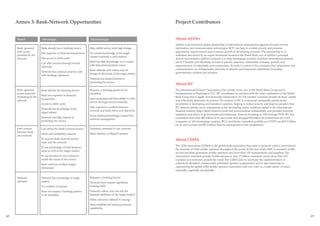
Information for Development Program ( infoDev)
                                                                                                                                             MICRO-PAYMENT
                                                                                                                                                    SYSTEMS
2121 Pennsylvania Avenue, NW
Washington, DC USA
tel. +1.202.458.5153
www.infodev.org

International Finance Corporation
2121 Pennsylvania Avenue, NW                                                                                                                 and their application to mobile networks
Washington, DC 20433 USA
tel. +1.202.458.2400
www.ifc.org

GSMA London Office
1st Floor, Mid City Place, 71 High Holborn,
London WC1V 6EA, United Kingdom
tel. +44 (0) 20 7759 2300                                                                                                                                             An infoDev Report
www.gsmworld.com
                                                                                                                                                                           January 2006
GSMA Dublin Office
Block 2, Deansgrange Business Park,
Deansgrange, Co. Dublin, Ireland
tel. +353 (0) 1 289 1800


Legal notice:
While every care has been taken to ensure that the data in this publication is true and accurate, the publisher, the GSM Association,
its Members and Associate Members do not accept any responsibility and disclaim all liability (including negligence) for consequences
arising out of acting or refraining from acting as a result of the contents of the Report. The contents of this publication are subject to
copyright and may not be stored or reproduced in any form without the express written consent of the GSM Association.
Executive Summary

Foreword
Mobile Network Operators are continuously introducing new products and services, to meet the ever                                         This Paper summarizes the first phase of an ongoing investigation into the application of mobile-enabled
growing demand for mobility in today’s fast moving world, while simultaneously attempting to make                                         commerce (m-Commerce) in developing markets. The Paper was commissioned by infoDev, in
such services increasingly relevant to, and affordable by the poorest members of society. One innovative                                  partnership with the International Finance Corporation (IFC) and the GSM Association (GSMA).
application of mobile technology, that has attracted considerable attention in recent months, is the
provision of financial services.                                                                                                          The investigation is aimed at identifying the opportunities provided to mobile networks in offering an
                                                                                                                                          m-Commerce service, as well as establishing the drivers of a successful implementation. This first stage
In many developing countries, particularly in rural areas, access to financial services is very limited                                   was launched in November with a fact-finding visit to the Philippines for on-site discussions with both
resulting in a large percentage of the population operating on a cash basis only and outside of the                                       GLOBE Telecom and SMART Communications, both of whom are operating successful m-Commerce
formal banking system. However, the proliferation of mobile services in these countries has created a                                     services.
unique opportunity to provide financial services over the mobile network. In light of the growing size
of international and national remittances, this opportunity could have significant implications.                                          In addition to the Philippines study, contact was established with several groups in Southern Africa, that
                                                                                                                                          being another region where m-Commerce services have been launched. In all, the following companies
In an effort to understand better the potential of this new mobile application, which is part of a growing                                have co-operated to supply information on their services:
area of mobile enabled commerce (m-Commerce), the Information for Development Program (infoDev)
has partnered with the International Finance Corporation (IFC) and the GSM Association to conduct a                                       • GLOBE Telecom, Philippines
case study of two promising examples of m-Commerce in the Philippines, namely mobile financial
services provided by SMART Communications and GLOBE Telecom. This partnership has produced                                                • SMART Communications, Philippines
this report, which summarizes the first phase of infoDev’s ongoing exploration into the application of
m-Commerce in developing markets. This first phase is aimed at identifying the opportunities provided                                     • Fundamo, a system supplier headquartered in South Africa
by mobile networks in offering m-Commerce services, as well as identifying the drivers of successful
implementation.                                                                                                                           • MTN Bank, an m-Commerce service provider in South Africa

Based on the findings of this report, it is clear that it is not only technically feasible and profitable to                              • Safaricom, the joint Vodafone-Kenya Telecom mobile operator.
deploy financial services over mobile networks, but that there is significant and growing demand. In fact,
m-Commerce may address a major service gap in developing countries that is critical to their social and                                   Additional information has been obtained from various network web sites.
economic development. In addition to providing many answers about this new service application, the
                                                                                                                                          Without doubt, the largest and arguably most successful m-Commerce applications are to be found in the
report raises many interesting questions about the users and how they are benefiting from this service?
                                                                                                                                          Philippines with over 3.5 million m-Commerce users on the two major networks. In discussion with the
These questions will be explored during the next phase of infoDev’s work in this area, the scope of which
                                                                                                                                          two networks, it was identified that the key success factors for that market included the ability to load
will be decided in consultation with IFC, the GSM Association and its donors and other partners.
                                                                                                                                          prepaid airtime credits as well as the ability to transfer both cash and airtime credits between customers.
                                                                                                                                          Coupled with these were the low values set by the operator for such prepaid top-ups or credit transfers.
                                                                                                                                          Typical top-ups of US$ 47 to 57 cents were allowed by the networks (equivalent to around four to five
Mostafa Terrab                                Mohsen A. Khalil                              Tom J. Phillips                               minutes of calls) while transfers between customers of both cash and airtime credits were permitted as low
Program Manager, infoDev                      Director, Global ICT Department               Chief Government & Regulatory                 as US$ 4 cents.
                                              World Bank Group                              Affairs Officer                               Ref Sect. 2.2 and 2.3
                                                                                            GSM Association
                                                                                                                                          In Filipino terminology, the target market was attuned to ‘sachet purchasing’ or the practice of purchasing
Acknowledgement and Disclaimer                                                                                                            goods in very small quantities. This phenomenon is known to be common in other developing markets
                                                                                                                                          where the populace rely on cash for all trading and can afford to buy provisions for just a few days’
The report was funded by the Information for Development Program (infoDev) in partnership with the International Finance                  consumption. This market does not exhibit bulk purchase tendencies and an m-Commerce offering that
Corporation (IFC) and the GSM Association (GSMA), and prepared by Neville A. Wishart, an independent consultant. The report
was supervised by Seth Ayers from infoDev and Wiebke Schloemer and William Kerr-Smith from the IFC, and with valuable support             involves a significant cash deposit or payment will be unlikely to find any significant uptake from the
provided by Gabriel Solomon from the GSMA. Special thanks to GLOBE Telecom and SMART Communications for their participation               target market.
in this report. The findings, interpretations, and conclusions expressed herein are entirely those of the author and do not necessarily   Ref Sect. 2
reflect the views of the GSM Association, IFC and infoDev, the Donors of infoDev, the International Bank for Reconstruction and
Development / The World Bank and its affiliated organizations, the Board of Executive Directors of the World Bank or the
governments they represent. The World Bank cannot guarantee the accuracy of the data included in this work. The World Bank                While the application of m-Commerce to developing markets was not constrained to the Philippines,
encourages dissemination of its work and normally will promptly grant permission for use. For permission to copy or reprint               the African market developments seemed to reflect the Filipino views indicating that the target markets
any part of this work, please contact infodev@worldbank.org.
                                                                                                                                          in these geographically diverse areas were very similar in their use of cash and their expectations.
Copyright © 2006                                                                                                                          Ref Sect. 3
The International Bank for Reconstruction and Development / The World Bank, 1818 H Street, N.W.
Washington, D.C. 20433, U.S.A.

All rights reserved
The range of features available in each market showed significant uniformity as to be expected if the         all cases, the interface with the m-Commerce system was attached at the periphery of the SMS system.
target markets were similar. With minor variations, the features of all systems included:                     Ref Sect. 4.1

• Provision for cash deposits and withdrawals                                                                 All versions of m-Commerce studied for this Paper involved a special SIM-based menu, which is a feature
                                                                                                              available to GSM networks. The ability to provide the services over a US-CDMA network has yet to
• The ability for third parties to make deposits into a user account (employer, family member or a            be verified.
  micro-finance organization)                                                                                 Ref Sect. 4.1

• The ability to make retail purchases at selected outlets                                                    While there were no quantifiable figures available on system costs, various estimates placed a likely cost
                                                                                                              in the range of US$5 million to US$10 million with an expectation that an m-Commerce system could be
• Over-the-air prepaid top-ups using the cash already in the account
                                                                                                              profitable with as few as 25,000 users connected but that would depend on the overall investment and
                                                                                                              service operating costs. Various estimates placed the transaction level at around two per customer per day
• The ability to transfer cash between users’ accounts
                                                                                                              and average transaction values at between US$15 and US$30 per customer and airtime top-ups of
• The ability to transfer airtime credits between users                                                       around US$4 per time. These figures can only be regarded as indicative of the type of activity that may
                                                                                                              be encountered.
• Provision for bill payments.                                                                                Ref Sect. 4.8

This latter feature could be used for micro-finance applications involving both loan repayments as well       For all the network operators, the revenue was largely derived from SMS charges while the banks derived
as loan advances and this area in particular is being exploited in the Safaricom trials and in GLOBE          revenue from transaction charges on deposits and withdrawals as well as interest on the resulting cash
Telecom’s service in conjunction with the Rural Bankers Association.                                          float. The general view was that the business should be a high volume/low margin activity, although
Ref Sect. 2.3.1 and 3.3                                                                                       some networks were operating with relatively high charges.
                                                                                                              Ref Sect. 4.2.8
Apart from the use of the service by micro-finance institutions (as in the Safaricom-Kenya trials and
GLOBE Telecom’s service) all services studied for the Paper operated on a debit account basis, i.e. the       Apart from the advantages to the wider economy, the service providers noted that if implemented
account could only be operated in credit. As a result, bad debt is not an issue other than loss caused by     properly, the service would bring advantages to all stakeholders. While the networks would experience
fraudulent activity. No operator indicated any serious concerns in this area and provided the overall         higher SMS usage and hence higher ARPU, the banking industry gained access to an otherwise difficult
system security was ensured, the possibility for fraud could be managed. In that regard, most of the          if not inaccessible market segment. Added to that were the transaction revenue and interest on the
systems studied involved a bank with normal banking systems in place. That arrangement results in the         generated cash float. The identifiable customer advantages included the availability of useful features
fraud issue being restricted to the bank’s area of involvement for which it will be well-equipped.            including cash deposits and withdrawals and ease of prepaid reloads and credit transfers between users.
Ref Sect. 4.4                                                                                                 Ref Sect. 4.7

The possibility of money laundering was considered by all service providers and it was noted that in all      In combination, the features would be likely to reduce network churn, as the customer would have more
jurisdictions, the banking regulatory authority had established appropriate policies governing the            to lose by transferring to another network. The Philippines networks report a marked churn reduction,
activities of the banks. These policies included monitoring transaction levels and frequency, looking for     with one measure suggesting churn dropped from 3% per month to 0.5% per month.
transaction patterns and stipulating both maximum account balances and daily transaction levels.              Ref Sect. 2.5
Ref Sect. 4.4
                                                                                                              The issue of market segment penetration was canvassed to identify if and how the lowest levels of users
While it is possible for a network operator to take almost full responsibility for the entire m-Commerce      could be served, noting that the systems generally had a SIM to m-Commerce account link which would
service, only GLOBE Telecom in the Philippines was operating in that manner. Even then, the actual            prevent use of the phone for m-Commerce by any other than the registered user of the phone. Apart
cash float generated was held in one of the country’s regular banks. All other cases studied involved         from utilizing a system design that did NOT use a SIM-account link, two operators noted alternative
co-operative arrangements between banks and networks. In view of the regulatory issues surrounding            ways of addressing the problem. MTN Banking’s answer is to provide the other users with SIMs which
the banking industry, this method of operation is more likely to appeal to intending service providers,       can then be swapped over when a borrowed phone is used. This maintains the SIM-account link
given also that the banks can bring additional advantages including the availability of debit cards through   effectively but may have some consequences for prepaid account expiry. The other solution adopted by
issuers such as MasterCard.                                                                                   GLOBE was to work with the micro-finance organizations to assist these users to acquire phones with
Ref Sect. 4.3                                                                                                 a time payment arrangement.       Ref Sect. 4.2.7

All networks confirmed that the additional SMS traffic arising from the service was within the mobile         In summary, the evidence available suggests that m-Commerce is a viable service that has significant
networks’ capabilities and in any case, as had happened in the Philippines for other reasons, a second SMS    benefit to emerging markets in particular. Its major benefits are the extension of banking and money
channel was easily added and would have more than enough capacity to handle the extra load. Other than        management services to the largely unbanked sectors of the economy including in particular, the ability
the SMS traffic implication, the m-Commerce application had little impact on the mobile network itself. In    to extend micro-loans to this sector as well as providing for easy repayment. The Paper notes these are not
Contents


necessarily the features that would be top-of-mind to the target market and on the basis of the Philippines      1   THE FORGOTTEN MILLIONS                                6    6   FUTURE STUDY                                                  42
experience in particular, m-Commerce service providers must provide a range of features useful to that
segment including airtime transfers as well as cash transfers between users. The importance of setting           2   THE PHILIPPINES EXPERIENCE                            8    7   CONCLUSIONS                                                   43
realistic user charges was also noted, as was the need for the service provider to carefully assess the issues
involved in starting a service.                                                                                      2.1   The Impact of Mobile ......................8             Annex 1 ........................................................46
Ref Sect. 5
                                                                                                                     2.2   SMART Money ................................9            Annex 2 ........................................................47
These issues included:                                                                                               2.3   GLOBE G-Cash..............................19             Annex 3 ........................................................48
                                                                                                                     2.4   Investment and Profitability ..........27
• Who would be the parties involved, e.g. banks etc.                                                                 2.5   Customer Churn ............................27            PROJECT CONTRIBUTORS                                          49
• What responsibilities would each party undertake
                                                                                                                 3   OTHER SYSTEMS                                       28
• What services are to be offered
                                                                                                                     3.1   Fundamo in South Africa ..............28
• Is a debit card appropriate                                                                                        3.2   Safaricom in Kenya ........................28
                                                                                                                     3.3   MTN Banking in South Africa ......29
• What charges will apply
                                                                                                                     3.4   Celpay in Southern Africa..............29
• Estimating the likely transaction volumes
                                                                                                                 4   DISCUSSION OF THE VARIOUS                           30
• Deciding on the system vendors                                                                                     IMPLEMENTATIONS
• Identifying management and operational skill sets required                                                         4.1   Mobile Network Impact ................30
                                                                                                                     4.2   Customer Features..........................30
• Ensuring the back-office support services are available
                                                                                                                     4.3   Network Architechture ..................33
• Ensuring a robust and effective customer care service is available                                                 4.4   Banking Regulatory Issues ............35
• Preparing a realistic business case and project plan.                                                              4.5   Bad Debt provision ........................35
                                                                                                                     4.6   Marketing and Sales
Finally, there were some areas identified for further research in a later phase. These were the need to
                                                                                                                           Responsibilities ..............................35
check the applicability of the current systems to networks using the US-CDMA technology, the possible
needs for technical standards, the identification of the available system vendors and the issues raised by           4.7   ARPU Imapcts and Profitability ....36
multiple users sharing a common mobile phone.                                                                        4.8   Investment Requirements..............36

                                                                                                                 5   ISSUES TO BE CONSIDERED                             38
                                                                                                                     IN ESTABLISHING AN
                                                                                                                     M-COMMERCE SERVICE

                                                                                                                     5.1   Issues for a Network Operator......38
                                                                                                                     5.2   Banking Issues ................................38
                                                                                                                     5.3   Market Issues ..................................39
                                                                                                                     5.4   Competition Issues ........................40
                                                                                                                     5.5   Regulatory and Security Issues......40
                                                                                                                     5.6   Competency ....................................40
                                                                                                                     5.7   Transaction Management Issues ..40
                                                                                                                     5.8   Company Infrastructure ................41
1: THE FORGOTTEN MILLIONS


    In developed economies it can be demonstrated that the population has wide and easy access to the                 In the developing economies however, there is a very large ‘under-class’ that is totally reliant on cash for
    banking system, with an extensive uptake of EFTPOS and credit cards. Virtually all retail establishments          all their day-to-day expenses. Moreover, this under-class makes no use of the banking sector and so is
    have facilities for accepting both types of transaction in addition to cash and such facilities can often be      ‘invisible’ in terms of its cash value. At the same time, the need for cash forces the providers of goods and
    found in service areas such as taxi cabs and even parking meters.                                                 services in these markets to have adequate cash-handling facilities and this comes at some cost.
    However, there are many economies where such wide acceptance of a ‘cashless’ society is many years
                                                                                                                      In these cases, the commercial organizations have much more to gain by addressing the problem of cash
    away. These are primarily economies where the average income is low with many people having no
                                                                                                                      transactions. Not only is the risk associated with cash holdings that much greater, but the time-value of
    involvement with a bank at any time in their life. These people survive on cash and they very likely have
                                                                                                                      the cash being held outside the banking sector is entirely lost. Furthermore, the population in this
    no trust that a bank would serve their interests very well. At the same time, many banks would regard
                                                                                                                      category is lost, i.e. unseen by the banking sector.
    this segment of the market as being unworthy of any effort and likely to be more trouble than it’s worth.
    In many cases, the cash assets held by any one individual would be too small for any bank to regard as
                                                                                                                      For these reasons, there is likely to be more incentive in developing economies to move the population at
    having value when considered alongside the traditional costs to maintain banking records for a customer.
                                                                                                                      large away from cash, than exists in developed economies. That being so, a solution that meets the needs
                                                                                                                      of developing economies will also have extensive application in the developed economies. This arises
    With the advent of mobile, that situation has changed in a subtle way but the change has not yet been
                                                                                                                      because the solution must be accompanied by very low costs as if it were otherwise, the solution would
    recognized in many markets. Specifically, the same market segment that has shunned the banks and the
                                                                                                                      have no appeal in those developing economies.
    associated electronic funds transfer systems, has contributed to the very high growth of prepaid mobile
    services in these markets. These users are often characterized by the need to communicate but without
                                                                                                                      The resulting low cost solutions can then be applied in the developed economies resulting in further
    the complexity of a formal account with the network operator. They are invariably given prepaid service
                                                                                                                      efficiency gains.
    and while some markets insist on knowing the identity of the user, at least at the time the connection is
    activated, there is no certainty that this information is accurate in the long term. This class of user prefers
    anonymity and that is what they can often get with prepaid mobile. Topping up their account is as simple
    as buying a new prepaid card from a retailer and entering the details into the phone’s keypad.

    Given that there are now large numbers of prepaid users in developing markets who are very familiar
    with using their phones for text and voice messaging as well as refilling their credit balance on the
    prepaid system, this same group is an ideal segment to target with a micro-payment feature. In many
    cases they have no relationship with any bank, do not use EFTPOS or credit cards and yet they have the
    ability to perform financial transactions as evidenced by their ability to purchase and activate prepaid
    cards for additional credit.

    This potential has been recognized in a few markets, with probably the most success in the Philippines.

    1.1 The Significance of this Segment
    The advantage of developing a market for micro-payments or m-Commerce, is that it continues to drive
    the economic system toward a cashless transaction environment. Elimination or minimization of physical
    cash has many advantages including less opportunity for fraudulent or criminal activity, reduction of cash
    handling costs and, for the user, less reliance on having the right amount of cash when needed. It also
    allows the value of money to be better utilized. Cash held outside the banking system is not available for
    short-term investment so that the time-value of the cash asset is lost.

    In the more affluent economies, there is already a good infrastructure for a cashless environment with
    most people having bank accounts and an array of both debit and credit cards. Nevertheless there is an
    underlying need for cash for minor purchases but there is little incentive to eliminate cash entirely. These
    economies can manage quite well and there is no specific interest group that feels sufficiently under
    pressure to develop systems aimed at eliminating cash from the environment. Systems that have been
    developed in such markets are often expensive and hence not particularly attractive to the user.


6                                                                                                                                                                                                                                     7
2: PHILIPPINES EXPERIENCE


    As with many developing economies, the Philippines is characterized by a very large under-class. While                                                                  service resulted from the company’s desire to develop a unique m-Commerce solution and was
    other analyses have considered the population to be subdivided into five categories, A to E, there is no                                                                eventually launched in 2004.
    quantitative assessment as to the make-up of these five layers other than to regard categories A and B as
    the upper and upper-middle income groups, with C to E corresponding to lower-middle, low and poverty                                                                    Today in the Philippines, the emphasis in the mobile markets is on low transaction costs (text messaging
    level groups. What is agreed is that the three lower categories comprise the bulk of the Philippines                                                                    at typically US2¢) and minimal re-charge values (US60¢) coupled with ease of use and a range of
    population. 1                                                                                                                                                           transactional applications aimed at addressing the population’s needs. Both GLOBE’s G-Cash and
                                                                                                                                                                            SMART’s SMART Money are being actively promoted and from the information supplied, both are
    Probably in common with other developing economies, the characteristic of the lower groups is their total                                                               experiencing a high uptake of the services.
    reliance on cash for their day-to-day subsistence, whereby their cash resources will sustain them for no
    more than a few days. This in turn leads to a different manner of purchasing life’s necessities. The concept                                                            These same low ‘sachet’ costs have significantly influenced overall mobile demand, which now exceeds 33
    of a major shopping visit to buy food in bulk is often not possible. Instead, provisions will be purchased                                                              million users out of a population variously estimated at between 85 and 90 million. This mobile
    in quite small quantities, often on a daily basis, or at least several times each week.                                                                                 penetration level presents both major operators with enormous potential in the area of m-Commerce.

    This characteristic has given rise to the term ‘sachet’ purchasing, whereby goods are packaged in very                                                                  2.2     SMART Money
    small quantities and sold through small stores specifically catering to this segment of the population.2
                                                                                                                                                                            SMART Money is the product offered by SMART Communications. It has a related product, SMART
    The stores, termed ‘sari-sari’ stores, build up a personal relationship with their customers and may
                                                                                                                                                                            Mobile Banking that allows customers to transfer funds from their bank accounts to their SMART mobile
    actually offer credit arrangements to cover difficult times for one of the local families.
                                                                                                                                                                            service account including prepaid recharging. These two products can co-exist with some customers.
    2.1 The Impact of Mobile
                                                                                                                                                                            SMART Money was first introduced by SMART in December 2000 and has gone through several
    When GLOBE Telecom introduced GSM mobile services in the early 1990s, it attacked the high revenue                                                                      iterations to the present time. As currently configured, the service appears to address most requirements
    end of the market with an emphasis on post-paid services, but with the later development of prepaid                                                                     for a good and reliable micro-payment platform.
    technology, the company commenced a prepaid GSM service in 2000. When SMART eventually
    commenced GSM services in 1999, it had little option but to seriously address the traditional prepaid                                                                   2.2.1   Product Description
    segment of the market, which it did believing that profitability could come from a low margin, high
                                                                                                                                                                            The SMART Money product is essentially a facility for linking the user’s phone to a ‘cash’ account.
    volume business
                                                                                                                                                                            Facilities exist for the customer to deposit cash, withdraw cash, top up the mobile phone prepaid credit
                                                                                                                                                                            levels from that account or other bank accounts, all without going near a bank or a SMART office if need
    Following its introduction of service, SMART researched the uptake and the way in which the customers
                                                                                                                                                                            be. Inherent in the operation is an ability to transfer credit between mobile users, so as well as allowing a
    used the service and found that their lowest value prepaid recharge card was still too expensive for many
                                                                                                                                                                            semi-formal cash transfer, it allows the users to manipulate their credit in the system to suit their
    of the users. These users could not afford the minimum P300 (US$6) charge for the card. As a result, the
                                                                                                                                                                            particular needs. It operates entirely on a credit basis, i.e. funds must be in the system before a customer
    minimum card value was reduced to P30 or US60 cents. This new value was quickly recognized by the
                                                                                                                                                                            can manipulate those funds. As a result bad debt is not an issue. The system gives no credit to the users.
    market, resulting in a very high customer growth rate for SMART. This experience reinforced the view
    that the lower groups in the economic pyramid are influenced not only by the price of the product but
                                                                                                                                                                            In its simplest form, SMART Money has no outwardly obvious attributes. The service is menu-driven
    also by the cost of the smallest element of that product, i.e. the segment was conforming to its
                                                                                                                                                                            from the phone and the customer can perform all necessary actions using the phone alone.
    characteristic of ‘sachet’ purchasing.
                                                                                                                                                                            In its preferred form, the service is coupled to a bank debit card as can be found in any community
    Following SMART’s necessary efforts to cater to the lower socio-economic classes to secure a customer
                                                                                                                                                                            around the world. In this case the customer is provided with a card issued under the MasterCard banner,
    base, it became apparent to the company that there was a definite future in this largely untapped market
                                                                                                                                                                            that can be used anywhere a normal debit card can be used, i.e. in ATMs, shops etc.
    segment provided costs and hence the service charges could be kept at a very low level. The lesson from
    the prepaid recharge card value alone was an incentive to further reduce the recharge values but that
                                                                                                                                                                            The service is aimed at providing a wide range of transaction capabilities all of which should have
    could only be done if there was a move away from the more usual scratch cards to an electronic ‘over-
                                                                                                                                                                            considerable appeal to the target market. It is coupled into an account held by Banco de Oro (BDO) so
    the-air’ (OTA) system.
                                                                                                                                                                            that the user is effectively operating a BDO account using the phone as the transaction medium.
    As a result, the company turned its attention to technologies that would allow such a move and
                                                                                                                                                                            The specific list of features provided by SMART Money is as follows:
    recognized that such technologies could deliver much greater value than just prepaid recharge using OTA
    concepts, and that gave rise to SMART’s launch of their first mobile banking and commerce service,
    SMART Money, in December 2000.                                                                                                                                          • Cash deposits

                                                                                                                                                                            • Cash withdrawals
    Since then, various changes to the product have been made and it has been joined in the market place by
    GLOBE Telecom’s own mobile money remittance and payment service called G-Cash. This new GLOBE                                                                           • Transfers of credit to the prepaid account (re-charge of prepaid service – SMARTLoad)

                                                                                                                                                                            • Transfers of cash to and from other users
    1 ‘Economic crisis dampens Christmas’AC Nielsen review in Manila Times, 28 October 2004, www.manilatimes.net/national/2004/oct/28/yehey/top_stories/20041028top2.html
    2 ‘Small Grocers in Asia Surviving Onslaught of Retail Chains’A C Nielsen review of 16 June 2004, http://www2.acnielsen.com/news/20040616.shtml

8                                                                                                                                                                                                                                                                                           9
• Transfers of airtime credit from one user to another (SMART Pasa Load)                                       card, then that can be used in a cash deposit terminal available at some locations. The terminal accepts
                                                                                                                    the card and currency notes in payment with a minimum note size of P100 and the minimum deposit is
     • Cashless purchasing at a wide range of shops where the retailer has a SMART Money account                    set at P500. Note that these are country-specific requirements unrelated to the technology.
     • Cashless purchasing at any MasterCard-enabled retailer with a MasterCard debit card
                                                                                                                    As noted above, as soon as the cash has been deposited, the customer will receive a text message in
     • Direct credit from employer payroll                                                                          addition to a paper receipt from the cash teller or automatic teller.

     • Bill payment
                                                                                                                    Cash-out. This is the reverse of the cash-in procedure but is potentially a more flexible arrangement. In
     • Inward international remittances from Overseas Filipino Workers (SMART Padala).                              this case the customer can withdraw from a bank or SMART cashier or accredited retailer in exactly the
                                                                                                                    same way as depositing cash. Again, a withdrawal must be completed with acceptable ID. However, users
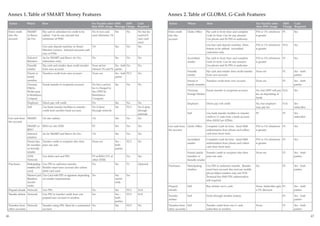
     Annex 1 shows in tabular form the range of services available along with restrictions, capabilities and        who have opted for the additional bank debit card can use that card in ATMs worldwide that accept
     costs. However, the following descriptions cover the important aspects of the Company’s service.               MasterCard transactions; in that case the card provides the ID link. Subject to retailer policy, cash
                                                                                                                    withdrawal from retail establishments using the debit card is technically possible although it is not a
     Customer Sign-up. For the customer wishing to become a SMART Money customer, the application                   practice in the Philippines market.
     process is relatively simple.
                                                                                                                    Retail Purchasing. In this transaction, the user has two options. One is to use the debit card, in which
     The normal situation involves the customer visiting a SMART office and signing up for the service. This        case the purchase is done according to normal practice where a debit card is used.
     may involve a SIM card change and it is necessary for the customer to have the phone available at that
     time. A cash deposit into the account is not required at that time but without a cash balance in the           The other alternative can be used at participating retailers, and that involves the retailer originating the
     account, no purchases or withdrawals can be made. However, having opened the account, others can               transaction request through his own SMART mobile phone terminal. Subject to the customer having a
     transfer credit into it (see below). The customer will normally be encouraged to sign up for the associated    credit balance to cover the intended purchase, the customer receives an authorization request via SMS.
     debit card at a cost of P220 which includes the first year’s subscription charge. Subsequent years attract     Once authorization is given, the retailer and customer accounts are updated and the customer receives a
     the same charge, i.e. P220 per annum. Assuming the card is uplifted by the customer, it is prepared while      confirmation of the transaction via SMS.
     the customer is being signed up and given to the customer at that time. If the customer applies at an
     office that has no card-printing facility, the card can be mailed or picked up over the next day or two.       Credit Transfers. These are convenience transactions for the customer, allowing the transfer of a credit
                                                                                                                    balance to another customer. The customer initiates a text message indicating the amount of the transfer
     If the customer chooses to not have a card, then there is no charge for the sign-up.                           and the SMART Money customer to whom the transfer is directed. Subject to fund availability, both
                                                                                                                    parties receive a confirmation SMS.
     Under normal circumstances, the customer will make a cash deposit into the system at this point.
                                                                                                                    An extension of this service is marketed by SMART under the banner of SMART Padala and is aimed at
     As an added method of subscription, the company has provided an over-the-air activation process which          the significant number of Overseas Filipino Workers (OFWs) who regularly transfer funds to family back
     registers the customer on SMART Money and allows credit transfers to the account but until the                 in the Philippines. For this, SMART, in conjunction with BDO, have established links with TRAVELEX, a
     customer visits a SMART office and provides the necessary ID as required in the Philippines, cash              worldwide group specializing in money transfers and Forex cash conversions with outlets at airports and
     withdrawals and purchases are not possible. This feature is specifically aimed at the SMART Padala             in cities in many countries. In the case of these Forex transfers, the OFW must know the mobile number
     feature described below.                                                                                       of the Filipino family member and that family member must have a SMART Money account. Recognizing
                                                                                                                    that initially at least, many SMART customers will not also be signed on for SMART Money; the company
     Automatic Transaction Update. This feature, which is built into all the transaction services, provides for     has provided an over-the-air registration method for such users to quickly register for SMART Money.
     a text message to be sent to the user whenever a transaction is performed, whether by the use of the           While this will quickly register the customer for the purposes of an international transfer, the customer
     phone directly or by way of the bank debit card if that option has been chosen. This feature operates at all   must still visit a SMART or BDO office to uplift the cash.
     times on all transactions and provides the customer with a level of confidence in the use of the product.
     As an added safeguard, the customer has free access to the current credit balance using the menu on the        The same concept allows employers to make direct credits to customers’ SMART Money accounts.
     phone and can also request a printed statement of the transactions at a nominal charge.
                                                                                                                    Airtime Transfers. This is another form of credit transfer where the SMART Money customer can
     Cash-In. This feature allows the user to deposit cash into the user’s account. As it is a physical medium,     transfer airtime credit to another SMART Mobile customer’s mobile account. In reality, this transfer can
     the cash must be deposited at one of the designated cash deposit locations. This includes SMART and            be done without being a SMART Money customer as there is no cash transaction with all credit records
     BDO offices along with a range of accredited retailers who have agreed to take deposits. Every deposit         being held within the SMART prepaid system. The service is marketed as SMART Pasa Load.
     must be covered by an acceptable ID in accordance with the requirements of the country’s central bank
     (BSP). If the customer does not have the available debit card then the deposit is manual and the               Prepaid Top-Up. This is a natural extension of the service, using either SMART Money or their mobile
     depositor must fill in a deposit form that requires a formal ID. If the depositor has opted for the debit


10                                                                                                                                                                                                                                 11
banking feature, SMART Mobile Banking. It allows transfers of credit from a SMART Money or bank                  • Cash deposits and withdrawals through a cashier attract a fee of 1% of the transaction value
     account direct to the prepaid card account. The minimum top-up from a cash account is P30 (US57¢).
                                                                                                                      • Cash deposits using a card are free
     Merchant Opportunities. As an adjunct to prepaid recharging, SMART Money offers participating                    • Cash withdrawals at BDO ATMs are charged at P3 (US6¢)
     retailers the opportunity to sell airtime to customers in lieu of previously used prepaid scratch cards. It is
     marketed by SMART as SMART Load. As long as the retailers have credit in their SMART accounts, they              • Cash withdrawals at other ATMs are charged at P11 (US21¢)
     can sell units of airtime to prepaid users who do not have the capability to do so themselves. The smallest
     transfer recognized by SMART is a value of P2 (US4¢).                                                            2.2.4   The Business Partners
                                                                                                                      The product is jointly operated by SMART in conjunction with Banco de Oro. Through Banco de Oro, the
     2.2.2           Market Uptake
                                                                                                                      product also has access to the MasterCard services
     SMART report that as at November their customer base was approximately 20 million of whom 2.5
     million had subscribed to SMART Money. Of these, around 1 million have implemented the full feature              SMART’s role is essentially that of a transport system and host to around 20 million mobile customers,
     set, i.e. they have taken the debit card option, which allows all the features available through a normal        some of whom would be normal bank customers with credit and debit card facilities, but there would be
     bank debit card, including use overseas.                                                                         significant numbers who do not currently have any relationship with a bank. SMART’s service provides
                                                                                                                      for customers to send text messages to the bank’s systems using high level encryption available to them
     Information made available indicated that the service was continuing to grow at a steady rate. A major           through the SIM card features. No aspect of the cash transfer and credit arrangements is held within the
     driver was the ability to recharge prepaid services by quite small amounts. The minimum recharge                 mobile network.
     allowed is P2, which will only pay for two text messages. As noted above, the minimum top-up value is
     P30 through the normal top-up facility.                                                                          With minor exceptions, SMART receives its income entirely from the SMS charge that is levied for the
                                                                                                                      transaction.
     Overall usage of SMART Money and its related services is reported to be very high.
                                                                                                                      Banco de Oro’s role is that of a retail bank providing normal transactional services to its customers using
     Almost all the company’s prepaid users (98% of total customer base) utilize the OTA recharge feature             the full range of cash and debit card services. As such, the bank takes full responsibility for audit, fraud
     either directly by transferring credit from SMART Money or by purchasing airtime in ‘sachets’ from               management, account security etc. under its normal banking licence. This ensures that the service
     around 700,000 co-operating dealers.3                                                                            operates entirely within the limits of the Central Bank’s jurisdiction.

     Of the estimated 8 million OFWs working overseas, over 1 million are using the SMART Padala service to           In addition to meeting the immediate needs of managing the debit accounts for the SMART customers,
     transfer almost US$50 million per month into the Philippines economy through SMART Money.4                       the bank is able to offer other services to these customers and could conceivably introduce them to the
                                                                                                                      full range of services offered by the bank and quite separate from the specific services available through
     Users transferring airtime contribute a load of around one transaction per customer every four days.             SMART’s network.

     SMART Money transactions are approaching US$100 million per month, all of which pass through the                 2.2.5   Transaction Security
     BDO network, and the banking partner, BDO, reports an added cash float of aroundUS$10 million.5
                                                                                                                      Security of the transactions with particular emphasis on PINs and account details is of utmost importance
                                                                                                                      and is taken care of using SIM-based encryption.
     2.2.3           Service Charges
     For the basic service with no debit card facility, there is no initial fee. All costs are transaction related.   2.2.6   Network Traffic
                                                                                                                      The Philippines is noted as arguably the world’s leader in the use of text messaging (SMS). For most
     If the card option is chosen, there is an ongoing annual charge of P220 (US$4) for the facility in addition
                                                                                                                      foreign network operators, the SMS service can be carried on the control channel that exists as part of the
     to the transaction charges.
                                                                                                                      infrastructure at all cell sites. This control channel handles the normal housekeeping associated with
                                                                                                                      connecting mobiles to the network but in a normal network, this channel is relatively lightly loaded and it
     The transaction charges are few and fairly simple:6
                                                                                                                      was this available capacity that provided the SMS service an opportunity for near cost-free carriage. In the
                                                                                                                      Philippines however, the market developed around very low charges for SMS calls, currently P1 (US2¢).
     • Every customer-initiated SMS (inter-account transfers etc) costs P2.5 (US5¢)                                   The result was a very high uptake and use of SMS. Current industry estimates place the SMS usage in the
     • Retail purchases using the phone incur a P1 SMS fee (US2¢), which is also the standard SMS fee.                country at around seven SMS’s sent per customer per day, and at that level, the Philippines networks
       No charge if the card is used                                                                                  have had to equip two data channels for control channel and SMS functions in place of the usual one
                                                                                                                      such channel.

     3 SMART presentation (Powerpoint) to IFC-infoDev, November, 2005
     4 Ibid
     5 Ibid
     6 SMART website, product tariffs
12                                                                                                                                                                                                                                   13
In that context, the introduction of SMART Money has not caused a major problem. SMART report no             2.2.10   Central Bank Issues
     network or SMS overload from the introduction of the service, and while exact transaction loads are not
                                                                                                                  Because of the way in which the service is being implemented, i.e. all transactions are held within the
     available, best estimates place the added load at around two SMS calls per customer per day for those
                                                                                                                  BDO system, SMART has been able to side-step the significant issues that are of concern to the Central
     customers on the system.                                                                                     Bank (BSP). As in all jurisdictions, there are controls on the movement of cash with particular emphasis
                                                                                                                  on security, bank liquidity and the elimination of money laundering opportunities.
     2.2.7   Network Technology Issues
     Recognizing that SMART’s approach is essentially to provide the transport mechanism for the service,         In this case, SMART has left all such activity in the hands of BDO and as a result, it is BDO’s
     its investment in added technology is understood to be fairly modest. SMART has developed both the           responsibility to meet the Central Bank requirements. It does this by making sure that the SMART Money
     hardware and software required for the service in conjunction with BDO and specialist suppliers and as       accounts are handled in exactly the same way as other accounts. It is for this reason that the depositing
     with other value-added service applications, the facility is an add-on to the existing network.              and withdrawal of cash from the system requires the customer to present a formal ID or have a bank
                                                                                                                  debit card.
     The company has indicated a willingness to work with other networks worldwide to facilitate a
     technology solution in those networks.                                                                       As an added constraint, dictated by the bank and/or the Central Bank, the SMART Money account is
                                                                                                                  limited to P50,000 at any one time (US$950) and is accompanied by daily transaction limits. Such
     A simplified network architecture is shown below. The key feature of the SMART implementation is its         requirements will always be unique to the specific country and are not dictated by the technology or the
     transparency and the concentration of the necessary communications security aspects and transaction          system concept.
     interface management in the peripheral unit linked to the SMS platform and to the BDO network. BDO
     have retained full responsibility for its part of the system including all necessary software and hardware   2.2.11   Summary Comment
     requirements.                                                                                                The SMART Money product is well thought out and appears to address the issues that are most likely to
                                                                                                                  be of concern to the average customer in the Philippines. Its key features include:


             Banco de
                                                                                                                  • Catering for small transaction sizes

               Oro
                                                               Cellular Network
                                                                                                                  • Capability of high transaction volumes

                                                                                                                  • Apparent security using modern encryption techniques for protection of customer PINs and account
                                                                                                                    details
                                  Transaction
                                   interface
                                                                                                                  • Ease of sign-up and does not require the customer to provide a credit history. Only a recognized

                                                            SMS
                                                                                                                    national ID is required to meet the country’s financial regulations

                                                          Platform                                                • Depositing and withdrawing cash is as easy as it can be while meeting Central Bank requirements


                                                                                    SMART network
                                                                                                                  • Allowing customers to transfer credit from one user to another

                                                                                                                  • Permiting electronic payment for goods and services

                                                                                                                  • Enabling OTA recharging of prepaid accounts.
     2.2.8   Handset Compatibility
                                                                                                                  It is probably true that most if not all of these are present in other models but the distinguishing feature
     The service makes use of SIM-based memory and menu capabilities and is compatible with GSM ‘Phase
                                                                                                                  of the SMART model is its transparency and use of a standard banking organization to record and
     2 Plus’ SIM standards. As that particular standard has been in operation for at least five years, the
                                                                                                                  manage the transactions and associated cash holdings.
     majority of customers on the SMART network have compatible handsets.
                                                                                                                  In that regard it has an advantage in that it removes the network operator from the usually severe
     The company believes that US-CDMA systems would only support the service where SIM-based
                                                                                                                  restrictions that are a necessary part of the financial and banking sectors. That probably means it is easier
     handsets are used. This aspect will require further study.
                                                                                                                  to implement in developing economies as it is much less likely to cause concern to the various central
                                                                                                                  banks. On the other hand, it requires the operator to identify a co-operative bank who can see the
     2.2.9   Telecom Regulatory Issues
                                                                                                                  advantage for the bank.
     As the service involves no new or unusual telecommunications aspects and tariffing is consistent with
     current practices, the company reports that the regulator has indicated no interest or concern with the      In the Philippines case, the bank’s advantages are the extra cash float available and the access to a large
     service. Certainly based on what is being offered and the manner in which it is being offered, it would      number of otherwise inaccessible customers. A further advantage comes from the bank’s development of
     seem highly unlikely to raise concerns in any but the most restrictive regulatory regimes.                   its relationship with those customers, leading to the provision of added services.


14                                                                                                                                                                                                                                15
SMART Communications Inc. – CEO Interview                                                               Another popular service is SMART Padala, which is an international cash remittance service via
                                                                                                             SMS. It is the newest way of remitting cash from a sender abroad to the mobile phone of a
     Napoleon L. Nazareno became CEO and President of SMART Communications Inc. in January 2000.             beneficiary in the Philippines. SMART Padala is very popular because it is convenient and
     Under his leadership, SMART claims a dominant 58% market share in terms of customers. SMART has         instantaneous. From the UK, for example, it would take three days to receive cash via physical
     won global recognition for its innovative SMART Money products and services, which are now used by      delivery. Via SMART Padala, customers receive the money immediately and it is then available at
     approximately 3 million of the company’s total 20.8 million subscriber base. Mr Nazareno serves as a    any of our 20,000 participating SMART Padala centres nationwide. There are no more door-to-
     member of the Board of Directors of the GSM Association.                                                door courier fees and lower transfer and transaction fees. Our remittance partners are global, and
                                                                                                             countries include the U.S., Canada, Australia, Ireland, Spain, Greece, Hong Kong and Singapore
     1) Please provide a brief overview of the service.                                                      where there are many migrant Filipino workers.
     We launched in December 2000 in co-operation with First E-Bank, which has since been
     acquired by Banco de Oro, and MasterCard, one of the world’s leading payment services                   4) How much revenue does SMART Money generate per month? Is it profitable?
     providers. SMART Money is the world’s first reloadable electronic cash wallet, linked together by       Actual profits from SMART Load, for example, are not that huge but what goes through the
     our cellular network. The card is the ultimate in cashless convenience. Once cash has been              pipeline is substantial – about US$18 million a month. We earn the SMS portion of that value-
     transferred to the SMART Money account, it can be used in thousands of shops and restaurants.           added service, which is roughly P2 (US$0.04). We also take a small percentage of commission
     The cash value may also be used to load airtime, pay utility bills, or transfer money from the          from our SMART Padala service.
     SMART Money card to another card. SMART Money has served as the platform by which other
     m-Commerce services have subsequently been built.
                                                                                                             5) What have been the primary benefits of the service, to both SMART and your customers?

     2) Why was the service launched?                                                                        The ARPU of SMART Money customers is about double that of non-users. And then of course
                                                                                                             customer loyalty is also higher, especially from those customers using SMART Padala. The major
     We needed a differentiator in our service offering because everyone else was offering the same
                                                                                                             benefit for SMART though is really cost reduction. When we introduced SMART Load I think we
     phone and text services. We believed that once subscribers had become familiar with SMART
                                                                                                             saved something like P300 million a quarter (US$5.6 million) compared to the traditional prepaid
     Money they would be less likely to change operators. It has brought a great deal of stickiness to
                                                                                                             voucher service. That is a huge saving. Most of our prepaid account loading is now done over-the-air.
     the 3 million subscriber base. For instance, our churn rate for non-SMART Money subscribers is
     about 3%. For those that use SMART Money, it’s roughly about 0.5%. They hardly ever change
                                                                                                             For users, the benefits are simplicity, ease of use and convenience. With SMART Load, they don’t
     operators.
                                                                                                             have to scratch a card, and it’s available with our 700,000 agents and retailers all over the country.
                                                                                                             They can buy any time of the day, 24/7. It is secure, and fits their daily cash intake because the
     3) What are the most popular applications from the service?
                                                                                                             denominations are low. That is the breakthrough.
     The most popular application is SMART Load, introduced in May 2003 for our prepaid customer
     base that makes up 98% of our subscriber market. It is a revolutionary way of loading your              6) Has it met your initial expectations?
     prepaid account. It’s an over-the-air prepaid reloading service offering airtime in what we call
                                                                                                             Definitely. In fact, it has exceeded our expectations. It has allowed us to penetrate the low-
     ‘sachet-like’ packages using the SMART Money m-Commerce infrastructure. It brings down the
                                                                                                             income markets. That is the benefit that not too many others are able to recognize. Analysts told
     denomination of prepaid loads to affordable levels for our low-end consumers. That is a very
     crucial market for us. They earn roughly P300-P400 (US$5.6-US$7.5) a day and therefore a P30            us that the maximum market penetration possible in the Philippines would be 25%. We are
     (US$0.56) load is quite affordable to them. Before, we used to distribute prepaid the traditional       already hitting the 40% penetration rate. It really enhances your penetration in the market.
     way in cards, and our lowest denomination was a P300 card.
                                                                                                             7) What challenges did you face in implementing the service?
     The reason why it was that high is because the logistics cost in distribution is high, as well as the   With SMART Load, the first and most important challenge was to convince the distributors to
     cost of the card itself. With electronic loading it becomes borderless, as it can be distributed all    offer it instead of prepaid cards. So we had to invest in marketing in order to raise awareness of
     over the country via our 700,000 outlets within a matter of seconds. The retail stores are happy        the product. We launched massive advertising campaigns and educated the market. The other
     with it as they earn about 15% commission – it is a fairly lucrative business for them. It’s            thing is the robustness of the service. We needed to be confident the infrastructure would be
     available 24/7 and they can sell any time of the day because it is electronic. We carry out             robust and able to take care of the number of transactions that would be demanded. In the
     something like 4 million SMART Load transactions a day.                                                 beginning the number of transactions was low but once people got used to it, it grew at
                                                                                                             exponential multiples. It was a good thing that we anticipated this.
     However, when we initially launched SMART Load, people were critical. They were worried it
     would reduce ARPU (Average Revenue Per User). Our secret is there is a time limit by which              8) How do you expect the micropayment service to develop over time?
     they can use the sachet, e.g. the P30 (US$0.56) offering has a time limit of about three days, and      The next step is to allow our subscribers to purchase other services such as Internet access and
     the P60 (US$1.12) offering has five or six days expiration. By limiting it to a certain number of       gaming using their mobile phones. That would diversify the SMART Money product and make it
     days, the ARPU is preserved.


16                                                                                                                                                                                                                    17
2.3 GLOBE G-Cash


                                                                                                               G-Cash is the competing product offered by GLOBE Telecom. It has several related products that provide
     a universal wallet. Consumer goods companies are interested in using our platform. We already             customers with flexibility in managing their mobile services and using the m-Commerce facilities.
     have the strongest retail distribution network in the country and that could be a springboard for
     us to use it as a vehicle for other kinds of transactions that can be developed. We are in tests now      G-Cash was first introduced by GLOBE in October 2004 and is a natural extension to the other related
     and hope to launch commercial services in the second half of 2006. We won’t launch until it is            products offered by the company.
     robust, secure and reliable.
                                                                                                               2.3.1    Product Description
     9) What are your goals for the service in terms of subscriber numbers?                                    The G-Cash product is essentially a facility for linking the user’s phone to a ‘cash’ account or ‘wallet’ as
     The number of users is now growing exponentially. It used to be one or two per cent a month               described in the company’s promotional material. In combination with the other related products,
     but now it is double-digit. The reason for this is SMART Padala, as families are using it to transfer     facilities exist for the customer to deposit cash, withdraw cash and top up the mobile phone prepaid
     funds between relatives.                                                                                  credit levels from that account. Inherent in the operation is an ability to transfer credit between mobile
                                                                                                               users, so as well as allowing a semi-formal cash transfer, it allows the users to manipulate their credit
     I would really hope we can double our 3 million SMART Money customer base by the end of                   in the system to suit their particular needs. It operates entirely on a credit basis, i.e. funds must be in the
     next year. That is a conservative target.                                                                 system before a customer can manipulate those funds. As a result, bad debt is not an issue. The system
                                                                                                               gives no credit to the users.
     10) What do you believe were the critical market conditions necessary
     for a successful launch?                                                                                  Unlike the competing SMART product, G-Cash does not currently make a debit card available.
     Our market is a low-income market. Therefore SMART Load, SMART Padala and all the SMART
     Money applications have addressed the specific needs of the mass market and that is why it has            The specific list of features provided in G-Cash is as follows:
     been successful. The other critical factor is the fact it was reliable, robust and secure from day one.
                                                                                                               • Cash deposits
     Apart from that we also have a market that is not resistant to change. We had a substantial               • Cash withdrawals
     subscriber base when we launched SMART Money that was familiar with SMS. Because this is
     SMS-based, it became a natural evolution for them. Our network alone has 500 million outgoing             • Transfers of credit to the prepaid account
     messages per day.
                                                                                                               • Transfers of cash to and from other users
     11) Do you believe a similar service could be replicated in other countries?                              • Transfers of airtime credit from one user to another (GLOBE Share a Load and Ask a Load)
     I think you could replicate it in regions with similar market conditions to the Philippines.
     Indonesia is a market where it could really work. China, India and Cambodia are others that also          • Cashless purchasing at a wide range of shops
     have great potential. Africa, perhaps. There must be an existing SMS habit though. Latin                  • Direct credit from employer payroll
     American regions like Mexico and Argentina are also potentials.
                                                                                                               • Bill payment

                                                                                                               • Inward international remittances from Overseas Filipino Workers.

                                                                                                               A comparison will show that the services offered are very similar to those offered by SMART as can be
                                                                                                               expected in a competitive market. However, in developing its competitive offering GLOBE has
                                                                                                               endeavoured to add as many useful attributes as possible by way of association with banks and other
                                                                                                               service industries. Some of the specific transactions it has enabled include:

                                                                                                               • Payment of income taxes and annual business registration fees

                                                                                                               • Payment via the Internet for games, cinema tickets and online stores

                                                                                                               • Transfers from bank accounts to G-cash via ATMs

                                                                                                               • Donations to charity and civic-oriented projects, e.g. Red Cross, Unicef, etc.

                                                                                                               While this wide range of features is not necessarily related to the technology, it indicates what can be
                                                                                                               done to make the service useful and attractive to the customers.


18                                                                                                                                                                                                                               19
Annex 2 shows in tabular form the range of services available along with restrictions, capabilities and         and the GLOBE customer to whom the transfer is directed. Subject to fund availability, both parties
     costs. However, the following descriptions cover the important aspects of the company’s service.                receive a confirmation SMS.

     Customer Sign-up. For the customer wishing to become a G-Cash customer, the application process is              Airtime Transfers. This is another form of credit transfer where the G-Cash customer can transfer
     relatively simple. It involves registration as well as the making of a cash deposit.                            airtime credit to another GLOBE mobile customer’s mobile account. The service is marketed as GLOBE
                                                                                                                     Ask a Load or Share a Load.
     For the more usual case, the customer will make a cash deposit into the ‘wallet’ at the time of registration.
     This deposit is not mandatory at this stage but is necessary before the ‘wallet’ can be used.                   Prepaid Top-Up. This is a natural extension of the service, using G-Cash to transfer credit to the mobile
                                                                                                                     account.
     In a lesser number of cases, OFWs or other Filipinos may wish to transfer cash to a GLOBE customer and
     in this case the deposit is credited to the nominated GLOBE customer account, perhaps even before the           Bill Payments. The company has a limited group of utilities to whom account payments may be made
     account holder is aware of the proposed transfer.                                                               using G-Cash. Most recently it has negotiated for G-Cash to be accepted as a tuition payment method at
                                                                                                                     almost 100 universities and tertiary institutions.
     In both cases, registration is essential for the account to become active and the registration process is
     made easy by the company’s use of over-the-air activation. The activation involves use of the SIM-based         Micro-Finance has been provided for in the G-Cash service and agreement already reached with the
     menu and an SMS text format that includes the customer’s name, address and national ID.                         Rural Bankers Association of the Philippines (RBAP). In this service, users can use G-Cash to make loan
                                                                                                                     repayments and it is understood that the bank concerned will shortly use the G-Cash service to advance
     There is no charge for initial registration.                                                                    micro-loans to the target market. This feature will enable small financial institutions to provide services in
                                                                                                                     areas not currently well served by the larger bank thus significantly extending their reach.
     Automatic Transaction Update. This feature which is built into all the transaction services, provides for a
     text message to be sent to the user whenever a transaction is performed. This feature operates at all times     Merchant Opportunities. As an adjunct to prepaid recharging, G-Cash offers participating retailers the
     on all transactions and provides the customer with a level of confidence in the use of the product. As an       opportunity to sell airtime to customers in lieu of previously used prepaid scratch cards. It is marketed by
     added safeguard, the customer has free access to the current credit balance using the menu on the phone         GLOBE as Auto Load Max.
     and can also request a printed statement of the transactions at a nominal charge.
                                                                                                                     2.3.2   Market Uptake
     Cash-In. This feature allows the user to deposit cash into the user’s account. As it is a physical medium,
                                                                                                                     GLOBE indicated around 1 million customers are using the service and the service is experiencing good
     the cash must be deposited at one of the designated cash deposit locations. This includes GLOBE offices
                                                                                                                     growth.
     along with a range of accredited retailers who have agreed to take deposits. Every deposit must be
     covered by an acceptable ID in accordance with the requirements of the country’s central bank (BSP) and
                                                                                                                     Considering that the service has only been available since 2004, uptake has been very good.
     is charged at 1% of the transaction value with a minimum of P10 (US19¢).
                                                                                                                     2.3.3   Service Charges
     As noted above, as soon as the cash has been deposited, the customer will receive a text message in
     addition to a paper receipt from the cash teller.                                                               All costs are transaction-related. The transaction charges are few and fairly simple.

     Deposits may be made into other customers’ accounts.                                                            • Each customer-initiated SMS (inter-account transfers etc) costs P1 (US2¢)

                                                                                                                     • Retail purchases using the phone incur a P1 SMS fee (US2¢), which is also the standard SMS fee
     Cash-out. This is the reverse of the cash-in procedure. In this case the customer can withdraw from a
     GLOBE cashier or accredited retailer in exactly the same way as depositing cash. Again, a withdrawal            • Cash deposits and withdrawals through a cashier attract a fee of 1% of the transaction value with a
     must be completed with acceptable ID. The transaction charge is again P10 or 15 of the transaction value.         minimum of P10 (US19¢).

     Retail Purchasing. Retail purchases are possible at several thousand participating retailers, and this          2.3.4   The Service Configuration
     involves the retailer originating the transaction request through his own cell phone terminal. An
                                                                                                                     Unlike SMART’s approach whereby it operates the service jointly with BDO, the GLOBE approach is to
     authorization request is then sent from the retailer and, subject to the customer having a credit balance
                                                                                                                     maintain and operate a clearing house facility which records all transactions and arranges settlement
     to cover the intended purchase, the retailer and customer accounts are updated and the customer receives
                                                                                                                     between the retailers and the G-Cash customers. This results in GLOBE having responsibility for the
     a confirmation of the transaction via SMS. In the case of some supermarkets, the retailer has arranged
                                                                                                                     usual banking issues of fraud management and money laundering prevention. However, the cash float
     special access from the cash register, thus removing the need for each check-out counter to have a
                                                                                                                     from the customer balances is held by the company’s usual business bank, although that bank has no
     G-Cash phone available.
                                                                                                                     knowledge of the individual user activity or account balances.
     Credit Transfers. These are convenience transactions for the customer, allowing the transfer of a credit
                                                                                                                     Each participating retailer maintains a balance in the system and this balance is used as the float for
     balance to another customer. The customer initiates a text message indicating the amount of the transfer
                                                                                                                     transactions involving the G-Cash customers.
20                                                                                                                                                                                                                                    21
All settlements between GLOBE and its partner establishments are done via the cash management                  2.3.8    Handset Compatibility
     system of partner banks.
                                                                                                                    The service makes use of SIM-based memory and menu capabilities and is compatible with current GSM
                                                                                                                    SIM standards.
     2.3.5      Transaction Security
     Two-factor authentication (phone and PIN) is performed for each transaction. Users have a choice of            2.3.9    Telecom Regulatory Issues
     using standard SMS messages or SIM-based menus and encryption.
                                                                                                                    Although offering a very wide range of features, the service involves no new or unusual
                                                                                                                    telecommunications aspects and tariffing is consistent with current practices. The company reports that
     2.3.6      Network Traffic
                                                                                                                    the Regulator has indicated no interest or concern with the service.
     As noted earlier, the Philippines is recognized for its high levels of SMS usage at around seven messages
     per customer per day. The load from the G-Cash operation equates to roughly two messages per G-Cash            2.3.10   Central Bank Issues
     customer, which represents a relatively small load on the SMS system and the network.
                                                                                                                    With GLOBE taking responsibility for all the financial transactions, the service is of specific interest to the
                                                                                                                    banking regulator (BSP) and the Anti-Money Laundering Council (AMLC).
     2.3.       Network Technology Issues
     GLOBE’s approach necessitates a purpose-built financial transaction processing facility. Such a facility has   At this stage of development, the company has limited the customer’s account size to an instantaneous
     been designed and implemented by the company and it has indicated a willingness to work with other             maximum of P10,000 (US$189). While this is a different value to that for SMART, the difference is not
     networks worldwide to facilitate a technology solution in those networks.                                      related to the technology or method of service provision, but rather to company policies. GLOBE has
                                                                                                                    commented that this value was discussed with and agreed by BSP.

                                                                                                                    2.3.11   Summary Comment
                                                                                                                    The GLOBE G-Cash product is well thought out and appears to address the issues that are most likely to
                                         Web Browser
                                                                                                                    be of concern to the average customer in the Philippines. While its approach is significantly different to
                                                                                                                    that of SMART, it is nevertheless a viable alternative that would have application in other markets. Its key
                                                                                   Business    Corporate            features include:
                                                                                  Operations    Intranet

                                                                                                                    • Catering for small transaction sizes

                                                                                                                    • Capability of high transaction volumes
                                                                          Internet /
                                                                            WAN                                     • Apparent security using modern encryption techniques for the protection of customer PINs and
             Subscribers                                                                         G-CASH               account details
             Partners                                                                             CORE
             Business Cent res            Web Server                                                                • Easy sign-up and does not require the customer to provide a credit history. Only a recognized national
                                                                                                                      ID is required to meet the country’s financial regulations
                                                                                               TRANSACTION
                                                                                                  CORE
                                                                                                                    • Depositing and withdrawing cash is as easy as it can be while meeting Central Bank requirements

                                          Handset                                                                   • Allowing customers to transfer credit from one user to another
                                                                                 SMSC                               • Permitting electronic payment for goods and services
                                                                                                    T               • Enabling OTA recharging of prepaid accounts.
               Source: GLOBE presentation Nov 2005 – Technical Overview

                                                                                                                    These features are similar to those of its competitor, which is as to be expected, but the method of
                                                                                                                    implementation is somewhat different. Its greater involvement with the financial aspects makes the
                                                                                                                    approach somewhat more complex, but at the same time the need to find a banking partner is
                                                                                                                    eliminated. The different approach has also enabled GLOBE to offer innovative features to the product,
     A simplified network architecture is shown above. The key feature of the GLOBE implementation is its           something that may be more difficult with a simpler approach.
     emulation of a banking network, albeit with some constraints, such that it does not require the creation of
     a partnership with any specific banking partner.


22                                                                                                                                                                                                                                    23
GLOBE Telecom-CEO Interview                                                                              5) What have been the primary benefits of the service, to both GLOBE and your customers?
                                                                                                              As regards the benefits to our customers, the best indicators come from feedback that we have
     Mr. Gerardo C. Ablaza is President and CEO of GLOBE Telecom. In October 2004 the company                 received from them and our partners. The main benefits are safety, convenience, and low cost.
     launched its G-Cash micropayments service, which now boasts around 1 million subscribers.                Let me cite some examples: (1) A parent residing in the provinces sends a monthly allowance to
                                                                                                              her son in Manila. Sending small amounts via G-Cash is ideal because the transaction cost is low.
     1) Please provide a brief overview of the service.                                                       (2) Our customers use G-Cash to pay their bills because they do not have to go and queue up in
     G-Cash is GLOBE’s cashless and cardless wallet in your cellphone. The service was launched               the payment centres. (3) Using G-Cash to pay for food deliveries has also been very convenient
     in October 2004, with an initial set of three anchor services: (1) international and domestic            and safe for both our customers and our fast-food partners. I know of several people, including
     remittance; (2) P2P (phone-to-phone or person-to-person) transfers; and (3) payments for                 myself, who would order pizza to be delivered to their kids who are at home, and pay for the
     retail purchases. With G-Cash, all of GLOBE’s subscribers, more than 12 million at this time,            order via G-Cash while they are still on the road or in the office. (4) In the department stores
     are m-Commerce-enabled. Because our subscribers do not need to have a card or bank account               where our partners have integrated G-Cash into their POS system, our subscribers and our
     to be part of the service, G-Cash has immediately provided m-Commerce capability to a previously         partners’ cashiers do not have to bother with cash and small change whenever they use G-Cash.
     underserved segment of the market, including those who currently do not do banking, either
     because of their difficulty to comply with the deposit requirements of financial institutions or the     On a bigger scale, G-Cash takes advantage of the accessibility and availability of our network
     inconvenience of obtaining access to such services.                                                      nationwide, and thus it provides a pervasive m-Commerce platform and extends the reach of
                                                                                                              services such as micro-financing. Further, because the service is available through our
     We now have around 1 million registered subscribers in G-Cash and close to 400 accredited                international partners, G-Cash provides an immediate link in the financial value chain between
     partners covering 3,000 or more outlets. G-Cash is also available in 16 countries via 27                 our OFWs (Overseas Filipino Workers) and their families here in the Philippines.
     international partners with around 200 outlets. Since we launched G-Cash a little over a year
     ago, other types of services have also evolved. These include (1) tax and business permit                6) Has it met your initial expectations?
     payments of the Bureau of Internal Revenue; (2) bill payments for utilities, schools, and insurance
                                                                                                              Our numbers show that G-Cash is gaining acceptance – 1 million subscribers and an average of
     companies; (3) partnerships with rural banks, or countryside banks, as a payment channel for
                                                                                                              P3 million in transaction value every day. As I mentioned earlier, G-Cash now has around 400
     micro-financing, thereby extending the banks’ presence in the rural areas; (4) G-Cash To Load,
                                                                                                              partners covering more than 3,000 outlets, and it is present in 16 countries through 27
     wherein our subscribers can use G-Cash to purchase airtime; (5) a link to one of the major
                                                                                                              international partners.
     banking networks, BANCnet, to enable transfers from bank accounts to the G-Cash wallet;
     (6) integration into the POS (Point-Of-Sale) systems of major retailers; and (7) an automated
                                                                                                              7) What challenges did you face in implementing the service?
     G-Cash machine which is on pilot while awaiting approval from our Regulators.
                                                                                                              The initial challenges were in the areas of partner acquisition and regulation. We had to acquire
     2) Why was the service launched?                                                                         partners prior to launching the service, and because G-Cash is a new concept, its use and
                                                                                                              benefits are sometimes not immediately evident. What is interesting to note, however, is that
     Within GLOBE, our mission is to transform and enrich people’s lives through communications.
                                                                                                              once we were able to demonstrate how G-Cash works, our partners themselves were the ones
     G-Cash represents one of our major steps towards fulfilling this mission, providing a convenient
                                                                                                              who thought of service variations that make use of the G-Cash platform, and this is very evident
     and low-cost m-Commerce service to our subscribers. We saw a segment of the market that was
                                                                                                              in the new set of services described earlier.
     underserved by the formal financial system. With G-Cash, we have minimized barriers to entry
     that we have seen in other m-Commerce implementations; for example, the requirement to have
                                                                                                              In the area of compliance to government regulations, we have to make sure that our procedures
     a bank account or a credit card and high transaction fees, while still pursuing the objectives of
                                                                                                              will comply with the Know-Your-Customer requirements, as GLOBE is a covered institution
     regulatory requirements.
                                                                                                              under the AntiMoney Laundering Act of the Philippines. We have presented our procedures to
                                                                                                              the Regulators and we are happy to note that these were found to be compliant. Our agreement
     3) What are the most popular applications from the service?
                                                                                                              with the Regulators is that we would advise them of any new type of service 30 days prior to
     The top three services are phone-to-phone transfers, retail purchases, and remittances. We are           launch. Moreover, we also have our capability to track G-Cash transactions. G-Cash leaves a
     also seeing increasing demand for bill payments.                                                         trail, cash does not.

     4) How much revenue does the service generate per month? Is it profitable?                               8) How do you expect the service to develop over time?
     From our registered subscriber base, the service processes approximately P3 million (US$56,164)          There are three areas of development planned. First, we will continue to expand our partner base for
     in transaction value daily. At this early stage, our priority objective is to build a strong community   the existing set of services – retailers, utility companies and other billers, banks, department stores,
     and ecosystem of users, outlets, and retailers that would enable m-Commerce to thrive and                and remittance companies. Second, we have partners who will, on their own, espouse the use of G-
     become pervasive. That would be far more valuable over the longer term.                                  Cash within their ecosystem – examples are the rural banks and national co-operatives that will


24                                                                                                                                                                                                                       25
2.4      Investment and Profitability
     continuously bring members into the fold of G-Cash user establishments. Third, and most interesting,   While neither network would confirm the exact costs of implementation, both indicated a quite modest
     is that we will have partners who will find new ways of using G-Cash. Just one year after we           capital requirement and a very satisfactory impact on overall company performance. The comments made
     launched the service, there were seven new services that were spawned by our partnerships.             would suggest a capital cost of less than US$5 million but this figure may not reflect the true cost, given
                                                                                                            the efforts of the two companies to develop the facilities.
     9) What are your goals for the service in terms of subscriber numbers and future new
     applications?                                                                                          2.5      Customer Churn
     We expect 20-25% of our subscribers to eventually be registered with the service. As for future        Both networks confirmed that the introduction of the service had stabilized network churn to a
     applications, I think there are numerous possibilities. Quite recently, we had a contest called        remarkable extent. One estimate placed normal prepaid churn at around 3% per month but for those
     G-nius, whereby schools formed teams to develop proposals for new uses of G-Cash. There were           who were also users of the m-Commerce services, the churn rate was only 0.5% per month. The
     several new ideas that came out of this contest, and what surprised us most was the level of           reduction is understandable given the features of the service and the necessary investment that the
     understanding that the participants had on the potential of G-Cash. The winning proposals were         customer makes in the service. While customers can readily withdraw their cash balances in the system and
     all technically feasible, and we believe that this is a very good indicator of the new variants in     relinquish cellular service altogether, there is arguably little benefit in doing so, the down-side being the need to
     uses of G-Cash.                                                                                        keep their prepaid account live. In many markets, that cost is quite low so it is to the customer’s advantage to
                                                                                                            remain connected.
     10) What do you think were the critical market conditions necessary for a successful
     launch?
     There are a few. First, the Philippines is an SMS country. People were very much at ease in using
     the service. Second, our other services like Autoload Max and Share-A-Load have paved the way
     for easy acceptance. In both services, airtime value is transferred over the air, and in a way G-
     Cash was a progression in transferring another form of stored value. Third, we have a segment of
     the population for which financial services are not easily accessible. G-Cash is our effort to reach
     this segment of the population. Fourth, there is a need for safe but low-cost money transfer
     services. G-Cash has enabled our partners to provide such services without the need for them to
     put up expensive infrastructure. Last, but not least, is the receptiveness of our regulators. We
     work closely with our Regulators to ensure that our G-Cash procedures address regulatory
     requirements and concerns.

     11) Do you believe a similar service could be replicated in other countries?
     Yes. In fact, we have received some serious queries over the past few months. We believe the
     service can be replicated, particularly in areas where there is a widely dispersed population with a
     need for low-cost financial transaction delivery.


26                                                                                                                                                                                                                                  27
3: OTHER SYSTEMS


     3.1     Fundamo in South Africa                                                                                    Because of its 50% ownership from Standard Bank, MTN Banking is able to operate under the umbrella of
                                                                                                                        Standard Bank’s licence. This arrangement has significant benefit for any service provider as the alternative
     Fundamo is a South African based company specializing in the m-Commerce sector. It is not an operator
                                                                                                                        is for the service provider to obtain a banking licence and in some markets that could be difficult.
     of such services but in co-operation with other companies, it provides m-Commerce solutions.

                                                                                                                        At the present time, the company reports that approximately 150,000 customers have logged onto the
     The company claims to be able to meet all requirements ranging from bank-hosted systems to those
                                                                                                                        service, but actual user numbers are understood to be somewhat less than this. Noting that service
     where the network operator essentially functions as a bank. Its clients include MTN Banking in South
                                                                                                                        commenced in August, the level of interest is very encouraging.
     Africa as well as Celpay in Zambia and the Democratic Republic of Congo.

                                                                                                                        It was also noted that MTN Banking provides a MasterCard debit card as part of the service. While the
     In discussion with Fundamo, it confirmed that a typical initial implementation would cost in the range of
                                                                                                                        use of the card initially appears to be low, the company reports a very significant increase in usage as the
     US$3 to 5 million and be profitable from around 25,000 users. Its experience in the African markets
                                                                                                                        users become familiar with the service.
     suggested that mobile monthly ARPU was impacted by approximately US$2 for the users of the service
     but it would appear that in their experience there can be a wide range of transaction rates.
                                                                                                                        As the only example of a joint venture company handling the overall service, the company’s views on the
                                                                                                                        arrangement were sought. As to be expected, the advantages related to the management and operational
     Fundamo also confirmed the importance of the banking regulatory issues in planning the introduction of
                                                                                                                        aspects with specific mention that the joint venture led to the creation of a new company with a new
     a service and the need to carefully plan the resources needed to launch a successful m-Commerce service.
                                                                                                                        culture, unafraid to make innovative changes. Recognizing the unusual nature of the m-Commerce
                                                                                                                        business and how its demands are foreign to normal network operator and bank activities, the
     3.2     Safaricom in Kenya
                                                                                                                        arrangement may prove to be one well worth considering in establishing a service.
     Safaricom is the Kenyan mobile system operating under Vodafone and Kenya Telecom ownership. As part
     of the Vodafone stable, the company has joined with another Vodafone operation, Vodacom in Tanzania, to            3.4     Celpay in Southern Africa
     investigate and develop a micro-finance service, to be trialed initially in Kenya. From the information
                                                                                                                        Celpay was originally established as a wholly owned subsidiary of Celtel, the MSI mobile operation on
     supplied by Safaricom, the service is currently in embryonic form but is expected to provide features
                                                                                                                        the African continent. However, in March 2005 it was sold to First Rand Bank of South Africa. Celpay was
     largely in line with those offered in the other markets studied.
                                                                                                                        originally the m-Commerce service set up by Celtel in Zambia and subsequently the Democratic Republic
                                                                                                                        of Congo. Under the Celtel banner it was proposed to establish the Celpay service in each of Celtel’s
     As in those other markets, the project involves both a network (Safaricom) and a bank (Commercial Bank
                                                                                                                        markets in Africa. Following the purchase, First Rand Bank has made no comment on its plans for Celpay
     of Africa) and in addition for the purposes of the trial service, it includes a lending institution specializing
                                                                                                                        other than a general statement suggesting that the Celpay concept is the way of the future.
     in lending into the target market (Faulu Kenya). The initial emphasis of the trial service is on facilitating
     Faulu Kenya’s activities but not to the exclusion of the other opportunities offered by the service.
                                                                                                                        From a high-level analysis of the Celpay system, it is apparent that it operates with the same range of
                                                                                                                        features as found in other markets. It is understood that the existing implementations of Celpay utilize
     Initial trials of the service, branded as ‘M-Pesa’, are underway with a selected group of around 250 users.
                                                                                                                        the Fundamo system.
     Even with the very limited range of services currently available, the company reports some encouraging
     results as follows;
                                                                                                                        The Celpay service does not incorporate a debit card but as it is now owned by a bank; presumably the
                                                                                                                        provision of a card if necessary as well as the acquisition of a banking licence will not be difficult in
     • Transaction rate approximately 0.6 per user per day and likely to be rising as customers become
                                                                                                                        whatever markets Celpay may operate in. Its current markets would not benefit from the provision of a
       accustomed to the features
                                                                                                                        debit card.
     • Average transaction value US$14
                                                                                                                        It is presumed that under its new ownership Celpay is independent of network operators.
     • Average cash deposit US$19.60

     • Average transfer between users US$4.50

     • Average cash withdrawal US$3.80.

     Given that the service is primarily aimed at the micro-finance operations of Faulu Kenya, the usage levels
     are impressive in spite of the very small number of customers in the trial.

     3.3     MTN Banking in South Africa
     MTN Banking is a joint venture between Standard Bank and MTN Networks. In its operation, based on
     a platform largely supplied by Fundamo, MTN Banking operates as the prime service provider, responsible
     for sign-on, marketing and distribution, leaving MTN Networks to be the carrier for the service.

28                                                                                                                                                                                                                                      29
4: DISCUSSION OF THE VARIOUS IMPLEMENTATIONS


     4.1     Mobile Network Impact                                                                                      4.2.2    Debit Cards – A Useful Feature?
     One factor to come through all the systems discussed above is that they are all very similar in terms of the       The important difference in customer features related to the availability of a recognized debit card. In the
     impact on the mobile networks. Invariably use is made of the SMS feature available in all the networks and         MTN Bank and SMART Money versions, the banks involved had been able to issue MasterCard debit cards
     from the experience to date, the added load from the service is easily managed and unlikely to result in any       to the customers. This would have to be a major feature for those networks as it gives the customer almost
     significant loss of capacity. Even where the SMS traffic levels are quite high, the impact has been to utilize a   infinite possibilities for purchasing and cash withdrawals. With the debit card, customers no longer need to
     second digital channel for SMS traffic. In the only case where this has occurred, the need resulted from high      find an accredited dealer but can instead use regular ATMs for cash withdrawals. Furthermore, the need for
     ‘texting’ traffic rather than the m-Commerce application.                                                          providing an acceptable ID for all deposits and withdrawals is avoided, as the card with either a PIN or a
                                                                                                                        signature provides that security feature.
     Based on the stated loads being experienced in the Philippines networks, the provision of the m-Commerce
     services is capable of generating a healthy revenue stream for the network operator, but more importantly, it      The card could also be of advantage where user literacy is a problem as its use may be less stressful than
     may create an additional incentive to take up mobile services in the developing markets. Although the              having to complete a formal withdrawal application form.
     added customers are unlikely to be volume users of the mobile services, they will still contribute in a
     material way to the operators’ net earnings.                                                                       The availability of the debit card also eases the problem for retailers and the network operator in that
                                                                                                                        purchases are no longer restricted to just selected retailers.
     While not encountered on the study, it is equally possible to utilize the WAP features of the mobile
     networks as a transport medium. However, from a practical point of view, this solution is likely to be less        However, the use of debit cards pre-supposes that debit card systems and ATMs are widely available in the
     attractive due to the relatively low profile of WAP services in the emerging markets. On the other hand, the       respective markets. They clearly are in the case of the Philippines and South Africa but many other markets
     SMS features are widely utilized in most markets and their use in the m-Commerce application makes for             may have limited card facilities, which would render this attribute of little value.
     an easily understood product. The use of the SMS capacity also utilizes an existing feature of all networks
     while a WAP application may involve some networks in further development.                                          4.2.3    Retail Purchasing
                                                                                                                        Performing retail transactions using the phone itself was a feature in all the systems. However, in order to
     It should be noted that all the networks involved in the study were GSM-based. The applicability of any of
                                                                                                                        function, the retailer must have an m-Commerce account on the chosen system. Whether this requirement
     the solutions to a US-CDMA based network has yet to be verified
                                                                                                                        is a barrier to widespread up-take of the service is not apparent at this stage of development. There is a
                                                                                                                        potential problem that in a competitive market with several m-Commerce offerings, retailers could resist the
     4.2     Customer Features
                                                                                                                        need to have m-Commerce accounts on several systems. No network reported this as a problem, and in any
     In terms of customer features, the offerings can be broken down into two categories: those where a debit           case, a system technology development could well eliminate this as an issue by permitting transactions to
     card is issued and those where there is no debit card issued. However, in making this split, it is important to    leave the confines of the m-Commerce application and be handled as a normal POS transaction.
     recognize that the issuing of a debit card is more likely to be a matter of central bank policy than any
     technology issue for the chosen implementation.                                                                    Once a debit card is available, retail purchasing is made that much easier, but as noted above, the existence
                                                                                                                        of a widespread card environment is a prerequisite.
     Disregarding the debit card issue, all the systems studied had similar customer features. While not all
     systems included every feature, there seemed to be nothing to prevent all the features being made available.       4.2.4    Bill Payments and Micro-Finance
     All gave cash-in and cash-out facilities as well as some aspects of bill payment, credit transfer between
                                                                                                                        This area of micro-finance is becoming increasingly important to the emerging economies as it gives the
     customers, retail purchasing at selected establishments and prepaid recharge.
                                                                                                                        ability to advance funds into the sector as well as receive repayments on loans already advanced. The use of
                                                                                                                        the m-Commerce systems for this important area also has significant advantages to the outlying customers.
     The range of options was clearly one for each operator to determine and the selection appeared to be
                                                                                                                        One case that was mentioned involved a customer who was required to make regular weekly or fortnightly
     limited only by the ability of the operator to reach agreement with the third party suppliers. G-Cash in
                                                                                                                        repayments but to do so involved one whole day of travel to reach an office that could accept the payment.
     particular seemed to be very active in adding useful features and partners to its product.
                                                                                                                        That requirement resulted in the customer being unavailable for productive employment on that day and if
                                                                                                                        a five-day week was assumed, the loss of productivity is around 20%.
     4.2.1   Deposits and Withdrawals
     Naturally, every system provides for deposits and withdrawals. All provided for deposits at a company office,      As a result of general interest in this aspect, the operators trialing the m-Commerce service have all made
     but some had other options available or under development. SMART in conjunction with its partner, BDO,             moves to enable such a feature.
     provided a series of cash deposit machines on its premises allowing customers to enter cash in
     predetermined denominations, using their MasterCards. GLOBE was in the process of trialing similar                 However, in all cases studied, the service is provided by a third party, typically a ‘rural bank’ who then takes
     terminals which could be used in conjunction with the phone to permit deposits.                                    all liability for debt etc. and is accordingly operating to the requirements of the banking regulator.

     Apart from that, deposits and withdrawals were also possible at the participating retailers.                       The micro-finance option is an extension of the bill payment feature that all operators were offering. If the
                                                                                                                        system allows the payment of bills, and all systems studied did so, then it must also allow repayments to
                                                                                                                        financial institutions for loans that have been advanced. In the same way, the technology will also allow
30                                                                                                                                                                                                                                         31
loans to individuals but it is important to note that the credit given is not credit on the account but a bona    market being financed into phone ownership with payments spread out over six months with an additional
     fide transfer of cash from the financial institution to the customer.                                             GLOBE contribution in the form of airtime credits for loan repayments. As the programme is recent, there is
                                                                                                                       no reliable information on actual results. In addition, the company has been encouraging the market in used
     Several networks had actively sought or were seeking micro-finance institutions as partner service providers      handsets, which should result in a low entry barrier for this segment.
     on their systems. Among others, GLOBE is already offering a repayment service to one of the Philippines
     rural banks while Safaricom is trialing a service in Kenya.                                                       An alternative view from MTN Banking involved issuing these users with a SIM that could then be loaded
                                                                                                                       into a borrowed phone when a transaction had to be initiated. This solution may have some network and
     4.2.5   Prepaid Loading and Airtime Transfers                                                                     handset reliability issues.
     All networks have included prepaid loading as a feature of the systems they offer. From comments made,
                                                                                                                       4.2.8 User Charges
     this is probably the key driver for the growth in the systems. Customers find that the ability to load credit
     into their prepaid accounts is a major attraction, whether it is from their m-Commerce accounts or through        A key feature of the Philippines implementations was the low user charges of typically US2¢ to US4¢ for
     participating retailers. For the networks, this feature is a major cost reduction issue as the need for prepaid   purchases and transfers of airtime and cash. Cash deposits and withdrawals attracted a higher charge of 1%
     scratch cards is eliminated along with the associated security requirements.                                      but with a minimum generally less than US19¢.

     Coupled with this feature was the ability also to transfer airtime between customers. This feature too was        These low values were not necessarily repeated in the other markets with some networks charging 5 to 10
     greatly appreciated by the customers as it provided a further alternative for their prepaid accounts in the       times these values for the similar transactions. However, based on the reported uptake of the services, the
     event that they had neither cash nor credit in their system account.                                              Philippines charges generated a much higher level of usage.

     It was noted that GLOBE had further expanded on this feature by providing for the recipient to be able to         As noted elsewhere, the Philippines philosophy is low margin and high volume and that has resulted not
     request the transfer from another family member (Ask-a-load), rather than having to make a separate               only in high transaction levels but greater uptake of the service as well as a higher uptake of mobile service.
     request to a friend or family member.
                                                                                                                       4.3      Network Architecture
     Note that an airtime transfer can be technically achieved without an m-Commerce solution as it can be
                                                                                                                       As intimated above, all realizations of the m-Commerce service involved the use of the network’s SMS
     confined entirely to the mobile billing system.
                                                                                                                       platform, with no operator reporting a resulting traffic loading problem.

     4.2.6   Cash Transfers
                                                                                                                       From that point on, the offerings fell into two distinct groups.
     This feature was offered in all systems and again was said to be a significant driver of customer growth. It
     allows credit to be moved between users and by implication, between third parties and users. Specifically,
     a transfer of cash to a user from a payroll deduction is possible as is an international remittance from an
     overseas source, subject to having negotiated a suitable arrangement with the remittance organizations.
     Systems having a bank partner were likely to be better served in this area as the banking partner would
     already have the necessary relationships.

     4.2.7   Targeting the Lower Market Segments
     While not a specific customer feature issue, the appeal to the lowest levels of the target market is an
     important issue if the m-Commerce service is to realize its full potential. In all the systems examined, there
     is a danger that this major goal will be lost in the rush to get users onto the system. For all networks and
     system suppliers, a stated goal was to attract the lower ‘unbanked’ segments of the potential market into the
     service. The benefits were seen to include capturing the cash float and removing the need for this segment
     to carry cash at all times, thus reducing the threat of robbery within the group. However, the provision of
     the features outlined above presupposes that all of the target market is equipped with cell phones.

     Unfortunately, this is not the case and it is known that in many markets, one phone may be shared among
     several individuals. This practical arrangement is unfortunately incompatible with most of the systems
     studied. In general, the systems all used SIM-based menus and assumed one m-Commerce account tied to
     one phone. As a result, sharing a phone doesn’t work for the m-Commerce service.

     This point has not been lost on GLOBE who commented that in order to address this point, a programme
     of co-operation between GLOBE and the Rural Bankers Association had resulted in this segment of the
32                                                                                                                                                                                                                                       33
4.3.1   The Access Model                                                                                         4.3.2   The Hybrid Model
     One group employed a relatively simple approach to the provision of the service, sometimes referred to as        This model is the more complex arrangement whereby the network operator takes a greater role in the
     the ‘Access’ model because it is one where the mobile operator is restricted to just the access portion of the   provision of the service. This can range from including just the transaction management aspect, right
     business. In this case, the networks established relationships with a normal bank with both parties              through to the stage where the network operator also holds a banking licence and provides all aspects
     marketing the service. The network provided a ‘front-end’ to the SMS system that was linked to the bank’s        of the service.
     own system. This interface system was designed to take care of security, transaction routing and the
     management of the SMS responses back to the customer based on information supplied by the banking                Of the two approaches, the Hybrid model is naturally the more complex from a central bank viewpoint.
     system. Specifically this covered the automatic account update whenever a transaction was initiated. The         Recognizing that individual central banks all have quite rigorous requirements covering issues of liquidity,
     architecture can be simply represented by the following diagram.                                                 banking security and anti money laundering, the implementation of the Hybrid model will necessarily
                                                                                                                      involve extensive negotiations with the banking regulator.

                                                                                                                      This model is the one adopted by GLOBE Telecom in the Philippines in particular.

                                                       Cellular network                                               4.4     Banking Regulatory Issues
                   The Access Model
                                                                                                                      No network or service operator expressed concerns about this area, noting that in all cases adherence to
                                                        SMS Platform                                                  the country’s financial regulations was not negotiable. For that reason most service providers preferred a
                                                                                                                      solution involving a banking partner who would hold the banking licence and perform all the required
                       Network                          SMS Interface                                                 actions with regard to liquidity, security, fraud and money laundering prevention.

                       Bank                                                                                           4.5     Bad Debt Provision
                                                        Bank System                                                   In none of the cases studied was any credit offered to customers. All transactions through the system
                                                                                                                      must be supported by available credit in the customer’s account. As a result, there is no specific provision
                                                       Cellular network                                               for bad debt arising from the customer transactions. Fraud and money laundering activities will be an
                   The Access Model
                                                                                                                      issue for the banking part of the service. The possibility of fraud through the network is regarded as
                                                         SMS Platform
                                                                                                                      extremely low.
     In this model and for the purposes of considering the alternative configuration, the banking system will
                        Network
     itself comprise three elements as shown below. In SMSnext diagram, the transaction module maps the
                                                         this Interface                                               In the case of micro-finance applications where loans may be advanced and a resulting risk arises, the
     actual transactions, determining the settlements that must be made and generating the transaction                service is a third party one with the provider carrying the entire risk.
     confirmation messages that must be sent Transaction Management
                        Bank                    to the users.
                                                                                                                      4.6     Marketing and Sales Responsibilities
                                                      Bank System
                                                     Data Storage
     The data storage module holds the account balances for all the users including the retailers and other           There were a variety of approaches to sales and marketing among the systems studied. These approaches
     service providers, while the bank module represents the physical cash storage facility and the holder of the     could be influenced by the model adopted for the architecture implementation, but the arrangements
     banking licence.                                     Bank                                                        used seemed to canvas all the possibilities.

     This portion of the overall network is discussed further below.                                                  GLOBE Telecom with its hybrid model, wherein the entire network was essentially in GLOBE control,
                                                                                                                      naturally resulted in GLOBE being responsible for all aspects of sales and marketing.

                                                                                                                      However, the other networks all used the ‘access’ model, but the sales and marketing responsibilities
                                                Transaction Management
                                                                                                                      varied with each case.

                                                       Data Storage                                                   For SMART Money, the bank provided the financial system infrastructure in conjunction with SMART.
                                                                                                                      The marketing was left almost entirely to SMART although the bank did have some lesser roles.
                                                            Bank                                                      Acquisition of dealers and other third party partners was also left to SMART.

                                                                                                                      For MTN Banking, MTN Networks, the network operator, was a 50-50 joint venture partner with
                                                                                                                      Standard Bank, but as MTN Networks, it had no specific involvement other than as a transport medium.
     The Access model is employed by SMART Money in the Philippines, MTN Bank in South Africa, Safaricom              Sales, marketing and dealer acquisition remained with MTN Banking. Similarly, Standard Bank, the
     in Kenya and eventually Tanzania as well as Celpay in Zambia and the Democratic Republic of Congo.               banking partner in the venture, had no obvious role, although like MTN Networks, it does provide
                                                                                                                      information relating to the service and it holds the banking licence.
34                                                                                                                                                                                                                                   35
Celpay in Zambia and the Democratic Republic of Congo is now owned by First Rand Bank. When it                  The results are displayed in the chart below. No account was taken of the cash float generated and the
     was owned by Celtel, it was presumably marketed by that company; but under its new ownership all                resultant interest income that could be derived. Note also that if the transaction rate is fewer than two
     marketing, sales and distribution is left to First Rand Bank and the business is now fully independent          (as used above to calculate the user capacity), the user capacity is increased accordingly, i.e. it is
     of a network.                                                                                                   transaction-limited rather than user ID-limited. That has the effect of making the economic performance
                                                                                                                     better than shown here.
     The Safaricom trial is in its early stages so no real pattern has emerged, but from what has happened
     to date, all the partners including the micro-finance institution are involved.                                 The chart tracks transactions per day per user against the transaction charge in US cents. Note that
                                                                                                                     SMART’s transaction charge was around US4cents compared to GLOBE’s at US2cents and their customer
     4.7            ARPU Impacts and Profitability                                                                   loads exceed 2.5 million and 1 million respectively.
     The Philippines network operators indicated a very satisfactory ARPU gain. SMART indicated that the
     ARPU for the target group was double that of the other mobile customers, while GLOBE indicated a
     transaction volume of perhaps two transactions per day per user. If this figure is correct and the average
     GLOBE transaction charge is P1 (US2cents), the ARPU would be around US$1.20. Fundamo also
     expressed the same expectation but noted a significant variation in transaction volumes in the African                                  Return on Investment for m-Commerce
     markets.
                                                                                                                                 90
     GLOBE and SMART both indicated very satisfactory levels of profitability which is to be expected at the                     80
     user volumes those two networks are experiencing. Fundamo believed the service could be profitable
     with around 25,000 users while MTN Banking expressed the view that a ‘break even’ might not occur                           70
     until there were more than 350,000 users, but as no transaction volume was available, the much higher
                                                                                                                                 60
     number could be a reflection of lower transaction rates.
                                                                                                                        Rol      50
     First Rand Bank has commented 7 that in the Zambian and DCR markets, where they are offering service
                                                                                                                         %       40
     under the Celpay brand, the company has yet to break even, noting that demand is growing steadily and
     transaction volumes are around 100,000 per day (2.5 to 3 million per month).                                                30

                                                                                                                                 20
     Both GLOBE and SMART indicated a major impact was the very significant cost reduction through the
     availability of OTA reloads for the prepaid service. No longer did they need to distribute scratch cards                    10
     with the associated costs and security issues.
                                                                                                                                  0
     4.8            Investment Requirements                                                                                      -10
     At this early stage it is not possible to be definitive about the capital investment needed for an m-Commerce               -20
     solution. However, from the discussions with the various networks and/or system suppliers it could be
     expected that an investment of around US$5 million would be needed in order to launch a service with                              1.5             1.75               2                2.25              2.5
     a capacity of around 5 million transactions per month.                                                                                                  Transactions per day
     Some increase in costs would accompany higher transaction volumes, but from comments made the
     increase could be quite moderate. The two Philippines networks indicated similar costs and in those two
     cases, transaction volumes could range between 50 and 100 million per month.                                    Clearly the real Return on Investment will be dependent on the actual customer load and transaction
                                                                                                                     rate, but the chart reveals that at quite moderate rates of usage, the service is potentially quite profitable.
     Assuming the high Philippines usage level of around two transactions per day per customer, combined
     with the conservative capacity of 5 million transactions per month, a start-up system would have a
     capacity of 80,000 customers.

     Using such a network as a model, the return on investment was calculated assuming only 50,000
     customers and a daily transaction volume in the range 1.5 to 2.5 per user. Other assumptions were that
     the support costs were 10% of capital investment and there was no growth over the 10-year period, i.e.
     a constant 50,000 users at all times.

     7 First Rand Bank CEO Report for 2005

36                                                                                                                                                                                                                                     37
5: ISSUES TO BE CONSIDERED IN ESTABLISHING
        AN M-COMMERCE SERVICE

     5.1            Issues for a Network Operator                                                                      5.3            Market Issues
     Recognizing that the main objective for the mobile network operator is to generate further transaction            While the banks and the networks may have expectations as to the value of m-Commerce, the service
     revenue from the network messages that take place, the issue for the operator is to identify the banking          will not succeed if it is unattractive to the customers.
     parties that it can work with to achieve that goal. Working with a bank allows the operator to largely
     sidestep the banking regulatory scene as well as gaining from the facilities that a bank has available for        5.3.1          User Charges
     electronic transactions and perhaps access to a debit card.
                                                                                                                       From the experience of the two Philippines operators, a major driver was the provision of airtime credit
                                                                                                                       transfers between customers and between the ‘customers’ accounts’ and their prepaid mobile accounts.
     The alternative is for the network operator to adopt the Hybrid model wherein the network essentially
                                                                                                                       It was important that the minimum values of credit transfer be kept to very low levels. The Philippines
     becomes a bank in all but name. This would have to be an option in a situation where a partner bank was
                                                                                                                       values were as follows:9
     not easily identifiable but it carries a heavy load with regard to the need to meet banking regulations. In
     some markets it may be unacceptable to the central bank.                                                          • Minimum person-to-person airtime credit allowed: US4¢

     If the market already exhibits a high level of ATM, POS and credit card use, the availability of a debit card     • Minimum prepaid top-up from account: US47¢ to US57¢.
     will become a useful attribute, as it will allow customers a wider choice of where they can purchase goods
                                                                                                                       In the same market the standard SMS charge was US2¢ and the normal prepaid call charge was US14¢
     and services.
                                                                                                                       per minute. The charge associated with these transactions was typically US2¢.

     If the network operator decides to adopt the Hybrid model, it must also decide how far the hybrid model
                                                                                                                       In that market, there was a significant bloc of customers who could not afford high value prepaid top-
     is to be developed, recognizing that the path through the banking regulations may be quite difficult.
                                                                                                                       ups and possibly could not afford to make voice calls at all, i.e. they had cell phones purely for text
                                                                                                                       messaging. The above airtime transfer and top-up values supported those customers’ use of the network
     If the network adopts the ‘Access’ model, it must find a banking partner who will be prepared to develop
                                                                                                                       and led to a significant growth.
     the service and provide the facilities. The economic downside is that its revenue stream will come entirely
     from the transactions. The alternative of adopting the Hybrid model places the product development and
                                                                                                                       By coupling these features with the m-Commerce features, the two companies have been able to secure
     management more firmly in the network court but brings with it the possibility of the added revenue
                                                                                                                       large numbers of m-Commerce customers onto their networks, thus realizing the goal of increasing call
     from managing the significant cash float generated from m-Commerce.
                                                                                                                       revenue (from extra SMS usage) and capturing the cash float from the ‘unregulated’ market.

     Whatever model is adopted, the offering of an attractive service is likely to generate additional demand
                                                                                                                       5.3.2          Adding Facilities to Attract Users
     for mobile services when the users experience the convenience of m-Commerce. More importantly, the
     use of the m-Commerce service provides an element of customer churn reduction. Users of the service               It is probably a reasonable assumption to say that for the majority of customers, the value of
     are less likely to move between competitive mobile services as they will to some extent be tied by the            m-Commerce is quite low initially, and it is only by experiencing the service that they will come to use
     m-Commerce application. Note the very significant reduction reported in the Philippines.                          its features on a more regular basis. This view is supported by SMART’s reported uptake of the debit card
                                                                                                                       option at 1 million out of 2.5 million customers. While the debit card provides the customer with much
     5.2            Banking Issues                                                                                     greater flexibility of use, many customers are not bothering to uplift this optional extra, presumably
                                                                                                                       because they perceive no need.
     For the bank, the issue is more complex than just the added revenue. From a central bank viewpoint, the
     capture of the unofficial cash economy has to be a major factor in favor of moving to an m-Commerce
                                                                                                                       Extending this to the wider scene, the banks and the networks have complementary views of the
     service. Not only does it generate a cash float that can be used to improve the country’s economic
                                                                                                                       m-Commerce service, but the majority of the customers in the emerging economies are likely to have
     situation, but it also helps to reduce fraud, money laundering and criminal acts such as robbery because
                                                                                                                       quite a different view. It is only by merging a significant customer need with the objectives of the banks
     the cash assets of the users are no longer being carried around in person.
                                                                                                                       and networks that m-Commerce will find widespread acceptance. Once customers are linked into the
                                                                                                                       m-Commerce service, they can be encouraged to start using the extra features available.
     For the partner banks, there are two related benefits. The first is the extra cash float that will be generated
     from the cash deposits into the m-Commerce system. In the reported case of SMART in the Philippines,
                                                                                                                       From the experience of the existing providers, the major driver has been OTA prepaid top-ups as well as
     their partner bank, Banco de Oro, received a US$10 million boost from the 2.5 million users of the
                                                                                                                       cash and airtime transfers between users. Following on behind in the Philippines was the ability to remit
     service.8
                                                                                                                       funds to an m-Commerce account, particularly from overseas. This may or may not be an issue in other
                                                                                                                       markets but the emphasis has to be on finding features of importance to the users.
     The second benefit is that most of the customers taking up the service are likely to be new to the banking
     sector so that the provision of the service gives the banks a greatly expanded market into which they can
                                                                                                                       Adding significant groups or types of retail purchasing can also provide an incentive to take up service.
     target specific products. Included with this is the opportunity to develop micro-finance opportunities.


     8 SMART presentation to IFC-infoDev, November 2005                                                                9 SMART and GLOBE corporate websites with product tariffs listed

38                                                                                                                                                                                                                                  39
But before customers will take up the service, they will want to see reasonable charges. Recognizing the       Whereas in a normal banking environment there will be a steady stream of transactions at moderate to
     target market is likely to be characterized by ‘sachet’ purchasing (ref Sect. 2.0 above), the                  high values, the m-Commerce services are characterized by large numbers of very low value transactions.
     m-Commerce offering must be accompanied by appropriate transaction charges. In the Philippines cases,          Taking the Philippines case as an example, with 2.5 million users on the SMART network and assuming
     the transaction charges are quite low and typically at around one to two times the normal (and low) SMS        two transactions per day, the transaction volume will be 5 million per day or 150 million per month.
     charge. In other markets offering m-Commerce but without the success of the Philippines, transaction           Assuming a typical telecommunications traffic profile for the transactions (as reported in the Philippines
     charges were noted to be somewhat higher.                                                                      examples), the load equates to an average of 170 transactions per second, so that allowing for
                                                                                                                    instantaneous peaks, the system would need to be able to handle perhaps 300 per second to ensure
     5.4            Competition Issues                                                                              minimal delays.
     For most mobile network operators, a solution that provided exclusivity would be a desirable outcome.
     However, it would probably also lead to an inefficient implementation, as there would be little incentive      Considering the stage of development of the banking sector in a number of emerging markets where
     to meet the market needs. That would most likely lead to a stagnation of the service and eventually lead       there are often relatively few ATMs or POS terminals, it is doubtful that many of the banking networks in
     to its closure.                                                                                                those countries could handle the load presented by an m-Commerce system. As a result it is almost
                                                                                                                    certain that an m-Commerce implementation will involve the provision of a purpose-built transaction
     As evidenced by the very good performance in the Philippines where there are more than 3.5 million             engine. None of the systems studied is known to have utilized an existing bank network.
     customers 10 using the m-Commerce services of the two major operators, healthy competition is likely to
     lead to significant penetration of the service.                                                                While some of this load results from users transferring airtime or cash value among themselves, there is
                                                                                                                    still a significant part involving third parties such as retailers, banks, insurance companies etc. In a
     As can be expected, the implementation model chosen will be impacted by the competitive scene and              situation where the majority of these transactions are handled entirely within the m-Commerce
     must be considered in the context of the specific national financial infrastructure and banking regulatory     transaction engine, the load will be accommodated by appropriate design. However, if these transactions
     requirements. Annex 3 attached gives a summary of the likely advantages and disadvantages of the               involve accounts held in the systems of other banks, then the ability of those banks to handle the
     various approaches including the impact on services to the end user.                                           transaction volumes must be considered. Unless all parties, i.e. retailers, service industries, utilities, rural
                                                                                                                    banks etc. agree to have accounts on the m-Commerce system, these third party transactions must
     5.5            Regulatory and Security Issues                                                                  eventually find their way into the country’s banking networks.

     Conforming to the national banking regulatory requirements including liquidity, security, fraud detection
                                                                                                                    Looking back from the transaction engine to the network, there can be similar issues to be considered.
     and management and in particular money laundering prevention is essential. All the operators
                                                                                                                    While the transaction load is not an issue (they came through the network in the first place), there are
     questioned on this aspect confirmed the need to meet these requirements. The issues of fraud detection
                                                                                                                    some issues relating to the text messages that must be sent to notify the users of the new account
     and money laundering are managed by tracking deposit and withdrawal transaction values and patterns,
                                                                                                                    balances etc. For the transaction engine, integrity is of paramount importance. Errors can occur in the
     e.g. frequent transactions at or near the allowable transaction levels. Regulators may also apply maximum
                                                                                                                    mobile networks and there is no guarantee that a text message will be sent on time, or at all and may be
     daily limits on transaction values as well as a limit on a single transaction value, and may also apply a
                                                                                                                    even sent twice. While the systems are very reliable, they are not intended to be foolproof. On the other
     limit on the instantaneous account balance.
                                                                                                                    hand, the transaction engine must deal with the transactions that arrive and be able to deal with possible
                                                                                                                    transmission errors such as a duplicated message. It must also ensure the transactions are correctly
     No intending operator should regard this as an area likely to be subject to negotiation with the banking
                                                                                                                    recorded in spite of any delay or failure of the mobile network to deliver the confirmation messages.
     regulator. It is almost certain that the existing national requirements will be enforced.

                                                                                                                    Finally, the transaction engine must perform all the activities expected of a banking system with regard to
     5.6            Competency
                                                                                                                    settlements, monitoring daily volumes per subscriber and checking transaction patterns for possible
     Regardless of the method of implementation, an intending operator will normally require some senior            fraudulent or money laundering activities.
     management with expertise in the banking sector. If the implementation is an ‘Access’ model, where the
     network is largely restricted to access, the level of expertise will be quite restricted but that will also    In summary, do not overlook the importance of carefully dimensioning the transaction requirements
     depend on the extent to which the network has any involvement with the customer interface, i.e.                including the impact on the country’s banking network
     customer sign-up, deposits and withdrawals. In the most pure cases where the operator has almost no
     involvement, then it is arguable that any expertise is required other than at the technical interface level.   5.8      Company Infrastructure
     MTN network in South Africa is close to this situation with all promotion and activity associated with the
     service being done by MTN Bank, the joint venture company set up by Standard Bank and MTN                      In any successful mobile company, there will be a substantial investment in customer care. This will
     Networks.                                                                                                      include both the customer care centre, the system used to support the customer care operation and the
                                                                                                                    back-office systems and staff required to give effect to the activities of the customer care staff.
     5.7            Transaction Management Issues
                                                                                                                    For the same reasons of providing excellent service, a good customer care support function will be
     Regardless of the ‘Access’ model chosen, there is one part of the overall system that requires special         required with the m-Commerce service.
     consideration and that is the transaction management system or transaction ‘engine’.
     10 SMART claim over 2.5 million users and GLOBE 1 million

40                                                                                                                                                                                                                                     41
6: FUTURE STUDY                                                                                               7: CONCLUSIONS


     The aim of this study was to identify the key aspects of the currently available m-Commerce systems,          It is widely accepted that m-Commerce has particular benefits in the emerging economies, including:
     and, in particular, identify what the drivers were for a successful implementation. The study was to look
     at the technology, market & competition, regulatory and network load issues with a view to identifying        • Capturing the unofficial cash float in the community
     a ‘best practice’ for implementing m-Commerce in the wider international markets.
                                                                                                                   • Eliminating the need for people to carry cash in significant quantities
     This study has necessarily taken a high-level look at the emerging industry and in the process has            • Reducing the exposure to robbery
     identified the difficult issues that will impact the success of new implementations.
                                                                                                                   • Enabling the advancement of micro-loans to the community
     At the same time, there are a few areas requiring further consideration as detailed below:
                                                                                                                   • Facilitating loan repayments
     • Of the areas studied, it would appear that the traffic loading created by an m-Commerce                     • Enabling the payment of utility bills
       implementation is of minor significance with no network reporting any concern. As a result, it appears
       no further work is required in this area.                                                                   • Minimizing money-laundering opportunities.

     • With regard to the mobile technology used, the systems studied to date have all utilized GSM network        These benefits impact at a national level, but there are added benefits for the industry participants too:
       technology combined with a variety of transaction engines. While the user menus are all SIM-based,
       there are differences between the various implementations and there is some uncertainty as to whether       • For the banks – an increase in their customer reach, the opportunity to migrate customers upward in
       the menus can be applied to handsets conforming to the North American CDMA standards. This issue              the use of banking services and the added cash float available to the bank
       will need further study, but in any case will depend on the recommended method of service
       implementation.                                                                                             • For the networks – an increase in text messaging revenues, greater appeal to the market and hence an
                                                                                                                     increase in the uptake of mobile services, and lastly the reduced churn on the network
     • The next stage of the project should examine the various systems in existence and perhaps even              • For the retailers – added business opportunities through the sale of prepaid account credits, facilitating
       consider whether there is a need for interface standards at least between the SMS platforms and the           purchasing by customers and the competitive advantage gained by having the facility available
       transaction processing systems. It is assumed that the existing standards for the financial sector will
       suffice for the interfaces on the banking side of the transaction processing systems.                       • For micro-finance institutions – the ability to advance funds into remote areas and have regular
                                                                                                                     repayments that do not significantly inconvenience the user
     • At this time, there are few vendors of systems. Some networks have embarked on custom-built
                                                                                                                   • For service industries and utilities – the ability to get payments electronically from a significant portion
       solutions but this approach is probably beyond the capabilities of many networks, particularly the
                                                                                                                     of the overall population without the need to establish franchised agents in remote locations.
       smaller ones. The next stage of the Project should then attempt to identify the major system vendors.
       For most networks, a turnkey implementation is probably desired.                                            While these benefits may be of significance, there is little of obvious benefit to the target market. That
                                                                                                                   suggests that unless extra features are added having a high perceived value, penetration of the market
     • There is a concern that some of the solutions link a specific user to a specific phone through the use of   will be low and probably focus on those in the upper segment of the market who already use other
       a purpose-configured SIM. This has the effect of preventing another registered user from ‘borrowing’ a      e-Commerce systems such as debit and credit cards, internet banking etc. For this discussion, the target
       phone in order to arrange a transaction. This could pose a significant barrier in poor communities          market would be users who populate the ‘cash’ market.
       where one phone may be shared among several users.
                                                                                                                   The Philippines experience suggests that by including facilities of perceived value to the lower segments
     One solution noted by MTN Banking involved issuing SIM cards to these users to use in borrowed                of the market, significant uptake can be achieved. For the Philippines market those added features were
     phones. This could raise some other problems relating to SIM expiry if the card is never used for making      the ability to top up their prepaid accounts by as little as US47¢ from their ‘cash’ account and the ability
     calls and normal prepaid expiry rules are operating. This category of user would be inclined to let the       to transfer airtime credits from one user to another at values as low as US4¢.
     ‘prepaid’ account lapse until such time as a transaction was to be done. It would be difficult to persuade
     such a user to continually top up the prepaid account if the resulting calls were few and far between.        The Philippines operators have also recognized that transaction charges too must be kept at an affordable
                                                                                                                   level, preferring high volume at low margin to the reverse arrangement that would inevitably lead to
     The alternative solution used by GLOBE of assisting these users to acquire a phone has much merit and         usage only by the upper-level segments of the market. Their transaction charges range between US2¢ and
     may be the best solution.                                                                                     US5¢ except for cash transactions where charges of typically US20¢ are more likely.

     The impact of the problem or need for multiple user facilities should be investigated.


42                                                                                                                                                                                                                                  43
From the above, the preferred implementation of an m-Commerce solution would appear to include the              • Identifying the responsibilities of each partner including:
     following attributes as a minimum to meet user expectations.
                                                                                                                       – Who provides the customer support services
     1. Airtime transfers between customers with a low minimum. This makes the service useful to the lower
        socio-economic groups needing to share airtime ‘credit’ around among the family.                               – How the revenue is split (subscription fees, transaction fees, interest on the cash float)


     2. Prepaid account top-ups from the cash account also at a low level equivalent to about four to five             – How the costs will be shared
        minutes of normal calls. Again this will appeal to the lower market segments.
                                                                                                                       – Will there be joint marketing
     3. Provision for cash deposits with a nominal transaction fee.
                                                                                                                       – Will a new brand be required
     4. Provision for cash withdrawals with a nominal transaction fee.
                                                                                                                       – Will both parties sign up customers
     5. Provision for cash transfers to other users’ accounts.
                                                                                                                       – Will both parties have card-issuing capabilities (if appropriate)
     6. Provision for cash deposits by parties other than the account holder. This allows employer-direct credits
        as well as international remittances and micro-finance loans.                                                  – Will both parties manage the retail channels and how will the activity be split

     7. Provision for retail purchases both with and without a debit card, recognizing that many small retailers     • Deciding on the suppliers of the main system and any support systems
        in the emerging markets will have no facilities for handling debit cards.                                    • Establishing audit procedures

     8. Provision of a debit card at a nominal charge. This facilitates (4) and (7), particularly in a competitive   • Establishing dispute resolution procedures
        market where retailers may not wish to hold a special m-Commerce account.
                                                                                                                     • Preparing an implementation plan.
     9. Provision for payment of utility charges. Coupled with (6) above it provides for micro-finance services
        to be offered through third party finance organizations.

     With regard to the network architecture, there would appear to be advantages in operating in conjunction
     with a bank. Issues surrounding banking operations are avoided and the service can most likely utilize a
     bank debit card. Even where a bank has the major role, the network operator can still take a leading role
     as evidenced by the SMART situation in the Philippines whereby SMART perform much of the
     marketing, customer registration and the issue and replacement of the debit cards.

     On the other hand, a solution in which the network operator provides much of the infrastructure has
     appeal where there is some reluctance by the banking sector to get involved. However, such a solution
     will inevitably involve the network in a significant investment in acquiring banking knowledge and the
     use of a bank debit card may not be possible.

     The issues to be addressed before launching a service include:

     • Identifying the market opportunity

     • Identifying suitable partners, i.e. which bank, which network

     • Setting up a joint Project Management group

     • Deciding on the implementation model

     • Discussing and clearing the proposal with the banking regulator and if necessary, the
       telecommunications regulator.


44                                                                                                                                                                                                                    45
Annex 1. Table of SMART Money Features                                                                                      Annex 2. Table of GLOBAL G-Cash Features
 Action         Where        How                                          Fee Payable other SMS   SMS    Card                Action         Where           How                                          Fee Payable other    SMS    Card
                                                                          than SMS charge Message Charge Required                                                                                        than SMS charge      Charge Required
 Enter credit   SMART        Pay cash to attendant for credit to be       No if own card    Yes         No      No but fee   Enter credit   Globe Office    Pay cash to front-liner and complete         P10 or 1% whichever P1      Yes
 into the       or Banco     added. Can be any amount but                 used otherwise 1%                     waived if    into the                       Cash-In form. Can be any amount.             is greater
 account        de Oro       minimum of P500.                                                                   own card     account                        Use phone and M-PIN to authorize.
                                                                                                                used.
                                                                                                                                                            Use fast cash deposit machine. (New          P10 or 1% whichever N/A     Yes
                             Use cash deposit machine in Smart       1%                       Yes       No      Yes
                                                                                                                                                            feature to be added) Accredited              is greater
                             Wireless Centers. Selected amounts with
                             min of P500.                                                                                                                   customers only.

                Selected     As for SMART and Banco de Oro                No                  Yes       No      Yes                         Accredited      Pay cash to front-liner and complete         P10 or 1% whichever P1      Yes
                Retailers    (attendant only).                                                                                              retailer        Cash-In form. Can be any amount.             is greater
                Friendly     Pay cash and retailer does credit transfer   None set but      Yes - both No       No                                          Use phone and M-PIN to authorize.
                retailer     from own account.                            between 1% and 5% parties
                                                                                                                                            Friendly        Pay cash and retailer does credit transfer   None set             P1     Yes - both
                Friend or    Transfers credit from own account.           None set            Yes - both P2.5   No
                                                                                                                                            retailer        from own account.                                                        parties
                family                                                                        parties
                member                                                                                                                      Friend or     Transfers credit from own account.             None set             P1     Yes - both
                Overseas      Funds transfer to recipients account.       No but a service    Yes       No      No                          family member                                                                            parties
                Filipino                                                  fee is charged to
                Worker goes                                               the OFW by                                                        Overseas       Funds transfer to recipients account.         No, but OFW will pay N/A    Yes
                to Remittance                                             Remittance                                                        Foreign Worker                                               fee on depositing of
                Company                                                   Company                                                                                                                        funds
                Employer     Direct pay-roll credit                       No                  Yes       No      No                          Employer        Direct pay-roll credit.                      No, but employer     N/A    Yes -
                Self         Use bank transfer facilities to transfer     No if done          Yes       P2.5    No if done                                                                               may pay fee                 subscriber
                             credit from another bank account.            through network                       through
                                                                                                                network                     Self            Use bank transfer facilities to transfer     P5                   P1     Yes -
                                                                                                                                                            credit to G-cash from a bank account                                     subscriber
 Get cash from SMART         On site cashier.                             1%                  Yes       No      No
                                                                                                                                                            (thru BANCnet ATMs).
 the account
                SMART or     BDO on-site ATM.                             P3                  Yes       No      Yes          Get cash from Globe Office     Complete Cash-In form. Send SMS              P10 or 1% whichever P1      Yes
                BDO                                                                                                          the account                    authorization from phone and collect         is greater
                Selected     As for SMART and Banco de Oro.               1%                  Yes       No      No                                          cash from front-liner.
                retailers
                                                                                                                                            Accredited      Complete Cash-In form. Send SMS              P10 or 1% whichever P1      Yes
                Friend, fam- Transfer credit to recipient who then        None set            Yes –     P2.5    No
                                                                                                                                            retailer        authorization from phone and collect         is greater
                ily member pays out cash.                                                     both
                                                                                                                                                            cash from front-liner.
                or friendly                                                                   parties
                retailer                                                                                                                    Friend, family Transfer credit to recipient who then         None set             P1     Yes - both
                ATM          Use debit card and PIN.                      P3 at BDO, P11 at             No      Yes                         member or         pays out cash.                                                         parties
                Network                                                   other ATMs                                                        friendly retailer
 Purchases      Participating Use PIN to authorize transfer.              No                  Yes       P1      Optional
                                                                                                                             Purchases      Participating   Use PIN to authorize transfer. Retailer      No                   P1     Yes - both
                retailers (No Retailer must have account also unless
                                                                                                                                            retailers       must have account also and use mobile                                    parties
                card)         debit card used.
                                                                                                                                                            phone.Major retailers may use POS
                MasterCard Use Card with PIN or signature depending       No                  Yes       No
                                                                                                                                                            Terminal but SMS PIN authorization
                Retailers  on retailer requirements.                                          world-
                                                                                                                                                            still required.
                (world-                                                                       wide
                wide)                                                                                                        Prepaid        Self            Buy airtime via G-cash.                      None. Subscriber gets P1    Yes - both
 Prepaid reloads Network     Use PIN.                                     No                  Yes       P2.5    N/A          reloads                                                                     a 5% discount               parties
 Transfer airtime Network    Use PIN to transfer credit from one          No                  Yes –     P2.5    N/A
                                                                                                                             Transfer       Self            Done through another system.                                      P1     Yes - both
                             prepaid user account to another.                                 both
                                                                                                                             airtime                                                                                                 parties
                                                                                              parties
 Transfers from Network      Transfer using PIN. Must be a nominated No                       Yes       P2.5    No           Transfers from Self            Transfer credit from one G-cash              None                 P1     Yes - both
 other accounts              account.                                                                                        other accounts                 subscriber to another.                                                   parties

46                                                                                                                                                                                                                                                47
Annex 3: Bank-Network Opportunities                                                                        Project Contributors


     Model              Advantages                                Disadvantages                                 About infoDev
                                                                                                                infoDev is an innovative global partnership of international development agencies focused on how
     Bank operated,     Bank already has a banking licence        May inhibit service with high charges         information and communication technologies (ICT) can help to combat poverty and promote
     with access                                                                                                opportunity, empowerment and economic growth in developing countries. This partnership is co-
                        Has expertise in financial transactions   No current knowledge of the target
     provided by the                                                                                            ordinated and served by an expert Secretariat housed at the World Bank, one of infoDev’s principal
                                                                  market (currently a cash market)
     network            Has access to debit cards                                                               donors and founders. infoDev’s mission is to help developing countries and their international partners
                                                                  Bank has little knowledge of or contact       use ICT broadly and effectively as tools of poverty reduction, sustainable economic growth, and
                        Can offer services through several
                                                                  with telecommunications issues                empowerment of individuals and communities. Its work is rooted in the conviction that information and
                        networks
                                                                  Bank attitudes and culture may be             communication are indispensable elements of effective and responsive institutions (including
                        Network has minimal need for staff                                                      governments), markets and societies.
                                                                  foreign to the needs of the target market
                        with banking experience
                                                                  Network has limited interest in
                                                                  promoting the service
                                                                                                                About IFC
     Bank operated,     Bank already has banking licence          Requires a banking partner to be              The International Finance Corporation is the private sector arm of the World Bank Group and is
     access and joint                                             identified                                    headquartered in Washington, D.C. IFC coordinates its activities with the other institutions of the World
                        Bank has expertise in financial
     marketing by the                                                                                           Bank Group but is legally and financially independent. Its 178 member countries provide its share capital
                        transactions                              Joint marketing will limit ability to offer
     network                                                                                                    and collectively determine its policies. The mission of IFC is to promote sustainable private sector
                                                                  service through several networks
                        Access to debit cards                                                                   investment in developing and transition countries, helping to reduce poverty and improve people’s lives.
                                                                  May experience conflicts between              IFC finances private sector investments in the developing world, mobilizes capital in the international
                        Network has knowledge of the
                                                                  network and bank views and objectives         financial markets, helps clients improve social and environmental sustainability, and provides technical
                        target market
                                                                  Some banking knowledge required by            assistance and advice to governments and businesses. From its founding in 1956 through FY05, IFC has
                        Network has high interest in                                                            committed more than $49 billion of its own funds and arranged $24 billion in syndications for 3,319
                                                                  network management
                        promoting the service                                                                   companies in 140 developing countries. IFC’s worldwide committed portfolio as of FY05 was $19.3 billion
                                                                                                                for its own account and $5.3 billion held for participants in loan syndications.
     Joint venture      Can utilize the bank’s normal licence     Definitely restricted to one network
     between bank
                        Debit card availability ensured           Must identify a willing JV partner
     and network
                        JV imports skills from the parent                                                       About GSMA
                        bank and the network
                                                                                                                The GSM Association (GSMA) is the global trade association that exists to promote, protect and enhance
                        JV has knowledge of both business
                                                                                                                the interests of GSM mobile operators throughout the world. At the end of July 2005, it consisted of 680
                        areas as well as the target market
                                                                                                                second and third generation mobile operators and more than 150 manufacturers and suppliers. The
                        JV can develop its own culture to                                                       Association’s members provide mobile services to over 1.5 billion customers across more than 210
                        match the needs of the service                                                          countries and territories around the world. The GSMA aims to accelerate the implementation of
                        Bank-network conflicts largely                                                          collectively identified, commercially prioritised operator requirements and to take leadership in
                        eliminated                                                                              representing the global GSM mobile operator community with one voice on a wide variety of issues
                                                                                                                nationally, regionally and globally.

     Network            Network has knowledge of target           Requires a banking licence
     operated           market                                    Network must acquire significant
                        No conflicts of interest                  banking skills
                        Does not require a banking partner        Network culture may not suit the
                        to be identified                          financial attributes of the target market
                                                                  Debit card more difficult to arrange
                                                                  Must establish full banking network
                                                                  capabilities


48                                                                                                                                                                                                                          49

2007 09 - gsma - micro-payment system

  • 1.
    Information for DevelopmentProgram ( infoDev) MICRO-PAYMENT SYSTEMS 2121 Pennsylvania Avenue, NW Washington, DC USA tel. +1.202.458.5153 www.infodev.org International Finance Corporation 2121 Pennsylvania Avenue, NW and their application to mobile networks Washington, DC 20433 USA tel. +1.202.458.2400 www.ifc.org GSMA London Office 1st Floor, Mid City Place, 71 High Holborn, London WC1V 6EA, United Kingdom tel. +44 (0) 20 7759 2300 An infoDev Report www.gsmworld.com January 2006 GSMA Dublin Office Block 2, Deansgrange Business Park, Deansgrange, Co. Dublin, Ireland tel. +353 (0) 1 289 1800 Legal notice: While every care has been taken to ensure that the data in this publication is true and accurate, the publisher, the GSM Association, its Members and Associate Members do not accept any responsibility and disclaim all liability (including negligence) for consequences arising out of acting or refraining from acting as a result of the contents of the Report. The contents of this publication are subject to copyright and may not be stored or reproduced in any form without the express written consent of the GSM Association.
  • 2.
    Executive Summary Foreword Mobile NetworkOperators are continuously introducing new products and services, to meet the ever This Paper summarizes the first phase of an ongoing investigation into the application of mobile-enabled growing demand for mobility in today’s fast moving world, while simultaneously attempting to make commerce (m-Commerce) in developing markets. The Paper was commissioned by infoDev, in such services increasingly relevant to, and affordable by the poorest members of society. One innovative partnership with the International Finance Corporation (IFC) and the GSM Association (GSMA). application of mobile technology, that has attracted considerable attention in recent months, is the provision of financial services. The investigation is aimed at identifying the opportunities provided to mobile networks in offering an m-Commerce service, as well as establishing the drivers of a successful implementation. This first stage In many developing countries, particularly in rural areas, access to financial services is very limited was launched in November with a fact-finding visit to the Philippines for on-site discussions with both resulting in a large percentage of the population operating on a cash basis only and outside of the GLOBE Telecom and SMART Communications, both of whom are operating successful m-Commerce formal banking system. However, the proliferation of mobile services in these countries has created a services. unique opportunity to provide financial services over the mobile network. In light of the growing size of international and national remittances, this opportunity could have significant implications. In addition to the Philippines study, contact was established with several groups in Southern Africa, that being another region where m-Commerce services have been launched. In all, the following companies In an effort to understand better the potential of this new mobile application, which is part of a growing have co-operated to supply information on their services: area of mobile enabled commerce (m-Commerce), the Information for Development Program (infoDev) has partnered with the International Finance Corporation (IFC) and the GSM Association to conduct a • GLOBE Telecom, Philippines case study of two promising examples of m-Commerce in the Philippines, namely mobile financial services provided by SMART Communications and GLOBE Telecom. This partnership has produced • SMART Communications, Philippines this report, which summarizes the first phase of infoDev’s ongoing exploration into the application of m-Commerce in developing markets. This first phase is aimed at identifying the opportunities provided • Fundamo, a system supplier headquartered in South Africa by mobile networks in offering m-Commerce services, as well as identifying the drivers of successful implementation. • MTN Bank, an m-Commerce service provider in South Africa Based on the findings of this report, it is clear that it is not only technically feasible and profitable to • Safaricom, the joint Vodafone-Kenya Telecom mobile operator. deploy financial services over mobile networks, but that there is significant and growing demand. In fact, m-Commerce may address a major service gap in developing countries that is critical to their social and Additional information has been obtained from various network web sites. economic development. In addition to providing many answers about this new service application, the Without doubt, the largest and arguably most successful m-Commerce applications are to be found in the report raises many interesting questions about the users and how they are benefiting from this service? Philippines with over 3.5 million m-Commerce users on the two major networks. In discussion with the These questions will be explored during the next phase of infoDev’s work in this area, the scope of which two networks, it was identified that the key success factors for that market included the ability to load will be decided in consultation with IFC, the GSM Association and its donors and other partners. prepaid airtime credits as well as the ability to transfer both cash and airtime credits between customers. Coupled with these were the low values set by the operator for such prepaid top-ups or credit transfers. Typical top-ups of US$ 47 to 57 cents were allowed by the networks (equivalent to around four to five Mostafa Terrab Mohsen A. Khalil Tom J. Phillips minutes of calls) while transfers between customers of both cash and airtime credits were permitted as low Program Manager, infoDev Director, Global ICT Department Chief Government & Regulatory as US$ 4 cents. World Bank Group Affairs Officer Ref Sect. 2.2 and 2.3 GSM Association In Filipino terminology, the target market was attuned to ‘sachet purchasing’ or the practice of purchasing Acknowledgement and Disclaimer goods in very small quantities. This phenomenon is known to be common in other developing markets where the populace rely on cash for all trading and can afford to buy provisions for just a few days’ The report was funded by the Information for Development Program (infoDev) in partnership with the International Finance consumption. This market does not exhibit bulk purchase tendencies and an m-Commerce offering that Corporation (IFC) and the GSM Association (GSMA), and prepared by Neville A. Wishart, an independent consultant. The report was supervised by Seth Ayers from infoDev and Wiebke Schloemer and William Kerr-Smith from the IFC, and with valuable support involves a significant cash deposit or payment will be unlikely to find any significant uptake from the provided by Gabriel Solomon from the GSMA. Special thanks to GLOBE Telecom and SMART Communications for their participation target market. in this report. The findings, interpretations, and conclusions expressed herein are entirely those of the author and do not necessarily Ref Sect. 2 reflect the views of the GSM Association, IFC and infoDev, the Donors of infoDev, the International Bank for Reconstruction and Development / The World Bank and its affiliated organizations, the Board of Executive Directors of the World Bank or the governments they represent. The World Bank cannot guarantee the accuracy of the data included in this work. The World Bank While the application of m-Commerce to developing markets was not constrained to the Philippines, encourages dissemination of its work and normally will promptly grant permission for use. For permission to copy or reprint the African market developments seemed to reflect the Filipino views indicating that the target markets any part of this work, please contact infodev@worldbank.org. in these geographically diverse areas were very similar in their use of cash and their expectations. Copyright © 2006 Ref Sect. 3 The International Bank for Reconstruction and Development / The World Bank, 1818 H Street, N.W. Washington, D.C. 20433, U.S.A. All rights reserved
  • 3.
    The range offeatures available in each market showed significant uniformity as to be expected if the all cases, the interface with the m-Commerce system was attached at the periphery of the SMS system. target markets were similar. With minor variations, the features of all systems included: Ref Sect. 4.1 • Provision for cash deposits and withdrawals All versions of m-Commerce studied for this Paper involved a special SIM-based menu, which is a feature available to GSM networks. The ability to provide the services over a US-CDMA network has yet to • The ability for third parties to make deposits into a user account (employer, family member or a be verified. micro-finance organization) Ref Sect. 4.1 • The ability to make retail purchases at selected outlets While there were no quantifiable figures available on system costs, various estimates placed a likely cost in the range of US$5 million to US$10 million with an expectation that an m-Commerce system could be • Over-the-air prepaid top-ups using the cash already in the account profitable with as few as 25,000 users connected but that would depend on the overall investment and service operating costs. Various estimates placed the transaction level at around two per customer per day • The ability to transfer cash between users’ accounts and average transaction values at between US$15 and US$30 per customer and airtime top-ups of • The ability to transfer airtime credits between users around US$4 per time. These figures can only be regarded as indicative of the type of activity that may be encountered. • Provision for bill payments. Ref Sect. 4.8 This latter feature could be used for micro-finance applications involving both loan repayments as well For all the network operators, the revenue was largely derived from SMS charges while the banks derived as loan advances and this area in particular is being exploited in the Safaricom trials and in GLOBE revenue from transaction charges on deposits and withdrawals as well as interest on the resulting cash Telecom’s service in conjunction with the Rural Bankers Association. float. The general view was that the business should be a high volume/low margin activity, although Ref Sect. 2.3.1 and 3.3 some networks were operating with relatively high charges. Ref Sect. 4.2.8 Apart from the use of the service by micro-finance institutions (as in the Safaricom-Kenya trials and GLOBE Telecom’s service) all services studied for the Paper operated on a debit account basis, i.e. the Apart from the advantages to the wider economy, the service providers noted that if implemented account could only be operated in credit. As a result, bad debt is not an issue other than loss caused by properly, the service would bring advantages to all stakeholders. While the networks would experience fraudulent activity. No operator indicated any serious concerns in this area and provided the overall higher SMS usage and hence higher ARPU, the banking industry gained access to an otherwise difficult system security was ensured, the possibility for fraud could be managed. In that regard, most of the if not inaccessible market segment. Added to that were the transaction revenue and interest on the systems studied involved a bank with normal banking systems in place. That arrangement results in the generated cash float. The identifiable customer advantages included the availability of useful features fraud issue being restricted to the bank’s area of involvement for which it will be well-equipped. including cash deposits and withdrawals and ease of prepaid reloads and credit transfers between users. Ref Sect. 4.4 Ref Sect. 4.7 The possibility of money laundering was considered by all service providers and it was noted that in all In combination, the features would be likely to reduce network churn, as the customer would have more jurisdictions, the banking regulatory authority had established appropriate policies governing the to lose by transferring to another network. The Philippines networks report a marked churn reduction, activities of the banks. These policies included monitoring transaction levels and frequency, looking for with one measure suggesting churn dropped from 3% per month to 0.5% per month. transaction patterns and stipulating both maximum account balances and daily transaction levels. Ref Sect. 2.5 Ref Sect. 4.4 The issue of market segment penetration was canvassed to identify if and how the lowest levels of users While it is possible for a network operator to take almost full responsibility for the entire m-Commerce could be served, noting that the systems generally had a SIM to m-Commerce account link which would service, only GLOBE Telecom in the Philippines was operating in that manner. Even then, the actual prevent use of the phone for m-Commerce by any other than the registered user of the phone. Apart cash float generated was held in one of the country’s regular banks. All other cases studied involved from utilizing a system design that did NOT use a SIM-account link, two operators noted alternative co-operative arrangements between banks and networks. In view of the regulatory issues surrounding ways of addressing the problem. MTN Banking’s answer is to provide the other users with SIMs which the banking industry, this method of operation is more likely to appeal to intending service providers, can then be swapped over when a borrowed phone is used. This maintains the SIM-account link given also that the banks can bring additional advantages including the availability of debit cards through effectively but may have some consequences for prepaid account expiry. The other solution adopted by issuers such as MasterCard. GLOBE was to work with the micro-finance organizations to assist these users to acquire phones with Ref Sect. 4.3 a time payment arrangement. Ref Sect. 4.2.7 All networks confirmed that the additional SMS traffic arising from the service was within the mobile In summary, the evidence available suggests that m-Commerce is a viable service that has significant networks’ capabilities and in any case, as had happened in the Philippines for other reasons, a second SMS benefit to emerging markets in particular. Its major benefits are the extension of banking and money channel was easily added and would have more than enough capacity to handle the extra load. Other than management services to the largely unbanked sectors of the economy including in particular, the ability the SMS traffic implication, the m-Commerce application had little impact on the mobile network itself. In to extend micro-loans to this sector as well as providing for easy repayment. The Paper notes these are not
  • 4.
    Contents necessarily the featuresthat would be top-of-mind to the target market and on the basis of the Philippines 1 THE FORGOTTEN MILLIONS 6 6 FUTURE STUDY 42 experience in particular, m-Commerce service providers must provide a range of features useful to that segment including airtime transfers as well as cash transfers between users. The importance of setting 2 THE PHILIPPINES EXPERIENCE 8 7 CONCLUSIONS 43 realistic user charges was also noted, as was the need for the service provider to carefully assess the issues involved in starting a service. 2.1 The Impact of Mobile ......................8 Annex 1 ........................................................46 Ref Sect. 5 2.2 SMART Money ................................9 Annex 2 ........................................................47 These issues included: 2.3 GLOBE G-Cash..............................19 Annex 3 ........................................................48 2.4 Investment and Profitability ..........27 • Who would be the parties involved, e.g. banks etc. 2.5 Customer Churn ............................27 PROJECT CONTRIBUTORS 49 • What responsibilities would each party undertake 3 OTHER SYSTEMS 28 • What services are to be offered 3.1 Fundamo in South Africa ..............28 • Is a debit card appropriate 3.2 Safaricom in Kenya ........................28 3.3 MTN Banking in South Africa ......29 • What charges will apply 3.4 Celpay in Southern Africa..............29 • Estimating the likely transaction volumes 4 DISCUSSION OF THE VARIOUS 30 • Deciding on the system vendors IMPLEMENTATIONS • Identifying management and operational skill sets required 4.1 Mobile Network Impact ................30 4.2 Customer Features..........................30 • Ensuring the back-office support services are available 4.3 Network Architechture ..................33 • Ensuring a robust and effective customer care service is available 4.4 Banking Regulatory Issues ............35 • Preparing a realistic business case and project plan. 4.5 Bad Debt provision ........................35 4.6 Marketing and Sales Finally, there were some areas identified for further research in a later phase. These were the need to Responsibilities ..............................35 check the applicability of the current systems to networks using the US-CDMA technology, the possible needs for technical standards, the identification of the available system vendors and the issues raised by 4.7 ARPU Imapcts and Profitability ....36 multiple users sharing a common mobile phone. 4.8 Investment Requirements..............36 5 ISSUES TO BE CONSIDERED 38 IN ESTABLISHING AN M-COMMERCE SERVICE 5.1 Issues for a Network Operator......38 5.2 Banking Issues ................................38 5.3 Market Issues ..................................39 5.4 Competition Issues ........................40 5.5 Regulatory and Security Issues......40 5.6 Competency ....................................40 5.7 Transaction Management Issues ..40 5.8 Company Infrastructure ................41
  • 5.
    1: THE FORGOTTENMILLIONS In developed economies it can be demonstrated that the population has wide and easy access to the In the developing economies however, there is a very large ‘under-class’ that is totally reliant on cash for banking system, with an extensive uptake of EFTPOS and credit cards. Virtually all retail establishments all their day-to-day expenses. Moreover, this under-class makes no use of the banking sector and so is have facilities for accepting both types of transaction in addition to cash and such facilities can often be ‘invisible’ in terms of its cash value. At the same time, the need for cash forces the providers of goods and found in service areas such as taxi cabs and even parking meters. services in these markets to have adequate cash-handling facilities and this comes at some cost. However, there are many economies where such wide acceptance of a ‘cashless’ society is many years In these cases, the commercial organizations have much more to gain by addressing the problem of cash away. These are primarily economies where the average income is low with many people having no transactions. Not only is the risk associated with cash holdings that much greater, but the time-value of involvement with a bank at any time in their life. These people survive on cash and they very likely have the cash being held outside the banking sector is entirely lost. Furthermore, the population in this no trust that a bank would serve their interests very well. At the same time, many banks would regard category is lost, i.e. unseen by the banking sector. this segment of the market as being unworthy of any effort and likely to be more trouble than it’s worth. In many cases, the cash assets held by any one individual would be too small for any bank to regard as For these reasons, there is likely to be more incentive in developing economies to move the population at having value when considered alongside the traditional costs to maintain banking records for a customer. large away from cash, than exists in developed economies. That being so, a solution that meets the needs of developing economies will also have extensive application in the developed economies. This arises With the advent of mobile, that situation has changed in a subtle way but the change has not yet been because the solution must be accompanied by very low costs as if it were otherwise, the solution would recognized in many markets. Specifically, the same market segment that has shunned the banks and the have no appeal in those developing economies. associated electronic funds transfer systems, has contributed to the very high growth of prepaid mobile services in these markets. These users are often characterized by the need to communicate but without The resulting low cost solutions can then be applied in the developed economies resulting in further the complexity of a formal account with the network operator. They are invariably given prepaid service efficiency gains. and while some markets insist on knowing the identity of the user, at least at the time the connection is activated, there is no certainty that this information is accurate in the long term. This class of user prefers anonymity and that is what they can often get with prepaid mobile. Topping up their account is as simple as buying a new prepaid card from a retailer and entering the details into the phone’s keypad. Given that there are now large numbers of prepaid users in developing markets who are very familiar with using their phones for text and voice messaging as well as refilling their credit balance on the prepaid system, this same group is an ideal segment to target with a micro-payment feature. In many cases they have no relationship with any bank, do not use EFTPOS or credit cards and yet they have the ability to perform financial transactions as evidenced by their ability to purchase and activate prepaid cards for additional credit. This potential has been recognized in a few markets, with probably the most success in the Philippines. 1.1 The Significance of this Segment The advantage of developing a market for micro-payments or m-Commerce, is that it continues to drive the economic system toward a cashless transaction environment. Elimination or minimization of physical cash has many advantages including less opportunity for fraudulent or criminal activity, reduction of cash handling costs and, for the user, less reliance on having the right amount of cash when needed. It also allows the value of money to be better utilized. Cash held outside the banking system is not available for short-term investment so that the time-value of the cash asset is lost. In the more affluent economies, there is already a good infrastructure for a cashless environment with most people having bank accounts and an array of both debit and credit cards. Nevertheless there is an underlying need for cash for minor purchases but there is little incentive to eliminate cash entirely. These economies can manage quite well and there is no specific interest group that feels sufficiently under pressure to develop systems aimed at eliminating cash from the environment. Systems that have been developed in such markets are often expensive and hence not particularly attractive to the user. 6 7
  • 6.
    2: PHILIPPINES EXPERIENCE As with many developing economies, the Philippines is characterized by a very large under-class. While service resulted from the company’s desire to develop a unique m-Commerce solution and was other analyses have considered the population to be subdivided into five categories, A to E, there is no eventually launched in 2004. quantitative assessment as to the make-up of these five layers other than to regard categories A and B as the upper and upper-middle income groups, with C to E corresponding to lower-middle, low and poverty Today in the Philippines, the emphasis in the mobile markets is on low transaction costs (text messaging level groups. What is agreed is that the three lower categories comprise the bulk of the Philippines at typically US2¢) and minimal re-charge values (US60¢) coupled with ease of use and a range of population. 1 transactional applications aimed at addressing the population’s needs. Both GLOBE’s G-Cash and SMART’s SMART Money are being actively promoted and from the information supplied, both are Probably in common with other developing economies, the characteristic of the lower groups is their total experiencing a high uptake of the services. reliance on cash for their day-to-day subsistence, whereby their cash resources will sustain them for no more than a few days. This in turn leads to a different manner of purchasing life’s necessities. The concept These same low ‘sachet’ costs have significantly influenced overall mobile demand, which now exceeds 33 of a major shopping visit to buy food in bulk is often not possible. Instead, provisions will be purchased million users out of a population variously estimated at between 85 and 90 million. This mobile in quite small quantities, often on a daily basis, or at least several times each week. penetration level presents both major operators with enormous potential in the area of m-Commerce. This characteristic has given rise to the term ‘sachet’ purchasing, whereby goods are packaged in very 2.2 SMART Money small quantities and sold through small stores specifically catering to this segment of the population.2 SMART Money is the product offered by SMART Communications. It has a related product, SMART The stores, termed ‘sari-sari’ stores, build up a personal relationship with their customers and may Mobile Banking that allows customers to transfer funds from their bank accounts to their SMART mobile actually offer credit arrangements to cover difficult times for one of the local families. service account including prepaid recharging. These two products can co-exist with some customers. 2.1 The Impact of Mobile SMART Money was first introduced by SMART in December 2000 and has gone through several When GLOBE Telecom introduced GSM mobile services in the early 1990s, it attacked the high revenue iterations to the present time. As currently configured, the service appears to address most requirements end of the market with an emphasis on post-paid services, but with the later development of prepaid for a good and reliable micro-payment platform. technology, the company commenced a prepaid GSM service in 2000. When SMART eventually commenced GSM services in 1999, it had little option but to seriously address the traditional prepaid 2.2.1 Product Description segment of the market, which it did believing that profitability could come from a low margin, high The SMART Money product is essentially a facility for linking the user’s phone to a ‘cash’ account. volume business Facilities exist for the customer to deposit cash, withdraw cash, top up the mobile phone prepaid credit levels from that account or other bank accounts, all without going near a bank or a SMART office if need Following its introduction of service, SMART researched the uptake and the way in which the customers be. Inherent in the operation is an ability to transfer credit between mobile users, so as well as allowing a used the service and found that their lowest value prepaid recharge card was still too expensive for many semi-formal cash transfer, it allows the users to manipulate their credit in the system to suit their of the users. These users could not afford the minimum P300 (US$6) charge for the card. As a result, the particular needs. It operates entirely on a credit basis, i.e. funds must be in the system before a customer minimum card value was reduced to P30 or US60 cents. This new value was quickly recognized by the can manipulate those funds. As a result bad debt is not an issue. The system gives no credit to the users. market, resulting in a very high customer growth rate for SMART. This experience reinforced the view that the lower groups in the economic pyramid are influenced not only by the price of the product but In its simplest form, SMART Money has no outwardly obvious attributes. The service is menu-driven also by the cost of the smallest element of that product, i.e. the segment was conforming to its from the phone and the customer can perform all necessary actions using the phone alone. characteristic of ‘sachet’ purchasing. In its preferred form, the service is coupled to a bank debit card as can be found in any community Following SMART’s necessary efforts to cater to the lower socio-economic classes to secure a customer around the world. In this case the customer is provided with a card issued under the MasterCard banner, base, it became apparent to the company that there was a definite future in this largely untapped market that can be used anywhere a normal debit card can be used, i.e. in ATMs, shops etc. segment provided costs and hence the service charges could be kept at a very low level. The lesson from the prepaid recharge card value alone was an incentive to further reduce the recharge values but that The service is aimed at providing a wide range of transaction capabilities all of which should have could only be done if there was a move away from the more usual scratch cards to an electronic ‘over- considerable appeal to the target market. It is coupled into an account held by Banco de Oro (BDO) so the-air’ (OTA) system. that the user is effectively operating a BDO account using the phone as the transaction medium. As a result, the company turned its attention to technologies that would allow such a move and The specific list of features provided by SMART Money is as follows: recognized that such technologies could deliver much greater value than just prepaid recharge using OTA concepts, and that gave rise to SMART’s launch of their first mobile banking and commerce service, SMART Money, in December 2000. • Cash deposits • Cash withdrawals Since then, various changes to the product have been made and it has been joined in the market place by GLOBE Telecom’s own mobile money remittance and payment service called G-Cash. This new GLOBE • Transfers of credit to the prepaid account (re-charge of prepaid service – SMARTLoad) • Transfers of cash to and from other users 1 ‘Economic crisis dampens Christmas’AC Nielsen review in Manila Times, 28 October 2004, www.manilatimes.net/national/2004/oct/28/yehey/top_stories/20041028top2.html 2 ‘Small Grocers in Asia Surviving Onslaught of Retail Chains’A C Nielsen review of 16 June 2004, http://www2.acnielsen.com/news/20040616.shtml 8 9
  • 7.
    • Transfers ofairtime credit from one user to another (SMART Pasa Load) card, then that can be used in a cash deposit terminal available at some locations. The terminal accepts the card and currency notes in payment with a minimum note size of P100 and the minimum deposit is • Cashless purchasing at a wide range of shops where the retailer has a SMART Money account set at P500. Note that these are country-specific requirements unrelated to the technology. • Cashless purchasing at any MasterCard-enabled retailer with a MasterCard debit card As noted above, as soon as the cash has been deposited, the customer will receive a text message in • Direct credit from employer payroll addition to a paper receipt from the cash teller or automatic teller. • Bill payment Cash-out. This is the reverse of the cash-in procedure but is potentially a more flexible arrangement. In • Inward international remittances from Overseas Filipino Workers (SMART Padala). this case the customer can withdraw from a bank or SMART cashier or accredited retailer in exactly the same way as depositing cash. Again, a withdrawal must be completed with acceptable ID. However, users Annex 1 shows in tabular form the range of services available along with restrictions, capabilities and who have opted for the additional bank debit card can use that card in ATMs worldwide that accept costs. However, the following descriptions cover the important aspects of the Company’s service. MasterCard transactions; in that case the card provides the ID link. Subject to retailer policy, cash withdrawal from retail establishments using the debit card is technically possible although it is not a Customer Sign-up. For the customer wishing to become a SMART Money customer, the application practice in the Philippines market. process is relatively simple. Retail Purchasing. In this transaction, the user has two options. One is to use the debit card, in which The normal situation involves the customer visiting a SMART office and signing up for the service. This case the purchase is done according to normal practice where a debit card is used. may involve a SIM card change and it is necessary for the customer to have the phone available at that time. A cash deposit into the account is not required at that time but without a cash balance in the The other alternative can be used at participating retailers, and that involves the retailer originating the account, no purchases or withdrawals can be made. However, having opened the account, others can transaction request through his own SMART mobile phone terminal. Subject to the customer having a transfer credit into it (see below). The customer will normally be encouraged to sign up for the associated credit balance to cover the intended purchase, the customer receives an authorization request via SMS. debit card at a cost of P220 which includes the first year’s subscription charge. Subsequent years attract Once authorization is given, the retailer and customer accounts are updated and the customer receives a the same charge, i.e. P220 per annum. Assuming the card is uplifted by the customer, it is prepared while confirmation of the transaction via SMS. the customer is being signed up and given to the customer at that time. If the customer applies at an office that has no card-printing facility, the card can be mailed or picked up over the next day or two. Credit Transfers. These are convenience transactions for the customer, allowing the transfer of a credit balance to another customer. The customer initiates a text message indicating the amount of the transfer If the customer chooses to not have a card, then there is no charge for the sign-up. and the SMART Money customer to whom the transfer is directed. Subject to fund availability, both parties receive a confirmation SMS. Under normal circumstances, the customer will make a cash deposit into the system at this point. An extension of this service is marketed by SMART under the banner of SMART Padala and is aimed at As an added method of subscription, the company has provided an over-the-air activation process which the significant number of Overseas Filipino Workers (OFWs) who regularly transfer funds to family back registers the customer on SMART Money and allows credit transfers to the account but until the in the Philippines. For this, SMART, in conjunction with BDO, have established links with TRAVELEX, a customer visits a SMART office and provides the necessary ID as required in the Philippines, cash worldwide group specializing in money transfers and Forex cash conversions with outlets at airports and withdrawals and purchases are not possible. This feature is specifically aimed at the SMART Padala in cities in many countries. In the case of these Forex transfers, the OFW must know the mobile number feature described below. of the Filipino family member and that family member must have a SMART Money account. Recognizing that initially at least, many SMART customers will not also be signed on for SMART Money; the company Automatic Transaction Update. This feature, which is built into all the transaction services, provides for has provided an over-the-air registration method for such users to quickly register for SMART Money. a text message to be sent to the user whenever a transaction is performed, whether by the use of the While this will quickly register the customer for the purposes of an international transfer, the customer phone directly or by way of the bank debit card if that option has been chosen. This feature operates at all must still visit a SMART or BDO office to uplift the cash. times on all transactions and provides the customer with a level of confidence in the use of the product. As an added safeguard, the customer has free access to the current credit balance using the menu on the The same concept allows employers to make direct credits to customers’ SMART Money accounts. phone and can also request a printed statement of the transactions at a nominal charge. Airtime Transfers. This is another form of credit transfer where the SMART Money customer can Cash-In. This feature allows the user to deposit cash into the user’s account. As it is a physical medium, transfer airtime credit to another SMART Mobile customer’s mobile account. In reality, this transfer can the cash must be deposited at one of the designated cash deposit locations. This includes SMART and be done without being a SMART Money customer as there is no cash transaction with all credit records BDO offices along with a range of accredited retailers who have agreed to take deposits. Every deposit being held within the SMART prepaid system. The service is marketed as SMART Pasa Load. must be covered by an acceptable ID in accordance with the requirements of the country’s central bank (BSP). If the customer does not have the available debit card then the deposit is manual and the Prepaid Top-Up. This is a natural extension of the service, using either SMART Money or their mobile depositor must fill in a deposit form that requires a formal ID. If the depositor has opted for the debit 10 11
  • 8.
    banking feature, SMARTMobile Banking. It allows transfers of credit from a SMART Money or bank • Cash deposits and withdrawals through a cashier attract a fee of 1% of the transaction value account direct to the prepaid card account. The minimum top-up from a cash account is P30 (US57¢). • Cash deposits using a card are free Merchant Opportunities. As an adjunct to prepaid recharging, SMART Money offers participating • Cash withdrawals at BDO ATMs are charged at P3 (US6¢) retailers the opportunity to sell airtime to customers in lieu of previously used prepaid scratch cards. It is marketed by SMART as SMART Load. As long as the retailers have credit in their SMART accounts, they • Cash withdrawals at other ATMs are charged at P11 (US21¢) can sell units of airtime to prepaid users who do not have the capability to do so themselves. The smallest transfer recognized by SMART is a value of P2 (US4¢). 2.2.4 The Business Partners The product is jointly operated by SMART in conjunction with Banco de Oro. Through Banco de Oro, the 2.2.2 Market Uptake product also has access to the MasterCard services SMART report that as at November their customer base was approximately 20 million of whom 2.5 million had subscribed to SMART Money. Of these, around 1 million have implemented the full feature SMART’s role is essentially that of a transport system and host to around 20 million mobile customers, set, i.e. they have taken the debit card option, which allows all the features available through a normal some of whom would be normal bank customers with credit and debit card facilities, but there would be bank debit card, including use overseas. significant numbers who do not currently have any relationship with a bank. SMART’s service provides for customers to send text messages to the bank’s systems using high level encryption available to them Information made available indicated that the service was continuing to grow at a steady rate. A major through the SIM card features. No aspect of the cash transfer and credit arrangements is held within the driver was the ability to recharge prepaid services by quite small amounts. The minimum recharge mobile network. allowed is P2, which will only pay for two text messages. As noted above, the minimum top-up value is P30 through the normal top-up facility. With minor exceptions, SMART receives its income entirely from the SMS charge that is levied for the transaction. Overall usage of SMART Money and its related services is reported to be very high. Banco de Oro’s role is that of a retail bank providing normal transactional services to its customers using Almost all the company’s prepaid users (98% of total customer base) utilize the OTA recharge feature the full range of cash and debit card services. As such, the bank takes full responsibility for audit, fraud either directly by transferring credit from SMART Money or by purchasing airtime in ‘sachets’ from management, account security etc. under its normal banking licence. This ensures that the service around 700,000 co-operating dealers.3 operates entirely within the limits of the Central Bank’s jurisdiction. Of the estimated 8 million OFWs working overseas, over 1 million are using the SMART Padala service to In addition to meeting the immediate needs of managing the debit accounts for the SMART customers, transfer almost US$50 million per month into the Philippines economy through SMART Money.4 the bank is able to offer other services to these customers and could conceivably introduce them to the full range of services offered by the bank and quite separate from the specific services available through Users transferring airtime contribute a load of around one transaction per customer every four days. SMART’s network. SMART Money transactions are approaching US$100 million per month, all of which pass through the 2.2.5 Transaction Security BDO network, and the banking partner, BDO, reports an added cash float of aroundUS$10 million.5 Security of the transactions with particular emphasis on PINs and account details is of utmost importance and is taken care of using SIM-based encryption. 2.2.3 Service Charges For the basic service with no debit card facility, there is no initial fee. All costs are transaction related. 2.2.6 Network Traffic The Philippines is noted as arguably the world’s leader in the use of text messaging (SMS). For most If the card option is chosen, there is an ongoing annual charge of P220 (US$4) for the facility in addition foreign network operators, the SMS service can be carried on the control channel that exists as part of the to the transaction charges. infrastructure at all cell sites. This control channel handles the normal housekeeping associated with connecting mobiles to the network but in a normal network, this channel is relatively lightly loaded and it The transaction charges are few and fairly simple:6 was this available capacity that provided the SMS service an opportunity for near cost-free carriage. In the Philippines however, the market developed around very low charges for SMS calls, currently P1 (US2¢). • Every customer-initiated SMS (inter-account transfers etc) costs P2.5 (US5¢) The result was a very high uptake and use of SMS. Current industry estimates place the SMS usage in the • Retail purchases using the phone incur a P1 SMS fee (US2¢), which is also the standard SMS fee. country at around seven SMS’s sent per customer per day, and at that level, the Philippines networks No charge if the card is used have had to equip two data channels for control channel and SMS functions in place of the usual one such channel. 3 SMART presentation (Powerpoint) to IFC-infoDev, November, 2005 4 Ibid 5 Ibid 6 SMART website, product tariffs 12 13
  • 9.
    In that context,the introduction of SMART Money has not caused a major problem. SMART report no 2.2.10 Central Bank Issues network or SMS overload from the introduction of the service, and while exact transaction loads are not Because of the way in which the service is being implemented, i.e. all transactions are held within the available, best estimates place the added load at around two SMS calls per customer per day for those BDO system, SMART has been able to side-step the significant issues that are of concern to the Central customers on the system. Bank (BSP). As in all jurisdictions, there are controls on the movement of cash with particular emphasis on security, bank liquidity and the elimination of money laundering opportunities. 2.2.7 Network Technology Issues Recognizing that SMART’s approach is essentially to provide the transport mechanism for the service, In this case, SMART has left all such activity in the hands of BDO and as a result, it is BDO’s its investment in added technology is understood to be fairly modest. SMART has developed both the responsibility to meet the Central Bank requirements. It does this by making sure that the SMART Money hardware and software required for the service in conjunction with BDO and specialist suppliers and as accounts are handled in exactly the same way as other accounts. It is for this reason that the depositing with other value-added service applications, the facility is an add-on to the existing network. and withdrawal of cash from the system requires the customer to present a formal ID or have a bank debit card. The company has indicated a willingness to work with other networks worldwide to facilitate a technology solution in those networks. As an added constraint, dictated by the bank and/or the Central Bank, the SMART Money account is limited to P50,000 at any one time (US$950) and is accompanied by daily transaction limits. Such A simplified network architecture is shown below. The key feature of the SMART implementation is its requirements will always be unique to the specific country and are not dictated by the technology or the transparency and the concentration of the necessary communications security aspects and transaction system concept. interface management in the peripheral unit linked to the SMS platform and to the BDO network. BDO have retained full responsibility for its part of the system including all necessary software and hardware 2.2.11 Summary Comment requirements. The SMART Money product is well thought out and appears to address the issues that are most likely to be of concern to the average customer in the Philippines. Its key features include: Banco de • Catering for small transaction sizes Oro Cellular Network • Capability of high transaction volumes • Apparent security using modern encryption techniques for protection of customer PINs and account details Transaction interface • Ease of sign-up and does not require the customer to provide a credit history. Only a recognized SMS national ID is required to meet the country’s financial regulations Platform • Depositing and withdrawing cash is as easy as it can be while meeting Central Bank requirements SMART network • Allowing customers to transfer credit from one user to another • Permiting electronic payment for goods and services • Enabling OTA recharging of prepaid accounts. 2.2.8 Handset Compatibility It is probably true that most if not all of these are present in other models but the distinguishing feature The service makes use of SIM-based memory and menu capabilities and is compatible with GSM ‘Phase of the SMART model is its transparency and use of a standard banking organization to record and 2 Plus’ SIM standards. As that particular standard has been in operation for at least five years, the manage the transactions and associated cash holdings. majority of customers on the SMART network have compatible handsets. In that regard it has an advantage in that it removes the network operator from the usually severe The company believes that US-CDMA systems would only support the service where SIM-based restrictions that are a necessary part of the financial and banking sectors. That probably means it is easier handsets are used. This aspect will require further study. to implement in developing economies as it is much less likely to cause concern to the various central banks. On the other hand, it requires the operator to identify a co-operative bank who can see the 2.2.9 Telecom Regulatory Issues advantage for the bank. As the service involves no new or unusual telecommunications aspects and tariffing is consistent with current practices, the company reports that the regulator has indicated no interest or concern with the In the Philippines case, the bank’s advantages are the extra cash float available and the access to a large service. Certainly based on what is being offered and the manner in which it is being offered, it would number of otherwise inaccessible customers. A further advantage comes from the bank’s development of seem highly unlikely to raise concerns in any but the most restrictive regulatory regimes. its relationship with those customers, leading to the provision of added services. 14 15
  • 10.
    SMART Communications Inc.– CEO Interview Another popular service is SMART Padala, which is an international cash remittance service via SMS. It is the newest way of remitting cash from a sender abroad to the mobile phone of a Napoleon L. Nazareno became CEO and President of SMART Communications Inc. in January 2000. beneficiary in the Philippines. SMART Padala is very popular because it is convenient and Under his leadership, SMART claims a dominant 58% market share in terms of customers. SMART has instantaneous. From the UK, for example, it would take three days to receive cash via physical won global recognition for its innovative SMART Money products and services, which are now used by delivery. Via SMART Padala, customers receive the money immediately and it is then available at approximately 3 million of the company’s total 20.8 million subscriber base. Mr Nazareno serves as a any of our 20,000 participating SMART Padala centres nationwide. There are no more door-to- member of the Board of Directors of the GSM Association. door courier fees and lower transfer and transaction fees. Our remittance partners are global, and countries include the U.S., Canada, Australia, Ireland, Spain, Greece, Hong Kong and Singapore 1) Please provide a brief overview of the service. where there are many migrant Filipino workers. We launched in December 2000 in co-operation with First E-Bank, which has since been acquired by Banco de Oro, and MasterCard, one of the world’s leading payment services 4) How much revenue does SMART Money generate per month? Is it profitable? providers. SMART Money is the world’s first reloadable electronic cash wallet, linked together by Actual profits from SMART Load, for example, are not that huge but what goes through the our cellular network. The card is the ultimate in cashless convenience. Once cash has been pipeline is substantial – about US$18 million a month. We earn the SMS portion of that value- transferred to the SMART Money account, it can be used in thousands of shops and restaurants. added service, which is roughly P2 (US$0.04). We also take a small percentage of commission The cash value may also be used to load airtime, pay utility bills, or transfer money from the from our SMART Padala service. SMART Money card to another card. SMART Money has served as the platform by which other m-Commerce services have subsequently been built. 5) What have been the primary benefits of the service, to both SMART and your customers? 2) Why was the service launched? The ARPU of SMART Money customers is about double that of non-users. And then of course customer loyalty is also higher, especially from those customers using SMART Padala. The major We needed a differentiator in our service offering because everyone else was offering the same benefit for SMART though is really cost reduction. When we introduced SMART Load I think we phone and text services. We believed that once subscribers had become familiar with SMART saved something like P300 million a quarter (US$5.6 million) compared to the traditional prepaid Money they would be less likely to change operators. It has brought a great deal of stickiness to voucher service. That is a huge saving. Most of our prepaid account loading is now done over-the-air. the 3 million subscriber base. For instance, our churn rate for non-SMART Money subscribers is about 3%. For those that use SMART Money, it’s roughly about 0.5%. They hardly ever change For users, the benefits are simplicity, ease of use and convenience. With SMART Load, they don’t operators. have to scratch a card, and it’s available with our 700,000 agents and retailers all over the country. They can buy any time of the day, 24/7. It is secure, and fits their daily cash intake because the 3) What are the most popular applications from the service? denominations are low. That is the breakthrough. The most popular application is SMART Load, introduced in May 2003 for our prepaid customer base that makes up 98% of our subscriber market. It is a revolutionary way of loading your 6) Has it met your initial expectations? prepaid account. It’s an over-the-air prepaid reloading service offering airtime in what we call Definitely. In fact, it has exceeded our expectations. It has allowed us to penetrate the low- ‘sachet-like’ packages using the SMART Money m-Commerce infrastructure. It brings down the income markets. That is the benefit that not too many others are able to recognize. Analysts told denomination of prepaid loads to affordable levels for our low-end consumers. That is a very crucial market for us. They earn roughly P300-P400 (US$5.6-US$7.5) a day and therefore a P30 us that the maximum market penetration possible in the Philippines would be 25%. We are (US$0.56) load is quite affordable to them. Before, we used to distribute prepaid the traditional already hitting the 40% penetration rate. It really enhances your penetration in the market. way in cards, and our lowest denomination was a P300 card. 7) What challenges did you face in implementing the service? The reason why it was that high is because the logistics cost in distribution is high, as well as the With SMART Load, the first and most important challenge was to convince the distributors to cost of the card itself. With electronic loading it becomes borderless, as it can be distributed all offer it instead of prepaid cards. So we had to invest in marketing in order to raise awareness of over the country via our 700,000 outlets within a matter of seconds. The retail stores are happy the product. We launched massive advertising campaigns and educated the market. The other with it as they earn about 15% commission – it is a fairly lucrative business for them. It’s thing is the robustness of the service. We needed to be confident the infrastructure would be available 24/7 and they can sell any time of the day because it is electronic. We carry out robust and able to take care of the number of transactions that would be demanded. In the something like 4 million SMART Load transactions a day. beginning the number of transactions was low but once people got used to it, it grew at exponential multiples. It was a good thing that we anticipated this. However, when we initially launched SMART Load, people were critical. They were worried it would reduce ARPU (Average Revenue Per User). Our secret is there is a time limit by which 8) How do you expect the micropayment service to develop over time? they can use the sachet, e.g. the P30 (US$0.56) offering has a time limit of about three days, and The next step is to allow our subscribers to purchase other services such as Internet access and the P60 (US$1.12) offering has five or six days expiration. By limiting it to a certain number of gaming using their mobile phones. That would diversify the SMART Money product and make it days, the ARPU is preserved. 16 17
  • 11.
    2.3 GLOBE G-Cash G-Cash is the competing product offered by GLOBE Telecom. It has several related products that provide a universal wallet. Consumer goods companies are interested in using our platform. We already customers with flexibility in managing their mobile services and using the m-Commerce facilities. have the strongest retail distribution network in the country and that could be a springboard for us to use it as a vehicle for other kinds of transactions that can be developed. We are in tests now G-Cash was first introduced by GLOBE in October 2004 and is a natural extension to the other related and hope to launch commercial services in the second half of 2006. We won’t launch until it is products offered by the company. robust, secure and reliable. 2.3.1 Product Description 9) What are your goals for the service in terms of subscriber numbers? The G-Cash product is essentially a facility for linking the user’s phone to a ‘cash’ account or ‘wallet’ as The number of users is now growing exponentially. It used to be one or two per cent a month described in the company’s promotional material. In combination with the other related products, but now it is double-digit. The reason for this is SMART Padala, as families are using it to transfer facilities exist for the customer to deposit cash, withdraw cash and top up the mobile phone prepaid funds between relatives. credit levels from that account. Inherent in the operation is an ability to transfer credit between mobile users, so as well as allowing a semi-formal cash transfer, it allows the users to manipulate their credit I would really hope we can double our 3 million SMART Money customer base by the end of in the system to suit their particular needs. It operates entirely on a credit basis, i.e. funds must be in the next year. That is a conservative target. system before a customer can manipulate those funds. As a result, bad debt is not an issue. The system gives no credit to the users. 10) What do you believe were the critical market conditions necessary for a successful launch? Unlike the competing SMART product, G-Cash does not currently make a debit card available. Our market is a low-income market. Therefore SMART Load, SMART Padala and all the SMART Money applications have addressed the specific needs of the mass market and that is why it has The specific list of features provided in G-Cash is as follows: been successful. The other critical factor is the fact it was reliable, robust and secure from day one. • Cash deposits Apart from that we also have a market that is not resistant to change. We had a substantial • Cash withdrawals subscriber base when we launched SMART Money that was familiar with SMS. Because this is SMS-based, it became a natural evolution for them. Our network alone has 500 million outgoing • Transfers of credit to the prepaid account messages per day. • Transfers of cash to and from other users 11) Do you believe a similar service could be replicated in other countries? • Transfers of airtime credit from one user to another (GLOBE Share a Load and Ask a Load) I think you could replicate it in regions with similar market conditions to the Philippines. Indonesia is a market where it could really work. China, India and Cambodia are others that also • Cashless purchasing at a wide range of shops have great potential. Africa, perhaps. There must be an existing SMS habit though. Latin • Direct credit from employer payroll American regions like Mexico and Argentina are also potentials. • Bill payment • Inward international remittances from Overseas Filipino Workers. A comparison will show that the services offered are very similar to those offered by SMART as can be expected in a competitive market. However, in developing its competitive offering GLOBE has endeavoured to add as many useful attributes as possible by way of association with banks and other service industries. Some of the specific transactions it has enabled include: • Payment of income taxes and annual business registration fees • Payment via the Internet for games, cinema tickets and online stores • Transfers from bank accounts to G-cash via ATMs • Donations to charity and civic-oriented projects, e.g. Red Cross, Unicef, etc. While this wide range of features is not necessarily related to the technology, it indicates what can be done to make the service useful and attractive to the customers. 18 19
  • 12.
    Annex 2 showsin tabular form the range of services available along with restrictions, capabilities and and the GLOBE customer to whom the transfer is directed. Subject to fund availability, both parties costs. However, the following descriptions cover the important aspects of the company’s service. receive a confirmation SMS. Customer Sign-up. For the customer wishing to become a G-Cash customer, the application process is Airtime Transfers. This is another form of credit transfer where the G-Cash customer can transfer relatively simple. It involves registration as well as the making of a cash deposit. airtime credit to another GLOBE mobile customer’s mobile account. The service is marketed as GLOBE Ask a Load or Share a Load. For the more usual case, the customer will make a cash deposit into the ‘wallet’ at the time of registration. This deposit is not mandatory at this stage but is necessary before the ‘wallet’ can be used. Prepaid Top-Up. This is a natural extension of the service, using G-Cash to transfer credit to the mobile account. In a lesser number of cases, OFWs or other Filipinos may wish to transfer cash to a GLOBE customer and in this case the deposit is credited to the nominated GLOBE customer account, perhaps even before the Bill Payments. The company has a limited group of utilities to whom account payments may be made account holder is aware of the proposed transfer. using G-Cash. Most recently it has negotiated for G-Cash to be accepted as a tuition payment method at almost 100 universities and tertiary institutions. In both cases, registration is essential for the account to become active and the registration process is made easy by the company’s use of over-the-air activation. The activation involves use of the SIM-based Micro-Finance has been provided for in the G-Cash service and agreement already reached with the menu and an SMS text format that includes the customer’s name, address and national ID. Rural Bankers Association of the Philippines (RBAP). In this service, users can use G-Cash to make loan repayments and it is understood that the bank concerned will shortly use the G-Cash service to advance There is no charge for initial registration. micro-loans to the target market. This feature will enable small financial institutions to provide services in areas not currently well served by the larger bank thus significantly extending their reach. Automatic Transaction Update. This feature which is built into all the transaction services, provides for a text message to be sent to the user whenever a transaction is performed. This feature operates at all times Merchant Opportunities. As an adjunct to prepaid recharging, G-Cash offers participating retailers the on all transactions and provides the customer with a level of confidence in the use of the product. As an opportunity to sell airtime to customers in lieu of previously used prepaid scratch cards. It is marketed by added safeguard, the customer has free access to the current credit balance using the menu on the phone GLOBE as Auto Load Max. and can also request a printed statement of the transactions at a nominal charge. 2.3.2 Market Uptake Cash-In. This feature allows the user to deposit cash into the user’s account. As it is a physical medium, GLOBE indicated around 1 million customers are using the service and the service is experiencing good the cash must be deposited at one of the designated cash deposit locations. This includes GLOBE offices growth. along with a range of accredited retailers who have agreed to take deposits. Every deposit must be covered by an acceptable ID in accordance with the requirements of the country’s central bank (BSP) and Considering that the service has only been available since 2004, uptake has been very good. is charged at 1% of the transaction value with a minimum of P10 (US19¢). 2.3.3 Service Charges As noted above, as soon as the cash has been deposited, the customer will receive a text message in addition to a paper receipt from the cash teller. All costs are transaction-related. The transaction charges are few and fairly simple. Deposits may be made into other customers’ accounts. • Each customer-initiated SMS (inter-account transfers etc) costs P1 (US2¢) • Retail purchases using the phone incur a P1 SMS fee (US2¢), which is also the standard SMS fee Cash-out. This is the reverse of the cash-in procedure. In this case the customer can withdraw from a GLOBE cashier or accredited retailer in exactly the same way as depositing cash. Again, a withdrawal • Cash deposits and withdrawals through a cashier attract a fee of 1% of the transaction value with a must be completed with acceptable ID. The transaction charge is again P10 or 15 of the transaction value. minimum of P10 (US19¢). Retail Purchasing. Retail purchases are possible at several thousand participating retailers, and this 2.3.4 The Service Configuration involves the retailer originating the transaction request through his own cell phone terminal. An Unlike SMART’s approach whereby it operates the service jointly with BDO, the GLOBE approach is to authorization request is then sent from the retailer and, subject to the customer having a credit balance maintain and operate a clearing house facility which records all transactions and arranges settlement to cover the intended purchase, the retailer and customer accounts are updated and the customer receives between the retailers and the G-Cash customers. This results in GLOBE having responsibility for the a confirmation of the transaction via SMS. In the case of some supermarkets, the retailer has arranged usual banking issues of fraud management and money laundering prevention. However, the cash float special access from the cash register, thus removing the need for each check-out counter to have a from the customer balances is held by the company’s usual business bank, although that bank has no G-Cash phone available. knowledge of the individual user activity or account balances. Credit Transfers. These are convenience transactions for the customer, allowing the transfer of a credit Each participating retailer maintains a balance in the system and this balance is used as the float for balance to another customer. The customer initiates a text message indicating the amount of the transfer transactions involving the G-Cash customers. 20 21
  • 13.
    All settlements betweenGLOBE and its partner establishments are done via the cash management 2.3.8 Handset Compatibility system of partner banks. The service makes use of SIM-based memory and menu capabilities and is compatible with current GSM SIM standards. 2.3.5 Transaction Security Two-factor authentication (phone and PIN) is performed for each transaction. Users have a choice of 2.3.9 Telecom Regulatory Issues using standard SMS messages or SIM-based menus and encryption. Although offering a very wide range of features, the service involves no new or unusual telecommunications aspects and tariffing is consistent with current practices. The company reports that 2.3.6 Network Traffic the Regulator has indicated no interest or concern with the service. As noted earlier, the Philippines is recognized for its high levels of SMS usage at around seven messages per customer per day. The load from the G-Cash operation equates to roughly two messages per G-Cash 2.3.10 Central Bank Issues customer, which represents a relatively small load on the SMS system and the network. With GLOBE taking responsibility for all the financial transactions, the service is of specific interest to the banking regulator (BSP) and the Anti-Money Laundering Council (AMLC). 2.3. Network Technology Issues GLOBE’s approach necessitates a purpose-built financial transaction processing facility. Such a facility has At this stage of development, the company has limited the customer’s account size to an instantaneous been designed and implemented by the company and it has indicated a willingness to work with other maximum of P10,000 (US$189). While this is a different value to that for SMART, the difference is not networks worldwide to facilitate a technology solution in those networks. related to the technology or method of service provision, but rather to company policies. GLOBE has commented that this value was discussed with and agreed by BSP. 2.3.11 Summary Comment The GLOBE G-Cash product is well thought out and appears to address the issues that are most likely to Web Browser be of concern to the average customer in the Philippines. While its approach is significantly different to that of SMART, it is nevertheless a viable alternative that would have application in other markets. Its key Business Corporate features include: Operations Intranet • Catering for small transaction sizes • Capability of high transaction volumes Internet / WAN • Apparent security using modern encryption techniques for the protection of customer PINs and Subscribers G-CASH account details Partners CORE Business Cent res Web Server • Easy sign-up and does not require the customer to provide a credit history. Only a recognized national ID is required to meet the country’s financial regulations TRANSACTION CORE • Depositing and withdrawing cash is as easy as it can be while meeting Central Bank requirements Handset • Allowing customers to transfer credit from one user to another SMSC • Permitting electronic payment for goods and services T • Enabling OTA recharging of prepaid accounts. Source: GLOBE presentation Nov 2005 – Technical Overview These features are similar to those of its competitor, which is as to be expected, but the method of implementation is somewhat different. Its greater involvement with the financial aspects makes the approach somewhat more complex, but at the same time the need to find a banking partner is eliminated. The different approach has also enabled GLOBE to offer innovative features to the product, A simplified network architecture is shown above. The key feature of the GLOBE implementation is its something that may be more difficult with a simpler approach. emulation of a banking network, albeit with some constraints, such that it does not require the creation of a partnership with any specific banking partner. 22 23
  • 14.
    GLOBE Telecom-CEO Interview 5) What have been the primary benefits of the service, to both GLOBE and your customers? As regards the benefits to our customers, the best indicators come from feedback that we have Mr. Gerardo C. Ablaza is President and CEO of GLOBE Telecom. In October 2004 the company received from them and our partners. The main benefits are safety, convenience, and low cost. launched its G-Cash micropayments service, which now boasts around 1 million subscribers. Let me cite some examples: (1) A parent residing in the provinces sends a monthly allowance to her son in Manila. Sending small amounts via G-Cash is ideal because the transaction cost is low. 1) Please provide a brief overview of the service. (2) Our customers use G-Cash to pay their bills because they do not have to go and queue up in G-Cash is GLOBE’s cashless and cardless wallet in your cellphone. The service was launched the payment centres. (3) Using G-Cash to pay for food deliveries has also been very convenient in October 2004, with an initial set of three anchor services: (1) international and domestic and safe for both our customers and our fast-food partners. I know of several people, including remittance; (2) P2P (phone-to-phone or person-to-person) transfers; and (3) payments for myself, who would order pizza to be delivered to their kids who are at home, and pay for the retail purchases. With G-Cash, all of GLOBE’s subscribers, more than 12 million at this time, order via G-Cash while they are still on the road or in the office. (4) In the department stores are m-Commerce-enabled. Because our subscribers do not need to have a card or bank account where our partners have integrated G-Cash into their POS system, our subscribers and our to be part of the service, G-Cash has immediately provided m-Commerce capability to a previously partners’ cashiers do not have to bother with cash and small change whenever they use G-Cash. underserved segment of the market, including those who currently do not do banking, either because of their difficulty to comply with the deposit requirements of financial institutions or the On a bigger scale, G-Cash takes advantage of the accessibility and availability of our network inconvenience of obtaining access to such services. nationwide, and thus it provides a pervasive m-Commerce platform and extends the reach of services such as micro-financing. Further, because the service is available through our We now have around 1 million registered subscribers in G-Cash and close to 400 accredited international partners, G-Cash provides an immediate link in the financial value chain between partners covering 3,000 or more outlets. G-Cash is also available in 16 countries via 27 our OFWs (Overseas Filipino Workers) and their families here in the Philippines. international partners with around 200 outlets. Since we launched G-Cash a little over a year ago, other types of services have also evolved. These include (1) tax and business permit 6) Has it met your initial expectations? payments of the Bureau of Internal Revenue; (2) bill payments for utilities, schools, and insurance Our numbers show that G-Cash is gaining acceptance – 1 million subscribers and an average of companies; (3) partnerships with rural banks, or countryside banks, as a payment channel for P3 million in transaction value every day. As I mentioned earlier, G-Cash now has around 400 micro-financing, thereby extending the banks’ presence in the rural areas; (4) G-Cash To Load, partners covering more than 3,000 outlets, and it is present in 16 countries through 27 wherein our subscribers can use G-Cash to purchase airtime; (5) a link to one of the major international partners. banking networks, BANCnet, to enable transfers from bank accounts to the G-Cash wallet; (6) integration into the POS (Point-Of-Sale) systems of major retailers; and (7) an automated 7) What challenges did you face in implementing the service? G-Cash machine which is on pilot while awaiting approval from our Regulators. The initial challenges were in the areas of partner acquisition and regulation. We had to acquire 2) Why was the service launched? partners prior to launching the service, and because G-Cash is a new concept, its use and benefits are sometimes not immediately evident. What is interesting to note, however, is that Within GLOBE, our mission is to transform and enrich people’s lives through communications. once we were able to demonstrate how G-Cash works, our partners themselves were the ones G-Cash represents one of our major steps towards fulfilling this mission, providing a convenient who thought of service variations that make use of the G-Cash platform, and this is very evident and low-cost m-Commerce service to our subscribers. We saw a segment of the market that was in the new set of services described earlier. underserved by the formal financial system. With G-Cash, we have minimized barriers to entry that we have seen in other m-Commerce implementations; for example, the requirement to have In the area of compliance to government regulations, we have to make sure that our procedures a bank account or a credit card and high transaction fees, while still pursuing the objectives of will comply with the Know-Your-Customer requirements, as GLOBE is a covered institution regulatory requirements. under the AntiMoney Laundering Act of the Philippines. We have presented our procedures to the Regulators and we are happy to note that these were found to be compliant. Our agreement 3) What are the most popular applications from the service? with the Regulators is that we would advise them of any new type of service 30 days prior to The top three services are phone-to-phone transfers, retail purchases, and remittances. We are launch. Moreover, we also have our capability to track G-Cash transactions. G-Cash leaves a also seeing increasing demand for bill payments. trail, cash does not. 4) How much revenue does the service generate per month? Is it profitable? 8) How do you expect the service to develop over time? From our registered subscriber base, the service processes approximately P3 million (US$56,164) There are three areas of development planned. First, we will continue to expand our partner base for in transaction value daily. At this early stage, our priority objective is to build a strong community the existing set of services – retailers, utility companies and other billers, banks, department stores, and ecosystem of users, outlets, and retailers that would enable m-Commerce to thrive and and remittance companies. Second, we have partners who will, on their own, espouse the use of G- become pervasive. That would be far more valuable over the longer term. Cash within their ecosystem – examples are the rural banks and national co-operatives that will 24 25
  • 15.
    2.4 Investment and Profitability continuously bring members into the fold of G-Cash user establishments. Third, and most interesting, While neither network would confirm the exact costs of implementation, both indicated a quite modest is that we will have partners who will find new ways of using G-Cash. Just one year after we capital requirement and a very satisfactory impact on overall company performance. The comments made launched the service, there were seven new services that were spawned by our partnerships. would suggest a capital cost of less than US$5 million but this figure may not reflect the true cost, given the efforts of the two companies to develop the facilities. 9) What are your goals for the service in terms of subscriber numbers and future new applications? 2.5 Customer Churn We expect 20-25% of our subscribers to eventually be registered with the service. As for future Both networks confirmed that the introduction of the service had stabilized network churn to a applications, I think there are numerous possibilities. Quite recently, we had a contest called remarkable extent. One estimate placed normal prepaid churn at around 3% per month but for those G-nius, whereby schools formed teams to develop proposals for new uses of G-Cash. There were who were also users of the m-Commerce services, the churn rate was only 0.5% per month. The several new ideas that came out of this contest, and what surprised us most was the level of reduction is understandable given the features of the service and the necessary investment that the understanding that the participants had on the potential of G-Cash. The winning proposals were customer makes in the service. While customers can readily withdraw their cash balances in the system and all technically feasible, and we believe that this is a very good indicator of the new variants in relinquish cellular service altogether, there is arguably little benefit in doing so, the down-side being the need to uses of G-Cash. keep their prepaid account live. In many markets, that cost is quite low so it is to the customer’s advantage to remain connected. 10) What do you think were the critical market conditions necessary for a successful launch? There are a few. First, the Philippines is an SMS country. People were very much at ease in using the service. Second, our other services like Autoload Max and Share-A-Load have paved the way for easy acceptance. In both services, airtime value is transferred over the air, and in a way G- Cash was a progression in transferring another form of stored value. Third, we have a segment of the population for which financial services are not easily accessible. G-Cash is our effort to reach this segment of the population. Fourth, there is a need for safe but low-cost money transfer services. G-Cash has enabled our partners to provide such services without the need for them to put up expensive infrastructure. Last, but not least, is the receptiveness of our regulators. We work closely with our Regulators to ensure that our G-Cash procedures address regulatory requirements and concerns. 11) Do you believe a similar service could be replicated in other countries? Yes. In fact, we have received some serious queries over the past few months. We believe the service can be replicated, particularly in areas where there is a widely dispersed population with a need for low-cost financial transaction delivery. 26 27
  • 16.
    3: OTHER SYSTEMS 3.1 Fundamo in South Africa Because of its 50% ownership from Standard Bank, MTN Banking is able to operate under the umbrella of Standard Bank’s licence. This arrangement has significant benefit for any service provider as the alternative Fundamo is a South African based company specializing in the m-Commerce sector. It is not an operator is for the service provider to obtain a banking licence and in some markets that could be difficult. of such services but in co-operation with other companies, it provides m-Commerce solutions. At the present time, the company reports that approximately 150,000 customers have logged onto the The company claims to be able to meet all requirements ranging from bank-hosted systems to those service, but actual user numbers are understood to be somewhat less than this. Noting that service where the network operator essentially functions as a bank. Its clients include MTN Banking in South commenced in August, the level of interest is very encouraging. Africa as well as Celpay in Zambia and the Democratic Republic of Congo. It was also noted that MTN Banking provides a MasterCard debit card as part of the service. While the In discussion with Fundamo, it confirmed that a typical initial implementation would cost in the range of use of the card initially appears to be low, the company reports a very significant increase in usage as the US$3 to 5 million and be profitable from around 25,000 users. Its experience in the African markets users become familiar with the service. suggested that mobile monthly ARPU was impacted by approximately US$2 for the users of the service but it would appear that in their experience there can be a wide range of transaction rates. As the only example of a joint venture company handling the overall service, the company’s views on the arrangement were sought. As to be expected, the advantages related to the management and operational Fundamo also confirmed the importance of the banking regulatory issues in planning the introduction of aspects with specific mention that the joint venture led to the creation of a new company with a new a service and the need to carefully plan the resources needed to launch a successful m-Commerce service. culture, unafraid to make innovative changes. Recognizing the unusual nature of the m-Commerce business and how its demands are foreign to normal network operator and bank activities, the 3.2 Safaricom in Kenya arrangement may prove to be one well worth considering in establishing a service. Safaricom is the Kenyan mobile system operating under Vodafone and Kenya Telecom ownership. As part of the Vodafone stable, the company has joined with another Vodafone operation, Vodacom in Tanzania, to 3.4 Celpay in Southern Africa investigate and develop a micro-finance service, to be trialed initially in Kenya. From the information Celpay was originally established as a wholly owned subsidiary of Celtel, the MSI mobile operation on supplied by Safaricom, the service is currently in embryonic form but is expected to provide features the African continent. However, in March 2005 it was sold to First Rand Bank of South Africa. Celpay was largely in line with those offered in the other markets studied. originally the m-Commerce service set up by Celtel in Zambia and subsequently the Democratic Republic of Congo. Under the Celtel banner it was proposed to establish the Celpay service in each of Celtel’s As in those other markets, the project involves both a network (Safaricom) and a bank (Commercial Bank markets in Africa. Following the purchase, First Rand Bank has made no comment on its plans for Celpay of Africa) and in addition for the purposes of the trial service, it includes a lending institution specializing other than a general statement suggesting that the Celpay concept is the way of the future. in lending into the target market (Faulu Kenya). The initial emphasis of the trial service is on facilitating Faulu Kenya’s activities but not to the exclusion of the other opportunities offered by the service. From a high-level analysis of the Celpay system, it is apparent that it operates with the same range of features as found in other markets. It is understood that the existing implementations of Celpay utilize Initial trials of the service, branded as ‘M-Pesa’, are underway with a selected group of around 250 users. the Fundamo system. Even with the very limited range of services currently available, the company reports some encouraging results as follows; The Celpay service does not incorporate a debit card but as it is now owned by a bank; presumably the provision of a card if necessary as well as the acquisition of a banking licence will not be difficult in • Transaction rate approximately 0.6 per user per day and likely to be rising as customers become whatever markets Celpay may operate in. Its current markets would not benefit from the provision of a accustomed to the features debit card. • Average transaction value US$14 It is presumed that under its new ownership Celpay is independent of network operators. • Average cash deposit US$19.60 • Average transfer between users US$4.50 • Average cash withdrawal US$3.80. Given that the service is primarily aimed at the micro-finance operations of Faulu Kenya, the usage levels are impressive in spite of the very small number of customers in the trial. 3.3 MTN Banking in South Africa MTN Banking is a joint venture between Standard Bank and MTN Networks. In its operation, based on a platform largely supplied by Fundamo, MTN Banking operates as the prime service provider, responsible for sign-on, marketing and distribution, leaving MTN Networks to be the carrier for the service. 28 29
  • 17.
    4: DISCUSSION OFTHE VARIOUS IMPLEMENTATIONS 4.1 Mobile Network Impact 4.2.2 Debit Cards – A Useful Feature? One factor to come through all the systems discussed above is that they are all very similar in terms of the The important difference in customer features related to the availability of a recognized debit card. In the impact on the mobile networks. Invariably use is made of the SMS feature available in all the networks and MTN Bank and SMART Money versions, the banks involved had been able to issue MasterCard debit cards from the experience to date, the added load from the service is easily managed and unlikely to result in any to the customers. This would have to be a major feature for those networks as it gives the customer almost significant loss of capacity. Even where the SMS traffic levels are quite high, the impact has been to utilize a infinite possibilities for purchasing and cash withdrawals. With the debit card, customers no longer need to second digital channel for SMS traffic. In the only case where this has occurred, the need resulted from high find an accredited dealer but can instead use regular ATMs for cash withdrawals. Furthermore, the need for ‘texting’ traffic rather than the m-Commerce application. providing an acceptable ID for all deposits and withdrawals is avoided, as the card with either a PIN or a signature provides that security feature. Based on the stated loads being experienced in the Philippines networks, the provision of the m-Commerce services is capable of generating a healthy revenue stream for the network operator, but more importantly, it The card could also be of advantage where user literacy is a problem as its use may be less stressful than may create an additional incentive to take up mobile services in the developing markets. Although the having to complete a formal withdrawal application form. added customers are unlikely to be volume users of the mobile services, they will still contribute in a material way to the operators’ net earnings. The availability of the debit card also eases the problem for retailers and the network operator in that purchases are no longer restricted to just selected retailers. While not encountered on the study, it is equally possible to utilize the WAP features of the mobile networks as a transport medium. However, from a practical point of view, this solution is likely to be less However, the use of debit cards pre-supposes that debit card systems and ATMs are widely available in the attractive due to the relatively low profile of WAP services in the emerging markets. On the other hand, the respective markets. They clearly are in the case of the Philippines and South Africa but many other markets SMS features are widely utilized in most markets and their use in the m-Commerce application makes for may have limited card facilities, which would render this attribute of little value. an easily understood product. The use of the SMS capacity also utilizes an existing feature of all networks while a WAP application may involve some networks in further development. 4.2.3 Retail Purchasing Performing retail transactions using the phone itself was a feature in all the systems. However, in order to It should be noted that all the networks involved in the study were GSM-based. The applicability of any of function, the retailer must have an m-Commerce account on the chosen system. Whether this requirement the solutions to a US-CDMA based network has yet to be verified is a barrier to widespread up-take of the service is not apparent at this stage of development. There is a potential problem that in a competitive market with several m-Commerce offerings, retailers could resist the 4.2 Customer Features need to have m-Commerce accounts on several systems. No network reported this as a problem, and in any In terms of customer features, the offerings can be broken down into two categories: those where a debit case, a system technology development could well eliminate this as an issue by permitting transactions to card is issued and those where there is no debit card issued. However, in making this split, it is important to leave the confines of the m-Commerce application and be handled as a normal POS transaction. recognize that the issuing of a debit card is more likely to be a matter of central bank policy than any technology issue for the chosen implementation. Once a debit card is available, retail purchasing is made that much easier, but as noted above, the existence of a widespread card environment is a prerequisite. Disregarding the debit card issue, all the systems studied had similar customer features. While not all systems included every feature, there seemed to be nothing to prevent all the features being made available. 4.2.4 Bill Payments and Micro-Finance All gave cash-in and cash-out facilities as well as some aspects of bill payment, credit transfer between This area of micro-finance is becoming increasingly important to the emerging economies as it gives the customers, retail purchasing at selected establishments and prepaid recharge. ability to advance funds into the sector as well as receive repayments on loans already advanced. The use of the m-Commerce systems for this important area also has significant advantages to the outlying customers. The range of options was clearly one for each operator to determine and the selection appeared to be One case that was mentioned involved a customer who was required to make regular weekly or fortnightly limited only by the ability of the operator to reach agreement with the third party suppliers. G-Cash in repayments but to do so involved one whole day of travel to reach an office that could accept the payment. particular seemed to be very active in adding useful features and partners to its product. That requirement resulted in the customer being unavailable for productive employment on that day and if a five-day week was assumed, the loss of productivity is around 20%. 4.2.1 Deposits and Withdrawals Naturally, every system provides for deposits and withdrawals. All provided for deposits at a company office, As a result of general interest in this aspect, the operators trialing the m-Commerce service have all made but some had other options available or under development. SMART in conjunction with its partner, BDO, moves to enable such a feature. provided a series of cash deposit machines on its premises allowing customers to enter cash in predetermined denominations, using their MasterCards. GLOBE was in the process of trialing similar However, in all cases studied, the service is provided by a third party, typically a ‘rural bank’ who then takes terminals which could be used in conjunction with the phone to permit deposits. all liability for debt etc. and is accordingly operating to the requirements of the banking regulator. Apart from that, deposits and withdrawals were also possible at the participating retailers. The micro-finance option is an extension of the bill payment feature that all operators were offering. If the system allows the payment of bills, and all systems studied did so, then it must also allow repayments to financial institutions for loans that have been advanced. In the same way, the technology will also allow 30 31
  • 18.
    loans to individualsbut it is important to note that the credit given is not credit on the account but a bona market being financed into phone ownership with payments spread out over six months with an additional fide transfer of cash from the financial institution to the customer. GLOBE contribution in the form of airtime credits for loan repayments. As the programme is recent, there is no reliable information on actual results. In addition, the company has been encouraging the market in used Several networks had actively sought or were seeking micro-finance institutions as partner service providers handsets, which should result in a low entry barrier for this segment. on their systems. Among others, GLOBE is already offering a repayment service to one of the Philippines rural banks while Safaricom is trialing a service in Kenya. An alternative view from MTN Banking involved issuing these users with a SIM that could then be loaded into a borrowed phone when a transaction had to be initiated. This solution may have some network and 4.2.5 Prepaid Loading and Airtime Transfers handset reliability issues. All networks have included prepaid loading as a feature of the systems they offer. From comments made, 4.2.8 User Charges this is probably the key driver for the growth in the systems. Customers find that the ability to load credit into their prepaid accounts is a major attraction, whether it is from their m-Commerce accounts or through A key feature of the Philippines implementations was the low user charges of typically US2¢ to US4¢ for participating retailers. For the networks, this feature is a major cost reduction issue as the need for prepaid purchases and transfers of airtime and cash. Cash deposits and withdrawals attracted a higher charge of 1% scratch cards is eliminated along with the associated security requirements. but with a minimum generally less than US19¢. Coupled with this feature was the ability also to transfer airtime between customers. This feature too was These low values were not necessarily repeated in the other markets with some networks charging 5 to 10 greatly appreciated by the customers as it provided a further alternative for their prepaid accounts in the times these values for the similar transactions. However, based on the reported uptake of the services, the event that they had neither cash nor credit in their system account. Philippines charges generated a much higher level of usage. It was noted that GLOBE had further expanded on this feature by providing for the recipient to be able to As noted elsewhere, the Philippines philosophy is low margin and high volume and that has resulted not request the transfer from another family member (Ask-a-load), rather than having to make a separate only in high transaction levels but greater uptake of the service as well as a higher uptake of mobile service. request to a friend or family member. 4.3 Network Architecture Note that an airtime transfer can be technically achieved without an m-Commerce solution as it can be As intimated above, all realizations of the m-Commerce service involved the use of the network’s SMS confined entirely to the mobile billing system. platform, with no operator reporting a resulting traffic loading problem. 4.2.6 Cash Transfers From that point on, the offerings fell into two distinct groups. This feature was offered in all systems and again was said to be a significant driver of customer growth. It allows credit to be moved between users and by implication, between third parties and users. Specifically, a transfer of cash to a user from a payroll deduction is possible as is an international remittance from an overseas source, subject to having negotiated a suitable arrangement with the remittance organizations. Systems having a bank partner were likely to be better served in this area as the banking partner would already have the necessary relationships. 4.2.7 Targeting the Lower Market Segments While not a specific customer feature issue, the appeal to the lowest levels of the target market is an important issue if the m-Commerce service is to realize its full potential. In all the systems examined, there is a danger that this major goal will be lost in the rush to get users onto the system. For all networks and system suppliers, a stated goal was to attract the lower ‘unbanked’ segments of the potential market into the service. The benefits were seen to include capturing the cash float and removing the need for this segment to carry cash at all times, thus reducing the threat of robbery within the group. However, the provision of the features outlined above presupposes that all of the target market is equipped with cell phones. Unfortunately, this is not the case and it is known that in many markets, one phone may be shared among several individuals. This practical arrangement is unfortunately incompatible with most of the systems studied. In general, the systems all used SIM-based menus and assumed one m-Commerce account tied to one phone. As a result, sharing a phone doesn’t work for the m-Commerce service. This point has not been lost on GLOBE who commented that in order to address this point, a programme of co-operation between GLOBE and the Rural Bankers Association had resulted in this segment of the 32 33
  • 19.
    4.3.1 The Access Model 4.3.2 The Hybrid Model One group employed a relatively simple approach to the provision of the service, sometimes referred to as This model is the more complex arrangement whereby the network operator takes a greater role in the the ‘Access’ model because it is one where the mobile operator is restricted to just the access portion of the provision of the service. This can range from including just the transaction management aspect, right business. In this case, the networks established relationships with a normal bank with both parties through to the stage where the network operator also holds a banking licence and provides all aspects marketing the service. The network provided a ‘front-end’ to the SMS system that was linked to the bank’s of the service. own system. This interface system was designed to take care of security, transaction routing and the management of the SMS responses back to the customer based on information supplied by the banking Of the two approaches, the Hybrid model is naturally the more complex from a central bank viewpoint. system. Specifically this covered the automatic account update whenever a transaction was initiated. The Recognizing that individual central banks all have quite rigorous requirements covering issues of liquidity, architecture can be simply represented by the following diagram. banking security and anti money laundering, the implementation of the Hybrid model will necessarily involve extensive negotiations with the banking regulator. This model is the one adopted by GLOBE Telecom in the Philippines in particular. Cellular network 4.4 Banking Regulatory Issues The Access Model No network or service operator expressed concerns about this area, noting that in all cases adherence to SMS Platform the country’s financial regulations was not negotiable. For that reason most service providers preferred a solution involving a banking partner who would hold the banking licence and perform all the required Network SMS Interface actions with regard to liquidity, security, fraud and money laundering prevention. Bank 4.5 Bad Debt Provision Bank System In none of the cases studied was any credit offered to customers. All transactions through the system must be supported by available credit in the customer’s account. As a result, there is no specific provision Cellular network for bad debt arising from the customer transactions. Fraud and money laundering activities will be an The Access Model issue for the banking part of the service. The possibility of fraud through the network is regarded as SMS Platform extremely low. In this model and for the purposes of considering the alternative configuration, the banking system will Network itself comprise three elements as shown below. In SMSnext diagram, the transaction module maps the this Interface In the case of micro-finance applications where loans may be advanced and a resulting risk arises, the actual transactions, determining the settlements that must be made and generating the transaction service is a third party one with the provider carrying the entire risk. confirmation messages that must be sent Transaction Management Bank to the users. 4.6 Marketing and Sales Responsibilities Bank System Data Storage The data storage module holds the account balances for all the users including the retailers and other There were a variety of approaches to sales and marketing among the systems studied. These approaches service providers, while the bank module represents the physical cash storage facility and the holder of the could be influenced by the model adopted for the architecture implementation, but the arrangements banking licence. Bank used seemed to canvas all the possibilities. This portion of the overall network is discussed further below. GLOBE Telecom with its hybrid model, wherein the entire network was essentially in GLOBE control, naturally resulted in GLOBE being responsible for all aspects of sales and marketing. However, the other networks all used the ‘access’ model, but the sales and marketing responsibilities Transaction Management varied with each case. Data Storage For SMART Money, the bank provided the financial system infrastructure in conjunction with SMART. The marketing was left almost entirely to SMART although the bank did have some lesser roles. Bank Acquisition of dealers and other third party partners was also left to SMART. For MTN Banking, MTN Networks, the network operator, was a 50-50 joint venture partner with Standard Bank, but as MTN Networks, it had no specific involvement other than as a transport medium. The Access model is employed by SMART Money in the Philippines, MTN Bank in South Africa, Safaricom Sales, marketing and dealer acquisition remained with MTN Banking. Similarly, Standard Bank, the in Kenya and eventually Tanzania as well as Celpay in Zambia and the Democratic Republic of Congo. banking partner in the venture, had no obvious role, although like MTN Networks, it does provide information relating to the service and it holds the banking licence. 34 35
  • 20.
    Celpay in Zambiaand the Democratic Republic of Congo is now owned by First Rand Bank. When it The results are displayed in the chart below. No account was taken of the cash float generated and the was owned by Celtel, it was presumably marketed by that company; but under its new ownership all resultant interest income that could be derived. Note also that if the transaction rate is fewer than two marketing, sales and distribution is left to First Rand Bank and the business is now fully independent (as used above to calculate the user capacity), the user capacity is increased accordingly, i.e. it is of a network. transaction-limited rather than user ID-limited. That has the effect of making the economic performance better than shown here. The Safaricom trial is in its early stages so no real pattern has emerged, but from what has happened to date, all the partners including the micro-finance institution are involved. The chart tracks transactions per day per user against the transaction charge in US cents. Note that SMART’s transaction charge was around US4cents compared to GLOBE’s at US2cents and their customer 4.7 ARPU Impacts and Profitability loads exceed 2.5 million and 1 million respectively. The Philippines network operators indicated a very satisfactory ARPU gain. SMART indicated that the ARPU for the target group was double that of the other mobile customers, while GLOBE indicated a transaction volume of perhaps two transactions per day per user. If this figure is correct and the average GLOBE transaction charge is P1 (US2cents), the ARPU would be around US$1.20. Fundamo also expressed the same expectation but noted a significant variation in transaction volumes in the African Return on Investment for m-Commerce markets. 90 GLOBE and SMART both indicated very satisfactory levels of profitability which is to be expected at the 80 user volumes those two networks are experiencing. Fundamo believed the service could be profitable with around 25,000 users while MTN Banking expressed the view that a ‘break even’ might not occur 70 until there were more than 350,000 users, but as no transaction volume was available, the much higher 60 number could be a reflection of lower transaction rates. Rol 50 First Rand Bank has commented 7 that in the Zambian and DCR markets, where they are offering service % 40 under the Celpay brand, the company has yet to break even, noting that demand is growing steadily and transaction volumes are around 100,000 per day (2.5 to 3 million per month). 30 20 Both GLOBE and SMART indicated a major impact was the very significant cost reduction through the availability of OTA reloads for the prepaid service. No longer did they need to distribute scratch cards 10 with the associated costs and security issues. 0 4.8 Investment Requirements -10 At this early stage it is not possible to be definitive about the capital investment needed for an m-Commerce -20 solution. However, from the discussions with the various networks and/or system suppliers it could be expected that an investment of around US$5 million would be needed in order to launch a service with 1.5 1.75 2 2.25 2.5 a capacity of around 5 million transactions per month. Transactions per day Some increase in costs would accompany higher transaction volumes, but from comments made the increase could be quite moderate. The two Philippines networks indicated similar costs and in those two cases, transaction volumes could range between 50 and 100 million per month. Clearly the real Return on Investment will be dependent on the actual customer load and transaction rate, but the chart reveals that at quite moderate rates of usage, the service is potentially quite profitable. Assuming the high Philippines usage level of around two transactions per day per customer, combined with the conservative capacity of 5 million transactions per month, a start-up system would have a capacity of 80,000 customers. Using such a network as a model, the return on investment was calculated assuming only 50,000 customers and a daily transaction volume in the range 1.5 to 2.5 per user. Other assumptions were that the support costs were 10% of capital investment and there was no growth over the 10-year period, i.e. a constant 50,000 users at all times. 7 First Rand Bank CEO Report for 2005 36 37
  • 21.
    5: ISSUES TOBE CONSIDERED IN ESTABLISHING AN M-COMMERCE SERVICE 5.1 Issues for a Network Operator 5.3 Market Issues Recognizing that the main objective for the mobile network operator is to generate further transaction While the banks and the networks may have expectations as to the value of m-Commerce, the service revenue from the network messages that take place, the issue for the operator is to identify the banking will not succeed if it is unattractive to the customers. parties that it can work with to achieve that goal. Working with a bank allows the operator to largely sidestep the banking regulatory scene as well as gaining from the facilities that a bank has available for 5.3.1 User Charges electronic transactions and perhaps access to a debit card. From the experience of the two Philippines operators, a major driver was the provision of airtime credit transfers between customers and between the ‘customers’ accounts’ and their prepaid mobile accounts. The alternative is for the network operator to adopt the Hybrid model wherein the network essentially It was important that the minimum values of credit transfer be kept to very low levels. The Philippines becomes a bank in all but name. This would have to be an option in a situation where a partner bank was values were as follows:9 not easily identifiable but it carries a heavy load with regard to the need to meet banking regulations. In some markets it may be unacceptable to the central bank. • Minimum person-to-person airtime credit allowed: US4¢ If the market already exhibits a high level of ATM, POS and credit card use, the availability of a debit card • Minimum prepaid top-up from account: US47¢ to US57¢. will become a useful attribute, as it will allow customers a wider choice of where they can purchase goods In the same market the standard SMS charge was US2¢ and the normal prepaid call charge was US14¢ and services. per minute. The charge associated with these transactions was typically US2¢. If the network operator decides to adopt the Hybrid model, it must also decide how far the hybrid model In that market, there was a significant bloc of customers who could not afford high value prepaid top- is to be developed, recognizing that the path through the banking regulations may be quite difficult. ups and possibly could not afford to make voice calls at all, i.e. they had cell phones purely for text messaging. The above airtime transfer and top-up values supported those customers’ use of the network If the network adopts the ‘Access’ model, it must find a banking partner who will be prepared to develop and led to a significant growth. the service and provide the facilities. The economic downside is that its revenue stream will come entirely from the transactions. The alternative of adopting the Hybrid model places the product development and By coupling these features with the m-Commerce features, the two companies have been able to secure management more firmly in the network court but brings with it the possibility of the added revenue large numbers of m-Commerce customers onto their networks, thus realizing the goal of increasing call from managing the significant cash float generated from m-Commerce. revenue (from extra SMS usage) and capturing the cash float from the ‘unregulated’ market. Whatever model is adopted, the offering of an attractive service is likely to generate additional demand 5.3.2 Adding Facilities to Attract Users for mobile services when the users experience the convenience of m-Commerce. More importantly, the use of the m-Commerce service provides an element of customer churn reduction. Users of the service It is probably a reasonable assumption to say that for the majority of customers, the value of are less likely to move between competitive mobile services as they will to some extent be tied by the m-Commerce is quite low initially, and it is only by experiencing the service that they will come to use m-Commerce application. Note the very significant reduction reported in the Philippines. its features on a more regular basis. This view is supported by SMART’s reported uptake of the debit card option at 1 million out of 2.5 million customers. While the debit card provides the customer with much 5.2 Banking Issues greater flexibility of use, many customers are not bothering to uplift this optional extra, presumably because they perceive no need. For the bank, the issue is more complex than just the added revenue. From a central bank viewpoint, the capture of the unofficial cash economy has to be a major factor in favor of moving to an m-Commerce Extending this to the wider scene, the banks and the networks have complementary views of the service. Not only does it generate a cash float that can be used to improve the country’s economic m-Commerce service, but the majority of the customers in the emerging economies are likely to have situation, but it also helps to reduce fraud, money laundering and criminal acts such as robbery because quite a different view. It is only by merging a significant customer need with the objectives of the banks the cash assets of the users are no longer being carried around in person. and networks that m-Commerce will find widespread acceptance. Once customers are linked into the m-Commerce service, they can be encouraged to start using the extra features available. For the partner banks, there are two related benefits. The first is the extra cash float that will be generated from the cash deposits into the m-Commerce system. In the reported case of SMART in the Philippines, From the experience of the existing providers, the major driver has been OTA prepaid top-ups as well as their partner bank, Banco de Oro, received a US$10 million boost from the 2.5 million users of the cash and airtime transfers between users. Following on behind in the Philippines was the ability to remit service.8 funds to an m-Commerce account, particularly from overseas. This may or may not be an issue in other markets but the emphasis has to be on finding features of importance to the users. The second benefit is that most of the customers taking up the service are likely to be new to the banking sector so that the provision of the service gives the banks a greatly expanded market into which they can Adding significant groups or types of retail purchasing can also provide an incentive to take up service. target specific products. Included with this is the opportunity to develop micro-finance opportunities. 8 SMART presentation to IFC-infoDev, November 2005 9 SMART and GLOBE corporate websites with product tariffs listed 38 39
  • 22.
    But before customerswill take up the service, they will want to see reasonable charges. Recognizing the Whereas in a normal banking environment there will be a steady stream of transactions at moderate to target market is likely to be characterized by ‘sachet’ purchasing (ref Sect. 2.0 above), the high values, the m-Commerce services are characterized by large numbers of very low value transactions. m-Commerce offering must be accompanied by appropriate transaction charges. In the Philippines cases, Taking the Philippines case as an example, with 2.5 million users on the SMART network and assuming the transaction charges are quite low and typically at around one to two times the normal (and low) SMS two transactions per day, the transaction volume will be 5 million per day or 150 million per month. charge. In other markets offering m-Commerce but without the success of the Philippines, transaction Assuming a typical telecommunications traffic profile for the transactions (as reported in the Philippines charges were noted to be somewhat higher. examples), the load equates to an average of 170 transactions per second, so that allowing for instantaneous peaks, the system would need to be able to handle perhaps 300 per second to ensure 5.4 Competition Issues minimal delays. For most mobile network operators, a solution that provided exclusivity would be a desirable outcome. However, it would probably also lead to an inefficient implementation, as there would be little incentive Considering the stage of development of the banking sector in a number of emerging markets where to meet the market needs. That would most likely lead to a stagnation of the service and eventually lead there are often relatively few ATMs or POS terminals, it is doubtful that many of the banking networks in to its closure. those countries could handle the load presented by an m-Commerce system. As a result it is almost certain that an m-Commerce implementation will involve the provision of a purpose-built transaction As evidenced by the very good performance in the Philippines where there are more than 3.5 million engine. None of the systems studied is known to have utilized an existing bank network. customers 10 using the m-Commerce services of the two major operators, healthy competition is likely to lead to significant penetration of the service. While some of this load results from users transferring airtime or cash value among themselves, there is still a significant part involving third parties such as retailers, banks, insurance companies etc. In a As can be expected, the implementation model chosen will be impacted by the competitive scene and situation where the majority of these transactions are handled entirely within the m-Commerce must be considered in the context of the specific national financial infrastructure and banking regulatory transaction engine, the load will be accommodated by appropriate design. However, if these transactions requirements. Annex 3 attached gives a summary of the likely advantages and disadvantages of the involve accounts held in the systems of other banks, then the ability of those banks to handle the various approaches including the impact on services to the end user. transaction volumes must be considered. Unless all parties, i.e. retailers, service industries, utilities, rural banks etc. agree to have accounts on the m-Commerce system, these third party transactions must 5.5 Regulatory and Security Issues eventually find their way into the country’s banking networks. Conforming to the national banking regulatory requirements including liquidity, security, fraud detection Looking back from the transaction engine to the network, there can be similar issues to be considered. and management and in particular money laundering prevention is essential. All the operators While the transaction load is not an issue (they came through the network in the first place), there are questioned on this aspect confirmed the need to meet these requirements. The issues of fraud detection some issues relating to the text messages that must be sent to notify the users of the new account and money laundering are managed by tracking deposit and withdrawal transaction values and patterns, balances etc. For the transaction engine, integrity is of paramount importance. Errors can occur in the e.g. frequent transactions at or near the allowable transaction levels. Regulators may also apply maximum mobile networks and there is no guarantee that a text message will be sent on time, or at all and may be daily limits on transaction values as well as a limit on a single transaction value, and may also apply a even sent twice. While the systems are very reliable, they are not intended to be foolproof. On the other limit on the instantaneous account balance. hand, the transaction engine must deal with the transactions that arrive and be able to deal with possible transmission errors such as a duplicated message. It must also ensure the transactions are correctly No intending operator should regard this as an area likely to be subject to negotiation with the banking recorded in spite of any delay or failure of the mobile network to deliver the confirmation messages. regulator. It is almost certain that the existing national requirements will be enforced. Finally, the transaction engine must perform all the activities expected of a banking system with regard to 5.6 Competency settlements, monitoring daily volumes per subscriber and checking transaction patterns for possible Regardless of the method of implementation, an intending operator will normally require some senior fraudulent or money laundering activities. management with expertise in the banking sector. If the implementation is an ‘Access’ model, where the network is largely restricted to access, the level of expertise will be quite restricted but that will also In summary, do not overlook the importance of carefully dimensioning the transaction requirements depend on the extent to which the network has any involvement with the customer interface, i.e. including the impact on the country’s banking network customer sign-up, deposits and withdrawals. In the most pure cases where the operator has almost no involvement, then it is arguable that any expertise is required other than at the technical interface level. 5.8 Company Infrastructure MTN network in South Africa is close to this situation with all promotion and activity associated with the service being done by MTN Bank, the joint venture company set up by Standard Bank and MTN In any successful mobile company, there will be a substantial investment in customer care. This will Networks. include both the customer care centre, the system used to support the customer care operation and the back-office systems and staff required to give effect to the activities of the customer care staff. 5.7 Transaction Management Issues For the same reasons of providing excellent service, a good customer care support function will be Regardless of the ‘Access’ model chosen, there is one part of the overall system that requires special required with the m-Commerce service. consideration and that is the transaction management system or transaction ‘engine’. 10 SMART claim over 2.5 million users and GLOBE 1 million 40 41
  • 23.
    6: FUTURE STUDY 7: CONCLUSIONS The aim of this study was to identify the key aspects of the currently available m-Commerce systems, It is widely accepted that m-Commerce has particular benefits in the emerging economies, including: and, in particular, identify what the drivers were for a successful implementation. The study was to look at the technology, market & competition, regulatory and network load issues with a view to identifying • Capturing the unofficial cash float in the community a ‘best practice’ for implementing m-Commerce in the wider international markets. • Eliminating the need for people to carry cash in significant quantities This study has necessarily taken a high-level look at the emerging industry and in the process has • Reducing the exposure to robbery identified the difficult issues that will impact the success of new implementations. • Enabling the advancement of micro-loans to the community At the same time, there are a few areas requiring further consideration as detailed below: • Facilitating loan repayments • Of the areas studied, it would appear that the traffic loading created by an m-Commerce • Enabling the payment of utility bills implementation is of minor significance with no network reporting any concern. As a result, it appears no further work is required in this area. • Minimizing money-laundering opportunities. • With regard to the mobile technology used, the systems studied to date have all utilized GSM network These benefits impact at a national level, but there are added benefits for the industry participants too: technology combined with a variety of transaction engines. While the user menus are all SIM-based, there are differences between the various implementations and there is some uncertainty as to whether • For the banks – an increase in their customer reach, the opportunity to migrate customers upward in the menus can be applied to handsets conforming to the North American CDMA standards. This issue the use of banking services and the added cash float available to the bank will need further study, but in any case will depend on the recommended method of service implementation. • For the networks – an increase in text messaging revenues, greater appeal to the market and hence an increase in the uptake of mobile services, and lastly the reduced churn on the network • The next stage of the project should examine the various systems in existence and perhaps even • For the retailers – added business opportunities through the sale of prepaid account credits, facilitating consider whether there is a need for interface standards at least between the SMS platforms and the purchasing by customers and the competitive advantage gained by having the facility available transaction processing systems. It is assumed that the existing standards for the financial sector will suffice for the interfaces on the banking side of the transaction processing systems. • For micro-finance institutions – the ability to advance funds into remote areas and have regular repayments that do not significantly inconvenience the user • At this time, there are few vendors of systems. Some networks have embarked on custom-built • For service industries and utilities – the ability to get payments electronically from a significant portion solutions but this approach is probably beyond the capabilities of many networks, particularly the of the overall population without the need to establish franchised agents in remote locations. smaller ones. The next stage of the Project should then attempt to identify the major system vendors. For most networks, a turnkey implementation is probably desired. While these benefits may be of significance, there is little of obvious benefit to the target market. That suggests that unless extra features are added having a high perceived value, penetration of the market • There is a concern that some of the solutions link a specific user to a specific phone through the use of will be low and probably focus on those in the upper segment of the market who already use other a purpose-configured SIM. This has the effect of preventing another registered user from ‘borrowing’ a e-Commerce systems such as debit and credit cards, internet banking etc. For this discussion, the target phone in order to arrange a transaction. This could pose a significant barrier in poor communities market would be users who populate the ‘cash’ market. where one phone may be shared among several users. The Philippines experience suggests that by including facilities of perceived value to the lower segments One solution noted by MTN Banking involved issuing SIM cards to these users to use in borrowed of the market, significant uptake can be achieved. For the Philippines market those added features were phones. This could raise some other problems relating to SIM expiry if the card is never used for making the ability to top up their prepaid accounts by as little as US47¢ from their ‘cash’ account and the ability calls and normal prepaid expiry rules are operating. This category of user would be inclined to let the to transfer airtime credits from one user to another at values as low as US4¢. ‘prepaid’ account lapse until such time as a transaction was to be done. It would be difficult to persuade such a user to continually top up the prepaid account if the resulting calls were few and far between. The Philippines operators have also recognized that transaction charges too must be kept at an affordable level, preferring high volume at low margin to the reverse arrangement that would inevitably lead to The alternative solution used by GLOBE of assisting these users to acquire a phone has much merit and usage only by the upper-level segments of the market. Their transaction charges range between US2¢ and may be the best solution. US5¢ except for cash transactions where charges of typically US20¢ are more likely. The impact of the problem or need for multiple user facilities should be investigated. 42 43
  • 24.
    From the above,the preferred implementation of an m-Commerce solution would appear to include the • Identifying the responsibilities of each partner including: following attributes as a minimum to meet user expectations. – Who provides the customer support services 1. Airtime transfers between customers with a low minimum. This makes the service useful to the lower socio-economic groups needing to share airtime ‘credit’ around among the family. – How the revenue is split (subscription fees, transaction fees, interest on the cash float) 2. Prepaid account top-ups from the cash account also at a low level equivalent to about four to five – How the costs will be shared minutes of normal calls. Again this will appeal to the lower market segments. – Will there be joint marketing 3. Provision for cash deposits with a nominal transaction fee. – Will a new brand be required 4. Provision for cash withdrawals with a nominal transaction fee. – Will both parties sign up customers 5. Provision for cash transfers to other users’ accounts. – Will both parties have card-issuing capabilities (if appropriate) 6. Provision for cash deposits by parties other than the account holder. This allows employer-direct credits as well as international remittances and micro-finance loans. – Will both parties manage the retail channels and how will the activity be split 7. Provision for retail purchases both with and without a debit card, recognizing that many small retailers • Deciding on the suppliers of the main system and any support systems in the emerging markets will have no facilities for handling debit cards. • Establishing audit procedures 8. Provision of a debit card at a nominal charge. This facilitates (4) and (7), particularly in a competitive • Establishing dispute resolution procedures market where retailers may not wish to hold a special m-Commerce account. • Preparing an implementation plan. 9. Provision for payment of utility charges. Coupled with (6) above it provides for micro-finance services to be offered through third party finance organizations. With regard to the network architecture, there would appear to be advantages in operating in conjunction with a bank. Issues surrounding banking operations are avoided and the service can most likely utilize a bank debit card. Even where a bank has the major role, the network operator can still take a leading role as evidenced by the SMART situation in the Philippines whereby SMART perform much of the marketing, customer registration and the issue and replacement of the debit cards. On the other hand, a solution in which the network operator provides much of the infrastructure has appeal where there is some reluctance by the banking sector to get involved. However, such a solution will inevitably involve the network in a significant investment in acquiring banking knowledge and the use of a bank debit card may not be possible. The issues to be addressed before launching a service include: • Identifying the market opportunity • Identifying suitable partners, i.e. which bank, which network • Setting up a joint Project Management group • Deciding on the implementation model • Discussing and clearing the proposal with the banking regulator and if necessary, the telecommunications regulator. 44 45
  • 25.
    Annex 1. Tableof SMART Money Features Annex 2. Table of GLOBAL G-Cash Features Action Where How Fee Payable other SMS SMS Card Action Where How Fee Payable other SMS Card than SMS charge Message Charge Required than SMS charge Charge Required Enter credit SMART Pay cash to attendant for credit to be No if own card Yes No No but fee Enter credit Globe Office Pay cash to front-liner and complete P10 or 1% whichever P1 Yes into the or Banco added. Can be any amount but used otherwise 1% waived if into the Cash-In form. Can be any amount. is greater account de Oro minimum of P500. own card account Use phone and M-PIN to authorize. used. Use fast cash deposit machine. (New P10 or 1% whichever N/A Yes Use cash deposit machine in Smart 1% Yes No Yes feature to be added) Accredited is greater Wireless Centers. Selected amounts with min of P500. customers only. Selected As for SMART and Banco de Oro No Yes No Yes Accredited Pay cash to front-liner and complete P10 or 1% whichever P1 Yes Retailers (attendant only). retailer Cash-In form. Can be any amount. is greater Friendly Pay cash and retailer does credit transfer None set but Yes - both No No Use phone and M-PIN to authorize. retailer from own account. between 1% and 5% parties Friendly Pay cash and retailer does credit transfer None set P1 Yes - both Friend or Transfers credit from own account. None set Yes - both P2.5 No retailer from own account. parties family parties member Friend or Transfers credit from own account. None set P1 Yes - both Overseas Funds transfer to recipients account. No but a service Yes No No family member parties Filipino fee is charged to Worker goes the OFW by Overseas Funds transfer to recipients account. No, but OFW will pay N/A Yes to Remittance Remittance Foreign Worker fee on depositing of Company Company funds Employer Direct pay-roll credit No Yes No No Employer Direct pay-roll credit. No, but employer N/A Yes - Self Use bank transfer facilities to transfer No if done Yes P2.5 No if done may pay fee subscriber credit from another bank account. through network through network Self Use bank transfer facilities to transfer P5 P1 Yes - credit to G-cash from a bank account subscriber Get cash from SMART On site cashier. 1% Yes No No (thru BANCnet ATMs). the account SMART or BDO on-site ATM. P3 Yes No Yes Get cash from Globe Office Complete Cash-In form. Send SMS P10 or 1% whichever P1 Yes BDO the account authorization from phone and collect is greater Selected As for SMART and Banco de Oro. 1% Yes No No cash from front-liner. retailers Accredited Complete Cash-In form. Send SMS P10 or 1% whichever P1 Yes Friend, fam- Transfer credit to recipient who then None set Yes – P2.5 No retailer authorization from phone and collect is greater ily member pays out cash. both cash from front-liner. or friendly parties retailer Friend, family Transfer credit to recipient who then None set P1 Yes - both ATM Use debit card and PIN. P3 at BDO, P11 at No Yes member or pays out cash. parties Network other ATMs friendly retailer Purchases Participating Use PIN to authorize transfer. No Yes P1 Optional Purchases Participating Use PIN to authorize transfer. Retailer No P1 Yes - both retailers (No Retailer must have account also unless retailers must have account also and use mobile parties card) debit card used. phone.Major retailers may use POS MasterCard Use Card with PIN or signature depending No Yes No Terminal but SMS PIN authorization Retailers on retailer requirements. world- still required. (world- wide wide) Prepaid Self Buy airtime via G-cash. None. Subscriber gets P1 Yes - both Prepaid reloads Network Use PIN. No Yes P2.5 N/A reloads a 5% discount parties Transfer airtime Network Use PIN to transfer credit from one No Yes – P2.5 N/A Transfer Self Done through another system. P1 Yes - both prepaid user account to another. both airtime parties parties Transfers from Network Transfer using PIN. Must be a nominated No Yes P2.5 No Transfers from Self Transfer credit from one G-cash None P1 Yes - both other accounts account. other accounts subscriber to another. parties 46 47
  • 26.
    Annex 3: Bank-NetworkOpportunities Project Contributors Model Advantages Disadvantages About infoDev infoDev is an innovative global partnership of international development agencies focused on how Bank operated, Bank already has a banking licence May inhibit service with high charges information and communication technologies (ICT) can help to combat poverty and promote with access opportunity, empowerment and economic growth in developing countries. This partnership is co- Has expertise in financial transactions No current knowledge of the target provided by the ordinated and served by an expert Secretariat housed at the World Bank, one of infoDev’s principal market (currently a cash market) network Has access to debit cards donors and founders. infoDev’s mission is to help developing countries and their international partners Bank has little knowledge of or contact use ICT broadly and effectively as tools of poverty reduction, sustainable economic growth, and Can offer services through several with telecommunications issues empowerment of individuals and communities. Its work is rooted in the conviction that information and networks Bank attitudes and culture may be communication are indispensable elements of effective and responsive institutions (including Network has minimal need for staff governments), markets and societies. foreign to the needs of the target market with banking experience Network has limited interest in promoting the service About IFC Bank operated, Bank already has banking licence Requires a banking partner to be The International Finance Corporation is the private sector arm of the World Bank Group and is access and joint identified headquartered in Washington, D.C. IFC coordinates its activities with the other institutions of the World Bank has expertise in financial marketing by the Bank Group but is legally and financially independent. Its 178 member countries provide its share capital transactions Joint marketing will limit ability to offer network and collectively determine its policies. The mission of IFC is to promote sustainable private sector service through several networks Access to debit cards investment in developing and transition countries, helping to reduce poverty and improve people’s lives. May experience conflicts between IFC finances private sector investments in the developing world, mobilizes capital in the international Network has knowledge of the network and bank views and objectives financial markets, helps clients improve social and environmental sustainability, and provides technical target market Some banking knowledge required by assistance and advice to governments and businesses. From its founding in 1956 through FY05, IFC has Network has high interest in committed more than $49 billion of its own funds and arranged $24 billion in syndications for 3,319 network management promoting the service companies in 140 developing countries. IFC’s worldwide committed portfolio as of FY05 was $19.3 billion for its own account and $5.3 billion held for participants in loan syndications. Joint venture Can utilize the bank’s normal licence Definitely restricted to one network between bank Debit card availability ensured Must identify a willing JV partner and network JV imports skills from the parent About GSMA bank and the network The GSM Association (GSMA) is the global trade association that exists to promote, protect and enhance JV has knowledge of both business the interests of GSM mobile operators throughout the world. At the end of July 2005, it consisted of 680 areas as well as the target market second and third generation mobile operators and more than 150 manufacturers and suppliers. The JV can develop its own culture to Association’s members provide mobile services to over 1.5 billion customers across more than 210 match the needs of the service countries and territories around the world. The GSMA aims to accelerate the implementation of Bank-network conflicts largely collectively identified, commercially prioritised operator requirements and to take leadership in eliminated representing the global GSM mobile operator community with one voice on a wide variety of issues nationally, regionally and globally. Network Network has knowledge of target Requires a banking licence operated market Network must acquire significant No conflicts of interest banking skills Does not require a banking partner Network culture may not suit the to be identified financial attributes of the target market Debit card more difficult to arrange Must establish full banking network capabilities 48 49