Engr. Zubair Butt
Uettaxila, Chakwal Campus
1
Introduction
This chapter explains the process of producing an
effective resume and letter.
You must analyze the situation, plan the contents of
the resume and letter, present each in appropriate
form
Perform effectively at an interview
2
Analyzing the Situation
 To write an effective resume and letter
of application you must understand
your
 goal
Audience
The field you are applying for work
Your own strengths
And needs of your employers
3
Analyzing the Situation
 Understand your goal
Your goals are to get an interview and to
provide topics for discussion at that interview
If you present your strengths and experiences
convincingly in the letter and resume,
prospective employers will ask to interview
you
4
Analyzing the Situation
 Understand your Audience
Your audience could be any number of people
in an organization from the personal manager
to a division manager, one person or a
committee
Whoever they are, they will approach the
letter and resume with a limited amount of
time and will expect to see evidence of your
skills and personal attitude.
5
Analyzing the Situation
 Assess Your field
Find out what workers and professionals
actually do in your field, so that you can asses
your strengths and decide how you may fill an
employers needs. Answer the following
questions:
1.What are the basic activities in this field?
2.What skills do I need to perform them?
3.What are the basic working conditions, salary rages, and
long-range outlooks for the areas in which I am
interested?
6
Analyzing the Situation
 Assess Your Strengths
To analyze your strengths, review all your work
experience(summer, part-time, internship, full time),
your college courses , and your extracurricular activities
to determine what activities have provided specific
background in your field
Prepare this analysis carefully. Talk to other people
about yourself. List every skills and strength you can
think of; don’t exclude any experience's because they
seem trivial
Seek qualifications that distinguish you from your
competitor.
7
Analyzing the Situation
 Assess Your Strengths
Here are some questions to help you analyze yourself.
1.What work experience have you had that is related to
your field? What were your job responsibility? In
what projects were you involved?
2.What special aptitudes and skills do you have? Do you
know advance testing methods?
3.What special projects have you completed in your
major field? List processes, machines, and systems
with which you have dealt.
4.What honors and awards have you received?
8
Analyzing the Situation
 Assess Your Strengths
5. What is your grade point average?
6. Have you earned your college expenses?
7. What was your minor? What sequence of useful
courses have you completed?
8. Are you willing to relocate?
9. Are you a member of professional organization?
10. Can you communicate in a second language?
11. Did you have military experience? While in the
military, did you attend a school that applies to your
major field? If so, identify the school.
9
Analyzing the Situation
 Assess the needs of Employers
To promote your strengths, study the need of your
potential employers.
At your college’s library or placement service, you can
find many helpful volumes that describe individual
firms.
You can easily discover the names of persons to
contact for employment information and details
describing the company, as well as its locations and
career opportunities, training and development
programs, and benefits it offers.
10
Planning the Resume
 Your resume is one-page(sometimes two
page) document that summarizes your skills,
experiences, and qualifications for a positions
in your field.
Plan it carefully, selecting the most pertinent
information and choosing a readable format.
Decide what information to include and in
which format- chronological or functional- to
present that information.
11
Planning the Resume
 Information to include in a Resume
 The information to include in a resume is that which fills
the employers needs
Most employers expect the following information appears
on applicant resumes
 Personal information: name, address, phone number
Educational information: degree, name of college, major,
date of graduation
Work history: titles of job held, employing companies,
date of employment, duties, a career objective
Achievements: grade point average, award and honors,
special aptitudes and skills, achievement at work
12
Planning the Resume
 The Chronological Resume
 Traditionally, the information required on a resume has
usually been arranged in chronological order, emphasizing
job duties. Because employment are accustomed to this
order, they know where to find information they need and
can focus easily on your positions and accomplishments.
The chronological resume has the following sections:
1.Personal data
2.Career objective
3.Summary(optional)
4.Education
5.Work experience
13
Planning the Resume
 The Chronological Resume
1.Personal Data
 The personal data consist of name, address,
telephone numbers(always found at the top of page)
Place to contact for credential, willingness to relocate,
and honor and activities (usually found at the bottom
of the page)
Federal regulations specify that you do not need to
mention your birth date, height, weight, health and
martial status
You can give information on hobbies and interests.
14
Planning the Resume
 The Chronological Resume
2. Career objective
 States the type of position you are seeking or what
you can bring to the company
A well written objective reads like this:
“ Management consulting positions in information
systems” 0r “ Position in Research and development in
Microchip electronics” or “ To use my programming,
testing, and analysis skills in an information systems
position”
15
Planning the Resume
 The Chronological Resume
3. Summary
 The summary, an optional section, emphasizes
essential point for your reader. In effect it is a mini
resume.
List key items of professional experience, credentials,
one or two accomplishments, and one or two skills. e.g
Worked with Rexx, C.Ada, POSIX
Gained extensive co-op experience at IBM sites.
Wrote training test case.
16
Planning the Resume
 The Chronological Resume
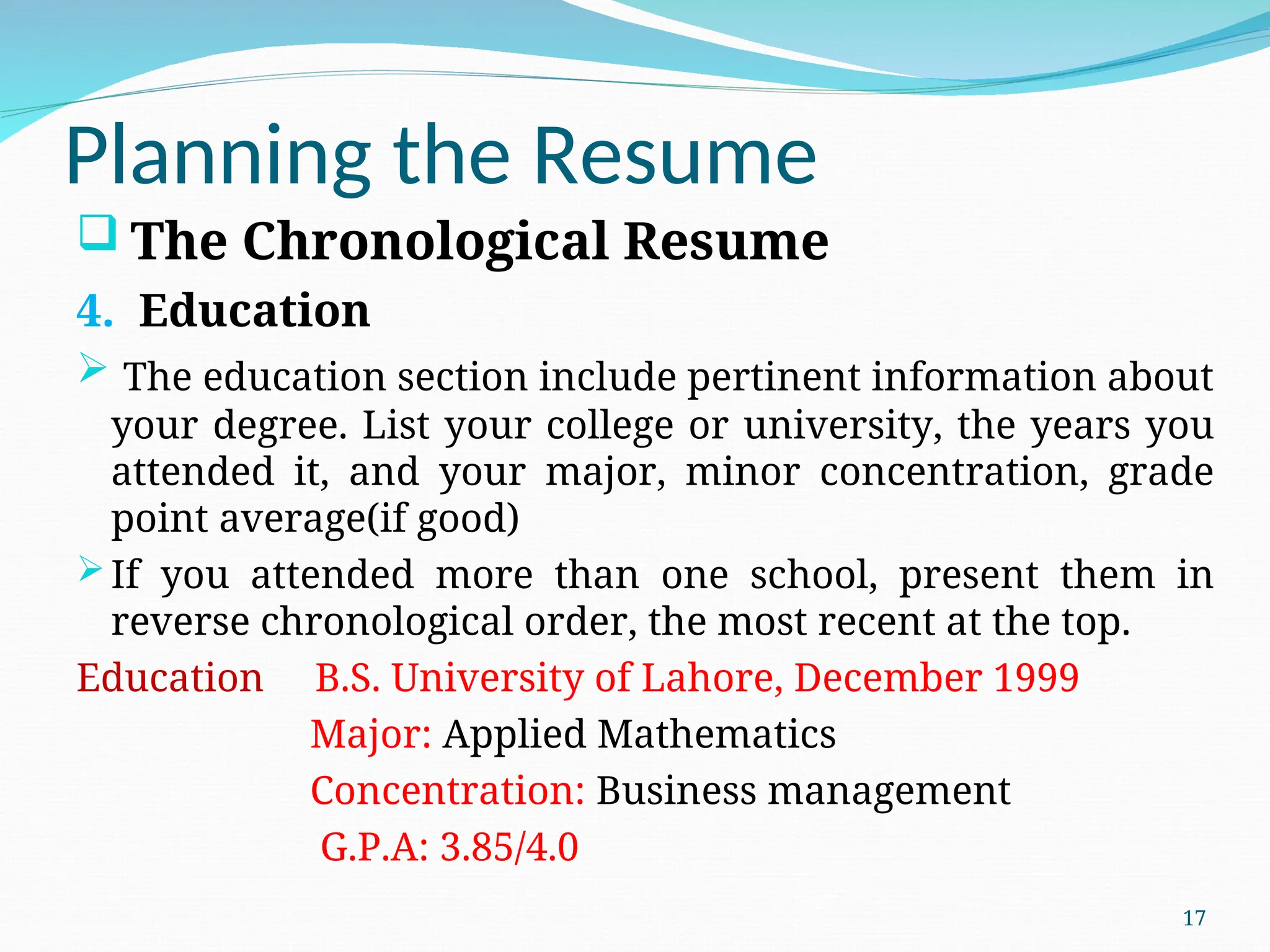
4. Education
 The education section include pertinent information about
your degree. List your college or university, the years you
attended it, and your major, minor concentration, grade
point average(if good)
If you attended more than one school, present them in
reverse chronological order, the most recent at the top.
Education B.S. University of Lahore, December 1999
Major: Applied Mathematics
Concentration: Business management
G.P.A: 3.85/4.0
17
Planning the Resume
 The Chronological Resume
5. Work Experience
 This section includes the positions you have held that
are related to your field of interest.
List your jobs in reverse chronological order- the most
recent first. In some cases, you might alter the
arrangement to reflect the importance of experience.
Each work experience entry should have four items:
Job title, job description, name of company, and dates
of employment.
18
Planning the Resume
 The Chronological Resume
Order of entries on the page
 In the chronological resume, the top of any section is
the most visible position, so you should put the most
important information there.
Place your name, address, and career objective at the
top of the page. In general education section comes
next, followed by work section.
If you have had a relevant internship or full time
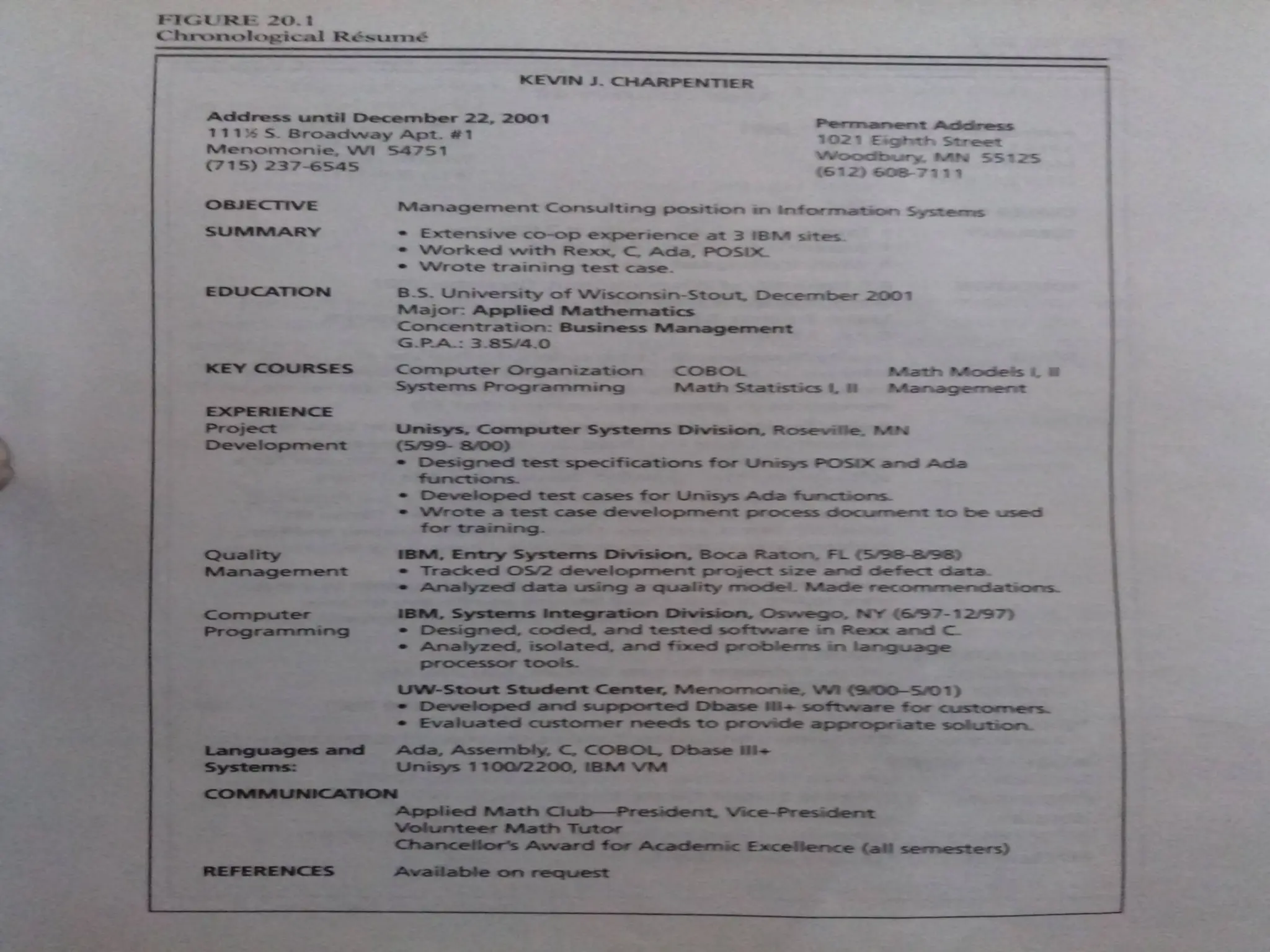
experience, put the work section first. Figure 20.1
shows a chronological resume
19
20
Planning the Resume
 The Functional Resume
This kind of resume presents the applicant to the employer
in the same way the employers looks at the application: in
terms of relevant skills.
This style allows candidates whose work experience is not
relevant to their job area to stress skills learned in classes. if
employers cannot easily relate skills to specific jobs,
however ,functional resumes can produce a negative
response.
The functional resume has these sections:
1. Personal data 2. Objective 3. Summary 4. Skills 5. Education
6. Work
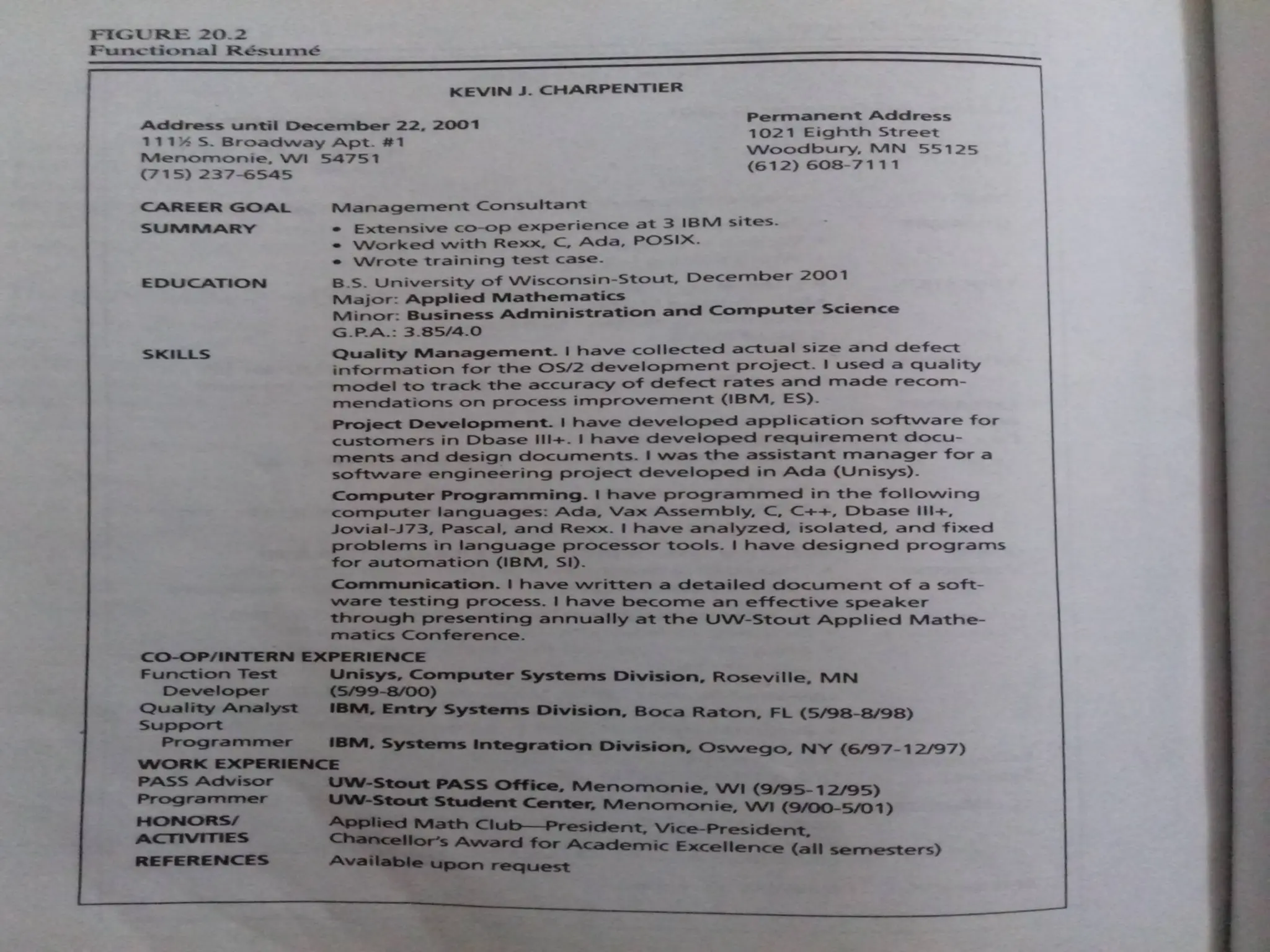
Figure 20.2 shows how to handle each of these sections.
21
Planning the Resume
 The Functional Resume
Standard sections. Treat the following sections the same
as in the chronological resume:
1.Personal data- include your name and address and the
address of your placement service.
2.Objective- tell your immediate occupational goal.
3.Summary- mention your best professional experience,
credentials, accomplishments, or skills.
4.Education- list your University, major, date of graduation,
minors, GPA.
5.Work and skills section- you can present the work section
as a short list and skills section as paragraphs. Give just the
job title, company, and dates for each position you have
held.
22
23
Writing the Resume
 Drafting your resume includes generating, revising,
and finishing it. Ask a knowledgeable person to
review your drafts for wording and emphasis.
The resume must be easy to read. Employers are
looking for essential information, and they must be
able to find it on first reading.
Follow these guidelines
Indicate the main division at the far left margins.
usually bold face heads announce the major section
of the resume.
Bold face important words such as job titles or name
of majors; use underlining sparingly
24
Writing the Resume
 Use bullet lists, which emphasizes individual lines
effectively.
 Single space entries, and double space above and below.
 Control the margins and type size. Use 1 inch for left
margin.
 Use 10- or 12 – point type.
 Treat items in each section consistently.
 Print resumes on good quality paper; use black ink on
light paper. Avoid brightly colored paper.
 Consider using a resume software program. Actually a
database, it provides space for you to fill with
appropriate data and offers several designs for
formatting the page.
25
Planning a Letter of Application
The goal of sending a letter of application is
to be invited to an interview.
To write an effective letter of application,
understand employer’s needs, which are
expressed in an ad or a job description.
Planning a specific letter requires you to
analyze the ad or description and match the
stated requirements with your skills.
26
Analyze the Employers Needs
To discover an employers needs, analyze the ad
or analyze typical needs for this kind of position.
To analyze an ad, read it for key terms. For
instance, a typical and could read, “ Candidates
need 1+ years of C++. Communications skills are
required. Must have system analysis skills”.
If you do not have an ad, analyze typical needs
for this type of job.
27
Match your capabilities to the
employers needs
The whole point of the letter is to show
employers that you will satisfy their needs. If
they say they need 1+ years of C++, tell them
you have it.
As you match needs with capabilities, you
will develop a list of items to place in your
letter.
You need not include them all; discuss the
most important or interesting ones.
28
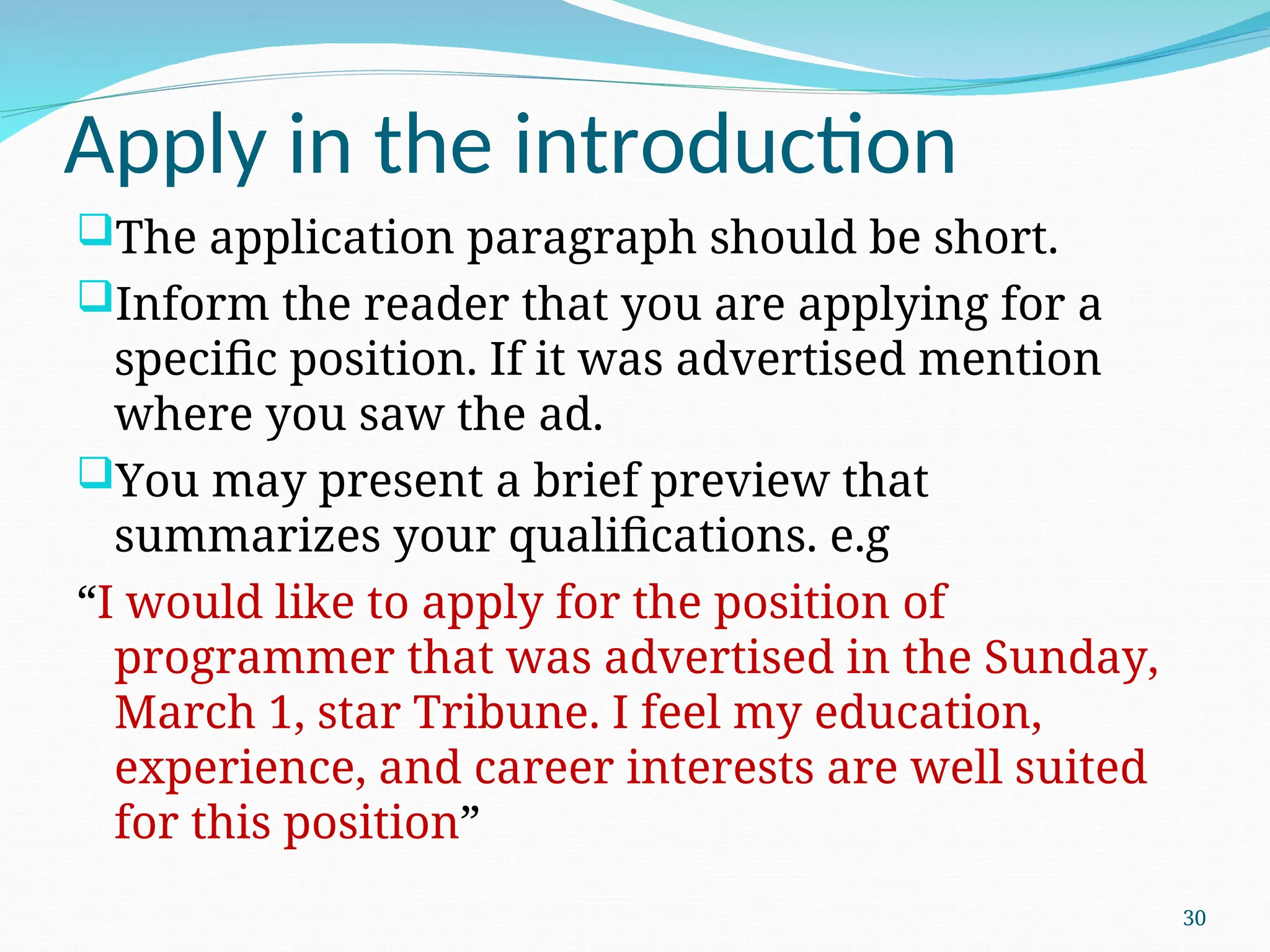
Writing a letter of Application
A letter of Application has three parts: the
introductory application, the explanatory body,
and request conclusion.
You may organize the letter in one or two ways-
by skills or by categories.
This section first reviews the parts of a letter of
application and then present the same letter
organized by skill and by category.
29
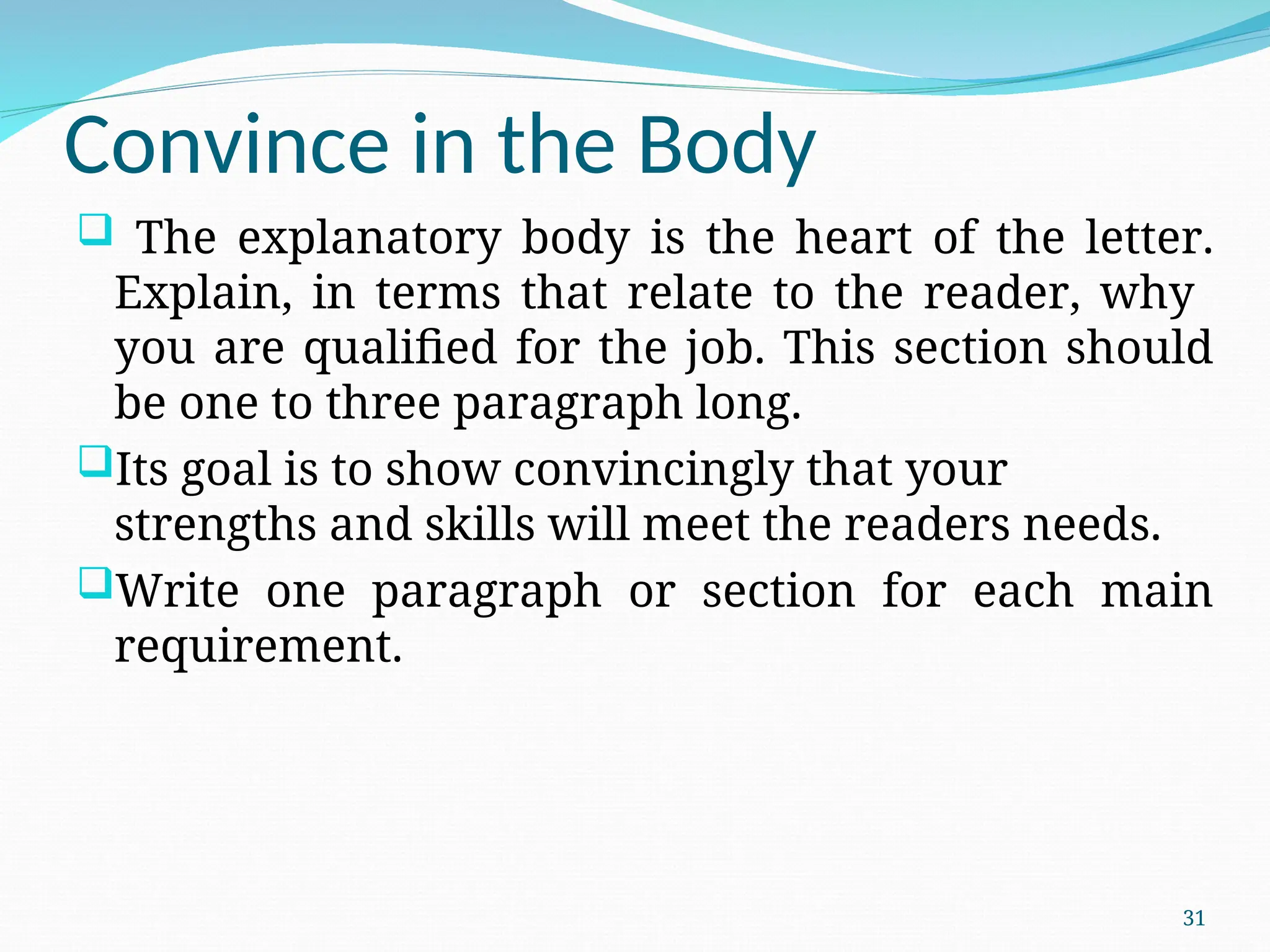
Apply in the introduction
The application paragraph should be short.
Inform the reader that you are applying for a
specific position. If it was advertised mention
where you saw the ad.
You may present a brief preview that
summarizes your qualifications. e.g
“I would like to apply for the position of
programmer that was advertised in the Sunday,
March 1, star Tribune. I feel my education,
experience, and career interests are well suited
for this position”
30
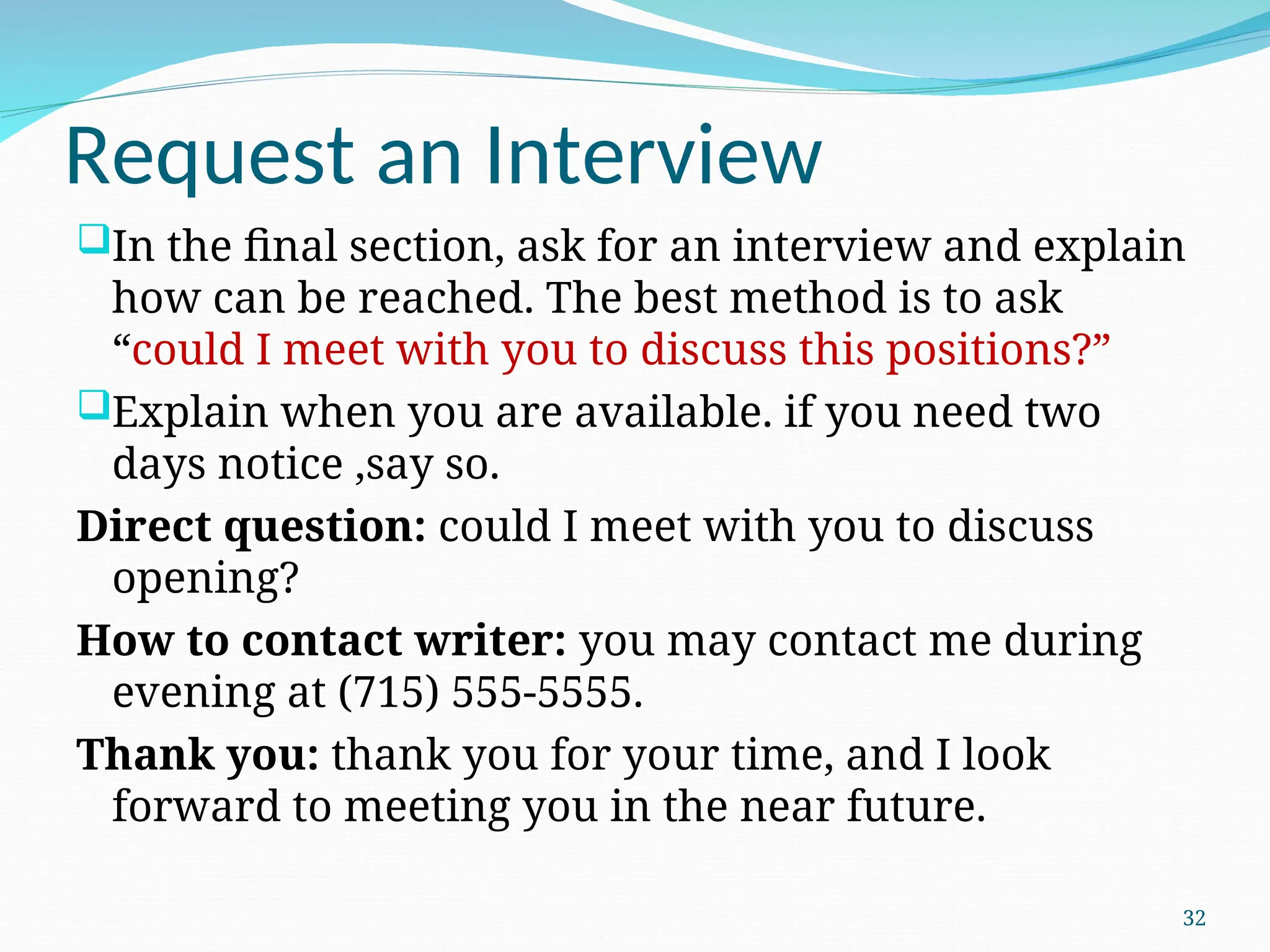
Convince in the Body
 The explanatory body is the heart of the letter.
Explain, in terms that relate to the reader, why
you are qualified for the job. This section should
be one to three paragraph long.
Its goal is to show convincingly that your
strengths and skills will meet the readers needs.
Write one paragraph or section for each main
requirement.
31
Request an Interview
In the final section, ask for an interview and explain
how can be reached. The best method is to ask
“could I meet with you to discuss this positions?”
Explain when you are available. if you need two
days notice ,say so.
Direct question: could I meet with you to discuss
opening?
How to contact writer: you may contact me during
evening at (715) 555-5555.
Thank you: thank you for your time, and I look
forward to meeting you in the near future.
32
Select a Format
To make a professional impression ,follow these
guidelines:
 type the letter on 8 ½- by -11- inch paper.
Use white 20 pound, 100 percent cotton rag paper.
Use blank ink.
Use block or modified block format .
Sign your name in black or blue ink.
Proofread the letter carefully. Spelling and grammar
mistakes are irritating at best; they are cause for instant
rejection.
Mail the letter, folded twice, in a business envelop.
See example 20.1 -20.3 from book
33
Interviewing
The employment interview is the method
employers use to decide whether to offer a
candidate position.
Usually the candidates talks to one or more
people (either singly or groups) who have
authority to offer a position.
To interview successfully you need to prepare
well, use social tact, perform well, ask question,
and understand the job offer.
34
Job Application Material.pptmmmmmmmmmmmmmmmmmmm

  • 1.
  • 2.
    Introduction This chapter explainsthe process of producing an effective resume and letter. You must analyze the situation, plan the contents of the resume and letter, present each in appropriate form Perform effectively at an interview 2
  • 3.
    Analyzing the Situation To write an effective resume and letter of application you must understand your  goal Audience The field you are applying for work Your own strengths And needs of your employers 3
  • 4.
    Analyzing the Situation Understand your goal Your goals are to get an interview and to provide topics for discussion at that interview If you present your strengths and experiences convincingly in the letter and resume, prospective employers will ask to interview you 4
  • 5.
    Analyzing the Situation Understand your Audience Your audience could be any number of people in an organization from the personal manager to a division manager, one person or a committee Whoever they are, they will approach the letter and resume with a limited amount of time and will expect to see evidence of your skills and personal attitude. 5
  • 6.
    Analyzing the Situation Assess Your field Find out what workers and professionals actually do in your field, so that you can asses your strengths and decide how you may fill an employers needs. Answer the following questions: 1.What are the basic activities in this field? 2.What skills do I need to perform them? 3.What are the basic working conditions, salary rages, and long-range outlooks for the areas in which I am interested? 6
  • 7.
    Analyzing the Situation Assess Your Strengths To analyze your strengths, review all your work experience(summer, part-time, internship, full time), your college courses , and your extracurricular activities to determine what activities have provided specific background in your field Prepare this analysis carefully. Talk to other people about yourself. List every skills and strength you can think of; don’t exclude any experience's because they seem trivial Seek qualifications that distinguish you from your competitor. 7
  • 8.
    Analyzing the Situation Assess Your Strengths Here are some questions to help you analyze yourself. 1.What work experience have you had that is related to your field? What were your job responsibility? In what projects were you involved? 2.What special aptitudes and skills do you have? Do you know advance testing methods? 3.What special projects have you completed in your major field? List processes, machines, and systems with which you have dealt. 4.What honors and awards have you received? 8
  • 9.
    Analyzing the Situation Assess Your Strengths 5. What is your grade point average? 6. Have you earned your college expenses? 7. What was your minor? What sequence of useful courses have you completed? 8. Are you willing to relocate? 9. Are you a member of professional organization? 10. Can you communicate in a second language? 11. Did you have military experience? While in the military, did you attend a school that applies to your major field? If so, identify the school. 9
  • 10.
    Analyzing the Situation Assess the needs of Employers To promote your strengths, study the need of your potential employers. At your college’s library or placement service, you can find many helpful volumes that describe individual firms. You can easily discover the names of persons to contact for employment information and details describing the company, as well as its locations and career opportunities, training and development programs, and benefits it offers. 10
  • 11.
    Planning the Resume Your resume is one-page(sometimes two page) document that summarizes your skills, experiences, and qualifications for a positions in your field. Plan it carefully, selecting the most pertinent information and choosing a readable format. Decide what information to include and in which format- chronological or functional- to present that information. 11
  • 12.
    Planning the Resume Information to include in a Resume  The information to include in a resume is that which fills the employers needs Most employers expect the following information appears on applicant resumes  Personal information: name, address, phone number Educational information: degree, name of college, major, date of graduation Work history: titles of job held, employing companies, date of employment, duties, a career objective Achievements: grade point average, award and honors, special aptitudes and skills, achievement at work 12
  • 13.
    Planning the Resume The Chronological Resume  Traditionally, the information required on a resume has usually been arranged in chronological order, emphasizing job duties. Because employment are accustomed to this order, they know where to find information they need and can focus easily on your positions and accomplishments. The chronological resume has the following sections: 1.Personal data 2.Career objective 3.Summary(optional) 4.Education 5.Work experience 13
  • 14.
    Planning the Resume The Chronological Resume 1.Personal Data  The personal data consist of name, address, telephone numbers(always found at the top of page) Place to contact for credential, willingness to relocate, and honor and activities (usually found at the bottom of the page) Federal regulations specify that you do not need to mention your birth date, height, weight, health and martial status You can give information on hobbies and interests. 14
  • 15.
    Planning the Resume The Chronological Resume 2. Career objective  States the type of position you are seeking or what you can bring to the company A well written objective reads like this: “ Management consulting positions in information systems” 0r “ Position in Research and development in Microchip electronics” or “ To use my programming, testing, and analysis skills in an information systems position” 15
  • 16.
    Planning the Resume The Chronological Resume 3. Summary  The summary, an optional section, emphasizes essential point for your reader. In effect it is a mini resume. List key items of professional experience, credentials, one or two accomplishments, and one or two skills. e.g Worked with Rexx, C.Ada, POSIX Gained extensive co-op experience at IBM sites. Wrote training test case. 16
  • 17.
    Planning the Resume The Chronological Resume 4. Education  The education section include pertinent information about your degree. List your college or university, the years you attended it, and your major, minor concentration, grade point average(if good) If you attended more than one school, present them in reverse chronological order, the most recent at the top. Education B.S. University of Lahore, December 1999 Major: Applied Mathematics Concentration: Business management G.P.A: 3.85/4.0 17
  • 18.
    Planning the Resume The Chronological Resume 5. Work Experience  This section includes the positions you have held that are related to your field of interest. List your jobs in reverse chronological order- the most recent first. In some cases, you might alter the arrangement to reflect the importance of experience. Each work experience entry should have four items: Job title, job description, name of company, and dates of employment. 18
  • 19.
    Planning the Resume The Chronological Resume Order of entries on the page  In the chronological resume, the top of any section is the most visible position, so you should put the most important information there. Place your name, address, and career objective at the top of the page. In general education section comes next, followed by work section. If you have had a relevant internship or full time experience, put the work section first. Figure 20.1 shows a chronological resume 19
  • 20.
  • 21.
    Planning the Resume The Functional Resume This kind of resume presents the applicant to the employer in the same way the employers looks at the application: in terms of relevant skills. This style allows candidates whose work experience is not relevant to their job area to stress skills learned in classes. if employers cannot easily relate skills to specific jobs, however ,functional resumes can produce a negative response. The functional resume has these sections: 1. Personal data 2. Objective 3. Summary 4. Skills 5. Education 6. Work Figure 20.2 shows how to handle each of these sections. 21
  • 22.
    Planning the Resume The Functional Resume Standard sections. Treat the following sections the same as in the chronological resume: 1.Personal data- include your name and address and the address of your placement service. 2.Objective- tell your immediate occupational goal. 3.Summary- mention your best professional experience, credentials, accomplishments, or skills. 4.Education- list your University, major, date of graduation, minors, GPA. 5.Work and skills section- you can present the work section as a short list and skills section as paragraphs. Give just the job title, company, and dates for each position you have held. 22
  • 23.
  • 24.
    Writing the Resume Drafting your resume includes generating, revising, and finishing it. Ask a knowledgeable person to review your drafts for wording and emphasis. The resume must be easy to read. Employers are looking for essential information, and they must be able to find it on first reading. Follow these guidelines Indicate the main division at the far left margins. usually bold face heads announce the major section of the resume. Bold face important words such as job titles or name of majors; use underlining sparingly 24
  • 25.
    Writing the Resume Use bullet lists, which emphasizes individual lines effectively.  Single space entries, and double space above and below.  Control the margins and type size. Use 1 inch for left margin.  Use 10- or 12 – point type.  Treat items in each section consistently.  Print resumes on good quality paper; use black ink on light paper. Avoid brightly colored paper.  Consider using a resume software program. Actually a database, it provides space for you to fill with appropriate data and offers several designs for formatting the page. 25
  • 26.
    Planning a Letterof Application The goal of sending a letter of application is to be invited to an interview. To write an effective letter of application, understand employer’s needs, which are expressed in an ad or a job description. Planning a specific letter requires you to analyze the ad or description and match the stated requirements with your skills. 26
  • 27.
    Analyze the EmployersNeeds To discover an employers needs, analyze the ad or analyze typical needs for this kind of position. To analyze an ad, read it for key terms. For instance, a typical and could read, “ Candidates need 1+ years of C++. Communications skills are required. Must have system analysis skills”. If you do not have an ad, analyze typical needs for this type of job. 27
  • 28.
    Match your capabilitiesto the employers needs The whole point of the letter is to show employers that you will satisfy their needs. If they say they need 1+ years of C++, tell them you have it. As you match needs with capabilities, you will develop a list of items to place in your letter. You need not include them all; discuss the most important or interesting ones. 28
  • 29.
    Writing a letterof Application A letter of Application has three parts: the introductory application, the explanatory body, and request conclusion. You may organize the letter in one or two ways- by skills or by categories. This section first reviews the parts of a letter of application and then present the same letter organized by skill and by category. 29
  • 30.
    Apply in theintroduction The application paragraph should be short. Inform the reader that you are applying for a specific position. If it was advertised mention where you saw the ad. You may present a brief preview that summarizes your qualifications. e.g “I would like to apply for the position of programmer that was advertised in the Sunday, March 1, star Tribune. I feel my education, experience, and career interests are well suited for this position” 30
  • 31.
    Convince in theBody  The explanatory body is the heart of the letter. Explain, in terms that relate to the reader, why you are qualified for the job. This section should be one to three paragraph long. Its goal is to show convincingly that your strengths and skills will meet the readers needs. Write one paragraph or section for each main requirement. 31
  • 32.
    Request an Interview Inthe final section, ask for an interview and explain how can be reached. The best method is to ask “could I meet with you to discuss this positions?” Explain when you are available. if you need two days notice ,say so. Direct question: could I meet with you to discuss opening? How to contact writer: you may contact me during evening at (715) 555-5555. Thank you: thank you for your time, and I look forward to meeting you in the near future. 32
  • 33.
    Select a Format Tomake a professional impression ,follow these guidelines:  type the letter on 8 ½- by -11- inch paper. Use white 20 pound, 100 percent cotton rag paper. Use blank ink. Use block or modified block format . Sign your name in black or blue ink. Proofread the letter carefully. Spelling and grammar mistakes are irritating at best; they are cause for instant rejection. Mail the letter, folded twice, in a business envelop. See example 20.1 -20.3 from book 33
  • 34.
    Interviewing The employment interviewis the method employers use to decide whether to offer a candidate position. Usually the candidates talks to one or more people (either singly or groups) who have authority to offer a position. To interview successfully you need to prepare well, use social tact, perform well, ask question, and understand the job offer. 34