THORACIC LIMB
SKELETON OF THE THORACIC LIMB
1-Scapula
Anatomy course 1
Pre-clinical cycle
Dr. YAHIMI A. ISV BLIDA 1
Introduction : Clavicle(collarbone); Reduced to a fibrous intersection in
the brachiocephalic M, ossified in cats.
• Adaptation to locomotion:
• Flattening of the thorax
• Bringing together of the scapulohumeral joints
• Pendular movement of the limbs
• Radius longer than the humerus
• Lengthening of the hand, reduction in the number of fingers
Thoracic limb
Skeleton of the thoracic limb
Dr. YAHIMI A. ISV BLIDA 1
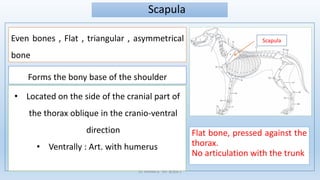
Scapula
Even bones , Flat , triangular , asymmetrical
bone
Forms the bony base of the shoulder
• Located on the side of the cranial part of
the thorax oblique in the cranio-ventral
direction
• Ventrally : Art. with humerus
Flat bone, pressed against the
thorax.
No articulation with the trunk
Scapula
Dr. YAHIMI A. ISV BLIDA 1
Conformation : Scapula
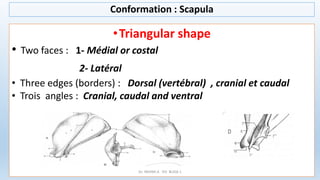
•Triangular shape
• Two faces : 1- Médial or costal
2- Latéral
• Three edges (borders) : Dorsal (vertébral) , cranial et caudal
• Trois angles : Cranial, caudal and ventral
Dr. YAHIMI A. ISV BLIDA 1
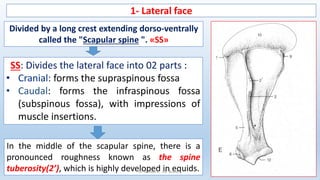
1- Lateral face
Divided by a long crest extending dorso-ventrally
called the "Scapular spine ". «SS»
SS: Divides the lateral face into 02 parts :
Cranial: forms the supraspinous fossa
• Caudal: forms the infraspinous fossa
(subspinous fossa), with impressions of
muscle insertions.
In the middle of the scapular spine, there is a
pronounced roughness known as the spine
tuberosity(2’), which is highly developed in equids.
Dr. YAHIMI A. ISV BLIDA 1
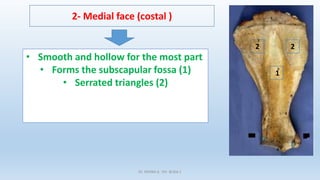
2- Medial face (costal )
• Smooth and hollow for the most part
• Forms the subscapular fossa (1)
• Serrated triangles (2)
2 2
1
Dr. YAHIMI A. ISV BLIDA 1
3-Borders (Edges)
there are Three :
1- Dorsal border(vertébral) : thick and rough , slightly
convex , adjacent to the spinal column Extended by a
fibro-cartilaginous blade (scapular cartilage)(half-
moon-shaped scapular cartilage)
2- Cranial Border : Thin , convex, it ends in a concave
part called the "scapular incisure".
3- Caudal Border : Thick and rough , marked by
strong imprints muscle insertions
Dr. YAHIMI A. ISV BLIDA 1
4- Angles : There are 03
1- Angle cranial : Thin and flattened
2- Angle caudal or axillary : Thick
3- Angle ventral : Very thick, connected to the rest of the bone by a neck , and
it forms the only true joint between the scapula and another bone in most
domestic animals
This angle is carved by a large elliptical articular surface
Glenoid cavity : receives head of humerus
This cavity is indented in its cranio-medial part by a rough depression
called the "glenoidal incision".
Dr. YAHIMI A. ISV BLIDA 1
Angle ventral :
• Cranially: "supraglenoidal tubercle".
• Medial: is surmounted by a short process curved into a beak
Called the "coracoid process".
• Caudally: The cavity is surmounted by a small, less
prominent and less wide tubercle called the "infraglenoidal
tubercle"
Dr. YAHIMI A. ISV BLIDA 1
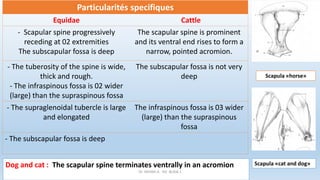
Particularités specifiques
Equidae Cattle
- Scapular spine progressively
receding at 02 extremities
The subscapular fossa is deep
The scapular spine is prominent
and its ventral end rises to form a
narrow, pointed acromion.
- The tuberosity of the spine is wide,
thick and rough.
- The infraspinous fossa is 02 wider
(large) than the supraspinous fossa
The subscapular fossa is not very
deep
- The supraglenoidal tubercle is large
and elongated
The infraspinous fossa is 03 wider
(large) than the supraspinous
fossa
- The subscapular fossa is deep
Scapula «cat and dog»
Scapula «horse»
Dog and cat : The scapular spine terminates ventrally in an acromion
Dr. YAHIMI A. ISV BLIDA 1
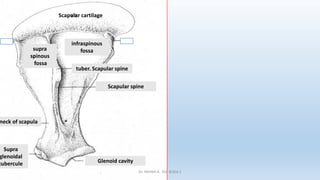
supra
spinous
fossa
infraspinous
fossa
Scapular cartilage
Scapular spine
tuber. Scapular spine
Supra
glenoidal
tubercule
neck of scapula
Glenoid cavity
Dr. YAHIMI A. ISV BLIDA 1

2-SCAPULA_course for first year veterinary students.pdf

  • 1.
    THORACIC LIMB SKELETON OFTHE THORACIC LIMB 1-Scapula Anatomy course 1 Pre-clinical cycle Dr. YAHIMI A. ISV BLIDA 1 Dr. YAHIMI A. ISV BLIDA 1
  • 2.
    Introduction : Clavicle(collarbone);Reduced to a fibrous intersection in the brachiocephalic M, ossified in cats. • Adaptation to locomotion: • Flattening of the thorax • Bringing together of the scapulohumeral joints • Pendular movement of the limbs • Radius longer than the humerus • Lengthening of the hand, reduction in the number of fingers Thoracic limb Skeleton of the thoracic limb Dr. YAHIMI A. ISV BLIDA 1
  • 3.
    Scapula Even bones ,Flat , triangular , asymmetrical bone Forms the bony base of the shoulder • Located on the side of the cranial part of the thorax oblique in the cranio-ventral direction • Ventrally : Art. with humerus Flat bone, pressed against the thorax. No articulation with the trunk Scapula Dr. YAHIMI A. ISV BLIDA 1
  • 4.
    Conformation : Scapula •Triangularshape • Two faces : 1- Médial or costal 2- Latéral • Three edges (borders) : Dorsal (vertébral) , cranial et caudal • Trois angles : Cranial, caudal and ventral Dr. YAHIMI A. ISV BLIDA 1
  • 5.
    1- Lateral face Dividedby a long crest extending dorso-ventrally called the "Scapular spine ". «SS» SS: Divides the lateral face into 02 parts : Cranial: forms the supraspinous fossa • Caudal: forms the infraspinous fossa (subspinous fossa), with impressions of muscle insertions. In the middle of the scapular spine, there is a pronounced roughness known as the spine tuberosity(2’), which is highly developed in equids. Dr. YAHIMI A. ISV BLIDA 1
  • 6.
    2- Medial face(costal ) • Smooth and hollow for the most part • Forms the subscapular fossa (1) • Serrated triangles (2) 2 2 1 Dr. YAHIMI A. ISV BLIDA 1
  • 7.
    3-Borders (Edges) there areThree : 1- Dorsal border(vertébral) : thick and rough , slightly convex , adjacent to the spinal column Extended by a fibro-cartilaginous blade (scapular cartilage)(half- moon-shaped scapular cartilage) 2- Cranial Border : Thin , convex, it ends in a concave part called the "scapular incisure". 3- Caudal Border : Thick and rough , marked by strong imprints muscle insertions Dr. YAHIMI A. ISV BLIDA 1
  • 8.
    4- Angles :There are 03 1- Angle cranial : Thin and flattened 2- Angle caudal or axillary : Thick 3- Angle ventral : Very thick, connected to the rest of the bone by a neck , and it forms the only true joint between the scapula and another bone in most domestic animals This angle is carved by a large elliptical articular surface Glenoid cavity : receives head of humerus This cavity is indented in its cranio-medial part by a rough depression called the "glenoidal incision". Dr. YAHIMI A. ISV BLIDA 1
  • 9.
    Angle ventral : •Cranially: "supraglenoidal tubercle". • Medial: is surmounted by a short process curved into a beak Called the "coracoid process". • Caudally: The cavity is surmounted by a small, less prominent and less wide tubercle called the "infraglenoidal tubercle" Dr. YAHIMI A. ISV BLIDA 1
  • 10.
    Particularités specifiques Equidae Cattle -Scapular spine progressively receding at 02 extremities The subscapular fossa is deep The scapular spine is prominent and its ventral end rises to form a narrow, pointed acromion. - The tuberosity of the spine is wide, thick and rough. - The infraspinous fossa is 02 wider (large) than the supraspinous fossa The subscapular fossa is not very deep - The supraglenoidal tubercle is large and elongated The infraspinous fossa is 03 wider (large) than the supraspinous fossa - The subscapular fossa is deep Scapula «cat and dog» Scapula «horse» Dog and cat : The scapular spine terminates ventrally in an acromion Dr. YAHIMI A. ISV BLIDA 1
  • 11.
    supra spinous fossa infraspinous fossa Scapular cartilage Scapular spine tuber.Scapular spine Supra glenoidal tubercule neck of scapula Glenoid cavity Dr. YAHIMI A. ISV BLIDA 1