National Patient Safety
Improvement Programmes
Managing
Deterioration
Delivered by: Led by:
NHS England
NHS Improvement
@NatPatSIP www.improvement.nhs.uk
RESTORE2 mini training
Soft signs of deterioration
Training objectives
>To ensure that care staff can:
> spot any illness or cause of deterioration quickly
> respond to and escalate concern effectively so
as to “get their message across” every time in
order to “get the right help”
| National Patient Safety Improvement Programmes2
Introduction to
Soft Signs
Structured
communication
using SBARD
RESTORE2mini
ReSPECT Q&A Close
Session outline
| National Patient Safety Improvement Programmes3
National Patient Safety
Improvement Programmes
Managing
Deterioration
Delivered by: Led by:
NHS England
NHS Improvement
@NatPatSIP www.improvement.nhs.uk
Early “Soft Signs” of deterioration
Soft signs of deterioration
Exercise: unwell or getting worse?
>Think about an occasion when you were unwell……
>How did you know you were unwell?
>How could you tell when it was getting worse?
> Now let’s think about your residents.
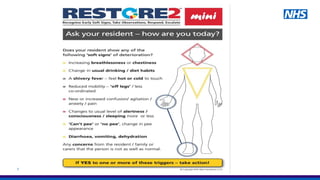
> What “soft signs” could they present with?
| National Patient Safety Improvement Programmes6
7
| National Patient Safety Improvement Programmes8
https://www.youtube.com/watch?v=A6sg0mkcJIY&list=PLrVQaAxyJE3cJ1fB9K2poc9pXn7b9WcQg&index=2&t=0s
| National Patient Safety Improvement Programmes9
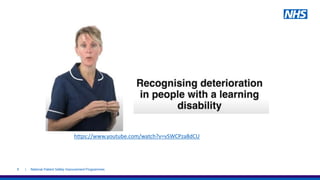
https://www.youtube.com/watch?v=vSWCPza8dCU
Medical emergencies
>There may be some occasions when the early signs of deterioration may be a medical
emergency. In these cases it is not appropriate to delay contacting the emergency services in
order to record a NEWS2.
>It may be appropriate to monitor your resident’s vital signs once you have contacted the
emergency services.
>Such situations include:
>Chest pain or suspected heart attack
>Where the individual is displaying signs consistent with having a stroke
>Prolonged seizure where the individual does not have a care plan in place to manage it or
their breathing is compromised
>Where the resident has sustained a significant injury – e.g. a fracture head injury
>If in doubt, get it checked out. Remember to use SBARD when contacting 999.
| National Patient Safety Improvement Programmes10
Let’s identify softs signs in the residents below if they were
becoming unwell?
Molly is a fun and outgoing 83 year old. She mobilises with a Zimmer frame and loves to
socialise with other residents and staff in the lounge. When she’s not talking she is an avid
reader of romantic novels, you can often find her with her head in a book in the
conservatory. Molly often jokes that she is too busy to sleep; she goes to bed late and
tends to get up early, often having a cup of tea with the night staff before they go off duty.
David is 70. He lives in your home, primarily because of his poorly controlled diabetes. He
has both legs amputated and sometimes uses a wheelchair to mobilise. Often Charlie
stays in his room, his blood sugars are high he gets headaches. He becomes increasingly
tired and feels very thirsty and when his blood sugars are high he gets very grumpy.
| National Patient Safety Improvement Programmes11
Screen/ comfort break
| National Patient Safety Improvement Programmes12
National Patient Safety
Improvement Programmes
Managing
Deterioration
Delivered by: Led by:
NHS England
NHS Improvement
@NatPatSIP www.improvement.nhs.uk
Communicating and escalating concerns
(SBARD)
Getting your message across
How confident do you feel?
>How confident do you feel
communicating your concerns
about a resident both within your
care home and to external
healthcare professionals?
| National Patient Safety Improvement Programmes14
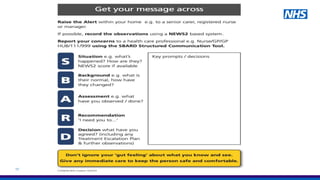
SBARD: A structured method for communicating critical information
that requires immediate attention and action effectively with medical
professionals.
| National Patient Safety Improvement Programmes16
Situation
Background
Assessment
Recommendation
Decision
17
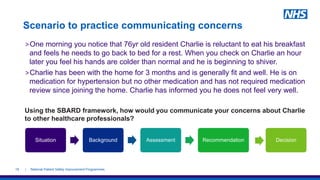
Scenario to practice communicating concerns
>One morning you notice that 76yr old resident Charlie is reluctant to eat his breakfast
and feels he needs to go back to bed for a rest. When you check on Charlie an hour
later you feel his hands are colder than normal and he is beginning to shiver.
>Charlie has been with the home for 3 months and is generally fit and well. He is on
medication for hypertension but no other medication and has not required medication
review since joining the home. Charlie has informed you he does not feel very well.
Using the SBARD framework, how would you communicate your concerns about Charlie
to other healthcare professionals?
| National Patient Safety Improvement Programmes18
Situation Background Assessment Recommendation Decision
| National Patient Safety Improvement Programmes19
Introduction to
Soft Signs
Structured
communication
using SBARD
RESTORE2
mini
ReSPECT Q&A Close
Summary of what we have covered so far
| National Patient Safety Improvement Programmes20
Recommended
Summary
Plan for
Emergency
Care and
Treatment
| National Patient Safety Improvement Programmes21
There are 9 sections to the form.
1. Personal details
2. Summary of relevant information for this
plan
3. Personal preferences to guide this plan
(when the person has capacity)
4. Clinical recommendations for emergency
care and treatment
5. Capacity and representation at time of
completion
6. Involvement in making this plan
7. Clinician’s signatures
8. Emergency contacts
9. Confirmation of validity (used when the
form is reviewed)
How to recognise the ReSPECT form
| National Patient Safety Improvement Programmes22
How to care for someone with a ReSPECT form
| National Patient Safety Improvement Programmes23
Patient details
About the
person and their
health
Patient’s
preferences for
care
Clinical care and
resuscitation
details
1
2
3
4
7 Involvement in plan
If this box is signed the
person is FOR CPR
If this box is signed the
person is NOT FOR CPR ! A ReSPECT form does not
always mean DNACPR.
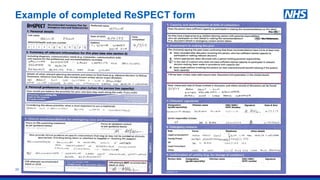
Example of completed ReSPECT form
24
Example of completed ReSPECT form
25
Action in a life threatening situation
CONFIRM the identity of the person (section 1) and that this is the latest version
of the form.
READ the form to understand which
recommendations may relate to your
role in their care.
Read section 4 “Clinical care and Resuscitation Decision” including
escalation plan to inform immediate actions.
Read section 3 for ”Patient’s preferences for care.”
Read section 7 ”Involvement in Plan” to ensure the recommendations
have been endorsed by a responsible clinician.
ACT. If the recommendations apply to the current emergency and the person
cannot decide for themselves then act on the recommendations relevant to your
role when caring for that person.
| National Patient Safety Improvement Programmes26
Other key points to note about a ReSPECT:
>ReSPECT is not legally binding. It is a guide to immediate decision-making.
You should be prepared to justify valid reasons for overriding the
recommendations on a ReSPECT form.
>If a situation arises that is not addressed on the form, or staff are unsure
what to do, they should ask for help from their seniors, or members of
the clinical team.
| National Patient Safety Improvement Programmes27
Thank you… now it’s over to you!
>How will you use this training to contribute to
your delivery of care going forwards?
>Let us know in the chat!
We will stay on the call for 30 minutes after the session if you would like to talk though any
questions further.
Please complete our post-training survey with feedback on the session and let us know
how you get on with using the training in practice.
| National Patient Safety Improvement Programmes28
National Patient Safety
Improvement Programmes
Managing
Deterioration
Delivered by: Led by:
NHS England
NHS Improvement
@NatPatSIP www.improvement.nhs.uk
Additional resources
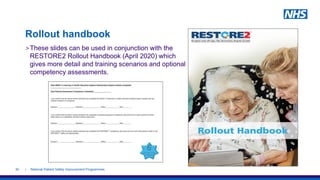
Rollout handbook
>These slides can be used in conjunction with the
RESTORE2 Rollout Handbook (April 2020) which
gives more detail and training scenarios and optional
competency assessments.
| National Patient Safety Improvement Programmes30
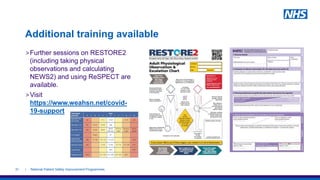
Additional training available
>Further sessions on RESTORE2
(including taking physical
observations and calculating
NEWS2) and using ReSPECT are
available.
>Visit
https://www.weahsn.net/covid-
19-support
| National Patient Safety Improvement Programmes31
Free short training videos available on:
>https://www.youtube.com/p
laylist?list=PLrVQaAxyJE3
cJ1fB9K2poc9pXn7b9Wc
Qg
| National Patient Safety Improvement Programmes32
You can also access the films as part of the full training on Health Education England’s
e-Learning for Healthcare (e-LfH) Hub (www.e-lfh.org.uk), an educational web-based
platform that provides quality assured online training content for the UK’s health and
care workforce, from this link.
| National Patient Safety Improvement Programmes33
Free NEWS2 e-learning
>This accredited e-learning is usually £5 per registered user but we have funded a
number of licenses as our gift to you: https://woe.newslms.ocbmedia.com/
>Sign up by clicking on the ‘Sign up now’
button on the page linked above.
> You can also download the official NEWS2
Calculation App for free:
> iOS – visit the Apple App Store and search for ‘NEWS2′.
The app is called NEWS calculator produced by OCB Media.
> Android – visit the Google Play store and search for ‘NEWS2’
or use the following link here
| National Patient Safety Improvement Programmes34
>Short e-learning available at https://learning.respectprocess.org.uk
>What is ReSPECT? (12 minutes)
>Who is ReSPECT for? (4 minutes)
>How to care for someone with a ReSPECT form (10 minutes)
>Visit https://www.weahsn.net/our-work/improving-patient-
safety/respect/implementing-respect/ for more information and
resources
>Contact respect@weahsn.net
| National Patient Safety Improvement Programmes35

Restore2 mini trainer slides

  • 1.
    National Patient Safety ImprovementProgrammes Managing Deterioration Delivered by: Led by: NHS England NHS Improvement @NatPatSIP www.improvement.nhs.uk RESTORE2 mini training Soft signs of deterioration
  • 2.
    Training objectives >To ensurethat care staff can: > spot any illness or cause of deterioration quickly > respond to and escalate concern effectively so as to “get their message across” every time in order to “get the right help” | National Patient Safety Improvement Programmes2
  • 3.
    Introduction to Soft Signs Structured communication usingSBARD RESTORE2mini ReSPECT Q&A Close Session outline | National Patient Safety Improvement Programmes3
  • 4.
    National Patient Safety ImprovementProgrammes Managing Deterioration Delivered by: Led by: NHS England NHS Improvement @NatPatSIP www.improvement.nhs.uk Early “Soft Signs” of deterioration Soft signs of deterioration
  • 5.
    Exercise: unwell orgetting worse? >Think about an occasion when you were unwell…… >How did you know you were unwell? >How could you tell when it was getting worse? > Now let’s think about your residents. > What “soft signs” could they present with? | National Patient Safety Improvement Programmes6
  • 6.
  • 7.
    | National PatientSafety Improvement Programmes8 https://www.youtube.com/watch?v=A6sg0mkcJIY&list=PLrVQaAxyJE3cJ1fB9K2poc9pXn7b9WcQg&index=2&t=0s
  • 8.
    | National PatientSafety Improvement Programmes9 https://www.youtube.com/watch?v=vSWCPza8dCU
  • 9.
    Medical emergencies >There maybe some occasions when the early signs of deterioration may be a medical emergency. In these cases it is not appropriate to delay contacting the emergency services in order to record a NEWS2. >It may be appropriate to monitor your resident’s vital signs once you have contacted the emergency services. >Such situations include: >Chest pain or suspected heart attack >Where the individual is displaying signs consistent with having a stroke >Prolonged seizure where the individual does not have a care plan in place to manage it or their breathing is compromised >Where the resident has sustained a significant injury – e.g. a fracture head injury >If in doubt, get it checked out. Remember to use SBARD when contacting 999. | National Patient Safety Improvement Programmes10
  • 10.
    Let’s identify softssigns in the residents below if they were becoming unwell? Molly is a fun and outgoing 83 year old. She mobilises with a Zimmer frame and loves to socialise with other residents and staff in the lounge. When she’s not talking she is an avid reader of romantic novels, you can often find her with her head in a book in the conservatory. Molly often jokes that she is too busy to sleep; she goes to bed late and tends to get up early, often having a cup of tea with the night staff before they go off duty. David is 70. He lives in your home, primarily because of his poorly controlled diabetes. He has both legs amputated and sometimes uses a wheelchair to mobilise. Often Charlie stays in his room, his blood sugars are high he gets headaches. He becomes increasingly tired and feels very thirsty and when his blood sugars are high he gets very grumpy. | National Patient Safety Improvement Programmes11
  • 11.
    Screen/ comfort break |National Patient Safety Improvement Programmes12
  • 12.
    National Patient Safety ImprovementProgrammes Managing Deterioration Delivered by: Led by: NHS England NHS Improvement @NatPatSIP www.improvement.nhs.uk Communicating and escalating concerns (SBARD) Getting your message across
  • 13.
    How confident doyou feel? >How confident do you feel communicating your concerns about a resident both within your care home and to external healthcare professionals? | National Patient Safety Improvement Programmes14
  • 14.
    SBARD: A structuredmethod for communicating critical information that requires immediate attention and action effectively with medical professionals. | National Patient Safety Improvement Programmes16 Situation Background Assessment Recommendation Decision
  • 15.
  • 16.
    Scenario to practicecommunicating concerns >One morning you notice that 76yr old resident Charlie is reluctant to eat his breakfast and feels he needs to go back to bed for a rest. When you check on Charlie an hour later you feel his hands are colder than normal and he is beginning to shiver. >Charlie has been with the home for 3 months and is generally fit and well. He is on medication for hypertension but no other medication and has not required medication review since joining the home. Charlie has informed you he does not feel very well. Using the SBARD framework, how would you communicate your concerns about Charlie to other healthcare professionals? | National Patient Safety Improvement Programmes18 Situation Background Assessment Recommendation Decision
  • 17.
    | National PatientSafety Improvement Programmes19
  • 18.
    Introduction to Soft Signs Structured communication usingSBARD RESTORE2 mini ReSPECT Q&A Close Summary of what we have covered so far | National Patient Safety Improvement Programmes20
  • 19.
    Recommended Summary Plan for Emergency Care and Treatment |National Patient Safety Improvement Programmes21
  • 20.
    There are 9sections to the form. 1. Personal details 2. Summary of relevant information for this plan 3. Personal preferences to guide this plan (when the person has capacity) 4. Clinical recommendations for emergency care and treatment 5. Capacity and representation at time of completion 6. Involvement in making this plan 7. Clinician’s signatures 8. Emergency contacts 9. Confirmation of validity (used when the form is reviewed) How to recognise the ReSPECT form | National Patient Safety Improvement Programmes22
  • 21.
    How to carefor someone with a ReSPECT form | National Patient Safety Improvement Programmes23 Patient details About the person and their health Patient’s preferences for care Clinical care and resuscitation details 1 2 3 4 7 Involvement in plan If this box is signed the person is FOR CPR If this box is signed the person is NOT FOR CPR ! A ReSPECT form does not always mean DNACPR.
  • 22.
    Example of completedReSPECT form 24
  • 23.
    Example of completedReSPECT form 25
  • 24.
    Action in alife threatening situation CONFIRM the identity of the person (section 1) and that this is the latest version of the form. READ the form to understand which recommendations may relate to your role in their care. Read section 4 “Clinical care and Resuscitation Decision” including escalation plan to inform immediate actions. Read section 3 for ”Patient’s preferences for care.” Read section 7 ”Involvement in Plan” to ensure the recommendations have been endorsed by a responsible clinician. ACT. If the recommendations apply to the current emergency and the person cannot decide for themselves then act on the recommendations relevant to your role when caring for that person. | National Patient Safety Improvement Programmes26
  • 25.
    Other key pointsto note about a ReSPECT: >ReSPECT is not legally binding. It is a guide to immediate decision-making. You should be prepared to justify valid reasons for overriding the recommendations on a ReSPECT form. >If a situation arises that is not addressed on the form, or staff are unsure what to do, they should ask for help from their seniors, or members of the clinical team. | National Patient Safety Improvement Programmes27
  • 26.
    Thank you… nowit’s over to you! >How will you use this training to contribute to your delivery of care going forwards? >Let us know in the chat! We will stay on the call for 30 minutes after the session if you would like to talk though any questions further. Please complete our post-training survey with feedback on the session and let us know how you get on with using the training in practice. | National Patient Safety Improvement Programmes28
  • 27.
    National Patient Safety ImprovementProgrammes Managing Deterioration Delivered by: Led by: NHS England NHS Improvement @NatPatSIP www.improvement.nhs.uk Additional resources
  • 28.
    Rollout handbook >These slidescan be used in conjunction with the RESTORE2 Rollout Handbook (April 2020) which gives more detail and training scenarios and optional competency assessments. | National Patient Safety Improvement Programmes30
  • 29.
    Additional training available >Furthersessions on RESTORE2 (including taking physical observations and calculating NEWS2) and using ReSPECT are available. >Visit https://www.weahsn.net/covid- 19-support | National Patient Safety Improvement Programmes31
  • 30.
    Free short trainingvideos available on: >https://www.youtube.com/p laylist?list=PLrVQaAxyJE3 cJ1fB9K2poc9pXn7b9Wc Qg | National Patient Safety Improvement Programmes32
  • 31.
    You can alsoaccess the films as part of the full training on Health Education England’s e-Learning for Healthcare (e-LfH) Hub (www.e-lfh.org.uk), an educational web-based platform that provides quality assured online training content for the UK’s health and care workforce, from this link. | National Patient Safety Improvement Programmes33
  • 32.
    Free NEWS2 e-learning >Thisaccredited e-learning is usually £5 per registered user but we have funded a number of licenses as our gift to you: https://woe.newslms.ocbmedia.com/ >Sign up by clicking on the ‘Sign up now’ button on the page linked above. > You can also download the official NEWS2 Calculation App for free: > iOS – visit the Apple App Store and search for ‘NEWS2′. The app is called NEWS calculator produced by OCB Media. > Android – visit the Google Play store and search for ‘NEWS2’ or use the following link here | National Patient Safety Improvement Programmes34
  • 33.
    >Short e-learning availableat https://learning.respectprocess.org.uk >What is ReSPECT? (12 minutes) >Who is ReSPECT for? (4 minutes) >How to care for someone with a ReSPECT form (10 minutes) >Visit https://www.weahsn.net/our-work/improving-patient- safety/respect/implementing-respect/ for more information and resources >Contact respect@weahsn.net | National Patient Safety Improvement Programmes35

Editor's Notes

  • #8 If resident show any of the soft signs, they are at risk of deterioration. Recognition of Soft signs allows the early detection of acute illness or physical deterioration Carers are usually the first to recognise soft signs but may find it difficult to communicate this concern Soft signs are the early indicators that the resident may not be as well as they were previously. Some soft signs are generic and apply to all residents, but you can also bespoke the RESTORE2 tool with the unique signs that indicate deterioration for a particular resident. Soft signs provide an entry point into the National Early Warning Scores (NEWS).
  • #9 Depending on the participant group use this video or Recognising deterioration in people with a learning disability video Host/Tech help to play video
  • #10 Depending on the participant group use this video or Introduction to Sepsis and serious illness video. Host/Tech help to play video
  • #12 Group exercise to round up soft signs section
  • #13 3-5mins screen or comfort break.
  • #19 Can be done as a group exercise. Ask participants to identify (shout out or write in chat) information that should be given under each letter of SBARD
  • #20 Remind participants this is what the RESTORE2 mini form looks like.
  • #21 Summarise what has been covered to end the RESTORE2 mini section of the training.
  • #22 Treatment Escalation Plans (such as ReSPECT, Advance Care Plan, Do Not Attempt Cardiopulmonary Resuscitation (DNACPR) etc.) are processes to support people to have a say in what they would like when they become unwell, or when they cannot express their wishes. ReSPECT is a personalised recommendation for someone’s clinical care in emergency situations where they are not able to make decisions or express their wishes. RESTORE2 is closely linked to anticipatory care planning and deterioration in the community. It’s important that residents have a clear end of life plan and this is not just about DNACPR.
  • #23 GPs can support the process to ensure that the resident is treated at the right place, at the right time, in the best way.
  • #24 A ReSPECT form does not always mean DNACPR ReSPECT is a process that encourages and enables a series of conversations (preferably earlier) with people on their end of life health and treatment preferences. ReSPECT can be for anybody, but is particularly relevant for the elderly, frail and people with deteriorating conditions. GPs can support the process to ensure that the resident is treated at the right place, at the right time, in the best way. These decisions recorded on a ReSPECT form can be used in emergency situations to assist when decisions need to be made on what is best for the person.
  • #25 ReSPECT is a process that encourages and enables a series of conversations (preferably earlier) with people on their end of life health and treatment preferences. ReSPECT can be for anybody, but is particularly relevant for the elderly, frail and people with deteriorating conditions. These decisions made by the person and their doctor and health professionals are recorded on a ReSPECT form that can be used in emergency situations to assist when decisions need to be made on what is best for the person.
  • #26 ReSPECT is a process that encourages and enables a series of conversations (preferably earlier) with people on their end of life health and treatment preferences. ReSPECT can be for anybody, but is particularly relevant for the elderly, frail and people with deteriorating conditions. These decisions made by the person and their doctor and health professionals are recorded on a ReSPECT form that can be used in emergency situations to assist when decisions need to be made on what is best for the person.