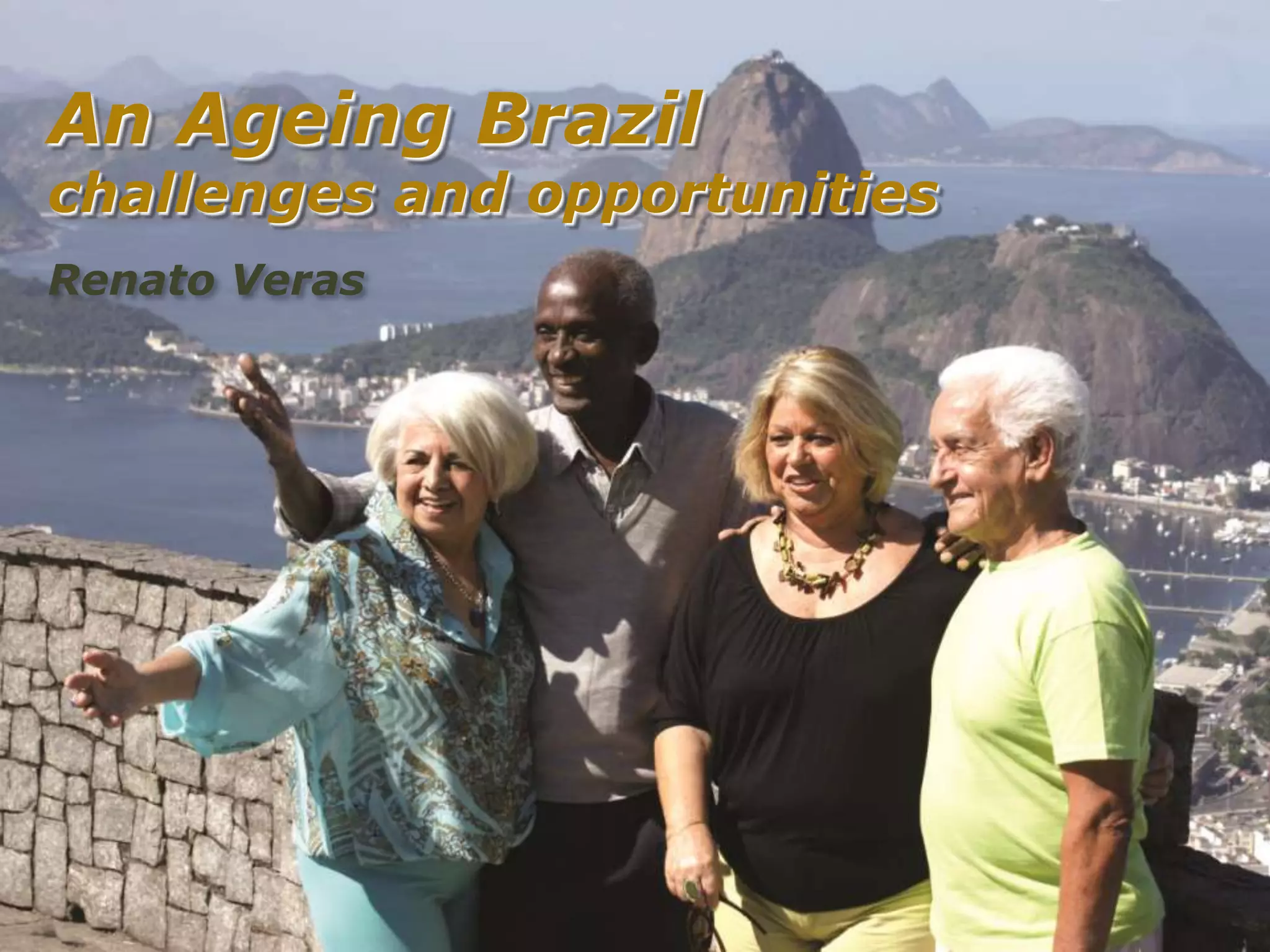
An Ageing Brazil
challenges and opportunities
Renato Veras
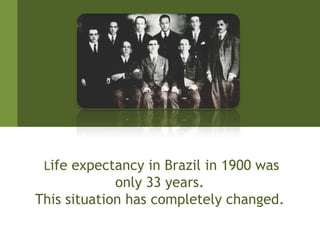
Life expectancy in Brazil in 1900 was
             only 33 years.
This situation has completely changed.
New reality


   Brazil, together with the other BRIC countries
 (Russia, India and China) now account for 40.6% of
            the world’s older population.
New Reality
• Brazil already has 22 million older people
representing 11.6% of the total population.

• The number of older people in Brazil is
projected to reach 31.8 million by 2020.

• 83% of older people live in urban areas.

• São Paulo and Rio de Janeiro are the cities with
the highest number of older people in the
country: 2.1 million and 1,7 million, respectively.

• The number of older people living alone is
expanding.
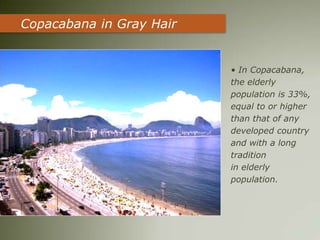
Copacabana in Gray Hair


                          • In Copacabana,
                          the elderly
                          population is 33%,
                          equal to or higher
                          than that of any
                          developed country
                          and with a long
                          tradition
                          in elderly
                          population.
2.1


1950             6.2


          1975
                                    15.1
                                   2000


 ‘BOOM’ of Elderly
          in Brazil
                                           31.8
        [in million inhabitants]
                                           2020
Aging:
a gender issue


• There are more older women then men, especially
among the very old;
• Women live longer than men, but go through
a longer period of time exposed to physical and
mental frailties;
• Women are the primary caregivers; but are also
those who require more care.
Challenges facing health and
       social care in Brazil


• Population is aging exponentially

• New patterns of disease
(chronic long-term illnesses)

• Growing costs

• Anachronistic and inappropriate
  care model
• In the Brazil, one in every three individuals is
  a carrier of chronic disease, and 8 out of 10
  have more than one chronic disease.
We already know that the population is older, diseases are
chronic and multiple, healthcare costs have increased, the
models of care are from the time of acute illnesses and that
epidemiological knowledge informs us of risk factors.


So why this crisis in the health sector, if we already have all
the information to deal with it?
Good health requires more than research


• Epidemiological research works with
  large populations, not individuals
• Individuals are influenced by the
  social environment, culture, and
  events.
• Stable conditions controlled by the
  researcher is only possible in the
  laboratory.
Brazil’s Health System

There are two health systems in Brazil.

A public system (NHS), for everyone, which covers 195
million people.

And a private system, for all who pay which covers 50
million Brazilians.

In Brazil one quarter of the population have both private
and public health plans.
A barrier to integrated health an social care may be the
disease focus


• Disease management programs for the older people usually focus
on single diseases
• Older people typically have more than one chronic illness and
single disease management is not cost effective.
• Focusing on only one disease is not the most appropriate measure
for addressing the social care needs of older people.
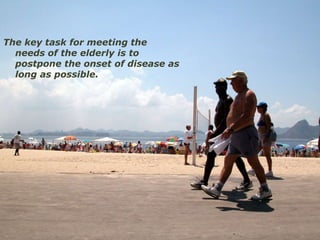
The key task for meeting the
  needs of the elderly is to
  postpone the onset of disease as
  long as possible.
A new way is possible


    • One should promote actions that seek early
      prevention, diagnosis and intervention on
      disease and delay the onset of those
      diseases already acquired.

    • Early diagnosis (intervention) gives
      greater chances for a better prognosis.

    • Need for a radical change in prevention
      models.
An example of good practice:
UnATI / UERJ's concept

• It is a day center completely focused on the
  elderly's health.


• It is a research center and provides professional training


• This is an area of health promotion and exercise of
  citizenship for people of all ages.
Final Considerations


• Critical challenge facing Brazil

• Appropriateness of the response

• What good practice looks like

• What more is needed
Thank you!

Renato Veras

veras@uerj.br
www.unati.uerj.br

2 r veras - an aged brazil

  • 1.
    An Ageing Brazil challengesand opportunities Renato Veras
  • 2.
    Life expectancy inBrazil in 1900 was only 33 years. This situation has completely changed.
  • 3.
    New reality Brazil, together with the other BRIC countries (Russia, India and China) now account for 40.6% of the world’s older population.
  • 4.
    New Reality • Brazilalready has 22 million older people representing 11.6% of the total population. • The number of older people in Brazil is projected to reach 31.8 million by 2020. • 83% of older people live in urban areas. • São Paulo and Rio de Janeiro are the cities with the highest number of older people in the country: 2.1 million and 1,7 million, respectively. • The number of older people living alone is expanding.
  • 5.
    Copacabana in GrayHair • In Copacabana, the elderly population is 33%, equal to or higher than that of any developed country and with a long tradition in elderly population.
  • 6.
    2.1 1950 6.2 1975 15.1 2000 ‘BOOM’ of Elderly in Brazil 31.8 [in million inhabitants] 2020
  • 7.
    Aging: a gender issue •There are more older women then men, especially among the very old; • Women live longer than men, but go through a longer period of time exposed to physical and mental frailties; • Women are the primary caregivers; but are also those who require more care.
  • 8.
    Challenges facing healthand social care in Brazil • Population is aging exponentially • New patterns of disease (chronic long-term illnesses) • Growing costs • Anachronistic and inappropriate care model
  • 9.
    • In theBrazil, one in every three individuals is a carrier of chronic disease, and 8 out of 10 have more than one chronic disease.
  • 10.
    We already knowthat the population is older, diseases are chronic and multiple, healthcare costs have increased, the models of care are from the time of acute illnesses and that epidemiological knowledge informs us of risk factors. So why this crisis in the health sector, if we already have all the information to deal with it?
  • 11.
    Good health requiresmore than research • Epidemiological research works with large populations, not individuals • Individuals are influenced by the social environment, culture, and events. • Stable conditions controlled by the researcher is only possible in the laboratory.
  • 12.
    Brazil’s Health System Thereare two health systems in Brazil. A public system (NHS), for everyone, which covers 195 million people. And a private system, for all who pay which covers 50 million Brazilians. In Brazil one quarter of the population have both private and public health plans.
  • 13.
    A barrier tointegrated health an social care may be the disease focus • Disease management programs for the older people usually focus on single diseases • Older people typically have more than one chronic illness and single disease management is not cost effective. • Focusing on only one disease is not the most appropriate measure for addressing the social care needs of older people.
  • 14.
    The key taskfor meeting the needs of the elderly is to postpone the onset of disease as long as possible.
  • 15.
    A new wayis possible • One should promote actions that seek early prevention, diagnosis and intervention on disease and delay the onset of those diseases already acquired. • Early diagnosis (intervention) gives greater chances for a better prognosis. • Need for a radical change in prevention models.
  • 16.
    An example ofgood practice: UnATI / UERJ's concept • It is a day center completely focused on the elderly's health. • It is a research center and provides professional training • This is an area of health promotion and exercise of citizenship for people of all ages.
  • 17.
    Final Considerations • Criticalchallenge facing Brazil • Appropriateness of the response • What good practice looks like • What more is needed
  • 18.