Declarative Languages and 
Artificial Intelligence 
Research Group 
Wannes Meert, Luc De Raedt 
EluciDATA 
November 2014
Who is DTAI? 
2 
Machine Learning 
5 ZAP 
1 ERC StG 
±13 post-docs 
±35 Ph.D. students 
Declarative Languages 
and Systems 
5 ZAP 
±2 post-docs 
±11 Ph.D. students
3 
Research Centres 
LSTAT
Mission Statement 
To design languages to express complex, relational and 
1 uncertain knowledge 
2 To develop techniques, theory, systems and software 
solutions for machine learning and data mining 
3 
To apply these in various application domains 
4
Basic Research 
5
Machine Learning and Data Mining 
6 
Complex Data 
Clinical Genetic 
Lots of Knowledge 
Papers Knowledge 
Base 
Learn predictive models 
MassSize ≥ 10 ⇒ Cancer 
Reason about the data 
Prob( Flu | Fever ) = ? 
Discover patterns 
Smoking ⋀ Cancer 
Find solutions for problem 
Room1:CourseB, Room2:CourseA 
Network 
Include new data 
Modelt ⟵ Modelt+1 + data
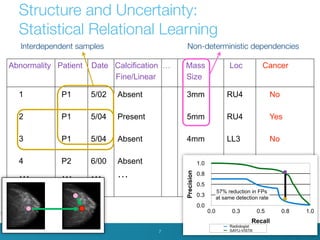
Structure and Uncertainty: 
Statistical Relational Learning 
Interdependent samples Non-deterministic dependencies Precision 
Abnormality Patient Date Calcification … Mass Loc Cancer 
7 
No 
Yes 
No 
No 
… 
RU4 
RU4 
LL3 
RL2 
… 
P1 
P1 
P1 
P2 
… 
5/02 
5/04 
5/04 
6/00 
… 
3mm 
5mm 
4mm 
2mm 
… 
Absent 
Present 
Absent 
Absent 
… 
1 
2 
3 
4 
… 
Fine/Linear Size 
1.0 
0.8 
0.5 
0.3 
0.0 
57% reduction in FPs 
at same detection rate 
0.0 0.3 0.5 0.8 1.0 
Recall 
Radiologist 
SAYU-VISTA
Patterns in Graphs: Graph Mining 


8
Models to act upon: Interpretable Results 
Rich database, communicate with medical professionals 
0.2 IF temp(T)+5  temp(T+1) THEN failure(kidney) 
9
Probabilistic Programming 
10
Constraint Programming 
11
Applications 
12
Robotics: 
Example scenario: 
1. Localise door 
2. Localise handle 
3. Recognize grasping points 
4. Find correct action to apply 
Hinge 
13 
Light 
Handle switch 
http://www.first-mm.eu
View Article Online Bio- and Cheminformatics 
Method Molecular BioSystems 
Fig. 4 detailed view of the sub-network involved in acid resistance identified by PheNetic. The sub-network was decomposed into different subgroups centred 
around the overrepresented GO categories. For visualization purposes, genes are grouped based on their annotation in KEGG and GO (shaded areas). Genes contained 
in both benchmark sets are indicated as yellow nodes. 
This journal is c The Royal Society of Chemistry 2013 
carA and carB which are also selected by PheNetic, are involved 
in the conversion of glutamine to glutamate, which is one of the 
major known acid resistance mechanisms in E. coli.30 This gene 
encoding pepA seems barely altered at its expression level, 
explaining why it might have been missed by previous studies. 
Another strongly prioritized gene/gene product is TyrR, the 
main regulator of tyrosine synthesis, which has previously been 
associated with acid conditions in Salmonella typhimurium.38 
TyrR regulates the amino acid metabolism regulator Mtr, which 
in turn regulates the tryptophan or indole metabolism operon, 
many genes of which were retrieved in the sub-network selected 
by PheNetic. The indole biosynthesis operon was found to be 
down-regulated in many of the KO strains we analysed, but 
none of its known regulators ranked well by the differential 
expression-based ranking method, explaining why it has been 
largely overlooked in the past. So far tryptophan biosynthesis 
has been only associated with acid resistance through the 
tryptophanases TnaA and TnaC.26,28,29 
publicly available information, represented as an interaction 
network. The developed method extracts sub-networks des-cribing 
the mechanism behind the omics data from this inter-action 
network. 
The method was applied to reanalyse a previously published 
expression study, assessing gene expression of 27 KO strains 
under mild acid growth conditions in E. coli.19 To this end, an 
E. coli interaction network was compiled, spanning multiple 
layers of interactions. Applying PheNetic on this KO expression 
dataset using this E. coli interaction network, allowed recovering 
mechanisms known to be involved in acid resistance. 
According to the classification of network inference methods 
of De Smet and Marchal39 PheNetic can be considered as an 
integrative inference scheme that uses next to expression data 
also omics derived network information to prioritize genes 
involved in the process of interest. Comparing PheNetic with 
classical differential expression-based ranking illustrates the 
added value of using such an integrative network-based 
approaches to analyse omics derived gene lists. This integrative 
Published on 26 March 2013. Downloaded by KU Leuven University Library on 28/05/2013 09:26:45. 
14 
paths in a parsimonious way (using the 
network). 
assigning a reward to the selected sub-network 
cause–effect pairs that are connected in 
genes previously associated with acid resistance in E. coli. 
A first stringent, but small benchmark consisting of 53 genes 
was based on literature curated information. A second more 
relaxed benchmark was composed of genes, reported to be 
SBO Research Proposal 
Network-based approaches for the 
identification and mode of action determination 
of anti-bacterial agents 
KU Leuven 
Ghent University 
of the experimental setup. KO genes are referred to as causes and differentially expressed genes as effects (left panel). PheNetic connects 
interaction network derived from publicly available data (middle panel) by searching for paths in the interaction network that connect causes 
possible effects (red and green nodes) in the most parsimonious way (right panel). PheNetic allows extracting from the global interaction 
mechanism that is activated by the KO experiment.
Transportation: 
Energy: 
15 
http://icon-fet.eu 
Integrate constraints and data mining to 
dynamically optimise: 
- Public transportation schedules 
- Energy distribution
Resource Efficient Machine Learning 
UXLV UXLV UXLV 
x Dynamically shut down expensive also the resulting decrease in accuracy 
x Dynamically change noise context, feature banks (more relevant for this Fig. 1: System setup with chip and μP and DT and performance for live audio or prerecorded Reduce: 
16 
Figure 24.2.1: (left) Architectural representation of voice activity 
detector detailing hierarchical information extraction (right) energy 
consumption at different levels of hierarchy. 
Figure 24.2.2: Schematic representation of (top) Wakeup detector 
(bottom) Analog feature extractor 
Figure 24.2.3: (top) Measured response of Wakeup to audio input 
(bottom left) measured band frequency response and (bottom right) 
measured performance summary of analog feature extraction block 
and energy detector 
Figure 24.2.4: (left) Schematic and decision tree algorithm for mixed-signal 
classifier (right) Measurement results for HR speech / Non 
speech for different contexts. 
to the bystanders, being: 
x On the input signals: the noise context, x On the system’s operating mode: 
o The parameters of the decision o Which blocks in the chip are run-time scalability of the x On the live performance results 
o The current (measured) power o The current achieved detection o The current classification We can then dynamically play with this setup, involved. E.g.: 
- features’ energy consumption 
- features’ collection cost 
- classification cost 
Efficient Diagnostics Smart Hardware 
3UREOHHPVWHOOLQJVHTXHQWLH 
ZDQGHOHQ    WUDSRS 
Figure 24.2.7: Chip micrograph highlighting different sections 
Sensor 
Data
Soccer, Basketball, Runners, Rehabilitation 
http://dtai.cs.kuleuven.be/sports 
Fig. 6: Skeleton estimates after cylinder correction, hierarchical particle filter 
(particle filter in white, NITE in blue). 
Sports Analytics 
17
Social Profit 
18
Educational Tools 
http://eng.kuleuven.be/innovationlab 
19
http://dtai.cs.kuleuven.be

2 partners ed_kickoff_dtai

  • 1.
    Declarative Languages and Artificial Intelligence Research Group Wannes Meert, Luc De Raedt EluciDATA November 2014
  • 2.
    Who is DTAI? 2 Machine Learning 5 ZAP 1 ERC StG ±13 post-docs ±35 Ph.D. students Declarative Languages and Systems 5 ZAP ±2 post-docs ±11 Ph.D. students
  • 3.
  • 4.
    Mission Statement Todesign languages to express complex, relational and 1 uncertain knowledge 2 To develop techniques, theory, systems and software solutions for machine learning and data mining 3 To apply these in various application domains 4
  • 5.
  • 6.
    Machine Learning andData Mining 6 Complex Data Clinical Genetic Lots of Knowledge Papers Knowledge Base Learn predictive models MassSize ≥ 10 ⇒ Cancer Reason about the data Prob( Flu | Fever ) = ? Discover patterns Smoking ⋀ Cancer Find solutions for problem Room1:CourseB, Room2:CourseA Network Include new data Modelt ⟵ Modelt+1 + data
  • 7.
    Structure and Uncertainty: Statistical Relational Learning Interdependent samples Non-deterministic dependencies Precision Abnormality Patient Date Calcification … Mass Loc Cancer 7 No Yes No No … RU4 RU4 LL3 RL2 … P1 P1 P1 P2 … 5/02 5/04 5/04 6/00 … 3mm 5mm 4mm 2mm … Absent Present Absent Absent … 1 2 3 4 … Fine/Linear Size 1.0 0.8 0.5 0.3 0.0 57% reduction in FPs at same detection rate 0.0 0.3 0.5 0.8 1.0 Recall Radiologist SAYU-VISTA
  • 8.
    Patterns in Graphs:Graph Mining 8
  • 9.
    Models to actupon: Interpretable Results Rich database, communicate with medical professionals 0.2 IF temp(T)+5 temp(T+1) THEN failure(kidney) 9
  • 10.
  • 11.
  • 12.
  • 13.
    Robotics: Example scenario: 1. Localise door 2. Localise handle 3. Recognize grasping points 4. Find correct action to apply Hinge 13 Light Handle switch http://www.first-mm.eu
  • 14.
    View Article OnlineBio- and Cheminformatics Method Molecular BioSystems Fig. 4 detailed view of the sub-network involved in acid resistance identified by PheNetic. The sub-network was decomposed into different subgroups centred around the overrepresented GO categories. For visualization purposes, genes are grouped based on their annotation in KEGG and GO (shaded areas). Genes contained in both benchmark sets are indicated as yellow nodes. This journal is c The Royal Society of Chemistry 2013 carA and carB which are also selected by PheNetic, are involved in the conversion of glutamine to glutamate, which is one of the major known acid resistance mechanisms in E. coli.30 This gene encoding pepA seems barely altered at its expression level, explaining why it might have been missed by previous studies. Another strongly prioritized gene/gene product is TyrR, the main regulator of tyrosine synthesis, which has previously been associated with acid conditions in Salmonella typhimurium.38 TyrR regulates the amino acid metabolism regulator Mtr, which in turn regulates the tryptophan or indole metabolism operon, many genes of which were retrieved in the sub-network selected by PheNetic. The indole biosynthesis operon was found to be down-regulated in many of the KO strains we analysed, but none of its known regulators ranked well by the differential expression-based ranking method, explaining why it has been largely overlooked in the past. So far tryptophan biosynthesis has been only associated with acid resistance through the tryptophanases TnaA and TnaC.26,28,29 publicly available information, represented as an interaction network. The developed method extracts sub-networks des-cribing the mechanism behind the omics data from this inter-action network. The method was applied to reanalyse a previously published expression study, assessing gene expression of 27 KO strains under mild acid growth conditions in E. coli.19 To this end, an E. coli interaction network was compiled, spanning multiple layers of interactions. Applying PheNetic on this KO expression dataset using this E. coli interaction network, allowed recovering mechanisms known to be involved in acid resistance. According to the classification of network inference methods of De Smet and Marchal39 PheNetic can be considered as an integrative inference scheme that uses next to expression data also omics derived network information to prioritize genes involved in the process of interest. Comparing PheNetic with classical differential expression-based ranking illustrates the added value of using such an integrative network-based approaches to analyse omics derived gene lists. This integrative Published on 26 March 2013. Downloaded by KU Leuven University Library on 28/05/2013 09:26:45. 14 paths in a parsimonious way (using the network). assigning a reward to the selected sub-network cause–effect pairs that are connected in genes previously associated with acid resistance in E. coli. A first stringent, but small benchmark consisting of 53 genes was based on literature curated information. A second more relaxed benchmark was composed of genes, reported to be SBO Research Proposal Network-based approaches for the identification and mode of action determination of anti-bacterial agents KU Leuven Ghent University of the experimental setup. KO genes are referred to as causes and differentially expressed genes as effects (left panel). PheNetic connects interaction network derived from publicly available data (middle panel) by searching for paths in the interaction network that connect causes possible effects (red and green nodes) in the most parsimonious way (right panel). PheNetic allows extracting from the global interaction mechanism that is activated by the KO experiment.
  • 15.
    Transportation: Energy: 15 http://icon-fet.eu Integrate constraints and data mining to dynamically optimise: - Public transportation schedules - Energy distribution
  • 16.
    Resource Efficient MachineLearning UXLV UXLV UXLV x Dynamically shut down expensive also the resulting decrease in accuracy x Dynamically change noise context, feature banks (more relevant for this Fig. 1: System setup with chip and μP and DT and performance for live audio or prerecorded Reduce: 16 Figure 24.2.1: (left) Architectural representation of voice activity detector detailing hierarchical information extraction (right) energy consumption at different levels of hierarchy. Figure 24.2.2: Schematic representation of (top) Wakeup detector (bottom) Analog feature extractor Figure 24.2.3: (top) Measured response of Wakeup to audio input (bottom left) measured band frequency response and (bottom right) measured performance summary of analog feature extraction block and energy detector Figure 24.2.4: (left) Schematic and decision tree algorithm for mixed-signal classifier (right) Measurement results for HR speech / Non speech for different contexts. to the bystanders, being: x On the input signals: the noise context, x On the system’s operating mode: o The parameters of the decision o Which blocks in the chip are run-time scalability of the x On the live performance results o The current (measured) power o The current achieved detection o The current classification We can then dynamically play with this setup, involved. E.g.: - features’ energy consumption - features’ collection cost - classification cost Efficient Diagnostics Smart Hardware 3UREOHHPVWHOOLQJVHTXHQWLH ZDQGHOHQ WUDSRS Figure 24.2.7: Chip micrograph highlighting different sections Sensor Data
  • 17.
    Soccer, Basketball, Runners,Rehabilitation http://dtai.cs.kuleuven.be/sports Fig. 6: Skeleton estimates after cylinder correction, hierarchical particle filter (particle filter in white, NITE in blue). Sports Analytics 17
  • 18.
  • 19.
  • 20.