IF WITH IMPERATIVE, CAN, AND SHOULD
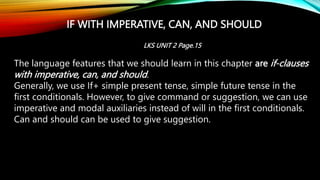
The language features that we should learn in this chapter are if-clauses
with imperative, can, and should.
Generally, we use If+ simple present tense, simple future tense in the
first conditionals. However, to give command or suggestion, we can use
imperative and modal auxiliaries instead of will in the first conditionals.
Can and should can be used to give suggestion.
LKS UNIT 2 Page.15
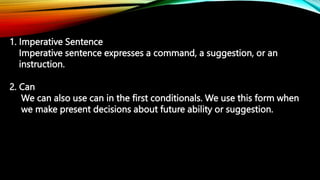
1. Imperative Sentence
Imperative sentence expresses a command, a suggestion, or an
instruction.
2. Can
We can also use can in the first conditionals. We use this form when
we make present decisions about future ability or suggestion.
3. Should
We can use other modals in the main clause instead of "will" and "can". We can use "should" to
express suggestion/recommendation or advice about the outcome.
Example:
If your mother calls you, you should go to her.
We can also use this way to suggest that something is unlikely to happen, or is not particularly
probable.
Examples:
If you should meet Hani, tell her to call me. (Your chances of meeting Hani are rather slim, but If
you meet her, tell her to call me.)
If Dian should come, ask her to wait. (Dian is unlikely to come, but if she comes, ask her to wait.)
Should can also be put at the beginning of the sentence. In this case, if is omitted.
Example: Should you meet Hani, tell her to call me.
(If you should meet Hani, tell her to call me.)
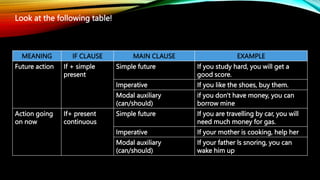
MEANING IF CLAUSE MAIN CLAUSE EXAMPLE
Future action If + simple
present
Simple future If you study hard, you will get a
good score.
Imperative If you like the shoes, buy them.
Modal auxiliary
(can/should)
if you don't have money, you can
borrow mine
Action going
on now
If+ present
continuous
Simple future If you are travelling by car, you will
need much money for gas.
Imperative If your mother is cooking, help her
Modal auxiliary
(can/should)
If your father ls snoring, you can
wake him up
Look at the following table!
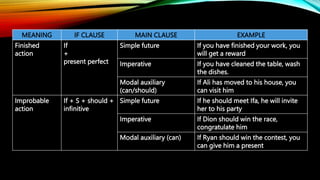
MEANING IF CLAUSE MAIN CLAUSE EXAMPLE
Finished
action
If
+
present perfect
Simple future If you have finished your work, you
will get a reward
Imperative If you have cleaned the table, wash
the dishes.
Modal auxiliary
(can/should)
If Ali has moved to his house, you
can visit him
Improbable
action
If + S + should +
infinitive
Simple future If he should meet Ifa, he will invite
her to his party
Imperative If Dion should win the race,
congratulate him
Modal auxiliary (can) If Ryan should win the contest, you
can give him a present

2. IF + IMPERATIVE.pptx

  • 1.
    IF WITH IMPERATIVE,CAN, AND SHOULD The language features that we should learn in this chapter are if-clauses with imperative, can, and should. Generally, we use If+ simple present tense, simple future tense in the first conditionals. However, to give command or suggestion, we can use imperative and modal auxiliaries instead of will in the first conditionals. Can and should can be used to give suggestion. LKS UNIT 2 Page.15
  • 2.
    1. Imperative Sentence Imperativesentence expresses a command, a suggestion, or an instruction. 2. Can We can also use can in the first conditionals. We use this form when we make present decisions about future ability or suggestion.
  • 3.
    3. Should We canuse other modals in the main clause instead of "will" and "can". We can use "should" to express suggestion/recommendation or advice about the outcome. Example: If your mother calls you, you should go to her. We can also use this way to suggest that something is unlikely to happen, or is not particularly probable. Examples: If you should meet Hani, tell her to call me. (Your chances of meeting Hani are rather slim, but If you meet her, tell her to call me.) If Dian should come, ask her to wait. (Dian is unlikely to come, but if she comes, ask her to wait.) Should can also be put at the beginning of the sentence. In this case, if is omitted. Example: Should you meet Hani, tell her to call me. (If you should meet Hani, tell her to call me.)
  • 4.
    MEANING IF CLAUSEMAIN CLAUSE EXAMPLE Future action If + simple present Simple future If you study hard, you will get a good score. Imperative If you like the shoes, buy them. Modal auxiliary (can/should) if you don't have money, you can borrow mine Action going on now If+ present continuous Simple future If you are travelling by car, you will need much money for gas. Imperative If your mother is cooking, help her Modal auxiliary (can/should) If your father ls snoring, you can wake him up Look at the following table!
  • 5.
    MEANING IF CLAUSEMAIN CLAUSE EXAMPLE Finished action If + present perfect Simple future If you have finished your work, you will get a reward Imperative If you have cleaned the table, wash the dishes. Modal auxiliary (can/should) If Ali has moved to his house, you can visit him Improbable action If + S + should + infinitive Simple future If he should meet Ifa, he will invite her to his party Imperative If Dion should win the race, congratulate him Modal auxiliary (can) If Ryan should win the contest, you can give him a present