Historical Overview: Scope
of Microbial Ecology
By
Dr. Thirunahari Ugandhar
Associate Professor of Botany
Department of Botany
Kakatiya Govt College (A) Hanamkonda
Historical Development of Microbial Ecology
The recognition of the microbial world was only possible after significant
technological progress. In the late 1600s, Antonie van Leeuwenhoek
refined lens-making techniques and first observed what he called
“animalcules,” later understood as microorganisms. Although his discovery
revealed an entirely new world of life, microbiology as a structured scientific
discipline did not develop until the late 19th and early 20th centuries.
During this period, Louis Pasteur and Robert Koch focused on the
role of microbes in human health, especially through the germ theory
of disease. Their work was primarily medical and not ecological in
nature, but it laid the foundation for microbiological techniques such
as sterilization, cultivation, and isolation, which remain fundamental
tools today.
In the early 20th century, Martinus Beijerinck and Sergei Winogradsky
shifted attention to the role of microorganisms in natural environments.
They developed the enrichment culture technique, which allowed for the
isolation of microbes responsible for processes such as nitrogen fixation,
sulfur oxidation, and other biogeochemical transformations.
While their emphasis was more on microbial physiology than ecology, their
pioneering work revealed the ecological significance of microbes in nutrient
cycling.
A new phase began in the 1950s when Robert Hungate and his colleagues
initiated detailed studies of the rumen ecosystem.
Hungate is especially remembered for perfecting methods to culture strict
anaerobes and for promoting quantitative approaches in microbial ecology.
His studies on cellulose degradation in insect gut flora and later in the bovine
rumen emphasized that ecological investigations should not end with pure
culture isolation but should also measure microbial abundance and activity
within ecosystems.
This focus on quantification distinguished major from minor species and
clarified the dominant catabolic pathways in microbial habitats.
Technological progress has continuously shaped microbial
ecology. The advent of radioisotopes in the 1950s allowed
for precise measurements of microbial processes such as
primary production, nutrient assimilation, and
mineralization.
For example, isotopes like ¹⁴C, ³H, ³²P, and ³⁵S were used to
trace carbon, phosphorus, and sulfur cycling in nature.
These studies, however, were often limited by the “bottle
effect,” where samples incubated outside their natural
environment produced results that diverged from true in
situ processes.
This highlighted the need for more sensitive and minimally
invasive techniques.
In the 1980s, the invention of microelectrodes revolutionized
spatial and temporal studies of microbial habitats.
These electrodes, with micrometer-scale resolution, made it
possible to measure oxygen, pH, sulfide, and other
parameters directly in microbial mats and sediments,
offering unprecedented insights into microscale microbial
interactions.
Despite progress in quantifying biogeochemical processes,
identifying the actual microbial agents behind these
transformations remained difficult. Traditional pure-culture
methods failed to capture the vast diversity of natural microbial
communities, as most microbes were “unculturable” under
standard laboratory conditions. A breakthrough came with the
molecular revolution.
Carl Woese demonstrated that small-subunit ribosomal RNA
(16S rRNA) could serve as a molecular chronometer, allowing the
construction of a universal phylogenetic tree of life. Norman
Pace and colleagues later applied this principle to environmental
samples, using PCR amplification and sequencing of rRNA
genes directly from natural habitats. This cultivation-independent
approach revealed that microbial diversity was far greater than
previously imagined, uncovering entirely new lineages that had
never been cultured.
In recent decades, microbial ecology has been further
transformed by metagenomics, metatranscriptomics,
proteomics, and metabolomics, which not only answer the
question of “who is there” but also begin to address “what
they are doing.”
Advances in stable isotope probing (SIP), fluorescence in
situ hybridization (FISH), and high-throughput sequencing
have enabled researchers to link microbial identity with
ecological function more directly.
Today, microbial ecology is a highly interdisciplinary field,
integrating microbiology, molecular biology, environmental
science, and systems biology.
It has direct applications in agriculture, biotechnology,
medicine, and global climate studies. The realisation that
microbes regulate key processes in the carbon, nitrogen,
phosphorus, and sulfur cycles has emphasised their role as
drivers of ecosystem stability and planetary health.
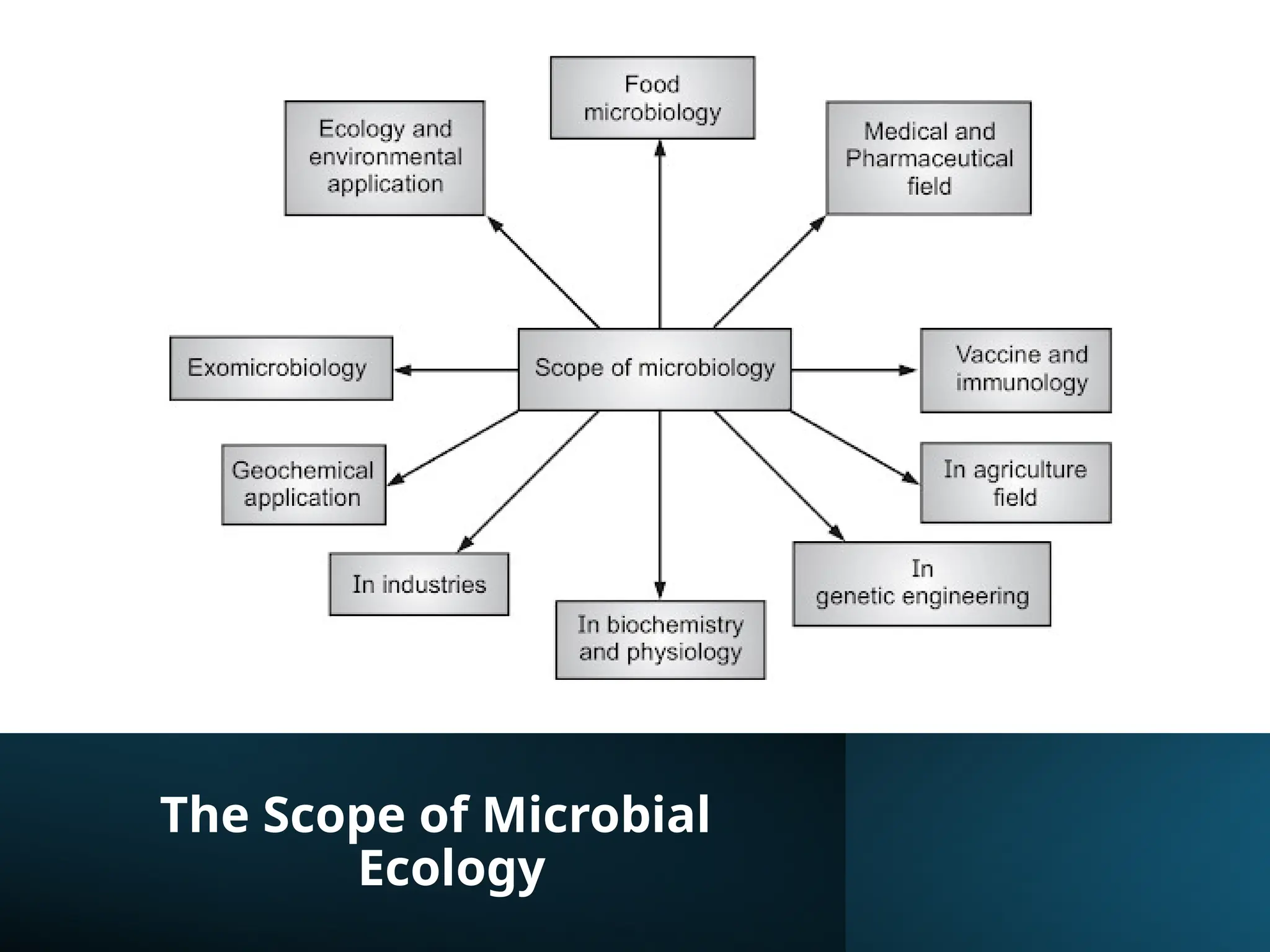
The Scope of Microbial Ecology
Microorganisms are ubiquitous – they occur in virtually
every environment on Earth, from oceans and rivers to
deserts, soils, glaciers, and even extreme habitats such as
hot springs, salt flats, and deep-sea hydrothermal vents.
They also form intimate associations with plants, animals,
and even other microbes. While each habitat presents its
own unique set of physical and chemical challenges,
microbial ecology focuses on the common principles that
govern microbial survival, adaptation, and interactions
across these diverse environments.
The Scope of Microbial
Ecology
During this period, Louis Pasteur and
Robert Koch focused on the role of
microbes in human health,
especially through the germ theory
of disease.
Their work was primarily
medical and not ecological in
nature, but it laid the foundation
for microbiological techniques
such as sterilisation, cultivation,
and isolation, which remain
fundamental tools today.
Microbial Influence Across Scales: Although microbes operate at the
micrometre scale, their activities affect processes that span from the
microenvironment around a single cell to global ecosystems.
1.Global and Landscape Scales; At the broadest level, microbial
processes influence entire biomes, such as forests, deserts, oceans,
tundra, grasslands, and wetlands. Traditionally, biogeography has been
applied to plants and animals, but recent studies have demonstrated
that microbes, too, display distribution patterns. For instance:
1. Genetic diversity among microbial populations often correlates
with geographic distance, similar to patterns observed in higher
organisms.
2. Species-area relationships apply to microbes, although their
mechanisms differ due to phenomena such as horizontal gene
transfer and high recombination rates.
2.Microbes also link biomes through global biogeochemical
processes. For example:
1. Dust from arid deserts transports iron particles across continents
into the ocean, where they enhance marine photosynthesis.
2. Viruses like avian influenza (H5N1) and West Nile virus spread
globally via migratory birds, illustrating how microbial ecology is
interconnected with animal movement and climate.
• Ecosystem Scale: At the ecosystem level,
microbes interact with the physical (abiotic) and
biological (biotic) components of their habitat.
• A classic example is the occurrence of
photosynthetic sulfur bacteria in lakes, where
specific conditions—light, sulfide availability, and
anaerobic zones—must converge to support their
growth.
• Such interactions highlight how microbial
processes are tightly regulated by
environmental constraints.
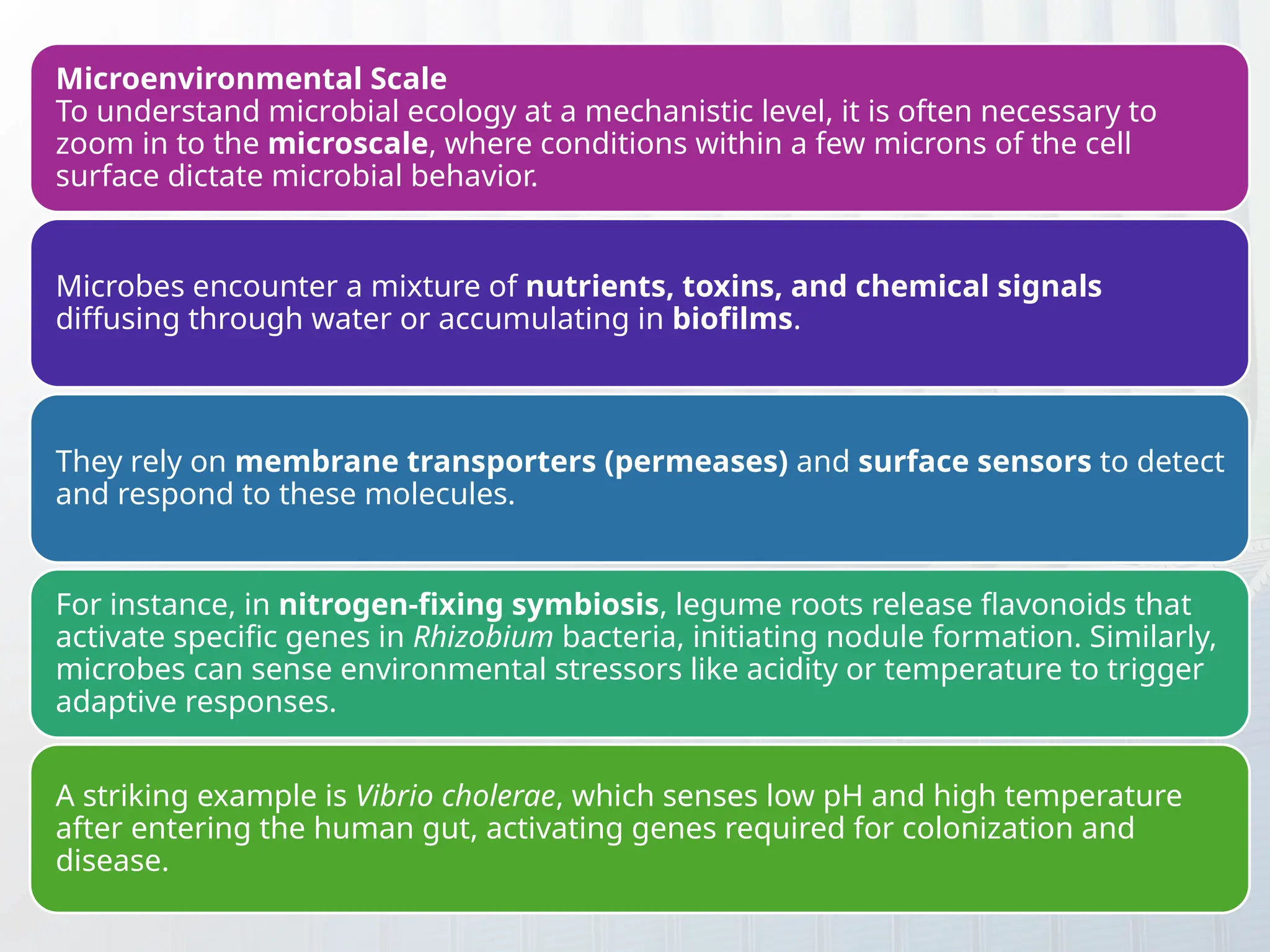
Microenvironmental Scale
To understand microbial ecology at a mechanistic level, it is often necessary to
zoom in to the microscale, where conditions within a few microns of the cell
surface dictate microbial behavior.
Microbes encounter a mixture of nutrients, toxins, and chemical signals
diffusing through water or accumulating in biofilms.
They rely on membrane transporters (permeases) and surface sensors to detect
and respond to these molecules.
For instance, in nitrogen-fixing symbiosis, legume roots release flavonoids that
activate specific genes in Rhizobium bacteria, initiating nodule formation. Similarly,
microbes can sense environmental stressors like acidity or temperature to trigger
adaptive responses.
A striking example is Vibrio cholerae, which senses low pH and high temperature
after entering the human gut, activating genes required for colonization and
disease.
Molecular Regulation and Adaptation
Microbes are highly responsive to environmental changes because of sophisticated
regulatory systems. One of the most widespread mechanisms is the two-
component regulatory system:
It consists of a histidine protein kinase (HPK) that senses an external signal and a
response regulator that alters gene expression accordingly.
Comparative genomics shows that bacteria inhabiting chemically complex
environments (e.g., sediments, microbial mats) possess a larger number of HPKs,
giving them flexibility to adapt to steep chemical gradients. Examples include δ-
and ε-proteobacteria, as well as cyanobacteria like Nostoc.
By contrast, obligate intracellular parasites, such as Chlamydia, experience
relatively stable environments inside host cells and thus require fewer such
systems.
Modern Scope of Microbial Ecology
Today, microbial ecology is more than just identifying
where microbes live. Its scope includes:
• Understanding global cycles: carbon sequestration,
nitrogen fixation, sulfur oxidation, and methane
production.
• Health and disease: the role of the human
microbiome in digestion, immunity, and pathogen
defense.
• Agriculture: plant-microbe interactions that enhance
nutrient uptake and stress tolerance.
• Biotechnology and industry: use of microbes in
wastewater treatment, bioenergy production, and
pharmaceuticals.
• Climate change studies: microbes as regulators of
greenhouse gases such as CO₂, CH₄, and N₂O.
Microbial Life in Aquatic, Terrestrial, and Host-Associated
Habitats
1. Aquatic Habitats: The Planktonic Lifestyle
A defining feature of aquatic ecosystems is the dominance of
planktonic (free-floating) microorganisms.
• Most planktonic chemoheterotrophic bacteria rely on dissolved
organic carbon (DOC) such as sugars, amino acids, and organic
acids. These compounds originate from the excretion, lysis, or
enzymatic breakdown of larger organisms.
• Although total DOC in ocean water can reach ~1 mg/L, it is
distributed across hundreds of different organic molecules,
each present at extremely low concentrations (nanomolar to
micromolar levels).
• To survive under such scarcity, aquatic microbes have evolved
high-affinity transport systems and metabolic flexibility,
enabling them to utilize multiple substrates at very low
concentrations.
• Competition drives the selection of organisms that can rapidly
adapt to fluctuating nutrient availability.
2. Gradient-Based Habitats: Sediments, Biofilms, and Microbial Mats
In contrast to free-floating microbes, those living in solid matrices
(e.g., aquatic sediments, aquifers, biofilms, or microbial mats)
experience steep chemical gradients.
• These gradients form because chemical sources and sinks
(production and consumption) are spatially separated. For
example, oxygen may diffuse in from above, while sulfide is
produced below.
• Microbial numbers and metabolic activity directly affect the
steepness and stability of these gradients. Some gradients are
relatively stable, while others fluctuate with time.
A classic example is stratified microbial mats:
• Cyanobacteria at the surface carry out photosynthesis, producing
oxygen during the day.
• Beneath them, chemoheterotrophs and sulfate-reducing bacteria
dominate, relying on anaerobic processes.
• Microelectrode studies show that oxygen, hydrogen sulfide, and
proton (H⁺) concentrations can change dramatically within
minutes after sunrise or sunset.
This demonstrates how microbial ecosystems can shift rapidly in
response to environmental cues such as light.
3. Microenvironmental Scale
To understand microbial ecology at a
mechanistic level, it is often necessary to
zoom in to the microscale, where conditions
within a few microns of the cell surface
dictate microbial behavior.
• Microbes encounter a mixture of nutrients,
toxins, and chemical signals diffusing
through water or accumulating in biofilms.
• They rely on membrane transporters
(permeases) and surface sensors to detect
and respond to these molecules.
• For instance, in nitrogen-fixing symbiosis,
legume roots release flavonoids that activate
specific genes in Rhizobium bacteria, initiating
nodule formation. Similarly, microbes can
sense environmental stressors like acidity or
temperature to trigger adaptive responses.
• A striking example is Vibrio cholerae, which
senses low pH and high temperature after
entering the human gut, activating genes
required for colonization and disease.
Molecular Regulation and Adaptation
Microbes are highly responsive to
environmental changes because of
sophisticated regulatory systems. One of
the most widespread mechanisms is the two-
component regulatory system:
• It consists of a histidine protein kinase
(HPK) that senses an external signal and a
response regulator that alters gene
expression accordingly.
• Comparative genomics shows that bacteria
inhabiting chemically complex
environments (e.g., sediments, microbial
mats) possess a larger number of HPKs,
giving them flexibility to adapt to steep
chemical gradients. Examples include δ- and
ε-proteobacteria, as well as cyanobacteria
like Nostoc.
• By contrast, obligate intracellular
parasites, such as Chlamydia, experience
relatively stable environments inside host
cells and thus require fewer such systems.
Modern Scope of Microbial Ecology
Today, microbial ecology is more than just identifying where
microbes live. Its scope includes:
Understanding global cycles: carbon sequestration, nitrogen
fixation, sulfur oxidation, and methane production.
Health and disease: the role of the human microbiome in
digestion, immunity, and pathogen defense.
Agriculture: plant-microbe interactions that enhance nutrient
uptake and stress tolerance.
Biotechnology and industry: use of microbes in wastewater
treatment, bioenergy production, and pharmaceuticals.
Climate change studies: microbes as regulators of greenhouse
gases such as CO₂, CH₄, and N₂O.
2.  History and Scope  of Microbial Ecology Thirunahari Ugandhar.pptx

2. History and Scope of Microbial Ecology Thirunahari Ugandhar.pptx

  • 1.
    Historical Overview: Scope ofMicrobial Ecology By Dr. Thirunahari Ugandhar Associate Professor of Botany Department of Botany Kakatiya Govt College (A) Hanamkonda
  • 2.
    Historical Development ofMicrobial Ecology The recognition of the microbial world was only possible after significant technological progress. In the late 1600s, Antonie van Leeuwenhoek refined lens-making techniques and first observed what he called “animalcules,” later understood as microorganisms. Although his discovery revealed an entirely new world of life, microbiology as a structured scientific discipline did not develop until the late 19th and early 20th centuries. During this period, Louis Pasteur and Robert Koch focused on the role of microbes in human health, especially through the germ theory of disease. Their work was primarily medical and not ecological in nature, but it laid the foundation for microbiological techniques such as sterilization, cultivation, and isolation, which remain fundamental tools today.
  • 3.
    In the early20th century, Martinus Beijerinck and Sergei Winogradsky shifted attention to the role of microorganisms in natural environments. They developed the enrichment culture technique, which allowed for the isolation of microbes responsible for processes such as nitrogen fixation, sulfur oxidation, and other biogeochemical transformations. While their emphasis was more on microbial physiology than ecology, their pioneering work revealed the ecological significance of microbes in nutrient cycling. A new phase began in the 1950s when Robert Hungate and his colleagues initiated detailed studies of the rumen ecosystem. Hungate is especially remembered for perfecting methods to culture strict anaerobes and for promoting quantitative approaches in microbial ecology. His studies on cellulose degradation in insect gut flora and later in the bovine rumen emphasized that ecological investigations should not end with pure culture isolation but should also measure microbial abundance and activity within ecosystems. This focus on quantification distinguished major from minor species and clarified the dominant catabolic pathways in microbial habitats.
  • 4.
    Technological progress hascontinuously shaped microbial ecology. The advent of radioisotopes in the 1950s allowed for precise measurements of microbial processes such as primary production, nutrient assimilation, and mineralization. For example, isotopes like ¹⁴C, ³H, ³²P, and ³⁵S were used to trace carbon, phosphorus, and sulfur cycling in nature. These studies, however, were often limited by the “bottle effect,” where samples incubated outside their natural environment produced results that diverged from true in situ processes. This highlighted the need for more sensitive and minimally invasive techniques. In the 1980s, the invention of microelectrodes revolutionized spatial and temporal studies of microbial habitats. These electrodes, with micrometer-scale resolution, made it possible to measure oxygen, pH, sulfide, and other parameters directly in microbial mats and sediments, offering unprecedented insights into microscale microbial interactions.
  • 5.
    Despite progress inquantifying biogeochemical processes, identifying the actual microbial agents behind these transformations remained difficult. Traditional pure-culture methods failed to capture the vast diversity of natural microbial communities, as most microbes were “unculturable” under standard laboratory conditions. A breakthrough came with the molecular revolution. Carl Woese demonstrated that small-subunit ribosomal RNA (16S rRNA) could serve as a molecular chronometer, allowing the construction of a universal phylogenetic tree of life. Norman Pace and colleagues later applied this principle to environmental samples, using PCR amplification and sequencing of rRNA genes directly from natural habitats. This cultivation-independent approach revealed that microbial diversity was far greater than previously imagined, uncovering entirely new lineages that had never been cultured.
  • 6.
    In recent decades,microbial ecology has been further transformed by metagenomics, metatranscriptomics, proteomics, and metabolomics, which not only answer the question of “who is there” but also begin to address “what they are doing.” Advances in stable isotope probing (SIP), fluorescence in situ hybridization (FISH), and high-throughput sequencing have enabled researchers to link microbial identity with ecological function more directly. Today, microbial ecology is a highly interdisciplinary field, integrating microbiology, molecular biology, environmental science, and systems biology. It has direct applications in agriculture, biotechnology, medicine, and global climate studies. The realisation that microbes regulate key processes in the carbon, nitrogen, phosphorus, and sulfur cycles has emphasised their role as drivers of ecosystem stability and planetary health.
  • 7.
    The Scope ofMicrobial Ecology Microorganisms are ubiquitous – they occur in virtually every environment on Earth, from oceans and rivers to deserts, soils, glaciers, and even extreme habitats such as hot springs, salt flats, and deep-sea hydrothermal vents. They also form intimate associations with plants, animals, and even other microbes. While each habitat presents its own unique set of physical and chemical challenges, microbial ecology focuses on the common principles that govern microbial survival, adaptation, and interactions across these diverse environments.
  • 9.
    The Scope ofMicrobial Ecology
  • 10.
    During this period,Louis Pasteur and Robert Koch focused on the role of microbes in human health, especially through the germ theory of disease. Their work was primarily medical and not ecological in nature, but it laid the foundation for microbiological techniques such as sterilisation, cultivation, and isolation, which remain fundamental tools today.
  • 11.
    Microbial Influence AcrossScales: Although microbes operate at the micrometre scale, their activities affect processes that span from the microenvironment around a single cell to global ecosystems. 1.Global and Landscape Scales; At the broadest level, microbial processes influence entire biomes, such as forests, deserts, oceans, tundra, grasslands, and wetlands. Traditionally, biogeography has been applied to plants and animals, but recent studies have demonstrated that microbes, too, display distribution patterns. For instance: 1. Genetic diversity among microbial populations often correlates with geographic distance, similar to patterns observed in higher organisms. 2. Species-area relationships apply to microbes, although their mechanisms differ due to phenomena such as horizontal gene transfer and high recombination rates. 2.Microbes also link biomes through global biogeochemical processes. For example: 1. Dust from arid deserts transports iron particles across continents into the ocean, where they enhance marine photosynthesis. 2. Viruses like avian influenza (H5N1) and West Nile virus spread globally via migratory birds, illustrating how microbial ecology is interconnected with animal movement and climate.
  • 12.
    • Ecosystem Scale:At the ecosystem level, microbes interact with the physical (abiotic) and biological (biotic) components of their habitat. • A classic example is the occurrence of photosynthetic sulfur bacteria in lakes, where specific conditions—light, sulfide availability, and anaerobic zones—must converge to support their growth. • Such interactions highlight how microbial processes are tightly regulated by environmental constraints.
  • 13.
    Microenvironmental Scale To understandmicrobial ecology at a mechanistic level, it is often necessary to zoom in to the microscale, where conditions within a few microns of the cell surface dictate microbial behavior. Microbes encounter a mixture of nutrients, toxins, and chemical signals diffusing through water or accumulating in biofilms. They rely on membrane transporters (permeases) and surface sensors to detect and respond to these molecules. For instance, in nitrogen-fixing symbiosis, legume roots release flavonoids that activate specific genes in Rhizobium bacteria, initiating nodule formation. Similarly, microbes can sense environmental stressors like acidity or temperature to trigger adaptive responses. A striking example is Vibrio cholerae, which senses low pH and high temperature after entering the human gut, activating genes required for colonization and disease.
  • 14.
    Molecular Regulation andAdaptation Microbes are highly responsive to environmental changes because of sophisticated regulatory systems. One of the most widespread mechanisms is the two- component regulatory system: It consists of a histidine protein kinase (HPK) that senses an external signal and a response regulator that alters gene expression accordingly. Comparative genomics shows that bacteria inhabiting chemically complex environments (e.g., sediments, microbial mats) possess a larger number of HPKs, giving them flexibility to adapt to steep chemical gradients. Examples include δ- and ε-proteobacteria, as well as cyanobacteria like Nostoc. By contrast, obligate intracellular parasites, such as Chlamydia, experience relatively stable environments inside host cells and thus require fewer such systems.
  • 15.
    Modern Scope ofMicrobial Ecology Today, microbial ecology is more than just identifying where microbes live. Its scope includes: • Understanding global cycles: carbon sequestration, nitrogen fixation, sulfur oxidation, and methane production. • Health and disease: the role of the human microbiome in digestion, immunity, and pathogen defense. • Agriculture: plant-microbe interactions that enhance nutrient uptake and stress tolerance. • Biotechnology and industry: use of microbes in wastewater treatment, bioenergy production, and pharmaceuticals. • Climate change studies: microbes as regulators of greenhouse gases such as CO₂, CH₄, and N₂O.
  • 16.
    Microbial Life inAquatic, Terrestrial, and Host-Associated Habitats 1. Aquatic Habitats: The Planktonic Lifestyle A defining feature of aquatic ecosystems is the dominance of planktonic (free-floating) microorganisms. • Most planktonic chemoheterotrophic bacteria rely on dissolved organic carbon (DOC) such as sugars, amino acids, and organic acids. These compounds originate from the excretion, lysis, or enzymatic breakdown of larger organisms. • Although total DOC in ocean water can reach ~1 mg/L, it is distributed across hundreds of different organic molecules, each present at extremely low concentrations (nanomolar to micromolar levels). • To survive under such scarcity, aquatic microbes have evolved high-affinity transport systems and metabolic flexibility, enabling them to utilize multiple substrates at very low concentrations. • Competition drives the selection of organisms that can rapidly adapt to fluctuating nutrient availability.
  • 17.
    2. Gradient-Based Habitats:Sediments, Biofilms, and Microbial Mats In contrast to free-floating microbes, those living in solid matrices (e.g., aquatic sediments, aquifers, biofilms, or microbial mats) experience steep chemical gradients. • These gradients form because chemical sources and sinks (production and consumption) are spatially separated. For example, oxygen may diffuse in from above, while sulfide is produced below. • Microbial numbers and metabolic activity directly affect the steepness and stability of these gradients. Some gradients are relatively stable, while others fluctuate with time. A classic example is stratified microbial mats: • Cyanobacteria at the surface carry out photosynthesis, producing oxygen during the day. • Beneath them, chemoheterotrophs and sulfate-reducing bacteria dominate, relying on anaerobic processes. • Microelectrode studies show that oxygen, hydrogen sulfide, and proton (H⁺) concentrations can change dramatically within minutes after sunrise or sunset. This demonstrates how microbial ecosystems can shift rapidly in response to environmental cues such as light.
  • 18.
    3. Microenvironmental Scale Tounderstand microbial ecology at a mechanistic level, it is often necessary to zoom in to the microscale, where conditions within a few microns of the cell surface dictate microbial behavior. • Microbes encounter a mixture of nutrients, toxins, and chemical signals diffusing through water or accumulating in biofilms. • They rely on membrane transporters (permeases) and surface sensors to detect and respond to these molecules. • For instance, in nitrogen-fixing symbiosis, legume roots release flavonoids that activate specific genes in Rhizobium bacteria, initiating nodule formation. Similarly, microbes can sense environmental stressors like acidity or temperature to trigger adaptive responses. • A striking example is Vibrio cholerae, which senses low pH and high temperature after entering the human gut, activating genes required for colonization and disease.
  • 19.
    Molecular Regulation andAdaptation Microbes are highly responsive to environmental changes because of sophisticated regulatory systems. One of the most widespread mechanisms is the two- component regulatory system: • It consists of a histidine protein kinase (HPK) that senses an external signal and a response regulator that alters gene expression accordingly. • Comparative genomics shows that bacteria inhabiting chemically complex environments (e.g., sediments, microbial mats) possess a larger number of HPKs, giving them flexibility to adapt to steep chemical gradients. Examples include δ- and ε-proteobacteria, as well as cyanobacteria like Nostoc. • By contrast, obligate intracellular parasites, such as Chlamydia, experience relatively stable environments inside host cells and thus require fewer such systems.
  • 20.
    Modern Scope ofMicrobial Ecology Today, microbial ecology is more than just identifying where microbes live. Its scope includes: Understanding global cycles: carbon sequestration, nitrogen fixation, sulfur oxidation, and methane production. Health and disease: the role of the human microbiome in digestion, immunity, and pathogen defense. Agriculture: plant-microbe interactions that enhance nutrient uptake and stress tolerance. Biotechnology and industry: use of microbes in wastewater treatment, bioenergy production, and pharmaceuticals. Climate change studies: microbes as regulators of greenhouse gases such as CO₂, CH₄, and N₂O.