‫‪i‬‬
‫‪i d‬‬
‫‪ad‬‬
‫‪H‬‬

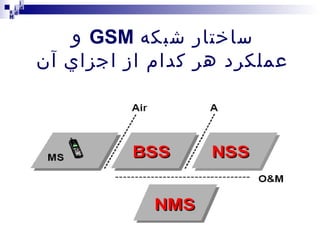
‫ساختار شبکه ‪ GSM‬و‬
‫عملكرد هر كدام از اجزاي آن‬
‫‪i‬‬
‫‪i d‬‬
‫‪ad‬‬
‫‪H‬‬

‫‪‬‬

‫ساختار شبکه ‪ Mobile‬بايد به صورتي باشد كه :‬
‫‪‬‬

‫در هر مکانی به مشترک سرويس دهی شود‬

‫‪‬‬

‫با هر سرعتی مشترک سرويس دهی شود‬

‫‪‬‬

‫مکان مشترک مشخص شود‬

‫‪‬‬

‫هويت مشترک مشخص شود‬

‫‪‬‬

‫سرويسی مورد درخواست مشترک ارايه شود‬

‫‪‬‬

‫با تمام شبكه هاي ديگر ارتباط و تبادل داشته باشد‬
i
i d
ad
H

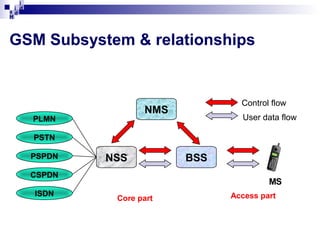
GSM Subsystem & relationships

Control flow

NMS

PLMN

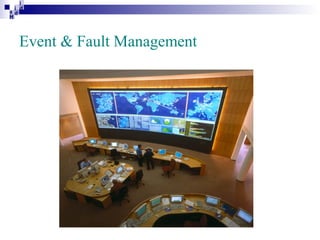
User data flow

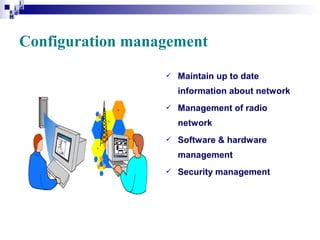
PSTN
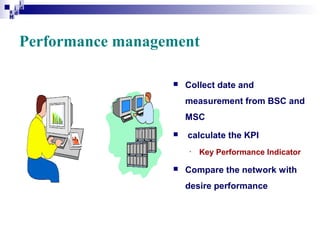
PSPDN

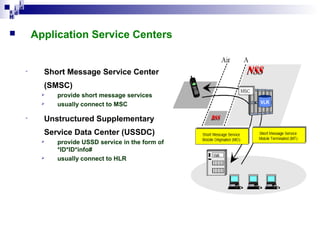
NSS

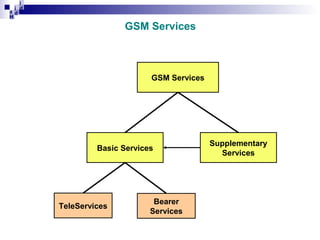
CSPDN
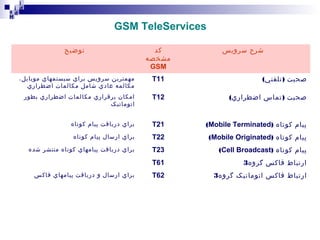
ISDN

BSS
MS

Core part

Access part
i
i d
ad
H

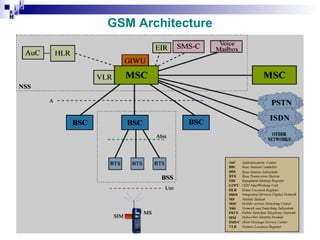
GSM Architecture
i
i d
ad
H

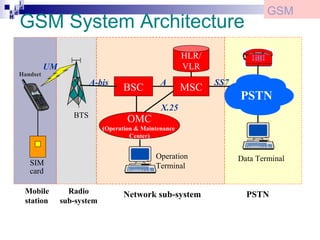
GSM System Architecture

Handset

GSM

HLR/
VLR

UM
A-bis

BTS

BSC

A

MSC

SS7

PSTN

X.25

OMC
(Operation & Maintenance
Center)

Operation
Terminal

SIM
card
Mobile
station

Radio
sub-system

Network sub-system

Data Terminal

PSTN
i
i d
ad
H

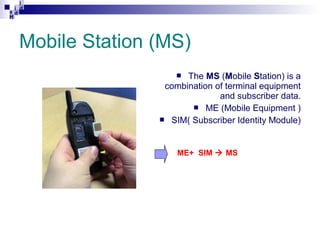
Mobile Station (MS)
The MS (Mobile Station) is a
combination of terminal equipment
and subscriber data.
 ME (Mobile Equipment )
 SIM( Subscriber Identity Module)


ME+ SIM  MS
i
i d
ad
H

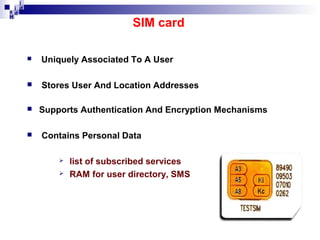
SIM card


Uniquely Associated To A User



Stores User And Location Addresses





Supports Authentication And Encryption Mechanisms
Contains Personal Data



list of subscribed services
RAM for user directory, SMS
i
i d
ad
H

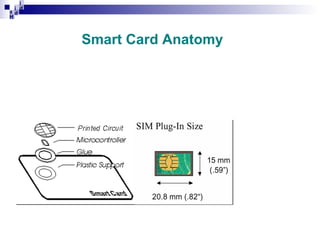
Smart Card Anatomy
‫‪i‬‬
‫‪i d‬‬
‫‪ad‬‬
‫‪H‬‬

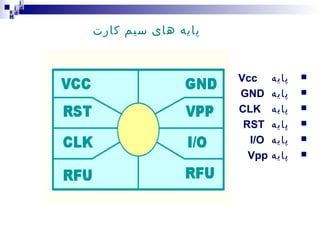
‫پایه های سیم کارت‬

‫‪‬‬
‫‪‬‬
‫‪‬‬
‫‪‬‬
‫‪‬‬
‫‪‬‬

‫پايه‬
‫پايه‬
‫پايه‬
‫پايه‬
‫پايه‬
‫پايه‬

‫‪Vcc‬‬
‫‪GND‬‬
‫‪CLK‬‬
‫‪RST‬‬
‫‪I/O‬‬
‫‪Vpp‬‬
i
i d
ad
H

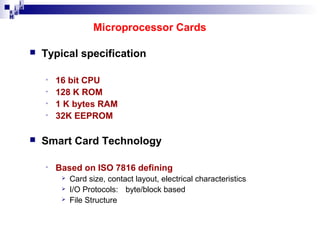
Microprocessor Cards


Typical specification
•
•
•
•



16 bit CPU
128 K ROM
1 K bytes RAM
32K EEPROM

Smart Card Technology
•

Based on ISO 7816 defining




Card size, contact layout, electrical characteristics
I/O Protocols: byte/block based
File Structure
‫‪i‬‬
‫‪i d‬‬
‫‪ad‬‬
‫‪H‬‬

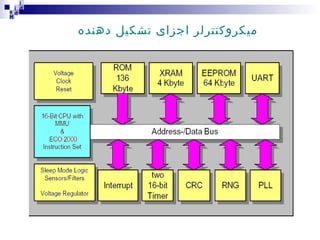
‫میکروکنترلر اجزای تشکیل دهنده‬
i
i d
ad
H

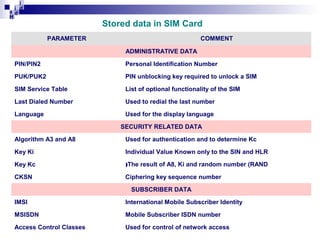
Stored data in SIM Card
PARAMETER

COMMENT
ADMINISTRATIVE DATA

PIN/PIN2

Personal Identification Number

PUK/PUK2

PIN unblocking key required to unlock a SIM

SIM Service Table

List of optional functionality of the SIM

Last Dialed Number

Used to redial the last number

Language

Used for the display language
SECURITY RELATED DATA

Algorithm A3 and A8

Used for authentication and to determine Kc

Key Ki

Individual Value Known only to the SIN and HLR

Key Kc

(The result of A8, Ki and random number (RAND

CKSN

Ciphering key sequence number
SUBSCRIBER DATA

IMSI

International Mobile Subscriber Identity

MSISDN

Mobile Subscriber ISDN number

Access Control Classes

Used for control of network access
i
i d
ad
H

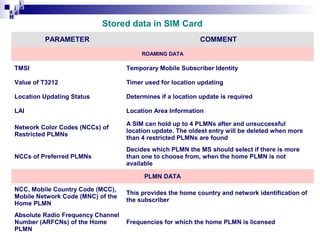
Stored data in SIM Card
PARAMETER

COMMENT
ROAMING DATA

TMSI

Temporary Mobile Subscriber Identity

Value of T3212

Timer used for location updating

Location Updating Status

Determines if a location update is required

LAI

Location Area Information

Network Color Codes (NCCs) of
Restricted PLMNs

A SIM can hold up to 4 PLMNs after and unsuccessful
location update. The oldest entry will be deleted when more
than 4 restricted PLMNs are found

NCCs of Preferred PLMNs

Decides which PLMN the MS should select if there is more
than one to choose from, when the home PLMN is not
available
PLMN DATA

NCC, Mobile Country Code (MCC),
Mobile Network Code (MNC) of the
Home PLMN

This provides the home country and network identification of
the subscriber

Absolute Radio Frequency Channel
Number (ARFCNs) of the Home
PLMN

Frequencies for which the home PLMN is licensed
i
i d
ad
H

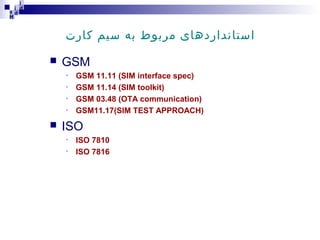
‫استانداردهای مربوط به سیم کارت‬


GSM
GSM 11.11 (SIM interface spec)
• GSM 11.14 (SIM toolkit)
• GSM 03.48 (OTA communication)
• GSM11.17(SIM TEST APPROACH)
•



ISO
ISO 7810
• ISO 7816
•
i
i d
ad
H

Mobile station power classes

GSM 900

GSM 1800

8W

39dBm

Vehicular

4W

36dBm

Vehicular

5W

37dBm

Portable

1W

30dBm

Portable

2W

33dBm

Portable

0.25W

24dBm

Portable

0.8W

29dBm

Portable

Usual Classes
i
i d
ad
H

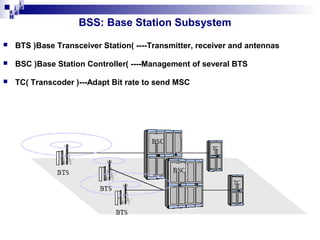
BSS: Base Station Subsystem



BTS )Base Transceiver Station( ----Transmitter, receiver and antennas



BSC )Base Station Controller( ----Management of several BTS



TC( Transcoder )---Adapt Bit rate to send MSC
i
i d
ad
H



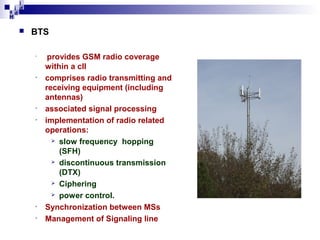
BTS
•

•

•
•

•
•

provides GSM radio coverage
within a cll
comprises radio transmitting and
receiving equipment (including
antennas)
associated signal processing
implementation of radio related
operations:
 slow frequency hopping
(SFH)
 discontinuous transmission
(DTX)
 Ciphering
 power control.
Synchronization between MSs
Management of Signaling line
i
i d
ad
H

GSM

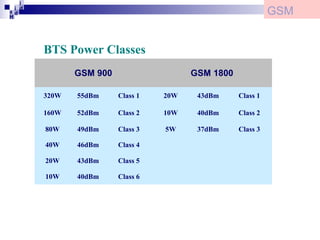
BTS Power Classes
GSM 900

GSM 1800

320W

55dBm

Class 1

20W

43dBm

Class 1

160W

52dBm

Class 2

10W

40dBm

Class 2

80W

49dBm

Class 3

5W

37dBm

Class 3

40W

46dBm

Class 4

20W

43dBm

Class 5

10W

40dBm

Class 6
i
i d
ad
H



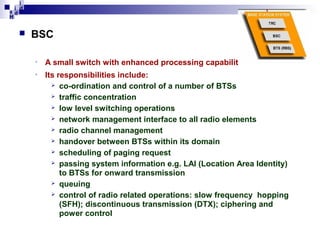
BSC
•

A small switch with enhanced processing capability.

•

Its responsibilities include:
 co-ordination and control of a number of BTSs
 traffic concentration
 low level switching operations
 network management interface to all radio elements
 radio channel management
 handover between BTSs within its domain
 scheduling of paging request
 passing system information e.g. LAI (Location Area Identity)
to BTSs for onward transmission
 queuing
 control of radio related operations: slow frequency hopping
(SFH); discontinuous transmission (DTX); ciphering and
power control
i
i d
ad
H

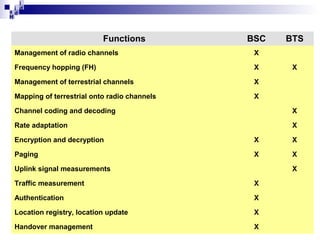
Functions

BSC

Management of radio channels

X

Frequency hopping (FH)

X

Management of terrestrial channels

X

Mapping of terrestrial onto radio channels

BTS

X

X

Channel coding and decoding

X

Rate adaptation

X

Encryption and decryption

X

X

Paging

X

X

Uplink signal measurements

X

Traffic measurement

X

Authentication

X

Location registry, location update

X

Handover management

X
i
i d
ad
H

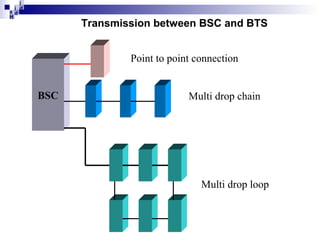
Transmission between BSC and BTS
Point to point connection
BSC

Multi drop chain

Multi drop loop
i
i d
ad
H

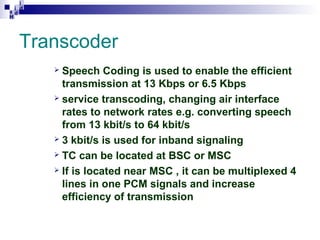
Transcoder
Speech Coding is used to enable the efficient
transmission at 13 Kbps or 6.5 Kbps
 service transcoding, changing air interface
rates to network rates e.g. converting speech
from 13 kbit/s to 64 kbit/s
 3 kbit/s is used for inband signaling
 TC can be located at BSC or MSC
 If is located near MSC , it can be multiplexed 4
lines in one PCM signals and increase
efficiency of transmission

i
i d
ad
H

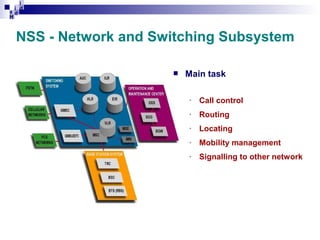
NSS - Network and Switching Subsystem


Main task
•

Call control

•

Routing

•

Locating

•

Mobility management

•

Signalling to other network
i
i d
ad
H

NSS –Elements



MSC )Mobile Switching Centre-----(Management of all connections



HLR )Home Location Register( -----Associated to each PLMN



VLR )Visitor Location Register-----(Associated to each MSC



GMSC) Gateway MSC MSC-----( providing interconnection to other
networks




AUC : Authentication Center----provide security of network
EIR :

Equipment Identity Register---provide absolute information of user
i
i d
ad
H

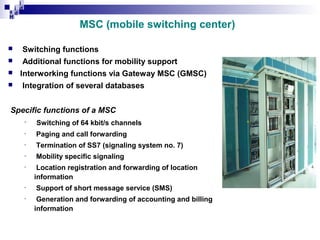
MSC (mobile switching center)



Switching functions



Additional functions for mobility support




Interworking functions via Gateway MSC (GMSC)
Integration of several databases

Specific functions of a MSC
•

Switching of 64 kbit/s channels

•

Paging and call forwarding

•

Termination of SS7 (signaling system no. 7)

•

Mobility specific signaling

•
•
•

Location registration and forwarding of location
information
Support of short message service (SMS)
Generation and forwarding of accounting and billing
information
i
i d
ad
H

Visitor Location Register (VLR)


Local database:
•
•

Includes roamers and non-roamers

•



Data about all users currently in the domain of the VLR

Associated to each MSC

Responsibilities of the VLR include:
•

Executing supplementary service programs (outgoing calls
barred)

•

Initiating authentication and ciphering

•

Initiating paging

•

Mapping of various identities (MSISDN, IMSI, TMSI, MSRN)

•

Passing location information to HLR
i
i d
ad
H

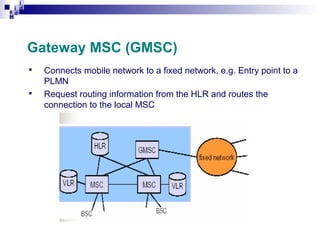
Gateway MSC (GMSC)




Connects mobile network to a fixed network, e.g. Entry point to a
PLMN
Request routing information from the HLR and routes the
connection to the local MSC
i
i d
ad
H

Home Location Register (HLR)




central master database
• data from every user that has subscribed to the operator,
includes:
 subscriber data
o IMSI - International Mobile Subscriber Identity
o list of subscribed services with parameters and
restrictions
 location data
o current MSC/VLR address
Responsibilities of the HLR include:
• management of service profiles
• mapping of subscriber identities (MISDN, IMSI)
• supplementary service control and profile updates
• execution of supplementary service logic e.g. incoming
calls barred.
• passing subscription records to VLR
i
i d
ad
H

Authentication Center (AuC)


Associated to HLR



Search key: IMSI



Supports authentication and encryption
mechanisms
•

Ki - subscriber secret authentication key

•

A3 - authentication algorithm

•

A8 - cipher key generation algorithm
i
i d
ad
H

Equipment Identity Register (EIR)


stores mobile stations IMEI (International Mobile
Equipment Identity)


white list - mobile stations allowed to connect
without restrictions



black list - mobile stations locked (stolen or
not type approved)



gray list - mobile stations under observation
for possible problems
i
i d
ad
H

Network Management Subsystem : NMS


Operation & management Center (OMC)
Control of the radio and network subsystems

•

Event & Fault Management

•

Configuration management

•

Performance Management
i
i d
ad
H

Event & Fault Management
i
i d
ad
H

Configuration management


Maintain up to date
information about network



Management of radio
network



Software & hardware
management



Security management
i
i d
ad
H

Performance management


Collect date and
measurement from BSC and
MSC



calculate the KPI
•



Key Performance Indicator

Compare the network with
desire performance
i
i d
ad
H

Application Service Centers



•

Short Message Service Center
(SMSC)



•

provide short message services
usually connect to MSC

Unstructured Supplementary
Service Data Center (USSDC)




provide USSD service in the form of
*ID*ID*info#
usually connect to HLR
i
i d
ad
H

GSM Services

GSM Services

Basic Services

TeleServices

Bearer
Services

Supplementary
Services
‫‪i‬‬
‫‪i d‬‬
‫‪ad‬‬
‫‪H‬‬

‫‪GSM TeleServices‬‬
‫شرح سرويس‬

‫کد‬
‫مشخصه‬
‫‪GSM‬‬

‫توضيح‬

‫صحبت ) تلفني(‬

‫11‪T‬‬

‫مهمترين سرويس براي سيستمهاي موبايل،‬
‫مکالمه عادي شامل مکالمات اضطراري‬

‫صحبت ) تماس اضطراري(‬

‫21‪T‬‬

‫امکان برقراري مکالمات اضطراري بطور‬
‫اتوماتيک‬

‫پيام کوتاه )‪(Mobile Terminated‬‬

‫12‪T‬‬

‫براي دريافت پيام کوتاه‬

‫پيام کوتاه )‪(Mobile Originated‬‬

‫22‪T‬‬

‫براي ارسال پيام کوتاه‬

‫پيام کوتاه )‪(Cell Broadcast‬‬

‫32‪T‬‬

‫براي دريافت پيامهاي کوتاه منتشر شده‬

‫ارتباط فاکس گروه3‬

‫16‪T‬‬

‫ارتباط فاکس اتوماتيک گروه3‬

‫26‪T‬‬

‫براي ارسال و دريافت پيامهاي فاکس‬
i
i d
ad
H

Bearer Service


Give the subscriber the capacity required to
transmit appropriate signals between certain
access points
Asynchronous data
• Synchronous data
• Packet switched assembler/
disassembler access
• Alternate speech and data
•
i
i d
ad
H

Services
Supplementary Services:


•

Advice of charge-AOC

•

Alternate Line Services (ALS)-personal or business

•

Barring of all incoming calls-BAIC

•

Barring of all Incoming calls when roaming outside the HPLMN

•

Barring of Incoming Calls when abroad

•

Barring of outgoing calls-BOC

•

Barring of outgoing International Calls-BOIC

•

Barring of outgoing International calls excluding those directed to the HPLMN country

•

Call forwarding on mobile subscriber busy-CFB

•

Call forwarding on no answer-CFNA

•

Call forwarding unconditional -CFU

•

Call hold

•

Call Waiting-CW

2 gsm network structure

  • 1.
    ‫‪i‬‬ ‫‪i d‬‬ ‫‪ad‬‬ ‫‪H‬‬ ‫ساختار شبکه‪ GSM‬و‬ ‫عملكرد هر كدام از اجزاي آن‬
  • 2.
    ‫‪i‬‬ ‫‪i d‬‬ ‫‪ad‬‬ ‫‪H‬‬ ‫‪‬‬ ‫ساختار شبکه‪ Mobile‬بايد به صورتي باشد كه :‬ ‫‪‬‬ ‫در هر مکانی به مشترک سرويس دهی شود‬ ‫‪‬‬ ‫با هر سرعتی مشترک سرويس دهی شود‬ ‫‪‬‬ ‫مکان مشترک مشخص شود‬ ‫‪‬‬ ‫هويت مشترک مشخص شود‬ ‫‪‬‬ ‫سرويسی مورد درخواست مشترک ارايه شود‬ ‫‪‬‬ ‫با تمام شبكه هاي ديگر ارتباط و تبادل داشته باشد‬
  • 3.
    i i d ad H GSM Subsystem& relationships Control flow NMS PLMN User data flow PSTN PSPDN NSS CSPDN ISDN BSS MS Core part Access part
  • 4.
  • 5.
    i i d ad H GSM SystemArchitecture Handset GSM HLR/ VLR UM A-bis BTS BSC A MSC SS7 PSTN X.25 OMC (Operation & Maintenance Center) Operation Terminal SIM card Mobile station Radio sub-system Network sub-system Data Terminal PSTN
  • 6.
    i i d ad H Mobile Station(MS) The MS (Mobile Station) is a combination of terminal equipment and subscriber data.  ME (Mobile Equipment )  SIM( Subscriber Identity Module)  ME+ SIM  MS
  • 7.
    i i d ad H SIM card  UniquelyAssociated To A User  Stores User And Location Addresses   Supports Authentication And Encryption Mechanisms Contains Personal Data   list of subscribed services RAM for user directory, SMS
  • 8.
  • 9.
    ‫‪i‬‬ ‫‪i d‬‬ ‫‪ad‬‬ ‫‪H‬‬ ‫پایه هایسیم کارت‬ ‫‪‬‬ ‫‪‬‬ ‫‪‬‬ ‫‪‬‬ ‫‪‬‬ ‫‪‬‬ ‫پايه‬ ‫پايه‬ ‫پايه‬ ‫پايه‬ ‫پايه‬ ‫پايه‬ ‫‪Vcc‬‬ ‫‪GND‬‬ ‫‪CLK‬‬ ‫‪RST‬‬ ‫‪I/O‬‬ ‫‪Vpp‬‬
  • 10.
    i i d ad H Microprocessor Cards  Typicalspecification • • • •  16 bit CPU 128 K ROM 1 K bytes RAM 32K EEPROM Smart Card Technology • Based on ISO 7816 defining    Card size, contact layout, electrical characteristics I/O Protocols: byte/block based File Structure
  • 11.
  • 12.
    i i d ad H Stored datain SIM Card PARAMETER COMMENT ADMINISTRATIVE DATA PIN/PIN2 Personal Identification Number PUK/PUK2 PIN unblocking key required to unlock a SIM SIM Service Table List of optional functionality of the SIM Last Dialed Number Used to redial the last number Language Used for the display language SECURITY RELATED DATA Algorithm A3 and A8 Used for authentication and to determine Kc Key Ki Individual Value Known only to the SIN and HLR Key Kc (The result of A8, Ki and random number (RAND CKSN Ciphering key sequence number SUBSCRIBER DATA IMSI International Mobile Subscriber Identity MSISDN Mobile Subscriber ISDN number Access Control Classes Used for control of network access
  • 13.
    i i d ad H Stored datain SIM Card PARAMETER COMMENT ROAMING DATA TMSI Temporary Mobile Subscriber Identity Value of T3212 Timer used for location updating Location Updating Status Determines if a location update is required LAI Location Area Information Network Color Codes (NCCs) of Restricted PLMNs A SIM can hold up to 4 PLMNs after and unsuccessful location update. The oldest entry will be deleted when more than 4 restricted PLMNs are found NCCs of Preferred PLMNs Decides which PLMN the MS should select if there is more than one to choose from, when the home PLMN is not available PLMN DATA NCC, Mobile Country Code (MCC), Mobile Network Code (MNC) of the Home PLMN This provides the home country and network identification of the subscriber Absolute Radio Frequency Channel Number (ARFCNs) of the Home PLMN Frequencies for which the home PLMN is licensed
  • 14.
    i i d ad H ‫استانداردهای مربوطبه سیم کارت‬  GSM GSM 11.11 (SIM interface spec) • GSM 11.14 (SIM toolkit) • GSM 03.48 (OTA communication) • GSM11.17(SIM TEST APPROACH) •  ISO ISO 7810 • ISO 7816 •
  • 15.
    i i d ad H Mobile stationpower classes GSM 900 GSM 1800 8W 39dBm Vehicular 4W 36dBm Vehicular 5W 37dBm Portable 1W 30dBm Portable 2W 33dBm Portable 0.25W 24dBm Portable 0.8W 29dBm Portable Usual Classes
  • 16.
    i i d ad H BSS: BaseStation Subsystem  BTS )Base Transceiver Station( ----Transmitter, receiver and antennas  BSC )Base Station Controller( ----Management of several BTS  TC( Transcoder )---Adapt Bit rate to send MSC
  • 17.
    i i d ad H  BTS • • • • • • provides GSMradio coverage within a cll comprises radio transmitting and receiving equipment (including antennas) associated signal processing implementation of radio related operations:  slow frequency hopping (SFH)  discontinuous transmission (DTX)  Ciphering  power control. Synchronization between MSs Management of Signaling line
  • 18.
    i i d ad H GSM BTS PowerClasses GSM 900 GSM 1800 320W 55dBm Class 1 20W 43dBm Class 1 160W 52dBm Class 2 10W 40dBm Class 2 80W 49dBm Class 3 5W 37dBm Class 3 40W 46dBm Class 4 20W 43dBm Class 5 10W 40dBm Class 6
  • 19.
    i i d ad H  BSC • A smallswitch with enhanced processing capability. • Its responsibilities include:  co-ordination and control of a number of BTSs  traffic concentration  low level switching operations  network management interface to all radio elements  radio channel management  handover between BTSs within its domain  scheduling of paging request  passing system information e.g. LAI (Location Area Identity) to BTSs for onward transmission  queuing  control of radio related operations: slow frequency hopping (SFH); discontinuous transmission (DTX); ciphering and power control
  • 20.
    i i d ad H Functions BSC Management ofradio channels X Frequency hopping (FH) X Management of terrestrial channels X Mapping of terrestrial onto radio channels BTS X X Channel coding and decoding X Rate adaptation X Encryption and decryption X X Paging X X Uplink signal measurements X Traffic measurement X Authentication X Location registry, location update X Handover management X
  • 21.
    i i d ad H Transmission betweenBSC and BTS Point to point connection BSC Multi drop chain Multi drop loop
  • 22.
    i i d ad H Transcoder Speech Codingis used to enable the efficient transmission at 13 Kbps or 6.5 Kbps  service transcoding, changing air interface rates to network rates e.g. converting speech from 13 kbit/s to 64 kbit/s  3 kbit/s is used for inband signaling  TC can be located at BSC or MSC  If is located near MSC , it can be multiplexed 4 lines in one PCM signals and increase efficiency of transmission 
  • 23.
    i i d ad H NSS -Network and Switching Subsystem  Main task • Call control • Routing • Locating • Mobility management • Signalling to other network
  • 24.
    i i d ad H NSS –Elements  MSC)Mobile Switching Centre-----(Management of all connections  HLR )Home Location Register( -----Associated to each PLMN  VLR )Visitor Location Register-----(Associated to each MSC  GMSC) Gateway MSC MSC-----( providing interconnection to other networks   AUC : Authentication Center----provide security of network EIR : Equipment Identity Register---provide absolute information of user
  • 25.
    i i d ad H MSC (mobileswitching center)  Switching functions  Additional functions for mobility support   Interworking functions via Gateway MSC (GMSC) Integration of several databases Specific functions of a MSC • Switching of 64 kbit/s channels • Paging and call forwarding • Termination of SS7 (signaling system no. 7) • Mobility specific signaling • • • Location registration and forwarding of location information Support of short message service (SMS) Generation and forwarding of accounting and billing information
  • 26.
    i i d ad H Visitor LocationRegister (VLR)  Local database: • • Includes roamers and non-roamers •  Data about all users currently in the domain of the VLR Associated to each MSC Responsibilities of the VLR include: • Executing supplementary service programs (outgoing calls barred) • Initiating authentication and ciphering • Initiating paging • Mapping of various identities (MSISDN, IMSI, TMSI, MSRN) • Passing location information to HLR
  • 27.
    i i d ad H Gateway MSC(GMSC)   Connects mobile network to a fixed network, e.g. Entry point to a PLMN Request routing information from the HLR and routes the connection to the local MSC
  • 28.
    i i d ad H Home LocationRegister (HLR)   central master database • data from every user that has subscribed to the operator, includes:  subscriber data o IMSI - International Mobile Subscriber Identity o list of subscribed services with parameters and restrictions  location data o current MSC/VLR address Responsibilities of the HLR include: • management of service profiles • mapping of subscriber identities (MISDN, IMSI) • supplementary service control and profile updates • execution of supplementary service logic e.g. incoming calls barred. • passing subscription records to VLR
  • 29.
    i i d ad H Authentication Center(AuC)  Associated to HLR  Search key: IMSI  Supports authentication and encryption mechanisms • Ki - subscriber secret authentication key • A3 - authentication algorithm • A8 - cipher key generation algorithm
  • 30.
    i i d ad H Equipment IdentityRegister (EIR)  stores mobile stations IMEI (International Mobile Equipment Identity)  white list - mobile stations allowed to connect without restrictions  black list - mobile stations locked (stolen or not type approved)  gray list - mobile stations under observation for possible problems
  • 31.
    i i d ad H Network ManagementSubsystem : NMS  Operation & management Center (OMC) Control of the radio and network subsystems • Event & Fault Management • Configuration management • Performance Management
  • 32.
    i i d ad H Event &Fault Management
  • 33.
    i i d ad H Configuration management  Maintainup to date information about network  Management of radio network  Software & hardware management  Security management
  • 34.
    i i d ad H Performance management  Collectdate and measurement from BSC and MSC  calculate the KPI •  Key Performance Indicator Compare the network with desire performance
  • 35.
    i i d ad H Application ServiceCenters  • Short Message Service Center (SMSC)   • provide short message services usually connect to MSC Unstructured Supplementary Service Data Center (USSDC)   provide USSD service in the form of *ID*ID*info# usually connect to HLR
  • 36.
    i i d ad H GSM Services GSMServices Basic Services TeleServices Bearer Services Supplementary Services
  • 37.
    ‫‪i‬‬ ‫‪i d‬‬ ‫‪ad‬‬ ‫‪H‬‬ ‫‪GSM TeleServices‬‬ ‫شرحسرويس‬ ‫کد‬ ‫مشخصه‬ ‫‪GSM‬‬ ‫توضيح‬ ‫صحبت ) تلفني(‬ ‫11‪T‬‬ ‫مهمترين سرويس براي سيستمهاي موبايل،‬ ‫مکالمه عادي شامل مکالمات اضطراري‬ ‫صحبت ) تماس اضطراري(‬ ‫21‪T‬‬ ‫امکان برقراري مکالمات اضطراري بطور‬ ‫اتوماتيک‬ ‫پيام کوتاه )‪(Mobile Terminated‬‬ ‫12‪T‬‬ ‫براي دريافت پيام کوتاه‬ ‫پيام کوتاه )‪(Mobile Originated‬‬ ‫22‪T‬‬ ‫براي ارسال پيام کوتاه‬ ‫پيام کوتاه )‪(Cell Broadcast‬‬ ‫32‪T‬‬ ‫براي دريافت پيامهاي کوتاه منتشر شده‬ ‫ارتباط فاکس گروه3‬ ‫16‪T‬‬ ‫ارتباط فاکس اتوماتيک گروه3‬ ‫26‪T‬‬ ‫براي ارسال و دريافت پيامهاي فاکس‬
  • 38.
    i i d ad H Bearer Service  Givethe subscriber the capacity required to transmit appropriate signals between certain access points Asynchronous data • Synchronous data • Packet switched assembler/ disassembler access • Alternate speech and data •
  • 39.
    i i d ad H Services Supplementary Services:  • Adviceof charge-AOC • Alternate Line Services (ALS)-personal or business • Barring of all incoming calls-BAIC • Barring of all Incoming calls when roaming outside the HPLMN • Barring of Incoming Calls when abroad • Barring of outgoing calls-BOC • Barring of outgoing International Calls-BOIC • Barring of outgoing International calls excluding those directed to the HPLMN country • Call forwarding on mobile subscriber busy-CFB • Call forwarding on no answer-CFNA • Call forwarding unconditional -CFU • Call hold • Call Waiting-CW

Editor's Notes

  • #29 Dedicated Gateway MSCs (GMSCs) are available to pass voice traffic between fixed networks and mobile network. GMSC queries the database (HLR ) and routes the connection to the local MSC in whose area the mobile station is currently staying.