2D animation application
software
Preface.
• What is the difference between vector and raster graphics?
• The difference between vector and raster graphics is that raster
graphics are composed of pixels, while vector graphics are composed
of paths. A raster graphic, such as a gif or jpeg, is an array of pixels of
various colors, which together form an image.
• A vector graphic, such as an .eps file or Adobe Illustrator? file, is
composed of paths, or lines, that are either straight or curved. The
data file for a vector image contains the points where the paths start
and end, how much the paths curve, and the colors that either border
or fill the paths.
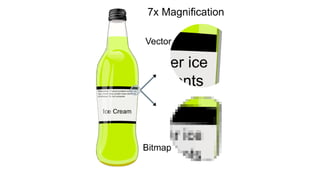
• Because vector graphics are not made of pixels, the images can be
scaled to be very large without losing quality. Raster graphics, on the
other hand, become "blocky," since each pixel increases in size as the
image is made larger. This is why logos and other designs are typically
created in vector format -- the quality will look the same on a
business card as it will on a billboard.
Adobe Flash
• Adobe Flash is a multimedia software platform used for production
of animations, rich Internet applications, desktop applications, mobile
applications, mobile games and embedded web browser video
players.
• ActionScript 3.0 is a powerful, object-oriented programming language that signifies an important
step in the evolution of the capabilities of the Flash Player runtime. The motivation driving
ActionScript 3.0 is to create a language ideally suited for rapidly building rich Internet
applications, which have become an essential part of the web experience.
•
• Earlier versions of ActionScript offered the power and flexibility required for creating truly
engaging online experiences. ActionScript 3.0 now further advances the language, providing
superb performance and ease of development to facilitate highly complex applications, large
datasets, and object-oriented, reusable code bases. With ActionScript 3.0, developers can achieve
excellent productivity and performance with content and applications that target Flash Player.
•
• ActionScript 3.0 is based on ECMAScript, the international standardized programming language
for scripting. ActionScript 3.0 is compliant with the ECMAScript Language Specification, Third
Edition (ECMA-262). It also contains functionality based on ongoing work on ECMAScript Edition
4, occurring within the ECMA standards body.
• Flash displays text, vector graphics and raster graphicsto provide
animations, video games and applications. It allows streaming
of audio and video, and can capture mouse, keyboard, microphone
and camera input
• Artists may produce Flash graphics and animations using Adobe
Animate. Software developers may produce applications and video
games using Adobe Flash Builder, FlashDevelop, Flash Catalyst, or any
text editor when used with the Apache Flex SDK.
• End-users can view Flash content via Flash Player (for web
browsers), AIR (for desktop or mobile apps) or third-party players
such as Scaleform (for video games).
• Adobe Flash Player (supported on Microsoft
Windows, macOS and Linux) enables end-users to view Flash content
using web browsers. Adobe Flash Lite enabled viewing Flash content
on older smartphones, but has been discontinued and superseded by
Adobe AIR.
• Macromedia
• In November 1996, FutureSplash was acquired by Macromedia, and
Macromedia re-branded and released FutureSplash
Animator as Macromedia Flash 1.0. Flash was a two-part system, a
graphics and animation editor known as Macromedia Flash, and a
player known as Macromedia Flash Player.
• FutureSplash Animator was an animation tool originally developed for
pen-based computing devices. Due to the small size of
the FutureSplash Viewer, it was particularly suited for download on
the Web.
• Macromedia distributed Flash Player as a free browser plugin in order
to quickly gain market share. By 2005, more computers worldwide
had Flash Player installed than any other Web media format,
including Java, QuickTime, RealNetworks and Windows Media Player.
• Macromedia upgraded the Flash system between 1996 and 1999
adding Movie Clips, Actions (the precursor to ActionScript), Alpha
transparency, and other features.
• As Flash matured, Macromedia's focus shifted from marketing it as a
graphics and media tool to promoting it as a Web
application platform, adding scripting and data access capabilities to
the player while attempting to retain its small footprint.
• .
• In 2000, the first major version of ActionScript was developed, and
released with Flash 5. Actionscript 2.0 was released with Flash MX
2004 and supported object-oriented programming, improved UI
components and other programming features.
• The last version of Flash released by Macromedia was Flash 8, which
focused on graphical upgrades such as filters (blur, drop shadow, etc.),
blend modes (similar to Adobe Photoshop), and advanced features
for FLV video.
• Adobe
• Macromedia was acquired by Adobe Systems in 2005, and the entire
Macromedia product line including
Flash, Dreamweaver, Director/Shockwave, Fireworks (which has since
been discontinued) and Authorware is now handled by Adobe.
• "FLASH & THE FUTURE OF INTERACTIVE CONTENT". Adobe Systems. July 25, 2017.
• AIR Roadmap Update, Chris Campbell, Adobe Blog, Jul 25, 2017 9:08 AM
• WARREN, CHRISTINA (2012-11-20). "The Life, Death and Rebirth of Adobe Flash". Mashable. Retrieved 2015-
06-11.
• Pinho, Carlos (2009-07-07). "50 Beautiful Flash Websites". Smashing Magazine. Retrieved 2015-06-11.
• Looking back at the best Flash sites of 2009, Adobe Developer Connection, 14 December 2009
• DAVLIN, ANN (2011-06-15). "35 Of The Best 3D Flash Websites Ever". Smashing 3D. Retrieved 2015-06-11.
• 20 Best 3D Websites, Web Designer Drops, September 15, 2012
• Google to automatically convert Flash web ads to HTML5, IT Pro Magazine, Caroline Preece, 27 Feb 2015
• YOUTUBE NOW PLAYS HTML5 VIDEO BY DEFAULT, ESCHEWS ADOBE FLASH, Popular Science, Dan Moren,
January 28, 2015
• Arie Kaufman (1993). Rendering, Visualization and Rasterization Hardware. Springer Science & Business
Media. pp. 86–87. ISBN 978-3-540-56787-5.
• Nigel Chapman; Jenny Chapman (2002) [2000]. Digital Multimedia. Wiley. p. 86. ISBN 0-471-98386-1.

2 d animation application software

  • 1.
  • 2.
    • What isthe difference between vector and raster graphics?
  • 3.
    • The differencebetween vector and raster graphics is that raster graphics are composed of pixels, while vector graphics are composed of paths. A raster graphic, such as a gif or jpeg, is an array of pixels of various colors, which together form an image.
  • 4.
    • A vectorgraphic, such as an .eps file or Adobe Illustrator? file, is composed of paths, or lines, that are either straight or curved. The data file for a vector image contains the points where the paths start and end, how much the paths curve, and the colors that either border or fill the paths.
  • 5.
    • Because vectorgraphics are not made of pixels, the images can be scaled to be very large without losing quality. Raster graphics, on the other hand, become "blocky," since each pixel increases in size as the image is made larger. This is why logos and other designs are typically created in vector format -- the quality will look the same on a business card as it will on a billboard.
  • 7.
    Adobe Flash • AdobeFlash is a multimedia software platform used for production of animations, rich Internet applications, desktop applications, mobile applications, mobile games and embedded web browser video players.
  • 8.
    • ActionScript 3.0is a powerful, object-oriented programming language that signifies an important step in the evolution of the capabilities of the Flash Player runtime. The motivation driving ActionScript 3.0 is to create a language ideally suited for rapidly building rich Internet applications, which have become an essential part of the web experience. • • Earlier versions of ActionScript offered the power and flexibility required for creating truly engaging online experiences. ActionScript 3.0 now further advances the language, providing superb performance and ease of development to facilitate highly complex applications, large datasets, and object-oriented, reusable code bases. With ActionScript 3.0, developers can achieve excellent productivity and performance with content and applications that target Flash Player. • • ActionScript 3.0 is based on ECMAScript, the international standardized programming language for scripting. ActionScript 3.0 is compliant with the ECMAScript Language Specification, Third Edition (ECMA-262). It also contains functionality based on ongoing work on ECMAScript Edition 4, occurring within the ECMA standards body.
  • 9.
    • Flash displaystext, vector graphics and raster graphicsto provide animations, video games and applications. It allows streaming of audio and video, and can capture mouse, keyboard, microphone and camera input
  • 10.
    • Artists mayproduce Flash graphics and animations using Adobe Animate. Software developers may produce applications and video games using Adobe Flash Builder, FlashDevelop, Flash Catalyst, or any text editor when used with the Apache Flex SDK.
  • 11.
    • End-users canview Flash content via Flash Player (for web browsers), AIR (for desktop or mobile apps) or third-party players such as Scaleform (for video games).
  • 12.
    • Adobe FlashPlayer (supported on Microsoft Windows, macOS and Linux) enables end-users to view Flash content using web browsers. Adobe Flash Lite enabled viewing Flash content on older smartphones, but has been discontinued and superseded by Adobe AIR.
  • 13.
    • Macromedia • InNovember 1996, FutureSplash was acquired by Macromedia, and Macromedia re-branded and released FutureSplash Animator as Macromedia Flash 1.0. Flash was a two-part system, a graphics and animation editor known as Macromedia Flash, and a player known as Macromedia Flash Player.
  • 14.
    • FutureSplash Animatorwas an animation tool originally developed for pen-based computing devices. Due to the small size of the FutureSplash Viewer, it was particularly suited for download on the Web.
  • 15.
    • Macromedia distributedFlash Player as a free browser plugin in order to quickly gain market share. By 2005, more computers worldwide had Flash Player installed than any other Web media format, including Java, QuickTime, RealNetworks and Windows Media Player.
  • 16.
    • Macromedia upgradedthe Flash system between 1996 and 1999 adding Movie Clips, Actions (the precursor to ActionScript), Alpha transparency, and other features.
  • 17.
    • As Flashmatured, Macromedia's focus shifted from marketing it as a graphics and media tool to promoting it as a Web application platform, adding scripting and data access capabilities to the player while attempting to retain its small footprint. • .
  • 18.
    • In 2000,the first major version of ActionScript was developed, and released with Flash 5. Actionscript 2.0 was released with Flash MX 2004 and supported object-oriented programming, improved UI components and other programming features.
  • 19.
    • The lastversion of Flash released by Macromedia was Flash 8, which focused on graphical upgrades such as filters (blur, drop shadow, etc.), blend modes (similar to Adobe Photoshop), and advanced features for FLV video.
  • 20.
    • Adobe • Macromediawas acquired by Adobe Systems in 2005, and the entire Macromedia product line including Flash, Dreamweaver, Director/Shockwave, Fireworks (which has since been discontinued) and Authorware is now handled by Adobe.
  • 21.
    • "FLASH &THE FUTURE OF INTERACTIVE CONTENT". Adobe Systems. July 25, 2017. • AIR Roadmap Update, Chris Campbell, Adobe Blog, Jul 25, 2017 9:08 AM • WARREN, CHRISTINA (2012-11-20). "The Life, Death and Rebirth of Adobe Flash". Mashable. Retrieved 2015- 06-11. • Pinho, Carlos (2009-07-07). "50 Beautiful Flash Websites". Smashing Magazine. Retrieved 2015-06-11. • Looking back at the best Flash sites of 2009, Adobe Developer Connection, 14 December 2009 • DAVLIN, ANN (2011-06-15). "35 Of The Best 3D Flash Websites Ever". Smashing 3D. Retrieved 2015-06-11. • 20 Best 3D Websites, Web Designer Drops, September 15, 2012 • Google to automatically convert Flash web ads to HTML5, IT Pro Magazine, Caroline Preece, 27 Feb 2015 • YOUTUBE NOW PLAYS HTML5 VIDEO BY DEFAULT, ESCHEWS ADOBE FLASH, Popular Science, Dan Moren, January 28, 2015 • Arie Kaufman (1993). Rendering, Visualization and Rasterization Hardware. Springer Science & Business Media. pp. 86–87. ISBN 978-3-540-56787-5. • Nigel Chapman; Jenny Chapman (2002) [2000]. Digital Multimedia. Wiley. p. 86. ISBN 0-471-98386-1.