






The world needs
communication leadership
Professor Anne Gregory
Chair, Global Alliance
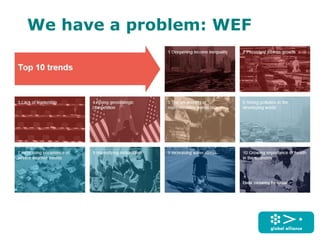
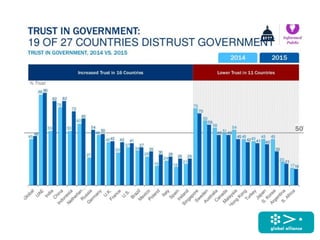
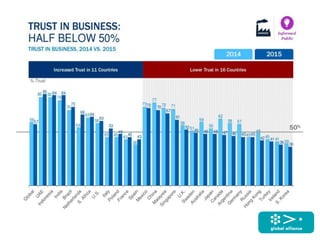
We have a problem: WEF
We have a BIG opportunity...
Communication is at the heart of
everything
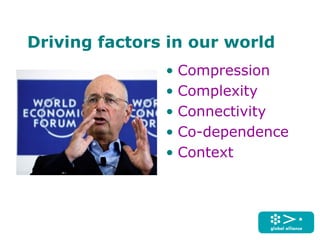
Driving factors in our world
• Compression
• Complexity
• Connectivity
• Co-dependence
• Context
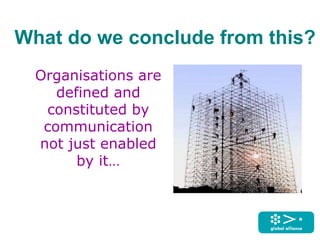
What do we conclude from this?
Organisations are
defined and
constituted by
communication
not just enabled
by it…
A new way of looking at
organisations
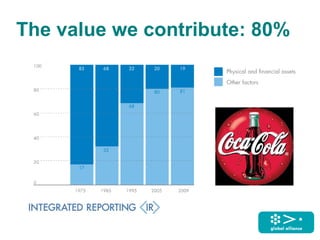
The value we contribute: 80%
Who is round the Board table?
Grasping the opportunity to lead…
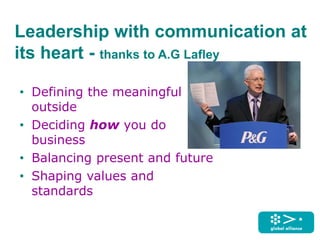
Leadership with communication at
its heart - thanks to A.G Lafley
• Defining the meaningful
outside
• Deciding how you do
business
• Balancing present and future
• Shaping values and
standards
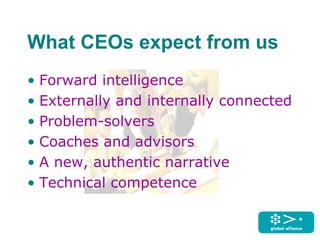
What CEOs expect from us
• Forward intelligence
• Externally and internally connected
• Problem-solvers
• Coaches and advisors
• A new, authentic narrative
• Technical competence
Implications
Requires leadership from us
at all levels: understanding
and solving problems
affecting relationships and
reputation
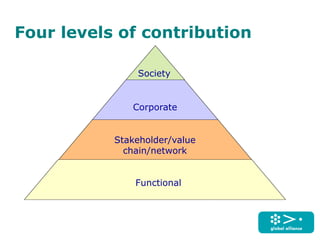
Four levels of contribution
Society
Corporate
Stakeholder/value
chain/network
Functional
Steyn, 2007; Gregory and Willis 2009
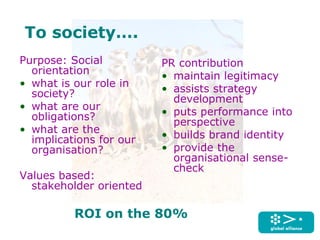
To society….
Purpose: Social
orientation
• what is our role in
society?
• what are our
obligations?
• what are the
implications for our
organisation?
Values based:
stakeholder oriented
PR contribution
• maintain legitimacy
• assists strategy
development
• puts performance into
perspective
• builds brand identity
• provide the
organisational sense-
check
ROI on the 80%
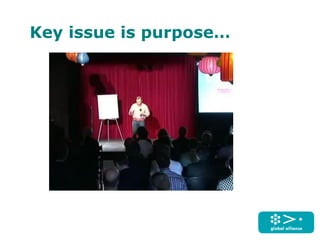
Key issue is purpose…
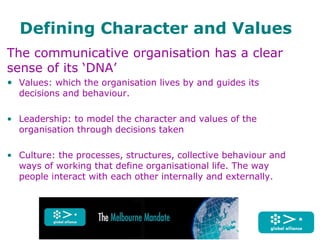
Defining Character and Values
The communicative organisation has a clear
sense of its ‘DNA’
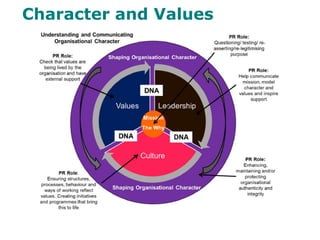
• Values: which the organisation lives by and guides its
decisions and behaviour.
• Leadership: to model the character and values of the
organisation through decisions taken
• Culture: the processes, structures, collective behaviour and
ways of working that define organisational life. The way
people interact with each other internally and externally.
Character and Values
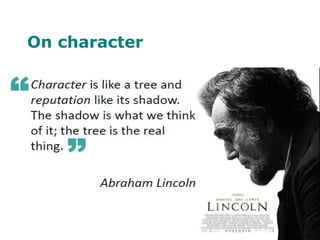
On character
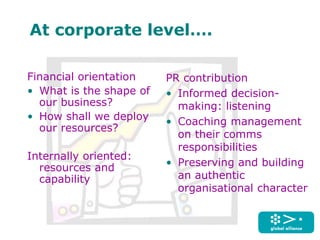
At corporate level….
Financial orientation
• What is the shape of
our business?
• How shall we deploy
our resources?
Internally oriented:
resources and
capability
PR contribution
• Informed decision-
making: listening
• Coaching management
on their comms
responsibilities
• Preserving and building
an authentic
organisational character
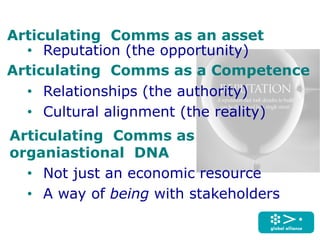
Articulating Comms as an asset
• Reputation (the opportunity)
• Relationships (the authority)
• Cultural alignment (the reality)
• Not just an economic resource
• A way of being with stakeholders
Articulating Comms as a Competence
Articulating Comms as
organiastional DNA
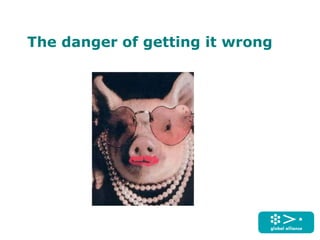
The danger of getting it wrong
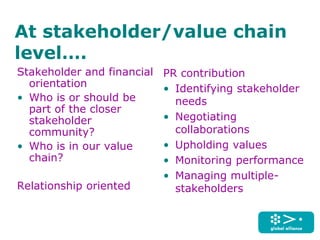
At stakeholder/value chain
level….
Stakeholder and financial
orientation
• Who is or should be
part of the closer
stakeholder
community?
• Who is in our value
chain?
Relationship oriented
PR contribution
• Identifying stakeholder
needs
• Negotiating
collaborations
• Upholding values
• Monitoring performance
• Managing multiple-
stakeholders
The company you keep….
At functional level….
Societal, organisational and
stakeholder focused
• What are the operational
imperatives?
• How do we implement
efficient and effective
programmes and
campaigns?
Operational competence
Comms Contribution
• Strategic programmes
• Reactive, proactive
and interactive
• Evaluated
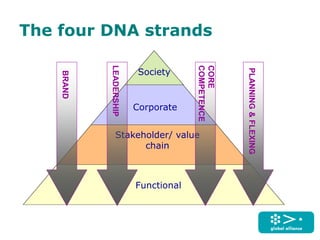
Society
Corporate
Stakeholder/ value
chain
Functional
The four DNA strands
BRAND
PLANNING&FLEXING
CORE
COMPETENCE
LEADERSHIP
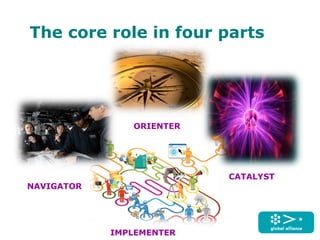
The core role in four parts
ORIENTER
NAVIGATOR
CATALYST
IMPLEMENTER
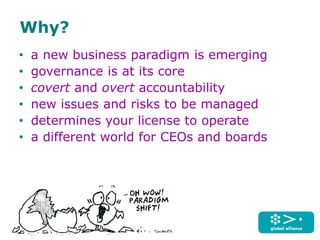
Why?
• a new business paradigm is emerging
• governance is at its core
• covert and overt accountability
• new issues and risks to be managed
• determines your license to operate
• a different world for CEOs and boards
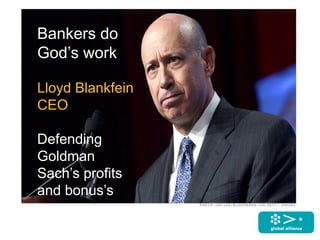
Bankers do
God’s work
Lloyd Blankfein
CEO
Defending
Goldman
Sach’s profits
and bonus’s
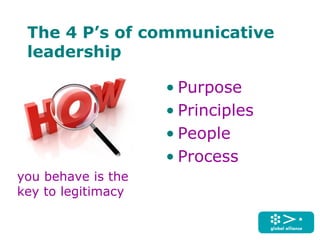
The 4 P’s of communicative
leadership
• Purpose
• Principles
• People
• Process
you behave is the
key to legitimacy
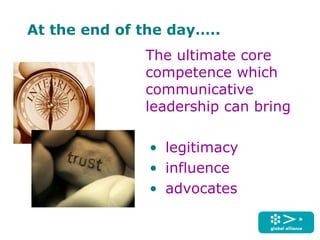
At the end of the day…..
The ultimate core
competence which
communicative
leadership can bring
• legitimacy
• influence
• advocates
A last thought
If organisations organise
around communication
innovation will happen....this
is the condition that is
required.
Anne Gregory:  Hvorfor trenger vi kommunikatører i ledelsen?

Anne Gregory: Hvorfor trenger vi kommunikatører i ledelsen?

  • 1.
    The world needs communicationleadership Professor Anne Gregory Chair, Global Alliance
  • 2.
    We have aproblem: WEF
  • 6.
    We have aBIG opportunity...
  • 7.
    Communication is atthe heart of everything
  • 8.
    Driving factors inour world • Compression • Complexity • Connectivity • Co-dependence • Context
  • 9.
    What do weconclude from this? Organisations are defined and constituted by communication not just enabled by it…
  • 10.
    A new wayof looking at organisations
  • 11.
    The value wecontribute: 80%
  • 12.
    Who is roundthe Board table?
  • 13.
  • 14.
    Leadership with communicationat its heart - thanks to A.G Lafley • Defining the meaningful outside • Deciding how you do business • Balancing present and future • Shaping values and standards
  • 15.
    What CEOs expectfrom us • Forward intelligence • Externally and internally connected • Problem-solvers • Coaches and advisors • A new, authentic narrative • Technical competence
  • 16.
    Implications Requires leadership fromus at all levels: understanding and solving problems affecting relationships and reputation
  • 17.
    Four levels ofcontribution Society Corporate Stakeholder/value chain/network Functional Steyn, 2007; Gregory and Willis 2009
  • 18.
    To society…. Purpose: Social orientation •what is our role in society? • what are our obligations? • what are the implications for our organisation? Values based: stakeholder oriented PR contribution • maintain legitimacy • assists strategy development • puts performance into perspective • builds brand identity • provide the organisational sense- check ROI on the 80%
  • 19.
    Key issue ispurpose…
  • 21.
    Defining Character andValues The communicative organisation has a clear sense of its ‘DNA’ • Values: which the organisation lives by and guides its decisions and behaviour. • Leadership: to model the character and values of the organisation through decisions taken • Culture: the processes, structures, collective behaviour and ways of working that define organisational life. The way people interact with each other internally and externally.
  • 22.
  • 23.
  • 24.
    At corporate level…. Financialorientation • What is the shape of our business? • How shall we deploy our resources? Internally oriented: resources and capability PR contribution • Informed decision- making: listening • Coaching management on their comms responsibilities • Preserving and building an authentic organisational character
  • 25.
    Articulating Comms asan asset • Reputation (the opportunity) • Relationships (the authority) • Cultural alignment (the reality) • Not just an economic resource • A way of being with stakeholders Articulating Comms as a Competence Articulating Comms as organiastional DNA
  • 27.
    The danger ofgetting it wrong
  • 28.
    At stakeholder/value chain level…. Stakeholderand financial orientation • Who is or should be part of the closer stakeholder community? • Who is in our value chain? Relationship oriented PR contribution • Identifying stakeholder needs • Negotiating collaborations • Upholding values • Monitoring performance • Managing multiple- stakeholders
  • 29.
  • 30.
    At functional level…. Societal,organisational and stakeholder focused • What are the operational imperatives? • How do we implement efficient and effective programmes and campaigns? Operational competence Comms Contribution • Strategic programmes • Reactive, proactive and interactive • Evaluated
  • 31.
    Society Corporate Stakeholder/ value chain Functional The fourDNA strands BRAND PLANNING&FLEXING CORE COMPETENCE LEADERSHIP
  • 32.
    The core rolein four parts ORIENTER NAVIGATOR CATALYST IMPLEMENTER
  • 33.
    Why? • a newbusiness paradigm is emerging • governance is at its core • covert and overt accountability • new issues and risks to be managed • determines your license to operate • a different world for CEOs and boards
  • 34.
    Bankers do God’s work LloydBlankfein CEO Defending Goldman Sach’s profits and bonus’s
  • 35.
    The 4 P’sof communicative leadership • Purpose • Principles • People • Process you behave is the key to legitimacy
  • 36.
    At the endof the day….. The ultimate core competence which communicative leadership can bring • legitimacy • influence • advocates
  • 37.
    A last thought Iforganisations organise around communication innovation will happen....this is the condition that is required.